
Form No. 3453-954 Rev A
60in TITAN
®
MAX Riding Mower
Model No. 76601—Serial No. 400000000 and Up
Model No. 76602—Serial No. 400000000 and Up
Register at www.Toro.com.
Original Instructions (EN)
*3453-954*
It is a violation of California Public Resource Code
Section 4442 or 4443 to use or operate the engine on
any forest-covered, brush-covered, or grass-covered
land unless the engine is equipped with a spark
arrester, as dened in Section 4442, maintained in
effective working order or the engine is constructed,
equipped, and maintained for the prevention of re.
Gross or Net Torque: The gross or net torque
of this engine was laboratory rated by the engine
manufacturer in accordance with the Society of
Automotive Engineers (SAE) J1940 or J2723. As
congured to meet safety, emission, and operating
requirements, the actual engine torque on this class
of mower will be signicantly lower. Please refer to
the engine manufacturer’s information included with
the machine.
Go to
www.Toro.com to view specications on your
model.
The enclosed engine owner's manual is supplied
for information regarding the US Environmental
Protection Agency (EPA) and the California Emission
Control Regulation of emission systems, maintenance,
and warranty. Replacements may be ordered through
the engine manufacturer.
WARNING
CALIFORNIA
Proposition 65 Warning
The engine exhaust from this product
contains chemicals known to the State of
California to cause cancer, birth defects,
or other reproductive harm.
Battery posts, terminals, and related
accessories contain lead and lead
compounds, chemicals known to
the State of California to cause
cancer and reproductive harm. Wash
hands after handling.
Use of this product may cause exposure
to chemicals known to the State of
California to cause cancer, birth defects,
or other reproductive harm.
Introduction
This rotary-blade, riding lawn mower is intended to be
used by homeowners in residential applications. It is
designed primarily for cutting grass on well-maintained
lawns. Using this product for purposes other than
its intended use could prove dangerous to you and
bystanders.
Read this information carefully to learn how to operate
and maintain your product properly and to avoid
injury and product damage. You are responsible for
operating the product properly and safely.
Visit
www.Toro.com for product safety and operation
training materials, accessory information, help nding
a dealer, or to register your product.
Whenever you need service, genuine Toro parts, or
additional information, contact an Authorized Service
Dealer or Toro Customer Service and have the model
and serial numbers of your product ready.
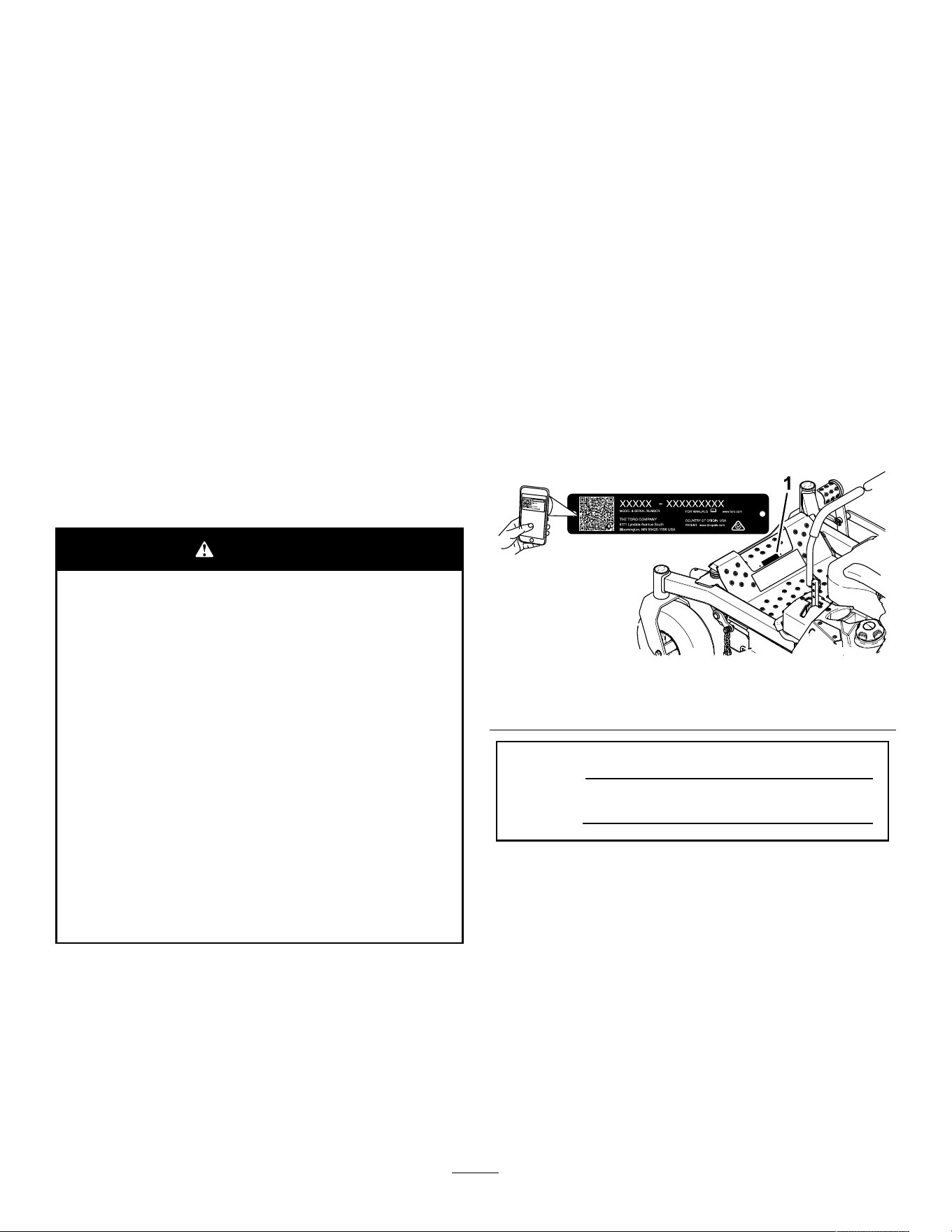
Figure 1
identies the location of the model and serial numbers
on the product. Write the numbers in the space
provided.
Important: With your mobile device, you can
scan the QR code on the serial number decal (if
equipped) to access warranty, parts, and other
product information.
g233854
Figure 1
1. Model and serial number location
Model No.
Serial No.
The safety-alert symbol (Figure 2) appears both in
this manual and on the machine to identify important
safety messages that you must follow to avoid
accidents. This symbol will appear with the word
Danger, Warning, or Caution.
• Danger indicates an imminently hazardous
situation which, if not avoided, will result in death
or serious injury.
• Warning indicates a potentially hazardous
situation which, if not avoided, could result in
death or serious injury.
• Caution indicates a potentially hazardous situation
which, if not avoided, may result in minor or
moderate injury.
© 2022—The Toro® Company
8111 Lyndale Avenue South
Bloomington, MN 55420
2
Contact us at www.Toro.com.
Printed in the USA
All Rights Reserved

sa-black
Figure 2
1. Safety-alert symbol
This manual uses 2 other words to highlight
information. Important calls attention to special
mechanical information and Note emphasizes general
information worthy of special attention.
Contents
Safety ....................................................................... 4
General Safety ................................................... 4
Slope Indicator ................................................... 5
Safety and Instructional Decals .......................... 6
Product Overview ....................................................11
Controls ............................................................11
Specications .................................................. 13
Attachments/Accessories ................................. 13
Before Operation ................................................. 14
Before Operation Safety ................................... 14
Adding Fuel ...................................................... 15
Performing Daily Maintenance.......................... 15
Breaking in a New Machine .............................. 15
Using the Rollover-Protection System
(ROPS) ......................................................... 16
Using the Safety-Interlock System .................... 17
Positioning the Seat.......................................... 18
During Operation ................................................. 18
During Operation Safety ................................... 18
Entering the Operator’s Position ....................... 20
Operating the Parking Brake............................. 21
Operating the Mower Blade-Control Switch
(PTO)............................................................ 21
Operating the Throttle....................................... 21
Operating the Choke ........................................ 22
Starting the Engine ........................................... 22
Shutting Off the Engine..................................... 23
Using the Motion-Control Levers....................... 23
Driving the Machine.......................................... 24
Using the Side Discharge ................................. 25
Adjusting the Height of Cut ............................... 25
Adjusting the Anti-Scalp Rollers........................ 26
Operating Tips ................................................. 27
After Operation .................................................... 28
After Operation Safety ...................................... 28
Using the Fuel-Shutoff Valve............................. 28
Using the Drive-Wheel Release Valves ............. 29
Transporting the Machine ................................. 30
Maintenance ........................................................... 32
Maintenance Safety.......................................... 32
Recommended Maintenance Schedule(s) ........... 32
Lubrication .......................................................... 33
Greasing the Machine....................................... 33
Engine Maintenance ........................................... 34
Engine Safety ................................................... 34
Servicing the Air Cleaner .................................. 34
Servicing the Engine Oil.................................... 35
Servicing the Spark Plug................................... 38
Fuel System Maintenance ................................... 39
Replacing the In-Line Fuel Filter ....................... 39
Servicing the Fuel Tank..................................... 39
Electrical System Maintenance ........................... 40
Electrical System Safety................................... 40
Servicing the Battery......................................... 40
Servicing the Fuses .......................................... 41
Drive System Maintenance .................................. 42
Checking the Seat Belt ..................................... 42
Adjusting the Tracking ...................................... 42
Checking the Tire Pressure............................... 43
Checking the Wheel Lug Nuts........................... 43
Cooling System Maintenance .............................. 43
Cleaning the Engine Screen ............................. 43
Brake Maintenance ............................................. 44
Adjusting the Parking Brake.............................. 44
Belt Maintenance ................................................ 45
Inspecting the Belts .......................................... 45
Replacing the Mower Belt ................................. 45
Replacing the Hydraulic Pump-Drive
Belt................................................................ 46
Controls System Maintenance ............................. 47
Adjusting the Control-Handle Position .............. 47
Adjusting the Motion-Control Linkage ............... 48
Hydraulic System Maintenance ........................... 49
Hydraulic System Safety................................... 49
Hydraulic Fluid Specications........................... 49
Checking the Hydraulic Fluid Level ................... 50
Changing the Hydraulic Fluid and
Filters............................................................ 50
Bleeding the Hydraulic System ......................... 52
Mower Deck Maintenance.................................... 52
Blade Safety ..................................................... 52
Servicing the Cutting Blades............................. 52
Adjusting the Side-to-Side Leveling and the
Blade Slope .................................................. 55
Removing the Mower Deck............................... 57
Installing the Mower Deck................................. 57
Replacing the Grass Deector .......................... 58
Cleaning .............................................................. 59
Cleaning under the Mower Deck ....................... 59
Disposing of Waste........................................... 59
Storage ................................................................... 60
Storage Safety.................................................. 60
Cleaning and Storage....................................... 60
Troubleshooting ...................................................... 61
Schematics ............................................................. 63
3

Safety
This machine has been designed in accordance with
ANSI B71.1-2017.
General Safety
This product is capable of amputating hands and
feet and of throwing objects. Always follow all safety
instructions to avoid serious personal injury or death.
• Read and understand the contents of this
Operator’s Manual before starting the engine.
• Keep bystanders and children away.
• Do not allow children or untrained people to
operate or service the machine. Allow only people
who are responsible, trained, familiar with the
instructions, and physically capable to operate or
service the machine.
• Always keep the roll bar in the fully raised and
locked position and use the seat belt.
• Do not operate the machine near drop-offs,
ditches, embankments, water, or other hazards, or
on slopes greater than 15°.
• Do not put your hands or feet near moving
components of the machine.
• Do not operate the machine without all guards,
safety switches, and other safety protective
devices in place and functioning properly.
• Shut off the engine, remove the key, and wait
for all moving parts to stop before leaving the
operator’s position. Allow the machine to cool
before servicing, adjusting, fueling, cleaning, or
storing it.
4
Slope Indicator
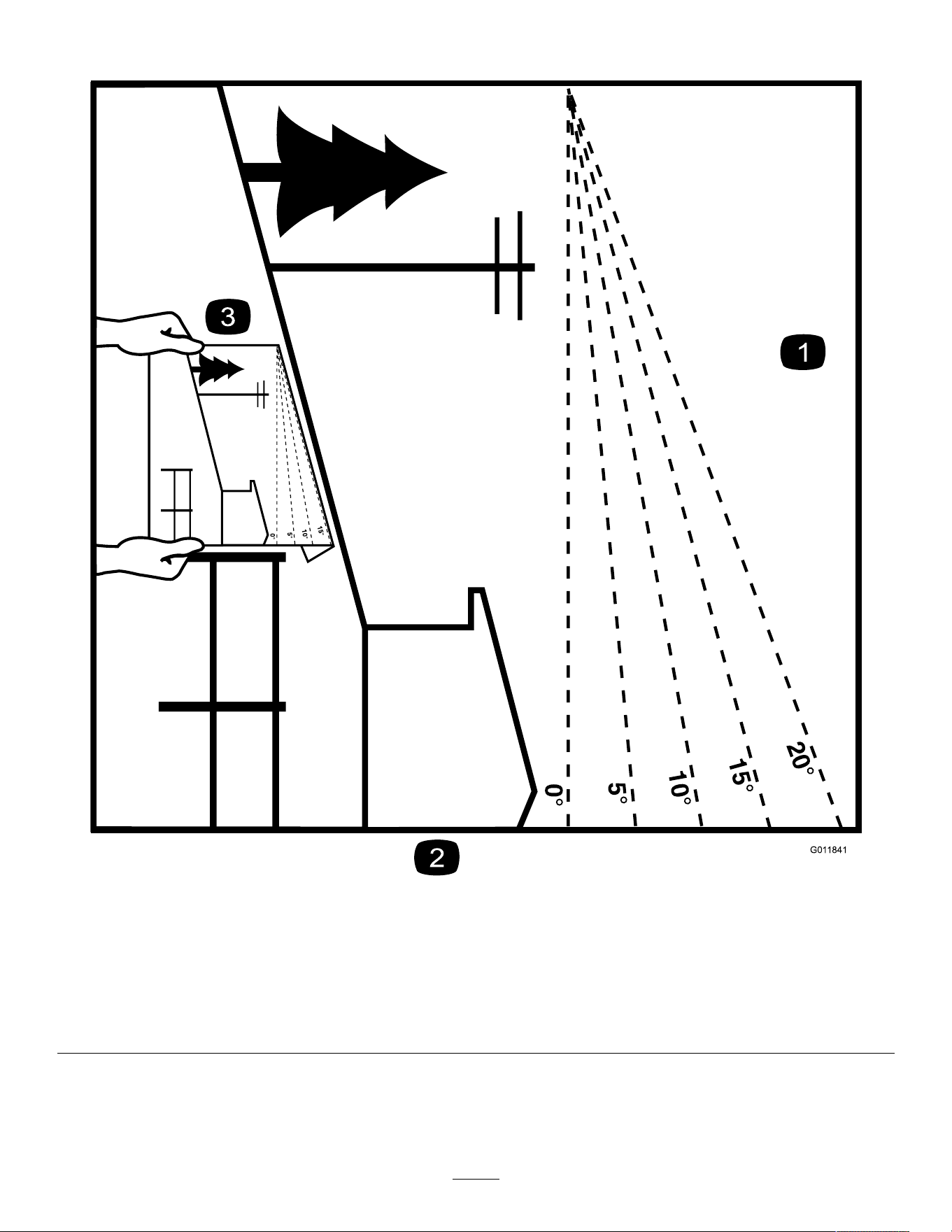
g011841
Figure 3
You may copy this page for personal use.
1. The maximum slope you can operate the machine on is 15 degrees. Use the slope chart to determine the degree of slope of
hills before operating. Do not operate this machine on a slope greater than 15 degrees. Fold along the appropriate line
to match the recommended slope.
2. Align this edge with a vertical surface, a tree, building, fence pole, etc.
3. Example of how to compare slope with folded edge
5
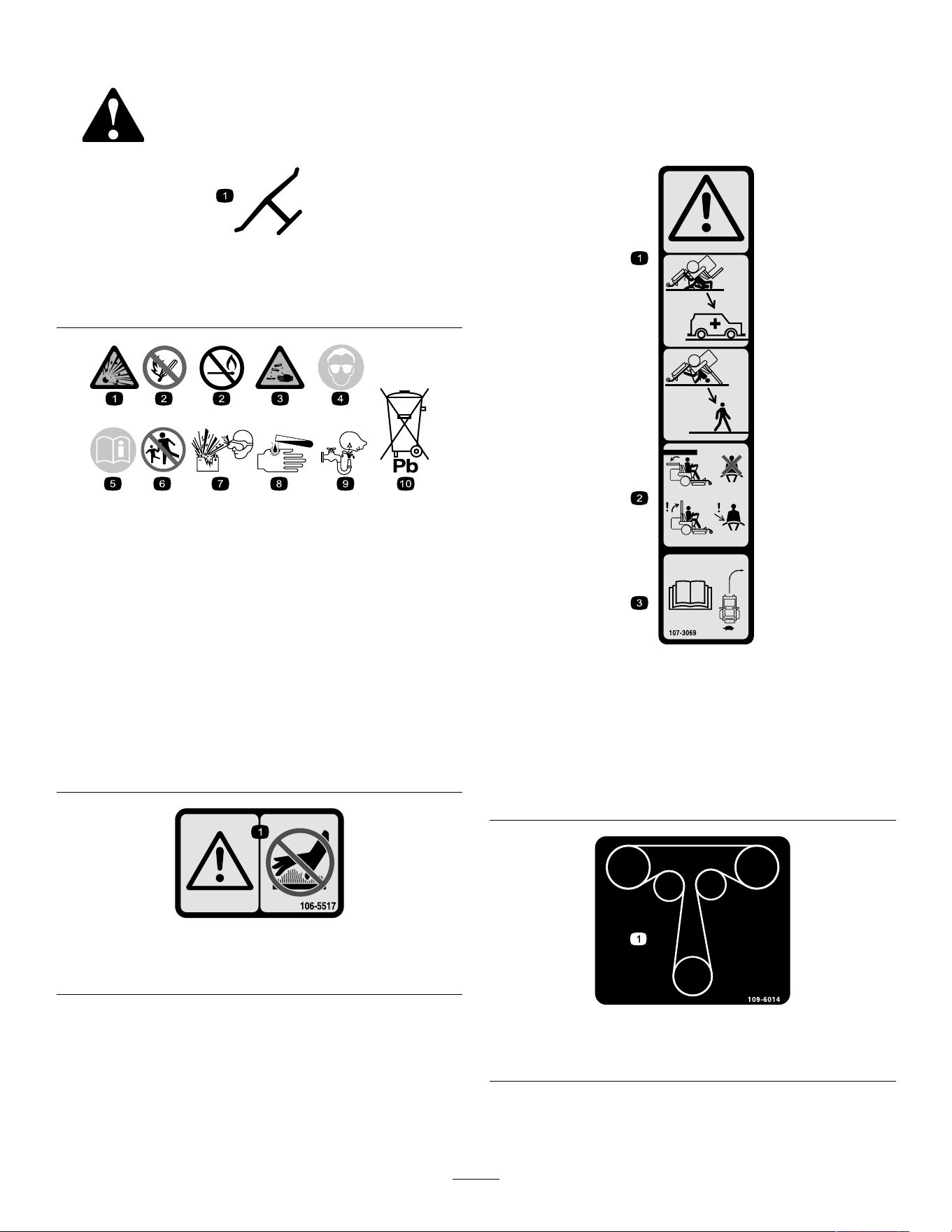
Safety and Instructional Decals
Safety decals and instructions are easily visible to the operator and are located near any area
of potential danger. Replace any decal that is damaged or missing.
decaloemmarkt
Manufacturer's Mark
1. This mark indicates that the blade is identied as a part
from the original machine manufacturer.
decalbatterysymbols
Battery Symbols
Some or all of these symbols are on your battery.
1. Explosion hazard 6. Keep bystanders away
from the battery.
2. No re, open ame, or
smoking
7. Wear eye protection;
explosive gases can
cause blindness and other
injuries.
3. Caustic liquid/chemical
burn hazard
8. Battery acid can cause
blindness or severe burns.
4. Wear eye protection. 9. Flush eyes immediately
with water and get medical
help fast.
5. Read the Operator's
Manual.
10. Contains lead; do not
discard
decal106-5517
106-5517
1. Warning—do not touch the hot surface.
decal107-3069
107-3069
1. Warning–there is no rollover protection when the roll bar is
down.
2. To avoid injury or death from a rollover accident, keep the
roll bar in the raised and locked position and wear the seat
belt. Lower the roll bar only when absolutely necessary; do
not wear the seat belt when the roll bar is down.
3. Read the Operator's Manual; drive slowly and carefully.
decal109-6014
109-6014
1. Traction belt routing
6
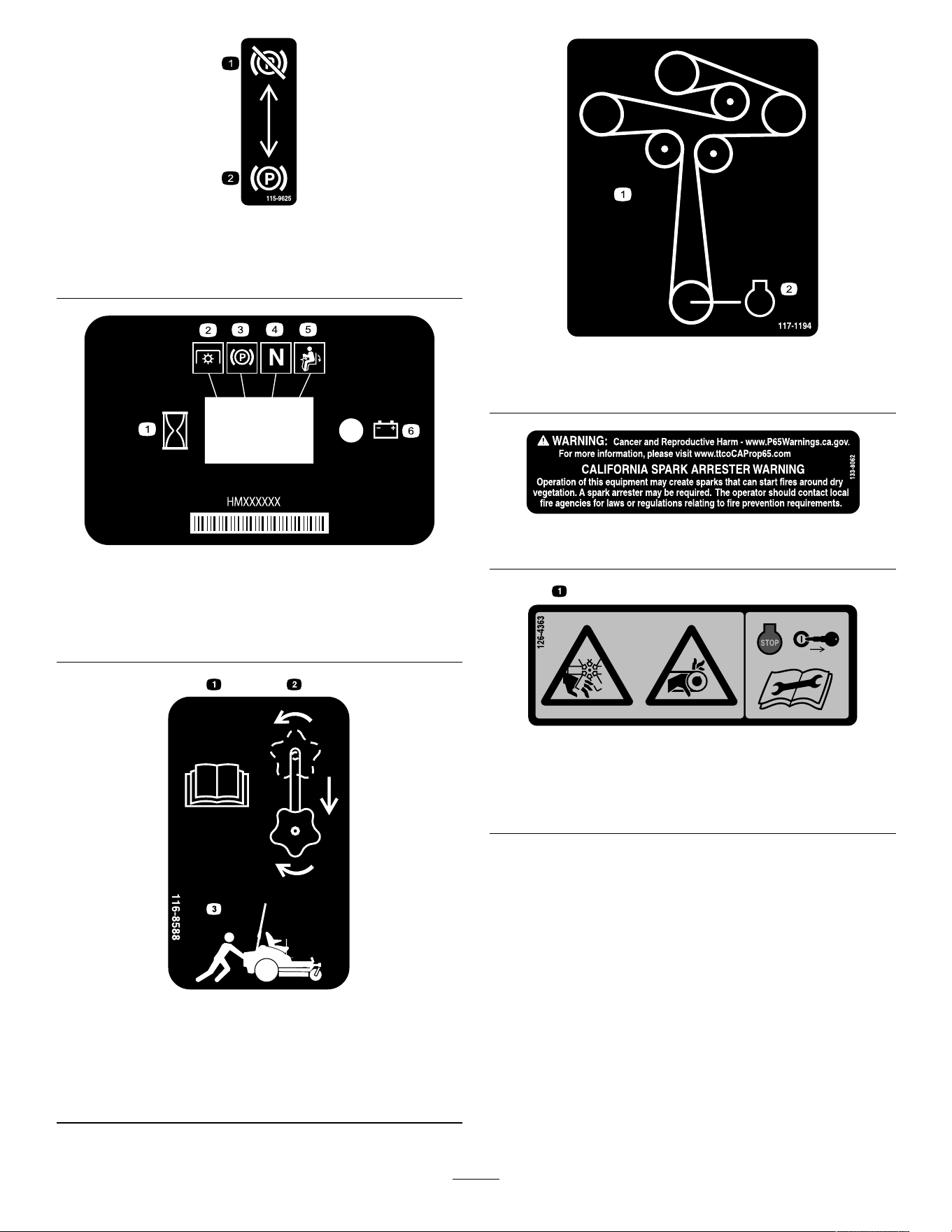
decal115-9625
115-9625
1. Parking
brake—disengaged
2. Parking brake—engaged
decal116-5610
116-5610
1. Hour meter 4. Neutral
2. Power take-off (PTO) 5. Operator presence switch
3. Parking brake 6. Battery
decal116-8588
116-8588
1. Read the Operator’s Manual.
2. Rotate the drive release knob to loosen, slide the knob,
and tighten.
3. Push the machine.
decal117-1194
117-1194
1. Belt routing 2. Engine
decal133-8062
133-8062
decal126-4363
126-4363
1. Cutting/dismemberment hazard, fan and entanglement
hazard, belt. Shut off the engine and remove the key before
adjusting, servicing or cleaning the machine.
7
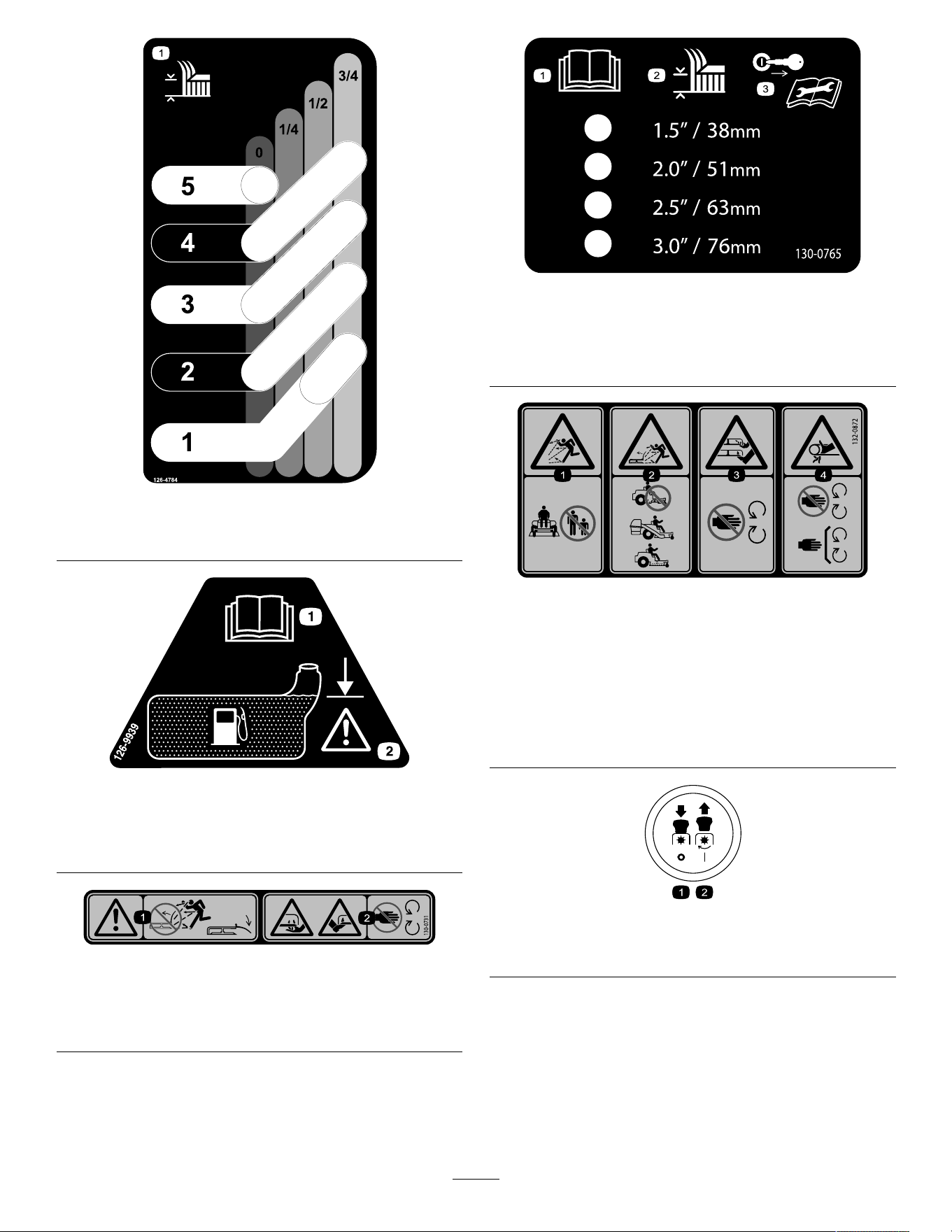
decal126-4784
126-4784
1. Height of cut
decal126-9939
126-9939
1. Read the Operator’s
Manual
2. Fill to bottom of ller neck;
warning–do not overll the
tank
decal130-0731
130-0731
1. Warning—thrown object
hazard; keep the deector
shield in place.
2. Cutting hazard of hand or
foot, mower blade—keep
away from moving parts.
decal130-0765
130-0765
1. Read the Operator's
Manual.
3. Remove the key before
performing maintenance.
2. Height-of-cut selection
decal132-0872
132-0872
1. Thrown object
hazard—keep bystanders
away from the machine.
3. Severing hazard of hand
or foot—keep away from
moving parts.
2. Thrown object hazard,
raised deector—do not
operate the machine with
an open deck; use a
bagger or a deector.
4. Entanglement
hazard—keep away
from moving parts; keep
all guards and shields in
place.
decalptosymbols
PTO Switch Symbols
1. PTO–disengage 2. PTO–engage
8
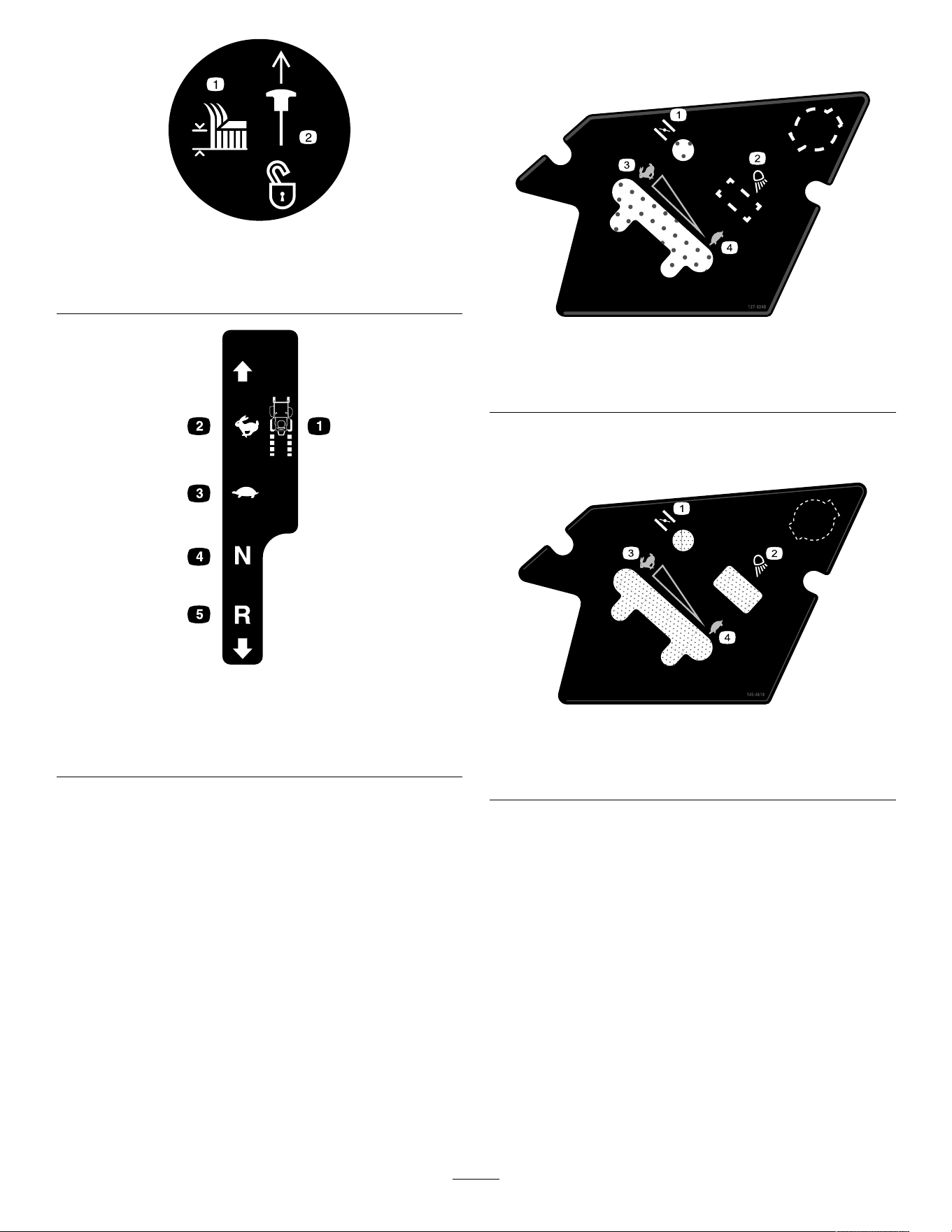
decaltransportlock
Transport Lock
1. Height of cut
2. Pull up to unlock the
transport lock.
decal126-6194
126-6194
1. Traction control 4. Neutral
2. Fast 5. Reverse
3. Slow
Decal 137-9240 is for machines not equipped with
the optional work lights.
decal137-9240
137-9240
1. Choke
3. Fast
2. Work light
4. Slow
Decal 145-4618 is for machines equipped with work
lights.
decal145-4618
145-4618
1. Choke
3. Fast
2. Work light
4. Slow
9
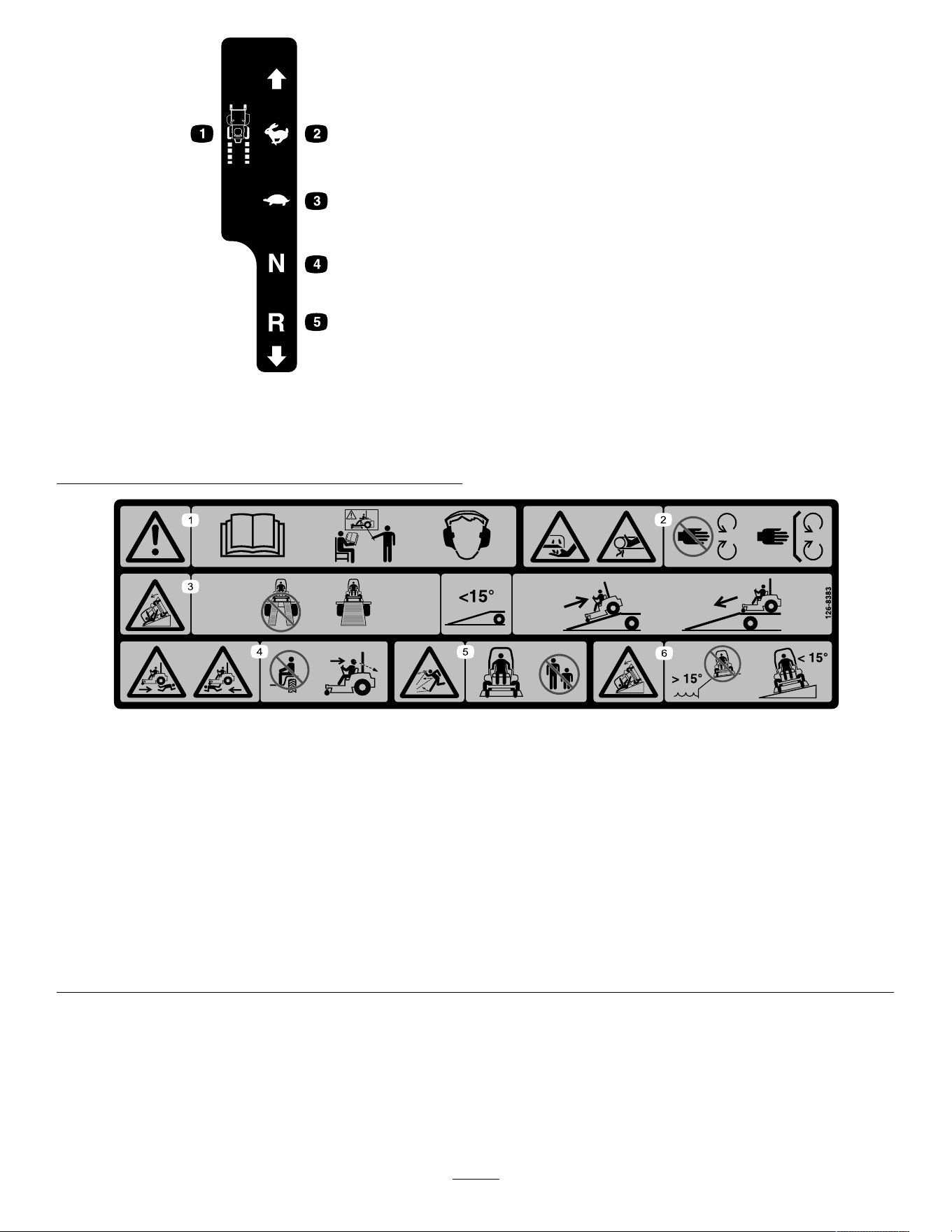
decal126-6183
126-6183
1. Traction control 4. Neutral
2. Fast 5. Reverse
3. Slow
decal126-8383
126-8383
Note: This machine complies with the industry standard stability test in the static lateral and longitudinal tests with the maximum
recommended slope indicated on the decal. Review the instructions for operating the machine on slopes in the Operator’s Manual as
well as the conditions in which you would operate the machine to determine whether you can operate the machine in the conditions on
that day and at that site. Changes in the terrain can result in a change in slope operation for the machine.
1. Warning—read the Operator’s Manual; do not operate this
machine unless you are trained; wear hearing protection.
4. Runover/backover hazard—do not carry passengers; look
behind you when mowing in reverse.
2. Cutting/dismemberment hazard of the hand, mower blade;
entanglement hazard of the hand, belt—stay away from
moving parts; keep all guards and shields in place.
5. Thrown object hazard—keep bystanders away.
3. Ramp hazard—do not use dual ramps when loading onto a
trailer; use 1 ramp wide enough for the machine; use a ramp
with a slope less than 15°; back up the ramp when loading the
machine and drive forward off the ramp when unloading.
6. Tipping hazard—do not use the machine near drop-offs or
on slopes greater than 15°; only operate across slopes less
than 15°.
10
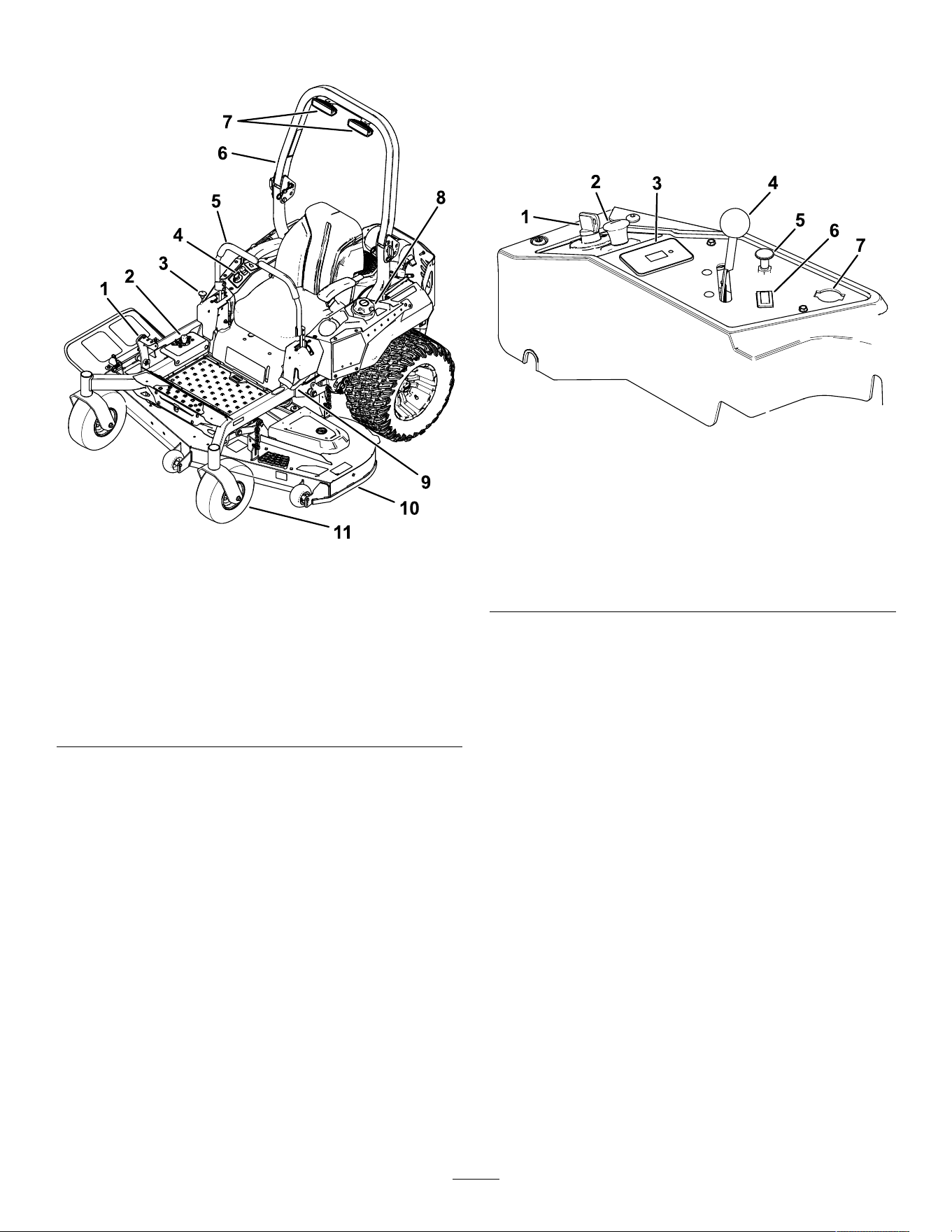
Product Overview
g368672
Figure 4
1. Height-of-cut deck-lift
pedal
7. Work lights (standard on
Model 76602; optional kit
on Model 76601)
2. Height-of-cut positions
8. Fuel cap
3. Transport lock 9. Parking-brake lever
4. Controls
10. Mower deck
5. Motion-control levers
11. Caster wheel
6. Roll bar
Controls
Become familiar with all the controls before you start
the engine and operate the machine.
Control Panel
g368671
Figure 5
1. Key switch
5. Choke control
2. Blade-control switch
(power takeoff)
6. Light switch (standard on
Model 76602; optional kit
on Model 76601)
3. Hour meter
7. Position for optional power
point
4. Throttle control
Key Switch
The key switch, used to start and shut off the engine,
has 3 positions: OFF, RUN, and START. Refer to
Starting the Engine (page 22).
Choke Control
Use the choke control to start a cold engine.
Throttle Control
The throttle controls the engine speed, and it has a
continuous-variable setting from the SLOW to FAST
position (
Figure 5).
Blade-Control Switch (Power
Takeoff)
The blade-control switch, represented by a
power-takeoff (PTO) symbol, engages and
disengages power to the mower blades (
Figure 5).
11
Light Switch
Applicable Models Only
Press the light switch forward to turn on the work
lights (
Figure 5).
Press the light switch rearward to turn off the work
lights.
Hour Meter
The hour meter records the number of hours the
engine has operated. It operates when the engine
is running. Use these times for scheduling regular
maintenance (
Figure 6).
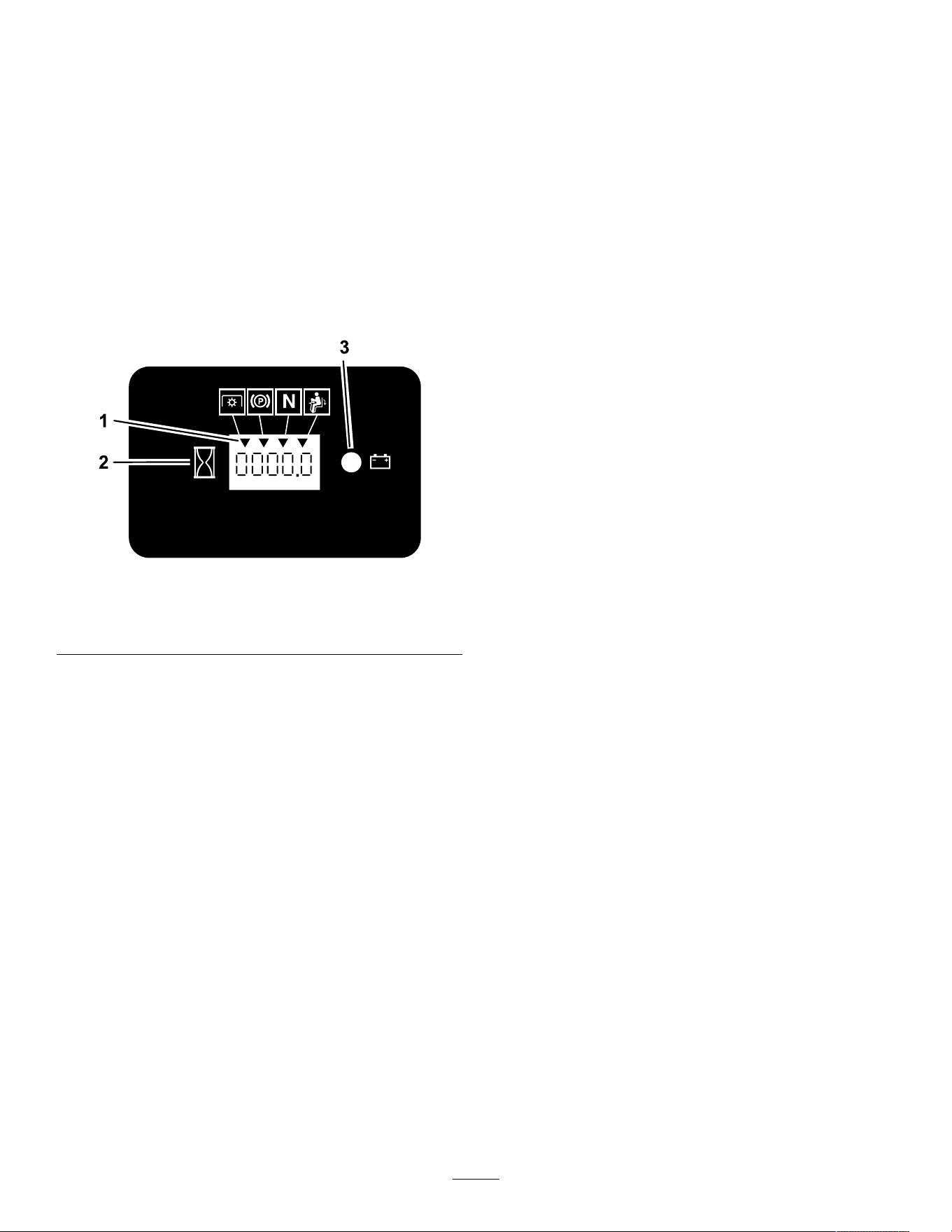
g187133
Figure 6
1. Safety-interlock symbols
3. Battery light
2. Hour meter
Safety-Interlock Indicators
There are symbols on the hour meter that indicate
with a black triangle that the interlock component is
positioned correctly (
Figure 6).
Battery-Indicator Light
If you turn the key switch to the ON position for a
few seconds, the battery voltage displays in the area
where the hours are normally displayed.
The battery light turns on when the key switch is
turned on and when the charge is below the correct
operating level (
Figure 6).
Motion-Control Levers
Use the motion-control levers to drive the machine
forward, reverse, and turn either direction (
Figure 4).
Neutral-Lock Position
Move the motion-control levers outward from the
center to the NEUTRAL-LOCK position when exiting
the machine (Figure 23). Always position the
motion-control levers into the NEUTRAL-LOCK position
when you stop the machine or leave it unattended.
Parking-Brake Lever
Whenever you shut off the engine, engage the parking
brake to prevent accidental movement of the machine.
Fuel-Shutoff Valve
Close the fuel-shutoff valve when transporting or
storing the machine; refer to Using the Fuel-Shutoff
Valve (page 28)
.
12
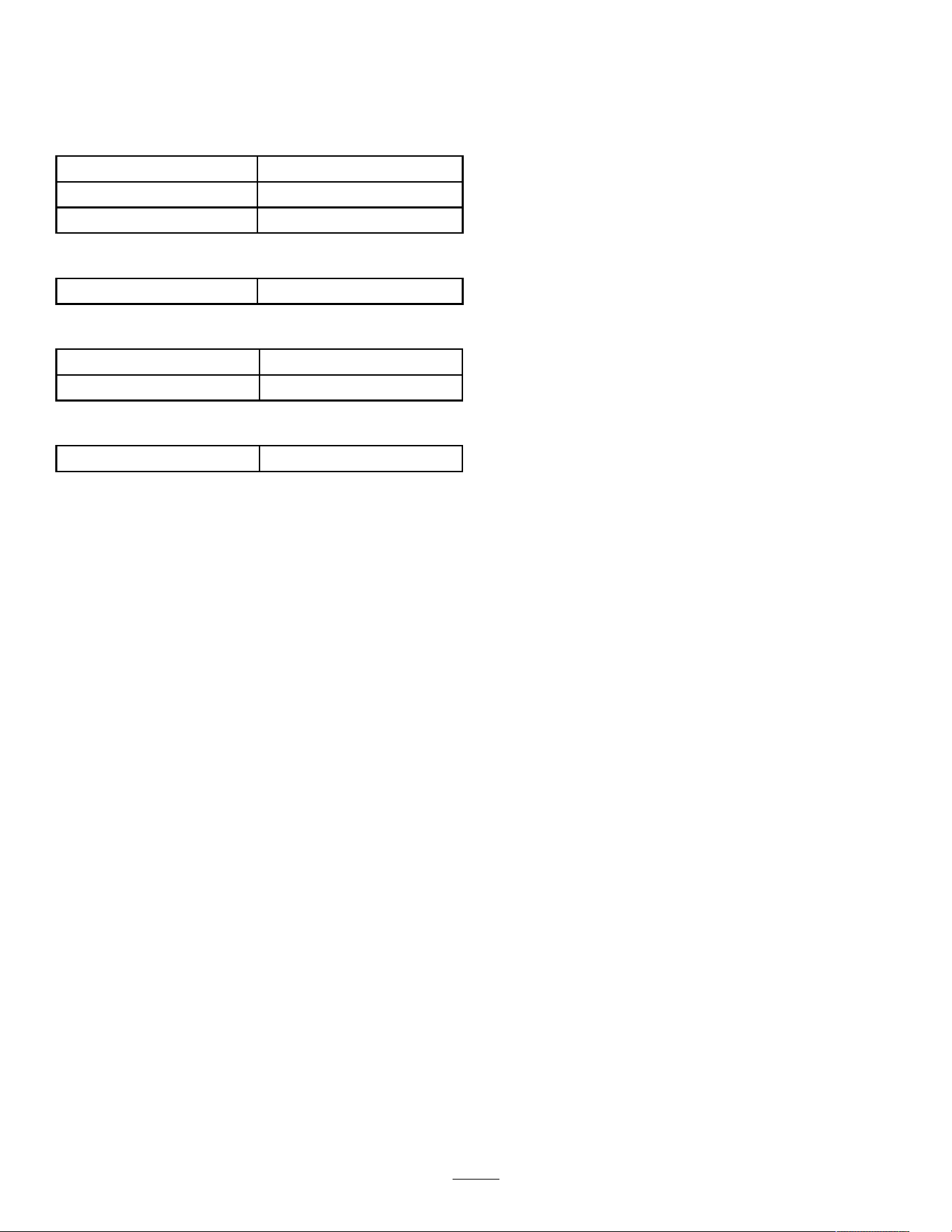
Specications
Note: Specications and design are subject to
change without notice.
Width
Without mower deck
134 cm (52-13/16 inches)
Deector up 160 cm (63-1/8 inches)
Deector down 191 cm (75-5/16 inches)
Length
Length
209 cm (82-3/16 inches)
Height
Roll Bar—Up
180 cm (70-11/16 inches)
Roll Bar—Down
116 cm (45-3/4 inches)
Weight
Weight
397 kg (876 lb)
Attachments/Accessories
A selection of Toro approved attachments and
accessories is available for use with the machine
to enhance and expand its capabilities. Contact
your Authorized Service Dealer or authorized Toro
distributor or go to
www.Toro.com for a list of all
approved attachments and accessories.
To ensure optimum performance and continued safety
certication of the machine, use only genuine Toro
replacement parts and accessories. Replacement
parts and accessories made by other manufacturers
could be dangerous, and such use could void the
product warranty.
13

Operation
Note: Determine the left and right sides of the
machine from the normal operating position.
Before Operation
Before Operation Safety
General Safety
• Do not allow children or untrained people to
operate or service the machine. Local regulations
may restrict the age of the operator. The owner
is responsible for training all operators and
mechanics.
• Inspect the area where you will use the machine,
and remove all objects that could interfere with
the operation of the machine or that the machine
could throw.
• Become familiar with the safe operation of the
equipment, operator controls, and safety signs.
• Check that operator-presence controls, safety
switches, and guards are attached and working
properly. Do not operate the machine unless they
are functioning properly.
• Shut off the engine, remove the key, and wait
for all moving parts to stop before leaving the
operator’s position. Allow the machine to cool
before servicing, adjusting, fueling, cleaning, or
storing it.
• Before mowing, inspect the machine to ensure
that the cutting assemblies are working properly.
• Evaluate the terrain to determine the appropriate
equipment and any attachments or accessories
required to operate the machine properly and
safely.
• Wear appropriate clothing, including eye
protection; long pants; substantial, slip-resistant
footwear; and hearing protection. Tie back long
hair and do not wear loose clothing or loose
jewelry.
• Do not carry passengers on the machine.
• Keep bystanders and pets away from the machine
during operation. Shut off the machine and
attachment(s) if anyone enters the area.
• Do not operate the machine unless all guards and
safety devices, such as the deectors and the
entire grass catcher, are in place and functioning
properly. Replace worn or deteriorated parts when
necessary.
Fuel Safety
• Fuel is extremely ammable and highly explosive.
A re or explosion from fuel can burn you and
others and can damage property.
– To prevent a static charge from igniting the
fuel, remove the machine from the truck or
trailer and refuel it on the ground, away from
all vehicles. If this is not possible, place a
portable fuel container on the ground, away
from all vehicles, and ll it; then refuel the
machine from the fuel container rather than
from a fuel-dispenser nozzle.
– Fill the fuel tank outdoors on level ground, in
an open area, and when the engine is cold.
Wipe up any fuel that spills.
– Do not handle fuel when smoking or around an
open ame or sparks.
– Do not remove the fuel cap or add fuel to the
tank while the engine is running or hot.
– If you spill fuel, do not attempt to start the
engine. Avoid creating a source of ignition until
the fuel vapors have dissipated.
– Store fuel in an approved container and keep
it out of the reach of children.
• Fuel is harmful or fatal if swallowed. Long-term
exposure to vapors can cause serious injury and
illness.
– Avoid prolonged breathing of vapors.
– Keep your hands and face away from the
nozzle and the fuel-tank opening.
– Keep fuel away from your eyes and skin.
• Do not store the machine or fuel container where
there is an open ame, spark, or pilot light, such
as on a water heater or on other appliances.
• Do not operate the machine without the entire
exhaust system in place and in proper working
condition.
• Keep the fuel-dispenser nozzle in contact with
the rim of the fuel tank or container opening at
all times until fueling is complete. Do not use a
nozzle lock-open device.
• If you spill fuel on your clothing, change your
clothing immediately.
• Do not overll the fuel tank. Replace the fuel cap
and tighten it securely.
• Clean grass and debris from the cutting unit,
mufer, drives, grass catcher, and engine
compartment to help prevent res. Clean up oil or
fuel spills.
14
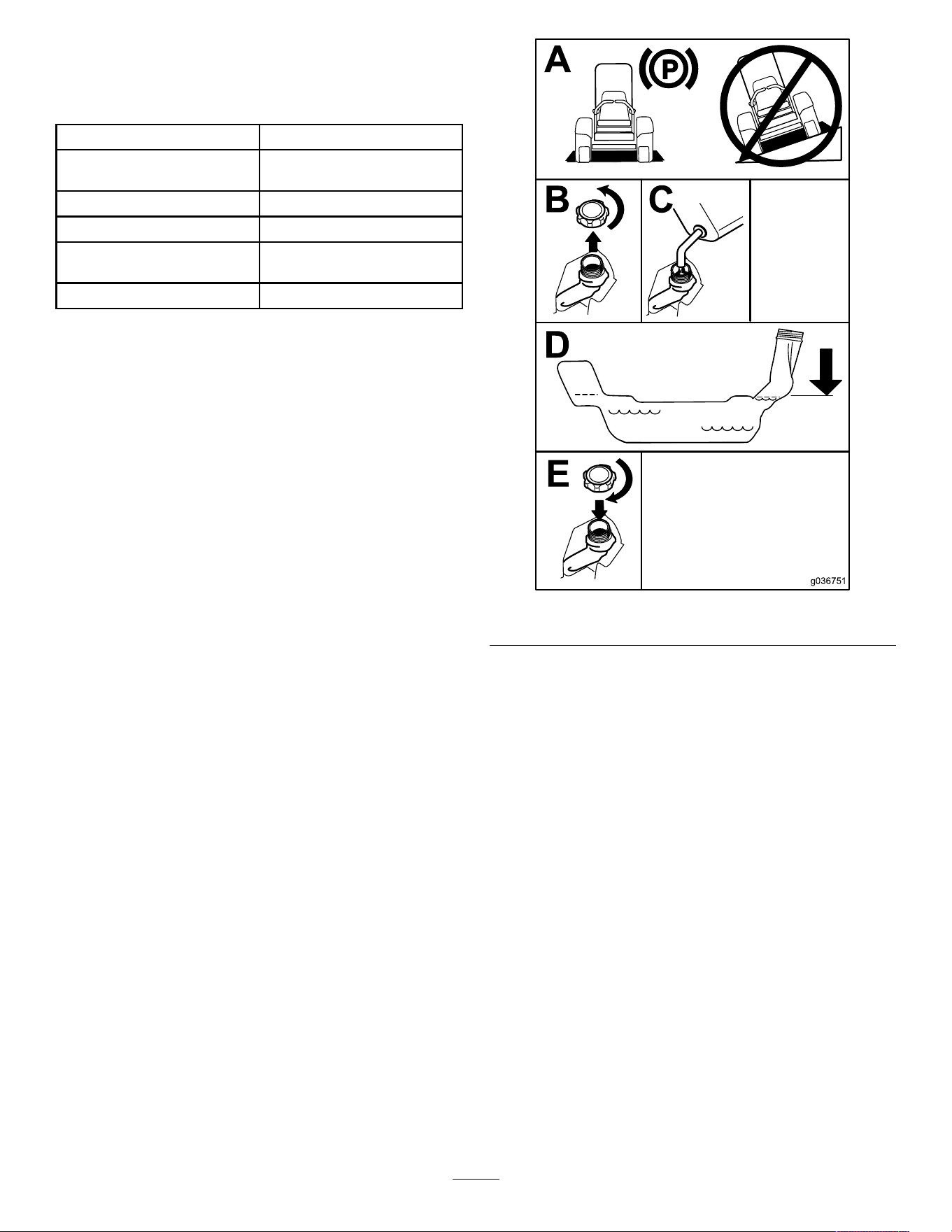
Adding Fuel
Recommended Fuel
Type Unleaded gasoline
Minimum octane rating
87 (US) or 91 (research
octane; outside the US)
Ethanol
No more than 10% by volume
Methanol None
MTBE (methyl tertiary butyl
ether)
Less than 15% by volume
Oil Do not add to the fuel
Use only clean, fresh (no more than 30 days old), fuel
from a reputable source.
Using Stabilizer/Conditioner
Use fuel stabilizer/conditioner in the machine to keep
the fuel fresh longer when used as directed by the
fuel-stabilizer manufacturer.
Important: Do not use fuel additives containing
methanol or ethanol.
Add the amount of fuel stabilizer/conditioner to fresh
fuel as directed by the fuel-stabilizer manufacturer.
Filling the Fuel Tank
1. Park the machine on a level surface.
2. Move the motion-control levers outward to the
PARK position.
3. Shut off the engine and remove the key.
4. Clean around the fuel-tank cap.
5. Fill the fuel tank to the bottom of the ller neck
(
Figure 7). Do not ll the fuel tank completely full
g036751
Figure 7
Performing Daily
Maintenance
Before starting the machine each day, perform the
Each Use/Daily procedures listed in
Maintenance
(page 32)
.
Breaking in a New Machine
New engines take time to develop full power. Mower
decks and drive systems have higher friction when
new, placing additional load on the engine. Allow
40 to 50 hours of break-in time for new machines to
develop full power and best performance.
15
Using the
Rollover-Protection System
(ROPS)
WARNING
To avoid injury or death from rollover, keep
the roll bar in the fully raised, locked position
and use the seat belt.
Ensure that the seat is secured to the
machine.
WARNING
There is no rollover protection when the roll
bar is in the down position.
• Lower the roll bar only when absolutely
necessary.
• Do not wear the seat belt when the roll bar
is in the down position.
• Drive slowly and carefully.
• Raise the roll bar as soon as clearance
permits.
• Check carefully for overhead clearances
(i.e., branches, doorways, electrical wires)
before driving under any objects and do
not contact them.
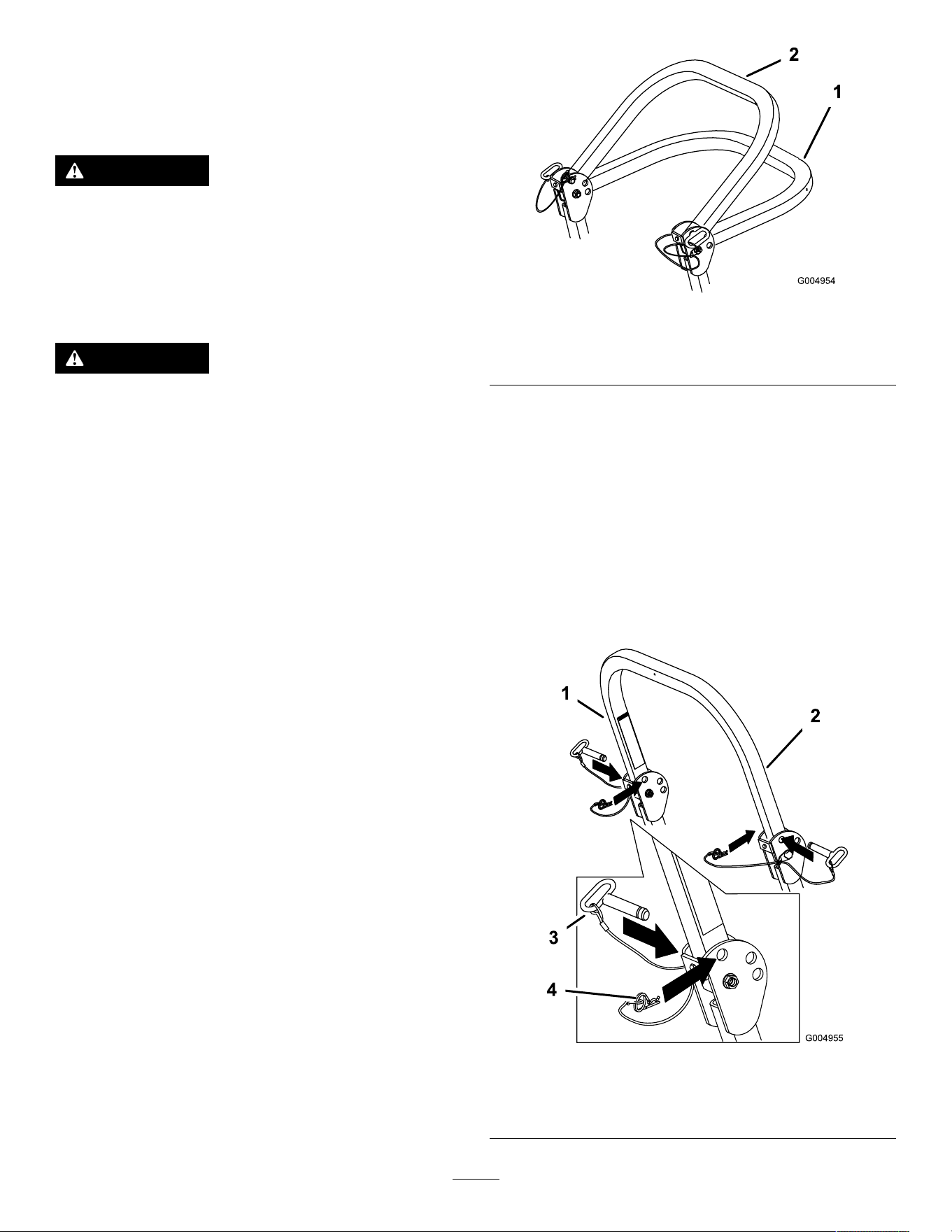
Lowering the Roll Bar
Important: Lower the roll bar only when
absolutely necessary.
1. Remove the hairpin cotters and remove the 2
pins (
Figure 9).
2. Lower the roll bar to the down position (
Figure
8
).
Note: There are 2 down positions; refer to
Figure 8.
3. Install the 2 pins and secure them with the
hairpin cotters (
Figure 9).
g004954
Figure 8
1. Full-down position 2. Down position with the
bagger installed
Important: Ensure that you secure the rear
part of the seat with the seat latch.
Raising the Roll Bar
Important: Always use the seat belt with the roll
bar in the raised position.
1. Remove the hairpin cotters and remove the 2
pins (
Figure 9).
2. Raise the roll bar to the upright position, install
the 2 pins, and secure them with the hairpin
cotters (Figure 9).
g004955
Figure 9
1. Roll bar 3. Pin
2. Raised position 4. Hairpin cotter
16
Using the Safety-Interlock
System
WARNING
If the safety-interlock switches are
disconnected or damaged, the machine could
operate unexpectedly, causing personal
injury.
• Do not tamper with the interlock switches.
• Check the operation of the interlock
switches daily and replace any damaged
switches before operating the machine.
Understanding the
Safety-Interlock System
The safety-interlock system is designed to prevent the
engine from starting unless the following occurs:
• The parking brake is engaged.
• The blade-control switch (PTO) is disengaged.
• The motion-control levers are in the NEUTRAL-LOCK
position.
The safety-interlock system also is designed to shut
off the engine when the motion-control levers are
moved from the NEUTRAL-LOCK position with the
parking brake engaged or if you rise from the seat
when the PTO is engaged.
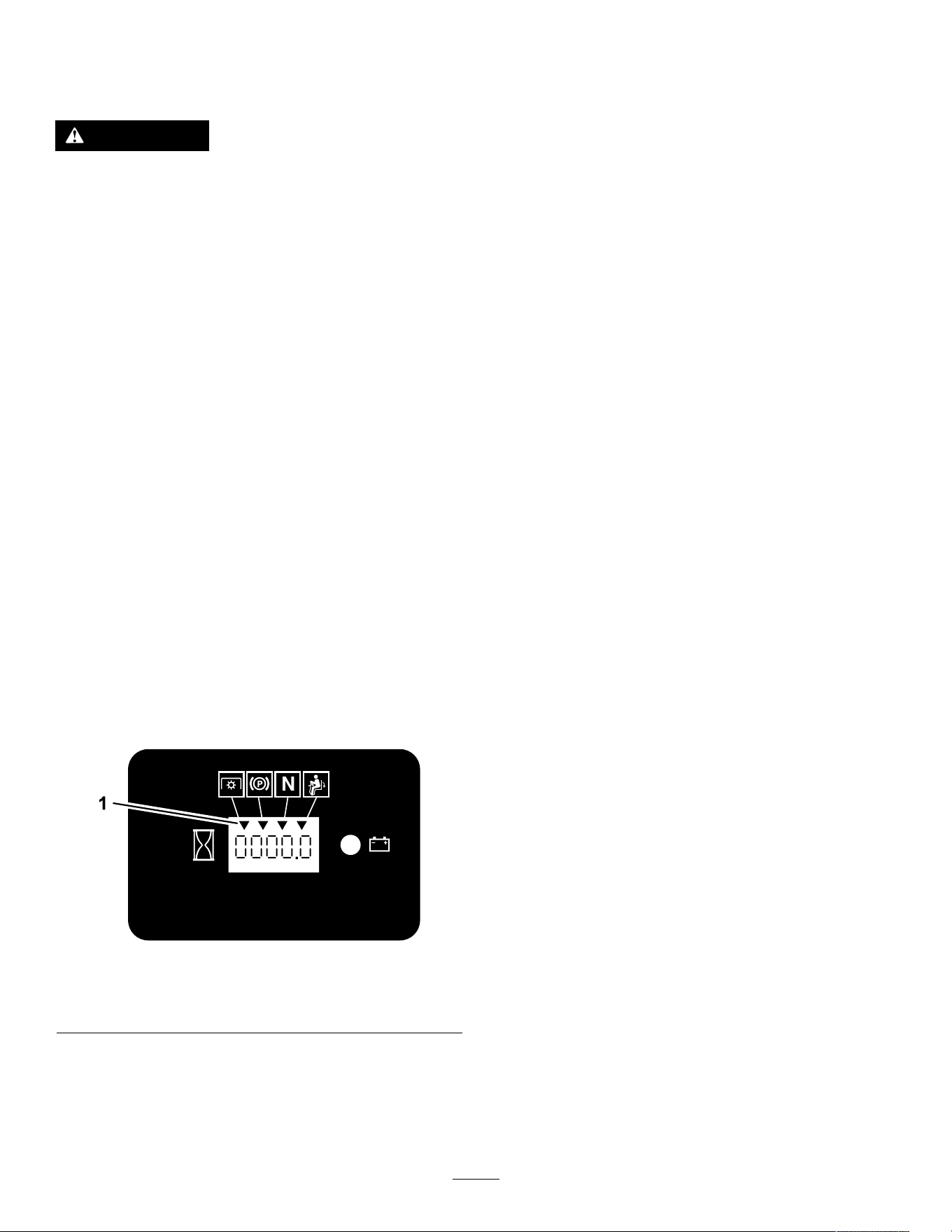
The hour meter has indicators to notify the user when
the interlock component is in the correct position.
When the component is in the correct position, an
indicator displays on the screen.
g187670
Figure 10
1. Indicators display when the interlock components are in the
correct position
Testing the Safety-Interlock
System
Service Interval: Before each use or daily
Test the safety-interlock system before you use the
machine each time. If the safety system does not
operate as described below, have an Authorized
Service Dealer repair the safety system immediately.
1. Sit on the seat, engage the parking brake, and
move the blade-control switch (PTO) to the ON
position. Try starting the engine; the engine
should not start.
2. Sit on the seat, engage the parking brake, and
move the blade-control switch (PTO) to the OFF
position. Move either motion-control lever out
of the NEUTRAL-LOCK position. Try starting the
engine; the engine should not start. Repeat for
the other control lever.
3. Sit on the seat, engage the parking brake,
move the blade-control switch (PTO) to the OFF
position, and move the motion-control levers
to the NEUTRAL-LOCK position. Now start the
engine. While the engine is running, disengage
the parking brake, engage the blade-control
switch (PTO), and rise slightly from the seat; the
engine should shut off.
4. Sit on the seat, engage the parking brake,
move the blade-control switch (PTO) to the OFF
position, and move the motion-control levers
to the NEUTRAL-LOCK position. Now start the
engine. While the engine is running, center
either motion control and move (forward or
reverse); the engine should shut off. Repeat for
other motion control.
5. Sit on the seat, disengage the parking brake,
move the blade-control switch (PTO) to the OFF
position, and move the motion-control levers
to the NEUTRAL-LOCK position. Try starting the
engine; the engine should not start.
17
Positioning the Seat
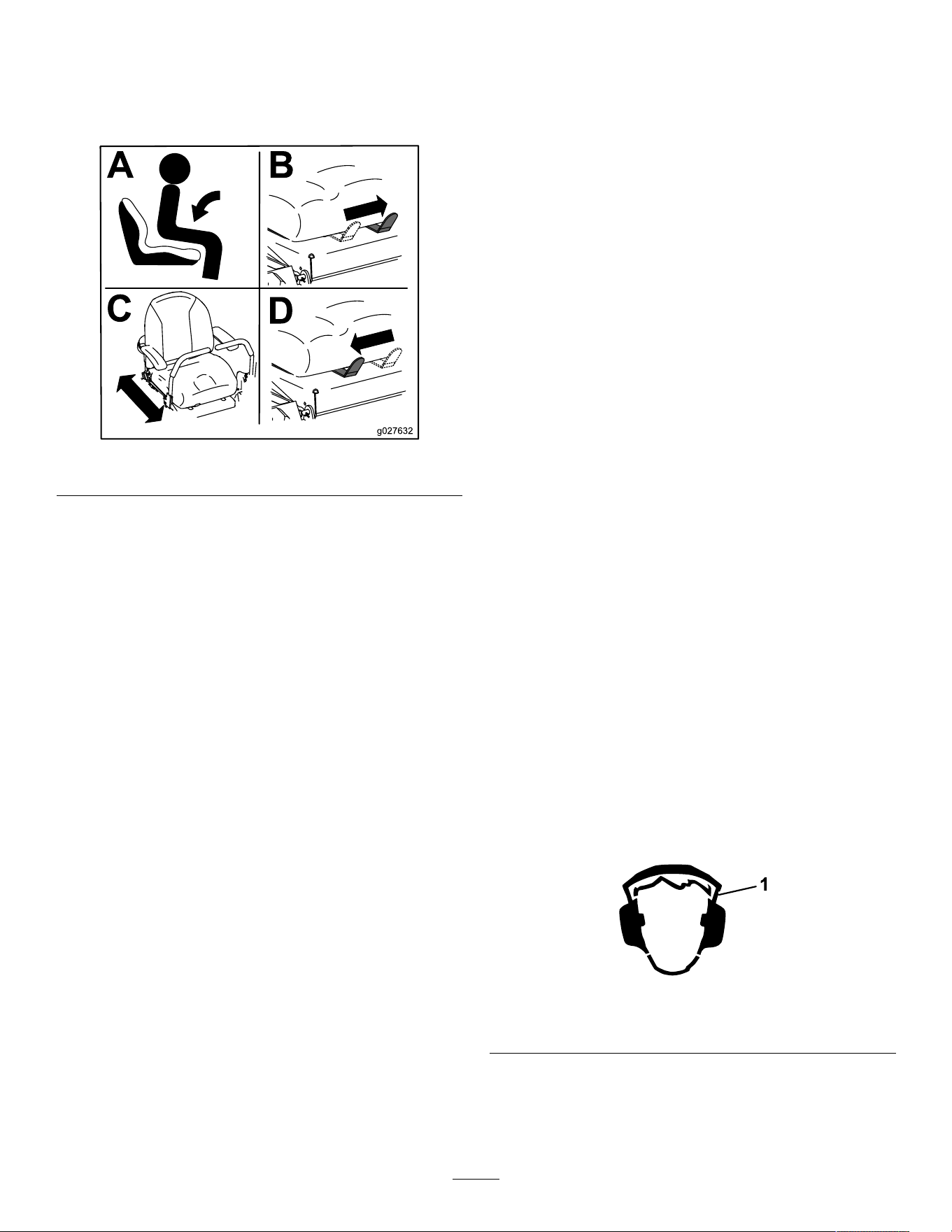
The seat can move forward and backward. Position
the seat where you have the best control of the
machine and are most comfortable (
Figure 11).
g027632
Figure 11
During Operation
During Operation Safety
General Safety
• The owner/operator can prevent and is responsible
for accidents that may cause personal injury or
property damage.
• Use your full attention while operating the
machine. Do not engage in any activity that
causes distractions; otherwise, injury or property
damage may occur.
• Do not operate the machine while ill, tired, or
under the inuence of alcohol or drugs.
• Contacting the blade can result in serious personal
injury. Shut off the engine, remove the key, and
wait for all moving parts to stop before leaving the
operating position. When you turn the key to the
OFF position, the engine should shut off and the
blade should stop. If not, stop using your machine
immediately and contact an Authorized Service
Dealer.
• Operate the machine only in good visibility and
appropriate weather conditions. Do not operate
the machine when there is the risk of lightning.
• Keep your hands and feet away from the cutting
units. Keep clear of the discharge opening.
• Do not mow in reverse unless it is absolutely
necessary. Always look down and behind you
before moving the machine in reverse.
• Use extreme care when approaching blind
corners, shrubs, trees, or other objects that may
block your view.
• Stop the blades whenever you are not mowing.
• If the machine strikes an object or starts to vibrate,
immediately shut off the engine, remove the key
(if equipped), and wait for all moving parts to stop
before examining the machine for damage. Make
all necessary repairs before resuming operation.
• Slow down and use caution when making turns
and crossing roads and sidewalks with the
machine. Always yield the right-of-way.
• Before you leave the operating position, do the
following:
– Park the machine on a level surface.
– Disengage the power takeoff and lower the
attachments.
– Engage the parking brake.
– Shut off the engine and remove the key.
– Wait for all moving parts to stop.
• Operate the engine only in well-ventilated areas.
Exhaust gases contain carbon monoxide, which
is lethal if inhaled.
• Never leave a running machine unattended.
• Attach towed equipment to the machine only at
the hitch point.
• Do not operate the machine unless all guards
and safety devices, such as the deectors, are in
place and functioning properly. Replace worn or
deteriorated parts when necessary.
• Use only accessories and attachments approved
by Toro.
• This machine produces sound levels in excess
of 85 dBA at the operator’s ear and can cause
hearing loss through extended periods of
exposure.
g229846
Figure 12
1. Wear hearing protection.
• Clean grass and debris from the cutting unit,
drives, mufer, and engine to help prevent res.
• Start the engine with your feet well away from the
blades.
18
• Be aware of the mower discharge path and direct
the discharge away from others. Avoid discharging
material against a wall or obstruction because the
material may ricochet back toward you.
• Stop the blades, slow down the machine, and use
caution when crossing surfaces other than grass
or when transporting the machine to and from the
operating area.
• Do not change the engine governor speed or
overspeed the engine.
• Children are often attracted to the machine and
the mowing activity. Never assume that children
will remain where you last saw them.
• Keep children out of the operating area and under
the watchful care of a responsible adult other than
the operator.
• Be alert and shut off the machine if children enter
the operating area.
• Before backing up or turning the machine, look
down and all around for small children.
• Do not carry children on the machine, even when
the blades are not moving. Children could fall
off and be seriously injured or prevent you from
safely operating the machine. Children who have
been given rides in the past could appear in the
operating area without warning and be run over or
backed over by the machine.
Slope Safety
• Slopes are a major factor related to loss of control
and rollover accidents, which can result in severe
injury or death. The operator is responsible for
safe slope operation. Operating the machine on
any slope requires extra caution. Before using the
machine on a slope, do the following:
– Review and understand the slope instructions
in the manual and on the machine.
– Use an angle indicator to determine the
approximate slope angle of the area.
– Never operate on slopes greater than 15°.
– Evaluate the site conditions of the day to
determine if the slope is safe for machine
operation. Use common sense and good
judgment when performing this evaluation.
Changes in the terrain, such as moisture, can
quickly affect the operation of the machine on
a slope.
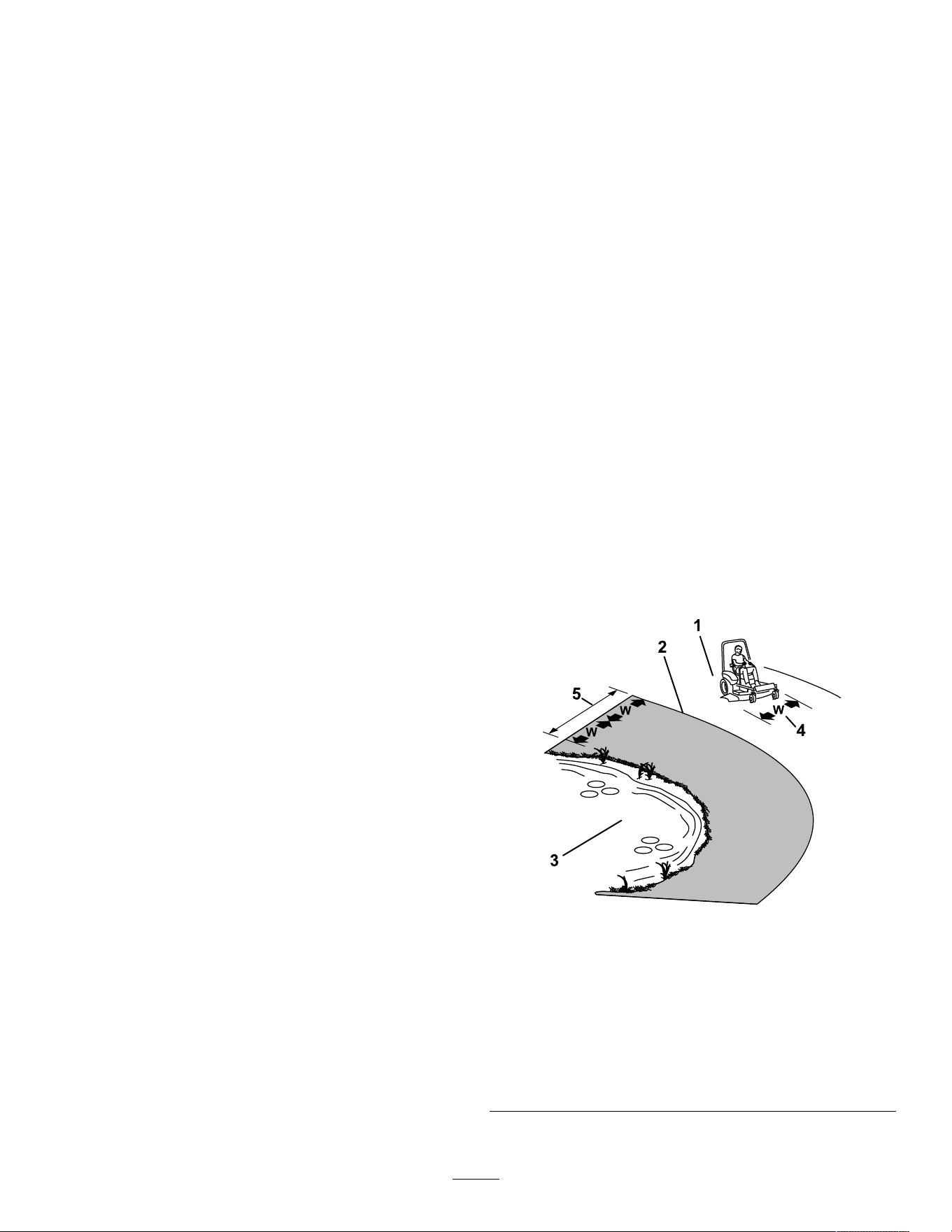
• Identify hazards at the base of the slope. Do
not operate the machine near drop-offs, ditches,
embankments, water, or other hazards. The
machine could suddenly roll over if a wheel goes
over the edge or the edge collapses. Keep a safe
distance (twice the width of the machine) between
the machine and any hazard. Use a walk-behind
machine or a hand trimmer to mow the grass in
these areas.
• Avoid starting, stopping, or turning the machine on
slopes. Avoid making sudden changes in speed or
direction; turn slowly and gradually.
• Do not operate a machine under any conditions
where traction, steering, or stability is in question.
Be aware that operating the machine on wet
grass, across slopes, or downhill may cause the
machine to lose traction. Loss of traction to the
drive wheels may result in sliding and a loss of
braking and steering. The machine can slide even
if the drive wheels are stopped.
• Remove or mark obstacles such as ditches, holes,
ruts, bumps, rocks, or other hidden hazards. Tall
grass can hide obstacles. Uneven terrain could
overturn the machine.
• Use extra care while operating with accessories or
attachments, such as grass-collection systems.
These can change the stability of the machine
and cause a loss of control. Follow directions for
counterweights.
• If possible, keep the deck lowered to the ground
while operating on slopes. Raising the deck while
operating on slopes can cause the machine to
become unstable.
g221745
Figure 13
1. Safe Zone—use the
machine here on slopes
less than 15° or at areas.
4. W = Width of the machine
2. Danger Zone—use a
walk-behind mower and/or
a hand trimmer on slopes
greater than 15° and near
drop-offs or water.
5. Keep a safe distance
(twice the width of the
machine) between the
machine and any hazard.
3. Water
19
Rollover Protection System
(ROPS) Safety
• The ROPS is an integral safety device. Do not
remove any of the ROPS components from the
machine.
• Ensure that the seat belt is attached and that you
can release it quickly in an emergency.
• Keep the roll bar in the fully raised and locked
position and always wear your seat belt whenever
the roll bar is up.
• Check carefully for overhead objects before you
drive under them, and do not contact them.
• Replace damaged ROPS components. Do not
repair or alter them.
• There is no rollover protection when the roll bar
is down.
• Wheels dropping over edges, over steep banks, or
into water can cause a rollover, which may result
in serious injury or death.
• Do not wear the seat belt when the roll bar is down.
• Lower the roll bar only when absolutely necessary;
raise it as soon as clearance permits.
• In the event of a rollover, take the machine to an
Authorized Service Dealer to inspect the ROPS.
• Use only Toro approved accessories and
attachments for the ROPS.
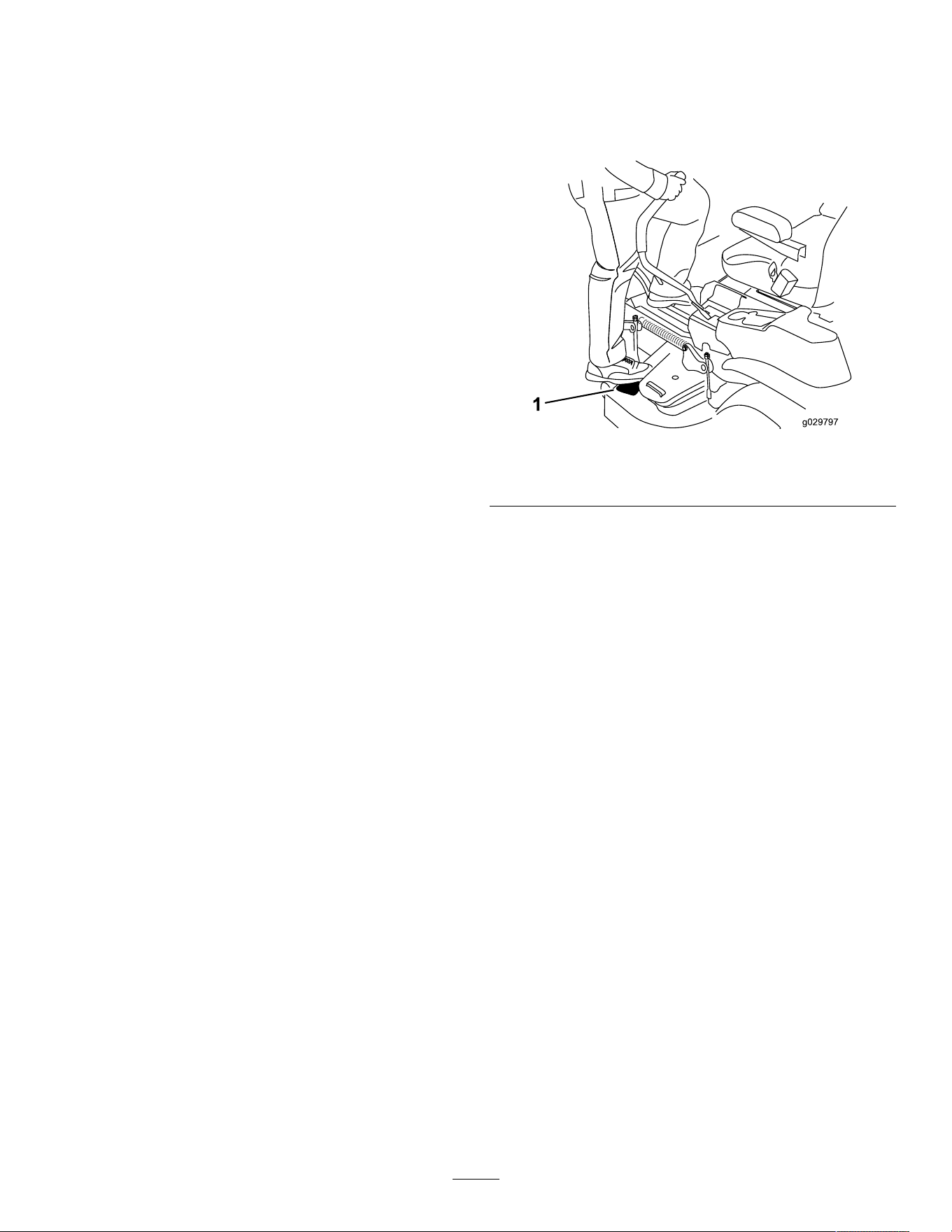
Entering the Operator’s
Position
Use the mower deck as a step to get into the
operator’s position (
Figure 14).
g029797
Figure 14
1. Step here.
20
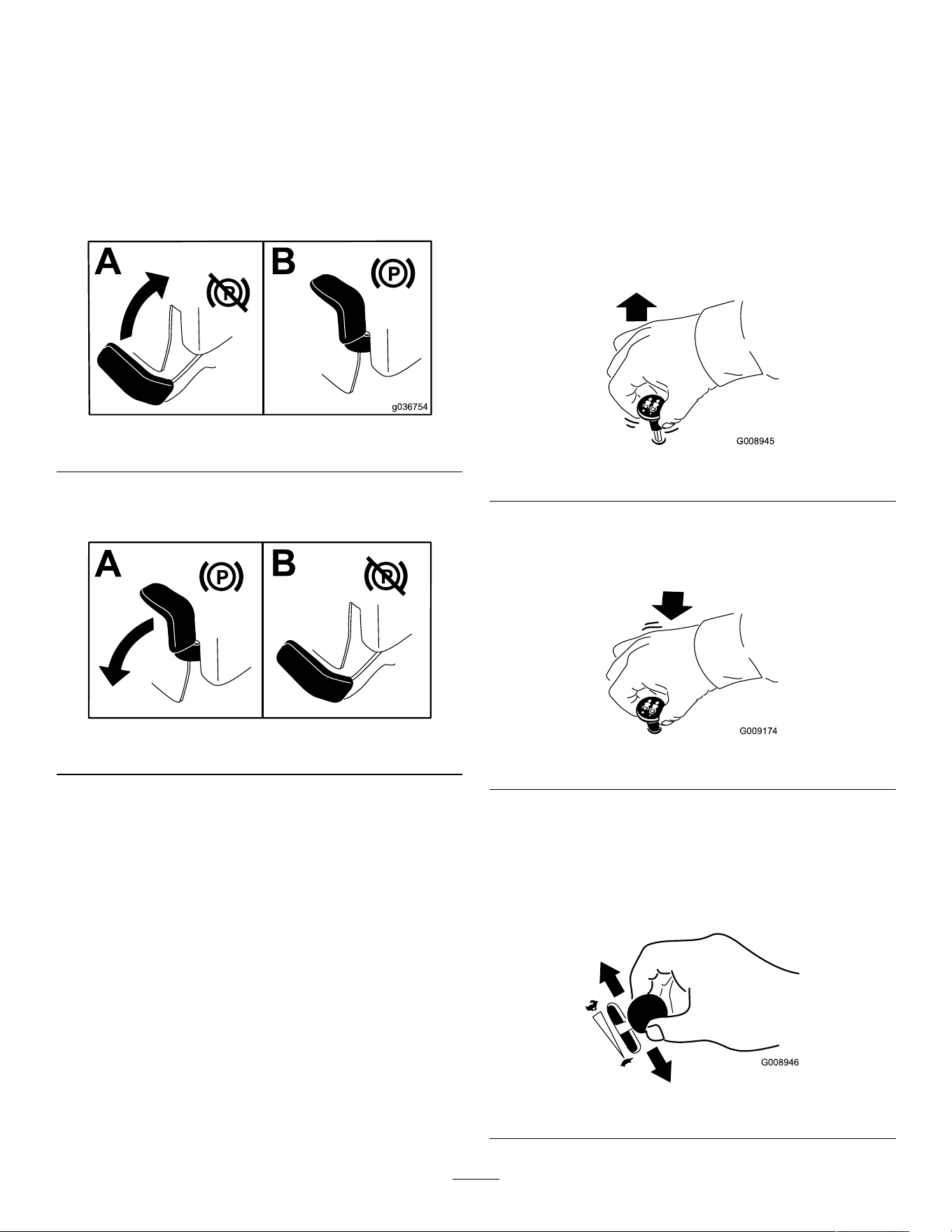
Operating the Parking
Brake
Always engage the parking brake when you stop the
machine or leave it unattended.
Engaging the Parking Brake
Park the machine on a level surface.
g036754
Figure 15
Disengaging the Parking Brake
g336206
Figure 16
Operating the Mower
Blade-Control Switch (PTO)
The blade-control switch (PTO) starts and stops the
mower blades and any powered attachments.
Engaging the Blade-Control
Switch (PTO)
Note: Engaging the blade-control switch (PTO) with
the throttle position at half or less causes excessive
wear to the drive belts.
g008945
Figure 17
Disengaging the Blade-Control
Switch (PTO)
g009174
Figure 18
Operating the Throttle
You can move the throttle control between FAST and
SLOW positions (
Figure 19).
Always use the FAST position when engaging the PTO.
g008946
Figure 19
21
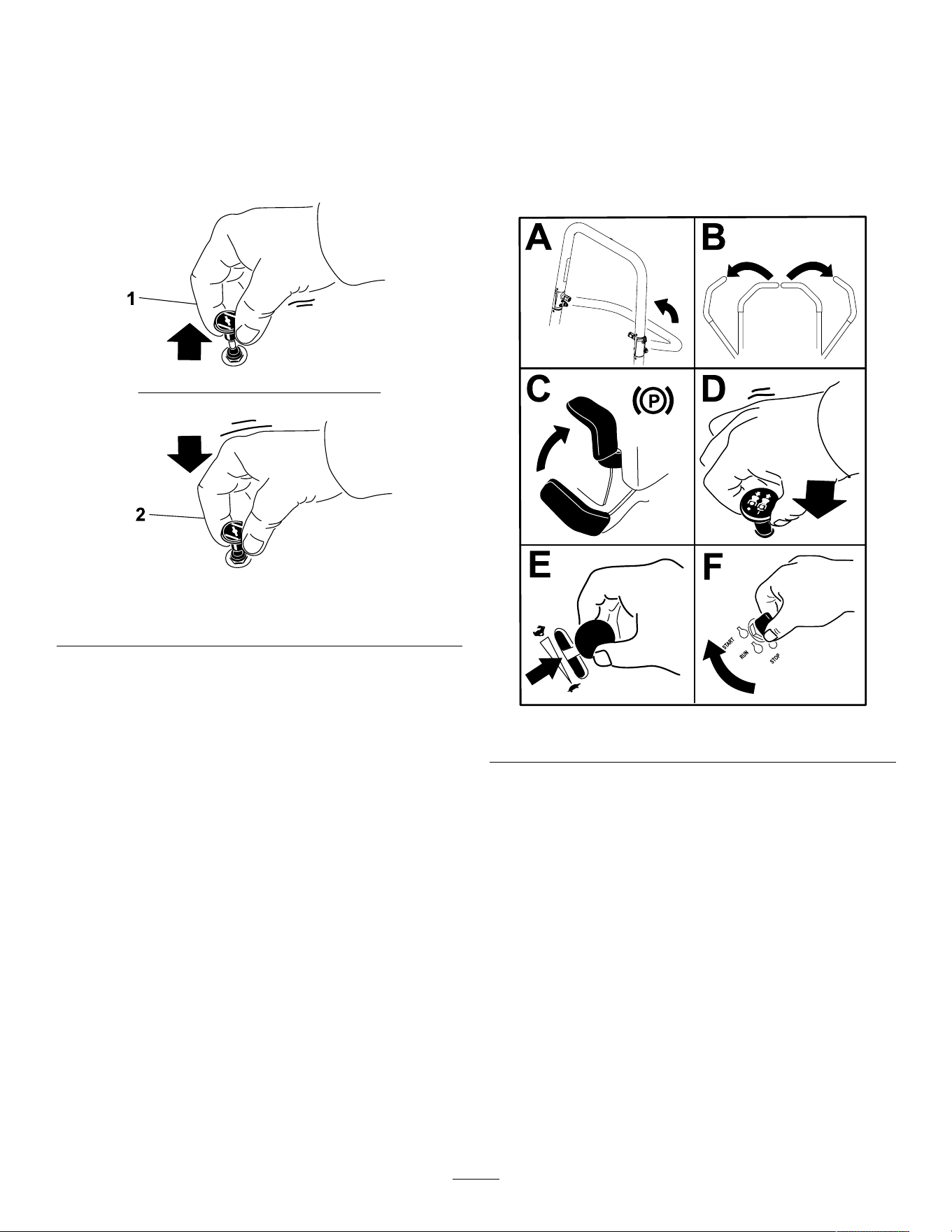
Operating the Choke
Use the choke to start a cold engine.
1. Pull up the choke knob to engage the choke
before using the key switch (Figure 20).
2. Push down the choke knob to disengage the
choke after the engine has started (
Figure 20).
g295540
Figure 20
1. ON position 2. OFF position
Starting the Engine
Note: A warm or hot engine may not require choking.
Important: Do not engage the starter for more
than 5 seconds at a time. Engaging the starter
motor for more than 5 seconds can damage the
starter motor. If the engine fails to start, wait 10
seconds before operating the engine starter again.
g227548
Figure 21
22
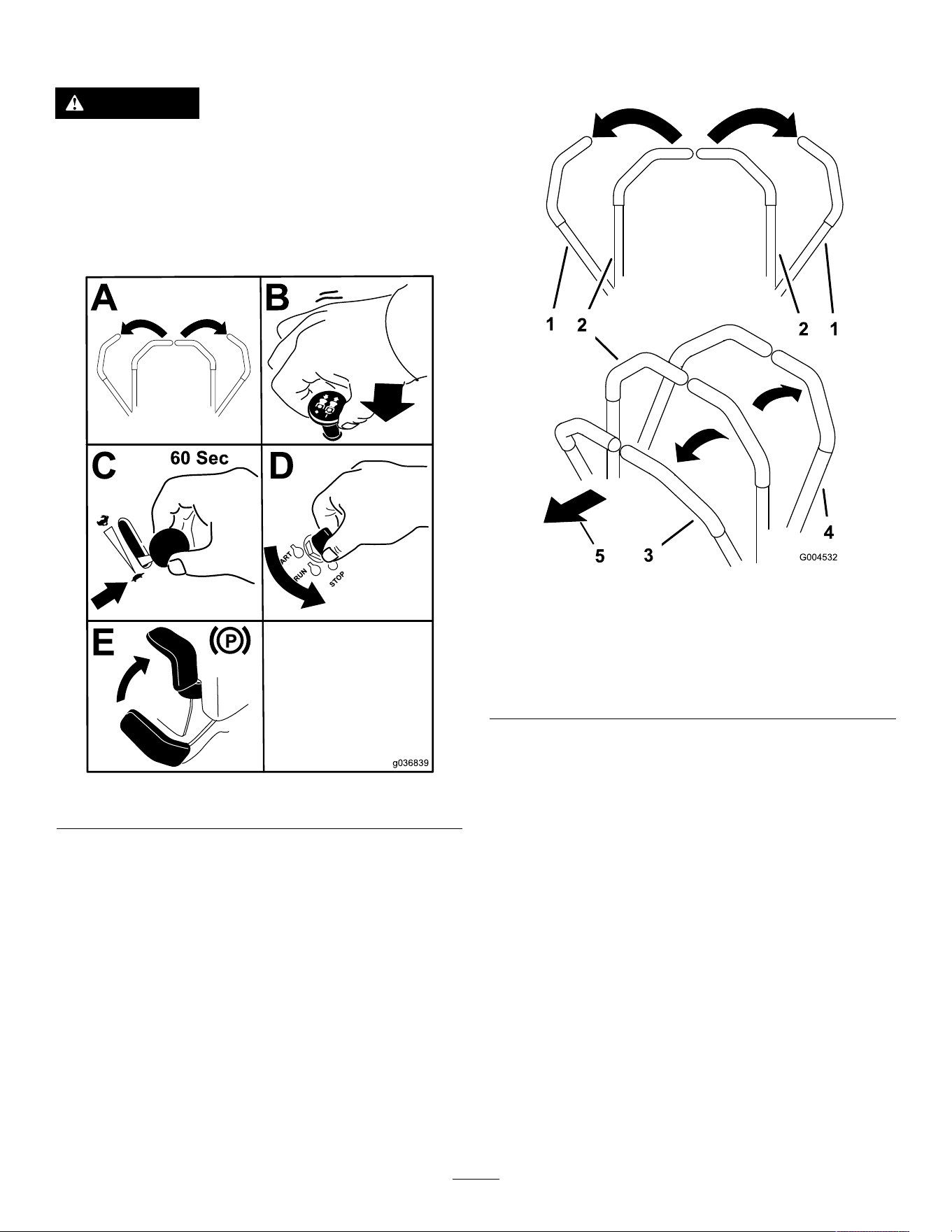
Shutting Off the Engine
CAUTION
Children or bystanders may be injured if they
move or attempt to operate the machine while
it is unattended.
Always remove the key and engage the
parking brake when leaving the machine
unattended.
g036839
Figure 22
Important: Make sure that the fuel-shutoff valve
is closed before transporting or storing the
machine, as fuel leakage may occur. Engage the
parking brake before transporting.
Using the Motion-Control
Levers
g004532
Figure 23
1. Motion-control
levers—NEUTRAL-LOCK
position
4. Reverse
2. Center, unlocked position 5. Front of the machine
3. Forward
23
Driving the Machine
The drive wheels turn independently, powered by
hydraulic motors on each axle. You can turn 1 side
in reverse while you turn the other forward, causing
the machine to spin rather than turn. This greatly
improves the machine maneuverability but may
require some time for you to adapt to how it moves.
The throttle control regulates the engine speed as
measured in rpm (revolutions per minute). Place
the throttle control in the FAST position for best
performance. Always operate in the full throttle
position when mowing.
WARNING
The machine can spin very rapidly. You
may lose control of the machine and cause
personal injury or damage to the machine.
• Use caution when making turns.
• Slow the machine down before making
sharp turns.
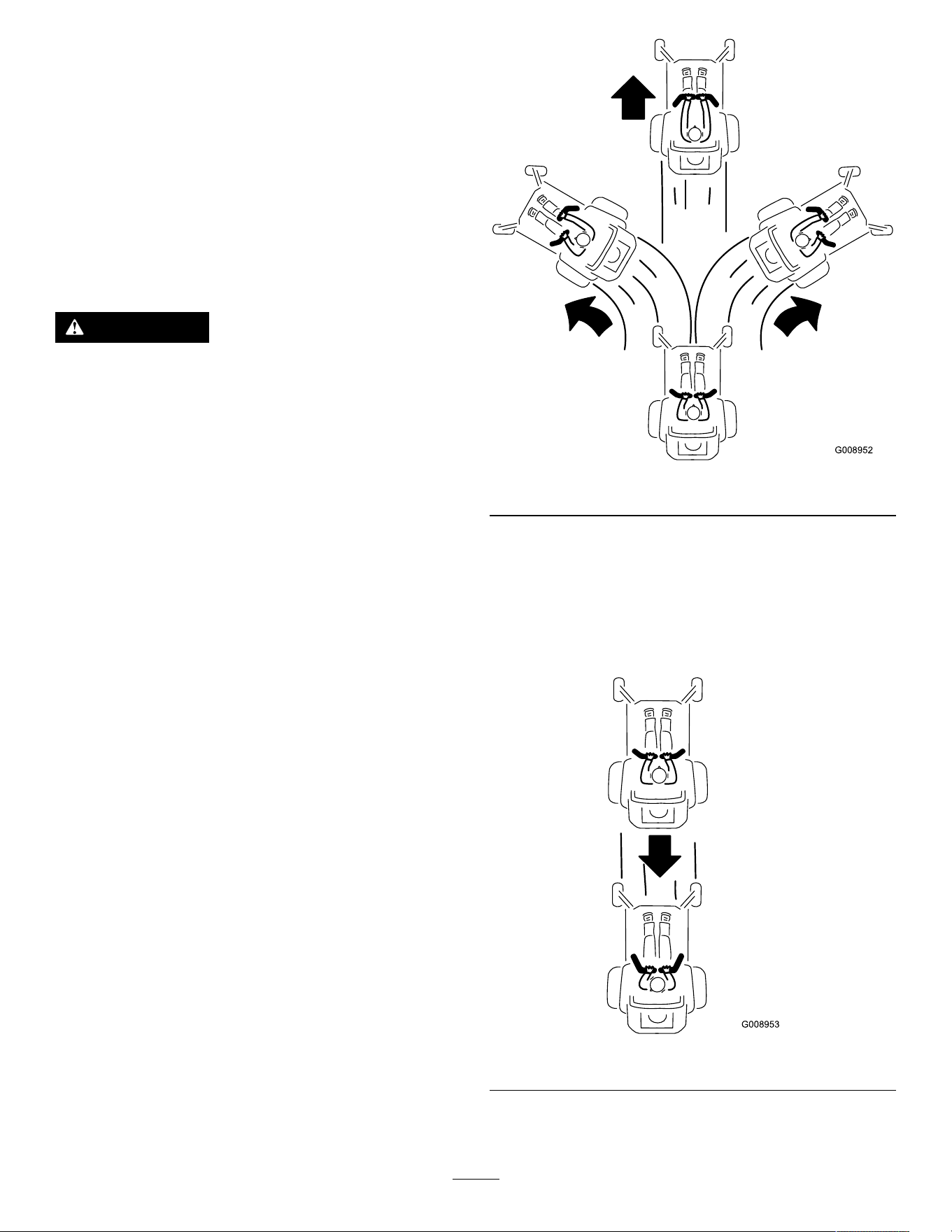
Driving Forward
Note: The engine shuts off when you move the
traction-control with the parking brake engaged.
To stop the machine, pull the motion-control levers
to the NEUTRAL position.
1. Disengage the parking brake.
2. Move the motion-control levers to the center,
unlocked position.
3. To go forward, slowly push the motion-control
levers forward (
Figure 24).
g008952
Figure 24
Driving in Reverse
1. Move the motion-control levers to the center,
unlocked position.
2. To go in reverse, slowly pull the motion-control
levers rearward (
Figure 25).
g008953
Figure 25
24
Using the Side Discharge
The mower has a hinged grass deector that
disperses clippings to the side and down toward the
turf.
DANGER
Without a grass deector, discharge cover, or
a complete grass-catcher assembly mounted
in place, you and others are exposed to blade
contact and thrown debris. Contact with
rotating mower blade(s) and thrown debris
will cause injury or death.
• Never remove the grass deector from the
mower deck because the grass deector
routes material down toward the turf. If the
grass deector is ever damaged, replace it
immediately.
• Never put your hands or feet under the
mower deck.
• Never try to clear the discharge area
or mower blades unless you move the
blade-control switch (PTO) to the OFF
position, rotate the key switch to the OFF
position, and remove the key from the key
switch.
• Make sure that the grass deector is in the
down position.
Adjusting the Height of Cut
Using the Transport Lock
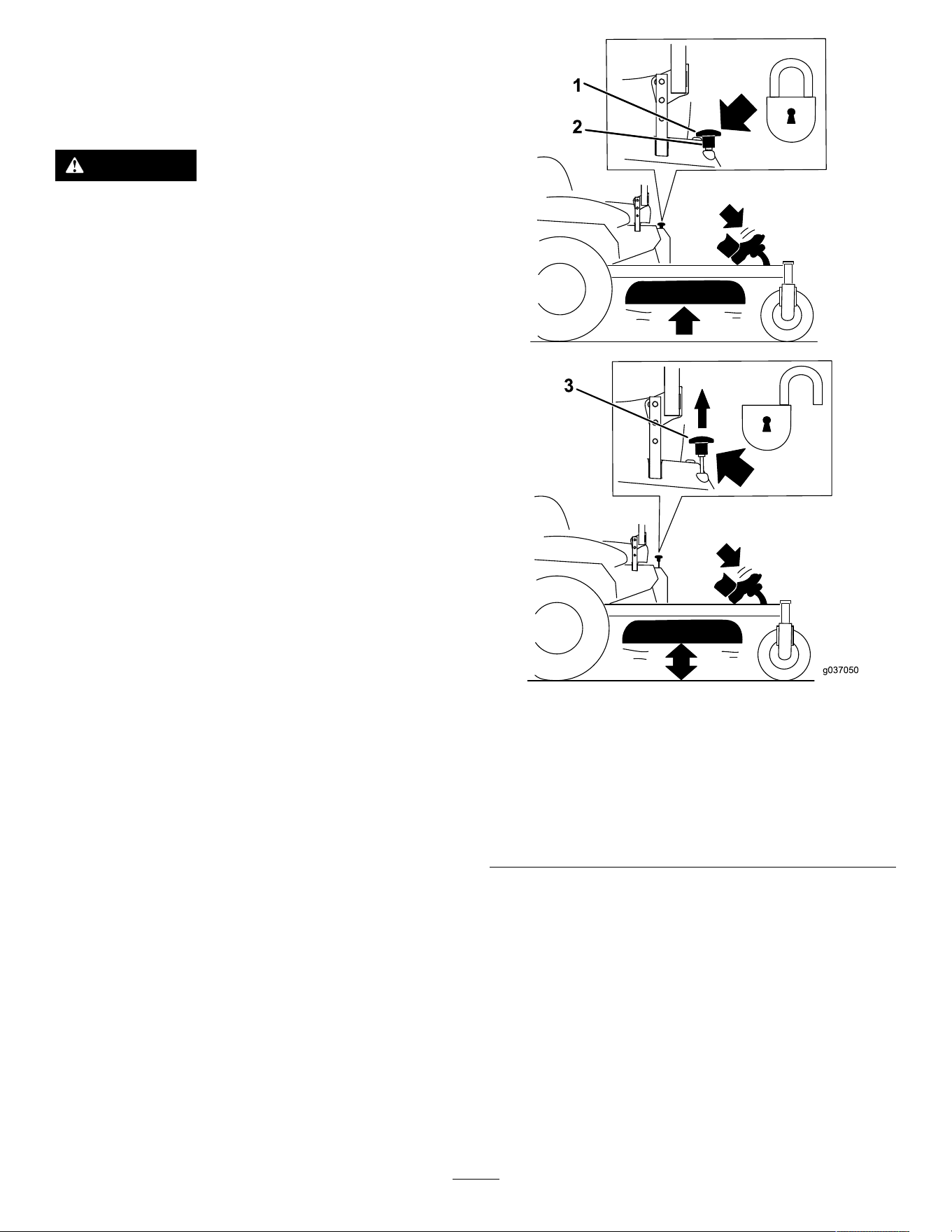
The transport lock has 2 positions, and is used with
the deck-lift pedal. There is a LOCK position and
an UNLOCK position for the transport position of the
mower deck (
Figure 26).
g037050
Figure 26
Transport-Lock Positions
1. Transport lock knob 3. UNLOCK position—The
mower deck does not lock
into the transport position.
2. LOCK position—The
mower deck locks into the
transport position.
Adjusting the Height-of-Cut Pin
Adjust the height-of-cut from 38 to 127 mm (1-1/2 to 5
inches) in 6 mm (1/4 inch) increments by moving the
height-of-cut pin into different hole locations.
1. Move the transport lock to the LOCK position.
2. Push on the deck-lift pedal with your foot and
raise the mower deck to the TRANSPORT position
(also the 127 mm or 5 inch cutting-height
position) as shown in
Figure 27.
3. Remove the pin from the height-of-cut bracket
(Figure 27).
25
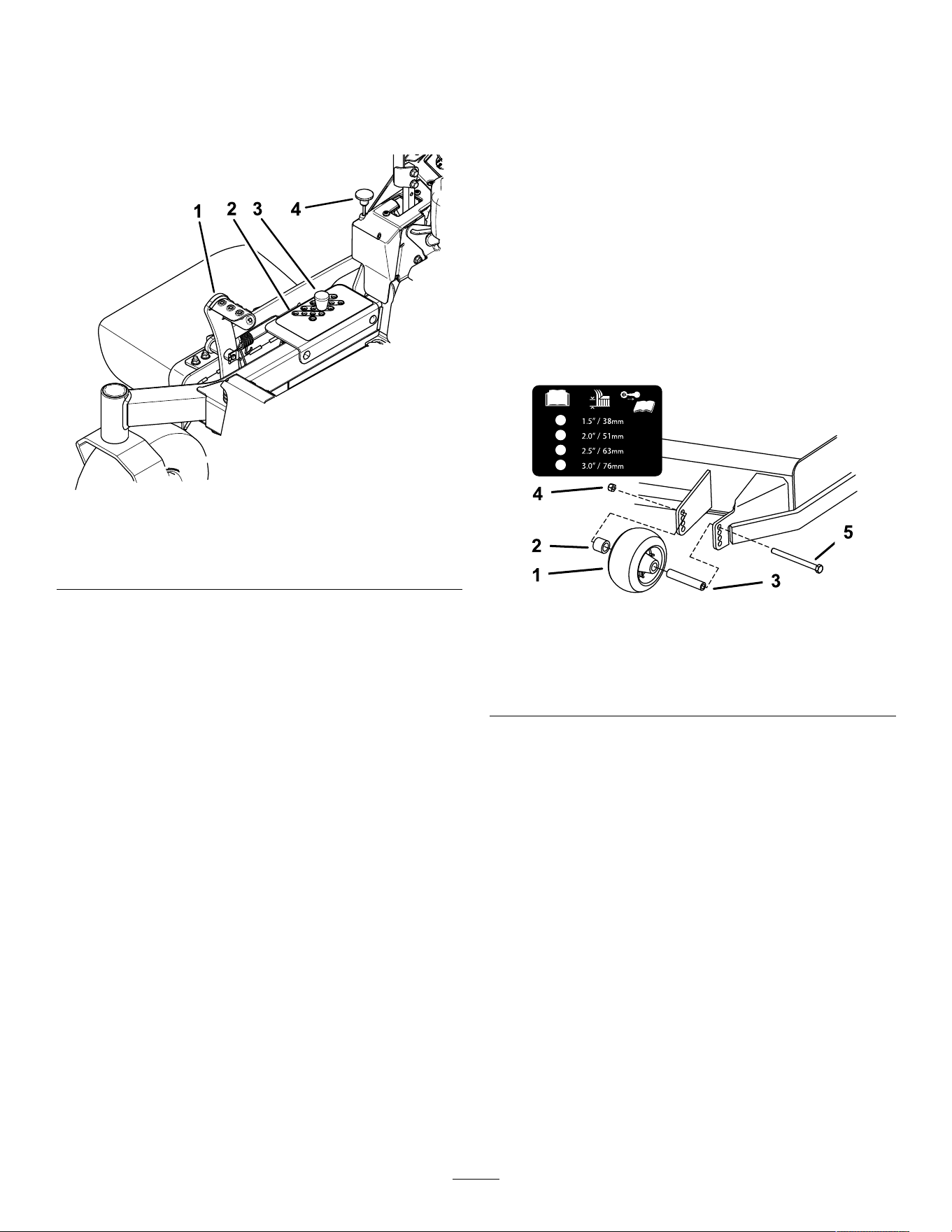
4. Select a hole in the height-of-cut bracket
corresponding to the height-of-cut desired, and
insert the pin (
Figure 27).
5. Push on the deck lift, pull up on the transport
lock knob, and slowly lower the mower deck.
g333449
Figure 27
1. Deck-lift pedal 3. Height-of-cut pin
2. Height-of-cut holes
4. Transport lock knob
Adjusting the Anti-Scalp
Rollers
Whenever you change the height of cut, adjust the
height of the anti-scalp rollers.
Note: Adjust the anti-scalp rollers so that the rollers
do not touch the ground in normal, at mowing areas.
1. Park the machine on a level surface, disengage
the blade-control switch and engage the parking
brake.
2. Shut off the engine, remove the key, and wait
for all moving parts to stop before leaving the
operating position.
3. Adjust the anti-scalp rollers as shown in
Figure
28
.
g301976
Figure 28
1. Anti-scalp roller 4. Flange nut
2. Bushing 5. Bolt
3. Spacer
26

Operating Tips
Maximizing Air Circulation
For best mowing and maximum air circulation, operate
the engine at the FAST position. Air is required to
thoroughly cut grass clippings, so do not set the
height-of-cut so low as to totally surround the mower
deck in uncut grass. Always try to have 1 side of the
mower deck free from uncut grass, which allows air
to be drawn into the mower deck.
Cutting a Lawn for the First Time
Cut grass slightly longer than normal to ensure that
the cutting height of the mower deck does not scalp
any uneven ground. However, the cutting height
used in the past is generally the best one to use.
When cutting grass longer than 15 cm (6 inches) tall,
you may want to cut the lawn twice to ensure an
acceptable quality of cut.
Cutting a Third of the Grass Blade
It is best to cut only about a third of the grass blade.
Cutting more than that is not recommended unless
grass is sparse, or it is late fall when grass grows
more slowly.
Alternating the Mowing Direction
Alternate the mowing direction to keep the grass
standing straight. This also helps disperse clippings,
which enhances decomposition and fertilization.
Mowing at Correct Intervals
Grass grows at different rates at different times of
the year. To maintain the same cutting height, mow
more often in early spring. As the grass growth rate
slows in mid summer, mow less frequently. If you
cannot mow for an extended period, rst mow at a
high cutting height, then mow again 2 days later at a
lower height setting.
Mowing at Slower Speeds
In certain conditions, mowing at a slower ground
speed can improve cut quality.
Avoiding Cutting Too Low
When mowing uneven turf, raise the cutting height
to avoid scalping the turf.
Stopping the Machine
If you must stop the forward motion of the machine
while mowing, a clump of grass clippings may
drop onto your lawn. To avoid this, move onto a
previously cut area with the blades engaged or you
can disengage the mower deck while moving forward.
Keeping the Underside of the
Mower Deck Clean
Clean clippings and dirt from the underside of the
mower deck after each use. If grass and dirt build up
inside the mower deck, cutting quality will eventually
become unsatisfactory.
Maintaining the Blade(s)
Maintain a sharp blade throughout the cutting season
because a sharp blade cuts cleanly without tearing or
shredding the grass blades. Tearing and shredding
turns grass brown at the edges, which slows growth
and increases the chance of disease. Check the
mower blades after each use for sharpness, and
for any wear or damage. File down any nicks and
sharpen the blades as necessary. If a blade is
damaged or worn, replace it immediately with a
genuine Toro replacement blade. Refer to
Servicing
the Cutting Blades (page 52)
.
27
After Operation
After Operation Safety
General Safety
• Engage the parking brake, shut off the engine,
remove the key, and wait for all moving parts to
stop before leaving the operator’s position. Allow
the machine to cool before servicing, adjusting,
fueling, cleaning, or storing it.
• Clean grass and debris from the cutting unit,
mufer, drives, grass catcher, and engine
compartment to help prevent res. Clean up oil or
fuel spills.
• Shut off the fuel and remove the key before storing
or transporting the machine.
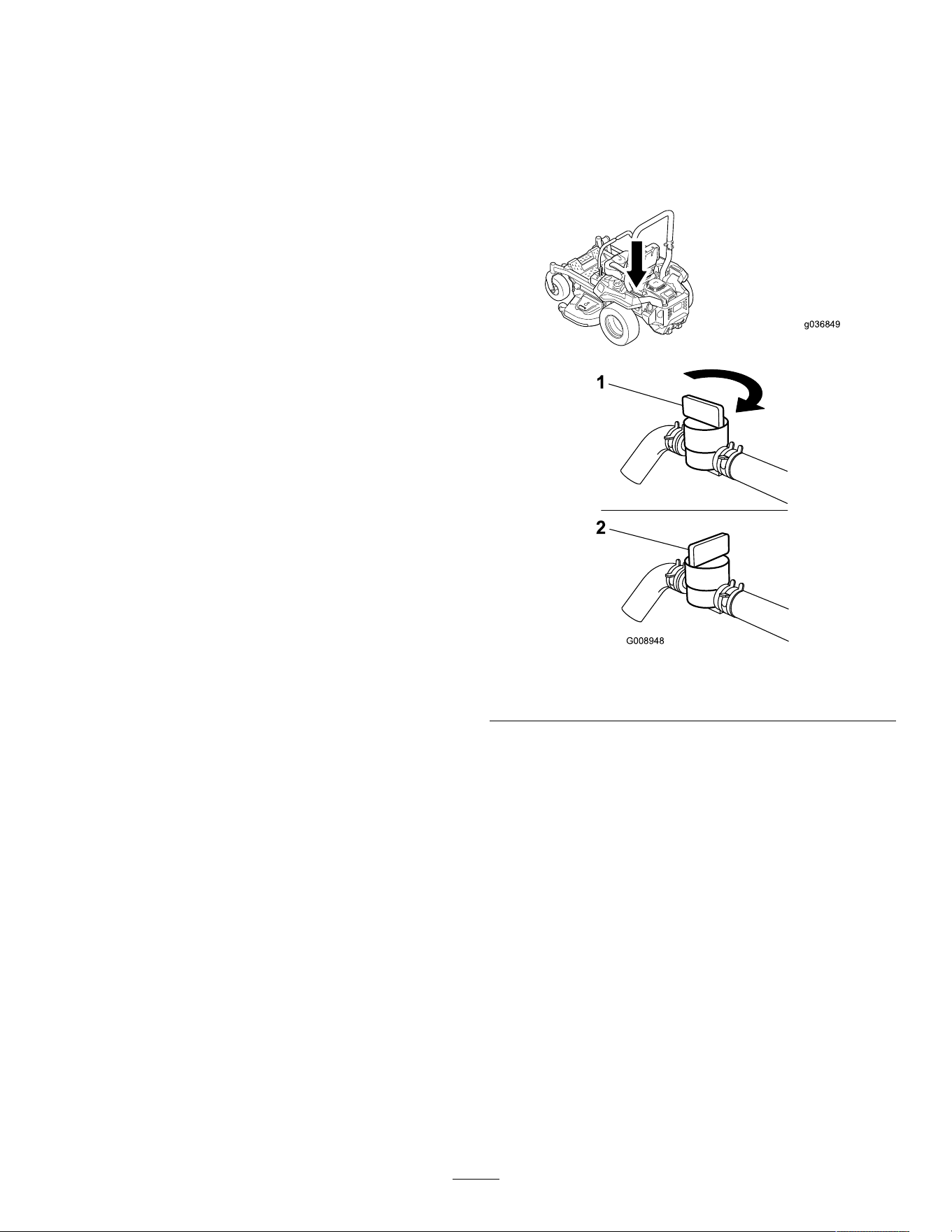
Using the Fuel-Shutoff
Valve
Close the fuel-shutoff valve for transport, maintenance,
and storage (
Figure 29).
Ensure that the fuel-shutoff valve is open when
starting the engine.
g036849
g008948
Figure 29
1. ON position 2. OFF position
28
Using the Drive-Wheel
Release Valves
WARNING
Hands may become entangled in the rotating
drive components below the engine deck,
which could result in serious injury.
Shut off the engine, remove the key, and allow
all moving parts to stop before accessing the
drive-wheel release valves.
WARNING
The engine and hydraulic-drive units can
become very hot. Touching a hot engine or
hydraulic-drive units can cause severe burns.
Allow the engine and hydraulic-drive units
to cool completely before accessing the
drive-wheel release valves.
WARNING
The machine could unintentionally move
while the bypass levers are locked forward in
the slot and injure you or bystanders.
Lock the bypass levers rearward after moving
the machine.
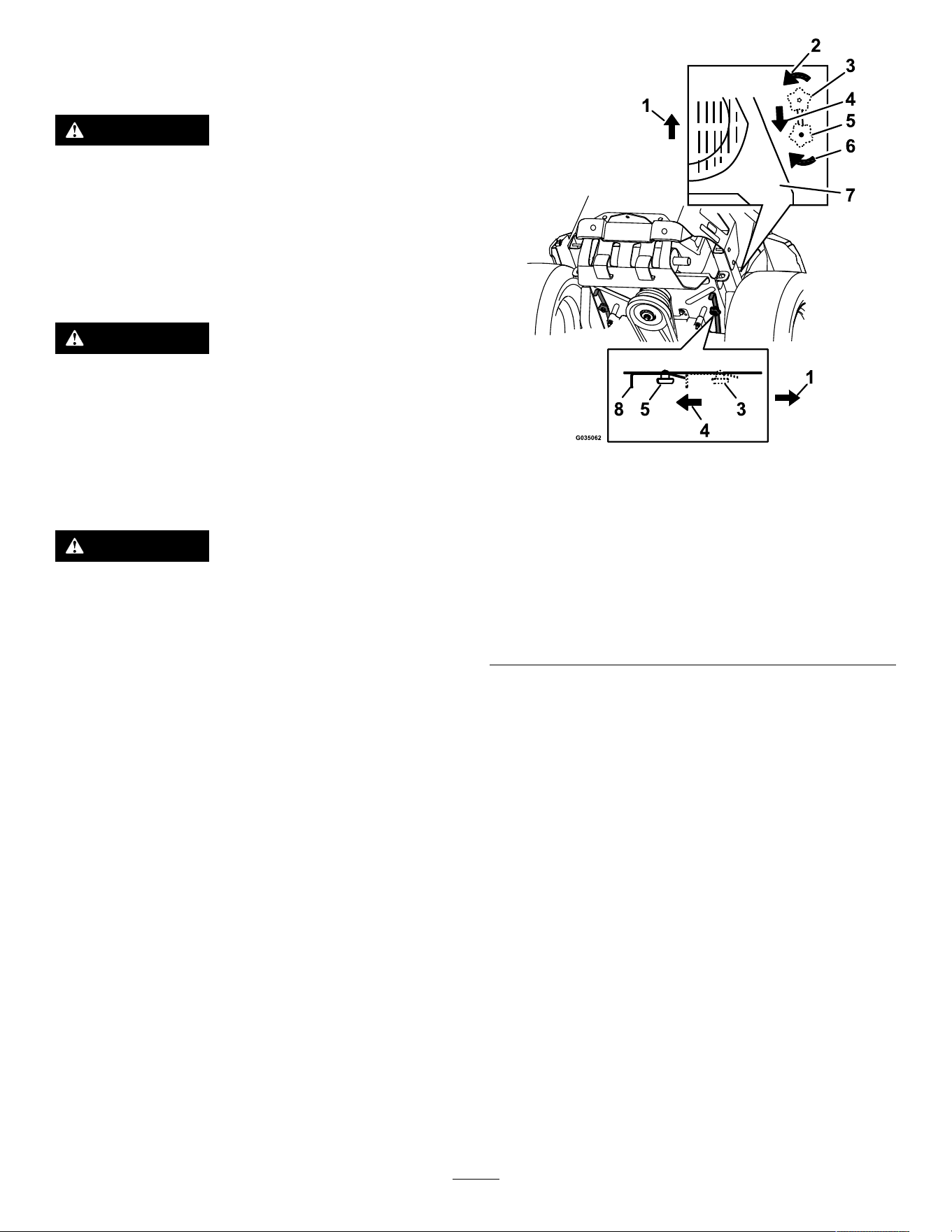
The drive-wheel release valves are located on the left
and right sides underneath the engine deck.
1. Park the machine on a level surface, disengage
the blade-control switch, and engage the parking
brake.
2. Shut off the engine, remove the key, and wait
for all moving parts to stop before leaving the
operating position.
3. Locate the bypass levers behind the seat, down
on the left and right side of the frame.
4. To push the machine, move both bypass knobs
rearward and lock them into place (
Figure 30).
5. Disengage the parking brake before pushing
the machine.
g035062
Figure 30
1. Front of the machine
2. Rotate bypass release knob counterclockwise to loosen.
3. Lever position for operating the machine
4. Pull the lever in this direction to push the machine.
5. Lever position for pushing the machine
6. Rotate the bypass-release knob clockwise to tighten.
7. Engine
8. Release lever
6. To run the machine, move the bypass knobs to
the FORWARD position and lock them into place
(
Figure 30).
29
Transporting the Machine
Use a heavy-duty trailer or truck to transport the
machine. Use a full-width ramp. Ensure that the trailer
or truck has all the necessary brakes, lighting, and
marking as required by law. Please carefully read all
the safety instructions. Knowing this information could
help you or bystanders avoid injury. Refer to your
local ordinances for trailer and tie-down requirements.
WARNING
Driving on the street or roadway without
turn signals, lights, reective markings, or a
slow-moving-vehicle emblem is dangerous
and can lead to accidents, causing personal
injury.
Do not drive the machine on a public street
or roadway.
Selecting a Trailer
WARNING
Loading a machine onto a trailer or truck
increases the possibility of tip-over and could
cause serious injury or death (
Figure 31).
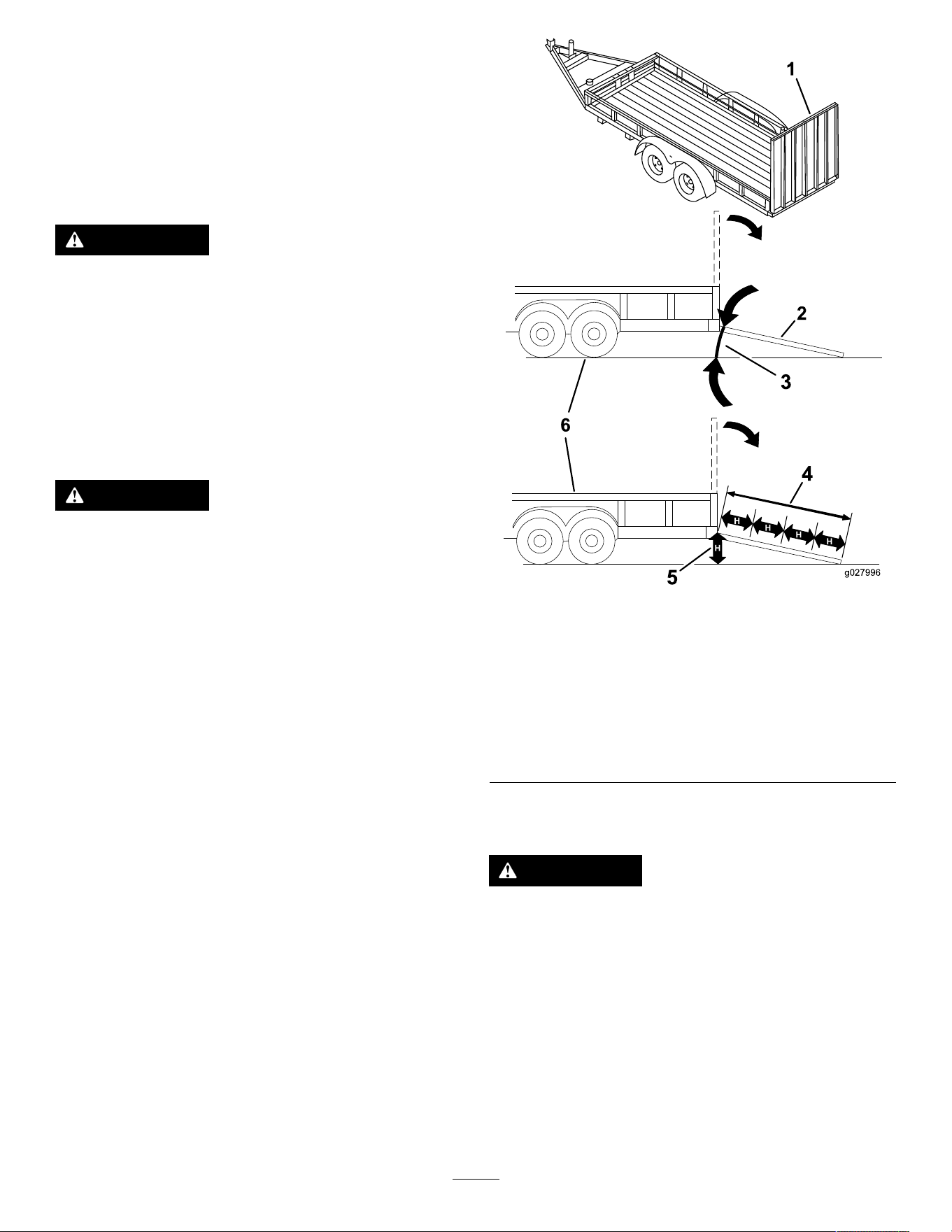
• Use only a full-width ramp; do not use
individual ramps for each side of the
machine.
• Do not exceed a 15-degree angle between
the ramp and the ground or between the
ramp and the trailer or truck.
• Ensure that the length of the ramp is at
least 4 times as long as the height of the
trailer or truck bed to the ground. This
ensures that the ramp angle does not
exceed 15 degrees on at ground.
g027996
Figure 31
1. Full-width ramp in stowed
position
4. Ramp is at least 4 times
as long as the height of
the trailer or truck bed to
the ground
2. Side view of full-width
ramp in loading position
5. H=height of the trailer or
truck bed to the ground
3. Not greater than
15 degrees
6. Trailer
Loading the Machine
WARNING
Loading a machine onto a trailer or truck
increases the possibility of tip-over and could
cause serious injury or death.
• Use extreme caution when operating a
machine on a ramp.
• Back the machine up the ramp and drive it
forward down the ramp.
• Avoid sudden acceleration or deceleration
while driving the machine on a ramp as
this could cause a loss of control or a
tip-over situation.
30
1. If using a trailer, connect it to the towing vehicle
and connect the safety chains.
2. If applicable, connect the trailer brakes and
lights.
3. Lower the ramp, ensuring that the angle
between the ramp and the ground does not
exceed 15 degrees (Figure 31).
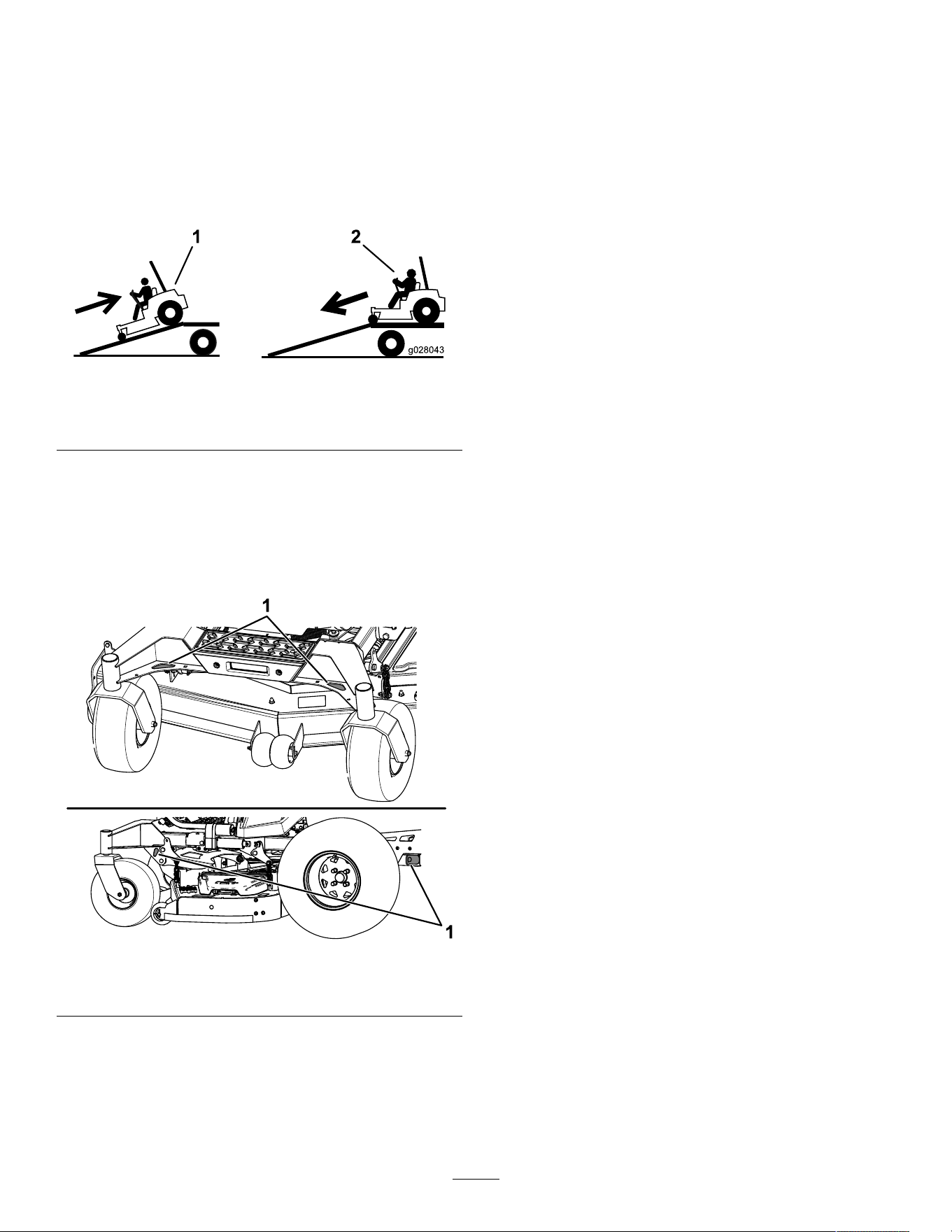
4. Back the machine up the ramp (
Figure 32).
g028043
Figure 32
1. Back the machine up the
ramp.
2. Drive the machine forward
down the ramp.
5. Shut off the engine, remove the key, and engage
the parking brake.
6. Tie down the machine near the front caster
wheels and the rear frame with straps, chains,
cable, or ropes (
Figure 33). Refer to local
regulations for tie-down requirements.
g332791
Figure 33
1. Tie-down points
Unloading the Machine
1. Lower the ramp, ensuring that the angle
between the ramp and the ground does not
exceed 15 degrees (
Figure 31).
2. Drive the machine forward down the ramp
(
Figure 32).
31

Maintenance
Maintenance Safety
• If you leave the key in the switch, someone could
accidently start the engine and seriously injure you
or other bystanders. Remove the key from the
switch before you perform any maintenance.
• Before you leave the operator’s position, do the
following:
– Park the machine on a level surface.
– Disengage the drives.
– Engage the parking brake.
– Shut off the engine and remove the key.
– Allow machine components to cool before
performing maintenance.
• Do not allow untrained personnel to service the
machine.
• Keep your hands and feet away from moving
parts or hot surfaces. If possible, do not make
adjustments with the engine running.
• Carefully release pressure from components with
stored energy.
• Check the parking brake operation frequently.
Adjust and service it as required.
• Never tamper with safety devices. Check their
proper operation regularly.
• Clean grass and debris from the cutting unit,
mufer, drives, grass catcher, and engine
compartment to prevent res.
• Clean up oil or fuel spills and remove fuel-soaked
debris.
• Do not rely on hydraulic or mechanical jacks to
support the machine; support the machine with
jack stands whenever you raise the machine.
• Keep all parts in good working condition
and all hardware tightened, especially the
blade-attachment hardware. Replace all worn or
damaged decals.
• Disconnect the cable from the negative terminal of
the battery before repairing the machine.
• To ensure optimum performance, use only
genuine Toro replacement parts and accessories.
Replacement parts and accessories made by
other manufacturers could be dangerous, and
such use could void the product warranty.
Recommended Maintenance Schedule(s)
Maintenance Service
Interval
Maintenance Procedure
After the rst 75 hours
• Change the hydraulic-system lters and uid.
Before each use or daily
• Check the safety-interlock system.
• Check the engine-oil level.
• Check the seat belt.
• Clean the engine screen and the area around the engine.
• Clean around the engine-exhaust system.
• Check the hydraulic uid level in the expansion tank.
• Inspect the blades.
• Inspect the grass deector for damage.
After each use
• Clean the mower deck.
Every 25 hours
• Clean the air-cleaner foam element (more often in dusty, dirty conditions).
Every 50 hours
• Check the tire pressure.
• Inspect the belts for cracks and wear.
Every 100 hours
• Replace the air-cleaner foam element (more often in dusty, dirty conditions).
• Remove and clean the blower housing and any other cooling shrouds (more often
under extremely dusty, dirty conditions).
• Replace the in-line fuel lter.
Every 100 hours or yearly,
whichever comes rst
• Replace the paper air-cleaner element (more often in dirty or dusty conditions).
• Change the engine oil and oil lter (more often in dirty or dusty conditions).
• Check the spark plugs.
Every 250 hours
• After the initial change—change the hydraulic-system lters and uid when using
Mobil 1 15W50 uid. (Change it more often under dirty or dusty conditions)
32
Maintenance Service
Interval
Maintenance Procedure
Every 500 hours
• Replace the spark plugs and set the gap.
• Check the parking brake adjustment.
• After the initial change—change the hydraulic-system lters and uid when using
Toro® HYPR-OIL™ 500 uid. (Change it more often under dirty or dusty conditions)
Monthly
• Check the battery charge.
Yearly or before storage
• Paint chipped surfaces.
• Complete all the procedures in the Storage chapter.
Important: Refer to your engine owner's manual for additional maintenance procedures.
CAUTION
If you leave the key in the switch, someone could accidently start the engine and seriously
injure you or other bystanders.
Shut off the engine and remove the key from the switch before you perform any maintenance.
Lubrication
Greasing the Machine
Grease the machine more often in dirty or dusty
conditions.
Grease Type: No. 2 lithium or molybdenum grease
1. Park the machine on a level surface, disengage
the blade-control switch, and engage the parking
brake.
2. Shut off the engine, remove the key, and wait
for all moving parts to stop before leaving the
operating position.
3. Clean the grease tting with a rag.
Note: Scrape any paint off the front of the tting.
g388625
Figure 34
1. Pump-idler pivot tting
4. Grease the pump idler-pulley pivot with 1 or 2
pumps of grease.
5. Wipe up any excess grease.
33
Engine Maintenance
Engine Safety
• Keep your hands, feet, face, other body parts,
and clothing away from the mufer and other hot
surfaces. Allow engine components to cool before
performing maintenance.
• Do not change the engine governor speed or
overspeed the engine.
Servicing the Air Cleaner
Service Interval: Every 25 hours—Clean the
air-cleaner foam element (more
often in dusty, dirty conditions).
Every 100 hours—Replace the air-cleaner foam
element (more often in dusty, dirty conditions).
Note: Service the air cleaner more frequently (every
few hours) if operating conditions are extremely dusty
or sandy.
Removing the Foam and Paper
Elements
1. Park the machine on a level surface, disengage
the blade-control switch, and move the
motion-control levers outward to the PARK
position.
2. Shut off the engine, remove the key, and wait
for all moving parts to stop before leaving the
operating position.
3. Clean around the air-cleaner cover to prevent
dirt from getting into the engine and causing
damage.
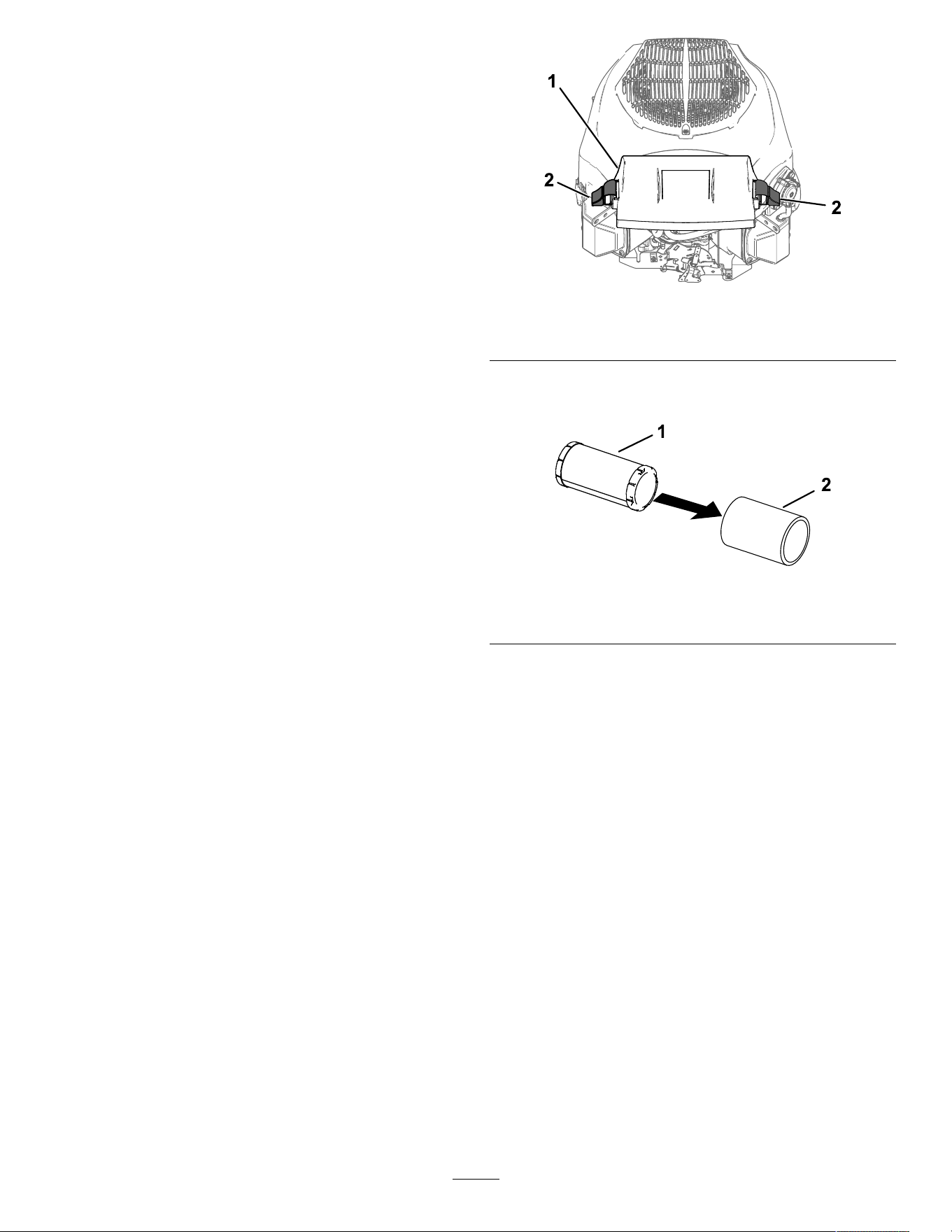
4. Release the retaining clamps on the air cleaner
and pull the air-cleaner cover off the air-cleaner
body
g305607
Figure 35
1. Cover
2. Retaining clamp
5. Separate the foam and paper elements (Figure
36
).
g305608
Figure 36
1. Paper element 2. Foam element
Servicing the Foam Element
1. Wash the foam element in liquid soap and
warm water. When the element is clean, rinse
it thoroughly.
2. Dry the element by squeezing it in a clean cloth.
Important: Replace the foam element if it
is torn or worn.
3. Lightly oil the foam element using new engine oil
and squeeze out any excess oil.
34
Servicing the Paper Air-Cleaner
Element
Service Interval: Every 100 hours or yearly,
whichever comes rst—Replace the
paper air-cleaner element (more
often in dirty or dusty conditions).
1. Clean the paper element by tapping it gently to
remove dust.
Note: If it is very dirty, replace the paper
element with a new one.
2. Inspect the element for tears, an oily lm, or
damage to the rubber seal.
3. Replace the paper element if it is damaged.
Important: Do not clean the paper lter.
Installing the Air Cleaner
1. Install the foam pre-cleaner element over the
paper element.
Note: Ensure that you do not damage the
elements.
2. Install the air-cleaner elements onto the
air-cleaner base.
3. Install the cover and secure it with the retaining
clamps (
Figure 35).
Servicing the Engine Oil
Engine-Oil Specications
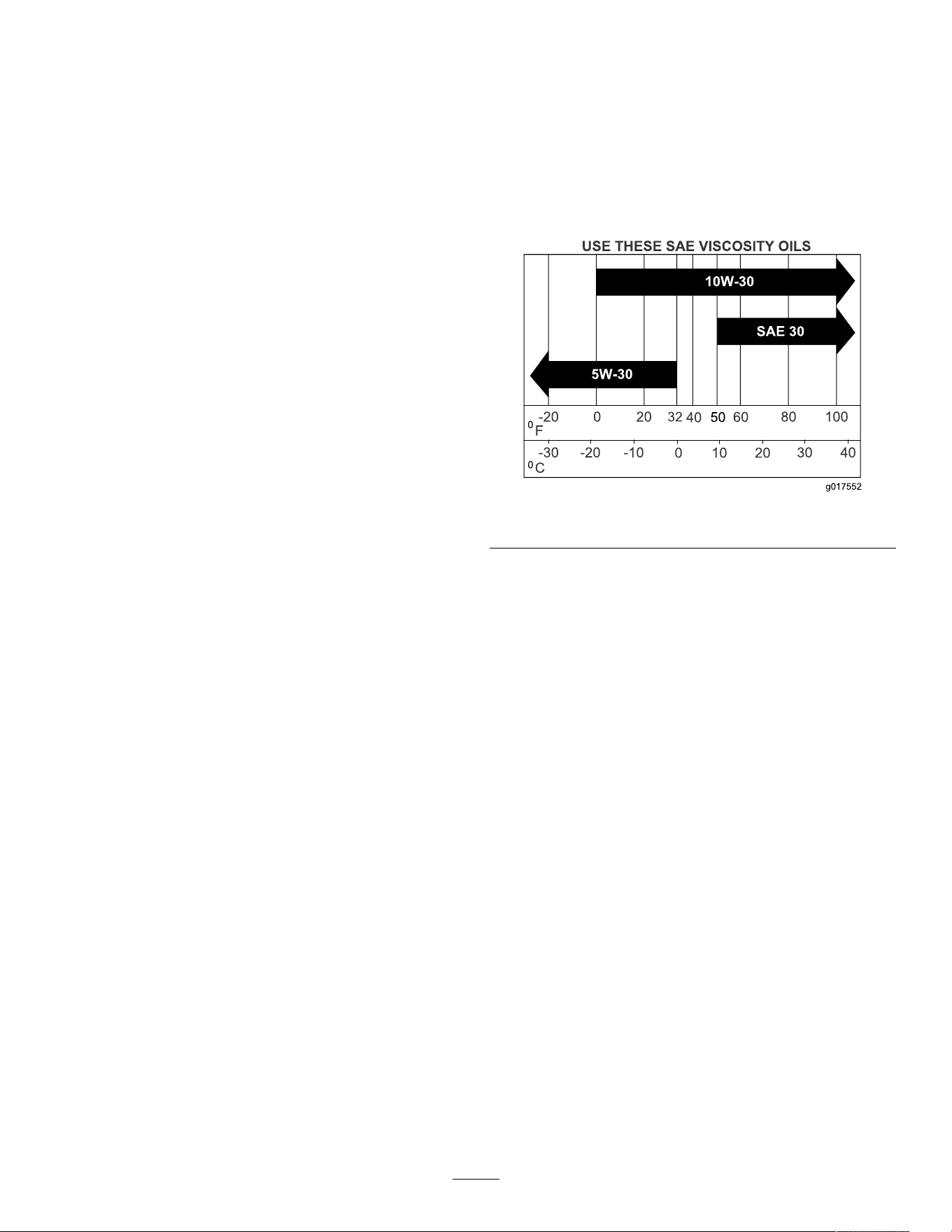
Oil Type: Detergent oil (including synthetic) of API
service SJ or higher
Crankcase Capacity: 1.9 L (64 oz) with oil lter
Viscosity: See the table below.
g017552
Figure 37
Checking the Engine-Oil Level
Service Interval: Before each use or daily
Note: Check the oil when the engine is cold.
Important: If you overll or underll the engine
crankcase with oil and run the engine, you may
damage the engine.
1. Park the machine on a level surface, disengage
the blade-control switch, and move the
motion-control levers outward to the PARK
position.
2. Shut off the engine, remove the key, and wait
for all moving parts to stop before leaving the
operating position.
Note: Ensure that the engine is cool so that the
oil has had time to drain into the sump.
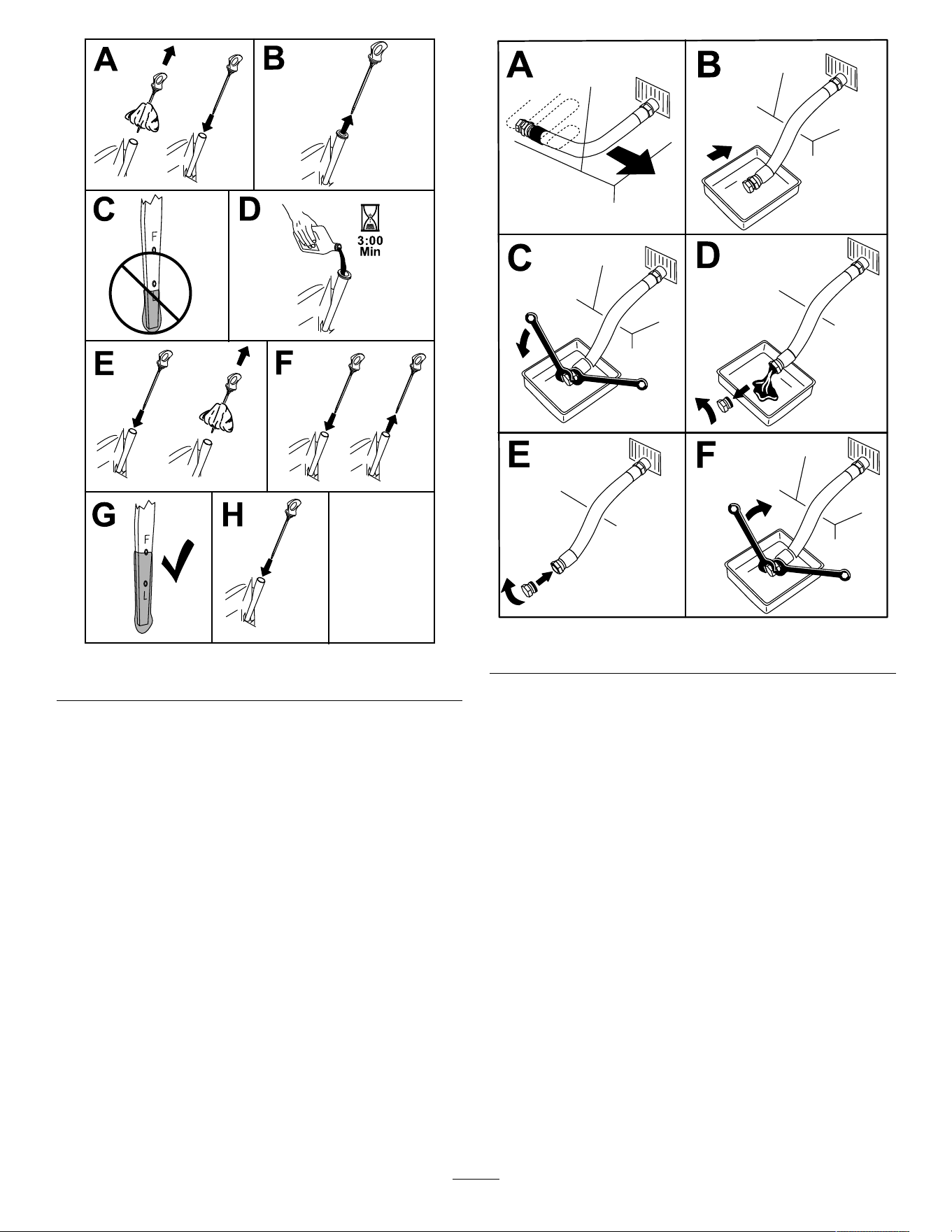
3. To keep dirt, grass clippings, etc., out of the
engine, clean the area around the oil-ll cap and
dipstick before removing it (
Figure 38).
35
g365791
Figure 38
Changing the Engine Oil and Oil
Filter
Service Interval: Every 100 hours or yearly,
whichever comes rst—Change the
engine oil and oil lter (more often
in dirty or dusty conditions).
1. Park the machine on a level surface to ensure
that the oil drains completely.
2. Park the machine on a level surface, disengage
the blade-control switch, and move the
motion-control levers outward to the PARK
position.
3. Shut off the engine, remove the key, and wait
for all moving parts to stop before leaving the
operating position.
4. Drain the oil from the engine (
Figure 39).
g225280
Figure 39
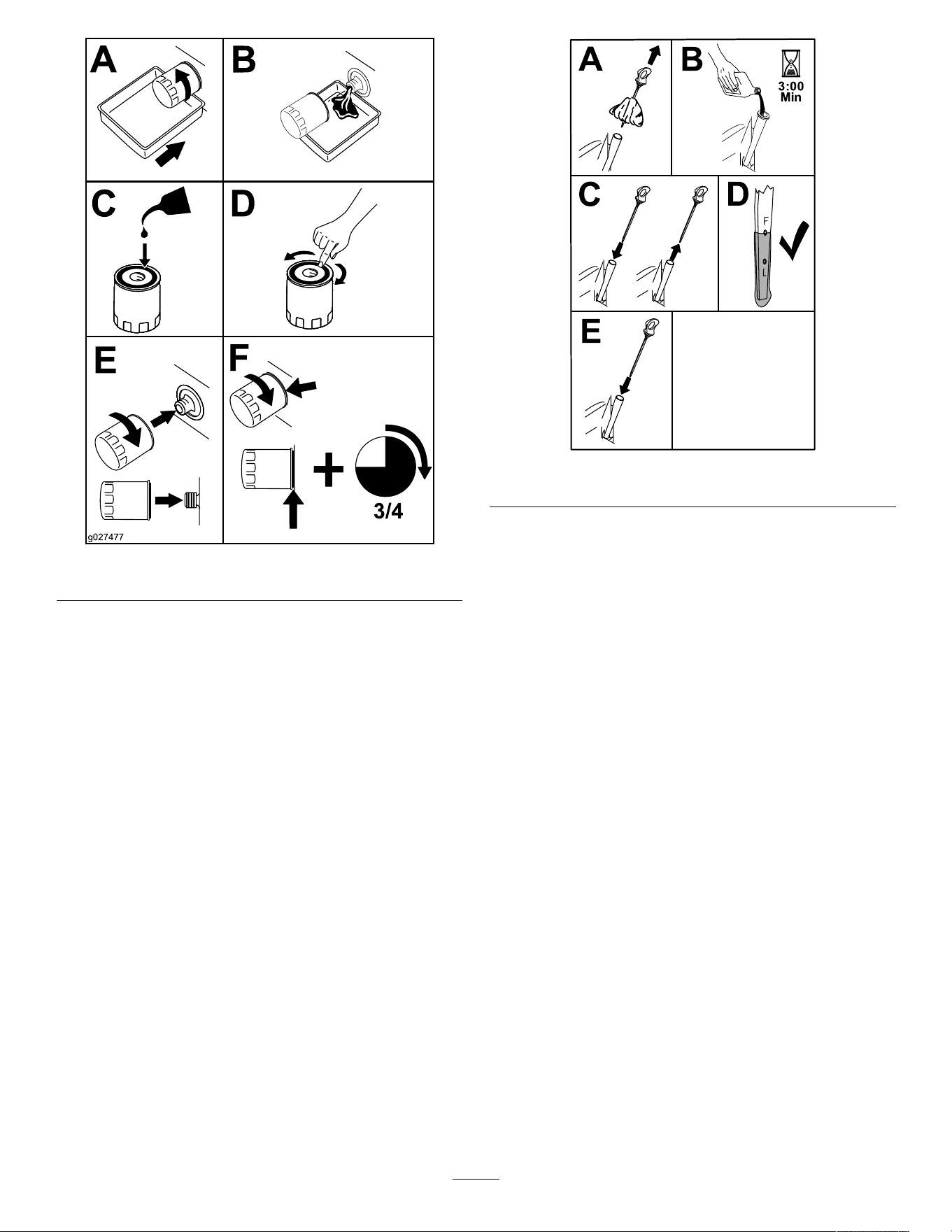
5. Change the engine-oil lter (Figure 40).
Note: Ensure that the oil-lter gasket touches
the engine and then turn the lter an extra 3/4
turn.
36
Servicing the Spark Plug
Service Interval: Every 100 hours or yearly,
whichever comes rst—Check the
spark plugs.
Every 500 hours—Replace the spark plugs and
set the gap.
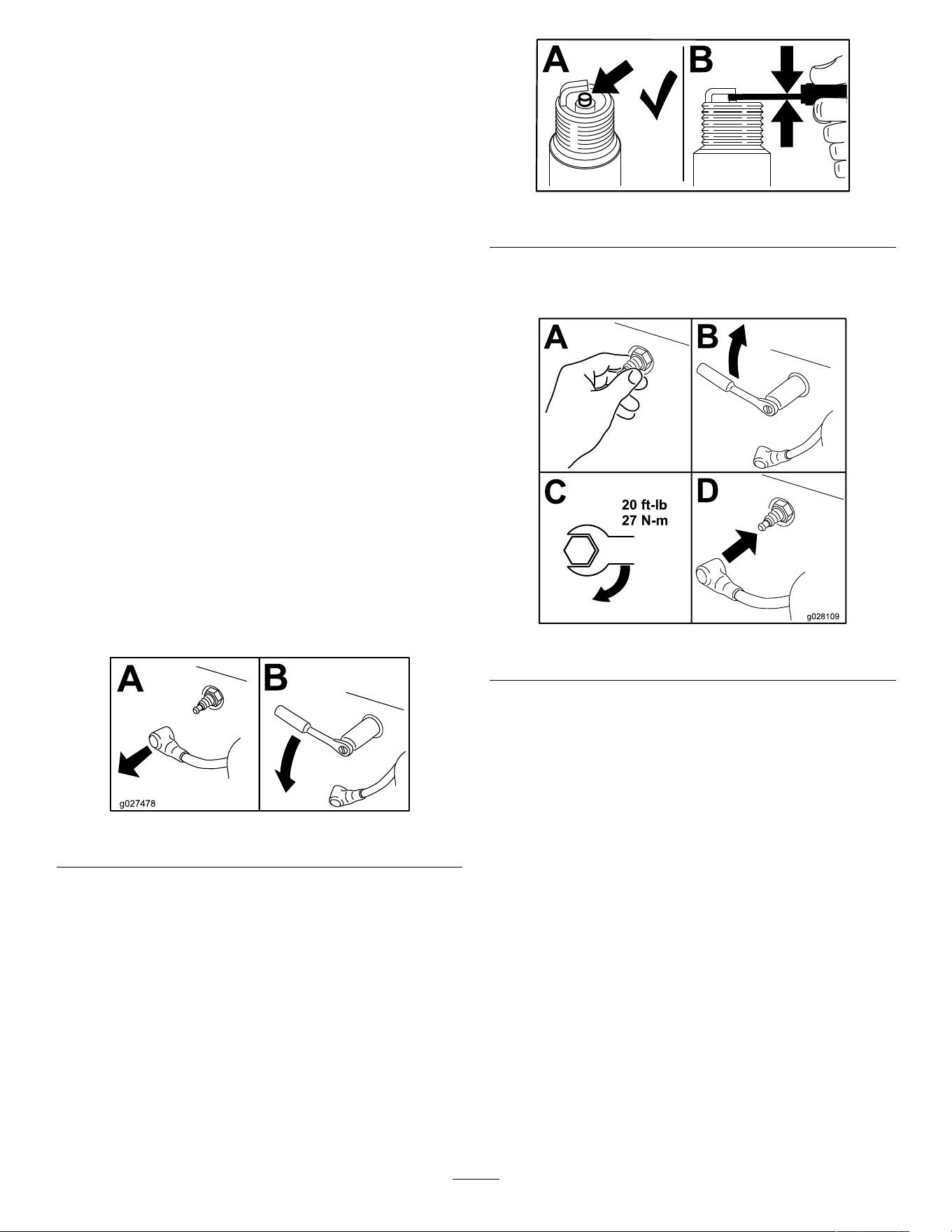
Ensure that the air gap between the center and side
electrodes is correct before installing the spark plug.
Use a spark plug wrench for removing and installing
the spark plug and a gapping tool or feeler gauge to
check and adjust the air gap. Install a new spark plug
if necessary.
Type: Champion
®
XC12YC
Air gap: 0.76 mm (0.03 inch)
Removing the Spark Plug
1. Park the machine on a level surface, disengage
the blade-control switch, and move the
motion-control levers outward to the PARK
position.
2. Shut off the engine, remove the key, and wait
for all moving parts to stop before leaving the
operating position.
3. Clean the area around the base of the plug to
keep dirt and debris out of the engine.
4. Remove the spark plug (
Figure 42).
g027478
Figure 42
Checking the Spark Plug
Important: Do not clean the spark plug(s).
Always replace the spark plug(s) when it has a
black coating, worn electrodes, an oily lm, or
cracks.
If you see light brown or gray on the insulator, the
engine is operating properly. A black coating on the
insulator usually means the air cleaner is dirty.
Set the gap to 0.75 mm (0.03 inch).
g206628
Figure 43
Installing the Spark Plug
g028109
Figure 44
Cleaning the Blower Housing
Service Interval: Every 100 hours/Yearly (whichever
comes rst)
To ensure proper cooling, ensure that the grass
screen, cooling ns, and other external surfaces of the
engine are kept clean at all times.
Clean the cooling ns and external surfaces as
necessary. Make sure that the cooling shrouds are
installed. Torque the blower housing screws to 7.5
N∙m (5.5 ft-lb).
Important: Operating the engine with a blocked
grass screen, dirty or plugged cooling ns, and/or
cooling shrouds removed, causes engine damage
due to overheating.
38
Fuel System
Maintenance
DANGER
In certain conditions, fuel is extremely
ammable and highly explosive. A re or
explosion from fuel can burn you and others
and can damage property.
Refer to
Fuel Safety (page 14) for a complete
list of fuel related precautions.
Replacing the In-Line Fuel
Filter
Service Interval: Every 100 hours—Replace the
in-line fuel lter.
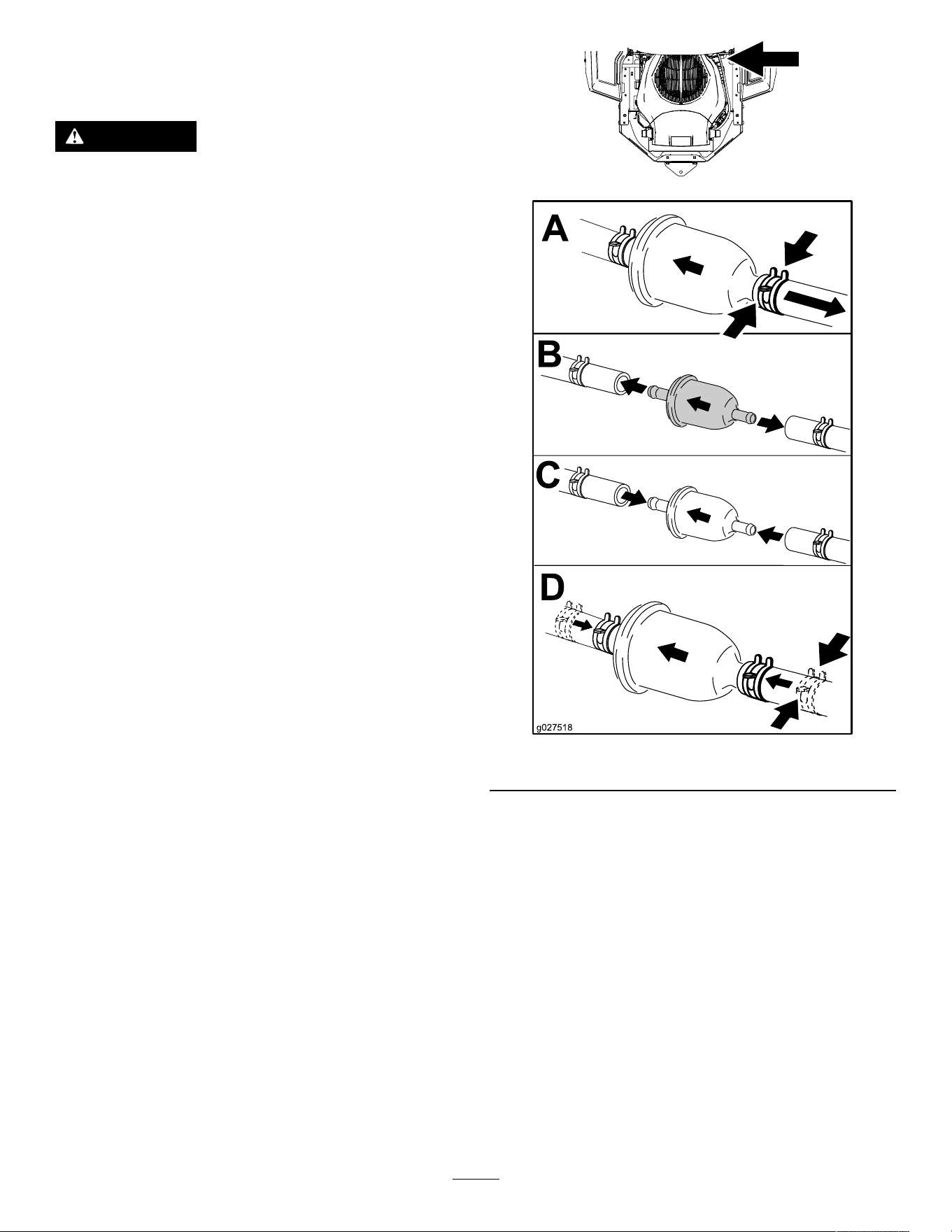
Never install a dirty lter after removing it from the
fuel line.
1. Park the machine on a level surface, disengage
the blade-control switch, and engage the parking
brake.
2. Shut off the engine, remove the key, and wait
for all moving parts to stop before leaving the
operating position.
3. Replace the lter (
Figure 45).
Note: Ensure that the ow-direction arrow on
the replacement lter points toward the engine.
g305646
g027518
Figure 45
Servicing the Fuel Tank
Do not attempt to drain the fuel tank. Ensure that an
Authorized Service Dealer drains the fuel tank and
services any components of the fuel system.
39
Electrical System
Maintenance
Electrical System Safety
• Disconnect the cable from the negative terminal of
the battery before repairing the machine.
• Charge the battery in an open, well-ventilated
area, away from sparks and ames. Unplug the
charger before connecting or disconnecting the
battery. Wear protective clothing and use insulated
tools.
Servicing the Battery
Service Interval: Monthly
Removing the Battery
WARNING
Battery terminals or metal tools could short
against metal machine components causing
sparks. Sparks can cause the battery gasses
to explode, resulting in personal injury.
• When removing or installing the battery,
do not allow the battery terminals to touch
any metal parts of the machine.
• Do not allow metal tools to short between
the battery terminals and metal parts of the
machine.
WARNING
Incorrectly removing the cables from battery
could damage the machine and cables,
causing sparks. Sparks can cause the battery
gasses to explode, resulting in personal
injury.
• Always disconnect the negative (black)
battery cable before disconnecting the
positive (red) cable.
• Always connect the positive (red) battery
cable before connecting the negative
(black) cable.
1. Park the machine on a level surface, disengage
the blade-control switch (PTO), and engage the
parking brake.
2. Shut off the engine, remove the key, and wait
for all moving parts to stop before leaving the
operating position.
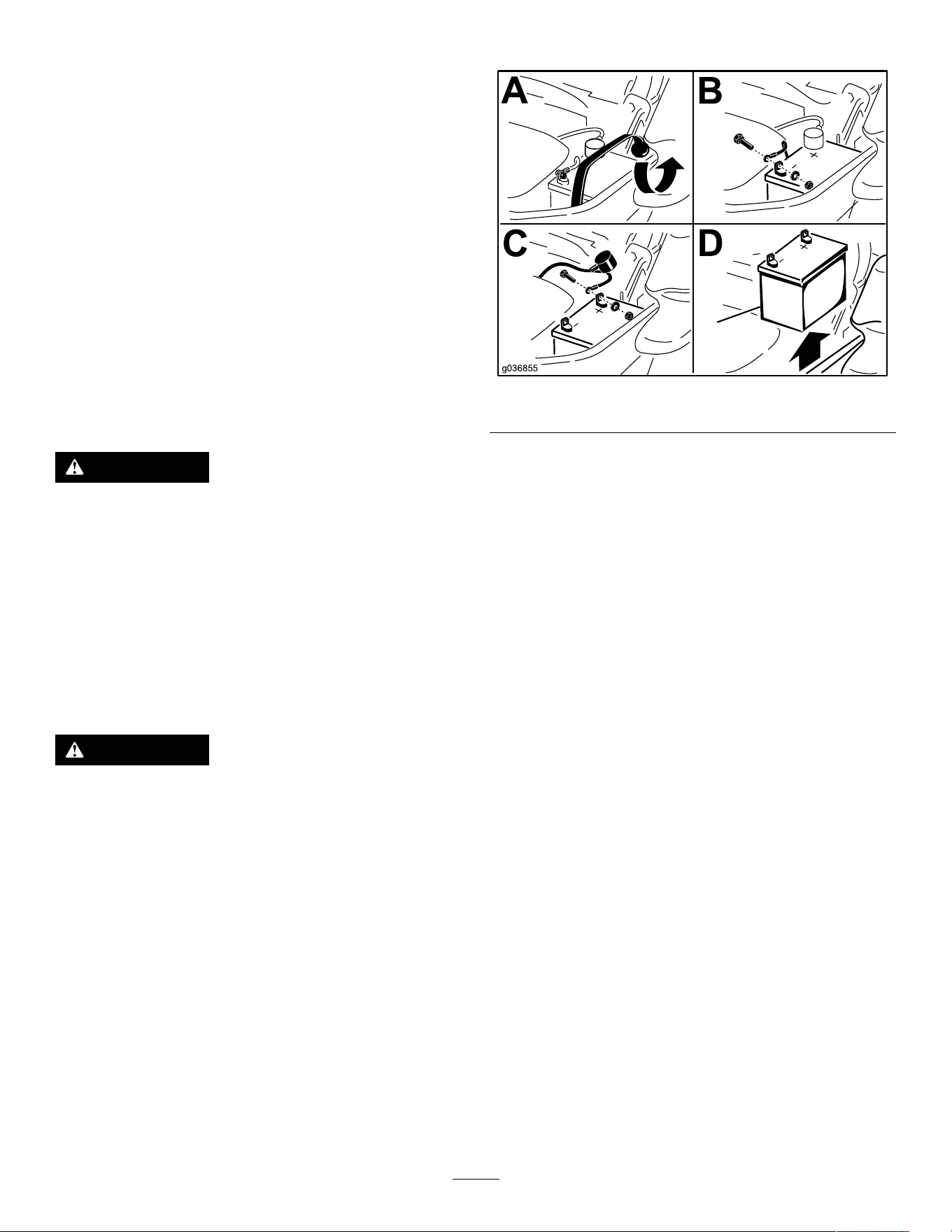
3. Remove the battery as shown in
Figure 46.
g036855
Figure 46
40
Charging the Battery
WARNING
Charging the battery produces gasses that
can explode.
Never smoke near the battery and keep sparks
and ames away from the battery.
Important: Always keep the battery fully charged
(1.265 specic gravity). This is especially
important to prevent battery damage when the
temperature is below 0°C (32°F).
1. Remove the battery from the chassis; refer to
Removing the Battery (page 40).
2. Charge the battery for 10 to 15 minutes at 25 to
30 A or for 30 minutes at 10 A.
Note: Do not overcharge the battery.
3. When the battery is fully charged, unplug
the charger from the electrical outlet, then
disconnect the charger leads from the battery
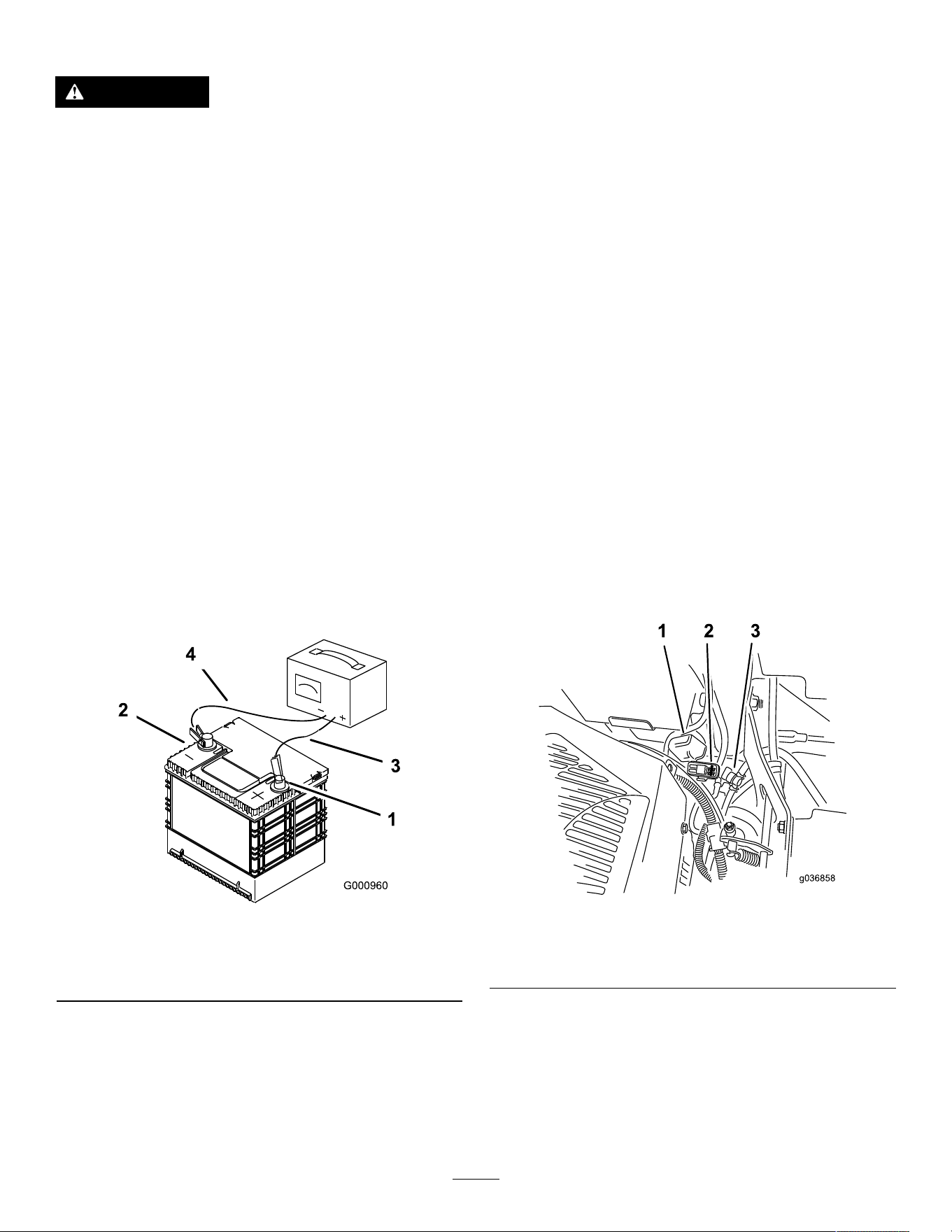
posts (
Figure 47).
4. Install the battery in the machine and connect
the battery cables; refer to
Installing the Battery
(page 41)
.
Note: Do not run the machine with the battery
disconnected; electrical damage may occur.
g000960
Figure 47
1. Positive (+) battery post 3. Red (+) charger lead
2. Negative (–) battery post 4. Black (–) charger lead
Installing the Battery
1. Position the battery in the tray with the terminal
posts opposite from the hydraulic tank (
Figure
46
).
2. Install the positive (red) battery cable to the
positive (+) battery terminal.
3. Install the negative (black) battery cable and
ground wire to the negative (-) battery terminal.
4. Secure the cables with 2 bolts, 2 washers, and
2 locknuts (
Figure 46).
5. Slide the red terminal boot onto the positive (+)
battery terminal.
6. Secure the battery with the rubber strap (
Figure
46
).
Servicing the Fuses
The electrical system is protected by fuses. It requires
no maintenance; however, if a fuse blows check the
component and circuit for a malfunction or short.
The fuses are located on the right console next to the
seat (
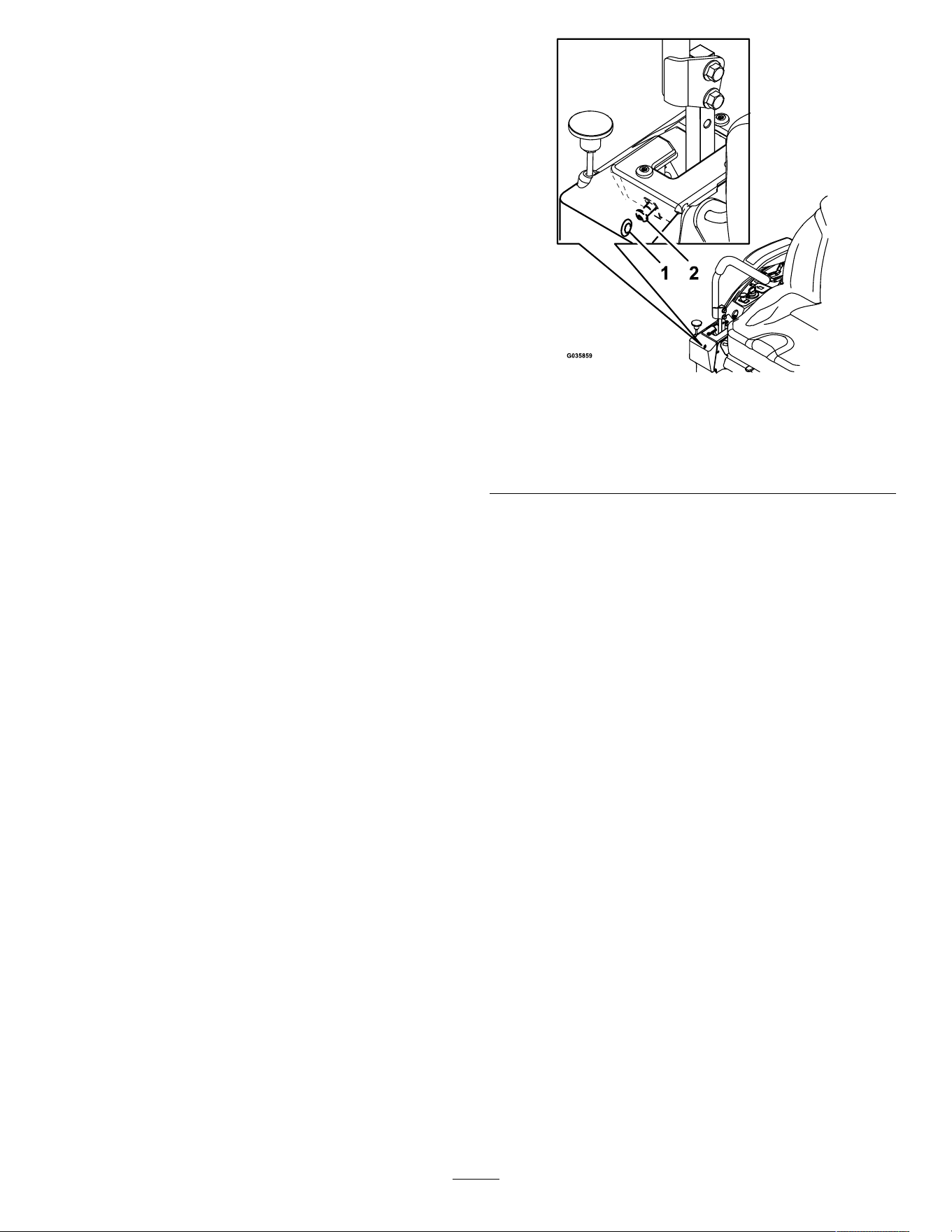
Figure 48).
1. To replace the fuses, pull out the fuse to remove
it.
2. Install a new fuse (
Figure 48).
g036858
Figure 48
1. Fuse cover
3. Fuel-shutoff valve
2. Fuse holder
41
Drive System
Maintenance
Checking the Seat Belt
Service Interval: Before each use or daily
Inspect the seat belt for wear, cuts, and proper
operation of the retractor and buckle. Replace the
seat belt if it is damaged.
Adjusting the Tracking
1. Disengage the blade-control switch (PTO).
2. Drive to an open, at area and move the
motion-control levers to the NEUTRAL-LOCK
position.
3. Move the throttle midway between the FAST and
SLOW positions.
4. Move both motion-control levers forward until
they both hit the stops in the T-slot.
5. Check which way the machine tracks.
6. If the machine tracks to the right, insert a 3/16
inch hex wrench through the access hole in the
right front cover panel and rotate the tracking
screw clockwise or counterclockwise to adjust
the travel of the lever (
Figure 49).
7. If the machine tracks to the left, insert a 3/16
inch hex wrench through the access hole in the
right front cover panel and rotate the tracking
screw clockwise or counterclockwise to adjust
the travel of the lever (
Figure 49).
8. Drive the machine and check the full forward
tracking.
9. Repeat the adjustment until the desired tracking
is obtained.
g035859
Figure 49
Right control lever shown
1. Access hole on front cover
panel
2. Tracking screw
42
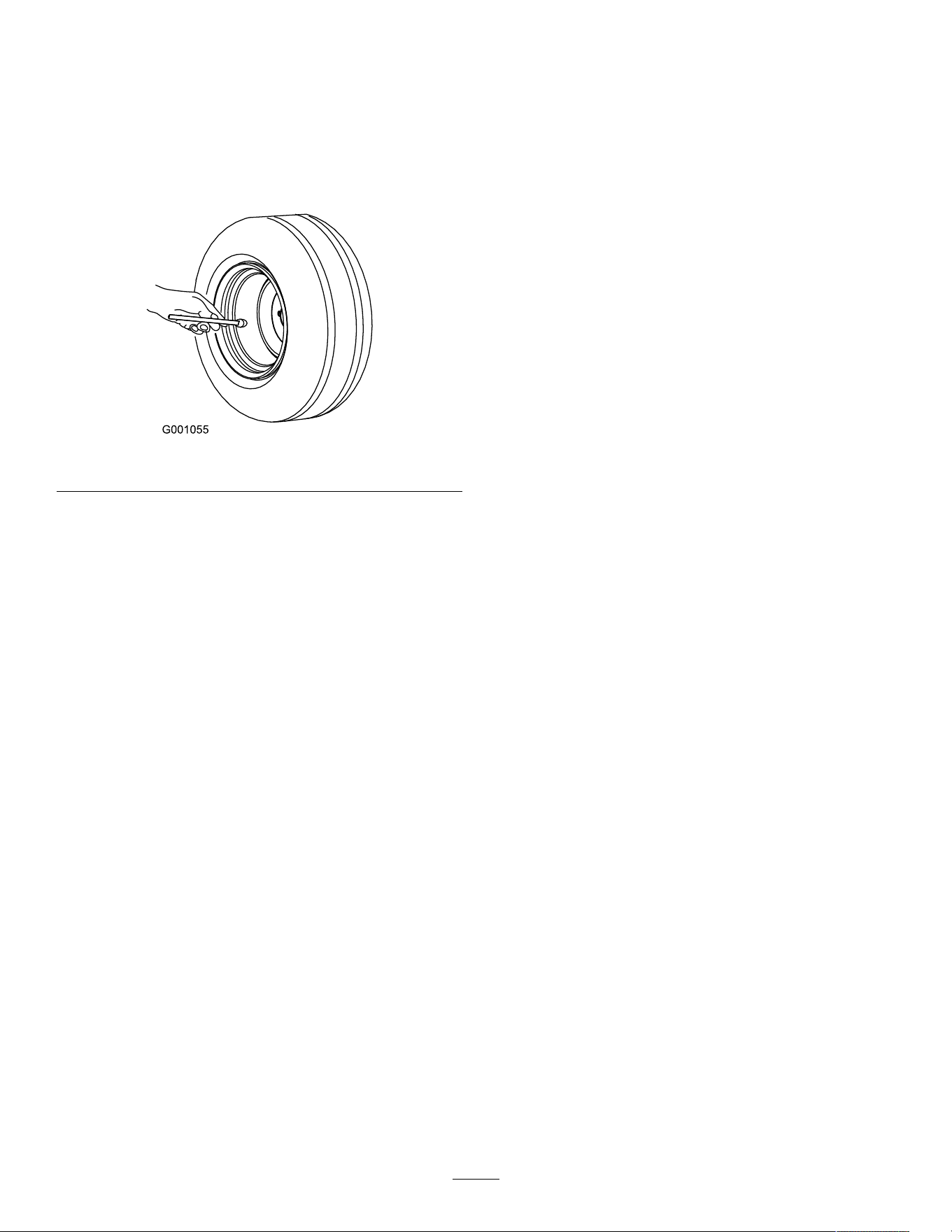
Checking the Tire Pressure
Service Interval: Every 50 hours/Monthly (whichever
comes rst)
Maintain the air pressure in the front and rear tires
at 90 kPa (13 psi). Uneven tire pressure can cause
uneven cut. Check the tires when they are cold to get
the most accurate pressure reading.
g001055
Figure 50
Checking the Wheel Lug
Nuts
Check and torque the wheel lug nuts to 122 to 136
N∙m (90 to 100 ft-lb).
Cooling System
Maintenance
Cleaning the Engine Screen
Service Interval: Before each use or daily
Before each use or daily
Before each use remove any buildup of grass, dirt, or
other debris from the engine screen, engine exhaust,
and the area around the engine. This helps ensure
adequate cooling and correct engine speed and
reduces the possibility of overheating and mechanical
damage to the engine.
43
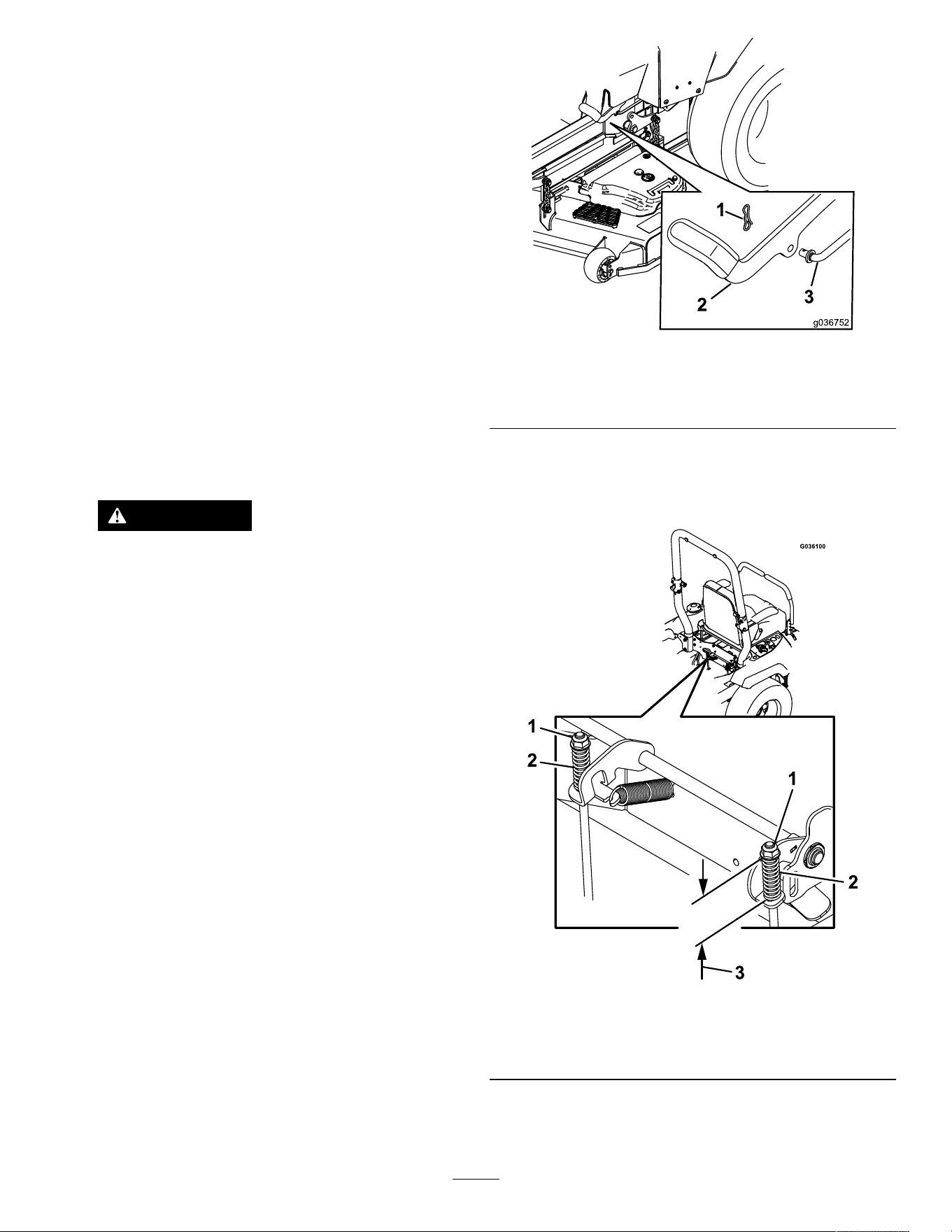
Brake Maintenance
Adjusting the Parking
Brake
Service Interval: Every 500 hours
Note: Perform this procedure whenever you remove
or replace a brake component.
1. Park the machine on a level surface, disengage
the blade-control switch (PTO), and engage the
parking brake.
2. Shut off the engine, remove the key, and wait
for all moving parts to stop before leaving the
operating position.
3. Set up the machine to be pushed by hand.
Refer to
Using the Drive-Wheel Release Valves
(page 29)
.
4. Raise the back of the machine up and support
the machine with jack stands.
WARNING
Relying solely on mechanical or
hydraulic jacks to support a raised
machine for service or maintenance
could be dangerous because the jacks
may not provide enough support or may
malfunction, allowing the machine to fall
and possibly cause serious injury.
Do not rely solely on mechanical
or hydraulic jacks for support. Use
adequate jack stands or equivalent
support.
5. Engage and disengage the parking brake and
check each drive tire to ensure that each brake
engages and disengages.
6. If an adjustment is necessary, disengage the
parking brake. Remove the cotter pin from the
brake linkage shaft (
Figure 51).
g036752
Figure 51
1. Cotter pin 3. Brake linkage shaft
2. Parking brake
7. Check both spring lengths as shown in Figure
52
. If an adjustment is necessary, turn the
top nut clockwise to shorten the spring and
counterclockwise to lengthen it.
g036100
Figure 52
1. Top nut
3. 44 mm (1-3/4 inches)
2. Spring
8. Push the parking brake lever all the way forward
and down.
44
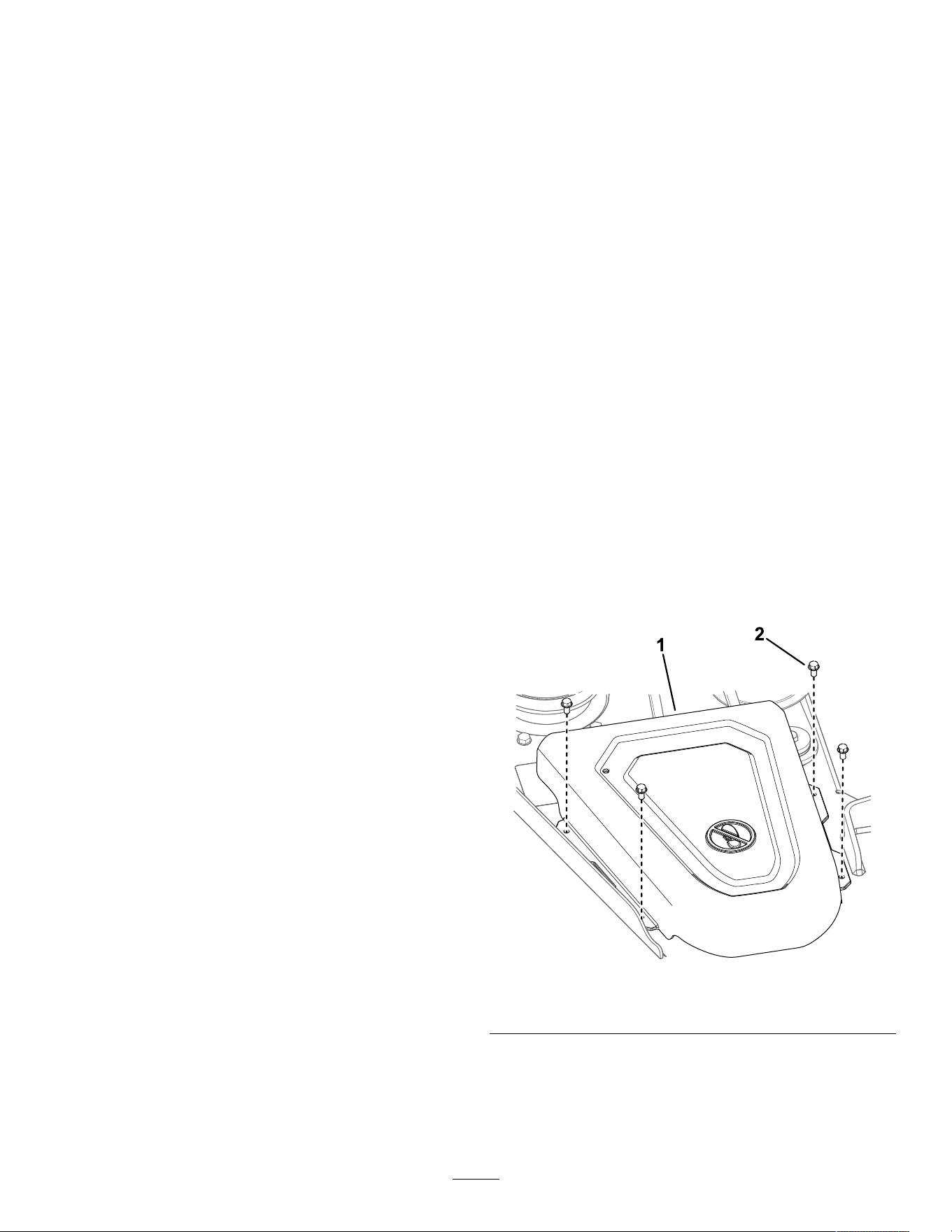
9. Rotate the brake-linkage shaft until the end
aligns with the hole in the lever.
• Shorten the linkage by turning it clockwise.
• Lengthen the linkage by turning it
counterclockwise.
10. Insert the brake-linkage shaft into the
parking-brake hole and secure with the cotter
pin. Repeat step
5 and adjust if necessary.
11. When adjustment is complete, remove the jack
stands or equivalent support and lower the
machine.
12. Place the machine into the OPERATING position.
Refer to
Using the Drive-Wheel Release Valves
(page 29)
.
Belt Maintenance
Inspecting the Belts
Service Interval: Every 50 hours
Replace the belt if it is worn. The signs of a worn belt
include squealing while the belt is rotating; the blades
slipping while cutting grass; and frayed edges, burn
marks, and cracks on the belt.
Replacing the Mower Belt
The signs of a worn belt include squealing while the
belt is rotating, blades slipping while cutting grass,
and frayed edges, burn marks, and cracks on the belt.
Replace the mower belt if any of these conditions are
evident.
1. Park the machine on a level surface, disengage
the blade-control switch (PTO), and engage the
parking brake.
2. Shut off the engine, remove the key, and wait
for all moving parts to stop before leaving the
operating position.
3. Set the height of cut at the lowest cutting
position.
4. Remove the pulley covers (
Figure 53).
g297435
Figure 53
1. Cover 2. Screw
5. Loosen the nut securing the wire form to the
idler pulley (
Figure 54).
45
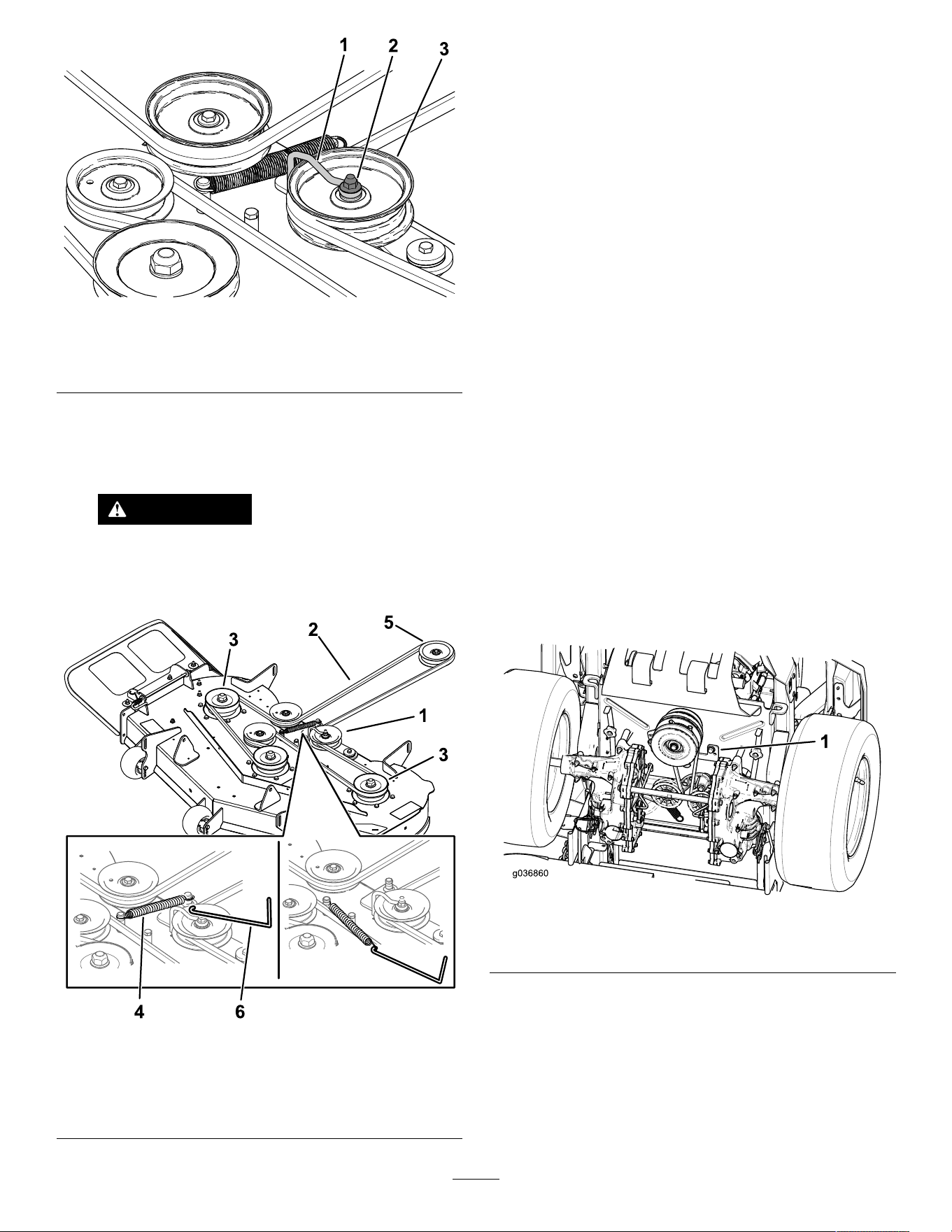
g334161
Figure 54
1. Wire form
3. Idler pulley
2. Nut
6. Using a spring-removal tool (Toro Part No.
92-5771), remove the idler spring from the deck
hook to remove tension on the idler pulley and
roll the belt off the pulleys (
Figure 55).
WARNING
The spring is under tension when
installed and can cause personal injury.
Be careful when removing the belt.
g297456
Figure 55
1. Idler pulley
4. Spring
2. Mower belt 5. Engine pulley
3. Outside pulley 6. Spring-removal tool
7. Route the new belt around the engine pulley and
mower pulleys (
Figure 55).
8. Using a spring-removal tool (Toro Part No.
92-5771), install the idler spring over the deck
hook and place tension on the idler pulley and
the mower belt (
Figure 55).
9. Tighten the nut securing the wire form to the
idler pulley (
Figure 54).
Note: Position the wireform against the idler
arm as shown in
Figure 54.
10. Install the pulley covers.
Replacing the Hydraulic
Pump-Drive Belt
1. Park the machine on a level surface, disengage
the blade-control switch (PTO), and engage the
parking brake.
2. Shut off the engine, remove the key, and wait
for all moving parts to stop before leaving the
operating position.
3. Remove the mower belt; refer to
Replacing the
Mower Belt (page 45)
.
4. Raise the machine and support it with jack
stands (
Figure 57).
5. Remove the clutch stop (
Figure 56).
g036860
Figure 56
1. Clutch stop
6. Remove the idler spring from the post (Figure
57
).
7. Remove the existing belt from the
hydraulic-pump-drive pulleys and the
engine pulley.
8. Install the new belt around the engine pulley and
the 2 hydraulic-pump pulleys (
Figure 57).
46
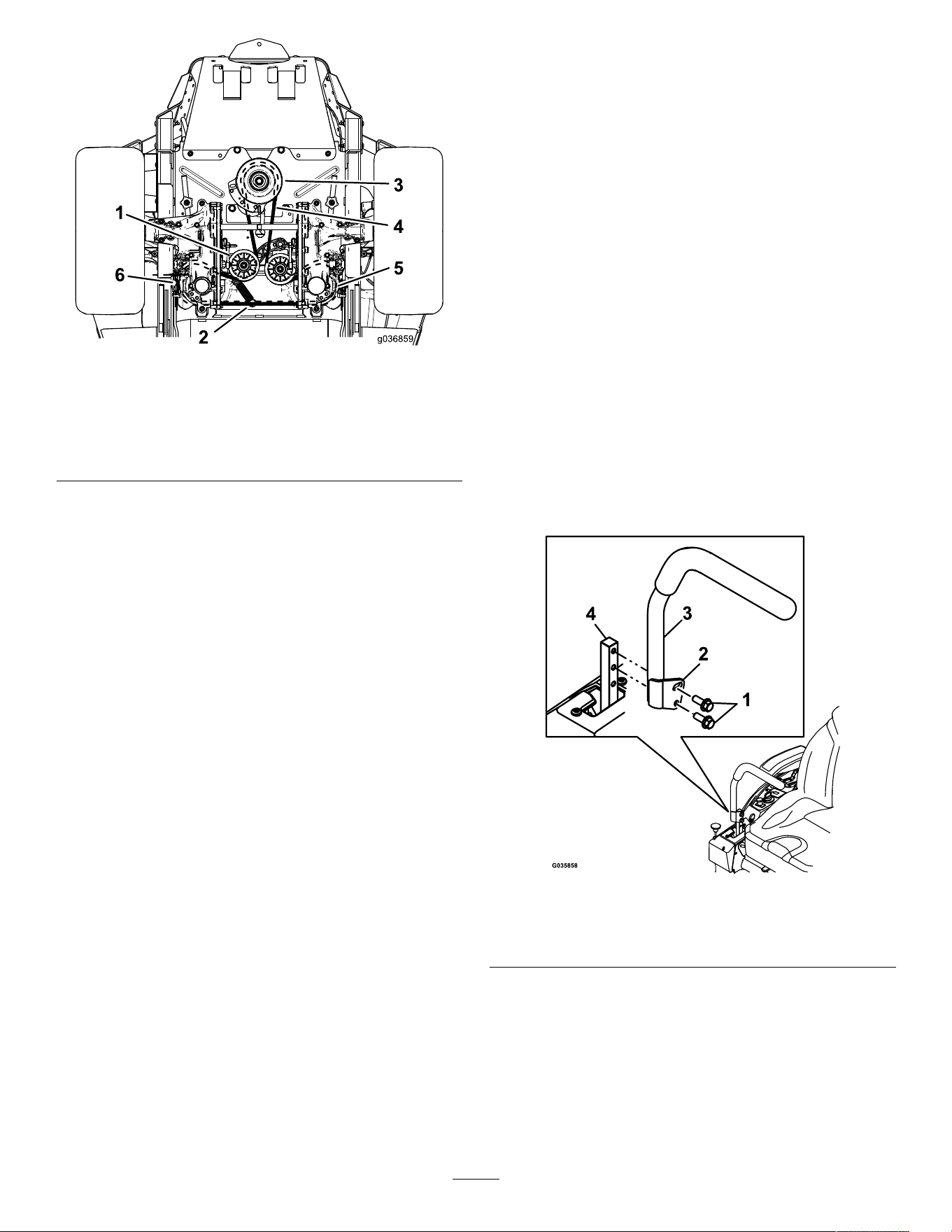
g036859
Figure 57
1. Idler pulley 4. Pump-drive belt
2. Idler-spring post 5. Right hydraulic-pump
pulley
3. Engine pulley
6. Left hydraulic-pump pulley
9. Install the clutch stop (Figure 56).
10. Install the mower belt; refer to
Belt Maintenance
(page 45)
.
Controls System
Maintenance
Adjusting the
Control-Handle Position
If the ends of the levers hit against each other, refer to
Adjusting the Motion-Control Linkage (page 48).
Adjusting the Height
You can adjust the motion control levers higher or
lower for maximum comfort.
1. Park the machine on a level surface, disengage
the blade-control switch (PTO), and engage the
parking brake.
2. Shut off the engine, remove the key, and wait
for all moving parts to stop before leaving the
operating position.
3. Remove the hardware holding the control lever
to the control-arm shaft.
g035858
Figure 58
1. Bolts
3. Control lever
2. Slotted hole 4. Control-arm shaft
4. Move the control lever to the next set of holes.
Secure the lever with the hardware.
5. Repeat the adjustment for the opposite control
lever.
47
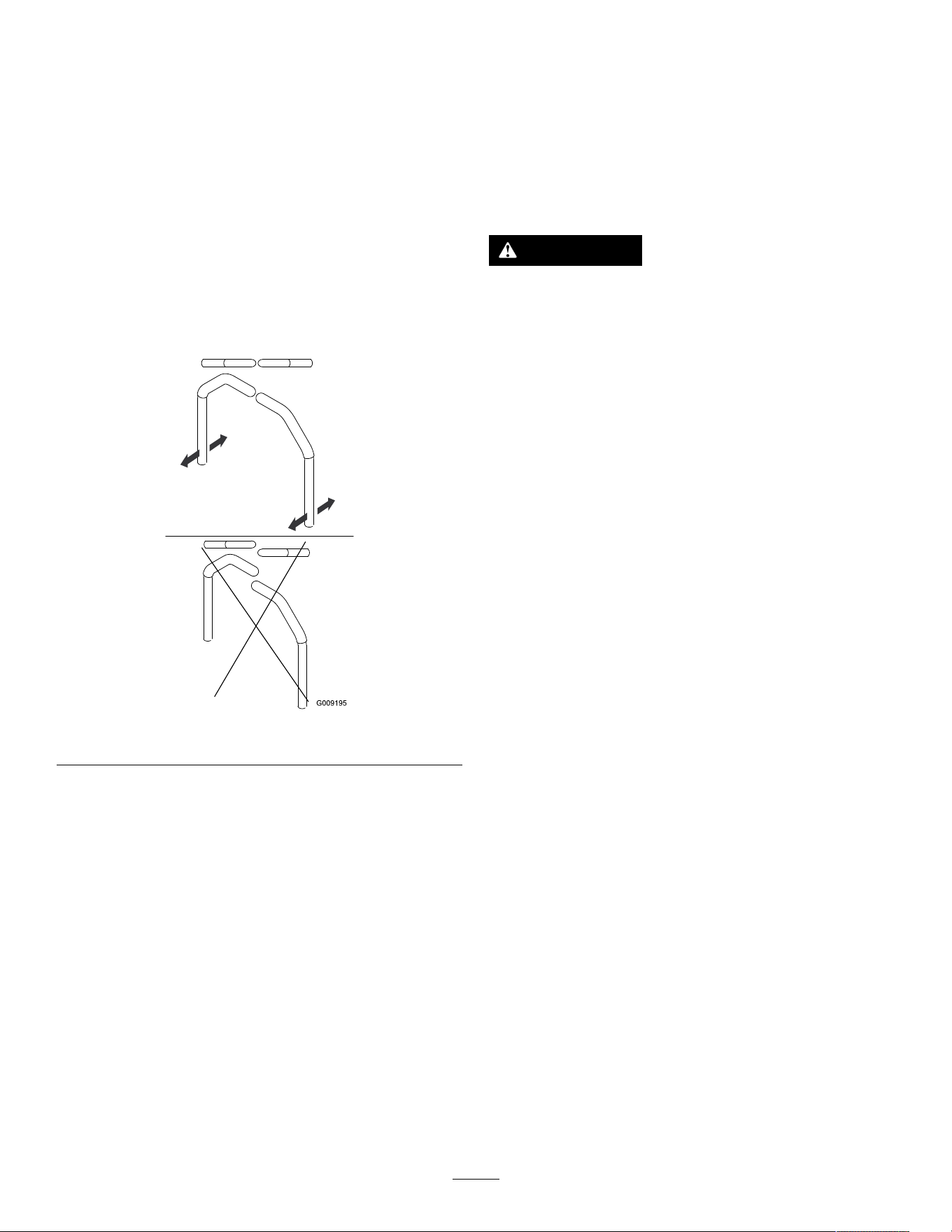
Adjusting the Tilt
1. Park the machine on a level surface, disengage
the blade-control switch (PTO), and engage the
parking brake.
2. Shut off the engine, remove the key, and wait
for all moving parts to stop before leaving the
operating position.
3. Loosen the upper bolt holding the control lever
to the control arm shaft.
4. Loosen the lower bolt just enough to pivot the
control lever fore or aft. Tighten both bolts to
secure the control in the new position.
5. Repeat the adjustment for the opposite control
lever.
g009195
Figure 59
Adjusting the
Motion-Control Linkage
Located on either side of the machine, below the seat,
are the pump-control linkages. Rotating the end nut
with a 1/2-inch deep socket wrench allows ne tuning
adjustments so that the machine does not move in
neutral. Any adjustments should be made for neutral
positioning only.
WARNING
The engine must be running and the drive
wheels turning so that you can perform the
adjustments. Contact with moving parts or
hot surfaces may cause personal injury.
Keep your ngers, hands, and clothing clear
of rotating components and hot surfaces.
1. Park the machine on a level surface, disengage
the blade-control switch (PTO), and engage the
parking brake.
2. Shut off the engine, remove the key, and wait
for all moving parts to stop before leaving the
operating position.
3. Push the deck-lift pedal, remove the height-of-cut
pin, and lower the mower deck to the ground
4. Raise the rear of the machine up and support it
with jack stands (or equivalent support) just high
enough to allow the drive wheels to turn freely.
5. Remove the electrical connection from the seat
safety switch, located under the bottom cushion
of the seat.
Note: The switch is a part of the seat assembly.
6. Temporarily install a jumper wire across the
terminals in the connector of the main wire
harness.
7. Start the engine, run it at full throttle, and
disengage the parking brake.
Note: Before starting the engine, ensure that
the parking brake is engaged and that the
motion-control levers are out. You do not have
to be in the seat.
8. Run the machine at least 5 minutes with the
drive levers at full forward speed to bring the
hydraulic uid up to the operating temperature.
Note: The motion-control levers must be in
neutral while you are making any adjustments.
9. Bring the motion-control levers into the NEUTRAL
position.
10. Check and ensure that the control-plate tabs
touch the return-to-neutral plates on the
hydraulic units.
48
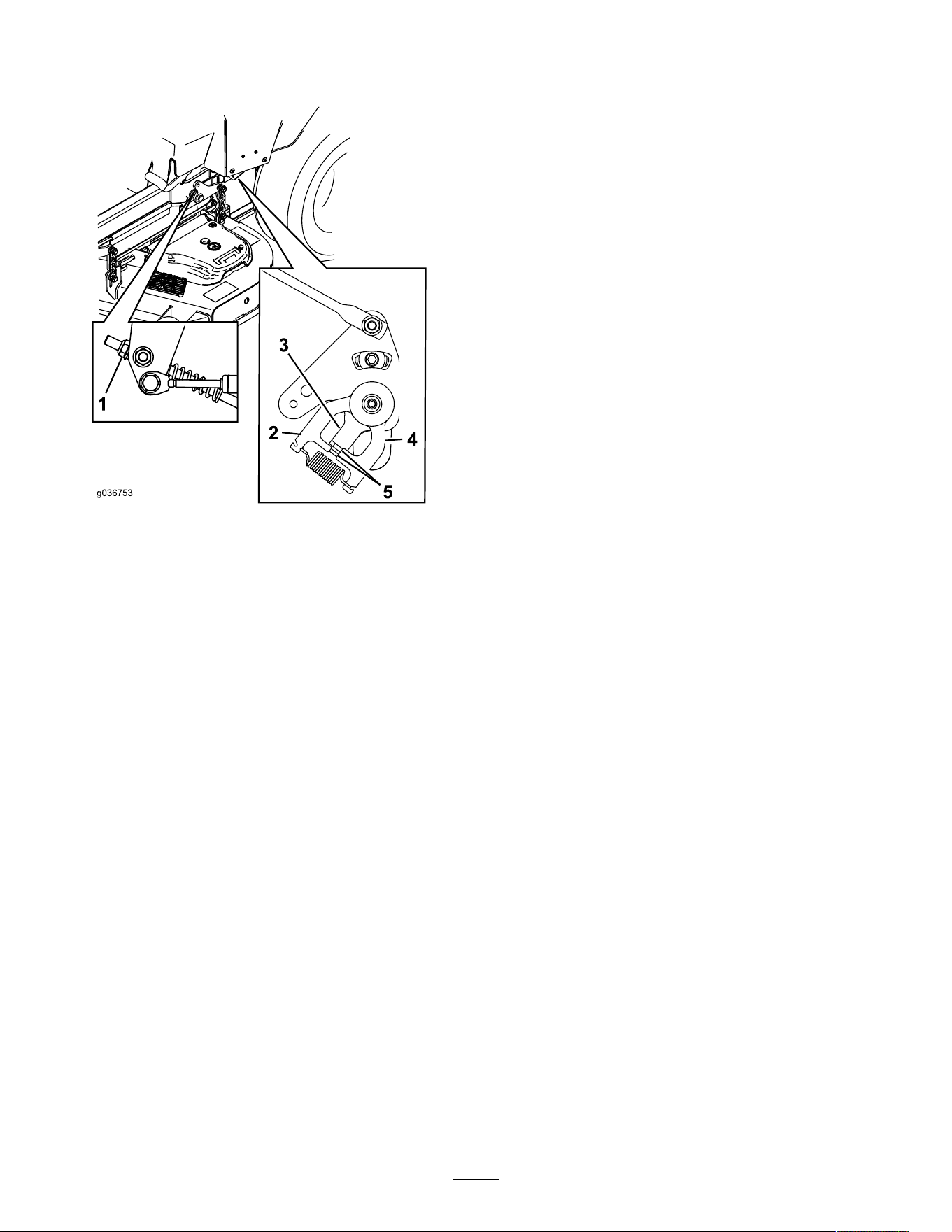
11. Adjust the pump-control-rod lengths by rotating
the nut in the appropriate direction until the
wheels slightly creep in reverse (
Figure 60).
g036753
Figure 60
1. Nut 4. Return-to-neutral plate
2. Stationary plate
5. Tabs touching return to
neutral plate
3. Control plate
12. Move the motion-control levers to the REVERSE
position and while applying slight pressure to
the lever, allow the reverse-indicator springs to
bring the levers back to neutral.
Note: The wheels should stop turning or slightly
creep in reverse.
Note: You may need to remove the
motion-control cover to gain access.
13. Shut off the machine.
14. Remove the jumper wire from the wire harness
and plug the connector into the seat switch.
15. Remove the jack stands.
16. Raise the mower deck and install the
height-of-cut pin.
17. Check and ensure that the machine does
not creep in neutral with the parking brake
disengaged.
Hydraulic System
Maintenance
Hydraulic System Safety
• Seek immediate medical attention if uid is injected
into skin. Injected uid must be surgically removed
within a few hours by a doctor.
• Ensure that all hydraulic-uid hoses and lines are
in good condition and all hydraulic connections
and ttings are tight before applying pressure to
the hydraulic system.
• Keep your body and hands away from pinhole
leaks or nozzles that eject high-pressure hydraulic
uid.
• Use cardboard or paper to nd hydraulic leaks.
• Safely relieve all pressure in the hydraulic system
before performing any work on the hydraulic
system.
Hydraulic Fluid
Specications
Hydraulic Fluid Type: Toro
®
HYPR-OIL
™
500
hydraulic uid or Mobil 1 15W-50 oil.
Important: Use the specied uid. Other uids
could damage the hydraulic system.
Hydraulic System Capacity (with lters removed):
4.45 L (150 oz)
49
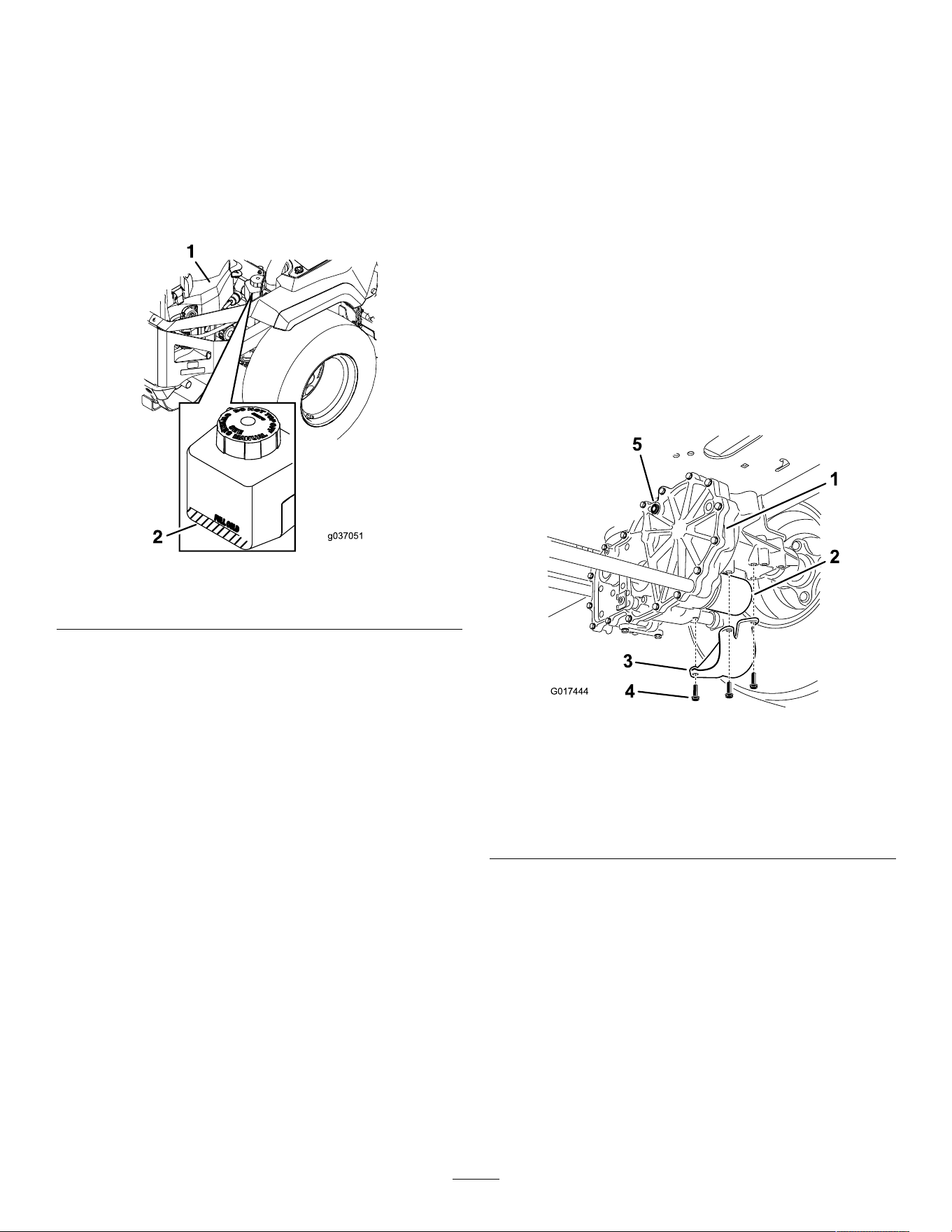
Checking the Hydraulic
Fluid Level
Service Interval: Before each use or daily
1. Allow the hydraulic uid to cool down. Check the
oil level when the uid is cold.
2. Check expansion reservoir and if necessary
add Toro
®
HYPR-OIL
™
500 hydraulic uid to the
FULL COLD line.
g037051
Figure 61
1. Engine 2. Expansion tank
Changing the Hydraulic
Fluid and Filters
Service Interval: After the rst 75 hours—Change the
hydraulic-system lters and uid.
Every 250 hours—After the initial
change—change the hydraulic-system
lters and uid when using Mobil 1 15W50
uid. (Change it more often under dirty or dusty
conditions)
Every 500 hours—After the initial
change—change the hydraulic-system
lters and uid when using Toro
®
HYPR-OIL
™
500 uid. (Change it more often under dirty or
dusty conditions)
To replace the hydraulic uid, the lters need to be
removed. Replace both at the same time; refer to
Hydraulic Fluid Specications (page 49) for uid
specications.
Purge any air in the system after you install the new
lters and add uid. Refer to
Bleeding the Hydraulic
System (page 52)
. Repeat the bleeding process until
the uid remains at the FULL COLD line in the reservoir
after purging. Failure to properly perform this
procedure can result in irreparable damage to the
transaxle drive system.
Removing Hydraulic-System
Filters
1. Park the machine on a level surface, disengage
the blade-control switch (PTO), and engage the
parking brake.
2. Shut off the engine, remove the key, and wait
for all moving parts to stop before leaving the
operating position.
3. Allow the engine to cool.
4. Locate the lter and guards on each
transaxle-drive system (
Figure 62).
5. Remove the 3 screws securing the lter guard
and guard (
Figure 62).
g017444
Figure 62
Right side shown
1. Transaxle drive
4. Screws
2. Filter 5. Vent plug
3. Filter guard
6. Carefully clean the area around the lters.
Important: Do not allow dirt to enter the
hydraulic system, or contamination may
occur.
7. Place a drain pan below the lter to catch the
uid that drains when the lter and vent plugs
are removed.
8. Locate and remove the vent plug on each
transmission
9. Unscrew the lter to remove it, and allow the
uid to drain from the drive system.
10. Repeat this procedure for both lters.
50
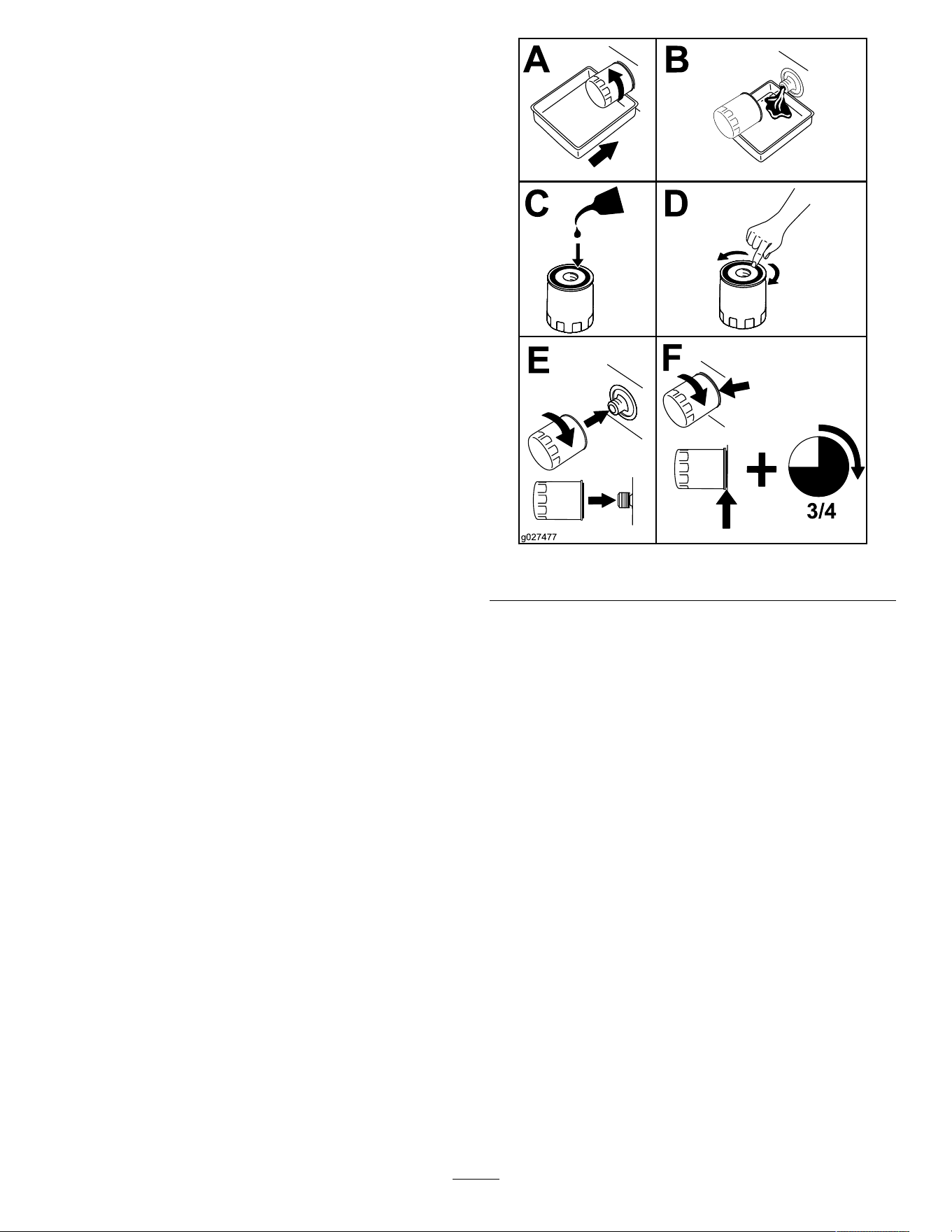
Installing the Hydraulic-System
Filters
1. Apply a thin coat of hydraulic uid on the surface
of the rubber seal of each lter.
2. Turn the lter clockwise until the rubber seal
contacts the lter adapter, then tighten the lter
an additional 3/4 to 1 full turn.
3. Repeat for the opposite lter.
4. Install the lter guards over each lter that you
previously removed.
5. Use the 3 screws to secure the lter guards.
6. Verify that the vent plugs are removed before
adding the uid.
7. Slowly pour the specied uid through the
expansion reservoir until uid comes out of 1
of the vent-plug holes.
8. Install the vent plug.
9. Torque the plug to 20 N∙m (15 ft-lb).
10. Continue to add uid through the expansion
reservoir until uid comes out of the remaining
vent-plug hole on the second transmission.
11. Install the opposite vent plug.
12. Torque the plug to 20 N∙m (15 ft-lb).
13. Continue to add uid through the expansion
reservoir until it reaches the FULL COLD line on
the expansion reservoir.
14. Proceed to
Bleeding the Hydraulic System
(page 52)
.
Important: Failure to perform the Bleeding
the Hydraulic System procedure after
changing hydraulic lters and uid can
result in irreparable damage to the transaxle
drive system.
g027477
Figure 63
51
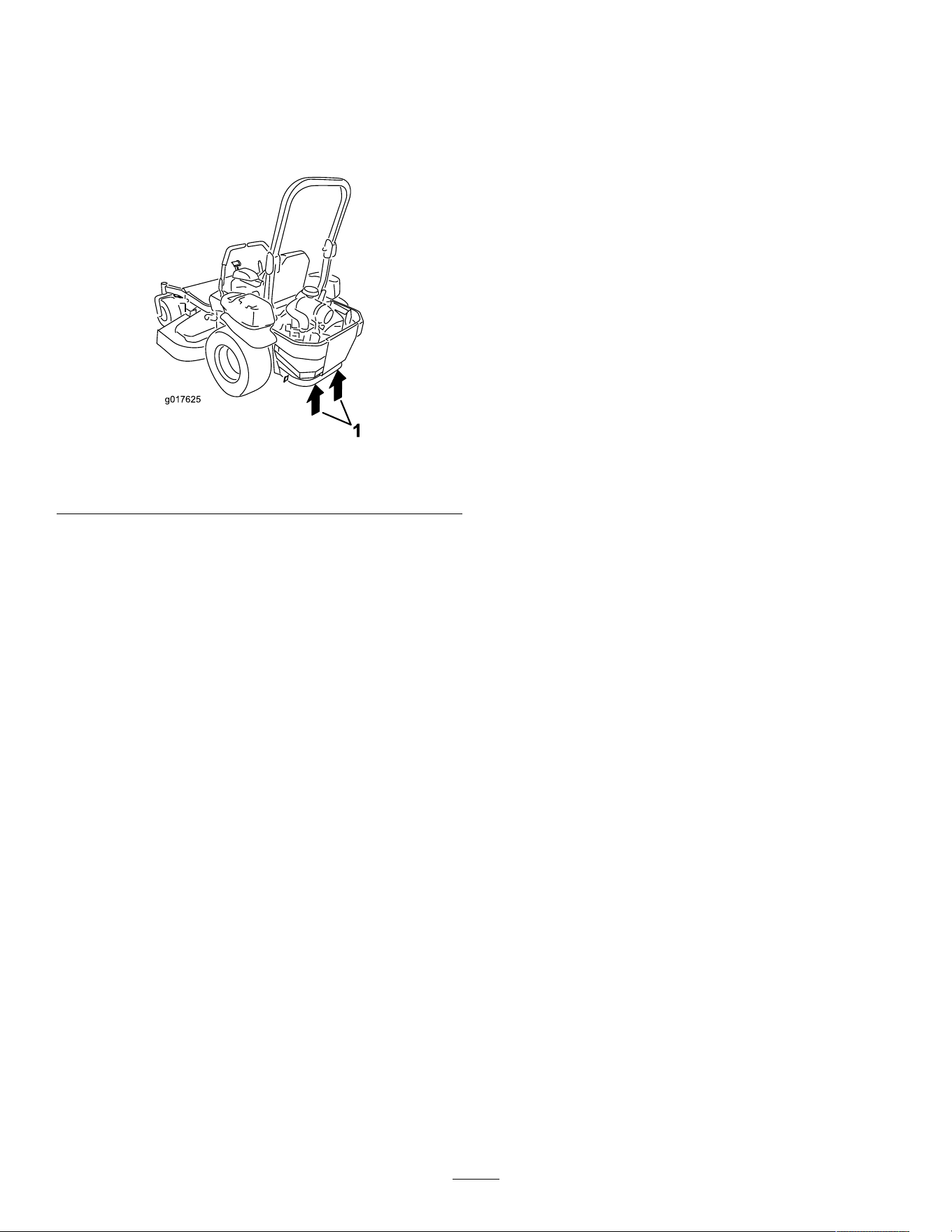
Bleeding the Hydraulic
System
1. Raise the rear of machine and support it with
jack stands (or equivalent support) just high
enough to allow the drive wheels to turn freely.
g017625
Figure 64
1. Jacking points
2. Start the engine, move the throttle control ahead
to the 1/2 throttle position, and disengage the
parking brake.
A. Move the bypass levers into the pushing the
machine position. With the bypass valves
open and the engine running, slowly move
the motion-control levers in both forward
and reverse 5 or 6 times.
B. Move the bypass levers into the operating
the machine position.
C. With the bypass valve closed and the
engine running, slowly move the control
lever in both forward and reverse directions
5 to 6 times.
D. Shut off the engine and check the uid
level in the expansion reservoir. Add the
specied uid until it reaches the FULL COLD
line on the expansion reservoir.
3. Repeat step
2 until all the air is completely
purged from the system.
Note: When the transaxle operates at normal
noise levels, moves smoothly forward, and
reverses at normal speeds, it is purged.
4. Check the uid level in the expansion reservoir
a nal time. Add the specied uid as until it
reaches the FULL COLD line on the expansion
reservoir.
Mower Deck
Maintenance
Blade Safety
• Inspect the blades periodically for wear or damage.
• Use care when checking the blades. Wrap the
blades or wear gloves, and use caution when
servicing the blades. Only replace or sharpen the
blades; never straighten or weld them.
• On multi-bladed machines, take care as rotating
one blade can cause other blades to rotate.
• Replace worn or damaged blades and bolts in sets
to preserve balance.
Servicing the Cutting
Blades
Before Inspecting or Servicing the
Blades
1. Park the machine on a level surface, disengage
the blade-control switch (PTO), and engage the
parking brake.
2. Shut off the engine, remove the key, and
disconnect the spark-plug wires from the spark
plugs.
Inspecting the Blades
Service Interval: Before each use or daily
1. Inspect the cutting edges (
Figure 65).
2. If the edges are not sharp or have nicks, remove
and sharpen the blade; refer to
Sharpening the
Blades (page 54)
.
3. Inspect the blades, especially in the curved area.
4. If you notice any cracks, wear, or a slot forming
in this area, immediately install a new blade
(
Figure 65).
52
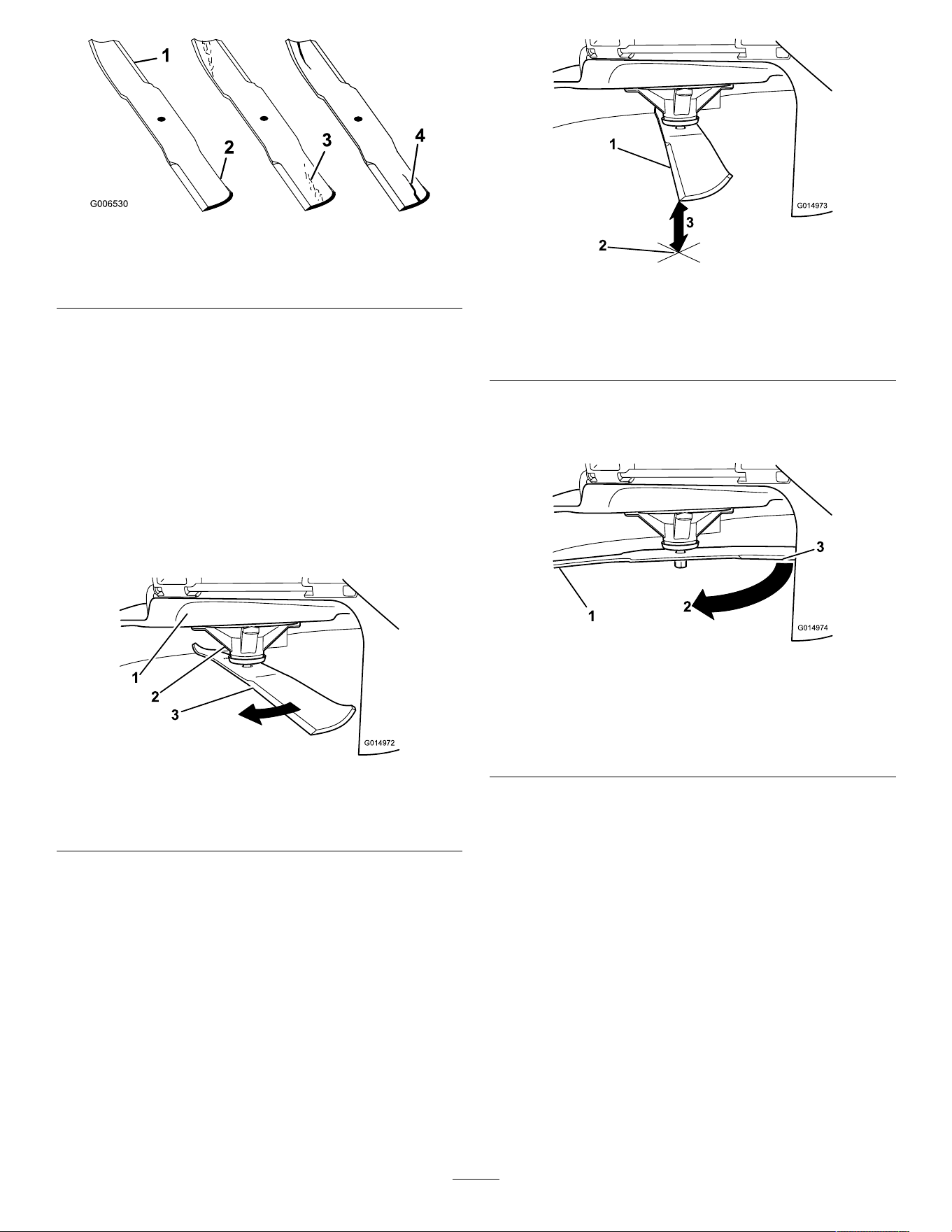
g006530
Figure 65
1. Cutting edge 3. Wear/slot forming
2. Curved area 4. Crack
Checking for Bent Blades
Note: The machine must be on a level surface for
the following procedure.
1. Raise the mower deck to the highest
height-of-cut position.
2. While wearing thickly padded gloves, or other
adequate hand protection, slowly rotate the
blade into a position that allows you to measure
the distance between the cutting edge and the
level surface the machine is on (
Figure 66).
g014972
Figure 66
1. Deck 3. Blade
2. Spindle housing
3. Measure from the tip of the blade to the at
surface (
Figure 67).
g014973
Figure 67
1. Blade (in position for measuring)
2. Level surface
3. Measured distance between blade and the surface (A)
4. Rotate the same blade 180 degrees so that
the opposing cutting edge is now in the same
position (
Figure 68).
g014974
Figure 68
1. Blade (side previously measured)
2. Measurement (position used previously)
3. Opposing side of blade being moved into measurement
position
5. Measure from the tip of the blade to the at
surface (
Figure 69).
Note: The variance should be no more than
3 mm (1/8 inch).
53
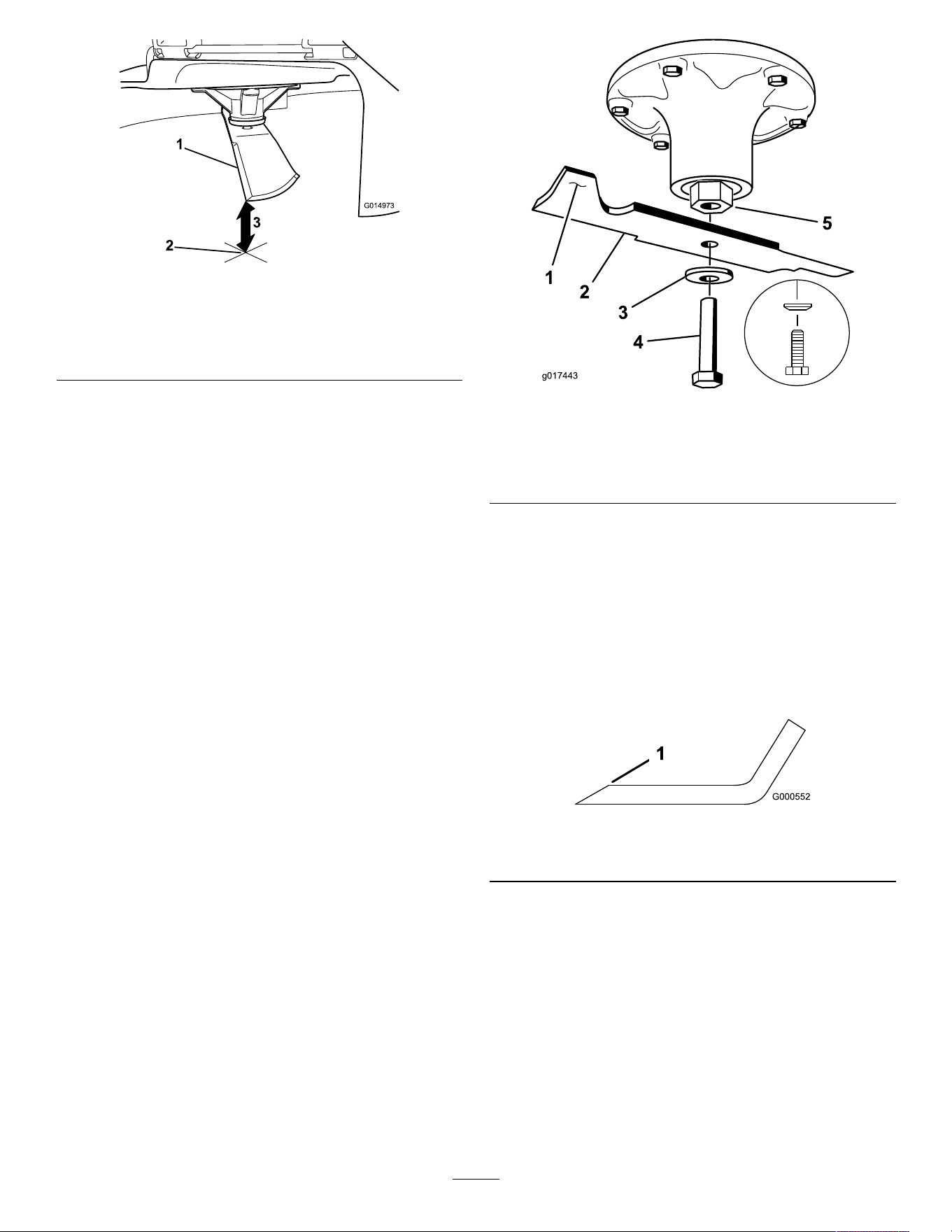
g014973
Figure 69
1. Opposite blade edge (in position for measuring)
2. Level surface
3. Second measured distance between blade and surface (B)
A. If the difference between A and B is greater
than 3 mm (1/8 inch), replace the blade with
a new blade; refer to
Removing the Blades
(page 54)
and Installing the Blades (page
55)
.
Note: If a bent blade is replaced with a
new blade, and the dimension obtained
continues to exceed 3 mm (1/8 inch), the
blade spindle could be bent. Contact an
Authorized Service Dealer for service.
B. If the variance is within constraints, move to
the next blade.
6. Repeat this procedure on each blade.
Removing the Blades
Replace the blades if they hit a solid object, or if the
blade is out of balance or bent.
1. Hold the spindle shaft with a wrench.
2. Remove the blade bolt, curved washer, and
blade from the spindle shaft (
Figure 70).
g017443
Figure 70
1. Sail area of the blade
4. Blade bolt
2. Blade
5. Spindle shaft
3. Curved washer
Sharpening the Blades
1. Use a le to sharpen the cutting edge at both
ends of the blade (
Figure 71).
Note: Maintain the original angle.
Note: The blade retains its balance if the same
amount of material is removed from both cutting
edges.
g000552
Figure 71
1. Sharpen at original angle.
2. Check the balance of the blade by putting it on a
blade balancer (
Figure 72).
Note: If the blade stays in a horizontal position,
the blade is balanced and can be used.
Note: If the blade is not balanced, le some
metal off the end of the sail area only (
Figure 71).
54
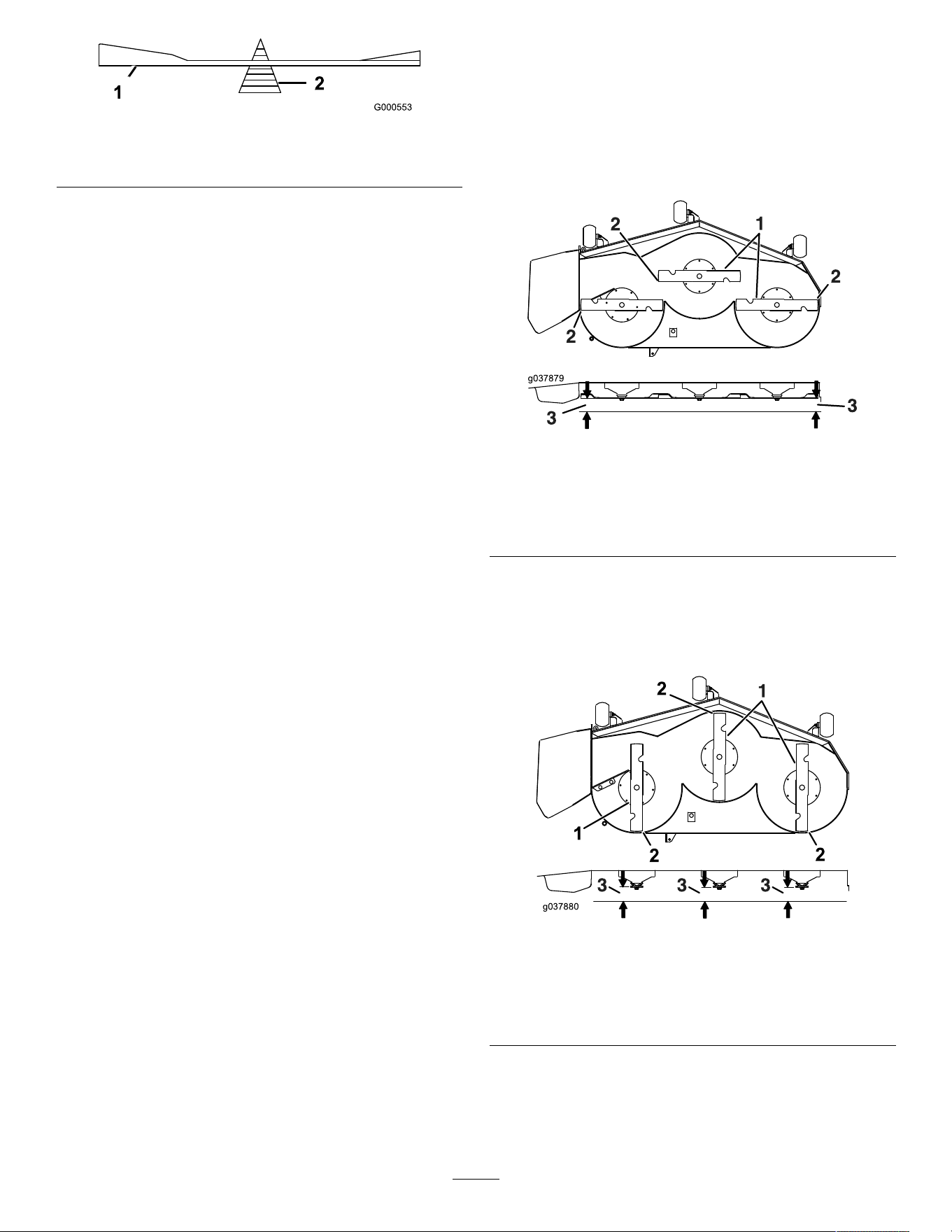
g000553
Figure 72
1. Blade 2. Balancer
3. Repeat this procedure until the blade is
balanced.
Installing the Blades
1. Install the blade onto the spindle shaft (
Figure
70
).
Important: The curved part of the blade
must point upward toward the inside of the
mower to ensure proper cutting.
2. Install the curved washer and blade bolt (Figure
70
).
Note: Install the curved-washer cone toward
the bolt head.
3. Torque the blade bolt to 115 to 150 N∙m (85 to
110 ft-lb).
Adjusting the Side-to-Side
Leveling and the Blade
Slope
Check to ensure that the mower deck is level any time
you install the mower or when you see an uneven cut
on your lawn.
Check the mower deck for bent blades prior to
leveling, and remove and replace any bent blades;
refer to
Servicing the Cutting Blades (page 52) before
continuing.
Level the mower deck side-to-side rst; then you can
adjust the front-to-rear slope.
Requirements:
• The machine must be on a level surface.
• All tires must be properly inated; refer to
Checking
the Tire Pressure (page 43)
.
1. Park the machine on a level surface, disengage
the blade-control switch (PTO), and engage the
parking brake.
2. Shut off the engine, remove the key, and wait
for all moving parts to stop before leaving the
operating position.
3. Check the tire pressure in the drive tires; refer to
Checking the Tire Pressure (page 43).
4. Position the mower deck in the transport-lock
position.
5. Carefully rotate the blades from side to side.
6. Measure between the blade tip and the at
surface (
Figure 73). If both measurements are
not within 5 mm (3/16 inch), adjust the leveling;
continue with this procedure.
g037879
Figure 73
1. Blades side to side
3. Measure from the tip of the
blade to the at surface
here.
2. Blade tip
7. Check the front-to-rear blade level (Figure 74).
Ensure the front blade tip is lower than the rear
blade tip as shown in the block height and rake
table. If adjustment is needed, continue with this
procedure.
g037880
Figure 74
1. Blades front to rear 3. Measure from the tip of the
blade to the at surface
here.
2. Blade tip
8. Set the anti-scalp rollers to top holes or remove
them completely for this adjustment.
9. Place 2 blocks (see Block Height and Rake
Table) under the rear edge of the cutting deck
55
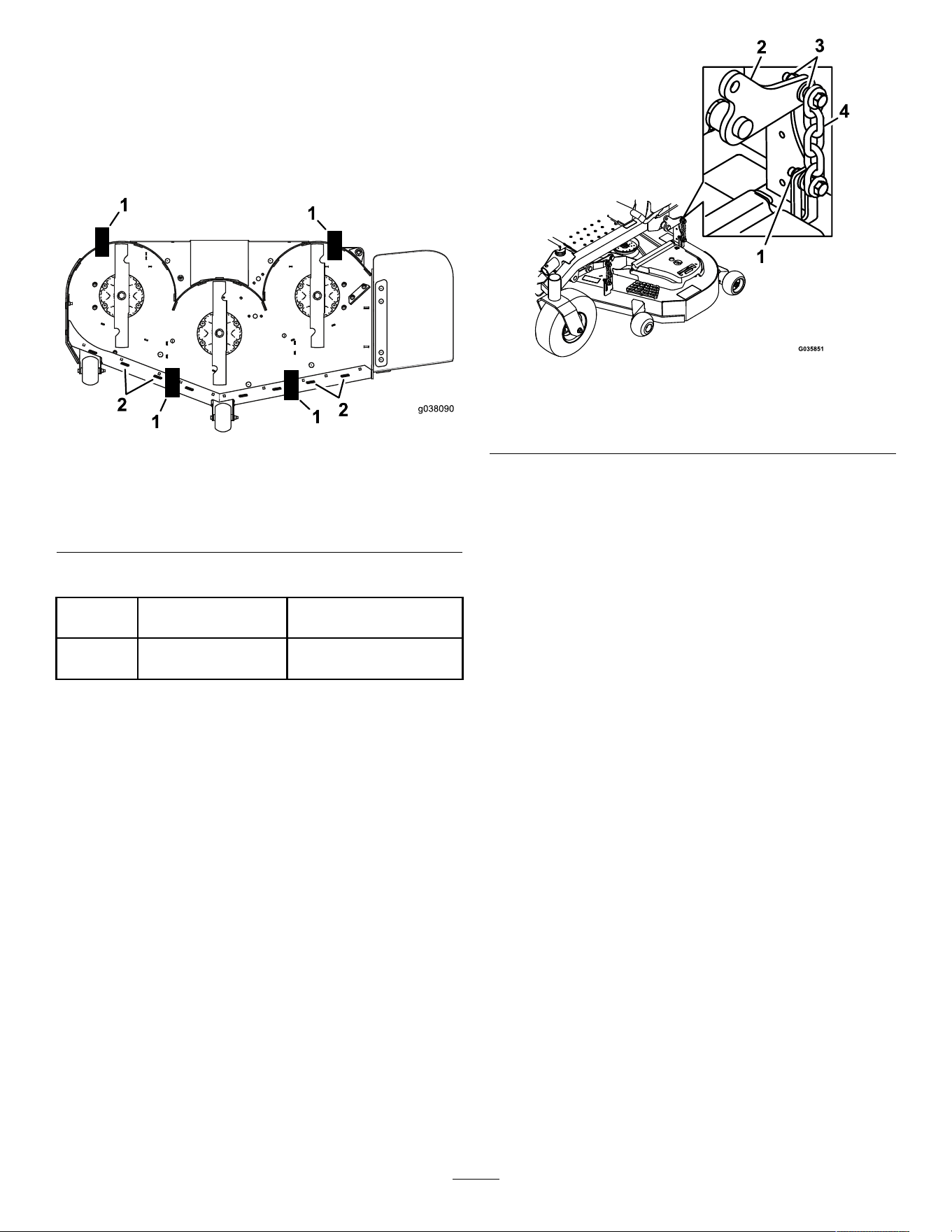
skirt; 1 on each side of the cutting deck (Figure
75
).
10. Set the height-of-cut lever to the 3 inch (76 mm)
position.
11. Place 2 blocks under each side of the front edge
of the deck, but not under the anti-scalp roller
brackets or welds.
g038090
Figure 75
Bottom view
1. Block—7.3 cm (2.87
inches)
2. Welds
Block Height and Rake Table
Deck
Size
Front Block Height Rake
All mower
decks
7.3 cm (2.87 inches) 4.8 to 6.4 mm (3/16 to 1/4
inch)
12. Carefully rotate the blades side to side (Figure
73
).
13. Loosen the locknuts (
Figure 76) on all 4 corners
and ensure that the mower deck is sitting
securely on all 4 blocks.
14. Remove any slack from the deck hangers and
make sure the deck-lift foot lever is pushed back
against the stop.
15. Tighten the 4 locknuts.
g035851
Figure 76
1. Locknuts 3. Deck hanger
2. Deck lift arm 4. Chain
16. Ensure that the blocks t snugly under the deck
skirt and that all attachment bolts are tight
17. Continue leveling the deck by checking the
front-to-rear blade slope.
18. Check the blades for levelness and repeat deck
leveling procedure if necessary.
56
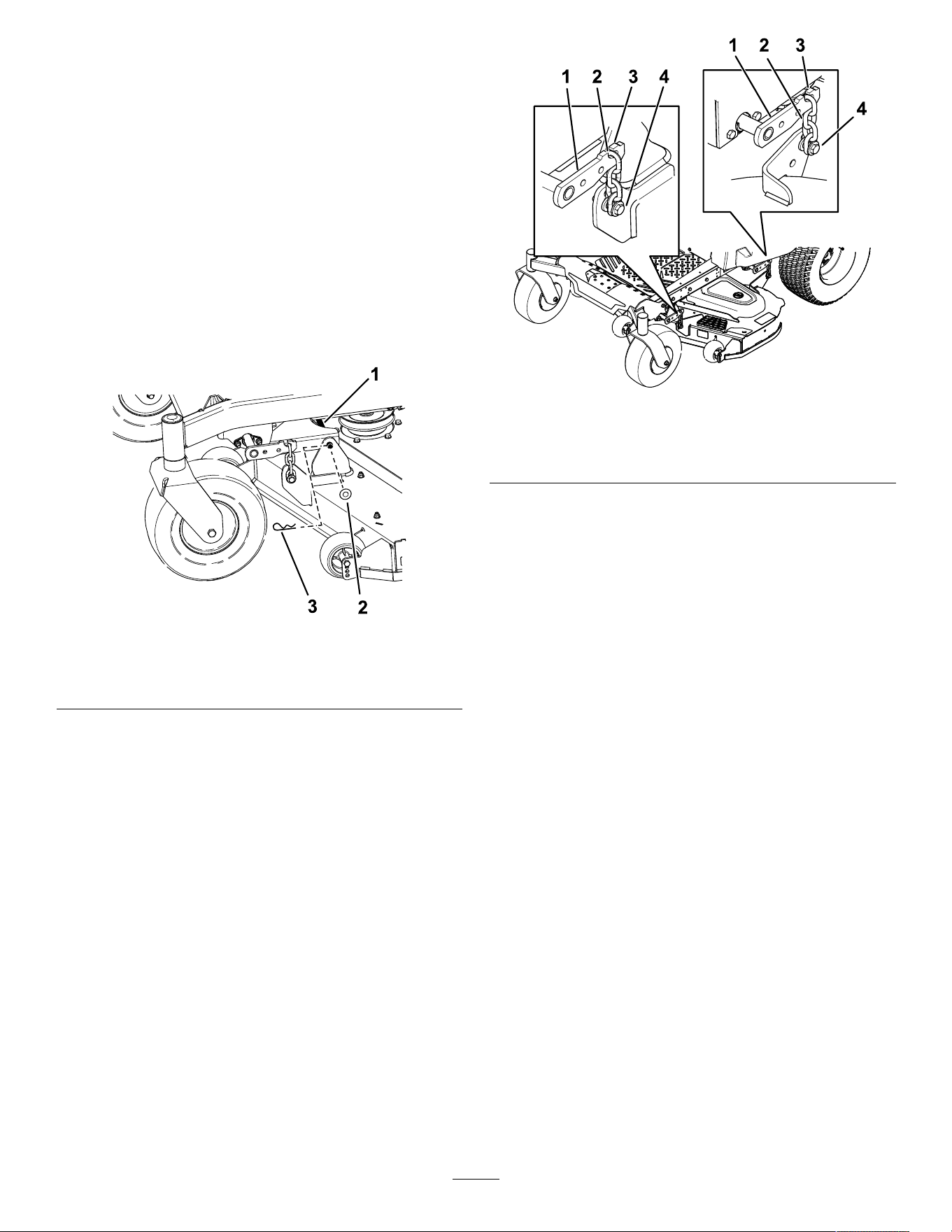
Removing the Mower Deck
1. Park the machine on a level surface, disengage
the blade-control switch (PTO), and engage the
parking brake.
2. Shut off the engine, remove the key, and
disconnect the spark-plug wires from the spark
plugs.
3. Lower the mower to the 76 mm (3 inches)
height-of-cut position.
4. Remove the mower belt from the engine pulley;
refer to
Replacing the Mower Belt (page 45).
5. Remove the hairpin cotter and washer securing
the link pin to the frame and deck, and remove
the link bar (
Figure 77).
g297517
Figure 77
1. Link pin 3. Hairpin cotter
2. Washer
6. Lift up the mower deck to relieve tension from
the mower deck.
7. Remove the chains from the hooks on the
deck-lift arms (
Figure 78).
g297515
Figure 78
1. Deck-lift arm
3. Hook
2. Chain
4. Adjustment bolt
8. Raise the height of cut to the transport position.
9. Remove the belt from the clutch pulley on the
engine.
10. Slide the mower out from underneath the
machine.
Note: Retain all parts for future installation.
Installing the Mower Deck
1. Park the machine on a level surface, disengage
the blade-control switch (PTO), and engage the
parking brake.
2. Shut off the engine, remove the key, and
disconnect the spark-plug wires from the spark
plugs.
3. Slide the mower under the machine.
4. Lower the height-of-cut lever to the lowest
position.
5. Place the height-of-cut pin in the lock position
for lowest height of cut.
6. Lift the rear of the mower deck and attach the
chains to the rear lift arms (
Figure 78).
7. Attach the front chains to the front lift arms
(
Figure 78).
8. Install the long link bar through the frame hanger
and deck.
9. Secure the link pin with the hairpin cotters and
washers removed previously (
Figure 77).
10. Install the mower belt onto the engine pulley;
refer to
Replacing the Mower Belt (page 45).
57
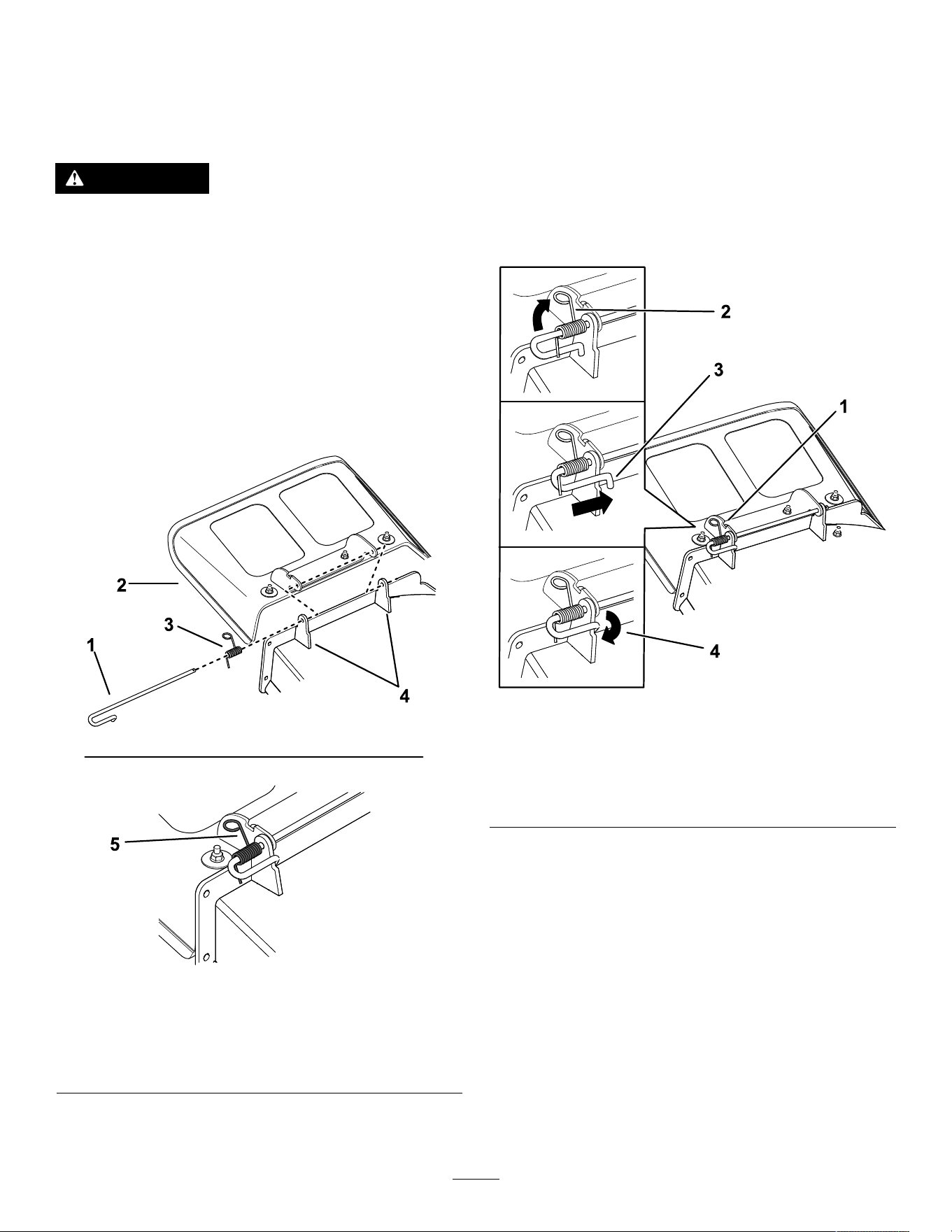
Replacing the Grass
Deector
Service Interval: Before each use or daily—Inspect
the grass deector for damage.
WARNING
An uncovered discharge opening could allow
the machine to throw objects toward you or
bystanders, resulting in serious injury. Also,
contact with the blade could occur.
Never operate the machine unless you install
a mulch plate, discharge deector, or grass
collection system.
1. Disengage the spring from the notch in the
deector bracket and slide the rod out of the
welded deck brackets, spring, and discharge
deector (
Figure 79).
g297555
Figure 79
1. Rod 4. Deck brackets
2. Spring 5. Spring installed over the
rod
3. Deector
2. Remove the damaged or worn discharge
deector.
3. Position the new discharge deector with the
bracket ends between the welded brackets on
the deck as shown in
Figure 80.
4. Install the spring onto the straight end of the rod.
5. Position the spring on the rod as shown in
Figure
80
so that the shorter spring end comes from
under the rod before the bend and going over
the rod as it returns from the bend.
6. Lift the loop end of the spring and place it into
the notch on the deector bracket (
Figure 80).
g297573
Figure 80
1. Rod and spring assembly
installed
3. Rod, short end, moved
behind the mower bracket
2. Loop end of the spring
installed into the notch in
the deector bracket
4. Short end, retained by
mower bracket.
7. Secure the rod and spring assembly by twisting
it so that the short end of the rod is behind the
front bracket welded to the deck (
Figure 80).
Important: The grass deector must be
spring loaded in the down position. Lift the
deector up to test that it snaps to the full
down position.
58

Cleaning
Cleaning under the Mower
Deck
Service Interval: After each use
1. Park the machine on a level surface, disengage
the blade-control switch (PTO), and engage the
parking brake.
2. Shut off the engine, remove the key, and wait
for all moving parts to stop before leaving the
operating position.
3. Raise the mower deck to the TRANSPORT
position.
Disposing of Waste
Engine oil, batteries, hydraulic uid, and engine
coolant are pollutants to the environment. Dispose of
these according to your state and local regulations.
59

Storage
Storage Safety
• Shut off the engine, remove the key, and wait
for all moving parts to stop before you leave the
operator’s position. Allow the machine to cool
before adjusting, servicing, cleaning, or storing it.
• Do not store the machine or fuel near ames or
drain the fuel indoors or inside an enclosed trailer.
• Do not store the machine or fuel container where
there is an open ame, spark, or pilot light, such
as on a water heater or on other appliances.
Cleaning and Storage
1. Disengage the blade-control switch (PTO), and
engage the parking brake.
2. Shut off the engine, remove the key, and wait
for all moving parts to stop before leaving the
operating position.
3. Remove grass clippings, dirt, and grime from the
external parts of the entire machine, especially
the engine and hydraulic system. Clean dirt and
chaff from the outside of the engine cylinder
head ns and blower housing.
Important: You can wash the machine with
mild detergent and water. Do not pressure
wash the machine. Avoid excessive use
of water, especially near the control panel,
engine, hydraulic pumps, and motors.
4. Check the parking brake operation; refer to
Adjusting the Parking Brake (page 44).
5. Service the air cleaner; refer to Servicing the Air
Cleaner (page 34)
.
6. Grease the machine; refer to
Lubrication (page
33)
.
7. Change the crankcase oil; refer to Servicing the
Engine Oil (page 35)
.
8. Check the tire pressure; refer to
Checking the
Tire Pressure (page 43)
.
9. Change the hydraulic lters; refer to Changing
the Hydraulic Fluid and Filters (page 50)
.
10. Charge the battery; refer to
Charging the Battery
(page 41)
.
11. Scrape any heavy buildup of grass and dirt
from the underside of the mower, then wash the
mower with a garden hose.
Note: Run the machine with the blade-control
switch (PTO) engaged and the engine at high
idle for 2 to 5 minutes after washing.
12. Check the condition of the blades; refer to
Servicing the Cutting Blades (page 52).
13. Prepare the machine for storage when non-use
occurs over 30 days. Prepare the machine for
storage as follows:
A. Add a petroleum-based
stabilizer/conditioner to fuel in the
tank. Follow mixing instructions from
the stabilizer manufacturer. Do not use
an alcohol-based stabilizer (ethanol or
methanol).
Note: A fuel stabilizer/conditioner is most
effective when mixed with fresh fuel and
used at all times.
B. Run the engine to distribute conditioned fuel
through the fuel system for 5 minutes.
C. Shut off the engine, allow it to cool, and
drain the fuel tank.
D. Start the engine and run it until it stops.
E. Dispose of fuel properly. Recycle the fuel
according to local codes.
Important: Do not store fuel containing
stabilizer/conditioner longer than
the duration recommended by the
fuel-stabilizer manufacturer.
14. Remove and check the condition of the spark
plug(s); refer to
Servicing the Spark Plug (page
38)
. With the spark plug(s) removed from the
engine, pour 30 ml (2 tablespoons) of engine
oil into the spark plug hole. Use the starter to
crank the engine and distribute the oil inside the
cylinder. Install the spark plug(s). Do not install
the wire on the spark plug(s).
15. Check and tighten all bolts, nuts, and screws.
Repair or replace any part that is damaged.
16. Paint all scratched or bare metal surfaces. Paint
is available from your Authorized Service Dealer.
17. Store the machine in a clean, dry garage or
storage area. Remove the key from the switch
and keep it out of reach of children or other
unauthorized users. Cover the machine to
protect it and keep it clean.
60

Troubleshooting
Problem
Possible Cause Corrective Action
1. The engine load is excessive. 1. Reduce the ground speed.
2. The oil level in the crankcase is low. 2. Add oil to the crankcase.
3. The cooling ns and air passages
under the engine-blower housing are
plugged.
3. Remove the obstruction from the
cooling ns and air passages.
4. The air cleaner is dirty.
4. Clean or replace the air-cleaner
element.
The engine overheats.
5. Dirt, water, or stale fuel is in the fuel
system.
5. Contact an Authorized Service Dealer
1. The blade-control switch is engaged. 1. Disengage the blade-control switch.
2. The motion-control levers are not in
the NEUTRAL-LOCK position.
2. Move the motion-control levers
outward to the NEUTRAL-LOCK position.
3. The battery is dead.
3. Charge the battery.
4. The electrical connections are
corroded or loose.
4. Check the electrical connections for
good contact.
5. A fuse is blown. 5. Replace the fuse.
The starter does not crank.
6. A relay or switch is damaged.
6. Contact an Authorized Service Dealer.
1. The fuel tank is empty. 1. Fill the fuel tank.
2. The fuel-shutoff valve is closed. 2. Open the fuel-shutoff valve.
3. The oil level in the crankcase is low. 3. Add oil to the crankcase.
4. The throttle is not in the correct
position.
4. Be sure that the throttle control is
midway between the slow and fast
positions.
5. There is dirt in the fuel lter. 5. Replace the fuel lter.
6. Dirt, water, or stale fuel is in fuel
system.
6. Contact an Authorized Service Dealer.
7. The air cleaner is dirty.
7. Clean or replace the air-cleaner
element.
8. The seat switch is not functioning
properly.
8. Check the seat-switch indicator.
Replace the seat if necessary.
9. The electrical connections are
corroded, loose, or damaged.
9. Check the electrical connections
for good contact. Clean the
connector terminals thoroughly with
electrical-contact cleaner, apply
dielectric grease, and make the
appropriate connections.
10.The relay or switch is worn or
damaged.
10.Contact an Authorized Service Dealer.
11. The spark plug is fouled or improperly
gapped.
11. Adjust or replace the spark plug.
The engine does not start, starts hard, or
fails to keep running.
12.The spark-plug wire is not connected.
12.Check the spark-plug wire connection.
1. The engine load is excessive. 1. Reduce the ground speed.
2. The air cleaner is dirty.
2. Clean the air-cleaner element.
3. The oil level in the crankcase is low. 3. Add oil to the crankcase.
4. The cooling ns and the air passages
above the engine are plugged.
4. Remove the obstruction from the
cooling ns and the air passages.
5. The vent hole in the fuel cap is plugged. 5. Clean or replace the fuel cap.
6. There is dirt in the fuel lter. 6. Replace the fuel lter.
The engine loses power.
7. There is dirt, water, or stale fuel in the
fuel system.
7. Contact an Authorized Service Dealer.
1. The tracking needs adjustment 1. Adjust the tracking.
The mower pulls to the left or right (with
levers fully forward)
2. The tire pressure in the drive tires is
not correct.
2. Adjust the tire pressure in the drive
tires.
61

Problem
Possible Cause Corrective Action
1. The bypass valves are not closed tight. 1. Tighten the bypass valves.
2. The pump belt is worn, loose, or
broken.
2. Change the belt.
3. The pump belt is off a pulley. 3. Change the belt.
4. The idler spring is broken or missing. 4. Replace the spring.
The machine does not drive.
5. The hydraulic uid level is low or too
hot.
5. Add hydraulic uid to the reservoirs or
let it cool down.
1. The cutting blade(s) is/are bent or
unbalanced.
1. Install new cutting blade(s).
2. The blade mounting bolt is loose. 2. Tighten the blade mounting bolt.
3. The engine mounting bolts are loose. 3. Tighten the engine mounting bolts.
4. The engine pulley, idler pulley, or blade
pulley is loose.
4. Tighten the appropriate pulley.
5. The engine pulley is damaged.
5. Contact an Authorized Service Dealer.
6. The blade spindle is bent.
6. Contact an Authorized Service Dealer.
The machine vibrates abnormally.
7. The motor mount is loose or worn.
7. Contact an Authorized Service Dealer.
1. The blade(s) is not sharp. 1. Sharpen the blade(s).
2. A cutting blade(s) is/are bent. 2. Install a new cutting blade(s).
3. The mower is not level.
3. Level the mower from side-to-side and
front-to-rear.
4. An anti-scalp roller (if applicable) is not
set correctly.
4. Adjust the anti-scalp wheel height.
5. The underside of the mower deck is
dirty.
5. Clean the underside of the mower
deck.
6. The tire pressure is incorrect. 6. Adjust the tire pressure.
The cutting height is uneven.
7. A blade spindle is bent.
7. Contact an Authorized Service Dealer.
1. The drive belt is worn, loose or broken. 1. Install a new drive belt.
2. The drive belt is off of the pulley.
2. Install the drive belt and check the
adjusting shafts and belt guides for the
correct position.
3. The power takeoff (PTO) switch or
PTO clutch is faulty.
3. Contact an Authorized Service Dealer.
The blades do not rotate.
4. The mower belt is worn, loose, or
broken.
4. Install a new mower belt.
1. The fuse is blown. 1. Replace the fuse. Check the coil
resistance, battery charge, charging
system, and wiring connections, and
replace components if necessary.
2. There is low voltage supply at the
clutch.
2. Check the coil resistance, battery
charge, charging system, and wiring
connections and replace parts if
necessary.
3. The coil is damaged. 3. Replace the clutch.
4. There is inadequate current supply. 4. Repair or replace the clutch lead
wire or electrical system. Clean the
connector contacts.
The clutch does not engage.
5. The rotor/armature air gap is too large.
5. Remove the shim or replace the clutch.
62
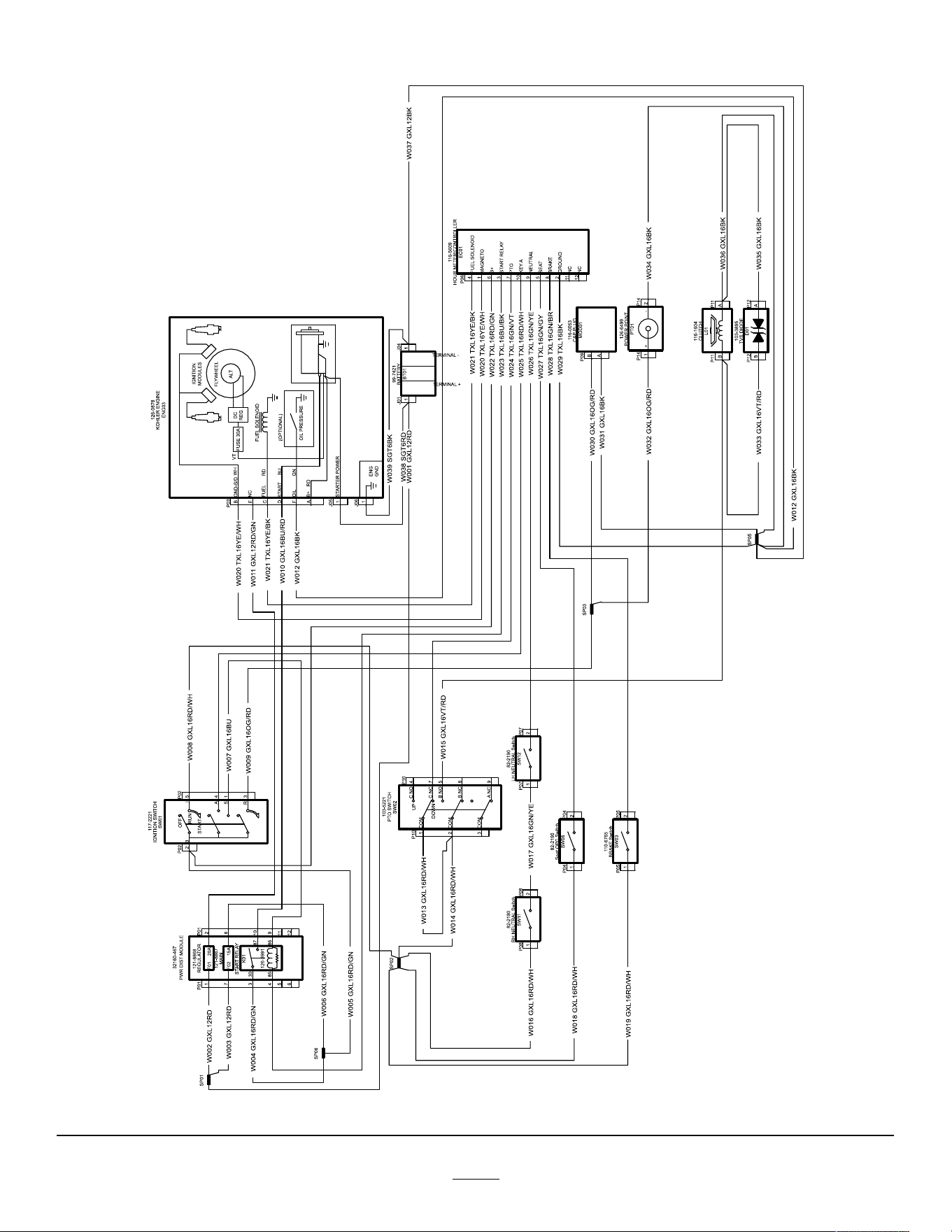
Schematics
g351785
Electrical Schematic (Rev. A)
63

California Proposition 65 Warning Information
What is this warning?
You may see a product for sale that has a warning label like the following:
WARNING: Cancer and Reproductive Harm—www.p65Warnings.ca.gov.
What is Prop 65?
Prop 65 applies to any company operating in California, selling products in California, or manufacturing products that may be sold in or brought into
California. It mandates that the Governor of California maintain and publish a list of chemicals known to cause cancer, birth defects, and/or other
reproductive harm. The list, which is updated annually, includes hundreds of chemicals found in many everyday items. The purpose of Prop 65 is to
inform the public about exposure to these chemicals.
Prop 65 does not ban the sale of products containing these chemicals but instead requires warnings on any product, product packaging, or literature with
the product. Moreover, a Prop 65 warning does not mean that a product is in violation of any product safety standards or requirements. In fact, the
California government has claried that a Prop 65 warning “is not the same as a regulatory decision that a product is ‘safe’ or ‘unsafe.’” Many of these
chemicals have been used in everyday products for years without documented harm. For more information, go to
https://oag.ca.gov/prop65/faqs-view-all.
A Prop 65 warning means that a company has either (1) evaluated the exposure and has concluded that it exceeds the “no signicant risk level”; or (2)
has chosen to provide a warning based on its understanding about the presence of a listed chemical without attempting to evaluate the exposure.
Does this law apply everywhere?
Prop 65 warnings are required under California law only. These warnings are seen throughout California in a wide range of settings, including but not
limited to restaurants, grocery stores, hotels, schools, and hospitals, and on a wide variety of products. Additionally, some online and mail order
retailers provide Prop 65 warnings on their websites or in catalogs.
How do the California warnings compare to federal limits?
Prop 65 standards are often more stringent than federal and international standards. There are various substances that require a Prop 65 warning
at levels that are far lower than federal action limits. For example, the Prop 65 standard for warnings for lead is 0.5 μg/day, which is well below
the federal and international standards.
Why don’t all similar products carry the warning?
• Products sold in California require Prop 65 labelling while similar products sold elsewhere do not.
• A company involved in a Prop 65 lawsuit reaching a settlement may be required to use Prop 65 warnings for its products, but other companies
making similar products may have no such requirement.
• The enforcement of Prop 65 is inconsistent.
• Companies may elect not to provide warnings because they conclude that they are not required to do so under Prop 65; a lack of warnings for a
product does not mean that the product is free of listed chemicals at similar levels.
Why does Toro include this warning?
Toro has chosen to provide consumers with as much information as possible so that they can make informed decisions about the products they buy and
use. Toro provides warnings in certain cases based on its knowledge of the presence of one or more listed chemicals without evaluating the level of
exposure, as not all the listed chemicals provide exposure limit requirements. While the exposure from Toro products may be negligible or well within the
“no signicant risk” range, out of an abundance of caution, Toro has elected to provide the Prop 65 warnings. Moreover, if Toro does not provide these
warnings, it could be sued by the State of California or by private parties seeking to enforce Prop 65 and subject to substantial penalties.
Rev A