TROY-BILT LLC, P.O. BOX 361131 CLEVELAND, OHIO 44136-0019
Printed In USA
Op e r a t O r ’s Ma n u a l
Safe Operation Practices • Set-Up • Operation • Maintenance • Service • Troubleshooting • Warranty
WARNING
READ AND FOLLOW ALL SAFETY RULES AND INSTRUCTIONS IN THIS MANUAL
BEFORE ATTEMPTING TO OPERATE THIS MACHINE.
FAILURE TO COMPLY WITH THESE INSTRUCTIONS MAY RESULT IN PERSONAL INJURY.
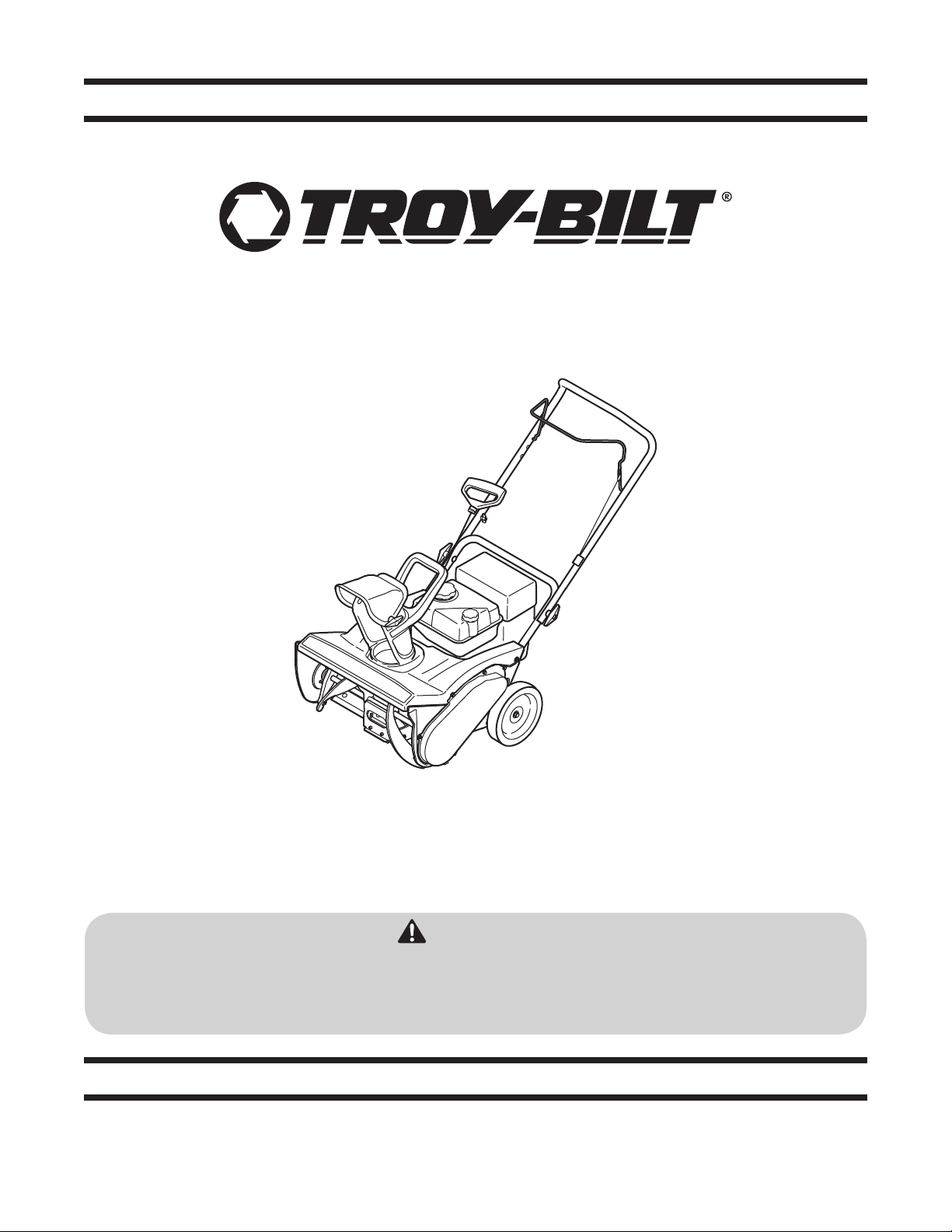
Single-Stage Snow Thrower — Squall 2100
Form No. 769-04000
(April 17, 2007)

To The Owner
1
2
Record Product Information
Before setting up and operating your new equipment, please
locate the model plate on the equipment and record the
information in the provided area to the right. You can locate the
model plate by standing at the operator’s position and looking
down at the right rear of the deck. This information will be
necessary, should you seek technical support via our web site,
Customer Support Department, or with a local authorized service
dealer.
Safe Operation Practices ........................................ 3
Assembly & Set-Up .................................................. 7
Controls & Features...............................................10
Operation ................................................................12
Maintenance & Adjustment..................................13
Engine Maintenance ..............................................14
Service .....................................................................17
Troubleshooting .....................................................19
Replacement Parts ................................................ 20
Table of Contents
MO d e l nu M b e r
se r i a l nu M b e r
Customer Support
Please do NOT return the unit to the retailer or dealer without first contacting our Customer Support Department.
If you have difficulty assembling this product or have any questions regarding the controls, operation, or maintenance of
this unit, you can seek help from the experts. Choose from the options below:
Visit us on the web at www.troybilt.com◊
Call a Customer Support Representative at (800) 828-5500 or (330) 558-7220◊
◊
Thank you for purchasing a Snow Thrower manufactured by
Troy-Bilt LLC. It was carefully engineered to provide excellent
performance when properly operated and maintained.
It instructs you how to safely and easily set up, operate and
persons who will operate the machine, carefully follow the
recommended safety practices at all times. Failure to do so could
result in personal injury or property damage.
All information in this manual is relative to the most recent
product information available at the time of printing. Review
this manual frequently to familiarize yourself with the unit, its
Manual may cover a range of product specifications for various
models. Characteristics and features discussed and/or illustrated
in this manual may not be applicable to all models. Troy-Bilt LLC
reserves the right to change product specifications, designs and
equipment without notice and without incurring obligation.
laboratory. If you have any problems or questions concerning
the unit, phone a authorized Troy-Bilt service dealer or contact
us directly. Troy-Bilt’s Customer Support telephone numbers,
website address and mailing address can be found on this page.
We want to ensure your complete satisfaction at all times.
Throughout this manual, all references to right and left side of the
machine are observed from the operating position
The engine manufacturer is responsible for all engine-related
issues with regards to performance, power-rating, specifications,
more information.
Thank You
Important Safe Operation Practices
2
3
Training
Read, understand, and follow all instructions on the
machine and in the manual(s) before attempting to
assemble and operate. Keep this manual in a safe place for
future and regular reference and for ordering replacement
parts.
Be familiar with all controls and their proper operation. 2.
Know how to stop the machine and disengage them
quickly.
3.
the instructions and safe operation practices in this manual
and on the machine and be trained and supervised by an
adult.
Never allow adults to operate this machine without proper
instruction.
5.
your snow-throwing pattern to avoid discharge of material
toward roads, bystanders and the like.
Keep bystanders, pets and children at least 75 feet from the
machine while it is in operation. Stop machine if anyone
enters the area.
7.
when operating in reverse.
Preparation
Thoroughly inspect the area where the equipment is to be used.
Remove all doormats, newspapers, sleds, boards, wires and other
foreign objects, which could be tripped over or thrown by the
auger/impeller.
Always wear safety glasses or eye shields during operation
and while performing an adjustment or repair to protect
your eyes. Thrown objects which ricochet can cause serious
injury to the eyes.
Do not operate without wearing adequate winter outer 2.
garments. Do not wear jewelry, long scarves or other loose
clothing, which could become entangled in moving parts.
Wear footwear which will improve footing on slippery
surfaces.
Use a grounded three-wire extension cord and receptacle 3.
for all machines with electric start engines.
Adjust collector housing height to clear gravel or crushed
rock surfaces.
Disengage all control levers before starting the engine. 5.
Never attempt to make any adjustments while engine is
running, except where specifically recommended in the
operator’s manual.
Let engine and machine adjust to outdoor temperature 7.
before starting to clear snow.
WARNING! This symbol points out important safety instructions which, if not followed,
could endanger the personal safety and/or property of yourself and others. Read and follow
all instructions in this manual before attempting to operate this machine. Failure to comply
with these instructions may result in personal injury.
When you see this symbol. HEED ITS WARNING!
DANGER: This machine was built to be operated according to the safe operation practices in
this manual. As with any type of power equipment, carelessness or error on the part of the
operator can result in serious injury. This machine is capable of amputating fingers, hands,
toes and feet and throwing foreign objects. Failure to observe the following safety
instructions could result in serious injury or death.
CALIFORNIA PROPOSITION 65
WARNING!
contain or emit chemicals known to State of California to cause cancer and birth defects
or other reproductive harm.

4 se c t i O n 2 — iM p O r t a n t sa f e Op e r a t i O n pr a c t i c e s
Safe Handling of Gasoline
To avoid personal injury or property damage use extreme care
in handling gasoline. Gasoline is extremely flammable and the
vapors are explosive. Serious personal injury can occur when
gasoline is spilled on yourself or your clothes which can ignite.
Wash your skin and change clothes immediately.
Use only an approved gasoline container.a.
b.
sources of ignition.
Never fuel machine indoors. c.
Never remove gas cap or add fuel while the engine is d.
hot or running.
Allow engine to cool at least two minutes before e.
refueling.
Never over fill fuel tank. Fill tank to no more than ½ f.
inch below bottom of filler neck to provide space for
fuel expansion.
Replace gasoline cap and tighten securely.g.
If gasoline is spilled, wipe it off the engine and h.
equipment. Move machine to another area. Wait 5
minutes before starting the engine.
Never store the machine or fuel container inside i.
where there is an open flame, spark or pilot light
(e.g. furnace, water heater, space heater, clothes
dryer etc.).
Allow machine to cool at least 5 minutes before j.
storing.
Never fill containers inside a vehicle or on a truck k.
or trailer bed with a plastic liner. Always place
containers on the ground away from your vehicle
before filling.
If possible, remove gas-powered equipment from l.
the truck or trailer and refuel it on the ground. If this
is not possible, then refuel such equipment on a
trailer with a portable container, rather than from a
gasoline dispenser nozzle.
Keep the nozzle in contact with the rim of the fuel m.
tank or container opening at all times until fueling is
complete. Do not use a nozzle lock-open device.
Operation
Do not put hands or feet near rotating parts, in the auger/
impeller housing or chute assembly. Contact with the
rotating parts can amputate hands and feet.
The auger/impeller control lever is a safety device. Never 2.
bypass its operation. Doing so makes the machine unsafe
and may cause personal injury.
The control levers must operate easily in both directions 3.
and automatically return to the disengaged position when
released.
Never operate with a missing or damaged chute assembly.
Keep all safety devices in place and working.
Never run an engine indoors or in a poorly ventilated area. 5.
and deadly gas.
Do not operate machine while under the influence of
alcohol or drugs.
Muffler and engine become hot and can cause a burn. Do 7.
not touch. Keep children away.
8.
gravel surfaces. Stay alert for hidden hazards or traffic.
operating on slopes.
towards windows, walls, cars etc. Thus, avoiding possible
property damage or personal injury caused by a ricochet.
Never direct discharge at children, bystanders and pets or
allow anyone in front of the machine.
Do not overload machine capacity by attempting to clear
snow at too fast of a rate.
Never operate this machine without good visibility or light.
Always be sure of your footing and keep a firm hold on the
handles. Walk, never run.
Disengage power to the auger/impeller when transporting
or not in use.
Never operate machine at high transport speeds on
slippery surfaces. Look down and behind and use care
when backing up.
If the machine should start to vibrate abnormally, stop
the engine, disconnect the spark plug wire and ground it
against the engine. Inspect thoroughly for damage. Repair
any damage before starting and operating.
Disengage all control levers and stop engine before you
leave the operating position (behind the handles). Wait
until the auger/impeller comes to a complete stop before
unclogging the chute assembly, making any adjustments,
or inspections.
Never put your hand in the discharge or collector
openings. Always use the clean-out tool provided to
unclog the discharge opening. Do not unclog chute
assembly while engine is running. Shut off engine and
remain behind handles until all moving parts have stopped
before unclogging.
Use only attachments and accessories approved by the
manufacturer (e.g. wheel weights, tire chains, cabs etc.).
When starting engine, pull cord slowly until resistance 20.
is felt, then pull rapidly. Rapid retraction of starter cord
(kickback) will pull hand and arm toward engine faster than
you can let go. Broken bones, fractures, bruises or sprains
could result.
If situations occur which are not covered in this manual, use
care and good judgment. Contact Customer Support for
assistance and the name of your nearest servicing dealer.

5se c t i O n 2 — iM p O r t a n t sa f e Op e r a t i O n pr a c t i c e s
Maintenance & Storage
Never tamper with safety devices. Check their proper
operation regularly. Refer to the maintenance and
adjustment sections of this manual.
Before cleaning, repairing, or inspecting machine 2.
disengage all control levers and stop the engine. Wait until
the auger/impeller come to a complete stop. Disconnect
the spark plug wire and ground against the engine to
prevent unintended starting.
Check bolts and screws for proper tightness at frequent 3.
intervals to keep the machine in safe working condition.
Also, visually inspect machine for any damage.
Do not change the engine governor setting or over-speed
the engine. The governor controls the maximum safe
operating speed of the engine.
Snow thrower shave plates and skid shoes are subject to 5.
wear and damage. For your safety protection, frequently
check all components and replace with original equipment
not meet the original equipment specifications may lead to
improper performance and compromise safety!”
Check control levers periodically to verify they engage
and disengage properly and adjust, if necessary. Refer
to the adjustment section in this operator’s manual for
instructions.
Maintain or replace safety and instruction labels, as 7.
necessary.
8.
etc. to protect the environment.
from machine and prevent freeze up of auger/impeller.
Never store the machine or fuel container inside where
there is an open flame, spark or pilot light such as a water
heater, furnace, clothes dryer etc.
Always refer to the operator’s manual for proper
instructions on off-season storage.
Check fuel line, tank, cap, and fittings frequently for cracks
or leaks. Replace if necessary.
Do not crank engine with spark plug removed.
this product has an Average Useful Life of seven (7) years,
Average Useful
Life have the machine inspected annually by an authorized
service dealer to ensure that all mechanical and safety
systems are working properly and not worn excessively.
Failure to do so can result in accidents, injuries or death.
Do not modify engine
To avoid serious injury or death, do not modify engine in any
way. Tampering with the governor setting can lead to a runaway
engine and cause it to operate at unsafe speeds. Never tamper
with factory setting of engine governor.
Notice Regarding Emissions
are certified to operate on regular unleaded gasoline, and
Injection (SAI) and Three Way Catalyst (TWC) if so equipped.
Spark Arrestor
WARNING! This machine is equipped with an
internal combustion engine and should not be used
on or near any unimproved forest-covered, brush
covered or grass-covered land unless the engine’s
exhaust system is equipped with a spark arrester
meeting applicable local or state laws (if any).
If a spark arrester is used, it should be maintained in effective
working order by the operator. In the State of California the
apply on federal lands.
A spark arrester for the muffler is available through your
nearest engine authorized service dealer or contact the service
6 se c t i O n 2 — iM p O r t a n t sa f e Op e r a t i O n pr a c t i c e s
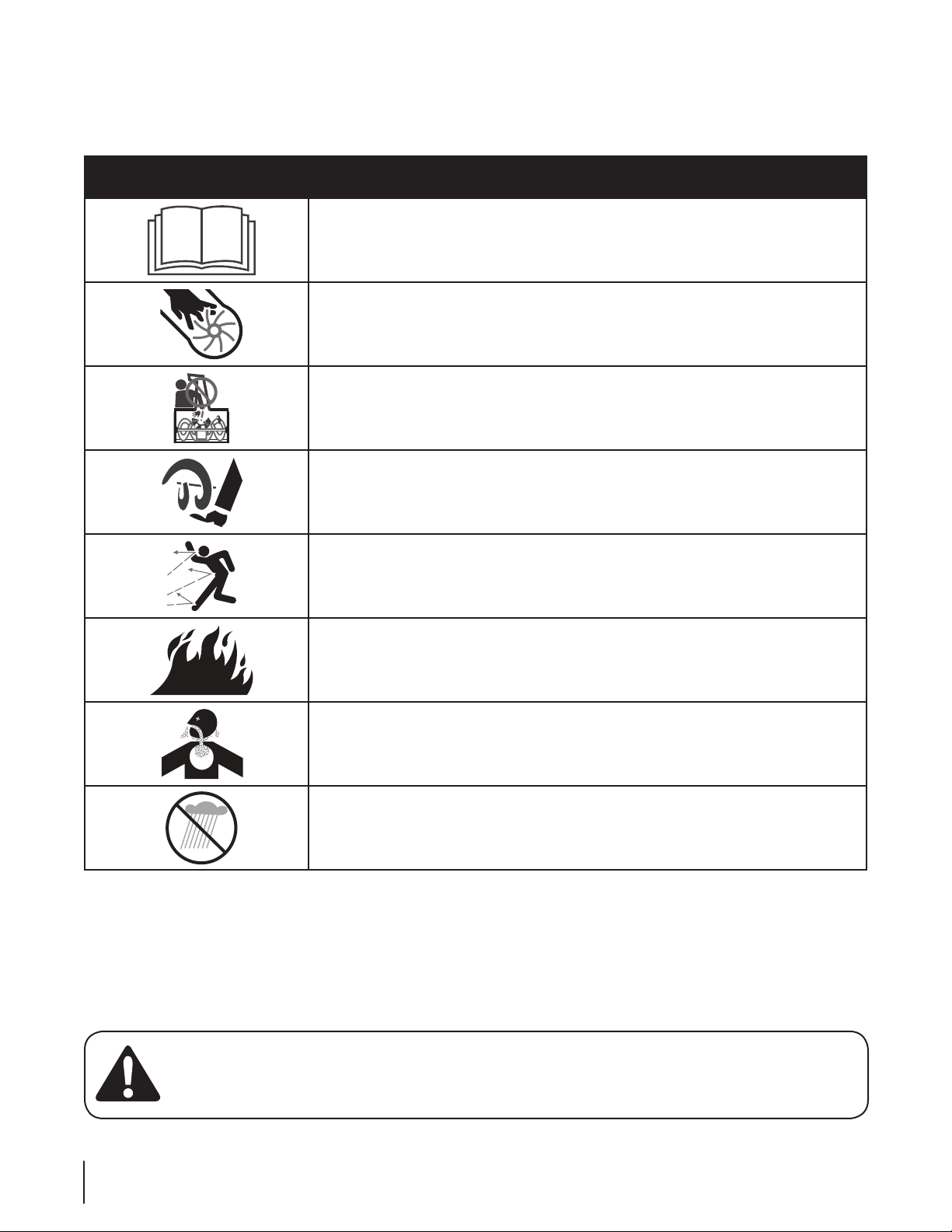
Safety Symbols
This page depicts and describes safety symbols that may appear on this product. Read, understand, and follow all instructions on the
machine before attempting to assemble and operate.
Symbol Description
Read, understand, and follow all instructions in the manual(s) before attempting to
assemble and operate
Keep hands out of inlet and discharge openings while machine is running. There are rotating
blades inside
Keep hands out of inlet and discharge openings while machine is running. There are rotating
blades inside
Do not put hands or feet near rotating parts, in the auger/impeller housing or chute
assembly. Contact with the rotating parts can amputate hands and feet.
This machine may pick up and throw and objects which can cause serious personal injury.
Allow the engine to cool at least two minutes before refueling.
monoxide, an odorless and deadly gas.
Do not use the engine’s electric starter in the rain
WARNING! Your Responsibility—Restrict the use of this power machine to persons who read, understand and
follow the warnings and instructions in this manual and on the machine.
SAVE THESE INSTRUCTIONS!
Contents of Carton
Two Ignition Keys
Manual
NOTE: All references to the left or right side of the snow thrower
are from the operator’s position. Any exceptions will be noted.
Assembly
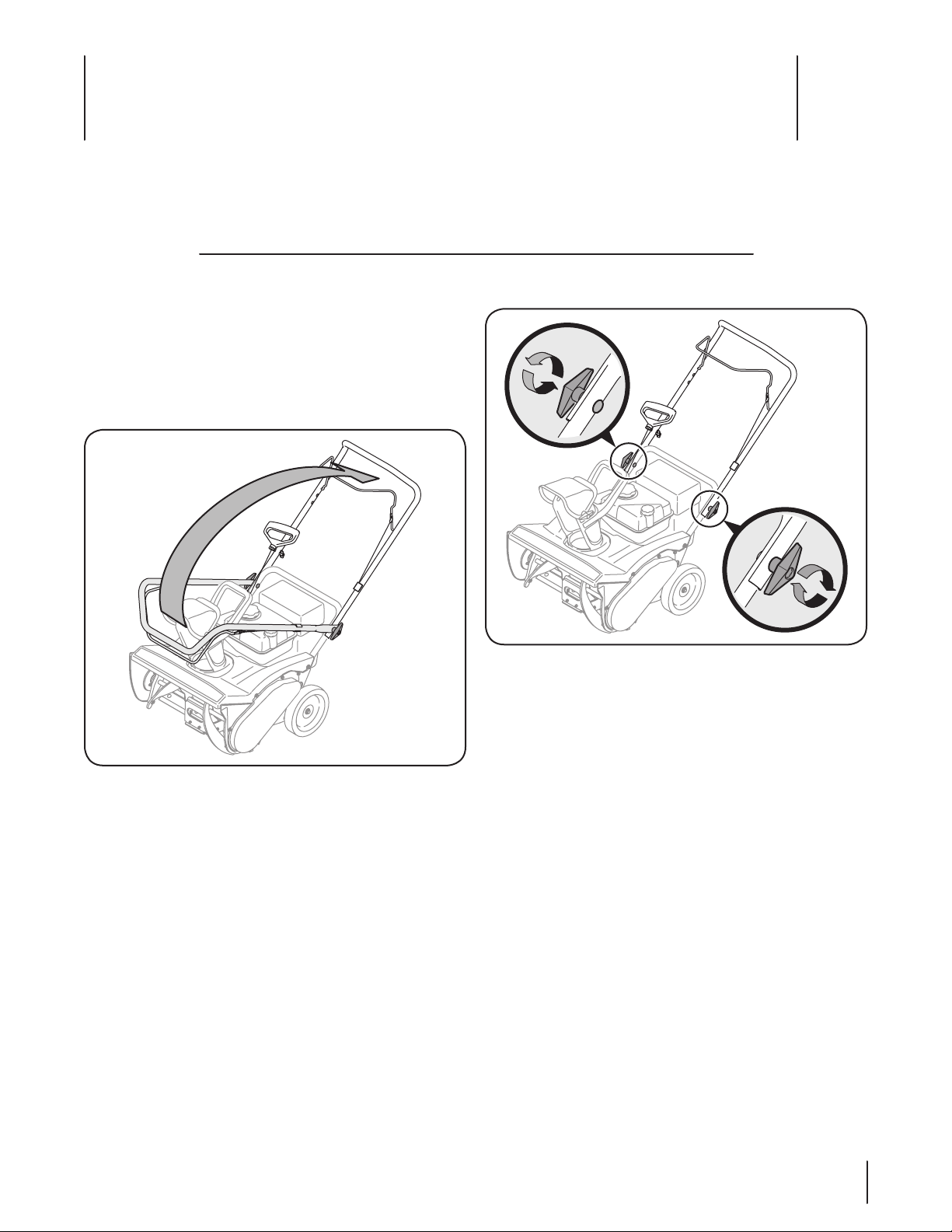
Positioning the Upper Handle
sure not to pinch the cable in the process, as illustrated in
Tighten the wing knobs to secure the handle in place. 2.
See Fig. 3-2.
Fuel Recommendations
Use automotive gasoline (unleaded or low leaded to minimize
combustion chamber deposits) with a minimum of 87 octane.
dirty gasoline. Avoid getting dirt, dust, or water in the fuel tank.
Refuel in a well-ventilated area with the engine stopped.
Do not smoke or allow flames or sparks in the area where
the engine is refueled or where gasoline is stored.
Do not overfill the fuel tank. After refueling, make sure the
tank cap is closed properly and securely.
Be careful not to spill fuel when refueling. Spilled fuel or
fuel vapor may ignite. If any fuel is spilled, make sure the
area is dry before starting the engine.
Avoid repeated or prolonged contact with skin or
breathing of vapor.
Figure 3-1
Figure 3-2
Assembly & Set-Up
3
7
Adding Fuel
WARNING! Use extreme care when handling
gasoline. Gasoline is extremely flammable and the
vapors are explosive. Never fuel the machine
indoors or while the engine is hot or running.
sources of ignition.
WARNING! Always keep hands and feet clear of
equipment moving parts. Do not use a pressurized
starting fluid. Vapors are flammable.
Clean around fuel fill before removing cap to fuel.
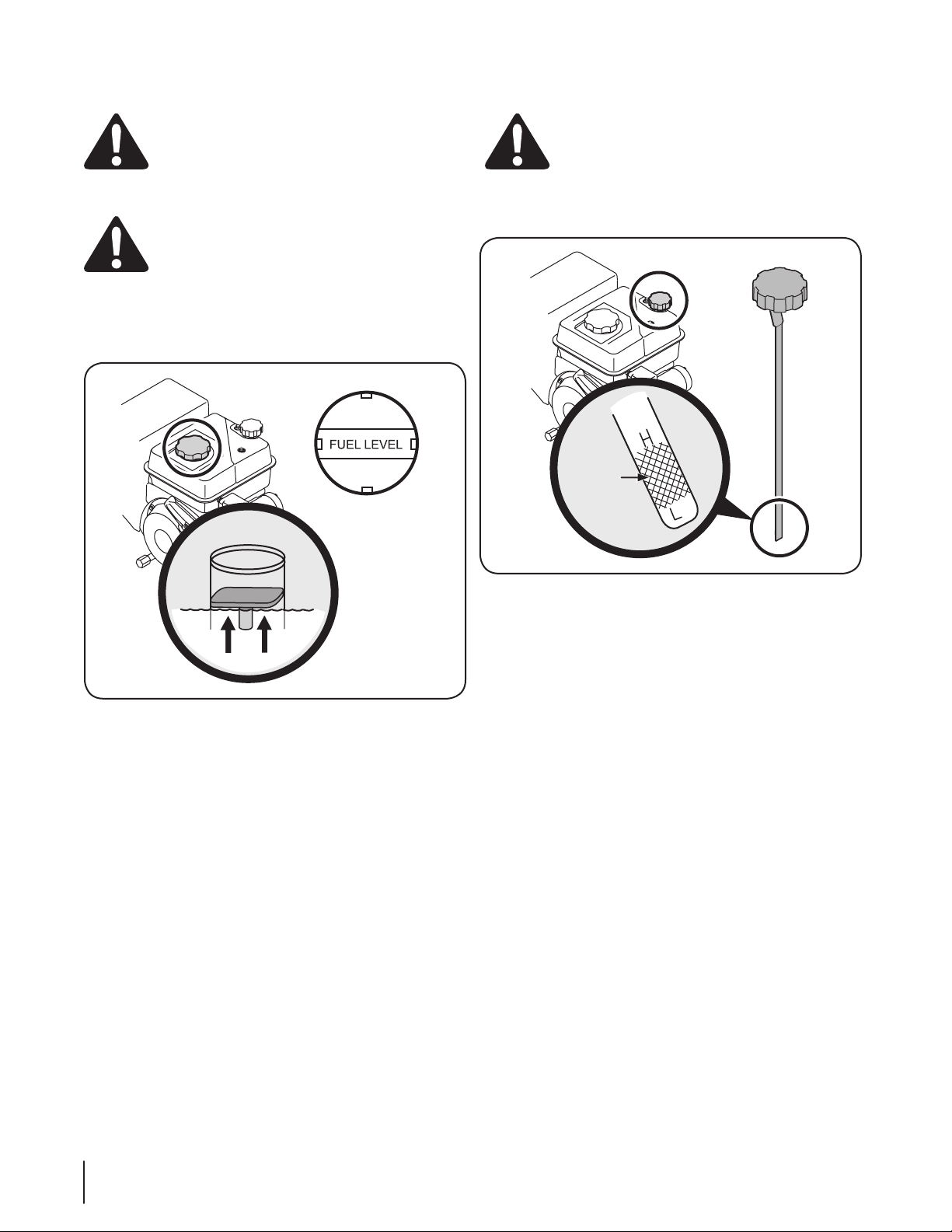
A fuel level indicator is located in the fuel tank. Fill tank 2.
until fuel reaches the fuel level indictor, Fig. 3-3. Be careful
not to overfill.
Adding Oil
CAUTION: The engine is shipped without oil in the
engine. You must fill the engine with oil before
operating. Running the engine with insufficient oil
can cause serious engine damage and void the
engine warranty.
Remove the oil filler cap/dipstick and wipe the dipstick
Slowly add oil until the oil level registers between high 2.
section for the correct oil viscosity and engine oil capacity.
NOTE:
in the engine smoking, hard starting or spark plug fouling.
Fill
between
the high
and low
marks
Figure 3-3
Fuel Level Indicator
Top View
Figure 3-4
8 se c t i O n 3— as s e M b l y & se t -up
Adjustments
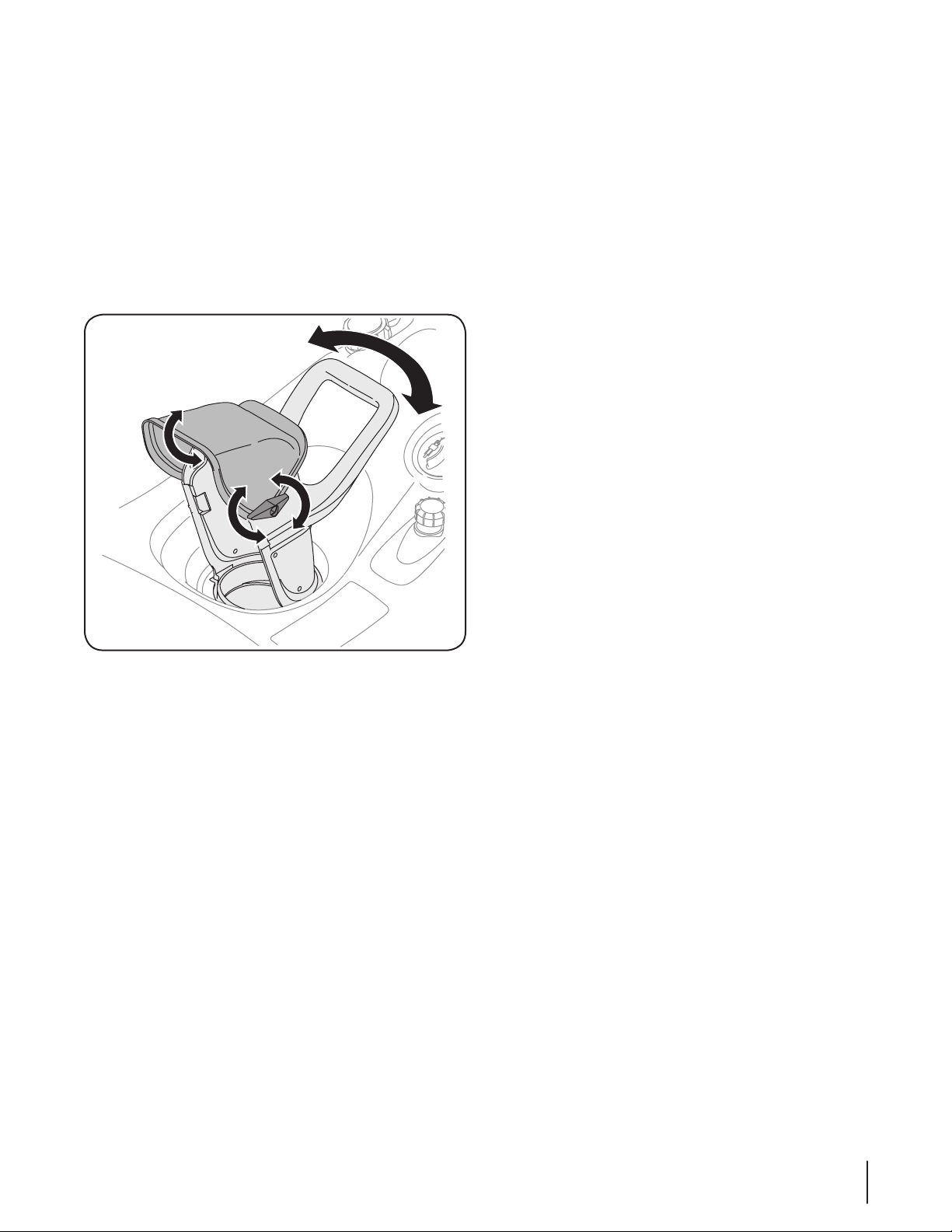
Chute Assembly
The pitch of the chute assembly controls the angle at which the
snow is thrown.
Loosen the wing knob found on the left side of the chute
assembly and pivot the upper chute upward or downward
to the desired pitch. Retighten the wing knob before
operating the snow thrower.
2.
handle to throw the snow in the desired direction. See Fig.
3-5.
Figure 3-5
9se c t i O n 3 — as s e M b l y & se t -up
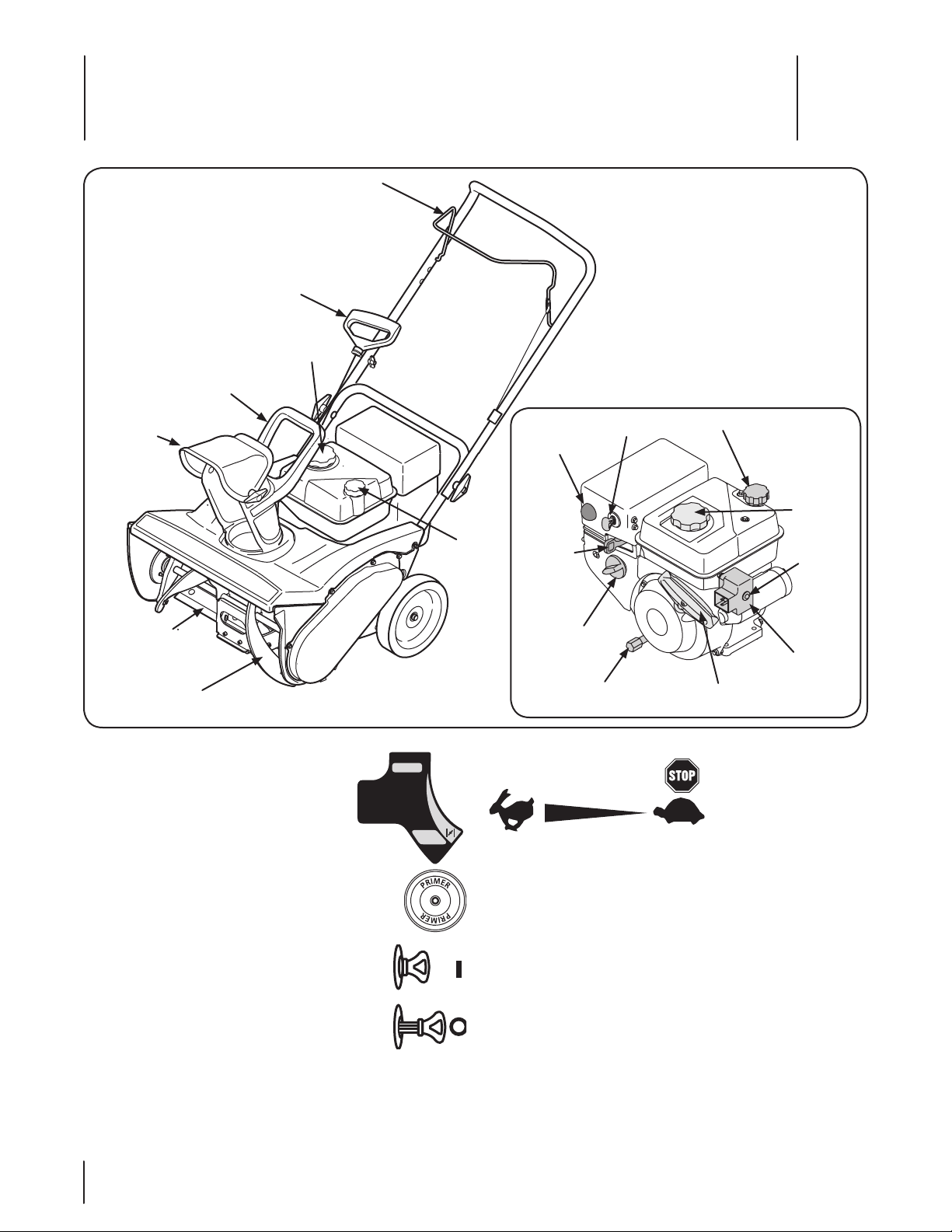
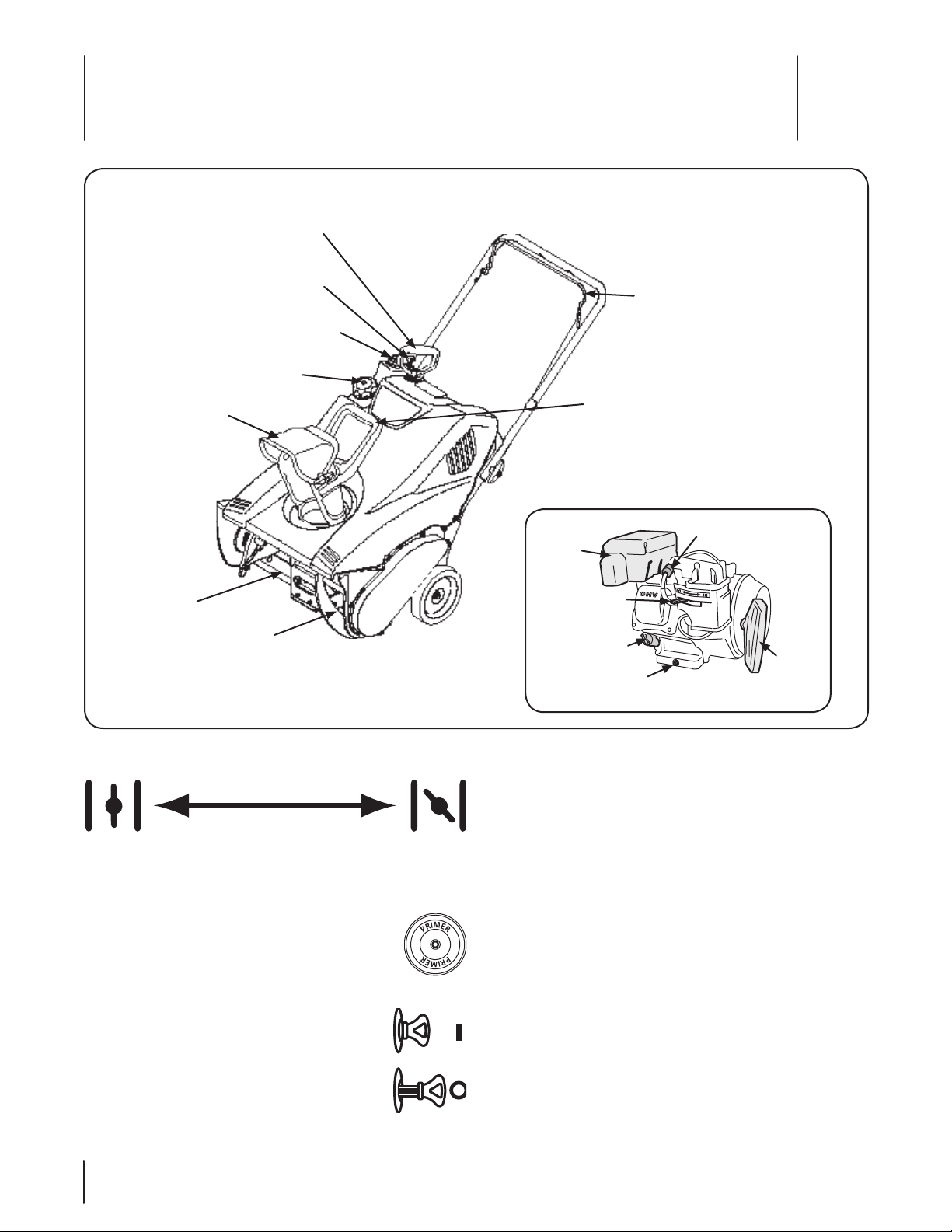
Ignition Key
Oil Fill
Primer
Gasoline
Cap
Electric
Starter
Outlet
Recoil
Starter
Oil Drain
Choke
Control
Throttle
Control
Electric
Starter
Button
Auger Control
Recoil Starter
Gasoline Cap
Chute Control Handle
Chute
Assembly
Shave Plate
Auger
Oil Fill
Figure 4-1
Choke Lever
Activating the choke control closes the choke
plate on carburetor and aids in starting
engine.
Primer
carburetor to aid in cold-weather starting.
Ignition Key
The ignition key is a safety device. It must be fully
inserted in order for the engine to start. Remove the
ignition key when the snow thrower is not in use.
NOTE: Do not turn the ignition key in an attempt to
start the engine. Doing so may cause it to break.
RUN
MAR
V
DÉ RT
Throttle
The throttle control is located on the rear of the engine. It
regulates the speed of the engine and will shut off the engine
Recoil Starter
The starter handle is used to manually start the engine.
Gasoline Cap
Remove the gas cap to add fuel.
Controls and Features
4
10

Auger
When engaged, the augers rotation draws snow into the auger
housing and throws it out the discharge chute. Rubber paddles
on the augers also aid in propelling the snow thrower as they
come in contact with the pavement.
Auger Control
Located on the upper handle, the auger control handle is used
to engage and disengage drive to the auger. Squeeze the control
handle against the upper handle to engage the auger; release it
to disengage.
Chute Assembly
Rotate the discharge chute to the left or right using the chute
handle. The pitch of the discharge chute controls the angle at
which the snow is thrown. Loosen the wing knob on the side of
the discharge chute before pivoting the discharge chute upward
or downward. Retighten the knob once the desired position has
been achieved.
Shave Plate
The shave plate maintains contact with the pavement as
the snow thrower is propelled, allowing snow close to the
pavement’s surface to be discharged.
Electric Starter Outlet
The electric starter outlet requires the use of a three-prong
NOTE: The electric starter is mounted to the plastic shroud and is
Electric Starter Button
11se c t i O n 4 — cO n t r O l s a n d fe a t u r e s
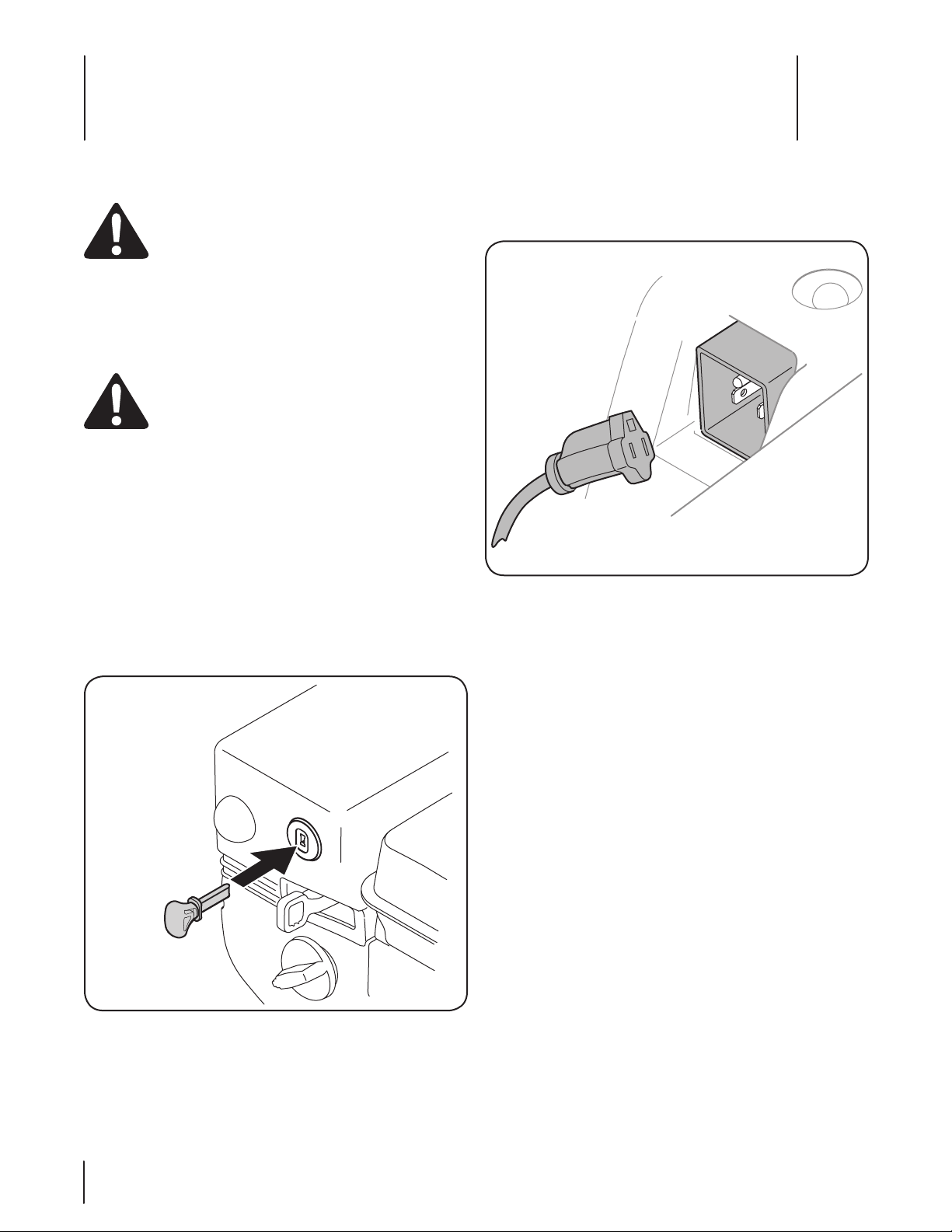
Starting the Engine
WARNING! Always keep hands and feet clear of
moving parts. Do not use a pressurized starting
fluid. Vapors are flammable.
NOTE: Allow the engine to warm up for a few minutes after
starting. The engine will not develop full power until it reaches
operating temperatures.
Electric Starter
WARNING! The electric starter is equipped with a
grounded three-wire power cord and plug, and is
current. It must be used with a properly grounded
three-prong receptacle at all times to avoid the
possibility of electric shock. Follow all instructions
Determine that your home’s wiring is a three-wire grounded
system. Ask a licensed electrician if you are unsure. If you
have a grounded three-prong receptacle, proceed as
2.
engine cannot start unless the key is inserted into the
ignition switch.
3.
ventilated area. See Fig. 5-2.
Move the throttle control to the FAST (rabbit) position.
5.
cover the vent hole when pushing. If the engine is warm,
push the primer only once. Always cover the vent hole
when pushing. Cool weather may require priming to be
repeated.
7.
engine starts, immediately release the starter button.
The electric starter is equipped with thermal overload
protection; the system will temporarily shut-down to allow
starter to cool if electric starter becomes overloaded.
As the engine warms, slowly rotate the choke control to 8.
and run with the choke at half-choke position for a short
period of time, and then slowly rotate the choke into the
After the engine is running, disconnect the power cord
from the electric starter. When disconnecting, always
unplug the end at the wall outlet before unplugging the
opposite end from the engine.
Figure 5-1
Figure 5-2
Operation
5
12
Recoil Starter
CAUTION: Do not pull the starter handle while the
engine running.
WARNING! To avoid unsupervised engine
operation, never leave the engine unattended while
running. Turn the engine off after use and remove
ignition key
engine cannot start unless the key is inserted into the
ignition switch.
Move the throttle control to the FAST (rabbit) position.2.
3.
cover the vent hole when pushing. If the engine is warm,
push the primer only once. Always cover the vent hole
when pushing. Cool weather may require priming to be
repeated.
5.
resist, then pull quickly and forcefully to overcome the
compression. Do not release the handle and allow it to
If required, repeat this step.
As the engine warms, slowly rotate the choke control to the
run with the choke at half-choke position for a short period
Stopping the Engine
WARNING! To avoid unsupervised engine
operation, never leave the machine unattended
with the engine running. Turn the engine off after
use and remove ignition key
Run the engine for a few minutes before stopping to help dry off
any moisture on the engine.
Remove the ignition key. Removing the key will reduce the 2.
possibility of unauthorized starting of the engine while the
equipment is not in use. Keep the key in a safe place. The
engine cannot start without the ignition key.
Wipe any moisture away from the controls on the engine.3.
To Engage Augers
To engage the augers and start throwing snow, squeeze
the auger control against the handle. Release to stop the
augers.
Engaging the Drive
Lift up slightly on the handle to allow the rubber paddles on the
auger to contact the pavement and propel the snow thrower
off the ground and stop the forward motion.
NOTE:
in premature wear on the rubber auger blades which are
not be covered by the warranty.
13se c t i O n 5 — Op e r a t i O n
Adjustments
WARNING! Before Servicing, repairing or
inspecting the snow thrower, disengage the auger
control. Stop the engine and remove the key to
prevent unintended starting.
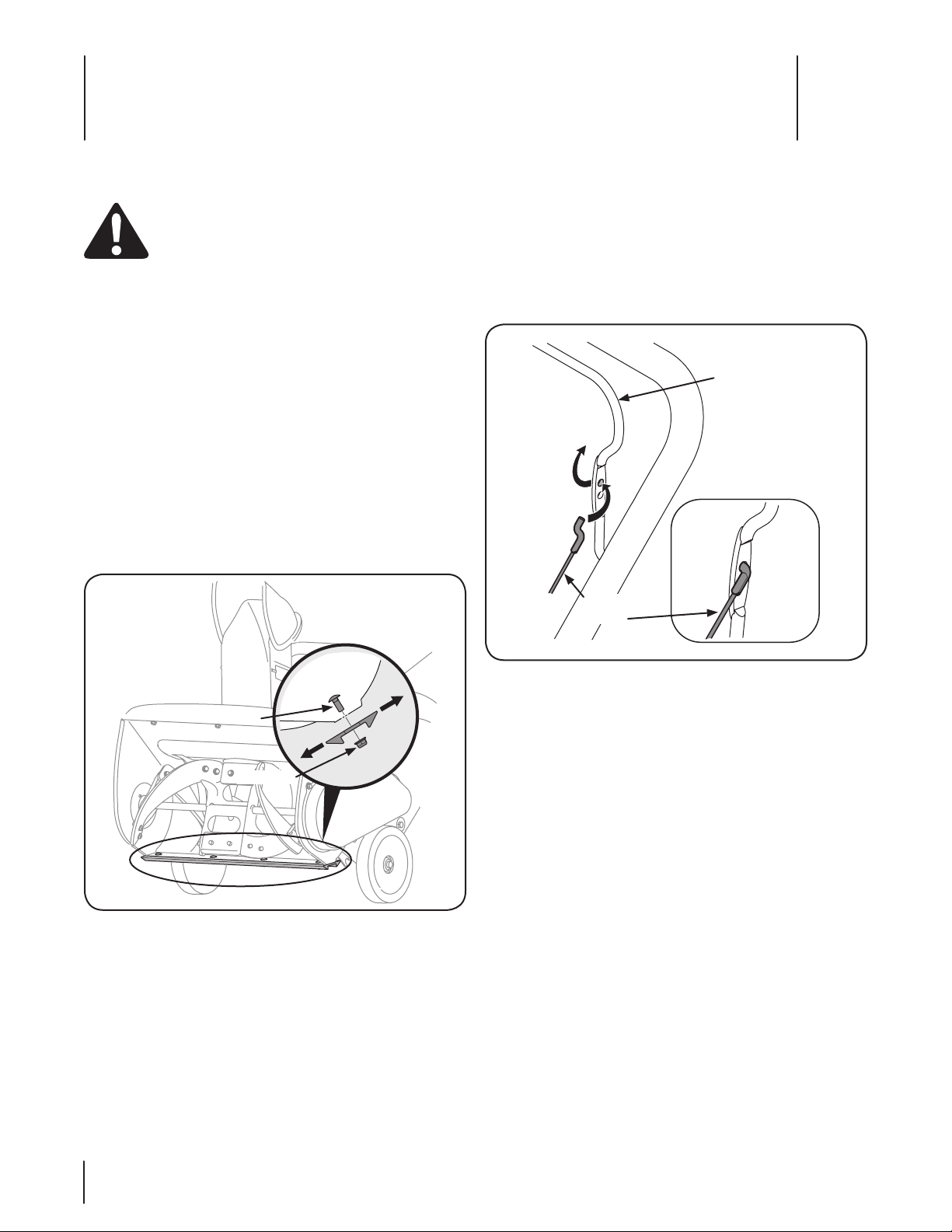
Shave Plate
To check the adjustment of the shave plate, place the
machine on a level surface. The wheels, shave plate and
augers should all contact the level surface. Note that if the
shave plate is adjusted too high, snow may blow under the
housing. If the shave plate wears out excessively, or the
snow thrower does not self-propel, the shave plate may be
too low and needs to be adjusted.
NOTE:
shave plate installed, the augers may be slightly off the
ground.
To adjust the shave plate, tip the snow thrower back so that 2.
it rests on the handle. Loosen the four lock nuts and bolts
Move the shave plate to the desired position and retighten
the nuts and bolts securely.
Control Cable
As a result of both the control cable and the auger drive belt
stretching due to wear, periodic adjustments may be necessary. If
the auger seems to hesitate when rotating, proceed as follows:
The upper hole in the control handle provides for an adjustment
in cable tension. To adjust, disconnect the end of control cable
from the bottom hole in the control handle and reinsert it in the
Test the snow thrower to see if there is a noticeable difference. If
after the adjustment to the control cable the auger still hesitates
when rotatiing, see the Service Section for instructions on
replacing the belt.
Chute Assembly
Refer to the Assembly and Set-Up section for instructions on
adjusting the chute assembly.
Maintenance
Lubrication
Lubricate the pivot points on the control handle and the
extension spring at the end of the control cable with a light
oil once every season and before the snow thrower is put into
storage at the end of the season.
Off-Season Storage
If the snow thrower will not be used for 30 days or longer, follow
the instructions below.
Store the equipment in a clean, dry area.
If storing the snow thrower in an unventilated area, rustproof 2.
the machine using a light oil or silicone to coat the snow
thrower.
Clean the exterior of the engine and the snow thrower.3.
Figure 6-1
Side View
Lock Nut
Bolt
Control
Cable
Control
Handle
Figure 6-2
Maintenance & Adjustments
6
14
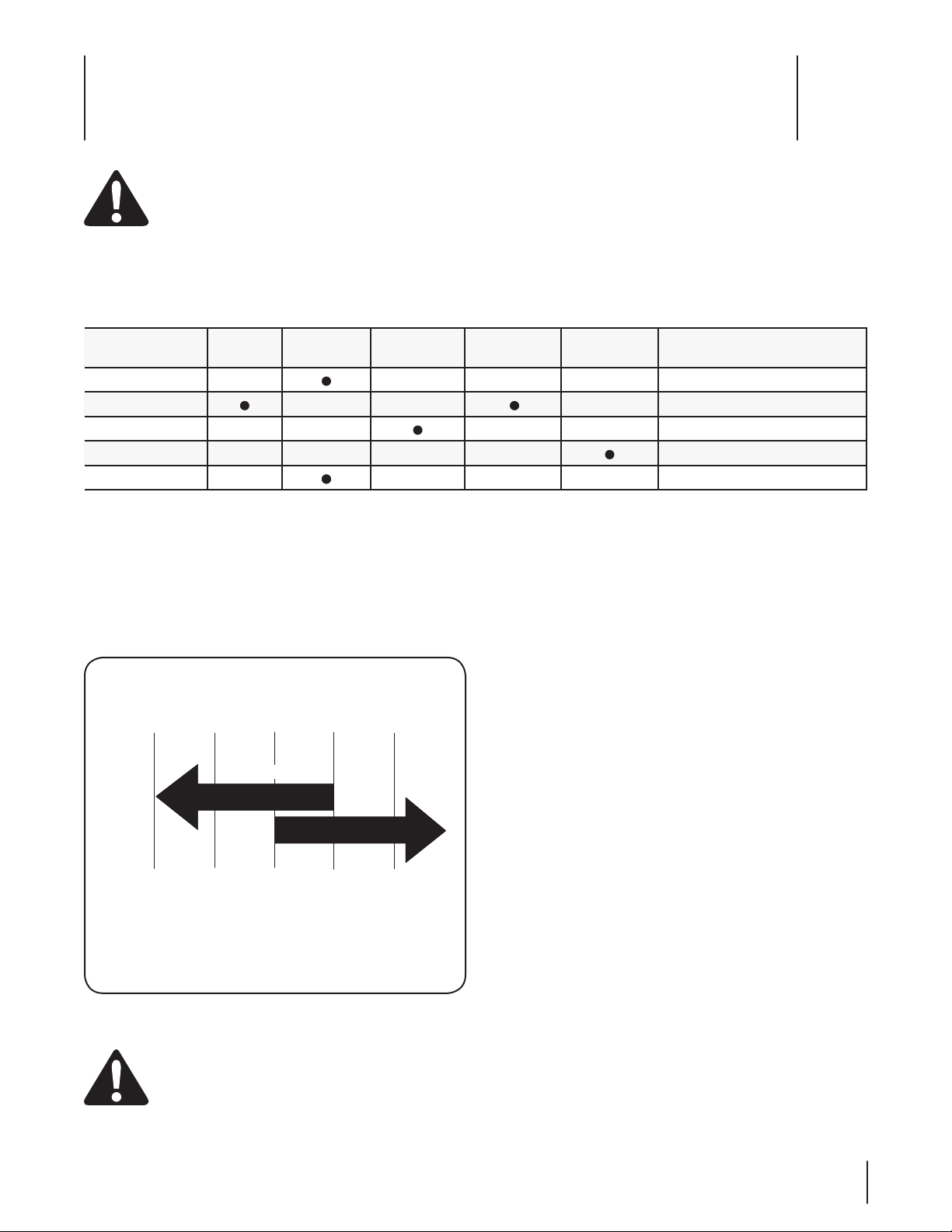
Maintenance Schedule
TasksFach Use or
ers.
ery Season
ery Season
or 5s.
ery Season
00rs.
Service Dates
Check engine oil
Change engine oil
Check spark plug
Service spark plug
Clean exhaust area
WARNING! To prevent accidental start-up, shut off
the engine and remove the ignition key before
performing any type of engine maintenance.
high level performance is to be maintained. Regular maintenance
will also ensure a long service life. The required service intervals
and the type of maintenance to be performed are described
in the table below. Follow the hourly or calendar intervals,
whichever occur first. More frequent service is required when
operating in adverse conditions.
Oil Recommendations
When adding oil to the engine, refer to the viscosity chart
detergent, premium quality motor oil certified to meet or
exceed U.S. automobile manufacturer’s requirements for service
classification SG, SF. Motor oils classified SG, SF will show this
designation on the container.
CAUTION:
2-stroke engine oil. It could shorten the engine’s
service life.
Checking Engine Oil
Remove the oil filler cap/dipstick and wipe the dipstick
2.
screw it in.
Remove the oil filler cap/dipstick. If the level is low, slowly 3.
NOTE:
result in the engine smoking, hard starting or spark plug
fouling.
Figure 7-1
5W-30
0W-30
(°F)
(°C)
-40° -20° 0° 20° 40°
-30° -20° -10° 0°
0W-30
5W-30
Synthetic
Engine Maintenance
7
15
Changing Engine Oil
NOTE: Check the oil level before each use and after every five
hours of operation to be sure the correct oil level is maintained.
Drain fuel from the tank by running the engine until the
fuel tank is empty. Be sure the fuel fill cap is secure.
2.
plug.
Remove the oil drain plug, Figure 7-3.3.
Tip the engine to drain oil into the container. Used oil must
be disposed of at a proper collection center.
Reinstall the drain plug and tighten it securely. 5.
Refill with the recommended oil and check the oil level,
refer to Assembly & Set-Up Section for instructions.
Reinstall the oil filler cap/dipstick securely.7.
CAUTION: Thoroughly wash your hands with soap
and water as soon as possible after handling
used oil.
NOTE:
friendly to the environment. Take it to a recyling center or other
collection center.
Spark Plug
WARNING!
the spark plug removed.
WARNING! If the engine has been running, the
muffler will be very hot. Be careful not to touch the
muffler.
To ensure proper engine operation, the spark plug must be
properly gapped and free of deposits.
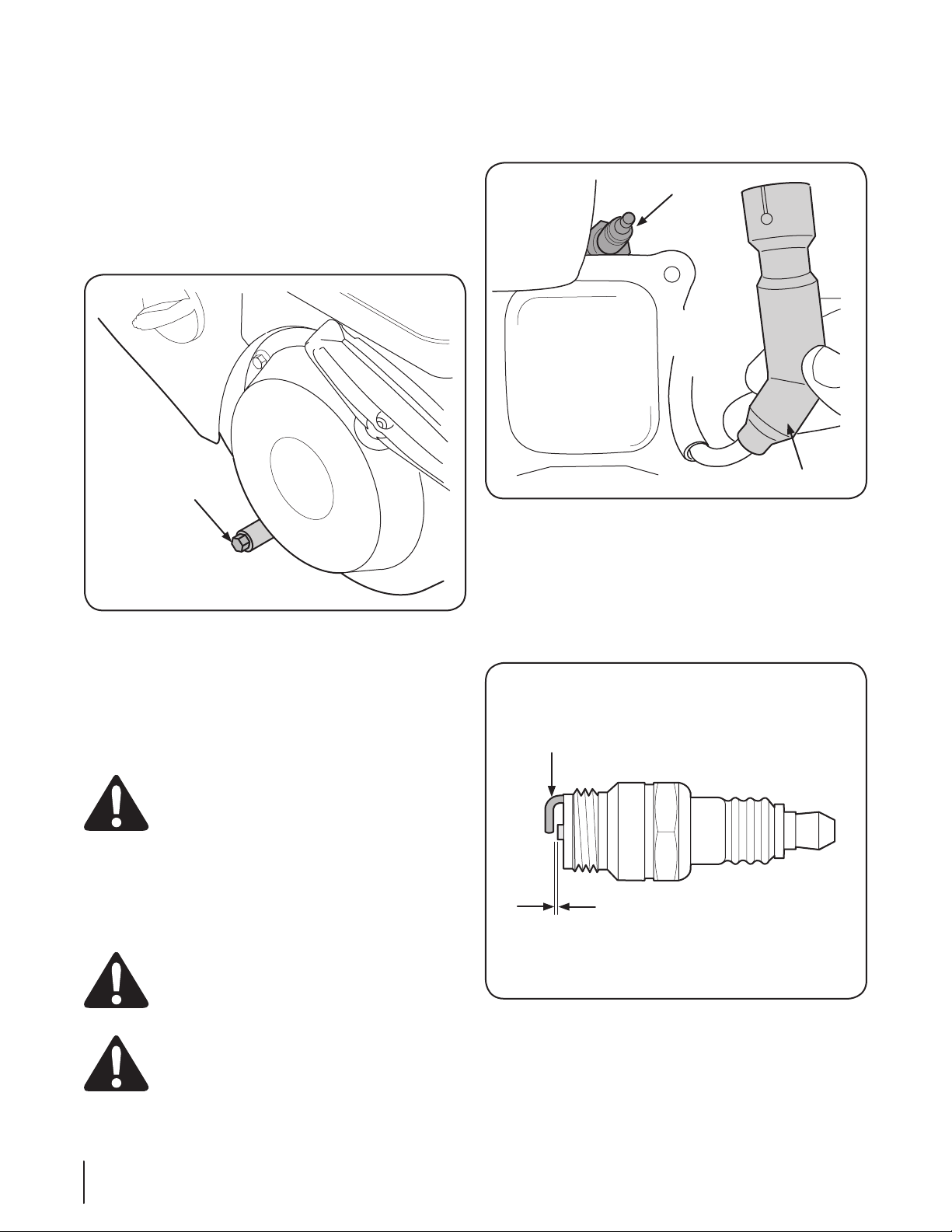
Remove the spark plug boot and use a spark plug wrench
Visually inspect the spark plug. Discard the spark plug if 2.
there is any apparent wear, or if the insulator is cracked or
chipped. Clean the spark plug with a wire brush if it is to be
reused.
Measure the plug gap with a feeler gauge. Correct as 3.
necessary by bending the side electrode, Fig. 7-5. The gap
Check that the spark plug washer is in good condition
and thread the spark plug in by hand to prevent cross-
threading.
Figure 7-4
Spark Plug
Spark Plug Boot
Oil Plug
Figure 7-1
.02-.03 in.
(0.60-0.80 mm)
Electrode
Figure 7-5
16 se c t i O n 7— en g i n e Ma i n t e n a n c e
After the spark plug is seated, tighten with a spark plug 5.
wrench to compress the washer.
NOTE: When installing a new spark plug, tighten ⁄-turn
after the spark plug seats to compress the washer. When
reinstalling a used spark plug, tighten ⁄- to ⁄-turn after
the spark plug seats to compress the washer.
CAUTION: The spark plug must be tightened
securely. A loose spark plug can become very hot
and can damage the engine.
Cleaning the Engine
If the engine has been running, allow it to cool for at least half
engine.
CAUTION: Do not spray the engine with water to
clean it because the water could contaminate the
fuel. Using a garden hose or pressure washing
equipment can also force water into the muffler
opening. Water that passes through the muffler can
enter the cylinder and cause damage.
WARNING! Accumulation of debris around the
muffler could cause a fire. Inspect and clean before
every use.
Off-Season Storage
prevent deterioration and gum from forming in the fuel
system or on essential carburetor parts. If the gasoline in your
engine deteriorates during storage, you may need to have the
carburetor, and other fuel system components, serviced or
replaced.
Remove all fuel from the tank by running the engine until it
stops.
Change the engine oil.2.
3.
several times to distribute the oil, and reinstall the spark
plug.
Clean debris from around the engine, and under, around,
and behind the muffler. Apply a light film of oil on any
areas that are susceptible to rust.
Store in a clean, dry and well ventilated area away from any 5.
appliance that operates with a flame or pilot light, such as a
furnace, water heater or clothes dryer. Avoid any area with
a spark producing electric motor, or where power tools are
operated.
If possible, avoid storage areas with high humidity.
Keep the engine level in storage. Tilting the engine can cause 7.
fuel or oil leakage.
17se c t i O n 7 — en g i n e Ma i n t e n a n c e
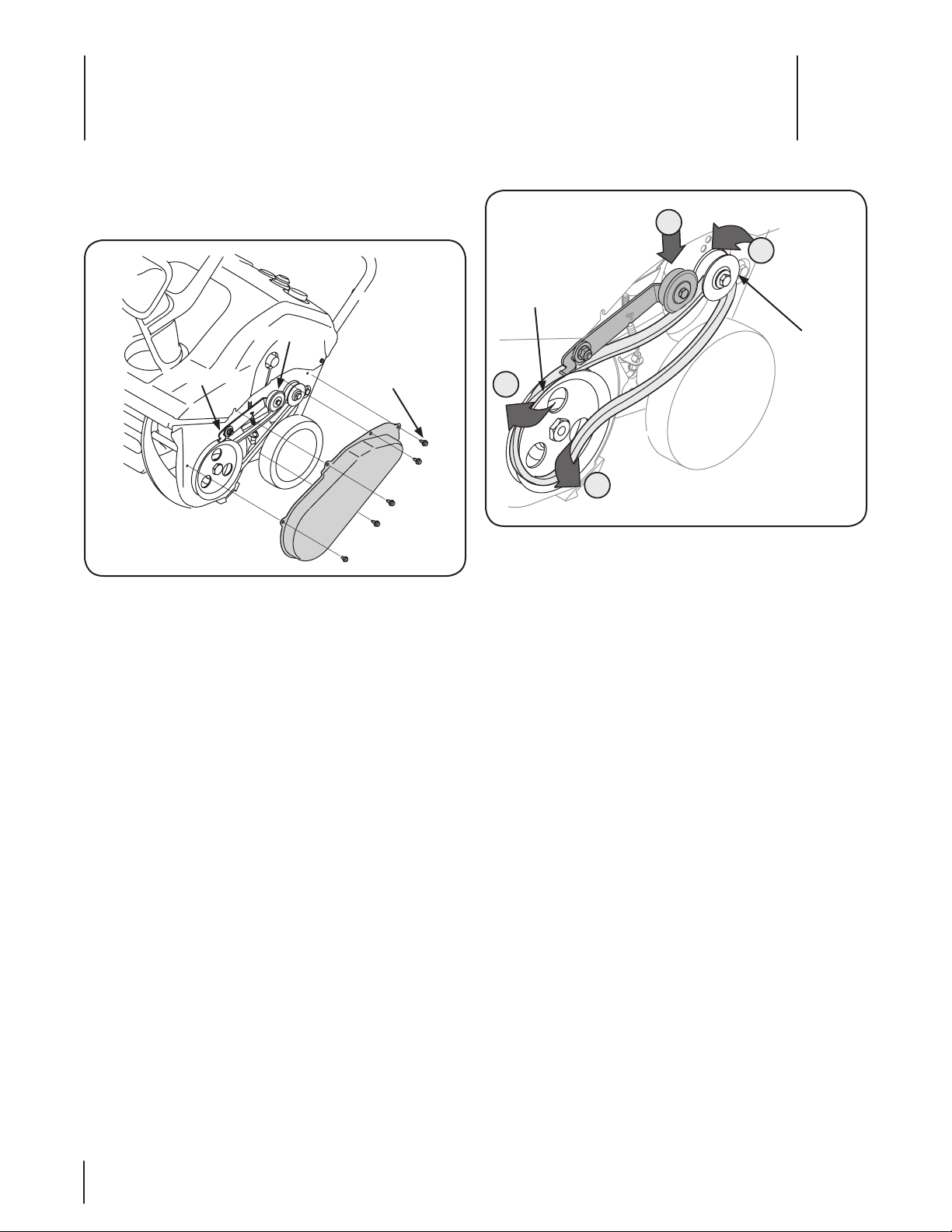
Replacing Belt
Remove the belt cover by removing the five hex screws
Remove the belt by grasping it from the bottom of the 2.
auger pulley and pulling outward.
NOTE:
To replace the belt follow these instructions and refer to Fig. 7-2:
2.
keeper.
Route the belt around the engine pulley.3.
Reinstall the belt cover removed earlier.5.
Idler Pulley
Belt Keeper
Hex Screws
Figure 7-1
Figure 7-2
Engine Pulley
Auger Pulley
1
4
3
2
Service
8
18
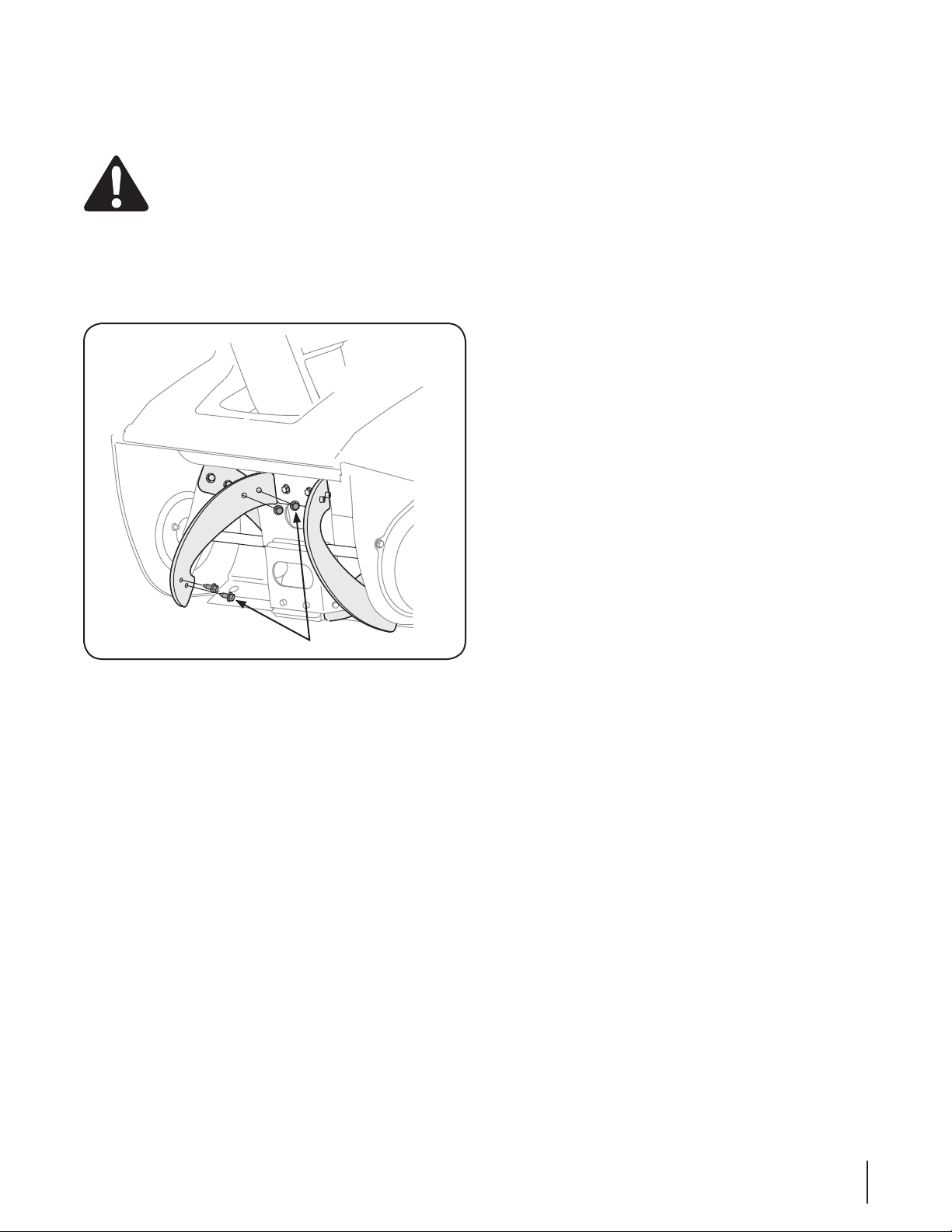
Replacing Auger Paddles
The snow thrower auger’s rubber paddles are subject to wear
and should be replaced if any signs of excessive wear are present.
CAUTION:
paddles to wear to the point where portions of the
metal auger itself can come in contact with the
pavement. Doing so can result in serious damage to
your snow thrower.
To change the rubber paddles, proceed as follows:
Remove the existing rubber paddles by unthreading the
self-tapping screws which secure them to the auger. See
Fig. 7-3.
Secure the replacement rubber paddles to the auger using 2.
the hardware removed earlier.
Replacing Shave Plate
The shave plate is attached to the bottom of the auger housing
and is subject to wear. It should be checked periodically. There
are two wearing edges and the shave plate can be reversed.
Remove the four carriage bolts and hex lock nuts which
attach it to the snow thrower housing.
Install the new shave plate, making sure the heads of the 2.
carriage bolts are on the inside of the housing.
Adjust the shave plate as instructed in the Maintenance & 3.
Adjustments Section.
Tighten securely once adjusted.
Self-Tapping Screws
Figure 7-3
19se c t i O n 7 — se r v i c e

Problem Cause Remedy
Fuel tank empty, or stale fuel.
Blocked fuel line.2.
Key not inserted all the way.3.
Spark plug wire disconnected.
Faulty spark plug.5.
7.
Throttle may be in the off position.8.
Fill tank with clean fresh gasoline.
Clean fuel line.2.
Insert key all the way.3.
Connect wire to spark plug.
Clean spark plug, readjust gap, or replace.5.
Wait at least ten minutes before starting.7.
8.
position.
Fuel line blocked, or stale fuel. 2.
Water or dirt in fuel system.3.
Carburetor out of adjustment.
Clean fuel line and fill tank with fresh, clean 2.
gasoline.
Drain fuel tank. Refill with fresh fuel.3.
Contact an authorized Service Center.
Carburetor out of adjustment. Contact an authorized Service Center.2.
Loss of power Spark plug wire loose.
Vent in gas cap plugged.2.
Firmly connect spark plug wire.
Clear vent.2.
Loose parts or damaged auger. Stop engine immediately and disconnect
spark plug wire. Check for possible damage.
Tighten all bolts and nuts. Repair as needed.
If the problem persists, take snow thrower to
an authorized service dealer.
Snowthrower fails to self-
propel
Auger control cable out of adjustment.
Auger drive belt loose or damaged.2.
Adjust auger control cable as shown in
Maintenance and Adjustments section.
Replace auger drive belt.2.
Augers continue to rotate Auger control cable out of adjustment. Adjust auger control cable as shown in
Maintenance and Adjustments section.
Unit fails to discharge snow Chute assembly clogged.
Foreign object lodged in auger. 2.
Auger control cable out of adjustment.3.
Auger belt loose or damaged.
Stop engine and disconnect spark plug wire.
Clean chute and inside of auger housing with
clean-out tool or stick.
Stop engine immediately and disconnect the 2.
spark plug wire. Remove object from auger.
Adjust auger control cable.3.
Replace auger belt.
Troubleshooting
9
20
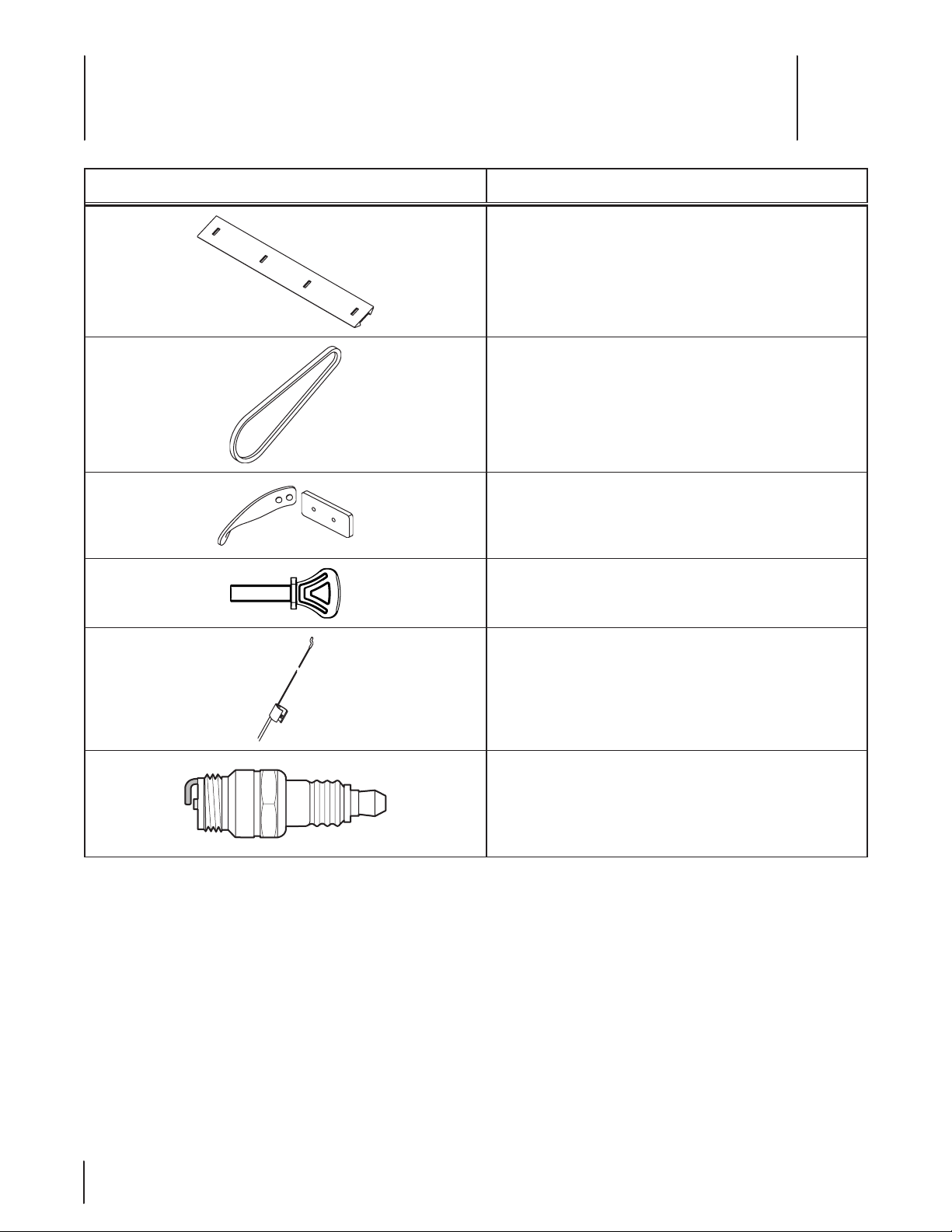
Component Part Number and Description
2 paddles and hardware)
Replacement Parts
10
21

MTD CONSUMER GROUP (MTD) and the United States Environment Protection Agency (U. S. EPA)
Emission Control System Warranty Statement
(Owner’s Defect Warranty Rights and Obligations)
The U. S. EPA and MTD are pleased to explain the emissions control system warranty on your model year 2005 and later small off-road engine.
New small off-road engines must be designed, built and equipped to meet the stringent anti-smog standards. MTD must warranty the emission
control system on your engine for the period of time listed below, provided there has been no abuse, neglect or improper maintenance of your small
off-road engine.
Your emission control system may include parts such as the carburetor, air cleaner, ignition system, exhaust system, and other associated emis-
sion-related components.
Where a warrantable condition exists, MTD will repair your small off-road engine at no cost to your including diagnosis, parts and labor.
MANUFACTURER’S WARRANTY COVERAGE:
This emissions control system is warranted for two years. If any emission-related part on your engine is defective, the part will be repaired or
replaced by MTD.
OWNER’S WARRANTY RESPONSIBILITIES:
As the small off-road engine owner, you are responsible for the performance of the required maintenance listed in your Owner’s Manual. MTD
recommends that you retain all your receipts covering maintenances on your small off-road engine, but MTD can not deny warranty solely for the
lack of receipts or for your failure to ensure the performance to all scheduled maintenance.
As the small off-road engine owner, you should however be aware that MTD may deny your warranty coverage if your small off-road engine or part
has failed due to abuse, neglect, improper maintenance or unapproved modifications.
You are responsible for presenting your small off-road engine to an Authorized MTD Service Dealer as soon as a problem exists. The warranted
repairs should be completed in a reasonable amount of time, not to exceed 30 days.
If you have any questions regarding your warranty rights and responsibilities, you should contact a MTD Service Representative at 1-800-800-7310
and address is MTD LLC, P.O. Box 361131, Cleveland OH, 44136-0019.
DEFECTS WARRANTY REqUIREMENTS FOR 1995 AND LATER SMALL OFF-ROAD ENGINES:
This section applies to 1995 and later small off-road engines. The warranty period begins on the date the engine or equipment is delivered to an
ultimate purchaser.
(a) General Emissions Warranty Coverage
MTD must warrant to the ultimate purchaser and each subsequent purchaser that the engine is:
(1) Designed, built, and equipped so as to conform with all applicable regulations adopted by the Air Resources Board pursuant to its authority in
Chapters 1 and 2,Part 5, Division 26 of the Health and Safety Code; and
(2) Free from defects in materials and workmanship that cause the failure of a warranted part to be identical in all material respects to the part as
described in the engine manufacturer’s application for certification for a period of two years.
(b) The warranty on emissions-related parts will be interpreted as follows:
(1) Any warranted part that is not scheduled for replacement as required maintenance in the written instructions required by Subsection (c)
must be warranted for the warranty period defined in Subsection (a)(2). If any such part fails during the period of warranty coverage, it must be
repaired or replaced by MTD according to Subsection (4) below. Any such part repaired or replaced under the warranty must be warranted for
the remaining warranty period.
(2) Any warranted part that is scheduled only for regular inspection in the written instructions required by Subsection (c) must be warranted for
the warranty period defined in Subsection (a)(2). A statement in such written instructions to the effect of “repair or replace as necessary” will
not reduce the period of warranty coverage. Any such part repaired or replaced under warranty must be warranted for the remaining warranty
period.
(3) Any warranted part that which is scheduled for replacement as required maintenance in the written instructions required by Subsection (c)
must be warranted for the period of time prior to the first scheduled replacement point for that part. If the part fails prior to the first scheduled
replacement, the part must be repaired or replaced by MTD according to Subsection (4) below. Any such part repaired or replaced under
warranty must be warranted for the remainder of the period prior to the first scheduled replacement point for the part.
(4) Repair or replacement of any warranted part under the warranty provisions of this article must be performed at no charge to the owner at a
warranty station.
(5) Notwithstanding the provisions of Subsection (4) above, warranty services or repairs must be provided at all MTD distribution centers that
are franchised to service the subject engines.
(6) The owner must not be charged for diagnostic labor that leads to the determination that a warranted part is in fact defective, provided that
such diagnostic work is performed at a warranty station.

(7) The engine manufacturer is liable for damages to other engine components proximately caused by a failure under warranty of any warranted
part.
(8) Throughout the engine’s warranty period defined in Subsection (a)(2), MTD will maintain a supply of warranted parts sufficient to meet the
expected demand for such parts.
(9) Any replacement part may be used in the performance of any warranty maintenance or repairs and must be provided without charge to the
owner. Such use will not reduce the warranty obligations of MTD.
(10) Add-on or modified parts that are not exempted by the Air Resources Board may not be used. The use of any non-exempted add-on or
modified parts shall be grounds for disallowing a warranty claim made in accordance with this article. The engine manufacturer shall not be
liable under this article to warrant failures of warranted parts caused by the use of non-exempted add-on or modified part.
(c) MTD will include a copy of the following emission warranty parts list with each new engine, using those portions of the list applicable to the
engine.
(1) Fuel Metering System
•Coldstartenrichmentsystem(softchoke)
•Carburetorandinternalparts
•FuelPump
(2) Air Induction System
•Aircleaner
•Intakemanifold
(3) Ignition System
•Sparkplug(s)
•MagnetoIgnitionSystem
(4) Exhaust System
(5) Miscellaneous Items Used in Above System
•Vacuum,temperature,position,timesensitivevalvesandswitches
•Connectorsandassemblies
GDOC-100173 Rev. A

MANUFACTURER’S LIMITED WARRANTY FOR
GDOC-100166 REV. A
The limited warranty set forth below is given by Troy-Bilt LLC with
respect to new merchandise purchased and used in the United States
and/or its territories and possessions, and by MTD Products Limited
with respect to new merchandise purchased and used in Canada
and/or its territories and possessions (either entity respectively,
“Troy-Bilt” ).
“Troy-Bilt” warrants this product (excluding its Normal Wear Parts
and Attachments as described below) against defects in material and
workmanship for a period of two (2) years commencing on the date
of original purchase and will, at its option, repair or replace, free of
charge, any part found to be defective in materials or workmanship.
This limited warranty shall only apply if this product has been
operated and maintained in accordance with the Operator’s Manual
furnished with the product, and has not been subject to misuse,
abuse, commercial use, neglect, accident, improper maintenance,
alteration, vandalism, theft, fire, water, or damage because of other
peril or natural disaster. Damage resulting from the installation or
use of any part, accessory or attachment not approved by Troy-Bilt
for use with the product(s) covered by this manual will void your
warranty as to any resulting damage.
Normal Wear Parts are warranted to be free from defects in material
and workmanship for a period of thirty (30) days from the date of
purchase. Normal wear parts include, but are not limited to items
such as: batteries, belts, blades, blade adapters, tines, grass bags,
wheels, rider deck wheels, seats, snow thrower skid shoes, friction
wheels, shave plates, auger spiral rubber and tires.
Attachments — Troy-Bilt warrants attachments for this product
against defects in material and workmanship for a period of one (1)
year, commencing on the date of the attachment’s original purchase
or lease. Attachments include, but are not limited to items such as:
grass collectors and mulch kits.
HOW TO OBTAIN SERVICE: Warranty service is available, WITH
PROOF OF PURCHASE, through your local authorized service dealer.
To locate the dealer in your area:
In the U.S.A.
Check your Yellow Pages, or contact Troy-Bilt LLC at P.O. Box 361131,
Cleveland, Ohio 44136-0019, or call 1-866-840-6483,
1-330-558-7220 or log on to our Web site at www.troybilt.com.
In Canada
Contact MTD Products Limited, Kitchener, ON N2G 4J1, or call 1-800-
668-1238 or log on to our Web site at www.mtdcanada.com.
This limited warranty does not provide coverage in the following
cases:
a. Log splitter pumps, valves, and cylinders have a separate one-
year warranty.
b. Routine maintenance items such as lubricants, filters, blade
sharpening, tune-ups, brake adjustments, clutch adjustments,
deck adjustments, and normal deterioration of the exterior finish
due to use or exposure.
c. Service completed by someone other than an authorized service
dealer.
d. Troy-Bilt does not extend any warranty for products sold or
exported outside of the United States and/or Canada, and their
respective possessions and territories, except those sold through
Troy-Bilt’s authorized channels of export distribution.
e. Replacement parts that are not genuine Troy-Bilt parts.
f. Transportation charges and service calls.
g. Troy-Bilt does not warrant this product for commercial use.
No implied warranty, including any implied warranty of
merchantability of fitness for a particular purpose, applies after
the applicable period of express written warranty above as to the
parts as identified. No other express warranty, whether written or
oral, except as mentioned above, given by any person or entity,
including a dealer or retailer, with respect to any product, shall
bind Troy-Bilt. During the period of the warranty, the exclusive
remedy is repair or replacement of the product as set forth above.
The provisions as set forth in this warranty provide the sole and
exclusive remedy arising from the sale. Troy-Bilt shall not be liable
for incidental or consequential loss or damage including, without
limitation, expenses incurred for substitute or replacement lawn
care services or for rental expenses to temporarily replace a
warranted product.
Some states do not allow the exclusion or limitation of incidental
or consequential damages, or limitations on how long an implied
warranty lasts, so the above exclusions or limitations may not apply
to you.
In no event shall recovery of any kind be greater than the amount of
the purchase price of the product sold. Alteration of safety features of
the product shall void this warranty. You assume the risk and liability
for loss, damage, or injury to you and your property and/or to others
and their property arising out of the misuse or inability to use the
product.
This limited warranty shall not extend to anyone other than the
original purchaser or to the person for whom it was purchased as a
gift.
HOW STATE LAW RELATES TO THIS WARRANTY: This limited
warranty gives you specific legal rights, and you may also have other
rights which vary from state to state.
IMPORTANT: Owner must present Original Proof of Purchase to
obtain warranty coverage.
Troy-Bilt LLC, P.O. BOX 361131 CLEVELAND, OHIO 44136-0019; Phone: 1-866-840-6483, 1-330-558-7220
MTD Canada Limited - KITCHENER, ON N2G 4J1; Phone 1-800-668-1238
TROY-BILT LLC, P.O. BOX 361131 CLEVELAND, OHIO 44136-0019
Impreso en Estados Unidos de América
Ma n u a l d e l Op e r a d O r
Medidas importantes de seguridad • Conguración • Funcionamiento • Mantenimiento • Servicio • Solución de problemas • Garantía
Máquina quitanieve de etapa única — Squall 2100
ADVERTENCIA
LEA Y RESPETE TODAS LAS NORMAS DE SEGURIDAD E INSTRUCCIONES INCLUIDAS EN ESTE
MANUAL ANTES DE PONER EN FUNCIONAMIENTO ESTA MÁQUINA.
SI NO RESPETA ESTAS INSTRUCCIONES PUEDE PROVOCAR LESIONES PERSONALES.
Formulario No. 769-04000
(17 de abril, 2008)

Al propietario
1
2
Registro de información de producto
Antes de configurar y operar su equipo nuevo, por favor localice
la placa de modelo en el equipo y registre la información en el
colóquese en la posición del operador y mire hacia abajo en
la parte posterior derecha de la cubierta. Si tiene que solicitar
soporte técnico a través de nuestro sitio web, el Departamento
de Asistencia al Cliente, o de un distribuidor de servicio
autorizado local, necesitará esta información.
Medidas importantes de seguridad ...................... 3
Montaje y Conguración ........................................ 7
Controles y características...............................................10
Funcionamiento .....................................................12
Mantenimiento y Ajustes .......................................13
Mantenimiento del motor .....................................14
Servicio ....................................................................17
Solución de problemas ..........................................19
Piezas de reemplazo ............................................. 20
Índice
nú M e r O d e MO d e l O
nú M e r O d e se r i e
Asistencia al Cliente
Por favor, NO devuelva la unidad al minorista o distribuidor sin ponerse en contacto primero con el Departamento de
Asistencia al Cliente.
Visite nuestro sitio web en www.troybilt.com◊
Llame a un representante de Asistencia al Cliente al (800) 828-5500 ó (330) 558-7220◊
◊
Gracias por comprar una máquina quitanieve fabricada por
Troy-Bilt LLC. La misma ha sido diseñada cuidadosamente
para brindar excelente rendimiento si se la opera y mantiene
correctamente.
Le indica cómo configurar, operar y mantener la máquina
cuidadosamente y en todo momento las prácticas de seguridad
recomendadas y de hacérselas seguir a cualquier otra persona
lesiones personales o daños materiales.
Toda la información contenida en este manual hace referencia
a la más reciente información de producto disponible en el
momento de la impresión. Revise el manual frecuentemente
incluidas y/o ilustradas en este manual pueden no ser aplicables
a todos los modelos. Troy-Bilt LLC se reserva el derecho a
modificar las especificaciones de los productos, los diseños y
el equipo sin previo aviso y sin generar responsabilidad por
respecto a la unidad, llame a un distribuidor de servicio Troy-Bilt
autorizado o póngase en contacto directamente con nosotros.
postal de Asistencia al Cliente de Troy-Bilt se encuentran en esta
página. Queremos garantizar su entera satisfacción en todo
momento.
derecho o izquierdo
de la máquina se observan desde la posición del operador.
cuestiones relacionadas con el rendimiento, potencia de salida,
favor, para obtener mayor información consulte el Manual del
nto con su unidad.
Gracias
Medidas importantes de seguridad
2
3
Capacitación
Lea, entienda y cumpla todas las instrucciones incluidas en
la máquina y en los manuales antes de montarla y utilizarla.
Guarde este manual en un lugar seguro para consultas
2.
de los mismos. Sepa cómo detener la máquina y desactivar
los controles rápidamente.
3.
deben leer y entender las instrucciones de operación y
normas de seguridad contenidas en este manual, y en la
máquina ydeben ser entrenados y supervisados por un
adulto.
Nunca permita que los adultos operen esta máquina sin
recibir antes la instrucción apropiada.
Los objetos arrojados por la máquina pueden producir 5.
arrojando nieve para evitar que la descarga de material se
realice hacia los caminos, los observadores, etc.
Mantenga a los observadores, ayudantes, mascotas y niños
por lo menos a 75 pies de la máquina mientras la misma
está en funcionamiento. Detenga la máquina si alguien se
acerca.
Sea precavido para evitar patinarse o caerse especialmente 7.
cuando opera la máquina en reversa.
Preparativos8.
Inspeccione minuciosamente el área donde utilizará el equipo.
Saque todos los felpudos, periódicos, trineos, tablas, cables y
ser arrojados por la barrena / impulsor.
antiparras de seguridad mientras opera la máquina o
mientras la ajusta o repara. Los objetos arrojados que
rebotan pueden producir lesiones oculares graves.
No opere la máquina sin la vestimenta adecuada para 2.
estar al aire libre en invierno. No utilice alhajas, bufandas
partes móviles. Utilice un calzado especial para superficies
resbaladizas.
Use un prolongador y un tomacorriente de tres cables con 3.
conexión a tierra para todas las máquinas con motores de
encendido eléctrico.
Ajuste la altura de la caja del tomacorriente para limpiar la
grava o las superficies con piedras trituradas.
Desengrane todas las palancas de control antes de arrancar 5.
el motor.
Nunca intente realizar ajustes mientras el motor está
recomendados en el manual del operador.
Deje que el motor y la máquina se adapten a la 7.
temperatura exterior antes de comenzar a sacar la nieve.
ADVERTENCIA!
importantes de seguridad que se deben respetar para evitar poner en peligro su seguridad
personal y/o material y la de otras personas. Lea y siga todas las instrucciones de este manual
antes de poner en funcionamiento esta máquina. Si no respeta estas instrucciones puede
provocar lesiones personales.
¡TENGA EN CUENTAS LAS ADVERTENCIAS!
PELIGRO:
contenidas en este manual. Al igual que con cualquier tipo de equipo motorizado, un
capaz de amputar dedos, manos y pies y de arrojar objetos extraños con gran fuerza. De no
respetar las instrucciones de seguridad siguientes se pueden producir lesiones graves o la
muerte.
PROPOSICIÓN 65 DE CALIFORNIA
ADVERTENCIA!
de California considera que pueden producir cáncer, defectos de nacimiento u otros

4 se c t i O n 2 — Me d i d a s i M p O r t a n t e s d e s e g u r i d a d
Manejo seguro de la gasolina
evitar lesiones personales o daños materiales tenga mucho
cuidado cuando trabaje con gasolina. La gasolina es sumamente
inflamable y sus vapores pueden causar explosiones. Si se
derrama gasolina encima o sobre la ropa se puede lesionar
gravemente ya que se puede incendiar. Lávese la piel y cámbiese
de ropa de inmediato.
Ua. tilice sólo los recipientes para gasolina autorizados.
Apague todos los cigarrillos, cigarros, pipas y otras b.
fuentes de combustión.
Nunca cargue combustible en la máquina en un c.
espacio cerrado.
Nunca saque la tapa del combustible ni agregue d.
combustible mientras el motor está caliente o en
marcha.
e.
minutos antes de volver a cargar combustible.
Nunca llene en exceso el depósito de combustible. f.
Llene el tanque a no más de ½ pulgada por debajo
de la base del cuello de llenado dejando espacio
para la dilatación del combustible.
g.
bien.
Limpie el combustible que se haya derramado sobre h.
el motor y el equipo. Traslade la máquina a otra
Nunca almacene la máquina o el recipiente de i.
combustible en un espacio cerrado donde haya
fuego, chispas o luz piloto (por ejemplo, hornos,
calentadores de agua, calefactores, secadores de
ropa, etc.).
j.
minutos antes de guardarla.
Nunca llene los recipientes en el interior de k.
recubrimientos plásticos. Coloque siempre los
llenarlos.
Si es posible, retire el equipo a gasolina del camión o l.
remolque y llénelo en el suelo. Si esto no es posible,
llene el equipo en un remolque con contenedor
portátil, en vez de desde una boquilla dispensadora
de gasolina.
Mantenga la boquilla dispensadora en contacto m.
con el borde del depósito de combustible o con la
abertura del recipiente en todo momento, hasta
terminar la carga. No utilice un dispositivo de
apertura/cierre de boquilla.
Funcionamiento
No ponga las manos o los pies cerca de las piezas
rotatorias, en la caja de la barrena / impulsor o en el
giratorias puede resultar en la amputación de manos o
pies.
La palanca de control de la barrena / impulsor es un 2.
dispositivo de seguridad. Nunca evite su funcionamiento.
De hacerlo la operación de la máquina es riesgosa y puede
ocasionar lesiones.
Las palancas de control deben funcionar bien en ambas 3.
direcciones y regresar automáticamente a la posición de
desengrane cuando se las suelta.
Nunca opere la máquina si falta un montaje del canal o si
el mismo está dañado. Mantenga todos los dispositivos de
seguridad en su lugar y en funcionamiento.
Nunca encienda el motor en espacios cerrados o en una 5.
monóxido de carbono, un gas inodoro y letal.
No utilice la máquina bajo la influencia del alcohol o las
drogas.
7.
quemaduras. No los toque. Mantenga a los niños alejados.
Sea sumamente precavido cuando opere la máquina sobre 8.
una superficie con grava o cuando la cruce. Manténgase
alerta por si se presentan peligros ocultos o tránsito.
Tenga cuidado cuando cambie de dirección o cuando
opere la máquina en pendientes.
evitar que la descarga de material se produzca hacia las
posibles daños materiales o lesiones producidas por los
rebotes.
Nunca dirija la descarga hacia los niños, los observadores
o las mascotas ni deje que nadie se pare delante de la
máquina.
No sobrecargue la capacidad de la máquina tratando de
sacar la nieve muy rápidamente.
Nunca opere esta máquina sin buena visibilidad o
iluminación. Siempre debe estar seguro de que está bien
afirmado y sujetando firmemente las manijas. Camine,
nunca corra.
Corte la corriente a la barrena / impulsor cuando transporte
la máquina o cuando la misma no está en uso.
Nunca opere la máquina a alta velocidad de
desplazamiento sobre superficies resbaladizas. Mire hacia
abajo y hacia atrás y tenga cuidado cuando vaya marcha
atrás.
Si la máquina comenzara a vibrar de manera anormal,
de manera que haga masa contra el motor. Inspeccione la
máquina minuciosamente para ver si está dañada. Repare
todos los daños antes de encender y operar la máquina.
Desengrane todas las palancas de control y detenga el
motor antes de dejar la posición de operación (detrás de
por completo antes de destapar el montaje del canal o
realizar ajustes e inspecciones.
Nunca ponga las manos en las aberturas de descarga o
de recolección. Utilice siempre la herramienta de limpieza
que se adjunta para destapar la abertura de descarga. No
destape el montaje del canal mientras el motor está en
funcionamiento. Antes de destaparlo, apague el motor
y permanezca detrás de las manijas hasta que todas las
partes móviles se hayan detenido.
Use sólo uniones y accesorios aprobados por el fabricante
(por ejemplo, pesas para las ruedas, cadenas para los
neumáticos, cabinas, etc.).
20.
rápido de la cuerda de arranque (tensión de retroceso) le
jalará la mano y el brazo hacia el motor más rápido de lo
rotos, fracturas, hematomas o esguinces.
Si se presentan situaciones que no están previstas en este
contacto con Asistencia al Cliente para solicitar ayuda y el
nombre del distribuidor de servicio más cercano.
5se c t i O n 2 — Me d i d a s i M p O r t a n t e s d e s e g u r i d a d
Mantenimiento y Almacenamiento
Nunca altere los dispositivos de seguridad. Controle
las secciones de mantenimiento y ajuste de este manual.
Antes de realizar la limpieza, reparar o revisar la máquina, 2.
desengrane todas las palancas de control y detenga el
haciendo masa contra el motor para evitar que se encienda
accidentalmente.
Controle frecuentemente que todos los pernos y tornillos 3.
estén bien ajustados para comprobar que la máquina se
encuentra en condiciones seguras de funcionamiento.
Además, haga una inspección visual de la máquina para
verificar si está dañada.
No cambie la configuración del regulador del motor
controla la velocidad máxima segura de funcionamiento
del motor.
Las placas de raspado y las zapatas antideslizantes que se 5.
usan con la máquina quitanieve se desgastan y se dañan.
todos los componentes y reemplácelos sólo con partes
de piezas que no cumplen con las especificaciones del
equipo original puede resultar en rendimiento inadecuado
además de poner en riesgo la seguridad!”
Revise las palancas de control periódicamente para
verificar que engranen y desengranen adecuadamente y
este manual del operador para obtener instrucciones.
Mantenga o reemplace las etiquetas de seguridad e 7.
Respete las normas referentes a la disposición correcta y las 8.
reglamentaciones sobre gasolina, aceite, etc. para proteger
el medio ambiente.
Antes de almacenar la máquina enciéndala unos minutos
para sacar la nieve que haya quedado en la misma y para
Nunca almacene la máquina o el recipiente de combustible
en un espacio cerrado donde haya fuego, chispas o luz
piloto como por ejemplo, calentadores de agua, hornos,
secadores de ropa, etc.
Consulte siempre el manual del operador para obtener
instrucciones adecuadas para el almacenamiento fuera de
temporada.
tanque, el tapón, y los accesorios buscando rajaduras o
pérdidas. Reemplace de ser necesario.
No modifique el motor
bajo ninguna circunstancia. Si cambia la configuración del
regulador el motor puede descontrolarse y operar a velocidades
inseguras. Nunca cambie la configuración de fábrica del
regulador del motor.
Aviso referido a emisiones
Los motores que están certificados y cumplen con las
siguientes sistemas de control de emisiones: Modificación de
esa manera.
Guardachispas
ADVERTENCIA!
un motor de combustión interna y no debe ser
utilizada en o cerca de un terreno agreste cubierto
por bosque, malezas o hierba excepto si el sistema
de escape del motor está equipado con un
amortiguador de chispas que cumpla con las leyes
locales o estatales correspondientes, en caso de
haberlas.
Si se utiliza un amortiguador de chispas el operador lo debe
de California las medidas anteriormente mencionadas son
estados. Las leyes federales se aplican en territorios federales.
a través de su distribuidor autorizado de motores o poniéndose
Vida útil media
producto tiene una vida útil media
de funcionamiento. Al finalizar la vida útil media, adquiera una
máquina nueva o haga inspeccionar anualmente ésta por un
distribuidor de servicio autorizado para cerciorarse de que todos
los sistemas mecánicos y de seguridad funcionan correctamente
y no tienen excesivo desgaste. Si no lo hace, pueden producirse
accidentes, lesiones o muerte.
ADVERTENCIA! Su responsabilidad—Restrinja el uso de esta máquina motorizada a las personas que lean,
comprendan y respeten las advertencias e instrucciones que figuran en este manual y en la máquina.
GUARDE ESTAS INSTRUCCIONES

6 se c t i O n 2 — Me d i d a s i M p O r t a n t e s d e s e g u r i d a d
Símbolos de Seguridad
operador para obtener la información terminada sobre seguridad, reunirse, operación y mantenimiento y reparación.
Símbolo Descripción
Lea, entienda, y siga todas las instrucciones en el manual (es) antes de intentar reunirse y
funcionar.
hacen para girar platos dentro.
láminas dentro.
No ponga manos o pies cerca del giro de partes, en el alojamiento de taladro/aspa o asamblea
de tolva. Contacto con las partes rotativas puede amputar manos y pies.
combustible.
Nunca dirijas un motor dentro o en un área mal ventilada. Los gases de combustión de motor
contienen el monóxido de carbono, un gas inodoro y mortal.
No use el juez de salida eléctrico del motor en la lluvia.
¡ADVERTENCIA! Su para Restringir responsabilidad el uso de esta máquina de poder a personas que leyeron,
entienda y siga las advertencias e instrucciones en este manual y en la máquina.
¡SALVE ÉSTOS INSTRUCCIONES!
NOTA: Todas las referencias a los lados derecho o izquierdo de
la máquina quitanieve se hacen observando la misma desde la
especificará claramente.
Montaje
Colocación de la barra de control superior
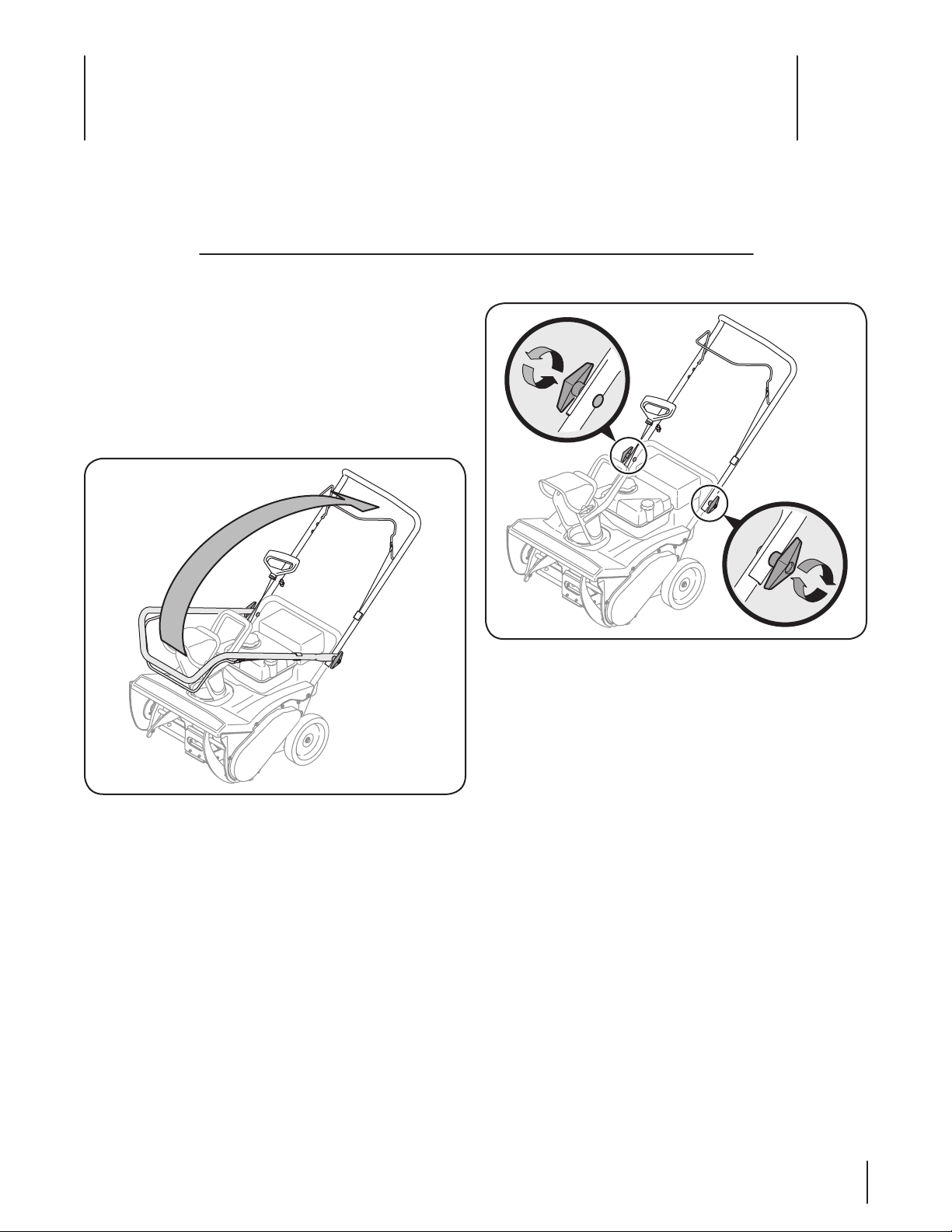
Gire la barra de control superior hasta la posición de
en su lugar, cuidando de no pellizcar el cable en el proceso.
Ajuste las perillas de aletas para sujetar la barra en su lugar. 2.
Vea la Fig. 3-2.
Recomendaciones sobre el combustible
Utilice gasolina para automóviles (sin plomo o bajo contenido de
plomo para minimizar los depósitos en la cámara de combustión)
Cargue combustible en un área bien ventilada y con el
motor apagado. No fume ni permita llamas o chispas en
el lugar donde se carga combustible o se almacena la
gasolina.
No llene en exceso el depósito de combustible. Después
depósito esté bien cerrado y asegurado.
Tenga cuidado de no derramar combustible al realizar
que el área esté seca antes de arrancar el motor.
inhalación de los vapores.
Figura 3-1
Figura 3-2
Contenido de la caja
Dos llaves de encendido Una botella de 20 oz. de aceite
5W-30
Máquina Quitanieve
Montaje y Configuración
3
7
Carga de combustible
¡ADVERTENCIA! Tenga mucho cuidado al trabajar
con gasolina. La gasolina es sumamente inflamable
y sus vapores pueden causar explosiones. Nunca
agregue combustible a la máquina en interiores ni
mientras el motor está caliente o en
funcionamiento. Apague cigarrillos, cigarros, pipas
y otras fuentes de combustión.
¡ADVERTENCIA! Siempre mantenga las manos y
los pies alejados de las piezas móviles del equipo.
No utilice fluidos comprimidos para arrancar. Los
vapores son inflamables.
Antes de sacar el tapón para cargar combustible, limpie
alrededor.
2.
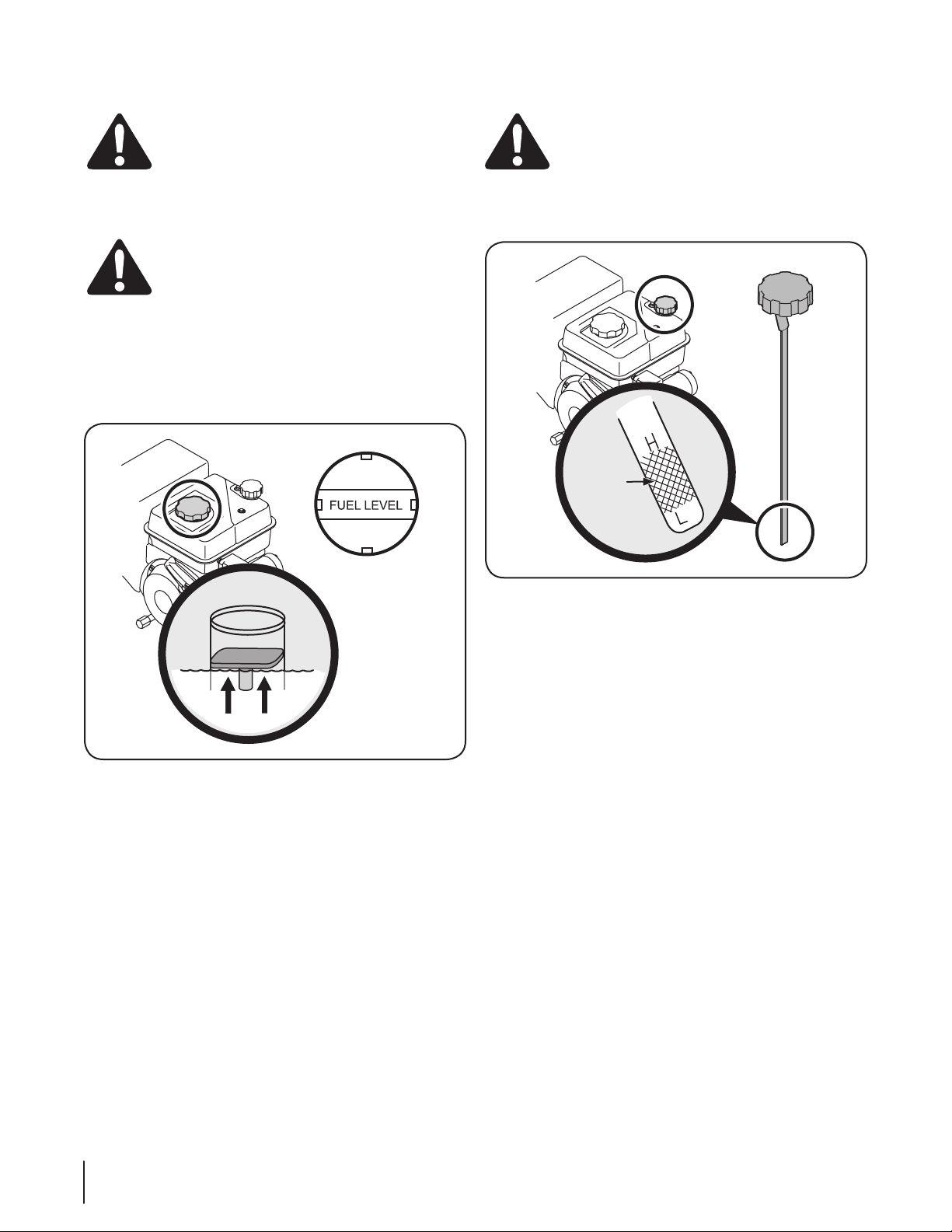
Llene el tanque hasta llegar al nivel de combustible del
indicador; vea la Figura 3-3. Tenga cuidado para no llenar el
depósito en exceso.
Procedimiento para agregar aceite
PRECAUCIÓN:
motor. Antes de poner la máquina en marcha debe
cargar aceite en el motor. Si se hace funcionar el
motor sin suficiente aceite puede dañarse
Retire el tapón de llenado de aceite/la varilla de medición y
Agregue aceite lentamente hasta que el registro marque 2.
sección Mantenimiento del motor para ver la viscosidad y
capacidad de aceite del motor correctas.
NOTA:
hacer que el motor genere humo, que cueste arrancarlo o que
Cargue
hasta un
punto
intermedio
entre las
marcas de
nivel alto y
bajo
Figura 3-3
Indicador de nivel
de combustible
Vista superior
Figura 3-4
8 se c c i ó n 3 — MO n t a j e y cO n f i g u r a c i ó n
Ajustes
Montaje del canal
La inclinación del montaje del canal controla el ángulo con el que
se arroja la nieve.
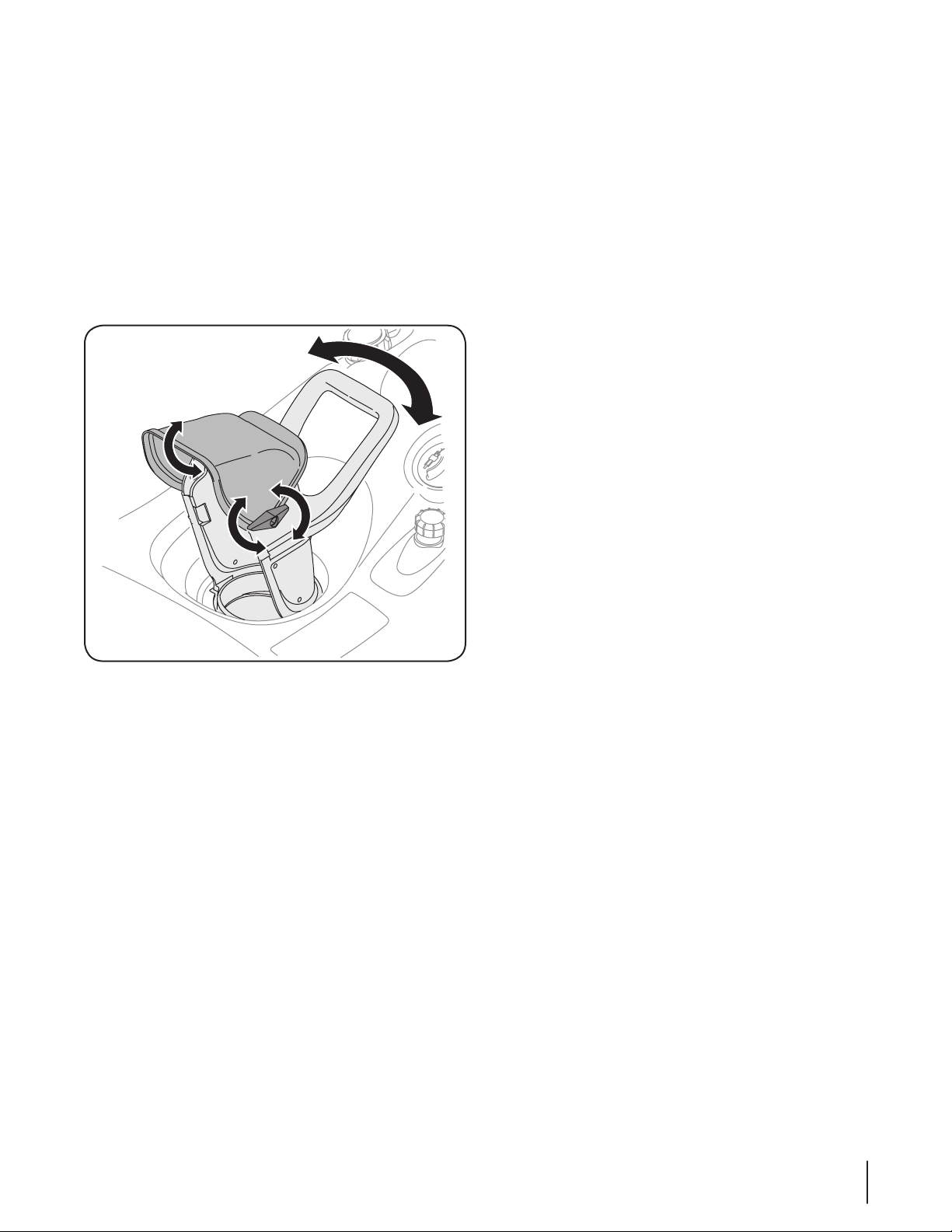
Afloje la perilla de paletas que se encuentra del lado
izquierdo del montaje del canal y gire el canal superior
hacia arriba o hacia abajo hasta alcanzar la inclinación
deseada. Vuelva a ajustar la perilla de paletas antes de
poner la máquina quitanieve en funcionamiento.
2.
del canal para arrojar la nieve en la dirección deseada. Vea
la Fig. 3-5.
Figura 3-5
9se c c i ó n 3 — MO n t a j e y cO n f i g u r a c i ó n
Palanca del cebador
Al activar el control del cebador se cierra la placa de obturación
del carburador y se ayuda a encender el motor.
Cebador
directamente al carburador del motor para facilitar el
Llave de encendido
La llave de encendido es un dispositivo de
seguridad. Debe estar completamente insertada
para que el motor arranque. Retire la llave de
encendido cuando no use la máquina quitanieve.
NOTA: No gire la llave de encendido para intentar
Arrancador de retroceso
La manija del arrancador se utiliza para arrancar el motor
manualmente.
Tapa de la gasolina
Saque la tapa de la gasolina para agregar combustible.
Barrena
Cuando está engranada, la rotación de la barrena dirige la nieve
hacia el interior de la caja de la barrena y la arroja hacia afuera
por el canal de descarga. Las paletas de caucho de la barrena
también ayudan a impulsar la máquina quitanieve al ponerse en
contacto con el pavimento.
Control de la barrena
La manija de control de la barrena está ubicada en la barra
superior y se usa para engranar y desengranar la transmisión de
la barrena. Apriete la manija de control contra la barra de control
superior para engranar la barrena, aflójela para desengranarla.
Figura 4-1
Montaje del canal
Placa de
raspado
Barrena
Llave de
encendido
Cebador
Tapa de
combustible
Manija de control
Control de la
barrena
Escape
Bujía / Funda de
la bujía
Manija del
arrancador de
retroceso
Tapón de
llenado de
aceite c/ varilla
de medición del
nivel de aceite
Tubo de drenaje
del aceite
Palanca del
cebador
Manija del
arrancador de
retroceso
Controles y Características
4
10

Montaje del canal
usando la manija del canal. La inclinación del canal de descarga
controla el ángulo con el que se arroja la nieve. Afloje la perilla de
aletas del costado del canal de descarga antes de girar el canal
de descarga hacia arriba o hacia abajo. Vuelva a ajustar la perilla
después de alcanzar la posición deseada.
Placa de raspado
La placa de raspado hace contacto con el pavimento a medida
que se impulsa la máquina quitanieve, permitiendo que se
descargue la nieve que está cerca de la superficie del pavimento.
11se c c i ó n 4— cO n t r O l e s y ca r a c t e r í s t i c a s

Encendido del motor
¡ADVERTENCIA! Siempre mantenga las manos y
los pies alejados de las partes móviles. No utilice
fluidos comprimidos para arrancar. Los vapores son
inflamables.
NOTA: Deje que el motor se caliente durante unos minutos tras
alcance temperaturas operativas.
Arrancador eléctrico
¡ADVERTENCIA!
equipado con un cable de alimentación y un
enchufe de tres terminales conectados a tierra y
está diseñado para operar con corriente doméstica
receptáculo para tres patas correctamente
conectado a tierra en todo momento para evitar la
posibilidad de descargas eléctricas. Siga todas las
instrucciones cuidadosamente antes de operar el
eléctrico bajo la lluvia.
Determine si el cableado de su hogar es un sistema de
tres cables conectado a tierra. Consulte con un electricista
matriculado si no está seguro. Si tiene un receptáculo
de tres terminales con conexión a tierra, proceda de la
siguiente manera: Si el cableado de su hogar no es el
circunstancia.
Inserte la llave de encendido completamente dentro de 2.
arrancar si la llave no está completamente insertada en el
interruptor de encendido.
Conecte el prolongador al tomacorriente situado en el 3.
motor. Conecte el otro extremo del prolongador a un
para tres patas, en un área bien ventilada. Vea la Fig. 5-2.
Mueva la palanca de control del regulador a la posición
FAST (rápido, representada por una liebre).
5.
de cubrir el orificio de ventilación cuando lo haga. Si el
motor está caliente, presione el cebador una sola vez.
Cubra siempre el orificio de ventilación cuando oprima el
repetir el cebado.
7.
Una vez encendido el motor, suelte inmediatamente
una protección contra sobrecarga térmica; el sistema se
arrancador en caso que se sobrecargue el arrancador
eléctrico.
Mientras se calienta el motor, gire lentamente el control 8.
se detiene, vuelva a encenderlo, hágalo funcionar con el
cebador en su posición media durante un lapso breve y
(apagado).
Una vez que el motor esté en funcionamiento, desconecte
desconectarlo, desenchufe siempre el extremo que está
enchufado al tomacorriente de pared antes de desenchufar
el extremo opuesto que está conectado al motor.
Figura 5-1
Figure 5-2
Funcionamiento
5
12

Arrancador de retroceso
PRECAUCIÓN: No tire de la manija del arrancador
mientras el motor está en marcha.
¡ADVERTENCIA!
sin control, nunca lo deje sin vigilancia mientras está
en marcha. Apague el motor luego de usarlo y saque
la llave de encendido
Inserte la llave de encendido completamente dentro de
arrancar si la llave no está completamente insertada en el
interruptor de encendido.
Mueva la palanca de control del regulador a la posición 2.
FAST (rápido, representada por una liebre).
3.
de cubrir el orificio de ventilación cuando lo haga. Si el
motor está caliente, presione el cebador una sola vez.
Cubra siempre el orificio de ventilación cuando oprima el
repetir el cebado.
5.
comience a ofrecer resistencia, luego jálela rápidamente
y con fuerza para superar la compresión. No suelte la
manija ni permita que se desenganche. Vuelva la cuerda
este paso.
Mientras se calienta el motor, gire lentamente el control
se detiene, vuelva a encenderlo, hágalo funcionar con el
cebador en su posición media durante un lapso breve y
(apagado).
Detención del motor
¡ADVERTENCIA!
sin control, nunca deje la máquina sin vigilancia
mientras está en marcha. Apague el motor luego de
usarlo y saque la llave de encendido
Deje el motor encendido durante algunos minutos antes de
detenerlo para ayudar a secar toda la humedad del motor.
(detención).
Retire la llave de encendido. Al retirar la llave se reduce 2.
la posibilidad de que el motor sea puesto en marcha sin
autorización mientras el equipo no está en uso. Guarde la
llave de encendido.
3.
Procedimiento para engranar las barrenas
apriete el control de la barrena contra la barra. Suelte el
control para detener las barrenas.
Enganche de la transmisión
Levante apenas la barra para permitir que las paletas de caucho
de la barrena toquen el pavimento e impulse la máquina
quitanieve hacia adelante. Si presiona la barra hacia abajo,
elevará la barrena del suelo y detendrá el avance de la máquina.
NOTA: Si la presión ascendente sobre la manija es excesiva
tendrá como resultado un desgaste prematuro de las
cuchillas de goma de la barrena y esto no estará cubierto
13se c c i ó n 5— fu n c i O n a M i e n t O
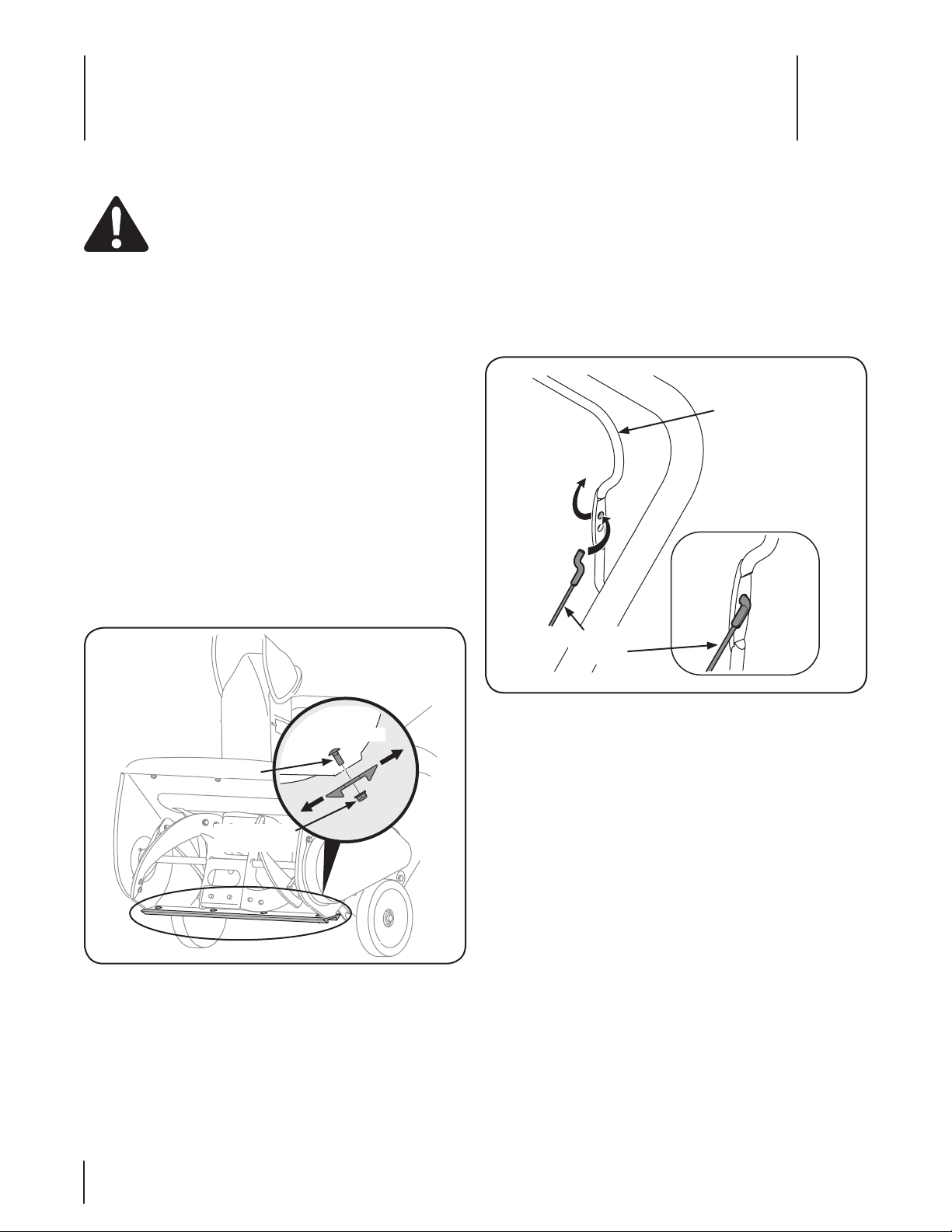
Ajustes
¡ADVERTENCIA! Antes de realizar tareas de
mantenimiento, reparación o inspección en la
máquina quitanieve, desengrane el control de la
barrena. Apague el motor y retire la llave para evitar
el encendido accidental del motor.
Placa de raspado
la unidad sobre una superficie nivelada. Las ruedas, la
placa de raspado y las barrenas deben tocar la superficie
nivelada. Tenga en cuenta que si la placa de raspado está
demasiado alta la nieve puede volar debajo de la caja. Si la
placa de raspado se desgasta excesivamente, o la unidad
no se autopropulsa, es posible que la placa de raspado esté
demasiado baja y deba ser ajustada.
NOTA:
placa de raspado nueva las barrenas pueden estar un poco
separadas del suelo.
2.
hasta que quede apoyada sobre la barra de control. Afloje
las cuatro tuercas y pernos de seguridad que fijan la placa
raspado hacia la posición deseada y vuelva a apretar las
tuercas y los pernos bien ajustados.
Cable de control
estiramiento del cable de control y de la correa de transmisión
ocasionado por el desgaste. Si la barrena parece titubear
mientras gira, haga lo siguiente:
del cable de control del agujero inferior de la barra de control e
insértelo en el agujero superior. Inserte el cable desde el exterior
quina quitanieve para ver si se logra una diferencia
apreciable. Si luego de realizado el ajuste del cable de control
la barrena sigue titubeando al girar, consulte la sección Servicio
para obtener las instrucciones para el reemplazo de la correa.
Montaje del canal
Consulte la sección Montaje y Configuración para ver las
instrucciones para el ajuste del montaje del canal.
Mantenimiento
Lubricación
Lubrique los puntos de giro de la barra de control y del resorte
de extensión del extremo del cable de control con un aceite
liviano una vez por temporada y antes de almacenar la máquina
quitanieve al final de la temporada.
Almacenamiento fuera de temporada
Si no se va a usar la máqu
siga las siguientes instrucciones incluidas a continuación.
Almacene el equipo en un área despejada y seca.
Si almacena la máquina en un lugar mal ventilado, debe 2.
realizarle un tratamiento antioxidante usando un aceite
ligero o silicona para cubrir la máquina quitanieve.
Limpie el exterior del motor y de 3. la máquina quitanieve.
Figura 6-1
Vista lateral
Tuerca de
seguridad
Perno
Cable de
Control
Barra de
Control
Figura 6-2
Mantenimiento y Ajustes
6
14
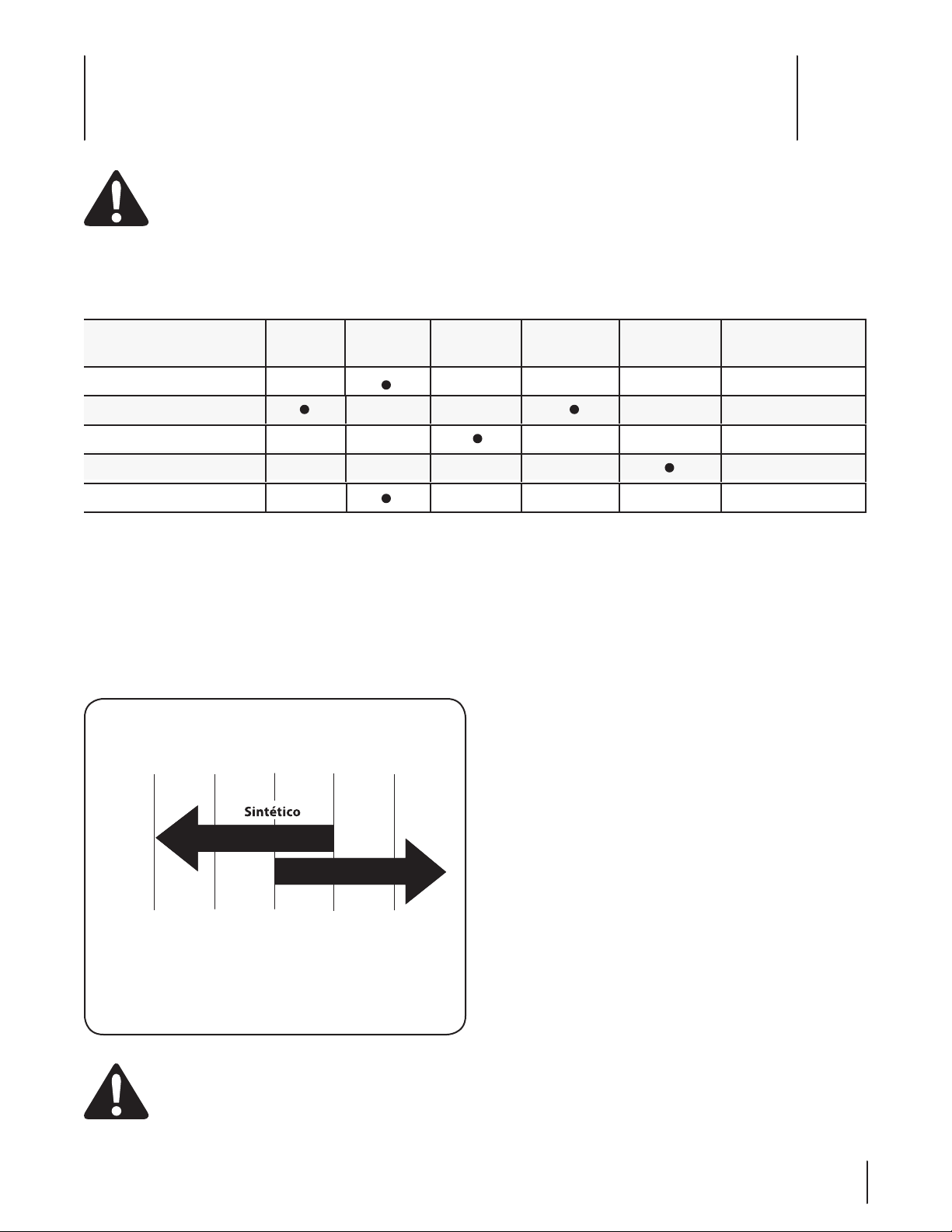
5W-30
0W-30
(°F)
(°C)
-40° -20° 0° 20° 40°
-30° -20° -10° 0°
0W-30
5W-30
Calendario de mantenimiento
¡ADVERTENCIA!
accidental, apague el motor y retire la llave de
encendido antes de realizar cualquier tipo de
mantenimiento del motor.
La inspección y los ajustes periódicos del motor son esenciales
mantenimiento regular también garantizará una prolongada
y el tipo de mantenimiento a realizar se describen en la tabla
siguiente. Siga los intervalos por hora o calendarios, lo que
ocurra primero. Cuando se opera en condiciones adversas es
necesario llevar a cabo un mantenimiento más frecuente.
Recomendaciones sobre el aceite
Cuando le agregue aceite al motor, consulte la siguiente tabla
ml (aprox. 20 onzas). No llene excesivamente. Use un aceite para
motor de cuatro tiempos, o un aceite detergente de calidad
premium equivalente con certificado que cubra o exceda
las exigencias de los fabricantes de automóviles americanos
respecto de la clasificación de servicio SG y SF. Los aceites para
motor con la clasificación SG, SF tienen está designación en el
envase.
PRECAUCIÓN:
Control del aceite del motor
Retire el tapón de llenado de aceite/la varilla de medición y
Introduzca el tapón / la varilla de medición de aceite dentro del 2.
Saque el tapón / la varilla de medición de aceite. Si el nivel 3.
es bajo, agregue lentamente aceite hasta que el nivel
NOTA:
puede hacer que el motor genere humo, que cueste
Figura 7-1
Tarea
Controle el aceite del motor
Cambie el aceite del motor
Controle
Realice
Limpie la zona de escape
horas.
Cada uso o
cada 5 horas.
Cada
temporada o
cada 25 horas.
Cada
temporada o
cada 50 horas.
Cada
temporada o
Fechas de
mantenimiento
Mantenimiento del motor
7
15
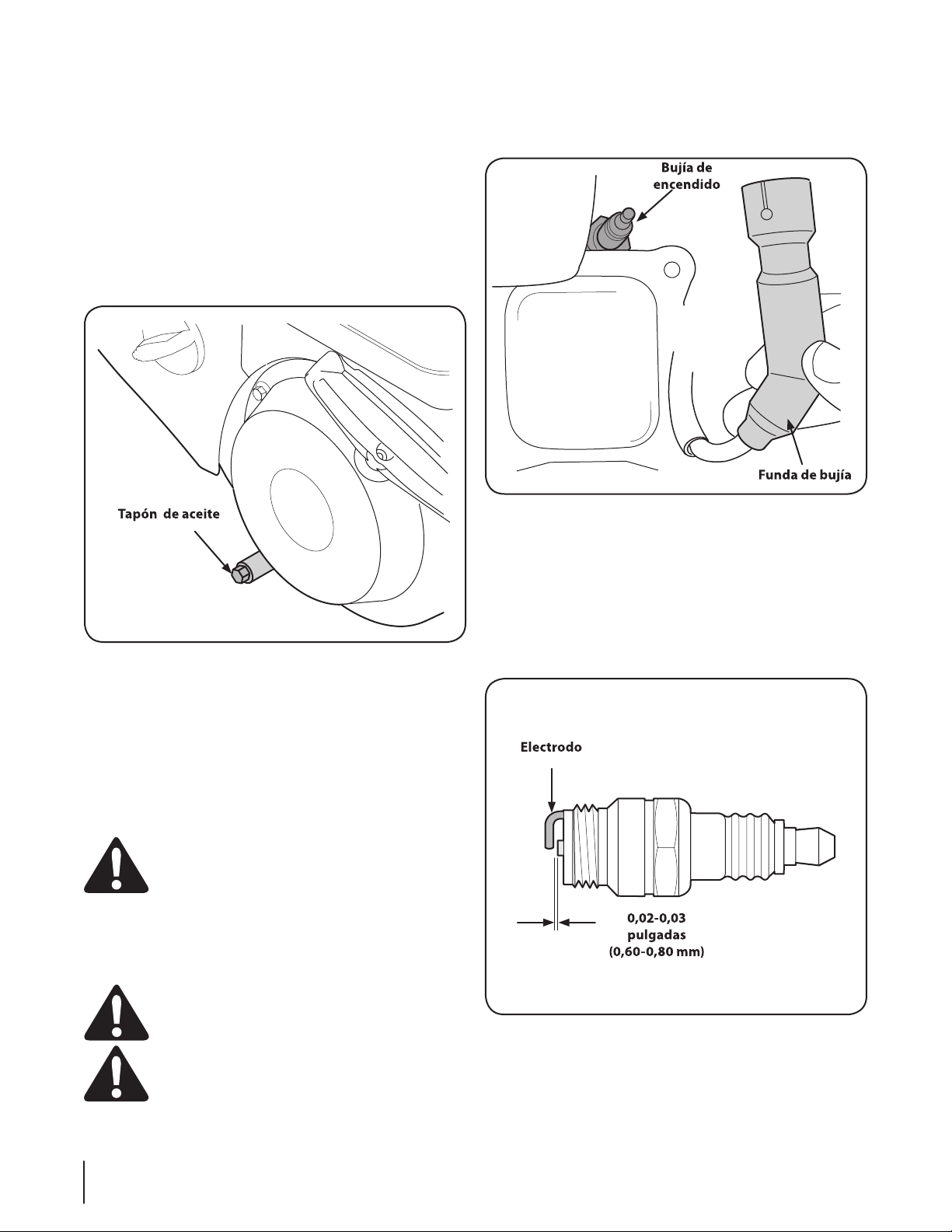
Cambio del aceite del motor
NOTA: Verifique el nivel de aceite antes de cada uso y después
de cada cinco horas de funcionamiento para cerciorarse que se
mantiene el nivel de aceite indicado. Consulte la Verificación del
nivel de aceite en la sección Funcionamiento
Cerciórese de que el tapón de llenado del combustible está
bien ajustado.
Coloque un recipiente adecuado para recolectar el aceite 2.
bajo el tapón de drenaje de aceite.
Retire el tapón de drenaje de aceite, Figura 7-3. 3.
aceite usado se debe descartar en un centro de recolección
adecuado.
5.
Vuelva a llenar con el aceite recomendado y controle el
nivel de aceite, consulte las instrucciones de la sección
Montaje y Configuración.
Vuelva a colocar y ajustar el tapón de llenado/la varilla de 7.
nivel de aceite.
PRECAUCIÓN: Lávese bien las manos con agua y
jabón inmediatamente después de tocar
aceite usado.
NOTA:
perjudique el medio ambiente. Llévelo a un centro de reciclado u
otro centro de recolección.
Bujía de encendido
ADVERTENCIA!
¡ADVERTENCIA! Si el motor ha estado
funcionando, el silenciador estará muy caliente.
Tenga cuidado de no tocar el silenciador.
tener una separación correcta y debe estar libre de depósitos.
2.
presenta mucho desgaste, o si el aislante está agrietado o
a reutilizar.
3.
ajustes necesarios torciendo el electrodo lateral, Fig. 7-5. La
mm).
manualmente para evitar que se enrosque cruzada.
Figura 7-4
Figura 7-1
Figura 7-5
16 se c c i ó n 7 — Ma n t e n i M i e n t O d e l M O t O r
5.
NOTA: ⁄vuelta,
usada, ajuste ⁄- a ⁄
encuentra colocada en su lugar, a fin de comprimir la
arandela.
PRECAUCIÓN:
motor.
Limpieza del motor
Si el motor ha estado funcionando, déjelo enfriar durante por lo
menos media hora antes de limpiarlo. Retire periódicamente la
suciedad acumulada en el motor.
PRECAUCIÓN:
equipo de lavado a presión también se puede forzar
que pasa por el silenciador puede ingresar en el
cilindro, causando daños.
¡ADVERTENCIA! La acumulación de residuos
uso.
Almacenamiento fuera de temporada
ser drenados de combustible para evitar que se deterioren y
se forme goma en el sistema de combustible o en las piezas
principales del carburador. Si la gasolina en su motor se deteriora
durante el almacenamiento, puede resultar necesario reparar o
reemplazar el carburador y otros componentes del sistema de
combustible.
funcionar el motor hasta que se detenga.
Cambie el aceite del motor.2.
3.
limpio. Tire varias veces del arrancador de retroceso para
Limpie los residuos acumulados alrededor del motor, y
debajo, alrededor, y detrás del silenciador. Aplique una
capa delgada de aceite en todas las áreas que pueden
llegar a oxidarse.
Almacene el motor en un sector limpio, seco y bien 5.
ventilado, lejos de cualquier artefacto que funcione con
una llama o luz piloto como hornos, calentadores de
motor eléctrico que produzca chispas o donde se utilicen
herramientas eléctricas.
Si es posible, evite sectores de almacenamiento con mucha
humedad.
Mantenga el motor nivelado cuando lo almacene. 7.
La inclinación del motor puede resultar en fugas de
combustible o aceite.
17se c c i ó n 7 — Ma n t e n i M i e n t O d e l M O t O r
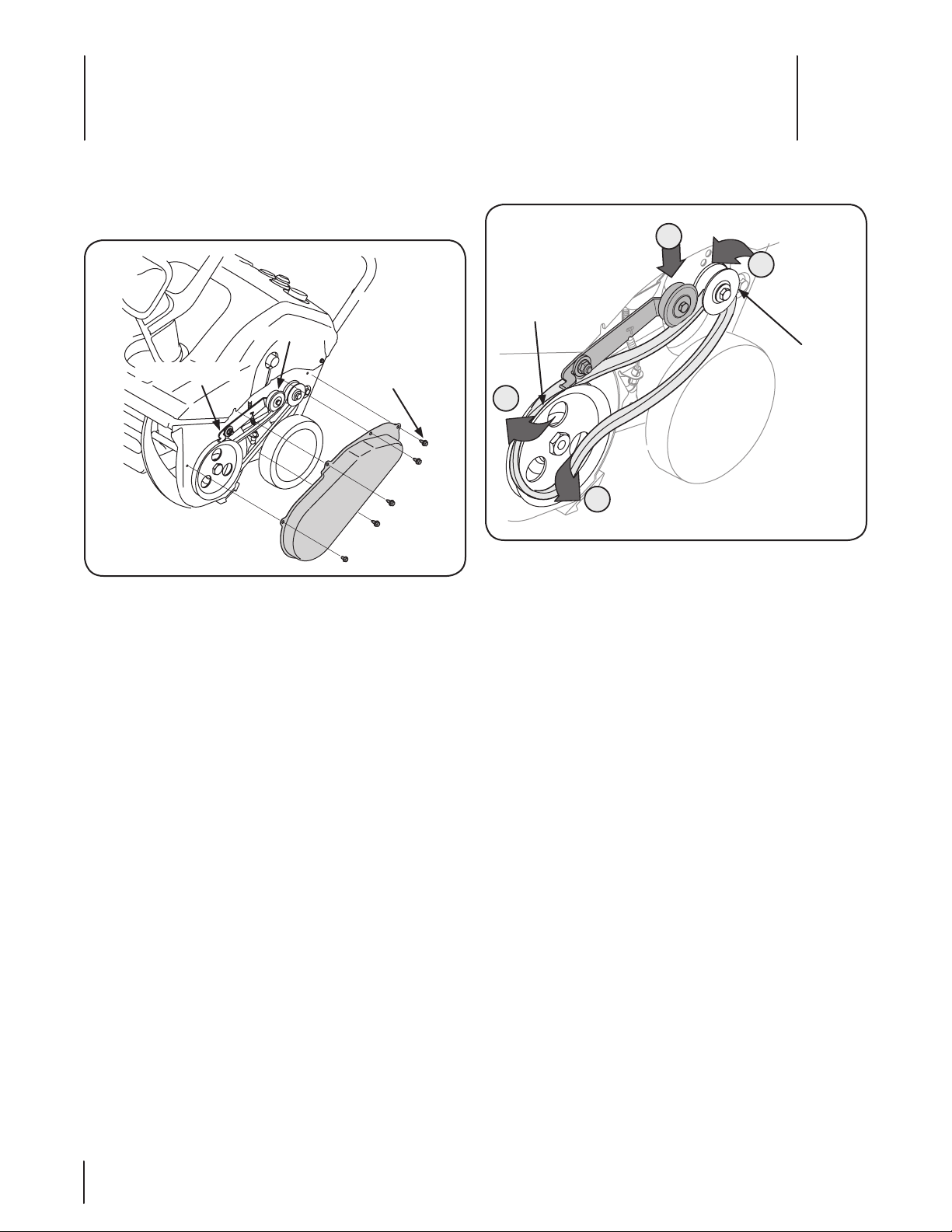
Reemplazo de las correas
Retire la correa sujetándola por la base de la polea de la 2.
barrena y tire hacia afuera.
NOTA: Tire hacia abajo la polea loca para soltar la correa de
la Fig. 7-2:
Tire hacia abajo la polea loca.
Ubique la correa encima de la polea de la barrena y debajo 2.
del guardacorrea.
Coloque la correa alrededor de la polea del motor.3.
barrena.
Vuelva a instalar la cubierta de la correa que sacó 5.
anteriormente.
Polea loca
Guardacorrea
Tornillos de cabeza
hexagonal
Figura 7-1
Figura 7-2
Polea del
motor
Polea de la
barrena
1
4
3
2
Servicio
8
18
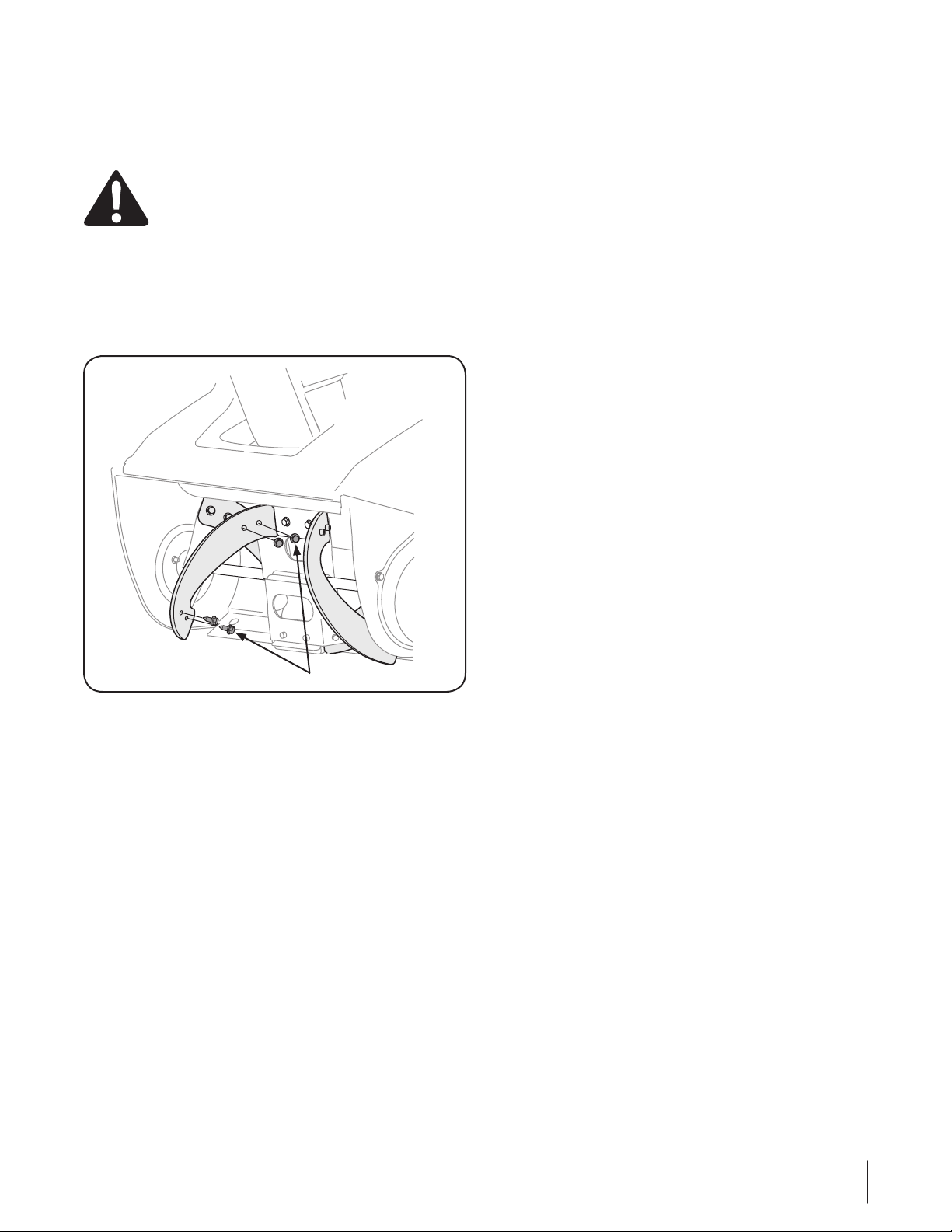
Reemplazo de las paletas de la barrena
Las paletas de caucho de la barrena de la máquina quitanieve
se desgastan y se las debe cambiar si se presentan signos de
desgaste excesivo.
PRECAUCIÓN:
caucho de la barrena se desgasten hasta el punto
en que partes de la barrena metálica misma toquen
el pavimento. Si esto sucede la máquina quitanieve
puede dañarse seriamente.
manera:
Saque las paletas de caucho ya existentes para lo cual
desenrosque los tornillos autorroscantes que las unen a la
barrena. Vea la Fig. 7-3.
Ajuste las nuevas paletas de caucho a la barrena usando los 2.
Reemplazo de la placa de raspado
La placa de raspado está adosada al fondo de la caja de la
barrena y sujeta a desgaste. Se la debe controlar periódicamente.
La placa de raspado tiene dos bordes de desgaste y se la puede
invertir.
Quite los cuatro pernos del carro y las tuercas de seguridad
hexagonales que la sujetan a la caja de la máquina
quitanieve.
Instale una nueva placa de raspado, asegurándose de que 2.
las cabezas de los pernos del carro queden en el interior de
la caja.
Ajuste la placa de raspado como se indica en la sección 3.
Mantenimiento y Ajustes.
Una vez colocada, ajuste bien.
Tornillos
autorroscantes
Figura 7-3
19se c c i ó n 7— se r v i c i O

Problema Causa Solución
combustible se ha echado a perder.
2.
No se introdujo completamente la llave.3.
5.
7.
cebado demasiado.
Llene el depósito con gasolina limpia y
nueva.
2.
Introduzca completamente la llave.3.
5.
Cebe el motor de cinco a siete veces.
Aguarde al menos diez minutos antes de 7.
encender el motor.
manera errática
2.
combustible es viejo.
3.
combustible.
Mueva la palanca del cebador a la posición
2.
depósito con gasolina limpia y nueva.
3.
llenar el depósito con combustible nuevo.
autorizado.
autorizado.
La ventilación de la tapa del combustible 2.
está obstruida.
Destape la ventilación.2.
Vibración excesiva
dañada.
Detenga el motor de inmediato y desconecte
está dañada. Ajuste todos los pernos y las
tuercas. Realice las reparaciones necesarias.
distribuidor de servicio autorizado.
La máquina quitanieve no
se autopropulsa
ajuste.
La correa de transmisión de la barrena está 2.
floja o dañada.
Ajuste el cable de control de la barrena
tal y como se muestra en la sección de
Mantenimiento y Ajustes.
Reemplace la correa de transmisión de la 2.
barrena.
Las barrenas siguen girando
ajuste.
Ajuste el cable de control de la barrena
tal y como se muestra en la sección de
Mantenimiento y Ajustes.
La unidad no descarga la
nieve
2.
3.
ajuste.
La correa de la barrena está floja o dañada.
Detenga el motor y desconecte el cable de
de la barrena con la herramienta de limpieza
o una varilla.
Detenga el motor de inmediato y desconecte 2.
barrena.
Ajuste el cable del control de la barrena.3.
Reemplace la correa de la barrena.
Solución de Problemas
9
20

Notes
10
21

Troy-Bilt LLC (Troy-Bilt) y la Agencia de Protección Medioambiental de Estados Unidos (U. S. EPA)
Declaración de Garantía del Sistema de Control de Emisiones
(Derechos y obligaciones del propietario según la garantía contra defectos)
La U. S. EPA y Troy-Bilt se complacen en explicar la garantía del sistema de control de emisiones de su motor para equipo todo terreno, modelo,
año 2005 y versiones posteriores. Los nuevos motores pequeños para equipo todo terreno se deben diseñar, fabricar y equipar para cumplir con
las rigurosas normas contra la polución. Troy-Bilt debe garantizar el sistema de control de emisiones de su motor por el período de tiempo indicado
más abajo, siempre y cuando no haya existido uso incorrecto, negligencia ni mantenimiento inadecuado de su motor pequeño para equipo todo
terreno.
El sistema de control de emisiones puede incluir piezas como, por ejemplo, el carburador, el filtro de aire, el sistema de encendido y el sistema de
escape y otros componentes relacionados con las emisiones.
Donde exista una condición cubierta por la garantía, Troy-Bilt reparará su motor pequeño para equipo todo terreno sin costo alguno incluyendo el
diagnóstico, las piezas y la mano de obra.
COBERTURA DE LA GARANTÍA DEL FABRICANTE:
Este sistema de control de emisiones se garantiza por el término de dos años. Si alguna pieza de su motor relacionada con las emisiones es
defectuosa, Troy-Bilt reparará o sustituirá dicha pieza.
RESPONSABILIDADES DEL PROPIETARIO SEGÚN LA GARANTÍA:
Como propietario de un motor pequeño de equipo todo terreno, usted es responsable de realizar el mantenimiento necesario que figura en el
manual del propietario. Troy-Bilt le recomienda que conserve todos los recibos que cubren los servicios de mantenimiento del motor pequeño
para equipo todo terreno, no obstante lo cual Troy-Bilt no podrá denegar el cumplimiento de la garantía únicamente por la falta de recibos o por su
imposibilidad de asegurar que se realizarán todos los servicios de mantenimiento programado.
Como propietario del motor pequeño para equipo todo terreno, sin embargo, usted también debe saber que Troy-Bilt puede denegar la cobertura
de la garantía si su motor pequeño para equipo todo terreno o una pieza del mismo fallan debido a uso incorrecto, negligencia, mantenimiento
indebido o a modificaciones no aprobadas.
Usted es responsable de presentar la cortadora de césped al centro de distribución o de mantenimiento de Troy-Bilt LLC tan pronto como
apareciera el problema. Las reparaciones cubiertas por la garantía se deben llevar a cabo en un lapso razonable que no exceda de 30 días. Si
desea realizar alguna consulta con respecto a la cobertura de la garantía, debe ponerse en contacto con su distribuidor local de Troy-Bilt. Para
comunicarse con la Línea de Asistencia al Cliente de Distribuidores de Troy-Bilt, llame al número (877) 282-8684.
REqUERIMIENTOS DE GARANTÍA SOBRE DEFECTOS PARA MOTORES PEqUEÑOS DE EqUIPO TODO TERRENO
DE 1995 Y VERSIONES POSTERIORES:
Esta sección se aplica a motores pequeños de equipo todo terreno de 1995 y versiones posteriores. El período de garantía comienza a partir de la
fecha en que el motor o el equipo se entregan al comprador final.
(a) Cobertura de la garantía contra emisiones generales
Troy-Bilt garantiza al comprador final y a cada comprador subsiguiente que el motor:
(1) ha sido diseñado, construido y equipado de manera que cumpla con todas las regulaciones vigentes adoptadas por el Departamento de los
Recursos de Aire en virtud a su autoridad conferida en los capítulos 1 y 2, Parte 5, División 26 del Código de Salud y Seguridad; y
(2) está libre de defectos en los materiales y en la mano de obra que causen la falla de una pieza bajo garantía que sea idéntica en todos los
aspectos materiales a la pieza como aparece descripta en la aplicación del fabricante del motor para certificación por un período de dos años.
(b) La garantía sobre piezas relacionadas con emisiones se interpretará de la siguiente manera:
(1) Cualquier pieza cubierta por garantía que no esté programada para su reemplazo según el mantenimiento requerido en las instrucciones
escritas de la Subsección (c) debe estar garantizada por un período de garantía definido en la Subsección (a) (2). Si la pieza falla durante el
período de cobertura de la garantía, la misma será reparada o reemplazada por Troy-Bilt de acuerdo con la Subsección (4) a continuación.
Cualquier pieza reparada o reemplazada según la garantía se garantizará por el resto del período de garantía.
(2) Cualquier pieza cubierta por garantía que esté programada solo para inspección regular en las instrucciones escritas de la Subsección
(c) debe estar garantizada por un período de garantía definido en la Subsección (a) (2). Una declaración en dichas instrucciones por escrito
al efecto de “reparación o reemplazo según sea necesario” no reducirá el período de cobertura de la garantía. Cualquier pieza reparada o
reemplazada según la garantía se garantizará por el resto del período de garantía.
(3) Cualquier pieza garantizada que esté programada para reemplazo según el mantenimiento requerido de conformidad con las instruccio-
nes escritas de la Subsección (c) se garantiza por el período de tiempo anterior a la primera fecha de reemplazo programada para esa pieza.
Si la pieza falla antes del primer reemplazo programado, la misma será reparada o reemplazada por Troy-Bilt de acuerdo con la Subsección
(4) a continuación. Cualquier pieza reparada o reemplazada bajo garantía se garantizará por el resto del período anterior al primer reemplazo
programado puntual para esa pieza.

(4) La reparación o el reemplazo de cualquier pieza garantizada de conformidad con las disposiciones de la garantía que aquí se estipula se
debe realizar en un centro de garantía sin costo alguno para el propietario.
(5) Sin perjuicio de las disposiciones de la Subsección (4) anterior, los servicios o reparaciones cubiertos por la garantía deben ser suminis-
trados por todos los centros de distribución de Troy-Bilt que tengan la franquicia para realizar reparaciones y mantenimiento a los motores en
cuestión.
(6) El propietario no debe afrontar ningún cargo para trabajos de diagnóstico que lleven a la conclusión de que una pieza bajo garantía presenta
efectivamente defectos, siempre y cuando dicho diagnóstico sea llevado a cabo en un centro cubierto por la garantía.
(7) El fabricante del motor es responsable por daños causados a otros componentes de motores derivados de la falla bajo garantía de cualquier
pieza garantizada.
(8) Durante todo el período de garantía del motor definido en la Subsección (a) (2), Troy-Bilt mantendrá un suministro de piezas cubiertas por
garantía suficiente para satisfacer la demanda esperada para tales piezas.
(9) Cualquier pieza de reemplazo se podrá usar para el cumplimiento del mantenimiento o reparaciones bajo garantía, y se suministrará sin
cargo al propietario. Dicho uso no reducirá las obligaciones de garantía de Troy-Bilt.
(10) No se podrán usar piezas adicionales ni modificadas que no estén exentas de acuerdo con el Departamento de los Recursos del Aire (Air
Resources Board). El uso de piezas adicionales o modificadas no exentas será causa suficiente para anular un reclamo bajo garantía realizado
de acuerdo con este artículo. El fabricante del motor no tendrá responsabilidad, en conformidad con este artículo, de garantizar fallas de piezas
garantizadas que fueren causadas por el uso de una pieza no exenta adicional o modificada.
(c) Troy-Bilt incluirá una copia de la siguiente lista de piezas bajo garantía contra emisiones con cada nuevo motor, utilizando las partes de la
lista aplicables al motor.
(1) Sistema de medición de combustible
•Sistemademejoraparainicioenfrío(cebadosuave)
•Carburadorycomponentesinternos
•Bombadecombustible
(2) Sistema de inducción de aire
•Filtrodeaire
•Colectordeentrada
(3) Sistema de encendido
•Bujía(s)
•Sistemadeencendidopormagneto
(4) Sistema de escape
(5) Componentes varios utilizados en el sistema anterior
•Válvulaseinterruptoresdevacío,temperatura,posiciónsensiblesaltiempo
•Conectoresymontajes
GDOC-100171 Rev. A

GARANTÍA LIMITADA DEL FABRICANTE PARA
GDOC-100166 REV. A
Troy-Bilt LLC, P.O. BOX 361131 CLEVELAND, OHIO 44136-0019, Teléfono: 1-866-840-6483,
1-330-558-7220 MTD Canada Limited - KITCHENER, ON N2G 4J1; Teléfono 1-800-668-1238
La siguiente garantía limitada es otorgada por Troy-Bilt LLC con
respecto a nuevos productos adquiridos y utilizados en Estados
Unidos y/o sus territorios y posesiones, y por MTD Products Limited
con respecto a nuevos productos adquiridos y utilizados en Canadá
y/o sus territorios y posesiones (cualquiera de las dos entidades,
respectivamente, “Troy-Bilt”).
“Troy-Bilt” garantiza este producto (excluidas las Piezas y Accesorios
con Desgaste Normal según se describe más abajo) contra defectos
en los materiales y mano de obra por un período de dos (2) años
a partir de la fecha de compra original y, a su opción, reparará o
reemplazará, sin costo alguno, cualquier pieza que presente defectos
en los materiales o de mano de obra. Esta garantía limitada sólo se
aplicará si el producto ha sido operado y mantenido de acuerdo con
las instrucciones del Manual del Operador que se proporciona con el
producto y no ha sido sujeto a uso inapropiado, abuso, uso comercial,
abandono, accidente, mantenimiento incorrecto, alteración,
vandalismo, robo, incendio, inundación o algún daño debido a otro
peligro o desastre natural. El daño resultante por la instalación o el
uso de piezas, accesorios o aditamentos no aprobados por Troy-Bilt
para su uso con el(los) producto(s) incluido(s) en este manual
anulará la garantía en lo que respecta a esos daños.
Se garantiza que las Piezas con Desgaste Normal están libres
de defectos en los materiales y mano de obra por un período de
treinta (30) días a partir de la fecha de compra. Las piezas sujetas
a desgaste normal incluyen pero no se limitan a: baterías, correas,
cuchillas, adaptadores para cuchillas, dientes, bolsas para pasto,
ruedas, ruedas para la plataforma de la podadora tractor, asientos,
zapatas antideslizantes, ruedas de fricción, placas de raspado, gomas
helicoidales y neumáticos.
Accesorios — Troy-Bilt garantiza que los accesorios de este
producto están libres de defectos de material y mano de obra
durante un período de un (1) año a partir de la fecha de compra o
arrendamiento original del accesorio. Los accesorios incluyen, pero
no se limitan a: colectores de césped y kits para abono.
CÓMO SOLICITAR Y OBTENER SERVICIO TÉCNICO: El servicio de
la garantía está disponible, CON PRUEBA DE COMPRA, a través del
distribuidor de servicio local autorizado. Para localizar al distribuidor
de su zona:
En Estados Unidos de América
Consulte las páginas amarillas, o póngase en contacto con Troy-Bilt
LLC en P.O. Box 361131, Cleveland, Ohio 44136-0019, llame al 1-
866-840- -6483, 1-330-558-7220 ó visite nuestro sitio web en www.
troybilt.com.
En Canadá
Póngase en contacto con MTD Products Limited, Kitchener, ON N2G
4J1, llame al 1-800-668-1238 ó visite nuestro sitio web en www.
mtdcanada.com.
Esta garantía limitada no suministra cobertura en los siguientes
casos:
a. Las bombas, válvulas y cilindros del rompetroncos tienen una
garantía separada de un año.
b. Los artículos necesarios para el mantenimiento de rutina como
por ejemplo lubricantes, filtros, afiladores de cuchillas, sincroni-
zación del motor, los ajustes de los frenos, del embrague o de la
plataforma y el deterioro normal del acabado exterior debido al
uso o exposición.
c. Mantenimiento no realizado por el distribuidor de servicio
autorizado.
d. Troy-Bilt no extiende ninguna garantía para los productos
vendidos o exportados fuera de los Estados Unidos de América
y/o Canadá, y sus respectivas posesiones y territorios, excepto
para aquellos vendidos a través de los canales autorizados de
distribución de exportaciones de Troy-Bilt.
e. Piezas de reemplazo que no son piezas originales de Troy-Bilt.
f. Gastos de transporte y visitas técnicas.
g. Troy-Bilt no garantiza este producto para uso comercial.
No existe ninguna garantía implícita, incluyendo cualquier
garantía implícita de comerciabilidad o adaptabilidad para un
propósito en particular, una vez transcurrido el período aplicable
de garantía escrita según lo antedicho en relación con las piezas
identificadas. Ninguna otra garantía expresa, ni oral ni escrita,
excepto la mencionada anteriormente, extendida por personas
reales o jurídicas, incluidos los distribuidores o los minoristas
con respecto a cualquier producto, obligará a Troy-Bilt. Durante el
plazo de la garantía el único recurso es la reparación o reemplazo
del producto como se indicó anteriormente.
Las disposiciones de esta garantía cubren el recurso de reparación
única y exclusiva que surge de la venta. Troy-Bilt no se hará
responsable de ninguna pérdida o daño incidental o resultante,
incluyendo sin limitación, los gastos incurridos para los servicios
de mantenimiento del césped, o los gastos de arrendamiento para
reemplazar de manera transitoria un producto bajo garantía.
Algunos estados no permiten la exclusión o limitación de los daños y
perjuicios incidentales o directos, o las limitaciones sobre la duración
de las garantías implícitas, por lo que las exclusiones o limitaciones
mencionadas anteriormente pueden no serle de aplicación.
En ningún caso se obtendrá una compensación de ningún tipo por un
monto mayor al precio de compra del producto vendido. La alteración
de las características de seguridad del producto anulará esta garantía.
Usted asume el riesgo y la responsabilidad de las pérdidas, daños
o lesiones que sufran usted y sus bienes y / u otras personas y sus
bienes como resultado del uso incorrecto o de la falta de capacidad
para usar este producto.
Esta garantía limitada cubre solamente al comprador original, o a la
persona que recibió el producto de regalo.
CÓMO SE RELACIONA LA LEGISLACIÓN ESTATAL CON ESTA
GARANTÍA: Esta garantía limitada le otorga derechos legales
específicos y usted también puede contar con otros derechos que
varían de un estado a otro.
IMPORTANTE: El propietario debe presentar prueba de compra
original para obtener la cobertura de la garantía.