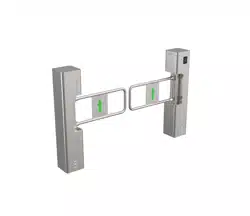

DS-K3BC430LX Series Swing Gate
UD32855B

Legal Informaon
About this Document
●
This Document includes instrucons for using and managing
the Product. Pictures, charts, images and all other informaon
hereinaer are for descripon and explanaon only.
●
The informaon contained in the Document is subject to
change, without noce, due to rmware updates or other
reasons. Please nd the latest version of the Document at the
Hikvision website (
hps://www.hikvision.com ). Unless
otherwise agreed, Hangzhou Hikvision Digital Technology Co.,
Ltd. or its aliates (hereinaer referred to as "Hikvision")
makes no
warranes, express or implied.
●
Please use the Document with the guidance and assistance of
professionals trained in supporng the Product.
About this Product
●
This product can only enjoy the
aer-sales service support in
the country or region where the purchase is made.
●
If the product you choose is a video product, please scan the
following QR code to obtain the
"Iniaves on the Use of Video
Products", and read it carefully.
Acknowledgment of Intellectual Property Rights
●
Hikvision owns the copyrights and/or patents related to the
technology embodied in the Products described in this
Document, which may include licenses obtained from third
pares.
●
Any part of the Document, including text, pictures, graphics,
etc., belongs to Hikvision. No part of this Document may be
excerpted, copied, translated, or
modied in whole or in part
by any means without
wrien permission.
●
and other Hikvision's trademarks and logos are
the properes of Hikvision in various jurisdicons.
●
Other trademarks and logos menoned are the properes of
their
respecve owners.
LEGAL DISCLAIMER
i

●
TO THE MAXIMUM EXTENT PERMITTED BY APPLICABLE LAW,
THIS DOCUMENT AND THE PRODUCT DESCRIBED, WITH ITS
HARDWARE, SOFTWARE AND FIRMWARE, ARE PROVIDED "AS
IS" AND "WITH ALL FAULTS AND ERRORS". HIKVISION MAKES
NO WARRANTIES, EXPRESS OR IMPLIED, INCLUDING WITHOUT
LIMITATION, MERCHANTABILITY, SATISFACTORY QUALITY, OR
FITNESS FOR A PARTICULAR PURPOSE. THE USE OF THE
PRODUCT BY YOU IS AT YOUR OWN RISK. IN NO EVENT WILL
HIKVISION BE LIABLE TO YOU FOR ANY SPECIAL,
CONSEQUENTIAL, INCIDENTAL, OR INDIRECT DAMAGES,
INCLUDING, AMONG OTHERS, DAMAGES FOR LOSS OF
BUSINESS PROFITS, BUSINESS INTERRUPTION, OR LOSS OF
DATA, CORRUPTION OF SYSTEMS, OR LOSS OF
DOCUMENTATION, WHETHER BASED ON BREACH OF
CONTRACT, TORT (INCLUDING NEGLIGENCE), PRODUCT
LIABILITY, OR OTHERWISE, IN CONNECTION WITH THE USE OF
THE PRODUCT, EVEN IF HIKVISION HAS BEEN ADVISED OF THE
POSSIBILITY OF SUCH DAMAGES OR LOSS.
●
YOU ACKNOWLEDGE THAT THE NATURE OF THE INTERNET
PROVIDES FOR INHERENT SECURITY RISKS, AND HIKVISION
SHALL NOT TAKE ANY RESPONSIBILITIES FOR ABNORMAL
OPERATION, PRIVACY LEAKAGE OR OTHER DAMAGES
RESULTING FROM CYBER-ATTACK, HACKER ATTACK, VIRUS
INFECTION, OR OTHER INTERNET SECURITY RISKS; HOWEVER,
HIKVISION WILL PROVIDE TIMELY TECHNICAL SUPPORT IF
REQUIRED.
●
YOU AGREE TO USE THIS PRODUCT IN COMPLIANCE WITH ALL
APPLICABLE LAWS, AND YOU ARE SOLELY RESPONSIBLE FOR
ENSURING THAT YOUR USE CONFORMS TO THE APPLICABLE
LAW. ESPECIALLY, YOU ARE RESPONSIBLE, FOR USING THIS
PRODUCT IN A MANNER THAT DOES NOT INFRINGE ON THE
RIGHTS OF THIRD PARTIES, INCLUDING WITHOUT LIMITATION,
RIGHTS OF PUBLICITY, INTELLECTUAL PROPERTY RIGHTS, OR
DATA PROTECTION AND OTHER PRIVACY RIGHTS. YOU SHALL
NOT USE THIS PRODUCT FOR ANY PROHIBITED END-USES,
INCLUDING THE DEVELOPMENT OR PRODUCTION OF
WEAPONS OF MASS DESTRUCTION, THE DEVELOPMENT OR
PRODUCTION OF CHEMICAL OR BIOLOGICAL WEAPONS, ANY
ACTIVITIES IN THE CONTEXT RELATED TO ANY NUCLEAR
EXPLOSIVE OR UNSAFE NUCLEAR FUEL-CYCLE, OR IN SUPPORT
OF HUMAN RIGHTS ABUSES.
●
IN THE EVENT OF ANY CONFLICTS BETWEEN THIS DOCUMENT
AND THE APPLICABLE LAW, THE LATTER PREVAILS.
Data
Protecon
●
To protect data, the development of Hikvision Products
incorporates privacy by design principles. For example, for
Products with facial
recognion features, biometrics data is
stored in your Products with
encrypon method; for ngerprint
Products, only ngerprint template will be saved, which is
impossible to reconstruct a
ngerprint image.
●
As a data controller/processor, you may process personal data,
including collecon, storage, use, processing, disclosure,
deleon, etc. You are advised to pay aenon to and comply
with applicable laws and regulaons related to the protecon
of personal data, including without limitaon, conducng
security controls to safeguard personal data, such as,
implemenng reasonable administrave and physical security
ii

controls, conduct periodic reviews and the assessments of the
eecveness of your security controls.
© Hangzhou Hikvision Digital Technology Co., Ltd.
All rights reserved.
iii

Regulatory Informaon
FCC Informaon
Please take aenon that changes or modicaon not expressly
approved by the party responsible for compliance could void the
user’s authority to operate the equipment.
FCC compliance: This equipment has been tested and found to
comply with the limits for a Class B digital device, pursuant to
part 15 of the FCC Rules. These limits are designed to provide
reasonable
protecon against harmful interference in a
residenal installaon. This equipment generates, uses and can
radiate radio frequency energy and, if not installed and used in
accordance with the
instrucons, may cause harmful interference
to radio
communicaons. However, there is no guarantee that
interference will not occur in a parcular installaon. If this
equipment does cause harmful interference to radio or television
recepon, which can be determined by turning the equipment o
and on, the user is encouraged to try to correct the interference
by one or more of the following measures:
—Reorient or relocate the receiving antenna.
—Increase the separaon between the equipment and receiver.
—Connect the equipment into an outlet on a circuit dierent
from that to which the receiver is connected.
—Consult the dealer or an experienced radio/TV technician for
help
This equipment should be installed and operated with a minimum
distance 20cm between the radiator and your body.
FCC Condions
This device complies with part 15 of the FCC Rules. Operaon is
subject to the following two
condions:
1. This device may not cause harmful interference.
2. This device must accept any interference received, including
interference that may cause undesired operaon.
EU Conformity Statement
iv

This product and - if applicable - the supplied
accessories too are marked with "CE" and
comply therefore with the applicable
harmonized European standards listed under
the EMC
Direcve 2014/30/EU, RE Direcve
2014/53/EU,the RoHS Direcve 2011/65/EU
2012/19/EU (WEEE direcve): Products marked
with this symbol cannot be disposed of as
unsorted municipal waste in the European
Union. For proper recycling, return this product
to your local supplier upon the purchase of
equivalent new equipment, or dispose of it at
designated collecon points. For more
informaon see: www.recyclethis.info
2006/66/EC (baery direcve): This product
contains a baery that cannot be disposed of as
unsorted municipal waste in the European
Union. See the product documentaon for
specic baery informaon. The baery is
marked with this symbol, which may include
leering to indicate cadmium (Cd), lead (Pb), or
mercury (Hg). For proper recycling, return the
baery to your supplier or to a designated
collecon point. For more informaon
see:www.recyclethis.info
v

Safety Instrucon
These instrucons are intended to ensure that user can use the
product correctly to avoid danger or property loss.
The precauon measure is divided into Dangers and Cauons:
Dangers: Neglecng any of the warnings may cause serious injury
or death.
Cauons: Neglecng any of the cauons may cause injury or
equipment damage.
Dangers: Follow these safeguards
to prevent serious injury or death.
Cauons: Follow these precauons
to prevent potenal injury or
material damage.
Danger:
●
All the electronic operaon should be strictly compliance with
the electrical safety
regulaons, re prevenon regulaons and
other related regulaons in your local region.
●
Please use the power adapter, which is provided by normal
company. The power consumpon cannot be less than the
required value.
●
Do not connect several devices to one power adapter as
adapter overload may cause over-heat or
re hazard.
●
Please make sure that the power has been disconnected before
you wire, install or dismantle the device.
●
When the product is installed on wall or ceiling, the device
shall be
rmly xed.
●
If smoke, odors or noise rise from the device, turn
o the
power at once and unplug the power cable, and then please
contact the service center.
●
Do not ingest
baery, Chemical Burn Hazard.
This product contains a coin/buon cell baery. If the coin/
buon cell baery is swallowed, it can cause severe internal
burns in just 2 hours and can lead to death.
Keep new and used
baeries away from children. If the baery
compartment does not close securely, stop using the product
and keep it away from children. If you think baeries might
have been swallowed or placed inside any part of the body,
seek immediate medical
aenon.
●
If the product does not work properly, please contact your
dealer or the nearest service center. Never
aempt to
disassemble the device yourself. (We shall not assume any
responsibility for problems caused by unauthorized repair or
maintenance.)
Cauons:
vi

●
Stainless steel may be corroded in some circumstances. You
need to clean and care the device by using the stainless steel
cleaner. It is suggested to clean the device every month.
●
Do not drop the device or subject it to physical shock, and do
not expose it to high
electromagnesm radiaon. Avoid the
equipment installaon on vibraons surface or places subject
to shock (ignorance can cause equipment damage).
●
Do not place the device in extremely hot (refer to the
specicaon of the device for the detailed operang
temperature), cold, dusty or damp locaons, and do not
expose it to high
electromagnec radiaon.
●
The device cover for indoor use shall be kept from rain and
moisture.
●
Exposing the equipment to direct sun light, low
venlaon or
heat source such as heater or radiator is forbidden (ignorance
can cause
re danger).
●
Do not aim the device at the sun or extra bright places. A
blooming or smear may occur otherwise (which is not a
malfuncon however), and aecng the endurance of sensor
at the same
me.
●
Please use the provided glove when open up the device cover,
avoid direct contact with the device cover, because the acidic
sweat of the ngers may erode the surface coang of the
device cover.
●
Please use a
so and dry cloth when clean inside and outside
surfaces of the device cover, do not use alkaline detergents.
●
Please keep all wrappers aer unpack them for future use. In
case of any failure occurred, you need to return the device to
the factory with the original wrapper.
Transportaon without
the original wrapper may result in damage on the device and
lead to
addional costs.
●
Improper use or replacement of the baery may result in
hazard of explosion. Replace with the same or equivalent type
only. Dispose of used
baeries according to the instrucons
provided by the baery manufacturer.
●
Biometric recognion products are not completely applicable
to
an-spoong environments. If you require a higher security
level, use mulple authencaon modes.
●
Do not stay in the lane when the device is reboong.
●
RISK OF EXPLOSION IF BATTERY IS REPLACED BY AN INCORRECT
TYPE. DISPOSE OF USED BATTERIES ACCORDING TO THE
INSTRUCTIONS.
●
SUITABLE FOR MOUNTING ON CONCRETE OR OTHER NON-
COMBUSTIBLE SURFACE ONLY.
●
The
instrucons shall require connecon of the equipment
protecve earthing conductor to the installaon protecve
earthing conductor.
vii

Available Models
Product Name Model
Swing Gate DS-K3BC430LX
viii

Contents
1 Overview .................................................................. 1
1.1 Introducon .......................................................... 1
1.2 Main Features ....................................................... 1
2 System Wiring .......................................................... 1
3 Install Pedestals ........................................................ 3
4 General Wiring ......................................................... 7
4.1 Components
Introducon ..................................... 8
4.2 Wiring ................................................................... 8
4.3 Terminal
Descripon ............................................. 8
4.3.1 General Wiring ............................................. 8
4.3.2 Lane Control Board Terminal Descripon
............................................................................... 9
4.3.3 Access Control Board Terminal Descripon
(Oponal) ............................................................. 9
4.3.4 Oponal Board Terminal Descripon ........ 11
4.3.5 Card Reader Board Terminal Descripon ... 11
4.3.6 RS-485 Wiring ............................................ 12
4.3.7 RS-232 Wiring ............................................ 12
4.3.8 Alarm Input Wiring .................................... 12
4.3.9 Exit
Buon Wiring ...................................... 13
4.4 Device Sengs via Buon .................................. 13
4.4.1 Conguraon via Buon ............................ 13
4.4.2 Set Study Mode via Buon ........................ 15
4.4.3 Pair Keyfob via
Buon ............................... 16
4.4.4 Inialize Device .......................................... 17
5 Acvaon ............................................................... 17
5.1 Acvate via SADP ................................................ 17
5.2
Acvate Device via iVMS-4200 Client Soware
................................................................................... 18
ix

5.3 Acvate via Web Browser ................................... 19
6 Quick Operaon via Web Browser .......................... 19
6.1 Time Sengs ...................................................... 19
6.2 Administrator
Sengs ........................................ 20
7
Operaon via Web Browser .................................... 20
7.1 Login ................................................................... 20
7.2 Overview ............................................................. 21
7.3 Person Management ........................................... 21
7.4 Search Event ....................................................... 23
7.5
Conguraon ...................................................... 23
7.5.1 View Device
Informaon ........................... 23
7.5.2 Set Time ..................................................... 24
7.5.3 Set DST ....................................................... 24
7.5.4 Change Administrator's Password ............. 24
7.5.5 Online Users .............................................. 25
7.5.6 View Device Arming/Disarming
Informaon
............................................................................. 25
7.5.7 Network
Sengs ....................................... 25
7.5.8 Event Linkage ............................................. 26
7.5.9 Access Control Sengs .............................. 27
7.5.10 Turnsle ................................................... 30
7.5.11 Card Sengs ............................................ 32
7.5.12 Set Privacy Parameters ............................ 33
7.5.13 Upgrade and Maintenance ...................... 33
7.5.14 Device Debugging .................................... 34
7.5.15 Overview .................................................. 34
7.5.16 Log Query ................................................ 35
7.5.17
Cercate Management .......................... 35
8 Client Soware Conguraon ................................. 36
8.1 Conguraon Flow of Client Soware ................ 36
x

8.2 Device Management ........................................... 37
8.2.1 Add Device ................................................. 37
8.2.2 Reset Device Password .............................. 39
8.2.3 Manage Added Devices ............................. 40
8.3 Group Management ........................................... 41
8.3.1 Add Group ................................................. 41
8.3.2 Import Resources to Group ....................... 41
8.4 Person Management ........................................... 42
8.4.1 Add
Organizaon ....................................... 42
8.4.2 Import and Export Person Idenfy
Informaon ......................................................... 42
8.4.3 Get Person Informaon from Access Control
Device ................................................................. 43
8.4.4 Issue Cards to Persons in Batch ................. 44
8.4.5 Report Card Loss ........................................ 45
8.4.6 Set Card Issuing Parameters ...................... 45
8.5 Congure Schedule and Template ...................... 46
8.5.1 Add Holiday ............................................... 46
8.5.2 Add Template ............................................. 47
8.6 Set Access Group to Assign Access Authorizaon to
Persons ..................................................................... 48
8.7
Congure Advanced Funcons ........................... 50
8.7.1 Congure Device Parameters .................... 50
8.7.2 Congure Device Parameters .................... 54
8.8 Door/Elevator Control ......................................... 56
8.8.1 Control Door Status ................................... 56
8.8.2 Check Real-Time Access Records ............... 57
A. DIP Switch ............................................................. 59
A.1 DIP Switch
Descripon ....................................... 60
B.
Buon Conguraon Descripon .......................... 61
C. Event and Alarm Type ............................................ 67
xi


1 Overview
1.1 Introducon
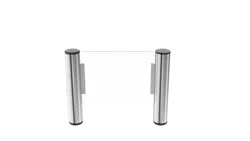
Figure 1-1 Appearance
1.2 Main Features
●
Supports control mode, remain open mode and remain closed
mode in both entrance and exit
direcon.
●
Self-detecon, self-diagnoscs, and automac alarm
●
Fire alarm passing
When the
re alarm is triggered, the barrier will be open
automacally for emergency evacuaon.
●
Valid passing duraon sengs
System will cancel the passing permission if a person does not
pass through the lane within the valid passing
duraon.
●
Bidireconal (Entrance/Exit) lane
The barrier opening and closing speed can be congured
according to the visitor ow.
●
TCP/IP network communicaon
The communicaon data is specially encrypted to relieve the
concern of privacy leak.
●
Remote barrier opening via keyfob and
broadcasng via
loudspeaker (custom broadcasng context is supported when
installed with access control board).
2 System Wiring
The preparaon before installaon and general wiring.
1
Steps
Note
●
The device should be installed concrete surface or other at
non-ammable surface.
●
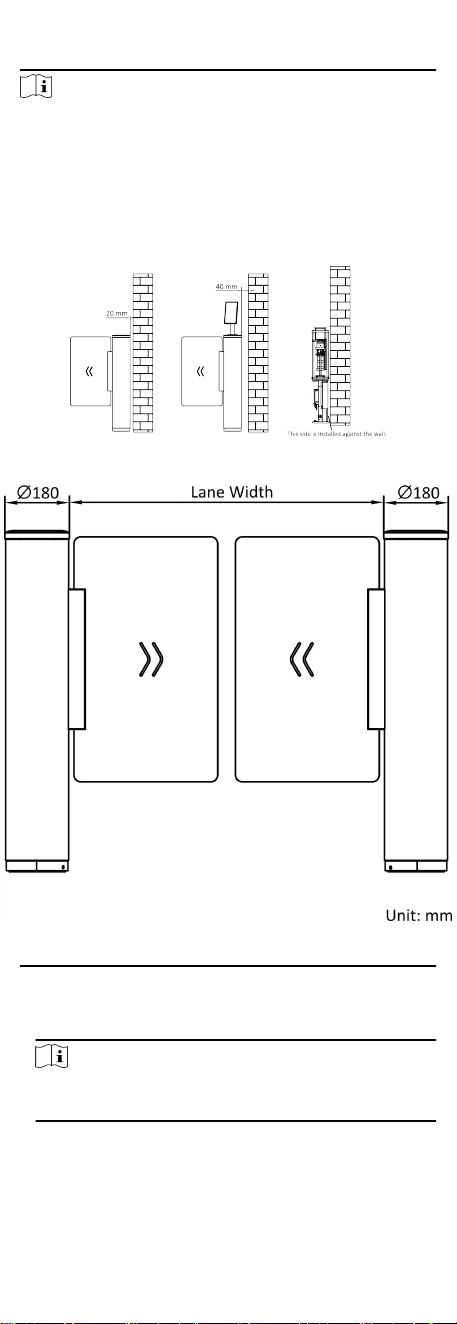
If the installaon area is too close to the wall, make sure the
distance between the pedestal and the wall should be no less
than 20 mm (40 mm if with face
recognion terminals), or you
cannot open the pedestal's top panel or might cause damage
to devices.
●
The dimension is as follows.
Figure 2-1 Dimension
1. Draw a central line on the installaon surface of the le or
right pedestal.
2. Draw other parallel lines for installing the other pedestals.
Note
The distance between the nearest two line is L + 180 mm. L
represents the lane width.
3. Slot on the installaon surface and dig installaon holes. Put 3
expansion bolts of M12*150 for each pedestal.
2
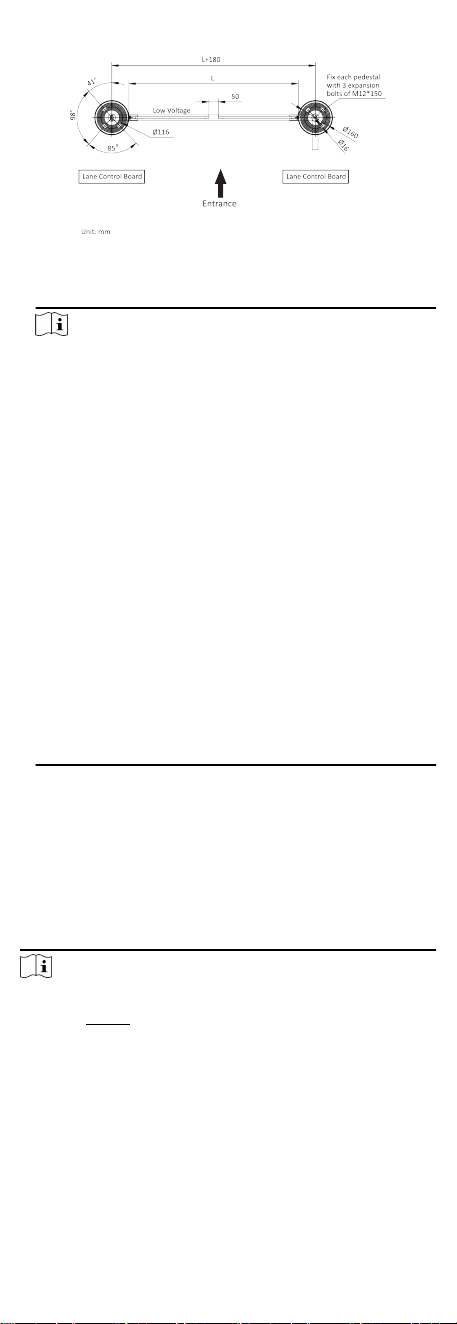
Figure 2-2 Hole Posion and System Wiring
4. Bury cables.
Note
●
Interconnecng cable (available for two pedestals and
above): The recommended length is L+1.5 m.
Network communicaon cable: It is recommended to use
CAT5e or the network cable has beer performance.
●
The suggested external diameter of the low voltage conduit
is 30 mm.
●
If more peripherals are required to connect, you should
increase the conduit diameter or bury another conduit for
the external cables.
●
Before digging holes, evaluate the thickness of the
installaon surface to avoid puncturing.
●
When
slong on the installaon surface, pay aenon to
the posion and width of the slot to avoid misalignment of
the barrier.
●
One
distribuon cabinet supplies one pedestal.
The maximum allowable diameter of the power cable is 12
AWG (UL1015), and the transmission distance is 100 m.
One
distribuon cabinet supplies two pedestals.
The maximum allowable diameter of the power cable is 16
AWG (UL1015), and the transmission distance is 25 m.
3 Install Pedestals
Before You Start
Prepare for the installaon tools, check the device and the
accessories, and clear the
installaon base.
Steps
Note
●
The installaon diagram is for illustraon. For details, please
refer to Wiring for video guide.
●
The device should be installed on the concrete surface or other
at non-ammable surfaces.
●
Make sure the device is powered o during installaon and
other
operaons.
●
The
installaon tools are put inside the package of the
pedestal.
3

●
To prevent stainless steel from rusng due to dirt during
construcon, it is recommended that the protecve lm be
removed aer the installaon is completed. There may be
residual adhesive at the lm cung posion. It is
recommended to use WD-40 protecve liquid to wipe aer
tearing the lm.
●
It is recommended that at least two people collaborate to
install the sleeve. You'd
beer wear gloves throughout the
enre process, handle with care, and pay aenon to
prevenng crushing or pinching injuries.
1. Prepare for the installaon tools, check the components, and
prepare for the
installaon base.
2. Seal the boom of the pedestal with sealing materials to
prevent water accumulaon.
3. Remove the protecve panel on the top of the device, and
determine the barrier direcon and the pedestal installaon
posion according to the default barrier opening direcon
mark.
Figure 3-1 Default Barrier Opening Direcon Mark
Note
Do not immerse the pedestal in the water. In special
circumstances, the immersed height should be no more than
150 mm. The boom circuit board can't be immersed.
4. Use a cross screwdriver to remove screws of the decorave
ring and cable protecon panel, and complete wiring.
4

Figure 3-2 Remove Decorave Ring and Cable Protecon Panel
5. Use a cross screwdriver to x the top plasc part, and use a
hexagon wrench to
x the rotary tube.
5
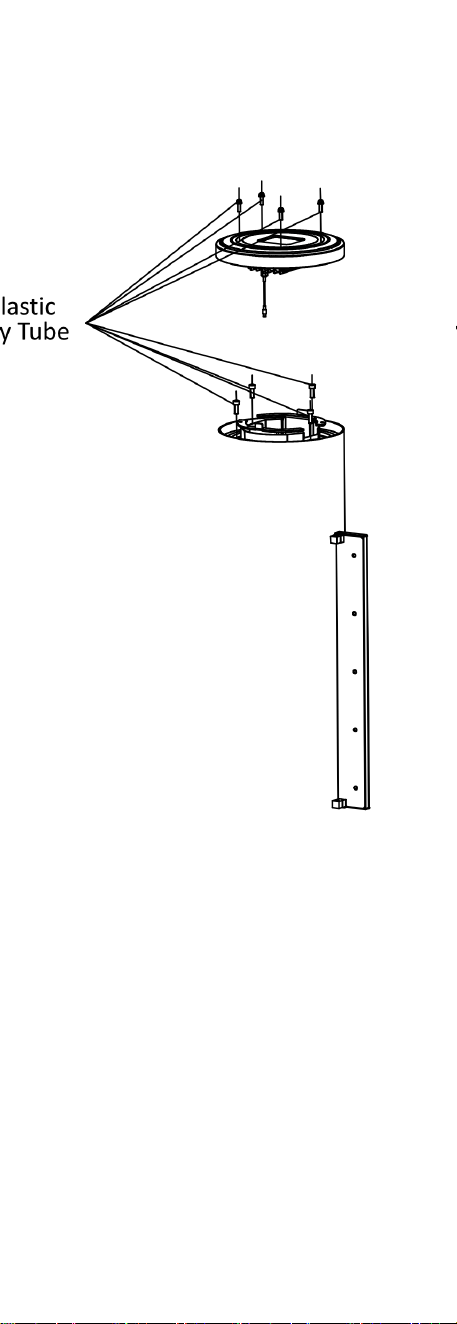
Figure 3-3 Fix Top Plasc Part and Rotary Tube
6. Fix the barrier and decorave parts.
6
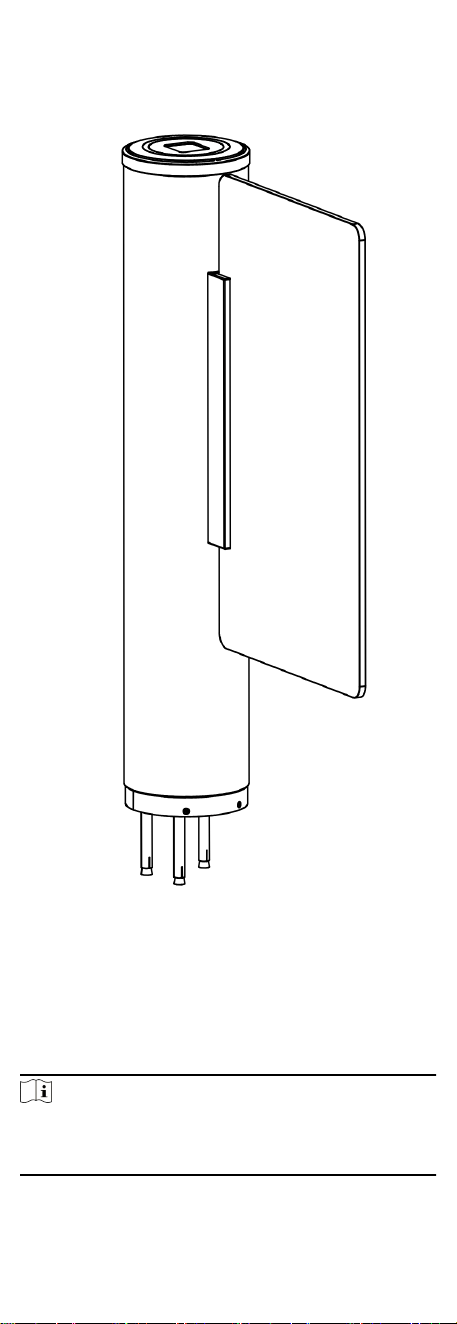
Figure 3-4 Fix Barrier
4 General Wiring
Note
●
The supplied interconnecng cables need connecng on-site:
CAT5e Communicaon cable. The cable is 3 m in length and put
inside the package.
7

4.1 Components Introducon
By default, basic components of the turnsle are connected well.
The pedestals can communicate by wiring the interconnecng
cables. And the turnsle supports wiring the AC electric supply
for the whole system' s power supply.
Note
Power supply: 24 V DC
Power supply voltage uctuaon range: ± 5%
Figure 4-1 Components Introducon
4.2 Wiring
Scan the QR code to view the wiring guide video.
4.3 Terminal Descripon
4.3.1 General Wiring
The general wiring of lane control board, access control board
and
oponal board.
8
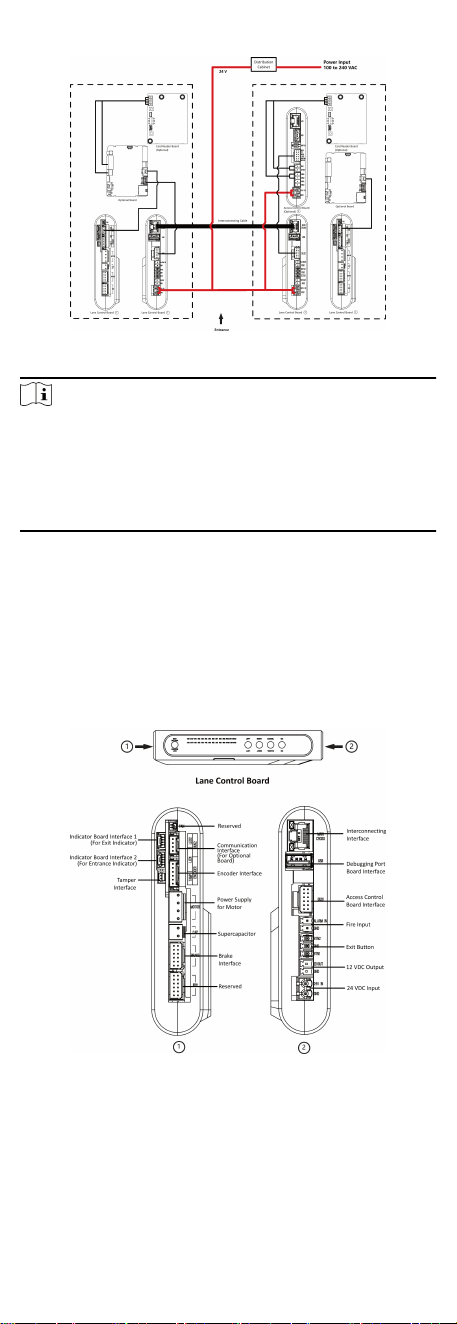
Figure 4-2 General Wiring
Note
●
It is recommended to use Hikvision matched distribuon
cabinet (sold separately) to covert the AC mains power to 24 V.
●
The ① and ② refer to the two sides of a same board.
●
Barrier opens at the entrance/exit: connect to BTN1/BTN2 and
GND.
4.3.2 Lane Control Board Terminal Descripon
The lane control board contains indicator board interface,
interconnecng interface, access control board interface, re
input interface, exit buon interface, 12 VDC output interface, 24
VDC input interface, communicaon interface, encoder interface,
power supply interface for motor, supercapacitor interface, brake
interface, and tamper interface.
The picture displayed below is the lane control board diagram.
Figure 4-3 Lane Control Board
4.3.3 Access Control Board Terminal
Descripon
(Oponal)
9
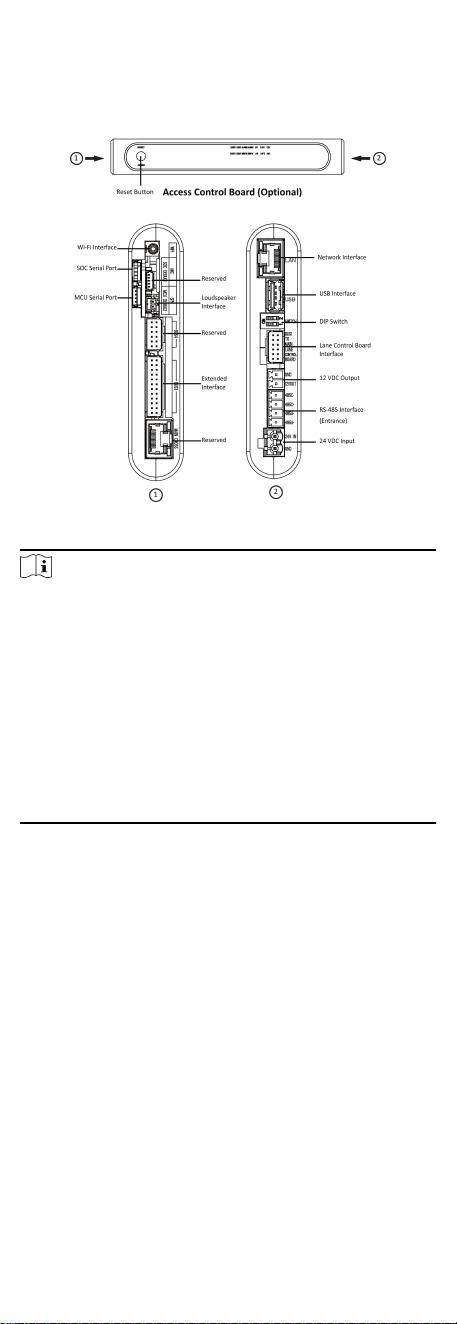
Access control board is mainly used for authority idencaon in
places with high security levels such as public security or judicial
place, external device accessing, and communicaon with the
upper plaorm and lane controller.
Figure 4-4 Access Control Board
Note
●
RS-485A corresponds to UART 5 on web and is for QR code
scanner connecon at entrance by default; RS-485C
corresponds to UART 7 on web and is for card reader
connecon at entrance by default.
●
The SOC and MCU serial port are for maintenance and
debugging use only.
●
Press the Reset buon for 5 s and the device will start to
restore to factory
sengs.
●
The DIP switch is for study mode seng and keyfob paring. For
detailed informaon about the DIP switch, see DIP Switch
Descripon.
The wiring diagram of extended interface of access control board
is shown as follows.
10

Figure 4-5 Wring Diagram of BUS3 Interface
Note
RS-232A corresponds to UART 1 on web.
4.3.4 Oponal Board Terminal Descripon
The oponal board contains the sub-1G antenna interface,
485/232 interface, 12 V output interface, loudspeaker interface,
debugging port, Wiegand/exit
buon interface, BUS interface, 5
VDC output and communicaon interface.
Figure 4-6 Oponal Board Terminal
4.3.5 Card Reader Board Terminal
Descripon
The card reader board can be connected to the access control
board via RS-485 interface.
11
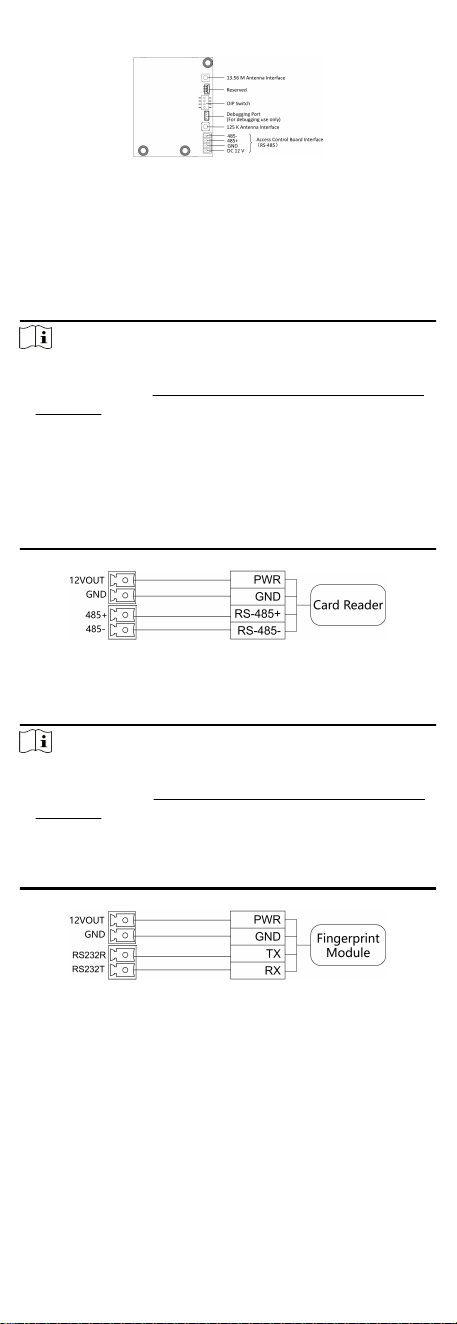
Figure 4-7 Card Reader Board
4.3.6 RS-485 Wiring
The RS-485 interfaces on the access control board and oponal
board are suggested to connect with the face recognion module
or the card reader. Here takes connecng with a card reader as an
example.
Note
●
There are 2 RS-485 interfaces on the access control board for
entrance. Refer to Access Control Board Terminal Descripon
(Oponal) for details.
There are 2 RS-485 interfaces on the oponal board for exit.
Refer to for details.
●
If there are other RS-485 devices connecng, the ID of the
RS-485 cannot be conicted.
●
The connected 12 V power interface for the face
recognion
terminal cannot be connected with other 12 V devices.
Figure 4-8 Wiring RS-485
4.3.7 RS-232 Wiring
Note
●
There is 1 RS-232 interface on the extended interface of access
control board, see Access Control Board Terminal Descripon
(Oponal). The RS-232A corresponds to UART 1 on web.
●
There is 1 RS-232 interface on the oponal board, see . The
RS-232B corresponds to UART 2 on web.
The RS-232C interface is reserved.
Figure 4-9 RS-232 Wiring
4.3.8 Alarm Input Wiring
On the main lane control board, you can wire the re alarm input
interface.
12
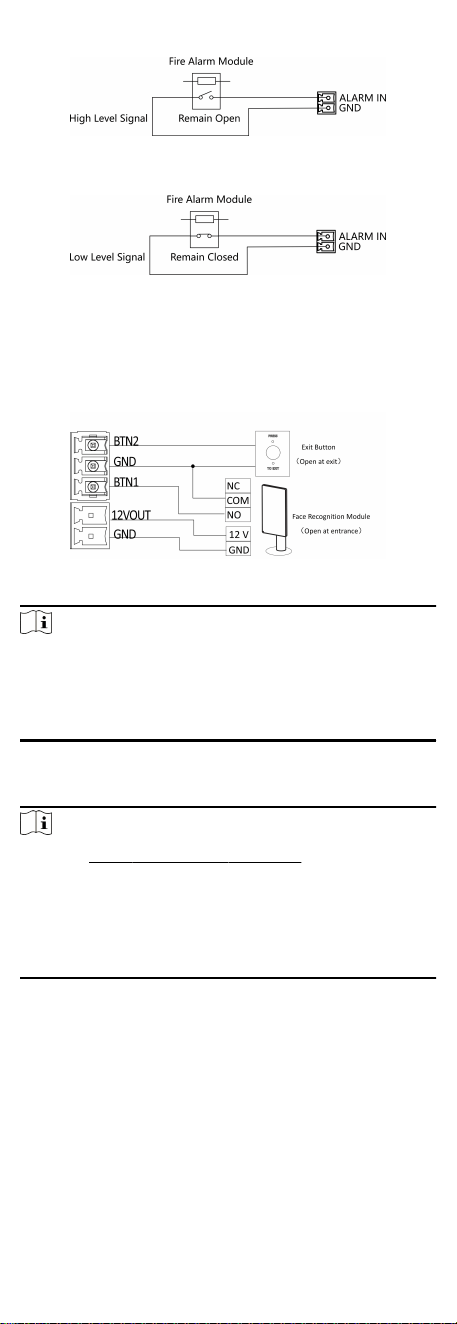
Figure 4-10 Remaining Open
Figure 4-11 Remaining Closed
4.3.9 Exit Buon Wiring
The main and sub lane control board each has 1 buon interface,
which can be connected to exit
buon or face recognion device.
Figure 4-12 Exit Buon Wiring
Note
●
The face recognion devices are powered via 12 VDC power
output interface of the main and sub lane control board.
●
Barrier open at the entrance: connect to BTN1 and GND.
●
Barrier open at the exit: connect to BTN2 and GND.
4.4 Device Sengs via Buon
You can congure the device via buon on the lane control board.
Note
●
Refer to Buon Conguraon Descripon for detailed
informaon.
●
If the oponal board is not installed, the error code of "59" will
appear but the device funcons normally.
●
For the main lane, "99" is displayed on the screen by default.
For the sub lane, "00" is displayed on the screen by default.
4.4.1 Conguraon via Buon
Buon Descripon
13
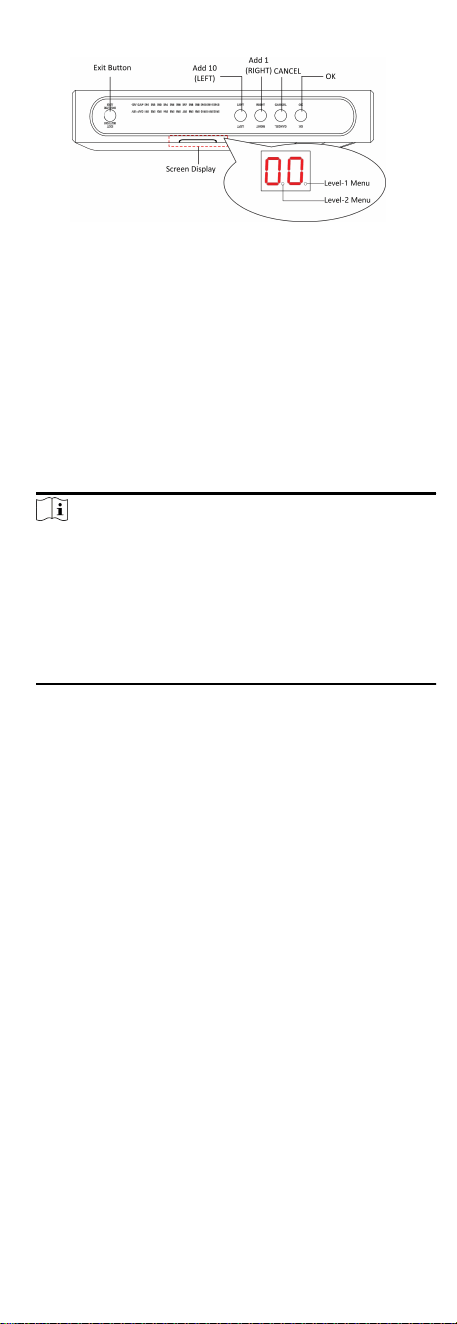
Figure 4-13 Buon
Exit Buon
●
Press to open the barrier from the entrance
posion.
●
Double press to open the barrier from the exit posion.
Parameter Conguraon Buon
●
LEFT: Press to add 10 to
conguraon data.
●
RIGHT: Press to add 1 conguraon data.
●
CANCEL: Return to the Level-1 menu, or exit Level-1 menu.
●
OK: Conrm the sengs, or enter conguraon mode, or enter
the Level-2 menu.
Note
●
Conguraon No. is displayed by two digital tubes.
●
Level-1 Menu: If the decimal point on the right is on, it
indicates the Level-1 menu. The number represents the
conguraon No.
●
Level-2 Menu: If the decimal point in the middle is on, it
indicates the level-2 menu. The number represents the
conguraon No.
Buon Conguraon Procedure
Here takes seng intrusion duraon to 12 s as example:
14
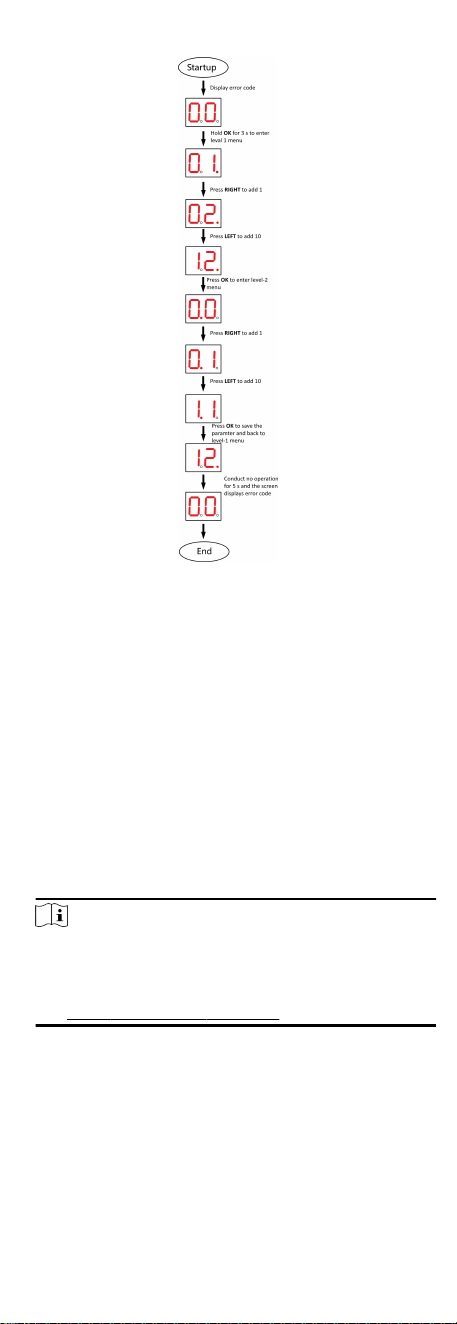
Figure 4-14 Procedure
Steps:
1. Hold OK buon for 3 s unl one beep occurs. The device enter
the conguraon mode. Level 1 menu lights up. The display
screen displays the
conguraon No. 1.
2. In the Level-1 menu, press LEFT (plus 10) once and press RIGHT
(plus 1) twice to set the conguraon No. to 12. Press OK to
save sengs and the enter the level-2 menu. Or you can press
CANCEL to exit the current menu, or conduct no
operaon for
5 s to cancel conguraon and exit the current menu.
3. Aer enter the level 2 menu, press LEFT (plus 10) once and
RIGHT (plus 1) twice to set the
conguraon No. to 12. Press
OK to save the sengs. Or you can press CANCEL to exit the
current menu, or conduct no
operaon for 5 s to cancel
conguraon and exit the current menu.
Note
-
The conguraon No. will display in a cycle.
-
Each conguraon No. refers to a funcon. For details
about the conguraon No. and its related funcon, see
Buon Conguraon Descripon.
4.4.2 Set Study Mode via Buon
Enter the study mode through buon conguraon to set the
closed posion of the device barrier.
15

Steps
Note
●
For details about buon's operaon, see Conguraon via
Buon.
●
For details about the conguraon No. and its related funcon,
see Buon Conguraon Descripon.
1. Enter the study mode.
1) Enter the conguraon mode.
2) Set the conguraon No. in Level-1 to 1. The device will
enter the study mode.
3) Set the
conguraon No. in the Level-2 menu to 2. The
device will enter the study mode.
2. Power o the device and swing the barrier unl it is vercal to
the pedestal.
3. Power on the device.
The device will remember the current posion automacally.
4. Reboot the device when you hear Study accomplished. Please
reboot.
4.4.3 Pair Keyfob via
Buon
Pair the keyfob to the device via buon to open/close the barrier
remotely.
Before You Start
Ask our technique supports or sales and purchase the keyfob.
Steps
Note
●
For details about buon's operaon, see Conguraon via
Buon.
●
For details about the conguraon No. and its related funcon,
see Buon Conguraon Descripon.
●
For details about the keyfob operaon instrucons, see the
keyfob's user manual.
1. Enter the keyfob pairing mode.
1) Enter the conguraon mode.
2) Set the conguraon No. in Level-1 to 2. The device will
enter the keyfob pairing mode.
3) Set the
conguraon No. in the Level-2 menu to 2. The
device will enter the keyfob pairing mode.
2. Hold the Close buon for more than 10 seconds.
The keyfob's indicator will ash if the pairing is completed.
3. Exit the keyfob pairing mode.
1) Enter the conguraon mode.
2) Set the conguraon No. in Level-1 to 2. The device will
enter the keyfob pairing mode.
3) Set the
conguraon No. in the Level-2 menu to 1. The
device will exit the keyfob pairing mode.
4. Reboot the device to take eect.
16

4.4.4 Inialize Device
Steps
1. Hold the inializaon buon on the access control board for 5
s.
Figure 4-15 Inializaon Buon Posion
2. The device will start restoring to factory sengs.
3. When the process is nished, the device will beep for 3 s.
Cauon
The inializaon of the device will restore all the parameters to
the default seng and all the device events are deleted.
Note
Make sure no persons are in the lane when powering on the
device.
5 Acvaon
You should acvate the device before the rst login. Aer
powering on the device, the system will switch to Device
Acvaon page.
Acvaon via the device, SADP tool and the client soware are
supported.
The default values of the device are as follows:
●
The default IP address: 192.0.0.64
●
The default port No.: 80
●
The default user name: admin
5.1 Acvate via SADP
SADP is a tool to detect, acvate and modify the IP address of the
device over the LAN.
Before You Start
●
Get the SADP soware from the supplied disk or the ocial
website hp://www.hikvision.com/en/ , and install the SADP
according to the prompts.
●
The device and the PC that runs the SADP tool should be within
the same subnet.
The following steps show how to acvate a device and modify its
IP address. For batch
acvaon and IP addresses modicaon,
refer to User Manual of SADP for details.
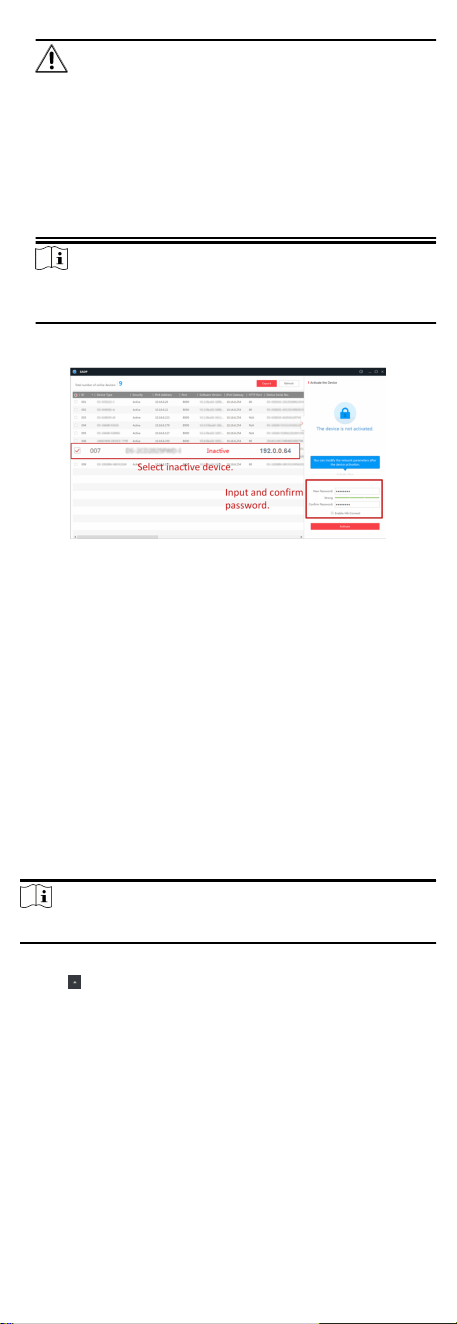
Steps
1. Run the SADP
soware and search the online devices.
2. Find and select your device in online device list.
3. Input new password (admin password) and conrm the
password.
17
Cauon
STRONG PASSWORD RECOMMENDED-We highly recommend
you create a strong password of your own choosing (using a
minimum of 8 characters, including upper case leers, lower
case leers, numbers, and special characters) in order to
increase the security of your product. And we recommend you
reset your password regularly, especially in the high security
system,
reseng the password monthly or weekly can beer
protect your product.
Note
Characters containing admin and nimda are not supported to
be set as acvaon password.
4. Click Acvate to start acvaon.
Status of the device becomes Acve aer successful acvaon.
5. Modify IP address of the device.
1) Select the device.
2) Change the device IP address to the same subnet as your
computer by either modifying the IP address manually or
checking Enable DHCP.
3) Input the admin password and click Modify to
acvate your
IP address
modicaon.
5.2 Acvate Device via iVMS-4200 Client
Soware
For some devices, you are required to create the password to
acvate them before they can be added to the iVMS-4200
soware and work properly.
Steps
Note
This funcon should be supported by the device.
1. Enter the Device Management page.
2.
Click
on the right of Device Management and select Device.
3. Click Online Device to show the online device area.
The searched online devices are displayed in the list.
4. Check the device status (shown on Security Level column) and
select an inacve device.
5. Click Acvate to open the Acvaon dialog.
6. Create a password in the password eld, and conrm the
password.
18

Cauon
The password strength of the device can be automacally
checked. We highly recommend you change the password of
your own choosing (using a minimum of 8 characters, including
at least three kinds of following categories: upper case leers,
lower case leers, numbers, and special characters) in order to
increase the security of your product. And we recommend you
change your password regularly, especially in the high security
system, changing the password monthly or weekly can
beer
protect your product.
Proper conguraon of all passwords and other security
sengs is the responsibility of the installer and/or end-user.
Note
Characters containing admin and nimda are not supported to
be set as acvaon password.
7. Click OK to acvate the device.
5.3 Acvate via Web Browser
You can acvate the device via the web browser.
Steps
1. Enter the device default IP address (192.0.0.64) in the address
bar of the web browser, and press Enter.
Note
Make sure the device IP address and the computer's should be
in the same IP segment.
2. Create a new password (admin password) and conrm the
password.
Cauon
STRONG PASSWORD RECOMMENDED-We highly recommend
you create a strong password of your own choosing (using a
minimum of 8 characters, including upper case leers, lower
case leers, numbers, and special characters) in order to
increase the security of your product. And we recommend you
reset your password regularly, especially in the high security
system,
reseng the password monthly or weekly can beer
protect your product.
Note
Characters containing admin and nimda are not supported to
be set as acvaon password.
3. Click Acvate.
4. Edit the device IP address. You can edit the IP address via the
SADP tool, the device, and the client soware.
6 Quick
Operaon via Web Browser
6.1 Time Sengs
19

Click in the top right of the web page to enter the wizard page.
Aer seng device language, you can click Next to enter the
Time Sengs page.
Time Zone
Select the device located me zone from the drop-down list.
Time Sync.
NTP
You should set the NTP server's IP address, port No., and
interval.
Manual
By default, the device
me should be synchronized
manually. You can set the device
me manually or check
Sync. with Computer Time to synchronize the device me
with the computer's me.
DST
Enable DST. Set the DST start me, end me and bias me.
Click Next to save the sengs and go to the next parameter. Or
click Skip to skip
me sengs.
6.2 Administrator Sengs
Steps
1.
Click in the top right of the web page to enter the wizard
page. Aer seng me, you can click Next to enter the
Administrator Sengs page. Or you can click Skip to enter the
Administrator
Sengs page directly.
2. Enter the employee ID and name of the administrator.
3. Select a credenal to add.
Note
You should select at least one credenal.
1) Click Add Card to enter the Card No. and select the property
of the card.
Note
Up to 50 cards can be supported.
4. Click Complete to complete the sengs.
7
Operaon via Web Browser
7.1 Login
You can login via the web browser or the remote conguraon of
the client
soware.
Note
Make sure the device is acvated. For detailed informaon about
acvaon, see Acvaon.
Login via Web Browser
20

Enter the device IP address in the address bar of the web browser
and press Enter to enter the login page.
Enter the device user name and the password. Click Login.
Login via Remote Conguraon of Client Soware
Download and open the client soware. Aer adding the device,
click to enter the Conguraon page.
7.2 Overview
You can view the device component status, real-me event,
person
informaon, network status, basic informaon, and device
capacity. You can also control the barrier remotely.
Figure 7-1 Overview
Funcon Descripons:
Device Component Status
You can check if the device is working properly. Click View
More to view the detailed component status.
Remote Control
/ / /
The door is opened/closed/remaining open/remaining closed.
Real-Time Event
You can view the event Employee ID, Name, Card No., Event
Type, Time, and Operaon. You can also click View More to
enter the search
condions, including the event type,
employee ID, the name, the card No., the start me, and the
end
me, and click Search. The results will be displayed on the
right panel.
Person Informaon
You can view the added and not added informaon of person
and card.
Network Status
You can view the network
connecon status.
Basic Informaon
You can view the model, serial No. and rmware version.
Device Capacity
You can view the person, card and event capacity.
7.3 Person Management
Click Add to add the person's informaon, including the basic
informaon, cercate, authencaon and sengs.
21

Figure 7-2 Add Person
Add Basic Informaon
Click Person Management → Add to enter the Add Person page.
Add the person's basic
informaon, including the employee ID,
the person's name, and person type.
If you select Visitor as the person type, you can set the visit
mes.
Click Save to save the sengs.
Set Permission Time
Click Person Management → Add to enter the Add Person page.
Enable Long-Term
Eecve User, or set Validity Period and the
person can only has the permission within the
congured me
period according to your actual needs.
Click Save to save the sengs.
Add Card
Click Person Management → Add to enter the Add Person page.
Click Add Card, enter the Card No. and select the Property, and
click OK to add the card.
Note
Up to 50 cards can be added.
Click Save to save the sengs.
Authencaon
Sengs
Click Person Management → Add to enter the Add Person page.
Set
Authencaon Type as Same as Device or Custom.
Click Save to save the sengs.
Import/Export Person Data
Export Person Data
You can export added person data for back-up or imporng to
other devices.
Click Export Person Data, set an encrypon password and
conrm it. Click OK.
22

Note
●
The person data will be downloaded to your PC.
●
The password you set will be required for imporng the data
le.
Imporng Person Data
Click Imporng Person Data and select the le. Click Import.
Enter the encrypon password to import and synchronize the
person data to devices.
Note
●
Please ensure the name of the imported le is
"UserDataFile".
7.4 Search Event
Click Event Search to enter the Search page.
Figure 7-3 Search Event
Enter the search condions, including the event type, the
employee ID, the name, the card No., the start me, and the end
me, and click Search.
The event types contain access control event and ID card event. If
you choose to search for ID card event, you will not need to enter
the employee ID, the name, or the card No.
The results will be displayed on the right panel.
7.5 Conguraon
7.5.1 View Device Informaon
23

Click Conguraon → System → System Sengs → Basic
Informaon to enter the conguraon page.
You can view the device name, language, model, serial No.,
version, IO input, IO output, and local RS-485 number.
You can change Device Name and click Save.
You can view the device capacity, including person, card and
event.
7.5.2 Set Time
Set the device's me zone, synchronizaon mode, server address,
NTP port, and interval.
Click Conguraon → System → System Sengs → Time
Sengs .
Figure 7-4 Time Sengs
Click
Save to save the
sengs aer the conguraon.
Time Zone
Select the device located me zone from the drop-down list.
Time Sync.
Manual
By default, the device
me should be synchronized
manually. You can set the device
me manually or check
Sync. with Computer Time to synchronize the device me
with the computer's me.
Server IP Address/NTP Port/Interval
You can set the server IP address, NTP port, and interval.
7.5.3 Set DST
Steps
1. Click
Conguraon → System → System Sengs → Time
Sengs .
2. Enable DST.
3. Set the DST start me, end me and bias me.
4. Click Save to save the sengs.
7.5.4 Change Administrator's Password
Steps
1. Click
Conguraon → User Management .
2.
Click .
3. Enter the old password and create a new password.
4. Conrm the new password.
5. Click OK.
24

Cauon
The password strength of the device can be automacally
checked. We highly recommend you change the password of
your own choosing (using a minimum of 8 characters, including
at least three kinds of following categories: upper case leers,
lower case leers, numbers, and special characters) in order to
increase the security of your product. And we recommend you
change your password regularly, especially in the high security
system, changing the password monthly or weekly can
beer
protect your product.
Proper conguraon of all passwords and other security
sengs is the responsibility of the installer and/or end-user.
7.5.5 Online Users
The informaon of users logging into the device is shown.
Go to Conguraon → System → User Management → Online
Users to view the list of online users.
7.5.6 View Device Arming/Disarming
Informaon
View device arming type and arming IP address.
Go to Conguraon → User Management → Arming/Disarming
Informaon .
You can view the device arming/disarming informaon. Click
Refresh to refresh the page.
7.5.7 Network
Sengs
Set TCP/IP and HTTP(S).
Set Basic Network Parameters
Click Conguraon → Network → Network Sengs → TCP/IP .
Figure 7-5 TCP/IP Sengs Page
Set the parameters and click Save to save the sengs.
NIC Type
Select a NIC type from the drop-down list. By default, it is Auto.
DHCP
If you uncheck the funcon, you should set the IPv4 address,
IPv4 subnet mask, IPv4 default gateway, Mac address, and
MTU.
If you check the
funcon, the system will allocate the IPv4
address, IPv4 subnet mask, the IPv4 default gateway
automacally.
DNS Server
Set the preferred DNS server and the Alternate DNS server
according to your actual need.
25
Set Port Parameters
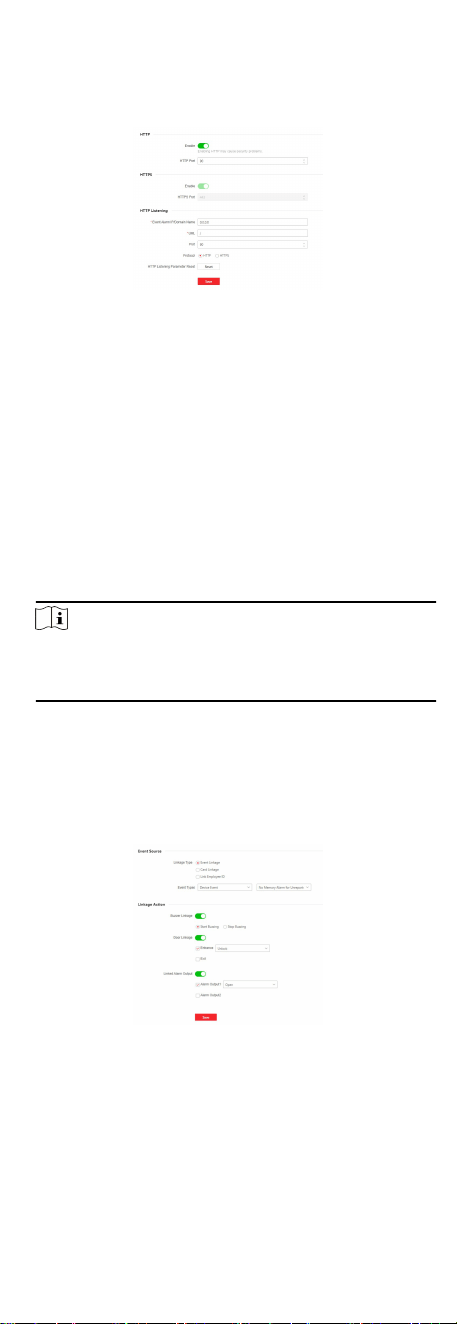
Set the HTTP, HTTPS, HTTP Listening parameters.
Click Conguraon → Network → Network Service → HTTP(S) .
Figure 7-6 Network Service
HTTP
It refers to the port through which the browser accesses the
device. For example, when the HTTP Port is modied to 81, you
need to enter
hp://192.0.0.65:81 in the browser for login.
HTTPS
Set the HTTPS for accessing the browser. Cercate is required
when accessing.
HTTP Listening
The device can send alarm informaon to the event alarm IP
address or domain name via HTTP protocol/HTTPS protocol.
Edit the event alarm IP address or domain name, URL, port,
and protocol.
Note
The event alarm IP address or domain name should support
the HTTP protocol/HTTPS protocol to receive the alarm
informaon.
7.5.8 Event Linkage
Set linked acons for events.
Steps
1. Click
Conguraon → Event → Basic Event → Event Linkage to
enter the page.
Figure 7-7 Event Linkage
2. Set event source.
-
If you choose Linkage Type as Event Linkage, you need to
select event types from the drop-down list.
-
If you choose Linkage Type as Card Linkage, you need to
enter the card No. and select the card reader.
26

-
If you choose Linkage Type as Link Employee ID, you need to
enter the employee ID and select the card reader.
3. Set linked acon.
Buzzer Linkage
Enable Buzzer Linkage and select Start Buzzing or Stop
Buzzing for the target event.
Door Linkage
Enable Door Linkage, check Entrance or Exit, and set the
door status for the target event.
Linked Alarm Output
Enable Linked Alarm Output, check Alarm Output 1 or
Alarm Output 2, and set the alarm output status for the
target event.
7.5.9 Access Control Sengs
Set Authencaon Parameters
Click Conguraon → Access Control → Authencaon Sengs .
Note
The funcons vary according to dierent models. Refers to the
actual device for details.
Figure 7-8 Set Authencaon Parameters
Click Save to save the sengs aer the conguraon.
Terminal
Choose Entrance or Exit for sengs.
Terminal Type/Terminal Model
Get terminal descripon. They are read-only.
Enable Authencaon Device
Enable the authencaon funcon.
Authencaon
Select an authencaon mode according to your actual needs
from the drop-down list.
Authencaon Interval
You can set the authencaon interval of the same person
when authencang. The same person can only authencate
once in the congured interval. A second authencaon will be
failed.
Alarm of Max. Failed Aempts
27
Enable to report alarm when the card reading aempts reach
the set value.
Max. Authencaon Failed Aempts
Enable to report alarm when the card reading aempts reach
the set value.
Communicaon with Controller Every
When the access control device cannot connect with the card
reader for longer than the set me, the card reader will turn
oine automacally.
Note
The authencaon interval value ranges from 2 s to 255 s.
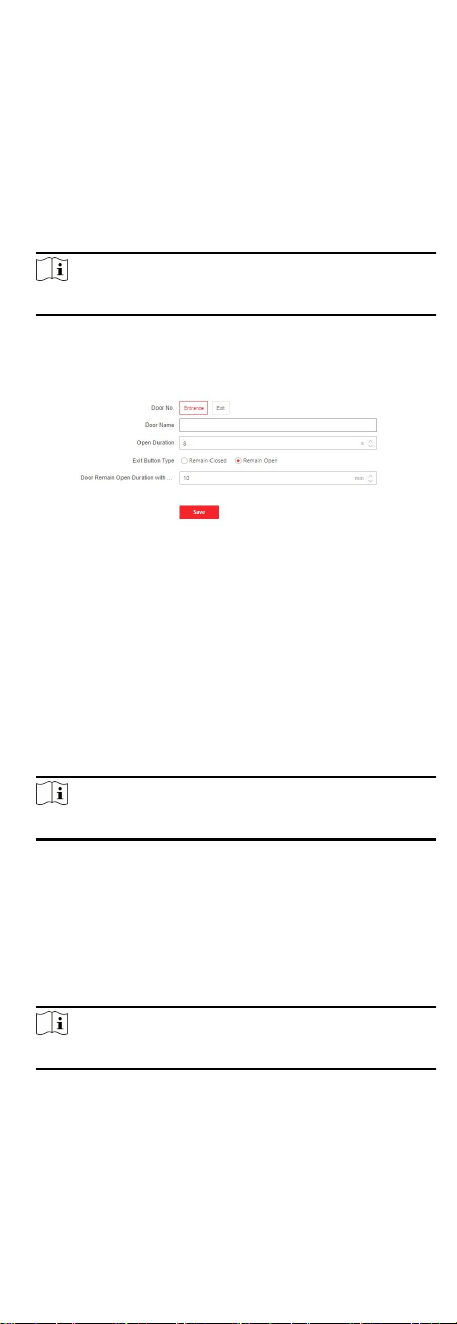
Set Door Parameters
Click Conguraon → Access Control → Door Parameters .
Figure 7-9 Door Parameters Sengs Page
Click Save to save the sengs aer the conguraon.
Door No.
Select Entrance or Exit for sengs.
Door Name
You can create a name for the door.
Open Duraon
Set the door unlocking duraon. If the door is not opened for
the set me, the door will be locked.
Note
The open duraon ranges from 5 s to 60 s.
Exit Buon Type
You can set the exit buon as Remain Open or Remain Closed
according to your actual needs. By default, it is Remain Open.
Door Remain Open
Duraon with First Person
Set the door open duraon when rst person is in. Aer the
rst person is authorized, it allows mulple persons access the
door or other authencaon acons.
Note
The duraon ranges from 1 s to 1440 s.
Serial Port Sengs
Set serial port parameters.
Steps
1. Click Conguraon → Access Control → Serial Port Sengs .
28

Figure 7-10 Serial Port Sengs
2. Set the No., Baud Rate, Data Bit, Stop Bit and Parity.
3. Set the Peripheral Type as Card Reader, Card Receiver, QR
Code Scanner or Disable.
4. Set the Peripheral Posion as Entrance or Exit.
5. You can view the serial port type, external device model and
peripheral
soware version.
6. Click Save.
Set Wiegand Parameters
You can set the Wiegand transmission direcon.
Steps
Note
Some device models do not support this funcon. Refer to the
actual products when conguraon.
1. Click Conguraon → Access Control → Wiegand Sengs .
2. Select Entrance or Exit.
3. Enable Wiegand funcon.
4. The wiegand transmission direcon is set Input by default.
Note
Input: the device can connect a Wiegand card reader.
5. Select Wiegand Mode.
6. Click Save to save the sengs.
Note
If you change the peripheral, and aer you save the device
parameters, the device will reboot automacally.
Set Terminal Parameters
Set the working mode and remote vericaon.
Steps
1. Click Conguraon → Access Control → Terminal Parameters
to enter the page.
29
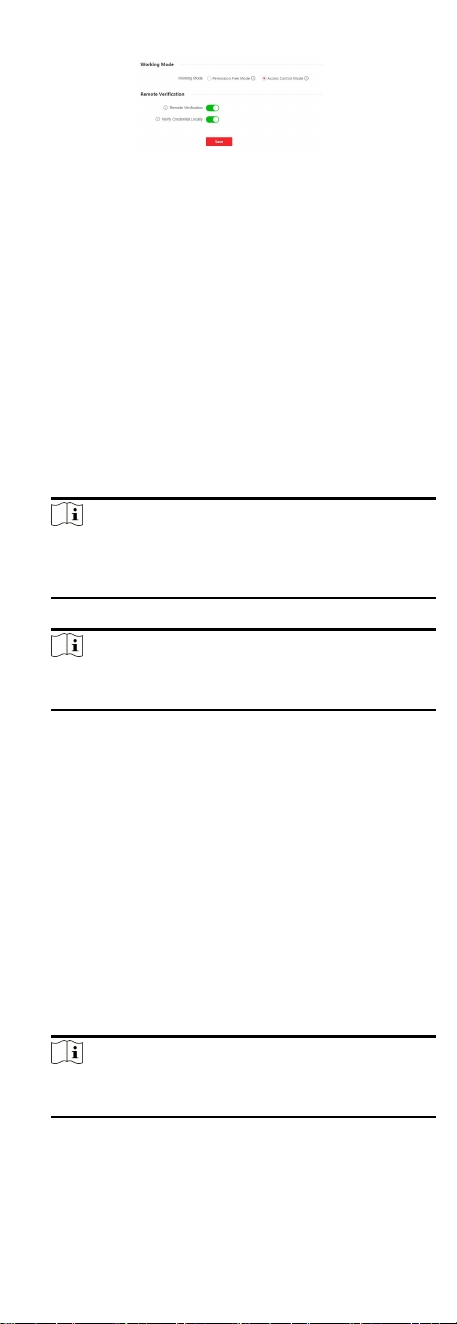
Figure 7-11 Terminal Parameters
2. Set the device working mode.
Permission Free Mode
The device will not verify the person's permission, but only
the person's validity period. If the person is in the validity
period, the barrier will open.
You can enable Verify
Credenal Locally. Aer enabling the
funcon, the device will only verify the person's permission
without the schedule template, etc.
Access Control Mode
The device works normally and will verify the person's
permission to open the barrier.
3. Set remote
vericaon.
1) Enable Remote Vericaon.
Note
The device will upload the person's authencaon
informaon to the plaorm. The plaorm will judge to open
the barrier or not.
2) Oponal: Enable Verify Credenal Locally.
Note
Aer enabling the funcon, the device will only verify the
person's permission without the schedule template, etc.
4. Click Save to complete terminal parameter sengs.
7.5.10
Turnsle
Basic Parameters
Set turnsle basic parameters.
Steps
1. Click
Conguraon → Turnsle → Basic Sengs to enter the
page.
2. View the Device Type, Device Model and Working Status.
3. Set Barrier Material, Lane Width, Barrier Height, Barrier
Opening Speed and Barrier Closing Speed.
4. Set the passing mode.
-
If you choose General Passing, you can select the barrier
status for the entrance and exit from the drop-down list.
Note
If you set barrier-free mode, the barrier remains open and
will close when authencaon fails.
-
If you choose Weekly Schedule, you can set a weekly
schedule for entrance and exit barriers.
5. Click Save.
30

keyfob
Set keyfob patameters.
Steps
1. Click Conguraon → Turnsle → Keyfob to enter the page.
Figure 7-12 keyfob
2. Set Working Mode as One-to-One or One-to-Many.
3. Add keyfob.
1) Click Add and the keyfob adding window will pop up.
2) Enter the Name and Serial No..
3) Check to enable Remain Open Permission at your actual
needs.
4) Click OK to add the keyfob.
4.
Oponal: Select a keyfob and click Delete to delete the keyfob.
5. Click Save.
People Counng
Set people counng .
Steps
1. Click
Conguraon → Turnsle → People Counng to enter
the page.
Figure 7-13 People Counng
2. Enable People Counng.
3. EnableDevice Oine People Counng at your actual needs.
4. Select Person Stascs Type as Invalid or Authencaon
Number.
5. Oponal: Click Clear to clear all the people counng
informaon.
Other Sengs
Set other parameters.
Steps
1. Click
Conguraon → Turnsle → Other Sengs to enter the
page.
31

2. Set Alarm Output Duraon.
Note
The alarm output duraon ranges from 0 s to 3599 s.
3. Set Temperature Unit.
4. Drag the block or enter the value to adjust the light board
brightness.
5. Set the alarm buzzer beeping
duraon, door closing delay me.
6. Choose the control mode.
So Mode
The barrier will be closed aer the person has passed
through the barrier.
Guard Mode
The barrier will be closed immediately.
7. Set the
re input type.
8. Click to enable Motor Self-Test and choose the main lane or
sub lane to start motor self-tesng.
9. Click Save.
10. Click More to adjust Barrier Open Angle.
7.5.11 Card
Sengs
Set Card Security
Click Conguraon → Card Sengs → Card Type to enter the
sengs page.
Set the parameters and click Save.
Enable NFC Card
Reserved.
Enable M1 Card
Enable M1 card and authencang by presenng M1 card is
available.
M1 Card
Encrypon
Sector
M1 card encrypon can improve the security level of
authencaon.
Enable the funcon and set the encrypon sector. By default,
Sector 13 is encrypted. It is recommended to encrypt sector
13.
32

Enable EM Card
Enable EM card and authencang by presenng EM card is
available.
Note
If the peripheral card reader supports presenng EM card, the
funcon is also supported to enable/disable the EM card
funcon.
Enable DESFire Card
The device can read the data from DESFire card when enabling
the DESFire card
funcon.
DESFire Card Read Content
Aer enable the DESFire card content reading funcon, the
device can read the DESFire card content.
Enable FeliCa Card
The device can read the data from FeliCa card when enabling
the FeliCa card
funcon.
Set Card Authencaon Parameters
Set the card reading content when authencate via card on the
device.
Go to Conguraon → Card Sengs → Card NO. Authencaon
Sengs
.
Select a card
authencaon mode and enable reversed card No.
at your actual needs. Click Save.
7.5.12 Set Privacy Parameters
Set the event storage type.
Go to
Conguraon → Security → Privacy Sengs
The event storage type is overwring by default. The earliest 5%
events will be deleted when the system detects the stored events
has been over 95% of the full space.
7.5.13 Upgrade and Maintenance
Reboot device, restore device parameters, and upgrade device
version.
Reboot Device
Click Maintenance and Security → Maintenance → Restart .
Click Restart to reboot the device.
Upgrade
Click Maintenance and Security → Maintenance → Upgrade .
Select an upgrade type from the drop-down list. Click and
select the upgrade le from your local PC. Click Upgrade to start
upgrading.
Note
Do not power o during the upgrading.
Restore Parameters
33

Click Maintenance and Security → Maintenance → Backup and
Reset .
Restore All
All parameters will be restored to the factory sengs. You
should
acvate the device before usage.
Restore
The device will restore to the default sengs, except for the
network parameters and the user informaon.
Import and Export Parameters
Click Maintenance and Security → Maintenance → Backup and
Reset .
Export
Click Export to export the device parameters.
Note
You can import the exported device parameters to another
device.
Import
Click and select the le to import. Click Import to start
import conguraon le.
7.5.14 Device Debugging
You can set device debugging parameters.
Steps
1. Click Maintenance and Security → Maintenance → Device
Debugging .
2. You can set the following parameters.
Enable SSH
To raise network security, disable SSH service. The
conguraon is only used to debug the device for the
professionals.
Print Log
You can click Export to export log.
Capture Network Packet
You can set the Capture Packet
Duraon, Capture Packet
Size, and click Start to capture.
7.5.15 Overview
You can view the main lane and sub lane status.
Main Lane Status
Device Component
You can view the status of the access control board, lane
control board and user extended interface board.
Peripheral
You can view the status of the RS-485 card reader and RS-232
card receiver.
Temperature
You can view the pedestal temperature.
34

Movement
You can view the working status of motor encoder.
Sub Lane Status
Device Component
You can view the status of the lane control board.
Peripheral
You can view the status of the RS-485 card reader and RS-232
card receiver.
Movement
You can view the working status of motor encoder.
Others
Passing Mode
You can view the entrance and exit mode.
Input and Output Status
You can view the status of the event input/output, alarm input/
output and re alarm.
Other Status
You can view the status of the barrier and the keyfob receiving
module.
7.5.16 Log Query
You can search and view the device logs.
Go to Maintenance and Security → Maintenance → Log .
Set the major and minor type of the log type. Set the start me
and end me for searching, and click Search.
The results will be displayed below, which including the No., me,
the major type the minor type, the channel No., the local/remote
user
informaon, the remote host IP, etc.
7.5.17
Cercate Management
It helps to manage the server/client cercates and CA
cercate.
Note
The funcon is only supported by certain device models.
Create and Import Self-signed Cercate
Steps
1. Go to Maintenance and Security → Security →
Cercate
Management .
2. In the Cercate Files area, select a Cercate Type from the
drop-down list.
3. Click Create.
4. Input
cercate informaon.
5. Click OK to save and install the cercate.
The created cercate is displayed in the Cercate Details
area.
The cercate will be saved automacally.
35

6. Download the cercate and save it to an asking le in the
local computer.
7. Send the asking le to a cercaon authority for signature.
8. Import the signed cercate.
1) Select a cercate type in the Import Key area, and select a
cercate from the local, and click Import.
2) Select a cercate type in the Import Communicaon
Cercate area, and select a cercate from the local, and
click Import.
Import Other Authorized Cercate
If you already has an authorized cercate (not created by the
device), you can import it to the device directly.
Steps
1. Go to Maintenance and Security → Security →
Cercate
Management .
2. In the Import Key and Import Communicaon Cercate
areas, select cercate type and upload cercate.
3. Click Import.
Import CA Cercate
Before You Start
Prepare a CA cercate in advance.
Steps
1. Go to Maintenance and Security → Security →
Cercate
Management .
2. Create an ID in the Import CA Cercate area.
Note
The input cercate ID cannot be the same as the exisng
ones.
3. Upload a cercate le from the local.
4. Click Import.
8 Client
Soware Conguraon
You can call the hotline to get the iVMS-4200 client soware
installaon package.
8.1 Conguraon Flow of Client Soware
Follow the ow diagram below to congure on the client
soware.
36

Figure 8-1 Flow Diagram of Conguraon on Client Soware
8.2 Device Management
The client supports managing access control devices and video
intercom devices.
Example
You can control entrance & exit and manage
aendance aer
adding access control devices to the client; you can perform video
intercom with the indoor staons and door staons.
8.2.1 Add Device
The client provides three device adding modes including by IP/
domain, IP segment, and ISUP protocol. The client also supports
imporng mulple devices in a batch when there are large
amount of devices to be added.
Add Device by IP Address or Domain Name
If you know the IP address or domain name of the device to add,
you can add devices to the client by specifying the IP address (or
domain name), user name, password, etc.
Steps
1. Enter Device Management module.
2. Click Device tab on the top of the right panel.
The added devices are displayed on the right panel.
3. Click Add to open the Add window, and then select IP/Domain
as the adding mode.
4. Enter the required
informaon.
Name
Create a descripve name for the device. For example, you
can use a nickname that can show the
locaon or feature of
the device.
Address
The IP address or domain name of the device.
Port
The devices to add share the same port number. The default
value is 8000.
37

Note
For some device types, you can enter 80 as the port No. This
funcon should be supported by the device.
User Name
Enter the device user name. By default, the user name is
admin.
Password
Enter the device password.
Cauon
The password strength of the device can be automacally
checked. We highly recommend you change the password of
your own choosing (using a minimum of 8 characters,
including at least three kinds of following categories: upper
case leers, lower case leers, numbers, and special
characters) in order to increase the security of your product.
And we recommend you change your password regularly,
especially in the high security system, changing the
password monthly or weekly can
beer protect your
product.
Proper
conguraon of all passwords and other security
sengs is the responsibility of the installer and/or end-user.
5. Oponal: Check Transmission Encrypon (TLS) to enable
transmission encrypon using TLS (Transport Layer Security)
protocol for security purpose.
Note
●
This funcon should be supported by the device.
●
If you have enabled Cercate Vericaon, you should click
Open Cercate Directory to open the default folder, and
copy the cercate le exported from the device to this
default directory to strengthen the security. See for details
about enabling
cercate vericaon.
●
You can log into the device to get the cercate le by web
browser.
6. Check Synchronize Time to synchronize the device me with
the PC running the client aer adding the device to the client.
7. Oponal: Check Import to Group to create a group by the
device name, and import all the channels of the device to this
group.
Example
For access control device, its access points, alarm inputs/
outputs, and encoding channels (if exist) will be imported to
this group.
8. Finish adding the device.
-
Click Add to add the device and back to the device list page.
-
Click Add and New to save the
sengs and connue to add
other device.
Import Devices in a Batch
You can add mulple devices to the client in a batch by entering
the device parameters in a pre-dened CSV le.
38

Steps
1. Enter the Device Management module.
2. Click Device tab on the top of the right panel.
3. Click Add to open the Add window, and then select Batch
Import as the adding mode.
4. Click Export Template and then save the
pre-dened template
(CSV le) on your PC.
5. Open the exported template le and enter the required
informaon of the devices to be added on the corresponding
column.
Note
For detailed descripon of the required elds, refer to the
introducons in the template.
Adding Mode
Enter 0 or 1 or 2.
Address
Edit the address of the device.
Port
Enter the device port number. The default port number is
8000.
User Name
Enter the device user name. By default, the user name is
admin.
Password
Enter the device password.
Cauon
The password strength of the device can be automacally
checked. We highly recommend you change the password of
your own choosing (using a minimum of 8 characters,
including at least three kinds of following categories: upper
case leers, lower case leers, numbers, and special
characters) in order to increase the security of your product.
And we recommend you change your password regularly,
especially in the high security system, changing the
password monthly or weekly can
beer protect your
product.
Proper
conguraon of all passwords and other security
sengs is the responsibility of the installer and/or end-user.
Import to Group
Enter 1 to create a group by the device name. All the
channels of the device will be imported to the corresponding
group by default. Enter 0 to disable this funcon.
6.
Click and select the template le.
7. Click Add to import the devices.
8.2.2 Reset Device Password
If you forgot the password of the detected online devices, you
can reset the device password via the client.
39
Steps
1. Enter Device Management page.
2. Click Online Device to show the online device area.
All the online devices sharing the same subnet will be displayed
in the list.
3.
Select the device from the list and click
on the Operaon
column.
4. Reset the device password.
-
Click Generate to pop up the QR Code window and click
Download to save the QR code to your PC. You can also take
a photo of the QR code to save it to your phone. Send the
picture to our technical support.
Note
For the following operaons for reseng the password,
contact our technical support.
Cauon
The password strength of the device can be automacally
checked. We highly recommend you change the password of
your own choosing (using a minimum of 8 characters, including
at least three kinds of following categories: upper case leers,
lower case leers, numbers, and special characters) in order to
increase the security of your product. And we recommend you
change your password regularly, especially in the high security
system, changing the password monthly or weekly can
beer
protect your product.
Proper conguraon of all passwords and other security
sengs is the responsibility of the installer and/or end-user.
8.2.3 Manage Added Devices
Aer adding devices to device list, you can manage the added
devices including eding device parameters, remote
conguraon, viewing device status, etc.
Table 8-1 Manage Added Devices
Edit Device
Click to edit device informaon
including device name, address, user
name, password, etc.
Delete
Device
Check one or more devices, and click
Delete to delete the selected devices.
Remote
Congurao
n
Click to set remote conguraon of
the corresponding device. For details,
refer to the user manual of device.
View Device
Status
Click to view device status, including
door No., door status, etc.
Note
For dierent devices, you will view
dierent informaon about device
status.
40

View Online
User
Click to view the details of online user
who access the device, including user
name, user type, IP address and login
me.
Refresh
Device
Informaon
Click to refresh and get the latest
device informaon.
8.3 Group Management
The client provides groups to manage the added resources in
dierent groups. You can group the resources into dierent
groups according to the resources' locaons.
Example
For example, on the 1st oor, there mounted 16 doors, 64 alarm
inputs, and 16 alarm outputs. You can organize these resources
into one group (named 1st Floor) for convenient management.
You can control door status, and do some other
operaons of the
devices aer managing the resources by groups.
8.3.1 Add Group
You can add group to organize the added device for convenient
management.
Steps
1. Enter the Device Management module.
2. Click Device Management → Group to enter the group
management page.
3. Create a group.
-
Click Add Group and enter a group name as you want.
-
Click Create Group by Device Name and select an added
device to create a new group by the name of the selected
device.
Note
The resources (such as alarm inputs/outputs, access points,
etc.) of this device will be imported to the group by default.
8.3.2 Import Resources to Group
You can import the device resources (such as alarm inputs/
outputs, access points, etc.) to the added group in a batch.
Before You Start
Add a group for managing devices. Refer to
Add Group.
Steps
1. Enter the Device Management module.
2. Click Device Management → Group to enter the group
management page.
3. Select a group from the group list and select the resource type
as Access Point, Alarm Input, Alarm Output, etc.
4. Click Import.
5. Select the thumbnails/names of the resources in the
thumbnail/list view.
41

Note
You can click or to switch the resource display mode to
thumbnail view or to list view.
6. Click Import to import the selected resources to the group.
8.4 Person Management
You can add person informaon to the system for further
operaons such as access control, video intercom, me and
aendance, etc. You can manage the added persons such as
issuing cards to them in a batch,
imporng and exporng person
informaon in a batch, etc.
8.4.1 Add Organizaon
You can add an organizaon and import person informaon to
the
organizaon for eecve management of the persons. You
can also add a surbodinate organizaon for the added one.
Steps
1. Enter Person module.
2. Select a parent
organizaon in the le column and click Add in
the upper-le corner to add an organizaon.
3. Create a name for the added organizaon.
Note
Up to 10 levels of organizaons can be added.
4. Oponal: Perform the following operaon(s).
Edit
Organizaon
Hover the mouse on an added
organizaon and click to edit its name.
Delete
Organizaon
Hover the mouse on an added
organizaon and click to delete it.
Note
●
The lower-level organizaons will be
deleted as well if you delete an
organizaon.
●
Make sure there is no person added
under the
organizaon, or the
organizaon cannot be deleted.
Show Persons
in Sub
Organizaon
Check Show Persons in Sub Organizaon
and select an organizaon to show
persons in its sub organizaons.
8.4.2 Import and Export Person Idenfy
Informaon
You can import the informaon and pictures of mulple persons
to the client
soware in a batch. Meanwhile, you can also export
the person informaon and pictures and save them in your PC.
Import Person Informaon
You can enter the informaon of mulple persons in a predened
template (CSV/Excel le) to import the informaon to the client in
a batch.
42

Steps
1. Enter the Person module.
2. Select an added organizaon in the list, or click Add in the
upper-le corner to add an organizaon and then select it.
3. Click Import to open the Import panel.
4. Select Person Informaon as the imporng mode.
5. Click Download Template for Imporng Person to download
the template.
6. Enter the person
informaon in the downloaded template.
Note
●
If the person has mulple cards, separate the card No. with
semicolon.
●
Items with asterisk are required.
●
By default, the Hire Date is the current date.
7.
Click
to select the CSV/Excel le with person informaon
from local PC.
8. Click Import to start imporng.
Note
●
If a person No. already exists in the client's database, delete
the exisng informaon before imporng.
●
You can import informaon of no more than 2,000 persons.
Export Person Informaon
You can export the added persons' informaon to local PC as a
CSV/Excel
le.
Before You Start
●
Make sure you have added persons to an organizaon.
●
Make sure you have enabled the Export Person Informaon
funcon to display the Export buon.
Steps
1. Enter the Person module.
2. Oponal: Select an organizaon in the list.
Note
All persons' informaon will be exported if you do not select
any organizaon.
3. Click Export.
4. Enter the super user name and password for vericaon.
The Export panel is displayed.
5. Check Person Informaon as the content to export.
6. Check desired items to export.
7. Click Export to save the exported le in CSV/Excel le on your
PC.
8.4.3 Get Person
Informaon from Access Control
Device
43

If the access control device has been congured with person
informaon, you can get the person informaon from the added
device and import them to the client for further operaons.
Steps
Note
●
If the person name stored in the device is empty, the person
name will be lled with the issued card No. aer imporng to
the client.
●
If the card number or person ID (employee ID) stored on the
device already exists in the client database, the person with
this card number or person ID will not be imported to the
client.
1. Enter Person module.
2. Select an organizaon to import the persons.
3. Click Get from Device.
4. Select an added access control device or the enrollment staon
from the drop-down list.
Note
If you select the enrollment staon, you should click Login, and
enter IP address, port No., user name and password of the
device.
5. Select the Geng Mode.
Note
The geng mode varies according to dierent devices. The
access control device supports geng the person informaon
by employee ID. Up to 5 employee IDs can be specied each
me.
6. Click Import to start imporng the person informaon to the
client.
Note
Up to 2,000 persons and 5,000 cards can be imported.
The person informaon, and the linked cards (if congured),
will be imported to the selected organizaon.
8.4.4 Issue Cards to Persons in Batch
The client provides a convenient way to issue cards to mulple
persons in a batch.
Steps
1. Enter Person module.
2. Oponal: Select a person group, and select the persons with
no card issued.
●
The selected persons with no card issued in the person
group will be displayed in the right panel.
●
If you do not select the persons with no card issued in a
person group, all the added persons with no card issued will
be displayed in the right panel.
3. Click Batch Issue Cards.
4.
Oponal: Enter key words (name or person ID) in the input box
to
lter the person(s) that need issuing cards.
44

5. Oponal: Click Sengs to set the card issuing parameters. For
details, refer to Issue a Card by Local Mode.
6. Click Inialize to inialize the card enrollment staon or card
reader to make it ready for issuing cards.
7. Click the Card No. column and enter the card number.
-
Place the card on the card enrollment
staon.
-
Swipe the card on the card reader.
-
Manually enter the card number and press the Enter key.
The person(s) in the list will be issued with card(s).
8.4.5 Report Card Loss
If the person lost his/her card, you can report the card loss so
that the card's related access authorizaon will be inacve.
Steps
1. Enter Person module.
2. Select the person you want to report card loss for and click Edit
to open the Edit Person window.
3.
In the Credenal → Card panel, click on the added card to
set this card as lost card.
Aer reporng card loss, the access authorizaon of this card
will be invalid and
inacve. Other person who gets this card
cannot access the doors by swiping this lost card.
4.
Oponal: If the lost card is found, you can click to cancel the
loss.
Aer cancelling card loss, the access authorizaon of the
person will be valid and acve.
5. If the lost card is added in one access group and the access
group is applied to the device already, aer reporng card loss
or cancelling card loss, a window will pop up to nofy you to
apply the changes to the device.
Aer applying to device, these
changes can take eect on the device.
8.4.6 Set Card Issuing Parameters
The client provides two modes for reading a card's number: via
card enrollment staon or via the card reader of the access
control device. If a card enrollment
staon is available, connect it
to the PC running the client by USB interface or COM, and place
the card on the card enrollment to read the card number. If not,
you can also swipe the card on the card reader of the added
access control device to get the card number. As a result, before
issuing a card to one person, you need to set the card issuing
parameters including the issuing mode and related parameters.
When adding a card to one person, click
Sengs to open the
Card Issuing
Sengs window.
Local Mode: Issue Card by Card Enrollment
Staon
Connect a card enrollment staon to the PC running the client.
You can place the card on the card enrollment
staon to get the
card number.
Card Enrollment Staon
Select the model of the connected card enrollment staon
45

Note
Currently, the supported card enrollment staon models
include DS-K1F100-D8, DS-K1F100-M, DS-K1F100-D8E, and DS-
K1F180-D8E.
Card Type
This eld is only available when the model is DS-K1F100-D8E or
DS-K1F180-D8E.
Select the card type as EM card or IC card according to the
actual card type.
Serial Port
It is only available when the model is DS-K1F100-M.
Select the COM the card enrollment
staon connects to.
Buzzing
Enable or disable the buzzing when the card number is read
successfully.
Card No. Type
Select the type of the card number according to actual needs.
M1 Card Encrypon
This eld is only available when the model is DS-K1F100-D8,
DS-K1F100-D8E, or DS-K1F180-D8E.
If the card is M1 card, and if you need to enable the M1 Card
Encrypon funcon, you should enable this funcon and select
the sector of the card to encrypt.
Remote Mode: Issue Card by Card Reader
Select an access control device added in the client and swipe the
card on its card reader to read the card number.
8.5 Congure Schedule and Template
You can congure the template including holiday and week
schedule. Aer seng the template, you can adopt the
congured template to access groups when seng the access
groups, so that the access group will take eect in the me
duraons
of the template.
Note
For access group sengs, refer to Set Access Group to Assign
Access Authorizaon to Persons.
8.5.1 Add Holiday
You can create holidays and set the days in the holidays, including
start date, end date, and holiday duraon in one day.
Steps
Note
You can add up to 64 holidays in the soware system.
1. Click Access Control → Schedule → Holiday to enter the
Holiday page.
2. Click Add on the le panel.
3. Create a name for the holiday.
46
4. Oponal: Enter the descripons or some nocaons of this
holiday in the Remark box.
5. Add a holiday period to the holiday list and congure the
holiday duraon.
Note
Up to 16 holiday periods can be added to one holiday.
1) Click Add in the Holiday List eld.
2) Drag the cursor to draw the me duraon, which means in
that duraon of me, the congured access group is
acvated.
Note
Up to 8 me duraons can be set to one holiday period.
3) Oponal: Perform the following operaons to edit the me
duraons.
●
Move the cursor to the me duraon and drag the me
duraon on the meline bar to the desired posion when
the cursor turns to .
●
Click the me duraon and directly edit the start/end me in
the appeared dialog.
●
Move the cursor to the start or the end of me duraon and
drag to lengthen or shorten the
me duraon when the
cursor turns to .
4) Oponal: Select the me duraon(s) that need to be
deleted, and then click in the Operaon column to delete
the selected me duraon(s).
5)
Oponal: Click in the Operaon column to clear all the
me duraon(s) in the me bar.
6)
Oponal: Click in the Operaon column to delete this
added holiday period from the holiday list.
6. Click Save.
8.5.2 Add Template
Template includes week schedule and holiday. You can set week
schedule and assign the me duraon of access authorizaon for
dierent person or group. You can also select the added
holiday(s) for the template.
Steps
Note
You can add up to 255 templates in the soware system.
1. Click Access Control → Schedule → Template to enter the
Template page.
Note
There are two default templates: All-Day Authorized and All-
Day Denied, and they cannot be edited or deleted.
All-Day Authorized
The access authorizaon is valid in each day of the week and
it has no holiday.
All-Day Denied
47

The access authorizaon is invalid in each day of the week
and it has no holiday.
2. Click Add on the le panel to create a new template.
3. Create a name for the template.
4. Enter the descripons or some nocaon of this template in
the Remark box.
5. Edit the week schedule to apply it to the template.
1) Click Week Schedule tab on the lower panel.
2) Select a day of the week and draw
me duraon(s) on the
meline bar.
Note
Up to 8 me duraon(s) can be set for each day in the week
schedule.
3) Oponal: Perform the following operaons to edit the me
duraons.
●
Move the cursor to the
me duraon and drag the me
duraon
on the meline bar to the desired posion when
the cursor turns to .
●
Click the me duraon and directly edit the start/end me in
the appeared dialog.
●
Move the cursor to the start or the end of me duraon and
drag to lengthen or shorten the
me duraon when the
cursor turns to .
4) Repeat the two steps above to draw more
me duraons on
the other days of the week.
6. Add a holiday to apply it to the template.
Note
Up to 4 holidays can be added to one template.
1) Click Holiday tab.
2) Select a holiday in the le list and it will be added to the
selected list on the right panel.
3)
Oponal: Click Add to add a new holiday.
Note
For details about adding a holiday, refer to Add Holiday.
4) Oponal: Select a selected holiday in the right list and click
to remove the selected one, or click Clear to clear all the
selected holiday(s) in the right list.
7. Click Save to save the sengs and nish adding the template.
8.6 Set Access Group to Assign Access
Authorizaon to Persons
Aer adding the person and conguring the person's credenals,
you can create the access groups to dene which person(s) can
get access to which door(s) and then apply the access group to
the access control device to take
eect.
48

Before You Start
●
Add person to the client.
●
Add access control device to the client and group access points.
For details, refer to Group Management.
●
Add template.
Steps
When the access group sengs are changed, you need to apply
the access groups to the devices again to take
eect. The access
group changes include changes of template, access group
sengs, person's access group sengs, and related person
details.
1. Click Access Control → Authorizaon → Access Group to enter
the Access Group interface.
2. Click Add to open the Add window.
3. In the Name text eld, create a name for the access group as
you want.
4. Select a template for the access group.
Note
You should congure the template before access group
sengs. Refer to Congure Schedule and Template for details.
5. In the le list of the Select Person eld, select person(s) to
assign access authority.
6. In the le list of the Select Access Point eld, select door(s),
door
staon(s) or oor(s) for the selected persons to access.
7. Click Save.
You can view the selected person(s) and the selected access
point(s) on the right side of the interface.
Figure 8-2 Display the Selected Person(s) and Access Point(s)
8. Aer adding the access groups, you need to apply them to the
access control device to take eect.
1) Select the access group(s) to apply to the access control
device.
2) Click Apply All to Devices start applying all the selected
access group(s) to the access control device or door
staon.
3) Click Apply All to Devices or Apply Changes to Devices.
Apply All to Devices
49

This operaon will clear all the existed access groups of
the selected devices and then apply the new access group
to the device.
Apply Changes to Devices
This operaon will not clear the existed access groups of
the selected devices and only apply the changed part of
the selected access group(s) to the device(s).
4) View the applying status in the Status column or click
Applying Status to view all the applied access group(s).
Note
You can check Display Failure Only to lter the applying
results.
The selected persons in the applied access groups will have the
authorizaon to enter/exit the selected doors/door staons
with their linked card(s).
9.
Oponal: Click to edit the access group if necessary.
Note
If you change the persons' access informaon or other related
informaon, you will view the prompt Access Group to Be
Applied on the right corner of the client.
You can click the prompt to apply the changed data to the
device. You can select either Apply Now or Apply Later.
Figure 8-3 Data Synchronizaon
8.7 Congure Advanced Funcons
You can congure the advanced funcons of access control to
meet some special requirements in
dierent scene.
Note
●
For the card related funcons(the type of access control card),
only the card(s) with access group applied will be listed when
adding cards.
●
The advanced funcons should be supported by the device.
●
Hover the cursor on the Advanced
Funcon, and then Click
to customize the advanced funcon(s) to be displayed.
8.7.1 Congure Device Parameters
Aer adding the access control device, you can congure the
parameters of access control device, access control points.
Congure Parameters for Access Control Device
Aer adding the access control device, you can congure its
parameters, including overlaying user informaon on picture,
uploading pictures
aer capturing, saving captured pictures, etc.
50

Before You Start
Add access control device to the client.
Steps
1. Click Access Control → Advanced Funcon → Device
Parameters .
Note
If you can not nd Device Parameter in the Advanced Funcon
list, hover the cursor on the Advanced Funcon, and then Click
to select the Device Parameter to be displayed.
2. Select an access device to show its parameters on the right
page.
3. Turn the switch to ON to enable the corresponding funcons.
Note
●
The displayed parameters may vary for dierent access
control devices.
●
Some of the following parameters are not listed in the Basic
Informaon page, click More to edit the parameters.
Enable NFC
If enable the funcon, the device can recognize the NFC
card. You can present NFC card on the device.
Enable M1 Card
If enable the funcon, the device can recognize the M1 card.
You can present M1 card on the device.
Enable EM Card
If enable the funcon, the device can recognize the EM card.
You can present EM card on the device.
Enable CPU Card
Reserved. If enable the
funcon, the device can recognize
the CPU card. You can present CPU card on the device.
Enable ID Card
Reserved. If enable the funcon, the device can recognize
the ID card. You can present ID card on the device.
4. Click OK.
5.
Oponal: Click Copy to, and then select the access control
device(s) to copy the parameters in the page to the selected
device(s).
Congure Parameters for Door/Elevator
Aer adding the access control device, you can congure its
access point (door or
oor) parameters.
Before You Start
Add access control device to the client.
Steps
1. Click Access Control → Advanced
Funcon → Device
Parameter .
2. Select an access control device on the le panel, and then click
to show the doors or oors of the selected device.
3. Select a door or oor to show its parameters on the right page.
4. Edit the door or oor parameters.
51

Note
●
The displayed parameters may vary for dierent access
control devices.
●
Some of the following parameters are not listed in the Basic
Informaon page, click More to edit the parameters.
Name
Edit the card reader name as desired.
Exit
Buon Type
You can set the exit buon as remaining closed or remaining
open. Usually, it is remaining open.
Open
Duraon
The door contact can be enabled with appropriate delay
aer person with extended access needs swipes her/his
card.
5. Click OK.
6.
Oponal: Click Copy to , and then select the door/oor(s) to
copy the parameters in the page to the selected doors/oor(s).
Note
The door or oor's status duraon sengs will be copied to the
selected door/oor(s) as well.
Congure Parameters for Card Reader
Aer adding the access control device, you can congure its card
reader parameters.
Before You Start
Add access control device to the client.
Steps
1. Click Access Control → Advanced
Funcon → Device
Parameter .
2.
In the device list on the
le, click to expand the door, select a
card reader and you can edit the card reader's parameters on
the right.
3. Edit the card reader basic parameters in the Basic
Informaon
page.
Note
●
The displayed parameters may vary for dierent access
control devices. There are part of parameters listed as
follows. Refer to the user manual of the device for more
details.
●
Some of the following parameters are not listed in the Basic
Informaon page, click More to edit the parameters.
Name
Edit the card reader name as desired.
Card Authencaon Interval
The me interval between two connuous card recognions
when authencang.
Repeated Authencaon Interval
52

Within the specied interval, repeated authencaon of the
same card number (uploaded by dierent devices) is invalid,
and only one authencaon is performed.
Enable Failed Aempts Limit of Authencaon/Max. Failed
Aempts for Authencaon
Enable to report alarm when the card reading aempts
reach the set value.
Card Reader Type/Card Reader Descripon
Get card reader type and descripon. They are read-only.
4. Click OK.
5. Oponal: Click Copy to, and then select the card reader(s) to
copy the parameters in the page to the selected card reader(s).
Congure Parameters for Alarm Output
Aer adding the access control device, if the device links to alarm
outputs, you can congure the parameters.
Before You Start
Add access control device to the client, and make sure the device
supports alarm output.
Steps
1. Click Access Control → Advanced
Funcon → Device
Parameter to enter access control parameter conguraon
page.
2.
In the device list on the le, click to expand the door, select
an alarm input and you can edit the alarm input's parameters
on the right.
3. Set the alarm output parameters.
Name
Edit the card reader name as desired.
Alarm Output
Acve Time
How long the alarm output will last aer triggered.
4. Click OK.
5. Oponal: Set the switch on the upper right corner to ON to
trigger the alarm output.
Congure Parameters for Lane Controller
Aer adding the lane controller to the client, you can congure its
parameters for passing through the lane.
Before You Start
Add access control device to the client.
Steps
1. Click Access Control → Advanced
Funcon → Device
Parameter to enter Parameter Sengs page.
2. In the device list on the
le, select a lane controller and you
can edit the lane controller's parameters on the right.
3. Edit the parameters.
Passing Mode
Select the controller which will control the barrier status of
the device.
Opening/Closing Barrier Speed
53

Set the barrier's opening and closing speed. You can select
from 1 to 10. The greater the value, the faster the speed.
Note
The recommended value is 6.
Alarm Voice Prompt Time Duraon
Set how long the audio will last, which is played when an
alarm is triggered .
Note
0 refers to the alarm audio will be played unl the alarm is
ended.
Temperature Unit
Select the temperature unit that displayed in the device
status.
Lightboard Brightness
Adjust the brightness of the device light.
Barrier Material
Select the material of the barrier gate. You can select the
barrier material from the drop-down list.
Note
The barrier material may aect the device working. Select a
correct barrier material or the barrier may not open.
Lane Length
The width of the lane. You can set the lane width.
Note
The lane width may aect the device working. Set a correct
lane width or the barrier may not open.
4. Click OK.
8.7.2
Congure Device Parameters
Aer adding the access control device, you can set its parameters
such as network parameters.
Set RS-485 Parameters
You can set the access control device's RS-485 parameters
including the baud rate, data bit, the stop bit, parity type,
ow
control type, communicaon mode, work mode, and connecon
mode.
Before You Start
Add access control device to the client, and make sure the device
supports RS-485 interface.
Steps
1. Enter the Access Control module.
2. On the
navigaon bar on the le, enter Advanced Funcon →
More Parameters .
3. Select an access control device in the device list and click
RS-485 to enter the RS-485
Sengs page.
4. Select the serial port number from the drop-down list to set
the RS-485 parameters.
54

5. Set the baud rate, data bit, the stop bit, parity type, and
connecon mode in the drop-down list.
6. Click Save.
●
The congured parameters will be applied to the device
automacally.
●
When you change the connecon mode, the device will
reboot automacally.
Set Wiegand Parameters
You can set the access control device's Wiegand channel and the
communicaon mode. Aer seng the Wiegand parameters, the
device can connect to Wiegand card reader via Wiegand
communicaon.
Before You Start
Add access control device to the client, and make sure the device
supports Wiegand.
Steps
1. Enter the Access Control module.
2. On the
navigaon bar on the le, enter Advanced Funcon →
More Parameters .
3. Select an access control device in the device list and click
Wiegand to enter the Wiegand
Sengs page.
4. Set the switch to on to enable the Wiegand funcon for the
device.
5. Select the Wiegand channel No. and the communicaon mode
from the drop-down list.
Note
If you set Communicaon Direcon as Sending, you are
required to set the Wiegand Mode as Wiegand 26 or Wiegand
34.
6. Click Save.
●
The congured parameters will be applied to the device
automacally.
●
Aer changing the communicaon direcon, the device will
reboot
automacally.
Enable M1 Card Encrypon
M1 card encrypon can improve the security level of
authencaon.
Steps
Note
The funcon should be supported by the access control device
and the card reader.
1. Enter the Access Control module.
2. On the navigaon bar on the le, enter Advanced Funcon →
More Parameters .
3. Select an access control device in the device list and click M1
Card
Encrypon to enter the M1 Card Encrypon page.
4. Set the switch to on to enable the M1 card encrypon
funcon.
5. Set the sector ID.
55

The sector ID ranges from 1 to 100.
6. Click Save to save the sengs.
8.8 Door/Elevator Control
In Monitoring module, you can view the real-me status of the
doors or elevators managed by the added access control device.
You can also control the doors and elevators such as open/close
the door, or remain the door open/closed via the client remotely.
The
real-me access event are displayed in this module. You can
view the access details and person details.
Note
For the user with door/elevator control permission, the user can
enter the Monitoring module and control the door/elevator. Or
the icons used for control will not show. For seng the user
permission, refer to .
8.8.1 Control Door Status
You can control the status for the door(s), including unlock door,
locking door, remaining the door unlock, remaining the door
locked, remain all unlocked, etc.
Before You Start
●
Add person and assign access
authorizaon to designed
person, and person will have the access authorizaon to the
access points (doors). For details, refer to
Person Management
and Set Access Group to Assign Access Authorizaon to
Persons.
●
Make sure the operaon user has the permission of the access
points (doors).
Steps
1. Click Monitoring to enter the status monitoring page.
2. Select an access point group on the upper-right corner.
Note
For managing the access point group, refer to Group
Management.
The doors in the selected access control group will display.
3. Click a door icon to select a door, or press Ctrl and select
mulple doors.
Note
For Remain All Unlocked and Remain All Locked, ignore this
step.
4. Click the following buons to control the door.
Unlock Door
When the door is locked, unlock it and it will be open for
once. Aer the open duraon, the door will be closed and
locked again
automacally.
Lock Door
When the door is unlocked, lock it and it will be closed. The
person who has the access authorizaon can access the door
with
credenals.
Remain Unlocked
56

The door will be unlocked (no maer closed or open). All the
persons can access the door with no credenals required.
Remain Locked
The door will be closed and locked. No person can access the
door even if he/she has the authorized credenals, except
the super users.
Remain All Unlocked
All doors in the group will be unlocked (no
maer closed or
open). All the persons can access the doors with no
credenals required.
Remain All Locked
All doors in the group will be closed and locked. No person
can access the doors even if he/she has the authorized
credenals, except the super users.
Capture
Capture a picture manually.
Note
The Capture buon is available when the device supports
capture funcon. The picture is saved in the PC running the
client.
Remotely Unlocking Door Staon
When the group includes door staons, you can check Lock1
or Lock2, then click Unlock Door to unlock the door staon.
Note
By default, Lock1 is checked for door staons.
Refresh Status
Click Refresh Status to get the door's newest status.
Result
The icon of the doors will change in real-me according to the
operaon if the operaon is succeeded.
8.8.2 Check Real-Time Access Records
The real-me access records can be displayed in the client. Also,
you can view the person informaon.
Before You Start
You have added person(s) and access control device(s) to the
client. For details, refer to
Person Management and Add Device.
Steps
1. Click Monitoring to enter monitoring module.
Real-me access records are displayed on the boom of the
page. You can view record details
Note
You can right click the column name of access event table to
show or hide the column according to actual needs.
2. Oponal: Select an access point group from the drop-down list
in the upper-right corner to show the real
me access records
of the selected group.
3. Oponal: Check the event type and event status.
57

The detected events of checked type and status will be
displayed in the list below.
4. Oponal: Check Show Latest Event to view the latest access
record.
The record list will be listed reverse chronologically.
5.
Oponal: Click to view details.
Note
In the pop-up window, you can click to view details in full
screen.
58

A. DIP Switch
59
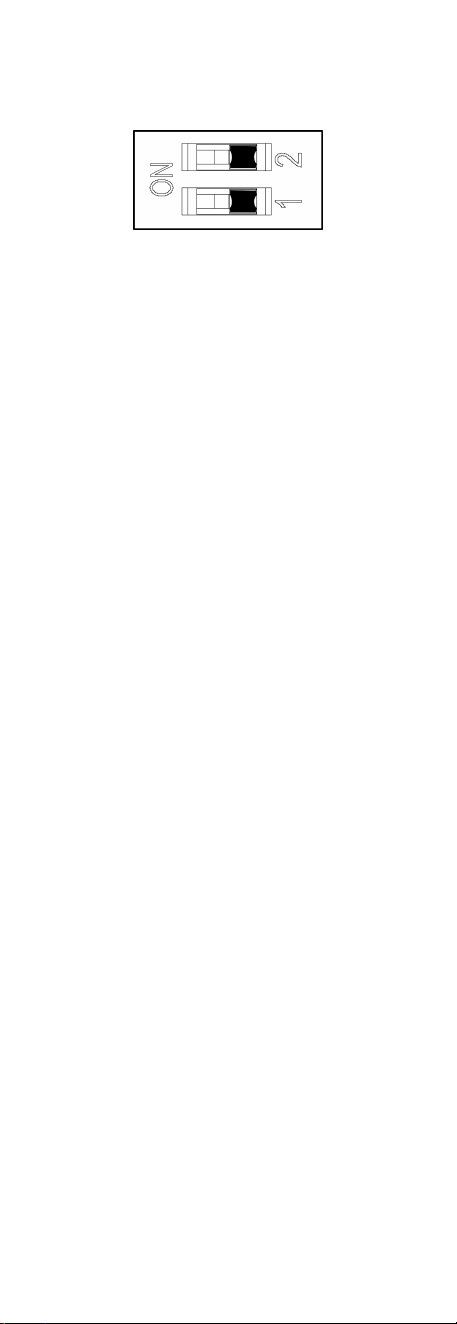
A.1 DIP Switch Descripon
The DIP switch is on the access control board. No.1 and No 2 is
from the low bit to the high bit.
Figure A-1 DIP Switch
When the switch is towards ON, it means the switch is enabled,
otherwise, the switch is
o.
60

B. Buon Conguraon Descripon
Refer to the table below for device conguraon via buon on
the lane control board.
Level-1
Conguraon
No.
Descripon
Level-2
Conguraon
No. and
Funcons
Notes
1 Study Mode
1-Exit Study
Mode/Normal
Mode
2-Study Mode
Note
By default, 1
will be
displayed on
the display
screen.
2
keyfob Pairing
Mode
1-Normal Mode
2-Pairing Mode
Note
By default, 1
will be
displayed on
the display
screen.
3 Passing Mode
1-Both sides
under control
Note
By default, 1
will be
displayed on
the display
screen.
2-Entrance
under control;
exit prohibited
7-Both sides
prohibited
8-Entrance
prohibited; exit
under control
10-Entrance
under control;
exit remaining
open
14-Entrance
prohibited; exit
remaining open
16-Entrance
remaining open;
exit under
control
61
Level-1
Conguraon
No.
Descripon
Level-2
Conguraon
No. and
Funcons
Notes
18-Entrance
remaining open;
exit remaining
open
20-Entrance
remaining open;
exit prohibited
4 Memory Mode
1-Disable
2-Enable
Note
By default, 2
will be
displayed on
the display
screen.
5
keyfob Remote
Control
1-one to one
2-one to
mulple
Note
By default, 1
will be
displayed on
the display
screen.
6
Barrier Opening
Speed
1-1, 2-2, …10-10
Note
By default, 5
will be
displayed on
the display
screen.
7
Barrier Closing
Speed
1-1, 2-2, …10-10
Note
By default, 5
will be
displayed on
the display
screen.
8
Card Reading on
the Alarm Area
1-Do not open
2-Open
Note
By default, 2
will be
displayed on
the display
screen.
9 Enter Duraon
5-5s,6-6s,7-
7s, ..., 60-60s
62
Level-1
Conguraon
No.
Descripon
Level-2
Conguraon
No. and
Funcons
Notes
Note
By default, 5
will be
displayed on
the display
screen.
10 Exit Duraon
5-5s,6-6s,7-
7s, ..., 60-60s
Note
By default, 5
will be
displayed on
the display
screen.
21 Volume
1-0,2-1,3-2,
4-3,5-4
Note
By default, 2
will be
displayed on
the display
screen.
The device will
be muted when
set to "1".
36 Barrier Material
1-Acrylic
2-Glass
Note
By default, 1
will be
displayed on
the display
screen.
37 Barrier Length
1-550
2-600
3-650
4-700
5-750
6-800
7-850
8-900
9-950
10-1000
11-1100
12-1200
13-1300
14-1400
Note
By default, 8
will be
63

Level-1
Conguraon
No.
Descripon
Level-2
Conguraon
No. and
Funcons
Notes
displayed on
the display
screen.
38
Motor
Inspecon
1-Disable
2-Enable on
Main Lane
3-Enable on Sub
Lane
Note
By default, 1
will be
displayed on
the display
screen.
39
Brightness of
Light
0-0,1-1,2-2,
… , 10-10
Note
By default, 3
will be
displayed on
the display
screen.
The higher the
value is, the
brighter the
light will be.
40
Self-check Voice
Prompt
1-Disable
2-Enable
Note
By default, 2
will be
displayed on
the display
screen.
41
Study Mode
Voice Prompt
1-Disable
2-Enable
Note
By default, 2
will be
displayed on
the display
screen.
43
Applicaon
Mode
1-Wind-proof
2-Indoor
Note
By default, 1
will be
displayed on
the display
screen.
44
Barrier Recover
Duraon
1-Normal Speed
2-Fast Recover
64
Level-1
Conguraon
No.
Descripon
Level-2
Conguraon
No. and
Funcons
Notes
Note
By default, 1
will be
displayed on
the display
screen.
45 Brake
1-Disable
2-Barrier
Posion
Excepon
3-Intrusion
Note
By default, 2
will be
displayed on
the display
screen.
46 Brake Angle
1-5°
2-10°
3-15°
Note
By default, 1
will be
displayed on
the display
screen.
48 Fan
1-Disabled
2-Enabled
Note
By default, 2
will be
displayed on
the display
screen.
49 Barrier Height
1-700
2-1200
3-1400
4-1600
5-1800
Note
By default, 5
will be
displayed on
the display
screen.
50
Main Lane or
Sub Lane
1-Main Lane
2-Sub Lane
65
Level-1
Conguraon
No.
Descripon
Level-2
Conguraon
No. and
Funcons
Notes
Note
By default, 1
will be
displayed on
the display
screen.
51
Combinaon
Mode
1-Main and Sub
Lane
2-Single Main
Lane
Note
By default, 1
will be
displayed on
the display
screen.
52
Barrier Open
Mode
1-Normal
2-Reverse
Barrier Opening
Note
By default, 1
will be
displayed on
the display
screen.
53
Mechanical
An-Pinch
Recover
Duraon
1-1 s
2-2 s
3-3 s
4-4 s
5-5 s
Note
By default, 3
will be
displayed on
the display
screen.
99
Restore to
Default
1-Default
2-Start
Note
By default, 1
will be
displayed on
the display
screen.
Note
●
When the Conguraon No. 50 and 51 are adjusted, you need
to reboot the device manually.
66

C. Event and Alarm Type
Event Alarm Type
Passing Timeout None
Barrier
Obstructed
None
67

D. Table of Audio Index Related
Content
Index Content
1 Authencated.
2 Card No. does not exist.
3 Passing meout.
4 No permissions.
5 Authencaon me out.
6 Authencaon failed.
7 Expired card.
68

E. Error Code Descripon
The swing gate will display the error code on the seven-segment
display if error occurred. Refer to the table below to nd the
descripon of each number.
Error Reason Code Error Reason Code
Interconnecng
Excepon
53 Not Studying 54
Obstrucon 55
Exceeding Studying
Range
56
Encoder Excepon 57 Motor Excepon 58
Oponal Board Oine
(If the board is not
installed, the error
code of "59" will
appear but the device
funcons normally)
59
69