
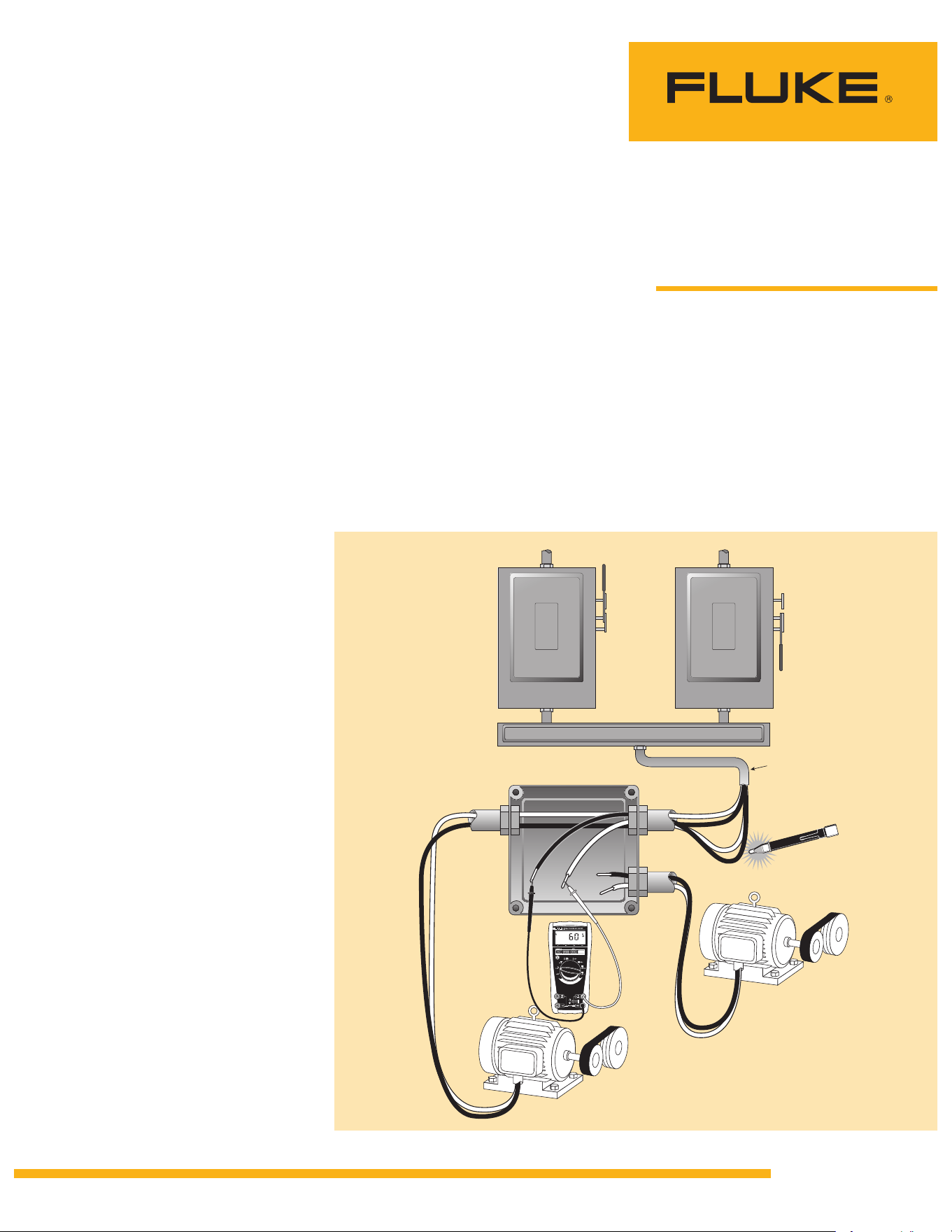
How Stray Voltage Affects
Multimeter Measurements
…and What You Can Do About It.
/.
/&&
/.
/&&
)STHE6
READINGREALOR
GHOSTVOLTAGE
/FF/N
$ISCONNECT! $ISCONNECT"
-OTOR!
-OTOR"
FEET
OFCONDUIT
For most electrical measurements
in the industrial environment, a
high impedance digital multime-
ter or electrical tester is the
appropriate tool. These test
instruments have a relatively high
input impedance (>1 megohm),
which means that when connect-
ed, they don’t load the circuit
under test. These test tools gener-
ally will not affect circuit opera-
tion or circuit measurements.
On the other hand, low imped-
ance test instruments can
seriously load down a circuit
under test and, in some cases,
can adversely affect circuit
operation and circuit measure-
ments. This can happen with
sensitive control circuits or in
many electronic circuits found
within industrial machinery.
However, even with a high
impedance multimeter, there’s
still one confusing measurement
situation that can occur in facili-
ties or manufacturing plants. It’s
called stray or ghost voltage, and
it happens specifically when
using a high impedance test
instrument for day to day
measurements.
Stray or ghost voltages occur
from capacitive coupling between
energized circuits and non en-
ergized, non connected adjacent
wiring. Because of this coupling
effect and the multimeter’s high
impedance, it’s not always pos-
sible to determine if the circuit
under test is energized or
de-energized, and this creates
confusion for the person
performing the test.
Where are stray voltages
encountered?
The most common place to en-
counter stray voltage is in unused
cable runs or electrical wiring in
existing conduit. When facilities
or buildings are built and wired,
it’s very common for electricians
to pull extra wire through the
conduit for future use.
These wires are typically left
unconnected until needed, but
are subject to capacitive coupling
from the powered wires.
Another example is an open
ground or neutral on a 120 V
branch circuit or in card cages
where 120 volt control circuits
are used to control assembly
line or conveyor functions.
Application Note
F r o m t h e F l u k e D i g i t a l L i b r a r y @ w w w . f l u k e . c o m / l i b r a r y
1.888.610.7664 sales@GlobalTestSupply.com
Fluke-Direct.com

What does stray voltage look like?
Generally, for most electrical measurements, a high impedance multimeter is the
best tool, since you don’t want the meter loading the circuit and affecting the
circuit measurements. However, when dealing with capacitive coupling, a high
impedance meter between ground or neutral to the unconnected cable or open
connection will indicate some amount of voltage present. Typically this measured
voltage reading may be as high as 50 % of the energized voltage in the same
proximity.
Is this voltage real? Yes, it is, but it’s a static voltage, containing no real energy
or current flow. When it comes to determining whether a circuit or connection is
energized, this stray voltage reading presents a real source of confusion. Is the
connection really hot or not?
The Fluke TL225 Stray
Voltage Adapter Test
Lead Set
The Fluke Stray Voltage Adapter
Test Lead Set is an accessory
that allows a high impedance
multimeter to measure circuits,
connections, cables or connec-
tors subject to stray voltages.
The adapter provides a low im-
pedance load to the measured
circuit, desensitizing the meter
to low energy, spurious sources
of interference. If the measure-
ment points are energized with
a “hard” voltage, the meter will
simply display the voltage read-
ing. If the measurement points
contain a stray or ghost volt-
age, the meter will read very
close to zero volts, indicating
the circuit or connection is not
energized.
Warning
The stray voltage adapter is designed to be used in conjunction with high imped-
ance digital multimeters for measurements on power circuits, to help determine
whether the circuit is energized or not. The adapter presents a 3 k load to the
circuit under test and thus will dissipate any stray voltage present if the circuit is
not energized.
This adapter should not be used on low voltage control circuits or anywhere
where the circuit under test could be adversely affected by this low impedance
load. The adapter is designed to handle continuously applied power system volt-
ages without damage, however proper use of this adapter is for intermittent use to
determine whether a circuit is energized or not.
2 Fluke Corporation How stray voltage affects multimeter measurements …and what you can do about it.
1.888.610.7664 sales@GlobalTestSupply.com
Fluke-Direct.com

Sample measurement scenario
Figure A is a normal reading for an energized 120
volt branch circuit between hot and neutral.
This reading is displayed on the meter with or
without using the stray voltage adapter.
Figure B is the measurement displayed with the
high impedance DMM between neutral and an
unconnected wire in the same conduit as a 120
volt branch circuit feed. Note the high impedance
meter is displaying 33 volts. This is a capacitively
coupled stray voltage reading.
Figure C is displaying the result of the measure-
ment from Figure B when the stray voltage adapter
is placed in the circuit. Note that the reading is
now 13 millivolts or very close to zero volts, a non-
energized connection.
The low impedance presented by the stray
voltage adapter dissipates the stray voltage. If the
reading in Figure B was a “hard” voltage, the read-
ing in Figure C would have been the same reading
as in Figure A.
Figure A
Figure B
Figure C
Safety
Testing for stray voltage is a measurement typically made for a short
period of time, such as less than a minute. The stray voltage elimina-
tor module contained within the TL225 test lead kit is designed to
withstand a continuous application of 1000 volts or less.
The module has been tested to meet the IEC 1010-1 second edition
CAT IV 600 V/CAT III 1000 V measurement category rating.
On a more personal safety note: If you’ve ever doubted your multi-
meter readings, consider the environment you’re working in. Does it
contain the ingredients for capacitive coupling? If it does, and if you
need to rely on hot-or-not readings, you may want to consider
adapting your multimeter. Stray voltage is confusing at best,
and dangerous at worst. Don’t be fooled!
3 Fluke Corporation
1.888.610.7664 sales@GlobalTestSupply.com
Fluke-Direct.com