INSTRUCTION MANUAL
MANUAL DE INSTRUCCIONES
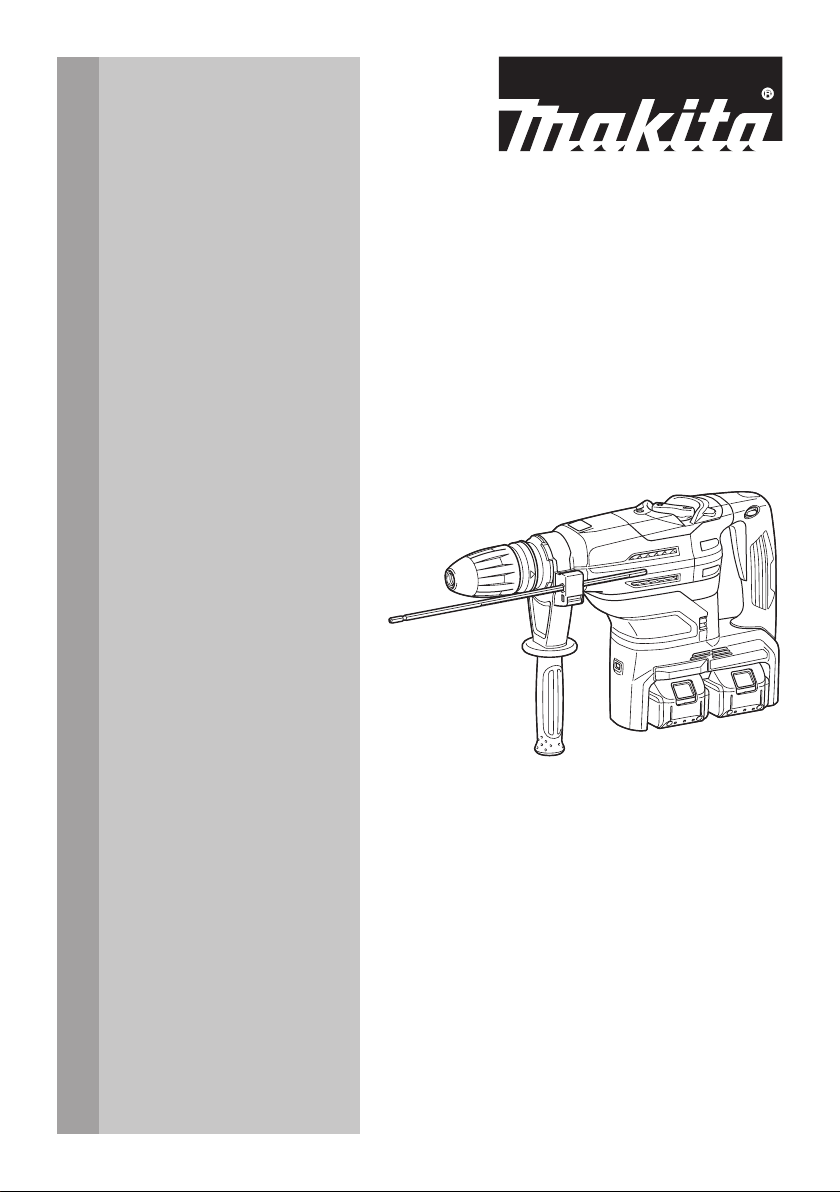
Cordless Rotary Hammer
Martillo Rotativo Inalámbrico
XRH07
IMPORTANT: Read Before Using.
IMPORTANTE: Lea antes de usar.
2 ENGLISH
ENGLISH (Original instructions)
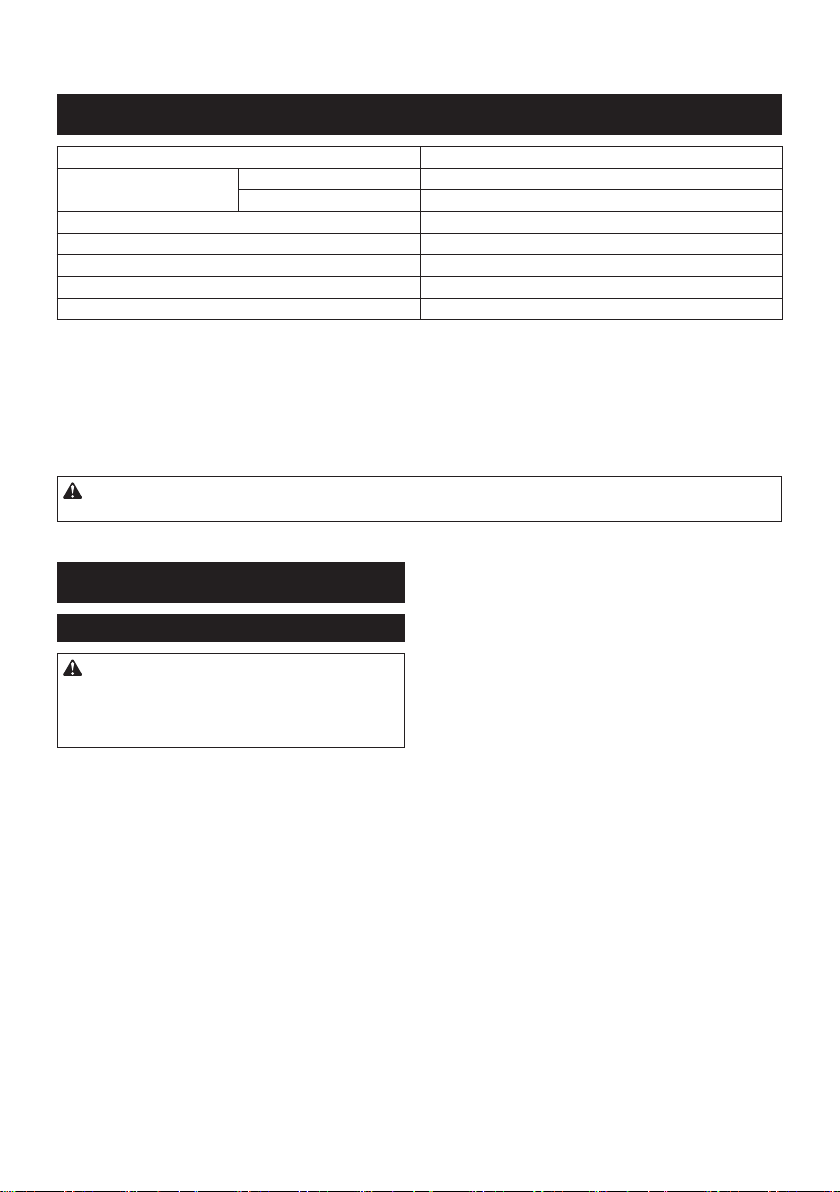
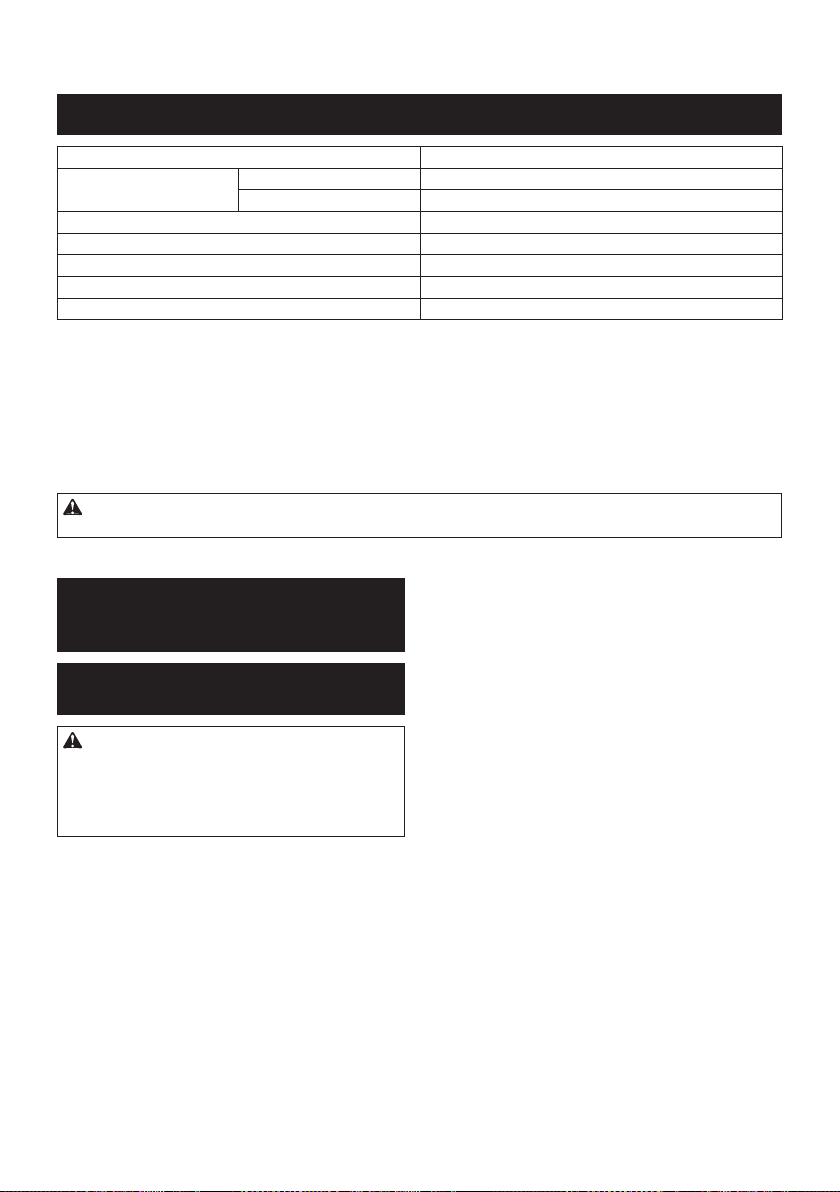
SPECIFICATIONS
Model: XRH07
Capacities Carbide-tipped bit 40 mm (1-9/16")
Core bit 105 mm (4-1/8")
No load speed (RPM) 250 - 500/min
Blows per minute 1,450 - 2,900/min
Overall length 473 mm (18-5/8")
Rated voltage D.C. 36 V
Net weight 7.3 - 8.1 kg (16.1 - 17.9 lbs)
• Duetoourcontinuingprogramofresearchanddevelopment,thespecicationshereinaresubjecttochange
without notice.
• Specicationsandbatterycartridgemaydifferfromcountrytocountry.
• Theweightmaydifferdependingontheattachment(s),includingthebatterycartridge.Thelightestandheavi-
est combination, according to EPTA-Procedure 01/2014, are shown in the table.
Applicable battery cartridge
BL1815N / BL1820B / BL1830 / BL1830B / BL1840B / BL1850B / BL1860B
• Someofthebatterycartridgeslistedabovemaynotbeavailabledependingonyourregionofresidence.
WARNING: Only use the battery cartridges listed above.Useofanyotherbatterycartridgesmaycause
injuryand/orre.
SAFETY WARNINGS
General power tool safety warnings
WARNING: Read all safety warnings, instruc-
tions, illustrations and specications provided
with this power tool. Failure to follow all instructions
listedbelowmayresultinelectricshock,reand/or
seriousinjury.
Save all warnings and instruc-
tions for future reference.
Theterm"powertool"inthewarningsreferstoyour
mains-operated(corded)powertoolorbattery-operated
(cordless) power tool.
Work area safety
1. Keep work area clean and well lit. Cluttered or
dark areas invite accidents.
2. Do not operate power tools in explosive atmo-
spheres, such as in the presence of ammable
liquids, gases or dust. Power tools create sparks
whichmayignitethedustorfumes.
3. Keep children and bystanders away while
operating a power tool. Distractions can cause
youtolosecontrol.
Electrical Safety
1. Power tool plugs must match the outlet. Never
modify the plug in any way. Do not use any
adapter plugs with earthed (grounded) power
tools. Unmodiedplugsandmatchingoutletswill
reduce risk of electric shock.
2. Avoid body contact with earthed or grounded
surfaces, such as pipes, radiators, ranges and
refrigerators. There is an increased risk of elec-
tricshockifyourbodyisearthedorgrounded.
3. Do not expose power tools to rain or wet con-
ditions. Water entering a power tool will increase
the risk of electric shock.
4. Do not abuse the cord. Never use the cord for
carrying, pulling or unplugging the power tool.
Keep cord away from heat, oil, sharp edges
or moving parts. Damaged or entangled cords
increase the risk of electric shock.
5. When operating a power tool outdoors, use an
extension cord suitable for outdoor use. Use of
a cord suitable for outdoor use reduces the risk of
electric shock.
6. If operating a power tool in a damp location is
unavoidable, use a ground fault circuit inter-
rupter (GFCI) protected supply. Use of a GFCI
reduces the risk of electric shock.
7. Power tools can produce electromagnetic
elds (EMF) that are not harmful to the user.
However, users of pacemakers and other similar
medical devices should contact the maker of their
device and/or doctor for advice before operating
this power tool.
Personal Safety
1. Stay alert, watch what you are doing and use
common sense when operating a power tool.
Do not use a power tool while you are tired or
under the inuence of drugs, alcohol or med-
ication. A moment of inattention while operating
powertoolsmayresultinseriouspersonalinjury.

3 ENGLISH
2. Use personal protective equipment. Always
wear eye protection. Protective equipment such
asdustmask,non-skidsafetyshoes,hardhat,or
hearing protection used for appropriate conditions
willreducepersonalinjuries.
3. Prevent unintentional starting. Ensure the
switch is in the off-position before connecting
to power source and/or battery pack, picking
up or carrying the tool.Carryingpowertoolswith
yourngerontheswitchorenergisingpowertools
that have the switch on invites accidents.
4. Remove any adjusting key or wrench before
turning the power tool on.Awrenchorakeyleft
attachedtoarotatingpartofthepowertoolmay
resultinpersonalinjury.
5. Do not overreach. Keep proper footing and
balance at all times. This enables better control
of the power tool in unexpected situations.
6. Dress properly. Do not wear loose clothing or
jewellery. Keep your hair, clothing and gloves
away from moving parts.Looseclothes,jewel-
leryorlonghaircanbecaughtinmovingparts.
7. If devices are provided for the connection of
dust extraction and collection facilities, ensure
these are connected and properly used. Use of
dust collection can reduce dust-related hazards.
8. Do not let familiarity gained from frequent use
of tools allow you to become complacent and
ignore tool safety principles. A careless action
cancausesevereinjurywithinafractionofa
second.
9.
Always wear protective goggles to protect your
eyes from injury when using power tools.The
goggles must comply with ANSI Z87.1 in the USA.
It is an employer's responsibility to enforce
the use of appropriate safety protective equip-
ments by the tool operators and by other per-
sons in the immediate working area.
Power tool use and care
1. Do not force the power tool. Use the correct
power tool for your application. The correct
powertoolwilldothejobbetterandsaferatthe
rate for which it was designed.
2. Do not use the power tool if the switch does
not turn it on and off.Anypowertoolthatcannot
be controlled with the switch is dangerous and
must be repaired.
3. Disconnect the plug from the power source
and/or remove the battery pack, if detachable,
from the power tool before making any adjust-
ments, changing accessories, or storing power
tools.Suchpreventivesafetymeasuresreduce
theriskofstartingthepowertoolaccidentally.
4. Store idle power tools out of the reach of chil-
dren and do not allow persons unfamiliar with
the power tool or these instructions to operate
the power tool. Power tools are dangerous in the
hands of untrained users.
5. Maintain power tools and accessories. Check
for misalignment or binding of moving parts,
breakage of parts and any other condition that
may affect the power tool’s operation. If dam-
aged, have the power tool repaired before use.
Manyaccidentsarecausedbypoorlymaintained
power tools.
6. Keep cutting tools sharp and clean.Properly
maintained cutting tools with sharp cutting edges
arelesslikelytobindandareeasiertocontrol.
7. Use the power tool, accessories and tool bits
etc. in accordance with these instructions, tak-
ing into account the working conditions and
the work to be performed. Use of the power tool
for operations different from those intended could
result in a hazardous situation.
8. Keep handles and grasping surfaces dry,
clean and free from oil and grease.Slippery
handles and grasping surfaces do not allow for
safe handling and control of the tool in unexpected
situations.
9. When using the tool, do not wear cloth work
gloves which may be entangled. The entangle-
mentofclothworkglovesinthemovingpartsmay
resultinpersonalinjury.
Battery tool use and care
1. Recharge only with the charger specied by
the manufacturer. A charger that is suitable for
onetypeofbatterypackmaycreateariskofre
whenusedwithanotherbatterypack.
2. Use power tools only with specically desig-
nated battery packs.Useofanyotherbattery
packsmaycreateariskofinjuryandre.
3. When battery pack is not in use, keep it away
from other metal objects, like paper clips,
coins, keys, nails, screws or other small metal
objects, that can make a connection from one
terminal to another.Shortingthebatterytermi-
nalstogethermaycauseburnsorare.
4. Under abusive conditions, liquid may be
ejected from the battery; avoid contact. If con-
tact accidentally occurs, ush with water. If
liquid contacts eyes, additionally seek medical
help.Liquidejectedfromthebatterymaycause
irritation or burns.
5. Do not use a battery pack or tool that is dam-
aged or modied.Damagedormodiedbatteries
mayexhibitunpredictablebehaviourresultingin
re,explosionorriskofinjury.
6. Do not expose a battery pack or tool to re or
excessive temperature.Exposuretoreortem-
peratureabove130°Cmaycauseexplosion.
7. Follow all charging instructions and do not
charge the battery pack or tool outside the
temperature range specied in the instruc-
tions.Chargingimproperlyorattemperatures
outsidethespeciedrangemaydamagethe
batteryandincreasetheriskofre.
Service
1. Have your power tool serviced by a qualied
repair person using only identical replacement
parts.Thiswillensurethatthesafetyofthepower
tool is maintained.
2. Never service damaged battery packs. Service
ofbatterypacksshouldonlybeperformedbythe
manufacturer or authorized service providers.
3. Follow instruction for lubricating and chang-
ing accessories.
4. Do not modify or attempt to repair the appli-
ance or the battery pack except as indicated in
the instructions for use and care.

4 ENGLISH
CORDLESS ROTARY HAMMER
SAFETY WARNINGS
1. Wear ear protectors. Exposure to noise can
cause hearing loss.
2. Use auxiliary handle(s), if supplied with the
tool.Lossofcontrolcancausepersonalinjury.
3. Hold power tool by insulated gripping sur-
faces, when performing an operation where
the cutting accessory may contact hidden
wiring.Cuttingaccessorycontactinga"live"
wiremaymakeexposedmetalpartsofthepower
tool "live" and could give the operator an electric
shock.
4. Wear a hard hat (safety helmet), safety glasses
and/or face shield. Ordinary eye or sun glasses
are NOT safety glasses. It is also highly recom-
mended that you wear a dust mask and thickly
padded gloves.
5. Be sure the bit is secured in place before
operation.
6. Under normal operation, the tool is designed
to produce vibration. The screws can come
loose easily, causing a breakdown or accident.
Check tightness of screws carefully before
operation.
7. In cold weather or when the tool has not been
used for a long time, let the tool warm up for
a while by operating it under no load. This
will loosen up the lubrication. Without proper
warm-up, hammering operation is difcult.
8. Always be sure you have a rm footing. Be
sure no one is below when using the tool in
high locations.
9. Hold the tool rmly with both hands.
10. Keep hands away from moving parts.
11. Do not leave the tool running. Operate the tool
only when hand-held.
12. Do not point the tool at any one in the area
when operating. The bit could y out and
injure someone seriously.
13. Do not touch the bit, parts close to the bit, or
workpiece immediately after operation; they
may be extremely hot and could burn your
skin.
14. Some material contains chemicals which may
be toxic. Take caution to prevent dust inhala-
tion and skin contact. Follow material supplier
safety data.
15. Always be sure that the tool is switched
off and the battery cartridge and the bit are
removed before handing the tool to other
person.
SAVE THESE INSTRUCTIONS.
WARNING: DO NOT let comfort or familiarity
with product (gained from repeated use) replace
strict adherence to safety rules for the subject
product. MISUSE or failure to follow the safety
rules stated in this instruction manual may cause
serious personal injury.
Symbols
Thefollowingsshowthesymbolsusedfortool.
volts
direct current
no load speed
revolutions or reciprocation per minute
number of blow
Important safety instructions for
battery cartridge
1.
Before using battery cartridge, read all instruc-
tions and cautionary markings on (1) battery char-
ger, (2) battery, and (3) product using battery.
2. Do not disassemble battery cartridge.
3. If operating time has become excessively
shorter, stop operating immediately. It may
result in a risk of overheating, possible burns
and even an explosion.
4. If electrolyte gets into your eyes, rinse them
out with clear water and seek medical atten-
tion right away. It may result in loss of your
eyesight.
5. Do not short the battery cartridge:
(1) Do not touch the terminals with any con-
ductive material.
(2) Avoid storing battery cartridge in a con-
tainer with other metal objects such as
nails, coins, etc.
(3) Do not expose battery cartridge to water
or rain.
A battery short can cause a large current
ow, overheating, possible burns and even a
breakdown.
6. Do not store the tool and battery cartridge in
locations where the temperature may reach or
exceed 50 °C (122 °F).
7. Do not incinerate the battery cartridge even if
it is severely damaged or is completely worn
out. The battery cartridge can explode in a re.
8. Be careful not to drop or strike battery.
9. Do not use a damaged battery.
10.
The contained lithium-ion batteries are subject to
the Dangerous Goods Legislation requirements.
Forcommercialtransportse.g.bythirdparties,
forwarding agents, special requirement on pack-
aging and labeling must be observed.
For preparation of the item being shipped, consult-
ing an expert for hazardous material is required.
Pleasealsoobservepossiblymoredetailed
national regulations.
Tape or mask off open contacts and pack up the
batteryinsuchamannerthatitcannotmove
around in the packaging.

5 ENGLISH
11. Follow your local regulations relating to dis-
posal of battery.
12. Use the batteries only with the products
specied by Makita. Installing the batteries to
non-compliantproductsmayresultinare,exces-
siveheat,explosion,orleakofelectrolyte.
SAVE THESE INSTRUCTIONS.
CAUTION: Only use genuine Makita batteries.
Use of non-genuine Makita batteries, or batteries that
havebeenaltered,mayresultinthebatterybursting
causingres,personalinjuryanddamage.Itwill
alsovoidtheMakitawarrantyfortheMakitatooland
charger.
Tips for maintaining maximum
battery life
1. Charge the battery cartridge before completely
discharged. Always stop tool operation and
charge the battery cartridge when you notice
less tool power.
2. Never recharge a fully charged battery car-
tridge. Overcharging shortens the battery
service life.
3. Charge the battery cartridge with room tem-
perature at 10 °C - 40 °C (50 °F - 104 °F). Let
a hot battery cartridge cool down before
charging it.
4. Charge the battery cartridge if you do not use
it for a long period (more than six months).
Important safety instructions for
wireless unit
1. Do not disassemble or tamper with the wire-
less unit.
2. Keep the wireless unit away from young chil-
dren. If accidentally swallowed, seek medical
attention immediately.
3. Use the wireless unit only with Makita tools.
4. Do not expose the wireless unit to rain or wet
conditions.
5. Do not use the wireless unit in places where
the temperature exceeds 50°C (122°F).
6. Do not operate the wireless unit in places
where medical instruments, such as heart
pace makers are near by.
7. Do not operate the wireless unit in places
where automated devices are near by. If oper-
ated,automateddevicesmaydevelopmalfunction
or error.
8. Do not operate the wireless unit in places
under high temperature or places where
static electricity or electrical noise could be
generated.
9. The wireless unit can produce electromagnetic
elds (EMF) but they are not harmful to the
user.
10. The wireless unit is an accurate instrument. Be
careful not to drop or strike the wireless unit.
11. Avoid touching the terminal of the wireless
unit with bare hands or metallic materials.
12. Always remove the battery on the product
when installing the wireless unit into it.
13. When opening the lid of the slot, avoid the
place where dust and water may come into the
slot. Always keep the inlet of the slot clean.
14. Always insert the wireless unit in the correct
direction.
15. Do not press the wireless activation button
on the wireless unit too hard and/or press the
button with an object with a sharp edge.
16. Always close the lid of the slot when
operating.
17. Do not remove the wireless unit from the slot
while the power is being supplied to the tool.
Doingsomaycauseamalfunctionofthewireless
unit.
18. Do not remove the sticker on the wireless unit.
19. Do not put any sticker on the wireless unit.
20. Do not leave the wireless unit in a place where
static electricity or electrical noise could be
generated.
21. Do not leave the wireless unit in a place sub-
ject to high heat, such as a car sitting in the
sun.
22. Do not leave the wireless unit in a dusty or
powdery place or in a place corrosive gas
could be generated.
23. Sudden change of the temperature may bedew
the wireless unit. Do not use the wireless unit
until the dew is completely dried.
24. When cleaning the wireless unit, gently wipe
with a dry soft cloth. Do not use benzine, thin-
ner, conductive grease or the like.
25. When storing the wireless unit, keep it in the
supplied case or a static-free container.
26. Do not insert any devices other than Makita
wireless unit into the slot on the tool.
27. Do not use the tool with the lid of the slot dam-
aged.Water,dust,anddirtcomeintotheslotmay
cause malfunction.
28. Do not pull and/or twist the lid of the slot more
than necessary. Restore the lid if it comes off
from the tool.
29. Replace the lid of the slot if it is lost or
damaged.
SAVE THESE INSTRUCTIONS.

6 ENGLISH
FUNCTIONAL
DESCRIPTION
CAUTION: Always be sure that the tool is
switched off and the battery cartridge is removed
before adjusting or checking function on the tool.
Installing or removing battery
cartridge
CAUTION: Always switch off the tool before
installing or removing of the battery cartridge.
CAUTION: Hold the tool and the battery car-
tridge rmly when installing or removing battery
cartridge.Failuretoholdthetoolandthebattery
cartridgermlymaycausethemtoslipoffyourhands
andresultindamagetothetoolandbatterycartridge
andapersonalinjury.
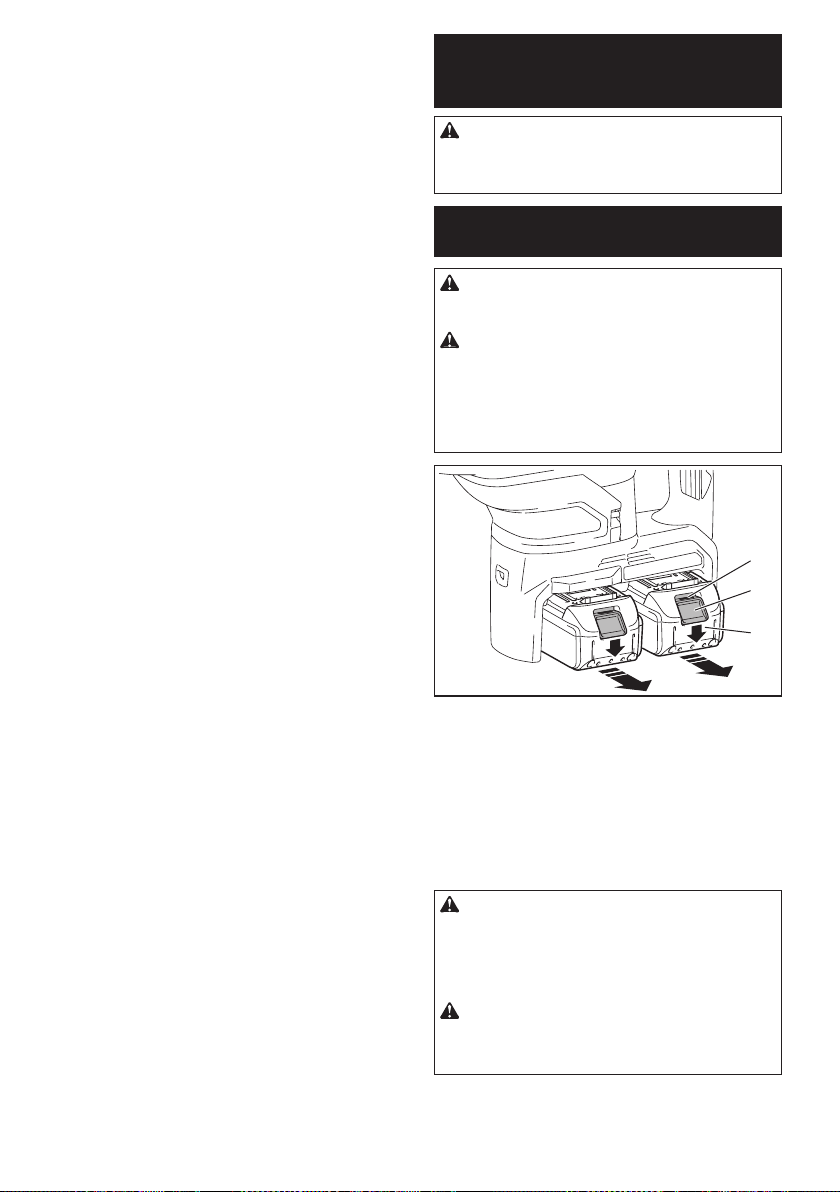
1
2
3
►1. Red indicator 2. Button 3.Batterycartridge
Toremovethebatterycartridge,slideitfromthetool
while sliding the button on the front of the cartridge.
Toinstallthebatterycartridge,alignthetongueonthe
batterycartridgewiththegrooveinthehousingandslip
itintoplace.Insertitallthewayuntilitlocksinplace
withalittleclick.Ifyoucanseetheredindicatoronthe
uppersideofthebutton,itisnotlockedcompletely.
CAUTION: Always install the battery cartridge
fully until the red indicator cannot be seen. If not,
itmayaccidentallyfalloutofthetool,causinginjuryto
youorsomeonearoundyou.
CAUTION: Do not install the battery cartridge
forcibly.Ifthecartridgedoesnotslideineasily,itis
notbeinginsertedcorrectly.
Indicating the remaining battery
capacity
Only for battery cartridges with the indicator
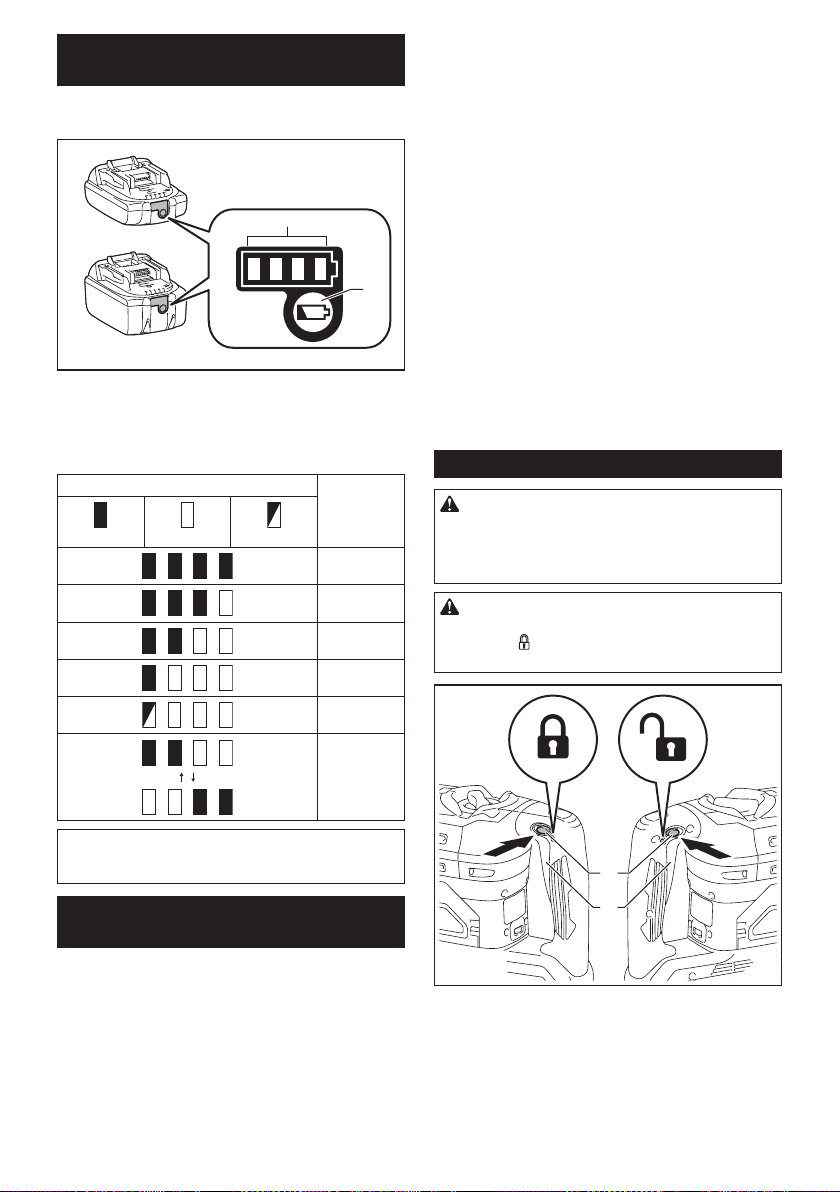
1
2
►1. Indicator lamps 2. Check button
Pressthecheckbuttononthebatterycartridgetoindi-
catetheremainingbatterycapacity.Theindicatorlamps
light up for a few seconds.
Indicator lamps Remaining
capacity
Lighted Off Blinking
75% to 100%
50% to 75%
25% to 50%
0% to 25%
Charge the
battery.
Thebattery
mayhave
malfunctioned.
NOTE: Depending on the conditions of use and the
ambienttemperature,theindicationmaydifferslightly
fromtheactualcapacity.
Tool / battery protection system
Thetoolisequippedwithatool/batteryprotectionsys-
tem.Thissystemautomaticallycutsoffpowertothe
motortoextendtoolandbatterylife.Thetoolwillauto-
maticallystopduringoperationifthetoolorbatteryis
placed under one of the following conditions:
Overload protection
Whenthebatteryisoperatedinamannerthatcauses
ittodrawanabnormallyhighcurrent,thetoolautomat-
icallystopswithoutanyindication.Inthissituation,turn
the tool off and stop the application that caused the tool
to become overloaded. Then turn the tool on to restart.
7 ENGLISH
Overheat protection
Whenthetoolorbatteryisoverheated,thetoolstops
automaticallyandthelampblinks.Inthiscase,letthe
toolandbatterycoolbeforeturningthetoolonagain.
Overdischarge protection
Whenthebatterycapacityisnotenough,thetoolstopsautomatically.
Inthiscase,removethebatteryfromthetoolandchargethebattery.
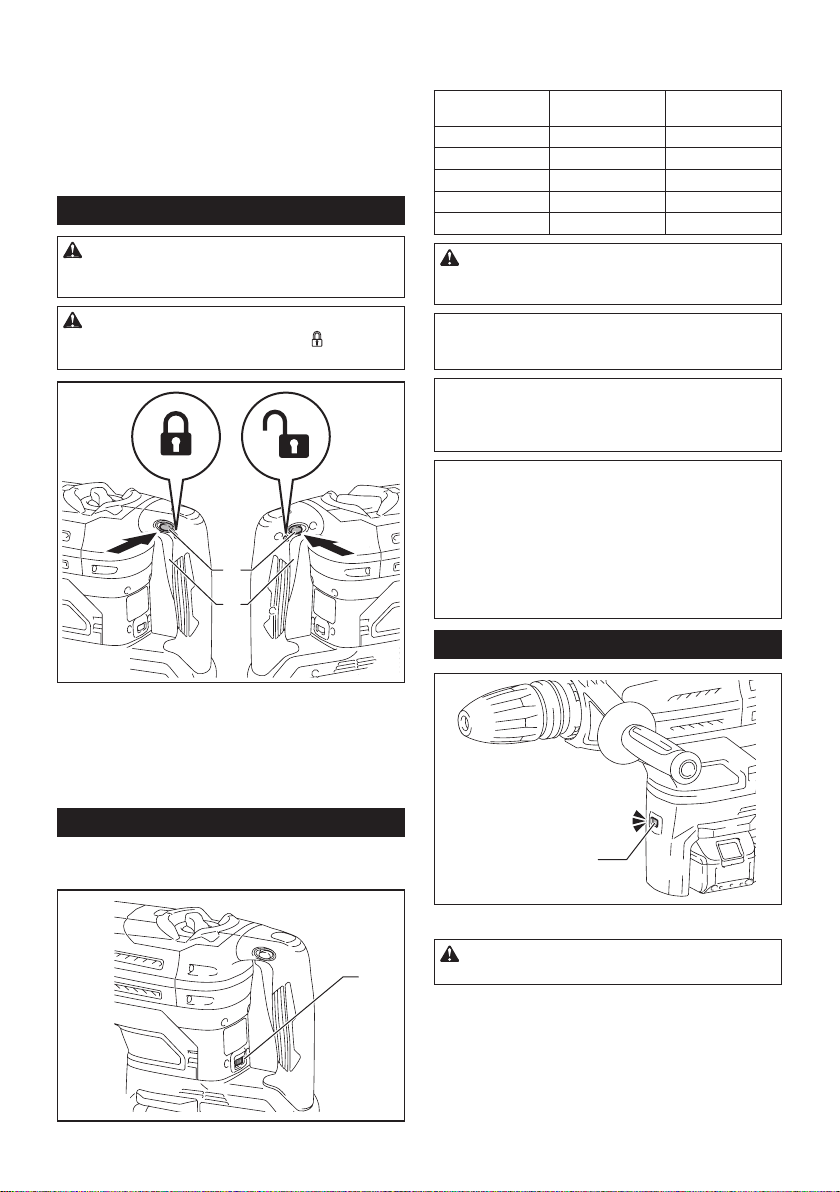
Switch action
WARNING:
Before installing the battery cartridge into
the tool, always check to see that the switch trigger actuates
properly and returns to the "OFF" position when released.
CAUTION: When not operating the tool,
depress the trigger-lock button from
side to
lock the switch trigger in the OFF position.
BA
2
1
►1. Switch trigger 2. Trigger-lock button
Topreventtheswitchtriggerfromaccidentallypulled,
the trigger-lock button is provided. To start the tool,
depress the trigger-lock button from A side and pull the
switch trigger. Release the switch trigger to stop. After
use, press in the trigger-lock button from B side.
Speed change
Therevolutionsandblowsperminutecanbeadjustedbyturningthe
adjustingdial.Thedialismarked1(lowestspeed)to5(fullspeed).
1
►1.Adjustingdial
Refer to the table below for the relationship between the
numberontheadjustingdialandtherevolutionsand
blows per minute.
Number Revolutions per
minute
Blows per minute
5 500 2,900
4 470 2,700
3 380 2,150
2 290 1,650
1 250 1,450
CAUTION: Do not turn the adjusting dial when
the tool is running. Failure to do so may result in
the loss of control of the tool and cause an injury.
NOTICE: If the tool is operated continuously at
low speed for a long time, the motor will get over-
loaded, resulting in tool malfunction.
NOTICE: The speed adjusting dial can be turned
only as far as 5 and back to 1. Do not force it past
5 or 1, or the speed adjusting function may no
longer work.
NOTE: Soft no-load rotation function
Whenthespeedadjustingdialissetto"3"orhigher,
thetoolautomaticallyreducesthespeedatno-loadto
reduce the vibration under no-load. Once operation
starts with a bit against concrete, blows per minute
increase and reach the numbers as shown in the
table. When temperature is low and there is less
uidityingrease,thetoolmaynothavethisfunction
even with the motor rotating.
Lighting up the front lamp
1
►1. Lamp
CAUTION: Do not look in the light or see the
source of light directly.
Pull the switch trigger to light up the lamp. The lamp
keeps on lighting while the switch trigger is being pulled.
Thelampgoesoutapproximately10secondsafter
releasing the switch trigger.
8 ENGLISH
CAUTION: If the lamp goes off after blinking
for a few seconds, the active feedback sensing
technology or the soft no-load rotation function
is not working properly. Ask your local Makita
Service Center for repair.
NOTE:Useadryclothtowipethedirtoffthelensof
the lamp. Be careful not to scratch the lens of lamp, or
itmaylowertheillumination.
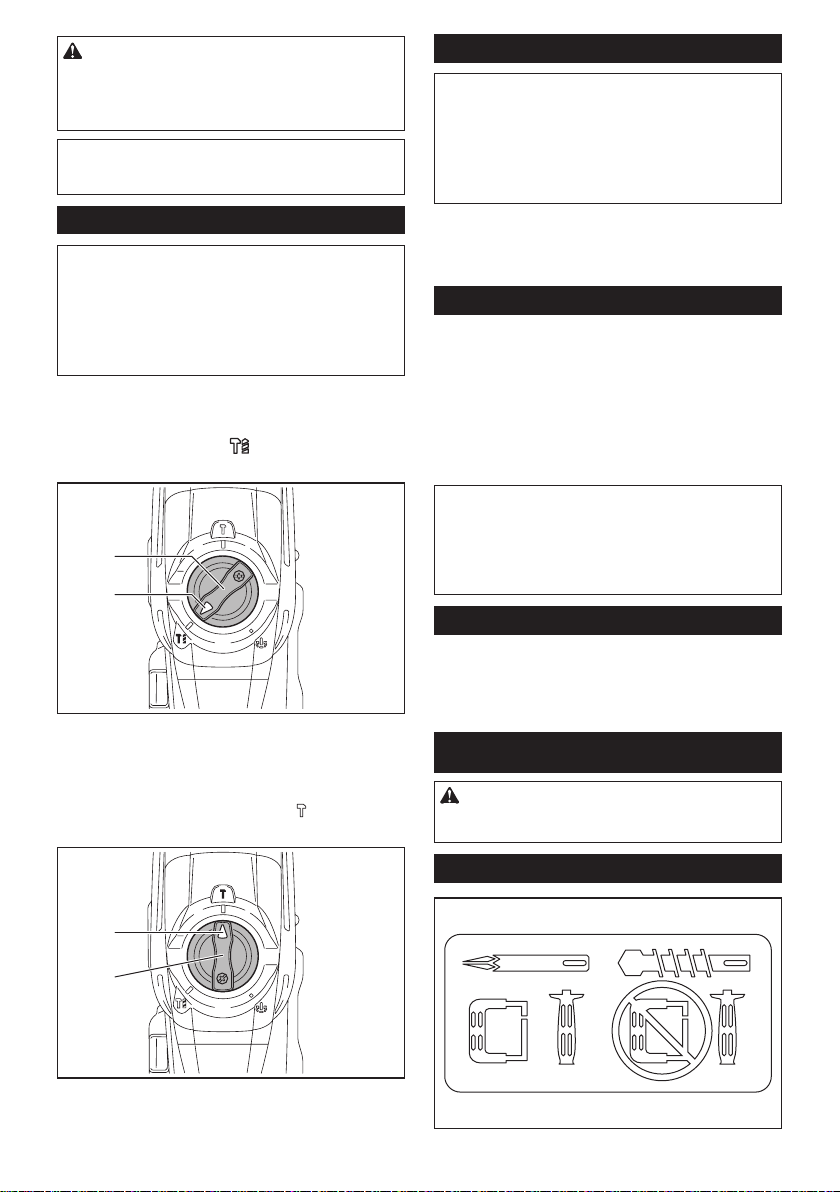
Selecting the action mode
NOTICE: Do not rotate the action mode chang-
ing knob when the tool is running. The tool will be
damaged.
NOTICE: To avoid rapid wear on the mode
change mechanism, be sure that the action mode
changing knob is always positively located in one
of the three action mode positions.
Rotation with hammering
Fordrillinginconcrete,masonry,etc.,rotatetheaction
mode changing knob to the
symbol.Useacar-
bide-tipped drill bit.
1
2
►1. Action mode changing knob 2. Pointer
Hammering only
For chipping, scaling or demolition operations, rotate
the action mode changing knob to the
symbol.Usea
bull point, cold chisel, scaling chisel, etc.
1
2
►1. Pointer 2. Action mode changing knob
Torque limiter
NOTICE: As soon as the torque limiter actuates,
switch off the tool immediately. This will help pre-
vent premature wear of the tool.
NOTICE: Drill bits such as hole saw, which tend
to pinch or catch easily in the hole, are not appro-
priate for this tool.Thisisbecausetheywillcause
thetorquelimitertoactuatetoofrequently.
The torque limiter will actuate when a certain torque
level is reached. The motor will disengage from the
output shaft. When this happens, the drill bit will stop
turning.
Electronic function
The tool is equipped with the electronic functions for
easyoperation.
• Constant speed control
The speed control function provides the constant
rotation speed regardless of load conditions.
• ActiveFeedbacksensingTechnology
If the tool is swung at the predetermined accelera-
tionduringoperation,themotorisforciblystopped
to reduce the burden on the wrist.
NOTE:
This function does not work if the acceleration does
not reach the predetermined one when the tool is swung.
NOTE:
If the bit is swung at the predetermined accel-
eration during chipping, scaling, or demolishing, the
motorisforciblystopped.Inthiscase,releasetheswitch
trigger, and then pull the switch trigger to restart the tool.
Electric brake
This tool is equipped with an electric brake. If the tool
consistentlyfailstoquicklystopaftertheswitchtriggeris
released, have the tool serviced at a Makita service center.
ASSEMBLY
CAUTION: Always be sure that the tool is
switched off and the battery cartridge is removed
before carrying out any work on the tool.
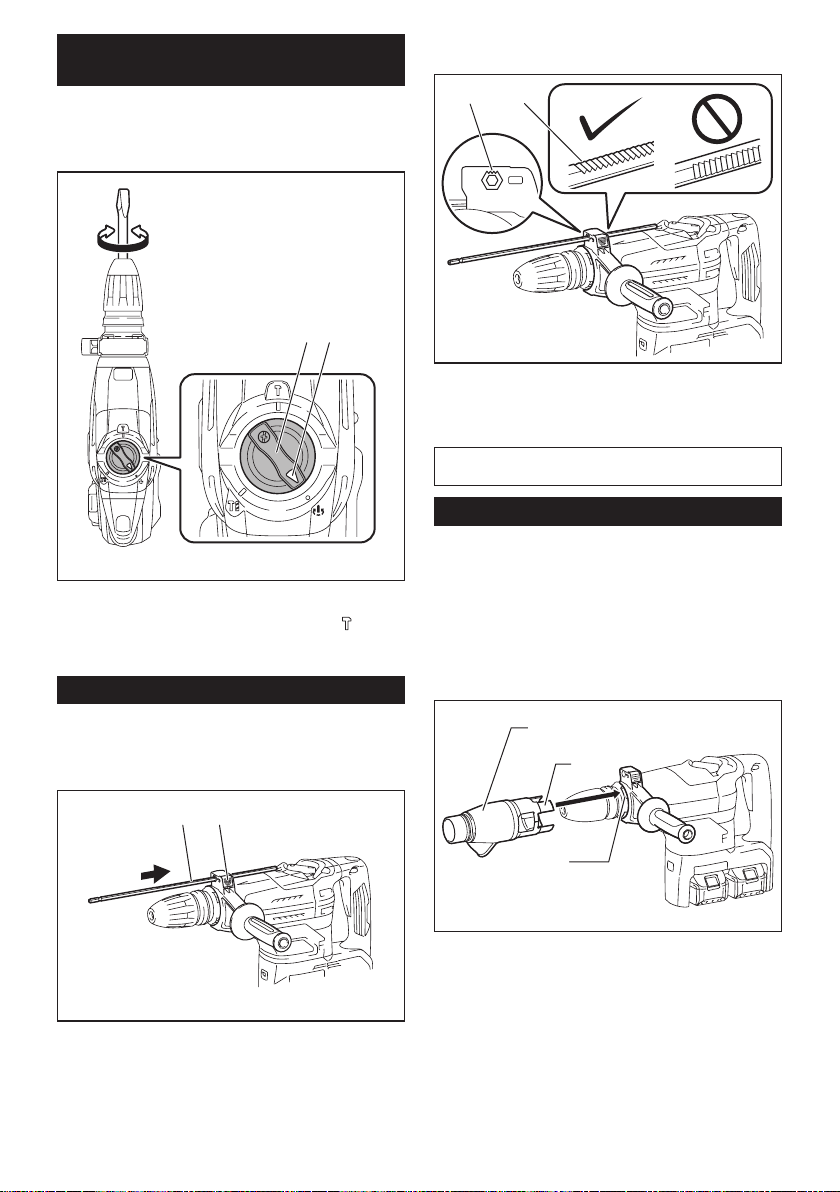
Side handle

9 ENGLISH
CAUTION: Use the side handle only when
chipping, scaling or demolishing. Do not use it
when drilling in concrete, masonry, etc. The tool
cannotbeheldproperlywiththissidehandlewhen
drilling.
1
2
►1. Side handle 2. Clamp nut
The side handle can be swung 360° on the vertical
andsecuredatanydesiredposition.Italsosecures
at eight different positions back and forth on the hori-
zontal. Loosen the clamp nut to swing the side handle
to a desired position, and then tighten the clamp nut
securely.
Side grip (auxiliary handle)
CAUTION: Always use the side grip to ensure
safe operation.
CAUTION: After installing or adjusting the
side grip, make sure that the side grip is rmly
secured.
The side grip swings around to either side, allowing
easyhandlingofthetoolinanyposition.Loosenthe
sidegripbyturningitcounterclockwise,swingittothe
desiredpositionandthentightenitbyturningclockwise.
1
►1. Side grip
Grease
Coat the shank end of the drill bit beforehand with a
small amount of grease (about 0.5 - 1 g).
This chuck lubrication assures smooth action and lon-
ger service life.
Installing or removing drill bit
Cleantheshankendofthedrillbitandapplygrease
before installing the drill bit.
1
2
►1. Shank end 2. Grease
Insert the drill bit into the tool. Turn the drill bit and push
it in until it engages.
Afterinstallingthedrillbit,alwaysmakesurethatthe
drillbitissecurelyheldinplacebytryingtopullitout.
1
►1. Drill bit
To remove the drill bit, pull the chuck cover down all the
wayandpullthedrillbitout.
1
2
►1. Drill bit 2. Chuck cover
10 ENGLISH
Chisel angle (when chipping,
scaling or demolishing)
The chisel can be secured at the desired angle. To
change the chisel angle, rotate the action mode chang-
ingknobtotheOsymbol.Turnthechiseltothedesired
angle.
1 2
►1. Action mode changing knob 2. Pointer
Rotate the action mode changing knob to the sym-
bol.Thenmakesurethatthechiselissecurelyheldin
placebyturningitslightly.
Depth gauge
The depth gauge is convenient for drilling holes of
uniform depth.
Press and hold the lock button, and then insert the
depth gauge into the hex hole.
1 2
►1. Depth gauge 2. Lock button
Make sure that the toothed side of the depth gauge
faces the marking.
12
►1. Marking 2. Toothed side
Adjustthedepthgaugebymovingitbackandforth
whilepressingthelockbutton.Aftertheadjustment,
release the lock button to lock the depth gauge.
NOTE: Make sure that the depth gauge does not
touchthemainbodyofthetoolwhenattachingit.
Dust extractor attachment
Optional accessory
Installing the dust extractor
attachment
1. Loosen the side grip on the tool.
2. Install the dust cover so that the claws of the dust
covertinthegroovesbetweenthetoolandtheside
grip.
1
2
3
►1. Dust cover 2. Claw 3. Groove
3. Tightenthesidegripsecurely.
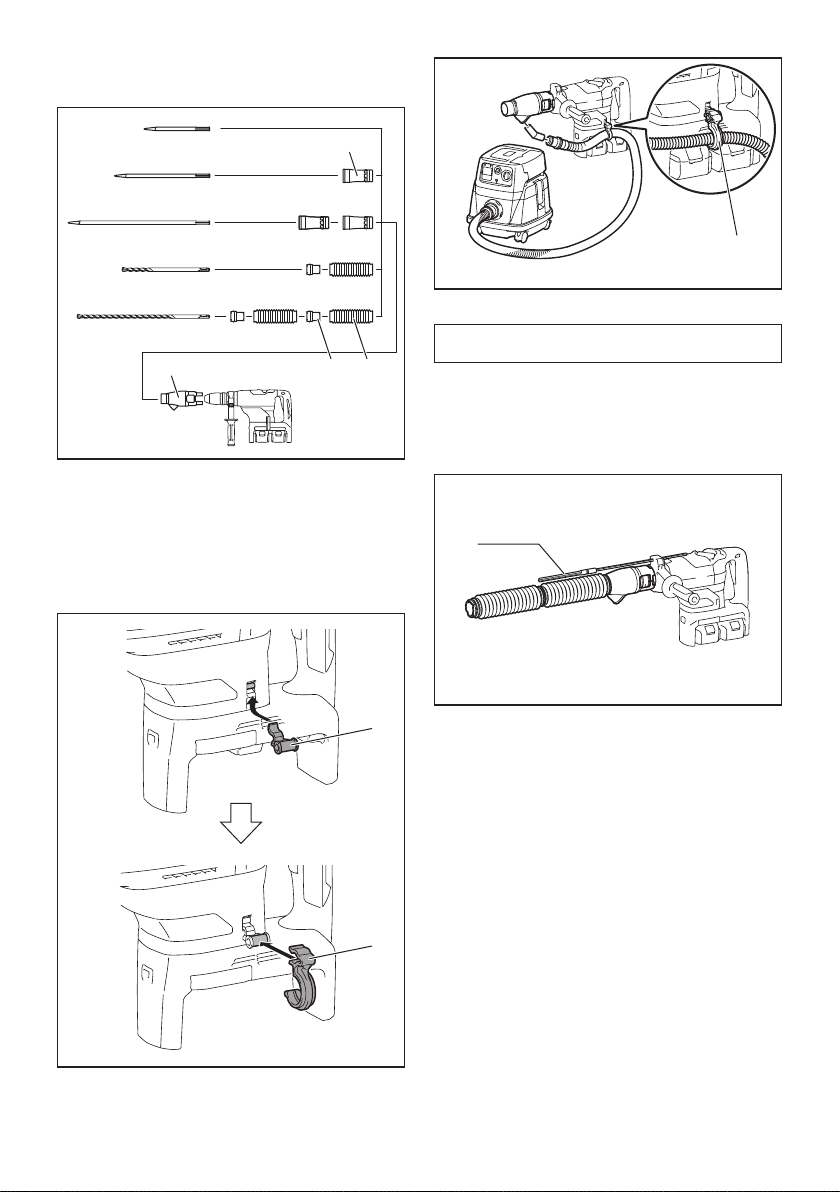
11 ENGLISH
4. Set the suitable bellows or dust cover extension
foryourwork.Whenyouusebellows,attachthejointto
itstop.Whenyoustacktwobellows,connectthemwith
thejoint.
1
2
34
►1. Dust cover extension 2. Dust cover 3. Joint
4. Bellows
Connecting the tool to the vacuum
cleaner
1. Attachtheholderjointtothetool,andthenattach
thehoseholdertotheholderjoint.
1
2
►1.Holderjoint2. Hose holder
2. Fix the hose to the hose holder.
1
►1. Hose holder
NOTE:Usejoint25toconnectthehoseandthedust
coverifnecessary.
Using depth gauge for drilling
operation
Whenyoustacktwobellows,attachthedepthgauge
extension to the depth gauge.
1
►1. Depth gauge extension
12 ENGLISH
Dust extractor attachment (for
hammering only)
Optional accessory
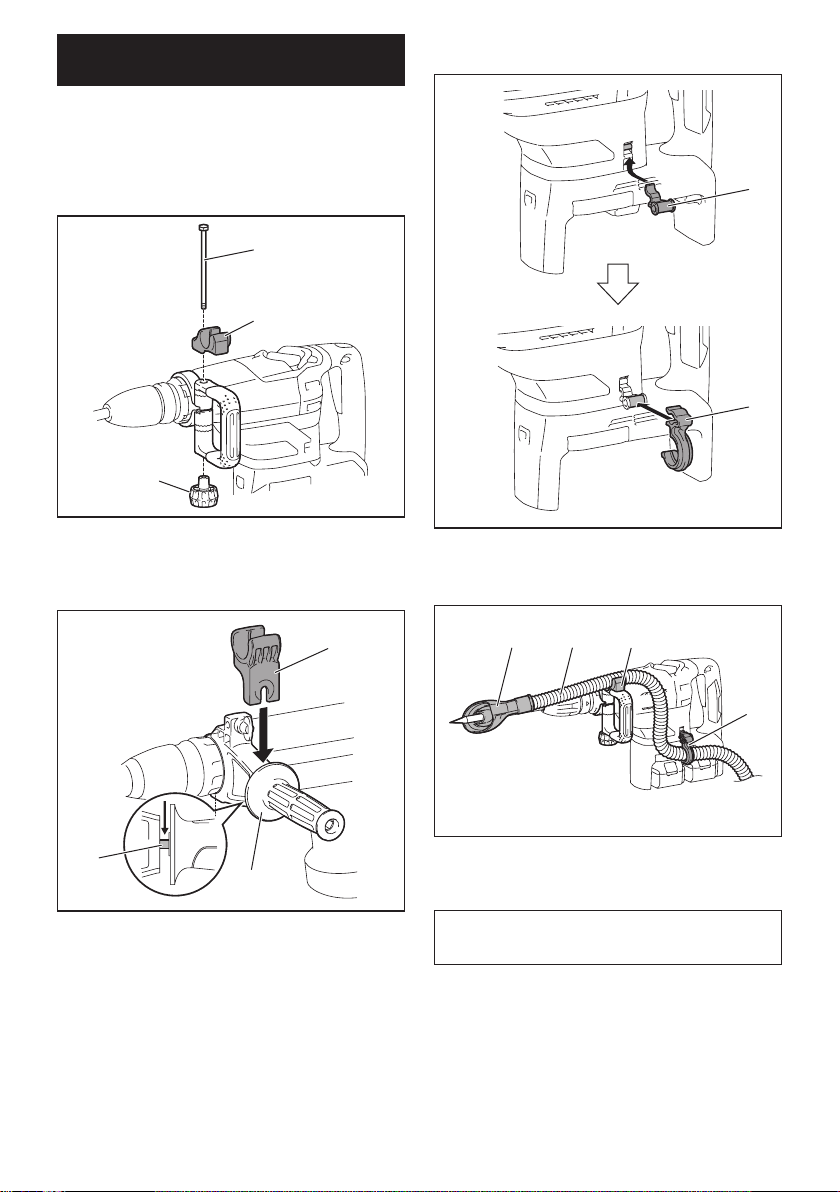
1. Install the hose holder.
When the side handle is installed to tool, loosen the
clamp nut, and then remove the hex bolt. Install the
hoseholderwiththehexboltandtheclampnutby
tighteningtheclampnutrmly.
1
2
3
►1. Bolt 2. Hose holder 3. Clamp nut
When the side grip is installed to the tool, loosen the
side grip, mount the hose holder to the shaft, and then
tightenthesidegriprmly.
1
2
3
►1. Hose holder 2. Shaft 3. Side grip
2. Attachtheholderjointtothetool,andthenattach
thehoseholdertotheholderjoint.
1
2
►1.Holderjoint2. Hose holder
3. Attach the dust cover and the hose to the tool, and
thenxthehosetothehoseholders.
1
2 3
3
►1. Dust cover 2. Hose 3. Hose holder
4. Connect the hose to the hose of the vacuum
cleanerwiththehosejoint.
NOTE: If the hose is not included, attach the dust
covertothecleaner'sjointorattachittoMakita's
hose ø28.
13 ENGLISH
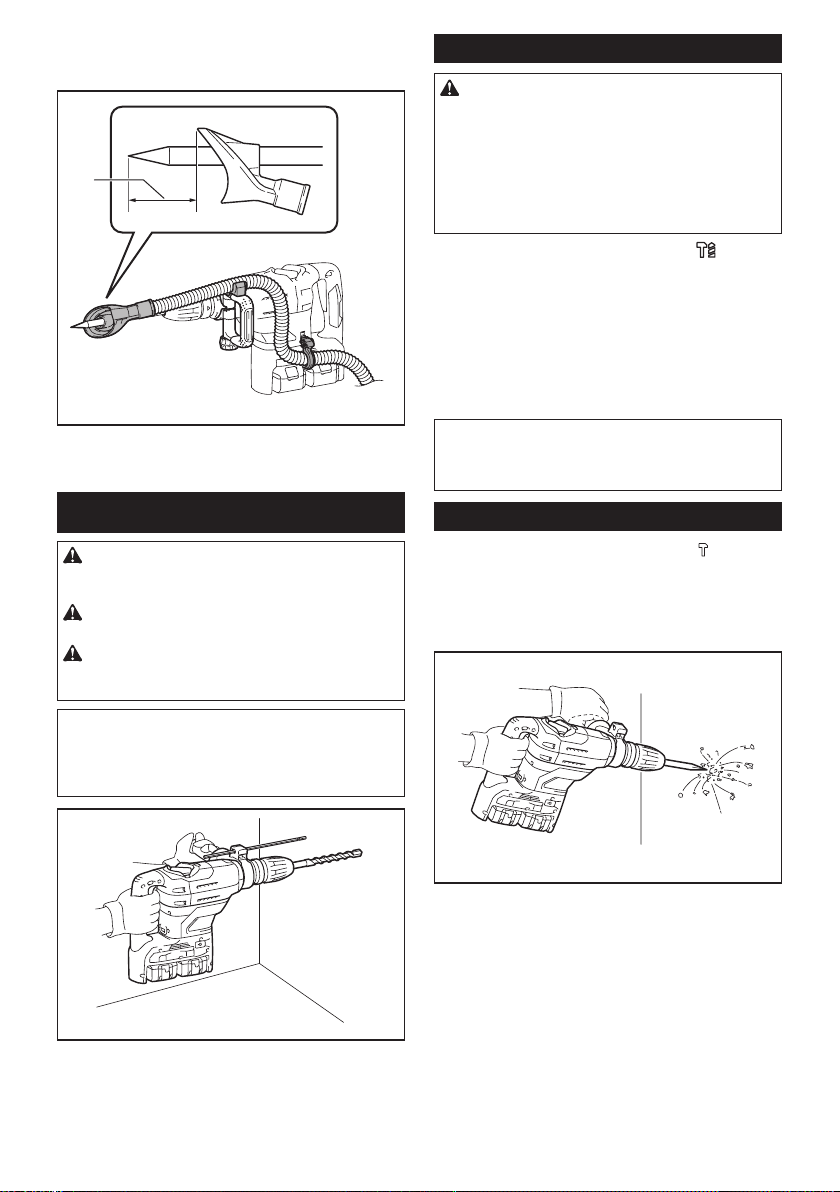
5. Adjustthedistancebetweenthedustcoverand
the tip of the chisel or bull point. The recommended
distance is 30 mm (1-3/16") to 100 mm (3-15/16").
(1)
►(1) 30 mm (1-3/16") to 100 mm (3-15/16")
OPERATION
CAUTION: Always use the side grip (auxiliary
handle) and rmly hold the tool by both side grip
and switch handle during operations.
CAUTION: Always make sure that the work-
piece is secured before operation.
CAUTION: Do not pull the tool out forcibly
even the bit gets stuck. Loss of control may
cause injury.
NOTE:Ifthebatterycartridgeisinlowtemperature,
thetool’scapabilitymaynotbefullyobtained.Inthis
case,warmupthebatterycartridgebyusingthe
toolwithnoloadforawhiletofullyobtainthetool’s
capability.
Hammer drilling operation
CAUTION: There is tremendous and sudden
twisting force exerted on the tool/drill bit at the time of
hole break-through, when the hole becomes clogged
with chips and particles, or when striking reinforcing
rods embedded in the concrete. Always use the side
grip (auxiliary handle) and rmly hold the tool by
both side grip and switch handle during opera-
tions.Failuretodosomayresultinthelossofcontrol
ofthetoolandpotentiallysevereinjury.
Set the action mode changing knob to the symbol.
Position the drill bit at the desired location for the hole,
then pull the switch trigger. Do not force the tool. Light
pressure gives best results. Keep the tool in position
andpreventitfromslippingawayfromthehole.
Donotapplymorepressurewhentheholebecomes
clogged with chips or particles. Instead, run the tool at
anidle,thenremovethedrillbitpartiallyfromthehole.
Byrepeatingthisseveraltimes,theholewillbecleaned
outandnormaldrillingmayberesumed.
NOTE:Eccentricityinthedrillbitrotationmayoccur
while operating the tool with no load. The tool auto-
maticallycentersitselfduringoperation.Thisdoesnot
affect the drilling precision.
Chipping/Scaling/Demolition
Set the action mode changing knob to the symbol.
Holdthetoolrmlywithbothhands.Turnthetoolon
andapplyslightpressureonthetoolsothatthetoolwill
not bounce around, uncontrolled.
Pressingveryhardonthetoolwillnotincreasethe
efciency.

14 ENGLISH
Blow-out bulb
Optional accessory
After drilling the hole, use the blow-out bulb to clean the
dust out of the hole.
WIRELESS ACTIVATION
FUNCTION
Optional accessory
What you can do with the wireless
activation function
The wireless activation function enables clean and com-
fortableoperation.Byconnectingasupportedvacuum
cleanertothetool,youcanrunthevacuumcleaner
automaticallyalongwiththeswitchoperationofthetool.
To use the wireless activation function, prepare follow-
ing items:
• Awirelessunit(optionalaccessory)
• A vacuum cleaner which supports the wireless
activation function
The overview of the wireless activation function
setting is as follows. Refer to each section for detail
procedures.
1. Installing the wireless unit
2. Tool registration for the vacuum cleaner
3. Starting the wireless activation function
Installing the wireless unit
Optional accessory
CAUTION: Place the tool on a at and stable
surface when installing the wireless unit.
NOTICE: Clean the dust and dirt on the tool
before installing the wireless unit. Dust or dirt
maycausemalfunctionifitcomesintotheslotofthe
wireless unit.
NOTICE: To prevent the malfunction caused by
static, touch a static discharging material, such
as a metal part of the tool, before picking up the
wireless unit.
NOTICE: When installing the wireless unit,
always be sure that the wireless unit is inserted
in the correct direction and the lid is completely
closed.
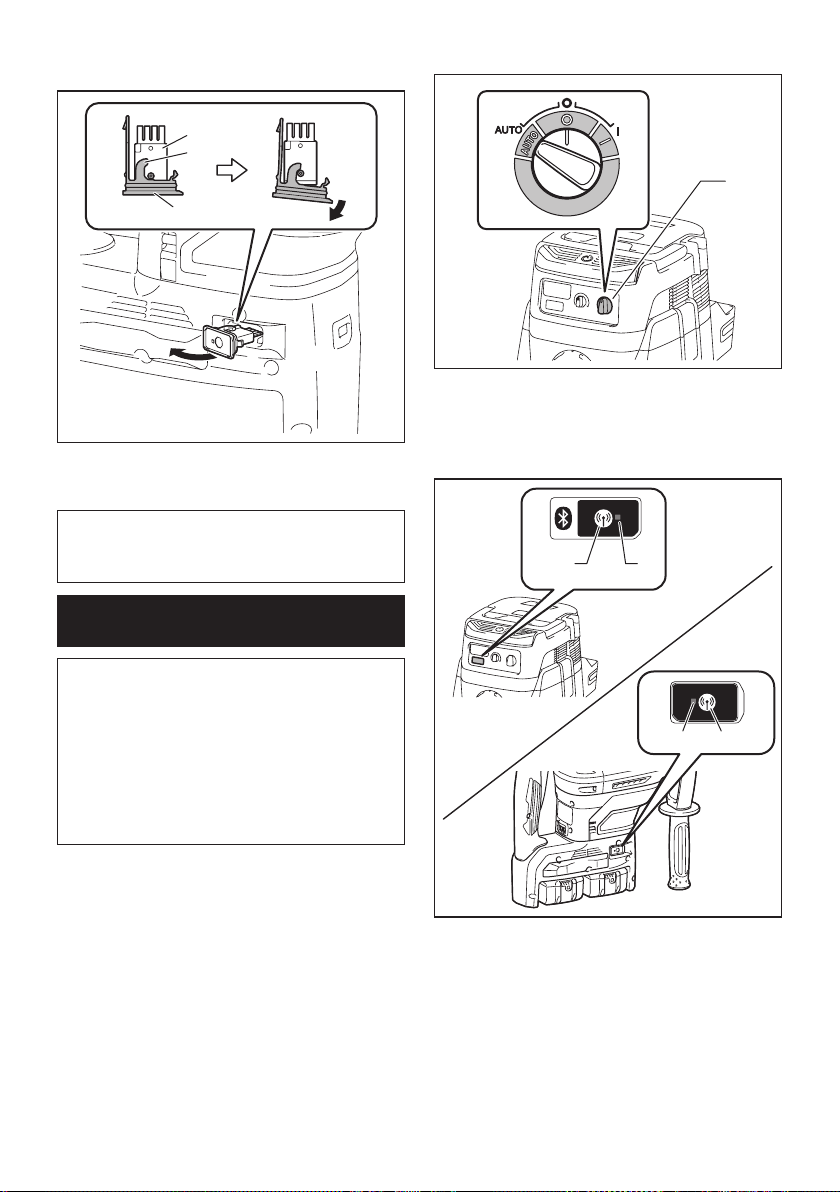
1. Openthelidonthetoolasshowninthegure.
1
►1. Lid
2. Insert the wireless unit to the slot and then close
the lid.
Wheninsertingthewirelessunit,aligntheprojections
with the recessed portions on the slot.
1
2
3
4
►1. Wireless unit 2.Projection3. Lid 4. Recessed
portion
15 ENGLISH
Whenremovingthewirelessunit,openthelidslowly.
The hooks on the back of the lid will lift the wireless unit
asyoupullupthelid.
1
2
3
►1. Wireless unit 2. Hook 3. Lid
After removing the wireless unit, keep it in the supplied
case or a static-free container.
NOTICE: Always use the hooks on the back of
the lid when removing the wireless unit. If the
hooks do not catch the wireless unit, close the lid
completelyandopenitslowlyagain.
Tool registration for the vacuum
cleaner
NOTE: A Makita vacuum cleaner supporting the
wireless activation function is required for the tool
registration.
NOTE: Finish installing the wireless unit to the tool
before starting the tool registration.
NOTE: During the tool registration, do not pull the
switch trigger or turn on the power switch on the
vacuum cleaner.
NOTE: Refer to the instruction manual of the vacuum
cleaner, too.
Ifyouwishtoactivatethevacuumcleaneralongwith
theswitchoperationofthetool,nishthetoolregistra-
tion beforehand.
1. Install the batteries to the vacuum cleaner and the
tool.
2. Setthestand-byswitchonthevacuumcleanerto
"AUTO".
1
►1.Stand-byswitch
3. Press the wireless activation button on the vac-
uum cleaner for 3 seconds until the wireless activation
lamp blinks in green. And then press the wireless acti-
vationbuttononthetoolinthesameway.
1 2
1
2
►1. Wireless activation button 2. Wireless activation
lamp
If the vacuum cleaner and the tool are linked success-
fully,thewirelessactivationlampswilllightupingreen
for 2 seconds and start blinking in blue.
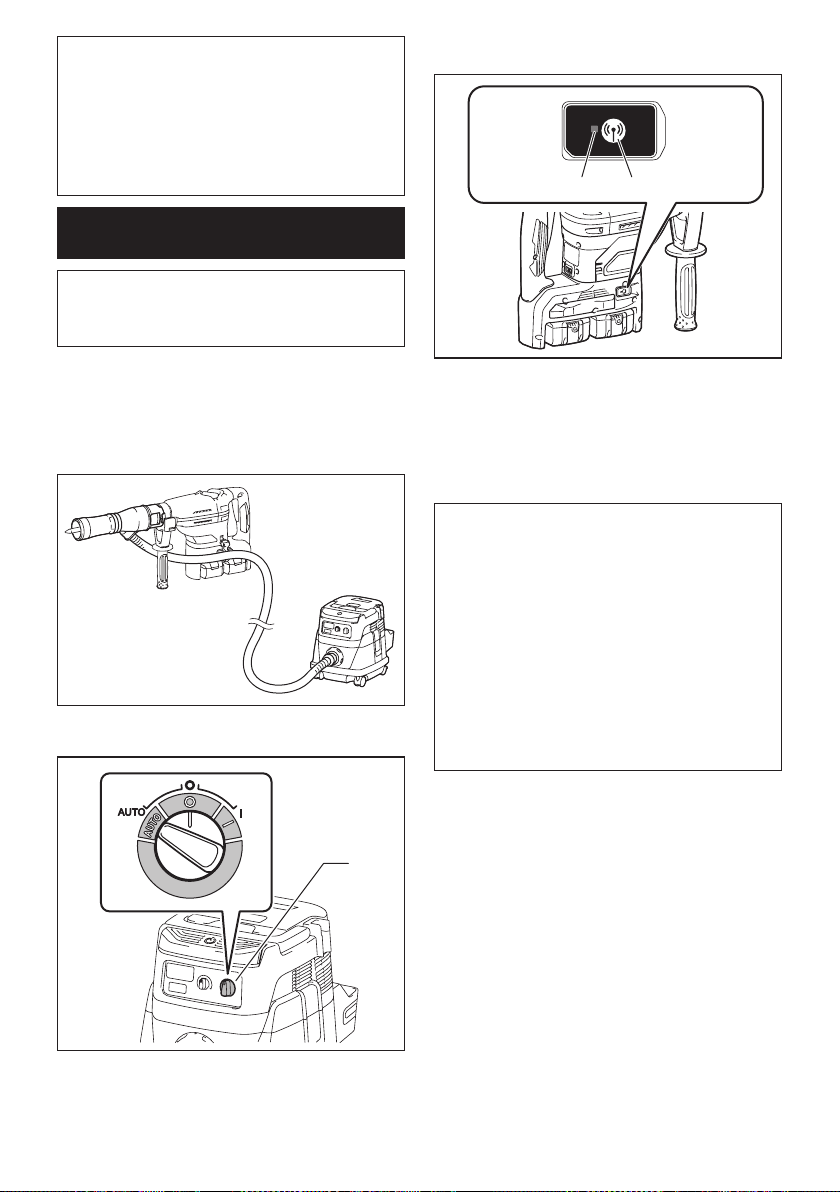
16 ENGLISH
NOTE:Thewirelessactivationlampsnishblinking
in green after 20 seconds elapsed. Press the wireless
activation button on the tool while the wireless acti-
vation lamp on the cleaner is blinking. If the wireless
activation lamp does not blink in green, push the wire-
lessactivationbuttonbrieyandholditdownagain.
NOTE: When performing two or more tool registra-
tionsforonevacuumcleaner,nishthetoolregistra-
tiononebyone.
Starting the wireless activation
function
NOTE: Finish the tool registration for the vacuum
cleaner prior to the wireless activation.
NOTE: Refer to the instruction manual of the vacuum
cleaner, too.
After registering a tool to the vacuum cleaner, the
vacuumcleanerwillautomaticallyrunsalongwiththe
switch operation of the tool.
1. Install the wireless unit to the tool.
2. Connect the hose of the vacuum cleaner with the
tool.
3. Setthestand-byswitchonthevacuumcleanerto
"AUTO".
1
►1.Stand-byswitch
4. Push the wireless activation button on the tool
briey.Thewirelessactivationlampwillblinkinblue.
12
►1. Wireless activation button 2. Wireless activation
lamp
5. Pull the switch trigger of the tool. Check if the
vacuum cleaner runs while the switch trigger is being
pulled.
To stop the wireless activation of the vacuum cleaner,
push the wireless activation button on the tool.
NOTE: The wireless activation lamp on the tool will
stop blinking in blue when there is no operation for
2hours.Inthiscase,setthestand-byswitchonthe
vacuum cleaner to "AUTO" and push the wireless
activation button on the tool again.
NOTE:Thevacuumcleanerstarts/stopswithadelay.
There is a time lag when the vacuum cleaner detects
a switch operation of the tool.
NOTE: The transmission distance of the wireless unit
mayvarydependingonthelocationandsurrounding
circumstances.
NOTE: When two or more tools are registered to one
vacuumcleaner,thevacuumcleanermaystartrun-
ningevenifyoudon'tpulltheswitchtriggerbecause
an other user is using the wireless activation function.
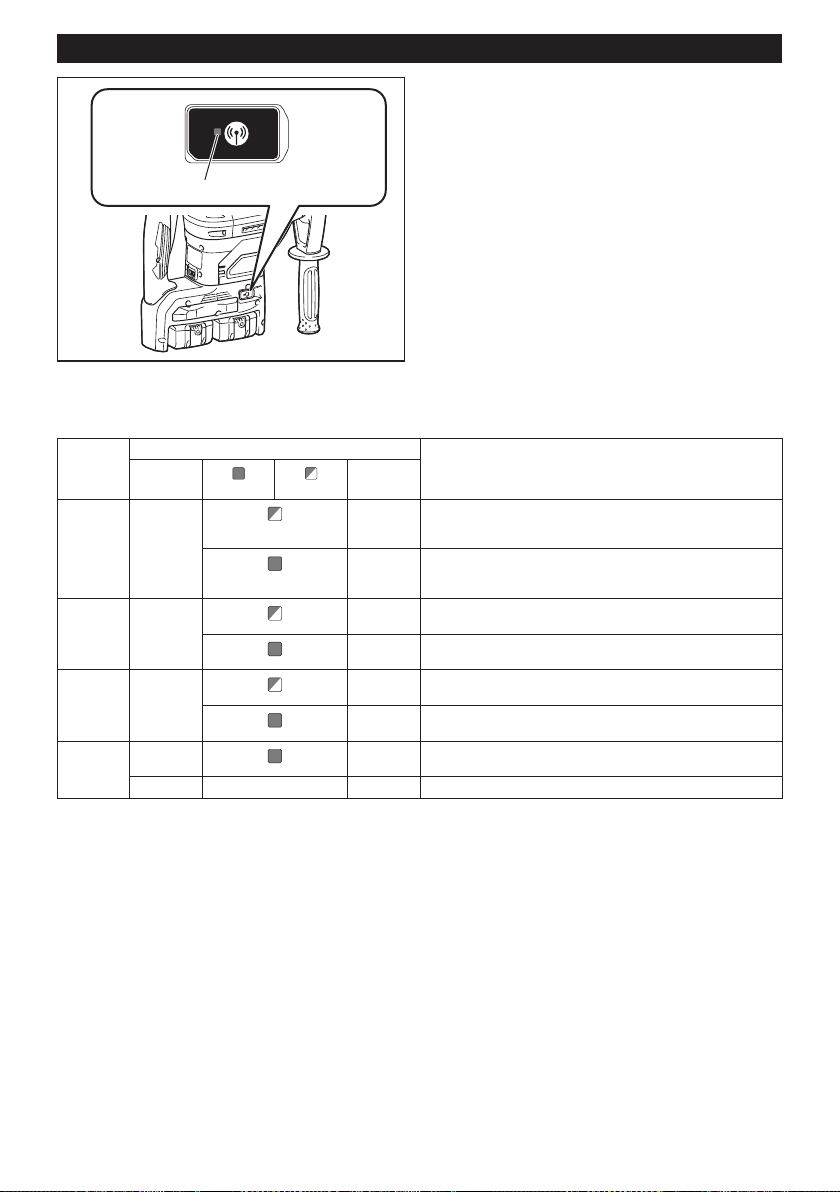
17 ENGLISH
Description of the wireless activation lamp status
1
►1. Wireless activation lamp
The wireless activation lamp shows the status of the wireless activation function. Refer to the table below for the
meaning of the lamp status.
Status Wireless activation lamp Description
Color
On
Blinking
Duration
Standby Blue
2 hours The wireless activation of the vacuum cleaner is available. The
lampwillautomaticallyturnoffwhennooperationisperformed
for 2 hours.
When
the tool is
running.
The wireless activation of the vacuum cleaner is available and the
tool is running.
Tool
registration
Green
20 seconds Readyforthetoolregistration.Waitingfortheregistrationbythe
vacuum cleaner.
2 seconds Thetoolregistrationhasbeennished.Thewirelessactivation
lamp will start blinking in blue.
Cancelling
tool
registration
Red
20 seconds Readyforthecancellationofthetoolregistration.Waitingforthe
cancellationbythevacuumcleaner.
2 seconds Thecancellationofthetoolregistrationhasbeennished.The
wireless activation lamp will start blinking in blue.
Others Red
3 seconds The power is supplied to the wireless unit and the wireless activa-
tion function is starting up.
Off - - The wireless activation of the vacuum cleaner is stopped.
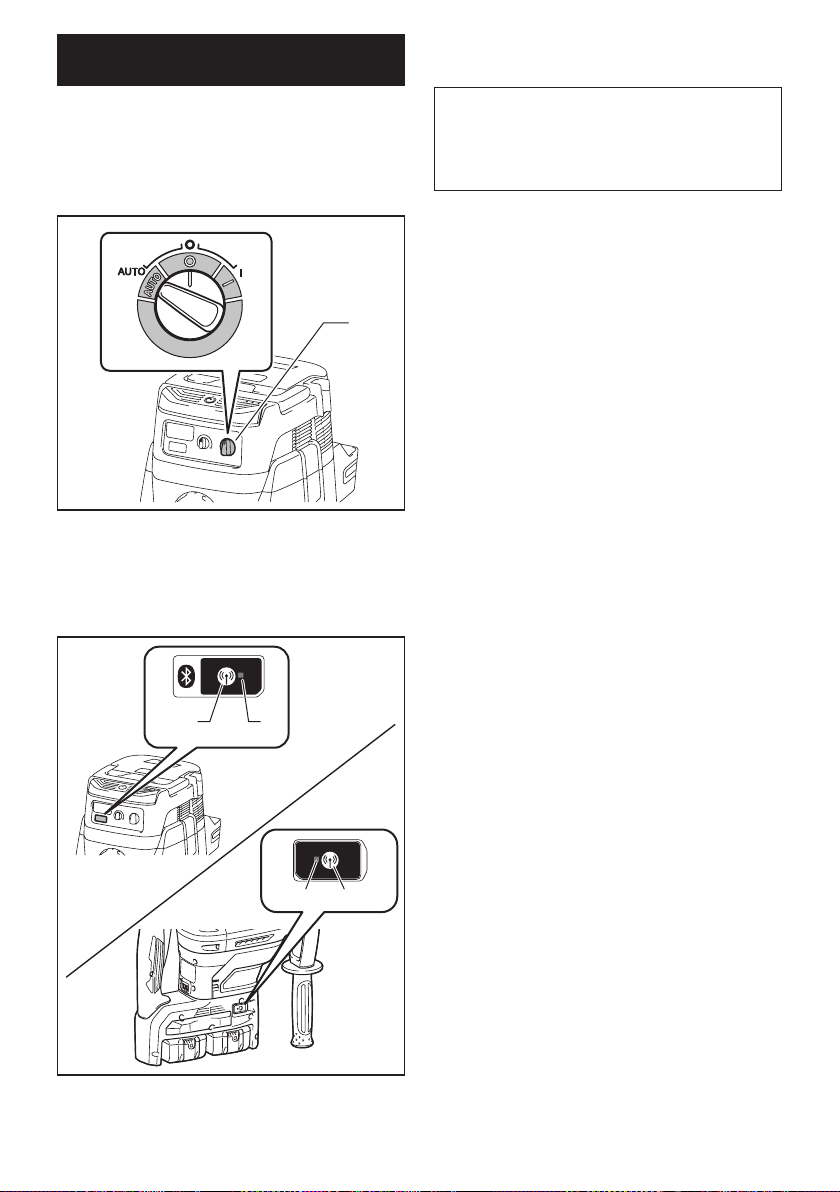
18 ENGLISH
Cancelling tool registration for the
vacuum cleaner
Perform the following procedure when cancelling the
tool registration for the vacuum cleaner.
1. Install the batteries to the vacuum cleaner and the
tool.
2. Setthestand-byswitchonthevacuumcleanerto
"AUTO".
1
►1.Stand-byswitch
3. Press the wireless activation button on the vac-
uum cleaner for 6 seconds. The wireless activation
lamp blinks in green and then become red. After that,
press the wireless activation button on the tool in the
sameway.
1 2
1
2
►1. Wireless activation button 2. Wireless activation
lamp
Ifthecancellationisperformedsuccessfully,thewire-
less activation lamps will light up in red for 2 seconds
and start blinking in blue.
NOTE:Thewirelessactivationlampsnishblinkingin
red after 20 seconds elapsed. Press the wireless acti-
vation button on the tool while the wireless activation
lamp on the cleaner is blinking. If the wireless acti-
vation lamp does not blink in red, push the wireless
activationbuttonbrieyandholditdownagain.

19 ENGLISH
Troubleshooting for wireless activation function
Beforeaskingforrepairs,conductyourowninspectionrst.Ifyoundaproblemthatisnotexplainedinthemanual,
donotattempttodismantlethetool.Instead,askMakitaAuthorizedServiceCenters,alwaysusingMakitareplace-
ment parts for repairs.
State of abnormality Probable cause (malfunction) Remedy
The wireless activation lamp does
not light/blink.
The wireless unit is not installed into the tool.
Thewirelessunitisimproperlyinstalled
into the tool.
Installthewirelessunitcorrectly.
The terminal of the wireless unit and/or
theslotisdirty.
Gentlywipeoffdustanddirtontheterminalofthe
wireless unit and clean the slot.
The wireless activation button on the
tool has not been pushed.
Push the wireless activation button on the tool
briey.
Thestand-byswitchonthevacuum
cleaner is not set to "AUTO".
Setthestand-byswitchonthevacuumcleanerto
"AUTO".
Nopowersupply
Supplythepowertothetoolandthevacuumcleaner.
Cannotnishtoolregistration/can-
cellingtoolregistrationsuccessfully.
The wireless unit is not installed into the tool.
Thewirelessunitisimproperlyinstalled
into the tool.
Installthewirelessunitcorrectly.
The terminal of the wireless unit and/or
theslotisdirty.
Gentlywipeoffdustanddirtontheterminalofthe
wireless unit and clean the slot.
Thestand-byswitchonthevacuum
cleaner is not set to "AUTO".
Setthestand-byswitchonthevacuumcleanerto
"AUTO".
Nopowersupply
Supplythepowertothetoolandthevacuumcleaner.
Incorrect operation
Pushthewirelessactivationbuttonbrieyandperform
the tool registration/cancellation procedures again.
Thetoolandvacuumcleanerareaway
from each other (out of the transmission
range).
Get the tool and vacuum cleaner closer to each other.
Themaximumtransmissiondistanceisapproximately10
mhoweveritmayvaryaccordingtothecircumstances.
Beforenishingthetoolregistration/
cancellation;
- the switch trigger on the tool is pulled or;
- the power button on the vacuum
cleaner is turned on.
Pushthewirelessactivationbuttonbrieyand
perform the tool registration/cancellation procedures
again.
The tool registration procedures for the
toolorvacuumcleanerhasnotnished.
Perform the tool registration procedures for both the
tool and the vacuum cleaner at the same timing.
Radiodisturbancebyotherappliances
whichgeneratehigh-intensityradiowaves.
Keepthetoolandvacuumcleanerawayfromtheappli-
ances such as Wi-Fi devices and microwave ovens.
The vacuum cleaner does not run
along with the switch operation of
the tool.
The wireless unit is not installed into the tool.
Thewirelessunitisimproperlyinstalled
into the tool.
Installthewirelessunitcorrectly.
The terminal of the wireless unit and/or
theslotisdirty.
Gentlywipeoffdustanddirtontheterminalofthe
wireless unit and clean the slot.
The wireless activation button on the
tool has not been pushed.
Pushthewirelessactivationbuttonbrieyandmake
sure that the wireless activation lamp is blinking in blue.
Thestand-byswitchonthevacuum
cleaner is not set to "AUTO".
Setthestand-byswitchonthevacuumcleanerto
"AUTO".
More than 10 tools are registered to the
vacuum cleaner.
Perform the tool registration again.
If more than 10 tools are registered to the vacuum
cleaner, the tool registered earliest will be cancelled
automatically.
The vacuum cleaner erased all tool
registrations.
Perform the tool registration again.
Nopowersupply
Supplythepowertothetoolandthevacuumcleaner.
Thetoolandvacuumcleanerareaway
from each other (out of the transmission
range).
Get the tool and vacuum cleaner closer each other.
The maximum transmission distance is approxi-
mately10mhoweveritmayvaryaccordingtothe
circumstances.
Radiodisturbancebyotherappliances
whichgeneratehigh-intensityradiowaves.
Keepthetoolandvacuumcleanerawayfromtheappli-
ances such as Wi-Fi devices and microwave ovens.
The vacuum cleaner runs while the
tool's switch trigger is not pulled.
Other users are using the wireless
activation of the vacuum cleaner with
their tools.
Turn off the wireless activation button of the other
tools or cancel the tool registration of the other
tools.

20 ENGLISH
MAINTENANCE
CAUTION: Always be sure that the tool is
switched off and the battery cartridge is removed
before attempting to perform inspection or
maintenance.
NOTICE: Never use gasoline, benzine, thinner,
alcohol or the like. Discoloration, deformation or
cracks may result.
To maintain product SAFETY and RELIABILITY,
repairs,anyothermaintenanceoradjustmentshould
beperformedbyMakitaAuthorizedorFactoryService
Centers,alwaysusingMakitareplacementparts.
OPTIONAL
ACCESSORIES
CAUTION: These accessories or attachments
are recommended for use with your Makita tool
specied in this manual.Theuseofanyother
accessories or attachments might present a risk of
injurytopersons.Onlyuseaccessoryorattachment
for its stated purpose.
Ifyouneedanyassistanceformoredetailsregarding
theseaccessories,askyourlocalMakitaServiceCenter.
• SDS-MAX Carbide-tipped drill bits
• SDS-MAX bull point
• SDS-MAX cold chisel
• SDS-MAX scaling chisel
• SDS-MAXclayspade
• Hammer grease
• Bit grease
• Side handle
• Side grip
• Depth gauge
• Blow-out bulb
• Dust extractor attachment
• Safetygoggles
• Wireless unit
• Makitagenuinebatteryandcharger
• Plasticcarryingcase
NOTE:Someitemsinthelistmaybeincludedinthe
toolpackageasstandardaccessories.Theymay
differfromcountrytocountry.
MAKITA LIMITED WARRANTY
Pleaserefertotheannexedwarrantysheetforthe
mostcurrentwarrantytermsapplicabletothisproduct.
Ifannexedwarrantysheetisnotavailable,refertothe
warrantydetailssetforthatbelowwebsiteforyour
respectivecountry.
United States of America: www.makitatools.com
Canada: www.makita.ca
Other countries: www.makita.com
21 ESPAÑOL
ESPAÑOL (Instrucciones originales)
ESPECIFICACIONES
Modelo: XRH07
Capacidades Punta de carburo 40mm(1-9/16″)
Punta de corona 105mm(4-1/8″)
Velocidad sin carga (RPM) 250 r/min - 500 r/min
Golpes por minuto 1 450 gpm - 2 900 gpm
Longitud total 473mm(18-5/8″)
Tensión nominal 36 V c.c.
Peso neto 7,3 kg - 8,1 kg (16,1 lbs - 17,9 lbs)
• Debidoanuestrocontinuoprogramadeinvestigaciónydesarrollo,lasespecicacionesaquíincluidasestán
sujetasacambiosinprevioaviso.
• Lasespecicacionesyelcartuchodebateríapuedenvariardepaísapaís.
• Elpesopuedevariarenfuncióndelosaccesorios,incluidoelcartuchodebatería.Enlatablasemuestrala
combinacióndepesomásligeroymáspesadoconformealprocedimiento01/2014deEPTA.
Cartucho de batería aplicable
BL1815N / BL1820B / BL1830 / BL1830B / BL1840B / BL1850B / BL1860B
• Algunosdeloscartuchosdebateríaenumeradosarribapodríannoestardisponiblesdependiendodesuárea
de residencia.
ADVERTENCIA: Use únicamente los cartuchos de batería indicados arriba. El uso de cualquier otro
cartuchodebateríapodríaocasionarunalesióny/ounincendio.
ADVERTENCIAS DE
SEGURIDAD
Advertencias generales de seguridad
para herramientas eléctricas
ADVERTENCIA: Lea todas las advertencias
de seguridad, instrucciones, ilustraciones y espe-
cicaciones suministradas con esta herramienta
eléctrica. El no seguir todas las instrucciones indi-
cadasacontinuaciónpodríaocasionarunadescarga
eléctrica,incendioy/olesionesgraves.
Conserve todas las advertencias e ins-
trucciones como referencia en el futuro.
En las advertencias, el término “herramienta eléctrica”
sereereasuherramientaeléctricadefuncionamiento
con conexión a la red eléctrica (con cableado eléctrico)
oherramientaeléctricadefuncionamientoabatería
(inalámbrica).
Seguridad en el área de trabajo
1. Mantenga el área de trabajo limpia y bien ilu-
minada.Lasáreasoscurasodesordenadasson
propensas a accidentes.
2. No utilice las herramientas eléctricas en
atmósferas explosivas, tal como en la presen-
cia de líquidos, gases o polvo inamables. Las
herramientas eléctricas crean chispas que pueden
prender fuego al polvo o los humos.
3. Mantenga a los niños y curiosos alejados
mientras utiliza una herramienta eléctrica. Las
distracciones le pueden hacer perder el control.
Seguridad eléctrica
1.
Las clavijas de conexión de las herramientas
eléctricas deberán encajar perfectamente en la
toma de corriente. No modique nunca la clavija
de conexión de ninguna forma. No utilice ninguna
clavija adaptadora con herramientas eléctricas
que tengan conexión a tierra (puesta a tierra). La
utilizacióndeclavijasnomodicadasyqueencajen
perfectamenteenlatomadecorrientereduciráel
riesgo de que se produzca una descarga eléctrica.
2.
Evite tocar con el cuerpo supercies conecta-
das a tierra o puestas a tierra tales como tubos,
radiadores, cocinas y refrigeradores. Si su cuerpo
espuestoatierraoconectadoatierraexistiráun
mayorriesgodequesufraunadescargaeléctrica.
3. No exponga las herramientas eléctricas a la
lluvia ni a condiciones húmedas. La entrada de
aguaenunaherramientaeléctricaaumentaráel
riesgo de que se produzca una descarga eléctrica.
4. No maltrate el cable. Nunca utilice el cable
para transportar, jalar o desconectar la herra-
mienta eléctrica. Mantenga el cable alejado del
calor, aceite, objetos cortantes o piezas móvi-
les. Los cables dañados o enredados aumentan
el riesgo de sufrir una descarga eléctrica.
5.
Cuando utilice una herramienta eléctrica en
exteriores, utilice un cable de extensión apro-
piado para uso en exteriores. La utilización de un
cableapropiadoparausoenexterioresreduciráel
riesgo de que se produzca una descarga eléctrica.

22 ESPAÑOL
6. Si no es posible evitar usar una herramienta
eléctrica en condiciones húmedas, utilice un
alimentador protegido con interruptor de cir-
cuito de falla a tierra (ICFT). El uso de un ICFT
reduce el riesgo de descarga eléctrica.
7.
Las herramientas eléctricas pueden producir cam-
pos electromagnéticos (CEM) que no son dañinos
para el usuario. Sin embargo, si los usuarios tienen
marcapasosyotrosdispositivosmédicossimilares,
deberánconsultaralfabricantedesudispositivoy/oa
su médico antes de operar esta herramienta eléctrica.
Seguridad personal
1.
Manténgase alerta, preste atención a lo que está
haciendo y utilice su sentido común cuando opere
una herramienta eléctrica. No utilice una herra-
mienta eléctrica cuando esté cansado o bajo la
inuencia de drogas, alcohol o medicamentos. Un
momento de distracción mientras opera las herramien-
tas eléctricas puede terminar en una lesión grave.
2. Use equipo de protección personal. Póngase
siempre protección para los ojos. El equipo
protectortalcomomáscaracontraelpolvo,zapa-
tosdeseguridadantiderrapantes,cascorígidoy
protecciónparaoídosutilizadoenlascondiciones
apropiadasreduciráelriesgodelesiones.
3.
Impida el encendido accidental. Asegúrese
de que el interruptor esté en la posición de
apagado antes de conectar a la alimentación
eléctrica y/o de colocar el cartucho de batería,
así como al levantar o cargar la herramienta.
Cargar las herramientas eléctricas con su dedo
en el interruptor o enchufarlas con el interruptor
encendido hace que los accidentes sean comunes.
4. Retire cualquier llave de ajuste o llave de
apriete antes de encender la herramienta. Una
llavedeajusteollavedeaprietequehayasido
dejadapuestaenunapartegiratoriadelaherra-
mienta eléctrica puede ocasionar alguna lesión.
5.
No utilice la herramienta donde no alcance.
Mantenga los pies sobre suelo rme y el equilibrio
en todo momento.Estopermiteunmejorcontroldela
herramienta eléctrica en situaciones inesperadas.
6.
Use una vestimenta apropiada. No use ropa suelta
ni alhajas. Mantenga el cabello, la ropa y los guan-
tes alejados de las piezas móviles. Las prendas de
vestirholgadas,lasalhajasyelcabellolargosuelto
podríanengancharseenestaspiezasmóviles.
7.
Si dispone de dispositivos para la conexión de
equipos de extracción y recolección de polvo,
asegúrese de conectarlos y utilizarlos debida-
mente. Hacer uso de la recolección de polvo puede
reducir los riesgos relacionados con el polvo.
8.
No permita que la familiaridad adquirida debido
al uso frecuente de las herramientas haga que se
sienta conado e ignore los principios de seguri-
dad de las herramientas.Undescuidopodríaoca-
sionar una lesión grave en una fracción de segundo.
9. Utilice siempre gafas protectoras para prote-
ger sus ojos de lesiones al usar herramientas
eléctricas. Las gafas deben cumplir con la
Norma ANSI Z87.1 en EUA.
Es responsabilidad del empleador imponer
el uso de equipos protectores de seguridad
apropiados a los operadores de la herramienta
y demás personas cerca del área de trabajo.
Mantenimiento y uso de la herramienta eléctrica
1. No fuerce la herramienta eléctrica. Utilice la
herramienta eléctrica correcta para su aplica-
ción.Laherramientaeléctricaadecuadaharáun
mejortrabajoydeformamásseguraalaveloci-
dad para la que ha sido fabricada.
2. No utilice la herramienta eléctrica si el inte-
rruptor no la enciende y apaga. Cualquier
herramienta eléctrica que no pueda ser contro-
ladaconelinterruptorespeligrosaydebeser
reemplazada.
3. Desconecte la clavija de la fuente de alimen-
tación y/o retire la batería de la herramienta
eléctrica, en caso de ser removible, antes de
realizar ajustes, cambiar accesorios o almace-
nar las herramientas eléctricas. Tales medidas
deseguridadpreventivasreduciránelriesgo
de poner en marcha la herramienta eléctrica de
forma accidental.
4. Guarde la herramienta eléctrica que no use
fuera del alcance de los niños y no permita
que las personas que no están familiarizadas
con ella o con las instrucciones la operen. Las
herramientas eléctricas son peligrosas en manos
de personas que no saben operarlas.
5. Dé mantenimiento a las herramientas eléctri-
cas y los accesorios. Compruebe que no haya
piezas móviles desalineadas o estancadas,
piezas rotas y cualquier otra condición que
pueda afectar al funcionamiento de la herra-
mienta eléctrica. Si la herramienta eléctrica
está dañada, haga que la reparen antes de
utilizarla. Muchos de los accidentes son ocasio-
nados por no dar un mantenimiento adecuado a
las herramientas eléctricas.
6.
Mantenga las herramientas de corte limpias y
losas.Sirecibeunmantenimientoadecuadoytiene
losbordesalados,esprobablequelaherramienta
seatasquemenosyseamásfácilcontrolarla.
7.
Utilice la herramienta eléctrica, los accesorios y
las brocas de acuerdo con estas instrucciones,
considerando las condiciones laborales y el
trabajo a realizar. Si utiliza la herramienta eléctrica
para realizar operaciones distintas de las indicadas,
podrápresentarseunasituaciónpeligrosa.
8. Mantenga los mangos y supercies de asi-
miento secos, limpios y libres de aceite o
grasa.Losmangosysuperciesdeasimiento
resbalosos no permiten una manipulación segura
ni el control de la herramienta en situaciones
inesperadas.
9. Cuando vaya a utilizar esta herramienta, evite
usar guantes de trabajo de tela ya que éstos
podrían atorarse.Silosguantesdetrabajode
tela llegaran a atorarse en las piezas móviles,
estopodríaocasionarlesionespersonales.
Uso y cuidado de la herramienta a batería
1. Recargue sólo con el cargador especicado
por el fabricante. Un cargador que es adecuado
paraunsolotipodebateríapuedegenerarriesgo
deincendioalserutilizadoconotrabatería.
2. Utilice las herramientas eléctricas solamente
con las baterías designadas especícamente
para ellas.Lautilizacióndecualquierotrabatería
puede crear un riesgo de lesiones o incendio.

23 ESPAÑOL
3. Cuando no se esté usando la batería, mantén-
gala alejada de otros objetos metálicos, como
sujetapapeles (clips), monedas, llaves, clavos,
tornillos u otros objetos pequeños de metal
los cuales pueden actuar creando una cone-
xión entre las terminales de la batería. Originar
un cortocircuito en las terminales puede causar
quemaduras o incendios.
4. En condiciones abusivas, podrá escapar
líquido de la batería; evite tocarlo. Si lo toca
accidentalmente, enjuague con agua. Si hay
contacto del líquido con los ojos, busque asis-
tencia médica.Puedequeellíquidoexpulsado
delabateríacauseirritaciónoquemaduras.
5. No utilice una herramienta ni una batería que
estén dañadas o hayan sido modicadas. Las
bateríasdañadasomodicadaspodríanoca-
sionar una situación inesperada provocando un
incendio, explosión o riesgo de lesiones.
6. No exponga la herramienta ni la batería al
fuego ni a una temperatura excesiva. La expo-
sición al fuego o a una temperatura superior a los
130°Cpodríacausarunaexplosión.
7. Siga todas las instrucciones para la carga y
evite cargar la herramienta o la batería fuera
del rango de temperatura especicado en
las instrucciones. Una carga inadecuada o a
unatemperaturafueradelrangoespecicado
podríadañarlabateríaeincrementarelriesgode
incendio.
Servicio
1. Haga que una persona calicada repare la
herramienta eléctrica utilizando sólo piezas de
repuesto idénticas. Esto asegura que se man-
tenga la seguridad de la herramienta eléctrica.
2. Nunca dé servicio a baterías que estén daña-
das.Elservicioalasbateríassolamentedeberá
ser efectuado por el fabricante o un agente de
servicio autorizado.
3. Siga las instrucciones para la lubricación y
cambio de accesorios.
4. No modique ni intente reparar el aparato ni el
paquete de baterías salvo como se indique en
las instrucciones para el uso y cuidado.
ADVERTENCIAS DE SEGURIDAD
PARA EL MARTILLO ROTATIVO
INALÁMBRICO
1. Utilice protectores de oídos. La exposición al
ruido puede provocar pérdida auditiva.
2. Utilice los mango(s) auxiliare(s) que se sumi-
nistren con la herramienta. La pérdida de con-
trol puede ocasionar lesiones.
3. Sujete la herramienta eléctrica por las super-
cies de asimiento aisladas al realizar una ope-
ración en la que el accesorio de corte pueda
entrar en contacto con cableado oculto. Si el
accesorio de corte entra en contacto con un cable
concorriente,laspiezasmetálicasexpuestasde
laherramientaeléctricasecargarántambiénde
corrienteyeloperadorpodríarecibirunades-
carga eléctrica.
4. Utilice un casco protector (casco de seguri-
dad), gafas de seguridad y/o careta de protec-
ción. Los anteojos comunes o de sol NO son
gafas de seguridad. También es muy recomen-
dable que utilice una máscara contra polvo y
guantes bien acolchados.
5. Asegúrese de que la punta se encuentre ase-
gurada en su lugar antes de la operación.
6. En condiciones normales de operación, la
herramienta está diseñada para producir vibra-
ción. Los tornillos pueden aojarse fácilmente
y causar una falla o accidente. Verique cuida-
dosamente que los tornillos estén apretados
antes de la operación.
7. En clima frío o cuando la herramienta no se
haya utilizado durante un tiempo prolongado,
permita que la herramienta se caliente un
rato haciéndola funcionar sin carga. Esto
facilitará la lubricación. Sin un calentamiento
apropiado, la operación de percusión resultará
difícil.
8. Asegúrese siempre de que pisa sobre suelo
rme. Asegúrese de que no haya nadie debajo
cuando utilice la herramienta en lugares altos.
9. Sujete la herramienta rmemente con ambas
manos.
10. Mantenga las manos alejadas de las piezas
móviles.
11. No deje la herramienta funcionando. Tenga en
marcha la herramienta solamente cuando la
esté sosteniendo con la mano.
12. Durante la operación, no apunte con la herra-
mienta a ninguna persona en el área. La punta
podría salir volando y causarle una lesión
grave a alguien.
13. No toque la punta, las partes cerca de la punta
o la pieza de trabajo inmediatamente después
de la operación; éstas podrían estar extrema-
damente calientes y provocarle quemaduras
en la piel.
14. Algunos materiales contienen sustancias
químicas que pueden ser tóxicas. Evite inhalar
polvo y que éste entre en contacto con la piel.
Consulte la hoja de seguridad de materiales
del proveedor.
15. Asegúrese siempre de que la herramienta esté
apagada y de que el cartucho de batería y la
punta hayan sido extraídos antes de pasarle la
herramienta a otra persona.
GUARDE ESTAS
INSTRUCCIONES.
ADVERTENCIA: NO DEJE que la comodidad
o familiaridad con el producto (a base de utilizarlo
repetidamente) evite que siga estrictamente las
normas de seguridad para dicho producto. El
USO INCORRECTO o el no seguir las normas de
seguridad indicadas en este manual de instruc-
ciones puede ocasionar lesiones graves.

24 ESPAÑOL
Símbolos
Acontinuaciónsemuestranlossímbolosutilizados
para la herramienta.
volts o voltios
corriente directa o continua
velocidad sin carga
revoluciones o alternaciones por minuto,
frecuencia de rotación
número de percusiones
Instrucciones importantes de
seguridad para el cartucho de batería
1.
Antes de utilizar el cartucho de batería, lea todas
las instrucciones e indicaciones de precaución
en el (1) el cargador de batería, (2) la batería, y (3)
el producto con el que se utiliza la batería.
2. No desarme el cartucho de batería.
3. Si el tiempo de operación se ha acortado en
exceso, deje de operar de inmediato. Podría
correrse el riesgo de sobrecalentamiento,
posibles quemaduras e incluso explosión.
4. En caso de que ingresen electrolitos en sus
ojos, enjuáguelos bien con agua limpia y con-
sulte de inmediato a un médico. Esto podría
ocasionar pérdida de visión.
5. Evite cortocircuitar el cartucho de batería:
(1) No toque las terminales con ningún mate-
rial conductor.
(2) Evite guardar el cartucho de batería en un
cajón junto con otros objetos metálicos,
tales como clavos, monedas, etc.
(3) No exponga el cartucho de batería al
agua o la lluvia.
Un cortocircuito en la batería puede causar
un ujo grande de corriente, sobrecalenta-
miento, posibles quemaduras e incluso una
descompostura.
6. No guarde la herramienta ni el cartucho de
batería en lugares donde la temperatura pueda
alcanzar o exceder los 50°C (122°F).
7. Nunca incinere el cartucho de batería incluso
en el caso de que esté dañado seriamente o
ya no sirva en absoluto. El cartucho de batería
puede explotar si se tira al fuego.
8. Tenga cuidado de no dejar caer ni golpear la
batería.
9. No use una batería dañada.
10. Las baterías de ión de litio están sujetas a los
requisitos reglamentarios en materia de bie-
nes peligrosos.
Paraeltrasportecomercial,porej.,mediante
terceros o agentes de transporte, se deben tomar
en cuenta los requisitos especiales relativos al
empaqueyeletiquetado.
Paraefectuarlospreparativosdelartículoquese
va a enviar, se requiere consultar a un experto en
materiales peligrosos. Si es posible, consulte ade-
másotrasregulacionesnacionalesmásdetalladas.
Pegue o cubra con cinta adhesiva los contactos
abiertosyempaquelabateríademaneraqueésta
no pueda moverse dentro del paquete.
11. Siga las regulaciones locales relacionadas al
desecho de las baterías.
12. Utilice las baterías únicamente con los pro-
ductos especicados por Makita. Instalar las
bateríasenproductosquenocumplanconlos
requisitospodríaocasionarunincendio,uncalen-
tamiento excesivo, una explosión o una fuga de
electrolito.
GUARDE ESTAS INSTRUCCIONES.
PRECAUCIÓN: Utilice únicamente baterías
originales de Makita.Elusodebateríasnoorigina-
lesdeMakita,odebateríasalteradas,puedeocasio-
narquelasbateríasexplotencausandounincendio,
lesionespersonalesydaños.Asimismo,estoinva-
lidarálagarantíadeMakitaparalaherramientayel
cargador Makita.
Consejos para alargar al máximo
la vida útil de la batería
1.
Cargue el cartucho de batería antes de que se
descargue completamente. Pare siempre la ope-
ración y cargue el cartucho de batería cuando
note menos potencia en la herramienta.
2. No cargue nunca un cartucho de batería que
esté completamente cargado. La sobrecarga
acortará la vida de servicio de la batería.
3. Cargue el cartucho de batería a una tempera-
tura ambiente de 10 °C - 40 °C (50 °F - 104 °F).
Si un cartucho de batería está caliente, déjelo
enfriar antes de cargarlo.
4. Cargue el cartucho de batería si no va a utili-
zarlo durante un período prolongado (más de
seis meses).
Instrucciones importantes de
seguridad para la unidad inalámbrica
1. No desarme ni modique la unidad
inalámbrica.
2. Mantenga la unidad inalámbrica alejada de
los niños pequeños. En caso de ingerirla
accidentalmente, solicite atención médica de
inmediato.
3. Utilice la unidad inalámbrica solamente con
herramientas de Makita.
4. No exponga la unidad inalámbrica a la lluvia ni
a condiciones de humedad.
5. No utilice la unidad inalámbrica en lugares
donde la temperatura exceda los 50°C (122°F).
6. No utilice la unidad inalámbrica en lugares
donde haya instrumentos médicos tales como
marcapasos cerca.
7. No utilice la unidad inalámbrica en lugares
donde haya dispositivos automáticos cerca.
Siseutiliza,losdispositivosautomáticospodrían
causaralgunaaveríaoerror.
25 ESPAÑOL
8. No opere la unidad inalámbrica en lugares con
alta temperatura o donde pueda generarse
electricidad estática o ruido eléctrico.
9. La unidad inalámbrica puede producir campos
electromagnéticos (CEM), sin embargo éstos
no son dañinos para el usuario.
10. La unidad inalámbrica es un instrumento de
precisión. Tenga cuidado de no dejar caer ni
golpear la unidad inalámbrica.
11.
Evite tocar la terminal de la unidad inalámbrica con
las manos descubiertas o con materiales metálicos.
12. Retire siempre la batería del producto al insta-
lar en él la unidad inalámbrica.
13. Cuando abra la tapa de la ranura, evite el lugar
donde el polvo y el agua puedan introducirse
en la ranura. Mantenga siempre la entrada de
la ranura limpia.
14. Inserte siempre la unidad inalámbrica en la
dirección correcta.
15.
No oprima el botón de activación inalámbrica en
la unidad inalámbrica demasiado fuerte, ni lo haga
con ningún objeto que tenga un borde loso.
16. Cierre siempre la tapa de la ranura durante la
operación.
17. No retire la unidad inalámbrica de la ranura
mientras se esté suministrando energía a la
herramienta.Elhacerlopodríacausarunaavería
delaunidadinalámbrica.
18. No retire la etiqueta en la unidad inalámbrica.
19. No coloque ninguna etiqueta en la unidad
inalámbrica.
20. No deje la unidad inalámbrica en un lugar
donde pueda generarse electricidad estática o
ruido eléctrico.
21. No deje la unidad inalámbrica en un lugar
sujeto a temperaturas altas, tal como un vehí-
culo estacionado bajo el sol.
22. No deje la unidad inalámbrica en un lugar
donde haya polvo o suciedad ni en un lugar
donde pueda generarse gas corrosivo.
23. Los cambios repentinos de temperatura
podrían humedecer la unidad inalámbrica. No
utilice la unidad inalámbrica hasta que la con-
densación se haya secado por completo.
24. Cuando vaya a limpiar la unidad inalámbrica,
hágalo cuidadosamente usando un paño
suave seco. No utilice bencina, disolvente,
grasa conductora o sustancias similares.
25. Cuando vaya a almacenar la unidad inalám-
brica, guárdela en el estuche suministrado o
en un contenedor libre de electricidad estática.
26. No inserte ningún otro dispositivo que no sea
la unidad inalámbrica de Makita en la ranura de
la herramienta.
27. No utilice la herramienta si la tapa de la ranura
está dañada. La entrada de agua, polvo o sucie-
dadenlaranurapodríacausarunaavería.
28. No jale ni tuerza la tapa de la ranura más de
lo necesario. Vuelva a colocar la tapa si ésta se
sale de la herramienta.
29. Reemplace la tapa de la ranura si llega a per-
derse o dañarse.
GUARDE ESTAS INSTRUCCIONES.
DESCRIPCIÓN DEL
FUNCIONAMIENTO
PRECAUCIÓN: Asegúrese siempre de que la
herramienta esté apagada y el cartucho de batería
haya sido extraído antes de realizar cualquier
ajuste o comprobación en la herramienta.
Instalación o extracción del
cartucho de batería
PRECAUCIÓN: Apague siempre la herra-
mienta antes de colocar o quitar el cartucho de
batería.
PRECAUCIÓN: Sujete la herramienta y el car-
tucho de la batería con rmeza al colocar o quitar
el cartucho de batería.Sinosesujetaconrmezala
herramientayelcartuchodebatería,puedeocasio-
nar que se resbalen de sus manos causando daños
alaherramientayalcartuchodebatería,asícomo
lesiones a la persona.
1
2
3
►1.Indicadorrojo2. Botón 3.Cartuchodebatería
Paraquitarelcartuchodebatería,deslícelodelaherra-
mienta mientras desliza el botón sobre la parte delan-
tera del cartucho.
Paracolocarelcartuchodebatería,alineelalengüeta
sobreelcartuchodebateríaconlaranuraenlacarcasa
ydesliceensulugar.Inserteporcompletohastaque
sejeensulugarconunpequeñoclic.Sipuedeverel
indicadorrojodelladosuperiordelbotón,estoindica
quenohaquedadojoporcompleto.
PRECAUCIÓN: Introduzca siempre com-
pletamente el cartucho de batería hasta que
el indicador rojo no pueda verse.Sino,podría
accidentalmentesalirsedelaherramientaycaeral
suelo causando una lesión a usted o alguien a su
alrededor.
PRECAUCIÓN: No instale el cartucho de
batería a la fuerza. Si el cartucho no se desliza al
interiorfácilmente,sedebeaquenoestásiendo
insertado correctamente.
26 ESPAÑOL
Indicación de la capacidad restante
de la batería
Únicamente para cartuchos de batería con el
indicador
1
2
►1. Luces indicadoras 2.Botóndevericación
Oprimaelbotóndevericaciónenelcartuchodela
bateríaparaqueindiquelacapacidadrestantedela
batería.Laslucesindicadorasseiluminaránporalgu-
nos segundos.
Luces indicadoras Capacidad
restante
Iluminadas Apagadas Parpadeando
75% a 100%
50% a 75%
25% a 50%
0% a 25%
Cargar la
batería.
Labatería
pudo haber
funcionado
mal.
NOTA:Dependiendodelascondicionesdeusoy
latemperaturaambiente,laindicaciónpodrádiferir
ligeramente de la capacidad real.
Sistema de protección para la
herramienta/batería
Laherramientaestáequipadaconunsistemadepro-
teccióndelaherramienta/batería.Estesistemacorta
enformaautomáticaelsuministrodeenergíaalmotor
paraprolongarlavidaútildelaherramientaylabatería.
Laherramientasedetendráautomáticamentedurante
laoperaciónsilaherramientaolabateríasesometena
una de las siguientes condiciones:
Protección contra sobrecarga
Cuandolabateríaseestéutilizandodeunamanera
que cause que consuma una cantidad de corriente
anormalmentealta,laherramientasedetendráautomá-
ticamente sin indicación alguna. En este caso, apague
laherramientaydetengalaaplicaciónquecausóquela
herramienta se sobrecargara. Luego encienda la herra-
mienta para reiniciarla.
Protección contra
sobrecalentamiento
Cuandolaherramientaolabateríasesobrecalien-
ten,laherramientasedetendráautomáticamentey
lalámparaparpadeará.Enestecaso,permitaquela
herramientaylabateríaseenfríenantesdevolvera
encender la herramienta.
Protección en caso de
sobredescarga
Cuandolacapacidaddelabateríanoessuciente,la
herramientasedetieneautomáticamente.Enestecaso,
retirelabateríadelaherramientaycárguela.
Accionamiento del interruptor
ADVERTENCIA: Antes de insertar el car-
tucho de batería en la herramienta, compruebe
siempre y cerciórese de que el gatillo interruptor
se acciona debidamente y que vuelve a la posi-
ción “OFF” (apagado) cuando lo suelta.
PRECAUCIÓN: Cuando no vaya a utilizar la
herramienta, oprima el botón de bloqueo del gati-
llo del lado
para bloquear el gatillo interruptor
en la posición de apagado.
BA
2
1
►1. Gatillo interruptor 2. Botón de bloqueo del gatillo
Paraevitarjalaraccidentalmenteelgatillointerruptor,
se suministra el botón de bloqueo del gatillo. Para
arrancar la herramienta, oprima el botón de bloqueo
delgatillodelladoAyjaleelgatillointerruptor.Para
detenerla, suelte el gatillo interruptor. Cuando termine
de usarla, oprima el botón de bloqueo del gatillo del
lado B.
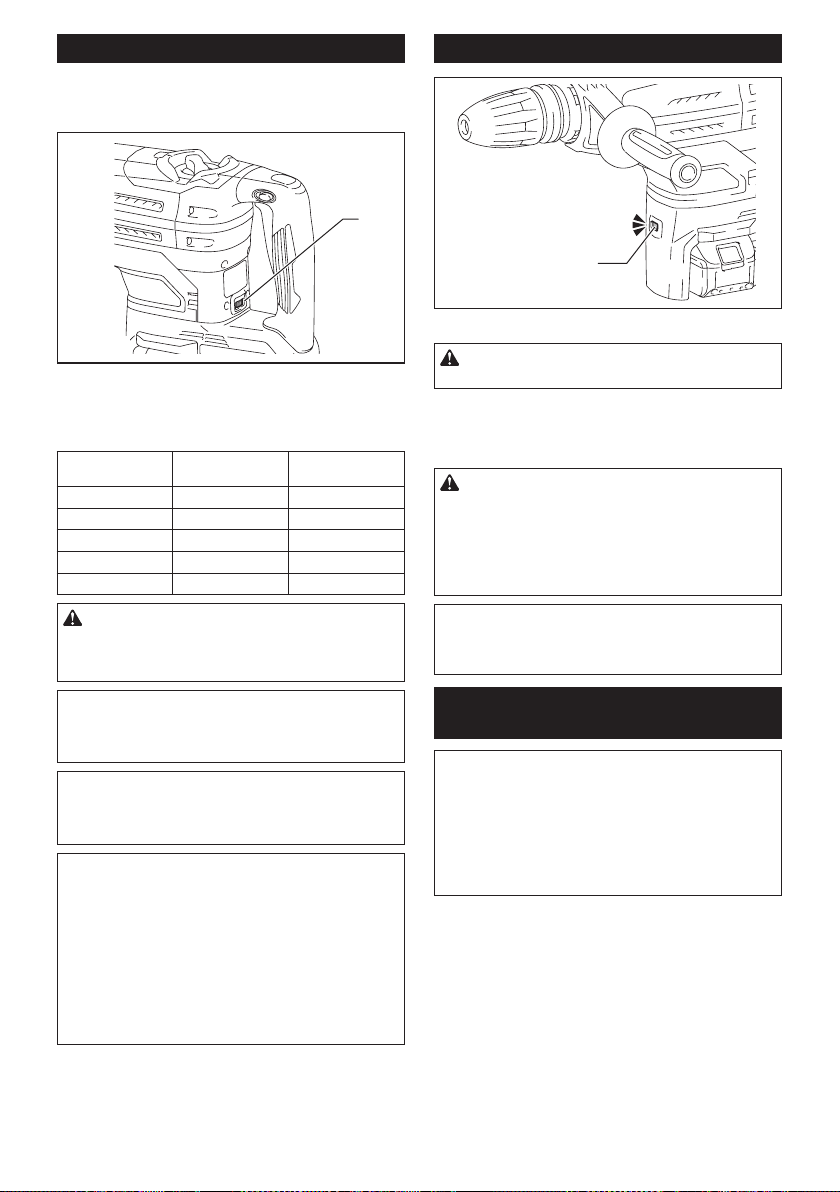
27 ESPAÑOL
Cambio de velocidad
Lasrevolucionesygolpesporminutosepuedenajustar
girandoelselectordeajuste.Elselectorestámarcado
del1(velocidadmásbaja)al5(velocidadmásalta).
1
►1.Selectordeajuste
Consulte la tabla a continuación para ver la relación
entreelnúmeroenelselectordeajusteylasrevolucio-
nesygolpesporminuto.
Número Revoluciones por
minuto
Golpes por minuto
5 500 2 900
4 470 2 700
3 380 2 150
2 290 1 650
1 250 1 450
PRECAUCIÓN: No gire el selector de ajuste
cuando la herramienta esté funcionando. De lo
contrario, podría resultar en la pérdida de control
de la herramienta y ocasionar una lesión.
AVISO: Si la herramienta es operada a baja velo-
cidad de forma continua durante un tiempo pro-
longado, el motor se sobrecargará provocando
que la herramienta se averíe.
AVISO: El selector de ajuste de velocidad solo
puede girarse hasta 5 y de regreso a 1. No lo
fuerce más allá de 5 o 1 o la función de ajuste de
velocidad podría dejar de funcionar.
NOTA: Función de rotación suave sin carga
Cuandoelselectordeajustedevelocidadestáajus-
tadoen“3”omás,laherramientaautomáticamente
reducelavelocidadavelocidadsincargaande
disminuir la vibración en esta modalidad. Cuando la
operación comienza con una punta contra concreto,
losgolpesporminutoseincrementanyalcanzan
los números que se muestran en la tabla. Cuando la
temperaturaesbajayhaymenosuidezdegrasa,la
herramientapodríanotenerestafunciónaunconel
motor girando.
Iluminación de la luz delantera
1
►1. Luz
PRECAUCIÓN: No mire a la luz ni vea a la
fuente de luz directamente.
Jale el gatillo interruptor para encender la luz. La luz
continúailuminándosemientrasseestájalandoel
gatillo interruptor. La luz se apaga aproximadamente 10
segundos tras haber liberado el gatillo interruptor.
PRECAUCIÓN: Si la lámpara se apaga des-
pués de parpadear durante algunos segundos,
la tecnología de detección de retroalimentación
activa o la función de rotación suave sin carga
no está funcionando correctamente. Solicite la
reparación al centro de servicio Makita de su
localidad.
NOTA: Utilice un paño seco para quitar la suciedad
delalentedelalámpara.Tengacuidadodenorayar
lalentedelalámparayaquelailuminaciónpodría
disminuir.
Selección del modo de
accionamiento
AVISO: No gire la perilla de cambio de modo de
accionamiento cuando la herramienta esté en
marcha.Estopodríacausardañosalaherramienta.
AVISO: Para evitar un desgaste rápido del meca-
nismo de cambio de modo, asegúrese siempre
de que la perilla de cambio de modo de acciona-
miento se encuentre realmente ubicada en una de
las tres posiciones del modo de accionamiento.
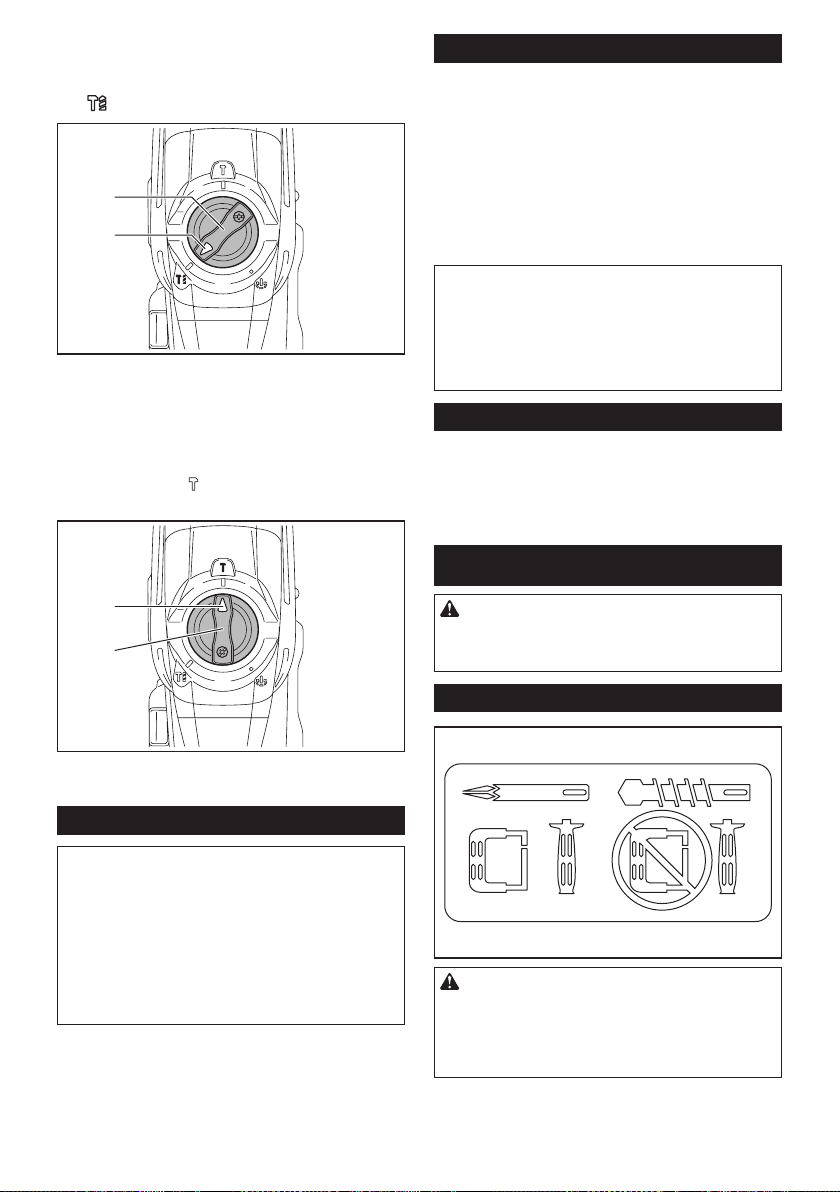
28 ESPAÑOL
Rotación con percusión
Paraperforarenconcreto,mampostería,etc.,girela
perilladecambiodemododeaccionamientoalsím-
bolo
. Utilice una broca con punta de carburo.
1
2
►1. Perilla de cambio de modo de accionamiento
2. Indicador
Sólo percusión
Para operaciones de cincelado, desincrustación o
demolición, gire la perilla de cambio de modo de accio-
namientoalsímbolo
. Utilice un cincel de punta,
cincel plano, cincel de desincrustación, etc.
1
2
►1. Indicador 2. Perilla de cambio de modo de
accionamiento
Limitador de torsión
AVISO: En cuanto el limitador de torsión se
accione, apague de inmediato la herramienta.
Estoayudaráaevitareldesgasteprematurodela
herramienta.
AVISO: Las brocas tales como las de sierra
perforadora, las cuales tienden a atorarse o
engancharse fácilmente en el agujero, no son
adecuadas para esta herramienta. Esto es debido
a que pueden provocar que el limitador de torsión se
accione con demasiada frecuencia.
Ellimitadordetorsiónseaccionaráunavezquese
alcance un cierto nivel de torsión. El motor se desen-
gancharádelejedesalida.Cuandoestosuceda,la
brocadejarádegirar.
Funcionamiento electrónico
Laherramientaestáequipadaconfuncioneselectróni-
cas para facilitar la operación.
• Control de velocidad constante
La función de control de velocidad permite una
rotación constante independientemente de las
condiciones de carga.
• Tecnologíadedetecciónderetroalimentación
activa
Si la herramienta gira a la aceleración predetermi-
nadadurantelaoperación,elmotorserádetenido
forzadamente para reducir la carga en la muñeca.
NOTA:Estafunciónnoservirásilaaceleraciónno
alcanza la predeterminada al girar la herramienta.
NOTA: Si la punta gira a la aceleración predetermi-
nada durante el cincelado, la desincrustación o la
demolición,elmotorserádetenidoforzadamente.En
estecaso,suelteelgatillointerruptoryluegojálelo
para reiniciar la herramienta.
Freno eléctrico
Laherramientaestáequipadaconunfrenoeléctrico.Si
la herramienta falla constantemente en detenerse tras
soltar el gatillo interruptor, lleve la herramienta a mante-
nimiento a un centro de servicio Makita.
MONTAJE
PRECAUCIÓN: Asegúrese siempre de que la
herramienta esté apagada y el cartucho de batería
haya sido extraído antes de realizar cualquier
trabajo en la misma.
Mango lateral
PRECAUCIÓN: Utilice el mango lateral única-
mente para operaciones de cincelado, desincrus-
tación o demolición. No lo utilice para perforar
concreto, mampostería, etc. La herramienta no
puedesujetarseadecuadamenteconestemango
lateral al momento de perforar.

29 ESPAÑOL
1
2
►1. Mango lateral 2.Tuercadejación
El mango lateral puede girarse 360° de manera verti-
calyasegurarseencualquierposiciónquesedesee.
Tambiénpuedejarseenochodiferentesposiciones
haciaatrásyhaciaadelantedemanerahorizontal.
Aojelatuercadejaciónparagirarelmangolaterala
laposicióndeseadayluegoaprietelatuercadejación
rmemente.
Empuñadura lateral (mango auxiliar)
PRECAUCIÓN: Utilice siempre la empuña-
dura lateral para garantizar una operación segura.
PRECAUCIÓN: Después de instalar o ajustar
la empuñadura lateral, asegúrese de que quede
rmemente asegurada.
La empuñadura lateral gira alrededor de ambos lados
permitiendounfácilmanejodelaherramientaencual-
quierposición.Aojelaempuñaduralateralgirándola
ensentidoinversoaldelasmanecillasdelreloj,gírela
alaposicióndeseadayluegoapriételagirándolaenel
sentidodelasmanecillasdelreloj.
1
►1. Empuñadura lateral
Grasa
Aplique previamente una pequeña cantidad de grasa
(alrededor de 0,5 g - 1 g) en el extremo de la espiga de
la broca.
La lubricación del portabrocas asegura un acciona-
mientosuaveyunavidaútilmáslarga.
Instalación o extracción de la broca
Limpieelextremodelaespigadelabrocayaplique
grasa antes de instalar la broca.
1
2
►1. Extremo de la espiga 2. Grasa
Insertelabrocaenlaherramienta.Girelabrocay
empújelahaciaadentrohastaquequedeenganchada.
Después de instalar la broca, asegúrese siempre de
que la broca quede asegurada en su lugar intentando
jalarlahaciaafuera.
1
►1. Broca
Paraextraerlabroca,jalehastaabajolacubiertadel
portabrocasyjalelabrocahaciaafuera.
1
2
►1. Broca 2. Cubierta del portabrocas
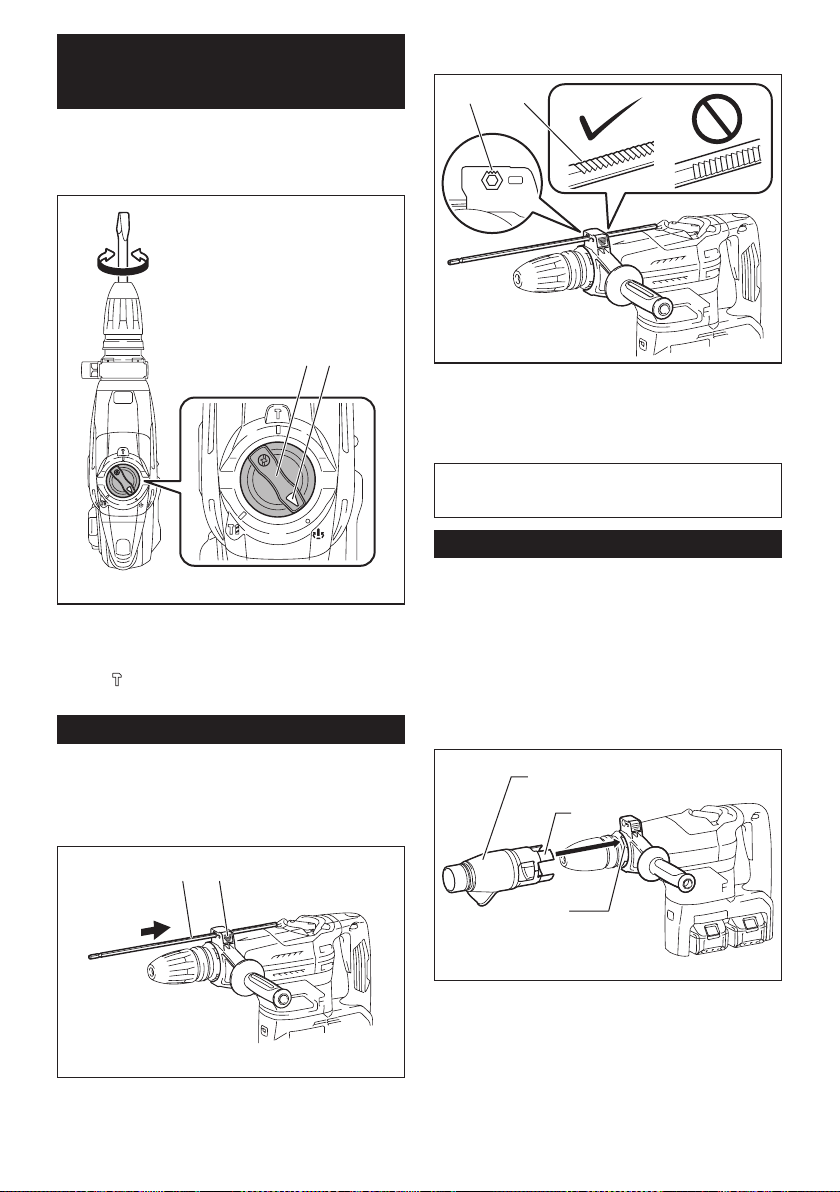
30 ESPAÑOL
Ángulo del cincel (durante el
cincelado, desincrustación o
demolición)
Elcincelpuedejarseenelángulodeseado.Para
cambiarelángulodelcincel,girelaperilladecambiode
mododeaccionamientoalsímboloO.Gireelcincelal
ángulodeseado.
1 2
►1. Perilla de cambio de modo de accionamiento
2. Indicador
Gire la perilla de cambio de modo de accionamiento al
símbolo
. Luego asegúrese de que el cincel quede
aseguradoensulugargirándololigeramente.
Calibrador de profundidad
Elcalibradordeprofundidadsirveparaperforaroricios
de profundidad uniforme.
Oprimaymantengaoprimidoelbotóndebloqueoy
luegoinserteelcalibradordeprofundidadeneloricio
hexagonal.
1 2
►1. Calibrador de profundidad 2. Botón de bloqueo
Asegúrese de que el lado dentado del calibrador de
profundidad quede de frente a la marca.
12
►1. Marca 2. Lado dentado
Ajusteelcalibradordeprofundidadmoviéndolohacia
atrásyhaciaadelantemientrasoprimeelbotóndeblo-
queo.Despuésdeajustarlo,suelteelbotóndebloqueo
para bloquear el calibrador de profundidad.
NOTA: Asegúrese de que el calibrador de profundi-
dad no toque el cuerpo principal de la herramienta al
momentodejarlo.
Accesorio del extractor de polvo
Accesorio opcional
Instalación del accesorio del
extractor de polvo
1. Aojelaempuñaduralateralenlaherramienta.
2. Instale la cubierta contra polvo de manera que
laspartessalientesdelacubiertacontrapolvoencajen
enlasranurasentrelaherramientaylaempuñadura
lateral.
1
2
3
►1. Cubierta contra polvo 2. Parte saliente 3. Ranura
3. Aprietelaempuñaduralateralrmemente.
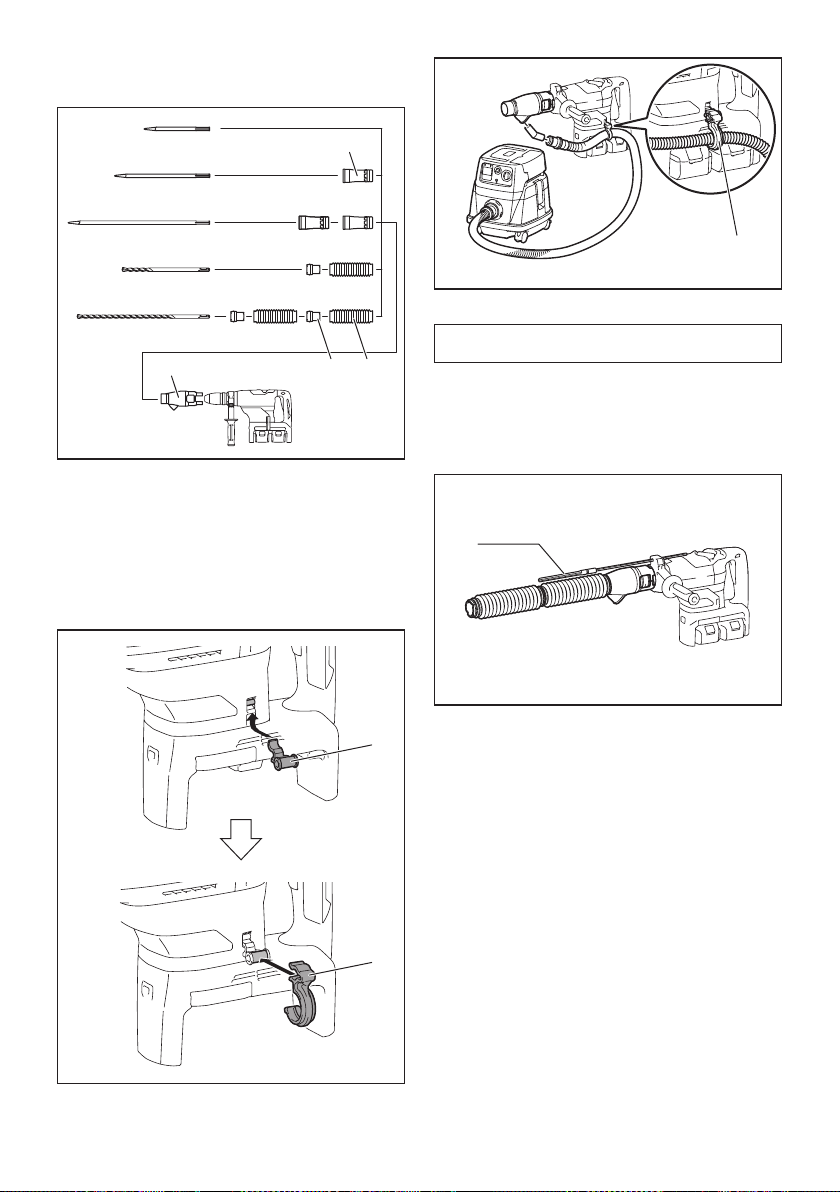
31 ESPAÑOL
4. Instale el fuelle o extensión para la cubierta contra
polvoadecuadosparasutrabajo.Cuandoutiliceun
fuelle,instalelajuntaasupartesuperior.Cuandoapile
dosfuelles,conéctelosconlajunta.
1
2
34
►1. Extensión para la cubierta contra polvo
2. Cubierta contra polvo 3. Junta 4. Fuelle
Conexión de la herramienta a la
aspiradora
1. Coloquelajuntadelsujetadorenlaherramientay
luegocoloqueelsujetadordelamangueraenlajunta
delsujetador.
1
2
►1.Juntadelsujetador2.Sujetadordelamanguera
2. Fijelamangueraenelsujetadordelamanguera.
1
►1.Sujetadordelamanguera
NOTA:Utiliceunajunta25paraconectarlaman-
gueraylacubiertacontrapolvosiesnecesario.
Uso del calibrador de profundidad
para operaciones de perforación
Cuando apile dos fuelles, conecte la extensión del cali-
brador de profundidad al calibrador de profundidad.
1
►1. Extensión del calibrador de profundidad
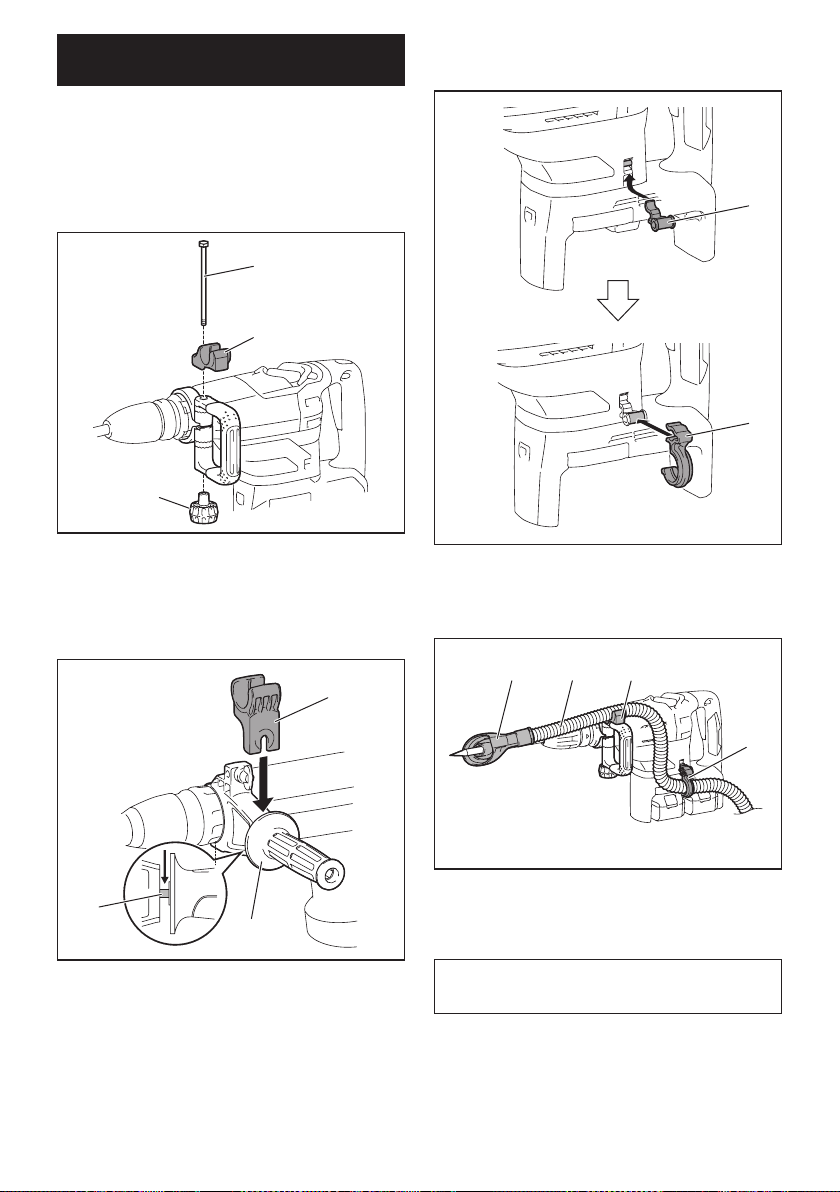
32 ESPAÑOL
Accesorio del extractor de polvo
(únicamente para percusión)
Accesorio opcional
1. Instaleelsujetadordelamanguera.
Cuando el mango lateral esté instalado en la herra-
mienta,aojelatuercadejaciónyluegoextraigael
pernohexagonal.Instaleelsujetadordelamanguera
conelpernohexagonalylatuercadejaciónapretando
latuercadejaciónrmemente.
1
2
3
►1. Perno 2.Sujetadordelamanguera3. Tuerca de
jación
Cuando la empuñadura lateral esté instalada en la
herramienta,aojelaempuñaduralateral,instaleel
sujetadordelamangueraenelejeyluegoaprietela
empuñaduralateralrmemente.
1
2
3
►1.Sujetadordelamanguera2.Eje3. Empuñadura
lateral
2. Coloquelajuntadelsujetadorenlaherramientay
luegocoloqueelsujetadordelamangueraenlajunta
delsujetador.
1
2
►1.Juntadelsujetador2.Sujetadordelamanguera
3. Instalelacubiertacontrapolvoylamangueraen
laherramientayluegojelamangueraalossujetado-
res de la manguera.
1
2 3
3
►1. Cubierta contra polvo 2. Manguera 3.Sujetador
de la manguera
4. Conecte la manguera a la manguera de la aspira-
doraconlajuntadelamanguera.
NOTA: Si la manguera no viene incluida, conecte la
cubiertacontrapolvoalajuntadelaaspiradoraoala
manguera ø28 Makita.

33 ESPAÑOL
5. Ajusteladistanciaentrelacubiertacontrapolvoy
la punta del cincel o cincel de punta. La distancia reco-
mendadaesde30mm(1-3/16″)a100mm(3-15/16″).
(1)
►(1)30mm(1-3/16″)a100mm(3-15/16″)
OPERACIÓN
PRECAUCIÓN: Utilice siempre la empuña-
dura lateral (mango auxiliar) y sujete rmemente
la herramienta tanto de la empuñadura lateral
como del mango del interruptor durante las
operaciones.
PRECAUCIÓN: Asegúrese siempre de que
la pieza de trabajo quede asegurada antes de la
operación.
PRECAUCIÓN: No jale hacia afuera la herra-
mienta con demasiada fuerza aun si la punta
se atora. La pérdida de control podría causar
lesiones.
NOTA:Sielcartuchodebateríaseencuentraabaja
temperatura,laherramientapodríanoalcanzarsu
máximacapacidad.Enestecaso,calienteelcartucho
debateríausandolaherramientasincargadurante
unratoandelograrquelaherramientaalcancesu
máximacapacidad.
Operación de taladrado con
percusión
PRECAUCIÓN: En el momento de comenzar
apenetrar,cuandoseobstruyeeloricioconviru-
tasypartículas,ocuandosetopacontravarillas
derefuerzodeconcreto,seejerceunatremenday
repentina fuerza de torsión sobre la herramienta/
broca. Utilice siempre la empuñadura lateral
(mango auxiliar) y sujete rmemente la herra-
mienta tanto de la empuñadura lateral como del
mango del interruptor durante las operaciones. El
no hacerlo puede provocar la pérdida de control de
laherramientaypotencialmenteocasionarlesiones
graves.
Ajustelaperilladecambiodemododeaccionamiento
enelsímbolo
.
Coloquelabrocadondedeseehacerelagujeroyluego
jaleelgatillointerruptor.Nofuercelaherramienta.Los
mejoresresultadosseobtienenconunaligerapresión.
Mantengalaherramientaenposiciónyevitequese
desliceysesalgadelagujero.
Noapliquemáspresióncuandoelagujeroseobstruya
conastillasopartículas.Envezdeesto,hagafuncionar
laherramientasinpresiónyluegoretireparcialmente
labrocadelagujero.Repitiendoestovariasveces,el
agujeroselimpiaráysepodráreanudareltaladradode
manera normal.
NOTA: Es posible que se produzca excentricidad en
la rotación de la broca al operar la herramienta sin
carga.Laherramientasecentraráautomáticamente
durantelaoperación.Estonoafectarálaprecisiónen
el taladrado.
Cincelado/desincrustación/
demolición
Ajustelaperilladecambiodemododeaccionamiento
enelsímbolo
.
Sujetelaherramientarmementeconambasmanos.
Enciendalaherramientayapliqueunaligerapresión
sobre ella de manera que no rebote de forma descon-
trolada.
Aplicar mucha presión sobre la herramienta no incre-
mentarálaeciencia.
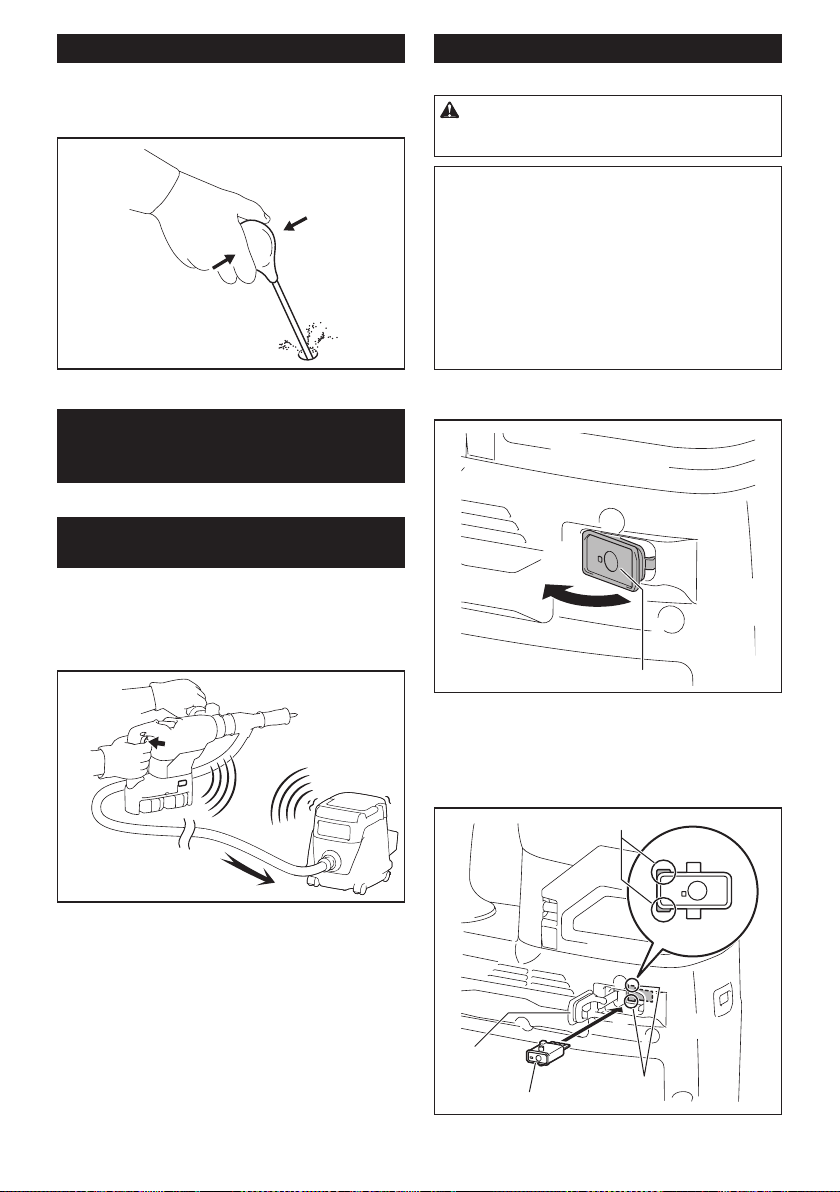
34 ESPAÑOL
Soplador
Accesorio opcional
Despuésdeperforarelagujero,utiliceelsopladorpara
limpiarelpolvodelagujero.
FUNCIÓN DE ACTIVACIÓN
INALÁMBRICA
Accesorio opcional
Lo que puede hacer con la función
de activación inalámbrica
Lafuncióndeactivacióninalámbricapermiteunaope-
raciónlimpiaycómoda.Siconectaalaherramienta
unaaspiradoracompatible,podráhacerqueésta
funcioneautomáticamentealactivarelinterruptordela
herramienta.
Parahacerusodelafuncióndeactivacióninalámbrica,
tenga preparado lo siguiente:
• Unaunidadinalámbrica(accesoriosopcionales)
• Una aspiradora compatible con la función de
activacióninalámbrica
A continuación se presenta la descripción general del
ajustedelafuncióndeactivacióninalámbrica.Consulte
cada sección para ver los procedimientos a detalle.
1. Instalacióndelaunidadinalámbrica
2. Registro de la herramienta para la aspiradora
3. Iniciodelafuncióndeactivacióninalámbrica
Instalación de la unidad inalámbrica
Accesorio opcional
PRECAUCIÓN: Coloque la herramienta sobre
una supercie plana y estable cuando vaya a
instalar la unidad inalámbrica.
AVISO:
Limpie el polvo y la suciedad en la herra-
mienta antes de instalar la unidad inalámbrica. El
polvoolasuciedadpodríancausarunaaveríasillegan
aintroducirseenlaranuradelaunidadinalámbrica.
AVISO:
Para evitar una avería a causa de la elec-
tricidad estática, toque un material de descarga de
electricidad estática, tal como una pieza metálica de la
herramienta antes de levantar la unidad inalámbrica.
AVISO:
Cuando vaya a instalar la unidad inalámbrica,
asegúrese siempre de que ésta sea insertada en la direc-
ción correcta y que la tapa esté completamente cerrada.
1. Abra la tapa en la herramienta tal como se mues-
tra en la ilustración.
1
►1. Tapa
2. Insertelaunidadinalámbricaenlaranurayluego
cierre la tapa.
Cuandoinsertelaunidadinalámbrica,alineelaspartes
salientes con las partes cóncavas en la ranura.
1
2
3
4
►
1.Unidadinalámbrica2. Parte saliente 3. Tapa 4. Parte cóncava

35 ESPAÑOL
Cuandoextraigalaunidadinalámbrica,abralatapa
lentamente. Los ganchos en la parte posterior de la
tapalevantaránlaunidadinalámbricamientrasusted
jalahaciaarribalatapa.
1
2
3
►1.Unidadinalámbrica2. Gancho 3. Tapa
Unavezextraídalaunidadinalámbrica,guárdelaenel
estuche suministrado o en un contenedor libre de elec-
tricidadestática.
AVISO: Use siempre los ganchos en la parte
posterior de la tapa cuando extraiga la unidad
inalámbrica.Silosganchosnosujetanlaunidad
inalámbrica,cierrelatapaporcompletoyvuelvaa
abrirla lentamente.
Registro de la herramienta para la
aspiradora
NOTA: Para el registro de la herramienta, se requiere
una aspiradora Makita compatible con la función de
activacióninalámbrica.
NOTA:Terminedeinstalarlaunidadinalámbricaen
la herramienta antes de comenzar con el registro de
la herramienta.
NOTA:Duranteelregistrodelaherramienta,nojale
el gatillo interruptor ni active el interruptor de encen-
dido en la aspiradora.
NOTA: Consulte también el manual de instrucciones
de la aspiradora.
Sideseaactivarlaaspiradorajuntoconelinterruptor
de la herramienta, termine antes con el registro de la
herramienta.
1. Instalelasbateríasenlaaspiradorayenla
herramienta.
2. Ajusteelinterruptordemodoenesperaenlaaspi-
radora en “AUTO”.
1
►1. Interruptor de modo en espera
3. Oprimaelbotóndeactivacióninalámbricaenla
aspiradora durante 3 segundos hasta que la luz indica-
doradeactivacióninalámbricaparpadeeenverde.Y
luegooprimaelbotóndeactivacióninalámbricaenla
herramienta de la misma manera.
1 2
1
2
►1.Botóndeactivacióninalámbrica2. Luz indica-
doradeactivacióninalámbrica
Silaaspiradoraylaherramientahansidoconectadas
exitosamente, las luces indicadoras de activación ina-
lámbricaseencenderánenverdedurante2segundosy
comenzaránaparpadearenazul.

36 ESPAÑOL
NOTA:Laslucesindicadorasdeactivacióninalám-
bricaterminaránparpadeandoenverdedespuésde
un lapso de 20 segundos. Oprima el botón de acti-
vacióninalámbricaenlaherramientamientraslaluz
indicadoradeactivacióninalámbricaenlaaspiradora
esté parpadeando. Si la luz indicadora de activación
inalámbricanoparpadeaenverde,oprimaelbotón
deactivacióninalámbricaduranteunlapsobrevey
vuelva a mantenerlo oprimido.
NOTA:Cuandorealicedosomásregistrosdela
herramienta para una aspiradora, termine el registro
de la herramienta de uno en uno.
Inicio de la función de activación
inalámbrica
NOTA: Termine con el registro de la herramienta para
laaspiradoraantesdelaactivacióninalámbrica.
NOTA: Consulte también el manual de instrucciones
de la aspiradora.
Después de registrar una herramienta en la aspiradora,
estaúltimaseactivaráautomáticamentejuntoconel
interruptor de la herramienta.
1. Instalelaunidadinalámbricaenlaherramienta.
2. Conecte la manguera de la aspiradora a la
herramienta.
3. Ajusteelinterruptordemodoenesperaenlaaspi-
radora en “AUTO”.
1
►1. Interruptor de modo en espera
4. Oprimaelbotóndeactivacióninalámbricaenla
herramienta durante un lapso breve. La luz indicadora
deactivacióninalámbricaparpadearáenazul.
12
►1.Botóndeactivacióninalámbrica2. Luz indica-
doradeactivacióninalámbrica
5. Jale el gatillo interruptor de la herramienta.
Veriquequelaaspiradorafuncionemientrasjalael
gatillo interruptor.
Paradetenerlaactivacióninalámbricadelaaspira-
dora,oprimaelbotóndeactivacióninalámbricaenla
herramienta.
NOTA:Laluzindicadoradeactivacióninalámbricaen
laherramientadejarádeparpadearenazulcuando
nohayaoperacióndurante2horas.Enestecaso,
ajusteelinterruptordemodoenesperaenlaaspi-
radoraen“AUTO”yoprimaelbotóndeactivación
inalámbricaenlaherramientanuevamente.
NOTA:Laaspiradorafuncionará/detendráconun
retraso.Existiráundesfasecuandolaaspiradora
detecte la activación del interruptor de la herramienta.
NOTA: La distancia de transmisión de la unidad
inalámbricapodrávariarenfuncióndellugarylas
circunstancias de los alrededores.
NOTA:Cuandodosomásherramientasestén
registradasenunaaspiradora,estaúltimapodrá
comenzarafuncionarinclusosiustednojalaelgatillo
interruptordebidoaqueotrousuarioestáutilizando
lafuncióndeactivacióninalámbrica.
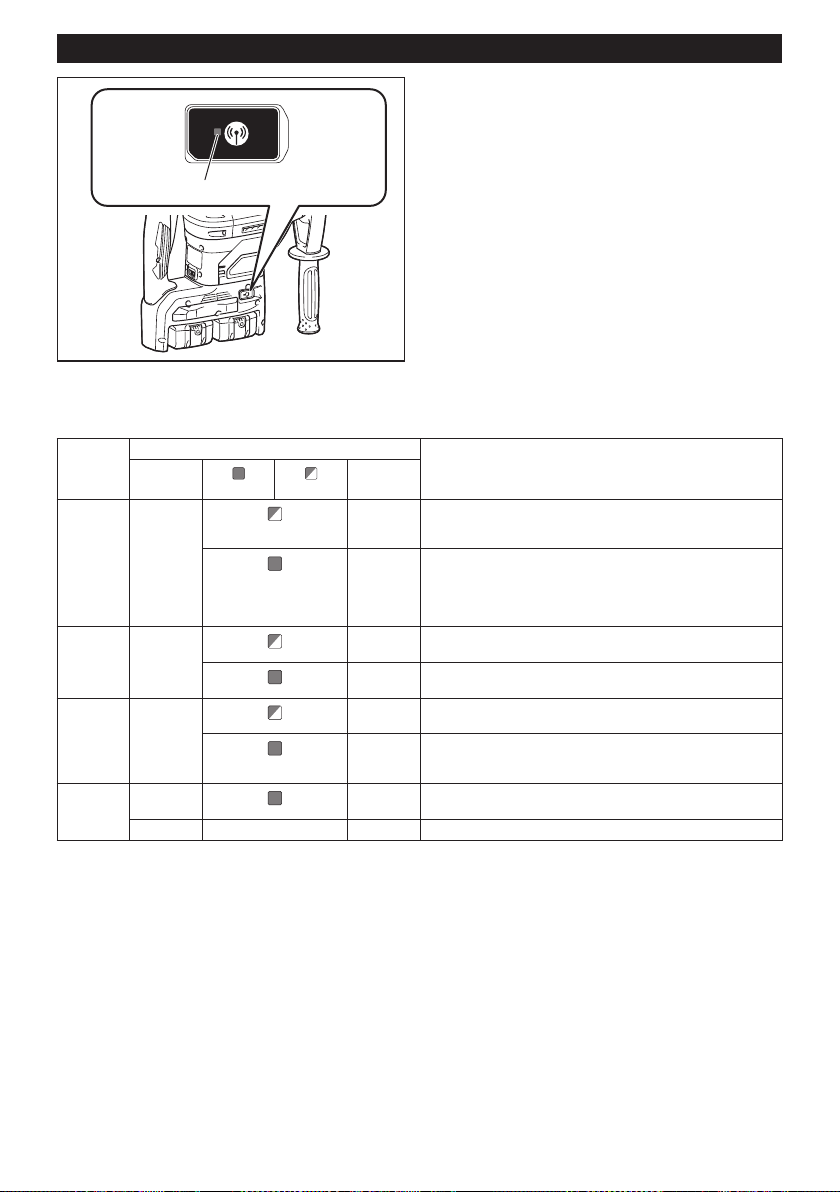
37 ESPAÑOL
Descripción del estado de la luz indicadora de activación inalámbrica
1
►1.Luzindicadoradeactivacióninalámbrica
Laluzindicadoradeactivacióninalámbricamuestraelestadodelafuncióndeactivacióninalámbrica.Consultela
tablaacontinuaciónparaverquésignicaelestadodelaluzindicadora.
Estado Luz indicadora de activación inalámbrica Descripción
Color
Encendida
Parpadeando
Duración
En espera Azul
2 horas Laactivacióninalámbricadelaaspiradoraestádisponible.La
luzseapagaráautomáticamentecuandonoserealiceninguna
operación durante 2 horas.
Cuando
la herra-
mienta
estáfun-
cionando.
Laactivacióninalámbricadelaaspiradoraestádisponibleyla
herramientaestáfuncionando.
Registro
de la
herramienta
Verde
20
segundos
Ya se puede realizar el registro de la herramienta. Esperando el
registro por parte de la aspiradora.
2
segundos
El registro de la herramienta ha terminado. La luz indicadora de
activacióninalámbricacomenzaráaparpadearenazul.
Cancelación
del regis-
tro de la
herramienta
Rojo 20
segundos
Ya se puede cancelar el registro de la herramienta. Esperando la
cancelación por parte de la aspiradora.
2
segundos
La cancelación del registro de la herramienta ha terminado. La
luzindicadoradeactivacióninalámbricacomenzaráaparpadear
en azul.
Otros Rojo
3
segundos
Laenergíaessuministradaalaunidadinalámbricaylafunción
deactivacióninalámbricaestáarrancando.
Apagada - - Laactivacióninalámbricadelaaspiradorasehadetenido.
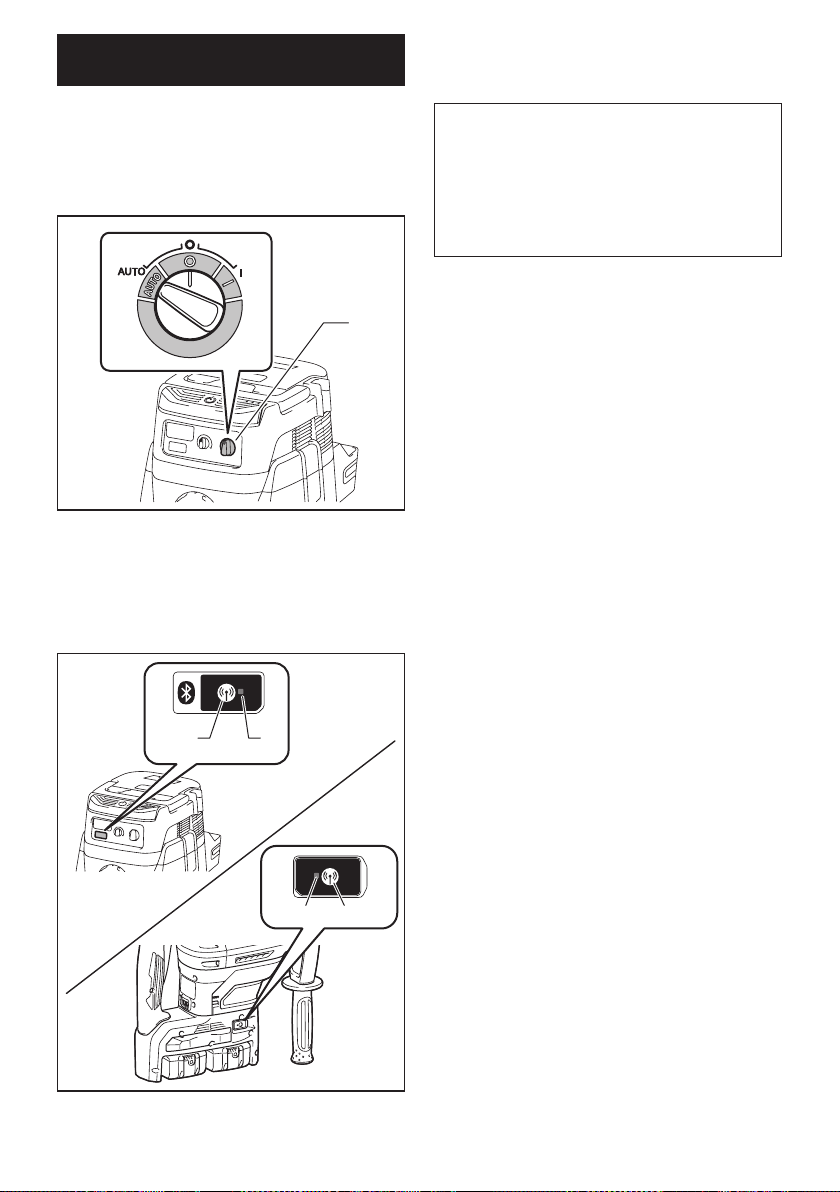
38 ESPAÑOL
Cancelación del registro de la
herramienta para la aspiradora
Realice el siguiente procedimiento para cancelar el
registro de la herramienta para la aspiradora.
1. Instalelasbateríasenlaaspiradorayenla
herramienta.
2. Ajusteelinterruptordemodoenesperaenlaaspi-
radora en “AUTO”.
1
►1. Interruptor de modo en espera
3. Oprimaelbotóndeactivacióninalámbricaenla
aspiradora durante 6 segundos. La luz indicadora de
activacióninalámbricaparpadearáenverdeyluegose
pondráenrojo.Despuésdeeso,oprimaelbotónde
activacióninalámbricaenlaherramientadelamisma
manera.
1 2
1
2
►1.Botóndeactivacióninalámbrica2. Luz indica-
doradeactivacióninalámbrica
Si la cancelación se realiza exitosamente, las luces
indicadorasdeactivacióninalámbricaseencenderán
enrojodurante2segundosycomenzaránaparpadear
en azul.
NOTA:Laslucesindicadorasdeactivacióninalám-
bricaterminaránparpadeandoenrojodespuésdeun
lapso de 20 segundos. Oprima el botón de activación
inalámbricaenlaherramientamientraslaluzindi-
cadoradeactivacióninalámbricaenlaaspiradora
esté parpadeando. Si la luz indicadora de activación
inalámbricanoparpadeaenrojo,oprimaelbotón
deactivacióninalámbricaduranteunlapsobrevey
vuelva a mantenerlo oprimido.

39 ESPAÑOL
Detección y solución de problemas para la función de activación inalámbrica
Antes de solicitar alguna reparación, primero realice una inspección por su cuenta. Si detecta algún problema que
no esté explicado en el manual, no intente desensamblar la herramienta. En vez de esto, solicite la reparación a un
centro de servicio autorizado de Makita, usando siempre piezas de repuesto Makita.
Estado de la anomalía Causa probable (avería) Remedio
La luz indicadora de activación ina-
lámbricanoenciende/parpadea.
Launidadinalámbricanoestáinstalada
en la herramienta.
Launidadinalámbricaestáinstalada
incorrectamente en la herramienta.
Instalelaunidadinalámbricacorrectamente.
Laterminaldelaunidadinalámbricay/o
laranuraestásucia.
Retireconcuidadoelpolvoylasuciedadenla
terminaldelaunidadinalámbricaylimpielaranura.
Elbotóndeactivacióninalámbricaenla
herramienta no se ha oprimido.
Oprimaelbotóndeactivacióninalámbricaenla
herramienta durante un lapso breve.
El interruptor de modo en espera en la
aspiradoranoestáajustadoen“AUTO”.
Ajusteelinterruptordemodoenesperaenla
aspiradora en “AUTO”.
Nohaysuministrodeenergía. Suministreenergíaalaherramientayala
aspiradora.
No se puede terminar/cancelar
el registro de la herramienta
exitosamente.
Launidadinalámbricanoestáinstalada
en la herramienta.
Launidadinalámbricaestáinstalada
incorrectamente en la herramienta.
Instalelaunidadinalámbricacorrectamente.
Laterminaldelaunidadinalámbricay/o
laranuraestásucia.
Retireconcuidadoelpolvoylasuciedadenla
terminaldelaunidadinalámbricaylimpielaranura.
El interruptor de modo en espera en la
aspiradoranoestáajustadoen“AUTO”.
Ajusteelinterruptordemodoenesperaenla
aspiradora en “AUTO”.
Nohaysuministrodeenergía. Suministreenergíaalaherramientayala
aspiradora.
Operación incorrecta Oprimaelbotóndeactivacióninalámbricadurante
unlapsobreveyrealicelosprocedimientosde
registro/cancelación de la herramienta nuevamente.
Laherramientaylaaspiradoraestán
lejosunadelaotra(fueradelrangode
transmisión).
Acerquemáslaherramientaalaaspiradora.La
distanciamáximadetransmisiónesdeaproxima-
damente 10 m, pero puede variar en función de las
circunstancias.
Antes de terminar el registro/cancela-
ción de la herramienta;
- el gatillo interruptor en la herramienta
sehajalado;o
- el botón de encendido en la aspira-
doraestáactivado.
Oprimaelbotóndeactivacióninalámbricadurante
unlapsobreveyrealicelosprocedimientosde
registro/cancelación de la herramienta nuevamente.
Los procedimientos de registro para
la herramienta o aspiradora no se han
terminado.
Realice los procedimientos de registro tanto para
la herramienta como para la aspiradora al mismo
tiempo.
La perturbación radioeléctrica generada
por otros aparatos que emiten ondas de
radio de alta intensidad.
Mantengalaherramientaylaaspiradoralejosde
aparatostalescomodispositivosWi-Fiyhornosde
microondas.

40 ESPAÑOL
Estado de la anomalía Causa probable (avería) Remedio
Laaspiradoranofuncionajuntocon
el interruptor de la herramienta.
Launidadinalámbricanoestáinstalada
en la herramienta.
Launidadinalámbricaestáinstalada
incorrectamente en la herramienta.
Instalelaunidadinalámbricacorrectamente.
Laterminaldelaunidadinalámbricay/o
laranuraestásucia.
Retireconcuidadoelpolvoylasuciedadenla
terminaldelaunidadinalámbricaylimpielaranura.
Elbotóndeactivacióninalámbricaenla
herramienta no se ha oprimido.
Oprimaelbotóndeactivacióninalámbricadurante
unlapsobreveyasegúresedequelaluzindicadora
deactivacióninalámbricaestéparpadeandoen
azul.
El interruptor de modo en espera en la
aspiradoranoestáajustadoen“AUTO”.
Ajusteelinterruptordemodoenesperaenla
aspiradora en “AUTO”.
Másde10herramientasestánregistra-
das en la aspiradora.
Vuelva a realizar el registro de la herramienta.
Simásde10herramientasestánregistradasenla
aspiradora, la herramienta registrada al principio se
cancelaráautomáticamente.
La aspiradora borró todos los registros
de la herramienta.
Vuelva a realizar el registro de la herramienta.
Nohaysuministrodeenergía. Suministreenergíaalaherramientayala
aspiradora.
Laherramientaylaaspiradoraestán
lejosunadelaotra(fueradelrangode
transmisión).
Acerquemáslaherramientaalaaspiradora.La
distanciamáximadetransmisiónesdeaproxima-
damente 10 m, pero puede variar en función de las
circunstancias.
La perturbación radioeléctrica generada
por otros aparatos que emiten ondas de
radio de alta intensidad.
Mantengalaherramientaylaaspiradoralejosde
aparatostalescomodispositivosWi-Fiyhornosde
microondas.
La aspiradora funciona aun cuando
el gatillo interruptor de la herra-
mientanohasidojalado.
Otrosusuariosestánusandolaactiva-
cióninalámbricadelaaspiradoracon
sus herramientas.
Apagueelbotóndeactivacióninalámbricadelas
demásherramientasocanceleelregistrodedichas
herramientas.
MANTENIMIENTO
PRECAUCIÓN: Asegúrese siempre de que la
herramienta esté apagada y el cartucho de batería
extraído antes de intentar realizar una inspección
o mantenimiento.
AVISO: Nunca use gasolina, bencina, diluyente
(tíner), alcohol o sustancias similares. Puede que
esto ocasione grietas o descoloramiento.
ParamantenerlaSEGURIDADyFIABILIDADdelpro-
ducto,lasreparaciones,ycualquierotratareademan-
tenimientooajustedeberánserrealizadasencentros
deservicioautorizadosodefábricaMakita,empleando
siempre repuestos Makita.
ACCESORIOS
OPCIONALES
PRECAUCIÓN: Estos accesorios o aditamen-
tos están recomendados para utilizarse con su
herramienta Makita especicada en este manual.
El empleo de cualquier otro accesorio o aditamento
puede conllevar el riesgo de lesiones personales.
Utilice los accesorios o aditamentos solamente para
sunestablecido.
Sinecesitacualquierayudaparamásdetallesen
relación con estos accesorios, pregunte a su centro de
servicio local Makita.
• Brocas con puntas de carburo SDS-MAX
• Cincel de punta SDS-MAX
• Cincel plano SDS-MAX
• Cincel de desincrustación SDS-MAX
• Pala de arcilla SDS-MAX
• Grasa para martillo
• Grasa para puntas
• Mango lateral
• Empuñadura lateral
• Calibrador de profundidad
• Soplador
• Accesorio del extractor de polvo
• Gafas de seguridad
• Unidadinalámbrica

41 ESPAÑOL
• BateríaycargadororiginalesdeMakita
• Maletíndetransportedeplástico
NOTA:Algunosdelosartículosenlalistapueden
incluirse en el paquete de la herramienta como acce-
soriosestándar.Éstospuedenvariardepaísapaís.
GARANTÍA LIMITADA DE MAKITA
Ésta Garantía no aplica para México
Consultelahojadelagarantíaanexaparaverlos
términosmásvigentesdelagarantíaaplicableaeste
producto.Encasodenodisponerdeestahojade
garantíaanexa,consultelosdetallessobrelagarantía
descritosenelsitiowebdesupaísrespectivoindicado
a continuación.
Estados Unidos de América: www.makitatools.com
Canadá:www.makita.ca
Otrospaíses:www.makita.com

42

43

Some dust created by power sanding, sawing, grinding, drilling, and other
construction activities contains chemicals known to the State of California
to cause cancer, birth defects or other reproductive harm. Some examples
of these chemicals are:
• lead from lead-based paints,
• crystalline silica from bricks and cement and other masonry products, and
• arsenic and chromium from chemically-treated lumber.
Your risk from these exposures varies, depending on how often you do this
type of work. To reduce your exposure to these chemicals: work in a well
ventilated area, and work with approved safety equipment, such as those
dust masks that are specially designed to filter out microscopic particles.
WARNING
< USA only >
ADVERTENCIA
Algunos polvos creados por el lijado, aserrado, esmerilado, taladrado y
otras actividades de la construcción contienen sustancias químicas
reconocidas por el Estado de California como causantes de cáncer, defectos
de nacimiento y otros peligros de reproducción. Algunos ejemplos de estos
productos químicos son:
• plomo de pinturas a base de plomo,
• sílice cristalino de ladrillos y cemento y otros productos de albañilería, y
• arsénico y cromo de maderas tratadas químicamente.
El riesgo al que se expone varía, dependiendo de la frecuencia con la que
realice este tipo de trabajo. Para reducir la exposición a estos productos
químicos: trabaje en un área bien ventilada y póngase el equipo de seguridad
indicado, tal como las máscaras contra polvo que están especialmente
diseñadas para filtrar partículas microscópicas.
< Sólo en los Estados Unidos >
Makita Corporation
3-11-8, Sumiyoshi-cho,
Anjo, Aichi 446-8502 Japan
www.makita.com
885685-948
XRH07-1
EN, ESMX
20180703