JVC
DVD DIGITAL THEATER SYSTEM
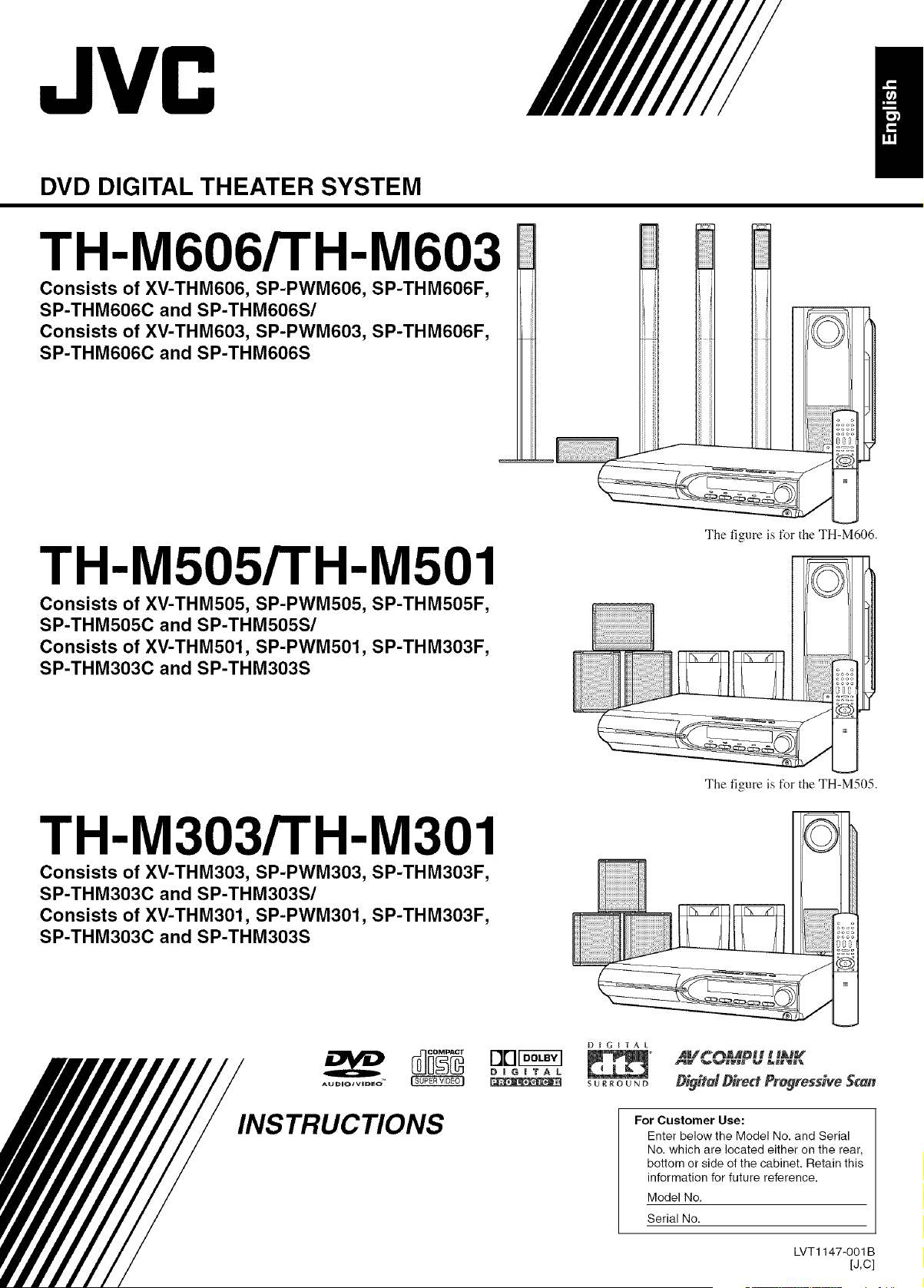
TH-M606/TH-M603
Consists of XV-THM606, SP-PWM606, SP-THM606F,
SP-THM606C and SP-THM606S/
Consists of XV-THM603, SP-PWM603, SP-THM606F,
SP-THM606C and SP-THM606S
TH-M505/TH-M501
Consists of XV-THM505, SP-PWM505, SP-THM505F,
SP-THM505C and SP-THM505S/
Consists of XV-THM501, SP-PWM501, SP-THM303F,
SP-THM303C and SP-THM303S
The figure is for the TH-M606.
TH-M303/TH-M301
Consists of XV-THM303, SP-PWM303, SP-THM303F,
SP-THM303C and SP-THM303S/
Consists of XV-THM301, SP-PWM301, SP-THM303F,
SP-THM303C and SP-THM303S
The figure is for the TH-M505.
IIIIIIII/I//
STRUCTIONS
D_GITAL
SURROUND
For Customer Use:
Enter below the Model No. and Serial
No. which are located either on the rear,
bottom or side of the cabinet. Retain this
information for future reference.
Model No.
Serial No.
LVT1147-001B
[J,C]
Warnings,CautionsandOthers
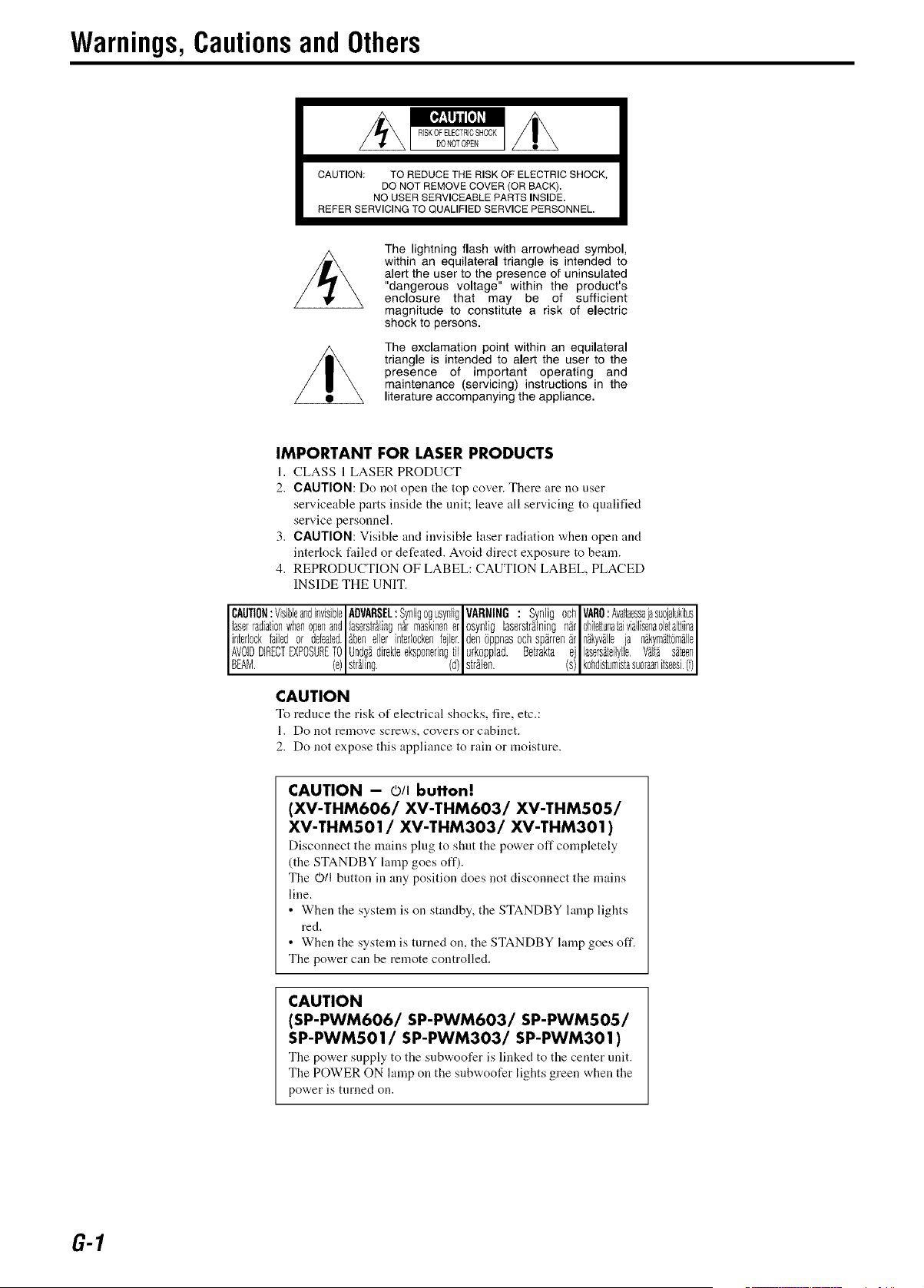
CAUTION: TO REDUCE THE RISK OF ELECTRIC SHOCK,
DO NOT REMOVE COVER (OR BACK).
NO USER SERVICEABLE PARTS INSIDE.
REFER SERVICING TO QUALIFIED SERVICE PERSONNEL.
The lightning flash with arrowhead symbol,
within an equilateral triangle is intended to
alert the user to the presence of uninsulated
"dangerous voltage" within the product's
enclosure that may be of sufficient
magnitude to constitute a risk of electric
shock to persons.
The exclamation point within an equilateral
triangle is intended to alert the user to the
presence of important operating and
maintenance (servicing) instructions in the
literature accompanying the appliance.
IMPORTANT FOR LASER PRODUCTS
1. CLASS 1 LASER PRODUCT
2. CAUTION: Do not open the top cover. There are no user
serviceable parts inside the unit; leave all servicing to qualified
service personnel.
3. CAUTION: Visible and invisible laser radiation when open and
interlock failed or defeated. Avoid direct exposure to beam.
4. REPRODUCTION OF LABEL: CAUTION LABEL, PLACED
INSIDE THE UNIT.
CAUTION: VsibleandinvisibleADVARSEL:Synligogusynig VARNING : Synlig och VARO:Ava_aessajasuojalukitus
l laserradiationwhenopenandI aserstr_lingn_r maskinenerIosynlig laserstr_lningndrI ohtdtunataivialisenaoetattiinaI
inlerlockfailedor defeated._beneller nterockenfeilendenOppnasochspdrrendr n_kyv_lleja n_kym_tt6m_lleI
AVOIDDIRECTEXPOSURETO Un@ direkteeksponerngtill urkopplad. Betrakta ej lasers_teiUle,V_lt_ s_teen
IBEAM. (e)Isir&ling. (d)lstr&len. (s)lKohdistumistasu0raanitse_si(i)I
CAUTION
To reduce the risk of electrical shocks, fire, etc.:
1. Do not remove screws, covers or cabinet.
2. Do not expose this appliance to rain or moisture.
CAUTION - 0/I button!
(XV-THM606/XV-THM603/XV-THM505/
XV-THM501 / XV-THM303/XV-THM301 )
Disconnect the mains plug to shut tile power oft" completely
(the STANDBY lamp goes off).
The ©/I button in any position does not disconnect the mains
line.
• When the system is on standby, the STANDBY lamp lights
red.
• When the system is turned on, the STANDBY lamp goes off.
The power can be remote controlled.
CAUTION
(SP-PWM606/SP-PWM603/SP-PWM505/
SP-PWM501 / SP-PWM303/SP-PWM301 )
The power supply to tile subwoofer is linked to the center unit.
The POWER ON lamp on the snbwoofer lights green when the
power is tnrned on.
G-1
Warnings,Cautionsand Others
WARNING: TO REDUCE THE RISK OF FIRE
OR ELECTRIC SHOCK, DO NOT EXPOSE
THIS APPLIANCE TO RAIN OR MOISTURE.
For U_S.A.
This equipment has been tested and found to comply with the
limits for a Class B digital device, pursuant to part 15 of the FCC
Rules. These limits are designed to provide reasonable
protection against harmful interference in a residential
installation.
This equipment generates, uses and can radiate radio frequency
energy and, if not installed and used in accordance with the
instructions, may cause harmful interference to radio
communications. However, there is no guarantee that
interference will not occur in a particular installation. If this
equipment does cause harmful interference to radio or television
reception, which can be determined by turning the equipment off
and on, the user is encouraged to try to correct the interference
by one or more of the following measures:
Reorient or relocate the receiving antenna.
Increase the separation between the equipment and receiver.
Connect the equipment into an outlet on a circuit different from
that to which the receiver is connected.
Consult the dealer or an experienced radio/TV technician for
help.
For Canada
CAUTION: TO PREVENT ELECTRIC SHOCK, MATCH
WIDE BLADE OF PLUG TO WIDE SLOT, FULLY INSERT.
For Canada
THIS DIGITAL APPARATUS DOES NOT EXCEED THE
CLASS B LIMITS FOR RADIO NOISE EMISSIONS FROM
DIGITAL APPARATUS AS SET OUT IN THE
INTERFERENCE-CAUSING EQUIPMENT STANDARD
ENTITLED "DIGITAL APPARATUS," ICES-003 OF THE
DEPARTMENT OF COMMUNICATIONS.
Note to CATV system installer:
This reminder is provided to call the CATV system installer's
attention to Section 820-40 of the NEC which provides
guidelines for proper grounding and, in particular, specifies
that the cable ground shall be connected to the grounding
system of the building, as close to the point of cable entry as
practical.
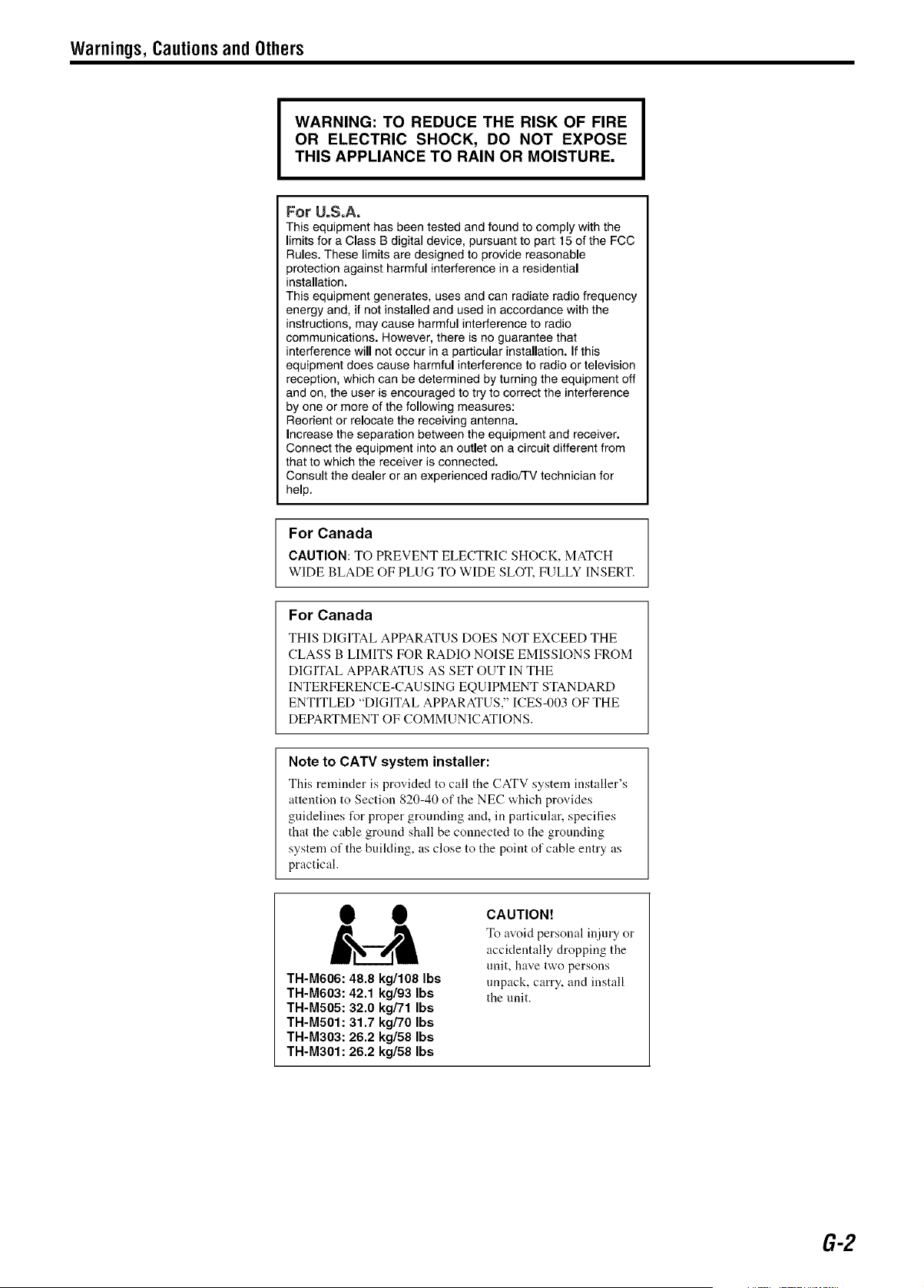
TH-M606:48.8 kg/108 Ibs
TH-M603:42.1 kg/93 Ibs
TH-M505:32.0 kg/71 Ibs
TH-M501:31.7 kg/70 Ibs
TH-M303:26.2 kg/58 Ibs
TH-M301:26.2 kg/58 Ibs
CAUTION!
To avoid personal injury or
accidentally dropping the
unit, have two persons
unpack, carry, and install
the unit.
G-2
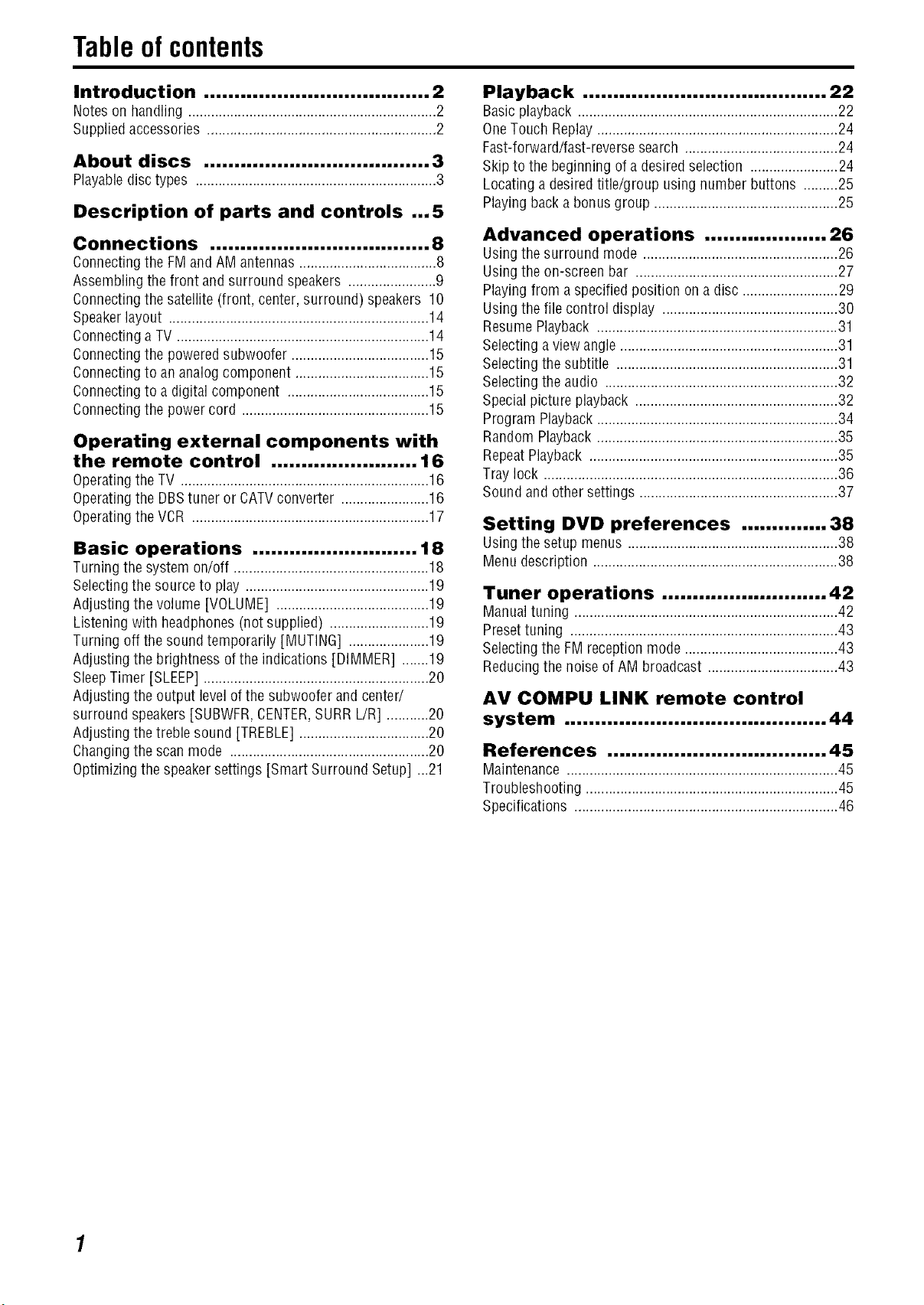
Table of contents
Introduction ..................................... 2
Notes on handling .................................................................2
Suppliedaccessories ............................................................2
About discs ..................................... 3
Playabledisc types ...............................................................3
Description of parts and controls ...5
Connections .................................... 8
Connectingthe FM and AM antennas ....................................8
Assembling the front and surround speakers .......................9
Connectingthe satellite (front, center, surround) speakers 10
Speakerlayout ....................................................................14
Connectinga TV ..................................................................14
Connectingthe powered subwoofer ....................................15
Connectingto an analogcomponent ...................................15
Connectingto a digital component .....................................15
Connectingthe power cord .................................................15
Operating external components with
the remote control ........................ 16
Operatingthe TV .................................................................16
Operatingthe DBStuner or CATVconverter .......................16
Operatingthe VCR ..............................................................17
Basic operations ........................... 18
Turning the system on/off ...................................................18
Selectingthe source to play ................................................19
Adjusting the volume [VOLUME] ........................................19
Listening with headphones (not supplied) ..........................19
Turning off the sound temporarily [MUTING] .....................19
Adjusting the brightness of the indications [DIMMER] .......19
SleepTimer [SLEEP] ...........................................................20
Adjusting the output level of the subwoofer and center/
surround speakers [SUBWFR,CENTER,SURRL/R] ...........20
Adjusting the treble sound [TREBLE] ..................................20
Changingthe scan mode ....................................................20
Optimizing the speakersettings [Smart Surround Setup] ...21
Playback ........................................ 22
Basicplayback ....................................................................22
OneTouch Replay ...............................................................24
Fast-forward/fast-reverse search ........................................24
Skip to the beginning of a desired selection .......................24
Locating a desired title/group using number buttons .........25
Playing back a bonus group ................................................25
Advanced operations .................... 26
Usingthe surround mode ...................................................26
Usingthe on-screen bar .....................................................27
Playing from a specified position on a disc .........................29
Usingthe file control display ..............................................30
Resume Playback ...............................................................31
Selecting a view angle .........................................................31
Selecting the subtitle ..........................................................31
Selecting the audio .............................................................32
Special picture playback .....................................................32
Program Playback...............................................................34
Random Playback ...............................................................35
RepeatPlayback .................................................................35
Tray lock .............................................................................36
Sound and other settings ....................................................37
Setting DVD preferences .............. 38
Usingthe setup menus .......................................................38
Menu description ................................................................38
Tuner operations ........................... 42
Manual tuning .....................................................................42
Presettuning ......................................................................43
Selectingthe FM reception mode ........................................43
Reducingthe noise of AM broadcast ..................................43
AV COMPU LINK remote control
system ........................................... 44
References .................................... 45
Maintenance .......................................................................45
Troubleshooting ..................................................................45
Specifications .....................................................................46
Introduction
• Important cautions
Installation of the system
• Select a place which is level, dry and neither too hot nor too cokt;
between 5°C and 35°C (41°F and 95°F).
• Leave sufficient distance between the system and the TV.
• Do not use the system in a place subject to vibration.
Power cord
• Do not handle tile power cord with wet hands!
• A small amount of power is always consumed while the power
cord is connected to the wall outlet (center unit only).
• When unplugging the power cord from the wall outlet, always
pull on the plug, not the power cord.
To prevent malfunctions of the system
• There are no user-ser_.iceable parts inside, ffanything goes
wrong, unplug the power cord and consult your dealer.
• Do not insert any metallic object into the system.
• Do not use any non-standard shape disc (like a heart, flower or
credit card, etc.) available on the market, because it may damage
the system.
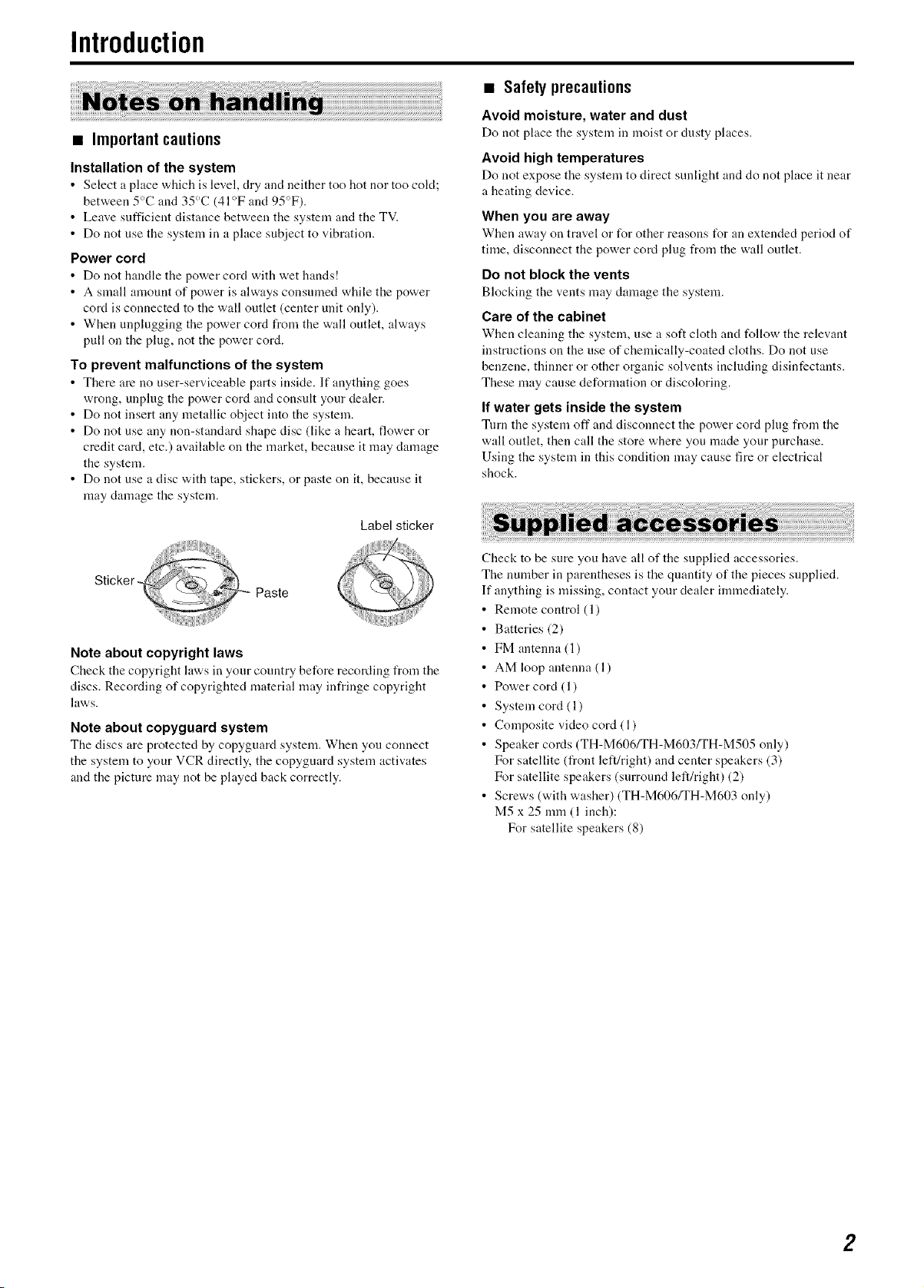
• Do not use a disc with tape, stickers, or paste on it, because it
may damage the system.
Sticker -
Paste
Label sticker
Note about copyright laws
Check the copyright laws in your country before recording from the
discs. Recording of copyrighted material may infringe copyright
laws.
Note about copyguard system
The discs are protected by copyguard system. When yon connect
the system to your VCR directly, the copyguard system activates
and the picture may not be played back correctly.
• Safety precautions
Avoid moisture, water and dust
Do not place the system in moist or dusty places.
Avoid high temperatures
Do not expose the system to direct sunlight and do not place it near
a heating device.
When you are away
When away on travel or for other reasons t_r an extended period of
time, disconnect the power cord plug from the wall outlet.
Do not block the vents
Blocking the vents may damage the system.
Care of the cabinet
When cleaning the system, use a soft cloth and follow the relevant
instructions on the use of chemically-coated cloths. Do not use
benzene, thinner or other organic solvents including disinfectants.
These may cause deformation or discoloring.
If water gets inside the system
Tnrn the system off and disconnect the power cord ping from the
wall outlet, then call the store where you made your purchase.
Using the system in this condition may cause fire or electrical
shock.
Check to be sure you ha'_e all of the supplied accessories.
The number in parentheses is the quantity of the pieces supplied.
If anything is missing, contact yonr dealer immediately.
Remote control (1)
Batteries (2)
FM antenna (1)
AM loop antenna (1)
Power cord (1)
System cord (1)
Composite video cord (1)
Speaker cords (TH-M606FFH-M603FFH-M505 only)
For satellite (front left/right) and center speakers (3)
For satellite speakers (snrronnd left/right) (2)
• Screws (with washer) (TH-M606/TH-M603 only)
M5 x 25 mm (1 inch):
For satellite speakers (8)
2
Aboutdiscs
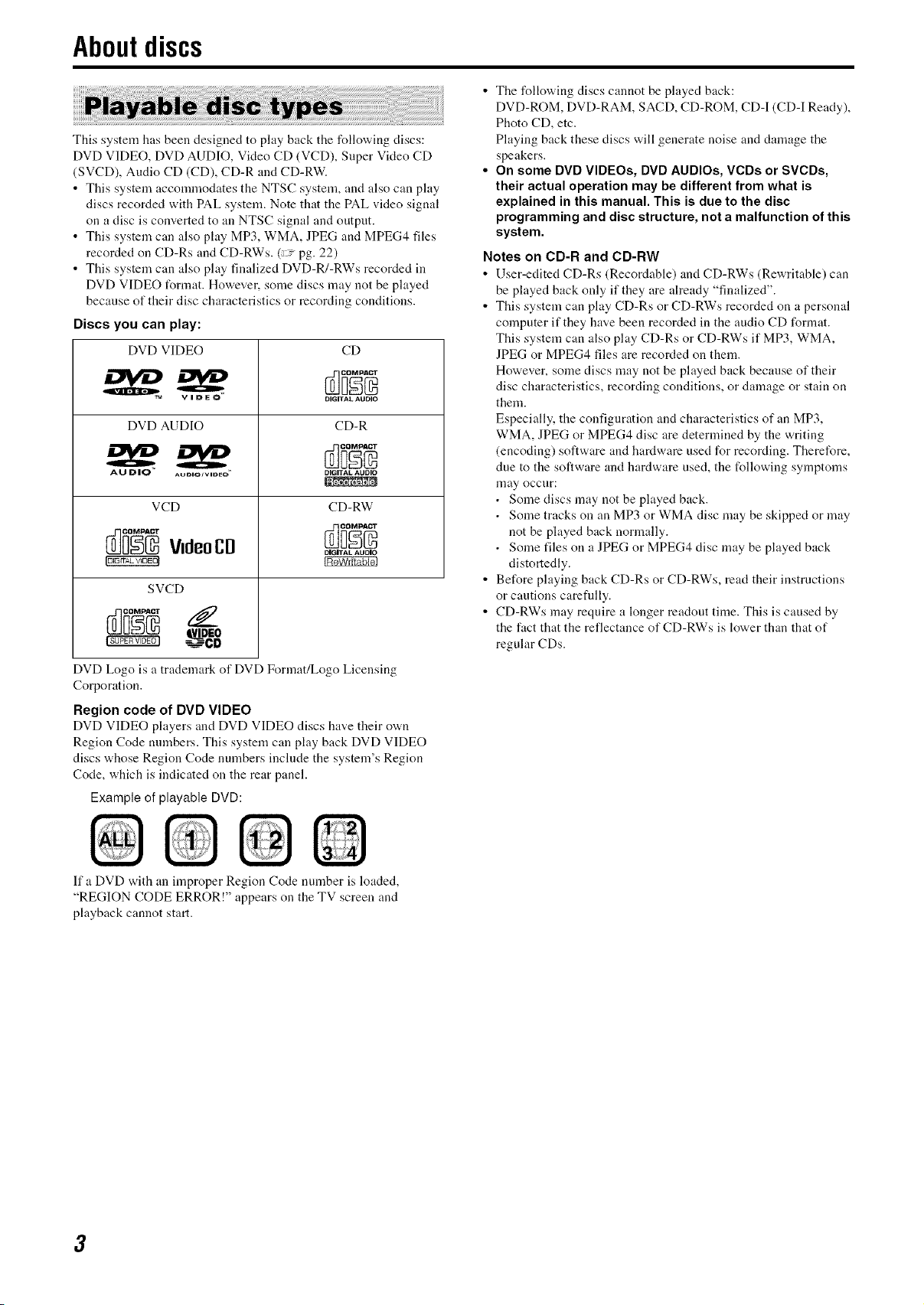
This system has been designed to play back the following discs:
DVD VIDEO, DVD AUDIO, Video CD (VCD), Super Video CD
(SVCD), Audio CD (CD), CD-R and CD-RW.
• This system accommodates the NTSC system, and also can play
discs recorded with PAL system. Note that the PAL video signal
on a disc is converted to an NTSC signal and output.
• This system can also play MP3, WMA, JPEG and MPEG4 files
recorded on CD-Rs and CD-RWs. ( pg. 22)
• This system can also play finalized DVD-R/-RWs recorded in
DVD VIDEO I_rmat. However. some discs may not be played
because of their disc characteristics or recording conditions.
Discs you can play:
DVD VIDEO
DVD AUDIO
VCD
SVCD
CD
DIGITAL AUDIO
CD-R
DIGITAL AUDIO
CD-RW
DIGITAL AUDIO
DVD Logo is a trademark of DVD Format/Logo Licensing
Corporation.
Region code of DVD VIDEO
DVD VIDEO players and DVD VIDEO discs hax.e their own
Region Code numbers. This system can play back DVD VIDEO
discs whose Region Code numbers include the system's Region
Code, which is indicated on the rear panel.
Example of playable DVD:
• The following discs cannot be played back:
DVD-ROM, DVD-RAM, SACD, CD-ROM, CD-I (CD-I Ready),
Photo CD, etc.
Playing back these discs will generate noise and damage the
speakers.
• On some DVD VIDEOs, DVD AUDIOs, VCDs or SVCDs,
their actual operation may be different from what is
explained in this manual. This is due to the disc
programming and disc structure, not a malfunction of this
system.
Notes on CD-R and CD-RW
• User-edited CD-Rs (Recordable) and CD-RWs (Rewritable) can
be played back only if they are already "finalized".
• This system can play CD-Rs or CD-RWs recorded on a personal
computer if they have been recorded in the audio CD format.
This system can also play CD-Rs or CD-RWs if MP3, WMA,
JPEG or MPEG4 files are recorded on them.
However, some discs may not be played back because of their
disc characteristics, recording conditions, or damage or stain on
them.
Especially, the configuration and characteristics of an MP3,
WMA, JPEG or MPEG4 disc are determined by the writing
(encoding) software and hardware used for recording. Therefore,
due to the software and hardware used, the following symptoms
may Occur:
• Some discs may not be played back.
• Some tracks on an MP3 or WMA disc may be skipped or may
not be played back normally.
• Some files on a JPEG or MPEG4 disc may be played back
distortedly.
• Before playing back CD-Rs or CD-RWs, read their instructions
or cautions carefldly.
• CD-RWs may require a longer readout time. This is caused by
the fact that the reflectance of CD-RWs is lower than that of
regular CDs.
If a DVD with an improper Region Code number is loaded,
T
"REGION CODE ERROR2' appears on the TV screen and
playback cannot start.
3
About discs
Notes on MP3/WMA/JPEG/MPEG4 discs
• MP3/WMA/JPEG/MPEG4 discs (either CD-R or CD-RW)
require a longer readout time. (It differs due to the complexity of
the directory/file configuration.)
• When making an MP3/WMA/JPEG/MPEG4 disc, select ISO
9660 Level 1 or Level 2 for the disc fornlat.
• This system supports "multi-session" discs (up to 20 sessions).
• This system cannot play "packet write" discs.
• The system can only play MP3/WMA/JPEG/MPEG4 files with
the following file extensions;
MP3: ".MP3", ".Mp3", ".raP3" and ".rap3"
WMA: ".wma", ".WMA" and any uppercase and lowercase
combination (such as ".Wma")
JPEG: ".jpg", ".}peg", ".JPG", ".JPEG" and any uppercase and
lowercase combination (such as ".Jpg")
MPEG4: ".asP', ".ASF" and any uppercase and lowercase
combination (such as ".ASP')
• If different type of files (audio (MP3/WMA), still picture
(JPEG), and video (MPEG4) files) are recorded on a disc, set the
FILE TYPE setting in the PICTURE menu to the appropriate
setting for the data to be read. (-" pg. 39)
• The system recognizes up to 150 tracks (files) per group, 99
groups per disc, and the total number of the tracks (files) that the
system can play is 1000. For example, if you set FILE TYPE to
AUDIO ( "pg. 39) and play a disc that contains 500 MP3 tracks,
200 JPEG files, and 600 WMA tracks, the system can play 500
MP3 tracks and the first 500 of 600 WMA tracks.
• Some MP3/WMA/JPEG/MPEG4 discs may not be played back
normally because of their disc characteristics or recording
conditions.
Notes on MP3/WMA discs only
• The system supports MP3 files recorded with a bit rate of 32
320 kbps and a sampling frequency of 16 kHz, 22.05 kHz,
24 kHz _'_,32 kHz, 44.1 kHz, or 48 kHz.
• If the tag intbrmation (albmn name, artist, and track title, etc.) is
recorded on a disc, it appears in the file control display on the TV
screen. (: -" pg. 30)
• We recommend to record each piece of material (song) at a
sample rate of 44.1 kHz and at a data transfer rate of
128 (96*) kbps.
• Some tracks may be skipped or may not be played back
normally.
"_ For WMA only
Notes on JPEG discs only
• We recommend to record a file at 640 x 480 resolution. (Ifa file
has been recorded at a resolution of more than 640 x 480, it will
take a longer time to be displayed.)
• This system can only play baseline JPEG files.
• Some files on a JPEG disc may be played back distortedly.
Notes on MPEG4 disc only
• The system supports the types of simple profile as MPEG4 files
(MPEG4 SP).
• The system supports MPEG4 files recorded with the maximum
bit rate of 384 kbps and an audio codec of G.726. (To play the
MPEG4 file, it is required that G.726 formatted audio data is
contained in that file.)
• The maximum size of the played picture is at a 352 x 288 pixel
resolution (CIF).
• Some files may be skipped or may not be played normally.
This product incorporates copyright protection technology
that is protected by method claims of certain U.S. patents
and other intellectual property rights owned by Macrovision
Corporation and other rights owners. Use of this copyright
protection technology must be authorized by Macrovision
Corporation, and is intended for home and other limited
viewing uses only unless otherwise authorized by
Macrovision Corporation. Reverse engineering or
disassembly is prohibited.
"'CONSUMERS SHOULD NOTE THAT NOT ALL HIGH
DEFINITION TELEVISION SETS ARE FULLY COMPATIBLE
WITH THIS PRODUCT AND MAY CAUSE ARTIFACTS TO BE
DISPLAYED IN THE PICTURE. IN CASE OF 525 OR 625
PROGRESSIVE SCAN PICTURE PROBLEMS, IT IS
RECOMMENDED THAT THE USER SWITCH THE
CONNECTION TO THE "STANDARD DEFINITION" OUTPUT.
IF THERE ARE QUESTIONS REGARDING OUR TV SET
COMPATIBILITY WITH THIS MODEL 525p AND 625/:) DVD
PLAYER, PLEASE CONTACT OUR CUSTOMER SERVICE
CENTER."
USE OF THIS PRODUCT IN ANY MANNER THAT COMPLIES
WITH THE MPEG-4 VISUAL STANDARD IS PROHIBITED,
EXCEPT FOR USE BY A CONSUMER ENGAGING IN
PERSONAL AND NON-COMMERCIAL ACTIVITIES.
4
Descriptionof partsandcontrols
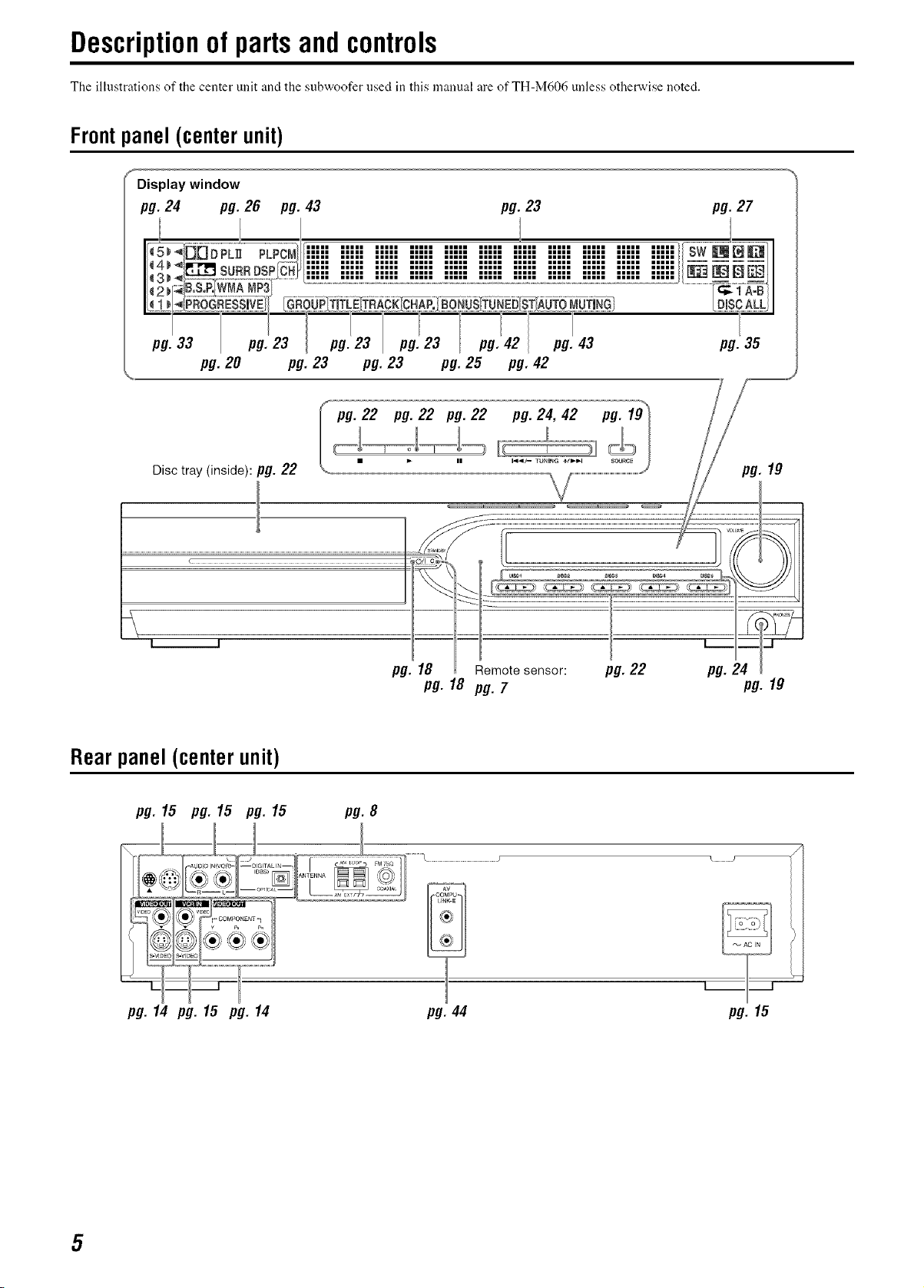
Tile illustrations of tile center unit and tile subwoofer used in this manual are of TH-M606 unless otherwise noted.
Front panel (center unit)
pg. 24 pg. 26 pg. 43 pg. 23 pg. 27
pg. 20 pg. 23 pg. 23 pg. 25 pg. 42
pg. 35
Disc tray (inside): pg. 22 pg. 19
pg. 18 Remotesensor: pg. 22
pg. 18 pg. 7
pg. 24
pg. 19
Rear panel(centerunit)
pg. 15 pg. 15 pg. 15 pg. 8
1
pg. 14 pg. 15 pg. 14 pg. 44 pg. 15
5
Descriptionof parts and controls
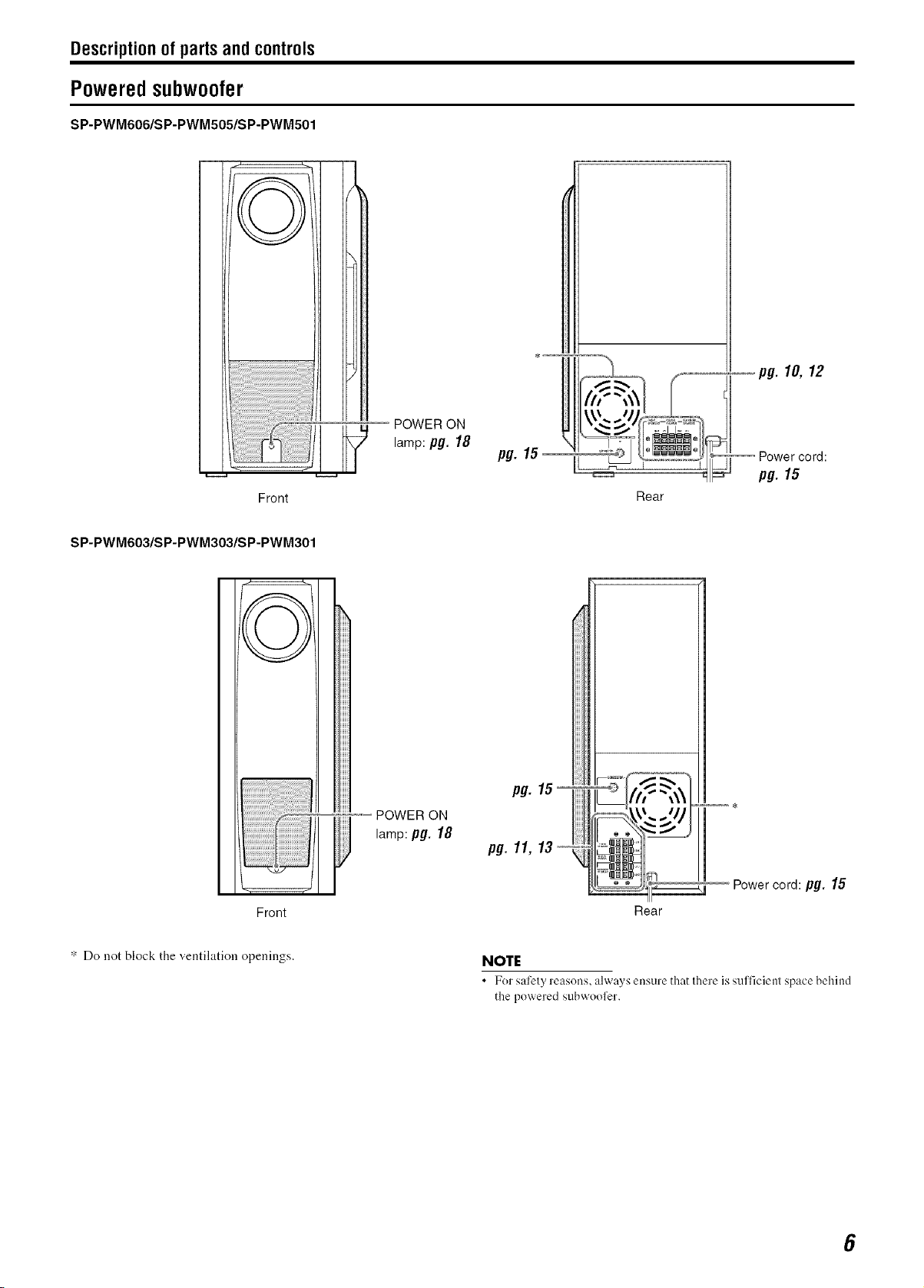
Powered subwoofer
SP-PWM606/SP-PWM505/SP-PWM501
Front
POWER ON
lamp: pg. 18
pg. 15
Rear
SP-PWM603/SP-PWM303/SP-PWM301
_,===============_
©
Front
POWER ON
lamp: pg. 18
Pg.
pg. 11,
Rear
Power cord: pg. 15
* Do not block the ventilation openings.
NOTE
• For safely reasons, always ensure that Ihere issul ficienl space behind
tile powered subwonler.
6
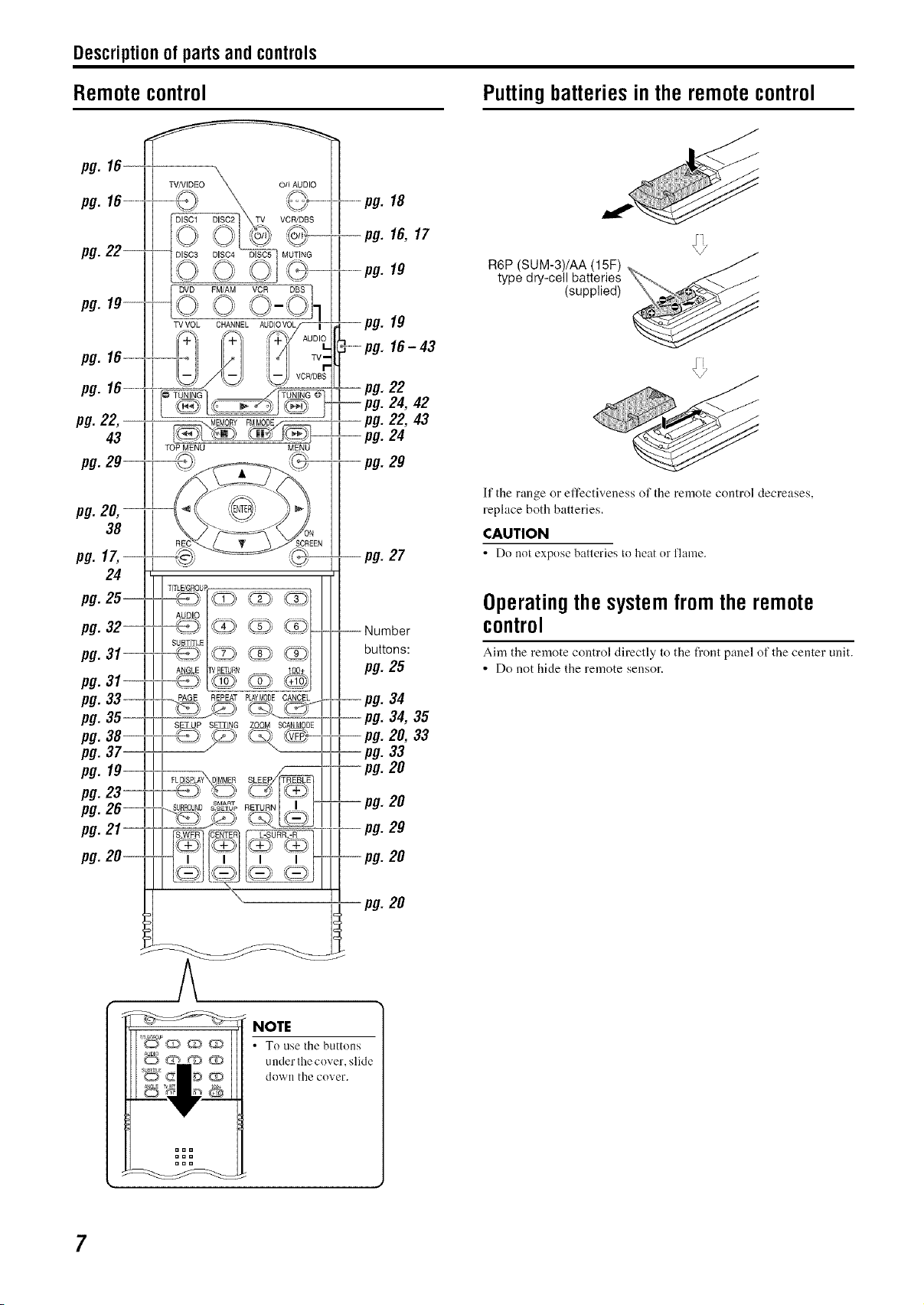
Descriptionof parts and controls
Remote control
Pg.
38
pg. 1;, pg. 27
24
NOTE
• To use _hebuttons
underthecover,slide
down the cover.
18
16, 17
19
19
16- 43
22
24,42
22, 43
24
29
buttons:
pg. 25
34
34, 35
20, 33
33
20
20
29
20
20
Putting batteries in the remote control
R6P (SUM-3)/AA (15F) _,
type dry-cell batteries _ ....... _
(supplied)
If the range or effectiveness of the remote control decreases,
replace both batteries.
CAUTION
• Do not expose batteriesto heat or flame.
Operating the system from the remote
control
Aim the remote control directly to the front panel of the center unit.
• Do not hide the remote sensor.
7
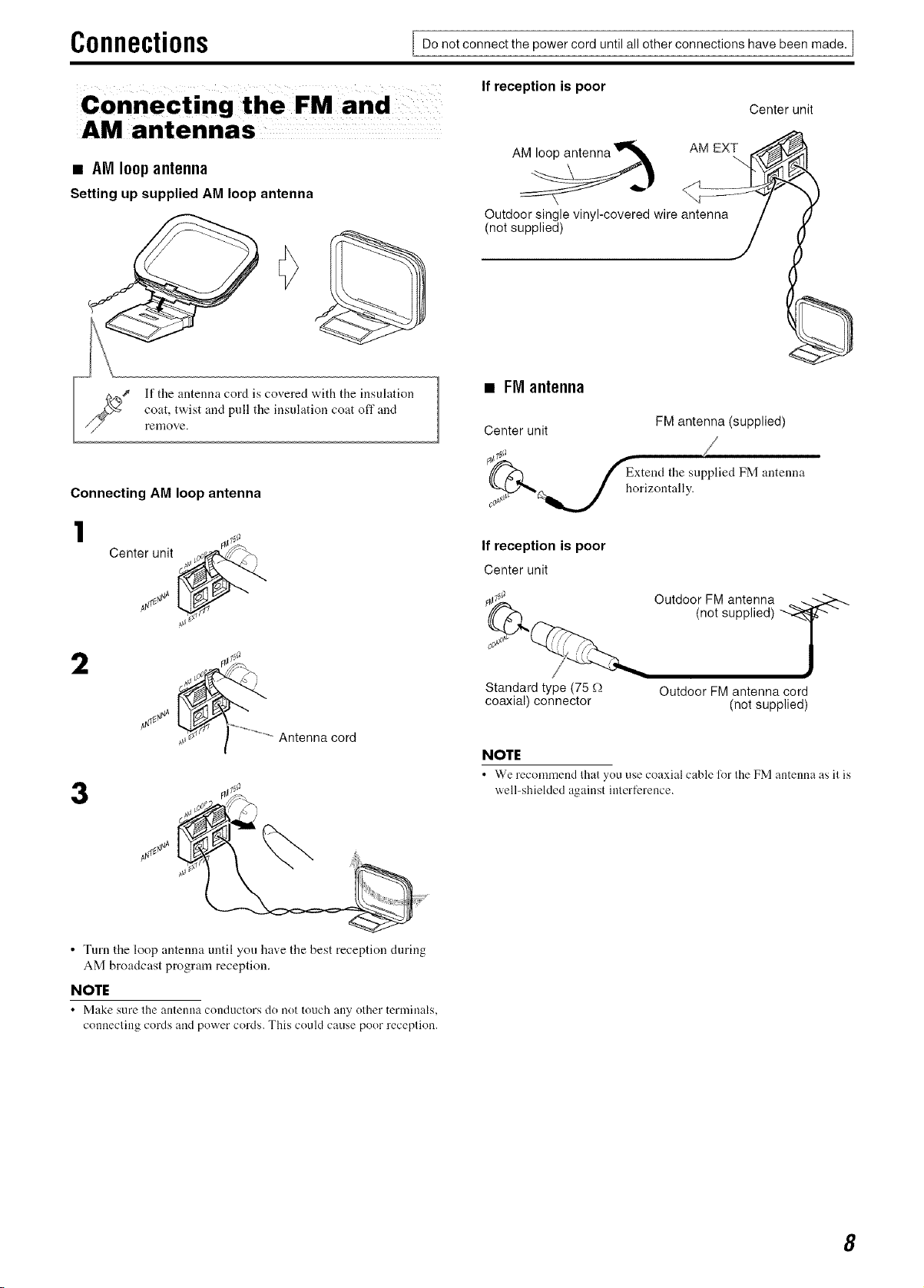
Connections
Do not connect the power cord until all other connections have been made./
7
If reception is poor
Center unit
• AM loopantenna
Setting up supplied AM loop antenna
_,_ If the antenna cord is covered with the insulation
coat, twist and pull the insulation coat off and
remove.
Connecting AM loop antenna
Center unit
2
3
AM loop
AM EXT
Outdoor single vinyl-covered wire antenna
(not supplied)
• FM antenna
FM antenna (supplied)
Center unit
f Extend the supplied FM antenna
] horizontally.
CO _ "'"
If reception is poor
Center unit
Outdoor FM antenna
(not supplied)
Standard type (75 £)
coaxial) connector
Outdoor FM antenna cord
(not supplied)
NOTE
• We reconmrendlhal you usecoaxial cable lk)rtheFM antennaasil is
well-shielded against inlerfcrence.
• Tnrn the loop antenna until yon have the best reception during
AM broadcast program reception.
NOTE
• Make sure the antenna conductors dn not touch any other terminals,
connecting cords and power cnrds. This could cause ponr reception.
8
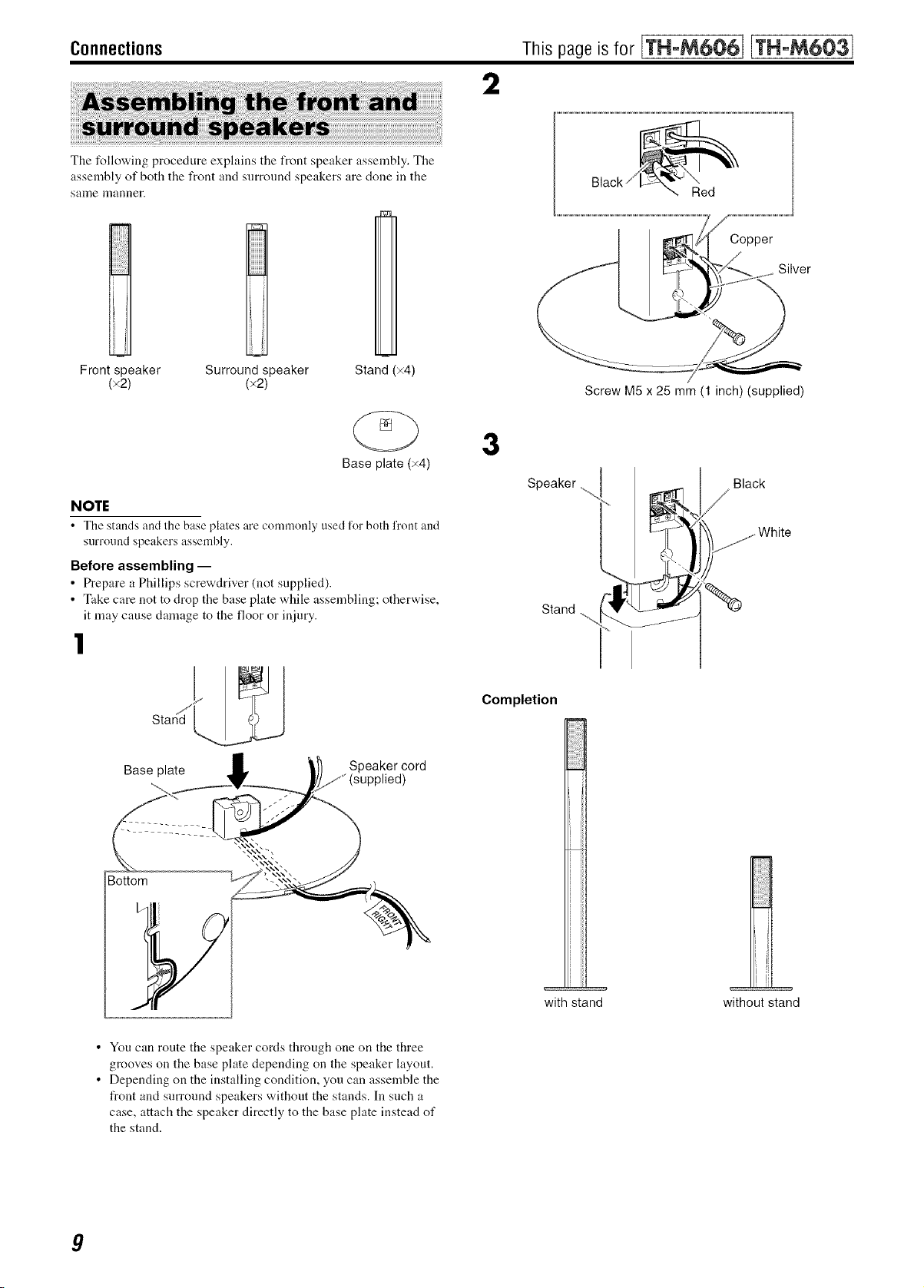
Connections This Paoeisfor [TH-M606] ITH-M6031
The following procedure explains the front speaker assembly. The
assembly of both the front and snrround speakers are done in the
salne manner.
2
Copper
Silver
Front speaker Surround speaker
(x2) (×2)
Stand (x4)
Base plate (x4)
NOTE
• The standsand thebaseplatesarecommonly usedt'or both front and
snrronnd speakers assenlbly.
Before assembling --
• Prepare a Phillips screwdriver (not supplied).
• Take care not to drop the base plate while assembling; otherwise,
it may cause damage to the floor or injury.
Base plate
Speaker cord
3
Speaker
Stand ......
Completion
Screw M5 x 25 mm (1 inch) (supplied)
Black
with stand without stand
• You can route the speaker cords through one on the three
grooves on the base plate depending on the speaker layout.
• Depending on the installing condition, you can assemble the
front and surround speakers without the stands. In such a
case, attach the speaker directly to the base plate instead of
the stand.
9
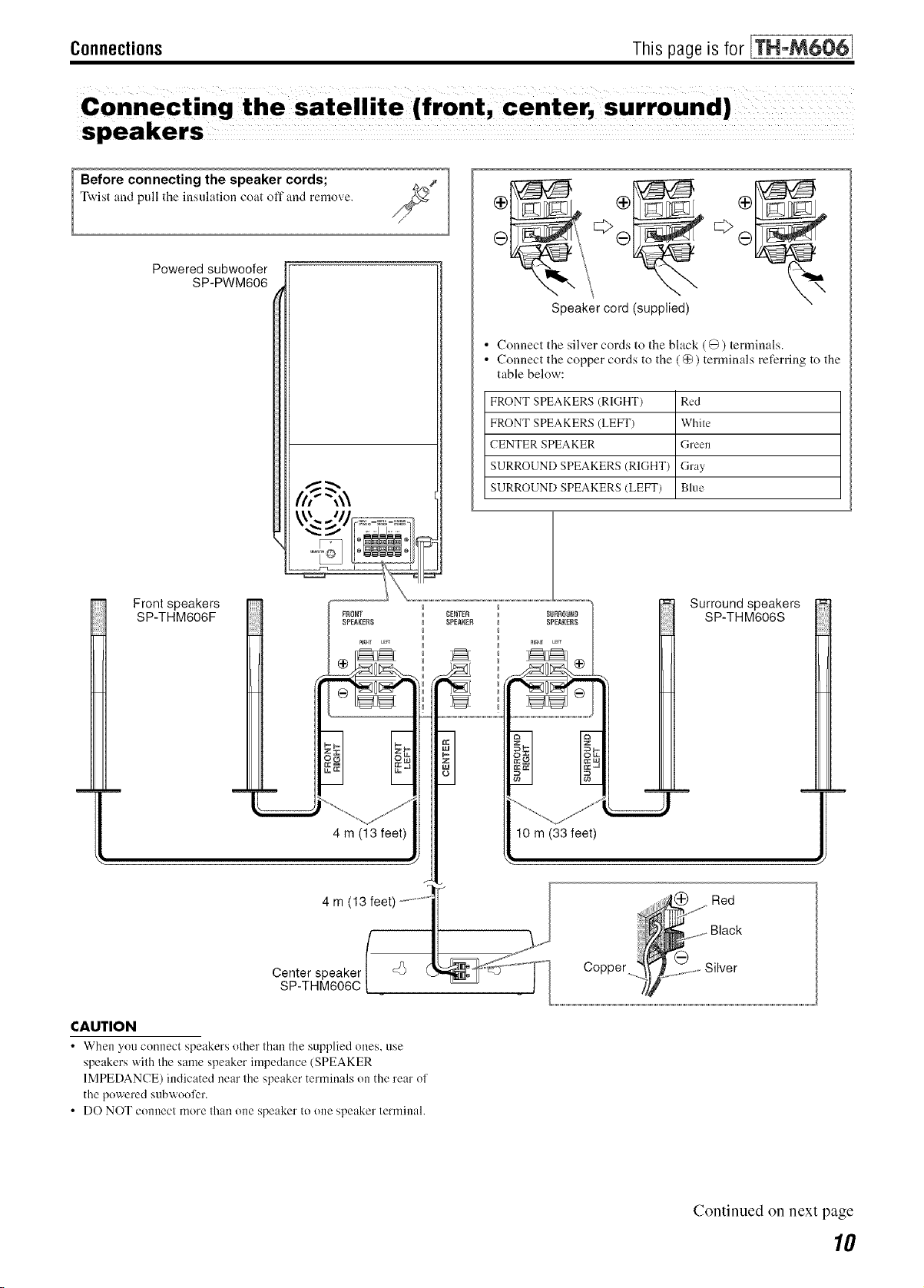
Connections This page is for [TH-M606]
Before connecting the speaker cords;
Twist and pull the insulation coat off and remove.
Powered subwoofer
SP-PWM606
Speaker cord (supplied)
• Connect the silver cords to the black (0) terminals.
• Connect the copper cords to the (_) terminals referring to the
table below:
FRONT SPEAKERS (RIGHT)
FRONT SPEAKERS (LEFT)
CENTER SPEAKER
SURROUND SPEAKERS (RIGHT)
SURROUND SPEAKERS (LEFT)
Red
White
Green
Gray
Blue
Front speakers
SP-THM606F
i B
FRORT
SPEAKERS
go ow
4 m (13 feet)
i
CEBTER SURROUND
SPEAKER SPEAKERS
2
w _ r_ J
10 m (33 feet)
Surround speakers
SP-THM606S
CAUTION
• When you connect speakers other than the supplied ones, use
speakers with the same speaker impedance (SPEAKER
IMPEDANCE) indicated near the speaker terminals on the rear of
the powered subwoo]er.
• DO NOT connect more than one speaker to one speaker terminal.
.. Black
Continued on next page
lo
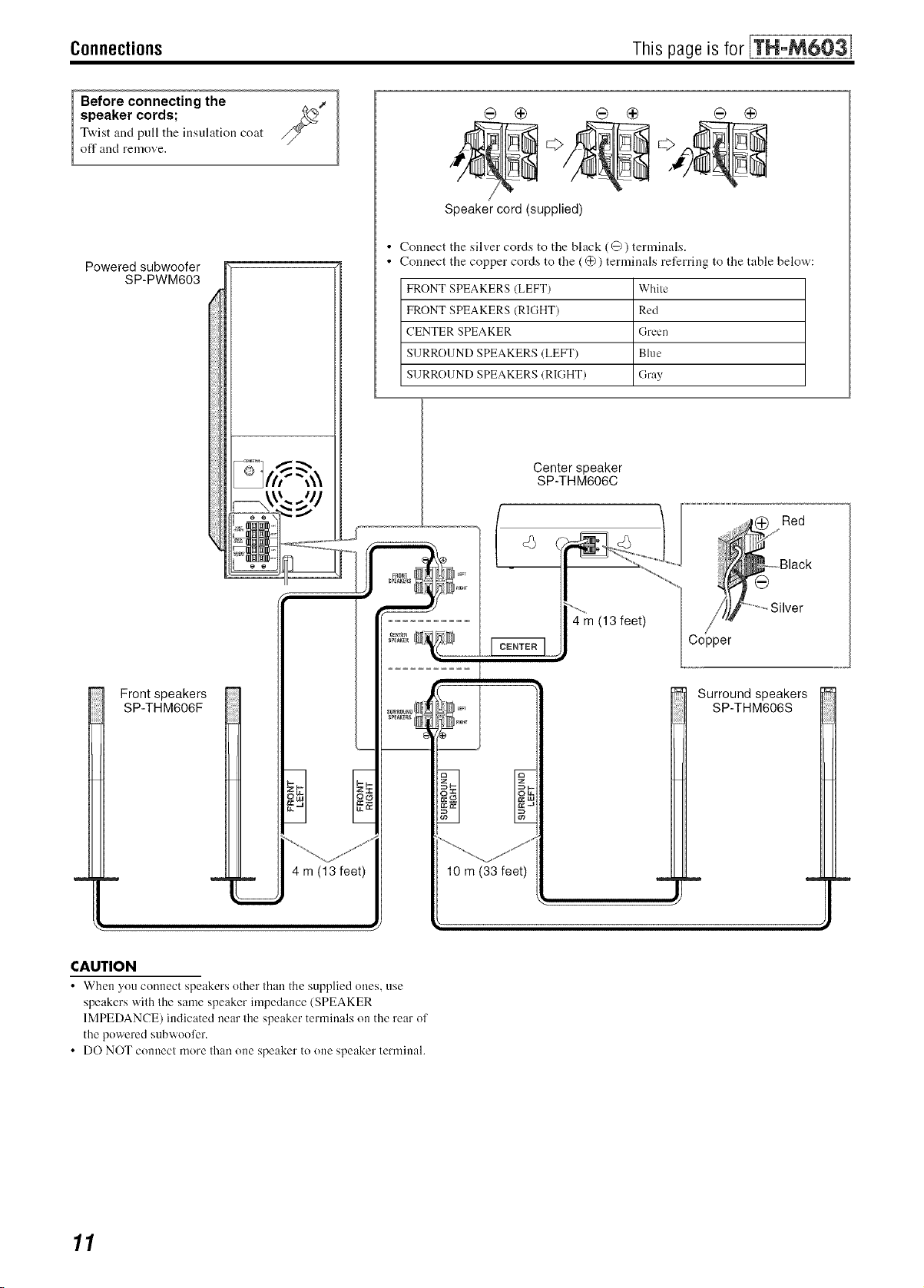
Connections This pageis for ITN-N6O3]
Before connecting the
speaker cords;
Twist and pull the insulation coat
off and remove.
Powered subwoofer
SP-PWM603
Jill \1|
Speaker cord (supplied)
• Connect the silver cords to the black (@) terminals.
• Connect the copper cords to the (@) terminals referring to the table below:
FRONT SPEAKERS (LEFT) White
FRONT SPEAKERS (RIGHT) Red
CENTER SPEAKER Green
SURROUND SPEAKERS (LEFT) Blue
SURROUND SPEAKERS (RIGHT) Gray
Center speaker
SP-THM606C
Front speakers
SP-THM606F
ZZ
3w oK
4 rn (13 feet)
_E_T_a
SP£AKER
...........
Z
O_
rg_l
10 rn (33 feet)
i
i
Surround speakers
SP-THM606S
CAUTION
• When you connect speakers other than the supplied ones, use
speakers with the same speaker impedance (SPEAKER
IMPEDANCE) indicated near the speaker terminals on the rear of
the powered subwoolcr.
• DO NOT connect more than one speaker to one speaker terminal.
11
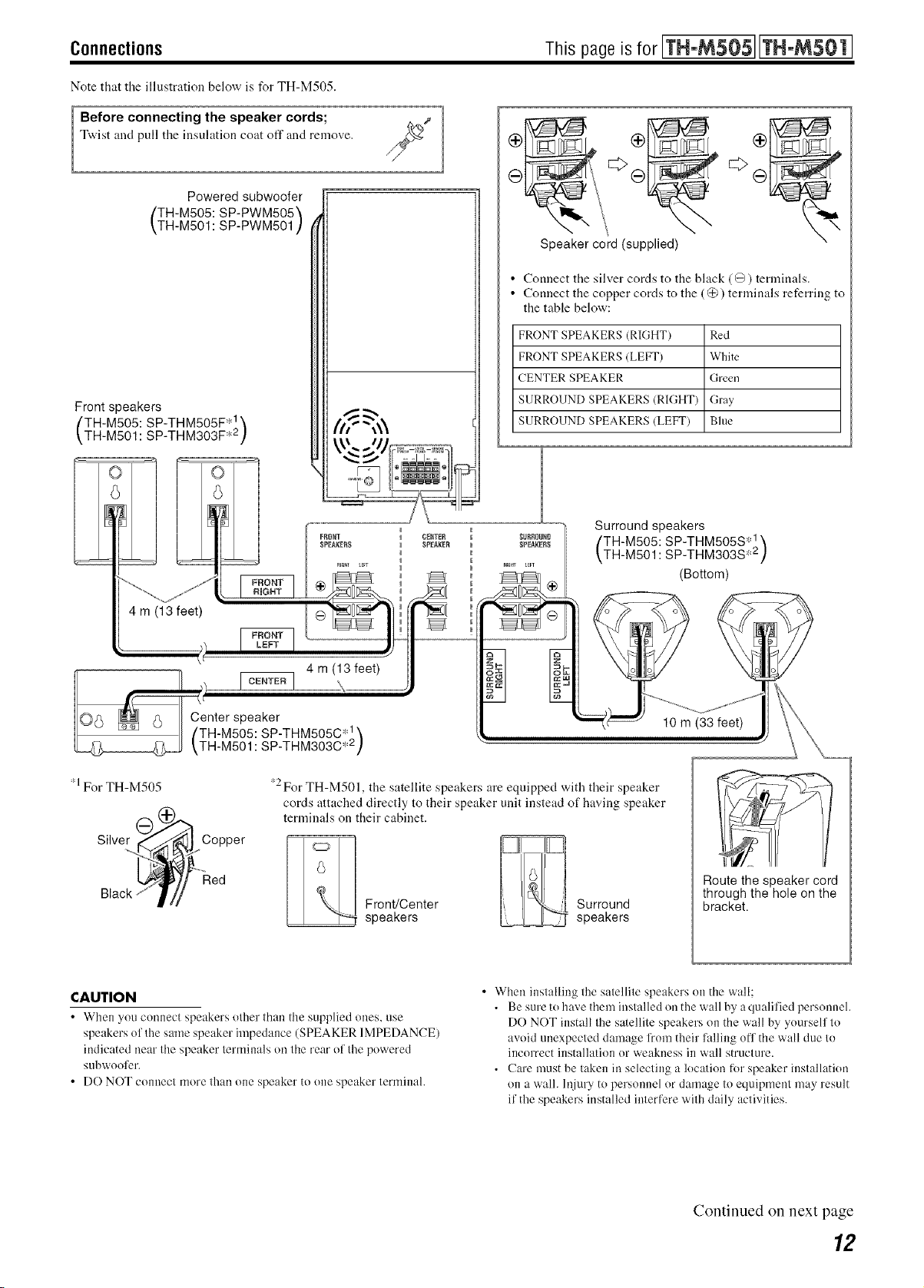
Connections This page isfor [TH-Ms05JJTH-MS01]
Note that the illustration below is for TH-M505.
Before connecting the speaker cords;
Twist and pull the insulation coat off and remove.
Powered subwoofer
TH-M505: SP-PWM505_
TH-M501 : SP-PWM501 ]
Front speakers
TH-M505: SP-THM505F .1 \
TH-M501: SP-THM303F .2 )
c Y i
4 m (13 feet)
' k(
Speaker cord (supplied)
• Connect the silver cords to the black (@) terminals.
• Connect the copper cords to the (@) terminals referring to
the table below:
FRONT SPEAKERS (RIGHT) Red
FRONT SPEAKERS (LEFT) White
CENTER SPEAKER Green
SURROUND SPEAKERS (RIGHT) Gray
SURROUND SPEAKERS (LEFT) Blue
' FRORT
SPEAKERS
4 m (13 feet)
u
Center speaker
TH-M505: SP-THM505C .1 \
TH-M501: SP-THM303C .2 )
Surround speakers
TH-M505: SP-THM505S .1 \
TH-M501: SP-THM303S .2 )
(Bottom)
1 For TH-M505
Silver
Copper
Red
_2For TH-M501, the satellite speakers are equipped with their speaker
cords attached directly to their speaker unit instead of having speaker
terminals on their cabinet.
FronVCenter Surround
speakers speakers
Route the speaker cord
through the hole on the
bracket.
CAUTION
• When you connect speakers other than the supplied ones, use
speakers of the stone speaker impedance (SPEAKER IMPEDANCE)
indicated near the speaker terminals on the rear nl the powered
subwoofer.
• DO NOT connect more than one speaker tn one speaker terminal.
• When installing the satellite speakers on the wall;
• Be sure tn have them installed on the wall by a qualified personnel.
DO NOT install the satellite speakers on the wall hy yourself to
avoid unexpected damage li'om their falling off the wall due to
incorrect installation nr weakness in wall structure.
• Care must be taken in selecting a location R)r speaker installation
on a wall. lnjury tn personnel or damage to equipment may result
if the speakers installed interfere with daily activities.
Continued on next page
12
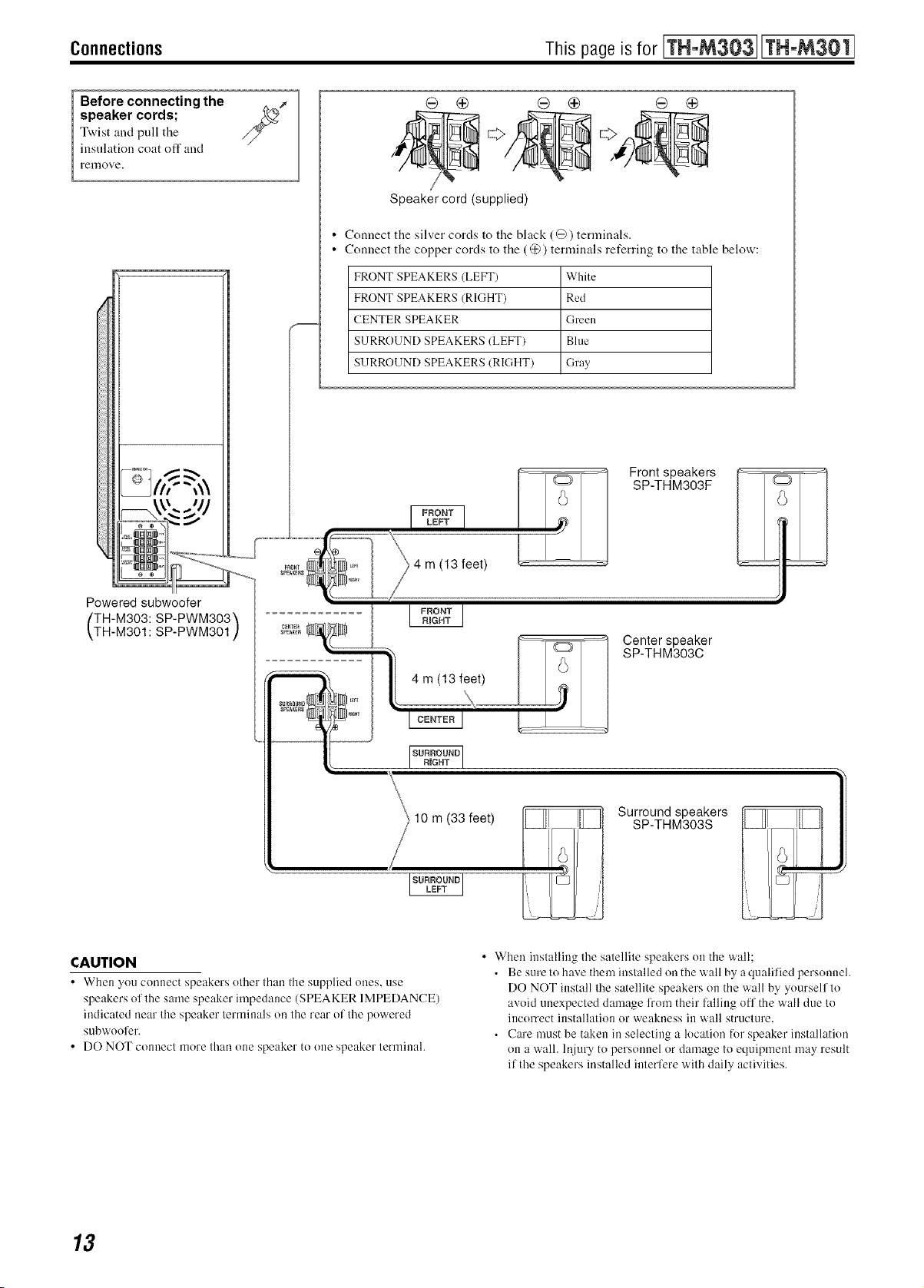
Connections Thispageisfor ITH-M303I[TN-N301]
Before connecting the
speaker cords;
Twist and pull the
insulation coat off and
rentove.
Speaker cord (supplied)
• Connect the silver cords to the black (@) terminals.
• Connect the copper cords to the (@) terminals referring to the table below:
FRONT SPEAKERS (LEFT) White
FRONT SPEAKERS (RIGHT) Red
CENTER SPEAKER Green
SURROUND SPEAKERS (LEFT) Blue
SURROUND SPEAKERS (RIGHT) Gray
Front speakers
SP-THM303F
Powered subwoofer
TH-M303: SP-PWM303_
TH-M301 : SP-PWM301 ]
4 m (13 feet)
4 m (13 feet)
Center speaker
SP-THM303C
10 m (33 feet)
Surround speakers
SP-THM303S
CAUTION
• When you connect speakers other than the supplied ones, use
speakers of the same speaker impedance (SPEAKER IMPEDANCE)
indicated near the speaker terminals on the rear of the powered
subwoofer.
• DO NOT connect more than one speaker to one speaker terminal.
• When installing the satellite speakers on the wall;
• Be sure to have them installed on the wall by a qualified personnel.
DO NOT install the satellite speakers on the wall by yourself to
avoid unexpected damage li'nm their falling off the wall due to
incorrect installation or weakness in wall structure.
• Care must be taken in selecting a location for speaker installation
on a wall. lnjury to personnel or damage to equipment may result
if tl_e speakers installed interfere with daily activities.
13
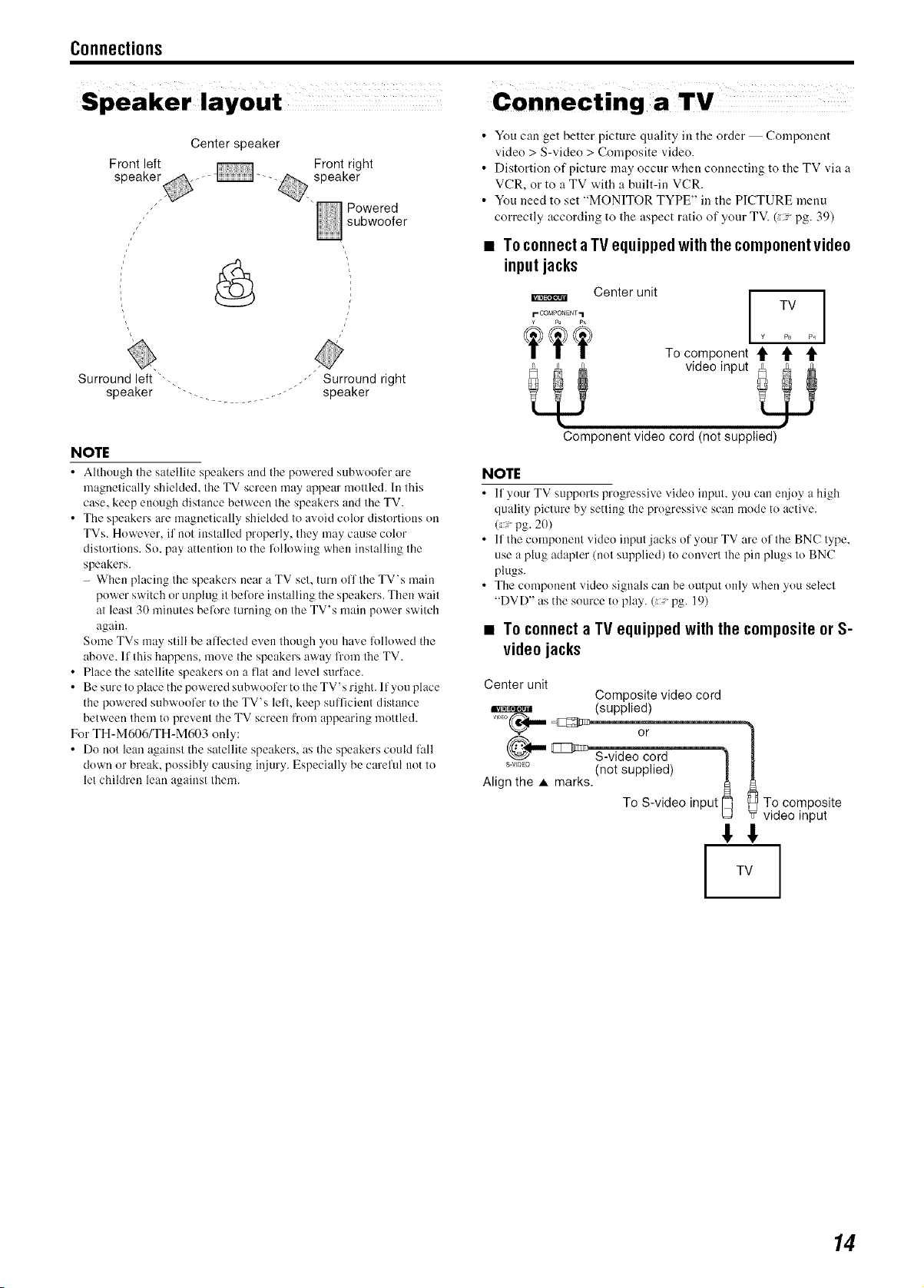
Connections
Center speaker
/
/
<'
/
Powered
subwoofer
/
/
Surround left "'. -" Surround right
speaker "- -< speaker
• You can get better picture quality in the order Component
video > S-video > Composite video.
• Distortion of picture may occur when connecting to the TV via a
VCR, or to a TV with a built-in VCR.
• You need to set "MONITOR TYPE" in the PICTURE menu
correctly according to the aspect ratio of your TV. (-" pg. 39)
• To connect a TV equipped with the component video
input jacks
y_ COMPONENT, 1
Tecompenent e e e
video input
NOTE
• Although the satellite speakers and the powered subwoofcr are
magnetically shielded, the TV screen may appear mottled, llt this
case, keep enough distance between the speakers and the TV.
• The speakers are magnetically shielded to avoid color distortions on
TVs. However, if not installed properly, they may cause color
distortions. So, pay attention to the R)llowing when installing the
speakers.
- When placing the speakers near a TV set, turn off' the TV's main
power switch or unplug it beR)re installing the speakers. Then wait
at least 30 minutes belbre turning on the TV's main power switch
again.
Some TVs may still be aflected even though you have lollowed the
above, ll' this happens, move the speakers away l?'om the TV.
• Place the satellite speakers on a flat and level surface.
• Be sure to place the powered subwoofer to the TV's right. If you place
the powered subwoofer to the TV's lefl, keep sufficient distance
between them to prevent the TV screen from appearing mottled.
For TH-Md06/TH-Md03 only:
• Do not lean against the satellite speakers, as the speakers could fall
down or break, possibly causing injury. Especially be careful not to
let children lean against them.
Component video cord (not supplied)
NOTE
• If your TV supports progressive video input, you c'ml enjoy a high
quality picture by setting the progressive scan mode to active.
(. pg. 20)
• If the component video input jacks of your TV are of the BNC type,
use a plug adapter (not supplied) to convert the pin plugs to BNC
plugs.
• The component vide() signals can be output only when you select
"DVD" as the source to play. (. pg. 19)
• To connect a TV equipped with the composite or S-
video jacks
Center unit
Composite video cord
_,,,,,,, (supplied)
C_==, _ or
S-video cord 1
s-wr_o (not supplied)
Align the • marks.
To S-video input To composite
V video input
14
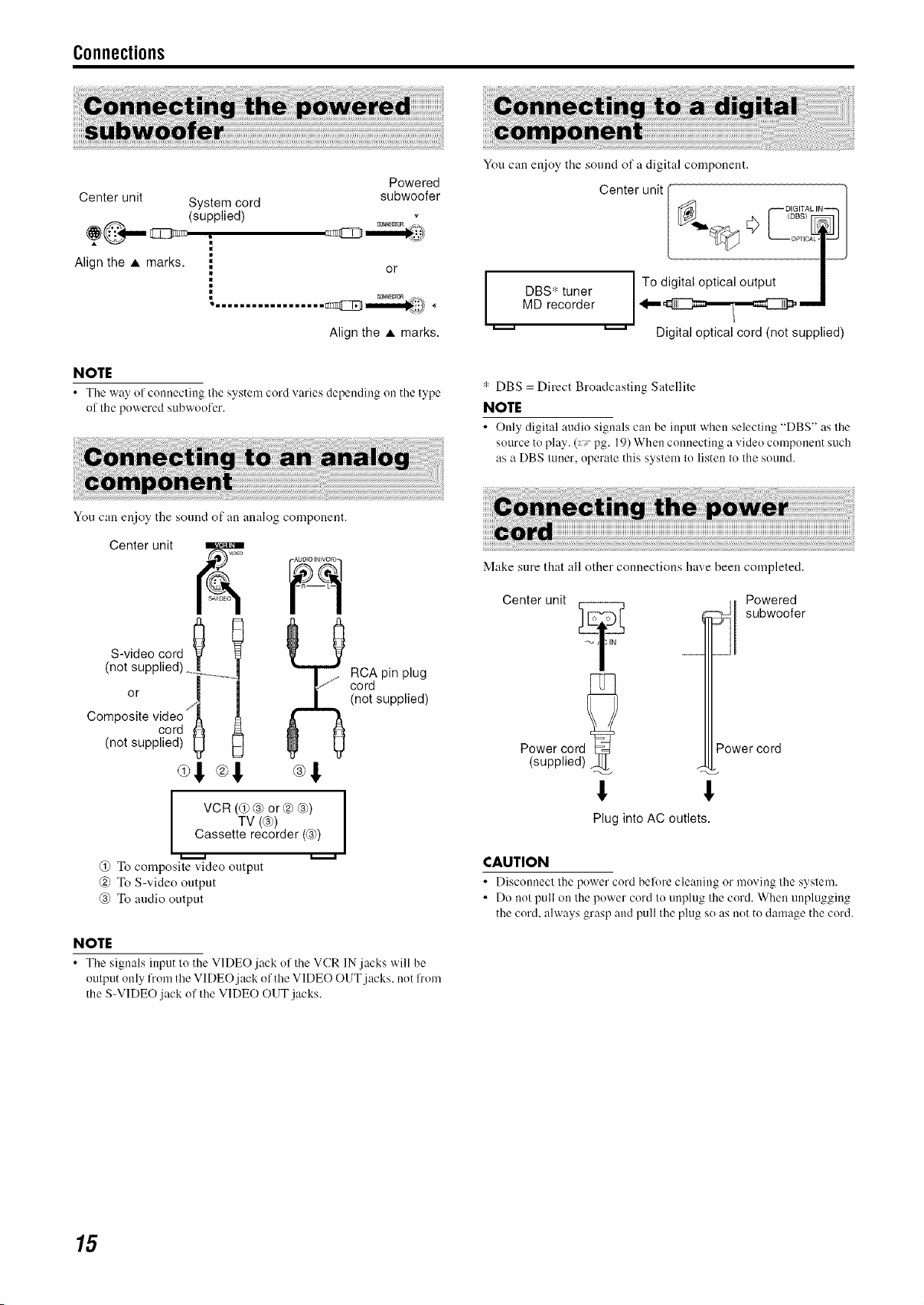
Connections
Center unit System cord
(supplied)
.
Align the • marks.
Powered
subwoofer
or
_0N_4ECTO__. XX
Align the • marks.
You can enjoy the sound of a digital component.
I DBS* tuner
MD recorder
Centerun,t[ T
Digital optical cord (not supplied)
NOTE
• The way of connecling Ihe system coM varies depending on tile type
ol the powered subwoofer.
* DBS = Direct Broadcasting Satellite
NOTE
• Only digital audio signals can be input when selecting "DBS" as the
source to play. (= pg. 19) When connecting a vide() component such
as a DBS tuner, operate this system to listen to the sound.
You can enjoy the sound of an analog component.
Center unit _ I___Y_............
S-video cord
(not supplied)
or
Composite video /
cord
(not supplied)
VCR (_) ® or ® ®) [
TV (®)
I
Cassette recorder (®)
@ To composite video output
@ To S-video output
@ To audio output
RCA pin plug
cord
(not supplied)
NOTE
• The signals input to the VIDE() jack of the VCR IN jacks will be
output only from the VlDEOjack of the VIDEO OUT jacks, not from
the S-VIDEO jack of the VIDE() OUT jacks.
Make sure that all other connections have been completed.
Center unit
Power cord
(supplied)
Powered
subwoofer
Power cord
! !
Plug into AC outlets.
CAUTION
• Disconnect the power cord belore cleaning or moving the system.
• Do not pull on the power cord to unplug the cord. When unplugging
the cord, always grasp and pull the plug so as not to damage the cord.
15
Operatingexternalcomponentswiththe remotecontrol
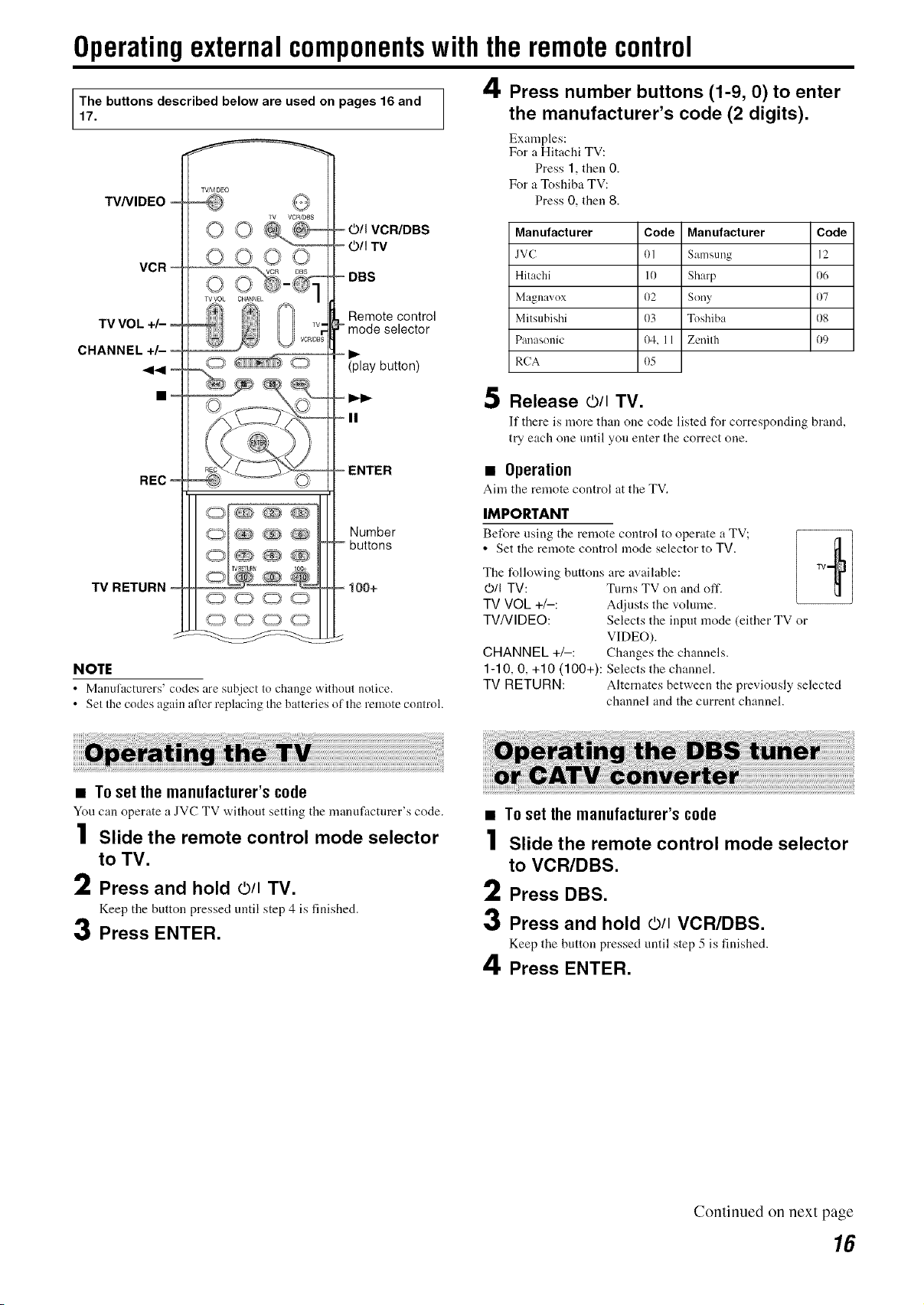
The buttons described below are used on pages 16 and
17.
TV/VIDEO
VCR ,-
TV VOL +/- ,2
CHANNEL +/- --
<t<1-
II-
REC ,-
TV RETURN --
TV/VIDEO
rv VC_JDB8
O0_n_ @ '_
Q O ©
O
TVVOL CHANNEL
OQ
_ % _ %
OOD #" %
©/I VCR/DBS
0/I TV
DBS
_ Remote control
mode selector
_1_
(play button)
,_1_
-- II
ENTER
Number
buttons
,- !00+
J
J
NOTE
• Manulacturers' codes are subject Io change withoul nolice.
• Sel 1he codes again aller replacing 1he batleries of 1he remote cunlrol.
4 Press number buttons (1-9, O) to enter
the manufacturer's code (2 digits).
Examples:
For a Hitachi TV:
Press 1, then 0.
For a Toshiba TV:
Press 0, then 8.
Manufacturer Code Manufacturer
JVC 01 Samsung
Hitachi I0 Sharp
Magnavox 02 Sony
Mitsubishi 03 Toshiba
Panasonic 04, 11 Zenith
RCA 05
Code
12
O6
07
1)8
O9
,_ Release ©/I TV.
It" there is more than one code listed for corresponding brand,
try each one until you enter the correct one.
• Operation
Aim the remote control at the TV.
IMPORTANT
Before using the remote control to operate a TV;
• Set the remote control mode selector to TV.
The following buttons are available:
0/I TV: Turns TV on and off.
TV VOL +/-: Adjusts the volume.
TV/VIDEO: Selects the input mode (either TV or
VIDEO).
CHANNEL +/-: Changes the channels.
1-10, 0, +10 (100+): Selects the channel.
TV RETURN: Alternates between the previously selected
channel and the current channel.
• To set the manufacturer's code
You can operate a JVC TV without setting the malaufacturer's code.
1 Slide the remote control mode selector
to TV.
2 Press and hold ©/I TV.
Keep the button pressed until step 4 is finished.
3 Press ENTER.
• Toset themanufacturer'scode
1 Slide the remote control mode selector
to VCR/DBS.
2 Press DBS.
3 Press and hold ©/I VCR/DBS.
Keep the button pressed until step 5 is finished.
4 Press ENTER.
Continued on next page
16
Operating externalcomponentswiththe remote control
5 Press number buttons (1-9, 0) to enter
the manufacturer's code (2 digits).
Examples:
For a GI Jerrokt product:
Press 0, then 1.
For a Sony product:
Press 2, then 0.
5
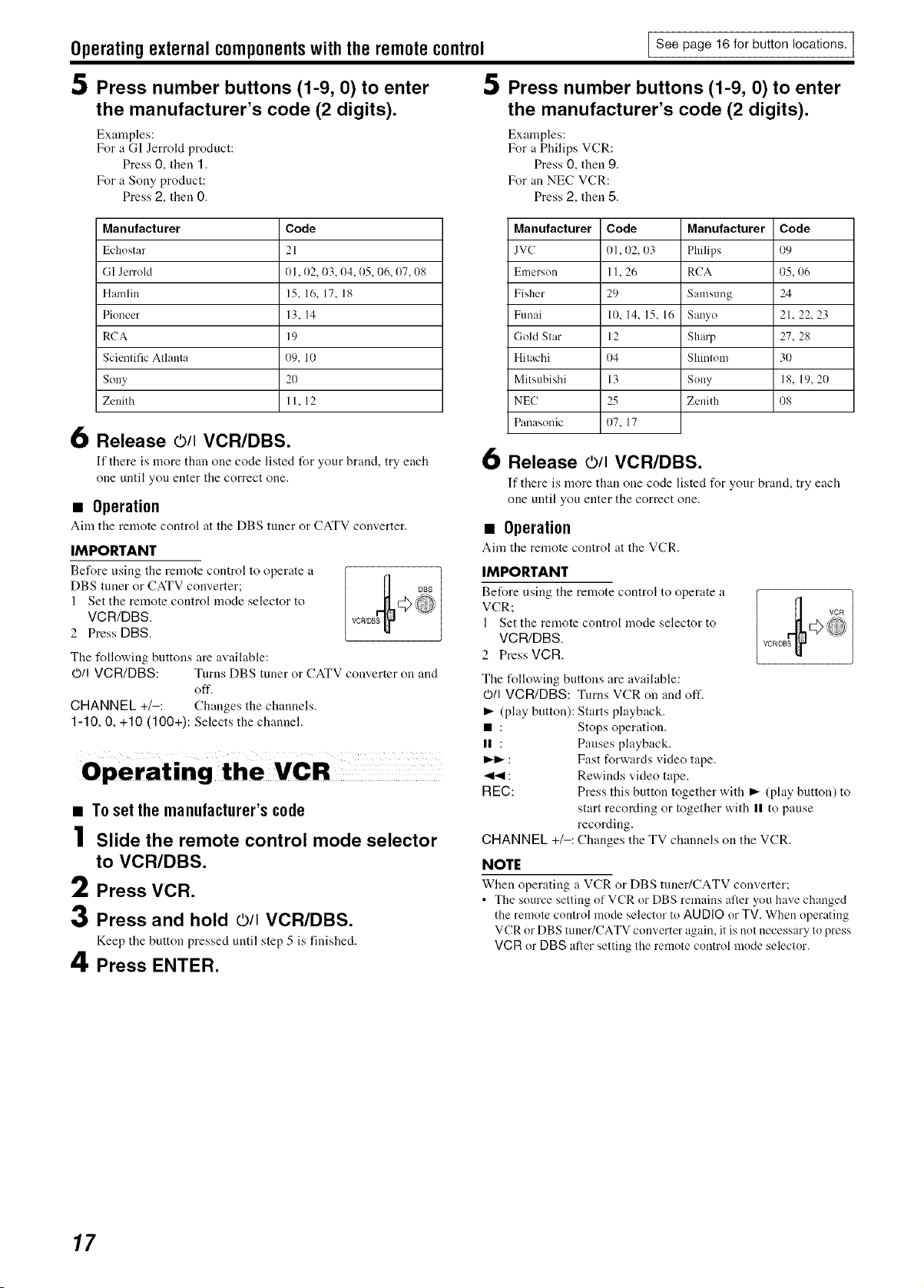
Manufacturer Code
Echostar 21
GI Jerrold 0l, 02, 03, 04, 05, 06, 07, 0g
Hamlin 15, 16, 17, 18
Pioneer 13, 14
RCA 19
Scientific Athmta 09, 10
Sony 20
Zenith I I, 12
1
O Release ©/I VCR/DBS.
If there is more than one code listed for your brand, try each
one until you enter the correct one.
• Operation
Aim the remote control at the DBS tuner or CATV converter.
IMPORTANT
Before using the remote control to operate a
DBS tuner or CATV converter;
1 Set the remote control mode selector to
VCR/DBS.
2 Press DBS.
DBS
vo oo4¢0
The following buttons are available:
O/I VCR/DBS: Turns DBS tuner or CATV converter on and
off.
CHANNEL +1-: Changes the channels.
1-10, 0, +10 (100+): Selects the channel.
Operating the VCR
• Toset the manufacturer'scode
1 Slide the remote control mode selector
to VCR/DBS.
2 Press VCR.
3 Press and hold ©/I VCR/DBS.
Keep the button pressed until step 5 is finished.
4 Press ENTER.
See page 16 for button locations. I
Press number buttons (1-9, 0) to enter
the manufacturer's code (2 digits).
Examples:
For a Philips VCR:
Press 0, then 9.
For an NEC VCR:
Press 2, then 5.
Manufacturer Code Manufacturer Code
JVC 0l, 1)2,03 Philips 09
Emerson I l, 26 RCA 05, 06
Fisher 29 Samsung 24
Funai 10, 14, 15, 16 Sanyo 21, 22, 23
Gold Star 12 Sharp 27, 28
Hitachi 04 Shimom 30
Mitsubishi 13 Sony 18, 19, 20
NEC 25 Zenith 08
Panasonic 07, 17
1
0 Release ©/I VCR/DBS.
If there is more than one code listed for your brai_ld, try each
one until you enter the correct one.
• Operation
Aim the remote control at the VCR.
IMPORTANT
Be_re using theremote control to operate a
VCR;
1 Set the remote control mode selector to
VCR/DBS.
2 Press VCR.
4€,eVCP#DB
The following buttons are available:
©/I VCR/DBS: Turns VCR on and oft'.
(play button): Starts playback.
• : Stops operation.
II : Pauses playback.
I)-I)- : Fast forwards video tape.
41_1 : Rewinds video tape.
REC: Press this button together with I_ (play button) to
start recording or together with n to pause
recording.
CHANNEL +/-: Changes the TV channels on the VCR.
NOTE
When operating a VCR or DBS tuner/CATV converter:
• The source setting of VCR nr DBS remains afler you have changed
the remote control mode selectnr to AUDIO or TV. When operating
VCR or DBS tuner/CATV converter again, it is not necessary to press
VCR or DBS after setting the remote control mode selector.
17
Basicoperations
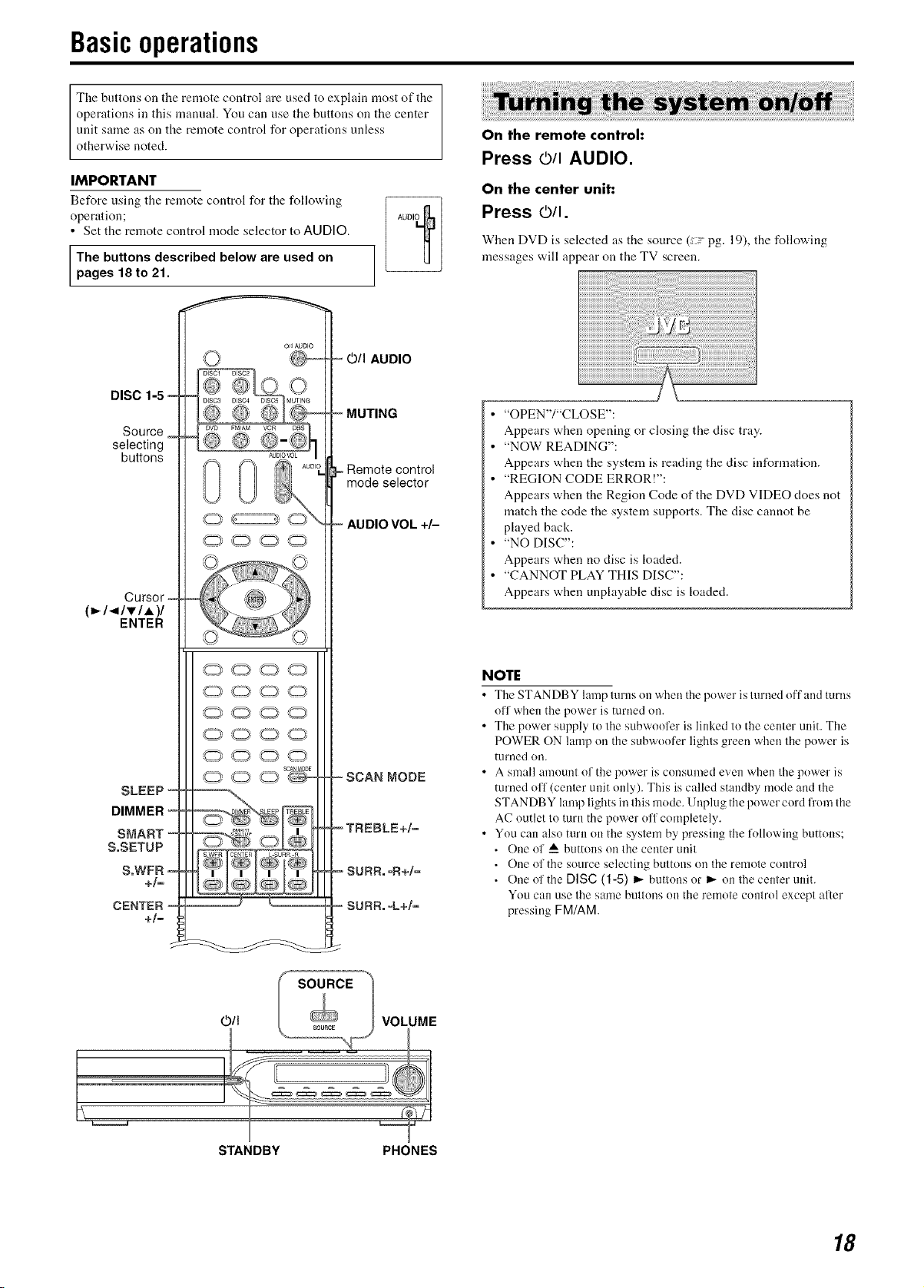
The buttons on the remote control are used to explain most of the
operations in this manual. You can use the buttons on the center
unit same as on the remote control for operations unless
otherwise noted.
IMPORTANT
Before using the remote control for tile following
operation;
• Set the remote control mode selector to AUDIO.
The buttons described below are used on
pages 18 to 21.
On the remote control:
Press ©/I AUDIO.
On the center unit:
Press ©/I.
When DVD is selected as tile source C -" Pg. 19), tile following
messages will appear on the TV screen.
DISC
Source
selecting
buttons
Cursor -
(_I_ITIAy
ENTER
SLEEP --
DIMMER -
SMART --
S.SETUP
S.WFR ,-
+/-
CENTER ,-
+/-
Od AUDIO
0000
©0©0
0000
0000
000©
O,O
011 AUDIO
MUTING
Remote control
mode selector
AUDIO VOL +/-
= SCAN MODE
TREBLE+_
SURR0-R+/-
SURR0=L+t-
• "OPEN"/"CLOSE":
Appears when opening or closing the disc tray.
• "NOW READING":
Appears when the system is reading the disc information.
• "REGION CODE ERROR!":
Appears when the Region Code of the DVD VIDEO does not
match the code the system supports. The disc cannot be
played back.
• "NO DISC":
Appears when no disc is loaded.
• "CANNOT PLAY THIS DISC":
Appears when unplayable disc is loaded.
NOTE
• The STANDBY hmp turns on when the pn'aer is turned nff and turns
off when the power is turned on.
• The power supply to the subwoofer is linked to the center unit. The
POWER ON lamp on the subwnofcr lights green when the power is
turned on.
• A small amount of the power is consumed even when the pnwer is
turned off (center unit only). This is called standby mode and the
STANDBY lamp lights in this mode. Unplug the power cord from the
AC outlet to turn the power off completely.
• You call also turn on the system by pressing the following buttons;
• ()lie of A buttons on the center unit
• One of the source selecting buttnns on the remote cnntrol
• One of the DISC (1-5) P,- buttons or I_ oil the center unit.
You call use the same bnttons oil the remote control except alter
pressing FM/AM.
t ,,,,,,,,,,,,,,,,,,-a
STANDBY PHONES
18
Basicoperations
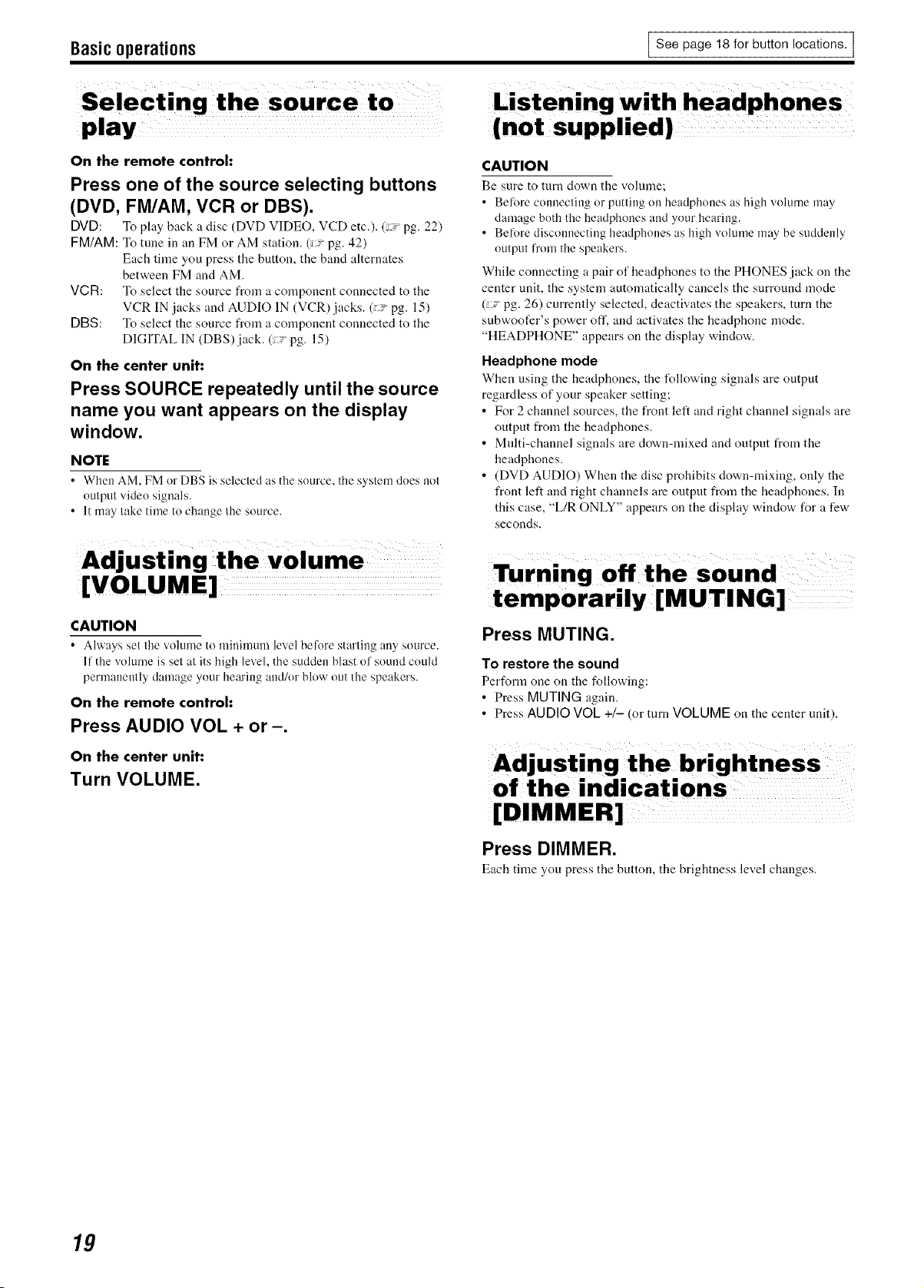
Selecting the source to
See page 18 for button locations. [
Listening With headphones
On the remote control:
Press one of the source selecting buttons
(DVD, FM/AM, VCR or DBS).
DVD: To play back a disc (DVD VIDEO, VCD etc.). (-" pg. 22)
FM/AM: To tune in an FM or AM station. ( "pg. 42)
Each time you press the button, the band alternates
between FM and AM.
VGR: To select the source from a component connected to the
VCR IN jacks and AUDIO IN (VCR)jacks. 0 -" Pg. 15)
DBS: To select the source from a component connected to the
DIGITAL IN (DBS)jack. 0 -" Pg. 15)
On the center unit:
Press SOURCE repeatedly until the source
name you want appears on the display
window.
NOTE
• When AM, FM or DBS is selected as the source, the system does not
output video signals.
• It may take time to change the source.
CAUTION
• Always set the volume to minimum level be[ore starting any source.
If the volume is set at its high level, the sudden blast of sound could
permanently damage your hearing and/or blow out the speakers.
On the remote control:
Press AUDIO VOL + or -.
On the center unit:
Turn VOLUME.
CAUTION
Be sure to turn down the volume;
• Before connecting or putting on headphones as high volume may
damage both the headphones and your hearing.
• BeR)re disconnecting headphones as high vnlume may be suddenly
output l'rnm the speakers.
While connecting a pair of headphones to the PHONES jack on the
center unit, the system automatically cancels the surround mode
(-" pg. 26) currently selected, deactivates the speakers, turn the
subwoofer's power oft'. and activates the headphone mode.
"HEADPHONE" appears on the display window.
Headphone mode
When using the headptK>ues, the following signals are output
regardless of your speaker setting;
• For 2 channel sources, the front left and right channel signals are
output from the headphones.
• Multi-channel signals are down-mixed and output t_om the
headphones.
• (DVD AUDIO) When the disc prohibits down-mixing, only the
front left and right channels are output from the headphones. In
this case, "L/R ONLY" appears on the display window I'or a few
seconds.
Turning off the sound
temporarily [MUTI NG]
Press MUTING.
To restore the sound
Perform one on the following:
• Press MUTING again.
• Press AUDIO VOL +/- (or turn VOLUME on the center unit).
Adjusting the brightness
of the indications
Press DIMMER.
Each time you press the button, the brightness level changes.
lg
Basic operations
See page 18 for button locations. I
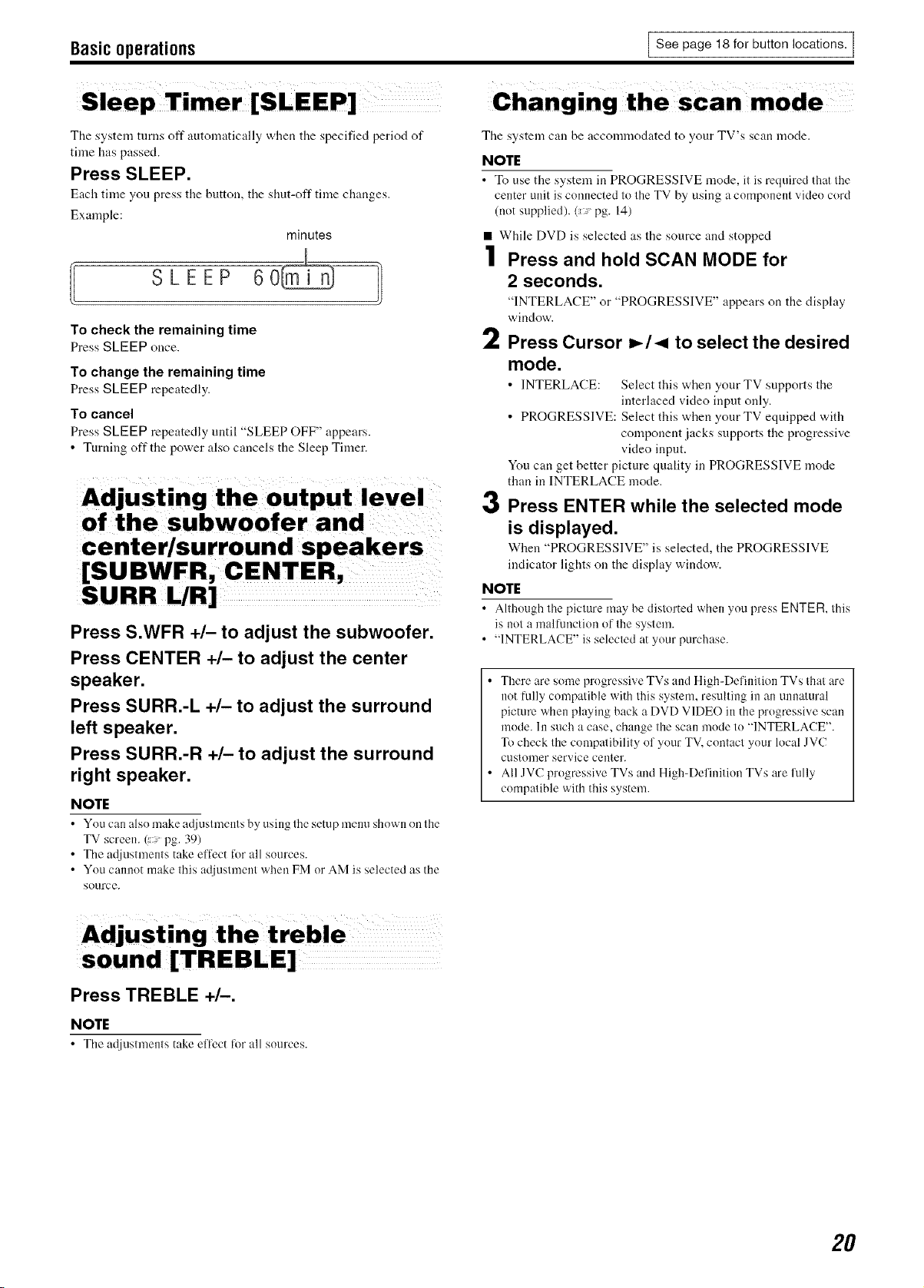
The system turns off automatically when the specified period of
time has passed.
Press SLEEP.
Each time you press the button, tile shut-off time changes.
Example:
[
minutes
SLEEP 60
To check the remaining time
Press SLEEP once.
To change the remaining time
Press SLEEP repeatedly.
To cancel
Press SLEEP repeatedly until "SLEEP OFF" appears.
• Turning off the power also cancels the Sleep Timer.
center/surround speakers
[SU BWFR, CENTER,
Press S.WFR +/- to adjust the subwoofer.
Press CENTER +/- to adjust the center
speaker.
Press SURR.-L +/- to adjust the surround
left speaker.
Press SURR.-R +/- to adjust the surround
right speaker.
NOTE
• You can also nmke adjustn_ents by nsing the setup n_enu shown on the
TVscreen.( :pg. 39)
• The adjustments take effect R)r all sources.
• You cannot make this adjustment when FM or AM is selected as the
source.
The system can be accommodated to your TV's scan mode.
NOTE
• To use tile system in PROGRESSIVE mode, it is reqnired that the
center unit is connected to the TV by using a component video cord
(not supplied). ( pg. 14)
• While DVD is selected as the source and stopped
Press and hold SCAN MODE for
2 seconds.
"INTERLACE" or "PROGRESSIVE" appears on the display
window.
2 Press Cursor =,-/_ to select the desired
mode.
• INTERLACE: Select this when your TV supports the
interlaced video input only.
• PROGRESSIVE: Select this when your TV equipped with
component jacks supports the progressive
video input.
You can get better picture quality in PROGRESSIVE mode
than in INTERLACE mode.
3 Press ENTER while the selected mode
is displayed.
When "PROGRESSIVE" is selected, tile PROGRESSIVE
indicator lights on the display window.
NOTE
• Although the picture may he distorted when you press ENTER, Ihis
is 11ola malfunction of the system.
• "INTERLACE" is selected at your purchase.
i There are some progressive TVs and High-Definition TVs that are
not fully compalible with this system, resulling in an unnatural
picture when playing back a DVD VIDEO in the progressive scan
mode. In such a case, change the scan mode to "INTERLACE".
To check the compalibilily ol your TV, conlacl your local JVC
customer service center.
All JVC progressive TVs and High-Definilion TVs are fnlly
compatible with tiffs system.
Press TREBLE +/-.
NOTE
• The adjustments take effect li_wall sources.
2O

Basicoperations I See page 18 for button locations. I
NOTE
• When you change the positioning of the speakers or listener, or
replace the supplied speakers with other nnes. perform Smart
Surround Setup again.
• While DVD is selected as the source and stopped
I Take your position where you listen to
the sound.
2 Press and hold SMART S.SETUP.
When "FAILED !" appears on the TV screen
The system Collld not detect the clapping sound correctly. In Sllch a
case, follow the instructions that appears on the TV screen.
• Whenthesystemdetectstheclappingsoundas"FAILED !"three
times, set the distance (DISTANCE) and the outpnt level
(LEVEL) manually C -" pg. 39).
To cancel
Press SMART S.SETUP.
NOTE
• You need to set tile subwnnler's output level (LEVEL) manually.
(v pg. 20 or 39)
• In step 2, "SW ERROR" appears on the display window if the center
unit and the powered subwooler are not c(mnected correctly by using
the supplied system cnrd.
"SETTING UP" flashes on the display window.
3 Press ENTER, press Cursor T/A to
select the distance between the front
speakers and the listening position,
then press ENTER.
4 Press Cursor _,/A to select START,
then press ENTER.
5 Clap your hands over your head once.
6 Make sure that "COMPLETED !"
appears on the TV screen, then press
SMART S.SETUP.
Tile system detects your clapping sound through the satellite
speakers, then automatically makes the best settings for each
speaker. "COMPLETED !" appears on the TV screen when
Smart Surround Setup completes.
21
Playback
• The icon such as [_ shows the types of discs the operation is
available for.
IMPORTANT
Before using tile remote control for tile
following operation;
1 Set the remote control mode selector to
AUDIO.
2 Press DVD.
AUDIO DVD
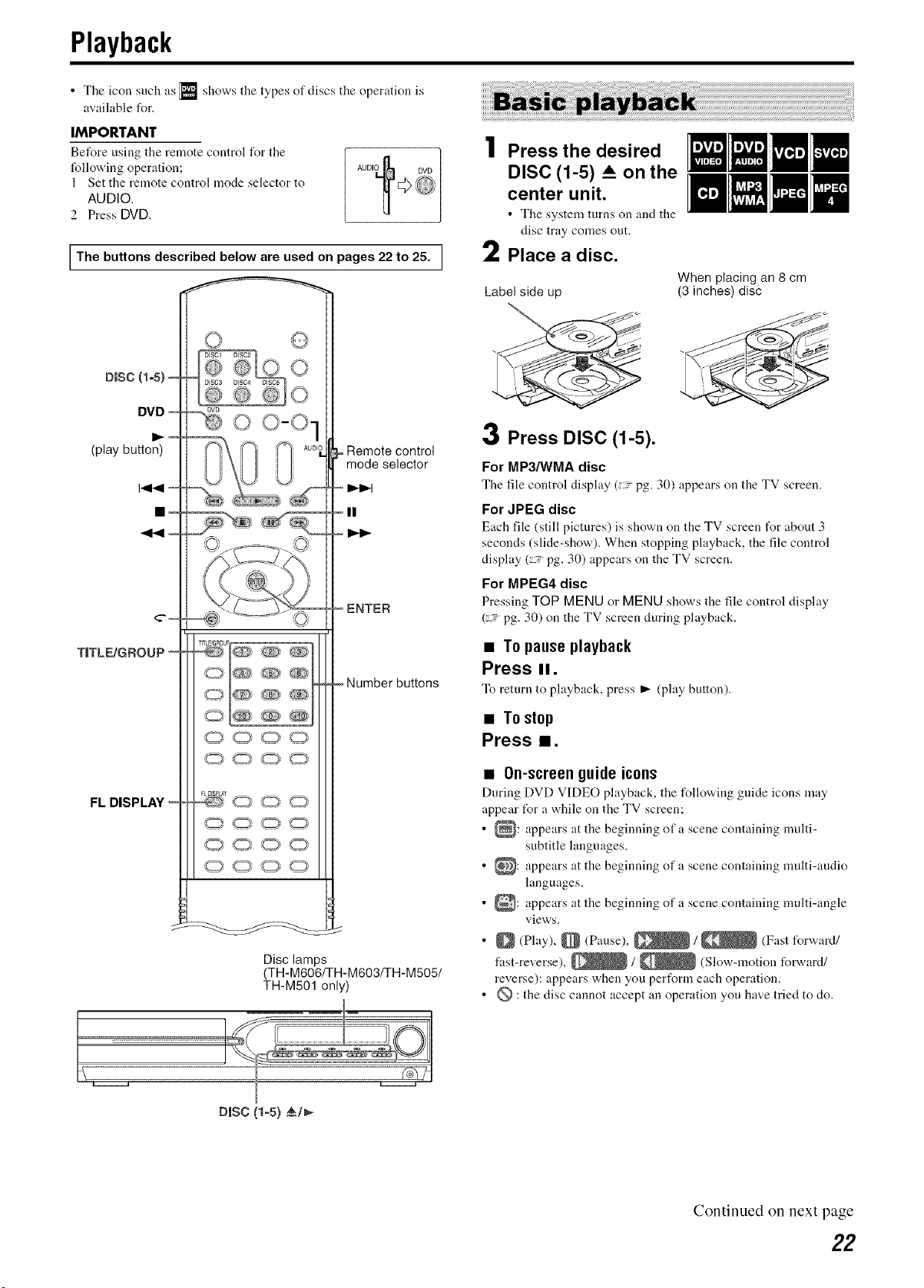
The buttons described below are used on pages 22 to 25. I
Disc (1o5),=
DVD =
Ira,.--
(play butten)
I_1_1
m=
TJTLEIGROUP
FL DISPLAY
© Q
©
O
Remote control
mode selector
II
I1,.-I_
ENTER
Number buttons
Disc lamps
(TH-M606/TH-M603/TH-M505/
TH-M501 only)
I,
DiSC (t-5) &/_
Press the desired
DISC (1-5) A on the
center unit.
• The system turns on and tile
disc tray comes out.
2 Place a disc.
Label side up
When placing an 8 cm
(3 inches) disc
3 Press DISC (1-5).
For MP3/WMA disc
The file control display C -" Pg. 30) appears cm the TV screen.
For JPEG disc
Each file (still pictures) is shown on the TV screen t_r about 3
seconds (slide-show). When stopping playback, the file control
display (_ -" pg. 30) appears on the TV screen.
For MPEG4 disc
Pressing TOP MENU or MENU shows the file control display
(-" pg. 30) on the TV screen during playback.
• To pause playback
Press II.
To return to playback, press I_ (phty button).
• Tostop
Press m.
• On-screenguideicons
During DVD VIDEO playback, tile following guide icons may
appear tUr a while on the TV screen;
• _: appears at the beginning of a scene containing multi-
subtitle languages.
• _: appears at the beginning of a scene containing multi-audio
languages.
• _: appears at the beginning of a scene containing multi-angle
views.
• _ (Phty), _ (Pause), _ / _ (Fast forward/
fast-reverse), _ / _ (Slow-lnotion forward/
reverse): appears when you pert_rm each operation.
• @ : the disc cannot accept an operation you have tried to do.
Continued on next page
22
Playback I See page 22 for button locations. I
NOTE
• Up to 5 discs can be loaded.
• You can also start playback by pressing I_ (play button) or DVD.
• The system plays back available discs sequentially until you stop
playback or until the disc loaded ou the DISC 5 tray reaches to the
end.
• (For JPEG) The system caunot accept operations even though you
press any buttons before the entire picture appears on the TV screen.
• If you do not want the (m-screen guide icons to appear, see page 4t).
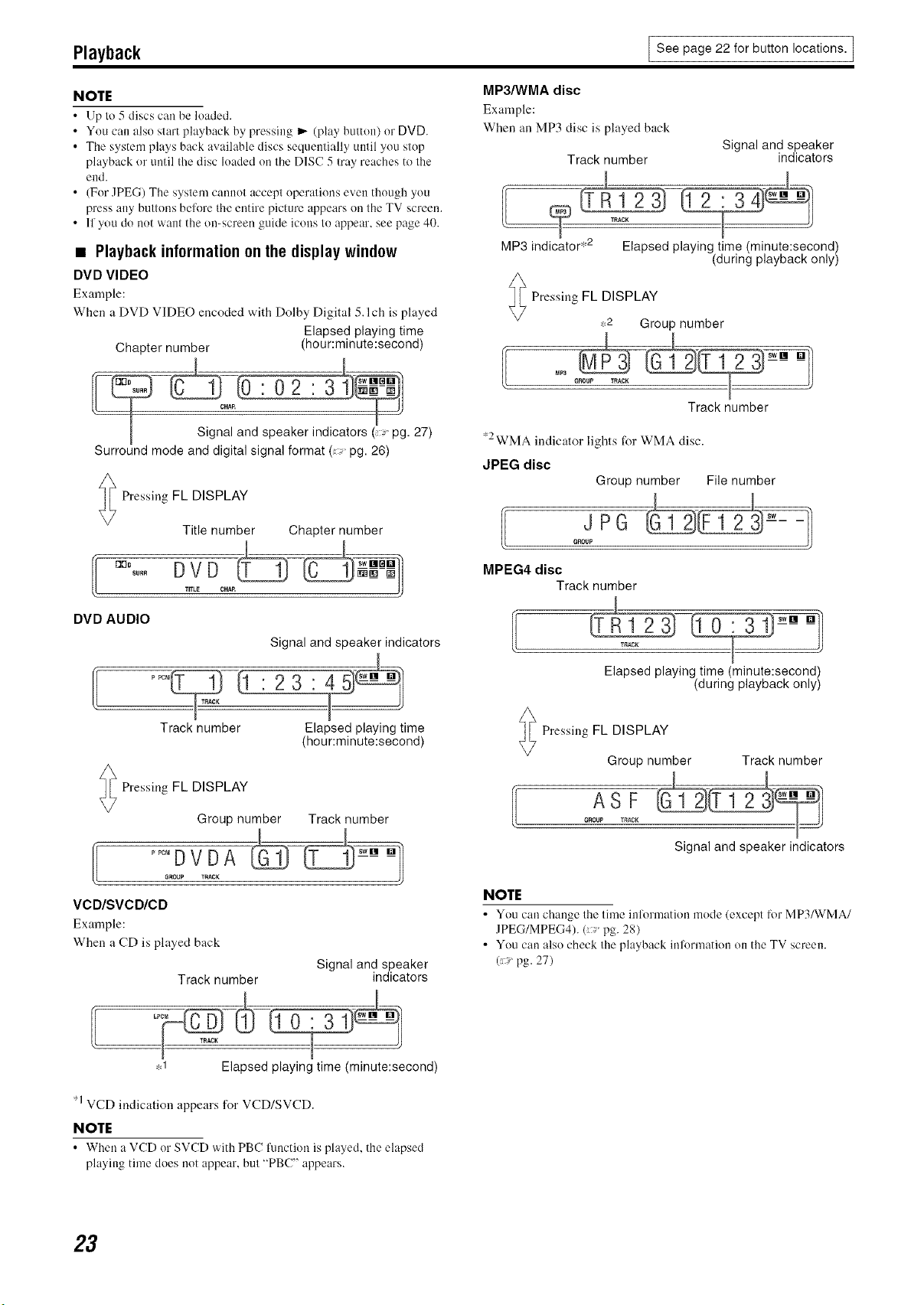
• Playback information on the display window
DVD VIDEO
Example:
When a DVD VIDEO encoded with Dolby Digital 5.1ch is played
Elapsed playing time
Chapter number (hour:minute:second)
'02'3
Signal and speaker indicators (pg. 27)
Surround mode and digital signal format ( pg. 26)
OOo
8UI_R
DVD AUDIO
Pressing FL DISPLAY
Title number
DVD
TITLE CHAI_
Chapter number
Signal and speaker indicators
Track number
'l Pressing FL DISPLAY
Group number
Elapsed playing time
(hour:minute:second)
Track number
VCD/SVCD/CD
Example:
When a CD is played back
Track number
Signal and speaker
indicators
Elapsed playing time (minute:second)
*l VCD indication appears for VCD/SVCD.
NOTE
• Wheu a VCD or SVCD with PBC function is played, tile elapsed
playing time does not appear, bul "PBC" appears.
MP3/WMA disc
Example:
When an MP3 disc is played back
Signal and speaker
Track number indicators
[._? - _. ......................................... --
MP3 indicator Elapsed playing hme (minute second)
(during playback only)
II Pressing FL DISPLAY
,2 Group number
MP3
GROUP TRACK :1:
Track number
- MA m&cator hghts for WMA disc.
JPEG disc
Group number File number
JPG
GROUP
MPEG4 disc
Track number
Elapsed playing time (minute:second)
(during playback only)
II Pressing FL DISPLAY
Group number
Track number
Signal and speaker indicators
NOTE
• You can change the time iulormation mode (except for MP3/WMA/
.1PEG/MPEG4). pg. 28)
• You cau also check the playback iulormation on the TV screen.
( pg. 27)
23
Playback [ See page 22 for button locations. [
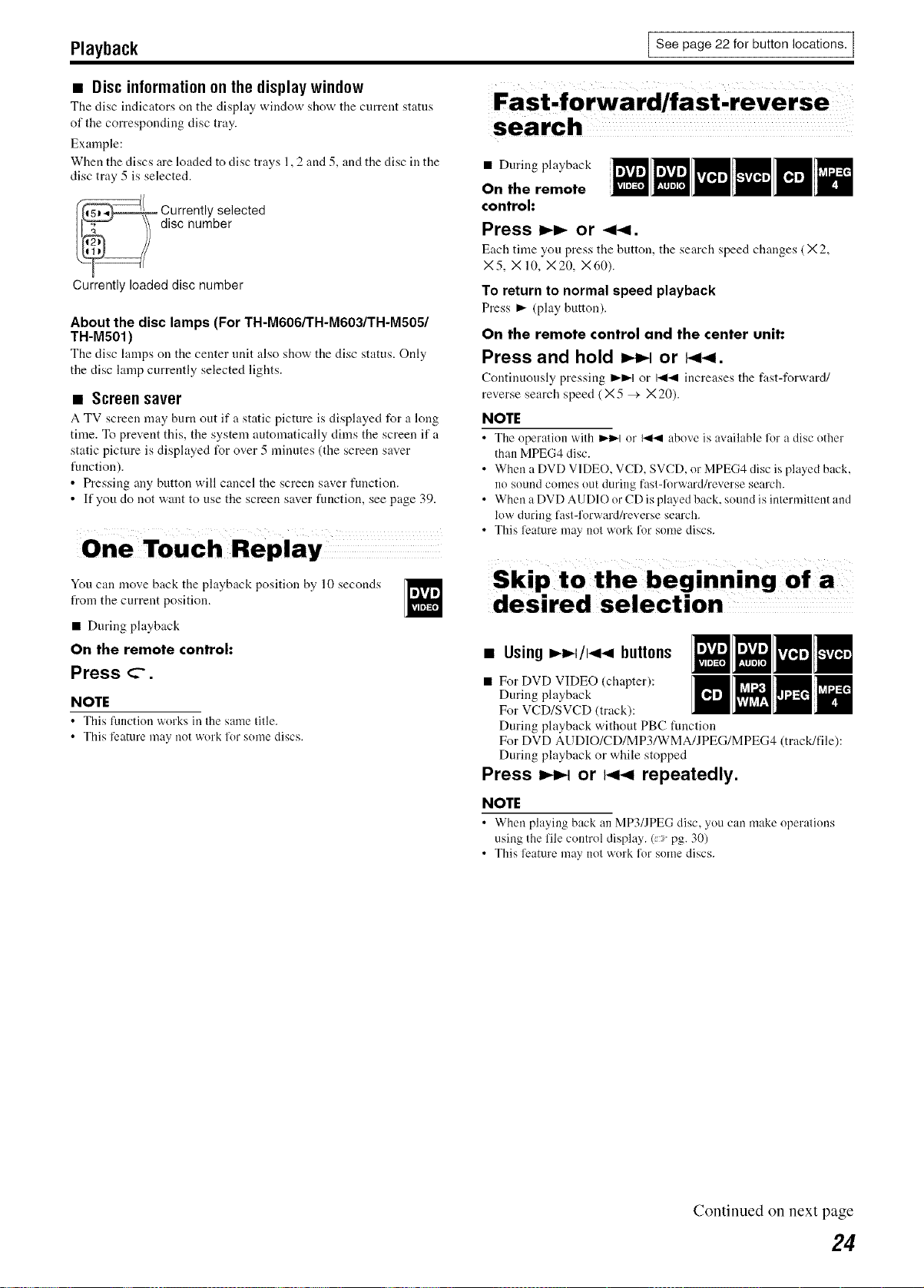
• Disc information on the display window
Tile disc indicators on tile display window show the current status
of the corresponding disc tray.
Example:
When the discs are loaded to disc trays 1,2 and 5, and the disc in the
disc tray 5 is selected.
_ urrently selected
disc number
Currently loaded disc number
About the disc lamps (For TH-M606/TH-M603/TH-M505/
TH-M501 )
The disc burps on tile center (luit also show tile disc status. Only
the disc lamp currently selected lights.
• Screen saver
A TV screen may burn out if a static picture is displayed for a long
time. To prevent this, the system automatically dims the screen if a
Fast.forward/fast.reverse
• During playback
On the remote
control:
Press _ or <<.
Each time you press tile button, tile search speed changes (X 2,
;<5, Xl0, ;<20, ;<60).
To return to normal speed playback
Press ),_ (play button).
On the remote control and the center unit:
Press and hold _1 or I_.
Continuously pressing _1_,-! or 14141increases tile f'ast-forward/
reverse search speed (X5 > X20).
NOTE
• The operation with I_1_1 or _ above is availahle for a disc"other
static picture is displayed I_r over 5 minutes (the screen saver
function).
• Pressing any bunon will cancel the screen saver function.
• If you do not want to use the screen saver function, see page 39.
One Touch Replay
You can move back the playback position by 10 seconds
from the current position.
• During playback
On the remote control:
Press c.
NOTE
• This function works in Ihe same tille.
• This feature may not work lk)r some discs.
than MPEG4 disc.
When a DVD VIDEO. VCD, SVCD, or MPEG4 disc is played back.
IIO SOuIld comes out during fastqorward/reverse search.
When a DVD AUDIO or CD is played hack. sound is intermittent and
low during fast-%rward/reverse search.
This li:ature may not work for some discs.
• Using ),-_t/I-,=-( buttons
• For DVD VIDEO (chapter):
During playback
For VCD/SVCD (track):
During playback without PBC function
For DVD AUDIO/CD/MP3/WMA/JPEG/MPEG4 (track/file):
During playback or while stopped
Press ).-_l or I_ repeatedly.
NOTE
• When playing hack an MP3/JPEG disc, you can make operations
using the file control display. ( =pg. 30)
• This leature may not work lot some discs.
Continued on next page
24
Playback [ See page 22 for button locations. [
• Using number buttons on the remote control
• For DVD VIDEO (title, chapter):
While stopped, the title number is selected.
During playback, the chapter number is selected.
For DVD AUDIO (track):
During playback or while stopped
For VCD/SVCD (track):
During playback without PBC fimction
For CD/MP3/WMA/JPEG/MPEG4 (track/file):
During playback or while stopped
Press number buttons (0-10, +10) to select
the desired number.
• For details on using tile number buttons, see "How to use tile
number buttons" below.
How to use the number buttons
To select 3: Press 3.
To select 14: Press +10, then 4.
To select 24: Press +10 twice, then 4.
To select 40: Press +10 three times, then 10.
Or press +10 four times, then 0.
• During playback or while
stopped
1 Press TITLE/
GROUP.
" or .... is shown in the title/group display area in the
display window.
Example:
During DVD VIDEO playback
T__ 1 "23"45
2 While the display window shows ....
or "_", use number buttons (0-10, +10)
to enter the desired title or group
number.
The system starts playback from the first chapter/track/file of
the selected title/group.
• For details on using the number buttons, see "How to use the
number buttons" above.
NOTE
• This ligaturemay nul work lnr some discs.
Some DVD AUDIOs have a special group called "bonus
group" whose contents are not open to the public. The
bonus group is always assigned to the last group of a disc.
To play back a bonus group, you have to enter the specific "key
number" (a password). The way of getting the key number depends
on the disc. Alter getting the key mmlber, you can play back the
bonus group by following the procedure below.
• While the BONUS indicator lights up on the display window
1 Select the bonus group.
For selecting tile group, see "Locating a desired title/group
using number buttons" described above.
The key number entry indication appears.
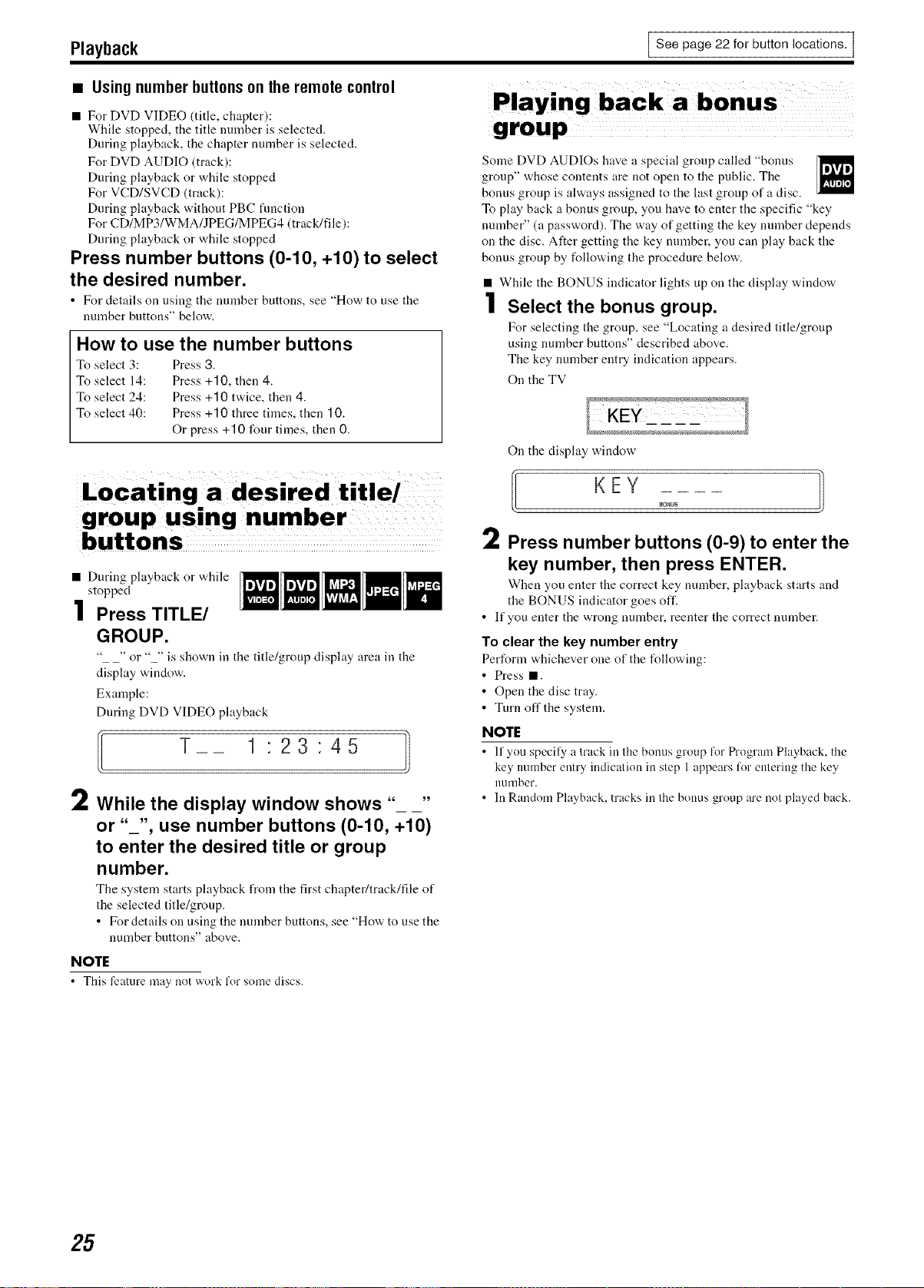
On the TV
On the display window
KEY .....
L Press number buttons (0-9) to enter the
key number, then press ENTER.
When you enter tile correct key i_lumber, playback starts alad
the BONUS indicator goes off.
• If you enter the wrong number, reenter the correct number.
To clear the key number entry
Perform whichever one of the following:
• Press I.
• Open the disc tray.
• Turn off the system.
NOTE
• lfyouspecifyatrackinthebnnnsgroupforProgramPlayback, the
key number entry indication in step I appears lk_rentering the key
number.
• In Random Playback, tracks in the bonus group are not played back.
25
Advancedoperations
• The icon such as [] shows tile types of discs the operation is
available for.
IMPORTANT
Before using the remote control for tile following
operation;
1 Set the remote control mode selector to
AUDIO.
2 Press DVD.
AUDIO DVD
• There are exceptions in the operation mentioned above. In such a
case, follow each instruction.
The buttons described below are used on 26 to 37. ]
pages
=,.Z
(play button)
SZ17JNG
0000
RET R
O _7"
im,.l_,./._1_i=
TOP MENU
Cursor.-
(_,,-I._IT I A )I
ENTER
AUD|O --
SUBTITLE
ANGLE --
PAGE =
REPEAT --
SETT|NG --
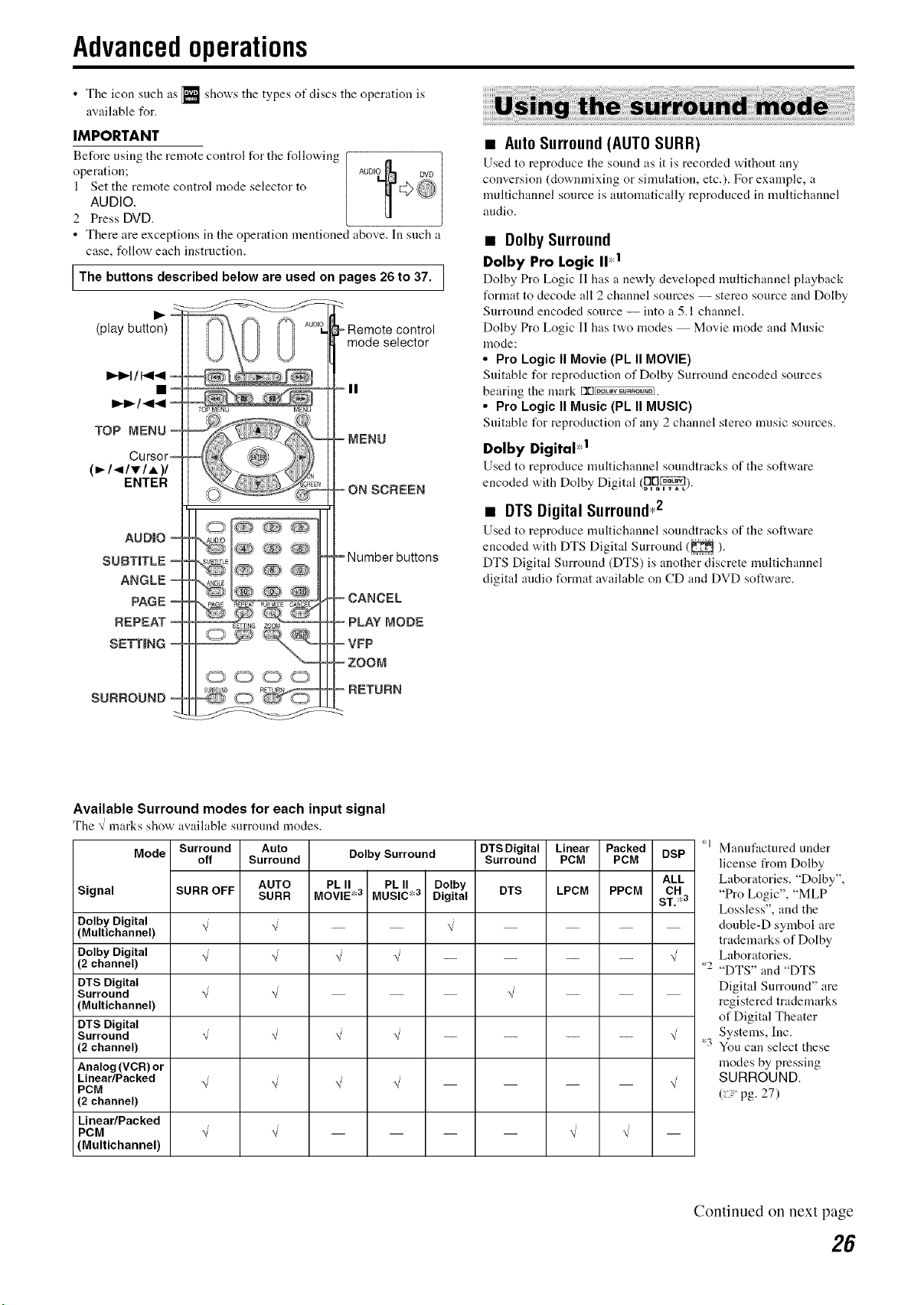
• AutoSurround(AUTOSURR)
Used to reproduce the sound as it is recorded without any
conversion (downmixing or simulation, etc.). For example, a
multichannel source is automatically reproduced in multichannel
audio.
SURROUND
° Remote control
mode selector
-- MENU
ON SCREEN
Number buttons
CANCEL
PLAY MODE
-- VFP
--ZOOM
--RETURN
• DolbySurround
Dolby Pro Logic I1.1
Dolby Pro Logic II has a newly developed multichannel playback
format to decode all 2 channel sources -- stereo source and Dolby
Surround encoded source -- into a 5.1 channel.
Dolby Pro Logic I] has two modes Movie mode and Music
mode:
• Pro Logic II Movie (PL II MOVIE)
Suitable for reproduction of Dolby Surround encoded sources
bearing the mark 0[:1_.
• Pro Logic II Music (PL II MUSIC)
Suitable for reproduction of any 2 channel stereo music sources.
Dolby Digital .1
Used to reproduce multichannel soundtracks of the software
encoded with Dolby Digital (_).
• DTS Digital Surround.2
Used to reproduce multichannel soundtracks of the software
encoded with DTS Digital Surround (_).
DTS Digital Surround (DTS) is another discrete multichannel
digital andio tUrmat available on CD and DVD software.
Available Surround modes for each input signal
The q marks show available surround modes.
Mode
Signal
Dolby Digital
(Multichannel)
Dolby Digital
(2 channel)
DTS Digital
Surround
(Multichannel)
DTS Digital
Surround
(2 channel)
Analog (VCR) or
Linear/Packed
PCM
(2 channel)
Linear/Packed
PCM
(Multichannel)
Surround
off
SURR OFF
x,'
x,'
Auto
Surround
AUTO
SURR
Dolby Surround
PL II PL II Dolby
MOVIE .3 MUSIC .3 Digital
4 4 --
4 4
DTS
_'1 Manufactured under
DTS Digital Linear Packed DSP
Surround PCM PCM license from Dolby
ALL Laboratories. "Dolby",
LPCM PPCM CH "Pro Logic", "MLP
ST* 3
Lossless", and the
double-D symbol are
trademarks of Dolby
__ __ q Laboratories.
_2 "DTS" and "DTS
Digital Surround" are
registered trademarks
of Digital Theater
__ __ q Systems, Inc.
t3 You can select these
modes by pressing
x_ SURROUND.
(-" pg. 27)
Continued on next page
26
Advancedoperations [ See page 26 for button locations. (
• All Channel Stereo (DSP)
All Channel Stereo (ALL CH ST.) mode can reproduce :t larger
stereo sound field using all the connected (and activated) speakers.
All Channel Stereo can be used while reproducing 2 channel stereo
source.
Normal stereo sound All Channel Stereo
4>
• Indicators on the display window
Digital signal format indicators
PPCM: Lights when DVD Aur)]o packed PCM signals
comes in.
LPCM: Lights when Linear PCM signal comes in.
FIFID: Lights when Dolby Digital signals come in.
FZkMI: Lights when DTS Digital (Surround) signals
come in.
No indication: No digital signal indicator lights when analog
signals come in.
Dolby Surround/DSP mode indicators
r1EIPLI]: Lights when Dolby Pro Logic II mode is activated.
DSP: Lights when All Channel Stereo mode is activated.
Source signal indicators, etc. SW _ _
Light to indicate the incoming signals. _ [[_)_
BIB : Lights when the left channel signal comes
in.
: Lights when the center channel signal comes in.
IgI: Lights when the right channel signal comes in.
i!_1: Lights when the LFE channel signal comes in.
[]_t: Lights when the surround left channel signal comes in.
: Lights when the surround right channel signal comes in.
I_ : Lights when the monaural surround channel signal or 2
channel Dolby Surround signal comes in.
SW : Always lights.
The channel with "-'' shows that the corresponding speakers are
reproducing the channels' sound.
If the channels' sound decoded into 5.1 channel is reproduced, only
"--" lights.
Selecting the surround mode
The system is set up to automatically select the optimal surround
mode for input signal t_om digital multichannel software.
When playing back 2 channel source, you can select the desired
surround mode manually.
IMPORTANT
Before using the remote control for the following
operation;
• Set the remote control mode selector to AUDIO.
• When playing back digital multichannel software
(except during SURR OFF mode)
The appropriate multichannel surround mode (Dolby Digital, DTS
Digital Surround or Linear/Packed PCM) is automatically selected.
• When playing back 2 channel source
You can select either mode of Dolby Pro Logic II (PL I1 MOVIE/
PL II MUSIC) or the DSP (ALL CH ST.) mode.
Press SURROUND repeatedly to select the
desired mode.
The surround mode is turrled on and the current surround mode
appears on the display window.
Each time you press the button, the surround mode changes.
For details on each mode, see page 26.
To turn off the surround mode
Press SURROUND repeatedly until SURR
OFF appears on the display window.
Storing adjustments i auto memory
When yon turn the power off. the system memorizes the current
surround mode. The memorized mode is automatically recalled
when you turn the power on.
NOTE
• When FM or AM is selected as tire source, yon cannot select any
surround mode.
• Note that the surround mode takes no effect on MPEG4 playback.
• For a down-mixing prohibited DVD AUDIO disc, the system
continues to output multi-channel signals with "MULTI CH" shown
on the display window even if the surround mode is turned off during
playback. On the other hand, the system outputs only the front left and
front right chamrel signals with "LR ONLY" shown on the display
window when you start playback with tlre surround mode having been
set to "SUNk OFF".
You can check disc information and you can rise some functions
using the on-screen bar.
Showing the on-screen bar
• Whenever a disc is
loaded
Press ON SCREEN.
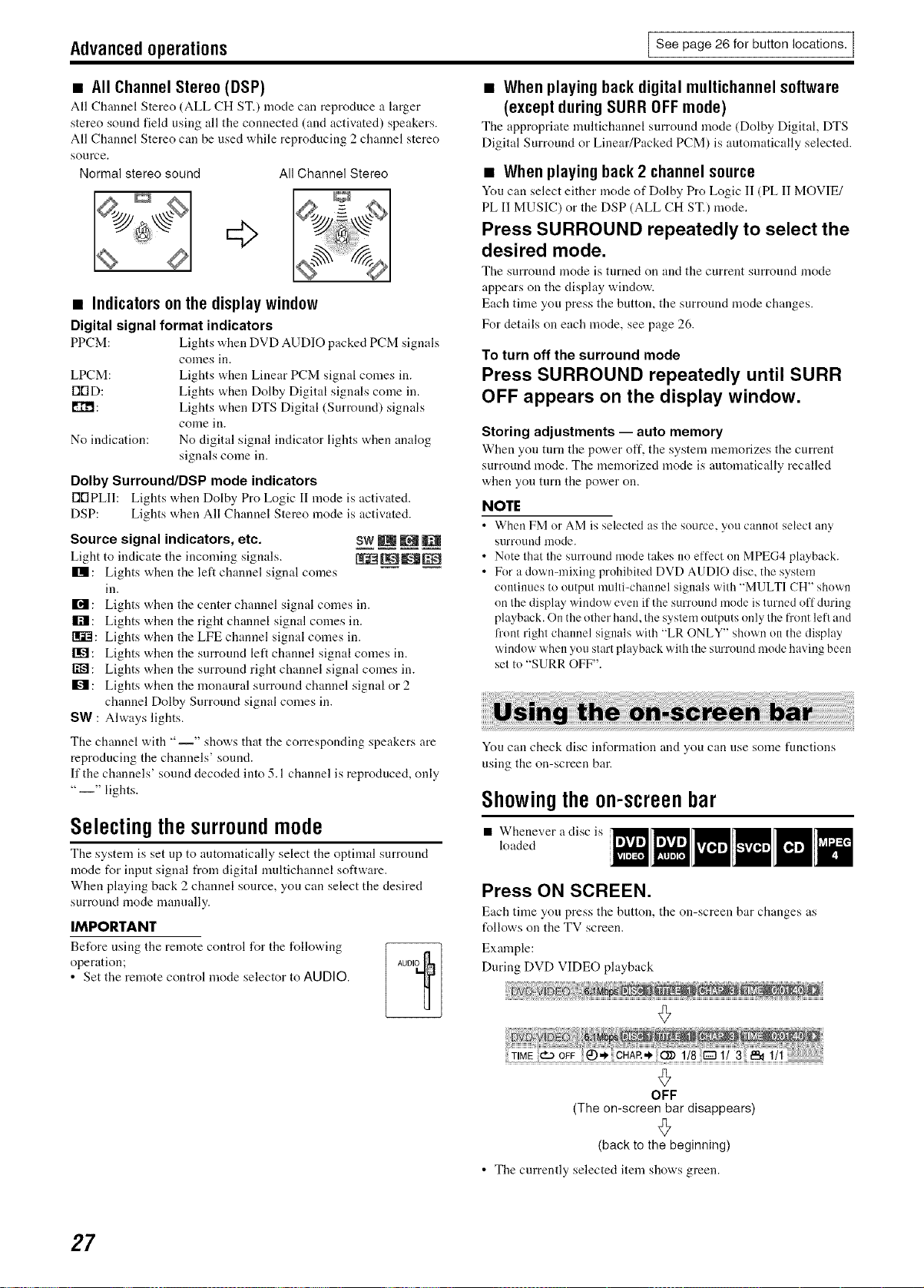
Each time you press the button, the on-screen bar changes as
follows on the TV screen.
Example:
During DVD VIDEO playback
+
+
OFF
(The on-screen bar disappears)
(back to the beginning)
• The currently selected item shows green.
27
Advancedoperations
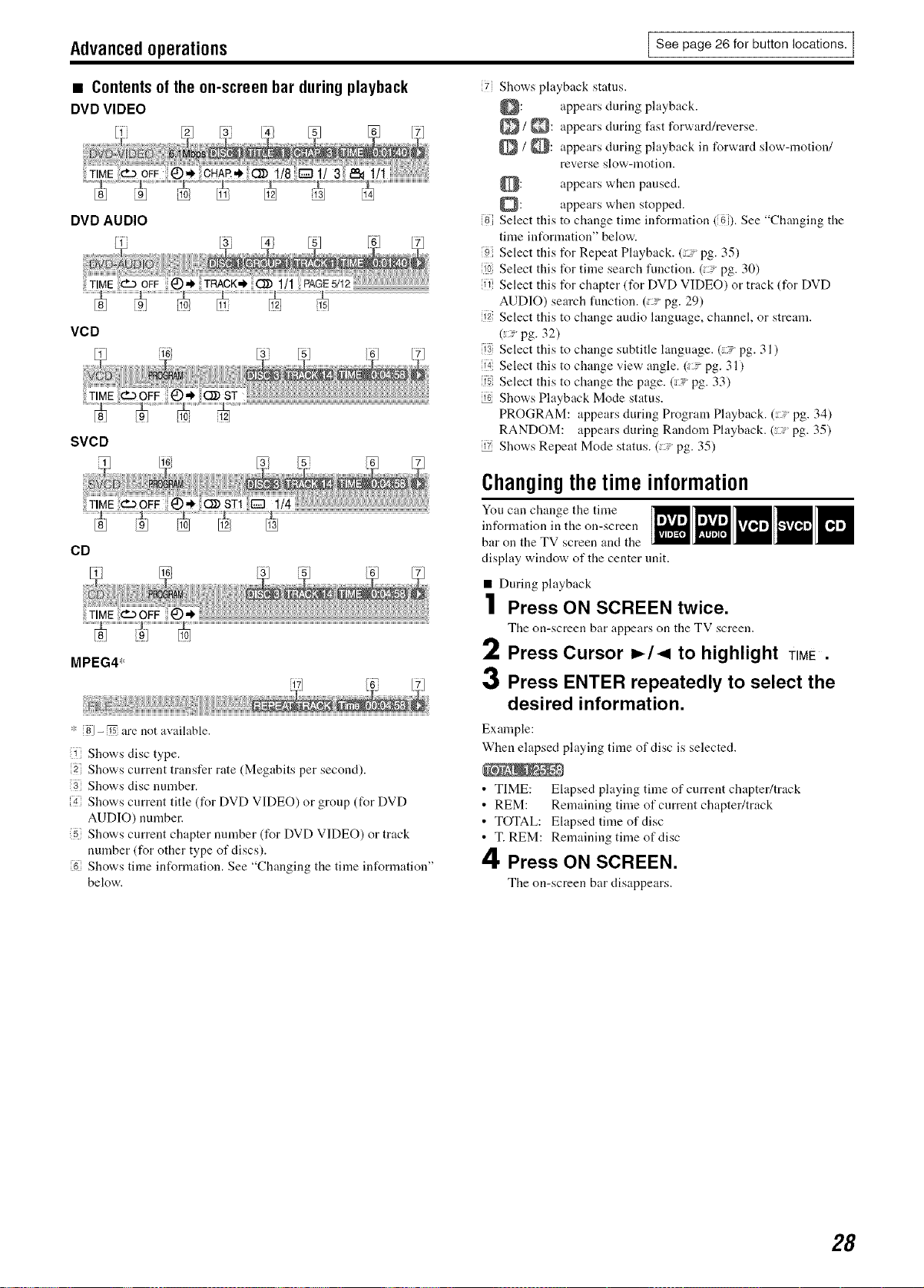
• Contents of the on-screen bar during playback
DVD VIDEO
DVD AUDIO
VCD
SVCD
CD
MPEG4*
See page 26 for button locations. [
Shows playback status.
O: appears during playback.
/ _: appears during fast forward/reverse.
O / O: appears during playback in forward slow-motion/
reverse slow-motion.
O: appears when paused.
_: appears when stopped.
8j Select this to change time information (<). See "Changing the
time int_rmation" below.
Select this for Repeat Playback. (-" pg. 35)
_0 Select this for time search function. (; -" pg. 30)
!i Select this for chapter (for DVD VIDEO) or track (for DVD
AUDIO) search fimction. (_ _"pg. 29)
12 Select this to change audio language, channel, or stream.
(-" pg. 32)
Select this to change subtitle language. 0 -" Pg. 31 )
i4 Select this to change view angle. (-" pg. 31)
15 Select this to change the page. 0 -" Pg. 33)
16 Shows Playback Mode status.
PROGRAM: appears during Program Playback. (; -."pg. 34)
RANDOM: appears during Random Playback. (-" pg. 35)
17 Shows Repeat Mode status. (_ _"pg. 35)
(_D ST!
* 8] - _ are not available.
Shows disc type.
Shows current transfer rate (Megabits per second).
3 Shows disc number.
4 Shows current title (for DVD VIDEO) or group (for DVD
AUDIO) number.
5) Shows current chapter number (for DVD VIDEO) or track
number (for other type of discs).
Shows time information. See "Changing the time information"
below.
Changingthe time information
You can change the time
information in the on-screen
bar on the TV screen and the
display window of the center unit.
• During playback
Press ON SCREEN twice.
The on-screen bar appears on the TV screen.
Press Cursor _/_ to highlight TIME •
3 Press ENTER repeatedly to select the
desired information.
Example:
When elapsed playing time of disc is selected.
• TIME: Elapsed playing time of current chapter/track
• REM: Remaining time of current chapter/track
• TOTAL: Elapsed time of disc
• T. REM: Remaining time of disc
4 Press ON SCREEN.
The on-screen bar disappears.
28
Advancedoperations [ See page 26 for button locations. I
You can start playing a title, chapter or track you specify. You can
also play a disc from specified time.
Locatinga desiredscenefromthe DVD
menu
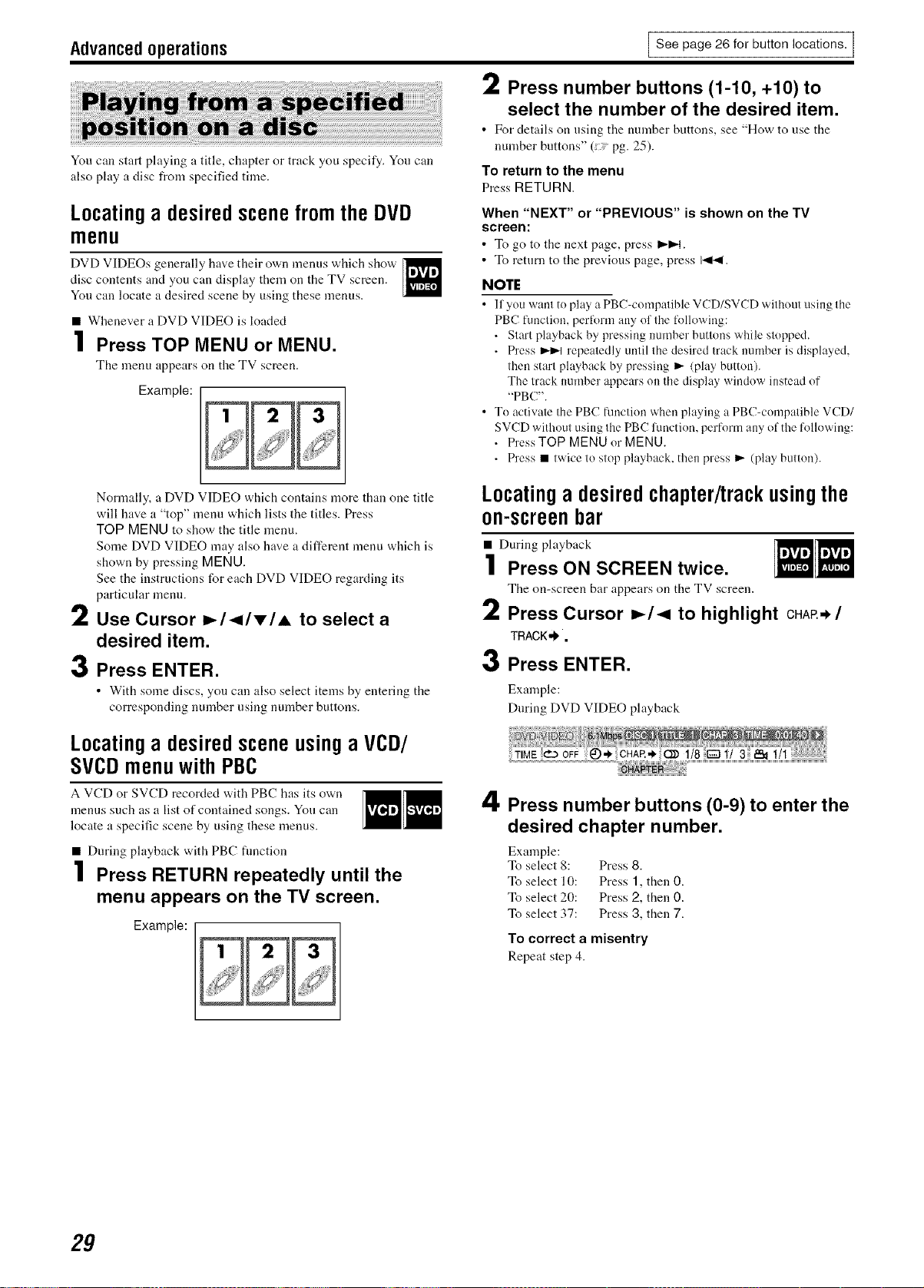
DVD VIDEOs generally have their own menus which show
disc contents and you can display them on the TV screen.
You can locate a desired scene by using these menus.
• Whenever a DVD VIDEO is loaded
1 Press TOP MENU or MENU.
Tile menu appears on the TV screen.
Example:
2 Press number buttons (1-10, +10) to
select the number of the desired item.
• For details on using tile number buttons, see "How to use tile
number buttons" (7" pg. 25).
To return to the menu
Press RETURN.
When "NEXT" or "PREVIOUS" is shown on the TV
screen:
• To go to tile next page, press _!.
• To return to the previous page, press 14141.
NOTE
• lfyouwanttoplayaPBC-compatibleVCD/SVCDwithoutusingthe
PBC function, perR)rm ally of tile following:
• Start playback by pressing number buttons while stopped.
• Press D,-_I repeatedly until the desired track number is displayed,
then start playback by pressing D,- (play button).
The track number appears on tile display window instead of
"PBC".
• To activate the PBC function when playing a PBC<ompatible VCD/
SVCD without using the PBC function, perform ally ol the following:
• PressTOP MENU or MENU.
• Press • twice to stop playback, then press D,- (play button).
Normally, a DVD VIDEO which contains more than one title
will have a "top" menu which lists the titles. Press
TOP MENU to show the title menu.
Some DVD VIDEO may also have a different menu which is
shown by pressing MENU.
See the instructions for each DVD VIDEO regarding its
particular menu.
A
'2 Use Cursor _/_/T/A to select a
desired item.
3 Press ENTER.
• With some discs, you can also select items by entering the
corresponding number using number buttons.
Locatinga desiredchapter/trackusingthe
on-screen bar
• During playback
1 Press ON SCREEN twice.
Tile on-screen bar appears on tile TV screen.
2 Press Cursor _/_ to highlight CHAR*/
TRACK* .
3 Press ENTER.
Example:
During DVD VIDEO playback
Locatinga desiredsceneusinga VCD/
SVCDmenuwith PBC
A VCD or SVCD recorded with PBC has its own
menus such as a list of contained songs. You can
locate a specific scene by using these menus.
• During playback with PBC fimction
1 Press RETURN repeatedly until the
menu appears on the TV screen.
Example:
4
Press number buttons (0-9) to enter the
desired chapter number.
Ex:unple:
To select 8: Press 8.
To select 10: Press 1, then 0.
To select 20: Press 2, then 0.
To select 37: Press 3, then 7.
To correct a misentry
Repeat step 4.
29
Advancedoperations
5 Press ENTER.
6 Press ON SCREEN.
The on-screen bar disappears.
NOTE
• You can selecl up to the 991h chapter/track.
See page 26 for button locations. I
NOTE
• You can specify time in hours/nfinules/seconds for DVD VIDEO/
DVD AUDIO and in minules/seconds l_)r VCD/SVCD/CD.
Locatinga desiredposition byspecifying
the time
• For DVD VIDEO/DVD
AUDIO:
During playback
For VCD/SVCD:
While stopped or during playback without PBC fimction
For CD:
During playback or while stopped
• When specifying the elapsed playing time from the
beginning of the disc
Perform the following procedure while stopped.
• When specifying the elapsed playing time from the
beginning of the current title/track
Perform the following procedure during playback.
I Press ON SCREEN twice.
The on-screen bar appears on the TV screen.
2 Press Cursor _/_ to highlight ®..
3 Press ENTER.
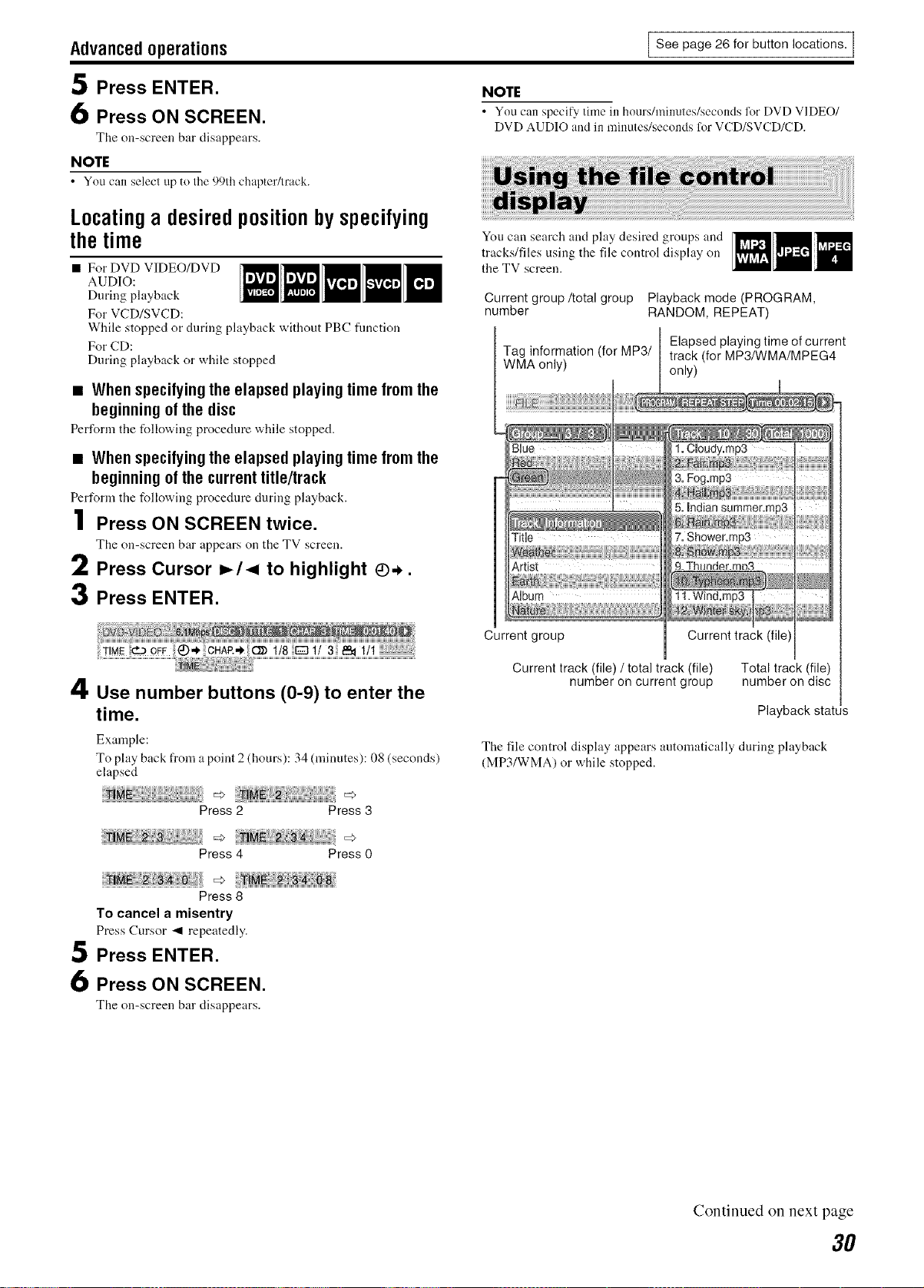
You can search and play desired groups and
tracks/files using the file control display on
the TV screen.
Current group/total group Playback mode (PROGRAM,
number RANDOM, REPEAT)
Tag information (for MP3/
WMA only)
4 Use number buttons (0-9) to enter the
time.
Example:
To play back from a point 2 (hours): 34 (minutes): 08 (seconds)
elapsed
Press 2 Press 3
=¢, =>
Press 4 Press 0
=5
Press 8
To cancel a misentry
Press Cursor 41 repeatedly.
5 Press ENTER.
Press ON SCREEN.
The on-screen bar disappears.
Elapsed playing time of current
track (for MP3/WMA/MPEG4
only)
Current group Current track (file)
Current track (file) / total track (file) Total track (file)
number on current group number on disc
Playback status
The file control display appears automatically during playback
(MP3/WMA) or while stopped.
Continued on next page
30
Advancedoperations [ See page 26 for button locations. I
• For MP3/WMA:
During playback or while stopped
For JPEG/MPEG4:
While stopped
I Press Cursor _l-,_l'v'IA to select the
desired group/track/file.
• For MP3/WMA, playback starts from the selected track.
2 Press =,- (play button) or ENTER.
• Track playback/slide-show starts t_om the selected track/
_e.
• When you press ENTER for JPEG, only the selected file is
played back.
NOTE
• During playback, you can h)cate the desired track/file by pressing
_l/l-.ql_ or Cursor A/_'.
• You can alsn check playback information on the display window.
(. pg. 23)
• Some group, track and lile names may not be displayed correctly
depending on recording conditions.
• The order of groups, tracks and files may be displayed differently
l)'om the order displayed on your personal computer.
2 Press ANGLE repeatedly or press
Cursor _'/A to select the desired view
angle.
When using the on-screen bar:
1 Press ON SCREEN twice.
The on-screen bar appears on the TV screen.
2 Press Cursor =,-/_ to highlight _1/3.
3 Press ENTER.
4 Press Cursor _'/A to select the desired
view angle.
Press ENTER.
6 Press ON SCREEN.
When Resume Playback is set to
"ON" (-" pg. 40) and you stop
playback by the tbllowing
The on-screen bar disappears.
NOTE
• During DVD AUDIO phtyhack, this feature is available only for the
video part.
operations, the position where playback has been stopped is stored.
("RESUME" appears on the display window.)
• Turning offthe power (-" pg. 18)
• Pressing • once
• Changing the source (- pg. 19)
To start playback from the stored position
Press I_ (phty button) or DVD.
• There may be a case where I_ (play button) does not work alter
changing the source.
To clear the stored position
Press • again or open the disc tray with the playback disc.
• During playback of a disc containing
subtitles in several languages
When using the SUBTITLEbutton=
1 Press SUBTITLE.
Example (DVD VIDEO):
"ENGLISH" is selected out of 3 subtitle languages recorded.
I_ 113
• During playback of a disc containing multi-view
angles
When using the ANGLE button=
1 Press ANGLE.
Example:
The first view angle is selected out of 3 view angles recorded.
113
2 Press Cursor T/A to select the desired
subtitle.
For SVCD
• An SVCD can contain up to four subtitles. Pressing
SUBTITLE changes the subtitles regardless of whether the
subtitles are recorded or not. (Subtitles will not change if no
subtitle is recorded.)
NOTE
• To clear the suhtitle, press SUBTITLE. Each time you press
SUBTITLE, subtitle appears and disappears alternately.
31
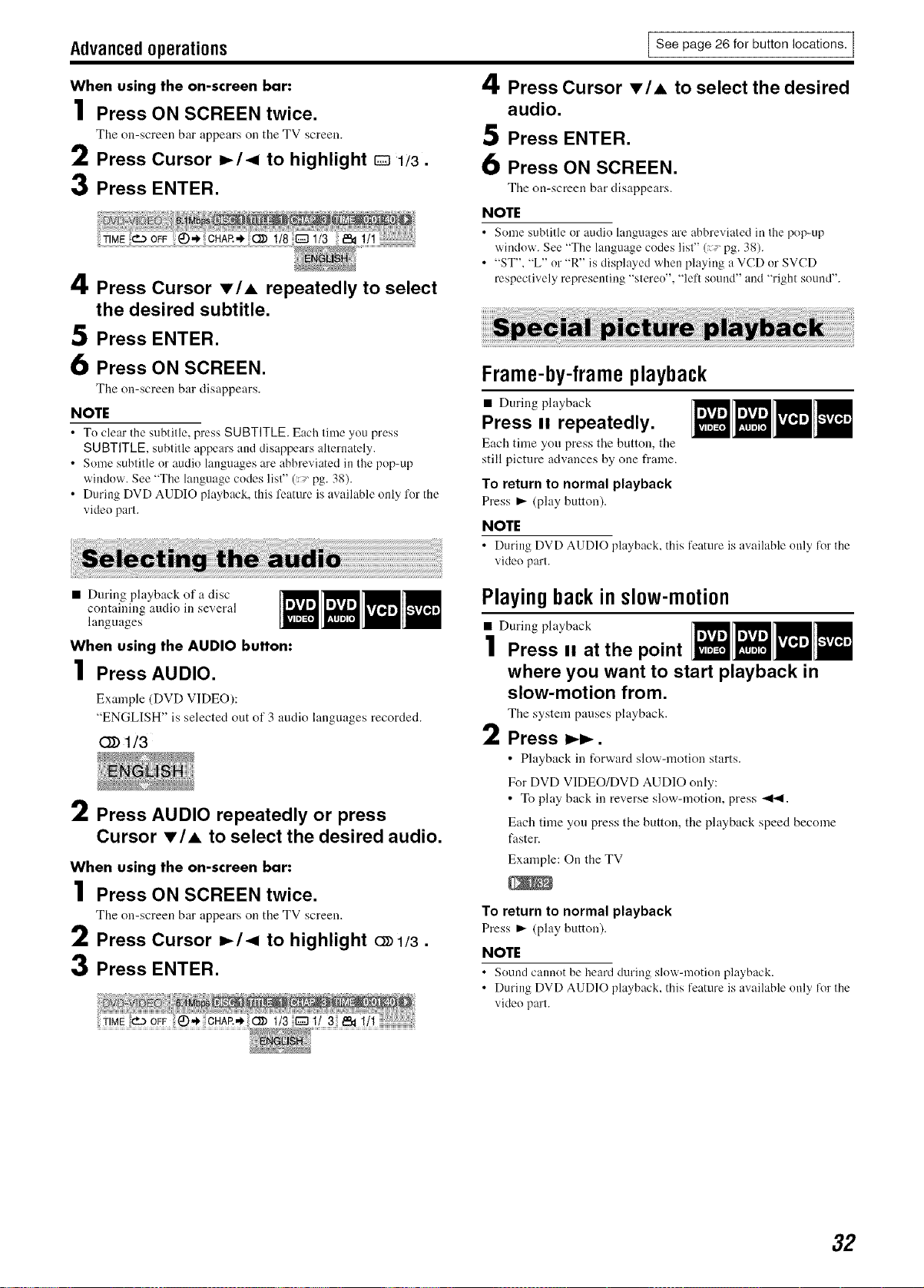
Advancedoperations
When using the on-screen bar:
1 Press ON SCREEN twice.
The on-screen bar appears on the TV screen.
2 Press Cursor _/_ to highlight _ 1/3.
3 Press ENTER.
4 Press Cursor vIA repeatedly to select
the desired subtitle.
5 Press ENTER.
6 Press ON SCREEN.
The on-screen bar disappears.
NOTE
• To clear the subtitle, press SUBTITLE. Each time you press
SUBTITLE, subtitle appears and disappears alternately.
• Some subtitle or audio languages are abbreviated in the pop-up
window. See "The language codes list" (. pg. 38).
• During DVD AUDIO playback, this feature is available only lk)r the
video part.
• During playback of a disc
containing audio in several
languages
When using the AUDIO button:
1 Press AUDIO.
Example (DVD VIDEO):
"ENGLISH" is selected out of 3 audio languages recorded.
(33 113
2 Press AUDIO repeatedly or press
Cursor via to select the desired audio.
When using the on-screen bar:
1 Press ON SCREEN twice.
The on-screen bar appears on the TV screen.
2 Press Cursor )-/-,= to highlight c_ 1/3 •
3 Press ENTER.
See page 26 for button locations. I
4 Press Cursor v/A to select the desired
audio.
5 Press ENTER.
6 Press ON SCREEN.
The on-screen bar disappears.
NOTE
• Some subtide or audio languages are abbreviated in the pop-up
window. See "The language codes list" (:= pg. 38).
• "ST". "L" or "R" is displayed when playing a VCD or SVCD
respectively representing "stereo", "left sound" and "right sound".
Frame-by-frameplayback
• During playback
Press II repeatedly.
Each time you press the button, the
still picture advances by one frame.
To return to normal playback
Press I_ (play button).
NOTE
• During DVD AUDIO playback, this feature is available only for 1be
video parl.
Playing back in slow-motion
• During playback
1 Press II at the point
where you want to start playback in
slow-motion from.
The system pauses playback.
2 Press _.
• Playback in forward slow-motion starts.
For DVD VIDEO/DVD AUDIO only:
• To play back in reverse slow-motion, press 41_1.
Each time you press the button, the playback speed become
faster.
Example: On the TV
To return to normal playback
Press I_ (play button).
NOTE
• Sound c:mnot be heard during slow-motion playback.
• During DVD AUDIO playback, this feature is available only for the
video part.
32
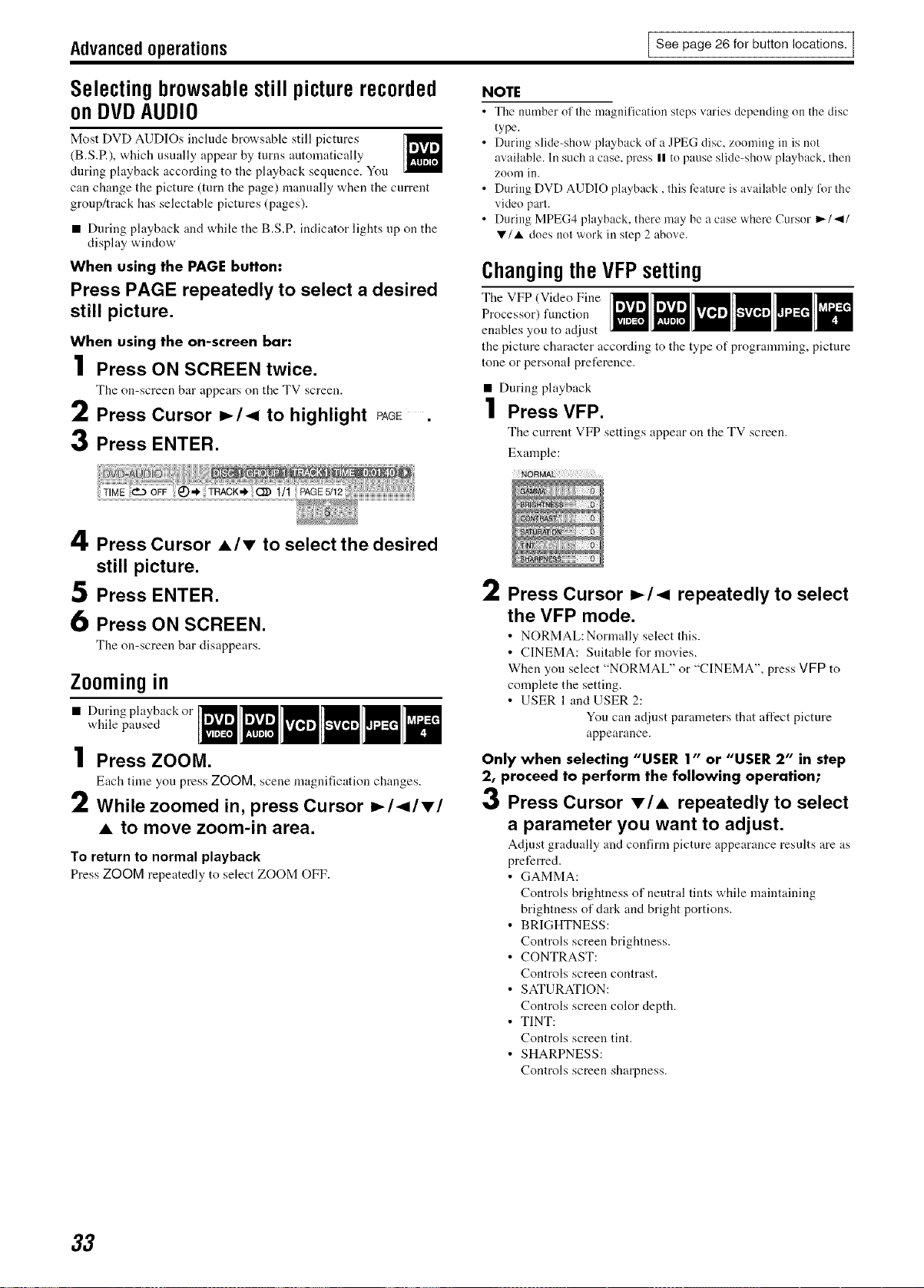
Advancedoperations [ See page 26 for button locations. I
Selecting browsable still picture recorded
on DVD AUDIO
Most DVD AUDIOs include browsable still pictures
(B.S.R), which usually appear by turns automatically
during playback according to the playback sequence. You
can change the picture (turn the page) manually when the current
group/track has selectable pictures (pages).
• During playback and while the B.S.P. indicator lights tip on the
display window
When using the PAGE button:
Press PAGE repeatedly to select a desired
still picture.
When using the on-screen bar:
1 Press ON SCREEN twice.
Tile on-screen bar appears (m tile TV screen.
2 Press Cursor =,-/_ to highlight PAGE
3 Press ENTER.
NOTE
• The number of the magnification steps varies depending on the disc"
type.
• During slide-show playback of a JPEG disc, zooming in is not
available. In such a case, press II to pause slide-show playback, then
zonm iI1.
• During DVD AUDIO playback, this tl;ature is available only ]br the
video part.
• During MPEG4 playback, there may be a case where Cursor I_/_1/
V/A does not work in step 2 above.
Changingthe VFPsetting
The VFP (Video Fine
Processor) function
enables you to adjust
the picture character according to the type of programming, picture
tone or personal preference.
• During playback
1 Press VFP.
The current VFP settings appear on the TV screen.
Example:
4 Press Cursor A/v to select the desired
still picture.
5 Press ENTER.
6 Press ON SCREEN.
The on-screen bar disappears.
Zoomingin
• During playback or
while paused
1 Press ZOOM.
Each time you press ZOOM, scene magnification changes.
2 While zoomed in, press Cursor _/-_/v/
• to move zoom-in area.
To return to normal playback
Press ZOOM repeatedly to select ZOOM OFF.
2 Press Cursor _/_ repeatedly to select
the VFP mode.
• NORMAL:Normally select this.
• CINEMA: Suitable for movies.
When you select "NORMAL" or "CINEMA", press VFP to
complete the setting.
• USER 1 and USER 2:
You can adjust parameters that affect picture
appearance.
Only when selecting "USER 1" or "USER 2" in step
2, proceed to perform the following operation;
3 Press Cursor v/• repeatedly to select
a parameter you want to adjust.
Adjust gradually and confirm picture appearance results are as
preferred.
• GAMMA:
Controls brightness of neutral tints while maintaining
brightness of dark and bright portions.
• BRIGHTNESS:
Controls screen brightness.
• CONTRAST:
Controls screen contrast.
• SATURATION:
Controls screen color depth.
• TINT:
Controls screen tint.
• SHARPNESS:
Controls screen sharpness.
33
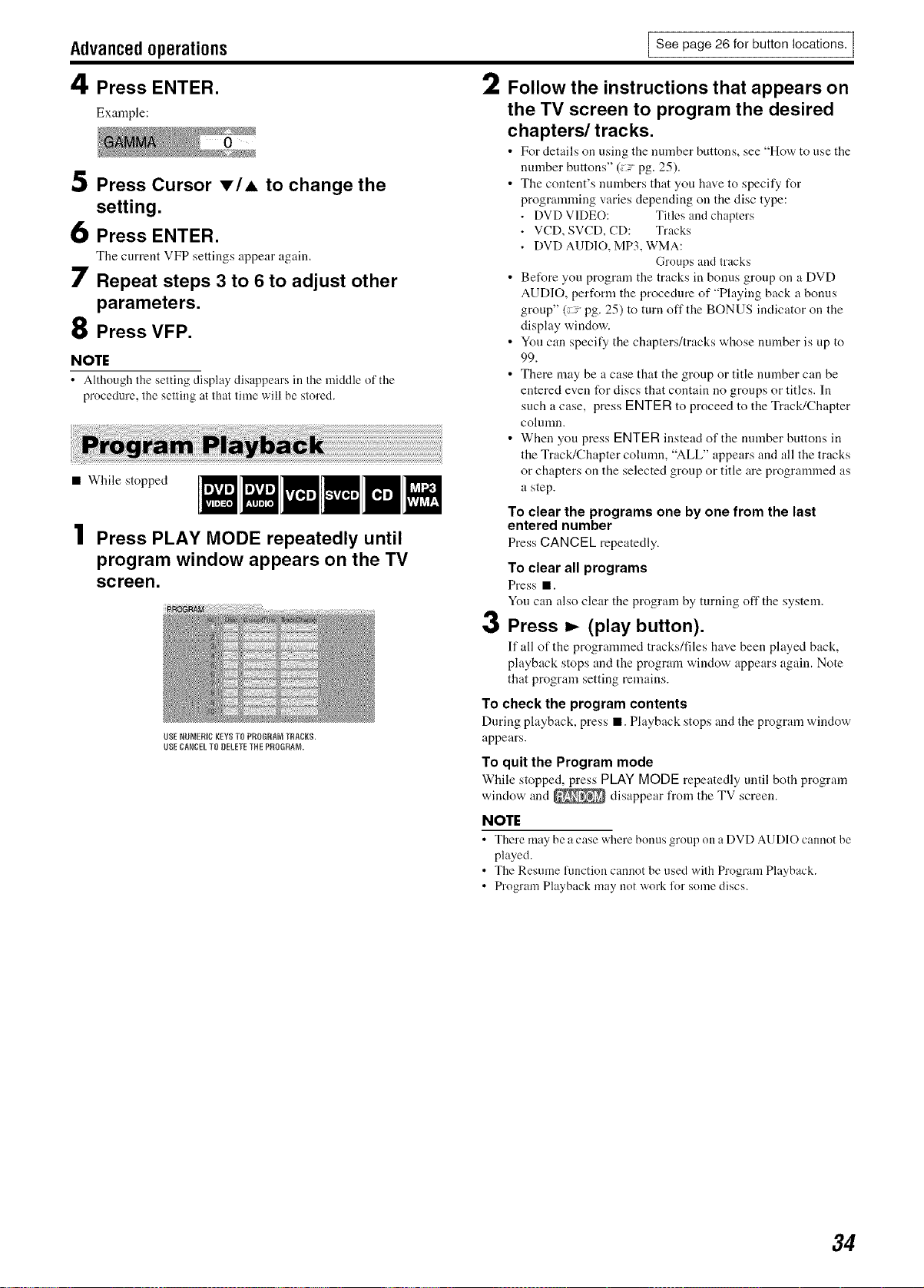
Advancedoperations
4 Press ENTER.
5 Press Cursor T/A to change the
setting.
6 Press ENTER.
The current VFP settings appear again.
I Repeat steps 3 to 6 to adjust other
parameters.
8 Press VFP.
NOTE
• Allhough lhe selting display disappears in Ihe middle of tile
procedure, lhe selling at Ihal lime will be slored.
• While stopped
1 Press PLAY MODE repeatedly until
program window appears on the TV
screen.
USE NUNE}:{ICKEYSTOPNOGNAN TRACKS,
USECANCELTO DELETEI'NE PROGRAN.
See page 26 for button locations. I
2 Follow the instructions that appears on
the TV screen to program the desired
chapters/tracks.
• For details on using the number buttons, see "How to use the
number buttons" (-" pg. 25).
• The content's numbers that you have to specify for
programming varies depending on the disc type:
• DVD VIDEO: Titles and chapters
• VCD, SVCD, CD: Tracks
• DVD AUDIO, MP3, WMA:
Groups and tracks
• Bet%re you program the tracks in bonus group on a DVD
AUDIO, perform the procedure of "Playing back a bonus
group" (-" pg. 25) to turn off the BONUS indicator on the
display window.
• You can specify the chapters/tracks whose number is tip to
99.
• There may be a case that the group or title number can be
entered even for discs that contain no groups or titles. In
such a case, press ENTER to proceed to the Track/Chapter
colunnl.
• When you press ENTER instead of the number buttons in
the Track/Chapter column, "ALL" appears and all the tracks
or chapters on the selected group or title are programmed as
a step.
To clear the programs one by one from the last
entered number
Press CANCEL repeatedly.
To clear all programs
Press •.
You can also clear the program by turning off the system.
3 Press =,- (play button).
If all of the programmed tracks/files have been played back,
playback stops and the program window appears again. Note
that program setting remains.
To check the program contents
During playback, press II. Playback stops and the program window
appears.
To quit the Program mode
While stopped, press PLAY MODE repeatedly until both program
window and disappear from the TV screen.
NOTE
• There may he a case where bonus group uu a DVD AUD10 cannot be
played.
• The Resume function cannot be used with Program Playback.
• Program Playback may not work R_rsome discs.
34
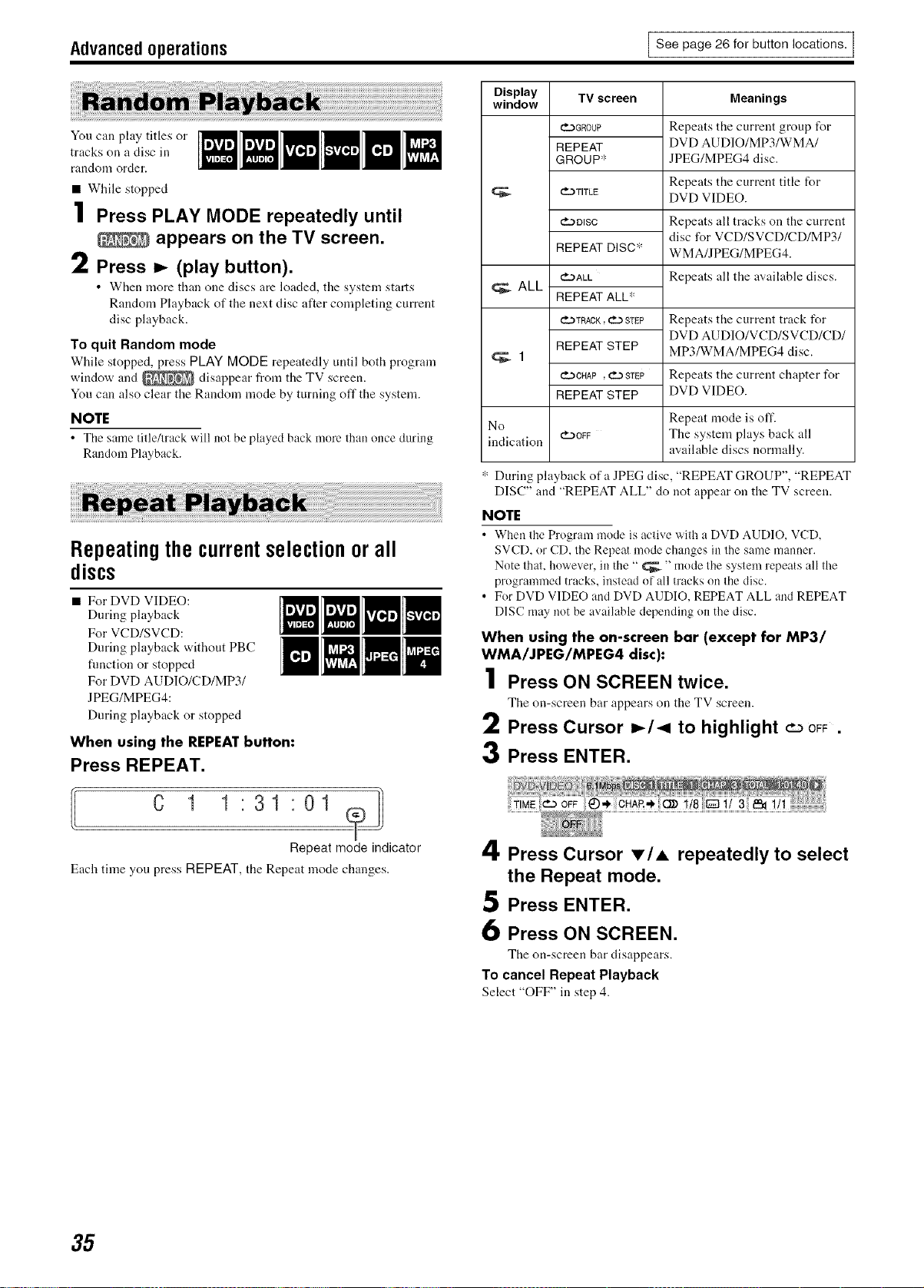
Advancedoperations [ See page 26 for button locations. I
You can play titles or
tracks on a disc in
random order.
• While stopped
1 Press PLAY MODE repeatedly until
appears on the TV screen.
2 Press _ (play button).
• When more than one discs are loaded, the system starts
Random Playback of the next disc after completing current
disc playback.
To quit Random mode
While stopped, press PLAY MODE repeatedly until both program
window and disappear from the TV screen.
You can also clear the Random mode by turning off the system.
NOTE
• The same title/n'ack will not be played back more than once during
Random Playback.
Repeatingthe currentselectionor all
discs
• For DVD VIDEO:
During playback
For VCD/SVCD:
During playback without PBC
flmction or stopped
For DVD AUDIOICD/MP3/
JPEG/MPEG4:
During playback or stopped
When using the REPEAT button:
Press REPEAT.
C 1 1 '31 '01 ®ll
m_
Repeat mode indicator
Each time you press REPEAT, the Repeat mode changes.
Display
window
ALL
TV screen
_..3GROUP
REPEAT
GROUP':
_...3TITLE
_---3DISC
REPEAT DISC*
ALL
REPEAT ALL*
_DTRACK, _" STEP
REPEAT STEP
_DCHAP , _ STEP
REPEAT STEP
Meanings
Repeats the current group for
DVD AUDIO/MP3/WMA/
JPEG/MPEG4 disc.
Repeats the current title for
DVD VIDEO.
Repeats all tracks on the current
disc for VCD/SVCD/CD/MP3/
WMA/JPEG/MPEG4.
Repeats all the available discs.
Repeats the current track for
DVD AUDIO/VCD/SVCD/CD/
MP3/WMA/MPEG4 disc.
Repeats the current chapter for
DVD VIDEO.
No Repeat mode is off.
_.-_OFF The system plays back all
indication
available discs normally.
During playback of a JPEG disc, "REPEAT GROUP", "REPEAT
DISC" and "REPEAT ALL" do not appear on the TV screen.
NOTE
• When Ihe Program mode is aclive w'ilh aDVD AUDIO, VCD,
SVCD, or CD, the Repeat mode changes in the same manner.
Note lhal, however, in the " _" mode the system repeats all Ihe
programmed tracks, inslead of all tracks on Ihe disc.
• For DVD VIDEO and DVD AUDIO, REPEAT ALL and REPEAT
DISC may not be available depending on the disc.
When using the on-screen bar (except for MP3/
WMA/JPEG/MPEG4 disc):
1 Press ON SCREEN twice.
The on-screen bar appears on the TV screen.
2 Press Cursor B,-/-_ to highlight _ OFF.
3 Press ENTER.
4 Press Cursor _'/A repeatedly to select
the Repeat mode.
Press ENTER.
Press ON SCREEN.
The on-screen bar disappears.
To cancel Repeat Playback
Select "OFF" in step 4.
35
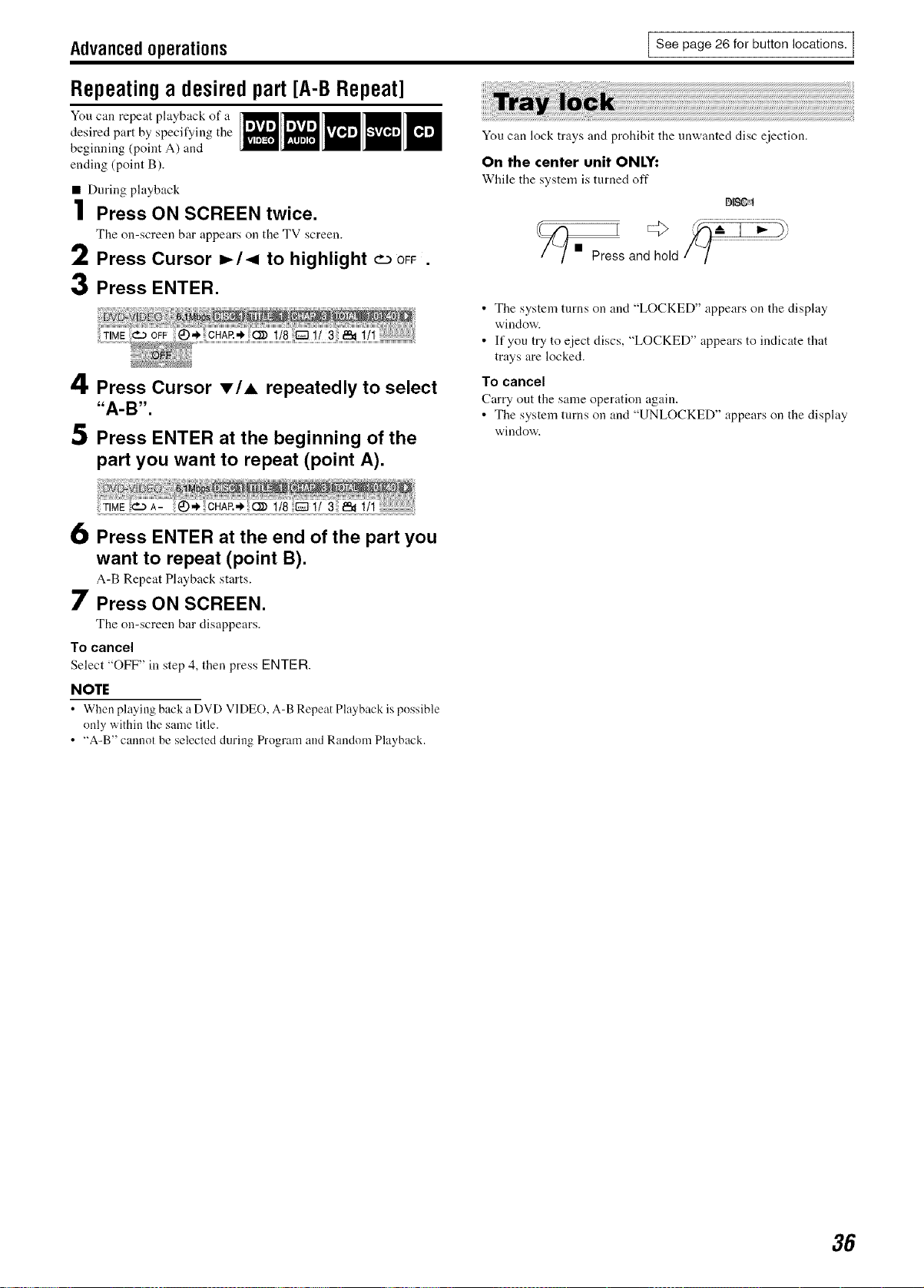
Advancedoperations
Repeating a desired part [A-B Repeat]
You can repeat playback of a
desired part by specifying the
beginning (point A) and
ending (point B).
See page 26 for button locations. I
You can lock trays and prohibit the unwanted disc ejection.
• During playback
1 Press ON SCREEN twice.
The on-screen bar appears on tlle TV screen.
2 Press Cursor =,-/< to highlight _ OFF.
3 Press ENTER.
On the center unit ONLY"
While tile system is turned oft"
• Press and hold
4 Press Cursor T/A repeatedly to select
"A-B".
5 Press ENTER at the beginning of the
part you want to repeat (point A).
• The system turns on and "LOCKED" appears on the display
window.
• If you try to eject discs, "LOCKED" appears to indicate that
trays are locked.
To cancel
Carry out tile same operation again.
• The system turns on and "UNLOCKED" appears on the display
window.
Press ENTER at the end of the part you
want to repeat (point B).
A-B Repeat Playback starts.
7 Press ON SCREEN.
The on-screen bar disappears.
To cancel
Select "OFF" in step 4, then press ENTER.
NOTE
• Wl_enplayingbackaDVDV1DEO, A-BRepeatPlaybackispossible
only within tile same title.
• "A-B" cannot be selected during Program and Random Playback.
36
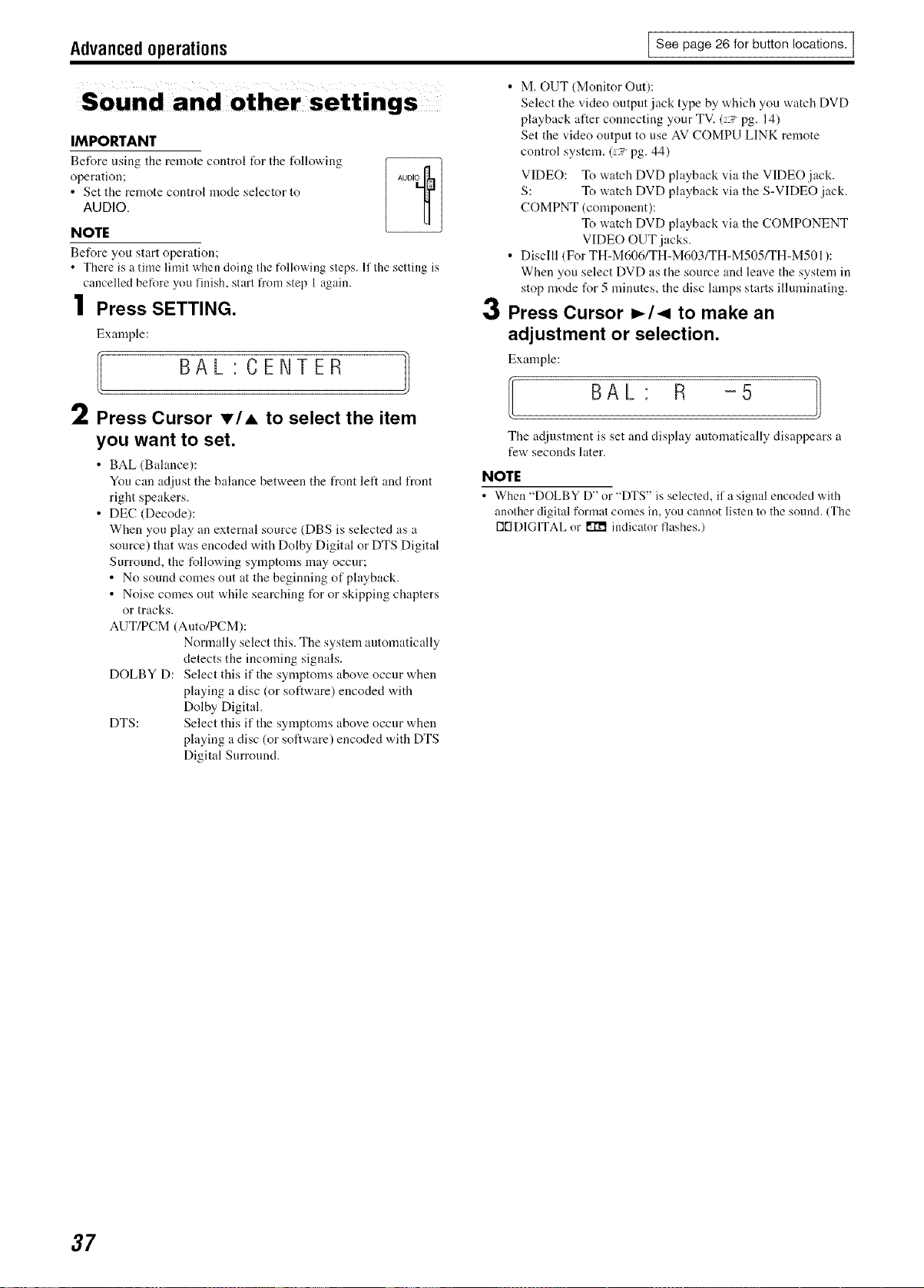
Advancedoperations [ See page 26 for button locations. [
IMPORTANT
Before using tile remote control for tile following
operation;
• Set the remote control mode selector to
AUDIO.
• M. OUT (Monitor Out):
Select the video output jack type by which you watch DVD
playback after connecting your TV. ( "pg. 14)
Set the video output to use AV COMPU LINK remote
control system. (-" pg. 44)
VIDEO: To watch DVD playback via the VIDEO jack.
S: To watch DVD playback via the S-VIDEO jack.
COMPNT (component):
To watch DVD playback via the COMPONENT
VIDEO OUT jacks.
DiscIll (For TH-M606/TH-M603/TH-M505FFH-M501 ):
When you select DVD as the source and leave the system in
stop mode for 5 minutes, the disc lamps starts illuminating.
Press Cursor _/-_ to make an
adjustment or selection.
Example:
I BAL • R -5
The adjustment is set and display automatically disappears a
few seconds later.
NOTE
Before you start operation;
• There is a time limil when doing tl_e following sleps. 11 Ihe setting is
cancelled before you linish, starl from step 1 again.
Press SETTING.
Example:
BAL'CENTER
Press Cursor _'/=, to select the item
you want to set.
• BAL (Bahmce):
You can adjust the balance between the front left and front
right speakers.
• DEC (Decode):
When you play an external source (DBS is selected as a
source) that was encoded with Dolby Digital or DTS Digital
Surround, the following symptoms may occur:
• No sound comes out at the beginning of playback.
• Noise comes out while searching for or skipping chapters
or tracks.
AUT/PCM (Auto/PCM):
Nommlly select this. The systeln automatically
detects the incoming signals.
DOLBY D: Select this if the symptoms above occur when
playing a disc (or software) encoded with
Dolby Digital.
DTS: Select this if the symptoms above occur when
playing a disc (or software) encoded with DTS
Digital Surround.
NOTE
• When "DOLBY D" or "DTS" is selected, if a signal encoded wifll
another digital format comes in, you cannnt listen to the sound. (The
I][ID1G1TAL or 111_ indicator flashes.)
37
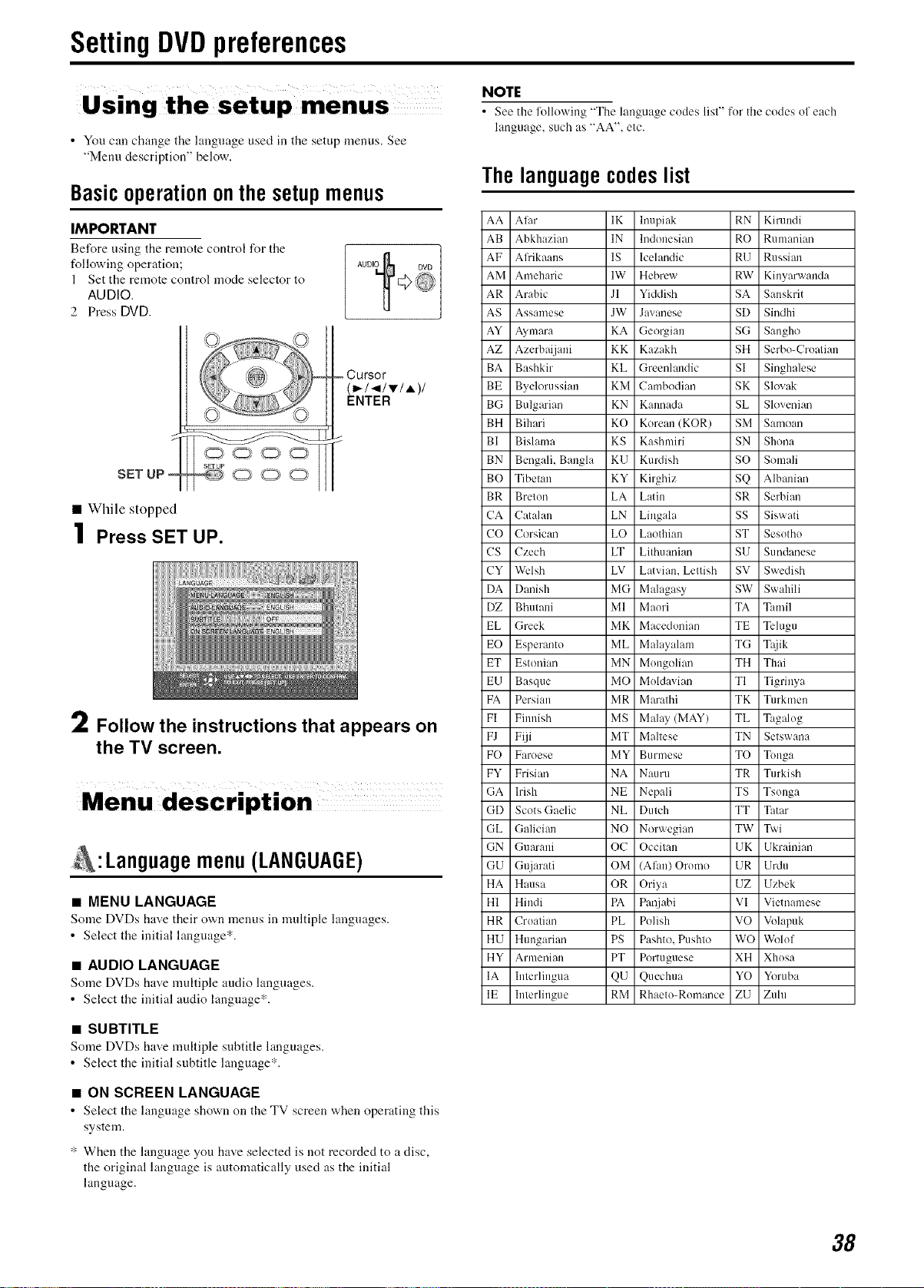
SettingDVDpreferences
• You can change the language used in the setup menus. See
"Menu description" below.
Basicoperationonthe setupmenus
NOTE
• See the li_Hlnwing "The hmguage cndes lisl" fnr the codes nI each
language, such as "AA", elc.
The language codes list
IMPORTANT
Before using the remote control for the
following operation;
1 Set the remote control mode selector to
AUDIO.
2 Press DVD.
A00, <>UV0
@
<C3)
sg_ P
SET UP,, _ _ _ (CD),_
• While stopped
1 Press SET UP.
Cursor
(_l_lTll)l
ENTER
2 Follow the instructions that appears on
the TV screen.
_:Language menu (LANGUAGE)
• MENU LANGUAGE
Some DVDs have their own menus in multiple languages.
• Select the initial hmguage*.
• AUDIO LANGUAGE
Some DVDs have multiple audio hmguages.
• Select the initial audio hmguage*.
• SUBTITLE
Some DVDs have multiple subtitle hmguages.
• Select the initial subtitle hmguage*.
• ON SCREEN LANGUAGE
• Select the language shown on the TV screen when operating this
system.
* When the language you have selected is not recorded to a disc,
the original language is automatically used as the initial
language.
AA Alar IK lnupiak RN Kirundi
AB Abkhazian IN Indonesian RO Rumanian
AF Al?ikaans IS Icelandic RU Russian
AM Ameharic IW Hebrew RW Kinyarwanda
AR Arabic Jl Yiddish SA Sanskrit
AS Assamese JW Javanese SD Sindhi
AY Aymara KA Georgian SG Sangho
AZ Azerbaijani KK Kazakh SH Serbo-Croatian
BA Bashkir KL Greenlandic SI Singhalese
BE Byelorussian KM Cambodian SK Slovak
BG Bulgarian KN Kannada SL Sh)venian
BH Bihari KO Korean (KOR) SM Samoan
BI Bislama KS Kashmiri SN Shona
BN Bengali, Bangla KU Kurdish SO Somali
BO Tibetan KY Kirghiz SQ Albanian
BR Breton LA Latin SR Serbian
CA Catalan LN Lingala SS Siswati
CO Corsican LO Laothian ST Sesotho
CS Czech LT Lithuanian SU Sundanese
CY Welsh LV Latvian, Lettish SV Swedish
DA Danish MG Malagasy SW Swahili
DZ Bhutani MI Maori TA Tamil
EL Greek MK Macedonian TE Tclugu
EO Esperanto ML Malayalam TG T:tjik
ET Estonian MN Mongolian TH Thai
EU Basque MO Moldavian TI Tigrinya
FA Persian MR Marathi TK Ttlrkmen
FI Finnish MS Malay (MAY) TL Tagalog
FJ Fiji MT Maltese TN Setswana
FO Faroese MY Burmese TO Tonga
FY Frisian NA Nauru TR Turkish
GA Irish NE Nepali TS Tsonga
GD Scots Gaelic NL Dutch TT Tatar
GL Galician NO Norwegian TW Twi
GN Guarani OC Occitan UK Ukrainian
GU Gujarati OM (Af:m) Oromo UR Urdu
HA Hausa OR Oriya UZ Uzbek
HI Hindi PA Palxjabi VI Vietnamese
HR Croatian PL Polish VO Volapuk
HU Hungarian PS Pashto, Pushto WO Wolof
HY Armenian PT Portuguese XH Xhosa
IA Interlingua QU Quechua YO Yoruba
IE Interlingue RM Rhaeto-Ronmnce ZU Zuhl
38
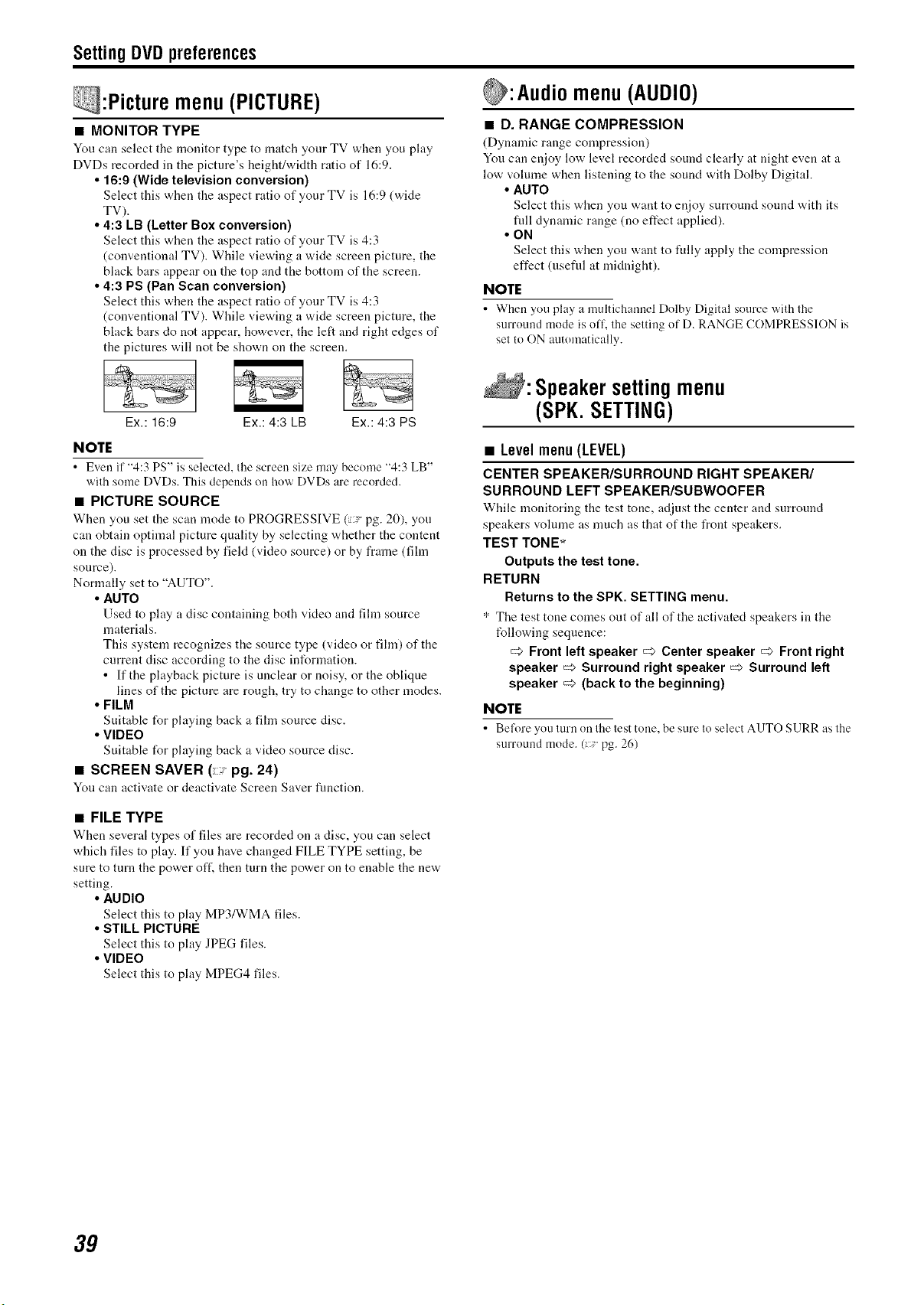
Setting DVDpreferences
:Picture menu (PICTURE)
• MONITOR TYPE
You can select the monitor type to match your TV when you play
DVDs recorded in the picture's height/width ratio of 16:9.
• 16:9 (Wide television conversion)
Select this when the aspect ratio of your TV is 1(,:9 (wide
TV).
• 4:3 LB (Letter Box conversion)
Select this when the aspect ratio of your TV is 4:3
(conventional TV). While viewing a wide screen picture, the
black bars appear on the top and the bottom of the screen.
• 4:3 PS (Pan Scan conversion)
Select this when the aspect ratio of your TV is 4:3
(conventional TV). While viewing a wide screen picture, the
black bars do not appear, however, the left and right edges of
the pictures will not be shown on the screen.
m
Ex.: 16:9 Ex.: 4:3 LB Ex.: 4:3 PS
NOTE
• Even if "4:3 PS" is selected, the screen size may become "4:3 LB"
with some DVDs. This depends on how DVDs are recorded.
• PICTURE SOURCE
When you set the scan mode to PROGRESSIVE ( " pg. 20), you
can obtain optimal picture quality by selecting whether the content
on the disc is processed by field (video source) or by frame (fihn
source).
Normally set to "AUTO".
• AUTO
Used to play a disc containing both video and fihn source
materials.
This system recognizes the source type (video or fihn) of the
current disc according to the disc information.
• If the playback picture is unclear or noisy, or the oblique
lines of the picture are rough, try to change to other modes.
• FILM
Suitable for phtying back a fihn source disc.
• VIDEO
Suitable for phtying back a video source disc.
• SCREEN SAVER ( pc. 24)
You can activate or deacti_.ate Screen Saver fimction.
• FILE TYPE
When several types of files are recorded on a disc, you can select
which files to play. If yon have changed FILE TYPE setting, be
sure to turn the power oft', then turn the power on to enable the new
setting.
• AUDIO
Select this to play MP3/WMA files.
• STILL PICTURE
Select this to phty JPEG files.
• VIDEO
Select this to play MPEG4 files.
menu (AUDIO)
• D. RANGE COMPRESSION
(Dynamic range compression)
You can enjoy low level recorded sound clearly at night even at a
low volume when listening to the sound with Dolby Digital.
• AUTO
Select this when you want to enjoy surround souiM with its
fill dynamic range (no effect applied).
• ON
Select this when you want to fully apply the compression
effect (usefid at midnight).
NOTE
• When you play a multichannel Dolby Digital source with the
surround mode is off. the setting of D. RANGE COMPRESSION is
set to ON antnmatically.
Speakersettingmenu
(SPK.SETTING)
• Level menu (LEVEL)
CENTER SPEAKER/SURROUND RIGHT SPEAKER/
SURROUND LEFT SPEAKER/SUBWOOFER
While monitoring the test tone, adjust the center and surround
speakers volume as much as that of the front speakers.
TEST TONE*
Outputs the test tone.
RETURN
Returns to the SPK. SETTING menu.
* The test tone comes out of all of the actiwtted speakers in the
following sequence:
Front left speaker _ Center speaker _ Front right
speaker _> Surround right speaker _> Surround left
speaker _> (back to the beginning)
NOTE
• Before you turn on tile test tnne. be sure to select AUTO SURR as tile
surround mode. (a =pg. 26)
39
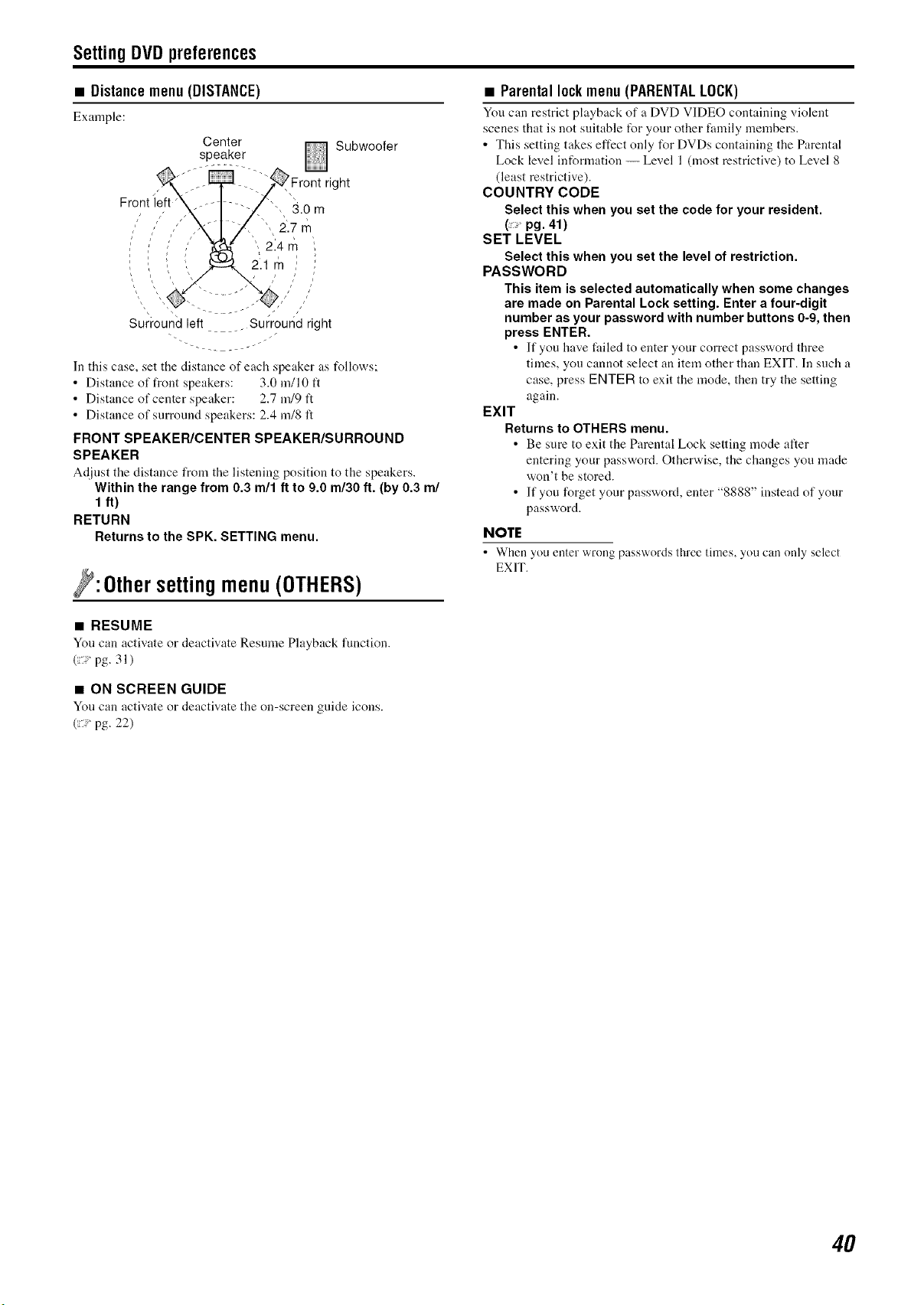
Setting DVDpreferences
• Distancemenu (DISTANCE)
Example:
• Parental 10ckmenu (PARENTALLOCK)
You can restrict playback of a DVD VIDEO containing violent
scenes that is not suitable tUr your other family members.
• This setting takes effect only for DVDs containing the Parental
Lock level information -- Level 1 (most restrictive) to Level 8
(least restrictive).
COUNTRY CODE
Select this when you set the code for your resident.
(= pc. 41)
SET LEVEL
Select this when you set the level of restriction.
PASSWORD
In this case, set the distance of each speaker as follows;
• Distance of front speakers: 3.0 roll0 t't
• Distance of center speaker: 2.7 nd9 t't
• Distance of surround speakers: 2.4 m/8 t't
FRONT SPEAKER/CENTER SPEAKER/SURROUND
SPEAKER
Adjust the distance from the listening position to the speakers.
Within the range from 0.3 m/1 ft to 9.0 m/a0 ft. (by 0.3 m/
1 ft)
RETURN
Returns to the SPK. SETTING menu.
setting menu (OTHERS)
• RESUME
Yon can activate or deactivate Resume Playback function.
(_-" pg. 31 )
• ON SCREEN GUIDE
Yon can activate or deactbate the on-screen guide icons.
(_-" pg. 22)
This item is selected automatically when some changes
are made on Parental Lock setting. Enter a four-digit
number as your password with number buttons 0-9, then
press ENTER.
• If you have failed to enter your correct password three
times, you cannot select an item other than EXIT. In such a
case, press ENTER to exit the mode, then try the setting
again.
EXIT
Returns to OTHERS menu.
• Be sure to exit the Parental Lock setting mode after
entering your password. Otherwise, the changes you made
won't be stored.
• If you forget your password, enter "8888" instead of your
password.
NOTE
• When you enter wrong passwords lhree times, yon can only select
EXIT.
4O
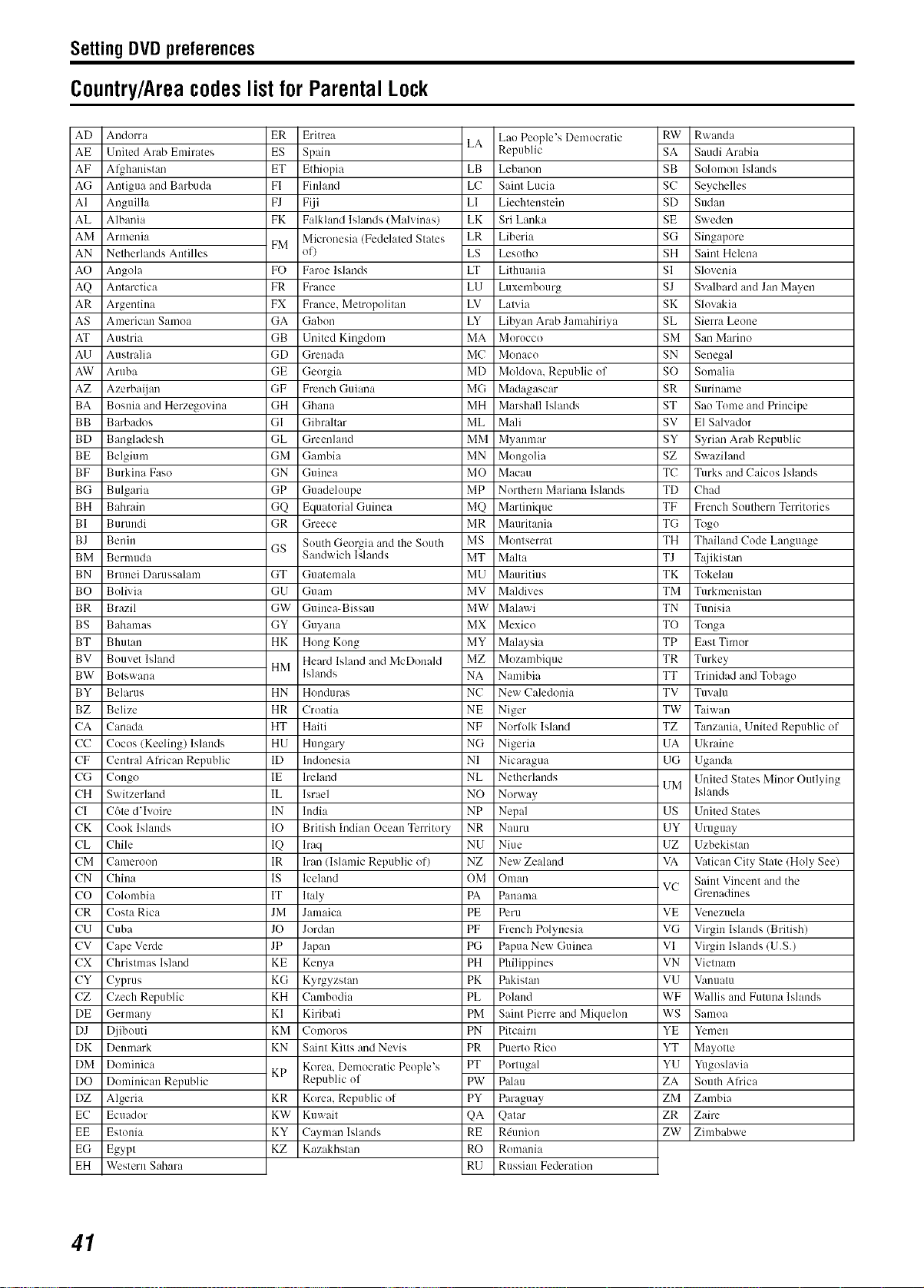
Setting DVDpreferences
Country/Areacodeslist for Parental Lock
AD
AE
AF
AG
AI
AL
AM
AN
AO
AQ
AR
AS
AT
AU
AW
AZ
BA
BB
BD
BE
BF
BG
BH
BI
BJ
BM
BN
BO
BR
BS
BT
BV
BW
BY
BZ
CA
CC
CF
CG
CH
CI
CK
CL
CM
CN
CO
CR
CU
CV
CX
CY
CZ
DE
DJ
DK
DM
DO
DZ
EC
EE
EG
EH
Andorra ER Eritrea
Uniled Arab Emirates ES Spain
Afghanistan ET Ethiopia
Antigua and Barbuda FI Finland
Anguilla FJ Fiji
Albania FK Falkhmd Islands (Malvinas)
Armenia FM Micronesia (Fedelaled Slales
Netherlands Antilles of)
Angola FO Faroe Islands
Antarclica ER France
Argentina FX France, Melropolilan
American Samoa GA Gabon
Austria GB United Kingdom
Australia GD Grenada
Aruba GE Georgia
Azerbaijan GF French Guiana
Bosnia and Herzegovina GH Ghana
Barbados GI Gibraltar
Bangladesh GL Greenland
Belgium GM Gambia
Burkina Faso GN Guinea
Bulgaria GP Guadeloupe
Bahrain GQ Equatorial Guinea MQ
Burundi GR Greece MR
Benin GS South Georgia and the South MS
Bermuda Sandwich Islands MT
Brunei Darussalam GT Guatemala MU
Bolivia GU Guam MV
Brazil GW Guinea-Bissau MW
Bahamas GY Guyana MX
Bhutall HK Hong Kong MY
Bouvet Island Heard Island and McDonald MZ
HM
Bolswana Islands NA
Belarus HN Honduras NC
Belize HR Croatia NE
Canada HT Haiti NF
Cocos (Keeling) lshmds HU Hungary NG
Central African Republic ID Indonesia NI
Congo IE Ireland NL
Switzerland IL Israel NO
C61e d'Ivoire IN India NP
Cook Islands 10 Brilish Indian Ocean Territory NR
Chile IQ lraq NU
Cameroon IR lran (Islamic Republic of) NZ
China IS Iceland OM
Colombia IT
Costa Rica JM
Cuba JO
Cape VcMe JP
Christmas Island KE
Cyprus KG
Czech Republic KH
Germany Kl
Djibouti KM
Denmark KN
Dominica
KP
Dominican Republic
Algeria KR
Ecuador KW
Estonia KY
Egypt KZ
"Western Sahara
Italy
Jamaica
Jordan
Japan
Kenya
Kyrgyzstan
Cambodia
Kiribati
Comoros
Saint Kitts and Nevis
Korea, Democratic People's
Republic of
Korea, Republic of
Kuwait
Cayman Islands
Kazakhstan
Lao People's Democratic
LA
Republic
LB Lebanon
LC Saint Lucia
LI Liechtenstein
LK Sri Lanka
LR Liberia
LS Lesotho
LT Lithuania
LU Luxembourg
LV Latvia
LY Libyan Arab Jamahiriya
MA Morocco
MC Monaco
MD Moldova, Republic of
MG Madagascar
MH Marshall Islands
ML Mall
MM Myanmar
MN Mongolia
MO Macau
MP Northern Mariana Islands
Martinique
Mauritania
montserrat
Malta
Mauritius
Maldives
Malawi
Mexico
Malaysia
Mozambique
Namibia
New Caledonia
Niger
Norlolk Island
Nigeria
Nicaragua
Netherlands
Norway
Nepal
Nauru
Niue
New Zealand
Onlan
PA Panama
PE Peru
PF French Polynesia
PG Papua New Guinea
PH Philippines
PK Pakistan
PL Poland
PM Saint Pierre and Miquelon
PN Pitcairn
PR Puerto Rico
PT Pomlgal
PW Palau
PY Paraguay
QA Qatar
RE Rdunion
RO Romania
RU Russian Federation
RW Rwanda
SA Saudi Arabia
SB Solomon Islands
SC Seychelles
SD Sudan
SE Sweden
SG Singapore
SH Saint Helena
S] Slovenia
SJ Swdbard and Jan Mayen
SK Slovakia
SL Sierra Leone
SM San Marino
SN Senegal
SO Somalia
SR Suriname
ST Sao Tome and Principe
SV El Salvador
SY Syrian Arab Republic
SZ Swaziland
TC Turks and Caicos Islands
TD Chad
TF French Southern Territories
TG Togo
TH Thailand Code Language
TJ T:_jikistan
TK Tokelau
TM Turkmenistan
TN Tunisia
TO Tonga
TP East Timor
TR Turkey
TT Trinidad and Tobago
TV Tuvalu
TW Taiwan
TZ Tanzania, United Republic of
IdA Ukraine
UG Uganda
UM United States Minor Outlying
Islands
US United States
UY Uruguay
UZ Uzbekistan
VA Vatican City State (Holy See)
Saint Vincent and the
VC
Grenadines
VE Venezuela
VG Virgin Islands (British)
VI Virgin Islands (U.S.)
VN Viemam
VU V:muatu
WF Wallis and Futuna Islands
WS Samoa
YE Yemen
YT Mayotte
YU Yugoslavia
ZA South Africa
ZM Zambia
ZR Zaire
ZW Zimbabwe
41
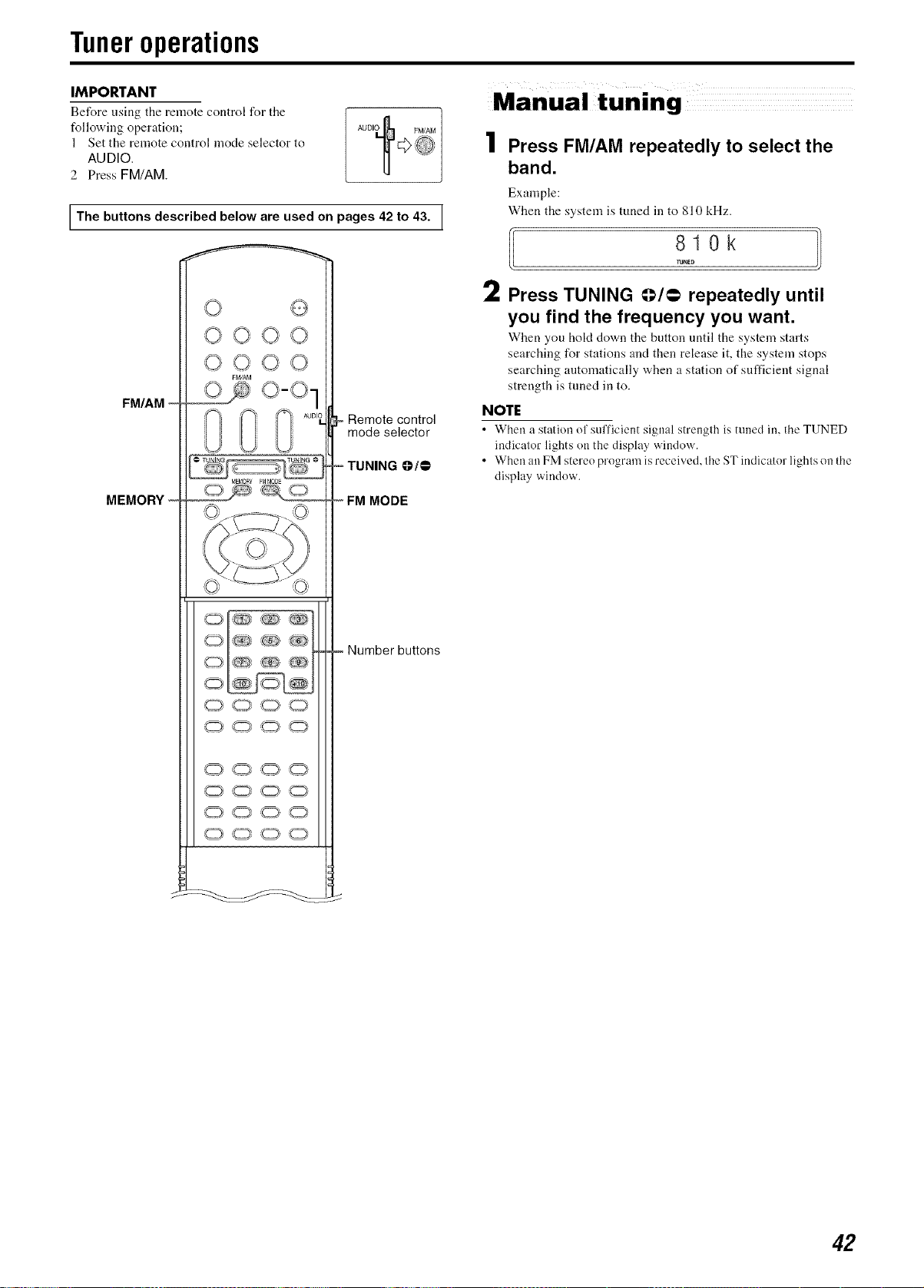
Tuneroperations
IMPORTANT
Before using the remote control for tile
following operation;
1 Set the remote control mode selector to
AUDIO.
2 PressFM/AM
AUDIO FM/AM
I The buttons described below are used on pages 42 to 43. I
FM/AM
MEMORY
00©0
0000
0000
0000
Remote control
mode selector
TUNING 0f_
FM MODE
Number buttons
Press FM/AM repeatedly to select the
band.
Example:
When the system is tuned in to 810 kHz.
[ 810k
TUNED
2 Press TUNING @/@ repeatedly until
you find the frequency you want.
When you hokt down the button until the system starts
searching for stations and then release it, the system stops
searching autonlatically when a station of sufficient signal
strength is tuned in to.
NOTE
• When a station hi' suflicient signal strength is tuned in, the TUNED
indicator lights on the display window.
• When an FM steren program is received, the ST indicator lights on the
display window.
42
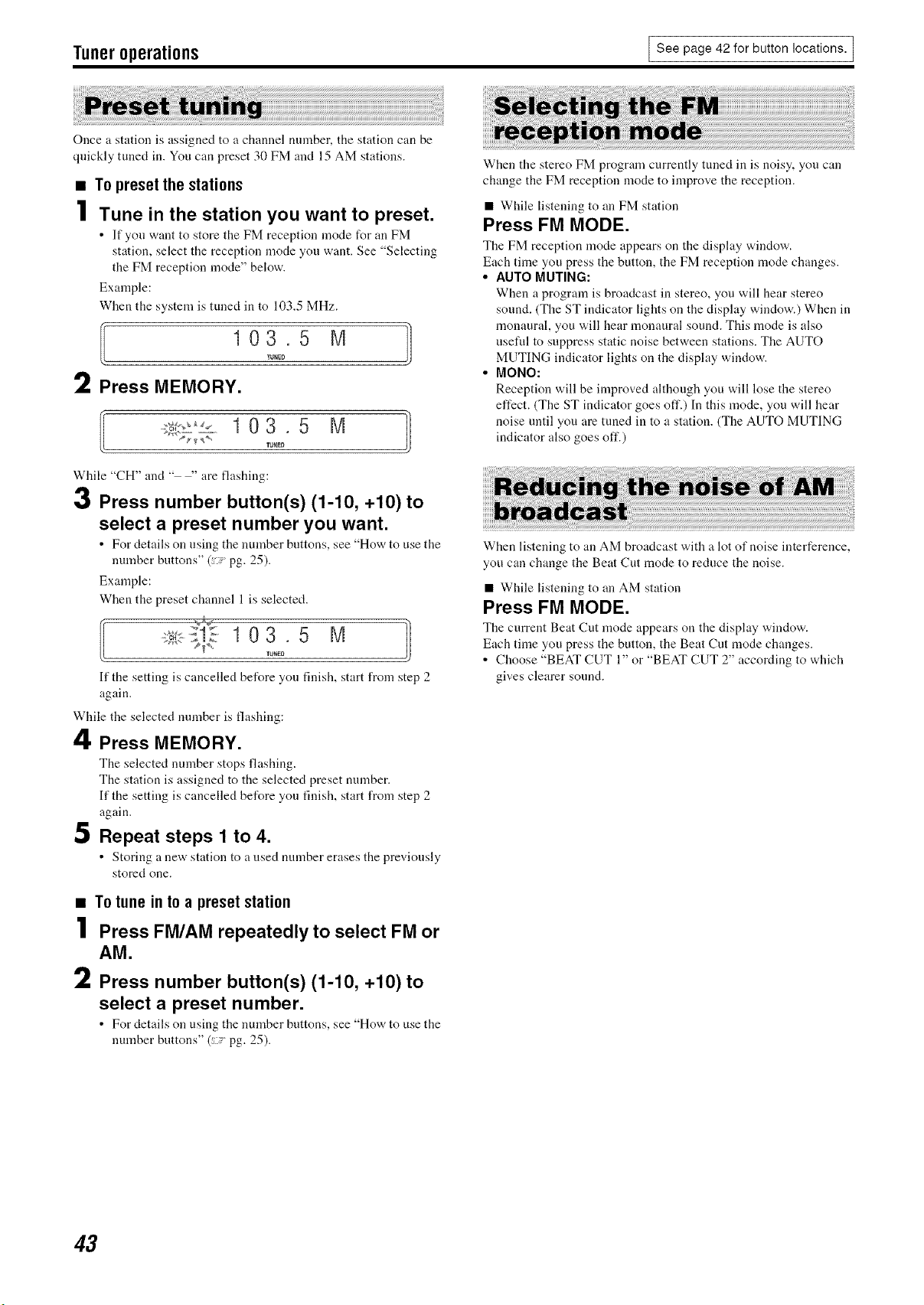
Tuneroperations I See page 42 for button locations. I
Once a station is assigned to a channel number, the station can be
quickly tuned in. You can preset 30 FM and 15 AM stations.
• To preset the stations
1 Tune in the station you want to preset.
• If you want to store the FM reception mode for an FM
station, select the reception mode you want. See "Selecting
the FM reception mode" below.
Example:
When the system is tuned in to 103.5 MHz.
103.5 M
TUNED
2 Press MEMORY.
103.5 M
TU_EO
While "CH" and .... are flashing:
3 Press number button(s) (1-10, +10) to
select a preset number you want.
• For details on using the nunlber buttons, see "How to use the
number buttons" (7" pg. 25).
Example:
When the preset channel 1 is selected.
103.5 M ]1
TUNEO
If the setting is cancelled before you finish, start from step 2
again.
While the selected number is flashing:
4 Press MEMORY.
The selected number stops flashing.
The station is assigned to the selected preset number.
If the setting is cancelled before you finish, start from step 2
again.
5 Repeat steps 1 to 4.
• Storing a new station to a used mnnber erases tile previously
stored one.
• To tune in to a preset station
'_ Press FM/AM repeatedly to select FM or
AM.
2 Press number button(s) (1-10, +10) to
select a preset number.
• For details on using the number buttons, see "How to use the
number buttons" (_ -" pg. 25).
When the stereo FM program currently tuned in is noisy, you can
change the FM reception mode to improve the reception.
• While listening to an FM station
Press FM MODE.
The FM reception mode appears on the display window.
Each time you press the button, the FM reception mode changes.
• AUTO MUTING:
When a program is broadcast in stereo, you will hear stereo
sound. (The ST indicator lights on the display window.) When in
monaural, you will hear monaural sound. This mode is also
useflfi to suppress static noise between stations. The AUTO
MUTING indicator lights on the display window.
• MONO:
Reception will be improved although you will lose the stereo
effect. (The ST indicator goes off.) In this mode, you will hear
noise until you are tuned in to a station. (The AUTO MUTING
indicator also goes off.)
When listening to an AM broadcast with a lot of noise interference,
you can change the Beat Cut mode to reduce the noise.
• While listening to an AM station
Press FM MODE.
The current Beat Cut mode appears on the display window.
Each time you press the button, the Beat Cut mode changes.
• Choose "BEAT CUT 1" or "BEAT CUT 2" according to which
gives clearer sound.
43
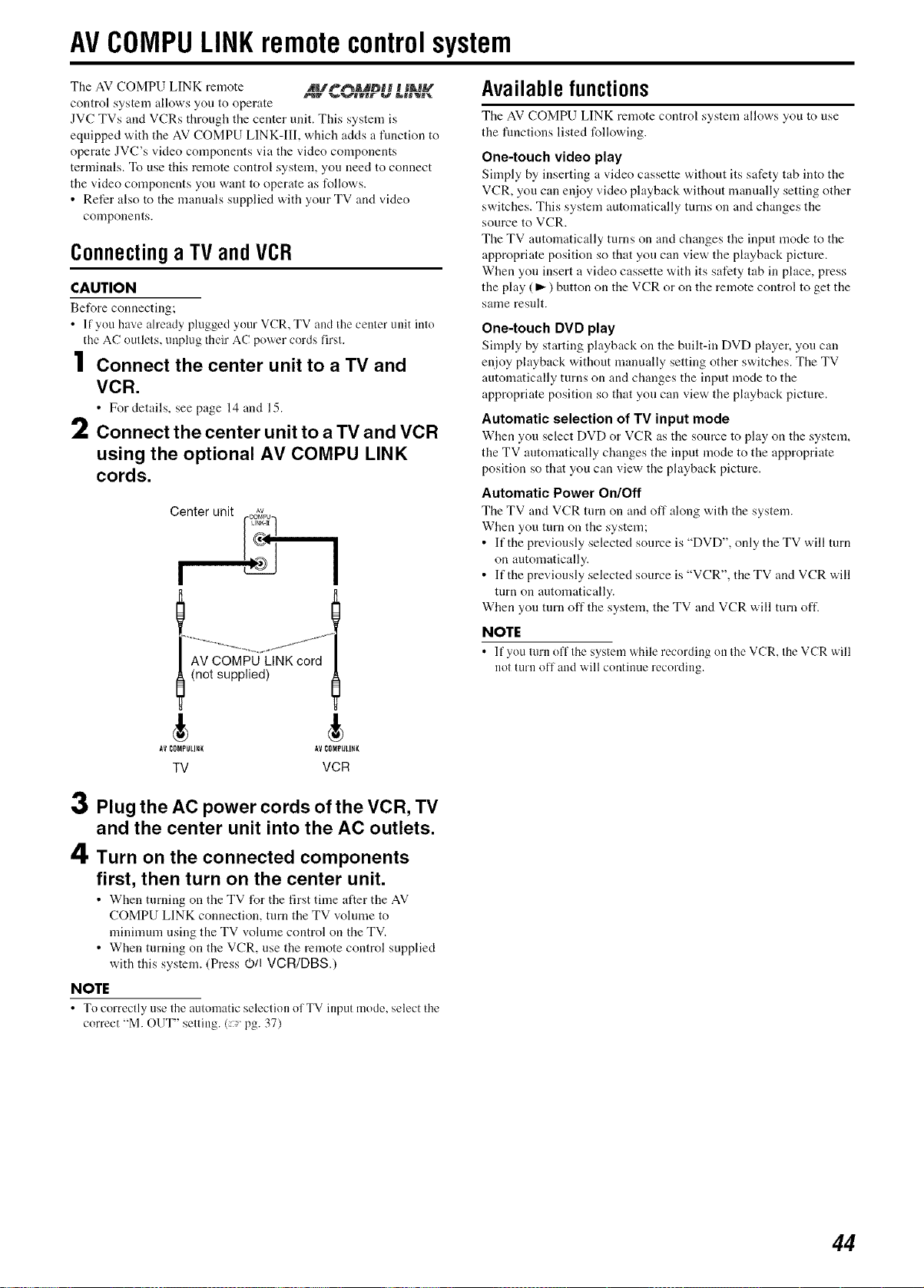
AVCOiViPULINKremotecontrolsystem
The AV COMPU LINK ren]ote Amav_'_c'_/_aD_ ' 1_l_Alrg¢"
control system allows you to operate
JVC TVs and VCRs through the center unit. This system is
equipped with the AV COMPU LINK-Ill, which adds a function to
operate JVC's vkteo components via the video components
terminals. To use this remote control system, you need to connect
the video components you want to operate as follows.
• Refer also to the manuals supplied with your TV and video
colnpouei_lts.
Connectinga TV and VCR
CAUTION
Be_re connecting;
• If you have ah'eady plugged your VCR, TV and the cenler unit inln
the AC uullets, unplug their AC power curds firsl.
1 Connect the center unit to a TV and
VCR.
• For details, see page 14 and 15.
2 Connect the center unit to a TV and VCR
using the optional AV COMPU LINK
cords.
Center unit Av
AV COMPU LINK cord
(not supplied)
Available functions
The AV COMPU LINK remote control system allows you to rise
the fimctions listed following.
One-touch video play
Simply by inserting a video cassette without its safety tab into the
VCR, you can enjoy video playback without manually setting other
switches. This system automatically turns on and changes the
source to VCR.
The TV automatically turns on and changes the input mode to the
appropriate position so that you can view the playback picture.
When you insert a video cassette with its safety tab in phtce, press
the play (1_) button on the VCR or on the remote control to get the
sanle result.
One-touch DVD play
Simply by starting playback on the built-in DVD player, you can
enjoy playback without manually setting other switches. The TV
automatically turns on and changes the input mode to the
appropriate position so that you can view the playback picture.
Automatic selection of TV input mode
When you select DVD or VCR as the source to phty on the system,
the TV automatically changes the input mode to the appropriate
position so that you can view the playback picture.
Automatic Power On/Off
The TV and VCR turn on and off along with the system.
When you turn on the system;
• If the previously selected source is "DVD", only the TV will turn
on automatically.
• If the previously selected source is "VCR", the TV and VCR will
turn on automatically.
When you turn offthe system, the TV and VCR will turn off.
NOTE
• If you turn offthe system "ahile recording on the VCR. the VCR will
not turn off and will continue recording.
•_V COMPULI_){ AV COMPttLI_g
TV VCR
3 Plug the AC power cords of the VCR, TV
and the center unit into the AC outlets.
4 Turn on the connected components
first, then turn on the center unit.
• When turning on the TV for the first time after the AV
COMPU LINK connection, turn the TV volume to
minimuna using the TV volume control on the TV.
• When turning on the VCR, use the remote control supplied
with this system. (Press ©/I VCR/DBS.)
NOTE
• To cnrrectly nse the automatic selection of TV input mode. select the
correct "M. ()(.IT" setting. (.= pg. 37)
44
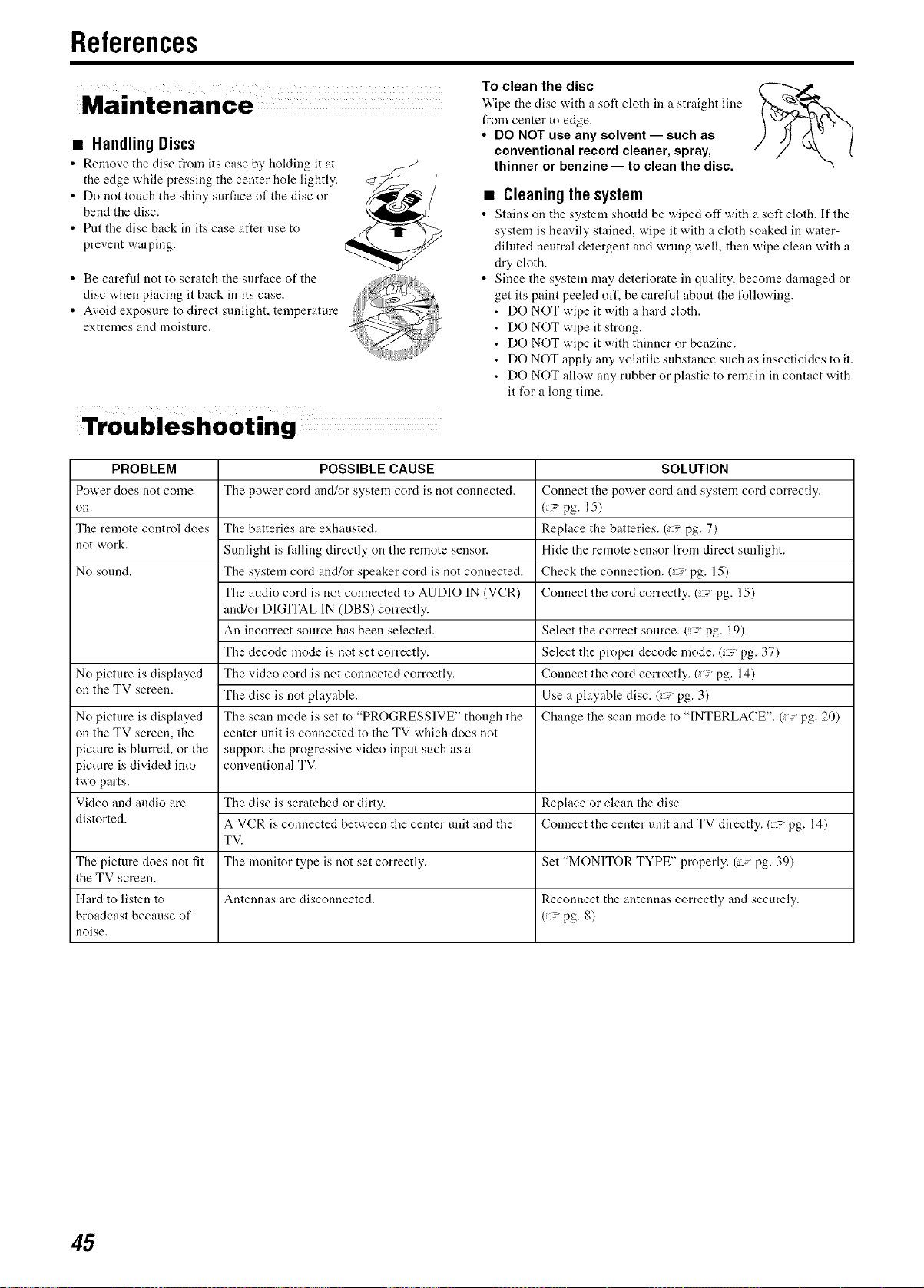
Relerences
• HandlingDiscs
• Remove tile disc from its case by holding it at
the edge while pressing the center hole lightly.
• Do not touch the shiny surface of the disc or
To clean the disc
Wipe the disc with a soft cloth in a straight line
from center to edge.
• DO NOT use any solvent -- such as
conventional record cleaner, spray,
thinner or benzine -- to clean the disc.
• Cleaning the system
bend the disc.
• Put the disc back in its case alter use to
prevent warping.
• Be careful not to scratch the surface of the
disc when placing it back in its case.
• Avoid exposure to direct sunlight, temperature
extremes and nloisture.
Stains on the system should be wiped off with a soft cloth. If the
system is heavily stained, wipe it with a cloth soaked in water-
diluted neutral detergent and wrung well, then wipe clean with a
dry cloth.
Since the system may deteriorate in quality, become damaged or
get its paint peeled oft'. be careful about the following.
• DO NOT wipe it with a hard cloth.
• DO NOT wipe it strong.
• DO NOT wipe it with thinner or benzine.
• DO NOT apply any volatile substance such as insecticides to it.
• DO NOT allow any rubber or plastic to remain in contact with
it I_r a long time.
PROBLEM POSSIBLE CAUSE SOLUTION
Power does not come The power cord and/or system cord is not connected. Connect the power cord and system cord correctly.
on. (: -" pg. 15)
The remote control does The batteries are exhausted. Replace the batteries. (_ -" pg. 7)
not work. Sunlight is falling directly on the remote sensor. Hide the remote sensor from direct sunlight.
No sound. The system cord and/or speaker cord is not connected. Check the connection. (-" pg. 15)
The audio cord is not connected to AUDIO IN (VCR) Connect the cord correctly. (-" pg. 15)
and/or DIGITAL IN (DBS) correctly.
An incorrect source has been selected. Select the correct source. ( " pg. 19)
The decode mode is not set correctly. Select the proper decode mode. (-" pg. 37)
No picture is displayed The video cord is not connected correctly. Connect the cord correctly. (_ -" pg. 14)
on the TV screen. The disc is not playable. Use a playable disc. (-" pg. 3)
No picture is displayed The scan mode is set to "PROGRESSIVE" though the Change the scan mode to "INTERLACE". (-" pg. 20)
on the TV screen, the center unit is connected to the TV which does not
picture is blurred, or the support the progressive video input such as a
picture is divided into conventional TV.
two parts.
Video and audio are The disc is scratched or dirty. Replace or clean the disc.
distorted. A VCR is connected between the center unit and the Connect the center unit and TV directly. (_ -" pg. 14)
TV.
The picture does not fit The monitor type is not set correctly. Set "MONITOR TYPE" properly. (-" pg. 39)
the TV screen.
Hard to listen to Antennas are disconnected. Reconnect the antennas correctly and securely.
broadcast because of (: -" pg. 8)
noise.
45
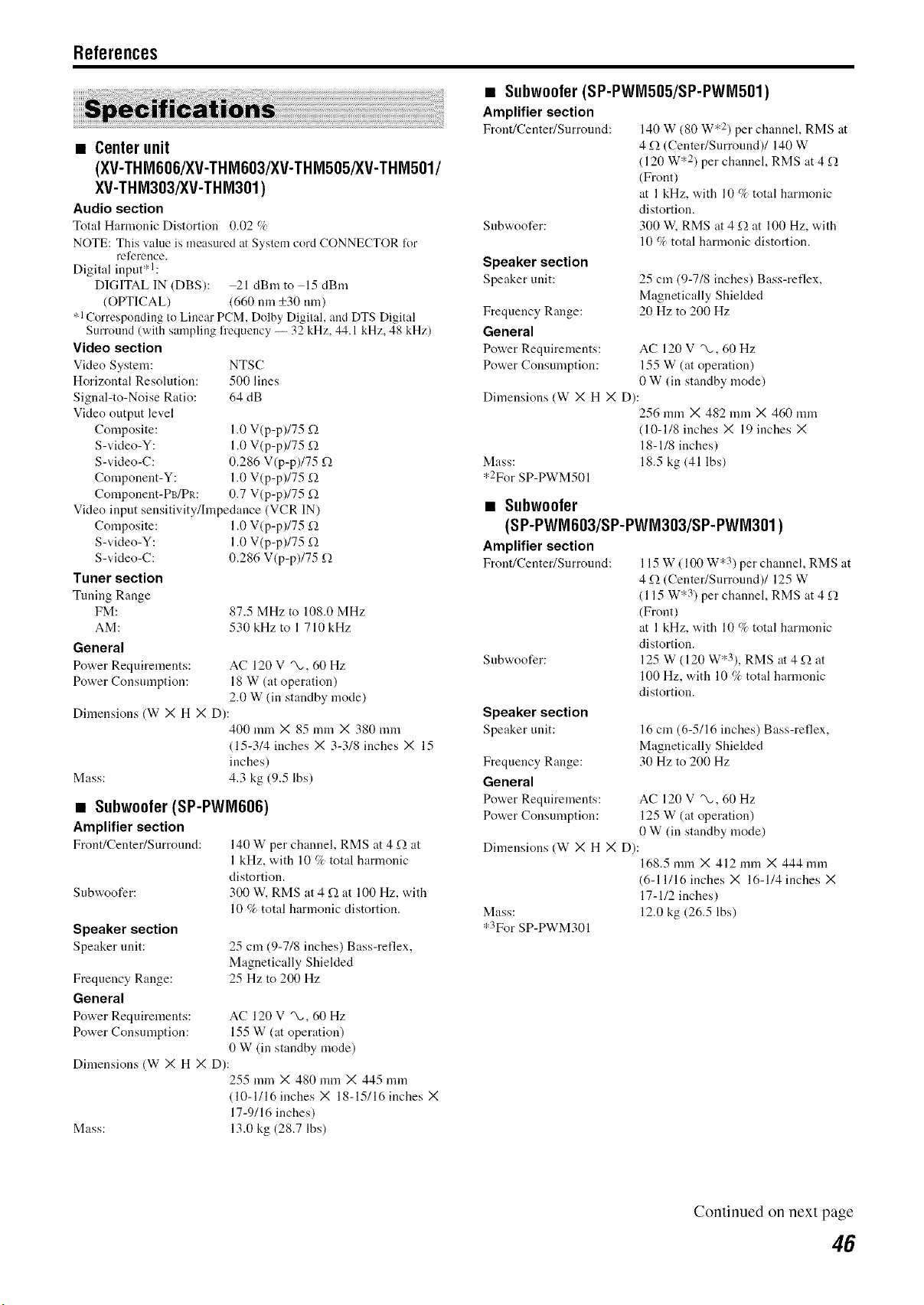
References
• Center unit
(XV-THIVI606/XV-THIVI603/XV-THIVI505/XV-THIVI501/
XV-THIVI303/XV-THIVI301)
Audio section
Total Harnlonic Distortion 0.02 c/_
NOTE: This value is measured at System cord CONNECTOR for
reference.
Digital input* 1:
DIGITAL IN (DBS): 21 dBm to 15 dBm
(OPTICAL) (660 nm +30 nm)
,':1Corresp(mding to Linear PCM, Dolby Digital, and DTS Digital
Surround (with sampling frequency -- 32 kHz. 44.1 kHz. 48 kHz)
Video section
Video System: NTSC
Horizontal Resolution: 500 lines
Signal-to-Noise Ratio: 64 dB
Video output level
Composite: 1.0 V(p-p)/75 '2`2
S-video-Y: 1.0 V(p-p)/75 '2`2
S-video-C: 0.286 V(p-p)/75 '2`2
Component-Y: 1.0 V(p-p)/75 '2`2
Component-PB/PR: 0.7 V(p-p)/75 '2`2
Video input sensitivity/Impedance (VCR IN)
Composite:
S-video-Y:
S-video-C:
Tuner section
Tnning Range
FM:
AM:
General
Power Requirements:
Power Consumption:
1.0 V(p-p)/75 '2`2
1.0 V(p-p)/75 '2`2
0.286 V(p-p)/75 '2`2
87.5 MHz to 108.0 MHz
530 kHz to 1 710 kHz
AC 120 V "M, 60 Hz
18 W (at operation)
2.0 W (in standby mode)
Dimensions (W X H X D):
400 mm )< 85 mm )< 380 nun
(15-314 inches )< 3-318 inches )< 15
inches)
Mass: 4.3 kg (9.5 lhs)
• Subwoofer(SP-PWIVI606)
Amplifier section
Front/Center/Surround:
Subwoofer:
Speaker section
Speaker unit:
Frequency Range:
General
Power Requirements:
Power Consumption:
140 W per channel, RMS at 4 '2`2at
l kHz, with l0 % total harmonic
distortion.
300 W. RMS at 4 '2"2at 100 Hz, with
10 % total harmonic distortion.
25 cm (9-718 inches) Bass-reflex,
Magnetically Shiekted
25 Hz to 200 Hz
AC 120 V "M, 60 Hz
155 W (at operation)
0 W (in standby mode)
Dimensions (W X H X D):
255 mm X 480 mm X 445 mm
(10-1116 inches X 18-15116 inches X
17-9116 inches)
Mass: 13.0 kg (28.7 lbs)
• Subwoofer(SP-PWIVI505/SP-PWIVI501)
Amplifier section
Front/Center/Surround:
Subwoofer:
Speaker section
Speaker unit:
Frequency Range:
General
Power Requirements:
Power Consumption:
140 W (80 W .2) per channel, RMS at
4 '2`2(Center/Surround)/140 W
(120 W ':2) per channel, RMS at 4 '2`2
(Front)
at 1 kHz, with 10 % total harmonic
distortion.
300 W, RMS at 4 '2`2at 100 Hz, with
10 % total harmonic distortion.
25 cm (9-718 inches) Bass-reflex,
Magnetically Shiekted
20 Hz to 200 Hz
AC 120V %, 60Hz
155 W (at operation)
0 W (in standby mode)
Dimensions (W X H X D):
256 mm X 482 nun X 460 nnn
(10-1/8 inches X 19 inches X
18-1/8 inches)
Mass: 18.5 kg (41 lhs)
*2For SP-PWM501
• Subw00ler
(SP-PWIVI603/SP-PWIVI303/SP-PWIVI301)
Amplifier section
Front/Center/Stlrronnd: 115 W (100 W .3) per channel, RMS at
4 '2`2(Center/Surround)/125 W
(115 W ':3) per channel, RMS at 4 '2`2
(Front)
at 1 kHz, with 10 % total harmonic
distortion.
Subwoofer: 125 W (120 W*3), RMS at 4 '2`2at
100 Hz, with 10 % total harmonic
distortion.
Speaker section
Speaker unit:
Frequency Range:
General
Power Requirements:
Power Consumption:
16 cm (6-5116 inches) Bass-reflex,
Magnetically Shiekted
30 Hz to 200 Hz
AC 120V %, 60Hz
125 W (at operation)
0 W (in standby mode)
Dimensions (W X H X D):
168.5 mm X 412 mm X 444 nun
(6-11/16 inches X 16-1/4 inches X
17-1/2 inches)
Mass: 12.0 kg (26.5 lbs)
*3For SP-PWM301
Continued on next page
46
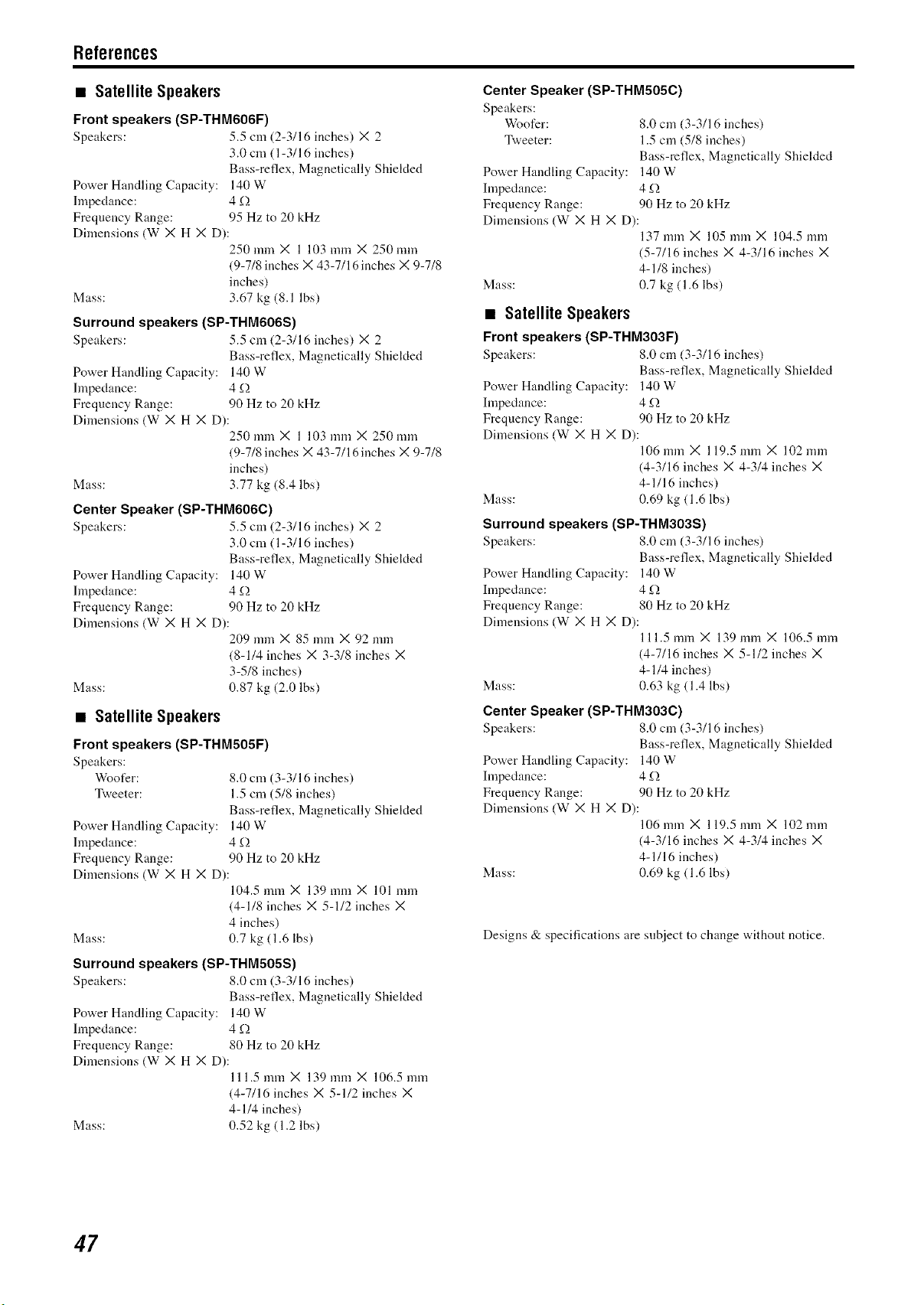
References
• Satellite Speakers
Front speakers (SP-THMdOdF)
Speakers: 5.5 cm (2-3/16 inches) X 2
Power Handling Capacity:
hnpedance:
Frequency Range:
3.0 cm (1-3/16 inches)
Bass-reflex, Magnetically Shiekted
140 W
4 _)
95 Hz to 20 kHz
Dimensions (W M H M D):
250 mm M 1 103 mm M 250 mm
(9-7/8 inches M 43-7/16 inches M 9-7/8
inches)
Mass: 3.67 kg (8.1 lbs)
Surround speakers (SP-THMd06S)
Speakers: 5.5 cm (2-3/16 inches) X 2
Bass-reflex, Magnetically Shiekted
Power Handling Capacity: 140 W
hnpedance: 4 '2"_
Frequency Range: 90 Hz to 20 kHz
Dimensions (W M H M D):
250 nnn M 1 103 mm M 250 mm
(9-7/8 inches M 43-7/16 inches M 9-7/8
inches)
Mass: 3.77 kg (8.4 lbs)
Center Speaker (SP-THMdOdC)
Speakers: 5.5 cm (2-3/16 inches) M 2
Power Handling Capacity:
hnpedance:
Frequency Range:
3.0 cm (1-3/16 inches)
Bass-reflex, Magnetically Shiekted
140 W
4 _)
90 Hz to 20 kHz
Dimensions (W X H X D):
209minx 85mmX92mm
(8-114 inches X 3-318 inches X
3-518 inches)
Mass: 0.87 kg (2.0 lbs)
• Satellite Speakers
Front speakers (SP-THMSO5F)
Speakers:
Woofer:
Tweeter:
Power Handling Capacity:
hnpedance:
Frequency Range:
8.0 cm (3-3116 inches)
1.5 cm (518 inches)
Bass-reflex, Magnetically Shiekted
140 W
4 g)
90 Hz to 20 kHz
Dimensions (W X H X D):
104.5 mm X 139 mm X 101 nun
(4-118 inches X 5-112 inches X
4 inches)
Mass: 0.7 kg (1.6 lbs)
Surround speakers (SP-THMS05S)
Speakers: 8.0 cm (3-3116 inches)
Bass-reflex, Magnetically Shiekted
Power Handling Capacity: 140 W
hnpedance: 4 _'_
Frequency Range: 80 Hz to 20 kHz
Dimensions (W X H X D):
111.5 mm X 139 mm X 106.5 mm
(4-7/16 inches X 5-1/2 inches X
4-1/4 inches)
Mass: 0.52 kg (1.2 lbs)
Center Speaker (SP-THM505C)
Speakers:
Woofer:
Tweeter:
Power Handling Capacity:
Impedance:
Frequency Range:
8.0 cm (3-3116 inches)
1.5 cm (518 inches)
Bass-reflex, Magnetically Shielded
140 W
4 _"_
90 Hz to 20 kHz
Dimensions (W X H X D):
137 mm X 105 mm X 104.5 mm
(5-7116 inches X 4-3116 inches X
4-118 inches)
Mass: 0.7 kg (1.6 lbs)
• Satellite Speakers
Front speakers (SP-THM303F)
Speakers: 8.0 cm (3-3116 inches)
Bass-reflex, Magnetically Shielded
Power Handling Capacity: 140 W
Impedance: 4 '2"_
Frequency Range: 90 Hz to 20 kHz
Dimensions (W X H X D):
106 mm X 119.5 mm X 102 mm
(4-3/16 inches X 4-3/4 inches X
4-1/16 inches)
Mass: 0.69 kg (1.6 lbs)
Surround speakers (SP-THMB0aS)
Speakers: 8.0 cm (3-3116 inches)
Bass-reflex, Magnetically Shielded
Power Handling Capacity: 140 W
Impedance: 4 '2"_
Frequency Range: 80 Hz to 20 kHz
Dimensions (W X H X D):
111.5 mm X 139 mm X 106.5 mm
(4-7116 inches X 5-112 inches X
4-114 inches)
Mass: 0.63 kg (1.4 lbs)
Center Speaker (SP-THM303C)
Speakers: 8.0 cm (3-3116 inches)
Bass-reflex, Magnetically Shielded
Power Handling Capacity: 140 W
Impedance: 4 '2"_
Frequency Range: 90 Hz to 20 kHz
Dimensions (W X H X D):
106 mm X 119.5 mm X 102 nun
(4-3/16 inches X 4-3/4 inches X
4-1/16 inches)
Mass: 0.69 kg (1.6 lbs)
Designs & specifications are subject to change without notice.
47
I For the U.S.A. ]
:JVC
** LINITED WARRANTY CONSUMERVmDEO -90
-/r
Yr
_r
_r
-k
_r
_r
_r
_r
_r
_r
Yr
_r
"k
"k
Yr
JVC COMPANY OF AMERICA warrants this product and aH parts thereof, except as set forth below ONLY TO THE
ORmGINAL PURCHASER AT RETAIL to be FREE FROM DEFECTmVE MATERIALS AND WORKMANSHIP from the date
of original retaiU purchase for the period as shown below. ("The Warranty Period")
PARTS LABOR
1 YR 90 DAYS
THIS LIMITED WARRANTY mSVALID ONLY IN THE FIFTY (50) UNITED STATES, THE DISTRICT OF COLUMBIA AND
IN COMMONWEALTH OF PUERTO RICO.
WHAT WE WiLL DO:
If this product is found to be defective, JVC will repair or replace defective parts at no charge to the original owner.
Such repair and replacement services shall be rendered by JVC during normal business hours at JVC authorized service
centers. Parts used for replacement are ,warranted only for the rernainder of the Warranty Period. All products and parts
thereof may be brought to a JVC authorized service center on a carry-in basis except for Television sets having a screen
size 25 inches and above which are covered on an in=home basis.
WHAT YOU MUST DO FOR WARRANTY SERVICE:
Return your product to a JVC authorized service center ,with a copy of your bill of sale. For your nearest JVC authorized
service center, please call toll free: (800) 537=5722.
If service is not available locally, box the product carefully, preferably in the original carton, and ship, insured, with
a copy of your bill of sale plus a letter of explanation of the problem to the nearest JVC Factory Service Center, the
name and location of which will be given to you by the toll=free number.
If you have any questions concerning your JVC Product, please contact our Customer Relations Department.
WHAT iS NOT COVERED:
This limited warranty provided by JVC does not cover:
1. Products which have been subject to abuse, accident, alteration, modification, tampering, negligence, misuse, faulty
installation, lack of reasonable care, or if repaired or serviced by anyone other than a service facility authorized by
JVC to render such service, or if affixed to any attachment not provided with the products, or if the model number
or serial number has been altered, tampered with, defaced or removed;
2. Initial installation and installation and removal for repair;
3. Operational adjustments covered in the Owner's Manual normal maintenance, video and audio head cleaning;
4. Damage that occurs in shipment, due to act of God, and cosmetic damage;
5. Signal reception problems and failures due to line power surge;
6. Video Pick=up Tubes/CCD Image Sensor, Cartridge, Stylus (Needle) are covered for 90 days from the date of purchase;
7. Accessories;
8. Batteries (except that Rechargeable Batteries are covered for 90 days from the date of purchase);
There are no express warranties except as listed above.
THE DURATION OF ANY IMPLIED WARRANTIES, INCLUDING THE IMPMED WARRANTY OF MERCHANTABILITY, IS
MMITED TO THE DURATION OF THE EXPRESS WARRANTY HEREIN.
JVC SHALL NOT BE LIABLE FOR THE LOSS OF USE OF THE PRODUCT, INCONVENIENCE, LOSS OR ANY OTHER
DAMAGES, WHETHER DIRECT, INCIDENTAL OR CONSEQUENTIAL (INCLUDING, WITHOUT UMITATION, DAMAGE
TO TAPES, RECORDS OR DISCS) RESULTING FROM THE USE OF THIS PRODUCT, OR ARISING OUT OF ANY BREACH
OF THIS WARRANTY. ALL EXPRESS AND IMPLIED WARRANTIES, INCLUDING THE WARRANTIES OF MERCHANT=
ABIMTY AND FITNESS FOR PARTICULAR PURPOSE, ARE LIMITED TO THE WARRANTY PERIOD SET FORTH ABOVE.
Some states do not allow the exclusion of incidental or consequential damages or ]imitations on how long an
implied warranty lasts, so these limitations or exclusions may not apply' to you. This warranty gives you specific
legal rights and you may also have other rights which vary from state to state.
JVC COMPANY OF AMERICA
DIVISION OF JVC AMERICAS CORE
1700 Valley Road
Wayne, NJ 07470
_r
-it
-/r
_t
_r
w
_r
*k
-it
lit
_r
_r
tit
REFURBISHED PRODUCTS CARRY A SEPARATE WARRANTY, THIS WARRANTY DOES NOT APPLY/ FOR DETAILS OF
REFURBISHED PRODUCT WARRANTY, PLEASE REFER TO THE REFURBISHED PRODUCT WARRANTY INFORMATION
PACKAGED WITH EACH REFURBISHED PRODUCT.
_OF CUStOITle_" US_:
Enter below the Model No. which is located either on the rear bottom or side of the cabinet. Retain this information
for future reference.
Model No, : Serial No. :
Purchase data : Name of dealer :
48
For the U.S.A. I
Authorized Service Centers
JVC
QUALITY SERVICE
HOW TO LOCATE YOUR JVC SERVICE CENTER
TOLL FREE: 1 (800) 537-5722
http://www,jvc,com
Dear Customer,
In order to receive the most satisfaction from your purchase, please read the instruction booklet before
operating the unit. In the event that repairs are necessary, please call 1 (800) 537-5722 for your nearest
authorized servicer or visit our website at www.JVC.com
Remember to retain your Bill of Sale for Warranty Service,
--I --I --I
.1-.1-'-I-
I I I
_OO
-i--i--I-
! ! !
_oo
C_
<
C_
0
I--
-1-
m
m
-<
m
Do not service the television yourself
Caution
To prevent electrical shock, do not open the cabinet. There are no user serviceable parts inside.
Please refer to qualified service personnel for repairs.
Accessories
To purchase accessories for your JVC product, please call toll free: 1 (800)882-2345 or on the web
at www.JVC.com
JVC
VICTOR COMPANY OF JAPAN, LIMITED
'_ EN
© 2004 VICTOR COMPANY OF JAPAN, LIMITED
0204SKMIDEJEM