mod.#
USERMANUAL
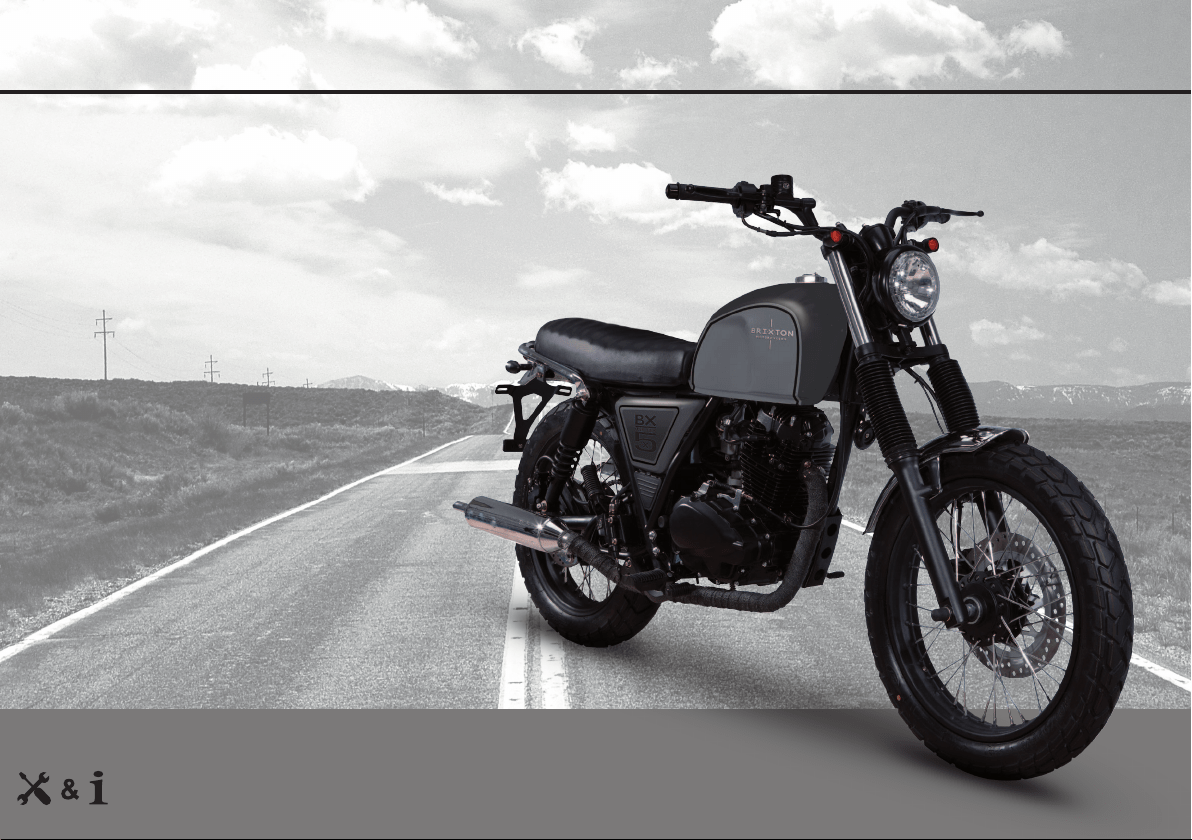
BX-125
ENG

1
INTRODUCTION
Thanks for your purchasing of this vehicle. This model is designed for safety, built for durability, and
perfected for daily street use. The unique vehicle design, enrich of stylish and peronality, represents your
outstanding taste and favor to pursue the state of the art living attitude.
This manual describes the correct usage of this motorcycle including safety riding, simple inspection methods
and so on. For a more comfortable and safety riding, please read this manual carefully. If any questions concerning
the operation or maintenance of your vehicle, please consult a dealer.
2
IMPORTANT MANUAL INFORMATION
In this manual with some important information is distinguished by the following notations:
!
WARNING
It is WARNING instructions that need to follow, failure of follow coulnd be end in result severe
injuiry or lead to death to the operator.
CAUTION
A CAUTION indicates with special precautions to avoid damage to the vehicle.
A CAUTION indicates important information in this manual.
CAUTION
• Please always put this manual with vehicle for rider maintenance/ dealer tracking of service records even if vehicle is
being sold.
• This manual contains the most of the vehicle information, however, the maker will continually imrprove it’s product
design and quality that lead to difference between the manual and vehicle . If you have any questions concerning this
manual, please consult your dealer.
!
WARNING
FOR YOUR OWN SAFETY, PLEASE READ THIS MANUAL CAREFULLY BEFORE OPERATION THIS VEHICLE. ONLY OPERATE
THE VEHICLE UNTIL YOU HAVE COMPLETELY AWARE OF ADEQUATE KNOWLEDGE OF CONTROLS AND OPERATION FEA-
TURE AND YOU HAVE BEEN TRAINED IN SAFE AND PROPER RIDING TECHNIQUES. PERIODIC INSPECTIONS, WELL MAIN-
TENANCE AND GOOD RIDING SKILLS, WILL ENSURE YOUR SAFETY RIDING AND INCEASE THE PRODUCT RELIABILITY OF
THIS VEHICLE.
*Product and specications are subject to change without notice.

3
IMPORTANT MANUAL INFORMATION
Dealer label here
4
TABLE OF CONTENTS
INTRODUCTION 1
IMPORTANT MANUAL INFORMATION 2
TABLE OF CONTENTS 4
SAFETY INFORMATION 6
Safe riding 6
Protective clothing 6
Modications 7
Loading and accessories 7
Accessorries 7
Gasoline and exhaust gas 8
Other safe-riding points 8
DESCRIPTION OF THE VEHICLE 9
Components (All variants) 9
Components (BX125 X only) 11
Components (BX125 R only) 11
Components (BX125 H only) 12
CONSUMER INFORMATION 13
Vehicle identication number (VIN) 13
INSTRUMENT AND CONTROL FUNC-
TIONS 14
Instruments 14
Power lock 14
Steering Lock 15
Left handlebar 15
Right handlebar 16
Fuel tank 16
Gearshift pedal lever 17
Rear brake pedal 18
Side and main stand 18
Seat 18
Disassembly of the seat 18
Disassembly of the seat (BX 125 R
only) 19
Combined brake system (CBS) 19
PRE-OPERATION CHECKS 20
Pre-operation check list 21
OPERATION AND IMPORTANT RIDING
POINTS 22
Starting the engine 22
Starting off 22
Shifting and riding 22
Acceleration / Deceleration 23
Braking 23
Stop the Engine / Parking 23
Engine break in 23
PERIODIC MAINTENANCE AND MINOR
REPAIR 25
Check the spark plug 25
Engine oil 26
Check engine oil 26
Oil change 27
Fuel lter 27
ECU (Engine Control Unit) 27
Throttle cable free play 28
Throttle cable free play adjustment 28
Clutch free play 28
Clutch free play adjustment 28
Tires 29
Tire air pressure 29
Tire inspection 29
Rims 30
Brakes 30
Brake free play 30
Brake pads 31
Brake pads 31
Brake uid 31
Changing the brake uid 32
Cables 32
Throttle grip and cable 32
Lubricating the brake lever and brake
pedal 32
Side stand / Main stand 32
Front fork 32
Steering 33
Wheel bearings 33
Drive chain 34
Tensioning the chain drive 34
Battery 34
Charge the battery 34
Store the battery 35
Fuse 35
Replacing the fuse 35
Lighting 35
Headlight 35
Turn signal, Tail and Brake light 35
License plate light 35
TROUBLESHOOTING 36

5
TABLE OF CONTENTS
Troubleshooting chart 36
CLEAN AND STORAGE 38
Clean the vehicle 38
Before cleaning 38
Cleaning after normal use 38
Cleaning after riding in the rain, near
the sea or on salt-sprayed roads 38
After cleaning 39
Storage 39
Short-term (for a few days) 39
Long-term (for weeks) 39
WARRANTY INFORMATION 43
SERVICE AND MAINTENANCE 44
Important information 44
Maintenance schedule 45
Service record 46
SPACE FOR NOTES 47

6
SAFETY INFORMATION
THIS VEHICLE ARE TWO WHEEL
SINGLE TRACK VEHICLES. THE
USE OF SAVETY AND OPERATI-
ON MAY IN DIFFERENT RESULT
BY THE USE OF PROPER RIDING
TECHNIQUES OF THE OPERATOR.
TO REMIND OF OPERATOR, WHO
SHOULD KNOW THE FOLLOWING
REQUIREMENTS BEFORE RIDING.
HE OR SHE SHOULD:
• WELL TRAINED AND FIMILIAR
TO ALL THE ASPECTS OF Vehicle
OPERATION.
• FULLY READ AND AWARE OF
MAINTENANCE REQUIREMENTS
THAT NOTED IN THIS OWNER’S
MANUAL.
• OBTAIN QUALIFIED TRAINING &
LEGAL LICENSE FOR OPERATI-
ON OF THIS VEHICLE.
• WELL AND PROFESSIONAL
MAINTENANCE SERVICE FOR
OPERATOR AND CERTIFICA-
TED REPAIR SHOP/DEALER TO
ACQUIRE GOOD MECHANICAL
CONDITIONS OF VEHICLE.
Safe riding
• Always pre-check your vehicle befo-
re riding is key point to prevent an
accident.
• Please follow the maxium loads limi-
ted of operator and passenger.
• Most of accident on the motorists is
cased by automobile driver who “fai-
lure to recognize out the vehicle” and
caused mobile/vehicle accidents.
Therefore, to make yourself conspi-
cuous apprear to public will be very
effective in reducing the change of
this kind of accidents.
Therefore:
• Wear a brightly colored and protecti-
ve clothes/Jacket
• Operate the turning signals before
turning and slow down the Speed
when approaching and passthrough
the intersection
• Keep proper distance with other Mo-
torists, and let them aware of your
location
• Know your skills and limits
• Never lend your vehicle to oththers
who not qualied for riding
• Always follow the legal speed limit
on the vehicle and trafc law
• The posture of the operator and
passenger is important for proper
control. properly riding posture can
Keep vehicle in balance while riding.
• Operator should sit up-right with
two hand hold on handle bar, foot
on oorboard while driving.
• Passenger should make sure that
he/she can rmly hold on grip or
operator with foot step on footrest.
• Drving after Acohol drink or other il-
legal drugs is strickly prohibited.
• This vehicle is designed for onroad
use only. It is not suitable for off-road
use.
Protective clothing
Properly clothing yourself will keep you
safety from potential accidents:
• Always wear an approved helmet.
• With face shield to protect your eye
from dust and rain drop.

7
SAFETY INFORMATION
• The wear of proper jacket, shoes,
groves etc., can be better protection,
reducing the degree of injuiry from
un-expected accident.
• Never wear loose-tting clothes,
otherwise they could catch on the
control levers or wheels and cause
injury or an accident.
• Never touch the engine or exhaust
system during or after operation.
They become very hot and can
cause burns. Always wear protective
clothing that covers your legs, ank-
les, and feet.
Modications
Modications made to this vehicle that
not approved by maker, or the removal
of original equipment, may let vehicle
unsafe for use and cause severe per-
sonal injury. Modications may also
make your vehicle illegal touse.
Loading and accessories
Adding accessories or cargo to your
vehicle may cause the different on the
weight distribution of vehicle and in-
uence on the steering & balance.
It
may cause possibility of an accident,
please extremely caution and follow
below limitation when you equipped
with accessories. Below are some ge-
neral or accessories. Here are some
guidelines to follow if loading cargo or
adding accessories to your vehicle.
Loading
The total weight of the operator, pas-
senger (when allowed), accessories
and cargo must not exceed the maxi-
mum load limit.
Maximum load
(not include the vehicle):
150kg
When loading within this weight limit,
keep the following in mind:
• Cargo and accessory weight should
be kept as low and close to the ve-
hicle as possible. Make sure to dis-
tribute the weight as evenly as pos-
sible on both sides of the vehicle to
minimize imbalance or instability.
• Make sure that accessories and car-
go are securely attached to vehicle
before riding
• Never attach any large or heavy
items to the handlebar, front fork, or
front fender. Such items can create
unstable handling or a slow steering
response.
Accessorries
Genuine accessories have been speci-
cally designed for use on this vehicle.
If need, please contact with dealer for
detail. Since the maker can not test all
other accessories , you must perso-
nally be responble for the proper selec-
tion, installation and use of non-OEM
accessories.
Keep the following guidelines in mind,
when mounting accessories.
• Never install accessories or carry
cargo that would inuence on the
ground clearance, limit suspension
travel, steering,or obscure lights or
turning lights, reectors.

8
SAFETY INFORMATION
• Accessories on the handle bar/front
suspension area will cause bad inu-
ence on steering the vehicle. if you
will install accessories, please keep
it as light in weight and not interfere
on steering the vehicle.
This vehicle
is for On-Road transportation purpo-
se only, please do not install any of
extended cargo carrier as sulky, that
will make vehicle unstable in cross
winds and vehicle turns.
• While equip with electrical accesso-
ries, please consult with qualiled
stores, to make sure such items
will not exceed the capacity of the
vehicle’s electrical system. Unpro-
per install of such items may cause
a dangerous loss of lights, lower
engine power or even damage the
vehicle.
Gasoline and exhaust gas
• GASOLINE IS HIGHLY FLAMMAB-
LE:
• Always turn the engine off when
refueling.
• Take care not to spill any gasoli-
ne on the engine (hot) or exhaust
system when refueling.
• Do not smoke or use Mobile pho-
ne while re-fueling.
• Never start the engine or let it run for
any length of time in a closed area.
The exhaust fumes are poisonous
and may cause loss of conscious-
ness and death within a short time.
• Always turn the engine off before
leaving the vehicle and remove the
key from the main switch. When par-
king the vehicle, please note the fol-
lowing:
• The engine and exhaust system
remain hot, therefore, park the ve-
hicle in a place where pedestrians
or children are not likely to touch
these hot areas.
• Do not park the vehicle on a slope
or soft ground, otherwise it may
fall over.
• Do not lay your vehicle to near
ammable place.
• In case of swallow any gasoline, or
gasoline get into your eyes, please
see your doctor immeidately. Keep
away the gasoline to your skin and
water.
OTHER SAFE-RIDING POINTS
• Turn the signal before making turns.
• When raining or across on run on
the wet road, Iron Plates, keep your
speed low, slightly using braking to
avoid slipping or even fall down.
• Be careful when passing parked
cars. A driver might not see you and
open a door in your path.
9
DESCRIPTION OF THE VEHICLE
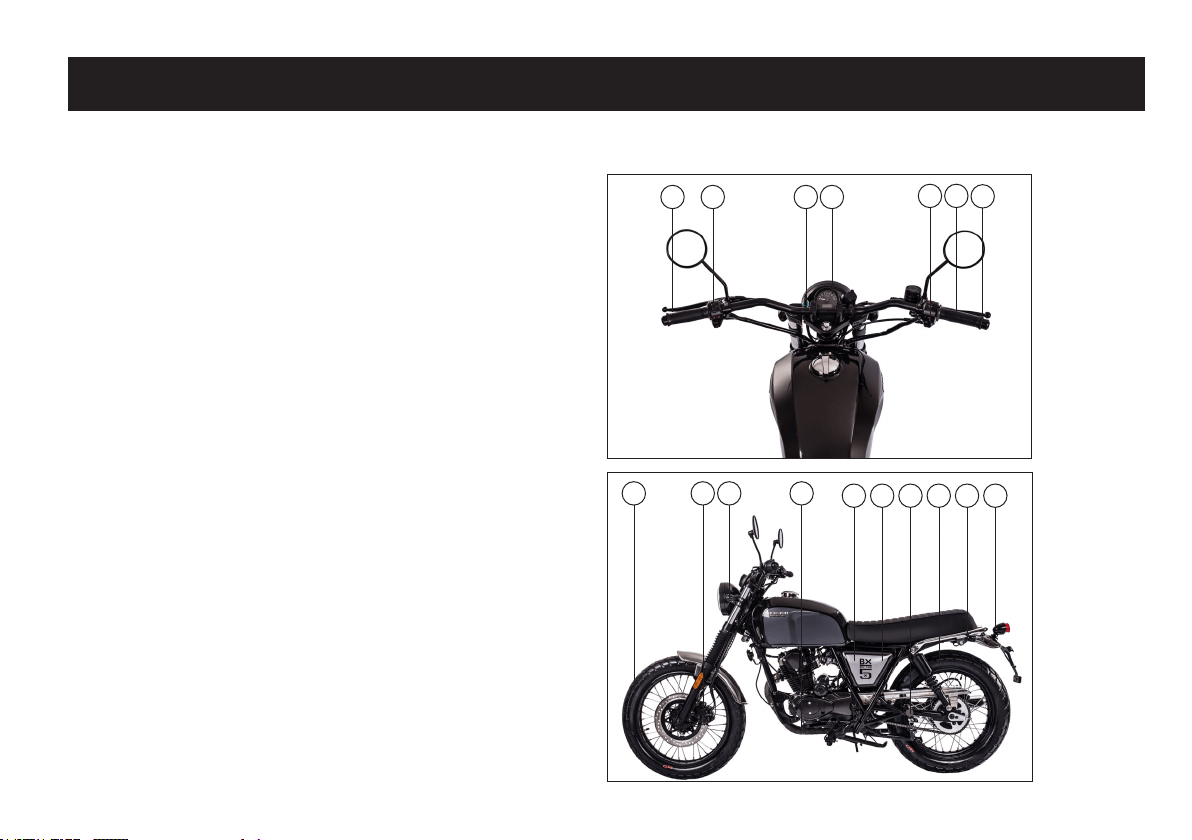
COMPONENTS (ALL VARIANTS)
1. Clutch lever
2. Left handlebar switches
3. Power lock
4. Instrument
5. Right handlebar switches
6. Throttle grip
7. Front brake lever
8. Front wheel
9. Front brake caliper
10. Front turn signal light
11. Clutch shift pedal
12. Air lter element
13. Battery
14. Foot pedal
15. Rear wheel
16. Rear turn signal light
17. Tail light
8 9 10 11
12 13 14 15 16 17
1 2 3 4
5 6
7
10
DESCRIPTION OF THE VEHICLE
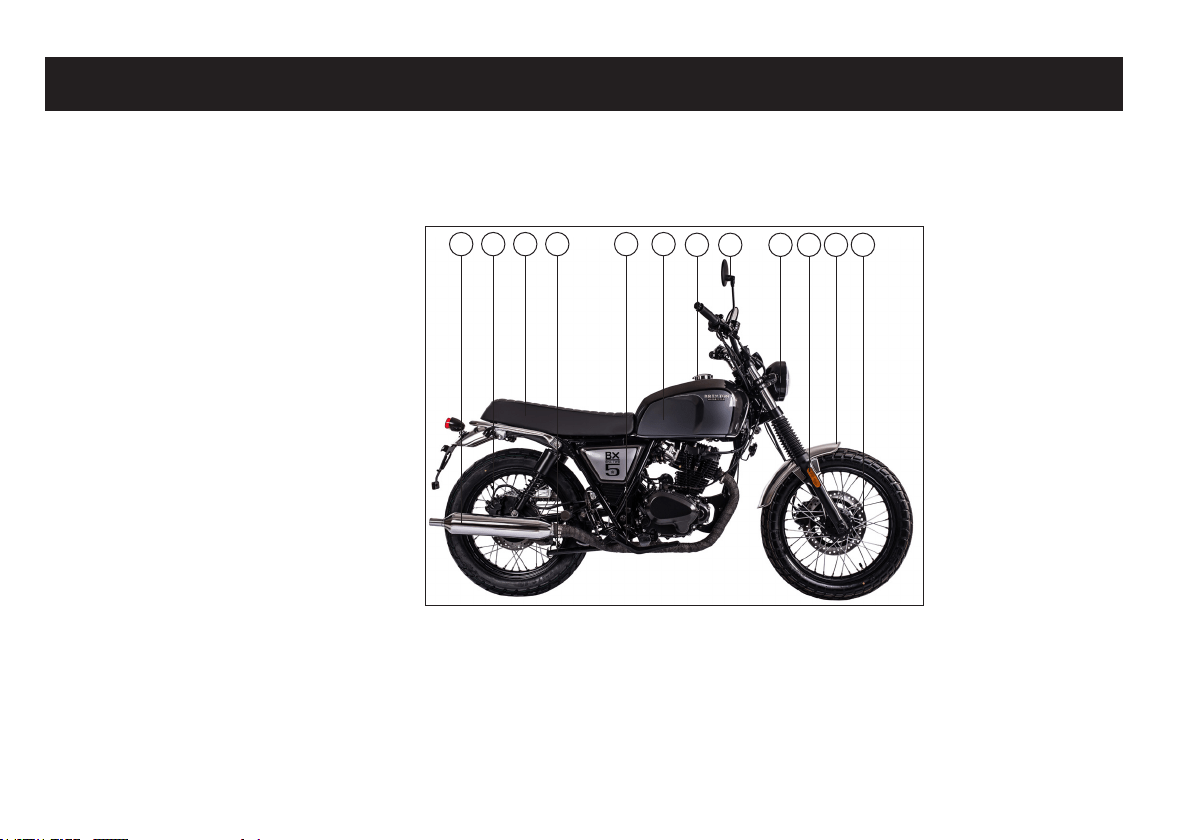
18. Mufer
19. Rear brake
20. Seat
21. Main stand
22. Front foot pedal
23. Fuel tank
24. Fuel tank cap
25. Rear-view mirror
26. Headlight
27. Reector assembly
28. Front fender
29. Front brake disc
24 26
18
27 292825
21 2220 2319
11
DESCRIPTION OF THE VEHICLE
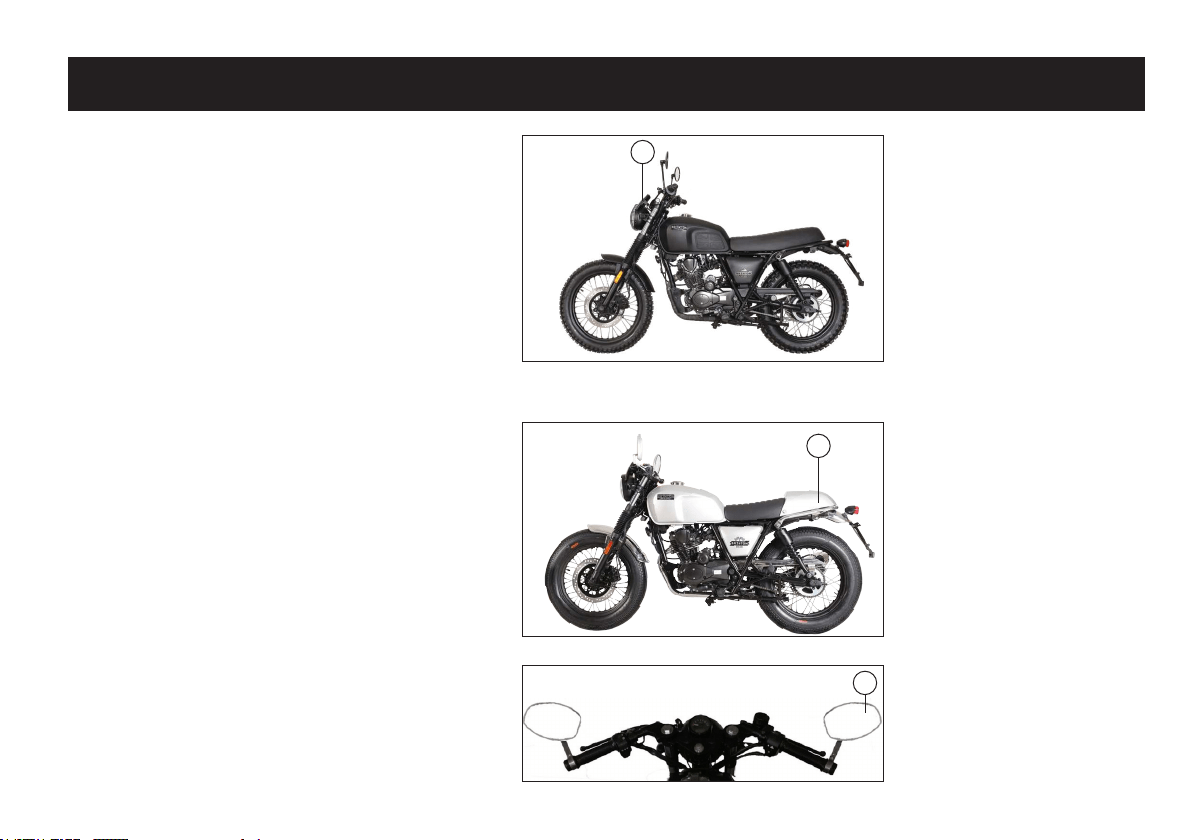
COMPONENTS (BX125 X ONLY)
30. Windshield
COMPONENTS (BX125 R ONLY)
31. Seat cover
32. Rear view mirror
32
31
30

12
DESCRIPTION OF THE VEHICLE
COMPONENTS (BX125 H ONLY)
33. Windshield
33
13
CONSUMER INFORMATION
VEHICLE IDENTIFICATION NUMBER (VIN)
Please write down the VIN (vehicle identication number) to order replacement parts from your dealer or the vehicle should
be stolen.
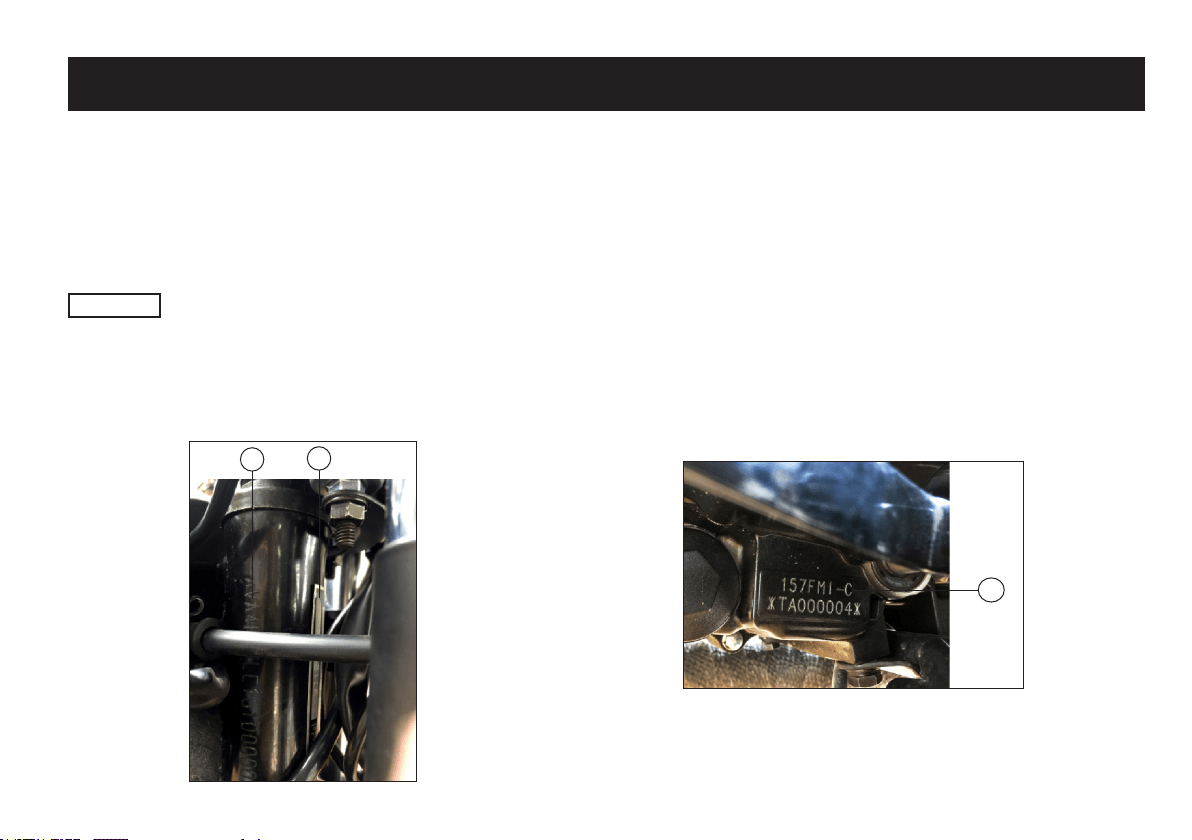
The vehicle identication number of the vehicle (1) is stamped on the steering head, the anti-tampering label (2) is located
on the left hand side.
CAUTION
The vehicle identication number is used to identify your motorcycle and may be used to register your vehicle with the
licensing authority in your area.
The engine number (3) is engraved on the left of the motor housing.
1
2
3
14
INSTRUMENT AND CONTROL FUNCTIONS
INSTRUMENTS
1
2
7
8
4
5 6
3
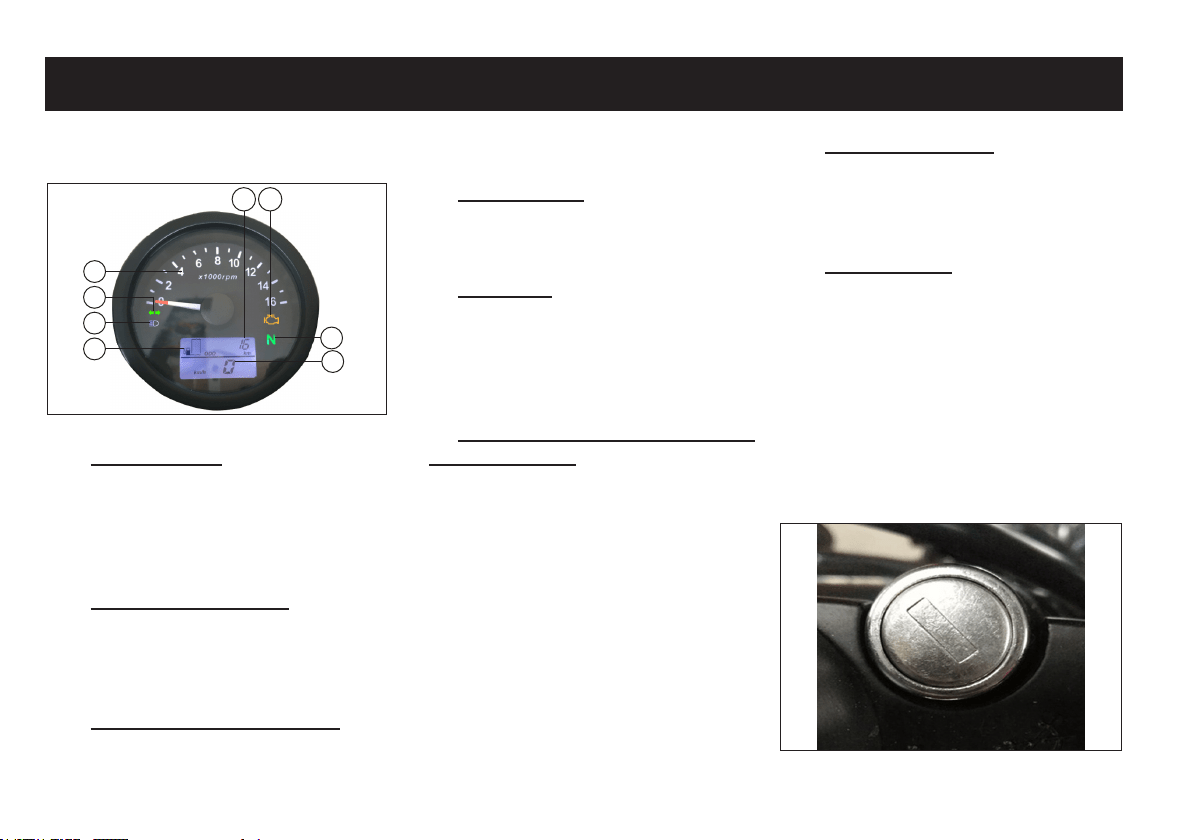
1. Fuel indicator
It indicates the fuel volume in the fuel
tank. It will point to 5 when the fuel tank
if full; and it will point to 1 or below when
the fuel is inadequate, and it will ash.
2. High beam indicator
When the headlight high beam indica-
tor turns on, the high beam indicator is
on.
3. Turn signal light indicator
When the left or right turn signal light is
on, the corresponding left or right turn
signal indicator will ash.
4. Speedometer
The Speedometer shows the engine
revolutions from 0-16×1000rpm.
5. Odometer
Total mileage (ODO) records the total
distance ran in the range of 0-99999
km; when exceeding 99999 km, it still
shows 999999 Km.
6. European On-Board Diag-
nostics (EOBD)
When powering on but not starting the
engine under normal circumstances,
EOBD indicator will be illuminated, and
automatically go off several seconds
after starting the engine. If it does not
go off and ashes, the vehicles may
have some faults and need to repair.
Please contact the local dealer to
check the faults with the special fault
diagnostic instrument of motorcycle.
7. Neutral gear lamp
When the transmission is in the neutral
position, the neutral pilot lamp will be
illuminated.
8. Speedometer
Speedometer indicates the riding
speed of vehicles. You can choose the
units (mph or km/h) by continuously
switching power door twice according
to your needs, and the display range is
0-199km/h or 0-124mph.
POWER LOCK
Rotating the key clockwise, the power
15
INSTRUMENT AND CONTROL FUNCTIONS
will turn on; the engine can be star-
ted; and the key cannot be removed;
rotating the key counterclockwise, the
power is turned off; the engine cannot
be started; and the key can be taken
out.
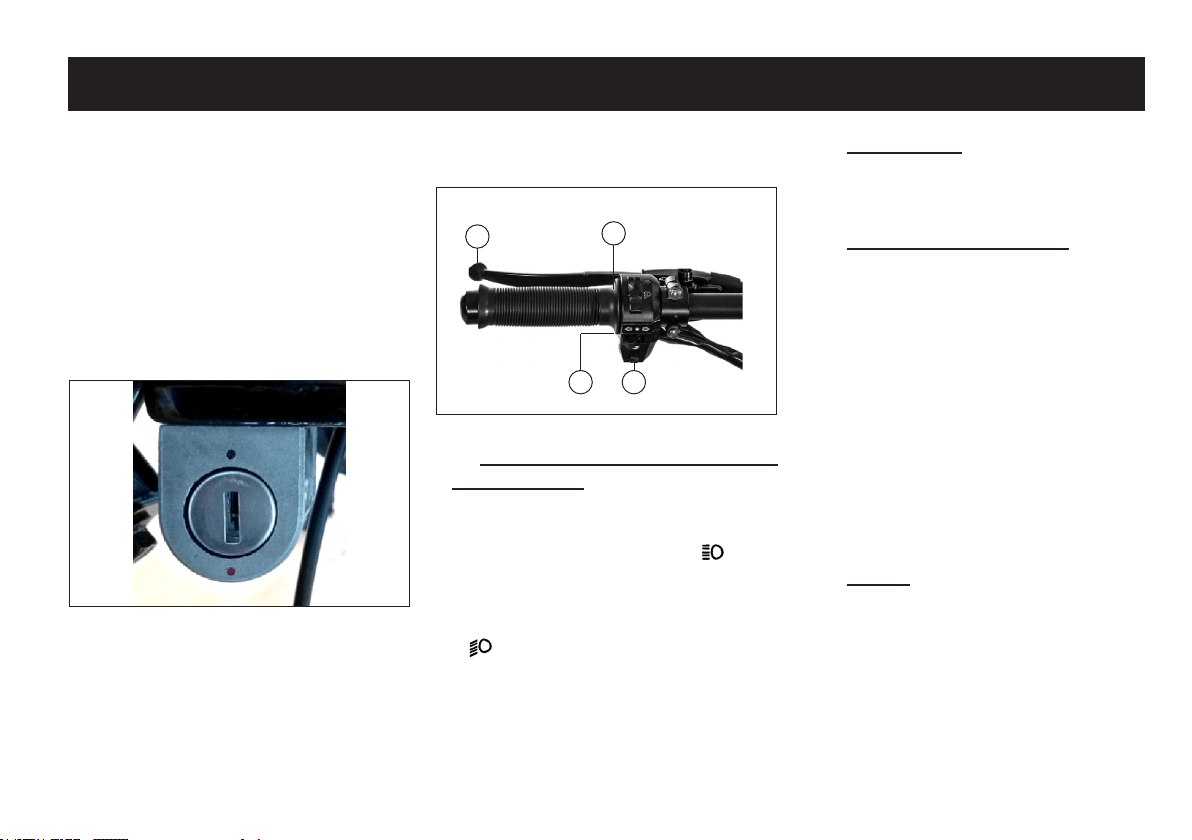
STEERING LOCK
Put the key in the steering lock located
on the bottom right side of the steering.
Rotate the handlebar to the left and turn
the key counterclockwise to the red
dot, the steering lock will be activated.
The key can be taken out.
LEFT HANDLEBAR
1
4
23
9. Switch of headlight high beam
and low beam
When the switch of headlight high
beam and low beam is at “ ”, the
headlight high beam is on, and the high
beam indicator on the instrument panel
is also on; when pressing the switch
to „
”, the headlight low beam is on.
When riding in urban areas or coming
a vehicle in the front, please use the
headlight low beam so as not to affect
the vision of the driver in opposite lane.
10. Horn button
Pressing the horn button, the horn will
sound.
11. Turn signal light switch
Pressing the left turn signal light switch
(3), the left turn signal light will be on
and ash. At the same time, the green
turn light indicator on the instrument
panel will ash; pressing the right turn
signal light switch (3), the right turn
signal light will be on and ash. At the
same time, the green turn light indica-
tor on the instrument panel will ash.
If releasing the turn signal lights, you
need to switch the turn signal lights to
the middle.
12. Clutch
When starting the engine or shifting,
operate the clutch lever to cut off the
riding of the rear wheel.
16
INSTRUMENT AND CONTROL FUNCTIONS
!
WARNING
When changing lanes or turning,
turn on the turn signal lights in time.
After turning, turn off the turn signal
lights, so no one will be irritated.
RIGHT HANDLEBAR
2
3
4 1 5
1. Electric starting button
Pressing the electric starting button,
the electric motor will run, and the
engine will be started.
2. Throttle grip
The throttle grip is used to control the
engine speed. To increase the speed,
turn the throttle grip towards yourself.
To reduce the speed, turn the throttle
grip in opposite direction.
3. Headlight switch
At „ ”, the daytime running lights,
tail lights and license plate lights are on;
whining pressing the headlight switch
to „ ”, the daytime running lights are
off, and the headlights, front and rear
parking lights and license plate lights
are on.
4. Emergency light switch
When pressing „ ”, the front and rear,
left and right turn signal lights, and the
green turn signal light indicators on the
instrument panel ash; when pressing
the „
”, the front and rear, left and right
turn signal lights, and the green turn
signal light indicators on the instrument
panel are turned off simultaneously.
5. Front brake lever
At front braking, slowly clench the
handlebar on the right handle.
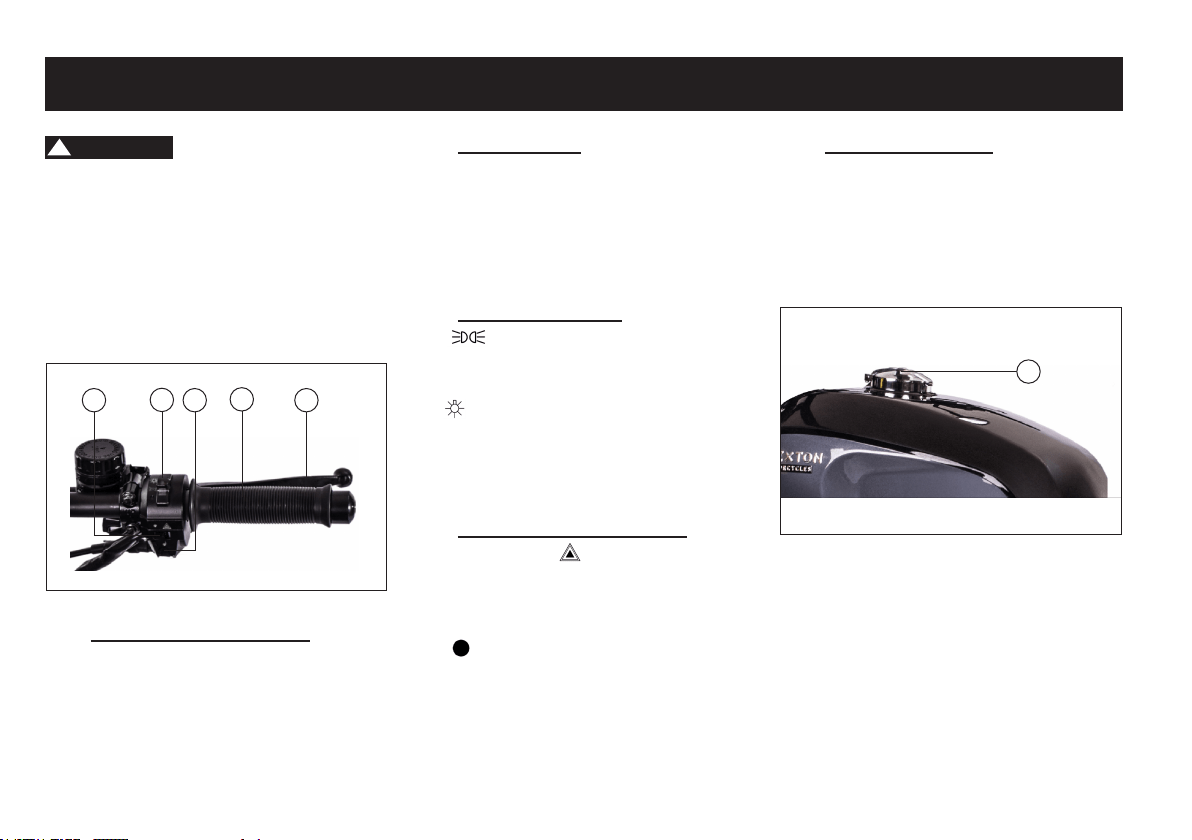
FUEL TANK
1
Remove the lock pressing the plate of
the fuel tank, and open the tank by ro-
tating the key of the cap (1) clockwise.
To close the fuel tank cap, align the
guide pin of the cap, then press the key
downwards and return the key. Finally,
cover the lock.
17
INSTRUMENT AND CONTROL FUNCTIONS
!
WARNING
• The fuel tank should not be lled
excessively, and the fuel level
should not exceed the edge of
lower fuel tank port. The fuel
should not be spilled on the
hot engine, because this could
lead to abnormal running of the
motorcycle, or even accidents.
• When refueling, switch off the
engine and turn the ignition key
Off.
• Do not forget to cover the fuel
tank after refueling to prevent
excessive evaporation of fuel
into the atmosphere, resulting in
waste of energy and pollution to
the environment.
• Do not smoke when refueling.
• If spilled gasoline enters into the
carbon canister and other parts,
please go to the motorcycle sel-
ling agency as soon as possible
to clean or replace the canister,
otherwise, the activated carbon
in the canister will be invalid
too early due to the excessive
gasoline in the canister.
• Always check the smoothness
of the lower port of fuel tank
cap to ensure smooth drainage
and to prevent external moisture
from entering the tank chamber.
Regular unleaded gasoline only.
Recommended fuel:
Min. 95 oct
!!CAUTION!!
BIOETHANOL E10 IS NOT
SUITABLE
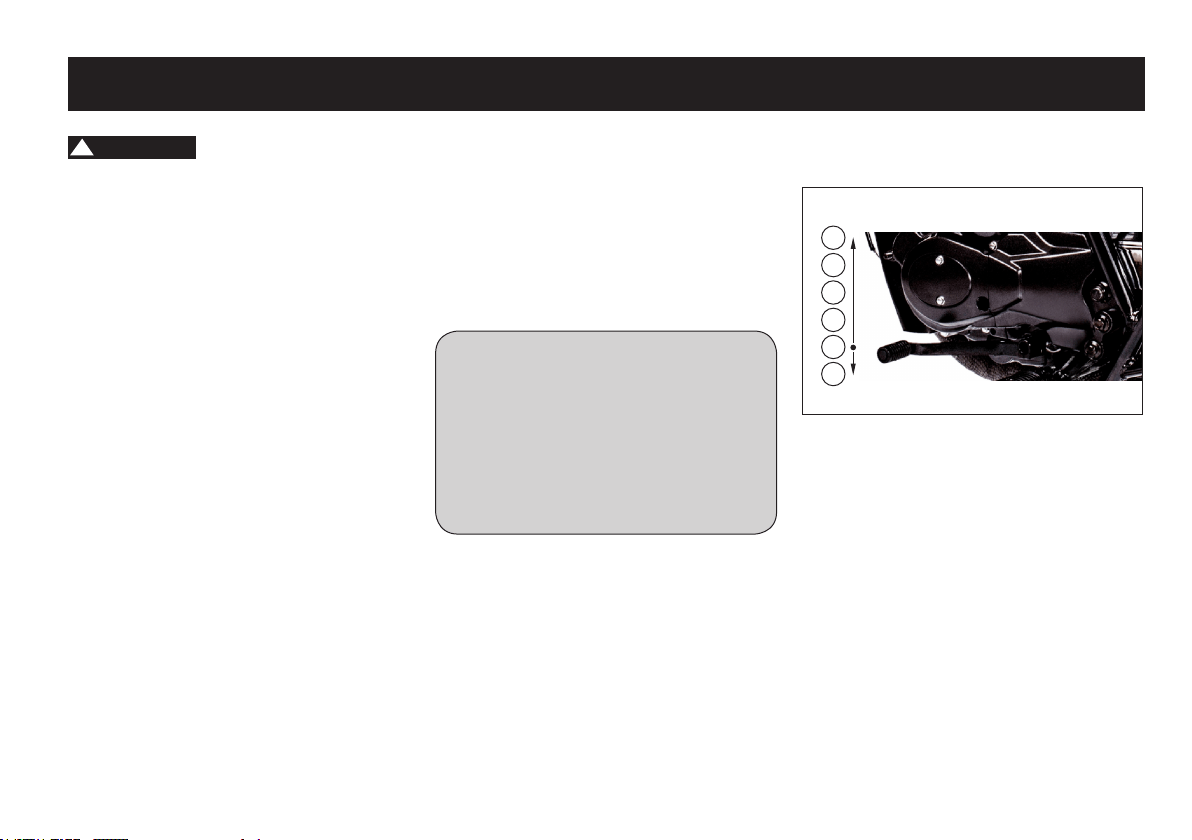
GEARSHIFT PEDAL LEVER
1
N
2
3
4
5
This vehicle is equipped with a 5-speed
gearshift (non-cycle). Neutral is located
between rst and second gear.
If the gear is in neutral, push down the
gearshift lever to shift into rst gear.
Pull the lever up for shifting into next
gear. For shifting down push the lever
down again. Shift only one gear at a
time. More than one gears cannot be
shifted, because of the shifting mecha-
nism.
18
INSTRUMENT AND CONTROL FUNCTIONS
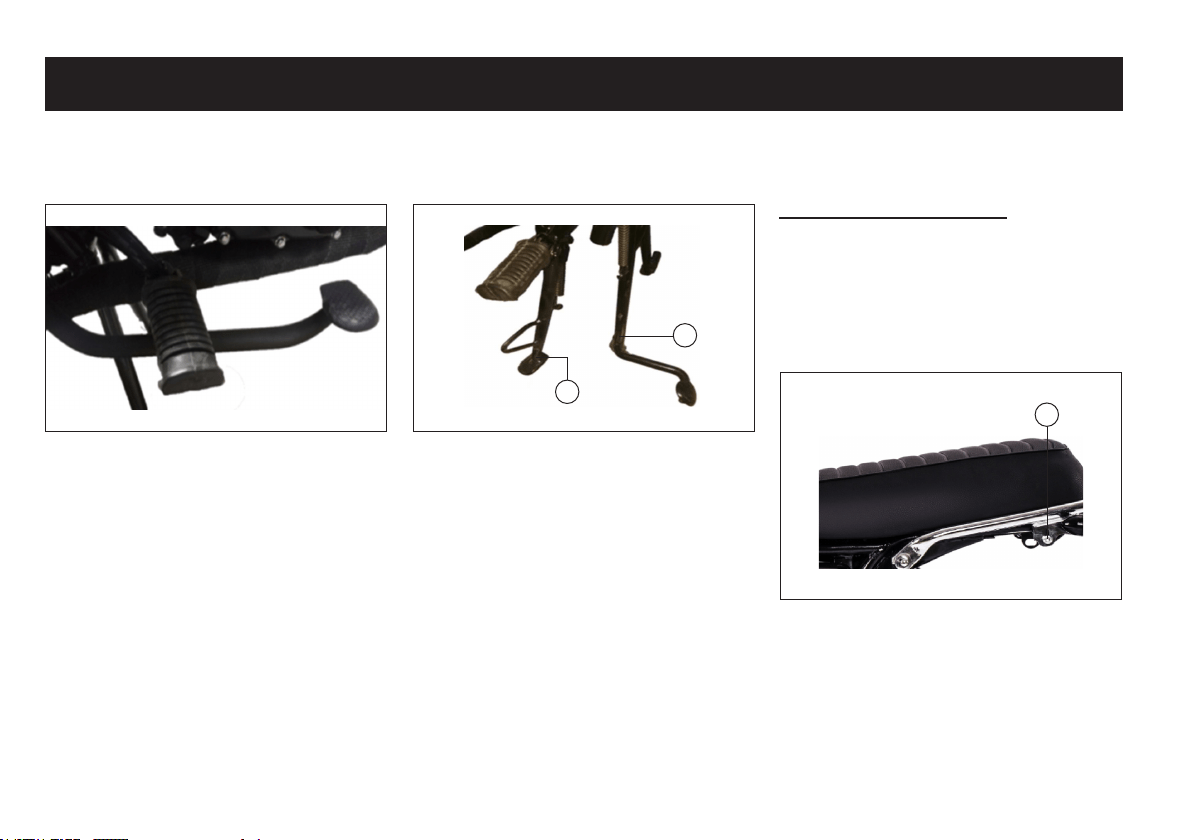
REAR BRAKE PEDAL
Push the rear brake lever down to en-
gage the rear brake. When operating
the rear brake, the brake light will turn
on.
SIDE AND MAIN STAND
1
2
The side stand (1) is located on the left
side of the vehicle. When parking, push
down the side stand. The engine stop
switch will be activated and the engine
will shut down. Before starting the
vehicle, push up the side stand. The
engine can be started.
The main stand (2) is located at the
bottom of vehicle. When parking, push
down the main stand, and pull the
vehicle backwards on the stand.
SEAT
Disassembly of the seat
1. Park the motorcycle on its main
stand
2. Remove the seat bolt (1)
3. Take off the seat
4. Reassemble in reverse order
1
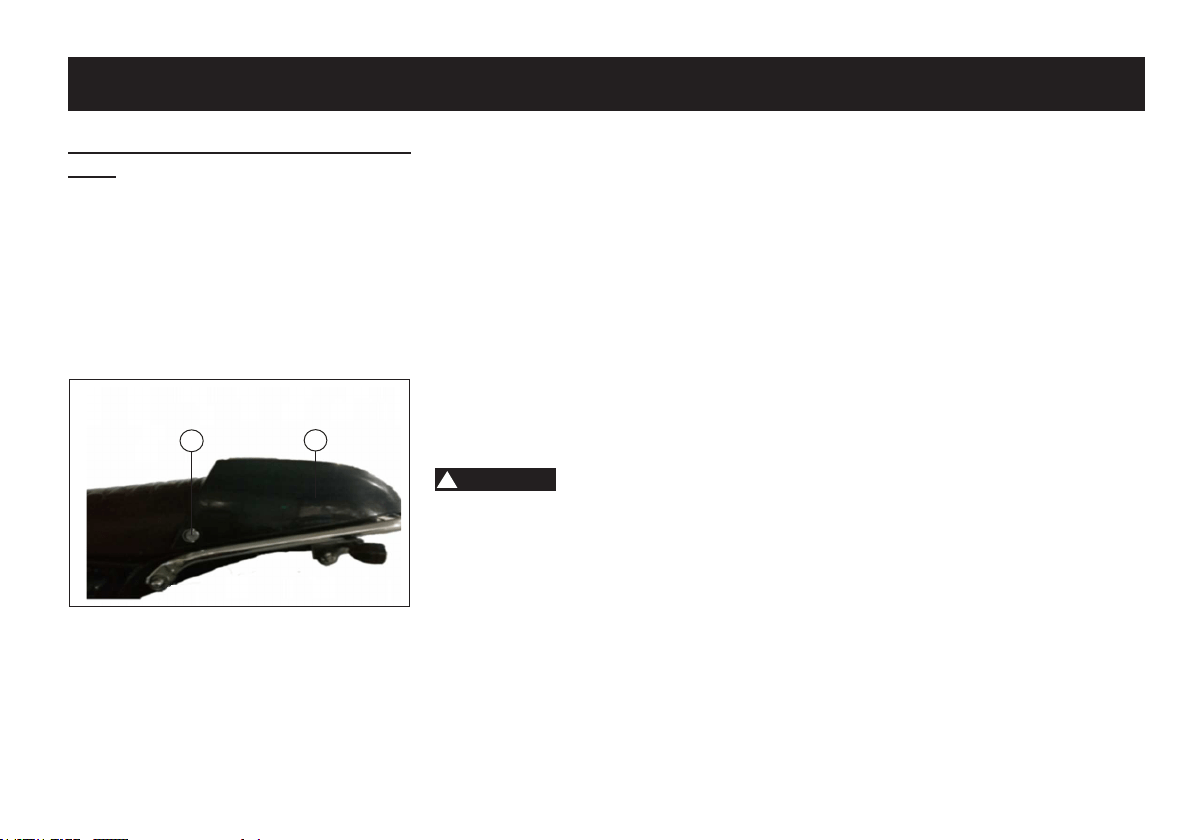
19
INSTRUMENT AND CONTROL FUNCTIONS
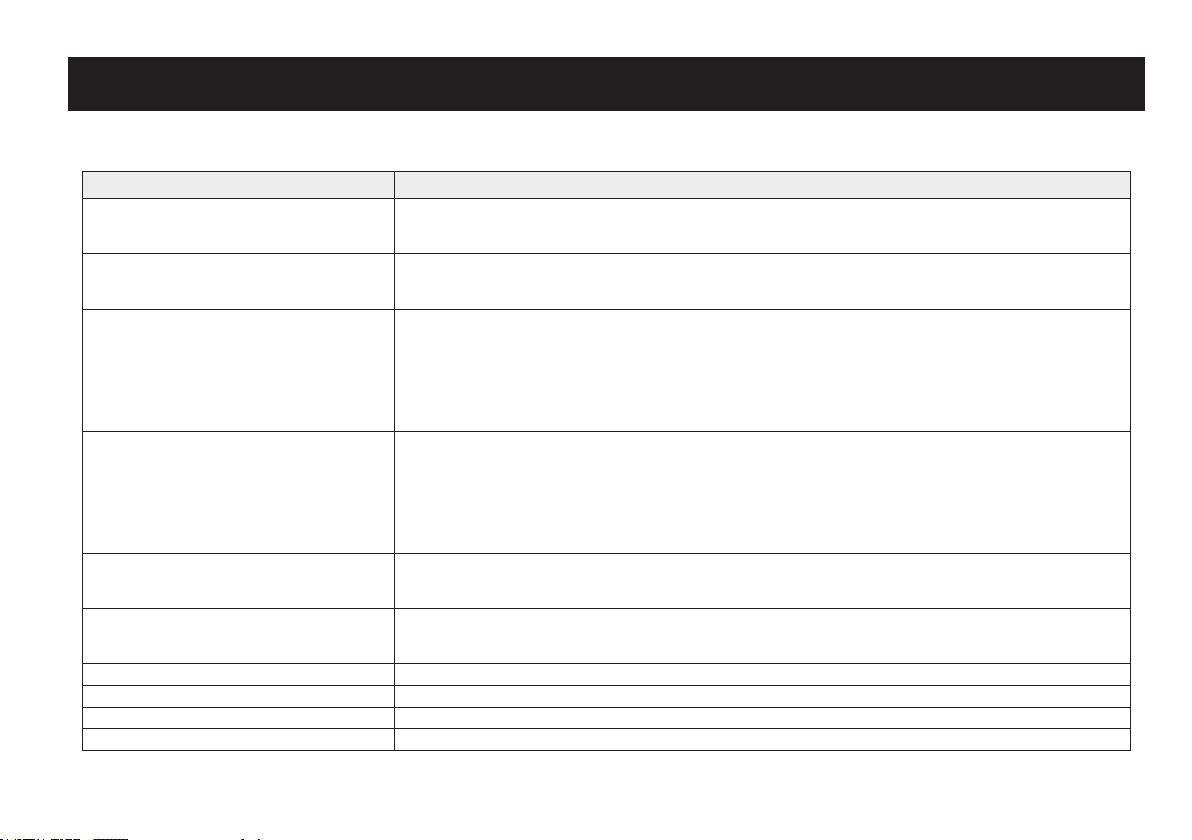
Disassembly of the seat (BX 125 R
only)
1. Park the motorcycle on its main
stand
2. Remove the seat cover bolt (2)
3. Remove the seat cover (3)
4. Remove the seat bolt (1)
5. Take off the seat
6. Reassemble in reverse order
2
3
COMBINED BRAKE SYSTEM (CBS)
The CBS (Combined Brake System)
is a combined brake system which
contributes to the road safety support
of your motorcycle.
Your vehicle is equipped with a single
CBS.
When the “foot brake” is pressed, this
simultaneously activates both the front
and rear brakes, therefore reducing the
risk of one of the two wheels locking.
!
WARNING
Although both brakes are activated
by the foot brake, the front brake still
needs to be operated for a correct
deceleration of the motorcycle.

20
PRE-OPERATION CHECKS
The condition of a vehicle is the owner’s responsibility. The operator should check the vehicle by simple but thorough
inspection,to make sure of vehicle condition, quick inspect some key and important parts, to prevent the vehicle from seri-
ous consquence/accident. Please carefully check the following points before each ride.
CAUTION
Pre-operation checks should be made each time the vehicle is used. Such an inspection can be accomplished in a very
short time; and the added safety it assures is more than worth the time involved.
!
WARNING
If any item in the Pre-operation check list is not working properly , have it inspected and repaired before operating
the vehicle. If failed to be corrected by yourself, please turn to repair shop immediately.
If failed to be corrected by yourself, please turn to repair shop immediately.
21
PRE-OPERATION CHECKS
PRE-OPERATION CHECK LIST
CHECKPOINT TO VERIFY
Fuel • Check fuel level in fuel tank.
• Refuel if necessary.
• Check fuel line for leakage.
Engine oil • Check oil level in oil tank.
• If necessary, add recommended oil to specied level.
• Check vehicle for oil leakage.
Front brake • Check operation.
• If soft or spongy, have dealer bleed hydraulic system.
• Check brake pads for wear.
• Replace if necessary.
• Check uid level in reservoir.
• If necessary, add recommended brake uid to specied level.
• Check hydraulic system for leakage.
Rear brake • Check operation.
• If soft or spongy, have dealer bleed hydraulic system.
• Check brake pads for wear.
• Replace if necessary.
• Check uid level in reservoir.
• If necessary, add recommended brake uid to specied level.
• Check hydraulic system for leakage.
Throttle grip • Make sure that operation is smooth.
• Check free play.
• If necessary, have dealer adjust cable free play and lubricate cable and grip housing.
Wheels and tires • Check for damage.
• Check tire condition and tread depth.
• Check air pressure.
Brake levers • Make sure that operation is smooth. Lubricate lever pivoting points if necessary.
Main stand • Make sure that operation is smooth. Lubricate pivot if necessary.
Chassis fasteners • Make sure that all nuts, bolts and screws are properly tightened. Tighten if necessary.
Instruments, lights, signals and switches • Check operation, correct if necessary
22
OPERATION AND IMPORTANT RIDING POINTS
!
WARNING
• Before riding the vehicle, please
make sure that you are fully fami-
liar with all operating controls &
their functions before riding. To
consult a dealer shop if you not
thoroughly understand.
• Please do not start the engine in
a closed area, the exhaust air are
poisonous, and inhaling them can
cause loss of consciousness and
even death in short time.
STARTING THE ENGINE
CAUTION
Note the point „Engine break in“ before
you start to riding the vehicle.
1. Turn the key to ON
.
2. Pull up the side stand.
3. Insert the neutral gear.
4. Actuate the front or the rear brake.
5. Push the start switch button
(1)
for a few seconds.
CAUTION
• Do not crank the engine more than 5
seconds on any attempt.
• The engine starts immediately upon
actuation of the starter, then wait a
few seconds before you try to start it
again. Each starting process should
be as short as possible in order to
save battery and the starter.
STARTING OFF
CAUTION
Before starting off, allow the engine to
warm up to avoid damages.
1. Sit astride the seat, and then adjust
the rear view mirrors.
2. Switch the turn signal on to the di-
rection you wish to turn.
1. Pull the clutch lever
2. Shift the engine to the rst gear
3. Check for oncoming trafc.
4. Slowly release the clutch lever and
open the throttle at the same time.
5. Switch the turn signal off.
SHIFTING AND RIDING
a) Shifting gears upwards
1. Release the throttle
2. Pull the clutch lever
3. Lift the gear lever upwards to change
to the higher gears.
4. Slowly release the clutch lever and
open the throttle at the same time.
b) Shifting gears downwards
1. Release the throttle
2. Operate the brakes and reduce the
speed to a appropriate speed.
3. Pull the clutch lever
4. Lift the gear lever down wards to
change to the lower gears.
5. Slowly release the clutch lever and
open the throttle at the same time.
!
WARNING
Always switch one gear only, other-
wise the transmission can be dama-
ged.
23
ACCELERATION / DECELERATION
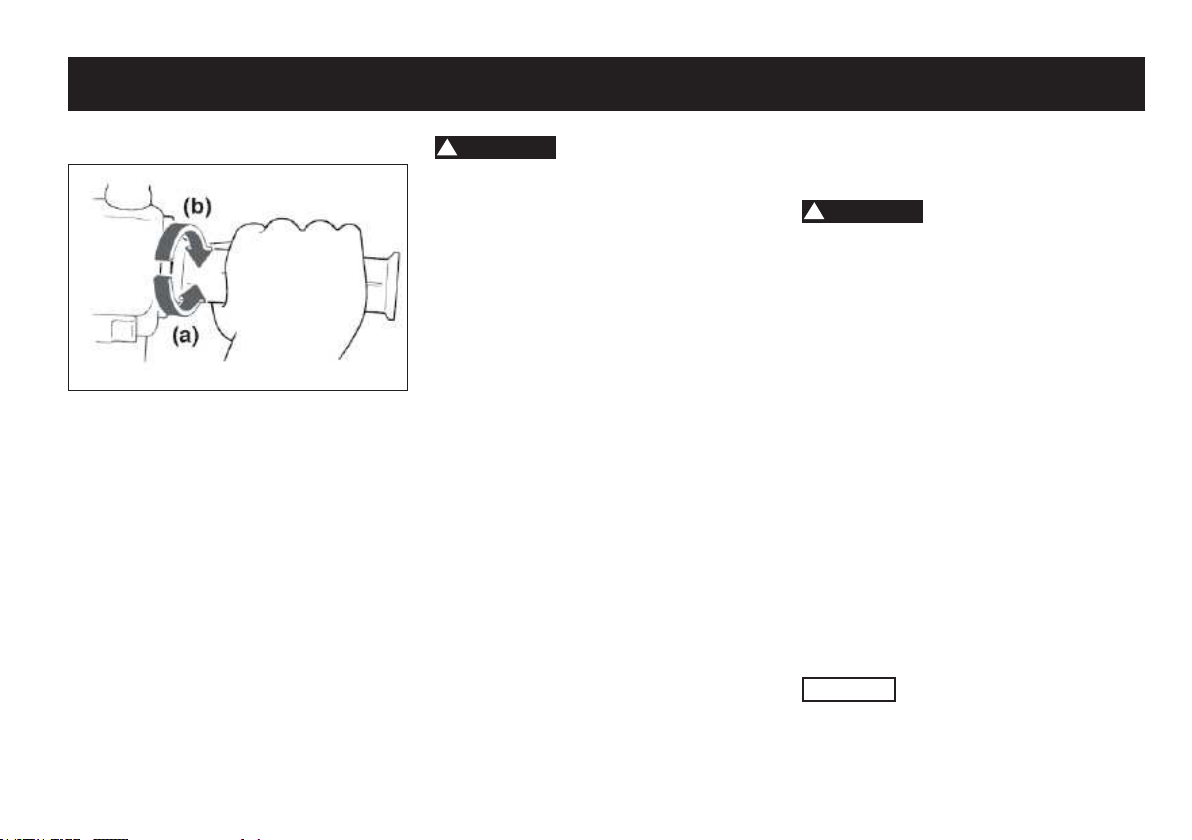
The speed can be adjusted by opening
and closing the throttle. To increase the
speed, turn the throttle grip in direction
(a). To reduce the speed, turn the thrott-
le grip in direction (b).
BRAKING
1. Release the throttle.
2. Apply the clutch lever gradually in-
creasing the pressure.
3. Apply the front and rear brake at the
same time.
!
WARNING
• Avoid braking hard and/or sud-
denly, otherwise the vehicle may
skid.
• Railroad crossings, streetcar
rails, iron plates on road const-
ruction sites, and manhole covers
become extremely slippery when
wet. Therefore, slow down when
approaching such areas and
cross them with caution.
• Keep in mind that braking on a
wet road is much more difcult.
• Ride slowly down a hill, as bra-
king downhill can be very difcult.
STOP THE ENGINE / PARKING
1. Reduce the throttle to 0 position.
2. Pull the clutch lever
3. Switch the gear to N - neutral
4. Operate the brakes
5. After the vehicle is stopped turn off
the ignition.
6. Lower the side stand with your foot
while holding the motorcycle up-
right. Remove the key from the main
switch.
!
WARNING
Since the engine and exhaust sys-
tem can become very hot, park in a
place where pedestrians or children
are not likely to touch them. Do not
park on a slope or on soft ground,
otherwise the vehicle may overturn.
ENGINE BREAK IN
During the rst 1000 km do not ride
the vehicle over 75% of its maximum
speed.
Avoid opening the accelerator comple-
tely and varies speed repeatedly over
long distances.
After the rst 1000 km increase speed
gradually until reaching maximum per-
formance.
CAUTION
• The durability and the efciency of
your scooter depend strongly on the
care received during the run-in pe-
OPERATION AND IMPORTANT RIDING POINTS

24
riod. The mechanisms of the mobi-
le parts are mutually hardened and
adapted.
• After better run-in is obtained not by
riding slowly but softly and careful-
ly. During this period, it is advisable
to ride the vehicle at ¾ of maximum
performance. In the event that full
acceleration is necessary (overta-
king maneuvers, steep slopes, etc.)
try to limit the time to a minimum.
• Gearbox oil must be changed once
the rst 1000 km are covered. Use
the recommended oil type and spe-
cied quantity only.
The durability and the efciency of your
scooter depend strongly on the care
received during the run-in period. The
mechanisms of the mobile parts are
mutually hardened and adapted.
After better run-in is obtained not by ri-
ding slowly but softly and carefully. Du-
ring this period, it is advisable to ride
the vehicle at 3/4 of maximum perfor-
mance. In the event that full accelera-
tion is necessary (overtaking maneu-
vers, steep slopes, etc.) try to limit the
time to a minimum.
Gearbox oil must be changed once
the rst 1000 km are covered. Use the
recommended oil type and specied
quantity only.
To obtain optimum adjustment of mo-
bile parts, a long life and better perfor-
mance, it is necessary not to force the
vehicle during the 1000 km.
The vehicle must have a suitable run-in
period, during which the following pre-
cautions must be considered:
• After starting the engine, warm it up
progressively, without maximum ac-
celeration (we recommend not to ex-
ceed 3/4 of the throttle grip opening
for 1st gear) or overcharge.
• In long stretches, do not use full
speed consistently and varies the
speed repeatedly.
• When facing steep slopes, downshift
to have better power.
• After a long run do not stop the en-
gine suddenly, leave it running at
minimum acceleration for some se-
conds.
• Check the non-existence of oil, fuel
or brake liquid leaks.
• In case of anomalous noise, try to
identify its cause immediately.
OPERATION AND IMPORTANT RIDING POINTS
25
CAUTION
Most of the Safety and condition of ve-
hicle depend on how you do the correct
maintenance , periodic inspection,
adjustment and lubrication. The fol-
lowing are contents that help the ope-
rator to do such skills on the following
pages.
!
WARNING
Maintenance, replacement, or repair
of the emission control devices and
systems may be performed by any
repair shop or individual that is cer-
tied and must follow the local law
regulations.
If you are not familiar with mainte-
nance work, have a dealer do it for
you.
SPARK PLUG
The spark plug is an important engine
component, which is easy to check.
Since heat and deposits will cause any
spark plug to slowly erode, the spark
plug should be removed and checked
in accordance with the periodic main-
tenance and lubrication chart. In additi-
on, the condition of the spark plug can
reveal the condition of the engine.
The spark plug is on the right, front side
of the vehicle.
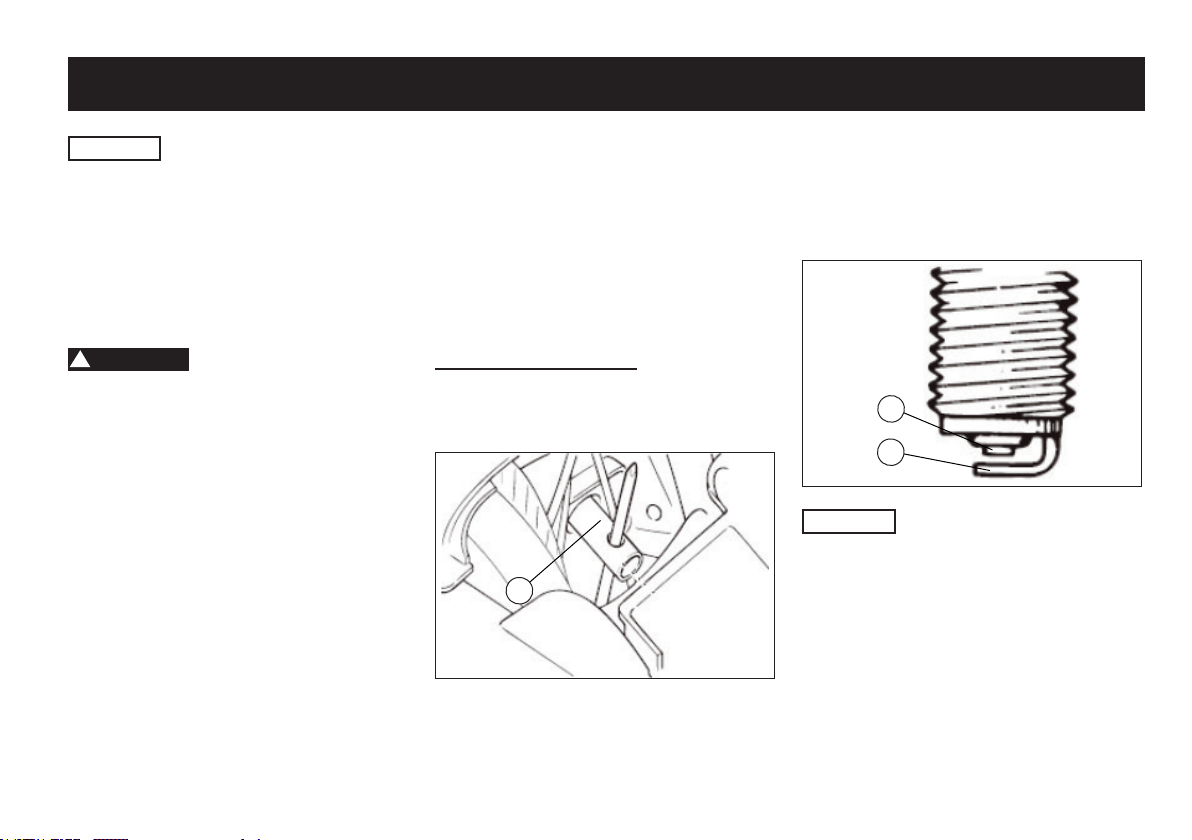
Check the spark plug
1. Remove the spark plug cap
2. Remove the spark plug as shown,
with a spark plug wrench.
1
3. Check that the porcelain insulator
(3) around the center electrode of
the spark plug is a medium-to-light
tan (the ideal color when the vehicle
is ridden normally).
2
3
CAUTION
If the spark plug shows a distinctly dif-
ferent color, the engine could be opera-
ting improperly. Do not attempt to diag-
nose such problems yourself. Instead,
have a dealer check the vehicle.
4. Check the spark plug for electrode
erosion and excessive carbon or
other deposits, and replace it if ne-
cessary.
PERIODIC MAINTENANCE AND MINOR REPAIR
26
Specied spark plug: D8RTC
!
WARNING
Please note that no other spark plug
model is allowed. Using a different
spark plug model can immediately
lead to engine damage.
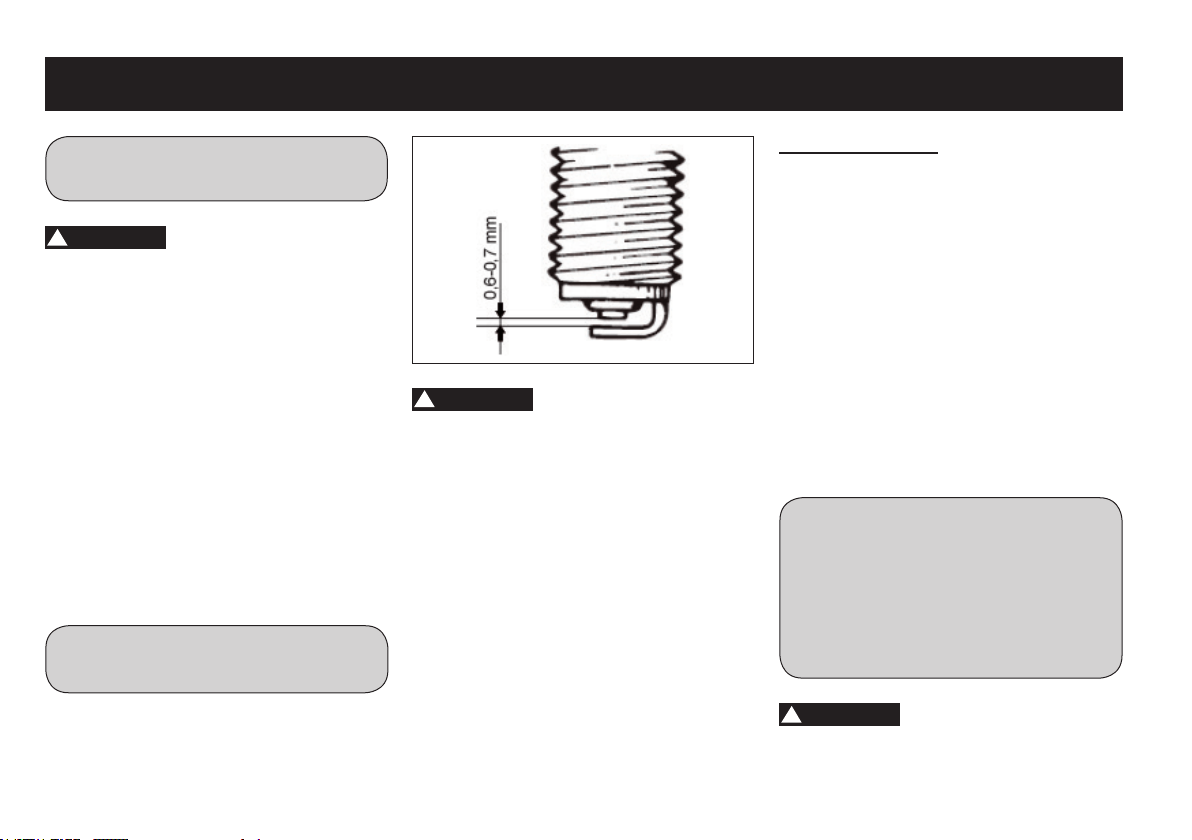
5. Measure the spark plug gap with a
wire thickness gauge and, if neces-
sary, adjust the gap to specication.
Clean the surface of the spark plug
gasket and its mating surface, and
then wipe off any grime from the
spark plug threads.
6. Install the spark plug with the spark
plug wrench, and then tighten it to
the specied torque.
Spark plug gap: 0,6 - 0,7 mm
!
WARNING
Please note the max. torque when
inserting the plug.
If you do not have the ability to con-
trol you leave control of the spark
plug to the dealer.
ENGINE OIL
It is recommended to check the engine
oil level before each operation of the
vehicle. Use a high-quality engine oil
and change it acording to the mainte-
nance table to extend the life of your
engine.
Check engine oil
1. Run the engine.
2. Position the vehicle on its centre
stand.
3. After approximately 3 minutes switch
off the engine and wait one minute.
4. Check the oil level on the oil dip stick.
Screw out the oil dip stick, clean it
with a dry cloth and plug it in. Do not
screw it in when checking the oil le-
vel. The oil level must be between
the max and min marks.
5. After checking the oil level screw in
the oil dip stick.
Capacity:
1,0 L
4-stroke engine oil
Recommended engine oil:
Liqui Moly Motorbike 4T 10W-40
!
WARNING
At each refuelling you have to con-
trol the engine oil.
PERIODIC MAINTENANCE AND MINOR REPAIR
27
CAUTION
In dusty, cold or poor road conditions,
the condition of the oil deteriorates
more rapidly. Oil changes should there-
fore be carried out more frequently.
Oil change
The engine oil can be topped up whe-
never this is needed but oil changes
and oil lter replacements should be
carried out by a specialised dealer be-
cause mistakes while carrying out this
work could result in engine damage.
!
WARNING
• Make sure that no foreign material
enters the housing.
• Make sure that no oil gets on the
tire or wheel.
FUEL FILTER
The petrol lter is located directly next
to the petrol tap underneath the fuel
tank. Handling the petrol lter is hazar-
dous as petrol may escape.
CAUTION
Have the replacement carried out by a
specialised dealer.
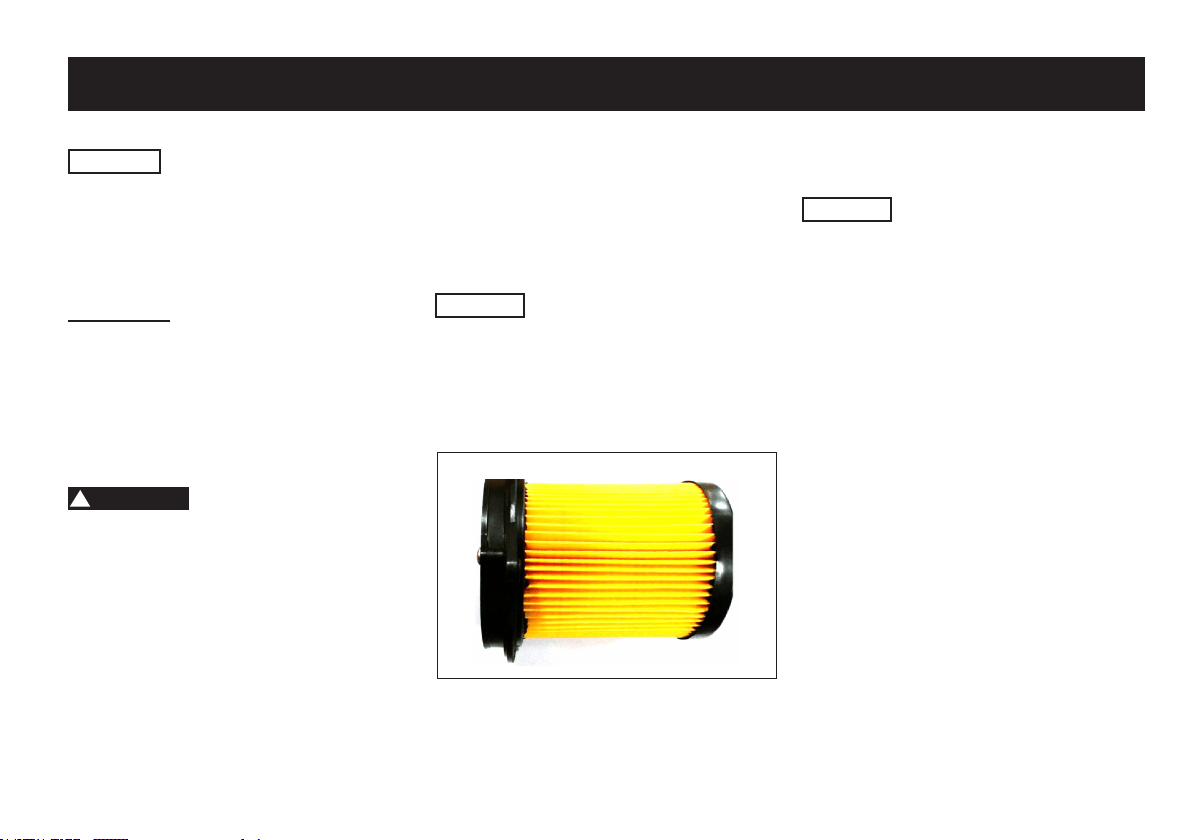
AIR FILTER
The air lter should be replaced accor-
ding to the maintenance schedule.
Replace the air lter more often if you
drive in unusually wet or dusty areas.
CAUTION
• The air lter should be cleaned dry
or using only a specially formulated
cleaning agent.
• Make sure that the air lter element
is properly seated in the air lter
case.
• The engine should never be opera-
ted without the air lter element in-
stalled, otherwise the piston and/or
cylinder may become excessively
worn.
• If necessary, have the air cleaner ex-
changed by the specialist dealer.
ECU (ENGINE CONTROL UNIT)
The ECU is an important part of the en-
gine and its emission control system,
which requires very sophisticated ad-
justment. Therefore, ECU adjustments
should be left to dealer, who has the
necessary professional knowledge and
experience.
PERIODIC MAINTENANCE AND MINOR REPAIR
28
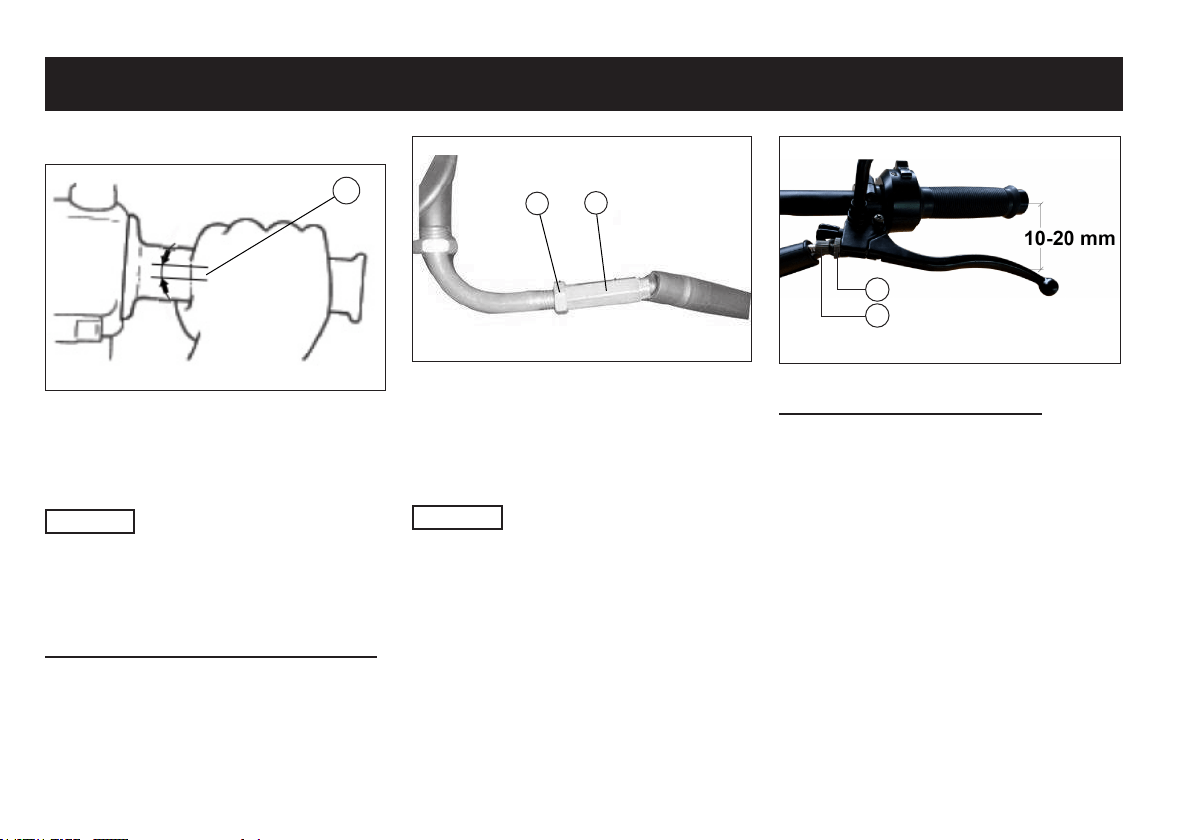
THROTTLE CABLE FREE PLAY
1
The throttle cable free play (1) should
measure 1.5 ~ 3.5 mm at the throttle
grip.
CAUTION
Periodically check the throttle cable
free play and, if necessary, have a dea-
ler adjust it.
Throttle cable free play adjustment
1. Release the locknut (1)
2. Rotate the adjusting nut (2) to ad-
just the clearance.
3. Tighten the lock nut (1) after adjus-
tingthe nut (2).
1
2
CLUTCH FREE PLAY
The clutch free play should be 10-
20mm.
CAUTION
Periodically check the clutch free play
and, if necessary, have a dealer adjust
it.
2
1
Clutch free play adjustment
1. Loosen the locknut (1)
2. Turn the adjusting bolt (2) and the
adjusting nut (3) in or out to meet
the requirements of clutch free play.
3. Tighten the lock nut (1) after adjus-
ting the nut (2).
PERIODIC MAINTENANCE AND MINOR REPAIR
29
PERIODIC MAINTENANCE AND MINOR REPAIR
TIRES
To maximize the performance, durabi-
lity, and safe operation of your vehicle,
note the following points regarding the
specifed tires.
Tire air pressure
The tire air pressure should be che-
cked and, if necessary, adjusted before
each ride.
!
WARNING
The tire air pressure must be che-
cked and adjusted on cold tires (i.e.,
when the temperature of the tires
equals the ambient temperature).
The tire air pressure must be adjus-
ted in accordance with the riding
condition. If you are not familiar to
this, please have dealer for help.
Tire air pressure*:
Front: 2,5 bar
Rear: 2,5 bar
*The tire pressure depends on the
applied payload
!
WARNING
Do not over load your vehicle, since
it will increase pressure on the tire,
braking, steering than original de-
sign, and may could cause damge
or even lead to accident.
Allocation of your cargo and weight of
your vehicle is very important for your
own safety and vehicle performance.
Load your cargo rmly on vehicle and
put the heaviest cargo to the center
of vehicle, then distribute the weight
evenly from side to side. It will keep
you to have good steering after load.
Maximum load*: 150kg
*Total weight of rider, passenger,
cargo and accessories
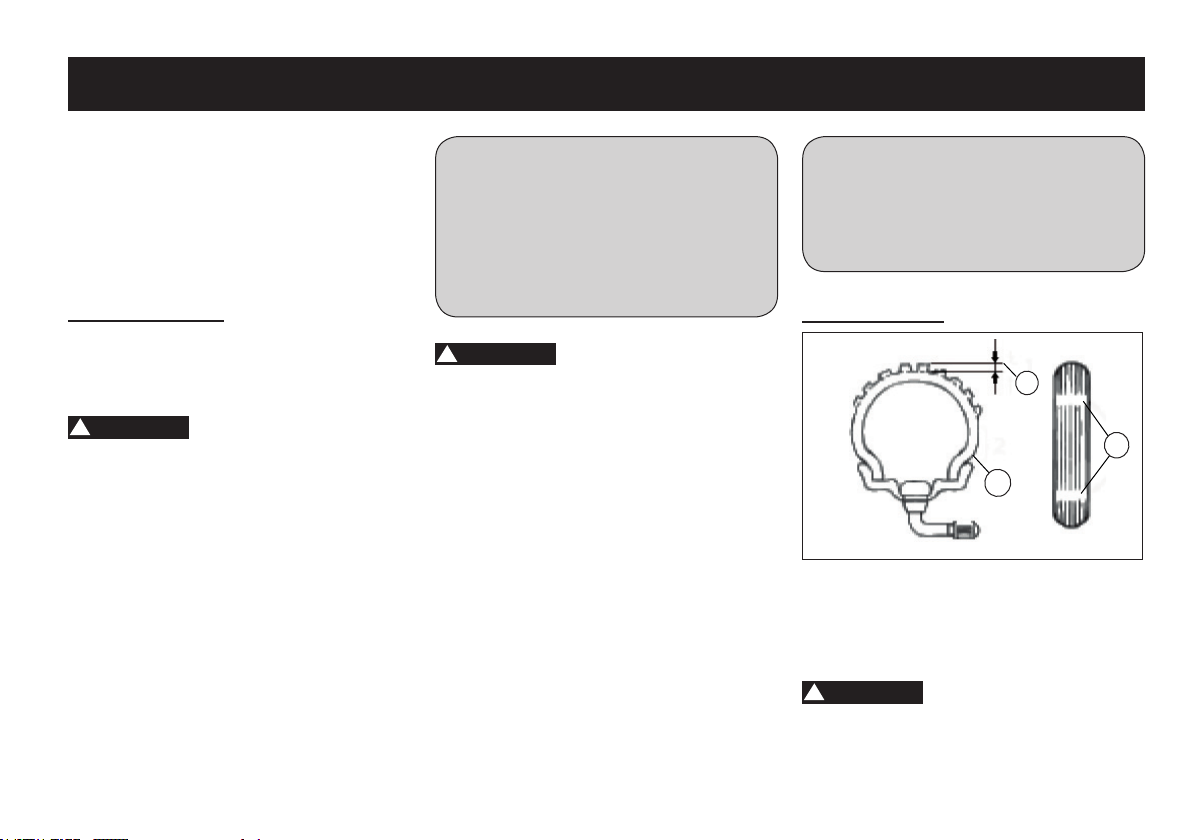
Tire inspection
1
2
3
1. Tire tread depth
2. Tire sidewall
3. Tire wear indicator
!
WARNING
The tires must be checked befo-
re each ride. If a tire tread shows
crosswise lines (minimum tread
30
depth), if the tire has a nail or glass
fragments in it, or if the sidewall is
cracked, have a dealer replace the
tire immediately.
CAUTION
The tread depth may vary depending
on country. Observe local regulations.
The values listed here are technical va-
lues and may differ from the legal valu-
es of your region.
Technical tire tread depth:
Front and rear: Min. 1,6 mm
!
WARNING
• Drive with worn tire is illegal, re-
duces stability and can lead to
loss of control over the vehicle.
• Let worn or damaged tires repla-
ced immediately by your dealer.
• Working tires and the dealer is re-
sponsible.
Tire Dimensions:
Front
Tire: 100/90-18
(Optional: 4,00-17)
Rear
Tire: 120/80-17
(Optional: 4,50-17)
RIMS
To maximize the performance, durabi-
lity, and safe operation of your motor-
cycle, note the following points regar-
ding the specied wheels.
• The wheel rims should be checked
for cracks, bends or warpage before
each ride. If any damage is found,
have a dealer replace the wheel. Do
not attempt even the smallest repair
to the wheel. A deformed or cracked
wheel must be replaced.
• The wheel should be balanced whe-
never either the tire or wheel has
been changed or replaced. An un-
balanced wheel can result in poor
performance, adverse handling cha-
racteristics, and a shortened tire life.
• Ride at moderate speeds after chan-
ging a tire since the tire surface must
rst be “broken in” for it to develop its
optimal characteristics.
BRAKES
!
WARNING
A soft or spongy feeling in the brake
lever can indicate the presence of
air in the hydraulic system. If there
is air in the hydraulic system, have a
dealer bleed the system before ope-
rating the motorcycle. Air in the hy-
draulic system will diminish the bra-
king performance, which may result
in loss of control and an accident.
Brake free play
• The free play of the front brake
should be 10-20mm.
PERIODIC MAINTENANCE AND MINOR REPAIR
31
• The free play of the rear brake
should be 20-30mm.
CAUTION
If there is no play of the brake levers,
it may be that the brake pads drag
permanently on the brake disc.
Periodically check the brake lever free
play and, if necessary, adjust it as fol-
lows.
BRAKE PADS
The front brake pads and the rear bra-
ke shoes must be checked for wear at
the intervals specied in the periodic
maintenance and lubrication chart.
Brake pads
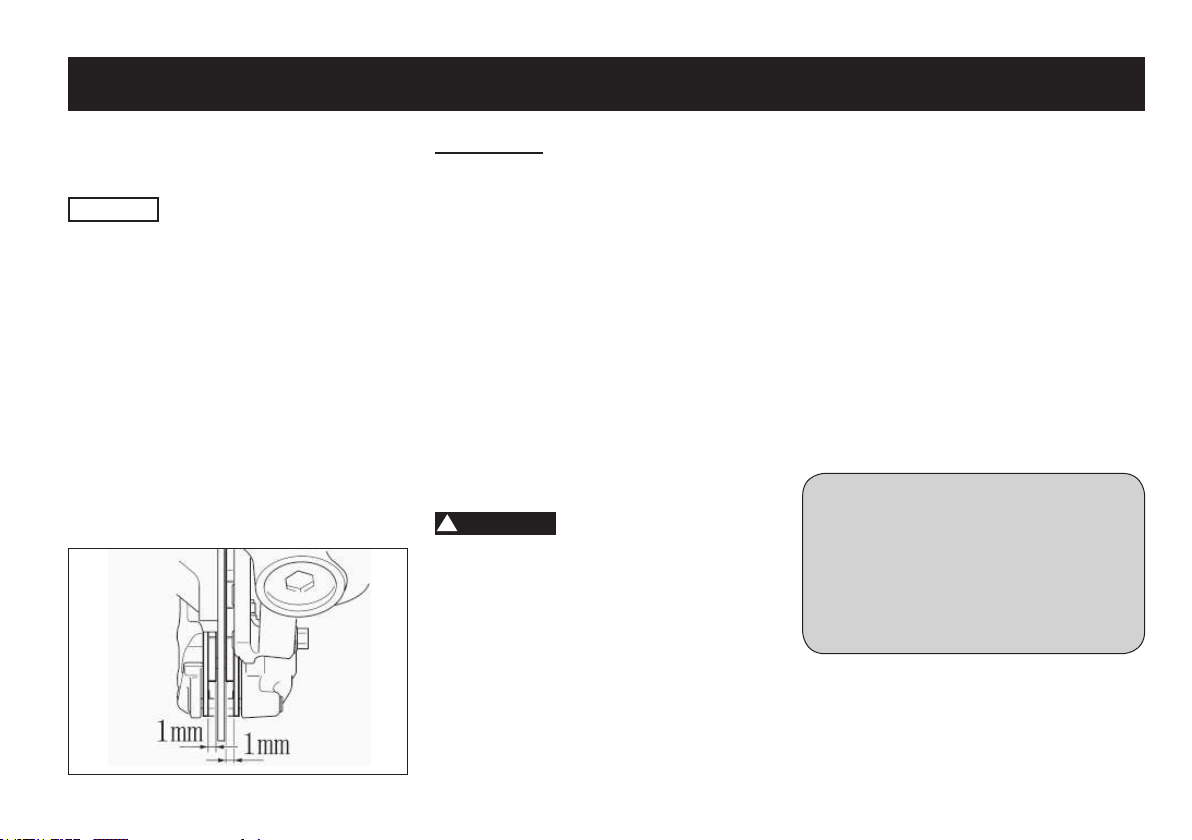
Each brake pad is provided with wear
indicators, which allows you to check
the brake pad wear without having to
disassemble the brake. To check the
brake pad wear, check the position of
the wear indicators while applying the
brake.
If a brake pad has worn to the point that
a wear indicator almost touches the
brake disc, have a dealer replace the
brake pads as a set.
BRAKE FLUID
!
WARNING
Insufcient brake uid may allow air
to enter the brake system, possibly
causing it to become ineffective.
Before riding, check that the break
uid is above the minimum level
mark and rell it if necessary.
• Low position brake uid level may
indicate worn brake pads and/or
brake system leakage.
• If the brake uid level is low, be
sure to check the brake pads for
wear and the brake system for
leakage.
• When checking the uid level,
make sure that the top of the mas-
ter cylinder is level by turning the
handlebars.
• Use only the recommended qua-
lity brake uid, otherwise the
rubber seals may deteriorate,
causing leakage and poor braking
performance.
DOT 4 brake uid
(Only use brake uid out of an unope-
ned container)
Recommended:
Liqui Moly DOT 4 brake uid
• Rell with the same type of bra-
ke uid. Mixing uids may result
in a harmful chemical reaction
and lead to poor braking perfor-
PERIODIC MAINTENANCE AND MINOR REPAIR

32
mance.
• Be careful that water does not
enter the master cylinder when
relling. Water will signicantly
lower the boiling point of the uid
and may result in vapor lock.
• Brake uid may deteriorate pain-
ted surfaces or plastic parts. Al-
ways clean up spilled uid imme-
diately.
• As the brake pads wear, it is nor-
mal for the brake uid level to
gradually go down. However, if
the brake uid level goes down
suddenly, have a dealer check.
Changing the brake uid
!
WARNING
Have a dealer change the brake uid
at the intervals specied in the NOTE
after the periodic maintenance and
lubrication chart.
CABLES
The operation of all control cables and
the condition of the cables should be
checked before each ride, and the
cables and cable ends should be lub-
ricated if necessary. If a cable is dama-
ged or does not move smoothly, have
a dealer check or replace it.
!
WARNING
Damage to the outer housing of
cables may result in internal rusting
and cause interference with cable
movement.
Replace damaged cables as soon
as possible to prevent unsafe con-
ditions.
THROTTLE GRIP AND CABLE
The operation of the throttle grip should
be checked before each ride. In addi-
tion, the cable should be lubricated at
the intervals specied in the periodic
maintenance chart.
LUBRICATING THE BRAKE LEVER
AND BRAKE PEDAL
The pivoting points of the brake lever
and brake pedal must be lubricated at
the intervals specied in the periodic
maintenance and lubrication chart.
SIDE STAND / MAIN STAND
CAUTION
The operation of the side stand / main
stand should be checked before each
ride, and the pivots and metal-to-metal
contact surfaces should be lubricated if
necessary.
!
WARNING
If the side stand / main stand does
not move up and down smoothly,
have a dealer check or repair it.
FRONT FORK
The condition and operation of the front
fork must be checked as follows at the
intervals specied in the periodic main-
tenance and lubrication chart.
PERIODIC MAINTENANCE AND MINOR REPAIR
33
!
WARNING
Securely support the motorcycle so
that there is no danger of it falling
over.
1. Place the vehicle at and upright
from.
2. Check the inner tubes for scratches,
damage and oil leakage.
3. Apply the front brake and push the
handlebars several times down hard
to verify the suspension of the fork.
!
WARNING
• If the fork is damaged, please
contact your dealer.
• If you treat the telescopic fork
with cleaning agents, make sure
that they get no contact with the
tires or the brakes. This can lead
to dangerous accidents.
STEERING
!
WARNING
Worn or loose steering bearings
may cause danger. Therefore, the
operation of the steering must be
checked as follows at the intervals
specied in the
periodic maintenance and lubrica-
tion chart.
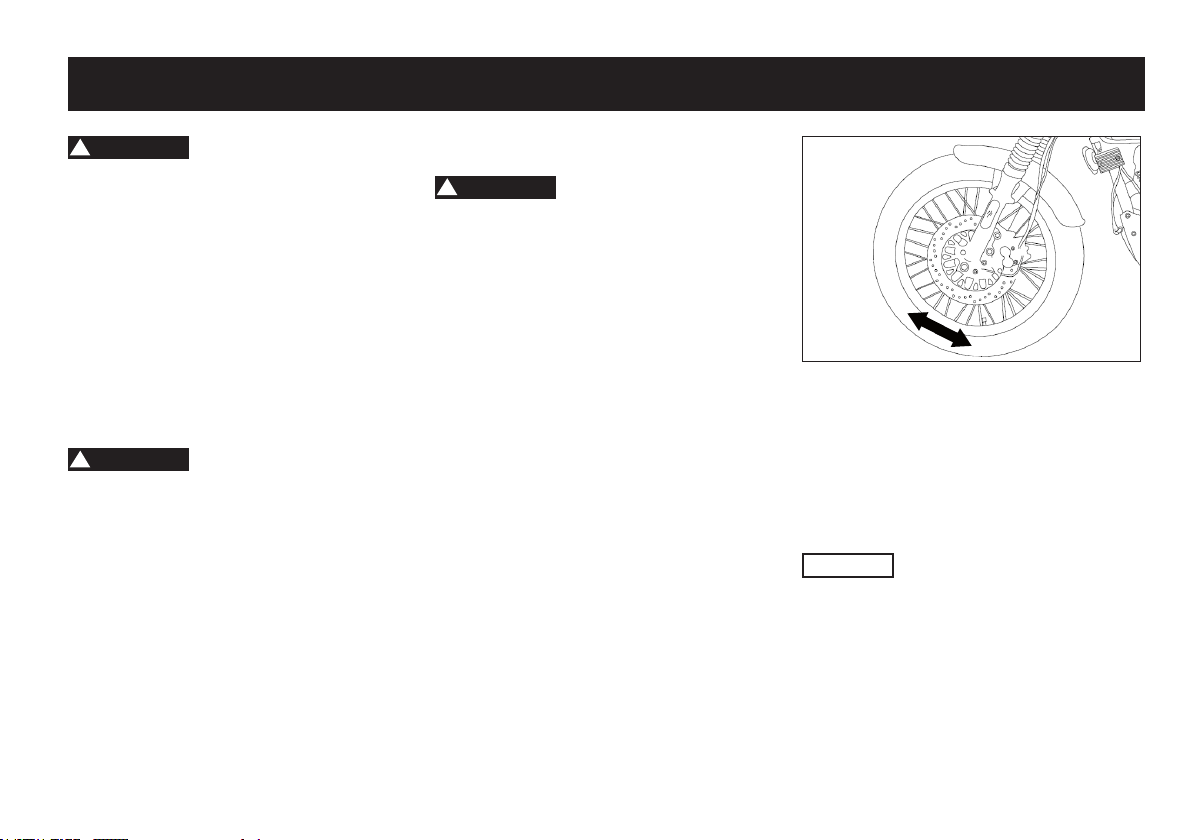
1. Place the vehicle on a suitable mo-
torcycle stand to raise the front
wheel off the ground.
2. Hold the lower ends of the front fork
legs and try to move them forward
and backward.
3. If any free play can be felt, have a
dealer check or repair the steering.
WHEEL BEARINGS
The front and rear wheel bearings must
be checked at the intervals specied in
the periodic maintenance and lubrica-
tion chart.
CAUTION
If there is play in the wheel hub or if the
wheel does not turn smoothly, have a
dealer check the wheel bearings.
PERIODIC MAINTENANCE AND MINOR REPAIR
34
DRIVE CHAIN
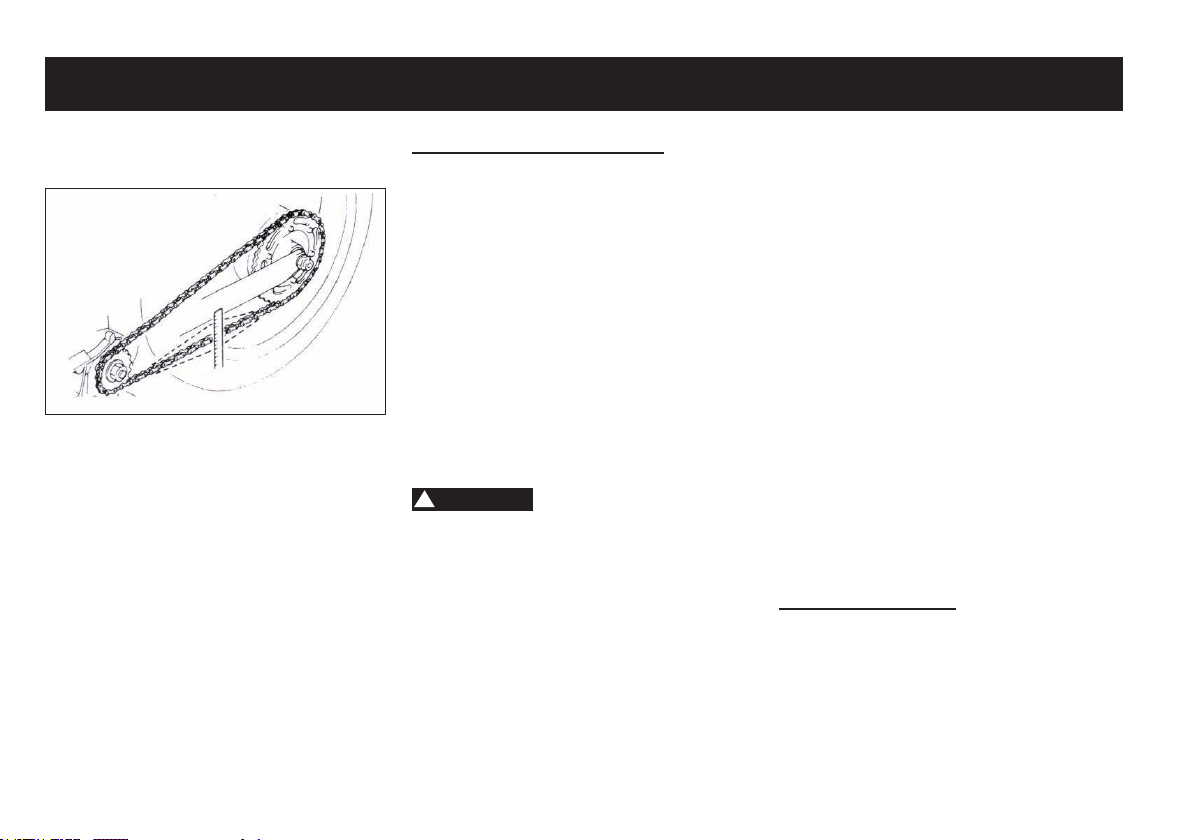
10-20 mm
If the chain tension is too great, parts
within the secondary power trasmissi-
on (chain, chain sprockets transmis-
sion and rear wheel bearings) will be
subjected to unnecessary stress re-
sulting in early wear and even chain
breakage. Too much slack in the chain,
on the other hand, can result chain
jumping off the chain wheels. If this
happens the chain could also block the
rear wheel or damage the engine. In
either case the operator is likely to lose
control of the vehicle.
Tensioning the chain drive
1. Loosen axle nut
2. Loosen counter nut
3. Turn right and left adjusting screws
equally far
4. Turn the adjusting screws, on the
right and left side of the tire, to set
the correct free play. The drive chain
free play should be between 10 mm
and 20 mm
5. Tighten the counter nut and the col-
lar nut.
BATTERY
!
WARNING
• Do not remove the battery vent
seal, this can be dangerous, the
battery permanently damaged.
• Battery acid is poisonous and
dangerous, it contains sulfu-
ric acid and leads to dangerous
burns.
• Avoid skin, eye and clothing
contac.Protect your eyes always
when working near the battery.
• Upon contact with the battery
aicd, make immediate FIRST AID.
• If skin or eye contact with battery
acid, rinse the affected areas with
plenty of water.
• When accidentally swallowed bat-
tery acid drink large amounts of
water.
• In both cases, as soon as possib-
le, see a doctor.
• Batteries develop explosive hy-
drogen gas. Keep open ames,
smoking materials away from the
battery and make sure there is
adequate ventilation when you
charge a battery indoors.
• KEEP THIS AND ALL BATTERIES
OUT OF THE REACH OF CHILD-
REN.
Charge the battery
Have a dealer charge the battery as
soon as possible if it seems to have
discharged. Keep in mind that the
battery tends to discharge more quickly
if the vehicle is equipped with optional
electrical accessories.
PERIODIC MAINTENANCE AND MINOR REPAIR
35
Store the battery
• If the vehicle will not be used for
more than one month, remove the
battery, fully charge it, and then
place it in a cool, dry place.
• If the battery will be stored for more
than two months, check it at least
once a month and fully charge it if
necessary.
• Fully charge the battery before ins-
tallation.
• After installation, make sure that the
battery leads are properly connected
to the battery terminals.
!
WARNING
Please contact your dealer if you are
not familiar with handling the batte-
ry.
CAUTION
Always keep the battery charged. Sto-
ring a discharged battery can cause
permanent battery damage.
FUSE
Replacing the fuse
1. Turn the ignition and all electrical cir-
cuits off.
2. Remove the blown fuse, and then
install a new fuse of the specied
amperage.
!
WARNING
Do not use a fuse of a higher am-
perage rating than recommended to
avoid causing extensive damage to
the electrical system and possibly a
re.
3. Turn on the ignition and check if all
devices operate.
4. If the fuse immediately blows again,
have a dealer check the electrical
system.
LIGHTING
Headlight
This model is equipped with halogen
bulb headlight. If a headlight bulb burns
out, have a dealer replace it and, if ne-
cessary, adjust the headlight beam.
Turn signal, Tail and Brake light
The turn signals, the tail and the brake
lights are equipped with an LED light.
If one of these lights does not come on,
contact a dealer to check the electrical
circuit.
License plate light
If the license plate light (5) do not glow,
remove the glas and change the bulb
or please contact your dealer to repla-
ce it.
PERIODIC MAINTENANCE AND MINOR REPAIR
36
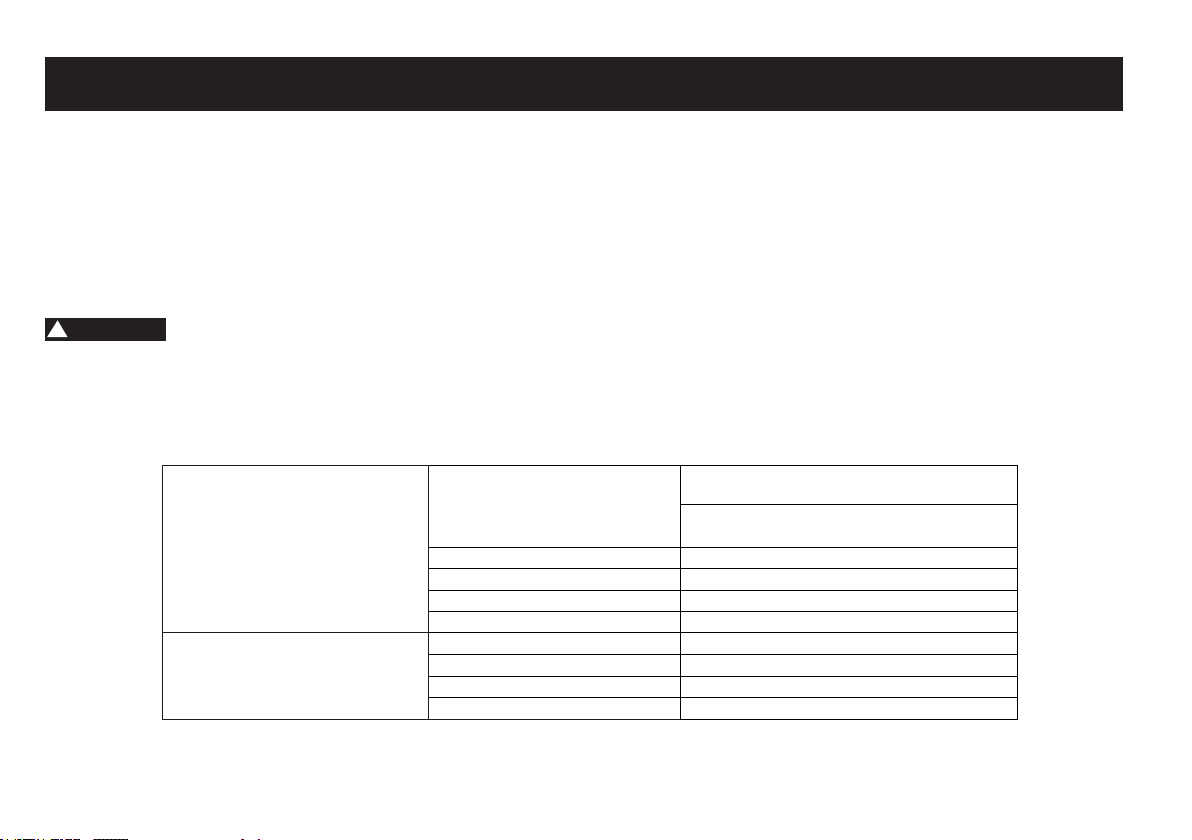
Although the vehicles receive a thorough inspection before shipment from the factory, trouble may occur during operation.
Any problem in the fuel, compression, or ignition systems, for example, can cause poor starting and loss of power.
The following troubleshooting chart represents a quick and easy procedure for checking these vital systems yourself.
However, should your vehicle require any repair, take it to a dealer, whose skilled technicians have the necessary tools,
experience, and knowhow to service the vehicle properly.
Use only genuine replacement parts. Imitation parts may look like parts, but they are often inferior have a shorter service
life and can lead to expensive repair bills.
!
WARNING
Keep away open ames and do not smoke while checking or working on the fuel system.
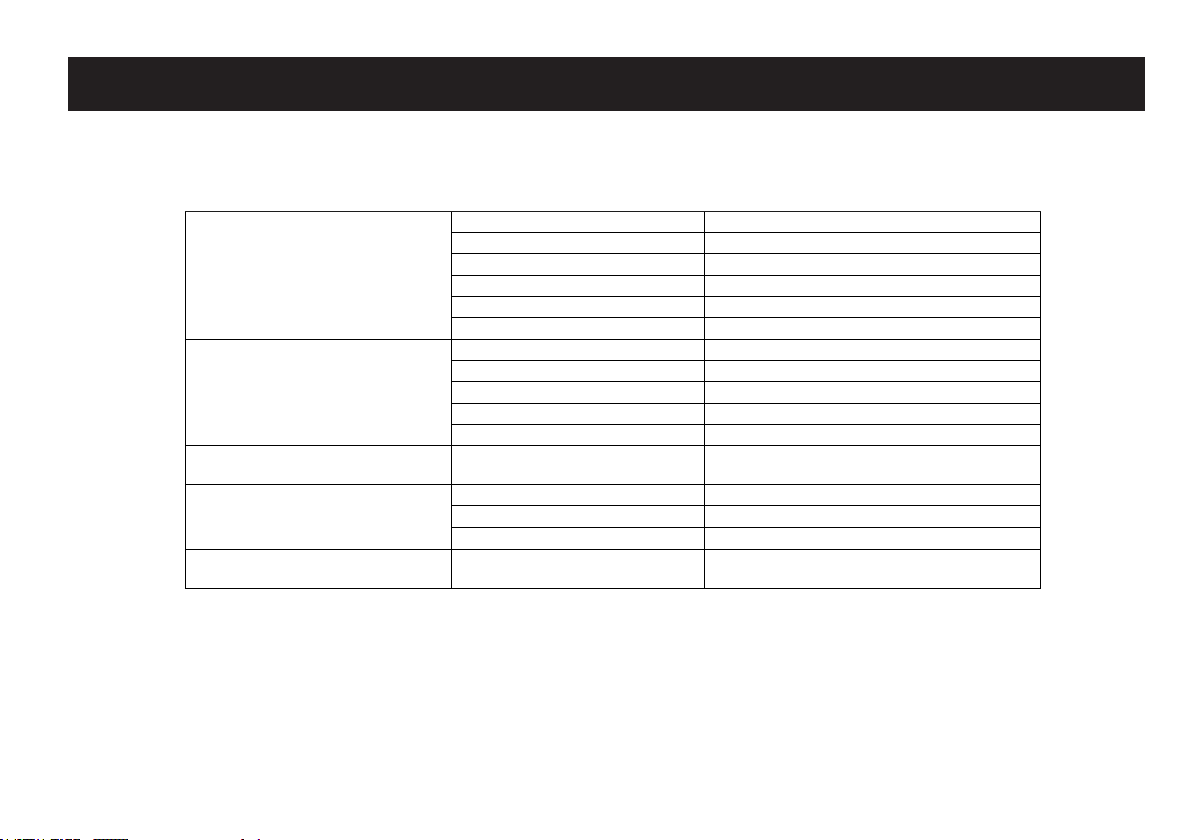
TROUBLESHOOTING CHART
TROUBLESHOOTING
Failure Cause To Do
Engine does not start when the electric
starter button is pushed
Battery discharged
Charge the battery
Check the charging of the battery
Check if the generator is working correctly
Fuse is blown Change the fuse
Starter relay defective Check the starter relay
Starter motor defective Check the starter motor
Wrong assembly of roll over sensor Check roll over sensor position
Engine turns but does not start or dies
off
A fuse is blown Check the fuses
Idle speed is not set correctly Adjust the idle speed
Spark plug is contaminated Clean the spark plug, check the electrode distance
Failure in ignition system Check the ignition system
37
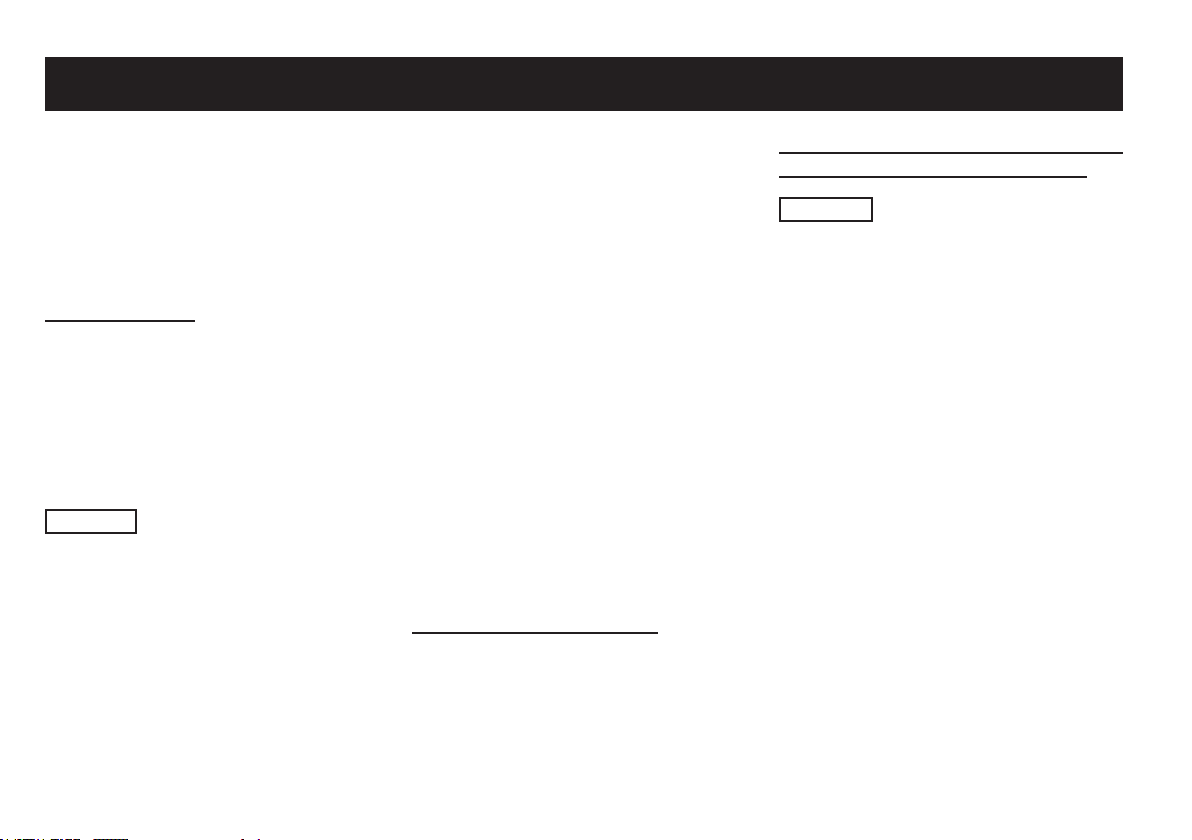
TROUBLESHOOTING
Failure Cause To Do
Engine turns but does not start or dies
off
Wire harness is worn Check the wiring harness
Contact problem in a plug Check the plugs of the wiring harness
No gasoline in the tank Rell gasoline
Problem with the fuel pump Check the pump
Problem with the fuel lter Check the lter
Fuel leakage Check the fuel circuit
Engine power is poor
Air lter contaminated Clean the lter
Fuel lter contaminated Clean the lter
Failure in fuel system Check the fuel system
Problem with the ignition system Check the ignition system
Valve clearance too little Adjust valve clearance
Engine overheats
Long operating time at higher engine
speed but low or no driving speed
Let the engine cool down, avoid such driving beha-
vior, especially in city trafc
To high oil consumption
Engine oil level too high Bleed the oil system
Cylinder/Piston is worn Replace the cylinder/piston
Engine vent hose bent Correct the layout of the hose
Engine warning light is on
Failure in the fuel injection/electric
system
Contact your dealer to identify the failure
TROUBLESHOOTING CHART
38
CLEAN AND STORAGE
CLEAN THE VEHICLE
Clean of the vehicle in a proper and
suitable way will make it more attracti-
ve, extend it’s lfe and optimize the per-
formance.
Before cleaning
1. Cover the mufer outlet with a plas-
tic bag to prevent water to come in-
side. Please do it only after the
2. Close every caps, covers, electrical
connectors that are well install and
water can be avoid to get into, while
you do the clean job.
CAUTION
• Do not use acid-based cleaners. If
such funds used for stubborn stains,
so use this only occasionally, dry it
immediately after and then apply a
corrosion protection spray.
• Always follow the manufacturer‘s
instructions on care and cleaning
agents.
• Use best only water and mild de-
tergent or special cleaner from the
dealer to the sensitive components
of the vehicle to prevent damage.
Dry the plastic parts then wipe with
a soft, dry cloth or sponge.
• Protect particularly plastic parts,
paint, headlight glass from harsh
chemicals such as fuel, rust remo-
ver, brake cleaner or similar. The
use of such agents may result in
malfunction, damage and affect the
security itself.
• Do not use a high pressure washer
or steam cleaner, causing water
in storage can penetrate electrical
components such as connectors or
switches, lighting, ventilation hoses,
brake shoes and brake linings or
damage, seals, paint and other sur-
faces.
Cleaning after normal use
Remove dirt with warm water, a mild
detergent, and a soft, clean sponge,
and then rinse thoroughly with clean
water. Use a toothbrush or bottlebrush
for hard-to-reach areas.
Cleaning after riding in the rain, near
the sea or on salt-sprayed roads
CAUTION
Since sea salt or salt sprayed on the
roads during winter are extremely cor-
rosive in combination with water, carry
out the following steps after each ride.
• Wait until the engine / exhaust have
cooled.
• Clean the vehicle with warm water
and a mild detergent.
• Do not use hot water, which increa-
ses the corrosive effect of the salt.
• Apply a corrosion protection spray
on all metal, including chrome- and
nickel-plated, surfaces to prevent
corrosion.

39
After cleaning
• Dry the vehicle.
• To prevent rust, we recommend ap-
propriate care to use according to
manufacturer‘s instructions.
• Wax all painted surfaces.
!
WARNING
• Make sure that there is no oil or
wax on the brakes or tires.
• If necessary, clean the brake discs
and brake linings with a regular
brake disc cleaner and wash the
tires with warm water and a mild
detergent.
• Before operating the vehicle, test
the braking performance and ti-
res.
STORAGE
Short-term (for a few days)
• Always store your vehicle in a cool,
dry place and, if necessary, protect
it against dust with a vehicle cover.
!
WARNING
Please store the vehicle in a well air
ow room with dry air if possible. A
place with wet humidity will cause
rust.
Long-term (for weeks)
• Clean the vehicle.
• Drain the fuel from the carburetor.
• Enter the drained fuel back into the
fuel tank.
• Fill the fuel tank to completely or add
if necessary a fuel stabilizer to pro-
tect the fuel tank from rusting and
the fuel from degradation.
Follow the steps below to cylinders,
piston rings, etc. to prevent rusting.
• Remove spark plug cap and the
spark plug.
• Give a teaspoon of engine oil into
the spark plug hole.
• Join the Kickstarter to slow down and
let the engine several times slowly
rotate (thus the cylinder is oiled).
• Put the spark plug back in and put
on the spark plug cap.
!
WARNING
Please make sure that during this
activity the spark plug to metallic
no contact Parts has on the vehicle.
Wait all ropes, cables and the pivot
points of the levers, the footrests as
of kickstand as described.
• Check and correct tire pressure and
lift the vehicle off the ground, so that
neither of the two wheels is on the
ground. If this is not possible, turn the
wheels every month a little further, so
they do not constantly the same place
standing (Stand damage).
CLEAN AND STORAGE
40
• Slide a plastic bag over the exhaust to
prevent moisture from entering.
• Remove the battery and load it as de-
scribed on. Store cool the battery and
dry and upload to this every 2 months.
Store the battery is not excessively
cold or hot
(Below 0 ° C or above 30 ° C).
CAUTION
Always perform necessary repairs be-
fore storage
CLEAN AND STORAGE
Recommended maintenance
products:
Liqui Moly:
Motorbike Cleaner
Motorbike Gloss Spray Wax
Motorbike Chain Lube
Motorbike Multi-Spray
Motorbike Gasoline Stabilizer
41
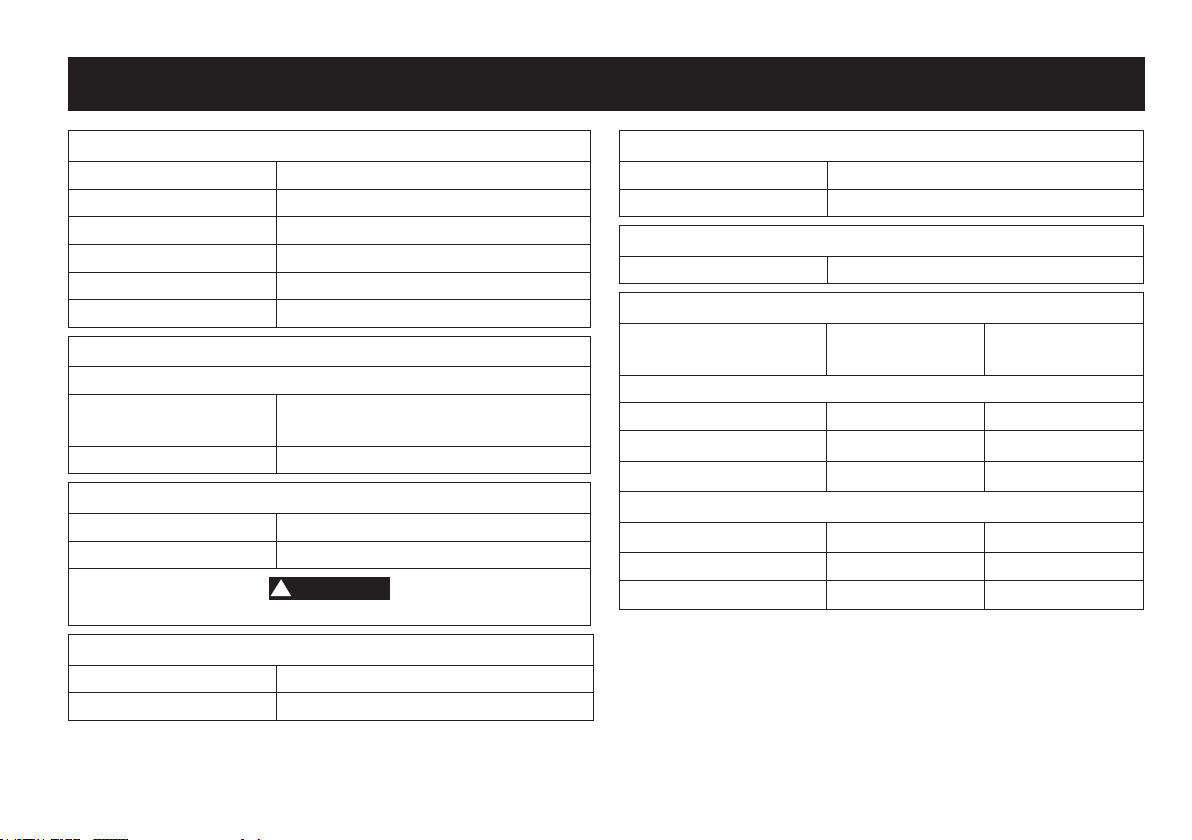
SPECIFICATIONS
ENGINE
Type 4-stroke, OHC air cooled
Cylinder arrangement Forward-inclined single cylinder
Displacement 124.8 cm3
Compression ratio 9.3:1
Starting system Electric starter
Lubrication system Wet sump lubrication
OIL
Engine oil
Type
Recommendation
4-stroke engine oil
Liqui Moly Motorbike 4T 10W-40
Quantity 1.0 l
FUEL
Type Unleaded gasoline only
Quantity 14L +/- 0,5 L
!
WARNING
!! BIOETHANOL FUEL - E10 IS NOT PERMITTED !!
SPARK PLUG
Type D8RTC
Spark plug gap 0,6 - 0,7 mm
CLUTCH
Clutch type Multiple plate clutch
Transmission type 5 - speed constant mesh transmission
CHASSIS
Type Steel tube
TIRES
BX 125, BX 125 X,
BX 125 H
BX 125 R
Front tire
Tyre 100/90-18 4.00-18
Wheel
2.50×18 2.50×17
Tire air pressure
2,5 bar 2,5 bar
Rear tire
Tyre
120/80-17 4.50-17
Wheel
3.00×17 3.00×17
Tire air pressure
2,5 bar 2,5 bar
42
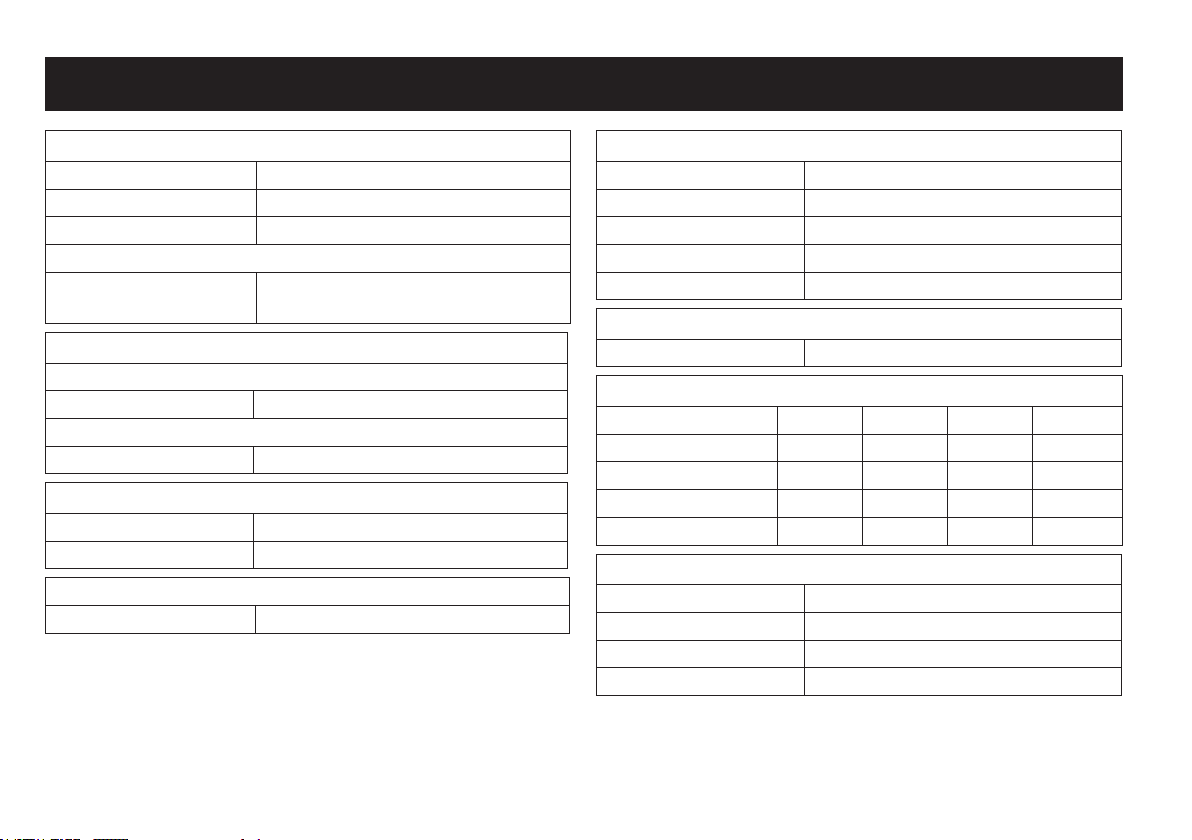
BRAKE SYSTEM
Type Single Hydraulic disc brake
Operation front Right hand / Right foot (CBS)
Operation rear Right foot
Brake uid
Type
Recommended
DOT 4
Liqui Moly DOT 4 brake uid
SUSPENSION
Front suspension
Type Telescopic fork
Rear suspension
Type Unit swing
ELECTRIC SYSTEM
Ignition system ECU
Charging system Magneto
BATTERY
Voltage / Capacity 12 V, 10 Ah
LAMPS
Headlight 12 V, 35 W / 35 W
Tail light / Brake light LED
Front turn signal light LED
Rear turn signal light LED
License plate light LED
FUSE
Main fuse 15 A
DIMENSIONS
BX 125 BX 125 R BX 125 X BX 125 H
Length 2020 mm 2020 mm 2020 mm 2020 mm
Width 850 mm 760 mm 870 mm 760 mm
Height 1105 mm 1060 mm 1105 mm 1135 mm
Wheelbase 1320 mm 1320 mm 1320 mm 1320 mm
MASS
Mass in running order 134 kg
axleload front 58 kg
axleload rear 76 kg
Max. permissible load 284 kg
SPECIFICATIONS

43
WARRANTY INFORMATION
Please carefully read the instruction manual of your vehicle before operating it in order to make yourself familiar with its handling. We
explicitly point out that the instruction, maintenance, and care instructions given in the operating manual have to be complied with in order
to sustain your claim towards warranty. Only the strict compliance with customer specications stated in the instruction manual ensures
the prolonging of the natural life of your vehicle. Starting with the date of the invoice a limited warranty of 24 months is granted regarding
the accuracy of the vehicle in terms of material and manufacturing according to latest standards. The legal warranty regulations will not
be restricted by this limited guarantee. Maintenance work has to be exclusively done by authorized workshops entitled by us. Warranty in
general is bound to the region of invoicing and can therefore only be carried out within the country the vehicle was bought. Damages that
can be traced back to inappropriate usage, manipulation, or neglecting of the maintenance/care/operating instructions will not be covered
by warranty. Warranty can only be granted if occurring damages are immediately being reported to the seller or any other authorized
workshop by the buyer. The warranty claim entitles the buyer to remedy deciencies or to the reparation respectively the exchange of
a damaged part in an authorized workshop after our approval. Compensation for remote or instantaneous damages cannot be granted.
Vehicles in desolate condition will not be covered by warranty. Repair works carried out on warranty do not enlarge the guarantee period.
Only this document entitles you to call on warranty services. Therefore please make sure that you are delivered this fully lled in docu-
ment by the seller and that he has registered your vehicle correctly in our system. Please also mind the following advices.
Body and panelling of the vehicle have to be kept free of dirt constantly. Do not use high pressure water blasters, strong jets of water,
sharp and corrosive or other aggressive detergents which could harm surfaces and varnish permanently and foster corrosion. It is vital
to use protecting cleansers. Please consult our dealers for the right and appropriate products. Aluminium parts or other rened parts
(chrome parts, anodized parts or other processed surfaces)have to be treated with appropriate maintenance products in order to prevent
oxidation. Frame and metal parts are continuously to be treated with anticorrosive. A vehicle constantly parked outside has to be covered
to avoid weathering and crack formations on seat and plastic parts. Vehicles used off-road and for racing purposes are excluded from
warranty.
Material which is to be used in the context of service and maintenance works are excluded from warranty as well as the following parts:
incandescent bulbs, brake pads, clutch lining, lter elements, spark plugs, drive sprocket, wheel and axle., as well as the tires.

44
SERVICE AND MAINTENANCE
IMPORTANT INFORMATION
The date for the implementation of maintenance depends on whichever limit is reached rst. That means either the driven
kilometers or the duration from initial startup.
The warranty can be granted only when the vehicle is serviced in accordance with this plan and was not exposed to
extraordinary stress.
!
WARNING
Only appropriate works which are intended for your vehicle perform.
CAUTION
Spark plug, fuel lter and air lter must be replaced every 7000 km.
Hydraulic lines should be replaced every 4 years.
The brake uid should be changed every 2 years.
From 13000km or the 4. year, the inspection should take place at least once a year or every 3000km.
The vehicle must continuously be checked for rust. The vehicle owner is responsible for rust prevention.
On the following pages you will nd the maintenance schedule and the service record.

45
SERVICE AND MAINTENANCE
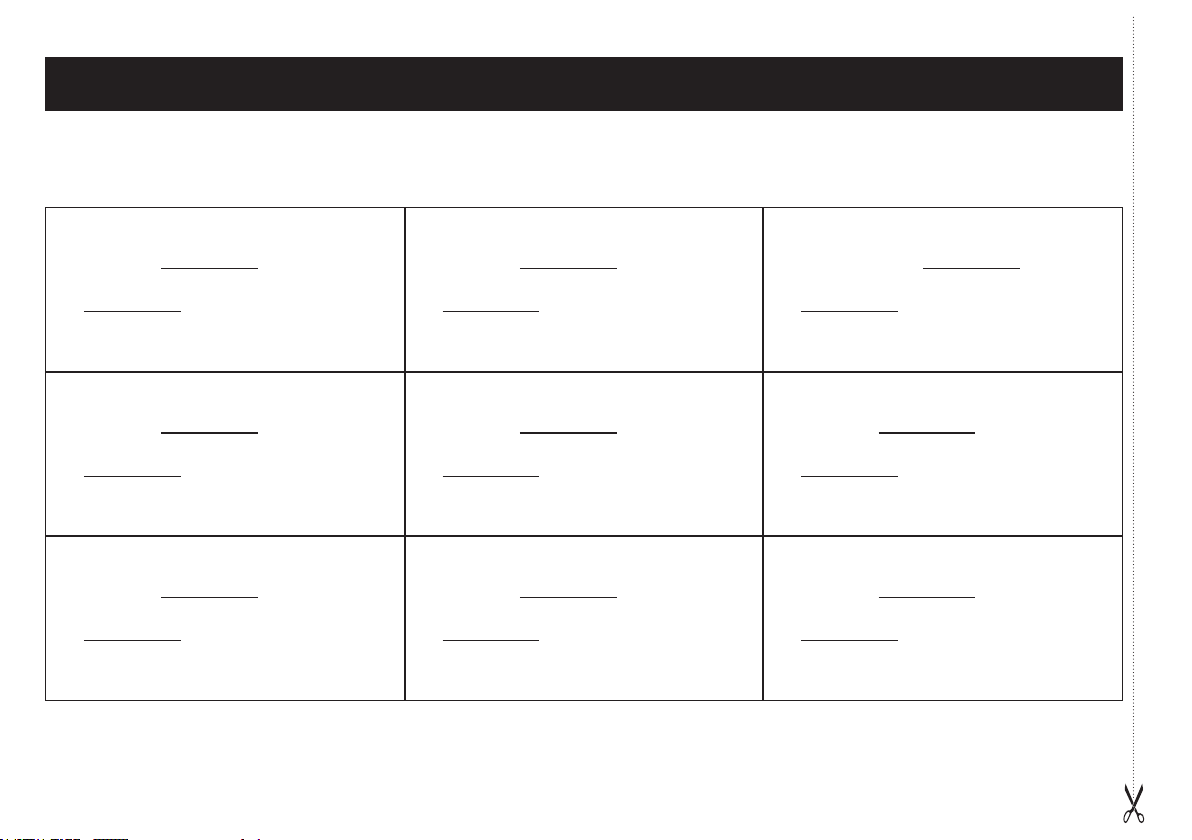
The inspection intervals are required, these will void the warranty.
1000km
4000km or
1. year
7000km or
2. year
10000km or
3. year
13000km or
4. year
COMPONENT PERFORM
Airlter Clean/ Exchange
Exchange
Wheels, Rims Control
Tire Control of tread depth / Pressure
Wheel bearing Control/ Exchange
Steering bearing Control/ Clean / Lubricate
Lubricate
Screws Coverparts Control/ Retighten
Brake system Control/ Clean / Exchange
Side stand Control/ Clean / Lubricate
Telescopic fork Control
Shock absorber rear Control
Oil strainer / Spin lter Clean
Engine oil / Oil lter Exchange / Control
Exchange
Exchange
Exchange
Transmission oil (if available) Exchange
Valves Control / Adjust
Drive chain / Pinion Control / Clean / Exchange
Clutch Control
Cables / Bowden Control / Clean / Lubricate
Throttle Control / Adjust / Lubricate
Lights / switch Control / Adjust
Fuel line / Filter Control / Exchange
Exchange
Idle speed Control / Adjust
Exhaust system Control / Retighten
MAINTENANCE SCHEDULE
46
SERVICE AND MAINTENANCE
SERVICE RECORD
In the delivery of the vehicle the customer data and vehicle data must be supplemented.
Maintenance interval: Delivery inspection
Odometer reading:
Date:
Stamp / Signature
Maintenance interval: 1000 km
Odometer reading:
Date:
Stamp / Signature
Maintenance interval: 4000 km or 1. year
Current odometer reading:
Date:
Stamp / Signature
Maintenance interval: 7000 km or 2. year
Odometer reading:
Date:
Stamp / Signature
Maintenance interval: 10000 km or 3. year
Odometer reading:
Date:
Stamp / Signature
Maintenance interval: 13000 km or 4. year
Odometer reading:
Date:
Stamp / Signature
Maintenance interval: 16000 km
Odometer reading:
Date:
Stamp / Signature
Maintenance interval: 19000 km
Odometer reading:
Date:
Stamp / Signature
Maintenance interval: 22000 km
Odometer reading:
Date:
Stamp / Signature
VEHICLE IDENTIFICATION NUMBER : ................................................................................................................................................................................................................
MODEL: ...........................................................................................................................................................................................................................................................................................................................................................................
NAME OF THE CUSTOMER: ..................................................................................................................................................................................................................................................................
SIGNATION OF THE CUSTOMER: ......................................................................................................................................................................................................................................

47
SPACE FOR NOTES
Copyright © 2018
All rights reserved.
This user manual is copyrighted.
Copying in mechanical, electronic or any other form without the
written permission of the manufacturer is prohibited.
Distributed by:
KSR Group GmbH
Im Wirtschaftspark 15
3494 Gedersdorf
Austria
The copyright is owned by the Company / Manufacturer:
KSR Group GmbH
Im Wirtschaftspark 15
3494 Gedersdorf
Austria
Product and specications are subject to change without notice.
Recommended: