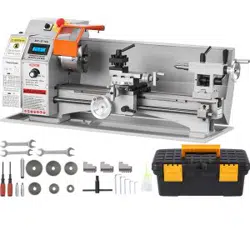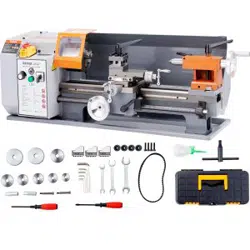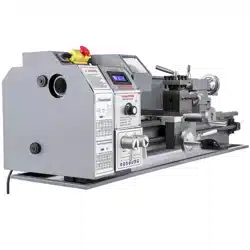

Technical Support and E-Warranty Certificate www.vevor.com/support
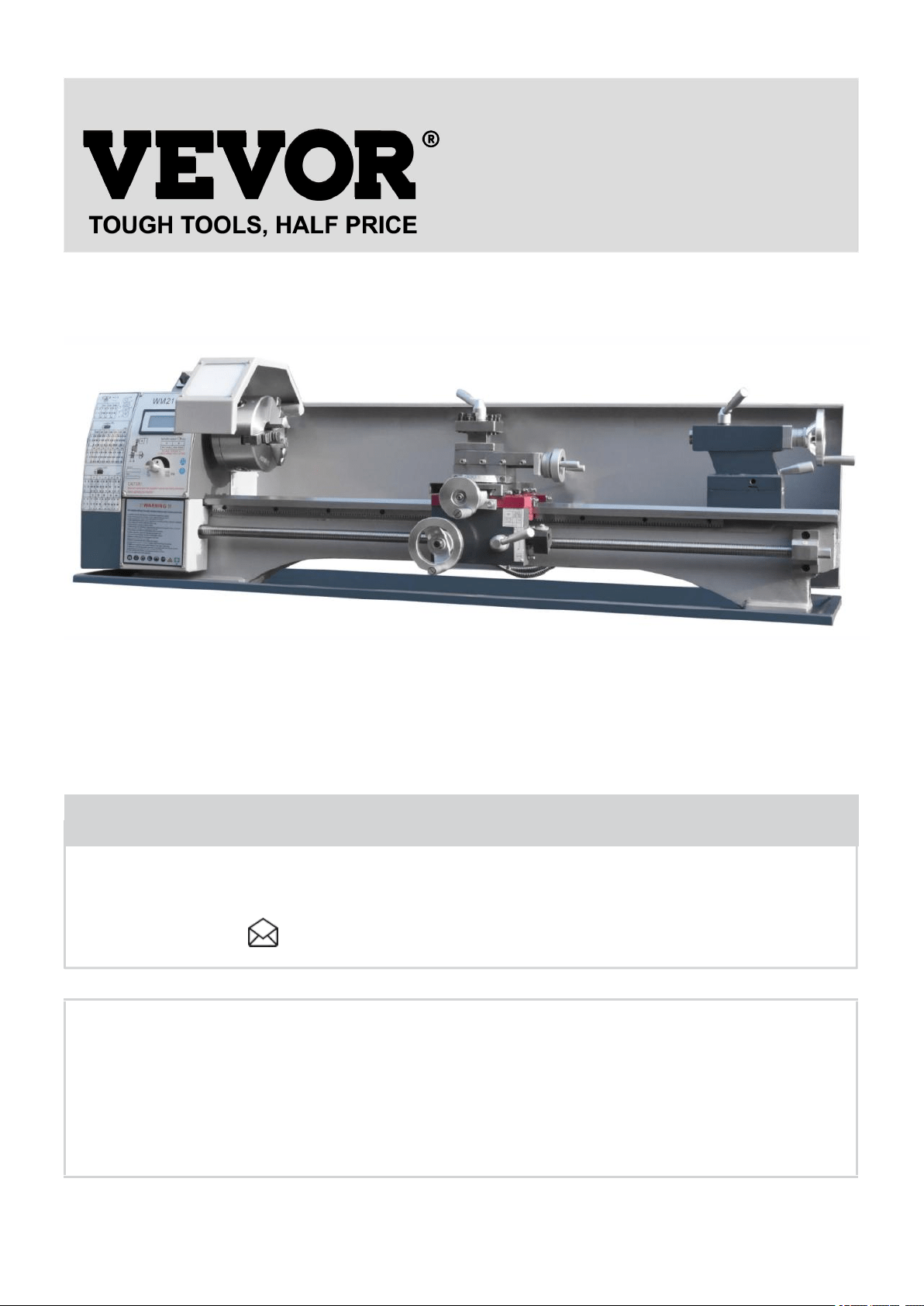
LATHE INSTRUCTION MANUAL
MODEL:WM210V-L
We continue to be committed to provide you tools with competitive price.
"Save Half", "Half Price" or any other similar expressions used by us only represents an
estimate of savings you might benefit from buying certain tools with us compared to the major
top brands and doses not necessarily mean to cover all categories of tools offered by us. You
are kindly reminded to verify carefully when you are placing an order with us if you are
actually saving half in comparison with the top major brands.

- 1 -
MODEL:WM210V-L
Have product questions? Need technical support? Please feel free to
contact us:
CustomerService@vevor.com
NEED HELP? CONTACT US!
This is the original instruction, please read all manual instructions
carefully before operating. VEVOR reserves a clear interpretation of our
user manual. The appearance of the product shall be subject to the
product you received. Please forgive us that we won't inform you again if
there are any technology or software updates on our product.
LATHE

- 2 -
MATTERS NEEDING ATTENTION
The information contained in this handbook is intended as a guide to the
operation of these machines and does not form part of any contract.The
data it contains has been obtained from the machine manufacturer and
from other sources. We strive to ensure the accuracy of this information
and try to verify each item and each data, but we cannot guarantee the full
accuracy of the information, which means that the equipment supply may
differ in detail from the description of the instructions. Furthermore,
development of the machine may mean that the equipment supplied may
differ in detail from the descriptions herein. The responsibility therefore lies
with the user to satisfy himself that the equipment or process described is
suitable for the purpose intended.
QUALITY ASSURANCE
We will make every effort to ensure the quality of our products, and we
promise to consumers that we will guarantee our products for one year,
except for machine damage caused by improper operation of customers,
and accidents resulting therefrom, or abnormal wear and damage caused
by lack of maintenance.
In order to fulfill the warranty commitment, the product or part with quality
problems, please return to us for verification, postage prepaid. Goods sent
back should be accompanied by a note of the date of purchase and a
written explanation of the quality of the product. After our inspection and
confirmation, we will repair or replace their products, or refund the payment;
If we fail to provide repair or replacement in a timely manner, we shall bear
the costs arising from the repair or replacement of the products; If the
damage is not due to the quality of the product, but due to the user's
improper operation or other reasons, the cost shall be borne by the
customer .
- 3 -
Our company reserves the right to make changes to this specification and
product specifications. We will make continuous efforts to improve the
quality of our products.
All rights reserved. Reproduction or reproduction is not allowed without
permission.
SAFETY WARNING
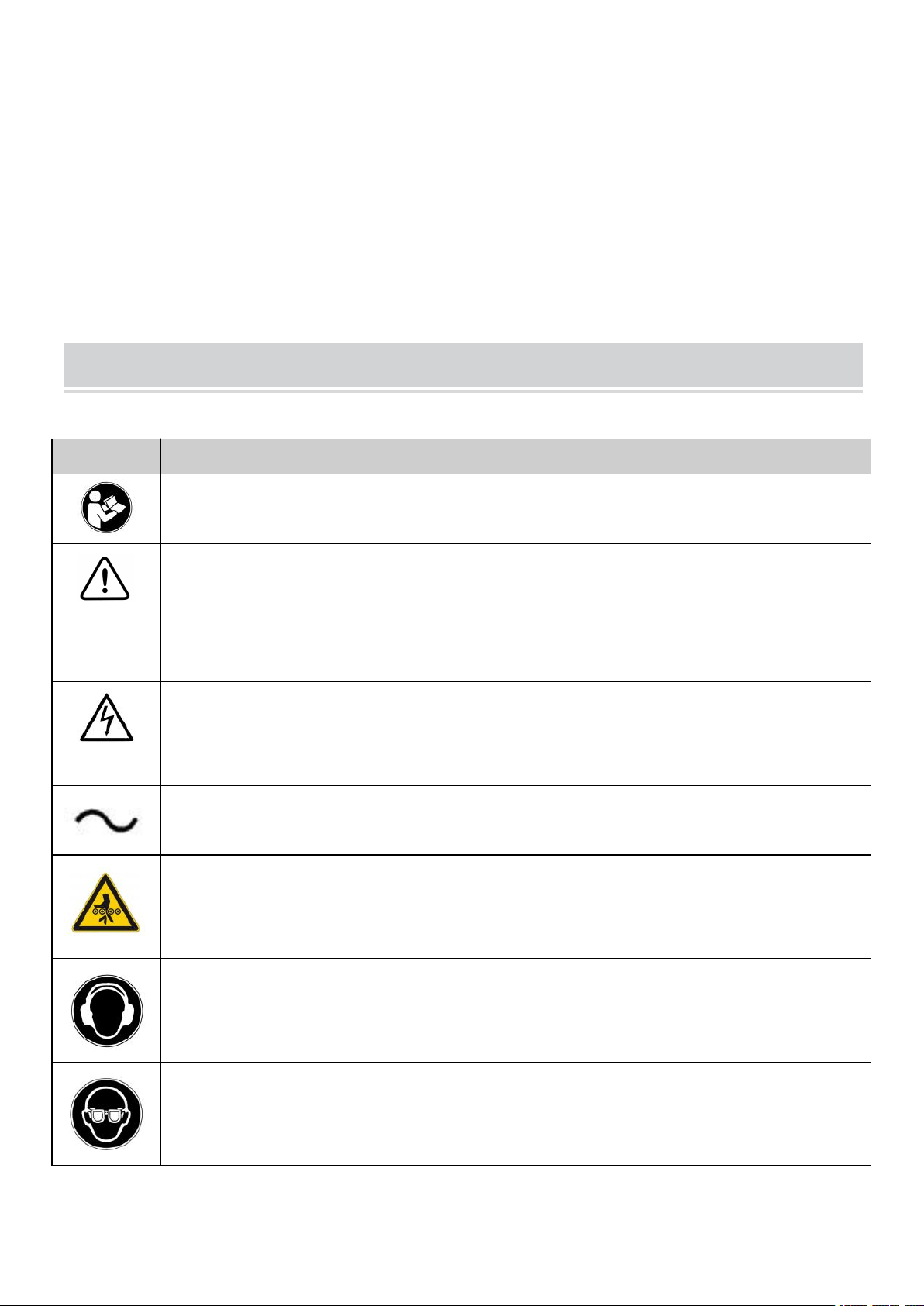
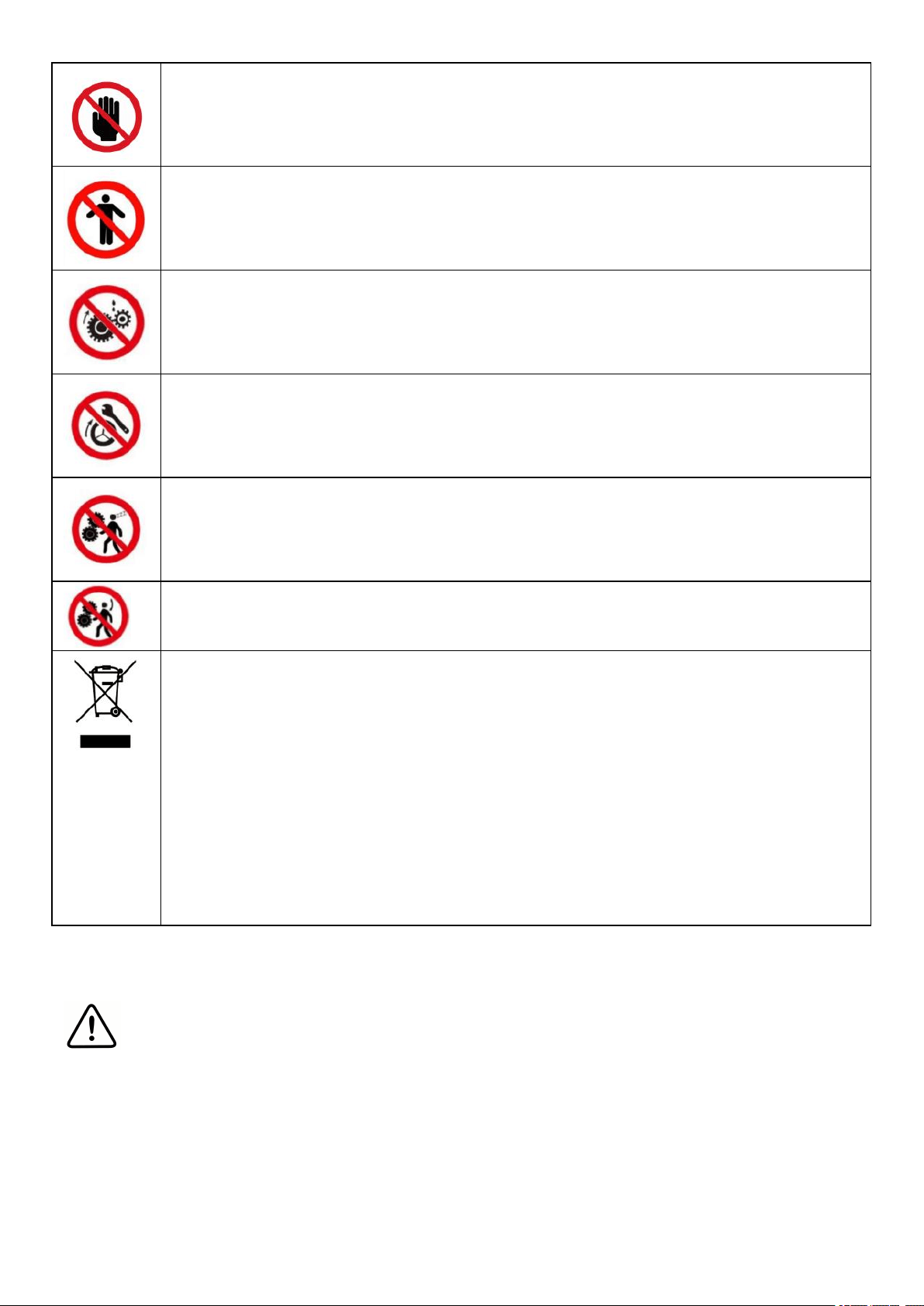
Symbol Symbol Description
Warning - To reduce the risk of injury, user must read instructions
manual carefully.
This symbol, placed before a safety comment, indicates a kind of
precaution, warning, or danger. Ignoring this warning may lead to an
accident. To reduce the risk of injury, fire, or electrocution, please
always follow the recommendation shown below.
Danger!
Risk of personal injury or environmental damage! Risk of electric
shock! Risk of personal injury by electric shock!
Alternating current
Beware of clamping
Warning- Be sure to wear ear protectors when using this product.
Warning- Be sure to wear eye protectors when using this product.
- 4 -
Do not put your hands into safety guard when machine is working
No entry automatic machinery in operation Authorized personnel only
Do not fill oil during operation
Do not turn during repair
No fatigue operation
The operation is no phone calls
Disposal information:
This product is subject to the provision of European Directive
2012/19/EC. The symbol showing a wheelie bin crossed through
indicates that the product requires separate refuse collection in the
European Union. This applies to the product and all accessories
marked with this symbol. Products marked as such may not be
discarded with normal domestic waste, but must be taken to a
collection point for recycling electrical and electronic devices
WARNING: Read all safety warnings, instructions, illustrations and
specifications provided with this machine. Failure to follow all instructions
listed below may result in electric shock, fire and/or serious injury.
Save all warnings and instructions for future reference.
1.The machine tool should be used by experienced personnel. If you are
not familiar with the operation process of the lathe, do not use the

- 5 -
machine tool at will. Use the instructions before operating.
2.Before starting the machine tool, the safety cover should be in the correct
position.
3.Before starting the machine tool, please check whether the tool rest
wrench and chuck key are removed.
4.Prevent the machine from starting accidentally. Turn off the motor power
before clamping the workpiece or tool.
5.Don't force cut. Cutting according to the set cutting speed, cutting depth
and feed speed.
6.Use the right tools. Use the correct tool or workpiece for machining.
7.Keep the tool sharp and clean to ensure normal and safe operation.
Lubricate and replace accessories regularly.
8.Before adjusting or repairing the machine, be sure to disconnect the
power supply.
9. Please check the safety performance of the machine before starting it.
Check the performance of all moving parts. All parts must be installed
correctly. Damaged parts must be repaired promptly.
10. When the machine is running, the operator shall not leave.
11. Keep the working place clean, dirty working environment is easy to lead
to accidents.
12. Do not use the machine in dangerous environment.
Do not work in damp places. Ensure that electrical components are
protected from moisture. Keep good lighting.
13. Children are prohibited from entering the work site, and non-operating
personnel should keep a safe distance from the work area.
14. To keep children out of the work area. The door should be locked when
leaving the workshop.
15. Dress appropriately. Don't wear loose clothing, gloves, ties, rings,
bracelets, jewelry, etc. To be on the safe side, For the sake of safety,
wearing non-slip shoes. If you have long hair, please wear a work hat.
16. Wear protective glasses when operating.
17. Pay attention to where you stand and keep your balance at all times.
18. Do not place your hands near the moving parts of the machine.

- 6 -
19. Do not perform any setting operations while the machine is running.
20. Read and understand all warning signs posted on the machine.
21. This manual is intended only to familiarize customers with the operation
of the machine and is not a training manual.
22. Please obey these warnings or serious injury may result.
23. The machine will produce some harmful chemicals in the work of dust,
sawing, grinding and drilling produced by grinding. To reduce the harm
of these chemicals, please work in a well-ventilated place and wear
safety devices. Such as particulate filter masks.

- 7 -
TECHNICAL PARAMETER
Type number WM210V-L
Capacities
Swing over Bed
210mm
Swing over Cross Side
110mm
Distance Between Centers
735mm
Width of Bed
100mm
Headstock
Hole Through Spindle 38mm
Taper in Spindle Nose MT3
Number of Spindle Speeds Variable
Range of Spindle Speeds
50-2500RPM
Feeding and Threading
Number of Metric Threads
14
Range of Metric Threads
0.3~3mm
Number of 1mperiaI Threads
10
Range of 1mperiaI Threads
10~44T.P.I.
Range of Longitudinal Feed
0.1~0.20mm
Compound and Carriage
Tool Post Type
4
Maximum Compound Slide Travel
55mm
Maximum Cross Slide Travel
75mm
Maximum Carriage Travel
736mm
tail stock
Tail Stock Spindle Travel
60mm
Taper in Tail stock Spindle
MT2
Miscellaneous
Main Motor
110V~60Hz/220-240V~50Hz,1Ph
/750W
,
Length, Width and Height
1200×340×360(mm)
Product Weight N.W:79Kg; G.W:90Kg
Package Size 1230*460*450 mm
The general information given in this specification is not binding.

- 8 -
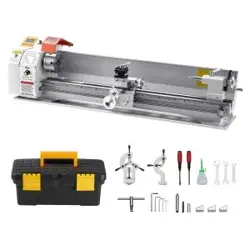
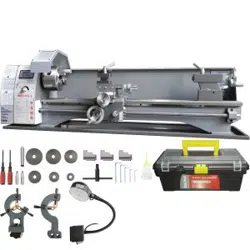
Standard accessories
1
1
1
1
1. Oil Pan
2. Rear Chip Plate
3. Three Jaw Chuck
4. Specification
5. Tool Box
1
Accessories in the tool box (Fig. 1 )
1
1
3
1
1
1
1
5
3
8
Special accessories(Accessories that require additional payment
Dead Center MT5
Dead Center MT2
Tool Post Wrench
Oil Gun
Cross Screwdriver
Fiat Screwdriver
Three Jaw Chuck
Hex Socket Wrenches
Double End Head Wrenches
Pulley Set (30T,33T,35T,50T,52T,40T,60T,66T )
)
Four jaw chuck and back plate
(connecting plate)
Heel rest
Center frame
Back disk
Disjointed disk
Tool rest protection cover
Lead screw protective cover
Turning tool
Drill chuck and connecting rod
Fig. 1
- 9 -
UNPACKING AND CLEANING
1. Finish removing the wooden crate from around the lathe
2. Check all the accessories of the machine tool according to the packing
list.
3. Unbolt the lathe from the shipping crate bottom.
4. Choose a location for the lathe that is dray, has good lighting and has
enough room to be able to service the lathe on all four sides.
5. With adequate lifting equipment, slowly raise the lathe off the shipping
crate bottom. Do not lift by spindle. Make sure lathe is balanced before
moving to sturdy bench or stand.
6. To avoid twisting the bed, the lathe's location must be absolutely flat and
level. Bolt the lathe to the stand (if used). 1f using a bench, through bolt
for best performance.
7. Clean all rust protected surfaces using a mild commercial solvent,
kerosene or diesel fuel. Do not use paint thinner, gasoline or lacquer
thinner. These will damage painted surfaces. Cover all cleaned surfaces
with a light film of 20W machine oil.
8. Remove the end gear cover. Clean all components of the end gear
assembly and coat all gears with heavy, non-slinging grease.
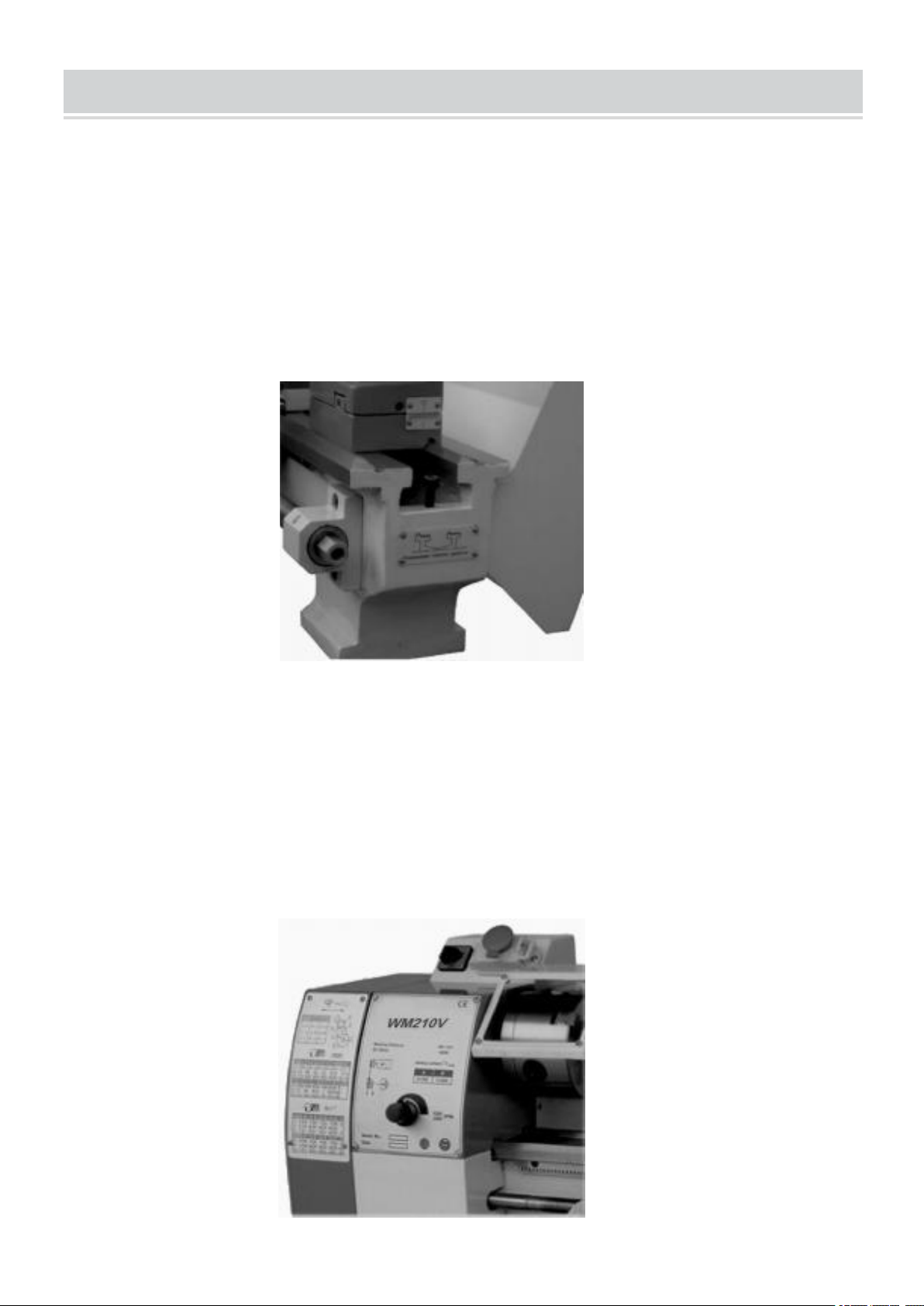
FOUNDATION DRAWING
Fig. 2
- 10 -
General Description
Lathe Bed (Fig. 3)
The lathe bed is made of high-grade iron. By combining high cheeks with
strong cross ribs, a bed of low vibration and rigidity is produced. It
integrates the Headstock and drives the unit, for attaching the carriage and
lead screw. The two precision-ground V - sideways, reinforced by heat
hardening and grinding, are the accurate guide for the carriage and tail
stock. The main motor is mounted to the rear of the left side of the bed.
Fig. 3
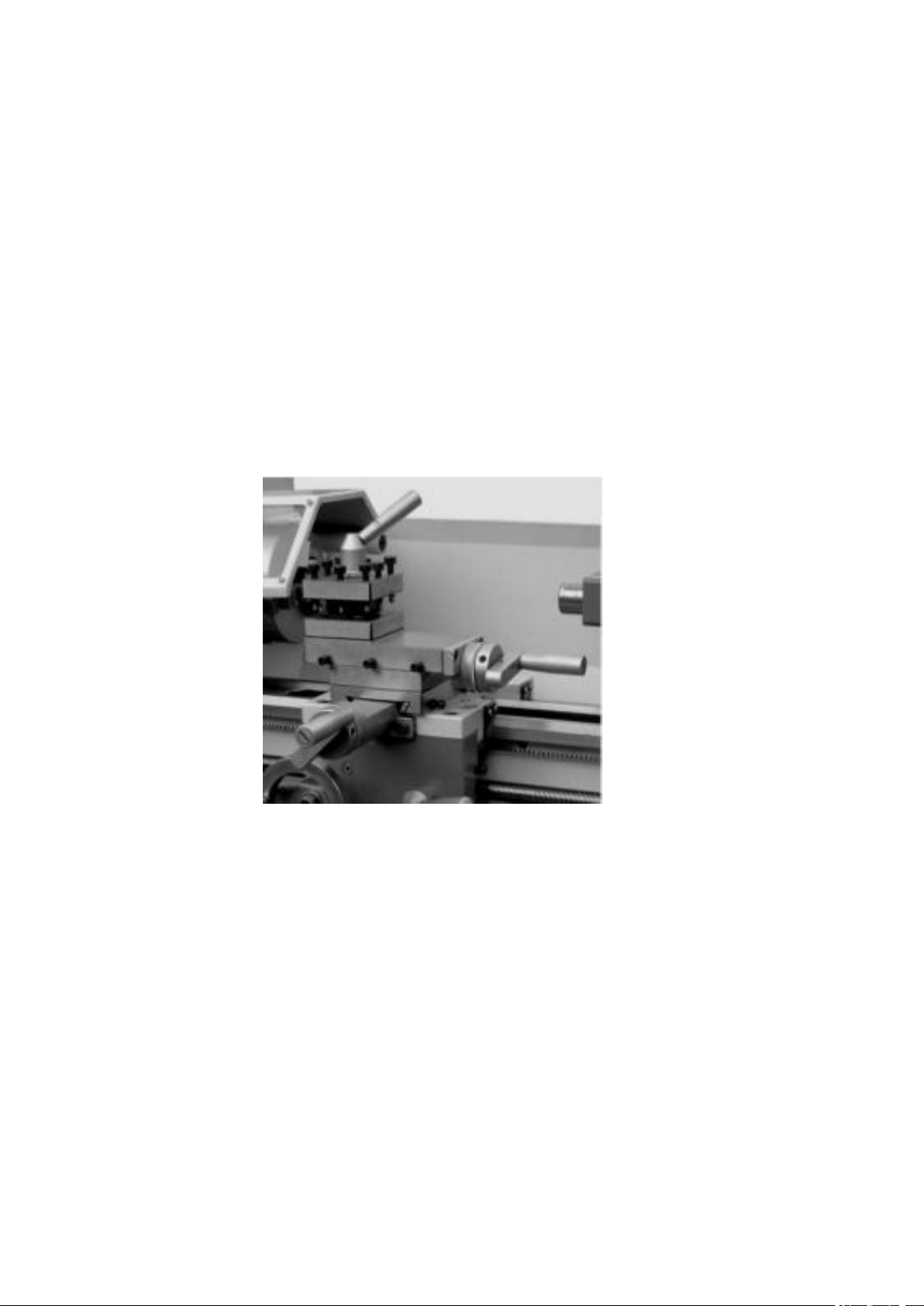
Headstock (Fig. 4)
The Headstock is cast from high-grade,low vibration cast iron.It is bolted to
the bed with four screws.The Headstock houses the main spindle with two
precision taper roller bearings and the drive unit.
The main spindle transmits the torque during the turning process.It also
holds the workpieces and clamping devices. (e.g.3-jaw chuck).
Fig. 4
- 11 -
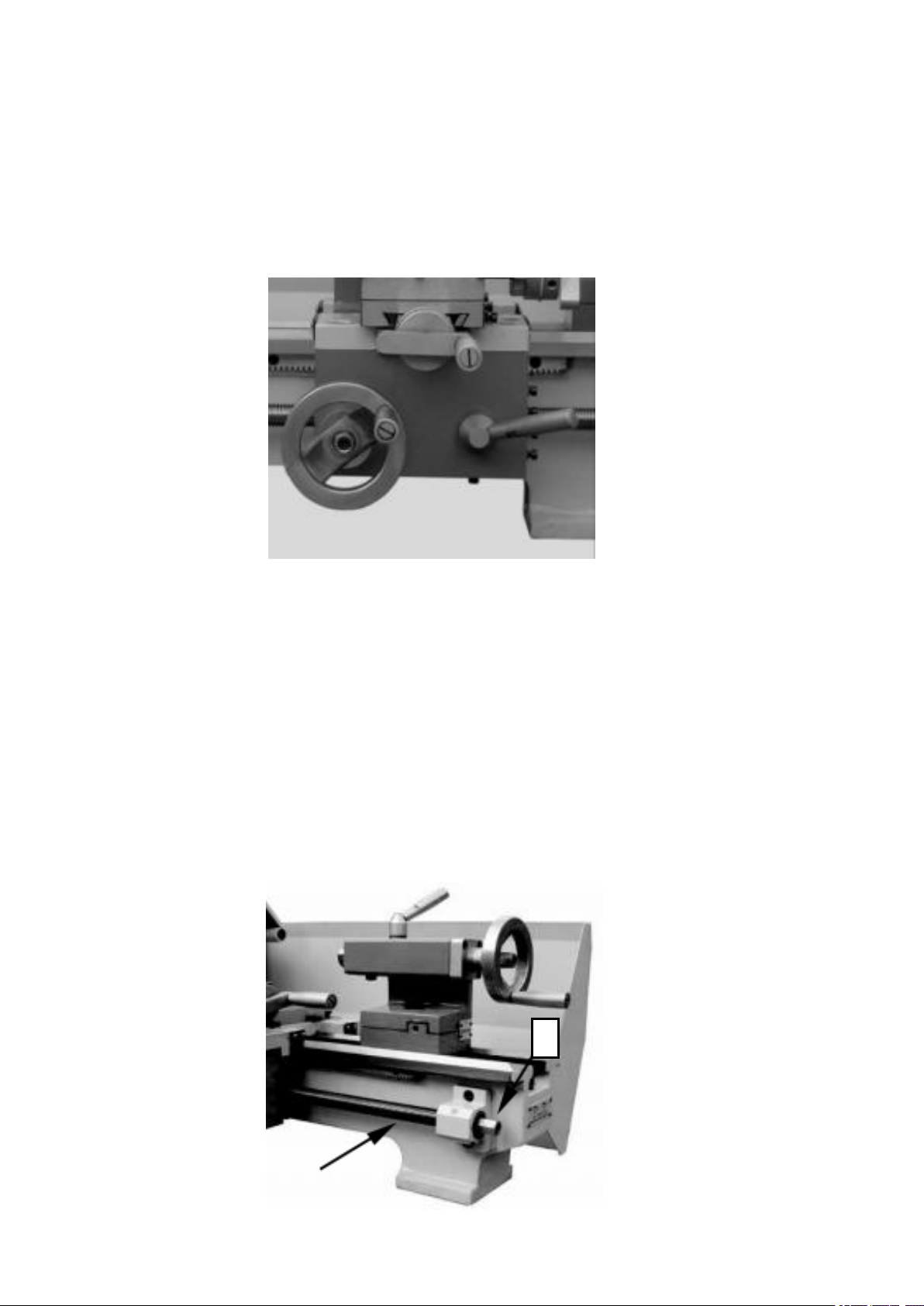
Carriage (Fig. 5)
The carriage is made from high-quality cast iron. The slide parts are
smoothly ground.They fit the V on the bed without play. The lower sliding
parts can be easily and simply adjusted.The cross slide is mounted on the
carriage and moves on a dove-tailed slide.Play in the cross slide may be
adjusted with the gibs.
Move the cross slide with its conveniently positioned Handwheel.
There is a graduated collar on the Handwheel.
A four way tool post is fitted on the top slide and allows four tools to be
clamped.Loosen the center clamp handle to rotate any of the four tools into
position.
Fig. 5
- 12 -
Apron (Fig. 6)
The apron is mounted on the bed. It houses the half nut with an engaging
lever for activating the automatic feed. The half nut gibs can be adjusted
from the outside.
A rack, mounted on the bed, and a pinion operated by Handwheel on the
carriage allows for quick travel of the apron.
Fig. 6
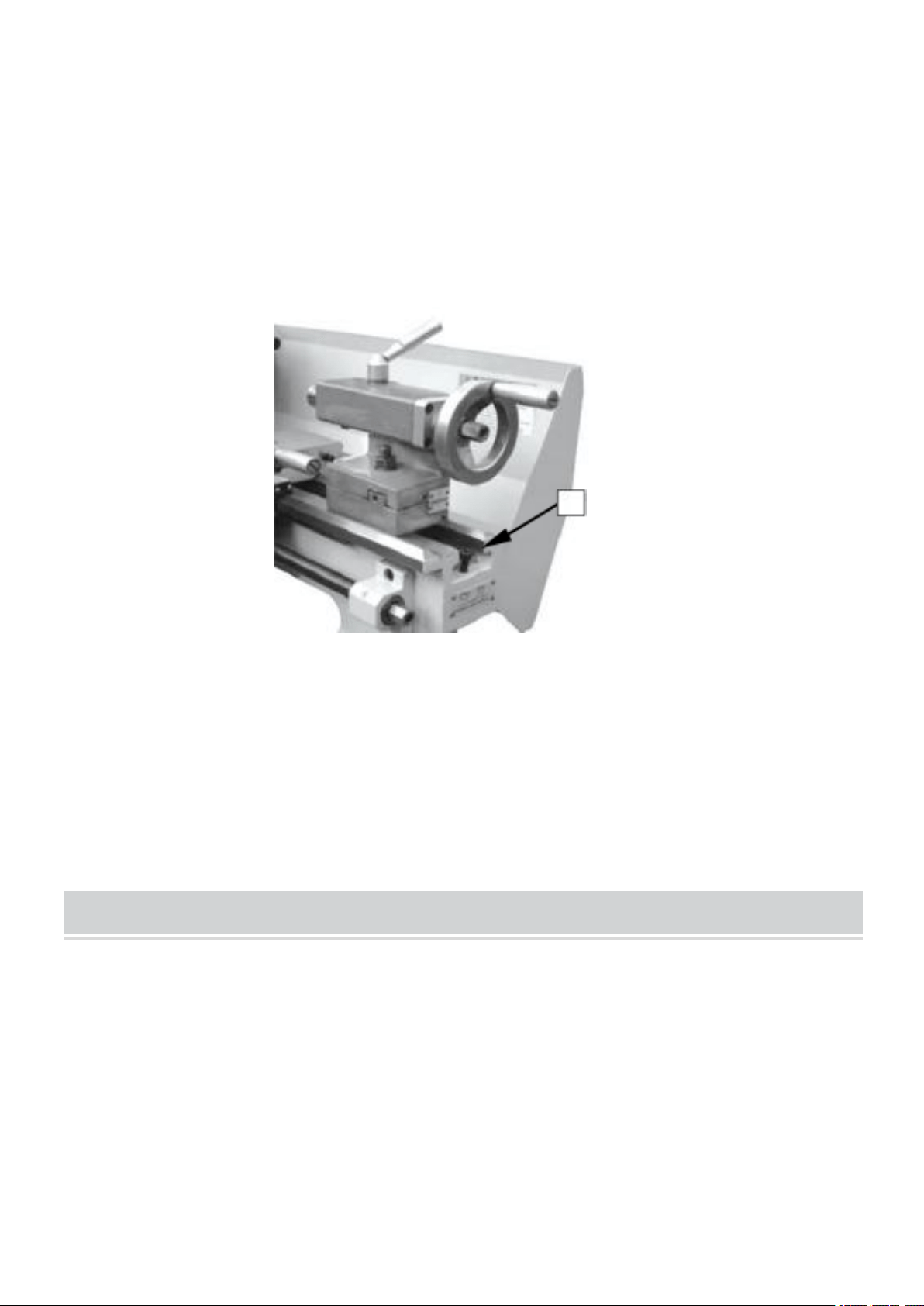
Lead screw (Fig. 7)
The lead screw (A, Fig.7) is mounted on the front of the machine bed. It is
connected to the gear box at the left for automatic feed and is supported by
bearing on both ends. The hex nut(B,Fig.7)on the right end is designed to
take up play on the lead screw.
B
A
Fig.7
- 13 -
tail stock (Fig. 8)
The tail stock slides on a V way and can be clamped at any location. The
tail stock has a heavy-duty spindle with a Morse taper No. 2 socket and a
graduated scale. The spindle can be clamped at any location with a
clamping lever. The spindle is moved with a hand wheel at the end of the
tailstock.
C
Fig.8
Notice:
Fit the securing screw (C, Fig. 8) at the end of the lathe in order to prevent
the tailstock from falling off the lathe bed.
Operating equipment
1. Emergency Button: 0N/0FF Switch (D,Fig. 9)
The machine is switched on and off with ON/OFF button. Depress to stop
all machine functions. To restart, lift the cover and press ON button.
2. Change-over Switch(E,Fig. 9)
After the machine switched on, turn the switch to "F" position for
counter-clockwise spindle rotation(forward). Turn the switch to"R"
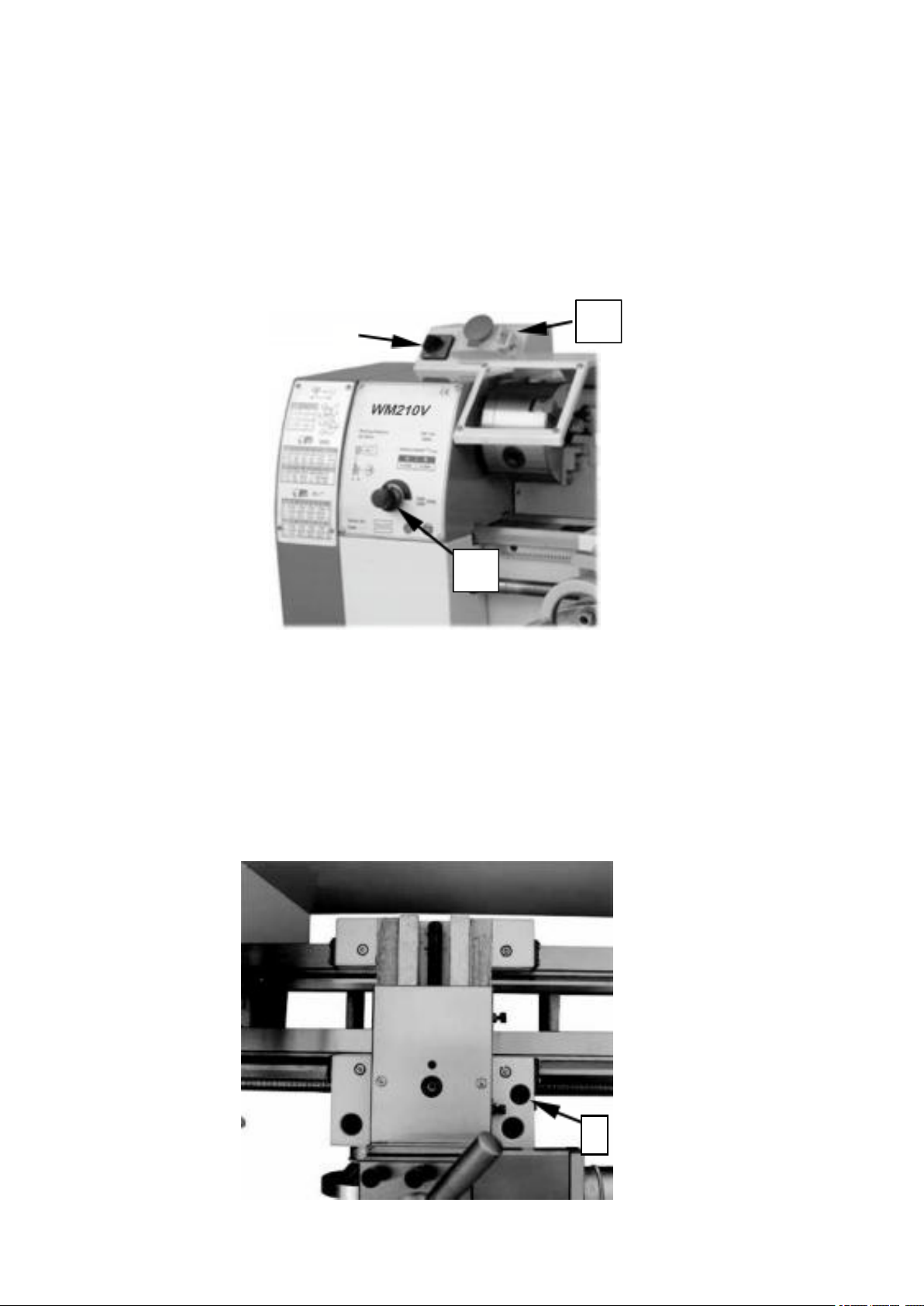
- 14 -
position for clockwise spindle rotation(reverse) ."O"position is OFF and the
spindle remains idle.
3. Variable Speed Control Switch (F,Fig. 9)
Turn the switch clockwise to increase the spindle speed. Turn the switch
counter-clockwise to decrease the spindle speed. The possible speed
range is dependent from the position of the drive belt.
E
Fig.9
4﹒Carriage Lock
Turn hex socket cap screw (A, Fig. 10) clockwise and tighten to lock. Turn
counter-clockwise and loosen to unlock.
Caution: carriage lock screw must be UN locked before engaging
automatic feeds or damage to lathe may occur.
A
Fig.10
F
D
- 15 -
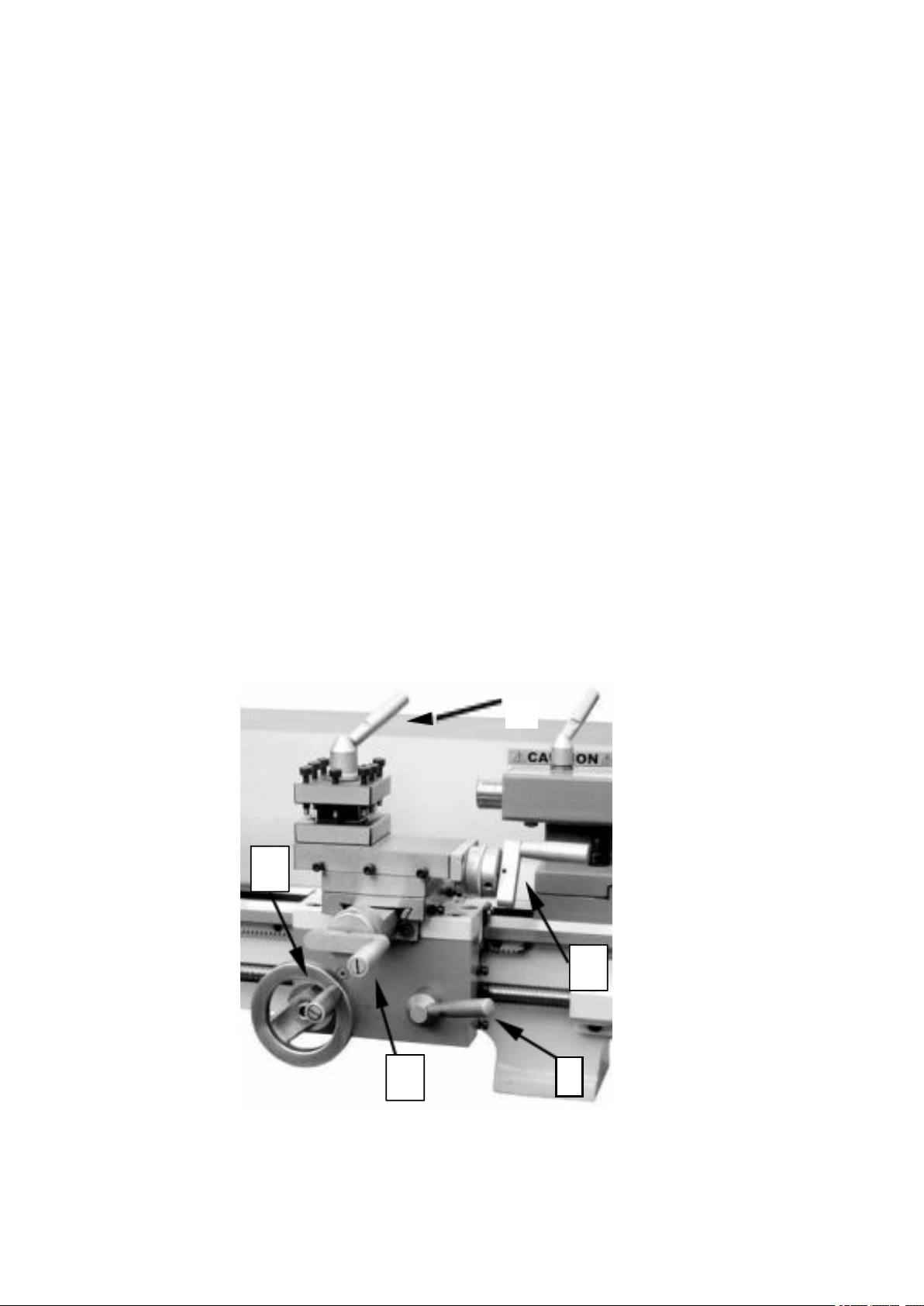
5﹒Longitudinal Traverse Hand wheel (B,Fig.11)
Rotate hand wheel clockwise to move the apron assembly toward the tail
stock (right). Rotate the hand wheel counter-clockwise to move the apron
assembly to ward the Headstock(left).
6﹒Cross Traverse Lever (C,Fig. 11)
Clockwise rotation moves the cross slide toward the rear of the machine.
7﹒Half Nut Engage Lever (D,Fig. 11)
Move the lever down to engage. Move the lever up to disengage.
8﹒Compound Rest Traverse Lever (E,Fig. 11)
Rotate clockwise or counter-clockwise to move or position.
9﹒Tool Post Clamping Lever (F,Fig. 11)
Rotate counter-clockwise to loosen and clockwise to tighten. Rotate the
tool post when the lever is unlocked.
F
D
Fig.11
E
C
B
- 16 -
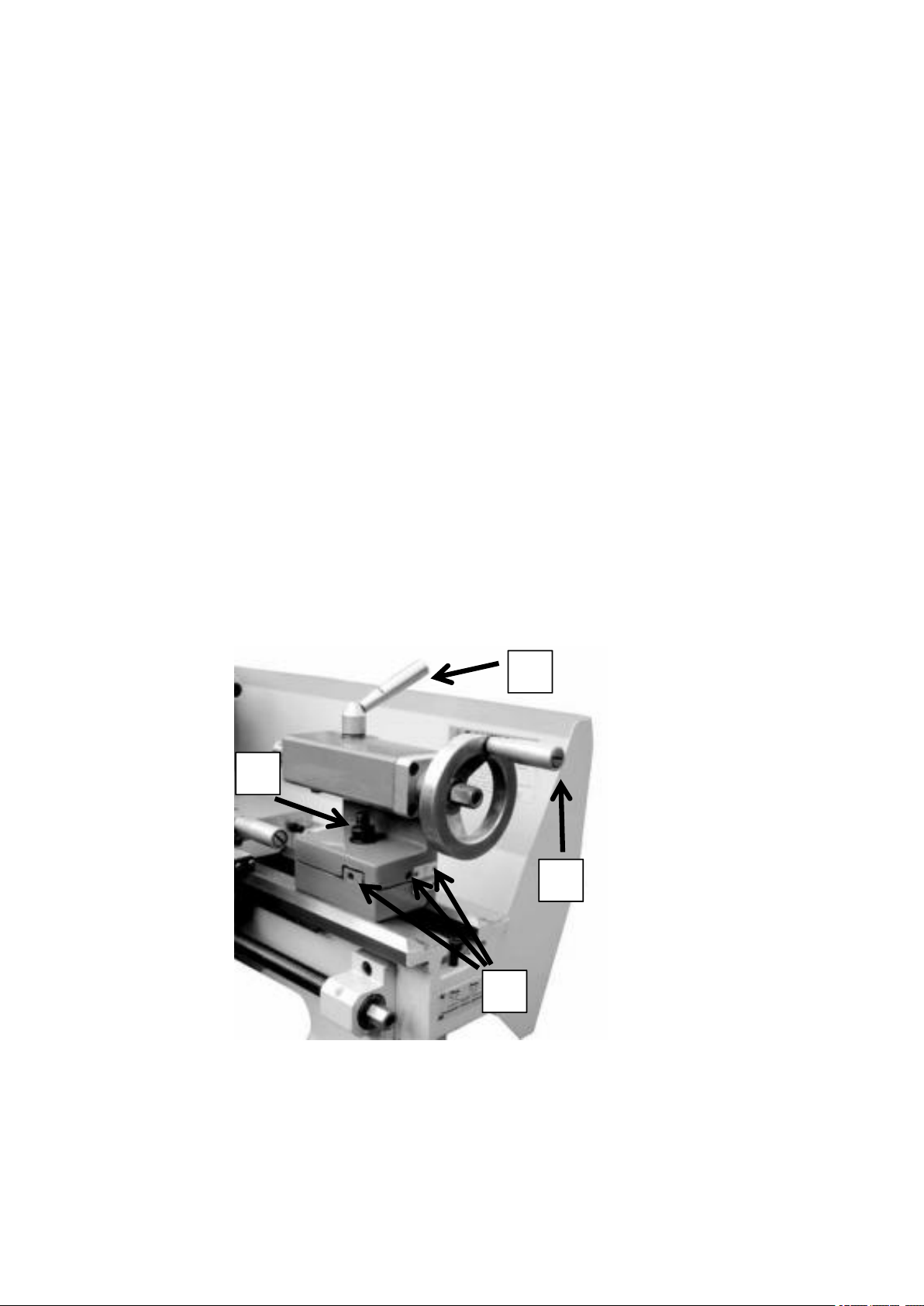
10﹒Tail stock Clamping screw (G,Fig. 12)
Turn hex nut clockwise to lock and counter-clockwise to unlock.
11﹒Tail stock Quill Clamping Lever (H,Fig. 12)
Rotate the lever clockwise to lock the spindle and counter-clockwise to
unlock it.
12﹒Tail stock Quill Traverse Hand wheel (I,Fig. 12)
Rotate clockwise to advance the quill. Rotate counter- clockwise to retract
the quill.
13﹒Tail stock off-set Adjustment (J,Fig. 12)
Three sets screws located on the tails stock base are used to off-set the tail
stock for cutting tapers. Loosen lock screw on tail stock end. Loosen one
side set screw while tightening the other until the amount of off-set is
indicated on scale. Tighten lock screw.
Fig﹒12
H
I
J
G
- 17 -
OPERATION
Replacement of Chuck
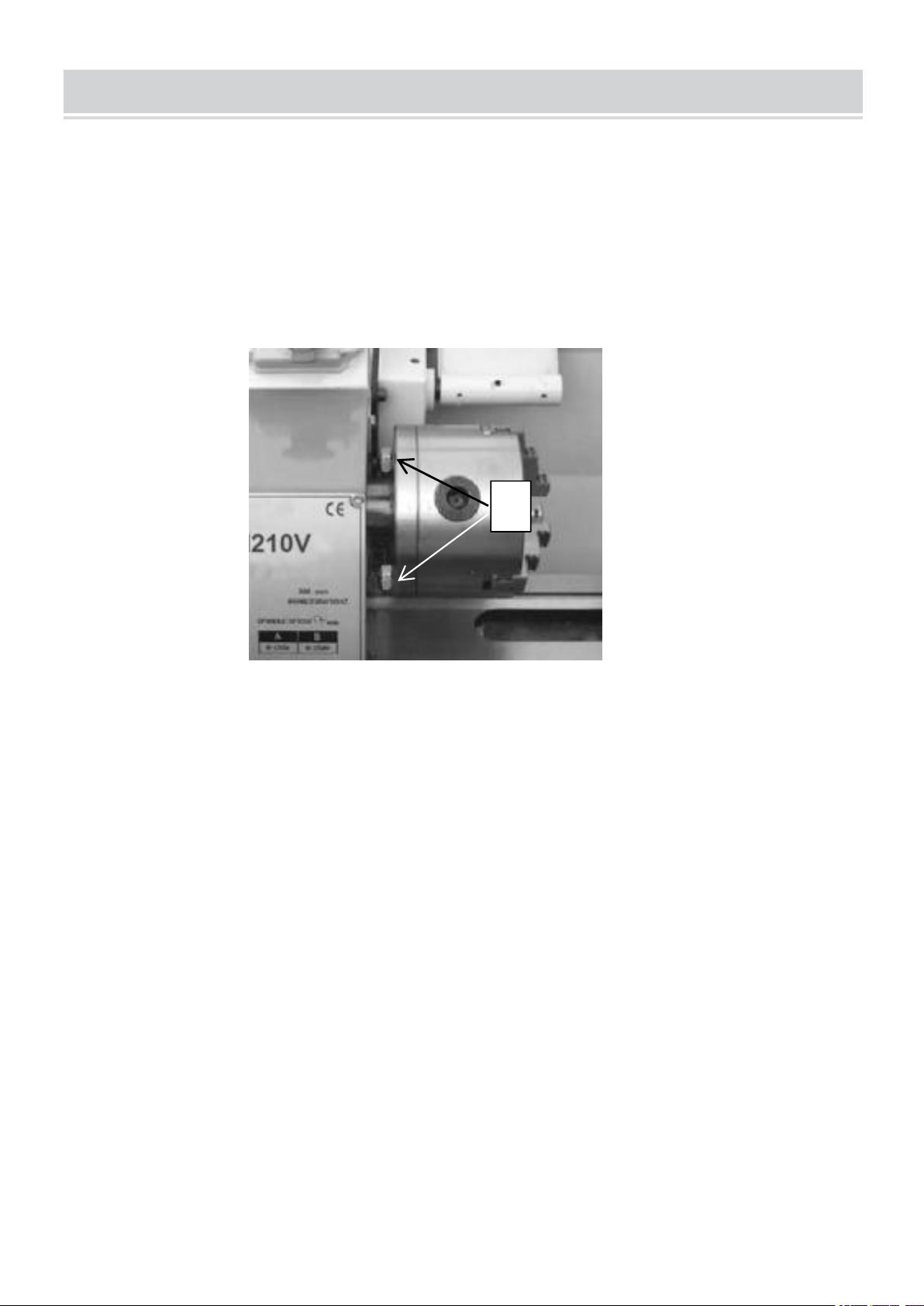
The head spindle holding fixture is cylindrical. Loose three set screws and
nuts (A, Fig. 13 only two are shown)on the la the chuck flange to remove
the chuck. Position the new chuck and fix it using the same set screws and
nuts.
Fig. 13
TOOL SET UP
Clamp the turning tool into the tool holder.
The tool must be clamped firmly. When turning, the tool has a tendency to
bend under the cutting force generated during the chip formation.
For best results, tool overhang should be kept to a minimum of 3/8" or
less.
The cutting angle is correct when the cutting edge is inline with the center
axis of the workpiece. The correct height of the tool can be achieved by
comparing the tool point with the point of the center mounted in the tail
stock. If necessary, use steel spacer shims under the tool to get the
required height. (Fig. 14)
A
- 18 -
Fig. 14
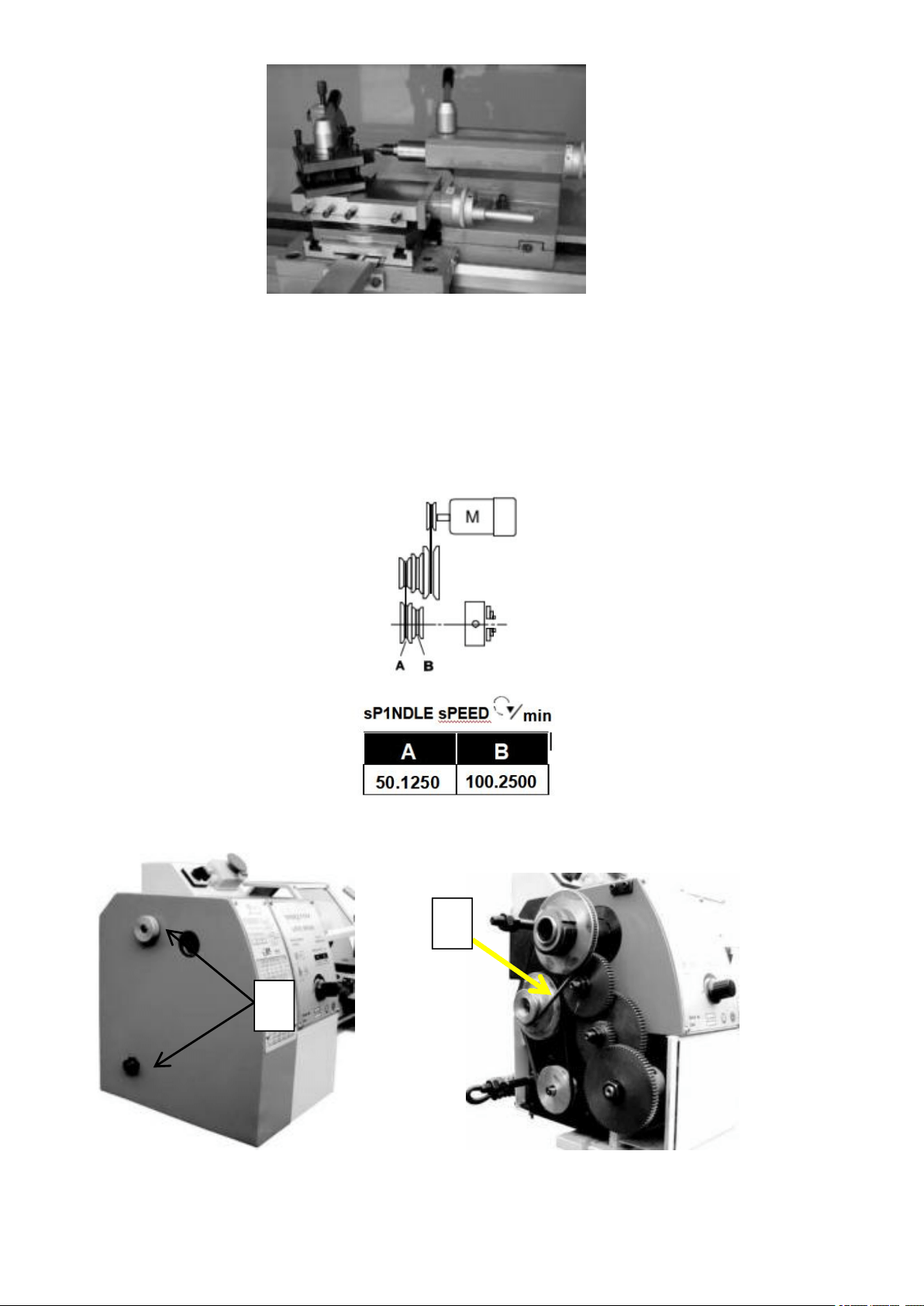
Change Speed
1. Unscrew the two fastening screws (B, Fig.15) and remove the
protective cover.
2. Adjust the V-belt(C,Fig.16)corresponding position.
3. Tighten the tension pulley and fasten the nut again.
Fig. 15 Fig. 16
B
C
- 19 -
Manual Turning
Apron travel, cross travel, and top slide hand wheel can be operated for
longitudinal or cross feeding. (Fig.17)
Fig. 17
Longitudinal Turning with Auto.Feed
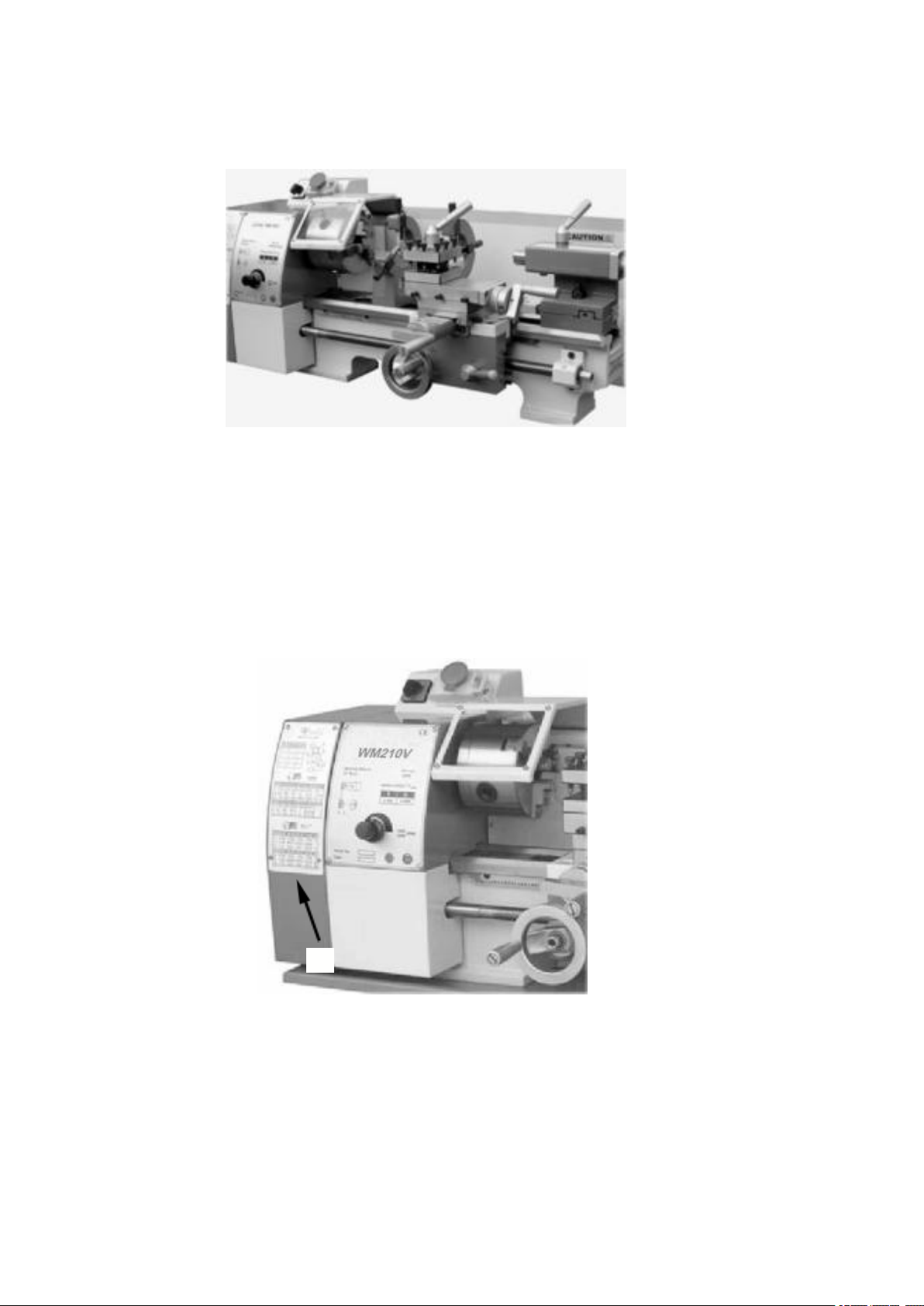
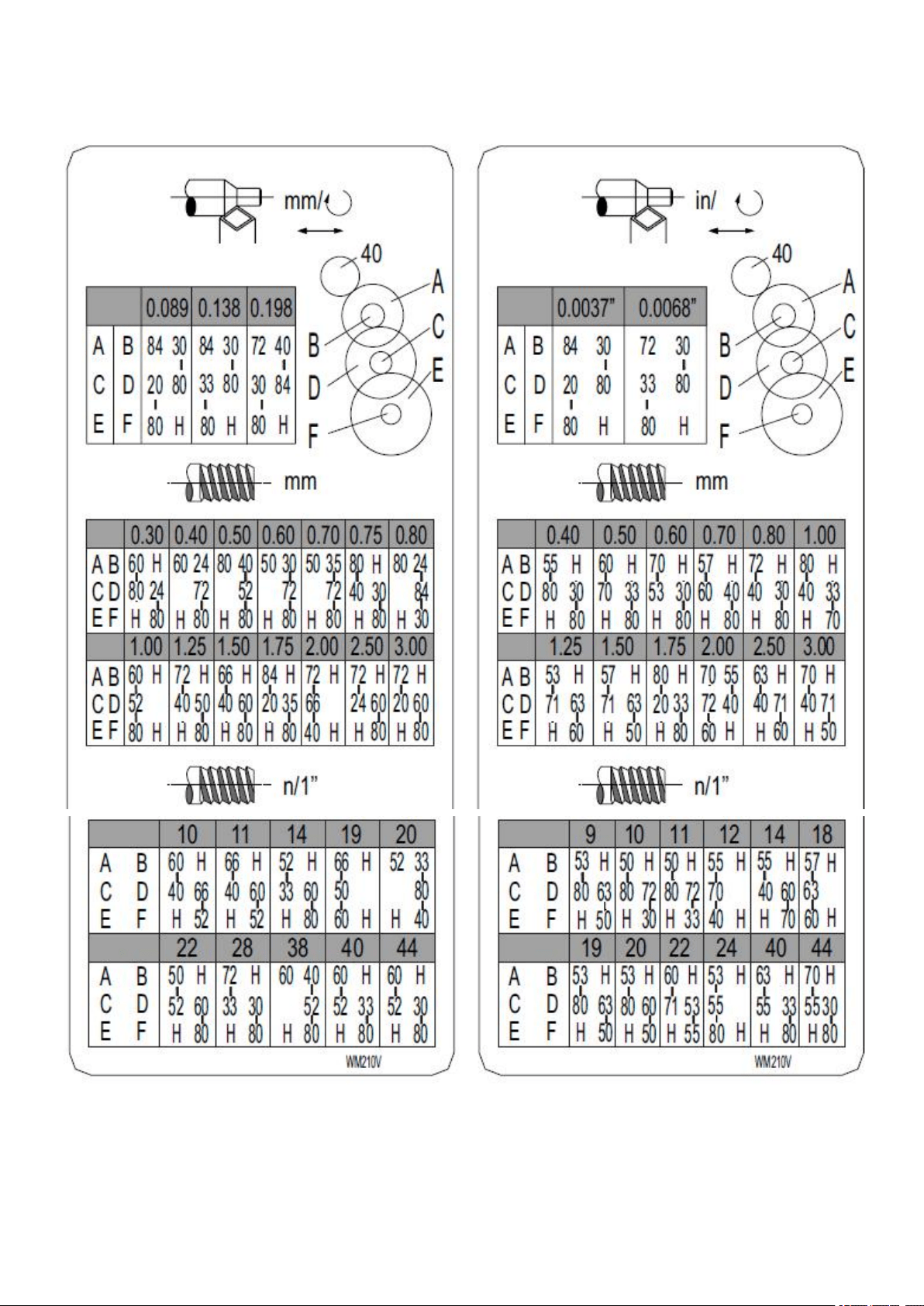
Use the table (A, Fig.18) on the lathe for selecting the feed speed or
the thread pitch. Adjust the change gear if the required feed or thread pitch
can not be obtained with the installed gear set.
A
Fig. 18
- 20 -
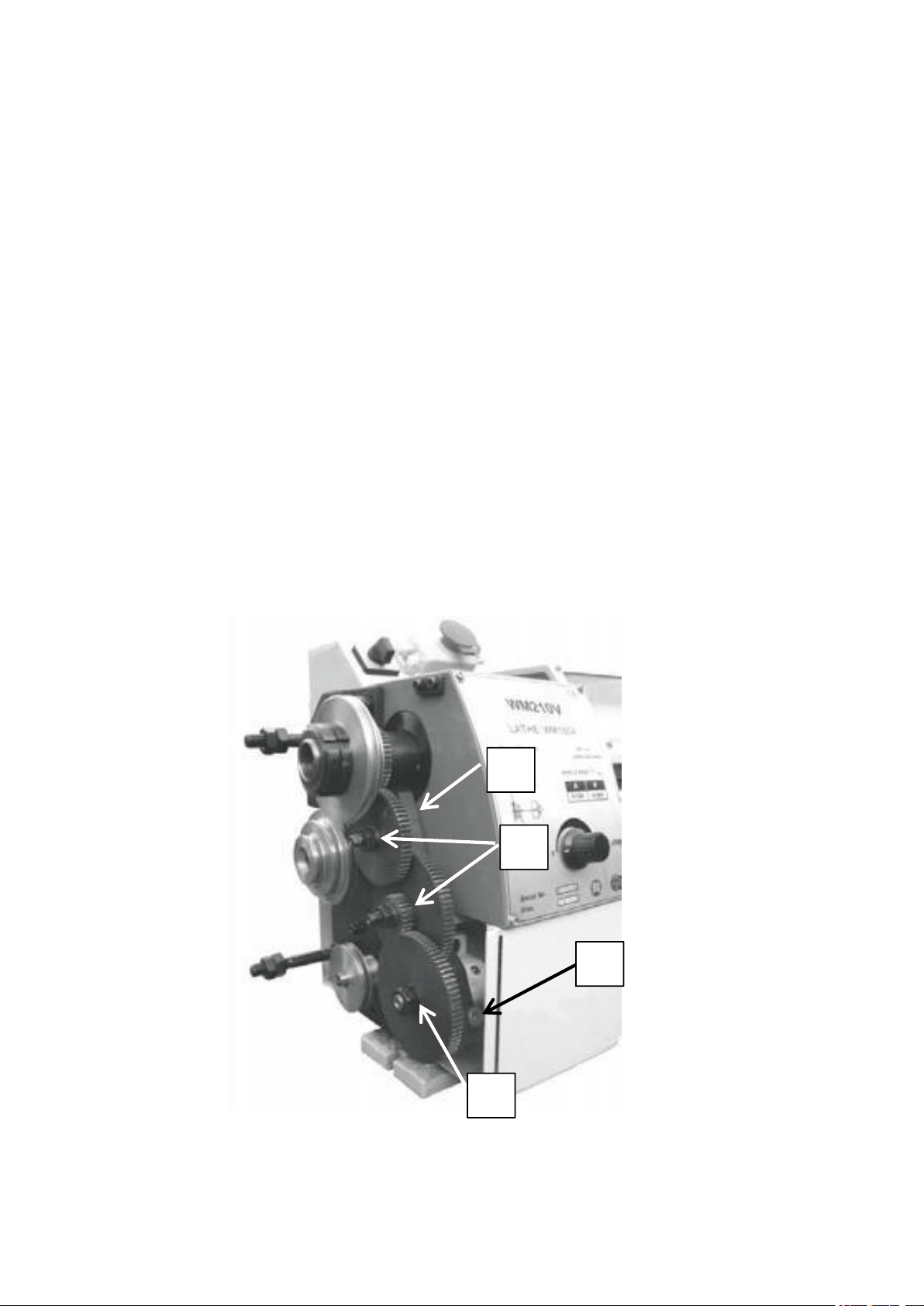
Change Gears Replacement
1. Disconnect the machine from the power source.
2. Unscrew the two fastening screws and remove the protective cover.
3. Loosen the locking screw (B, Fig.19) on the quadrant.
4. Swing the quadrant (C, Fig. 19) to the right.
5. Unscrew the nut (D, Fig.29) from the lead screw or the nuts (E, Fig.19)
from the quadrant bolts in order to remove the change gears from the
front.
6. Install the gear couples according to the thread and feed table (Fig.20)
and screw the gearwheels onto the quadrant again.
7. Swing the quadrant to the left until the gearwheels have engaged again.
8. Readjust gear backlash by inserting a normal sheet of paper as an
adjusting or distance aid between the gearwheels.
9. Immobilize the quadrant with the locking screw.
10. Install the protective cover of the head stock and reconnect the
machine to the power supply.
Fig. 19
C
E
B
D
- 21 -
Pitch plate(Fig. 20)
THREADING AND FEEDING TABLE
Fig. 20
- 22 -
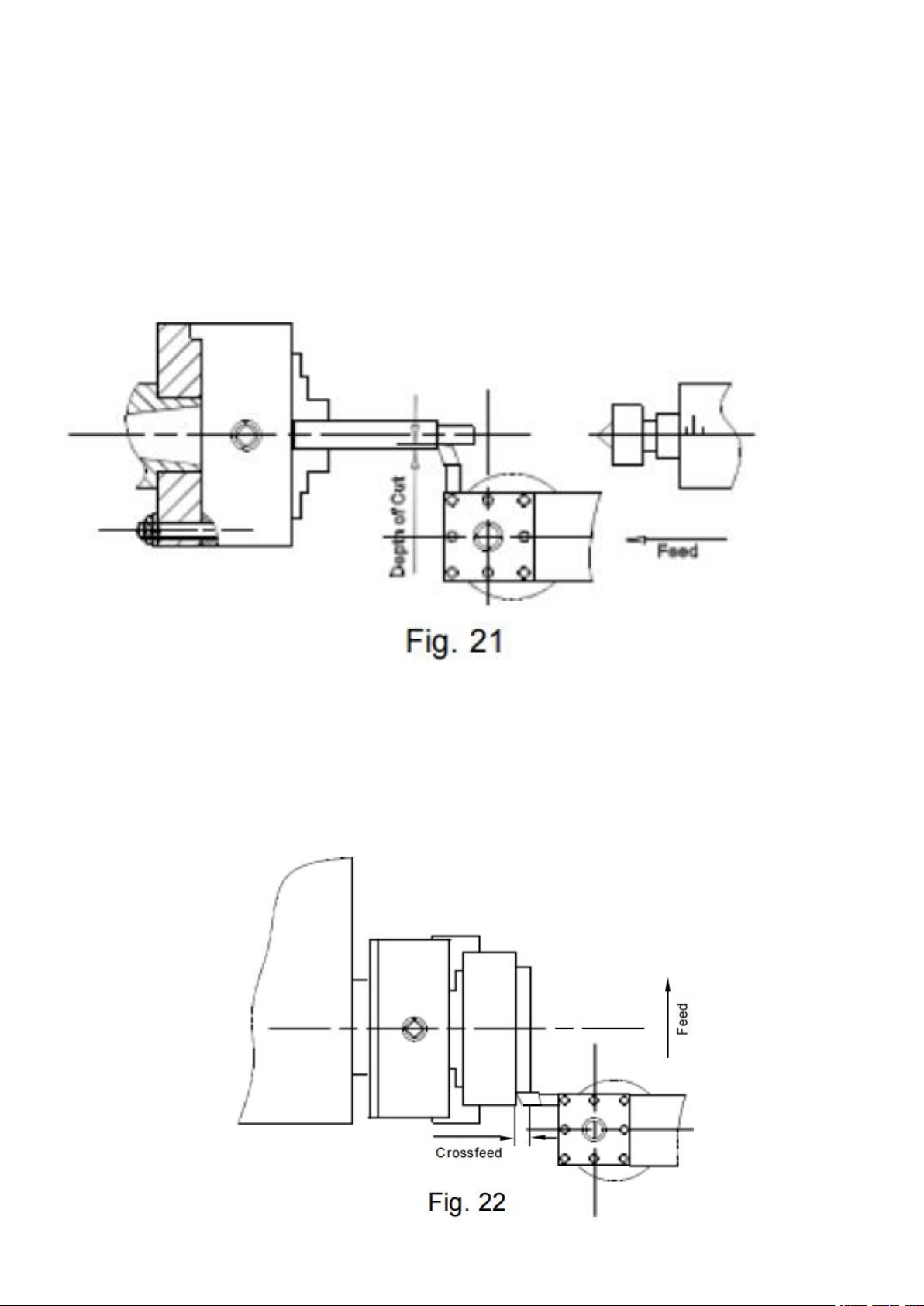
Cylindrical Turning (Fig. 21)
In the straight turning operation, the tool feeds parallel to the axis of
rotation of the workpiece. The feed can be either manual by turning the
hand wheel on the lathe saddle or the top slide, or by activating the
automatic feed. The cross feed for the depth of cut is achieved using the
cross slide.
End turning ( Fig. 22 )
In the facing operation, the tool feeds perpendicular to the axis of rotation
of the workpiece. The feed is made manually with the cross slide hand
wheel. The cross feed for cut depth is made with the top slide or lathe
saddle.
- 23 -
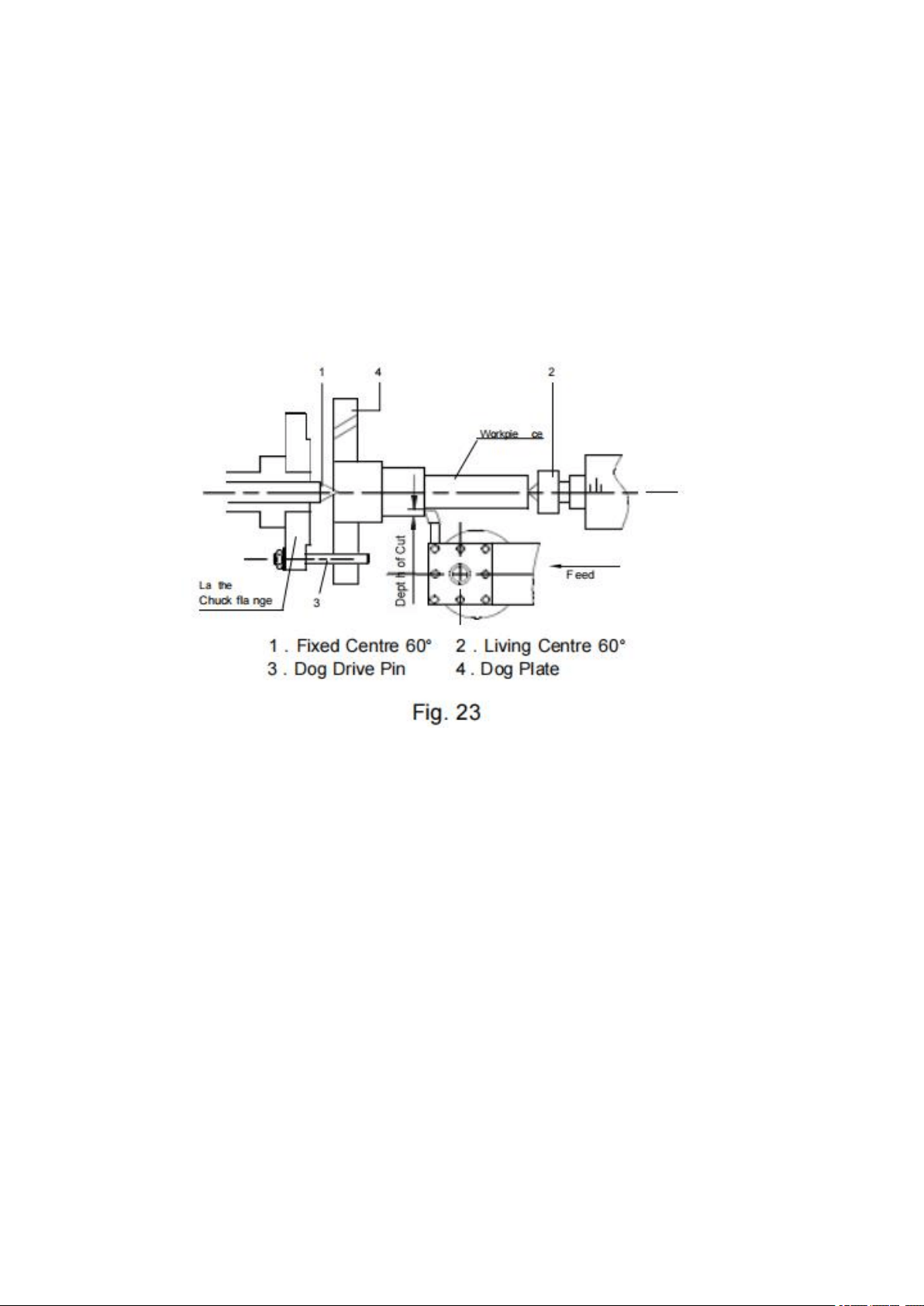
Turning: Slender shaft ( Fig. 23 )
For turning between centers, it is necessary to remove the chuck from the
spindle. Fit the M. T. 3 center into the spindle nose and the M.T. 2 center
into the tail stock. Mount the workpiece fitted with the driver dog between
the centers. The driver is driven by a catch or face plate.
Note: Always use a small amount of grease on the tail stock center
to prevent center tip from overheating.
Taper Turning Using Tail stock Nff-Ret
Adjust the deviation between the tailstock sleeve center and the spindle
center to complete the taper turning. The angle depends on the length of
the workpiece.
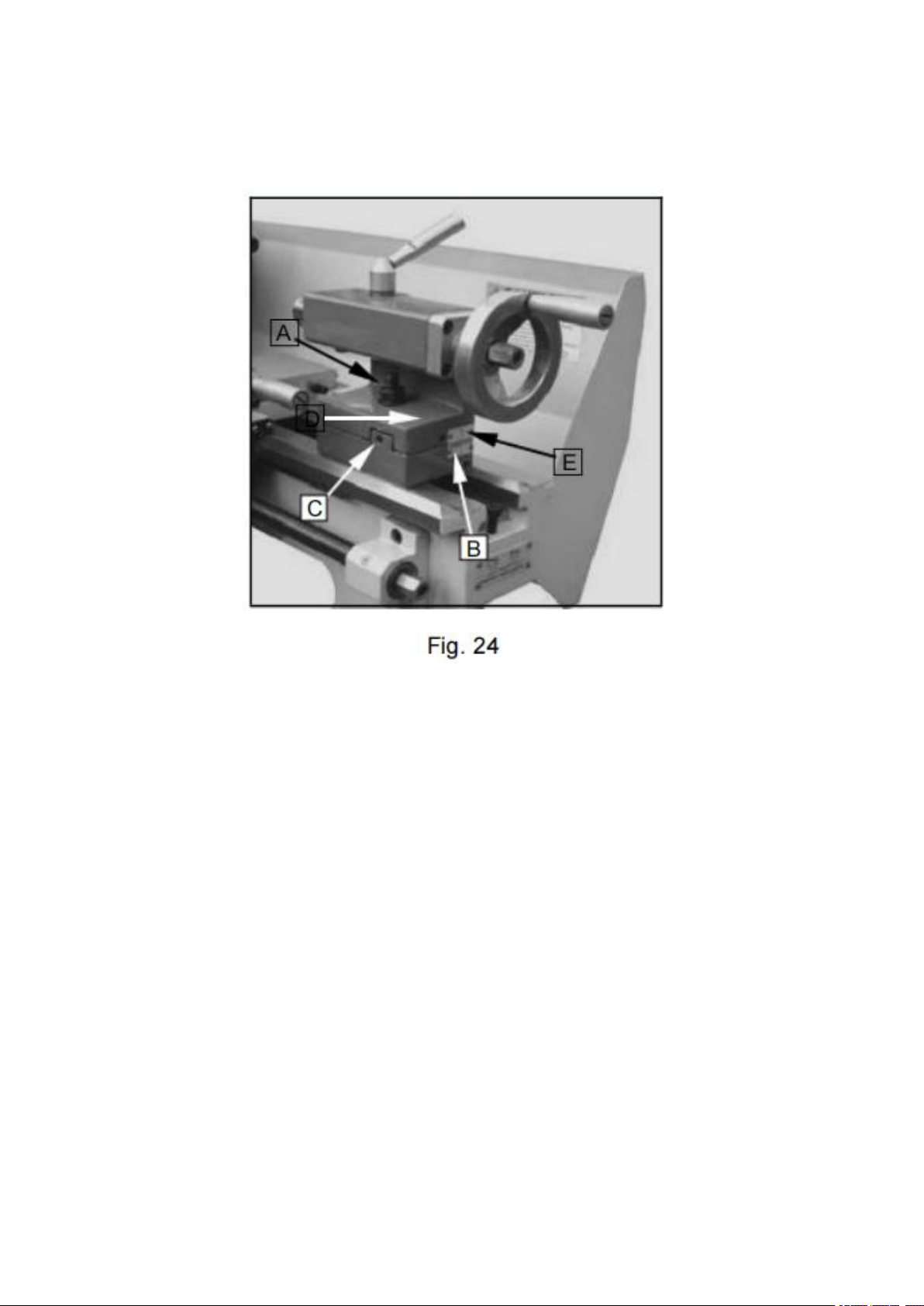
To off-set the tail stock, loosen locking screw (A, Fig.24).
Unscrew the set screw (B, Fig.24) on right end of the tailstock. Loosen the
front adjusting screw( C, Fig.24 ) and take up the same amount by
tightening the rear adjusting screw (D, Fig.24) until the desired taper has
been reached. The desired cross- adjustment can be read off the scale. (E,
Fig.24 ). First re-tighten the set screw (B, Fig,24) and then the two (front
and rear) adjusting screw to lock the tail stock in position. Re-tighten the
locking screw (A, Fig.24) of the tailstock. The workpiece must be held
between to centers and driven by a face plate and driver dog.
- 24 -
After taper turning, the tailstock should be returned to its original position
according to the zero position on the scale of tail stock. (E, Fig.24)
Thread Cutting
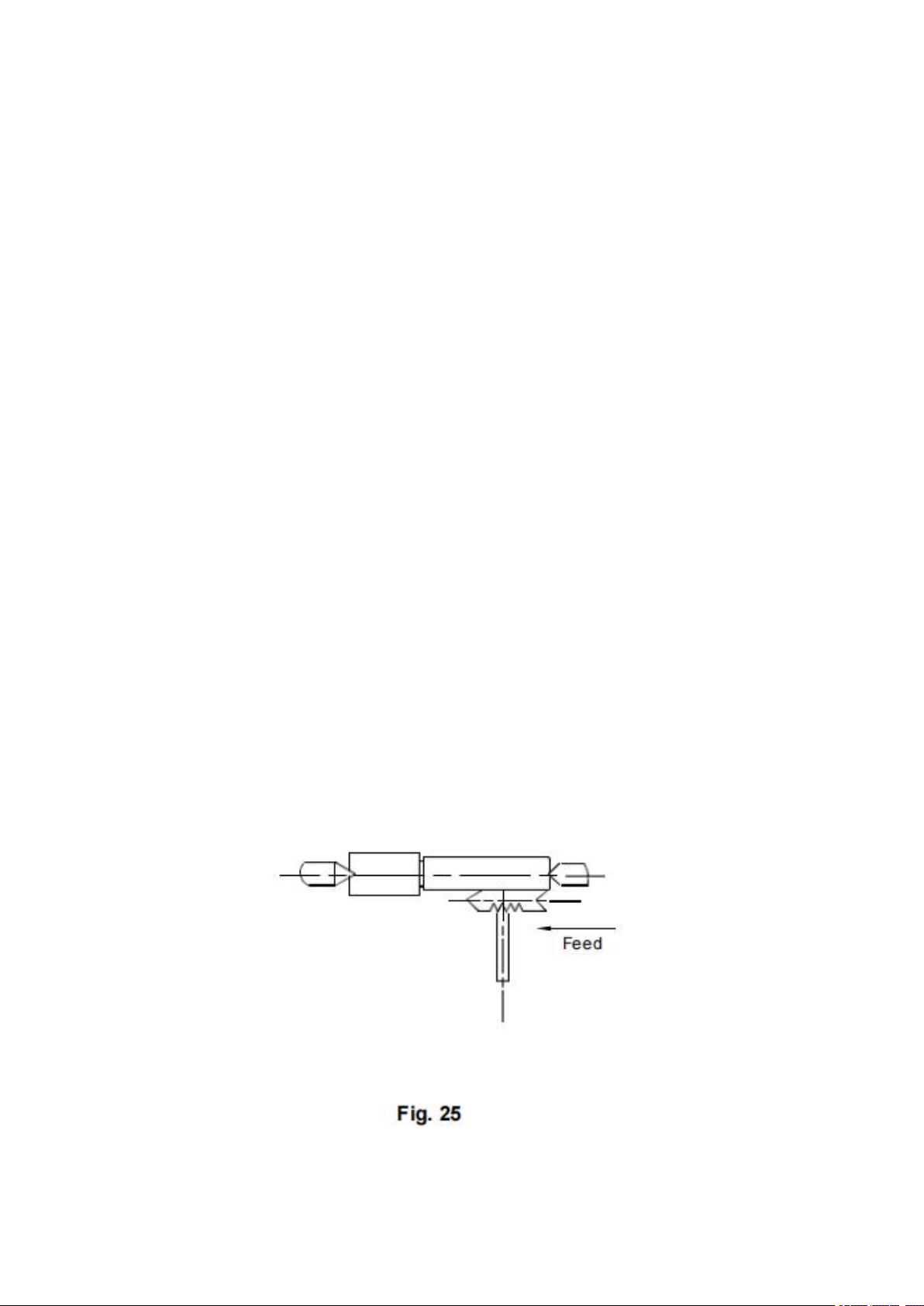
Set the machine up to the desired thread pitch (according to the threading
chart, Fig.20). Start the machine and engage the half nut. When the tool
reaches the part, it will cut the initial threading pass. When the tool reaches
the end of the cut, stop the machine by turning the motor off and at the
same time back the tool out of the part so that it clears the thread. Do not
disengage the half nut lever. Reverse the motor direction to allow the
cutting tool to traverse back to the starting point. Repeat these steps until
you have obtained the desired results.
NOTES
Example: Male Thread
The workpiece diameter must have been turned to the diameter of the
desired thread.
The workpiece requires a chamfer at the beginning of the thread and
- 25 -
an undercut at the thread run out.
The speed must be as low as possible. The change gears must have
been installed according to the required pitch.
The thread cutting tool must be exactly the sample shape as the
thread, must be absolutely rectangular and clamped so that it
coincides exactly with the turning enter.
The thread is produced in various cutting steps so that the cutting tool
has to be turned out of the thread completely (with the cross slide) at
the end of each cutting step.
The tool is withdrawn with the lead screw nut engaged by inverting the
change-over switch.
Stop the machine and feed the thread cutting tool in low cut depths
using the cross slide. Before each passage, place the top slide
approximately 0.2 to 0.3mm to the left and right alternately in order to
cut the thread free. This way, the thread cutting tools cut only on one
thread flank with each passage. Keep cutting the thread free until you
have almost reached the full depth of thread.
- 26 -
Lathe Accessories
Three Jaw Universal Lathe Chuck
Using this universal chuck round triangular square hexagonal octagonal
and twelve,cornered stock may be clamped. (Fig.26)
Note: new lathes have very tight fitting jaws. This is necessary to ensure
accurate clamping and long service life- with repeated opening and closing
the jaw adjusts automatically and their operation becomes progressively
Smoother.
Note:
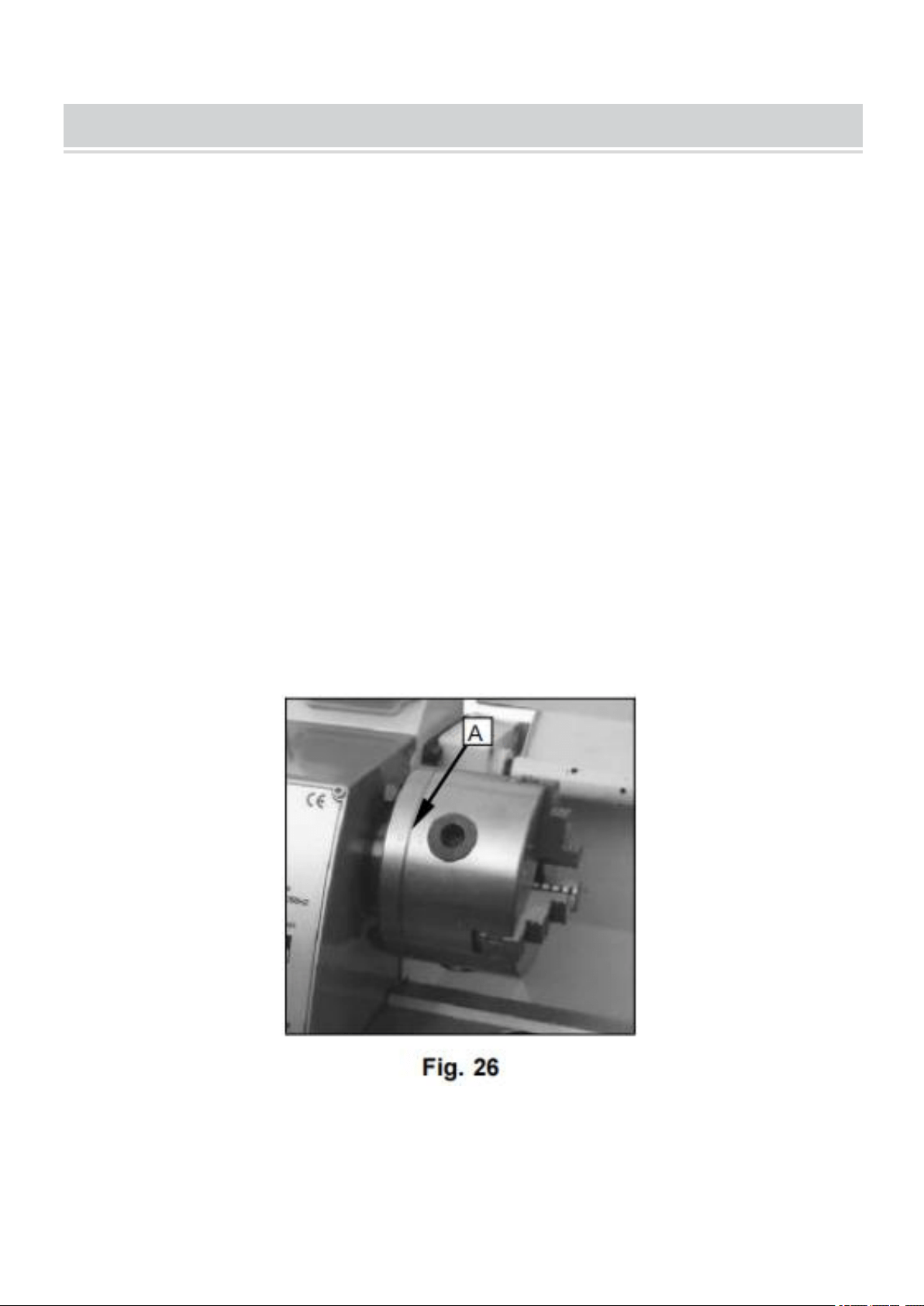
For the original 3, jaw chuck that was mounted on the lathe the factory has
mounted the chuck in the best way to guarantee the holding accuracy with
two "0" mark (A) Fig.26 showed on the chuck and chuck flange.
There are two types of jaws: Internal and external jaws. Please note that
the number of jaws fits with the number inside the chucks groove. Do not
mix them together. When you are going to mount them please mount them
in ascending order 0, 1 , 3 when you are going to take them out be sure to
- 27 -
take them out in descending order 3,1,0 one by one- After you finish this
procedure rotate the jaws to the smallest diameter and check that
the three jaws are well-fitted.
Four Jaw 1ndependent Lathe Chuck
This special chuck has four independently adjustable chuck jaws- These
permit the holding of asymmetrical pieces and enable the accurate set,up
of cylindrical pieces. (Fig.27)
DriII Chuck ( optional)
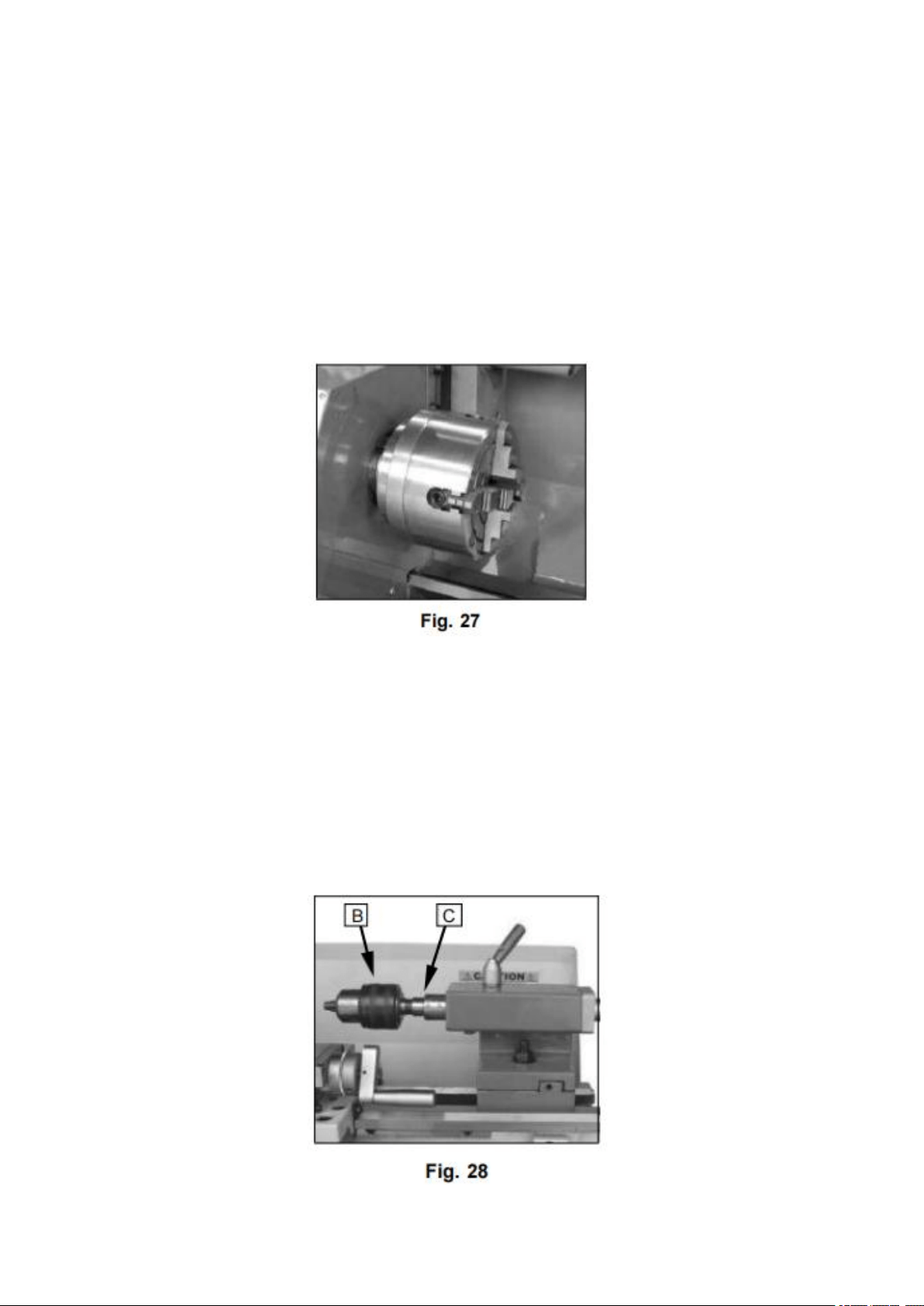
Use the drill chuck to hold centering drills and twist drills in the tail stock- (B)
(Fig.28)
Morse Taper Arbor (optional)
An arbor is necessary for mounting the drill chuck in the tailstock. It has a
No. 1 Morse taper. (C) Fig.28
- 28 -
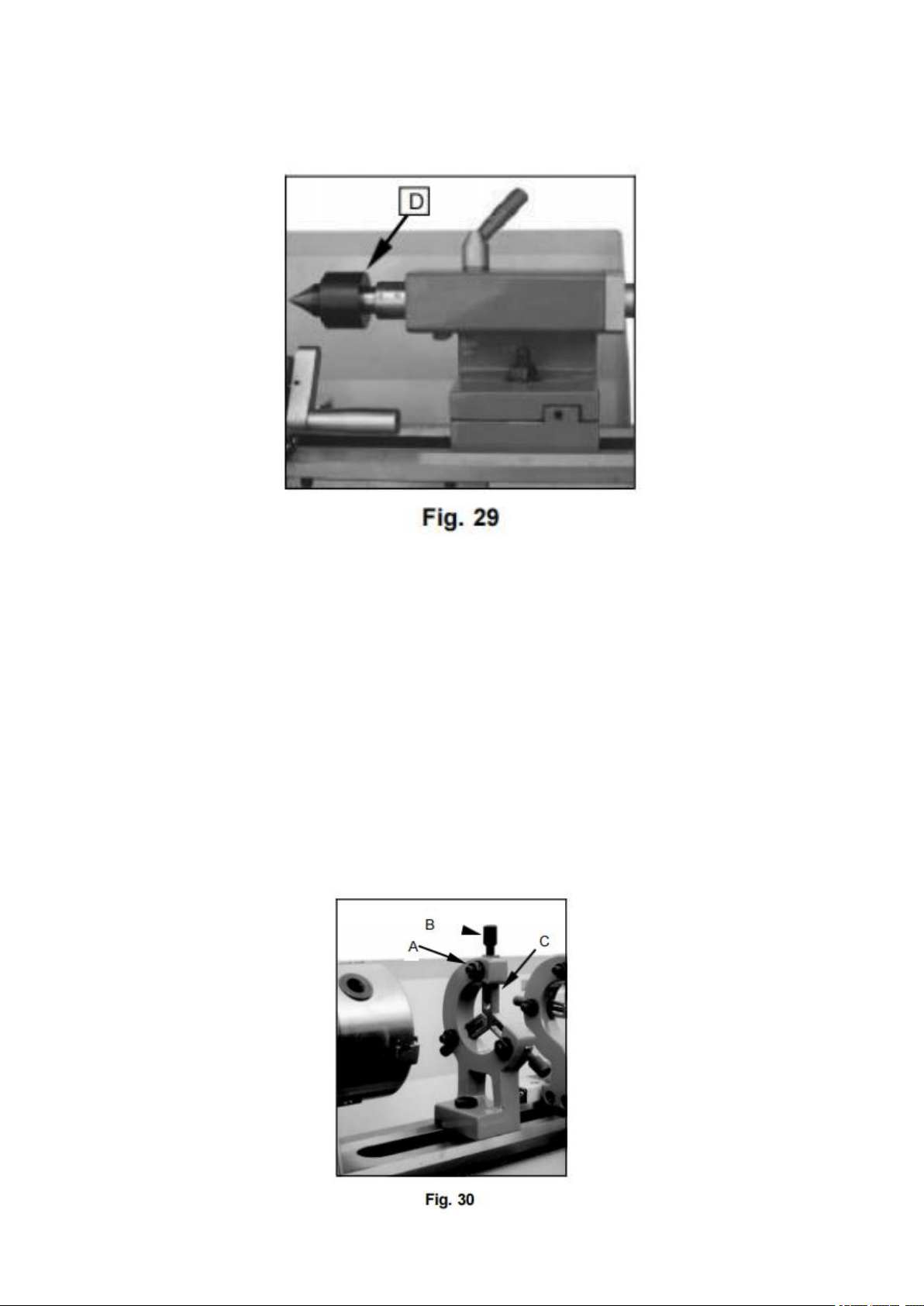
Live Center (optional)
The live center is mounted in ball bearings- Its use is highly recommended
for turning at speeds in excess of 6.RPM. ( Fig.29)
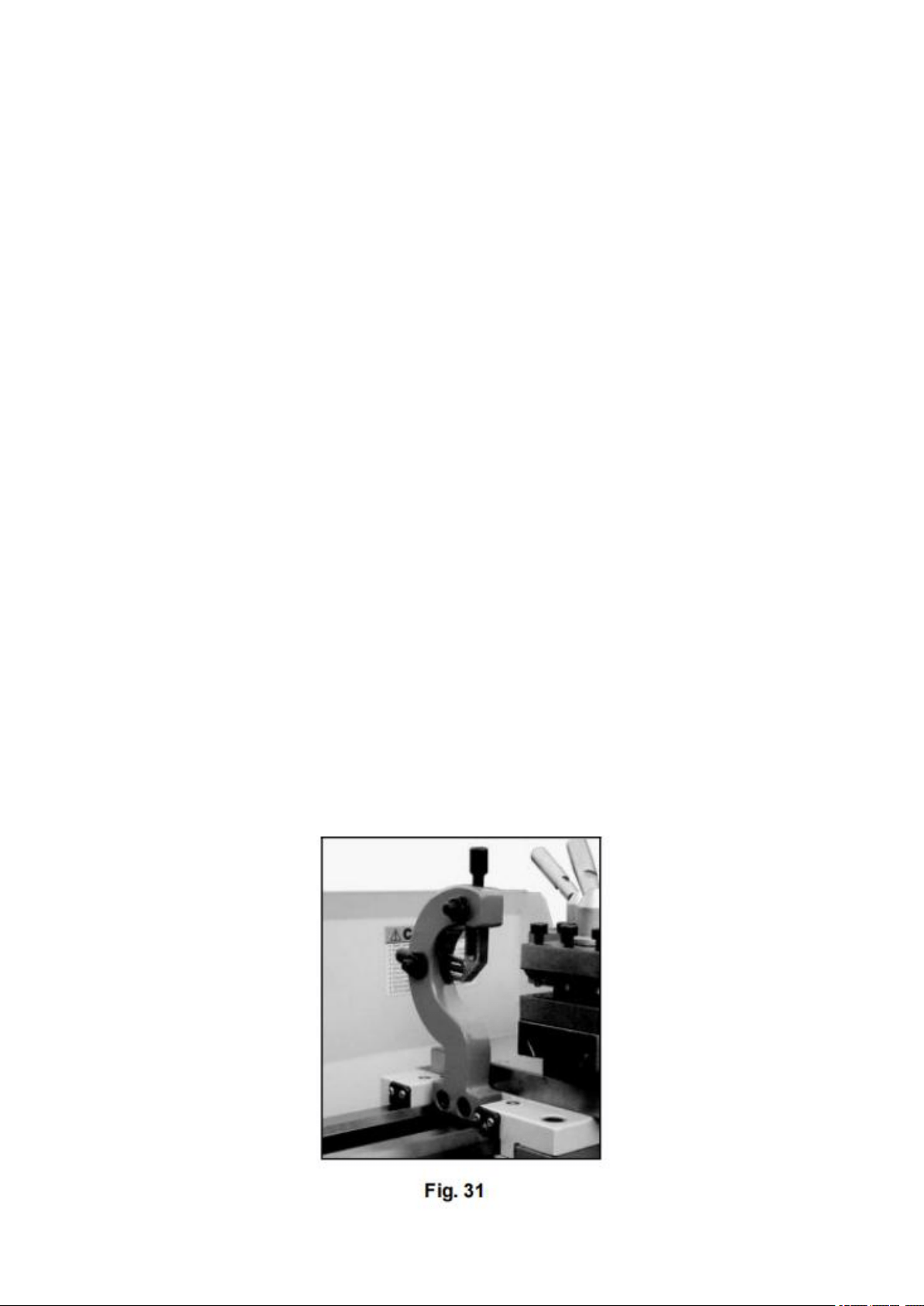
Steady Rest
The steady rest serves as a support for shafts on the free tail stock end.
For many operations the tail stock can not be used as it obstructs the
turning tool or drilling tool, and therefore, must be removed from the
machine. The
steady rest, which functions as an end support, ensures chatter- free
operation. The steady rest is mounted on the bed ways and is secured
from below with a locking plate. The grease requires continuous
lubrication at the contact points to prevent premature wear. (Fig.30)
- 29 -
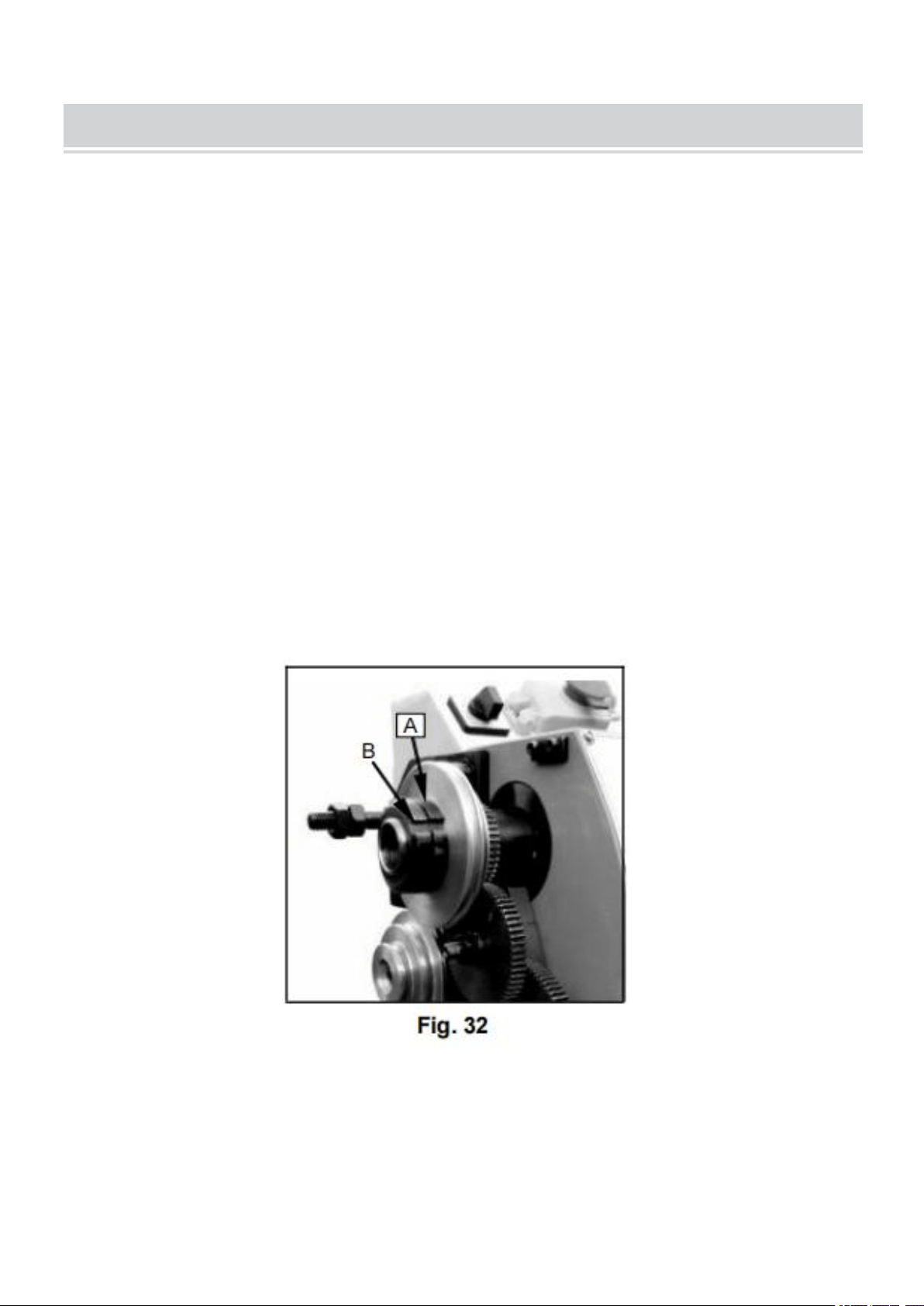
Setting the Steady Rest
1. Loosen three hex nuts. (A, Fig.31)
2. Loosen knurled screw (B, Fig.36) and open the sliding
fingers. (C, Fig.31) until the steady rest can be moved with its finger around
the workpiece. Secure the steady rest in position.
3 . Tighten knurled screws so that fingers are snug but not tight against the
workpiece. Tighten three nuts (A, Fig.31). Lubricate the sliding points with
machine oil.
4. When, after prolonged operation, the jaw show wear, the tips of the
fingers may be filed or re-milled.
Follow Rest
The following rest is mounted on the saddle and follows the movement of
the turning tool. Only two support blocks are required. The place of the
third support block is taken by the turning tool. The following rest is used
for turning operations on long, slender workpieces. It prevents flexing of
the workpiece under pressure from the turning tool. ( Fig.31 )
Set the support blocks snug to the workpiece but not overly tight. Lubricate
the support blocks during operation to prevent premature wear.
- 30 -
ADJUSTMENTS
After a period of time, wear in some of the moving components may need
to be adjusted.
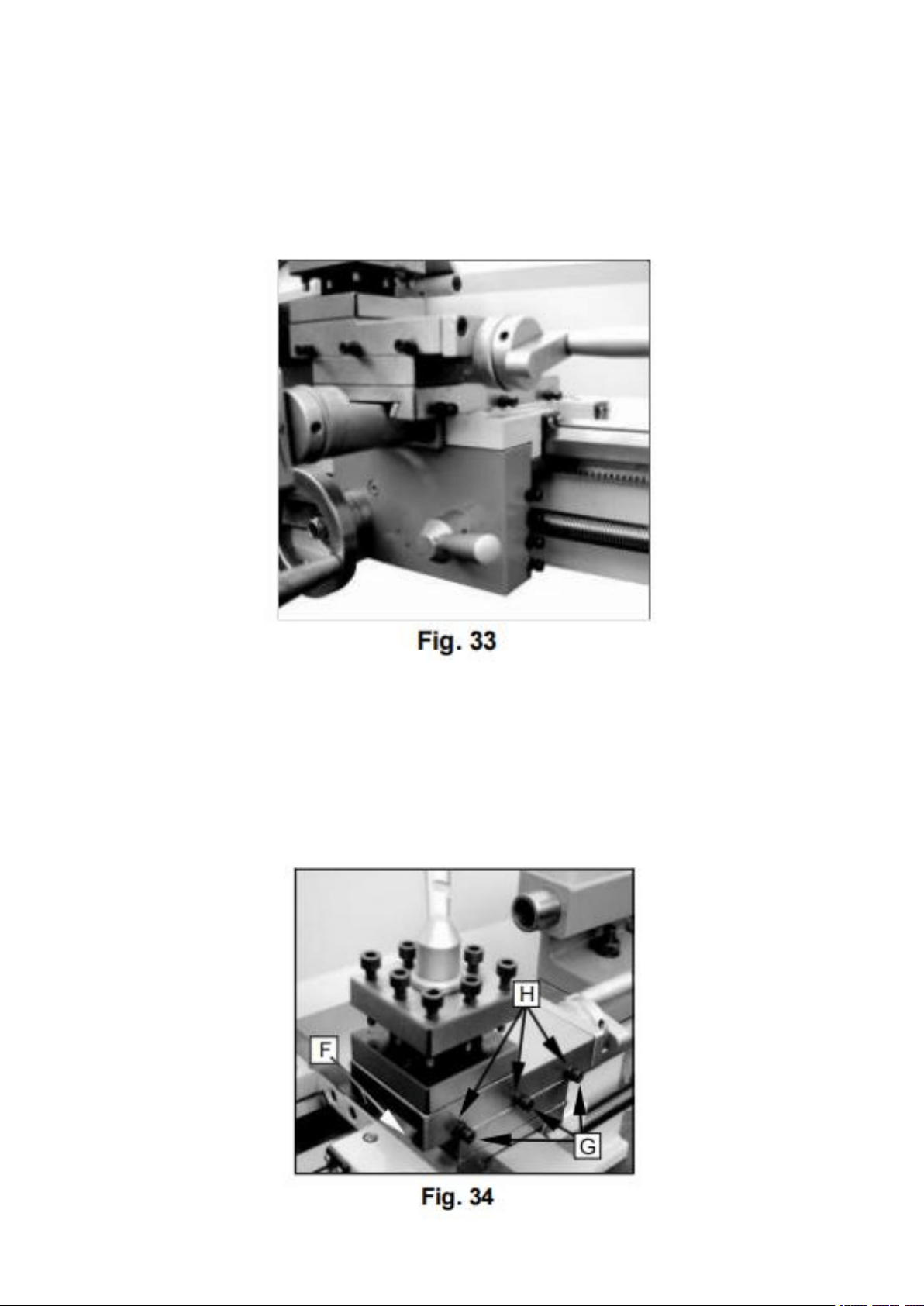
Main spindle Bearings
The main spindle bearings are adjusted at the factory. 1f end play becomes
evident after considerable use, the bearings may be adjusted.
Fasten the slotted nut (A, Fig.32) on the back of the spindle, loosen the
outer slotted nut (B, Fig.32). Adjust the slotted nut (A, Fig.32) until all end
play is taken up. The spindle should still revolve freely. Fasten the
slotted nut (A, Fig.32) again and tighten the outer slotted nut (B, Fig.32).
Caution: excessive tightening or preloading will damage the bearings.
- 31 -
Adjustment of Cross slide
The cross slide is fitted with a gib strip(C, Fig.33) and can be adjusted with
screws (D, Fig.33) fitted with lock nuts. (E, Fig.33) Loosen the lock nuts
and tighten the set screws until slide moves freely without play. Tighten
lock nuts to retain adjustment.
Adjustment of Top slide
The top slide is fitted with a gib strip(F, Fig.34) and can be adjusted with
screws (G, Fig. 34) fitted with lock nuts. (H, Fig. 34) Loosen the lock nuts
and tighten the set screws until slide moves freely without play. Tighten
lock nuts to retain adjustment.
- 32 -
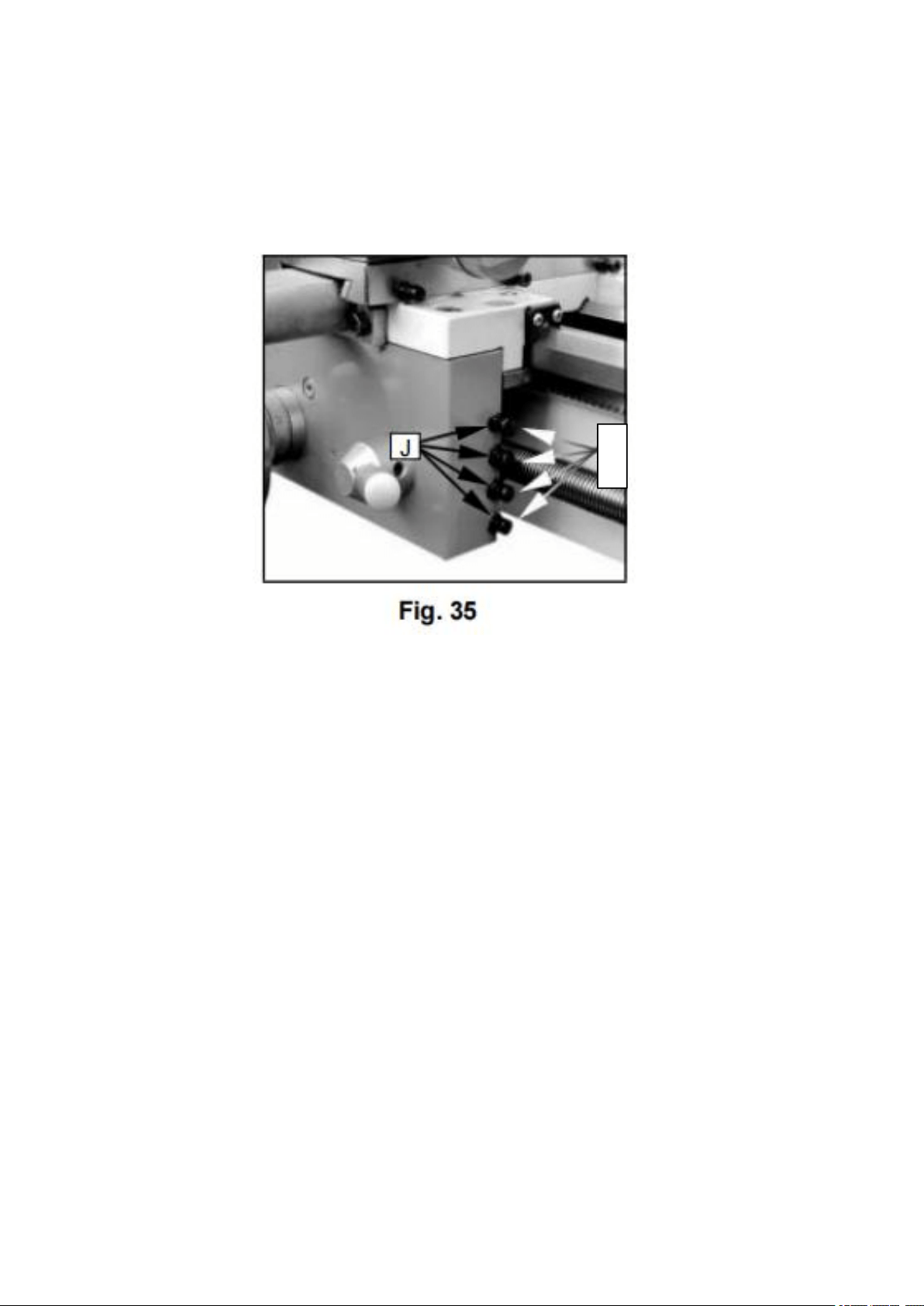
Adjustment of HaIf Nut Guide
The half nuts engagement can be adjusted with screws (I, Fig.35) fitted
with lock nuts (J, Fig.35). Loosen the nuts on the right side of the apron
and adjust the control screws until both half nuts move freely without play.
Tighten the nut.
I
- 33 -
LUBRICATION
NOTES:
Lubricate all slideways lightly before every use. Lubricate the
change gears and the lead screw slightly with grease.
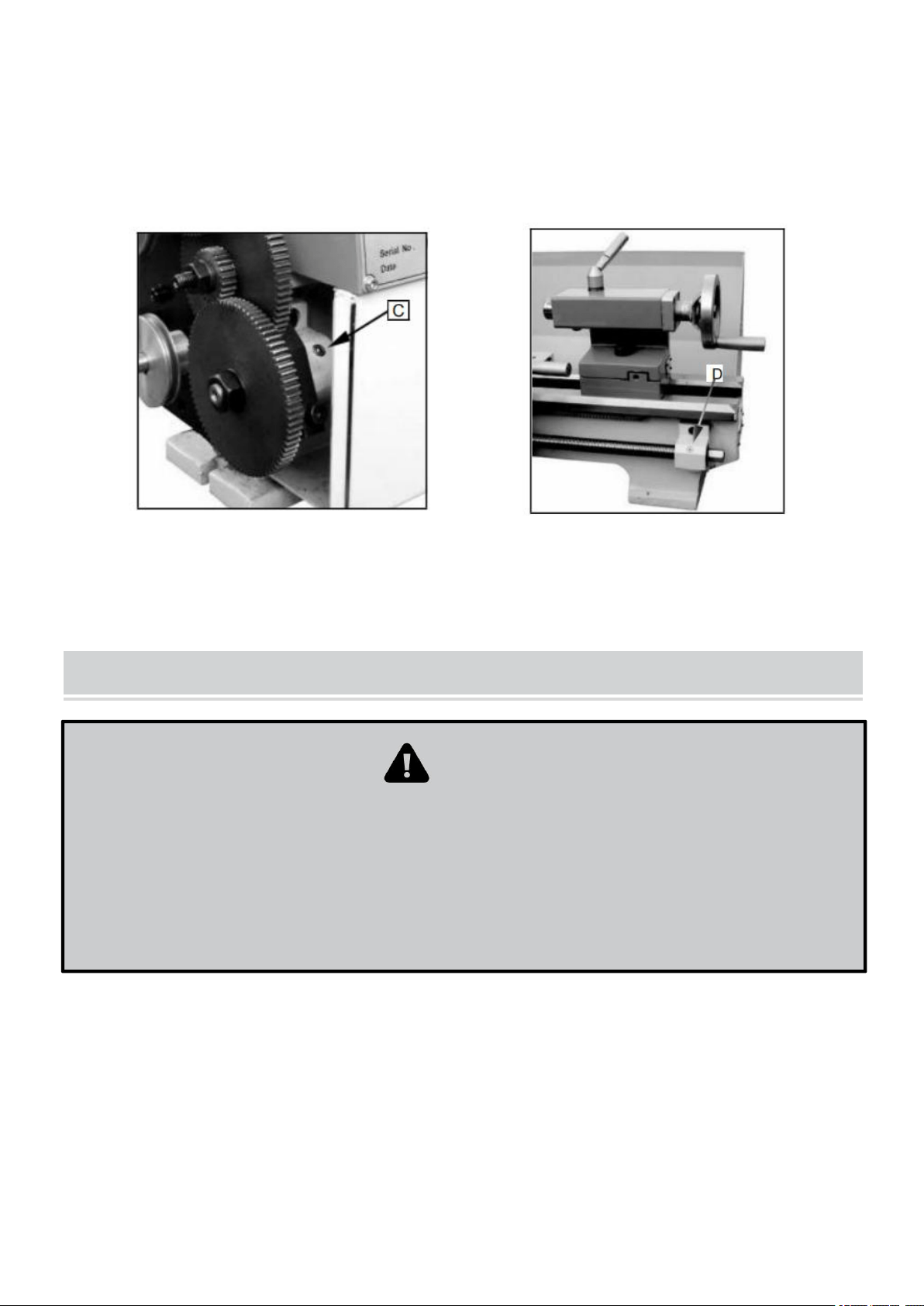
1. Carriage
Lubricate Four oil ports (A, Fig. 36) with 20W machine oil once daily.
2. Cross Slide
Lubricate two oil ports (B , Fig. 36 ) with 20W machine oil once daily.
- 34 -
3. Lead screw
Lubricate the left oil port ( C Fig. 37) and right oil port (D, Fig.38) with 20W
machine oil once daily.
Fig. 37 Fig. 38
Electricity
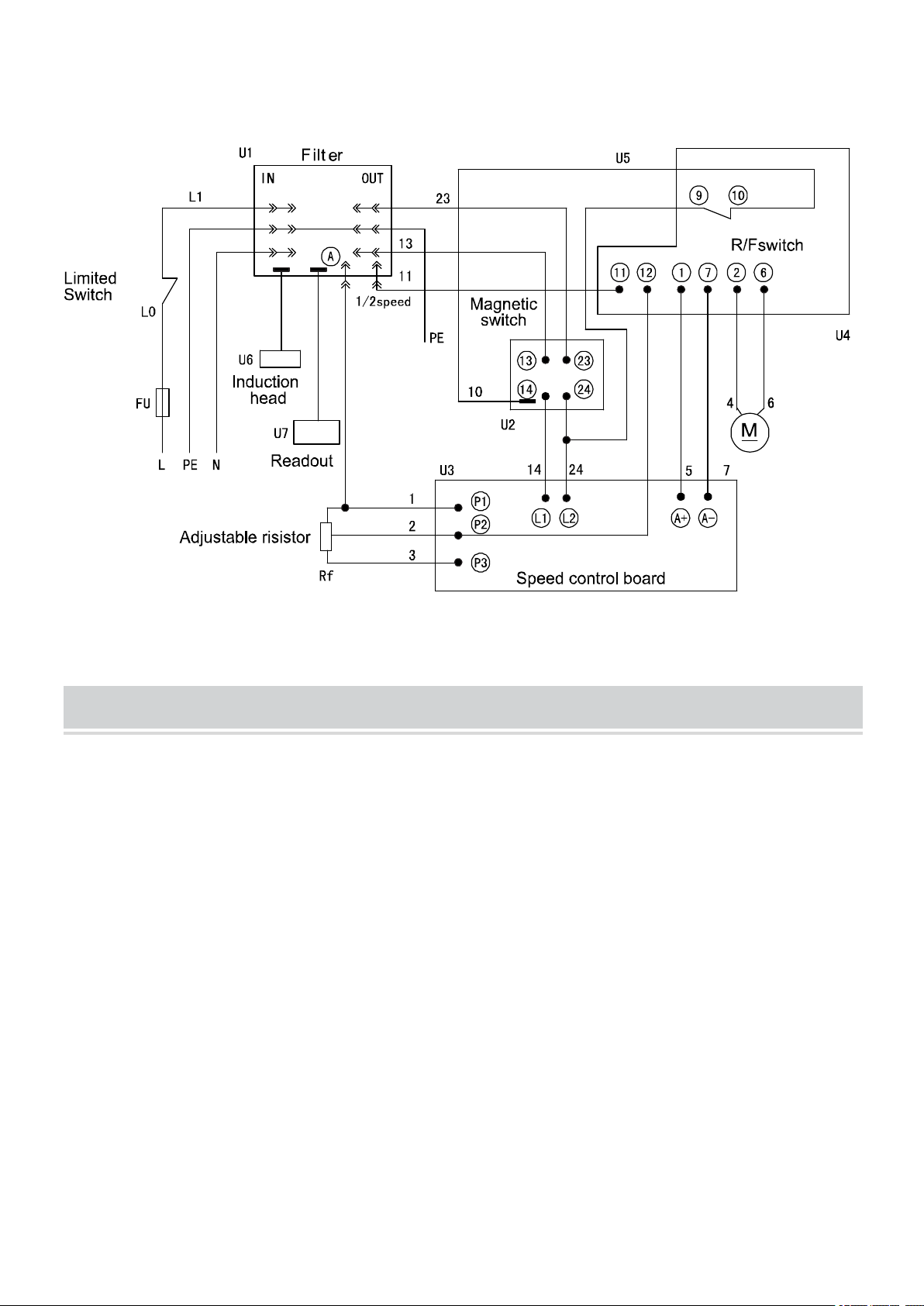
The WM210V Lathe is rated at 7 50W, 1PH, 220V only. Confirm power
available at the lathe' s location is the same rating as the lathe. Using the
wiring diagram ( Fig. 39 ) for connecting the lathe to the mains
supply. Make sure the lathe is properly grounded.
WARNING!
Connection of the lathe and all other electrical work may only be carried
out by an authorized electrician!
Failure to comply may cause serious injury and damage to the machinery
and property!
- 35 -
The following is wiring diagram of the lathe: (Fig.39)
Fig. 39
MAINTENANCE
Keep the maintenance of the machine tool during the operation to
guarantee the accuracy and service life of the machine tool.
1. In order to retain the machine's precision and functionality. it is essential
to treat it with care. Keep it clean and grease and lubricate it regularly.
Only through good care. You can be sure that the working quality of the
machine will remain constant.
NOTES: Disconnect the machine plug from the mains supply whenever
you carry out cleaning, maintenance or repair work!
Oil, grease and cleaning agents are pollutants and must not be disposed of
through the drains or in normal refuse. Dispose of those agents in
accordance with current legal requirements on the environment. Cleaning
rags impregnated with oil, grease and cleaning agents are easily

- 36 -
inflammable. Collect cleaning rags or cleaning wool in a suitable closed
vessel and dispose of them in an environmentally sound way - do not put
them with normal refuse!
2. Lubrication all slide ways lightly before every use. The change gears and
the lead screw must also be lightly lubricated with grease.
3. During the operation. The chips which fall onto the sliding surface should
be cleaned timely. and the inspection should be often made to prevent
chips from falling into the position between the machine tool saddle and
lathe bed guide way. Asphalt felt should be cleaned at certain time.
NOTES: Do not remove the chips with your bare hands. There is a risk of
cuts due to sharp edged chips. Never use flammable solvents or cleaning
agents or agents that generate noxious fumes!
Protect electrical components, such as motors, switches, switch boxes,
etc., against humidity when cleaning.
4. After the operation every day. Eliminate all the chips and clean different
parts of the machine tool and apply machine tool oil to prevent rusting.
5. In order to maintain the machining accuracy. Take care of the center.
The surface of the machine tool for the chuck and the guide way and
avoid mechanical damage and the wear due to improper guide.
6. If the damage is found. The maintenance should be done immediately.
NOTES: Repair work may only be carried out by qualified personnel with
the corresponding mechanical and electrical knowledge.

- 37 -
TROUBLE SHOOTING
Problem Possible Reason Elimination
Surface of work
piece too rough
Tool blunt Re.sharpen tool
Tool springs
Clamp tool
with less overhang
Feed too high Reduce feed
Radius at the tool tip too small Increase radius
workpiece
becomes coned
Centers are not aligned (tail stock has
offset)
Adjust tail stock to the center
Top slide not aligned well (cutting with
the top slide)
Align top slide well
Lathe is chattering
Feed too high Reduce feed
Slack in main bearing Adjust the main bearing
Center runs hot Work piece has expanded Loosen tail stock center
Tool has a short
Life
Cutting speed too high Reduce cutting speed
Cross feed too high
Lower cross
feed(finishing allowance
should not exceed 0.5mm)
Insufficient cooling More coolant
Flank
wear too high
Clearance angle too small Increase clearance angle
Tool tip not adjusted to center high
Correct height adjustment of
the tool
Cutting
edge breaks off
Wedge angle too small
(heat build.up)
Increase wedge angle
Grinding crack due to wrong cooling Cool uniformly
Excessive slack in the spindle bearing
Adjust the slack in the spindl
e bearing
Arrangement (vibrations) Arrangement
Cut thread is
wrong
Tool is clamped incorrectly
Adjust to the center
Cut thread is Been started grinding the wrong way Grind angle correctly

- 38 -
wrong Wrong pitch Adjust the right pitch
Wrong diameter
Turn the work piece to
the correct diameter
Spindle does
not activate
Emergency stop switch activated
Unlock emergency stop
switch
- 39 -
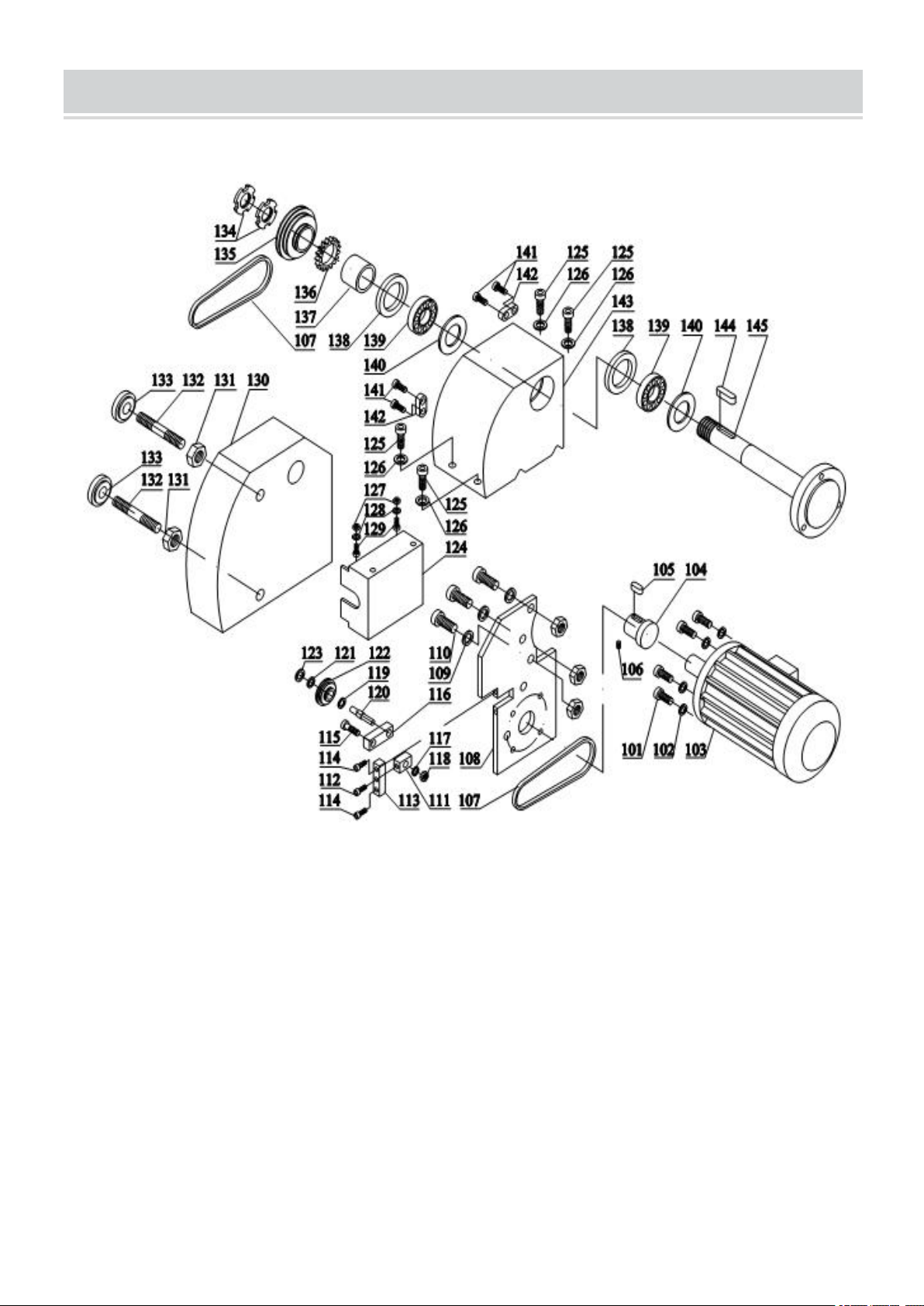
BREAKDOWN DIAGRAM AND PARTS LIST
Headstock Assembly

- 40 -
Parts
No.
Description specification Qty Parts
No.
Description specification Qty
101 Screw M5x25 4 123 Spring Ring
φ 22xl
l
102 Washer 4 124 Cover l
103 DC Motor 83ZY005A l 125 Screw M8x25 4
104 Motor Puller l 126 Washer 8 4
105 Key A4x4x20 l 127 Nut M8 2
106 Screw M6x8 l 128 Washer 8 2
107 Belt Gates-5M- 360 2 129 Screw M8 2
108 Bracket Plate l 130 Belt Cover l
109 Washer 8 3 131 Nut Ml0 2
110 Screw M8x20 3 132 Bolt Ml0x80 2
111 Block l 133 Nut Ml0 2
112 Screw M6x30 l 134 Nut M27xl 2
113 Block l 135 Spindle Puller l
114 Screw M6x20 l 136 Gear 40T l
115 Bolt l 137 Separator l
116 Block l 138 Gasket l
117 Washer l 139 Bearing 30206 l
118 Nut l 140 Grease Cover l
119 Spring Ring
φ8x0.8
l 141 Screw M4xl0 2
120 Bolt l 142 Block l
121 Bearing l 143 Headstock l
122 Pulley l 144 Key A3x3xl5 l
- 41 -
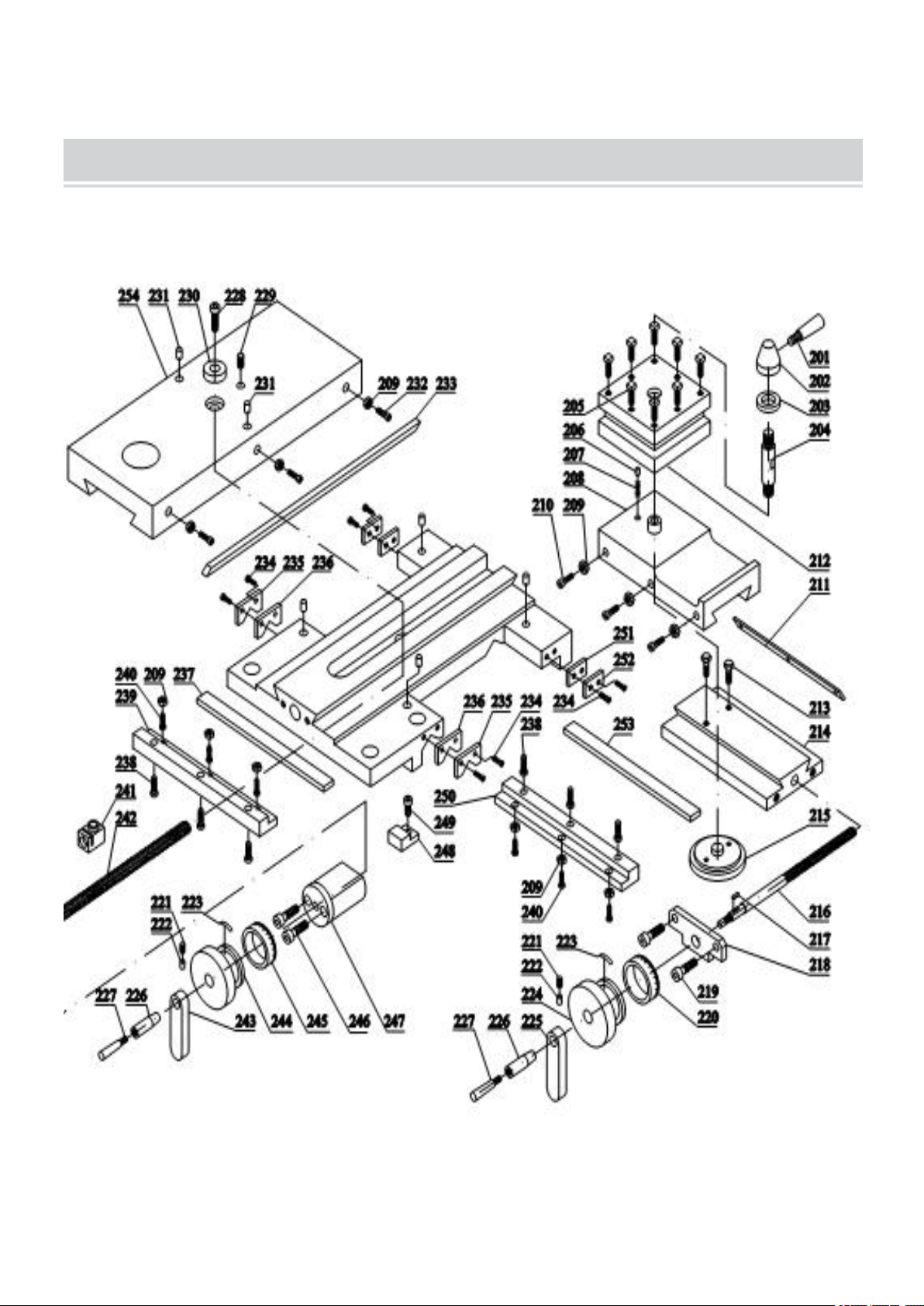
BREAKDOWN DIAGRAM AND PARTS LIST
Top slide, Cross slide, Carriage Assembly

- 42 -
Parts
No.
Description Specification Qty Parts
No.
Description Specification Qty
201 Handle 1 228 Screw M4x8 1
202 Handle Base 1 229 Screw M5x10 1
203 Washer 1 230 Bush 1
204 Bolt 1 231 oil Cup
Ф5
2
205 Screw M6x25 1 232 Screw M4x20 3
206 Pin 1 233 Gib 1
207 Spring 5x10x1 1 234 Screw 8
208 Longitudinal Slid
e
1 235 Wiper Cover 2
209 Nut M4 9 236 Wiper 2
210 Screw M4x14 3 237 Gib 1
211 Gib 1 238 Screw 6
212 Top Rest 1 239 Sliding Block 1
213 Screw M5x30 1 240 Screw M4x10 6
214 Swivel Base M6x20 1 241 Nut 1
215 Micrometer Pan 1 242 Lead Screw 1
216 Lead Screw 1 243 Handle Block 1
217 Key 3x12 1 244 Handle wheel 1
218 Bracket 1 245 Collar 1
219 Screw M5x12 2 246 Screw M6x50 2
220 Collar 1 247 Bracket 1
221 Screw 2 248 Clamping Plate 1
222 Pin 2 249 Screw 1
223 Spring 2 250 Sliding Block 1
224 Hand wheel 1 251 Wiper 2
225 Handle Block 1 252 Wiper Cover 2
226 Handle Sleeve 2 253 Gib 1
227 Handle 2 254 Cross Slide 1
- 43 -
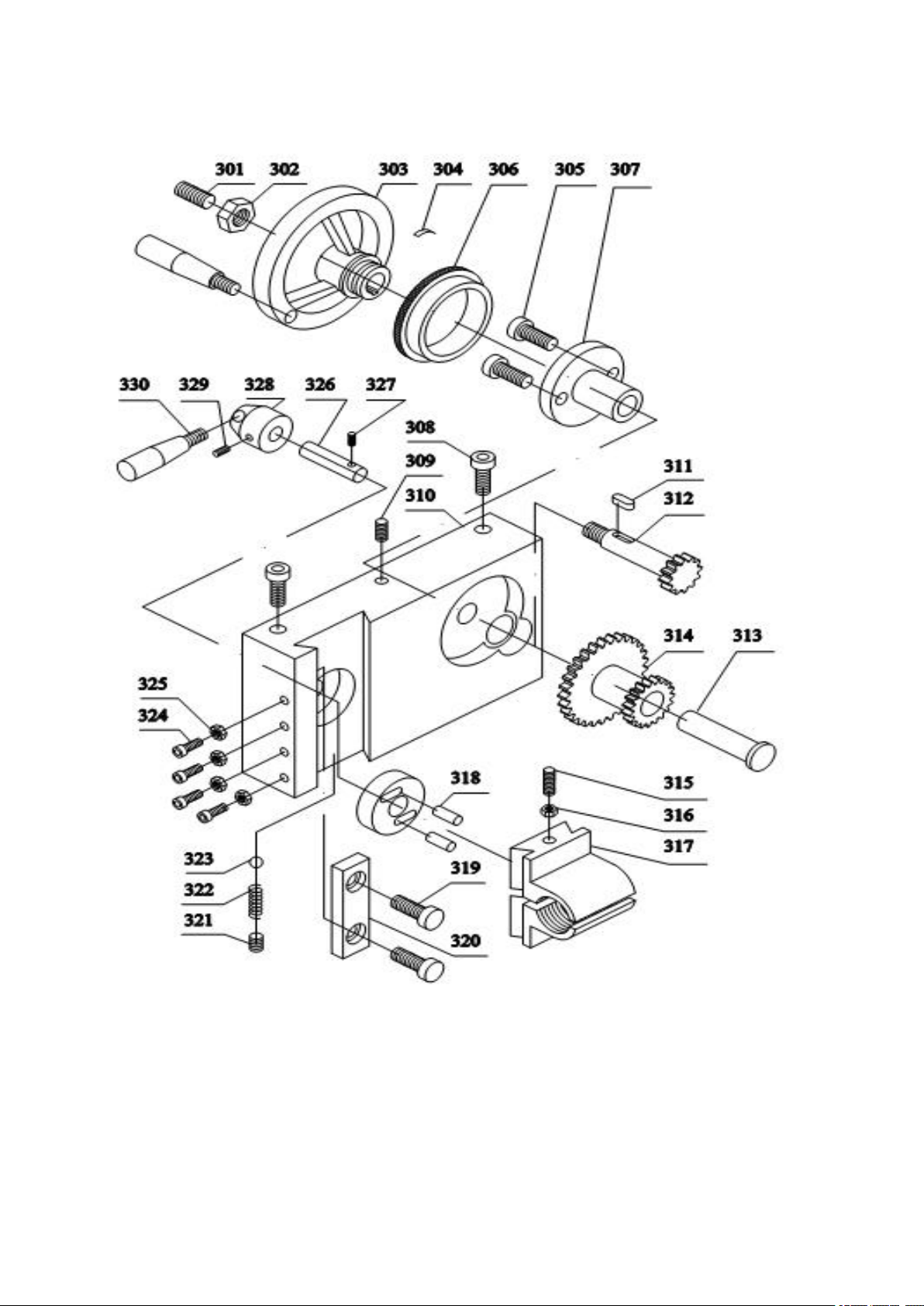
Apron Assembly

- 44 -
Parts
No.
Description Specification Qty Parts
No.
Description Specification Qty
301 Screw M8x8 1 317 Half Nut 1
302 Nut M8 1 318 Pin 4x10 1
303 Hand wheel 1 319 Screw M4x10 2
304 Spring 1 320 Block 1
305 Screw M5x10 2 321 Screw M6x8 1
306 Collar 1 322 Spring 0.6x 3.5x12 1
307 Bracket 1 323 Ball
4.5
2
308 Screw M8x25 2 324 Screw M4x12 4
309 Screw M5x8 1 325 Nut M4 1
310 Apron 1 326 Shaft 1
31 1 Key A3x3x8 1 327 Pin
3x30
2
312 Gear Shaft 14T 1 328 Hand Base 1
313 Shaft 1 329 Screw M5X6 1
314 Gear 44/2It 1 330 Handle 1
315 Screw M4x35 1 331 Handle 1
316 Nut M4 1 317 Half Nut 1
- 45 -
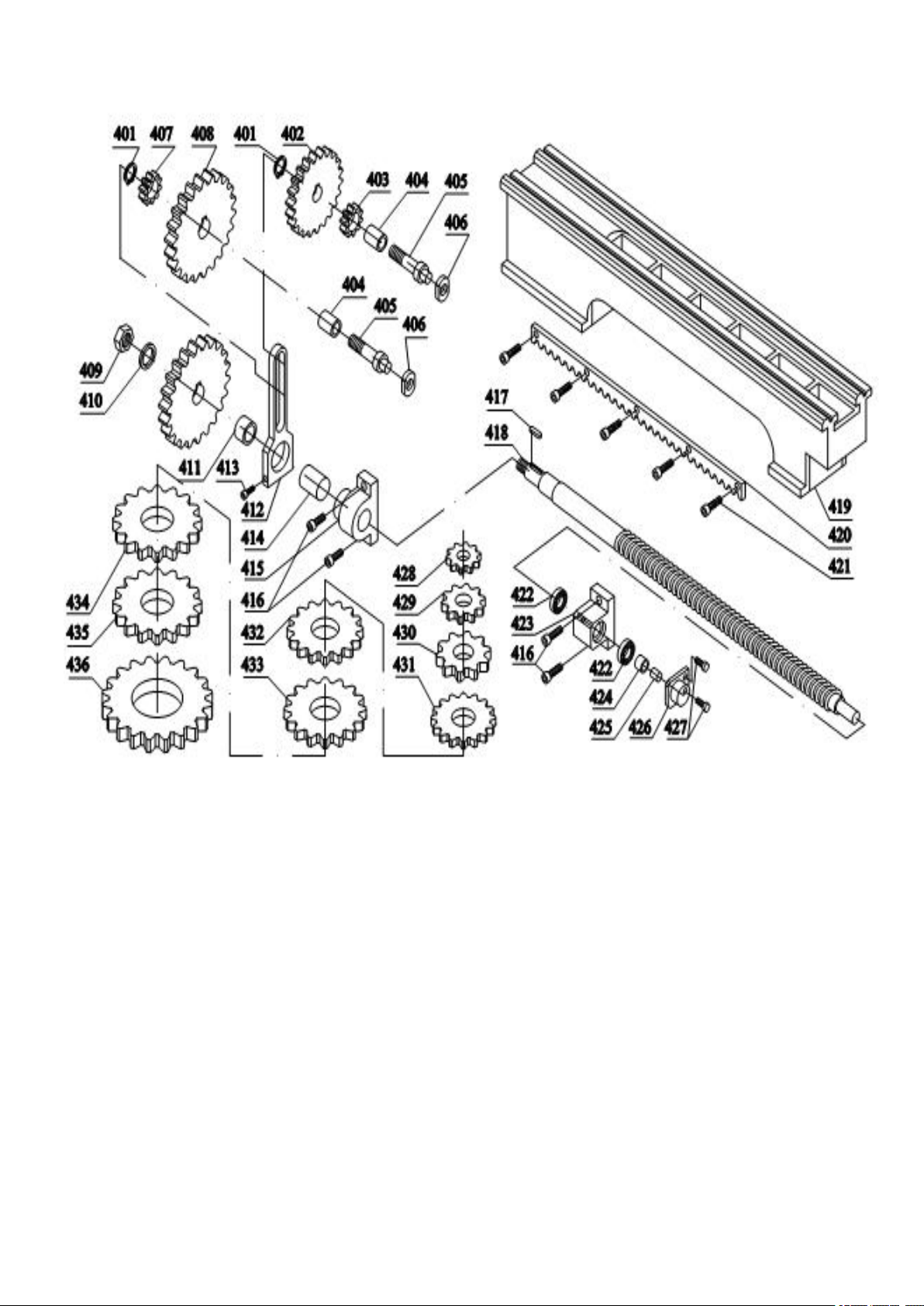
Bed, hanging wheel parts Abssemaly

- 46 -
Parts
No.
Description Specification Qty Parts
No.
Description Specification Qty
401 Spring Ring 2 419 Bed 1
402 Gear 60T 1 420 Rack 1
403 Gear 20T 1 421 Screw M2x12 5
404 Bush 1 422 Bearing 51100 2
405 BoIt 1 423 Right Support 1
406 Nut M8 1 424 Nut 1
407 Gear 24T 1 425 Screw M8x6 1
408 Gear 80T 1 426 Cover 1
409 Nut M10 1 427 Screw M4x12 2
410 Washer 10 1 428 Gear 25T 1
411 Bush 1 429 Gear 30T 1
412 Frame 1 430 Gear 33T 1
413 Screw M6x35 1 431 Gear 35T 1
414 Bush 1 432 Gear 40T 1
415 Left Support 1 433 Gear 45T 1
416 Screw M6x14 2 434 Gear 50T 1
417 Key A3x3x16 1 435 Gear 52T 1
418 Lead Screw 1 436 Gear 66T 1
- 47 -
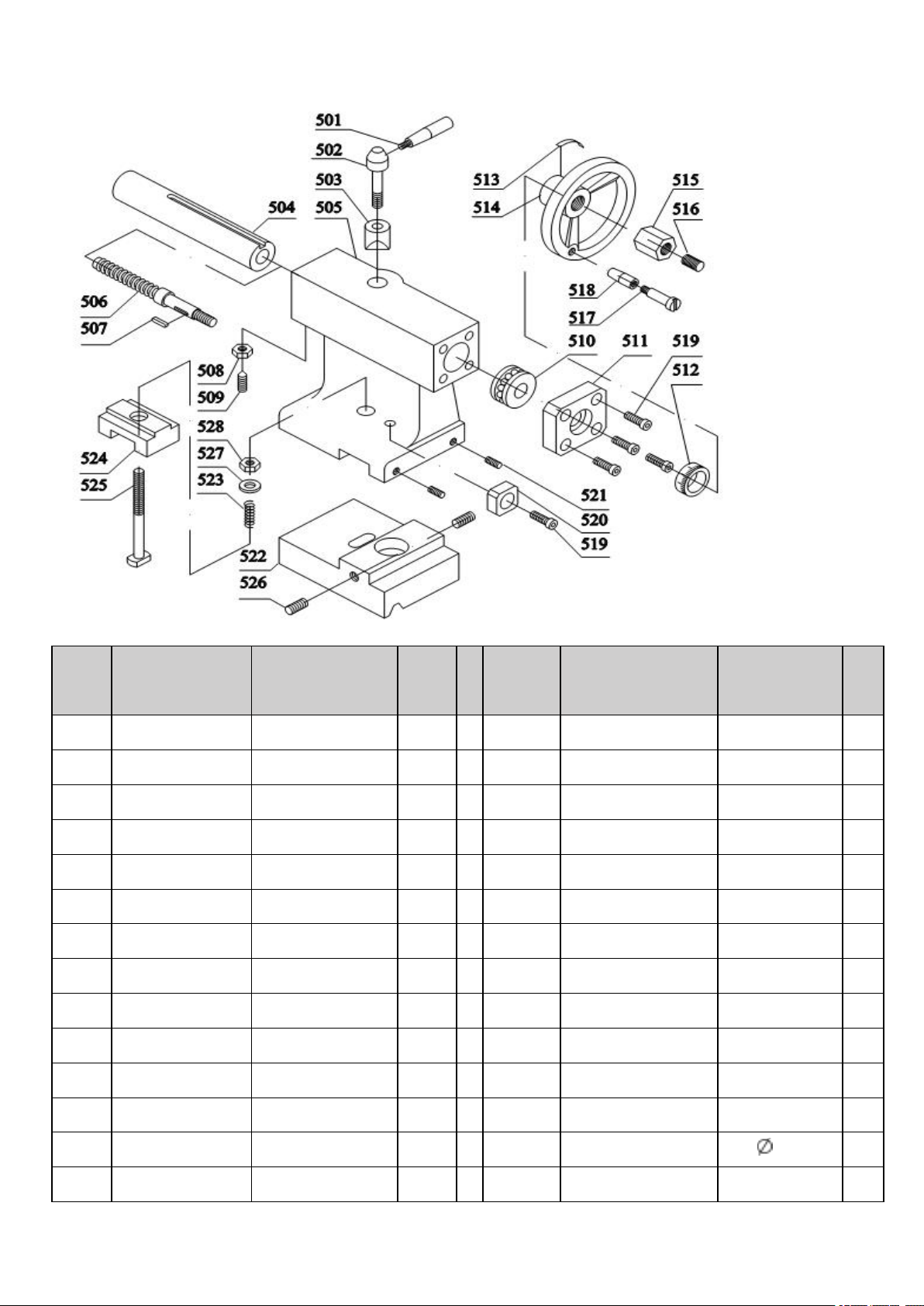
tail stock Assembly
Parts
No.
Description Specification Qty Parts
No.
Description Specification Qty
501 Handle 1 515 Nut M8 1
502 Handle Base 1 516 Screw M8x6 1
503 Lock Base 1 517 Handle Screw 1
504 Sleeve 1 518 Handle Sleeve 1
505 tail stock 1 519 Screw M5x12 1
506 Lead Screw 1 520 Adjustment Block 1
507 Key A3x3x8 1 521 Screw M6x12 1
508 Nut M6 1 522 Base 1
509 Screw M6x14 1 523 Spring 1
510 Bearing 51100 1 524 Clamping Plate 1
511 Housing 1 525 Bolt M10x70 1
512 Collar 1 526 Screw M6x16 2
513 Spring 1 527 washer
10
1
514 Hand wheel 1 528 Nut M10 1

- 48 -
Importer: WAITCHX
Address: 250 bis boulevard Saint-Germain 75007 Paris
Importer: FREE MOOD LTD
Address: 2 Holywell Lane, London, England, EC2A 3ET
Manufacturer: Anhui Chizhou Weiss E&M Co. , Ltd.
Address:8#, Jintong Road, Chizhou Economic and Technological
Development Zone, Chizhou City, Anhui, P,R.China
Made In China
REPUK
EUREP UK LTD
UNIT 2264, 100 OCK STREET, ABINGDON
OXFORDSHIRE ENGLAND OX14 5DH
REPEC
EUREP GmbH
Unterlettenweg 1a, 85051
Ingolstadt, Germany

- 49 -