
Technical Support and E-Warranty Certificate
www.vevor.com/support
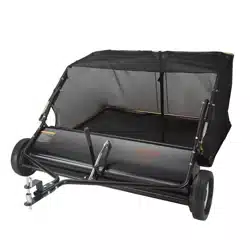
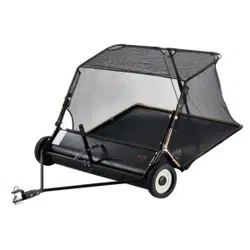
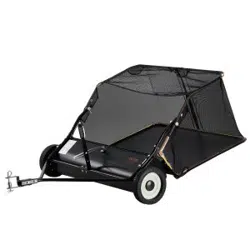
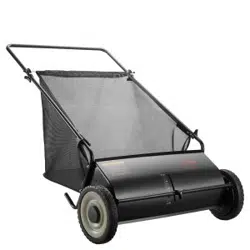
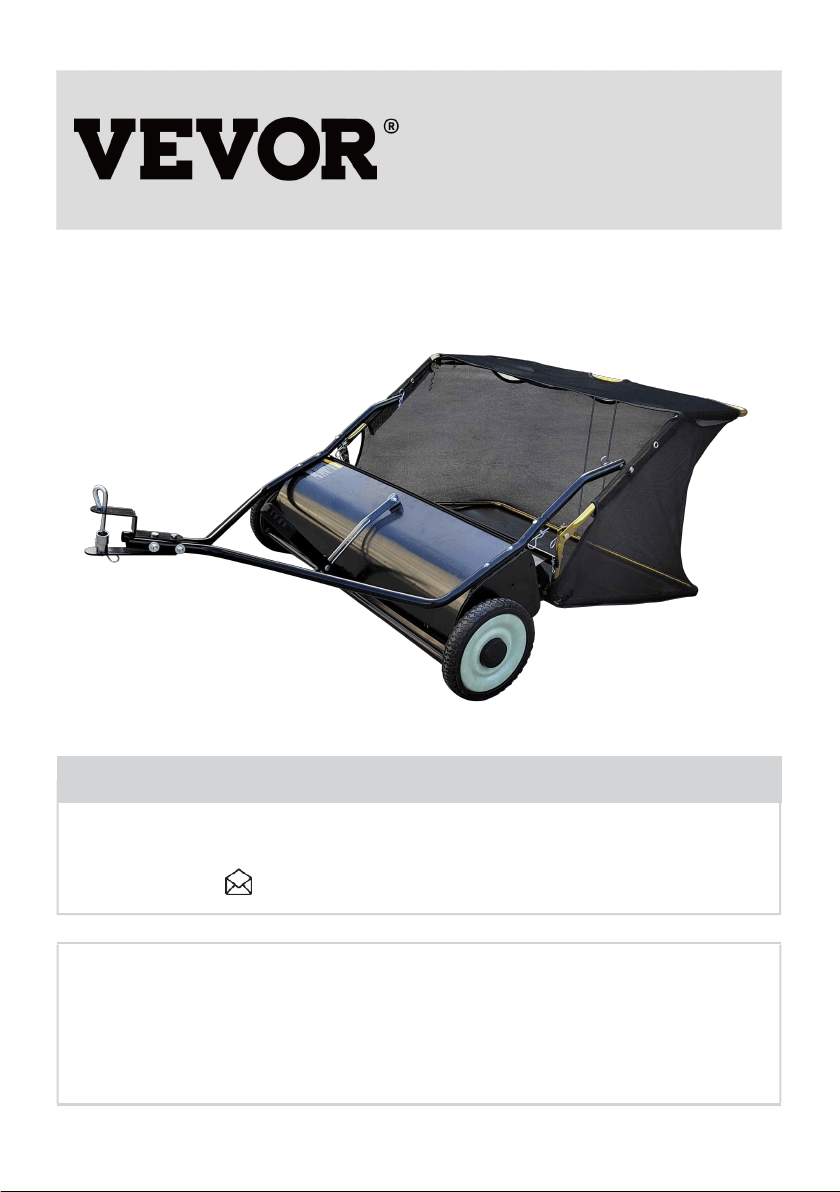
LAWN SWEEPERS
USER MANUAL
We continue to be committed to offering tools at competitive prices. "Save Half", "Half Price",
or any other similar expressions used by us only represent an estimate of savings you might
benefit from buying certain tools with us compared to the major top brands and do not
necessarily mean to cover all categories of tools offered by us. You are kindly reminded to
verify carefully when placing an order with us if you are saving half in comparison with the top
major brands.
1
GT1112
GT1113
Have product questions? Need technical support? Please feel free to
contact us:
CustomerService@vevor.com
NEED HELP? CONTACT US!
This is the original instruction, please read all manual instructions carefully
before operating. VEVOR reserves a clear interpretation of our user manual. The
appearance of the product shall be subject to the product you received. Please
forgive us that we won't inform you again if there are any technology or software
updates on our product.
LAWN SWEEPERS

2
Table of Contents
General Warnings and Rules..............................................................3, 4
Controls and Features Identification.................................................... 5
Component & Hardware..................................................................... 6, 7
Assembly Instructions.................................................8, 9, 10, 11, 12, 13
Operation Instructions.......................................................................... 14
Maintenance and Storage................................................................15, 16
Specifications.........................................................................................17
Parts Drawing & Parts List....................................................18,19, 20, 21

3
GENERAL WARNINGS
READ and UNDERSTAND this manual completely before using the Lawn
Sweeper.
The operator must read and understand all safety and warning information,
operating instructions, maintenance and storage instructions before operating this
equipment. Failure to properly operate and maintain the lawn sweeper could
result in serious injury to the operator or bystanders.
Operation Warnings
· Do not at any time carry passengers, sit or stand on the lawn sweeper.
· Do not allow children to play on, stand upon or climb on the lawn sweeper.
· Always inspect the sweeper before using it to ensure it is in good working
condition.
· Replace or repair damaged or worn parts immediately.
· Always check and tighten the hardware and assembled parts before operation.
· Never attach the hopper rope to any part of your body or clothing.
· Never hold onto the rope while towing the sweeper.
· Only attach the rope to the tow vehicle to keep it away from the wheels and
moving parts.
· Avoid large holes and ditches when operating the equipment.
· Be careful when operating the sweeper on steep grades (hills).
· Always operate up and down the slope, never across the face of the slope.
· Always operate at reduced speed in rough terrain, along creeks, ditches and on
hillsides.
· Do not operate close to creeks, ditches and public highways.
· To avoid personal injury and/or equipment damage, DO NOT EXCEED 5MPH.
· Always use caution when loading and unloading the hopper.
· Only tow with recommended vehicles (Lawn/Garden Tractors and ATVs).
· Always refer to the vehicle owner’s manual for proper towing.
· The sweeper is not designed to be used with zero-turn mowers.
· Always secure and lock the sweeper to the vehicle hitch before operating.

4
Crush and Cut Hazards
· Always keep hands and feet clear from moving parts while operating the
equipment.
· Always clear and keep the work area clean when operating.
· Always wear safety gear, eye protection, gloves and work boots when operating
the sweeper.
WARNING
The warnings, cautions, and instructions outlined in this instruction manual cannot
cover all possible conditions or situations that may occur. It must be understood
by the operator that common sense and caution are factors that cannot be built
into this product and must be supplied by the operator.
PROP 65 WARNING
This product can expose you to chemicals including lead and lead compounds
which are known to the state of California to cause cancer and birth defects, or
other reproductive harm. For more information, go to www.P65Warnings.ca.gov.
Assembly Is Required
This product requires assembly before use. See the “Assembly” section for
instructions. Because of the weight and/or size of the lawn sweeper, it is
recommended that another adult be present to assist with the assembly.
INSPECT ALL COMPONENTS closely upon receipt to make sure no
components are missing or damaged.

5
Hazard Signal Word Definitions
This is the safety alert symbol. It is used to alert
you to potential personal injury hazards. Obey all
safety messages that follow this symbol to avoid
possible injury or death.
DANGER
DANGER indicates an imminently hazardous
situation which, if not avoided, will result in death
or serious injury.
WARNING
WARNING indicates a potentially hazardous
situation which, if not avoided, could result in
death or serious injury.
CAUTION
CAUTION indicates a potentially hazardous
situation which, if not avoided, may result in minor
or moderate injury.
CAUTION
CAUTION used without the safety alert symbol
indicates a potentially hazardous situation which,
if not avoided, may result in property damage.
ABOUT YOUR TOW-BEHIND LAWN SWEEPER
This heavy-duty tow-behind lawn sweeper makes yard work a breeze.
The steel and nylon construction is durable and lightweight, making it wear- and
rust-resistant, easy to tow, and easy to clean. The extra large sweeping span
makes the job easy and saves time when cleaning different types of debris from
grass clippings, twigs, and leaves, to paper and much more. The tow-behind
sweeper features a one-handed lever to adjust the brush height. It can be stored
in a shed or garage with minimal space. The large hopper makes loading and
unloading fast and convenient.
Technical specifications on the lawn sweeper are provided in the “Specifications”
section of this manual.

6
Controls and Features Identification
Read this owner’s manual before operating the equipment. Familiarize yourself
with the location and function of the controls and features. Save this manual for
future reference.
1) Hand Lever – Adjust the Brush Height.
2) Nylon Hopper – Holds all types of Debris.
3) Tires / Wheel – Semi pneumatic all-terrain tires.
4) Hitch – Pin-type design used only with approved vehicles.
CAUTION
Read and follow all instructions for assembly and operation. Failure to properly
assemble this equipment could result in serious injury to the user or bystanders,
or cause equipment damage.
LAWN SWEEPER COMPONENT PARTS AND ASSEMBLY
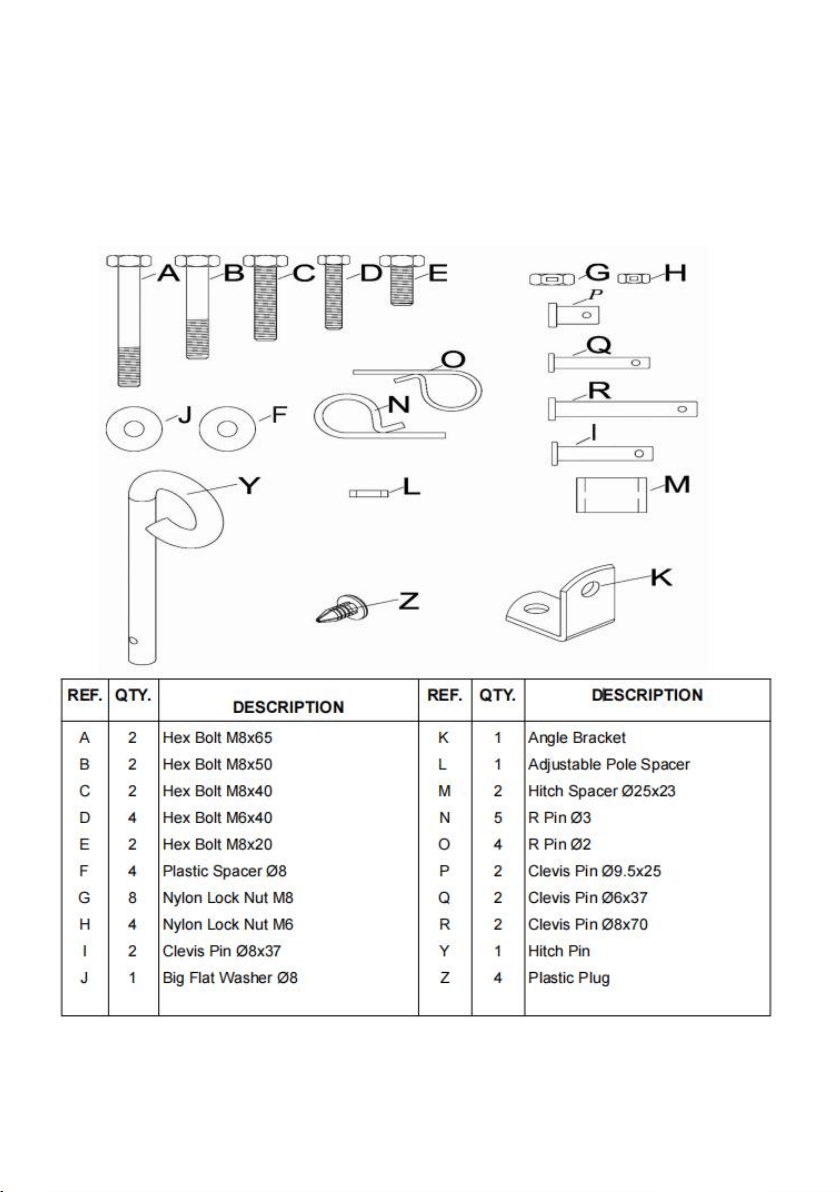
Before assembling the sweeper according to steps 1 to 8, take all parts out of the
shipping crate and inspect components to ensure there are no missing pieces.
7
TOOLS REQUIRED
10, 13 & 14mm Wrenches
Pliers
Component and Hardware Parts

8
Component and Hardware Parts

9
Assembly Instructions
STEP 1: Mount Angle Bracket
Attach the (K) angle bracket to the sweeper housing using an E hex bolt (M8x20)
and a G nut (M8). Tighten securely.
NOTE: Before tightening, make sure the angle bracket is aligned straight
with the sweeper housing, as shown in the diagram.
NOTE: Right Hand (RH) and Left Hand (LH) refer to the drivers’ orientation
when operating the vehicle.
STEP 2: Attach Hitch Tubes
Attach the right-hand (RH) and left-hand (LH) hitch tubes to the sweeper housing
assembly using a D hex bolt (M6x40) and an H nut (M6). Tighten loosely.

10
STEP 3: Secure Hitch Tubes Together
Once the Hitch tube is attached, pass two A hex bolts (M8x65 ) through the
hitch-end (away from the sweeper body of the tubes to connect them together
with two G nuts (M8). Tighten loosely.
STEP 4: Mount Hitch Assembly to Hitch Tubes
Attach the Hitch assembly in the following order:(see figure A)
A) Mount the angled hitch bracket on top of the hitch tubes, with the straight hitch
bracket on the bottom.
B) Pass two B hex bolts (M8X50) through the angled hitch bracket, premade
notches in the hitch tubes, straight hitch bracket,and tighten loosely with two G
nuts(M8).
C) Finally, pass the Y hitch pin through the angled hitch bracket, (M) hitch spacer
Ø25x23, and straight hitch bracket, and fasten with N R pin (Ø3)
NOTE: If your vehicle’s tow hitch is between 8’’ and 10’’, mount the angled
hitch bracket on the bottom of the hitch tubes for best performance (figure
B). For vehicles 11’’ and higher, see figure A.
11
STEP 5: Tighten all nuts and bolts from Steps 2 through 4.
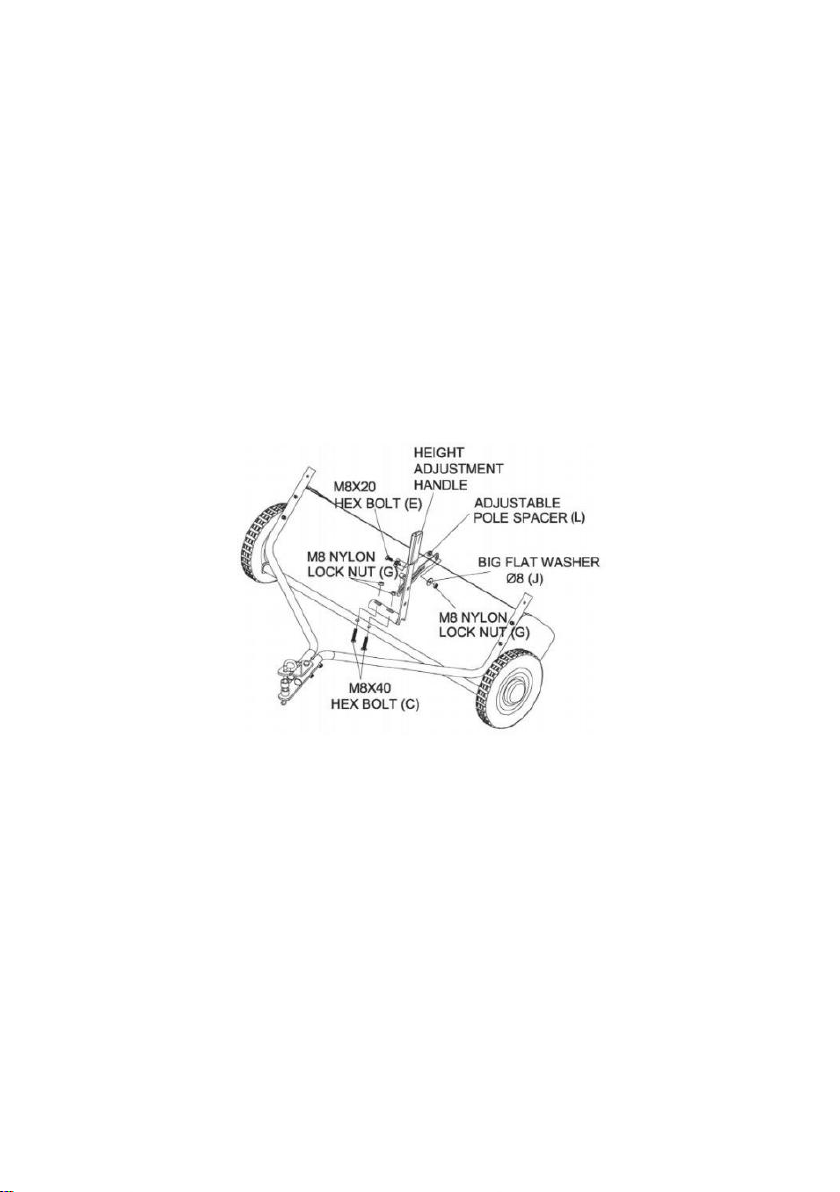
- 9 -STEP 6: Attach Height Adjustment Handle
A) Mount the height adjustment handle onto the height adjustment bar. (The
height adjustment bar is located outside of the sweeper housing assembly,
spanning the wheels.) Use two C hex bolts (M8x40), G nuts (M8) to firmly attach
the handle assembly to the bar.
B) Attach the height adjustment strap to the angle bracket (mounted in Step 1).
Align the round hole in the height adjustment strap with the angle bracket. In the
following order, pass an E hex bolt (M8x20) through the angle bracket, the L
adjustable pole spacer, the height adjustment strap, and the J big flat washer (Ø8).
Tighten securely with a G nut (M8).
STEP 7: Assemble Hopper Bag
A) Unroll the hopper bag and place it on the ground so that the nylon fabric is on
the top and the heavy-duty nylon floor is on the bottom.
B) Inspect the first rear hopper tube (#15) and locate the brace holes. Pass the
tube through the sewn-in bag loops at the top of the inside of the hopper bag so
that the brace holes face downward.

12
C) Pass the upper hopper side tubes through the stitched sleeves on either side
of the nylon fabric. On each side, insert the upper hopper side tube into the rear
hopper tube, oriented downwards, and fasten plastic plugs (Z).
D) Place the second rear hopper tube on the heavy-duty nylon floor of the hopper,
with the brace holes facing upward.
E) On each side, insert the lower hopper side tubes, oriented upwards, into the
(lower) rear hopper tube, and fasten with plastic plugs (Z).

13
F) On either side, align the ends of the upper and lower hopper side tubes and
fasten these together with P clevis pins (Ø9.5x25). Secure with N R Pins (Ø3).
G) Locate the stitched sleeve at the front edge of the bag floor. Insert the bag
frame strap into the sleeve. (In some models, the bag frame strap is already
inserted into the sleeve.)
H) Once inserted, mount the bag frame strap onto the lower hopper side tubes
using Q clevis pins (Ø6X37). Secure with O R Pins (Ø2).

14
I) Locate the snap buttons on the nylon fabric. Snap them into the rivets on the
heavy-duty nylon floor of the hopper.
CAUTION
Do not over-stress (bend) the support rods while installing. Over stressing causes
the steel rods to bend and lose supporting tension.
J) Insert the two hopper support rods into the brace holes in the upper and lower
rear hopper tubes (#7). The hopper assembly is now complete.

15
STEP 8: Attach Hopper Bag to Sweeper
A) In each upper hopper side tube, there are two holes in the bar. Locate the
lower hole, and pierce the nylon fabric at the location of the lower hole. Note:
some models have rivets in the fabric and do not require piercing the fabric.
B) On each side, mount a bag arm tube onto the upper hopper side tube, then
insert an F plastic spacer Ø8 next to a bag arm tube, then insert an F plastic
spacer Ø8 next to each R clevis pin (Ø8X70). Secure with N R Pin (Ø3). Note the
orientation of the bag arm tube: cap upward, male end facing down.

16
C) Tie the rope to the upper hopper tube at the center of the bag frame.
D) Insert the male ends of the bag arm tubes into the hitch tubes at the back of the
sweeper housing assembly (away from the hitch). Secure using I clevis pins
(Ø8X37) and O R Pin (Ø2).

17
E) Remove brush protection boards from the inside of the sweeper housing
assembly.
F) Perform a check to see that all bolts are tightened adequately, and all pins are
mounted securely. You are now ready to use your sweeper.
Operation Instructions
WARNING
Before operating or using the sweeper, review the instructions below and the
safety information. Failure to follow these instructions may result in property
damage or injury to the operator or bystanders.
Attach the Sweeper to the Towing Vehicle
On a level surface, line up the towing vehicle with the sweeper. Use the hitch pin
and spacers to adjust the height of the tow hitch, as shown in the diagram. Once
adjusted, insert the cotter pin (R Pin Ø2) to secure the hitch pin. For best results,

18
the hopper should be level with the ground at a minimum clearance of 5”. Secure
the rope to the tow vehicle.
Adjust the height of the Brushes
Use the height adjustment handle to set the height of the brushes. For optimal
results, the brush height should be ½’’ below the tips of the grass. For sweeping
other materials, you may need to adjust the height of the brushes.
Towing the Sweeper
Your sweeper is designed to work at speeds of 5mph and lower. You may
damage the device or experience sub-optimal results if exceeding 5mph. Your
sweeper will work best on flat, smooth surfaces. If operating on a slope, always
tow the sweeper up or down the surface of the hill, not sideways along the slope.
Dumping the Hopper
When dumping the hopper, use the rope to pull the basket forward. Dump the
hopper regularly for the best performance.

19
CAUTION
Never attach the hopper rope to any part of your body or clothing.
Never hold onto the rope while towing the sweeper.
Only attach the rope to the tow vehicle to keep it away from the wheels and
rotating parts. Keep the sweeper away from fire or excessive heat will cause
damage to the brushes and bag.
Maintenance and Storage
WARNING
Improper maintenance and storage of the sweeper may void your
warranty.
MAINTENANCE
After each use, clean the material out of the hopper.
Rinse/dry inside and outside of the sweeper after each use.
Remove any material which has wrapped around the brushes.
Periodically check all fasteners for tightness.
Twice a year, apply a few drops of light multipurpose oil to the brush shaft
bearings.
Annually clean and lightly lubricate all moving parts.
Every two years, remove and clean gears and apply an even coat of light
synthetic grease.
Use a glossy enamel spray paint to touch up scratched or worn painted metal
surfaces.
Never exceed the hopper load capacity rating cause it will damage the bag.
Rinse/dry inside and outside of the sweeper after each use.
Regularly grease axle and wheel bearing area or when needed.
Periodically check all fasteners for tightness.
LUBRICATION
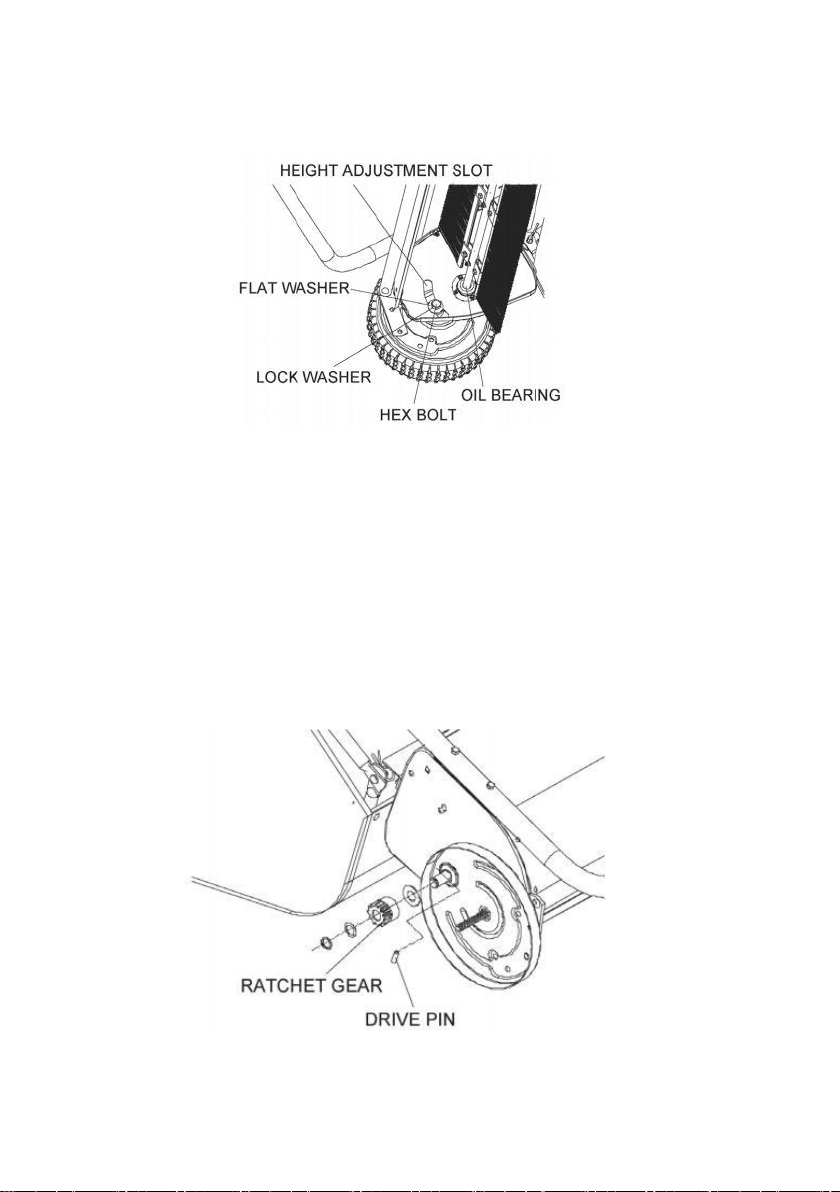
The bearings in the sweeper have been pre-lubricated at the factory; however, it
is recommended that a few drops of light multipurpose oil should be added to the
20
brush shaft bearings twice a year. Also, the wheels should be removed to clean
gears every two years. After cleaning, apply an even coat of light synthetic
grease.
NOTE: To remove the wheel, use a screwdriver to pop off the hubcap, and
remove the lock nut and washer.
WHEEL GEARS/PAWL SERVICE
DO NOT remove both wheels at the same time. Remove one wheel at a time to
prevent using the wrong parts for the opposite side (left and right sides are
different). When removing gears, make notes on the position of all washers and
other parts.
BRUSH REPLACEMENT

21
1. Remove the hopper bag from the lawn sweeper.
2. Only replace one brush at a time.
3. Tip the sweeper forward on housing. Do not remove the hex bolts from double
brush retainers.
4. Loosen hex bolts and hex lock nuts from single brush retainers. Slide brush out
of retainers, making a note of over-lap bristles position.
5. Install the new brush, and make sure the over-lap bristles are in the position as
before.
IMPORTANT:
If a part needs replacement, only use parts that meet the manufacturer’s
specifications. Replacement parts that do not meet specifications may result in a
safety hazard or poor operations.
WARNING
Before storing the sweeper, always empty the hopper bag to avoid
spontaneous combustion.
STORAGE
Empty the hopper bag before storing the sweeper.
Clean the sweeper and hopper thoroughly to help prevent rust and mildew.
Before storing, make sure the sweeper is clean and dry for years of trouble-free
service.

22
Collapse the hopper bag for storage, and remove the two support rods from the
rear of the hopper.
Lightly lubricate all sweeper surfaces and moving parts to prevent rust.
Store indoors or protected areas during severe weather and winter months.
Specifications
Frame Construction.....................................................................................Steel
Hopper Construction.........................................................................Nylon Mesh
Hitch Type............................................................................................ Pin Style
Wheel Type.............................................................................. Semi-Pneumatic
38’’ Lawn Sweeper Wheel Size......................................................................10”
42’’ Lawn Sweeper Wheel Size...................................................................10.5”

23
Parts Drawing & Parts List

24
Parts Drawing & Parts List

25

26

Technical Support and E-Warranty Certificate
www.vevor.com/support