Manufactured by
Water Channel Partners
1890 Woodlane Drive
Woodbury, MN 55125
How to install, operate
and maintain your
Reverse Osmosis Drinking
Water Filtration System
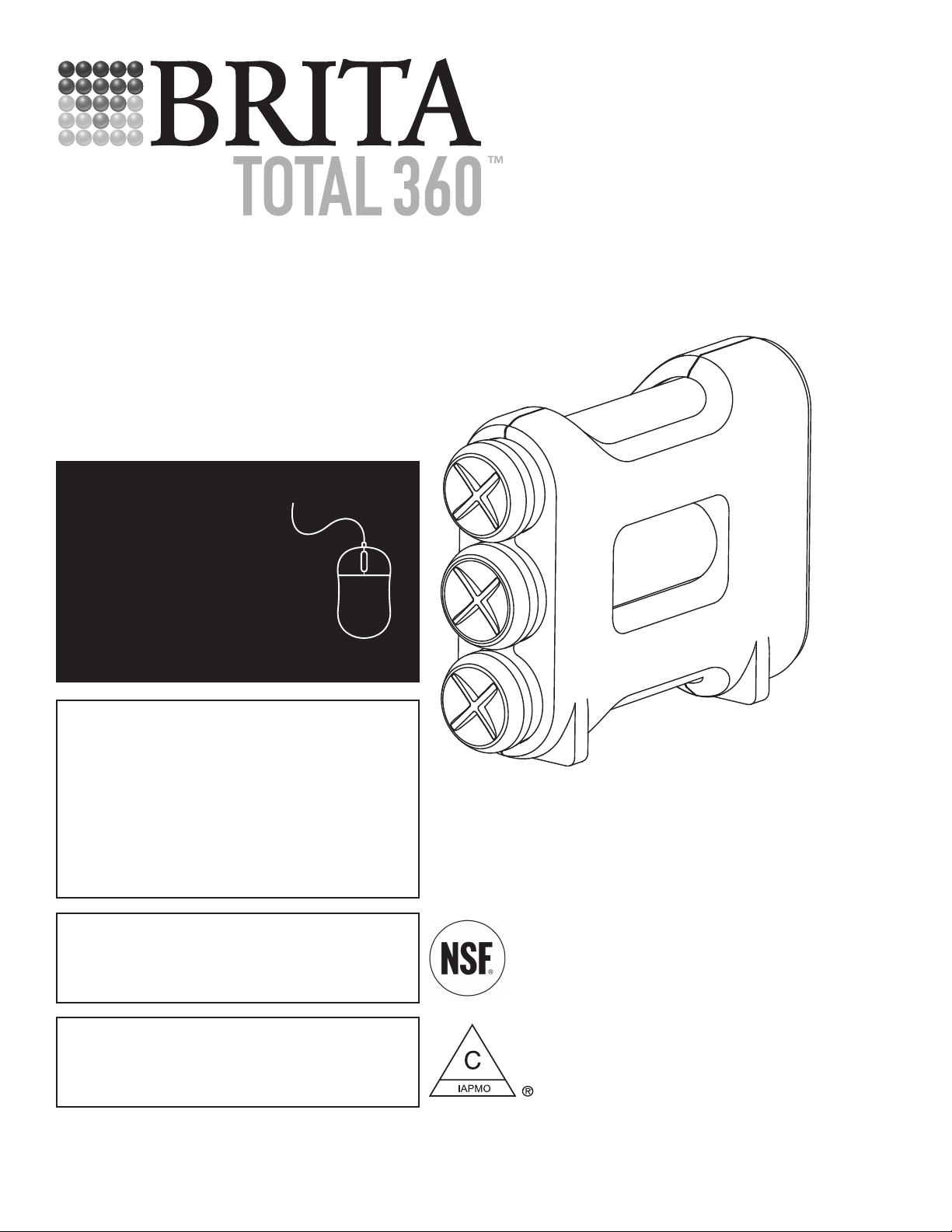
Model BRDROS
Installation and Operation Manual
If you have any questions or concerns when
installing, operating or maintaining your water
filtration system, call our toll free number:
1-800-218-6172
or visit www.ecopurehome.com/brita
When you call, please be prepared to provide
the model number and date code of your
product, found on the rating decal on back.
System tested and certified by NSF International
against NSF/ANSI Standards 58 and 42 for the
reduction of claims as specified in the
performance data on page 24.
PRODUCT AND WARRANTY
REGISTRATION
Register your product
online to validate and
extend your warranty.
See warranty page for
details.
warranty.ecopurehome.com/brita
7379599 (Rev. E 11/1/23)
System certified by IAPMO R&T against
NSF/ANSI Standards 42, 53, 58, 401 and 473
for the reduction of claims as specified in the
performance data on pages 24-26.

TABLE OF CONTENTS
Page
Specifications & Dimensions . . . . . . . . . . . . . . . . . . . . . . . . . . . . . . . . . . . . . . . . . . . . . . . . . . . . . . . . . . . . . . . . . . . 3
Inspect Shipment . . . . . . . . . . . . . . . . . . . . . . . . . . . . . . . . . . . . . . . . . . . . . . . . . . . . . . . . . . . . . . . . . . . . . . . . . . . . 4
Tools Needed . . . . . . . . . . . . . . . . . . . . . . . . . . . . . . . . . . . . . . . . . . . . . . . . . . . . . . . . . . . . . . . . . . . . . . . . . . . . . . 4
Plan Your Installation . . . . . . . . . . . . . . . . . . . . . . . . . . . . . . . . . . . . . . . . . . . . . . . . . . . . . . . . . . . . . . . . . . . . . . . . . 5
Overview & Site Preparation . . . . . . . . . . . . . . . . . . . . . . . . . . . . . . . . . . . . . . . . . . . . . . . . . . . . . . . . . . . . . . . . . . . 6
Installation Instructions . . . . . . . . . . . . . . . . . . . . . . . . . . . . . . . . . . . . . . . . . . . . . . . . . . . . . . . . . . . . . . . . . . . . . 7-15
Step A - Install Cold Water Supply Fitting . . . . . . . . . . . . . . . . . . . . . . . . . . . . . . . . . . . . . . . . . . . . . . . . . . . . . . 7
Step B - Install Reverse Osmosis Drain . . . . . . . . . . . . . . . . . . . . . . . . . . . . . . . . . . . . . . . . . . . . . . . . . . . . . 8-9
Step C - Install Storage Tank . . . . . . . . . . . . . . . . . . . . . . . . . . . . . . . . . . . . . . . . . . . . . . . . . . . . . . . . . . . . . . 10
Step D - Install Reverse Osmosis Faucet . . . . . . . . . . . . . . . . . . . . . . . . . . . . . . . . . . . . . . . . . . . . . . . . . . 10-11
Step E - Connect Tubes . . . . . . . . . . . . . . . . . . . . . . . . . . . . . . . . . . . . . . . . . . . . . . . . . . . . . . . . . . . . . . . 12-13
Step F - Sanitize, Pressure Test & Purge System . . . . . . . . . . . . . . . . . . . . . . . . . . . . . . . . . . . . . . . . . . . 14-15
How Your Reverse Osmosis System Works . . . . . . . . . . . . . . . . . . . . . . . . . . . . . . . . . . . . . . . . . . . . . . . . . . . 16-17
Maintenance . . . . . . . . . . . . . . . . . . . . . . . . . . . . . . . . . . . . . . . . . . . . . . . . . . . . . . . . . . . . . . . . . . . . . . . . . . . . 18-19
Troubleshooting . . . . . . . . . . . . . . . . . . . . . . . . . . . . . . . . . . . . . . . . . . . . . . . . . . . . . . . . . . . . . . . . . . . . . . . . . . . . 20
Warranty . . . . . . . . . . . . . . . . . . . . . . . . . . . . . . . . . . . . . . . . . . . . . . . . . . . . . . . . . . . . . . . . . . . . . . . . . . . . . . . . . 21
Exploded View & Parts List . . . . . . . . . . . . . . . . . . . . . . . . . . . . . . . . . . . . . . . . . . . . . . . . . . . . . . . . . . . . . . . . 22-23
Performance Data . . . . . . . . . . . . . . . . . . . . . . . . . . . . . . . . . . . . . . . . . . . . . . . . . . . . . . . . . . . . . . . . . . . . . . . 24-27
2
Specifications & Dimensions
3
Supply water pressure limits . . . . . . . . . . . . . . . . . . . . . . . . . . . . . . . . . . . . . . . . . . . . . . 40-100 psi (280-689 kPa)
Supply water temperature limits . . . . . . . . . . . . . . . . . . . . . . . . . . . . . . . . . . . . . . . . . . . . . . . . 40-100 °F (4-38 °C)
Maximum total dissolved solids (TDS) . . . . . . . . . . . . . . . . . . . . . . . . . . . . . . . . . . . . . . . . . . . . . . . . . . 2000 ppm
Maximum water hardness @ 6.9 pH . . . . . . . . . . . . . . . . . . . . . . . . . . . . . . . . . . . . . . . . . . . . . . . . . . . . . . . 10 gpg
Maximum iron, manganese, hydrogen sulfide . . . . . . . . . . . . . . . . . . . . . . . . . . . . . . . . . . . . . . . . . . . . . . . . . . . . 0
Chlorine in water supply (max. ppm) . . . . . . . . . . . . . . . . . . . . . . . . . . . . . . . . . . . . . . . . . . . . . . . . . . . . . . . . . 2.0
Supply water pH limits (pH) . . . . . . . . . . . . . . . . . . . . . . . . . . . . . . . . . . . . . . . . . . . . . . . . . . . . . . . . . . . . . . . . 4-10
Product (quality) water, 24 hours
1
. . . . . . . . . . . . . . . . . . . . . . . . . . . . . . . . . . . . . . . . . . . . . 14.76 gal. (55.9 liters)
Percent rejection of TDS, minimum (new membrane)
1
. . . . . . . . . . . . . . . . . . . . . . . . . . . . . . . . . . . . . . . . . . . 86.5
Automatic shutoff control . . . . . . . . . . . . . . . . . . . . . . . . . . . . . . . . . . . . . . . . . . . . . . . . . . . . . . . . . . . . . . . . . . yes
Efficiency
2
. . . . . . . . . . . . . . . . . . . . . . . . . . . . . . . . . . . . . . . . . . . . . . . . . . . . . . . . . . . . . . . . . . . . . . . . . . . 10.6 %
Recovery
3
. . . . . . . . . . . . . . . . . . . . . . . . . . . . . . . . . . . . . . . . . . . . . . . . . . . . . . . . . . . . . . . . . . . . . . . . . . . 21.2 %
This system conforms to NSF/ANSI 58 for the specific performance claims as verified and substantiated by test data.
1
@ Feed water supply at 50 psi, 77°F, and 750 TDS --- Quality water production, amount of waste water and percent rejection
all vary with changes in pressure, temperature and total dissolved solids.
2
Efficiency rating means the percentage of the influent water to the system that is available to the user as reverse osmosis treat-
ed water under operating conditions that approximate typical daily usage.
3
Recovery rating means the percentage of the influent water to the membrane portion of the system that is available to the user
as reverse osmosis treated water when the system is operated without a storage tank or when the storage tank is bypassed.
Non-potable Water Sources: Do not attempt to use this product to make safe drinking water from non-potable water sources. Do not
use the system on microbiologically unsafe water, or water of unknown quality without an adequate disinfection before or after the
system. This system is certified for cyst reduction and may be used on disinfected water that may contain filterable cysts.
Arsenic Reduction: This system shall only be used for arsenic reduction on chlorinated water supplies containing detectable residual
free chlorine at the system inlet. Water systems using an inline chlorinator should provide a one minute chlorine contact time before
the reverse osmosis system.
Nitrate/Nitrite Test Kit: This system is supplied with a nitrate/nitrite test kit. Product water should be monitored periodically according
to the instructions provided with the test kit.
Total Dissolved Solids Test Kits: TDS test kits are available by calling IAS Labs at 1-602-273-7248, or check the water testing sec-
tion of your local phone directory.
Installations In the Commonwealth of Massachusetts: The Commonwealth of Massachusetts requires installation be performed by
a licensed plumber and do not permit the use of saddle valves. Plumbing code 248-CMR of the Commonwealth of Massachusetts
must be followed in these cases.
Product Water Testing: The Reverse Osmosis system contains a replaceable treatment component critical for the effective reduction
of total dissolved solids. Product water should be tested periodically to verify that the system is performing properly.
Replacement of the reverse osmosis component: This reverse osmosis system contains a replaceable component critical to the
efficiency of the system. Replacement of the reverse osmosis component should be with one of identical specifications, as defined by
the manufacturer, to assure the same efficiency and contaminant performance.
Questions? Call Toll Free 1-800-218-6172 or visit www.ecopurehome.com/brita
When you call, please be prepared to provide the model, date code and serial number,
found on the rating decal on back.
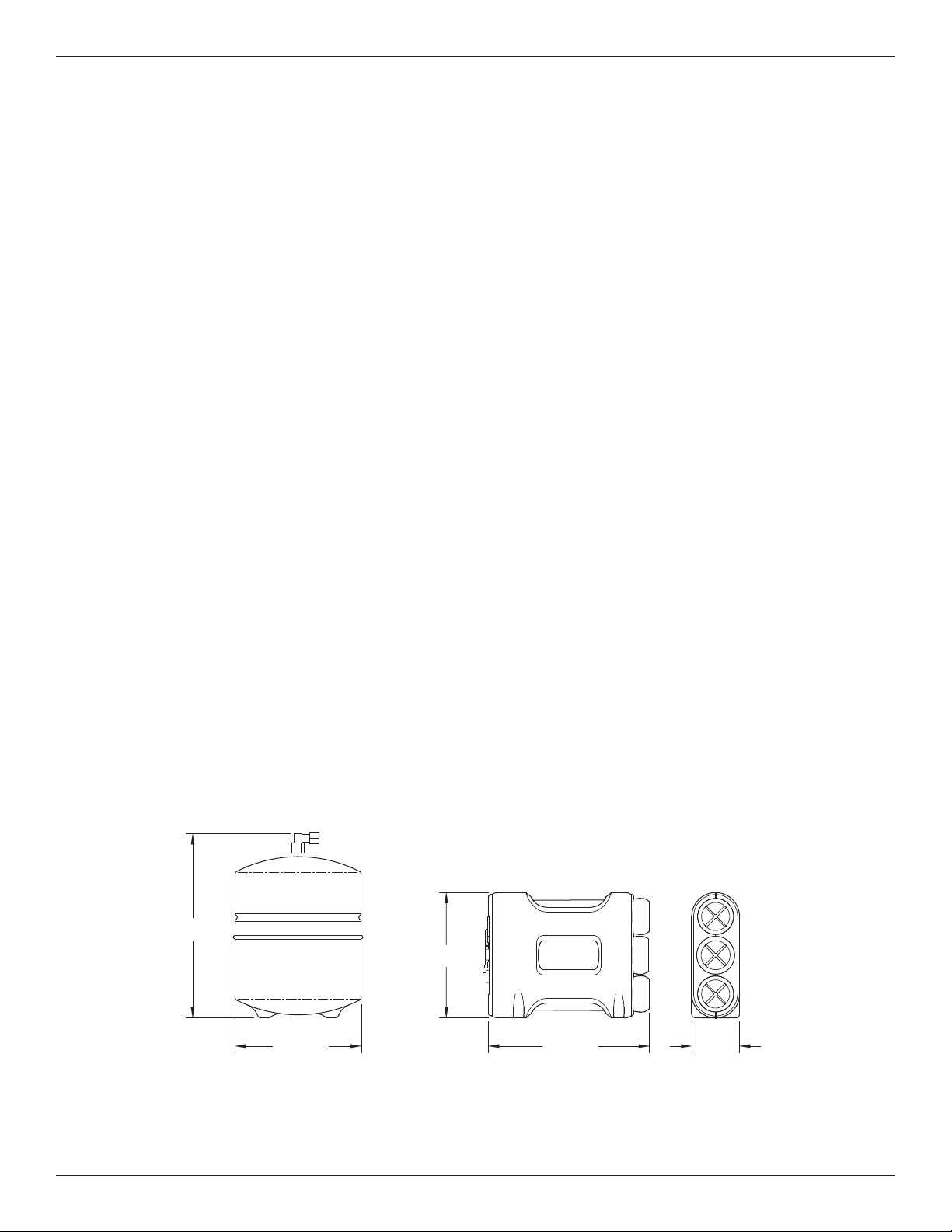
3-1/2"
14"
9" dia.
9"
11-1/2"
3-1/2”
9”
14”
11-1/2”9” dia.
FIG. 1
4
Inspect Shipment
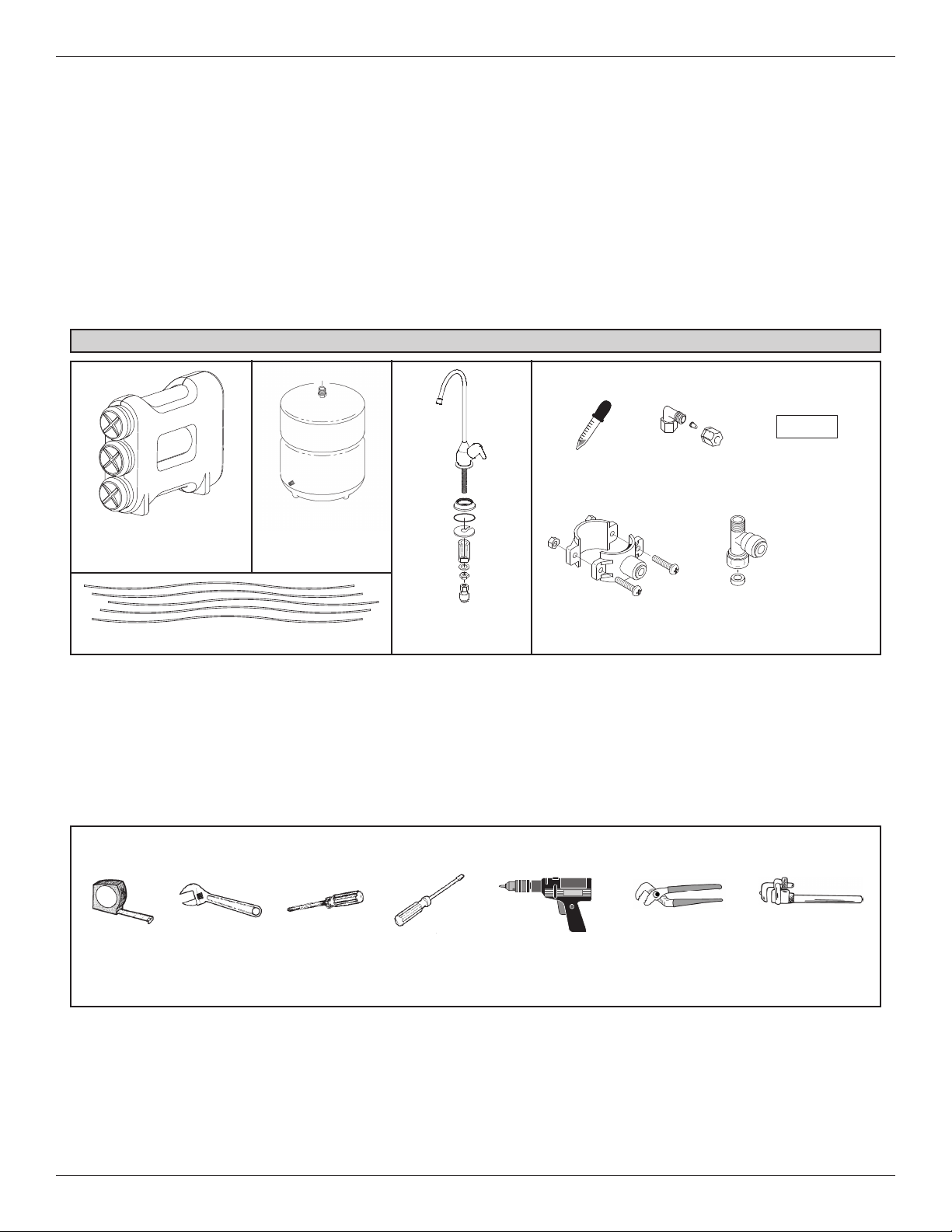
Your Reverse Osmosis Drinking Water Filtration System
is shipped complete in one carton. Remove all items
from your shipping carton.
Check all items against the packing list below. Note
any items lost or damaged in shipment.
Note any damage to the shipping carton. Refer to the
exploded view and parts list in the back of the manual
for the part names and numbers of missing or dam-
aged items. If problems exist, refer to the website or
the toll free number listed throughout this manual.
Keep the small parts in the parts bag until you are
ready to install them.
NOTE: Codes in the state of Massachusetts require
installation by a licensed plumber and do not per-
mit the use of saddle valves.
If you live in the state of Massachusetts, review
plumbing code 248-CMR of the Commonwealth of
Massachusetts before proceeding with the installa-
tion.
Adjustable
Wrench
Philips
Screwdriver
TOOLS NEEDED
Flathead
Screwdriver
Tape
Measure
Adjustable
Large Jaw
Pliers
Pipe Wrench
OR
Drill & Drill Bits,
if required
FIG. 3
Tools Needed
Review the tools needed list. See Fig. 3. Gather need-
ed tools before proceeding with the installation. Read
and follow the instructions provided with any tools list-
ed here.
Reverse Osmosis
Assembly
Product Water
Storage Tank
Reverse
Osmosis Faucet
Tubes, Red, Yellow, Green, Black and Blue
Eye
Dropper
Water Supply
Fitting
Tank
Connector
Nitrate / Nitrite
Test Kit
Drain Adaptor
Packing List
Parts Bag
FIG. 2
5
Plan Your Installation
Read through the entire manual before beginning
your installation. Follow all steps exactly. Reading
this manual will also help you get all the benefits
from your system.
Your Reverse Osmosis Drinking Water Filtration System
can be installed under a sink or in a remote location.
Typical remote sites are a laundry room or utility
room. Review the location options below and deter-
mine where you are going to install your system.
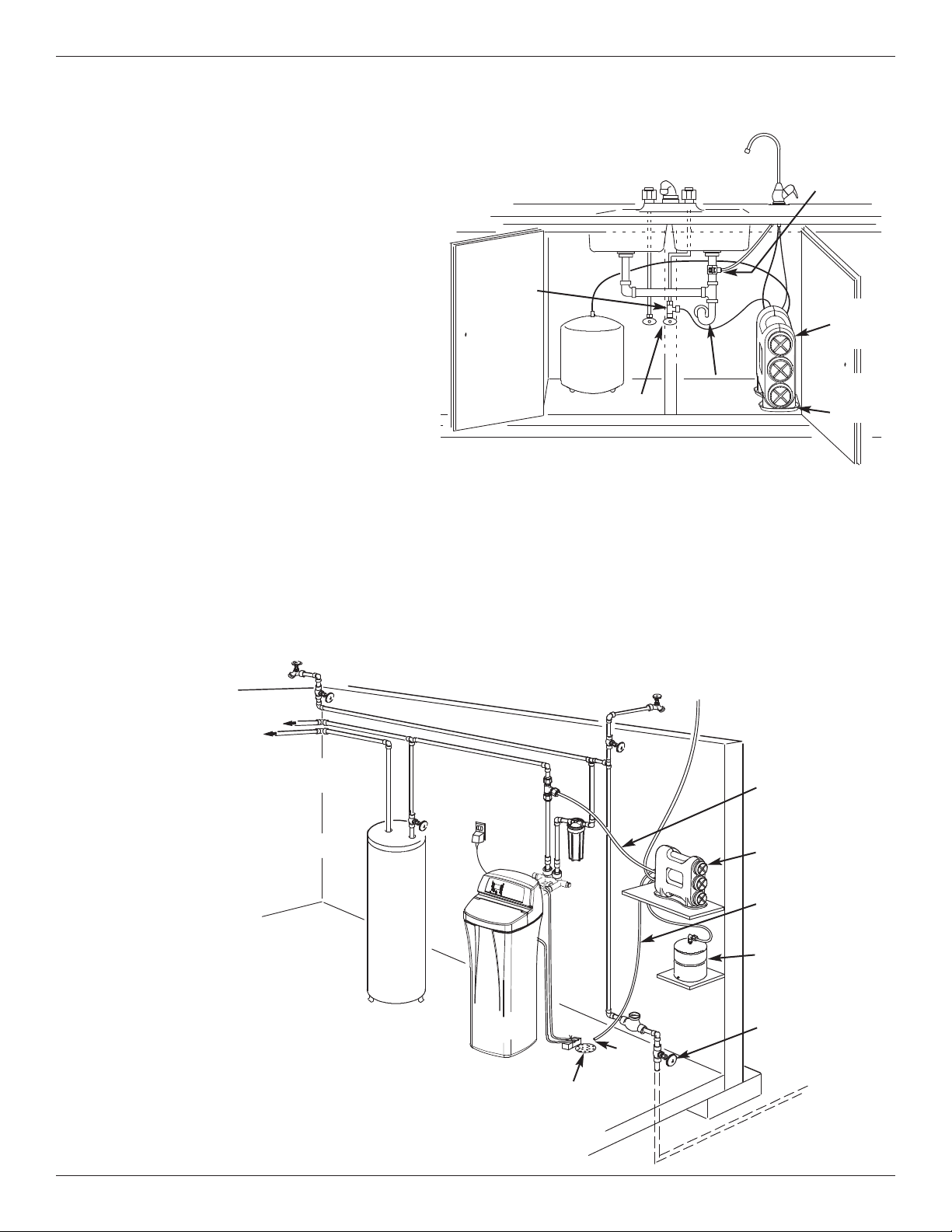
Typical Under Sink Installation
All install parts included in package.
Drain Adaptor
for Reverse
Osmosis
Waste Water
Cold Water
Supply
Storage
Tank
Sink Drain
P-Trap
Shutoff Valve
Reverse
Osmosis
Assembly
Outside Faucet
(Hard Water)
Soft, Cold Water
Soft, Hot
Water
Outside Faucet
(Hard Water)
Water
Heater
Shutoff
Valve
Hard Water Line
Water
Softener
Reverse Osmosis
Drain
Soft water to
Reverse Osmosis
System
Hard
Water to
House
Main
Shutoff
Valve
Storage
Tank
Water
Meter
Reverse Osmosis
System
To Faucet
Floor
Drain
HOT COLD
Air
Gap
(see
p.
14)
FIG. 4
UNDER THE SINK LOCATION
The Reverse Osmosis Filter Assembly and
storage tank may be installed in a kitchen or
bathroom sink cabinet. See Fig. 4.
A suitable drain point is needed for drain water
from the Reverse Osmosis system.
REMOTE INTERIOR LOCATION
The Reverse Osmosis Filter Assembly and
storage tank may also be installed in a remote
interior location away from the Reverse
Osmosis Faucet. You will need a nearby water
source and drain point. See Fig. 5.
CHECK SPACE REQUIREMENTS
Check size and position of items for proper
installation into location chosen.
FIG. 5
Typical Remote Installation
Additional parts required.
IMPORTANT: Allow adequate open space behind
the water filtration system to avoid
sharp bends or kinks in the tubing.
IMPORTANT: Allow adequate open
space behind the
water filtration system
to avoid sharp bends
or kinks in the tubing.
Filter
Change
Drip Tray

6
Overview and Site Preparation
OVERVIEW
Read through the entire manual before beginning your
installation.
There are seven steps to installing your Reverse
Osmosis Water Filtration System. They are as follows:
STEP A - Install Cold Water Supply Fitting
STEP B - Install Drain Adaptor
STEP C - Install Storage Tank
STEP D - Install Reverse Osmosis Faucet
STEP E - Connect Tubing
STEP F - Sanitize, Pressure Test & Purge System
These steps are explained in detail over the next few
pages. Follow all steps. Reading this manual will also
help you receive and use all the benefits your Reverse
Osmosis Water Filtration System can give you.
PREPARE SITE FOR INSTALLATION
1. Before starting, close the hot and cold water shutoff
valves (See Figure 6).
2. Temporarily place tank and filter assembly into
planned location. Check position of items and space
required for proper installation. Ensure tubes may
be routed without kinking.
3. Remove tank and filter from planned location and
set aside.
NOTE: You must check and comply with all local
plumbing codes.
NOTE: Codes in the state of Massachusetts require
installation by a licensed plumber and do not per-
mit the use of saddle valves.
If you live in the state of Massachusetts, review
plumbing code 248-CMR of the Commonwealth of
Massachusetts before proceeding with the installa-
tion.
NOTE: For best system performance, the feed
water to the system should be softened or have
hardness less than 10 grains per gallon, with no
iron.
Questions? Call Toll Free 1-800-218-6172 or visit www.ecopurehome.com/brita
When you call, please be prepared to provide the model, date code and serial number,
found on the rating decal on back.
7
Step A - Install Cold Water Supply Fitting
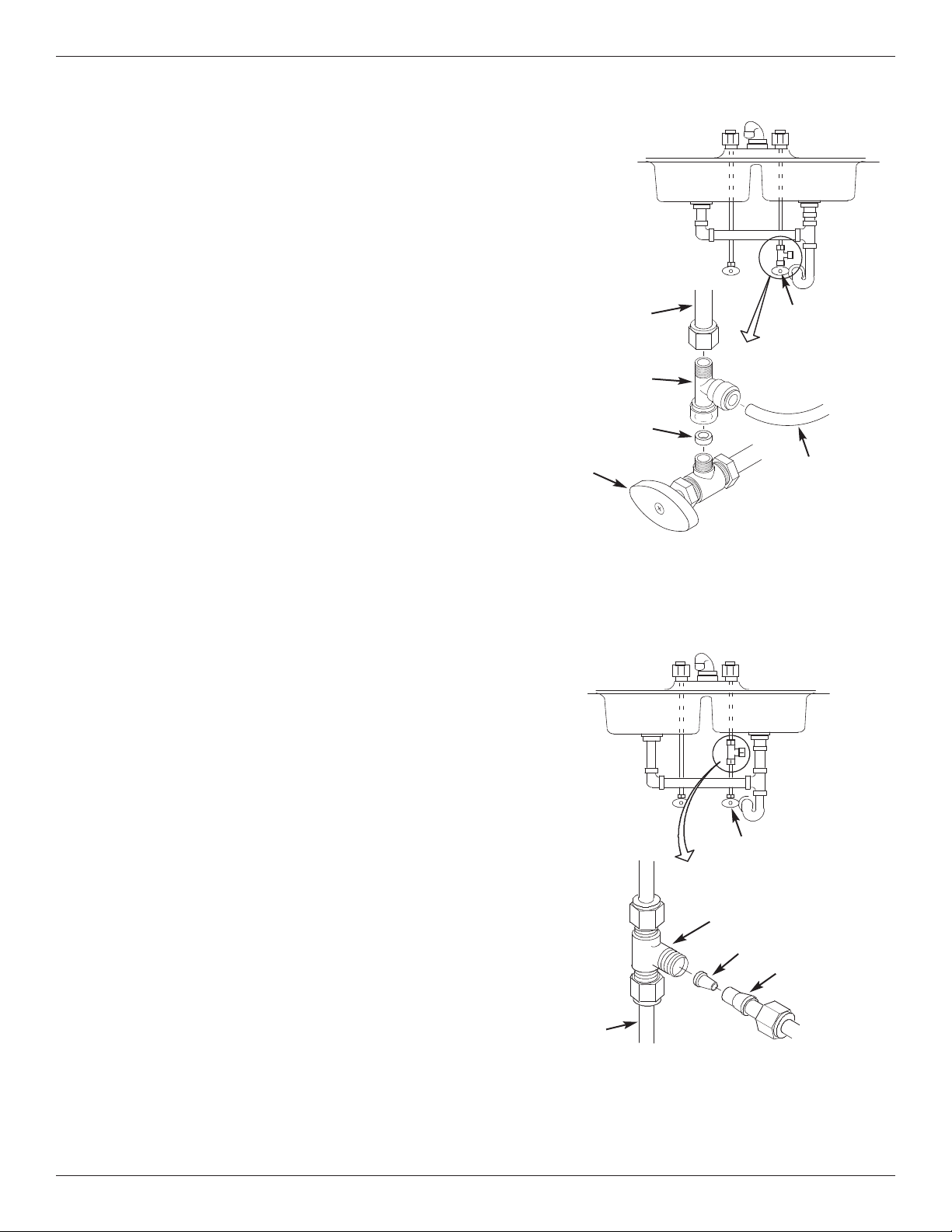
Cold Water Supply Connection
(using included water supply fitting)
1/4” green
tubing to
Reverse
Osmosis inlet
Check and comply with local plumbing codes as you plan,
then install a cold water supply fitting. Refer to the
Specifications page for supply water requirements. The fitting
must provide a leak-tight connection to the RO 1/4" tubing. A
typical connection using the included water supply fitting is
shown in Figure 6.. An optional connection using standard
plumbing fittings (not included) is shown in Figure 7.
NOTE: Local code may dictate which type of water fit-
ting is used. Consult a plumber if you are not familiar
with local codes or plumbing procedures.
NOTE: Codes in the state of Massachusetts require
installation by a licensed plumber and do not permit the
use of saddle valves.
If you live in the state of Massachusetts, review plumb-
ing code 248-CMR of the Commonwealth of
Massachusetts before proceeding with the installation.
INSTALL COLD WATER SUPPLY FITTING
(Included)
This fitting will be installed on the cold water pipe. The fitting
must provide a leak-tight connection to the Reverse Osmosis
1/4" tubing. Locate the cold water line in the sink cabinet. It
is recommended, but not required, that the cold water line be
soft water.
Complete the following steps to install the water supply fitting.
1. Close the water shutoff valve (angle stop valve) that the
water supply fitting will be installed on, and open faucet(s)
to relieve pressure.
2. Disconnect the existing cold water line from the water
shutoff valve.
3. Make sure that the water supply fitting’s gasket is inside
the female threaded portion of the fitting.
4. Install the water supply fitting onto the cold water shutoff
valve, where the existing cold water line was removed,
and hand tighten. Be careful not to cross thread or over-
tighten.
5. Connect the existing cold water line to the male threaded
portion of the water supply fitting and hand tighten. Be
careful not to cross thread or overtighten.
OPTIONAL PIPE FITTINGS
(compression type shown)
NOTE: Be sure to turn off the water supply and open a
faucet to drain the pipe.
Complying with plumbing codes, install a fitting on the cold
water pipe to adapt 1/4" OD tubing. A typical connection is
shown in Figure 7. If threaded fittings are used, be sure to
use pipe joint compound or thread sealing tape on outside
threads.
FIG. 6
Cold Water
Shutoff Valve
CHOOSE TYPE OF WATER FITTING TO INSTALL
Cold Water Supply Connection
(using compression fitting - not included)
FIG. 7
Cold Water
Shutoff Valve
cold water
pipe
1/4” compression
fitting
insert
ferrule
1/4” green
tubing to
Reverse
Osmosis inlet
cold water
shutoff
cold water
line
water supply
fitting
gasket
8
Step B - Install RO Drain Under Sink
INTRODUCTION
A suitable drain point is needed for the drain water from
the Reverse Osmosis filter. You have two options:
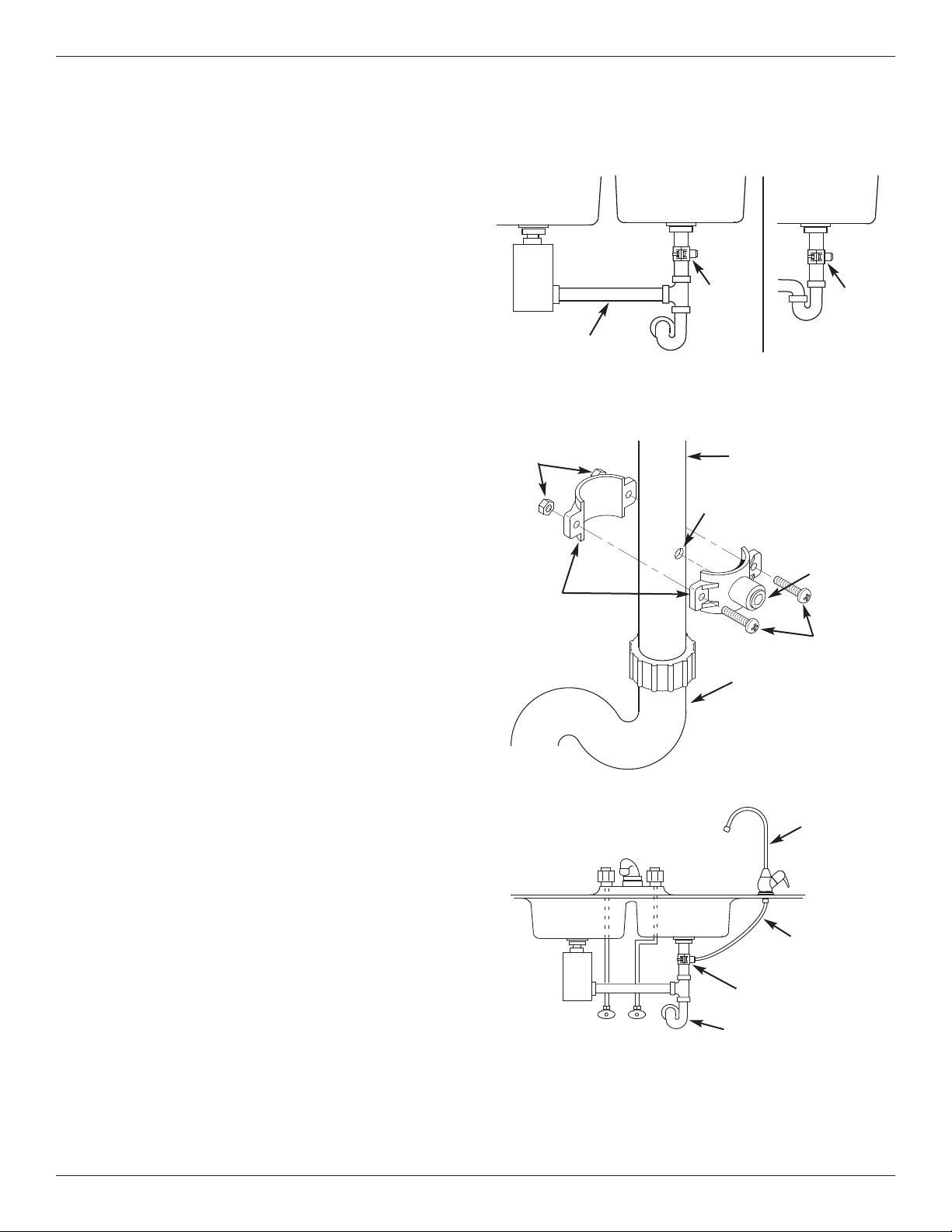
• Install the Drain Adaptor included with your unit
As shown in Figures 8-10, the drain adaptor is
installed onto your sink’s drain pipe above the P-trap.
This is normally used for under sink installations.
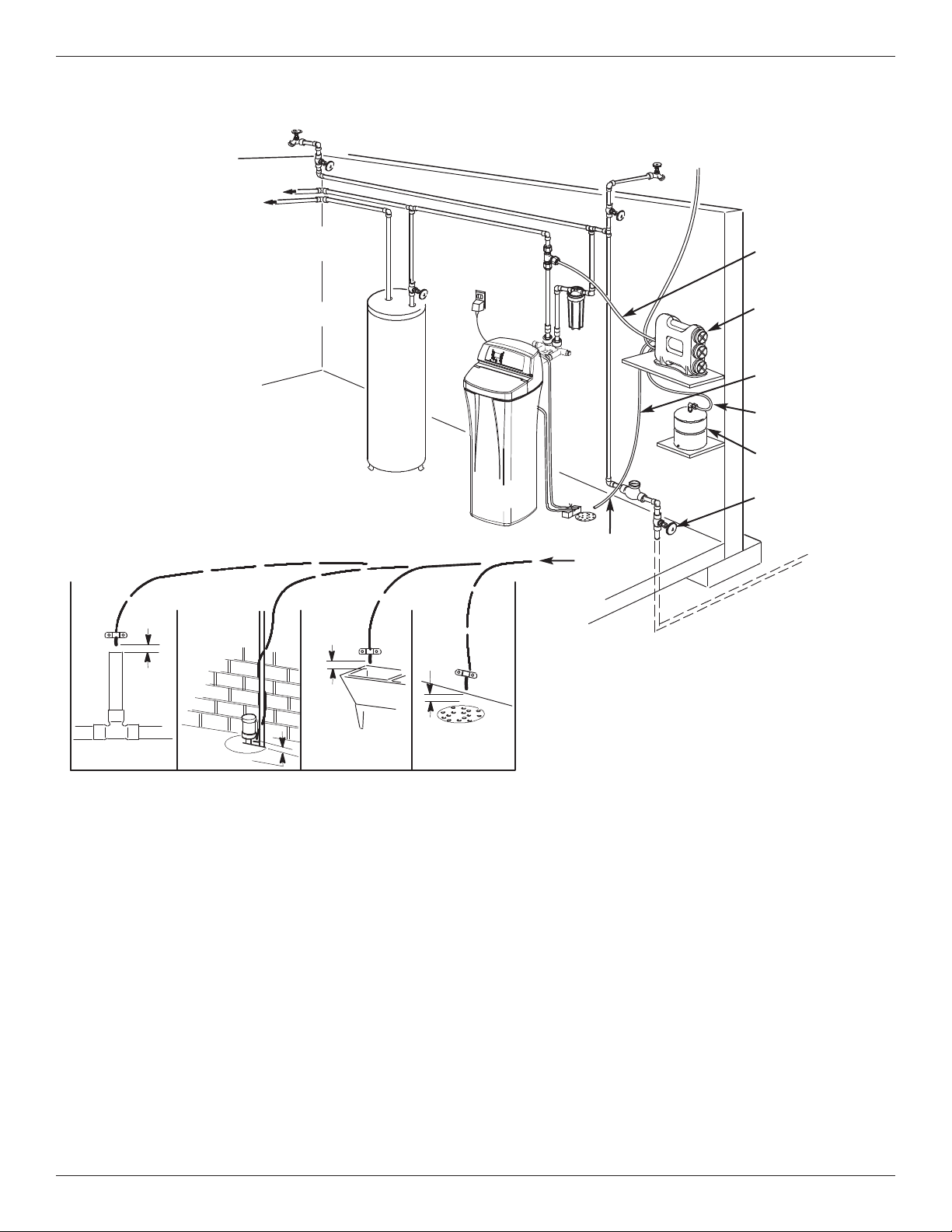
• Use another existing drain in your home
As shown in Figures 11 and 12, the drain tube from
the RO filter runs directly to an open drain. This is
often used for remote location installations.
NOTE: An incorrectly connected drain point can
cause water to leak from the faucet’s air gap.
NOTE: Local code may restrict the type of drain
installation to use. Either drain installation type, if
permitted by code, may be used in under sink or
remote location installations. Consult a plumber if
you are not familiar with plumbing procedures.
INSTALL DRAIN ADAPTOR
(Under sink Installation)
The drain adaptor included with your RO system is
designed to fit around a standard 1-1/2” O.D. drain
pipe. In the following procedure, you will install the
drain adaptor above (upstream of) the P-trap. See Fig.
8 & 10. Be sure to comply with local plumbing codes.
NOTE: Before starting this procedure, inspect the
drain pipe under the sink for corrosion, and replace
if necessary, before continuing with installation.
1. Test fit the two halves of the drain adaptor onto the
sink drain pipe, about 6 inches above the P-trap
(See Fig. 9). Make sure that the Q.C. fitting is
toward the direction of the RO faucet (See Fig. 10).
NOTE: Locate so that the drain tubing from the
Reverse Osmosis faucet will run straight to the
adaptor, with no dips, loops, or kinks.
2. Using the hole through the drain fitting as a guide,
mark the pipe where a 3/8” hole will be drilled (See
Fig. 9), and remove the drain adaptor from the pipe.
NOTE: Do not drill through the drain adaptor’s
Q.C. fitting, as this could damage the o-ring.
3. Drill a 3/8” dia. hole in the pipe and remove flash.
4. Clean the sink tailpiece to assure a leak-tight fit.
5. Place the halves of the drain fitting back onto the
sink drain pipe. Use a pencil or similar pointed
object to align the Q.C. fitting so that it is centered
on the hole you drilled.
6. Assemble the nuts and screws, as shown in Figure
9, and tighten both sides equally to secure the drain
adaptor halves onto the pipe. Do not overtighten.
7. Do not connect black tubing to the Q.C. fitting at this
time. It is done after the RO faucet is installed.
FIG. 8
P–Trap
Single Basin
Sink
Double Basin Sink
Under the Sink Installation
Drain
Adaptor
Drain
Adaptor
Garbage
Disposal
FIG. 10
IMPORTANT: Do not install drain adaptor below the P-Trap.
Locate drain adaptor so that when the black
drain tube from the Reverse Osmosis Faucet
is installed it will run straight to the adaptor,
with no dips, loops, or kinks.
Black Drain
Tube
P–Trap
Drain Adaptor
HOT
COLD
FIG. 9
Nuts
Sink Drain Pipe
Screws
3/8” Quick
Connect
Fitting
Drain
Adaptor
Halves
P-Trap
3/8” Hole - Do not drill
through Q.C. Fitting
RO Faucet
P–Trap
Do not install drain
adaptor on a line coming
from a garbage disposal
9
Step B - Install RO Drain in Remote Location
INSTALL A REMOTE DRAIN POINT AND
AIR GAP (Remote Location)
Route the drain tubing to an existing drain in the
house. A floor drain, laundry tub, standpipe, sump, etc.
are suitable drain points. See Fig. 12. This type of
drain is the preferred over the p-trap drain adaptor.
Be sure to provide a 1-1/2” air gap between the end of
the hose and the drain point. This will prevent water
from backing up into the system.
NOTE: Check your local plumbing codes.
To install a remote drain point, complete the fol-
lowing steps:
1. Locate the 1/4” red tube and determine whether it is
long enough to reach from the Reverse Osmosis fil-
ter assembly to the drain point . See Fig. 11.
2. If longer tubing is required, see parts list in back of
manual and replace the red tube with an adequate
length 1/4” tubing.
3. Cut one end of the drain tube square. See Fig. 17.
4. Insert this tube all the way into the red collet fitting on
the Reverse Osmosis filter assembly. See Figs. 18, 19
& 22.
5. Pull on the tubing to be sure it is held firmly in the fit-
ting.
NOTE: A flow control insert is located inside the
elbow fitting that the drain tube connects to.
Refer to Fig 27. Leave this fitting in place.
6. Route the tubing to the drain point and secure at the
end with a bracket (not included). See Fig. 12.
Provide a 1-1/2” air gap between the end of the tube
and the drain. See Fig. 12.
Outside Faucet
(Hard Water)
Soft, Cold Water
Soft, Hot
Water
Outside Faucet
(Hard Water)
Water
Heater
Shutoff
Valve
Hard Water Line
Water
Softener
Hard
Water to
House
Main Shutoff
Valve
Storage Tank
Water
Meter
Reverse Osmosis
System
BLUE Tubing
to Reverse
Osmosis Faucet
FIG. 11
Remote Installation
Location
Soft Water -
GREEN Tubing
to Reverse
Osmosis System
YELLOW Tubing
to Storage Tank
Reverse Osmosis
Drain - RED
Tubing to Drain
FIG. 12
RED
Tubing to
Drain
1/4'' RED Tubing
Floor
Drain
1-1/2”
Air Gap
1-1/2”
Air Gap
1-1/2”
Air Gap
1-1/2”
Air Gap
Sump
Laundry
Tub
Stand pipe
IMPORTANT: Allow adequate open
space behind the
water filtration system
to avoid sharp bends
or kinks in the tubing.
10
Step D - Install RO Faucet
INSTALL STORAGE TANK
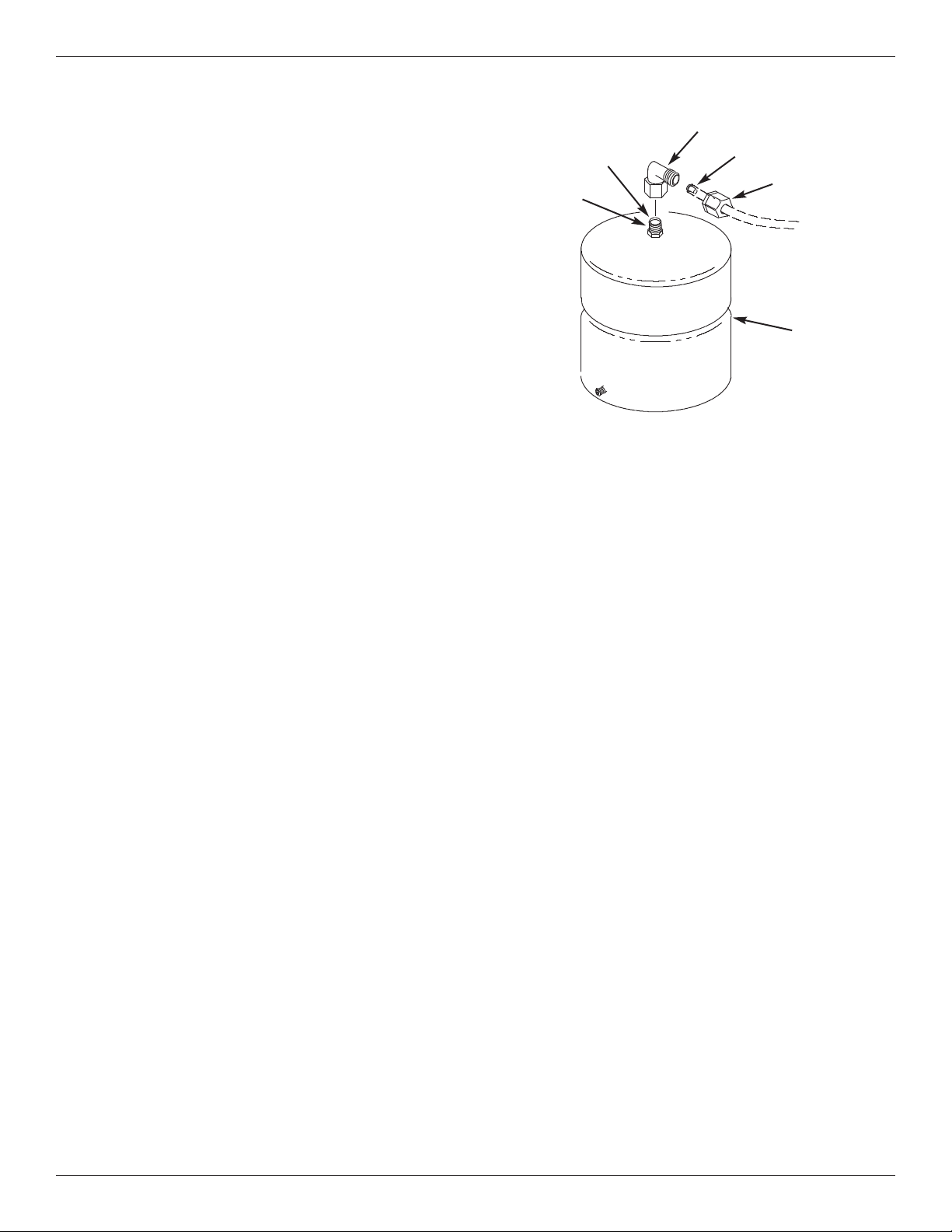
1. Apply Teflon
®
tape (2 wraps clockwise) to the
threads on the nipple at the top of the tank. See Fig
13.
2. Locate the tubing connector. See Fig. 13. Slowly
tighten the tubing connector onto the tank nipple 7-8
full turns, so as not to cross thread or overtighten.
3. Do not connect the tube at this time. This will occur
later in the assembly.
4. Place the storage tank next to the Reverse Osmosis
Assembly. The tank can be placed upright or on its
side.
Step C - Install Storage Tank
FIG. 13
Tank
Nipple
Storage
Tank
Tubing Nut
Tubing Insert
Tubing Connector
Teflon
®
tape
on threads
Teflon
®
is a registered trademark of E. I. du Pont de Nemours and Company.
You will need to select the location of the Reverse
Osmosis Faucet. You have three options to choose
from:
• Use the existing sink top hole for the spray hose
or soap dispenser (Must be 1-1/4” in diameter)
• Drill a new hole in the sink
• Drill a new hole in the countertop next to the
sink
1. Determine where you are going to install your
Reverse Osmosis Faucet.
2. Check to ensure the Reverse Osmosis faucet will
mount flat against the mounting surface.
SELECT LOCATION OF REVERSE OSMOSIS FAUCET MOUNTING HOLE
3. Visually review the routing of the tubes from the
Reverse Osmosis filter assembly to the faucet.
Check to ensure there is adequate tube routing
space between the faucet and filter assembly.
4. If drilling is needed, drill a 1-1/4" diameter hole in
the mounting surface.
IMPORTANT: Drilling holes into countertops and
sinks should only be performed by an installer
who is qualified for drilling such materials.
Drilling of surfaces made of stone or solid sur-
face materials such as granite, marble or plastic
resin products, or sinks made of porcelain or
stainless steel may cause permanent, irreparable
damage to the sink or countertop surface.
11
Step D: Install RO Faucet (cont.)
BLACK TUBE
3/8” barb fitting
for the black tube
RED TUBE
1/4” barb fitting
for the red tube
BLUE TUBE
3/8” quick connect
fitting for the
blue tube
Faucet
FIG. 14
FIG. 15
O-ring
Spacer
Hex Nut
Washer
Base
Steel Washer
(large)
1-1/4” dia. Hole
INSTALL REVERSE OSMOSIS FAUCET
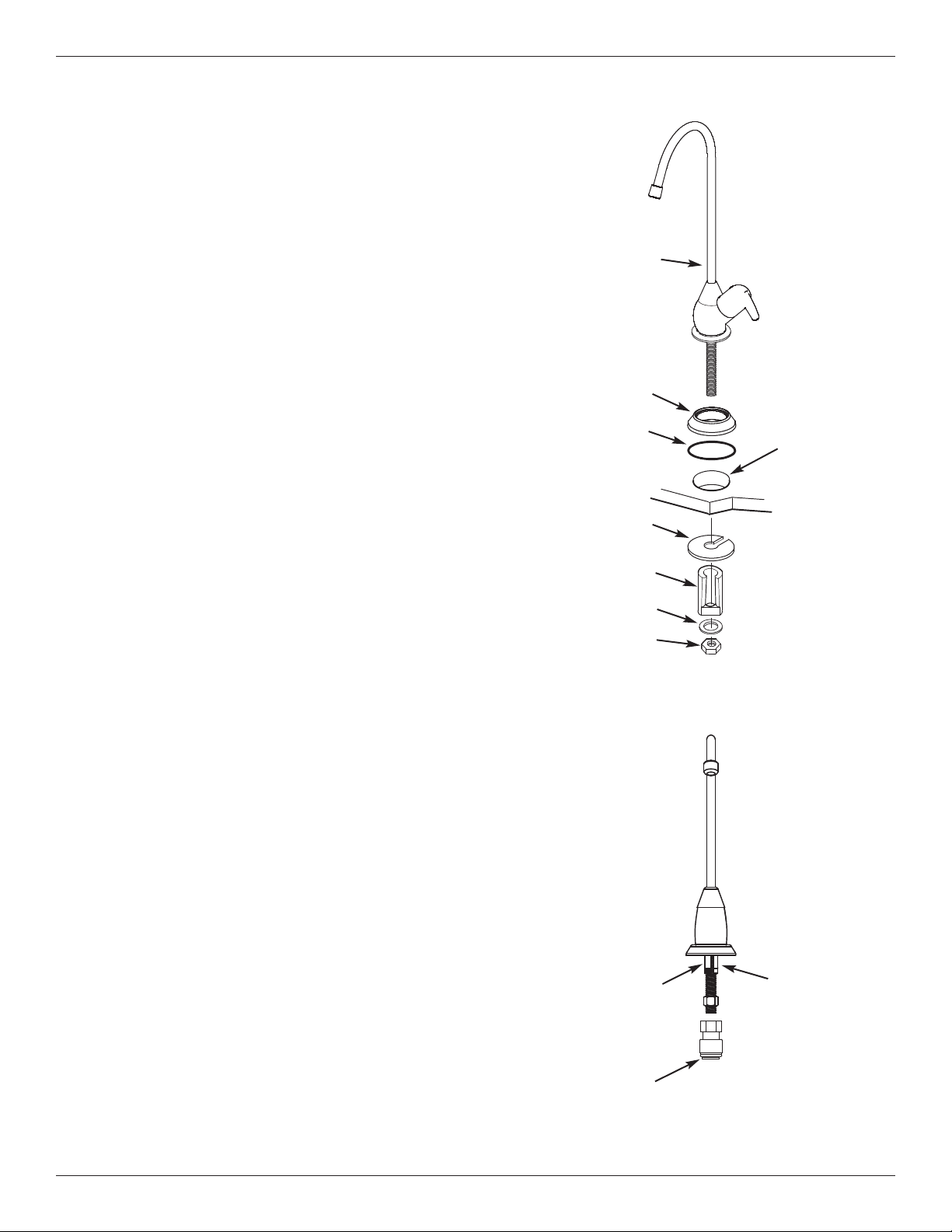
1. Locate and organize your RO faucet install parts. Refer
to Fig. 14.
2. Snap the o-ring into the groove on the bottom of the base
and slide the base onto the faucet stud. See Fig. 14.
NOTE: If you routed the red drain tubing directly to a
remote drain point (see page 9), disregard steps 3 & 4.
Move on to step 5.
3. Locate the 3/8" black tubing and push one end onto the
3/8" faucet barb fitting, see Fig. 15.
4. Locate the 1/4" red tubing and push one end onto the
1/4" faucet barb fitting, see Fig. 15.
5. Work tubing and the faucet stud down, into the mounting
hole.
6. On the underside of the sink or countertop, install the
spacer, flat washer, and hex nut. Slide the large steel
washer into place between the countertop and spacer.
Then, tighten the hex nut securely.
7. Thread the quick connect fitting onto the bottom of the
faucet stud.
8. Locate the 3/8" blue tubing and insert one end all the
way into the quick connect fitting on the bottom of the
faucet stud. See Fig. 15.
9. Pull on the tube to be sure it is held firmly in the fitting.
10. Move the RO system into position, under the sink. See
page 5.
NOTE: If you routed the red drain tubing directly to a
remote drain point (see page 9), disregard steps 11-15.
11. Locate the 1/4” red tubing attached to the faucet.
12. Route the loose end of this tube to the red collet fitting
on the Reverse Osmosis filter assembly. See Fig. 21.
13. Cut tube square and to length. See Fig. 16.
14. Insert all the way into the fitting. See Figs. 17 & 18.
15. Pull on the tube to be sure it is held firmly in the fitting.

12
Step E - Connect Tubes
HOW TO CUT AND CONNECT THE TUBES
Your Reverse Osmosis system includes push-in fittings
for quick tubing connection. Review the following
instructions before connecting the tubes in the next
step. Failure to follow these instructions may lead to
future leaks.
Cut tubes to length
1. Use a sharp cutter or knife to cut the end of tubing.
Always cut the tubing square. See Fig. 16.
2. Inspect the tube up to 1” from the end to be sure
there are no nicks, scratches or other rough spots. If
needed, cut the tubing again. See Fig. 16.
NOTE: Tubing lengths should allow for the
removal of the assembly from the hanger wash-
ers for servicing. If tubing lengths are shortened
for neater appearance, it may be necessary to
keep the assembly on the hanger washers for
service.
Connect tubes
1. Push tubing through collet, until it engages the o-
ring. See Fig. 17. Continue pushing until the tube
bottoms out against the back of the fitting. See Fig.
18. Do not stop pushing when the tube engages the
o-ring. Failure to follow these instructions may lead
to future leaks. When a 1/4” tube is fully engaged,
11/16” of the tube has entered the fitting. When a
3/8” tube is fully engaged, 3/4” of the tube has
entered the fitting. Mark tube with a piece of tape or
marker.
2. If additional tubing is required, see parts list at the
end of this manual.
To Disconnect Tubes
1. Push the collet inward with a finger tip. See Fig.20.
2. Continue holding collet inward while pulling the tub-
ing out. See Fig. 20.
Push-in Fitting
Tube
Tube Correctly Cut
FIG. 16
Cut tubing square with end of tubing round,
smooth, with no cuts, nicks or flat spots.
Tube Partially Engaged with Fitting
FIG. 17
Collet O-Ring
Tube Fully Engaged with Fitting
FIG. 18
Collet O-Ring
Collet and O-Ring
FIG. 19
Collet
Fitting
O-Ring Seal
Disconnect Tubing
FIG. 20
Tubing
Collet (depress to
remove tubing)
13
Step E - Connect Tubes (cont.)
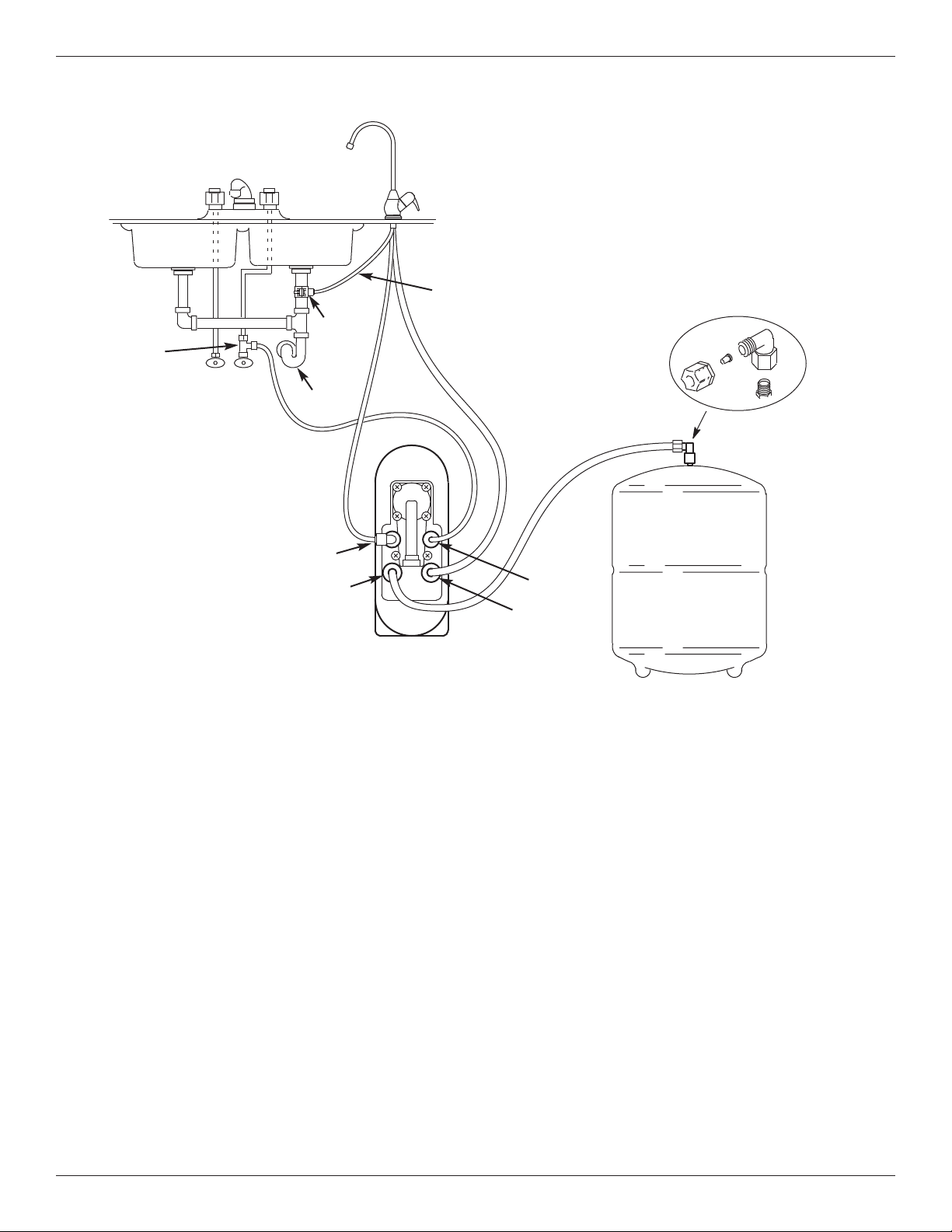
CONNECT YELLOW TUBE FROM REVERSE
OSMOSIS ASSEMBLY TO STORAGE TANK
1. Locate the 3/8” yellow tube and cut one end square. See
Fig. 16.
2. Insert all the way into the yellow collet fitting on the
Reverse Osmosis filter assembly. See Figs. 17, 18 & 21.
3. Route the other end of this tube to the fitting on top of the
storage tank. See Fig. 21.
4. Cut tube square and to length. See Fig. 16.
5. Do not connect at this time. This will occur in the sanitizing
step.
CONNECT GREEN TUBE FROM COLD WATER
SUPPLY PIPE TO REVERSE OSMOSIS ASSEMBLY
1. Locate the 1/4” green tube and cut one end square. See
Fig. 16.
2. Connect to cold water supply fitting. See Fig. 6.
3. Route the other end of this tube to the green collet fitting on
the Reverse Osmosis filter assembly. See Fig, 21
4. Cut tube square and to length. See Fig. 16.
5. Insert all the way into the fitting. See Figs. 17 & 18.
6. Pull on the tube to be sure it is held firmly in the fitting.
CONNECT BLUE TUBE FROM REVERSE OSMOSIS
FAUCET TO REVERSE OSMOSIS ASSEMBLY
1. Locate the 3/8” blue tube attached to the faucet. Fig. 21.
2. Route the loose end of this tube to the blue collet fitting on
the Reverse Osmosis filter assembly. See Fig. 21.
3. Cut tube square and to length. See Fig. 16.
4. Insert all the way into the fitting. See Figs. 17 & 18.
5. Pull on the tube to be sure it's held firmly in the fitting.
CONNECT BLACK TUBE FROM REVERSE
OSMOSIS FAUCET TO DRAIN ADAPTOR
1. Locate the 3/8" black tube attached to the faucet. Fig 21.
2. The loose end needs to be attached to the quick connect
fitting on the sink drain adaptor.
3. Cut this tube as needed to route it as straight as possible,
without loops, dips, or kinks.
4. Cut the end of the tube square. See Fig. 16.
5. Insert all the way into the fitting. See Figs. 17 & 18.
6. Pull on the tube to be sure it is held firmly in the fitting.
RED TUBE TO REVERSE OSMOSIS FAUCET
The red tube connection was completed in the faucet
assembly steps.
NOTE: Codes in the state of Massachusetts
require installation by a licensed plumber
and do not permit the use of saddle valves.
If you live in the state of Massachusetts,
review plumbing code 248-CMR of the
Commonwealth of Massachusetts before
proceeding with the installation.
NOTE: Tube colors
match collet colors.
Tube Connections
FIG. 21
Tubing Connector
Drain
Adaptor
3/8” BLACK
Tubing
Sink
P–Trap
3/8” BLUE
1/4” RED
1/4” GREEN
3/8” YELLOW
HOT COLD
Water Supply
Fitting
RED
YELLOW
GREEN
BLUE
Reverse Osmosis
Assembly
14
Step F - Sanitize, Test and Purge System
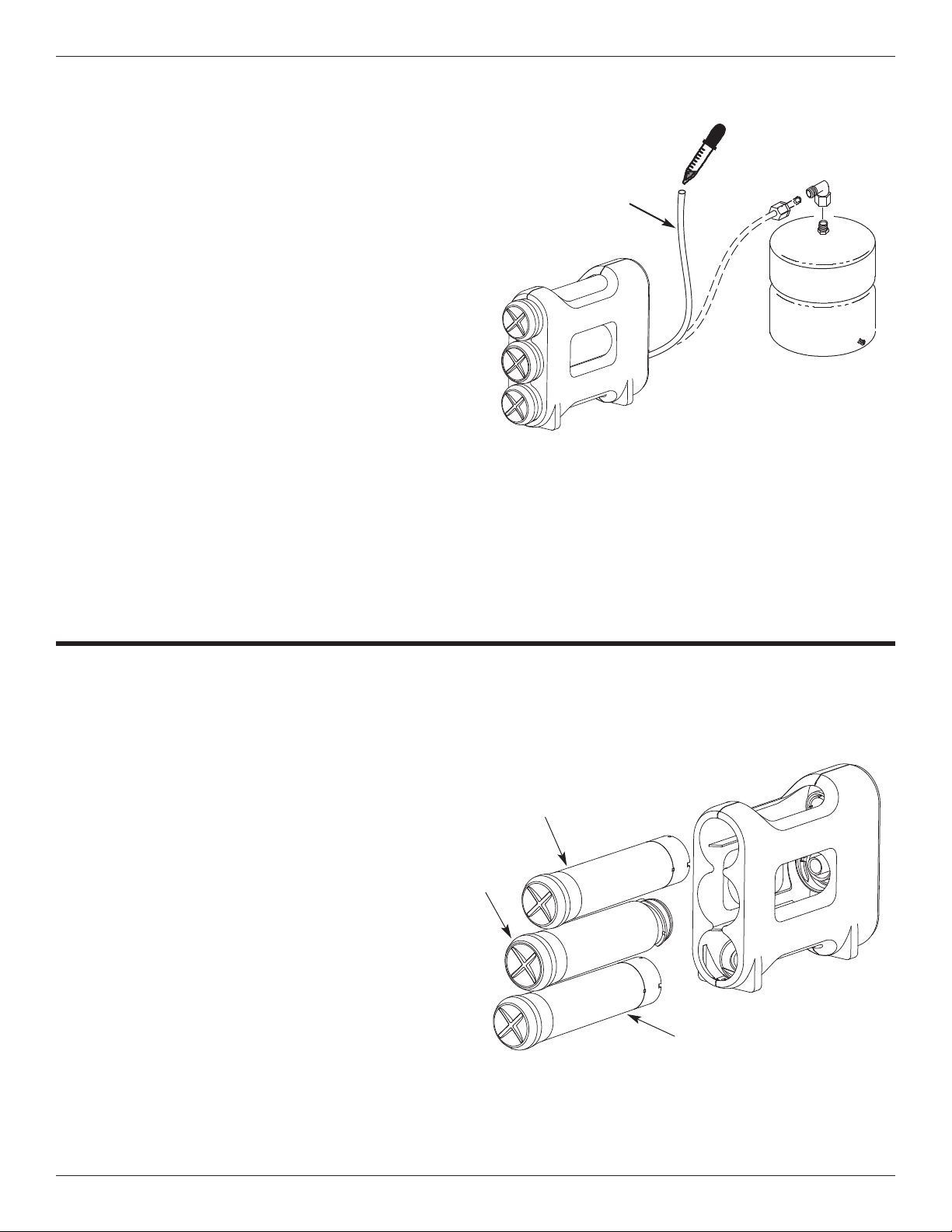
SANITIZE THE SYSTEM
Sanitizing is recommended immediately after installa-
tion of the Reverse Osmosis system. It’s also recom-
mended after servicing inner parts. It is important that
the person installing or servicing the system have
clean hands while handling inner parts of the system.
Complete the following steps to sanitize the system.
See Fig. 22.
1. Make sure that the water supply to the Reverse
Osmosis system is off.
2. Open the Reverse Osmosis faucet. If the tank is not
already empty, allow the water to empty.
3. Locate the eyedropper included in parts bag and
common household bleach (5.25%).
4. Add 3 ml. of bleach into open end of yellow tube.
Handle bleach according to bleach manufacturer’s
recommendations. See Fig. 22.
5. Connect yellow tube to tank connector. See Figs. 13
and 21.
6. Sanitizing the system will be completed during the
pressure test and purging steps on the following
page.
NOTE: The bleach must be removed from the sys-
tem before drinking the water. See purging instruc-
tions on the next page.
FIG. 22
RO
Sanitization
Cartridge
Postfilter
Sanitization
Cartridge
Prefilter
Sanitization
Cartridge
This reusable sanitizing kit (not included) is
recommended to easily and completely sani-
tize your Reverse Osmosis system annually.
The kit includes the following:
= Prefilter sanitization cartridge
(contains no filtration media)
= Postfilter sanitization cartridge
(contains no filtration media)
= RO sanitization cartridge
(contains no RO membrane)
= Syringe, 1 oz.
= Complete instructions
Uses standard 5.25% household bleach (not
included) to completely sanitize the Reverse
Osmosis system.
Manufacturer recommends using the
Model 7301203 Sanitizing Kit
Yellow
Tube
To order, go to www.ecopurehome.com/brita
or call toll free 1-800-218-6172

15
Step F - Sanitize, Test and Purge System (cont.)
PRESSURE TEST THE SYSTEM
NOTE: Complete the sanitizing procedures on the
preceding page before pressure testing.
To pressure test the system, complete the following
steps.
1. Open the water supply valve to the Reverse
Osmosis system.
2. Purge air from the house plumbing by opening sev-
eral house faucets. Close faucets when water runs
smooth, with no spurting.
3. Pressure will start to build in the RO system. In
about 2 hours check all fittings and connections.
Check for water leaks. Fix leaks if any are found. If
problems exist, refer to the troubleshooting chart or
call the toll free number below).
NOTE: When the system is first pressurized, water
may ''spurt'' from the faucet air gap hole until air is
expelled from the RO system.
Please review the following operating features
before using your Reverse Osmosis system:
NOTE: As with all other water system applications,
leaks may occur. Because the system pressure
builds slowly, leaks may not be immediately appar-
ent. Recheck for leaks 24 hours after purging the
system is complete.
NOTE: Codes in the state of Massachusetts require
installation by a licensed plumber and do not per-
mit the use of saddle valves.
If you live in the state of Massachusetts, review
plumbing code 248-CMR of the Commonwealth of
Massachusetts before proceeding with the installa-
tion.
PURGING THE SYSTEM
To purge the system, complete the following steps.
1. Open the Reverse Osmosis Faucet and let water
flow through the system for a 24 hour period. Water
flow will be a slow trickle at this time.
NOTE: Do not consume water from the RO sys-
tem until purging is complete.
2. Close the Reverse Osmosis faucet after the 24 hour
purging period is complete.
3. When the purging is finished, your Reverse
Osmosis system is ready for use.
You will not have filtered water immediately. It may
take several hours to fill the storage tank and create
maximum flow from the Reverse Osmosis faucet.
Water will run to the drain while the Reverse
Osmosis system is producing water, even if you are
not drawing water from the Reverse Osmosis faucet.
You may hear a small quantity of water going to the
drain at times when water is not being used. This is
normal. Water going to the drain will automatically
shut off when the storage tank is full.
Water Pressure from the Reverse Osmosis faucet will
be less than your standard faucet.
Storage
Tank
HOT COLD
FIG. 23
Reverse
Osmosis
Faucet
Kitchen
Faucet
Cold Water
Supply
Water Supply Shutoff
Valve to Reverse
Osmosis System

16
How Your RO Water System Works
Questions? Call Toll Free 1-800-218-6172 or visit www.ecopurehome.com/brita
When you call, please be prepared to provide the model, date code and serial number,
found on the rating decal on back.
HOW YOUR REVERSE OSMOSIS SYSTEM
WORKS
Introduction: Your Reverse Osmosis (RO) Drinking
Water System uses your household water pressure to
force water through three filters. Impurities are filtered
out. Delicious tasting drinking water goes to the stor-
age tank-ready for your use. Impurities are sent down
the drain. The following paragraphs will explain in
detail how your Reverse Osmosis Drinking Water
System works.
Prefilter: Water from the cold supply pipe enters the
prefilter. See Fig. 24. The prefilter is a replaceable
sediment cartridge with activated carbon in its compo-
sition. The cartridge reduces taste, odor, sand, silt, dirt,
other sediments, and up to the amount of chlorine
shown in the specifications.
Reverse Osmosis Cartridge: Filtered water flows
from the prefilter to the Reverse Osmosis membrane
cartridge. See Fig. 24. The Reverse Osmosis cartridge
is a tightly wound special membrane. The membrane
reduces the dissolved solids and organic matter. High
quality product water (about one ounce per minute)
exits the Reverse Osmosis cartridge. The product
water flows to the storage tank, postfilter or Reverse
Osmosis faucet. Drain water, with the dissolved solids
and organic matter, is routed to the drain.
Storage Tank: The storage tank holds product water.
See Fig. 24. A diaphragm inside the tank holds water
pressurized to about half of supply water pressure
when the tank is full. This provides fast flow to the
Reverse Osmosis faucet. When the tank is empty of
water, the pressure at the air valve is 5 - 7 psi.
Postfilter: Water goes through the postfilter before
going to the Reverse Osmosis faucet. See Fig. 24.
The postfilter is an activated carbon type filter. Any
remaining tastes and odors are reduced from the prod-
uct water. Clean, high quality drinking water is avail-
able at the faucet.
Reverse Osmosis Faucet: The sink or countertop
faucet has a hand operated knob to dispense drinking
water. See Fig. 24. An air-gap is built into the faucet
drain water connection to comply with plumbing codes.
Shutoff Assembly: The unit has an automatic shutoff
system to conserve water. When the storage tank has
filled to capacity, and the drinking water faucet is
closed, pressure closes the shutoff to stop flow to the
drain. After enough drinking water is used, pressure in
the system drops, and the shutoff opens to allow the
tank to be refilled. See Fig. 24.
Check Valve: A check valve is located in the Reverse
Osmosis manifold above the center cartridge. The
check valve prevents a backward flow of product water
from the storage tank to drain. A backward flow could
damage the Reverse Osmosis Membrane.
See Fig. 24.
Flow Control: Water flow to the drain is restricted by
the flow control. It maintains the desired flow rate to
obtain the highest quality drinking water. The flow con-
trol is located inside the fitting on the Reverse
Osmosis manifold drain port. See Fig. 24.
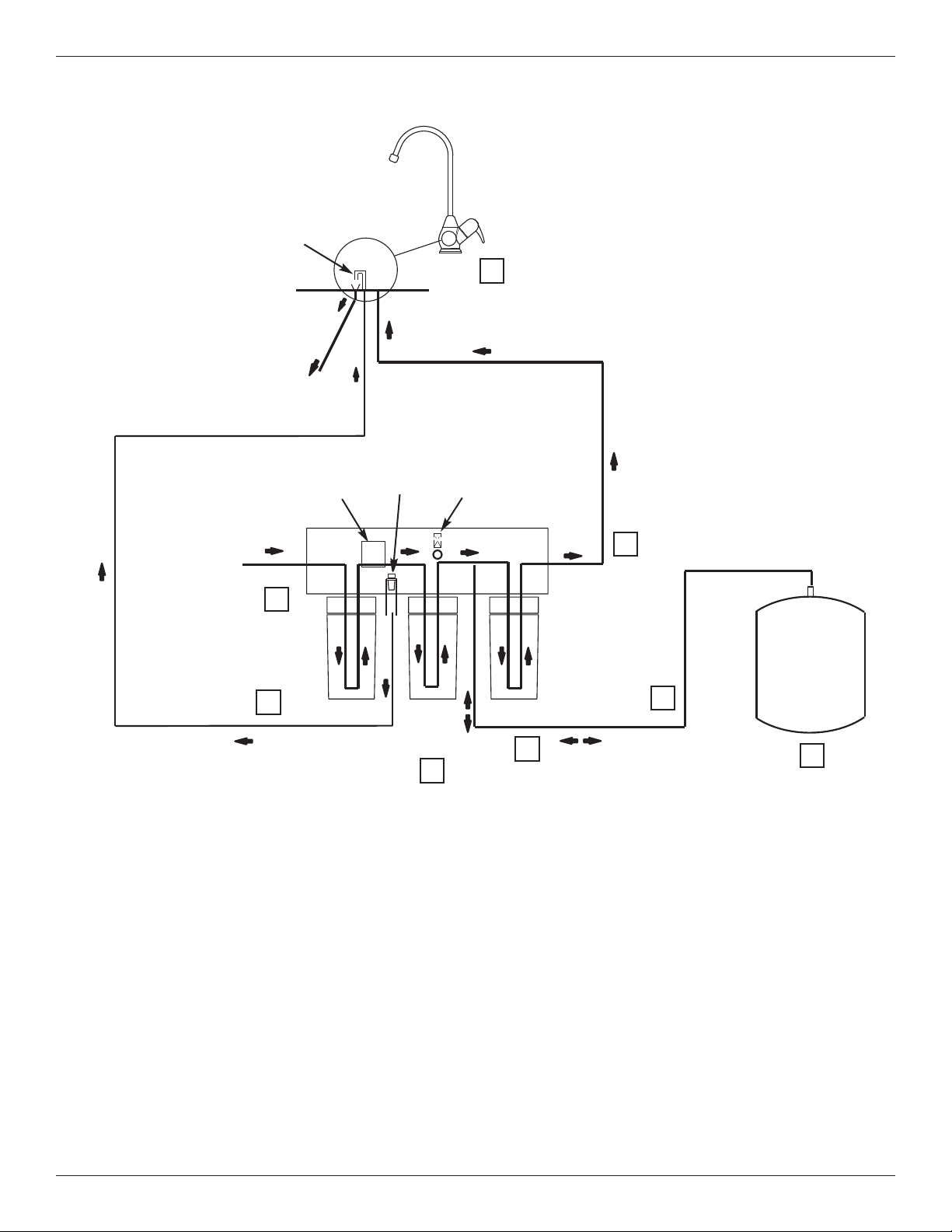
17
How Your RO Water System Works
Water Flow Description
1. Water enters prefilter. Sand, silt and other sediments are reduced. Chlorine is also reduced. See Fig. 24.
2. Water leaves prefilter and proceeds to the Reverse Osmosis cartridge.
3. Water enters the Reverse Osmosis membrane. Dissolved solids are reduced.
4. Processed water leaves the Reverse Osmosis membrane and flows to the storage tank.
5. Drain water with dissolved solids leaves the Reverse Osmosis membrane and flows to the drain.
6. Faucet is activated.
7. Processed water leaves the storage tank and flows to the postfilter, where it is filtered to ensure fresh taste.
8. Water flows to the Reverse Osmosis faucet.
Reverse Osmosis Water Flow Schematic
FIG. 24
Questions? Call Toll Free 1-800-218-6172
or visit www.ecopurehome.com/brita
When you call, please be prepared to provide the model, date code and serial number,
found on the rating decal on back.
1
3
4
5
6
7
8
PRODUCT WATER
Air Gap
PRODUCT
WATER FAUCET
DRAIN WATER
WATER
IN
Gravity
Drain
BLACK
BLUE
GREEN
RED
YELLOW
PREFILTER
POSTFILTER
Check
Valve
Drain Flow
Control
AUTOMATIC
SHUTOFF
RO
MEMBRANE
PRODUCT
WATER
STORAGE
2
18
Maintenance
PREFILTER / POSTFILTER MAINTENANCE
NOTE: It is recommended to replace the prefilter
and postfilter cartridges at least every 6 months of
product water use. Replace more often if they
begin to plug with sediment.
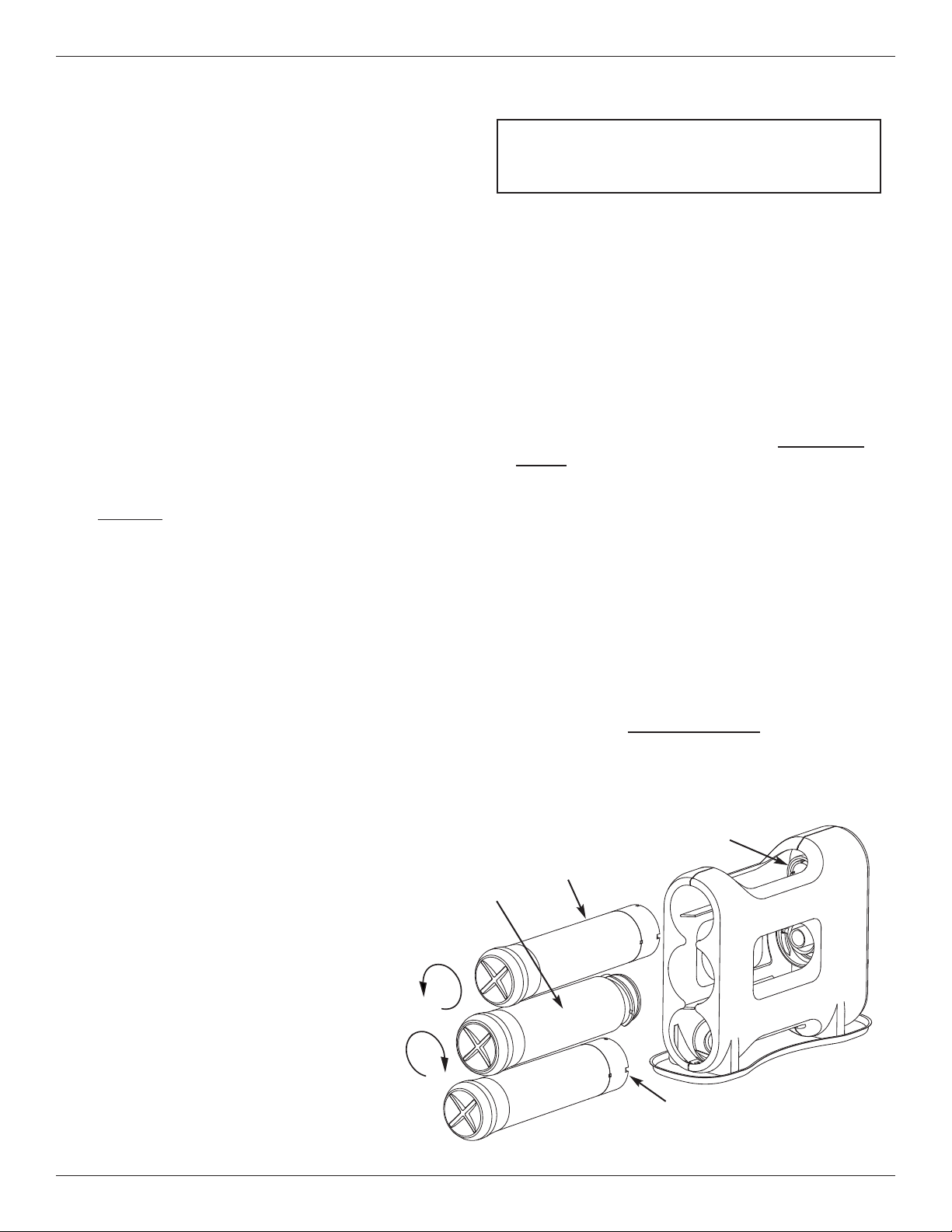
The prefilter and postfilter are replaceable sediment
cartridges with activated carbon in their composition.
See Fig. 25. You must periodically replace the prefilter
and postfilter cartridge. This will protect the RO mem-
brane from being destroyed by chlorine. It will also pre-
vent the filters from plugging with sediment.
You may notice a slower output of product water as
the prefilter and postfilter build up with sediment.
Replace the prefilter and postfilter cartridges when this
occurs.
RO MEMBRANE CARTRIDGE MAINTENANCE
The Reverse Osmosis cartridge is a tightly wound spe-
cial membrane. See Fig. 25. The membrane reduces
the dissolved
solids and organic matter. The life of the
Reverse Osmosis membrane cartridge depends mostly
on the pH and hardness of the supply water (see
Specifications). Cartridge life is shorter with higher pH.
For example, if supply water pH is from 6.8 to 7.7, the
cartridge may last for well over one year. However,
cartridge life may be as short as 6 months if the pH is
as high as 8.5 to 10. Higher pH weakens the cartridge
membrane and causes pin-hole leaks. It's time to
replace the Reverse Osmosis cartridge when the pro-
duction rate and/or quality of product water drops.
Product water may begin to taste different, indicating
solids and organics are passing through the Reverse
Osmosis membrane. See Reverse Osmosis cartridge
replacement.
REVERSE OSMOSIS CARTRIDGE REPLACE-
MENT
Complete the following steps to replace the cartridges.
1. Remove (turn counterclockwise) the prefilter car-
tridge from the manifold to stop flow to the Reverse
Osmosis cartridge.
2. Remove the Reverse Osmosis cartridge.
3. Remove the postfilter cartridge.
4. Discard the cartridges in a proper manner.
5. Install new cartridges in reverse order: post filter,
Reverse Osmosis and then prefilter. Turn cartridges
clockwise to reattach to the manifold. Do not over
-
tighten.
6. Purge the Reverse Osmosis system. See page 14
for instructions.
PREFILTER / POSTFILTER CARTRIDGE
REPLACEMENT
Complete the following steps to replace the cartridges.
1. Remove (turn counterclockwise) the prefilter car-
tridge from the manifold. Then remove the postfilter
cartridge.
2. Discard the cartridges in a proper manner.
3. Install new cartridges in reverse order: postfilter first,
then prefilter. Turn cartridges clockwise to reattach
to the manifold. Do not overtighten.
4. Purge the Reverse Osmosis system. See page 14
for instructions.
Register for reminders to change filters
at www.ecopurehome.com/brita
FIG. 25
Manifold
Prefilter
Cartridge
Turn filter cartridges
counterclockwise
to remove from manifold
Turn filter cartridges
clockwise
to attach to manifold
Postfilter
Cartridge
RO
Cartridge
NOTE: You may notice some
water under the system
during filter change.
19
Maintenance
DRAIN FLOW CONTROL
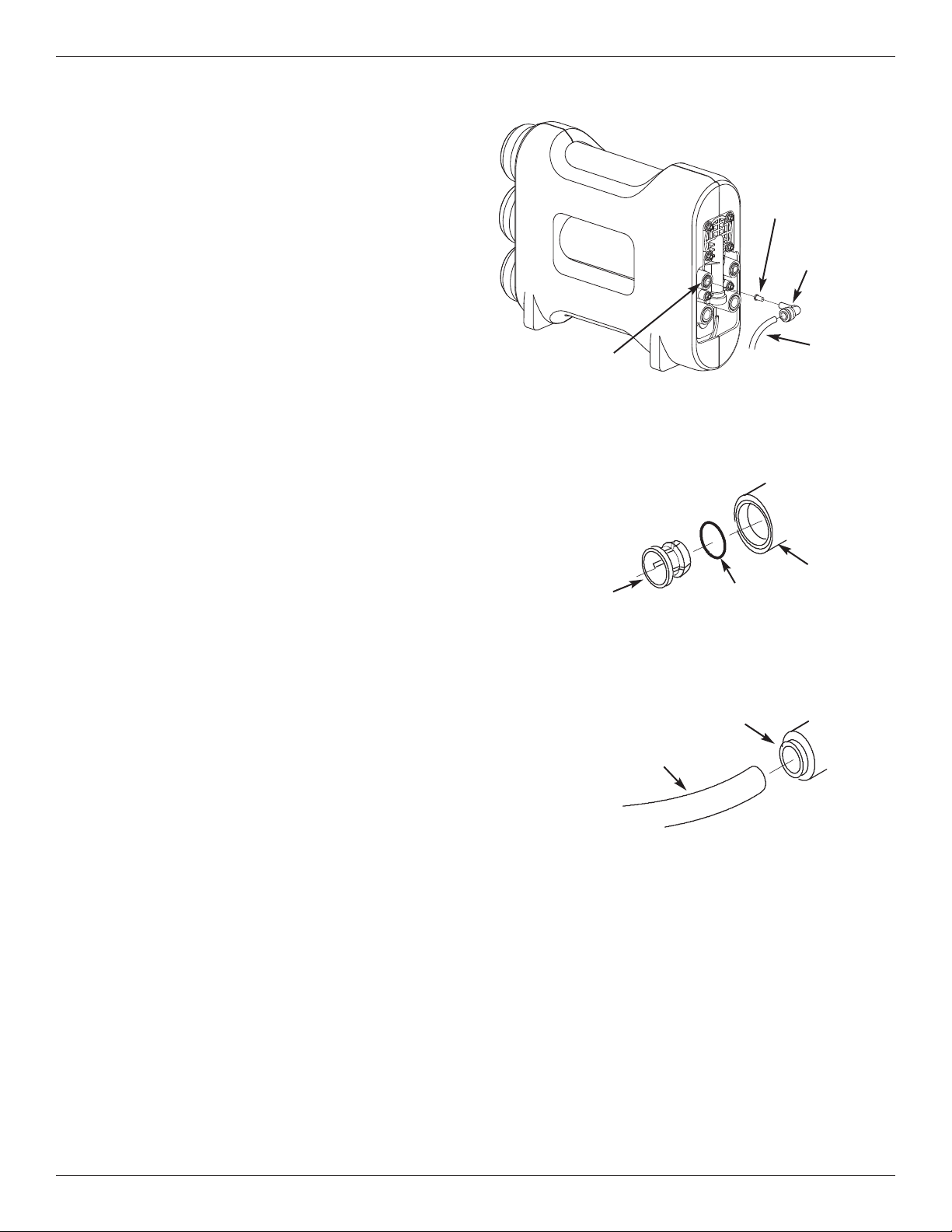
The flow control is required for proper operation of the
Reverse Osmosis system. See Fig. 26. The flow con-
trol, located inside the push-in elbow fitting on the
drain port of the Reverse Osmosis filter assembly,
keeps water flowing through the membrane at the
required rate. This ensures that the system produces
the best quality product water.
Periodically check the flow control to be sure the small
hole through it is clean and unrestricted.
If the flow control requires service, review the explod-
ed view in Fig. 26. Assemble and disassemble as
shown. If the flow control remains in the manifold when
the push-in elbow fitting is removed, you will need to
remove the drain port’s collet and o-ring, as shown in
the next section, to retrieve it.
CHANGE COLLET AND O-RING
1. Remove the collet and o-ring from the fitting with a
small screwdriver. Do not scratch the internal walls
of the collet port. See Figs. 27 & 28.
2. Clean collet port, lubricate with silicone-based lubri-
cant, and insert the o-ring seal into the bottom of the
port. See Figs. 27 & 28.
3. Push the collet inward until it locks in place. See
Figs. 27 & 28.
Change Collet and O-Ring
FIG. 27
Collet
Fitting
O-Ring Seal
Push o-ring seal into
bottom of port then
follow with collet.
Disconnect Tubing
FIG. 28
Tubing
Collet (depress to
remove tubing)
FIG. 26
To
Drain
Flow Control
Insert
Push-in
Elbow Fitting
1/4” Red
Tubing
Drain Port
20
Troubleshooting
Need help troubleshooting?
Call Toll Free 1-800-218-6172 or visit www.ecopurehome.com/brita
Problem: Chlorine taste and/or odor in the RO product water.
Cause: The level of chlorine in your water supply
exceeds maximum limits, and has
destroyed the Reverse Osmosis mem-
brane.
Correction: If the water supply contains more than 2.0 ppm of chlorine, addition-
al filtering of the water supply to the Reverse Osmosis is needed.
Contact your local water supplier. Correct this condition before doing
maintenance on the Reverse Osmosis system.
Cause: The prefilter is no longer removing chlo-
rine from the water supply.
Correction: Replace the prefilter, postfilter and Reverse Osmosis membrane
cartridges. See Page 18.
Problem: Other taste and/or odor.
Cause:
Cause:
Postfilter expended.
Reverse Osmosis membrane cartridge
expended.
Correction: Replace the postfilter cartridge. If taste and odor persist, replace the
prefilter cartridge and Reverse Osmosis membrane cartridge. See
Page 18.
Cause: Contamination in product water storage tank. Correction: Use sanitizing procedures. Replace prefilter and postfilter cartridges.
See page 14.
Cause: System contamination. Correction: Sanitize entire system. Call 1-800-218-6172 for instructions.
Problem: System makes product water too slowly.
Cause: Water supply to the Reverse Osmosis sys-
tem not within specifications.
Correction: Increase water pressure, precondition the water, etc., as needed to
conform before doing maintenance on the Reverse Osmosis sys-
tem.
Cause: Prefilter or Reverse Osmosis membrane
cartridges plugged with sediment.
Correction: Replace the prefilter cartridge. If rate does not increase, replace the
postfilter cartridge and Reverse Osmosis membrane cartridge. See
Page 18.
Problem: System makes lower amount of product water than usual.
Cause: Storage tank air-charge less than
5-7 psi.
Correction: Open Reverse Osmosis faucet and drain tank until flow slows to a
drip. Keep faucet open and check tank pressure. If low, pressurize
to 6 psi. Close faucet to refill the tank.
Problem: High total dissolved solids (TDS) in product water
Cause: Water supply to the Reverse Osmosis sys-
tem not within specifications.
Correction: Increase water pressure, precondition the water, etc., as needed to
conform before doing maintenance on the Reverse Osmosis sys-
tem.
Correction: Send treated and untreated water samples to a water analysis lab
for testing. It is important to test both the treated and untreated
water to determine system performance. If the TDS is not within the
system’s performance guidelines, replace the prefilter, post filter and
RO membrane cartridges.
Cause: Plugged drain flow control insert. Correction: Replace drain flow control insert. See page 19.
Problem: Continual water flow to drain and low or no water production.
Cause: Missing flow control insert in drain port. Correction: Make sure flow control insert is in place. See page 19.
Problem: Water leaking from faucet airgap hole.
Cause: Drain side of faucet airgap (3/8” black tub-
ing) plugged, restricted or incorrectly con-
nected to drain point.
Correction: Inspect and eliminate restriction or plug. Check that drain line is
routed properly. Refer to installation instructions for proper drain
connection. See pages 5 & 9.
Problem: Water leaks at push connect fittings
Cause: Tubing not cut square. Correction: Cut tubing square. See pages 12 & 13.
Cause: Tubing not pushed in all the way. Correction: Push tubing in all the way. See pages 12 & 13.
Cause: Tubing nicked. Correction: Remove tube from connection. Remove nicked portion by cutting
tube to shorter length. Reinsert in connection. See pages 12 & 13.
If removing the drain line, leave in place the fitting that it connects
to. See page 19.
Cause: Outer tubing surface finish not smooth. Correction: Remove tube from connection. Remove problem area by cutting
tube to shorter length. Reinsert in connection. See pages 12 & 13.
If removing the drain line, leave in place the fitting that it connects
to. See page 19.

21
EXTEND YOUR WARRANTY:
You can turn your R.O. system’s one year factory warranty into a lifetime warranty by registering the system at
warranty.ecopurehome.com/brita and saving your receipts for purchases of Brita replacement R.O. membrane
and filter cartridges. See “Lifetime Warranty” below for details.
WARRANTY
REVERSE OSMOSIS WATER FILTRATION SYSTEM - MODEL BRDROS
(not including filter cartridges and R.O. membrane)
Warrantor: Water Channel Partners, 1890 Woodlane Drive, Woodbury, MN 55125
One Year Warranty:
Warrantor guarantees, to the original purchaser when the product is purchased from an authorized dealer, and when
installed and maintained in accordance with the instructions, that the Reverse Osmosis Water Filtration System
(BRDROS) will be free from defects in materials and workmanship and will perform in accordance with its written
specifications for a period of one (1) year from the date the product is delivered.
Lifetime Warranty:
Warrantor guarantees, to the original purchaser only, that the Reverse Osmosis Water Filtration System (BRDROS)
will be free from defects in materials and workmanship and will perform in accordance with its written specifications
for the lifetime of the purchaser, provided that:
● The product is purchased from an authorized dealer.
● The system is installed and maintained in accordance with the instructions in the same home where it was
originally installed.
● The purchaser replaces both the pre and post filters every six (6) months and saves their receipts, for proof of
purchase of the Brita BRDROF filter cartridge set, in case a warranty claim is made. Purchase of no more than
two (2) BRDROF filter sets in a 12 month period may be applied toward compliance with this warranty.
● The purchaser replaces the R.O. membrane every two (2) years and saves their receipts, for proof of purchase
of the Brita BRDROM membrane, in case a warranty claim is made. Purchase of no more than one (1)
BRDROM membrane cartridge in a 24 month period may be applied toward compliance with this warranty.
Failure to adhere to the above requirements from the date the product is delivered voids the lifetime warranty.
If, during such respective period, a part proves, after inspection, to be defective, Warrantor will, at its sole option,
either replace or repair the part without charge except normal shipping and installation charges. If a repair or
replacement part is unavailable, Warrantor may refund the original purchase price. Labor necessary to maintain this
product is not covered by the product warranty. Filters and membranes, which are expendable, are not covered by
the warranty.
If you have questions regarding a warranted product, need assistance with installation or troubleshooting, wish to
order a part or report a warranty issue, we are just a phone call away. SIMPLY DIAL 1-800-218-6172 for assistance.
General Provisions
The above warranties are effective provided the Reverse Osmosis Water Filtration System is operated at water
pressures not exceeding 100 psi (7.0 kg/cm
2
), and at water temperatures not exceeding 100°F (38°C); provided
further that the Reverse Osmosis Water Filtration System is not subject to abuse, misuse, alteration, neglect,
freezing, accident or negligence; and provided further that the Reverse Osmosis Water Filtration System is not
damaged as the result of any force of nature such as, but not limited to, flood, hurricane, tornado or earthquake.
The limited warranty does not cover damage due to: (a) transportation, (b) storage, (c) improper use, (d) failure to
follow the product instructions or to perform any preventive maintenance, (e) modifications, (f) unauthorized repair,
(g) normal wear and tear, or (h) external causes such as accidents, abuse, or other actions or events beyond
Warrantor’s reasonable control. Use of aftermarket, used, or non-manufacturer provided parts will void all
warranties. Warranty does not cover failures due to improper product installation. Warrantor is excused if failure
to perform its warranty obligations is the result of strikes, government regulation, materials shortages, or other
circumstances beyond its control.
THERE ARE NO WARRANTIES ON THE REVERSE OSMOSIS WATER FILTRATION SYSTEM BEYOND THOSE
SPECIFICALLY DESCRIBED ABOVE. ALL IMPLIED WARRANTIES, INCLUDING ANY IMPLIED WARRANTY OF
MERCHANTABILITY OR OF FITNESS FOR A PARTICULAR PURPOSE, ARE DISCLAIMED TO THE EXTENT
THEY MIGHT EXTEND BEYOND THE ABOVE PERIODS. THE SOLE OBLIGATION OF WARRANTOR UNDER
THESE WARRANTIES IS TO REPLACE OR REPAIR THE COMPONENT OR PART WHICH PROVES TO BE
DEFECTIVE WITHIN THE SPECIFIED TIME PERIOD, AND WARRANTOR IS NOT LIABLE FOR CONSEQUENTIAL
OR INCIDENTAL DAMAGES. NO DEALER, AGENT, REPRESENTATIVE, OR OTHER PERSON IS AUTHORIZED
TO EXTEND OR EXPAND THE WARRANTIES EXPRESSLY DESCRIBED ABOVE.
Some states do not allow the exclusion or limitation of incidental or consequential damages, so the above limitation
or exclusion may not apply to you. This warranty gives you specific legal rights, and you may have other rights
which vary from state to state. This warranty applies to consumer-owned installations only.
22
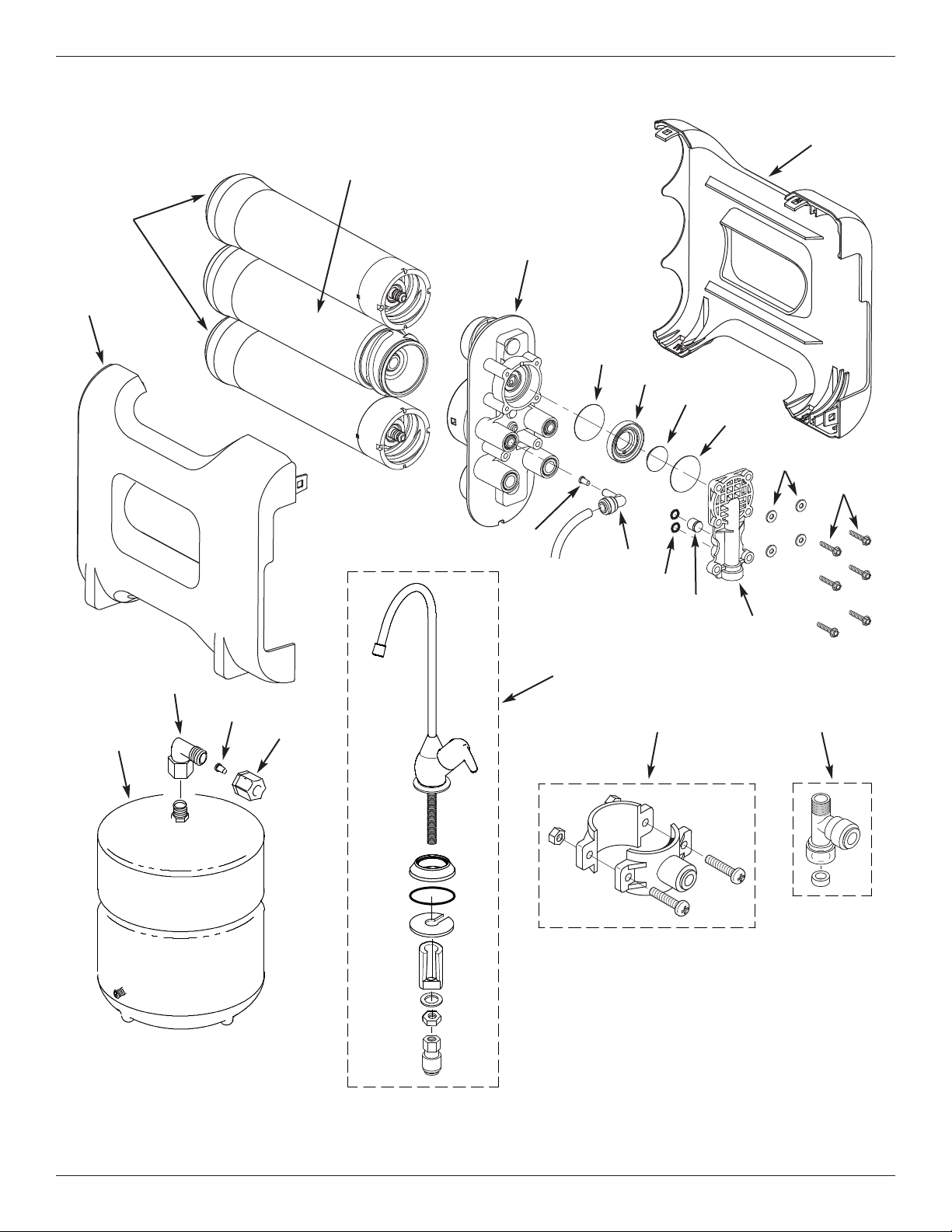
Exploded View
1
2
3
4
5
6
7
8
6
9
10
11
12
13
1/4” red
tubing
14
15
16
17
18
19
20
21 22
23
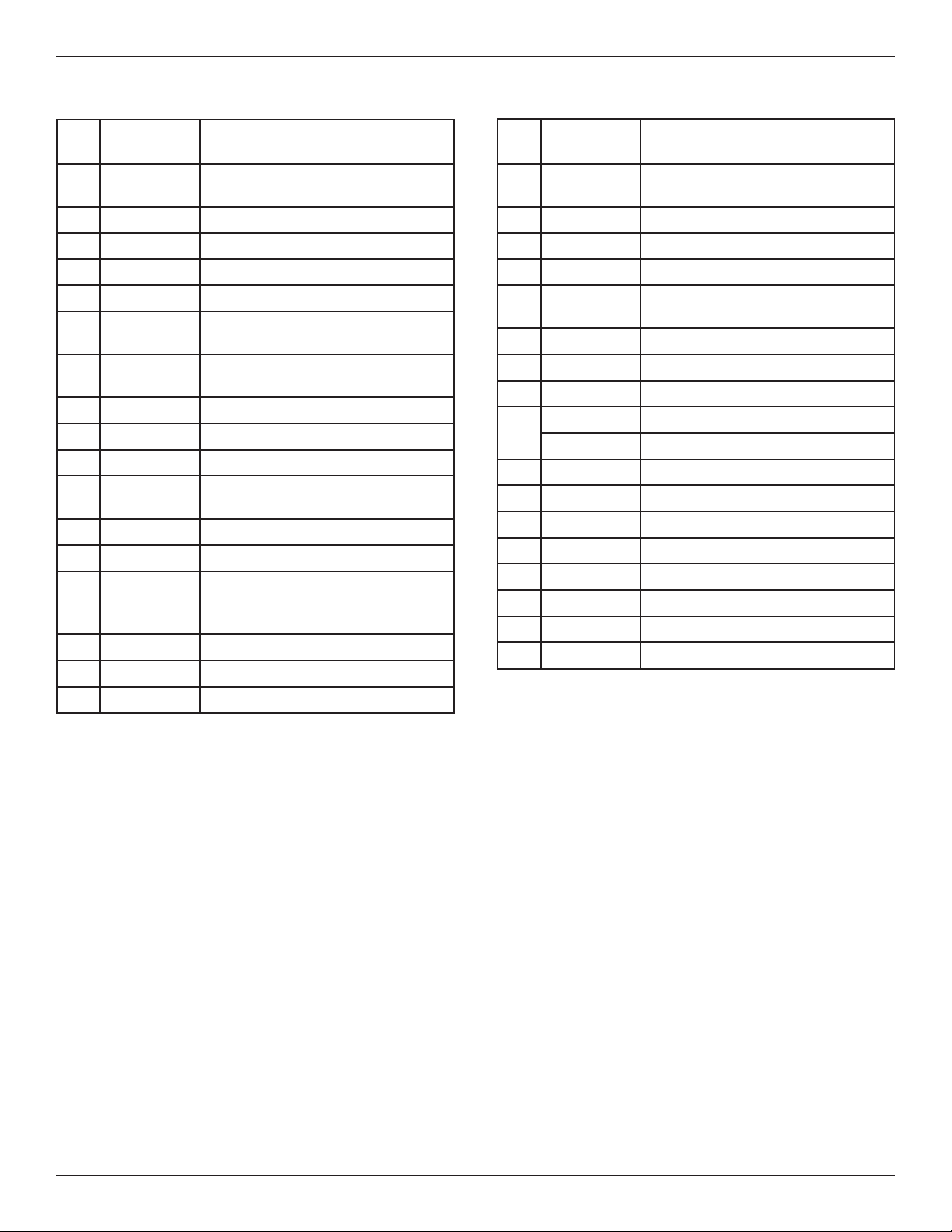
Parts List
Key
No.
Part No. Description
– 7383174
Repl. Cabinet
(includes Key Nos. 1 & 2)
1
á
Cabinet, Left
2
á
Cabinet, Right
3 BRDROF
Pre & Post Filter Cartridge Ù
4 BRDROM
RO Membrane Cartridge Ù
5 7383182
Repl. Manifold Assembly
(includes Key Nos. 1, 2 & 6-13)
– 7333179
Diaphragm Kit (includes
Key Nos. 7, 8 & 2 of Key No. 6)
6
á
Diaphragm (2 req.)
7
á
Spacer Ring
8
á
Plunger
– 7333137
Check Valve Kit (includes
Key No. 10 & 2 of Key No. 9)
9
á
O-ring, Auto. Shutoff Cover (2 req.)
10
á
Check Assembly
– 7333145
Automatic Shutoff Kit (includes
Key No. 11, 4 of Key No. 12 &
6 of Key No. 13)
11
á
Automatic Shut-off Cover Assembly
12
á
Washer (4 req.)
13
á
Screw (6 req.)
Key
No.
Part No. Description
– 7333153
Flow Control Kit
(includes Key Nos. 14 & 15)
14
á
Elbow, Plug-in, 1/4 Stem x 1/4 Tube
15
á
Flow Control Insert
16 7205326 Storage Tank
– 7333161
Tank Connector Kit
(includes Key No. 17-19)
17
á
Connector, 1/4 NPT x 3/8 Jaco
18
á
Insert, 3/8” Tubing
19
á
Nut, 3/8” Tubing
20
WHEFSAT Faucet, Brushed Nickel
WHEFCHR
Faucet, Chrome =
21 119-8600123 Drain Adaptor
22 119-8600084 Water Supply Fitting, 1/4” Q.C.
¢
7301203
Sanitization Kit =
¢
7315189
Auxiliary Storage Tank =
¢
7161823
Tubing, 1/4” x 20’ - white p =
¢
7157280
Tubing, 3/8” x 20’ - white p =
¢
7279749 Dropper
¢
7379599 Owner’s Manual
Ù Please purchase replacement cartridges from the e-commerce retailer where you bought your reverse osmosis system or
www.ecopurehome.com/brita.
¢ Not illustrated.
= Not included.
p Tubing lengths for remote installations, direct replacement for colored lengths of tubing.
NOTE: Codes in the state of Massachusetts require installation by a licensed plumber and do not permit the
use of saddle valves.
To order repair parts visit www.ecopurehome.com/brita
Manufactured by
Water Channel Partners
1890 Woodlane Drive
Woodbury, MN 55125
1-800-218-6172
24
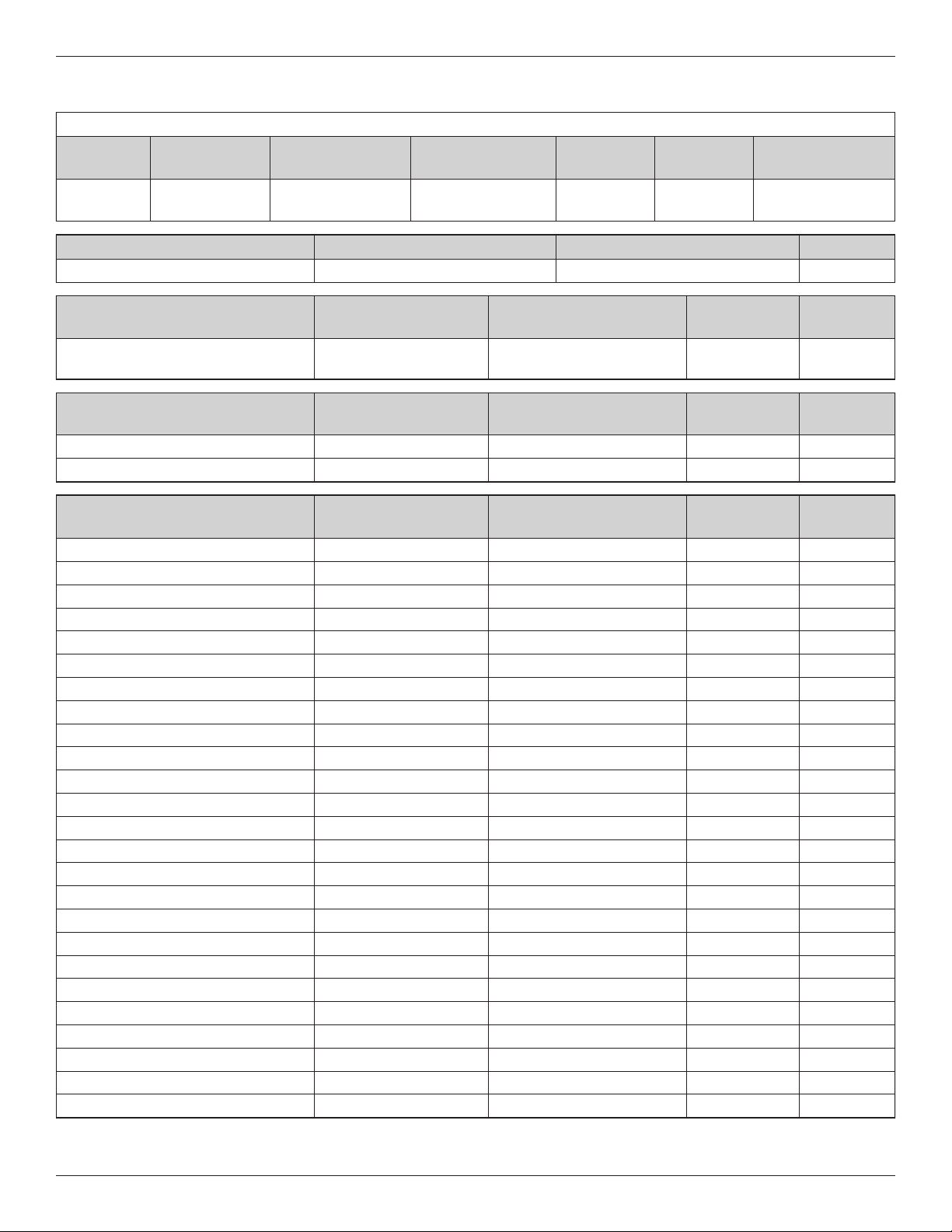
Performance Data
PERFORMANCE CLAIMS FOR DRINKING WATER SYSTEM
Model
Replacement
Elements
Operating
Pressure Range
Operating Temp -
erature Range
Recovery
Rating
Efficiency
Rating
Daily Production
Rate (DPR)
BRDROS
BRDROF &
BRDROM
40 -100 PSI
(275 - 689 kPa)
40 - 100 °F
(5 - 38 °C)
21.18% 10.63%
14.76 gal./day
(55.9 liters/day)
NSF/ANSI Standard 42 Minimum Reduction Overall % Reduction Results
Chlorine Taste & Odor <0.5 mg/L 97.5% Pass
NSF/ANSI Standard 473
Influent Challenge
Concentration
Maximum Permissible
Concentration
Overall %
Reduction
Results
Perfluorooctanoic acid (PFOA) &
Perfluorooctane sulfonate (PFOS)
1.5 μg/L ±10% 0.07 μg/L 97.7% Pass
NSF/ANSI Standard 53
Influent Challenge
Concentration
Maximum Permissible
Concentration
Overall %
Reduction
Results
VOC Surrogate Test 300 μg/L 15 μg/L 99.4% Pass
MTBE 15 μg/L 5 μg/L 99.4% Pass
NSF/ANSI Standard 58
Influent Challenge
Concentration
Maximum Permissible
Concentration
Overall %
Reduction
Results
Arsenic (pentavalent) 0.30 mg/L ±10% 0.010 mg/L 98.2% Pass
Barium 10 mg/L ±10% 2.0 mg/L 97.8% Pass
Cadmium 0.03 mg/L ±10% 0.005 mg/L 98.1% Pass
Chromium (VI) 0.3 mg/L ±10% 0.1 mg/L 97.0% Pass
Chromium (III) 0.3 mg/L ±10% 0.1 mg/L 98.3% Pass
Copper 3.0 mg/L ±10% 1.3 mg/L 98.8% Pass
Cysts ≥50,000 particles/mL 99.95% 99.99% Pass
Lead 0.15 mg/L ±10% 0.010 mg/L 99.1% Pass
Fluoride 8.0 mg/L ±10% 1.5 mg/L 96.5% Pass
Nitrate plus Nitrite (as N) 30 mg/L ±10% 10.0 mg/L 75.4% Pass
Nitrate (as N) 27.0 mg/L ±10% 10.0 mg/L 74.9% Pass
Nitrite (as N) 3.0 mg/L ±10% 1.0 mg/L 80.9% Pass
Radium 226/228 25 pCi/L ±10% 5 pCi/L 80% Pass
Selenium 0.10 mg/L ±10% 0.05 mg/L 98.0% Pass
Turbidity 11 ±1 NTU 0.5 NTU 99.0% Pass
TDS 750 mg/L ±40 187 mg/L 90.6% Pass
Ammonium
1
1.2 mg/L ±10% – 90% Pass
Bicarbonate
1
300 mg/L ±10% – 96% Pass
Bromide
1
1.5 mg/L ±10% – 89% Pass
Chloride
1
800 mg/L ±10% – 92% Pass
Magnesium
1
30 mg/L ±10% – 97% Pass
Sodium
1
350 mg/L ±10% – 98% Pass
Sulfate
1
800 mg/L ±10% – 98% Pass
Tannin
1
3.0 mg/L ±10% – 97% Pass
Zinc
1
15 mg/L ±10% – 98% Pass
1
Tested by Spectrum Labs, a qualified independent laboratory, against accepted industry protocol.
25
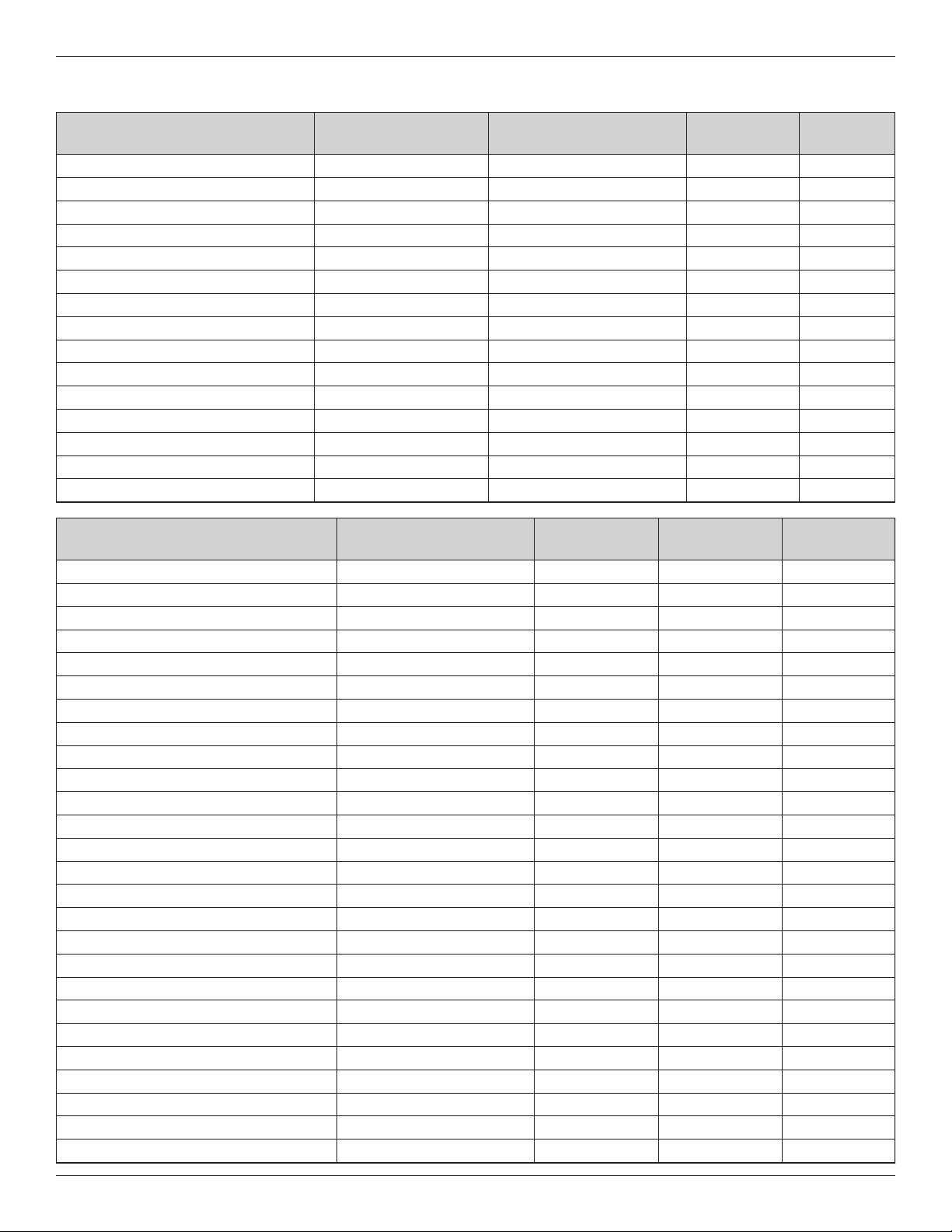
Performance Data
NSF/ANSI Standard 401
Influent Challenge
Concentration
Maximum Permissible
Concentration
Overall %
Reduction
Results
Atenolol 200 ng/L ±20% 60 ng/L 99.5% Pass
Bisphenol A 2,000 ng/L ±20% 300 ng/L 98.2% Pass
Carbamazepine 1,400 ng/L ±20% 200 ng/L 97.1% Pass
DEET 1,400 ng/L ±20% 200 ng/L 99.2% Pass
Estrone 140 ng/L ±20% 20 ng/L 98.9% Pass
Ibuprofen 400 ng/L ±20% 60 ng/L 94.5% Pass
Linuron 140 ng/L ±20% 20 ng/L 96.6% Pass
Meprobamate 400 ng/L ±20% 60 ng/L 99.0% Pass
Metolachlor 1,400 ng/L ±20% 200 ng/L 97.5% Pass
Naproxen 140 ng/L ±20% 20 ng/L 98.7% Pass
Nonyl phenol 1,400 ng/L ±20% 200 ng/L 98.4% Pass
Phenytoin 200 ng/L ±20% 30 ng/L 99.5% Pass
TCEP 5,000 ng/L ±20% 700 ng/L 97.0% Pass
TCCP 5,000 ng/L ±20% 700 ng/L 96.5% Pass
Trimethoprim 140 ng/L ±20% 20 ng/L 98.9% Pass
VOCs (by surrogate testing using
chloroform)
Maximum Permissible
Concentration
Effluent/
Unfiltered
Effluent/
Filtered
Percent
Reduction
Alachlor 2.0 μg/L 50 μg/L 1.0 μg/L >98%
Atrazine 3.0 μg/L 100 μg/L 3.0 μg/L >97%
Benzene 5.0 μg/L 81 μg/L 1.0 μg/L 99%
Carbofuran 40 μg/L 190 μg/L 1.0 μg/L >99%
Carbon Tetrachloride 5.0 μg/L 78 μg/L 1.8 μg/L 98%
Chlorobenzene 100 μg/L 77 μg/L 1.0 μg/L 99%
Chloropicrin NA 15 μg/L 0.2 μg/L 99%
2,4-D 70 μg/L 110 μg/L 1.7 μg/L 98%
Dibromochloropropane (DBCP) 0.2 μg/L 52 μg/L 0.02 μg/L >99%
o-Dichlorobenzene 600 μg/L 80 μg/L 1.0 μg/L 99%
p-Dichlorobenzene 75 μg/L 40 μg/L 1.0 μg/L 98%
1,2-Dichloroethane 5.0 μg/L 88 μg/L 4.8 μg/L 95%
1,1-Dichloroethylene 7.0 μg/L 83 μg/L 1.0 μg/L 99%
cis-1,2-Dichloroethylene 70 μg/L 170 μg/L 0.5 μg/L >99%
trans-1,2-Dichloroethylene 100 μg/L 86 μg/L 1.0 μg/L 99%
1,2-Dichloropropane 5.0 μg/L 80 μg/L 1.0 μg/L 99%
cis-1,3-Dichloropropylene NA 79 μg/L 1.0 μg/L 99%
Dinoseb 7.0 μg/L 170 μg/L 0.2 μg/L 99%
Endrin 2.0 μg/L 53 μg/L 0.59 μg/L 99%
Ethylbenzene 700 μg/L 88 μg/L 1.0 μg/L 99%
Ethyl Dibromide (EDB) 0.05 μg/L 44 μg/L 0.02 μg/L >99%
Haloacetonitriles (HAN)
Bromochloroacetonitrile NA 22 μg/L 0.5 μg/L 98%
Dibromoacetonitrile NA 24 μg/L 0.6 μg/L 98%
Dichloroacetonitrile NA 9.6 μg/L 0.2 μg/L 98%
Trichloroacetonitrile NA 15 μg/L 0.3 μg/L 98%
26
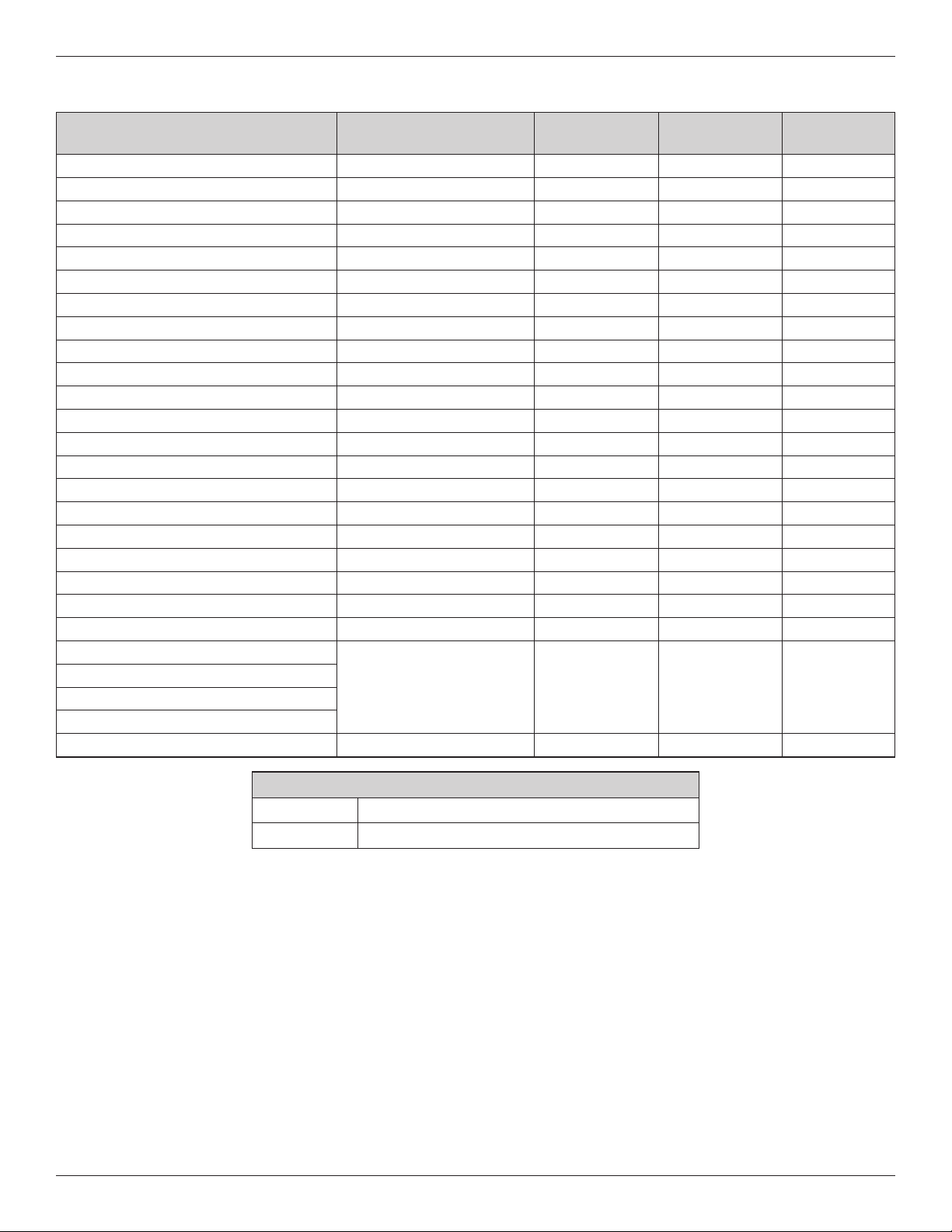
Performance Data
VOCs (by surrogate testing using
chloroform)
Maximum Permissible
Concentration
Effluent/
Unfiltered
Effluent/
Filtered
Percent
Reduction
Haloketones (HK)
1,1-dichloro-2-propanone NA 7.2 μg/L 0.1 μg/L 99%
1,1,1-trichloro-2-propanone NA 8.2 μg/L 0.3 μg/L 96%
Heptachlor 0.4 μg/L 25 μg/L 0.01 μg/L >99%
Heptachlor Epoxide 0.2 μg/L 10.7 μg/L 0.2 μg/L 98%
Hexachlorobutadiene NA 44 μg/L 1.0 μg/L 98%
Hexachlorocyclopentadiene 50 μg/L 60 μg/L 0.002 μg/L >99%
Lindane 0.2 μg/L 55 μg/L 0.01 μg/L >99%
Methoxychlor 40 μg/L 50 μg/L 0.1 μg/L >99%
Pentachlorophenol 1.0 μg/L 96 μg/L 1.0 μg/L 99%
Simazine 4.0 μg/L 120 μg/L 4.0 μg/L 97%
Styrene 100 μg/L 150 μg/L 0.5 μg/L >99%
1,1,2,2-Tetrachloroethane NA 81 μg/L 1.0 μg/L 99%
Tetrachloroethylene 5.0 μg/L 81 μg/L 1.0 μg/L 99%
Toluene 1,000 μg/L 78 μg/L 1.0 μg/L 99%
2,4,5-TP (silvex) 50 μg/L 270 μg/L 1.6 μg/L 99%
Tribromoacetic acid NA 42 μg/L 1.0 μg/L 98%
1,2,4-Trichlorobenzene 70 μg/L 160 μg/L 0.5 μg/L >99%
1,1,1-Trichloroethane 200 μg/L 84 μg/L 4.6 μg/L 95%
1,1,2-Trichloroethane 5.0 μg/L 150 μg/L 0.5 μg/L >99%
Trichloroethylene 5.0 μg/L 180 μg/L 1.0 μg/L >99%
Chloroform (THM)
80 μg/L 300 μg/L 15 μg/L 95%
Bromoform (THM)
Bromodichloromethane (THM)
Chlorodibromomethane (THM)
Xylenes (total) 10,000 μg/L 70 μg/L 1.0 μg/L 99%
This system has been tested according to NSF/ANSI standards for the reduction of substances listed above. The con-
centration of the indicated substances in water entering the system was reduced to a concentration less than or equal to
the permissible limit for water leaving the system, as specified in NSF/ANSI Standards 42, 53, 58, 401 and 473.
Testing was performed under standard laboratory conditions. Actual performance may vary.
Efficiency rating means the percentage of the influent water to the system that is available to the user as reverse osmo-
sis treated water under operating conditions that approximate typical daily usage.
Recovery rating means the percentage of the influent water to the membrane portion of the system that is available to
the user as reverse osmosis treated water when the system is operated without a storage tank or when the storage tank
is bypassed.
Do not use with water that is microbiologically unsafe or of unknown quality, without adequate disinfection before or after
the system. This system is certified for cyst reduction, and may be used on disinfected water that may contain filterable
cysts.
This system is acceptable for treatment of influent concentrations of no more than 27 mg/L nitrate and 3 mg/L nitrite in
combination, measured as N, and is certified for nitrate/nitrite reduction only for water supplies with a pressure of 40 psig
(276 kPa) or greater.
FILTER PERFORMANCE DATA
Flow Rate 0.9 gallons per minute (3.4 liters per minute)
Capacity 230 gallons (871 liters)

27
Performance Data
ARSENIC FACTS
Background
Arsenic (abbreviated As) can occur naturally in well water. There are two forms of arsenic: pentavalent arsenic
[also called As (V), As (+5), and arsenate] and trivalent arsenic [also called As (III), As (+3), and arsenite].
Although both forms are potentially harmful to human health, trivalent arsenic is considered more harmful than
pentavalent arsenic. In well water, arsenic may be pentavalent, trivalent, or a combination of both. Additional
information about arsenic in water can be found on the Internet at the U.S. Environmental Protection Agency
(USEPA) website:www.epa.gov/safewater/arsenic.html.
Testing Your Water
Arsenic in water has no color, taste or odor. It must be measured by a lab test. Public water utilities must have
their water tested for arsenic. You can get the results from your water utility. If you have your own well, you can
have the water tested. The local health department or the state environmental health agency can provide a list of
certified labs. The cost is typically $15 to $30.
Pentavalent vs.Trivalent Arsenic Removal
These systems are very effective at reducing pentavalent arsenic from drinking water. These models were tested
in a lab and proven to reduce 300 parts per billion (ppb) pentavalent arsenic to below 10 ppb, the USEPA stan-
dard for safe drinking water.
RO systems are not as effective at reducing trivalent arsenic from water. These models will not convert trivalent
arsenic to pentavalent arsenic. If you have free
chlorine residual in contact with your water supply for at least one
minute any trivalent arsenic will be converted to pentavalent arsenic and reduced by this RO. Other water treat-
ment chemicals such as ozone, and potassium permanganate will also change trivalent arsenic to pentavalent
arsenic. A combined chlorine residual (also called chloramine) may not convert all the trivalent arsenic. If you get
your water from a public water utility, contact the utility to find out if free chlorine or combined chlorine is used in
the water system.
Maintenance
It is strongly recommended that you follow the maintenance instructions and have your water tested periodically
to make sure the system is performing properly. See replacement element information above for recommenda-
tions on maintaining your Reverse Osmosis water filtration system.
This system has been tested for the treatment of water containing pentavalent arsenic [also known as As (V), As (+5),
or arsenate] at concentrations of 0.30 mg/L or less. This system reduces pentavalent arsenic, but may not reduce other
forms of arsenic. This system shall be used on water supplies containing a detectable free chlorine residual at the
system inlet or on water supplies that have been demonstrated to contain only pentavalent arsenic. Treatment with
chloramine (combined chlorine) is not sufficient to ensure complete conversion of trivalent arsenic to pentavalent
arsenic. Please see the Arsenic Facts section below for further information.