www.lg.com
Read this owner’s manual thoroughly before operating the appliance and keep it handy for
reference at all times.
OWNER'S MANUAL
DRYER
Copyright © 2020 LG Electronics Inc. All Rights Reserved.
MFL70442646
Rev.02_110320
DLE3400* DLE3450*
ENGLISH FRANÇAIS

TABLE OF CONTENTS
2
3 SAFETY INSTRUCTIONS
4 IMPORTANT SAFETY INSTRUCTIONS
8 PRODUCT FEATURES
9 PRODUCT OVERVIEW
9 Parts
9 Accessories
10 INSTALLATION
10 Installation Overview
10 Product Specifications
11 Installation Location Requirements
12 Clearances
14 Leveling the Dryer
15 Reversing the Door
16 Installing the Side Vent Kit
17 Stacking the Dryer
18 Venting the Dryer
20 Connecting Gas Dryers
22 Connecting Electric Dryers
23 Final Installation Check
23 Installation Test (Duct Check)
26 OPERATION
26 Using the Dryer
27 Check the Lint Filter Before Every Load
27 Sorting Laundry
27 Loading the Dryer
28 Control Panel
30 Cycle Guide
31 Cycle Modifier Buttons
31 Option Buttons
32 Special Functions
33 SMART FUNCTIONS
33 LG ThinQ Application
33 Smart Diagnosis™ Feature
34 MAINTENANCE
34 Regular Cleaning
36 TROUBLESHOOTING
36 FAQs: Frequently Asked Questions
36 User Support Videos
37 Before Calling for Service
42 WARRANTY
3
SAFETY INSTRUCTIONS
ENGLISH
SAFETY INSTRUCTIONS
READ ALL INSTRUCTIONS BEFORE USE
Safety for a Dryer
WARNING
Fire Hazard
Failure to follow safety warnings exactly could result in serious injury, death
or property damage.
Do not install a booster fan in the exhaust duct.
Install all clothes dryer in accordance with the installation instructions of the
manufacturer of dryer.
WARNING:
FIRE OR EXPLOSION HAZARD
Failure to follow safety warnings exactly could result in serious injury, death
or property damage.
• Do not store or use gasoline or other flammable vapors and liquids in the
vicinity of this or any other appliance.
• WHAT TO DO IF YOU SMELL GAS
− Do not try to light any appliance.
− Do not touch any electrical switch; do not use any phone in your building.
− Clear the room, building or area of all occupants.
− Immediately call your gas supplier from a neighbor’s phone. Follow the
gas supplier’s instructions.
− If you cannot reach your gas supplier, call the fire department.
• Installation and service must be performed by a qualified installer, service
agency or your gas supplier.
4
SAFETY INSTRUCTIONS
WARNING - Risk of Fire
Install the clothes dryer according to the manufacturer’s instructions and
local codes.
• Clothes dryer installation must be performed by a qualified installer.
• Do not install a clothes dryer with flexible plastic venting materials. If
flexible metal (foil type) duct is installed, it must be of a specific type
identified by the appliance manufacturer as suitable for use with clothes
dryers. Flexible venting materials are known to collapse, be easily crushed,
and trap lint. These conditions will obstruct clothes dryer airflow and
increase the risk of fire.
• To reduce the risk of severe injury or death, follow all installation
instructions.
Your safety and the safety of others are very important.
We have provided many important safety messages in this manual and on your appliance. Always
read and follow all safety messages.
This is the safety alert symbol.
This symbol alerts you to potential hazards that can kill or injure you and others.
All safety messages will follow the safety alert symbol and either the word WARNING or
CAUTION. These words mean:
WARNING
You may be killed or seriously injured if you do not follow instructions.
CAUTION
You may be slightly injured or cause damage to the product if you do not follow instructions.
All safety messages will tell you what the potential hazard is, tell you how to reduce the chance of
injury, and tell you what may happen if the instructions are not followed.
IMPORTANT SAFETY INSTRUCTIONS
WARNING
To reduce the risk of explosion, fire, death, electric shock, scalding or injury to persons
when using this product, follow basic precautions, including the following:

5
SAFETY INSTRUCTIONS
ENGLISH
INSTALLATION
• Before use, the appliance must be properly installed as described in this manual.
• Connect to a properly rated, protected, and sized power circuit to avoid electrical overload.
• To reduce the risk of severe injury or death, follow all installation instructions.
• The appliance must be installed and electrically grounded by qualified service personnel in accordance
with local codes.
• Disconnect the power cord, house fuse or circuit breaker before installing or servicing the appliance.
• When moving or installing the product in a different location, call qualified service personnel for
installation and service.
• Keep packing materials out of the reach of children. Packaging material can be dangerous for children.
There is a risk of suffocation.
• Moving or installation of the appliance requires two or more people.
• This appliance is not designed for maritime use or for mobile installations such as in RVs, trailers, or
aircraft.
• Store and install the appliance where it will not be exposed to temperatures below freezing or exposed
to outdoor weather conditions.
• This appliance must be positioned near to an electrical power supply.
• Do not, under any circumstances, cut or remove the third (ground) prong from the power cord.
• When installing or moving the appliance, be careful not to pinch, crush, or damage the power cord.
• Do not install the appliance in humid spaces.
• Destroy the carton, plastic bag, and other packing materials after the appliance is unpacked. Children
might use them for play. Cartons covered with rugs, bedspreads, or plastic sheets can become airtight
chambers.
• Adhere to all industry recommended safety procedures including the use of long sleeved gloves and
safety glasses.
• Never attempt to operate this appliance if it is damaged, malfunctioning, partially disassembled, or has
missing or broken parts, including a damaged cord or plug.
• Do not install a clothes dryer with flexible plastic venting materials. If flexible metal (foil type) duct is
installed, it must be of a specific type identified by the appliance manufacturer as suitable for use with
clothes dryers. Flexible venting materials are known to collapse, be easily crushed, and trap lint. These
conditions will obstruct clothes dryer airflow and increase the risk of fire.
• Place the dryer at least 18 inches above the floor for a garage installation.
• Do not use sheet metal screws or other fasteners which extend into the duct that could catch lint and
reduce the efficiency of the exhaust system. Secure all joints with duct tape.
• Use only rigid, semi-rigid or flexible metal 4-inch diameter duct inside the dryer cabinet or for exhausting
to the outside. Use of plastic or other combustible ductwork may cause a fire. Punctured ductwork may
cause a fire if it collapses or becomes otherwise restricted in use or during installation.
• The exhaust duct must be 4 inches (10.2 cm) in diameter with no obstructions. The exhaust duct should
be kept as short as possible. Make sure to clean any old ducts before installing your new dryer.
• Rigid, semi-rigid or flexible metal ducting is recommended for use between the dryer and the wall. All
non-rigid metal transition duct must be UL-listed. Use of other materials for transition duct could affect
drying time.
• Ductwork is not provided with the dryer, and you should obtain the necessary ductwork locally. The end
cap should have hinged dampers to prevent backdraft when the dryer is not in use.
• Gas dryers MUST be exhausted to the outside.
• The dryer exhaust system must be exhausted to the outside of the dwelling. If the dryer is not
exhausted outdoors, some fine lint and large amounts of moisture will be expelled into the laundry area.
An accumulation of lint in any area of the home may create a health and fire hazard.

6
SAFETY INSTRUCTIONS
• Do not install near another heat source such as a stove, oven or heater.
• Keep area around the exhaust opening and adjacent surrounding areas free from the accumulation of
lint, dust, and dirt.
• The appliance must not be supplied through an external switching device, such as a timer, or connected
to a circuit that is regularly switched on and off by a utility.
OPERATION
• Repair or immediately replace all power cords that have become frayed or otherwise damaged. Do not
use a cord that shows cracks or abrasion damage along its length or at either end.
• If you detect a strange sound, a chemical or burning smell, or smoke coming from the appliance, unplug
it immediately, and contact an LG Electronics customer information center.
• Never unplug the appliance by pulling on the power cord. Always grip the plug firmly and pull straight
out from the outlet.
• Do not use an extension cord or adapter with this appliance.
• Do not grasp the power cord or touch the appliance controls with wet hands.
• Do not modify or extend the power cord.
• If the product has been submerged, contact an LG Electronics customer information center for
instructions before resuming use.
• Do not store or use gasoline or other flammable vapors and liquids in the vicinity of this or any other
appliance.
• Keep the area underneath and around your appliances free of combustible materials (lint, paper, rags,
etc.), gasoline, chemicals and other flammable vapors and liquids.
• This appliance is not intended for use by persons (including children) with reduced physical, sensory or
mental capabilities, or lack of experience and knowledge, unless they have been given supervision or
instruction concerning the use of the appliance by a person responsible for their safety.
• Read all instructions before using the appliance and save these instructions.
• Use this appliance only for its intended purpose.
• Do not abuse, sit on, or stand on the door of the appliance.
• Do not allow children to play on, in or with the appliance. Close supervision of children is necessary
when the appliance is used near children.
• Do not tamper with controls.
• In the event of a gas leak (propane gas, LP gas, etc.) do not operate this or any other appliance. Open
a window or door to ventilate the area immediately.
• Under certain conditions, hydrogen gas may be produced in a hot-water system that has not been used
for two weeks or more. HYDROGEN GAS IS EXPLOSIVE. If the hot-water system has not been used
for such a period, before using the appliance turn on all hot water faucets and let the water flow from
each for several minutes. This will release any accumulated hydrogen gas. As the gas is flammable, do
not smoke or use an open flame during this time.
• Fix the drain hose securely in place.
• Do not put oily or greasy clothing, candles or flammable materials on top of the appliance.
• Do not use fabric softeners or products to eliminate static unless recommended by the manufacturer of
the fabric softener or product.
• Do not reach into the appliance if the drum is moving.
• Do not dry articles that have been previously cleaned in, washed in, soaked in, soiled with or spotted
with gasoline, dry cleaning solvents, vegetable oil, cooking oil or other flammable or explosive
substances, as they give off vapors that could ignite or explode.
• Do not use heat to dry articles containing foam rubber or similarly textured rubber-like materials.
• Do not store plastic, paper, or clothing that may burn or melt on top of the dryer during operation.

7
SAFETY INSTRUCTIONS
ENGLISH
• Always check the inside of the appliance for foreign objects.
• Gas appliances can cause minor exposure to four potentially hazardous substances, namely benzene,
carbon monoxide, formaldehyde, and soot, caused primarily by the incomplete combustion of natural
gas or LP fuels.
• Properly adjusted dryers will minimize incomplete combustion. Exposure to these substances can be
minimized further by properly venting the dryer to the outdoors.
• Do not place items exposed to cooking oils in your dryer. Items contaminated with cooking oils may
contribute to a chemical reaction that could cause a load to catch fire.
To reduce the risk of fire due to contaminated loads, the final part of a tumble dryer cycle occurs without
heat (cool down period). Avoid stopping a tumble dryer before the end of the drying cycle unless all
items are quickly removed and spread out so that the heat is dissipated.
• Do not let children or pets climb inside the dryer drum.
• Do not put living animals such as pets inside the product.
• Do not put any part of your body, such as your hands or feet, or metal objects under the product.
• Do not let your hand get pinched when opening or closing the dryer door.
MAINTENANCE
• Do not repair or replace any part of the appliance. All repairs and servicing must be performed by
qualified service personnel unless specifically recommended in this Owner’s Manual. Use only
authorized factory parts.
• Do not disassemble or repair the appliance by yourself.
• Remove any dust or foreign matter from the power plug pins.
• Disconnect this appliance from the power supply before cleaning and attempting any user maintenance.
Turning the controls to the OFF position does not disconnect this appliance from the power supply.
• Remove the door before the appliance is removed from service or discarded to avoid the danger of
children or small animals getting trapped inside.
• Unplug the appliance before cleaning to avoid the risk of electric shock.
• Clean the lint filter before or after each load.
• The interior of the appliance and exhaust duct should be cleaned periodically by qualified service
personnel.
GROUNDING INSTRUCTIONS
• Improper connection of the equipment-grounding conductor can result in a risk of electric shock. Check
with a qualified electrician or service personnel if you are in doubt whether the appliance is properly
grounded. Do not modify the plug provided with the appliance; if it will not fit the outlet, have a proper
outlet installed by a qualified electrician.
• The appliance must be grounded. In the event of a malfunction or breakdown, grounding will reduce
the risk of electric shock by providing a path of least resistance for electric current. The appliance is
equipped with a cord having an equipment-grounding conductor and a grounding plug. The plug must
be plugged into an appropriate outlet that is installed and grounded in accordance with all local codes
and ordinances.
• This dryer must be plugged into a properly grounded outlet. Electrical shock may result if the dryer is
not properly grounded. Have the wall outlet and circuit checked by a qualified electrician to make sure
the outlet is properly grounded. Failure to follow these instructions may create an electric shock hazard
and/or a fire hazard.
SAVE THESE INSTRUCTIONS
8
PRODUCT FEATURES
PRODUCT FEATURES
Easy-to-Use Control Panel
Rotate the cycle selector knob to select the desired dry cycle. Add cycle options or adjust settings with the
touch of a button.
Easy-Access Reversible Door
The wide-opening door provides easy access for loading and unloading. The door hinge can be reversed to
adjust for installation location.
Flow Sense™ Duct Blockage Sensing System Indicator
The Flow Sense™ duct blockage sensing system detects and alerts you to restrictions in the installed
household ductwork that reduce exhaust airflow through the dryer. If you see the alert: Clean or repair the
ducts to remove the restrictions. Keep your ducts clean to help increase efficiency and reduce long drying
times caused by blocked ducts.
Smart Diagnosis™
Should you experience any technical difficulty with your dryer, it has the capability of transmitting data via your
telephone to the Customer Information Center. The call center agent records the data transmitted from your
machine and uses it to analyze the issue, providing a fast and effective diagnosis.
C
E
R
T
I
F
I
E
D
D
E
S
I
G
N
9
PRODUCT OVERVIEW
ENGLISH
PRODUCT OVERVIEW
Parts
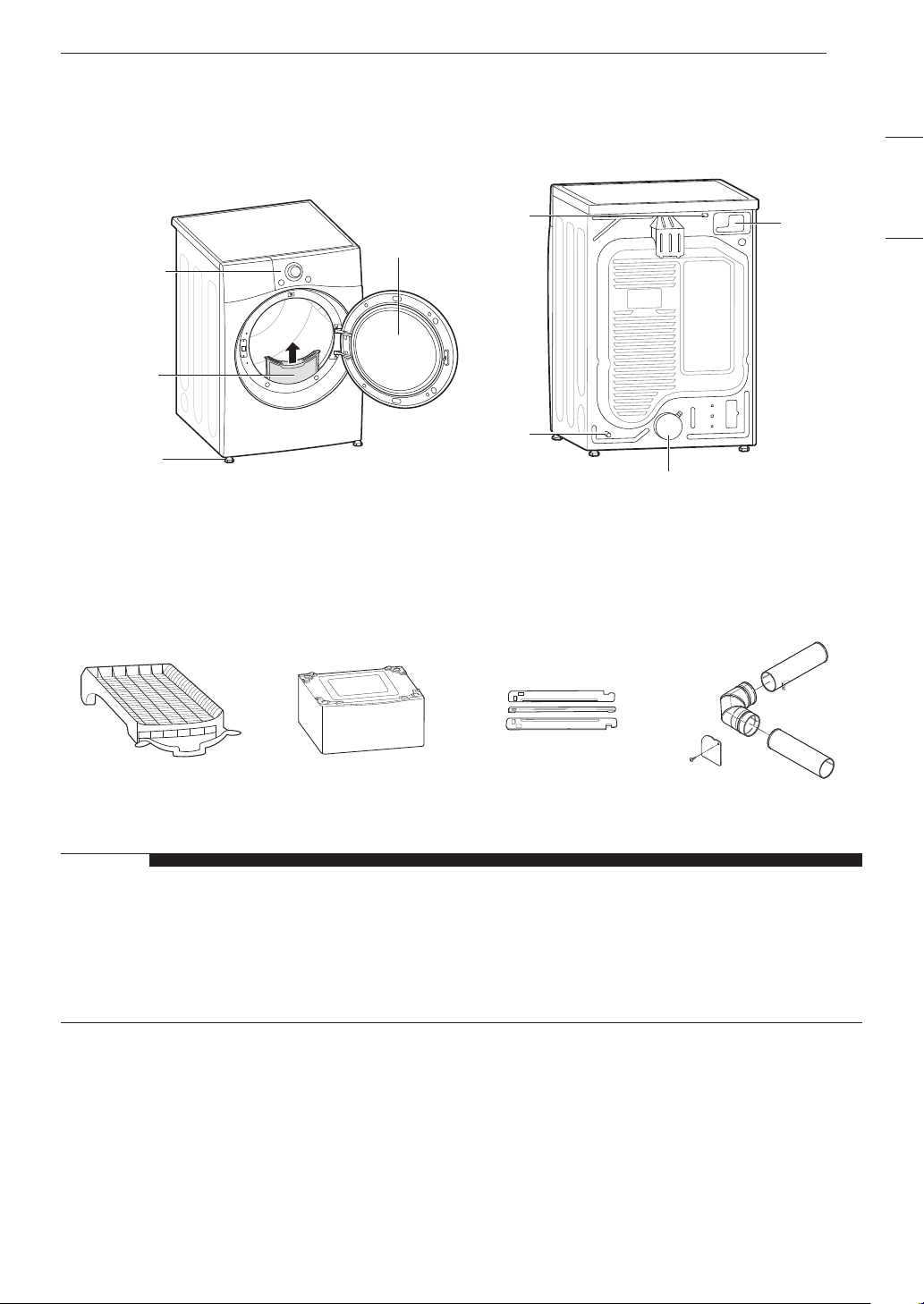
Control panel
Lint filter
Leveling feet
Reversible
door
Power
Cord
(gas
models)
Gas
connection
(gas models)
Exhaust Duct Outlet
Terminal
Block
Access
Panel
(electric
models)
Accessories
Optional Accessories (Sold Separately)
Drying Rack Pedestal Stacking kit Side vent kit
Kit No. 383EEL9001B
NOTE
• For your safety and extended product life, use only authorized components. The manufacturer is not
responsible for product malfunction or accidents caused by the use of unauthorized components or
parts.
• The images in this manual may be different from the actual components and accessories which are
subject to change by the manufacturer without prior notice for product improvement purposes.
10
INSTALLATION
INSTALLATION
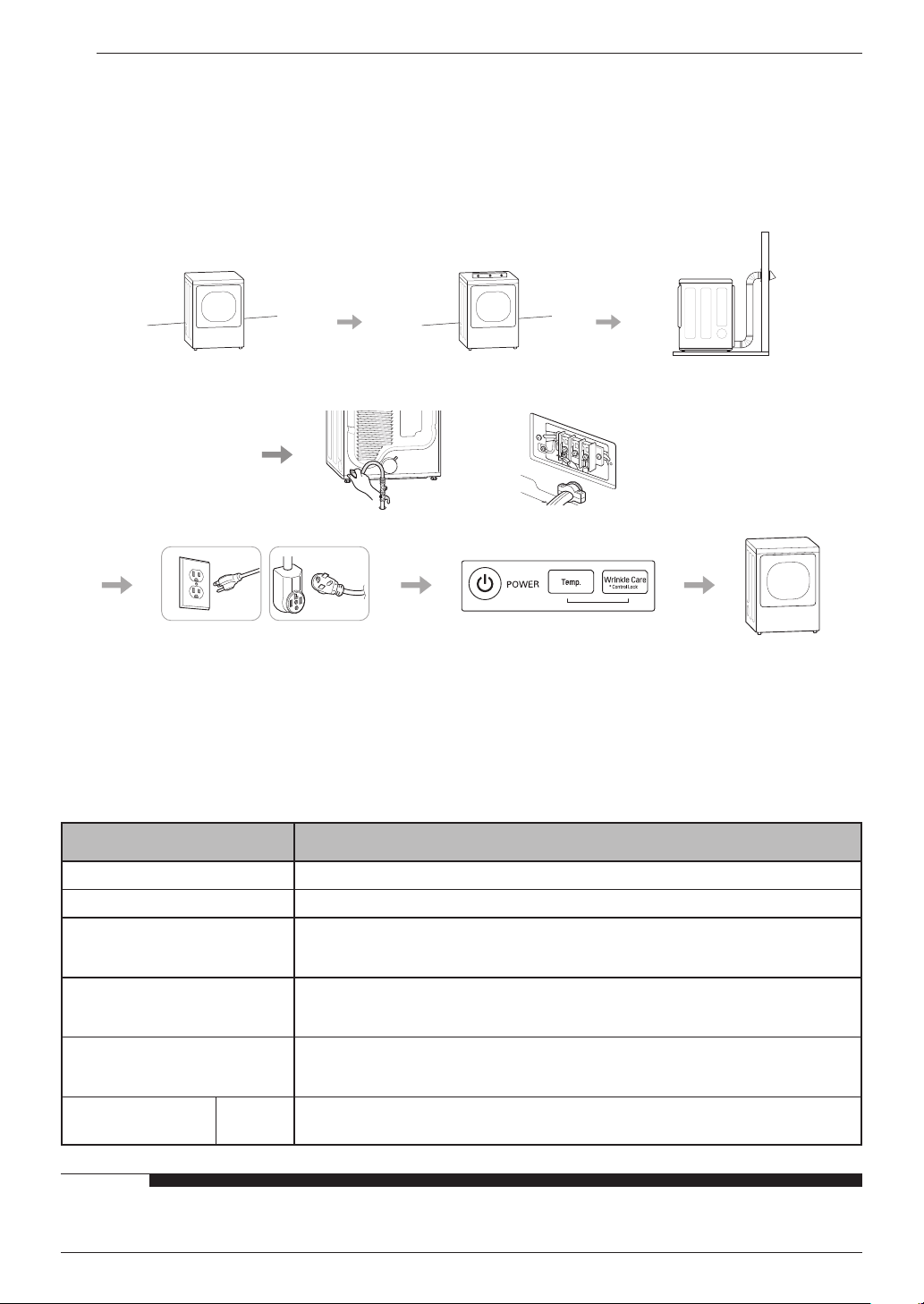
Installation Overview
Please read the following installation instructions first after purchasing this product or transporting it to
another location.
Check and choose the
proper location
Level the dryer Vent the dryer
Connect the Gas dryer Connect the Electric dryer
Gas dryer Installation test Test runElectric dryer
Plug in the power cord
Product Specifications
The appearance and specifications listed in this manual may vary due to constant product improvements.
Dryer Models DLE3400*, DLE3450*
Description Non-steam Dryer
Electrical requirements Please refer to the rating label for detailed information.
Gas requirements
NG: 4 - 10.5-inch (10.2 - 26.7 cm) WC
LP: 8 - 13-inch (20.4 - 33.1 cm) WC
Dimensions
27” (W) X 30.2” (D) X 39” (H), 51.4” (D with door open)
68.6 cm (W) X 76.5 cm (D) X 99 cm (H), 130.5 cm (D with door open)
Net weight
Gas : 123.02 lb (55.8kg)
Electric : 120.15 lb (54.5kg)
Drying capacity
Normal
Cycle
IEC 7.4 cu.ft. (22.5 lb/10.2 kg)
NOTE
• Model numbers can be found on the cabinet inside the door.
11
INSTALLATION
ENGLISH
Installation Location Requirements
WARNING
• Read all installation instructions completely before installing and operating your dryer! It is important
that you review this entire manual before installing and using your dryer. Detailed instructions
concerning electrical connections, gas connections, and exhaust requirements are provided on the
following pages.
The installation requires:
• A location that allows for proper exhaust installation. A gas dryer must be exhausted to the outdoors.
See Venting the Dryer.
• A grounded electrical outlet located within 2 ft. (61 cm) of either side of the dryer. See Connecting
Electric Dryers.
• A sturdy floor to support the total dryer weight of 200 lb (90.7 kg). The combined weight of a companion
appliance should also be considered.
• No other fuel-burning appliance can be installed in the same closet as a dryer.
• Additional clearances might be required for wall, door and floor moldings.
• Companion appliance spacing should also be considered.
NOTE
• The floor must be level, with a maximum slope of 1 inch (2.5 cm) under the entire dryer. Clothes may
not tumble properly, and automatic sensor cycles may not operate correctly if the dryer is not level.
• For garage installation, you will need to place the dryer at least 18 inches (45.7 cm) above the floor.
The standard pedestal height is 15 inches (38 cm). You will need 18 inches (45.7 cm) from the garage
floor to the bottom of the dryer.
• Do not operate your dryer at temperatures below 45 °F (7 °C). At lower temperatures, the dryer might
not shut off at the end of an automatic cycle. This can result in longer drying times.
• The dryer must not be installed or stored in an area where it will be exposed to water and/or weather.
• Check code requirements that limit, or do not permit, installation of the dryer in garages, mobile
homes or sleeping quarters. Contact your local building inspector.
12
INSTALLATION
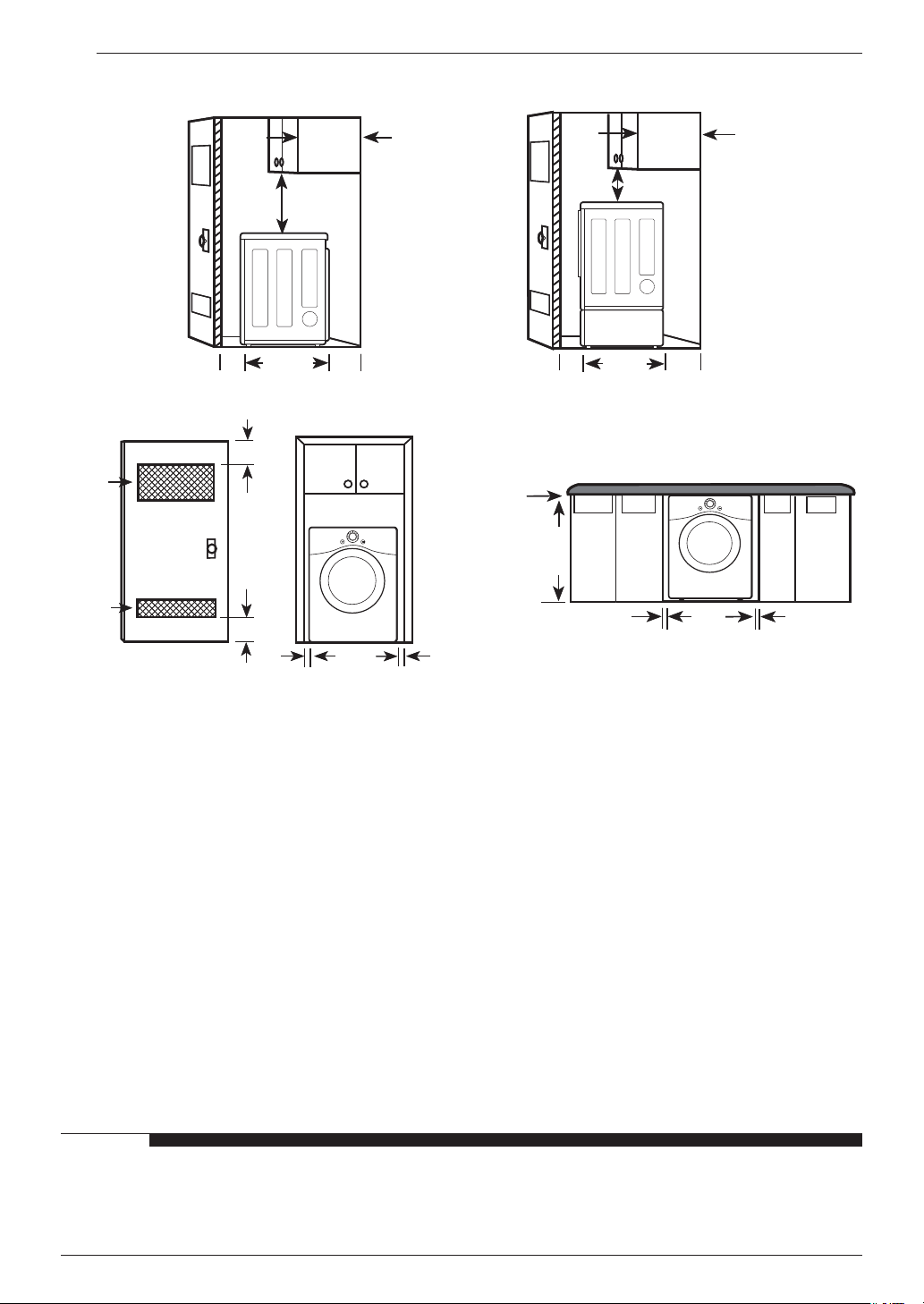
Clearances
1"*
(25 mm)
14" max.*
(356 mm)
18" min.*
(457 mm)
14" max.*
(356 mm)
18" min.*
(457 mm)
30.2"
(765mm)
5"**
(127 mm)
1"*
(25 mm)
30.2"
(765mm)
5"**
(127 mm)
24 in.
2*
(
155 cm
2
)
2*
(310 cm
2
)
3"
*
(76 mm)
48 in.
3"
*
(76 mm)
1"
(25 mm)
1"
(25 mm)
27"
(686 mm)
0"
(0 mm)
39"
(990 mm)
1"
(25 mm)
1"
(25 mm)
27"
(686 mm)
Closet Door Vent
Requirements
Installation Spacing for Recessed Area or Closet Installation
The following clearances are recommended for this dryer. This dryer has been tested for clearances of
1 inch (2.5 cm) on the sides and rear. Recommended clearances should be considered for the following
reasons:
• Additional clearances should be considered for ease of installation and servicing.
• Additional clearances should be considered on all sides of the dryer to reduce noise transfer. For closet
installation, with a door, minimum ventilation openings in the top and bottom of the door are required.
Louvered doors with equivalent ventilation openings are acceptable.
Closet Ventilation Requirements
Closets with doors must have both an upper and lower vent to prevent heat and moisture buildup in the
closet. One upper vent opening with a minimum opening of 48 sq. in. (310 cm
2
) must be installed no lower
than 6 feet above the floor. One lower vent opening with a minimum opening of 24 sq. in. (155 cm
2
) must
be installed no more than one foot above the floor. Install vent grills in the door or cut down the door at the
top and bottom to form openings. Louvered doors with equivalent ventilation openings are also acceptable.
NOTE
• There should be at least a little space around the dryer (or any other appliance) to eliminate the
transfer of vibration from one appliance to another. If there is enough vibration, it could cause
appliances to make noise or come into contact, causing paint damage and further increasing noise.
13
INSTALLATION
ENGLISH
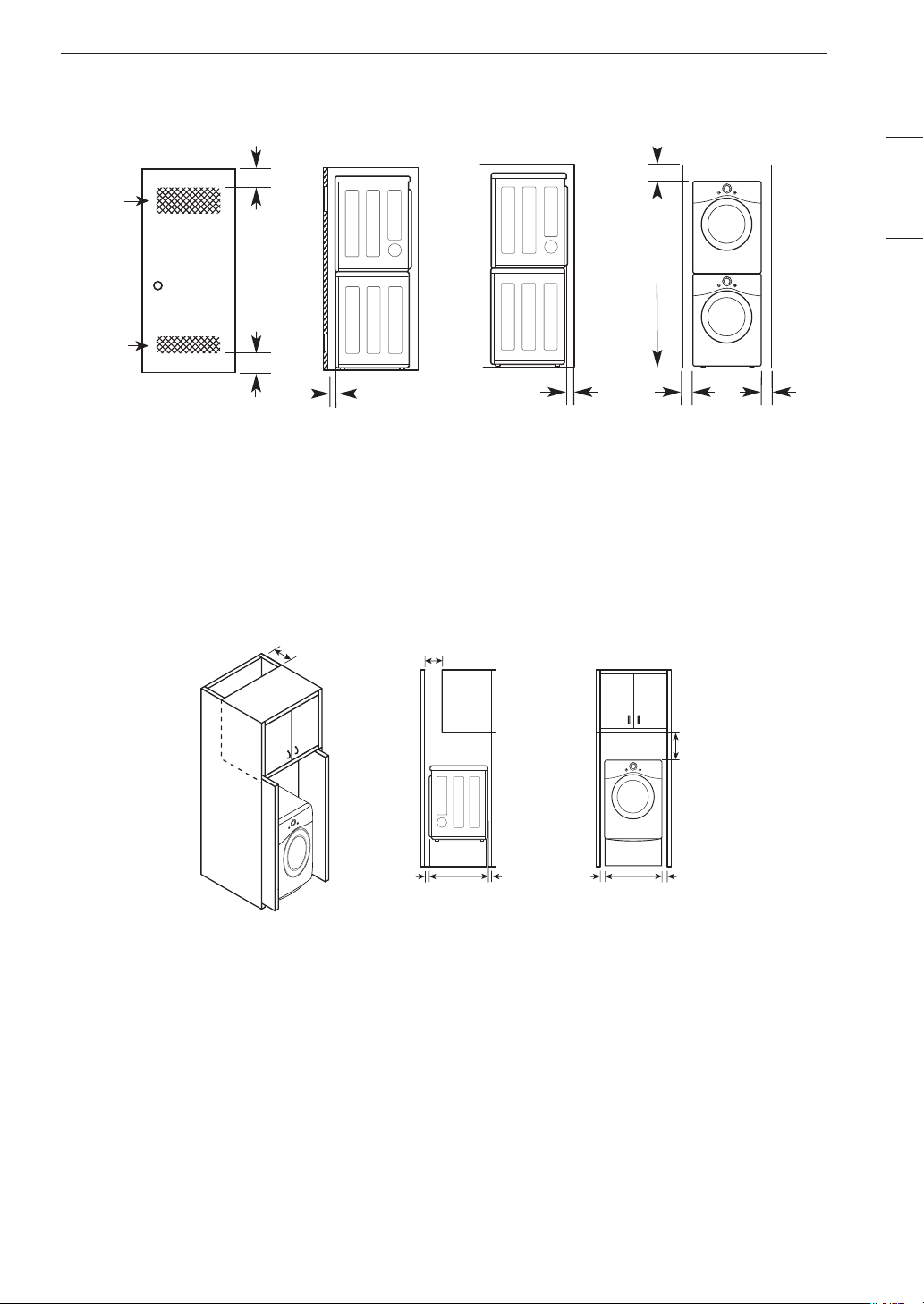
Installation Spacing for Recessed Area or Closet, with Stacked Washer and
Dryer
24 in.
2*
(155 cm
2
)
2*
(310 cm
2
)
48 in.
3"
*
(76 mm)
3"
*
(76 mm)
1"
*
(25 mm)
1"
(25 mm)
1"
(25 mm)
27"
(686 mm)
5 ½"
**
(140 mm)
6"
*
(152 mm)
77 ½"
(1968 mm)
* Required spacing
** For side or bottom venting, 2-inch (5.1 cm) of spacing is allowed.
Installation Spacing for Cabinet
For cabinet installation with a door, minimum ventilation openings in the top of the cabinet are required.
* Required spacing
7" *
(178 mm)
7" *
(178 mm)
9" *
1"
(25 mm)
1"
(25 mm)
27"
(686 mm)
5"*
(127 mm)
1"*
(25 mm)
30.2"
(765 mm)
(229 mm)
14
INSTALLATION
Leveling the Dryer
WARNING
• Use long-sleeved gloves and safety glasses.
• The appliance is heavy. Two or more people
are required when installing the dryer.
NOTE
• Adjust the leveling feet only as far as
necessary to level the dryer. Extending the
leveling feet more than necessary may cause
the dryer to vibrate.
• To ensure that the dryer provides optimal
drying performance, it must be level. To
minimize vibration, noise, and unwanted
movement, the floor must be a perfectly level,
solid surface.
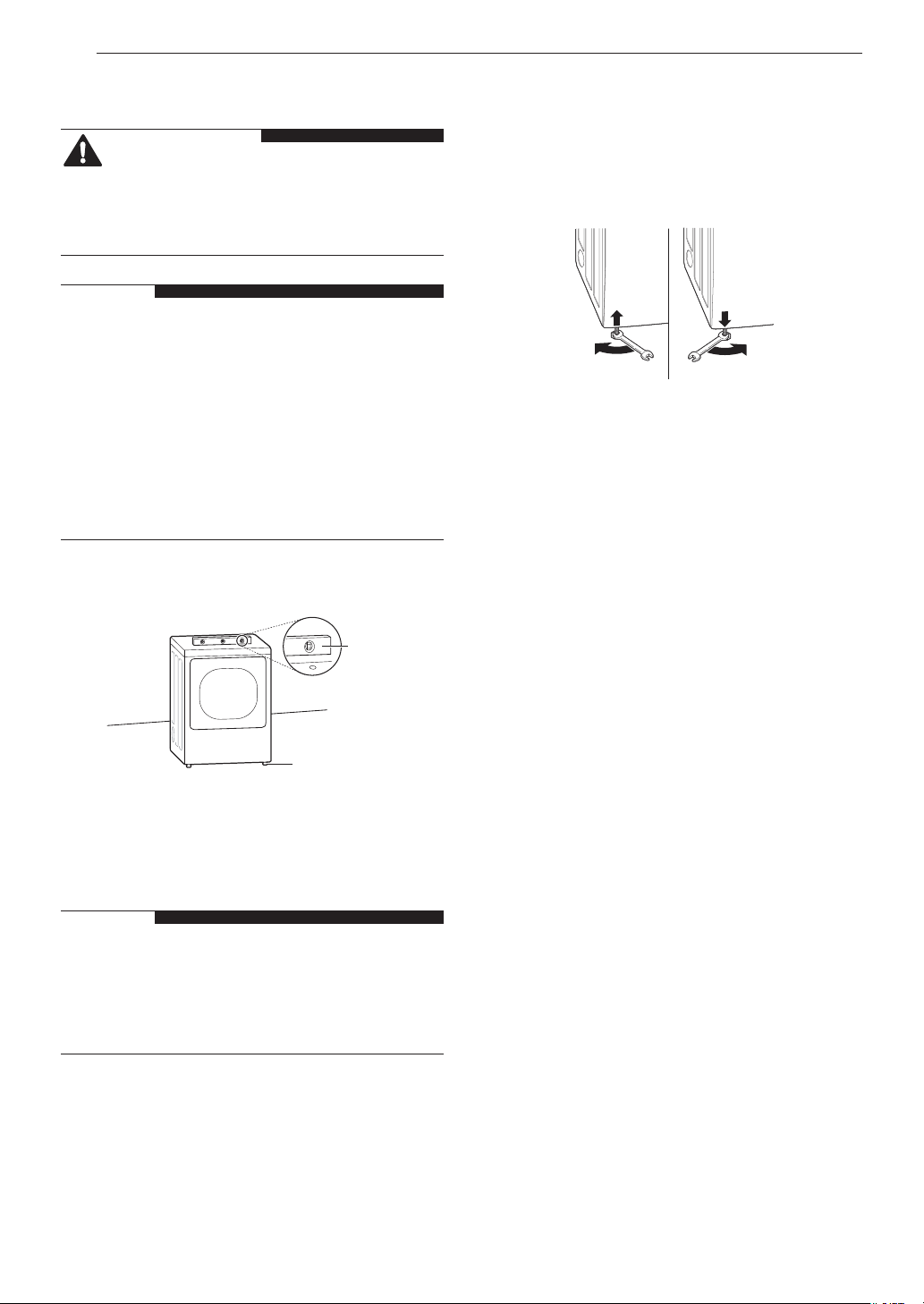
1
Position the dryer in the final location. Place a
level across the top of the dryer.
Level
Leveling Feet
• All four leveling feet must rest solidly on the
floor. Gently push on the top corners of the
dryer to make sure that the dryer does not
rock from corner to corner.
NOTE
• If you are installing the dryer on the optional
pedestal, you must use the leveling feet on the
pedestal to level the dryer. The dryer leveling
feet should be fully retracted.
2
Use an adjustable wrench to turn the leveling
feet. Unscrew the legs to raise the dryer or
screw in the legs to lower it. Raise or lower
with the leveling feet until the dryer is level
from side to side and front to back. Make sure
that all four leveling feet are in firm contact
with the floor.
15
INSTALLATION
ENGLISH
Reversing the Door
Tools Required
• Phillips screwdriver
• Large flat blade screwdriver (recommended for
hinge screws if they are tight or your Phillips
screwdriver is worn)
• Small flat blade screwdriver (for lifting out parts)
WARNING
• Support the door with a stool or box that fits
under the door, or have an assistant support
the weight of the door.
• Avoid dropping the door.
• Unplug the dryer or turn off power at the main
circuit breaker before beginning door reversal.
• Always reverse the door BEFORE stacking
the dryer on top of the washer.
Door Reversal Instructions
The instructions here are for changing the door
swing from a right to a left side hinge. If the
door has been reversed, and it is necessary to
change it back, use care when following these
instructions. Some of the illustrations and the left/
right references will be reversed, and you will need
to read the instructions carefully.
WARNING
• Be sure to support the weight of the door
before removing the hinge screws.
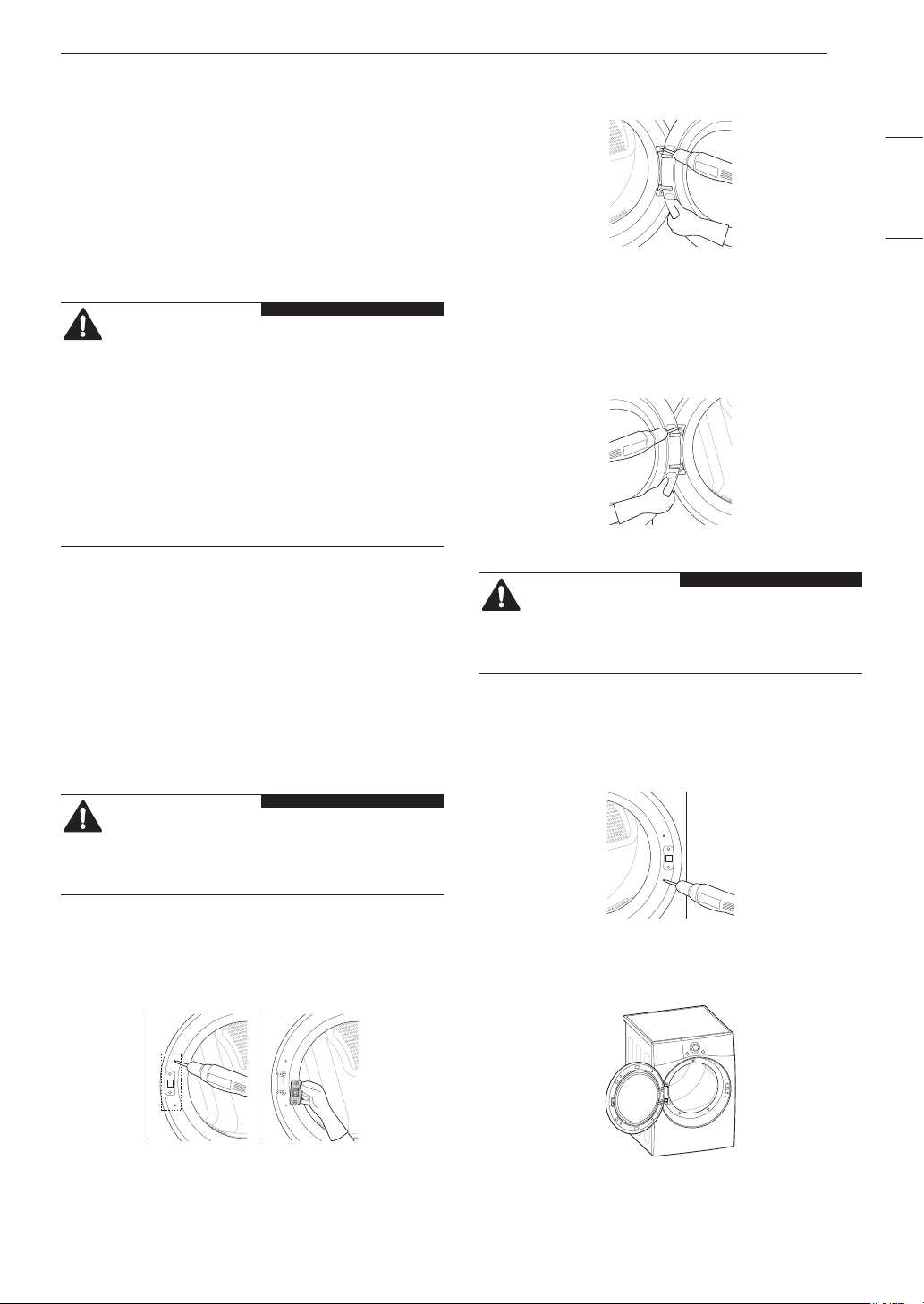
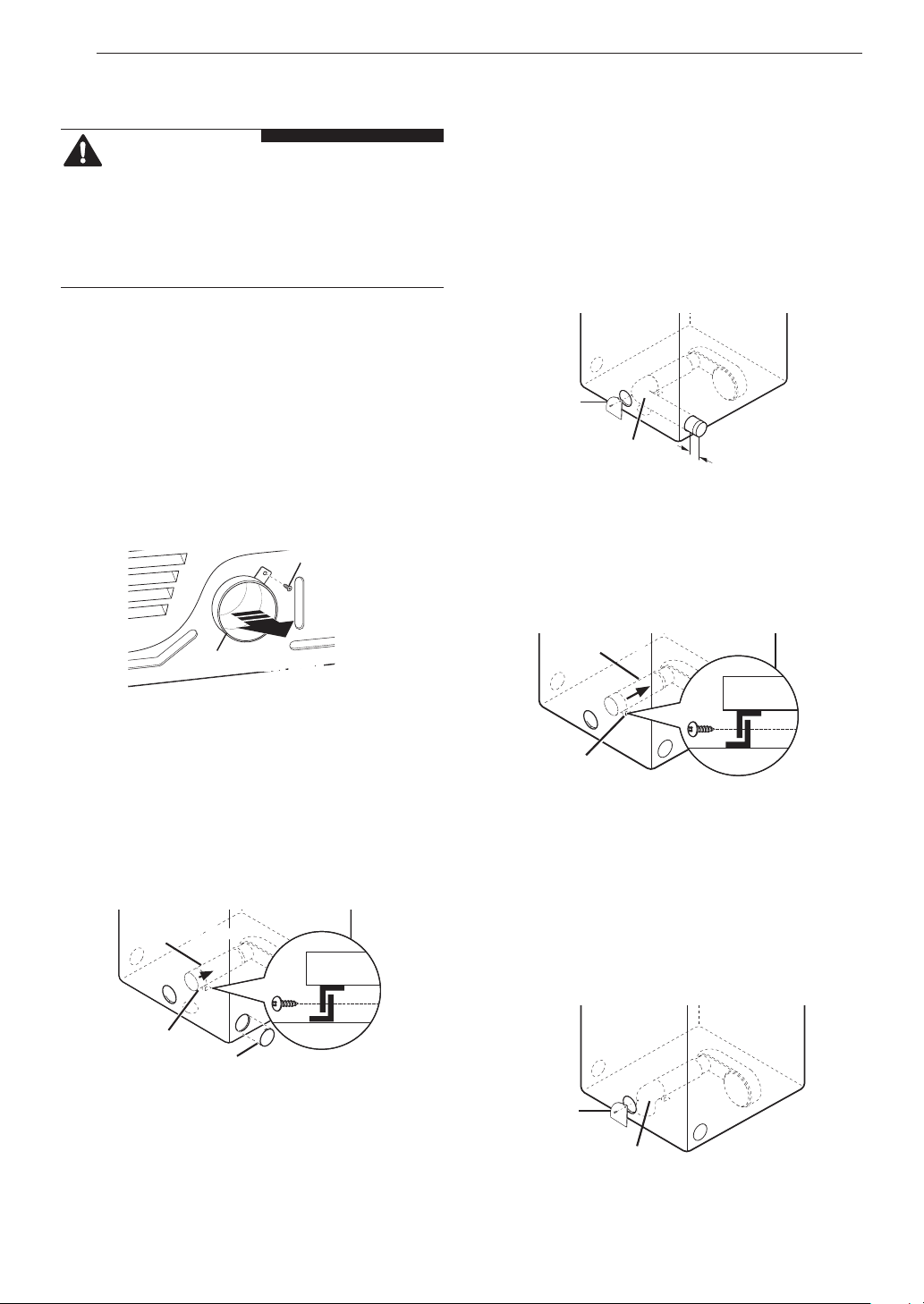
1
Open the door and remove the two decorative
screws, two latch screws, and the latch on the
catch side with a screwdriver. Save these for
step 4.
2
While supporting the door, remove the 2
screws on the door hinge. Remove the door.
3
Turn the door upside down and line up the
holes in the hinge with the holes on the
opposite side of the cabinet. Reinstall the door
with the screws removed in step 2.
WARNING
• Be sure to support the weight of the door
before installing the hinge screws.
4
Install the two decorative screws, the latch,
and two latch screws removed in step 1 on the
opposite side from which they were removed.
5
Check that the door closes properly.
16
INSTALLATION
Installing the Side Vent Kit
WARNING
• Use long-sleeved gloves and safety glasses.
• Use a heavy metal vent.
• Do not use plastic or thin foil ducts.
• Clean old ducts before installing this dryer.
Your new dryer is configured to vent to the rear.
It can also vent to the bottom or side (right-side
venting is not available on gas models).
An adapter kit, part number 383EEL9001B, may
be purchased from your LG retailer. This kit
contains duct components necessary to change
the dryer vent location.
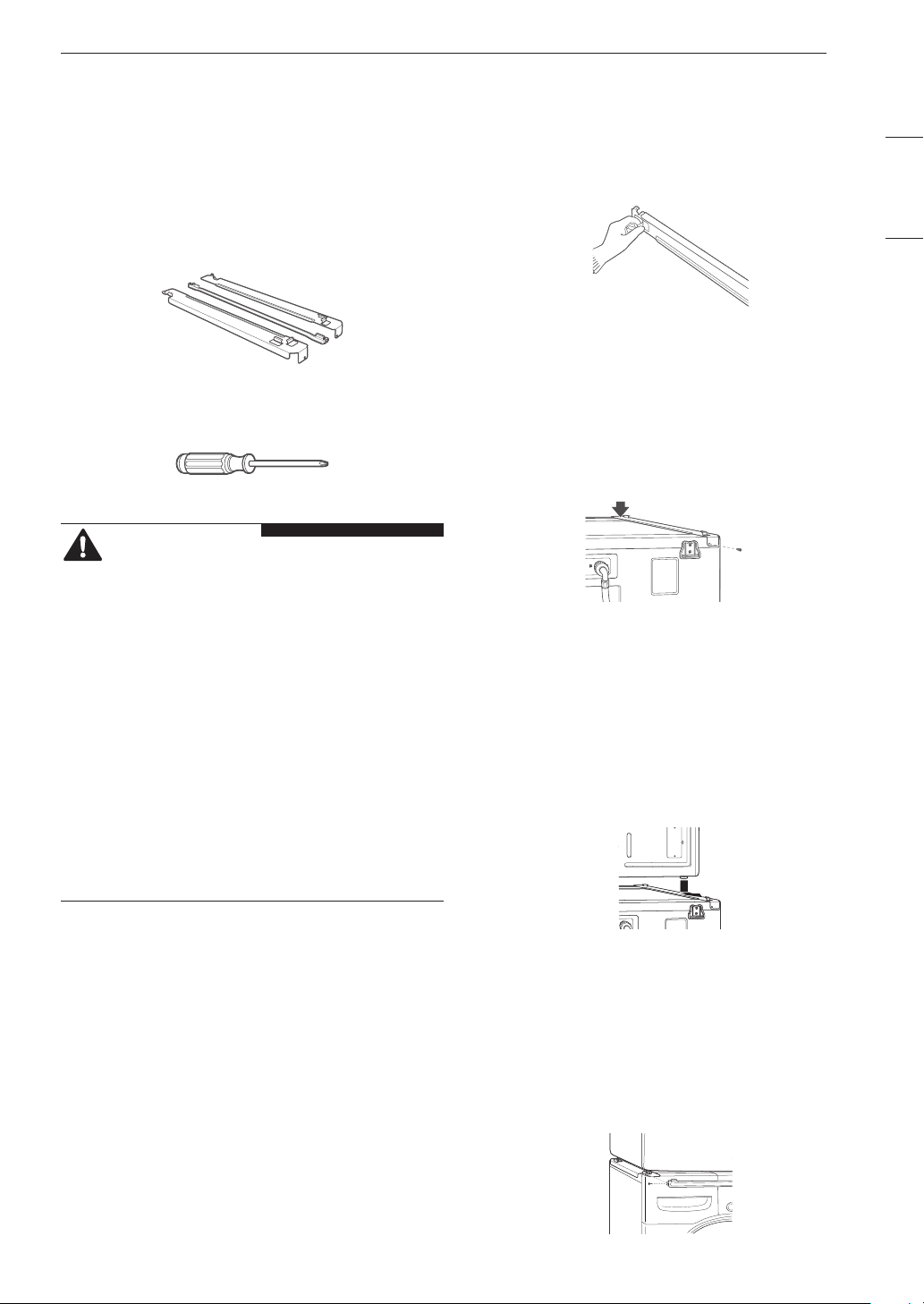
1
Remove the rear exhaust duct retaining screw.
Pull out the exhaust duct.
Retaining
Screw
Rear Exhaust Duct
Option 1: Side Venting
2
Press the tabs on the knockout and carefully
remove the knockout for the desired vent
opening. (Right-side venting is not available on
gas models.) Press the adapter duct onto the
blower housing and secure to the base of the
dryer as shown.
Adapter Duct
Bracket
Knockout
3
Preassemble a 4-inch (10.2 cm) elbow to the
next 4-inch (10.2 cm) duct section, and secure
all joints with duct tape. Be sure that the male
end of the elbow faces AWAY from the dryer.
Insert the elbow/duct assembly through the
side opening and press it onto the adapter
duct. Secure it in place with duct tape. Be
sure that the male end of the duct protrudes
1.5 inches (3.8 cm) to connect the remaining
ductwork. Attach the cover plate to the back of
the dryer with the included screw.
Cover
Plate
Elbow
1½” (38 mm)
Option 2: Bottom Venting
2
Press the adapter duct onto the blower
housing and secure it to the base of the dryer
as shown.
Adapter Duct
Bracket
3
Insert the 4-inch (10.2 cm) elbow through the
rear opening and press it onto the adapter
duct. Be sure that the male end of the elbow
faces down through the hole in the bottom of
the dryer. Secure it in place with duct tape.
Attach the cover plate to the back of the dryer
with the included screw.
Cover
Plate
Elbow
17
INSTALLATION
ENGLISH
Stacking the Dryer
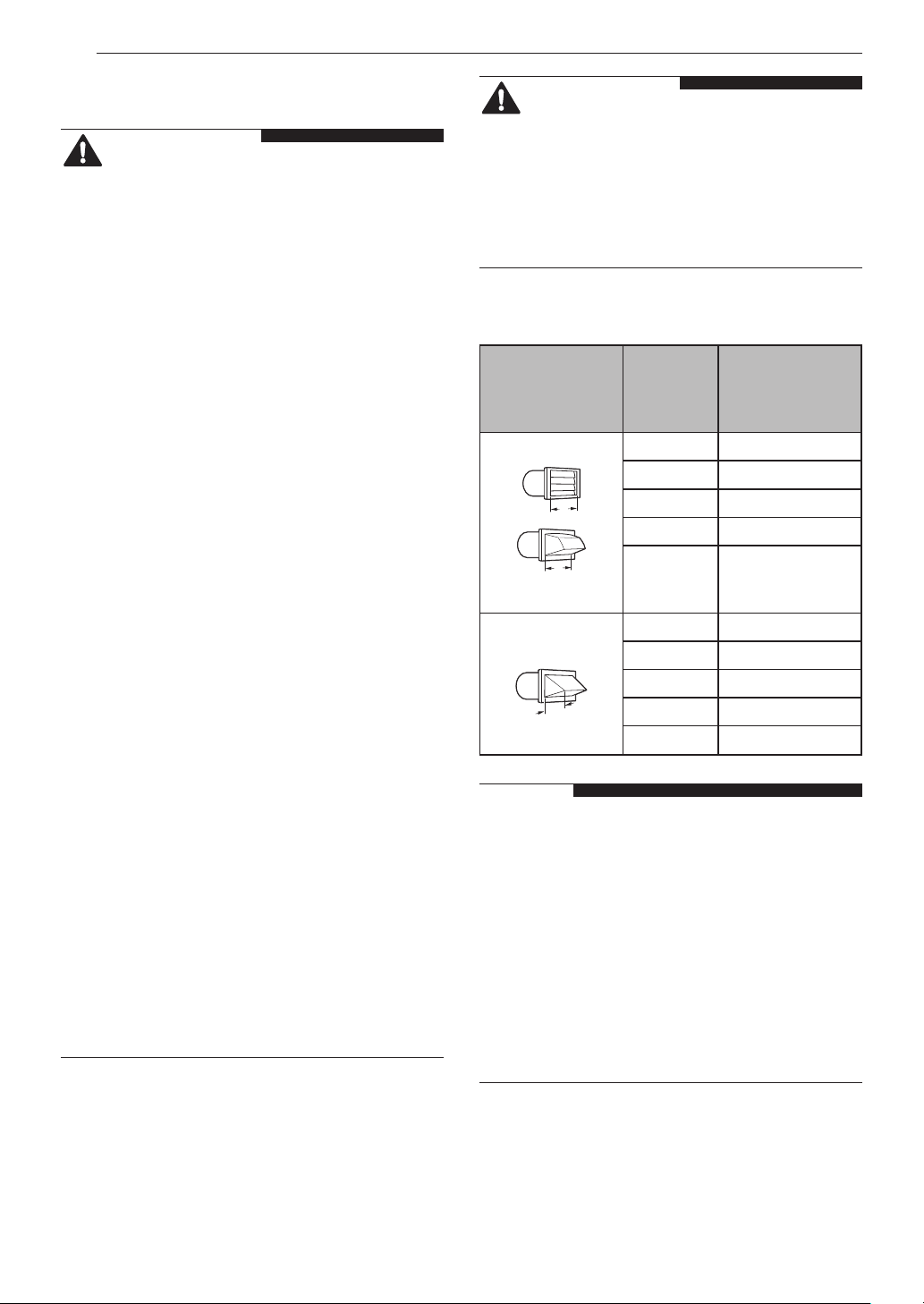
Stacking Kit Installation
This stacking kit includes:
• Two (2) side rails
• One (1) front rail
• Four (4) screws
Tools Needed for Installation:
• Phillips screwdriver
WARNING
• The weight of the dryer and the height of
installation make this stacking procedure too
risky for one person. Two or more people are
required when installing the stacking kit.
• Do not use the stacking kit with a gas dryer
in potentially unstable conditions such as a
mobile home.
• Place the washer on a solid, stable, level
floor capable of supporting the weight of both
appliances.
• Do not stack the washer on top of the dryer.
• If appliances are already installed, disconnect
them from all power, water, or gas lines and
from draining or venting connections.
To ensure safe and secure installation, please
observe the following instructions.
1
Make sure the surface of the washer is clean
and dry. Remove paper backing from the tape
on one of the stacking kit side brackets.
2
Fit the side bracket to the side of the washer
top as shown. Firmly press the adhesive area
of the bracket to the washer surface. Secure
the side bracket to the washer with a screw on
the back side of the bracket. Repeat steps 1
and 2 to attach the other side bracket.
3
Place the dryer on top of the washer, fitting the
dryer feet into the side brackets as illustrated.
Avoid finger injuries; do not allow fingers to be
pinched between the washer and dryer.
Slowly slide the dryer toward the back of the
washer until the side bracket stoppers catch
the dryer feet.
4
Insert the front rail between the bottom of the
dryer and the top of the washer. Push the
front rail toward the back of the washer until it
comes in contact with the side rail stoppers.
Install the two remaining screws to secure the
front rail to the side rails.
18
INSTALLATION
Venting the Dryer
WARNING
• Do not crush or collapse ductwork.
• Do not allow ductwork to rest on or contact
sharp objects.
• If connecting to existing ductwork, make sure
it is suitable and clean before installing the
dryer.
• Venting must conform to local building codes.
• Gas dryers MUST exhaust to the outdoors.
• Use only 4-inch (10.2 cm) rigid, semi-rigid
or flexible metal ductwork inside the dryer
cabinet and for venting outside.
• To reduce the risk of fire, combustion, or
accumulation of combustible gases, DO
NOT exhaust dryer air into an enclosed and
unventilated area, such as an attic, wall,
ceiling, crawl space, chimney, gas vent, or
concealed space of a building.
• To reduce the risk of fire, DO NOT exhaust the
dryer with plastic or thin foil ducting.
• The exhaust duct must be 4 inches (10.2 cm)
in diameter with no obstructions. The exhaust
duct should be kept as short as possible.
Make sure to clean any old ducts before
installing your new dryer.
• Rigid, semi-rigid or flexible metal ducting is
recommended for use between the dryer and
the wall. All non-rigid metal transition duct
must be UL-listed. Use of other materials for
transition duct could affect drying time.
• DO NOT use sheet metal screws or other
fasteners which extend into the duct that could
catch lint and reduce the efficiency of the
exhaust system. Secure all joints with duct
tape.
• Do not exceed the recommended duct length
limitations noted in the chart. Failure to follow
these instructions may result in extended
drying times, fire or death.
WARNING
• Ductwork is not provided with the dryer. You
should obtain the necessary ductwork locally.
The vent hood should have hinged dampers to
prevent backdraft when the dryer is not in use.
• The total length of flexible metal duct must not
exceed 8 ft. (2.4 m).
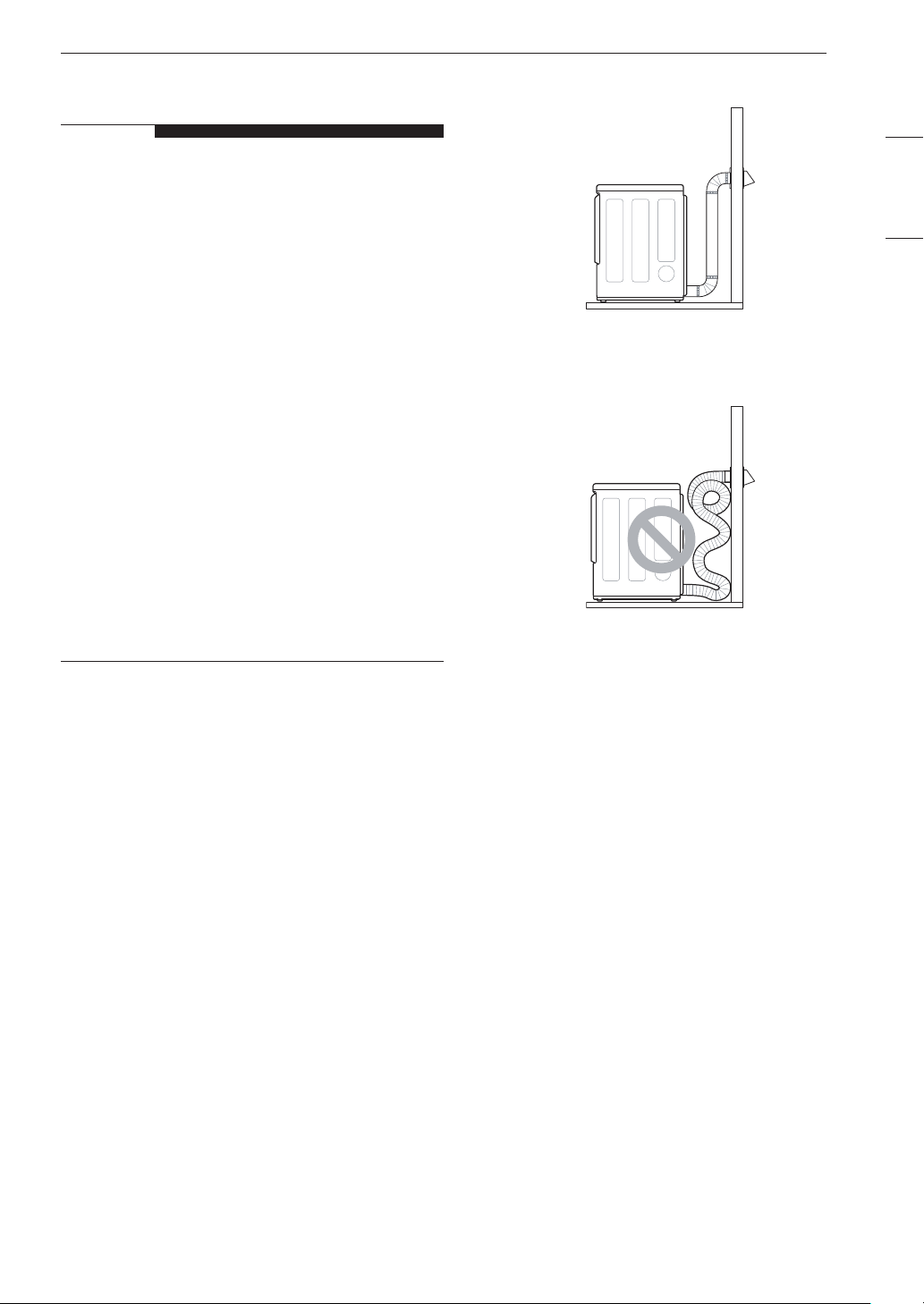
Ductwork
Wall Cap Type
Number
of 90°
Elbows
Maximum
length of 4-inch
diameter rigid
metal duct
Recommended
a
a
a: 4” (10.2 cm)
0 65 ft.(19.8 m)
1 55 ft.(16.8 m)
2 47 ft.(14.3 m)
3 36 ft.(11.0 m)
4 28 ft.(8.5 m)
Use only for short
run installations
b
b: 2.5” (6.35 cm)
0 55 ft.(16.8 m)
1 47 ft.(14.3 m)
2 41 ft.(12.5 m)
3 30 ft.(9.1 m)
4 22 ft.(6.7 m)
NOTE
• Deduct 6 ft. (1.8 m) for each additional elbow.
Do not use more than four 90° elbows.
• In Canada, only those foil-type flexible ducts,
if any, specifically identified for use with the
appliance by the manufacturer should be
used. In the United States, only those foil-type
flexible ducts, if any, specifically identified for
use with the appliance by the manufacturer
and that comply with the Outline for Clothes
Dryer Transition Duct, Subject 2158A, should
be used.
19
INSTALLATION
ENGLISH
Routing and Connecting Ductwork
NOTE
Follow the guidelines below to maximize
drying performance and reduce lint buildup
and condensation in the ductwork. Ductwork
and fittings are NOT included and must be
purchased separately.
• Use 4-inch (10.2 cm) diameter rigid, semi-rigid
or flexible metal ductwork.
• The exhaust duct run should be as short as
possible.
• Use as few elbow joints as possible.
• The male end of each section of exhaust duct
must point away from the dryer.
• Use duct tape on all duct joints.
• Insulate ductwork that runs through unheated
areas in order to reduce condensation and lint
buildup on duct surfaces.
• Incorrect or inadequate exhaust systems
are not covered by the dryer warranty. Dryer
failures or service required because of such
exhaust systems will not be covered by the
dryer warranty.
Correct Venting
Incorrect Venting
20
INSTALLATION
Connecting Gas Dryers
WARNING
To reduce the risk of fire or explosion,
electric shock, property damage, injury to
persons, or death when using this appliance,
follow requirements including the following:
Electrical Requirements for Gas
Models Only
• Do not, under any circumstances, cut or remove
the third (ground) prong from the power cord.
• For personal safety, this dryer must be properly
grounded.
• This dryer must be plugged into a 120-VAC, 60-
Hz. grounded outlet protected by a 15-ampere
fuse or circuit breaker.
ELECTRIC SHOCK HAZARD
Failure to follow safety warnings could result
in serious injury
• This dryer is equipped with a three-prong
grounding plug for protection against shock
hazard and should be plugged directly into a
properly grounded three-prong receptacle. Do
not cut or remove the grounding prong from this
plug.
• Where a standard 2-prong wall outlet is
encountered, it is your personal responsibility
and obligation to have it replaced with a properly
grounded 3-prong wall outlet.
Gas Supply Requirements
• As shipped from the factory, this dryer is
configured for use with natural gas (NG). It can
be converted for use with propane (LP) gas.
Gas pressure must not exceed 8-inch (20.4 cm)
water column for NG, or 13-inch (33.1 cm) water
column for LP.
• A qualified service or gas company technician
must connect the dryer to the gas service.
• Isolate the dryer from the gas supply system
by closing its individual manual shutoff valve
during any pressure testing of the gas supply at
pressures greater than 1/2 psi (3.5 kPa).
• Supply line requirements: Your laundry room
must have a rigid gas supply line to your dryer.
In the United States, an individual manual
shutoff valve MUST be installed within at least
6 ft. (1.8 m) of the dryer, in accordance with
the National Fuel Gas Code ANSI Z223.1 or
Canadian gas installation code CSA B149.1. A
1/8-inch NPT pipe plug must be installed.
• If using a rigid pipe, the rigid pipe should be
0.5-inch IPS. If acceptable under local codes
and ordinances and when acceptable to your
gas supplier, 3/8-inch approved tubing may be
used where lengths are less than 20 ft. (6.1
m). Larger tubing should be used for lengths in
excess of 20 ft. (6.1 m).
• To prevent contamination of the gas valve,
purge the gas supply of air and sediment before
connecting the gas supply to the dryer. Before
tightening the connection between the gas
supply and the dryer, purge remaining air until
the odor of gas is detected.
• DO NOT use an open flame to inspect for gas
leaks. Use a noncorrosive leak detection fluid.
• Use only a new AGA- or CSA-certified gas
supply line (in compliance with the Standard
for Connectors for Gas Appliances, ANSI
Z21.24 • CSA 6.10) with flexible stainless steel
connectors.
• Use Teflon tape or a pipe-joint compound that
is insoluble in propane (LP) gas on all pipe
threads.
WARNING
• DO NOT attempt any disassembly of the
dryer; disassembly requires the attention and
tools of an authorized and qualified service
technician or company.
• Securely tighten all gas connections.
• Connect the dryer to the type of gas shown on
the nameplate.
Connecting the Gas Supply
• Installation and service must be performed by
a qualified installer, service agency, or the gas
supplier.
• Use only a new stainless steel flexible connector
and a new AGA-certified connector.
• A gas shutoff valve must be installed within 6 ft.
(1.8 m) of the dryer.
21
INSTALLATION
ENGLISH
• The dryer is configured for natural gas when
shipped from the factory. Make sure that the
dryer is equipped with the correct burner nozzle
for the type of gas being used (natural gas or
propane gas).
• If necessary, the correct nozzle (for the LP
nozzle kit, order part number 383EEL3002D)
should be installed by a qualified technician and
the change should be noted on the dryer.
• All connections must be in accordance with
local codes and regulations. Gas dryers MUST
exhaust to the outdoors.
NOTE
• In the Commonwealth of Massachusetts:
This product must be installed by a licensed
plumber or gas fitter. When using ball-type gas
shut off valves, they must be T-handle-type. A
flexible gas connector, when used, must not
exceed 3 feet.
This dryer is configured from the factory for natural
gas (NG). If the dryer is to be used with propane
(LP) gas, it must be converted by a qualified
service technician.
1
Make sure that the gas supply to the
laundry room is turned OFF and the dryer
is unplugged. Confirm that the type of gas
available in your laundry room is appropriate
for the dryer.
2
Remove the shipping cap from the gas fitting
at the back of the dryer. Be careful not to
damage the threads of the gas connector
when removing the shipping cap.
3
Connect the dryer to your laundry room’s gas
supply using a new flexible stainless steel
connector with a 3/8-inch NPT fitting.
NOTE
• DO NOT use old connectors.
4
Securely tighten all connections between the
dryer and your laundry room’s gas supply.
5
Turn on your laundry room’s gas supply.
6
Check all pipe connections (both internal and
external) for gas leaks with a noncorrosive
leak-detection fluid.
7
Proceed to Venting the Dryer.
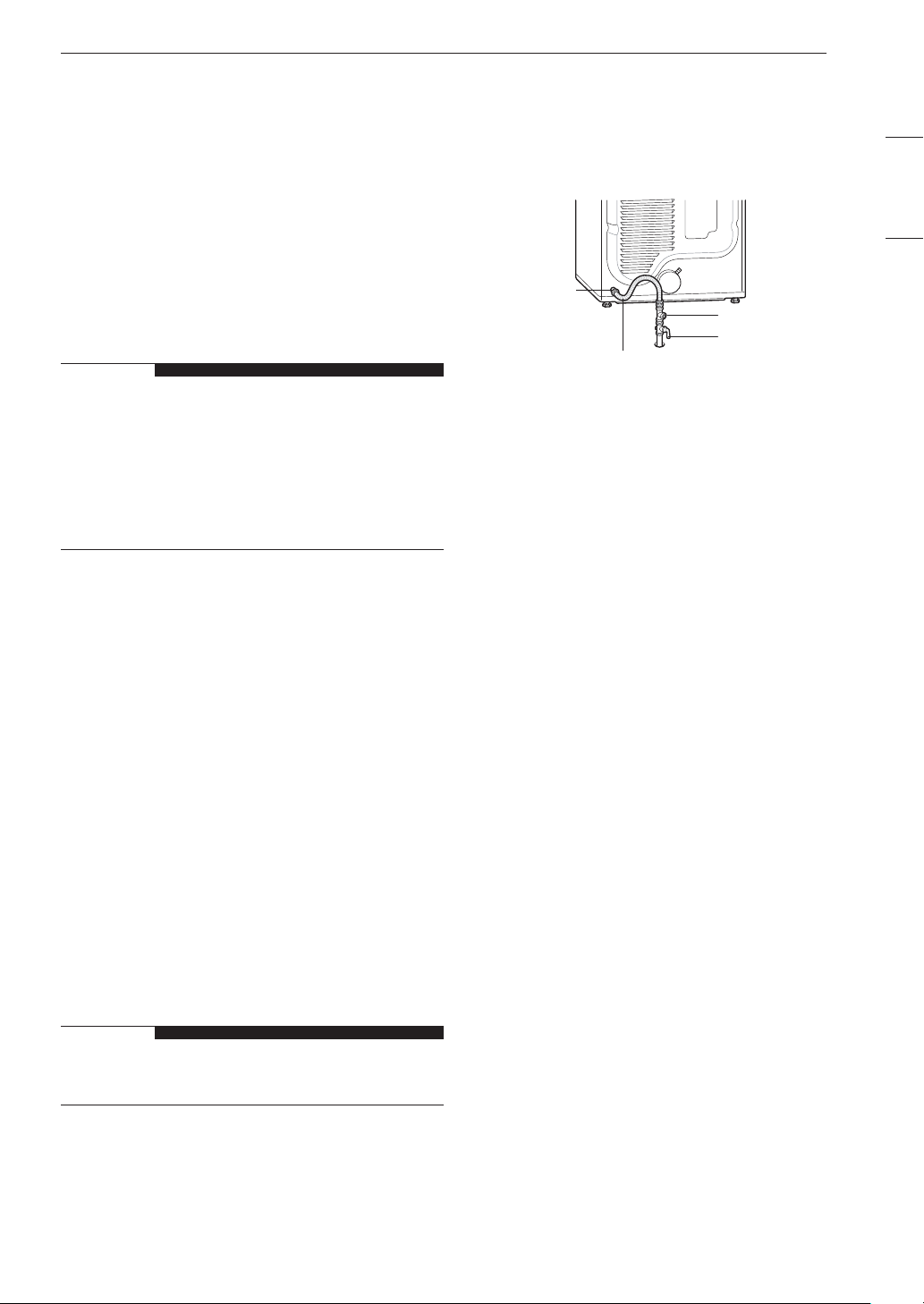
3/8” NPT gas
Connection
AGA/CSA-Certified
Stainless Steel Flexible
Connector
1/8” NPT Pipe Plug
Gas Supply Shutoff
Valve
High-Altitude Installations
The BTU rating of this dryer is AGA-certified for
elevations below 10,000 feet.
If your gas dryer is being installed at an elevation
above 10,000 feet, it must be derated by a
qualified technician or gas supplier.
22
INSTALLATION
Connecting Electric Dryers
WARNING
To reduce the risk of fire or explosion,
electric shock, property damage, injury to
persons, or death when using this appliance,
follow requirements including the following:
Electrical Requirements for Electric
Models Only
• The wiring and grounding must conform to
the latest edition of the National Electrical
Code, ANSI/NFPA 70 and all applicable
local regulations. Please contact a qualified
electrician to check your home’s wiring and
fuses to ensure that your home has adequate
electrical power to operate the dryer.
• This dryer must be connected to a grounded
metal, permanent wiring system, or an
equipment-grounding conductor must be run
with the circuit conductors and connected to the
equipment-grounding terminal or lead on the
dryer.
• The dryer has its own terminal block that must
be connected to a separate 230 VAC, 60-Hertz,
single-phase circuit, fused at 30 amperes (the
circuit must be fused on both sides of the line).
ELECTRICAL SERVICE FOR THE DRYER
SHOULD BE OF THE MAXIMUM RATE
VOLTAGE LISTED ON THE NAMEPLATE. DO
NOT CONNECT THE DRYER TO 110-, 115-,
OR 120-VOLT CIRCUIT.
• If the branch circuit to dryer is 15 ft. (4.5
m) or less in length, use UL (Underwriters
Laboratories) listed No.-10 AWG wire (copper
wire only), or as required by local codes. If
over 15 ft. (4.5 m), use UL-listed No.-8 AWG
wire (copper wire only), or as required by local
codes. Allow sufficient slack in wiring so the
dryer can be moved from its normal location
when necessary.
• The power cord (pigtail) connection between the
wall receptacle and the dryer terminal block IS
NOT supplied with the dryer. Type of pigtail and
gauge of wire must conform to local codes and
with instructions on the following pages.
• Do not modify the plug and internal wire
provided with the dryer.
• The dryer should be connected to a 4-hole
outlet.
• If the plug does not fit the outlet, a proper
outlet will need to be installed by a qualified
electrician.
• Connect the power cord to the terminal block.
Each colored wire should be connected to
the same color screw. Wire color indicated on
manual is connected to the same color screw in
the block.
• Grounding through the neutral conductor
is prohibited for: (1) new branch-circuit
installations, and (2) areas where local
codes prohibit grounding through the neutral
conductor.
• This dryer is supplied with the neutral wire
grounded. This white ground wire MUST BE
MOVED to the neutral terminal when a 4-wire
cord is to be used, or where grounding through
the neutral conductor is prohibited.
23
INSTALLATION
ENGLISH
Final Installation Check
Once you have completed the installation of the
dryer and it is in its final location, confirm proper
operation with the following tests and Installation
Test (Duct Check).
Testing Dryer Heating
GAS MODELS
Close the dryer door and press the Power button
to turn the dryer on. Press the Time Dry and Start/
Pause buttons to start the test. When the dryer
starts, the igniter should ignite the main burner.
NOTE
• If all air is not purged from the gas line, the
gas igniter may turn off before the main
burner ignites. If this happens, the igniter will
reattempt gas ignition after approximately two
minutes.
ELECTRIC MODELS
Close the dryer door and press the Power button
to turn the dryer on. Press the Time Dry and Start/
Pause buttons to start the test. The exhaust air
should be warm after the dryer has been operating
for 3 minutes.
Checking Airflow
Effective dryer operation requires proper airflow.
The adequacy of the airflow can be measured
by evaluating the static pressure. Static
pressure in the exhaust duct can be measured
with a manometer, placed on the exhaust duct
approximately 2 ft. (60.9 cm) from the dryer. Static
pressure in the exhaust duct should not exceed
0.6 inch (1.5 cm). The dryer should be checked
while the dryer is running with no load.
Checking Levelness
Once the dryer is in its final location, recheck the
dryer to be sure it is level. Make sure it is level
front to back and side to side, and that all four
leveling feet are in firm contact with the floor.
Installation Test (Duct Check)
Once you have completed the installation of the
dryer, use this test to make sure the condition
of the exhaust system is adequate for proper
operation of the dryer. This test should be
performed to alert you to any serious problems in
the exhaust system of your home.
• Your dryer features Flow Sense™, an innovative
sensing system that automatically detects
blockages and restrictions in dryer ductwork.
Keeping ductwork clean of lint buildup and free
of restrictions allows clothes to dry faster and
reduces energy use.
NOTE
• The dryer should be cool before starting
this test. If the dryer was warmed up during
installation, run the Air Dry cycle for a few
minutes to reduce the interior temperature.
Activating the Installation Test
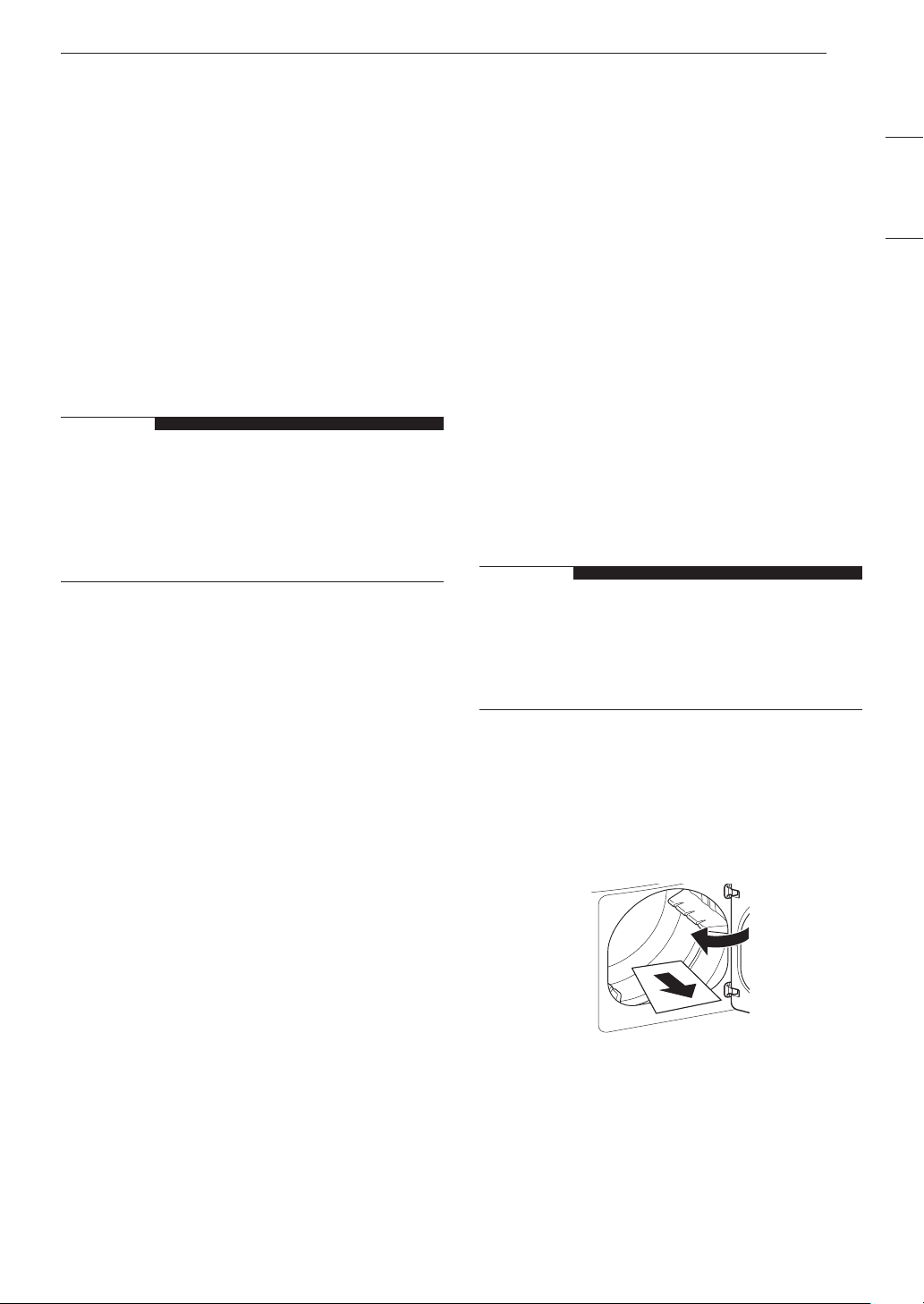
1
Remove the literature, and then close the
door.
Do not load anything in the drum for this test,
as it may affect the accuracy of the results.
24
INSTALLATION
2
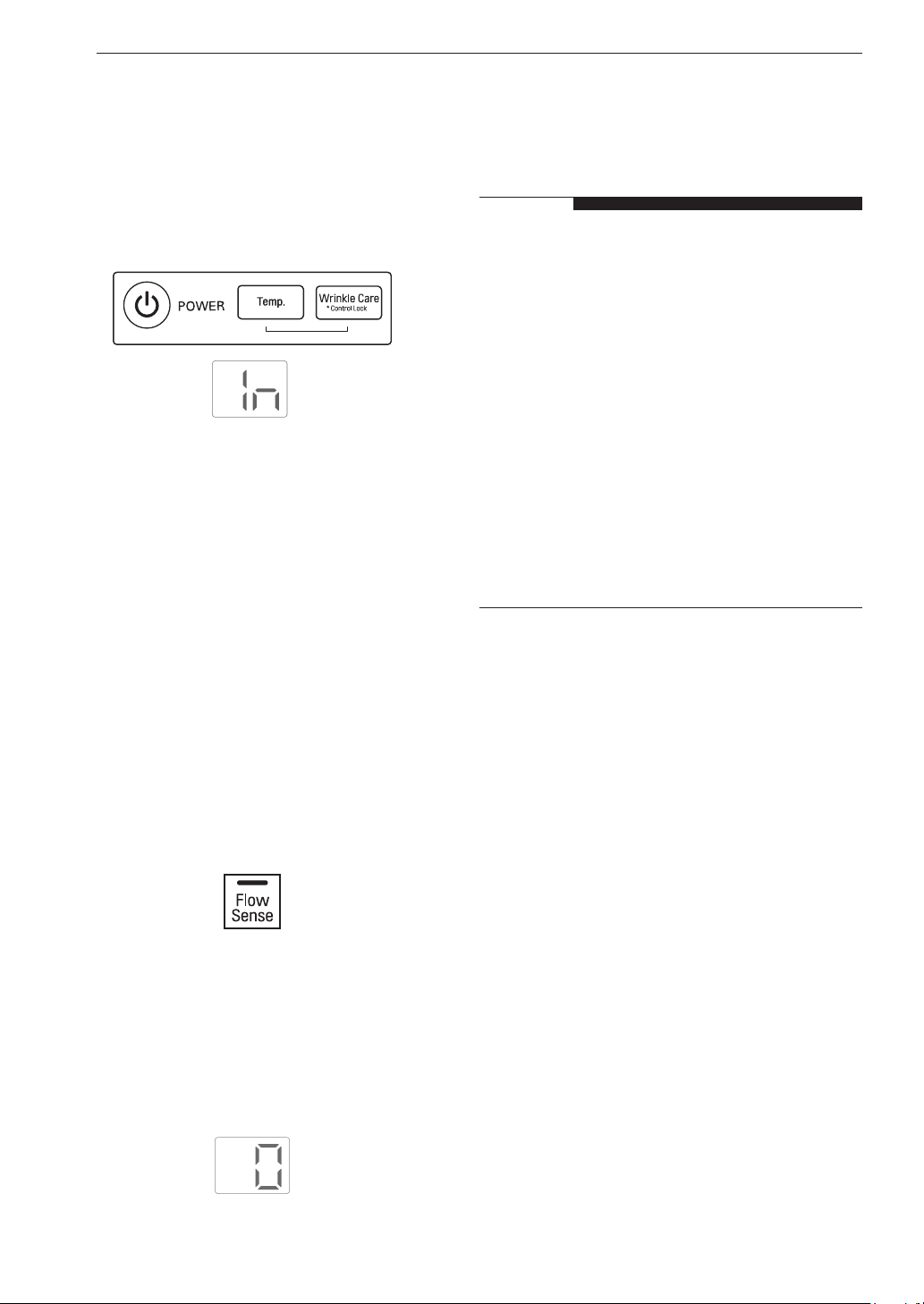
Press and hold the Wrinkle Care and Temp.
buttons and then press the Power button.
(On models with a glass touch control panel,
press the Power button then IMMEDIATELY
press and hold the Temp. and Wrinkle Care
buttons.) This button sequence activates the
installation test. The code 1N will display if the
activation is successful.
3
Press the START/PAUSE button.
The dryer will start the test, which will last
a few minutes. The heat will be turned on
and the temperatures in the drum will be
measured.
4
Check the display for results.
During the test cycle, monitor the Flow
Sense™ display on the control panel. If
the Flow Sense™ LED has not turned on
when the cycle ends, the exhaust system is
adequate. If the exhaust system is severely
restricted, the Flow Sense™ LED will turn on.
Other problems may also be shown with error
codes. See the chart on the next page for error
code details and solutions.
LED turned on:
RESTRICTED
5
End of cycle.
At the end of the test cycle, O will display. The
test cycle will end and the dryer will shut off
automatically after a short delay.
Check the Duct Condition
If the Flow Sense™ LED is turned on, check
the exhaust system for restrictions and damage.
Repair or replace the exhaust system as needed.
NOTE
• When the dryer is first installed, this test
should be performed to alert you to any
existing problems with the exhaust duct in
your home. However, since the test performed
during normal operation provides more
accurate information on the condition of the
exhaust duct than the installation test, the
number of bars displayed during the two tests
may not be the same.
• Do not interrupt the test cycle, as this could
result in inaccurate results.
• Even if no bars are displayed during the test
cycle, some restrictions may still be present
in the exhaust system. Refer to the Venting
the Dryer section of this manual for complete
exhaust system and venting requirements.
25
INSTALLATION
ENGLISH
Error Codes
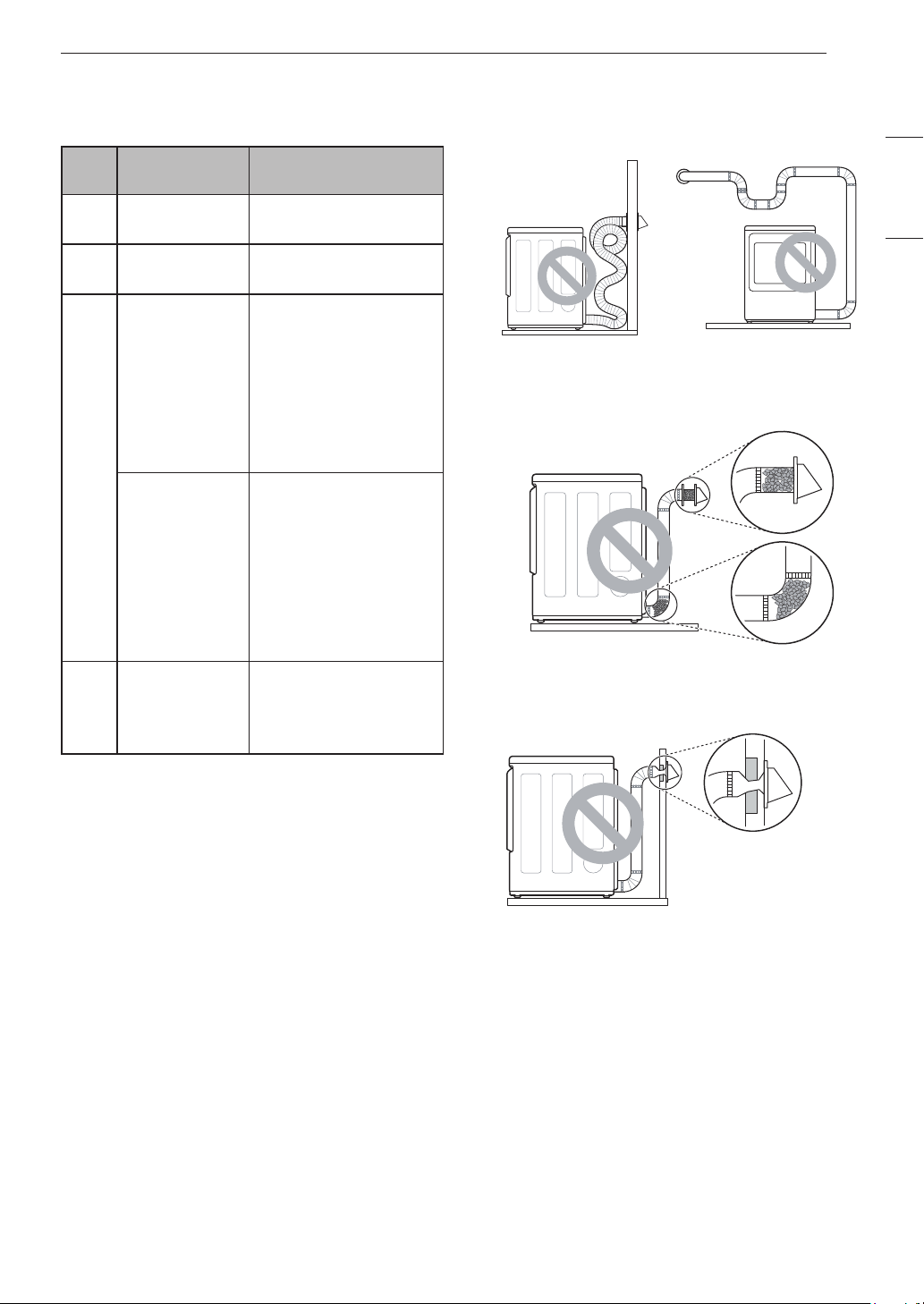
Check the error code before you call for service.
Error
Code
Possible
Causes
Solutions
tE1 or
tE2
Temperature
sensor failure.
Turn off the dryer and
call for service.
HS
Humidity sensor
failure.
Turn off the dryer and
call for service.
PS,
PF, or
nP
Electric dryer
power cord is
not connected
correctly, or
house power
supply is
incorrect.
Check the power supply
or the connection of
the power cord to the
terminal block. Refer to
the Connecting Electric
Dryers section of this
manual for complete
instructions.
House fuse is
blown, circuit
breaker has
tripped, or
power outage
has occurred.
Reset circuit breaker
or replace fuse. Do
not increase the fuse
capacity.
If the problem is a
circuit overload, have it
corrected by a qualified
electrician.
gAS
Gas supply or
service turned
off. (Gas Model
only.)
Confirm that house gas
shutoff and the dryer
gas shutoff are both
fully open.
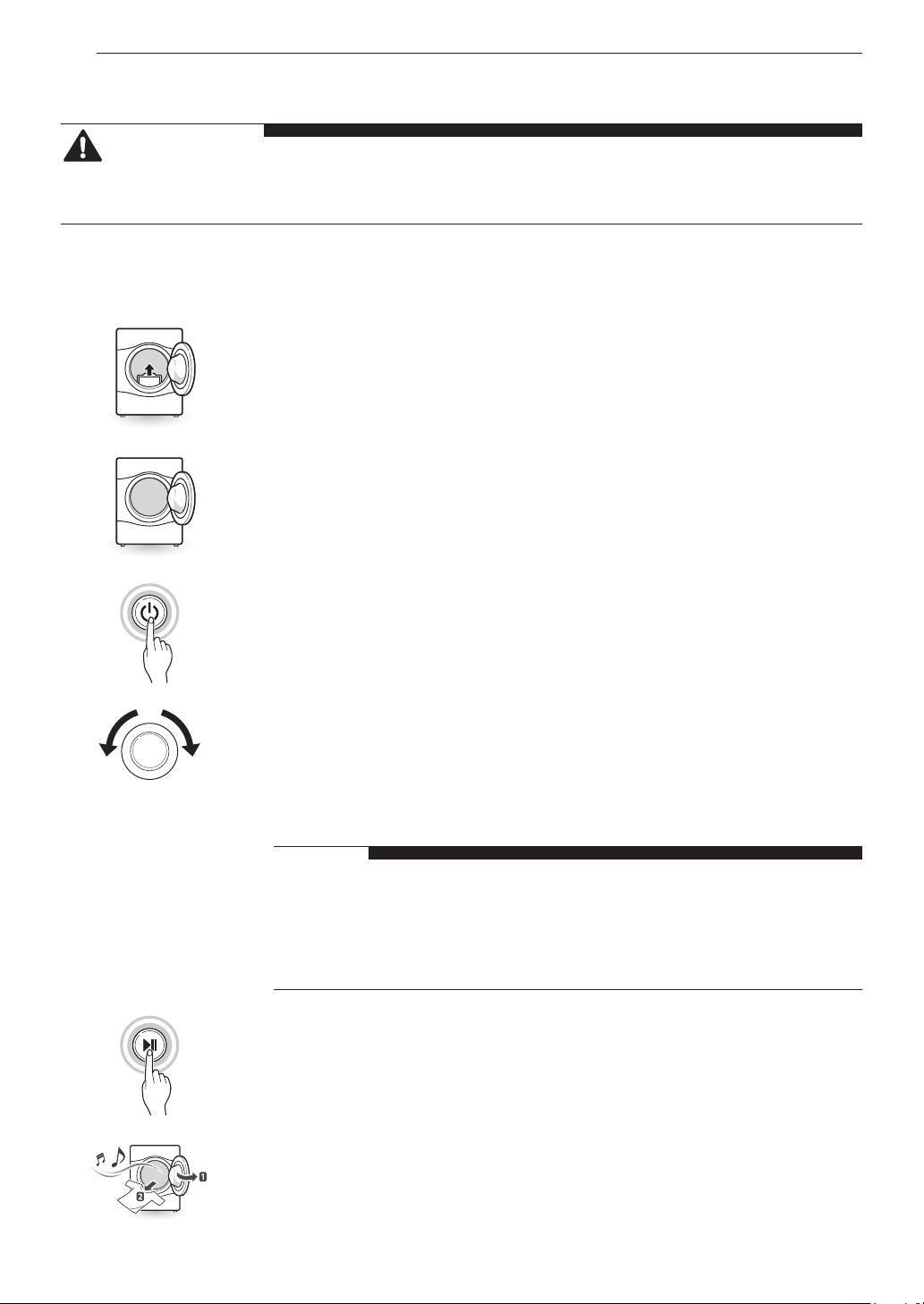
Restricted or Blocked Airflow
Avoid long runs or runs with multiple elbows or
bends.
Excess or crushed
transition duct
Too many elbows or
exhaust too long
Check for blockages and lint buildup.
Lint buildup or blockage
Make sure the ductwork is not crushed or
restricted.
Crushed or damaged
exhaust
26
OPERATION
OPERATION
WARNING
• To reduce the risk of fire, electric shock, or injury to persons, read the SAFETY INSTRUCTIONS
before operating this appliance.
Using the Dryer
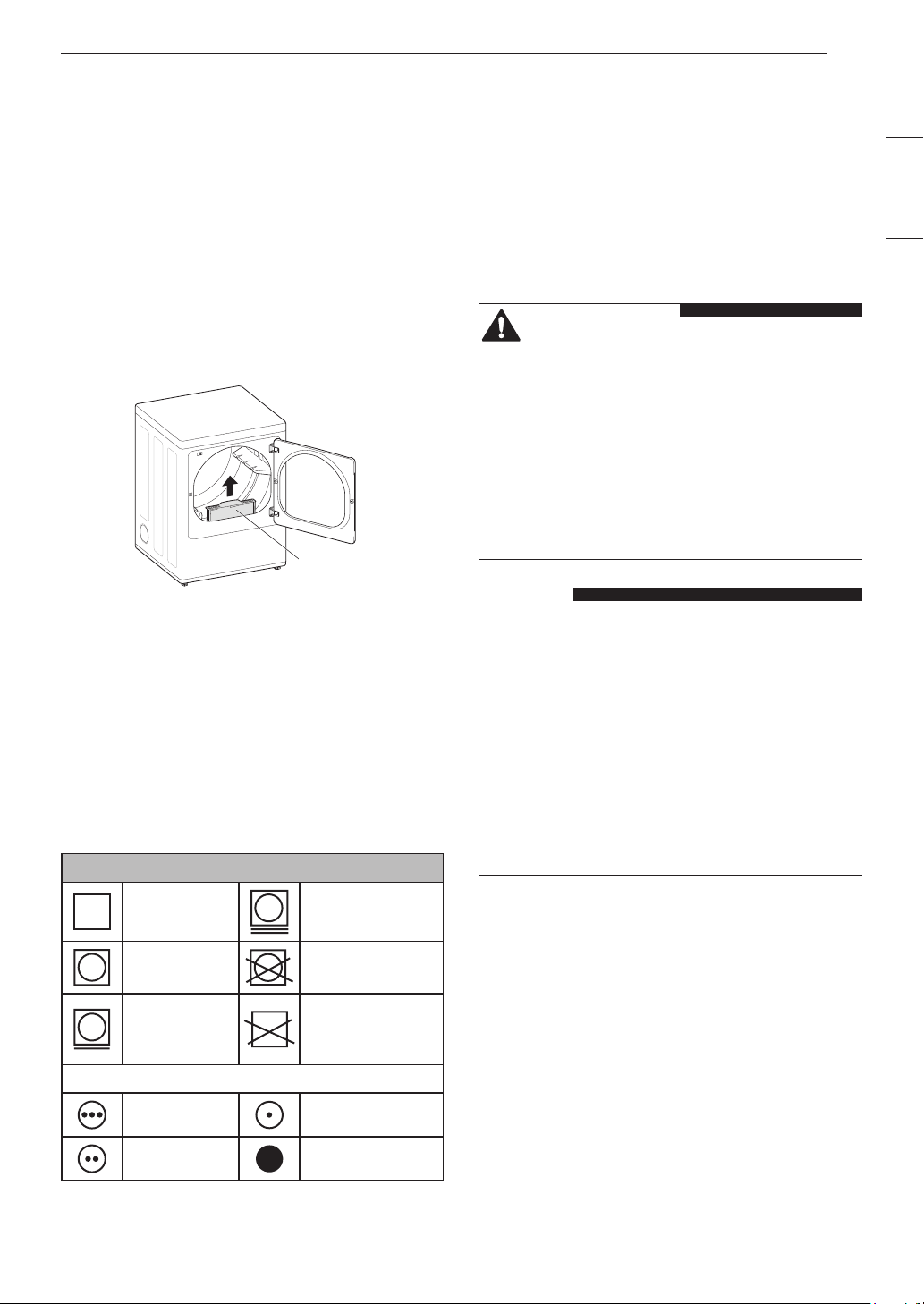
1
Clean the Lint Filter
If the lint filter has not already been cleaned, lift out the filter and remove
the lint from the last load. This will help ensure the fastest and most efficient
drying performance. Make sure to reinstall the filter, pressing down until it
clicks firmly into place.
2
Load the Dryer
Load the dryer with the wet laundry from the washer. If the load is extra large,
you may need to divide it into smaller loads for proper performance and fabric
care.
3
Turn on the Dryer
Press the Power button to turn on the dryer. The cycle LEDs will illuminate
and a chime will sound.
4
Select a Cycle
Turn the cycle selector knob in either direction until the LED for the desired
cycle is on. The preset temperature, dry level, and option settings for that
cycle will be shown. Default settings for the selected cycle can now be
changed if desired. Refer to the Cycle Setting and Options page for details.
NOTE
• Not all options or modifiers are available on all cycles. Refer to
the Cycle Guide page for default settings and available options.
A different chime will sound and the LED will not come on if the
selection is not available.
5
Begin Cycle
Press the Start/Pause button to begin the cycle. The cycle can be paused at
any time either by opening the door or by pressing the Start/Pause button.
If the cycle is not restarted within 60 minutes of being paused, the dryer will
shut off and the settings will be lost.
6
End of Cycle
When the cycle is finished, the chime will sound. Immediately remove your
clothing from the dryer to reduce wrinkling. If Wrinkle Care is selected, the
dryer will tumble briefly every few minutes to help prevent wrinkles from
setting in the clothes.
27
OPERATION
ENGLISH
Check the Lint Filter Before
Every Load
Always make sure the lint filter is clean before
starting a new load; a clogged lint filter will
increase drying time. To clean, pull the lint filter
straight up and roll any lint off the filter with your
fingers. Push the lint filter firmly back into place.
See Regular Cleaning for more information.
Always ensure the lint filter is properly installed
before running the dryer. Running the dryer with
a loose or missing lint filter will damage the dryer
and articles in the dryer.
Lint Filter
Sorting Laundry
Fabric Care Labels
Many articles of clothing include a fabric care
label. Using the chart below, adjust the cycle
and option selections to care for your clothing
according to the manufacturer’s recommendations.
Tumble dry
Dry Gentle/delicate
Normal
Do not tumble
dry
Permanent
Press/ wrinkle
resistant
Do not dry (used
with do not wash)
Heat setting
High Low
Medium No heat/air
Grouping Similar Items
For best results, sort clothes into loads that can be
dried with the same drying cycle.
Different fabrics have different care requirements,
and some fabrics will dry more quickly than others.
Loading the Dryer
WARNING
• Check all pockets to make sure that they are
empty. Items such as clips, pens, coins, and
keys can damage both the dryer and your
clothes. Flammable objects such as lighters or
matches could ignite, causing a fire.
• Never dry clothes that have been exposed to
oil, gasoline, or other flammable substances.
Washing clothes will not completely remove oil
residues.
NOTE
Loading Tips
• Combine large and small items in the same
load.
• Damp clothes will expand as they dry. Do not
overload the dryer; clothes require room to
tumble and dry properly.
• Use mesh laundry bags to separate clothes
with zippers, hooks, straps, and drawstrings to
prevent them from catching on or tanglingwith
other clothes or damaging the lint filter.
28
OPERATION
Control Panel
Non-Steam Models (DLE3400*, DLE3450*)
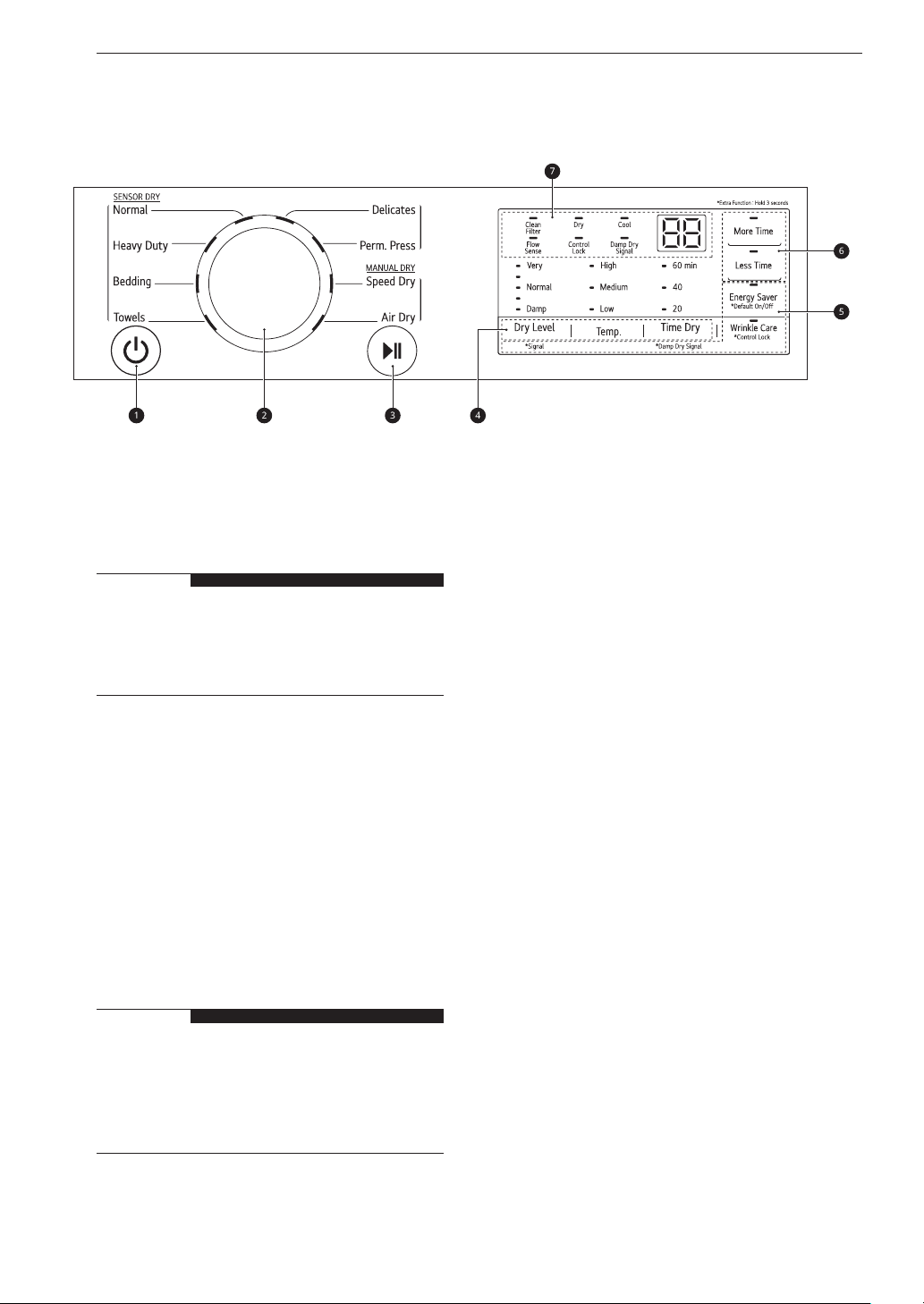
a
Power Button
Press the button to turn the dryer ON. Press
again to turn the dryer OFF.
NOTE
• Pressing the Power button during a
cycle will cancel that cycle and any load
settings will be lost.
b
Cycle Selector Knob
Turn this knob to select the desired cycle.
Once the desired cycle has been selected,
the standard presets will be shown in the
display. On Manual Dry cycles, these settings
can be adjusted using the cycle modifier
buttons anytime before starting the cycle.
c
Start/Pause Button
Press this button to start the selected cycle. If
the dryer is running, use this button to pause
the cycle without losing the current settings.
NOTE
• If you do not press the Start/Pause
button to resume a cycle within 60
minutes, the dryer turns off automatically
and all cycle settings are lost.
d
Cycle Modifier Buttons
Use these buttons to select the desired cycle
settings for the selected cycle. The current
settings are shown in the display. Press the
button for that option to view and select other
settings.
e
Cycle Option Buttons
Press each of these buttons to select
additional cycle options. Press and hold any
button marked with an asterisk for 3 seconds
to activate a special function.
f
More Time/Less Time Buttons
Use these buttons with the Time Dry and
other Manual Dry cycles to adjust the drying
time. Press the More Time button to increase
the selected manual cycle time by 1 minute;
press the Less Time button to decrease the
cycle time by 1 minute.
g
Time and Status Display
The display shows the settings, estimated
time remaining, options, and status
messages for the dryer.
29
OPERATION
ENGLISH
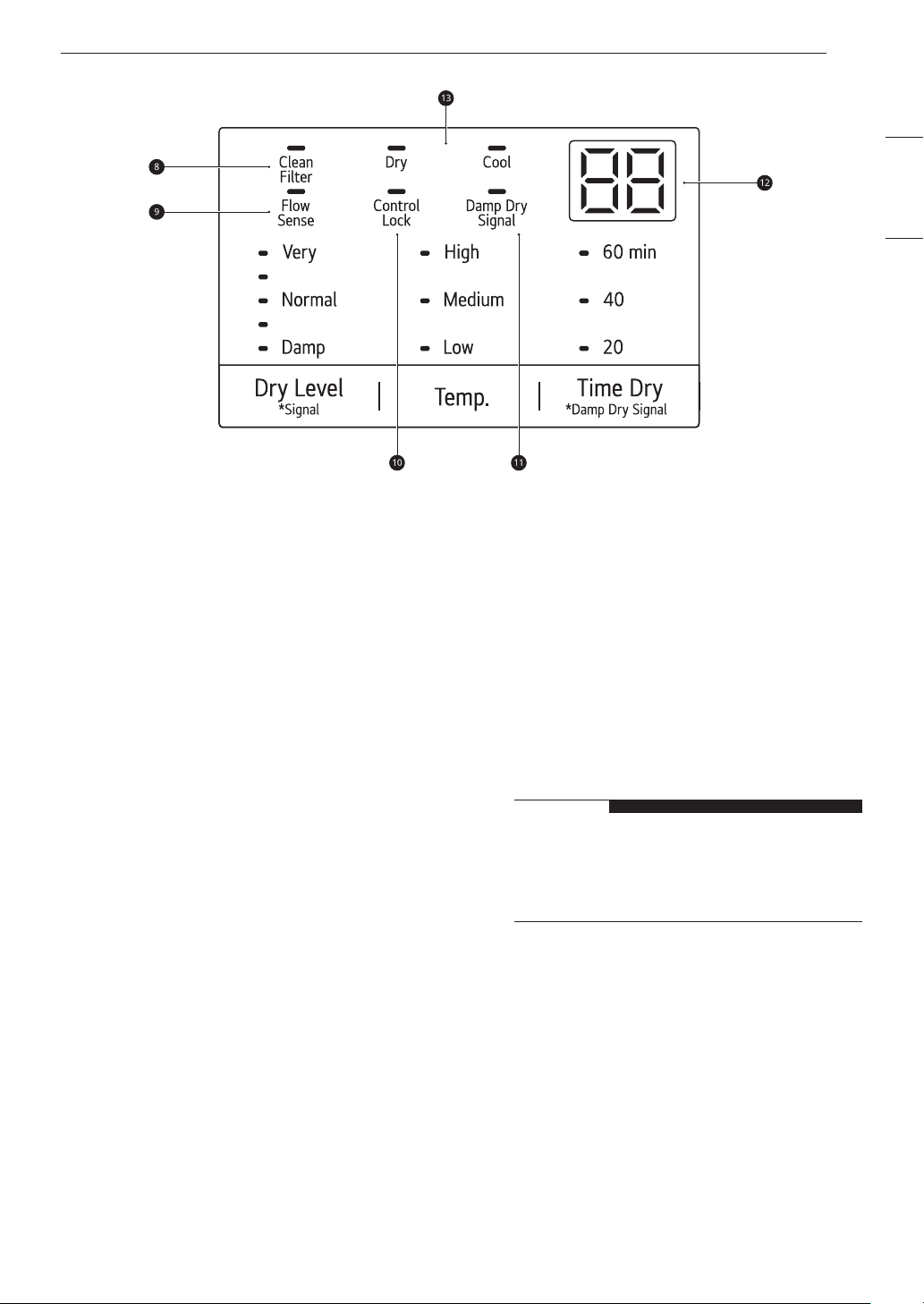
h
Clean Filter Reminder
The Clean Filter LED is lit when the dryer is
turned on as a reminder to clean the filter.
It turns off when the Start/Pause button is
pressed.
i
Flow Sense Duct Blockage Sensing
System Indicator
The Flow Sense™ duct blockage sensing
system detects and alerts you to blockages
in the ductwork that reduce exhaust flow
from the dryer. Maintaining a clean exhaust
system improves operating efficiency and
helps minimize service calls, saving you
money.
j
Control Lock Indicator
When Control Lock is set, the Control
Lock indicator appears and all buttons are
disabled except the Power button. This
prevents children from changing settings
while the dryer is operating.
k
Damp Dry Signal Indicator
The dryer will signal when the load is
approximately 80% dry. This allows you to
remove faster-drying lightweight items or
items that you would like to iron or hang
while they are still slightly damp.
l
Estimated Time Remaining
This display shows the estimated time
remaining for Sensor Dry cycles or the actual
time remaining for Time Dry or Manual Dry
cycles.
NOTE
• The cycle time on Sensor Dry cycles may
fluctuate as the dryer recalculates drying
time for optimal results.
m
Cycle Completion Indicator
This portion of the display shows which stage
of the drying cycle is currently underway (Dry
or Cool).
30
OPERATION
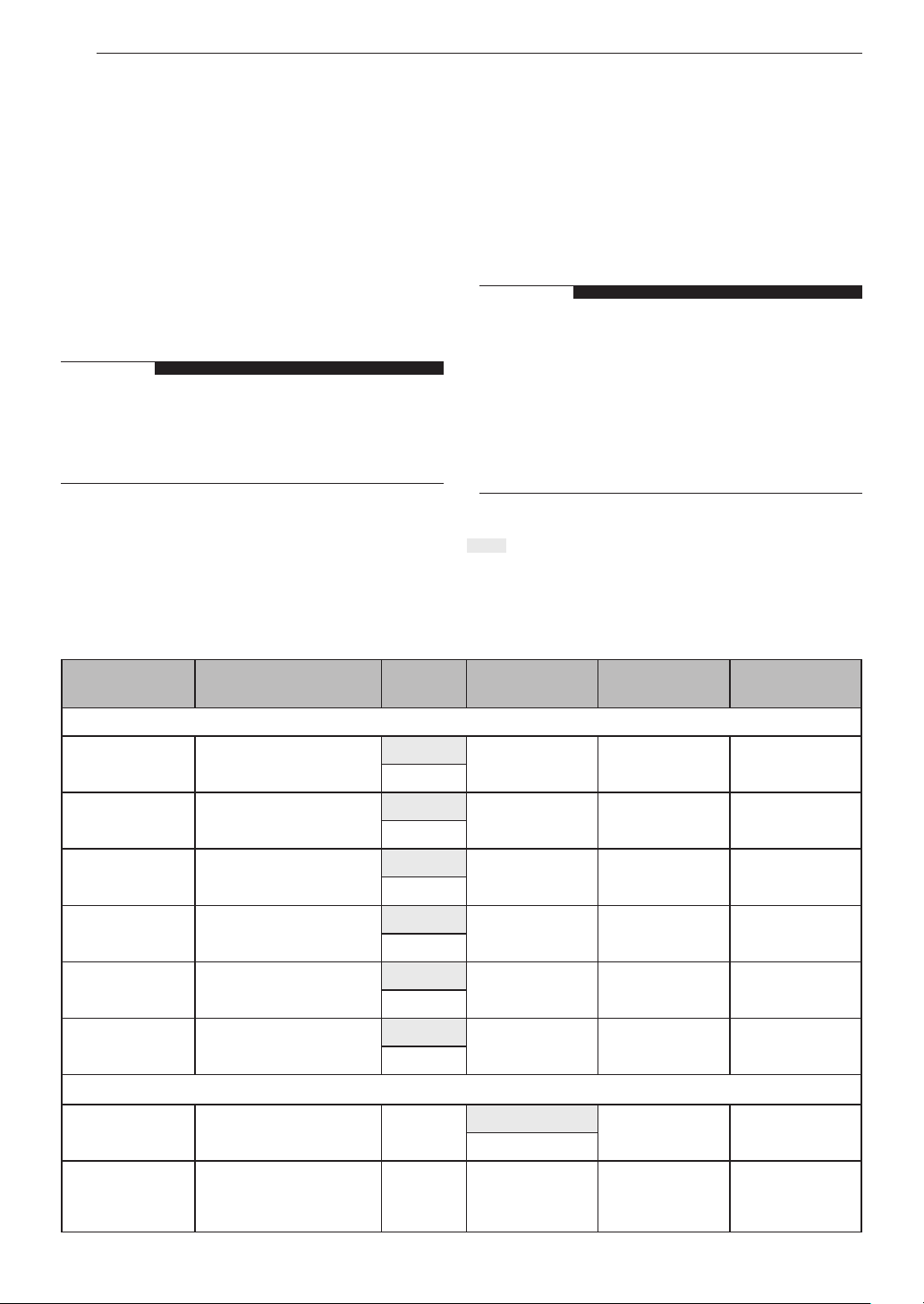
Non-Steam Models (DLE3400*, DLE3450*)
= default setting
# = allowable option
* = Energy Saver on by default
Cycle Fabric Type
Dry
Level
Temp. Wrinkle Care
Damp Dry
Signal
SENSOR DRY
Normal*
Work clothes,
corduroys, etc.
Normal
Medium ● ●
Adj.
Heavy Duty
Jeans, heavyweight
items
Normal
High ● ●
Adj.
Bedding
Comforters, Pillows,
Shirts
Normal
Medium
Adj.
Towels
Denims, towels, heavy
cottons
Normal
Medium ● ●
Adj.
Perm. Press
Permanent press,
synthetic items
Normal
Medium ● ●
Adj.
Delicates
Lingerie, sheets,
blouses
Normal
Low ● ●
Adj.
MANUAL DRY
Speed Dry
For small loads with
short drying times
Off
High
●
Adj.
Air Dry
For items that require
heat-free drying such
as plastics or rubber
Off No Heat ●
Cycle Guide
Sensor Dry Cycles
Sensor Dry cycles utilize LG’s unique dual sensor
system to detect and compare the moisture level
in clothes and in the air and adjust the drying
time as needed to ensure superior results. The
dryer automatically sets the dryness level and
temperature at the recommended setting for each
cycle. The estimated time remaining will be shown
in the display.
NOTE
• To protect your garments not every dryness
level, temperature, or option is available with
every cycle. See the Cycle Guide for details.
Manual Dry Cycles
Use Manual Dry cycles to select a specific amount
of drying time and a drying temperature. When
a Manual Dry cycle is selected, the Estimated
Time Remaining display shows the actual time
remaining in your cycle. You can change the actual
time in the cycle by pressing the More Time or
Less Time buttons.
NOTE
• The Energy Saver option is turned on by
default in the Normal Cycle. Turn off the
Energy Saver option for a faster Normal cycle
which begins with heated drying. To turn the
Energy Saver default off, press and hold the
Energy Saver button. ON or OFF appears in
the display.

31
OPERATION
ENGLISH
Cycle Modifier Buttons
Sensor Dry cycles have preset settings that are
selected automatically. Manual Dry cycles have
default settings, but you may also customize the
settings using the cycle modifier buttons. Press
the button for that option to view and select other
settings.
Dry Level
Use this button to select the level of dryness for
the cycle. Press the Dry Level button repeatedly
to scroll through available settings.
• This option is only available with Sensor Dry
cycles.
• The dryer will automatically adjust the cycle
time. Selecting More or Very will increase the
cycle time, while Less or Damp will decrease
the cycle time.
• Use a Less or Damp setting for items that you
wish to iron.
Temp.
Use this button to adjust the temperature setting.
This allows precise care of fabrics and garments.
Press the Temp. button repeatedly to scroll
through available settings.
Time Dry
Use this button to manually select the drying time,
from 20 to 60 minutes, in 20-minute increments.
Use this for small loads or to remove wrinkles.
Use the More Time/Less Time buttons to add or
reduce the drying time in 1-minute increments.
Option Buttons
The dryer features several additional cycle options
to customize cycles to meet individual needs.
Certain option buttons also feature a special
function that can be activated by pressing and
holding that option button for 3 seconds.
Adding Cycle Options to a Cycle
1
Turn on the dryer and turn the Cycle selector
knob to select the desired cycle.
2
Use the cycle modifier buttons to adjust the
settings for that cycle.
3
Press the cycle option button(s) to add the
desired options. A confirmation message is
shown in the display.
4
Press the Start/Pause button to start the
cycle. The dryer starts automatically.
Wrinkle Care
Selecting this option will tumble the load
periodically for up to 3 hours after the selected
cycle, or until the door is opened. This is helpful
in preventing wrinkles when you are unable to
remove items from the dryer immediately.
Energy Saver
This option helps to reduce the energy
consumption of the Normal Cycle, depending on
the load size. When the Energy Saver option is
selected, the cycle begins with an air dry section
and the drying time is increased.
Turn off the Energy Saver option for a faster
Normal cycle which begins with heated drying. To
turn the Energy Saver default off, press and hold
the Energy Saver button. ON or OFF appears in
the display.

32
OPERATION
Special Functions
Some cycle option buttons also activate secondary
functions. These special functions are marked with
an asterisk (*). Press and hold the option button
marked with the special function to activate it.
Control Lock
Use this option to prevent unwanted use of the
dryer or to keep cycle settings from being changed
while the dryer is operating.
Activating the Control Lock Function
Press and hold the Wrinkle Care button for 3
seconds.
The Control Lock icon will be shown in the display,
and all controls will be disabled except the Power
button.
Deactivating the Control Lock Function
Press and hold the Wrinkle Care button for 3
seconds.
Once set, Control Lock remains active until it is
manually deactivated. Control Lock must be turned
off to run another cycle.
Damp Dry Signal
When this option is selected, the dryer signals
when the load is approximately 80% dry. This
allows you to remove faster-drying lightweight
items or items that you would like to iron or hang
while they are still slightly damp.
SIGNAL
Press and hold the Dry Level button for 3 seconds
to adjust the volume of the signal. Press and hold
the button repeatedly to adjust the volume of the
melody. When no signal is heard, the signal is off.
The volume settings are ON – OFF. The signal
volume can be adjusted at any time as long as the
dryer is turned ON.
Default On/Off
This option allows the Energy Saver settings to
be changed. To run a Normal cycle without the
Energy Saver option, press and hold the Energy
Saver button for three seconds. ON or OFF
appears in the display.
33
SMART FUNCTIONS
ENGLISH
SMART FUNCTIONS
LG ThinQ Application
Installing the LG ThinQ Application
Search for the LG ThinQ application from the
Google Play Store or Apple App Store on a
smartphone. Follow instructions to download and
install the application.
LG ThinQ Application Features
• Smart Diagnosis™
− This function provides useful information
for diagnosing and solving issues with the
appliance based on the pattern of use.
Smart Diagnosis™ Feature
This feature is only available on models with the c
or d logo.
Use this feature to help you diagnose and solve
problems with your appliance.
NOTE
• For reasons not attributable to LGE’s
negligence, the service may not operate due
to external factors such as, but not limited to,
Wi-Fi unavailability, Wi-Fi disconnection, local
app store policy, or app unavailability.
• The feature may be subject to change without
prior notice and may have a different form
depending on where you are located.
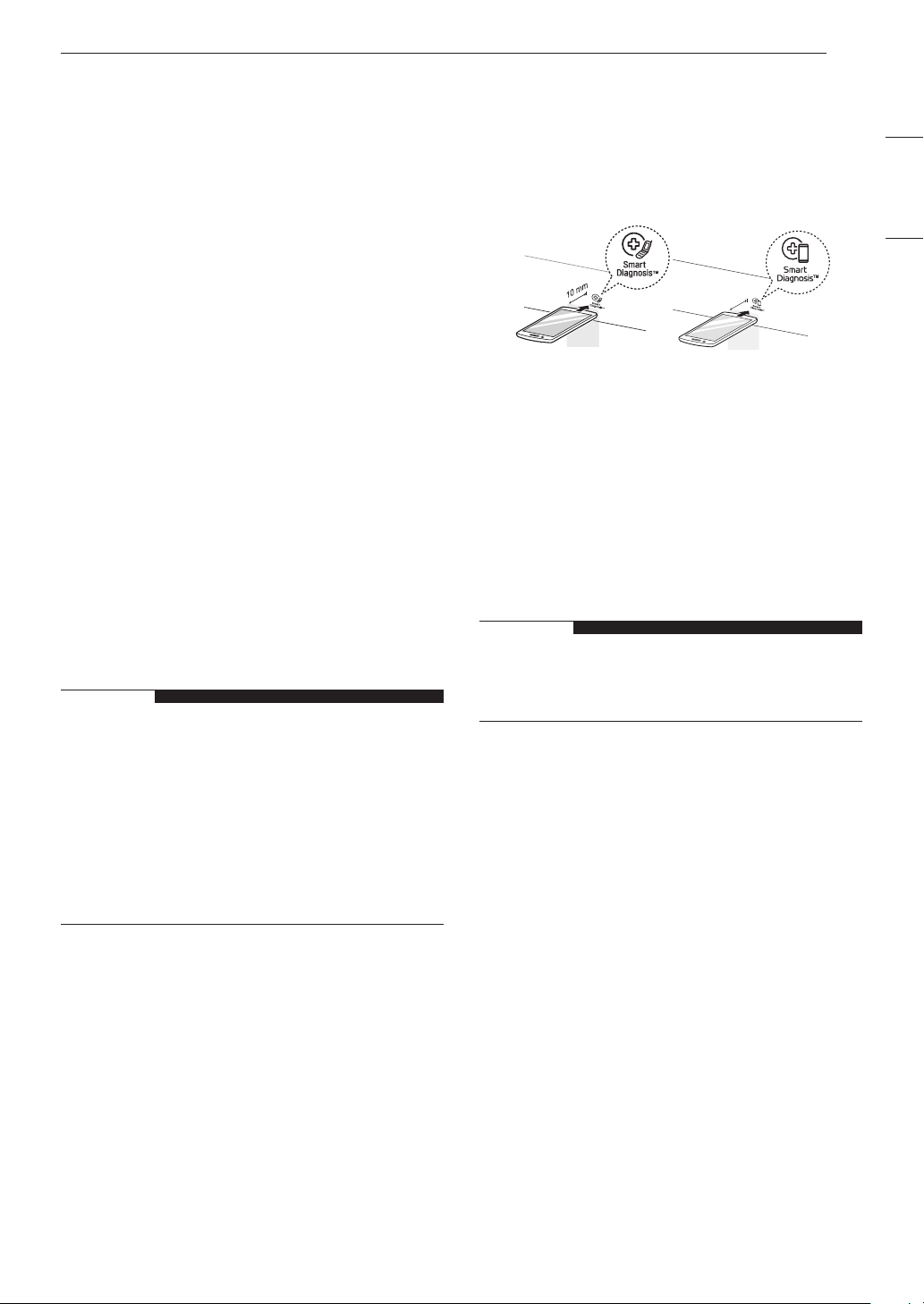
Using Audible Diagnosis to
Diagnose Issues
Follow the instructions below to use the audible
diagnosis method.
• Launch the LG ThinQ application and select the
Smart Diagnosis feature in the menu. Follow
the instructions for audible diagnosis provided in
the LG ThinQ application.
1
Press the Power button to turn on the
appliance.
• Do not press any other buttons.
2
Hold the mouthpiece of your phone in front of
the c or d logo.
Max.
Max.
10 mm
3
Press and hold the Temp. button for 3
seconds or longer while continuing to hold
your phone to the logo.
4
Keep the phone in place untill the tone
transmission has finished. The display will
count down the time. Once the countdown
is over and the tones have stopped, the
diagnosis will be displayed in the application.
NOTE
• For best results, do not move the phone while
the tones are being transmitted.
34
MAINTENANCE
MAINTENANCE
Regular Cleaning
WARNING
• Unplug the dryer before cleaning.
• Never use harsh chemicals, abrasive
cleaners, or solvents to clean the washer.
They will damage the finish.
Cleaning the Exterior
Proper care of your dryer can extend its life.
The outside of the machine can be cleaned with
warm water and a mild, nonabrasive household
detergent. Immediately wipe off any spills with a
soft, damp cloth.
NOTE
• Do not use methylated spirits, solvents, or
similar products.
• Never use steel wool or abrasive cleansers;
they can damage the surface.
Cleaning the Interior
Wipe around the door opening and seal with a
soft, damp cloth to prevent lint and dust buildup
that could damage the door seal.
Clean the window with a soft cloth dampened with
warm water and a mild, nonabrasive household
detergent, then wipe dry.
The stainless steel drum can be cleaned with
a conventional stainless steel cleaner, used
according to the manufacturer’s specifications.
Never use steel wool or abrasive cleansers; they
may scratch or damage the surface.
Cleaning Around and Under the
Dryer
Vacuum lint and dust from around the dryer and
underneath it regularly. Vent ductwork should be
checked for lint buildup and cleaned at least once
per year. If any noticeable reduction in airflow or
drying performance occurs, immediately check
ductwork for obstructions and blockages.
Maintaining Ductwork
Vent ductwork should be checked for lint buildup
once per month and cleaned at least once per
year. If any noticeable reduction in airflow or drying
performance occurs, immediately check ductwork
for obstructions and blockages. Contact a qualified
technician or service provider.
Cleaning the Lint Filter
Always clean the lint from the filter after every
cycle.
Lint Filter
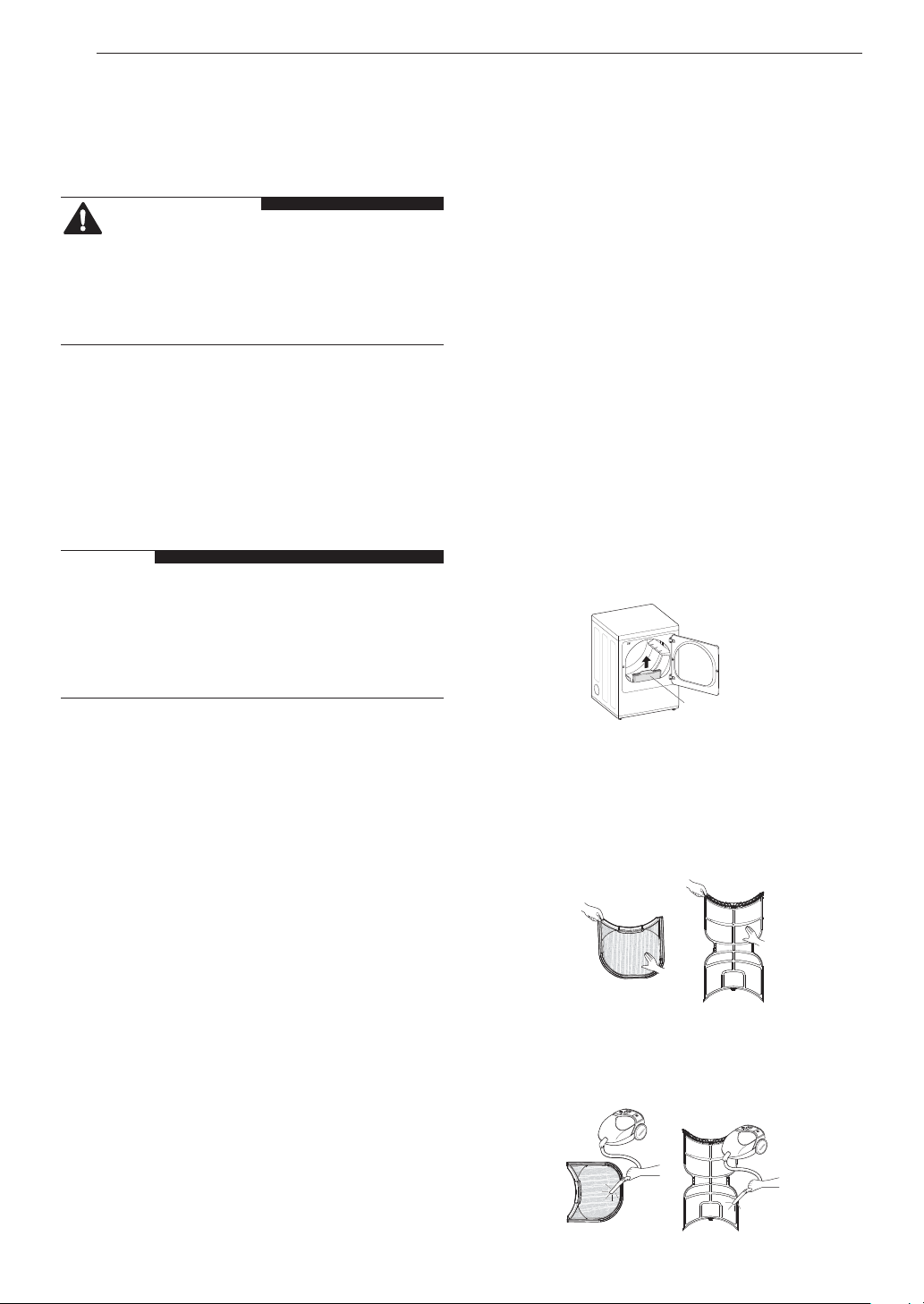
To clean the lint filter, open the dryer door and pull
the lint filter straight up. Then:
1
For everyday cleaning, roll any lint off the filter
with your fingers, or
2
Vacuum the lint filter.
35
MAINTENANCE
ENGLISH
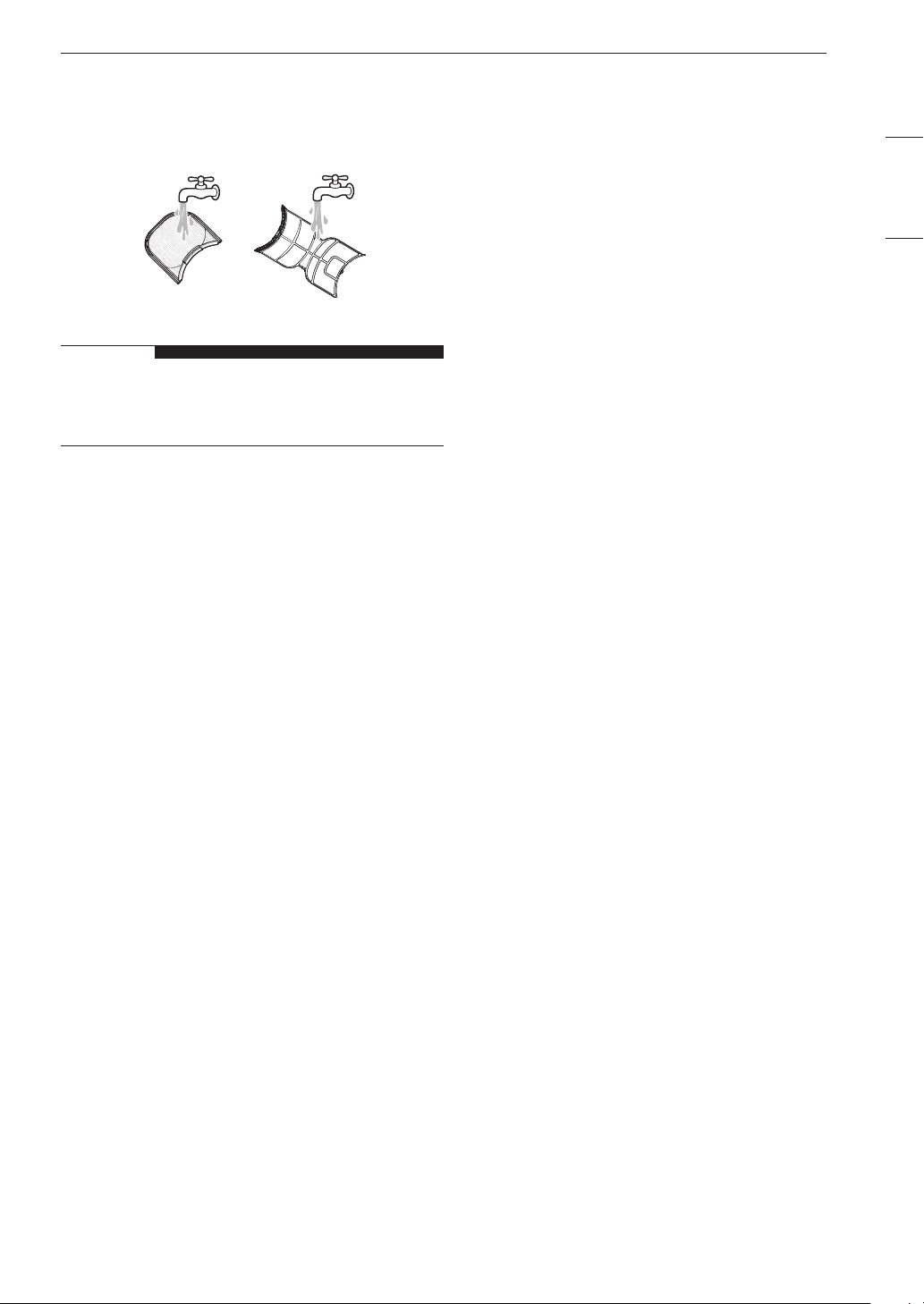
3
If the lint filter has become very dirty or
clogged with fabric softener, wash the lint
filter in warm, soapy water and allow it to dry
thoroughly before reinstalling.
NOTE
• NEVER operate the dryer without the lint filter
in place.
36
TROUBLESHOOTING
TROUBLESHOOTING
FAQs: Frequently Asked Questions
Q: When I press a button, why does my dryer beep and then nothing happens?
A: The Control Lock feature is turned on. To turn off Control Lock, turn the dryer on, then press and hold
the button that has *Control Lock on or under it for 3 seconds.
Q: Why does my dryer take so long to dry clothes?
A: Proper airflow is critical to the efficient operation of clothes dryers. A lint filter which is full of lint or
clogged with fabric softener sheet residue can reduce the airflow to the point that the time required
to dry clothing will be greatly increased. Another factor affecting dry time is your home exhaust
system. An exhaust system which is dirty and clogged with lint, or is excessively long, needs to be
professionally cleaned or repaired.
Q: Why does my dryer start by itself every few minutes?
A: This is how the Wrinkle Care feature works. The dryer runs briefly every few minutes for up to 3
hours after the cycle finishes. This feature is designed to help prevent wrinkles from setting in when
the dryer is not unloaded immediately after the cycle is finished.
User Support Videos
For further assistance, there are videos and tutorials available
through the LG.com website.
1
On the lg.com/us home page, click on the Support
menu tab to bring up the menu selections. Select Video
Tutorials.
2
Type Dryer in the search box on the new page and click
the Search button.
Scan this QR code to quickly access the
video search page on the LG website.
37
TROUBLESHOOTING
ENGLISH
Before Calling for Service
This dryer is equipped with an automatic error-monitoring system to detect and diagnose problems at an
early stage. If the dryer does not function properly or does not function at all, check the following before
you call for service.
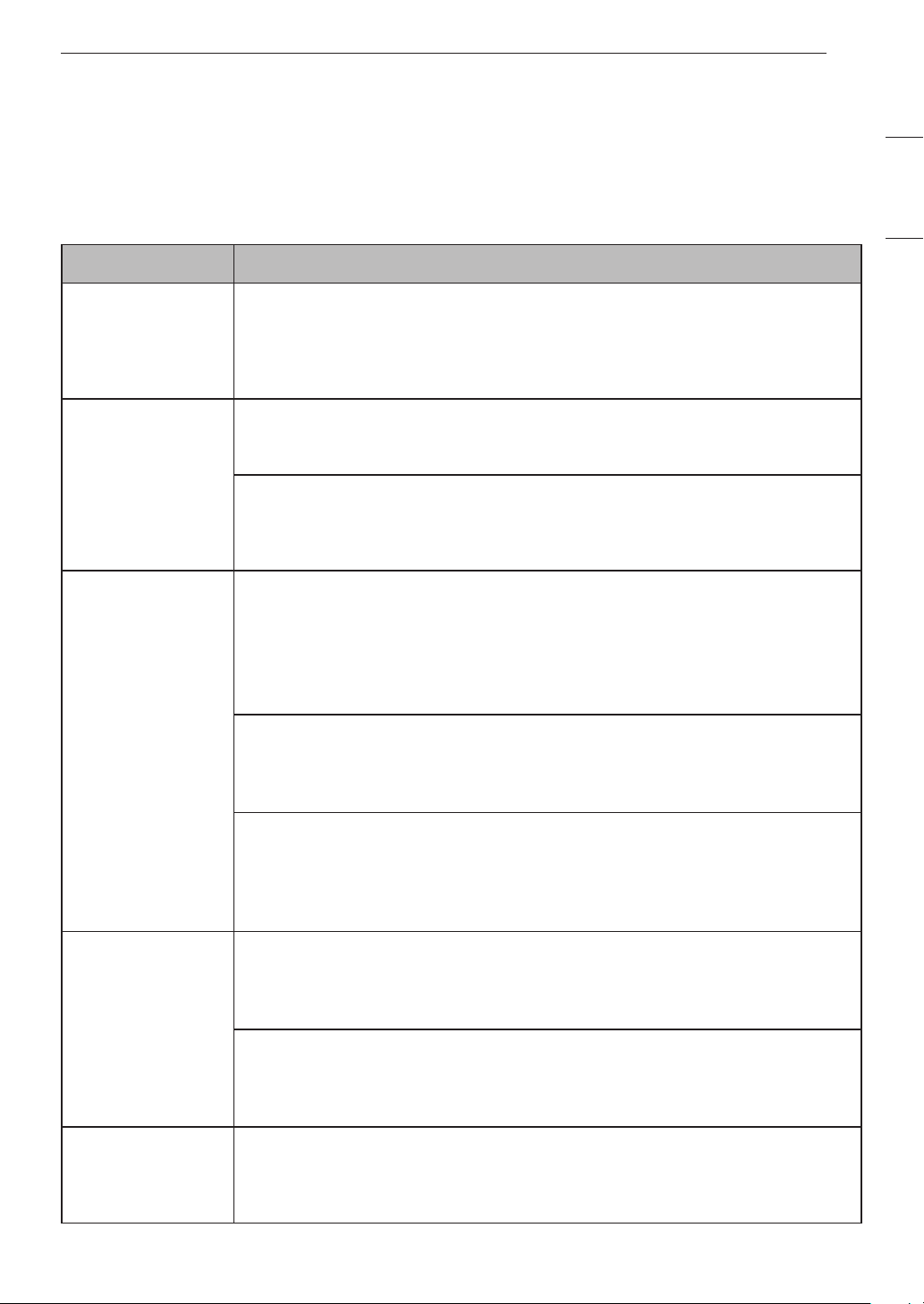
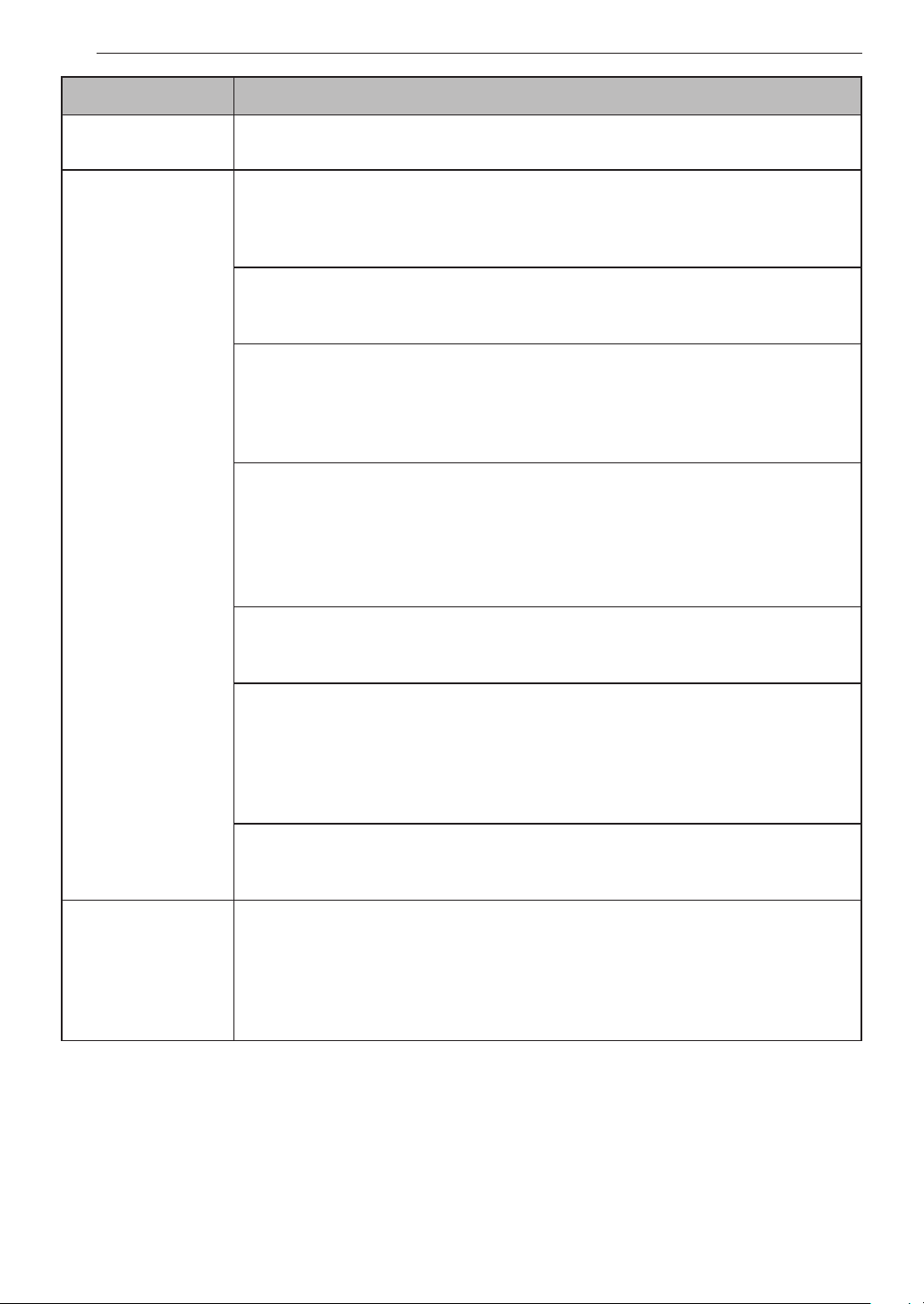
Operation
Problem Possible Causes & Solution
The Flow Sense™
indicator remains
active after clearing
the restriction in
the venting.
After clearing the restriction, the Flow Sense™ system requires multiple,
consecutive cycles to determine that the performance value has improved
before the Flow Sense™ indicator is reset.
• If the Flow Sense™ indicator remains active for more than five cycles after the
restriction has been cleared, call for service.
Dryer will not turn
on
Power cord is not properly plugged in.
• Make sure that the plug is securely plugged into a grounded outlet matching the
dryer’s rating plate.
House fuse is blown, circuit breaker has tripped, or power outage has
occurred.
• Reset circuit breaker or replace fuse. Do not increase fuse capacity. If the
problem is a circuit overload, have it corrected by a qualified electrician.
Dryer does not heat
House fuse is blown, circuit breaker has tripped, or power outage has
occurred.
• Reset circuit breaker or replace fuse. Do not increase fuse capacity. If the
problem is a circuit overload, have it corrected by a qualified electrician.
• NOTE: Due to the design of electric dryers, it is possible for a circuit problem to
allow an electric dryer to run without heat.
Gas supply or service is turned off.
• Confirm that the house gas shutoff and the dryer gas shutoff valves are both
fully open. Even if gas is not supplied to the dryer, it will run and no error codes
will display. Verify that other gas appliances in the home are working normally.
ENERGY SAVER option selected (on some models)
• If using the Normal cycle, deselect the ENERGY SAVER option. The Energy
Saver option is selected by default. This option reduces energy use by adding
an air dry section to the beginning of the cycle. It is normal to feel no heat at the
beginning of the cycle while in ENERGY SAVER mode.
Clothes take too
long to dry
Exhaust ducts are blocked, dirty, or duct run is too long.
• Confirm that the exhaust duct is properly configured and free of debris, lint, and
obstructions. Make sure that outside wall dampers can open properly and are
not blocked, jammed, or damaged.
Load is not properly sorted.
• Separate heavy items from lightweight items. Larger and heavier items take
longer to dry. Light items in a load with heavy items can fool the sensor
because the light items dry faster.
Display show error
code nP
Electric dryer power cord is not connected correctly, or house power supply
is incorrect.
• Check the power supply or the connection of the power cord to the terminal
block.
38
TROUBLESHOOTING
Problem Possible Causes & Solution
Display show error
code gAS
Gas supply or service turned off (gas models only).
• Confirm that house gas shutoff and the dryer gas shutoff are both fully open.
Clothes take too
long to dry
Large load of heavy fabrics.
• Heavy fabrics take longer to dry because they tend to retain more moisture.
To help reduce and maintain more consistent drying times for large and heavy
fabrics, separate these items into smaller loads of a consistent size.
Dryer controls are not set properly.
• Use the appropriate control settings for the type of load you are drying. Some
loads may require an adjustment of the dry level setting for proper drying.
Lint filter needs to be cleaned.
• Remove the lint from the filter before every load. With the lint removed, hold the
filter up to a light to see if it is dirty or clogged. With some loads that produce
high amounts of lint, such as new bath towels, it may be necessary to pause
the cycle and clean the filter during the cycle.
House fuse is blown, circuit breaker has tripped, or power outage has
occurred.
• Reset circuit breaker or replace fuse. Do not increase fuse capacity. If the
problem is a circuit overload, have it corrected by a qualified electrician.
• NOTE: Due to the design of electric dryers, it is possible for a circuit problem to
allow an electric dryer to run without heat.
Dryer is overloaded.
• Divide extra large loads into smaller loads for better drying performance and
efficiency.
Dryer is underloaded.
• If you are drying a very small load, add a few extra items to ensure proper
tumbling action. If the load is very small and you are using SENSOR DRY
cycles, the electronic control cannot properly sense the dryness of the load and
may shut off too soon. Use TIME DRY or add some extra wet clothes to the
load.
ENERGY SAVER option selected (on some models)
• If using the Normal cycle, deselect the ENERGY SAVER option. This option
reduces energy use by adding an air dry section to the beginning of the cycle.
Drying time is not
consistent
Heat settings, load size, or dampness of clothing is not consistent.
• The drying time for a load will vary depending on the type of heat used (electric,
natural gas, or LP gas), the size of the load, the type of fabrics, the wetness
of the clothes, and the condition of the exhaust duct and lint filter. Even an
unbalanced load in the washer can cause poor spinning, resulting in wetter
clothes which will take longer to dry.
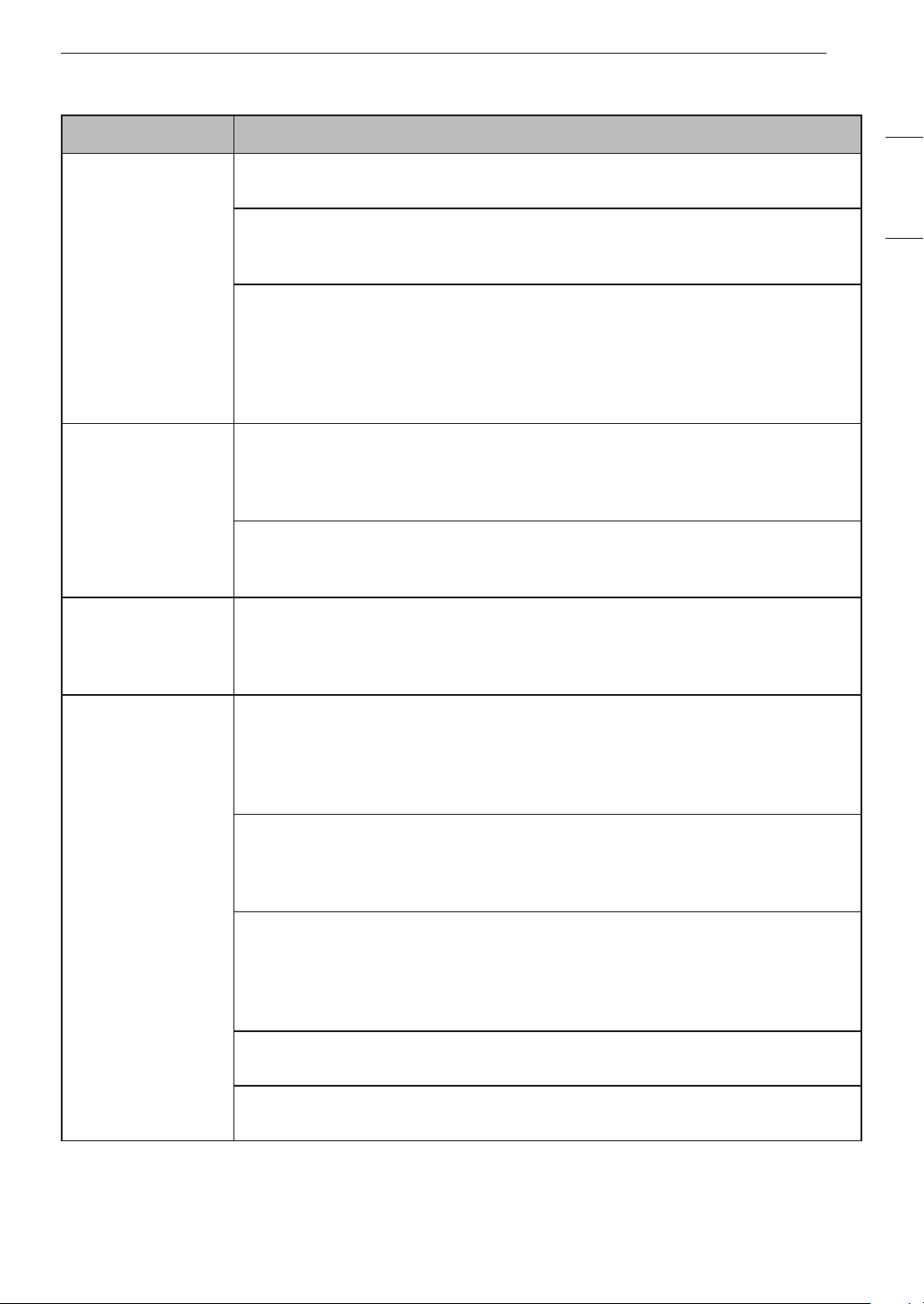
39
TROUBLESHOOTING
ENGLISH
Performance
Problem Possible Causes & Solution
Greasy or dirty
spots on clothes
Fabric softener used incorrectly.
• Confirm and follow the instructions provided with your fabric softener.
Clean and dirty clothes are being dried together.
• Use your dryer to dry only clean items. Soil from dirty clothes can transfer to the
clean clothes in the same or later loads.
Clothes were not properly cleaned or rinsed before being placed in the
dryer.
• Stains on dried clothes could be stains that were not removed during the
washing process. Make sure that clothes are being completely cleaned or
rinsed according to the instructions for your washer and detergent. Some
difficult soils may require pre-treating prior to washing.
Clothes are
wrinkled
Clothes dried too long (over dried).
• Over drying a load of laundry can lead to wrinkled clothes. Try a shorter drying
time or LESS DRY setting and remove items while they still retain a slight
amount of moisture.
Clothes left in dryer too long after cycle ends.
• Use the WRINKLE CARE option. This feature will tumble the clothes briefly
every few minutes for up to 3 hours to help prevent wrinkling.
Clothes are
shrinking
Garment care instructions are not being followed.
• To avoid shrinking your clothes, always consult and follow fabric care
instructions. Some fabrics will naturally shrink when washed. Other fabrics can
be washed but will shrink when dried in a dryer. Use a low or no heat setting.
Lint on clothes
Lint filter not cleaned properly.
• Remove the lint from the filter before every load. With the lint removed, hold
the filter up to a light to see if it is dirty or clogged. If it looks dirty, follow the
cleaning instructions. With some loads that produce high amounts of lint, it may
be necessary to clean the filter during the cycle.
Laundry not sorted properly.
• Some fabrics are lint producers (i.e., a fuzzy white cotton towel) and should
be dried separately from clothes that are lint trappers (i.e., a pair of black linen
pants).
Excess static in clothes.
• Use a fabric softener to reduce static electricity. Be sure to follow the
manufacturer’s instructions. Overdrying a load of laundry can cause a buildup
of static electricity. Adjust settings and use a shorter drying time, or use
SENSOR DRY cycles.
Dryer is overloaded.
• Divide extra large loads into smaller loads for drying.
Tissue, paper, etc., left in pockets.
• Check pockets thoroughly before washing and drying clothes.
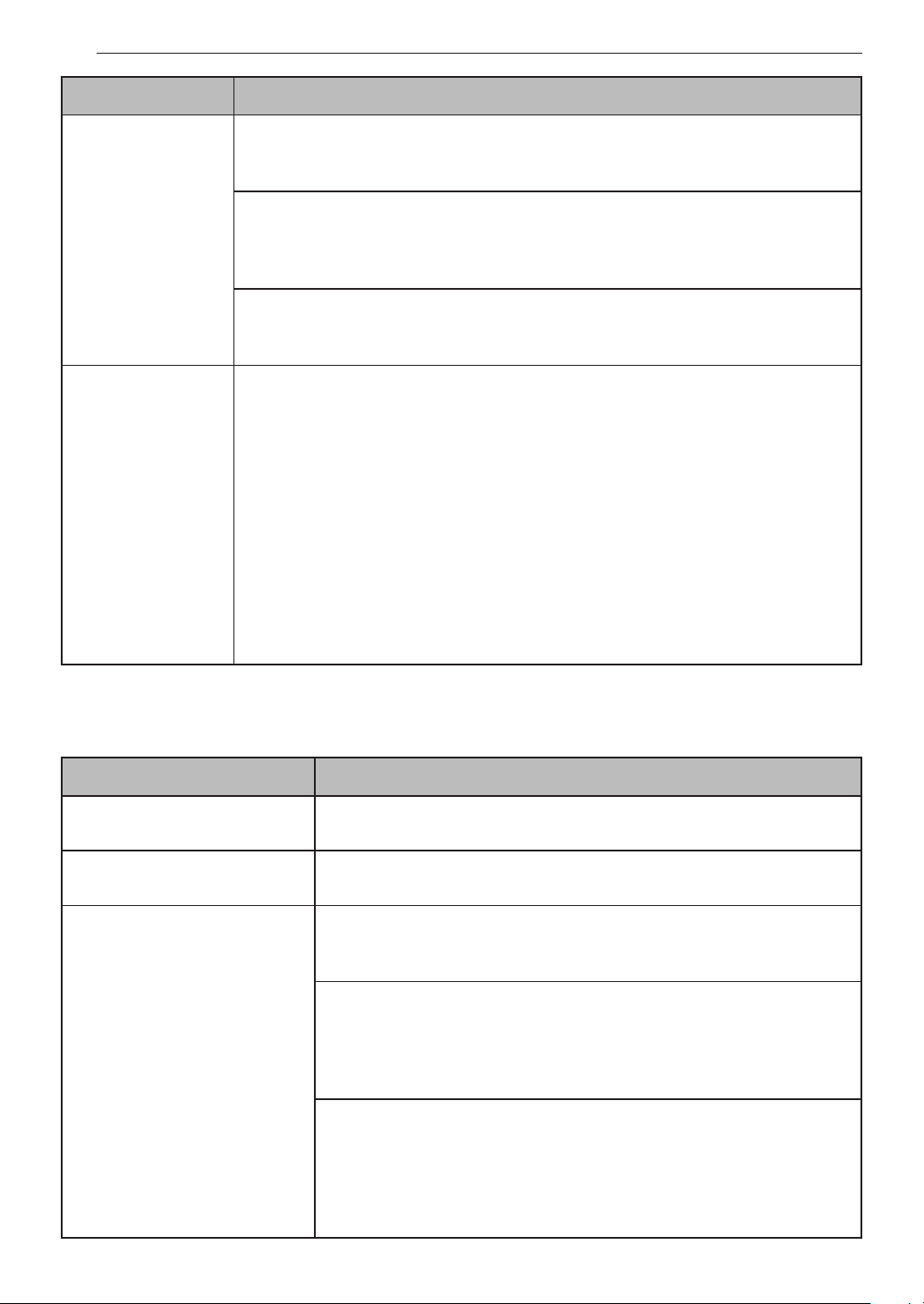
40
TROUBLESHOOTING
Problem Possible Causes & Solution
Excess static in
clothes after drying
Fabric softener is not used or used incorrectly.
• Use a fabric softener or the REDUCE STATIC option, if equipped, to reduce
static electricity. Be sure to follow the manufacturer’s instructions.
Clothes dried too long (overdried).
• Overdrying a load of laundry can cause a buildup of static electricity. Adjust
settings and use a shorter drying time, or use MANUAL DRY cycles. Select a
LESS DRY setting on SENSOR DRY cycles, if necessary.
Drying synthetics, permanent press, or synthetic blends.
• These fabrics are naturally more prone to static buildup. Try using fabric
softener, or use LESS DRY and/or shorter TIME DRY time settings.
Clothes have
damp spots after a
Sensor Dry cycle.
Very large load or very small load.Single large item such as a blanket or
comforter.
• If items are too tightly packed or too sparse the sensor may have trouble
reading the dryness level of the load. Use a TIME DRY cycle for very small
loads.
• Large, bulky items such as blankets or comforters can sometimes wrap
themselves into a tight ball of fabric. The outside layers will dry and register on
the sensors, while the inner core remains damp. When drying a single bulky
item, it may help to pause the cycle once or twice and rearrange the item to
unwrap and expose any damp areas.
• To dry a few remaining damp items from a very large load or a few damp spots
on a large item after a sensor cycle has completed, empty the lint trap, then set
a TIME DRY cycle to finish drying the item(s).
Error Codes
Problem Possible Causes & Solution
Error code: tE1 through tE7
Temperature sensor failure.
• Turn off the dryer and call for service.
Display shows error code: PS
Power cord is connected incorrectly.
• Check the connection of the power cord to the terminal block.
*Flow Sense™ indicator
shows four bars during the
drying cycle or the display
shows “d80” after drying
* This warning light is
not a dryer failure and is
not covered by the dryer
warranty. Contact a duct
cleaning service to set up
an appointment to have your
exhaust system cleaned and
inspected.
Exhaust system is too long or has too many turns/restrictions.
• Install a shorter or straighter duct run. See the Installation
Instructions for details.
Partial blockage of the ductwork due to lint buildup or other
foreign object.
• Ductwork should be checked/cleaned immediately. Dryer can be
used in this condition, but drying times will be longer and energy
consumption will increase.
The appliance has detected a restriction in the external dryer
venting.
• If exhaust restrictions are sensed by the Flow Sense™ system,
the indicator will remain on for 2 hours after the end of the cycle.
Opening the door or pressing the Power button will turn off the
display.
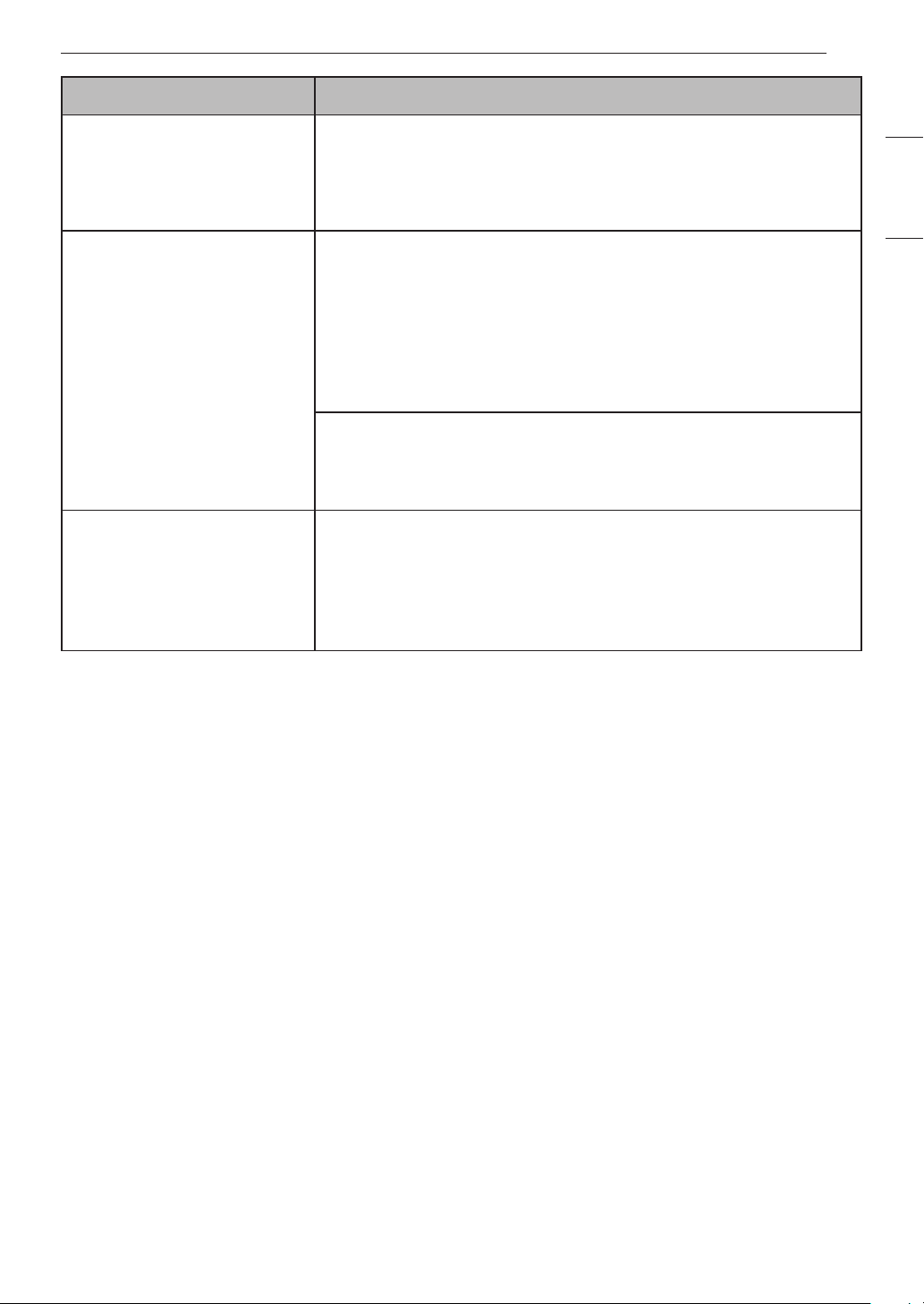
41
TROUBLESHOOTING
ENGLISH
Problem Possible Causes & Solution
The Flow Sense™ indicator
remains active after clearing
the restriction in the venting.
After clearing the restriction, the Flow Sense™ system requires
multiple, consecutive cycles to determine that the performance
value has improved before the Flow Sense™ indicator is reset.
• If the Flow Sense™ indicator remains active for more than five
cycles after the restriction has been cleared, call for service.
The display shows
d, 7s
d, 8O
d, QO
d, Qs
The duct work is about 75% - 95% blocked. (“d75”, “d80”, “d90”
or “d95” error code is displayed for 2 hours only)
• Do not use the dryer until the exhaust system has been cleaned
and/or repaired. Using the dryer with a severely restricted exhaust
is dangerous and could result in a fire or other property damage.
Check the outside dryer vent while the dryer is operating to make
sure there is strong airflow. If the exhaust system is extremely long,
have it repaired or rerouted.
House exhaust system blocked.
• Keep the area around the dryer clean and free of clutter. Check vent
hood for damage or lint clogging. Make sure the area around the
vent hood is clear.
Check filter indicator is on
during the drying cycle
Lint filter not cleaned properly.
• Remove the lint from the filter before every load. With the lint
removed, hold the filter up to a light to see if it is dirty or clogged. If
it looks dirty, follow the cleaning instructions. With some loads that
produce high amounts of lint, it may be necessary to clean the filter
during the cycle.
42
WARRANTY
WARRANTY
ARBITRATION NOTICE: THIS LIMITED WARRANTY CONTAINS AN ARBITRATION PROVISION THAT
REQUIRES YOU AND LG TO RESOLVE DISPUTES BY BINDING ARBITRATION INSTEAD OF IN
COURT, UNLESS THE LAWS OF YOUR PROVINCE OR TERRITORY DO NOT PERMIT THAT, OR,
IN OTHER JURISDICTIONS, IF YOU CHOOSE TO OPT OUT. IN ARBITRATION, CLASS ACTIONS
AND JURY TRIALS ARE NOT PERMITTED. PLEASE SEE THE SECTION TITLED “PROCEDURE FOR
RESOLVING DISPUTES” BELOW.
WARRANTY: Should your LG Dryer (“Product”) fail due to a defect in material or workmanship under
normal home use during the warranty period set forth below, LG Canada will at its option repair or replace
the Product upon receipt of proof of original retail purchase. This warranty is valid only to the original
retail purchaser of the product and applies only to a Product distributed in Canada by LG Canada or an
authorized Canadian distributor thereof. The warranty only applies to Products located and used within
Canada. Coverage for “in Home” repairs, for products in-warranty, will be provided if the Product is within
a 150 km radius from the nearest authorized service center (ASC), as determined by LG Canada. If your
Product is located outside a 150 km radius from a ASC, as determined by LG Canada, it will be your
responsibility to bring the Product, at your sole expense, to the ASC for in-warranty repair.
WARRANTY PERIOD: (Note: If the original date of purchase can not be verified, the warranty will
begin sixty(60) days from the date of manufacture).
Period
One (1) year from the date of
original retail purchase
Three (3) years from the date of
original retail purchase
Scope of Warranty
Parts and Labor (internal/
functional parts only)
Dryer Drum (Parts only)
• Replacement products and parts are warranted for the remaining portion of the original warranty period
or ninety (90) days, whichever is greater.
• Replacement products and parts may be new or remanufactured.
• LG Authorized Service Center warranties their repair work for thirty (30) days.
LG CANADA’S SOLE LIABILITY IS LIMITED TO THE WARRANTY SET OUT ABOVE. EXCEPT
AS EXPRESSLY PROVIDED ABOVE, LG CANADA MAKES NO AND HEREBY DISCLAIMS ALL
OTHER WARRANTIES AND CONDITIONS RESPECTING THE PRODUCT, WHETHER EXPRESS
OR IMPLIED, INCLUDING, BUT NOT LIMITED TO, ANY IMPLIED WARRANTY OR CONDITION OF
MERCHANTABILITY OR FITNESS FOR A PARTICULAR PURPOSE, AND NO REPRESENTATIONS
SHALL BE BINDING ON LG CANADA. LG CANADA DOES NOT AUTHORIZE ANY PERSON
TO CREATE OR ASSUME FOR IT ANY OTHER WARRANTY OBLIGATION OR LIABILITY IN
CONNECTION WITH THE PRODUCT. TO THE EXTENT THAT ANY WARRANTY OR CONDITION IS
IMPLIED BY LAW, IT IS LIMITED TO THE EXPRESS WARRANTY PERIOD ABOVE. LG CANADA,
THE MANUFACTURER OR DISTRIBUTOR SHALL NOT BE LIABLE FOR ANY INCIDENTAL,
CONSEQUENTIAL, SPECIAL, DIRECT OR INDIRECT DAMAGES, LOSS OF GOODWILL, LOST
PROFITS, PUNITIVE OR EXEMPLARY DAMAGES OR ANY OTHER DAMAGE, WHETHER
ARISING DIRECTLY OR INDIRECTLY FROM ANY CONTRACTUAL BREACH, FUNDAMENTAL OR
OTHERWISE, OR FROM ANY ACTS OR OMISSIONS, TORT, OR OTHERWISE.
This warranty gives you specific legal rights. You may have other rights which may vary from province to
province depending on applicable provincial laws. Any term of this warranty that negates or varies any
implied condition or warranty under provincial law is severable where it conflicts with provincial law without
affecting the remainder of this warranty’s terms.
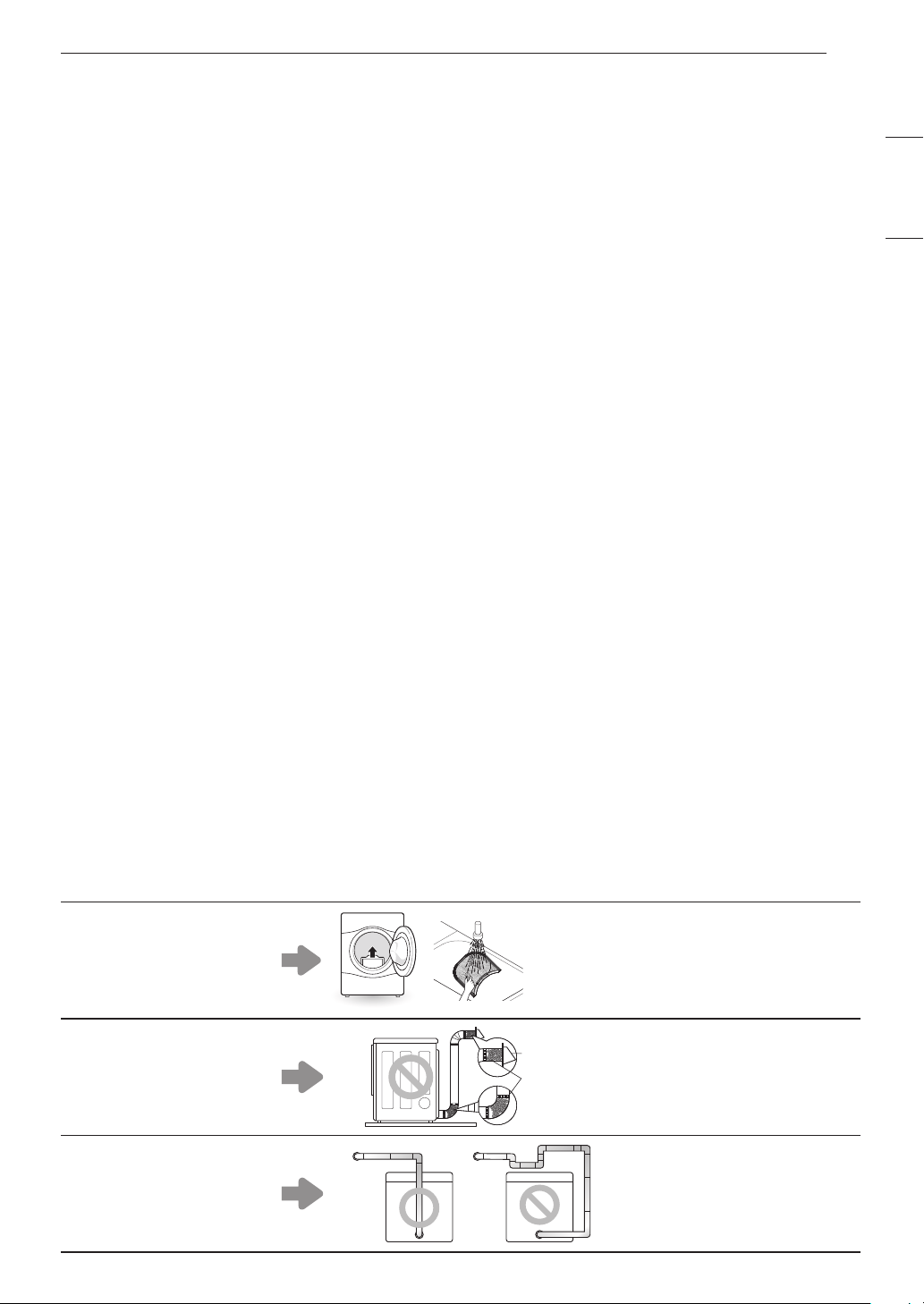
43
WARRANTY
ENGLISH
THIS LIMITED WARRANTY DOES NOT COVER:
• Service trips to deliver, pick up, or install or repair the product; instruction to the customer on operation
of the product; repair or replacement of fuses or correction of wiring or plumbing, or correction of
unauthorized repairs/installation.
• Failure of the product to perform during power failures and interruptions or inadequate electrical service.
• Damage caused by leaky or broken water pipes, frozen water pipes, restricted drain lines, inadequate or
interrupted water supply or inadequate supply of air.
• Damage resulting from operating the Product in a corrosive atmosphere or contrary to the instructions
outlined in the Product’s owner’s manual.
• Damage to the Product caused by accidents, pests and vermin, lightning, wind, fire, floods, or acts of God.
• Damage or product failure caused by unauthorized modification or alteration, or use for other than its
intended purpose, or resulting from any water leakage due to improper installation.
• Damage or Product failure caused by incorrect electrical current, voltage, or plumbing codes,
commercial or industrial use, or use of accessories, components, or cleaning products that are not
approved by LG Canada.
• Damage caused by transportation and handling, including scratches, dents, chips, and/or other damage
to the finish of your product, unless such damage results from defects in materials or workmanship and
is reported within one (1) week of delivery.
• Damage or missing items to any display, open box, discounted, or refurbished Product.
• Products with original serial numbers that have been removed, altered, or cannot be readily determined.
Model and Serial numbers, along with original retail sales receipt, are required for warranty validation.
• Increases in utility costs and additional utility expenses.
• Replacement of light bulbs, filters, or any consumable parts.
• Repairs when your Product is used in other than normal and usual household use (including, without
limitation, commercial use, in offices or recreational facilities) or contrary to the instructions outlined in
the Product owner’s manual.
• Costs associated with removal of the Product from your home for repairs.
• The removal and reinstallation of the Product if it is installed in an inaccessible location or is not installed in
accordance with published installation instructions, including the Product owner’s and installation manuals.
• Accessories to the Product such as door bins, drawers, handles, shelves, etc.. Also excluded are parts
besides those that were originally included with the Product.
• Damage resulting from the misuse, abuse, improper installation, repair, or maintenance of the Product.
Improper repair includes use of parts not approved or specified by LG Canada.
• Conversion of product from natural gas or L.P. gas.
Filter is clogged.
• Not heating, long dry
time
• Clean the lint filter.
Duct is clogged.
• Not heating, long dry
time
• Clean the hood and
duct.
Excessive duct
length and/or multiple
elbows
• Not heating, long dry
time
• Keep exhaust ducts as
short as possible, using
as few elbows and
bends as possible.
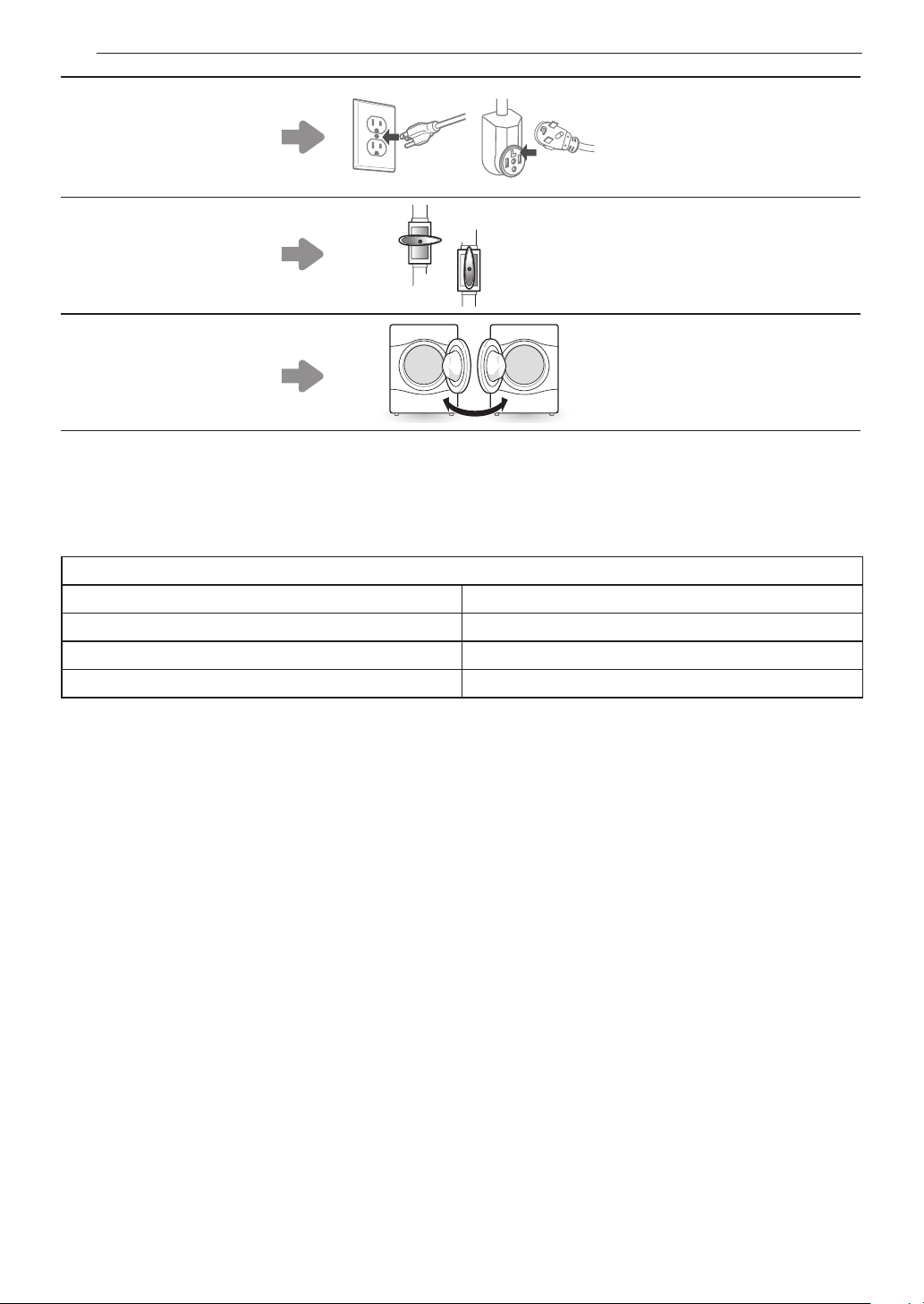
44
WARRANTY
Improperly connected
power cord or
electrical outlet issue.
• No Power
• Not Heating
• Reconnect power cord,
replace house fuse or
reset breaker. If outlet
is issue, electrician may
be required.
Gas valve is not
turned on. (Gas Dryer)
• Not heating
• Open the gas valve.
Door Reversal
• Instructions for door
reversal can be found
in the owner’s manual.
All costs associated with the above excluded circumstances shall be borne by the consumer.
For complete warranty details and customer assistance, please call or visit our website:
Call 1-888-542-2623 and select the appropriate option from the menu, or visit our website at http://www.
lg.com
Write your warranty information below
Product Registration Information
Model
Serial Number
Date of Purchase

45
WARRANTY
ENGLISH
PROCEDURE FOR RESOLVING DISPUTES:
EXCEPT WHERE PROHIBITED AT LAW, ALL DISPUTES BETWEEN YOU AND LG ARISING OUT
OF OR RELATING IN ANY WAY TO THIS LIMITED WARRANTY OR THE PRODUCT SHALL BE
RESOLVED EXCLUSIVELY THROUGH BINDING ARBITRATION, AND NOT IN A COURT OF GENERAL
JURISDICTION. EXCEPT WHERE PROHIBITED AT LAW, YOU AND LG BOTH IRREVOCABLY AGREE
TO WAIVE THE RIGHT TO A JURY TRIAL AND TO BRING OR PARTICIPATE IN A CLASS ACTION.
Definitions. For the purposes of this section, references to “LG” mean LG Electronics Canada, Inc., its
parents, subsidiaries and affiliates, and each of their officers, directors, employees, agents, beneficiaries,
predecessors in interest, successors, assigns and suppliers; references to “dispute” or “claim” shall
include any dispute, claim or controversy of any kind whatsoever (whether based in contract, tort, statute,
regulation, ordinance, fraud, misrepresentation or any other legal or equitable theory) arising out of or
relating in any way to the sale, condition or performance of the product or this Limited Warranty.
Notice of Dispute. In the event you intend to commence an arbitration proceeding, you must first notify
LG in writing at least 30 days in advance of initiating the arbitration by sending a letter to LGECI Legal
Team at 20 Norelco Drive, North York, Ontario, Canada M9L 2X6 (the “Notice of Dispute”). You and LG
agree to engage in good faith discussions in an attempt to amicably resolve your claim. The notice must
provide your name, address, and telephone number; identify the product that is the subject of the claim;
and describe the nature of the claim and the relief being sought. If you and LG are unable to resolve the
dispute within 30 days of LG’s receipt of the Notice of Dispute, the dispute shall be resolved by binding
arbitration in accordance with the procedure set out herein. You and LG both agree that, during the
arbitration proceeding, the terms (including any amount) of any settlement offer made by either you or LG
will not be disclosed to the arbitrator until the arbitrator determines the dispute.
Agreement to Binding Arbitration and Class Action Waiver. Upon failure to resolve the dispute during
the 30 day period after LG’s receipt of the Notice of Dispute, you and LG agree to resolve any claims
between you and LG only by binding arbitration on an individual basis, unless you opt out as provided
below, or you reside in a jurisdiction that prevents full application of this clause in the circumstances of the
claims at issue (in which case if you are a consumer, this clause will only apply if you expressly agree to
the arbitration). To the extent permitted by applicable law, any dispute between you and LG shall not be
combined or consolidated with a dispute involving any other person’s or entity’s product or claim. More
specifically, without limitation of the foregoing, except to the extent such a prohibition is not permitted at
law, any dispute between you and LG shall not under any circumstances proceed as part of a class or
representative action. Instead of arbitration, either party may bring an individual action in small claims
court, but that small claims court action may not be brought on a class or representative basis except to
the extent this prohibition is not permitted at law in your province or territory of jurisdiction as it relates to
the claims at issue between you and LG.
Arbitration Rules and Procedures. To begin arbitration of a claim, either you or LG must make a written
demand for arbitration. The arbitration will be private and confidential, and conducted on a simplified
and expedited basis before a single arbitrator chosen by the parties under the provincial or territorial
commercial arbitration law and rules of the province or territory of your residence. You must also send a
copy of your written demand to LG at LG Electronics, Canada, Inc., Attn: Legal Department- Arbitration,
20 Norelco Drive, North York, Ontario M9L 2X6. This arbitration provision is governed by your applicable
provincial or territorial commercial arbitration legislation. Judgment may be entered on the arbitrator’s
award in any court of competent jurisdiction. All issues are for the arbitrator to decide, except that, issues
relating to the scope and enforceability of the arbitration provision and to the arbitrability of the dispute are
for the court to decide. The arbitrator is bound by the terms of this provision.
Governing Law. The law of the province or territory of your purchase shall govern this Limited Warranty
and any disputes between you and LG except to the extent that such law is preempted by or inconsistent
with applicable federal or provincial/territorial law. Should arbitration not be permitted for any claim, action,
dispute or controversy between you and LG, you and LG attorn to the exclusive jurisdiction of the courts
of the province or territory of your purchase for the resolution of the claim, action, dispute or controversy
between you and LG.

46
WARRANTY
Governing Law. Fees/Costs. You do not need to pay any fee to begin an arbitration. Upon receipt of
your written demand for arbitration, LG will promptly pay all arbitration filing fees unless you seek more
than $25,000 in damages, in which case the payment of these fees will be governed by the applicable
arbitration rules. Except as otherwise provided for herein, LG will pay all filing, administration and arbitrator
fees for any arbitration initiated in accordance with the applicable arbitration rules and this arbitration
provision. If you prevail in the arbitration, LG will pay your attorneys’ fees and expenses as long as they
are reasonable, by considering factors including, but not limited to, the purchase amount and claim
amount. Notwithstanding the foregoing, if applicable law allows for an award of reasonable attorneys’ fees
and expenses, an arbitrator can award them to the same extent that a court would. If the arbitrator finds
either the substance of your claim or the relief sought in the demand is frivolous or brought for an improper
purpose (as measured by the applicable laws), then the payment of all arbitration fees will be governed
by the applicable arbitration rules. In such a situation, you agree to reimburse LG for all monies previously
disbursed by it that are otherwise your obligation to pay under the applicable arbitration rules. Except as
otherwise provided for, LG waives any rights it may have to seek attorneys’ fees and expenses from you if
LG prevails in the arbitration.
Hearings and Location. If your claim is for $25,000 or less, you may choose to have the arbitration
conducted solely (1) on the basis of documents submitted to the arbitrator, (2) through a telephonic
hearing, or (3) by an in-person hearing as established by the applicable arbitration rules. If your claim
exceeds $25,000, the right to a hearing will be determined by the applicable arbitration rules. Any in-
person arbitration hearings will be held at the nearest, most mutually-convenient arbitration location
available within the province or territory in which you reside unless you and LG both agree to another
location or agree to a telephonic arbitration.
Severability and Waiver. If any portion of this Limited Warranty (including these arbitration procedures)
is unenforceable, the remaining provisions will continue in full force and effect to the maximum extent
permitted by applicable law. Should LG fail to enforce strict performance of any provision of this Limited
Warranty (including these arbitration procedures), it does not mean that LG intends to waive or has waived
any provision or part of this Limited Warranty.
Opt Out. You may opt out of this dispute resolution procedure. If you opt out, neither you nor LG can
require the other to participate in an arbitration proceeding. To opt out, you must send notice to LG no later
than 30 calendar days from the date of the first consumer purchaser’s purchase of the product by either (i)
sending an e-mail to [email protected], with the subject line: “Arbitration Opt Out;” or (ii) calling 1-800-980-
2973. You must include in the opt out e-mail or provide by telephone: (a) your name and address; (b) the
date on which the product was purchased; (c) the product model name or model number; and (d) the serial
number (the serial number can be found (i) on the product; or (ii) online by accessing https://www.lg.com/
ca_en/support/repair-service/ schedulerepair and clicking on “Find My Model & Serial Number”).
In the event that you “Opt Out”, the law of the province or territory of your residence shall govern this
Limited Warranty and any disputes between you and LG except to the extent that such law is preempted
by or inconsistent with applicable federal or provincial/territorial law. Should arbitration not be permitted for
any claim, action, dispute or controversy between you and LG, you and LG agree to attorn to the exclusive
jurisdiction of the courts of the province or territory of your residence for the resolution of the claim, action,
dispute or controversy between you and LG.
You may only opt out of the dispute resolution procedure in the manner described above (that is, by e-mail
or telephone); no other form of notice will be effective to opt out of this dispute resolution procedure.
Opting out of this dispute resolution procedure will not affect the coverage of the Limited Warranty in any
way, and you will continue to enjoy the full benefits of the Limited Warranty. If you keep this product and do
not opt out, then you accept all terms and conditions of the arbitration provision described above.
Conflict of Terms. In the event of a conflict or inconsistency between the terms of this Limited Warranty
and the End User License Agreement (“EULA”) in regards to dispute resolution, the terms of this Limited
Warranty shall control and govern the rights and obligations of the parties and shall take precedence over
the EULA.

47MEMO

48 MEMO