Operating and Installation Instructions
2 - 35
Thank you for purchasing the Panasonic product.
• This machine is for household use only. Commercial usage of the Dishwasher will void Warranty.
• Please read these instructions carefully before attempting to install, operate or service this product.
• For optimum performance and safety, please read these instructions carefully and follow safety precautions when
using this product.
• Before using this product please pay extra attention to “Safety Precautions” (Page 3 - 5).
Keep this Operating and Installation Instructions for future use
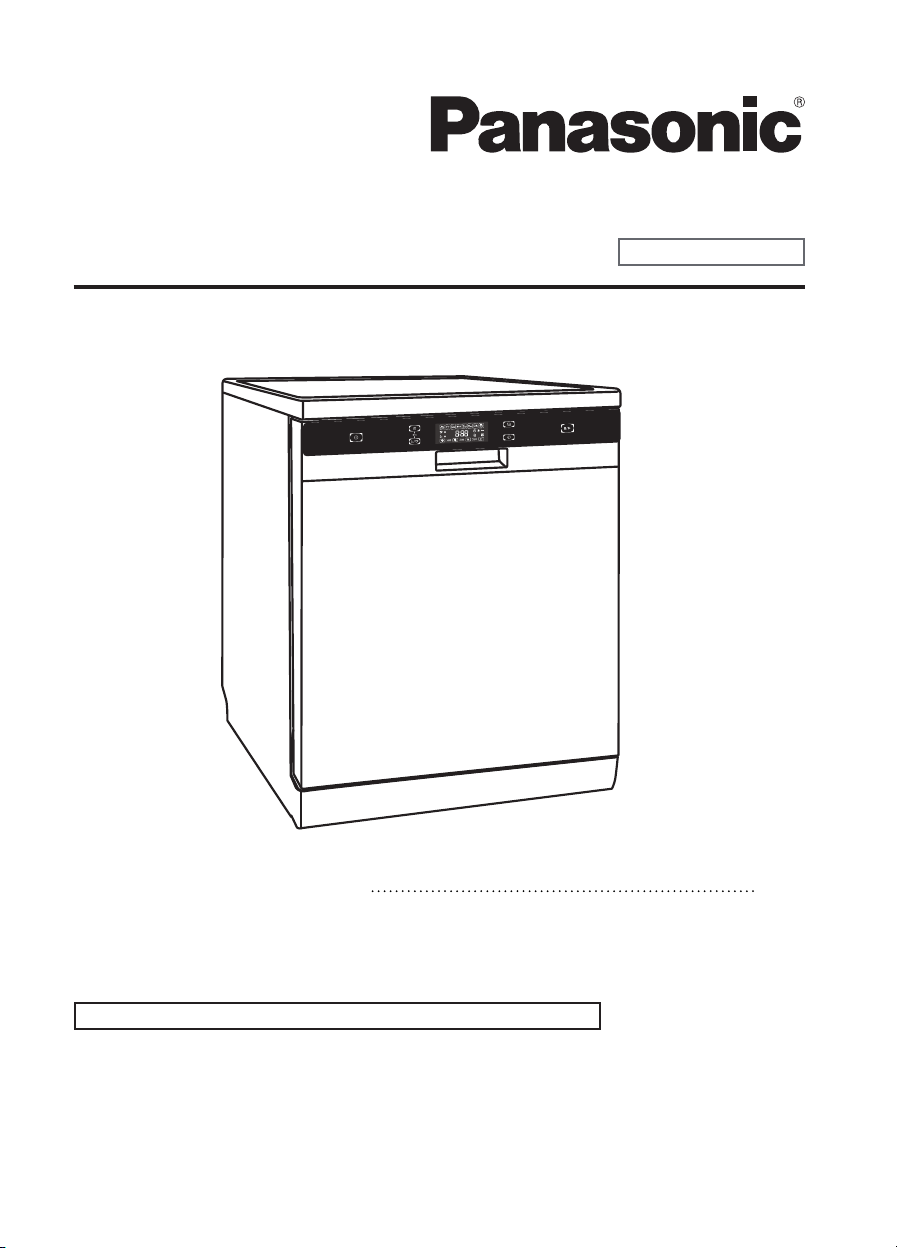
Operating and Installation Instructions
Household UseStand-alone Dishwasher
Model No. : NP-6F2MUQNZ
Safety Precautions
3 - 5
Parts Identifi cation
6 - 8
• Parts Identifi cation
6
• Accessories
7
• Control Panel
8
Using the Dishwasher
9 - 22
• Quick Operation Guide
9 - 10
• Function of Detergent
11 - 13
• Filling the Rinse Aid Dispenser
14 - 15
• Loading the Dishwasher Baskets
16 - 17
• The Method of Loading Normal Dishware
17 - 19
• Starting a Washing Programme
20 - 22
Cleaning and Maintenance
23 - 26
• Filtering System
23 - 24
• Caring for the Dishwasher
25
• Cleaning the Spray Arms
25 - 26
Troubleshooting
27 - 28
Error Codes
29
Specifi cations
30 - 32
• Loading the Baskets
31 - 32
For Installer
Installation Instructions
33 - 35
• Positioning the Dishwasher
33
• Electrical Connection
33 - 34
• Water Connection
34 - 35
• Checkpoints After Installation
35
2
Table of Contents
3
Safety Precautions
Make sure to follow these instructions
WARNING
In order to prevent accidents or injuries to the users, other people, and damage to
property, please follow the instructions below.
ڦ The following charts indicate the degree of damage caused by wrong operation.
ڦ The symbols are classifi ed and explained as follows.
These symbols indicate
prohibition.
This symbol indicates requirement
that must be followed.
WARNING
Indicate serious
injury or death.
CAUTION
Indicate risk of
injury or property
damage.
Stop using the product when any
abnormality/failure occurs and
disconnect the power plug.
(Risk of smoke/fi re/electric shock)
Example of abnormality/failure:
• Abnormal noise or heat.
• Abnormal emission of smoke,
fi re.
• The product sometimes does not
start when turned on.
• The power is sometimes
disconnected when the cord is
moved.
• Burnt odor or abnormal noise is
detected during operation.
• The body is deformed or
abnormally hot.
• Water leaking from the
Dishwasher.
Contact a Panasonic Authorised
Service Centre immediately for
maintenance/repair.
The unit must be earthed. Plug the
power cord to socket outlet with
earthing continuity terminal.
Improper grounding could cause
electric shock.
Be sure to disconnect the Power
Plug from the wall outlet or
switch OFF the breaker before
maintenance, repair or service.
Also, do not handle the Power Plug
or breaker with wet hand.
When disconnecting the Power
Plug, hold the plug itself. Do not
pull the cord anyway. The cord may
be damaged and may cause fi re or
electric shock.
This appliance is necessary to
allow disconnection from the
supply after installation. The
disconnection may be achieved
by having the plug accessible or
by incorporating a switch in the
fi xed wiring in accordance with the
wiring rules.
This appliance is not intended
for use by persons (including
children) with reduced physical,
sensory or mental capabilities,
or lack of experience and
knowledge, unless they have been
given supervision or instruction
concerning use of the appliance
by a person responsible for
their safety. Children should be
supervised to ensure that they do
not play with the appliance.
4
WARNING
CAUTION
When loading items to be washed:
1. Locate sharp items so that they
are not likely to damage the
door seal.
2. Knives and other utensils with
sharp points must be loaded
in the basket with their points
down or placed in a horizontal
position.
If the supply cord is damaged,
it must be replaced by the
manufacturer, its service agent or
similarly qualifi ed persons in order
to avoid a hazard.
Insert the Power Plug fi rmly,
otherwise it may cause fi re or
electric shock.
Clean the Power Plug regularly
with dry cloth, otherwise, it may
cause insuffi cient insulation due
to moisture, and may cause fi re.
Some dishwasher detergents are
strongly alkaline. They can be
extremely dangerous if swallowed.
Avoid contact with the skin and
eyes and keep children away
from the dishwasher when the
door is open. Check that the
detergent receptacle is empty after
completion of the wash cycle.
Do not open the door when
washing, because the hot water
may splash out.
The Dishwasher door should not
be left in the open position since
this could present a tripping
hazard.
Do not connect the power voltage
other than 220 - 240 V AC, may
cause fi re or electric shock.
Do not use an extension cord or an
adapter plug with this appliance.
Do not damage the power cord or
Power Plug.
Do not cut or remove the earthing
connection from the power cord
under any circumstances.
Do not disassemble the
Dishwasher for reconstruction.
Do not discard the packaging
or any part of it, or leave it
unattended. It can constitute a
suffocation hazard for children,
especially the plastic bags.
Check that the detergent powder
is empty after completion of the
wash cycle.
Only use detergent and rinse
aids designed for an automatic
Dishwasher.
Installation and servicing must be
carried out by competent persons
in accordance with the regulation
in force.
Before the appliance is put into
operation, all the protective fi lms
applied must be removed.
Safety Precautions
Make sure to follow these instructions
5
Safety Precautions
Make sure to follow these instructions
■ Note:
• For energy saving, remove coarse residues from the dishware before placing them
into the Dishwasher. Fully load the appliance before starting the programme.
• Place hollow items as bowls, glasses and pots into the appliance in such a way that
they will face down.
• Contact a Panasonic Authorised Service Centre for maintenance and repair.
If overfl ow occurs, turn OFF the
main water supply before calling a
service.
The Dishwasher must never be
used without the fi lters. Improper
replacement of the fi lter may
reduce the performance level of
the appliance and damage the
dishware and utensils.
Close the water tap after using.
The appliance is to be connected
to the water mains by new
detachable hose-sets supplied
with the appliance. Old hose-sets
should not be used.
• The maximum inlet water pressure
is 1 MPa.
• The minimum inlet water pressure
is 0.04 MPa.
The maximum number of place
settings to be washed is 14
settings.
Please use caution when
unpacking, installing or moving
this product, as some exposed
edges may be sharp to the touch
and may cause injury if not
handled with care.
Spray cleaner is not to be used for
cleaning.
The Name Plate with the technical
data, serial number and brand
name has been visibly affi xed to
the appliance.
DO NOT REMOVE THE NAME
PLATE FOR ANY REASON.
Do not wash plastic items unless
they are marked Dishwasher safe
or the equivalent.
Do not modify this appliance.
Do not replace the parts of the
appliance with spare parts other
than authorised Panasonic parts.
Never use soap, laundry detergent
or hand washing detergent in the
Dishwasher.
Do not fi ll any basket above its
capacity.
A steam cleaner is not to be used.
When cleaning the fi lters, do not
knock or damage them, as the
performance of the Dishwasher
may decrease if they become
distorted or broken.
Abrasive agents or cleaners and
harsh cleaning cloths should not
be used because of the risk of
scratching or leaving spots on the
stainless steel surfaces.
CAUTION
Front
Back
6
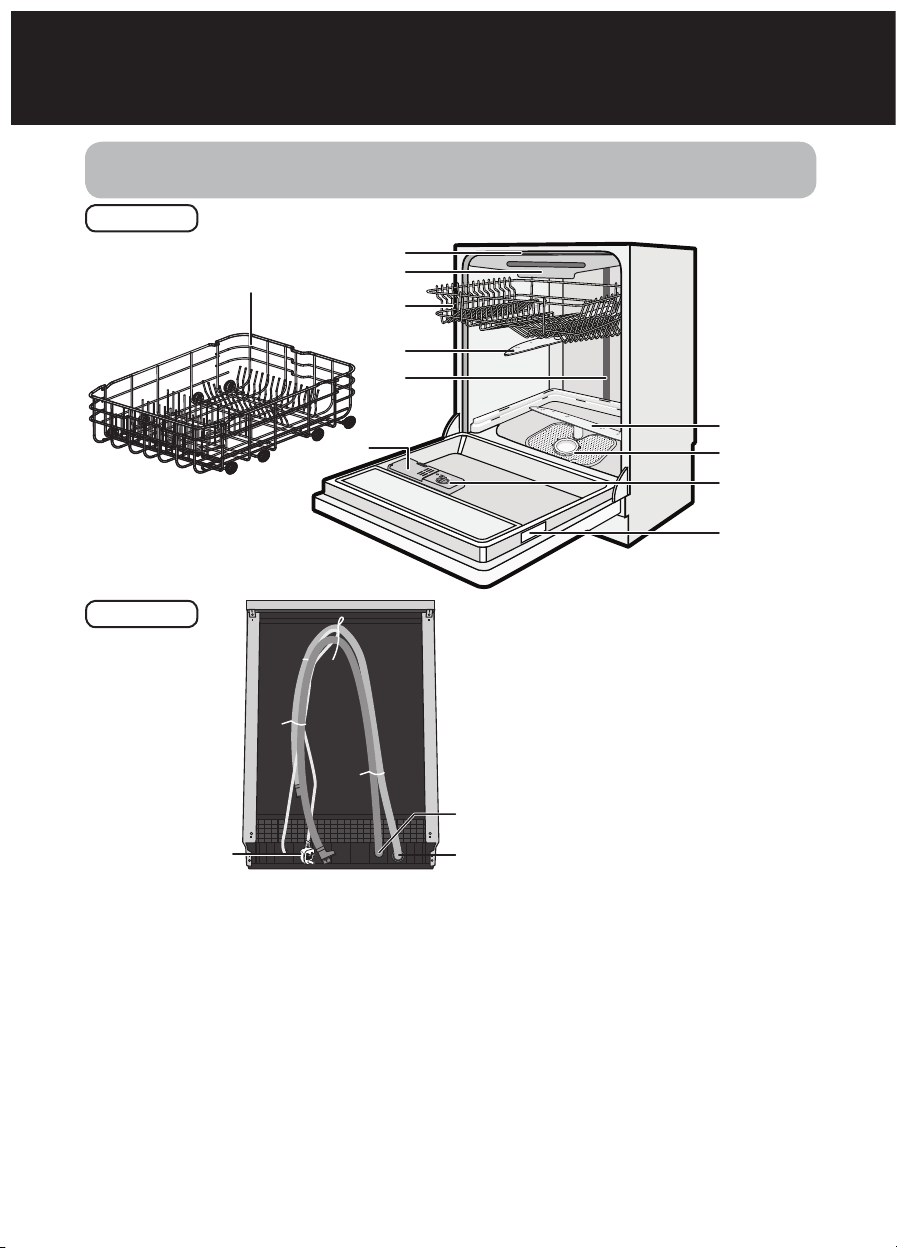
Parts Identifi cation
1. Top Spray Arm
(Above the Cutlery Basket)
2. Cutlery Basket
3. Upper Basket
4. Middle Spray Arm
(Below Upper Basket)
5. Inner Pipe
6. Lower Basket
7. Detergent Dispenser
8. Lower Spray Arm
(Below Lower Basket)
9. Filter Assembly
10. Rinse Aid Dispenser
11. Name Plate
12. Inlet Hose Connector
13. Drain Hose
14. Power Plug
■ Note:
• Name Plate (Item No.11) is for user to refer product info such as Model No. and technical data.
• Power Plug (Item No. 14) might be different from the illustration.
14
13
12
Parts Identifi cation
2
1
3
4
5
7
8
9
6
11
10
7
Accessories
Warranty Card
Operating and Installation Instructions
Parts Identifi cation
8
Control Panel
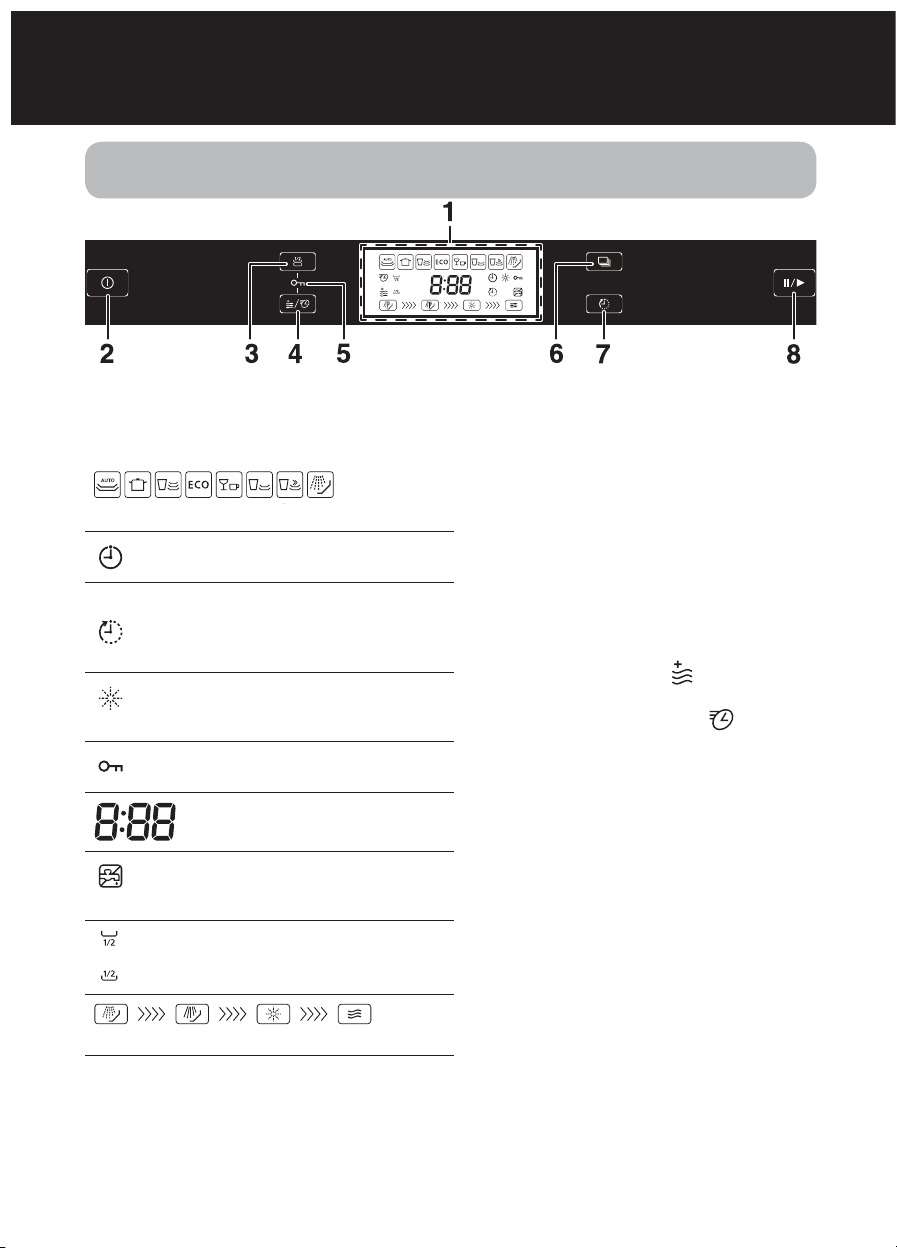
1. Main Display:
To show the remaining time and the
status (running state, delay time, and
such).
Programme indicators
Programme Time indicator
Time Delay indicator
Press the button to delay. User can
delay the washing time from 1 hour to
24 hours.
Rinse Aid indicator
Indicates when the dispenser needs
to be refi lled.
Child Lock indicator
Delay Time, Remain Time, or
Error Codes indicator
Water Supply indicator
Indicates when shortage of water
supply.
Wash Zone indicator
Washing Phase Display
2. OFF/ON button:
To turn OFF/ON the power supply.
3. Wash Zone button:
Dual zone wash function, press the
button to select either Upper Basket
or Lower Basket or both loaded, and
the corresponding icon indicator will
light up.
4. Function button:
(Only Intensive, Heavy, ECO, Glass
have this function)
• Extra dry indicator
• Express wash indicator
5. Child Lock:
Press the two buttons (3 and 4)
simultaneously to lock or unlock. All
buttons are disabled while Child Lock
is on.
6. Programme Selection button:
Press the button to select appropriate
programme.
7. Time Delay button:
Press the button to delay.
8. Pause/Start button:
To pause the washing programme
when the Dishwasher is working or
start the selected washing programme.
Parts Identifi cation
9
Quick Operation Guide
For detailed operating method, read the corresponding content at Page 11-22.
Operation Function description
1. Switch ON the main
switch.
1. Switch ON the main switch on the wall.
2. Fully open the Dishwasher door.
2. Fill the Detergent
Dispenser.
Compartment A: With each wash cycle.
Compartment B: For programmes with pre-wash only.
(Refer to Page 13)
3. Check the rinse aid
level.
Rinse Aid indicator.
Electric indicator on Control Panel. Follow to “When Refi lling
the Rinse Aid Dispenser”. (Refer to Page 14)
4. Load the baskets.
1. Scrape off any large amount of leftover food.
2. Soften remnants of burnt food in pans, then load the
basket.
3. Follow to the loading instructions. (Refer to Page 16)
5. Select a programme.
1. Fully close the Dishwasher door.
2. Turn the Dishwasher to standby mode by pressing the
OFF/ON button.
3. Select desired programme by pressing the Programme
Selection button until the selected programme lights up.
6. Running the
Dishwasher.
Turn ON the water tap and press the Pause/Start button.
The Dishwasher will start running.
7. Switch OFF the
Dishwasher.
1. When the working cycle has fi nished, the buzzer will
sound 8 times before stop. “END” will be displayed after
the washing cycle has completed.
2. Turn OFF the Dishwasher by pressing the OFF/ON
button.
8. Turn OFF the water
tap, unload the basket.
1. Turn OFF the water tap.
2. Start from the Lower Basket when unloading the dishes.
3. Switch OFF the main switch on the wall.
WARNING
Wait for approximately 15 minutes before unloading the dishes to avoid
handling them while they are hot and susceptible to breakage.
Using the Dishwasher
10
Operation Function description
9. Delay wash start time.
1. Press the Time Delay button to select the desired delay
time. Wash start time can be delayed from 1 hour to 24
hours.
2. Select desired programme by pressing the Programme
Selection button until the selected programme lights up.
3. Press the Pause/Start button to start the time delay
countdown. The washing programme will start
automatically after the countdown is ended.
10. Changing the
programme.
1. A running cycle can only be modifi ed if it has been running
for a short time. Otherwise the detergent may have already
been released and the water already drained. If this is the
case, the detergent dispenser must be refi lled.
2. Press the Pause/Start button then press the Programme
Selection button for more than 3 seconds to cancel the
running programme.
3. Select a new programme.
4. Restart the Dishwasher by pressing the Pause/Start
button.
11. Adding dishware
during operation.
1. Press the Pause/Start button to stop the Dishwasher.
2. Open the door.
3. Add dishes in the Dishwasher.
4. Close the door, then press the Pause/Start button, the
Dishwasher will start running again after approximately
10 seconds.
12. If the Dishwasher is
switched OFF during a
wash cycle.
1. Switch ON again and restart the washing by selecting the
desired programme.
2. The washing will start from the beginning.
3. Detergent and rinse aid have to be refi lled if it is already
drained out.
WARNING
Do not open the door when washing, because the hot water may splash out.
Using the Dishwasher

11
Function of Detergent
Detergent with its chemical ingredients are necessary to remove dirt; it breaks down the
dirt to smaller particles and removes them out of the Dishwasher. Most of the commercial
quality detergents are suitable for this purpose.
■ Note:
Proper Use of Detergent
• Use only detergent specifi cally made for the use in Dishwashers. Keep the detergent
fresh and dry.
• Do not put powdered detergent into the dispenser until ready to wash the dishes.
Detergents
There are 3 types of detergents:
1. With phosphate and chlorine.
2. With phosphate but without chlorine.
3. Without phosphate and chlorine.
• If detergents without phosphate is used and white spots appear on dishes and
glasses. In this case, add more detergent to reach better results.
• Detergents without chlorine will only slightly bleach, strong and coloured spots will not
be removed completely. In this case, choose a programme with a higher temperature.
Concentrated Detergent
Based on their chemical composition, detergents can be split in two basic types:
1. Conventional, alkaline detergents with caustic components.
2. Low alkaline concentrated detergents with natural enzymes.
Detergent Tablets
Detergent tablets of different brands dissolve at different speeds. For this reason some
detergent tablets cannot dissolve and develop their full cleaning power during short
programmes. Therefore, use long programmes when using detergent tablets to ensure the
detergent tablet is completely dissolved.
Using the Dishwasher
12
Detergent Dispenser
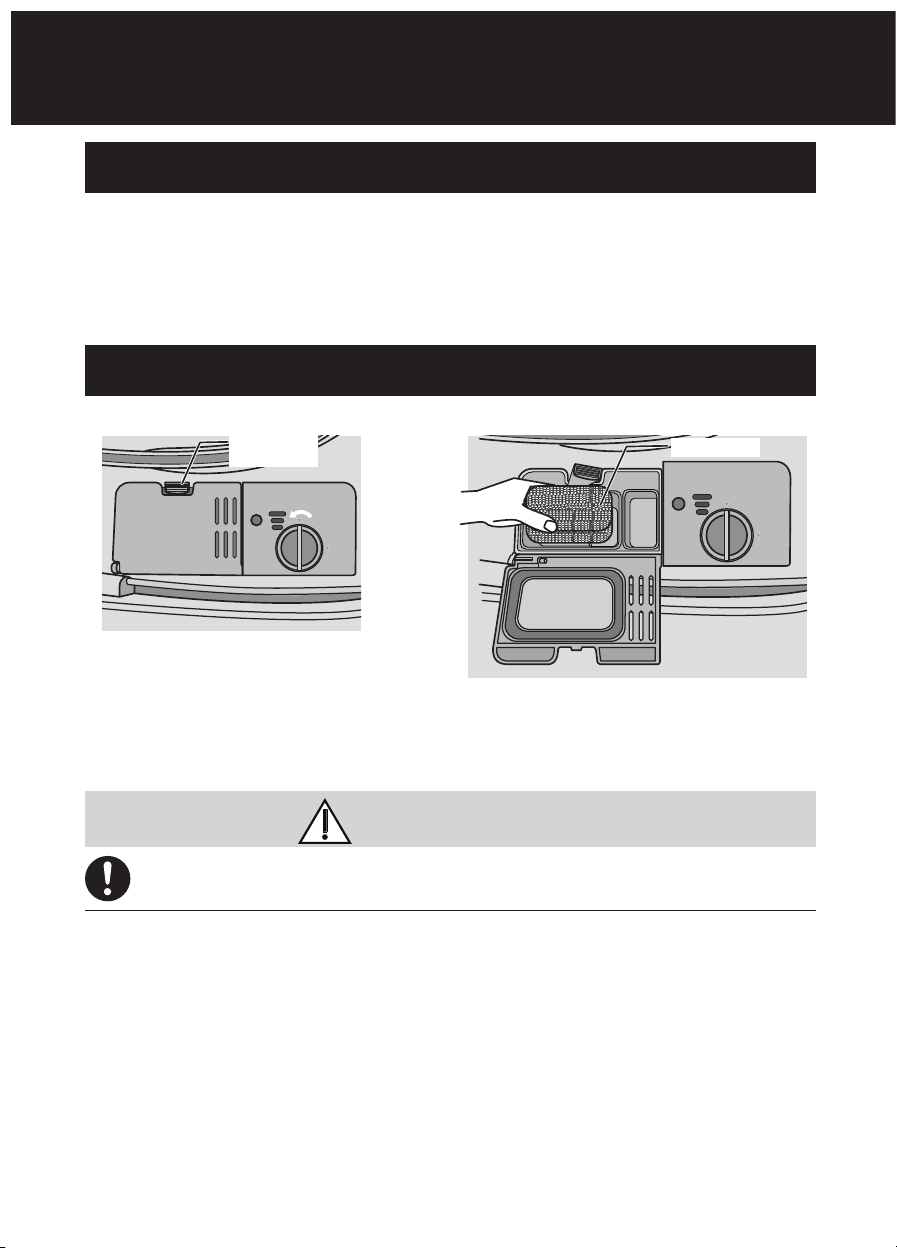
The dispenser must be refi lled before the start of each wash cycle by following the
instructions provided in the Wash Cycle Table (Page 20). This Dishwasher uses less
detergent and rinse aid than Conventional Dishwashers. Generally, only one tablet of
detergent is needed for a normal wash load. Heavily soiled items need more detergent.
Always add the detergent before starting the Dishwasher, otherwise the detergent could get
damp and will not dissolve properly.
Fill in Detergent
12
Lid Release
button
Detergent
■ Note:
• If the lid is closed, press the Lid Release button. The lid will open.
• Always add the detergent before starting each wash cycle.
• Only use branded detergent aid for Dishwasher.
WARNING
Dishwasher detergent is corrosive!
Take care to keep it out of reach of children.
Using the Dishwasher
13
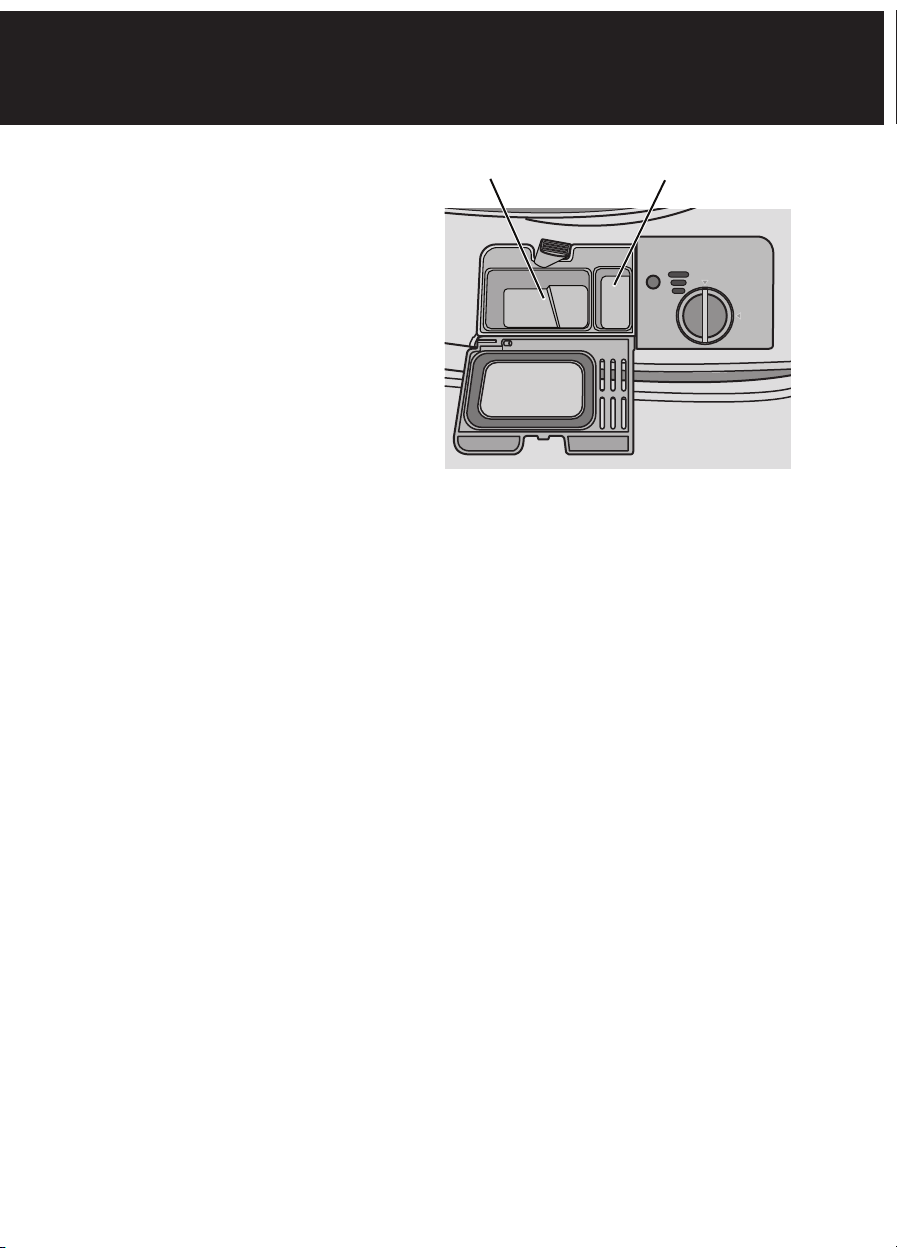
Illustration on the right shows:
A Main wash detergent compartment.
B Pre-wash detergent compartment.
Refer to the detergent manufacturers for
dosing and storage.
Recommendations as stated on the
detergent packaging.
Close the lid and press until it locks in
place.
If the dishes are heavily soiled, place
an additional dosing of detergent in the
pre-wash detergent compartment. This
detergent will take effect during the pre-
wash phase.
AB
Using the Dishwasher
14
Filling the Rinse Aid Dispenser
Rinse Aid Dispenser
The rinse aid is released during the fi nal rinse to prevent water from forming droplets on
the dishware, which can leave spots and streaks. It also improves drying by allowing water
to roll off the dishware. The Dishwasher is designed to use liquid rinse aids. The Rinse Aid
Dispenser is located next to the Detergent Dispenser. To fi ll the rinse aid, open the Cap and
pour the rinse aid into the dispenser until the level indicator turns completely black. The
volume of the rinse aid container is about 110 mL.
Function of Rinse Aid
Rinse aid is automatically added during the last rinse, ensuring thorough rinsing, and spot
and streak free drying.
■ Note:
• Only use branded rinse aid for Dishwasher. Never fi ll the Rinse Aid Dispenser with any
other substances (For example: Dishwasher cleaning agent, liquid detergent). This will
damage the Dishwasher.
When Refi lling the Rinse Aid Dispenser
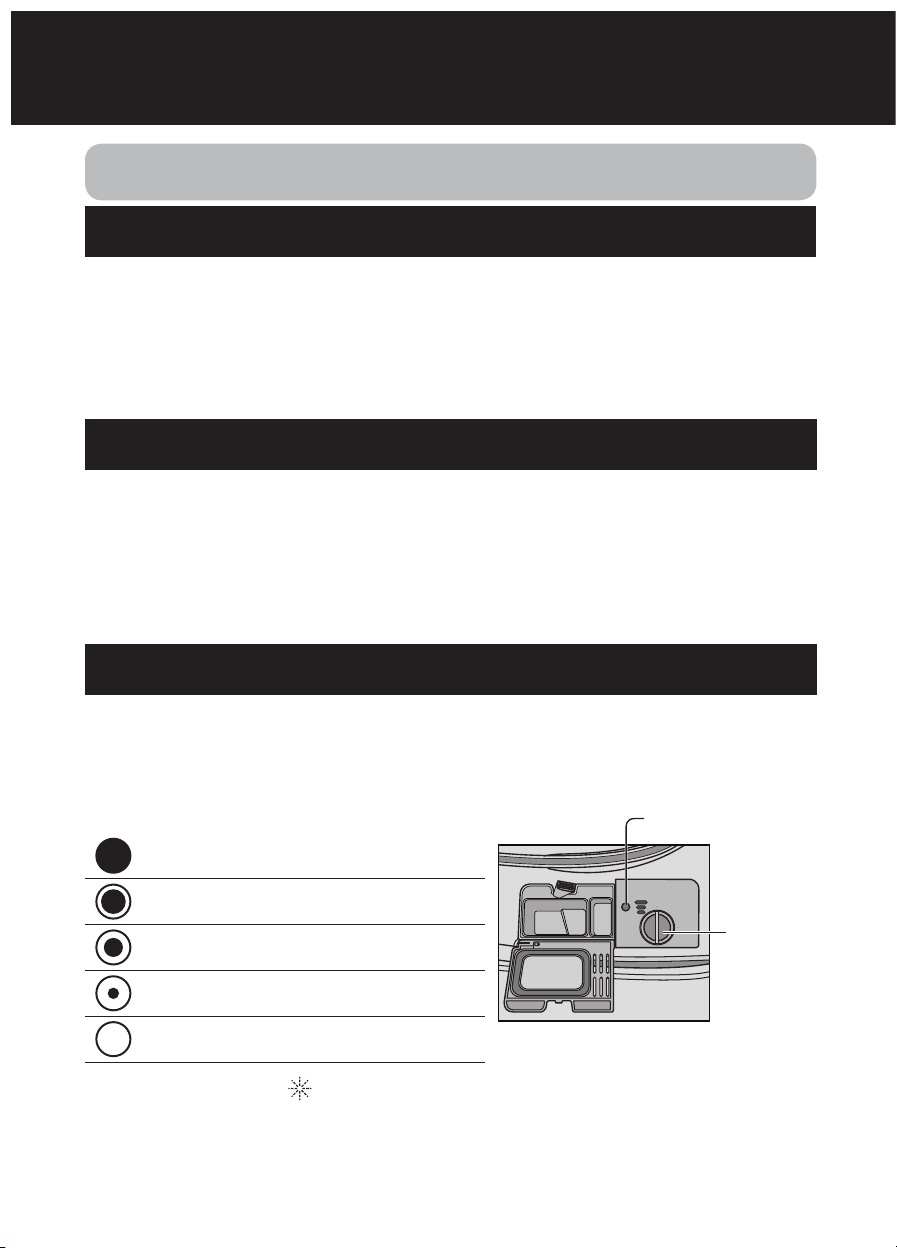
When the rinse aid container is full, the Rinse Aid indicator will be completely dark. As the
rinse aid diminishes, the size of the black dot decreases.
Never let the rinse aid level fall below 1/4 full.
As the rinse aid diminishes, the size of the black
dot on the Rinse Aid Level indicator changes, as
illustrated below.
Full
3/4 full
1/2 full
1/4 full
- Should refi ll to eliminate spotting
Empty
Rinse Aid Level
indicator
Cap
The Rinse Aid indicator, “ ” on the Control Panel will light up when the rinse aid is empty.
Using the Dishwasher
15
123
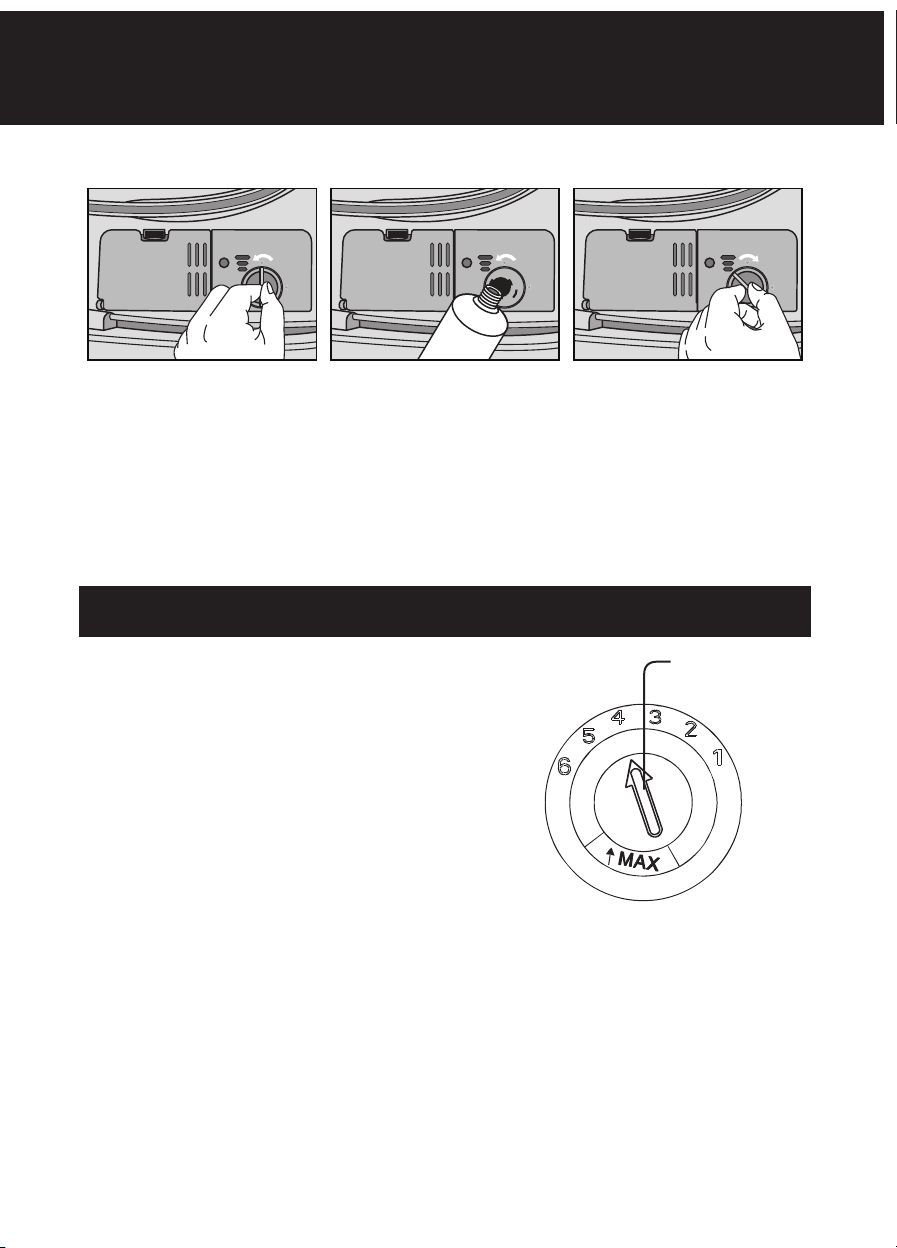
1. To add rinse aid, remove the Cap by turning it (anti-clockwise).
2. Pour the rinse aid into the dispenser; be careful not to overfi ll.
3. Refi t the Cap and close it by turning (clockwise) so that the arrows line up.
■ Note:
Clean up any rinse aid spilled while during fi lling with an absorbent cloth to avoid
excessive foaming during the next wash. Do not forget to replace the Cap before closing
the Dishwasher door.
Adjusting Rinse Aid Dispenser
The Rinse Aid Dispenser has six settings which can be
viewed upon removing the cap. Always start with the
dispenser set on “4”. If still facing spots and poor drying
problem, increase the amount of rinse aid dispensing
by rotating the dial to “5”. If the dishes are still not
drying properly or spots remain, adjust the dial to the
next higher level until the dishes are spot-free. The
recommended setting is “4”. (Default value is “4”.)
Rinse Aid
Adjust Level
■ Note:
Increase the dose if there are drops of water or lime spots on the dishware after
washing. Reduce it if there are sticky whitish stains on dishware or a bluish fi lm on
glassware or knife blades.
Using the Dishwasher

16
Loading the Dishwasher Baskets
Recommendation
1. Consider buying utensils which are identifi ed as Dishwasher-proof.
2. Use a mild detergent that is described as ‘for Dishwasher use’. If necessary, seek
further information from the detergent manufacturers.
3. For particular items, select a programme with as low temperature as possible.
4. To prevent damage, do not take glass and cutlery out of the Dishwasher immediately
after the programme has ended.
5. For washing in the Dishwasher the following cutlery/dishware:
Are not suitable Are of limited suitability
a. Cutlery with wooden, bone china or
mother-of-pearl handles
b. Plastic items that are not heat resistant
c. Cutlery consisting of glue that are not
temperature resistant
d. Bonded cutlery items or dishware
e. Pewter or copper items
f. Crystal glass
g. Steel items that are subject to rusting
h. Wooden platters
i. Items made from synthetic fi bres
j. Colour coated appearance items
a. Some types of glasses can become dull
after a large number of washes
b. Silver and aluminium parts have a
tendency to discolour during washing
c. Glazed patterns may fade if washed
frequently
Attention Before or After Loading the
Dishwasher Baskets
Follow the loading guidelines for the best performance of the Dishwasher. Scrape off any
large amounts of leftover food. Soften remnants of burnt food in pans.
Place objects in the Dishwasher in the following way:
1. Items such as cups, glasses, pots and pans are faced downwards so that water
cannot collect in the container or a deep base.
2. Curved items, or ones with recesses, should be loaded aslant so that water can run
off.
3. All utensils are stacked securely and cannot tip over.
4. All utensils are placed in the way that the spray arms can rotate freely during
washing.
5. Items of dishware and cutlery must not nest together, or cover over each other.
Using the Dishwasher
17
6. To avoid damage to glasses, they must not touch.
7. Load large items which are most diffi cult to clean in the Lower Basket.
8. The Upper Basket is designed to hold more delicate and lighter dishware such as
glasses, coffee and tea cups.
9. Long knives stored in an upright position may cause injury or damage.
10. Long or sharp items of cutlery such as carving knives must be positioned with sharp
edge facing downward and horizontal in the Cutlery Basket.
11. Do not overload the Dishwasher. This is important for good results and for
reasonable consumption of energy.
■ Note:
Very small items should not be washed in the Dishwasher as they could easily fall out of
the basket.
Removing the Dishware
To prevent water dripping from the Upper Basket into the Lower Basket, it is recommended
to empty the Lower Basket before the Upper Basket.
The Method of Loading Normal Dishware
Loading the Upper Basket
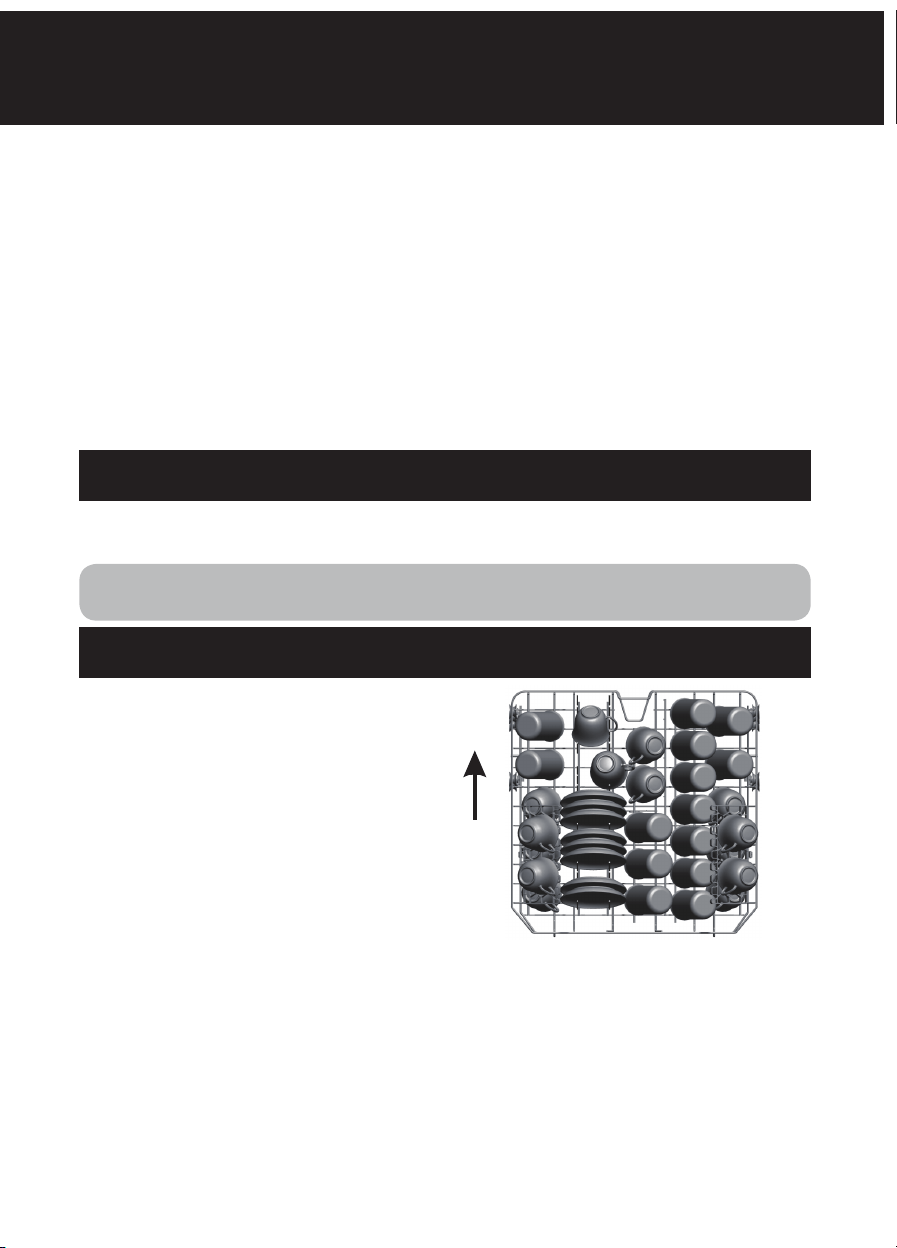
The Upper Basket is designed to hold
more delicate and lighter dishware such as
glasses, coffee and tea cups and saucers
as well as plates, small bowls and shallow
pans (as long as they are not too dirty).
Position the dishware and cookware so
that they will not get moved by the spray of
water.
IN
Using the Dishwasher
18
Loading the Lower Basket
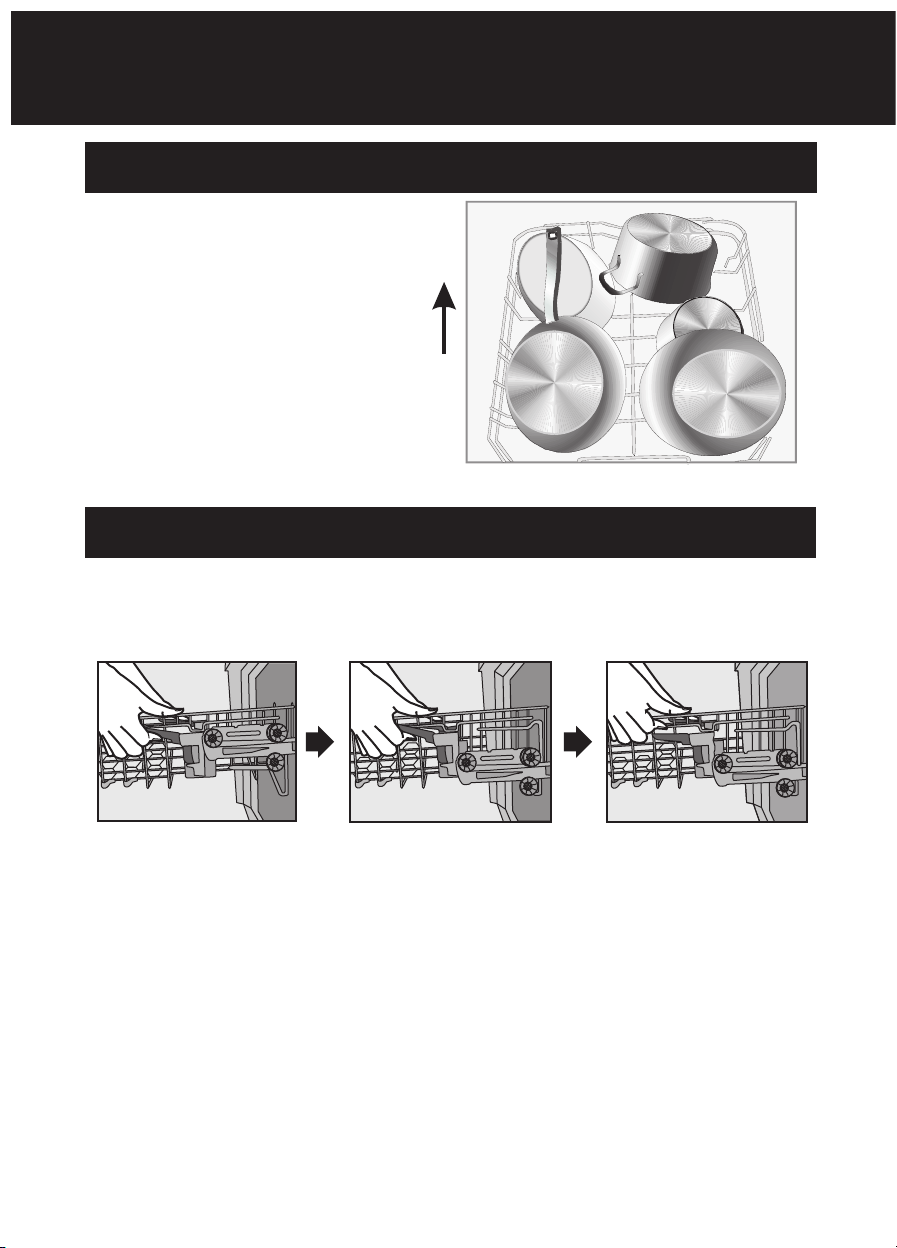
Large items and items that are
diffi cult to clean such as pots, pans,
lids, serving dishware and bowls
are placed into the Lower Basket as
shown in Figure 1. It is preferable to
place serving dishware and lids on
the side of the racks in order to avoid
blocking the rotation of the Middle
Spray Arm.
IN
Figure 1
Adjusting the Upper Basket
The height of the Upper Basket can be adjusted in order to create more space for large
utensils for the basket. The height of the Upper Basket can be adjusted as Figure 2. Long
items, serving cutlery, salad servers and knives should be placed on the Cutlery Basket so
that the utensils do not obstruct the rotation of the spray arms.
1. Pull the lever. 2. Pull up or push down
the Upper Basket.
3. Release the lever.
Figure 2
Using the Dishwasher
19
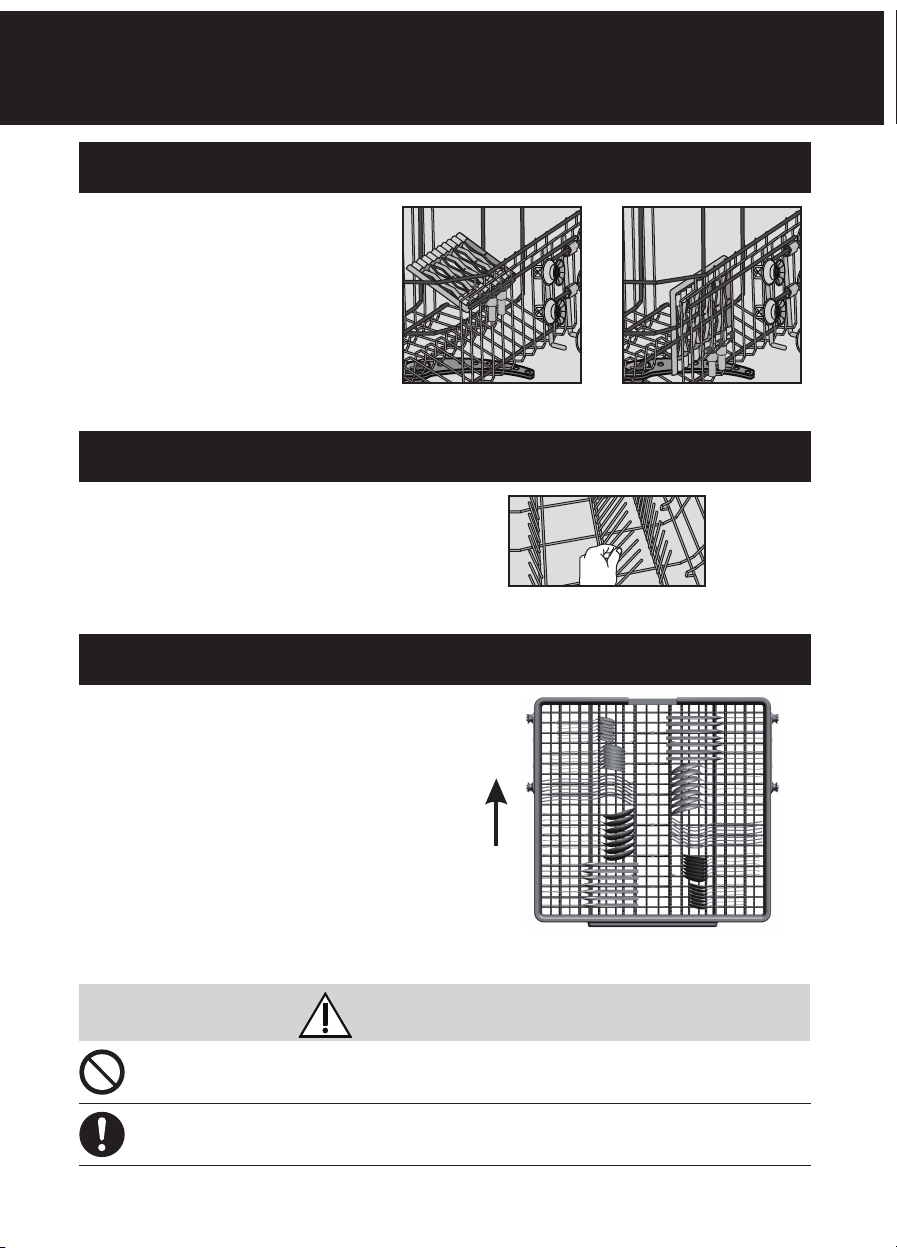
Folding Back the Cup Shelves
For better stacking of pots and pans,
the Cup Shelves can be folded as
shown in Figure 3.
Figure 3
Folding Spikes of Lower Basket
For better stacking of pots and pans, the spikes
can be folded as shown in the Figure 4.
Figure 4
Cutlery Basket
Cutlery should be placed in the Cutlery
Basket separately from each other in the
appropriate positions, and make sure the
utensils do not nest together which may
caused bad washing performance.
For optimum cleaning performance, place
the cutlery in the Cutlery Basket. Make sure
that:
• They do not nest together.
• Cutlery is placed either sideways
or with the back or the spine facing
upwards.
IN
CAUTION
Do not let any item extend through the bottom. It may hit and damage the Spray
Arm below the basket.
Always load sharp utensils with the sharp part facing down.
Using the Dishwasher
20
Starting a Washing Programme
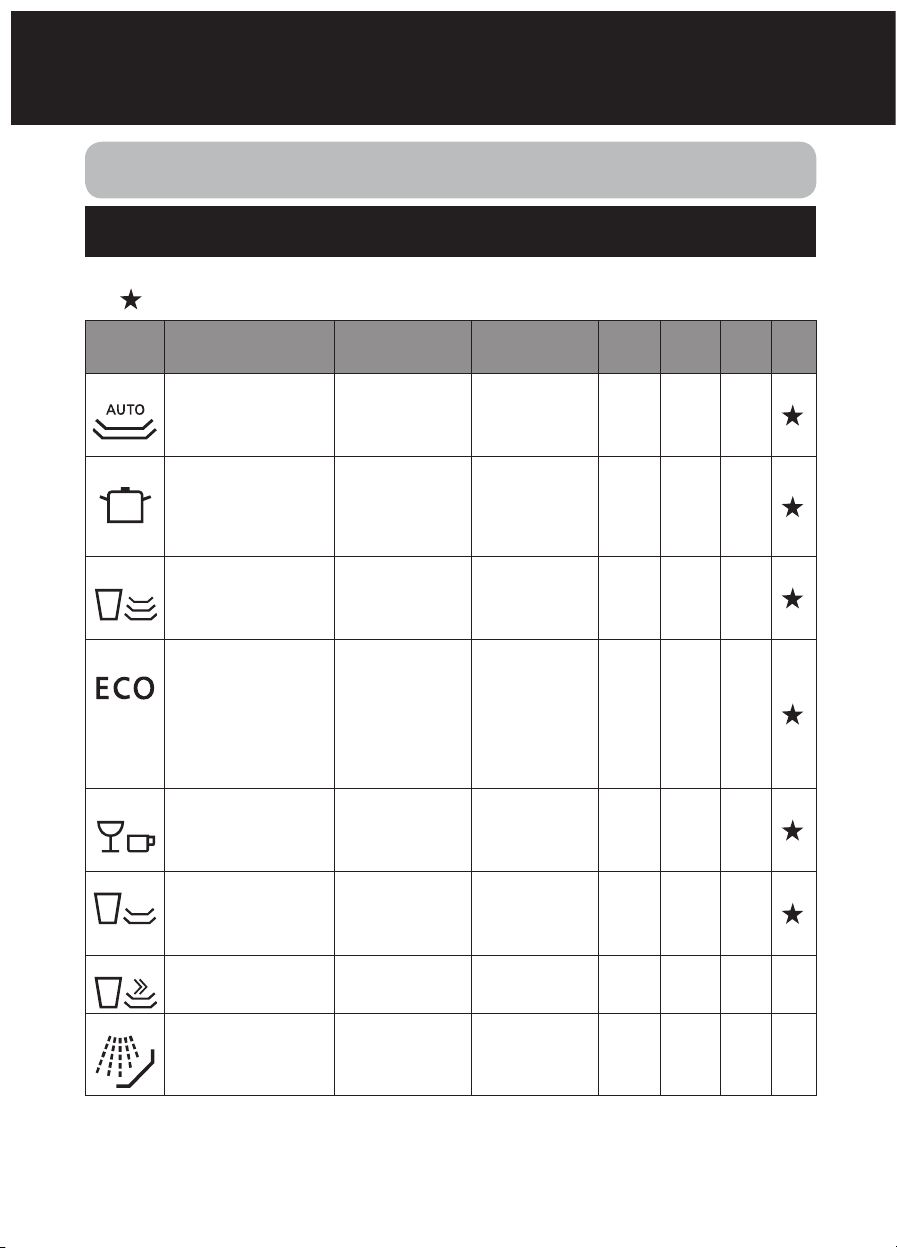
Wash Cycle Table
■ Note:
( )Means: need to fi ll rinse into the Rinse Aid Dispenser.
Programme
Cycle Selection
Information
Description of
Cycle
Detergent
pre/main (tablet)
pre/main (powder)
Running
time
(min)
Energy
(kWh)
Water
(L)
Rinse
Aid
Auto Auto sensing wash,
crockery with light, normal
or heavy soiling, with or
without dried-on food.
Pre-wash (45 °C)
Autowash
(45-55 °C)
Rinse
Rinse (65 °C)
Drying
-/1 pc
5/27.5 g
150
0.90-
1.30
11.0-
15.0
Intensive For heavily soiled
crockery, pots and pans
and moderately soiled
dishware with dried on
food.
Pre-wash (50 °C)
Wash (60 °C)
Rinse
Rinse
Rinse (65 °C)
Drying
-/1 pc
5/27.5 g
170 1.50 17.5
Heavy For pots, plates, glasses
moderately soiled and
lightly soiled pans.
Pre-wash (45 °C)
Wash (55 °C)
Rinse
Rinse (65 °C)
Drying
-/1 pc
5/27.5 g
160 1.30 13.5
ECO
(*AS/NZS
2007.1)
This is the standard
programme; it is suitable
to clean moderately
soiled dishware and is the
most effi cient programme
in terms of its combined
energy and water
consumption for such
dishware.
Pre-wash
Wash (45 °C)
Rinse (48 °C)
Drying
-/1 pc
5/27.5 g
170 0.73 12.7
Glass For lightly soiled crockery
and glasses.
Pre-wash
Wash (42 °C)
Rinse
Rinse (60 °C)
Drying
-/1 pc
5/27.5 g
125 0.80 13.0
90 min Standard daily cycle for
normally soiled loads
such as pots, plates,
glasses and moderately
soiled pans.
Wash (65 °C)
Rinse
Rinse (65 °C)
Drying
-/1 pc
-/25 g
90 1.20 11.5
Rapid A quick wash for lightly
soiled loads that do not
need drying.
Wash (40 °C)
Rinse
Rinse (45 °C)
-/25 g 30 0.60 11.5
Soak
To rinse dishware that
user plan to wash later
that day.
Pre-wash
8 0. 02 4
Using the Dishwasher

21
■ Note:
• *AS/NZS 2007.1 : This program is the test cycle. The information for comparability test
in accordance with AS/NZS 2007.1, as follows:
Capacity: 14 place settings
Position of the upper basket: lower
Programme: ECO
Detergent(Pre/main): 5 g / 27.5 g
Rinse aid setting: 6
• The combination with the pre-wash detergent, and its quality of the effect may vary
according to the detergent manufacturer. Consult the manufacturer upon purchase of
the detergent.
Starting a Wash Cycle
1. Insert Power Plug to the mains socket. Switch ON the main switch on the wall. Fully
open the Dishwasher door.
2. Fill in the detergent and rinse aid.
3. Draw out the Lower Basket, Upper Basket and Cutlery Basket. Load the dishware to
the baskets and push them back.
4. Fully close the Dishwasher door. Turn ON the water supply.
5. Turn ON the Dishwasher by pressing OFF/ON button follow by the Programme
Selection button. The default wash programme is ECO and the wash sequence will
be:
Eco --> Glass --> 90 min --> Rapid --> Soak --> Auto --> Intensive --> Heavy
If a programme is selected, the icon light will light up and the time needed to run the
wash cycle will show on the Control Panel.
6. Press the Pause/Start button to start the washing.
(“ : ” in the time display will blink if the washing is started, “ : ” in the time display will
stop blinking when washing is stopped or paused.)
Changing the Programme
1. A cycle that is underway can be modifi ed only if it has been running for a short time.
Otherwise, the detergent may have already been released, and the Dishwasher may
have already drained the wash water. In this case, the detergent dispenser must be
refi lled (see the section titled “Fill in Detergent”).
2. Press the Pause/Start button then press the Programme Selection button for more
than 3 seconds to cancel the running programme.
3. Select a new programme.
4. Restart the Dishwasher by pressing the Pause/Start button.
■ Note:
If the door is opened during a wash cycle, the Dishwasher will pause. When the door is
closed, the Dishwasher will resume working after approximately 10 seconds.
Using the Dishwasher
22
Adding Dishware during Operation
Dishware can be added at any time before the Detergent Dispenser opens.
1. Press the Pause/Start button to stop the Dishwasher.
2. Open the Dishwasher door and add the dishware.
3. Close the Dishwasher door. Then, press the Pause/Start button. The Dishwasher will
run after approximately 10 seconds.
At the End of the Wash Cycle
When the working cycle has fi nished, the buzzer of the Dishwasher will sound 8 times
before stopping.
ڦ Switch OFF the Dishwasher
The Programme indicator turns OFF when the programme has ended.
1. Switch OFF the Dishwasher by pressing the OFF/ON button.
2. Turn OFF the water tap.
3. Switch OFF the main switch on the wall.
ڦ Open the door carefully
1. Hot dishware is sensitive to breakage. The dishware should therefore be allowed to
cool down for approximately 15 minutes before removing from the Dishwasher.
2. Slightly open the Dishwasher door and wait for approximately 15 minutes before
removing the dishware. The dishware will be cooler and improve drying.
ڦ Unloading the Dishware
It is normal that the Dishwasher is wet inside. Empty the Lower Basket fi rst and then the
Upper Basket. This will avoid water dripping from the Upper Basket onto the dishware in
the Lower Basket.
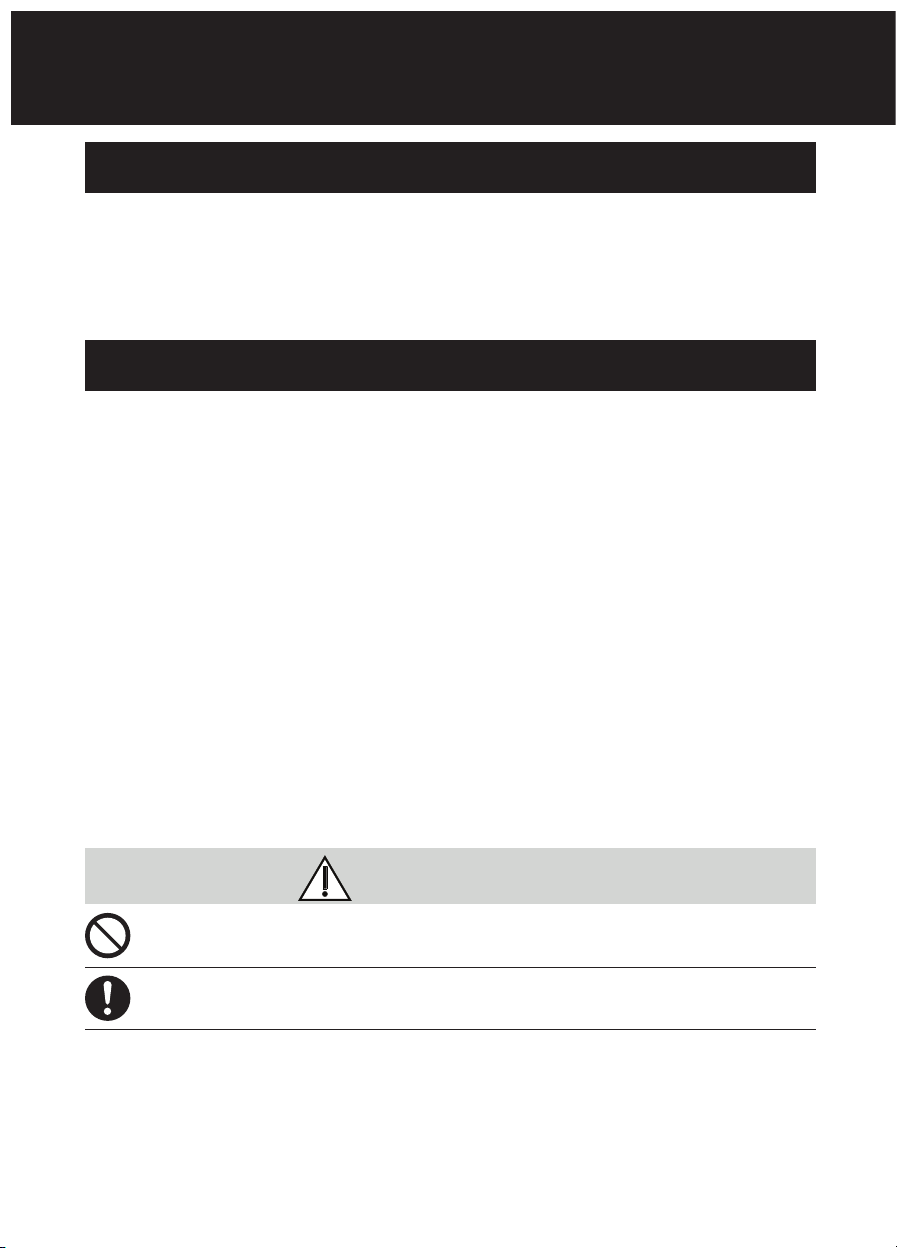
WARNING
Do not open the door when washing, hot water or steam may scald the user.
Wait for approximately 15 minutes before unloading the dishes to avoid
handling them while they are hot and susceptible to breakage.
Using the Dishwasher
23
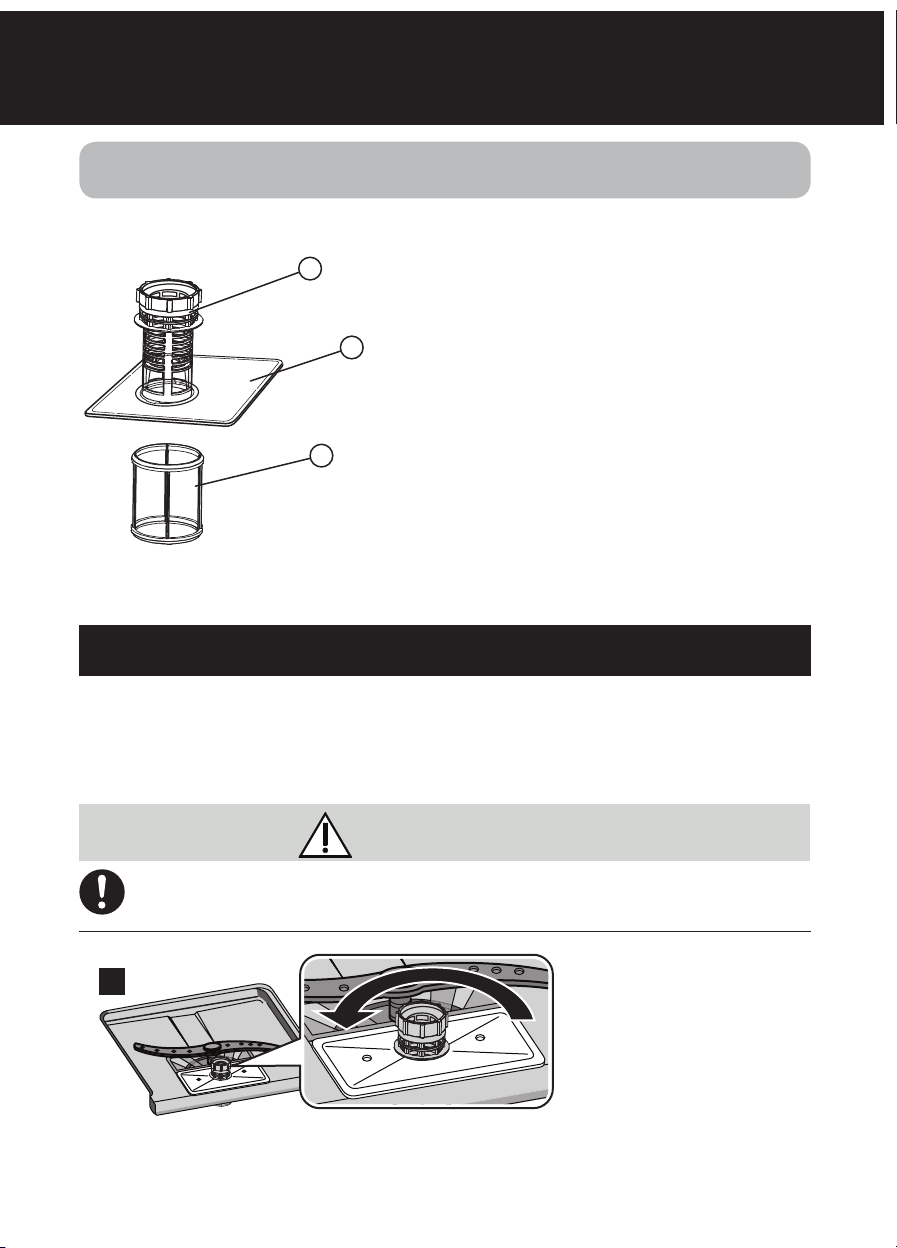
Filtering System
The fi lter prevents larger remnants of food or other objects from getting inside the pump.
The residues that may block the fi lter must be removed.
1
2
3
The fi lter system consists of a Coarse Filter, a fl at
fi lter (Main Filter) and a microfi lter (Fine Filter).
1. Coarse Filter:
Large items such as pieces of bones or glass,
that could block the drain are trapped in the
coarse fi lter. To remove the items caught by the
fi lter, gently squeeze the tap on the top of this
fi lter and lift it out.
2. Main Filter:
Food and dirt particles trapped in this fi lter are
pulverized by a special jet on the Lower Spray
Arm and washed down to drain.
3. Fine Filter:
This fi lter holds dirt and food residues in the
sump area and prevents them from being
re-deposited on the dishware during wash cycle.
Filter Assembly
The fi lter effi ciently removes food particles from the wash water, allowing water to be
recycled during the cycle. For best performance and results, the fi lter must be cleaned
regularly. For this reason, it is better to remove the larger food particles trapped in the fi lter
after each wash cycle by rinsing the Filter Assembly under running water. To remove the
fi lter device, pull the cup handle of the Coarse Filter in the upward direction.
CAUTION
The Dishwasher must never be used without the fi lters.
Improper replacement of the fi lter may reduce the performance level of the
Dishwasher and damage dishware and utensils.
1
1. Turn the Filter Assembly
in anti-clockwise
direction.
Cleaning and Maintenance
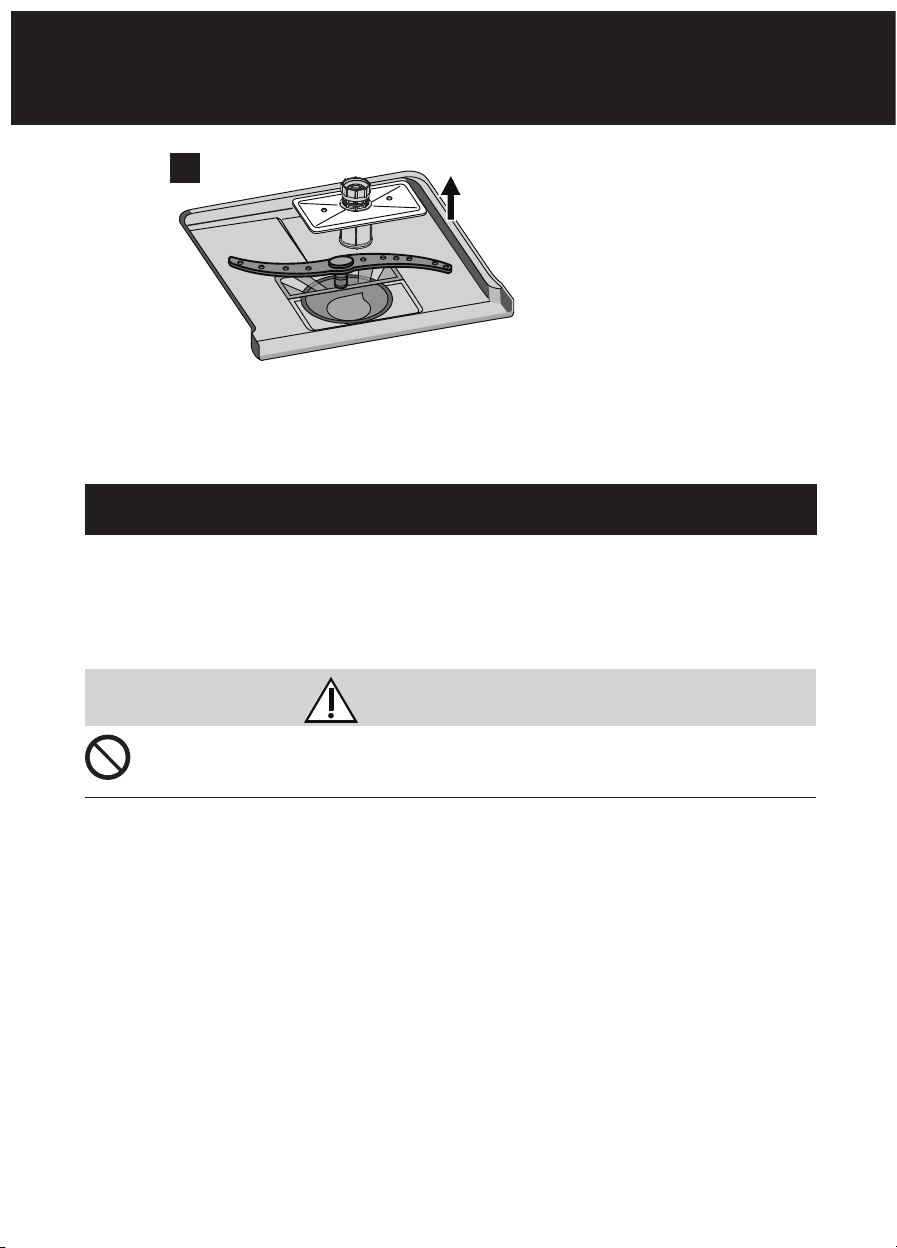
24
2
2. Lift the Filter Assembly
up.
■ Note:
• To insert the Filter Assembly, reverse above steps. Lock the Filter Assembly by turning
in clockwise direction. Make sure there is nothing inside blocking it before every wash
cycle.
Cleaning the Filter
To clean the Filter Assembly, it is recommended to use a brush and clean under running
water. Reinsert the Filter Assembly in the Dishwasher, positioning it in its original place and
lock the Filter Assembly by turning in clockwise direction.
■ Note:
• The entire Filter Assembly should be cleaned once a week.
CAUTION
When cleaning the Filter Assembly, do not knock or damage it, as the
performance of the Dishwasher may decrease if the parts become distorted or
broken.
Cleaning and Maintenance
25
Caring for the Dishwasher
The Control Panel can be cleaned by using a soft damp cloth. After cleaning, make sure to
dry it thoroughly. For the exterior, use a good appliance polish wax.
Never use sharp objects, scouring pads or harsh cleaners on any part of the Dishwasher. It
will damage the Dishwasher.
Cleaning the Door
To clean the edge around the door, only use a
soft warm, damp cloth.
To prevent ingress of water into the door lock and
electrical components, do not use spray cleaners.
CAUTION
Never use a spray cleaner to clean the door panel as it may damage the door
lock and electrical components.
Abrasive agents, cleaners or harsh cleaning cloths should not be used because
of the risk of scratching or leaving spots on the stainless steel surface.
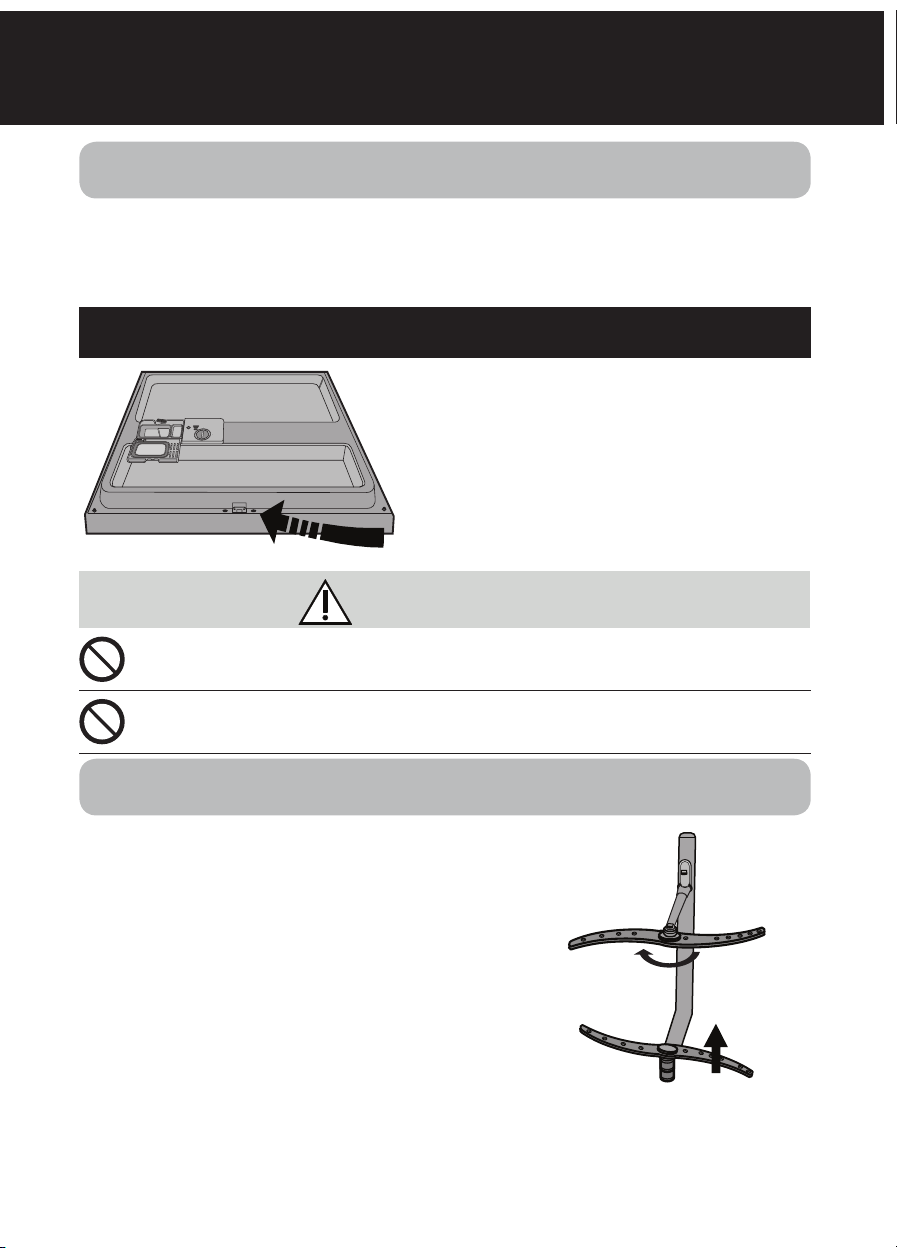
Cleaning the Spray Arms
It is necessary to clean the spray arms regularly,
chemicals from water will clog the spray arm jets and
bearings.
To remove the Middle Spray Arm, hold the nut and rotate
the arm clockwise.
To remove the Lower Spray Arm, pull out the Lower Spray
Arm in upward direction.
Wash the spray arms in soapy warm water and use a
soft brush to clean the jets. Replace them after rinsing
thoroughly.
Open
Cleaning and Maintenance

26
How to Keep the Dishwasher in Good
Condition
ڦ After every wash
After every wash, turn OFF the water supply
to the Dishwasher and leave the door slightly
open so that moisture and odours are not
trapped inside.
ڦ Remove the Power Plug
Before cleaning or performing maintenance,
always either switch OFF at the isolating
switch or remove the Power Plug from the
socket.
ڦ No solvents or abrasive cleaning
a. To clean the exterior and rubber parts of
the Dishwasher, do not use solvents or
abrasive cleaning products. Only use a
cloth with warm soapy water.
b. To remove spots or stains from the
surface of the interior, use a cloth
dampened with water and a little vinegar,
or a cleaning product made specifi cally
for Dishwashers.
ڦ When not in use for a long time
It is recommended to run a wash cycle
with the Dishwasher empty and then either
switch it OFF at the isolating switch or
remove the Power Plug from the socket,
turn OFF the water supply and leave the
door of the Dishwasher slightly open. This
will help the door seals to last longer and
prevent odours from forming within the
Dishwasher.
ڦ Moving the Dishwasher
If the Dishwasher needs to be moved, try to
keep it in the vertical position. If necessary,
it can be positioned slightly inclined on its
back.
ڦ Seals
One of the factors that cause unpleasant
odours in the Dishwasher is the remains
of food trapped in the seals. Cleaning
the Dishwasher with a damp sponge
periodically may prevent this.
Cleaning and Maintenance
27
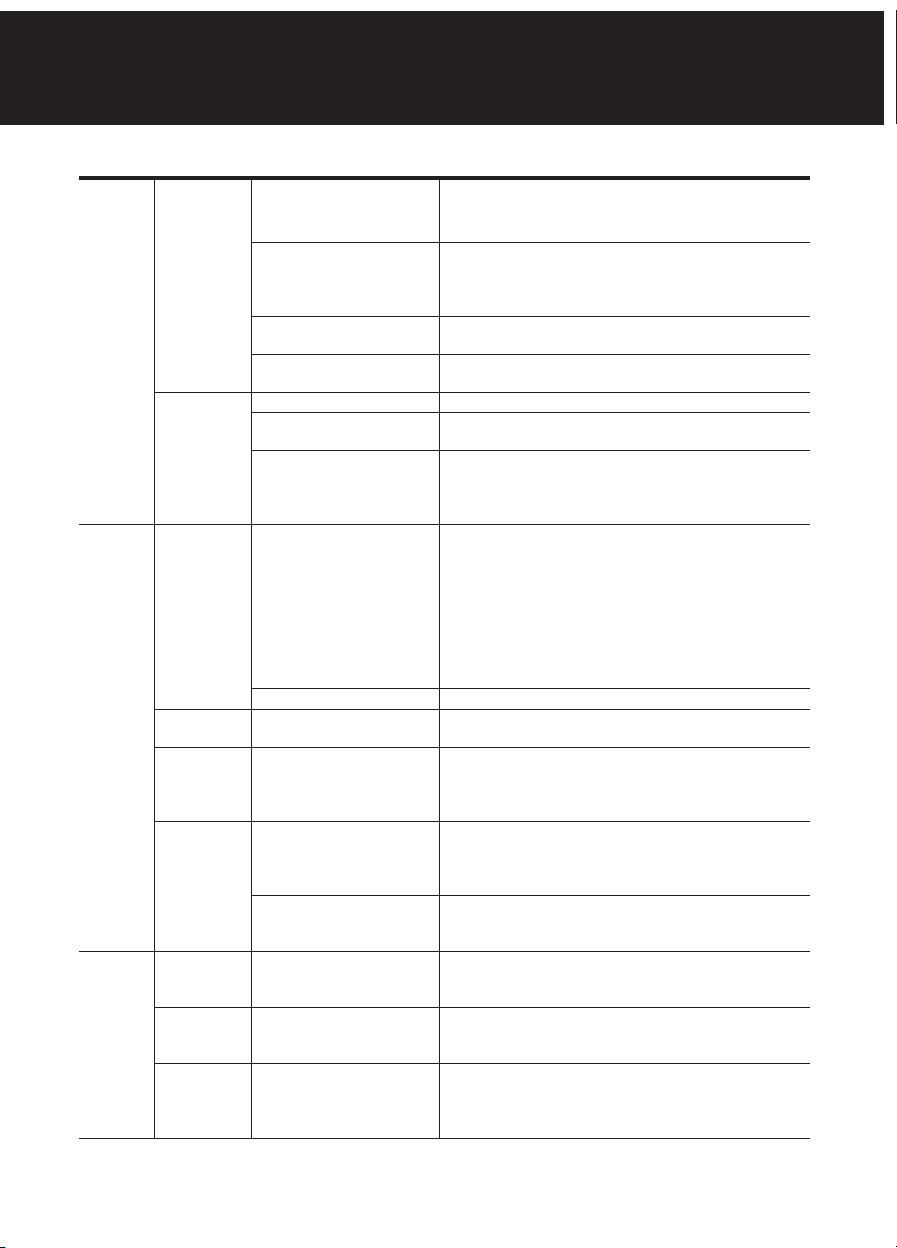
Problem Possible Causes What To Do
Technical
problems
Dishwasher
does not
start
Fuse blown, or the circuit
breaker may have tripped.
Replace fuse or reset circuit breaker. Remove any
other appliances sharing the same circuit with the
Dishwasher.
Power supply is not turned
ON.
Make sure the Dishwasher is turned ON and the door
is closed securely.
Make sure the power cord is properly plugged into the
wall socket.
Water pressure is low. Check that the water supply is connected properly and
the water is turned ON.
Door of Dishwasher not
properly closed.
Make sure to close the door properly and latch it.
Water not
pumped from
Dishwasher
Twist in Drain Hose. Check the Drain Hose.
Filter clogged. Check the Coarse Filter.
(See section titled “Cleaning the Filter”).
Kitchen sink clogged. Check the kitchen sink to make sure it is draining well.
If the problem is the kitchen sink not draining, a
plumber may be needed rather than a serviceman for
Dishwashers.
General
problems
Suds in the
tub
Improper detergent. Use only the special Dishwasher detergent to avoid
suds. If this occurs, open the Dishwasher and let suds
evaporate.
Add approx 4.5 litres of cold water to the tub. Close
and latch the Dishwasher, then select any cycle.
Dishwasher will drain out the water at the fi rst step.
Open the door after draining is stopped and check if
the suds is disappeared.
Repeat if necessary.
Spilled rinse-aid. Always wipe up rinse-aid spills immediately.
Stained tub
interior
Detergent with colourant
was used.
Make sure that the detergent is the one without
colourant.
White fi lm
on inside
surface
Minerals from water was
formed.
To clean the interior, use a damp sponge with
Dishwasher detergent and wear rubber gloves.
Never use any other cleaner than Dishwasher
detergent for the risk of foaming or suds.
Water supply
indicator light
up
Water pressure is low. Check that the water supply is connected properly and
the water is turned ON. Check the inlet fi lter. If the inlet
fi lter is clogged, clean it with a toothbrush in running
water.
Water supply being
blocked by frozen water.
Wrap warm towels around the joints of the Inlet Hose.
Disconnect the Inlet Hose, and soak them in warm
water (50 °C or lower)
Noise
Knocking
noise in the
wash cabinet
A spray arm is knocking
against an item in a
basket.
Interrupt the programme, and rearrange the items
which are obstructing the spray arm.
Rattling
noise in the
wash cabinet
Items of crockery are loose
in the wash cabinet.
Interrupt the programme, and rearrange the items of
crockery.
Noise in the
Inlet Hose
and Drain
Hose
This may be caused by
on-site installation or the
cross-section of the piping.
This has no infl uence on the Dishwasher function.
If in doubt, contact a suitably qualifi ed plumber.
Troubleshooting
28
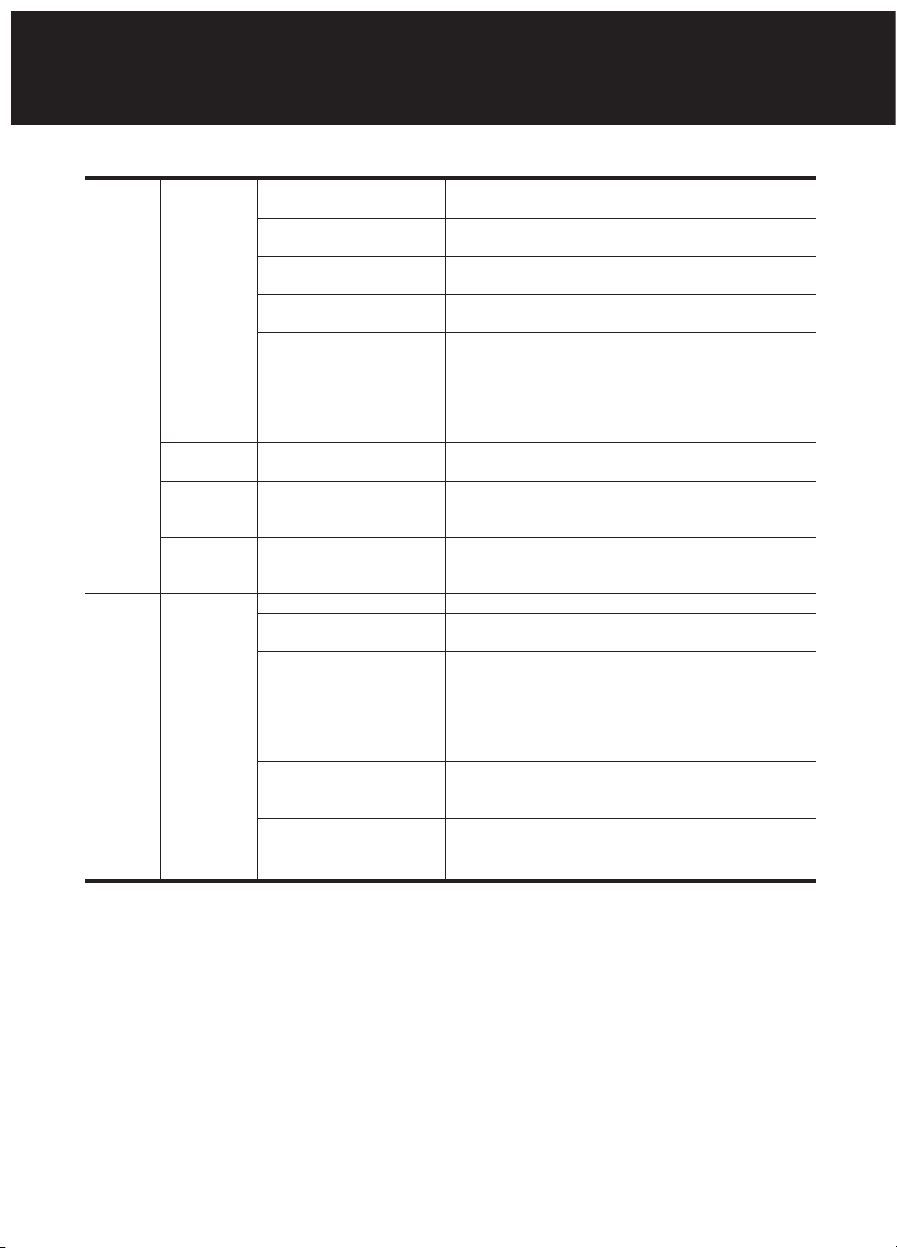
Problem Possible Causes What To Do
Unsatis-
factory
washing
result
The dishes
are not clean
The dishes were not
loaded correctly.
See notes in “Loading the Dishwasher Baskets”.
The programme was not
powerful enough.
Select a more intensive programme.
See “Wash Cycle Table”.
Not enough detergent was
dispensed.
Use more detergent, or change detergent.
Items are blocking the path
of spray arms.
Rearrange the items so that the spray can rotate freely.
The Filter Assembly in the
base of wash cabinet is
not clean or is not correctly
fi tted.
This may cause the spray
arm jets to get blocked.
Clean and/or fi t the fi lter combination correctly.
Clean the spray arm jets. See “Cleaning the Spray
Arms”.
Cloudiness
on glassware
Detergent is too much Use less detergent and select a shorter cycle to wash
the glassware to get them clean.
Black or grey
marks on the
dishware
Aluminium utensils
have rubbed against the
dishware.
Use a mild abrasive cleaner to eliminate those marks.
Detergent
left in
dispenser
Dishes block Detergent
Dispenser.
Re-load the dishes properly.
Unsatis-
factory
drying
result
The dishes
are not
drying
Improper loading. Load the Dishwasher as suggested in the directions.
Too little rinse-aid. Increase the amount of rinse-aid/refi ll the rinse-aid
dispenser.
Dishes are removed too
soon.
Do not empty the Dishwasher immediately after
washing. Open the door slightly so that the steam can
escape. Begin unloading the Dishwasher only once
the dishes have suffi ciently cooled.
Empty the low basket fi rst. This prevents water from
dropping from the dishes in the Upper Basket.
Wrong programme has
been selected.
In a short programme the washing temperature is
lower. This also lowers cleaning performance. Choose
a programme with a longer washing time.
Use of cutlery with a low-
quality coating.
Water drainage is more diffi cult with these items.
Cutlery or dishes of this type are not suitable for
washing in the Dishwasher.
Troubleshooting
29
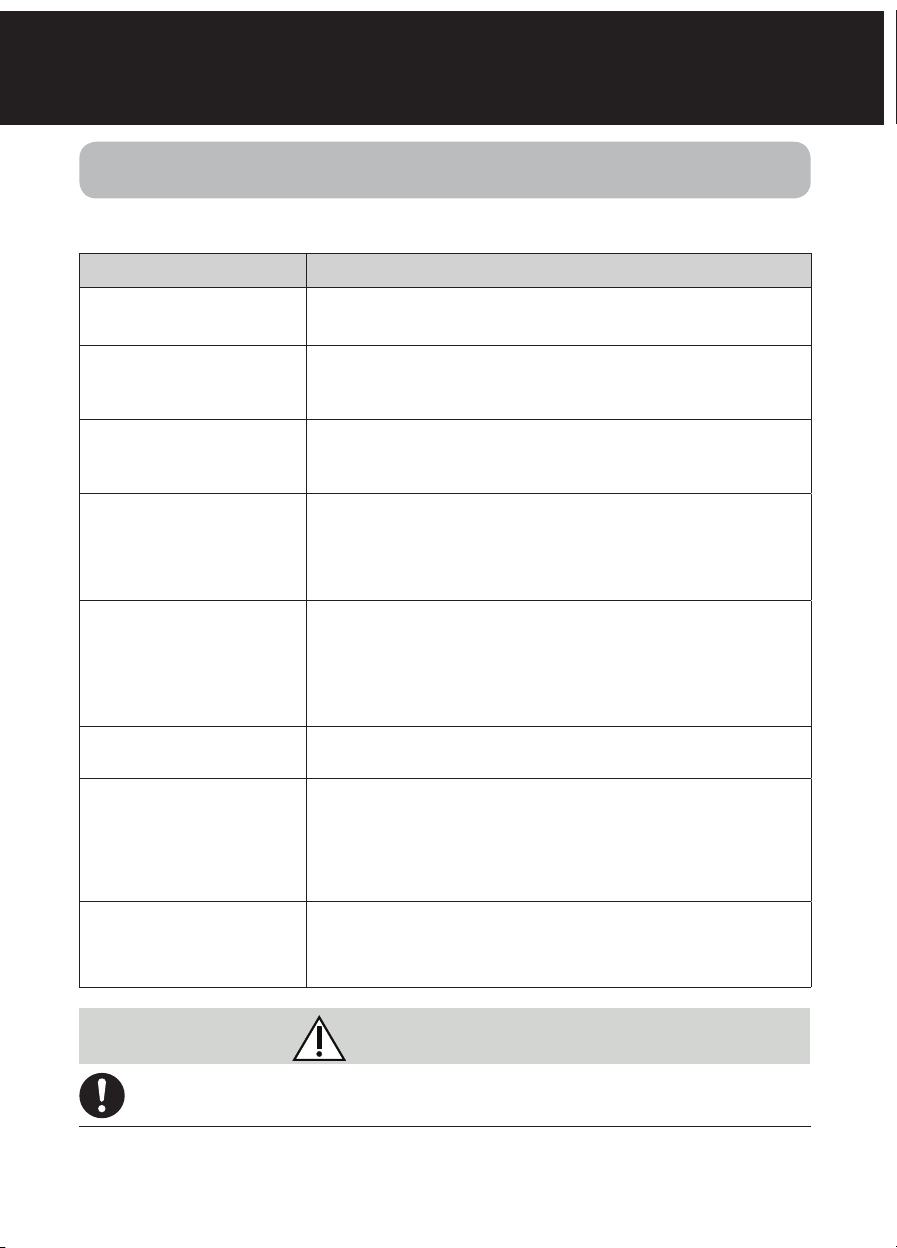
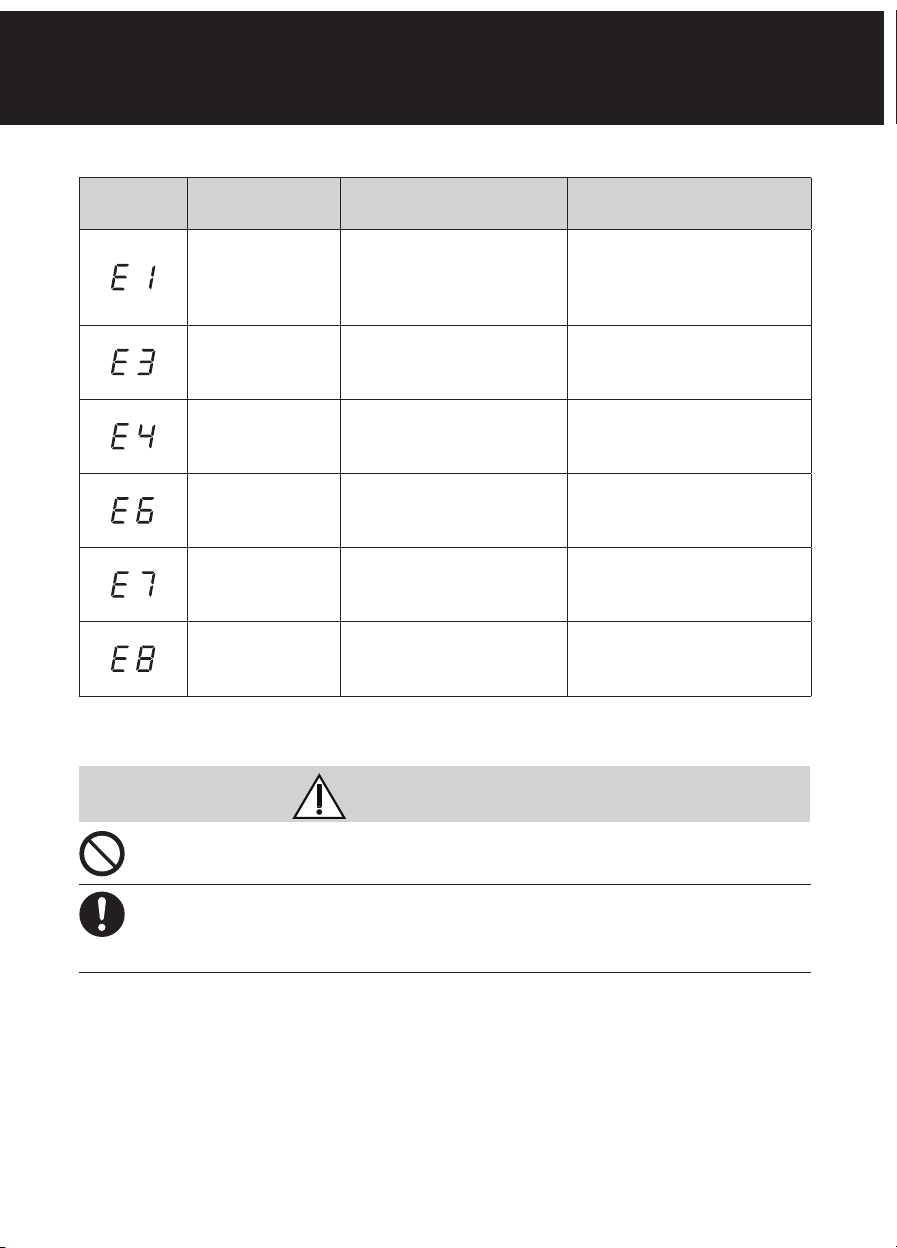
If a malfunction occurs, the Dishwasher will display error codes as below:
Display
Error Code
Defi nition Possible Causes Solution
Long water inlet
time
Faucets not turned ON
suffi ciently, water intake
is restricted or water
pressure is too low
Open the faucet / water
supply or increase the water
pressure of water supply.
Heating Abnormal Failure of heater
Contact a Panasonic
Authorised Service Centre
for assistance.
Water overfl ow
Some Dishwasher
components are leaking
Contact a Panasonic
Authorised Service Centre
for assistance.
Failure of varistor Open circuit of varistor
Contact a Panasonic
Authorised Service Centre
for assistance.
Failure of varistor Short circuit of varistor
Contact a Panasonic
Authorised Service Centre
for assistance.
Failure of
orientation of
distributary valve
Open circuit or failure of
distributary valve
Contact a Panasonic
Authorised Service Centre
for assistance.
■ Note:
The above are the judgment and inspection of common failures.
WARNING
To avoid danger to user and damage to the Dishwasher, repairs should only be
performed by a suitably qualifi ed serviceman.
ڦ If overfl ow occurs, turn OFF the main water supply before contacting a
Panasonic Authorised Service Centre.
ڦ If there is water overfl ow or small leaks, the water should be drained before
restarting the Dishwasher.
Error Codes
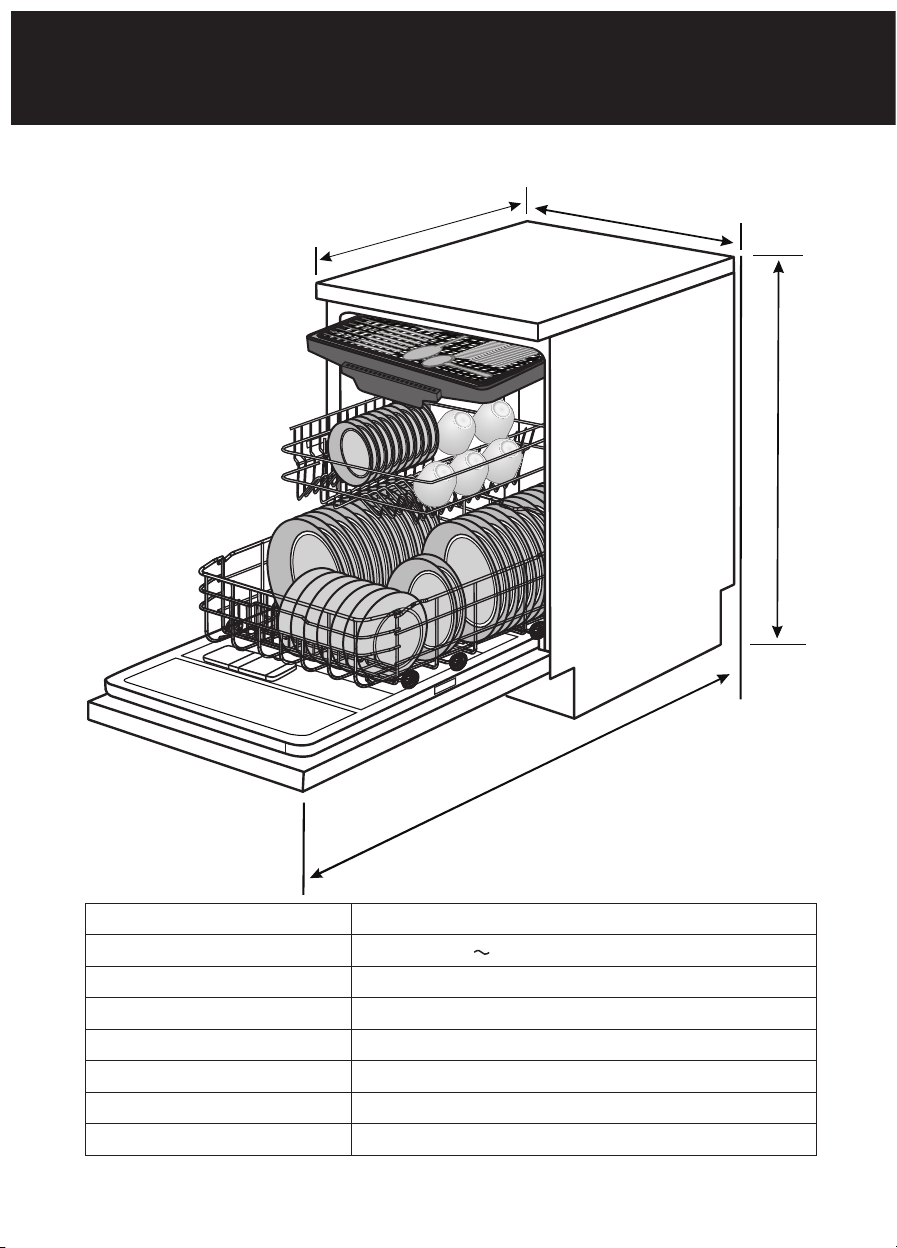
30
600 (with the door closed)
600
850
1150
Model NP-6F2MUQNZ
Power Source 220 - 240 V
Wattage 1760 - 2100 W
Frequency 50 Hz
Water Pressure 0.04 - 1.0 MPa
Capacity 14 Settings
Dimensions (L × W × H) Approx. 600 mm × 600 mm × 850 mm
Nett Weight Approx. 48 kg
Specifi cations
31
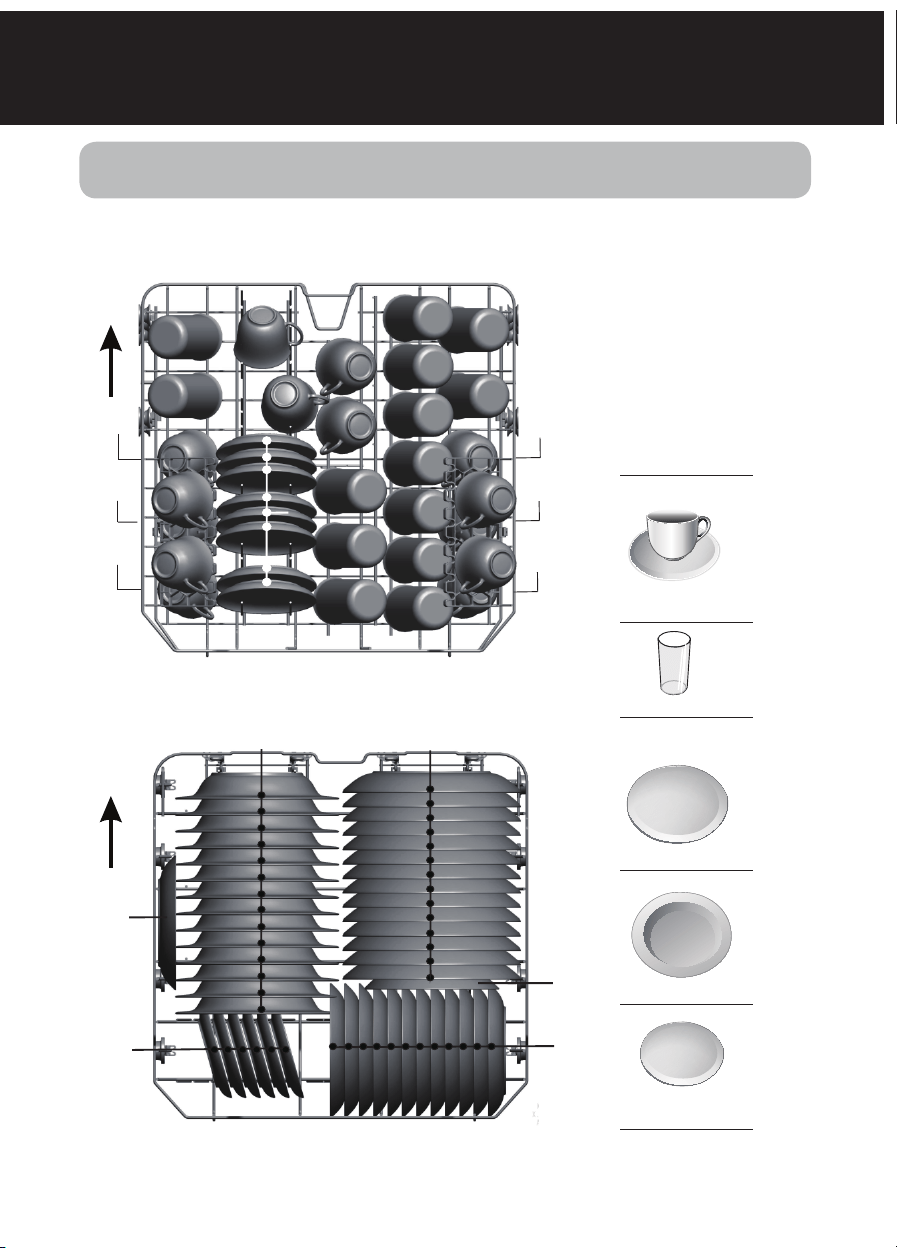
Loading the Baskets
Loading the baskets according to AS/NZS 2007.1:
f
b
e
d
c
Glasses
Saucers
b
Cups
a
d
Dinner plates
e
Soup plates
Dessert dishes
f
IN
f
f
a
a
c
c
c
c
c
c
c
c
a
a
a
a
a
a
a
a
c
c
c
c
a
c
b
c
a
a
a
IN
1. Upper Basket:
2. Lower Basket:
Specifi cations
32
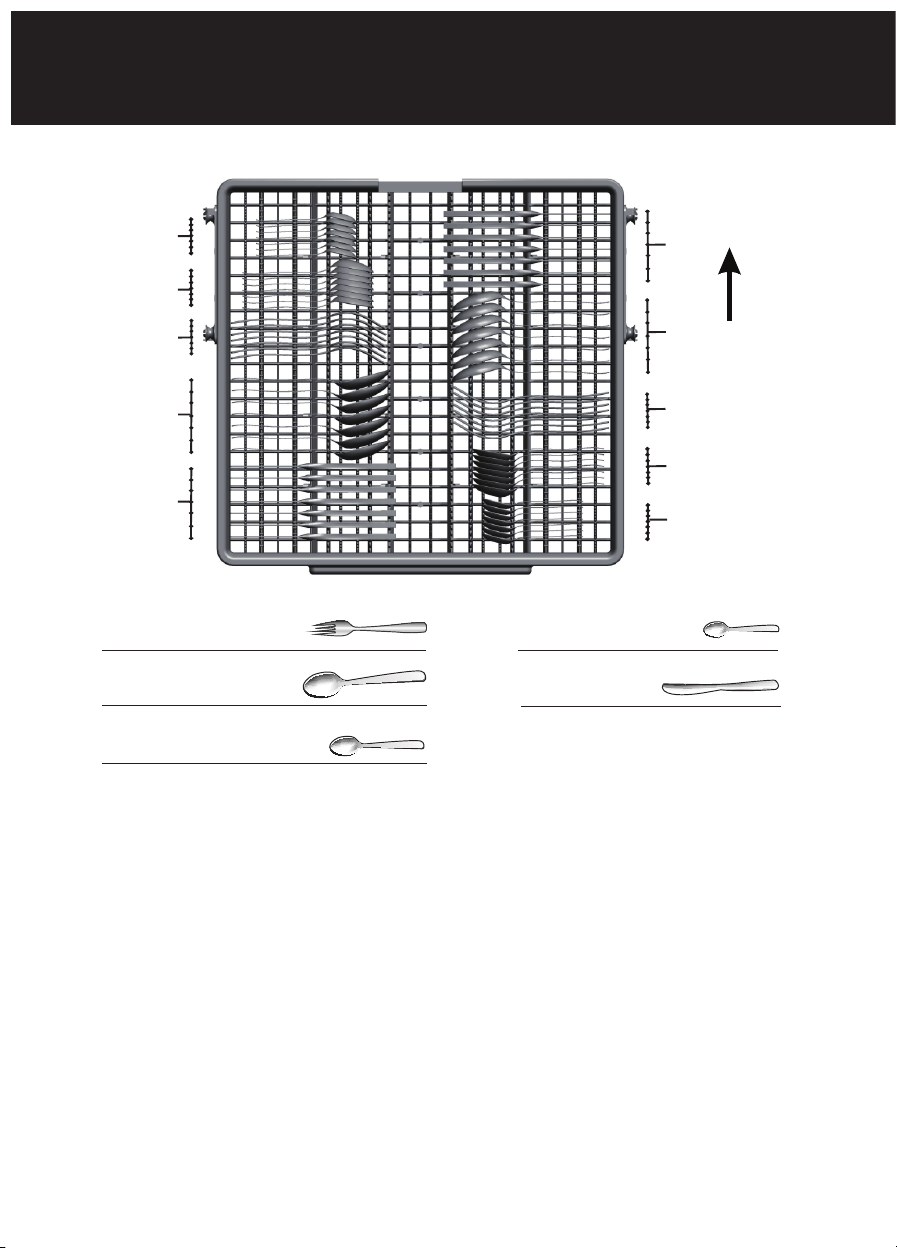
4
5
2
1
3
4
3
1
2
5
Forks
1
Soup spoons
2
3
Dessert spoons
Teaspoons
4
Knives
5
IN
3. Cutlery Basket:
Information for comparability tests in accordance with AS/NZS 2007.1
ڦ Capacity: 14 place settings
ڦ Position of the upper basket: lower
ڦ Programme: ECO
ڦ Detergent(Pre/main): 5 g/27.5 g
ڦ Rinse aid setting: 6
Specifi cations
33
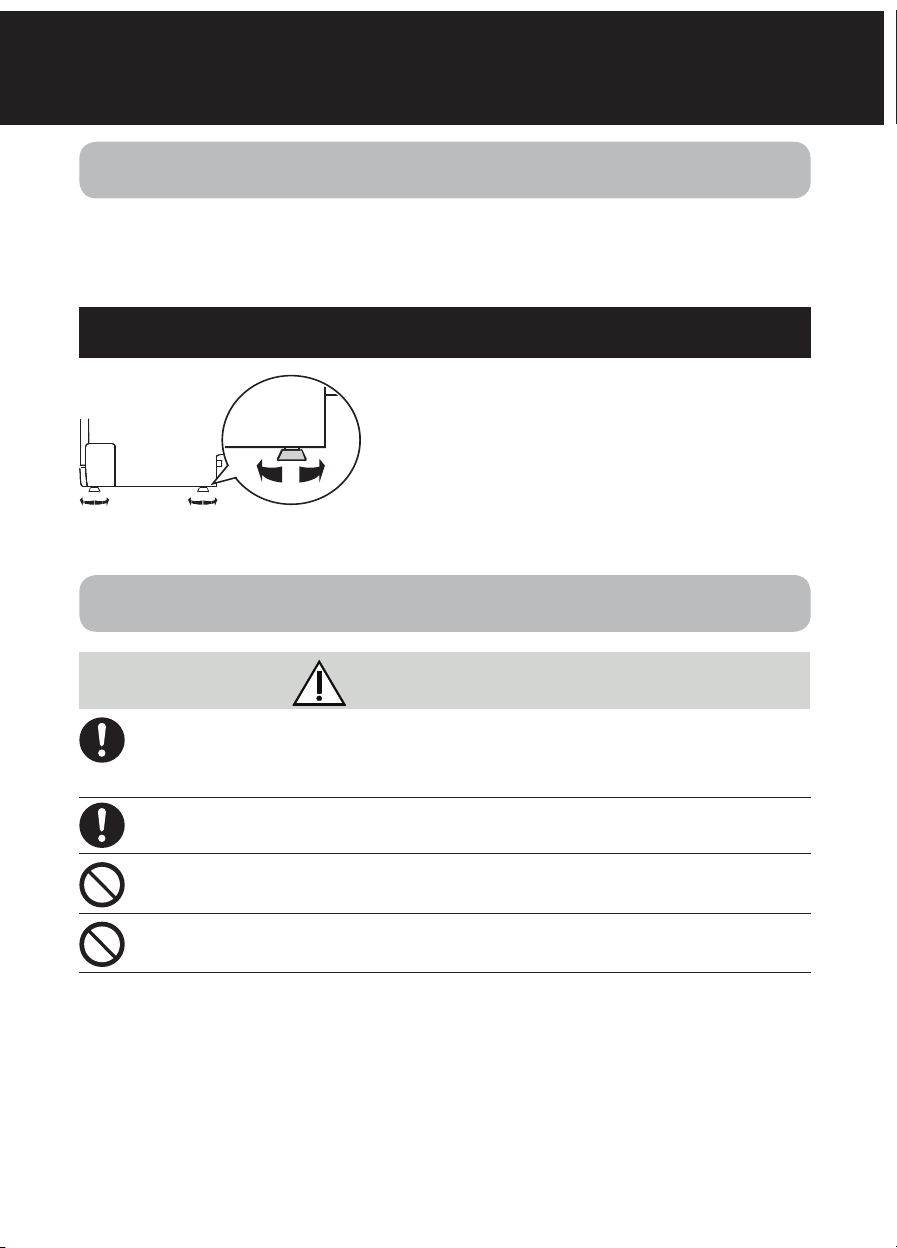
Positioning the Dishwasher
Position the Dishwasher in the desired location. The back should rest against the wall and
the sides must along the adjacent cabinets or walls. The Dishwasher is equipped with Inlet
Hose and Drain Hose that can be positioned either to the right or the left sides to facilitate
proper installation.
Levelling the Dishwasher
Once the Dishwasher is positioned for
levelling, the height of the Dishwasher may be
altered via adjustment of the screwing level
of the feet. The Dishwasher may be inclined
by turning left direction and may be declined
by turning right direction. In any case, the
Dishwasher should not be inclined more than
2 °.
Electrical Connection
WARNING
It is necessary to allow disconnection of this appliance from the mains supply
after installation. This disconnection can be achieved by having the plug
accessible or by incorporating a switch in the fi xed wiring in accordance with
the wiring rules.
Ensure proper ground exists for earth wire before installation.
Do not use an extension cord or an adapter plug with this Dishwasher.
Do not cut or remove the earthing connection from the power cord under any
circumstances.
IMPORTANT:
Correct installation is the responsibility of the installer. Any malfunction or accident
resulting from the failure to follow the Installation Instructions is not covered by the
warranty.
Installation Instruction
34
Electrical Requirements
Look at the Name Plate to know the rating voltage and connect the Dishwasher to the
appropriate power supply. Provide a separate circuit serving only for this Dishwasher.
Electrical Connection
Ensure the voltage and frequency of the power correspond to those on the Name Plate.
Only insert the Power Plug into an electrical socket which is earthed properly. If the
electrical socket to which the Dishwasher must be connected is not appropriate for the
Power Plug, replace the socket, rather than using adapters or the like as they could cause
overheating and fi re.
Water Connection
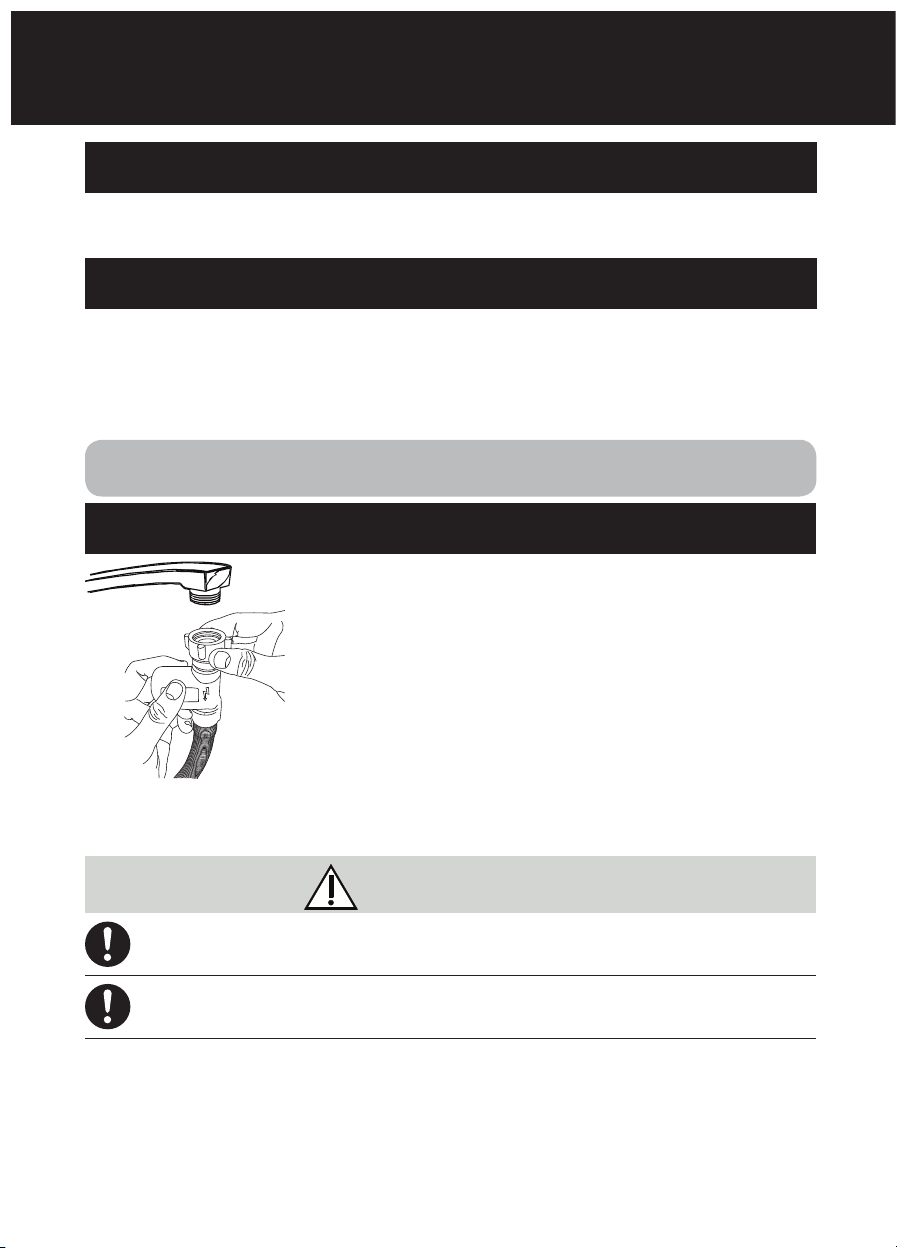
Inlet Hose Connection
Connect the Inlet Hose to a threaded 3/4 (inch) connector and
make sure that it is fastened tightly in place.
If the water pipes are new or have not been used for an
extended period of time, let the water run to make sure that the
water is clean. This precaution is needed to avoid the risk of the
water inlet becoming blocked and damage the Dishwasher.
Please fasten the nut lightly by hand and tighten it. The proper
tightening torque is 5-10 N.m (50-100 kgf.cm).
■ Note:
• The maximum inlet water pressure is 1 MPa.
• The minimum inlet water pressure is 0.04 MPa.
CAUTION
The appliance is to be connected to the water mains by new detachable hose-
sets supplied with the appliance. Old hose-sets should not be used.
Close the water tap after using.
Installation Instruction
35
CAUTION
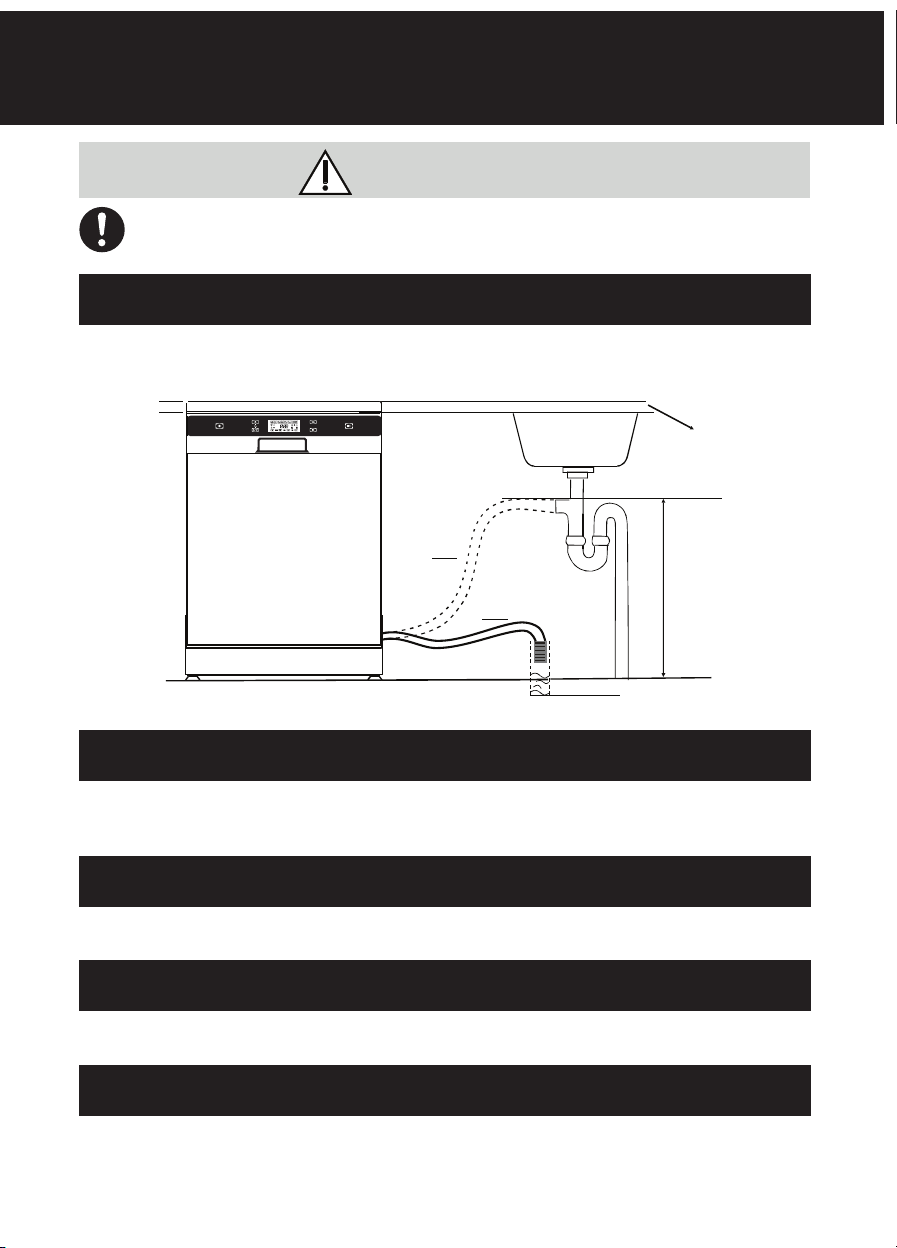
Make sure the connected drain system is free from clogging or frozen water.
Drain Hose Connection
Connect the Drain Hose into the Water Outlet with a minimum diameter of 40 mm, or let it
run into the sink. Ensure that the Drain Hose is not bent or squashed. The top of the hose
must be less than 1000 mm.
A
B
Ø40 mm
Counter
MAX 1000 mm
Water
Outlet
How to Drain Excess Water From Hoses
If the sink is 1000 higher from the fl oor, the excess water in hoses cannot be drained
directly into the sink. It will be necessary to drain excess water from hoses into a bowl or
suitable container that is held outside and lower than the sink.
Water Outlet
Connect the Drain Hose into the Water Outlet. The Drain Hose must be correctly fi tted to
avoid water leaks.
Extension Hose
If the Drain Hose extension is needed, make sure to use a similar Drain Hose. It must not
longer than 4 metres; otherwise the cleaning effect of the Dishwasher could be reduced.
Syphon Connection
The waste connection must be at a height less than 1000 mm (maximum) from the bottom
of the dish. The water drain hose should be fi xed.
Installation Instruction
“OI Production Code”
G0317-0Printed in China
Website: http://www.panasonic.com
No. 3, Jalan Sesiku 15/2, Section 15, Shah Alam Industrial Site,
40200 Shah Alam, Selangor Darul Ehsan
Checkpoints After Installation
Following points should be checked before starting the Dishwasher.
1. The Dishwasher is level and fi xed properly.
2. The inlet water supply is open.
3. Inlet Hose connections are fully tightened and not leaking.
4. The Power Plug is tightly connected.
5. The power is switched on.
6. The Inlet Hose and Drain Hose are knotted.
7. All packing materials and printings should be taken out from the
Dishwasher.