LCD Display Monitor
User’s Guide
TD-Z551
TD-Z701
2
receptacles, and the point where they exit from the
apparatus.
11)
the manufacturer.
12)
Servicing is required when the apparatus has been
damaged in any way, such as power-supply cord or
plug is damaged, liquid has been spilled or objects
have fallen into the apparatus, the apparatus has
been exposed to rain or moisture, does not operate
normally, or has been dropped.
.
Additional Safety Precautions
13) CAUTION:
If the monitor is dropped and the cabinet
or enclosure surface has been damaged or the
monitor does not operate normally, take the following
precautions:
ALWAYS turn off the monitor and unplug the power
NEVER allow your body to come in contact with
any broken glass or liquid from the damaged
monitor. The LCD panel inside the monitor contains
glass and a toxic liquid. If the liquid comes in
contact with your mouth or eyes, or your skin is cut
by broken glass, rinse the affected area thoroughly
with water and contact your doctor immediately.
ALWAYS contact a service technician to inspect
the monitor any time it has been damaged or
dropped.
14)
CAUTION:
To reduce the risk of electric shock, do not use the
polarized plug with an extension cord, receptacle,
or other outlet unless the blades can be inserted
completely to prevent blade exposure.
To prevent electric shock, match wide blade of plug
to wide slot; fully insert.
15)
CAUTION:
Do not let children swallow any small parts included
on or with the product or play with the plastic bag.
Keep the small parts and the plastic bag out of the
reach of children.
16)
CAUTION:
Do not let water or other liquids come into contact
with the product, as it may result in damage.
17)
WARNING:
To prevent t
heat source such as a heater. This may reduce the
Installation, Ergonomics, Care, and Service
Installation
Follow these recommendations and precautions and
heed all warnings when installing your monitor:
18)
When operating the LCD display with its AC 220 -
240 V power supply in Europe, use the power supply
cord provided with the monitor. If a power cord is not
supplied with this monitor, please contact your
supplier.
This equipment requires an Earthed mains
supply connection.
Dear Customer,
Thank you for purchasing this Toshiba LCD Display
Monitor. This document will help you use the many
exciting features of your new LCD Display Monitor.
Before operating your LCD Display Monitor, carefully
read this manual completely.
Safety Precautions
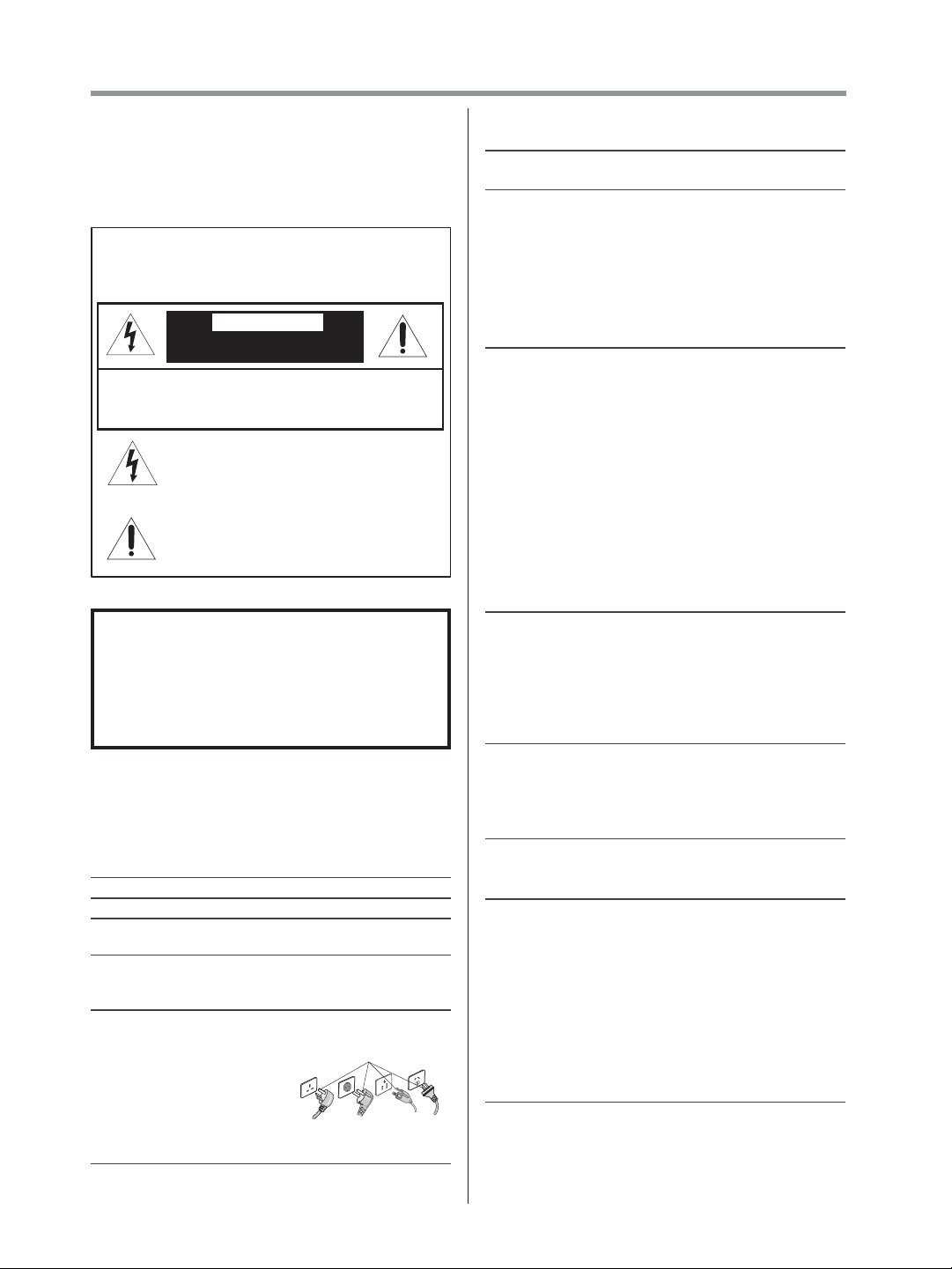
CAUTION: TO REDUCE THE RISK OF FIRE OR ELECTRIC
SHOCK, DO NOT EXPOSE THIS APPLIANCE TO RAIN OR
MOISTURE.
CAUTION:
RISK OF ELECTRIC
SHOCK DO NOT OPEN.
CAUTION: TO PREVENT ELECTRIC SHOCK. DO NOT REMOVE THE
ENCLOSURE. NO USER-SERVICEABLE PARTS INSIDE.
The lightning flash with arrowhead symbol, within an equilateral
triangle, is intended to alert the user to the presence of uninsulated
“dangerous voltage” within the product’s enclosure that may be
of sufficient magnitude to constitute a risk of electric shock to
persons.
The exclamation point within an equilateral triangle is intended
to alert the user to the presence of important operating and
maintenance (servicing) instructions in the literature accompanying
the appliance.
WARNING: If you decide to wall mount this
monitor, always use a mounting bracket that has
been Listed by an independent laboratory (such as
UL, CSA, ETL) and is appropriate for the size and
weight of this monitor. The use of inappropriate or
non-Listed mounting brackets could result in
serious bodily injury and/or property damage.
Important Safety Instructions
1) these instructions.
2) Keep these instructions.
3) all warnings.
4) Follow all instructions.
5)
Do not use this apparatus near water.
6)
7)
Install in
accordance with the manufacturer’s instructions.
8)
Do not install near any heat sources such as
radiators, heat registers, stoves, or other products
9)
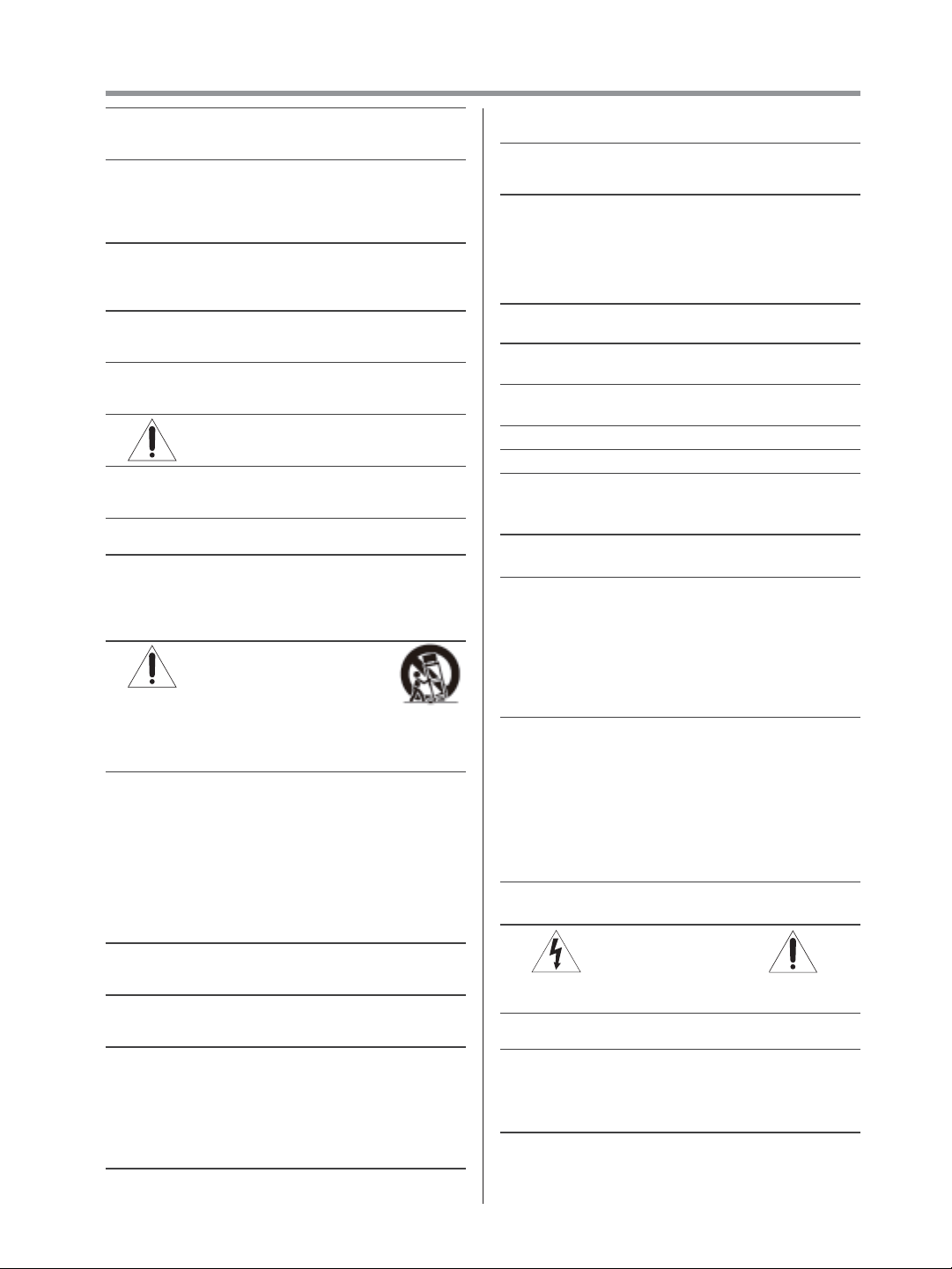
type plug.
A grounding type plug has
two blades and a third
grounding prong. The third
prong is provided for your
safety. If the provided plug
replacement of the obsolete outlet.
10)
from being walked on or
pinched, particularly at plugs, convenience
Grounding prong
3
19)
In UK, use a BS-approved power cord with molded
plug having a black (10 A) fuse installed for use with
this monitor.
20)
When operating the LCD display with a 120V, 60Hz
AC power supply in the United States or Canada,
use the power cord provided with the monitor. If a
power cord is not supplied with the monitor, please
contact your supplier.
21)
For all other cases, use a power cord that matches
the AC voltage of the power outlet and has been
approved by and complies with the safety standard
of your particular country.
22)
Position the monitor at a 90° angle to windows and
other light sources to minimize glare and
23)
long periods of time to avoid image persistence
(after image effects).
24)
WARNING: Never expose the batteries to
the like.
25)
ALWAYS plug the product into an outlet that is
located in such a manner that it can be easily
unplugged in case the product requires service.
26)
NEVER route the product’s power cord inside a
wall or similar enclosed area.
27)
Never modify this equipment. Changes or
the user’s authority to operate this equipment
under the rules of the Federal Communications
Commission.
28)
DANGER: RISK OF SERIOUS
PERSONAL INJURY, DEATH,
OR EQUIPMENT DAMAGE!
Never place the monitor on an
unstable cart, stand, or table. The monitor may
fall, causing serious personal injury, death, or
serious damage to the monitor.
29)
When selecting a location for the monitor,
NEVER allow any part of the monitor to hang over
the edge of the supporting furniture,
NEVER place the monitor on tall furniture (for
example, entertainment centers or bookcases)
without anchoring both the furniture and the monitor
to a suitable support,
Never place cloth or other material between the
monitor and the supporting furniture.
NEVER allow children to climb on the monitor.
30)
To avoid damage to this product, never place or store
the monitor in direct sunlight; hot, humid areas; or
areas subject to excessive dust or vibration.
31)
The product shall not be exposed to dripping or
as vases, shall be placed on the apparatus.
32)
Never block or cover the slots or openings in the
monitor cabinet back, bottom, and sides. Never
place the monitor:
on a bed, sofa, rug, or similar surface;
too close to drapes, curtains, or walls; or
cabinet, or any other place with poor ventilation.
33)
Always leave a space of at least 10cm - 4 (four)
inches around the monitor. The slots and openings
are provided to protect the monitor from overheating
and to help maintain reliable operation of the monitor.
34)
Never allow anything to rest on or roll over the power
cord, and never place the monitor where the power
cord is subject to wear or abuse.
35)
Never overload wall outlets and extension cords.
Ergonomics
recommend the following:
36)
For optimum performance, allow 20 minutes for
warm-up.
37)
Rest your eyes periodically by focusing on an object
at least 5 feet away. Blink often.
38)
Use the preset Size and Position controls with
standard signals.
39)
Use the preset Color Setting.
40)
Use non-interlaced signals.
41)
Do not use primary color blue on a dark background,
42)
Adjust the monitor’s brightness, contrast, and
sharpness controls to enhance readability.
43)
Position the monitor at a 90° angle to windows and
Care
For better performance and safer operation of your
TOSHIBA monitor, follow these recommendations
and precautions:
44)
Always unplug the monitor before cleaning. Gently
wipe the display panel surface (the monitor screen)
cloth may damage the surface of the panel. Avoid
contact with alcohol, thinner, benzene, acidic or
alkaline solvent cleaners, abrasive cleaners, or
chemical cloths, which may damage the surface.
Never spray volatile compounds such as insecticide
on the cabinet. Such products may damage or
discolor the cabinet.
45)
Never hit, press, or place anything on the back cover.
These actions will damage internal parts.
46)
WARNING:
RISK OF ELECTRIC SHOCK!
Never spill liquids or push objects of any kind
into the monitor cabinet slots.
47)
During a lightning storm, do not touch the connecting
cables or product.
48)
Always unplug the monitor to completely disconnect
from mains power. When the monitor is turned off
using the on/off switch, it is not completely
disconnected from power and a minute amount of
current is still consumed.
49)
During normal use, the monitor may make
occasional snapping or popping sounds. This is
normal, especially when the unit is being turned on or
off. If these sounds become frequent or continuous,
4
unplug the power cord and contact a Toshiba
Authorized Service Provider.
50)
Handle with care when transporting. Save packaging
for transporting. Please clean the ventilation slots on
the back of the cabinet to remove dirt and dust at
least once a year to maintain reliable operation of the
monitor.
51)
If using the cooling fan continuously, it’s
recommended to clean the ventilation slots at least
once a month.
52)
When installing the remote control batteries;
Align the batteries according to the (+) and (-)
indications inside the case.
case.
Service
53)
WARNING:
RISK OF ELECTRIC SHOCK!
Never attempt to service the monitor yourself.
Opening and removing the covers may expose you
to dangerous voltage or other hazards. Failure to
follow this WARNING may result in death or serious
to a Toshiba Authorized Service Provider.
54)
If you have the monitor serviced:
Ask the service technician to use only replacement
Upon completion of service, ask the service
technician to perform routine safety checks to
determine that the monitor is in safe operating
condition.
Important Information
partment of Communications
Compliance Statement.
DOC: This Class A digital apparatus meets all
requirements of the Canadian Interference-Causing
Equipment Regulations.
C-UL: Bears the C-UL Mark and is in compliance with
Canadian Safety Regulations according to CAN/
CSA C22.2 No. 60950-1.
FCC Declaration of Conformity Compliance
Statement (Part 15):
This device complies with part 15 of the FCC Rules.
Operation is subject to the following two conditions:
(1) This device may not cause harmful interference,
and (2) this device must accept any interference
received, including interference that may cause
undesired operation.
This equipment has been tested and found to
comply with the limits for a Class A digital device,
pursuant to Part 15 of the FCC Rules. These limits
are designed to provide reasonable protection
against harmful interference when the equipment is
operated in a commercial environment. This
equipment generates, uses, and can radiate radio
frequency energy and, if not installed and used in
accordance with the instruction manual, may cause
harmful interference to radio communications.
Operation of this equipment in a residential area is
likely to cause harmful interference in which case the
user will be required to correct the interference at his
own expense.
expressly approved by the party responsible for
compliance could void your authority to operate the
equipment.
Z551 and TD-Z701 LCD displays so as not to
interfere with radio and television reception.
1) Please use the supplied power cord to ensure
FCC compliance. If a power cord is not provided,
please contact your supplier.
2) Please use the supplied shielded video signal
cable, 15-pin mini D-SUB to 15-pin mini D-SUB.
EU conformity Statement
This product is labeled with the CE Mark
in accordance with the related European
Directives, notably Low Voltage Directive
2006/95/EC, Electromagnetic
Compatibility Directive 2004/108/EC and
RoHS Directive 2011/65/EU.
Responsible for CE-marking is TOSHIBA
EUROPE GMBH,
Hammfelddamm 8, 41460 Neuss,
Germany
Warning
This is a Class A product. In a domestic environment this
product may cause radio interference, in which case the
user may be required to take adequate measures.
Disposal of your old product and batteries
The crossed out wheeled dust bin symbol
indicates that products must be collected and
disposed of separately from household waste.
Integrated batteries and accumulators can be
disposed of with the product. They will be
separated at the recycling centres. The black
bar indicates that the product was placed on the
market after August 13, 2005. By participating
in separate collection of products and batteries,
you will help to assure the proper disposal of
products and batteries and thus help to prevent
potential negative consequences for the
environment and human health. For more
detailed information about the collection and
recycling programmes available in your
the shop where you purchased the product.
5
accumulators
The crossed out wheeled dust bin symbol
indicates that batteries and/or accumulators
must be collected and disposed of separately
from household waste. If the battery or
values of lead (Pb), mercury (Hg), and/or
(2006/66/EC), then the chemical symbols for
lead (Pb), mercury (Hg) and/or cadmium (Cd)
will appear below the crossed out wheeled dust
bin symbol. By participating in separate
collection of batteries, you will help to assure
the proper disposal of products and batteries
and thus help to prevent potential negative
consequences for the environment and human
health. For more detailed information about the
collection and recycling programmes available
in your country, please contact your local city
product.
Pb, Hg, Cd
ENERGY STAR
®
User Information (only for 55”)
ENERGY STAR User Information Statement: the factory
default settings of this display meet ENERGY STAR
®
requirements. Changing Picture Settings may increase
energy consumption, possibly beyond the limits required
for ENERGY STAR q
ENERGY STAR
®
that earn the ENERGY STAR prevent green
house gas emissions by meeting strict
guidelines set by the U.S.
Environmental Protection Agency. ENERGY
STAR and the ENERGY STAR mark are
registered U.S. marks.
Important notes about your monitor
The following symptoms are technical limitations of
LCD Display technology and are not an indication of
malfunction; therefore, Toshiba is not responsible for
perceived issues resulting from these symptoms.
1)
An afterimage (ghost) may appear on the screen if a
time. The afterimage is not permanent and will
disappear in a short period of time.
2)
The LCD panel contained in this monitor is
manufactured using an extremely high level of precision
technology; however, there may be an occasional pixel
(dot of light) that does not operate properly (does not
light, remains constantly lit, etc.). This is a structural
property of LCD technology, is not a sign of malfunction,
and is not covered under your warranty. Such pixels are
not visible when the picture is viewed from a normal
viewing distance.
Note: Interactive video games that involve shooting
a “gun” type of joystick at an on-screen target may
not work with this monitor.
WARNING: This product contains chemicals, including
lead, known to the State of California to cause cancer and
birth defects or other reproductive harm. Wash hands after
handling.
Trademark Information
ClearScan is a trademark or registered trademark of
Toshiba America Information Systems, Inc. in the
United States and other countries.
VESA, DisplayPort, and the DisplayPort icon are
trademarks of Video Electronics Standards Association.
Intel and the Intel logo are trademarks of Intel
Corporation in the United States and/or other countries.
Multimedia Interface, and the HDMI Logo are
trademarks or registered trademarks of HDMI Licensing
LLC in the United States and other countries.
All other brand and product names are trademarks or
registered trademarks of their respective companies.
Copyright
This guide is copyrighted by Toshiba Lifestyle Products
& Services Corporation. with all rights reserved. Under
the copyright laws, this guide cannot be reproduced in any
form without the prior written permission of Toshiba. No
patent liability is assumed, however, with respect to the
use of the information contained herein.
© 2013 by Toshiba Lifestyle Products & Services
Corporation. All rights reserved.
Notice
The information contained in this manual, including but
not l
change without notice.
TOSHIBA LIFESTYLE PRODUCTS & SERVICES
CORPORATION (TOSHIBA) PROVIDES NO
WARRANTY WITH REGARD TO THIS MANUAL
OR ANY OTHER INFORMATION CONTAINED
HEREIN AND HEREBY EXPRESSLY DISCLAIMS
ANY IMPLIED WARRANTIES OF
MERCHANTABILITY OR FITNESS FOR ANY
PARTICULAR PURPOSE WITH REGARD TO ANY
OF THE FOREGOING. TOSHIBA ASSUMES NO
LIABILITY FOR ANY DAMAGES INCURRED
DIRECTLY OR INDIRECTLY FROM ANY
TECHNICAL OR TYPOGRAPHICAL ERRORS OR
OMISSIONS CONTAINED HEREIN OR FOR
DISCREPANCIES BETWEEN THE PRODUCT
AND THE MANUAL. IN NO EVENT SHALL
TOSHIBA BE LIABLE FOR ANY INCIDENTAL,
CONSEQUENTIAL, SPECIAL, OR EXEMPLARY
DAMAGES, WHETHER BASED ON TORT,
CONTRACT OR OTHERWISE, ARISING OUT OF
OR IN CONNECTION WITH THIS MANUAL OR
ANY OTHER INFORMATION CONTAINED
HEREIN OR THE USE THEREOF.

6
Contents
Chapter 1: Introduction ...............................................................................................................8
Features ........................................................................................................................................8
Contents
......................................................................................................................................10
Parts Name and Functions ..........................................................................................................11
Buttons, Switch, and Indicator ............................................................................................11
Connectors and Terminals
................................................................................................... 12
Wireless Remote Control
....................................................................................................13
How to Use the Wireless Remote Control
............................................................................14
Chapter 2: Preparation for use ..................................................................................................15
Preparation for installation ..........................................................................................................15
Determine the installation location ......................................................................................15
Ventilation requirements for enclosure mounting ................................................................15
Using the wall mount or ceiling mount.................................................................................16
Installing the monitor .................................................................................................................17
Preventing the handles from touching the wall ....................................................................17
Removing the stand guide frames .......................................................................................17
Using the wall mount spacers ..............................................................................................18
Installing in the portrait or face-up position .........................................................................19
Attaching the corner protectors ...........................................................................................19
Using the monitor without the bezel ............................................................................................20
Installing the external speakers ...................................................................................................21
Connection procedure .................................................................................................................22
Wiring diagram ...................................................................................................................22
Prevention of disconnection of HDMI cable .........................................................................23
Connecting with a computer (analog connection) ................................................................24
Connecting with a computer (digital connection) .................................................................25
Connecting a video device (component video/HDMI device) ................................................26
Connecting a video device (composite video/ S video device)/stereo amplifier ....................27
Installing the expansion module
........................................................................................28
Installation of the expansion module ...................................................................................28
Connecting OPS-compliant computer .................................................................................28
Mounting the OPS-compliant computer on the monitor (for 55”) ........................................28
Mounting the OPS-compliant computer on the monitor (for 70”) ........................................29
Connecting RS-232C ..................................................................................................................30
Monitor control via RS-232C ...............................................................................................30
Connecting LAN .........................................................................................................................31
Monitor connection using LAN ............................................................................................31
Connecting a USB device .............................................................................................................32
Connecting multiple USB devices using the USB hub function .............................................32
Connecting the power cord to the monitor ...................................................................................33
Connecting the power source ..............................................................................................33
Chapter 3: How to Use ..............................................................................................................34
Turning on all the connected devices ...........................................................................................34
Turning on the monitor .......................................................................................................34
Power Management Function ..............................................................................................35
Selecting the video input .............................................................................................................36
Controlling the external devices ...................................................................................................37
Selecting the OSD language ........................................................................................................37
Auto-setup (analog inputs only) ..................................................................................................38

7
Contents
Selecting the picture mode ..........................................................................................................39
Screen adjustment ......................................................................................................................39
Picture adjustment ......................................................................................................................40
Speaker setting ...........................................................................................................................40
Volume, balance, and tone control ..............................................................................................40
Schedule setting ........................................................................................................................41
How to set up schedule .......................................................................................................42
Remote control ...........................................................................................................................43
RS-232C Remote control ....................................................................................................43
LAN Remote control ...........................................................................................................45
Setting the USB hub ...................................................................................................................46
Configuration and basic operation of OSD screen ........................................................................47
Configuration of OSD screen ...............................................................................................47
Basic operation of OSD screen ............................................................................................48
Picture ................................................................................................................................49
Screen .................................................................................................................................52
Audio ..................................................................................................................................54
PIP ( Picture In Picture) .......................................................................................................55
Configuration 1 ...................................................................................................................56
Configuration 2 ...................................................................................................................58
Advanced Option .................................................................................................................60
Chapter 4: Other functions ........................................................................................................63
Picture size ..................................................................................................................................63
Picture mode ...............................................................................................................................63
Control Lock mode ......................................................................................................................64
OSD information .........................................................................................................................64
Audio input change......................................................................................................................65
Supplemental information of the auto brightness function...........................................................65
PIP, POP function ........................................................................................................................66
Remote control numbering function ............................................................................................67
Chapter 5: Troubleshooting .......................................................................................................68
Appendix A: Specifications
............................................................................................................. 70
Appendix B: Pin Assignment
.......................................................................................................... 73
8
Chapter 1
Introduction
Safety icons
icons highlight these instructions as follows:
Indicates an imminently hazardous situation which, if not avoided, will result in death or serious injury.
Indicates a potentially hazardous situation which, if not avoided, could result in death or serious injury.
Indicates a potentially hazardous situation which, if not avoided, may result in minor or moderate injury.
Indicates a potentially hazardous situation which, if not avoided, may result in property damage.
Provides important information.
Features
Industry LED backlight
Y
LED backlight panel — Commercial grade panel with a LED backlight. With the LED backlight, the monitor has
achieved low power consumption and eliminated mercury. The slim monitor design allows installation in various
environments than the conventional monitors. See Page 70.
High-quality LCD panel which provides a wide variety of contents and messages clearly
Y
Full HD panel — The TD-Z551 and TD-Z701 panels reproduce images from video and computer signals with
Y
Tiling Capability with Frame compensation — Up to 25 panels (5 wide x 5 high) can be combined to create a
single large image (i.e., video wall) or other high-impact signage. A frame compensation function is incorporated to
compensate the width of panel bezels so that images are displayed with the utmost accuracy. See Page 61.
Y PIP, POP and Side-by-side — Picture-In-Picture and Picture-Outside-Picture are available when you want to
display video content from a video input source in the sub picture and display the PC input source in the main
picture, and vice versa. The native resolution as high as 1920 x 1080 can display these two input sources in the
Side-by-side mode, ideal for broadcasting and videoconferencing applications. See Pages 13, 55 and 66.

9
Introduction
Y Digital Zoom — Zoom mode for expanding 4:3 image to 16:9. Various zoom modes are provided and it is possible
to expand 4:3 aspect ratio images to 16:9. In addition, you can select the Dynamic display mode to display naturally
widened images with different zooming rates around the screen center and screen edges. You can also optimally
change the image size diagonally, horizontally, and vertically. See Page 52.
Expansion slot allowing installation of expansion modules according to applications
Y
Option Slot — You can mount an expansion module recommended on the monitor. With such expansion module,
you can expand the functionality of the monitor according to the purpose of use. See Page 28.
Y
Programmable Scheduling Function — The monitor’s operating schedule can be programmed for up to seven
different scheduled time intervals by time, day of the week and input port. This allows video content from different
inputs to be displayed on certain monitors within the same installation according to the schedule, and extends the
monitor’s life and saves the power by turning it off during those hours or days it is not in use. See Pages 41 and 42.
Y Screen-saver Functions — To reduce image persistence and maximize the panel life in demanding signage
applications, this product is equipped with four screen-saver functions. See Page 56.
GAMMA
COOLING FAN
BRIGHTNESS
MOTION
Y Power-on Delay — For installations employing numerous monitors, the power-on delay function can power up the
monitors sequentially with delay between 2-50 seconds after the power is applied. Using this function can prevent
inrush current problems and reduce the overall electrical load requirements when a single power supply is used. See
Page 62.
Y LAN Control —
diagnosis by sending control commands from a computer via a LAN network. See Pages 31, 45 and 58.
Brightness Compensation by the Ambient Light Sensors for Enhanced Visibility and Lower Power
Consumption.
Y
Ambient Light Sensors (Brightness sensors) —
and lower power consumption.
spite of brightness variation during the day or night. See Page 11 and 65.
Others
Y
DisplayPort — DisplayPort-compliant terminal is provided. The monitor is equipped with a terminal supporting
DisplayPort, a digital interface standard. You can transmit video signals over a single cable up to a maximum of
15-meters long. See Pages 12 and 25.
Y Built-in Speakers — This monitor offers built-in stereo speakers to deliver audio messages. External stereo
speakers can also be used. The user has the option to switch between using external or built-in speakers from the
menu. See Pages 11 and 40.
Y Remote Control — A wireless remote control is supplied to control the various functions of this monitor, including
power on/off, input select, and menu access. See Pages 13 and 14.
Y Closed Caption — You can display captions. When closed-caption is encoded with the video signal, the user can
select to display or hide the caption on screen. This monitor is compliant with EIA-608-A. See Page 62.
Y USB hub function — Multiple USB devices can be connected to the computer. The monitor is equipped with the
function convenient when mounting a device such as a digital camera and a touch-panel unit on the monitor. See
Page 46.
Y Double-speed Clear Picture (ClearScan™) (Only for 70” PD) — Extra frames are generated from the original
60-frame-per-second image based on motion estimation and interpolated to display 120 frames per second. The
afterimage effects are reduced and fast-motion images are displayed smoothly. This function also makes moving
information is conveyed in a short time. See
Page 61.
Y Daisy Chain Connection (DVI-D) — By connecting the DVI-D OUT connectors and the DVI-D IN connectors
using DVI-D cables (commercially available), you can transmit video signals to up to 4 monitors (when using
2-meter cables). This function is useful in supplying a video signal to multiple monitors. See Page 25.
Features
10
Introduction
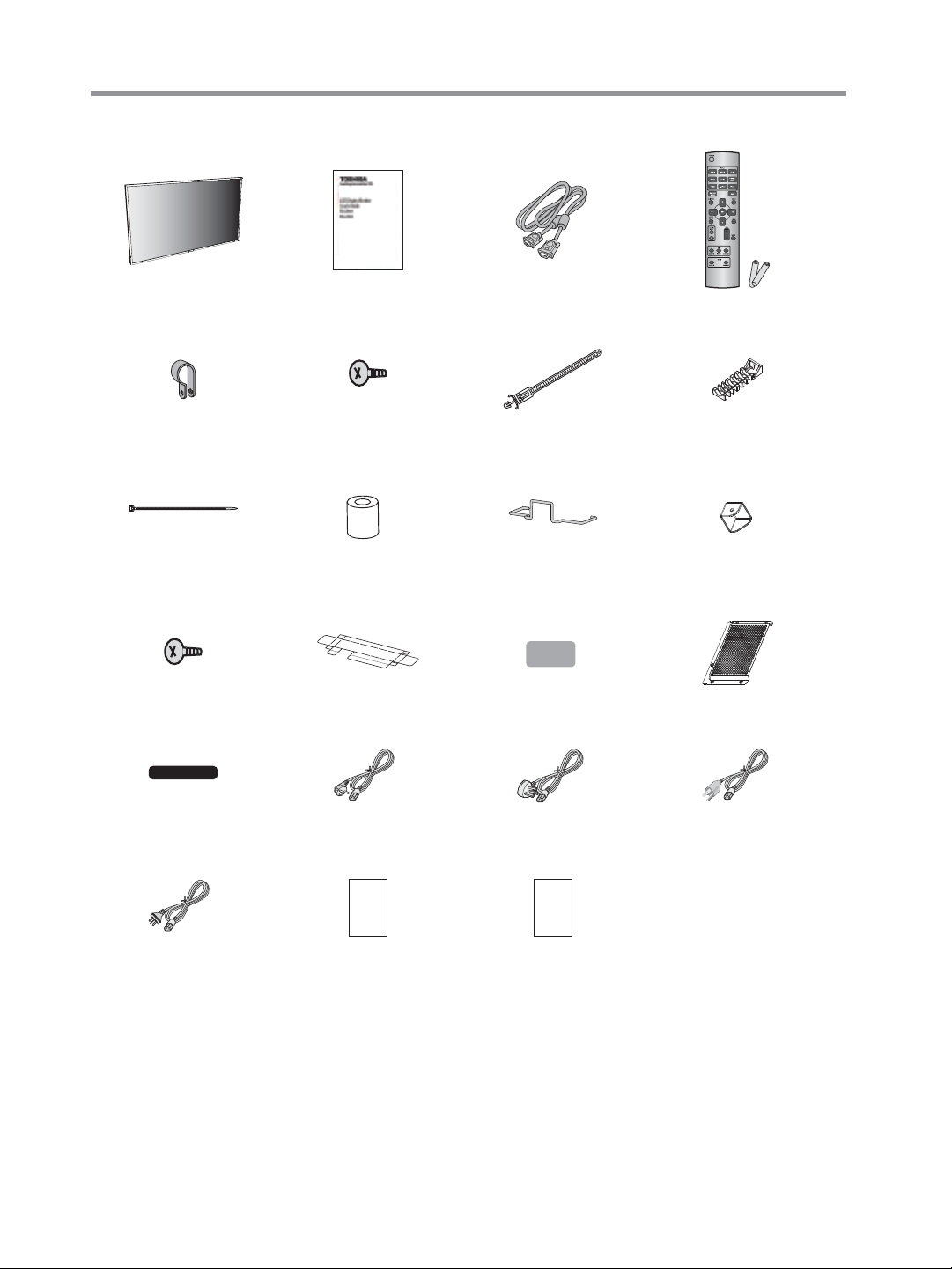
Contents
LCD Display User’s Manual Video Signal Cable
(Mini D-SUB 15-pin to Mini D-SUB 15-
pin Cable)
Wireless Remote Control and
AAA Batteries
Clamper x 2
(For fall prevention)
Screw (M4) x 2
For the monitor fall
prevention clampers)
Clamper x 3
(For tying cables)
Clamper x 2
(For holding the HDMI cables)
Band x 4
(For the HDMI cable holding
clampers)
Wall mount spacer x 9 Cable holder
(For holding the power cord)
Corner protector x 4
Screw (M3) x 4
(For the corner protectors)
Protective cover Label to cover the UL
Option slot cover
Label to cover the logo
(Use it as necessary.)
Power Cord For EU Power Cord For UK Power Cord
For North America
Power Cord for Australia.
(Australia only)
Warranty
(US only)
Warranty
(Australia only)
The supplied power cord varies depending on destination.
For the use in the other regions, use a power cord that matches the AC voltage of the power outlet and has been approved
by and complies with the safety standard of those regions or countries.
Contents
11
Introduction
Parts Name and Functions
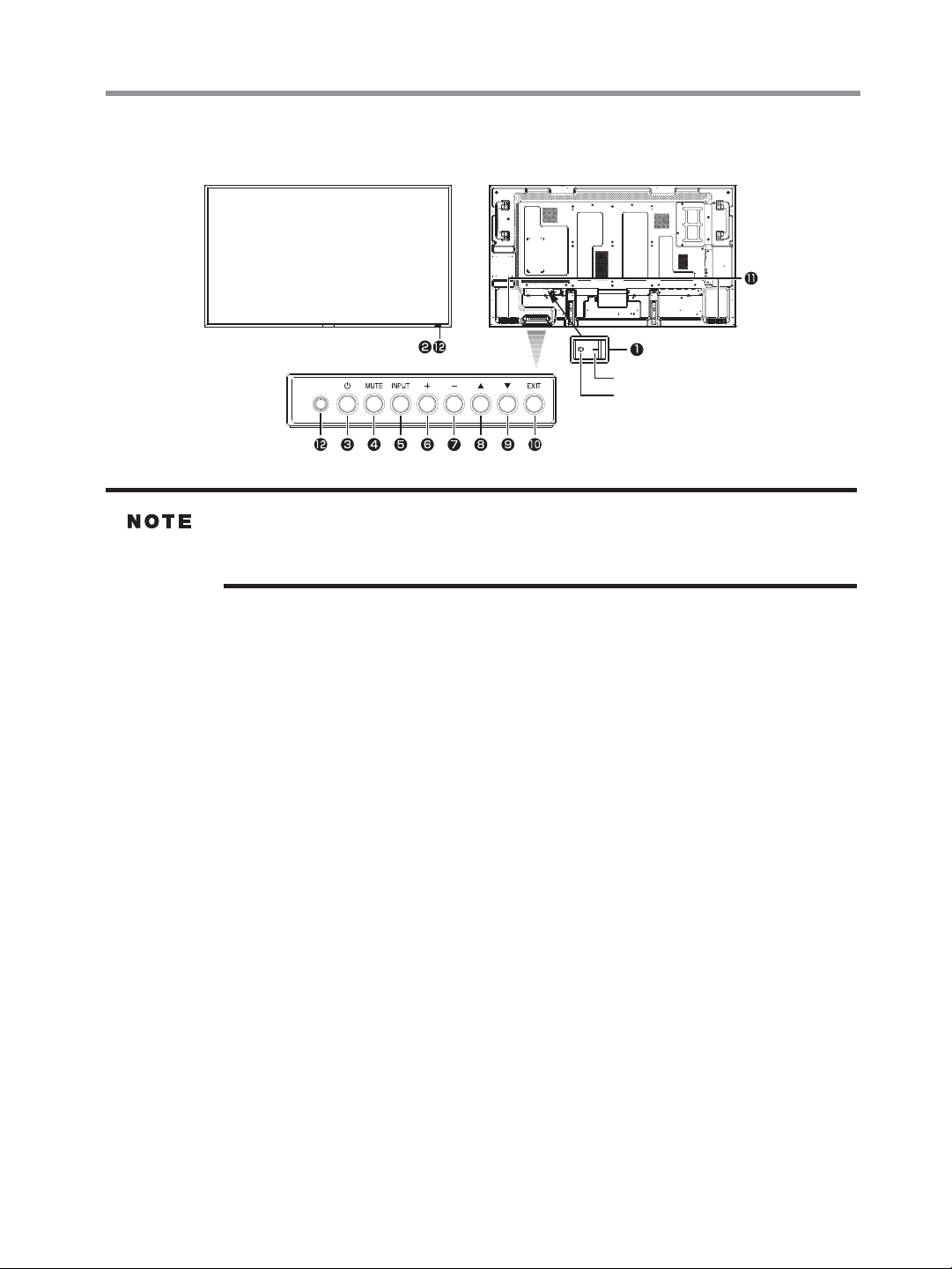
Buttons, Switch, and Indicator
ON
OFF
Control buttons
1 Main Power Switch —Switches the main power on/off and is used as the disconnect device.
Within 2 seconds after turning off the power by the POWER button on the wireless remote control or the monitor or by
a communication command, don’t turn off the main power switch, don’t disconnect the power cord, and don’t turn off
the breaker. If the AC power is turned off immediately after the power-off operation, all the OSD settings including the
language selection may be reset to the factory defaults at the next power-on. If the OSD settings are reset to the factory
defaults as described above, reconfigure the OSD settings using the following procedure.
Turn off the power of the monitor using the wireless remote control or otherwise.
Wait for at least 2 seconds.
Turn on the power of the monitor using the wireless remote control or otherwise.
2 Remote control sensor and Power indicator—
Remote control sensor: Receives the signal from the wireless remote control.
Power indicator: Indicates the state of the LCD display.
Steady green: The power is on.
Steady red: The power is off. Some operations such as power-on are possible.
Steady green and red: The LCD display is in the sleep mode.
Off: The main power is off.
Steady red and blinking green: The LCD display is in the schedule standby mode.
Blinking red: The LCD display has an error (detected by the self-diagnostic function).
3 POWER button—Switches the power on/off.
This button doesn’t work when the power indicator is off. Turn on the main power. (See page 35.)
4 MUTE button—Switches the audio mute on/off.
5 INPUT button—Displays the OSD menu to switch the video input. You can select [HDMI1], [HDMI2], [DVI-D],
button.
OPTION can be used when an expansion module is mounted on the option slot.
6 PLUS (+) button—
when the OSD menu is off.
7 MINUS (-) button—
when the OSD menu is off.
8UP () button—
9 DOWN () button—
menu.
10 EXIT button—Activates the OSD menu when the OSD menu is off. Acts as EXIT button to go back to the previous
OSD menu.
11 Speakers—Audio sound is output from the built-in speakers.
12 Brightness sensor (on the front and rear)—Sensor for the auto brightness function.
(Reference) Control Lock mode
You can lock the operation buttons. See page 64.
For details about the OSD menu operation using the buttons, see “Basic operation of OSD.” (See page 48.)
Front Rear
Parts Name and Functions
12
Introduction
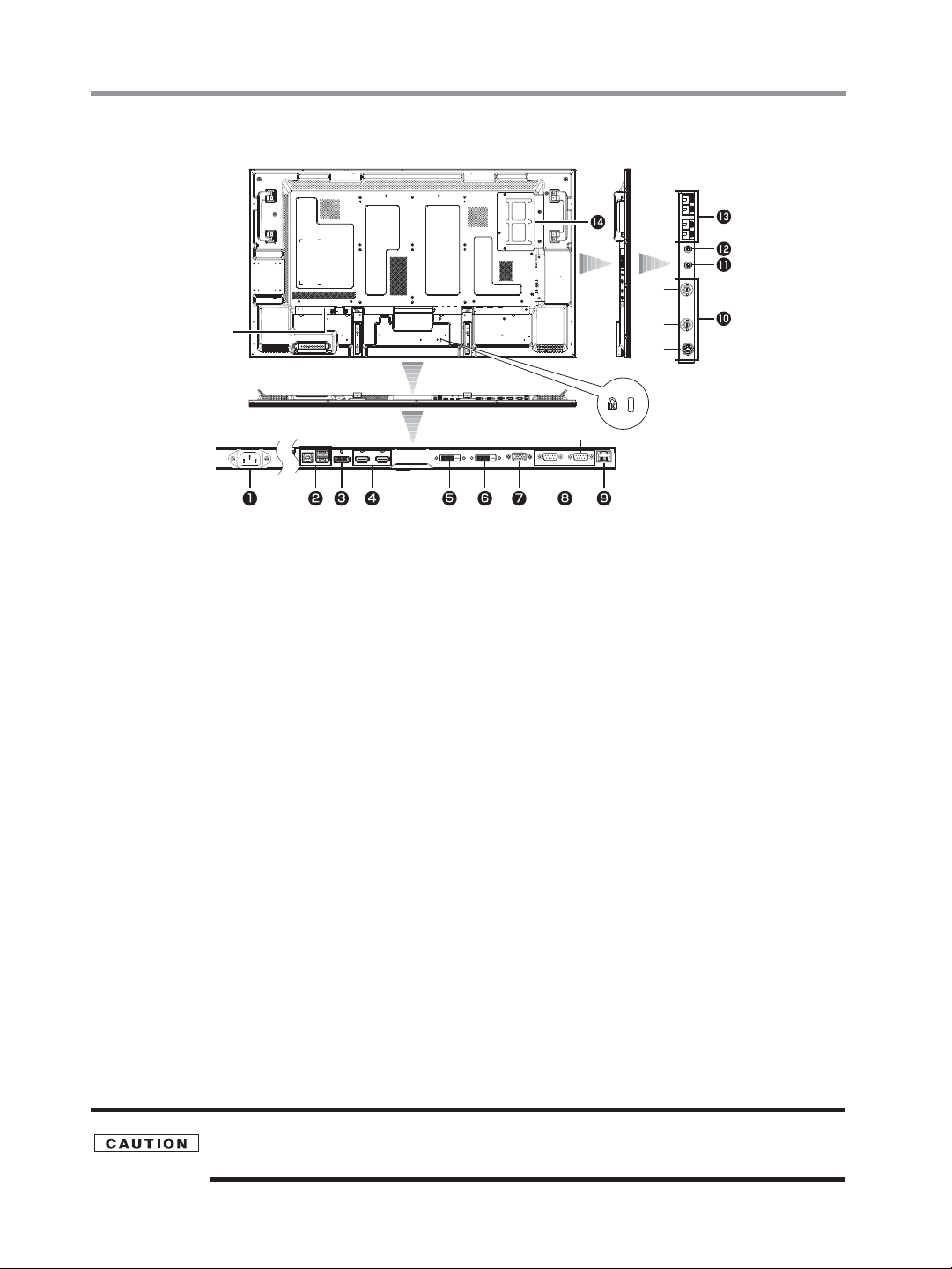
Connectors and Terminals
IN
IN
OUT
IN OUT
Main Power Switch
Rear Left side
1 AC IN (3-pin, with earth terminal)—Connects with the supplied power cord.
Class I Product requires an earthed mains supply connection.
2 USB hub—
USB upstream port (Standard B): 1
To be connected to an external computer.
USB downstream port (Standard A): 2
To be connected to peripheral devices such as digital camera and touch-panel.
3 DISPLAYPORT IN—Connects with the digital video output of a computer, etc.
4 HDMI1 IN, HDMI2 IN—Connects with the digital video output of a computer, DVD player, etc.
5 DVI-D IN—Connects with the digital video output of a computer, etc.
6 DVI-D OUT—Outputs the signal that is supplied to the DVI-D IN connector (5).
7 D-SUB/YPbPr IN—Connects with the analog video output of a computer or the component video output of a DVD
player, etc.
8 RS-232C connector (D-SUB 9-pin)—
IN connector:
Connects with the RS-232C OUT connector of a computer or other connected TD-Z551/TD-Z701.
OUT connector:
Connects with the RS-232C IN connector of other connected TD-Z551/TD-Z701.
9 LAN connector—Connects with a LAN cord.
10 VIDEO IN/OUT (S connector/BNC)—Connects with video equipment.
S-VIDEO IN: S-video input connector (MINI DIN 4-pin)
VIDEO IN: BNC connector
VIDEO OUT: BNC connector
11 AUDIO ANALOG IN—Connects with the audio output connector of external equipment such as a computer, VCR,
and DVD player.
12 AUDIO ANALOG OUT—Outputs the signal that is supplied to the AUDIO ANALOG IN connector (11). Connects
Headphones and earphones aren’t supported.
13 EXTERNAL SPEAKER TERMINAL—Connects with the special stereo speakers.
14 Option slot—Insert an expansion module (option or commercially available) in this slot.
Damage to the product may result or monitor may not function properly if an incompatible device is installed in this
slot. See page 28.
When mounting an OPS-compliant computer (commercially available), turn on the cooling fan.
You can insert an
anti-theft lock key.
Connectors and Terminals

13
Introduction
Wireless Remote Control
1 POWER button—Switches the power on/off.
When the Power indicator is not glowing, no controls
will work.
2 INPUT buttons—Select the input signal from
[HDMI1], [HDMI2], [DVI-D], [D-SUB],
[OPTION]*, [DISPLAYPORT], [YPbPr],
[S-VIDEO], and [VIDEO].
OPTION can be used when an expansion module is
mounted on the option slot.
3 PICTURE MODE button—Selects the picture
mode from [HIGHBRIGHT], [STANDARD],
[sRGB], and [CINEMA]. See page 39.
HIGHBRIGHT: The brightness is maximized.
STANDARD: Factory default setting.
sRGB: Suitable for color matching with
sRGBcompliant devices.
CINEMA: Suitable for viewing movies.
4 DISPLAY button—Displays the screen information.
See page 64. When the remote control mode is LOCK,
you can set it back to NORMAL by holding down the
DISPLAY button for at least 5 seconds (see page 61).
5 SET button—Accepts the settings made in the OSD
menu.
6 MINUS button (-)—Acts as (-) button to decrease the
When the PIP mode is active, this button moves the
sub picture to the left.
7 AUTO SETUP button—Displays the auto setup
menu. See pages 38 and 56.
8 AUDIO INPUT buttons—Selects the audio input
according to the video input.
This button works only while any of HDMI1,
HDMI2, OPTION (OPS-compliant computer), or
DISPLAYPORT video input is selected. See page 65.
9 PIP (Picture-In-Picture) buttons—
ON/OFF button: Switches the PIP or POP mode on/
off.
INPUT button: Selects video to be displayed in the
sub picture.
CHANGE button: Changes the main picture with the
sub picture.
[Description]
PIP: Picture-In-Picture
The sub picture is displayed within the main picture.
POP: Picture-Outside-Picture
The sub picture is displayed to the bottom right of the
main picture.
SBS: Side-By-Side
The main picture and the sub picture are displayed
side by side.
When the screen size is [CUSTOM] or [REAL], the
PIP and POP modes don’t work.
10 STILL button—
ON/OFF button: Switches the still picture mode on/
off.
CAPTURE button: Captures the new picture.
11 SIZE button—Selects the picture size from [FULL],
[NORMAL], [CUSTOM], [DYNAMIC], and
[REAL]. See page 63.
12 MENU button—Switches the OSD menu mode on/
off.
13 UP button (—Acts as () button to move the
OSD menu. When the PIP mode is active, this button
moves the sub picture up.
14 PLUS button (+)—Acts as (+) button to increase the
active, this button moves the sub picture to the right.
15 EXIT button—Displays the previous OSD menu.
16 DOWN button (—Acts as () button to move the
the OSD menu. When the PIP mode is active, this
button moves the sub picture down.
17 MUTE button—Switches the mute function on/off.
18 VOLUME buttons (VOL)—Pressing the plus (+)
side increases the audio output level. Pressing the
minus (-) side decreases the audio output level.
Wireless Remote Control
14
Introduction
How to Use the Wireless Remote Control
Operating Range of the Wireless Remote Control
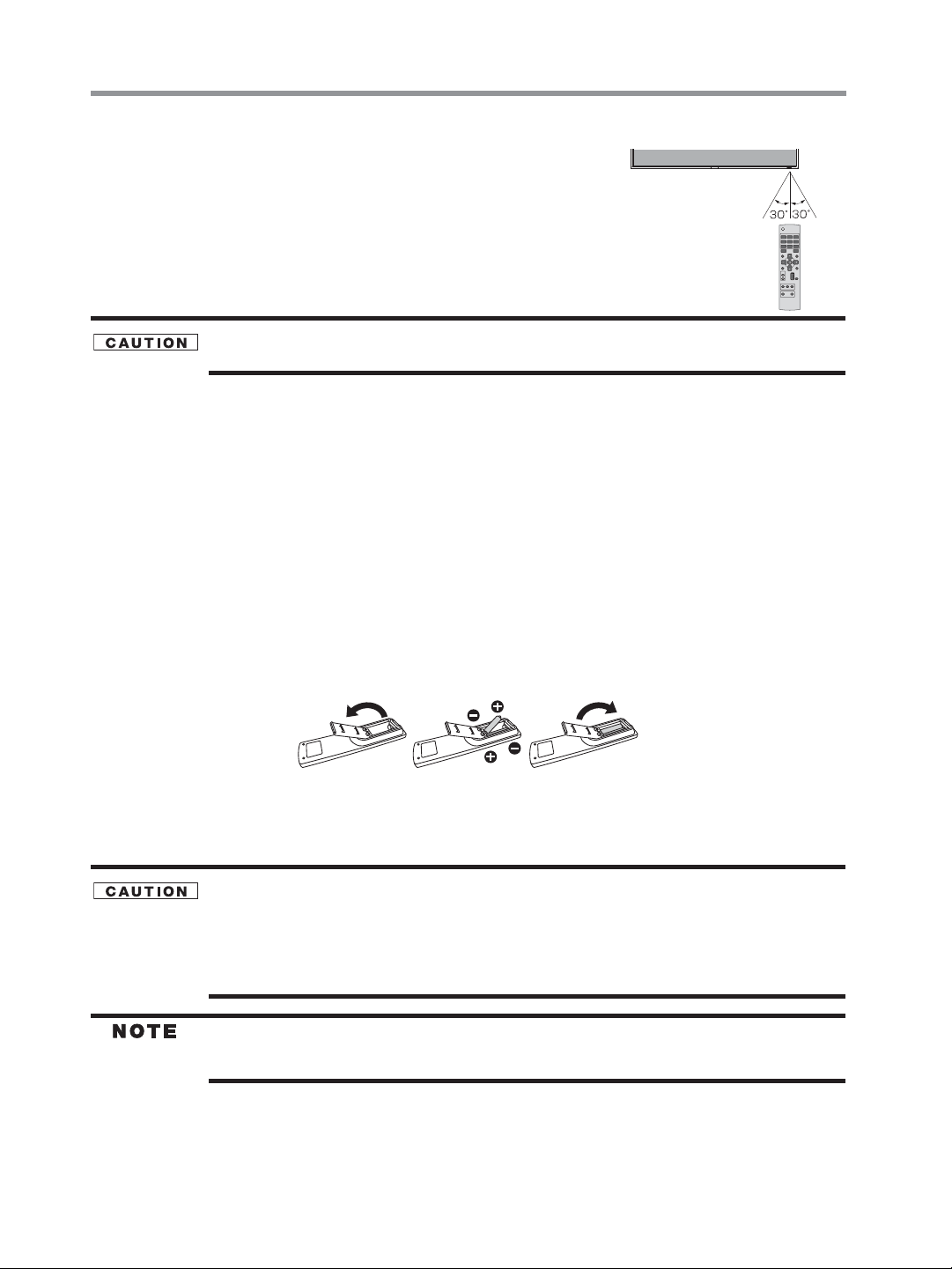
Point the wireless remote control toward the LCD display’s remote control sensor
during button operation.
Use the wireless remote control within a distance of about 7 m from the front of the
LCD display’s remote control sensor and at a horizontal and vertical angle of within
30° within a distance of about 3.5 m.
The remote control system may not function when direct sunlight or strong illumination strikes the remote control
sensor of the LCD display, or when there is an object in the path.
Handling the wireless remote control
*
* Do not allow water or other liquid to splash on the wireless remote control. If the wireless remote control gets wet, wipe it dry
immediately.
* Avoid exposure to heat and steam.
* Other than to install the batteries, do not open the wireless remote control.
Installing and removing the wireless remote control batteries
The wireless remote control is powered by 1.5 V AAA batteries.
How to install the batteries
1 Unlock and pull up the cover in the arrow’s direction.
2 Align the batteries according to the (+) and (-) indications inside the case.
3 Replace the cover.
How to remove the batteries
1 Unlock and pull up the cover in the arrow’s direction.
2 Remove the batteries.
Incorrect use of batteries can result in leaks or explosion.
Be careful especially about the following points.
s0LACEh!!!vBATTERIESMATCHINGTHEANDSIGNSONEACHBATTERYTOTHEANDSIGNSOFBATTERYCOMPARTMENT
s$ONOTMIXBATTERYTYPES
s$ONOTCOMBINENEWBATTERIESWITHUSEDONES)TCAUSESSHORTERBATTERYLIFEORLEAKAGEOFBATTERIES
s2EMOVEDEADBATTERIESIMMEDIATELYTOPREVENTBATTERYLIQUIDFROMLEAKINGINTOTHEBATTERYCOMPARTMENT
Don’t touch exposed battery acid because it causes damage to your skin.
s7HENTHEWIRELESSREMOTECONTROLDOESNTWORKATALLORITWORKSONLYWITHINASHORTDISTANCETOTHEMONITORCHANGE
both batteries with new ones.
s)FYOUDONOTUSETHEWIRELESSREMOTECONTROLFORALONGPERIODREMOVETHEBATTERIES
How to Use the Wireless Remote Control
15
Chapter 2
Preparation for use
Preparation for installation
Determine the installation location
DO NOT ATTEMPT TO INSTALL THE LCD DISPLAY BY YOURSELF.
)NSTALLINGYOUR,#$DISPLAYMUSTBEDONEBYAQUALIlEDTECHNICIAN#ONTACTYOURDEALERFORMOREINFORMATION
MOVING OR INSTALLING THE LCD DISPLAY MUST BE DONE BY TWO OR MORE PEOPLE.
Failure to follow this warning may result in injury if the LCD display falls.
Proper operation of the monitor is not guaranteed when it is mounted upside down or face down.
Lay the protective sheet, which was wrapped around the LCD display when it was packaged, beneath the LCD display
so as not to scratch the panel.
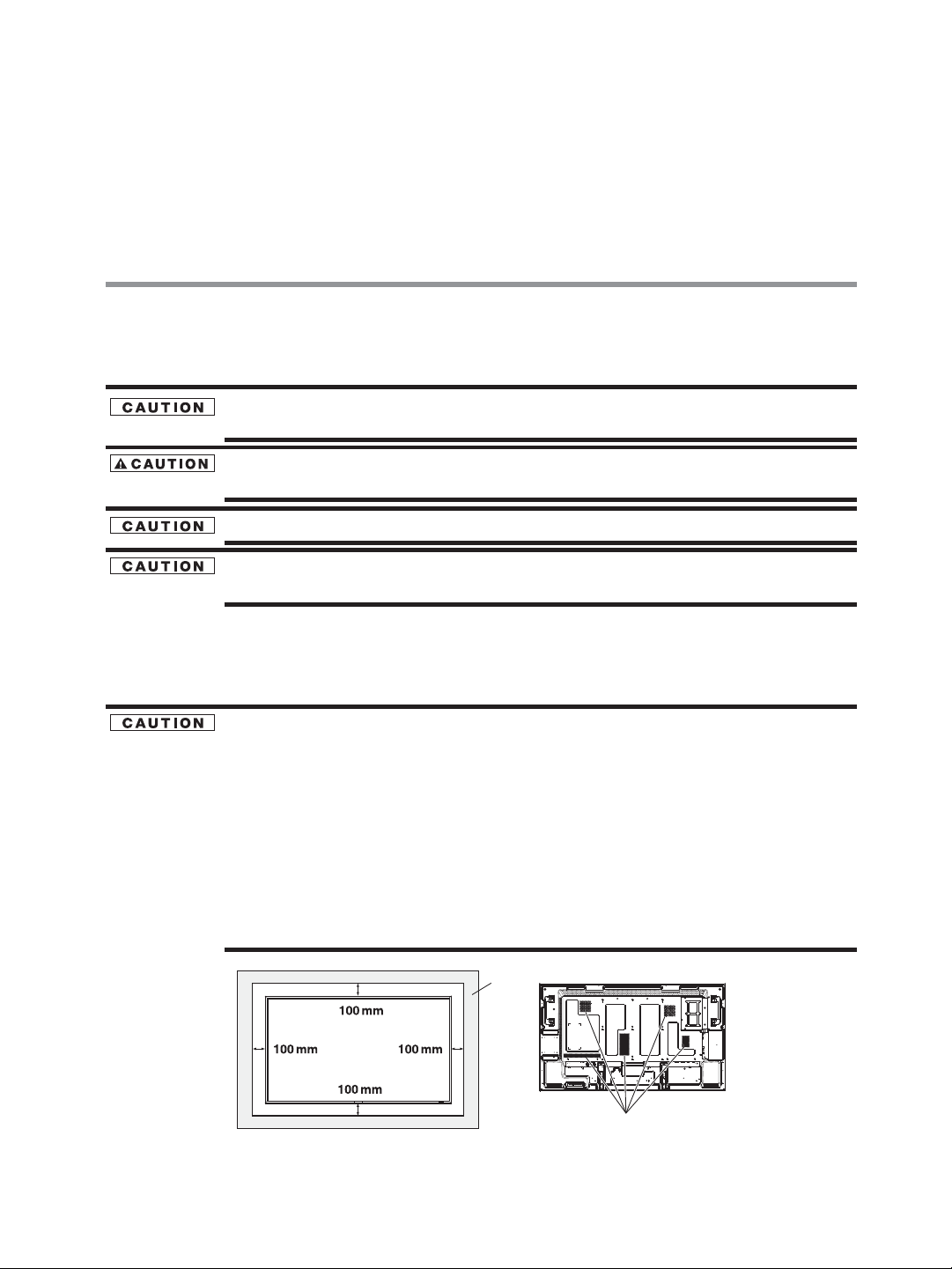
Ventilation requirements for enclosure mounting
Don’t block the holes in the rear of the monitor shown in the figure above. If they are blocked, heat accumulates inside
the monitor, causing breakdown. The upper limit of the operationguaranteed ambient temperature when the monitor is
INSTALLEDINTHELANDSCAPEPOSITIONISª#7HENINSTALLINGTHEMONITORINACASEORANENCLOSUREENSUREADEQUATE
ventilation to keep the temperature inside the case 40°C or lower by providing a cooling fan or ventilation holes in the
case. The upper limit when the monitor is in the portrait or face-up position is 35°C.
This LCD has a temperature sensor and cooling fan. If the LCD becomes hot, the cooling fan will turn on automatically.
)FTHE,#$BECOMESOVERHEATEDTHEh#AUTIONvMENUWILLAPPEAR)FTHEh#AUTIONvMENUAPPEARSSTOPUSINGTHE
monitor and allow it to cool. When the LCD display is used in an enclosure or with protection on LCD surface, please
CHECKTHEINSIDETEMPERATUREOFTHEMONITORBYh(%!434!453v3EEPAGE)FTHETEMPERATUREISHIGHERTHANTHE
NORMALLEVELSETh#//,).'&!.vTO/.USINGTHE3#2%%.3!6%2FUNCTION3EEPAGE7HENMOUNTINGAN
OPS-compliant computer (commercially available), turn on the cooling fan.
Don’t block these holes.
Wall
16
Preparation for use
Using the wall mount or ceiling mount
Lay the screen face down
Lay the protective sheet on a table, which was wrapped around the monitor when it was packaged, beneath the screen
surface so as not to scratch the screen surface.
This device cannot be used or installed without the Tabletop Stand or other mounting accessory. Failure to follow the
not cover damage caused by improper installation. Failure to follow these recommendations can void your warranty.
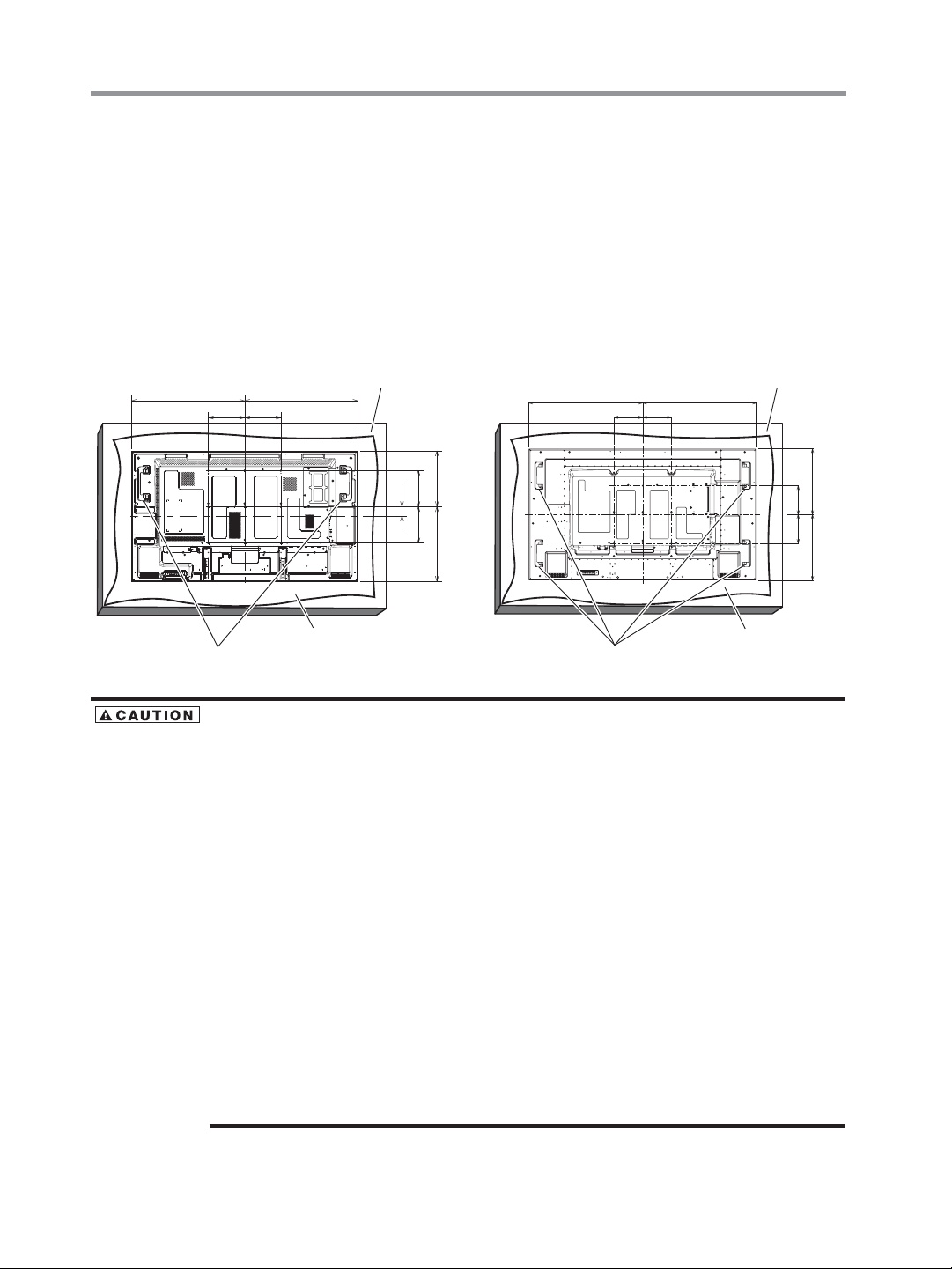
For installation, use
M6 screws (with a loose-proof spring washer and having a length 10 mm longer than the thickness of
the mounting bracket) and tighten them securely.
Toshiba recommends using a mounting interface that complies with VESA Requirements, TUV-GS or for North America
UL1678.
55” 70”
200 200
624 624
200200
307.5411.5
52
Handles
Protective Sheet
(mm)
Table
792.5 792.5
200 200
002002
457.5457.5
Handles
Protective Sheet
(mm)
Table
For preventing the monitor from falling:
s
Install the monitor with metal brackets for wall or ceiling installation (commercially available) on your own
responsibility. For detailed procedures of installation, refer to the instructions of the metal brackets.
s4OLESSENTHEPROBABILITYOFINJURYANDDAMAGERESULTINGFROMFALLOFTHEMONITORINCASEOFEARTHQUAKEOROTHER
disaster, be sure to consult the bracket manufacturer for installation location.
s4OLESSENTHERISKOFFALLINGOFTHEMONITORTHREADCOMMERCIALLYAVAILABLEROPETHROUGHTHEHANDLESATTHERIGHTAND
left of the monitor and secure the rope to the wall mount brackets or ceiling mount brackets. Use rope that can bear a
LOADTIMESTHEWEIGHTOFTHEMONITORvAPPROXIMATELYKGvAPPROXIMATELYKG
s$ONOTSLEEPWHERETHEMONITORMAYTOPPLEOVERORFALLINCASEOFANEARTHQUAKEOROTHERDISASTER
s5SESCREWSHAVINGENOUGHSTRENGTHTOSUPPORTTHE,#$DISPLAYMONITORMADEOFSTAINLESSSTEELETC
About the metal bracket:
s
Use a VESA-compliant metal bracket.
s
Before installation, make sure that the installation surface has sufficient strength.
s
Use a metal bracket (commercially available) that is strong enough to hold the monitor.
s
Before installation, check the strength and other properties to ensure the safety.
s
Do not block the heat dissipating holes in the monitor with the metal bracket. See page 15.
s
For details of the mounting procedure and the safe installation procedure, see the user instructions of the metal
bracket (commercially available) to be used.
s
Take measures such as using multiple metal brackets, holding the monitor at several points, and taking measures to
prevent falling or dropping in case of a problem.
Using the wall mount or ceiling mount
17
Preparation for use
Installing the monitor
Installing the monitor
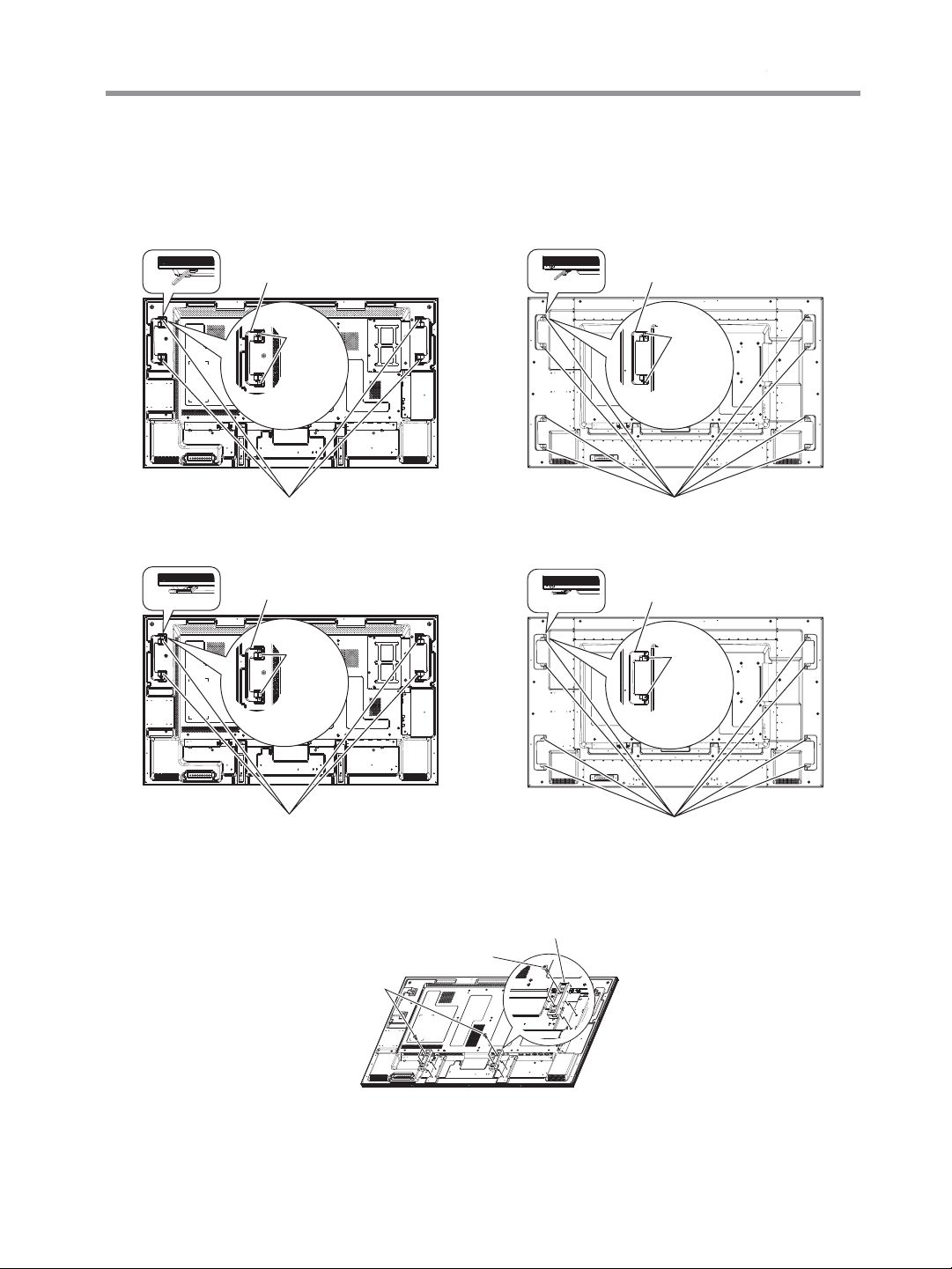
Preventing the handles from touching the wall
By attaching the handles in the opposite orientation, you can reduce the depth of the monitor.
1 Remove the screws that are holding the handles.
55” 70”
Handle
Screws
Screw x 4
Handle
Screws
Screw x 8
2 Attach the handles in the opposite orientation and secure them using the screws you have removed in step 1.
55” 70”
Handle
Screws
Screw x 4
Handle
Screws
Screw x 8
Removing the stand guide frames
By removing the stand guide frames, you can reduce the depth of the monitor.
1 Remove the screws that are holding the stand guide frames.
Stand guide frame
Screws
Screw x 4
2 Slightly move and remove the stand guide frames.
Retain the stand guide frames and the screws that you have removed because they are necessary to install the monitor using the
option stands.
Installing the monitor
18
Preparation for use
Installing the monitor
Using the wall mount spacers
When the option slot cover or the stand guide frames touch the wall or block the heat dissipating holes in the rear of the
monitor, use the wall mount spacers (accessories) to mount the metal bracket (commercially available).
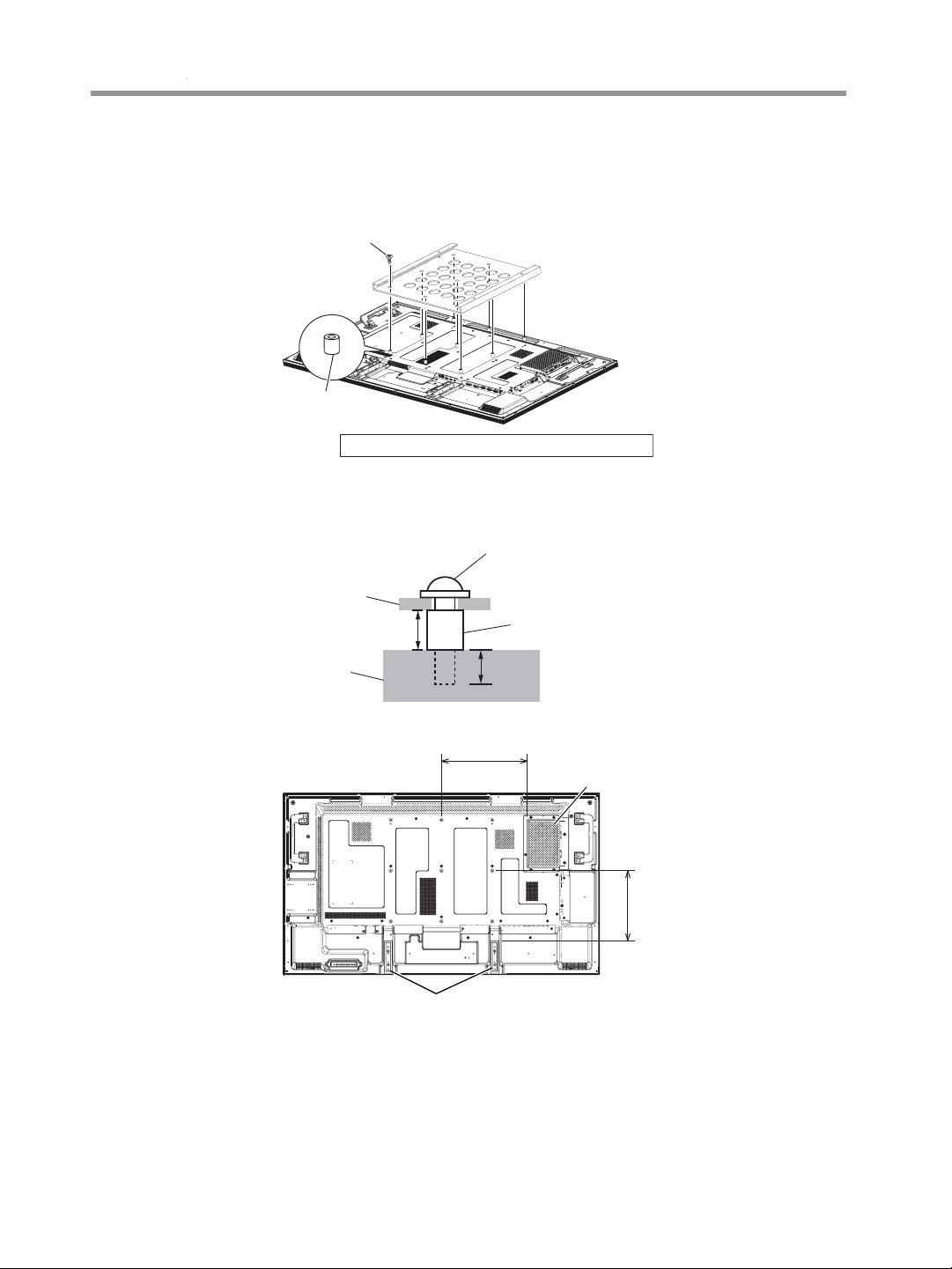
1 Put the wall mount spacers (9 pcs.) between the metal bracket and the wall mount screw holes of the monitor and
attach them using screws (a).
(a)
Wall mount spacer
(accessory)
(a): Screw for attaching the wall mount spacer (M6, 9 pcs.)
For mounting, use M6 screws (with a loose-proof spring washer, long enough to accommodate the thickness of the metal
bracket and that of the wall mount spacer (17 mm) and penetrate the monitor to a depth of 10 mm) and tighten them
securely.
10 mm
17 mm
339
276
Screw
Metal bracket
Wall mount spacer
(accessory)
Monitor
Stand guide frames
Option slot cover
(accessory)
Using the wall mount spacers
19
Preparation for use
Installing the monitor
Installing in the portrait or face-up position
The monitor can be installed in the portrait or face-up position.
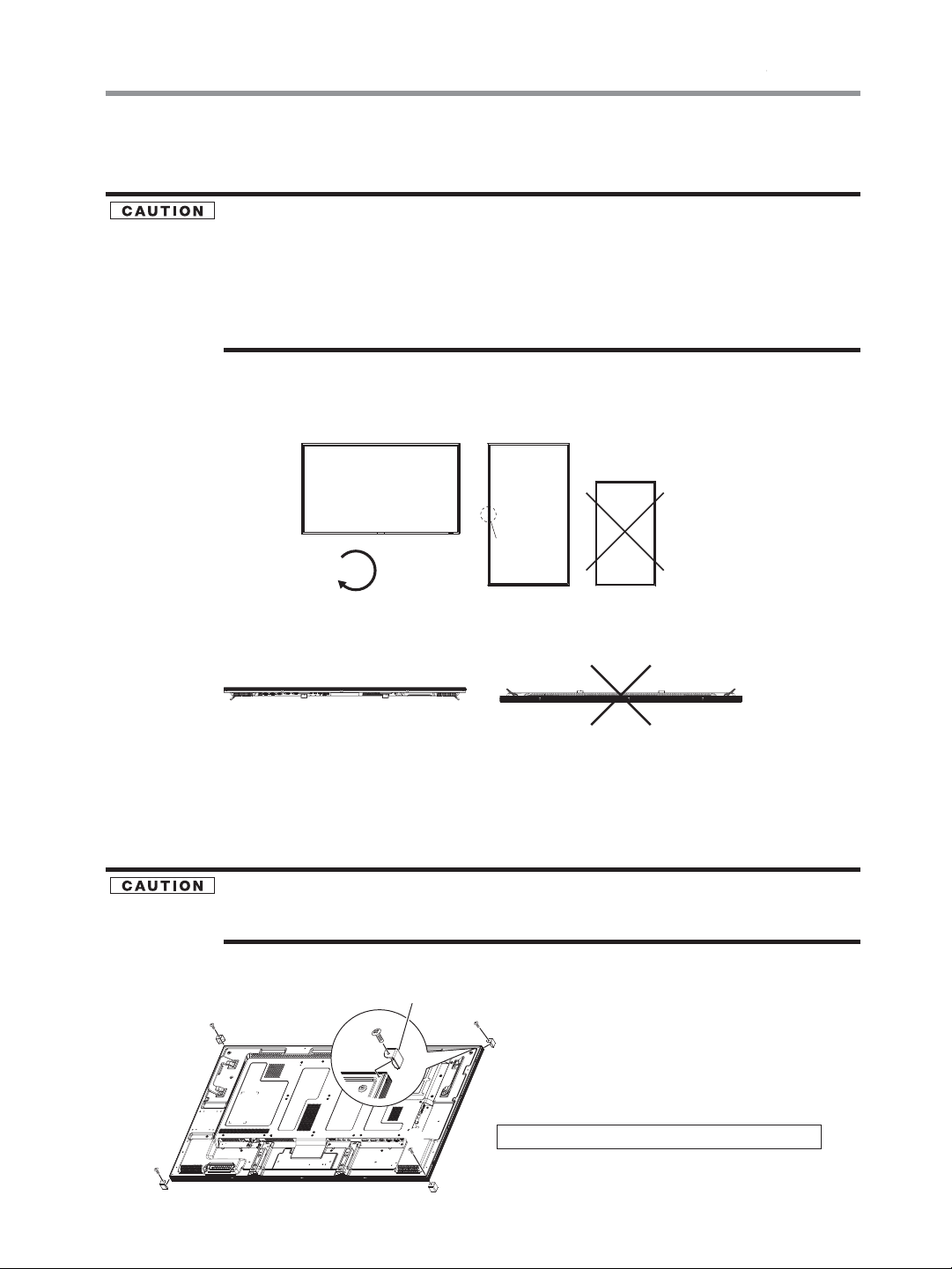
Ensure that the monitor is oriented as shown below.
sThe operating environmental condition (temperature) when the monitor is in the portrait or face-up position is 0°C to 35°C.
s0ROPEROPERATIONOFTHEMONITORISNOTGUARANTEEDWHENITISNOTMOUNTEDASSHOWNBELOWUPSIDEDOWNFACEDOWNETC
s7HENMOUNTINGAN/03COMPLIANTCOMPUTERCOMMERCIALLYAVAILABLEBESURETOSET#//,).'&!.TO/.USING
SCREEN SAVER in the CONFIGURATION1 menu of the OSD screen function. If it is set to AUTO, the life of the
computer may become shorter than that with it set to ON or the computer may have trouble.
s)NTHEPORTRAITORFACEUPPOSITIONTHELIFETIMEOFTHEBACKLIGHTISSHORTERTHANTHATINTHELANDSCAPEPOSITION
s7HENTHEMONITORISINTHEFACEUPPOSITIONBESURETOSET#//,).'&!.TO/.USING3#2%%.3!6%2INTHE
CONFIGURATION1 menu of the OSD screen function.
Installation in the portrait position
The logo should be on the LEFT side when viewed from the front of the monitor.
This monitor doesn’t have a function to rotate displayed images. To display images in the portrait orientation, use already rotated images.
90° Clockwise
Portrait
Portrait
logo
Landscape
Installation in the face-up position (55” Only)
Face-up Face-down
Operation environment for portrait or face-up installation
Temperature 0 - 35°C / 32 - 95°F Humidity 20 - 80% (without condensation)
Attaching the corner protectors
It is recommended to use the corner protectors (accessories). When installing the monitor, hold its body firmly. If you
hold the monitor by the corner protectors when moving it, the monitor may detaches and fall from the corner
protectors, causing injuries.
1 Attach the corner protectors using the accessory screws (c)
(c)
(c)
(c)
(c)
(c)
(c): Screw for attaching the corner protector (M3, 4 pcs.)
Corner protector
Installing in the portrait or face-up position
20
Preparation for use
Using the monitor without the bezel
Using the monitor without the bezel
s4$:AND4$:SATISlESTHE5,REQUIREMENTSASLONGASITISUSEDWITHTHEBEZELATTACHED7HENUSINGTHE
MONITORWITHOUTTHEBEZELINWHICHCASETHEMONITORDOESNTSATISFYTHE5,REQUIREMENTSCOVERTHE5,CERTIlCATION
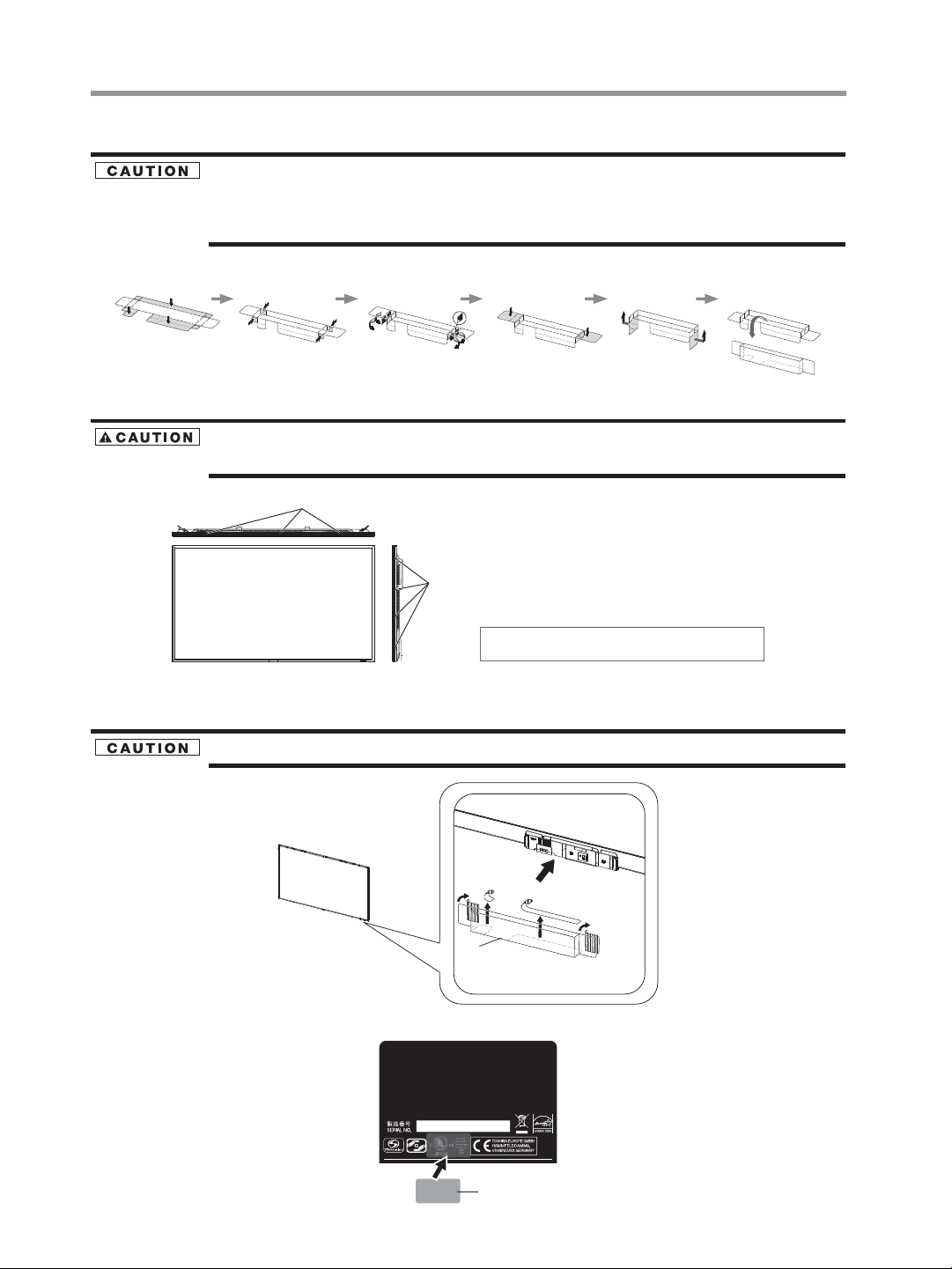
marking on the rear panel with the supplied label.
sTo prevent static damage to circuit boards, attach the protective cover to the LCD panel.
1 Assemble the supplied protective cover according to the following procedure.
Peel off the separators.
2 Unscrew the screws (a) that hold the bezel to remove the bezel from the monitor.
If you remove other screws than the screws (a), the bezel falls apart. If you do so, the bezel may fall, causing injury or
damaging the monitor.
(a)
(a)
(a): Screws for securing the bezel (M3, 14 pcs.) for 55”
(M3, 18 pcs.) for 70”
3 Peel off the separators from the protective cover (b) assembled in step 1 and then attach the protective cover to the
LCD panel.
Never touch the circuit boards because they may be damaged.
()
Peel off the separators.
4
()
Using the monitor without the bezel
21
Preparation for use
Installing the monitor
Installing the external speakers
How to install the external speakers
1 Install the external speakers on the monitor. Recommend spec- impedance 8 ohm, audio output 10W+10W (stereo)
( See page 71.)
Please refer to Quick Setup Guide of the external speakers for the detailed installation procedure.
2 Insert the left speaker cable into the SPEAKER (S)(L) on the monitor, and insert the right speaker cable into the SPEAKER
(S)(R).
-ATCHTHEPOLARITYOFTHESPEAKERCABLESANDTHATOFTHETERMINALSREDBLACK
Unmatched polarity may cause problems with audio output.
Left speaker
(Only for reference)
Right speaker
(Only for reference)
To speaker terminal (L)
To speaker terminal (R)
SPEAKER (S)(L)
SPEAKER (S)(R)
Black(-)
Red(+)
Black(-)
Red(+)
(Sample Illustration) 55”
Switch the built-in speaker mode to external speaker mode after you power on the monitor. See the page for “Speaker
setting” for further details. (See page 40.)
Don’t hold the speakers when moving the monitor.
The monitor and the speakers may be damaged and you may be injured if the monitor falls.
Installing the external speakers
22
Preparation for use
Connection procedure
Connection procedure
Before making connections:
First turn off the power of all the connected equipment before making connections.
Refer to the user manual of each piece of equipment.
Please use the audio cable without resistance when the audio output terminal of the audio device and PC is stereo
mini-Jack. When the audio cable with resistance is used, the audio level may be affected or no sound could be heard.
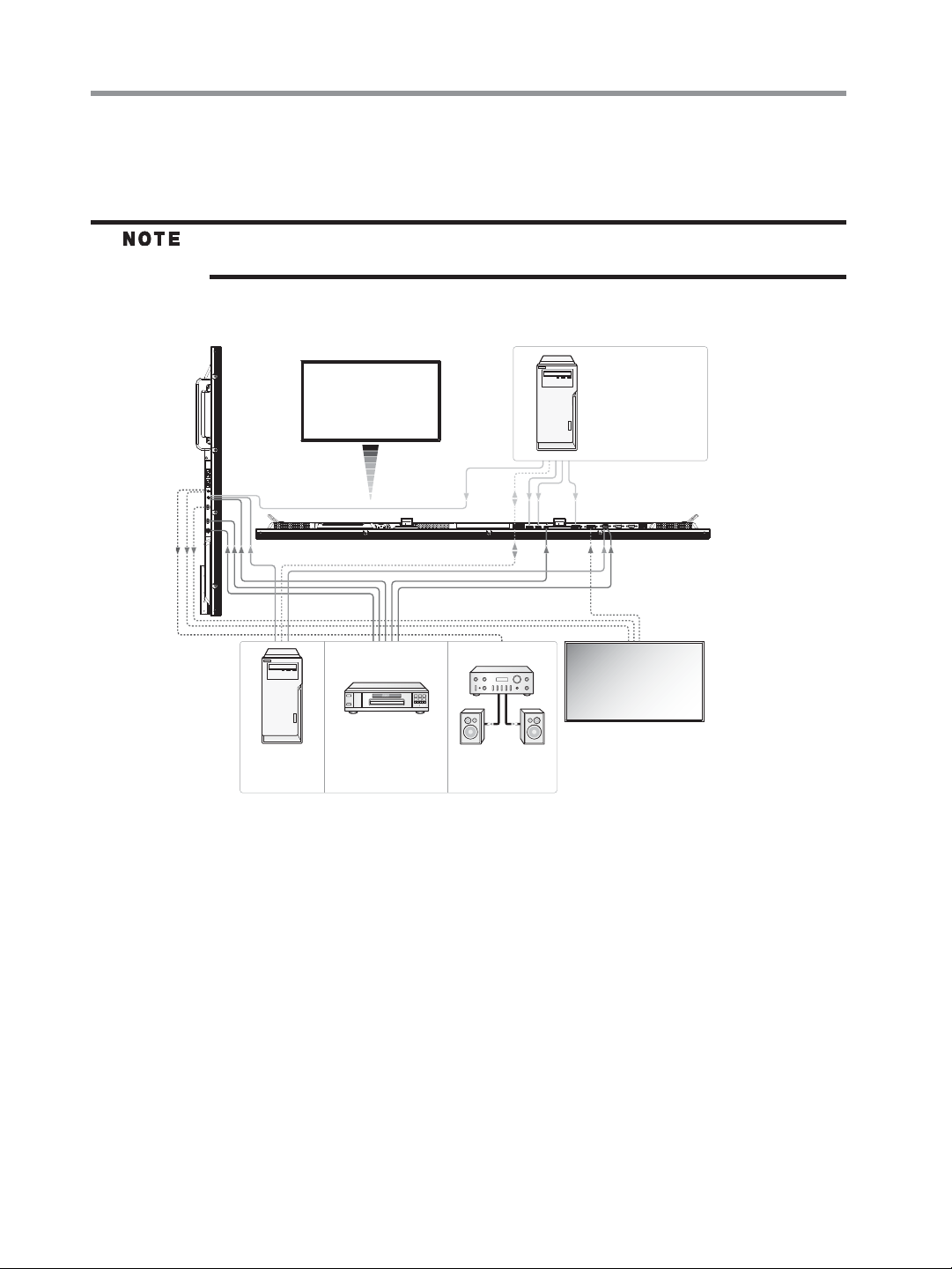
Wiring diagram
Personal computer
(DVI-D, HDMI, DISPLAYPORT)
Personal computer
(Analog RGB)
LCD display (second display)
DVD player or HD disk
player (HDMI, BNC)
Stereo amplifi er
External speakers
LCD display
(fi rst display)
LCD display(front)
(Sample Illustration) 55”
Connection procedure

23
Preparation for use
Connection procedure
Prevention of disconnection of HDMI cable
For connecting an HDMI cable to the connector on the monitor, it is recommended to secure the cable using an accessory
clamper to prevent accidental disconnection.
1 Connect an HDMI cable to the connector on the monitor.
2 Secure the HDMI cable using a clamper (accessory) and a band (accessory).
1) Remove the screw from the monitor.
2) Attach the clamper to the monitor using the screw you have removed in step .
3) Secure the HDMI cable and the clamper using the band.
The band isn’t reusable. The monitor comes with 2 spare bands.
To replace the band, cut and remove the existing band and attach a new one of the same shape (commercially available,
2.5 mm in width and approximately 100 mm in length).
Screw
HDMI cable
Clamper (accessory)
Band (accessory)
3. Secure the HDMI cable using a clamper (accessory) and a band (accessory).
Clamper (accessory)
Prevention of disconnection of HDMI cable
24
Preparation for use
Connection procedure
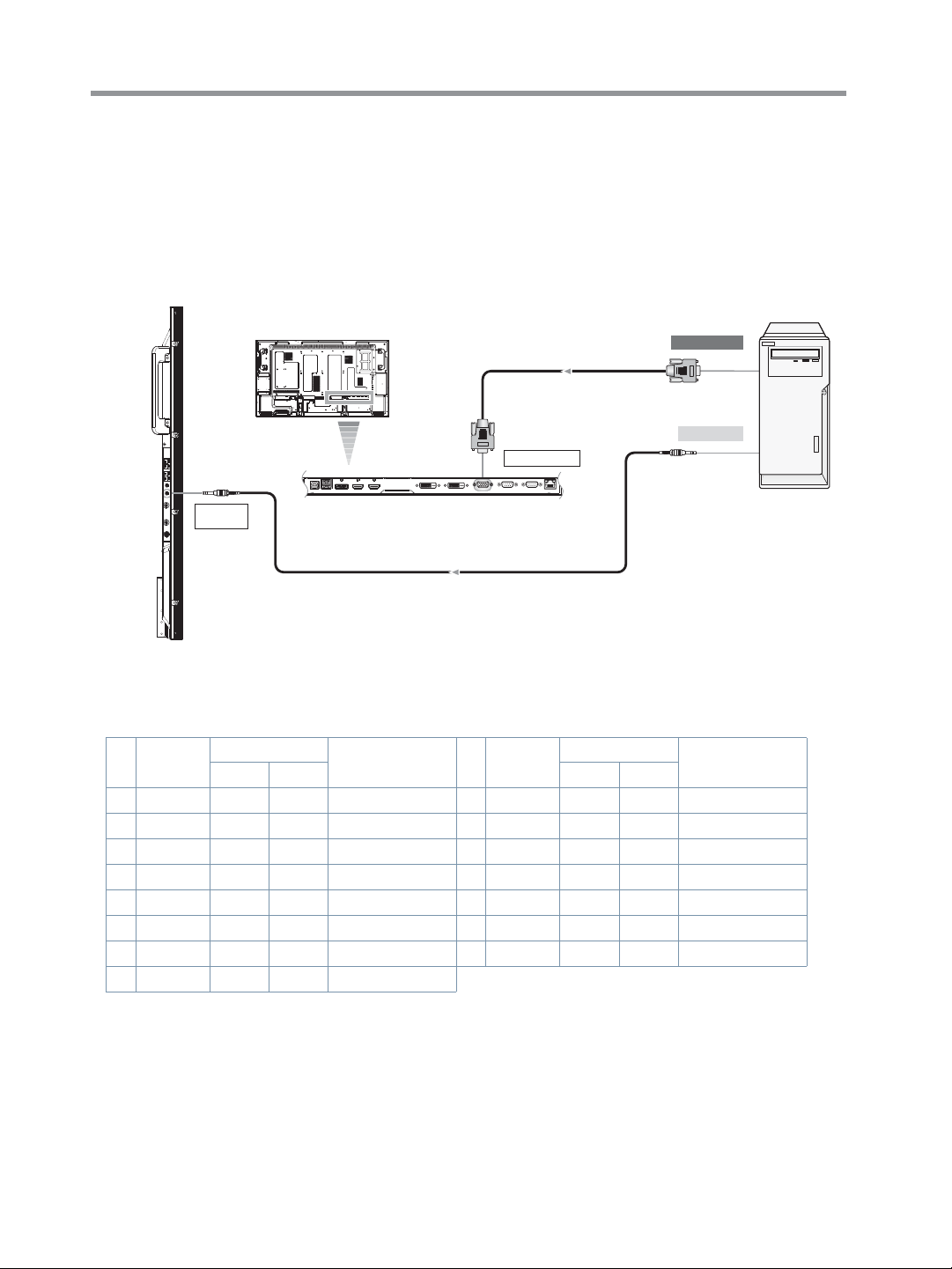
Connecting with a computer (analog connection)
Analog connection:
1) Connect a signal cable (mini D-SUB 15-pin – mini D-SUB 15-pin) (accessory) to the D-SUB/YPbPr IN connector.
2) Select [D-SUB] using the INPUT button on the monitor or the D-SUB button on the wireless remote control. At the
moment of the selection, the audio is automatically switched to [ANALOG].
Audio connection:
Connect an audio cable (ø3.5-mm stereo mini) (commercially available) to the AUDIO ANALOG IN connector. Because the
Signal cable
(mini D-SUB 15-pin – mini D-SUB 15-pin)
To audio output
D-SUB/YPbPr IN
AUDIO
ANALOG IN
Audio cable
(ø3.5-mm stereo mini)
To D-SUB output
LCD display (rear)
LCD display
(side)
Personal computer
(Analog RGB)
The monitor automatically distinguishes the timings shown in the table below and sets the screen information. When a PC
or other device is connected, it automatically displays images properly. See the page describing AUTO SETUP/AUTO
ADJUST.
<Factory preset timing>
Resolution
&REQUENCY
Remarks Resolution
&REQUENCY
Remarks
Horizontal Vertical Horizontal Vertical
1 640 x 480 31.5 kHz 60 Hz 9 1280 x 1024 64.0 kHz 60 Hz
2 800 x 600 37.9 kHz 60 Hz 10 1400 x 1050 65.3 kHz 60 Hz
3 1024 x 768 48.4 kHz 60 Hz 11 1680 x 1050 64.7 kHz 60 Hz
4 1280 x 720 45.0 kHz 60 Hz 12 1600 x 1200 75.0 kHz 60 Hz
5 1280 x 768 47.8 kHz 60 Hz 13 1920 x 1080 56.2 kHz 50 Hz
6 1280 x 800 49.7 kHz 60 Hz 14 1920 x 1080 67.5 kHz 60 Hz Recommend timing
7 1360 x 768 47.7 kHz 60 Hz 15 1920 x 1200 74.0 kHz 60 Hz CVT Reduced Blanking
8 1440 x 900 55.9 kHz 60 Hz
Images may not be displayed correctly depending on the video card or driver being used.
Connecting with a computer (analog connection)
25
Preparation for use
Connection procedure
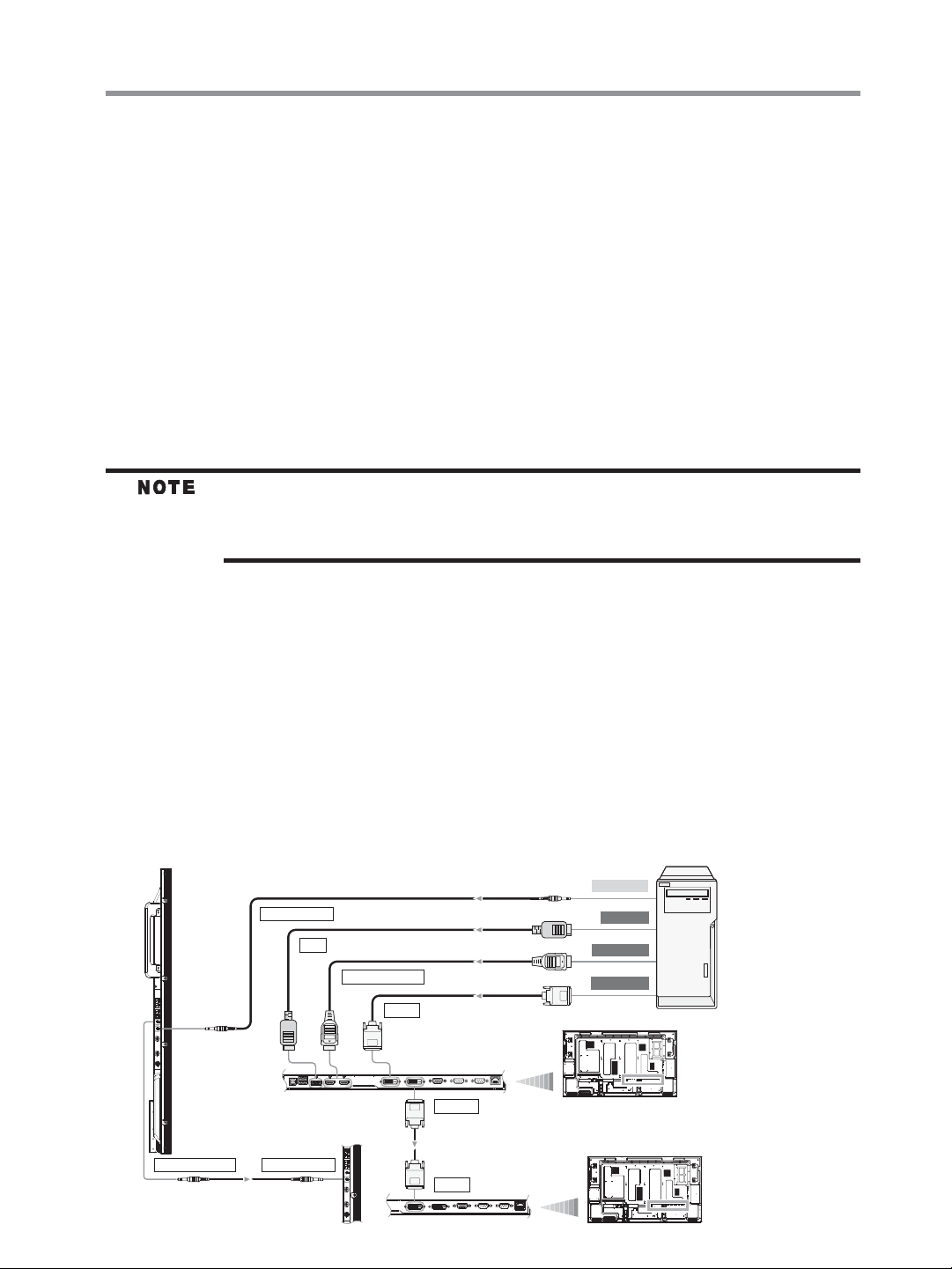
Connecting with a computer (digital connection)
Digital connection:
(1) Connect an HDMI cable (commercially available) to the HDMI1 IN or HDMI2 IN connector.
(2) Select [HDMI1] or [HDMI2] according to the connected connector by pressing the INPUT button on the monitor or
the HDMI1 or HDMI2 button on the wireless remote control.
(1) Connect a DVI-D cable (commercially available) to the DVI-D IN connector.
(2) Select [DVI-D] using the INPUT button on the monitor or the DVI-D button on the wireless remote control.
(1) Connect a DisplayPort cable (commercially available) to the DISPLAYPORT IN connector.
(2) Select [DISPLAYPORT] using the INPUT button on the monitor or the DISPLAYPORT button on the wireless
remote control.
Second monitor connection:
(commercially available).
s In the daisy chain connection, you can connect up to 4 monitors (when using 2-meter cables). However, the maximum
number of connectable monitors may be limited. It is recommended to check the number of connectable monitors in
advance in your installation environment.
sSet RGB of POWER SAVE in the CONFIGURATION1 menu to OFF when using DVI-D in the daisy chain mode.
Audio connection:
Connect an audio cable (ø3.5-mm stereo mini) (commercially available) to the AUDIO ANALOG IN connector. When
connecting an HDMI cable, select [HDMI1] or [HDMI2] according to the connected connector by pressing the INPUT button on
the monitor or the HDMI1 or HDMI2 button on the wireless remote control. Note that you can select HDMI1, HDMI2, or
ANALOG audio at this time. (You can select HDMI audio only when the video input is [HDMI1] or [HDMI2]. The audio of only
the selected input is output and HDMI is displayed.) When connecting a DVI-D cable, select [DVI-D] using the INPUT button on
the monitor or the DVI-D button on the wireless remote control. At the moment of the selection, the audio is automatically
switched to [ANALOG]. When connecting a DisplayPort cable, select [DISPLAYPORT] using the INPUT button on
the monitor or the DISPLAYPORT button on the wireless remote control. Note that you can select DISPLAYPORT or
ANALOG audio at this time.
AUDIO ANALOG IN connector on the second monitor using an audio cable (ø3.5-mm stereo mini) (commercially
AUDIO ANALOG OUT connector.
For switching the audio input when an HDMI cable or a DisplayPort cable is connected, see “Audio input change.”
DVI-D IN
HDMI1 IN or HDMI2 IN
DP IN
AUDIO ANALOG IN
HDMI cable
DisplayPort cable
DVI-D cable
DVI-D cable
To DVI-D output
To HDMI output
To DP output
To audio output
Audio cable
(ø3.5-mm stereo mini)
DVI-D IN
DVI-D OUT
Audio cable
(ø3.5-mm stereo mini)
AUDIO ANALOG OUT
AUDIO ANALOG IN
Personal computer
(DVI-D, HDMI)
LCD display (second display)
LCD display (first display)
LCD display
(fi rst display)
LCD display
(second display)
Connecting with a computer (digital connection)
26
Preparation for use
Connection procedure
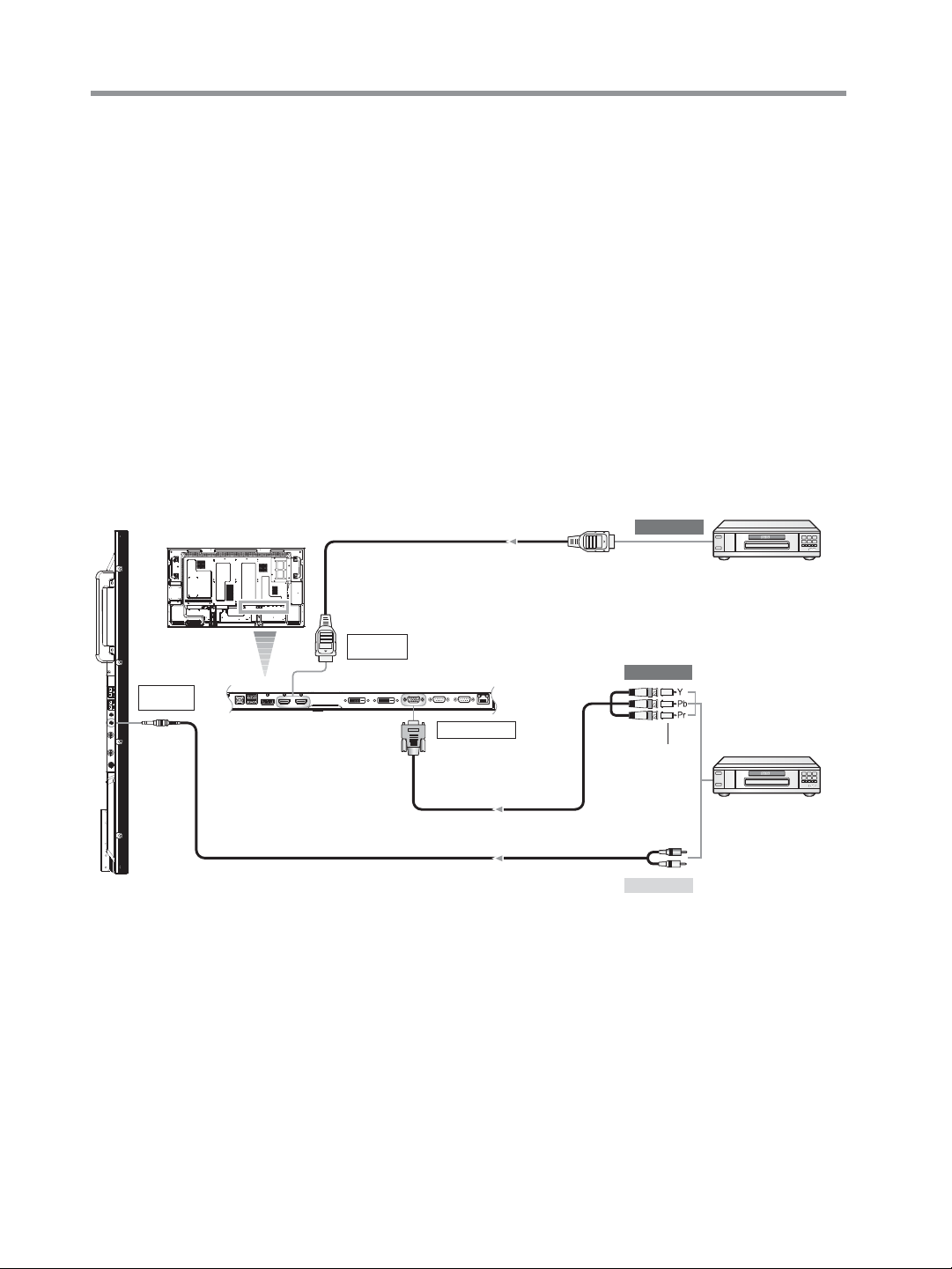
Connecting a video device (component video/HDMI device)
This monitor can be connected to a video device equipped with component output such as a DVD player.
available.)
To connect a DVD player equipped with component output to the D-SUB/YPbPr IN connector on the monitor, use a signal cable
(mini D-SUB 15-pin – BNC) and a BNC – RCA adaptor (commercially available).
Select [YPbPr] using the INPUT button on the monitor or the YPbPr button on the wireless remote control. At the moment of the
selection, the audio is automatically switched to [ANALOG].
To make audio connection, connect an audio cable (ø3.5-mm stereo mini – RCA) to the AUDIO ANALOG IN connector.
cable.
To connect a DVD player equipped with HDMI output to the HDMI1 IN or HDMI2 IN connector on the monitor, use an HDMI
cable.
Select [HDMI1] or [HDMI2] according to the connected connector by pressing the INPUT button on the monitor or the HDMI1
or HDMI2 button on the wireless remote control.
When connecting an HDMI cable, you can select HDMI1, HDMI2, or ANALOG audio. (You can select HDMI audio only when
the video input is [HDMI1] or [HDMI2].)
HDMI cable
HDMI1 IN or
HDMI2 IN
To video output
To HDMI output
To audio output
Signal cable (mini D-SUB 15-pin – BNC)
Audio cable
(ø3.5-mm stereo mini – RCA)
BNC – RCA adaptor
AUDIO
ANALOG IN
D-SUB/YPbPr IN
DVD player
(component device)
LCD display (rear)
DVD player
(HDMI device)
LCD display
(side)
(Sample Illustration) 55”
Connecting a video device (component video/HDMI device)
27
Preparation for use
Connection procedure
Connecting a video device (composite video/ S video device)/stereo amplifier
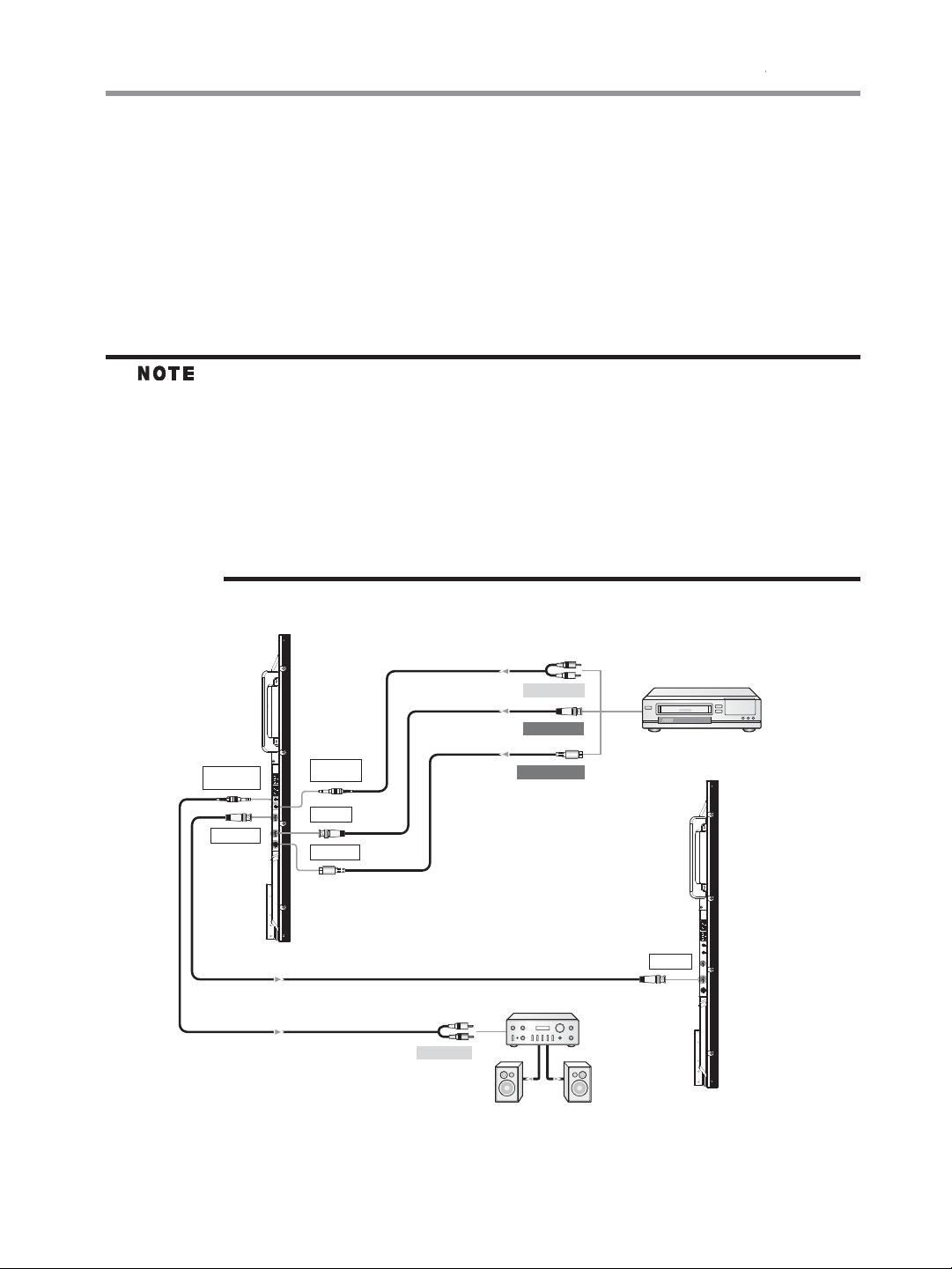
below are
commercially available.)
To connect a video device to the VIDEO IN connector (VIDEO IN or S-VIDEO IN) on the monitor, use a BNC cable or an S
video cable. For connection to the audio input connector on the monitor, use an audio cable (ø3.5-mm stereo mini – RCA).
Connect the connectors of the audio cable (RCA) correctly. For connection to the VIDEO IN connector, select [VIDEO] using the
INPUT button on the monitor or the VIDEO button on the wireless remote control. For connection to the S-VIDEO IN connector,
select [S-VIDEO] using the INPUT button on the monitor or the S-VIDEO button on the wireless remote control.
the VIDEO IN connector of the second monitor.
sIn the daisy chain connection, you can connect up to 5 monitors (when using 5-meter cables). However, the maximum
number of connectable monitors may be limited depending on the connected devices to be used. It is recommended to
check the number of connectable monitors in advance in your installation environment.
s7HENANANALOGSIGNALISTRANSMITTEDTHROUGHTHEDAISYCHAINTHEPICTUREQUALITYSUCHASBRIGHTNESSANDSHARPNESS
degrades at the latter devices in the daisy chain connection.
sWhen different monitors need to be adjusted so that their tint can be identical, such as when using multiple screens, it is
recommended to use a signal distributor (commercially available).
sWhen connecting a stereo amplifier to the monitor, be sure to turn off the power of the stereo amplifier. For connection to
the AUDIO ANALOG OUT connector on the monitor, use an audio cable (ø3.5-mm stereo mini – RCA). Connect the
connectors of the audio cable (RCA) correctly. Be sure to turn on the monitor first, and then turn on the stereo amplifier.
sThe selected audio input signal is output from the AUDIO ANALOG OUT connector.
BNC cable
S-VIDEO IN
AUDIO
ANALOG IN
AUDIO
ANALOG OUT
VIDEO IN
VIDEO IN
VIDEO OUT
To S video output
To video output
To audio output
To audio input
Audio cable
(ø3.5-mm stereo mini – RCA)
Audio cable (ø3.5-mm stereo mini – RCA)
BNC cable
S video cable
LCD display (second display)
LCD display (rst display)
Stereo amplifi er
External speakers
Video device
(composite video/S video device)
(Sample Illustration) 55”
28
Preparation for use
Installing the expansion module
Installing the expansion module
Installation of the expansion module
Install the expansion module to the option slot of this monitor following the precautions and procedures described in the
manual supplied with the module.
Examples of supported expansion modules:
OPS-compliant computer (commercially available)
Recommended computer (commercially available): ARK-DS220
sPlease contact module manufacturer for any compatibility issues.
[Description]
the pluggable module mounted on monitors designed for digital signage applications and the monitors.
Supported OPS features:
When an expansion module is in the option slot, the monitor doesn’t enter the sleep mode even when POWER SAVE in
the CONFIGURATION1 menu is set to ON. Even when other video input is selected, the monitor doesn’t enter the sleep
mode. See pages 35 and 56.
Connecting OPS-compliant computer
Operation of all types of OPS-compliant computers isn’t guaranteed.
Recommended computer (commercially available):
ARK-DS220
7HENAN/03COMPLIANTCOMPUTERCOMMERCIALLYAVAILABLEISMOUNTEDSETh#//,).'&!.vTO/.USINGTHE
SCREEN SAVER function. See page 56.
Mounting the OPS-compliant computer on the monitor (for 55”)
1 Turn off the main power switch of the monitor and disconnect the power cord.
Be sure to disconnect the power cord to prevent breakdown and electric shock.
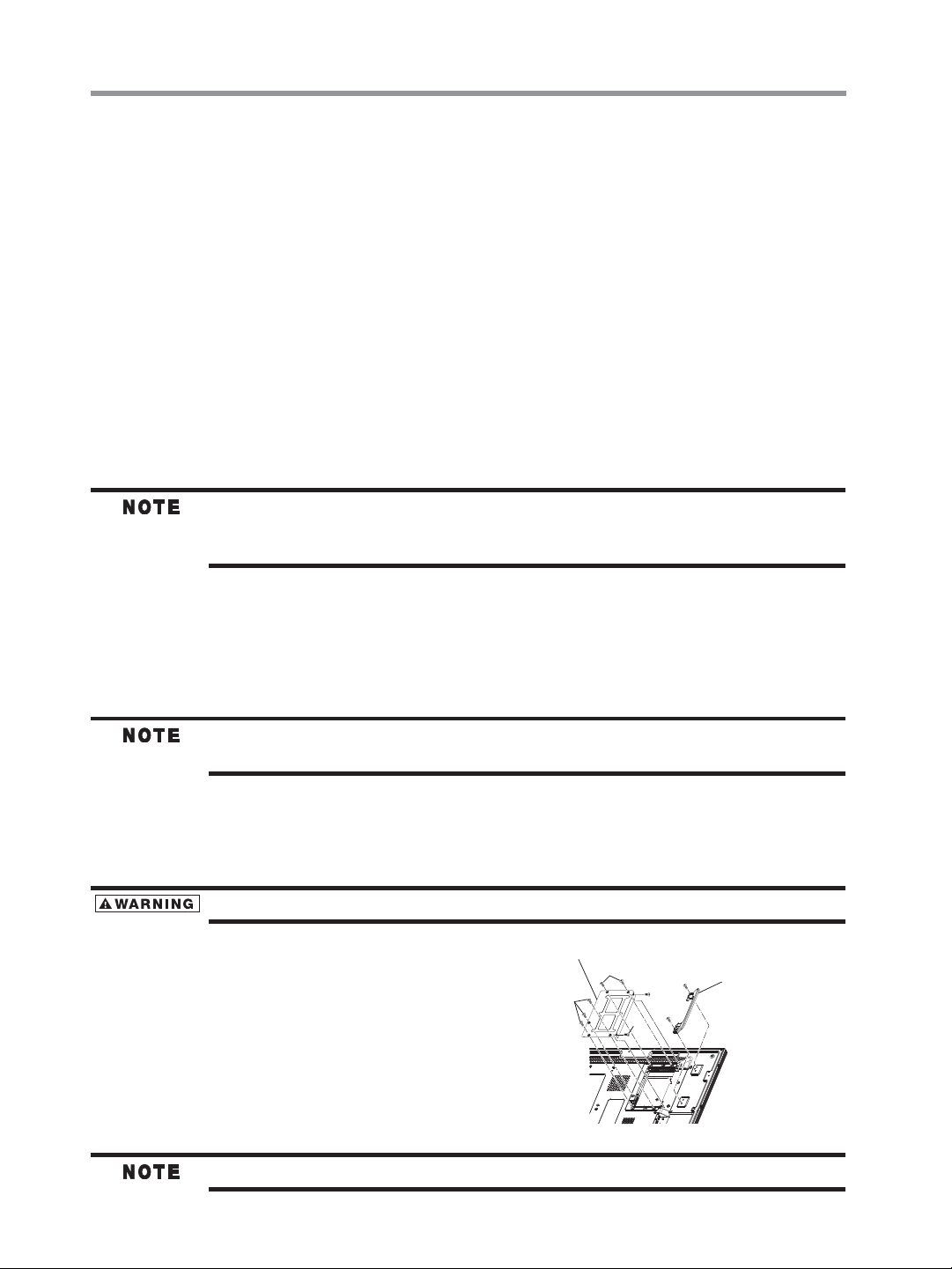
2 Unscrew 2 screws (a) and remove the handle.
Unscrew 7 screws (b) and remove the option cover.
(b)
(b)
(b)
(b)
(a)
(a)
Option cover
Handle
Retain the option cover you have removed because it is replaced when the OPS-compliant computer isn’t mounted.
Installing the expansion module
29
Preparation for use
Installing the expansion module
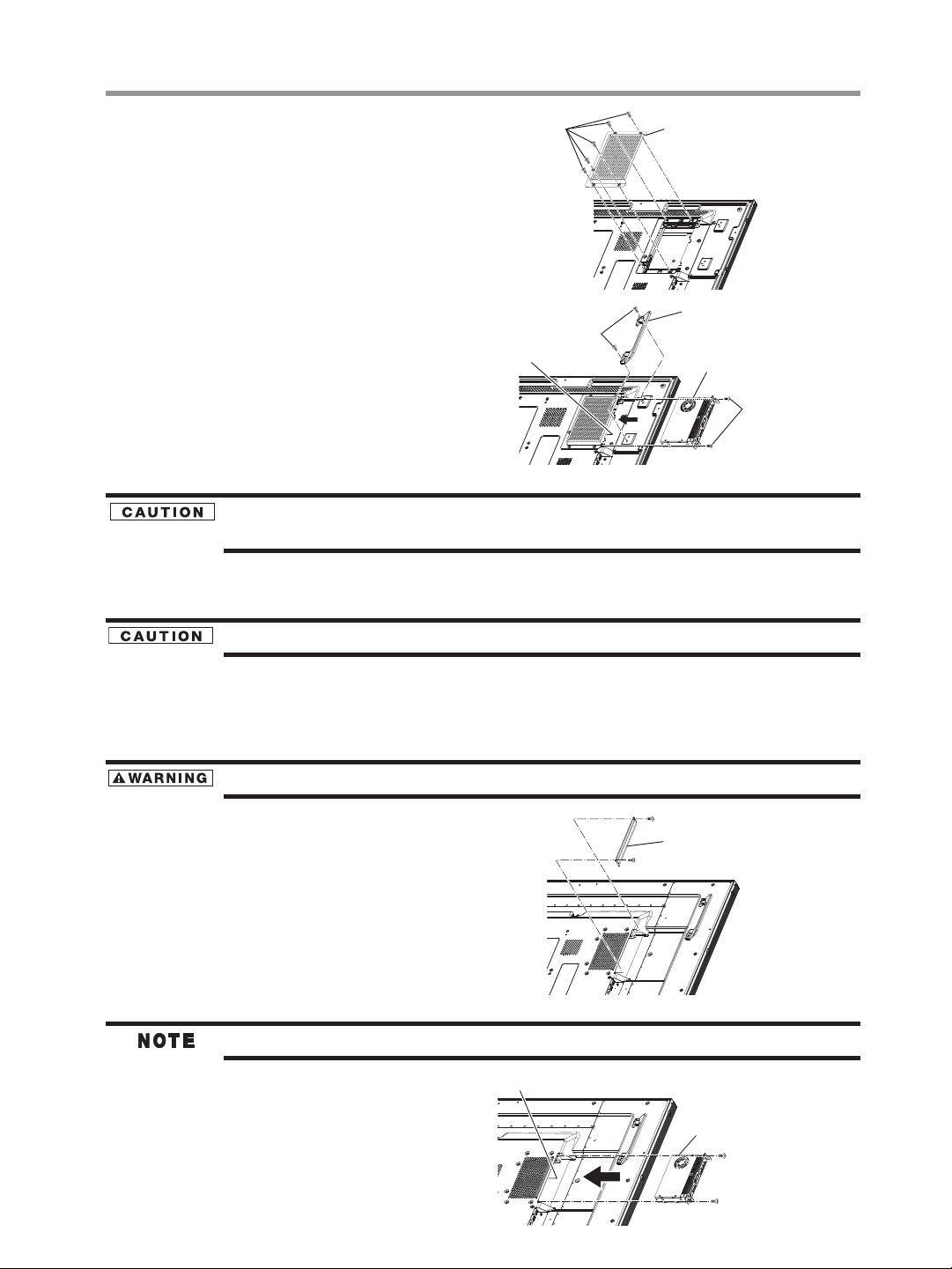
3 Install the option slot cover (accessory) using the 5
screws (b) that you have removed in step 2.
(b)
Option slot cover
(accessory)
4 Insert an OPS-compliant computer (commercially
available) in the option slot and secure it on the monitor
using the 2 screws (b) that you have removed in step 2.
Attach the handle using the 2 screws (a) that you have
removed in step 2.
(a)
(b)
OPS-compliant computer
(commercially available)
Handle
Option slot
After installing the option slot cover, ensure that the OPScompliant computer is positioned and oriented properly and
then insert it fully into the slot. The device may be damaged if installed in an incorrect position and orientation.
Removal of the OPS-compliant computer
Hold the handle on the OPS-compliant computer for removal.
Extract the OPS-compliant computer by using the handle only. Pulling on the cable or other means may cause damage.
Mounting the OPS-compliant computer on the monitor (for 70”)
1 Turn off the main power switch of the monitor and disconnect the power cord.
Be sure to disconnect the power cord to prevent breakdown and electric shock.
2 Unscrew 2 screws and remove the option cover.
Option cover
Retain the option cover you have removed because it is replaced when the OPS-compliant computer isn’t mounted.
3 Insert an OPS-compliant computer (commercially
available) in the option slot and secure it on the monitor
using the 2 screws that you have removed in step 2.
OPS-compliant computer
(commercially available)
Option slot
Installing the expansion module
30
Preparation for use
Installing the expansion module
Pay careful attention to the position and orientation of the OPS-compliant computer and insert it as far as it will go. The
device may be damaged if installed in an incorrect position and orientation.
Removal of the OPS-compliant computer
Hold the handle on the OPS-compliant computer for removal.
Extract the OPS-compliant computer by using the handle only. Pulling on the cable or other means may cause damage.
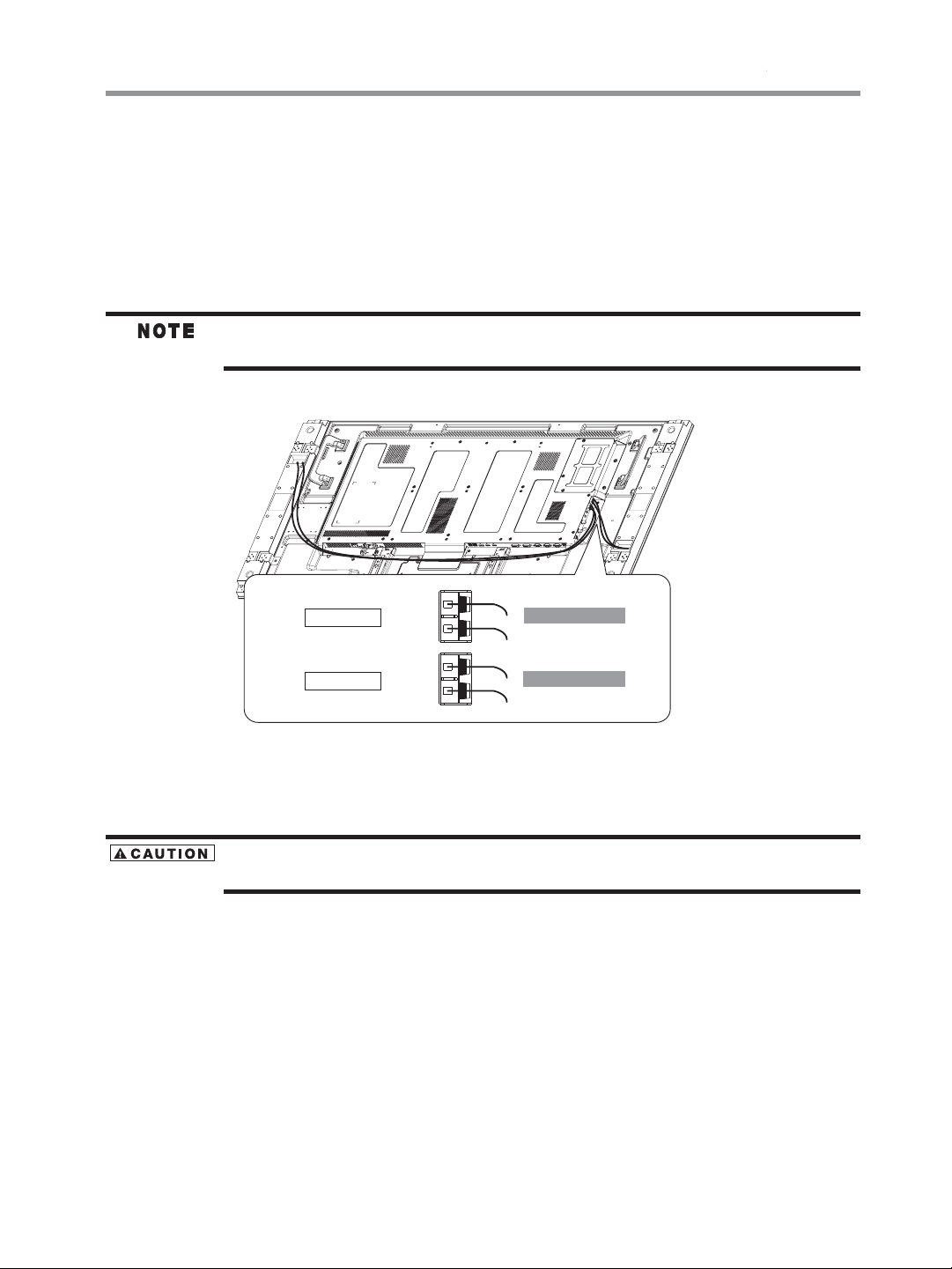
Connecting RS-232C
Monitor control via RS-232C
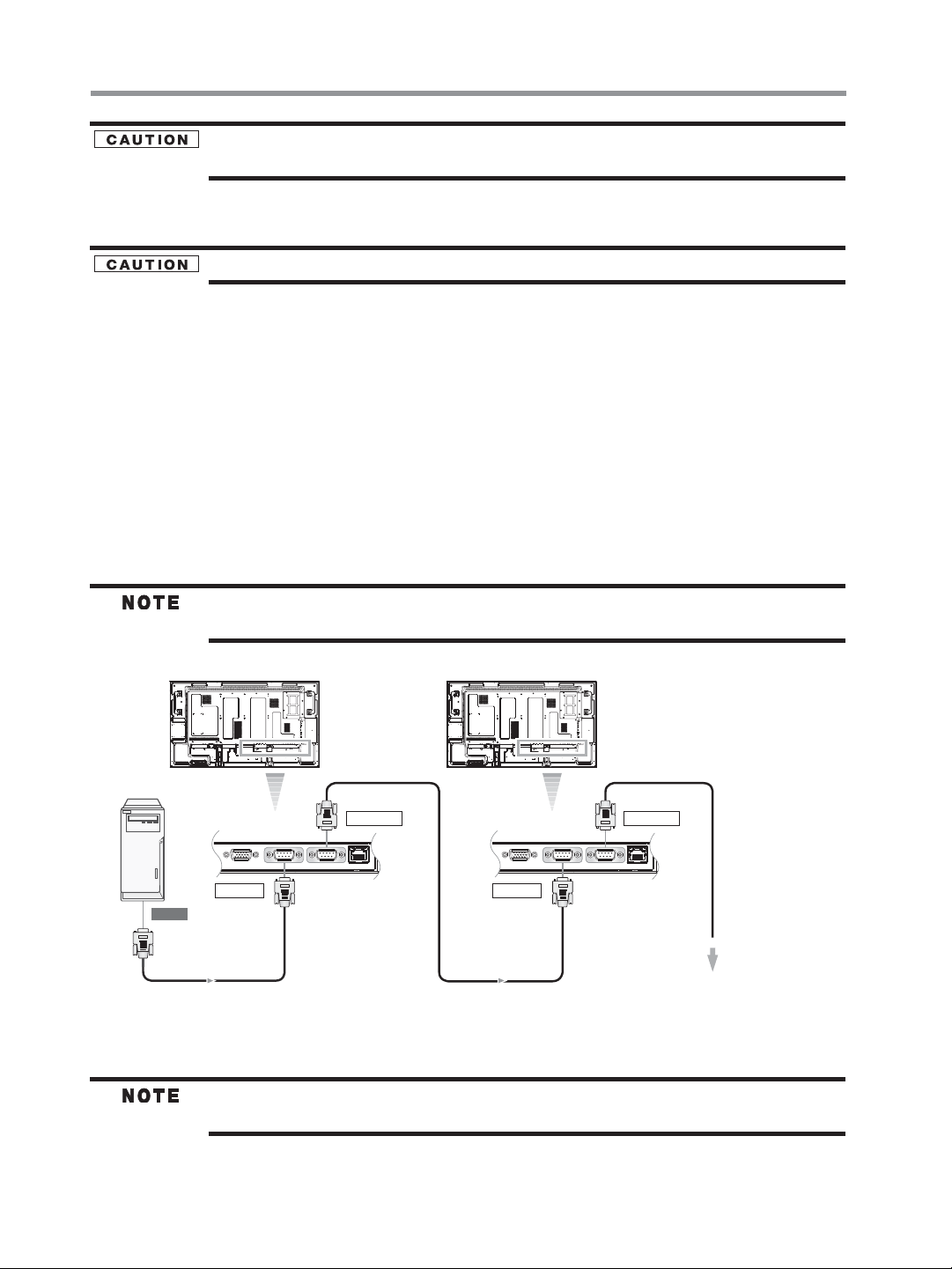
To control this monitor from a computer via a communication, connect this monitor and the computer using an RS-232C
cable (commercially available).
How to connect
Turn off the main power switch of the computer and this monitor. If you make a connection while the power is on, it causes a
failure of the devices.
Connect the computer and this monitor using a reverse type RS-232C cable (commercially available).
In addition, when you connect two or more monitors as shown in the illustration below, connect the RS-232C OUT connector of
Though you can connect up to 26 monitors, the maximum number of connectable monitors may be limited depending
on the installation environment.
RS-232C IN RS-232C IN
RS-232C OUT RS-232C OUT
RS-232C cableRS-232C cable
RS-232C
Computer
(RS-232C connection)
LCD display (first display) LCD display (second display)
(Sample Illustration) 55”
7HENONLYTHEPINSERIALPORTISEQUIPPEDASTHESERIALCOMMUNICATIONPORTONTHECOMPUTERACONVERSIONADAPTER
(commercially available) is necessary for the connection.
Connecting RS-232C
31
Preparation for use
Installing the expansion module
Connecting LAN
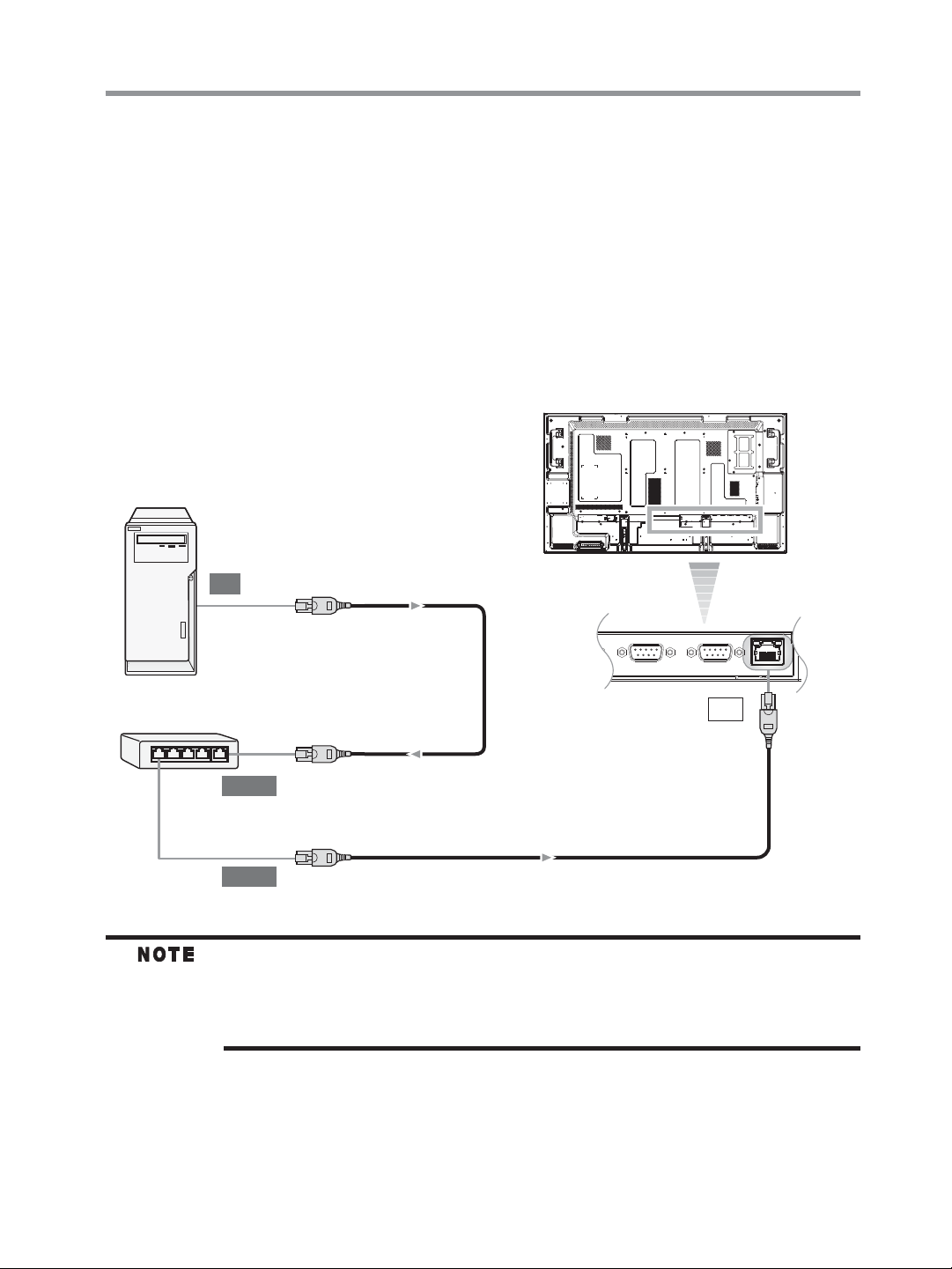
Monitor connection using LAN
As shown in the illustration below, you can connect this monitor and a computer in network through a LAN hub. Connect
the monitor and the LAN hub using a straight type LAN cable (commercially available).
How to connect
Turn off the main power switch of the computer and this monitor. If you make a connection while the power is on, it causes a
failure of the devices.
Connect the computer and the LAN hub using a straight type LAN cable (commercially available).
Connect this monitor and the LAN hub using a straight type LAN cable (commercially available).
When you connect two or more monitors, you can connect the monitor and the LAN hub using a straight type LAN cable
(commercially available) as described above.
LAN cable
LAN cable
LAN
LAN hub
LAN hub
LAN
Computer
(LAN connection)
LAN hub
LCD display (rear)
(Sample Illustration)55”
sWhen you use a cross type LAN cable (commercially available), you can connect the monitor and the
computer one-to-one without using a LAN hub, however, the computer may not be supported. It is recommended to
check the operation in advance.
s4HEIMAGETRANSFERFUNCTIONVIATHE,!.ISNTSUPPORTED4HISMONITORISNTEQUIPPEDWITHTHEHOSTFUNCTIONFOR
controlling other devices.
Connecting LAN
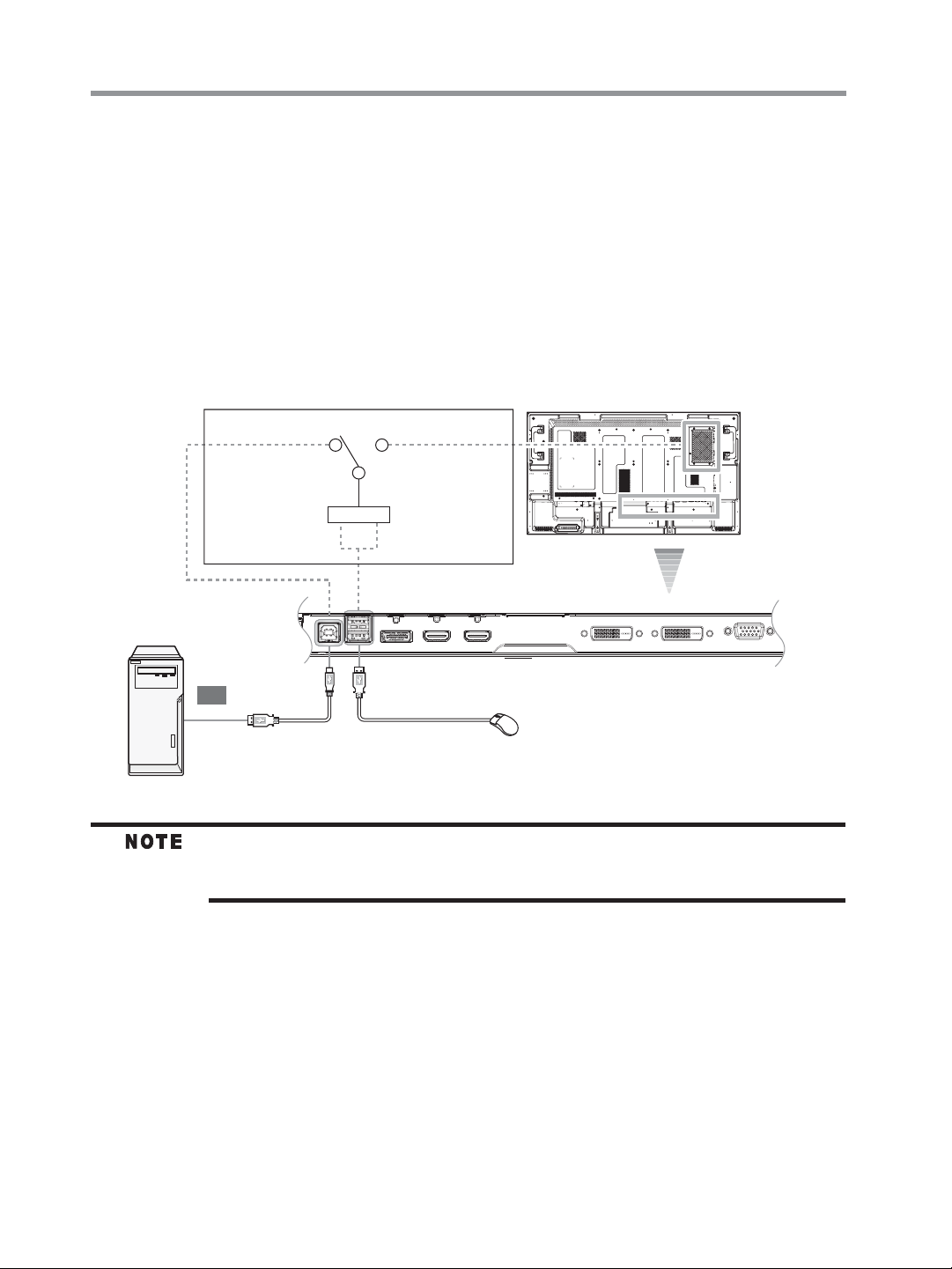
32
Preparation for use
Connecting a USB device
Connecting a USB device
Connecting multiple USB devices using the USB hub function
The USB hub of this monitor is equipped with two switchable upstream ports. One is for connecting an external computer,
and the other is for connecting an OPS-compliant computer internally. Only the selected upstream port is connected to the
USB hub. Use the OSD screen function to select the appropriate upstream port. See pages 46 and 62.
1 [When using an external computer]
Connect the USB port (Standard A) on the computer and the USB upstream port (Standard B) on the monitor using a
USB cable (commercially available).
[When using an OPS-compliant computer]
Install an OPS-compliant computer (connected internally).
2 Connect a USB device to the downstream port of this monitor.
USB devices
(mouse, touch panel, etc.)
Internal structure of the monitor’s USB function
Switch
Upstream port
Downstream port
Internal hub
When using an external
computer
When using an OPS-compliant
computer
USB
(Sample Illustration) 55”
sThe USB hub function cannot control the monitor.
sUp to 5 hubs can be cascaded in the hub function of this monitor. Carry out operation check in advance even if you
connect a device pursuant to the USB standards.
Connecting a USB device
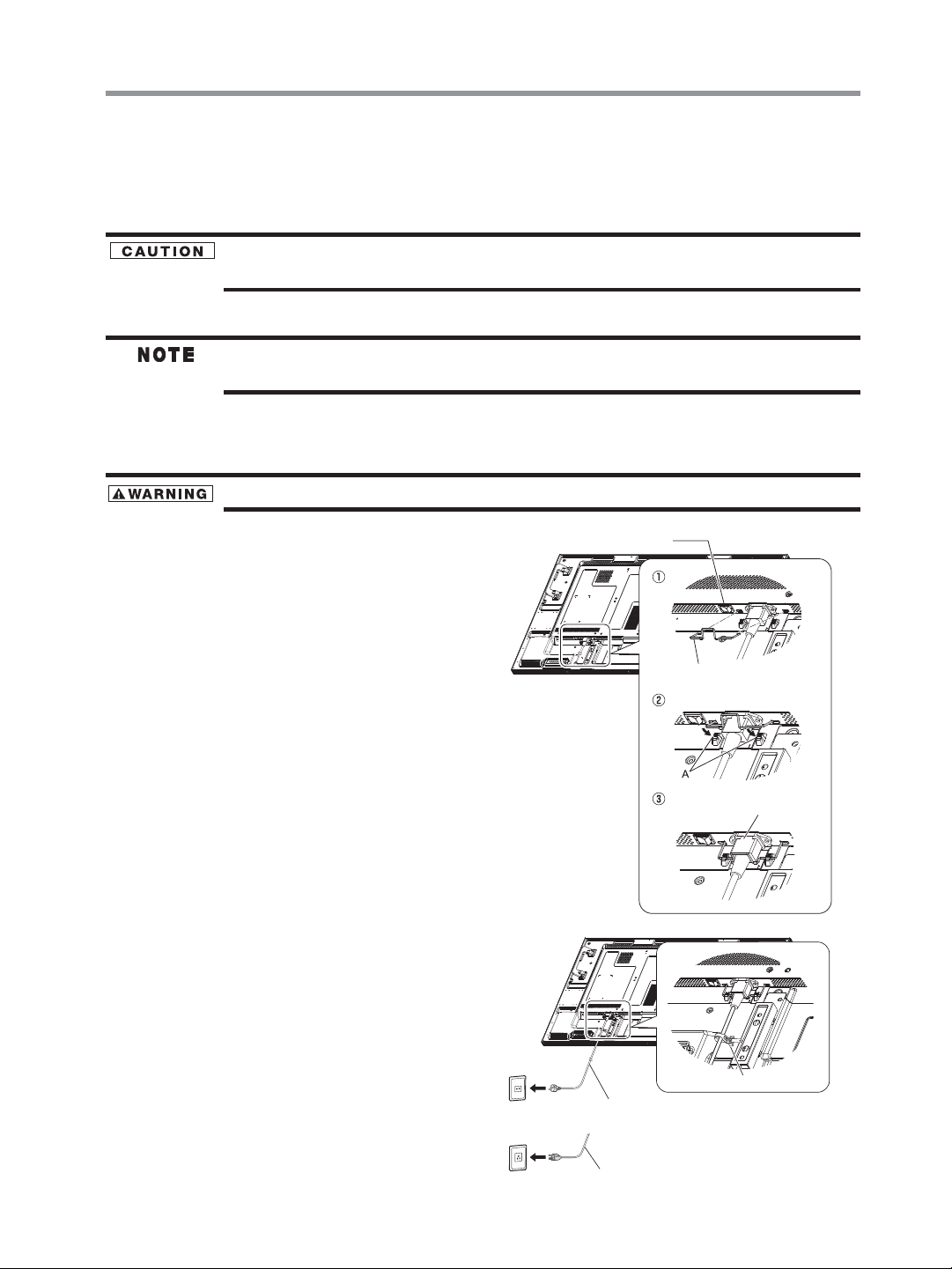
33
Preparation for use
Connecting the power cord to the monitor
Connecting the power cord to the monitor
Connecting the power source
Before making connections
Check that the main power switch is off.
When an OPS-compliant computer is installed and the main power switch of the monitor is on, connecting the power
source may cause the computer to power on, causing damage or breakdown of the operation system and the hard disc.
The power outlet socket should be installed as near the equipment as possible and should be easily accessible.
0LEASEREFERTOh)MPORTANT3AFETY)NSTRUCTIONSvANDh)NSTALLATION%RGONOMICS#AREAND3ERVICEvINTHISMANUALFOR
proper selection of the AC power cord. Use the clamper to prevent accidental disconnection of the power cord.
1
2 Secure the power connector using the cable holder (accessory).
Don’t insert the cable holder into the power outlet socket. Doing so may cause electric shock.
1) Fit both ends of the cable holder to the monitor.
2) Engage the cable holder in Parts A.
3) Secure the power connector with the cable holder.
Main power switch
Cable holder (accessory)
Power connector
3 Secure the power cord using the clamper (accessory).
4 Insert the power plug into the power outlet socket.
Fully insert the prongs into the power outlet socket. Loose
connection may cause noise.
Don’t plug and unplug the power cord repeatedly in a short
time of period.
Power cord (For EU)
Power cord (For North America)
Clamper (accessory)
Connecting the power cord to the monitor
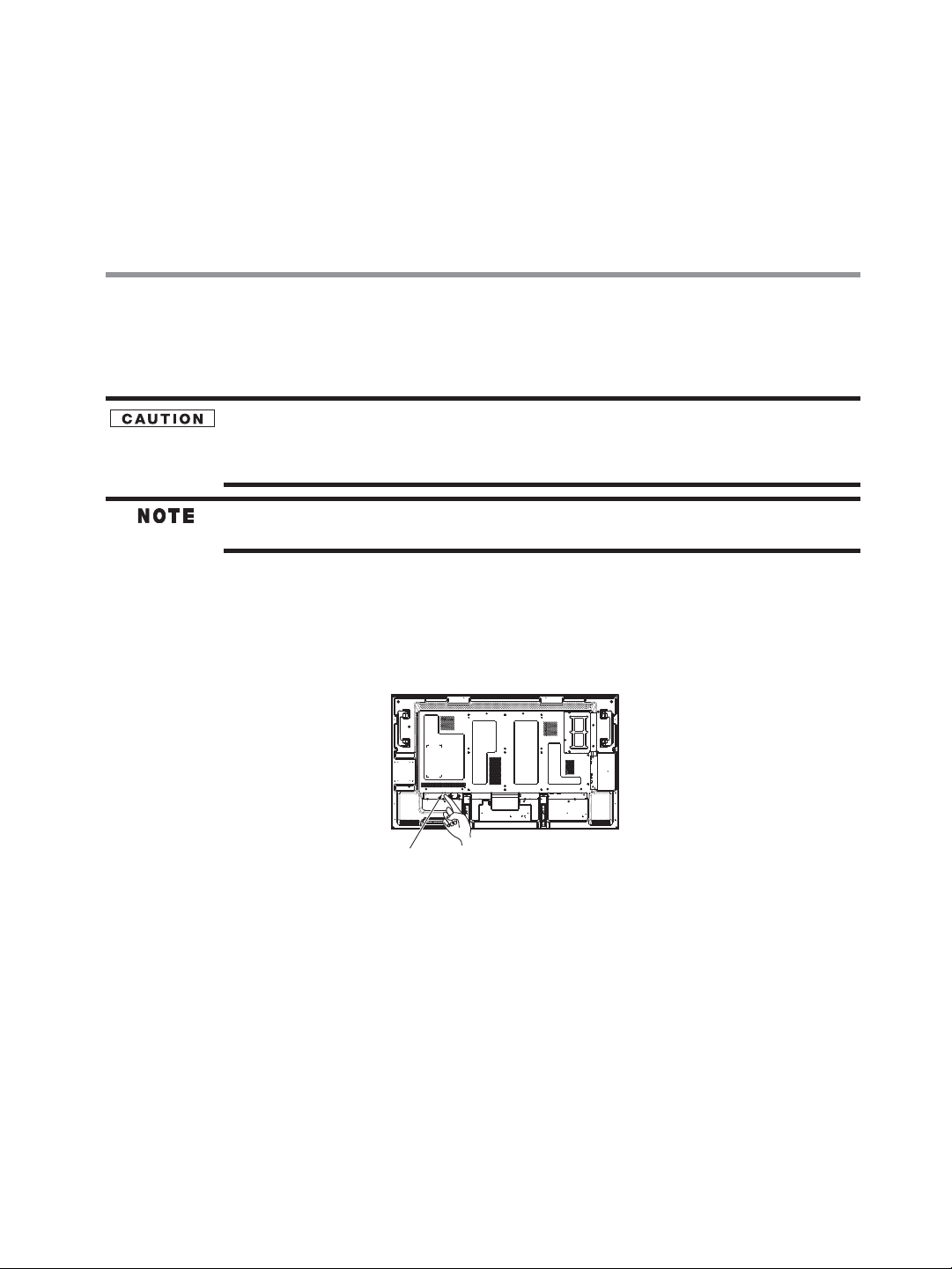
34
Chapter 3
How to Use
Turning on all the connected devices
1 Turn on the connected devices such as the computer and DVD player.
Turning on the monitor
When an OPS-compliant computer is installed as an expansion module, the computer automatically turns on and starts
as the monitor is turned on.
Don’t turn off the monitor immediately after turning it on because the computer may be in the startup process. Select
OPTION as the video input and wait for the operating system of the computer to complete the startup process.
7HENTHECOMPUTERDOESNTSTARTWITHINAGIVENPERIODOFTIMEAPPROXMINUTEh/0%2!4)/.%22/2vANDANERROR
message are displayed. See the user’s manual of your computer.
2 Turn on the Main Power Switch.
The power indicator turns on green and the monitor turns on.
The control buttons on the rear, wireless remote control, and schedule setting don’t work while the main power switch
is off (the power indicator is off).
When using them, check that the Main Power Switch is on (the power indicator is on).
Main power switch
(Sample Illustration) 55” Power switch
3 When the power indicator glows red, press the POWER button on the monitor.
The power indicator turns green.
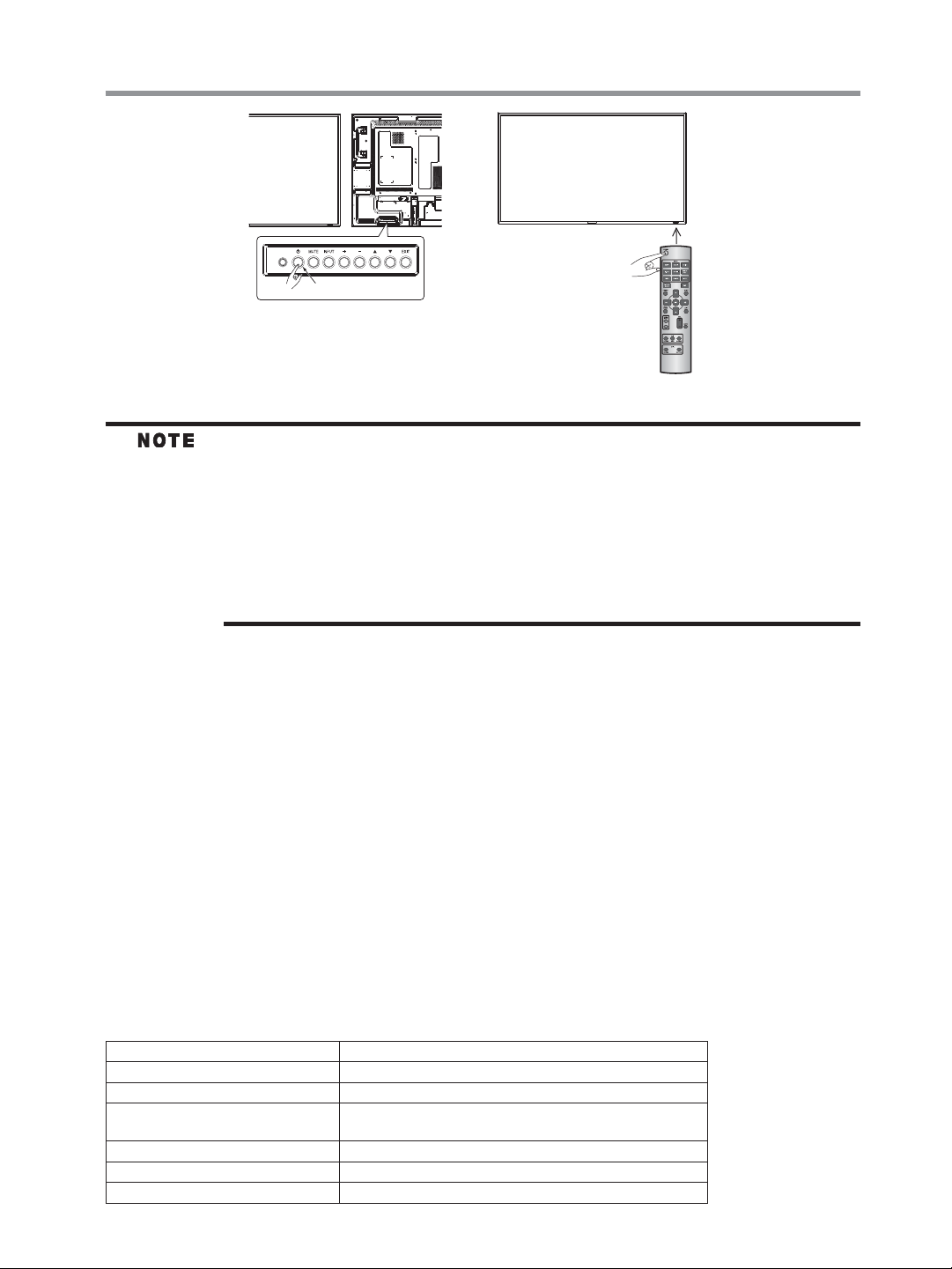
35
How to Use
Wireless remote
control
Power button
Power button
or
Within 2 seconds after turning off the power by the POWER button on the wireless remote control or the monitor or by a
communication command, don’t turn off the main power switch, don’t disconnect the power cord, and don’t turn off the
breaker.
If the AC power is turned off immediately after the power-off operation, all the OSD settings including the language
selection may be reset to the factory defaults at the next power-on.
If the OSD settings are reset to the factory defaults as described above, reconfigure the OSD settings using the
following procedure.
1. Turn off the power of the monitor using the wireless remote control or otherwise.
2. Wait for at least 2 seconds.
3. Turn on the power of the monitor using the wireless remote control or otherwise.
4. Check and reconfigure the OSD settings.
Power Management Function
even though the power of the monitor is on.
While this function is working, the screen becomes dark and the power indicator glows green and red.
This function is available only when a computer equipped with the VESA-approved DPM Power Management function is
connected to the monitor.
When the power saver in the OSD menu is turned ON, the power management function works.
RGB: When the sync signal of computer input (HDMI1, HDMI2, DVI-D, D-SUB, DISPLAYPORT) is
terminated, the monitor will be in the sleep mode in several seconds.
VIDEO: When the sync signal of video input (YPbPr, S-VIDEO, or VIDEO) is terminated, the monitor will be
in the sleep mode in approximately 10 minutes.
[Description]
DPM: Acronym for Display Power Management
sThe default power management settings (power savers) for RGB and VIDEO are ON.
sWhen an expansion module is in the option slot, the monitor doesn’t enter the sleep mode even when POWER SAVE in the
CONFIGURATION1 menu is set to ON. Even when other video input is selected, the monitor doesn’t enter the sleep mode.
Power Indicator
Status LED
Power-on mode Green
Power-off mode Red
Power Standby when
“SCHEDULE” is enable
Red On
Green Blinking
Sleep mode Red, Green
The main power is off. Off
Diagnosis (Detecting failure) Red Blinking * See troubleshooting on page 68.
Power Management Function
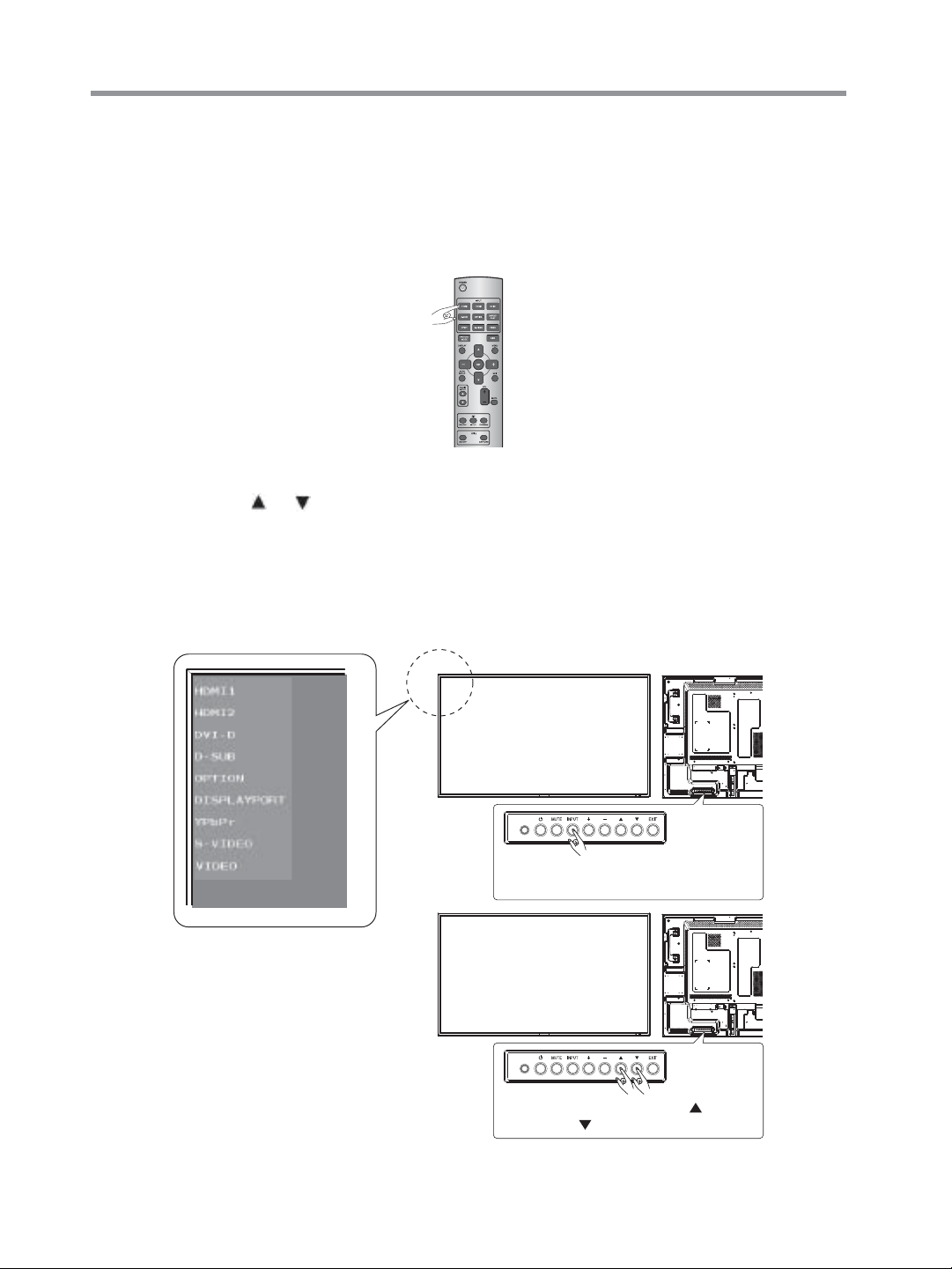
36
How to Use
Selecting the video input
You can select the desired video input using the wireless remote control or the INPUT button on the monitor.
Select using the INPUT buttons on the wireless remote control.
You can select the desired video input by pressing the corresponding INPUT button on the wireless remote control.
Selectable video inputs are [HDMI1], [HDMI2], [DVI-D], [D-SUB], [OPTION]*, [DISPLAYPORT], [YPbPr],
[S-VIDEO], and [VIDEO].
* OPTION can be used when an expansion module is mounted on the option slot.
Select using the INPUT button on the monitor.
When you press the INPUT button on the monitor, the video input OSD menu is displayed and you can select the
video input using the
and buttons.
Selectable video inputs are [HDMI1], [HDMI2], [DVI-D], [D-SUB], [OPTION]*, [DISPLAYPORT], [YPbPr],
[S-VIDEO], and [VIDEO].
When you press the INPUT button again, the selected video input is displayed.
* OPTION can be used when an expansion module is mounted on the option slot.
The selection you make doesn’t complete unless you press the INPUT button while the video input OSD menu is displayed. The time during
which the video input OSD menu is displayed is same as that of the INFORMATION OSD. See page 59
.
INPUT button
Video input OSD menu
Select using the
and
buttons.
Selecting the video input

37
How to Use
Controlling the external devices
To control the connected external devices, display images on the monitor.
DVD player, etc.
Personal computer
(Sample Illustration)
Selecting the OSD language
Display the OSD menu by pressing the MENU button on the wireless remote control or the EXIT button on the rear of the
monitor.
Using LANGUAGE in the CONFIGURATION1 menu of the OSD screen function, you can select the OSD language. See
page 56.
h
(Sample Illustration)
Controlling the external devices
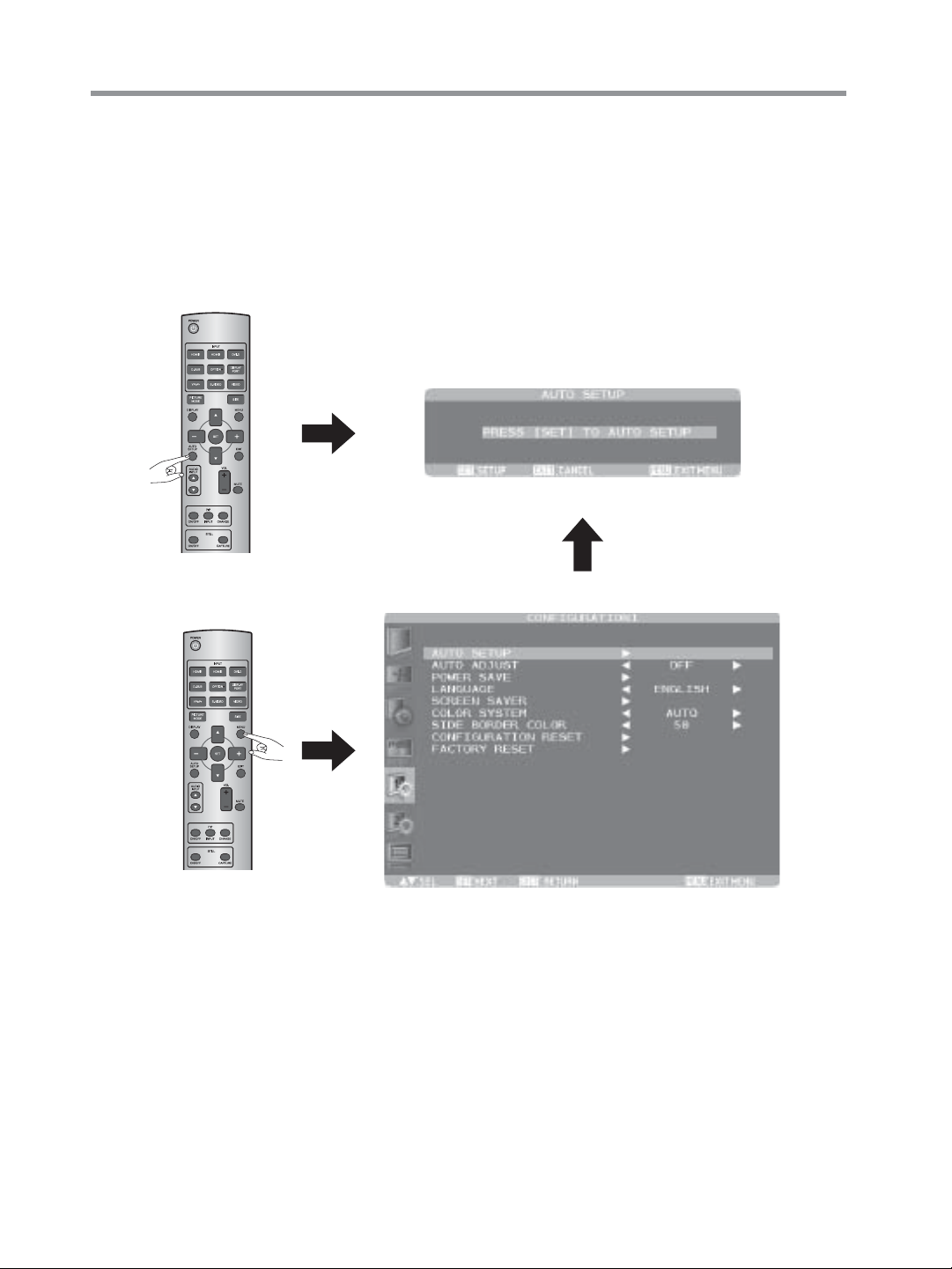
38
How to Use
Auto-setup (analog inputs only)
Press the AUTO SETUP button on the wireless remote control to directly display the AUTO SETUP menu of the OSD
screen function.
Alternatively, press the MENU button on the wireless remote control or the EXIT button on the rear of the monitor to
display the OSD screen, and then display the AUTO SETUP menu by selecting AUTO SETUP in the
CONFIGURATION1 menu.
clock phase, and input signal level.
The auto setup works on D-SUB only.
Displaying the
AUTO SETUP
menu directly
Displaying the
OSD menu
AUTO SETUP menu screen
(Sample Illustration)
Auto-setup(analog inputs only)
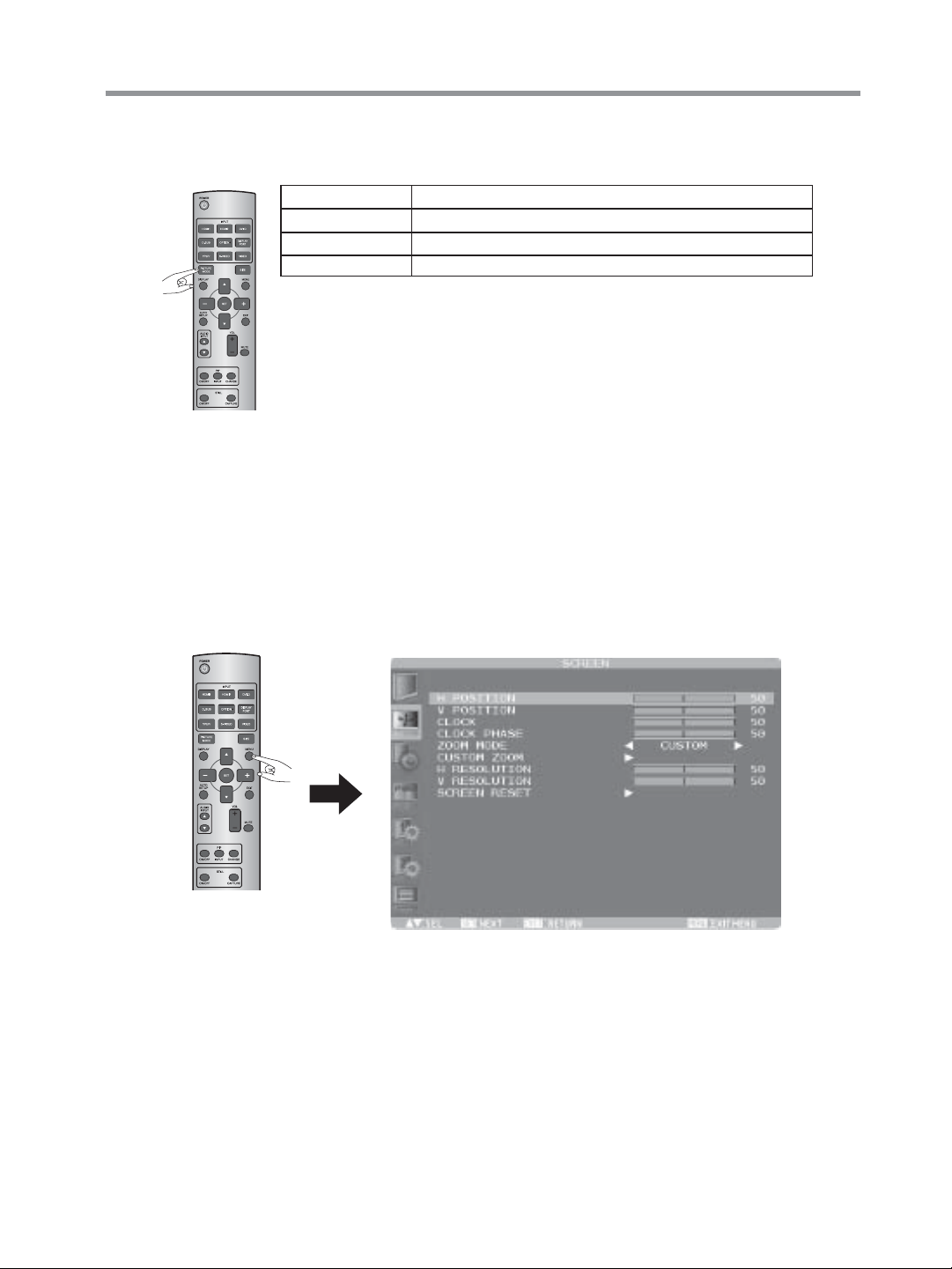
39
How to Use
Selecting the picture mode
Using the PICTURE MODE button on the wireless remote control, you can select the picture mode suitable for images to
be displayed.
HIGHBRIGHT: The brightness is maximized.
STANDARD: Factory default setting.
sRGB: Suitable for color matching with sRGB-compliant devices.
CINEMA: Suitable for viewing movies.
s“sRGB” can be selected for computer input (HDMI1*, HDMI2*, DVI-D, D-SUB, OPTION (OPS-
compliant computer), and DISPLAYPORT).
sh#).%-!vCANBESELECTEDFORVIDEOINPUT($-)($-)90B0R6)$%/AND36)$%/
* Automatically selected depending on the input signal.
Screen adjustment
Display the OSD menu by pressing the MENU button on the wireless remote control or the EXIT button on the rear of the
monitor.
zoom mode, custom zoom, and horizontal/vertical resolutions to obtain proper screen condition.
The position adjustment works on D-SUB, YPbPr, S-VIDEO, and VIDEO only.
The clock adjustment and the resolution adjustment work on D-SUB only.
The zoom adjustment works on all video inputs.
(Sample Illustration)
Selecting the picture mode
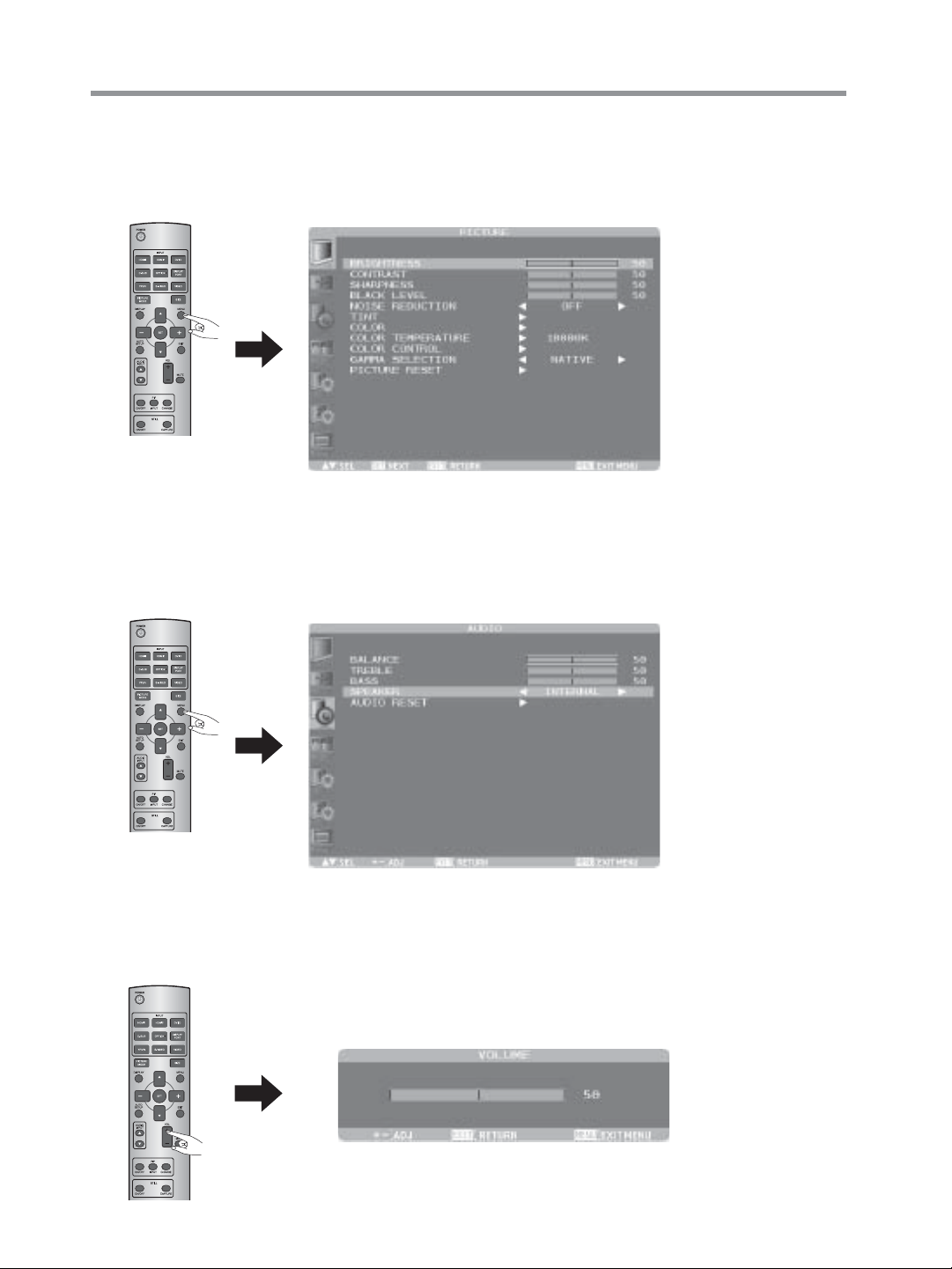
40
How to Use
Picture adjustment
Display the OSD menu by pressing the MENU button on the wireless remote control or the EXIT button on the rear of the
monitor.
and sharpness to obtain desired image quality.
(Sample Illustration)
Speaker setting
Select the built-in speakers or the external stereo speakers in the speaker setting in the OSD menu.
Display the OSD menu by pressing the MENU button on the wireless remote control or the EXIT button on the rear of the
monitor.
Using SPEAKER in the AUDIO menu of the OSD screen function, you can select the speakers.
(Sample Illustration)
Volume, balance, and tone control
Volume control
You can control the volume level using the VOL button on the wireless remote control.
(Sample Illustration)
Picture adjustment
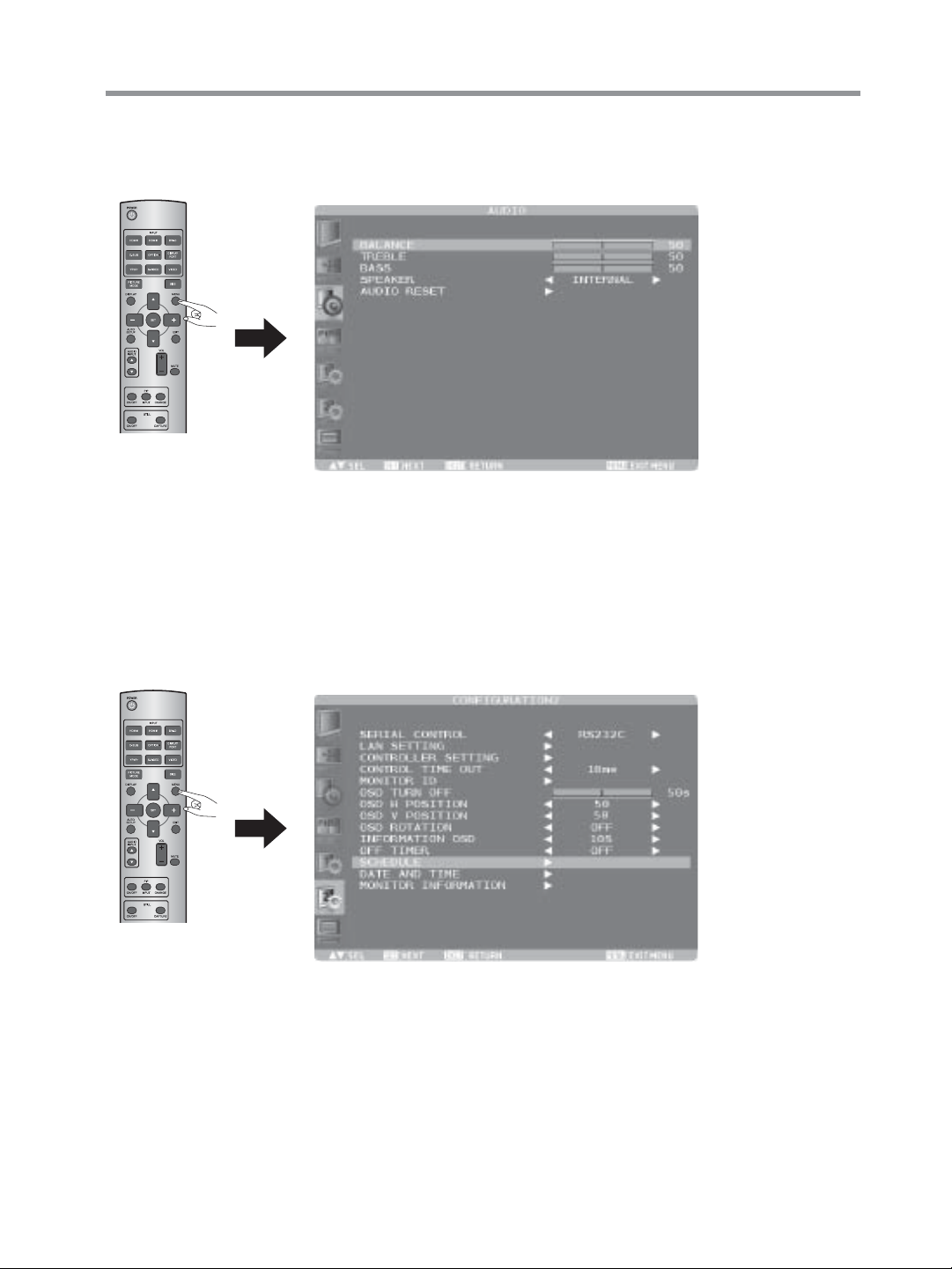
41
How to Use
Balance and tone adjustment
on the rear of the monitor.
(Sample Illustration)
If no audio is output when an OPS-compliant computer is in use, check that the monitor is selected as the audio output source by the
operating system of the computer. For the selection method, see the help or the user’s manual of the operating system for the computer or the
driver for the audio device.
Schedule setting
Display the OSD menu by pressing the MENU button on the wireless remote control or the EXIT button on the rear of the
monitor.
Using SCHEDULE in the CONFIGURATION2 menu of the OSD screen function, you can program power-on/off and
input selection.
(Sample Illustration)
Schedule setting
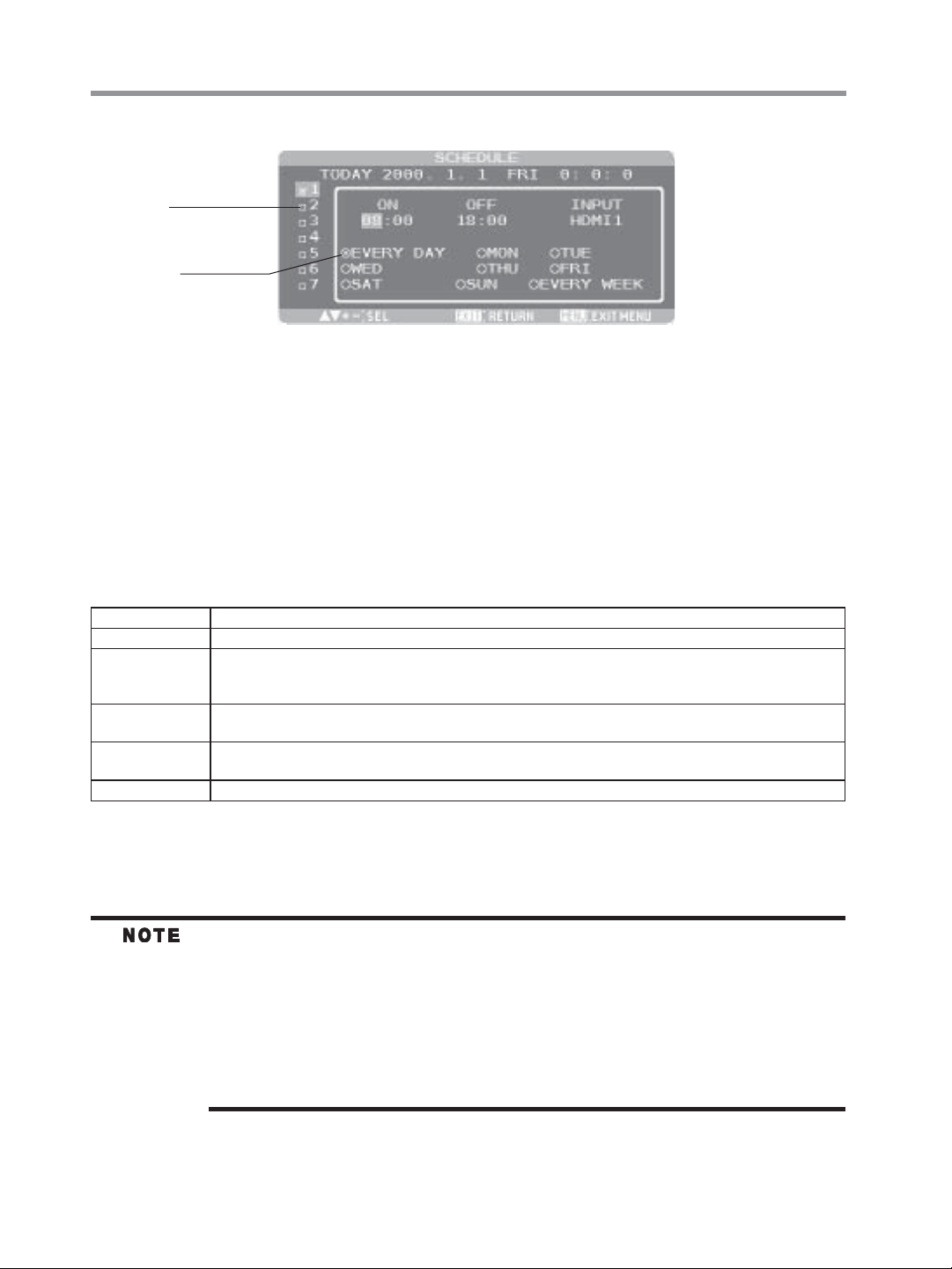
42
How to Use
How to set up schedule
Check box
Radio button
(Sample Illustration)
Program number selection
When the cursor is in any of the check boxes showing the program numbers 1 to 7 on the left side of the screen, press the
To enable the selected program number, press the SET button to place a checkmark in the check box. To disable it, clear
the checkmark.
Schedule setting of each program
When the cursor is in any of the check boxes, pressing the PLUS (+) button moves the cursor into the white frame on the
right.
When the cursor is at any of the items within the white frame, pressing the PLUS (+) button moves the cursor to the right,
and MINUS (-) button to the left.
select or deselect the radio buttons by pressing the SET button.
ON: Set the time when the power is turned on. If you don’t want to set the power-on time, enter “--.”
OFF: Set the time when the power is turned off. If you don’t want to set to the power-off time, enter “--.”
INPUT: Displays the video input selected when the power is turned on. If you want to select the video input
that was selected before the power is turned on, enter “--.” When you set the ON time and the video
input, you can switch the video input alone.
EVERY DAY: Select this option to execute the schedule every day. When you select EVERY DAY, you cannot
select any days of the week and EVERY WEEK.
MON - SUN: Select the days of the week on which you want to execute the schedule. Unless you select EVERY
WEEK, too, the selection of the days of the week is cleared after the schedule is executed one time.
EVERY WEEK: Select this option to execute the schedule on the selected days of the week, every week.
monitor to exit the SCHEDULE menu of the OSD screen function.
If you turn off the power before exiting the SCHEDULE menu, the schedule settings may be canceled.
s"EFOREMAKINGTHESCHEDULESETTINGSBESURETOCHECKTHECURRENTDATEANDTIMEUSINGh$!4%!.$4)-%v
s7HENYOUCLOSETHE3#(%$5,%SCREENTHESETTINGSARESAVED
s7HENTWOORMORESCHEDULESAREENABLEDTHEYAREEXECUTEDINDESCENDINGORDEROFTHEPROGRAMNUMBERANDTHEPOWER
is turned off upon completion of the last executed schedule.
s7HENTHEREARETWOORMORESCHEDULESHAVINGTHESAMEPOWERONOFFTIMETHEONEHAVINGTHELARGESTPROGRAMNUMBER
is executed.
s9OUCANNOTSETTHEPOWERONTIMEANDTHEPOWEROFFTIMETOTHESAMETIME
s7HEN/&&4)-%2IS/.THESCHEDULESETTINGSAREIGNORED
s7HENTHEMAINPOWERSWITCHOR!#POWERSUPPLYTURNSOFFORTHECIRCUITBREAKERTRIPSDUETOPOWERFAILUREOROTHER
causes, the schedule programs you set aren’t executed.
How to setup schedule
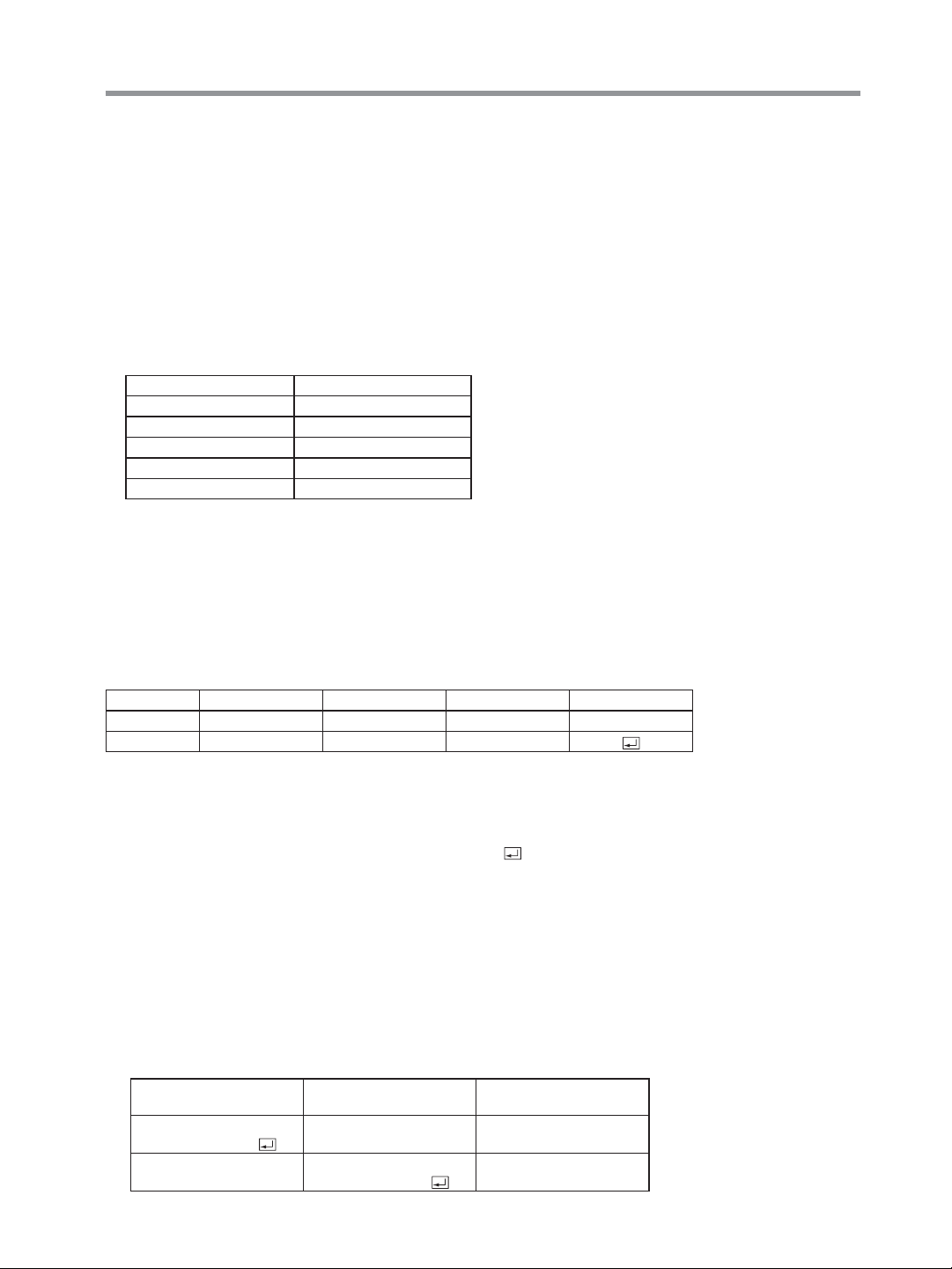
43
How to Use
Remote control
RS-232C Remote control
When the monitor is connected directly to a computer using an RS-232C cable (commercially available), the following
operations can be controlled via a communication. Select the communication interface (RS-232C) used for the serial
communication function. (See page 58.)
Power ON or OFF
Switching between input signals
Volume control and mute
Auto setup
Check of the internal temperature of the monitor, etc.
For connection with a 25-pin serial port connector on the computer, a conversion adapter (commercially available) is required.
1) Interface
PROTOCOL RS-232C
BAUD RATE 9600 [bps]
DATA LENGTH 8 [bit]
PARITY BIT NONE
STOP BIT 1 [bit]
FLOW CONTROL NONE
For direct connection using RS-232C, use the RXD, TXD, and GND lines.
2) Control command diagram
The command is structured by the address code, function code, data code and end code. The length of the command is
different for each function.
sThis example shows a basic command that is used when a single computer and a single monitor are connected.
When you want to connect multiple monitors or perform complicated control using other commands than the basic commands, contact your dealer for
advanced command specifications.
sTo send commands with a keypad using terminal software, select “2s” or “30s” for CONTROL TIME OUT in CONFIGURATION2 in the OSD menu.
(Follow the same procedure for LAN control.)
Address code Function code Data code End code
HEX 31h 30h 34h 38h Function Data 0Dh
ASCII ‘1’ ‘0’ ‘4’ ‘8’ Function Data
[Address code] 31h 30h 34h 38h (ASCII code, ‘1’ ‘0’ ‘4’ ‘8’
[Function code] Code unique to each control function.
[Data code] Data unique to each control function (Not always indicated by
numerical values.)
[End code] 0Dh (ASCII code, ‘
3) Control sequence
(1)The command is structured by the address code, function code, data code and end code. The length of the command
is different for each function.
(2) The monitor sends a return command within 600 ms* after receiving the end code. If the monitor fails to receive
the command, it doesn’t send any return command. (*During the power-on/off or input selection process, the
transmission of the return command may take more than 600 ms.)
(3) The computer checks the return command to see whether the command it sent was received or not. The computer
must receive the return command before sending the next command.
(4) The monitor sends various codes other than commands including the return command. While RS-232C control
Example: Turn the power ON (‘ ’ is for ASCII code)
Control command from
computer
Return command from
monitor to computer
Description of command
31 30 34 38 21 0D
‘1’ ‘0’ ‘4’ ‘8’‘!’ ‘
’
Sending a command for
power-on
31 30 34 38 21 0D
‘1’ ‘0’ ‘4’ ‘8’‘!’ ‘
’
Command received
(Command echoed back)
Remote control
44
How to Use
4) Operation commands
during signal switchover.
The operation commands have no data codes.
Operation ASCII HEX
POWER ON ! 21h
POWER OFF " 22h
FORCE POWER OFF WITH OPS* " " 22h 22h
INPUT HDMI1 _r1 5Fh 72h 31h
INPUT HDMI2 _r7 5Fh 72h 37h
INPUT DVI-D _r2 5Fh 72h 32h
INPUT D-SUB _r3 5Fh 72h 33h
INPUT OPTION** _r5 5Fh 72h 35h
INPUT DISPLAYPORT _r6 5Fh 72h 36h
INPUT VIDEO _v1 5Fh 76h 31h
INPUT YPbPr _v2 5Fh 76h 32h
INPUT S-VIDEO _v3 5Fh 76h 33h
BACKLIGHT LUMINANCE CONTROL _b050 5Fh 62h 30h 35h 30h
IR CONTROL ON _i1 5Fh 69h 31h
IR CONTROL OFF _i0 5Fh 69h 30h
LOCAL-KEY CONTROL ON _k1 5Fh 6Bh 31h
LOCAL-KEY CONTROL OFF _k0 5Fh 6Bh 30h
* Used when the OPS-compliant computer makes no response.
** OPTION can be used when an expansion module is mounted on the option slot.
y After sending the POWER ON or POWER OFF command, wait for at least 12 seconds to send the next command.
y After sending a command for video input selection, wait for at least 5 seconds to send the next command. Otherwise, the
monitor may not reply within 600 ms.
y Set the timeout value of the control device on the host side to 30 seconds or longer.
y In the power-off mode, only the POWER ON operation command and the power status acquisition commands described
in the next paragraph work.
y In the sleep mode, only the POWER ON and POWER OFF operation commands and the power status acquisition
commands described in the next paragraph work.
y After turning off the power using an operation command, wait for at least 2 seconds to turn off the AC power using the
main power switch or the breaker. Otherwise, the OSD settings may be reset to the factory defaults.
5) Read command
The computer sends the command without datacode to the monitor.
After receiving this command, the monitor returns the command with datacode including the current status to the
computer.
Example: When the computer asks the power status of the monitor, and the status of the monitor is powered-on.
Control command from computer
Return command from
monitor to computer
Description of command
31 30 34 38 76 50 0D ‘0’‘0’‘v’‘P’[enter] Sending a command for checking the
power status
31 30 34 38 76 50 31 0D
‘1’ ‘0’ ‘4’ ‘8’‘v’‘P’‘1’[enter]
Monitor is powered-on.
Remote control
45
How to Use
Structure of the Read-command
ASCII HEX
Function Data
(Receive)
Function Data (Receive)
POWER
ON vP 1 76 50 31
OFF (Sleep) vP 0 76 50 30
Input
HDMI1 vI r1 76 49 72 31
HDMI2 vI r7 76 49 72 37
DVI-D vI r2 76 49 72 32
D-SUB vI r3 76 49 72 33
OPTION* vI r5 76 49 72 35
DISPLAYPORT vI r6 76 49 72 36
VIDEO vI v1 76 49 76 31
YPbPr vI v2 76 49 76 32
S-VIDEO vI v3 76 49 76 33
Internal
temperature
Around the main
board
Resolution 1°C
tc1 (ex.) +25 74 63 31 2B 20 32 35
Around the power supply
Resolution 1°C
tc2 (ex.) +31 74 63 32 2B 20 33 31
READ BACKLIGHT
LUMINANCE
SET AND READ vB (ex.)099 76 42 30 39 39
READ IR CONTROL
ON vR 1 76 52 31
OFF vR 0 76 52 30
READ LOCAL-KEY
CONTROL
ON vL 1 76 4C 31
OFF vL 0 76 4C 30
* OPTION can be used when an expansion module is mounted on the option slot.
4HEMONITORWILLACKNOWLEDGETHEPOWERONOFFCOMMANDISSUEDFROMTHE/03COMPLIANTCOMPUTERHOWEVERITWILL
not execute the command. This is not a malfunction. For automatic operation, use SCHEDULE in the
CONFIGURATION2 menu of the OSD screen function.
LAN Remote control
network settings using LAN SETTING in the CONFIGURATION2 menu of the OSD screen function, you can remote-
control the monitor using the same commands as those for RS-232C.
1 Setting procedure
(1) Select LAN as the communication interface used for the serial communication function. (See page 58.)
(2) Set the following network parameters using the OSD menu. (See page 58.)
y DHCP client ON/OFF, IP address, subnet mask and default gateway.
(3) Set the IP address described above and the port number (60822) using the application program of your computer to
perform the socket communication.
(4) Send the same control command as that for RS-232C via TCP/IP socket communication.
(5) Check the return command sent from the monitor. When it is received successfully, the setting is completed.
LAN Remote control
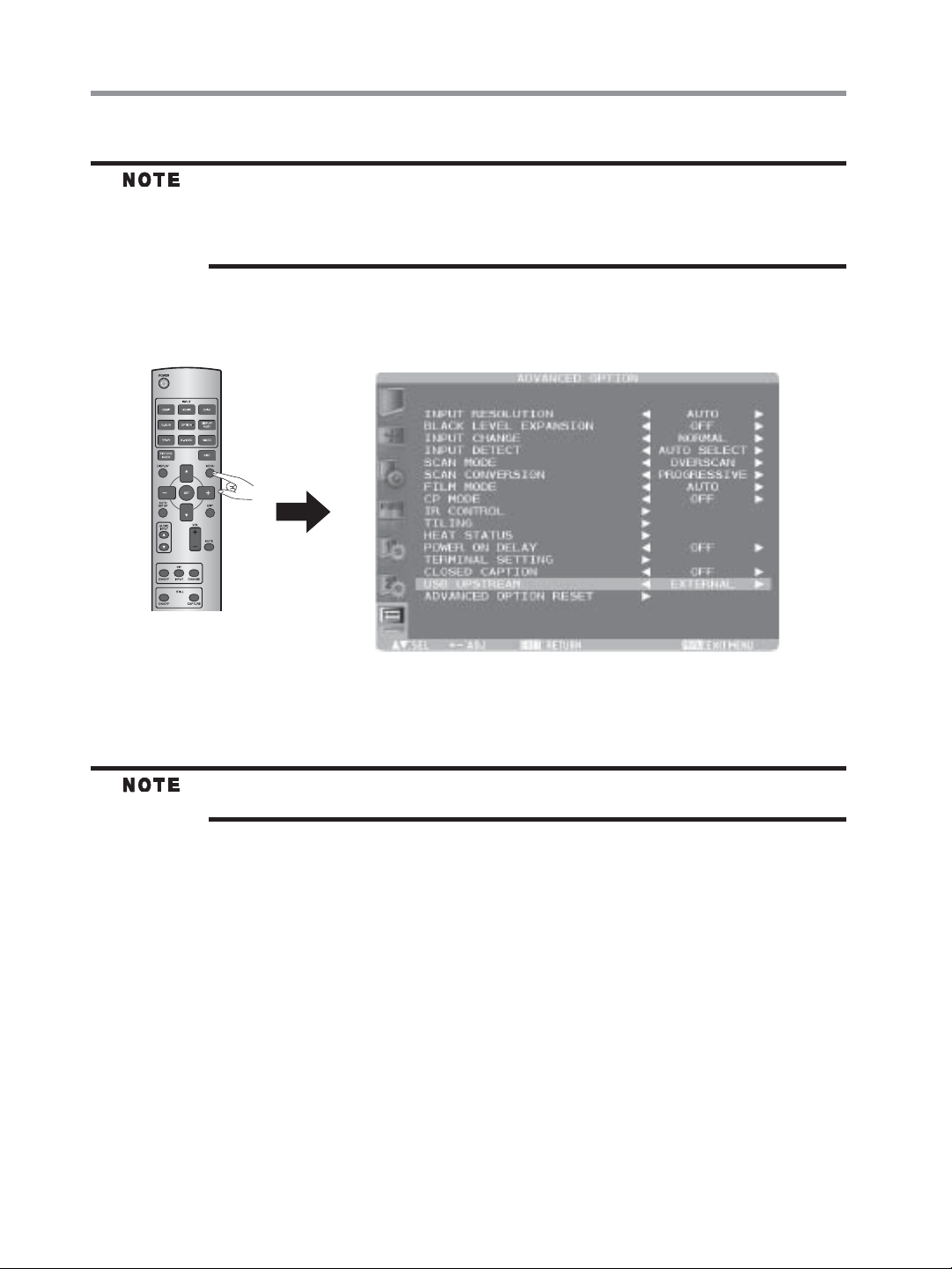
46
How to Use
Setting the USB hub
s53"FUNCTIONMAYNOTWORKDEPENDINGONTHE")/3SETTINGOFTHECOMPUTERUSED/3AND53"DEVICES)NSUCHACASE
refer to the user’s manual of each device and contact the respective manufacturer.
s5PTOHUBSCANBECASCADEDINTHEHUBFUNCTIONOFTHISMONITOR#ARRYOUTOPERATIONCHECKINADVANCEEVENIFYOU
connect a device pursuant to the USB standards.
s4HE53"HUBFUNCTIONCANNOTCONTROLTHEMONITOR
1 Select the computer to be used.
Display the OSD menu by pressing the MENU button on the wireless remote control or the EXIT button on the rear of
the monitor.
Using USB UPSTREAM in the ADVANCED OPTION menu of the OSD screen function, you can select the computer
(EXTERNAL/ OPS) to be used.
EXTERNAL: External computer is selected.
OPS: OPS-compliant computer is selected.
2 Check that the USB hub is recognized.The USB hub of this monitor is detected by the computer, and the OS-standard
device driver is installed automatically. Some computers may not recognize the USB hub even if it is connected. In
such a case, install the device driver for the USB hub referring to the user’s manual of the computer.
It takes several seconds for the computer to recognize this monitor. Do not pull out the USB cable before the monitor is
RECOGNIZEDANDDONOTREPEATCONNECTINGDISCONNECTINGOFTHECABLEINSTANTANEOUSLY
3 Check that the USB is recognized.Install the device driver of the USB device after the USB device is detected by the
computer. The OS-standard device driver may be installed automatically.Some computers may not recognize the USB
device even if it is connected. In such a case, see the user’s manual of the USB device.
Setting the USB hub
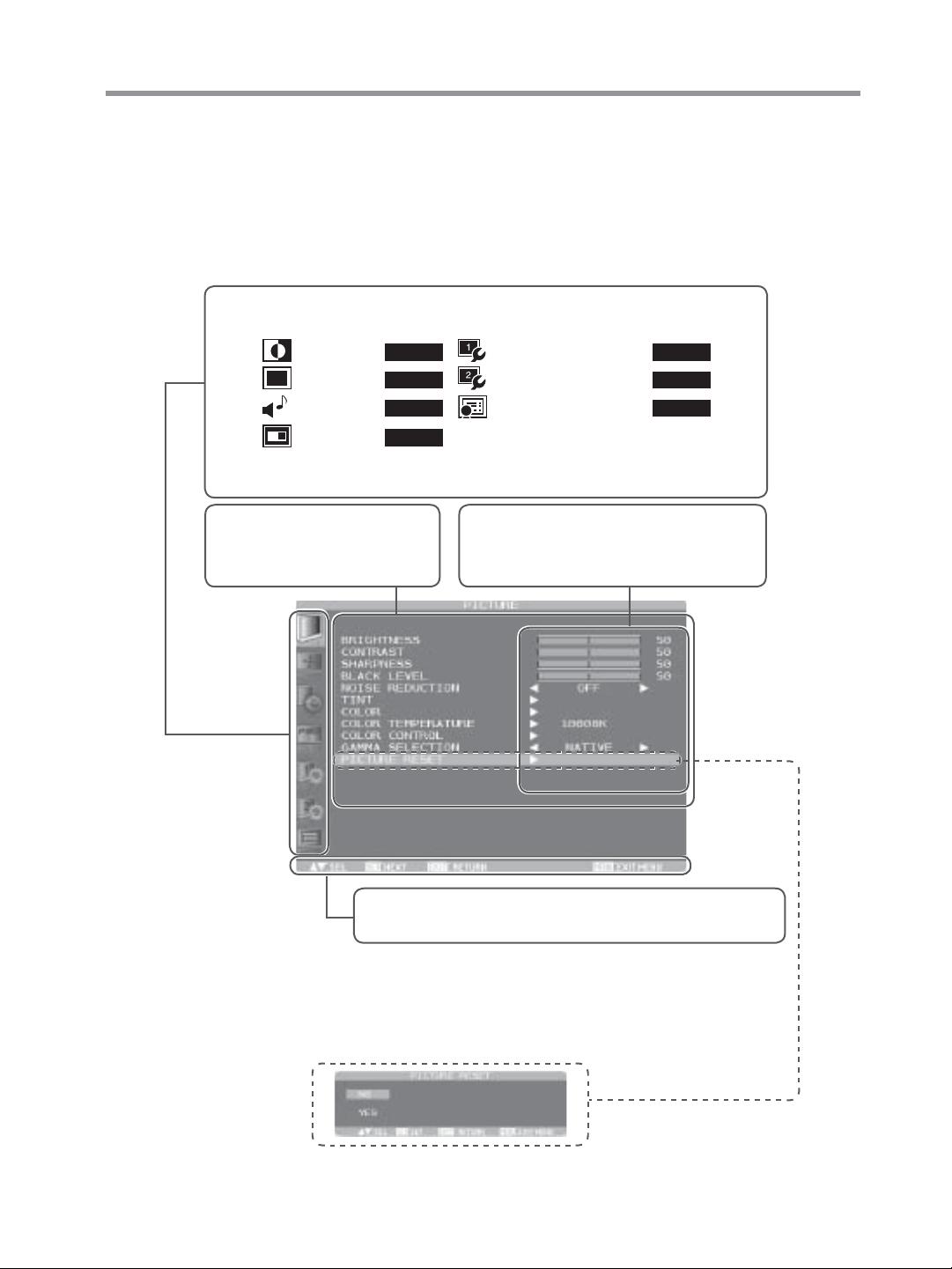
47
How to Use
Configuration and basic operation of OSD screen
Configuration of OSD screen
allows you to control the menus displayed on the screen for brightness setting and other settings. The OSD screen is
Main Menu Screen
Sub menu (Adjustment items)
Adjustment status
control and the PLUS (+) and MINUS (-)
buttons on the monitor are displayed.
Main menu
Icons other than the one you selected are grayed out.
PICTURE
Page 49
CONFIGURATION1
Page 56
SCREEN
Page 52
CONFIGURATION2
Page 58
AUDIO
Page 54
ADVANCED OPTION
Page 60
PIP
Page 55
Control button guide
Buttons for controlling the displayed OSD menu are displayed.
Sub menu screen
When you select a sub menu, an OSD screen is displayed. Sub menus contain information screens,
Sub menu screen: Picture reset (for example)
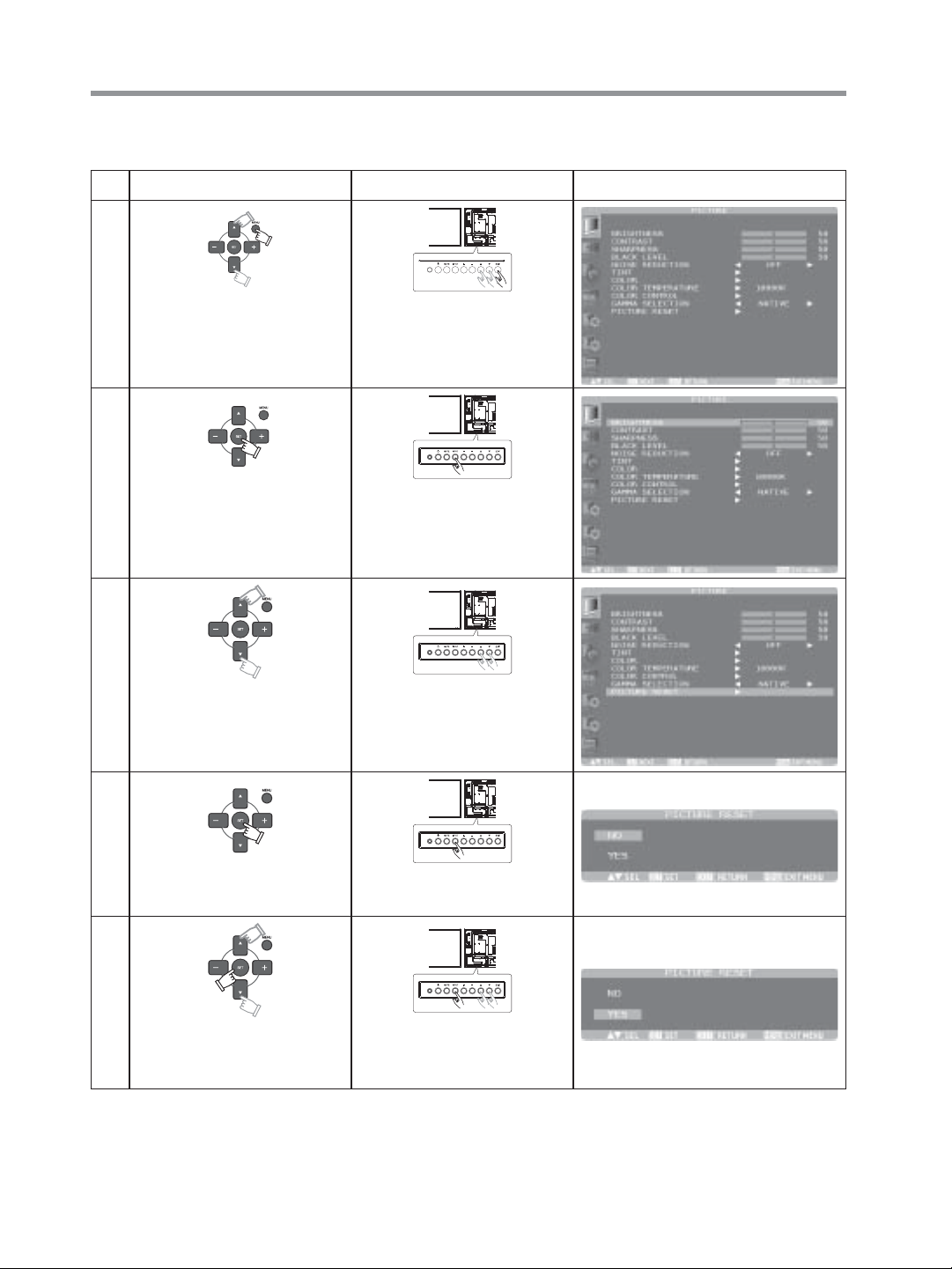
48
How to Use
Basic operation of OSD screen
Check that the power indicator illuminates green and the monitor is powered on.
Step Wireless remote control Monitor button OSD screen display
1
Press the MENU button to display
the OSD screen and then press
menu.
Press the EXIT button to display
the OSD screen and then press
menu.
2
When you press the SET button to
accept the selected main menu, the
sub menu at the top is selected.
When you press the INPUT button
to accept the selected main menu,
the sub menu at the top is selected.
3
sub menu.
sub menu.
4
Press the SET button to accept the
selected sub menu.
Press the INPUT button to accept
the selected sub menu.
5
setting and then press the SET
button to accept it.
setting and then press the INPUT
button to accept it.
The OSD screen disappears when you press the MENU button on the wireless remote control 1 time or the EXIT button on
the monitor 3 times after step 5.
Operate the buttons according to the control button guide displayed at the bottom of the OSD screen.
Basic operation of OSD screen
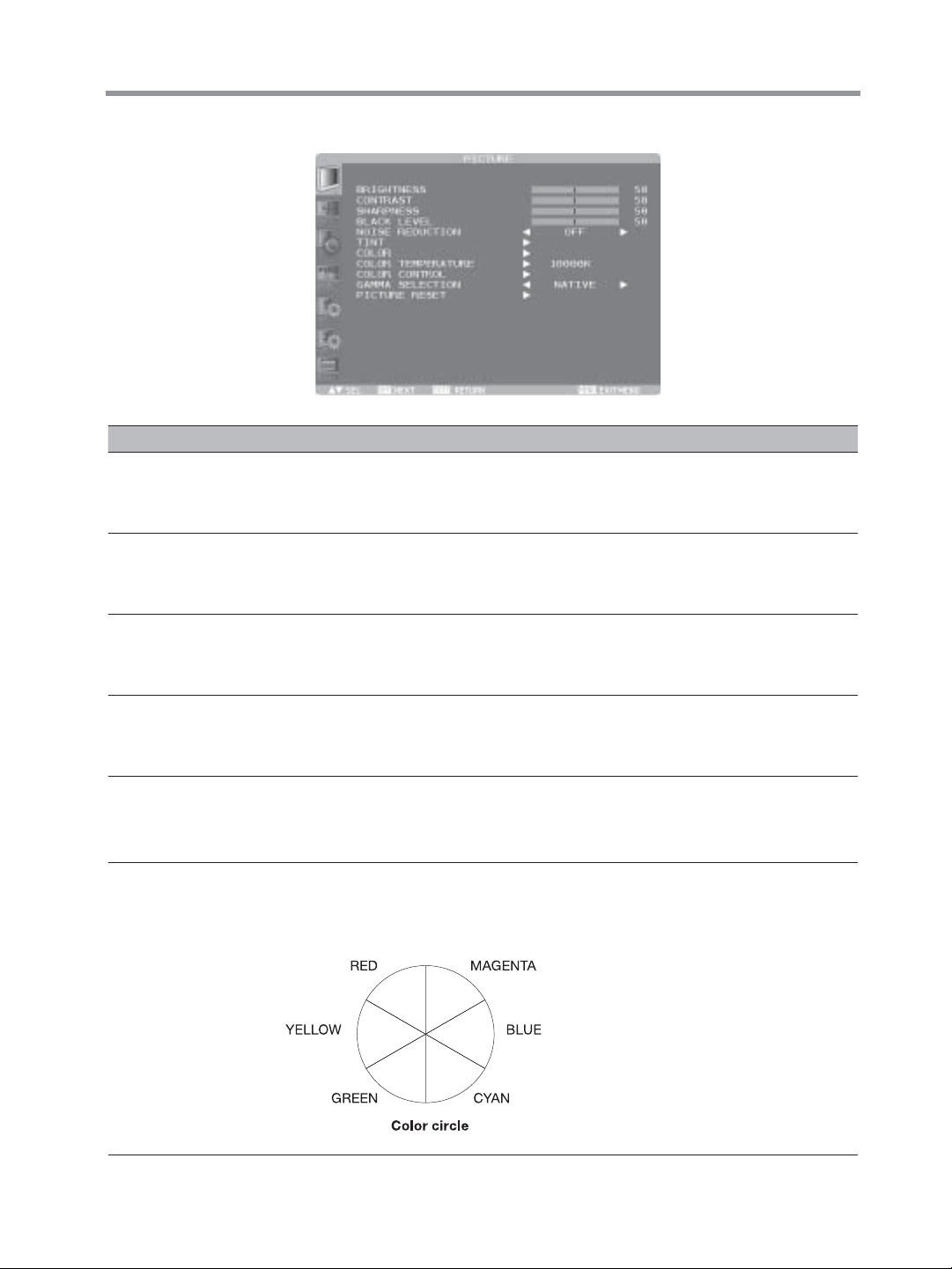
49
How to Use
Picture
Mode Description
BRIGHTNESS
MINUS (-) button to decrease the brightness.
CONFIGURATION1 menu is ON.
CONTRAST
obtain a desired result.
Brightness changes luminance of the backlight. Contrast changes signal levels, and therefore
SHARPNESS
Press the MINUS (-) button to make the image look softer.
If you increase the sharpness setting value too much, lines may appear double. In such a
case, decrease the sharpness setting value.
BLACK LEVEL
brighten dark areas in the image. Press the MINUS (-) button to further darken the dark area
of the image.
NOISE REDUCTION
( This function doesn’t work on RGB input signals. )
lessen the noise.
TINT [TINT]:
Press the MINUS (-) button to add a purple tint. [RED], [MAGENTA], [BLUE], [CYAN],
to shift the selected color to the right around the color circle. Press the MINUS (-) button to
shift the selected color to the left around the color circle.
Picture
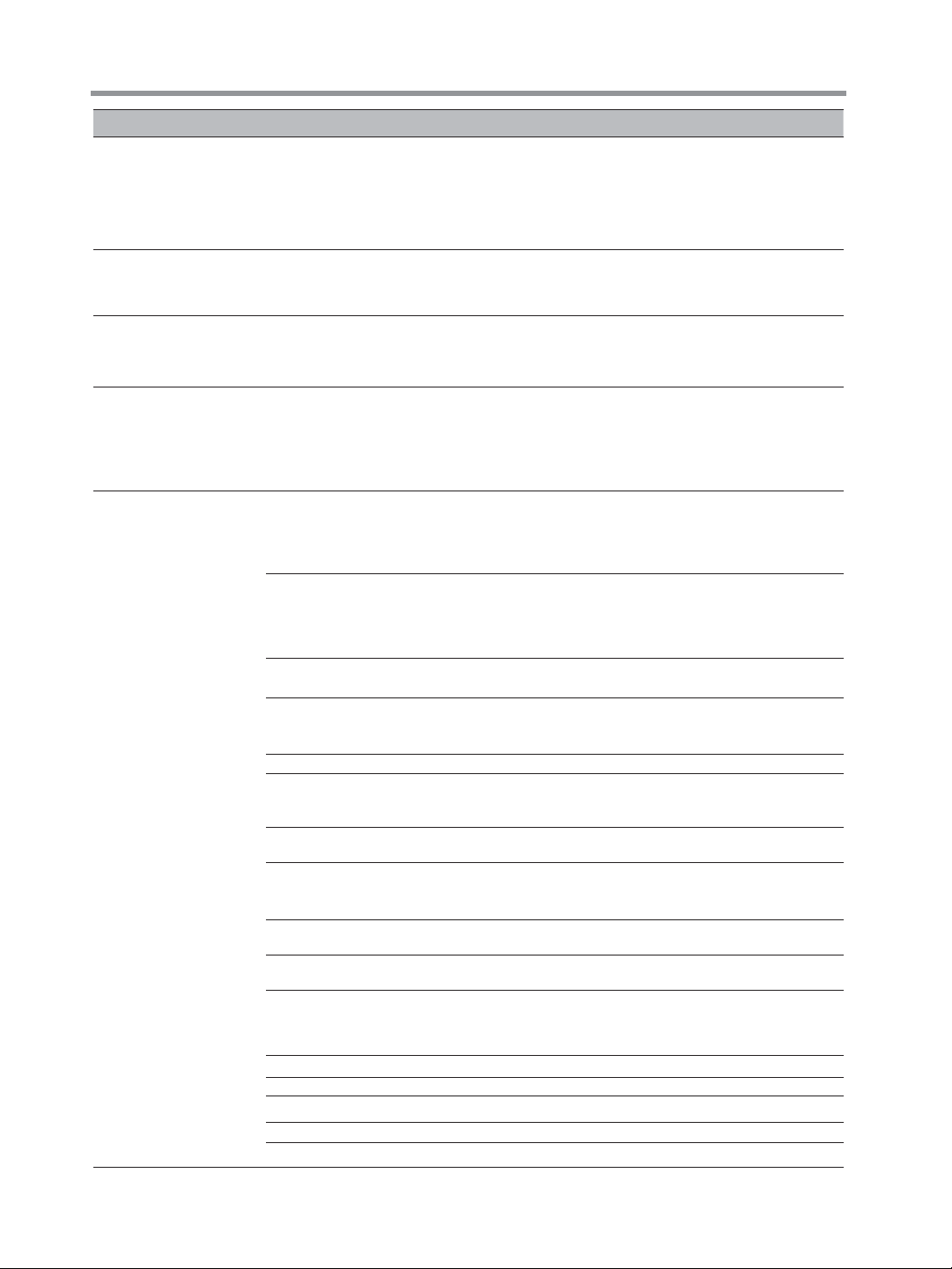
50
How to Use
Mode Description
COLOR
[COLOR]:
deepen the colors. Press the MINUS (-) button to lighten the colors.[RED], [MAGENTA],
the PLUS (+) button to deepen the selected color. Press the MINUS (-) button to lighten the
selected color.
COLOR
TEMPERATURE
decreases, and it becomes bluish as the color temperature increases.
COLOR CONTROL
R: Red, G: Green, B: Blue
GAMMA SELECTION
You can select the gamma mode from NATIVE, S GAMMA, 2.2, 2.4, OPTION, and
PROGRAMMABLE.PROGRAMMABLE can change the GAMMA characteristic curve
via a computer.Contact your dealer for further details.
GAMMA is f xed to 2.2 in the sRGB picture mode. When PROGRAMMABLE has been
selected, the setting for color temperature i s f xed at 10,000 K (NATIVE).
AUTO BRIGHTNESS
This function controls the screen brightness depending on the ambient light for easy
viewing.In addition, it changes the screen brightness depending on the ambient light and
what are displayed on the screen to reduce power consumption as low as possible.
[AUTO BRIGHTNESS]
AUTO:
[CONTROL] individually.
LOCAL:
[CONTROL] and subsequent items individually.
REMOTE:
The AUTO BRIGHTNESS function is enabled. In addition, the monitor
enters the intercommunication mode where multiple monitors are
controlled collectively. (See page 65.)
OFF: This function is disabled.
[CONTROL]
PRIMARY:
Select this setting to conf gure the monitor as Master when controlling
multiple monitors collectively.
SECONDARY:
Select this setting to use the monitor alone or to conf gure the monitor as
Slave when controlling multiple monitors collectively.
[LIGHT FROM BACK]
This function is enabled only when [REAR SENSOR] is ON.When a light source such as a
light and a window is behind the monitor, the rear sensor takes precedence.
YES:
Select this setting when there is a light source such lighting equipment and
a window behind the monitor.
NO:
Select this setting when there is no light source such lighting equipment
and a window behind the monitor.
[BACK WALL]
This function is enabled only when [REAR SENSOR] is ON.Select the following settings
according to the distance between the rear of the monitor and the wall or window.
FAR: The distance is 5 meters or longer.
NEAR: The distance is 5 meters or shorter.
[FRONT SENSOR]
Select ON for normal use.
OFF: Select this setting when the sensor on the front panel is shielded.
Picture
51
How to Use
Mode Description
AUTO BRIGHTNESS
[REAR SENSOR]
Select ON for normal use.
OFF: Select this setting when the sensor on the rear panel is shielded.
[SATURATION]
ON:
OFF:
[VIDEO DETECT]
ON:
The screen brightness varies depending on what are displayed on the screen
to reduce power consumption of the monitor.
OFF:
The screen brightness doesn’t vary and the power consumption isn’t
reduced.
PICTURE RESET
You can reset all the PICTURE settings to the factory defaults.
Picture
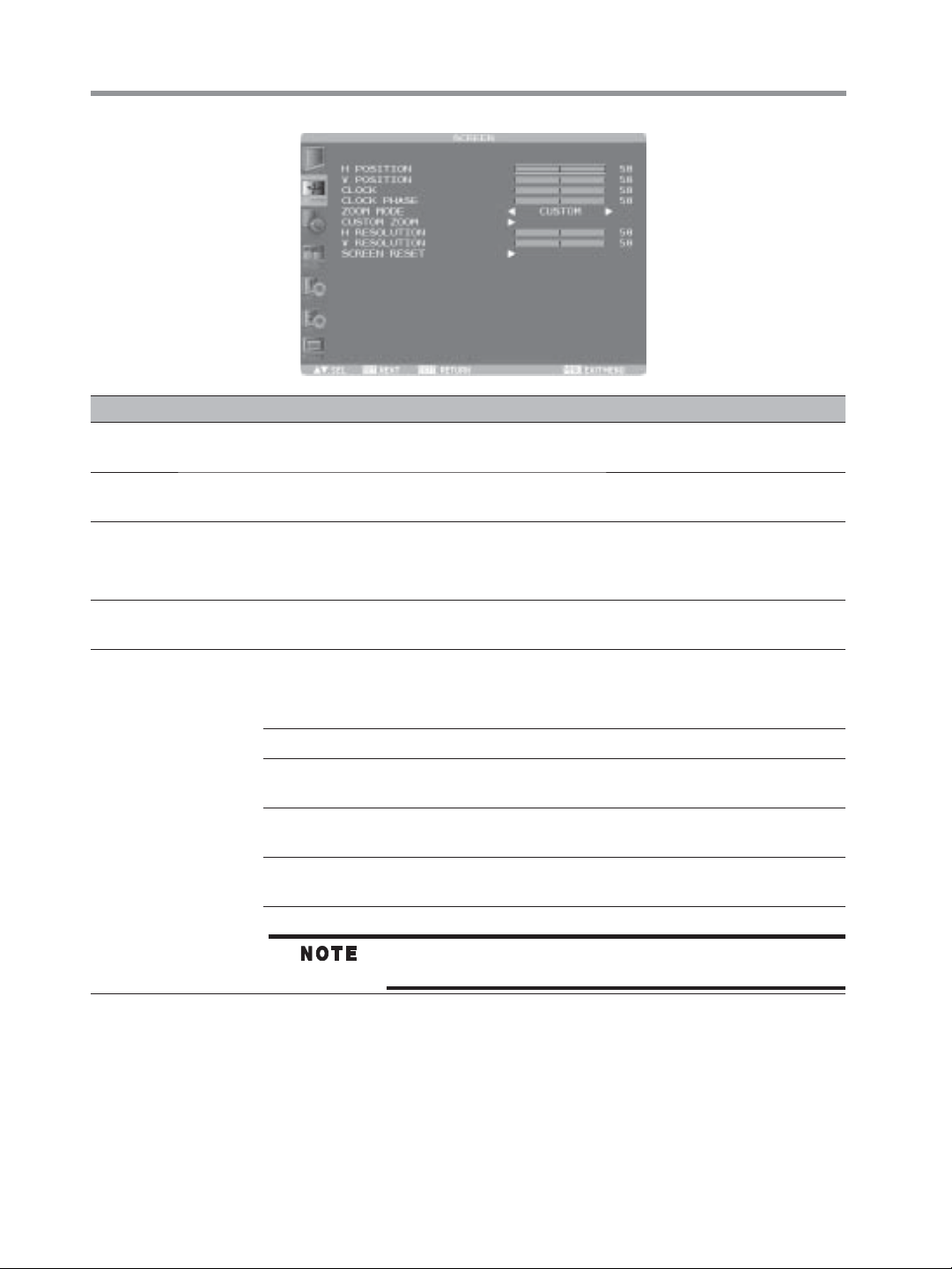
52
How to Use
Screen
Mode
Description
H POSITION
the right. Press the MINUS (-) button to move the image to the left.
V POSITION
Press the MINUS (-) button to move the image down.
CLOCK
( For the D-SUB inputs only.)
(+) button to expand the width of the image on the screen to the right. Press the MINUS (-)
button to narrow the width of the image on the screen to the left.
CLOCK PHASE
( For the D-SUB inputs only.)
ZOOM MODE
You can select the mode to stretch the image to f t it to the screen.For the HDMI1, HDMI2,
DVI-D, D-SUB, and DISPLAYPORT inputs, you can select FULL, NORMAL, CUSTOM,
or REAL. For YPbPr, S-VIDEO, and VIDEO, you can select FULL, NORMAL, DYNAMIC,
CUSTOM, or REAL.
FULL: The image is stretched to f ll the screen regardless of its aspect ratio.
NORMAL:
The image is stretched vertically to the full height of the screen while
keeping the aspect ratio.
DYNAMIC:
The image is stretched to f ll the screen with different magnif cations at the
screen center and the screen edges.
CUSTOM:
You can stretch the image horizontally and vertically as you desire using the
CUSTOM ZOOM setting.
REAL: The image is displayed without being stretched or reduced.
The DYNAMIC mode displays images having the 16:9 aspect ratio, such as those with
1920 x 1080 resolution, in the same way as in the FULL mode.
Screen
53
How to Use
Mode
Description
CUSTOM ZOOM
CUSTOM ZOOM becomes selectable when you set ZOOM MODE to CUSTOM.
ZOOM: You can expand the horizontal and vertical sizes simultaneously.
H ZOOM: You can expand the horizontal size only.
V ZOOM: You can expand the vertical size only.
H POSITION:
Pressing the PLUS (+) button moves the image to the right. Pressing the
MINUS (-) button moves the image to the left.
V POSITION:
Pressing the PLUS (+) button moves the image up. Pressing the MINUS (-)
button moves the image down.
H RESOLUTION
( For the D-SUB inputs only.)
Use this setting when AUTO SETUP and AUTO ADJUST cannot obtain the horizontal
resolution of the input signal. Press the PLUS (+) button to increase the resolution. Press the
MINUS (-) button to decrease the resolution.
V RESOLUTION
( For the D-SUB inputs only.)
Use this setting when AUTO SETUP and AUTO ADJUST cannot obtain the vertical
resolution of the input signal. Press the PLUS (+) button to increase the resolution. Press the
MINUS (-) button to decrease the resolution.
SCREEN RESET You can reset all the SCREEN settings to the factory defaults.
Screen
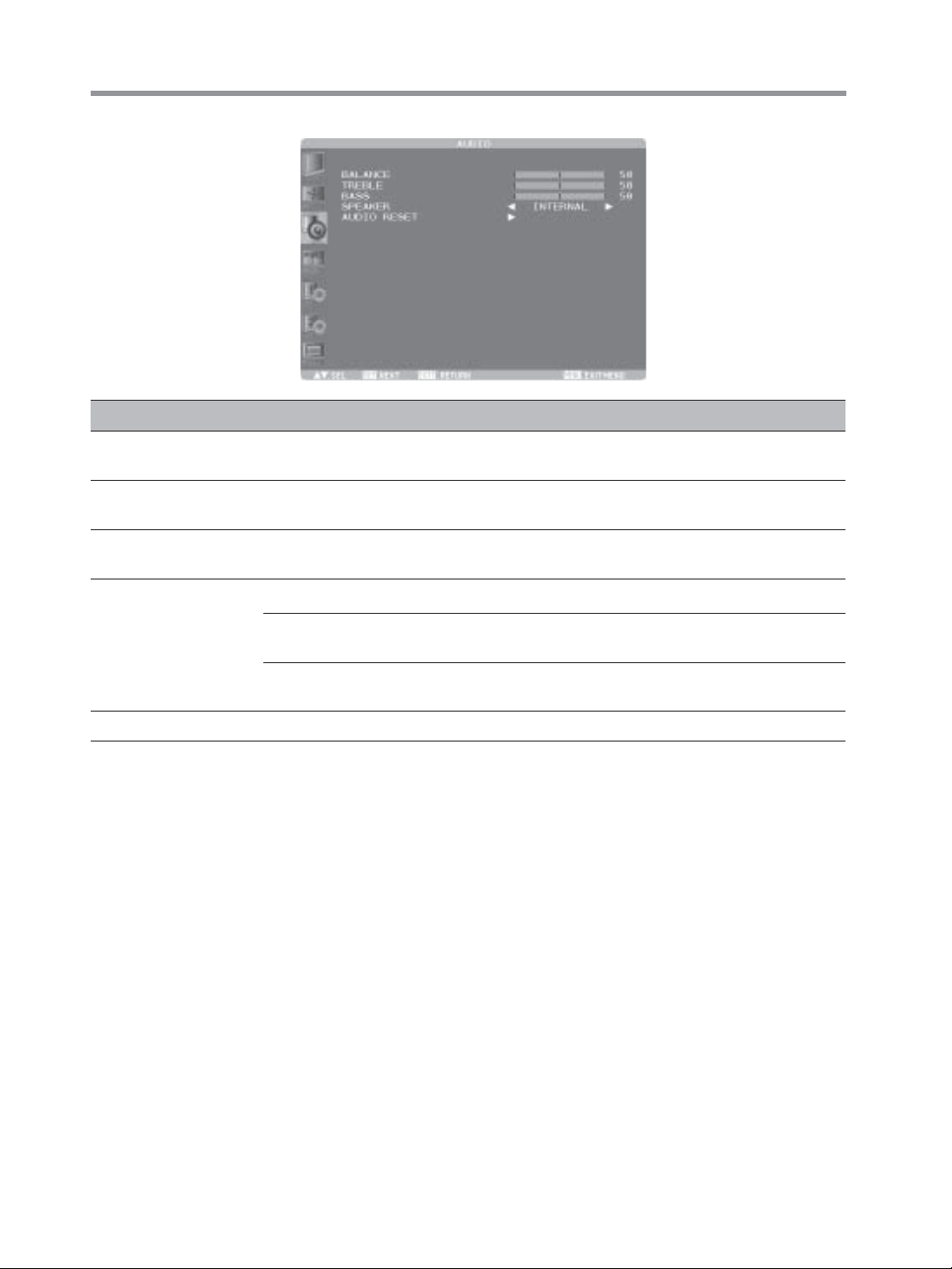
54
How to Use
Audio
Mode Description
BALANCE
decrease the left volume. Press the MINUS (-) button to decrease the right volume.
TREBLE
sound. Press the MINUS (-) button to decrease the treble sound.
BASS
sound. Press the MINUS (-) button to decrease the bass sound.
SPEAKER
You can switch the built-in speakers and external stereo speakers.
INTERNAL:
To output from the built-in speakers
(Maximum output 10 W + 10 W)
EXTERNAL:
To output from external speakers
(Maximum output 10 W + 10 W)
AUDIO RESET You can reset all the AUDIO settings to the factory defaults.
Audio
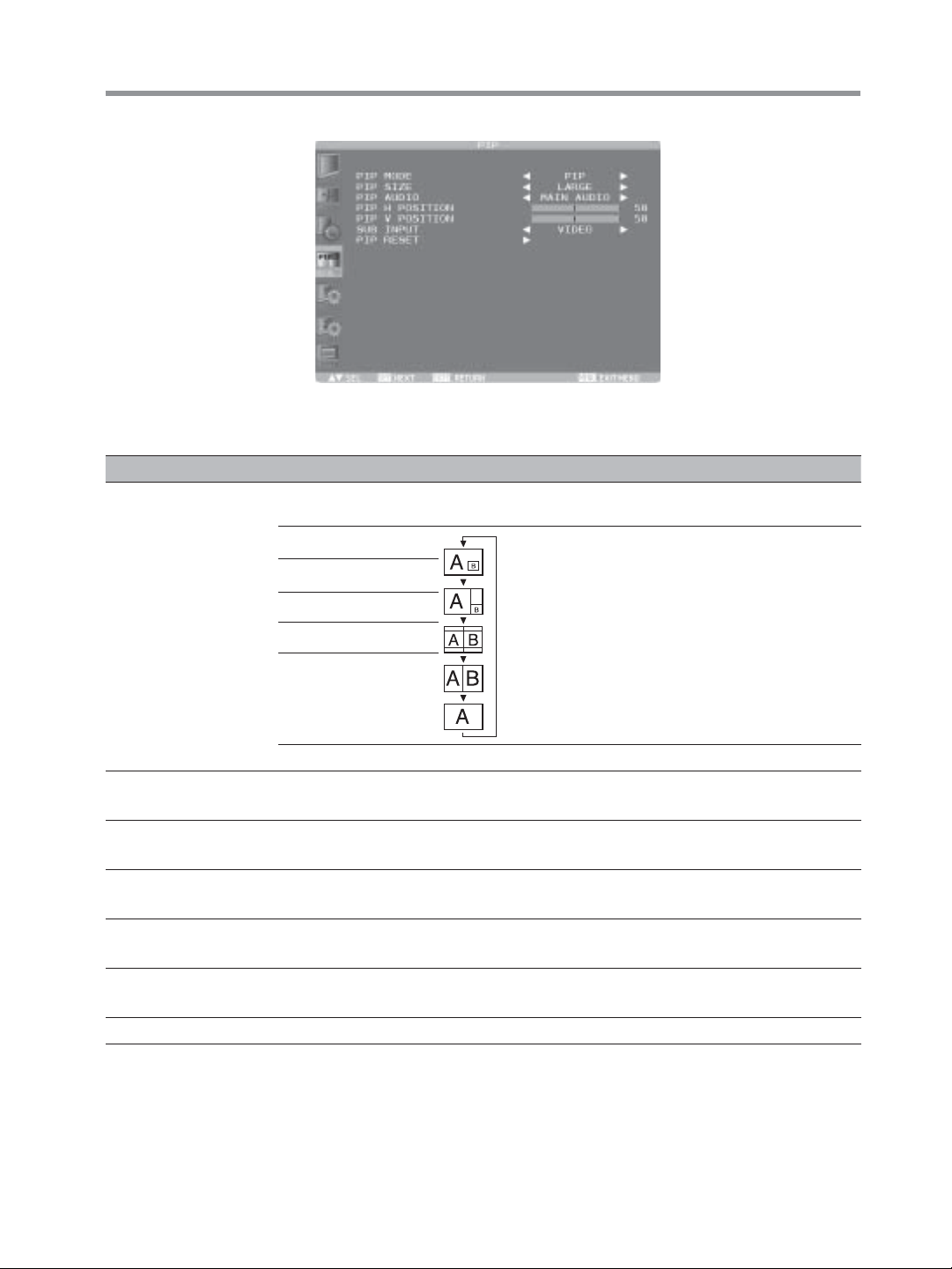
55
How to Use
PIP ( Picture In Picture)
The PIP and POP functions don’t work in the CUSTOM and REAL picture size modes. Refer to “PIP, POP function” for
details. (See page 66.)
Mode Description
PIP MODE
You can select the PIP mode from PIP, POP, SBS ASPECT, SBS FULL, and OFF using the
PLUS (+) and MINUS (-) buttons. See page 66.
PIP
POP
SBS ASPECT
SBS FULL
OFF
* SBS: SIDE BY SIDE
PIP SIZE
You can select the size of the sub picture displayed in the PIP mode. You can move the sub
PIP AUDIO
You can select the audio output in the PIP mode. When MAIN is selected, audio of the main
picture is output. When SUB is selected, audio of the sub picture is output.
PIP H POSITION
the sub screen to the right. Press the MINUS (-) button to move the sub screen to the left.
PIP V POSITION
sub screen up. Press the MINUS (-) button to move the sub screen down.
SUB INPUT
You can select the video input for the sub screen from HDMI, DVI-D, D-SUB, YPbPr,
S-VIDEO, and VIDEO.
PIP RESET You can reset all the PIP settings to the factory defaults.
PIP (Picture in Picture)
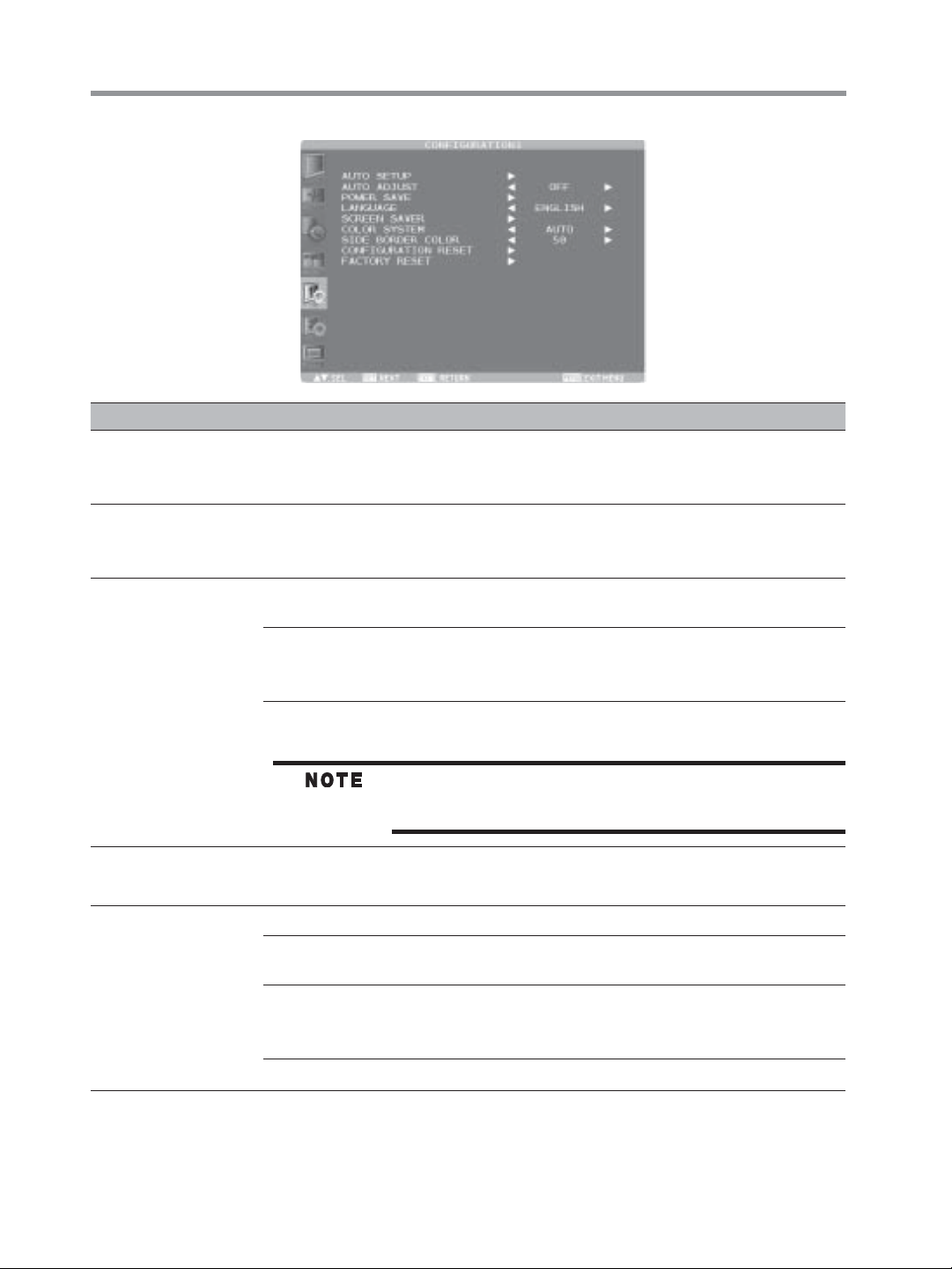
56
How to Use
Configuration 1
Mode Description
AUTO SETUP
( For the D-SUB inputs only.)
The screen size, horizontal/vertical position, clock, clock phase, and input signal level are
AUTO ADJUST
( For the D-SUB inputs only.)
When AUTO ADJUST is ON, the horizontal position, vertical position, and clock phase are
POWER SAVE
When the power saver in the OSD menu is turned ON, the power management function
works.
RGB:
When the sync signal of computer input (HDMI1, HDMI2, DVI-D,
D-SUB, or DISPLAYPORT) is terminated, the monitor will be in the
sleep mode in several seconds.
VIDEO:
When the sync signal of video input (YPbPr, S-VIDEO, or VIDEO) is
terminated, the monitor will be in the sleep mode in approximately 10
minutes.
When you hold down the DISPLAY button on the wireless remote control for at least
5 seconds, the NORMAL mode is activated. You can lock the wireless remote control
independently from the control buttons on the rear of the monitor. See page 64.
LANGUAGE
OSD control menus are available in eight languages. (English, German, Spanish, French,
SCREEN SAVER
You can set the SCREEN SAVER functions to reduce the risk of “image persistence.”
GAMMA:
When you select ON, the gamma mode where image persistence is diff
cult to occur is used.
COOLING FAN:
When you select ON, the cooling fan always runs. When you select
AUTO, the built-in fan automatically starts running according to the
operating temperature.
BRIGHTNESS: When you select ON, the brightness decreases.
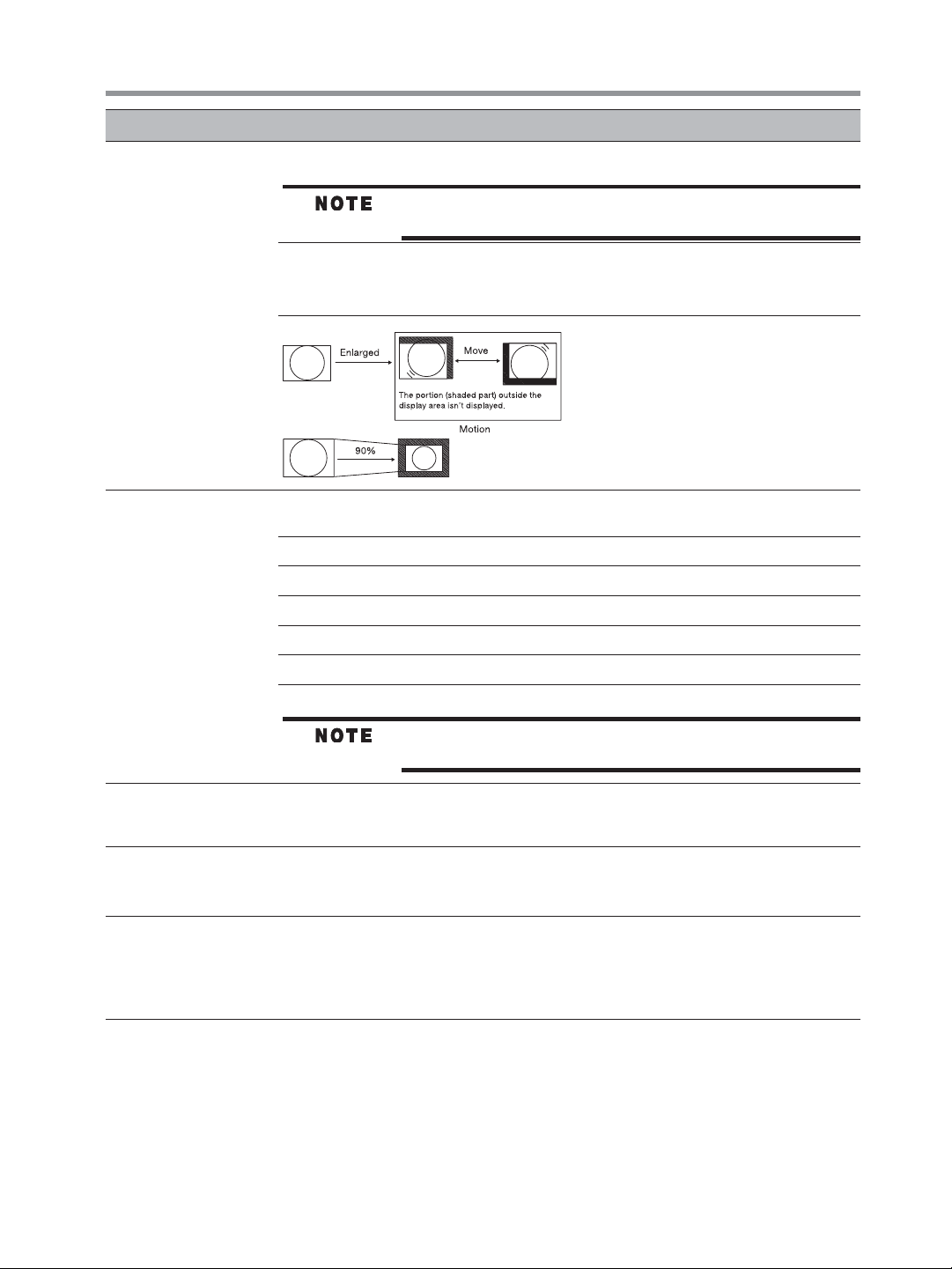
57
How to Use
Mode Description
SCREEN SAVER
MOTION:
The screen slightly moves horizontally and vertically at regular intervals
to reduce the effect of the image persistence.
While TILING in the ADVANCED OPTION menu is active, you cannot set MOTION to
ON.
When you select a time period in the MOTION setting, the monitor enlarges the image and
moves it horizontally and vertically. The portions of the image out of the display area aren’t
screen area at the center.
COLOR SYSTEM
( For the S-VIDEO and VIDEO inputs only.)
You can select the color system depending on the video device you use.
AUTO: NTSC, PAL, SECAM, PAL-60 or 4.43 NTSC is automatically selected.
NTSC: NTSC
PAL: PAL
SECAM: SECAM
4.43NTSC: 4.43 NTSC
PAL-60: PAL-60
When you use a video device purchased from overseas, set the COLOR SYSTEM
menu.
SIDE BORDER COLOR
displayed in the NORMAL mode in the ZOOM MODE or the POP or other modes in the PIP
MODE.
CONFIGURATION
RESET
The settings made in the CONFIGURATION1 and CONFIGURATION2 menus are reset to
the factory defaults.However, the LANGUAGE, MONITOR ID, SCHEDULE, and DATE
AND TIME settings aren’t reset.
FACTORY RESET
The settings made in the PICTURE, SCREEN, AUDIO, CONFIGURATION1,
CONFIGURATION2, and ADVANCED OPTION menus are reset to the factory defaults. In
addition, the picture mode selected by the wireless remote control is reset to the factory
default. However, LANGUAGE, CONTROL TIME OUT, MONITOR ID, SCHEDULE, and
DATE AND TIME aren’t reset.
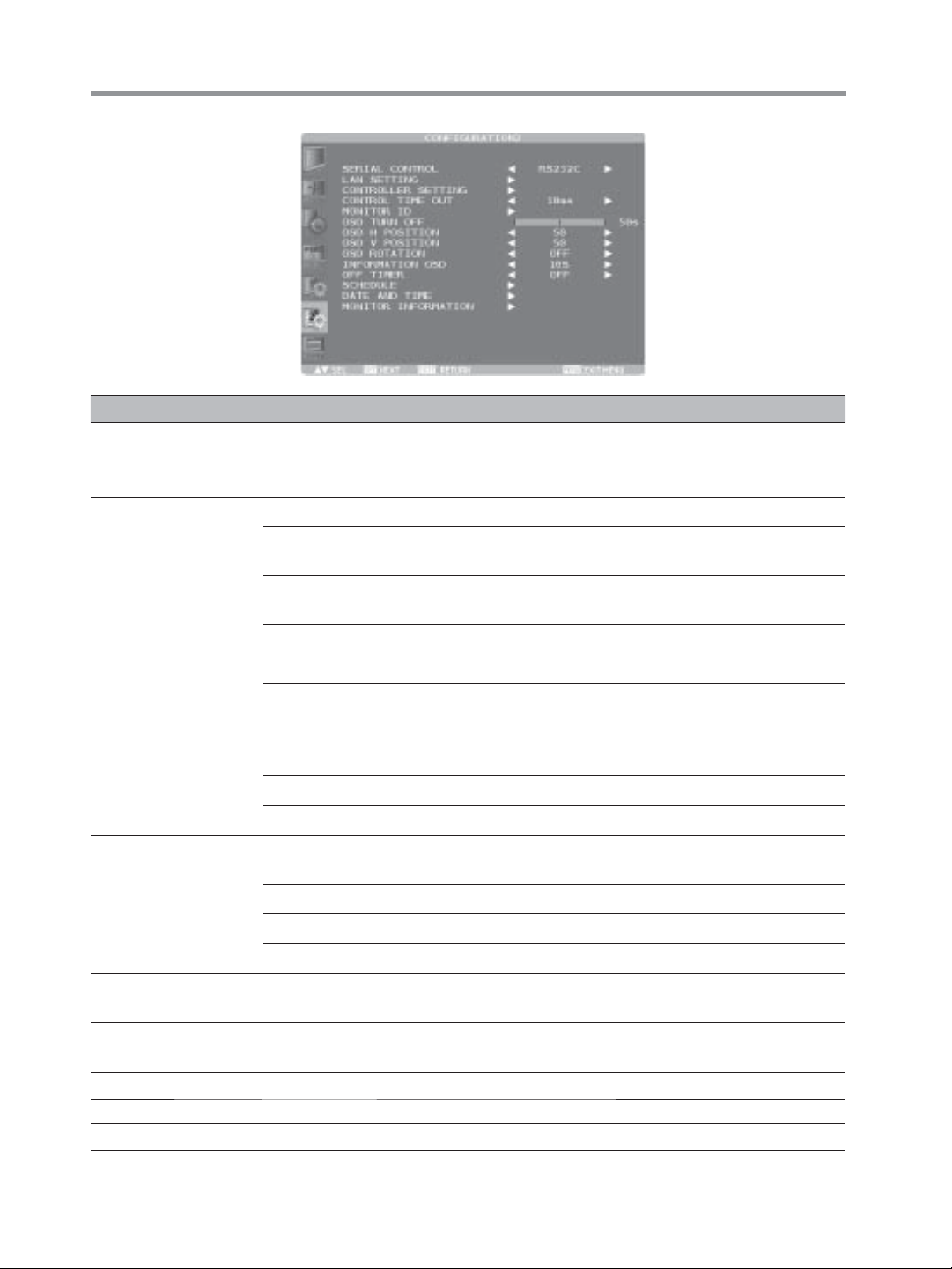
58
How to Use
Configuration 2
Mode Description
SERIAL CONTROL
Select the communication interface (RS-232C, OPS (OPS-compliant computer), or LAN) for
the serial communication function.
For connection of the signal cable, see page 30.
LAN SETTING
You can set the communication parameters for the LAN network.
DHCP CLIENT:
Select whether to use DHCP client or not. Select OFF when not using it, and
select ON when using it.
IP ADDRESS:
When DHCP CLIENT is OFF, set the IP address of the monitor. When
DHCP CLIENT is ON, you can check the value set by the DHCP server.
SUBNET
MASK:
When DHCP CLIENT is OFF, set the gateway mask. Set it to
255.255.255.0 for normal use. When DHCP CLIENT is ON, you can check
the value set by the DHCP server.
DEFAULT
GATEWAY:
When DHCP CLIENT is OFF, set the IP address of the gateway router to
externally connect the local area including the monitor.
When DHCP CLIENT is ON, you can check the value set by the DHCP
server.
PORT: The port number (60822) of the monitor is displayed.
RESET: LAN settings are reset.
CONTROL TIME OUT
When using remote control, the timeout for transmission intervals among codes within the
control command can be set.
10 ms: Set the time out intervals to 10 milliseconds.
2 s: Set the time out intervals to 2 seconds.
30 s: Set the time out intervals to 30 seconds.
MONITOR ID
ID numbers for wireless remote control are assigned to TD-Z551 and TD-Z701 monitors that
are multi-connected via RS-232C. ID numbers 1 to 26 are selectable.
OSD TURN OFF
The OSD control menu will stay on as long as it is used.The preset choices are 5 -120
seconds.
OSD H POSITION
OSD V POSITION
OSD ROTATION The OSD screen is rotated.
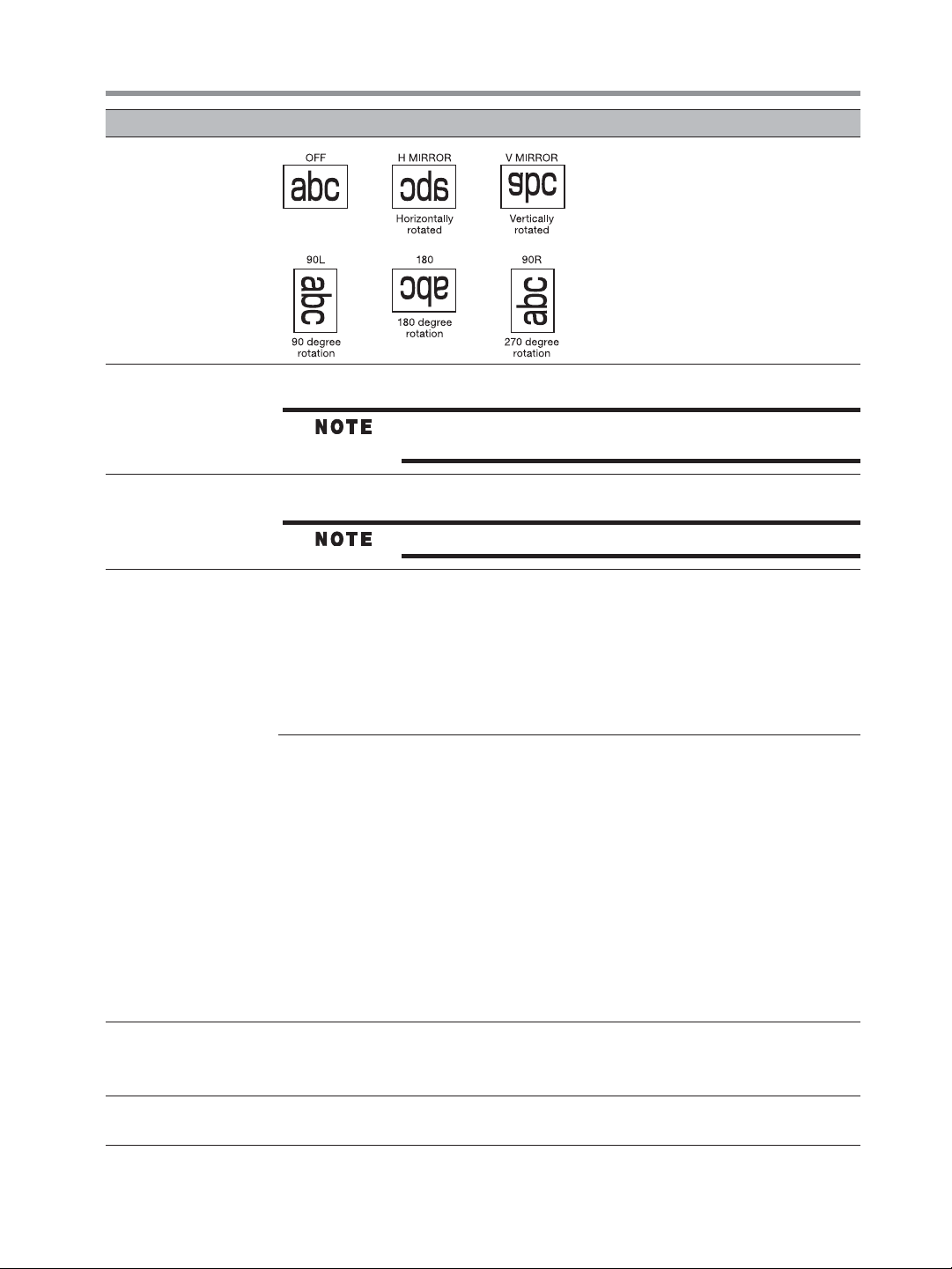
59
How to Use
Mode Description
INFORMATION OSD
You can enable and disable the information OSD display. The display time is selectable from
3 to 10 seconds.
The information OSD display shows a message when the input source is switched,
the input signal state is changed, or the input signal has an error.
OFF TIMER
You can select the OFF TIMER mode. Select the time period to automatically turn off the
power from 1 to 24 hours.
When OFF TIMER is enabled, the SCHEDULE settings (see page 41) will be disabled.
SCHEDULE
You can program the LCD display operation schedules. (See page 42)
< HOW TO SETUP SCHEDULE >
Using the “SCHEDULE” function allows you to set up to seven different scheduled time
intervals when the LCD display will be activated.
You can select the time the monitor turns on and turns off, the day of week the monitor is
activated, and which input source the monitor will use for each scheduled activation period.
A check mark in the box next to the number of the schedule indicates that the selected
schedule is in effect.
To select which schedule to set, use the up/down arrows to move the number (1 to 7) of the
schedule.
Use the (+) and (-) buttons to move the cursor horizontally within the particular schedule.
to make a selection. If you create a schedule but do not want to set the power on time, select “--” in
the “ON” time slot.
If you do not want to use a power off time select “--” in the “OFF” time slot.
If there is no input selected (“--” showing in the input spot) the input from the previous schedule
will be used.
The selection of EVERY DAY within a schedule takes priority over other schedules that are set up
to operate weekly.
When schedules are overlapping, scheduled Power ON time has priority over scheduled Power
OFF time.If there are two schedules programmed for the same time, then the highest numbered
schedule has priority.
When OFF TIMER is enabled, the “SCHEDULE” settings are disabled.
DATE AND TIME
using SCHEDULE. After competing the setting, be sure to press the SET button (button r on
page 11). When using a button of the monitor, use the INPUT button (button r on page 11).
MONITOR
INFORMATION
The model name and the serial number of your monitor are displayed.The MAC address of
LAN is displayed.
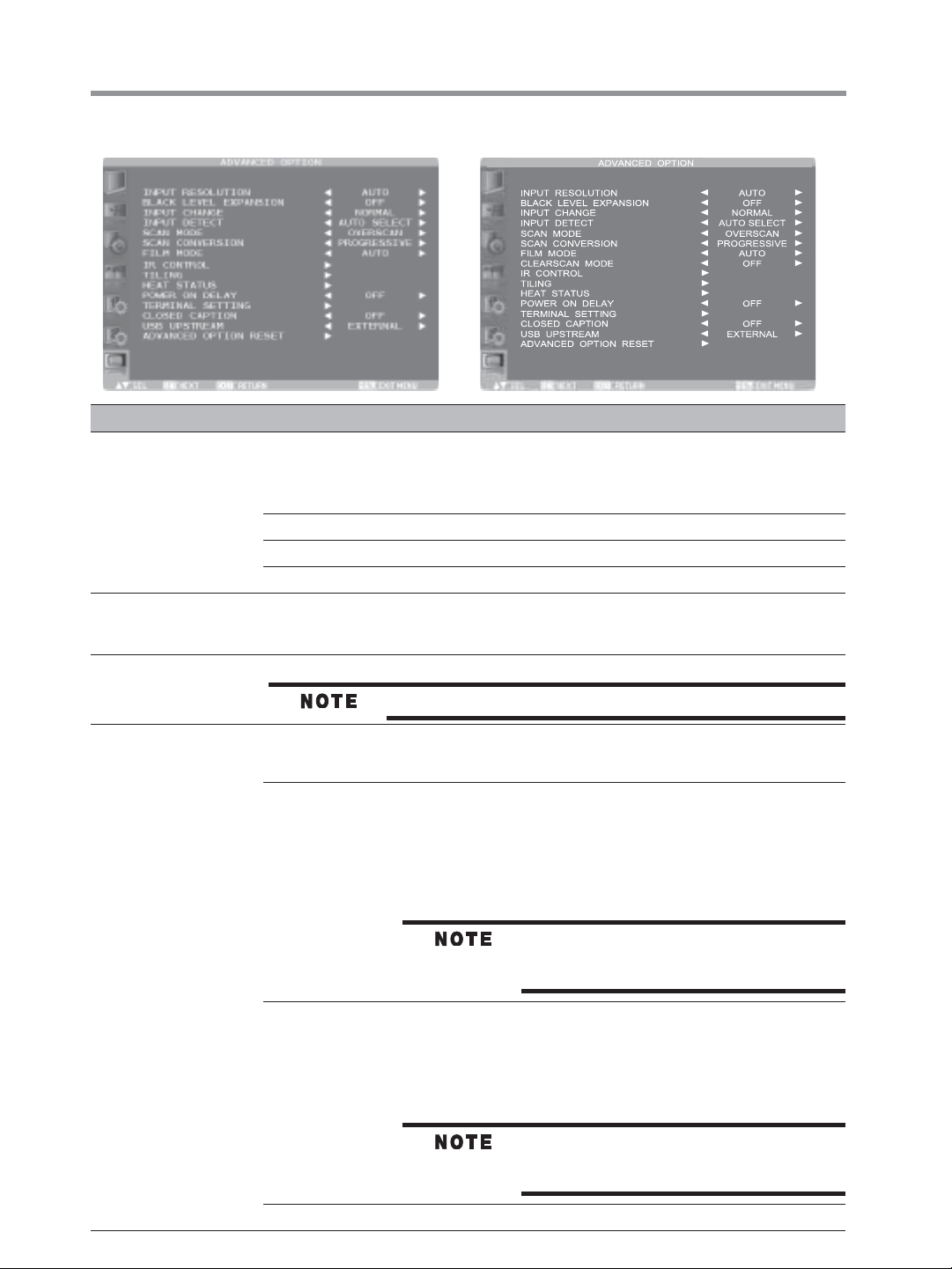
60
How to Use
Advanced Option
55” 70”
Mode Description
INPUT RESOLUTION
( For the D-SUB inputs only.)
If the monitor fails to recognize the input signal resolution correctly, you can select a proper
resolution manually. Only when a signal having a resolution close to any of the following
values from three groups, the values in the most appropriate group are selectable.
Group 1: AUTO, 1024 x 768, 1280 x 768, 1360 x 768, 1366 x 768
Group 2: AUTO, 1400 x 1050, 1680 x 1050
Group 3: AUTO, 1600 x 1200, 1920 x 1200
BLACK LEVEL
EXPANSION
(For the HDMI1-HD, HDMI2-HD, DVI-D-HD, DISPLAYPORT(YCbCr signal), OPTION
(YCbCr signal), YPbPr, S-VIDEO, and VIDEO inputs only.)
Select the level of black expansion from OFF, MIDDLE, and HIGH.
INPUT CHANGE
You can select the time for input switching from QUICK and NORMAL.
When you select QUICK, slight noise may appear.
INPUT DETECT
This function detects whether the video signals are present or not at the video inputs and
automatically select them. The priority applies when more than one signal is input at the same
time. The signal being displayed isn’t changed even when a signal with higher priority is input.
AUTO SELECT
The target video inputs are DVI-D and D-SUB. When the currently
selected input signal is lost, this function checks whether the signal is
present at the other input. When present, the other input is
automatically selected. If no signal is present at both inputs for f ve
seconds, the monitor enters the sleep mode. When an expansion
module such as the OPS BOX is in the option slot, OPTION is targeted
instead of DVI-D.The priority of the input signal is as follows:
DVI-D > D-SUB
You cannot select other inputs than DVI-D, OPTION, and
D-SUB. When an expansion module is mounted, the
monitor doesn’t enter the sleep mode.
VIDEO DETECT
The target video inputs are HDMI1, S-VIDEO, VIDEO, and D-SUB.
When the HDMI1, S-VIDEO, or VIDEO input is detected, the detected
input is automatically selected.
When the video signal being displayed is lost, the D-SUB input is
automatically selected.
The priority of the input signal is as follows:
HDMI1 > VIDEO > S-VIDEO
You cannot select HDMI2, DVI-D, OPTION, and
DISPLAYPORT. When an expansion module is mounted, the
monitor doesn’t enter the sleep mode.
OFF The video input isn’t selected automatically.
Advanced Option
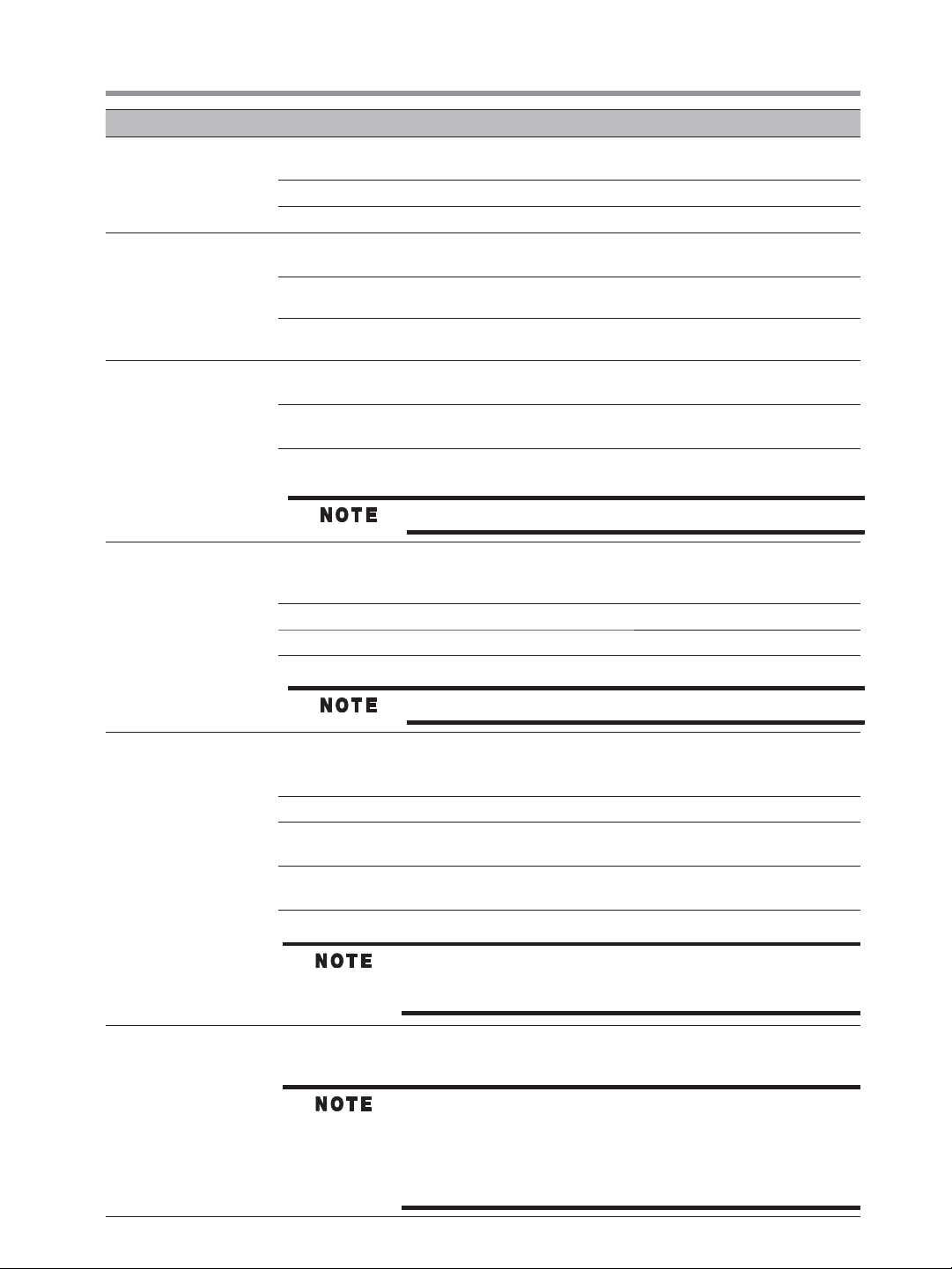
61
How to Use
Mode Description
SCAN MODE
(This function doesn’t work when the D-SUB video input is selected.)
You can select the image display area.
OVERSCAN: About 95% of the input image is displayed.
UNDERSCAN: Almost 100% of the input image is displayed.
SCAN CONVERSION
(This function doesn’t work when the D-SUB video input is selected.)
It works on interlace signals only. You can select the IP conversion mode.
PROGRESSIVE:
Interlace signals are converted into progressive signals. Select this
setting for normal cases.
INTERLACE:
Interlace signals are displayed without being converted. Though this
setting is suitable for motion images, still images aren’t displayed properly.
FILM MODE
(This function doesn’t work when the D-SUB video input is selected.)
It works on interlace signals only. You can select the f lm mode function.
AUTO:
I
and then displayed.
OFF:
The input video si
processing.
When FILM MODE is AUTO, set SCAN CONVERSION to PROGRESSIVE.
ClearScan™
(Only for 70”)
You can enable the double-speed clear picture function (ClearScan
™
).
Moving images displayed at 60 frames per second are interpolated into 120-frame-per-
second images for smooth and sharp image quality.
OFF: Not interpolated
MIDDLE: Interpolated (Typical)
HIGH: Interpolated (for smoother and sharper image)
Frame interpolation may cause noise and smear. To reduce noise and smear, select OFF.
IR CONTROL
You can lock the wireless remote control.
Select from the following 4 modes using the S and T buttons and then determine the selected
mode by pressing the SET button.
NORMAL: All the remote control operations are enabled.
PRIMARY:
rst TD-Z551 and TD-Z701 monitors of those multiconnected via
RS-232C is designated as PRIMARY.
SECONDARY:
via RS-232C are designated as SECONDARY.
LOCK: All the remote control operations are disabled.
When you hold down the DISPLAY button on the wireless remote control for at least 5
seconds, the NORMAL mode is activated. You can lock the wireless remote control
independently from the control buttons on the rear of the monitor. See page 64.
TILING
TILING is a function to divide or enlarge images and display them across multiple screens.
on a single large screen comprised of up to 25 (5 x 5) monitors tiled together.
A same video signal needs to be input to each monitor. When different monitors need to
be adjusted so that their tint can be identical, it is recommended to use a signal
distributor (commercially available). When TILING is activated, PIP, POP, SBS, and
STILL are disabled. TILING doesn’t work in the REAL picture size mode.
While TILING is active, you cannot set MOTION of SCREEN SAVER in the
CONFIGURATION1 menu to ON.
Advanced Option
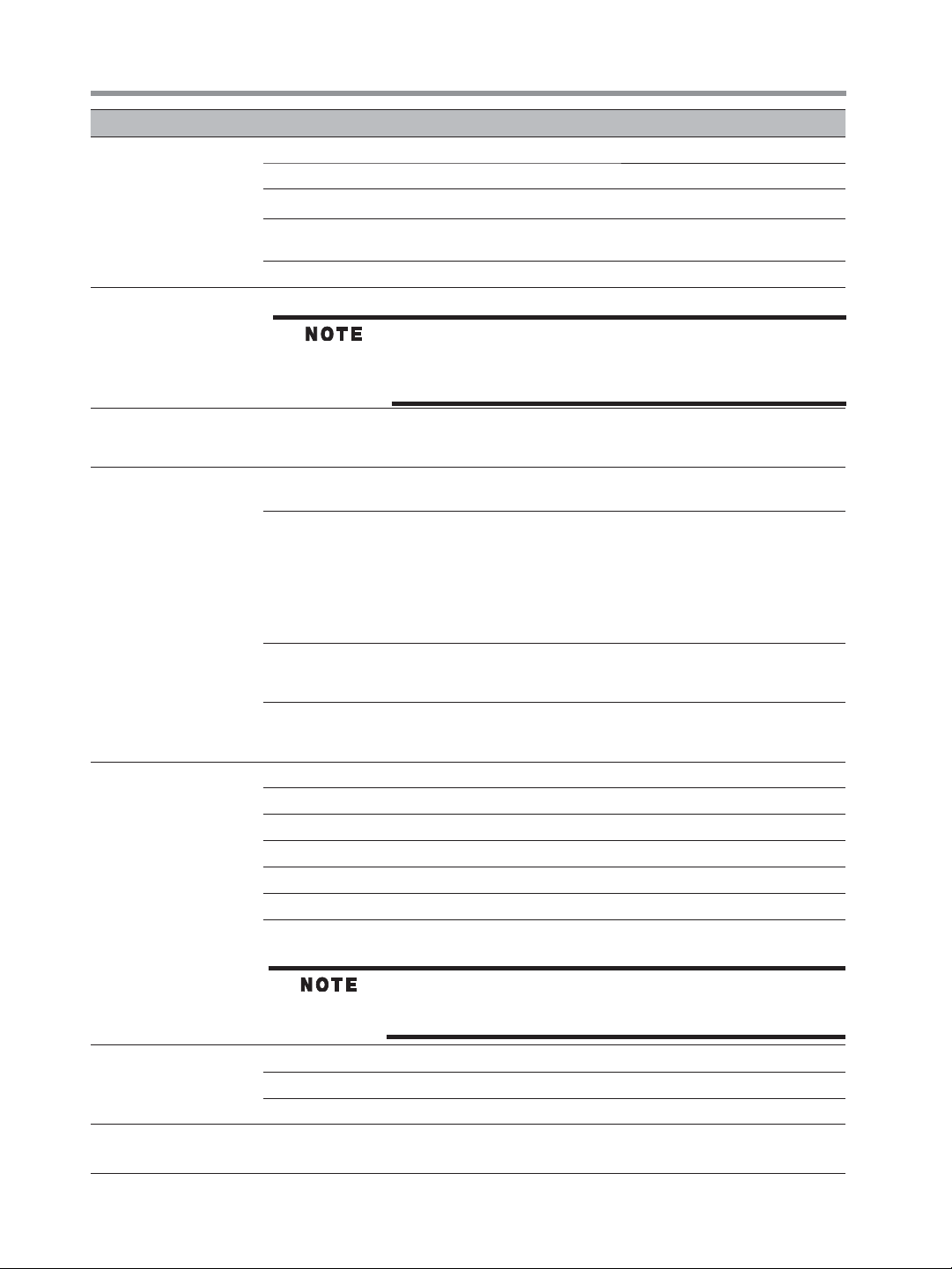
62
How to Use
Mode Description
TILING
H MONITORS: Select the number of images obtained by horizontal division.
V MONITORS: Select the number of images obtained by vertical division.
POSITION: Select the area you want to enlarge.
FRAME COMP.:
When displaying an image across multiple monitors, you can select the
mode to compensate for the bezel widths for smooth and natural display.
ENABLE: When you select ON, the image in the selected area is enlarged on the screen.
HEAT STATUS
The statuses of the cooling fan, brightness, and internal temperature are displayed.
The cooling fan starts running according to the operating temperature or when
COOLING FAN is ON in the SCREEN SAVER menu. When the operating temperature
SUBSTANTIALLYEXCEEDSTHEOPERATIONGUARANTEEDRANGETHEMESSAGEh4%-0%2!452%
7!2.).'vISDISPLAYEDONTHESCREEN
POWER ON DELAY
You
from the sleep mode or power-on.
The time is selectable from OFF and 2, 4, 6, 8, 10, 20, 30, 40, and 50 seconds.
TERMINAL SETTING
You can select the mode to display the HDMI1, HDMI2, or DVI-D signal according to their
signal format depending on their source device.
HDMI SIGNAL:
Select this setting when displaying HDMI1, HDMI2, or OPTION (when
an OPS-compliant computer is mounted).
Select FULL when displaying the signal that uses all 256 levels (from level
0 to 255). This mode is used primarily when input comes from a computer.
Select LIMITED when displaying the signal that uses 16 to 235 levels of
256 levels for each of R, G, and B. This mode is used primarily when input
comes from a video device.
HDMI MODE:
Select this setting when displaying the HDMI1 or HDMI2 signal.
Select HDMI-HD when the source device is a video device.
Select HDMI-PC when the source device is a PC.
DVI MODE:
Select this setting when displaying the DVI-D signal.
Select DVI-PC when the source device is a PC.
Select DVI-HD when the source device is a video device.
CLOSED CAPTION
You can select to display or hide captions.
OFF: Captions are hidden.
CC1: Captions are displayed in sync with the primary audio.
CC2: Information (related to the primary audio) is displayed without sync.
CC3: Captions are displayed in sync with the secondary audio.
CC4: Information (related to the secondary audio) is displayed without sync.
TT1/TT2/TT3/TT4:
Four types of information not related to the displayed images are
displayed. (For example, news and weather forecast.)
Check with each supplier of your video software and external video devices in advance
whether they are compliant with EIA-608-A.
If their video signals are not compliant with it, images may not be displayed correctly.
USB UPSTREAM
You can select either of the 2 upstream ports and distribute the signal to 2 downstream ports.
EXTERNAL: External computer is selected.
OPS: OPS-compliant computer is selected.
ADVANCED OPTION
RESET
The settings made in the ADVANCED OPTION menus are reset to the factory defaults.
However, HDMI MODE, are DVI MODE aren’t reset.
Advanced Option
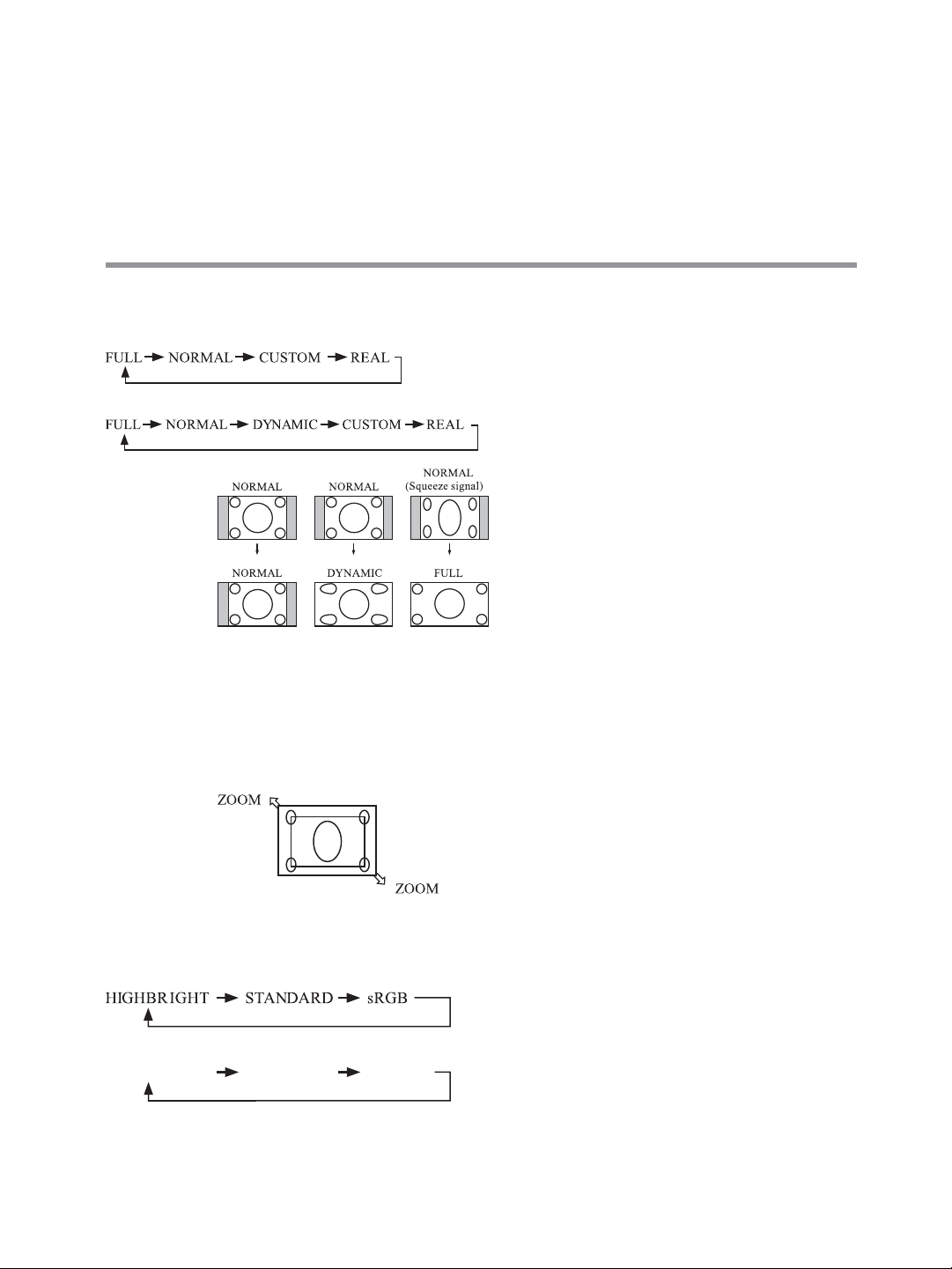
63
Chapter 4
Other functions
Picture size
HDMI1, HDMI2, DVI-D, D-SUB, OPTION (OPS-compliant computer), DISPLAYPORT
YPbPr, VIDEO, S-VIDEO
Normal size of
each signal
Recommend
picture size
NORMAL:
aspect ratio.
FULL: Images are displayed on the entire screen.
DYNAMIC:
4:3 images are enlarged on the entire screen with non-linearity. (Round images may be cut when
enlarged.)
CUSTOM
(ZOOM):
You can enlarge the displayed images beyond the active display area. The portions of the image out
of the display area aren’t visible.
REAL: Images are displayed in their original sizes.
Picture mode
HDMI1*, HDMI2*, DVI-D, D-SUB, OPTION (OPS-compliant computer), DISPLAYPORT
HDMI1*, HDMI2*, YPbPr, VIDEO, S-VIDEO
HIGHBRIGHT STANDARD CINEMA
* Automatically selected depending on the input signal.

64
Other functions
OSD information
Control Lock mode
operation buttons.
OSD information
HDMI1, HDMI2, DVI-D, D-SUB, DISPLAYPORT
Current selection (DVI-D)
Resolution
Horizontal/vertical frequency
Audio input mode
Picture size mode
OPTION (OPS-compliant computer)
Current selection
((OPTION (OPS-compliant computer))Resolution
Horizontal/vertical frequency
Audio input mode
Picture size mode
YPbPr
Current selection (YPbPr)
Audio input mode
Picture size mode
S-VIDEO, VIDEO
Current selection (S-VIDEO)
Color system mode
Audio input mode
Picture size mode
PIP, POP
Main : DVI-D
Sub : S-VIDEO
Main picture information
Audio input mode
Sub picture information
Main picture size
Control Lock mode
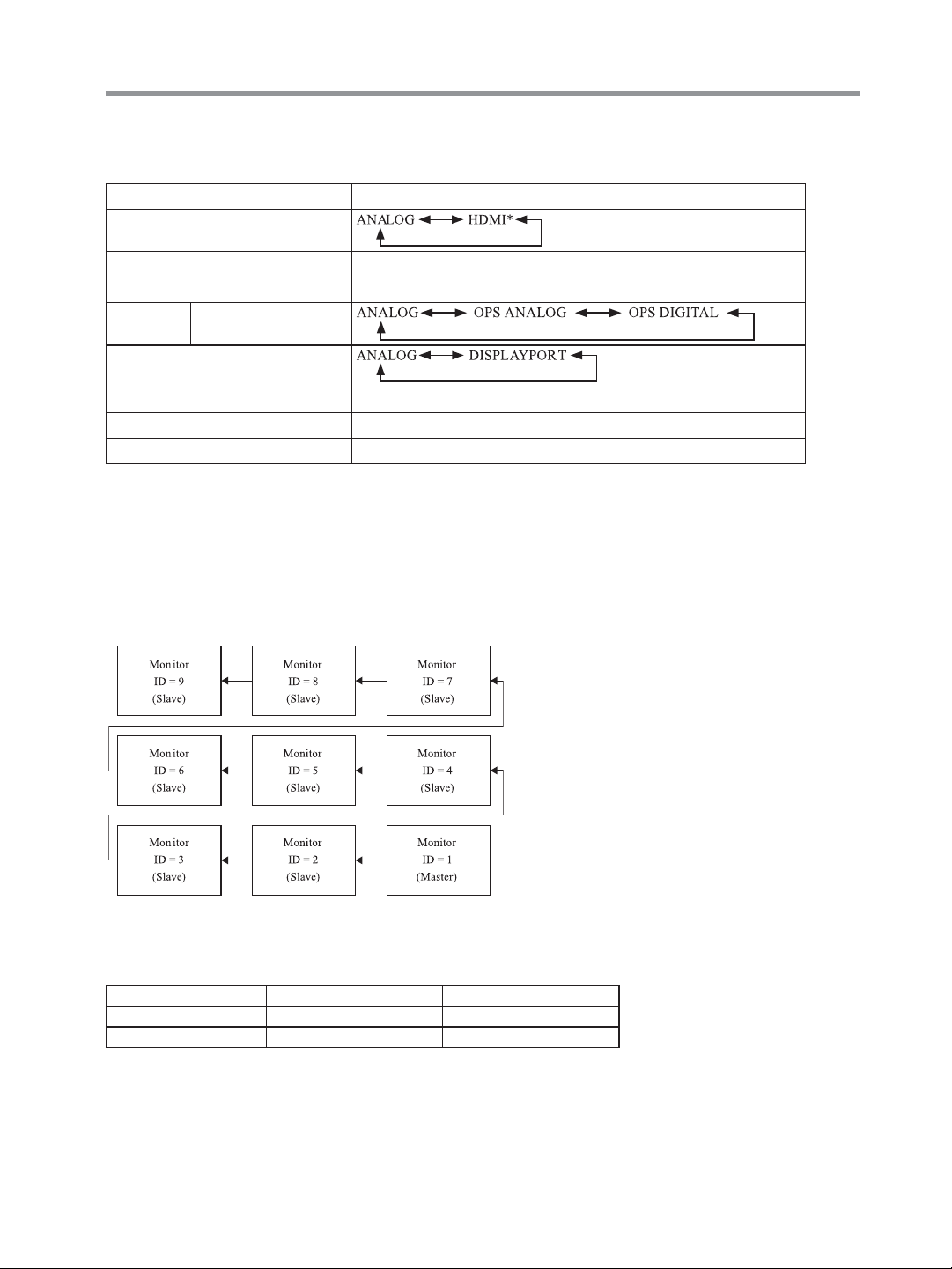
65
Other functions
Supplemental information of the auto brightness function
Audio input change
You can select the audio input using the AUDIO INPUT button.Note that the selectable audio inputs vary depending
on the currently selected video signal input.
Selection of the video signal input Operation
HDMI1 or HDMI2
DVI-D ANALOG only
D-SUB ANALOG only
OPTION** PC (OPS-compliant
computer)
DISPLAYPORT
YPbPr ANALOG only
S-VIDEO ANALOG only
VIDEO ANALOG only
!"#$%#$%"#$%&
** OPTION can be used when an expansion module is mounted on the option slot.
Supplemental information of the auto brightness function
To control multiple monitors collectively
In such a case where the tiling function is used, you can control the auto brightness function by sharing the detection
result of the brightness sensor of a certain monitor among the connected monitors.
1 Multi-connect the monitors using RS-232C cables (commercially available) as shown by the example below.
Master: Monitor conf gured as Master that detects
the outside light (Monitor ID is “1”.)
Slave: Monitor controlled by the Master monitor
(Monitor ID is other than “1”.)
2 Assign a monitor ID to each multi-connected TD-Z551/ TD-Z701 using MONITOR ID. (See page 58.) Monitor ID is
selectable from 1 to 26. The monitor ID of the Master monitor should be “1” and those of the Slave monitors should
be other than “1”. You are recommended to assign IDs to the monitors consecutively from 1, 2, 3, and on.
3 Set AUTO BRIGHTNESS on the OSD screen (PICTURE) as follows.
AUTO BRIGHTNESS CONTROL
Master monitor LOCAL PRIMARY
Slave monitors REMOTE SECONDARY
To use a computer to control the monitors
When using a computer to control the monitors, you must prepare an application software program for control by
yourself. Brightness of all the monitors can be controlled centrally using a computer, if the customer create a control
application to remotely read the value from two brightness sensors of any monitor and distribute it to all monitors.
1 Connect the RS-232C IN connector of the Master monitor shown above and the RS-232C connector of the
computer using an RS-232C cable. The communication control function via LAN isn’t supported on the monitor
alone, however, it is available when the monitor is used with the computer.
Audio input change
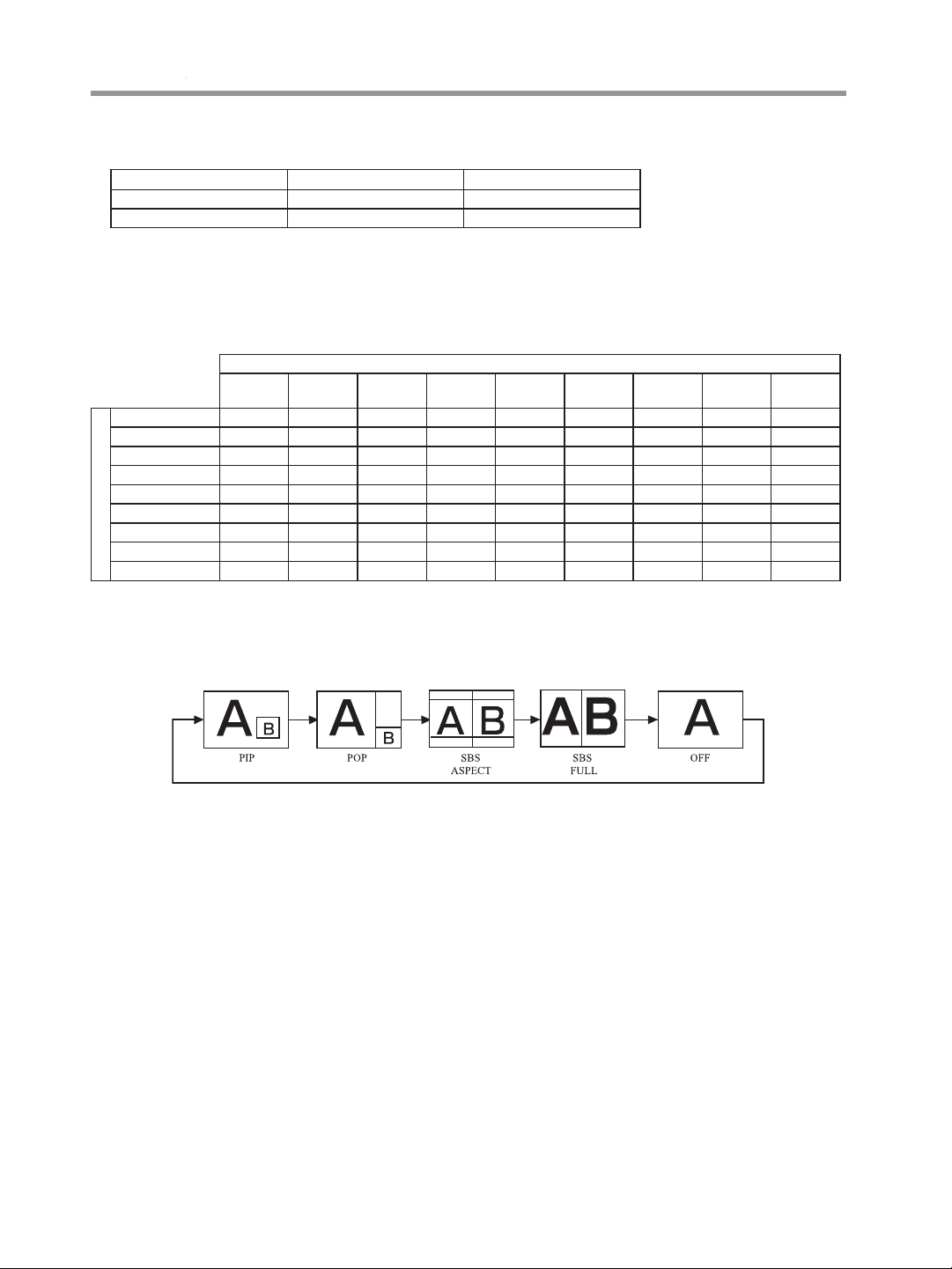
66
Other functions
PIP, POP function
2 Assign a monitor ID to each multi-connected TD-Z551/TD-Z701 using MONITOR ID. (See page 58.) Monitor ID is
selectable from 1 to 26.
3 Set AUTO BRIGHTNESS on the OSD screen (PICTURE) as follows.
AUTO BRIGHTNESS CONTROL
Master monitor REMOTE SECONDARY
Slave monitors REMOTE SECONDARY
4 A control application made by the customer reads the value from two brightness sensors of any monitor and distributes
it to all monitors. For the specif cations of the communication commands, contact your dealer.
PIP, POP function
The following table shows the combinations of signal inputs with which the “PIP” and “POP” modes function. However, these modes
do not function when the screen size is “CUSTOM” or “REAL”.
Sub screen
HDMI1 HDMI2 DVI-D D-SUB OPTION* DISPLAY
PORT
YPbPr S-VIDEO VIDEO
Main screen
HDMI1 xxxxxxx
HDMI2 xxxxxxx
DVI-D xxxxxxx
D-SUB xxxxxxx
OPTION* xxxxxxx
DIS PLAY PORT xxxxxxx
YPbPr x x x xxxx
S-VIDEO x x
VIDEO x x
* OPTION can be used when an expansion module is mounted on the option slot.
By pressing the PIP ON/OFF button on the wireless remote control, you can change the PIP, POP, and SBS modes in the
order shown below.Alternatively, you can change the modes using the PIP MODE setting of PIP in the OSD main menu.
See page 55.
The resolutions in the PIP and SBS FULL modes are as follows:
PIP SIZE < SMALL > : 450 pixels X 338 pixels
< MIDDLE > : 675 pixels X 450 pixels
< LARGE > : 900 pixels X 675 pixels
SBS FULL : 960 pixels X 1080 pixels
above irrespective of the aspect ratio of the input image.
PIP, POP function
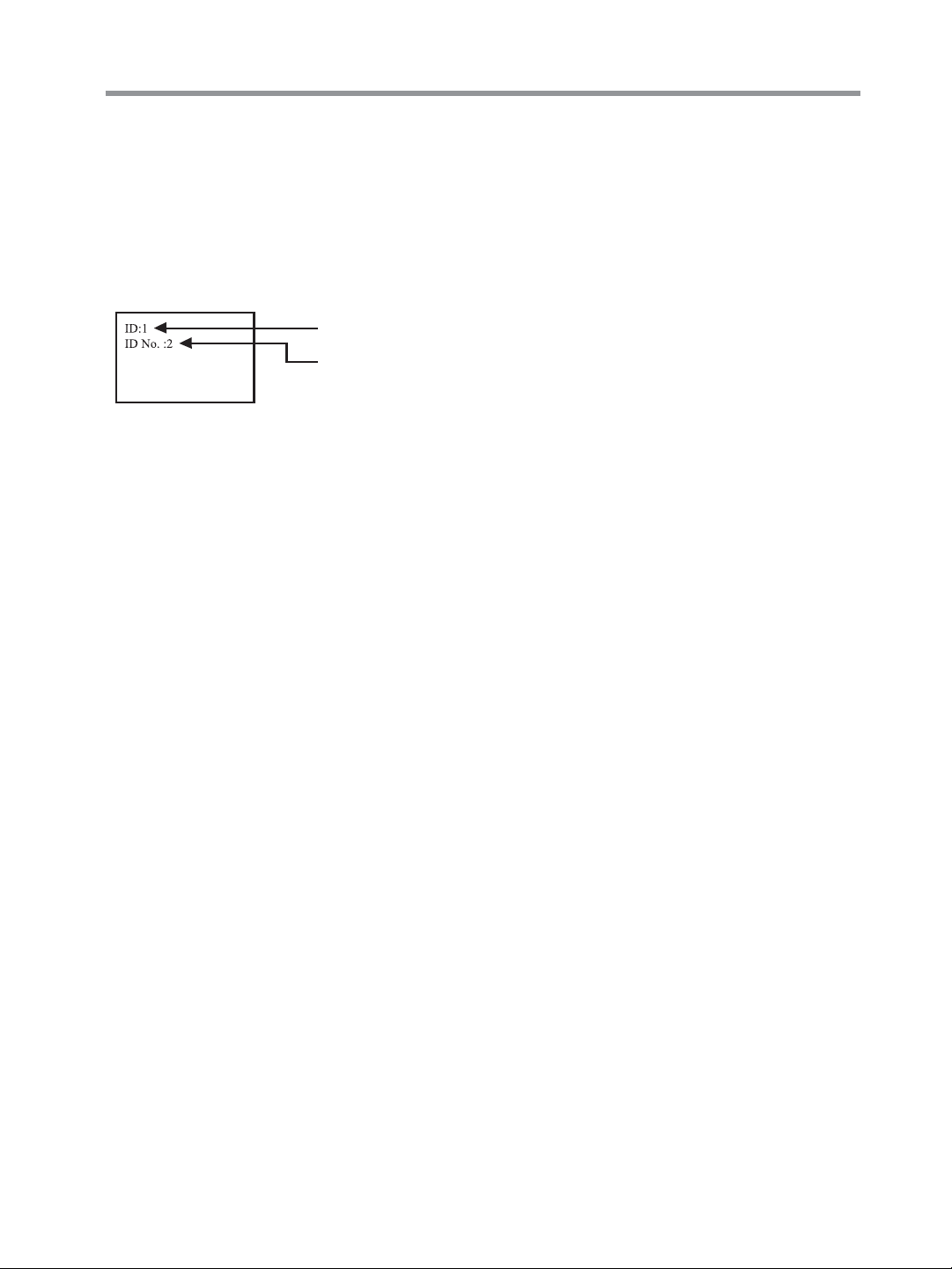
67
Other functions
Remote control numbering function
Remote control numbering function
By connecting multiple TD-Z551 and TD-Z701 monitors using RS-232C cables, you can control any one monitor or all the
monitors by one remote controller.
1 Assign arbitrary ID number to each of multi-connected TD-Z551 and TD-Z701 monitors using MONITOR ID. ID
numbers 1 to 26 are selectable. It is recommended to assign sequential ID numbers from 1 and up.
2
set to SECONDARY.
3 When you direct the remote controller at the remote control signal sensor of the PRIMARY monitor and press the
DISPLAY button on the remote controller, the ID selection OSD appears at the upper left of the screen.
ID number of the currently viewed monitor
Select the ID number of the monitor you want to control using the +/- button on
the remote controller. The ID of the monitor you want to control is displayed
at the upper left of its screen. By selecting ALL, you can control all the multi-
connected monitors.
4 Direct the remote controller at the remote control signal sensor of the PRIMARY monitor. OSD appears on the
monitor having the ID number you selected.
When the ID selection OSD is being displayed on the PRIMARY monitor, press the DISPLAY button on the remote
controller again to cancel the ID selection OSD and then control the monitor you selected.If you set the remote control
mode wrongly and remote control operation becomes unavailable, press any button on the control panel of the monitor to
display the OSD screen and change the remote control mode using ADVANCED OPTION. By pressing and holding down
the DISPLAY button on the remote control for 5 seconds or longer, the remote control mode is initialized to NORMAL.
Remote control numbering function

68
Chapter 5
Troubleshooting
General troubleshooting
Before calling a service technician, review this chapter for possible causes/solutions for the problem you are experiencing.
minute, and then plug the monitor back into the AC wall outlet. If the problem still exists attempt to troubleshoot the
problem.
No picture
The signal cable should be securely connected to the display card/computer.
The display card should be securely seated in its slot.
The Main Power Switch and the computer power switch should be in the ON position.
Make sure that the correct mode has been selected on the display card or system being used.
(Please consult the display card or system manual to change the graphics mode.)
Check the monitor and your display card with respect to the compatibility and recommended settings.
Check the signal cable connectors for bent or pushed-in pins.
Power button does not respond
Unplug the power cord of the monitor from the AC outlet to turn off and reset the monitor.
Image persistence
Please be aware that LCD Technology may experience a phenomenon known as “image persistence.” Image
persistence occurs when a residual or “ghost” image of a previous image remains visible on the screen. Unlike CRT
monitors, LCD displays’ image persistence is not permanent, but constant images being displayed for a long period of
time should be avoided. To alleviate image persistence, turn off the monitor for as long as the previous image was
displayed. For example, if an image was on the monitor for one hour and a residual image remains, the monitor should
be turned off for one hour to erase the image.
As with all display devices, recommends displaying moving images and using a moving screen saver at regular
intervals whenever the screen is idle or turning off the monitor when not in use.
Image is unstable, unfocused or swimming is apparent
Signal cable should be securely attached to the computer.
Check the monitor and your display card with respect to the compatibility and recommended signal timings.
If the displayed text is garbled, change the video mode to the non-interlace mode and use 60 Hz refresh rate.
Image of component signal is greenish
Check to see if the YPbPr input connector is selected.
LED on the monitor is not lit (No green or red color can be seen)
Power Switch should be in the ON position and power cord should be connected.
Make certain the computer is not in the power-saving mode (touch the keyboard or mouse).
RED LED on the monitor is blinking
A certain failure may have occurred. Please contact your nearest authorized service facility.
Displayed image is not sized properly

69
Troubleshooting
General troubleshooting
Make sure that the correct mode has been selected on the display card or system being used. (Please consult the display
card or system manual to change the graphics mode.)
Selected resolution is not displayed properly
Use OSD Display Mode to enter Information menu and check that the appropriate resolution has been selected. If not,
select corresponding option.
No sound
Check to see if the speaker cable is properly connected.
Check to see if the mute is activated.
Check to see if the volume is set to the minimum level.
Wireless remote control is not available
Check the wireless remote control’s batteries status.
Check if the batteries are inserted correctly.
Check if the wireless remote control is pointing at the monitor’s remote sensor.
“SCHEDULE”/“OFF TIMER” function is not working properly
The “SCHEDULE” function will be disabled when the “OFF TIMER” is set.
If the “OFF TIMER” function is enabled and the power to the LCD display is turned off if the power supply is
interrupted unexpectedly, then the “OFF TIMER” will be reset.
degradation.
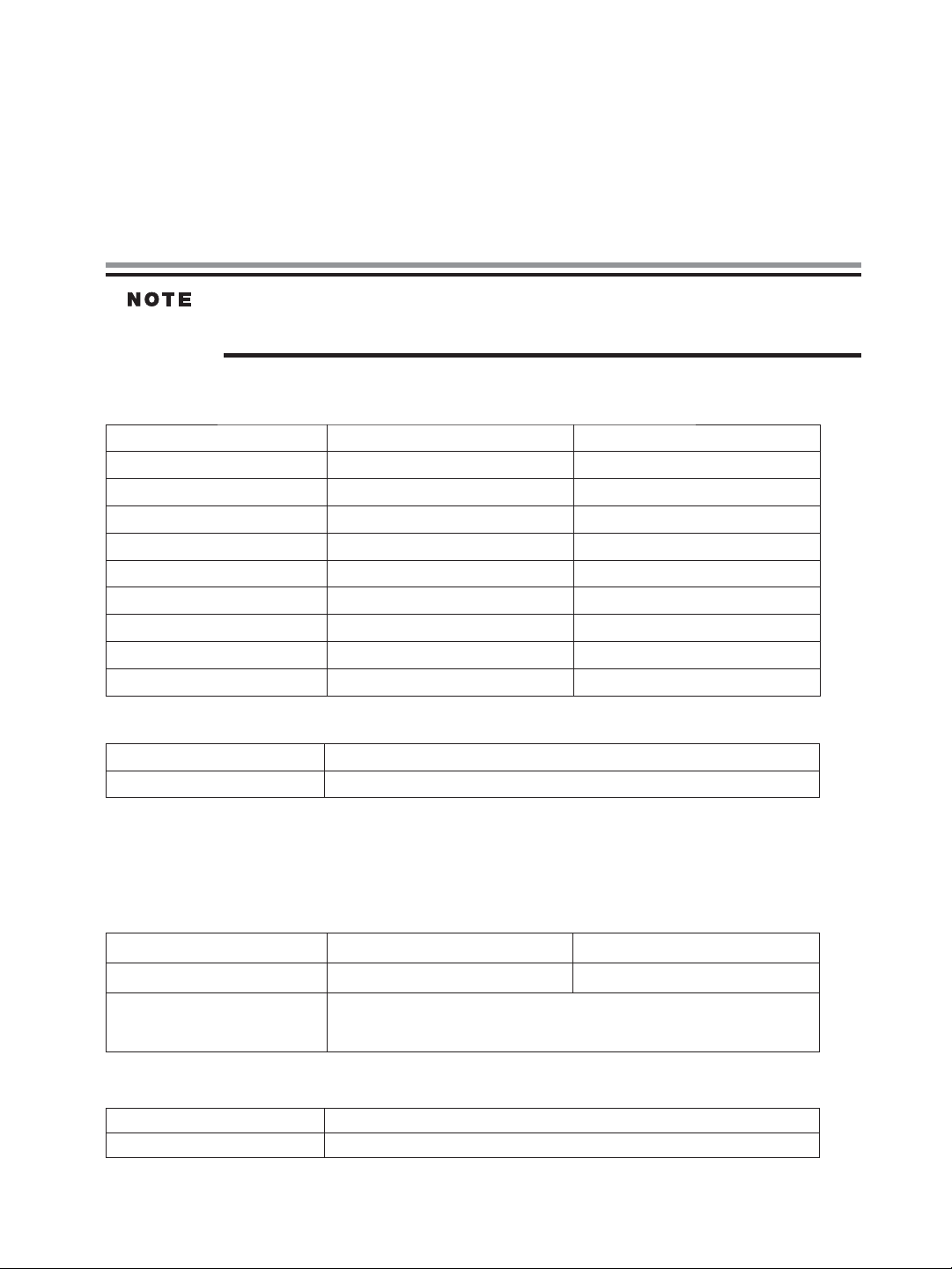
70
Appendix A
Specifications
s4HESEMODELSCOMPLYWITHTHESPECIlCATIONSLISTEDBELOW
s$ESIGNSANDSPECIlCATIONSARESUBJECTTOCHANGEWITHOUTNOTICE
s4HESEMODELSMAYNOTBECOMPATIBLEWITHFEATURESANDORSPECIlCATIONSTHATMAYBEADDEDINTHEFUTURE
LCD Module
LCD Module 55” 70”
Screen size (diagonal) 54.6” (1388 mm) 69.5” (1765 mm)
Panel Type VA VA
Pixel Pitch 0.630 mm 0.802 mm
Resolution 1920 x 1080 pixels 1920 x 1080 pixels
Color Approximately 1.06 billion colors Approximately 1.07 billion colors
Brightness (typ.) 450 cd/m
2
500 cd/m
2
Contrast ratio 4000 : 1 5000 : 1
Viewing Angle (CR>=10) Up/Down 178°, Left/Right 178° Up/Down 176°, Left/Right 176°
Response time 6.5 ms (Gray to Gray) 6 ms (Gray to Gray)
Viewable Size (H x V)
55” 1209.6 mm x 680.4 mm / 47.6” x 26.8”
70” 1538.9 mm x 865.6 mm / 60.6” x 34.1”
Power Management
VESA DPM
Power source
55” 70”
Input Voltage / Current 1.8 A - 0.8 A @AC100 - 240 V, 50/60 Hz 2.8 A - 1.3 A @AC100 - 240 V, 50/60 Hz
Power Consumption at Power Saving Sleep mode: Less than 1 W
Power switch off (DC-OFF): Less than 1 W
Main power switch off: 0 W
Power consumption
55” 186 W (133 W without speaker, option slot)
70” 278 W (218 W without speaker, option slot)
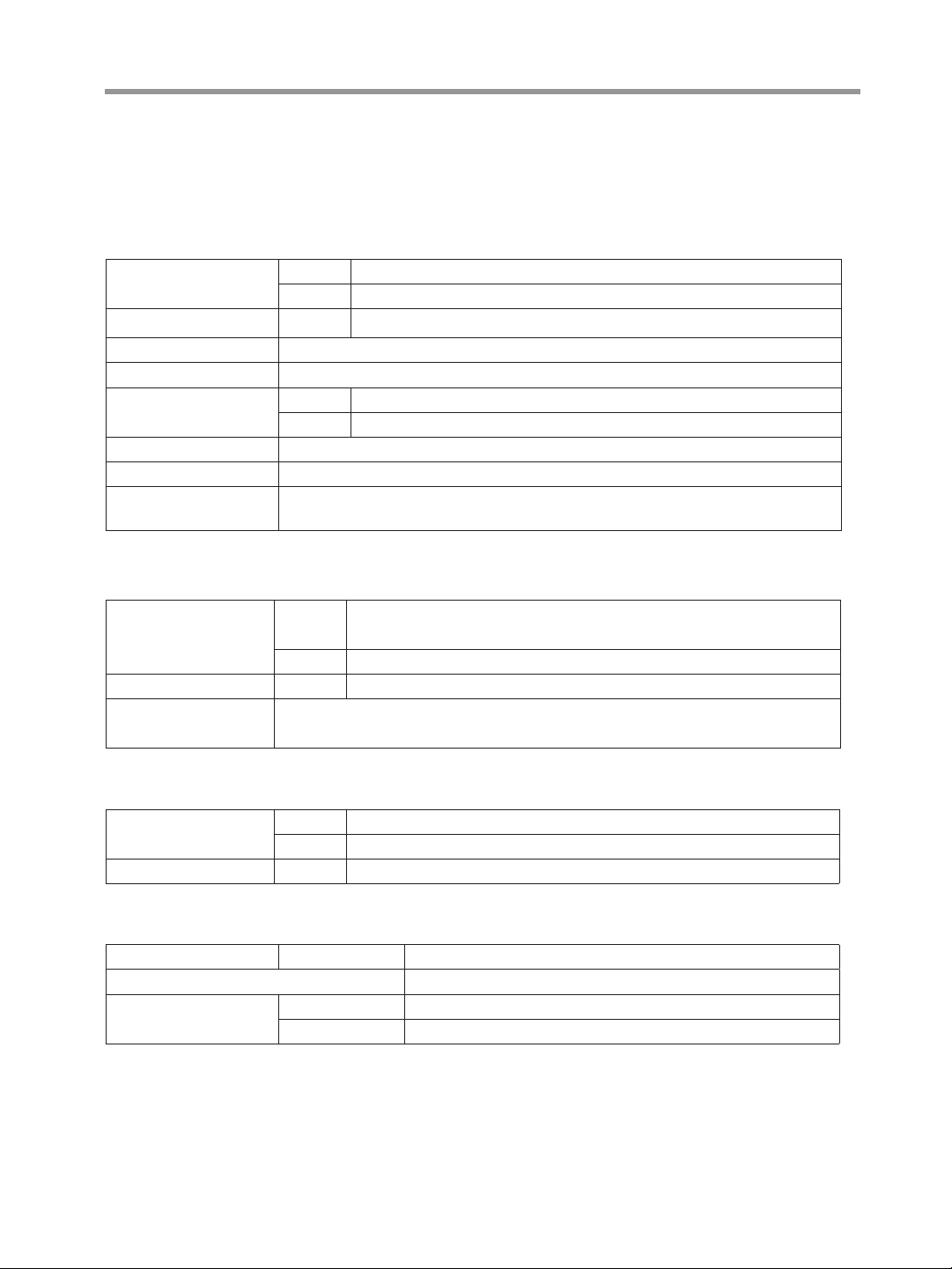
71
Specifications
External Speaker Output
External speaker, impedance 8 ohm, audio output 10W+10W (stereo)
Input / Output Signal
PC Input / Output
Input Connector
Analog MINI D-SUB 15-pin (PC/AV Common)
Digital HDMI x 2 (PC/AV Common), DVI-D (HDCP supported), DISPLAYPORT
Output Connector Digital DVI-D (HDCP supported)
Horizontal Frequency Analog: 15.625/15.734, 31.5 kHz - 91.1 kHz, Digital: 31.5 kHz - 91.1 kHz
Vertical Frequency 50/58 Hz - 85 Hz
Pixel Clock
Analog 13.5 - 165.0 MHz
Digital 25.0 - 165.0 MHz
Video Signal Analog: Analog RGB, Digital: TMDS (with HDCP)
Sync Signal Analog: Separate (TTL), Composite (TTL), Sync on Green, Digital: TMDS
Supported Resolution
640 x 480, 800 x 600, 1024 x 768, 1280 x 768, 1360 x 768, 1280 x 1024,1600 x 1200
AV Input / Output
Input Connector
Analog
Composite <BNC>, Separate (Y/C) <S-TERMINAL>, MINI D-SUB 15-pin
(PC/AV Common)
Digital HDMI x 2 (PC/AV Common)
Output Connector Analog Composite <BNC>
Supported Resolution
Composite/S-terminal: NTSC, PAL, SECAM, 4.43 NTSC, PAL-60
Component: 480i, 480p, 576i, 576p, 1080i, 720p, 1080p
Audio Input / Output
Input Connector
Analog
Digital HDMI x 2 (digital audio), DISPLAYPORT
Output Connector Analog
Option slot
Option slot Slot interface Digital (OPS) slot
Built-in Speaker Output Audio output 10 W + 10 W (stereo)
Control Input / Output
Input Connector RS-232C <D-SUB 9-pin>, LAN <Modular 8-pin>
Output Connector RS-232C <D-SUB 9-pin>
Input / Output Signal
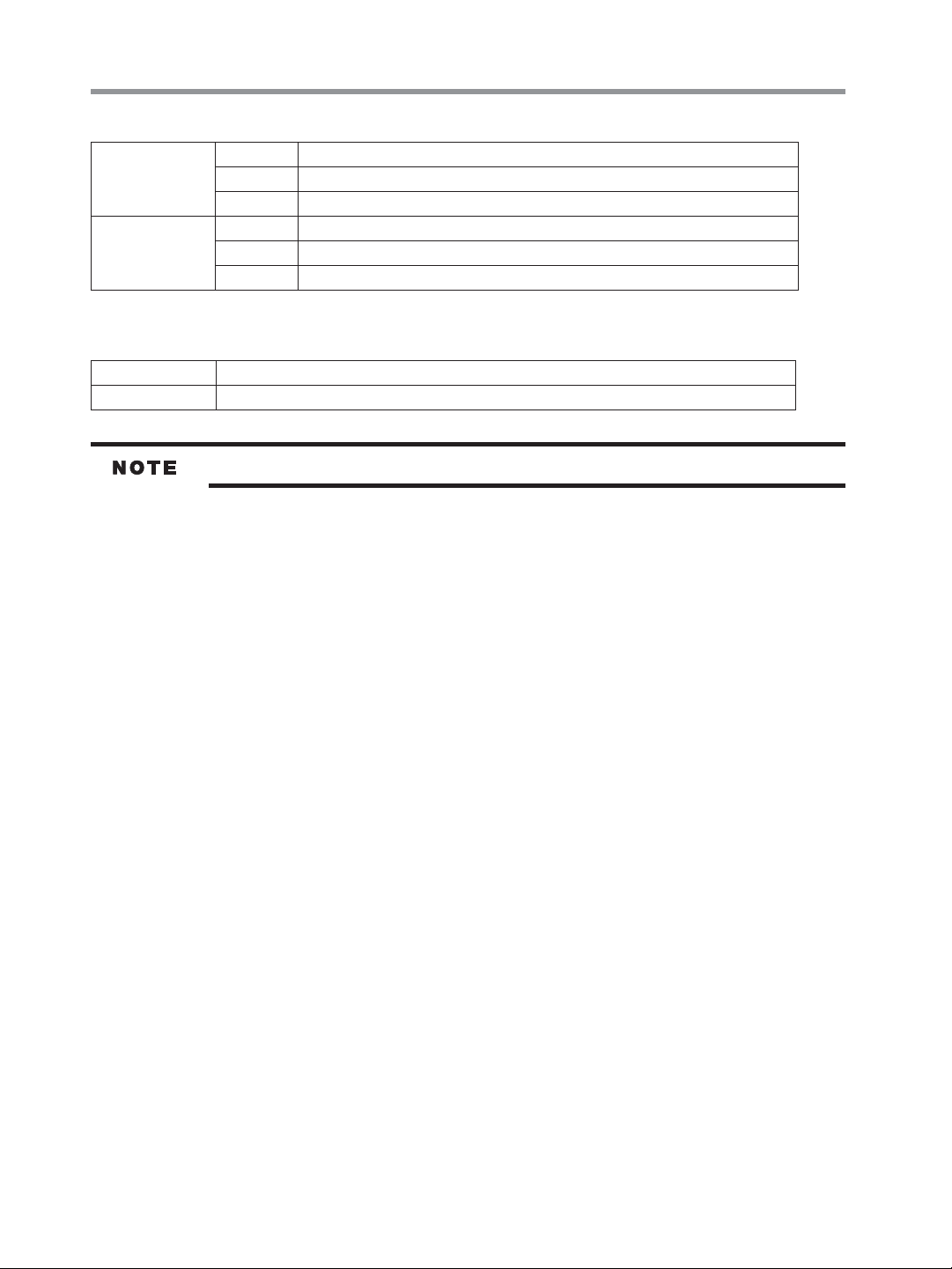
72
Specifications
Dimensions
55”
Width
49.1” (1248 mm)
Height 28.3” (719 mm)
Depth 1.8” / 2.7” (45 / 67 mm)
70”
Width 62.4” (1584 mm )
Height 36” (914 mm )
Depth 2.6” / 3.5” (66 / 87 mm)
Mass (weight)
55” Net: 62.8 lbs (28.5 kg), Gross: 81.6 lbs (37.0 kg)
70” Net: 100.5 lbs (45.6 kg), Gross: 130.1 lbs (59.0 kg)
Dimensions
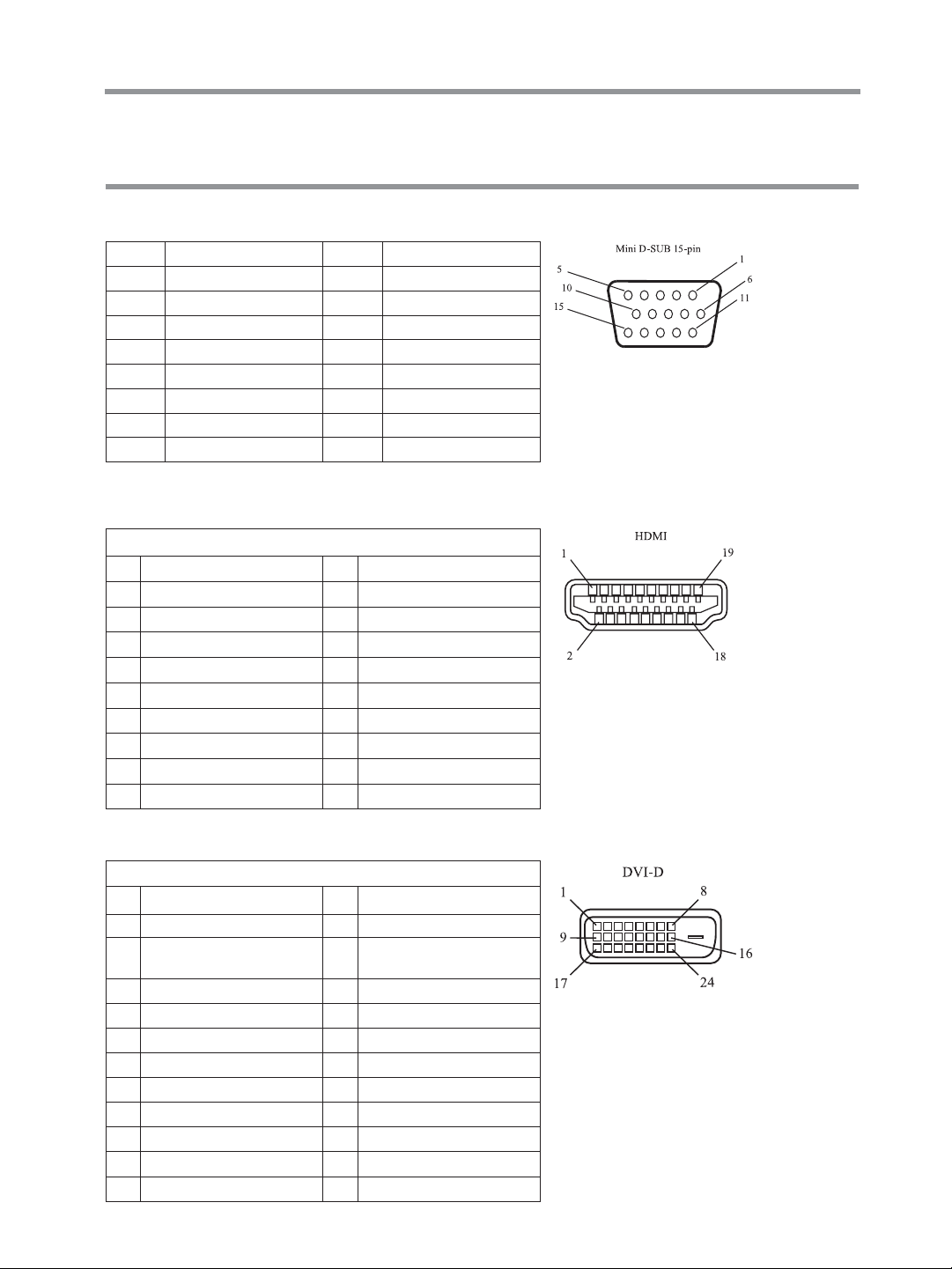
73
Pin Assignment
Pin Assignment
Analog RGB input: D-SUB
Pin No Name Pin No Name
1 Video Signal Red 9 +5V (DDC)
2 Video Signal Green 10 SYNC-GND
3 Video Signal Blue 11 GND
4 GND 12 DDC-SDA
5 DDC-GND 13 H-SYNC
6 Red-GND 14 V-SYNC
7 Green-GND 15 DDC-SCL
8 Blue-GND
Digital RGB input: HDMI
Pin - Assignment of HDMI connector:
1 TMDS Data2+ 11 TMDS Clock Shield
2 TMDS Data2 Shield 12 TMDS Clock-
3 TMDS Data2- 13 CEC
4 TMDS Data1+ 14 Reserved (N.C. on device)
5 TMDS Data1 Shield 15 SCL
6 TMDS Data1- 16 SDA
7 TMDS Data0+ 17 DDC/CEC Ground
8 TMDS Data0 Shield 18 +5V Power
9 TMDS Data0- 19 Hot Plug Detect
10 TMDS Clock+
Digital RGB input: DVI-D
Pin - Assignment of DVI-D connector:
1 TMDS Data2- 13 NC
2 TMDS Data2+ 14 +5V Power
3 TMDS Data2 Shield 15
Ground (return for +5V,
H-SYNC and V-SYNC)
4 NC 16 Hot Plug Detect
5 NC 17 TMDS Data0-
6 DDC Clock 18 TMDS Data0+
7 DDC Data 19 TMDS Data0 Shield
8 Analog Vertical Sync 20 NC
9 TMDS Data1- 21 NC
10 TMDS Data1+ 22 TMDS Clock Shield
11 TMDS Data1 Shield 23 TMDS Clock+
12 NC 24 TMDS Clock-
Analog RGB input: D-SUB
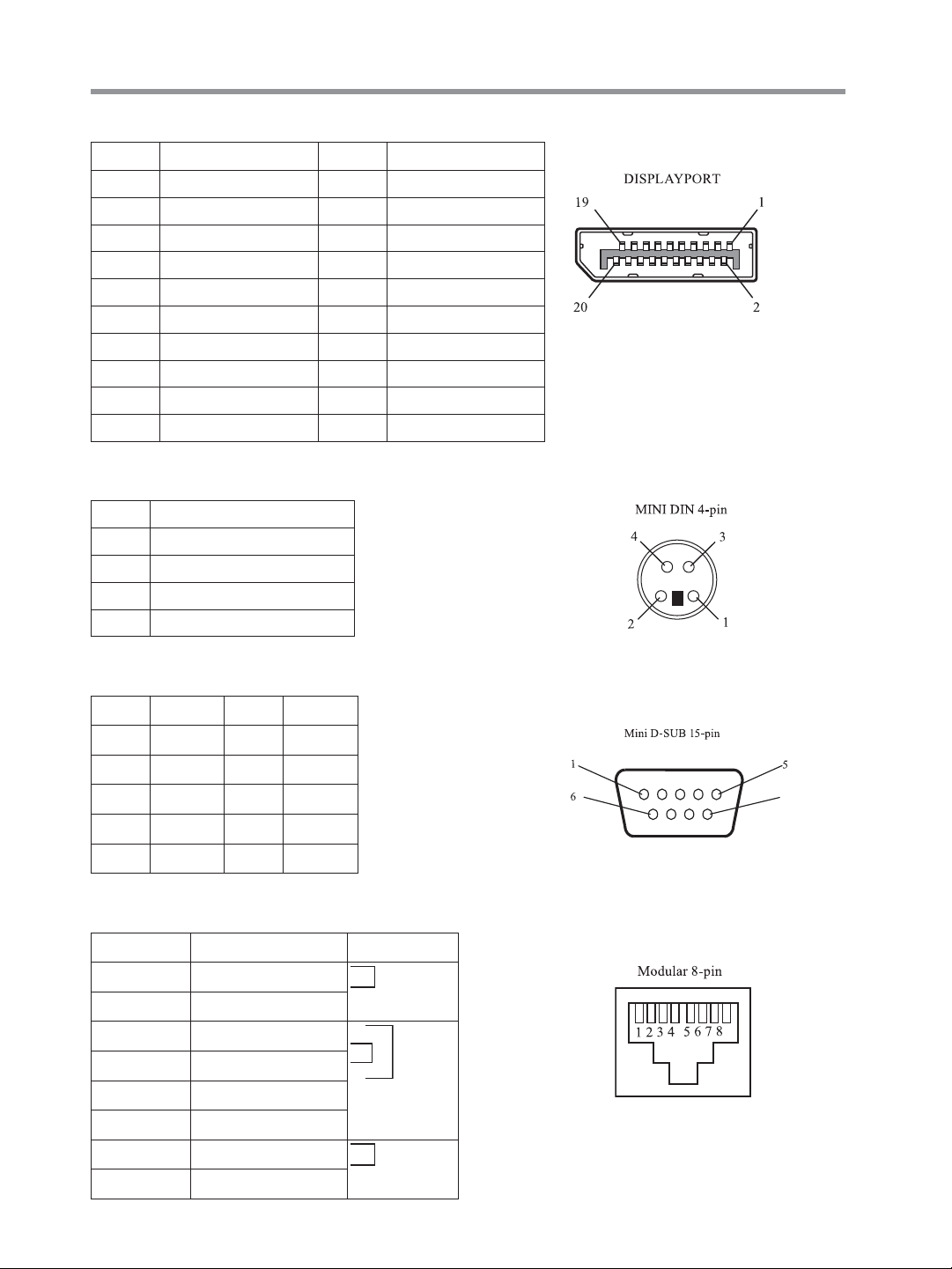
74
Pin Assignment
Digital RGB input: DISPLAYPORT
Pin No Name Pin No Name
1 ML_Lane 3 (n) 11 GND Top
2 GND 12 ML_Lane 0 (p)
3 ML_Lane 3 (p) 13 CONFIG1
4 GND 14 CONFIG2
5 ML_Lane 2 (p) 15 AUX CH (p)
6 ML_Lane 1 (n) 16 GND
7 DDC Data 17 AUX CH (n)
8 GND 18 Hot Plug Detect
9 ML_Lane 1 (p) 19 Return
10 ML_Lane 0 (n) 20 DP_PWR
S-VIDEO input (MINI DIN 4-pin)
Pin No Name
1
GND
2 GND
3 Y (Luminance)
4 C (Chroma)
RS-232C input/output
Pin No Name Pin No Name
1NC 6NC
9
2 RXD 7 NC
3 TXD 8 NC
4NC 9NC
5 GND
LAN(Modular 8-pin)
PIN# at RJ45 Signal Pair
#1 Orange/White stripe
#2 Orange
#3 Green/White stripe
#4 Blue
#5 Blue/White stripe
#6 Green
#7 Brown/White stripe
#8 Brown
Digital RGB input: DISPLAYPORT