JCRRFTSMRN °]
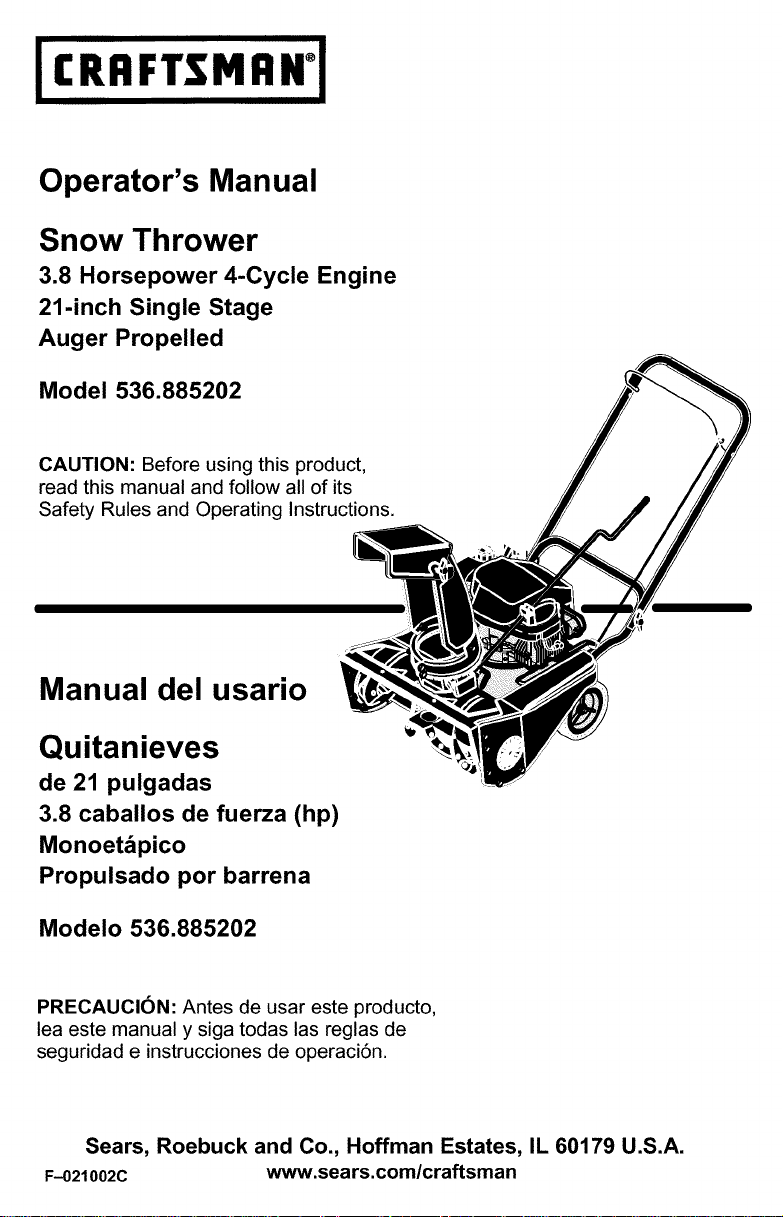
Operator's Manual
Snow Thrower
3.8 Horsepower 4-Cycle Engine
21-inch Single Stage
Auger Propelled
Model 536.885202
CAUTION: Before using this product,
read this manual and follow all of its
Safety Rules and Operating Instructions.
Manual del usario
Quitanieves
de 21 pulgadas
3.8 caballos de fuerza (hp)
Monoet_pico
Propulsado por barrena
Modelo 536.885202
PRECAUCI6N: Antes de usar este producto,
lea este manual y siga todas las reglas de
seguridad e instrucciones de operaci6n.
Sears, Roebuck and Co., Hoffman Estates, IL 60179 U.S.A.
F-021002C www.sears.com/craftsman
i q:1"]l_ [o_ [o[o]_ii_il,,l
WARRANTY STATEMENT ...... 2
SAFETY RULES ............... 3
INTERNATIONAL SYMBOLS .... 5
ASSEMBLY ................... 7
OPERATION .................. 9
MAINTENANCE ............... 15
SERVICE AND ADJUSTMENT... 18
STORAGE .................... 23
TROUBLESHOOTING CHART... 24
REPAIR PARTS ................ 28
ENGINE REPAIR PARTS ........ 34
SPANISH (ESPAI_IOL) .......... 40
PARTS ORDERING/SERVICE ..
BACK COVER
LIMITED ONE-YEAR WARRANTY ON CRAFTSMAN SNOW THROWER
For one year from the date of purchase, when this Craftsman Snow thrower is maintained,
lubricated, and tuned up according to the operating and maintenance instructions in the
owner's manual, Sears will repair, free of charge, any defect in material or workmanship.
If thisCraftsman Snow thrower is used for commercial or rental purposes, this warranty ap-
plies for only 90 days from the date of purchase.
This warranty does not cover the following:
• Items which become worn during normal use, such as spark plugs, drive belts and shear
pins.
• Repair necessary because of operator abuse or negligence, including bent crankshafts
and the failure to maintain the equipment according to the instructions contained in the
owner's manual.
WARRANTY SERVICE IS AVAILABLE BY RETURNING THE CRAFTSMAN SNOW
THROWER TO THE NEAREST SEARS SERVICE CENTER IN THE UNITED STATES.
THIS WARRANTY APPLIES ONLY WHILE THIS PRODUCT IS IN USE IN THE UNITED
STATES.
This warranty gives you specific legal rights, and you may also have other rightswhich may
vary from state to state.
Sears, Roebuck and Co., D817WA, Hoffman Estates. IL 60179
GENERAL RECOMMENDATIONS
The warranty on this snow thrower does
not cover items that have been sub-
jected to operator abuse or negligence.
To receive full value from the warranty,
the operator must maintain the snow
thrower as instructed in this manual.
Some adjustments will need to be made
periodically to properly maintain your
snow thrower.
All adjustments in the Service and Ad-
justments section of this manual must
be checked at least once each season.
F-021002C
PRODUCT SPECIFICATIONS
Horse Power: 3.8
Displacement: 10 cu. in.
Fuel Tank: 1 quart
Spark Plug: Champion RJ19LM
Gap 0.030
NOTE: Engine horsepower ratings
may vary by engine adjustments,
manufacturing variances, altitude, at-
mospheric conditions, fuel and main-
tenance.
LOOK FOR THIS SYMBOL TO POINT OUT IMPORTANT SAFETY PRECAUTIONS.
IT MEANS--ATTENTION!H BECOME ALERT!H YOUR SAFETY IS INVOLVED.
Engine Exhaust, some of its con-
stituents, and certain vehicle com-
ponents contain or emit chemicals
known to the State of California to
cause cancer and birth defects or
other reproductive harm.
Battery posts, terminals and re-
lated accessories contain lead
and lead compounds, chemicals
known to the State of California to
cause cancer and birth defects or
other reproductive harm. WASH
HANDS AFTER HANDLING.
_b WARNING: Always disconnect
the spark plug wire and place it
where it cannot make contact
with spark plug to prevent accidental
starting during: Preparation, Mainte-
nance, or Storage of your snow thrower.
IMPORTANT: Safety standards require oper-
ator presence controls to minimize the risk of in-
jury. Your snow thrower is equipped with such
controls. Do not attempt to defeat the function
of the operator presence control under any cir-
cumstances.
TRAINING
1. Read this operating and service instruction
manual carefully. Be thoroughly familiar
with the controls and the proper use of the
snow thrower. Know how to stop the snow
thrower and disengage the controls quick-
ly.
2. Never allow children to operate the snow
thrower. Never allow adults to operate the
snow thrower without proper instruction.
3. Keep the area of operation clear of all per-
sons, particularly small children and pets.
4. Exercise caution to avoid slipping or falling
especially when operating in reverse.
PREPARATION
1. Thoroughly inspect the area where the s-
now thrower is to be used and remove all
doormats, sleds, boards, wires, and other
foreign objects.
F-021002C
2. Disengage all clutches before starting the
engine (motor).
3. Do not operate the snow thrower without
wearing adequate winter outer garments.
Wear footwear that will improve footing on
slippery surfaces.
4. Handle fuel with care; it is highly flam-
mable.
a. Use an approved fuel container.
b. Never remove fuel tank cap or add fuel
to a running engine (motor) or hot en-
gine (motor).
c. Fill fuel tank outdoors with extreme
care. Never fill fuel tank indoors.
d. Replace fuel cap securely and wipe up
spilled fuel.
e. Never store fuel or snow thrower with
fuel in the tank inside of a building
where fumes may reach an open flame
or spark.
f. Check fuel supply before each use, al-
lowing space for expansion as the heat
of the engine (motor) and/or sun can
cause fuel to expand.
5. For all snow thrower with electric starting
motors use electric starting extension
cords certified CSA/UL Use only with a re-
ceptacle that has been installed in accord-
ance with local inspection authorities.
6. Never attempt to make any adjustments
while the engine (motor) is running (except
when specifically recommended by manu-
facturer).
7. Let engine (motor) and snow thrower ad-
just tooutdoor temperatures before starting
to clear snow.
8. Always wear safety glasses or eye shields
during operation or while performing an ad-
justment or repair to protect eyes from
foreign objects that may be thrown from the
snow thrower.
OPERATION
1. Do not operate this snow thrower ifyou are
taking drugs or other medication which can
cause drowsiness or affect your ability to
operate this snow thrower.
2. Do not use the snow thrower if you are
mentally or physically unable to operate the
snow thrower safely.
3. Donotputhandsorfeetnearorunderro-
tatingparts.Keepclearofthedischarge
openingatalltimes.
4. Exerciseextremecautionwhenoperating
onorcrossinggraveldrives,walksor
roads.Stayalertforhiddenhazardsor
traffic.
5. Afterstrikingaforeignobject,stoptheen-
gine(motor),removethewirefromthe
sparkplug,thoroughlyinspectsnow
throwerforanydamage,andrepairthe
damagebeforerestartingandoperating
thesnowthrower.
6. Ifthesnowthrowershouldstarttovibrate
abnormally,stoptheengine(motor)and
checkimmediatelyforthecause.Vibration
isgenerallyawarningoftrouble.
7. Stoptheengine(motor)wheneveryou
leavetheoperatingposition,beforeun-
cloggingtheauger/impellerhousingordis-
chargechuteandwhenmakingany
repairs,adjustments,orinspections.
8. Whencleaning,repairing,orinspecting,
makecertaintheauger/impellerandall
movingpartshavestoppedandallcontrols
aredisengaged.Disconnectthesparkplug
wireandkeepthewireawayfromthespark
plugtopreventaccidentalstarting.
9. Takeallpossibleprecautionswhenleaving
thesnowthrowerunattended.Disengage
theauger/impellerandstoptheengine
(motor).
10.Donotruntheengine(motor)indoors,ex-
ceptwhenstartingtheengine(motor)and
fortransportingthesnowthrowerinorout
ofthebuilding.Opentheoutsidedoors;ex-
haustfumesaredangerous(containing
CARBONMONOXIDE,anODORLESS
andDEADLYGAS).
11.Donotclearsnowacrossthefaceof
slopes.Exerciseextremecautionwhen
changingdirectiononslopes.Donotat-
tempttoclearsteepslopes.
12.Neveroperatethesnowthrowerwithout
properguards,platesorothersafetypro-
tectivedevicesinplace.
13.Neveroperatethesnowthrowernearen-
closures,automobiles,windowwells,
drop-offs,andthelikewithoutproperad-
justmentofthesnowdischargeangle.
Keepchildrenandpetsaway.
14.Donotoverloadthesnowthrowercapacity
byattemptingtoclearsnowattoofasta
rate.
15.Neveroperatethesnowthrowerathigh
transportspeedsonslipperysurfaces.
Lookbehindandusecarewhenbacking
up.
16.Neverdirectdischargeatbystandersor
allowanyoneinfrontofthesnowthrower.
17.Disengagepowertothecollector/impeller
whensnowthroweristransportedornotin
use.
18. Use only attachments and accessories ap-
proved by the manufacturer of the snow
thrower.
19. Never operate the snow thrower without
good visibility or light. Always be sure of
your footing and keep a firm hold on the
handles. Walk;never run.
20. Do not over-reach. Keep proper footing
and balance at all times.
21. Do not attempt to use snow thrower on a
roof.
MAINTENANCE AND STORAGE
1. Check bolts at frequent intervals for proper
tightness to be sure the snow thrower is in
safe working condition.
2. Never store the snow thrower with fuel in
the tank inside a building where ignition
sources are present such as hot water and
space heaters, clothes dryers, and the like.
Allow the engine (motor) to cool before
storing in any enclosure.
3. Always refer to operator's guide instruc-
tions for important details if the snow
thrower is to be stored for an extended
period.
4. Maintain or replace safety and instruction
labels, as necessary.
5. Run the snow thrower a few minutes after
throwing snow to prevent freeze-up of the
auger/impeller.
,_ WARNING: This snow thrower isfor use on sidewalks, driveways
and other ground level surfaces.
Caution should be exercised while using on
steep sloping surfaces. DO NOT USE
SNOW THROWER ON SURFACES ABOVE
GROUND LEVEL such as roofs of resi-
dences, garages, porches or other such
structures or buildings.
F-021002C 4
_o_",]
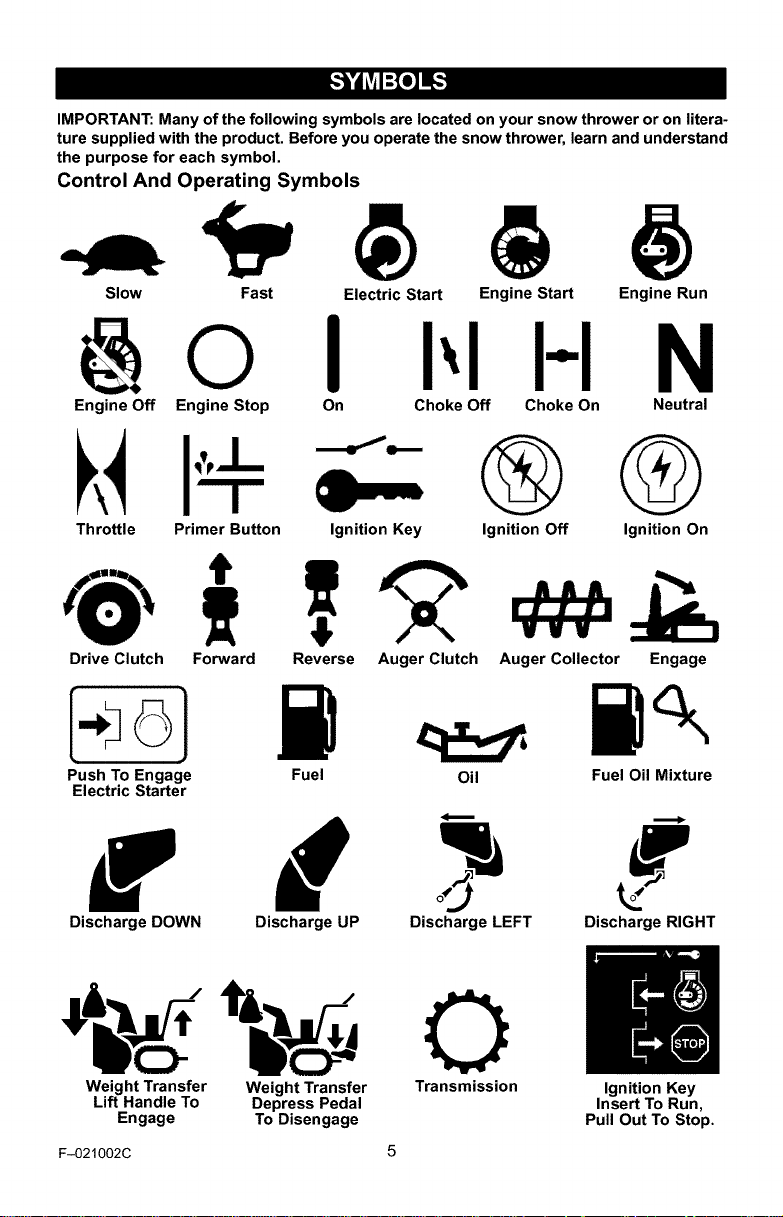
IMPORTANT: Many of the following symbols are located on your snow thrower or on litera-
ture supplied with the product. Before you operate the snow thrower, learn and understand
the purpose for each symbol.
Control And Operating Symbols
Slow Fast Electric Start Engine Start Engine Run
Engine Off Engine Stop
Throttle Primer Button
I H N
On Choke Off Choke On Neutral
Ignition Key
G G
Ignition Off Ignition On
Drive Clutch Forward Reverse Auger Clutch Auger Collector Engage
Push To Engage Fuel
Electric Starter
Oil Fuel Oil Mixture
Discharge DOWN Discharge UP Discharge LEFT Discharge RIGHT
Weight Transfer Weight Transfer Transmission Ignition Key
Lift Handle To Depress Pedal Insert To Run,
Engage To Disengage Pull Out To Stop.
F-021002C 5
_o_
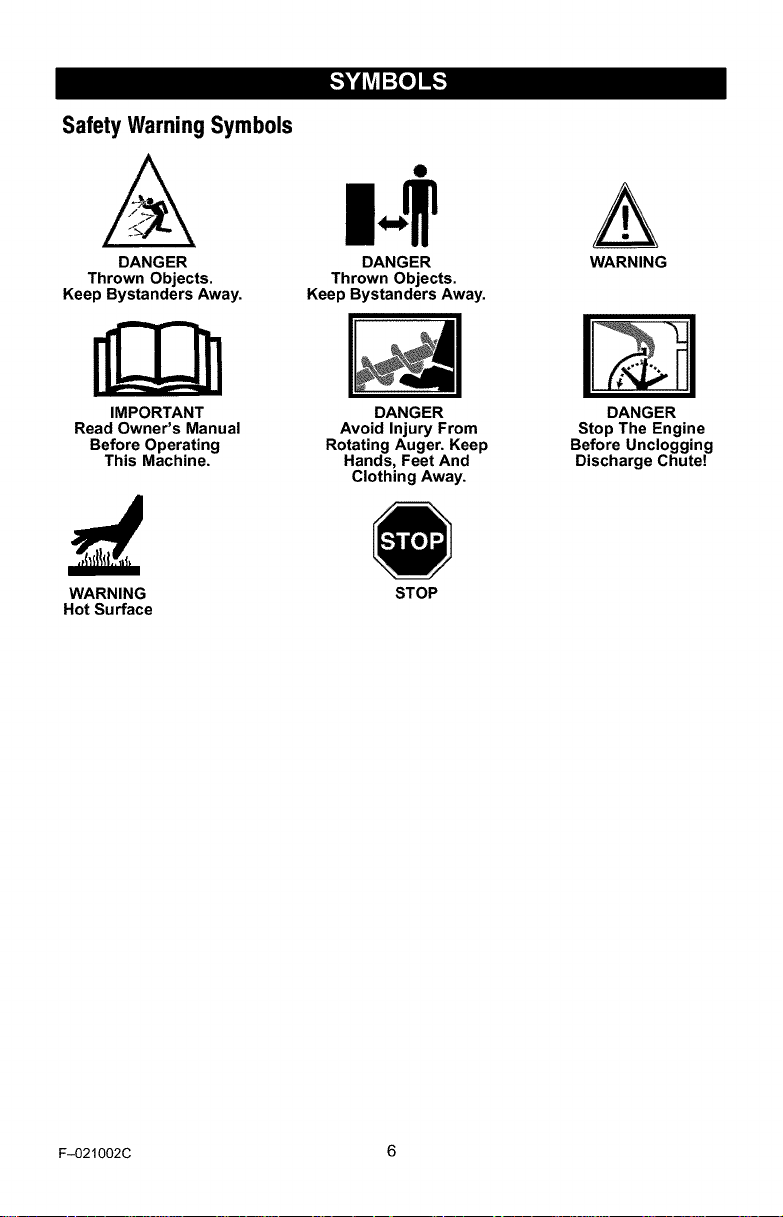
Safety Warning Symbols
A
DANGER
Thrown Objects.
Keep Bystanders Away.
IMPORTANT
Read Owner's Manual
Before Operating
This Machine.
O
DANGER
Thrown Objects.
Keep Bystanders Away.
DANGER
Avoid Injury From
Rotating Auger. Keep
Hands, Feet And
Clothing Away.
WARNING
DANGER
Stop The Engine
Before Unclogging
Discharge Chute!
WARNING
Hot Surface
STOP
F-021002C 6
Contents of Parts Bag (actual size)
1- Owner's Manual (not shown)
1- Packet of Fuel Stabilizer (not shown)
1- Container 5W30 Oil
_ ARNING: Always wear
safety glasses or eye shields
while assembling snow
thrower.
TOOLS REQUIRED
1- Knife to cut carton
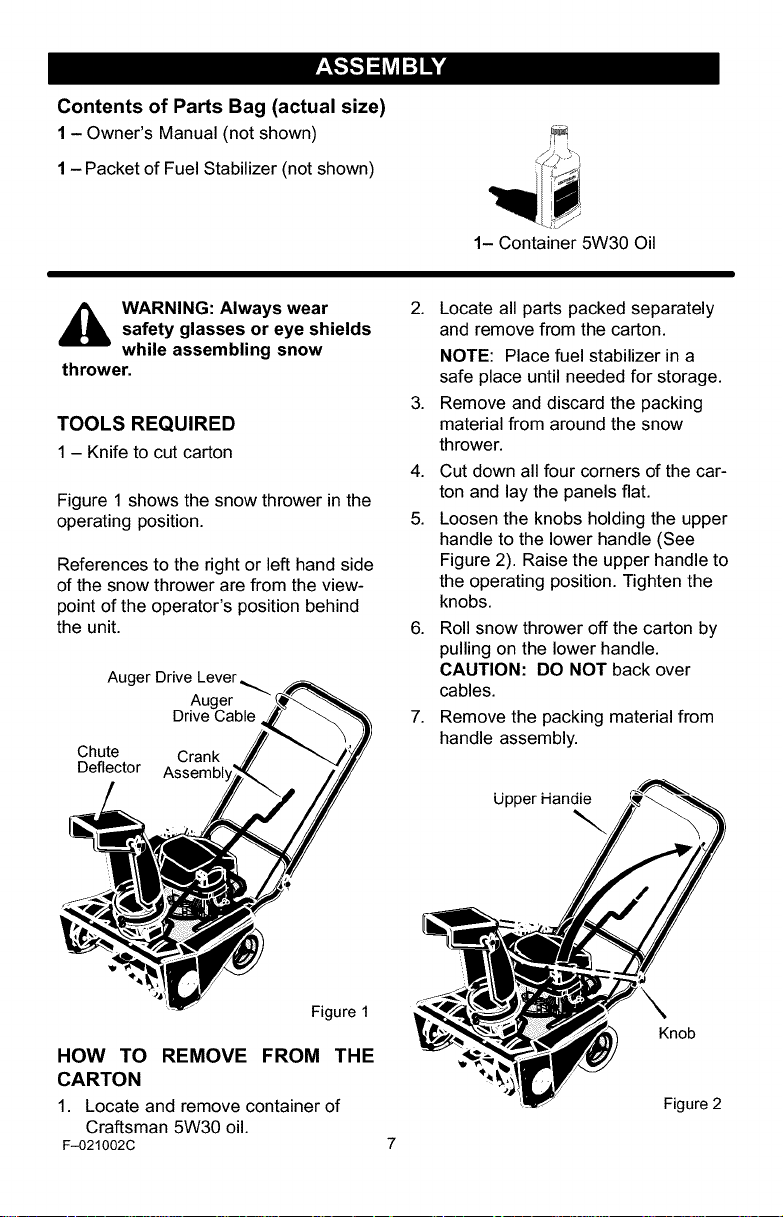
Figure 1 shows the snow thrower in the
operating position.
References to the right or left hand side
of the snow thrower are from the view-
point of the operator's position behind
the unit.
Auger Drive Lever
Auger
Drive Cable
Chute Crank
Deflector Assembl,
2. Locate all parts packed separately
and remove from the carton.
NOTE: Place fuel stabilizer in a
safe place until needed for storage.
3. Remove and discard the packing
material from around the snow
thrower.
4. Cut down all four corners of the car-
ton and lay the panels flat.
5. Loosen the knobs holding the upper
handle to the lower handle (See
Figure 2). Raise the upper handle to
the operating position. Tighten the
knobs.
6. Roll snow thrower off the carton by
pulling on the lower handle.
CAUTION: DO NOT back over
cables.
7. Remove the packing material from
handle assembly.
Upper Handle
Figure 1
HOW TO REMOVE FROM THE
CARTON
1. Locate and remove container of
Craftsman 5W30 oil.
F-021002C
Knob
Figure 2
_" CHECKLIST
Before you operate your new snow
thrower, to ensure that you receive the
best performance and satisfaction from
this quality product, please review the
following checklist:
_' All assembly instructions have been
completed.
_' The discharge chute rotates freely.
_' No remaining loose parts in carton.
While learning how to use your snow
thrower, pay extra attention to the fol-
lowing important items:
_' Engine oil is at proper level.
_' Make sure gas tank is filled properly
with clean, fresh, unleaded gasoline.
_' Become familiar with all controls-
their location and function. Operate
controls before starting engine.
F-021002C 8
[e]_ _ z___id[e]_I
KNOW YOUR SNOW THROWER
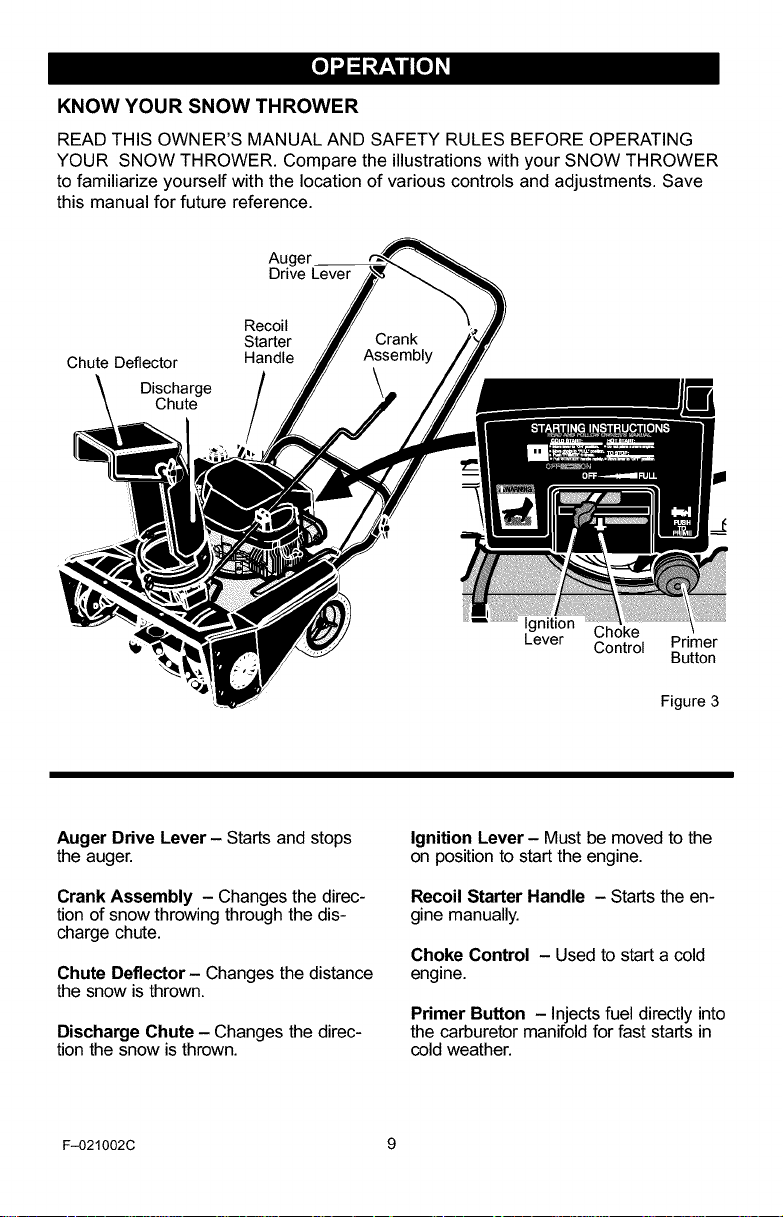
READ THIS OWNER'S MANUAL AND SAFETY RULES BEFORE OPERATING
YOUR SNOW THROWER. Compare the illustrations with your SNOW THROWER
to familiarize yourself with the location of various controls and adjustments. Save
this manual for future reference.
Drive Lever
Chute Deflector
Discharge
Chute
Recoil
Starter
Handle
Lever Choke
Control Primer
Button
Figure 3
Auger Drive Lever- Starts and stops
the auger.
Crank Assembly - Changes the direc-
tion of snow throwing through the dis-
charge chute.
Chute Deflector- Changes the distance
the snow is thrown.
Discharge Chute - Changes the direc-
tion the snow is thrown.
Ignition Lever- Must be moved to the
on position to start the engine.
Recoil Starter Handle - Starts the en-
gine manually.
Choke Control - Used to start a cold
engine.
Primer Button - Injects fuel directly into
the carburetor manifold for fast starts in
cold weather.
F-021002C 9
[e]_ _ z___id[e]_I
_ ARNING: Read Owner's
Manual before operating
machine. Never direct dis-
charge toward bystanders. Stop the
engine before unclogging discharge
chute or auger housing and before
leaving the machine.
TO STOP YOUR
SNOW THROWER
1. To stop throwing snow, release the
auger drive lever. See Figure 3.
NOTE: If the snow thrower contin-
ues to slowly move forward, see
"How To Adjust The Auger Control
Cable" in the Service And Adjust-
ment Section.
2. To stop the engine, move the igni-
tion lever to the off position.
TO CONTROL SNOW DISCHARGE
1. Turn the chute control rod to set the
direction of the snow throwing.
2. Loosen the wing knob on the chute
deflector and move the deflector to
set the distance. Move the deflector
(Up) for more distance, (Down) for
less distance. Then tighten the
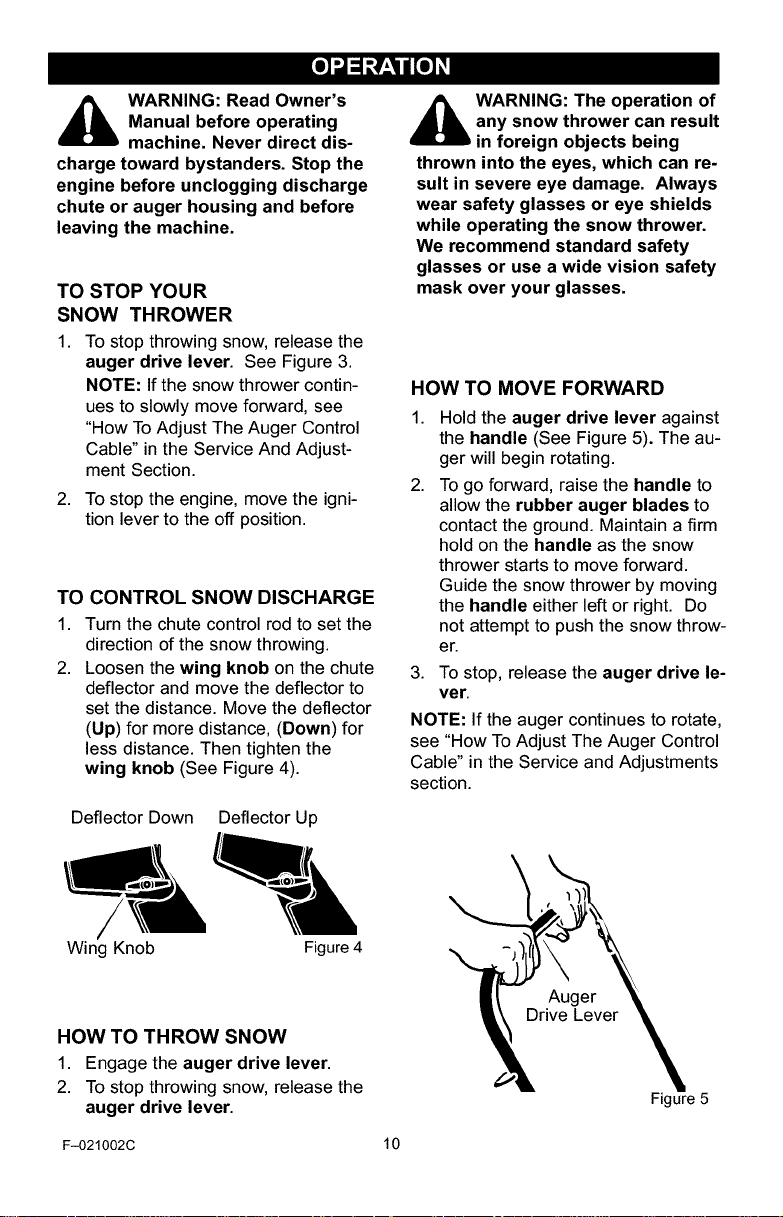
wing knob (See Figure 4).
Deflector Down Deflector Up
_ ARNING: The operation of
any snow thrower can result
in foreign objects being
thrown into the eyes, which can re-
sult in severe eye damage. Always
wear safety glasses or eye shields
while operating the snow thrower.
We recommend standard safety
glasses or use a wide vision safety
mask over your glasses.
HOW TO MOVE FORWARD
1. Hold the auger drive lever against
the handle (See Figure 5). The au-
ger will begin rotating.
2. To go forward, raise the handle to
allow the rubber auger blades to
contact the ground. Maintain a firm
hold on the handle as the snow
thrower starts to move forward.
Guide the snow thrower by moving
the handle either left or right. Do
not attempt to push the snow throw-
er.
3. To stop, release the auger drive le-
ver.
NOTE: If the auger continues to rotate,
see "How To Adjust The Auger Control
Cable" in the Service and Adjustments
section.
Wing Knob
Figure 4
HOW TO THROW SNOW
1. Engage the auger drive lever.
2. To stop throwing snow, release the
auger drive lever.
Auger
Figure 5
F-021002C 10
FILL OIL:
NOTE: Engine may already contain
some residual oil. Check frequently
when filling the crankcase. DO NOT
overfill.
The snow thrower was shipped with a
container of 5W30 motor oil. This oil
must be added to the engine before op-
erating.
1.
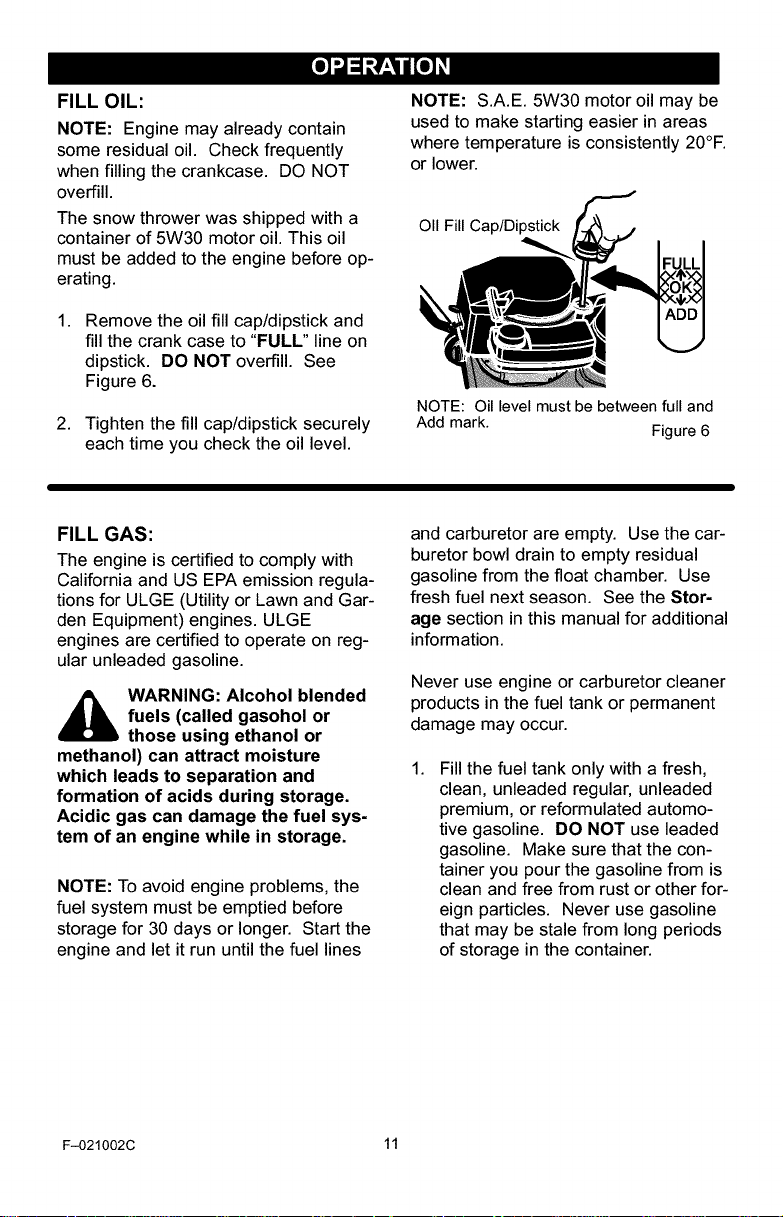
Remove the oil fill cap/dipstick and
fill the crank case to "FULL" line on
dipstick. DO NOT overfill. See
Figure 6.
2. Tighten the fill cap/dipstick securely
each time you check the oil level.
NOTE: S.A.E. 5W30 motor oil may be
used to make starting easier in areas
where temperature is consistently 20°F.
or lower.
OII Fill Cap/Dipstick
NOTE: Oil level must be between full and
Add mark.
Figure 6
FILL GAS:
The engine is certified to comply with
California and US EPA emission regula-
tions for ULGE (Utility or Lawn and Gar-
den Equipment) engines. ULGE
engines are certified to operate on reg-
ular unleaded gasoline.
_ ARNING: Alcohol blended
fuels (called gasohol or
those using ethanol or
methanol) can attract moisture
which leads to separation and
formation of acids during storage.
Acidic gas can damage the fuel sys-
tem of an engine while in storage.
NOTE: To avoid engine problems, the
fuel system must be emptied before
storage for 30 days or longer. Start the
engine and let it run until the fuel lines
and carburetor are empty. Use the car-
buretor bowl drain to empty residual
gasoline from the float chamber. Use
fresh fuel next season. See the Stor-
age section in this manual for additional
information.
Never use engine or carburetor cleaner
products in the fuel tank or permanent
damage may occur.
1.
Fill the fuel tank only with a fresh,
clean, unleaded regular, unleaded
premium, or reformulated automo-
tive gasoline. DO NOT use leaded
gasoline. Make sure that the con-
tainer you pour the gasoline from is
clean and free from rust or other for-
eign particles. Never use gasoline
that may be stale from long periods
of storage in the container.
F-021002C 11
_ ARNING: Gasoline is flam-
mable. Always use caution
when handling or storing
gasoline.
• Do not fill fuel tank while snow
thrower is running, when it is hot,
or when snow thrower is in an en-
closed area.
• Keep away from open flame or an
electrical spark and do not smoke
while filling the fuel tank.
• Never fill the tank completely. Fill
the tank to within 1/4"-1/2" from
the top to provide space for ex-
pansion of fuel.
• Always fill fuel tank outdoors and
use a funnel or spout to prevent
spilling.
• Make sure to wipe up any spilled
fuel before stating the engine.
• Store gasoline in a clean, ap-
proved container and keep the
cap in place on the container.
How To Start A Cold Engine
1. Move the ignition lever to the on
position.
2. When starting the engine, do not
engage the auger drive lever.
3. Move the choke control to the FULL
choke position.
4. Push the primer button while cov-
ering the vent hole as follows: Re-
move finger from primer button
between primes.
• Do not prime if temperature
above 50° F (10° C).
• Push two times if temperature is
50 ° F (10° C) to 15°F (-10 ° C).
• Push four times if temperature is
below 15° F (-10 ° C).
• Push five times if temperature is
below 0° F (-18 ° C).
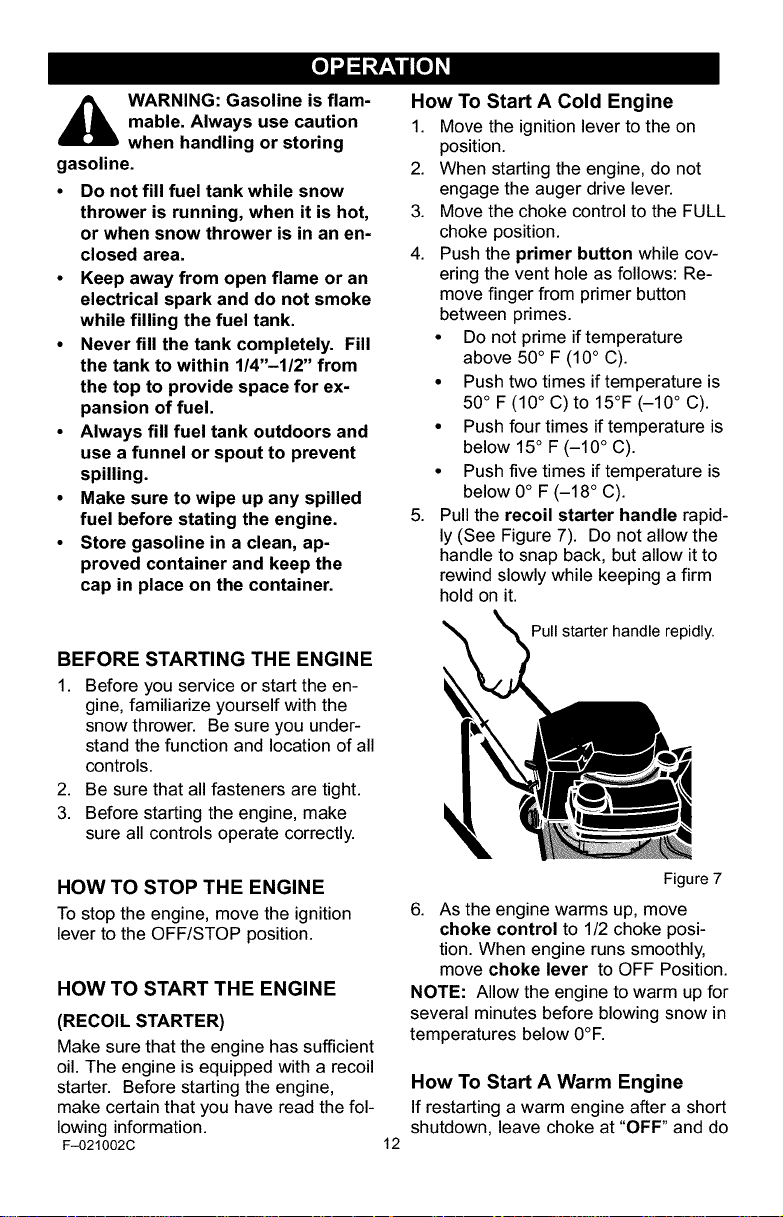
5. Pull the recoil starter handle rapid-
ly (See Figure 7). Do not allow the
handle to snap back, but allow it to
rewind slowly while keeping a firm
hold on it.
BEFORE STARTING THE ENGINE
1. Before you service or start the en-
gine, familiarize yourself with the
snow thrower. Be sure you under-
stand the function and location of all
controls.
2. Be sure that all fasteners are tight.
3. Before starting the engine, make
sure all controls operate correctly.
Pull starter handle repidly.
HOW TO STOP THE ENGINE
To stop the engine, move the ignition
lever to the OFF/STOP position.
HOW TO START THE ENGINE
(RECOIL STARTER)
Make sure that the engine has sufficient
oil. The engine is equipped with a recoil
starter. Before starting the engine,
make certain that you have read the fol-
lowing information.
F-021002C
Figure 7
6. As the engine warms up, move
choke control to 1/2 choke posi-
tion. When engine runs smoothly,
move choke lever to OFF Position.
NOTE: Allow the engine to warm up for
several minutes before blowing snow in
temperatures below 0°F.
12
How To Start A Warm Engine
If restarting a warm engine after a short
shutdown, leave choke at "OFF" and do
[e]_ _ z___id[e]_I
not push the primer button. If the en-
gine fails to start, follow the Cold Start
instructions.
FROZEN STARTER
Ifthe starter is frozen and will not turn
engine:
1. Pull as much rope out of the starter
as possible.
2. Release the starter handle and let it
snap back against the starter.
Ifthe engine still fails to start, repeat the
two previous steps until the engine
starts. Then continue with the direc-
tions for cold start.
To help prevent possible freeze-up of
recoil starter and engine controls, pro-
ceed as follows after each snow remov-
al job.
1. With the engine running, pull the
starter rope hard with a continuous
full arm stroke three or four times.
Pulling of starter rope will produce a
loud clattering sound. This is not
harmful to the engine or starter.
2. With the engine not running, wipe all
snow and moisture from the carbu-
retor cover in area of control levers.
Also move throttle control, choke
control, and starter handle several
times.
_ ARNING: Never run en-
gine indoors or in enclosed,
poorly ventilated areas. En-
gine exhaust contains CARBON
MONOXIDE, AN ODORLESS AND
DEADLY GAS. Keep hands, feet,
hair and loose clothing away from
any moving parts on engine and
snow thrower.
• The temperature of muffler and
nearby areas may exceed 150°F.
Avoid these areas.
• DO NOT allow children or young
teenagers to operate or be near
snow thrower while it is operat-
ing.
HOW TO REMOVE OBJECTS
FROM AUGER
_ ARNING: Do not attempt
to remove any item that may
become lodged in auger
without taking the following precau-
tions:
• Release auger drive lever.
• Move the ignition lever to the stop
position to stop the engine.
• Disconnect spark plug wire.
• Do not place your hands in the au-
ger or discharge chute. Use a pry
bar.
SNOW THROWING TIPS
1. When the handle is raised, the au-
ger blades will engage the ground
and the snow thrower will move for-
ward. When the auger drive lever is
released, the auger blades will stop.
If the blades do not stop, see "How
To Adjust The Auger Drive Cable" in
the Service And Adjustment section.
2. Most efficient snow throwing is ac-
complished when the snow is re-
moved immediately after if falls.
3. For complete snow removal, slightly
overlap each previous path.
F-021002C
7.
13
4. Whenever possible, discharge the
snow down wind.
5. The distance the snow will be dis-
charged can be adjusted by moving
the discharge chute deflector. Raise
the deflector for more distance or
lower the deflector for less distance.
6. In windy conditions, lower the chute
deflector to direct the discharged
snow close to the ground where it is
less likely to blow into unwanted
areas.
For safety and to prevent damage
to the snow thrower, keep the area
[e]_ _ z___id[e]_I
to be cleared free of stones, toys
and other foreign objects.
8. When clearing snow from crushed
rock or gravel driveways, do not al-
low the auger blades to contact the
driveway. Move the handle down to
slightly raise the auger blades.
9. The forward speed of the snow
thrower is dependent on the depth
and weight of the snow. Experience
will establish the most effective
method of using the snow thrower
under different conditions.
10. After each snow throwing job, allow
the engine to run for a few minutes.
The snow and accumulated ice will
melt off the engine.
11. Clean the snow thrower after each
use.
12. Remove ice, snow and debris from
the entire snow thrower. Flush with
water to remove all salt or other
chemicals. Wipe snow thrower dry.
DRY AND AVERAGE SNOW
1. Snow up to eight inches deep can
be removed rapidly and easily by
2.
walking at a moderate rate. For
snow or drifts of a greater depth,
slow your pace to allow the dis-
charge chute to dispose of the snow
as rapidly as the auger receives the
snow.
Plan to have the snow discharged in
the direction the wind is blowing.
WET PACKED SNOW
Move slowly into wet, packed snow. If
the wet, packed snow causes the auger
to slow down or the discharge chute be-
gins to clog, back off and begin a series
of short back and forth jabs into the
snow. These short back and forth jabs,
four to six inches, will "belch" the snow
from the chute.
SNOW BANKS AND DRIFTS
In snow of greater depth than the unit,
use the same "jabbing" technique de-
scribed above. Turn the discharge
chute away from the snow bank. More
time will be required to remove snow of
this type than level snow.
F-021002C 14
hVjr_'11_llI1__r_'1_[I,]_
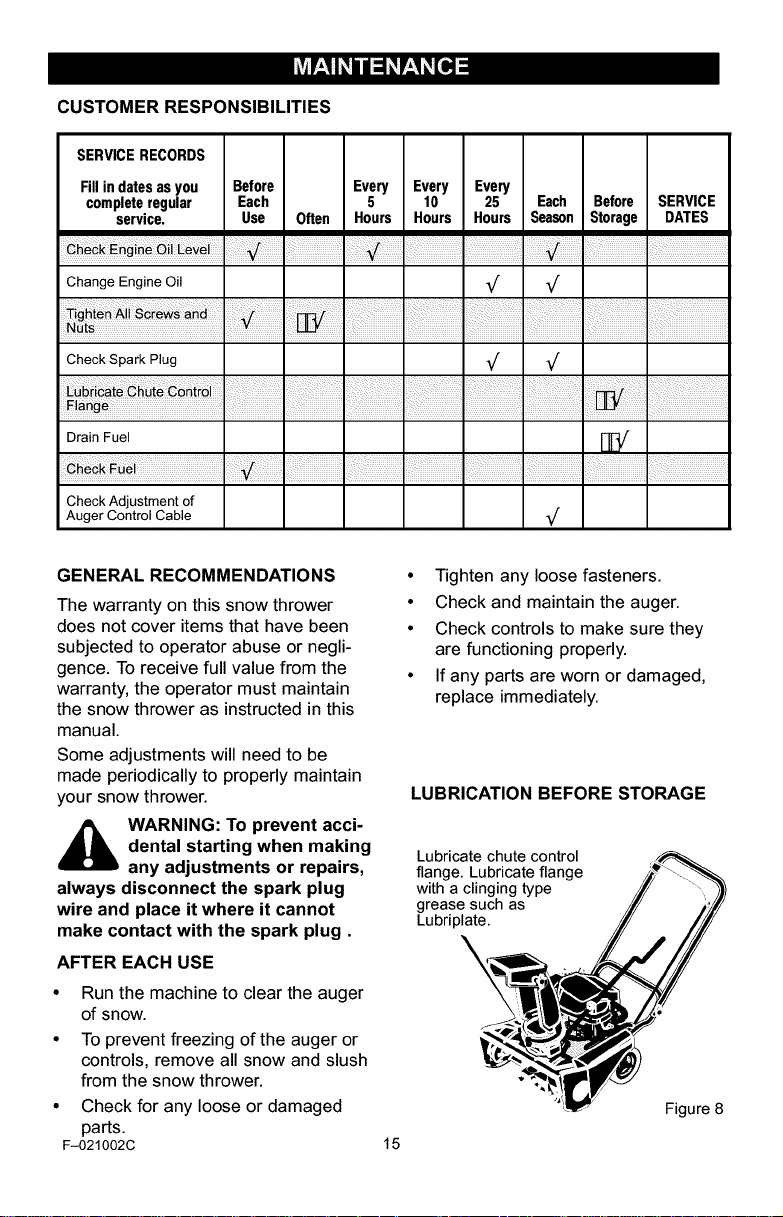
CUSTOMER RESPONSIBILITIES
SERVICERECORDS
Fillin datesasyou Before Every Every Every
completeregular Each 5 10 25 Each
service. Use Often Hours Hours Hours Season
Change Engine Oil !/ !/
Check Spark Plug -Vr -Vr
Drain Fuel
I
Check Adjustment of
Auger Control Cable -Vr
Before SERVICE
Storage DATES
GENERAL RECOMMENDATIONS
The warranty on this snow thrower
does not cover items that have been
subjected to operator abuse or negli-
gence. To receive full value from the
warranty, the operator must maintain
the snow thrower as instructed in this
manual.
Some adjustments will need to be
made periodically to properly maintain
your snow thrower.
_ ARNING: To prevent acci-
dental starting when making
any adjustments or repairs,
always disconnect the spark plug
wire and place it where it cannot
make contact with the spark plug.
AFTER EACH USE
• Run the machine to clear the auger
of snow.
• To prevent freezing of the auger or
controls, remove all snow and slush
from the snow thrower.
• Check for any loose or damaged
parts.
F-021002C
15
• Tighten any loose fasteners.
• Check and maintain the auger.
• Check controls to make sure they
are functioning properly.
• If any parts are worn or damaged,
replace immediately.
LUBRICATION BEFORE STORAGE
Lubricate chute control
flange. Lubricate flange
with a clinging type
grease such as
Lubriplate.
Figure 8

ADJUST AUGER CONTROLCABLE
The auger control cable was adjusted
at the factory. If the auger will not en-
gage or disengage correctly, adjust the
auger control cable as follows:
1. Loosen the nut that holds the cable
tension spring (See Figure 9).
2. Slide the cable tension spring to-
ward the rear of the unit until all
cable slack is removed.
NOTE: The auger control cable is
properly adjusted when the free
cable slack is removed and there is
no tension on the idler arm.
3. Tighten the nut that holds the cable
tension spring.
If belt stretch has occured, move the
end the auger control cable to the out-
side hole as follows:
1. Loosen the nut that holds the cable
tension spring (See Figure 9).
2. Move the cable tension spring to-
ward the front of the unit to achieve
maximum cable slack.
3. Remove the upper end of the auger
control cable from the auger drive
lever.
4. Install the auger control cable in
the hole shown in Figure 10.
5. Slide the cable tension spring to-
ward the rear of the unit until all
cable slack is removed.
NOTE: The auger control cable is
properly adjusted when the free
cable slack is removed and there is
no tension on the idler arm.
6. Tighten the nut that holds the cable
tension spring.
Spring
Auger
Drive Lever
Figure 9
Handle
Auger control
Cable
Figure 10
F-021002C 16
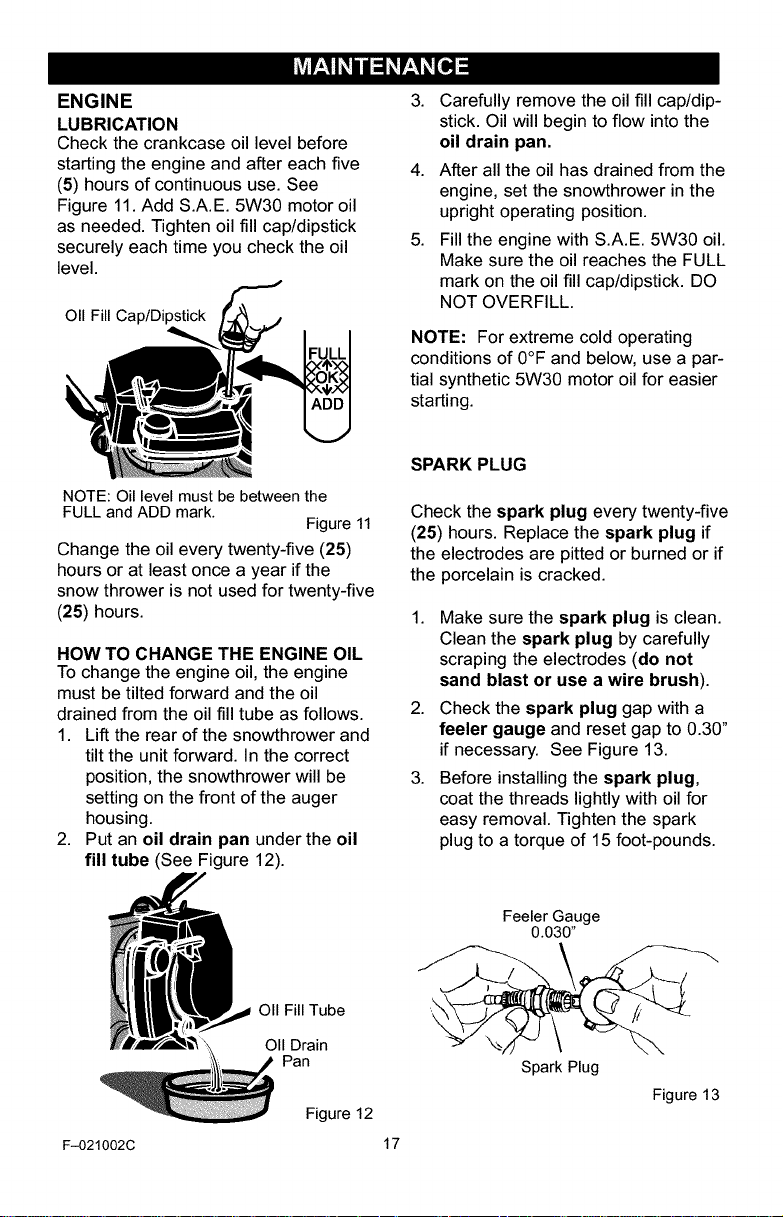
ENGINE
LUBRICATION
Check the crankcase oil level before
starting the engine and after each five
(5) hours of continuous use. See
Figure 11. Add S.A.E. 5W30 motor oil
as needed. Tighten oil fill cap/dipstick
securely each time you check the oil
level.
OII Fill Cap/Dipstick
NOTE: Oil level must be between the
FULL and ADD mark.
Figure 11
Change the oil every twenty-five (25)
hours or at least once a year if the
snow thrower is not used for twenty-five
(25) hours.
HOW TO CHANGE THE ENGINE OIL
To change the engine oil, the engine
must be tilted forward and the oil
drained from the oil fill tube as follows.
1. Lift the rear of the snowthrower and
tilt the unit forward. In the correct
position, the snowthrower will be
setting on the front of the auger
housing.
2. Put an oil drain pan under the oil
fill tube (See Figure 12).
3. Carefully remove the oil fill cap/dip-
stick. Oil will begin to flow into the
oil drain pan.
4. After all the oil has drained from the
engine, set the snowthrower in the
upright operating position.
5. Fill the engine with S.A.E. 5W30 oil.
Make sure the oil reaches the FULL
mark on the oil fill cap/dipstick. DO
NOT OVERFILL.
NOTE: For extreme cold operating
conditions of 0°F and below, use a par-
tial synthetic 5W30 motor oil for easier
starting.
SPARK PLUG
Check the spark plug every twenty-five
(25) hours. Replace the spark plug if
the electrodes are pitted or burned or if
the porcelain is cracked.
1. Make sure the spark plug is clean.
Clean the spark plug by carefully
scraping the electrodes (do not
sand blast or use a wire brush).
2. Check the spark plug gap with a
feeler gauge and reset gap to 0.30"
if necessary. See Figure 13.
3. Before installing the spark plug,
coat the threads lightly with oil for
easy removal. Tighten the spark
plug to a torque of 15 foot-pounds.
OII Fill Tube
OII Drain
Pan
Figure 12
FeelerGauge
0.030"
Spark Plug
Figure 13
F-021002C 17
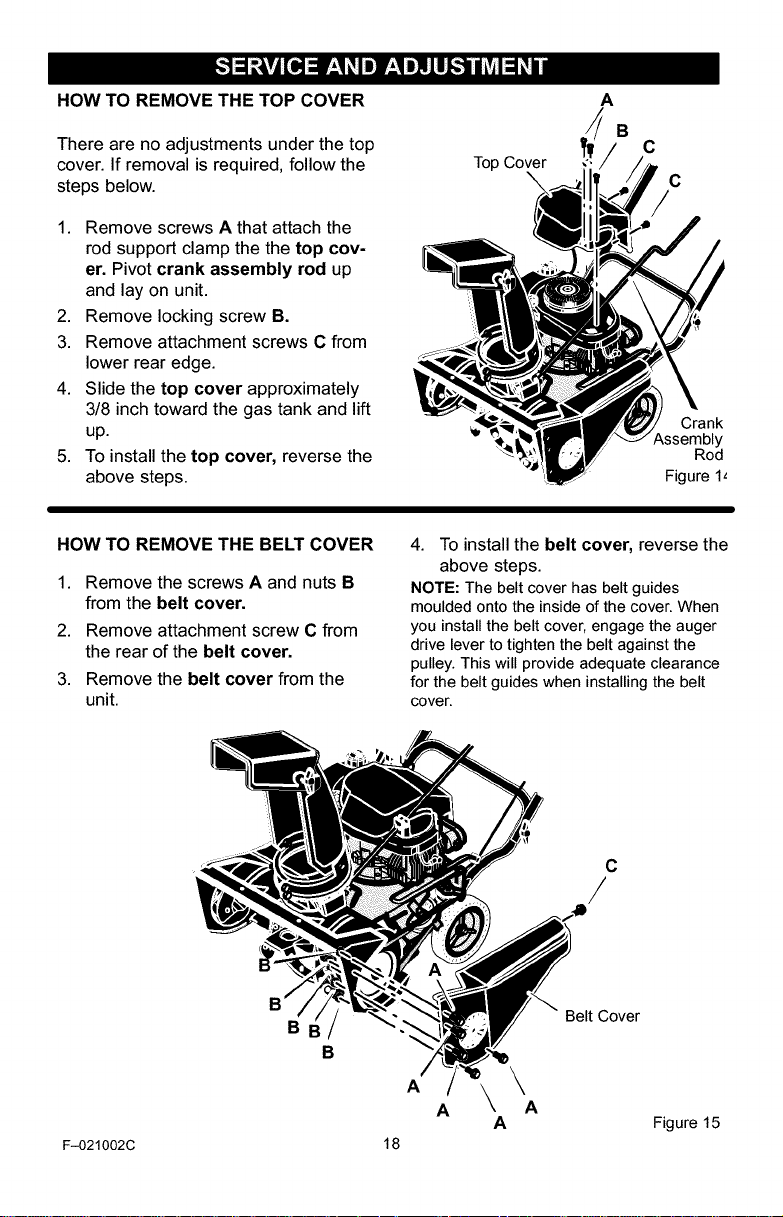
HOW TO REMOVE THE TOP COVER
There are no adjustments under the top
cover. If removal is required, follow the
steps below.
1. Remove screws A that attach the
rod support clamp the the top cov-
er. Pivot crank assembly rod up
and lay on unit.
2. Remove locking screw B.
3. Remove attachment screws C from
lower rear edge.
4. Slide the top cover approximately
3/8 inch toward the gas tank and lift
up.
5. To install the top cover, reverse the
above steps.
Top Cover
A
B
C
C
Crank
Assembly
Rod
Figure 1_
HOW TO REMOVE THE BELT COVER
1. Remove the screws A and nuts B
from the belt cover.
2. Remove attachment screw C from
the rear of the belt cover.
3. Remove the belt cover from the
unit.
4. To install the belt cover, reverse the
above steps.
NOTE: The belt cover has belt guides
moulded onto the inside ofthe cover. When
you installthe belt cover, engagethe auger
drive lever to tighten the belt againstthe
pulley. This will provide adequate clearance
forthe belt guideswhen installing the belt
cover.
C
/
F-021002C
BE
B
A
18
\
A A
A
Belt Cover
Figure 15
B,,_o] _ r_,1_lm]F-'Im_lLli,,,"]lJkvJ!_ _11II
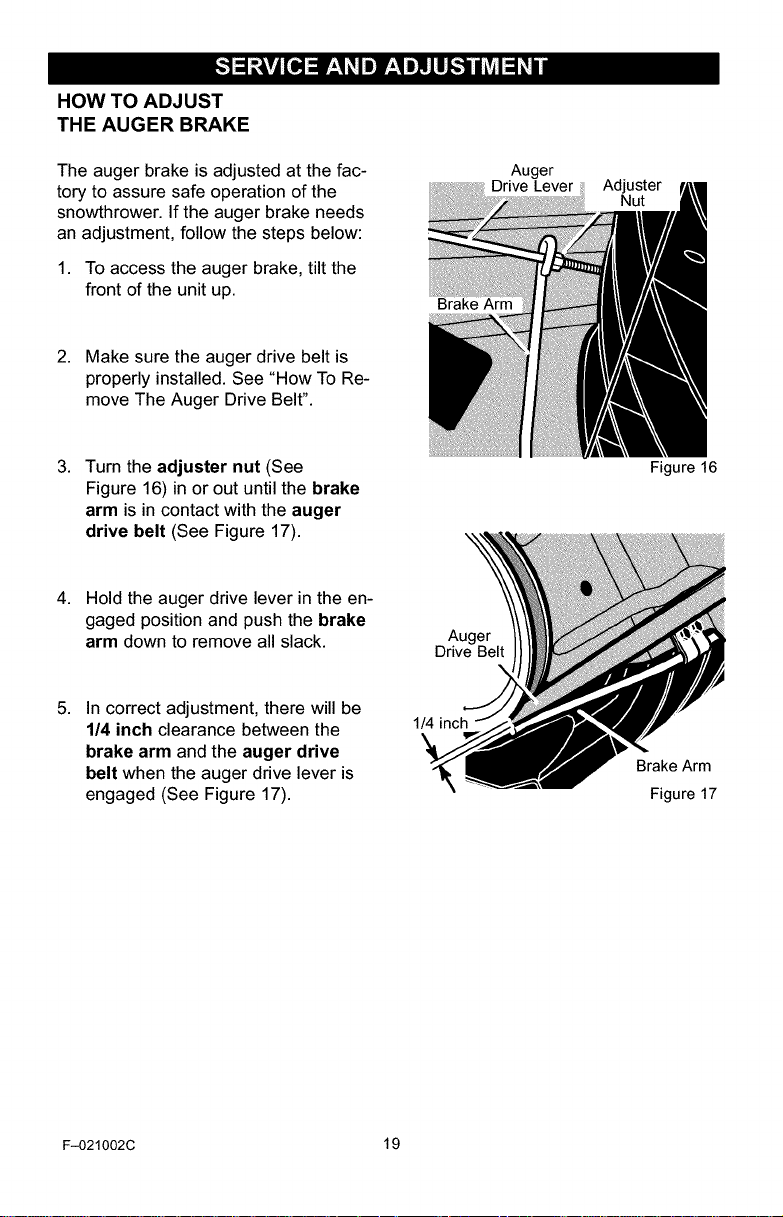
HOW TO ADJUST
THE AUGER BRAKE
The auger brake is adjusted at the fac-
tory to assure safe operation of the
snowthrower. If the auger brake needs
an adjustment, follow the steps below:
1. To access the auger brake, tilt the
front of the unit up.
2. Make sure the auger drive belt is
properly installed. See "How To Re-
move The Auger Drive Belt".
Brake Arm
Auger
Drive Lever
Adjuster
Nut
3.
Turn the adjuster nut (See
Figure 16) in or out until the brake
arm is in contact with the auger
drive belt (See Figure 17).
Figure 16
4.
Hold the auger drive lever in the en-
gaged position and push the brake
arm down to remove all slack.
Auger
Drive Belt
5.
In correct adjustment, there will be
1/4 inch clearance between the
brake arm and the auger drive
belt when the auger drive lever is
engaged (See Figure 17).
1/4 inch
Brake Arm
Figure 17
F-021002C 19
B,,_o] _ r_,1_lm]F-'Im_lLli,,,"]lJkvJ!_ _11II
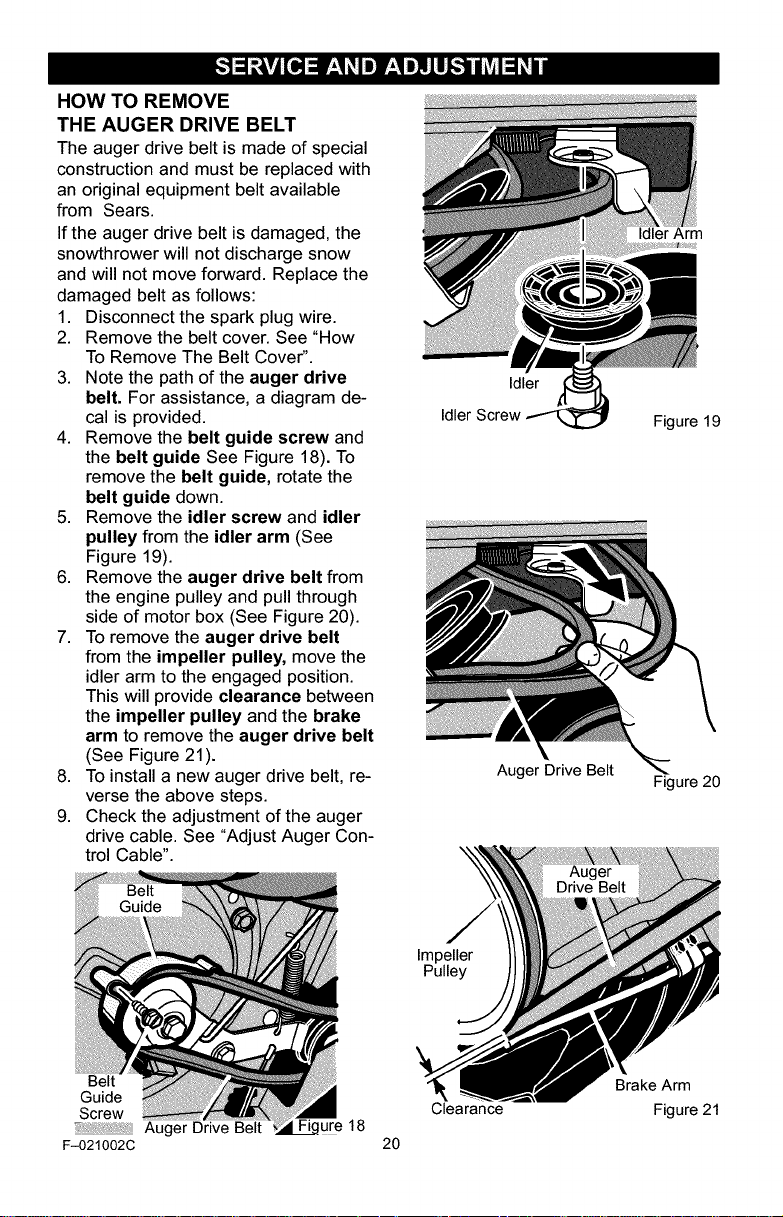
HOW TO REMOVE
THE AUGER DRIVE BELT
The auger drive belt is made of special
construction and must be replaced with
an original equipment belt available
from Sears.
Ifthe auger drive belt is damaged, the
snowthrower will not discharge snow
and will not move forward. Replace the
damaged belt as follows:
1. Disconnect the spark plug wire.
2. Remove the belt cover. See "How
To Remove The Belt Cover".
3. Note the path of the auger drive
belt. For assistance, a diagram de-
cal is provided.
4. Remove the belt guide screw and
the belt guide See Figure 18). To
remove the belt guide, rotate the
belt guide down.
5. Remove the idler screw and idler
pulley from the idler arm (See
Figure 19).
6. Remove the auger drive belt from
the engine pulley and pull through
side of motor box (See Figure 20).
7. To remove the auger drive belt
from the impeller pulley, move the
idler arm to the engaged position.
This will provide clearance between
the impeller pulley and the brake
arm to remove the auger drive belt
(See Figure 21).
8. To install a new auger drive belt, re-
verse the above steps.
9. Check the adjustment of the auger
drive cable. See "Adjust Auger Con-
trol Cable".
Idler
Idler Screw
Auger Drive Belt
Idler Arm
Figure 19
Figure20
Impeller
Pulley
Belt
Guide
Screw
Auger Drive Belt
F-021002C
ure 18
Clearance
20
Brake Arm
Figure 21
HOW TO REMOVE THE AUGER
1. Remove the belt cover. See "How
To Remove The Belt Cover".
2.
Remove the auger drive belt. See
"How To Remove The Auger Drive
Belt" in the Service And Adjustment
section.
3. Remove the auger pulley from the
auger shaft (threads are left hand;
turn clockwise to remove).
4. To keep the auger from rotating, set
a 2"x4" piece of wood on the cen-
ter paddle to secure auger.
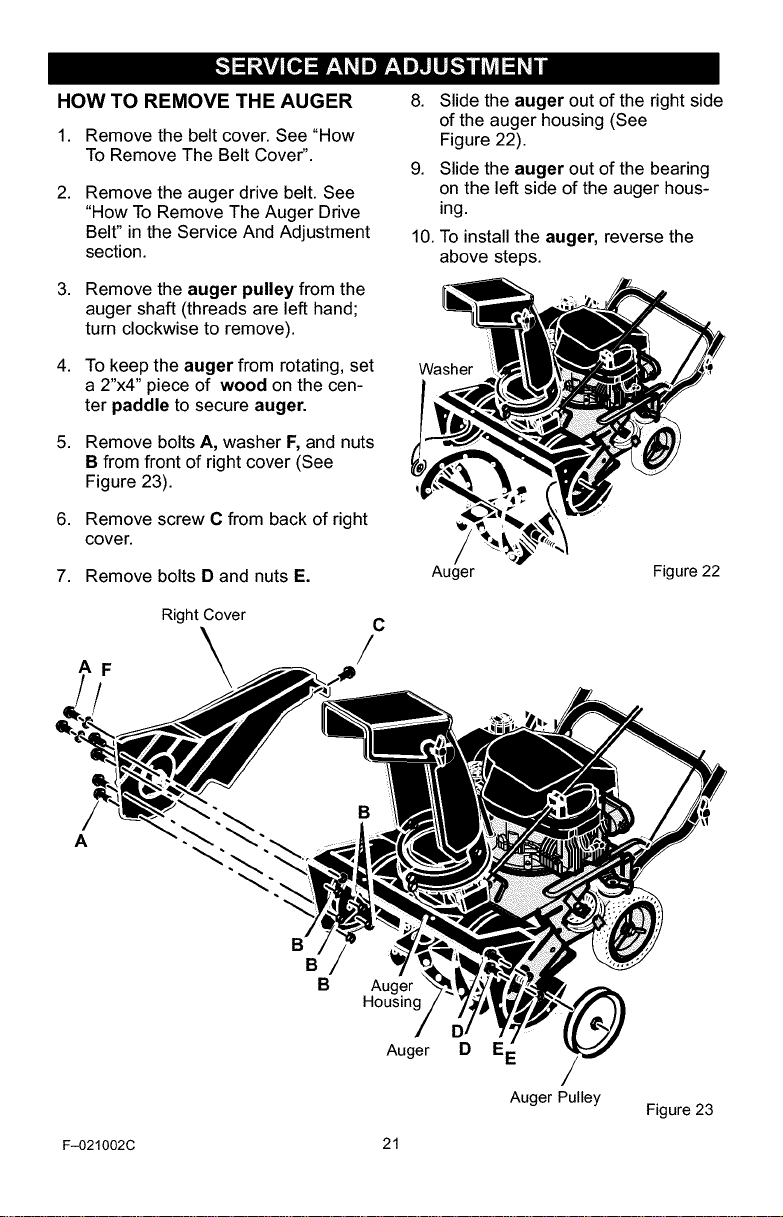
5. Remove bolts A, washer F, and nuts
B from front of right cover (See
Figure 23).
6. Remove screw C from back of right
cover.
8. Slide the auger out of the right side
of the auger housing (See
Figure 22).
9. Slide the auger out of the bearing
on the left side of the auger hous-
ing.
10. To install the auger, reverse the
above steps.
Washer
7. Remove bolts D and nuts E. Auger Figure22
RightCover
\
C
/
AF
/
B
B
B
Auger
Housing
Auger
D EE
AugerPulley
Figure23
F-021002C 21
B,,_o] _ r_,1_lm]F-'Im_lLli,,,"]lJkvJ!_ _11II
TO ADJUST THE CARBURETOR
The carburetor is not adjustable. En-
gine performance should not be af-
fected at altitudes up to 7,000 feet. For
operation at higher elevations, contact
your nearest Sears Service Center.
IMPORTANT: Never tamper with the
engine governor, which is factory set for
proper engine speed. Over-speeding
the engine above the factory high
speed setting can be dangerous. If you
think the engine-governed high speed
needs adjusting, contact your nearest
Sears Service Center, which has the
proper equipment and experience to
make any necessary adjustments.
F-021002C 22

_"]ll[O_ _
,_ WARNING: Never store your
snow thrower indoors or in
an enclosed, poorly venti-
lated area. If gasoline remains in the
tank, fumes may reach an open
flame, spark or pilot light from a fur-
nace, water heater, clothes dryer,
cigarette, etc.
NOTE: To prevent engine damage (if
snow thrower is not used for more than
30 days) follow the steps below.
SNOW THROWER
1. Thoroughly clean the snow thrower.
2. Lubricate all lubrication points. See
the Maintenance section.
3. Be sure that all nuts, bolts and
screws are securely fastened. In-
spect all visible moving parts for
damage, breakage and wear. Re-
place if necessary.
4. Touch up all rusted or chipped paint
surfaces; sand lightly before paint-
ing.
5. Cover the bare metal parts of the
blower housing auger and the im-
peller with rust preventative, such
as a spray lubricant.
NOTE: A yearly checkup or tune-up by
a Sears service center is a good way of
ensuring that your snow thrower will
provide maximum performance for the
next season.
ENGINE
_ ARNING: Drain the gaso-
line outdoors, away from
fire or flame.
Gasoline must be removed or treated to
prevent gum deposits from forming in
the fuel tank, filter, hose, and carburetor
during storage. Also, during storage al-
cohol blended gasoline that uses etha-
nol or methanol (sometimes called
gasohol) attracts water. It acts on the
gasoline to form acids which damage
the engine.
F-021002C
1.
2.
3.
4.
5.
To remove gasoline, run the engine
until the fuel tank is empty and the
engine stops.
If you do not remove the gasoline,
use fuel stabilizer supplied with unit
or purchase Craftsman Fuel Stabi-
lizer No. 3550. Add fuel stabilizer to
any gasoline left in the tank to mini-
mize gum deposits and acids. If the
fuel tank is almost empty, mix stabi-
lizer with fresh gasoline in a sepa-
rate container and add some to the
fuel tank.
Always follow the instruction on the
stabilizer container. After the stabi-
lizer is added to the fuel tank, run
the engine at least ten minutes to
allow the mixture to reach the car-
buretor.
Change the engine oil.
Lubricate the piston/cylinder area as
follows: First, remove the spark plug
and squirt a few drops of clean en-
gine oil into the spark plug hole.
Next, cover the spark plug hole with
a rag to absorb oil spray. Then, pull
two or three times on the recoil
starter rope to rotate the engine. Fi-
nally, install the spark plug and at-
tach the spark plug wire.
23
OTHER
1. If possible, store your snow thrower
indoors and cover it to give protec-
tion from dust and dirt.
2. If the snow thrower must be stored
outdoors, put the snow thrower on
blocks to raise it off of the ground.
3. Cover the snow thrower with a suit-
able protective cover that does not
retain moisture. Do not use plastic.
IMPORTANT: Never cover snow
thrower while engine and exhaust areas
are still warm.
Ill ¸
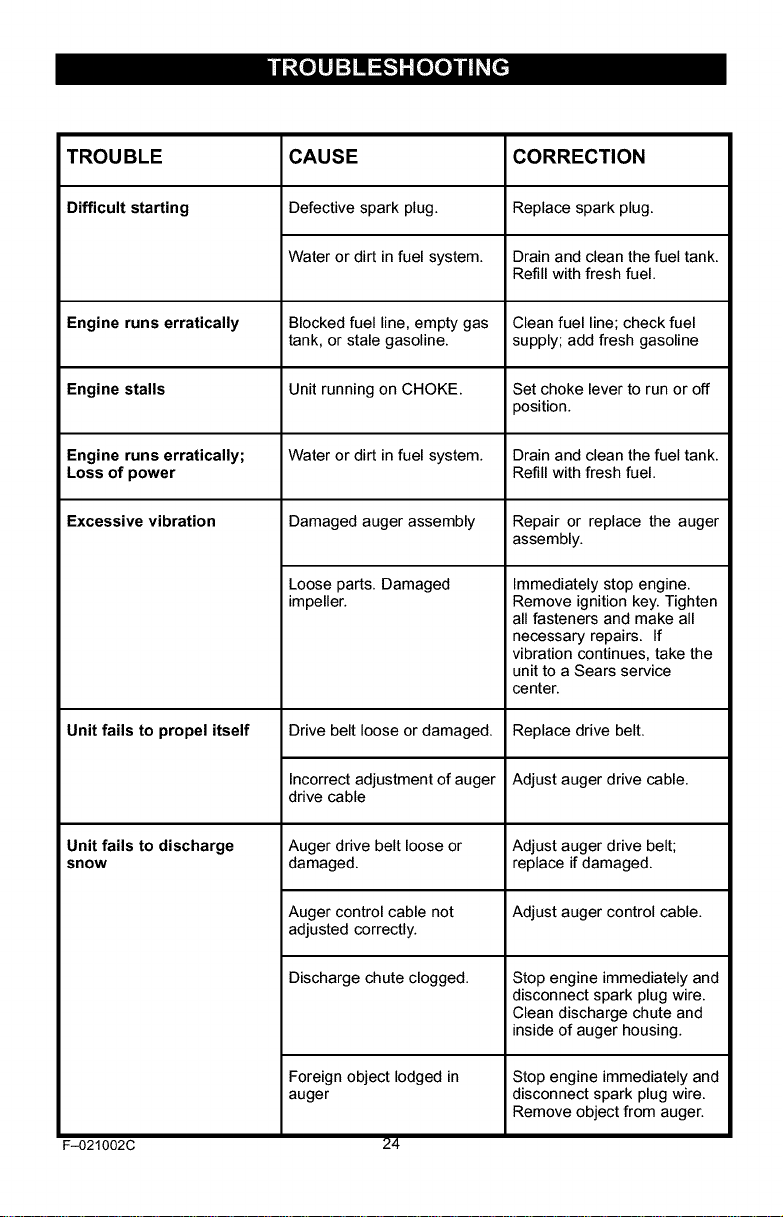
TROUBLE CAUSE CORRECTION
Difficult starting Defective spark plug.
Water or dirt in fuel system.
Replace spark plug.
Drain and clean the fuel tank.
Refill with fresh fuel.
Engine runs erratically Blocked fuel line, empty gas Clean fuel line; check fuel
tank, or stale gasoline, supply; add fresh gasoline
Engine stalls Unit running on CHOKE. Set choke lever to run or off
position.
Engine runs erratically; Water or dirt in fuel system. Drain and clean the fuel tank.
Loss of power Refill with fresh fuel.
Excessive vibration Damaged auger assembly
Unit fails to propel itself
Loose parts. Damaged
impeller.
Drive belt loose or damaged.
Incorrect adjustment of auger
drive cable
Auger drive belt loose or
damaged.
Auger control cable not
adjusted correctly.
Discharge chute clogged.
Foreign object lodged in
auger
Unit fails to discharge
snow
Repair or replace the auger
assembly.
Immediately stop engine.
Remove ignition key. Tighten
all fasteners and make all
necessary repairs. If
vibration continues, take the
unit to a Sears service
center.
Replace drive belt.
Adjust auger drive cable.
Adjust auger drive belt;
replace if damaged.
Adjust auger control cable.
Stop engine immediately and
disconnect spark plug wire.
Clean discharge chute and
inside of auger housing.
Stop engine immediately and
disconnect spark plug wire.
Remove object from auger.
F-021002C 24
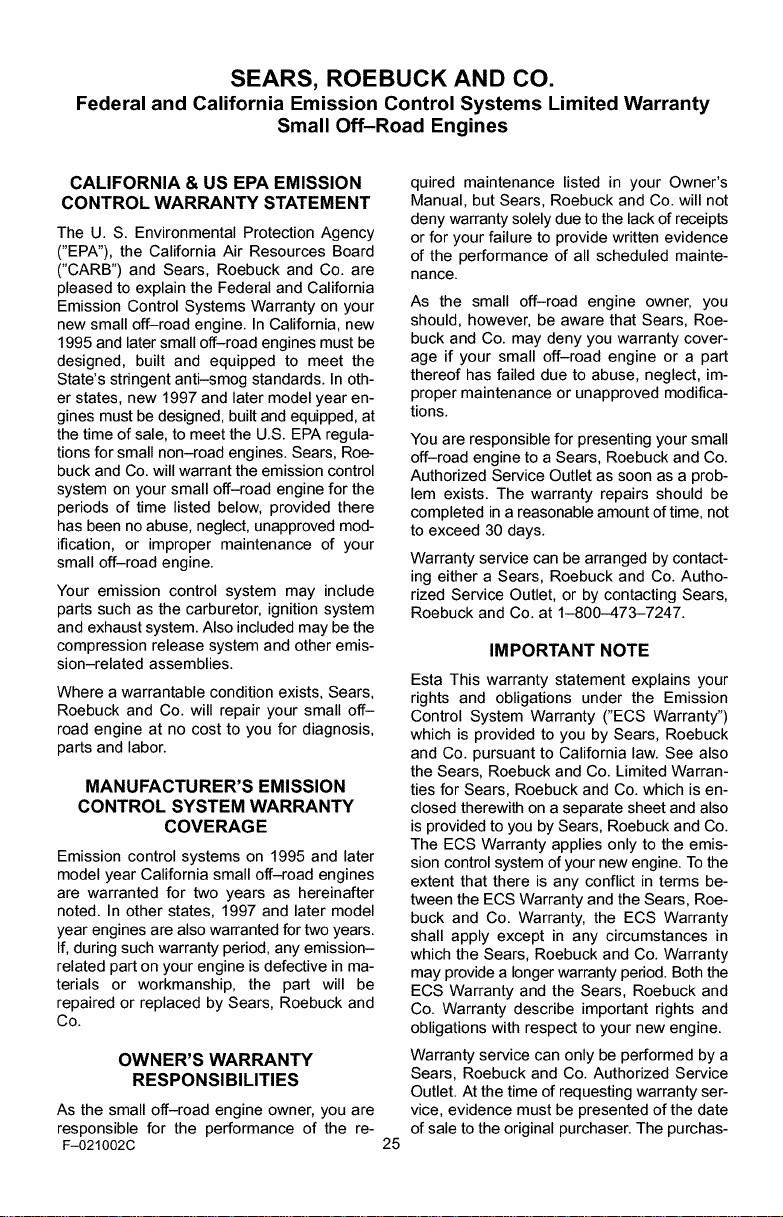
SEARS, ROEBUCK AND CO.
Federal and California Emission Control Systems Limited Warranty
Small Off-Road Engines
CALIFORNIA & US EPA EMISSION
CONTROL WARRANTY STATEMENT
The U. S. Environmental Protection Agency
("EPA"), the California Air Resources Board
("CARB") and Sears, Roebuck and Co. are
pleased to explain the Federal and California
Emission Control Systems Warranty on your
new small off-road engine. In California, new
1995 and later small off-road engines must be
designed, built and equipped to meet the
State's stringent anti-smog standards. In oth-
er states, new 1997 and later model year en-
gines must be designed, built and equipped, at
the time of sale, to meet the U.S. EPA regula-
tions for small non-road engines. Sears, Roe-
buck and Co. will warrant the emission control
system on your small off-road engine for the
periods of time listed below, provided there
has been no abuse, neglect, unapproved mod-
ification, or improper maintenance of your
small off-road engine.
Your emission control system may include
parts such as the carburetor, ignition system
and exhaust system. Also included may be the
compression release system and other emis-
sion-related assemblies.
Where a warrantable condition exists, Sears,
Roebuck and Co. will repair your small off-
road engine at no cost to you for diagnosis,
parts and labor.
MANUFACTURER'S EMISSION
CONTROL SYSTEM WARRANTY
COVERAGE
Emission control systems on 1995 and later
model year California small off-road engines
are warranted for two years as hereinafter
noted. In other states, 1997 and later model
year engines are also warranted for two years.
If, during such warranty period, any emission-
related part on your engine is defective in ma-
terials or workmanship, the part will be
repaired or replaced by Sears, Roebuck and
Co.
OWNER'S WARRANTY
RESPONSIBILITIES
As the small off-road engine owner, you are
responsible for the performance of the re-
F-021002C
quired maintenance listed in your Owner's
Manual, but Sears, Roebuck and Co. will not
deny warranty solely due to the lack of receipts
or for your failure to provide written evidence
of the performance of all scheduled mainte-
nance.
As the small off-road engine owner, you
should, however, be aware that Sears, Roe-
buck and Co. may deny you warranty cover-
age if your small off-road engine or a part
thereof has failed due to abuse, neglect, im-
proper maintenance or unapproved modifica-
tions.
You are responsible for presenting your small
off-road engine to a Sears, Roebuck and Co.
Authorized Service Outlet as soon as a prob-
lem exists. The warranty repairs should be
completed in a reasonable amount of time, not
to exceed 30 days.
Warranty service can be arranged by contact-
ing either a Sears, Roebuck and Co. Autho-
rized Service Outlet, or by contacting Sears,
Roebuck and Co. at 1-800-473-7247.
25
IMPORTANT NOTE
Esta This warranty statement explains your
rights and obligations under the Emission
Control System Warranty ("ECS Warranty")
which is provided to you by Sears, Roebuck
and Co. pursuant to California law. See also
the Sears, Roebuck and Co. Limited Warran-
ties for Sears, Roebuck and Co. which is en-
closed therewith on a separate sheet and also
is provided to you by Sears, Roebuck and Co.
The ECS Warranty applies only to the emis-
sion control system of your new engine. To the
extent that there is any conflict in terms be-
tween the ECS Warranty and the Sears, Roe-
buck and Co. Warranty, the ECS Warranty
shall apply except in any circumstances in
which the Sears, Roebuck and Co. Warranty
may provide a longer warranty period. Both the
ECS Warranty and the Sears, Roebuck and
Co. Warranty describe important rights and
obligations with respect to your new engine.
Warranty service can only be performed by a
Sears, Roebuck and Co. Authorized Service
Outlet. At the time of requesting warranty ser-
vice, evidence must be presented of the date
of sale to the original purchaser. The purchas-
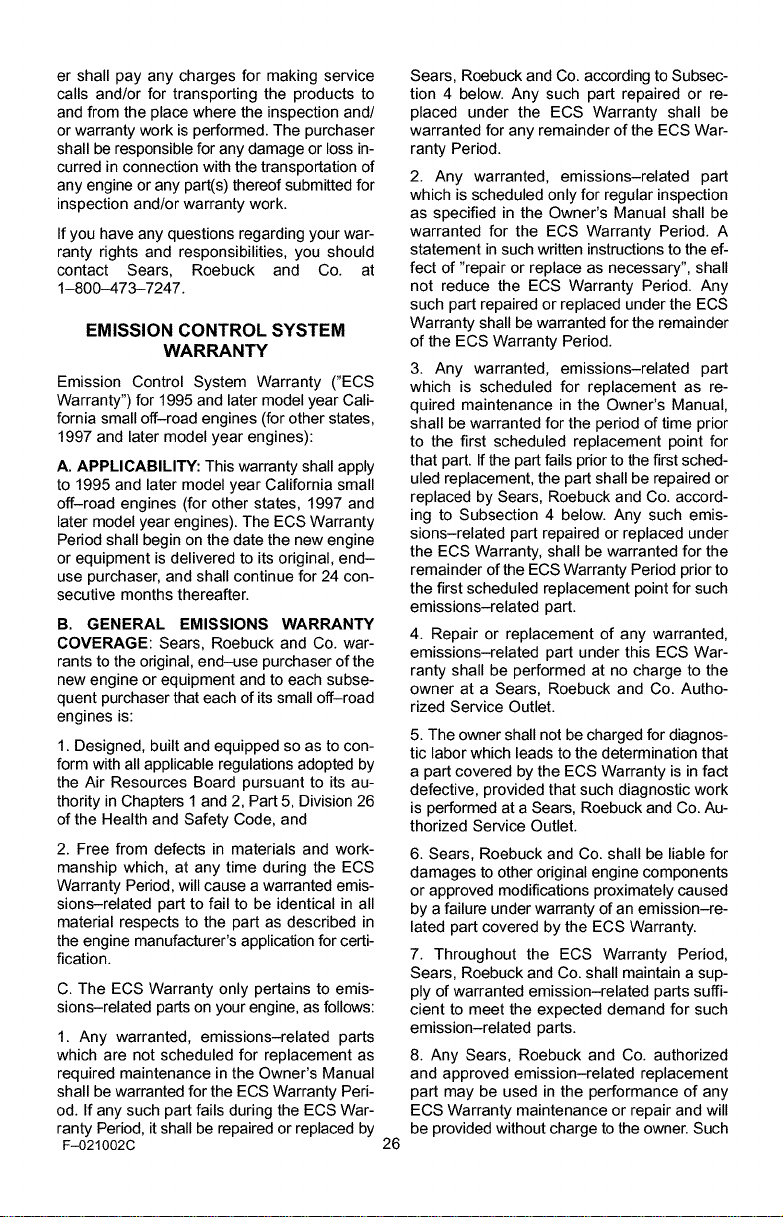
ershallpayanychargesformakingservice
callsand/orfortransportingtheproductsto
andfromtheplacewheretheinspectionand/
orwarrantyworkisperformed.Thepurchaser
shallberesponsibleforanydamageorlossin-
curredinconnectionwiththetransportationof
anyengineoranypart(s)thereofsubmittedfor
inspectionand/orwarrantywork.
Ifyouhaveanyquestionsregardingyourwar-
rantyrightsandresponsibilities,youshould
contactSears,Roebuckand Co. at
1-800-473-7247.
EMISSION CONTROL SYSTEM
WARRANTY
Emission Control System Warranty ("ECS
Warranty") for 1995 and later model year Cali-
fornia small off-road engines (for other states,
1997 and later model year engines):
A. APPLICABILITY: This warranty shall apply
to 1995 and later model year California small
off-road engines (for other states, 1997 and
later model year engines). The ECS Warranty
Period shall begin on the date the new engine
or equipment is delivered to its original, end-
use purchaser, and shall continue for 24 con-
secutive months thereafter.
B. GENERAL EMISSIONS WARRANTY
COVERAGE: Sears, Roebuck and Co. war-
rants to the original, end-use purchaser of the
new engine or equipment and to each subse-
quent purchaser that each of its small off-road
engines is:
1. Designed, built and equipped so as to con-
form with all applicable regulations adopted by
the Air Resources Board pursuant to its au-
thority in Chapters 1 and 2, Part 5, Division 26
of the Health and Safety Code, and
2. Free from defects in materials and work-
manship which, at any time during the ECS
Warranty Period, will cause a warranted emis-
sions-related part to fail to be identical in all
material respects to the part as described in
the engine manufacturer's application for certi-
fication.
C. The ECS Warranty only pertains to emis-
sions-related parts on your engine, as follows:
1. Any warranted, emissions-related parts
which are not scheduled for replacement as
required maintenance in the Owner's Manual
shall be warranted for the ECS Warranty Peri-
od. If any such part fails during the ECS War-
ranty Period, it shall be repaired or replaced by
F-021002C
26
Sears, Roebuck and Co. according to Subsec-
tion 4 below. Any such part repaired or re-
placed under the ECS Warranty shall be
warranted for any remainder of the ECS War-
ranty Period.
2. Any warranted, emissions-related part
which is scheduled only for regular inspection
as specified in the Owner's Manual shall be
warranted for the ECS Warranty Period. A
statement in such written instructions to the ef-
fect of "repair or replace as necessary", shall
not reduce the ECS Warranty Period. Any
such part repaired or replaced under the ECS
Warranty shall be warranted for the remainder
of the ECS Warranty Period.
3. Any warranted, emissions-related part
which is scheduled for replacement as re-
quired maintenance in the Owner's Manual,
shall be warranted for the period of time prior
to the first scheduled replacement point for
that part. Ifthe part fails prior to the first sched-
uled replacement, the part shall be repaired or
replaced by Sears, Roebuck and Co. accord-
ing to Subsection 4 below. Any such emis-
sions-related part repaired or replaced under
the ECS Warranty, shall be warranted for the
remainder of the ECS Warranty Period prior to
the first scheduled replacement point for such
emissions-related part.
4. Repair or replacement of any warranted,
emissions-related part under this ECS War-
ranty shall be performed at no charge to the
owner at a Sears, Roebuck and Co. Autho-
rized Service Outlet.
5. The owner shall not be charged for diagnos-
tic labor which leads to the determination that
a part covered by the ECS Warranty is in fact
defective, provided that such diagnostic work
is performed at a Sears, Roebuck and Co. Au-
thorized Service Outlet.
6. Sears, Roebuck and Co. shall be liable for
damages to other original engine components
or approved modifications proximately caused
by a failure under warranty of an emission-re-
lated part covered by the ECS Warranty.
7. Throughout the ECS Warranty Period,
Sears, Roebuck and Co. shall maintain a sup-
ply of warranted emission-related parts suffi-
cient to meet the expected demand for such
emission-related parts.
8. Any Sears, Roebuck and Co. authorized
and approved emission-related replacement
part may be used in the performance of any
ECS Warranty maintenance or repair and will
be provided without charge to the owner. Such
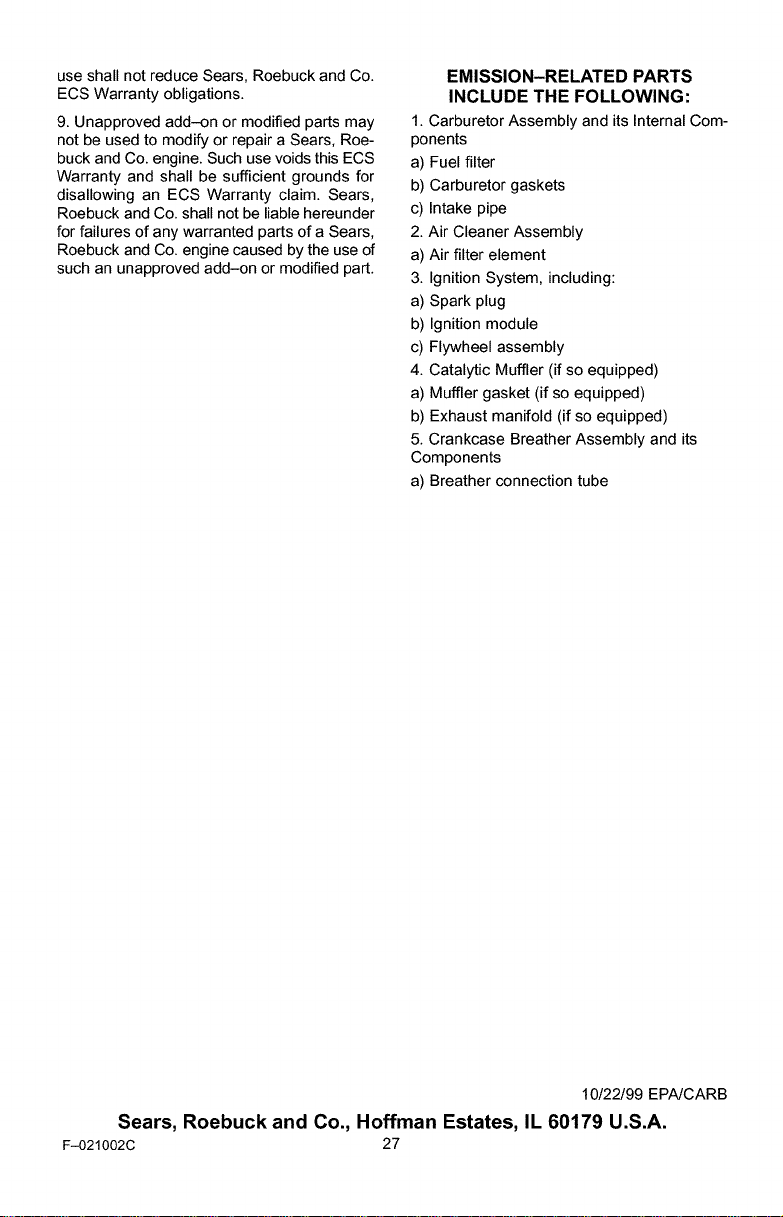
useshallnotreduceSears,RoebuckandCo.
ECSWarrantyobligations.
9.Unapprovedadd-onormodifiedpartsmay
notbeusedtomodifyorrepairaSears,Roe-
buckandCo.engine.SuchusevoidsthisECS
Warrantyandshallbesufficientgroundsfor
disallowinganECSWarrantyclaim.Sears,
RoebuckandCo.shallnotbeliablehereunder
forfailuresofanywarrantedpartsofaSears,
RoebuckandCo.enginecausedbytheuseof
suchanunapprovedadd-onormodifiedpart.
EMISSION-RELATED PARTS
INCLUDE THE FOLLOWING:
1. Carburetor Assembly and its Internal Com-
ponents
a) Fuel filter
b) Carburetor gaskets
c) Intake pipe
2. Air Cleaner Assembly
a) Air filter element
3. Ignition System, including:
a) Spark plug
b) Ignition module
c) Flywheel assembly
4. Catalytic Muffler (if so equipped)
a) Muffler gasket (if so equipped)
b) Exhaust manifold (if so equipped)
5. Crankcase Breather Assembly and its
Components
a) Breather connection tube
10/22/99 EPA/CARB
Sears, Roebuck and Co., Hoffman Estates, IL 60179 U.S.A.
F-021002C 27
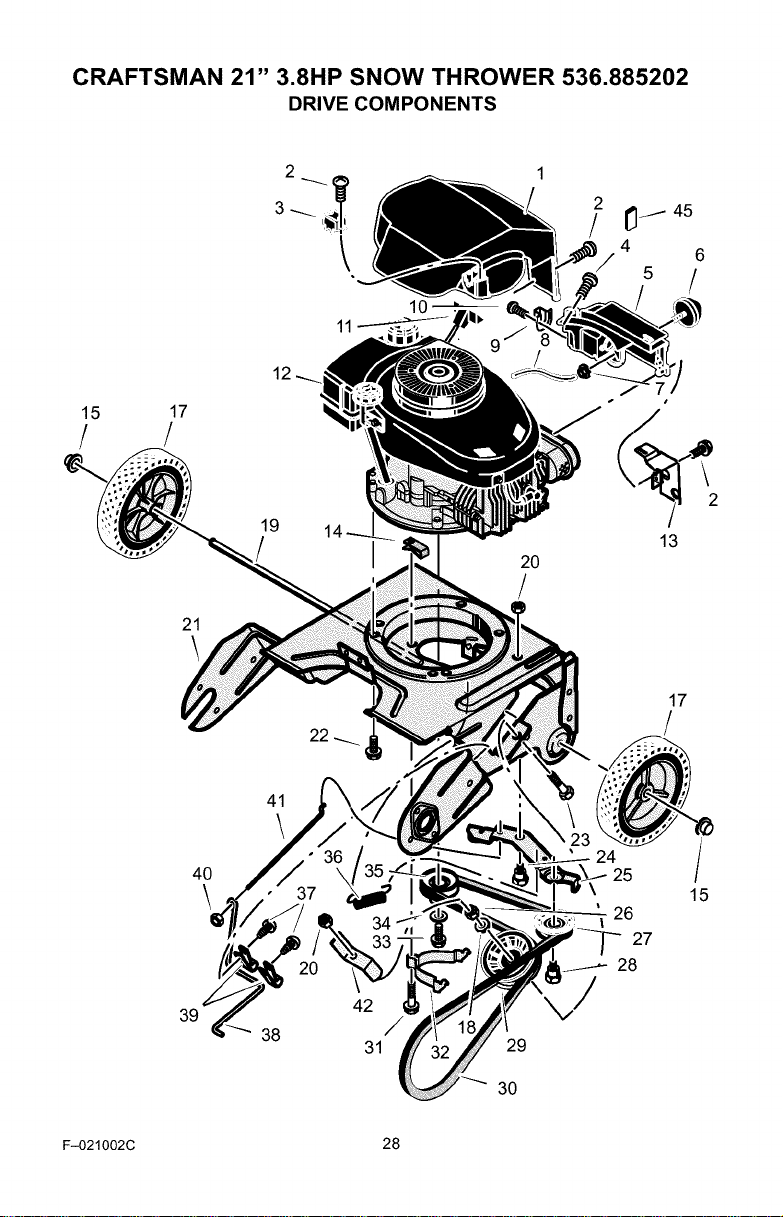
CRAFTSMAN 21" 3.8HP SNOW THROWER 536.885202
DRIVE COMPONENTS
15 17
/ /
21
19
2 1
3_ /
\ 4 6
40
\
39
38
12
11
41
\
22
34
42
/
31
20
/
29
30
24
\
2
13
17
/
/
15
26
27
28
F-021002C 28
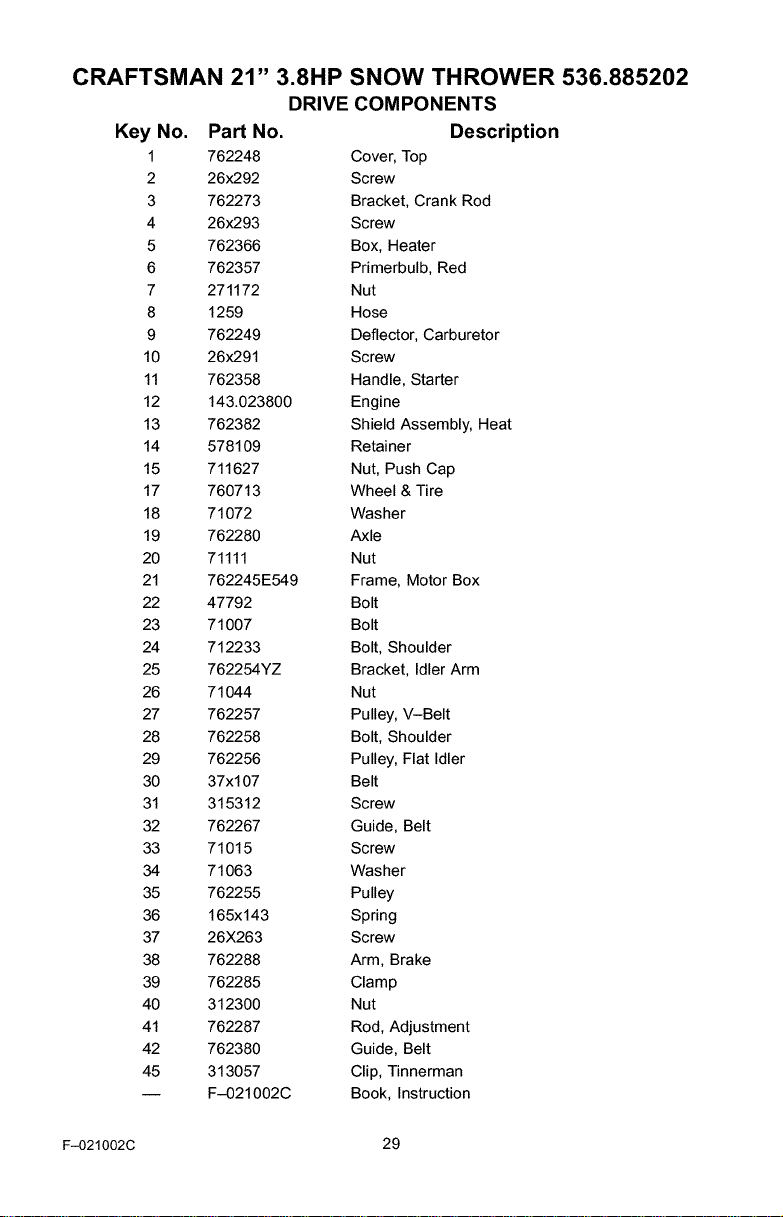
CRAFTSMAN 21" 3.8HP SNOW THROWER 536.885202
DRIVE COMPONENTS
Key No. Part No. Description
1 762248 Cover, Top
2 26x292 Screw
3 762273 Bracket, Crank Rod
4 26x293 Screw
5 762366 Box, Heater
6 762357 Primerbulb, Red
7 271172 Nut
8 1259 Hose
9 762249 Deflector, Carburetor
10 26x291 Screw
11 762358 Handle, Starter
12 143.023800 Engine
13 762382 Shield Assembly, Heat
14 578109 Retainer
15 711627 Nut, Push Cap
17 760713 Wheel & Tire
18 71072 Washer
19 762280 Axle
20 71111 Nut
21 762245E549 Frame, Motor Box
22 47792 Bolt
23 71007 Bolt
24 712233 Bolt, Shoulder
25 762254YZ Bracket, Idler Arm
26 71044 Nut
27 762257 Pulley, V-Belt
28 762258 Bolt, Shoulder
29 762256 Pulley, Flat Idler
30 37xl 07 Belt
31 315312 Screw
32 762267 Guide, Belt
33 71015 Screw
34 71063 Washer
35 762255 Pulley
36 165x143 Spring
37 26X263 Screw
38 762288 Arm, Brake
39 762285 Clamp
40 312300 Nut
41 762287 Rod, Adjustment
42 762380 Guide, Belt
45 313057 Clip, Tinnerman
-- F-021002C Book, Instruction
F-021002C 29
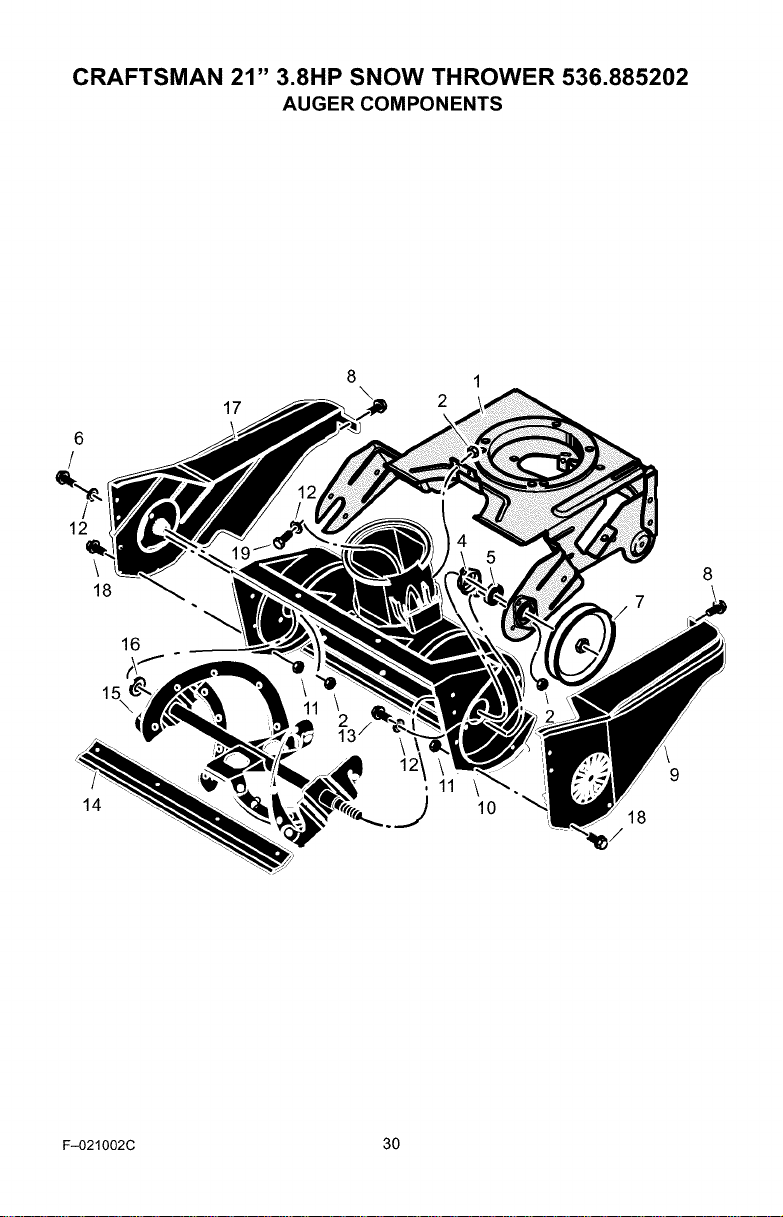
CRAFTSMAN 21" 3.8HP SNOW THROWER 536.885202
AUGER COMPONENTS
6
/
12
\
18
17
16
14
10
9
18
F-021002C 30
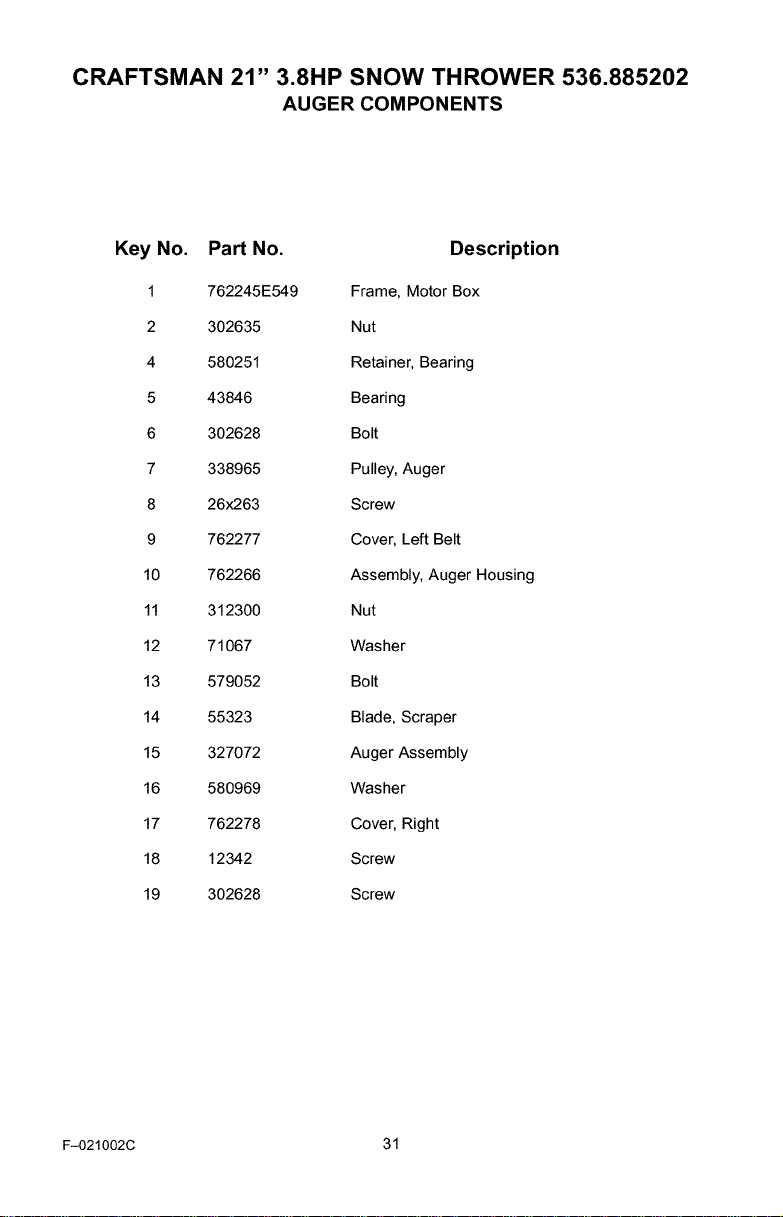
CRAFTSMAN 21" 3.8HP SNOW THROWER 536.885202
AUGER COMPONENTS
Key No. Part No. Description
1 762245E549 Frame, Motor Box
2 302635 Nut
4 580251 Retainer, Bearing
5 43846 Bearing
6 302628 Bolt
7 338965 Pulley, Auger
8 26x263 Screw
9 762277 Cover, Left Belt
10 762266 Assembly, Auger Housing
11 312300 Nut
12 71067 Washer
13 579052 Bolt
14 55323 Blade, Scraper
15 327072 Auger Assembly
16 580969 Washer
17 762278 Cover, Right
18 12342 Screw
19 302628 Screw
F-021002C 31
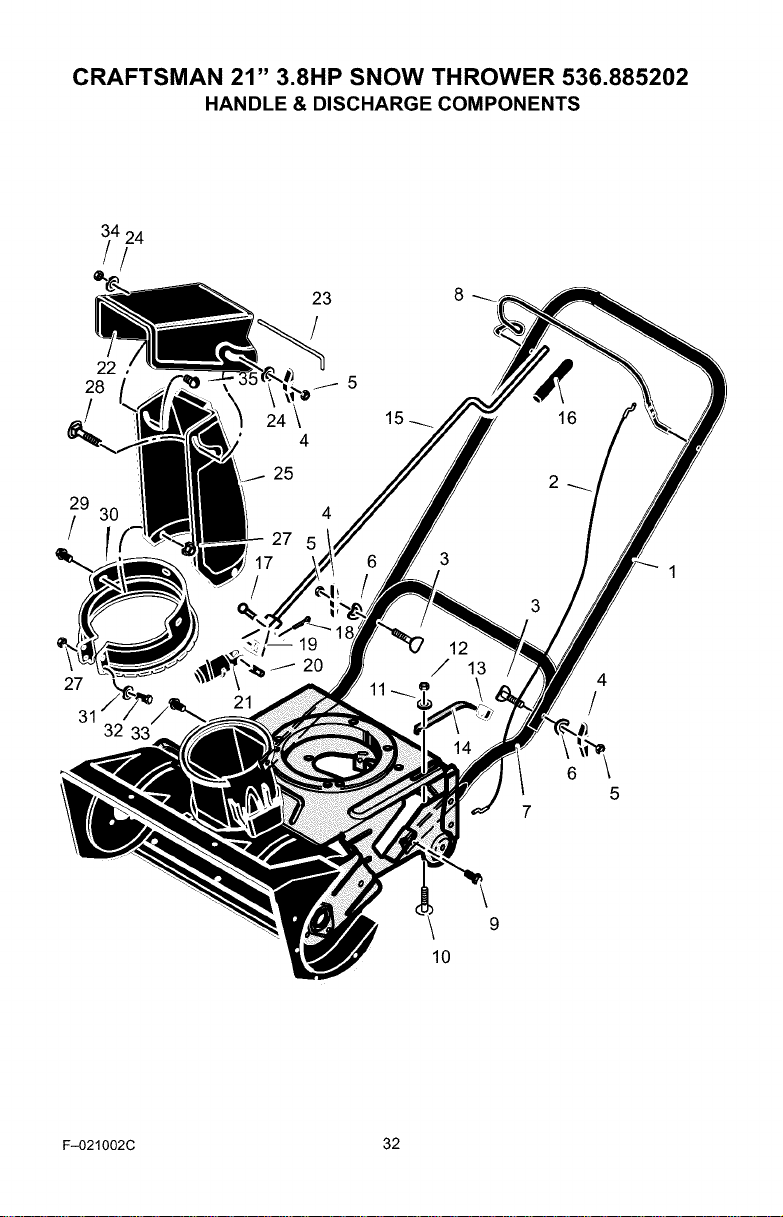
CRAFTSMAN 21" 3.8HP SNOW THROWER 536.885202
HANDLE & DISCHARGE COMPONENTS
29
/
22
28
23
/
25
4
16
12
J'-20 _ 13
4
27 11_ /
31
32 33
9
10
F-021002C 32
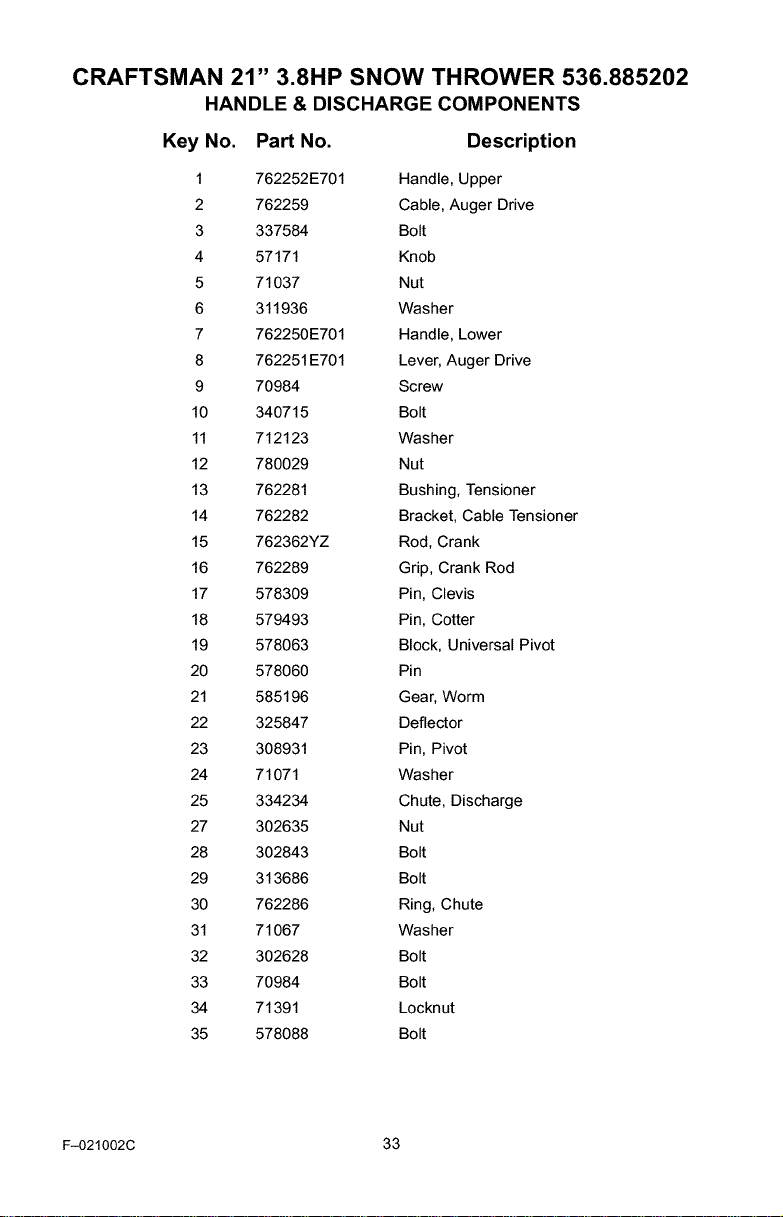
CRAFTSMAN 21" 3.8HP SNOW THROWER 536.885202
HANDLE & DISCHARGE COMPONENTS
Key No. Part No. Description
1 762252E701 Handle, Upper
2 762259 Cable, Auger Drive
3 337584 Bolt
4 57171 Knob
5 71037 Nut
6 311936 Washer
7 762250E701 Handle, Lower
8 762251E701 Lever, Auger Drive
9 70984 Screw
10 340715 Bolt
11 712123 Washer
12 780029 Nut
13 762281 Bushing, Tensioner
14 762282 Bracket, Cable Tensioner
15 762362YZ Rod, Crank
16 762289 Grip, Crank Rod
17 578309 Pin, Clevis
18 579493 Pin, Cotter
19 578063 Block, Universal Pivot
20 578060 Pin
21 585196 Gear, Worm
22 325847 Deflector
23 308931 Pin, Pivot
24 71071 Washer
25 334234 Chute, Discharge
27 302635 Nut
28 302843 Bolt
29 313686 Bolt
30 762286 Ring, Chute
31 71067 Washer
32 302628 Bolt
33 70984 Bolt
34 71391 Locknut
35 578088 Bolt
F-021002C 33
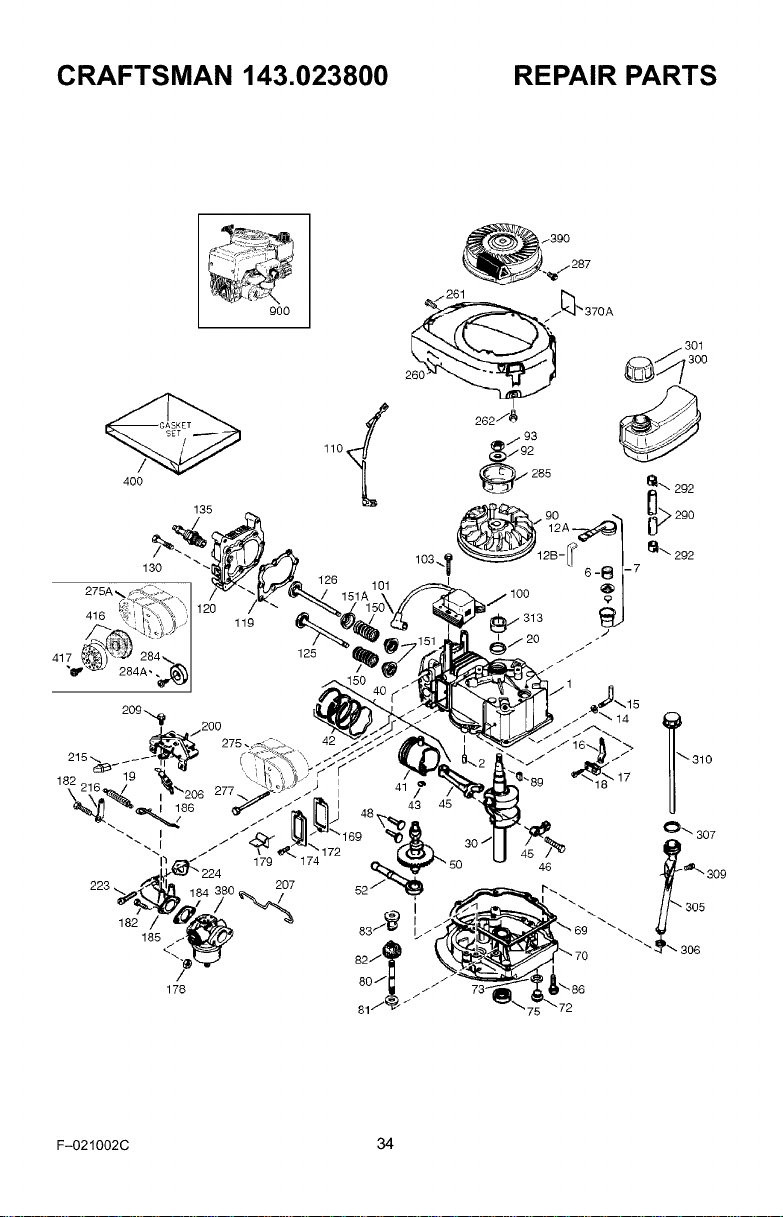
CRAFTSMAN 143.023800 REPAIR PARTS
417
90O
400
135
130 _
275A_
416
119
125
101
F-021002C 34
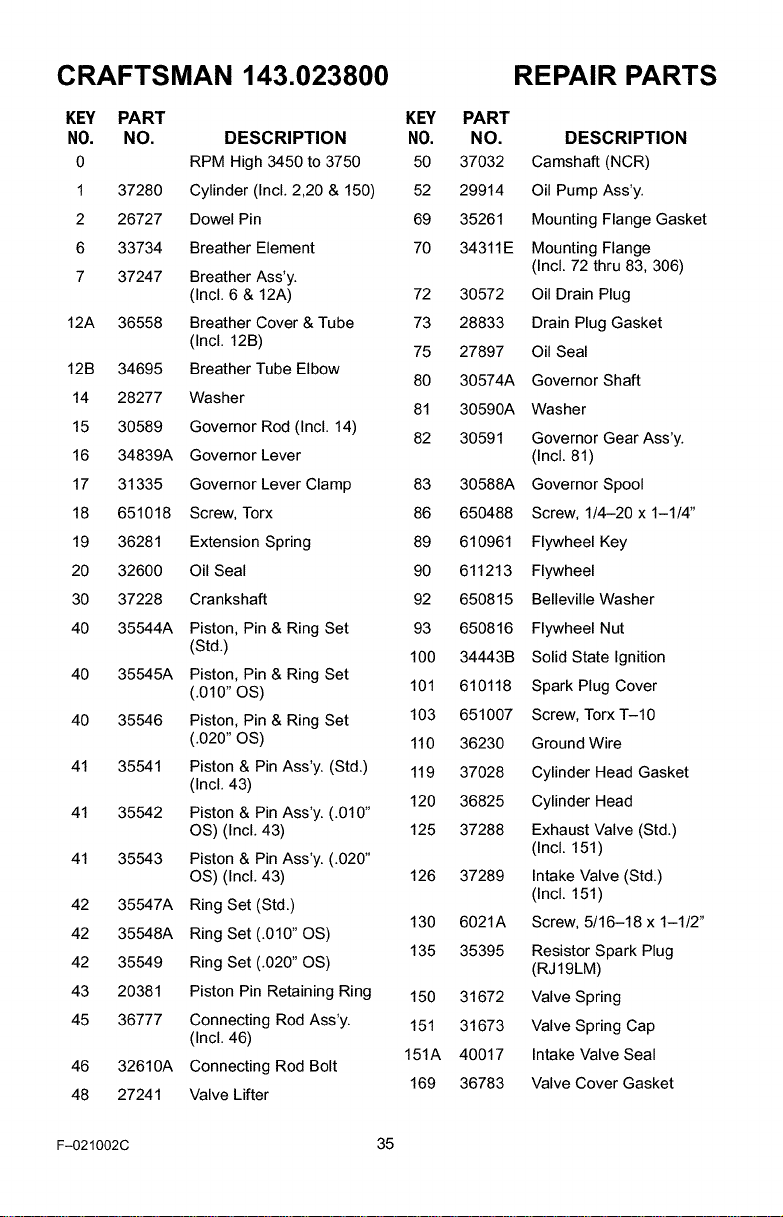
CRAFTSMAN 143.023800
KEY PART KEY PART
NO. NO. DESCRIPTION NO. NO.
0 RPM High 3450 to 3750 50 37032
1 37280 Cylinder (Incl. 2,20 & 150) 52 29914
2 26727 Dowel Pin 69 35261
6 33734 Breather Element 70 34311E
7 37247 Breather Ass'y.
(Incl. 6 & 12A) 72 30572
12A 36558 Breather Cover & Tube 73 28833
(Incl. 12B) 75 27897
12B 34695 Breather Tube Elbow
80 30574A
14 28277 Washer
81 30590A
15 30589 Governor Rod (Incl. 14) 82 30591
16 34839A Governor Lever
17 31335 Governor Lever Clamp 83 30588A
18 651018 Screw, Torx 86 650488
19 36281 Extension Spring 89 610961
20 32600 Oil Seal 90 611213
30 37228 Crankshaft 92 650815
40 35544A Piston, Pin & Ring Set 93 650816
(Std.) 100 34443B
40 35545A Piston, Pin & Ring Set
(.010" OS) 101 610118
40 35546 Piston, Pin & Ring Set 103 651007
(.020" OS) 110 36230
41 35541 Piston & Pin Ass'y. (Std.) 119 37028
(Incl. 43)
120 36825
41 35542 Piston & Pin Ass'y. (.010"
OS) (Incl. 43) 125 37288
41 35543 Piston & Pin Ass'y. (.020"
OS) (Incl. 43) 126 37289
42 35547A Ring Set (Std.)
130 6021A
42 35548A Ring Set (.010" OS)
135 35395
42 35549 Ring Set (.020" OS)
43 20381 Piston Pin Retaining Ring 150 31672
45 36777 Connecting Rod Ass'y. 151 31673
(Incl. 46)
151A 40017
46 32610A Connecting Rod Bolt
169 36783
48 27241 Valve Lifter
REPAIR PARTS
DESCRIPTION
Camshaft (NCR)
Oil Pump Ass'y.
Mounting Flange Gasket
Mounting Flange
(Incl. 72 thru 83, 306)
Oil Drain Plug
Drain Plug Gasket
Oil Seal
Governor Shaft
Washer
Governor Gear Ass'y.
(Incl. 81)
Governor Spool
Screw, 1/4-20 x 1-1/4"
Flywheel Key
Flywheel
Belleville Washer
Flywheel Nut
Solid State Ignition
Spark Plug Cover
Screw, Torx T-10
Ground Wire
Cylinder Head Gasket
Cylinder Head
Exhaust Valve (Std.)
(Incl. 151)
Intake Valve (Std.)
(Incl. 151)
Screw, 5/16-18 x 1-1/2"
Resistor Spark Plug
(RJ19LM)
Valve Spring
Valve Spring Cap
Intake Valve Seal
Valve Cover Gasket
F-021002C 35
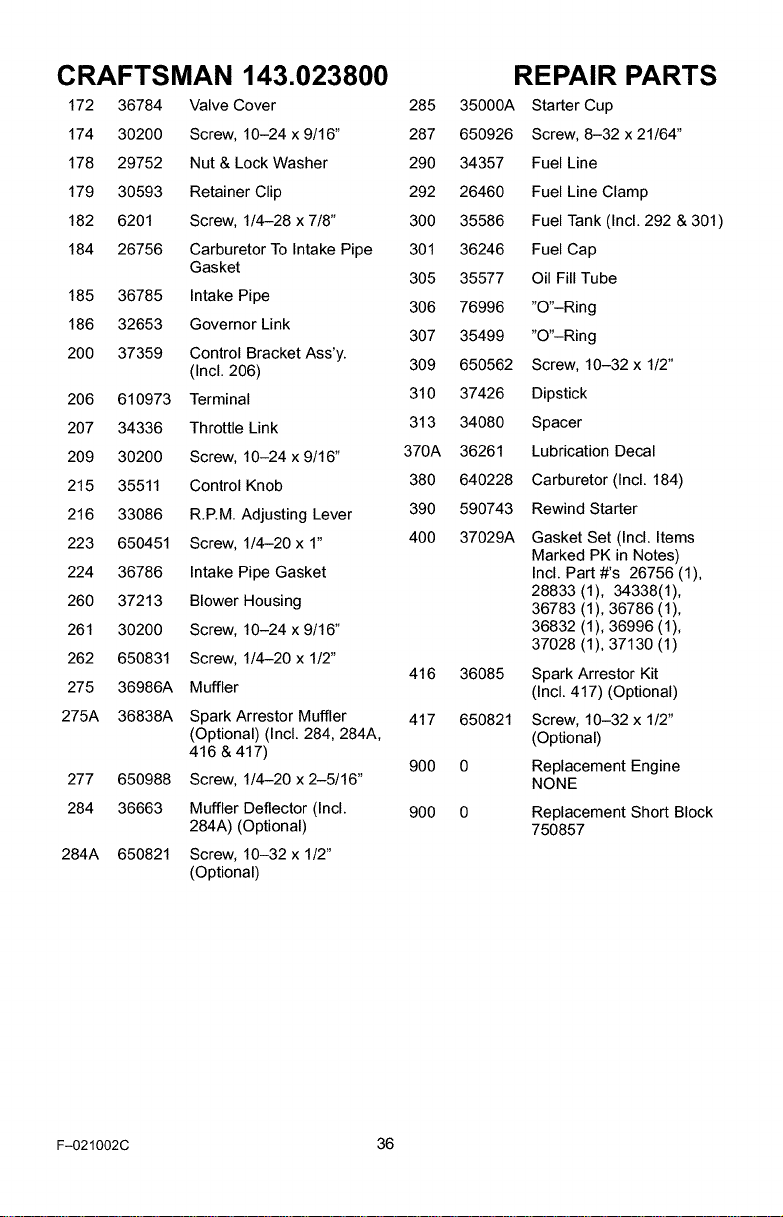
CRAFTSMAN 143.023800 REPAIR PARTS
172 36784 Valve Cover 285 35000A Starter Cup
174 30200 Screw, 10-24 x 9/16" 287 650926 Screw, 8-32 x 21/64"
178 29752 Nut & Lock Washer 290 34357 Fuel Line
179 30593 Retainer Clip 292 26460 Fuel Line Clamp
182 6201 Screw, 1/4-28 x 7/8" 300 35586 Fuel Tank (Incl. 292 & 301)
184 26756 Carburetor To Intake Pipe 301 36246 Fuel Cap
Gasket
305 35577 Oil Fill Tube
185 36785 Intake Pipe
306 76996 "O"-Ring
186 32653 Governor Link
307 35499 "O"-Ring
200 37359 Control Bracket Ass'y.
(Incl. 206) 309 650562 Screw, 10-32 x 1/2"
206 610973 Terminal 310 37426 Dipstick
207 34336 Throttle Link 313 34080 Spacer
209 30200 Screw, 10-24 x 9/16" 370A 36261 Lubrication Decal
215 35511 Control Knob 380 640228 Carburetor (Incl. 184)
216 33086 R.PM. Adjusting Lever 390 590743 Rewind Starter
223 650451 Screw, 1/4-20 x 1" 400 37029A Gasket Set (Incl. Items
Marked PK in Notes)
224 36786 Intake Pipe Gasket Incl. Part #'s 26756 (1),
28833 (1), 34338(1),
260 37213 Blower Housing 36783 (1), 36786 (1),
261 30200 Screw, 10-24 x 9/16" 36832 (1), 36996 (1),
37028 (1), 37130 (1)
262 650831 Screw, 1/4-20 x 1/2"
416 36085 Spark Arrestor Kit
275 36986A Muffler (Incl. 417) (Optional)
275A 36838A Spark Arrestor Muffler 417 650821 Screw, 10-32 x 1/2"
(Optional) (Incl. 284, 284A, (Optional)
416 & 417)
900 0 Replacement Engine
277 650988 Screw, 1/4-20 x 2-5/16" NONE
284 36663 Muffler Deflector (Incl. 900 0 Replacement Short Block
284A) (Optional) 750857
284A 650821 Screw, 10-32 x 1/2"
(Optional)
F-021002C 36
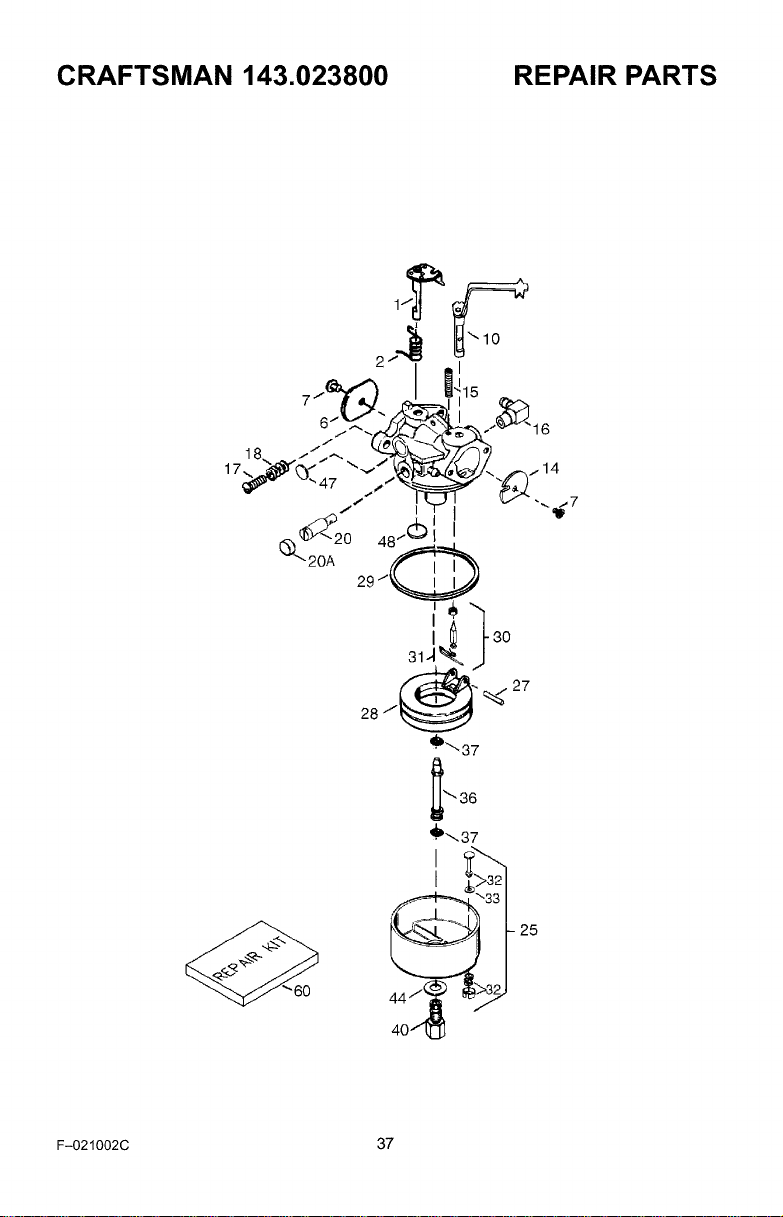
CRAFTSMAN 143.023800 REPAIR PARTS
48-®I
29t C
I
I
I
31.,I_
28 J'@
2_
17 18,,,. .,-"/_',.--./.,,,...,j J
_(_ 47 ,,,,_
jd
20A
_o
- _:_ 27
O_.,37
•_"_ 37
31
33
25
F-021002C 37
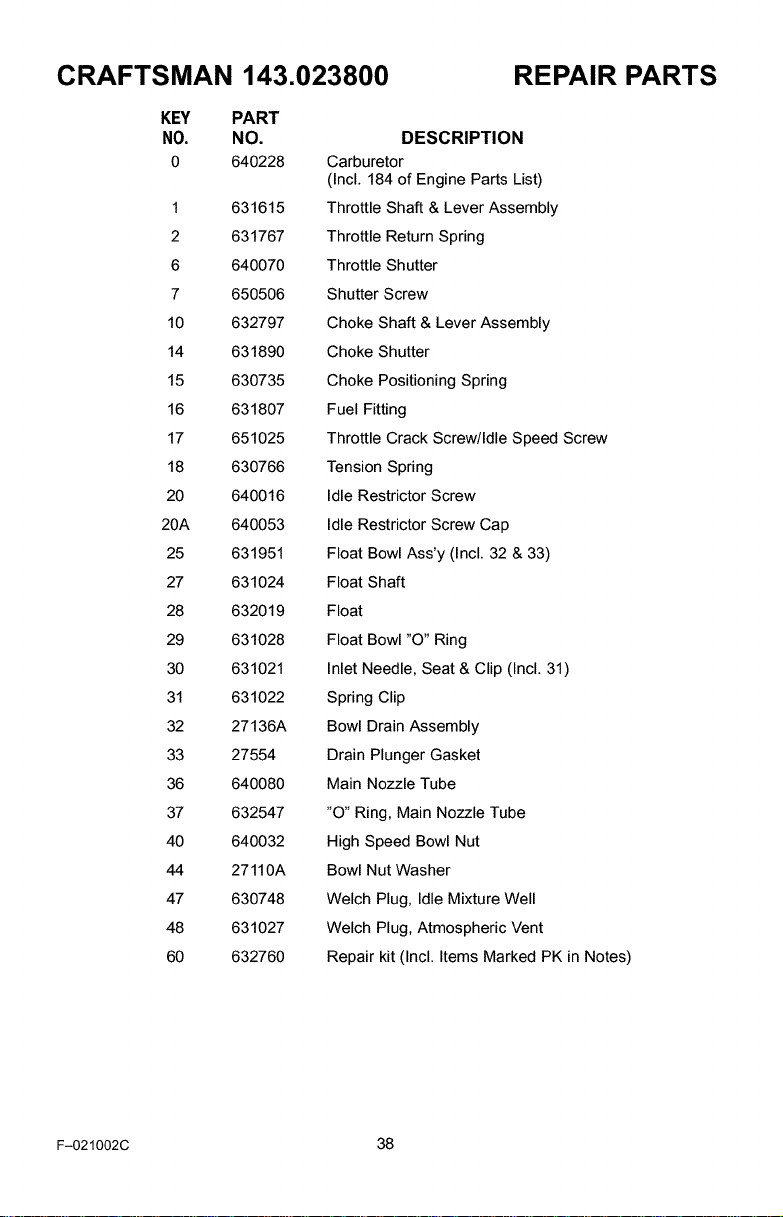
CRAFTSMAN 143.023800 REPAIR PARTS
KEY PART
NO. NO.
0 640228
1 631615
2 631767
6 640070
7 650506
10 632797
14 631890
15 630735
16 631807
17 651025
18 630766
20 640016
20A 640053
25 631951
27 631024
28 632019
29 631028
30 631021
31 631022
32 27136A
33 27554
36 640080
37 632547
40 640032
44 27110A
47 630748
48 631027
60 632760
DESCRIPTION
Carburetor
(Incl. 184 of Engine Parts List)
Throttle Shaft & Lever Assembly
Throttle Return Spring
Throttle Shutter
Shutter Screw
Choke Shaft & Lever Assembly
Choke Shutter
Choke Positioning Spring
Fuel Fitting
Throttle Crack Screw/Idle Speed Screw
Tension Spring
Idle Restrictor Screw
Idle Restrictor Screw Cap
Float Bowl Ass'y (Incl. 32 & 33)
Float Shaft
Float
Float Bowl "O" Ring
Inlet Needle, Seat & Clip (Incl. 31)
Spring Clip
Bowl Drain Assembly
Drain Plunger Gasket
Main Nozzle Tube
"O" Ring, Main Nozzle Tube
High Speed Bowl Nut
Bowl Nut Washer
Welch Plug, Idle Mixture Well
Welch Plug, Atmospheric Vent
Repair kit (Incl. Items Marked PK in Notes)
F-021002C 38
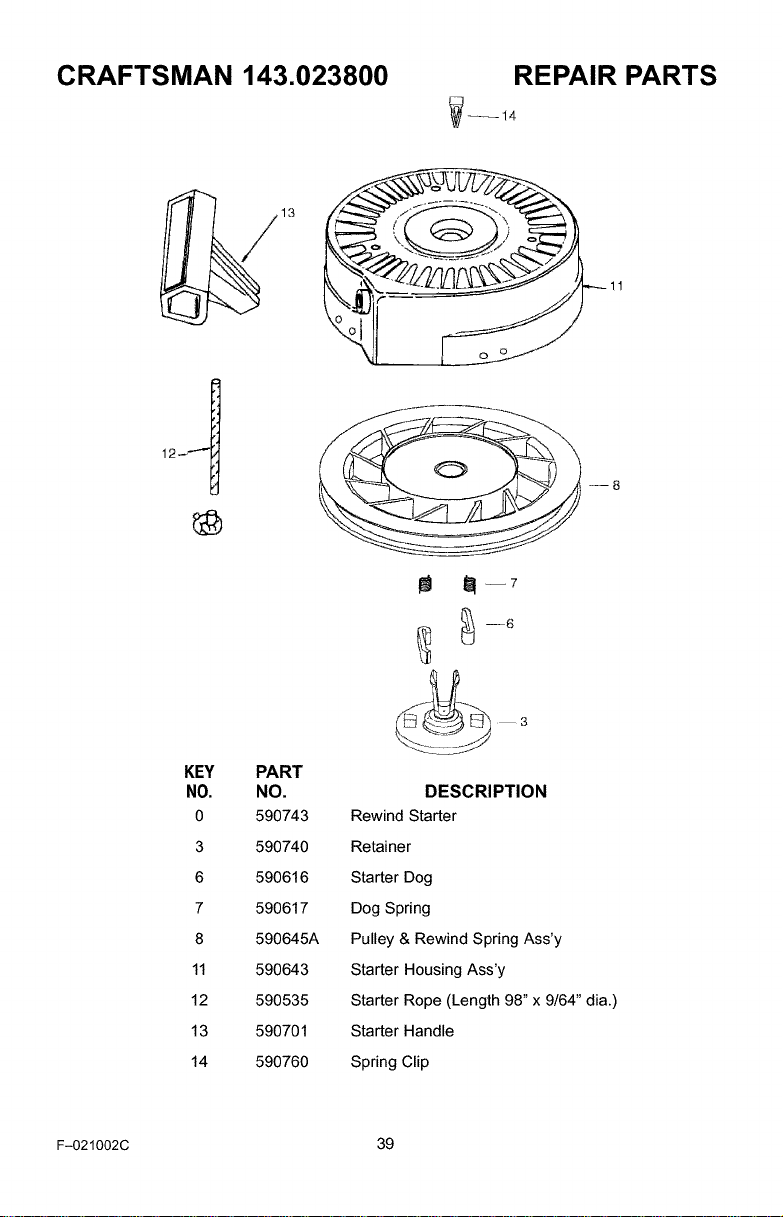
CRAFTSMAN 143.023800 REPAIR PARTS
KEY PART
NO. NO.
0 590743
3 590740
6 590616
7 590617
8 590645A
11 590643
12 590535
13 590701
14 590760
18 i -7
DESCRIPTION
Rewind Starter
Retainer
Starter Dog
Dog Spring
Pulley & Rewind Spring Ass'y
Starter Housing Ass'y
Starter Rope (Length 98" x 9/64" dia.)
Starter Handle
Spring Clip
F-021002C 39
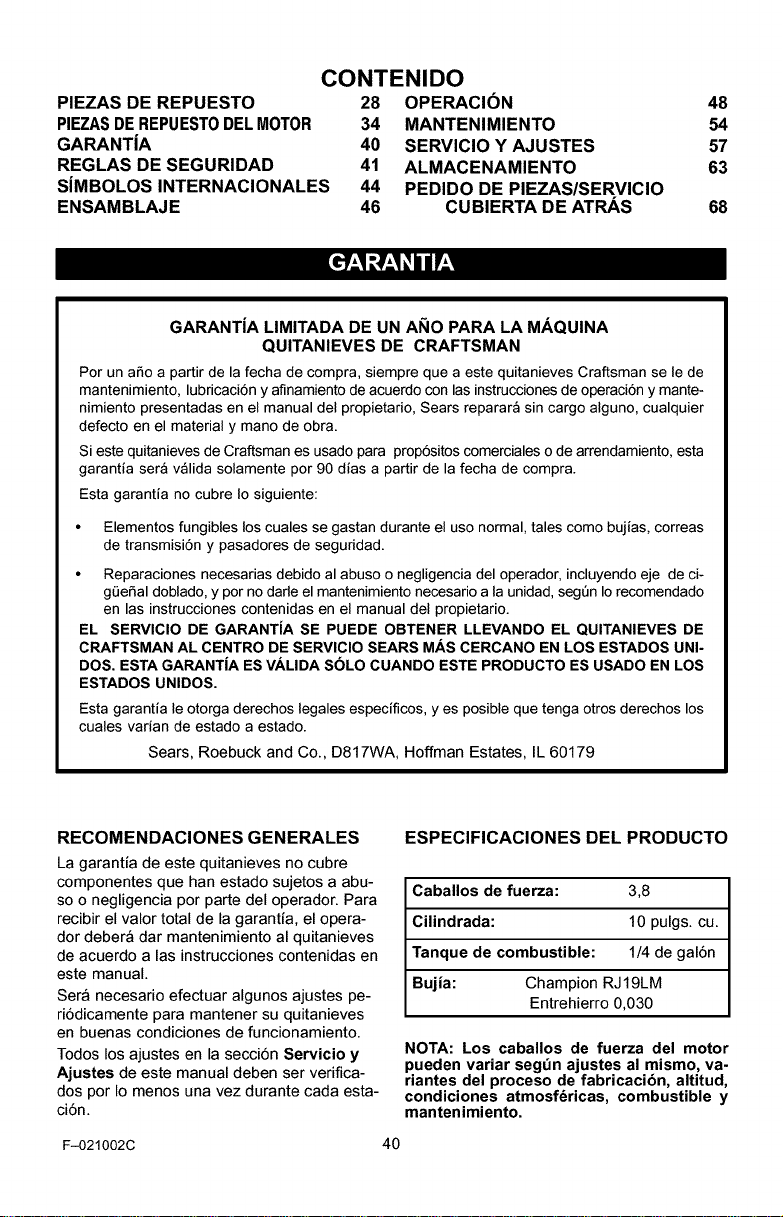
CONTENIDO
PIEZAS DE REPUESTO 28 OPERACI6N
PIEZAS DE REPUESTO DEL MOTOR 34 MANTENIMIENTO
GARANTiA 40 SERVICIO Y AJUSTES
REGLAS DE SEGURIDAD 41 ALMACENAMIENTO
SiMBOLOS INTERNACIONALES 44 PEDIDO DE PIEZAS/SERVICIO
ENSAMBLAJE 46 CUBIERTA DE ATRAS
48
54
57
63
68
GARANTiA LIMITADA DE UN AI_IO PARA LA MAQUINA
QUITANIEVES DE CRAFTSMAN
Por un afio a partirde la fecha de compra, siempre que a este quitanieves Craftsman se lede
mantenimiento, lubricaci6ny afinamientode acuerdoconlasinstruccionesde operaci6ny mante-
nimiento presentadas en el manualdel propietado,Sears reparar_ sin cargo alguno,cualquier
defecto en el material y rnano de obra.
Si estequitanievesde Craftsman es usadopara prop6sitoscomercialeso de arrendamiento,esta
garantia ser_ v_lida solamente por 90 dias a partirde la fecha de compra.
Esta garantia no cubre Iosiguiente:
• Elementos fungibles los cuales se gastan durante el uso normal, tales como bujias, correas
de transmisi6n y pasadores de seguridad.
• Reparaciones necesarias debido al abuse o negligencia del operador, incluyendo eje de ci-
gL_efial doblado, y por no darle el mantenimiento necesario a la unidad, segt_n Io recomendado
en las instrucciones contenidas en el manual del propietario.
EL SERVIClO DE GARANT[A SE PUEDE OBTENER LLEVANDO EL QUlTANIEVES DE
CRAFTSMAN AL CENTRO DE SERVICIO SEARS MAS CERCANO EN LOS ESTADOS UNI-
DOS. ESTA GARANT[A ES VALIDA SOLO CUANDO ESTE PRODUCTO ES USADO EN LOS
ESTADOS UNIDOS.
Esta garantia le otorga derechos legales especificos, y es posible que tenga otros derechos los
cuales varian de estado a estado.
Sears, Roebuck and Co., D817WA, Hoffman Estates, IL 60179
RECOMENDACIONES GENERALES
La garantia de este quitanieves no cubre
componentes que han estado sujetos a abu-
so o negligencia por parte del operador. Para
recibir el valor total de la garantfa, el opera-
dor debera dar mantenimiento al quitanieves
de acuerdo alas instrucciones contenidas en
este manual.
Sera necesario efectuar algunos ajustes pe-
ri6dicamente para mantener su quitanieves
en buenas condiciones de funcionamiento.
Todos los ajustes en la secci6n Servicio y
Ajustes de este manual deben ser verifica-
dos por Io menos una vez durante cada esta-
ci6n.
ESPECIFICACIONES DEL PRODUCTO
Caballos de fuerza: 3,8
Cilindrada: 10 pulgs, cu.
Tanque de combustible: 1/4 de gal6n
Bujia: Champion RJ19LM
Entrehierro 0,030
NOTA: Los caballos de fuerza del motor
pueden variar seg_n ajustes al mismo, va-
riantes del proceso de fabricacibn, altitud,
condiciones atmosf_ricas, combustible y
mantenimiento.
F-021002C 40
i i ImT_,lm]
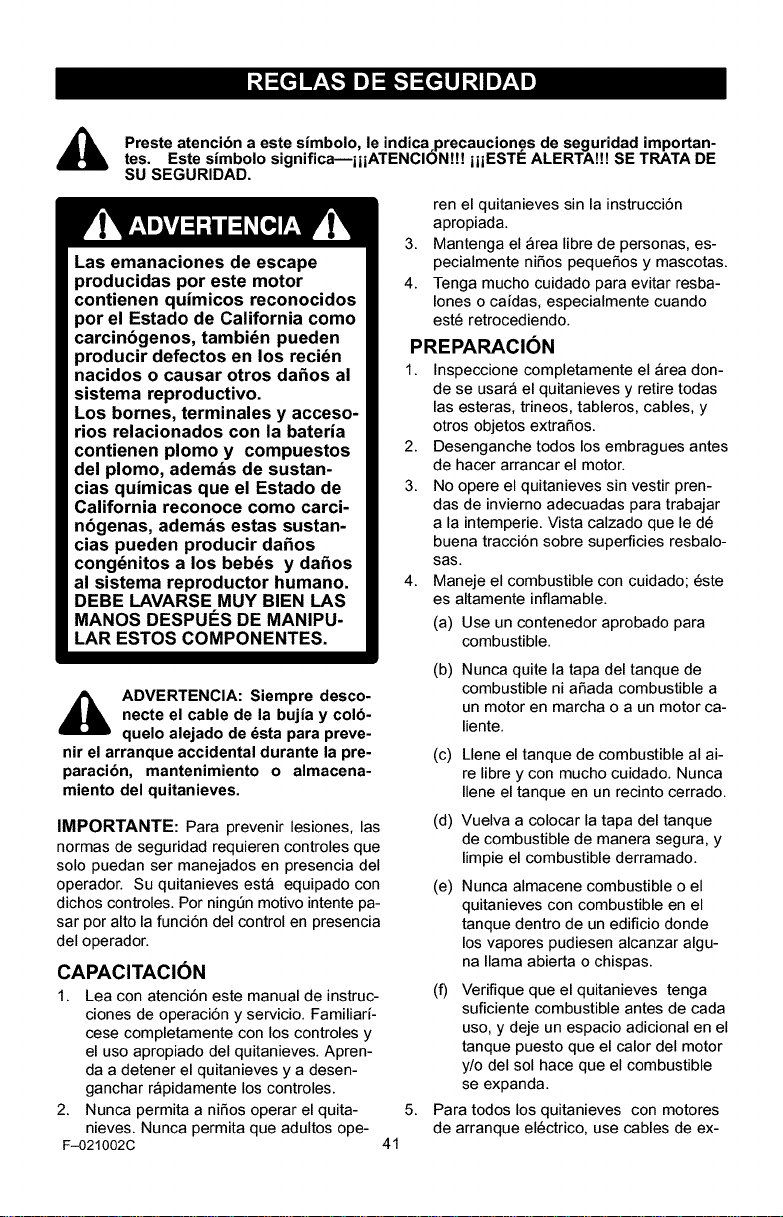
Preste atencibn a este simbolo, le indica precauciones de seguridad importan-
tes. Este simbolo significa---iiiATENCIdN!!! iiiESTE ALERTA!!! SE TRATA DE
SU SEGURIDAD.
Las emanaciones de escape
producidas por este motor
contienen quimicos reconocidos
por el Estado de California como
carcinbgenos, tambi_n pueden
producir defectos en los recidn
nacidos o causar otros da_os al
sistema reproductivo.
Los bornes, terminales y acceso-
rios relacionados con la bateria
contienen plomo y compuestos
del plomo, ademds de sustan-
cias quimicas que el Estado de
California reconoce como carci-
nbgenas, ademds estas sustan-
cias pueden producir da_os
congdnitos a los bebds y da_os
al sistema reproductor humano.
DEBE LAVARSE MUY BIEN LAS
MANOS DESPUI_S DE MANIPU-
LAR ESTOS COMPONENTES.
ren el quitanieves sin la instrucci6n
apropiada.
3. Mantenga el area libre de personas, es-
pecialmente nifios pequefios y mascotas.
4. Tenga mucho cuidado para evitar resba-
Iones o caidas, especialmente cuando
est6 retrocediendo.
PREPARACI6N
1. Inspeccione completamente el area don-
de se usara el quitanieves y retire todas
las esteras, trineos, tableros, cables, y
otros objetos extrafios.
2. Desenganche todos los embragues antes
de hacer arrancar el motor.
3. No opere el quitanieves sin vestir pren-
das de invierno adecuadas para trabajar
a la intemperie. Vista calzado que le d6
buena tracci6n sobre superficies resbalo-
sas.
4. Maneje el combustible con cuidado; 6ste
es altamente inflamable.
(a) Use un contenedor aprobado para
combustible.
_ ADVERTENCIA: Siempre desco-
necte el cable de la bujia y colb-
quelo alejado de _sta para preve-
nir el arranque accidental durante la pre-
paracibn, mantenimiento o almacena-
miento del quitanieves.
IMPORTANTE: Para prevenir lesiones, las
normas de seguridad requieren controles que
solo puedan ser manejados en presencia del
operador. Su quitanieves esta equipado con
dichos controles. Por ningQn motivo intente pa-
sar por alto la funci6n del control en presencia
del operador.
CAPACITACI6N
1. Lea con atenci6n este manual de instruc-
clones de operaci6n y servicio. Familiari-
cese completamente con los controles y
el uso apropiado del quitanieves. Apren-
da a detener el quitanieves y a desen-
ganchar rapidamente los controles.
2. Nunca permita a nifios operar el quita-
nieves. Nunca permita que adultos ope-
F-021002C
41
5.
(b) Nunca quite la tapa del tanque de
combustible ni afiada combustible a
un motor en marcha o a un motor ca-
liente.
(c) Llene el tanque de combustible al ai-
re libre y con mucho cuidado. Nunca
Ilene el tanque en un recinto cerrado.
(d) Vuelva a colocar la tapa del tanque
de combustible de manera segura, y
limpie el combustible derramado.
(e) Nunca almacene combustible o el
quitanieves con combustible en el
tanque dentro de un edificio donde
los vapores pudiesen alcanzar algu-
na llama abierta o chispas.
(f) Verifique que el quitanieves tenga
suficiente combustible antes de cada
uso, y deje un espacio adicional en el
tanque puesto que el calor del motor
y/o del sol hace que el combustible
se expanda.
Para todos los quitanieves con motores
de arranque el6ctrico, use cables de ex-
tensi6nconcertificaci6nCSA/ULUse
solamentetomacorrientesquehayansi-
doinstaladosdeacuerdoconlosregla-
mentosdeinspecci6nlocales.
6. Jamasintenteefectuarning6najuste
mientraselmotorseencuentraenmar-
cha(exceptocuandoelfabricanteIore-
comiendeasfespecfficamente).
7. Permitaqueelmotoryelquitanievesse
ajustenalastemperaturasexterioresan-
tesdecomenzaradespejarlanieve.
8. Siempreusegafasdeseguridadopro-
tectoresparalosojosdurantelaopera-
ci6nomientrasefect6aalg6najusteo
reparaci6nalaunidad,paraprotegersus
ojosdeobjetosextrafiosquepudiesen
serlanzadosporelquitanieves.
OPERACI6N
1. No opere este quitanieves siesta toman-
do medicinas que puedan causar somno-
lencia o afectar su habilidad para operar
el quitanieves.
2. No use el quitanieves si por motivos
emocionales o ffsicos se le dificulta ma-
nejarlo de forma segura.
3. No coloque las manos o los pies cerca o
debajo de piezas en movimiento. Man-
t6ngase en todo momento a buena dis-
tancia de la abertura del tubo de
descarga.
4. Tenga mucho cuidado al operar el quita-
nieves en o a trav6s de entradas de au-
tos, senderos o caminos de grava.
Mant6ngase alerta de peligros ocultos o
trafico.
5.. Si golpea un objeto extrafio, pare el mo-
tor, desconecte el cable de la bujfa, ins-
peccione meticulosamente el quitanieves
por si hubiera alg6n dafio, y reparelo an-
tes de arrancar el motor y operar el quita-
nieves nuevamente.
6. Si el quitanieves comienza a vibrar de
manera excesiva, pare el motor y revfse-
Io inmediatamente para encontrar la cau-
sa. Generalmente, la vibraci6n es una
advertencia de alg6n problema.
7. Pare el motor cuando deje la posici6n de
operaci6n, antes de desobstruir el aloja-
miento de la barrena/propulsor o el tubo
de descarga, y cuando efect6e cualquier
reparaci6n, ajuste o inspecci6n.
8. Cuando limpie, repare o inspeccione el
quitanieves, aseg6rese de que la barre-
na/propulsor y todas las partes m6viles
se encuentren detenidas, y que todos los
F-021002C
20.
42
controles est6n desenganchados. Desco-
necte el cable de la bujia y mant6ngalo
alejado de la bujia para evitar un arran-
que accidental.
9. Tome todas las precauciones posibles al
dejar el quitanieves desatendido. Desen-
ganche la barrena/propulsor, pare el mo-
tor y retire la Ilave.
10. No haga arrancar el motor en recintos
cerrados, excepto para arrancar y para
transportar el quitanieves hacia adentro o
hacia afuera del recinto. Abra las puertas
que dan al exterior; los vapores de esca-
pe son peligrosos (contienen MON6XI-
DO DE CARBONO, un GAS INODORO y
LETAL).
11. No use el quitanieves para limpiar areas
de terreno inclinadas (cuestas, pendien-
tes). Tenga mucho cuidado cuando cam-
bie de direcci6n. No intente limpiar
pendientes muy pronunciadas.
12. Nunca opere el quitanieves sin que los
resguardos, placas u otros dispositivos
de seguridad se encuentren en su lugar.
13. Nunca opere el quitanieves cerca de es-
caparates de vidrio, autom6viles, vidrie-
ras, sitios de carga/descarga, y similares,
sin el ajuste apropiado del angulo de des-
carga de la nieve. Mantenga a los nifios y
las mascotas alejados del area que esta
despejando.
14. No sobrecargue la capacidad del quita-
nieves al intentar limpiar la nieve a una
velocidad demasiado rapida.
15. Nunca opere el quitanieves a altas veloci-
dades de transporte sobre superficies
resbalosas. Mire hacia atras y tenga cui-
dado al retroceder.
16. Nunca descargue directamente hacia es-
pectadores ni permita a nadie frente al
quitanieves.
17. Desenganche la fuerza motriz de la ba-
rrena/propulsor cuando el quitanieves
sea trasportado o no est6 en uso.
18. Utilice 6nicamente aditamentos y acceso-
dos aprobados por el fabricante del quita-
nieves (tales como cadenas para las
ruedas, juegos de arranque el6ctrico,
etc.).
19. Nunca opere el quitanieves sin tener bue-
na visibilidad o iluminaci6n. Aseg6rese
siempre que tiene buena estabilidad, y
sujete con firmeza el mango. Camine;
nunca corra.
No trate de alcanzar areas dificiles. Man-
tenga la estabilidad y el balance en todo
momento.

21.Notratedeusarelquitanievesparalim-
piartechos.
MANTENIMIENTO Y
ALMACENAMIENTO
1. Revise los pernos con frecuencia para
asegurar que est6n bien apretados y que
el quitanieves est6 en condiciones segu-
ras de funcionamiento.
2. Nunca guarde el quitanieves con com-
bustible en el tanque dentro de un recinto
donde hubieran fuentes de ignici6n tales
como calentadores de agua y estufas,
secadoras de ropa, y similares. Permita
que el motor se enfrfe antes de guardar
el quitanieves en cualquier recinto.
3. Siva a almacenar el quitanieves por un
perfodo prolongado, siempre consulte las
instrucciones del manual del operador
donde encontrara consejos importantes.
4. Mantenga o reemplace las etiquetas de
seguridad e instrucciones, segQn sea ne-
cesario.
5. Mantenga el quitanieves en marcha unos
cuantos minutos despu6s de despejar la
nieve, para evitar que se congele la ba-
rrena/propulsor.
ADVERTENCIA: Este quitanieves
es para uso en aceras, entradas
de auto y otras superficies de te-
rreno planas. Se debe tener cuidado al
usar el quitanieves en superficies inclina-
das. NO USE EL QUITANIEVES EN SU-
PERFICIES SOBRE EL NIVEL DEL SUELO
tales como techos de residencias, de ga-
rajes, porches u otras estructuras o cons-
trucciones similares.
F-021002C 43
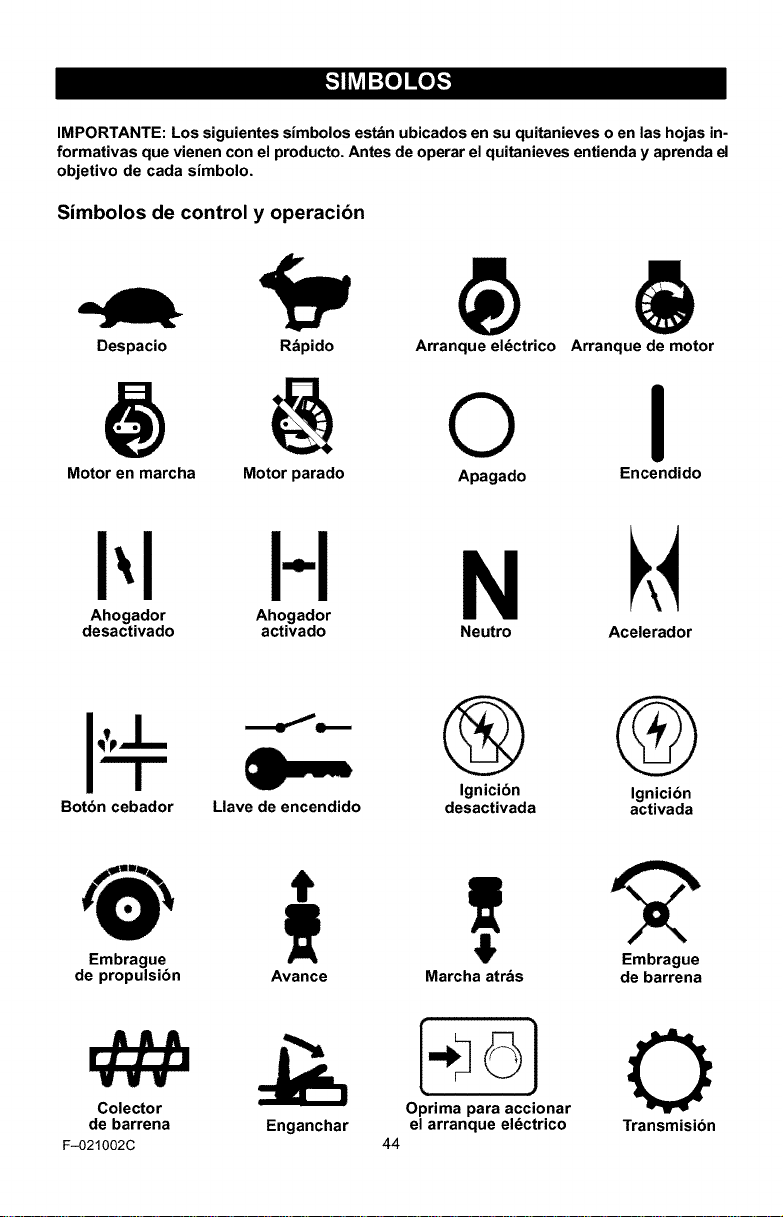
_v"_l_,_l_[,o_o_l
IMPORTANTE: Los siguientes simbolos est_n ubicados en su quitanieves o en las hojas in-
formativas que vienen con el producto. Antes de operar el quitanieves entienda y aprenda el
objetivo de cada simbolo.
Simbolos de control y operacibn
Despacio Rdpido Arranque el_ctrico Arranque de motor
o I
Motor en marcha Motor parado Apagado Encendido
I',I H N
Ahogador Ahogador
desactivado activado Neutro Acelerador
Botbn cebador Llave de encendido
G
Ignicibn Ignicibn
desactivada activada
Embrague
de propulsibn
Colector
de barrena
F-021002C
Avance
Enganchar
Embrague
Marcha atrds de barrena
Oprima para accionar
el arranque el_ctrico Transmisibn
44
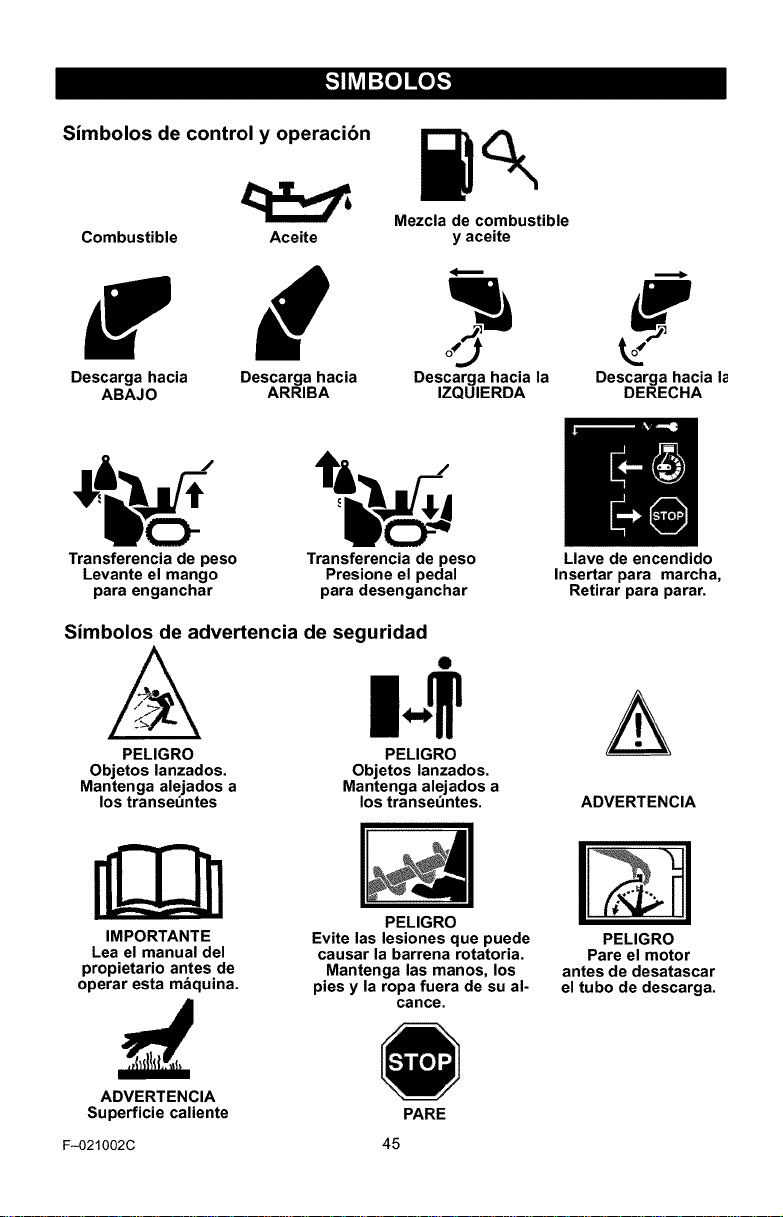
_v"]l_,_l_[,o_o_
Simbolos de control y operacibn
Combustible Aceite
Mezcla de combustible
y aceite
Descarga hacia Descarga hacia Descarga hacia la Descarga hacia I_
ABAJO ARRIBA IZQUIERDA DERECHA
/
Transferencia de peso
Levante el mango
para enganchar
Transferencia de peso
Presione el pedal
para desenganchar
Simbolos de advertencia de seguridad
A
PELIGRO
Objetos lanzados.
Mantenga alejados a
los transet_ntes
O
PELIGRO
Objetos lanzados.
Mantenga alejados a
los transet_ntes.
Llave de encendido
Insertar para marcha,
Retirar para parar.
ADVERTENCIA
IMPORTANTE
Lea el manual del
propietario antes de
operar esta m_quina.
PELIGRO
Evite las lesiones que puede
causar la barrena rotatoria.
Mantenga las manos, los
pies y la ropa fuera de su al-
cance.
PELIGRO
Pare el motor
antes de desatascar
el tubo de descarga.
ADVERTENCIA
Superficie caliente
PARE
F-021002C 45
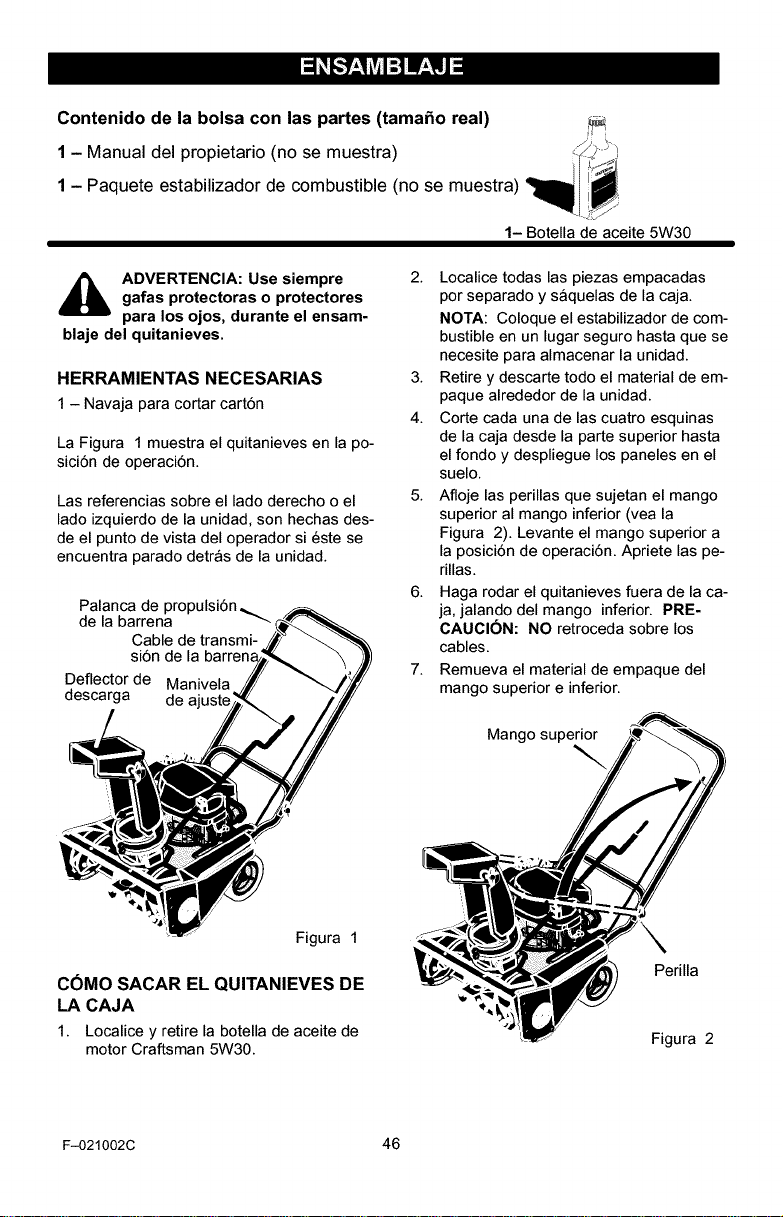
Contenido de la bolsa con las partes (tama_o real)
1- Manual del propietario (no se muestra)
1- Paquete estabilizador de combustible (no se muestra)
1- Botella de aceite 5W30
_ DVERTENCIA: Use siempre
gafas protectoras o protectores
para los ojos, durante el ensam-
blaje del quitanieves.
HERRAMIENTAS NECESARIAS
1- Navaja para cortar cart6n
La Figura 1 muestra el quitanieves en la po-
sici6n de operaci6n.
Las referencias sobre el lado derecho o el
lado izquierdo de la unidad, son hechas des-
de el punto de vista del operador si 6ste se
encuentra parado detras de la unidad.
Palanca de
de la barrena
Cable de transmi-
si6n de la
Deflector de Manivela
descarga de
2. Localice todas las piezas empacadas
por separado y saquelas de la caja.
NOTA: Coloque el estabilizador de com-
bustible en un lugar seguro hasta que se
necesite para almacenar la unidad.
3. Retire y descarte todo el material de em-
paque alrededor de la unidad.
4. Corte cada una de las cuatro esquinas
de la caja desde la parte superior hasta
el fondo y despliegue los paneles en el
suelo.
5. Afloje las perillas que sujetan el mango
superior al mango inferior (vea la
Figura 2). Levante el mango superior a
la posici6n de operaci6n. Apriete las pe-
rillas.
6. Haga rodar el quitanieves fuera de la ca-
ja, jalando del mango inferior. PRE-
CAUCl6N: NO retroceda sobre los
cables.
7. Remueva el material de empaque del
mango superior e inferior.
Mango superior
Figura 1
C6MO SACAR EL QUITANIEVES DE
LA CAJA
1. Localicey retirela botelladeaceitede
motorCraftsman 5W30.
%!
Perilla
Figura 2
F-021002C 46
_" LISTA DE REVISI6N
Antes de operar su nuevo quitanieves, y pa-
ra asegurar que obtenga el mejor rendimien-
to y la mayor satisfacci6n de este producto
de calidad, por favor haga un repaso de la
siguiente lista de revisi6n:
_' Se han completado todas las instruccio-
nes de ensamblado.
_' El tubo de descarga gira libremente.
_' No quedan piezas sueltas en la caja de
cart6n.
AI mismo tiempo que aprende a usar su qui-
tanieves, preste mucha atenci6n a los deta-
lies siguientes:
_' El aceite del motor esta al nivel adecuado.
_' Aseg6rese que el tanque de gasolina est6
Ileno con gasolina limpia, fresca y sin plo-
mo.
_' Familiarfcese con todos los controles, su
ubicaci6n y funci6n. Opere los controles
antes de hacer arrancar el motor.
F-021002C 47
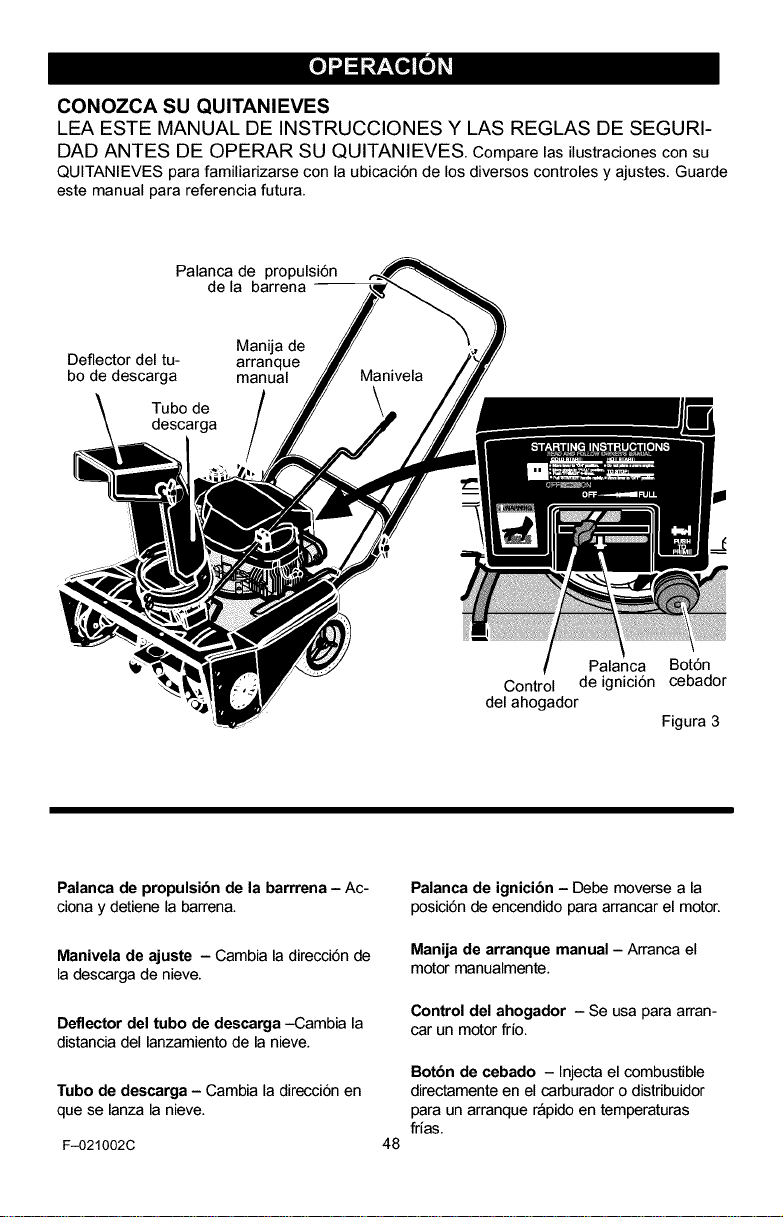
[o_oJ_oooooooe_l
CONOZCA SU QUlTANIEVES
LEA ESTE MANUAL DE INSTRUCCIONES Y LAS REGLAS DE SEGURI-
DAD ANTES DE OPERAR SU QUITANIEVES Comparelas ilustraciones consu
QUITANIEVES para familiarizarse con la ubicaci6n de los diversos controles y ajustes. Guarde
este manual para referencia futura.
Palanca de propulsi6n
de la barrena --
Deflector del tu-
bo de descarga
Tubo de
descarga
Manija de
arranque
manual
Palanca Bot6n
Control de ignici6n cebador
del ahogador
Figura 3
Palanca de propulsibn de la barrrena- Ac-
ciona y detiene la barrena.
Manivela de ajuste - Cambia la direcciSn de
la descarga de nieve.
Deflector del tubo de descarga -Cambia la
distancia del lanzamiento de la nieve.
Tubo de descarga - Cambia la direcciSn en
que se lanza la nieve.
F-021002C
Palanca de ignicibn - Debe moverse a la
posiciSn de encendido para arrancar el motor.
Manija de arranque manual - Arranca el
motor manualmente.
Control del ahogador - Se usa para arran-
car un motor frio.
48
Botbn de cebado - Injecta el combustible
directamente en el carburador o distribuidor
para un arranque rapido en temperaturas
frias.
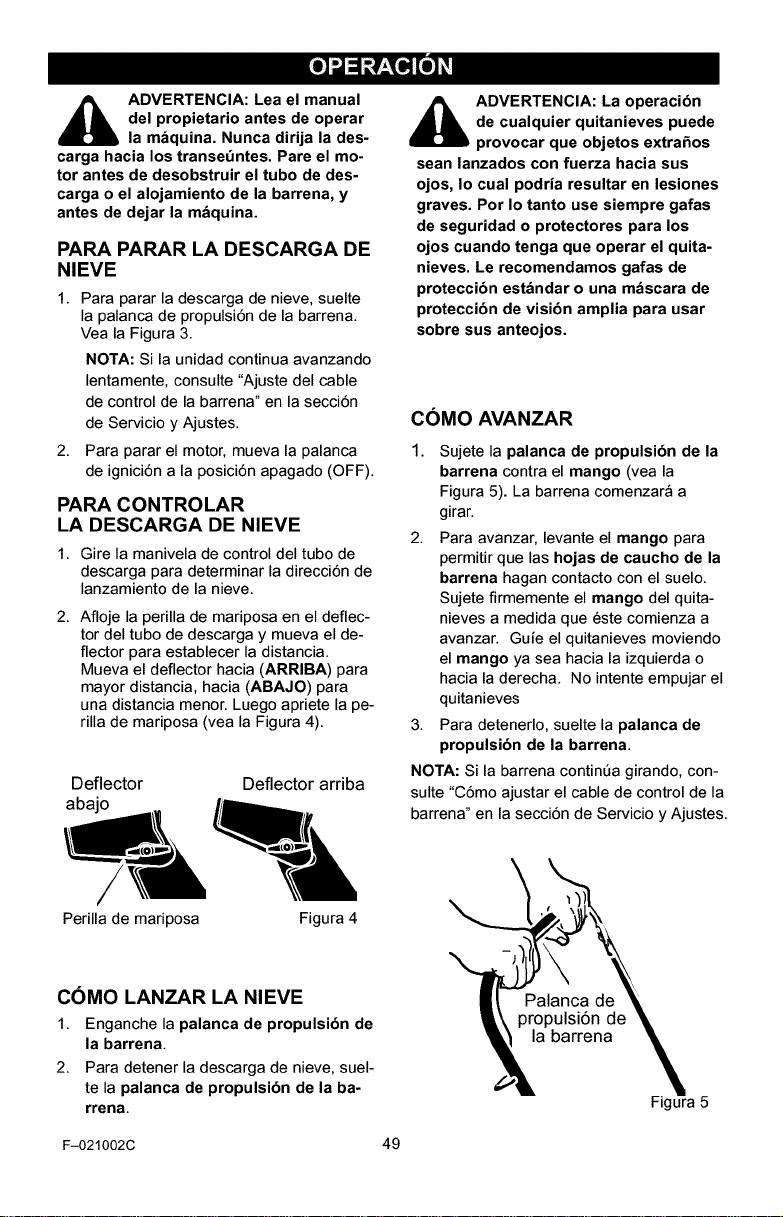
[o_oJ_oooooooe_l
_ ADVERTENCIA: Lea el manual
del propietario antes de operar
la m_quina. Nunca dirija la des-
carga hacia los transet_ntes. Pare el mo-
tor antes de desobstruir el tubo de des-
carga o el alojamiento de la barrena, y
antes de dejar la m_quina.
PARA PARAR LA DESCARGA DE
NIEVE
1. Para parar la descarga de nieve, suelte
la palanca de propulsi6n de la barrena.
Vea la Figura 3.
NOTA: Si la unidad continua avanzando
lentamente, consulte "Ajuste del cable
de control de la barrena" en la secci6n
de Servicio y Ajustes.
2. Para parar el motor, mueva la palanca
de ignici6n a la posici6n apagado (OFF).
PARA CONTROLAR
LA DESCARGA DE NIEVE
1. Gire la manivela de control del tubo de
descarga para determinar la direcci6n de
lanzamiento de la nieve.
2. Afloje la perilla de mariposa en el deflec-
tor del tubo de descarga y mueva el de-
flector para establecer la distancia.
Mueva el deflector hacia (ARRIBA) para
mayor distancia, hacia (ABAJO) para
una distancia menor. Luego apriete la pe-
rilla de mariposa (vea la Figura 4).
Deflector Deflector arriba
abajo
'I
Perilla de mariposa Figura 4
C6MO LANZAR LA NIEVE
1. Enganche la palanca de propulsibn de
la barrena.
2. Para detener la descarga de nieve, suel-
te la palanca de propulsibn de la ba-
rrena.
_ DVERTENCIA: La operacibn
de cualquier quitanieves puede
provocar que objetos extraSos
sean lanzados con fuerza hacia sus
ojos, Io cual podria resultar en lesiones
graves. Por Io tanto use siempre gafas
de seguridad o protectores para los
ojos cuando tenga que operar el quita-
nieves. Le recomendamos gafas de
proteccibn est&ndar o una m&scara de
proteccibn de visibn amplia para usar
sobre sus anteojos.
C6MO AVANZAR
1. Sujete la palanca de propulsibn de la
barrena contra el mango (yea la
Figura 5). La barrena comenzara a
girar.
2. Para avanzar, levante el mango para
permitir que las hojas de caucho de la
barrena hagan contacto con el suelo.
Sujete firmemente el mango del quita-
nieves a medida que 6ste comienza a
avanzar. Gufe el quitanieves moviendo
el mango ya sea hacia la izquierda o
hacia la derecha. No intente empujar el
quitanieves
3. Para detenerlo, suelte la palanca de
propulsibn de la barrena.
NOTA: Si la barrena contin6a girando, con-
suite "C6mo ajustar el cable de control de la
barrena" en la secci6n de Servicio y Ajustes.
Fi 5
F-021002C 49
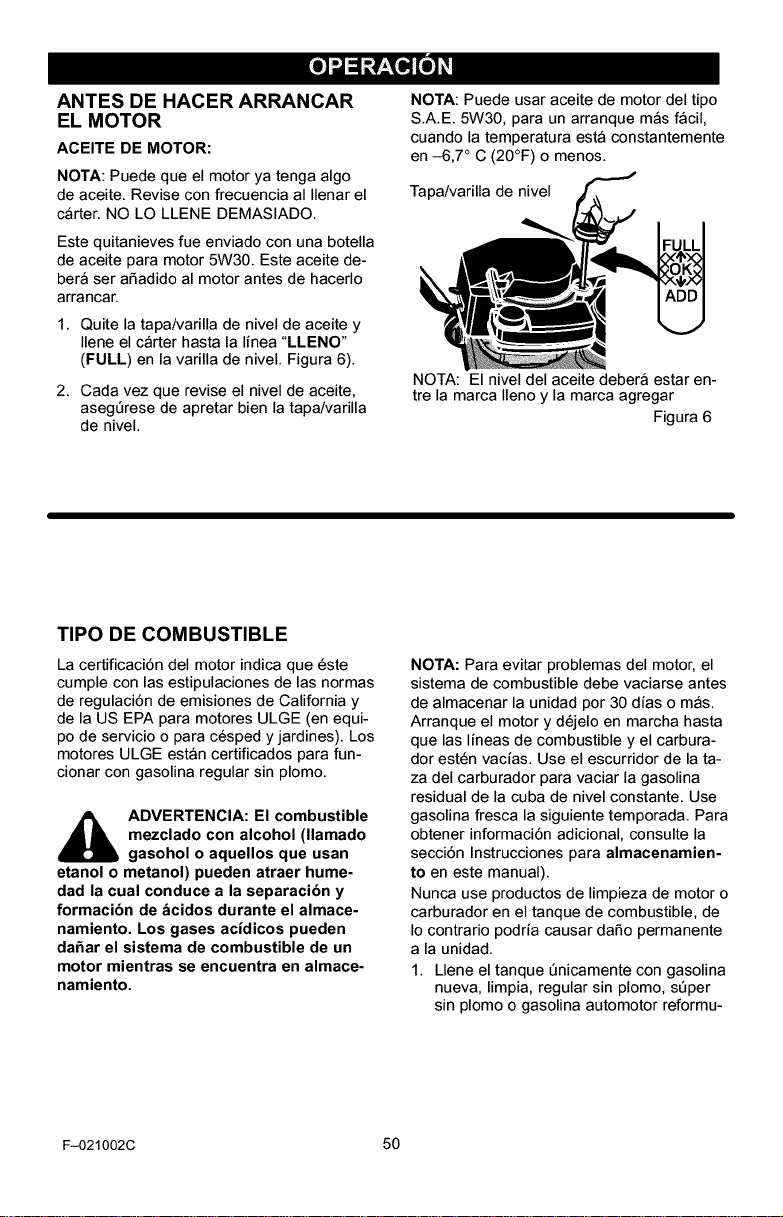
[o_oJ_oooooooe_l
ANTES DE HACER ARRANCAR
EL MOTOR
ACEITE DE MOTOR:
NOTA: Puede que el motor ya tenga algo
de aceite. Revise con frecuencia al Ilenar el
carter. NO LO LLENE DEMASIADO.
Este quitanieves fue enviado con una botella
de aceite para motor 5W30. Este aceite de-
bera ser afiadido al motor antes de hacerlo
arrancar.
1. Quite la tapa/varilla de nivel de aceite y
Ilene el carter hasta la Ifnea "LLENO"
(FULL) en la varilla de nivel. Figura 6).
2. Cada vez que revise el nivel de aceite,
aseg6rese de apretar bien la tapa/varilla
de nivel.
NOTA: Puede usar aceite de motor del tipo
S.A.E. 5W30, para un arranque mas facil,
cuando la temperatura esta constantemente
en -6,7 ° C (20°F) o menos.
Tapa/varilla de nivel
NOTA: El nivel del aceite debera estar en-
tre la marca Ileno y la marca agregar
Figura 6
TIPO DE COMBUSTIBLE
La certificaci6n del motor indica que 6ste
cumple con las estipulaciones de las normas
de regulaci6n de emisiones de California y
de la US EPA para motores ULGE (en equi-
po de servicio o para c6sped yjardines). Los
motores ULGE estan certificados para fun-
cionar con gasolina regular sin plomo.
,_ ADVERTENCIA: El combustible
mezclado con alcohol (llamado
gasohol o aquellos que usan
etanol o metanol) pueden atraer hume-
dad la cual conduce a la separacibn y
formacibn de _cidos durante el almace-
namiento. Los gases acidicos pueden
dafiar el sistema de combustible de un
motor mientras se encuentra en almace-
namiento.
NOTA: Para evitar problemas del motor, el
sistema de combustible debe vaciarse antes
de almacenar la unidad por 30 dfas o mas.
Arranque el motor y d6jelo en marcha hasta
que las Ifneas de combustible y el carbura-
dor est6n vacfas. Use el escurridor de la ta-
za del carburador para vaciar la gasolina
residual de la cuba de nivel constante. Use
gasolina fresca la siguiente temporada. Para
obtener informaci6n adicional, consulte la
secci6n Instrucciones para almacenamien-
to en este manual).
Nunca use productos de limpieza de motor o
carburador en el tanque de combustible, de
Io contrario podrfa causar dafio permanente
a la unidad.
1. Llene el tanque 6nicamente con gasolina
nueva, limpia, regular sin plomo, s6per
sin plomo o gasolina automotor reformu-
F-021002C 50
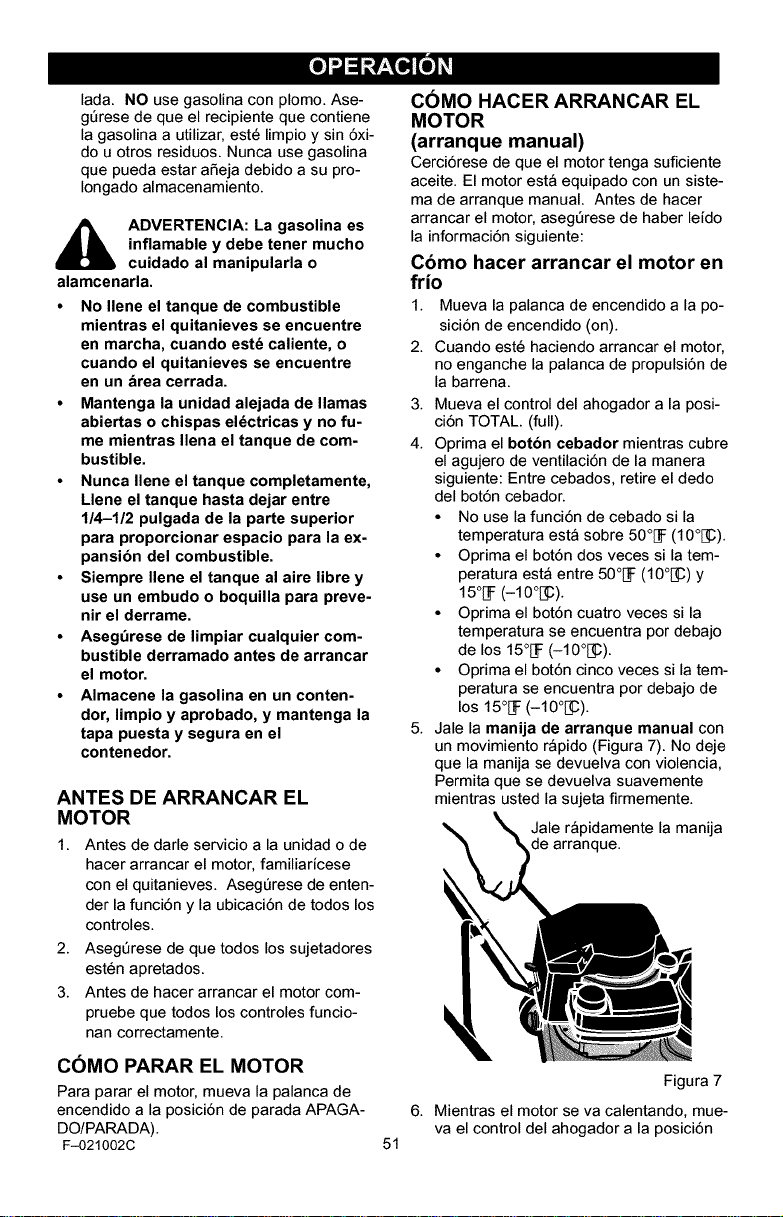
[o_oJ_oooooooe_l
lada. NO use gasolina con plomo. Ase-
gSrese de que el recipiente que contiene
la gasolina a utilizar, est6 limpio y sin 6xi-
do u otros residuos. Nunca use gasolina
que pueda estar afieja debido a su pro-
Iongado almacenamiento.
ADVERTENCIA: La gasolina es
inflamable y debe tener mucho
cuidado al manipularla o
alamcenarla.
• No Ilene el tanque de combustible
mientras el quitanieves se encuentre
en marcha, cuando est_ caliente, o
cuando el quitanieves se encuentre
en un &rea cerrada.
• Mantenga la unidad alejada de llamas
abiertas o chispas el_ctricas y no fu-
me mientras Ilena el tanque de com-
bustible.
• Nunca Ilene el tanque completamente,
Llene el tanque hasta dejar entre
1/4-1/2 pulgada de la parte superior
para proporcionar espacio para la ex-
pansibn del combustible.
• Siempre Ilene el tanque al aire libre y
use un embudo o boquilla para preve-
nir el derrame.
• Asegt_rese de limpiar cualquier com-
bustible derramado antes de arrancar
el motor.
• Almacene la gasolina en un conten-
dor, limpio y aprobado, y mantenga la
tapa puesta y segura en el
contenedor.
ANTES DE ARRANCAR EL
MOTOR
1. Antes de darle servicio a la unidad o de
hacer arrancar el motor, familiaricese
con el quitanieves. AsegSrese de enten-
der la funci6n y la ubicaci6n de todos los
controles.
2. AsegQrese de que todos los sujetadores
est6n apretados.
3. Antes de hacer arrancar el motor com-
pruebe que todos los controles funcio-
nan correctamente.
C6MO PARAR EL MOTOR
Para parar el motor, mueva la palanca de
encendido a la posici6n de parada APAGA-
DO/PARADA).
F-021002C
C6MO HACER ARRANCAR EL
MOTOR
(arranque manual)
Cerci6rese de que el motor tenga suficiente
aceite. El motor esta equipado con un siste-
ma de arranque manual. Antes de hacer
arrancar el motor, asegSrese de haber leido
la informaci6n siguiente:
Cbmo hacer arrancar el motor en
frio
1. Mueva la palanca de encendido a la po-
sici6n de encendido (on).
2. Cuando est6 haciendo arrancar el motor,
no enganche la palanca de propulsi6n de
la barrena.
3. Mueva el control del ahogador a la posi-
ci6n TOTAL. (full).
4. Oprima el botbn cebador mientras cubre
el agujero de ventilaci6n de la manera
siguiente: Entre cebados, retire el dedo
del bot6n cebador.
• No use la funci6n de cebado si la
temperatura esta sobre 50°[_ (10°_).
• Oprima el bot6n dos veces si la tem-
peratura esta entre 50°[_ (10°_) y
15°iT (-10°_).
• Oprima el bot6n cuatro veces si la
temperatura se encuentra por debajo
de los 15°_: (-10°_).
• Oprima el bot6n cinco veces si la tem-
peratura se encuentra por debajo de
los15°IT(-10°_).
5. Jale la manija de arranque manual con
un movimiento rapido (Figura 7). No deje
que la manija se devuelva con violencia,
Permita que se devuelva suavemente
mientras usted la sujeta firmemente.
Jale rapidamente la manija
de arranque.
51
Figura 7
6. Mientras el motor se va calentando, mue-
va el control del ahogador a la posici6n
[o_oJ_oooooooe_l
"1/2" (mitad). Cuando el motor est6 fun-
cionando de manera uniforme, mueva la
palanca del ahogador a la posici6n APA-
GADO.
NOTA: En temperaturas inferiores a los 0°[_
(1813S), deje que el motor se caliente por
algunos minutos antes de comenzar a remo-
ver y arrojar nieve.
Cbmo hacer arrancar un motor
caliente
Siesta arrancando un motor caliente des-
pu6s de haberlo apagado por un periodo
corto, deje el ahogador en "APAGADO"
(OFF) y no oprima el bot6n cebador.
ARRANQUE CONGELADO
Si el dispositivo de arranque esta congelado
y no puede hacer arrancar el motor:
1. Jale la mayor Iongitud de cuerda del
arrancador a reacci6n como sea posible.
2. Suelte la manija del arrancador y d6jela
que se enrolle rapidamente contra el
arrancador.
Si el motor todavia no arranca, repita estos
pasos hasta que Iogre encenderlo. Luego
contin6e con las instrucciones para arranque
en frio.
Para ayudar a evitar que se congele el
arrancador a reacci6n y los controles del
motor, proceda de la manera siguiente des-
pu6s de cada trabajo de remoci6n de nieve.
1. Con el motor en marcha, jale la cuerda
de arranque en6rgica y continuadamente
extendiendo todo el brazo, unas tres o
cuatro veces. El jalado de la cuerda de
arranque producira un sonido de repi-
queteo fuerte. Esto no causa dafio ni al
motor ni al arrancador.
2. Con el motor parado, limpie toda la nieve
y humedad de la cubierta del carburador
en el area de las palancas de control.
Asimismo, mueva el control de acelera-
ci6n, control del ahogador y manija del
arrancador varias veces.
,_ ADVERTENCIA: Nunca arran-
que el motor dentro de un re-
cinto cerrado o en &reas con
poca ventilacibn. Los gases de escape
del motor contienen MON6XIDO DE
CARBONO, UN GAS INODORO Y MOR-
TAL. Mantenga las manos, los pies, el
pelo y la ropas sueltas alejadas de las
partes en movimiento tanto del motor
como del quitanieves.
• La temperatura del silenciador y de
las piezas alrededor del silenciador
puede exceder los 150°_ :. Evite tocar
estas partes.
• NO permita que ni_os ni adolescentes
operen el quitanieves ni que est_n
cerca cuando est_ funcionando.
C6MO RETIRAR OBJETOS
ATASCADOS EN LA BARRENA
,_ ADVERTENCIA: No intente re-
mover ningt_n objeto atascado
en la barrena sin tomar primero
las precauciones siguientes:
• Suelte la palanca de propulsi6n de la ba-
rrena.
• Mueva la palanca de encendido a la po-
sici6n stop para parar el motor.
• Desconecte el cable de la bujia.
• No coloque las manos en la barrena o en
el tubo de descarga. Use una barra de
apalancamiento.
SUGERENCIAS PARA EL
LANZAMIENTO DE NIEVE
1. Cuando se levanta el mango, las hojas
de caucho de la barrena entran en con-
tacto con el suelo y el quitanieves avan-
za. Cuando se suelta la palanca de
propulsi6n de la barrena, las hojas de
caucho de la barrena se paran. Si las
hojas de caucho no paran, consulte "C6-
mo ajustar el cable de propulsi6n de la
barrena" en la secci6n de Servicio y
Ajustes.
F-021002C
52
2.
3.
4.
5.
El lanzamiento de nieve mas efectivo se
Iogra cuando la nieve se quita inmedia-
tamente despu6s de la nevada.
Para quitar completamente la nieve, so-
breponga ligeramente las pasadas del
quitanieves.
Cuando sea posible, descargue la nieve
a favor del viento.
Se puede ajustar la distancia a la que la
nieve sera lanzada, moviendo el deflec-
tor del tubo de descarga. Para mas dis-
[o_oJ_oooooooe_l
tancia levante el deflector, para menos
distancia baje el deflector.
6. En condiciones de mucho viento, baje el
deflector del tubo de descarga para diri-
gir la nieve lanzada mas cerca del suelo
para evitar que el viento la sople hacia
areas no deseadas.
7. Para su seguridad y para prevenir el da-
fio al quitanieves, mantenga el area que
va a limpiar, libre de rocas, juguetes y
otros objetos extrafios.
8. Cuando est6 quitando la nieve sobre en-
tradas de auto cubiertas con grava o ro-
ca triturada, no deje que las cuchillas de
la barrena toquen el suelo. Mueva el
mango hacia abajo para levantar ligera-
mente las cuchillas de la barrena.
9. La velocidad de avance del quitanieves
depende de la profundidad y del peso de
la nieve. La manera mas eficiente de
usar el quitanieves sera determinada por
su experiencia bajo diversas condicio-
nes.
10. Despu6s de cada trabajo deje que el
motor funcione por unos minutos. Asf
se derretira la nieve y el hielo acumula-
dos en el motor.
11. Limpie el quitanieves despu6s de cada
USO.
12.Quite el hielo, la nieve y los residuos de
todo el quitanieves. Enjuaguelo con agua
para quitarle toda la sal y otros productos
qufmicos. Seque el quitanieves.
NIEVE SECA Y DE
POCA PROFUNDIDAD
1. La nieve que se acumule hasta profundi-
dades de ocho pulgadas puede quitarse
rapida y facilmente, caminando a una
velocidad moderada con el quitanieves.
Para acumulaciones de nieve de mayor
profundidad, camine mas lento para per-
mitir la descarga uniforme de nieve tan
pronto sea recogida por la barrena.
2. Intente descargar la nieve a favor del
viento.
NIEVE MOJADA Y COMPACTA
Avance lentamente para despejar la nieve
mojada y compacta. Si este tipo de nieve
hace que la barrena gire mas lento o empie-
za a atascar el tubo de descarga, retfrese un
poco y empiece una serie de movimientos
cortos con el quitanieves, hacia adelante y
hacia atras. Estos movimientos cortos en la
nieve (de cuatro a seis pulgadas), ayudaran
a arrojar la nieve del tubo de descarga.
BANCOS Y ACUMULAClONES
GRANDES DE NIEVE
Para despejar la nieve que se acumula a
una altura mayor que el quitanieves, use el
m6todo descrito anteriormente (movimientos
cortos hacia adelante y hacia atras). Oriente
el tubo de descarga en direcci6n opuesta a
la del banco o acumulaci6n grande de nieve.
La remoci6n de este tipo de nieve tomara
mas tiempo.
F-021002C 53
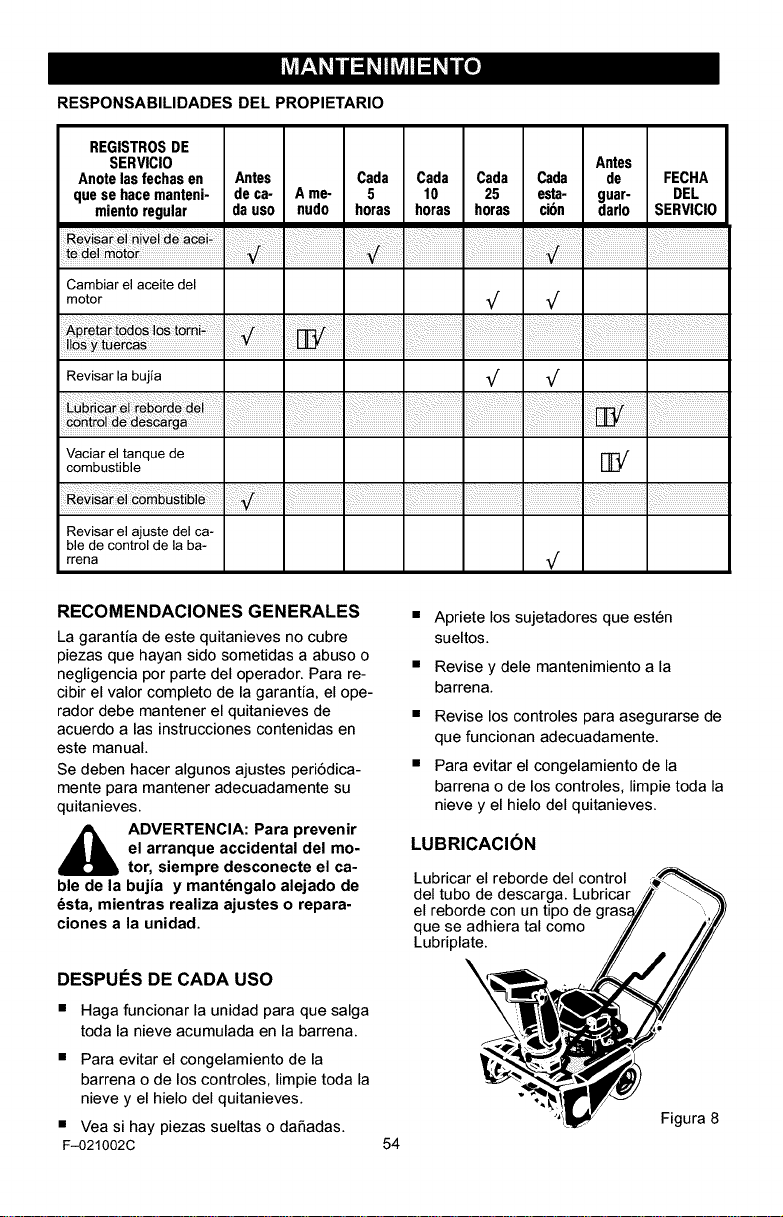
hVj!'-'I_lid_ _11_vjII_ _liI[O]
RESPONSABILIDADES DEL PROPIETARIO
REGISTROSDE
SERVIClO Antes
Anotelas fechasen Antes Cada Cada Cada Cada de FECHA
que se hacemanteni- de ca- A me- 5 10 25 esta- guar- DEL
mientoregular da uso nudo horas horas horas ci6n darlo SERVICIO
Cambiar el aceite del
motor 1/ 1/
Revisar la bujia 1// 1//
Vaciar el tanque de
combustible E_ /
Re_i_ _6_i !,.
Revisar el ajuste del ca-
ble de control de la ba-
rrena !/
RECOMENDACIONES GENERALES • Apriete los sujetadores que est6n
sueltos.
La garantia de este quitanieves no cubre
piezas que hayan sido sometidas a abuso o
negligencia por parte del operador. Para re-
cibir el valor completo de la garantia, el ope-
rador debe mantener el quitanieves de
acuerdo a las instrucciones contenidas en
este manual.
Se deben hacer algunos ajustes peri6dica-
mente para mantener adecuadamente su
quitanieves.
_ ADVERTENClA: Para prevenir
el arranque accidental del mo-
tor, siempre desconecte el ca-
ble de la bujia y mant_ngalo alejado de
_sta, mientras realiza ajustes o repara-
ciones a la unidad.
DESPUES DE CADA USO
• Haga funcionar la unidad para que salga
toda la nieve acumulada en la barrena.
• Para evitar el congelamiento de la
barrena o de los controles, limpie toda la
nieve y el hielo del quitanieves.
• Vea si hay piezas sueltas 0 daSadas.
F-021002C
Revise y dele mantenimiento a la
barrena.
• Revise los controles para asegurarse de
que funcionan adecuadamente.
• Para evitar el congelamiento de la
barrena o de los controles, limpie toda la
nieve y el hielo del quitanieves.
LUBRICACI6N
Lubricar el reborde del control
del tubo de descarga. Lubricar
el reborde con un tipo de
que se adhiera tal como
Lubriplate.
54
Figura 8
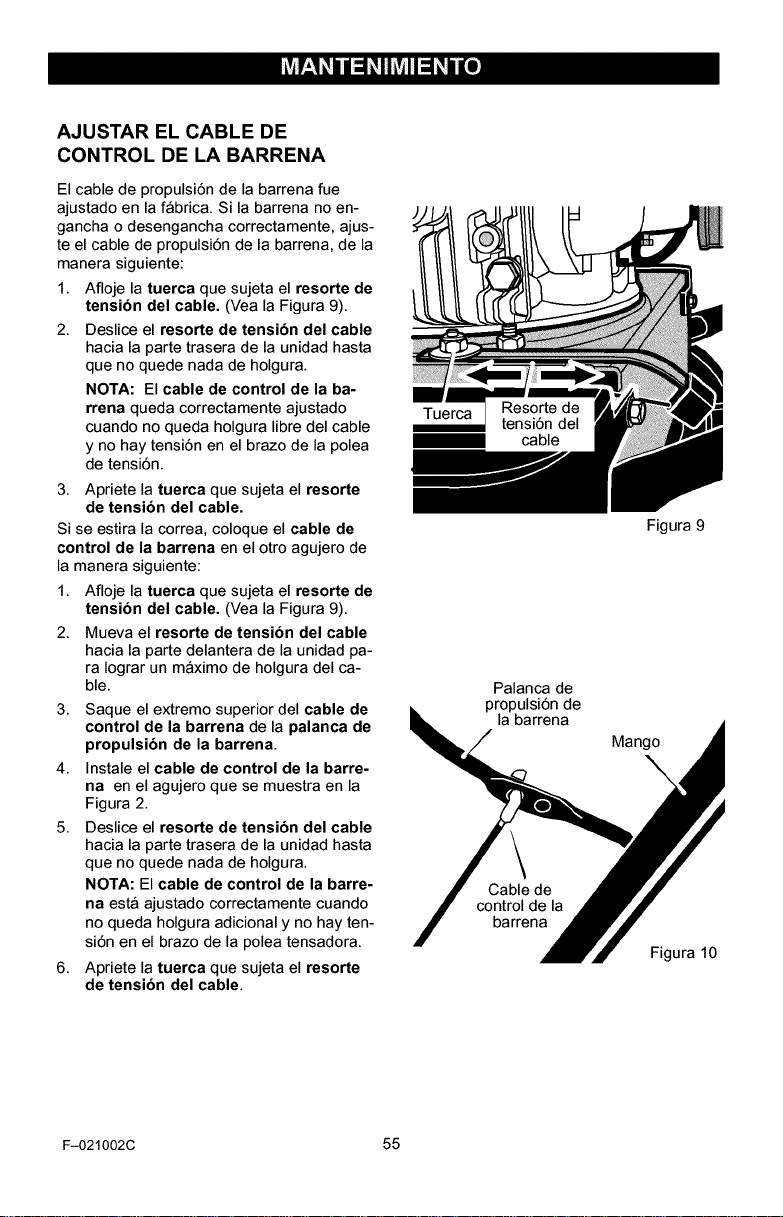
hVJ!'-'__lid_ _11_vJII_ _liI[O]
AJUSTAR EL CABLE DE
CONTROL DE LA BARRENA
El cable de propulsi6n de la barrena fue
ajustado en la fabrica. Si la barrena no en-
gancha o desengancha correctamente, ajus-
te el cable de propulsi6n de la barrena, de la
manera siguiente:
1. Afloje la tuerca que sujeta el resorte de
tensidn del cable. (Vea la Figura 9).
2. Deslice el resorte de tensidn del cable
hacia la parte trasera de la unidad hasta
que no quede nada de holgura.
NOTA: El cable de control de la ba-
rrena queda correctamente ajustado
cuando no queda holgura libre del cable
y no hay tensi6n en el brazo de la polea
de tensi6n.
3. Apriete la tuerca que sujeta el resorte
de tensibn del cable.
Si se estira la correa, coloque el cable de
control de la barrena en el otro agujero de
la manera siguiente:
1. Afloje la tuerca que sujeta el resorte de
tensibn del cable. (Vea la Figura 9).
2. Mueva el resorte de tensibn del cable
hacia la parte delantera de la unidad pa-
ra Iograr un maximo de holgura del ca-
ble.
3. Saque el extremo superior del cable de
control de la barrena de la palanca de
propulsibn de la barrena.
4. Instale el cable de control de la barre-
na en el agujero que se muestra en la
Figura 2.
5. Deslice el resorte de tensibn del cable
hacia la parte trasera de la unidad hasta
que no quede nada de holgura.
NOTA: El cable de control de la barre-
na esta ajustado correctamente cuando
no queda holgura adicional y no hay ten-
si6n en el brazo de la polea tensadora.
6. Apriete la tuerca que sujeta el resorte
de tensibn del cable.
Tuerca
cable
Palanca de
propulsi6n de
la barrena
Cable de
control de la
barrena
Figura 9
Mango
Figura 10
F-021002C 55
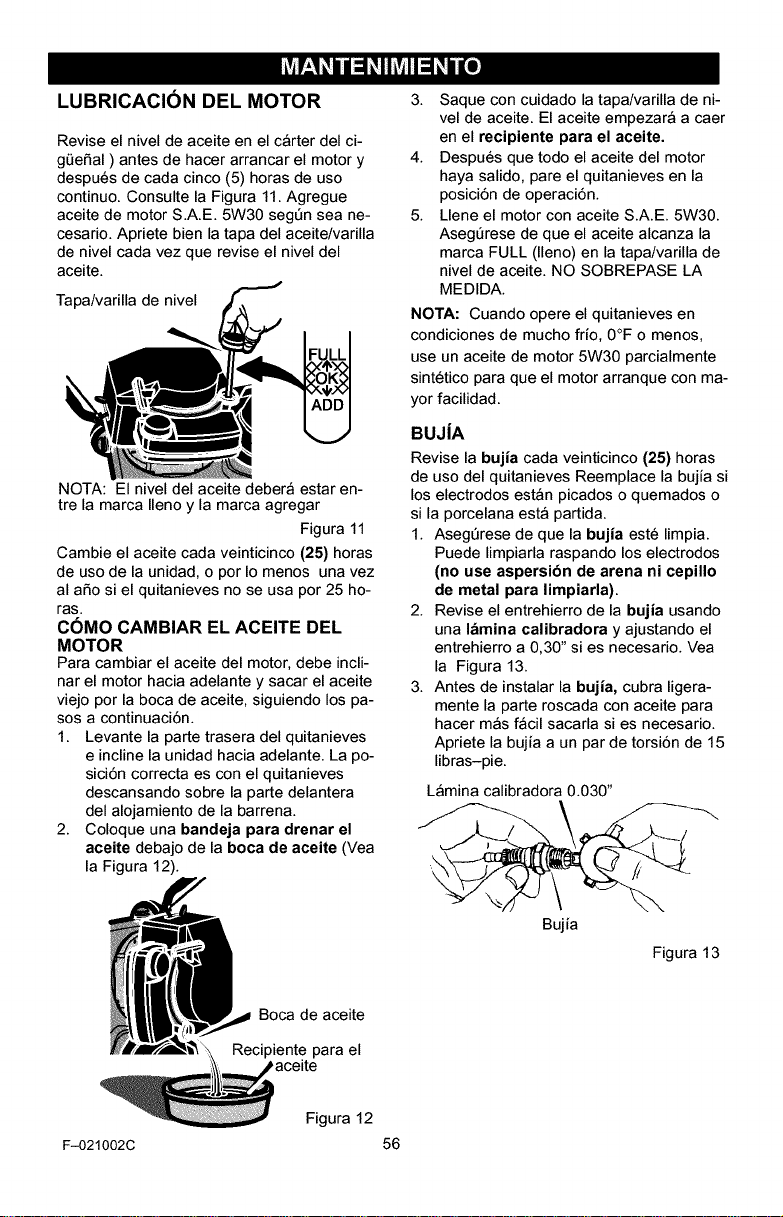
llVl!'-'__lid_ _11iVllI_ _liI[O]
LUBRICACI6N DEL MOTOR
Revise el nivel de aceite en el carter del ci-
gQefial ) antes de hacer arrancar el motor y
despu6s de cada cinco (5) horas de uso
continuo. Consulte la Figura 11. Agregue
aceite de motor S.A.E. 5W30 segSn sea ne-
cesario. Apriete bien la tapa del aceite/varilla
de nivel cada vez que revise el nivel del
aceite.
Tapa/varilla de nivel
NOTA: El nivel del aceite debera estar en-
tre la marca Ileno y la marca agregar
Figura 11
Cambie el aceite cada veinticinco (25) horas
de uso de la unidad, o por Io menos una vez
al afio si el quitanieves no se usa por 25 ho-
ras.
C6MO CAMBIAR EL ACEITE DEL
MOTOR
Para cambiar el aceite del motor, debe incli-
nar el motor hacia adelante y sacar el aceite
viejo por la boca de aceite, siguiendo los pa-
sos a continuaci6n.
1. Levante la parte trasera del quitanieves
e incline la unidad hacia adelante. La po-
sici6n correcta es con el quitanieves
descansando sobre la parte delantera
del alojamiento de la barrena.
2. Coloque una bandeja para drenar el
aceite debajo de la boca de aceite (Vea
la Figura 12).
3. Saque con cuidado la tapa/varilla de ni-
vel de aceite. El aceite empezara a caer
en el recipiente para el aceite.
4. Despu6s que todo el aceite del motor
haya salido, pare el quitanieves en la
posici6n de operaci6n.
5. Llene el motor con aceite S.A.E. 5W30.
AsegSrese de que el aceite alcanza la
marca FULL (lleno) en la tapa/varilla de
nivel de aceite. NO SOBREPASE LA
MEDIDA.
NOTA: Cuando opere el quitanieves en
condiciones de mucho fifo, 0°F o menos,
use un aceite de motor 5W30 parcialmente
sint6tico para que el motor arranque con ma-
yor facilidad.
BUJIA
Revise la bujia cada veinticinco (25) horas
de uso del quitanieves Reemplace la bujfa si
los electrodos estan picados o quemados o
si la porcelana esta partida.
1. AsegSrese de que la bujia est6 limpia.
Puede limpiarla raspando los electrodos
(no use aspersibn de arena ni cepillo
de metal para limpiarla).
2. Revise el entrehierro de la bujia usando
una I&mina calibradora y ajustando el
entrehierro a 0,30" si es necesario. Vea
la Figura 13.
3. Antes de instalar la bujia, cubra ligera-
mente la parte roscada con aceite para
hacer mas facil sacarla si es necesario.
Apriete la bujfa a un par de torsi6n de 15
libras-pie.
Lamina calibradora 0.030"
Bujfa
Figura 13
Boca de aceite
Recipiente para el
Figura 12
F-021002C 56
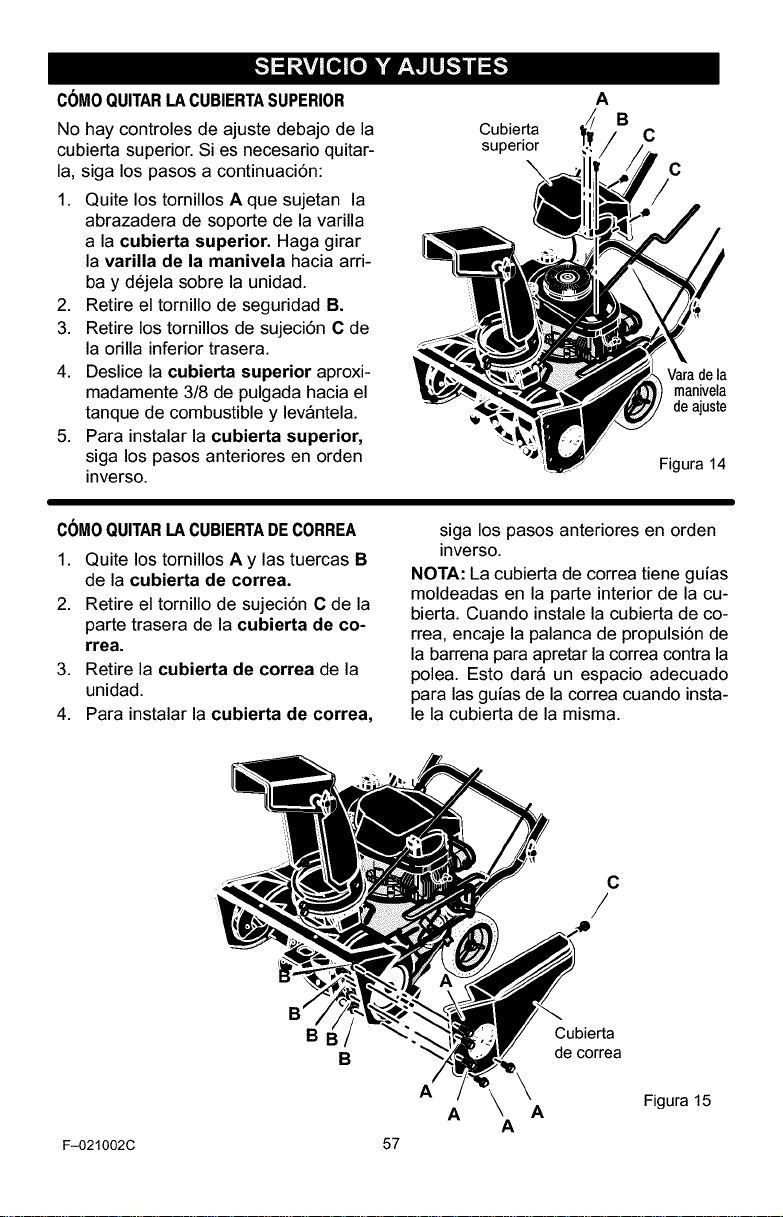
C(_MOQUITARLACUBIERTASUPERIOR
No hay controles de ajuste debajo de la
cubierta superior. Si es necesario quitar-
la, siga los pasos a continuaci6n:
1. Quite los tornillos A que sujetan la
abrazadera de soporte de la varilla
a la cubierta superior. Haga girar
la varilla de la manivela hacia arri-
bay d6jela sobre la unidad.
2. Retire el tornillo de seguridad B.
3. Retire los tornillos de sujeci6n C de
la orilla inferior trasera.
4. Deslice la cubierta superior aproxi-
madamente 3/8 de pulgada hacia el
tanque de combustible y lev&ntela.
5. Para instalar la cubierta superior,
siga los pasos anteriores en orden
inverso.
Cubierta
superior
A
B
C
C
Varadela
manivela
deajuste
Figura 14
C(_MOQUITARLACUBIERTADECORREA
1. Quite los tornillos A y las tuercas B
de la cubierta de correa.
2. Retire el tornillo de sujeci6n C de la
parte trasera de la cubierta de co-
rrea.
3. Retire la cubierta de correa de la
unidad.
4. Para instalar la cubierta de correa,
siga los pasos anteriores en orden
inverso.
NOTA: La cubierta de correa tiene guias
moldeadas en la parte interior de la cu-
bierta. Cuando instale la cubierta de co-
rrea, encaje la palanca de propulsi6n de
la barrena para apretar la correa contra la
polea. Esto dar& un espacio adecuado
para las guias de la correa cuando insta-
le la cubierta de la misma.
C
/
F-021002C
B
B
57
Cubierta
de correa
A
A A Figura 15
A
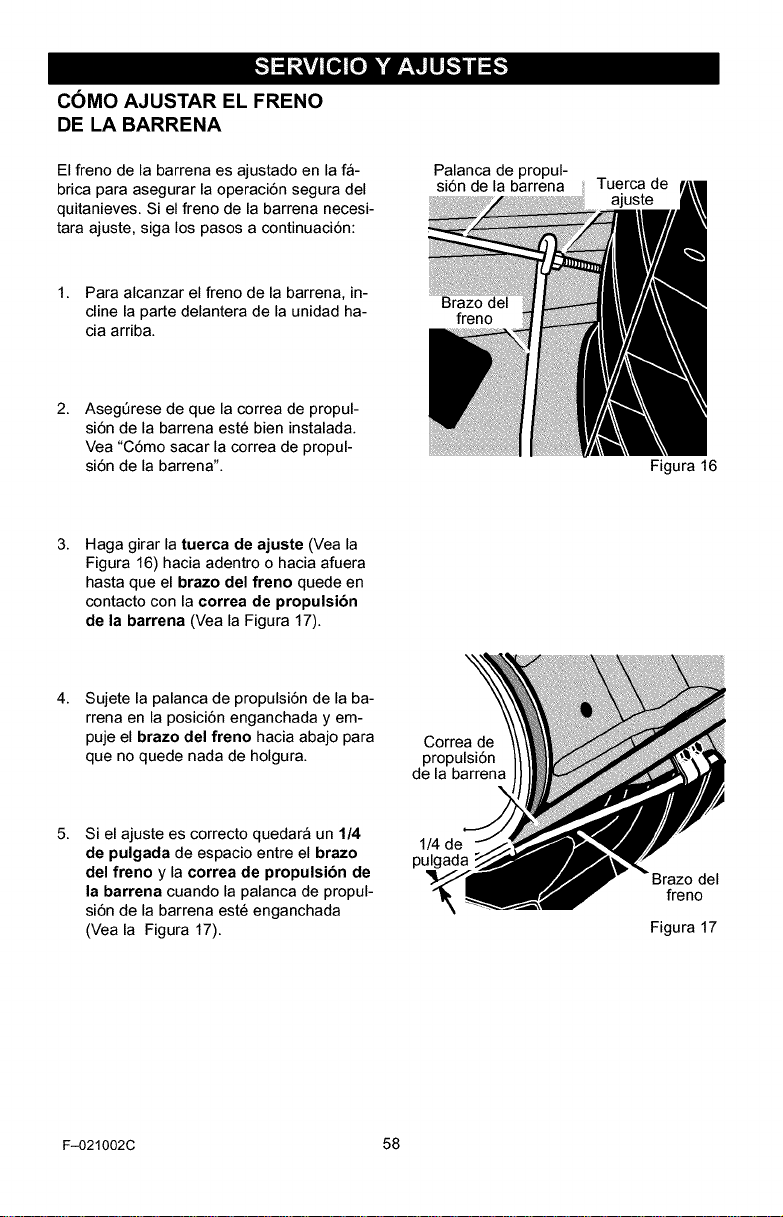
C6MO AJUSTAR EL FRENO
DE LA BARRENA
El freno de la barrena es ajustado en la fa-
brica para asegurar la operaci6n segura del
quitanieves. Si el freno de la barrena necesi-
tara ajuste, siga los pasos a continuaci6n:
1. Para alcanzar el freno de la barrena, in-
cline la parte delantera de la unidad ha-
cia arriba.
2,
Aseg6rese de que la correa de propul-
si6n de la barrena est6 bien instalada.
Vea "C6mo sacar la correa de propul-
si6n de la barrena".
Palanca de propul-
si6n de la barrena
Brazo del
freno
Tuerca de
ajuste
Figura 16
Haga girar la tuerca de ajuste (Vea la
Figura 16) hacia adentro o hacia afuera
hasta que el brazo del freno quede en
contacto con la correa de propulsibn
de la barrena (Vea la Figura 17).
4,
Sujete la palanca de propulsi6n de la ba-
rrena en la posici6n enganchada y em-
puje el brazo del freno hacia abajo para
que no quede nada de holgura.
Correa de
propulsi6n
de la barrena
5,
Si el ajuste es correcto quedara un 1/4
de pulgada de espacio entre el brazo
del freno y la correa de propulsibn de
la barrena cuando la palanca de propul-
si6n de la barrena est6 enganchada
(Vea la Figura 17).
1/4 de
pulgada
del
freno
Figura 17
F-021002C 58

C6MO SACAR LA CORREA DE
PROPULSI6N DE LA BARRENA
La correa de propulsi6n de la barrena esta
construida especialmente para la unidad y
debe ser reemplazada con una correa origi-
nal para la unidad, disponible en su tienda
Sears mas cercana.
Si la correa de propulsi6n de la barrena es-
tuviera dafiada, el quitanieves no descargara
la nieve y no avanzara. Reemplace la correa
dafiada de la manera indicada a continua-
ci6n:
1. Desconecte el cable de la bujia.
2. Retire la cubierta de la correa. Consulte
la secci6n "C6mo sacar la cubierta de la
correa".
Tornillo de
guia de
correa
Correa de propul-
si6n de la barrena
Figura 18
Fijese en el trayecto de la correa de
propulsibn de la barrena. Si necesita
ayuda, encontrara la calcomania con el
diagrama.
4,
Retire el tornillo de la guia de la co-
rrea y la guia de la correa (Vea la
Figura 18). Para quitar la guia de la co-
rrea, gire la guia de correa hacia aba-
jo.
5. Retire el tornillo y la polea tensadora
del brazo guia (yea la Figura 19).
6,
Saque la correa de propulsibn de la
barrena de la polea del motor y deslice-
la por el lado della caja del motor (vea
la Figura 20).
Polea tensora
Tornillo de la
polea tensora
Correa de trasmi-
si6n de barrena
Brazo
guia
Figura 19
Figura 20
F-021002C 59

7,
8,
9,
Para sacar la correa de propulsibn de
la barrena de la polea del propulsor,
mueva el brazo guia a la posici6n de en-
ganche. Esto le dara un espacio libre
entre la polea del propulsor y el brazo
de freno para sacar la correa de pro-
pulsibn de la barrena (vea la
Figura 21).
Para instalar una nueva correa de pro-
pulsi6n para la barrena, siga los pasos
anteriores en orden inverso.
Revise los ajustes del cable de propul-
si6n de la barrena. Consulte la secci6n
"Ajustar el cable de control de la barre-
ha".
Polea del
propulsor
Espacio
libre
Correa de pro-
pulsi6n de la
barrena
Brazo de
freno
Figura 21
F-021002C 60
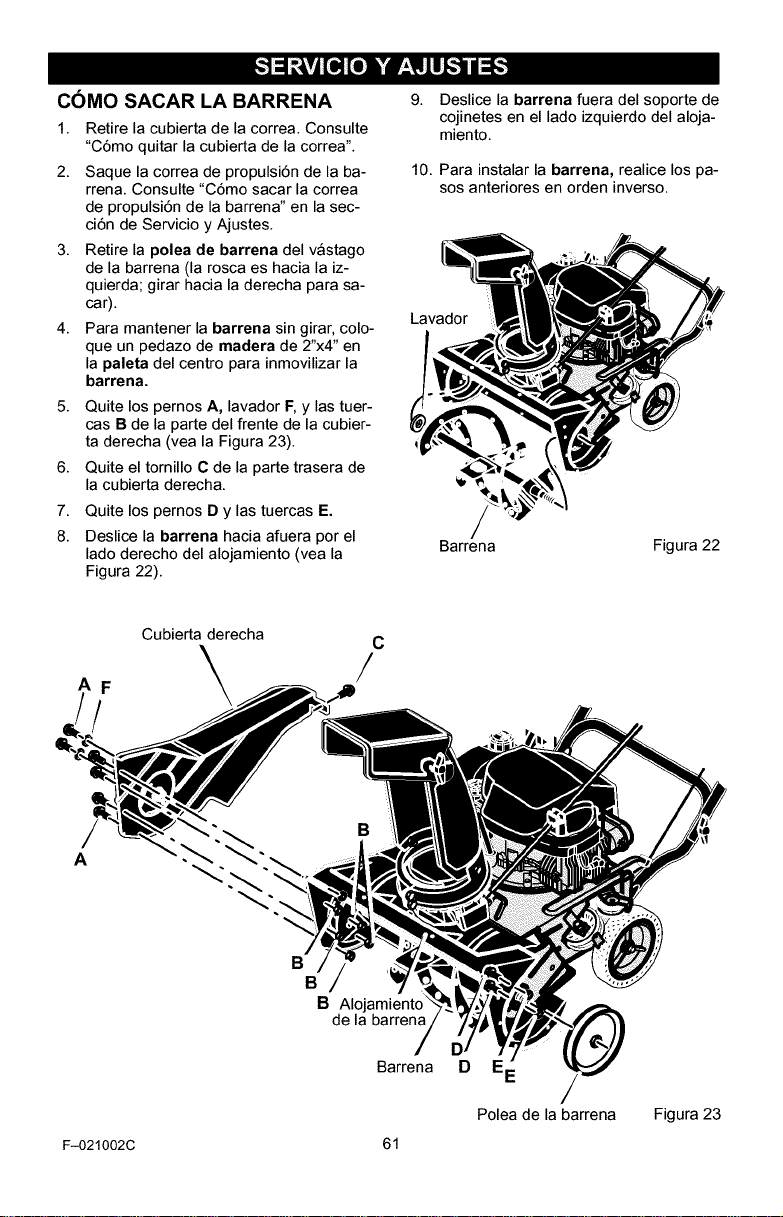
_o][o_ b*d_lu_
C6MO SACAR LA BARRENA
1. Retire la cubierta de la correa. Consulte
"C6mo quitar la cubierta de la correa".
2. Saque la correa de propulsi6n de la ba-
rrena. Consulte "C6mo sacar la correa
de propulsi6n de la barrena" en la sec-
ci6n de Servicio y Ajustes.
3. Retire la polea de barrena del vastago
de la barrena (la rosca es hacia la iz-
quierda; girar hacia la derecha para sa-
car).
4. Para mantener la barrena sin girar, colo-
que un pedazo de madera de 2"x4" en
la paleta del centre para inmovilizar la
barrena.
5. Quite los pernos A, lavador F, y las tuer-
cas B de la parte del frente de la cubier-
ta derecha (vea la Figura 23).
6. Quite el tornillo C de la parte trasera de
la cubierta derecha.
7,
8.
Quite los pernos D y las tuercas E.
Deslice la barrena hacia afuera por el
lado derecho del alojamiento (vea la
Figura 22).
9. Deslice la barrena fuera del soporte de
cojinetes en el lado izquierdo del aloja-
miento.
10. Para instalar la barrena, realice los pa-
sos anteriores en orden inverso.
Lavador
Barrena Figura 22
AF
/
Cubierta derecha
\
C
/
A
B
B
B Alojamiento
de la barrena
Barrena
D EE
Poleade la barrena
Figura 23
F-021002C 61
AJUSTE DEL CARBURADOR
El carburador no es ajustable.
El rendimiento de la unidad no debe verse
afectado en altitudes de hasta 7.000 pies.
Para operar la unidad en alturas superiores
a los 7.000 pies, consulte con el personal de
su tienda centro de servicio Sears mas cer-
cano.
IMPORTANTE: Nunca trate de modificar
el gobernador del motor, el cual esta confi-
gurado en la fabrica para la velocidad apro-
piada del motor. Hacer que el motor exceda
la velocidad del ajuste hecho en la fabrica
puede ser muy peligroso. Si usted cree que
la velocidad alta gobernada por el motor ne-
cesita ser ajustada, comunfquese con su
centro de servicio Sears mas cercano. AIIf
encontrara el equipo y la experiencia apro-
piada para efectuar los ajustes necesarios.
F-021002C 62
_ DVERTENCIA: Nunca guarde
su quitanieves en recintos cerra-
dos o en un _rea sin ventilacibn
adecuada. Los vapores de combustible
podrian alcanzar alguna llama abierta,
chispa o la llama piloto ya sea de la cal-
dera, calentador de agua, secadora de
ropa, cigarrillo, etc.
NOTA: Para evitar dafio al motor (si el quita-
nieves no se usa por mas 30 d[as) siga los
pasos detallados a continuaci6n.
QUITANIEVES
1. Limpie completamente el quitanieves.
2. Lubrique todos los puntos de lubricaci6n
(consulte la secci6n de Mantenimiento).
3. AsegQrese de que todas las tuercas, per-
nos y tornillos estan bien apretados. Ins-
peccione todas las piezas m6viles
visibles para detectar dafios, roturas y
desgaste. EfectQe reemplazos si fuese
necesario.
4. Retoque todas las superficies oxidadas o
con pintura resquebrajada, lijandolas li-
geramente antes de pintarlas.
5. Cubra las piezas de metal expuestas del
alojamiento de la barrena y el impulsor
con un material para prevenir la corro-
si6n, tal como un lubricante en aerosol.
NOTA: Una revisi6n o afinado anual por un
centro de cervicio Sears es una buena ma-
nera de asegurar que su quitanieves le brin-
dara el maximo rendimiento la siguiente
temporada.
MOTOR
_ DVERTENCIA: Vacie el tanque
de gasolina al aire libre, lejos
de fuentes de llamas.
La gasolina debera ser removida o tratada
para prevenir la formaci6n de dep6sitos de
goma en el tanque, filtro, manguera y carbu-
rador durante el almacenamiento. Asimismo,
durante el almacenamiento, la gasolina mez-
clada con alcohol en la cual se ha utilizado
etanol o metanol (a veces Ilamada gasohol)
atrae agua. Esta agua actQa sobre la gasoli-
na para formar acidos que dafian el motor.
1. Para remover la gasolina, mantenga el
motor en marcha hasta que el tanque
quede vac[o y el motor se pare.
2. Si no desea sacar gasolina, use el esta-
bilizador de combustible provisto con la
unidad o compre estabilizador de com-
bustible Craftsman No. 3550. Afiada es-
tabilizador de combustible a la cantidad
de gasolina que permanezca en el tan-
que para minimizar los dep6sitos de go-
may acido. Si el tanque esta casi vac[o,
mezcle el estabilizador con gasolina fres-
ca en un recipiente separado y afiada un
poco de esta mezcla al tanque.
3. Siempre siga las instrucciones en el en-
vase del estabilizador. Despu6s de aria-
dir el estabilizador al tanque, haga correr
el motor durante 10 minutos por Io me-
nos para permitir que la mezcla alcance
el carburador.
4. Cambie el aceite del motor.
5.
Lubrique el area del pist6n/cilindro de la
manera siquiente: Esto se hace sacando
primero la buj[a y colocando unas pocas
gotas de aceite de motor limpio en la ca-
vidad de la buj[a. Luego, cubra la cavidad
de la buj[a con un patio para absorber el
exceso de aceite. A continuaci6n, jale
dos o tres veces la cuerda de arranque a
reacci6n del motor para hacerlo rotar.
Finalmente, reinstale la buj[a y conecte el
cable de la buj[a.
OTRAS SUGERENCIAS
1. Si fuera posible, almacene su quitanieves
dentro de algQn recinto y cQbralo para
protegerlo contra el polvo y la suciedad.
2. Si debe almacenar el quitanieves al aire
libre, col6quelo sobre bloques para que
no quede en contacto con el suelo.
3. Cubra el quitanieves con una cubierta
protectora apropiada que no retenga hu-
medad. No use plastico.
IMPORTANTE: Nunca cubra el quitanieves
mientras las areas del motor y el escape es-
ten todav[a calientes.
F-021002C 63

PROBLEMA
Dificultad para
arrancar
El motor funciona
err_ticamente
El motor se para
El motor funciona
err_ticamente;
Perdida de
potencia
Vibracibn excesiva
La unidad no
avanza por
autopropulsibn
La unidad no
descarga nieve
CAUSA
Bujia defectuosa.
Agua o suciedad en el sistema
de combustible.
Linea de combustible bloqueada,
tanque de combustible vacio o
gasolina afieja.
La unidad esta funcionando con
la palanca de estrangulaci6n en
la posici6n de
ESTRANGULACION (CHOKE).
Agua o suciedad en el sistema
de combustible.
Conjunto de la barrena dafiado.
Partes sueltas, propulsor
dafiado.
La correa de propulsi6n de la
barrena esta suelta o dafiada.
Ajuste incorrecto del cable de
propulsi6n de la barrena.
La correa de propulsi6n de la
barrena esta suelta o dafiada.
El cable de control de la barrena
no esta ajustado correctamente.
Tubo de descarga obstruido.
Objeto extrafio atorado en la
barrena
CORRECCION
Reemplace la bujia defectuosa.
Vacie y limpie el tanque de
combustible; vuelva a Ilenar el
tanque con una mezcla fresca
de combustible.
Limpie la linea de combustible;
revise el suministro de
combustible; ponga gasolina
fresca en el tanque de
combustible.
Coloque la palanca de
estrangulaci6n en la posici6n run
(arranque) o en la posici6n off
(apagado).
Vacie y limpie el tanque de
combustible; vuelva a Ilenar el
tanque con una mezcla fresca
de combustible
Repare o reemplace el conjunto
de la barrena.
Pare el motor inmediatamente.
Saque la Ilave de encendido.
Apriete todos los sujetadores y
realice todas las reparaciones
necesarias. Si la vibraci6n
continQa, Ileva la unidad a su
centro de servicio Sears.
Reemplace la correa de
propulsi6n.
Ajuste el cable de propulsi6n.
Ajuste la correa de propulsi6n
de la barrena; reemplace la
correa siesta dafiada,
Ajuste el cable de control de la
barrena.
Pare el motor inmediatamente y
desconecte el cable de la bujia.
Limpie el tubo de descarga y
dentro del alojamiento de la
barrena.
Pare el motor inmediatamente y
desconecte el cable de la bujia.
Retire el objeto atorado en la
barrena.
F-021002C 64

SEARS, ROEBUCK AND CO.
Garantia limitada de cumplimiento con el Sistema Federal
de control de emisiones y con el sistema de control de
emisiones del Estado de California
Motores peque_os no aptos para carretera (off-road)
CONTROL DE EMISIONES DE
CALIFORNIA Y DE LA AGENCIA DE
PROTECCI6N AMBIENTAL (EPA) DE
E.U.A. - DECLARACI6N DE LA
GARANTiA
La Agencia de Protecci6n Ambiental de los
Estados Unidos (en Io sucesivo "EPA"), el
Consejo de California para los Recursos del
Aire (en Io sucesivo "CARB") y Sears, Roe-
buck and Co. tienen el placer de explicar Ioque
es la Garantia Federal y de California para Sis-
temas de Control de Emisiones de su nuevo
motor pequefio para vehiculos off-road. En
California, los motores pequefios para vehicu-
los off-road de modelo 1995 y modelos de
afios posteriores deben ser disefiados, cons-
truidos y equipados para cumplir con las es-
trictas normas anti contaminaci6n del Estado.
En otros estados, los motores modelo 1997 y
modelos de afios posteriores deben estar di-
sefiados, construidos y equipados, al momen-
to de su venta, para que cumplan con las
disposiciones de la EPA acerca de motores
pequefios para vehiculos off-road. Sears,
Roebuck and Co. garantizara el sistema para
el control de emisiones de su motor pequefio
para vehiculos off-road por los periodos de
tiempo que se mencionan mas adelante, con
tal que su motor pequefio para vehiculos off-
road no haya sufrido algQn abuso, negligen-
cia, modificaci6n no aprobada o
mantenimiento indebido.
Es probable que su sistema para el control de
emisiones incluya partes como el carburador,
el sistema de encendido y el sistema de esca-
pe. Tambi6n es posible que se incluya el siste-
ma de descompresi6n y otros ensamblajes
relacionados con emisiones.
Cuando surja una condici6n protegida por la
garantia, Sears, Roebuck and Co. reparara su
motor pequefio para vehiculos off-road sin
costo alguno para usted por concepto de diag-
n6stico, partes y mano de obra.
SISTEMA PARA EL CONTROL DE
EMISIONES DEL FABRICANTE -
COBERTURA DE LA GARANTiA
Los sistemas para el control de emisiones mo-
delo 1995 y modelos de afios posteriores de
motores pequefios para vehiculos off-road en
California estan garantizados por dos afios, tal
y como se menciona en la presente garantia.
En otros estados, los motores modelo 1997 y
modelos de afios posteriores tambi6n estan
garantizados por dos afios. En caso de que,
durante dicho periodo de la garantia, cualquier
parte de su motor relacionada con emisiones
est6 defectuosa en sus materiales o hechura,
Sears, Roebuck and Co. reparara o cambiara
dicha parte.
RESPONSABILIDADES DEL
PROPIETARIO DE LA GARANTiA
Como propietario del motor pequefio para ve-
hiculos off-road usted es responsable de que
se Ileve a cabo el mantenimiento requerido
que se menciona en el Manual del Propietario,
pero Sears, Roebuck and Co. no negara la ga-
rantia Qnicamente debido a la falta de un reci-
boo a que usted no proporcione una prueba
escrita de que se ha Ilevado a cabo el manteni-
miento programado.
No obstante, usted, como propietario del mo-
tor pequefio para vehiculos off-road, debera
estar consciente de que Sears, Roebuck and
Co. le puede negar la cobertura de la garantia
si su motor o alguna parte del mismo ha fallado
debido a un abuso, negligencia, mantenimien-
to inadecuado o modificaciones no aproba-
das.
Usted es responsable de presentar su motor
pequefio para vehiculos off-road en el Taller
Autorizado de Servicio de Sears, Roebuck
and Co. en cuanto surja el problema. Las repa-
raciones bajo la garantia deben Ilevarse a ca-
bo dentro de un periodo de tiempo razonable
que no exceda de 30 dias.
Se puede programar el servicio de garantia
Ilamando al Taller Autorizado de Servicio de
F-021002C 65

Sears, Roebuck and Co. o a Sears, Roebuck
and Co. al 1-800-473-7247 (llamada gratuita
en E.U.A.).
NOTA IMPORTANTE
Esta declaraci6n de la garantfa explica los de-
rechos y las obligaciones que usted tiene de
conformidad con la Garantfa del Sistema para
el Control de Emisiones (en Io sucesivo la "Ga-
rantfa SCE"), la cual Sears, Roebuck and Co.
le proporciona de conformidad con las leyes
de California. V6ase tambi6n las Garantfas Li-
mitadas de Sears, Roebuck and Co. que se
adjuntan a la Garantfa SCE en una hoja por
separado y que tambi6n le proporciona Sears,
Roebuck and Co. La Garantfa SCE 6nicamen-
te se aplica en el sistema para el control de
emisiones de su motor nuevo. Hasta el punto
en donde no haya ning6n conflicto en t6rminos
entre la Garantfa SCE y la Garantfa de Sears,
Roebuck and Co., la Garantfa SCE aplicara
para cualquier circunstancia a excepci6n de
aqu611aen que la Garantfa de Sears, Roebuck
and Co. pueda proporcionar un periodo de ga-
rantia mas largo. La Garantfa SCE y la Garan-
tfa de Sears, Roebuck and Co. describen
importantes derechos y obligaciones que us-
ted tiene con respecto a su motor nuevo.
$61o se puede Ilevar a cabo el servicio de ga-
rantfa en un Taller Autorizado de Servicio de
Sears, Roebuck and Co. AI momento de solici-
tar un servicio de garantfa, se debe presentar
una prueba de la fecha de compra por parte
del comprador original. El comprador pagara
cualquier cargo por concepto de Ilamadas de
servicio y/o transportaci6n de productos des-
de y para el lugar en donde se Ileve a cabo el
trabajo de inspecci6n y/o garantfa. El compra-
dor sera responsable de cualquier dafio o p6r-
dida en el que se incurra con relaci6n a la
transportaci6n de cualquier motor o cualquier
parte del mismo que se presente para inspec-
ci6n y/o trabajo de garantfa.
Si tiene alguna pregunta con relaci6n a sus de-
rechos y responsabilidades, debera Ilamar a
Sears, Roebuck and Co. al 1-800-473-7247.
GARANTIA DEL SISTEMA PARA EL
CONTROL DE EMISIONES
Garantia del Sistema para el Control de Emi-
siones ("Garantfa SCE") de motores peque-
fios para vehfculos off-road modelo 1995 y
modelos de afios posteriores en California
(para otros estados, motores modelo 1997 y
afios posteriores):
F-021002C
66
A. CAMPO DE APLICACI6N: Esta garantfa
debera aplicarse a los motores pequefios para
vehfculos off-road modelo 1995 y modelos de
afios posteriores en California (para otros es-
tados, motores modelo 1997 y modelos de
afios posteriores). El Periodo de la Garantfa
SCE iniciara en lafecha de entrega del nuevo
motor o equipo al comprador original y conti-
nuara durante los siguientes 24 meses conse-
cutivos.
B, COBERTURA GENERAL DE LA GA-
RANTIA DEL SISTEMA PARA EL CON-
TROL DE EMISIONES: Sears, Roebuck and
Co. garantiza al comprador original del nuevo
motor o equipo y a cada comprador subse-
cuente que su motor pequefio para vehfculos
off-road esta:
1. Disefiado, construido y equipado para que
cumpla con todas las disposiciones aplicables
adoptadas por el Consejo para los Recursos
del Aire de conformidad con su autoridad es-
pecificada en los Capitulos I y 2, Parte 5, Divi-
si6n 26 del C6digo de Salud y Seguridad, y
2. Libre de defectos en sus materiales y mano
de obra, los cuales, en cualquier momento du-
rante el Periodo de la Garantfa SCE, cause la
falla de una parte relacionada con emisiones
y que est6 bajo la garantia en cuanto a que no
sea id6ntica en sus materiales a la parte des-
crita en la solicitud de motor del fabricante pa-
ra su certificaci6n.
C. La Garantfa SCE s61o atafie a las partes de
su motor relacionadas con emisiones de la si-
guiente manera:
1. Cualquier parte relacionada con emisiones
que no se especifique como de cambio, tal y
como se requiere en el mantenimiento especi-
ficado en el Manual del Propietario, debera ga-
rantizarse por el Periodo de la Garantfa SCE.
Si dicha parte falla durante el Periodo de laGa-
rantfa SCE, Sears, Roebuck and Co. la repa-
rara o cambiara de acuerdo con la Subsecci6n
4 que se menciona mas adelante. Cualquier
parte reparada o cambiada de conformidad
con la Garantia SCE debera estar garantizada
por el resto del Periodo de la misma.
2. Cualquier parte garantizada y relacionada
con emisiones que est6 especificada s61o pa-
ra inspecciones regulares conforme al Manual
del Propietario debera estar garantizada por el
Periodo de la Garantfa SCE. Una declaraci6n
en dichas instrucciones por escrito a efecto de
"reparar o cambiar tal y como sea necesario"
no reducira el Periodo de la Garantfa SCE. Di-
cha parte reparada o cambiada conforme a la
GarantiaSCEdeberagarantizarseporelresto
delPeriododelamisma.
3.Cualquierpartegarantizadayrelacionada
conemisionesqueseespecifiqueparacam-
bio,deconformidadconelManualdelPropie-
tario,deberagarantizarseporelperiodode
tiempoprevioalprimerpuntodecambiode
esaparte.Silapartefallaantesdelprimer
cambioprogramado,Sears,RoebuckandCo.
repararaocambiaraesapartedeacuerdocon
laSubsecci6n4quesemencionamasadelan-
te.Cualquierparterelacionadaconemisiones
queserepareocambiedeconformidadconla
GarantiaSCEdeberaestargarantizadaporel
restodelPeriododelamismaprevioalprimer
puntodecambioprogramadodeesapartere-
lacionadaconemisiones.
4.Lareparaci6noelcambiodecualquierparte
garantizadayrelacionadaconemisionesde
conformidadconestaGarantiaSCEsedebe-
raIlevaracabo,sincargoalgunoparaelpro-
pietario,enunTallerAutorizadodeServiciode
Sears,RoebuckandCo.
5.Nosecargaraalpropietarioelcostoportra-
bajodediagn6stico,elcualIlevaaladetermi-
naci6ndequeunaparteprotegidaporla
GarantiaSCEsiestadefectuosa,provistoque
dichotrabajodediagn6sticoseIleveacaboen
unTallerAutorizadodeServiciodeSears,
RoebuckandCo.
6.Sears,RoebuckandCo.seraresponsable
dedaSosaotroscomponentesoriginalesdel
motoromodificacionesaprobadasqueproba-
blementeseancausadosporunafallacom-
prendidaen la garantiade unaparte
relacionadaconemisionescubiertaporlaGa-
rantiaSCE.
7.DuranteelPeriododelaGarantiaSCE,
Sears,RoebuckandCo.deberaconservarun
suministrodepartesgarantizadasyrelaciona-
dasconemisionesqueseasuficientepara
cumplirlademandaesperadadeesaspartes
relacionadasconemisiones.
8.Sepuedeutilizarcualquierpartederepues-
torelacionadaconemisionesautorizaday
aprobadaporSears,RoebuckandCo.para
utilizarseeneldesempeSodecualquierman-
tenimientoocambiodelaGarantiaSCE,la
cualseproporcionarasincargoalgunoparael
propietario.Dichousonoreduciralasobliga-
cionesdeSears,RoebuckandCo.conforme
alaGarantiaSCE.
9.Laspartesqueseagreguenomodifiquen
sinaprobaci6nnosepodranutilizarparamo-
dificarorepararunmotordeSears,Roebuck
andCo.DichousoanulaestaGarantiaSCEy
conformaralasbasessuficientespararecha-
zarlademandadeunaGarantiaSCE.Sears,
RoebuckandCo.noseraresponsable,con-
formeaestagarantia,porlasfallasdecual-
quierpartegarantizadadeunmotordeSears,
RoebuckandCo.causadasporelusodedi-
chaparteagregadaomodificadasinaproba-
ci6n.
LAS PARTES RELACIONADAS CON
EMISIONES INCLUYEN A LAS
SIGUIENTES:
1. Ensamblaje del carburador y sus compo-
nentes internos
a) Filtro de combustible
b) Empaques (juntas) del carburador
c) Tubo de entrada
2. Ensamblaje del depurador de aire
a) Elemento del filtro de aire
3. Sistema de encendido, que incluye:
a) Bujia de encendido
b) M6dulo de encendido
c) Ensamblaje del volante
4. Silenciador catalitico (si esta equipado)
a) Empaque del silenciador (si esta equipado)
b) Colector de escape (siesta equipado)
5. Ensamblaje del respiradero del carter del ci-
gQeSal y sus componentes
a) Tubo de conexi6n del respiradero
10/22/99 EPA/CARB
Sears, Roebuck and Co., Hoffman Estates, IL 60179 U.S.A.
F-021002C 67

Your Home
For repair in your home of all major brand appliances,
lawn and garden equipment, or heating and cooling systems,
no matter who made it, no matter who sold it!
For the replacement parts, accessories and
owner s manuals that you need to do-it-yourself.
For Sears professional installation of home appliances
and items like garage door openers and water heaters.
1-800-4-MY-HOM Efi Anytime, day or night
(1-800-469-4663) (U.S.A. and Canada)
www.sears.com www.sears, ca
Our Home
For repair of carry-in products like vacuums, lawn equipment,
and electronics, call or go on-line for the nearest
Sears Parts and Repair Center.
1-800-488-1222 Anytime, day or night (U.S.A. only)
www.sears.com
To purchase a protection agreement on a product serviced by Sears:
1-800-827-6655 (U.S.A.) 1-800-361-6665 (Canada)
Para pedir servicio de reparaci n
a domicilio, y para ordenar piezas:
1-888-SU-HOGAR sM
(1-888-784-6427)
Au Canada pour sewice en fran ais:
1-800-LE-FOYER Mc
(1-800-533-6937)
www.sears.ca
E/.4R8
' Sears, Roebuck andCo.
fi Registered Trademark / TMTrademark / SMService Mark of Sears, Roebuck and Co.
fi Marca Registrada / TMMarca de F/:_rica / SMMarca de Servicio de Sears, Roebuck and Co,
MCMarque de commerce / MDMarque dOpos(_e de Sears, Roebuck and Co.