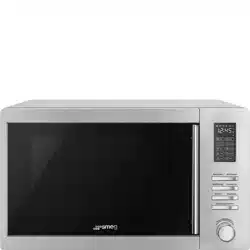
Before operating this oven, please read these instructions completely.
OPERATING INSTRUCTIONS
& COOK BOOK
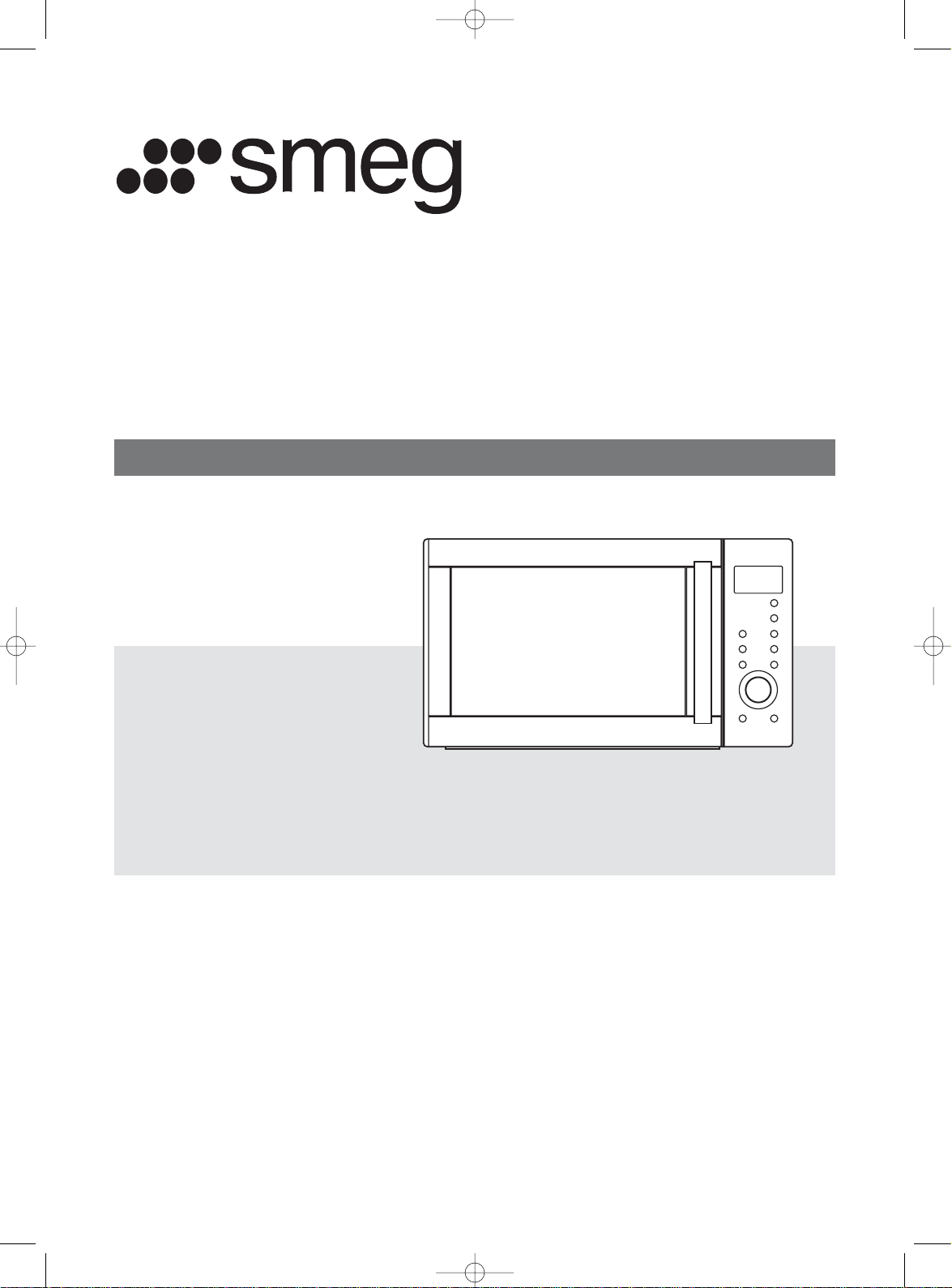
MICROWAVE OVEN
SA384X
PRECAUTIONS TO AVOID POSSIBLE
EXPOSURE TO EXCESSIVE
MICROWAVE ENERGY
(a) Do not attempt to operate this oven with the door
open since open-door operation can result in harmful
exposure to microwave energy. It is important not to defeat
or tamper with the safety interlocks.
(b) Do not place any object between the oven front face and
the door or allow soil or cleaner residue to accumulate on
sealing surfaces.
(c) WARNING : If the door or door seals are damaged, the
oven must not be operated until it has been repaired by a
competent person : (1) door (bent), (2) hinges and
latches(broken or loosened), (3) door seals and sealing
surfaces.
(d) WARNING : It is hazardous for anyone other than a
competent person to carry out any service or repair
operation that involves the removal of a cover which gives
protection against exposure to microwave energy.
(e) WARNING : Liquids and other foods must not be heated
in sealed containers since they are liable to explode.
(f) WARNING : This appliance can be used by children aged
from 8 years and above and persons with reduced
physical, sensory or mental capabilities or lack of
experience and knowledge if they have been given
supervision or instruction concerning use of the appliance
in a safe way and understand the hazards involved.
Children shall not play with the appliance. Cleaning and
user maintenance shall not be made by children unless
they are aged from 8 years and above and supervised.
2
• PRECAUTIONS TO AVOID POSSIBLE EXPOSURE TO EXCESSIVE MICROWAVE ENERGY............2
• IMPORTANT SAFETY INSTRUCTIONS .......................................................................................................3
• EARTHING INSTRUCTIONS ..........................................................................................................................5
• INSTALLATION ................................................................................................................................................5
• FEATURES DIAGRAM.....................................................................................................................................6
• CONTROL PANEL ...........................................................................................................................................7
• OPERATION PROCEDURE ...........................................................................................................................8
• HOW TO SET THE OVEN CONTROLS.........................................................................................................9
SETTING THE CLOCK ....................................................................................................................................9
MICROWAVE COOKING.................................................................................................................................9
TIME DEFROST..............................................................................................................................................10
WEIGHT DEFROST.......................................................................................................................................10
PROGRAM COOKING(ONE TOUCH COOKING) ......................................................................................11
MENU COOKING............................................................................................................................................12
TO INTERRUPT THE COOKING CYCLE DURING OPERATION.............................................................12
GENERAL COOKING HINTS........................................................................................................................12
SPEEDY COOK..............................................................................................................................................12
CHILD SAFETY LOCK...................................................................................................................................12
• CARE OF YOUR MICROWAVE OVEN........................................................................................................13
• QUESTIONS AND ANSWERS......................................................................................................................14
• BEFORE YOU CALL FOR SERVICE............................................................................................................15
• CARE AND CLEANING..................................................................................................................................15
• DISPOSAL OF USED ELECTRICAL & ELECTRONIC EQUIPMENT .......................................................15
• SPECIFICATIONS..........................................................................................................................................16
• COOKING INSTRUCTIONS..........................................................................................................................17
• USE YOUR MICROWAVE OVEN SAFELY .................................................................................................18
• ARCING...........................................................................................................................................................18
• MICROWAVING PRINCIPLES......................................................................................................................19
• HOW MICROWAVES COOK FOOD.............................................................................................................19
• CONVERSION CHARTS................................................................................................................................19
• COOKING TECHNIQUES..............................................................................................................................20
• DEFROSTING GUIDE....................................................................................................................................21
• COOKING & REHEATING CHART...............................................................................................................22
• VEGETABLE CHART.....................................................................................................................................24
• RECIPES.........................................................................................................................................................25
TABLE OF CONTENTS
3
IMPORTANT SAFETY INSTRUCTIONS
READ CAREFULLY AND KEEP FOR FUTURE REFERENCE
WARNING : To prevent fire, burns, electric shock and other
warnings:
Listed below are, as with all appliances, certain rules to follow
and safeguards to assure high performance from this oven:
1. Do not use the oven for any reason
other than food preparation, such as
for drying clothes, paper, or any other
nonfood items or for sterilizing
purposes.
2. Do not use the oven when empty, this
could damage the oven.
3. Do not use the oven cavity for any type
of storage, such as papers, cookbook,
cookware, etc.
4. Do not operate the oven without the
metal tray in place. Be sure it is
properly sitting on the rotating base.
5. Make sure you remove caps or lids
prior to cooking when you cook food
sealed in bottles.
6. Do not put foreign material between
the oven surface and door. It could
result in excessive leakage of
microwave energy.
7. Do not use recycled paper products for
cooking. They may contain impurities
which could cause sparks and/or fires
when used during cooking.
8. Do not pop popcorn unless popped in
a microwave approved popcorn
popper or unless it's commercially
packaged and recommended
especially for microwave ovens.
Microwave popped corn produces a
lower yield than conventional popping;
there will be a number of unpopped
kernels. Do not use oil unless specified
by the manufacturer.
9. Do not cook any food surrounded by a
membrane, such as egg yolks,
potatoes, chicken livers, etc., without
first piercing them several times with a
fork.
10. Do not pop popcorn longer than the
manufacturer's directions. (popping
time is generally below 3 minutes).
Longer cooking does not yield more
popped corn, it can cause scorchings
and fire.
Also, the cooking tray can become too
hot to handle or may break.
11. If smoke is emitted, switch off or
unplug the appliance and keep the
door closed in order to stifle any
flames.
12. When heating food in plastic or paper
containers, keep an eye on the oven
due to the possibility of ignition.
4
SAVE THESE INSTRUCTIONS
13. The contents of feeding bottles and
baby food jars shall be stirred or shaken
and the temperature checked before
consumption, in order to avoid burns.
14. Always test the temperature of food or
drink which has been heated in a
microwave oven before you give it to
somebody, especially to children or
elderly people. This is important
because things which have been
heated in a microwave oven carry on
getting hotter even though the
microwave oven cooking has stopped.
15. Eggs in their shell and whole hard-boiled
eggs should not be heated in microwave
ovens since they may explode, even after
microwave heating has ended;
16. Keep the waveguide cover clean at all
times. Wipe the oven interior with a soft
damp cloth after each use. If you leave
grease or fat anywhere in the cavity it
may overheat, smoke or even catch
fire when next using the oven.
17. Never heat oil or fat for deep frying as you
cannot control the temperature and doing
so may lead to overheating and fire.
18. Liquids, such as water, coffee, or tea
are able to be overheated beyond the
boiling point without appearing to be
boiling due to surface tension of the
liquid. Visible bubbling or boiling when
the container is removed from the
microwave oven is not always present.
THIS COULD RESULT IN VERY HOT
LIQUIDS SUDDENLY BOILING OVER
WHEN A SPOON OR OTHER UTENSIL
IS INSERTED INTO THE LIQUID.
To reduce the risk of injury to persons:
a) Do not overheat the liquid.
b) Stir the liquid both before and
halfway through heating it
c) Do not use straight-sided containers
with narrow necks.
d) After heating, allow the container to
stand in the microwave oven for a
short time before removing the
container.
e) Use extreme care when inserting a
spoon or other utensil into the
container.
19. This appliance is not intended for use
by persons(including children) with
reduced physical, sensory or mental
capabilities, or lack of experience and
knowledge, unless they have been
given supervision or instruction
concerning use of the appliance by a
person responsible for their safety.
20. Children should be supervised to
ensure that they do not play with the
appliance.
21. Only use utensils that are suitable for
use in microwave ovens.
22. Microwave heating of beverages can
result in delayed eruptive boiling,
therefore care must be taken when
handling the container.

5
EARTHING INSTRUCTIONS
This appliance must be earthed. In the event of an
electrical short circuit, earthing reduces the risk of
electric shock by providing an escape wire for the
electric current. This appliance is equipped with a
cord having a earthing wire with a earthing plug.
The plug must be plugged into an outlet that is
properly installed and earthed.
WARNING : Improper use of the earthing plug can
result in a risk of electric shock. Consult a qualified
electrician or serviceman if the earthing instructions
are not completely understood, or if doubt exists as
to whether the appliance is properly earthed.
If it is necessary to use an extension cord, use only a
3-wire extension cord that has a 3-blade earthing
plug, and a 3-slot receptacle that will accept the plug
on the appliance. The marked rating of the extension
cord should be equal to or greater than the electrical
rating of the appliance.
IMPORTANT
The wires in this mains lead fitted to this appliance
are colored in accordance with the following code.
Green-and-yellow : Earth
Blue : Neutral
Brown : Live
As the colors of the wires in the mains lead of this
appliance may not correspond with the colored
markings identifying the terminals in your plug,
proceed as follows : the wire which is colored green-
and-yellow must be connected to the terminal in the
plug which is marked with the letter ‘E’ or by the
earth symbol or green-and-yellow. The wire which is
colored blue must be connected to the terminal
which is marked with the letter ‘N’ or colored black.
The wire which is colored brown must be connected
to the terminal which is marked with the letter ‘L’ or
colored red.
WARNING : The appliance must be earthed.
INSTALLATION
1. Ventilation
For correct operation, the oven must have sufficient
airflow. Do not block air vents as this may cause
overheating. In a freestanding situation allow
adequate ventilation around the microwave from
any overhead, rear and side wall constructions. If
combining the microwave with a trim kit for a 'built-in'
situation, (where more than one side of the
appliance is closed in) the specification and
installation requirements are as per the trim kit
instruction manual. Note: Cabinet materials must
be suitable to withstand temperatures up to 90˚C.
2. Steady, flat location
This oven should be set on a steady, flat surface.
3. Leave space behind and side
All air vents should be kept a clearance.
If all vents are covered during operation, the oven
may overheat and, eventually, oven failure.
4. Away from radio and TV sets
Poor television reception and radio interference may
result if the oven is located close to a TV, Radio
antenna, feeder and so on. Position the oven as far
from them as possible.
5. Away from heating appliance and water taps
Keep the oven away from hot air, steam or Splash
when choosing a place to position it, or the
insulation might be adversely affected and
breakdowns occur.
6. Power supply
• Check your local power source. This oven requires
a current of approximately 6 amperes, 240V 50Hz.
• Power supply cord is about 0.8 meters long.
• The voltage used must be the same as specified
on this oven. Using a higher voltage may result in
a fire or other accident causing oven damage.
Using low voltage will cause slow cooking. We are
not responsible for damage resulting from use of
this oven with a voltage of ampere fuse other than
those specified.
• If the supply cord is damaged, it must be replaced
by the manufacturer or its service agent or a
similarly qualified person in order to avoid a
hazard.
7. Examine the oven after unpacking for any
damage such as:
A misaligned door, Broken door, A dent in cavity.
If any of the above are visible, DO NOT INSTALL,
and notify dealer immediately.
8. Do not operate the oven if it is colder than room
temperature.
(This may occur during delivery in cold weather.)
Allow the oven to become room temperature before
operating.
6
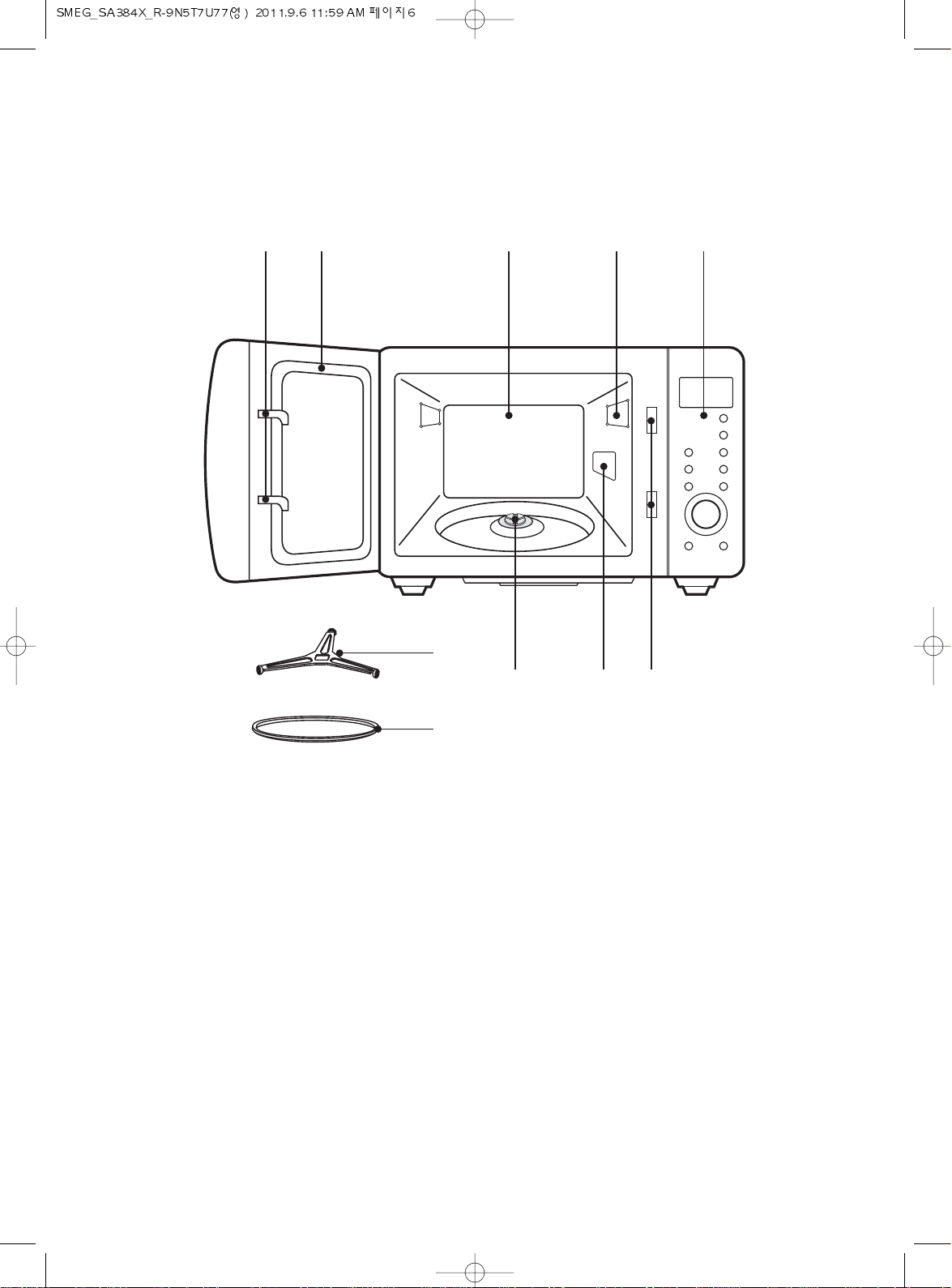
11
Door latch - When the door is closed, it will
automatically shut off. If the door is opened
while the oven is operating, the magnetron will
automatically shut off.
22
Door seal - The door seal surfaces prevent
microwaves escaping from the oven cavity.
33
Oven cavity
44
Control panel
55
Coupler - This fits over the shaft in the center
of the oven cavity floor.
This is to remain in the oven for all cooking.
66
Roller guide - This must always be used for
cooking together with the metal cooking tray.
77
Metal tray - The tray must always be in proper
position before operating. Do not cook food
directly on the tray.
88
Waveguide cover - Protects the microwave
outlet from splashes of cooking foods.
99
Safety interlock system - Prevents the oven
from operating while the door is opened. The
oven will only operate with the door fully
closed. When the door is open, the oven turns
off and will only start again after the door is
closed.
00
Oven lamp - Automatically turns on during
oven operating.
FEATURES DIAGRAM
1 2 3
95 8
40
7
6
7
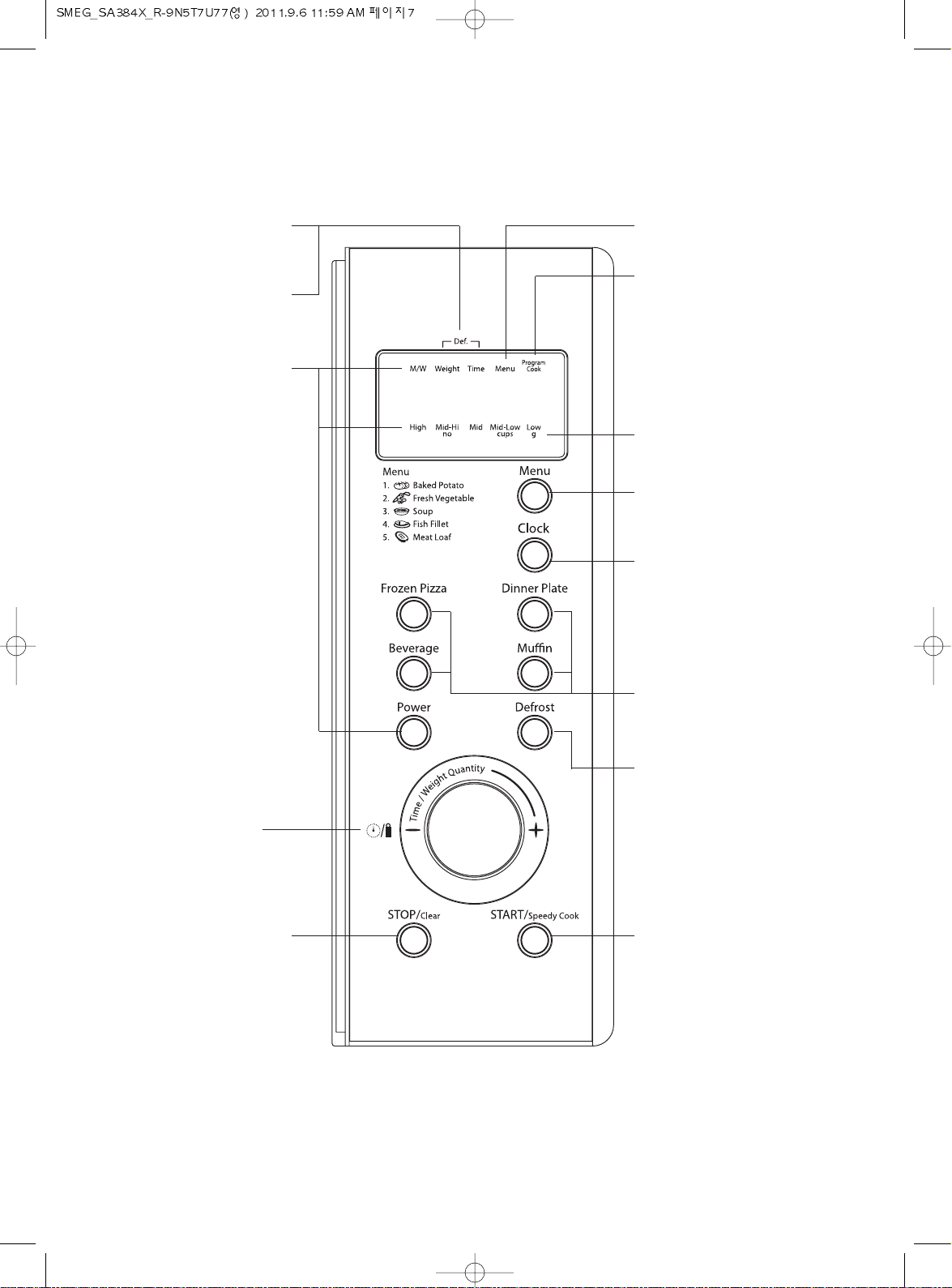
CONTROL PANEL
When blinking, the oven is
operating in WEIGHT
DEFROST.
When blinking, the oven is
operating in TIME DEFROST.
When blinking, the oven is
operating in MICROWAVE
COOK (5 STEPS)
- HIGH
- MID-HI
- MID
- MID-LOW
- LOW
DIAL KNOB - Used to
enter the cooking time and
weight input.
Stop/Clear Button - Used
to pause or clear all
information manually put into
the oven.
When blinking, the oven is
operating in MENU.
When blinking, the oven is
operating in PROGRAM
COOK.
(ONE-TOUCH COOK)
- FROZEN PIZZA
- DINNER PLATE
- BEVERAGE
- MUFFIN
When blinking, the oven is
ready for input mode.
MENU Button - Used to cook
or reheat many of favorite
food.
CLOCK Button - Used to set
clock.
ONE TOUCH COOK Button -
Used to cook or reheat
specific quantities of food.
DEFROST Button - Used to
defrost foods by weight or
time.
Start Button - Used to start
the selected cycle.
Speedy Cook Button - Used
to quickly program cooking
time increases from 30
seconds to 5 minutes.
8
Plug power supply cord into 240V AC 50Hz
power outlet.
After placing the food in a suitable container,
open the oven door and put it on the metal
tray. The metal tray and roller guide must
always be in place during cooking.
Close the door. Make sure that it is firmly
closed.
The oven door can be opened at any time
during operation by pushing the door open
button. The oven will automatically shut off.
To restart the oven, close the door and then
touch the START button.
The oven automatically cooks on full power
unless set to a lower power level.
The display will show “0” when the oven is
plugged in.
The display returns to "0" or present time.
when the cooking time ends.
When the STOP/CLEAR button is touched
during the oven operation, the oven stops
cooking and all information retained. To erase
all information(except the present time), touch
the STOP/CLEAR button once more.
If the oven door is opened during the oven
operation, all information is retained.
If the START button is touched and the oven
does not operate, check the area between the
door and door seal for obstructions and make
sure the door is closed securely. The oven will
not start cooking until the door is completely
closed or the program has been reset.
OPERATION PROCEDURE
This section includes useful information about oven operation.
1
2
3
4
5
6
7
8
9
Make sure the oven is properly installed
and plugged into the electrical outlet.
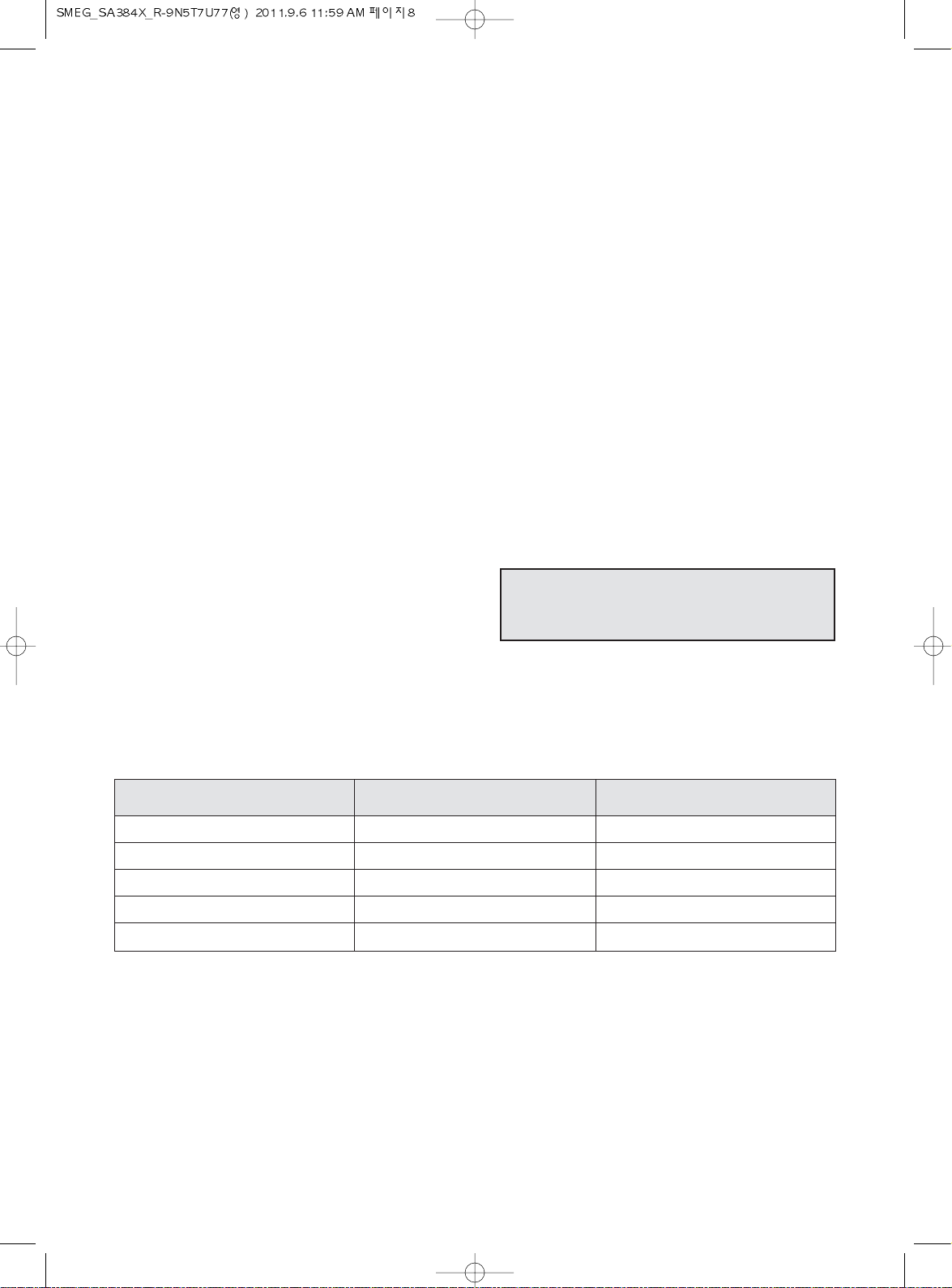
WATTAGE OUTPUT CHART
•
The power-level is set by touch the Power button. The chart shows the display, the power level
and the percentage of power.
once High 100%
twice Mid-Hi 80%
3 times Mid 60%
4 times Mid-Low 40%
5 times Low 20%
Touch the Power button Power level (Indicator) Approximate Percentage of Power
9
HOW TO SET THE OVEN CONTROLS
■SETTING THE CLOCK
SETTING THE CONTROLS
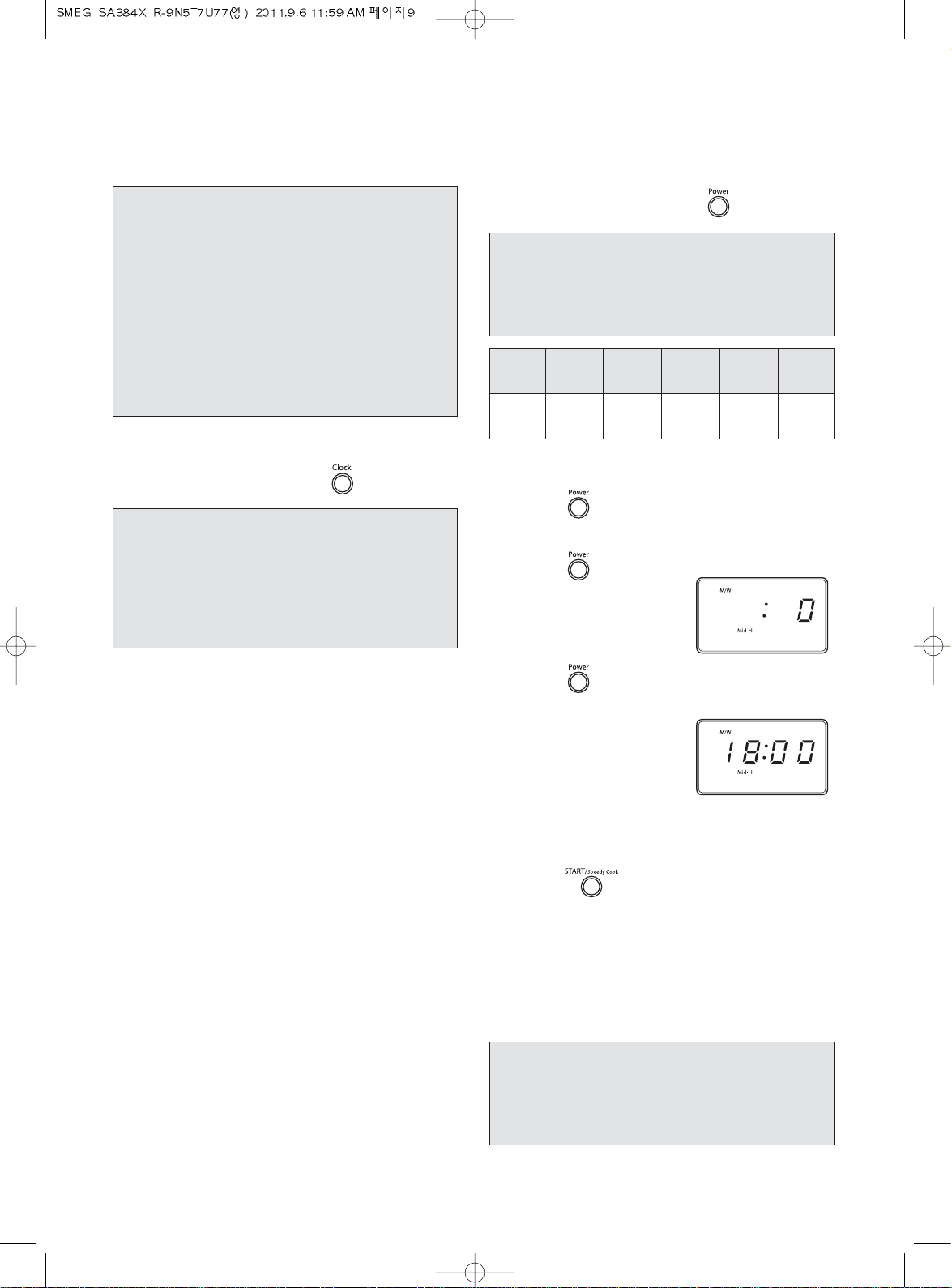
1. Press the button. The display will show " : 0".
This oven has 5 power levels from HIGH to LOW.
2. Press the button to
select the desired microwave
power level.
For example: power level
"MID-HI"
Press the button once more.
3. Turn the DIAL KNOB for the
desired cooking time.
For example: 18 minutes
Turn right or left the DIAL
KNOB.
Then, 18:00 will show in the
display.
Time can be set up from 10 seconds to 60 minutes.
SETTING THE CONTROLS
Example : To set 5:30
1. Press Clock button once. (example : to set " 5:30 ")
The display will be " 12H " shows.
2. Press Clock button once more, " 24H " shows in
display.
This is a 24hour clock system. If you want 12hour
clock system, omit this step.
3. Turn the dial knob to set the hour number " 5: ".
The hour number starts blinking, the colon will right.
4. Press Clock button. " 5:00 " shows in display.
The minute number starts blinking, the colon and hour
number will light.
5. Turn the dial knob until " 5:30 " in the display window.
6. Press Clock button. The colon starts blinking.
If you selected 12hour clock system, this digital clock
allows you to set from 1:00 to 12:59.
If you selected 24hour clock system, this digital clock
allows you to set from 0:00 to 23:59.
Tips:
• Be sure to read the cookbook's introduction
before operating the oven.
• Also remember to read this operating instruction
for proper safety information and instruction
before using the oven.
• Prior to setting the controls, place one cup of
water in the oven, in a heat-proof glass
measuring cup, for testing purposes.
• When setting the controls, every time a button is
pressed, a beep can be heard.
Note:
• It is displayed after an interval of 10 seconds
from 10 seconds to 5 minutes, 30 seconds from
5 minutes to 10 minutes, 1 minute from 10
minutes to 60 minutes.
POWER 100% 80% 60% 40% 20%
LEVEL
INDICATOR
HIGH
MID
-HI
MID
MID
-LOW
LOW
4. Press the button.
The oven will now start microwave cook for 18
minutes at power level "MID-HI".
5. Four beeps will sound at the end of the cooking time.
The indicator light will go off. The display panel will
return to the "0" or present time. The oven light will
turn off and the turntable will stop turning.
■MICROWAVE COOKING
Note:
• To insure the best microwave and defrost
results, be sure to start with a cool oven.
• The variable power Level settings equal the
following wattage.
Note:
When your oven is plugged in, the display will
flash “0” and a tone will sound. If the AC power
ever goes off, the display shows “0”
when the power comes back on.
Your oven has multiple(12hr/24hr) clock system.
To set the clock follow under procedure.
10
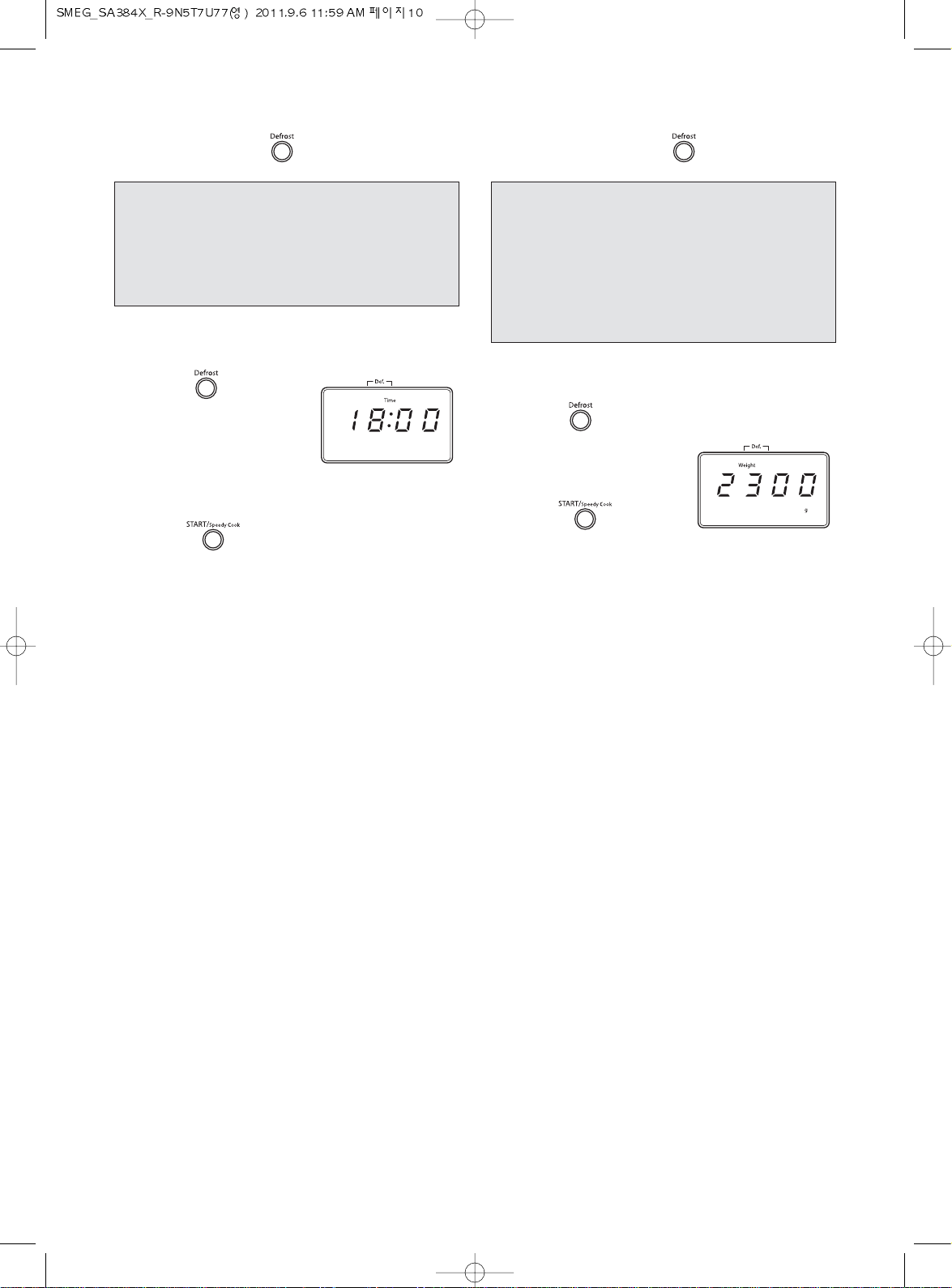
SETTING THE CONTROLS
1. Press the button.
2. Turn the DIAL KNOB for the
desired defrosting weight.
For example: 2.3kg
3. Press the button.
4. The display will show the defrosting time.
5. Four beeps will sound at the end of the cooking time.
The indicator lights will go off. The display panel will
return to the "0" or present time. The oven light will
turn off and the turntable will stop turning.
■WEIGHT DEFROST
Note:
• This mode allows you to set weight from 0.1kg to
2.9kg
• During the defrosting process the oven will beep
to remind you to check the food. The oven will
beep, open the door, turn the frozen food over
and close the door, press the START/SPEEDY
COOK button.
SETTING THE CONTROLS
1. Press the button twice.
2. Turn the DIAL KNOB for the
desired defrosting time.
For example: 18 minutes
Time can be set up from 10 seconds to 60 minutes.
3. Press the button.
4. Four beeps will sound at the end of the cooking time.
The indicator light will go off. The display panel will
return to the "0" or present time. The oven light will
turn off and the turntable will stop turning.
■TIME DEFROST
Note:
• During the defrosting process the oven will beep
to remind you to check the food. The oven will
beep, open the door, turn the frozen food over
and close the door, press the START/SPEEDY
COOK button.
11
■PROGRAM COOKING
(ONE TOUCH COOKING)
One touch cook allows you to cook or reheat many of
your favorite foods by touching just one button. To
increase quantity, touch chosen button until number in
display is same as desired quantity to cook. (except
for MUFFIN & DINNER PLATE)
SETTING THE CONTROLS.
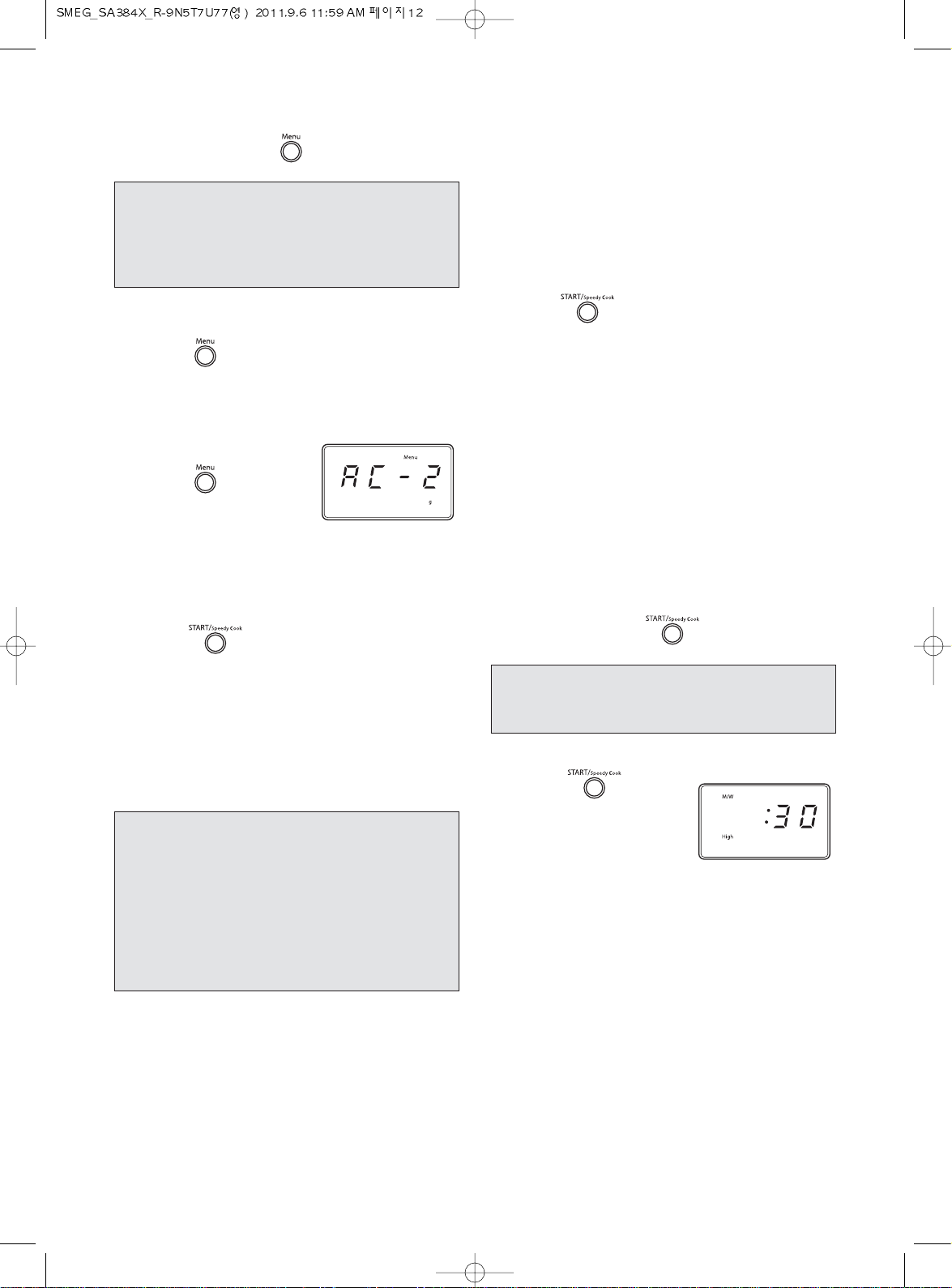
1. Touch FROZEN PIZZA
button.
When you touch FROZEN PIZZA button, "200" is
displayed.
After 1.5 seconds, the display is changed into cooking
time of quantity and the oven starts cooking.
2. Touch FROZEN PIZZA
button once more.
When you touch FROZEN
PIZZA button, "300" is
displayed.
After 1.5 seconds, the display is changed into cooking
time of quantity and the oven starts cooking.
FROZEN
PIZZA
1. Touch DINNER PLATE
button.
When you touch DINNER PLATE button, "300" is
displayed.
After 1.5 seconds, the display is changed into cooking
time of quantity and the oven starts cooking.
1. Touch BEVERAGE button.
When you touch BEVERAGE
button, "1" is displayed.
After 1.5 seconds, the display is changed into cooking
time of quantity and the oven starts cooking.
DINNER
PLATE
BEVERAGE
1. Touch MUFFIN button.
When you touch MUFFIN
button, "5" is displayed.
After 1.5 seconds, the display is changed into cooking
time of quantity and the oven starts cooking.
MUFFIN
* BEVERAGE * (250ml/cup)
• 1 cup(mug) : Touch BEVERAGE once.
• 2 cups(mugs): Touch BEVERAGE twice within
1.5 seconds.
• 3 cups(mugs): Touch BEVERAGE three times
within 1.5 seconds.
NOTE: 1. This setting is good for restoring cooled
beverage to a better drinking
temperature.
2. Stir after cooking.
Note:
1. Use only one frozen pizza at a time.
2. Use only frozen pizza for microwave oven.
3. If the cheese of frozen pizza does not melt
sufficiently, cook a few seconds longer.
4. Some brands of frozen pizza may require more
or less cooking time.
12
SETTING THE CONTROLS
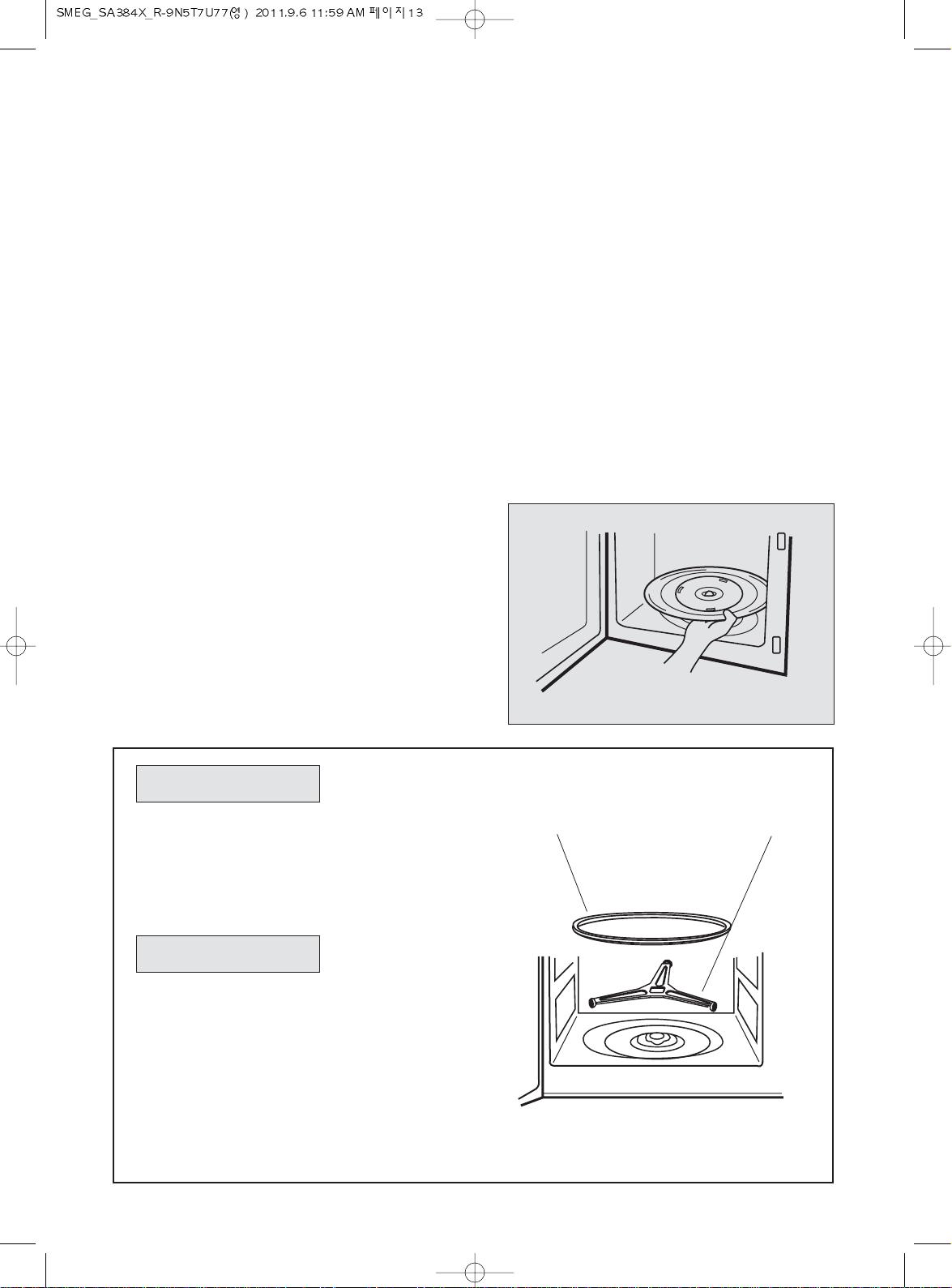
1. Press the button
Then, "AC-1" will show in the display.
2. Select the desired cooking menu.
For example: Fresh
Vegetable.
Press the button once
again then "AC-2" will show in
the display.
3. If you want to select other cooking, touch the button
again, until display shows your desired menu.
4. Rotate dial knob to select quantity/weight of cook.
5. Press the button.
The oven will now start programmed cook for menu 2.
6. The display will show the cooking time
7. Four beeps will sound at the end of the cooking time.
The indicator light will go off. The display panel will
return to the "0" or present time. The oven light will
turn off and turntable will stop turning.
■TO INTERRUPT THE COOKING CYCLE
DURING OPERATION-open the door or
press stop/clear button.
1. The oven will immediately stop.
2. If no further cooking required, press STOP/CLEAR
button.
3. The "0" or present time. is displayed.
4. To continue cooking, close the oven door and
Press the button. The oven will restart.
■GENERAL COOKING HINTS
1. When cooking a roast with an excess amount of fat, it
is helpful to remove the fat at turn over times to
prevent splattering
2. Prick the meats, fish or poultry with a fork to prevent
bursting.
Steam builds up pressure in meals, fish or poultry
which is tightly covered by a skin or membrane.
3. Reduce suggested cooking times. It is always better
to under-cook foods rather than to overcook them. If a
range of times is stated in a recipe, cook the food at
the minimum suggested time, check if the food is
cooked, and then cook slightly longer if necessary.
■MENU COOKING
Note:
• There is preprogrammed cooking of five menu.
(1-5)
• Don't need to set cooking time, power or
function.
Note:
• The menu of pre-programmed cooks equal to the
following
AC-1 Baked Potato (1ea, 2ea, 3ea)
AC-2 Fresh Vegetable (200g, 300g)
AC-3 Soup (250g, 350g)
AC-4 Fish Fillet (300g, 500g)
AC-5 Meat Loaf (500g, 700g)
• See the cooking guide for specific recipes.
SETTING THE CONTROLS
1. Press the button.
2. " :30" will appear in the display
window.
3. Whenever this button is pressed, cooking time is
increased by 30 seconds to 5minutes.
4. If the time was set this oven will operate automatically
after 1.5 seconds.
5. Four beeps will sound at the end of the cooking time.
The indicator light will go off. The display panel will
return to the "0" or present time. The oven light will
turn off and the turntable will stop turning.
■CHILD SAFETY LOCK
The safety lock prevents unwanted oven operation such
as by small children. To set, Press STOP/CLEAR for 3
seconds, "Loc" is displayed. To cancel, press
STOP/CLEAR for 3 seconds, "Loc" disappears.
■SPEEDY COOK
Note:
• The cooking time increases from 30 seconds to 5
minutes. (Power level is high.)
13
CARE OF YOUR MICROWAVE OVEN
Turn the oven off before cleaning.
Keep the inside of the oven clean. When food
spatters or spilled liquids adhere to oven walls,
wipe with a damp cloth. Mild detergent may be
used if the oven gets very dirty.
The use of harsh detergent or abrasives is not
recommended.
The outside oven surface should be cleaned
with soap and water, rinsed and dried with a
soft cloth. To prevent damage to the operating
parts inside the oven, water should not be
allowed to seep into the ventilation openings.
If the Control Panel becomes wet, clean with a
soft, dry cloth. Do not use harsh detergents or
abrasives on Control Panel.
If steam accumulates inside or around the
outside of the oven door, wipe with a soft cloth.
This may occur when the microwave oven is
operated under high humidity conditions and in
no way indicates malfunction of the unit.
It is occasionally necessary to remove the metal
tray for cleaning. Wash the tray in warm sudsy
water or in a dishwasher.
The roller guide and oven cavity floor should be
cleaned regularly to avoid excessive noise.
Simply wipe the bottom surface of the oven with
mild detergent water or window cleaner and dry.
The roller guide may be washed in mild sudsy
water.
1
2
3
4
5
6
7
The oven should be cleaned regularly and any food deposits removed.
Failure to maintain the oven in a clean condition could lead to
deterioration of the surface that could adversely affect the life of the
appliance and possibly result in a hazardous situation.
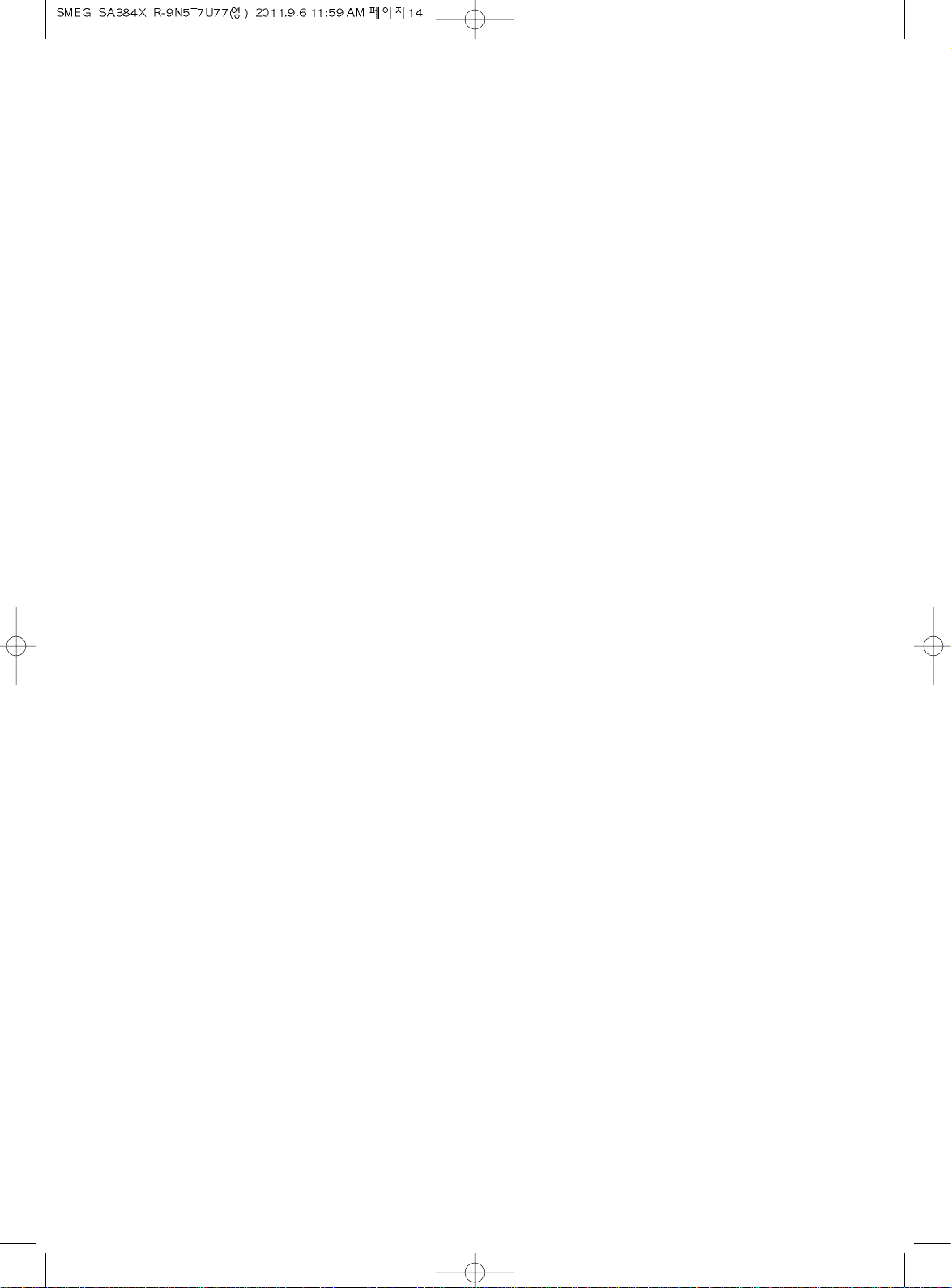
ROLLER GUIDE
Metal Tray Roller Guide
The ROLLER GUIDE and oven floor should be
cleaned frequently to prevent excessive noise.
The ROLLER GUIDE MUST ALWAYS be used
for cooking together with the Metal Tray.
1
2
METAL TRAY
DO NOT operate the oven without the Metal Tray
in place.
DO NOT use any other Metal Tray with this oven.
If Metal Tray is hot, ALLOW TO COOL before
cleaning or placing it in water.
DO NOT cook directly on the Metal Tray.
(Except for popcorn)
1
2
3
4
14
QUESTIONS AND ANSWERS
* Q : I accidentally ran my microwave oven
without any food in it. Is it damaged?
* A : Running the oven empty for a short time will
not damage the oven. However, it is not
recommended.
* Q : Can the oven be used with the metal tray
or roller guide removed?
* A : No. Both the metal tray and roller guide must
always be used in the oven before cooking.
* Q : Can I open the door when the oven is
operating?
* A : The door can be opened anytime during the
cooking operation. Then microwave energy
will be instantly switched off and the time
setting will maintain until the door is closed.
* Q : Why do I have moisture in my microwave
oven after cooking?
* A : The moisture on the side of your microwave
oven is normal. It is caused by steam from
cooking food hitting the cool oven surface.
* Q : Does microwave energy pass through the
viewing screen in the door?
* A : No. The metal screen bounces back the
energy to the oven cavity. The holes are
made to allow light to pass through. They do
not let microwave energy pass through.
* Q : Why do eggs sometimes pop?
* A : When baking or poaching eggs, the yolk may
pop due to steam build-up inside the yolk
membrane. To prevent this, simply pierce the
yolk with a toothpick before cooking. Never
cook eggs without piercing their shells.
* Q : Why this standing time recommended
after the cooking operation has been
completed?
* A : Standing time is very important.
With microwave cooking, the heat is in the
food, not in the oven. Many foods build up
enough internal heat to allow the cooking
process to continue, even after the food is
removed from the oven. Standing time for
joints of meat, large vegetables and cakes is
to allow the inside to cook completely,
without overcooking the outside.
* Q : What does “standing time” mean?
* A : “Standing time” means that food should be
removed from the oven and covered for
additional time to allow it to finish cooking.
This frees the oven for other cooking.
* Q : Why does my oven not always cook as
fast as the microwave cooking guide
says?
* A : Check your cooking guide again, to make
sure you’ve followed directions exactly ; and
to see what might cause variations in cooking
time. Cooking guide times and heat settings
are suggestions, to help prevent over-
cooking... the most common problem in
getting used to a microwave oven.
Variations in the size, shape and weights and
dimensions could require longer cooking
time. Use your own judgement along with the
cooking guide suggestions to check whether
the food has been properly cooked just as
you would do with a conventional cooker.
* Q : Will the microwave oven be damaged if it
operates while empty?
* A : Yes. Never run it empty.
* Q : Can I operate my microwave oven
without the turntable or turn the turntable
over to hold a large dish?
* A : No. If you remove or turn over the turntable,
you will get poor cooking results. Dishes
used in your oven must fit on the turntable.
* Q : Is it normal for the turntable to turn in
either direction?
* A : Yes. The turntable rotates clockwise or
counterclockwise, depending on the rotation
of the motor when the cooking cycle begins.
* Q : Can I pop popcorn in my microwave
oven? How do I get the best results?
* A : Yes. Pop packaged microwave popcorn
following manufacture’s guidelines. Do not
use regular paper bags. Use the “listening
test” by stopping the oven as soon as the
popping slows to a “pop” every 1 or 2
seconds. Do not repop unpopped kernels. Do
not pop popcorn in glass cookware.
15
CARE AND CLEANING
Although your oven is provided with safety features, it is important to observe the following:
1. It is important not to defeat or tamper with safety
interlocks.
2. Do not place any object between the oven front
face and the door or allow residue to accumulate on
sealing surfaces. Wipe the sealing area frequently
with a mild detergent, rinse and dry. Never use
abrasive powders or buttons.
3. When opened, the door must not be subjected to
strain, for example, a child hanging on an opened
door or any load could cause the oven to fall
forward to cause injury and also damage to the
door. Do not operate the oven if it is damaged, until
it has been repaired by a competent service
technician. It is particularly important that the oven
closes properly and that there is no damage to the:
i) Door(bent)
ii) Hinges and Hookes(broken or loosened)
iii) Door seals and sealing surfaces.
4. The oven should not be adjusted or repaired by
anyone except a properly competent service
technician.
5. The oven should be cleaned regularly and any food
deposits removed;
6. Failure to maintain the oven in a clean condition
could lead to deterioration of the surface that could
adversely affect the life of the appliance and
possibly result in a hazardous situation.
BEFORE YOU CALL FOR SERVICE
Refer to following checklist, you may prevent an unnecessary service call.
* The oven doesn’t work :
1. Check that the power cord is securely plugged
in.
2. Check that the door is firmly closed.
3. Check that the cooking time is set.
4. Check for a blown circuit fuse or tripped main
circuit breaker in your house.
* Sparking in the cavity;
1. Check utensils. Metal containers or dishes with
metal trim should not be used.
2. Check that metal skewers or foil does not touch
the interior walls.
If there is still a problem, contact the service agent.
A list of these agent is included in the oven.
DISPOSAL OF USED ELECTRICAL &
ELECTRONIC EQUIPMENT
The meaning of the symbol on the product, its accessory or packaging indicates that this
product shall not be treated as household waste. Please, dispose of this equipment at your
applicable collection point for the recycling of electrical & electronic equipments waste. In the
European Union and Other European countries which there are separate collection systems for
used electrical and electronic product. By ensuring the correct disposal of this product, you will
help prevent potentially hazardous to the environment and to human health, which could
otherwise be caused by unsuitable waste handling of this product. The recycling of materials
will help conserve natural resources. Please do not therefore dispose of your old electrical and
electronic equipment with your household waste. For more detailed information about recycling
of this product, please contact your local city office, your household waste disposal service or
the shop where you purchased the product.
16
SPECIFICATIONS
POWER SUPPLY
240V AC, 50Hz SINGLE PHASE WITH
EARTHING
INPUT POWER 1350 W
MICROWAVE ENERGY OUTPUT 900 W
FREQUENCY 2,450MHz
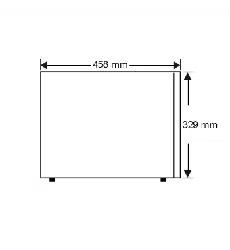
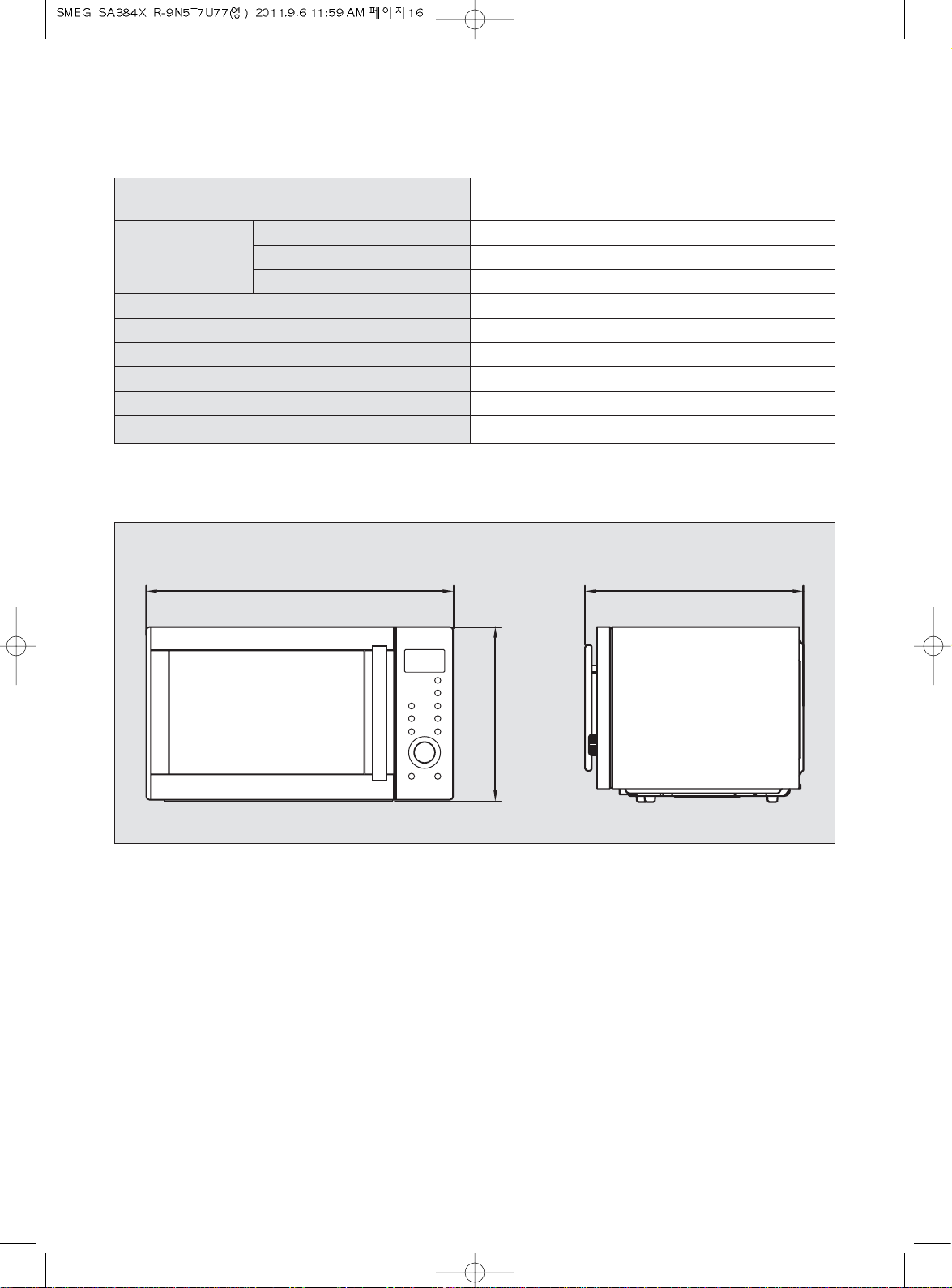
OUTSIDE DIMENSIONS (W x H x D) 546 x 329 x 458 mm
CAVITY DIMENSIONS (W x H x D) 350 x 240 x 367 mm
CAVITY VOLUME 29 L
NET WEIGHT APPROX. 17.8 Kg
TIMER 60 minutes
POWER SELECTIONS 5 Levels
* Specifications are subject to change without notice.
329
546 458
17
COOKING INSTRUCTIONS
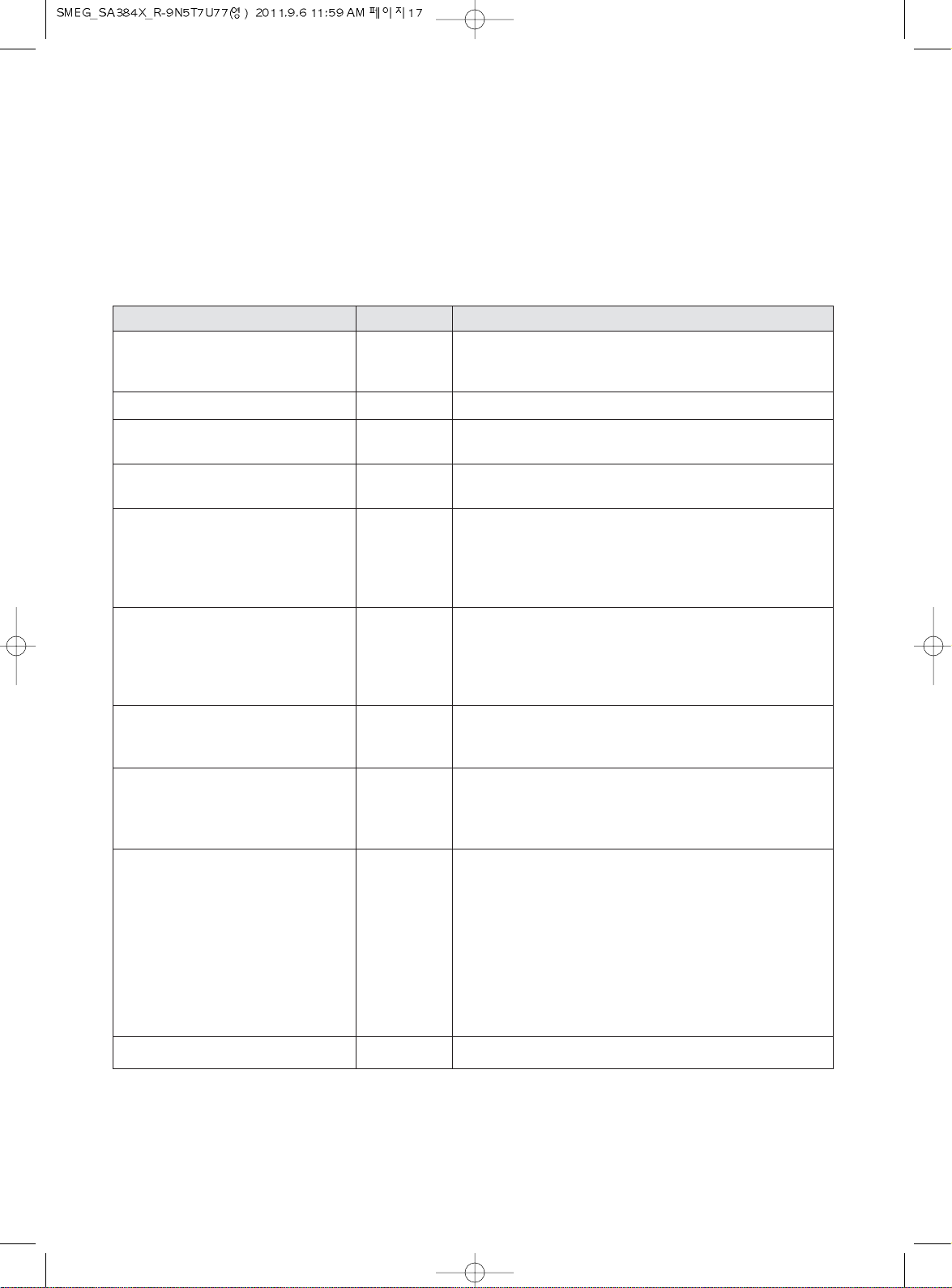
Utensil Guide
Only use utensils that are suitable for use in microwave ovens.
To cook food in the microwave oven, the microwaves must be able to penetrate the food, without
being reflected or absorbed by the dish used. Care must therefore be taken choosing the utensil. If the
utensil is marked microwave-safe, you do not need to worry. The following table lists various of utensil
and indicates whether and how they should be used in a microwave oven.
● : Recommended use
▲ : Limited Use
✕ : Not Recommended
Aluminium foil
Crust plate
China and earthenware
Disposable polyester
cardboard dishes
Fast-food packaging
• Polystyrene cups containers
• Paper bags or newspaper
• Recycled paper or metal trims
Glassware
• Oven-to-table ware
• Fine glassware
• Glass jars
Metal
• Dishes
• Freezer bag twist ties
Paper
• Plates, cups, napkins and
Kitchen paper
• Recycled paper
Plastic
• Containers
• Cling film
• Freezer bags
Wax or grease-proof paper
Utensil Safe Comments
Can be used in small quantities to protect areas against
overcooking. Arcing can occur if the foil is too close to
the oven wall or if too much foil is used.
Do not preheat for more than 8minutes.
Porcelain, pottery, glazed earthenware and bone china
are usually suitable, unless deco-rated with a metal trim.
Some frozen foods are packaged in these dishes.
Can be used to warm food. Overheating may cause the
polystyrene to melt.
May catch fire.
May cause arcing.
Can be used, unless decorated with a metal trim.
Can be used to warm foods or liquids.
Delicate glass may break or crack if heated suddenly.
Must remove the lid. Suitable for warming only.
May cause arcing or fire.
For short cooking times and warming. Also to absorb
excess moisture.
May cause arcing.
Particularly if heat-resistant thermoplastic. Some other
plastics may warp or discolour at high temperatures. Do
not use Melamine plastic.
Can be used to retain moisture. Should not touch the
food.
Take care when removing the film as hot steam will
escape.
Only if boilable or oven-proof. Should not be airtight.
Prick with a fork, if necessary.
Can be used to retain moisture and prevent spattering.
▲
●
●
●
●
✕
✕
●
●
●
✕
✕
●
✕
●
●
▲
●
18
USE YOUR MICROWAVE OVEN SAFELY
General Use
Do not attempt to defeat or tamper with safety
interlocks.
Do not place any object between the oven front
frame and the door or allow residue to build up on
sealing surfaces. Wipe with a mild detergent, rinse
and dry. Never use abrasive powders or buttons.
Do not subject the oven door to strain or weight such
as a child hanging on an open door.
This could cause the oven to fall forward resulting in
injury to you and damage to the oven.
Do not operate the oven if door seals or sealing
surfaces are damaged; or if door is bent; or if hinges
are loose or broken.
Do not operate the oven empty. This will damage the
oven.
Do not attempt to dry clothes, newspapers or other
materials in the oven. They may catch on fire.
Do not use recycled paper products as they may
contain impurities which may cause sparks or fires.
Do not hit or strike the control panel with hard
objects. This can damage the oven.
Food
Never use your microwave oven for home canning.
The oven is not designed for proper home canning.
Improperly canned food may spoil and be dangerous
to consume.
Always use the minimum recipe cooking time. It is
better to undercook rather than overcook foods.
Undercooked foods can be returned to the oven for
more cooking. If food is overcooked, nothing can be
done.
Heat small quantities of food or foods with low
moisture carefully. These can quickly dry out, burn or
catch on fire.
Do not heat eggs in the shell. Pressure may build up
and eggs can explode.
Potatoes, apples, egg yolks and sausages are
examples of food with non-porous skins.
These must be pierced before cooking to prevent
bursting.
Do not attempt to deep fat fry in your microwave
oven.
Always allow a standing time of at least 20 seconds
after the oven has been switched off to allow the
temperature to even out, stir during heating, if
necessary, and ALWAYS stir after heating. To
prevent eruptive boiling and possible scalding, you
should put a spoon or glass stick into the beverages
and stir before, during and after heating.
Do not leave the oven unattended while popping
corn.
Do not pop corn in a paper bag unless it is the
commercially prepared Microwave Popcorn product.
The kernels can overheat and ignite a brown paper
bag.
Do not put packaged Microwave Popcorn bags
directly on the oven tray. Place the package on a
microwave safe glass or ceramic plate to avoid
overheating and cracking the oven tray.
Do not exceed the Microwave Popcorn
manufacturers suggested popping time.
Longer popping does not yield more popcorn but it
can result in scorch, burn of fire. Remember, the
Popcorn bag and tray can be too hot to handle.
Remove with caution and use pot holders.
ARCING
If you see arcing, touch the STOP/CLEAR button and correct the problem.
Arcing is the microwave term for sparks in the oven.
Arcing is caused by:
• Metal or foil touching the side of the oven.
• Foil not molded to food (upturned edges act like
antennas).
• Metal, such as twist-ties, poultry pins, or gold
rimmed dishes, in the microwave.
• Recycled paper towels containing small metal
pieces being used in the microwave.

19
MICROWAVING PRINCIPLES
Microwave energy has been used in this country to cook and reheat food since early experiments with
RADAR in World War ll. Microwaves are present in the atmosphere all the time, both naturally and manmade
sources. Manmade sources include radar, radio, television, telecommunication links and car phones.
CONVERSION CHARTS
WEIGHT MEASURES
15 g
1
/2 oz.
25 g 1 oz.
50 g 2 oz.
100 g 4 oz.
175 g 6 oz.
225 g 8 oz.
450 g 1 lb.
HOW MICROWAVES COOK FOOD
Microwave oven is a Group 2 ISM equipment in which radio frequency energy is intentionally generated and
used in the form of electromagnetic radiation for the treatment of material. This oven is a Class B equipment
suitable for use in domestic establishments and in establishments directly connected to a low voltage power
supply network which supplies buildings used for domestic purposes.
VOLUME MEASURES
30 ml 1 fl.oz.
100 ml 3 fl.oz.
150 ml 5 fl.oz. (
1
/4 pt)
300 ml 10 fl.oz. (
1
/2 pt)
600 ml 20 fl.oz. (1pt)
SPOON MEASURES
1.25 ml
1
/4 tsp
2.5 ml
1
/2 tsp
5 ml 1 tsp
15 ml 1 tbsp
FLUID MEASUREMENTS
1 Cup = 8 fl.oz. = 240 ml
1 Pint = 16 fl.oz. (UK 20 fl.oz.) = 480 ml (UK 560 ml)
1 Quart = 32 fl.oz. (UK 40 fl.oz.) = 960 ml (UK 1120 ml)
1 Gallon = 128 fl.oz. (UK 160 fl.oz.) = 3840 ml (UK 4500 ml)
Then they pass through the
cooking containers to be
absorbed by the water
molecules in the food, all
foods contain water to a
more or lesser extent.
The microwaves cause the water molecules to
vibrate which causes FRICTION, i.e. HEAT. This
heat then cooks the food. Microwaves are also
attracted to fat and sugar particles, and foods high in
these will cook more quickly. Microwaves can only
penetrate to a depth of 4-5cm and as heat spreads
through the food by conduction, just as in a traditional
oven, the food cooks from the outside inwards.
In a microwave oven,
electricity is converted
into microwave by the
MAGNETRON.
The microwaves
bounce off the metal
walls and the metal
door screen.
Oven Cavity
Magnetron
Waveguide
Turntable
REFLECTION
TRANSMISSION
ABSORPTION
Microwave Water Molecule Absorption Vibration
20
STANDING TIME
Dense foods e.g. meat, jacket potatoes and
cakes, require standing time(inside or outside of
the oven) after cooking, to allow heat to finish
conducting to cook the center completely. Wrap
meat joints and jacket potatoes in aluminium foil
while standing. Meat joints need approx. 10-15
minutes, jacket potatoes 5 minutes. Other foods
such as plated meal, vegetables, fish etc require
2-5 minutes standing. After defrosting food,
standing time should also be allowed. If food is not
cooked after standing time, return to the oven and
cook for additional time.
MOISTURE CONTENT
Many fresh foods e.g. vegetables and fruit, vary in
their moisture content throughout the season,
particularly jacket potatoes. For this reason
cooking times may have to be adjusted. Dry
ingredients e.g. rice, pasta, can dry out during
storage so cooking times may differ.
DENSITY
Porous airy foods heat more quickly than dense
heavy foods.
CLING FILM
Cling film helps keep the food moist and the
trapped steam assists in speeding up cooking
times. Pierce before cooking to allow excess
steam to escape. Always take care when
removing cling film from a dish as the build-up of
steam will be very hot.
SHAPE
Even shapes cook evenly. Food cooks better by
microwave when in a round container rather than
square.
SPACING
Foods cook more quickly and evenly if spaced
apart. NEVER pile foods on top of each other.
STARTING TEMPERATURE
The colder the food, the longer it takes to heat up.
Food from a fridge takes longer to reheat than
food at room temperature.
LIQUIDS
All liquids must be stirred before and during
heating. Water especially must be stirred before
and during heating, to avoid eruption. Do not heat
liquids that have previously been boiled. DO NOT
OVERHEAT.
TURNING & STIRRING
Some foods require stirring during cooking. Meat
and poultry should be turned after half the cooking
time.
ARRANGING
Individual foods e.g. chicken portions or chops,
should be placed on a dish so that the thicker
parts are towards the outside.
QUANTITY
Small quantities cook faster than large quantities,
also small meals will reheat more quickly than
large portions.
PIERCING
The skin or membrane on some foods will cause
steam to build up during cooking. These foods
must be pierced or a strip of skin should be peeled
off before cooking to allow the steam to escape.
Eggs, potatoes, apples, sausages etc, will all need
to be pierced before cooking. DO NOT ATTEMPT
TO BOIL EGGS IN THEIR SHELLS.
COVERING
Cover foods with microwave cling film or a lid.
Cover fish, vegetables, casseroles, soups. Do not
cover cakes, sauces, jacket potatoes or pastry
items.
COOKING TECHNIQUES

21
▶ Do not defrost covered meat. Covering might allow
cooking to take place. Always remove outer wrap and
tray. Use only containers that are microwave-safe.
▶ Begin defrosting whole poultry breast-side-down.
Begin defrosting roasts fat-side-down.
▶ The shape of the package alters the defrosting time.
Shallow rectangular shapes defrost more quickly than
a deep block.
▶ After
1
/
3
of the defrost time has elapsed, check the
food. You may wish to turn over, break apart,
rearrange or remove thawed portions of the food.
▶ During defrost, the oven will prompt you to turn the
food over. At this point, open oven door and check the
food. Follow the techniques listed below for optimum
defrost results.
Then, close oven door, touch the START button to
complete defrosting.
▶ When defrosted, food should be cool, but softened in
all areas. If still slightly icy, return to microwave oven
very briefly, or let stand a few minutes. After
defrosting, allow food to stand 5-60 minutes if there
are any icy areas.
Poultry and fish may be placed under running cool
water until defrosted
➪Turn over : Roast, ribs, whole poultry, turkey breasts,
hot dogs, sausages, steaks, or chops.
➪Rearrange : Break apart or separate steaks, chops,
hamburger patties, ground meat, chicken or seafood
pieces, chunks of meat such as stew beef.
➪Shield : Use small strips of aluminum foil to protect
thin areas or edges of unevenly shaped foods such as
chicken wings. To prevent arching, do not allow foil to
come within 1-inch of oven walls or door.
➪Remove : To prevent cooking, thawed portions should
be removed from the oven at this point. This may
shorten defrost time for food weighing less than 3
lbs.(1350g).
DEFROSTING GUIDE
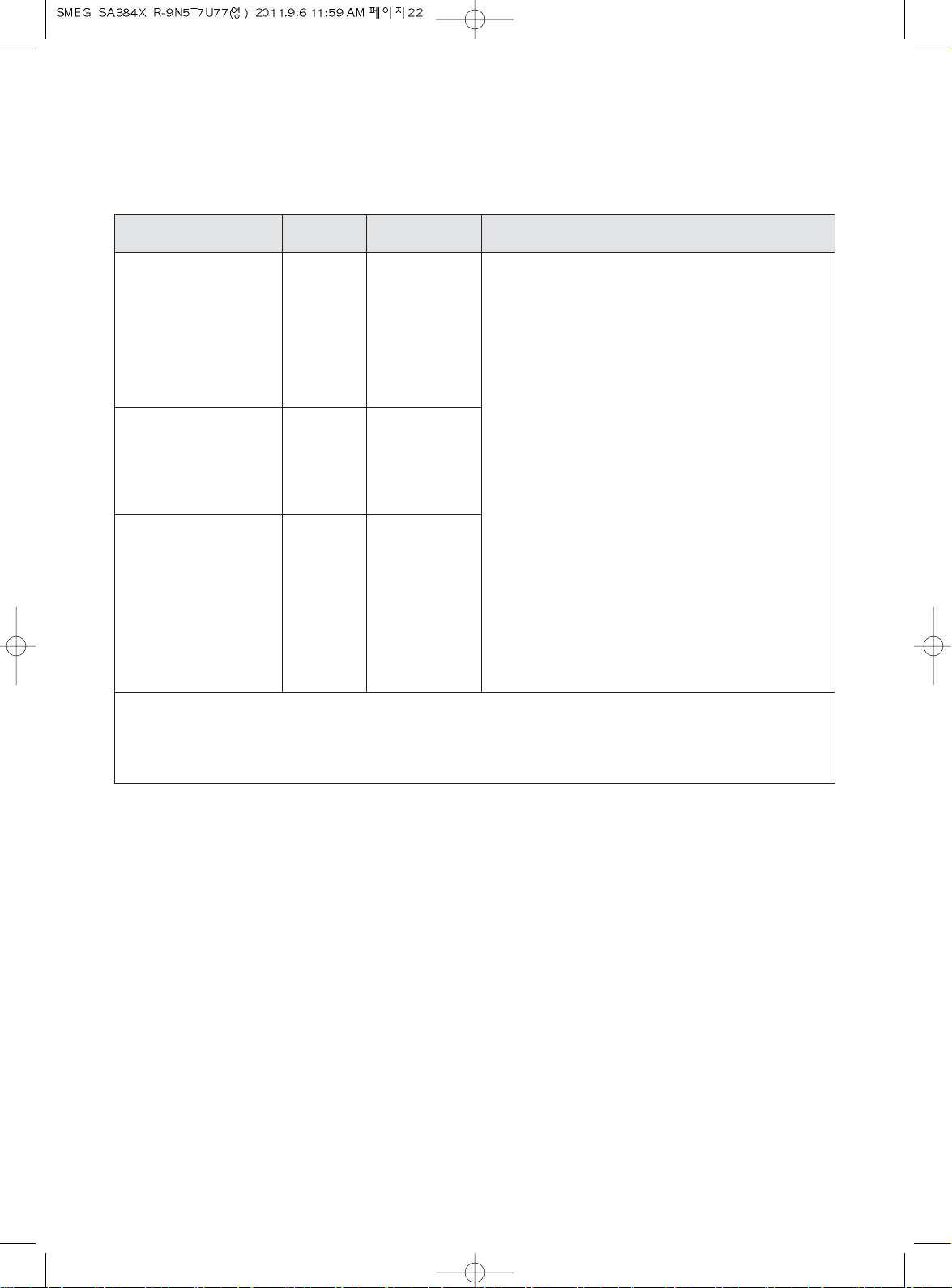
DEFROSTING CHART (by Time Defrost)
Item & Weight Defrosting Time Standing Time Special Techniques
BEEF
Minced beef
1 lb./450g
Stew Meat
1
1
/2
lbs./675g
Patties
4(4oz./110g)
PORK
Spareribs
1 lb./450g
Chops
4(5oz./125g)
Minced pork
1 lb./450g
POULTRY
Whole Chicken
2
1
/2
lbs./1125g
Chicken Breasts
1 lbs./450g
Fryer Chicken(cut up)
2 lbs./900g
Chicken Thights
1
1
/
2
lbs./675g
FISH & SEAFOOD
Whole Fish
1 lb./450g
Fish Fillets
1
1
/2
lb./675g
Shrimp
1
/
2
lb./225g
8-10 min.
12-14 min.
8-10 min.
8-10 min.
9-11 min.
8-10 min.
20-23 min.
8-10 min.
16-18 min.
12-14 min.
8-10 min.
12-14 min.
4-5 min.
15-20 min.
25-30 min.
15-20 min.
25-30 min.
25-30 min.
15-20 min.
45-90 min.
15-30 min.
25-30 min.
15-30 min.
15-20 min.
15-20 min.
15-20 min.
Break apart and remove thawed portions
with fork.
Separate and rearrange once.
Turn over after half the time.
Separate and rearrange once.
Separate and turn over once.
Break apart and remove thawed portions
with fork.
Break side down. Turn over after half the
time. Shield as needed.
Separate and rearrange once.
Separate and rearrange once.
Separate and rearrange once.
Turn over after half the time.
Shield as needed.
Separate and turn over once.
Separate and rearrange once.
* The times are approximate because freezer temperatures vary.
22
COOKING & REHEATING CHART
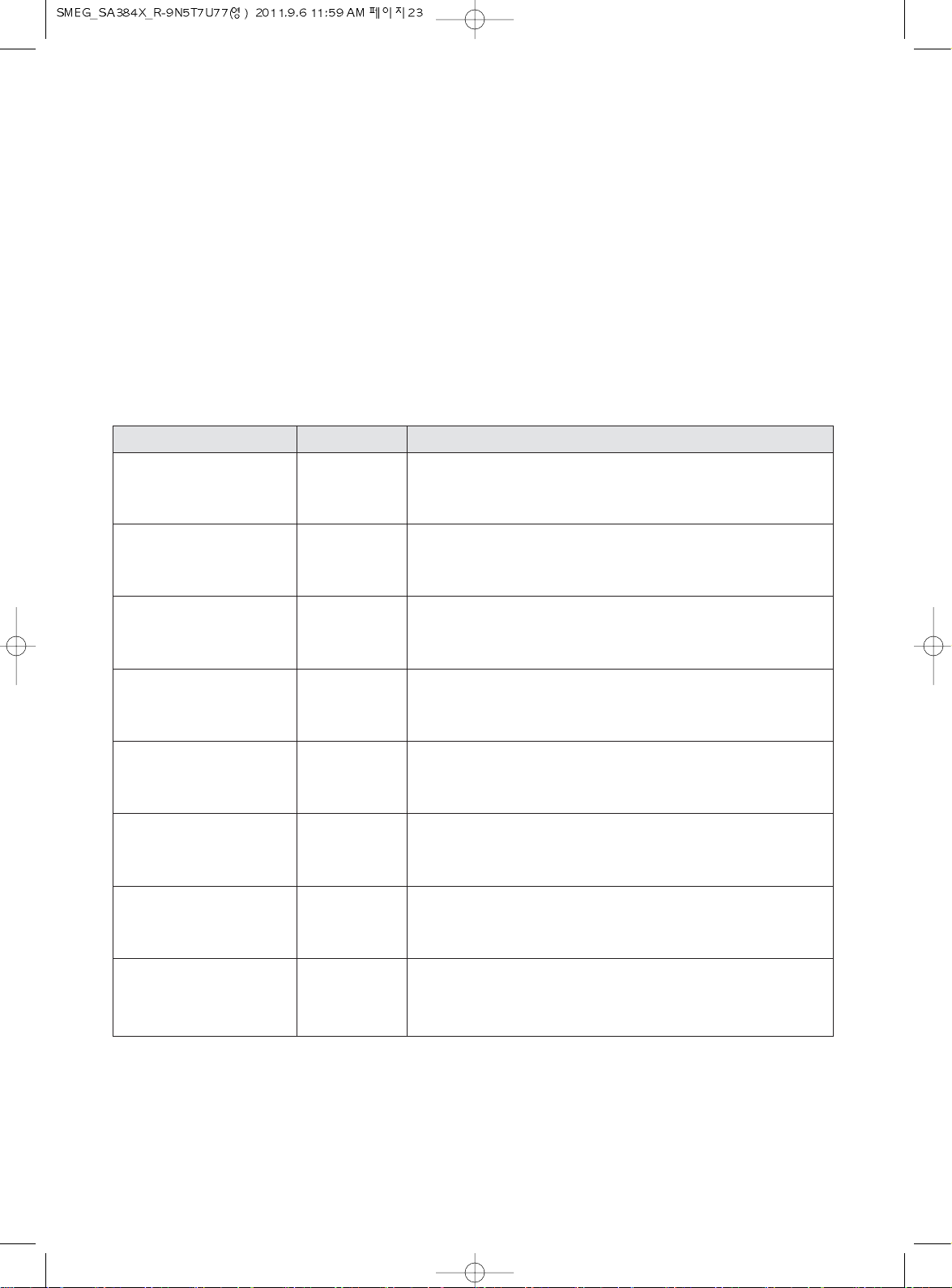
Cooking chart
MEAT
Beef joint - Rare P-80 8-10 min.
- Medium P-80 9-11 min.
- well done P-80 11-13 min.
Pork Joint P-HI 12-14 min.
Bacon joint P-HI 8-10 min.
POULTRY
Whole chicken P-HI 6-8 min.
Portions chicken P-80 5-7 min.
Breast (boned) P-80 6-8 min.
FISH
Fish Fillets P-HI 6-8 min.
Whole Mackerel, P-HI 6-8 min.
Cleaned and prepared
Whole Trout, Cleaned P-HI 7-8 min.
& Prepared
Salmon steaks P-HI 6-8 min.
NOTE : The above times should be regarded only as a guide. Allow for difference in individual tastes and
preferences. The times may vary due to the shape, cut, and composition of the food.
Frozen meat, poultry and fish must be thoroughly thawed before cooking.
Item
Power Cooking Time
Special Instruction
Level Per lb./450g
- Chilled meat and poultry should be removed from
the refrigerator at least 30 minutes before
cooking.
- Always let the meat and poultry stand, covered
after cooking.
- Brush a little oil or melted butter over the fish, or
add 15~30ml(1-2 tbsp) lemon juice, wine, stock,
milk or water.
- Always let the fish stand, covered, after cooking
23
Reheating chart
• Baby food particularly needs to be checked carefully before serving to prevent burns.
• When heating pre-packaged ready-cooked foods, always follow the pack instructions carefully.
• If you freeze foods which were bought from the fresh or chilled counters, remember that they should
be thoroughly thawed before following the heating instructions on the packed. It’s worth putting a
note on them so that other members of the household will remember too.
• Remember metal ties and transfer food from foil containers before reheating.
• Chilled(refrigerated) food takes longer to reheat than food at room temperature (such as just-cooled
food or food from the store cupboard).
• All foods should be reheated using full microwave power.
Baby food 30 sec.
128g jar
Baby milk
100ml / 4fl.oz. 20-30 sec.
225ml / 8fl.oz. 40-50 sec.
Sandwich roll or bun
1 roll 20-30 sec.
Lasagna
1 serving 4-6 min.
(10
1
/2 oz./300g)
Casserole
1 cup 1
1
/2-3 min.
4 cups 5-7 min.
Mashed potatoes
1 cup 2-3 min.
4 cups 6-8 min.
Baked beans
1 cup 2-3 min.
Ravioli or pasta in sauce
1 cup 3-4 min.
4 cups 7-10 min.
Item Cooking time Special Instructions
Empty into a small serving bowl.
Stir well once or twice during heating.
Before serving, check the temperature carefully.
Stir or shake well and pour into a sterilized bottle.
Before serving, shake well and check the temperature carefully.
Wrap in paper towel and place on glass microwaveable rack.
*Note : Do not use recycled paper towels.
Place lasagna on microwaveable plate.
Cover with plastic wrap and vent.
Cook covered in microwaveable casserole.
Stir once halfway through cooking.
Cook covered in microwaveable casserole.
Stir once halfway through cooking.
Cook covered in microwaveable casserole.
Stir once halfway through cooking.
Cook covered in microwaveable casserole.
Stir once halfway through cooking.

24
VEGETABLE CHART
Use a suitable glass pyrex bowl with lid. Add 30-45ml cold water(2-3 tbsp.) for every 250g unless
another water quantity is recommended - see table. Cook covered for the minimum time - see table.
Continue cooking to get the result you prefer. Stir once during and once after cooking. Add salt, herbs
or butter after cooking. Cover during a standing time of 3 minutes.
Hint : cut the fresh vegetables into even sized pieces. The smaller they are cut, the quicker they will
cook.
All vegetables should be cooked using full microwave power.
Cooking Guide for fresh vegetables
Cooking Guide for frozen vegetables
Broccoli
1
/2 lb./250g
1 lb./500g
Brussels sprouts
1
/2 lb./250g
Carrots
1
/2 lb./250g
Cauliflower
1
/2 lb./250g
1 lb./500g
Courgettes
1
/2
lb./250g
Egg plants
1
/2 lb./250g
Leeks
1
/2
lb./250g
Mushrooms 0.3 lb./125g
1
/2 lb./250g
Onions
1
/2 lb./250g
Pepper
1
/2 lb./250g
Potatoes
1
/2 lb./250g
1 lb./500g
Turnip cabbage
1
/2 lb./250g
Vegetables Weight Time Comments
Prepare even sized florets.
Arrange the stems to the centre.
Add 60-75ml(5-6tbsp.) water.
Cut carrots into even sized slices.
Prepare even sized florets. Cut big florets into halves.
Arrange stems to the centre.
Cut courgettes into slices. Add 30ml(2tbsp.) water or a
knob of butter. Cook until just tender.
Cut egg plants into small slices and sprinkle with 1
tablespoon lemon juice.
Cut leeks into thick slices.
Prepare small whole or sliced mushrooms. Do not add
any water. Sprinkle with lemon juice. Spice with salt and
pepper. Drain before serving.
Cut onions into slices or halves. Add only 15ml(1tbsp.)
water.
Cut pepper into small slices.
Weigh the peeled potatoes and cut them into similar
sized halves or quarters.
Cut turnip cabbage into small cubes.
2-3min
4-6min
3-4min
2-3min
2-3min
4-6min
2-3min
2-3min
2-3min
1-2min
2-4min
2-3min
2-4min
2-4min
7-9min
4-6min
spinach 0.3 lb./125g
broccoli
1
/2 lb./250g
Peas
1
/
2 lb./250g
Green beans
1
/2 lb./250g
Mixed vegetables
1
/2 lb./250g
(carrots/peas/corn)
Mixed vegetables
1
/2 lb./250g
(Chinese style)
Vegetables Weight Time Instructions
Add 15ml(1tbsp.) cold water.
Add 30ml(2 tbsp.) cold water.
Add 15ml(1 tbsp.) cold water.
Add 30ml(2t tbsp.) cold water.
Add 15ml(1ttbsp.) cold water.
Add 15ml(1 tbsp.) cold water.
2-3 min
3-4 min
3-4 min
4-5 min
3-5 min
4-6 min
25
RECIPES
TOMATO & ORANGE SOUP
1 oz.(25g) butter
1 medium onion, chopped
1 large carrot & 1 large potato, chopped
1
3
/4lb(800g) canned, chopped tomatoes
juice and grated rind of 1 small orange
1
1
/2pints(900ml) hot vegetable stock
salt and pepper to taste
1.Melt the in a large bowl at P-HI for 1 minute.
2. Add the onion, carrot and potato and cook at
P-HI for 5 minutes. stir halfway through cooking.
3.Add the tomatoes, orange juice, orange rind
and stock. Mix thoroughly. Season with salt and
pepper to taste. Cover the bowl and cook at P-
HI for 13 minutes. stir 2-3 times during cooking,
until the vegetables are tender.
4.Blend and serve immediately.
FRENCH ONION SOUP
1 large onions, sliced
1 tbsp (15ml) corn oil
2 oz.(50g) plain flour
2 pints(1.2 liters) hot meat
or vegetable stock
salt and pepper to taste
2 tbsp (30ml) parsley, chopped
4 thick slices French bread
2 oz.(50g) cheese, grated
1.Place the onion and oil a bowl, mix well and
cook at P-HI for 2 minutes.
2.Stir in the flour to make a paste and gradually
add stack. Season and add the parsley.
3.Cover the bowl and cook at P-80 for 14
minutes.
4.Pour the soup into serving bowls, submerge
bread and sprinkle generously with cheese.
5.Cook at P-80 for 2 minutes, until the cheese
has melted.
STIR FRIED VEGETABLES
1 tbsp(15ml) sunflower oil
2 tbsp (30ml) soy sauce
1 tbsp (15ml) sherry
1"(2.5cm) root ginger,
peeled and finely grated
2 medium carrots, cut into fine strips
4 oz.(100g) button mushrooms,
chopped
2 oz.(50g) bean sprouts
4 oz.(100g) mange-tout
1 red pepper, seeded and thinly sliced
4 spring onions, chopped
4 oz.(100g) canned water chestnuts,
sliced
1
/4 head of chinese leaves, thinly sliced
1.Place the oil, soy sauce, sherry, ginger, garlic
and carrots in a large bowl, mix thoroughly
2.Cover and cook at P-HI for 3-4 minutes, stirring
once.
3.Add the button mushrooms, bean sprouts,
mange-tout, red pepper, spring onions, water
chestnuts and chinese leaves. Mix thoroughly.
4.Cook at P-HI for 4-5 minutes, until the
vegetables are tender. Stir 2-3 times during
cooking.
Stir fried vegetables are ideally served with
meat or fish.
HONEYED CHICKEN
4 boneless chicken breasts
2 tbsp(30ml) clear honey
1 tbsp(15ml) whole grain mustard
1
/2 tsp(2.5ml) dried tarragon
1 tbsp(15ml) tomato puree
1
/4 pint(150ml) chicken stock
1.Place the chicken breasts in a casserole dish.
2.Mix all remaining ingredients together and pour
over the chicken. Salt and pepper to taste.
3.Cook at P-HI for 11-12 minutes. Rearrange and
coat the chicken with the sauce twice during
cooking.
26
BLUE CHEESE & CHIVE JACKETS
2 baking potatoes,
(approx.9 oz.(250g) each)
2 oz.(50g) butter
4 oz.(100g) blue cheese, chopped
1 tbsp(15ml) fresh chives, chopped
2 oz.(50g) mushrooms, sliced
salt and pepper to taste
1.Prick each potato in several places. Cook at P-
HI for 7-9 minutes. Halve and scoop the flesh
into a bowl, add the butter, cheese, chives,
mushrooms, salt and pepper, mix thoroughly.
2.Pile mixture into the potato skins and place in a
flan dish, on the rack.
3.Cook at P-80 for 8 minutes.
WHITE SAUCE
1 oz.(25g) butter
1 oz.(25g) plain flour
1
/2 pint(300ml) milk
salt and pepper to taste
1.Place the butter in a bowl and cook at P-HI for 1
minute, until melted.
2.Stir in the flour and whisk in the milk.
Cook at P-HI for 3-4 minutes, stirring every 2
minutes until thick and smooth. Season with salt
and pepper to taste.
STRAWBERRY JAM
1
1
/2
lb.(675g) strawberries, hulled
3 tbsp(45ml) lemon juice
1
1
/2
lb.(675g) caster sugar
1.Place strawberries and lemon juice in a very
large bowl, heat at P-HI for 4 minutes, or until
the fruit has softened. Add sugar, mix well.
2.Cook at P-80 for 20-25 minutes, until setting
point*is reached, stir every 4-5 minutes.
3.Pour into hot, clean jars. Cover, seal and label.
* setting point : To determine setting point, place
1 tsp(5ml)jam onto chilled saucer. Allow to stand
for 1 minute. Move surface of jam gently with
your finger, if the surface wrinkles setting point
has been reached.
PLAIN MICROWAVE CAKE
4 oz.(100g) margarine
4 oz.(100g) sugar
1 eggs
4 oz.(100g) self raising flour, sifted
2-3 tbsp(30-45ml) milk
1.line the base of 8" (20.4cm) cake dish with
grease-proof paper.
2.Cream the margarine and sugar together until
light and fluffy. Beat in the eggs and fold in the
sifted flour alternately with the milk.
3.Pour into prepared container. Cook at P-HI for
3-4 minutes, until a skewer comes out cleanly.
4.Leave the cake to stand for 5 minutes before
turning out.
OMELETTS
1
/2 oz.(15g) butter
4 eggs
6 tbsp(90ml) milk
salt & pepper
1.Whisk together eggs and milk. Season.
2.Place butter in 10"(26cm) flan dish.
Cook at P-HI for 1 minute, until melted.
Coat the dish with the melted butter.
3.Pour omelette mixture into flan dish.
Cook at P-HI for 2 minutes. whisk mixture and
cook again at P-HI for 1 minutes.
27
SCRAMBLED EGG
1
/2 oz.(15g) butter
2 eggs
2 tbsp(30ml) milk
salt & pepper
1.Melt the butter in a bowl at P-HI for 1 minutes.
2.Add the eggs, milk and seasoning and mix well.
3.Cook at P-HI for 2 minutes, stirring every 30
seconds.
SAVORY MINCE
1 small onion, diced
1 clove garlic, crushed
1 tsp(5ml) oil
7 oz.(200g) can chopped tomatoes
1 tbsp(15ml) tomato puree
1 tsp(5ml) mixed herbs
8 oz.(225g) minced beef
salt and pepper
1.Place onion, garlic and oil in casserole, and
cook at P-HI for 2 minutes or until soft.
2.Place all other ingredients in casserole. Stir
well.
3.Cover and cook at P-HI for 4 minutes then P-80
for 8-12 minutes or until the meat is cooked.