Operator's Manual
CRAFrSMAN°
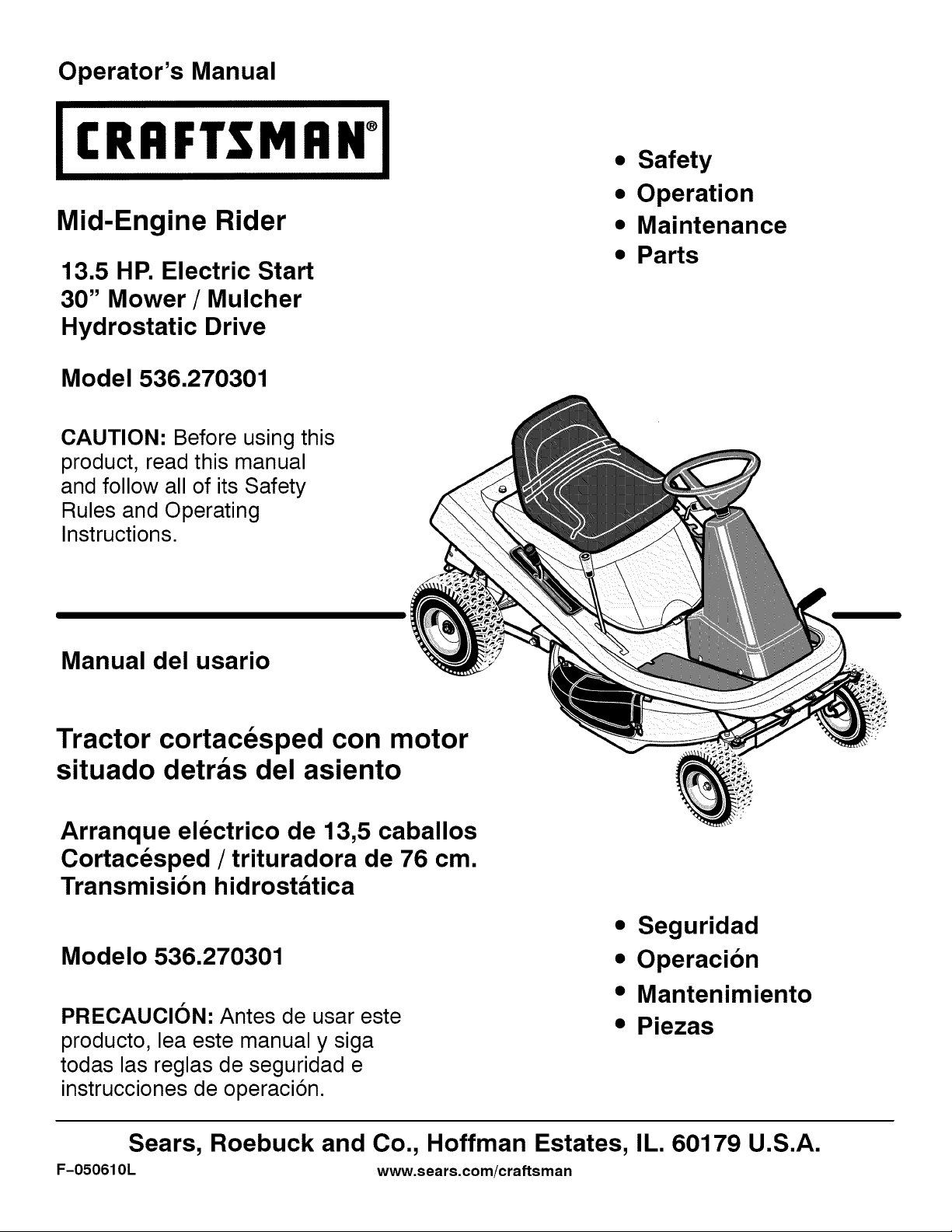
Mid-Engine Rider
13.5 HP. Electric Start
30" Mower / Mulcher
Hydrostatic Drive
Model 536.270301
• Safety
• Operation
• Maintenance
• Parts
CAUTION: Before using this
product, read this manual
and follow all of its Safety
Rules and Operating
Instructions.
Manual del usario
Tractor cortacesped con motor
situado detras del asiento
Arranque electrico de 13,5 caballos
Cortacesped / trituradora de 76 cm.
Transmision hidrostatica
Modelo 536.270301
PRECAUCION: Antes de usar este
producto, lea este manual y siga
todas las reglas de seguridad e
instrucciones de operaciSn.
• Seguridad
• Operacion
• Mantenimiento
• Piezas
Sears, Roebuck and Co., Hoffman Estates, IL. 60179 U.S.A.
F-050610L www.sears.com/craftsman
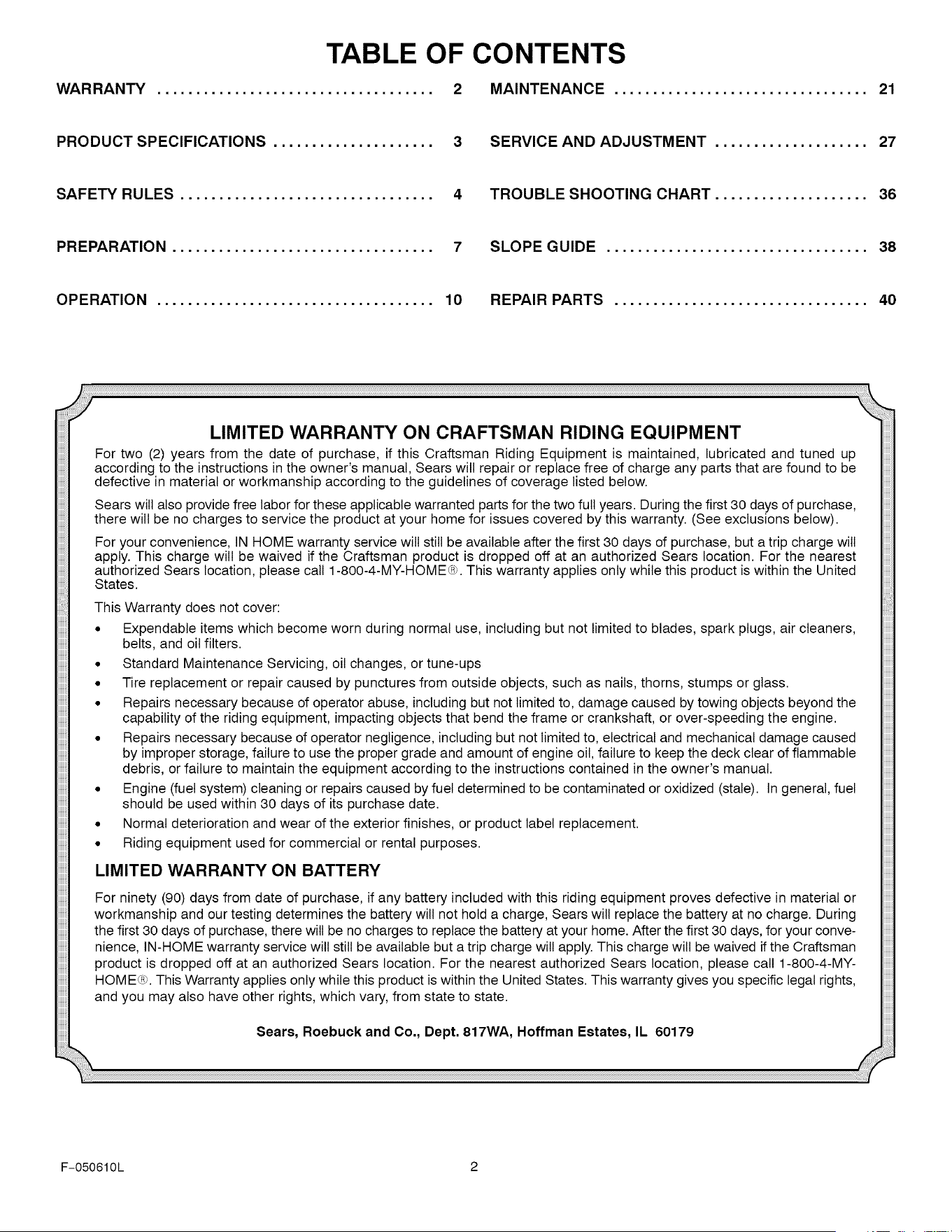
TABLE OF CONTENTS
WARRANTY .................................... 2 MAINTENANCE ................................. 21
PRODUCT SPECIFICATIONS ..................... 3 SERVICE AND ADJUSTMENT .................... 27
SAFETY RULES ................................. 4 TROUBLE SHOOTING CHART .................... 36
PREPARATION .................................. 7 SLOPE GUIDE .................................. 38
OPERATION .................................... 10 REPAIR PARTS ................................. 40
LIMITED WARRANTY ON CRAFTSMAN RIDING EQUIPMENT
For two (2) years from the date of purchase, if this Craftsman Riding Equipment is maintained, lubricated and tuned up
according to the instructions in the owner's manual, Sears wilt repair or replace free of charge any parts that are found to be
defective in material or workmanship according to the guidelines of coverage listed below.
Sears will also provide free labor for these applicable warranted parts for the two full years. During the first 30 days of purchase,
there will be no charges to service the product at your home for issues covered by this warranty. (See exclusions below).
For your convenience, IN HOME warranty service will still be available after the first 30 days of purchase, but a trip charge will
apply. This charge will be waived if the Craftsman product is dropped off at an authorized Sears location. For the nearest
authorized Sears location, please call 1-800-4-MY-HOME®. This warranty applies only while this product is within the United
States.
This Warranty does not cover:
• Expendable items which become worn during normal use, including but not limited to blades, spark plugs, air cleaners,
belts, and oil filters.
• Standard Maintenance Servicing, oil changes, or tune-ups
• Tire replacement or repair caused by punctures from outside objects, such as nails, thorns, stumps or glass.
• Repairs necessary because of operator abuse, including but not limited to, damage caused by towing objects beyond the
capability of the riding equipment, impacting objects that bend the frame or crankshaft, or over-speeding the engine.
• Repairs necessary because of operator negligence, including but not limited to, electrical and mechanical damage caused
by improper storage, failure to use the proper grade and amount of engine oil, failure to keep the deck clear of flammable
debris, or failure to maintain the equipment according to the instructions contained in the owner's manual.
• Engine (fuel system) cleaning or repairs caused by fuel determined to be contaminated or oxidized (stale). In general, fuel
should be used within 30 days of its purchase date.
• Normal deterioration and wear of the exterior finishes, or product label replacement.
• Riding equipment used for commercial or rental purposes.
LIMITED WARRANTY ON BATTERY
For ninety (90) days from date of purchase, if any battery included with this riding equipment proves defective in material or
workmanship and our testing determines the battery will not hold a charge, Sears will replace the battery at no charge. During
the first 30 days of purchase, there will be no charges to replace the battery at your home. After the first 30 days, for your conve-
nience, IN-HOME warranty service will still be available but a trip charge will apply. This charge will be waived if the Craftsman
product is dropped off at an authorized Sears location. For the nearest authorized Sears location, please call 1-800-4-MY-
HOME®. This Warranty applies only while this product is within the United States. This warranty gives you specific legal rights,
and you may also have other rights, which vary, from state to state.
Sears, Roebuck and Co., Dept. 817WA, Hoffman Estates, IL 60179
F-O50610L 2
Congratulations on your purchase of a Craftsman Mid-Engine
Rider. It has been designed, engineered and manufactured to
give you the best possible dependability and performance.
If you experience any problems you cannot easily remedy, please
see your nearest Sears Service Center. We have competent, well
trained technicians and the proper tools to service or repair this
unit.
Please read and keep this manual. The instructions will enable
you to assemble and maintain your unit properly. Always observe
the "Safety Rules".
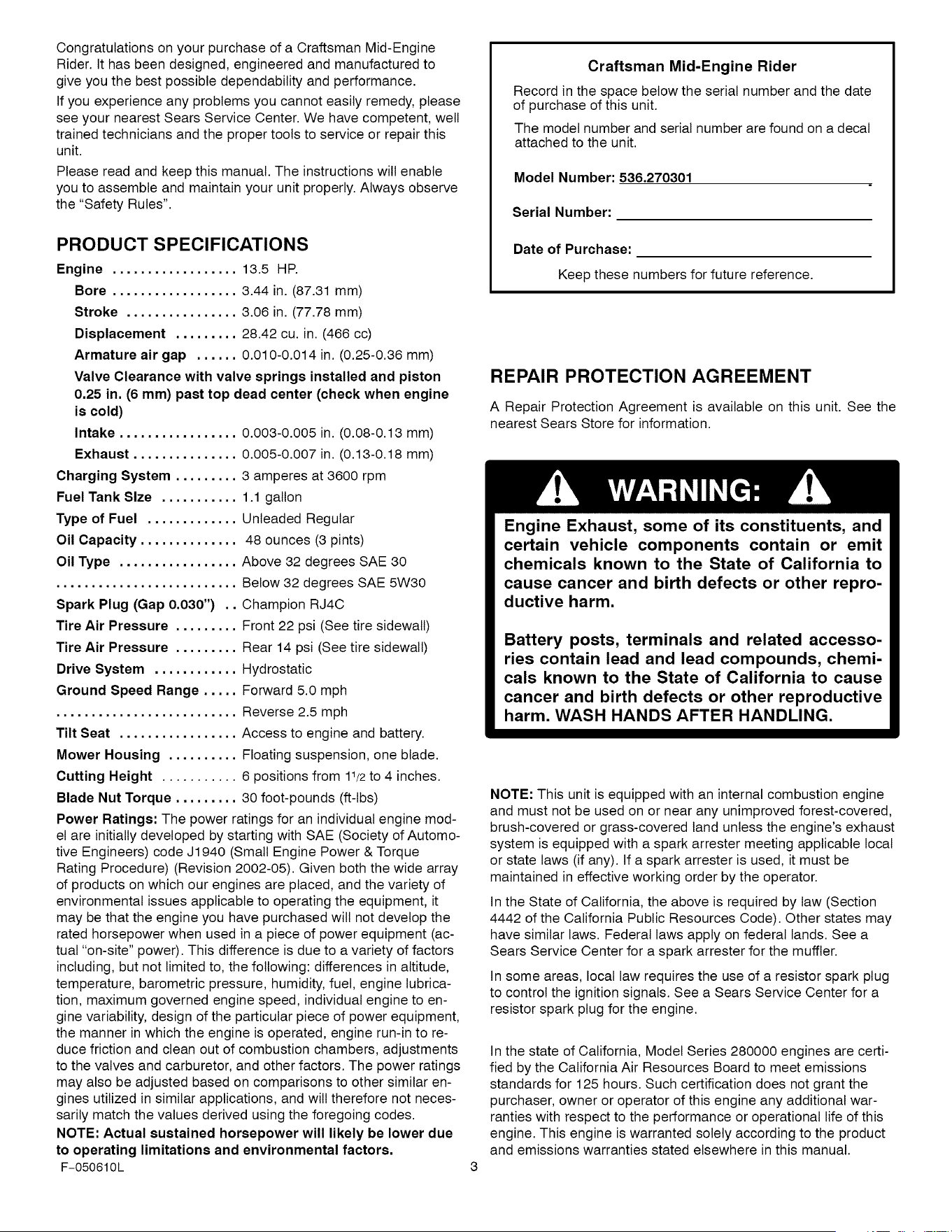
PRODUCT SPECIFICATIONS
Engine .................. 13.5 HR
Bore .................. 3.44 in. (87.31 mm)
Stroke ................ 3.06 in. (77.78 mm)
Displacement ......... 28.42 cu. in. (466 cc)
Armature air gap ...... 0.010-0.014 in. (0.25-0.36 mm)
Valve Clearance with valve springs installed and piston
0.25 in. (6 mm) past top dead center (check when engine
is cold)
Intake ................. 0.003-0.005 in. (0.08-0.13 mm)
Exhaust ............... 0.005-0.007 in. (0.13-0.18 mm)
Charging System ......... 3 amperes at 3600 rpm
Fuel Tank Size ........... 1.1 gallon
Type of Fuel ............. Unleaded Regular
Oil Capacity .............. 48 ounces (3 pints)
Oil Type ................. Above 32 degrees SAE 30
.......................... Below 32 degrees SAE 5W30
Spark Plug (Gap 0.030") .. Champion RJ4C
Tire Air Pressure ......... Front 22 psi (See tire sidewall)
Tire Air Pressure ......... Rear 14 psi (See tire sidewall)
Drive System ............ Hydrostatic
Ground Speed Range ..... Forward 5.0 mph
.......................... Reverse 2.5 mph
Tilt Seat ................. Access to engine and battery.
Mower Housing .......... Floating suspension, one blade.
Cutting Height ........... 6 positions from 11/2to 4 inches.
Blade Nut Torque ......... 30 foot-pounds (ft-lbs)
Power Ratings: The power ratings for an individual engine mod-
el are initially developed by starting with SAE (Society of Automo-
tive Engineers) code J1940 (Small Engine Power & Torque
Rating Procedure) (Revision 2002-05). Given both the wide array
of products on which our engines are placed, and the variety of
environmental issues applicable to operating the equipment, it
may be that the engine you have purchased will not develop the
rated horsepower when used in a piece of power equipment (ac-
tual "on-site" power). This difference is due to a variety of factors
including, but not limited to, the following: differences in altitude,
temperature, barometric pressure, humidity, fuel, engine lubrica-
tion, maximum governed engine speed, individual engine to en-
gine variability, design of the particular piece of power equipment,
the manner in which the engine is operated, engine run-in to re-
duce friction and clean out of combustion chambers, adjustments
to the valves and carburetor, and other factors. The power ratings
may also be adjusted based on comparisons to other similar en-
gines utilized in similar applications, and will therefore not neces-
sarily match the values derived using the foregoing codes.
NOTE: Actual sustained horsepower will likely be lower due
to operating limitations and environmental factors.
F-050610L
Craftsman Mid-Engine Rider
Record in the space below the serial number and the date
of purchase of this unit.
The model number and serial number are found on a decal
attached to the unit.
Model Number: 536.270301
Serial Number:
Date of Purchase:
Keep these numbers for future reference.
REPAIR PROTECTION AGREEMENT
A Repair Protection Agreement is available on this unit. See the
nearest Sears Store for information.
Engine Exhaust, some of its constituents, and
certain vehicle components contain or emit
chemicals known to the State of California to
cause cancer and birth defects or other repro-
ductive harm,
Battery posts, terminals and related accesso-
ries contain lead and lead compounds, chemi-
cals known to the State of California to cause
cancer and birth defects or other reproductive
harm. WASH HANDS AFTER HANDLING.
NOTE: This unit is equipped with an internal combustion engine
and must not be used on or near any unimproved forest-covered,
brush-covered or grass-covered land unless the engine's exhaust
system is equipped with a spark arrester meeting applicable local
or state laws (if any). If a spark arrester is used, it must be
maintained in effective working order by the operator.
In the State of California, the above is required by law (Section
4442 of the California Public Resources Code). Other states may
have similar laws. Federal laws apply on federal lands. See a
Sears Service Center for a spark arrester for the muffler.
In some areas, local law requires the use of a resistor spark plug
to control the ignition signals. See a Sears Service Center for a
resistor spark plug for the engine.
In the state of California, Model Series 280000 engines are certi-
fied by the California Air Resources Board to meet emissions
standards for 125 hours. Such certification does not grant the
purchaser, owner or operator of this engine any additional war-
ranties with respect to the performance or operational life of this
engine. This engine is warranted solely according to the product
and emissions warranties stated elsewhere in this manual.
SAFETY RULES
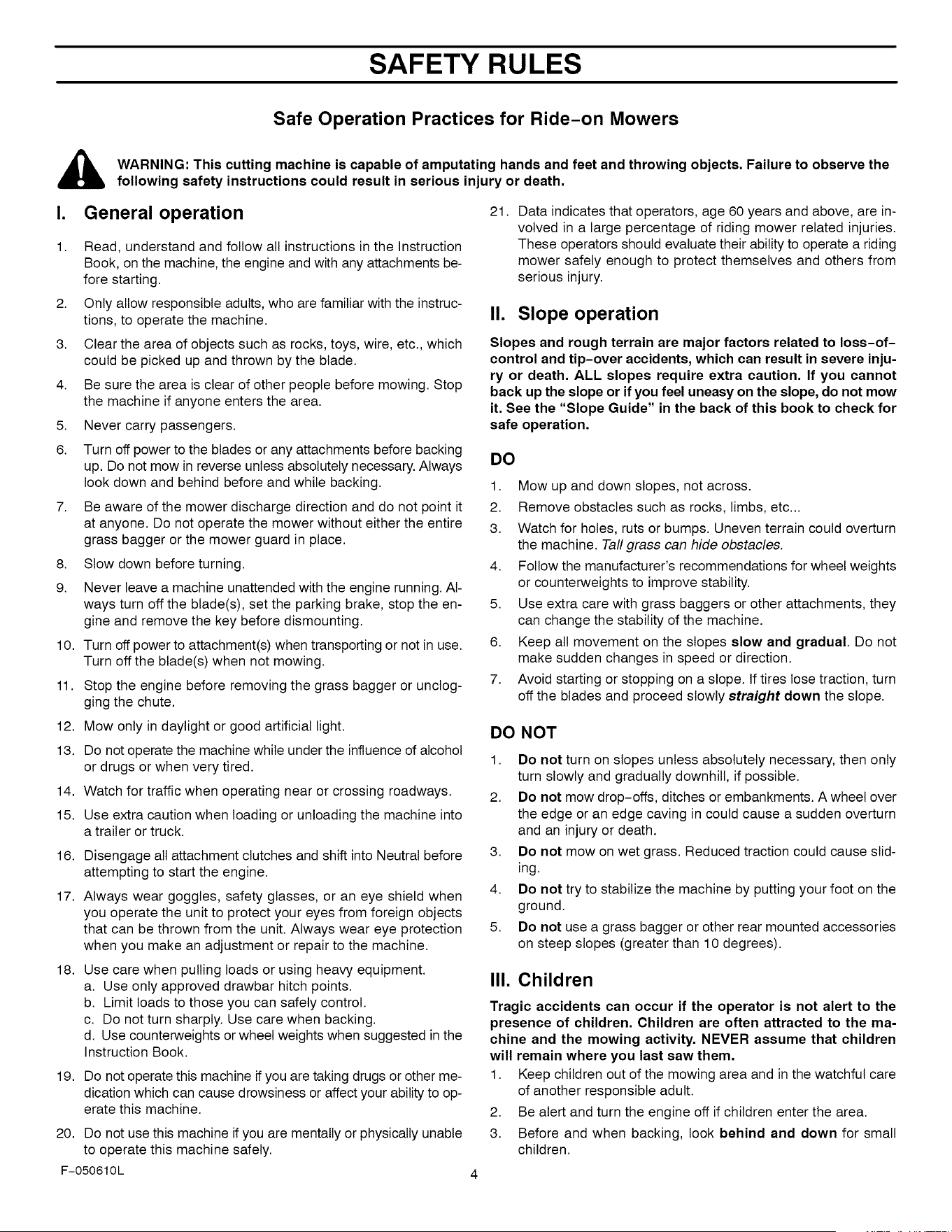
Safe Operation Practices for Ride-on Mowers
,_ WARNING: This cutting machine is capable of amputating hands and feet and throwing objects. Failure to observe the
following safety instructions could result in serious injury or death.
L
1.
General operation
Read, understand and follow all instructions in the Instruction
Book, on the machine, the engine and with any attachments be-
fore starting.
2. Only allow responsible adults, who are familiar with the instruc-
tions, to operate the machine.
3. Clear the area of objects such as rocks, toys, wire, etc., which
could be picked up and thrown by the blade.
4. Be sure the area is clear of other people before mowing. Stop
the machine if anyone enters the area.
5. Never carry passengers.
6. Turn off power to the blades or any attachments before backing
up. Do not mow in reverse unless absolutely necessary. Always
look down and behind before and while backing.
7. Be aware of the mower discharge direction and do not point it
at anyone. Do not operate the mower without either the entire
grass bagger or the mower guard in place.
8. Slow down before turning.
9. Never leave a machine unattended with the engine running. Al-
ways turn off the blade(s), set the parking brake, stop the en-
gine and remove the key before dismounting.
10. Turn off power to attachment(s) when transporting or not in use.
Turn off the blade(s) when not mowing.
11. Stop the engine before removing the grass bagger or unclog-
ging the chute.
12. Mow only in daylight or good artificial light.
13. Do not operate the machine while under the influence of alcohol
or drugs or when very tired.
14. Watch for traffic when operating near or crossing roadways.
15. Use extra caution when loading or unloading the machine into
a trailer or truck.
16.
17.
18.
19.
20.
Disengage all attachment clutches and shift into Neutral before
attempting to start the engine.
Always wear goggles, safety glasses, or an eye shield when
you operate the unit to protect your eyes from foreign objects
that can be thrown from the unit. Always wear eye protection
when you make an adjustment or repair to the machine.
Use care when pulling loads or using heavy equipment.
a. Use only approved drawbar hitch points.
b. Limit loads to those you can safely control.
c. Do not turn sharply. Use care when backing.
d. Use counterweights or wheel weights when suggested in the
Instruction Book.
Do not operate this machine if you are taking drugs or other me-
dication which can cause drowsiness or affect your ability to op-
erate this machine.
Do not use this machine if you are mentally or physically unable
to operate this machine safely.
21. Data indicates that operators, age 60 years and above, are in-
volved in a large percentage of riding mower related injuries.
These operators should evaluate their ability to operate a riding
mower safely enough to protect themselves and others from
serious injury.
II. Slope operation
Slopes and rough terrain are major factors related to loss-of-
control and tip-over accidents, which can result in severe inju-
ry or death. ALL slopes require extra caution. If you cannot
back up the slope or if you feel uneasy on the slope, do not mow
it. See the "Slope Guide" in the back of this book to check for
safe operation.
DO
1. Mow up and down slopes, not across.
2. Remove obstacles such as rocks, limbs, etc...
3. Watch for holes, ruts or bumps. Uneven terrain could overturn
the machine. Tall grass can hide obstacles.
4. Follow the manufacturer's recommendations for wheel weights
or counterweights to improve stability.
5. Use extra care with grass baggers or other attachments, they
can change the stability of the machine.
6. Keep all movement on the slopes slow and gradual. Do not
make sudden changes in speed or direction.
7. Avoid starting or stopping on a slope. If tires lose traction, turn
off the blades and proceed slowly straight down the slope.
DO NOT
1. Do not turn on slopes unless absolutely necessary, then only
turn slowly and gradually downhill, if possible.
2. Do not mow drop-offs, ditches or embankments. A wheel over
the edge or an edge caving in could cause a sudden overturn
and an injury or death.
3. Do not mow on wet grass. Reduced traction could cause slid-
ing.
4. Do not try to stabilize the machine by putting your foot on the
ground.
5. Do not use a grass bagger or other rear mounted accessories
on steep slopes (greater than 10 degrees).
III. Children
Tragic accidents can occur if the operator is not alert to the
presence of children. Children are often attracted to the ma-
chine and the mowing activity. NEVER assume that children
will remain where you last saw them.
1. Keep children out of the mowing area and in the watchful care
of another responsible adult.
2. Be alert and turn the engine off if children enter the area.
3. Before and when backing, look behind and down for small
children.
F-050610L 4
SAFETY RULES
4. Never carry children or any passengers, even with the blades 5.
off. They may fall off and be seriously injured or interfere with
the safe operation of the machine.
Never allow children to operate the machine. Instruct children
in the potential dangers of the machine. 6.
Use extra care when approaching blind corners, shrubs, trees
or other objects that may obscure vision. 7.
5.
6.
IV. Service
1. Use extra care when handling gasoline and other fuels. Fuels
are flammable and the vapors are explosive.
a. Use only an approved container.
b. Never remove the gas cap or add fuel with the engine run-
ning. Allow the engine to cool for several minutes before
refueling. Do not smoke.
c. Never refuel the machine indoors or near appliances with
pilot lights, heaters, or other ignition sources.
d. Never store the machine with fuel in the tank or fuel con-
tainer inside where there is an open flame, such as a water
heater.
2. Never start or run the engine inside a closed area.
a. Make sure that spark plug, muffler, fuel cap and air cleaner
are in place.
b. Do not crank engine with spark plug removed.
c. If fuel spills, wait until it evaporates before starting engine.
d. Do not start ifthere is LP or natural gas leakage in the area.
3. Keep all nuts and bolts, especially the blade attachment nuts
tight. Frequently check the blade(s) for wear or damage such
as cracks and nicks. A blade that is bent or damaged must be
immediately replaced with an original equipment blade from an
authorized service dealer. For safety, replace the blade every
two years. Keep the equipment in good condition.
4. Never tamper with the safety devices. Check their proper oper-
ation regularly.
8.
9.
10.
11.
To reduce fire hazards, keep the machine free of grass, leaves
or other debris build-up. Clean up oil or fuel spills. Allow the ma-
chine to cool before storing.
a. Allow muffler and engine areas to cool before touching.
Stop and inspect the equipment if you strike an object. Repair,
if necessary, before restarting.
Never make adjustments or repairs with the engine running.
The carburetor can be adjusted with the engine running. Do not
change the engine governor settings or over-speed the en-
gine.
Grass bagger components are subject to wear, damage and
deterioration, which could expose moving parts or allow objects
to be thrown. For storage, always make sure the grass bag is
empty. Frequently check components and replace with man-
ufacturer's recommended parts when necessary.
Mower blade(s) are sharp and can cut. Wrap the blade(s) or
wear gloves and use extra caution when servicing them or the
blade housing area.
Check the brake operation frequently. Adjust and service as re-
quired.
Wait for all movement to stop before servicing any part of the
unit.
RESPONSIBILITY OF THE OWNER
Environmental Awareness
• Do not fill the engine's fuel tank completely full.
• Drain fuel for off-season storage.
• Use only unleaded gasoline.
• Service the air cleaner regularly.
• Change oil regularly. Use oil rated 30 in the summer.
• Tune-up the engine regularly.
• Keep equipment in efficient operating condition.
• Dispose of used engine oil properly.
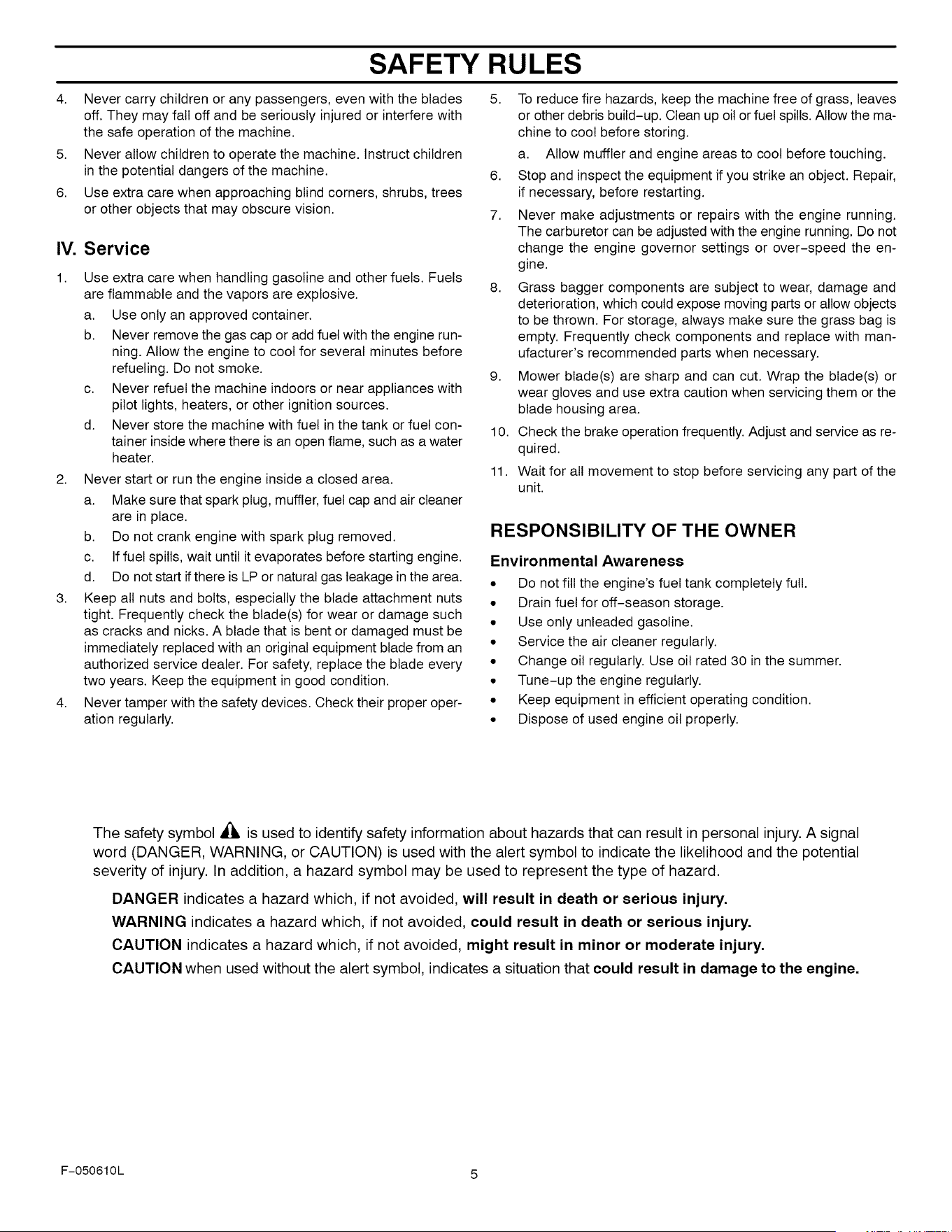
The safety symbol _ is used to identify safety information about hazards that can result in personal injury. A signal
word (DANGER, WARNING, or CAUTION) is used with the alert symbol to indicate the likelihood and the potential
severity of injury. In addition, a hazard symbol may be used to represent the type of hazard.
DANGER indicates a hazard which, if not avoided, will result in death or serious injury.
WARNING indicates a hazard which, if not avoided, could result in death or serious injury.
CAUTION indicates a hazard which, if not avoided, might result in minor or moderate injury.
CAUTION when used without the alert symbol, indicates a situation that could result in damage to the engine.
F-050610L 5
SAFETY RULES
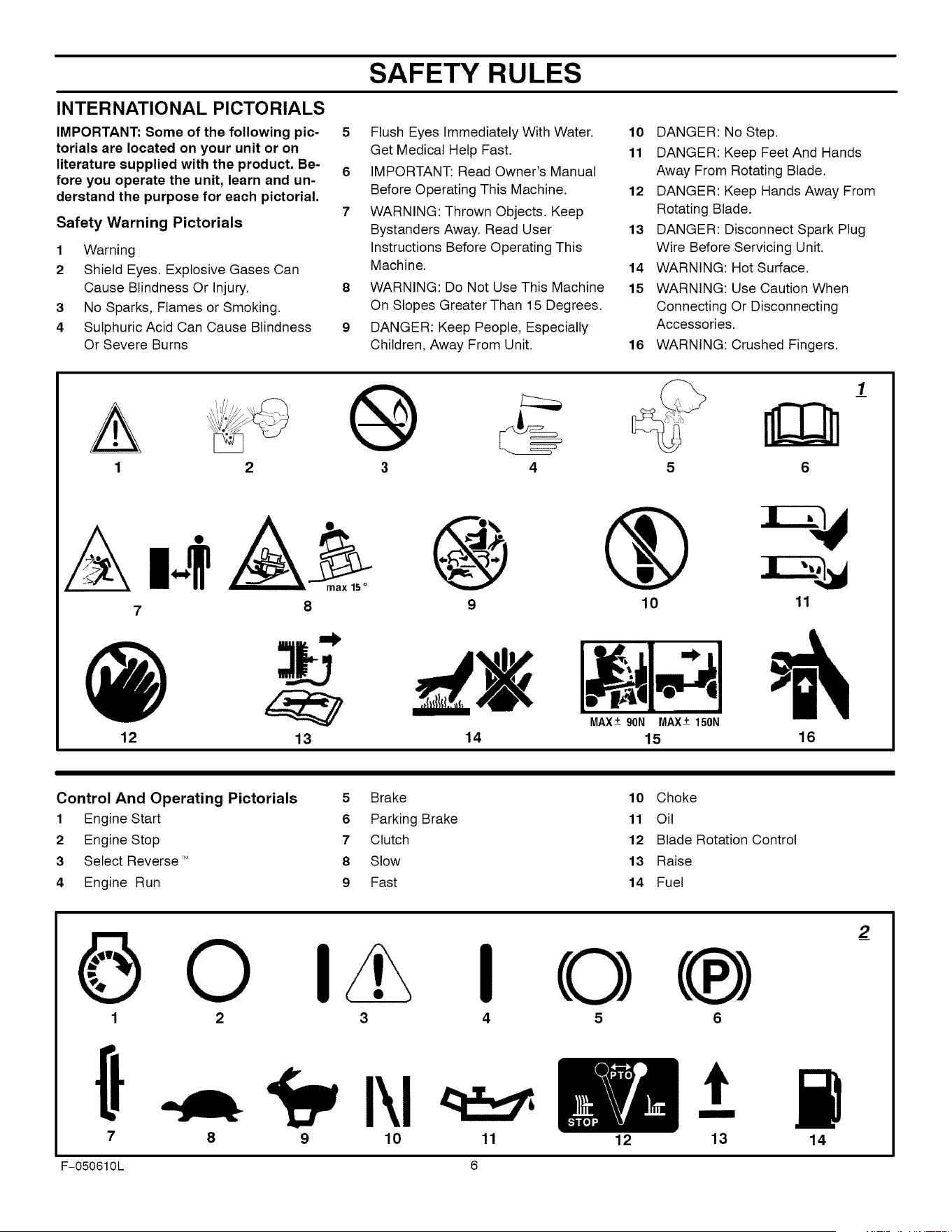
INTERNATIONAL PICTORIALS
IMPORTANT: Some of the following pic-
torials are located on your unit or on
literature supplied with the product. Be-
fore you operate the unit, learn and un-
derstand the purpose for each pictorial.
Safety Warning Pictorials
1 Warning
2 Shield Eyes. Explosive Gases Can
Cause Blindness Or Injury.
3 No Sparks, Flames or Smoking.
4 8ulphuric Acid Can Cause Blindness
Or Severe Burns
5 Flush Eyes Immediately With Water.
Get Medical Help Fast.
6 IMPORTANT: Read Owner's Manual
Before Operating This Machine.
7 WARNING: Thrown Objects. Keep
Bystanders Away. Read User
Instructions Before Operating This
Machine.
8 WARNING: Do Not Use This Machine
On Slopes Greater Than 15 Degrees.
9 DANGER: Keep People, Especially
Children, Away From Unit.
10 DANGER: No Step.
11 DANGER: Keep Feet And Hands
Away From Rotating Blade.
12 DANGER: Keep Hands Away From
Rotating Blade.
13 DANGER: Disconnect Spark Plug
Wire Before Servicing Unit.
14 WARNING: Hot Surface.
15 WARNING: Use Caution When
Connecting Or Disconnecting
Accessories.
16 WARNING: Crushed Fingers.
@
6
_/
A Ab
7 8
12
13
9 10 11
MAX± 90N MAX±150N
14 15 16
Control And Operating Pictorials
1 Engine Start
2 Engine Stop
3 Select Reverse ,M
4 Engine Run
5 Brake 10 Choke
6 Parking Brake 11 Oil
7 Clutch 12 Blade Rotation Control
8 Slow 13 Raise
9 Fast 14 Fuel
7
I O
3
t
4
2_
9 10 11 12 13 14
F-050610L 6
PREPARATION
PREPARATION
Read and follow the preparation instructions for your mower. All
fasteners are in the parts bag. Do not discard any parts or material
until the unit is assembled.
NOTE: In this instruction book, left and right describe the loca-
tion of a part from the viewpoint of someone setting in the oper-
ator's seat.
_ WARNING: Before doing any preparation or mainte-
nance to the mower, remove the wire from the spark
plug.
HOW TO REMOVE FROM THE CARTON
To remove the unit from the carton, follow the instructions below.
1. Locate the two tear tabs at the top of the carton.
2. Pull the tear tape no more than twelve inches at a time.
3. Re-grasp the tear tape next to the carton and pull again.
4. One the tear tape has been completely removed from both
ends, remove the top wood and set aside.
5. Repeat the process on the tear tabs at the bottom of the carton.
6. Set the panels aside.
7. Move the shift lever to the neutral (N) position.
NOTE: See the Operation section, page 10, for the location
of the controls,
8. If the parking brake is engaged, completely depress the
clutch/brake pedal to release the brake.
9. Move the lift lever to the highest position.
CAUTION: Check the bottom of the carton for staples,
Remove any staples that are in the path of the tires,
10. Remove the mower from the shipping skid.
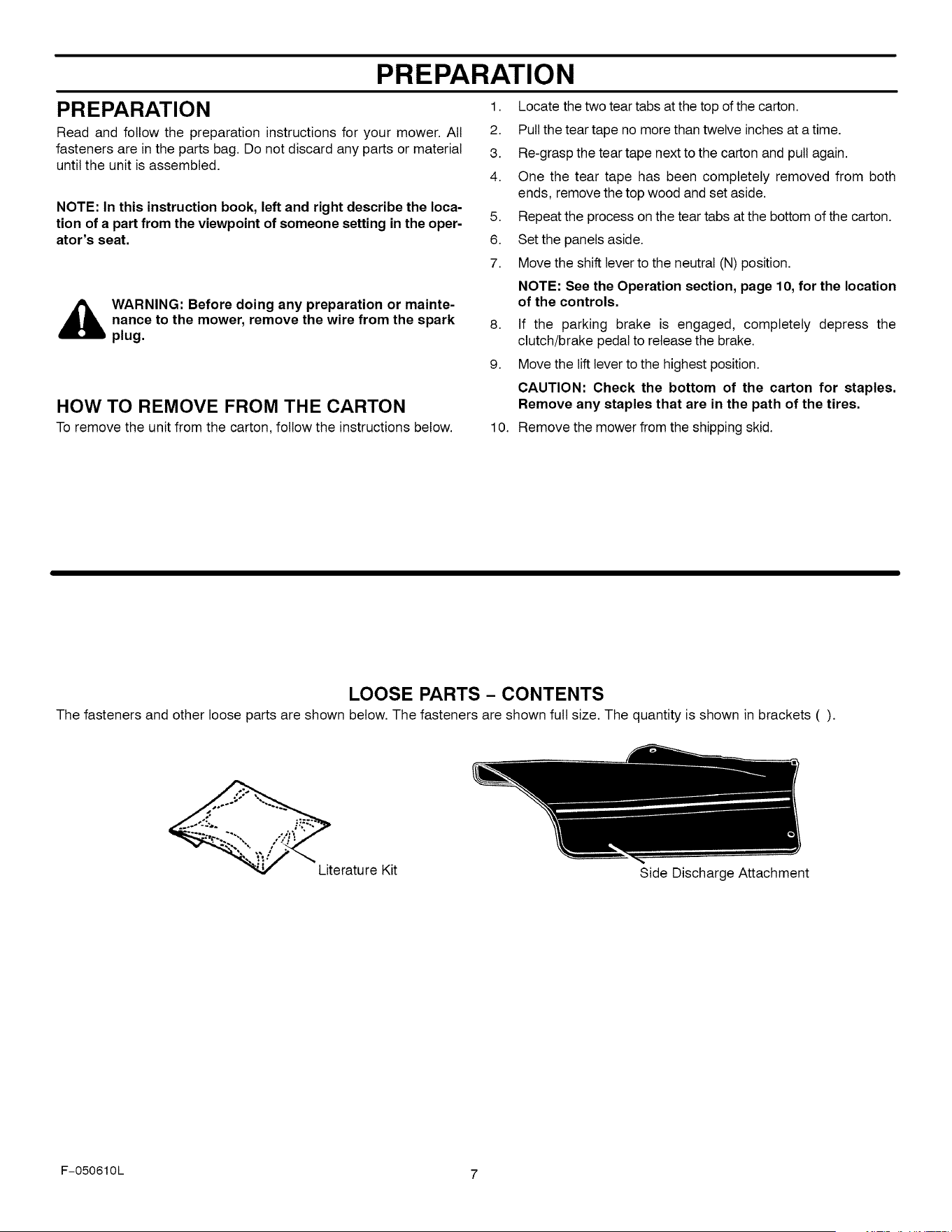
LOOSE PARTS - CONTENTS
The fasteners and other loose parts are shown below. The fasteners are shown full size. The quantity is shown in brackets ().
Literature Kit
Side Discharge Attachment
F-050610L 7
PREPARATION
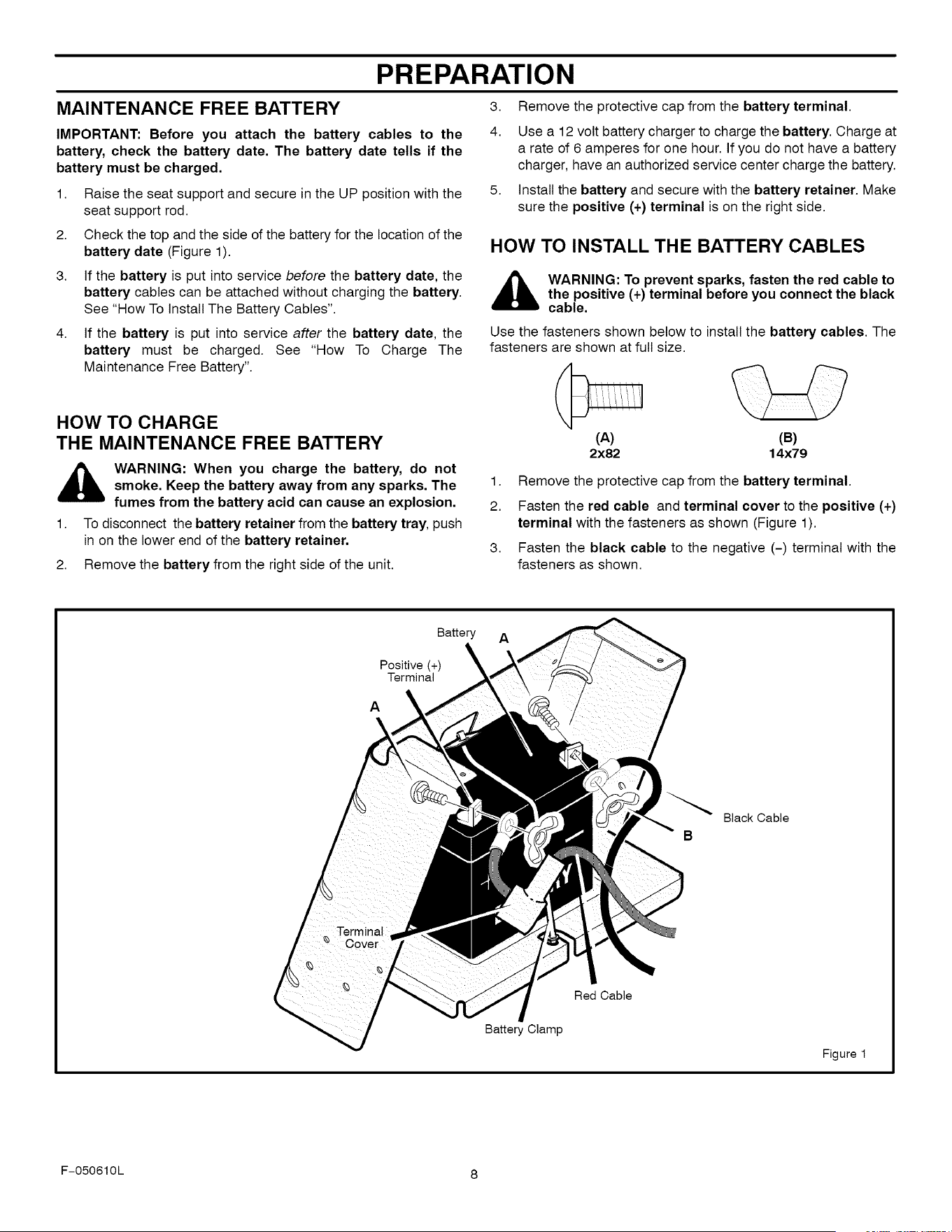
MAINTENANCE FREE BATTERY 3. Remove the protective cap from the battery terminal.
4.
IMPORTANT: Before you attach the battery cables to the
battery, check the battery date. The battery date tells if the
battery must be charged.
1. Raise the seat support and secure in the UP position with the
seat support rod.
2. Check the top and the side of the battery for the location of the
battery date (Figure 1).
3. If the battery is put into service before the battery date, the
battery cables can be attached without charging the battery.
See "How To Install The Battery Cables".
4. If the battery is put into service after the battery date, the
battery must be charged. See "How To Charge The
Maintenance Free Battery".
HOW TO CHARGE
THE MAINTENANCE FREE BATTERY
,_ WARNING: When you charge the battery, do not
smoke. Keep the battery away from any sparks. The
fumes from the battery acid can cause an explosion.
1. To disconnect the battery retainer from the battery tray, push
in on the lower end of the battery retainer.
2. Remove the battery from the right side of the unit.
5.
Use a 12 volt battery charger to charge the battery. Charge at
a rate of 6 amperes for one hour. If you do not have a battery
charger, have an authorized service center charge the battery.
Install the battery and secure with the battery retainer. Make
sure the positive (+) terminal is on the right side.
HOW TO INSTALL THE BATTERY CABLES
,_ WARNING: To prevent sparks, fasten the red cable to
the positive (+) terminal before you connect the black
cable.
Use the fasteners shown below to install the battery cables. The
fasteners are shown at full size.
(A)
2x82
1.
2.
3.
(B)
14x79
Remove the protective cap from the battery terminal.
Fasten the red cable and terminal cover to the positive (+)
terminal with the fasteners as shown (Figure 1).
Fasten the black cable to the negative (-) terminal with the
fasteners as shown.
Battery A
Positive (+)
Terminal
A
Black Cable
B
Battery Clamp
Red Cable
Figure 1
F-050610L 8

PREPARATION
HOW TO ENGAGE THE TRANSMISSION
To allow the unit to be pushed, the unit was shipped with the
automatic drive disconnect in the PUSH POSITION. Before
operating, the automatic drive disconnect must be set in the
DRIVE POSITION. (Figure 2)
1. The engine must be off.
2. The automatic drive disconnect is located under the left side
of the seat deck next to the hydrostatic transaxle.
3. To engage the transmission, unlatch the automatic drive dis-
connect. The transmission is now connected and ready to op-
erate.
4. To release the transmission and push the unit, pull and twist the
automatic drive disconnect, Latch the automatic drive dis-
connect in the PUSH position (Figure 2). The transmission is
now released and the unit can be pushed.
NOTE: In cold weather, the heavy viscosity oil in the
transmission will make the unit difficult to push,
Automatic Drive Disconnect
DRIVE POSITION
/
Automatic Drive Disconnect
PUSH POSITION
Figure 2
HOW TO PREPARE THE ENGINE
NOTE: The engine was shipped from the factory filled with oil.
Check the level of the oil. Add oil as needed.
NOTE: The operation of a new engine will sometimes result in
a slight amount of smoke. This smoke is caused by paint or oil
on or around the muffler. This is normal and only expected
during initial operation.
Before you use the unit, read the information on safety, operation,
maintenance, and storage.
CHECK THE TIRES
NOTE: The tires were over inflated for shipment. The correct air
pressure is shown on the side of the tire.
Check the air pressure in the tires. Tires with too much air pressure
will cause the unit to ride rough. Also, the wrong air pressure will
keep the mower housing from cutting level. The correct air pressure
is shown on the side of the tire.
CHECK THE LEVEL OF THE MOWER HOUSING
Make sure the level of cut is still correct. After you mow a short
distance, look at the area that was cut. If the mower housing does
not cut level, see the instructions on "How To Level The Mower
Housing" in the Service And Adjustment section of this instruction
book.
IMPORTANT! BEFORE YOU START MOWING
[] Check the engine oil.
[] Fill the fuel tank with gasoline.
[] Check the air pressure of the tires.
[] Check the level of the mower housing.
[] Make sure the battery cables are attached.
[] Make sure the wire is attached to the spark plug.
F-050610L
OPERATION
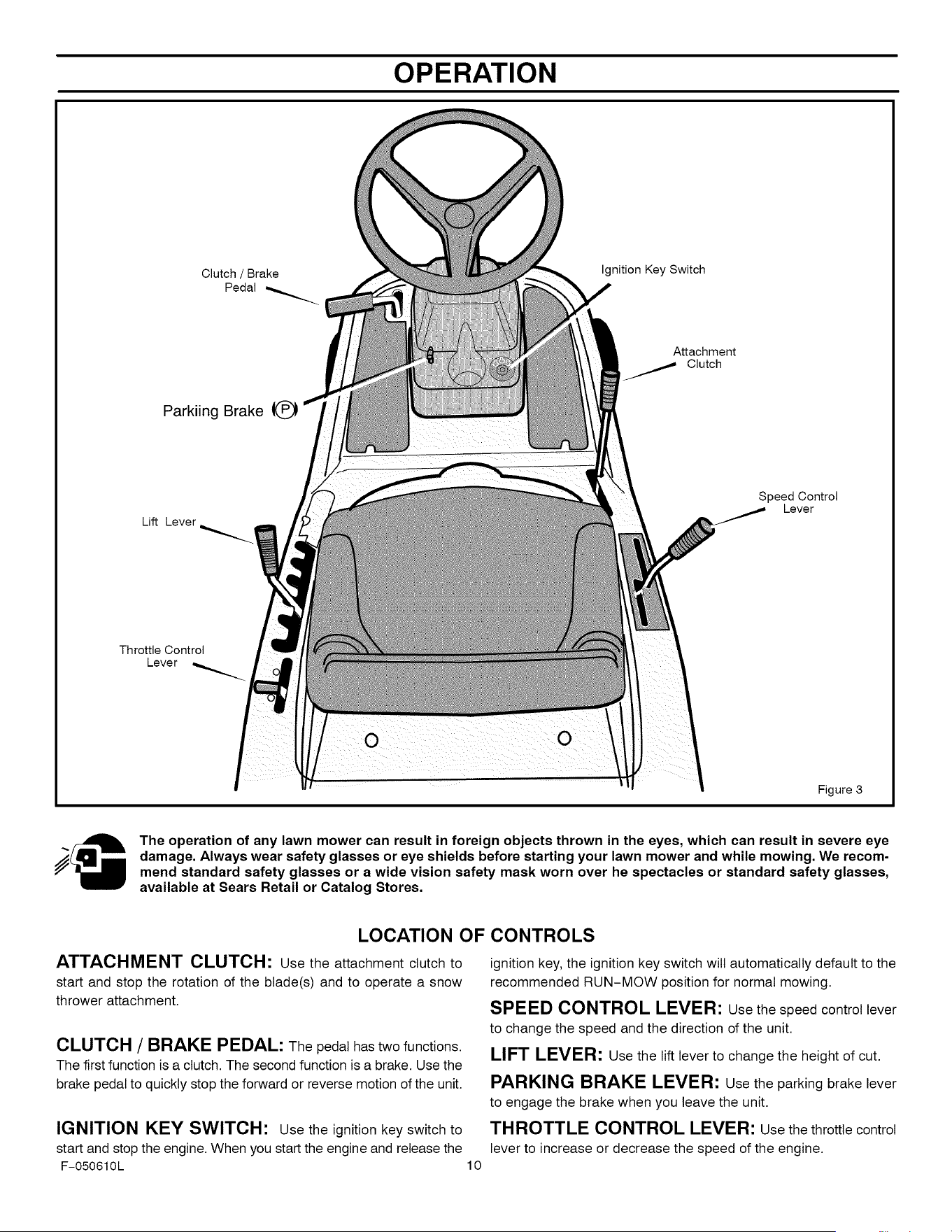
Clutch / Brake
Pedal
Ignition Key Switch
Parkiing Brake
Lift Lever
Throttle Control
Lever
Attachment
Clutch
Speed Control
Lever
Figure 3
The operation of any lawn mower can result in foreign objects thrown in the eyes, which can result in severe eye
damage. Always wear safety glasses or eye shields before starting your lawn mower and while mowing. We recom-
mend standard safety glasses or a wide vision safety mask worn over he spectacles or standard safety glasses,
available at Sears Retail or Catalog Stores.
LOCATION OF CONTROLS
ATTACHMENT CLUTCH: Use the attachment clutch to
start and stop the rotation of the blade(s) and to operate a snow
thrower attachment.
CLUTCH / BRAKE PEDAL: The pedal has two functions.
The first function is a clutch. The second function is a brake. Use the
brake pedal to quickly stop the forward or reverse motion of the unit.
IGNITION KEY SWITCH: Use the ignition key switch to
start and stop the engine. When you start the engine and release the
F-050610L 10
ignition key, the ignition key switch will automatically default to the
recommended RUN-MOW position for normal mowing.
SPEED CONTROL LEVER: Usethe speed control lever
to change the speed and the direction of the unit.
LIFT LEVER: Use the lift lever to change the height of cut.
PARKING BRAKE LEVER: Usethe parking brake lever
to engage the brake when you leave the unit.
THROTTLE CONTROL LEVER: Usethe throttle control
lever to increase or decrease the speed of the engine.

OPERATION
ATTACHMENTS
This unit can use many different attachments. See the attachment
page in this book. This unit can pull attachments like a lawn
sweeper, a lawn aerator, a hopper spreader, or a small trailer. This
unit can not use attachments that engage the ground like a plow, a
disk harrow, or a cultivator.
For all pull-behind attachments or trailers, the maximum gross
weight is 200 pounds. Gross weight is the weight of the attachment
or trailer and any load that might be on or in it.
Do not operate on a slope that is greater than 10 degrees when
using a pull-behind attachment or trailer. We have included a slope
guide in this book to help you determine the slope on which you will
be operating your unit. Never allow someone to stand or ride on or
in an attachment or trailer.
ELECTRICAL SAFETY SYSTEM
The electrical system has two primary components, an Operator
Presence System and a Select Reverse ,Msystem.
Operator Presence System (Seat)
The seat has an Operator Presence System to shut off the engine
when the operator leaves the seat. This system is not intended for
regular use in stopping the engine or the blade(s). Before leaving the
seat, move the blade rotation control to the DISENGAGE position,
shift to neutral, set the parking brake and stop the engine.
Select Reverse TM System
The Select Reverse 'M system will allow the mower blade(s) to
continue to rotate when traveling in reverse. See "How To Operate
The Ignition Key Switch" and "How To Start The Engine" for further
details.
HOW TO OPERATE THE IGNITION KEY SWITCH
Use the ignition key switch to start and stop the engine. When you
start the engine and release the ignition key, the ignition key switch
wilt automatically default to the recommended RUN-MOW position
for normal mowing.
START - Use this position to start the engine.
RUN-MOW - When you start the engine and release the ignition
key, the ignition key switch will automatically default to the
recommended RUN-MOW position for normal mowing. In the
RUN-MOW position, the system will stop the engine and the
blade(s) when the speed control pedal/shift lever is put in the
reverse position.
SELECT REVERSE 'M - The optional Select Reverse '_
position wilt allow the mower blade(s) to continue to rotate when
traveling in reverse. Always go back to the recommended
RUN-MOW position for normal mowing when operation in Select
Reverse '" is not absolutely necessary. NEVER use the Select
Reverse'M option if children are on or near the property.
_ WARNING: Operators are strongly discouraged
from using this option unless the operator de-
cides such operation is absolutely necessary and
that safe precautions are taken. Never use the Select Re-
verse ,Moption if children are on or near the property. Always
look down and behind before and while backing. After using
the Select Reverse M position, move the ignition key back to
the RUN-MOW position.
STOP - Use this position to stop the engine.
F-050610L 11

OPERATION
HOW TO STOP THE UNIT
1. Completely push the clutch/brake pedal forward to stop the
unit. Keep your foot on the pedal.
2. Move the attachment clutch to the DISENGAGE position.
3. Move the speed control lever to the NEUTRAL position.
4. Set the parking brake.
_ ARNING: Make sure the parking brake will hold the
unit.
5. Move the throttle control to the SLOW position.
6. To stop the engine, turn the ignition key to the STOP O posi-
tion. Remove the key.
HOW TO SET THE PARKING BRAKE
1. Completely push the clutch/brake pedal forward.
2. Lift the parking brake lever (Figure 5).
3. Remove your foot from the clutch/brake pedal and then release
the parking brake lever. Make sure the parking brake will hold
the unit.
4. To release the parking brake, completely push the clutch/
brake pedal forward. The parking brake will automatically re-
lease.
WARNING: Before you leave the operator's position,
,_ move the shift lever to the neutral (N) position. Set the
parking brake. Move the attachment clutch to the
DISENGAGE position. Stop the engine and remove
the ignition key.
Clutch/Brake
Pedal
HOW TO USE
THE THROTTLE / CHOKE CONTROL
CAUTION: Always operate the engine with the throttle control
in the FAST position. If the engine runs for several minutes at
slower than the FAST position, the engine and transmission
will overheat and can be damaged.
Use the throttle/choke control to choke the engine for cold starts
and increase or decrease the speed of the engine (see Figure 6).
1. Move the throttle/choke control completely forward to the
CHOKE position to start a cold engine.
2.
The FAST position is marked with a detent. For normal opera-
tion and when using a grass bagger, move the throttle control
to the FAST position. For maximum charging of the battery and
for a cooler running engine, operate the engine in the FAST
position.
3. For transport and to tow pull behind attachments, control the
ground speed with the speed control pedal.
F-050610L
4.
12
The engine governor is set at the factory for maximum perfor-
mance. Do not adjust the governor to increase the speed of the
engine.
Throttle
Control
Figure 6
OPERATION
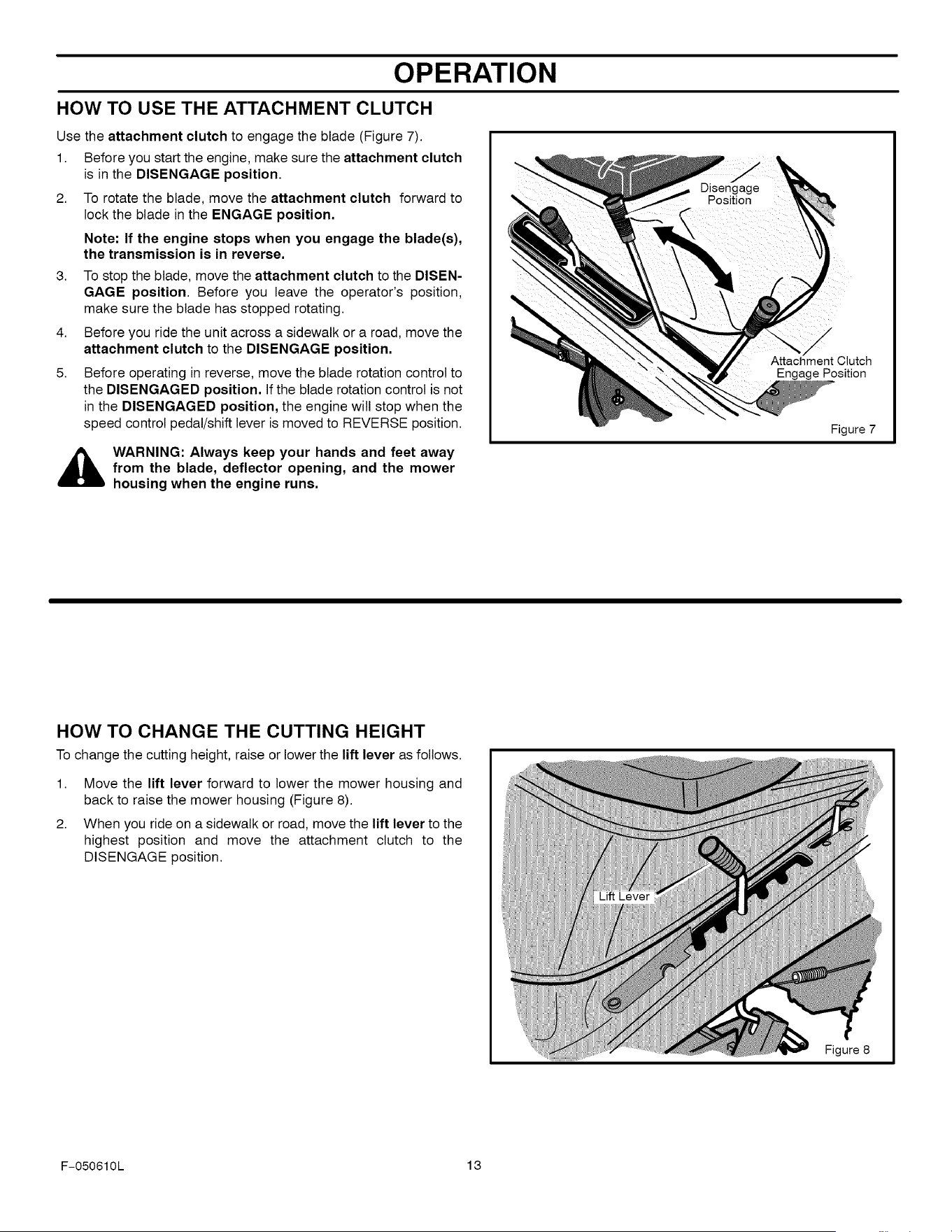
HOW TO USE THE ATTACHMENT CLUTCH
Use the attachment clutch to engage the blade (Figure 7).
1. Before you start the engine, make sure the attachment clutch
is in the DISENGAGE position.
2. To rotate the blade, move the attachment clutch forward to
lock the blade in the ENGAGE position.
Note: If the engine stops when you engage the blade(s),
the transmission is in reverse.
3. To stop the blade, move the attachment clutch to the DISEN-
GAGE position. Before you leave the operator's position,
make sure the blade has stopped rotating.
4. Before you ride the unit across a sidewalk or a road, move the
attachment clutch to the DISENGAGE position.
5. Before operating in reverse, move the blade rotation control to
the DISENGAGED position. If the blade rotation control is not
in the DISENGAGED position, the engine will stop when the
speed control pedal/shift lever is moved to REVERSE position.
,_ WARNING: Always keep your hands and feet away
from the blade, deflector opening, and the mower
housing when the engine runs.
Attachment Clutch
Engage Position
Figure 7
HOW TO CHANGE THE CUTTING HEIGHT
To change the cutting height, raise or lower the lift lever as follows.
1. Move the lift lever forward to lower the mower housing and
back to raise the mower housing (Figure 8).
2. When you ride on a sidewalk or road, move the lift lever to the
highest position and move the attachment clutch to the
DISENGAGE position.
Figure 8
F-050610L 13
OPERATION
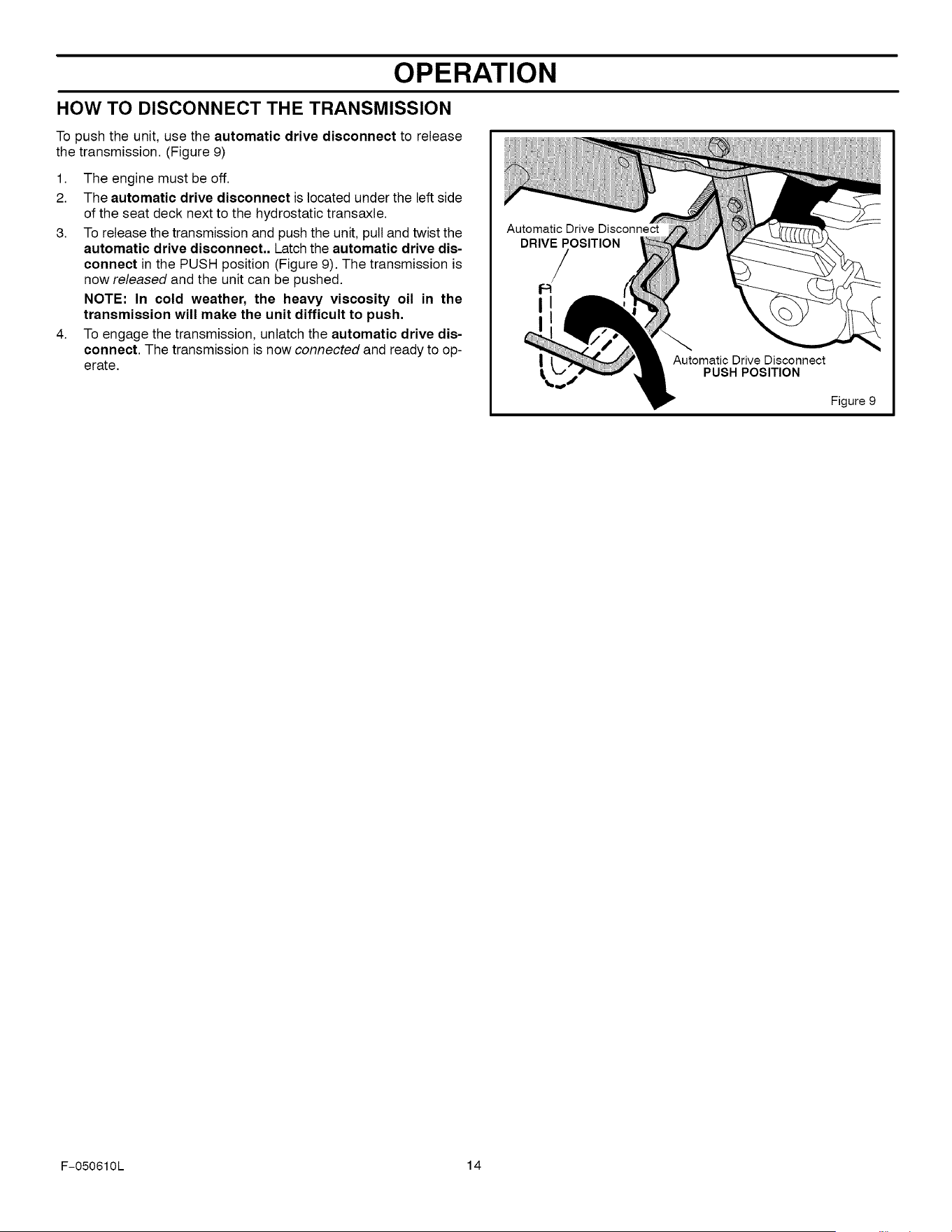
HOW TO DISCONNECT THE TRANSMISSION
To push the unit, use the automatic drive disconnect to release
the transmission. (Figure 9)
1. The engine must be off.
2. The automatic drive disconnect is located under the left side
of the seat deck next to the hydrostatic transaxle.
3. To release the transmission and push the unit, pull and twist the
automatic drive disconnect.. Latch the automatic drive dis-
connect in the PUSH position (Figure 9). The transmission is
now released and the unit can be pushed.
NOTE: In cold weather, the heavy viscosity oil in the
transmission will make the unit difficult to push.
4. To engage the transmission, unlatch the automatic drive dis-
connect. The transmission is now connected and ready to op-
erate.
Automatic Drive Disconnect
DRIVE POSITION
/
Automatic Drive Disconnect
PUSH POSITION
Figure 9
F-050610L 14
OPERATION
HOW TO USE THE SPEED CONTROL LEVER
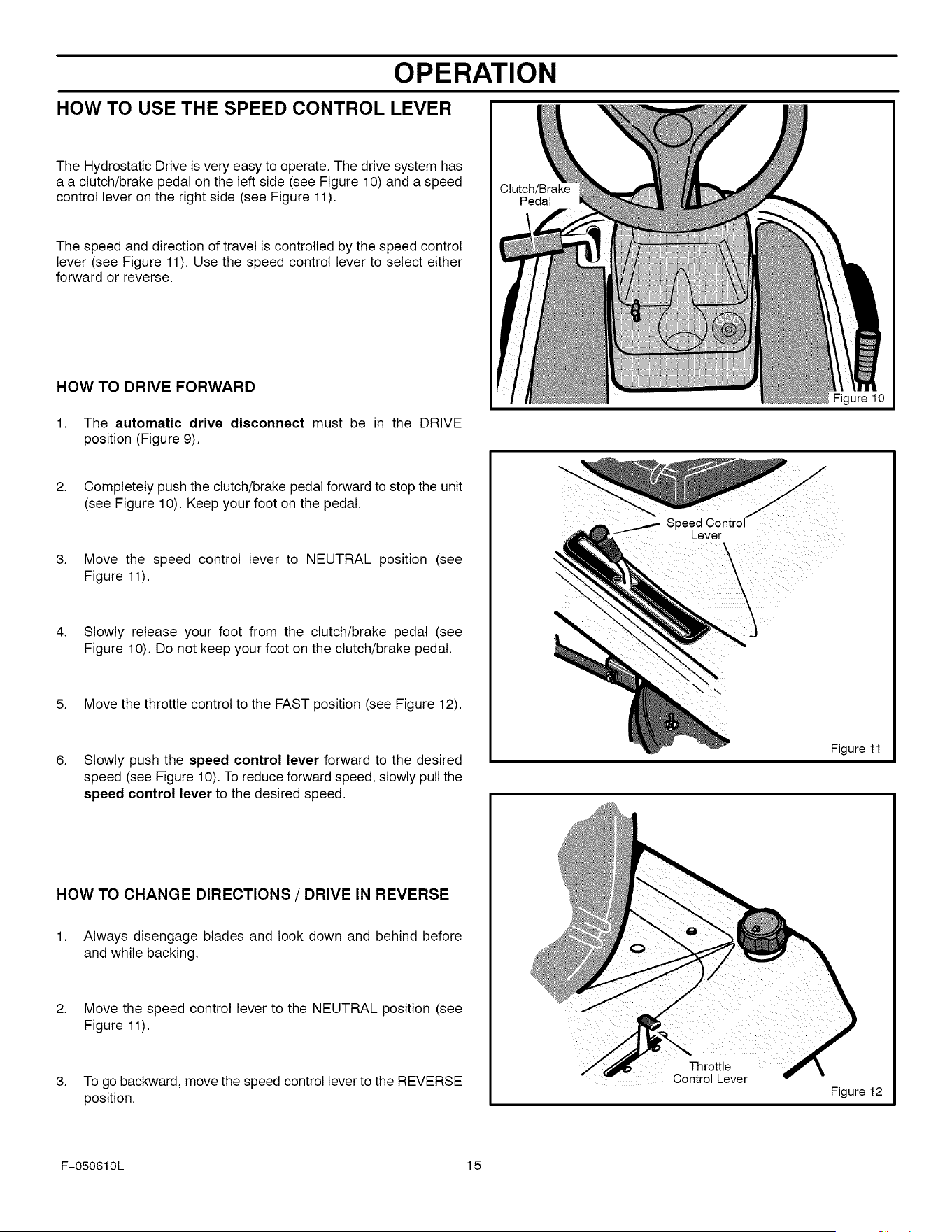
The Hydrostatic Drive is very easy to operate. The drive system has
a a clutch/brake pedal on the left side (see Figure 10) and a speed
control lever on the right side (see Figure 11).
The speed and direction of travel is controlled by the speed control
lever (see Figure 11). Use the speed control lever to select either
forward or reverse.
HOW TO DRIVE FORWARD
Clutch/Brake
Pedal
1. The automatic drive disconnect must be in the DRIVE
position (Figure 9).
Figure 10
2.
3.
4.
Completely push the clutch/brake pedal forward to stop the unit
(see Figure 10). Keep your foot on the pedal.
Move the speed control lever to NEUTRAL position (see
Figure 11).
Slowly release your foot from the clutch/brake pedal (see
Figure 10). Do not keep your foot on the clutch/brake pedal.
5. Move the throttle control to the FAST position (see Figure 12).
6.
Slowly push the speed control lever forward to the desired
speed (see Figure 10). To reduce forward speed, slowly pull the
speed control lever to the desired speed.
Speea Control
_ever
\
\
Figure 11
HOW TO CHANGE DIRECTIONS / DRIVE IN REVERSE
1. Always disengage blades and look down and behind before
and while backing.
2. Move the speed control lever to the NEUTRAL position (see
Figure 11).
3. To go backward, move the speed control lever to the REVERSE
position.
Throttle
Control Lever
Figure 12
F-050610L 15
OPERATION
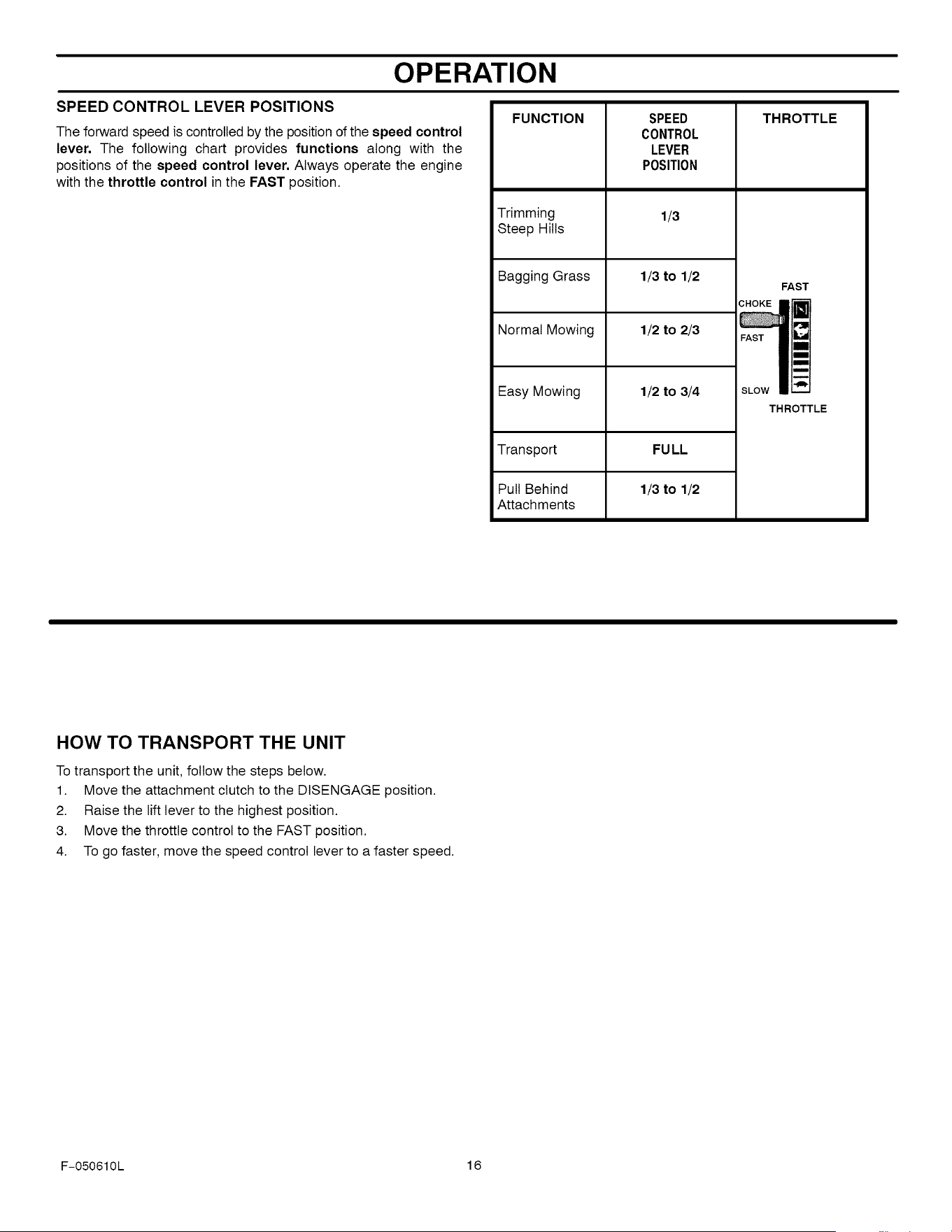
SPEED CONTROL LEVER POSITIONS
The forward speed is controlled by the position of the speed control
lever. The following chart provides functions along with the
positions of the speed control lever. Always operate the engine
with the throttle control in the FAST position.
FUNCTION
Trimming
Steep Hills
SPEED
CONTROL
LEVER
POSITION
Transport
Pull Behind
Attachments
1/3
Bagging Grass 1/3 to 1/2
Normal Mowing 1/2 to 2/3
Easy Mowing 1/2 to 3/4
FULL
1/3 to 1/2
THROTTLE
FAST
THROTTLE
HOW TO TRANSPORT THE UNIT
To transport the unit, follow the steps below.
1. Move the attachment clutch to the DISENGAGE position.
2. Raise the lift lever to the highest position.
3. Move the throttle control to the FAST position.
4. To go faster, move the speed control lever to a faster speed.
F-050610L 1 6

OPERATION
HOW TO INSTALL THE SIDE DISCHARGE ATTACHMENT
,_ WARNING: To prevent the engine from starting, dis-
connect the wire from the spark plug. Make sure the
attachment clutch is in the DISENGAGE position.
The mulcher cover lets you mulch the grass for a clean, fine cut.
To discharge the grass out the side, install the side discharge
attachment as follows.
1.
2.
3.
4.
Remove the fasteners that secure the mulcher cover (see
Figure 13).
Lift the mulcher cover. Mount the side discharge attachment
onto the same bolts that secured the mulcher cover.
Secure the side discharge attachment with the fasteners.
To mulch, remove the side discharge attachment and mount
the mulcher cover to the mower housing with the fasteners.
Mulcher Cover
Wingnut
Washer
Side Discharge Attachment
Washer
Wingnut
Figure 13
F-050610L 1 7
OPERATION
BEFORE STARTING THE ENGINE
CHECK THE OIL
NOTE: The engine was shipped from the factory filled with oil
rated 30. Check the level of the oil. Add oil as needed.
1. Make sure the unit is level.
NOTE: Do not check the level of the oil while the engine
runs.
2. Clean the area around the dipstick. Remove the dipstick. Wipe
the oil from the dipstick.
3. Insert the dipstick into the oil fill tube. Turn the dipstick clock-
wise until it is tight. Remove the dipstick. Check the oil level on
the dipstick. The oil level must reach the FULL mark on the
dipstick.
4. If necessary, add oil until the oil reaches the FULL mark on the
dipstick. The quantity of oil needed from ADD to FULL is shown
on the dipstick. Do not add too much oil.
ADD GASOLINE
WARNING: Always use a safety gasoline container.
Do not smoke when adding gasoline to the fuel tank.
Do not add gasoline when you are inside an enclo-
sure. Before you add gasoline, stop the engine and
let the engine cool for several minutes.
Use clean, fresh, regular unleaded gasoline with a minimum of 85
octane. Fresh fuel prevents gum from forming in the fuel system or
on essential carburetor parts. Purchase fuel in quantity that can be
used with 30 days.
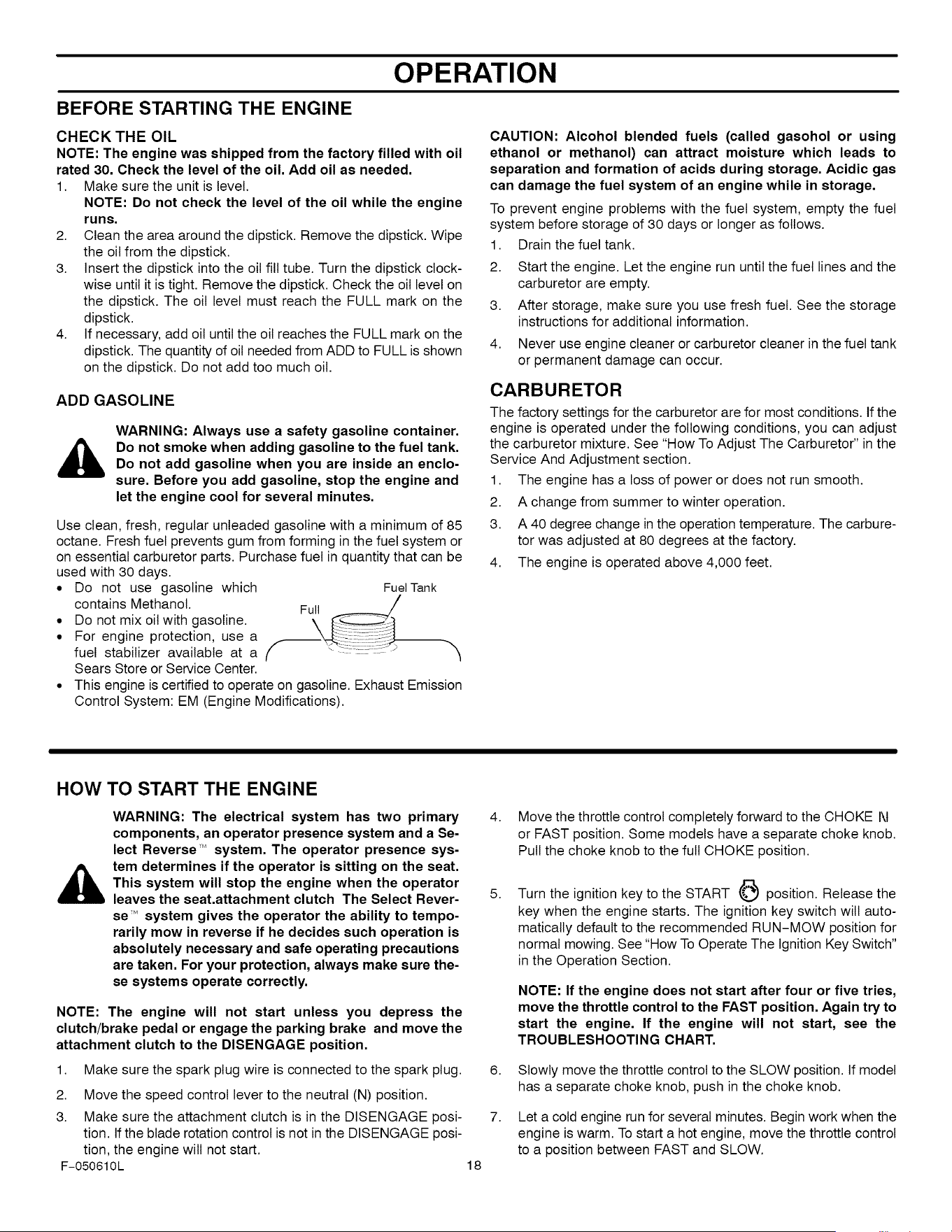
• Do not use gasoline which Fuel Tank
contains Methanol.
• Do not mix oil with gasoline.
• For engine protection, use a
fuel stabilizer available at a
Sears Store or Service Center.
• This engine is certified to operate on gasoline. Exhaust Emission
Control System: EM (Engine Modifications).
CAUTION: Alcohol blended fuels (called gasohol or using
ethanol or methanol) can attract moisture which leads to
separation and formation of acids during storage. Acidic gas
can damage the fuel system of an engine while in storage.
To prevent engine problems with the fuel system, empty the fuel
system before storage of 30 days or longer as follows.
Drain the fuel tank.1.
2.
3.
4.
Start the engine. Let the engine run until the fuel lines and the
carburetor are empty.
After storage, make sure you use fresh fuel. See the storage
instructions for additional information.
Never use engine cleaner or carburetor cleaner in the fuel tank
or permanent damage can occur.
CARBURETOR
The factory settings for the carburetor are for most conditions. If the
engine is operated under the following conditions, you can adjust
the carburetor mixture. See "How To Adjust The Carburetor" in the
Service And Adjustment section.
1. The engine has a loss of power or does not run smooth.
2. A change from summer to winter operation.
3. A 40 degree change inthe operation temperature. The carbure-
tor was adjusted at 80 degrees at the factory.
4. The engine is operated above 4,000 feet.
HOW TO START THE ENGINE
WARNING: The electrical system has two primary
components, an operator presence system and a Se-
lect Reverse M system. The operator presence sys-
tem determines if the operator is sitting on the seat.
This system will stop the engine when the operator
leaves the seat.attachment clutch The Select Rever-
se M system gives the operator the ability to tempo-
rarily mow in reverse if he decides such operation is
absolutely necessary and safe operating precautions
are taken. For your protection, always make sure the-
se systems operate correctly.
NOTE: The engine will not start unless you depress the
clutch/brake pedal or engage the parking brake and move the
attachment clutch to the DISENGAGE position.
1.
2.
3.
4.
5.
Make sure the spark plug wire is connected to the spark plug. 6.
Move the speed control lever to the neutral (N) position.
Make sure the attachment clutch is in the DISENGAGE posi- 7.
tion. If the blade rotation control is not in the DISENGAGE posi-
tion, the engine wilt not start.
F-050610L 18
Move the throttle control completely forward to the CHOKE I\1
or FAST position. Some models have a separate choke knob.
Pull the choke knob to the full CHOKE position.
Turn the ignition key to the START _ position. Release the
key when the engine starts. The ignition key switch will auto-
matically default to the recommended RUN-MOW position for
normal mowing. See "How To Operate The Ignition Key Switch"
in the Operation Section.
NOTE: If the engine does not start after four or five tries,
move the throttle control to the FAST position. Again try to
start the engine. If the engine will not start, see the
TROUBLESHOOTING CHART.
Slowly move the throttle control to the SLOW position. If model
has a separate choke knob, push in the choke knob.
Let a cold engine run for several minutes. Begin work when the
engine is warm. To start a hot engine, move the throttle control
to a position between FAST and SLOW.
OPERATION
HOW TO OPERATEWITH THE MOWER HOUSING
WARNING: The mulch cover is a safety device. Do not
remove the mulch cover. The side discharge attach-
,_ ment forces the discharged material toward the
ground. Always keep the side discharge attachment
in the down position. If the side discharge attachment
is damaged, replace the with an original equipment
part from a Sears Service Center.
IMPORTANT: When you operate with the mower housing,
always operate with the throttle control in the FAST position.
1. Push the clutch/brake pedal completely forward.
2. Start the engine.
3. Put the speed control lever in the NEUTRAL position.
4. Slowly release the clutch/brake pedal.
5. Move the lift lever to a height of cut position. In high or thick
grass, cut the grass in the highest position first and then lower
the mower housing to a lower position.
6.
7.
8.
9.
10.
CAUTION: Do not operate with the mower housing in the
LEVEL ADJUSTMENT position. If you operate in the
LEVEL ADJUSTMENT position, the mower housing and
blades can be damaged.
Move the throttle control to the SLOW position.
Move the attachment clutch to the ENGAGE position.
Move the speed control lever forward.
NOTE: When you mow in heavy grass or mow with a
bagger, operate at a slow forward speed.
Move the throttle control to the FAST position. If you need to go
faster or slower, move the speed control lever forward or back-
ward.
Make sure the level of cut is still correct. After you mow a short
distance, look at the area that was cut. If the mower housing
does not cut level, see the instructions on "How To Level The
Mower Housing" in the Service And Adjustment section.
,_ WARNING: For better control of the unit, always
select a safe speed.
HOW TO OPERATE THE UNIT ON HILLS
,_ WARNING: Do not ride up or down slopes that are too
steep to back straight up. Never ride the unit across
a slope. See the "Slope Guide" in the back of this
book for information on how to check slopes.
1. Before you ride up or down a hill, move the speed control lever
to a slow speed.
2. Do not stop or change speed settings on a hill. If you must stop,
quickly push the clutch/brake pedal forward and set the parking
brake.
3. To start again, make sure the speed controllever is in a slow
speed. Move the throttle control to the SLOW position. Slowly
release the pedal.
4. If you must stop or start on a hill, always have enough space
for the unit to roll when you release the brake and engage the
clutch.
5.
Be very careful when you change directions on a hill. When on
a slope or in a turn on a hill, move the throttle control to the
SLOW position to help prevent an accident.
F-050610L 19
OPERATION
OPERATING TIPS
1.
2.
3.
4.
Check the attachment clutch for correct adjustment. For the
blade(s) to disengage correctly, the adjustment must be cor-
rect.
Before you use the unit, check the oil in the engine and add oil
if necessary.
If the engine will not start, first make sure the wire is attached
to the spark plug.
Make sure all the belts are inside all the belt guides. See the in-
structions on how to remove and install the motion drive and
mower drive belts.
5. Before you make an inspection, adjustment (except for the car-
buretor) or repair, make sure the wire from the spark plug is dis-
connected.
6. Make sure the seat switch wire is connected. If the wire is not
connected, the engine will not start.
7. For longer life of the battery, charge the battery every three
months.
8. Use the shift lever to change the ground speed, not the throttle
control.
9. Belt noise can occur when the blade or clutch is engaged. This
noise is normal and does not affect the operation of the unit.
10. To move forward, always release the clutch/brake pedal slowly.
MOWING AND BAGGING TIPS
1.
2.
3.
4.
5.
6.
7.
8.
9.
10.
For a lawn to look better, check the cutting level of the mower
housing. See "How To Level The Mower Housing" in the Ser-
vice And Adjustment section.
For the mower housing to cut level, make sure the tires have
the correct amount of air pressure (PSI) and use slow ground
speeds when turning.
Every time you use the unit, check the blade. If the blade is bent
or damaged, immediately replace the blade. Also, make sure
the nut for the blade is tight.
Keep the blade(s) sharpened. A worn blade(s) will cause the
ends of the grass to turn brown.
Do not cut or bag grass that is wet. Wet grass will not discharge
correctly. Let the grass dry before cutting.
Use the left side of the mower housing to trim near an object.
Discharge the cut grass onto the mowed area. The result is a
more even discharge of cut grass.
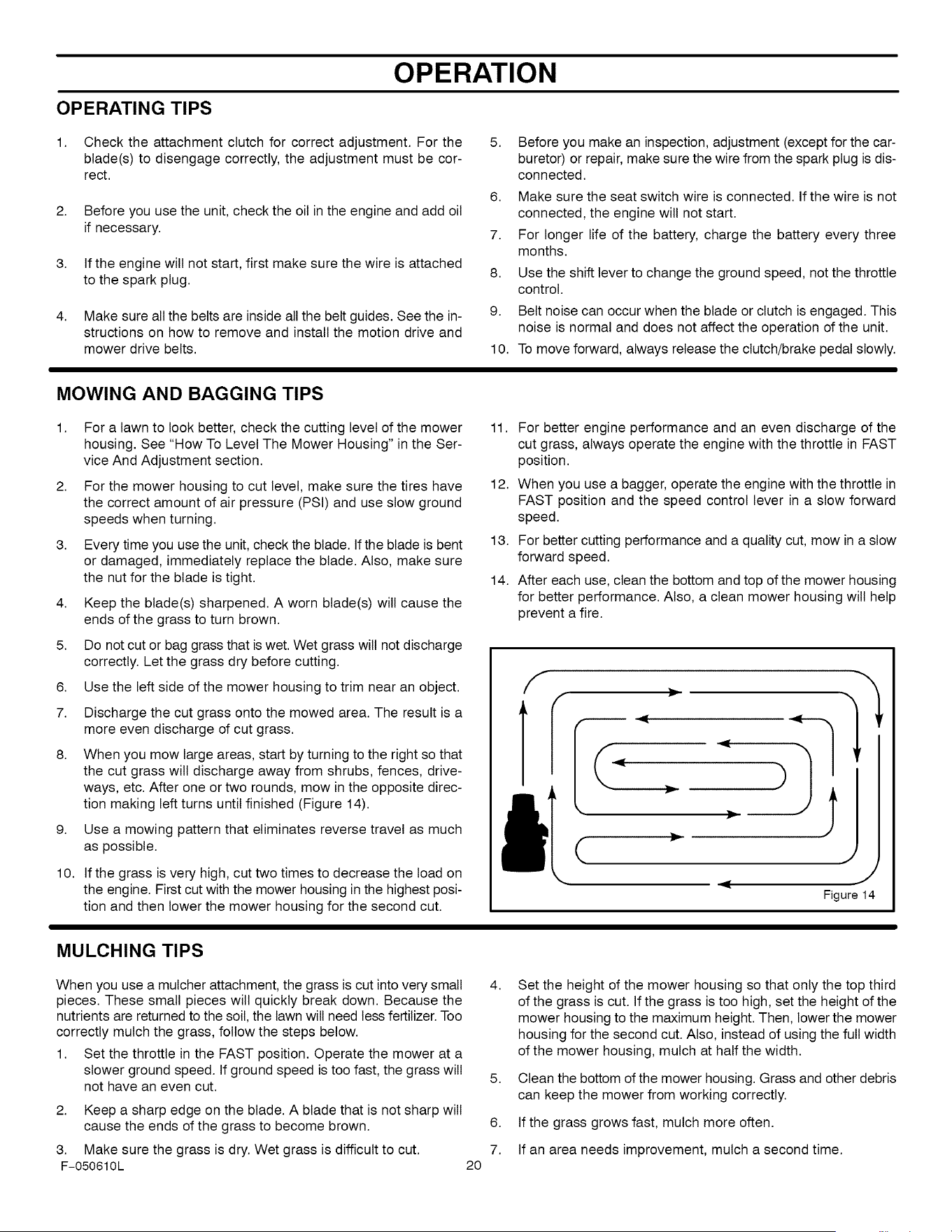
When you mow large areas, start by turning to the right so that
the cut grass wilt discharge away from shrubs, fences, drive-
ways, etc. After one or two rounds, mow in the opposite direc-
tion making left turns until finished (Figure 14).
Use a mowing pattern that eliminates reverse travel as much
as possible.
If the grass is very high, cut two times to decrease the load on
the engine. First cut with the mower housing in the highest posi-
tion and then lower the mower housing for the second cut.
11. For better engine performance and an even discharge of the
cut grass, always operate the engine with the throttle in FAST
position.
12. When you use a bagger, operate the engine with the throttle in
FAST position and the speed control lever in a slow forward
speed.
13. For better cutting performance and a quality cut, mow in a slow
forward speed.
14. After each use, clean the bottom and top of the mower housing
for better performance. Also, a clean mower housing will help
prevent a fire.
f
(
v
J
Figure 14
MULCHING TIPS
When you use a mulcher attachment, the grass is cut into very small 4.
pieces. These small pieces will quickly break down. Because the
nutrients are returned to the soil, the lawn will need less fertilizer. Too
correctly mulch the grass, follow the steps below.
1. Set the throttle in the FAST position. Operate the mower at a
slower ground speed. If ground speed is too fast, the grass will 5.
not have an even cut.
2. Keep a sharp edge on the blade. A blade that is not sharp will
cause the ends of the grass to become brown. 6.
3. Make sure the grass is dry. Wet grass is difficult to cut. 7.
F-050610L 20
Set the height of the mower housing so that only the top third
of the grass is cut. If the grass is too high, set the height of the
mower housing to the maximum height. Then, lower the mower
housing for the second cut. Also, instead of using the full width
of the mower housing, mulch at half the width.
Clean the bottom of the mower housing. Grass and other debris
can keep the mower from working correctly.
If the grass grows fast, mulch more often.
If an area needs improvement, mulch a second time.
MAINTENANCE
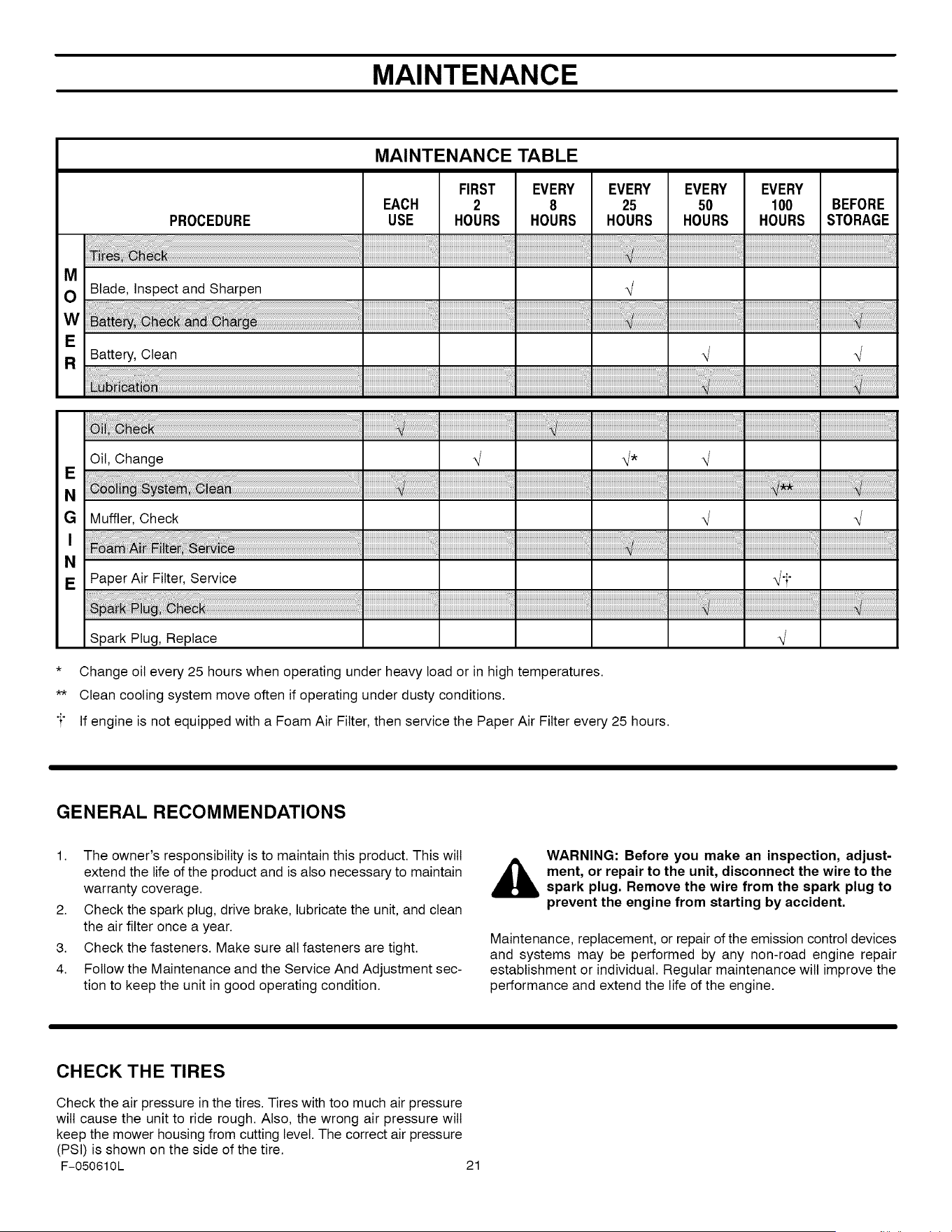
MAINTENANCE TABLE
PROCEDURE
FIRST
EACH 2
USE HOURS
M
O Blade, Inspect and Sharpen
w ................................................................
E
R Battery, Clean
!ati
EVERY EVERY EVERY EVERY
8 25 50 100 BEFORE
HOURS HOURS HOURS HOURS STORAGE
4
E
N
Oil, Change
4 _
Spark Plug, Replace
* Change oil every 25 hours when operating under heavy load or in high temperatures.
** Clean cooling system move often if operating under dusty conditions.
"i" If engine is not equipped with a Foam Air Filter, then service the Paper Air Filter every 25 hours.
4
GENERAL RECOMMENDATIONS
1. The owner's responsibility is to maintain this product. This wilt
extend the life of the product and is also necessary to maintain
warranty coverage.
2. Check the spark plug, drive brake, lubricate the unit, and clean
the air filter once a year.
3. Check the fasteners. Make sure all fasteners are tight.
4. Follow the Maintenance and the Service And Adjustment sec-
tion to keep the unit in good operating condition.
WARNING: Before you make an inspection, adjust-
,_ ment, or repair to the unit, disconnect the wire to the
spark plug. Remove the wire from the spark plug to
prevent the engine from starting by accident.
Maintenance, replacement, or repair of the emission control devices
and systems may be performed by any non-road engine repair
establishment or individual. Regular maintenance wilt improve the
performance and extend the life of the engine.
CHECK THE TIRES
Check the air pressure in the tires. Tires with too much air pressure
will cause the unit to ride rough. Also, the wrong air pressure will
keep the mower housing from cutting level. The correct air pressure
(PSI) is shown on the side of the tire.
F-050610L 21
MAINTENANCE
INSPECT BLADE
WARNING: Before you inspect or remove the blade,
disconnect the wire to the spark plug. If the blade
,_ hits an object, stop the engine. Check the unit for
damage. The blade has sharp edges. When you
hold the blade, use gloves or cloth material to pro-
tect your hands.
If you keep the blade sharp and inspect the blade for damage,
the blade will cut better and be more safe to operate. Frequently
check the blade for excessive wear, cracks, or other damage.
Frequently check the nut that holds the blade. Keep the nut tight.
If the blade hits an object, stop the engine. Disconnect the wire to
the spark plug. See if the blade is bent or damaged. Check the
blade adapter for damage. Before you operate the unit, replace
damaged parts with original equipment parts. See a Sears
Service Center in your area. Every three years, have a qualified
service person inspect the blade or replace the old blade with an
original equipment part.
4. Tighten the nut that holds the blade to a torque of 35 foot
pounds.
5. Install the mower housing. See "How To Install The Mower
Housing".
I
Blade Adapter
Blade
j' ...... Washer
Belleville Washer _ j Nut
(Outside rim must be
r-_m/
against the blade.) I
Figure 16
HOW TO REMOVE AND INSTALL THE BLADE
To Remove
1. Remove the mower housing. See the instructions on "How To
Remove The Mower Housing".
2. As you loosen the nut, use a piece of wood to keep the blade
from rotating.
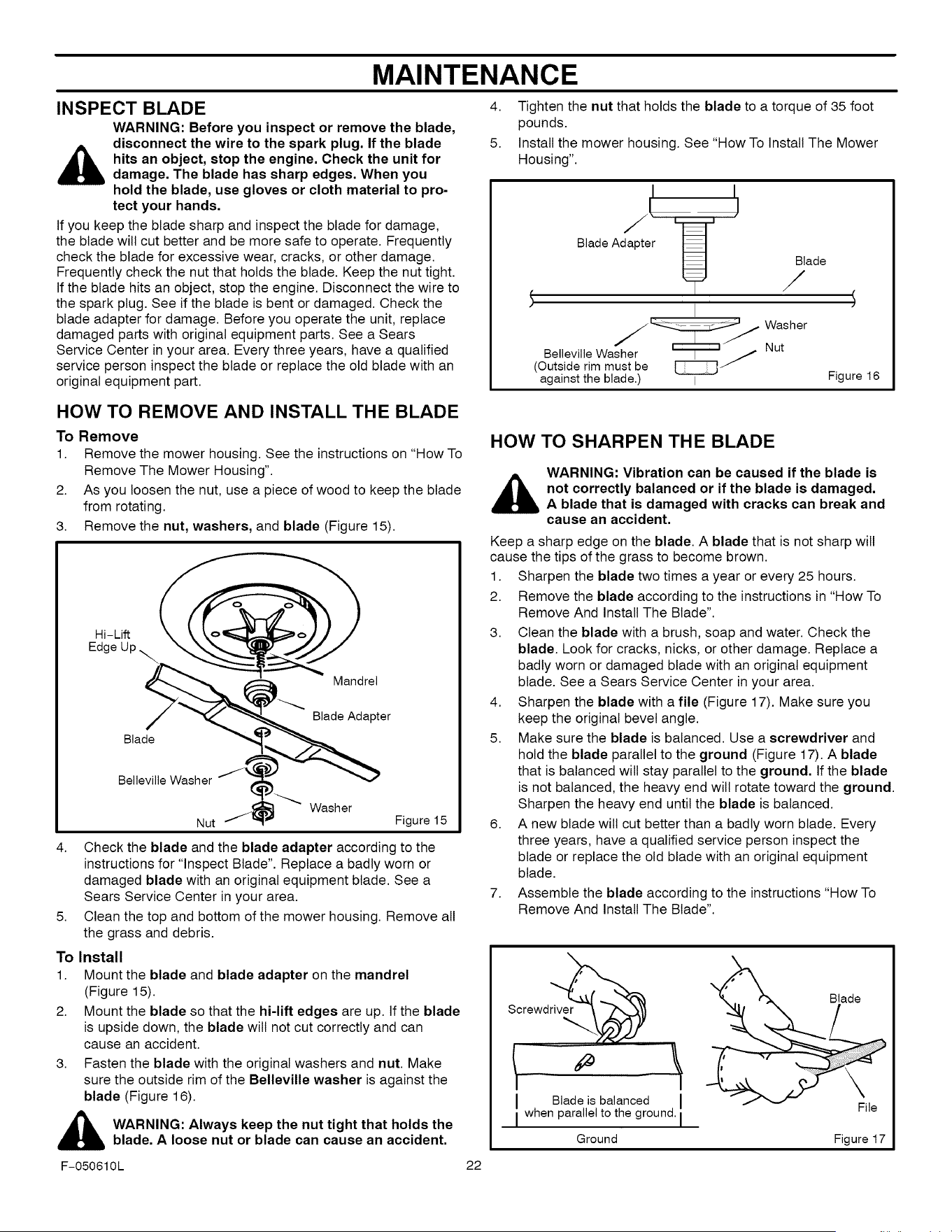
3. Remove the nut, washers, and blade (Figure 15).
Hi-Lift
Edge
Blade
Mandrel
Blade Adapter
Belleville Washer
Washer
Nut Figure 15
4. Check the blade and the blade adapter according to the
instructions for "Inspect Blade". Replace a badly worn or
damaged blade with an original equipment blade. See a
Sears Service Center in your area.
5. Clean the top and bottom of the mower housing. Remove all
the grass and debris.
To Install
1. Mount the blade and blade adapter on the mandrel
(Figure 15).
2. Mount the blade so that the hi-lift edges are up. If the blade
is upside down, the blade wilt not cut correctly and can
cause an accident.
3. Fasten the blade with the original washers and nut. Make
sure the outside rim of the Belleville washer is against the
blade (Figure 16).
,_ WARNING: Always keep the nut tight that holds the
blade. A loose nut or blade can cause an accident.
HOW TO SHARPEN THE BLADE
WARNING: Vibration can be caused if the blade is
,_not correctly balanced or if the blade is damaged.
A blade that is damaged with cracks can break and
cause an accident.
Keep a sharp edge on the blade. A blade that is not sharp wilt
cause the tips of the grass to become brown.
1. Sharpen the blade two times a year or every 25 hours.
2. Remove the blade according to the instructions in "How To
Remove And Install The Blade".
3. Clean the blade with a brush, soap and water. Check the
blade. Look for cracks, nicks, or other damage. Replace a
badly worn or damaged blade with an original equipment
blade. See a Sears Service Center in your area.
4. Sharpen the blade with a file (Figure 17). Make sure you
keep the original bevel angle.
5. Make sure the blade is balanced. Use a screwdriver and
hold the blade parallel to the ground (Figure 17). A blade
that is balanced will stay parallel to the ground. If the blade
is not balanced, the heavy end will rotate toward the ground.
Sharpen the heavy end until the blade is balanced.
6. A new blade will cut better than a badly worn blade. Every
three years, have a qualified service person inspect the
blade or replace the old blade with an original equipment
blade.
7. Assemble the blade according to the instructions "How To
Remove And Install The Blade".
Screwd_
[ Blade is balanced
[ when parallel to the ground.
Ground
F-050610L 22
MAINTENANCE
MAINTENANCE FREE BATTERY
HOW TO REMOVE THE BATTERY
To charge or clean the battery, remove the battery from the unit as
follows.
WARNING: To prevent sparks, disconnect the black
battery cable from the negative (-) terminal before you
,_ disconnect the red cable.
WARNING: The battery contains sulfuric acid which is
harmful to the skin, eyes and clothing. If the acid gets
on the body or clothing, wash with water.
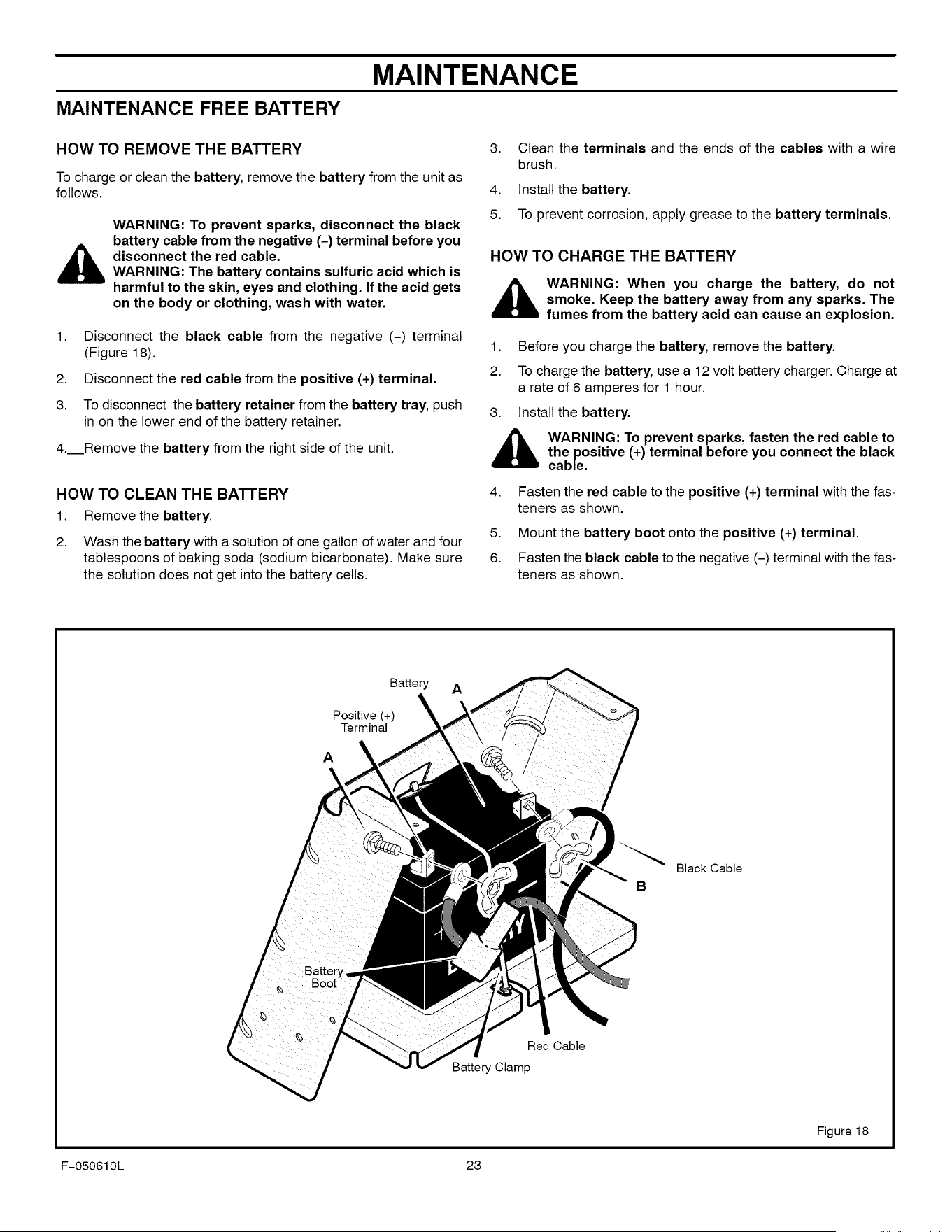
1. Disconnect the black cable from the negative (-) terminal
(Figure 18).
2. Disconnect the red cable from the positive (+) terminal.
3. To disconnect the battery retainer from the battery tray, push
in on the lower end of the battery retainer.
4. Remove the battery from the right side of the unit.
HOW TO CLEAN THE BATTERY
1. Remove the battery.
2. Wash the battery with a solution of one gallon of water and four
tablespoons of baking soda (sodium bicarbonate). Make sure
the solution does not get into the battery cells.
3.
4.
5.
Clean the terminals and the ends of the cables with a wire
brush.
Install the battery.
To prevent corrosion, apply grease to the battery terminals.
HOW TO CHARGE THE BATTERY
,_ WARNING: When you charge the battery, do not
smoke. Keep the battery away from any sparks. The
fumes from the battery acid can cause an explosion.
1. Before you charge the battery, remove the battery.
2. To charge the battery, use a 12 volt battery charger. Charge at
a rate of 6 amperes for 1 hour.
3. Install the battery.
,_ WARNING: To prevent sparks, fasten the red cable tothe positive (+) terminal before you connect the black
cable.
4. Fasten the red cable to the positive (+) terminal with the fas-
teners as shown.
5. Mount the battery boot onto the positive (+) terminal.
6. Fasten the black cable to the negative (-) terminal with the fas-
teners as shown.
Battery A
Positive (+)
Terminal
A
Black Cable
B
Red Cable
Battery Clamp
Figure 18
F-050610L 23
MAINTENANCE
WHERE TO LUBRICATE
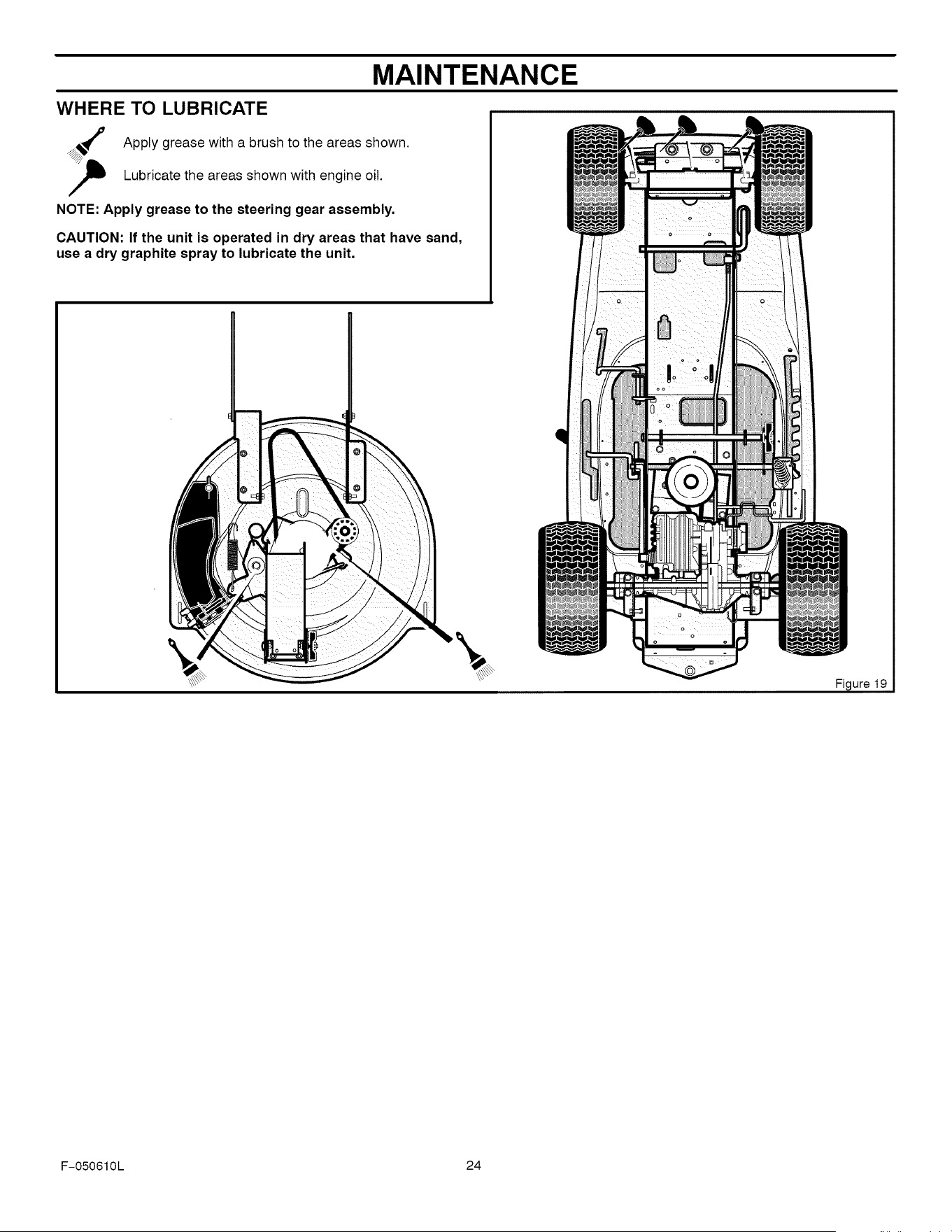
Apply grease with a brush to the areas shown.
Lubricate the areas shown with engine oil.
NOTE: Apply grease to the steering gear assembly.
CAUTION: If the unit is operated in dry areas that have sand,
use a dry graphite spray to lubricate the unit.
F-050610L 24
MAINTENANCE
ENGINE
2. Remove the oil drain cap. Drain the oil completely from the
engine. Install and tighten the oil drain cap.
HOW TO CHECK THE OIL
NOTE: Do not check the level of the oil while the engine runs.
1. Make sure the unit is level.
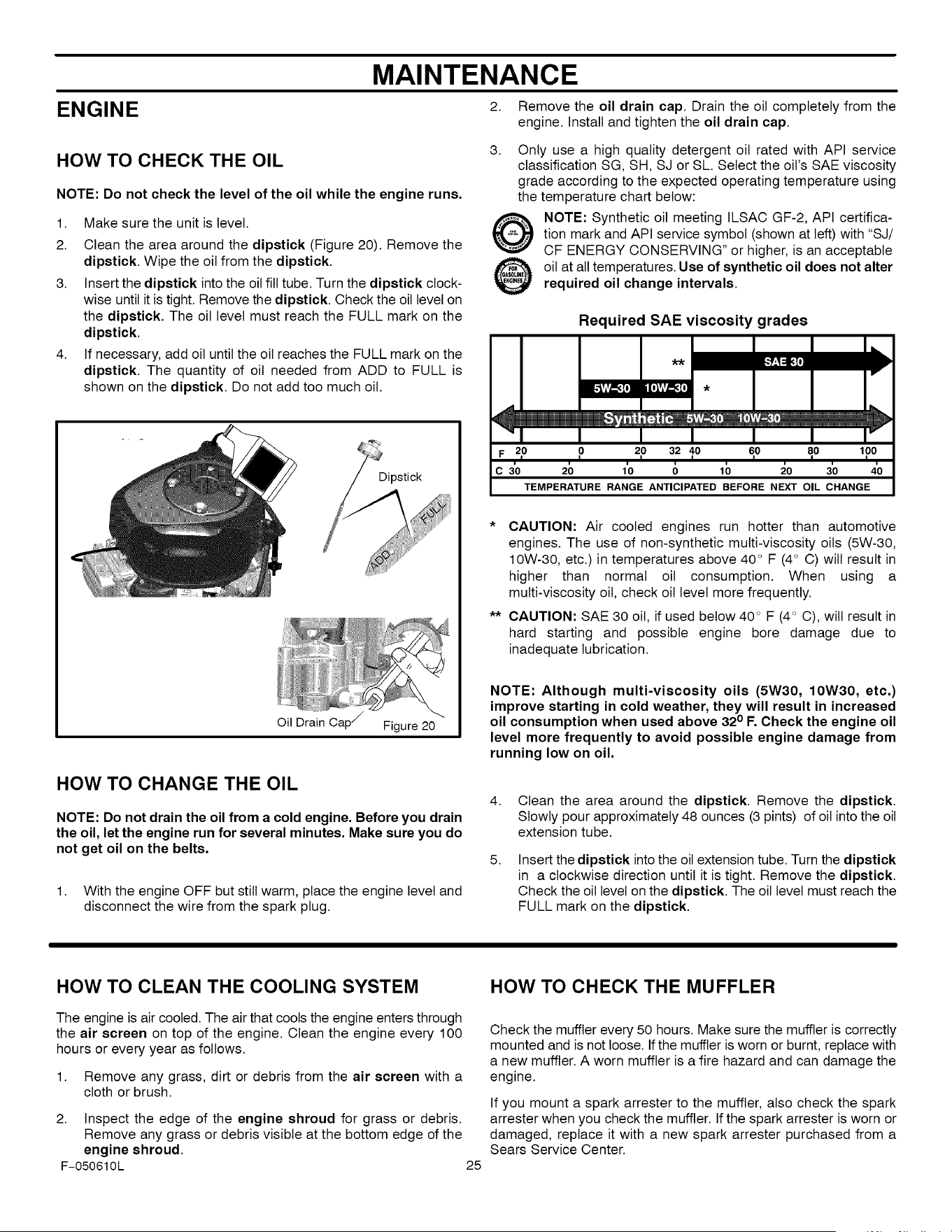
2. Clean the area around the dipstick (Figure 20). Remove the
dipstick. Wipe the oil from the dipstick.
3. Insert the dipstick into the oil fill tube. Turn the dipstick clock-
wise until it is tight. Remove the dipstick. Check the oil level on
the dipstick. The oil level must reach the FULL mark on the
dipstick.
4. If necessary, add oil until the oil reaches the FULL mark on the
dipstick. The quantity of oil needed from ADD to FULL is
shown on the dipstick. Do not add too much oil.
3. Only use a high quality detergent oil rated with API service
classification SG, SH, SJ or SL. Select the oil's SAE viscosity
grade according to the expected operating temperature using
the temperature chart below:
NOTE: Synthetic oil meeting ILSAC GF-2, API certifica-
tion mark and API service symbol (shown at left) with "S J/
CF ENERGY CONSERVING" or higher, is an acceptable
oil at all temperatures. Use of synthetic oil does not alter
required oil change intervals.
Required SAE viscosity grades
_' "_I'_
Dipstick
Oil Drain Cap / Figure 20
I I
F 20 0 20 32 10 60 80 100
i
C 30 20 10 0 10 20 30 40
TEMPERATURE RANGE ANTICIPATED BEFORE NEXT OIL CHANGE
* CAUTION: Air cooled engines run hotter than automotive
engines. The use of non-synthetic multi-viscosity oils (5W-30,
10W-30, etc.) in temperatures above 40 ° F (4° C) wilt result in
higher than normal oil consumption. When using a
multi-viscosity oil, check oil level more frequently.
** CAUTION: SAE 30 oil, if used below 40 ° F (4 ° C), will result in
hard starting and possible engine bore damage due to
inadequate lubrication.
NOTE: Although multi-viscosity oils (5W30, 10W30, etc.)
improve starting in cold weather, they will result in increased
oil consumption when used above 320 F. Check the engine oil
level more frequently to avoid possible engine damage from
running low on oil.
HOW TO CHANGE THE OIL
NOTE: Do not drain the oil from a cold engine. Before you drain
the oil, let the engine run for several minutes. Make sure you do
not get oil on the belts.
1. With the engine OFF but still warm, place the engine level and
disconnect the wire from the spark plug.
4.
5.
Clean the area around the dipstick. Remove the dipstick.
Slowly pour approximately 48 ounces (3 pints) of oil into the oil
extension tube.
Insert the dipstick into the oil extension tube. Turn the dipstick
in a clockwise direction until it is tight. Remove the dipstick,
Check the oil level on the dipstick. The oil level must reach the
FULL mark on the dipstick.
HOW TO CLEAN THE COOLING SYSTEM
The engine is air cooled. The air that cools the engine enters through
the air screen on top of the engine. Clean the engine every 100
hours or every year as follows.
1. Remove any grass, dirt or debris from the air screen with a
cloth or brush.
2. Inspect the edge of the engine shroud for grass or debris.
Remove any grass or debris visible at the bottom edge of the
engine shroud.
F-050610L
HOW TO CHECK THE MUFFLER
25
Check the muffler every 50 hours. Make sure the muffler is correctly
mounted and is not loose. If the muffler is worn or burnt, replace with
a new muffler. A worn muffler is a fire hazard and can damage the
engine.
If you mount a spark arrester to the muffler, also check the spark
arrester when you check the muffler. If the spark arrester is worn or
damaged, replace it with a new spark arrester purchased from a
Sears Service Center.
MAINTENANCE
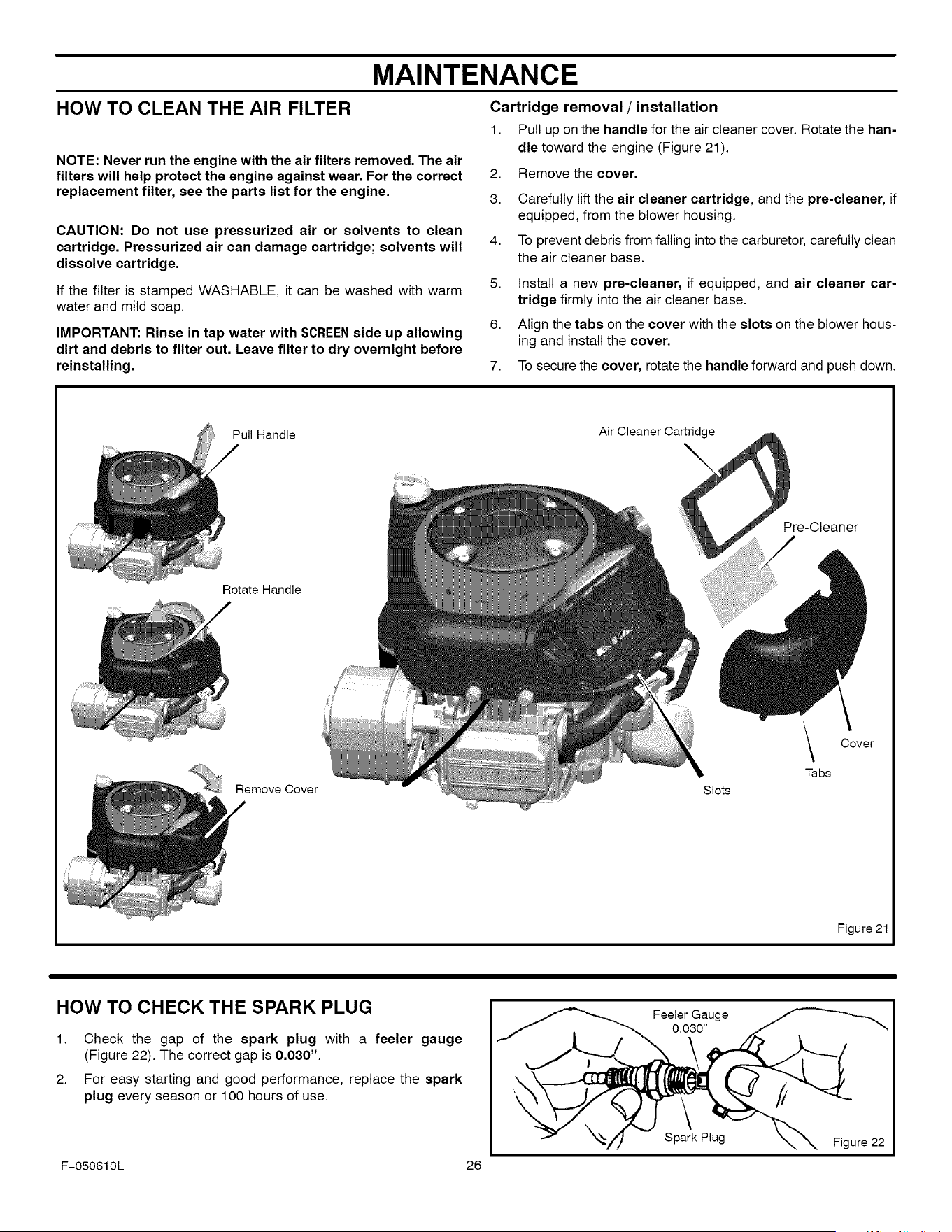
HOW TO CLEAN THE AIR FILTER
NOTE: Never run the engine with the air filters removed. The air
filters will help protect the engine against wear. For the correct
replacement filter, see the parts list for the engine.
CAUTION: Do not use pressurized air or solvents to clean
cartridge. Pressurized air can damage cartridge; solvents will
dissolve cartridge.
If the filter is stamped WASHABLE, it can be washed with warm
water and mild soap.
IMPORTANT: Rinse in tap water with SCREENside up allowing
dirt and debris to filter out. Leave filter to dry overnight before
reinstalling.
Cartridge removal / installation
1. Pull up on the handle for the air cleaner cover. Rotate the han-
dle toward the engine (Figure 21).
2. Remove the cover.
3.
4.
Carefully lift the air cleaner cartridge, and the pre-cleaner, if
equipped, from the blower housing.
To prevent debris from falling into the carburetor, carefully clean
the air cleaner base.
5. Install a new pre-cleaner, if equipped, and air cleaner car-
tridge firmly into the air cleaner base.
6. Align the tabs on the cover with the slots on the blower hous-
ing and install the cover.
7.
To secure the cover, rotate the handle forward and push down.
Pull Handle
Air
ge
\
Pre-Cleaner
Rotate Handle
Remove Cover
Slots
\
Tabs
Cover
Figure 21
HOW TO CHECK THE SPARK PLUG
1. Check the gap of the spark plug with a feeler gauge
(Figure 22). The correct gap is 0.030".
2. For easy starting and good performance, replace the spark
plug every season or 100 hours of use.
Feeler Gauge
0.030"
Spark Plug
Figure 22
F-050610L 26
SERVICE AND ADJUSTMENT
HOW TO LEVEL THE MOWER HOUSING
If the mower housing is level, the blade will cut easier and the lawn
will look better.
WARNING: Before you make an inspection, adjust-
,_ ment, or repair to the unit, disconnect the wire to the
spark plug. Remove the spark plug wire to prevent
the engine from starting by accident.
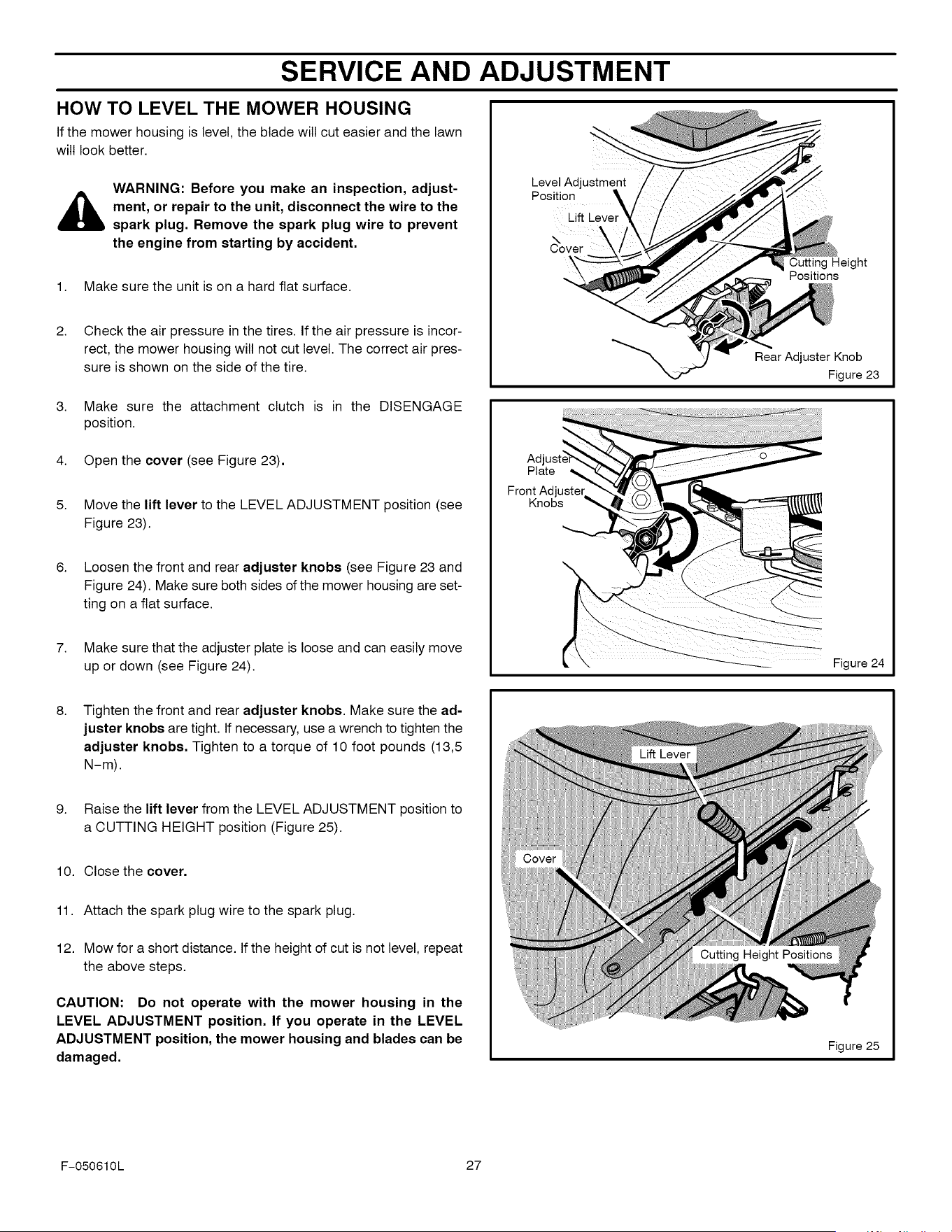
1. Make sure the unit is on a hard flat surface.
2. Check the air pressure in the tires. If the air pressure is incor-
rect, the mower housing will not cut level. The correct air pres-
sure is shown on the side of the tire.
LevelAdjustment
Position
Lift Lever
Cover
Cutting Height
Positions
Rear Adjuster Knob
3. Make sure the attachment clutch is in the DISENGAGE
position.
4. Open the cover (see Figure 23).
5.
6.
7.
Move the lift lever to the LEVEL ADJUSTMENT position (see
Figure 23).
Loosen the front and rear adjuster knobs (see Figure 23 and
Figure 24). Make sure both sides of the mower housing are set-
ting on a flat surface.
Make sure that the adjuster plate is loose and can easily move
up or down (see Figure 24).
Plate
Front Adjuster
Knobs
Figure 23
Figure 24
8.
Tighten the front and rear adjuster knobs. Make sure the ad-
juster knobs are tight. If necessary, use a wrench to tighten the
adjuster knobs, Tighten to a torque of 10 foot pounds (13,5
N-m).
9. Raise the lift lever from the LEVEL ADJUSTMENT position to
a CUTTING HEIGHT position (Figure 25).
10. Close the cover,
11. Attach the spark plug wire to the spark plug.
12. Mow for a short distance. If the height of cut is not level, repeat
the above steps.
CAUTION: Do not operate with the mower housing in the
LEVEL ADJUSTMENT position. If you operate in the LEVEL
ADJUSTMENT position, the mower housing and blades can be
damaged.
Figure 25
F-050610L 27
SERVICE AND ADJUSTMENT
HOW TO ADJUST THE ATTACHMENT CLUTCH
,_ WARNING: To prevent an injury, the attachment
clutch must operate correctly.
In normal usage, the attachment clutch will not require an
adjustment. However, if the cutting performance decreases or the
quality of cut is poor, make the following changes.
1. When you mow, make sure the throttle control in in the FAST
position.
2.
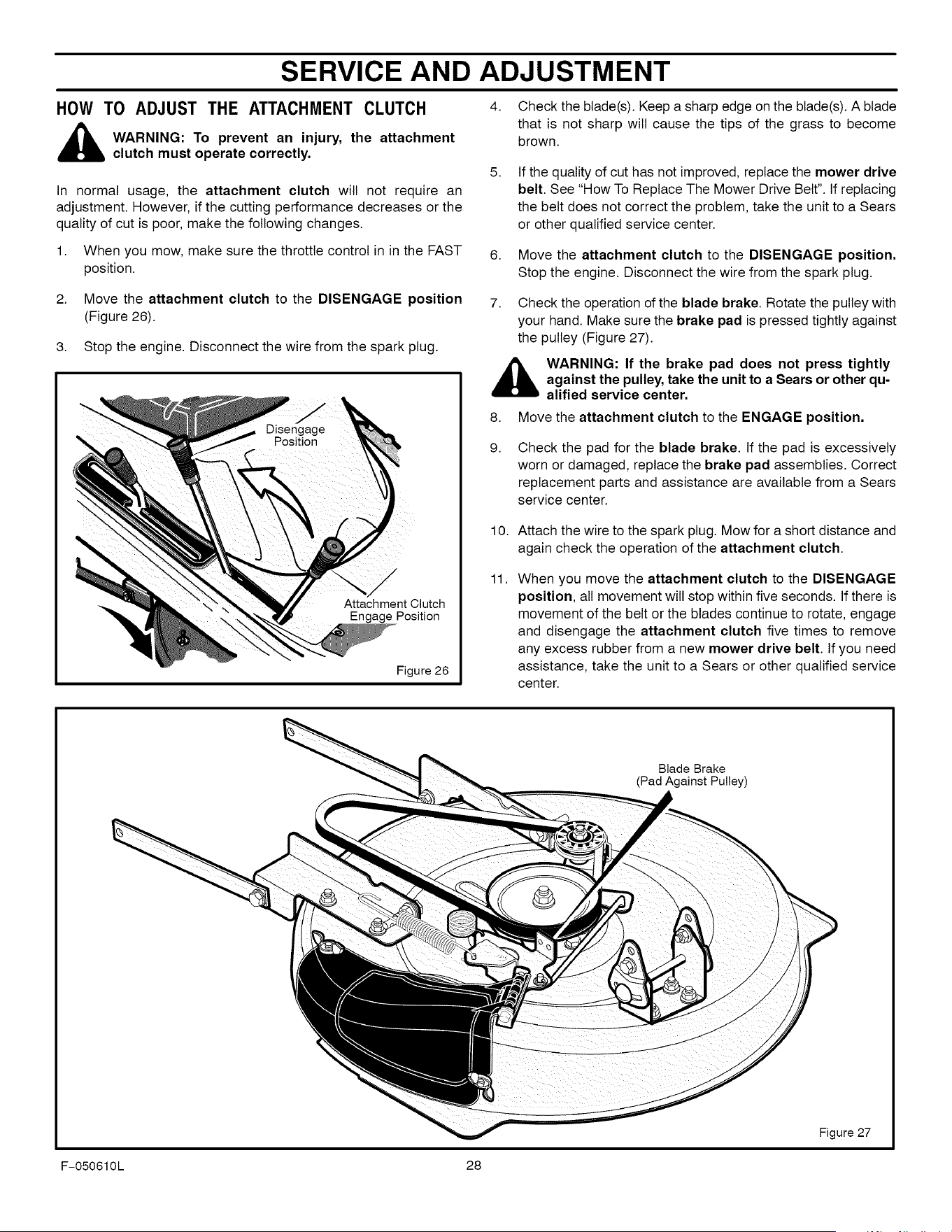
Move the attachment clutch to the DISENGAGE position
(Figure 26).
3. Stop the engine. Disconnect the wire from the spark plug.
Attachment Clutch
Engage Position
Figure 26
4. Check the blade(s). Keep a sharp edge on the blade(s). A blade
that is not sharp wilt cause the tips of the grass to become
brown.
5.
If the quality of cut has not improved, replace the mower drive
belt. See "How To Replace The Mower Drive Belt". If replacing
the belt does not correct the problem, take the unit to a Sears
or other qualified service center.
6.
7.
Move the attachment clutch to the DISENGAGE position.
Stop the engine. Disconnect the wire from the spark plug.
Check the operation of the blade brake. Rotate the pulley with
your hand. Make sure the brake pad is pressed tightly against
the pulley (Figure 27).
,_ WARNING: If the brake pad does not press tightly
against the pulley, take the unit to a Sears or other qu-
alified service center.
8. Move the attachment clutch to the ENGAGE position.
9.
Check the pad for the blade brake. If the pad is excessively
worn or damaged, replace the brake pad assemblies. Correct
replacement parts and assistance are available from a Sears
service center.
10. Attach the wire to the spark plug. Mow for a short distance and
again check the operation of the attachment clutch.
11.
When you move the attachment clutch to the DISENGAGE
position, all movement will stop within five seconds. If there is
movement of the belt or the blades continue to rotate, engage
and disengage the attachment clutch five times to remove
any excess rubber from a new mower drive belt. If you need
assistance, take the unit to a Sears or other qualified service
center.
Blade Brake
(Pad Against Pulley)
Figure 27
F-050610L 28
SERVICE AND ADJUSTMENT
HOW TO INSTALL THE MOWER HOUSINGHOW TO REMOVE THE MOWER HOUSING
1. Move the attachment clutch to the DISENGAGE position.
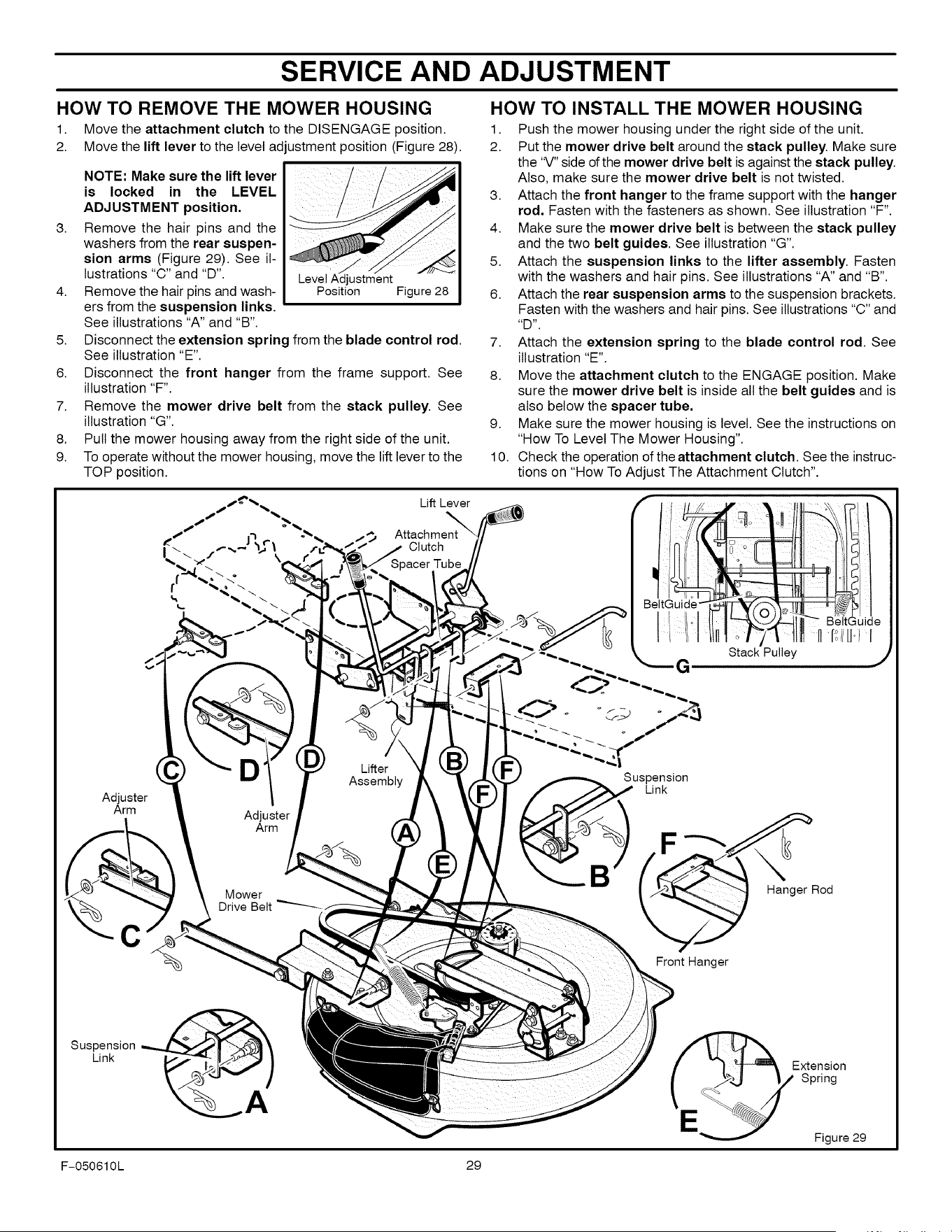
2. Move the lift lever to the level adjustment position (Figure 28).
3.
4.
5.
6.
7.
8.
9.
NOTE: Make sure the lift lever
is locked in the LEVEL
ADJUSTMENT position.
Remove the hair pins and the
washers from the rear suspen-
sion arms (Figure 29). See il-
lustrations "C" and "D". LevelAdjustment
Remove the hair pins and wash- Position Figure 28
ers from the suspension links.
See illustrations "A" and "B".
Disconnect the extension spring from the blade control rod.
See illustration "E".
Disconnect the front hanger from the frame support. See
illustration "F".
Remove the mower drive belt from the stack pulley. See
illustration "G".
Pull the mower housing away from the right side of the unit.
To operate without the mower housing, move the lift lever to the
TOP position.
1. Push the mower housing under the right side of the unit.
2. Put the mower drive belt around the stack pulley. Make sure
the "V" side of the mower drive belt is against the stack pulley.
Also, make sure the mower drive belt is not twisted.
3. Attach the front hanger to the frame support with the hanger
rod. Fasten with the fasteners as shown. See illustration "F".
4. Make sure the mower drive belt is between the stack pulley
and the two belt guides. See illustration "G".
5. Attach the suspension links to the lifter assembly. Fasten
with the washers and hair pins. See illustrations "A" and "B".
6. Attach the rear suspension arms to the suspension brackets.
Fasten with the washers and hair pins. See illustrations "C" and
_D _"
7. Attach the extension spring to the blade control rod. See
illustration "E".
8. Move the attachment clutch to the ENGAGE position. Make
sure the mower drive belt is inside all the belt guides and is
also below the spacer tube,
9. Make sure the mower housing is level. See the instructions on
"How To Level The Mower Housing".
10. Check the operation of the attachment clutch. See the instruc-
tions on "How To Adjust The Attachment Clutch".
Adjuster
Arm
D
Adjuster
Arm
Lift Lever
Attachment
Clutch
_acer Tube
Lifter
Assembly
Suspension
Link
BeltGuide
H f_iilJ'! I
Stack Pulley ,j
C
Mower
Drive Belt
Front Hanger
Hanger Rod
SuspensionLink
Figure 29
F-050610L 29
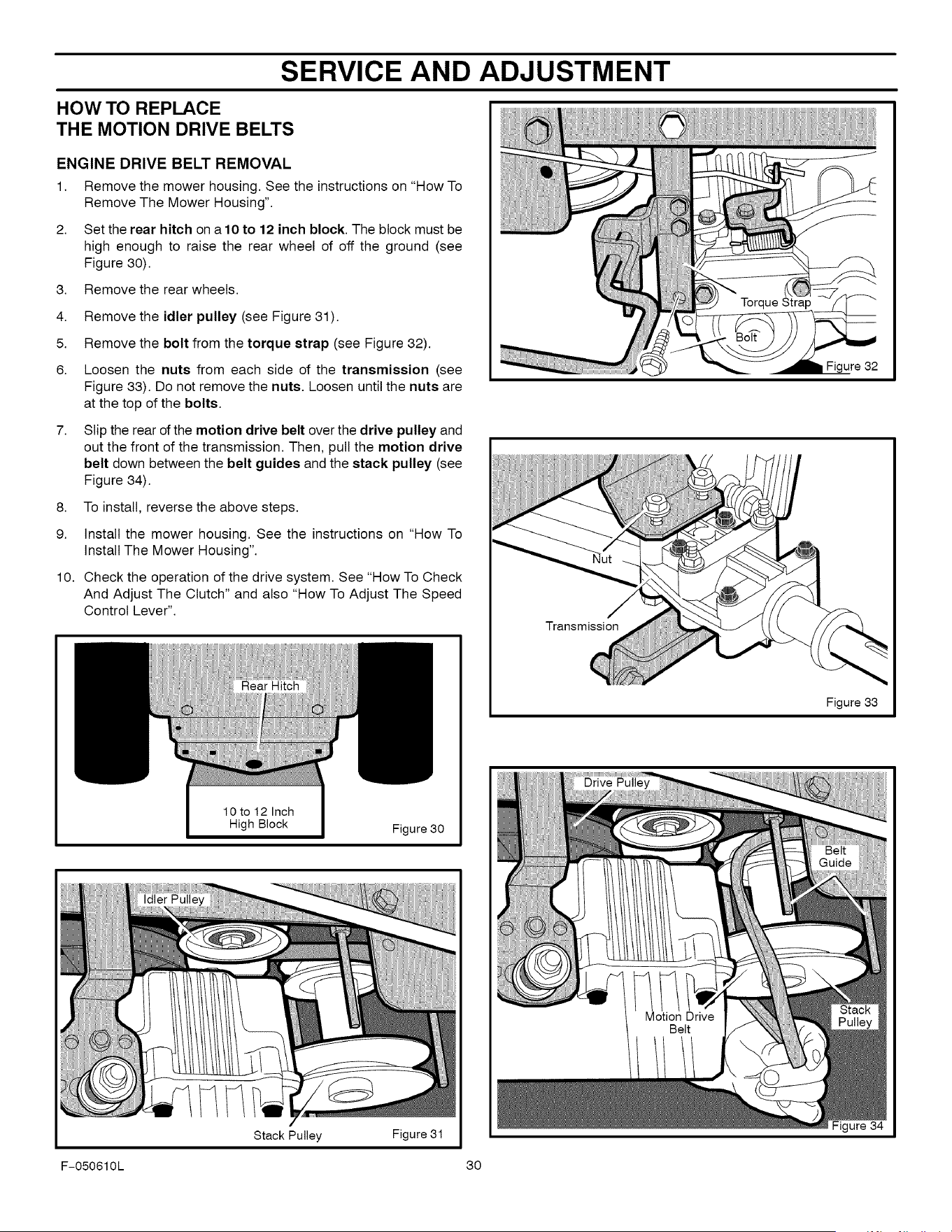
SERVICE AND ADJUSTMENT
HOW TO REPLACE
THE MOTION DRIVE BELTS
ENGINE DRIVE BELT REMOVAL
1. Remove the mower housing. See the instructions on "How To
Remove The Mower Housing".
2. Set the rear hitch on a 10 to 12 inch block. The block must be
high enough to raise the rear wheel of off the ground (see
Figure 30).
3. Remove the rear wheels.
4,
5.
6.
7,
8,
9.
10.
Remove the idler pulley (see Figure 31).
Remove the bolt from the torque strap (see Figure 32).
Loosen the nuts from each side of the transmission (see
Figure 33). Do not remove the nuts. Loosen until the nuts are
at the top of the bolts.
Slip the rear of the motion drive belt over the drive pulley and
out the front of the transmission. Then, pull the motion drive
belt down between the belt guides and the stack pulley (see
Figure 34).
To install, reverse the above steps.
Install the mower housing. See the instructions on "How To
Install The Mower Housing".
Check the operation of the drive system. See "How To Check
And Adjust The Clutch" and also "How To Adjust The Speed
Control Lever".
Figure 30
Y1V1
Stack Pulley
Figure 31
Figure 32
Figure 33
Figure 34
F-050610L 30
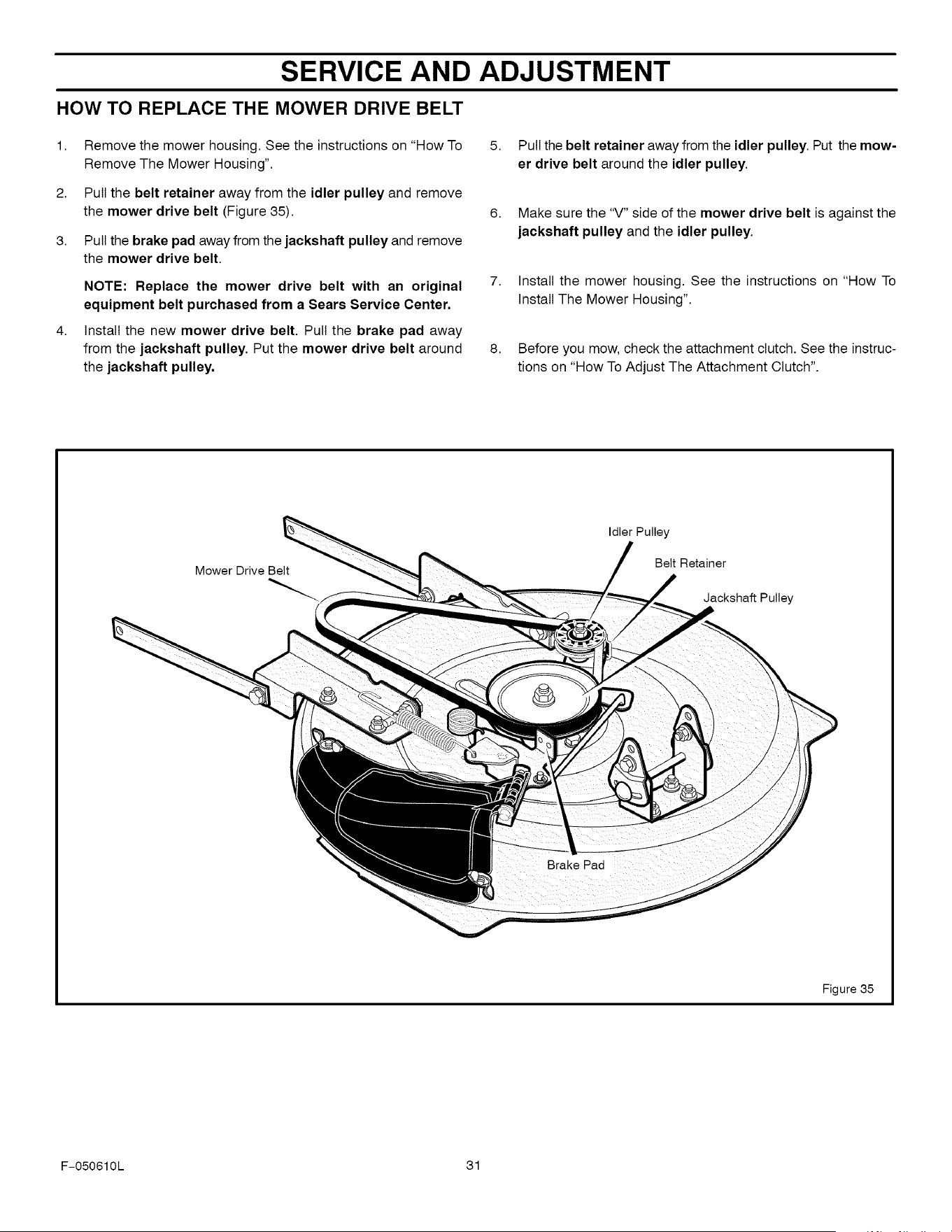
SERVICE AND ADJUSTMENT
HOW TO REPLACE THE MOWER DRIVE BELT
1.
2.
3.
4.
Remove the mower housing. See the instructions on "How To
Remove The Mower Housing".
Pull the belt retainer away from the idler pulley and remove
the mower drive belt (Figure 35).
Pull the brake pad away from the jackshaft pulley and remove
the mower drive belt.
NOTE: Replace the mower drive belt with an original
equipment belt purchased from a Sears Service Center.
Install the new mower drive belt. Pull the brake pad away
from the jackshaft pulley. Put the mower drive belt around
the jackshaft pulley.
5. Pull the belt retainer away from the idler pulley. Put the mow-
er drive belt around the idler pulley.
6. Make sure the "V" side of the mower drive belt is against the
jackshaft pulley and the idler pulley.
7. Install the mower housing. See the instructions on "How To
Install The Mower Housing".
8. Before you mow, check the attachment clutch. See the instruc-
tions on "How To Adjust The Attachment Clutch".
Mower Drive Belt
Idler Pulley
Belt Retainer
Jackshaft Pulley
Figure 35
F-O50610L 31
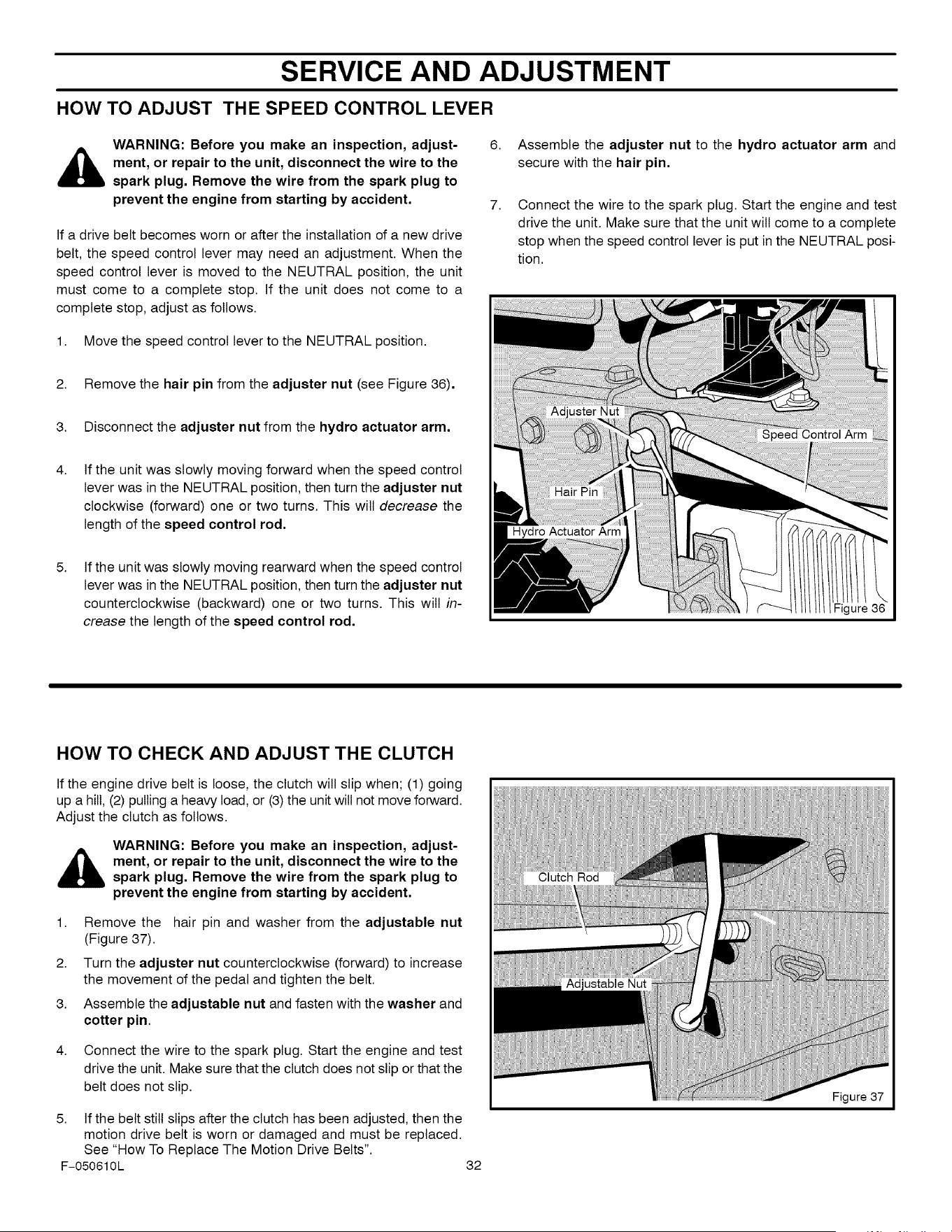
SERVICE AND ADJUSTMENT
HOW TO ADJUST THE SPEED CONTROL LEVER
WARNING: Before you make an inspection, adjust-
,_ ment, or repair to the unit, disconnect the wire to the
spark plug. Remove the wire from the spark plug to
prevent the engine from starting by accident.
If a drive belt becomes worn or after the installation of a new drive
belt, the speed control lever may need an adjustment. When the
speed control lever is moved to the NEUTRAL position, the unit
must come to a complete stop. If the unit does not come to a
complete stop, adjust as follows.
1. Move the speed control lever to the NEUTRAL position.
2. Remove the hair pin from the adjuster nut (see Figure 36).
3. Disconnect the adjuster nut from the hydro actuator arm.
4.
If the unit was slowly moving forward when the speed control
lever was in the NEUTRAL position, then turn the adjuster nut
clockwise (forward) one or two turns. This wilt decrease the
length of the speed control rod,
5.
If the unit was slowly moving rearward when the speed control
lever was in the NEUTRAL position, then turn the adjuster nut
counterclockwise (backward) one or two turns. This will in-
crease the length of the speed control rod,
6.
7.
Assemble the adjuster nut to the hydro actuator arm and
secure with the hair pin.
Connect the wire to the spark plug. Start the engine and test
drive the unit. Make sure that the unit will come to a complete
stop when the speed control lever is put in the NEUTRAL posi-
tion.
kFigure 36
HOW TO CHECK AND ADJUST THE CLUTCH
If the engine drive belt is loose, the clutch will slip when; (1) going
up a hill, (2) pulling a heavy load, or (3) the unit will not move forward.
Adjust the clutch as follows.
WARNING: Before you make an inspection, adjust-
,_ ment, or repair to the unit, disconnect the wire to the
spark plug. Remove the wire from the spark plug to
prevent the engine from starting by accident.
1. Remove the hair pin and washer from the adjustable nut
(Figure 37).
2. Turn the adjuster nut counterclockwise (forward) to increase
the movement of the pedal and tighten the belt.
3. Assemble the adjustable nut and fasten with the washer and
cotter pin.
4. Connect the wire to the spark plug. Start the engine and test
drive the unit. Make sure that the clutch does not slip or that the
belt does not slip.
5. If the belt still slips after the clutch has been adjusted, then the
motion drive belt is worn or damaged and must be replaced.
See "How To Replace The Motion Drive Belts".
F-050610L 32
Figure 37
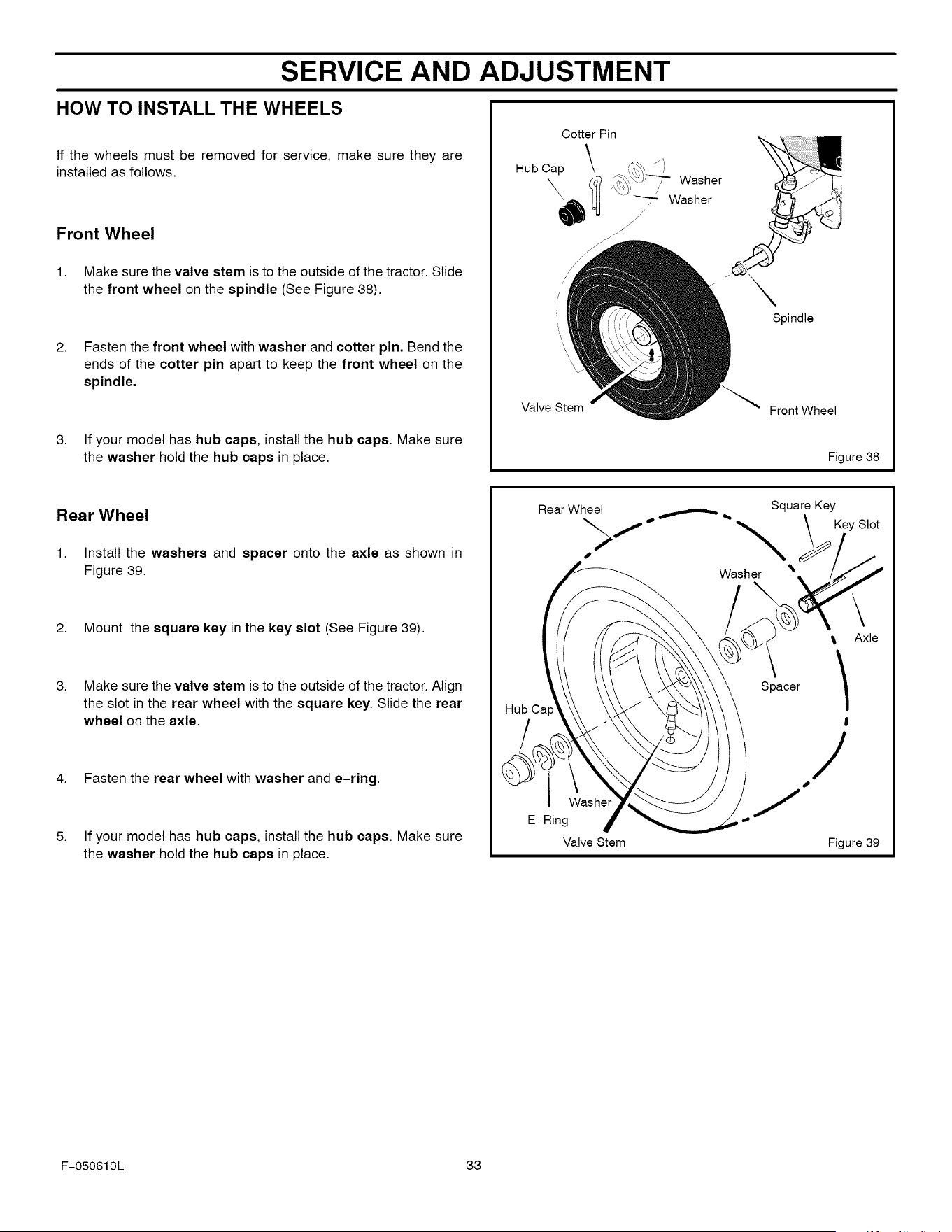
SERVICE AND ADJUSTMENT
HOW TO INSTALL THE WHEELS
If the wheels must be removed for service, make sure they are
installed as follows.
Front Wheel
1. Make sure the valve stem is to the outside of the tractor. Slide
the front wheel on the spindle (See Figure 38).
2. Fasten the front wheel with washer and cotter pin. Bend the
ends of the cotter pin apart to keep the front wheel on the
spindle.
3. If your model has hub caps, install the hub caps. Make sure
the washer hold the hub caps in place.
Cotter Pin
Valve Stem
Spindle
Front Wheel
Figure 38
Rear Wheel
1. Install the washers and spacer onto the axle as shown in
Figure 39.
2. Mount the square key in the key slot (See Figure 39).
3. Make sure the valve stem is to the outside of the tractor. Align
the slot in the rear wheel with the square key. Slide the rear
wheel on the axle.
4. Fasten the rear wheel with washer and e-ring.
5. If your model has hub caps, install the hub caps. Make sure
the washer hold the hub caps in place.
Rear Wheel ,o _ _ Square Key
/ _ Key Slot
Washer
Hub Cap
E-Ring
Valve Stem
I Axle
Spacer /
I
Figure 39
F-050610L 33
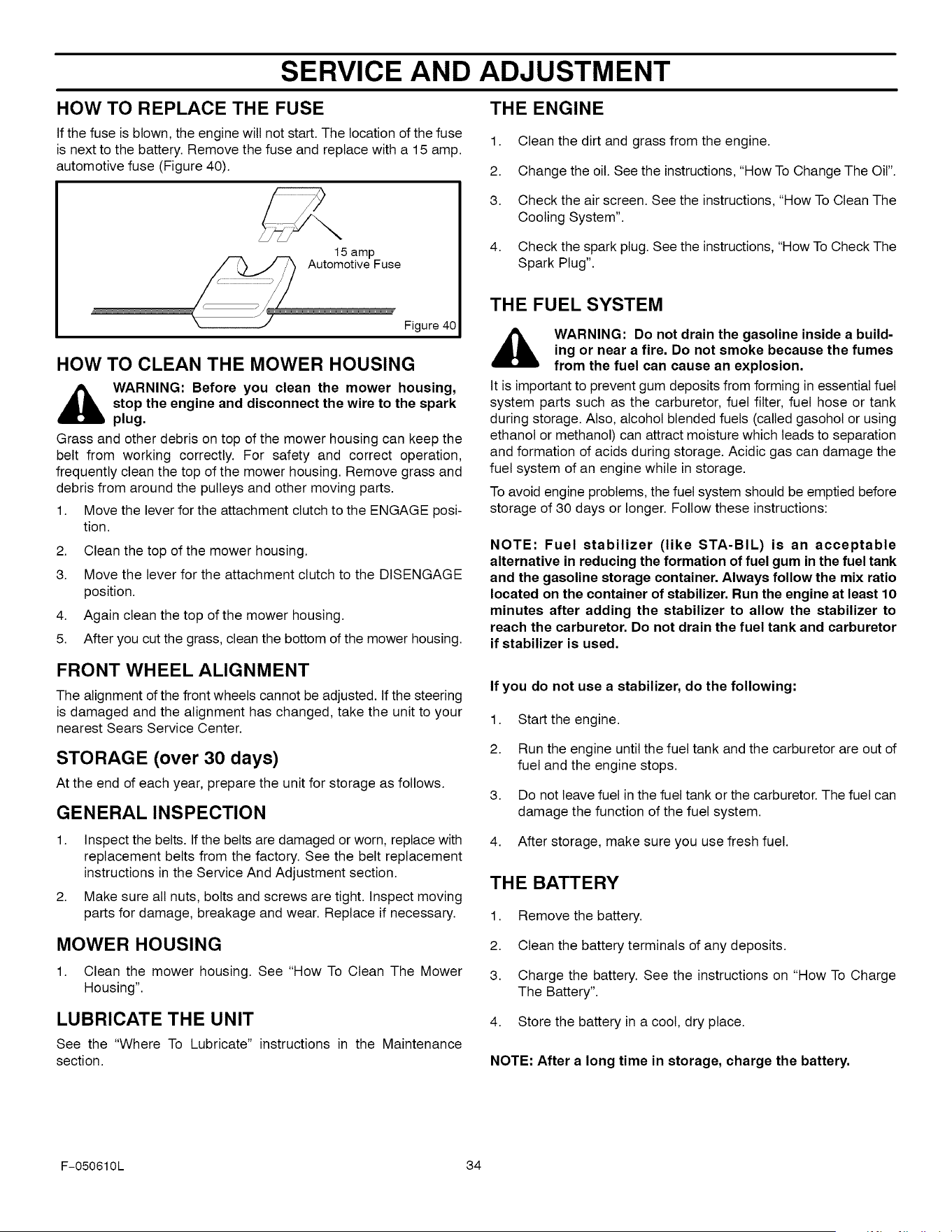
SERVICE AND ADJUSTMENT
HOW TO REPLACE THE FUSE
If the fuse is blown, the engine will not start. The location of the fuse
is next to the battery. Remove the fuse and replace with a 15 amp.
automotive fuse (Figure 40).
THE ENGINE
1. Clean the dirt and grass from the engine.
2. Change the oil. See the instructions, "How To Change The Oil".
15 amp
Figure 40
HOW TO CLEAN THE MOWER HOUSING
_ WARNING: Before you clean the mower housing,
stop the engine and disconnect the wire to the spark
plug.
Grass and other debris on top of the mower housing can keep the
belt from working correctly. For safety and correct operation,
frequently clean the top of the mower housing. Remove grass and
debris from around the pulleys and other moving parts.
1. Move the lever for the attachment clutch to the ENGAGE posi-
tion.
2. Clean the top of the mower housing.
3. Move the lever for the attachment clutch to the DISENGAGE
position.
4. Again clean the top of the mower housing.
5. After you cut the grass, clean the bottom of the mower housing.
3.
4.
Check the air screen. See the instructions, "How To Clean The
Cooling System".
Check the spark plug. See the instructions, "How To Check The
Spark Plug".
THE FUELSYSTEM
,_ WARNING: Do not drain the gasoline inside a build-
ing or near a fire. Do not smoke because the fumes
from the fuel can cause an explosion.
It is important to prevent gum deposits from forming in essential fuel
system parts such as the carburetor, fuel filter, fuel hose or tank
during storage. Also, alcohol blended fuels (called gasohol or using
ethanol or methanol) can attract moisture which leads to separation
and formation of acids during storage. Acidic gas can damage the
fuel system of an engine while in storage.
To avoid engine problems, the fuel system should be emptied before
storage of 30 days or longer. Follow these instructions:
NOTE: Fuel stabilizer (like STA-BIL) is an acceptable
alternative in reducing the formation of fuel gum in the fuel tank
and the gasoline storage container. Always follow the mix ratio
located on the container of stabilizer. Run the engine at least 10
minutes after adding the stabilizer to allow the stabilizer to
reach the carburetor. Do not drain the fuel tank and carburetor
if stabilizer is used.
FRONT WHEEL ALIGNMENT
The alignment of the front wheels cannot be adjusted. If the steering
is damaged and the alignment has changed, take the unit to your
nearest Sears Service Center.
STORAGE (over 30 days)
At the end of each year, prepare the unit for storage as follows.
GENERAL INSPECTION
If you do not use a stabilizer, do the following:
1. Start the engine.
2. Run the engine until the fuel tank and the carburetor are out of
fuel and the engine stops.
3. Do not leave fuel in the fuel tank or the carburetor. The fuel can
damage the function of the fuel system.
1. Inspect the belts. If the belts are damaged or worn, replace with
replacement belts from the factory. See the belt replacement
instructions in the Service And Adjustment section.
2. Make sure all nuts, bolts and screws are tight. Inspect moving
parts for damage, breakage and wear. Replace if necessary.
MOWER HOUSING
1. Clean the mower housing. See "How To Clean The Mower
Housing".
LUBRICATE THE UNIT
See the "Where To Lubricate" instructions in the Maintenance
section.
4. After storage, make sure you use fresh fuel.
THE BATTERY
1. Remove the battery.
2. Clean the battery terminals of any deposits.
3. Charge the battery. See the instructions on "How To Charge
The Battery".
4. Store the battery in a cool, dry place.
NOTE: After a long time in storage, charge the battery.
F-O50610L 34
TROUBLESHOOTING CHART
PROBLEM: The engine will not start.
1. Follow the steps, "How To Start The Engine" in this book.
2. Electric-Start Models: Clean the battery terminals. Tighten the
cables.
3. Drain the fuel tank. Clean the fuel line. Replace the fuel filter.
4. Remove the spark plug(s). Move the throttle to the SLOW posi-
tion. Turn the ignitionkey to the ON position. Try to start the en-
gine several times. Install the spark plug.
5. Replace the spark plug.
6. Adjust the carburetor.
PROBLEM: The engine will not turn over.
1. Follow the steps, "How To Start The Engine" in this book.
2. Electric-Start Models: Check the level of the acid in the battery.
If needed, add water. Charge the battery.
3. Replace the fuse.
4. Check the wiring harness for damage or a loose connection.
Repair the damaged wire.
5. Electric-Start Models: replace the solenoid. Recoil-Start Mod-
els: replace the module.
PROBLEM: The engine is difficult to start.
1. Adjust the carburetor.
2. Replace the spark plug.
3. Replace the fuel filter.
PROBLEM: The engine does not run smooth or has a
loss of power.
1. Check the oil.
2. Clean the air filter.
3. Clean the air screen.
4. Replace the spark plug.
5. The engine is working too hard. Use a lower gear.
6. Adjust the carburetor.
7. Replace the fuel filter.
PROBLEM: The engine does not run smooth at fast
speed.
1. Replace the spark plug.
2. Adjust the throttle control.
3. Clean the air filter.
4. Replace the fuel filter.
PROBLEM: The engine stops when the blades are
engaged.
1. Check the wiring harness for damage or a loose connection.
Repair the damaged wire.
2. Transmission is in reverse. Before operating in reverse, move
the blade rotation control to the DISENGAGED position,
PROBLEM: On slopes, the engine stops.
1. Mow up and down slopes. Never mow across a slope.
PROBLEM: The engine will not idle.
1. Replace the spark plug.
2. Clean the air filter.
3. Adjust the carburetor.
4. Adjust the throttle control.
5. Drain the fuel tank. Clean the fuel line. Replace the fuel filter.
PROBLEM: A hot engine causes a decrease in power.
1. Clean the air screen.
2. Check the oil.
3. Adjust the carburetor.
4. Replace the fuel filter.
F-050610L 35
PROBLEM: Excessive vibration.
1. Replace the blade.
2. Check for loose engine bolts.
3. Decrease the air pressure in the tires.
4. Adjust the carburetor.
5. Check for a damaged belt or damaged pulley. Replace the
damaged parts.
PROBLEM: The grass does not discharge correctly.
1. Stop the engine. Clean the mower housing.
2. Raise the height of cut.
3. Replace or sharpen the blade(s).
4. Move the shift lever to a slower speed.
5. Move the throttle control to the FAST position.
6. Replace the spring for the blade idler.
PROBLEM: The mower housing does not cut level.
1. Check the air pressure in the tires.
2. Adjust the level of the mower housing.
3. Check the front axle. If the front axle does not freely pivot, loos-
en the axle bolt(s).
PROBLEM: The mower blades will not rotate.
1. Check the mower drive belt. Make sure the belt is installed cor-
rectly.
2. Replace the mower drive belt.
PROBLEM: The unit will not move when the clutch is
engaged.
1. Check the motion drive belt. Make sure the belt is installed
correctly.
2. Adjust the clutch.
3. Replace the motion drive belt.
PROBLEM: The unit moves slower or stops when the
clutch is engaged.
1. Adjust the clutch.
2. Replace the motion drive belt.
PROBLEM: When the clutch/brake pedal is released, belt
noise can be heard.
1. Temporary belt noise does not change the operation of the unit.
If belt noise is continuous, check the routing of the belt. Make
sure the belt is inside all belt guides.
2. If the noise is continuous, adjust the clutch.
PROBLEM: The rear wheels spin over uneven terrain.
1. Check the front axle. If the front axle does not freely pivot, loos-
en the axle bolt(s).
PROBLEM: The engine stops when the operator leaves
the seat.
1. This is normal. The operator presence system is designed to
allow operation only ifthe operator is in the seat.
PROBLEM: The engine stops when selecting reverse
travel.
1. Before selecting reverse travel, move the blade rotation control
to the DISENGAGE position. See the Operation section for de-
tails.
PROBLEM: The transaxle is difficult to shift between
gears with the engine running and the clutch depressed.
1. Check the clutch adjustment to make sure the belt stops when
the clutch pedal is depressed with the transaxle in (N) neutral.
2. Check the belt guides around the transaxle drive pulley. Make
sure the belt guides do not touch the pulley.
(ThispageapplicableintheU.S.A.andCanadaonly.)
Sears,RoebuckandCo,,U,S,A,(Sears),theCaliforniaAirResourcesBoard(CARB)
andtheUnitedStatesEnvironmentalProtectionAgency(U,S,EPA)
EmissionControlSystemWarrantyStatement(Owner'sDefectWarrantyRightsandObligations)
EMISSIONCONTROLWARRANTYCOVERAGEISAPPLICABLETOCERTIFIEDMODELYEAR1997ANDLATERENGINES
TOCERTIFIEDENGINESPURCHASEDINCALIFORNIAIN1995 WHICHAREPURCHASEDANDUSEDELSEWHEREINTHE
ANDTHEREAFTER,WHICHAREUSEDINCALIFORNIA,AND UNITEDSTATES(ANDAFTERJANUARY1,2001INCANADA).
CaliforniaandUnitedStatesEmissionControlDefectsWarrantyStatement
TheCaliforniaAirResourcesBoard(CARB),U.S.EPAandSearsare
pleasedtoexplaintheEmissionControlSystemWarrantyonyour
modelyear2000andlatersmalloff-roadengine(SORE).InCalifornia,
newsmalloff-roadenginesmustbedesigned,builtandequippedto
meettheState'sstringentanti-smogstandards.Elsewhereinthe
UnitedStates,newnon-road,spark-ignitionenginescertifiedformodel
year1997andlatermustmeetsimilarstandardssetforthbytheU.S.
EPA.Searsmustwarranttheemissioncontrolsystemonyourengine
SearsEmissionControl
Smalloff-roadenginesarewarrantedrelativetoemissioncontrol
partsdefectsfora periodoftwoyears,subjecttoprovisionssetforth
fortheperiodsoftimelistedbelow,providedtherehasbeennoabuse,
neglectorimpropermaintenanceofyoursmalloff-roadengine.
Youremissioncontrolsystemincludespartssuchasthecarburetor,
aircleaner,ignitionsystem,mufflerandcatalyticconverter.Alsoin-
cludedmaybeconnectorsandotheremissionrelatedassemblies.
Whereawarrantableconditionexists,Searswillrepairyoursmall
off-roadengineatnocosttoyouincludingdiagnosis,partsandla-
bor.
DefectsWarrantyCoverage
below.Ifanycoveredpartonyourengineisdefective,thepartwill
berepairedorreplacedbySears.
Owner's Warranty Responsibilities
As the small off-road engine owner, you are responsible for the per-
formance of the required maintenance listed in your Operating and
Maintenance Instructions. Sears recommends that you retain all
your receipts covering maintenance on your small off-road engine,
but Sears cannot deny warranty solely for the lack of receipts or for
your failure to ensure the performance of all scheduled mainte-
nance.
As the small off-road engine owner, you should however be aware
that Sears may deny you warranty coverage if your small off-road
engine or a part has failed due to abuse, neglect, improper mainte-
nance or unapproved modifications.
You are responsible for presenting your small off-road engine to an
Authorized Sears Service Dealer as soon as a problem exists. The
undisputed warranty repairs should be completed in a reasonable
amount of time, not to exceed 30 days.
If you have any questions regarding your warranty rights and re-
sponsibilities, you should contact a Sears Service Representative
at 1-800-469-4663.
The emission warranty is a defects warranty. Defects are judged on
normal engine performance. The warranty is not related to an in-use
emission test.
Sears Emission Control Defects Warranty Provisions
The following are specific provisions relative to your Emission Control Defects Warranty Coverage. It is in addition to the Sears engine war-
ranty for non-regulated engines found in the Operating and Maintenance Instructions.
1. Warranted Parts
Coverage under this warranty extends only to the parts listed
below (the emission control systems parts) to the extent these
parts were present on the engine purchased.
a. Fuel Metering System
• Cold start enrichment system
• Carburetor and internal parts
• Fuel Pump
b. Air Induction System
• Air cleaner
• Intake manifold
c. Ignition System
• Spark plug(s)
• Magneto ignition system
d. Catalyst System
• Catalytic converter
• Exhaust manifold
• Air injection system or pulse valve
e. Miscellaneous Items Used in Above Systems
• Vacuum, temperature, position, time sensitive valves
and switches
• Connectors and assemblies
2. Length of Coverage
Sears warrants to the initial owner and each subsequent pur-
chaser that the Warranted Parts shall be free from defects in ma-
terials and workmanship which caused the failure of the
Warranted Parts for a period of two years from the date the en-
gine is delivered to a retail purchaser.
3. No Charge
Repair or replacement of any Warranted Part will be performed
at no charge to the owner, including diagnostic labor which
leads to the determination that a Warranted Part is defective, if
the diagnostic work is performed at an Authorized Sears Ser-
vice Dealer. For emissions warranty service contact your near-
est Authorized Sears Service Dealer as listed in the "Yellow
Pages" under "Engines, Gasoline," "Gasoline Engines," "Lawn
Mowers," or similar category.
4. Claims and Coverage Exclusions
Warranty claims shall be filed in accordance with the provisions
of the Sears Engine Warranty Policy. Warranty coverage shall
be excluded for failures of Warranted Parts which are not origi-
nal Sears parts or because of abuse, neglect or improper main-
tenance as set forth in the Sears Engine Warranty Policy. Sears
is not liable to cover failures of Warranted Parts caused by the
use of add-on, non-original, or modified parts.
5. Maintenance
Any Warranted Part which is not scheduled for replacement as
required maintenance or which is scheduled only for regular in-
spection to the effect of "repair or replace as necessary" shall be
warranted as to defects for the warranty period. Any Warranted
Part which is scheduled for replacement as required mainte-
nance shall be warranted as to defects only for the period of time
up to the first scheduled replacement for that part. Any replace-
ment part that is equivalent in performance and durability may be
used in the performance of any maintenance or repairs. The
owner is responsible for the performance of all required mainte-
nance, as defined in the Sears Operating and Maintenance
Instructions.
6. Consequential Coverage
Coverage hereunder shall extend to the failure of any engine
components caused by the failure of any Warranted Part still
under warranty.
In the USA and Canada, a 24 hour hot line, 1-800-469-4663, has a menu of pre-recorded messages offering you engine maintenance information.
F-050610L 36

Look For Relevant Emissions Durability Period and
Air Index Information On Your Engine Emissions Label
Engines that are certified to meet the California Air Resources Board (CARB) Tier 2 Emission Standards must display information regard-
ing the Emissions Durability Period and the Air Index. Sears, Roebuck and Co., U.S.A. makes this information available to the consumer
on our emission labels.
The Emissions Durability Period describes the number of hours of actual running time for which the engine is certified to be emissions
compliant, assuming proper maintenance in accordance with the Operating & Maintenance Instructions. The following categories are
used:
Moderate: Engine is certified to be emission compliant for 125 hours of actual engine running time.
Intermediate: Engine is certified to be emission compliant for 250 hours of actual engine running time.
Extended: Engine is certified to be emission compliant for 500 hours of actual engine running time.
For example, a typical walk-behind lawn mower is used 20 to 25 hours per year. Therefore, the Emissions Durability Period of an en-
gine with an intermediate rating would equate to 10 to 12 years.
The Air Index is a calculated number describing the relative level of emissions for a specific engine family. The lower the Air Index, the
cleaner the engine. This information is displayed in graphical form on the emissions label.
After July 1, 2000, Look For Emissions Compliance Period On
Engine Emissions Compliance Label
After July 1,2000 certain Sears, Roebuck and Co., U.S.A. engines will be certified to meet the United States Environmental Protection
Agency (USEPA) Phase 2 emission standards. For Phase 2 certified engines, the Emissions Compliance Period referred to on the Emis-
sions Compliance label indicates the number of operating hours for which the engine has been shown to meet Federal emission require-
ments. For engines less than 225 cc displacement, Category C = 125 hours, B = 250 hours and A = 500 hours. For engines of 225 cc
or more, Category C = 250 hours, B = 500 hours and A = 1000 hours.
The displacement engines
The displacement engines
The displacement engines
The displacement engines
The displacement engines
The displacement engines
of Model Series 90000 is 148 cc.
of Model Series 120000 is 206 cc.
of Model Series 190000 is 319 cc.
of Model Series 200000 is 305 cc.
of Model Series 210000 is 342 cc.
of Model Series 280000 is 465 cc.
This is a generic representation of the emission label typically found on a certified engine.
FAMILY YBSXS_192VA 274812
F-050610L 37
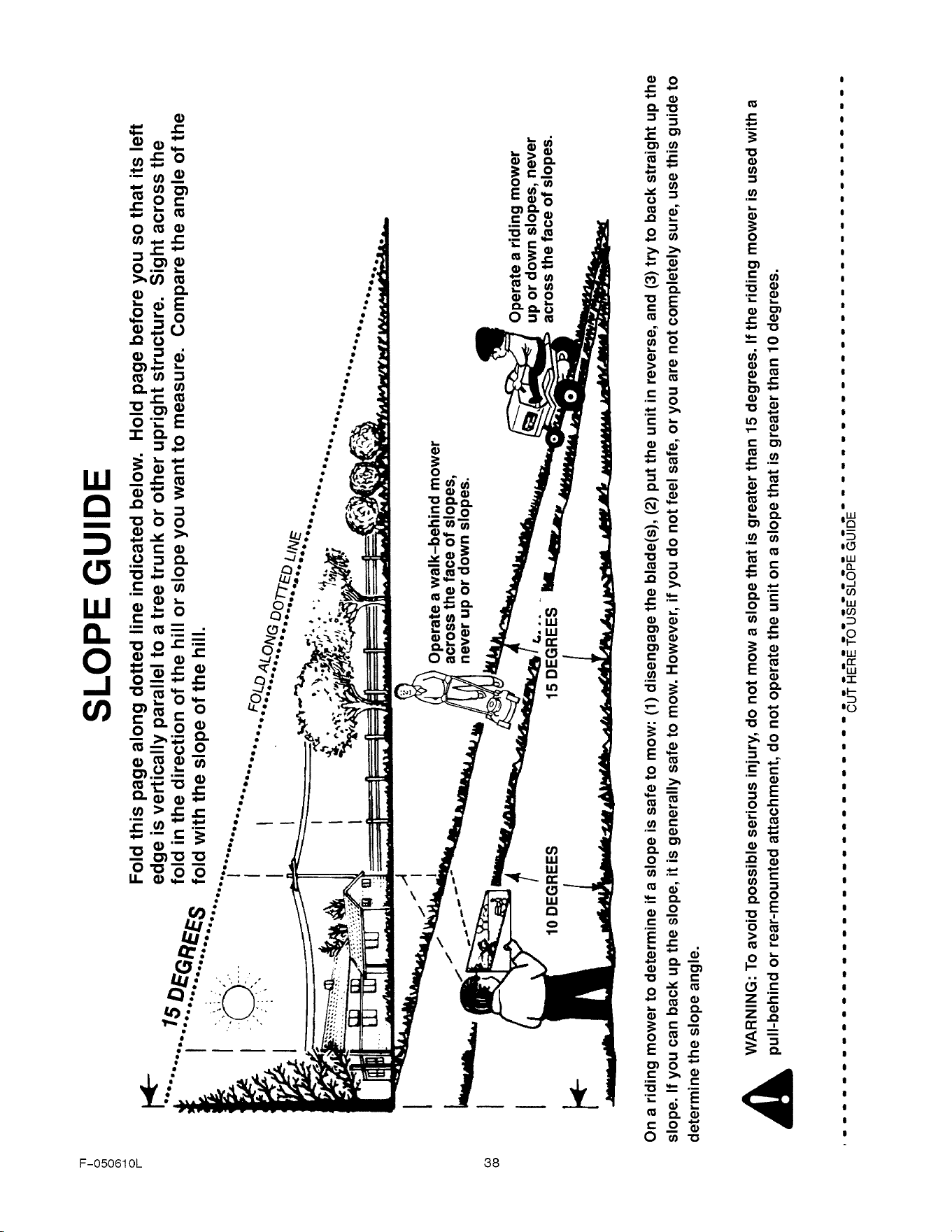
-13
I
O
O1
O
0
I--
co
SLOPE GUIDE
Fold this page along dotted line indicated below. Hold page before you so that its left
_ edge is vertically parallel to a tree trunk or other upright structure. Sight across the
.......... .1_ D_'(_,,,_ fold in the direction of the hill or slope you want to measure. Compare the angle of the
I., i""-'_--mr..._.ES fold with the slope of the hill.
".......!........;................
I I ......_L,_
i _ °e°°°e_ _°°°_e aeo_ t oeoelleoQeoOOOoe oe meo
!
I
Operate a walk-behind mower
across the face of slopes,
never up or down slopes.
10 DEGREES 15 DEGREES
Operate a riding mower
up or down slopes, never
across the face of slopes.
On a riding mower to determine if a slope is safe to mow: (1) disengage the blade(s), (2) put the unit in reverse, and (3) try to back straight up the
slope. If you can back up the slope, it is generally safe to mow. However, if you do not feel safe, or you are not completely sure, use this guide to
determine the slope angle.
WARNING: To avoid possible serious injury, do not mow a slope that is greater than 15 degrees. If the riding mower is used with a
pull-behind or rear-mounted attachment, do not operate the unit on a slope that is greater than 10 degrees.
................................. _U'TAE'R_fO'U§E'S'L6P_&_D'E.................................

NOTES
F-O50610L 39
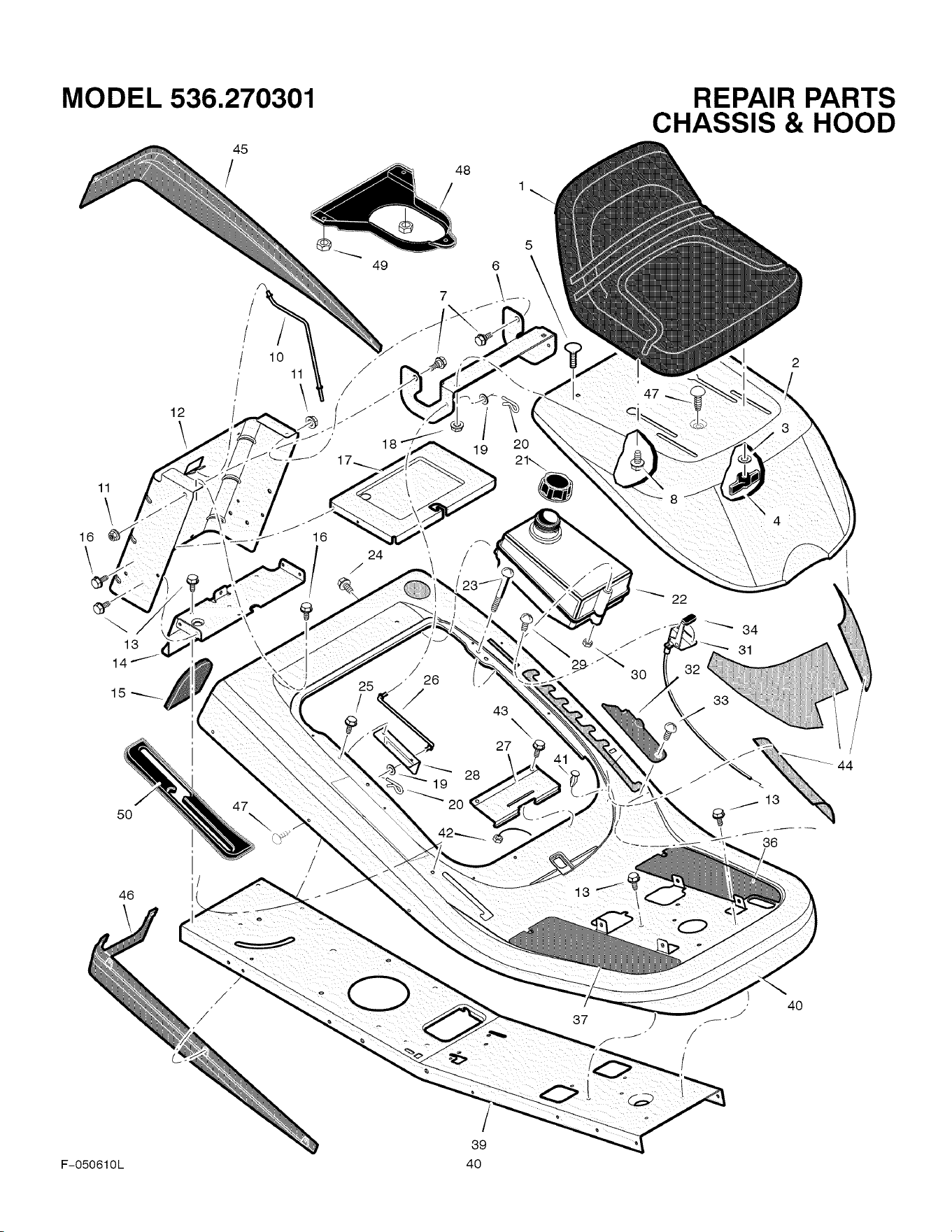
MODEL 536.270301
45
!
/
/
49
16
\
11
\
15
50
I
47
/
18
25
/
48
/
26
28
19
20
5
6
19 20
21_
/
43
27
REPAIR PARTS
CHASSIS & HOOD
8
4
22
34
31
33
/ /
36
37
40
39
F-O50610L 40
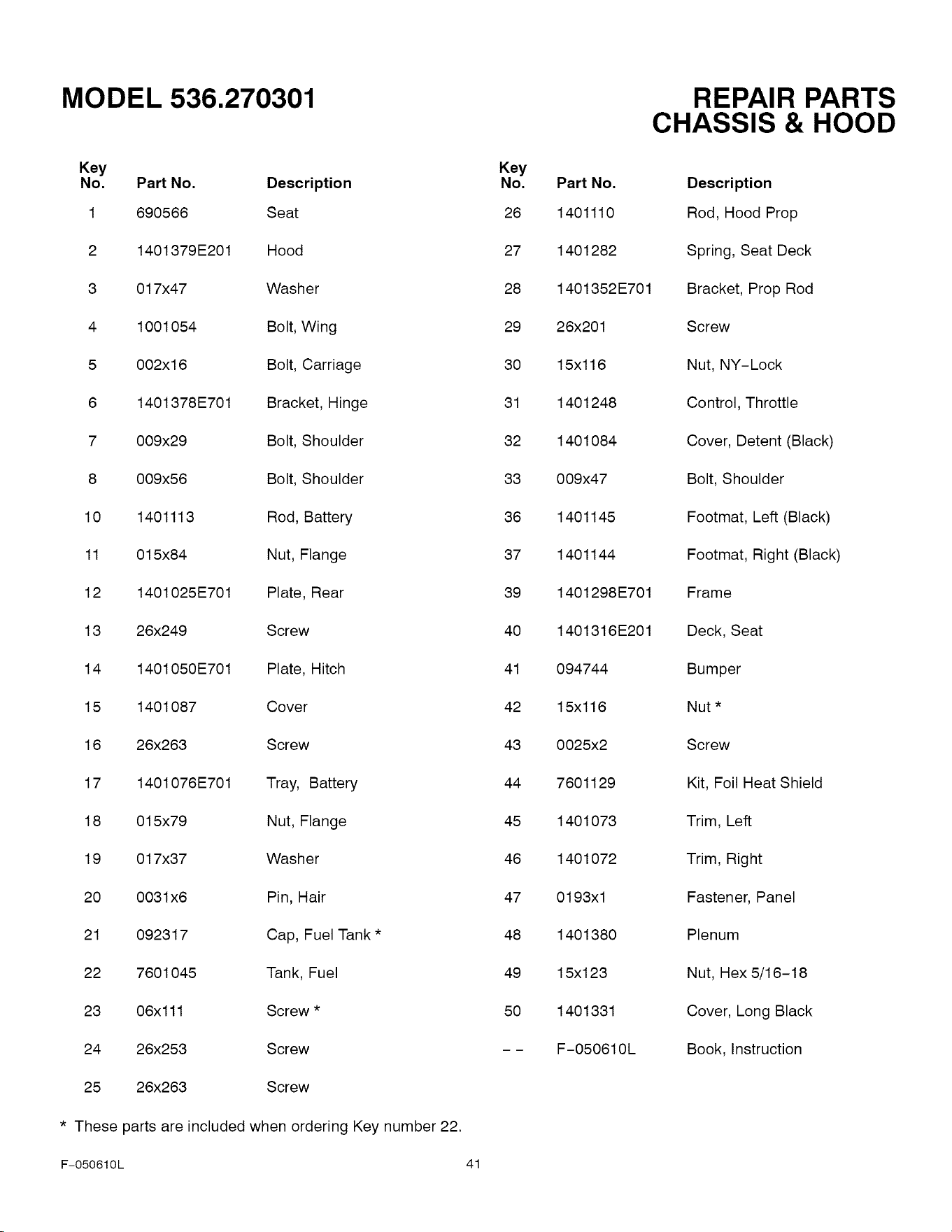
MODEL 536.270301
Key
No. Part No. Description
1 690566 Seat
2 1401379E201 Hood
3 017x47 Washer
4 1001054 Bolt, Wing
5 002xl 6 Bolt, Carriage
6 1401378E701 Bracket, Hinge
7 009x29 Bolt, Shoulder
8 009x56 Bolt, Shoulder
10 1401113 Rod, Battery
11 015x84 Nut, Flange
12 1401025E701 Plate, Rear
13 26x249 Screw
14 1401050E701 Plate, Hitch
15 1401087 Cover
16 26x263 Screw
17 1401076E701 Tray, Battery
18 015x79 Nut, Flange
19 017x37 Washer
20 0031x6 Pin, Hair
21 092317 Cap, Fuel Tank *
22 7601045 Tank, Fuel
23 06x111 Screw *
24 26x253 Screw
25 26x263 Screw
* These parts are included when ordering Key number 22.
F-050610L
Key
No.
26
27
28
29
30
31
32
33
36
37
39
40
41
42
43
44
45
46
47
48
49
50
41
Part No.
1401110
1401282
1401352E701
26x201
15x116
1401248
1401084
009x47
1401145
1401144
1401298E701
1401316E201
094744
15x116
0025x2
7601129
1401073
1401072
0193xl
1401380
15xl 23
1401331
F-050610L
REPAIR PARTS
CHASSIS & HOOD
Description
Rod, Hood Prop
Spring, Seat Deck
Bracket, Prop Rod
Screw
Nut, NY-Lock
Control, Throttle
Cover, Detent (Black)
Bolt, Shoulder
Footmat, Left (Black)
Footmat, Right (Black)
Frame
Deck, Seat
Bumper
Nut *
Screw
Kit, Foil Heat Shield
Trim, Left
Trim, Right
Fastener, Panel
Plenum
Nut, Hex 5/16-18
Cover, Long Black
Book, Instruction
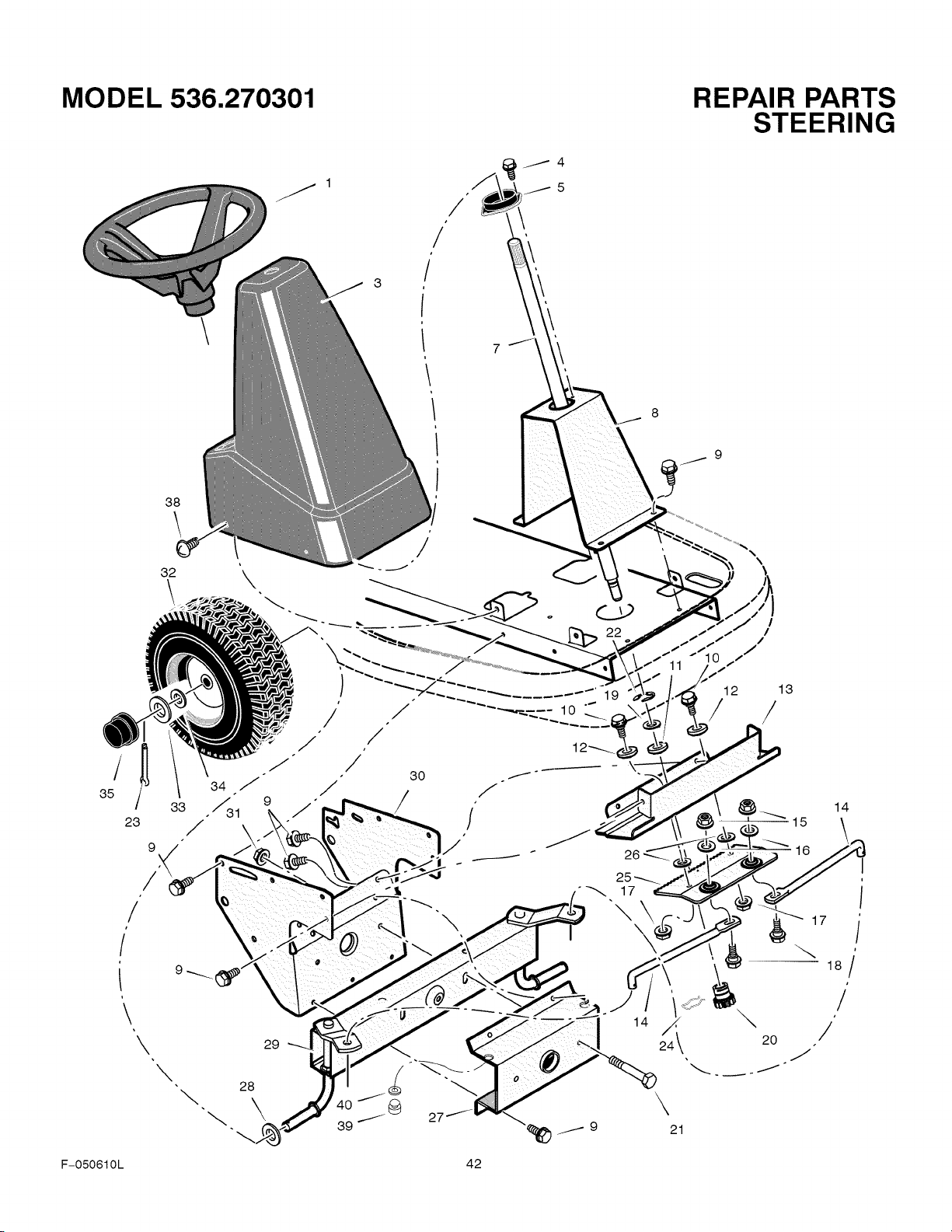
MODEL 536.270301 REPAIR PARTS
STEERING
/
35
38
\
32
F-O50610L
23 /
\
34
\
\
° C.P
17
\
\\
12 13
/ /
17
18/
/
20 ,/
\
21
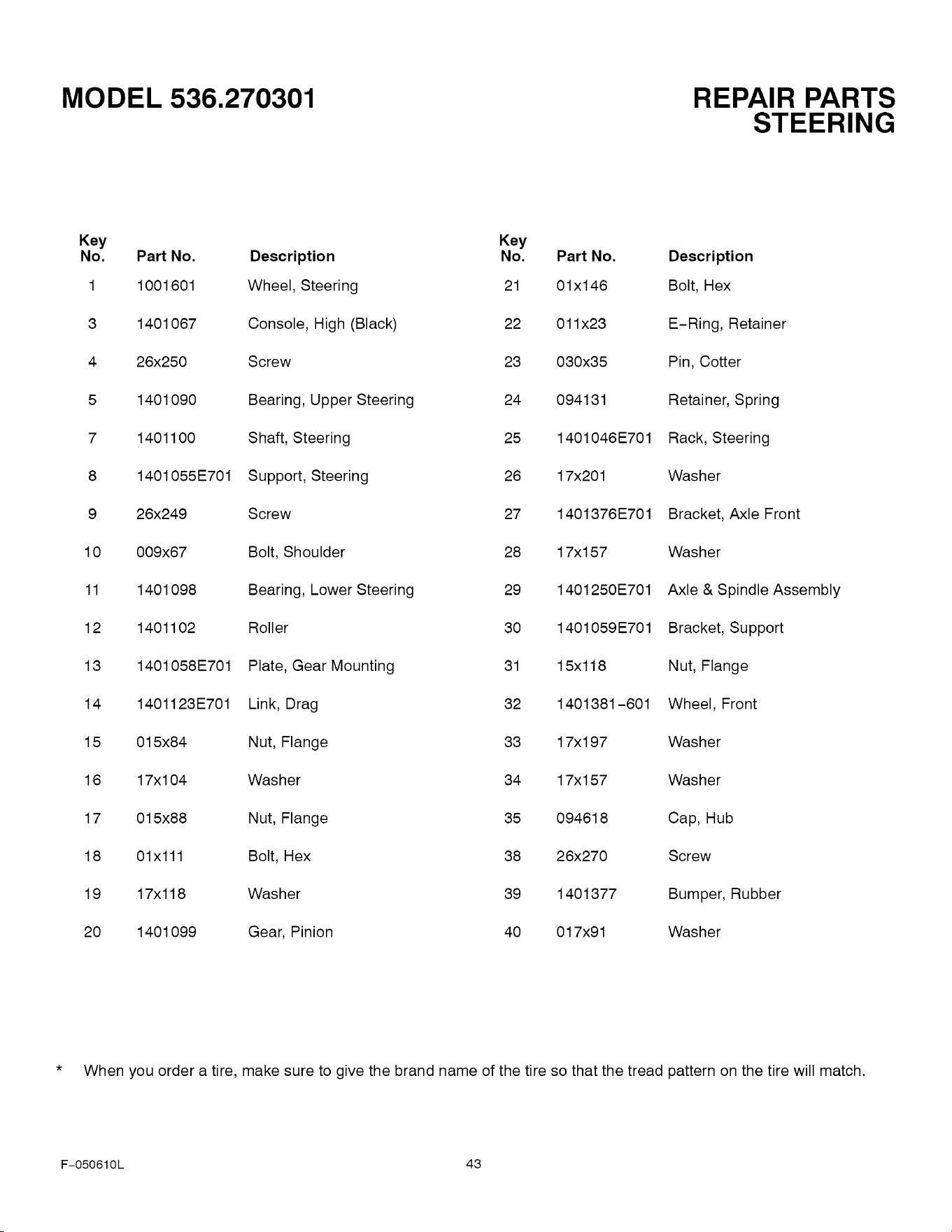
MODEL 536.270301
REPAIR PARTS
STEERING
Key
Key
No. Part No. Description No. Part No. Description
1 1001601 Wheel, Steering 21 01x146 Bolt, Hex
3 1401067 Console, High (Black) 22 011x23 E-Ring, Retainer
4 26x250 Screw 23 030x35 Pin, Cotter
5 1401090 Bearing, Upper Steering 24 094131 Retainer, Spring
7 1401100 Shaft, Steering 25 1401046E701 Rack, Steering
8 1401055E701 Support, Steering 26 17x201 Washer
9 26x249 Screw 27 1401376E701 Bracket, Axle Front
10 009x67 Bolt, Shoulder 28 17xl 57 Washer
11 1401098 Bearing, Lower Steering 29 1401250E701 Axle & Spindle Assembly
12 1401102 Roller 30 1401059E701 Bracket, Support
13 1401058E701 Plate, Gear Mounting 31 15x118 Nut, Flange
14 1401123E701 Link, Drag 32 1401381-601 Wheel, Front
15 015x84 Nut, Flange 33 17x197 Washer
16 17x104 Washer 34 17x157 Washer
17 015x88 Nut, Flange 35 094618 Cap, Hub
18 01x111 Bolt, Hex 38 26x270 Screw
19 17xl 18 Washer 39 1401377 Bumper, Rubber
20 1401099 Gear, Pinion 40 017x91 Washer
* When you order a tire, make sure to give the brand name of the tire so that the tread pattern on the tire will match.
F-O50610L 43
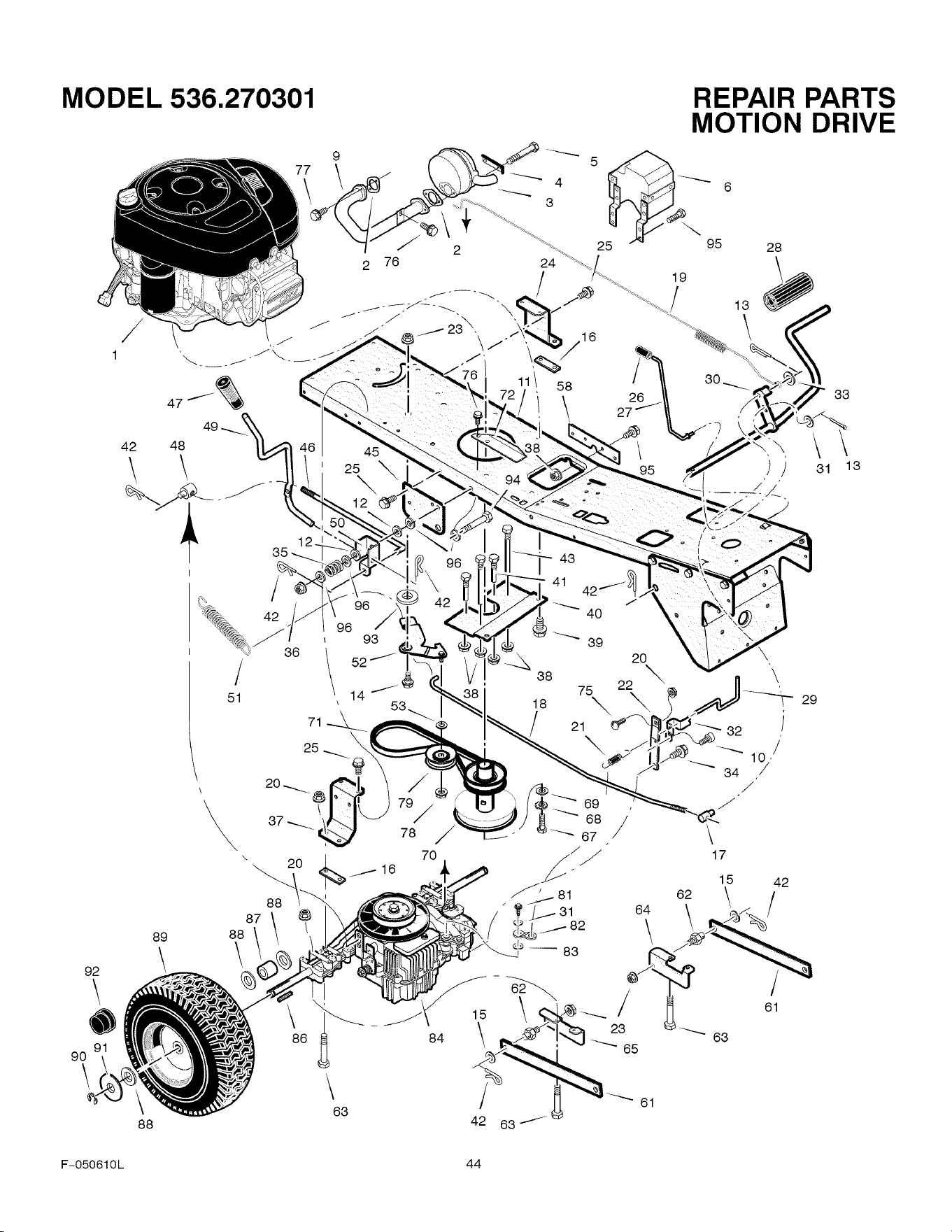
MODEL 536.270301 REPAIR PARTS
MOTION DRIVE
25 95
28
92
\
90
\
49 _..
42 48 6
\ \
I
42
45
25
\
96
88
, 93
36 /
51 14 "
71
25
37
78 j
7O
2O
_16
87
89 88
\ \,
88
86 84
\
63
\
31
43
41
39
2O
67
_' 81
31
82
64
\
17
15
62
42
!
63
/
61
33
13
F-O50610L 44

MODEL 536.270301
Key
No. Part No. Description
1 Engine
1401380 Engine, Plenum *
2 091309 Gasket, Muffler
3 1401358 Muffler
4 092378 Lock, Muffler Screw
5 01x134 Bolt, Hex
6 1401375 Shield, Heat
9 1401357 Tube, Exhaust
10 0025x2 Screw
11 1401298E700 Frame
12 17x217 Washer
13 030x20 Pin, Cotter
14 009x39 Bolt, Shoulder
15 017x91 Washer
16 1401334 Z Plate, Transaxle
17 094815 Nut, Adjusting
18 1401305 Rod, Clutch Hydro
19 165xl 65 Spring, Brake
20 015x88 Nut
21 165x166 Spring, Roll Release
22 1401300 Bracket, Torque Strap
23 015x84 Nut
24 1401268E701 Bracket, Left Transaxle
25 26x249 Screw
26 1401337 Grip
27 1401112 Rod, Parking Brake
28 021544 Pedal
29 1401304 Z Rod, Roll Release
30 1401127E701 Rod, Clutch/Brake
31 017x38 Washer
32 1401303E701 Bracket, Roll Release
33 017x53 Washer
34 26x216 Screw
35 164x39 Spring, Compression
36 15x119 Nut
37 1401042E701 Bracket, Right Transaxle
38 015x79 Nut
39 0025x7 Screw
40 1401057E701 Plate, Belt Guide
41 1401105 Guide, Belt-Long
42 0031x4 Pin, Hair
43 1401104 Guide, Belt-Short
45 1401032E701 Bracket, Lift Pivot
* Not Illustrated
Key
No.
46
47
48
49
50
51
52
53
58
61
62
63
64
65
67
68
69
70
71
72
75
76
77
78
79
81
82
83
84
86
87
88
89
90
91
92
93
94
95
96
Part No.
1401307 Z
094497
1401148
1401383
1401340E701
165x147
1401312
017x91
1401260E701
1401031 E701
094067
01x155
1401301 E701
1401302E701
01x140
019x35
17xl 70
1401308
37x129
1401396 Z
002x53
26x263
06xl 03
015x98
1401309
06xl 05
1401086 Z
17x148
056534
1401103 Z
17xl 60
1401120
0011x3
17xl 95
094618
17xl 74
01x143
26x267
17xl 04
REPAIR PARTS
MOTION DRIVE
Description
Rod, Shift Link
Grip
Nut, Adjusting
Lever, Shift
Bracket, Pivot
Spring, Variator Drive
Arm, Idler
Washer
Plate, Reinforcement
Arm, Rear
Pin, Threaded
Bolt, Hex
Bracket, Left Rear Hanger
Bracket, Right Rear Hanger
Bolt, Hex
Lockwasher
Washer
Pulley Stack
Belt, Drive
Shield, Heat
Bolt, Carriage
Screw
Screw
Locknut
Pulley, Idler
Cap Screw
Arm, Disconnect
Washer
Transaxle
Key, Square
Spacer, Rear Wheel
Washer
Wheel & Tire Assembly
Tire (ONLY)
Tube (ONLY)
E-Ring
Washer
Hub Cap
Washer
Bolt, Hex
Screw
Washer
F-050610L 45
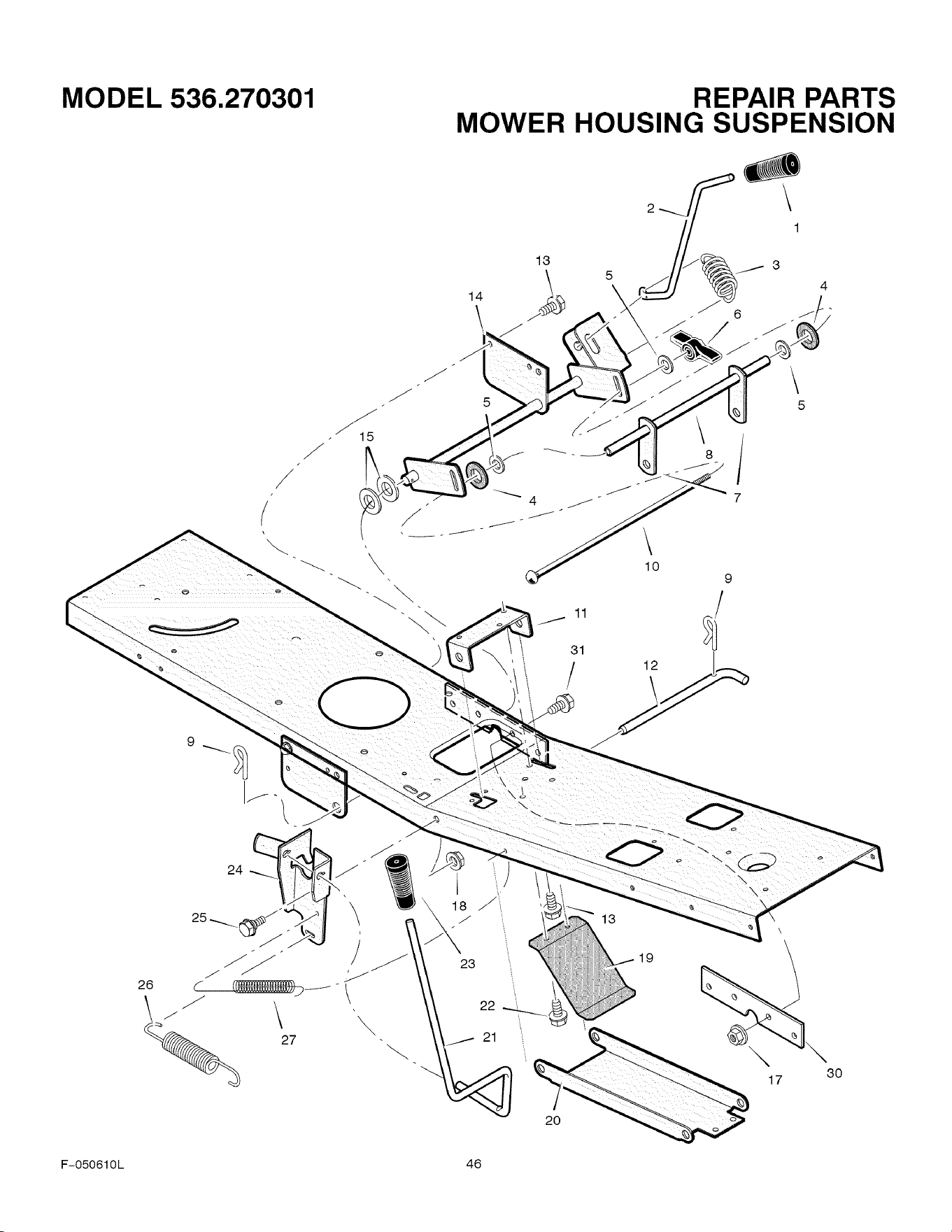
MODEL 536.270301 REPAIR PARTS
MOWER HOUSING SUSPENSION
14
13
5
3
/
26
\
L
27
5
11
31
_io \\C °
\
13
22
21
/
10
9
/
19
\
\o
17
30
F-O50610L 46
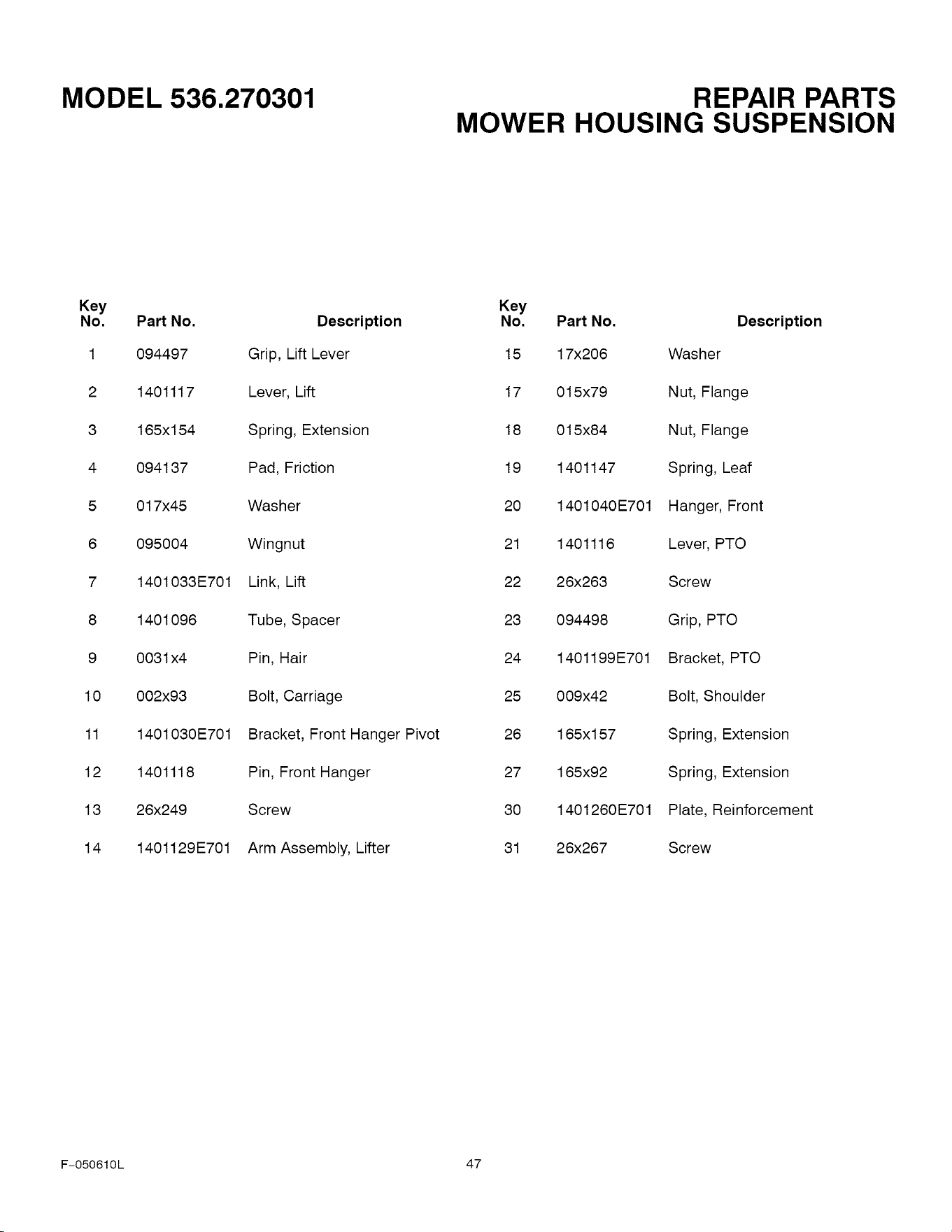
MODEL 536.270301 REPAIR PARTS
MOWER HOUSING SUSPENSION
Key
No. Part No.
1 094497
2 1401117
3 165x154
4 094137
5 017x45
6 095004
7 1401033E701
8 1401096
9 0031 x4
10 002x93
11 1401030E701
12 1401118
13 26x249
14 1401129E701
Description
Grip, Lift Lever
Lever, Lift
Spring, Extension
Pad, Friction
Washer
Wingnut
Link, Lift
Tube, Spacer
Pin, Hair
Bolt, Carriage
Bracket, Front Hanger Pivot
Pin, Front Hanger
Screw
Arm Assembly, Lifter
Key
No. Part No. Description
15 17x206 Washer
17 015x79 Nut, Flange
18 015x84 Nut, Flange
19 1401147 Spring, Leaf
20 1401040E701 Hanger, Front
21 1401116 Lever, PTO
22 26x263 Screw
23 094498 Grip, PTO
24 1401199E701 Bracket, PTO
25 009x42 Bolt, Shoulder
26 165x157 Spring, Extension
27 165x92 Spring, Extension
30 1401260E701 Plate, Reinforcement
31 26x267 Screw
F-050610L 47
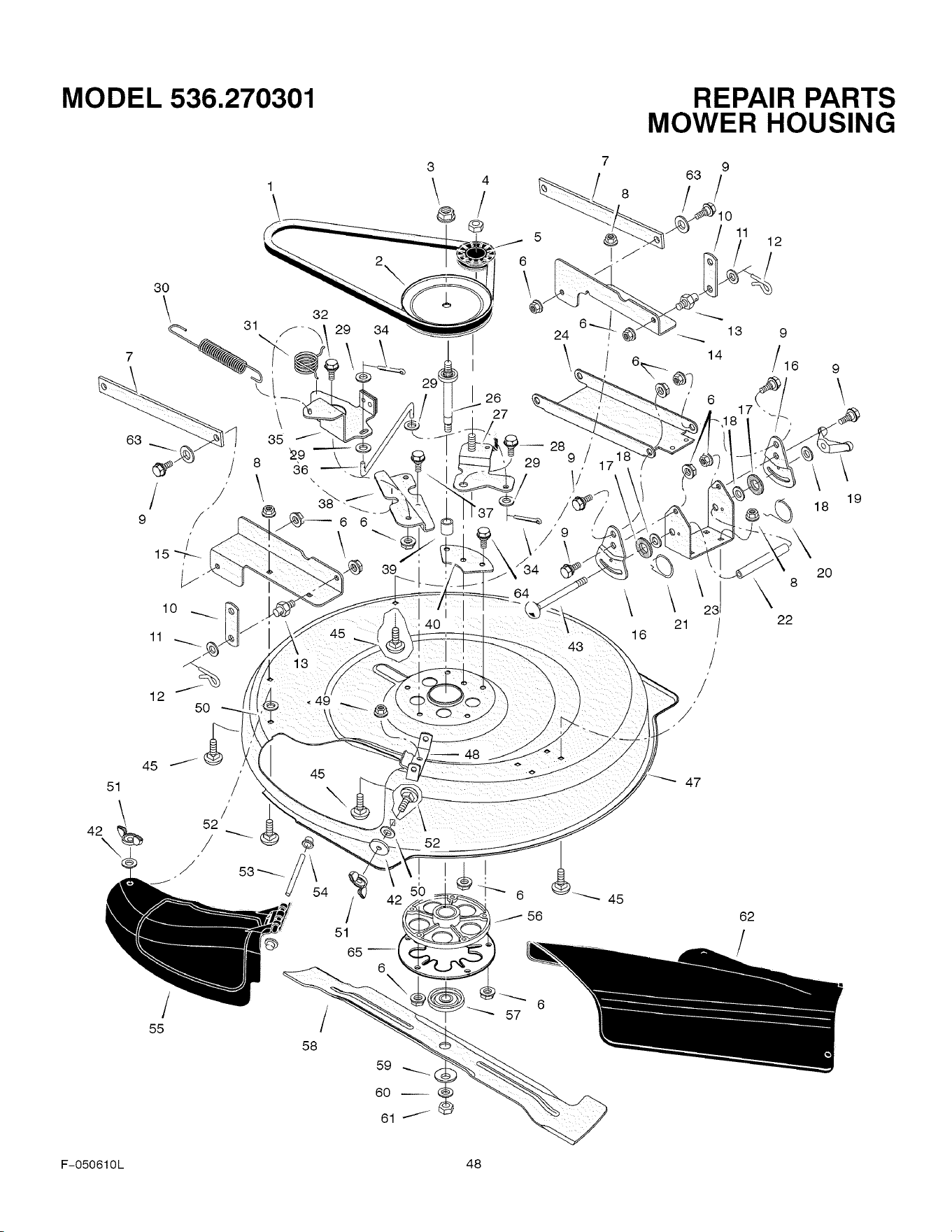
MODEL 536.270301
30
\
10
11
51
42
j%
12
50
31
32
29 34
\
35 J
29
8 36
6 6
_ 39
45
13
45
51
65--
/
55
/
58
3
\ 4
6
@
7
8
REPAIR PARTS
MOWER HOUSING
9
63
0
1 12
24
I 26
27
i__ 28 '
29 9 /
1/
13
14
6
19
18
\
16
21 /
/
/
2O
8
22
52
! I
45
47
56 62
59 _(
6O
57
F-O50610L 48
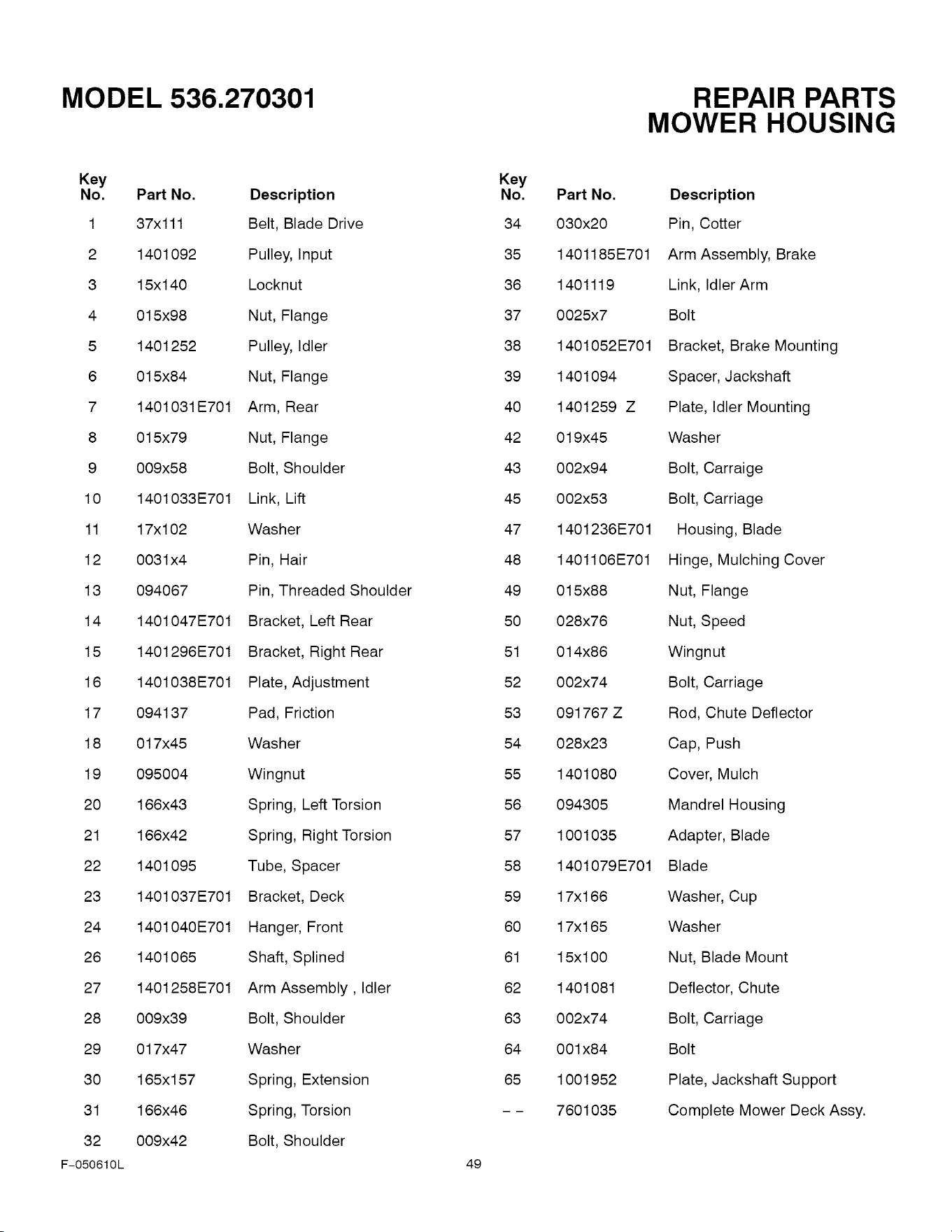
MODEL 536.270301
Key
No. Part No. Description
1 37x111 Belt, Blade Drive
2 1401092 Pulley, Input
3 15x140 Locknut
4 015x98 Nut, Flange
5 1401252 Pulley, Idler
6 015x84 Nut, Flange
7 1401031E701 Arm, Rear
8 015x79 Nut, Flange
9 009x58 Bolt, Shoulder
10 1401033E701 Link, Lift
11 17x102 Washer
12 0031x4 Pin, Hair
13 094067 Pin, Threaded Shoulder
14 1401047E701 Bracket, Left Rear
15 1401296E701 Bracket, Right Rear
16 1401038E701 Plate, Adjustment
17 094137 Pad, Friction
18 017x45 Washer
19 095004 Wingnut
20 166x43 Spring, Left Torsion
21 166x42 Spring, Right Torsion
22 1401095 Tube, Spacer
23 1401037E701 Bracket, Deck
24 1401040E701 Hanger, Front
26 1401065 Shaft, Splined
27 1401258E701 Arm Assembly, Idler
28 009x39 Bolt, Shoulder
29 017x47 Washer
30 165x157 Spring, Extension
31 166x46 Spring, Torsion
32 009x42 Bolt, Shoulder
F-050610L
Key
No.
34
35
36
37
38
39
40
42
43
45
47
48
49
50
51
52
53
54
55
56
57
58
59
60
61
62
63
64
65
49
Part No.
030x20
1401185E701
1401119
0025x7
1401052 E701
1401094
1401259 Z
019x45
002x94
002x53
1401236E701
1401106E701
015x88
028x76
014x86
002x74
091767 Z
028x23
1401080
094305
1001035
1401079E701
17xl 66
17xl 65
15xl 00
1401081
002x74
001x84
1001952
7601035
REPAIR PARTS
MOWER HOUSING
Description
Pin, Cotter
Arm Assembly, Brake
Link, Idler Arm
Bolt
Bracket, Brake Mounting
Spacer, Jackshaft
Plate, Idler Mounting
Washer
Bolt, Carraige
Bolt, Carriage
Housing, Blade
Hinge, Mulching Cover
Nut, Flange
Nut, Speed
Wingnut
Bolt, Carriage
Rod, Chute Deflector
Cap, Push
Cover, Mulch
Mandrel Housing
Adapter, Blade
Blade
Washer, Cup
Washer
Nut, Blade Mount
Deflector, Chute
Bolt, Carriage
Bolt
Plate, Jackshaft Support
Complete Mower Deck Assy.
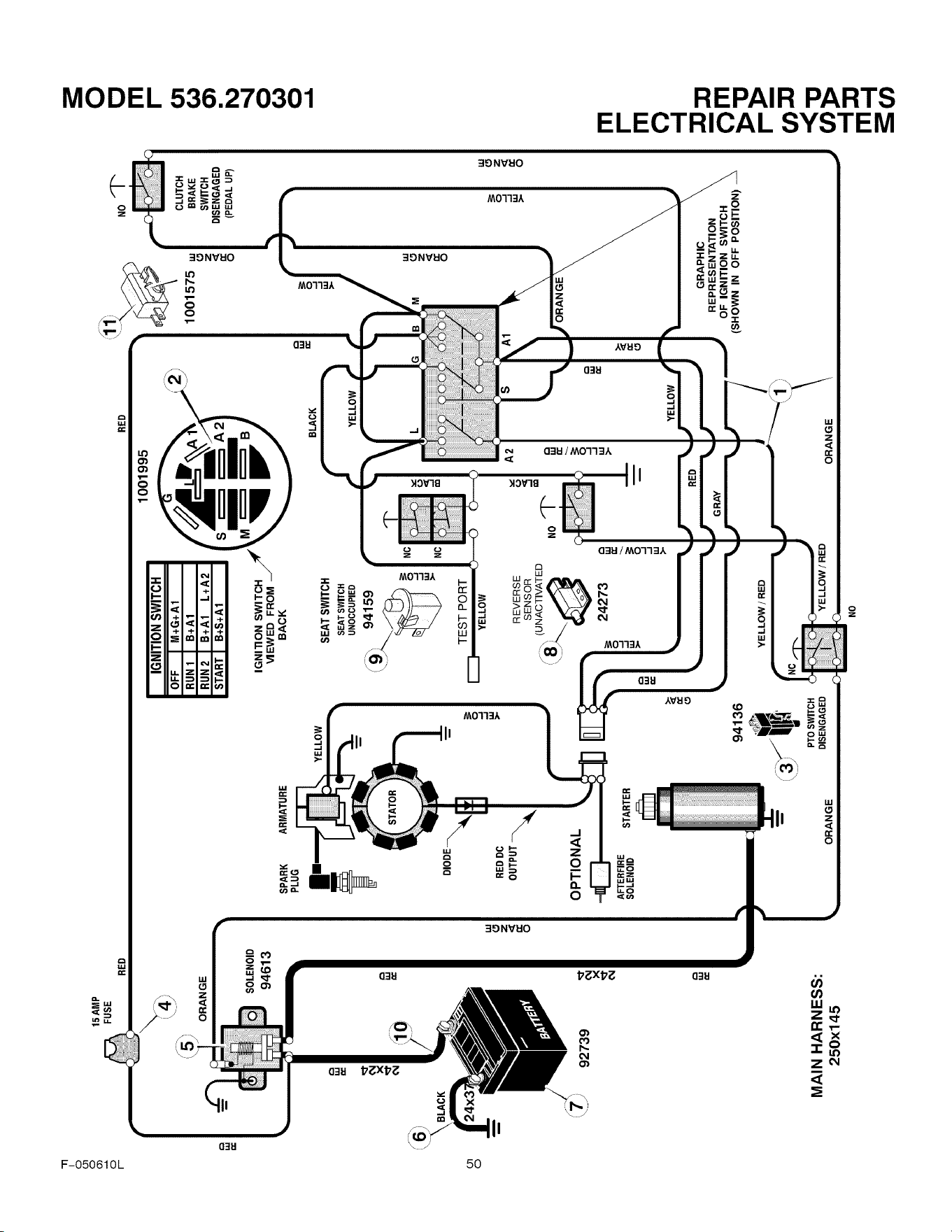
MODEL 536.270301 REPAIR PARTS
ELECTRICAL SYSTEM
M0"I'I3A
3DNV_IO
)IOV'IB
MO'TI:IA
/
/
x
i\ •
o
F-O50610L 50
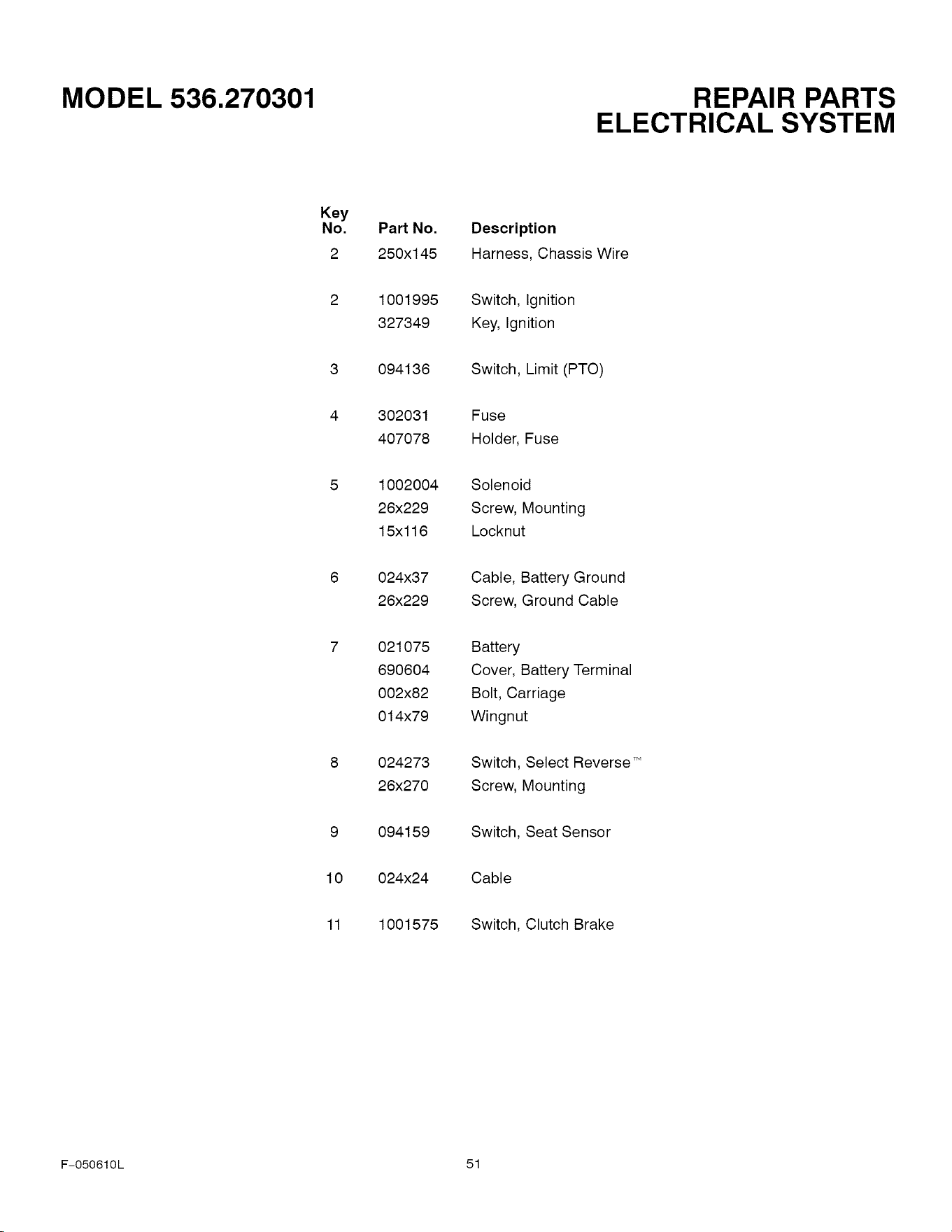
MODEL 536.270301 REPAIR PARTS
ELECTRICAL SYSTEM
Key
No.
2
Part No.
250x145
Description
Harness, Chassis Wire
2
3
4
1001995
327349
094136
302031
407078
Switch, Ignition
Key, Ignition
Switch, Limit (PTO)
Fuse
Holder, Fuse
5 1002004
26x229
15x116
Solenoid
Screw, Mounting
Locknut
6 024x37
26x229
Cable, Battery Ground
Screw, Ground Cable
7
8
021075
690604
002x82
014x79
024273
26x270
9 094159
Battery
Cover, Battery Terminal
Bolt, Carriage
Wingnut
Switch, Select Reverse TM
Screw, Mounting
Switch, Seat Sensor
10 024x24 Cable
11 1001575 Switch, Clutch Brake
F-050610L 51
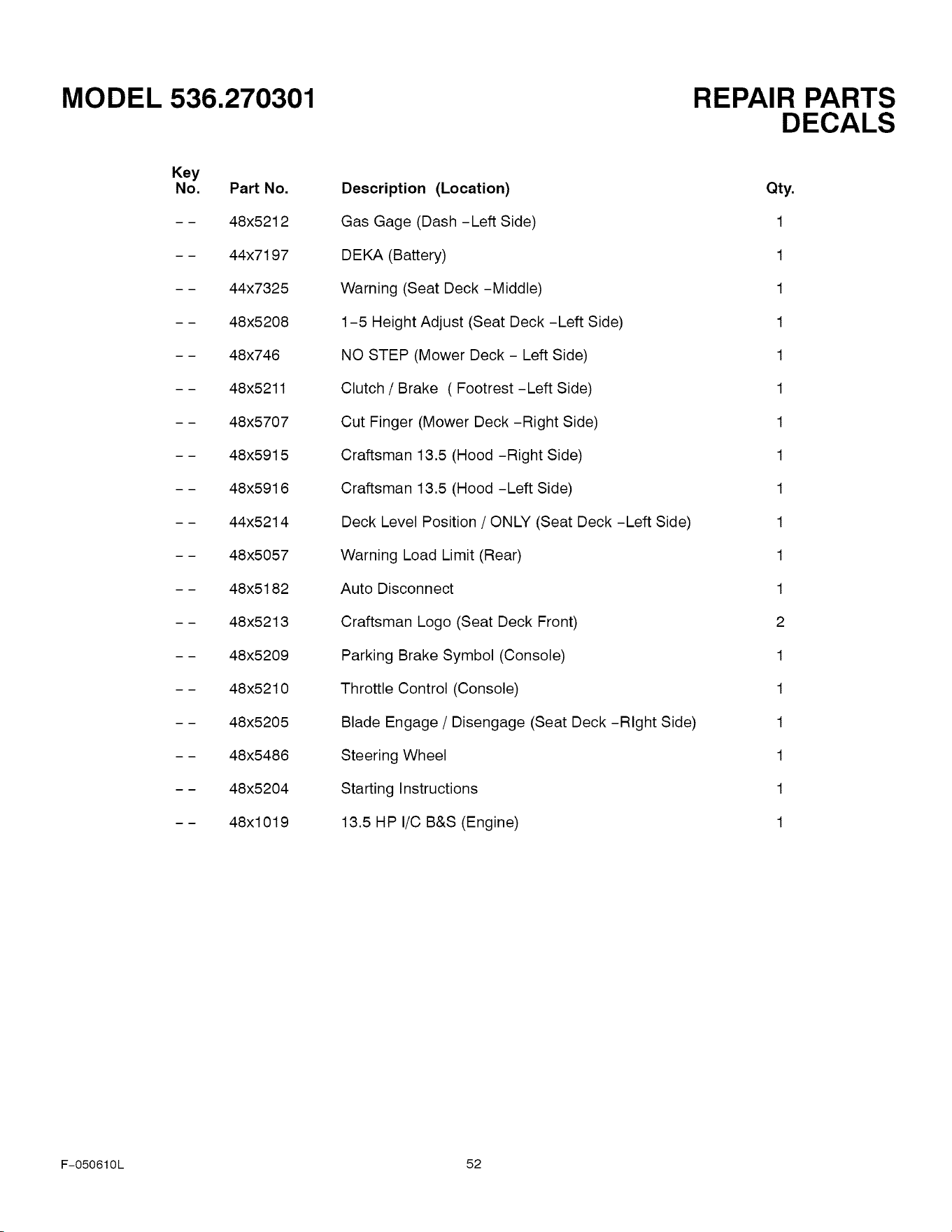
MODEL 536.270301
Key
No. Part No.
48x5212
44x7197
44x7325
48x5208
48x746
48x5211
48x5707
48x5915
48x5916
44x5214
48x5057
48x5182
48x5213
48x5209
48x5210
48x5205
48x5486
48x5204
48x1019
REPAIR PARTS
DECALS
Description (Location)
Gas Gage (Dash -Left Side)
DEKA (Battery)
Warning (Seat Deck -Middle)
1-5 Height Adjust (Seat Deck -Left Side)
NO STEP (Mower Deck - Left Side)
Clutch / Brake ( Footrest -Left Side)
Cut Finger (Mower Deck -Right Side)
Craftsman 13.5 (Hood -Right Side)
Craftsman 13.5 (Hood -Left Side)
Deck Level Position / ONLY (Seat Deck -Left Side)
Warning Load Limit (Rear)
Auto Disconnect
Craftsman Logo (Seat Deck Front)
Parking Brake Symbol (Console)
Throttle Control (Console)
Blade Engage / Disengage (Seat Deck -Right Side)
Steering Wheel
Starting Instructions
13.5 HP I/C B&S (Engine)
Qty.
1
1
1
1
1
1
1
1
1
1
1
1
2
1
1
1
1
1
1
F-050610L 52
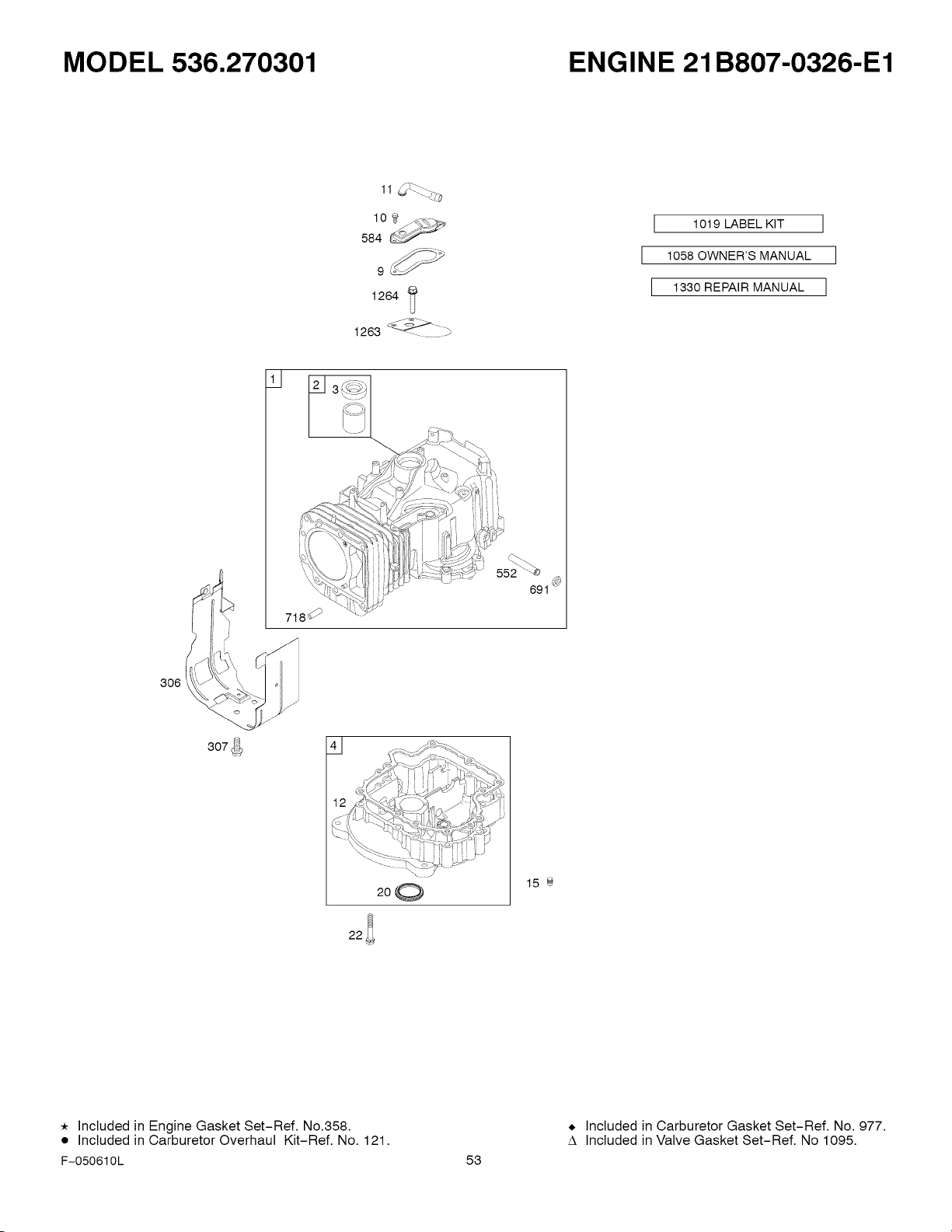
MODEL 536.270301 ENGINE 21B807-0326-E1
11 / "-
584
1264 _
1263 _Y- ---"
1019 LABEL KIT ]
I lO_6OWNER'SMANUALI
[ 1330REPA,RMANUAL]
718 _
552 "_
691
307_
z[_4 s
\7_ b.i f =-
_ ",,,. i
200
15
Included in Engine Gasket Set-Ref. No.358.
• Included in Carburetor Overhaul Kit-Ref. No. 121.
Included in Carburetor Gasket Set-Ref. No. 977.
A Included in Valve Gasket Set-Ref. No 1095.
F-O50610L 53
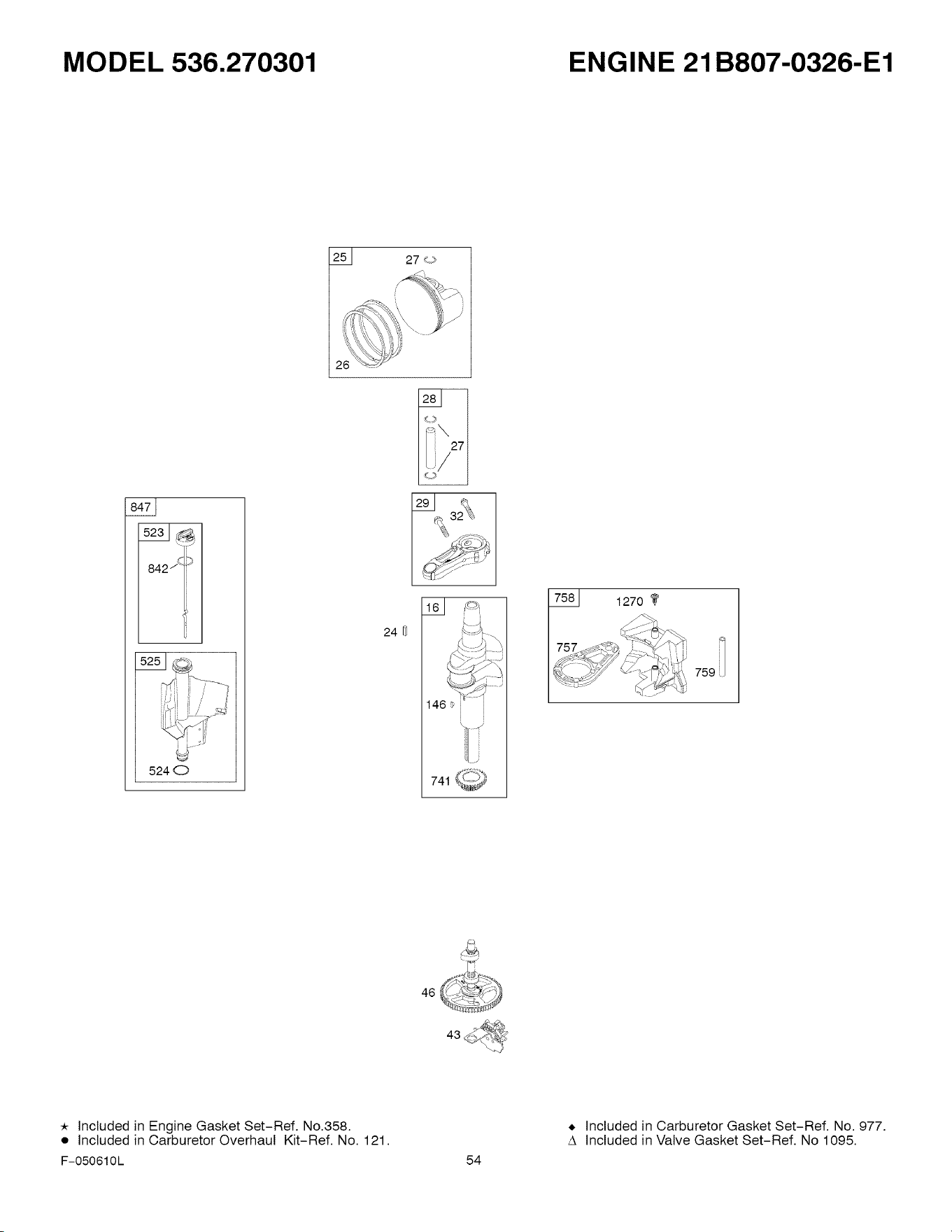
MODEL 536.270301 ENGINE 21B807-0326-E1
25_ 27 ,<-_>
842/_ii _
524 O
32 _
I _
i_ _
24
1270
759 i]
46
* Included in Engine Gasket Set-Ref. No.358.
• Included in Carburetor Overhaul Kit-Ref. No. 121.
+ Included in Carburetor Gasket Set-Ref. No. 977.
A Included in Valve Gasket Set-Ref. No 1095.
F-050610L 54
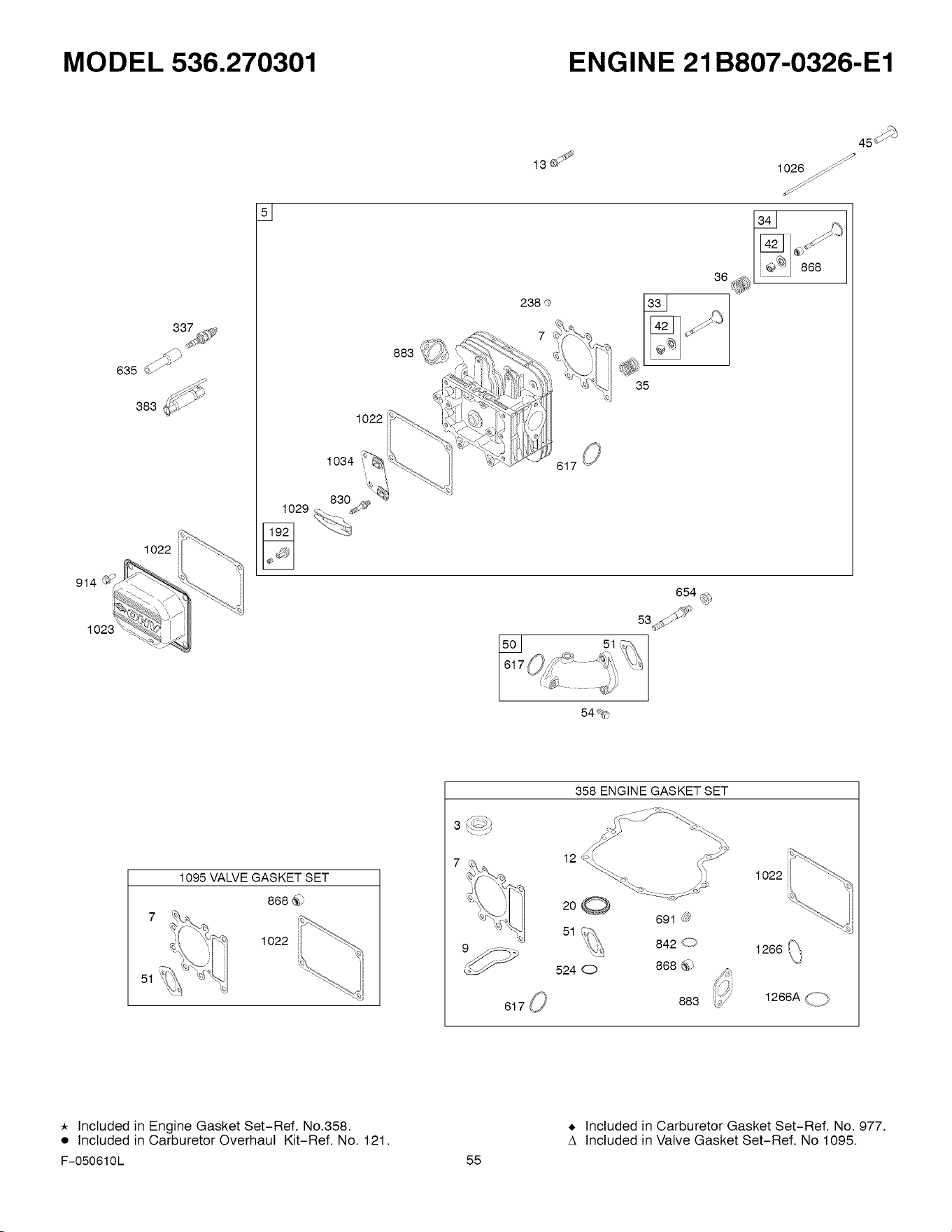
MODEL 536.270301 ENGINE 21B807-0326-E1
914
635 _
383 _'
1022
1029
1022
1034
83o_
13U
238 ®
36 _
35
654_
5t
54_
51
1095 VALVE GASKET SET
868
1022
617 0
358 ENGINE GASKET SET
1022
1266_
883 1266A _,
* Included in Engine Gasket Set-Ref. No.358.
• Included in Carburetor Overhaul Kit-Ref. No. 121.
Included in Carburetor Gasket Set-Ref. No. 977.
A Included in Valve Gasket Set-Ref. No 1095.
F-050610L 55
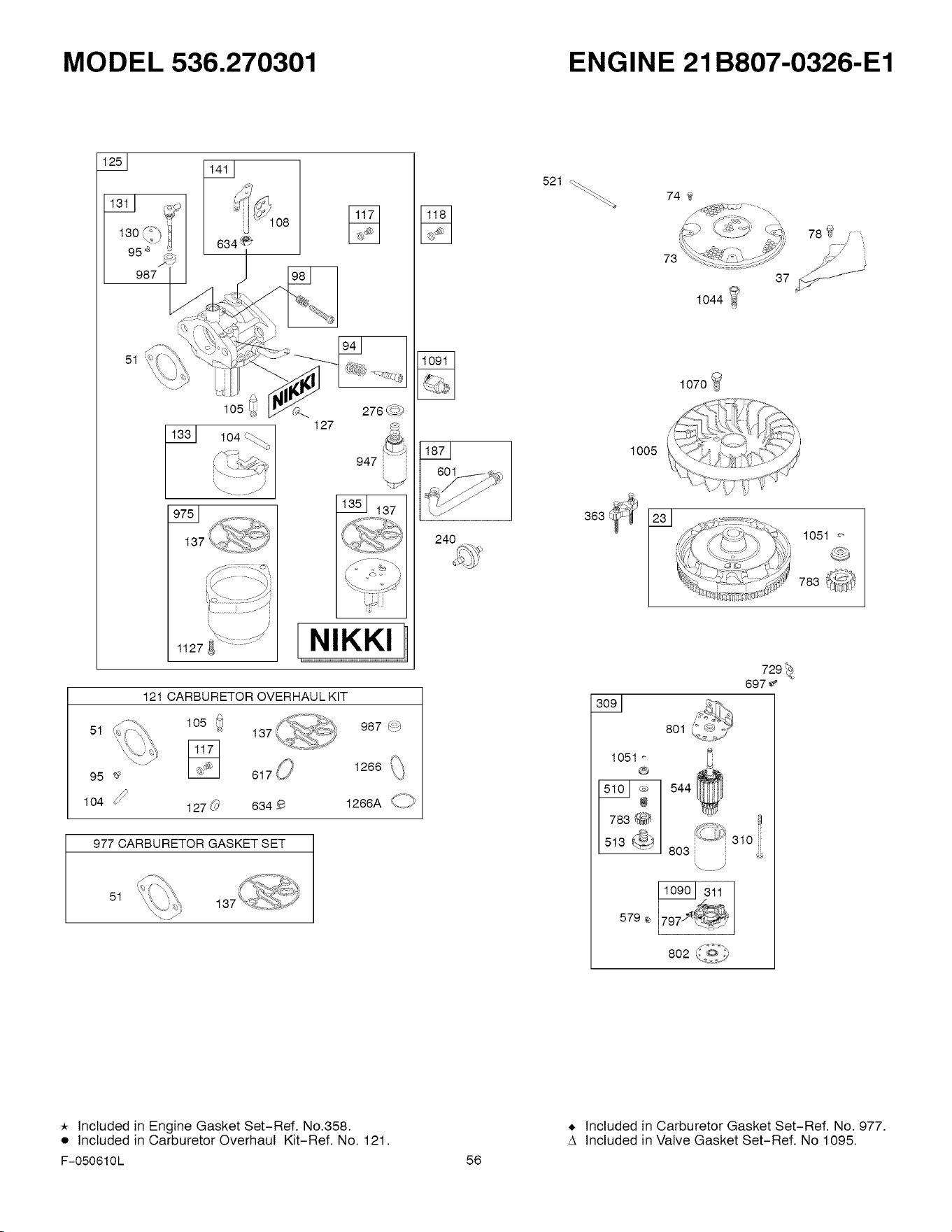
MODEL 536.270301 ENGINE 21B807-0326-E1
130 _
[ 634 _
95 6
987
51
105
276 _
127
947 ;;
137
1127
NIKKI
51
121 CARBURETOR OVERHAUL KIT
105 _ 137 987 (_
FTTCq
617 0 1266 _%_'!}
95
104 _ 127 _' 634 _ 1266A
977 CARBURETOR GASKET SET
51
240
363
74 _f
73
1044
78 _ /..........
37
1070
1oo5
1051 _
®
579
,Oli!i;_
544
_-_ 310
803 i .... i
\_y
_3111
797_ '
729
697_
* Included in Engine Gasket Set-Ref. No.358.
• Included in Carburetor Overhaul Kit-Ref. No. 121.
• Included in Carburetor Gasket Set-Ref. No. 977.
A Included in Valve Gasket Set-Ref. No 1095.
F-050610L 56
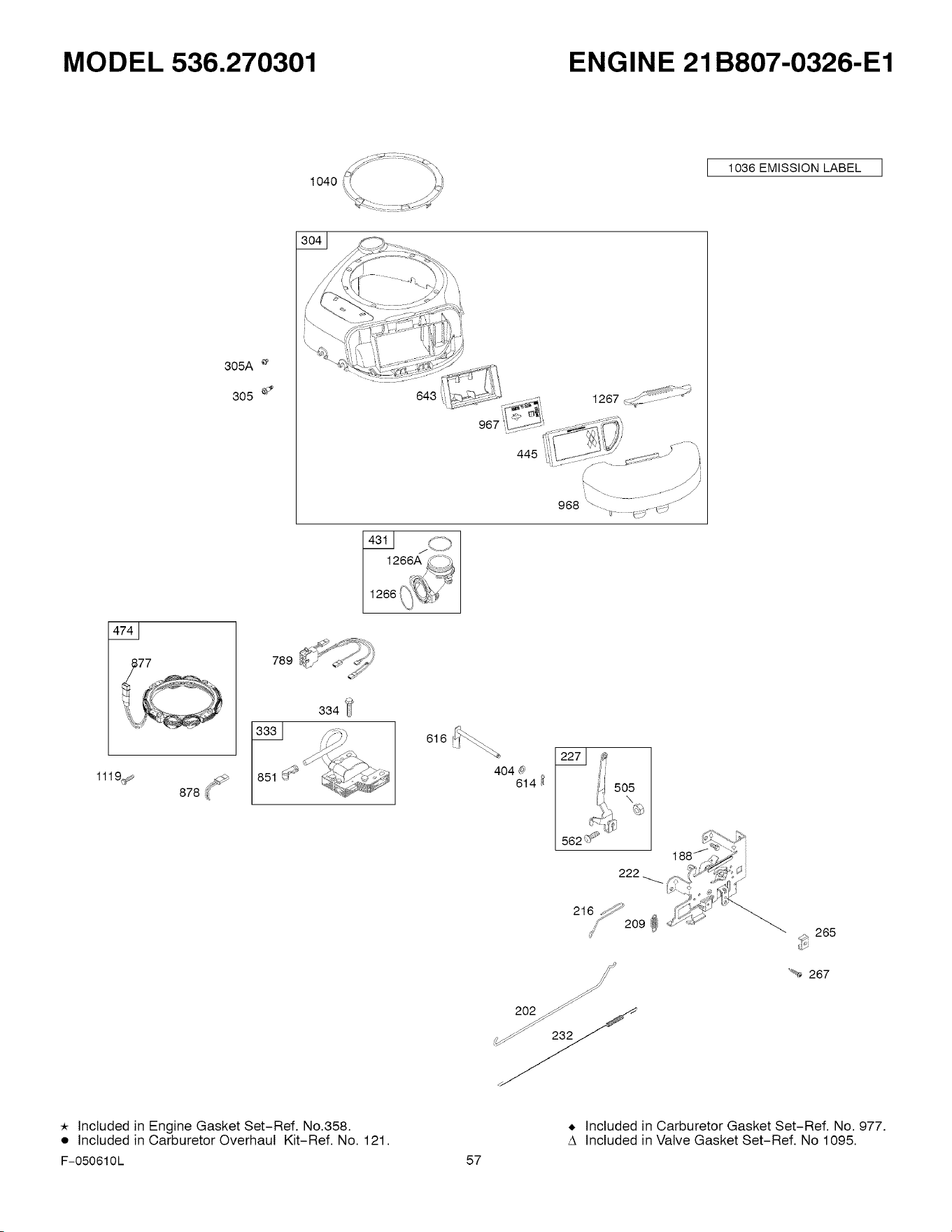
MODEL 536.270301 ENGINE 21B807-0326-E1
1040
I 1036 EMISSION LABEL I
789
1119_
878
643
967
445
1431 I F_
_266A _f_
I 1266_ _
l\j ,-_
334
616_
404 #
614
222
216 /_
,/_ 209
Included in Engine Gasket Set-Ref. No,358.
• Included in Carburetor Overhaul Kit-Ref. No. 121.
• Included in Carburetor Gasket Set-Ref. No. 977.
A Included in Valve Gasket Set-Ref. No 1095.
F-050610L 57
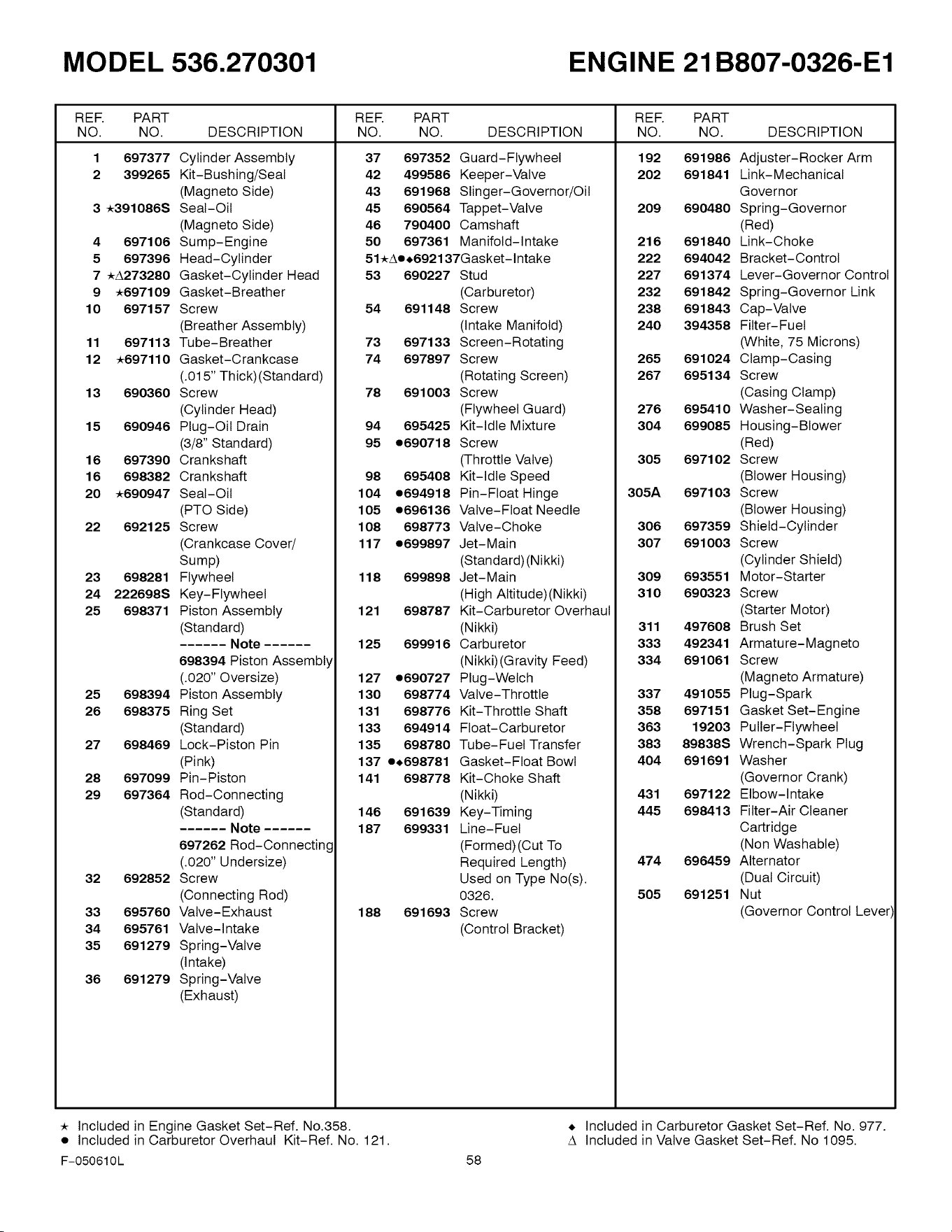
MODEL 536.270301 ENGINE 21B807-0326-E1
REF. PART RER PART REF. PART
NO. NO. DESCRIPTION NO. NO. DESCRIPTION NO. NO. DESCRIPTION
1 697377
2 399265
3 .391086S
Cylinder Assembly
Kit-Bushing/Seat
(Magneto Side)
Seal-Oil
(Magneto Side)
4 697106 Sump-Engine
5 697396 Head-Cylinder
7 .2,273280 Gasket-Cylinder Head
9 .697109 Gasket-Breather
10 697157 Screw
(Breather Assembly)
11 697113 Tube-Breather
12 *697110 Gasket-Crankcase
(.015" Thick)(Standard)
13 690360 Screw
(Cylinder Head)
15 690946 Plug-Oil Drain
(3/8" Standard)
16 697390 Crankshaft
16 698382 Crankshaft
20 *690947 Seal-Oil
(PTO Side)
22 692125 Screw
(Crankcase Cover/
Sump)
23 698281 Flywheel
24 222698S Key-Flywheel
25 698371 Piston Assembly
(Standard)
...... Note ......
698394 Piston Assembly
(.020" Oversize)
25 698394 Piston Assembly
26 698375 Ring Set
(Standard)
27 698469 Lock-Piston Pin
(Pink)
28 697099 Pin-Piston
29 697364 Rod-Connecting
(Standard)
...... Note ......
697262 Rod-Connecting
(.020" Undersize)
32 692852 Screw
(Connecting Rod)
33 695760 Valve-Exhaust
34 695761 Valve-Intake
35 691279 Spring-Valve
(Intake)
36 691279 Spring-Valve
(Exhaust)
37 697352 Guard-Flywheel
42 499586 Keeper-Valve
43 691968 Slinger-Governor/Oil
45 690564 Tappet-Valve
46 790400 Camshaft
50 697361 Manifold-Intake
51*Ae+692137Gasket-lntake
53 690227 Stud
192 691986 Adjuster-Rocker Arm
202 691841 Link-Mechanical
Governor
209 690480 Spring-Governor
(Red)
216 691840 Link-Choke
222 694042 Bracket-Control
227 691374 Lever-Governor Control
232 691842 Spring-Governor Link
238 691843 Cap-Valve
240 394358 Filter-Fuel
(White, 75 Microns)
265 691024 Clamp-Casing
267 695134 Screw
(Casing Clamp)
276 695410 Washer-Sealing
304 699085 Housing-Blower
(Red)
305 697102 Screw
(Blower Housing)
305A 697103 Screw
(Blower Housing)
306 697359 Shield-Cylinder
307 691003 Screw
(Cylinder Shield)
309 693551 Motor-Starter
310 690323 Screw
(Starter Motor)
311 497608 Brush Set
333 492341 Armature-Magneto
334 691061 Screw
(Magneto Armature)
337 491055 Plug-Spark
358 697151 Gasket Set-Engine
363 19203 Puller-Flywheel
383 89838S Wrench-Spark Plug
404 691691 Washer
(Governor Crank)
431 697122 Elbow-Intake
445 698413 Filter-Air Cleaner
Cartridge
(Non Washable)
474 696459 Alternator
(Dual Circuit)
505 691251 Nut
(Governor Control Lever
(Carburetor)
54 691148 Screw
(Intake Manifold)
73 697133 Screen-Rotating
74 697897 Screw
(Rotating Screen)
78 691003 Screw
(Flywheel Guard)
94 695425 Kit-Idle Mixture
95 e690718 Screw
(Throttle Valve)
98 695408 Kit-Idle Speed
104 e694918 Pin-Float Hinge
105 e696136 Valve-Float Needle
108 698773 Valve-Choke
117 e699897 Jet-Main
(Standard) (Nikki)
118 699898 Jet-Main
(High Altitude)(Nikki)
121 698787 Kit-Carburetor Overhaul
(Nikki)
125 699916 Carburetor
(Nikki) (Gravity Feed)
127 e690727 Plug-Welch
130 698774 Valve-Throttle
131 698776 Kit-Throttle Shaft
133 694914 Float-Carburetor
135 698780 Tube-Fuel Transfer
137 e+698781 Gasket-Float Bowl
141 698778 Kit-Choke Shaft
(Nikki)
146 691639 Key-Timing
187 699331 Line-Fuel
(Formed) (Cut To
Required Length)
Used on Type No(s).
0326.
188 691693 Screw
(Control Bracket)
* Included in Engine Gasket Set-Ref. No.358.
• Included in Carburetor Overhaul Kit-Ref. No. 121.
+ Included in Carburetor Gasket Set-Ref. No. 977.
A Included in Valve Gasket Set-Ref. No 1095.
F-O50610L 58
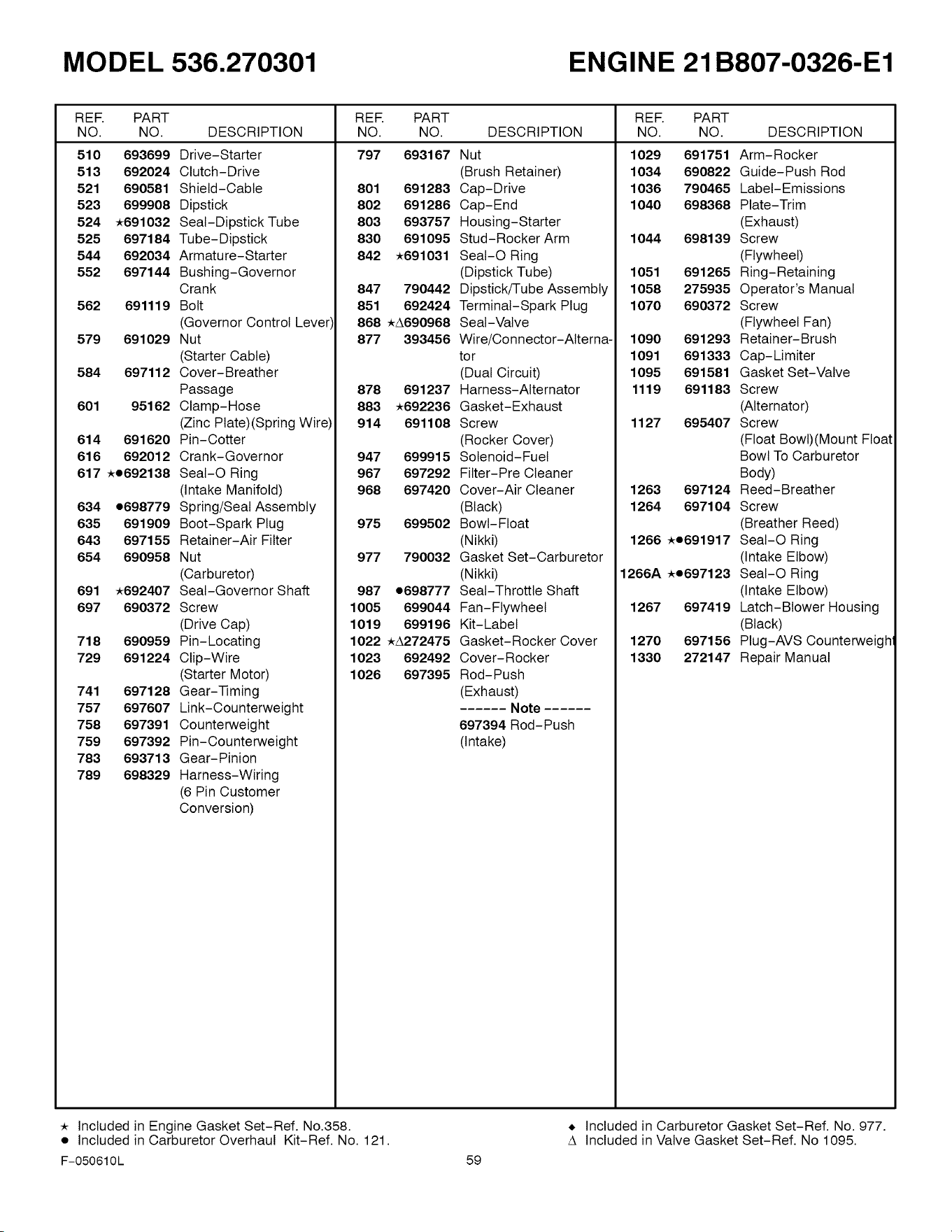
MODEL 536.270301 ENGINE 21B807-0326-E1
REF. PART
NO. NO. DESCRIPTION
510 693699 Drive-Starter
513 692024 Clutch-Drive
521 690581 Shield-Cable
523 699908 Dipstick
REF. PART
NO. NO. DESCRIPTION
797 693167 Nut
(Brush Retainer)
801 691283 Cap-Drive
802 691286 Cap-End
REF.
NO.
1029
1034
1036
1040
PART
NO. DESCRIPTION
691751 Arm-Rocker
690822 Guide-Push Rod
790465 Label-Emissions
698368 Plate-Trim
524 _691032 Seal-Dipstick Tube
525 697184 Tube-Dipstick
544 692034 Armature-Starter
552 697144 Bushing-Governor
Crank
562 691119 Bolt
(Governor Control Lever'
579 691029 Nut
(Starter Cable)
584 697112 Cover-Breather
Passage
601 95162 Clamp-Hose
(Zinc Plate)(Spring Wire
614 691620 Pin-Cotter
616 692012 Crank-Governor
617 _e692138 Seal-O Ring
(Intake Manifold)
634 e698779 Spring/Seal Assembly
635 691909 Boot-Spark Plug
643 697155 Retainer-Air Filter
654 690958 Nut
(Carburetor)
691 _692407 Seal-Governor Shaft
697 690372 Screw
(Drive Cap)
718 690959 Pin-Locating
729 691224 Clip-Wire
(Starter Motor)
741 697128 Gear--liming
757 697607 Link-Counterweight
758 697391 Counterweight
759 697392 Pin-Counterweight
783 693713 Gear-Pinion
789 698329 Harness-Wiring
(6 Pin Customer
Conversion)
803 693757 Housing-Starter
830 691095 Stud-Rocker Arm
842 *691031 Seal-O Ring
(Dipstick Tube)
847 790442 Dipstick/Tube Assembly
851 692424 Terminal-Spark Plug
868 _A690968 Seal-Valve
877 393456 Wire/Connector-Alterna-
tor
(Dual Circuit)
878 691237 Harness-Alternator
883 _692236 Gasket-Exhaust
914 691108 Screw
(Rocker Cover)
947 699915 Solenoid-Fuel
967 697292 Filter-Pre Cleaner
968 697420 Cover-Air Cleaner
(Black)
975 699502 Bowl-Float
(Nikki)
977 790032 Gasket Set-Carburetor
(Nikki)
987 e698777 Seal-Throttle Shaft
1005 699044 Fan-Flywheel
1019 699196 Kit-Label
1022 *A272475 Gasket-Rocker Cover
1023 692492 Cover-Rocker
1026 697395 Rod-Push
(Exhaust)
...... Note ......
697394 Rod-Push
(Intake)
(Exhaust)
1044 698139 Screw
(Flywheel)
1051 691265 Ring-Retaining
1058 275935 Operator's Manual
1070 690372 Screw
(Flywheel Fan)
1090 691293 Retainer-Brush
1091 691333 Cap-Limiter
1095 691581 Gasket Set-Valve
1119 691183 Screw
(Alternator)
1127 695407 Screw
(Float Bowl)(Mount Float
Bowl To Carburetor
Body)
1263 697124 Reed-Breather
1264 697104 Screw
(Breather Reed)
1266 _e691917 Seal-O Ring
(Intake Elbow)
1266A *e697123 Seal-O Ring
(Intake Elbow)
1267 697419 Latch-Blower Housing
(Black)
1270 697156 Plug-AVS Counterweigh
1330 272147 Repair Manual
* Included in Engine Gasket Set-Ref. No.358.
• Included in Carburetor Overhaul Kit-Ref. No. 121.
+ Included in Carburetor Gasket Set-Ref. No. 977.
A Included in Valve Gasket Set-Ref. No 1095.
F-O50610L 59
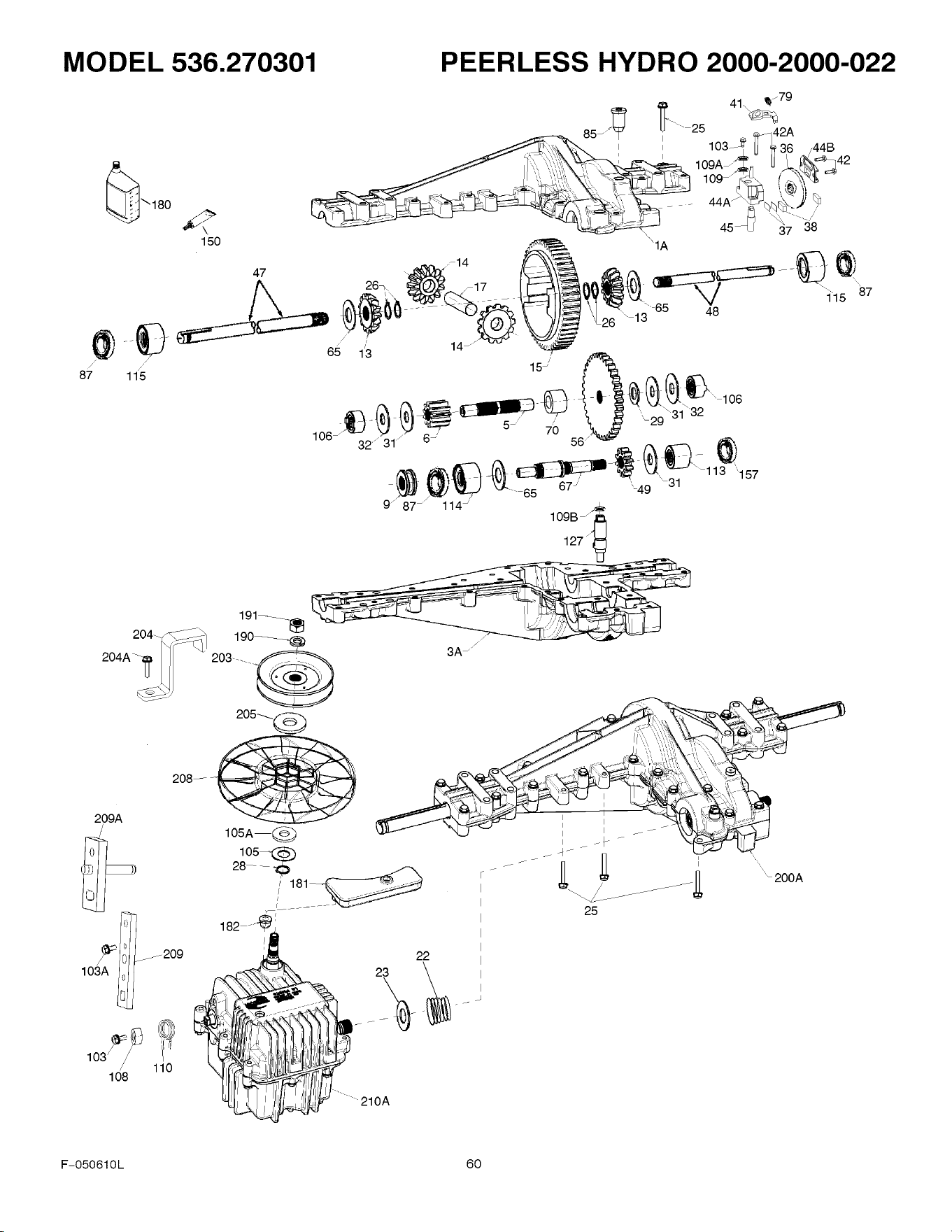
/
87
MODEL 536.270301
_\180
150
_2._31.... 6-' --" 7_ k._ ',-d31"32
56,- ,,_e-
9" 87- -/14 J "'-65 67J L4g '_31 " "357
i
/
108 110
F-O50810L
22
\
200A
6O
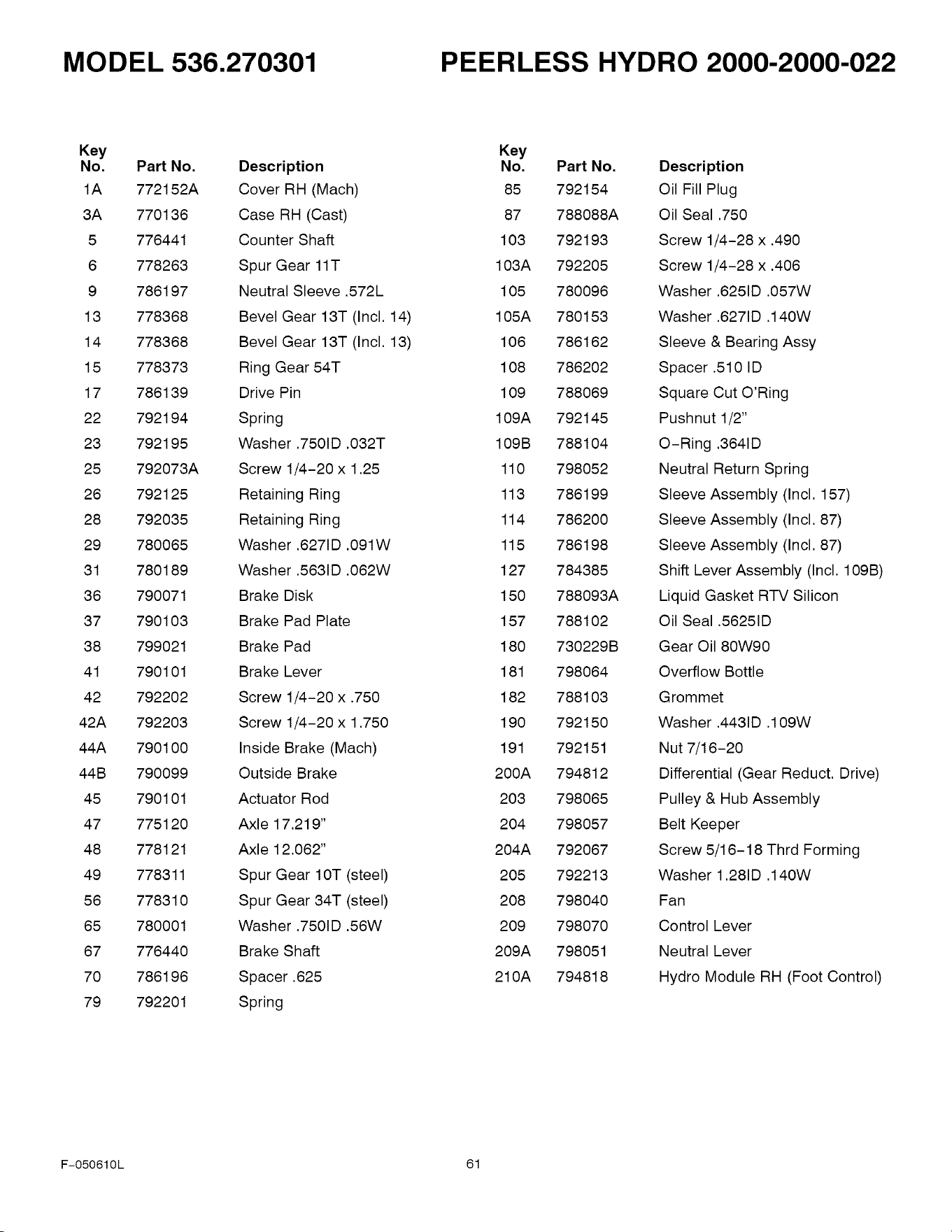
MODEL 536.270301 PEERLESS HYDRO 2000-2000-022
Key
No. Part No.
1A 772152A
3A 770136
5 776441
6 778263
9 786197
13 778368
14 778368
15 778373
17 786139
22 792194
23 792195
25 792073A
26 792125
28 792035
29 780065
31 780189
36 790071
37 790103
38 799021
41 790101
42 792202
42A 792203
44A 790100
44B 790099
45 790101
47 775120
48 778121
49 778311
56 778310
65 780001
67 776440
70 786196
79 792201
Description
Cover RH (Mach)
Case RH (Cast)
Counter Shaft
Spur Gear 11T
Neutral Sleeve .572L
Bevel Gear 13T (Incl. 14)
Bevel Gear 13T (Incl. 13)
Ring Gear 54T
Drive Pin
Spring
Wash er .7501D .032T
Screw 1/4-20 x 1.25
Retaining Ring
Retaining Ring
Washer .6271D .091W
Wash er .5631D .062W
Brake Disk
Brake Pad Plate
Brake Pad
Brake Lever
Screw 1/4-20 x .750
Screw 1/4-20 x 1.750
Inside Brake (Mach)
Outside Brake
Actuator Rod
Axle 17.219"
Axle 12.062"
Spur Gear 10T (steel)
Spur Gear 34T (steel)
Washer .7501D .56W
Brake Shaft
Spacer .625
Spring
Key
No. Part No.
85 792154
87 788088A
103 792193
103A 792205
105 780096
105A 780153
106 786162
108 786202
109 788069
109A 792145
109B 788104
110 798052
113 786199
114 786200
115 786198
127 784385
150 788093A
157 788102
180 730229B
181 798064
182 788103
190 792150
191 792151
200A 794812
203 798065
204 798057
204A 792067
205 792213
208 798040
209 798070
209A 798051
210A 794818
Description
Oil Fill Plug
Oil Seal .750
Screw 1/4-28 x .490
Screw 1/4-28 x .406
Washer .6251D .057W
Washer .6271D .140W
Sleeve & Bearing Assy
Spacer .510 ID
Square Cut O'Ring
Pushnut 1/2"
O-Ring .3641D
Neutral Return Spring
Sleeve Assembly (Incl. 157)
Sleeve Assembly (Incl. 87)
Sleeve Assembly (Incl. 87)
Shift Lever Assembly (Incl. 109B)
Liquid Gasket RTV Silicon
Oil Seal .56251D
Gear Oil 80W90
Overflow Bottle
Grommet
Washer .4431D .109W
Nut 7/16-20
Differential (Gear Reduct. Drive)
Pulley & Hub Assembly
Belt Keeper
Screw 5/16-18 Thrd Forming
Washer 1.281D .140W
Fan
Control Lever
Neutral Lever
Hydro Module RH (Foot Control)
F-050610L 61
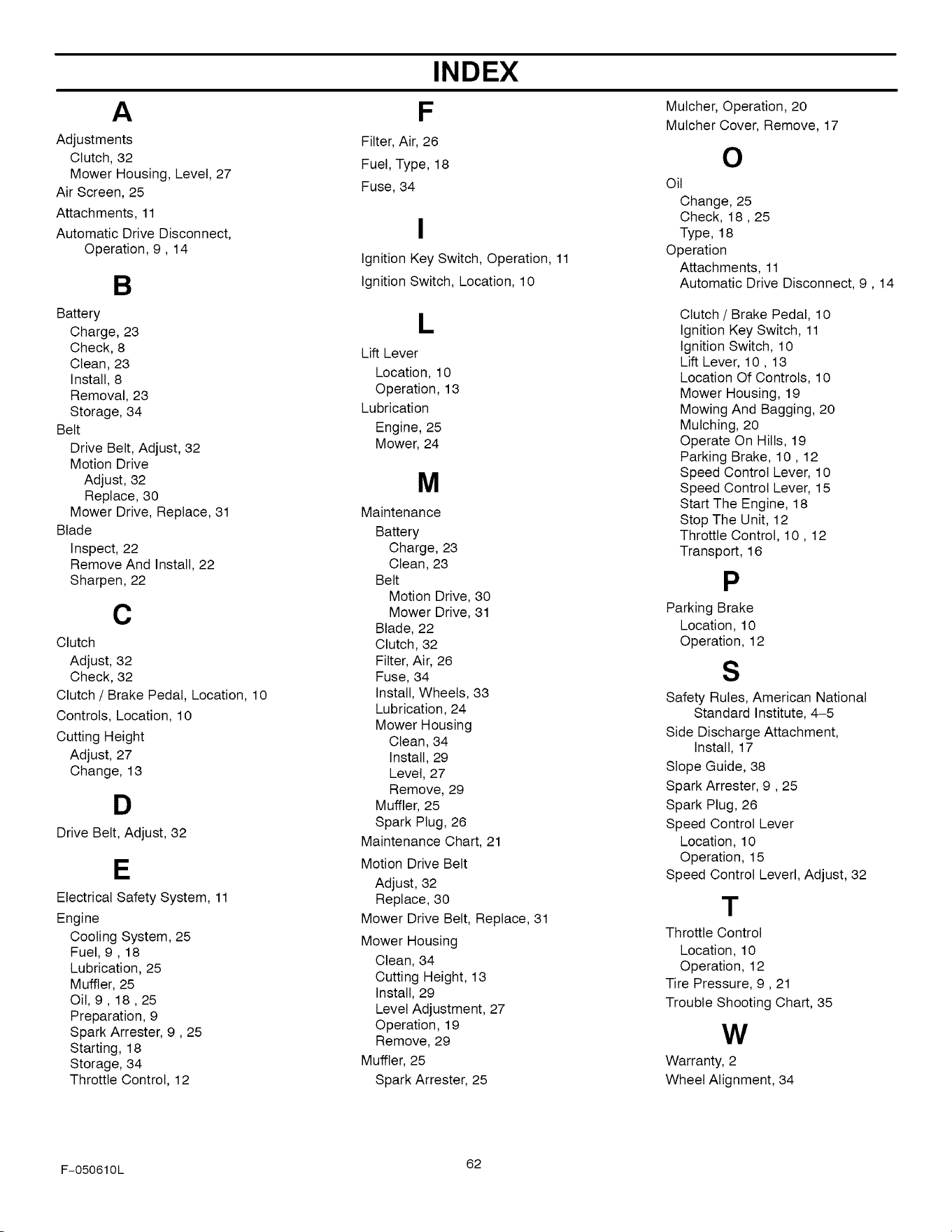
INDEX
A
Adjustments
Clutch, 32
Mower Housing, Level, 27
Air Screen, 25
Attachments, 11
Automatic Drive Disconnect,
Operation, 9, 14
B
Battery
Charge, 23
Check, 8
Clean, 23
Install, 8
Removal, 23
Storage, 34
Belt
Drive Belt, Adjust, 32
Motion Drive
Adjust, 32
Replace, 30
Mower Drive, Replace, 31
Blade
Inspect, 22
Remove And Install, 22
Sharpen, 22
C
Clutch
Adjust, 32
Check, 32
Clutch / Brake Pedal, Location, 10
Controls, Location, 10
Cutting Height
Adjust, 27
Change, 13
D
Drive Belt, Adjust, 32
E
Electrical Safety System, 11
Engine
Cooling System, 25
Fuel, 9, 18
Lubrication, 25
Muffler, 25
Oil, 9, 18,25
Preparation, 9
Spark Arrester, 9,25
Starting, 18
Storage, 34
Throttle Control, 12
F
Filter, Air, 26
Fuel, Type, 18
Fuse, 34
Ignition Key Switch, Operation, 11
Ignition Switch, Location, 10
L
Lift Lever
Location, 10
Operation, 13
Lubrication
Engine, 25
Mower, 24
M
Maintenance
Battery
Charge, 23
Clean, 23
Belt
Motion Drive, 30
Mower Drive, 31
Blade, 22
Clutch, 32
Filter, Air, 26
Fuse, 34
Install, Wheels, 33
Lubrication, 24
Mower Housing
Clean, 34
Install, 29
Level, 27
Remove, 29
Muffler, 25
Spark Plug, 26
Maintenance Chart, 21
Motion Drive Belt
Adjust, 32
Replace, 30
Mower Drive Belt, Replace, 31
Mower Housing
Clean, 34
Cutting Height, 13
Install, 29
Level Adjustment, 27
Operation, 19
Remove, 29
Muffler, 25
Spark Arrester, 25
Mulcher, Operation, 20
Mulcher Cover, Remove, 17
O
Oil
Change, 25
Check, 18,25
Type, 18
Operation
Attachments, 11
Automatic Drive Disconnect, 9, 14
Clutch / Brake Pedal, 10
Ignition Key Switch, 11
Ignition Switch, 10
Lift Lever, 10, 13
Location Of Controls, 10
Mower Housing, 19
Mowing And Bagging, 20
Mulching, 20
Operate On Hills, 19
Parking Brake, 10, 12
Speed Control Lever, 10
Speed Control Lever, 15
Start The Engine, 18
Stop The Unit, 12
Throttle Control, 10, 12
Transport, 16
P
Parking Brake
Location, 10
Operation, 12
S
Safety Rules, American National
Standard Institute, 4-5
Side Discharge Attachment,
Install, 17
Slope Guide, 38
Spark Arrester, 9,25
Spark Plug, 26
Speed Control Lever
Location, 10
Operation, 15
Speed Control Leverl, Adjust, 32
T
Throttle Control
Location, 10
Operation, 12
Tire Pressure, 9,21
Trouble Shooting Chart, 35
W
Warranty, 2
Wheel Alignment, 34
F-O50610L 62
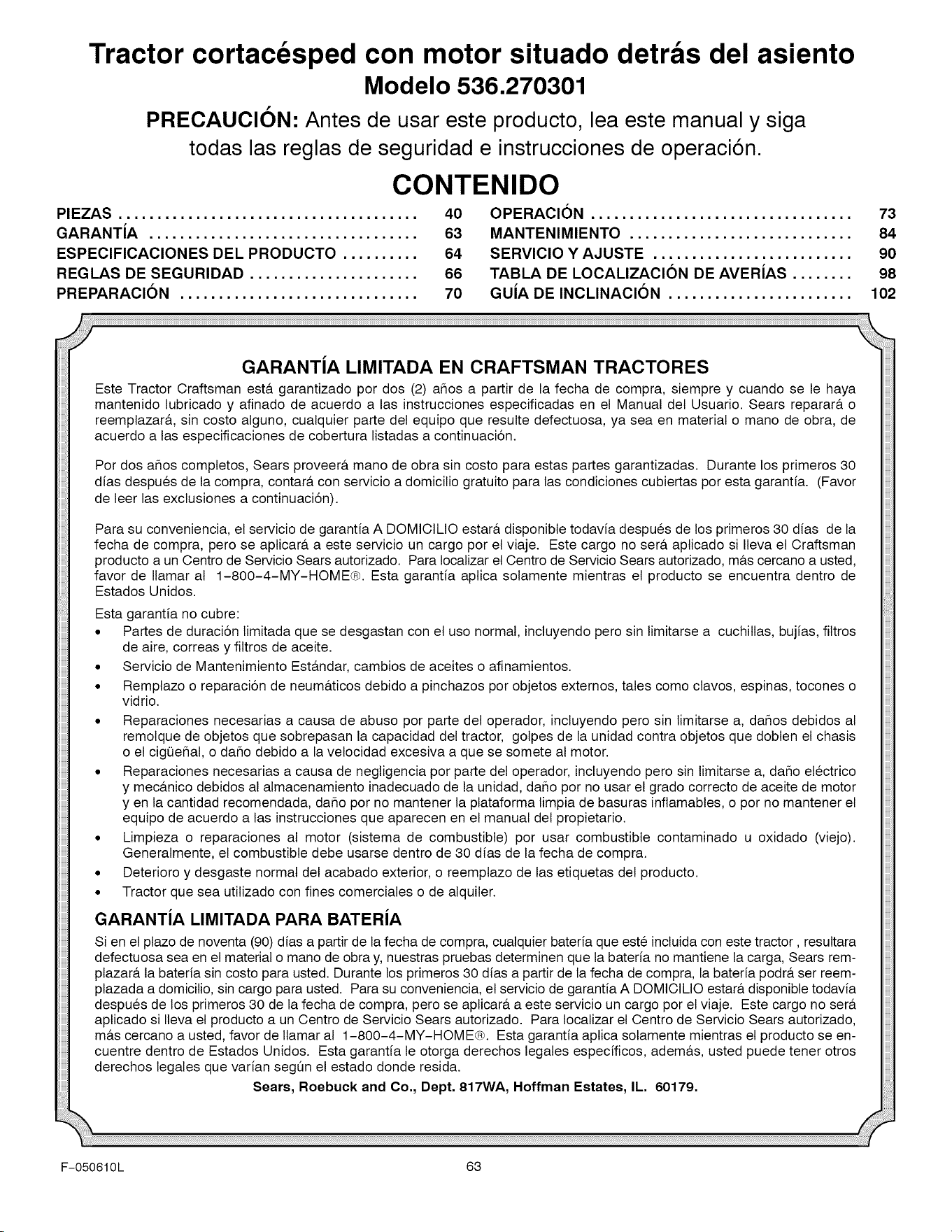
Tractor cortacesped con motor situado detras del asiento
Modelo 536,270301
PRECAUCION: Antes de usar este producto, lea este manual y siga
todas las reglas de seguridad e instrucciones de operaci6n.
CONTENIDO
PIEZAS .......................................
GARANTiA ...................................
ESPECIFICACIONES DEL PRODUCTO ..........
REGLAS DE SEGURIDAD ......................
PREPARACION ...............................
40
63
64
66
70
OPERACION .................................. 73
MANTENIMIENTO ............................. 84
SERVICIO Y AJUSTE .......................... 90
TABLA DE LOCALIZACION DE AVERiAS ........ 98
GUiA DE INCLINACION ........................ 102
GARANTiA LIMITADA EN CRAFTSMAN TRACTORES
Este Tractor Craftsman est& garantizado por dos (2) aflos a partir de la fecha de compra, siempre y cuando se le haya
mantenido lubricado y afinado de acuerdo alas instrucciones especificadas en el Manual del Usuario. Sears reparar& o
reemplazar&, sin costo alguno, cualquier parte del equipo que resulte defectuosa, ya sea en material o mano de obra, de
acuerdo alas especificaciones de cobertura listadas a continuaci6n.
Por dos aflos completos, Sears proveer& mano de obra sin costo para estas partes garantizadas. Durante los primeros 30
dias despues de la compra, contar& con servicio a domicilio gratuito para las condiciones cubiertas por esta garantia. (Favor
de leer las exctusiones a continuaci6n).
Para su conveniencia, el servicio de garantia A DOMICILIO estar& disponible todavia despues de los primeros 30 dias de la
fecha de compra, pero se aplicar& a este servicio un cargo por el viaje. Este cargo no ser& aplicado si Ileva el Craftsman
producto a un Centro de Servicio Sears autorizado. Para Iocalizar el Centro de Servicio Sears autorizado, m&s cercano a usted,
favor de Ilamar al 1-800-4-MY-HOME®. Esta garantia aplica solamente mientras el producto se encuentra dentro de
Estados Unidos.
Esta garantia no cubre:
• Partes de duraci6n limitada que se desgastan con el uso normal, inctuyendo pero sin limitarse a cuchittas, bujias, filtros
de aire, correas y filtros de aceite.
• Servicio de Mantenimiento Est&ndar, cambios de aceites o afinamientos.
• Remplazo o reparaci6n de neum&ticos debido a pinchazos por objetos externos, tales como ctavos, espinas, tocones o
vidrio.
• Reparaciones necesarias a causa de abuso por parte del operador, incluyendo pero sin limitarse a, daflos debidos al
remolque de objetos que sobrepasan la capacidad del tractor, golpes de la unidad contra objetos que doblen el chasis
o el cigQeflal, o daflo debido a la velocidad excesiva a que se somete al motor.
• Reparaciones necesarias a causa de negligencia por parte del operador, incluyendo pero sin limitarse a, daflo electrico
y mec&nico debidos al almacenamiento inadecuado de la unidad, daflo por no usar el grado correcto de aceite de motor
yen la cantidad recomendada, daflo por no mantener la plataforma limpia de basuras inflamables, o por no mantener el
equipo de acuerdo alas instrucciones que aparecen en el manual del propietario.
• Limpieza o reparaciones al motor (sistema de combustible) por usar combustible contaminado u oxidado (viejo).
Generalmente, el combustible debe usarse dentro de 30 dias de la fecha de compra.
• Deterioro y desgaste normal del acabado exterior, o reemplazo de las etiquetas del producto.
• Tractor que sea utitizado con fines comerciates o de alquiter.
GARANTiA LIMITADA PARA BATERiA
Si en el plazo de noventa (90) dias a partir de la fecha de compra, cualquier bateria que este incluida con este tractor, resultara
defectuosa sea en el material o mano de obra y, nuestras pruebas determinen que la bateria no mantiene la carga, Sears rem-
plazar& la bateria sin costo para usted. Durante los primeros 30 dias a partir de la fecha de compra, la bateria podr& ser reem-
plazada a domicilio, sin cargo para usted. Para su conveniencia, el servicio de garantia A DOMICILIO estar& disponible todavia
despues de los primeros 30 de la fecha de compra, pero se aplicar& a este servicio un cargo por el viaje. Este cargo no ser&
aplicado si Ileva el producto a un Centro de Servicio Sears autorizado. Para Iocalizar el Centro de Servicio Sears autorizado,
m&s cercano a usted, favor de Ilamar at 1-800-4-MY-HOME®. Esta garantia aplica solamente mientras el producto se en-
cuentre dentro de Estados Unidos. Esta garantia le otorga derechos legates especificos, adem&s, usted puede tener otros
derechos legales que varian segQn el estado donde resida.
Sears, Roebuck and Co., Dept. 817WA, Hoffman Estates, IL. 60179.
F-O50610L 63
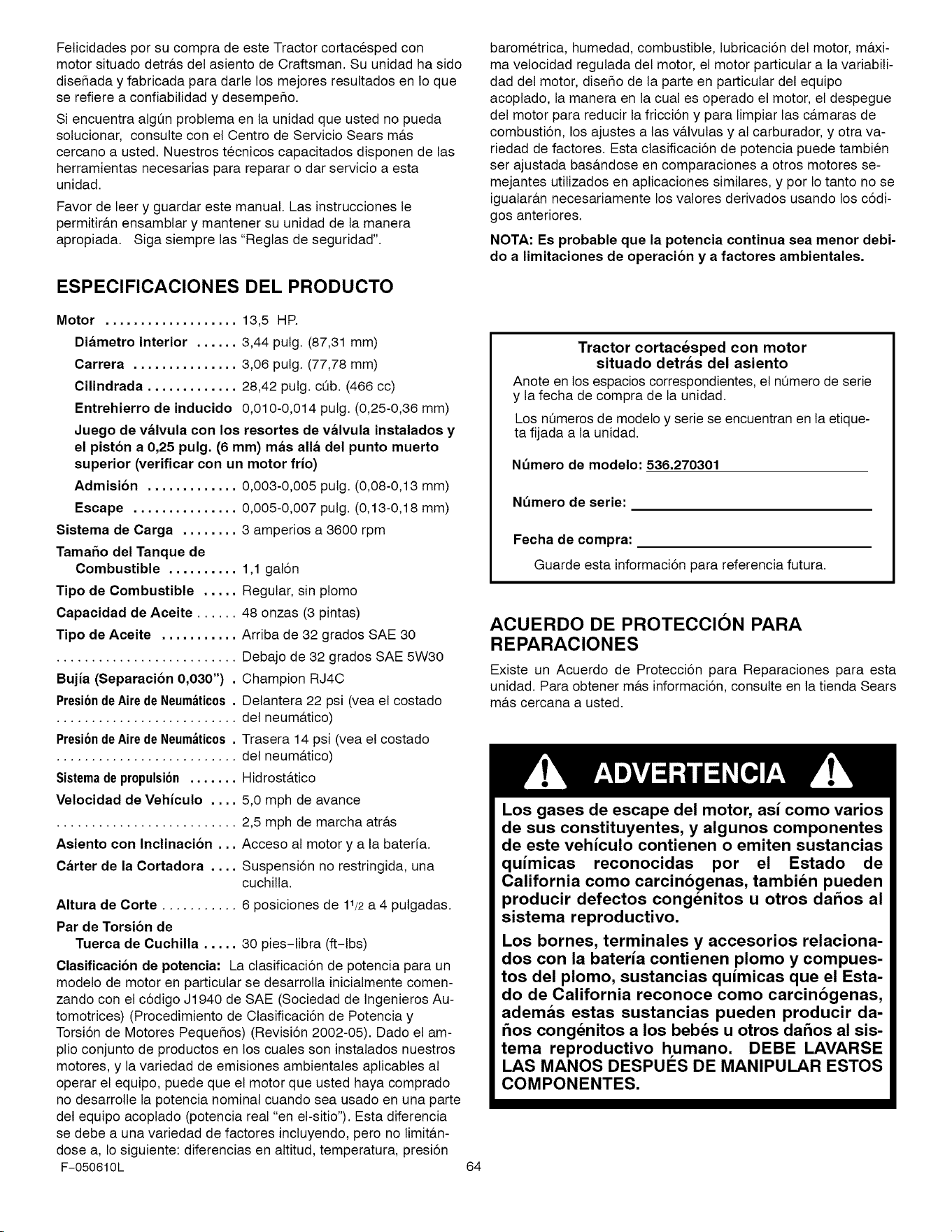
Felicidades por su compra de este Tractor cortacesped con
motor situado detr&s del asiento de Craftsman. Su unidad ha sido
diseflada y fabricada para darle los mejores resultados en 1o que
se refiere a confiabilidad y desempeflo.
Si encuentra atgOn problema en la unidad que usted no pueda
solucionar, consulte con el Centro de Servicio Sears m&s
cercano a usted. Nuestros tecnicos capacitados disponen de las
herramientas necesarias para reparar o dar servicio a esta
unidad.
Favor de leer y guardar este manual. Las instrucciones le
permitir&n ensamblar y mantener su unidad de la manera
apropiada. Siga siempre las "Reglas de seguridad".
ESPECIFICACIONES DEL PRODUCTO
barometrica, humedad, combustible, lubricaci6n del motor, m&xi-
ma velocidad regulada del motor, el motor particular a la variabili-
dad del motor, diseflo de la parte en particular del equipo
acoplado, la manera en la cual es operado el motor, el despegue
del motor para reducir la fricci6n y para limpiar las c&maras de
combusti6n, los ajustes alas v&lvulas y al carburador, y otra va-
riedad de factores. Esta clasificaci6n de potencia puede tambien
ser ajustada bas&ndose en comparaciones a otros motores se-
mejantes utilizados en aplicaciones similares, y por Io tanto no se
igualar&n necesariamente los valores derivados usando los c6di-
gos anteriores.
NOTA: Es probable que la potencia continua sea menor debi-
do a limitaciones de operacibn y a factores ambientales.
Motor ................... 13,5 HR
Di&metro interior ...... 3,44 pulg. (87,31 mm)
Carrera ............... 3,06 pulg. (77,78 mm)
Cilindrada ............. 28,42 pulg. cob. (466 cc)
Entrehierro de inducido 0,010-0,014 pulg. (0,25-0,36 mm)
Juego de v&lvula con Ice resortes de v&lvula instalados y
el pistbn a 0,25 pulg. (6 mm) m&s all& del punto muerto
superior (verificar con un motor frio)
Admisibn ............. 0,003-0,005 pulg. (0,08-0,13 mm)
Escape ............... 0,005-0,007 pulg. (0,13-0,18 mm)
Sistema de Carga ........ 3 amperios a 3600 rpm
Tamafm del Tanque de
Combustible .......... 1,1 gal6n
Tipo de Combustible ..... Regular, sin plomo
Capacidad de Aceite ...... 48 onzas (3 pintas)
Tipo de Aceite ........... Arriba de 32 grados SAE 30
.......................... Debajo de 32 grados SAE 5W30
Bujia (Separacibn 0,030") . Champion RJ4C
Presi6ndeAire de Neum_tic0s . Delantera 22 psi (vea el costado
.......................... del neum&tico)
Presi6n de Aire de Neum_tic0s . Trasera 14 psi (vea el costado
.......................... del neum&tico)
Sistema de pr0pulsi6n ....... Hidrost&tico
Velocidad de Vehiculo .... 5,0 mph de avance
.......................... 2,5 mph de marcha atr&s
Asiento con Inclinacibn... Acceso al motor y a la bateria.
C&rter de la Cortadora .... Suspensi6n no restringida, una
cuchilla.
Altura de Corte ........... 6 posiciones de 11/2a 4 pulgadas.
Par de Torsibn de
Tuerca de Cuchilla ..... 30 pies-libra (ft-lbs)
Clasificacibn de potencia: La clasificaci6n de potencia para un
modelo de motor en particular se desarrolla inicialmente comen-
zando con el c6digo J1940 de SAE (Sociedad de Ingenieros Au-
tomotrices) (Procedimiento de Clasificaci6n de Potencia y
Torsi6n de Motores Pequeflos) (Revisi6n 2002-05). Dado el am-
plio conjunto de productos en los cuales son instalados nuestros
motores, y la variedad de emisiones ambientales aplicables al
operar el equipo, puede que el motor que usted haya comprado
no desarrolle la potencia nominal cuando sea usado en una parte
del equipo acoplado (potencia real "en el-sitio"). Esta diferencia
se debe a una variedad de factores incluyendo, pero no limit&n-
dose a, Io siguiente: diferencias en attitud, temperatura, presi6n
F-050610L
Tractor cortacesped con motor
situado detras del asiento
Anote en los espacioscorrespondientes,el nOmerode serie
y la fecha de compra de la unidad.
Los nOmeros de modelo y serie se encuentran en la etique-
ta fijada a la unidad.
N_mero de modelo: 536.270301
Nt_mero de serie:
Fecha de compra:
Guarde esta informaci6n para referencia futura.
ACUERDO DE PROTECClON PARA
REPARAClONES
Existe un Acuerdo de Protecci6n para Reparaciones para esta
unidad. Para obtener m&s informaci6n, consulte en la tienda Sears
m&s cercana a usted.
Los gases de escape del motor, asi como varios
de sus constituyentes, y algunos componentes
de este vehiculo contienen o emiten sustancias
quimicas reconocidas pot el Estado de
California como carcinbgenas, tambi6n pueden
producir defectos congenitos u otros dafms al
sistema reproductivo.
Los homes, terminales y accesorios relaciona-
dos con la bateria contienen plomo y compues-
tos del plomo, sustancias quimicas que el Esta-
do de California reconoce como carcinogenas,
ademas estas sustancias pueden producir da-
fins congenitos a los beb6s u otros dafms al sis-
tema reproductivo humano. DEBE LAVARSE
LAS MANOS DESPUES DE MANIPULAR ESTOS
COMPONENTES.
64

NOTA: Esta unidad est& equipada con un motor de combusti6n
interna y no debe ser utilizada sobre o cerca de terrenos no
cultivados cubiertos de bosque, maleza o cesped a menos que el
sistema de escape del motor este equipado con un parachispas
que cumpla con las leyes locales o estatales aplicabtes (si
existen). Si se utiliza un parachispas, el operador debe
mantenerlo en buenas condiciones de funcionamiento.
En el estado de California, estas condiciones son requeridas por la
ley (Secci6n 4442 del C6digo de Recursos POblicos de California).
Otros estados pueden tener leyes semejantes. Las leyes federales
son aplicables en terrenos federales. Vaya a un Centro de Servicio
Sears para obtener un parachispas para el tubo de escape.
En atgunos lugares, las leyes locales requieren el uso de una
bujia de resistencia para controlar las seflales de encendido.
Consulte en un Centro de Servicio Sears para conseguir la bujia
de resistencia para el motor.
NOTA: Es probable que la potencia continua sea menor debi-
do a limitaciones de operacibn y a factores ambientales.
En el estado de California, los Modelos de motores de la Serie
280000 est&n certificados por la Junta de recursos del aire de
California para cumplir con los est&ndares de emisiones de 125
horas. Dicha certificaci6n no ofrece al comprador, propietario u
operador de este motor ninguna garantia adicional con respecto
al rendimiento o vida Otitde este motor. Este motor est& garanti-
zado Onicamente de acuerdo alas garantias del producto y de
emisiones indicadas en otras secciones de este manual.
F-O50610L 65
REGLAS DE SEGURIDAD
Practicas de operacibn segura para vehiculos autoportados
Basadas en las recomendaciones del Instituto de Estandares Nacionales de Estados Unidos de Am6rica
I.
1.
PRECAUCION: Esta maquina cortadora es capaz de amputar manos y pies y de lanzar objetos con mucha fuerza. No
respetar las instrucciones de seguridad a continuacibn podria resultar en lesiones graves o la muerte del operador o
de espectadores.
OPERACION GENERAL:
Antes de comenzar el trabajo, lea, entienda y siga todas las
instrucciones que aparecen en el Manual de Instrucciones,
en la m&quina, en el motor yen cuatquiera de los aditamen-
tos.
2. $61o permita que adultos responsables, familiarizados con
las instrucciones, utilicen la m&quina.
3. Despeje el &rea de objetos tales como piedras, juguetes,
cables, etc., que podrfan ser lanzados con fuerza por la cu-
chilla.
4. Antes de comenzar a cortar el cesped, asegQrese de que no
haya ninguna persona en el &rea. Si atguien entra en el
&rea, pare de inmediato la m&quina.
5. Nunca Ileve pasajeros.
6. Antes de retroceder, desconecte la atimentaci6n al cortaces-
ped o a cuatquier aditamento que tenga instalado. No corte
el cesped en reversa a menos que esto sea absolutamente
necesario. Siempre mire hacia abajo y hacia atr&s antes de
retroceder y mientras retrocede.
7. Este atento a la direcci6n de descarga de la hierba cortada.
No dirija la descarga hacia personas o hacia lugares donde
pudiera haber gente. No opere la unidad sin tener instalado
el recolector de hierba o el dispositivo de seguridad.
8. Aminore la velocidad antes de dar la vuelta.
9. Nunca deje una m&quina desatendida mientras el motor est&
en marcha. Siempre desembrague la cuchilla(s), enganche
el freno de mano, pare el motor y retire la Itave antes de ba-
jarse.
10. Desconecte la alimentaci6n a los aditamentos cuando no los
este utilizando o cuando transporte la unidad. Desembrague
la cuchilla(s) cuando no este cortando el cesped.
11. Pare el motor antes de desmontar el recolector de hierba o
para desobtruir el conducto de descarga.
12. Corte el cesped a la luz del dia o con buena luz artificial.
13. No opere la m&quina si est& bajo los efectos del alcohol o de
drogas, o si est& muy cansado.
14. Este atento al tr&fico cuando opere la m&quina cerca de ca-
minos o si debe cruzarlos.
15. Si usa un remolque o camioneta para transportar la unidad,
tenga mucho cuidado at cargar o descargar la unidad del
vehiculo.
16. Desenganche todos los embragues de los aditamentos y
coloque la palanca de cambios en la posici6n neutro antes
de arrancar el motor.
Siempre use gafas de protecci6n u algQn tipo de protector
para los ojos cuando utilice la unidad, de esta manera prote-
ger& sus ojos de objetos que pudieran ser lanzados por la
m&quina. Este tipo de protecci6n ocular tambien debe usar-
Io cuando necesite hacer ajustes o reparaciones a la m&qui-
ha.
17.
18. Tenga mucho cuidado cuando deba remolcar cargas o cuan-
do utilice equipos pesados.
a. Utilice Qnicamente barras de enganche con puntos de
remolque aprobados.
b. Limite las cargas a aquellas que usted pueda controlar
con seguridad.
c. No gire el volante bruscamente. Tenga cuidado al retro-
ceder.
d. Utilice contrapesos o pesos en las ruedas cuando esto
sea recomendado en el Manual de Instrucciones.
19. No opere esta m&quina si est& tomando drogas u otras me-
dicinas que pudieran causar somnolencia o que pudieran
afectar su habilidad para operar esta m&quina.
20. No opere esta m&quina si su estado emocionat o fisico no le
permite operarla con seguridad.
21. Los datos recopilados indican que los operadores de 60
aflos o m&s, sufren un mayor nemero de accidentes y lesio-
nes relacionados con el manejo de m&quinas cortacesped.
Estos operadores deben evaluar sus habilidades para mane-
jar de manera segura un tractor cortacesped y evitar asi le-
siones graves que pudieran sufrir ellos u otras personas que
se encuentren presentes.
II. OPERACION EN CUESTAS:
Las cuestas y los terrenos accidentados son factores princi-
pales que se relacionan a accidentes causados por p6rdidas
de control o por vuelcos de la unidad y que pueden resultar
en lesiones graves o muerte. TODAS las cuestas requieren
que se tomen precauciones adicionales. Si no puede subir
la cuesta usando el cambio de marcha atras, o si se siente
incbmodo en la cuesta, no la corte. Consulte la "Guia de
evaluacibn de cuestas". Para obtener mayor informacibn al
respecto, consulte esta guia que aparece al final de este ma-
nual.
RECOMENDACIONES
1. En las cuestas, corte el cesped verticalmente (hacia arriba y
hacia abajo), y no en linea perpendicular (de lado a lado).
2. Quite todo obst&culo tal como piedras, ramas, etc.
3. Tenga cuidado con los hoyos, baches o resaltos. El terreno
disparejo puede hacer que la m&quina se vuelque. "La hier-
ba muy alta puede esconder obst&culos".
4. Maneje la unidad a baja velocidad. Seleccione una veloci-
dad suficientemente baja para que no tenga que parar o
cambiar de velocidad mientras est& en la cuesta.
5. Respete y siga las recomendaciones del fabricante acerca
de pesos para las ruedas o contrapesos para mejorar la es-
tabilidad.
6. Tenga mucho cuidado cuando utilice el recolector de hierba
u otros aditamentos, estos afectan la estabilidad de la m&-
quina.
7. Procure que todos los movimientos en las cuestas sean len-
tos y graduales, No haga cambios bruscos de velocidad o
de direcci6n.
F-050610L 66
REGLAS DE SEGURIDAD
8. Evite tener que arrancar el motor o pararlo en una cuesta.
Si los neum&ticos pierden tracci6n, desembrague la cuchi-
Ita(s) y continQe despacio directamente hacia el pie de la
cuesta.
PRECAUCIONES 3.
1. No gire en las cuestas a menos que sea absolutamente ne-
cesario, si debe hacerlo, gire lenta y gradualmente cuesta
abajo, si es posible.
2. No corte el cesped cerca de precipicios, zanjas o terraple-
nes. Una rueda sobre un borde o el desprendimiento de un
borde podria causar un vuelco inesperado provocando lesio-
nes o la muerte.
3. No corte el cesped si est& mojado. La reducida tracci6n
puede hacer que la m&quina resbale. 4.
4. No trate de estabilizar la m&quina bajando su pie al suelo.
5. No utilice el recolector de hierba ni otro accesorio de remol-
que en cuestas empinadas (de m&s de 10 grados). 5.
III. NIl(lOS:
Pueden ocurrir accidentes tragicos si el operador no esta
alerta a la presencia de nifms. A muchos nifms les atraen
las cortadoras autoportadas. NUNCA suponga que los ni-
fins permaneceran en el _ltimo lugar donde los vib.
1. Mantenga a los niflos fuera del _trea de trabajo y bajo el cui-
dado de un adulto que no sea el operador.
2. Mantengase alerta y pare el motor si entran niflos al &rea.
3. Antes y mientras retrocede, mire hacia atras y hacia abajo
por si hay niflos.
4. Nunca permita que niflos u otras personas vayan como "pa-
sajeros" en el cortacesped, ni siquiera cuando la cuchilla(s)
no este puesta. EIIos pueden caerse, lesionarse gravemen-
te o pueden interferir con la operaci6n segura de la m&quina.
5. Nunca permita que niflos operen la m&quina. Ensefleles a
los niflos los peligros de la m&quina.
6. Tenga mucho cuidado cuando se aproxime a esquinas cie-
gas, arbustos, &rboles u otros objetos que le impidan una
buena visibilidad.
IV. SERVICIO:
1. Tenga mucho cuando manipule gasolina y otros combustibles.
Los combustibles son inflamables y los vapores son
explosivos.
a. Utilice Qnicamente un recipiente aprobado.
b. Nunca quite ta tapa del tanque de gasolina ni aflada com-
bustible cuando el motor este en marcha. Deje que el motor
se enfrie durante varios minutos antes de Ilenar el tanque.
No fume cuando Ilene el tanque.
c. Nunca agregue combustible cuando la unidad se encuen-
tra en un recinto cerrado o cerca de electrodomesticos que
tengan luces pilotos, calentadores, u otra fuentes de ignici6n.
d. Nunca guarde el cortacesped con combustible en el tan-
que, o el recipiente de combustible en un recinto donde haya
alguna llama expuesta, tat como el piloto de un catentador de
agua.
2. Nunca arranque el motor ni Io deje en marcha dentro de un
recinto cerrado.
a. Compruebe que la bujia, mofle, tapa del tanque de com-
bustible y limpiador de aire esten en su lugar.
F-050610L
67
6.
b. No vire el motor sin cuando haya quitado la bujia.
c. Si se derrama combustible, espere hasta que este se eva-
pore antes de arrancar el motor.
d. No arranque el motor si hay algQn escape de PL o gas na-
tural en el &rea.
Mantenga todas las tuercas y pernos apretados, especial-
mente las tuercas de montaje de la cuchilla(s). Revise con
frecuencia la cuchilla(s) para ver si est& gastada o si tiene
algen daflo tal como grietas o abolladuras. Una cuchilla tor-
cida o daflada debe ser reemplazada inmediatamente por
una cuchilla de repuesto original la cual puede obtener en un
centro de servicio autorizado. Para mayor seguridad, reem-
place la cuchilla cada dos aflos. Mantenga el equipo en
buenas condiciones.
Nunca trate de modificar los dispositivos de seguridad. Re-
viselos con frecuencia para cerciorarse de que trabajan
bien.
Para reducir los riesgos de incendio, mantenga la m&quina
fibre de acumulaciones de hierba, hojas u otros desechos.
Limpie derrames de aceite o de combustible. Deje que la
m&quina se enfrie antes de guardarla.
a. Deje que se enfrfen las &reas del mofie y del motor antes
de tocarlas.
Pare e inspeccione el equipo si choca contra algQn objeto.
Si es necesario, repare el equipo antes de hacerlo arrancar
de nuevo.
7. Nunca realice ajustes o reparaciones con el motor en mar-
cha. El carburador puede ser ajustado mientras el motor
est& en marcha. No cambie los ajustes del regulador del
motor ni sobrepase la velocidad de regimen del motor.
8. Los componentes del recolector de hierba est&n sujetos a
desgaste, daflo y deterioro, factores que pueden exponer las
partes m6viles o permitir que objetos sean lanzados por la
m&quina. AI guardar la unidad, asegQrese siempre de que el
recolector de hierba este vacio. Revise los componentes
peri6dicamente, y cuando sea necesario, reempl&celos con
piezas de repuesto recomendadas por el fabricante.
9. La cuchilla(s) de la cortadora es afilada y puede cortarle.
Envuelva la cuchilla(s) o utilice guantes y tome precauciones
cuando tenga que revisarla o revisar el &rea del alojamiento
de la cuchilla.
10. Examine los frenos frecuentemente. Aj[_stelos y reviselos
segQn sea necesario.
11. Antes de comenzar a revisar cualquier parte de la unidad,
espere a que todo movimiento se detenga.
RESPONSABILIDAD DEL PROPIETARIO
CONSIDERACION AMBIENTAL
• No Ilene completamente el tanque de combustible.
• Saque el combustible de la m&quina at guardarla durante la
temporada de no uso.
• Use solamente gasolina sin plomo.
• Examine y limpie el filtro de aire regularmente.
• Cambie el aceite regularmente. Use aceite de 30W en el
verano.
• Ajuste el motor regularmente.
• Mantenga el equipo en buen estado de funcionamiento.
• Desh&gase debidamente del aceite de motor usado.

REGLAS DE SEGURIDAD
Se usa el simbolo de seguridad _ para identificar informaci6n de seguridad acerca de peligros que pudieran re-
sultar en lesiones personales. Se usa una palabra de aviso (PELIGRO, ADVERTENCIA o PRECAUCION) con el
simbolo de alerta para indicar la posibilidad y la posible gravedad de una lesi6n. Tambi6n, se puede usar un simbolo
de peligro para representar el tipo de peligro.
PELIGRO indica un peligro que, si no se evita, va a resultar en muerte o lesion grave.
ADVERTENCIA indica un peligro que, si no se evita, puede resultar en muerte o lesion grave.
PRECAUCION indica un peligro que, si no se evita, podria resultar en una lesion leve o moderada.
PRECAUCION cuando se usa sin el simbolo de alerta, indica una situaci6n que podria resultar en dar_o al
motor.
F-050610L 68
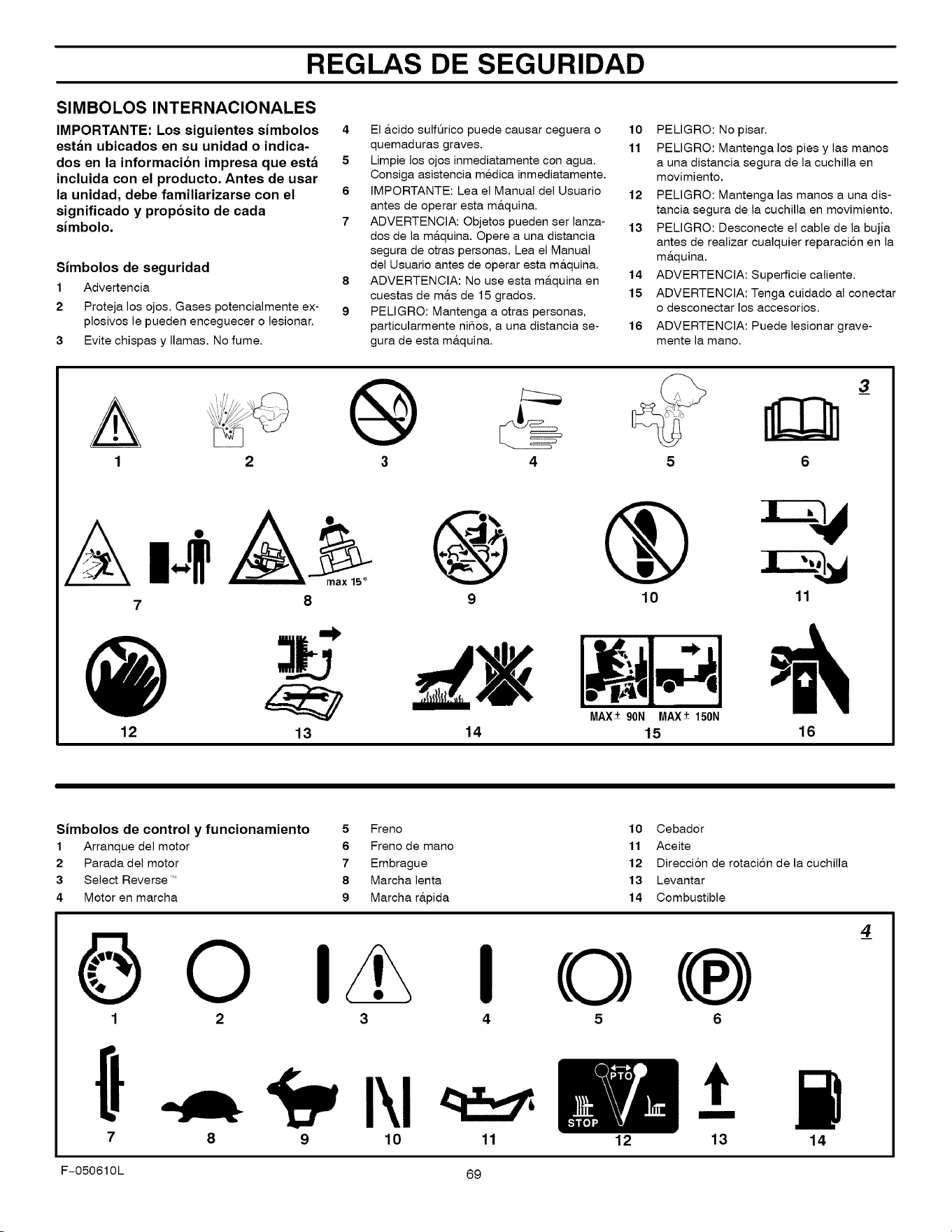
REGLAS DE SEGURIDAD
SIMBOLOS INTERNACIONALES
IMPORTANTE: Los siguientes simbolos
estan ubicados en su unidad o indica-
dos en la informacibn impresa que esta
incluida con el producto. Antes de usar
la unidad, debe familiarizarse con el
significado y propbsito de cada
simbolo.
Simbolos de seguridad
1 Advertencia
2 Proteja los ojos. Gases potencialmente ex-
plosivos le pueden enceguecer o lesionar.
3 Evite chispas y llamas. No fume.
4 El &cido sulfOrico puede causar ceguera o
quemaduras graves.
5 Limpie los ojos inmediatamente con agua.
Consiga asistencia medica inmediatamente.
6 IMPORTANTE: Lea el Manual del Usuario
antes de operar esta maquina.
7 ADVERTENCIA: Objetos pueden ser lanza-
dos de la maquina. Opere a una distancia
segura de otras personas. Lea el Manual
del Usuario antes de operar esta maquina.
8 ADVERTENCIA: No use esta maquina en
cuestas de mas de 15 grados.
9 PELIGRO: Mantenga a otras personas,
particularmente ni_os, a una distancia se-
gura de esta maquina.
10 PELIGRO: No pisar.
11 PELIGRO: Mantenga los pies y las manos
a una distancia segura de la cuchilla en
movimiento.
12 PELIGRO: Mantenga las manos a una dis-
tancia segura de la cuchilla en movimiento.
13 PELIGRO: Desconecte el cable de la bujia
antes de realizar cualquier reparaci6n en la
maquina.
14 ADVERTENCIA: Superficie caliente.
15 ADVERTENCIA: Tenga cuidado al conectar
o desconectar los accesorios.
16 ADVERTENCIA: Puede lesionar grave-
mente la mano.
6
3_
7 8
12 13
9 10 11
MAX± 90N MAX± 150N
14 15 16
Simbolos de control y funcionamiento 5 Freno 10 Cebador
1 Arranque del motor 6 Freno de mano 11 Aceite
2 Parada del motor 7 Embrague 12 Direcci6n de rotaci6n de la cuchilla
3 Select Reverse _ 8 Marcha lenta 13 Levantar
4 Motor en marcha 9 Marcha r&pida 14 Combustible
I O
1 2 3 4
7 8 9 10 11 12 13 14
4_
F-050610L 69
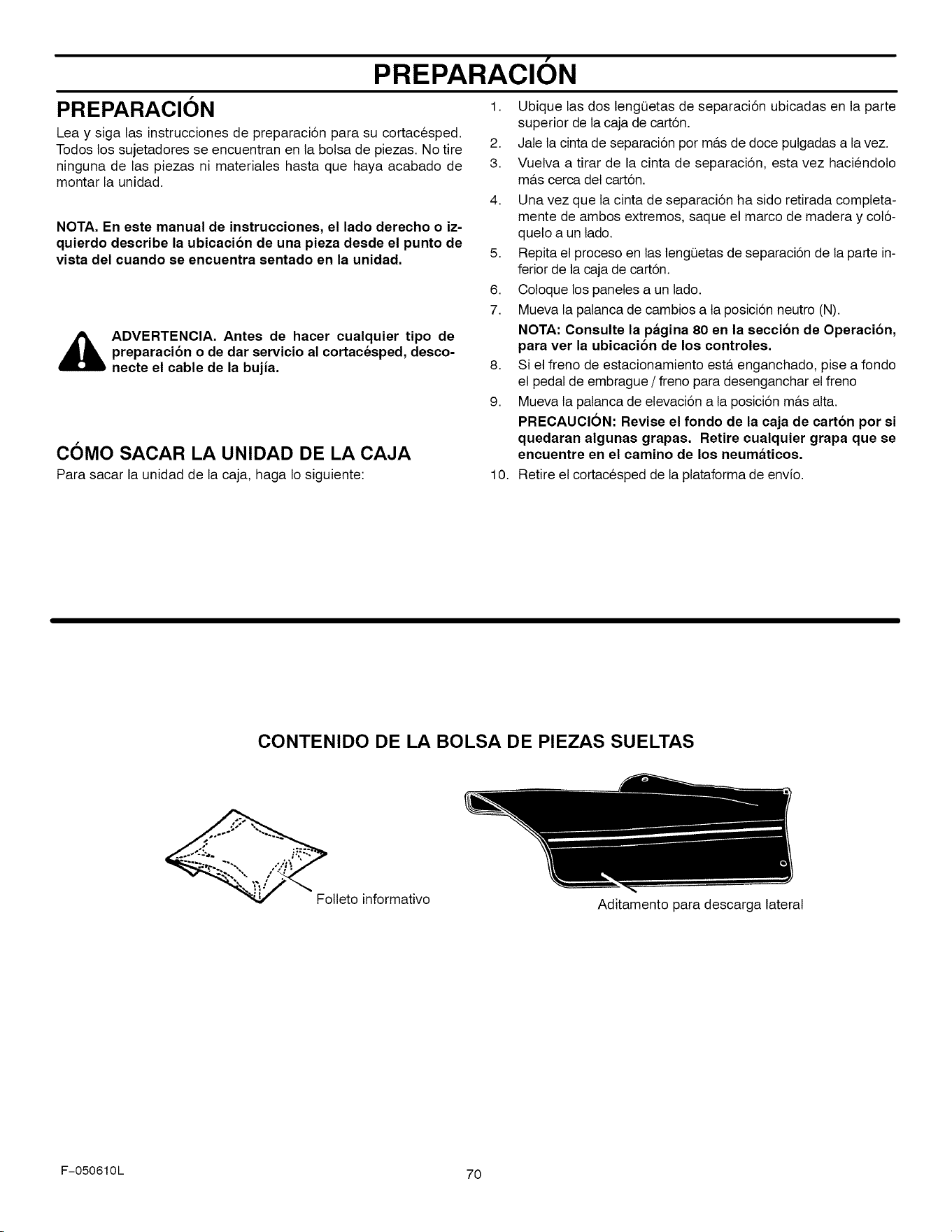
PREPARACION
PREPARACION
Lea y siga las instrucciones de preparaci6n para su cortacesped.
Todos los sujetadores se encuentran en la bolsa de piezas. No tire
ninguna de las piezas ni materiates hasta que haya acabado de
montar la unidad.
NOTA. En este manual de instrucciones, el lado derecho o iz-
quierdo describe la ubicaci6n de una pieza desde el punto de
vista del cuando se encuentra sentado en la unidad.
,_ ADVERTENCIA. Antes de hacer cualquier tipo de
preparaci6n o de dar servicio al cortac6sped, desco-
necte el cable de la bujia.
COMO SACAR LA UNIDAD DE LA CAJA
1. Ubique las dos lengQetas de separaci6n ubicadas en la parte
superior de la caja de cart6n.
2. Jale la cinta de separaci6n por mas de doce pulgadas a la vez.
3. Vuelva a tirar de la cinta de separaci6n, esta vez haciendolo
m&s cerca del cart6n.
4. Una vez que la cinta de separaci6n ha sido retirada compteta-
mente de ambos extremos, saque el marco de madera y col6-
quelo a un lado.
5. Repita el proceso en las lengQetas de separaci6n de la parte in-
ferior de la caja de cart6n.
6. Coloque los paneles a un lado.
7. Mueva la palanca de cambios a la posici6n neutro (N).
NOTA: Consulte la pagina 80 en la seccibn de Operacibn,
para ver la ubicaci6n de los controles.
8. Si el freno de estacionamiento ester enganchado, pise a fondo
el pedal de embrague / freno para desenganchar el freno
9. Mueva la palanca de elevaci6n a la posici6n m&s alta.
PRECAUCION: Revise el fondo de la caja de cartbn por si
quedaran algunas grapas. Retire cualquier grapa que se
encuentre en el camino de los neumaticos.
Para sacar la unidad de la caja, haga Io siguiente: 10. Retire el cortacesped de la ptataforma de envio.
CONTENIDO DE LA BOLSA DE PIEZAS SUELTAS
Folleto informativo
Aditamento para descarga lateral
F-050610L 70
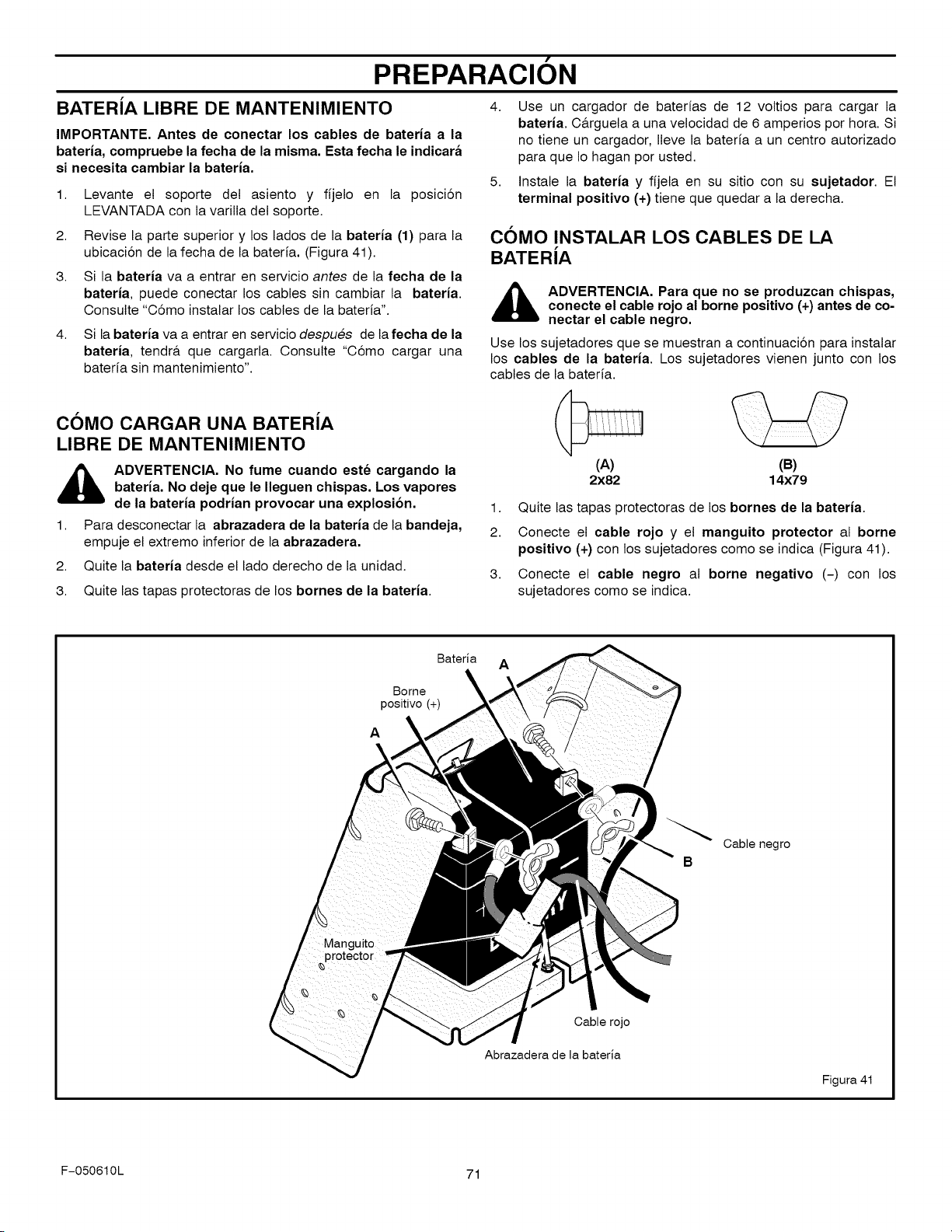
PREPARACION
BATERiA LIBRE DE MANTENIMIENTO
IMPORTANTE. Antes de conectar los cables de bateria a la
bateria, compruebe la fecha de la misma. Esta fecha le indicara
si necesita cambiar la bateria.
1. Levante el soporte del asiento y fijelo en la posici6n
LEVANTADA con la varilta del soporte.
2. Revise la parte superior y los lados de la bateria (1) para la
ubicaci6n de la fecha de la bateria. (Figura 41).
3. Si la bateria va a entrar en servicio antes de la fecha de la
bateria, puede conectar los cables sin cambiar la bateria.
Consulte "C6mo instalar los cables de la bateria".
4.
Si la bateria va a entrar en servicio despues de la fecha de la
bateria, tendr& que cargarla. Consulte "C6mo cargar una
bateria sin mantenimiento".
COMO CARGAR UNA BATERiA
LIBRE DE MANTENIMIENTO
,_ ADVERTENCIA. No fume cuando est_ cargando la
bateria. No deje que le Ileguen chispas. Los vapores
de la bateria podrian provocar una explosi6n.
1. Para desconectar la abrazadera de la bateria de la bandeja,
empuje el extremo inferior de la abrazadera.
2. Quite la bateria desde el lado derecho de la unidad.
3. Quite las tapas protectoras de los bornes de la bateria.
4. Use un cargador de baterias de 12 voltios para cargar la
bateria. C&rguela a una velocidad de 6 amperios por hora. Si
no tiene un cargador, Iteve la bateria a un centro autorizado
para que Io hagan por usted.
5. Instate la bateria y fijela en su sitio con su sujetador. El
terminal positivo (+) tiene que quedar a la derecha.
COMO INSTALAR LOS CABLES DE LA
BATERiA
_ ADVERTENCIA. Para que no se produzcan chispas,
conecte el cable rojo al borne positivo (+) antes de co-
nectar el cable negro.
Use los sujetadores que se muestran a continuaci6n para instalar
los cables de la bateria. Los sujetadores vienen junto con los
cables de la bateria.
(A)
2x82
1.
2.
3.
(B)
14x79
Quite las tapas protectoras de los bornes de la bateria.
Conecte el cable rojo y el manguito protector al borne
positivo (+) con los sujetadores como se indica (Figura 41).
Conecte el cable negro at borne negativo (-) con los
sujetadores como se indica.
Bateria
Borne
positivo (+)
A
A
Cable negro
B
Cable rojo
Abrazadera de la bateria
Figura 4t
F-050610L 71
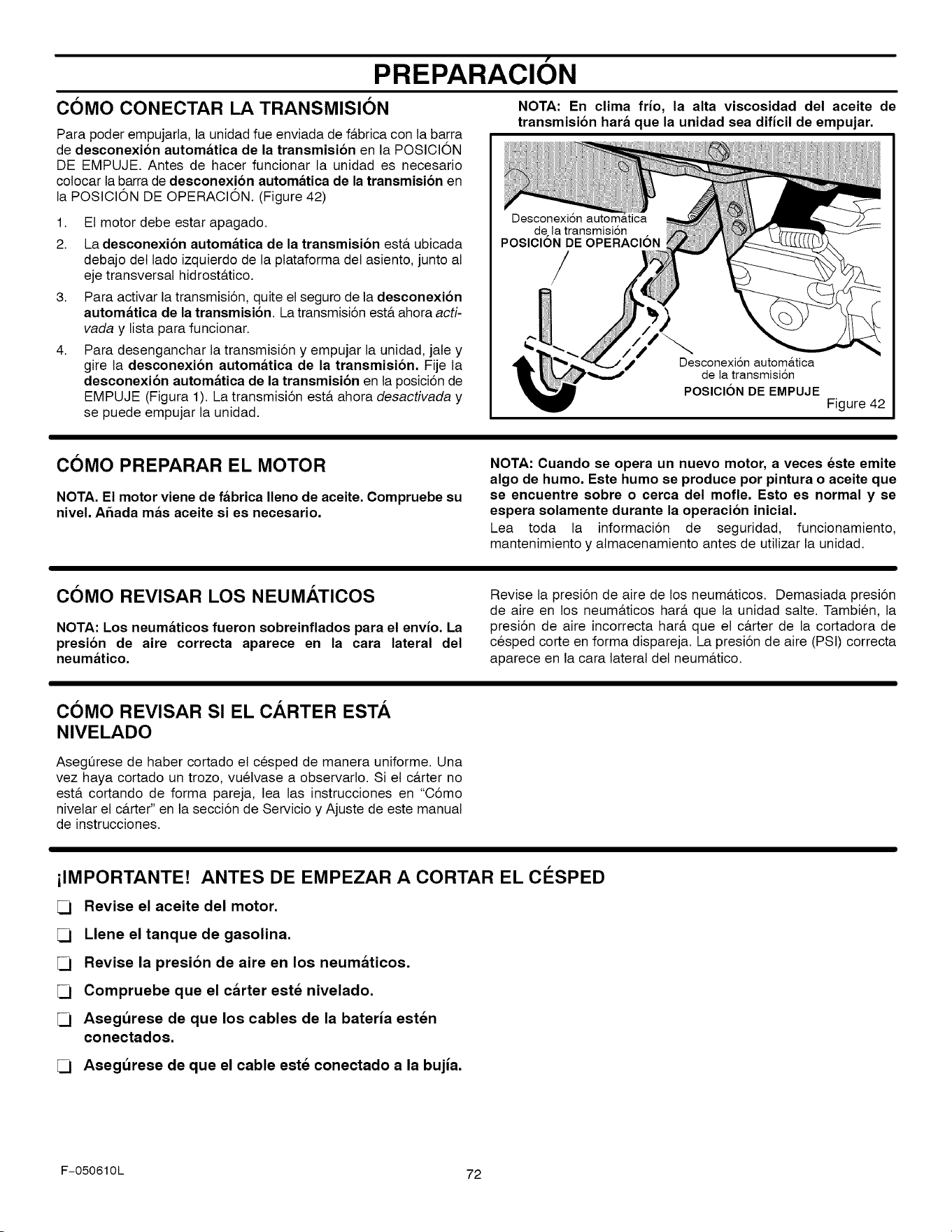
PREPARACION
COMO CONECTAR LA TRANSMISION
Para poder empujarla, la unidad fue enviada de f&brica con la barra
de desconexi6n automatica de la transmisi6n en la POSICION
DE EMPUJE. Antes de hacer funcionar la unidad es necesario
colocar la barra de desconexi6n automatica de la transmisi6n en
la POSICION DE OPERACION. (Figure 42)
1. El motor debe estar apagado.
2. La desconexi6n automatica de la transmisi6n est& ubicada
debajo del lado izquierdo de la plataforma del asiento, junto al
eje transversal hidrost&tico.
3. Para activar la transmisi6n, quite el seguro de la desconexi6n
automatica de la transmisi6n. La transmisi6n est& ahora acti-
vada y lista para funcionar.
4. Para desenganchar la transmisi6n y empujar la unidad, jate y
gire la desconexi6n automatica de la transmisi6n. Fije la
desconexi6n automatica de la transmisi6n en la posici6n de
EMPUJE (Figura 1). La transmisi6n est& ahora desactivada y
se puede empujar la unidad.
NOTA: En clima frio, la alta viscosidad del aceite de
transmisi6n hara que la unidad sea dificil de empujar.
Desconexi6n auto
de la transmisi6n
POSICION DE OPERAClON
/
Desconexi6n autom&tica
de la transmisi6n
POSlClON DE EMPUJE
Figure 42
COMO PREPARAR EL MOTOR
NOTA. El motor viene de fabrica Ileno de aceite. Compruebe su
nivel. Afmda mas aceite si es necesario.
NOTA: Cuando se opera un nuevo motor, a veces 6ste emite
algo de humo. Este humo se produce por pintura o aceite que
se encuentre sobre o cerca del mofle. Esto es normal y se
espera solamente durante la operacibn inicial.
Lea toda la informaci6n de seguridad, funcionamiento,
mantenimiento y atmacenamiento antes de utilizar la unidad.
COMO REVISAR LOS NEUMATICOS
NOTA: Los neumaticos fueron sobreinflados para el envio. La
presibn de aire correcta aparece en la cara lateral del
neumatico.
Revise la presi6n de aire de los neum&ticos. Demasiada presi6n
de aire en los neum&ticos har& que la unidad salte. Tambien, la
presi6n de aire incorrecta har& que el c&rter de la cortadora de
cesped corte en forma dispareja. La presi6n de aire (PSI) correcta
aparece en la cara lateral del neum&tico.
COMO REVISAR SI EL CARTER ESTA
NIVELADO
AsegOrese de haber cortado el cesped de manera uniforme. Una
vez haya cortado un trozo, vuelvase a observarlo. Si el c&rter no
est& cortando de forma pareja, lea las instrucciones en "C6mo
nivelar el c&rter" en la secci6n de Servicio y Ajuste de este manual
de instrucciones.
ilMPORTANTE! ANTES DE EMPEZAR A CORTAR EL ClaSPED
[] Revise el aceite del motor.
[] Llene el tanque de gasolina.
[] Revise la presion de aire en los neumaticos.
[] Compruebe que el carter este nivelado.
[] Asegurese de que los cables de la bateria esten
conectados.
[] Asegt_rese de que el cable este conectado a la bujia.
F-050610L 72
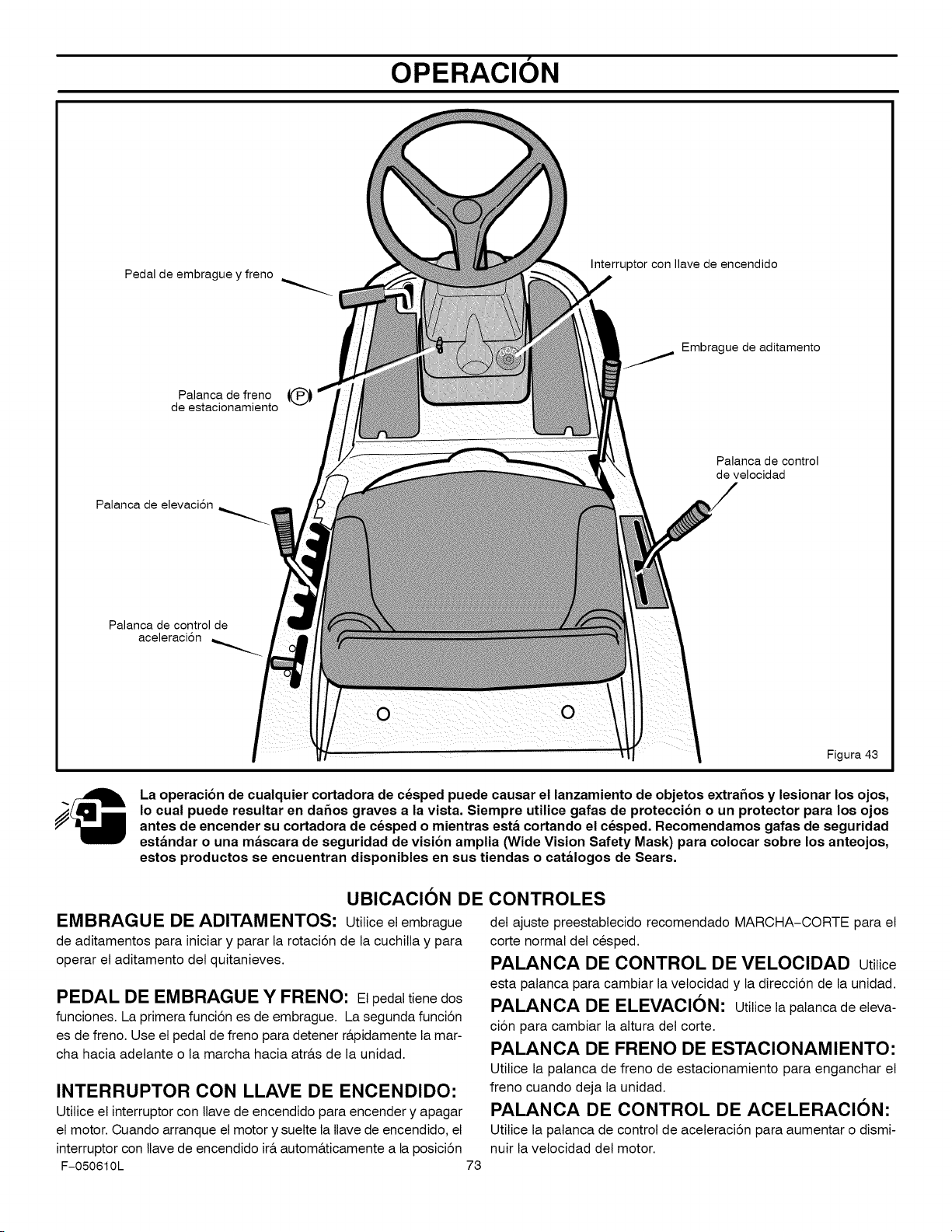
OPERAClON
Pedal de embrague y freno
Interruptor con Ilave de encendido
Palanca de freno
de estacionamiento
v
Palanca de elevaci6n
Palanca de control de
aceleraci6n
_J Embrague de aditamento
Palanca de control
de velocidad
Figura 43
La operacibn de cualquier cortadora de c6sped puede causar el lanzamiento de objetos extrafms y lesionar los ojos,
Io cual puede resultar en dafms graves a la vista. Siempre utilice gafas de proteccibn o un protector para los ojos
antes de encender su cortadora de c6sped o mientras esta cortando el c6sped. Recomendamos galas de seguridad
estandar o una mascara de seguridad de visi6n amplia (Wide Vision Safety Mask) para colocar sobre los anteojos,
estos productos se encuentran disponibles en sus tiendas o catalogos de Sears.
UBICACION DE CONTROLES
EMBRAGUE DE ADITAMENTOS: Utilice el embrague
de aditamentos para iniciar y parar la rotaci6n de la cuchilla y para
operar el aditamento del quitanieves.
PEDAL DE EMBRAGUE Y FRENO: Elpedaltiene dos
funciones. La primera funci6n es de embrague. La segunda funci6n
es de freno. Use el pedal de freno para detener r&pidamente la mar-
cha hacia adelante o la marcha hacia atr&s de la unidad.
INTERRUPTOR CON LLAVE DE ENCENDIDO:
Utilice el interruptor con Ilave de encendido para encender y apagar
el motor. Cuando arranque et motor y suelte la Ilave de encendido, el
interruptor con Ilave de encendido Jr&autom&ticamente a la posici6n
F-050610L 73
del ajuste preestablecido recomendado MARCHA-CORTE para el
corte normal del cesped.
PALANCA DE CONTROL DE VELOCIDAD Utilice
esta patanca para cambiar la velocidad y la direcci6n de la unidad.
PALANCA DE ELEVACION: Utilice la palanca de eleva-
ci6n para cambiar la altura del corte.
PALANCA DE FRENO DE ESTACIONAMIENTO:
Utilice la palanca de freno de estacionamiento para enganchar el
freno cuando deja la unidad.
PALANCA DE CONTROL DE ACELERACION:
Utilice la palanca de control de aceleraci6n para aumentar o dismi-
nuir la velocidad del motor.
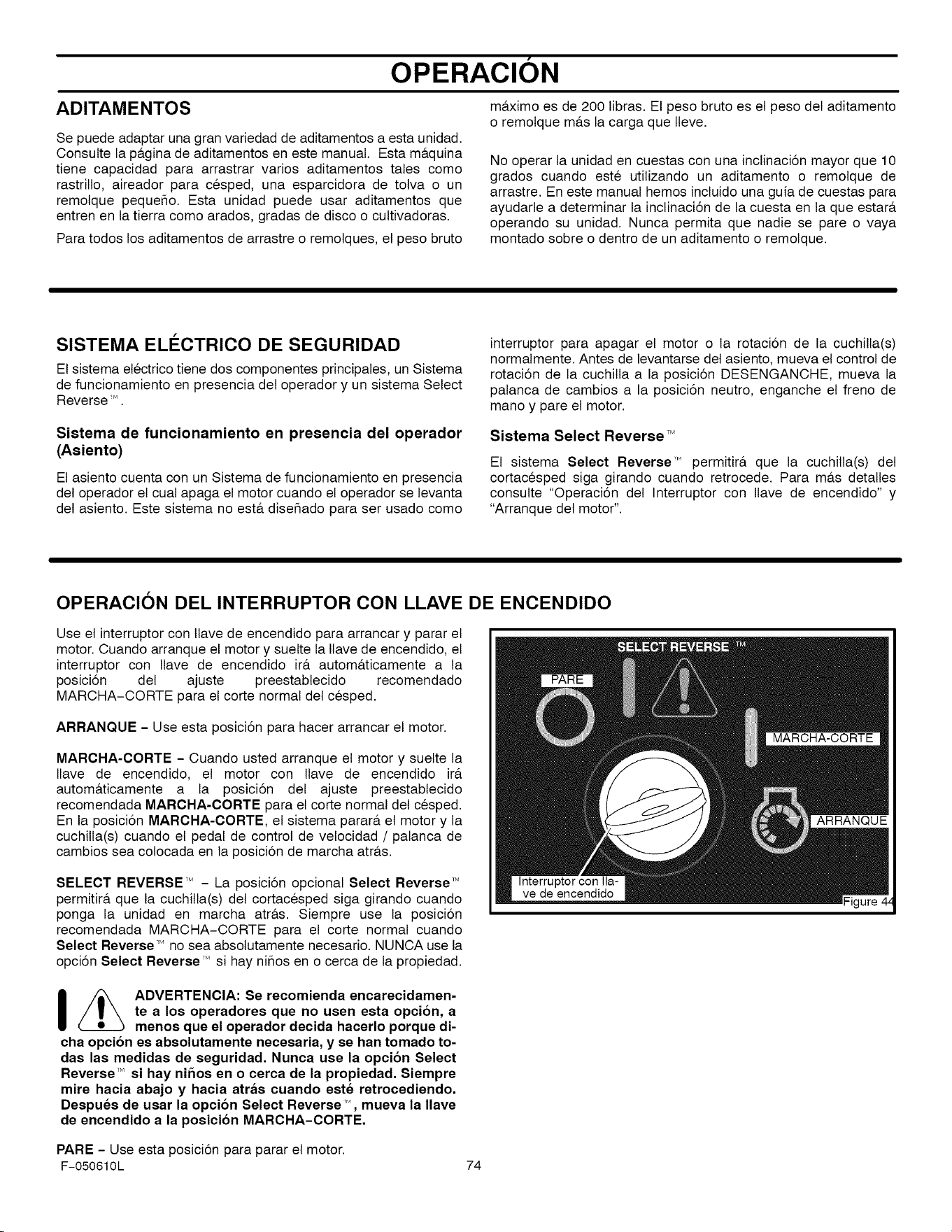
OPERACl0N
ADITAMENTOS
Se puede adaptar una gran variedad de aditamentos a esta unidad.
Consulte la p&gina de aditamentos en este manual. Esta m&quina
tiene capacidad para arrastrar varios aditamentos tales como
rastrillo, aireador para cesped, una esparcidora de tolva o un
remolque pequeflo. Esta unidad puede usar aditamentos que
entren en la tierra como arados, gradas de disco o cultivadoras.
Para todos los aditamentos de arrastre o remolques, el peso bruto
m&ximo es de 200 libras. El peso bruto es el peso del aditamento
o remolque m&s la carga que Iteve.
No operar la unidad en cuestas con una inclinaci6n mayor que 10
grados cuando este utilizando un aditamento o remolque de
arrastre. En este manual hemos incluido una guia de cuestas para
ayudarle a determinar la inclinaci6n de la cuesta en la que estar&
operando su unidad. Nunca permita que nadie se pare o vaya
montado sobre o dentro de un aditamento o remolque.
SISTEMA ELI_CTRICO DE SEGURIDAD
El sistema electrico tiene dos componentes principales, un Sistema
de funcionamiento en presencia del operador y un sistema Select
Reverse ,M
Sistema de funcionamiento en presencia del operador
(Asiento)
El asiento cuenta con un Sistema de funcionamiento en presencia
del operador el cual apaga el motor cuando el operador se levanta
del asiento. Este sistema no est& diseflado para ser usado como
interruptor para apagar el motor o la rotaci6n de la cuchilla(s)
normalmente. Antes de levantarse del asiento, mueva el control de
rotaci6n de la cuchilla a la posici6n DESENGANCHE, mueva la
palanca de cambios a la posici6n neutro, enganche el freno de
mano y pare el motor.
Sistema Select Reverse TM
El sistema Select Reverse 'M permitir& que la cuchilla(s) del
cortacesped siga girando cuando retrocede. Para m&s detalles
consulte "Operaci6n del Interruptor con Itave de encendido" y
"Arranque del motor".
OPERACION DEL INTERRUPTOR CON LLAVE DE ENCENDIDO
Use el interruptor con Ilave de encendido para arrancar y parar el
motor. Cuando arranque el motor y suelte la Ilave de encendido, el
interruptor con Ilave de encendido Jr& autom&ticamente a la
posici6n del ajuste preestablecido recomendado
MARCHA-CORTE para el corte normal del cesped.
ARRANQUE - Use esta posici6n para hacer arrancar el motor.
MARCHA-CORTE - Cuando usted arranque el motor y suelte la
Ilave de encendido, el motor con llave de encendido Jr&
autom&ticamente a la posici6n del ajuste preestablecido
recomendada MARCHA-CORTE para el corte normal del cesped.
En la posici6n MARCHA-CORTE, el sistema parar& el motor y la
cuchilla(s) cuando el pedal de control de velocidad / patanca de
cambios sea colocada en la posici6n de marcha atr&s.
SELECT REVERSE'M _ La posici6n opcional Select Reverse '_
permitir& que la cuchilla(s) del cortacesped siga girando cuando
ponga la unidad en marcha atr&s. Siempre use la posici6n
recomendada MARCHA-CORTE para el corte normal cuando
Select Reverse IMno sea absolutamente necesario. NUNCA use la
opci6n Select Reverse IMsi hay niflos en o cerca de la propiedad.
Interruptor con Ila-
ve de encendido
_ ADVERTENCIA: Se recomienda encarecidamen-
te a los operadores que no usen esta opcibn, a
menos que el operador decida hacerlo porque di-
cha opcibn es absolutamente necesaria, y se han tomado to-
das las medidas de seguridad. Nunca use la opcibn Select
Reverse 'Msi hay nifms en o cerca de la propiedad. Siempre
mire hacia abajo y hacia atras cuando est6 retrocediendo.
Despu6s de usar la opcibn Select Reverse ,M,mueva la Ilave
de encendido a la posicibn MARCHA-CORTE.
PARE - Use esta posici6n para parar el motor.
F-O50610L 74
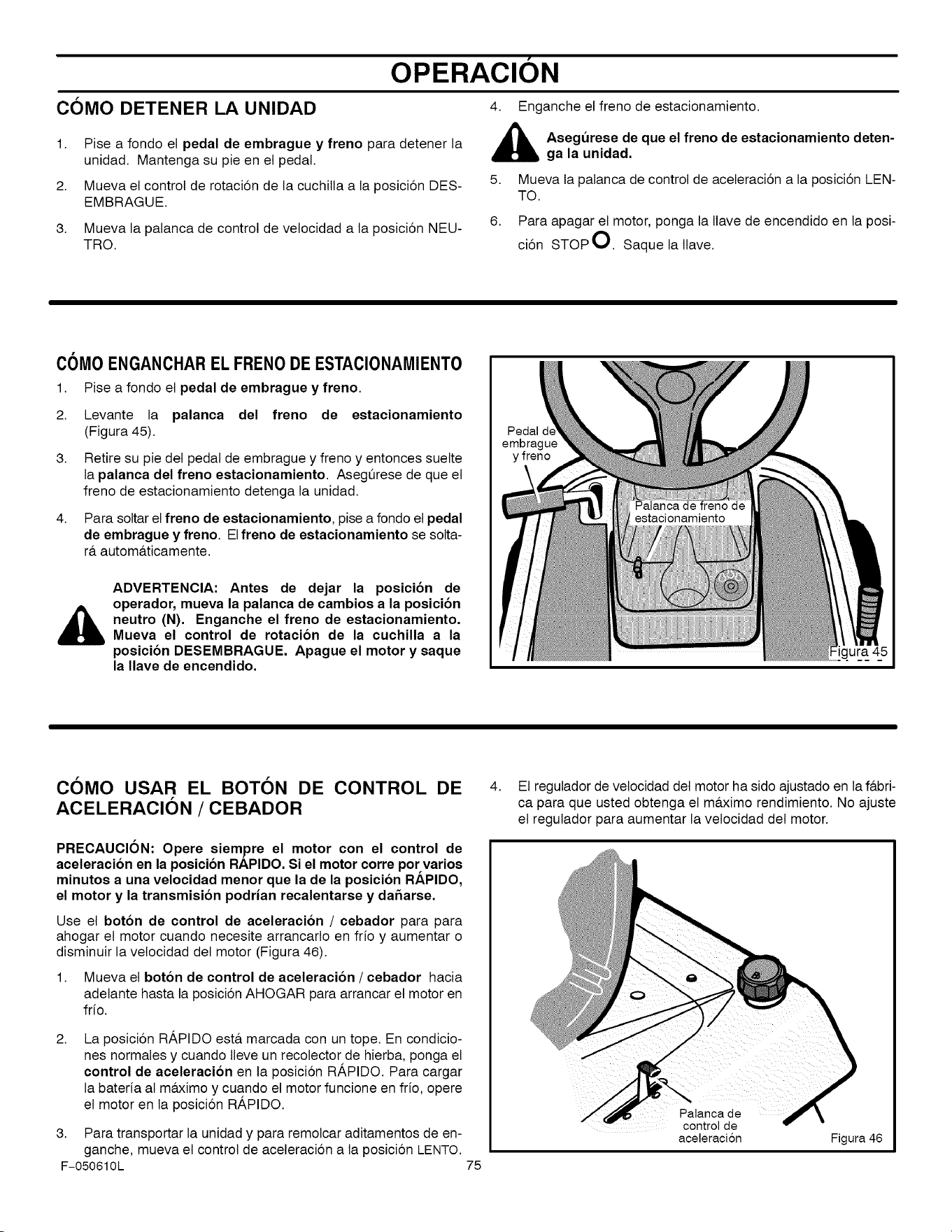
OPERACl0N
COMO DETENER LA UNIDAD
1.
2.
3.
Pise a fondo el pedal de embrague y freno para detener la
unidad. Mantenga su pie en el pedal.
Mueva el control de rotaci6n de la cuchilla a la posici6n DES-
EMBRAGUE.
Mueva la patanca de control de velocidad a la posici6n NEU-
TRO.
4. Enganche el freno de estacionamiento.
,_ Aseg_rese de que el freno de estacionamiento deten-
ga la unidad.
5. Mueva la palanca de control de aceleraci6n a la posici6n LEN-
TO.
6. Para apagar el motor, ponga la Itave de encendido en la posi-
ci6n STOP O. Saque la Ilave.
COM0 ENGANCHAREL FREN0 DE ESTACIONAMIENT0
1. Pise a fondo el pedal de embrague y freno.
2. Levante la palanca del freno de estacionamiento
(Figura 45).
3. Retire su pie del pedal de embrague y freno y entonces suelte
la palanca del freno estacionamiento. Aseg_rese de que el
freno de estacionamiento detenga la unidad.
4. Para soltar el freno de estacionamiento, pise a fondo el pedal
de embrague y freno. El freno de estacionamiento se solta-
r& autom&ticamente.
ADVERTENCIA: Antes de dejar la posicibn de
operador, mueva la palanca de cambios a la posicibn
neutro (N). Enganche el freno de estacionamiento.
Mueva el control de rotacibn de la cuchilla a la
posicibn DESEMBRAGUE. Apague el motor y saque
la Ilave de encendido.
Pedal
embrague
y freno
COMO USAR EL BOTON DE CONTROL DE
ACELERACION / CEBADOR
PRECAUCION: Opere siempre el motor con el control de
aceleracibn en la posicibn RAPIDO. Si el motor corre porvarios
minutos a una velocidad menor que la de la posicibn RAPIDO,
el motor y la transmisibn podrian recalentarse y dafmrse.
Use el botbn de control de aceleracibn / cebador para para
ahogar el motor cuando necesite arrancarlo en fifo y aumentar o
disminuir la velocidad del motor (Figura 46).
1. Mueva el botbn de control de aceleracibn / cebador hacia
adelante hasta la posici6n AHOGAR para arrancar el motor en
frio.
2.
La posici6n R/_,PIDO est& marcada con un tope. En condicio-
nes normales y cuando Ileve un recolector de hierba, ponga el
control de aceleracibn en la posici6n RAPIDO. Para cargar
la bateria al m&ximo y cuando el motor funcione en fifo, opere
el motor en la posici6n R_,PIDO.
3. Para transportar la unidad y para remolcar aditamentos de en-
ganche, mueva el control de aceleraci6n a la posici6n LENTO.
F-050610L
4.
75
El regulador de velocidad del motor ha sido ajustado en la f&bri-
ca para que usted obtenga el m&ximo rendimiento. No ajuste
el regulador para aumentar la velocidad del motor.
Palanca de
control de
aceleraci6n Figura 46
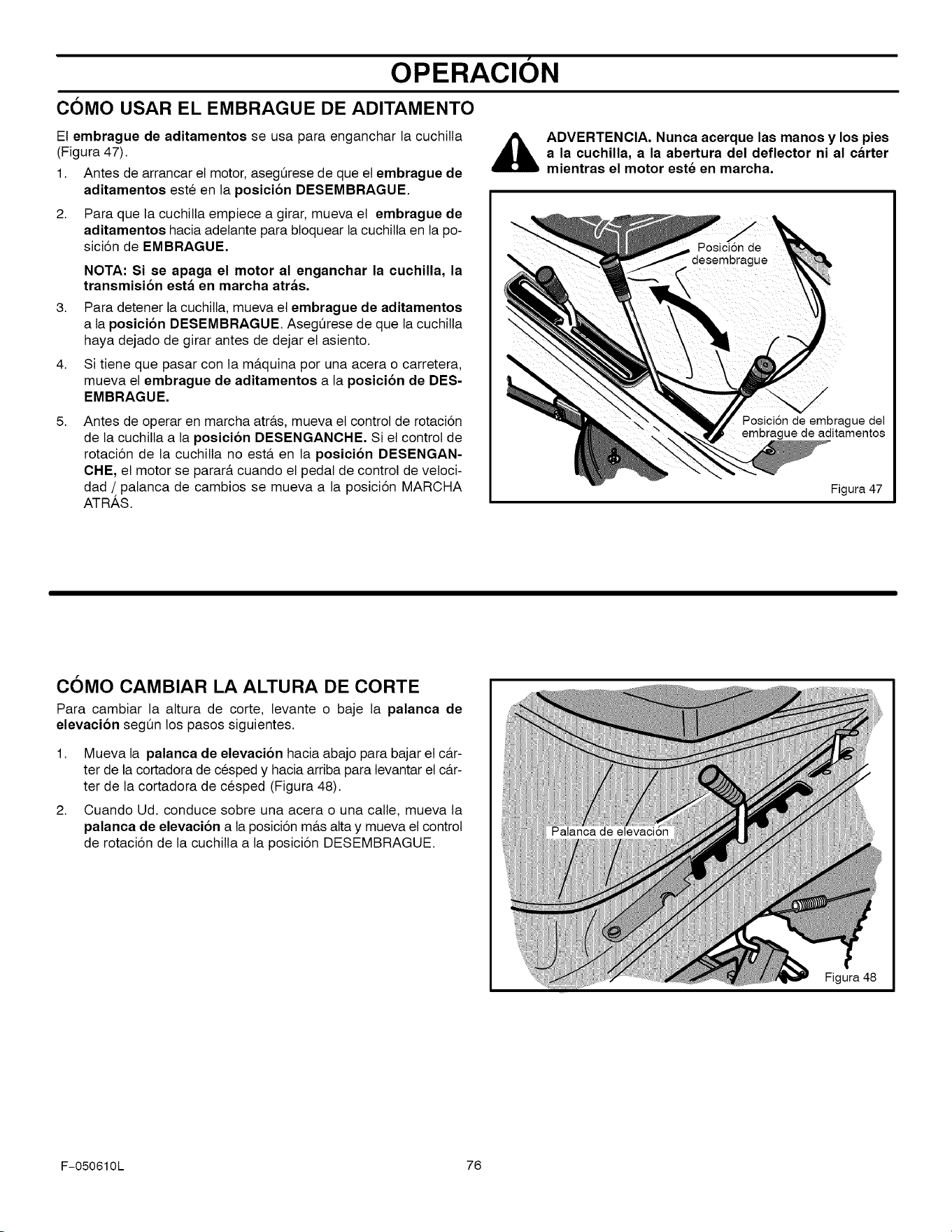
OPERACl0N
COMO USAR EL EMBRAGUE DE ADITAMENTO
El embrague de aditamentos se usa para enganchar la cuchilla
(Figura 47).
1. Antes de arrancar el motor, asegQrese de que el embrague de
aditamentos este en la posicibn DESEMBRAGUE.
2. Para que la cuchilla empiece a girar, mueva el embrague de
aditamentos hacia adelante para bloquear la cuchilta en la po-
sici6n de EMBRAGUE.
3.
4.
NOTA: Si se apaga el motor al enganchar la cuchilla, la
transmisibn esta en marcha atras.
Para detener la cuchilla, mueva el embrague de aditamentos
a la posicibn DESEMBRAGUE. AsegQrese de que la cuchilta
haya dejado de girar antes de dejar el asiento.
Si tiene que pasar con la m&quina por una acera o carretera,
mueva el embrague de aditamentos a la posicibn de DES-
EMBRAGUE.
5.
Antes de operar en marcha atr&s, mueva el control de rotaci6n
de la cuchilla a la posicibn DESENGANOHE. Si el control de
rotaci6n de la cuchilla no est& en la posicibn DESENGAN-
CHE, el motor se parar& cuando el pedal de control de veloci-
dad / palanca de cambios se mueva a la posici6n MARCHA
ATR/_,S.
_ ADVERTENCIA. Nunca acerque las manos y los pies
a la cuchilla, a la abertura del deflector ni al carter
mientras el motor est6 en marcha.
Posici6n de embrague del
embrague de aditamentos
Figura 47
COMO CAMBIAR LA ALTURA DE CORTE
Para cambiar la altura de corte, levante o baje la palanca de
elevacibn segQn los pasos siguientes.
1. Mueva la palanca de elevacibn hacia abajo para bajar el c&r-
ter de la cortadora de cesped y hacia arriba para levantar el c&r-
ter de la cortadora de cesped (Figura 48).
2. Cuando Ud. conduce sobre una acera o una calle, mueva la
palanca de elevacibn a la posici6n m&s alta y mueva el control
de rotaci6n de la cuchilla a la posici6n DESEMBRAGUE.
Figura 48
F-050610L 76
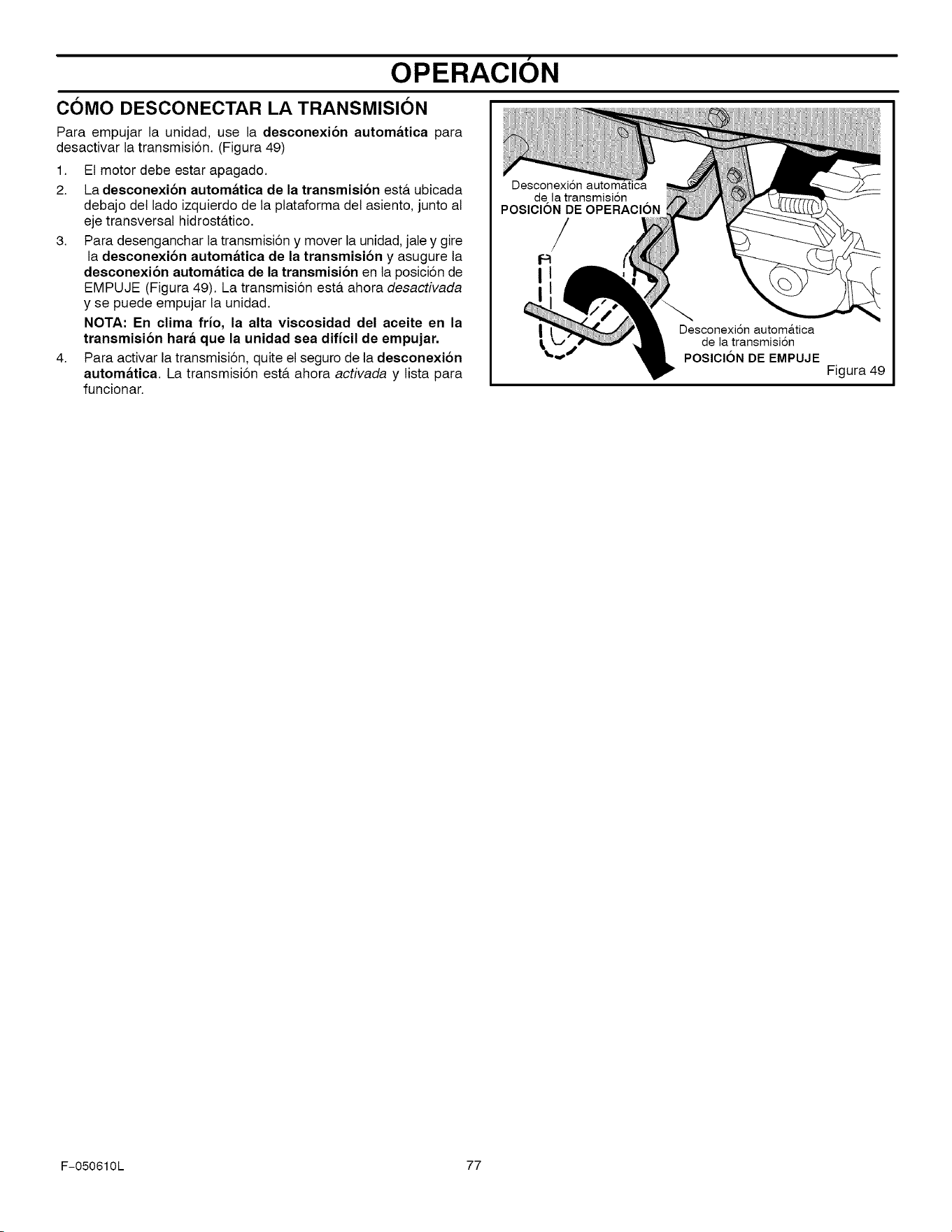
OPERACl0N
COMO DESCONECTAR LA TRANSMISlON
Para empujar la unidad, use la desconexibn automatica para
desactivar la transmisi6n. (Figura 49)
1. El motor debe estar apagado.
2. La desconexibn automatica de la transmisibn est& ubicada
debajo del lado izquierdo de la plataforma del asiento, junto al
eje transversal hidrost&tico.
3. Para desenganchar la transmisi6n y mover la unidad, jale y gire
la desconexibn automatica de la transmisibn y asugure la
desconexibn automatica de la transmisibn en la posici6n de
EMPUJE (Figura 49). La transmisi6n est& ahora desactivada
y se puede empujar la unidad.
NOTA: En clima frio, la alta viscosidad del aceite en la
transmisibn hara que la unidad sea dificil de empujar.
4. Para activar la transmisi6n, quite el seguro de la desconexibn
automatica. La transmisi6n est& ahora activada y lista para
funcionar.
Desconexi6n auto
de la transmisi6n
POSICION DE OPERAClON
/
Desconexi6n autom&tica
de la transmisi6n
POSICION DE EMPUJE
Figura 49
F-050610L 77

COMO USAR LA PALANCA
DE CONTROL DE VELOCIDADES
OPERACION
La transmisi6n hidrost&tica es muy fAcil de operar. El sistema de
transmisi6n tiene un pedal de embrague /freno en el lado izquierdo
(Figura 50) y una palanca de control de velocidades y direcci6n en
el lado derecho (Figura 51).
La velocidad y la direcci6n de avance son controladas por la
palanca de control de velocidades (Figura 51). Use la palanca de
control de velocidades tanto para avanzar como para retroceder.
COMO AVANZAR
1. Ladesconexibn automatica de la transmisibn debe estar en
la posici6n de OPERACION (Figura 49).
Pedal de
embrague/freno
2.
3.
4.
5.
6.
Apriete a fondo el pedal de embrague / freno para detener la
unidad (Figura 50). No suelte el pedal.
Mueva la palanca de control de velocidad a la posici6n NEU-
TRO (Figura 51).
Suelte lentamente el pedal de embrague / freno (Figura 50). No
deje el pie sobre el pedal.
Mueva el control de aceleraci6n a la posici6n R,&,PIDO
(Figura 52).
Empuje lentamente la palanca de control de velocidades hasta
atcanzar la velocidad deseada (Figura 50).
COMO CAMBIAR DE DIRECCION / MARCHA ATR.AS
1. Siempre desenganche las cuchillas y mire hacia abajo y hacia
atr&s mientras est& retrocediendo.
Palanca de control de
velocidades
\
\
\
\
\ \
Figura 50
Figura 51
2.
3.
Mueva la palanca de control de velocidades a la posici6n NEU-
TRO (Figura 51).
Para retroceder, mueva la palanca de control de velocidades
a la posici6n de MARCHA ATRAS.
Figura 52
F-050610L 78
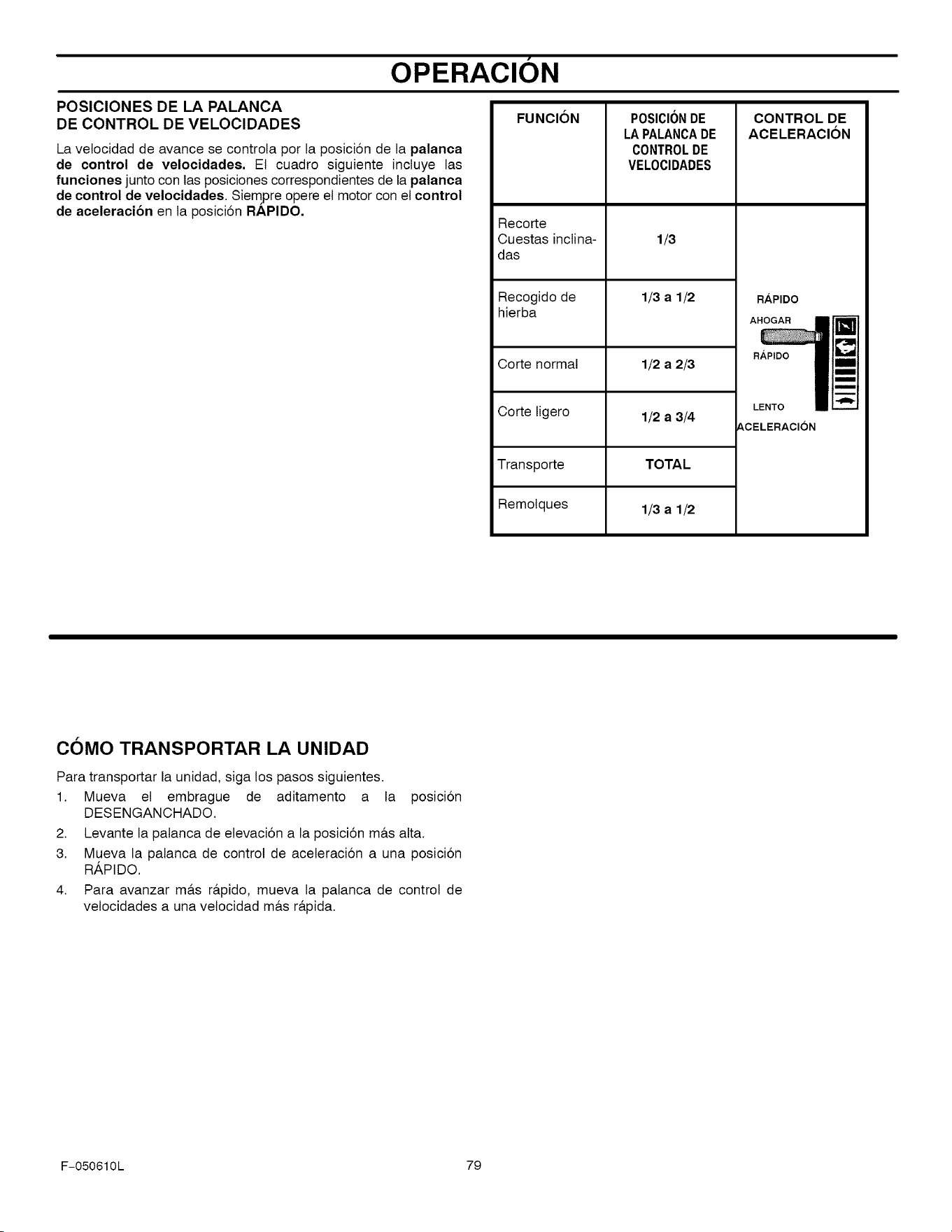
OPERAClON
POSICIONES DE LA PALANCA
DE CONTROL DE VELOCIDADES
La velocidad de avance se controla por la posici6n de la palanca
de control de velocidades, El cuadro siguiente incluye las
funciones junto con las posiciones correspondientes de la palanca
de control de velocidades. Siempre opere el motor con el control
de aceleracibn en la posici6n RAPIDO,
FUNCION
Recorte
Cuestas inctina-
das
POSICIONDE
LA PALANCADE
CONTROLDE
VELOCIDADES
1/3
Recogido de 1/3 a 1/2
hierba
Corte normal 1/2 a 2/3
Corte ligero 1/2 a 3/4
CONTROLDE
ACELERACION
RAPIDO
AHOGAR
RAPIDO
Transporte
Remolques
TOTAL
1/3 a 1/2
LENTO
ACELERACION
COMO TRANSPORTAR LA UNIDAD
Para transportar la unidad, siga los pasos siguientes.
1. Mueva el embrague de aditamento a la posici6n
DESENGANCHADO.
2. Levante la palanca de elevaci6n a la posici6n m&s alta.
3. Mueva la patanca de control de aceleraci6n a una posici6n
R/_,PIDO.
4. Para avanzar m&s rapido, mueva la patanca de control de
velocidades a una velocidad mas rapida.
F-050610L 79
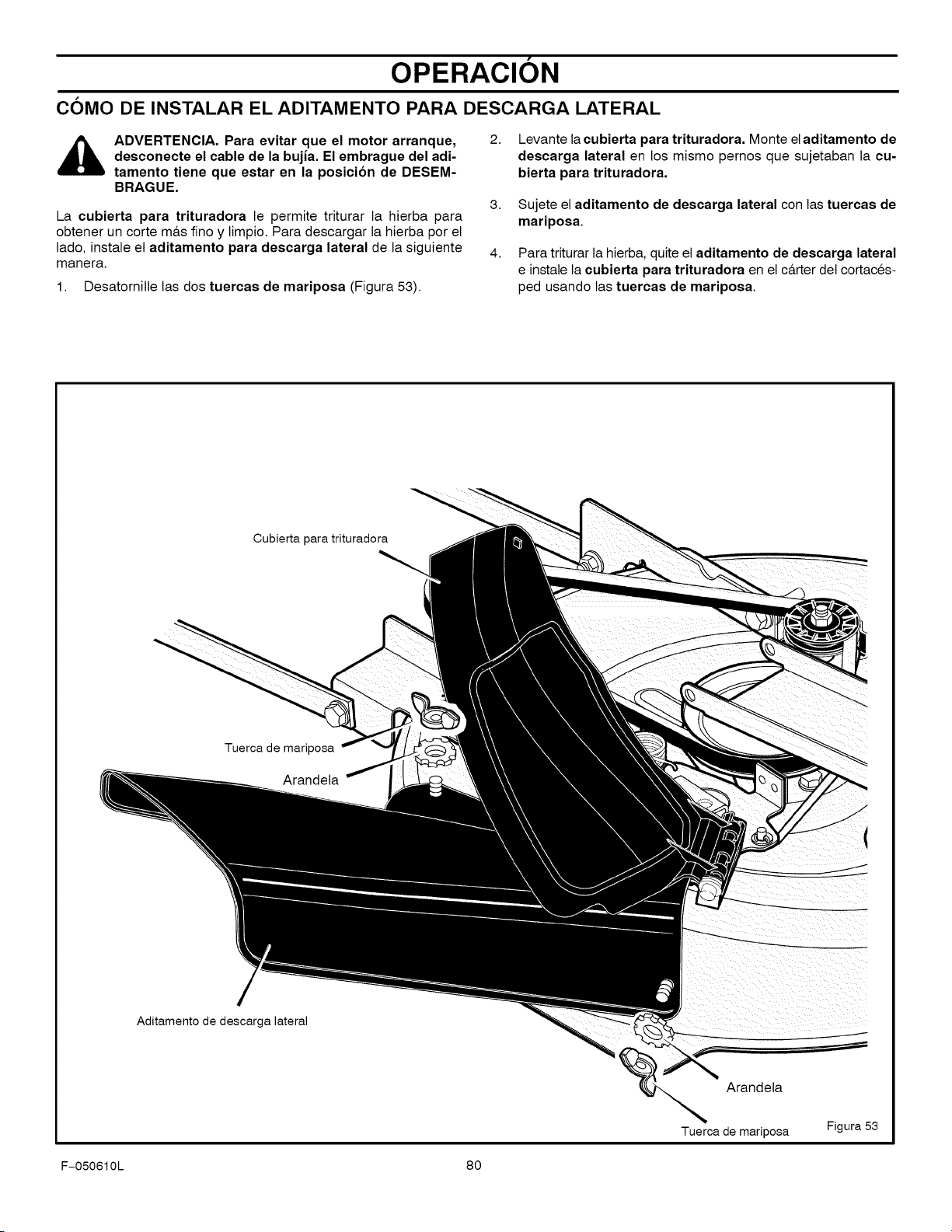
OPERACl0N
COMO DE INSTALAR EL ADITAMENTO PARA DESCARGA LATERAL
,_ ADVERTENCIA. Para evitar que el motor arranque,
desconecte el cable de la bujia. El embrague del adi-
tamento tiene que estar en la posicibn de DESEM-
BRAGUE.
La cubierta para trituradora le permite triturar la hierba para
obtener un corte m&s fino y limpio. Para descargar la hierba por el
lado, instale el aditamento para descarga lateral de la siguiente
manera.
1. Desatornitte las dos tuercas de mariposa (Figura 53).
2.
3.
4.
Levante la cubierta para trituradora. Monte el aditamento de
descarga lateral en los mismo pemos que sujetaban la cu-
bierta para trituradora.
Sujete el aditamento de descarga lateral con las tuercas de
mariposa.
Para triturar la hierba, quite el aditamento de descarga lateral
e instale la cubierta para trituradora en el c&rter del cortaces-
ped usando las tuercas de mariposa.
Cubierta para trituradora
Tuerca de mariposa
Arandela
Aditamento de descarga lateral
Arandela
Tuerca de mariposa
Figura 53
F-050610L 80
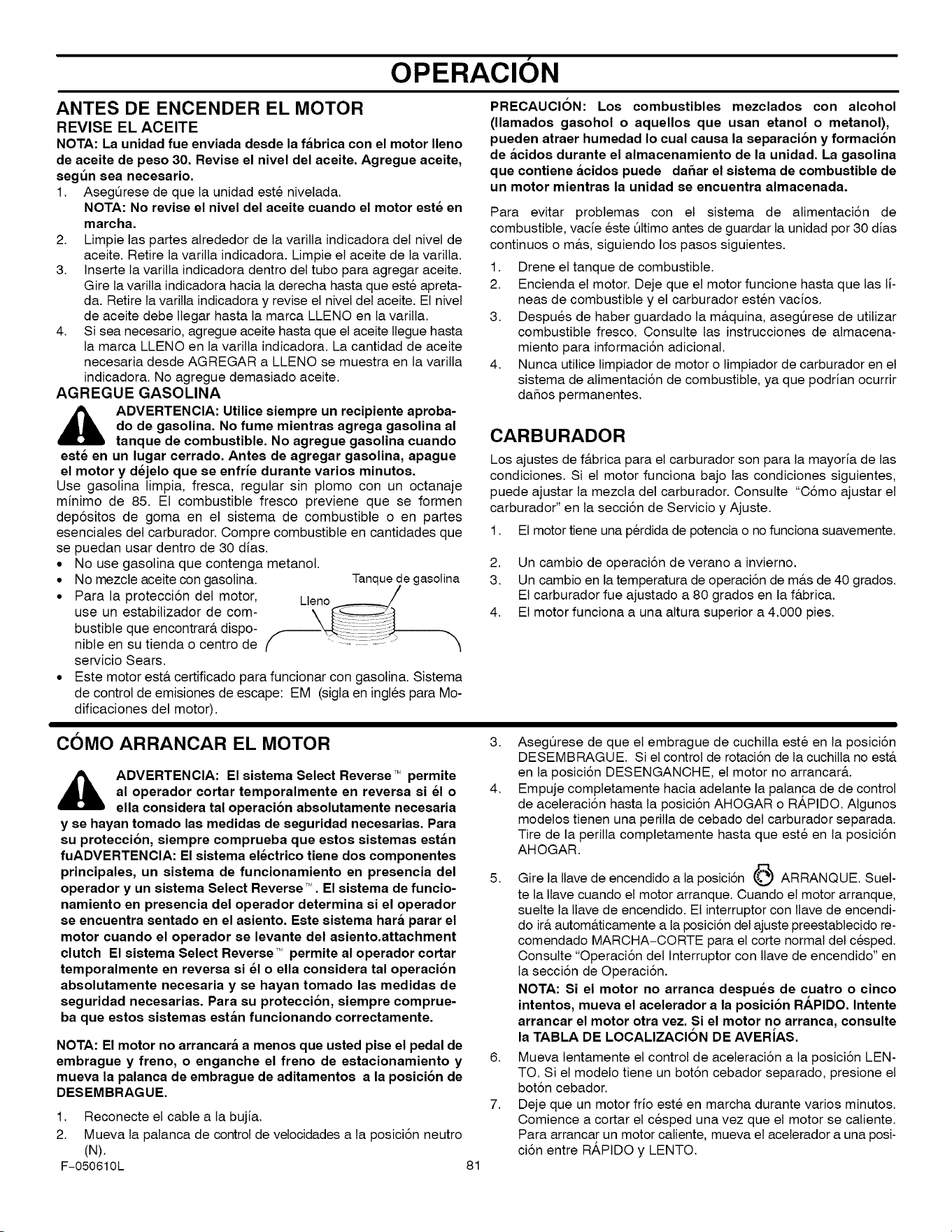
OPERAClON
ANTES DE ENCENDER EL MOTOR
REVISE EL ACEITE
NOTA: La unidad fue enviada desde la fabrica con el motor Ileno
de aceite de peso 30. Revise el nivel del aceite. Agregue aceite,
segt_n sea necesario.
1. AsegQrese de que ta unidad este nivetada.
NOTA: No revise el nivel del aceite cuando el motor est6 en
marcha.
2. Limpie las partes atrededor de la varitta indicadora del nivet de
aceite. Retire ta varitta indicadora. Limpie el aceite de ta varitta.
3. Inserte la varitta indicadora dentro del tubo para agregar aceite.
Gire ta varilla indicadora hacia la derecha hasta que este apreta-
da. Retire la varilta indicadora y revise el nivet del aceite. El nivel
de aceite debe ttegar hasta ta marca LLENO en ta varitta.
4. Si sea necesario, agregue aceite hasta que el aceite ttegue hasta
la marca LLENO en ta varitla indicadora. La cantidad de aceite
necesaria desde AGREGAR a LLENO se muestra en la varilla
indicadora. No agregue demasiado aceite.
AGREGUE GASOLINA
ADVERTENCIA: Utilice siempre un recipiente aproba-
do de gasolina. No fume mientras agrega gasolina al
tanque de combustible. No agregue gasolina cuando
est6 en un lugar cerrado. Antes de agregar gasolina, apague
el motor y d6jelo que se enfrie durante varios minutos.
Use gasolina limpia, fresca, regular sin plomo con un octanaje
minimo de 85. El combustible fresco previene que se formen
dep6sitos de goma en el sistema de combustible o en partes
esenciales del carburador. Compre combustible en cantidades que
se puedan usar dentro de 30 dias.
• No use gasolina que contenga metanol.
• No mezcle aceite con gasolina. Tanque de gasolina
• Para la protecci6n del motor,
use un estabilizador de com-
bustible que encontrar& dispo-
nible en su tienda o centro de "
servicio Sears.
• Este motor est& certificado para funcionar con gasolina. Sistema
de control de emisiones de escape: EM (sigla en ingles para Mo-
dificaciones del motor).
PRECAUCION: Los combustibles mezclados con alcohol
(llamados gasohol o aquellos que usan etanol o metanol),
pueden atraer humedad Io cual causa la separaci6n y formaci6n
de acidos durante el almacenamiento de la unidad. La gasolina
que contiene acidos puede daSar el sistema de combustible de
un motor mientras la unidad se encuentra almacenada.
Para evitar problemas con el sistema de alimentaci6n de
combustible, vacie este Qltimo antes de guardar la unidad por 30 dias
continuos o m&s, siguiendo los pasos siguientes.
1. Drene et tanque de combustible.
2. Encienda et motor. Deje que et motor funcione hasta que las li-
neas de combustible y el carburador esten vacios.
3. Despues de haber guardado la m&quina, asegQrese de utitizar
combustible fresco. Consutte tas instrucciones de almacena-
miento para informaci6n adicional.
4. Nunca utitice timpiador de motor o timpiador de carburador en et
sistema de atimentaci6n de combustible, ya que podrian ocurrir
dahos permanentes.
CARBURADOR
Los ajustes de f&brica para el carburador son para ta mayoria de tas
condiciones. Si el motor funciona bajo las condiciones siguientes,
puede ajustar la mezcla del carburador. Consulte "C6mo ajustar el
carburador" en la secci6n de Servicio y Ajuste.
1. Et motor tiene una perdida de potencia o no funciona suavemente.
2. Un cambio de operaci6n de verano a invierno.
3. Un cambio en la temperatura de operaci6n de m&s de 40 grados.
El carburador fue ajustado a 80 grados en ta f&brica.
4. Et motor funciona a una attura superior a 4.000 pies.
COMO ARRANCAR EL MOTOR
ADVERTENCIA: El sistema Select ReverseT' permite
al operador cortar temporalmente en reversa si 61 o
ella considera tal operaci6n absolutamente necesaria
y se hayan tomado las medidas de seguridad necesarias. Para
su protecci6n, siempre comprueba que estos sistemas estan
fuADVERTENCIA: El sistema el6ctrico tiene dos componentes
principales, un sistema de funcionamiento en presencia del
operador y un sistema Select Reverse T_'.El sistema de funcio-
namiento en presencia del operador determina si el operador
se encuentra sentado en el asiento. Este sistema hara parar el
motor cuando el operador se levante del asiento.attachment
clutch El sistema Select Reverse_' permite al operador cortar
temporalmente en reversa si 61 o ella considera tal operaci6n
absolutamente necesaria y se hayan tornado las medidas de
seguridad necesarias. Para su protecci6n, siempre comprue-
ba que estos sistemas estan funcionando correctamente.
NOTA: El motor no arrancara a menos que usted pise el pedal de
embrague y freno, o enganche el freno de estacionamiento y
mueva la palanca de embrague de aditamentos a la posicibn de
DESEMBRAGUE.
1. Reconecte el cable a la bujia.
2. Mueva la palanca de control de velocidades a la posici6n neutro
(N).
F-050610L
3,
4,
5,
81
AsegQrese de que et embrague de cuchitla este en la posici6n
DESEMBRAGUE. Si et control de rotaci6n de la cuchitta no est&
en ta posici6n DESENGANCHE, el motor no arrancar&.
Empuje completamente hacia adetante ta palanca de de control
de aceteraci6n hasta ta posici6n AHOGAR o RAPIDO. Atgunos
modetos tienen una peritta de cebado det carburador separada.
Tire de la perilla completamente hasta que este en la posici6n
AHOGAR.
,Ek
Gire la llave de encendido a la posici6n _ ARRANQUE. Suel-
te ta tlave cuando el motor arranque. Cuando el motor arranque,
suette la ttave de encendido. El interruptor con ltave de encendi-
do ir& autom&ticamente a ta posici6n del ajuste preestablecido re-
comendado MARCHA-CORTE para et corte normal del cesped.
Consutte "Operaci6n del Interruptor con llave de encendido" en
la secci6n de Operaci6n.
NOTA: Si el motor no arranca despu6s de cuatro o cinco
intentos, mueva el acelerador a la posici6n R/_PIDO. Intente
arrancar el motor otra vez. Si el motor no arranca, consulte
la TABLA DE LOOALIZAOI6N DE AVERiAS.
6. Mueva lentamente el control de aceteraci6n a la posici6n LEN-
TO. Si et modelo tiene un bot6n cebador separado, presione el
bot6n cebador.
7. Deje que un motor frio este en marcha durante varios minutos.
Comience a cortar et cesped una vez que et motor se catiente.
Para arrancar un motor catiente, mueva el acelerador a una posi-
ci6n entre RAPIDO y LENTO.
OPERAClON
C0M0 0PERAR, CON EL CARTER DE LA C0RTADORA
ADVERTENCIA: La cubierta para trituradora es un
dispositivo de seguridad. No la quite. El deflector
,_ fuerza el material cortado hacia la tierra. Mant_ngalo
siempre en la posicibn hacia abajo. Si el deflector es-
ta dafmdo, reemplacelo con una pieza original obteni-
da en un Centro de Servicio Sears.
IMPORTANTE: Cuando opere con el carter del cortac6sped,
hagalo siempre con el control de aceleracibn colocado en la
posicibn RAPIDO.
1. Empuje el pedal de embrague y freno completamente hacia
adelante.
2.
3.
4.
5.
Arranque el motor.
Mueva la patanca de control de velocidades in la posici6n
NEUTRO.
Lentamente suelte el pedal de embrague y freno.
Mueva la palanca de elevaci6n a una posici6n de altura de cor-
te. Cuando la hierba est& atta o densa, corte el cesped en la
posici6n mas alta primero y luego c6rtelo otra vez con el carter
del cortacesped en una posici6n mas baja.
PRECAUCION: No opere la unidad con el carter del
cortac6sped en la posicibn de AJUSTE DE NIVEL. Si Io
hace, el carter y las cuchillas del cortac6sped pueden
resultar dafmdos.
6.
7.
Mueva el acelerador a la posici6n LENTO.
Mueva el embrague de aditamento a la posici6n de ENGAN-
CHADO.
8. Mueva la patanca de control de velocidades hacia adelante.
9.
10.
NOTA: Cuando corta en c6sped denso o con una bolsa
recogedora, opere la unidad a una velocidad de avance
mas baja.
Mueva el control de aceleraci6n a la posici6n R/_,PIDO. Si ne-
cesita ir m&s r&pido o m&s despacio, mueva la patanca de
control de velocidades hacia adelante o hacia atr&s.
AsegQrese de que el nivel de corte ajustado en la f&brica sea
correcto todavia. Despues de cortar una corta distancia, ob-
serve el &rea que ha sido cortada. Si el c&rter de la cortadora
no corta de forma pareja, consulte las instrucciones sobre "C6-
mo nivelar el c&rter de la cortadora de cesped" en la secci6n
de Servicio y Ajuste.
,_ ADVERTENCIA: Para un mejor control de la unidad,
seleccione siempre una velocidad segura.
COMO OPERAR LA UNIDAD EN CUESTAS
ADVERTENCIA: No suba ni baje cuestas que son de-
masiado empinadas para poder retroceder en una li-
,_nea recta. Nunca maneje la unidad a trav6s de una
cuesta. Consulte la "Guia para cuestas" al final de es-
te manual para obtener informacibn sobre cbmo eva-
luar las cuestas.
1. Antes de manejar cuesta arriba o cuesta abajo, mueva la pa-
lanca de control de velocidades a una velocidad m&s baja.
2. No pare la unidad ni cambie las velocidades cuando se
encuentre en una cuesta. Si debe parar, empuje r&pidamente
el pedal de embrague y freno hacia adelante y enganche el fre-
no de estacionamiento.
3.
4.
5.
Para arrancar de nuevo, asegQrese de que la patanca de
control de velocidades este en una velocidad m&s baja. Mueva
el control de aceleraci6n a la posici6n LENTO. Y vaya soltando
lentamente el pedal.
Si debe parar o arrancar en una cuesta, tenga siempre sufi-
ciente espacio para que la unidad ruede cuando suelte el freno
y enganche el embrague.
Tenga mucho cuidado cuando cambia de direcci6n sobre una
cuesta. Cuando est& en una cuesta o en una curva sobre la
cuesta, mueva el control de aceleraci6n a la posici6n LENTO
para evitar accidentes.
F-050610L 82
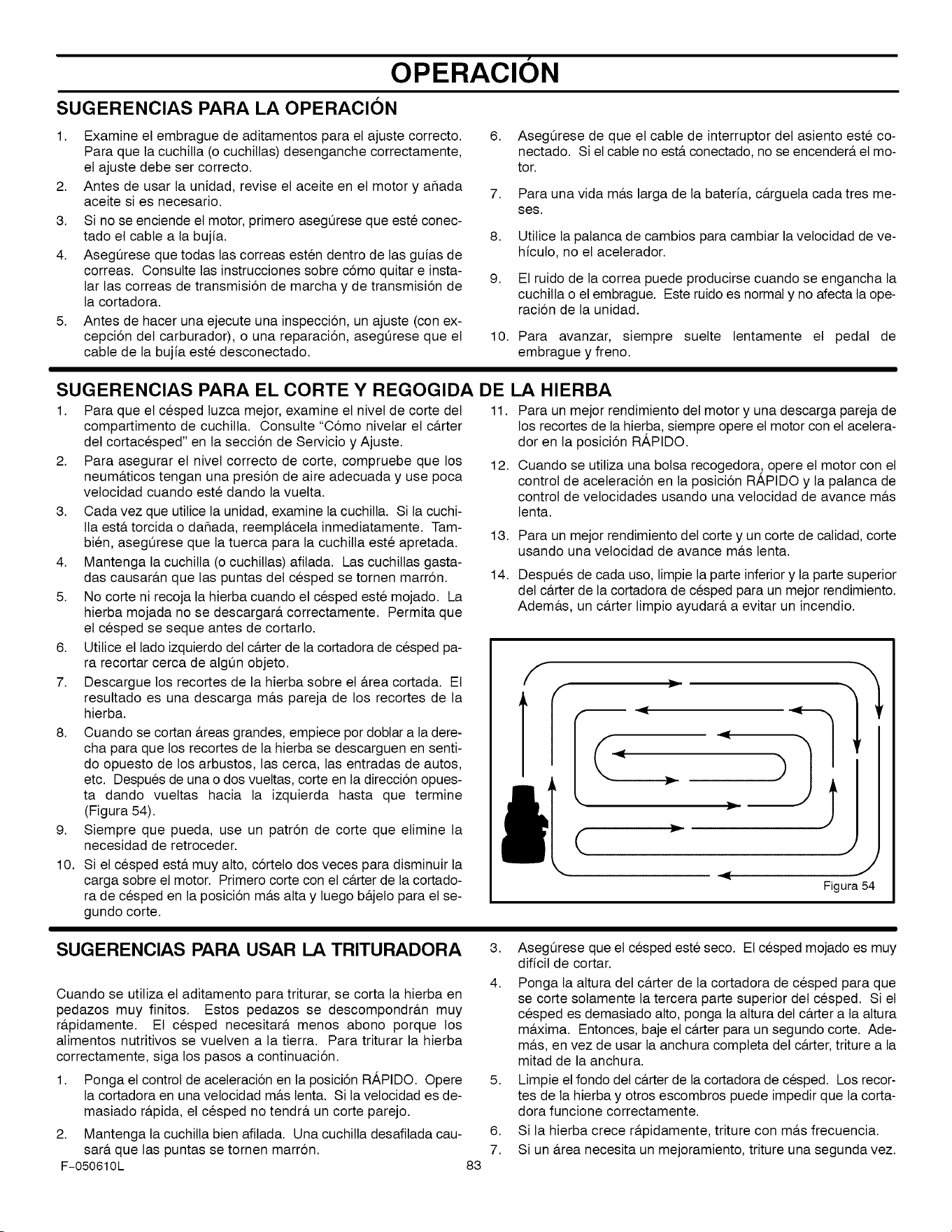
OPERACl0N
SUGERENCIAS PARA LA OPERACION
1.
2.
3.
4.
5.
Examine el embrague de aditamentos para el ajuste correcto. 6.
Para que la cuchilta (o cuchiltas) desenganche correctamente,
el ajuste debe ser correcto.
Antes de usar la unidad, revise el aceite en el motor y aflada 7.
aceite si es necesario.
Si no se enciende el motor, primero asegQrese que este conec-
tado el cable a la bujia. 8.
AsegQrese que todas las correas esten dentro de las guias de
correas. Consulte las instrucciones sobre c6mo quitar e insta-
9.
lar las correas de transmisi6n de marcha y de transmisi6n de
la cortadora.
Antes de hacer una ejecute una inspecci6n, un ajuste (con ex-
cepci6n del carburador), o una reparaci6n, asegQrese que el
cable de la buj[a este desconectado.
10.
AsegQrese de que el cable de interruptor del asiento este co-
nectado. Si el cable no est& conectado, no se encender& el mo-
tor.
Para una vida m&s larga de la bater[a, c&rguela cada tres me-
ses.
Utilice la palanca de cambios para cambiar la velocidad de ve-
hiculo, no el acelerador.
El ruido de la correa puede producirse cuando se engancha la
cuchilla o el embrague. Este ruido es normal y no afecta la ope-
raci6n de la unidad.
Para avanzar, siempre suelte lentamente el pedal de
embrague y freno.
SUGERENCIAS PARA EL CORTE Y REGOGIDA DE LA HIERBA
1. Para que el cesped luzca mejor, examine el nivel de corte del 11.
compartimento de cuchilla. Consulte "C6mo nivelar el c&rter
del cortacesped" en la secci6n de Servicio y Ajuste.
2. Para asegurar el nivel correcto de corte, compruebe que los 12.
neum&ticos tengan una presi6n de aire adecuada y use poca
velocidad cuando este dando la vuelta.
3. Cada vez que utilice la unidad, examine la cuchilla. Si la cuchi-
Ila est& torcida o daflada, reempl&cela inmediatamente. Tam-
bien, asegQrese que la tuerca para la cuchilla este apretada.
4. Mantenga la cuchilla (o cuchillas) afilada. Las cuchillas gasta-
das causar&n que las puntas del cesped se tornen marr6n.
5. No corte ni recoja la hierba cuando el cesped este mojado. La
hierba mojada no se descargar& correctamente. Permita que
el cesped se seque antes de cortarlo.
6. Utilice el lado izquierdo del c&rter de la cortadora de cesped pa-
ra recortar cerca de algQn objeto.
7. Descargue los recortes de la hierba sobre el &rea cortada. El
resultado es una descarga m&s pareja de los recortes de la
hierba.
8.
9.
10.
Cuando se cortan &reas grandes, empiece por doblar a la dere-
cha para que los recortes de la hierba se descarguen en senti-
do opuesto de los arbustos, las cerca, las entradas de autos,
etc. Despues de una o dos vueltas, corte en la direcci6n opues-
ta dando vueltas hacia la izquierda hasta que termine
(Figura 54).
Siempre que pueda, use un patr6n de corte que elimine la
necesidad de retroceder.
Si el cesped est& muy alto, c6rtelo dos veces para disminuir la
carga sobre el motor. Primero corte con el c&rter de la cortado-
ra de cesped en la posici6n m&s atta y luego b&jelo para el se-
gundo corte.
13.
14.
Para un mejor rendimiento del motor y una descarga pareja de
los recortes de la hierba, siempre opere el motor con el acelera-
dor en la posici6n RAPIDO.
Cuando se utiliza una bolsa recogedora, opere el motor con el
control de aceleraci6n en la posici6n RAPIDO y ta palanca de
control de velocidades usando una velocidad de avance m&s
lenta.
Para un mejor rendimiento del corte y un corte de calidad, corte
usando una velocidad de avance m&s lenta.
Despues de cada uso, limpie la parte inferior y la parte superior
del c&rter de ta cortadora de cesped para un mejor rendimiento.
Adem&s, un c&rter limpio ayudar& a evitar un incendio.
(.
v
J
Figura 54
SUGERENCIAS PARA USAR LA TRITURADORA
Cuando se utitiza el aditamento para triturar, se corta la hierba en
pedazos muy finitos. Estos pedazos se descompondr&n muy
r&pidamente. El cesped necesitar& menos abono porque los
alimentos nutritivos se vuelven a la tierra. Para triturar la hierba
correctamente, siga los pasos a continuaci6n.
1. Ponga el control de aceleraci6n en la posici6n R/_,PIDO. Opere
la cortadora en una velocidad m&s lenta. Si la velocidad es de-
masiado r&pida, el cesped no tendr& un corte parejo.
3.
4.
5.
2. Mantenga la cuchilla bien afilada. Una cuchilta desafilada cau- 6.
sar& que las puntas se tornen marr6n. 7.
F-050610L 83
AsegQrese que el cesped este seco. El cesped mojado es muy
dificil de cortar.
Ponga la altura del c&rter de la cortadora de cesped para que
se corte solamente la tercera parte superior del cesped. Si el
cesped es demasiado alto, ponga la altura del c&rter a la altura
m&xima. Entonces, baje el c&rter para un segundo corte. Ade-
m&s, en vez de usar la anchura completa del c&rter, triture a la
mitad de la anchura.
Limpie el fondo del c&rter de la cortadora de cesped. Los recor-
tes de la hierba y otros escombros puede impedir que la corta-
dora funcione correctamente.
Si la hierba crece r&pidamente, triture con m&s frecuencia.
Si un &rea necesita un mejoramiento, triture una segunda vez.
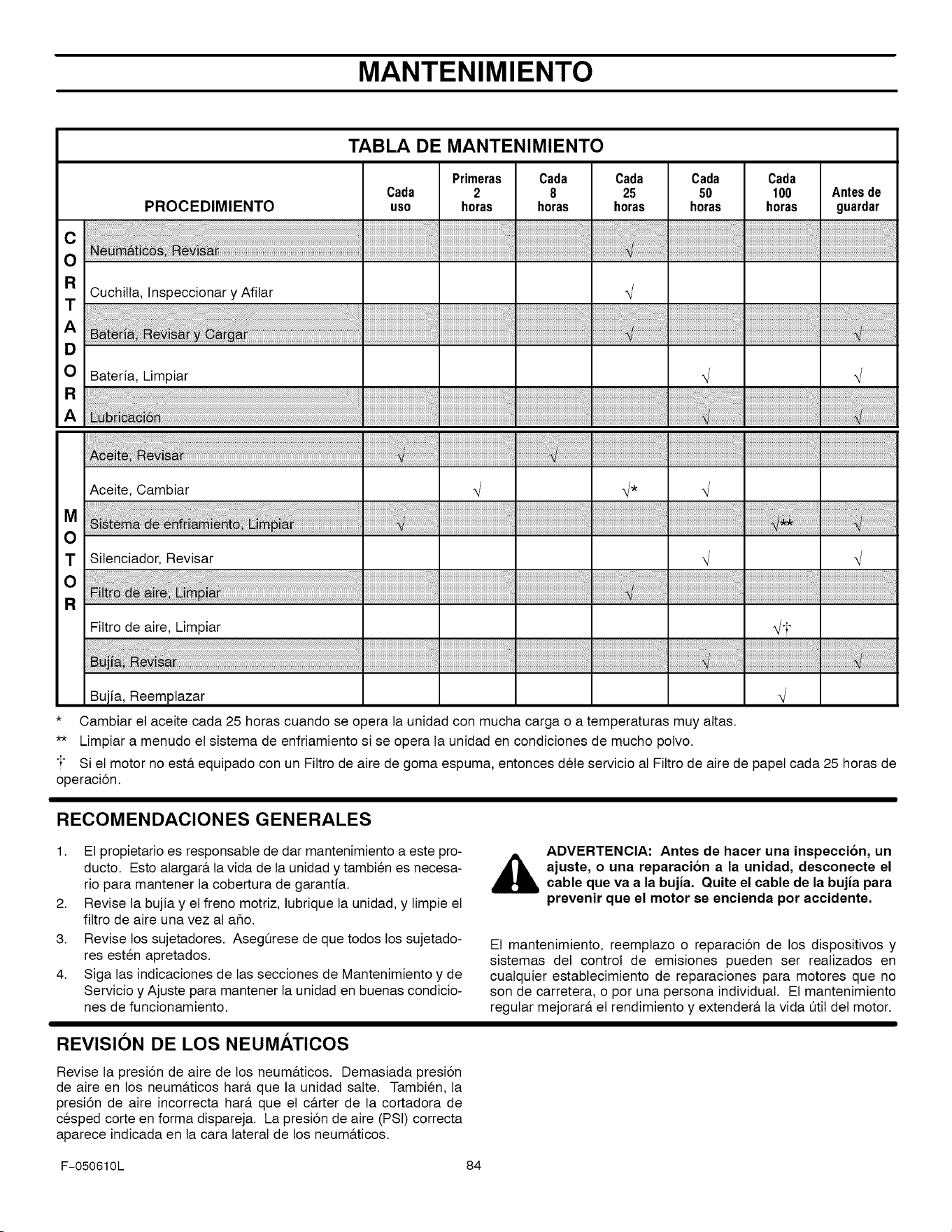
MANTENIMIENTO
TABLA DE MANTENIMIENTO
Primeras Cada Cada Cada Cada
Cada 2 8 25 50 100 Antes de
PROCEDIMIENTO uso horas horas horas horas horas guardar
RI
D
OI
R I
A I
M
O
T
O
R
Cuchilla, Inspeccionar y Afilar
Aceite, Cambiar
Silenciador, Revisar
Filtro de aire, Limpiar
&-*k
operaci6n.
Bujfa, Reemplazar
Cambiar el aceite cada 25 horas cuando se opera la unidad con mucha carga o a temperaturas muy attas.
Limpiar a menudo el sistema de enfriamiento si se opera la unidad en condiciones de mucho polvo.
Si el motor no est& equipado con un Filtro de aire de goma espuma, entonces dele servicio al Filtro de aire de papel cada 25 horas de
RECOMENDACIONES GENERALES
1. El propietario es responsable de dar mantenimiento a este pro-
ducto. Esto alargar& la vida de la unidad y tambien es necesa-
rio para mantener la cobertura de garantia.
2. Revise la bujfa y el freno motriz, lubrique la unidad, y limpie el
filtro de aire una vez al aflo.
3. Revise los sujetadores. AsegQrese de que todos los sujetado-
res esten apretados.
4. Siga las indicaciones de las secciones de Mantenimiento y de
Servicio y Ajuste para mantener la unidad en buenas condicio-
nes de funcionamiento.
ADVERTENCIA: Antes de hacer una inspeccibn, un
,_ ajuste, o una reparacibn a la unidad, desconecte el
cable que va a la bujia. Quite el cable de la bujia para
prevenir que el motor se encienda por accidente.
El mantenimiento, reemplazo o reparaci6n de los dispositivos y
sistemas del control de emisiones pueden ser realizados en
cualquier establecimiento de reparaciones para motores que no
son de carretera, o por una persona individual. El mantenimiento
regular mejorar& el rendimiento y extender& la vida Qtil del motor.
REVISION DE LOS NEUMATICOS
Revise la presi6n de aire de los neum&ticos. Demasiada presi6n
de aire en los neum&ticos har& que la unidad salte. Tambien, la
presi6n de aire incorrecta har& que el c&rter de la cortadora de
cesped corte en forma dispareja. La presi6n de aire (PSI) correcta
aparece indicada en la cara lateral de los neum&ticos.
F-050610L 84
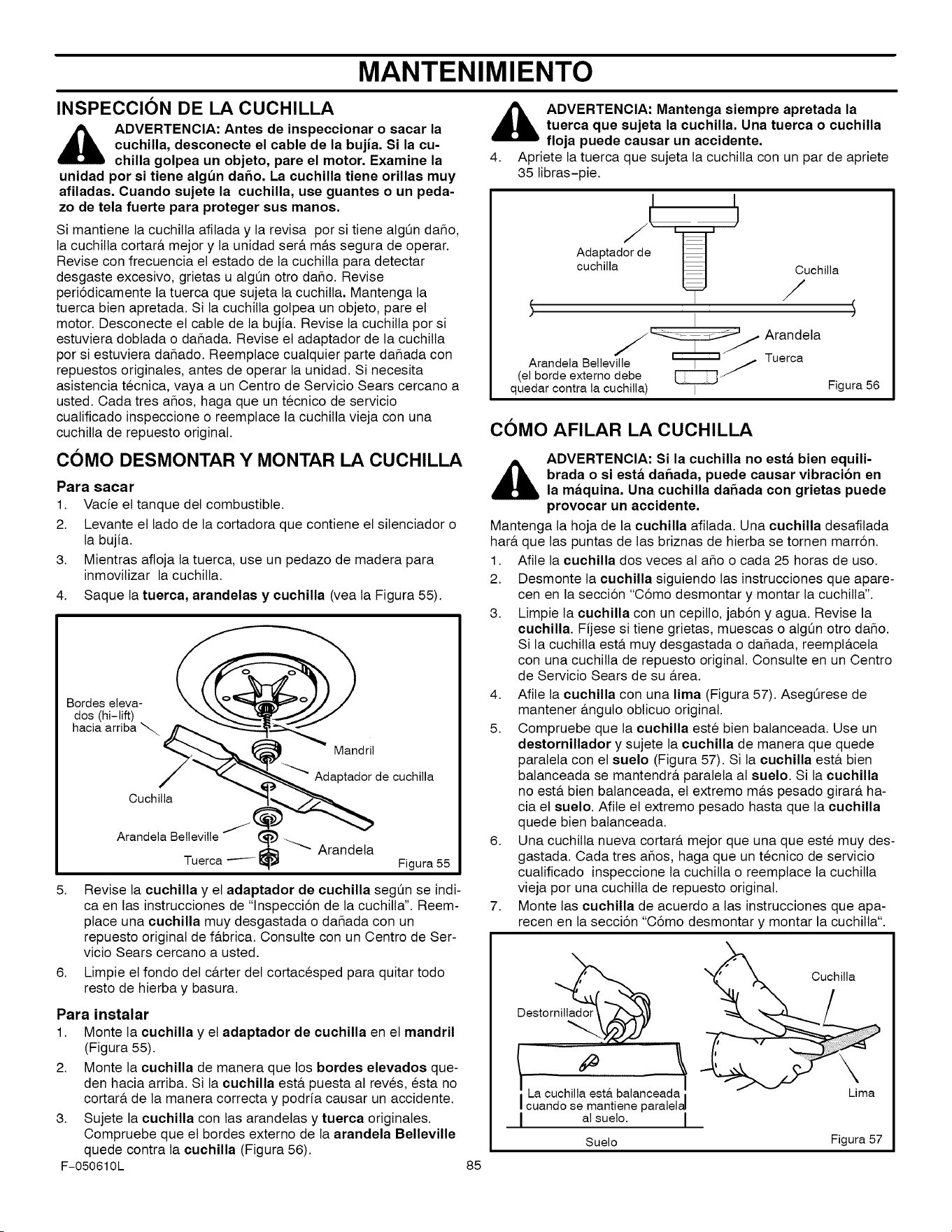
MANTENIMIENTO
INSPECCION DE LA CUCHILLA
,_ ADVERTENCIA: Antes de inspeccionar o sacar la
cuchilla, desconecte el cable de la bujia. Si la cu-
chilla golpea un objeto, pare el motor. Examine la
unidad por si tiene alg0n daho. La cuchilla tiene orillas muy
afiladas. Cuando sujete la cuchilla, use guantes o un peda-
zo de tela fuerte para proteger sus manos.
Si mantiene la cuchitla afilada y la revisa por si tiene alg0n daflo,
la cuchilla cortar& mejor y la unidad ser& m&s segura de operar.
Revise con frecuencia el estado de la cuchilla para detectar
desgaste excesivo, grietas u alg0n otro daflo. Revise
peri6dicamente la tuerca que sujeta la cuchilla. Mantenga la
tuerca bien apretada. Si la cuchilla golpea un objeto, pare el
motor. Desconecte el cable de la bujia. Revise la cuchilla por si
estuviera doblada o daflada. Revise el adaptador de la cuchilla
por si estuviera daflado. Reemplace cualquier parte daflada con
repuestos originales, antes de operar la unidad. Si necesita
asistencia tecnica, vaya a un Centro de Servicio Sears cercano a
usted. Cada tres aflos, haga que un tecnico de servicio
cualificado inspeccione o reemptace la cuchilla vieja con una
cuchilta de repuesto original.
COMO DESMONTAR Y MONTAR LA CUCHILLA
Para sacar
1. Vacie el tanque del combustible.
2. Levante el lado de la cortadora que contiene el silenciador o
la bujia.
3. Mientras afloja la tuerca, use un pedazo de madera para
inmovilizar la cuchilla.
4. Saque la tuerca, arandelas y cuchilla (vea la Figura 55).
Bordes eleva-
dos (hi-lift)
hacia arriba
Mandril
Cuchilla
Arandela
Arandela
Tuerca "-----J Figura 55
5.
6.
Revise la cuchilla y el adaptador de cuchilla segOn se indi-
ca en las instrucciones de "lnspecci6n de la cuchilla". Reem-
place una cuchilla muy desgastada o daflada con un
repuesto original de f&brica. Consulte con un Centro de Ser-
vicio Sears cercano a usted.
Limpie el fondo del c&rter del cortacesped para quitar todo
resto de hierba y basura.
Para instalar
1. Monte la cuchilla y el adaptador de cuchilla en el mandril
(Figura 55).
2. Monte la cuchilla de manera que los hordes elevados que-
den hacia arriba. Si la cuchilla est& puesta al reves, esta no
cortara de la manera correcta y podria causar un accidente.
3. Sujete la cuchilla con las arandelas y tuerea originales.
Compruebe que el bordes externo de la arandela Belleville
quede contra la cuchilla (Figura 56).
F-050610L
_ DVERTENCIA: Mantenga siempre apretada la
tuerca que sujeta la cuchilla. Una tuerca o cuchilla
floja puede causar un accidente.
4. Apriete la tuerca que sujeta la cuchitta con un par de apriete
35 libras-pie.
I
Adaptador de
cuchilla U Cuchilla
(e iAl_aFde 'eaxBe_''neoV_ _ _
quedar contra la cuchilla) I
Arandela
Tuerca
Figura 56
85
COMO AFILAR LA CUCHILLA
,_ ADVERTENCIA: Si la cuchilla no esti= bien equili-
brada o si esta dafmda, puede causar vibraci6n en
la maquina. Una cuchilla dafmda con grietas puede
provocar un accidente.
Mantenga la hoja de la cuchilla afilada. Una cuchilla desafilada
har& que las puntas de las briznas de hierba se tornen marr6n.
1. Afile la cuchilla dos veces at aflo o cada 25 horas de uso.
2. Desmonte la cuchilla siguiendo las instrucciones que apare-
cen en la secci6n "C6mo desmontar y montar la cuchilla".
3. Limpie la cuchilla con un cepillo, jab6n y agua. Revise la
cuchilla. Fijese si tiene grietas, muescas o alg0n otro daflo.
Si la cuchilla est& muy desgastada o daflada, reempl&cela
con una cuchilla de repuesto original. Consulte en un Centro
de Servicio Sears de su &rea.
4. Afile la cuchilla con una lima (Figura 57). Aseg0rese de
mantener &ngulo oblicuo original.
5. Compruebe que la cuchilla este bien balanceada. Use un
destornillador y sujete la cuchilla de manera que quede
paralela con el suelo (Figura 57). Si la cuchilla est& bien
balanceada se mantendr& paralela al suelo. Si la cuchilla
no est& bien balanceada, el extremo m&s pesado girar& ha-
cia el suelo. Afile el extremo pesado hasta que la cuchilla
quede bien balanceada.
6. Una cuchilla nueva cortar& mejor que una que este muy des-
gastada. Cada tres aflos, haga que un tecnico de servicio
cuatificado inspeccione la cuchilla o reemplace la cuchilla
vieja por una cuchilla de repuesto original.
7. Monte las cuchilla de acuerdo alas instrucciones que apa-
recen en la secci6n "C6mo desmontar y montar la cuchilla".
Destor_
L hll_t b I d t
I c_a_ _ eSa:&nt,ea_pcea,_etJ
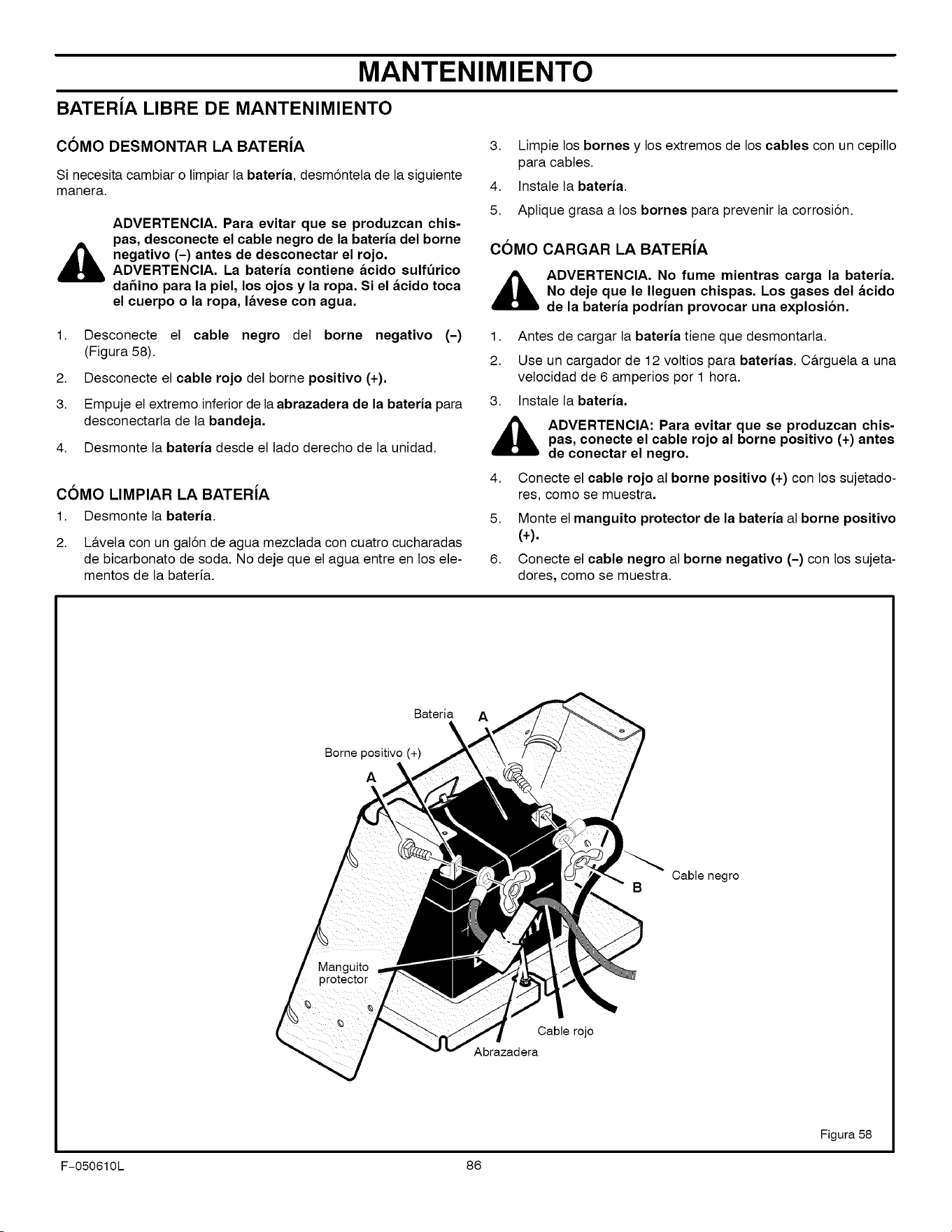
MANTENIMIENTO
BATERiA LIBRE DE MANTENIMIENTO
COMO DESMONTAR LA BATERIA 3.
Si necesita cambiar o limpiar la bateria, desm6ntela de la siguiente
manera. 4.
5.
ADVERTENCIA. Para evitar que se produzcan chis-
pas, desconecte el cable negro de la bateria del borne
,_ negativo (-) antes de desconectar el rojo.ADVERTENCIA. La bateria contiene acido sulf_rico
daffino para la piel, los ojos y la ropa. Si el acido toca
el cuerpo o la ropa, lavese con agua.
1. Desconecte el cable negro del borne negativo (-)
(Figura 58).
2. Desconecte el cable rojo del borne positivo (+).
3. Empuje el extremo inferior de la abrazadera de la bateria para
desconectarla de la bandeja.
4. Desmonte la bateria desde el lado derecho de la unidad.
COMO LIMPIAR LA BATERiA
1. Desmonte la bateria.
2. L&vela con un gal6n de agua mezclada con cuatro cucharadas
de bicarbonato de soda. No deje que el agua entre en los ele-
mentos de la bateria.
Limpie los bornes y los extremos de los cables con un cepillo
para cables.
Instate la bateria.
Aplique grasa a los bornes para prevenir la corrosi6n.
COMO CARGAR LA BATERIA
_ ADVERTENCIA. No fume mientras carga la bateria.
No deje que le Ileguen chispas. Los gases del acido
de la bateria podrian provocar una explosibn.
1. Antes de cargar la bateria tiene que desmontarla.
2. Use un cargador de 12 voltios para baterias. C&rguela a una
velocidad de 6 amperios por 1 hora.
3. Instate la bateria.
,_ ADVERTENCIA: Para evitar que se produzcan chis-
pas, conecte el cable rojo al borne positivo (+) antes
de conectar el negro.
4. Conecte el cable rojo at borne positivo (+) con los sujetado-
res, como se muestra.
5. Monte el manguito protector de la bateria al borne positivo
(+).
6. Conecte el cable negro al borne negativo (-) con los sujeta-
dotes, como se muestra.
Bateria
Borne positivo (+)
A
Cable rojo
Abrazadera
Cable negro
Figura 58
F-050610L 86
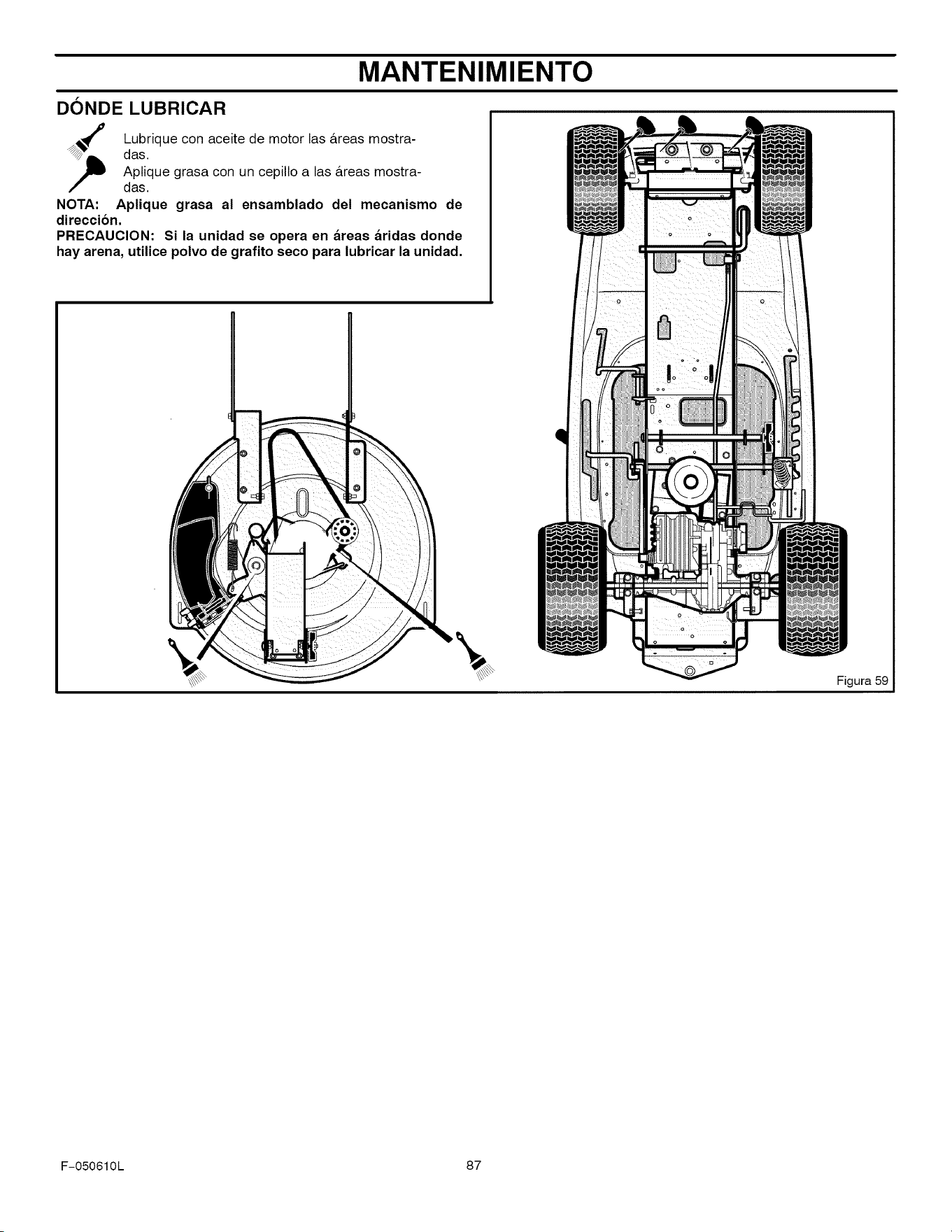
MANTENIMIENTO
DONDE LUBRICAR
Lubrique con aceite de motor las &reas mostra-
das.
Aplique grasa con un cepillo alas &reas mostra-
das.
NOTA: Aplique grasa al ensamblado del mecanismo de
direccibn.
PRECAUOION: Si la unidad ee opera en areas aridae donde
hay arena, utilice polvo de grafito seco para lubricar la unidad.
Figura 59
F-050610L 87
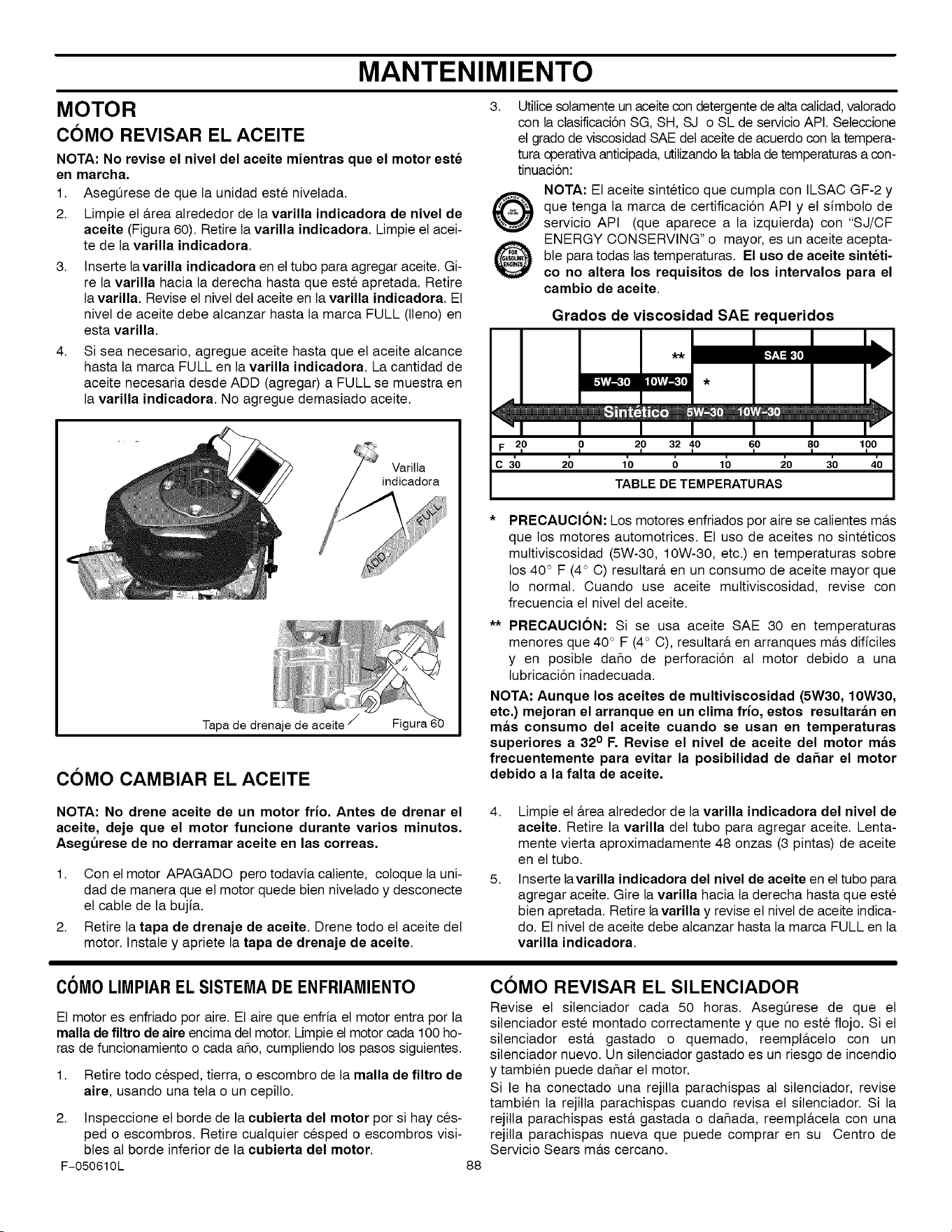
MANTENIMIENTO
3.
MOTOR
COMO REVISAR EL ACEITE
NOTA: No revise el nivel del aceite mientras que el motor est_
en marcha.
1. Aseg_rese de que la unidad este nivelada.
2. Limpie el &rea alrededor de la varilla indicadora de nivel de
aceite (Figura 60). Retire la varilla indicadora. Limpie el acei-
te de la varilla indicadora.
3. Inserte lavarilla indicadora en el tubo para agregar aceite. Gi-
re la varilla hacia la derecha hasta que este apretada. Retire
la varilla. Revise el nivel del aceite en la varilla indicadora. El
nivel de aceite debe atcanzar hasta la marca FULL (lteno) en
esta varilla.
4. Si sea necesario, agregue aceite hasta que el aceite alcance
hasta la marca FULL en la varilla indicadora. La cantidad de
aceite necesaria desde ADD (agregar) a FULL se muestra en
la varilla indicadora. No agregue demasiado aceite.
Varilla
indicadora
Tapa de drenaje de aceite / Figura 6
COMO CAMBIAR EL ACEITE
@
@
Utilice solamente un aceite con detergente de alta calidad, valorado
con la clasificaci6n SG, SH, SJ o SL de servicio API. Seleccione
el grado de viscosidad SAE del aceite de acuerdo con la tempera-
tufa operativa anticipada, utilizando la tabla de temperaturas a con-
tinuaci6n:
NOTA: El aceite sintetico que cumpla con ILSAC GF-2 y
que tenga la marca de certificaci6n API y el simbolo de
servicio API (que aparece a la izquierda) con "SJ/CF
ENERGY CONSERVING" o mayor, es un aceite acepta-
ble para todas las temperaturas. El uso de aceite sint6ti-
co no altera los requisitos de los intervalos para el
cambio de aceite.
Grados de viscosidad SAE requeridos
I
F 2,0 p 2p 3290 4o ,p0
c 30 2; 1_ ; lb _0 3'0 4'0
TABLE DE TEMPERATURAS
* PRECAUClON: Los motores enfriados por aire se calientes m&s
que los motores automotrices. El uso de aceites no sinteticos
multiviscosidad (5W-30, 10W-30, etc.) en temperaturas sobre
los 40 ° F (4 ° C) resultar& en un consumo de aceite mayor que
Io normal. Cuando use aceite multiviscosidad, revise con
frecuencia el nivel del aceite.
** PREOAUOION: Si se usa aceite SAE 30 en temperaturas
menores que 40 ° F (4° C), resultar& en arranques m&s dificiles
y en posible daSo de perforaci6n at motor debido a una
lubricaci6n inadecuada.
NOTA: Aunque los aceites de multiviscosidad (5W30, 10W30,
etc.) mejoran el arranque en un clima frio, estos resultar_m en
m_zs consumo del aceite cuando se usan en temperaturas
superiores a 32 o F. Revise el nivel de aceite del motor m_zs
frecuentemente para evitar la posibilidad de dafmr el motor
debido a la falta de aceite.
NOTA: No drene aceite de un motor frio. Antes de drenar el
aceite, deje que el motor funcione durante varios minutos.
Aseg_rese de no derramar aceite en las correas.
1. Con el motor APAGADO pero todavia caliente, coloque la uni-
dad de manera que el motor quede bien nivelado y desconecte
el cable de la buj[a.
2. Retire la tapa de drenaje de aceite. Drene todo el aceite del
motor. Instate y apriete la tapa de drenaje de aceite.
4. Limpie el &rea alrededor de la varilla indicadora del nivel de
aceite. Retire la varilla del tubo para agregar aceite. Lenta-
mente vierta aproximadamente 48 onzas (3 pintas) de aceite
en el tubo.
5. Inserte lavarilla indicadora del nivel de aceite en el tubo para
agregar aceite. Gire la varilla hacia la derecha hasta que este
bien apretada. Retire la varilla y revise el nivel de aceite indica-
do. El nivel de aceite debe alcanzar hasta la marca FULL en la
varilla indicadora.
C0M0 LIMPIAR EL SISTEMA DE ENFRIAMIENTO
El motor es enfriado por aire. El aire que enfria el motor entra por la
malla de filtro de aire encima del motor. Umpie el motor cada 100 ho-
ras de funcionamiento o cada aSo, cumpliendo los pasos siguientes.
1. Retire todo cesped, tierra, o escombro de la malla de filtro de
aire, usando una tela o un cepillo.
2. Inspeccione el borde de la cubierta del motor por si hay ces-
ped o escombros. Retire cuatquier cesped o escombros visi-
bles at borde inferior de la cubierta del motor.
F-050610L 88
COMO REVISAR EL SILENCIADOR
Revise el silenciador cada 50 horas. AsegQrese de que el
silenciador este montado correctamente y que no este flojo. Si el
silenciador est& gastado o quemado, reempl&celo con un
silenciador nuevo. Un silenciador gastado es un riesgo de incendio
y tambien puede daSar el motor.
Si le ha conectado una rejilla parachispas al silenciador, revise
tambien la rejilla parachispas cuando revisa el silenciador. Si la
rejilla parachispas est& gastada o daSada, reempl&cela con una
rejilta parachispas nueva que puede comprar en su Centro de
Servicio Sears m&s cercano.
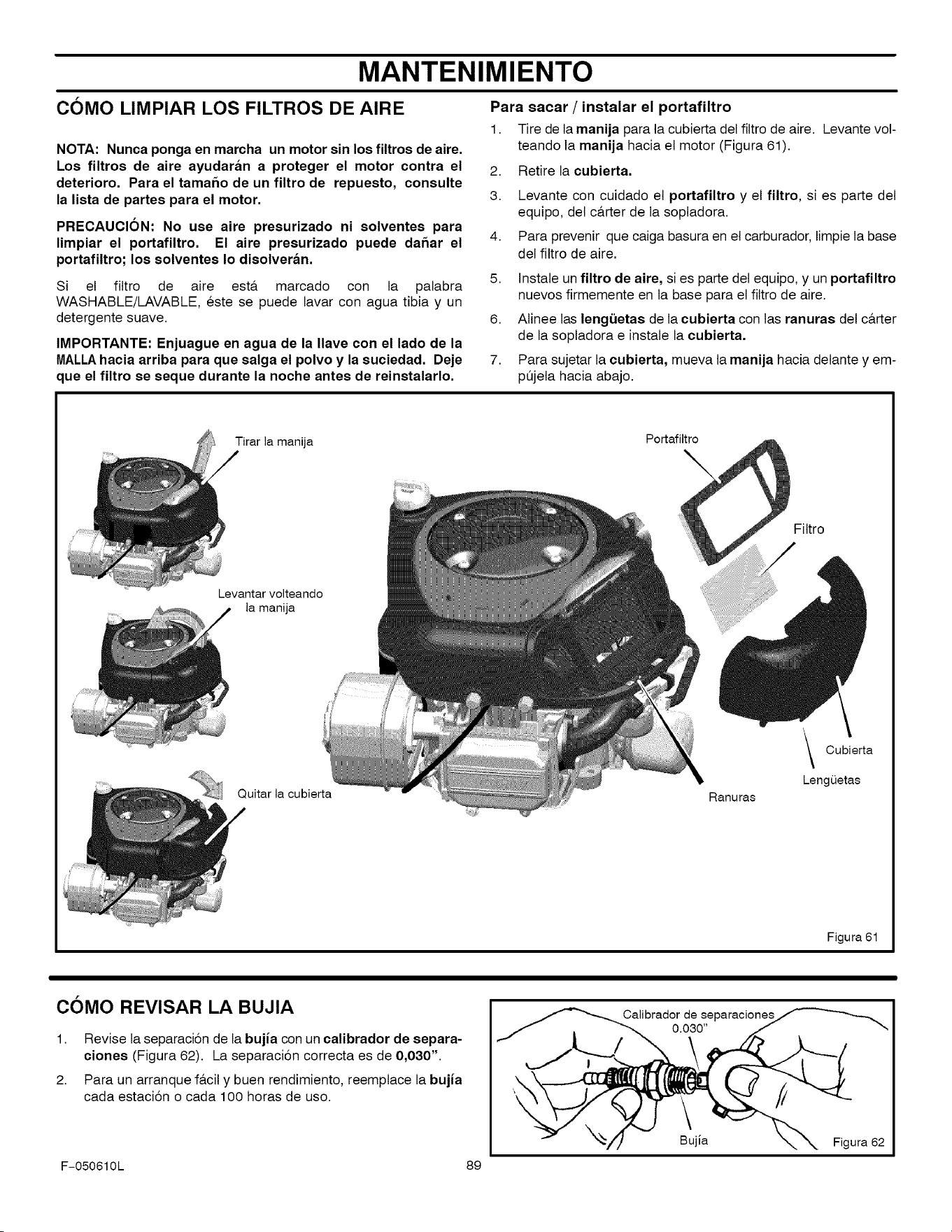
MANTENIMIENTO
COMO LIMPIAR LOS FILTROS DE AIRE
NOTA: Nunca ponga en marcha un motor sin los filtros de aire.
Los filtros de aire ayudaran a proteger el motor contra el
deterioro. Para el tamafm de un filtro de repuesto, consulte
la lista de partes para el motor.
PRECAUCION: No use aire presurizado ni solventes para
limpiar el portafiltro. El aire presurizado puede dafmr el
portafiltro; los solventes Io disolveran.
Si el filtro de aire est& marcado con la patabra
WASHABLE/LAVABLE, este se puede lavar con agua tibia y un
detergente suave.
IMPORTANTE: Enjuague en agua de la Ilave con el lado de la
MALLAhacia arriba para que salga el polvo y la suciedad. Deje
que el filtro se seque durante la noche antes de reinstalarlo.
Para sacar / instalar el portafiltro
1. Tire de la manija para la cubierta del filtro de aire. Levante vol-
teando la manija hacia el motor (Figura 61).
2. Retire la cubierta.
3. Levante con cuidado el portafiltro y el filtro, si es parte del
equipo, del c&rter de la sopladora.
4. Para prevenir que caiga basura en el carburador, limpie la base
del filtro de aire.
5. Instale un filtro de aire, si es parte del equipo, y un portafiltro
nuevos firmemente en la base para el filtro de aire.
6. Alinee las lengiJetas de la cubierta con las ranuras del c&rter
de la sopladora e instate la cubierta.
7. Para sujetar la cubierta, mueva la manija hacia delante y em-
pQjela hacia abajo.
Tirar la manija
Portafiltro
\
Filtro
Levantar volteando
la manija
Quitar la cubierta
Ranuras
Cubierta
LengL)etas
Figura 61
COMO REVISAR LA BUJIA
1. Revise la separaci6n de la bujia con un calibrador de separa-
ciones (Figura 62). La separaci6n correcta es de 0,030".
2. Para un arranque f&cil y buen rendimiento, reemplace la bujia
cada estaci6n o cada 100 horas de uso.
Calibrador de se
0.030"
Bujia
Figura 62
F-050610L 89
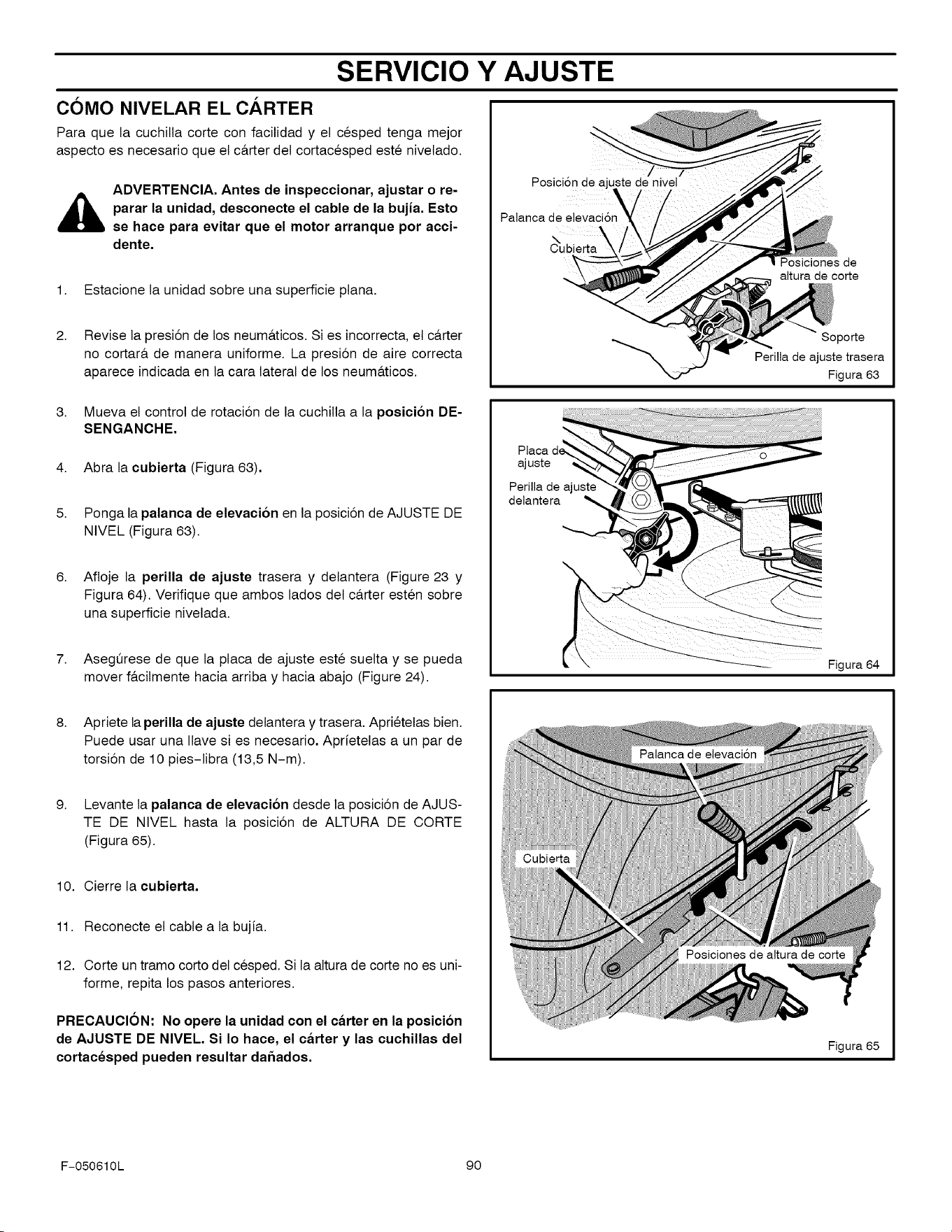
SERVICIO Y AJUSTE
COMO NIVELAR EL CARTER
Para que la cuchilla corte con facilidad y el cesped tenga mejor
aspecto es necesario que el c&rter del cortacesped este nivelado.
ADVERTENCIA. Antes de inspeccionar, ajustar o re-
,_ parar la unidad, desconecte el cable de la bujia. Esto
se hace para evitar que el motor arranque por acci-
dente.
1. Estacione la unidad sobre una superficie ptana.
2. Revise la presi6n de los neumaticos. Si es incorrecta, el carter
no cortara de manera uniforme. La presi6n de aire correcta
aparece indicada en la cara lateral de los neumaticos.
Posici6n de ajuste de nivel
_ f
Palanca de elevacidn
..
Cubierta
Posiciones de
altura de corte
Soporte
Perilla de ajuste trasera
Figura 63
3.
Mueva el control de rotaci6n de la cuchilla a la posici6n DE-
SENGANOHE,
4. Abra la cubierta (Figura 63).
5.
6.
7.
Ponga la palanca de elevaci6n en la posici6n de AJUSTE DE
NIVEL (Figura 63).
Afloje la perilla de ajuste trasera y delantera (Figure 23 y
Figura 64). Verifique que ambos lados del carter esten sobre
una superficie nivelada.
AsegQrese de que la placa de ajuste este suelta y se pueda
mover facilmente hacia arriba y hacia abajo (Figure 24).
Placa
ajuste
Perilla de ajuste
delantera
Figura 64
8. Apriete la perilla de ajuste delantera y trasera. Aprietelas bien.
Puede usar una Itave si es necesario. Aprietelas a un par de
torsi6n de 10 pies-libra (13,5 N-m).
9. Levante la palanca de elevacibn desde la posici6n de AJUS-
TE DE NIVEL hasta la posici6n de ALTURA DE CORTE
(Figura 65).
10. Cierre la eubierta,
11. Reconecte el cable a la bujia.
12. Corte un tramo corto del cesped. Si la altura de corte no es uni-
forme, repita los pasos anteriores.
PRECAUCION: No opere la unidad con el carter en la posici6n
de AJUSTE DE NIVEL. Si Io hace, el carter y las cuchillas del
cortac6sped pueden resultar dafmdos.
Figura 65
F-050610L 90
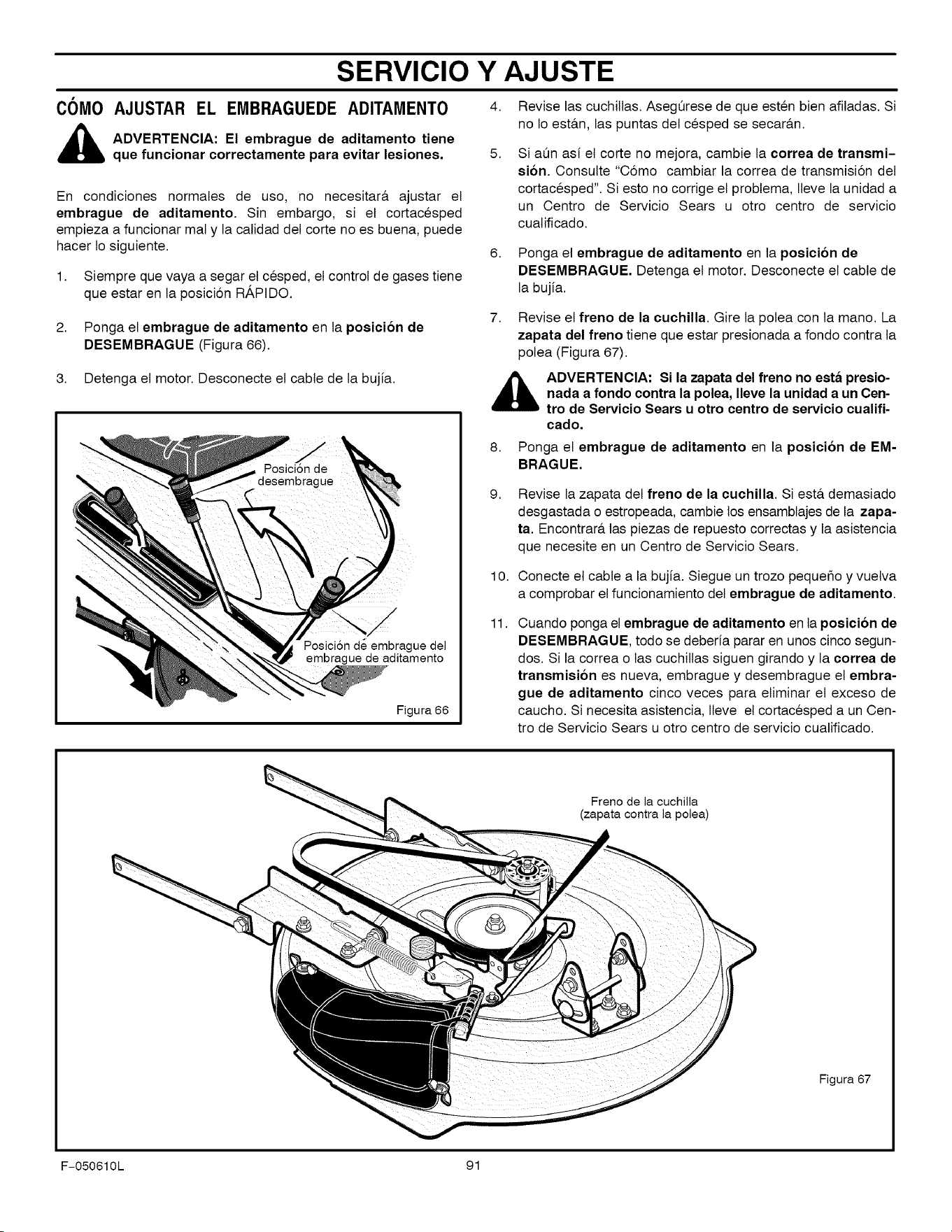
SERVICIO Y AJUSTE
4.
COMO AJUSTAR EL EMBRAGUEDE ADITAMENTO
_ DVERTENCIA: El embrague de aditamento tiene
que funcionar correctamente para evitar lesiones.
En condiciones normates de uso, no necesitarA ajustar el
embrague de aditamento. Sin embargo, si el cortacesped
empieza a funcionar mat y la catidad del corte no es buena, puede
hacer Io siguiente.
1. Siempre que vaya a segar el cesped, el control de gases tiene
que estar en la posici6n R/_,PIDO.
2. Ponga el embrague de aditamento en la posicibn de
DESEMBRAGUE (Figura 66).
3. Detenga el motor. Desconecte el cable de la buj[a.
Posici6n de embrague del
embrague de aditamento
Figura 66
5.
Revise las cuchillas. AsegQrese de que esten bien afiladas. Si
no Io est&n, las puntas del cesped se secar&n.
Si aQn asi el corte no mejora, cambie la correa de transmi-
sibn. Consulte "C6mo cambiar la correa de transmisi6n del
cortacesped". Si esto no corrige el problema, Ileve la unidad a
un Centro de Servicio Sears u otro centro de servicio
cuatificado.
6.
Ponga el embrague de aditamento en la posicibn de
DESEMBRAGUE. Detenga el motor. Desconecte el cable de
la buj[a.
7. Revise el freno de la cuchilla. Gire la polea con la mano. La
zapata del freno tiene que estar presionada a rondo contra la
polea (Figura 67).
,_ ADVERTENOIA: Si la zapata del freno no esta presio-
nada a fondo contra la polea, Ileve la unidad a un Cen-
tro de Servicio Sears u otto centro de servicio cualifi-
cado.
8. Ponga el embrague de aditamento en la posici6n de I=M-
BRAGUE.
9.
10.
11.
Revise la zapata del freno de la cuchilla. Si est& demasiado
desgastada o estropeada, cambie los ensamblajes de la zapa-
ta. Encontrar& las piezas de repuesto correctas y la asistencia
que necesite en un Centro de Servicio Sears.
Conecte el cable a la bujia. Siegue un trozo pequeSo y vuelva
a comprobar el funcionamiento del embrague de aditamento.
Cuando ponga el embrague de aditamento en la posicibn de
DESEMBRAGUE, todo se deberia parar en unos cinco segun-
dos. Si la correa o las cuchillas siguen girando y la correa de
transmisibn es nueva, embrague y desembrague el embra-
gue de aditamento cinco veces para eliminar el exceso de
caucho. Si necesita asistencia, Iteve el cortacesped a un Cen-
tro de Servicio Sears u otro centro de servicio cuatificado.
Freno de la cuchilla
(zapata contra la polea)
Figura 67
F-O50610L 91
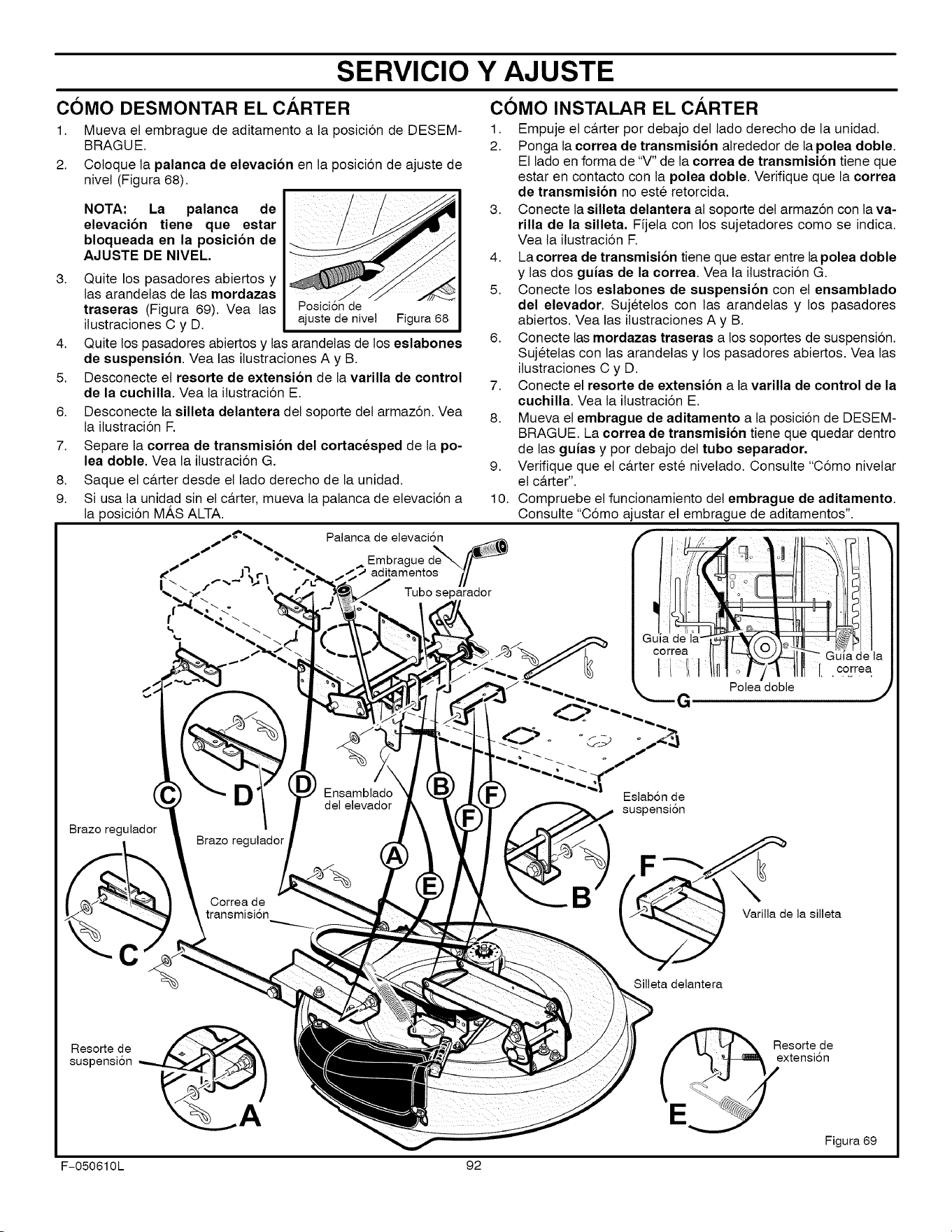
SERVICIO Y AJUSTE
COMO DESMONTAR EL CARTER
1. Mueva el embrague de aditamento a la posici6n de DESEM-
2.
3.
4.
5.
6.
7.
8.
9.
BRAGUE.
Coloque la palanca de elevaci6n en la posici6n de ajuste de
nivel (Figura 68).
NOTA: La palanca de
elevacibn tiene que estar
bloqueada en la posicibn de
AJUSTE DE NIVEL.
Quite los pasadores abiertos y
las arandelas de las mordazas
traseras (Figura 69). Yea las Posici6n de
ilustraciones C y D. ajuste de nivel Figura 68
Quite los pasadores abiertos y las arandelas de los eslabones
de suspensi6n. Vea las ilustraciones A y B.
Desconecte el resorte de extensibn de la varilla de control
de la cuchilla. Vea la ilustraci6n E.
Desconecte la silleta delantera del soporte del armaz6n. Vea
la ilustraci6n R
Separe la correa de transmisibn del cortac6sped de la po-
lea doble. Vea la ilustraci6n G.
Saque el c&rter desde el lado derecho de la unidad.
Si usa la unidad sin el c&rter, mueva la patanca de elevaci6n a
la posici6n M/_,SALTA.
COMO INSTALAR EL CARTER
1. Empuje el c&rter por debajo del lado derecho de la unidad.
2. Ponga la correa de transmisi6n alrededor de la polea doble.
El lado en forma de "V" de la correa de transmisi6n tiene que
estar en contacto con la polea doble. Verifique que la correa
de transmisibn no este retorcida.
3. Conecte la silleta delantera al soporte del armaz6n con la va-
rilla de la silleta. Ffjela con los sujetadores como se indica.
Vea la ilustraci6n R
4. La correa de transmisibn tiene que estar entre la polea doble
y las dos guias de la correa. Vea la ilustraci6n G.
5. Conecte los eslabones de suspensibn con el ensamblado
del elevador. Sujetelos con las arandelas y los pasadores
abiertos. Vea las ilustraciones A y B.
6. Conecte las mordazas traseras a los soportes de suspensi6n.
Sujetelas con las arandelas y los pasadores abiertos. Vea las
ilustraciones C y D.
7. Conecte el resorte de extensibn a la varilla de control de la
cuchilla. Vea la ilustraci6n E.
8. Mueva et embrague de aditamento a la posici6n de DESEM-
BRAGUE. La correa de transmisibn tiene que quedar dentro
de las guias y por debajo del tubo separador.
9. Verifique que el c&rter este nivelado. Consulte "C6mo nivelar
el c&rter".
10. Compruebe el funcionamiento del embrague de aditamento.
Consulte "C6mo ajustar el embrague de aditamentos".
D
Palanca de elevaci6n
Embrague _9
Tubo separador
Ensamblado
del elevador
i°rlreil I /t_I o F
_,_ Polea doble
Eslabdn de
suspensidn
J
Brazo regulador
C
Brazo regulador
Correa de
transmisi6n
B
Varilla de la silleta
Silleta delantera
Resole de
suspensi6n
Reso_ede
extensi6n
A
E
Figura 69
F-050610L 92
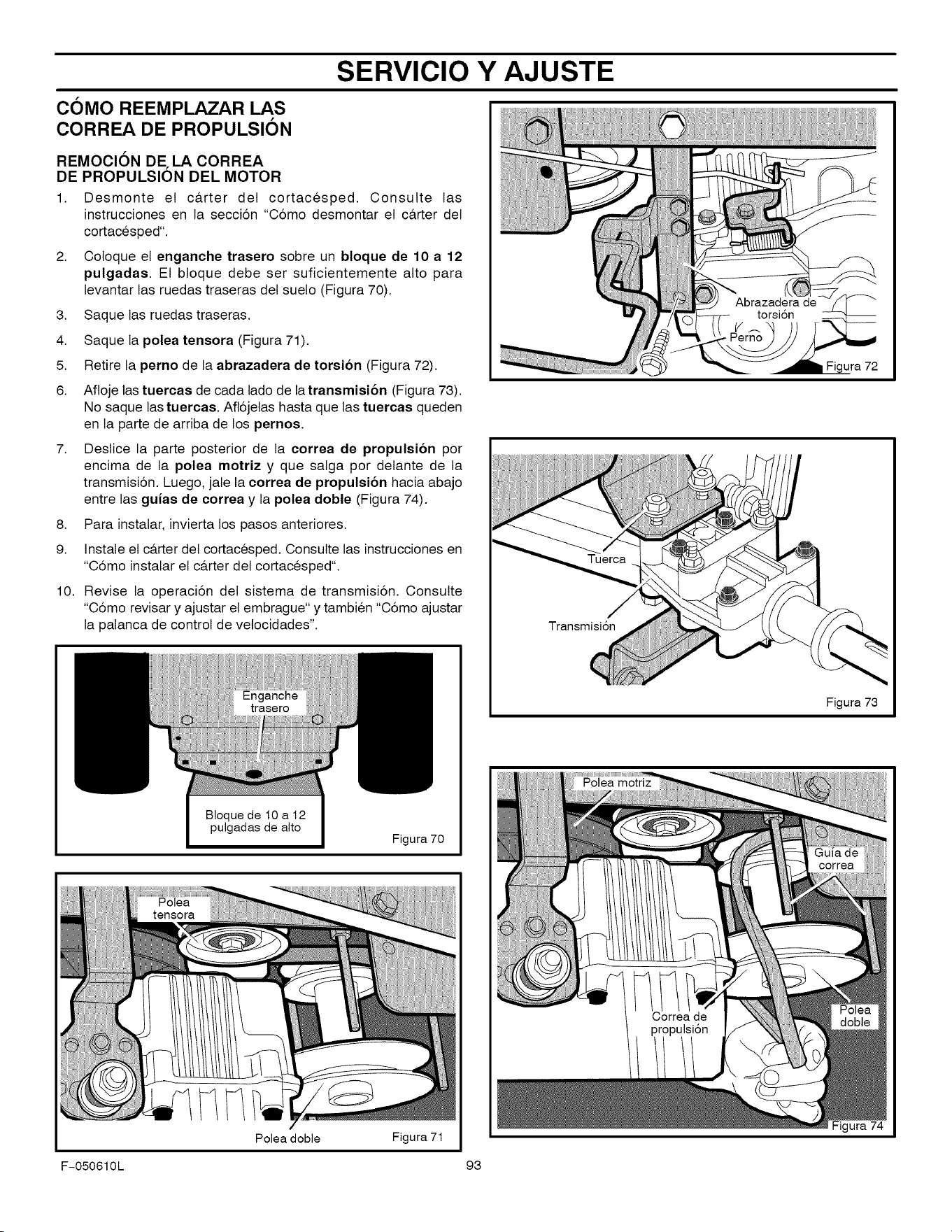
SERVICIO Y AJUSTE
COMO REEMPLAZAR LAS
CORREA DE PROPULSION
REMOCION DE LA CORREA
DE PROPULSION DEL MOTOR
1. Desmonte el c&rter del cortacesped. Consulte las
instrucciones en la secci6n "C6mo desmontar el c&rter del
2.
3.
4.
5.
6.
7.
8.
9.
10.
coRac6sped".
Coloque el enganche trasero sobre un bloque de 10 a 12
pulgadas. El bloque debe ser suficientemente alto para
levantar las ruedas traseras del suelo (Figura 70).
Saque las ruedas traseras.
Saque la polea tensora (Figura 71).
Retire la perno de la abrazadera de torsibn (Figura 72).
Afloje las tuercas de cada lado de la transmisibn (Figura 73).
No saque las tuercas. Afl6jelas hasta que las tuercas queden
en la parte de arriba de los pernos.
Deslice la parte posterior de la correa de propulsibn por
encima de la polea motriz y que salga por delante de la
transmisi6n. Luego, jale la correa de propulsibn hacia abajo
entre las guias de correa y la polea doble (Figura 74).
Para instalar, invierta los pasos anteriores.
Instale el c&rter del cortacesped. Consulte las instrucciones en
"C6mo instatar el c&rter del cortacesped".
Revise la operaci6n del sistema de transmisi6n. Consulte
"C6mo revisar y ajustar el embrague" y tambien "C6mo ajustar
la palanca de control de velocidades".
BIoque de 10 a 12
pulgadas de alto
Figura 70
Polea doble
Figura 71
Figura 72
Figura 73
Figura 74
F-050610L 93
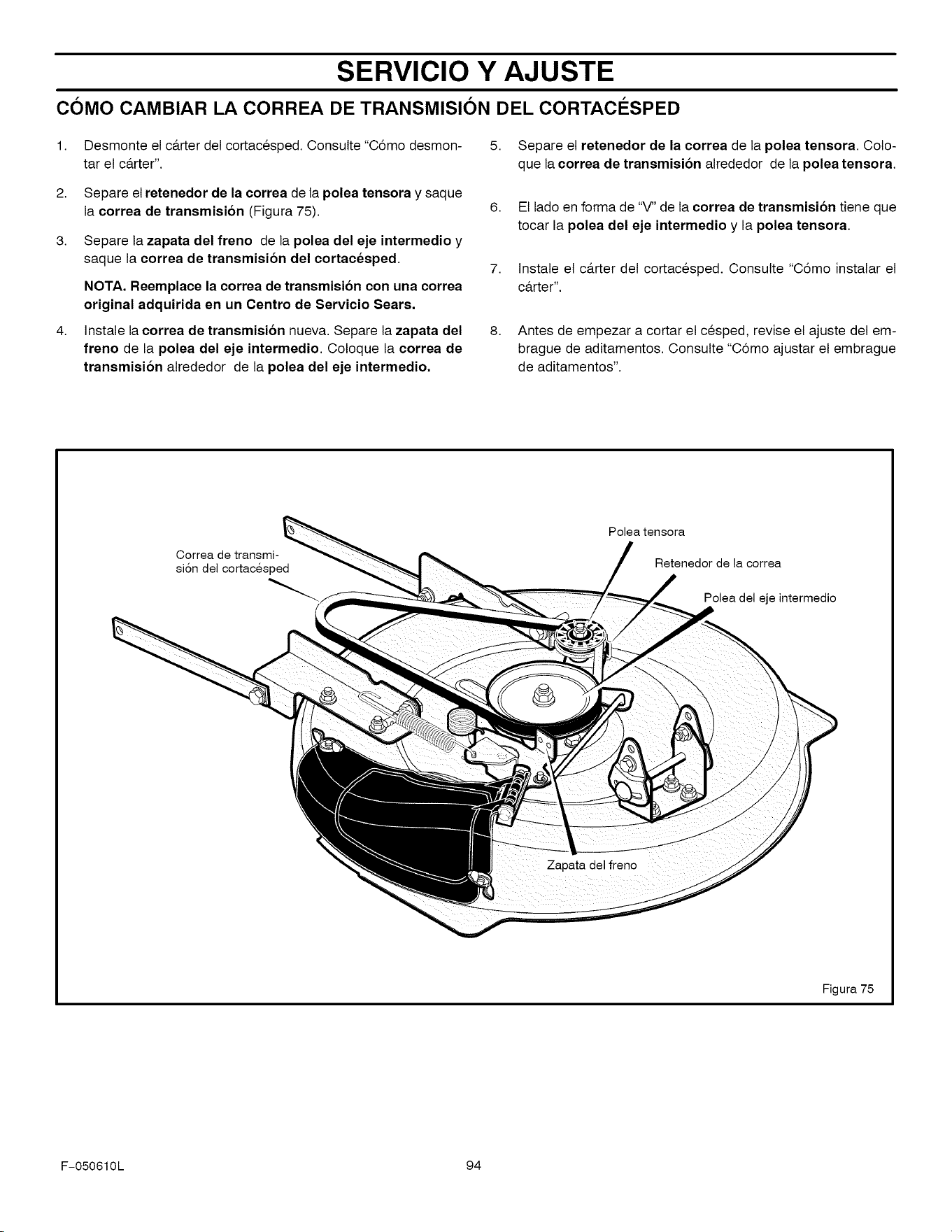
SERVICIO Y AJUSTE
COMO CAMBIAR LA CORREA DE TRANSMISlON DEL CORTACI:!:SPED
1. Desmonte el c&rter del cortacesped. Consulte"C6mo desmon- 5.
tar el c&rter".
2.
3.
Separe el retenedor de la correa de la polea tensora y saque
la correa de transmisi6n (Figura 75).
Separe la zapata del freno de la polea del eje intermedio y
saque la correa de transmisi6n del cortac6sped.
NOTA. Reemplace la correa de transmisibn con una correa
original adquirida en un Centro de Servicio Sears.
6.
7.
4. Instale la correa de transmisi6n nueva. Separe la zapata del 8.
freno de la polea del eje intermedio. Coloque la correa de
transmisi6n atrededor de la polea del eje intermedio.
Separe el retenedor de la correa de la polea tensora. Colo-
que la correa de transmisi6n alrededor de la polea tensora.
El lado en forma de "V" de la correa de transmisi6n tiene que
tocar la polea del eje intermedio y la polea tensora.
Instale el c&rter del cortacesped. Consulte "C6mo instatar el
c&rter".
Antes de empezar a cortar el cesped, revise el ajuste del em-
brague de aditamentos. Consulte "C6mo ajustar el embrague
de aditamentos".
Correa de transmi-
si6n del cortacesped
Polea tensora
Retenedor de la correa
Polea del eje intermedio
Figura 75
F-050610L 94
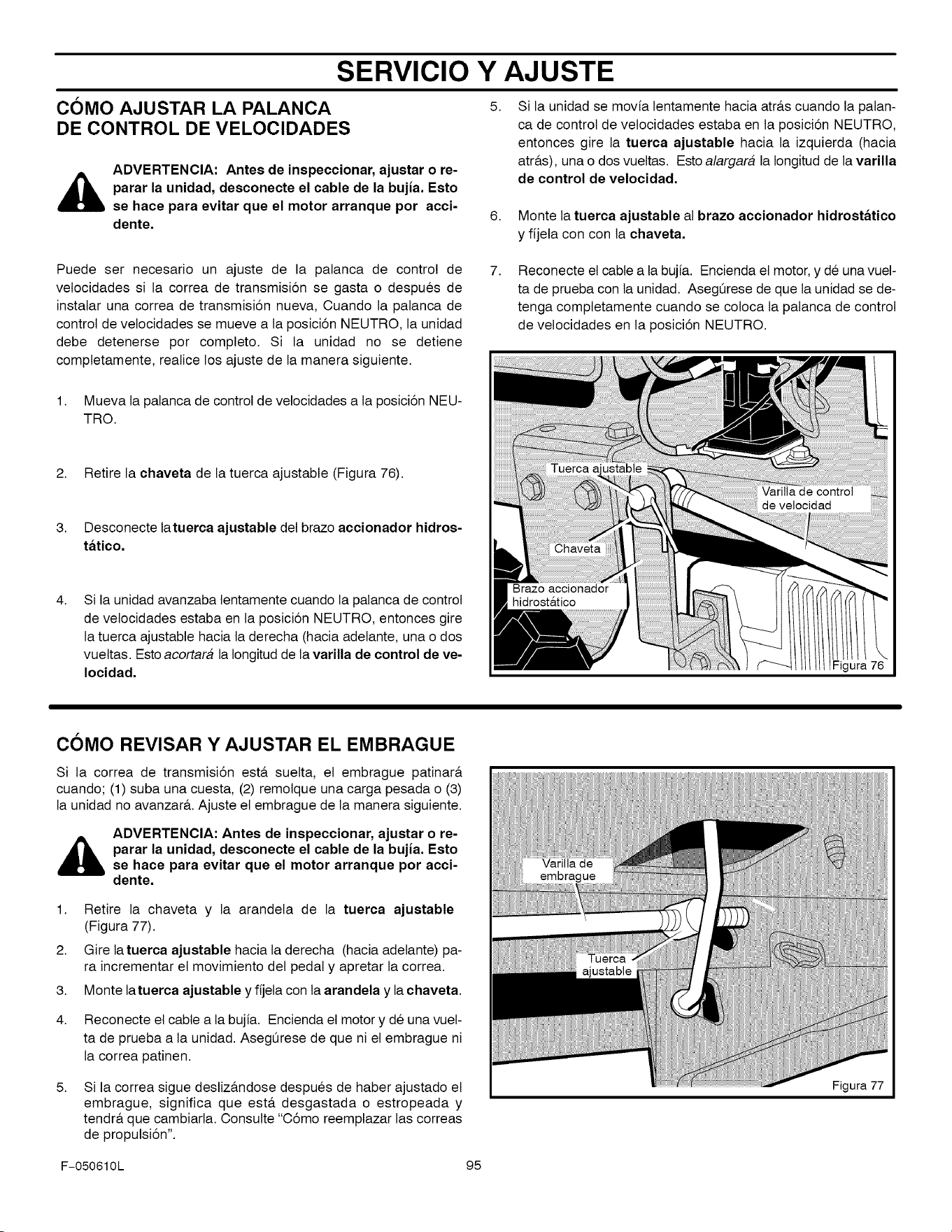
SERVICIO Y AJUSTE
5.
COMO AJUSTAR LA PALANCA
DE CONTROL DE VELOCIDADES
ADVERTENCIA: Antes de inspeccionar, ajustar o re-
_ parar la unidad, desconecte el cable de la bujia. Esto
se hace para evitar que el motor arranque por acci-
dente.
6.
Si la unidad se movia lentamente hacia atr&s cuando la patan-
ca de control de velocidades estaba en la posici6n NEUTRO,
entonces gire la tuerca ajustable hacia la izquierda (hacia
atr&s), una o dos vueltas. Esto alargara la Iongitud de la varilla
de control de velocidad.
Monte la tuerca ajustable al brazo accionador hidrostatico
y fijela con con la chaveta.
Puede ser necesario un ajuste de la patanca de control de
velocidades si la correa de transmisi6n se gasta o despues de
instalar una correa de transmisi6n nueva, Cuando la palanca de
control de velocidades se mueve a la posici6n NEUTRO, la unidad
debe detenerse por completo. Si la unidad no se detiene
completamente, reatice los ajuste de la manera siguiente.
1. Mueva la palanca de control de velocidades a la posici6n NEU-
TRO.
2. Retire la chaveta de la tuerca ajustable (Figura 76).
3. Desconecte latuerca ajustable del brazo accionador hidros-
tatico.
4.
Si la unidad avanzaba lentamente cuando la palanca de control
de velocidades estaba en la posici6n NEUTRO, entonces gire
la tuerca ajustable hacia la derecha (hacia adelante, una o dos
vueltas. Esto acortara la Iongitud de la varilla de control de ve-
Iocidad.
7.
Reconecte el cable a la bujia. Encienda el motor, y de una vuel-
ta de prueba con la unidad. AsegQrese de que la unidad se de-
tenga completamente cuando se coloca la patanca de control
de velocidades en la posici6n NEUTRO.
IFigura 76
COMO REVISAR Y AJUSTAR EL EMBRAGUE
Si la correa de transmisi6n est& suelta, el embrague patinar&
cuando; (1) suba una cuesta, (2) remolque una carga pesada o (3)
la unidad no avanzar&. Ajuste el embrague de la manera siguiente.
ADVERTENCIA: Antes de inspeccionar, ajustar o re-
_ parar la unidad, desconecte el cable de la bujia. Esto
se hace para evitar que el motor arranque por acci-
dente.
1. Retire la chaveta y la arandela de la tuerca ajustable
(Figura 77).
2. Gire la tuerca ajustable hacia la derecha (hacia adelante) pa-
ra incrementar el movimiento del pedal y apretar la correa.
3. Monte latuerca ajustable y fijela con la arandela y la chaveta.
4.
Reconecte el cable a la bujia. Encienda el motor y de una vuel-
ta de prueba a la unidad. AsegQrese de que ni el embrague ni
la correa patinen.
6.
Si la correa sigue desliz&ndose despues de haber ajustado el
embrague, significa que est& desgastada o estropeada y
tendr& que cambiarla. Consulte "C6mo reemptazar las correas
de propulsi6n".
Figura 77
F-050610L 95
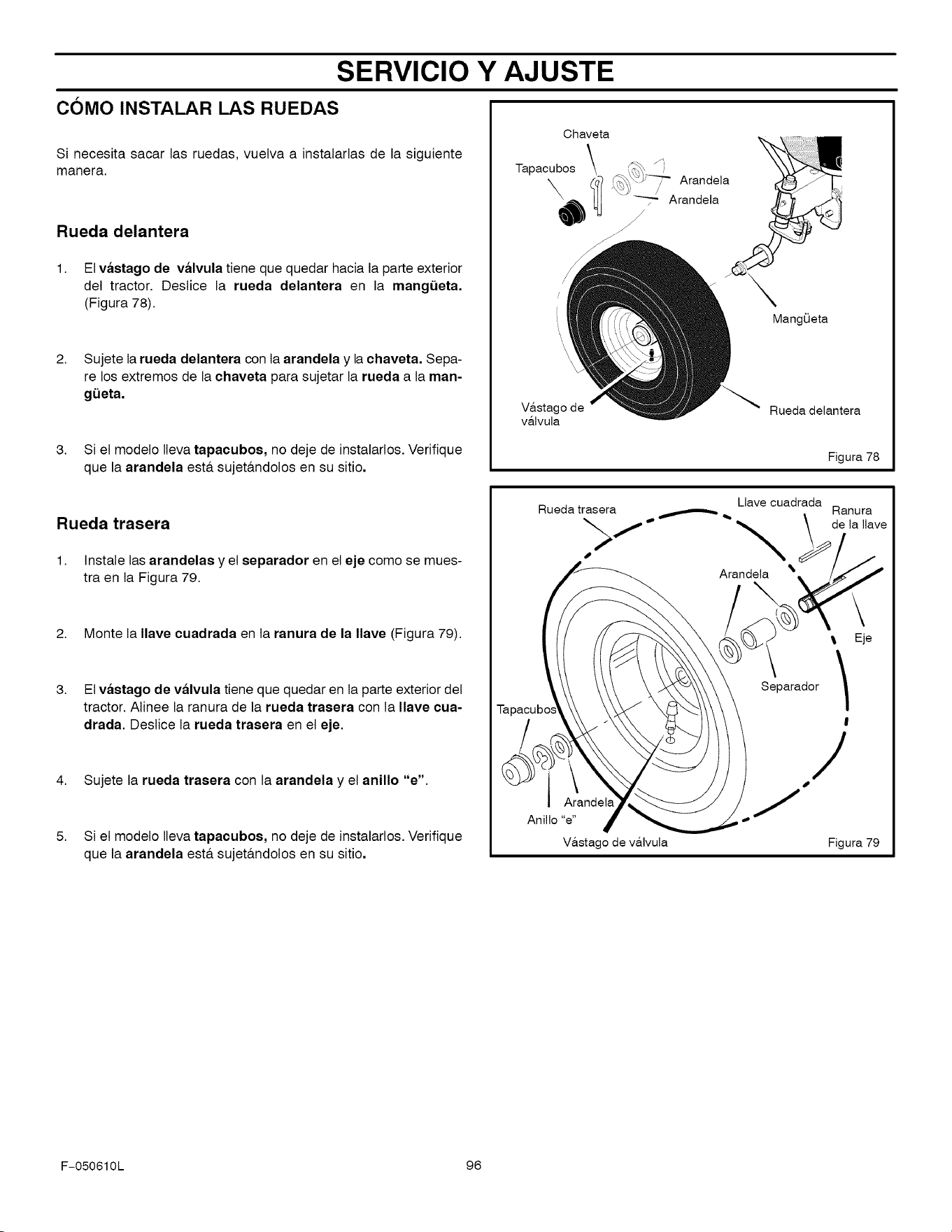
SERVICIO Y AJUSTE
COMO INSTALAR LAS RUEDAS
Si necesita sacar las ruedas, vuelva a instatarlas de la siguiente
manera.
Rueda delantera
1. El vastago de valvula tiene que quedar hacia la parte exterior
del tractor. Deslice la rueda delantera en la mangLieta.
(Figura 78).
2. Sujete la rueda delantera con la arandela y la chaveta. Sepa-
re los extremos de la chaveta para sujetar la rueda a la man-
gLieta.
3. Si el modelo Ileva tapacubos, no deje de instatarlos. Verifique
que la arandela est& sujet&ndolos en su sitio.
Chaveta
Tapacubos \
Arandela
Arandela
MangQeta
V&stago de _ Rueda delantera
v&lvula
Figura 78
Rueda trasera
1. Instale las arandelas y el separador en el eje como se mues-
tra en la Figura 79.
2. Monte la Ilave cuadrada en la ranura de la Ilave (Figura 79).
3. El vastago de valvula tiene que quedar en la parte exterior del
tractor. Alinee la ranura de la rueda trasera con la Ilave cua-
drada. Deslice la rueda trasera en el eje.
4. Sujete la rueda trasera con la arandela y el anillo "e".
5. Si el modelo Ileva tapacubos, no deje de instatarlos. Verifique
que la arandela est& sujet&ndolos en su sitio.
Llave cuadrada
Rueda trasera ,o _ _ Ranura
>f _ de la Ilave
Arandela
Anillo "e"
V&stago de v&lvula
I Eje
Separador /
!
Figura 79
F-050610L 96
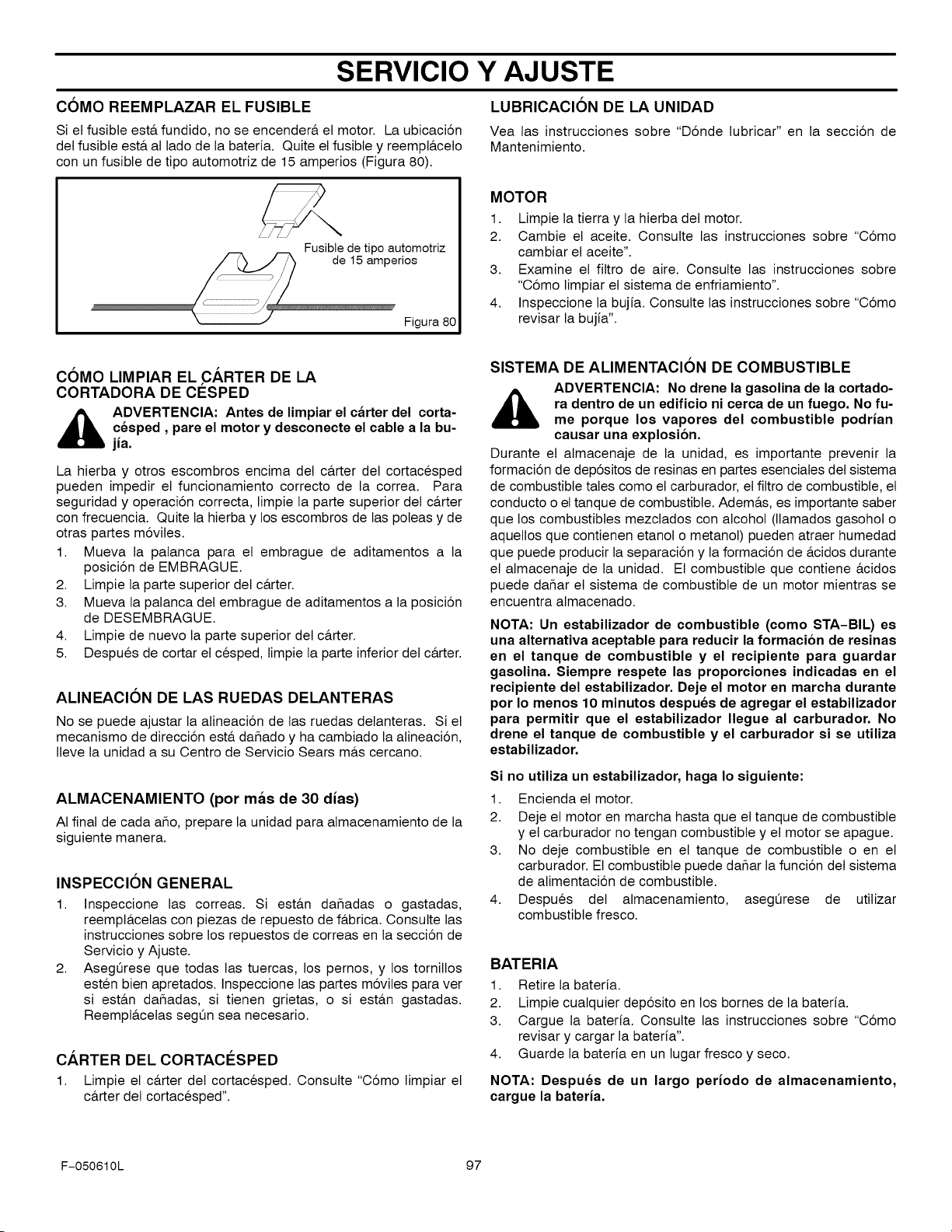
SERVICIO Y AJUSTE
COMO REEMPLAZAR EL FUSIBLE LUBRICACION DE LA UNIDAD
Si el fusible est& fundido, no se encender& el motor. La ubicaci6n Vea las instrucciones sobre "D6nde lubricar" en la secci6n de
del fusible est& al lado de la bateria. Quite el fusible y reempl&celo Mantenimiento.
con un fusible de tipo automotriz de 15 amperios (Figura 80).
Fusible de tipo automotriz
Figura 80
MOTOR
1. Limpie la tierra y la hierba del motor.
2. Cambie el aceite. Consulte las instrucciones sobre "C6mo
cambiar el aceite".
3. Examine el filtro de aire. Consulte las instrucciones sobre
"C6mo limpiar el sistema de enfriamiento".
4. Inspeccione la bujia. Consulte las instrucciones sobre "C6mo
revisar la bujia".
COMO LIMPIAR EL C.ARTER DE LA
CORTADORA DE ClaSPED
,_ ADVERTENCIA: Antes de limpiar el carter del corta-
c6sped, pare el motor y desconecte el cable a la bu-
jia.
La hierba y otros escombros encima del c&rter del cortacesped
pueden impedir el funcionamiento correcto de la correa. Para
seguridad y operaci6n correcta, limpie la parte superior del c&rter
con frecuencia. Quite la hierba y los escombros de las poleas y de
otras partes m6viles.
1. Mueva la patanca para el embrague de aditamentos a la
posici6n de EMBRAGUE.
2. Limpie la parte superior del c&rter.
3. Mueva la palanca del embrague de aditamentos a la posici6n
de DESEMBRAGUE.
4. Limpie de nuevo la parte superior del c&rter.
5. Despues de cortar el cesped, limpie la parte inferior del c&rter.
ALINEAClON DE LAS RUEDAS DELANTERAS
No se puede ajustar la alineaci6n de las ruedas delanteras. Si el
mecanismo de direcci6n est& daflado y ha cambiado la alineaci6n,
Iteve la unidad a su Centro de Servicio Sears m&s cercano.
ALMACENAMIENTO (por mas de 30 dias)
AI final de cada aflo, prepare la unidad para almacenamiento de la
siguiente manera.
INSPECClON GENERAL
1. Inspeccione las correas. Si est&n dafladas o gastadas,
reempl&celas con piezas de repuesto de f&brica. Consulte las
instrucciones sobre los repuestos de correas en la secci6n de
Servicio y Ajuste.
2. AsegQrese que todas las tuercas, los pernos, y los tornillos
esten bien apretados. Inspeccione las partes m6viles para ver
si est&n dafladas, si tienen grietas, o si est&n gastadas.
Reempl&celas segQn sea necesario.
CARTER DEL CORTACESPED
1. Limpie el c&rter del cortacesped. Consulte "C6mo limpiar el
c&rter del cortacesped".
SISTEMA DE ALIMENTACION DE COMBUSTIBLE
,_ ADVERTENCIA: No drene la gasolina de la cortado-
ra dentro de un edificio ni cerca de un fuego. No fu-
me porque los vapores del combustible podrian
causar una explosibn.
Durante el almacenaje de la unidad, es importante prevenir la
formaci6n de dep6sitos de resinas en partes esenciales del sistema
de combustible tales como el carburador, el filtro de combustible, el
conducto o et tanque de combustible. Adem&s, es importante saber
que los combustibles mezclados con alcohol (llamados gasohol o
aquellos que contienen etanol o metanol) pueden atraer humedad
que puede producir la separaci6n y la formaci6n de &cidos durante
el almacenaje de la unidad. El combustible que contiene &cidos
puede daflar el sistema de combustible de un motor mientras se
encuentra atmacenado.
NOTA: Un estabilizador de combustible (como STA-BIL) es
una alternativa aceptable para reducir la formacibn de resinas
en el tanque de combustible y el recipiente para guardar
gasolina. Siempre respete las proporciones indicadas en el
recipiente del estabilizador. Deje el motor en marcha durante
por Io menos 10 minutos despu_s de agregar el estabilizador
para permitir que el estabilizador Ilegue al carburador. No
drene el tanque de combustible y el carburador si se utiliza
estabilizador.
Si no utiliza un estabilizador, haga Io siguiente:
1. Encienda el motor.
2. Deje el motor en marcha hasta que el tanque de combustible
y el carburador no tengan combustible y el motor se apague.
3. No deje combustible en el tanque de combustible o en el
carburador. El combustible puede daflar la funci6n del sistema
de alimentaci6n de combustible.
4. Despues del almacenamiento, asegQrese de utilizar
combustible fresco.
BATERIA
1. Retire la bateria.
2. Limpie cuatquier dep6sito en los bornes de la bateria.
3. Cargue la bateria. Consulte las instrucciones sobre "C6mo
revisar y cargar la bateria".
4. Guarde la bateria en un lugar fresco y seco.
NOTA: Despu_s de un largo periodo de almacenamiento,
cargue la bateria.
F-050610L 97
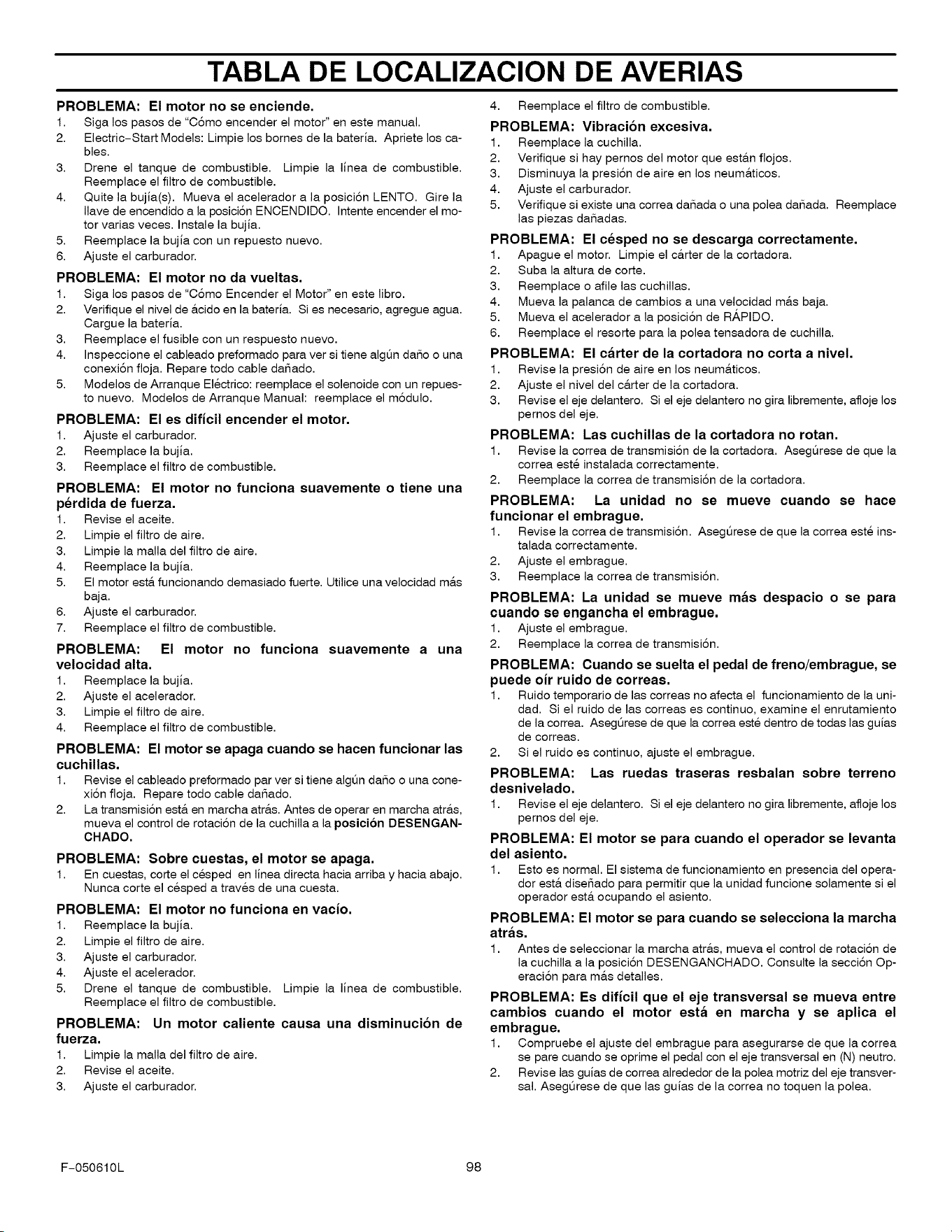
TABLA DE LOCALIZACION DE AVERIAS
PROBLEMA: El motor no se enciende.
1. Siga los pasos de "C6mo encender el motor" en este manual.
2. Electric-Start Models: Limpie los bornes de la bateria. Apriete los ca-
bles.
3. Drene el tanque de combustible. Limpie la linea de combustible.
Reemplace el filtro de combustible.
4. Quite la bujia(s). Mueva el acelerador a la posici6n LENTO. Gire la
Ilave de encendido a la posici6n ENCENDIDO. Intente encender el mo-
tor varias veces. Instale la bujia.
5. Reemplace la bujia con un repuesto nuevo.
6. Ajuste el carburador.
PROBLEMA: El motor no da vueltae.
1. Siga los pasos de "C6mo Encender el Motor" en este libro.
2. Verifique el nivel de &cido en la bateria. Si es necesario, agregue agua.
Cargue la bateria.
3. Reemplace el fusible con un respuesto nuevo.
4. Inspeccione el cableado preformado para ver si tiene algt_n dafio o una
conexi6n floja. Repare todo cable dafiado.
5. Modelos de Arranque Electrico: reemplace el solenoide con un repues-
to nuevo. Modelos de Arranque Manual: reemplace el m6dulo.
PROBLEMA: El es dificil encender el motor.
1. Ajuste el carburador.
2. Reemplace la bujia.
3. Reemplace el filtro de combustible.
PROBLEMA: El motor no funciona suavemente o tiene una
p6rdida de fuerza.
1. Revise el aceite.
2. Limpie el filtro de aire.
3. Limpie la malla del filtro de aire.
4. Reemplace la bujia.
5. El motor est& funcionando demasiado fuerte. Utilice una velocidad m&s
baja.
6. Ajuste el carburador.
7. Reemplace el filtro de combustible.
PROBLEMA: El motor no funciona suavemente a una
velocidad alta.
1. Reemplace la bujia.
2. Ajuste el acelerador.
3. Limpie el filtro de aire.
4. Reemplace el filtro de combustible.
PROBLEMA: El motor se apaga cuando se hacen funcionar las
cuchillas.
1. Revise el cableado preformado par ver si tiene algt_n dafio o una cone-
xi6n floja. Repare todo cable dafiado.
2. La transmisi6n est& en marcha atr&s. Antes de operar en marcha atr&s,
mueva el control de rotaci6n de la cuchilla a la posici6n DESENGAN-
CHADO.
PROBLEMA: Sobre cuestas, el motor se apaga.
1. En cuestas, corte el cesped en linea directa hacia arriba y hacia abajo.
Nunca corte el cesped a traves de una cuesta.
PROBLEMA: El motor no funciona en vacio.
1. Reemplace la bujia.
2. Limpie el filtro de aire.
3. Ajuste el carburador.
4. Ajuste el acelerador.
5. Drene el tanque de combustible. Limpie la linea de combustible.
Reemplace el filtro de combustible.
PROBLEMA: Un motor caliente causa una disminuci6n de
fuerza.
1. Limpie la malla del filtro de aire.
2. Revise el aceite.
3. Ajuste el carburador.
4. Reemplace el filtro de combustible.
PROBLEMA: Vibraci6n excesiva.
1. Reemplace la cuchilla.
2. Verifique si hay pernos del motor que est&n flojos.
3. Disminuya la presi6n de aire en los neum&ticos.
4. Ajuste el carburador.
5. Verifique si existe una correa dafiada o una polea dafiada. Reemplace
las piezas dafiadas.
PROBLEMA: El c6eped no ee deecarga correctamente.
1. Apague el motor. Limpie el c&rter de la cortadora.
2. Suba la altura de corte.
3. Reemplace o afile las cuchillas.
4. Mueva la palanca de cambios a una velocidad m&s baja.
5. Mueva el acelerador a la posici6n de RAPIDO.
6. Reemplace el resorte para la polea tensadora de cuchilla.
PROBLEMA: El carter de la cortadora no corta a nivel.
1. Revise la presi6n de aire en los neum&ticos.
2. Ajuste el nivel del c&rter de la cortadora.
3. Revise el eje delantero. Si el eje delantero no gira libremente, afloje los
pernos del eje.
PROBLEMA: Las cuchillas de la cortadora no rotan.
1. Revise la correa de transmisi6n de la cortadora. Asegt_rese de que la
correa este instalada correctamente.
2. Reemplace la correa de transmisi6n de la cortadora.
PROBLEMA: La unidad no se mueve cuando se hace
funcionar el embrague.
1. Revise la correa de transmisi6n. Asegt_rese de que la correa este ins-
talada correctamente.
2. Ajuste el embrague.
3. Reemplace la correa de transmisi6n.
PROBLEMA: La unidad ee mueve mae despacio o se para
cuando se engancha el embrague.
1. Ajuste el embrague.
2. Reemplace la correa de transmisi6n.
PROBLEMA: Cuando se suelta el pedal de freno/embrague, se
puede oir ruido de correas.
1. Ruido temporario de las correas no afecta el funcionamiento de la uni-
dad. Si el ruido de las correas es continuo, examine el enrutamiento
de la correa. Asegt_rese de que la correa este dentro de todas las guias
de correas.
2. Si el ruido es continuo, ajuste el embrague.
PROBLEMA: Las ruedas traseras resbalan sobre terreno
desnivelado.
1. Revise el eje delantero. Si el eje delantero no gira libremente, afloje los
pernos del eje.
PROBLEMA: El motor se para cuando el operador se levanta
del asiento.
1. Esto es normal. El sistema de funcionamiento en presencia del opera-
dor est& disefiado para permitir que la unidad funcione solamente si el
operador est& ocupando el asiento.
PROBLEMA: El motor se para cuando se selecciona la marcha
atras.
1. Antes de seleccionar la marcha atr&s, mueva el control de rotaci6n de
la cuchilla a la posici6n DESENGANCHADO. Consulte la secci6n Op-
eraci6n para m&s detalles.
PROBLEMA: Es dificil que el eje transversal ee mueva entre
cambioe cuando el motor eeta en marcha y se aplica el
embrague.
1. Compruebe el ajuste del embrague para asegurarse de que la correa
se pare cuando se oprime el pedal con el eje transversal en (N) neutro.
2. Revise las guias de correa alrededor de la polea motriz del eje transver-
sal. Asegt_rese de que las guias de la correa no toquen la polea.
F-O50610L 98
(Esta pagina es aplicable t_nicamente en Estados Unidos de America y Canad&.)
Sears, Roebuck and Co., U.S.A. (Sears), Junta de Recursos Ambientales de California (CARB) y Agencia de Proteccibn
Ambiental de los Estados Unidos (U.S. EPA) Declaracibn de la Garantia del Sistema de Control de Emisiones (Derechos y
Obligaciones del Propietario de la Garantia de Defectos)
LA COBERTURA DE LA GARANTIA DEL CONTROL DE EMI-
SIONES ES APLICABLE A LOS MOTORES CERTIFICADOS QUE
HAYAN SlDO COMPRADOS EN CALIFORNIAA PARTIR DE 1995 Y
DESPU¢:S DE ESTA FECHA, LOS CUALES SEAN USADOS EN
CALIFORNIA, Y PARA LOS MOTORES CERTIFICADOS MODE-
LOS 1997 EN ADELANTE QUE SEAN COMPRADOS Y USADOS
EN OTRA PARTE DE LOS ESTADOS UNIDOS (Y A PARTIR DE EN-
ERO 1 DE 2001 EN CANADA).
Declaracibn de la Garantia de Defectos del Sistema de Control de Emisiones de California, Estados Unidos y Canada
La Junta de Recursos Ambientales (CARB), La Agencia de Protecci6n
Ambiental de los Estados Unidos U.S. EPA y Sears se complacen en
expticarles la Garantia del Sistema de Control de Emisiones de su mo-
tor pequeflo modelo 2000 en adelante para uso en terrenos sin pavi-
mento (SORE). En California, los nuevos motores pequeflos para uso
en terrenos sin pavimento deben ser diseflados, fabricados y equipa-
dos para cumplir los rigurosos estandares anti-smog del Estado. En
cualquier otra parte de los Estados Unidos, los nuevos motores de en-
cendido por chispa para no uso en carreteras modelos 1997 y posteri-
ores, deben cumplir estandares similares a los establecidos por la
Agencia de Protecci6n Ambiental de los Estados Unidos (U.S. EPA).
Sears debe garantizar et sistema de control de emisiones en su motor
por los periodos de tiempo listados abajo, teniendo en cuenta que no
haya habido abuso, negligencia o mantenimiento no apropiado en su
motor pequeflo para uso en terrenos sin pavimento.
Su sistema de control de emisiones incluye partes tales como el
carburador, el filtro de aire, el sistema de encendido, el mofle y el
convertidor catalitico. Tambien puede incluir conectores y otros
conjuntos relacionados con el sistema de emisiones.
Siempre que exista una condici6n de garantia, Sears reparara su
motor pequeflo para uso en terrenos sin pavimento sin ningUn costo
para usted inctuyendo el diagn6stico, las partes y la mano de obra.
Cobertura de la Garantia de Defectos del Sistema de Control de Emisiones Sears
Los motores pequeflos para uso en terrenos sin pavimento se ga-
rantizan relativo a los defectos de las partes del sistema de control
de emisiones durante un periodo de dos aflos, sujeto a las provi-
siones establecidas abajo. Si alguna de las partes bajo cobertura en
su motor se encuentra defectuosa, la parte ser& reparada o reem-
plazada por Sears.
Responsabilidades del
Como propietario de un motor pequeflo para uso en terrenos sin pa-
vimento, usted es responsable de que se Ileve a cabo el mantenimi-
ento requerido el cuat se indica en sus Instrucciones de
Mantenimiento y Operaci6n. Sears le recomienda guardar todos
sus recibos que cubran el mantenimiento en su motor pequeflo para
uso en terrenos sin pavimento, pero Sears no solo puede negar la
garantia por la falta de recibos sino por su omisi6n at asegurar la
reatizaci6n de todo el mantenimiento programado.
No obstante, como propietario de un motor pequeflo para uso en
terrenos sin pavimento, usted tiene que darse cuenta que Sears
puede negarle la cobertura de la garantia si su motor pequeflo para
uso en terrenos sin pavimento o una de sus partes ha fallado debido
a abuso, negligencia, mantenimiento incorrecto o modificaciones
no aprobadas
Propietario de la Garantia
Usted es responsable de presentar su motor pequeflo para uso en
terrenos sin pavimento a un Distribuidor de Servicio Autorizado
Sears tan pronto se presente el problema. Las reparaciones bajo
garantia indisputables deben completarse en un periodo de tiempo
razonable que no se exceda de 30 dias.
Si usted tiene algunas preguntas relacionadas con los derechos y
responsabilidades de la garantia, debe contactar a un Represen-
tante de Servicio Sears marcando el telefono: 1-414-259-5262.
La garantia de emisiones es una garantia de defectos. Los defectos
son juzgados en el desempeflo normal de un motor. La garantia no
est& relacionada con una prueba de emisiones en uso.
Provisiones de la Garantia de Defectos del Sistema de Control de Emisiones Sears
Las siguientes son provisiones especificas relativas a la Cobertura
de Garantia de Defectos del Sistema de Control de Emisiones. Es
una adici6n de la garantia del motor Sears para los motores no-re-
gulados encontrados en las Instrucciones de Mantenimiento y Op-
eraci6n.
1. Partes Garantizadas
La cobertura bajo esta garantia se extiende Unicamente alas
partes listadas abajo (partes de los sistemas de control de emi-
siones) hasta la extensi6n que estas partes fueron presentadas
en el motor comprado.
a. Sistema de Medici6n de Combustible
• Sistema de Enriquecimiento de Arranque en Frio (es-
trangulaci6n suave)
• Carburador y Partes Internas
• Bomba de Combustible
b. Sistema de Inducci6n de Aire
• Filtro de Aire
• MUltiple de Admisi6n
c. Sistema de Encendido
• Bujia(s)
F-050610L
2.
3.
99
• Sistema de Encendido con Magneto
d. Sistema Catalizador
• Convertidor Catatitico
• MUltiple de Escape
• Sistema de Inyecci6n de Aire o Valvula de Pulsaci6n
e. Items Varios Usados en los Sistemas Anteriores
• Vacio, Temperatura, Posici6n, Valvulas Sensitivas de
Tiempo y Suiches
• Conectores y Conjuntos
Duraci6n de la Cobertura
Sears garantiza al propietario inicial y a cada comprador subse-
cuente que las Partes Garantizadas estar&n libres de defectos
en materiales y mano de obra la cual haya ocasionado fallas de
las Partes Garantizadas por un periodo de dos aflos a partir de
la fecha en que es entregado el motor a un comprador detaltista.
Sin Costo
La reparaci6n o cambio de cualquier Parte Garantizada se Ile-
var& a cabo sin costo alguno para el propietario, incluyendo la
labor de diagn6stico la cual conduce a la determinaci6n de que
esa Parte Garantizada es defectuosa, si el trabajo de diagn6sti-
co es reatizado en un Centro de Servicio Autorizado Sears.
ParaserviciodegarantiadeemisionescontactesuCentrode
ServicioAutorizadoSearsm&scercanolistadoenlas"P&ginas
Amarillas"bajo"Motores,Gasolina","Motoresa Gasolina",
"M&quinasCortacesped"oenunacategor[asimilar.
4. Rectamosy ExclusionesdelaCobertura
Losreclamosdelagarantiasecompletar&ndeacuerdoconlas
provisionesdelaP61izadeGarantiadelMotorSears.Lacober-
turadelagarantiaestar&excluidaparafallasdelasPartesGa-
rantizadaslascualesnoseanpartesoriginalesSearsopor
abuso,negligenciaomantenimientoincorrectoseg0nseesta-
bleceenlaP61izadeGarantiadelMotorSears.Searsnose
haceresponsabledecubrirfallasdePartesGarantizadasoca-
sionadasporelusodeadici6ndepartes,partesno-originaleso
partesmodificadas.
5. Mantenimiento
Cualquierpartegarantizadalacualnoesteprogramadapara
cambioalrealizarelmantenimientorequeridoolacualestepro-
6.
gramada 0nicamente para una inspecci6n regular por el efecto
de "repare o cambie si es necesario" se garantizar& por defec-
tos durante el per[odo de la garantia. Cualquier Parte Garanti-
zada la cual este programada para cambio por el
mantenimiento requerido se garantizar& Qnicamente por defec-
tos durante el periodo de tiempo hasta el primer cambio progra-
mado para esa parte. Cualquier repuesto que sea equivalente
en desempeSo y durabilidad puede ser usado al Ilevar a cabo
toda tarea de mantenimiento o reparaci6n. El propietario es re-
sponsable de la realizaci6n de todo el mantenimiento requeri-
do, segQn se define en las Instrucciones de Mantenimiento y
Operaci6n Sears.
Cobertura Consecuente
La cobertura aqui establecida se extender& hasta la falla de cu-
alquiera de los componentes del motor ocasionada por la falla
de cuatquier Parte Garantizada que aOn se encuentre bajo ga-
rantia.
In the USA and Canada, a 24 hour hot line, 1-800-469-4663, has a menu of pre-recorded messages offering you engine maintenance information.
F-050610L 100
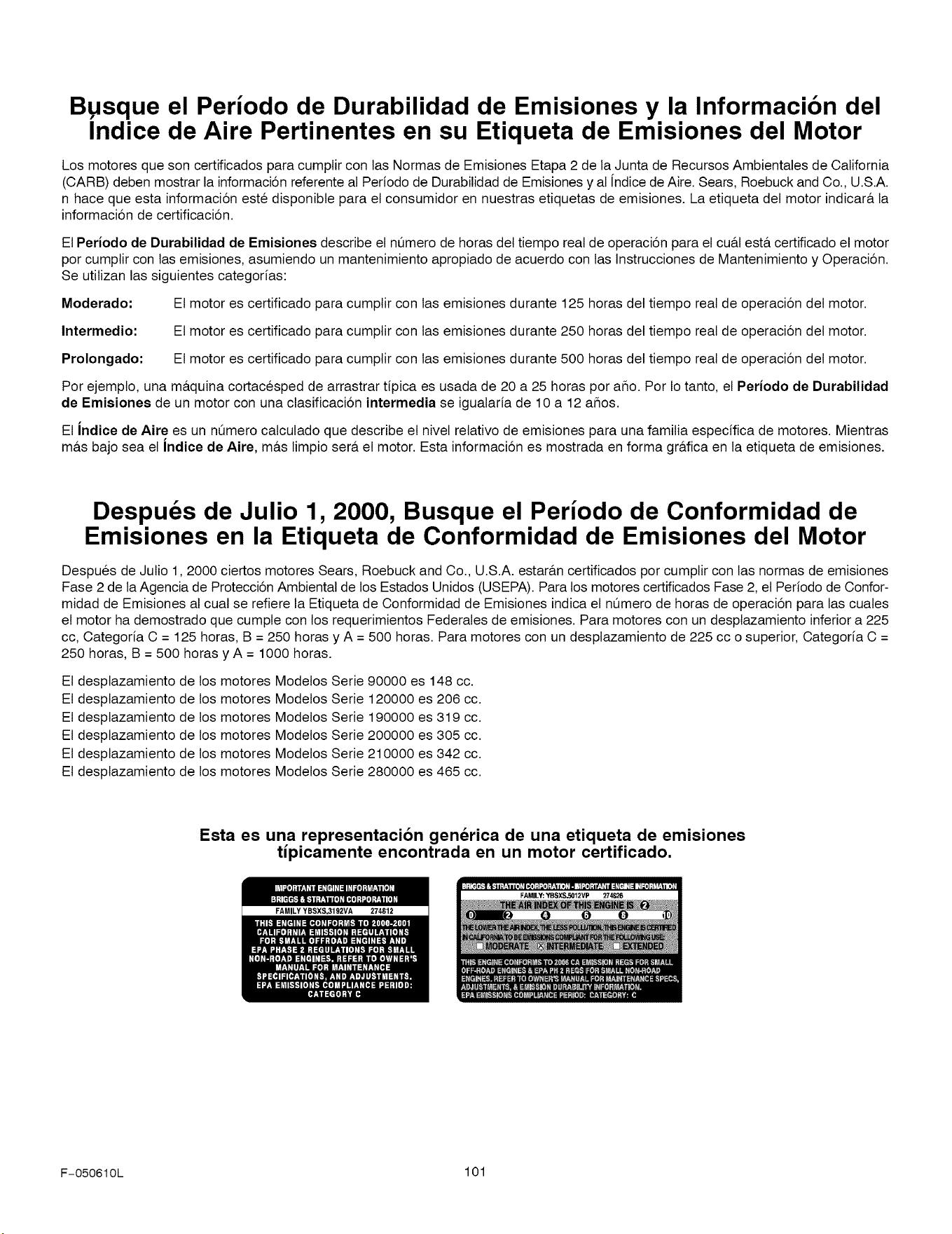
B.usque el Periodo de Durabilidad de Emisiones y la Informacion del
Indice de Aire Pertinentes en su Etiqueta de Emisiones del Motor
Los motores que son certificados para cumptir con las Normas de Emisiones Etapa 2 de la Junta de Recursos Ambientales de California
(CARB) deben mostrar la informaci6n referente al Periodo de Durabilidad de Emisiones y al [ndice de Aire. Sears, Roebuck and Co., U.S.A.
n hace que esta informaci6n este disponible para el consumidor en nuestras etiquetas de emisiones. La etiqueta del motor indicar& la
informaci6n de certificaci6n.
El Periodo de Durabilidad de Emisiones describe el nQmero de horas del tiempo real de operaci6n para el cu&l est& certificado el motor
por cumplir con las emisiones, asumiendo un mantenimiento apropiado de acuerdo con las Instrucciones de Mantenimiento y Operaci6n.
Se utitizan las siguientes categorfas:
Moderado: El motor es certificado para cumptir con las emisiones durante 125 horas del tiempo real de operaci6n del motor.
Intermedio: El motor es certificado para cumptir con las emisiones durante 250 horas del tiempo real de operaci6n del motor.
Prolongado: El motor es certificado para cumptir con las emisiones durante 500 horas del tiempo real de operaci6n del motor.
Por ejemplo, una m&quina cortacesped de arrastrar tipica es usada de 20 a 25 horas por aflo. Por Io tanto, el Periodo de Durabilidad
de Emisiones de un motor con una clasificaci6n intermedia se igualaria de 10 a 12 aflos.
El indice de Aire es un nemero calculado que describe el nivel relativo de emisiones para una familia especifica de motores. Mientras
m&s bajo sea el indice de Aire, m&s limpio ser& el motor. Esta informaci6n es mostrada en forma gr&fica en la etiqueta de emisiones.
Despues de Julio 1, 2000, Busque el Periodo de Conformidad de
Emisiones en la Etiqueta de Conformidad de Emisiones del Motor
Despues de Julio 1,2000 ciertos motores Sears, Roebuck and Co., U.S.A. estar&n certificados por cumplir con las normas de emisiones
Fase 2 de la Agencia de Protecci6n Ambiental de los Estados Unidos (USEPA). Para los motores certificados Fase 2, el Periodo de Confor-
midad de Emisiones al cuat se refiere la Etiqueta de Conformidad de Emisiones indica el nOmero de horas de operaci6n para las cuales
el motor ha demostrado que cumple con los requerimientos Federales de emisiones. Para motores con un desplazamiento inferior a 225
cc, Categoria C = 125 horas, B = 250 horas y A = 500 horas. Para motores con un desptazamiento de 225 cc o superior, Categoria C =
250 horas, B = 500 horas y A = 1000 horas.
El desplazamiento de los motores Modelos
El desplazamiento de los motores Modelos
El desplazamiento de los motores Modelos
El desplazamiento de los motores Modelos
El desplazamiento de los motores Modelos
El desplazamiento de los motores Modelos
Serie 90000 es 148 cc.
Serie 120000 es 206 cc.
Serie 190000 es 319 cc.
Serie 200000 es 305 cc.
Serie 210000 es 342 cc.
Serie 280000 es 465 cc.
Esta es una representacibn generica de una etiqueta de emisiones
tipicamente encontrada en un motor certificado.
FAMILY YBSXS.3192VA 274812
F-050610L 101
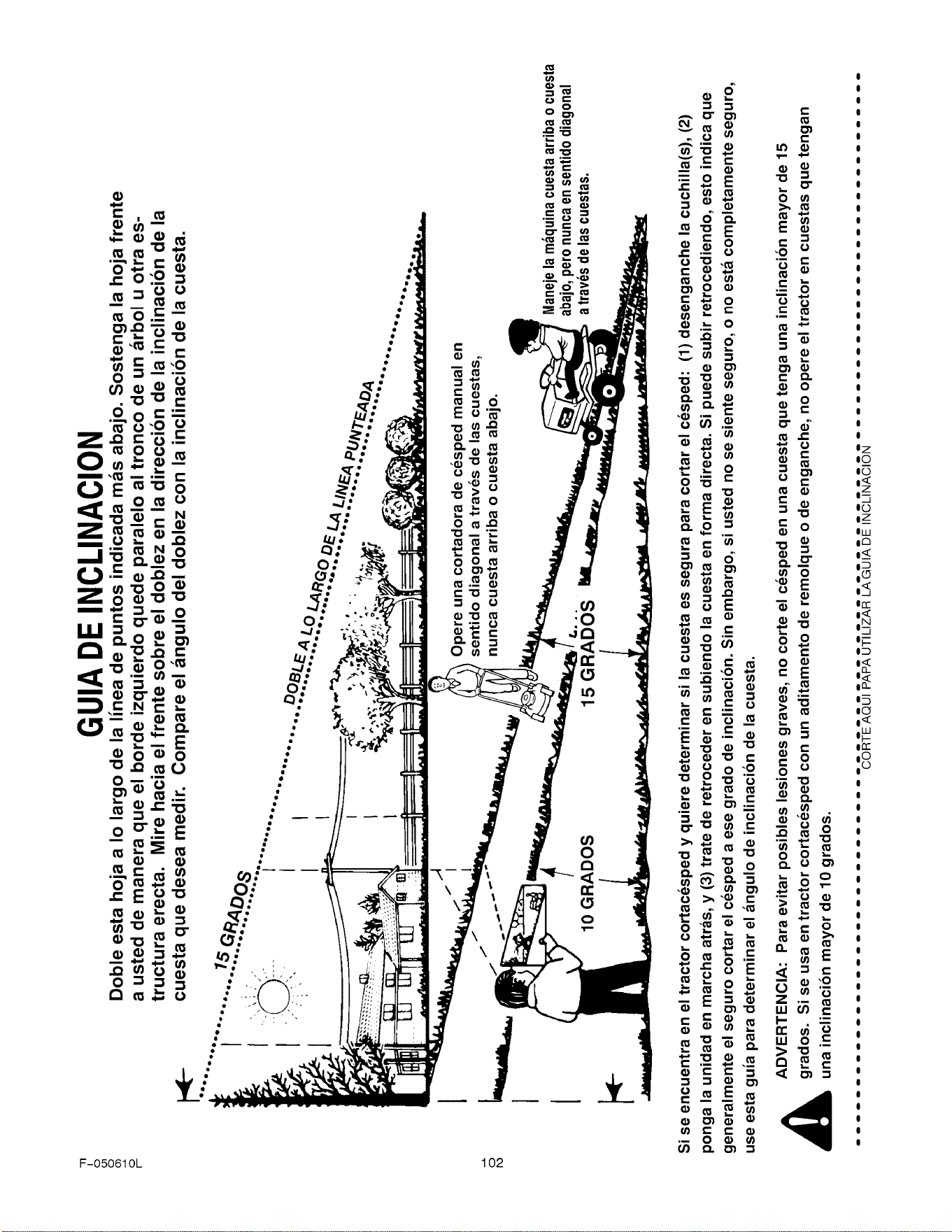
"T]
i
O
(._
O
0
I--
o
GUIA DE INCLINACION
Doble esta hoja a Io largo de la linea de puntos indicada mas abajo. Sostenga la hoja frente
a usted de manera que el borde izquierdo quede paralelo al tronco de un arbol u otra es-
tructura erecta. Mire hacia el frente sobre el doblez en la direccion de la inclinacion de la
cuesta que desea medir. Compare el angulo del doblez con la inclinacion de la cuesta.
........i......"....
r ...............
I
1
1
Opere una cortadora de cesped manual en
sentido diagonal a traves de las cuestas,
nunca cuesta arriba o cuesta abajo.
10 GRADOS 15 GRADOS
Manejela mbquinacuestaarribao cuesta
abajo,pero nuncaensentidodiagonal
a trav_sde lascuestas.
Si se encuentra en el tractor cortacesped y quiere determinar si la cuesta es segura para cortar el cesped: (1) desenganche la cuchilla(s), (2)
ponga la unidad en marcha atras, y (3) trate de retroceder en subiendo la cuesta en forma directa. Si puede subir retrocediendo, esto indica que
generalmente el seguro cortar el cesped a ese grado de inclinacion. Sin embargo, si usted no se siente seguro, o no esta completamente seguro,
use esta guia para determinar el angulo de inclinacion de la cuesta.
ADVERTENCIA: Para evitar posibles lesiones graves, no corte el cesped en una cuesta que tenga una inclinacion mayor de 15
grados. Si se usa en tractor cortacesped con un aditamento de remolque o de enganche, no opere el tractor en cuestas que tengan
una inclinacion mayor de 10 grados.
............................... "C_-_E_SGI_E_ _ _'A'__ 5_ I_l_; ...............................
INDICE
A
Aceite
Cambiar, 88
Revisar, 81 , 88
Tipo, 81
Aditamento para descarga lateral,
Instatar, 80
Aditamentos, 74
Ajustes
C&rter, Nivelar, 90
Embrague, 95
Alineaci6n de ruedas, 97
Altura de corte
Ajustar, 90
Cambiar, 76
B
Bateria
AImacenamiento, 97
Cargar, 86
Desmontar, 86
Instalar, 71
Limpiar, 86
Revisar, 71
Bot6n de control de aceleraci6n,
Operaci6n, 75
Bujia, 89
C
C&rter
Ajustar el nivel, 90
Desmontar, 92
Instalar, 92
C&rter de la cortadora,
Operaci6n, 82
C&rter de la cortadora de cesped,
Altura de corte, 76
C&rter del cortacesped, Limpiar, 97
Combustible, Tipo, 81
Control de velocidad, Ajustar, 95
Controles, Simbolos
internacionales, 69
Correa
Correa de transmisi6n principal,
Ajustar, 95
Transmisi6n
Ajustar, 95
Cambiar, 94
Correa de propulsion,
Reemplazar, 93
Correa de transmisi6n
Ajustar, 95
Cambiar, 94
Correa de transmision principal,
Ajustar, 95
Cubierta de la trituradora, Retirar, 80
Cuchilla
Afilar, 85
Desmontar y montar, 85
Inspecci6n, 85
F-050610L
D
Desconexi6n autom&tica, Operaci6n,
72,77
E
Embrague
Ajustar, 95
Revisar, 95
F
Filtro, Aire, 89
Freno de estacionamiento
Operaci6n, 75
Ubicaci6n, 73
Fusible, 97
G
GarantJa, 63
Guia de inctinacion, 102
I
Interruptor de encendido,
Ubicaci6n, 73
L
Lubricaci6n
Cortadora, 87
Motor, 88
M
Malla de filtro de aire, 88
Mantenimiento
Bateria
Cargar, 86
Limpiar, 86
Bujia, 89
C&rter
Desmontar, 92
Instalar, 92
Nivelar, 90
C&rter del cortacesped,
Limpiar, 97
Correa, Transmisi6n, 94
Correa de propulsion,
Reemplazar, 93
Cuchilla, 85
Embrague, 95
Filtro, Aire, 89
Fusible, 97
Instalar, Ruedas, 96
Lubricaci6n, 87
Silenciador, 88
Motor
Aceite, 72,81 , 88
Almacenamiento, 97
Arrancar, 81
Bot6n de control de
aceleraci6n, 75
Combustible, 72,81
Lubricaci6n, 88
Parachispas, 72
Preparaci6n, 72
103
Rejitla parachispas, 88
Silenciador, 88
Sistema de enfriamiento, 88
O
Operaci6n
Aditamentos, 74
Arrancar el motor, 81
Bot6n de control de
aceleraci6n, 75
C&rter de la cortadora, 82
C6mo transportar la unidad, 79
Corte y recogida de la hierba, 83
Desconexi6n autom&tica, 72,77
Parar la Unidad, 75
Freno de estacionamiento, 73,75
Interruptor de encendido, 73
Operaci6n del Interruptor con llave
de encendido, 74
Operar en cuestas, 82
Palanca de cambios, 73
Patanca de control de
aceleraci6n, 73
Palanca de elevaci6n, 73,76
Pedal de control de velocidad, 78
Pedal de embrague y freno, 73
Trituradora, 83
Ubicaci6n de Controles, 73
Operaci6n del Interruptor con Ilave
de encendido, Operaci6n, 74
P
Palanca de cambios, Ubicaci6n, 73
Patanca de control de aceleraci6n,
Ubicaci6n, 73
Patanca de elevaci6n
Operaci6n, 76
Ubicaci6n, 73
Parachispas, 72
Pedal de control de velocidad,
Operaci6n, 78
Pedal de embrague y freno,
Ubicaci6n, 73
Presi6n de aire en los
neum&ticos, 72,84
R
Reglas de Seguridad,
Instituto de Est&ndares
Nacionales de Estados Unidos
de America, 66-67
Rejilla parachispas, 88
S
Silenciador, 88
Rejilla parachispas, 88
Simbolos internacionales, 69
Sistema electrico de seguridad, 74
T
Tabla de Localizaci6n de Averias, 98
Tabla de Mantenimiento, 84
Trituradora, Operaci6n, 83

Your Home
TM SM
® Registered Trademark / Trademark / Service Mark of Sears, Roebuck and Co.
TM
® Marca Registrada / Marca de Fa.brica / SM Marca de Servicio de Sears, Roebuck and Co.
MCMarque de commerce / MD Marque deposed de Sears, Roebuck and Co. © Sears, Roebuck and Co.