IMPORTANT: Read and save these instructions.
NOTICE:
Installer: Leave this guide with the homeowner
Homeowner: Keep this guide for future reference
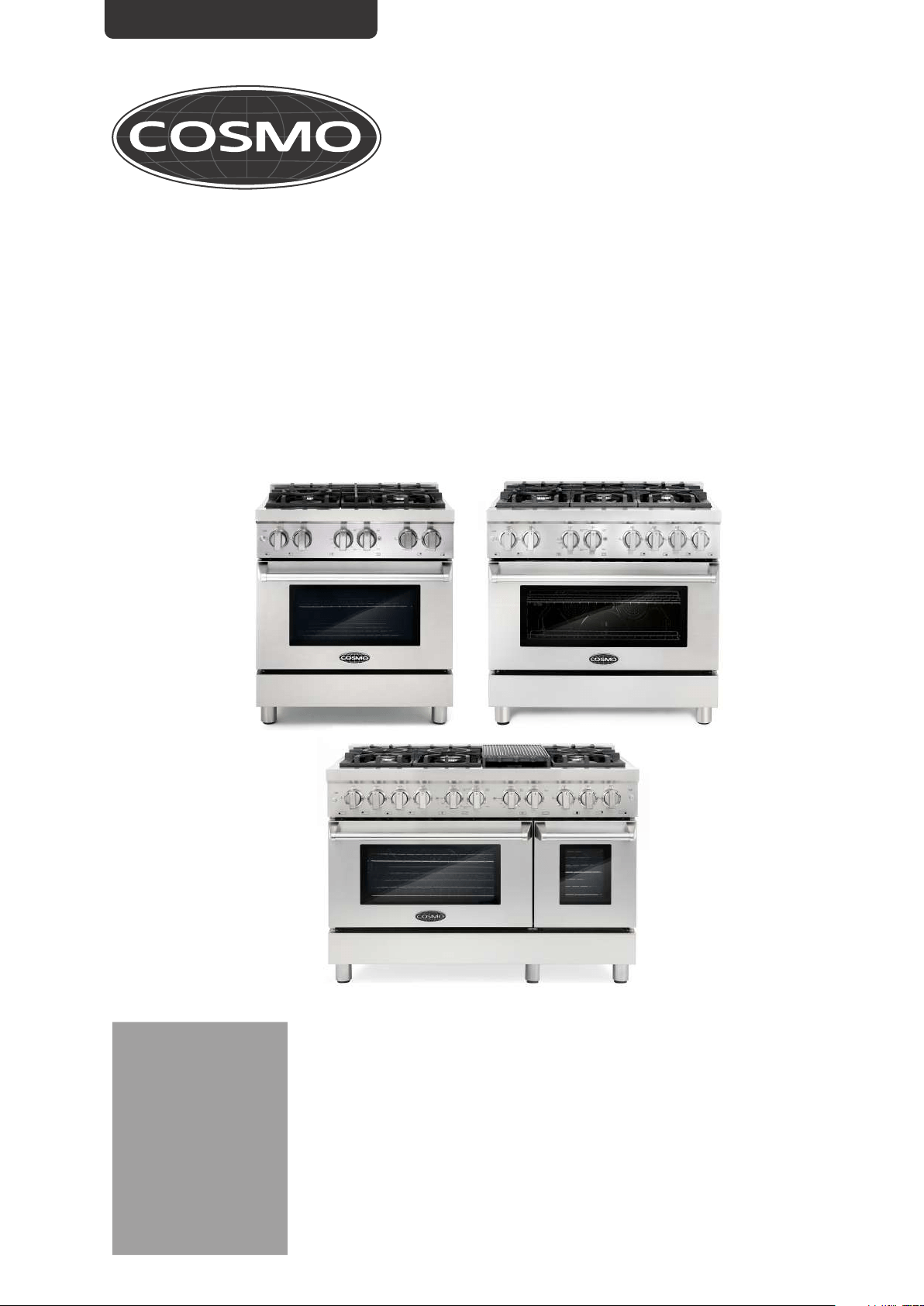
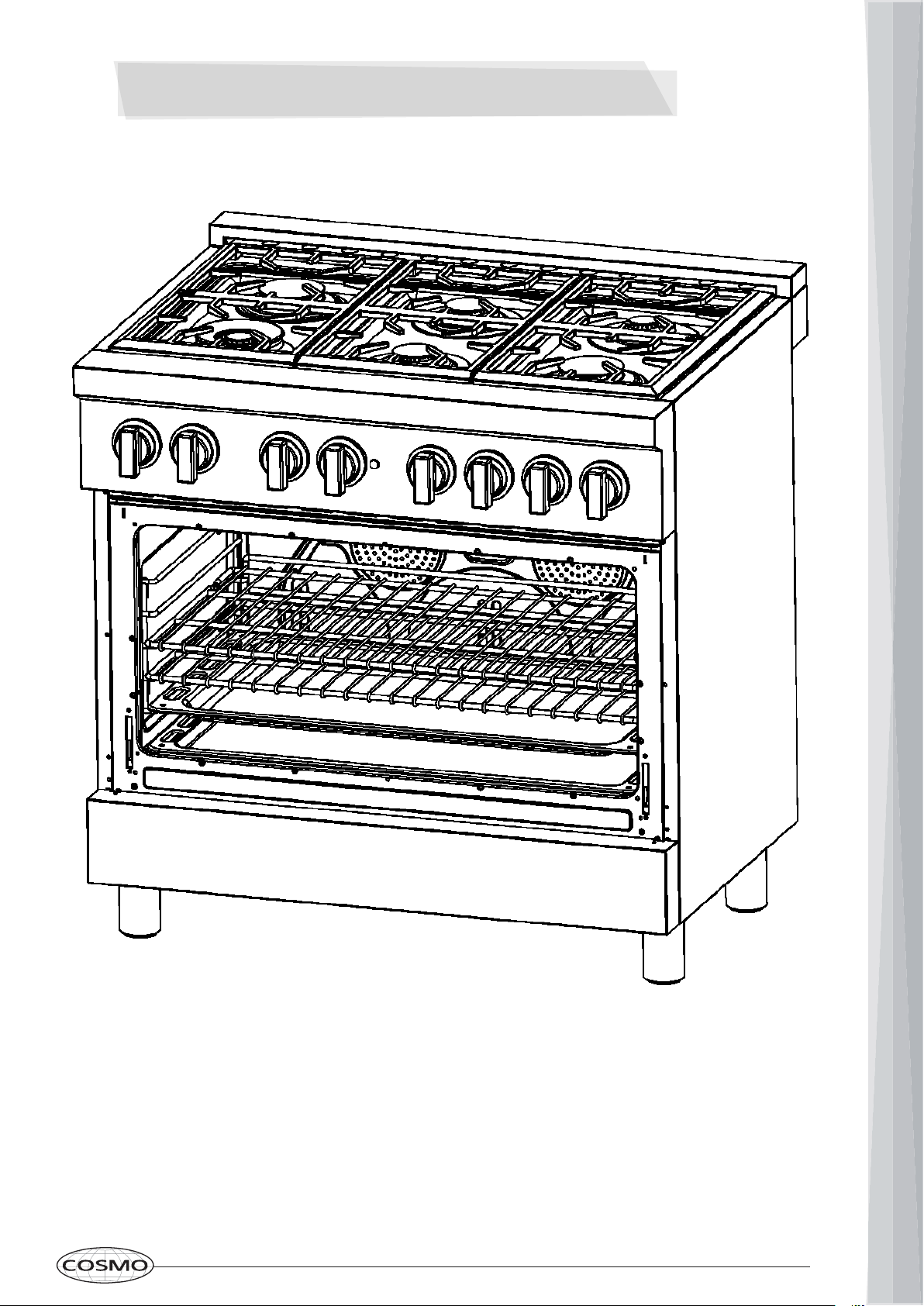
DUAL FUEL RANGE
COS-DFR304
COS-DFR366
COS-DFR486G
Installation & User Manual
Thank you for your purchase. We know that you have many brands and
products to choose from and we are honored to know that you have decided
to take one of our products into your home and hope that you enjoy it.
COSMO Appliances are designed according to the strictest safety and
performance standard for the North American market. We follow the
most advanced manufacturing philosophy. Each appliance leaves the
factory after thorough quality inspection and testing. Our distributors and
our service partners are ready to answer any questions you may have
regarding how to install, use and care for your products. We hope that this
manual will help you learn to use the product in the safest and most effective
manner.
Before using this product, please read through this manual carefully. Keep this
manual in a safe place for future reference. Please ensure that other
persons using this product are familiar with these instructions as well.
If you have any questions or concerns, please contact the dealer from whom you
purchased it, or contact our Customer Support at:
1-888-784-3108.
2
THANK YOU FOR YOUR PURCHASE

TABLE OF CONTENTS
SAFETY & WARNINGS ..........................................................4-5
General Safety & Warnings ......................................................4
Installation Safety & Warnings .................................................5
INSTALLATION MANUAL .....................................................6-20
Legs ........................................................................................6
Anti-Tip Device .........................................................................7
Range .......................................................................................8
Range Hood .............................................................................9
Electrical Connection .............................................................10
Power Cord Replacement ......................................................11
Dimension Diagram: DFR304 ................................................12
Dimension Diagram: DFR366 .................................................13
Dimension Diagram: DFR486G ..............................................14
Circuit Diagram: DFR304 ........................................................15
Circuit Diagram: DFR366 ........................................................15
Circuit Diagram: DFR486G .....................................................16
Gas Connection ................................................................17-18
Gas Conversion ................................................................19-20
Before Use: Installation Checklist ..........................................21
Before Use: Final Preparation ................................................21
USER MANUAL ..................................................................22-42
Operation & Safety Warnings ............................................22-23
Burner / BTU Diagrams ...........................................................24
Cooktop Surface Cooking .................................................25-27
Oven Cooking ..................................................................28-38
Before Use / Tips ....................................................................28
Oven Functions .......................................................................29
Bake ........................................................................................30
Convection Bake & Turbo ..................................................31-32
Baking Recommendations .................................................33-34
Broil / Convection Broil ......................................................35-36
Broil/Roasting Recommendations ..........................................37
Care & Maintenance ................................................................38
Troubleshooting .................................................................39-41
Location of Appliance Tags ....................................................42
WARRANTY & SERVICE ....................................................43-44
3
SAFETY & WARNINGS
4
This appliance has been designed for non-
professional, domestic use only.
Do not use this appliance to heat a room.
Do not place any pot or pan on the open oven door.
The door is made of glass and it can break if loaded
with a weight.
Before beginning installation, please read these
instructions completely and carefully.
Do not remove permanently affixed labels, warnings,
or plates from the product. This may void the
warranty. Please observe all local and national codes
and ordinances.
Please ensure the range is properly grounded.
The installer should leave these instructions with the
consumer who should retain for local inspector's use
and for future reference.
The plug should always be accessible.
Installation must conform with local codes or in the
absence of codes, the National Fuel Gas Code
NSIZ223.1/NFPA54. Electrical installation must be in
accordance with the National Electrical Code, ANSI/
NPA70 - latest edition and/or local codes. IN
CANADA: Installation must be in accordance with the
current CAN/CGA-fe 149.1 National Gas Installation
Code or CAN/CGA-B 149.2, Propane Installation
Code and/or local codes. Electrical installation must
be in accordance with the current CSA C22.1
Canadian Electrical Codes Part 1 and/or local codes.
Installation of any gas-fired equipment should be
made by a licensed plumber. A manual gas shut-off
valve must be installed in the gas supply line ahead of
the oven in the gas flow for safety and ease of
service.
WARNING: This appliance shall not be
installed with a ventilation system that blows
air downward toward the range; this type of
ventilation system may cause ignition and
combustion problem with the gas appliance
resulting in a personal injury or unintended
operation.
WARNING: An air curtain or other overhead
range/cooktop hood, which operates by
blowing a downward airflow onto a range/
rangetop/cooktop, shall not be used/installed
in conjunction with this gas range.
the gas flow for safety and ease of service.
WARNING: This appliance shall not be
installed with a ventilation system that blows
air downward toward the range; this type of
ventilation system may cause ignition and
combustion problem with the gas appliance
resulting in a personal injury or unintended
operation.
WARNING: An air curtain or other overhead
range/cooktop hood, which operates by
blowing a downward airflow onto a range/
rangetop/cooktop, shall not be used/installed
in conjunction with this gas range.
PLEASE READ AND FOLLOW THESE
IMPORTANT INSTRUCTIONS FOR THE SAFETY
OF YOUR HOME AND OF THE PEOPLE LIVING
IN IT.
Save this Manual for local electrical inspector's use.
Read and save these instructions for future
reference. Observe all governing codes, ordinances
and regulations. Installation and service must be
performed by a qualified installer, service agency or
the gas supplier.
WARNING: If the information in this manual
is not followed exactly, a fire or explosion
may result causing property damage,
personal injury, or death.
WARNING: Do not store or use gasoline or
other flammable substances in the vicinity
of this or any other appliance.
WHAT TO DO IF YOU SMELL GAS:
• Do not light any appliance.
• Do not touch any electrical switch.
• Do not use any phone in your building.
• Immediately call your gas supplier from a
neighbor's phone. Follow the gas supplier's
instructions closely.
• If you cannot reach your gas suppliers, call the
fire department.
In Massachusetts: All gas products must be installed
by a "Massachusetts" licensed plumber or gasfitter.
A "T" handle type manual gas valve must be
installed in the gas line connected to this appliance.
WARNING: NEVER use this appliance as a space
heater to heat or warm the room. Doing so may
result in carbon monoxide poisoning and
overheating of the oven.
WARNING: This range can tip over, causing
possible injury or death. Install the anti-tip
device shipped with the range. See Page 7
of this manual.
WARNING: Read this instruction booklet
before installing and using the appliance.
The manufacturer will not be responsible for
any damage to property or to persons
caused by incorrect installation or improper
use of the appliance. The manufacturer
reserves the right to make changes to its
products when considered necessary and
useful, without affecting the essential safety
and operating characteristics.
INSTALLATION SAFETY & WARNINGS
5
WARNING! Do not use aerosol sprays in
the vicinity of this appliance while
it is in operation.
ROOM VENTILATION
An exhaust fan may be used with the appliance;
in each case it shall be installed in conformity
with the appropriate national and local standards.
Exhaust hood operation may affect other vented
appliances; in each case it shall be installed in
conformity with the appropriate national and local
standards.
TYPE OF GAS
This appliance is shipped from the factory for use
with natural gas. Propane Conversion Kit must
be purchased separately. For use with propane
LP gas please follow the conversion procedure
described on pg. 17.
GAS PRESSURE
The maximum inlet gas supply pressure
incoming to the gas appliance pressure regulator
is 34 PSI (13,8 w.c. pr 3,5 kPa).
The minimum gas supply pressure for checking
the regulator setting shall be at least 1" w.c. (249
Pa) above the inlet specified manifold pressure
to the appliance (this operating pressure is 4"
w.c. (1.00 kPa) for Natural Gas and 11" w.c.
(2.75 kPa for LP Gas).
This appliance shall only be installed by an
authorized professional.
This appliance shall be installed in
accordance with the manufacturer's
installation instructions.
This appliance must be installed in accordance
with the standards of the country where it will
be installed. The installation of this appliance
must conform to local codes and ordinances. In
the absence of local codes, Installations must
conforms to American National Standards,
National Fuel Gas Code ANSI Z223.1 - latest
edition/NFPA 54 or B 149.1.
The appliance, when installed, must be
electrically grounded in accordance with local
codes or, in the absence of local codes, with
the National Electrical Code, ANSI/NFPA 70.
If local codes permit, a flexible metal appliance
connection with the new AGA or CGA certified
design, max. 5 feet (1,5 m) long, 3/4" I.D. is
recommended for connecting this appliance to
the gas supply line. Do not bend or damage the
flexible connector when moving the appliance.
This appliance must be used with the pressure
regulator provided. The regulator shall be
properly installed in order to be accessible
when the appliance is installed in its final
location. The pressure regulator must be set for
the type of gas to be used. The pressure
regulator has 3/4" female pipe thread. The
appropriate fitting must be determined based
on the size of your gas supply line, the flexible
metal connector and the shutoff valve.
The appliance must be isolated from the gas
supply piping system by closing its individual
manual shutoff valve during any pressure
testing of the gas supply piping system at test
pressures equal to or less than 34 PSI (13,8
w.c. pr 3,5 kPa).
All opening and holes in the wall and floor, back
and under the appliance shall be sealed before
installation of the appliance.
A manual valve shall be installed in an
accessible location in the gas line external to
the appliance for the purpose of turning on or
shutting off gas to the appliance
6
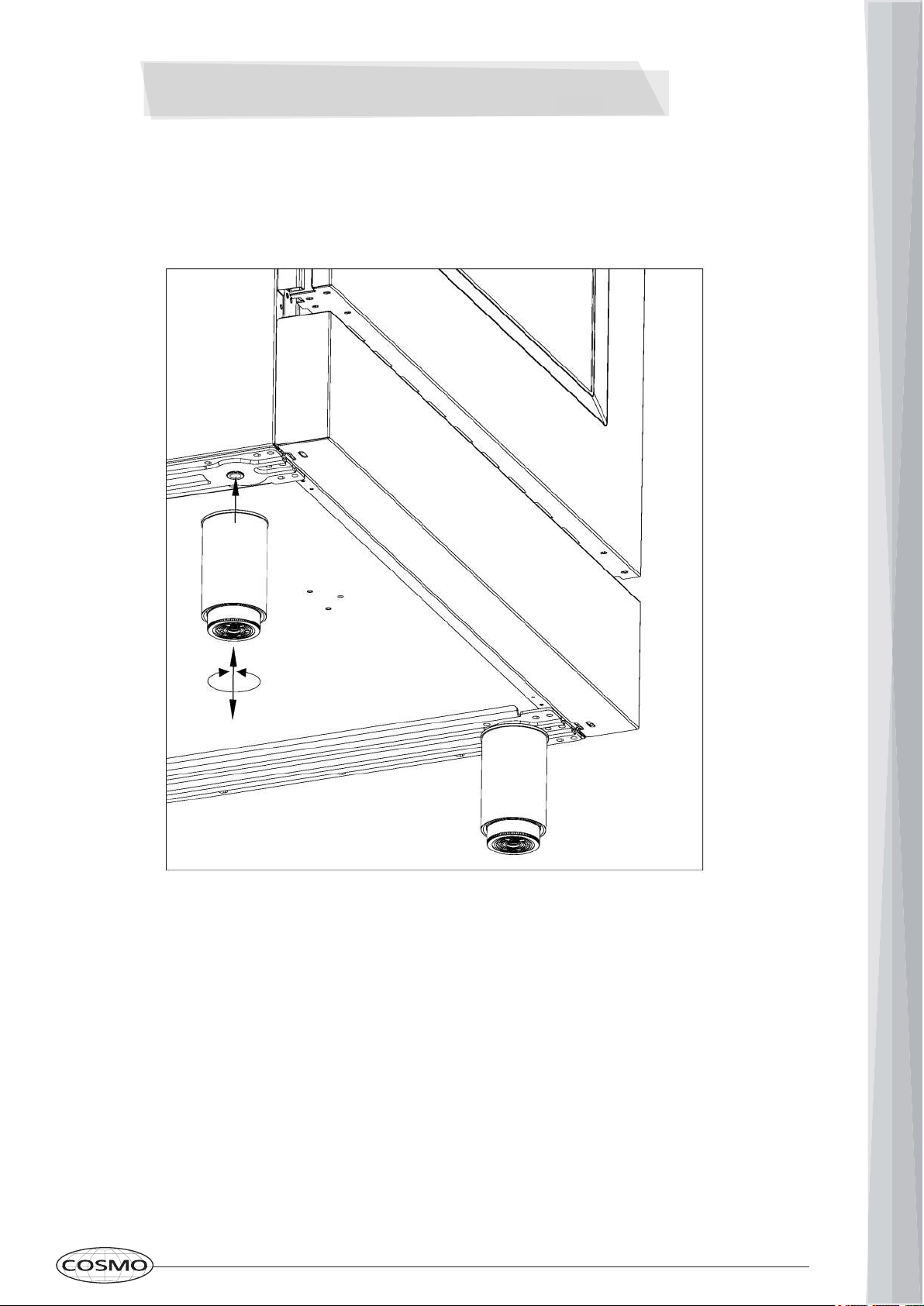
INSTALLATION: LEGS
The ranges must only be used with the legs properly installed.
Before installing the legs, position the appliance near its final location as the
legs are not suitable for moving the appliance over long distances.
Four height-adjustable legs are shipped with the range in the polystyrene
container situated over the appliance.
After unpacking the range, raise it enough
to insert the legs in the appropriate receptacles situated on the lower part of
the appliance. Lower the range gently to keep any undue strain from legs
and mounting hardware. If possible use a pallet or lift jack instead of tilting
the unit.
Adjust leg height to the desired level by twisting the inside portion of the leg
assembly until the proper height is reached. Check with a level device
to ensure the cooktop is perfectly level.
7
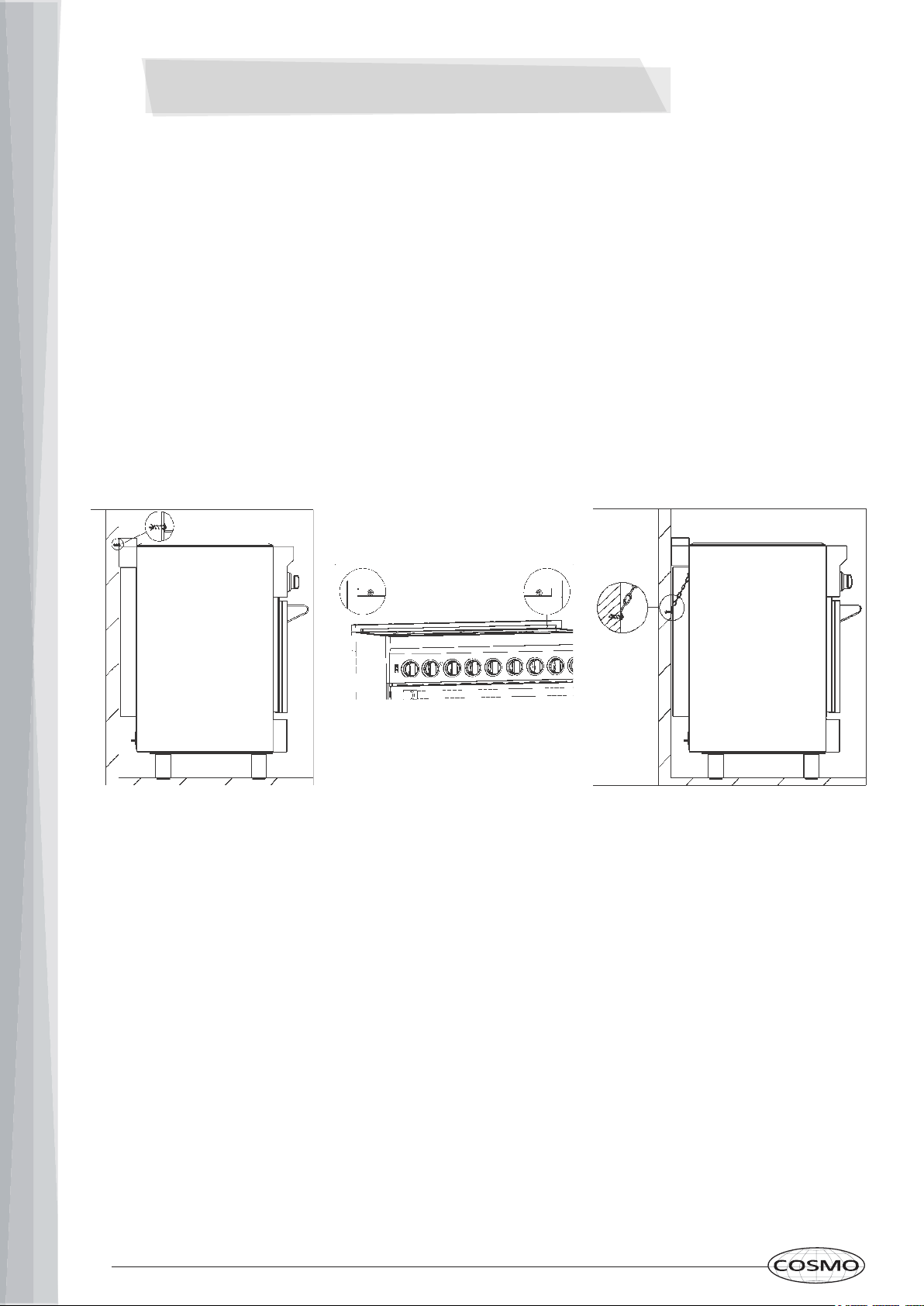
1.) The anti-tip bracket shipped with the range must be properly secured to the rear wall as
shown in the picture below. The height of the bracket from the floor must be determined after
the range legs have been adjusted to the desired height and after the range has been leveled.
Measure the distance from the floor to the bottom of the anti-tip bracket receptacle on the
back of the appliance. Position the two anti-tip brackets on the wall at the desired height plus
1/8" (0.32 cm). The brackets must be placed at 2 - 5/16" (6.0 cm) from each side of the range.
The distance between the two bracket is 25 - 1/4" (64.1 cm). Secure the brackets to the wall
with appropriate hardware. Slide the range against the wall until the brackets are fully inserted
into their receptacles on the back of the range.
Check to see that the Anti-Tip device is installed properly. Grasp the top rear edge of the
range and carefully attempt to tilt it forward. Verify that the Anti-Tip device is engaged.
2.) Or, use the anti-tip chain, and tighten up with fixed screw on the wall, and when the wall
not suitable for installation, the chain shall be fixed to the cabinet structure.
INSTALLATION: ANTI-TIP DEVICE
8
INSTALLATION: RANGE
E
.
G
ELECTRICAL REQUIREMENTS
A properly grounded and electrical
receptacle Type NEMA 14-50R should
be installed; refer to ELECTRICAL
CONNECTION section Page 10.
Check all local code requirements.
GAS REQUIREMENTS
An agency-approved, properly-sized
manual shut-off valve should be installed
no higher than 3" (7.6 cm) above the
floor and no less than 2" (5 cm) and no
more than 8" (20.3 cm) from the right
side (facing product).
To connect gas between shut-off valve
and regulator, use agency-approved,
properly sized flexible or rigid pipe.
Check all local code requirements.
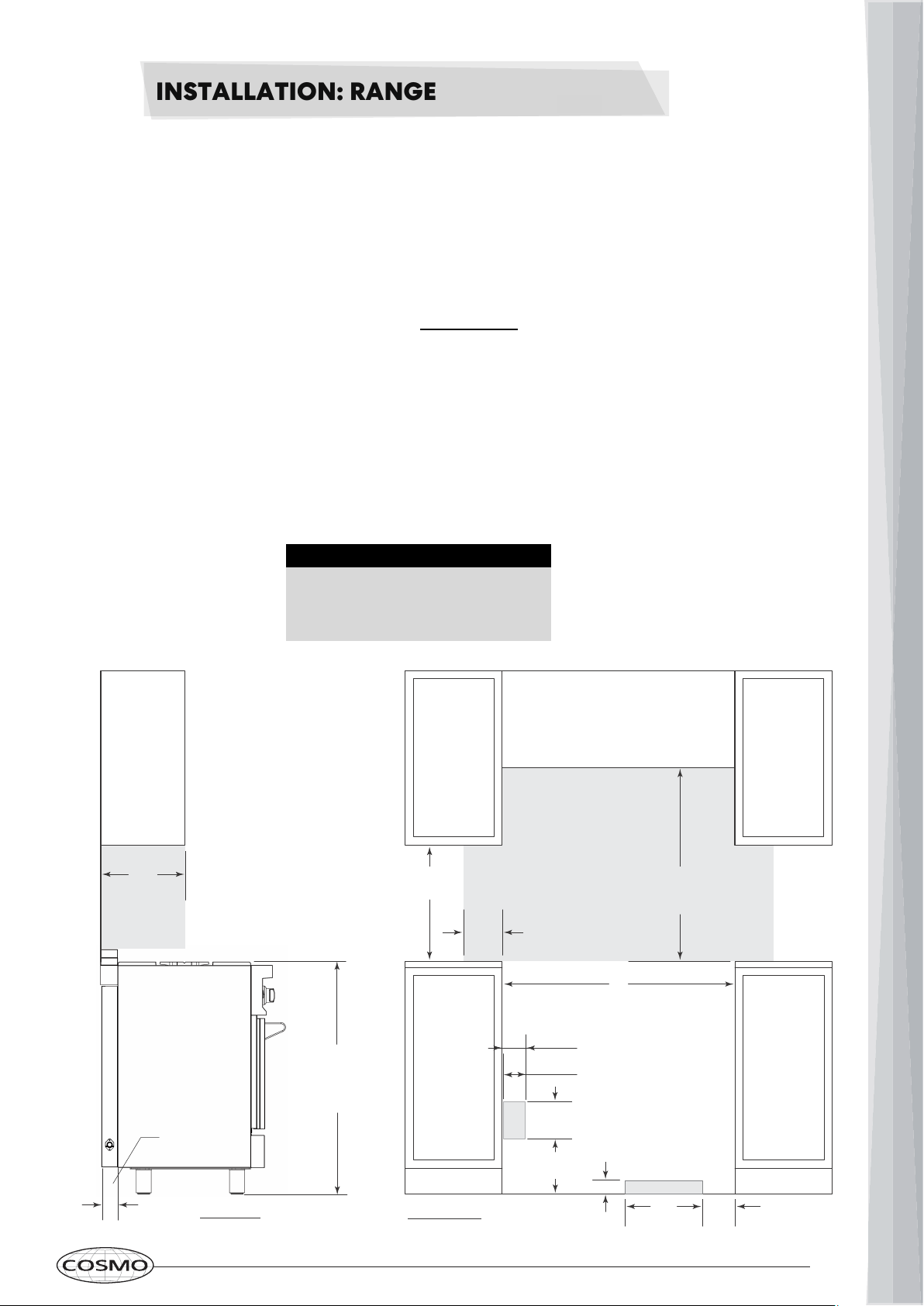
INSTALLATION ADJACENT TO KITCHEN
CABINETS
This range may be installed directly adjacent to
existing countertop high cabinets (36" or 91.5 cm
from the floor). For the best look, the worktop
should be level with the cabinet countertop. This
can be accomplished by raising the unit using the
adjustment spindles on the legs.
ATTENTION: The range CANNOT be installed
directly adjacent to kitchen walls, tall cabinets, tall
appliances, or other vertical surfaces above 36"
(91.4 cm) high. The minimum side clearance in
such cases is 6" (15.2 cm).
Wall cabinets with minimum side clearance must be
installed 30" above the countertop with countertop
height between 35 1/2" (90.2 cm) and 37 1/4" (94.6
cm). The maximum depth of wall cabinets above
the range shall be 13" (33.0 cm).
E
.
G
COOKING RANGE WIDTH
30" Model
30"(757)
36" Model
36"(910)
48" Model
48"(1215)
3 23"
(82)
FRONT VIEW
30"
(762)
6"
(152)
(65)
(930)
T
O
COOKING
SURFACE
W
OPENING WIDTH
30" (762) TO 36"
(914) TO BOTTOM OF
VENTILATION HOOD*
E
LOCATION OF GAS AND
ELECTRICAL EXTENDS
ON FLOOR
SIDE VIEW
.
13"
(330)
3 15"
(80)
.
12"
(305) GAS
5"
(127)
2"
(51)
G
5
3
/4
"
(146)
(250)
9
3
/
4
"
36
3
/5"
2
3
/5"
9
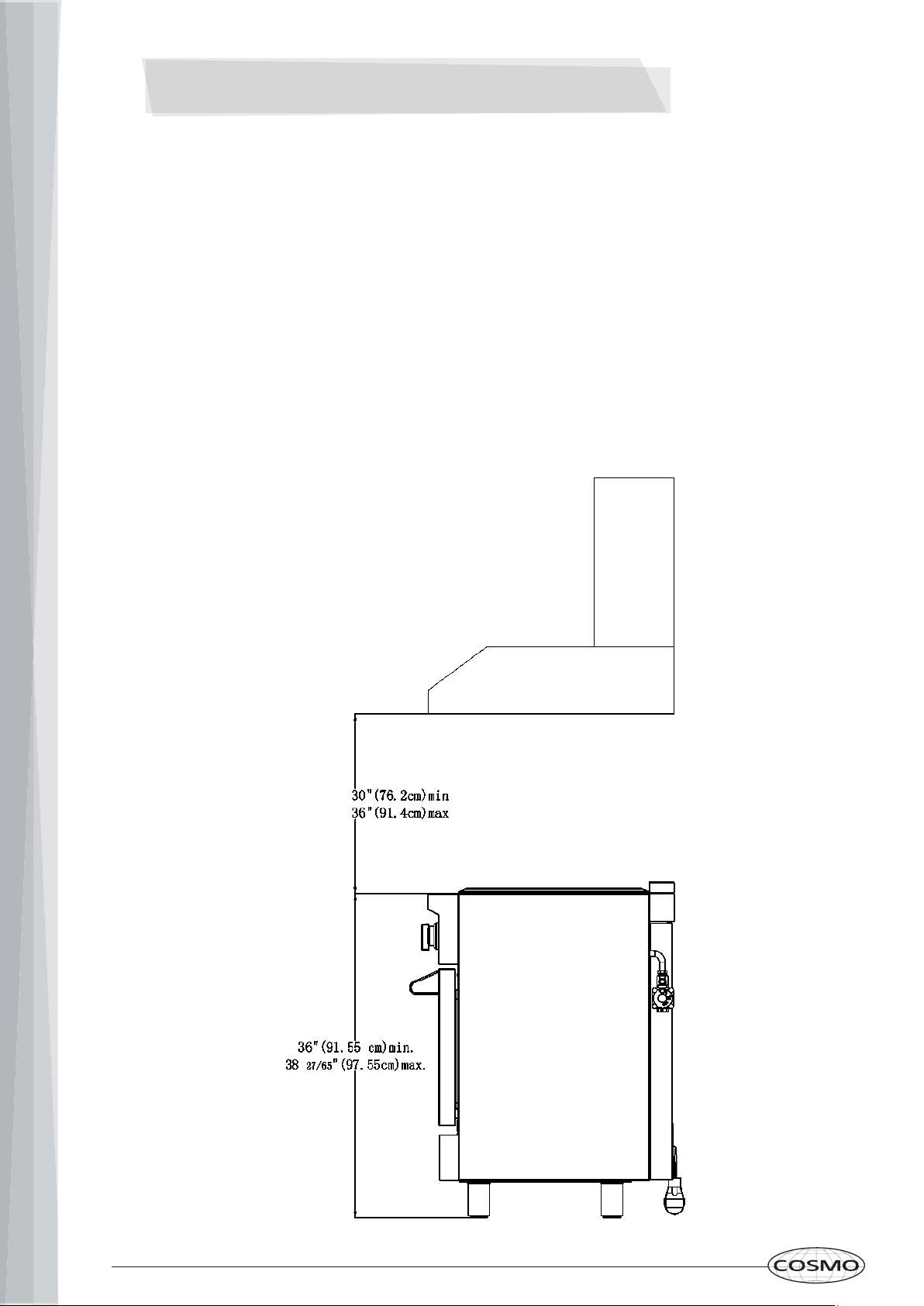
To eliminate the risk of burns or fire by reaching over heated surface units, cabinet storage
space located above the surface units should be avoided. If cabinet storage is to be provided,
the risk can be reduced by installing a range hood. These hoods have been designed to work
in conjunction with the range and have the same finish for a perfect look.
For maximum performance, the height of the bottom of the hood from the worktop should be
between 30" (76.2 cm) and 36" (91.4 cm). This would typically result in the bottom of the
hood being 61 1/2" (156.2 cm) to 67 1/2" (171.5 cm) above the floor. These measurements
provide for safe and efficient operation of the hood.
Before installation of the exhaust hood, consult local or regional building and installation
codes for additional specific clearance requirements.
Refer to the range hood installation instructions provided by the manufacturer for additional
information.
INSTALLATION: RANGE HOOD
10
Rating Label
The appliance shall be connected to a single
phase electric line rated at 120 208Vac or 120/
240Vac and 60Hz frequency.
ELECTRIC POWER RATING
• 120/208Vac: 10 A max
• 120/240Vac: 12 A max
HEATING ELEMENTS POWER RATING
• Oven bake element = 1500 Watt
• Oven circular element = 3200 Watt
• Oven broil element = 2850 Watt
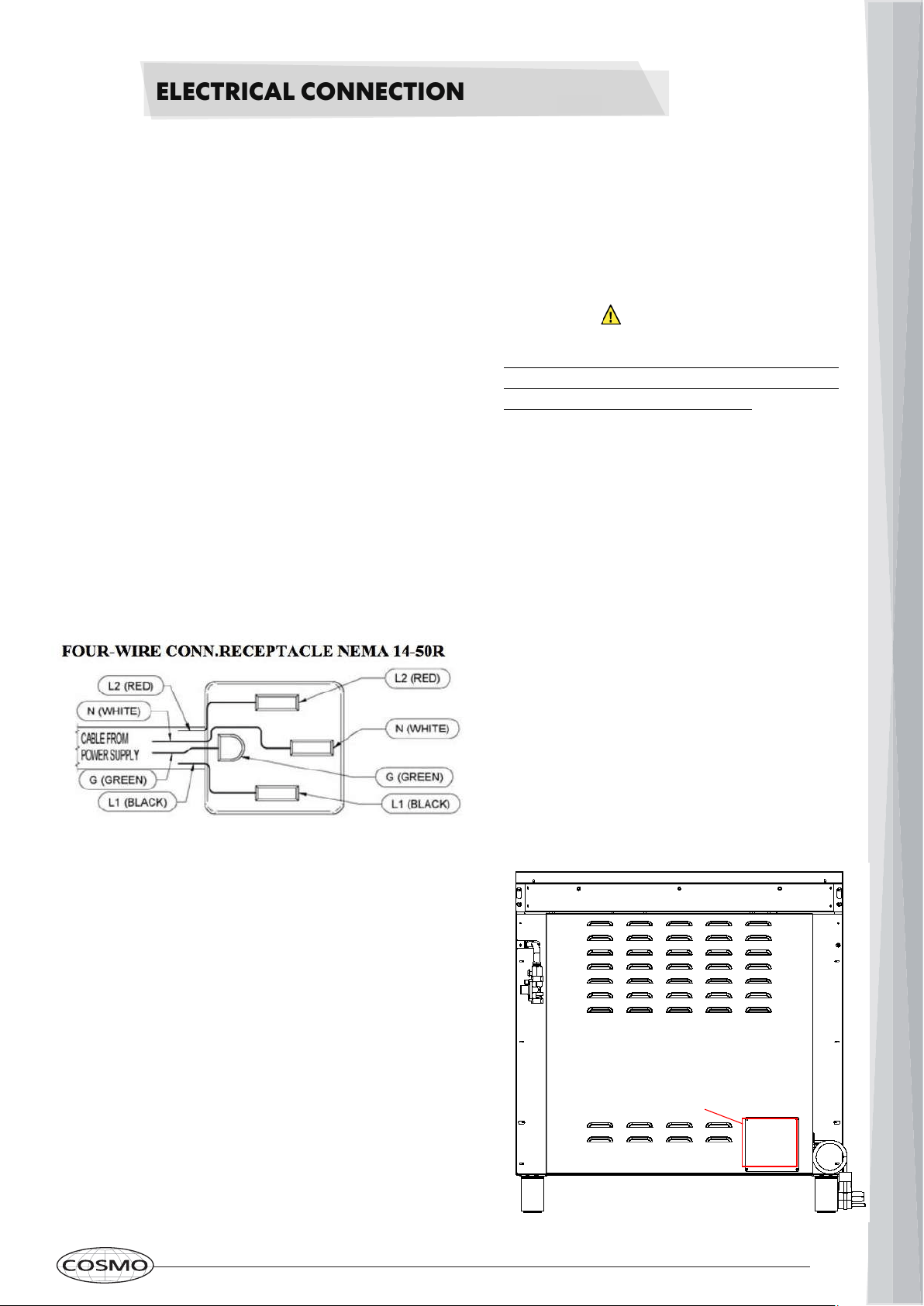
Install a suitable electric power supply
receptacle connection type NEMA 14-50R able
to support a load of at least 30 A (per line)
according to local code requirements. For four
wires power supply connection system see
diagram below.
Check your local code for which of the options
below should be used in grounding the
receptacle power suppliy connections.
FOUR WIRES CONNECTION
• Connect the L1 receptacle terminal to the
incoming BLACK electrical supply wire(L1-hot
wire)
• Connect the L2 receptacle terminal to the
incoming RED electrical supply wire (L2-hot
wire)
• Connect the NEUTRAL receptacle terminal to
the incoming NEUTRAL (WHITE) electrical
supply wire
• Connect the GROUND receptacle terminal to
the incoming GROUND (GREEN) electrical
supply wire
ELECTRICAL GROUNDING
This appliance is equipped with a four-
prong plug for your protection against
shock hazard and should be plugged
directly into a properly grounded
receptacle, do not cut or remove the
prong from this plug.
WARNING
ELECTRICAL SHOCK HAZARD
Disconnect electrical power at the
circuit breaker box or fuse box before
installing the appliance. Provide
appropriate ground for the appliance.
Use copper conductors only. Failure to
follow these instructions could result
in serious injury or death.
DO NOT USE EXTENSION CORDS
WITH THIS APPLIANCE AS IT MAY
RESULT IN FIRE, ELECTRIC SHOCK
OR OTHER TYPE OF PERSONAL
INJURY.
Label all wires prior to disconnecting
when servicing controls. Wiring errors
can cause improper and dangerous
operation. Verify proper operation after
servicing.
When working with electrical
connection, please refer to the rating
label, the rating label is located near the
entrance of power supply cord.
ELECTRICAL CONNECTION
11
POWER CORD REPLACEMENT
DO NOT USE EXTENSION
CORDS WITH THIS APPLIANCE
AS IT MAY RESULT IN FIRE,
ELECTRIC SHOCK OR OTHER
TYPE OF PERSONAL INJURY.
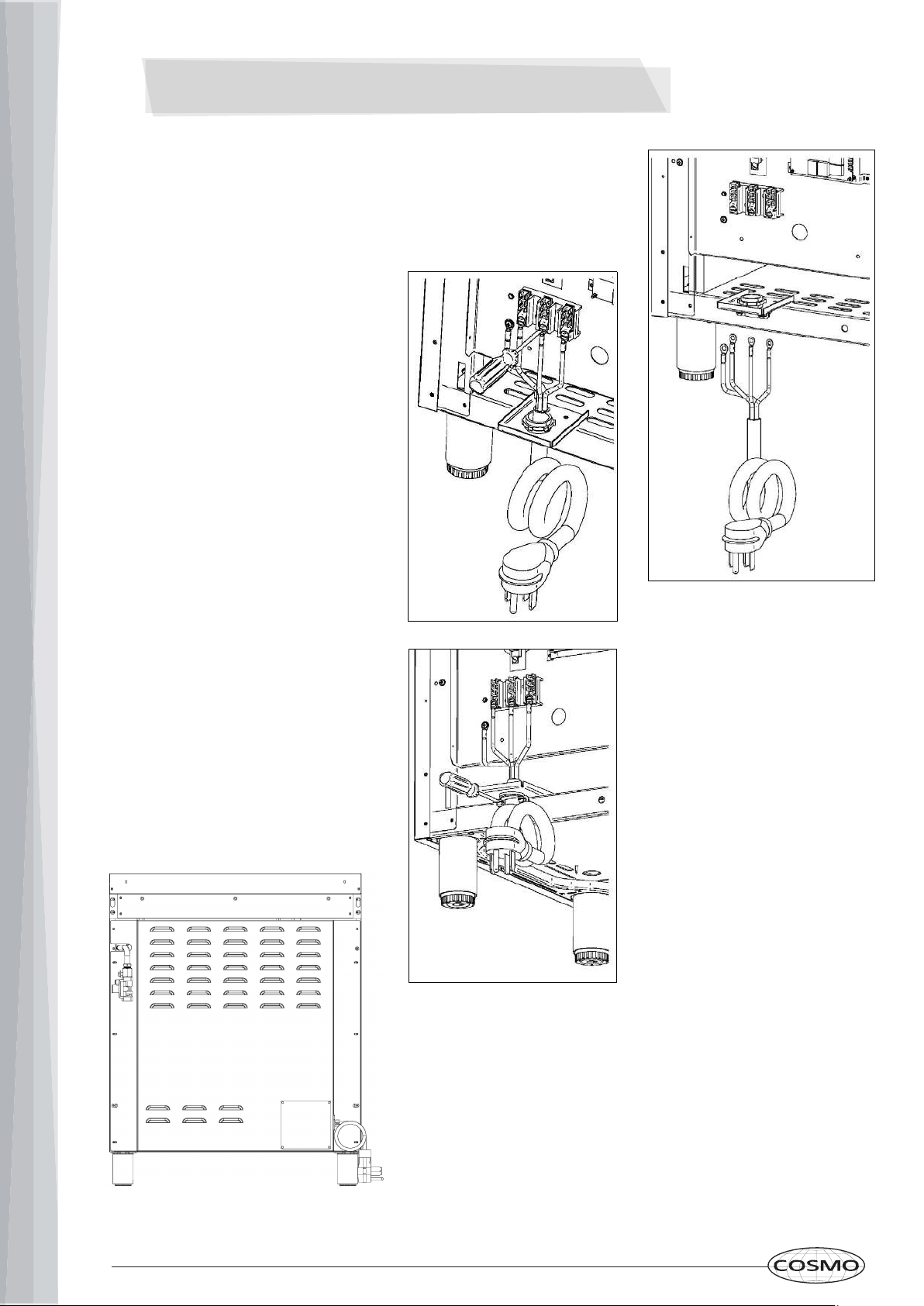
The appliance is equipped at
the factory with an electric
supply cord set 4 wires type
with ring terminals (L1, L2, N,
Ground) suitable for range use
UL/CSA listed type SRDT/DRT
2x6AWG (L1, L2)+2x8AWG (N,
G) rated 300V, 40 or 50A with
fused plug type NEMA 14-50P;
cable length 1.5m in case the
supply cord set must be replaced,
it must be replaced with an
identical set having the save
technical specifications and
installed using the following
directions:
1.) Disconnect appliance from
electrical power supply receptacle
2.) Slide out the appliance from
the installation place to access
the back enclosure
3.) Remove back enclosure panel
by removing the 6 screws as
shown below.
4.) Loose strain relief
by unscrewing two
strain relief's screws in
diagram
5.) Remove damaged
supply cord set by taking off
the 4 electrical connection
screws (block L1, N, L2 and
Ground screw, see
diagram)
6.) Insert the new supply
cord set in the strain relief
and lock it with two strain
relief’s screws in suitable
position
7.) Fix well the ring
terminals G, L1, N, L2 of
the new supply cord set, as
shown in diagram with its 4
screws
8.) Reinstall the back
enclosure panel with 6
screws
9.) Slide the appliance back
into its proper location
10.) Reconnect the
appliance to the electrical
power
12
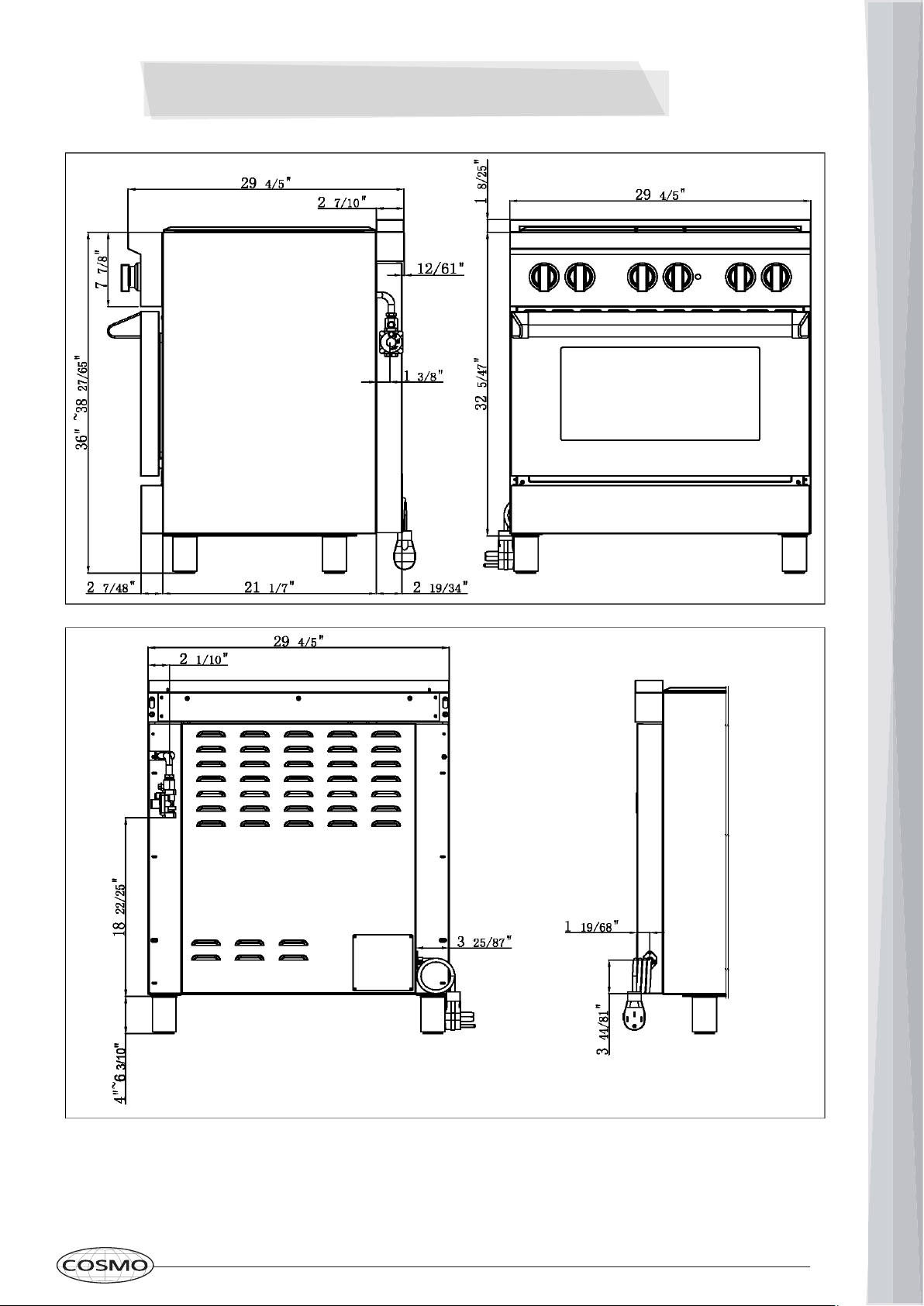
DIMENSION DIAGRAM: DFR304
13
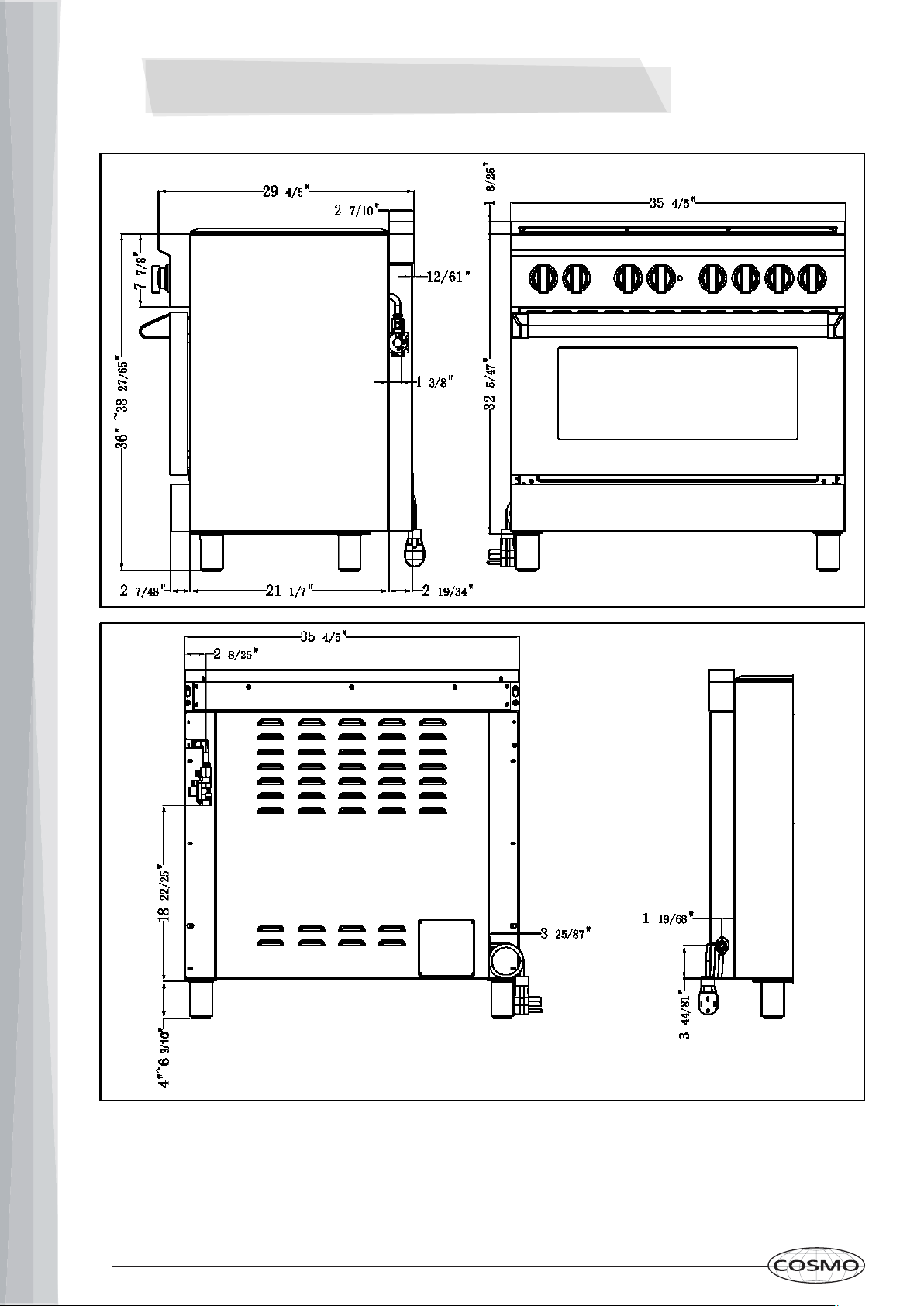
DIMENSION DIAGRAM: DFR366
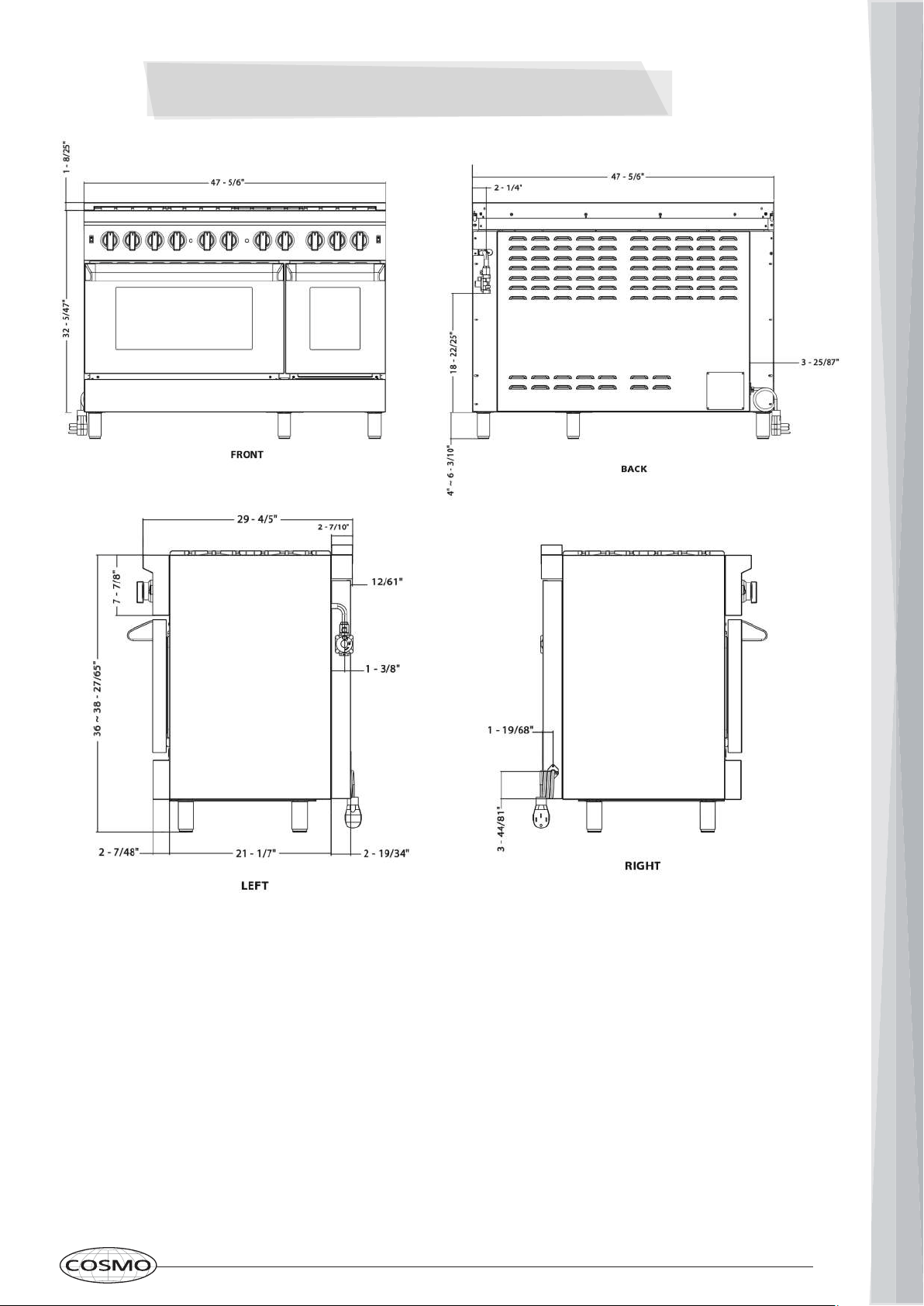
14
DIMENSION DIAGRAM: DFR486G
15
CIRCUIT DIAGRAMS
DFR304
DFR366
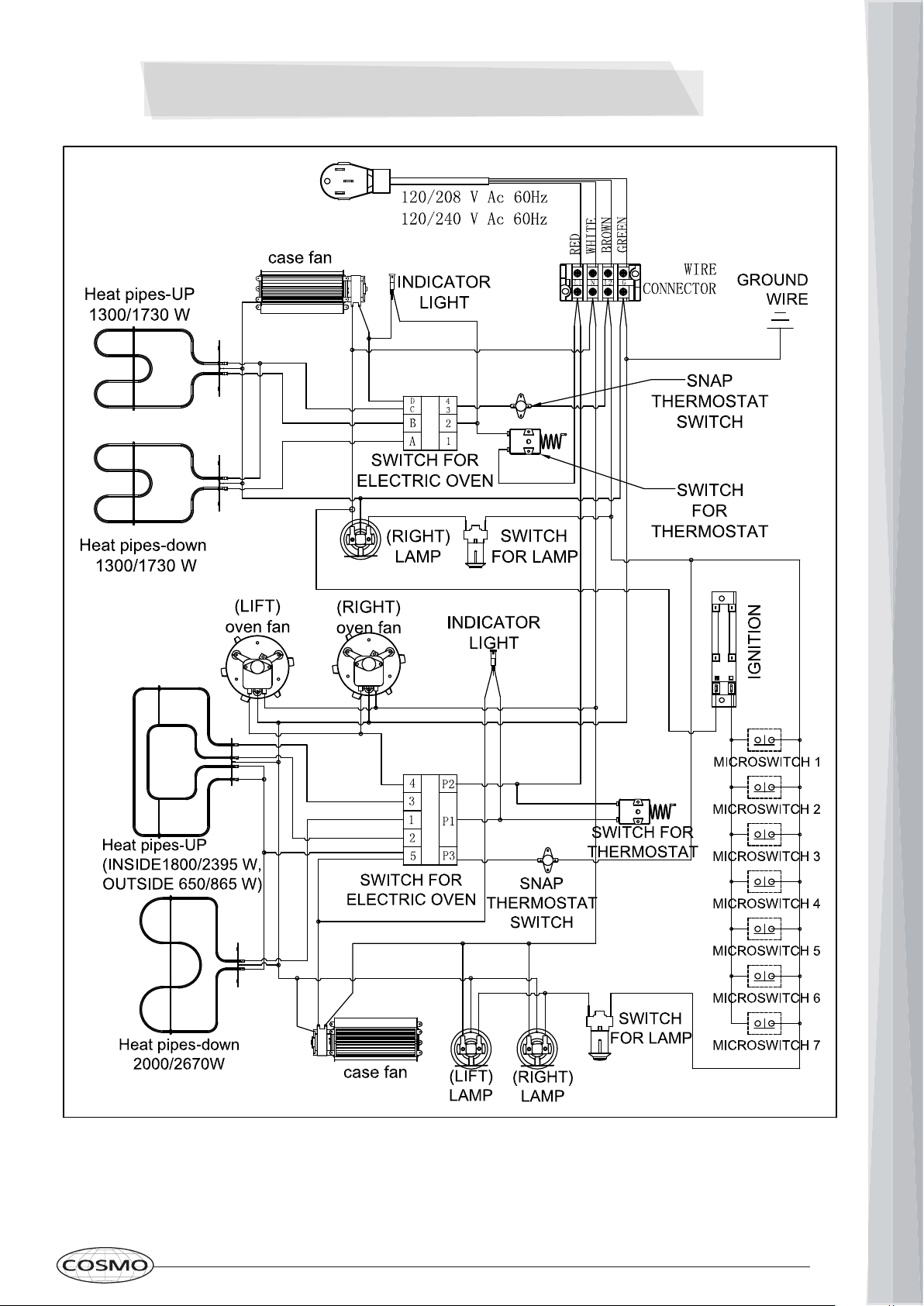
16
CIRCUIT DIAGRAMS
DFR486G
17
GAS CONNECTION
All gas connections must comply with
national and local codes. The gas supply line
(service) must be the same size or greater
than the inlet line of the appliance. This
range uses a 1/2" NPT inlet (see drawing
below for details of gas connection). On all
pipe joints use appropriate sealant resistant
to gas.
This range can be used with Natural or LP/
Propane gas. The range is shipped from the
factory for use with natural gas.
For LP/propane household installation, the
appliance must be converted by the dealer,
by a factory-trained professional or by a
qualified licensed plumber or gas service
company.
Gas conversion is important for safe and
effective use of the appliance. It is the
responsibility of the dealer and the owner of
the range to perform the appropriate gas
conversion following the directions of the
manufacturer.
THE PROPER GAS CONVERSION
PROCEDURE IS DESCRIBED IN THIS
MANUAL. REPLACEMENT NOZZLES
CAN BE PURCHASED FROM
COSMOAPPLIANCES.COM.
Please provide the service person with this
manual before work is started on the range.
WARNING: DO NOT USE AN OPEN
FLAME WHEN CHECKING FOR LEAKS.
Leak testing of the appliance shall be
conducted according to the manufacturer's
instructions. Before placing the oven into
operation, always check for leaks with soapy
water solution or other acceptable method.
Check for gas leakage with soapy water
solution or other acceptable methods in all
gas connections installed between inlet gas
pipe of the appliance, gas regulator, till to the
manual shut-off valve.
MANUAL SHUT-OFF VALVE
THIS VALVE IS NOT SHIPPED WITH THE
APPLIANCE AND MUST BE SUPPLIED BY THE
INSTALLER.
The manual shut-off valve must be installed in the
gas service line between the gas hook-up on the
wall and the appliance inlet, in a position where it
can be reached quickly in the event of an
emergency.
In Massachusetts: A T handle type manual gas
valve must be installed in the gas supply line to
this appliance.
FLEXIBLE CONNECTIONS
In case of installation with flexible couplings and/
or quick-disconnect fittings, the installer must use
a heavy-duty, AGA design-certified commercial
flexible connector of at least 1/2" (1.3 cm) ID NPT
(with suitable strain reliefs) in compliance with
ANSI Z21.41 and Z21.69 standards.
In Massachusetts: The unit must be installed
with a 36" (3-foot) long flexible gas connector.
In Canada: use CAN 1-6.10-88 metal connectors
for gas appliances and CAN 1-6.9 M79 quick
disconnect device for use with gas fuel.
PRESSURE TEST-POINT STOPPER VALVE
To avoid gas leaks, the pressure test-point
stopper valve and gasket supplied with the range
must be installed on the gas fitting at the back of
the range according to the diagram below.
18
GAS CONNECTION
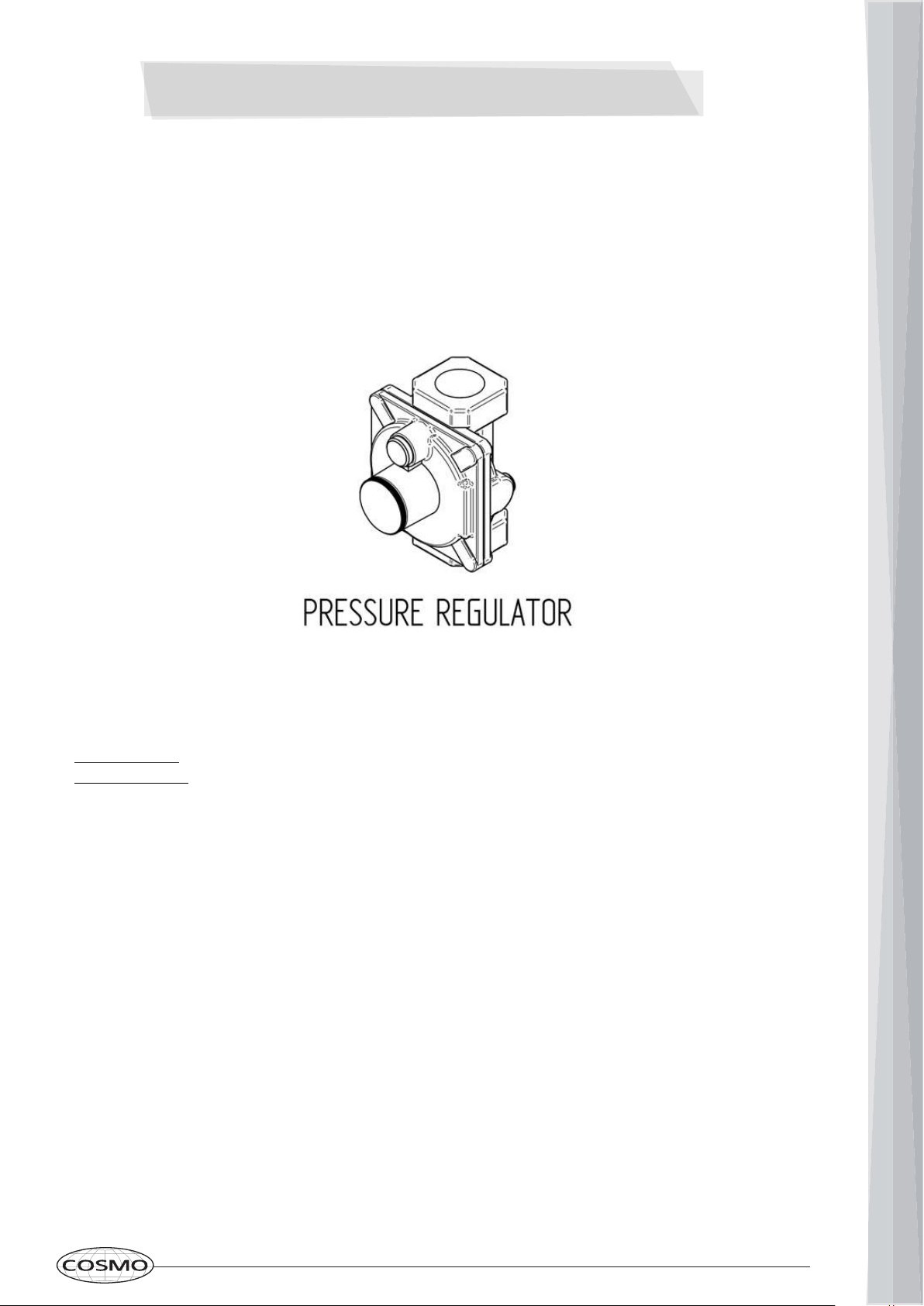
PRESSURE REGULATOR
Since service pressure may fluctuate with local demand, every gas cooking appliance must
be equipped with a pressure regulator on the incoming service line for safe and efficient
operation.
The pressure regulator shipped with the appliance has two female threads 34" NPT. The
regulator shall be installed properly in order to be accessible when the appliance is installed
in its final position.
Manifold pressure should be checked with a manometer and comply with the values
indicated below:
• Natural Gas: 4.0" W.c.P.
• LP / Propane: 10.0" W.C.P
Incoming line pressure upstream from the regulator must be 1" W.c.P. higher than the
manifold pressure in order to check the regulator.
The regulator used on this range can withstand a maximum input pressure of 1/2 PSI (13.8"
w.c. or 3,5 kPa) If the line pressure exceeds that amount, a step-down regulator is required.
The appliance, its individual shut-off valve, and the pressure regulator must be disconnected
from the gas line during any pressure testing of that system at pressures in excess of 1/2 PSI
(13.8" w.c. or 3,5 kPa).
The individual manual shut-off valve must be in the OFF position during any pressure testing
of the gas supply piping system at test pressures equal to or less than 1/2 PSI (13.8" w.c. or
3,5 kPa).
APPLIANCE SERVING
Before carrying any service, disconnect the appliance from gas appliance from final install
have access to the appliance for proper servicing intervention.
19
GAS CONVERSION
Gas conversion shall be conducted by a trained professional. Call customer service to identify
a trained professional near your home. The gas conversion procedure for this range includes 3
steps:
1.) Pressure regulator
2.) Surface burners
3.) Adjustment of minimum setting
The conversion is not completed if all 3 steps have not been concluded properly.
The replacement nozzles are sold separately and can be purchased from
cosmoappliances.com. Before performing gas conversion, obtain the proper nozzle for your
range.
STEP 1: PRESSURE REGULATOR
The pressure regulator supplied with the appliance is a convertible type pressure regulator for
use with Natural Gas at a nominal outlet pressure of 4" w.c. or LP gas at a nominal outlet
pressure of 11" w.c. and it is pre-arranged from the factory to operate with one of these gas /
pressure as indicated in the labels affixed on the appliance, package and Instruction booklet.
To convert the regulator for use with other liquid propane LP gas:
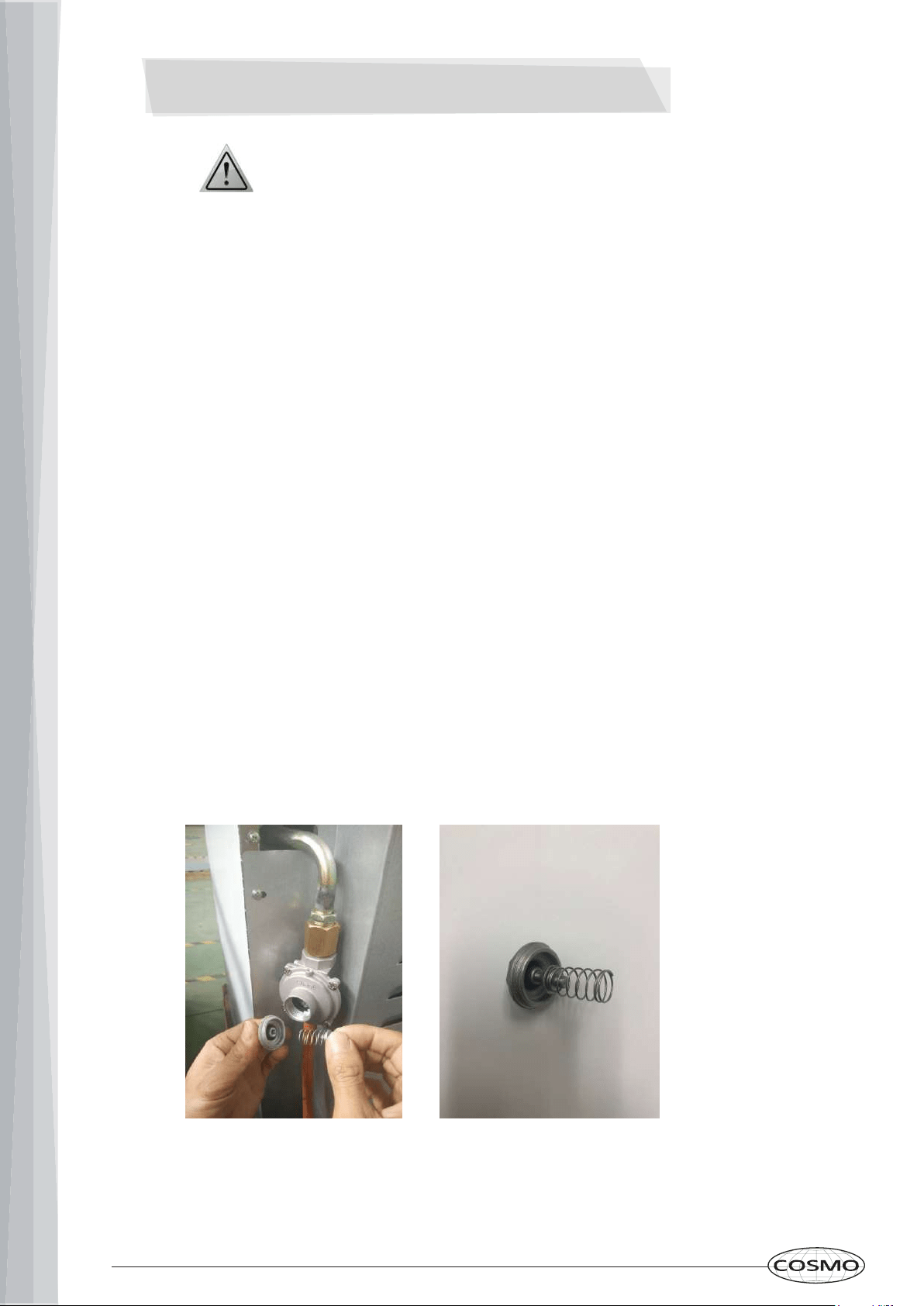
1.) Unscrew by hand the upper cap of the regulator, remove the silver plastic attachment from
the cap, reverse its direction and screw it again firmly against the cap. Once reversed, the
spring should be facing out, as shown below.
2.) Screw by hand the metal cap in the original position on the regulator
WARNING! Before carrying out this operation,
disconnect the appliance from gas and electricity.
LP GAS
POSITION
20
·When use a wok ,make sure you hold the handle of a wok or a small one-handled pot while
STEP 2: SURFACE BURNERS
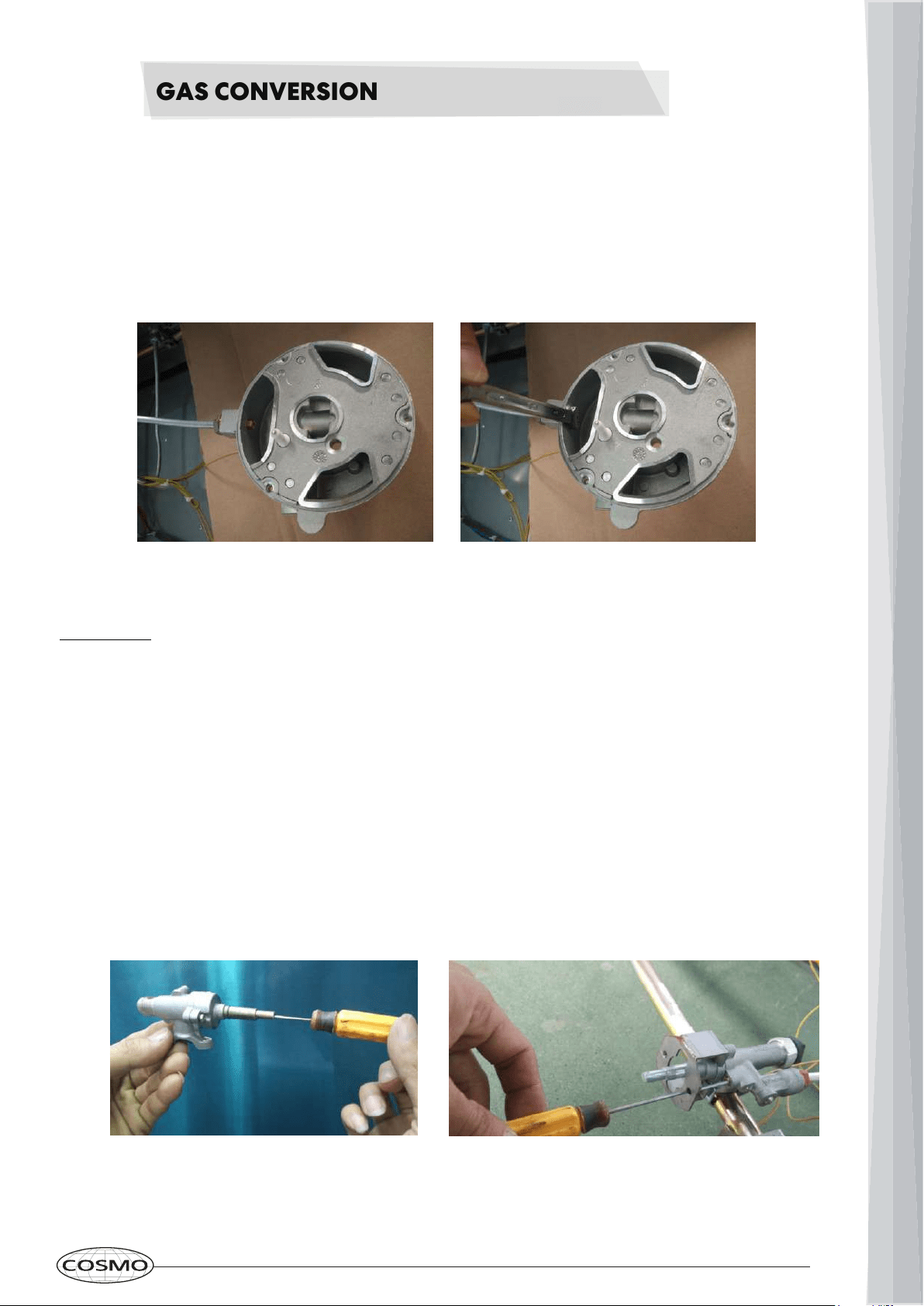
To replace the nozzles of the surface burners, lift up the burners and unscrew the nozzles
shipped with the range using a 7mm socket wrench.
Replace nozzles using the conversion kit. Contact Cosmo Customer Service at 1-888-784-
3108, or go to www.cosmoappliances.com to purchase a conversion kit. Each nozzle has a
number indicating its flow diameter printed on the body.
STEP 3: ADJUSTMENT OF MINIMUM FLAME SETTING
WARNING: These adjustments should be made only for use of the appliance with
natural gas. For use with liquid propane gas, the choke screw must be fully turned in a
clockwise direction.
SURFACE BURNERS
1.) Light one burner at a time and set the to the MINIMUM position(small flame).
2.) Remove the knob.
3.) The range is equipped with a safety valve. Using a small-size slotted screwdriver, locate
the choke valve on the valve body and turn the choke screw to the right or left until the burner
flame is adjusted to desired minimum.
4.) Make sure that the flame does not go out when switching quickly from the MAXIMUM to the
MINIMUM position.
GAS CONVERSION
21
BEFORE USING RANGE HOOD
INSTALLATION CHECKLIST
1.) Is the range mounted on its legs?
2.) Is the back guard securely connected?
3.) Has the anti-tip device been properly
installed?
4.) Does the clearance from the side cabinets
comply with the manufacturers directions?
5.) Is the electricity properly grounded?
6.) Is the gas service line connected following
the directions of the manufacturer?
7.) Have all the proper valves, stoppers and
gasket been installed between the range and
the service line?
8.) Has the gas connection been checked for
leaks?
9.) Has the range been set for the type of gas
available in the household?
10.) Does the flame appear sharp blue, with
no yellow tipping, shooting or flame lifting?
11.) Has the minimum setting for all burners
been adjusted?
FINAL PREPARATION
All stainless steel body parts should be
wiped with hot, soapy water and with a
liquid stainless steel cleanser.
If build-up occurs, do not use steel wool,
abrasive cloths, cleaners, or powders! If it
is necessary to scrape stainless steel to
remove encrusted materials, soak with hot,
wet cloths to loosen the material, then use
a wood or nylon scraper. Do not use a
metal knife, spatula, or any other metal
tool to scrape stainless steel! Scratches
are almost impossible to remove.
Before using the oven for food
preparation, wash the cavity thoroughly
with a warm soap and water solution to
remove film residues and any dust or
debris from installation, then rinse and
wiped dry.
22
• Remember to set all cooktop / oven / broiler burners control knob to OFF position when not
in use.
• Be sure your appliance is properly installed and grounded by a qualified technician.
• Children should not be left alone or unattended in area where appliance is in use.
• Children should never be allowed to sit or stand on any part of the appliance.
• Do not store items of interest to children in cabinets above a range or on the back
guard of a range; children climbing on the range to reach items could be seriously injured.
• Wear proper apparel. Loose-fitting or hanging garments should never be worn while using
the appliance.
• Do not repair or replace any part of the appliance unless specifically recommended in
the manual. All other servicing should be referred to a qualified technician.
• Use only dry potholders. Moist or damp potholders on hot surfaces may result in burns
from steam. Do not let potholder touch hot heating elements.
• Do not use a towel or other bulky cloth.
• Do not to cover the holes inside the oven with aluminum foil.
• Do not to cover the worktop with aluminum foil.
• Do not store any flammable object or objects under pressure in the storage compartment.
• Keep the area of operation of the range free from combustible materials, gasoline and
other flammable vapors and liquid.
• Do not store dangerous or flammable materials in the cabinets above the appliance, since
this may result in a potential fire hazard.
• Do not use the appliance for space heating.
• Never use your appliance for warming or heating the room.
• Do not use aerosol sprays in the vicinity of the appliance while cooking.
• Do not sit or step on the oven door.
• Do not use oven for storage.
• Use care when opening door.
• Allow hot air or steam escape before removing or replacing food.
• Do not heat unopened food containers. Build-up of pressure may cause container to burst
and result in injury.
• Keep oven vent ducts unobstructed.
Continued on next page
OPERATING SAFETY & WARNINGS
23
OPERATING SAFETY & WARNINGS
• Always place oven racks in desired location when oven is cool. If rack must be moved while
oven is hot, do not let potholder contact hot heating element in oven.
• Do not clean oven door gasket. The door gasket is essential for a good seal. Care should be
taken not to rub, damage, or move the gasket.
• Do not use oven cleaning products. No commercial oven cleaner or oven liner protective
coating of any kind should be used in or around any part of the oven.
• Clean only parts listed in manual.
• Before cleaning the oven, remove broiler pan and other utensils.
• Do not use water on grease fires. Smother fire or flames or use dry chemical or foam-type
extinguisher.
• The cooktop and surfaces facing the cooktop may be hot even though they are dark in
color. Areas near these may become hot enough to cause burns. During and after use, do
not touch, or let clothing or other flammable materials contact the cook-top and surfaces
facing the cook-top until they have had sufficient time to cool.
• WARNING: DO NOT TOUCH HEATING ELEMENTS OR INTERIOR SURFACES OF
OVEN. Heating elements may be hot even though they are dark in color. Interior surfaces of
an oven become hot enough to cause burns. During and after use, do not touch, or let
clothing or other flammable materials contact heating elements or interior surfaces of oven
until they have had sufficient time to cool. Do not touch any surface of the oven until they
have had sufficient time to cool, as some surfaces become hot enough to cause burns,
included: oven vent openings and surfaces near these openings, oven doors, and windows
of oven doors.
• Do not use an extension cord to connect this appliance. If the power supply cord is too
short, have a qualified electrician or serviceman install an outlet near the appliance.
• WARNING: Do not operate the range without the anti-tip device in place and engaged;
a child or adult can tip the range and be killed. Verify the anti-tip device has been properly
installed and engaged. Ensure the anti-tip device is re-installed when the range is moved;
failure to do so can result in death or serious burns to children or adults.
• ROOM VENTILATION: The use of a gas cooking appliance generates heat and
humidity in the room where it is installed. Proper ventilation in the room is needed. Make
sure the kitchen is equipped with a range hood of appropriate power (400 CFM minimum).
Activate the exhaust fan/range hood when possible. Intensive and continuous use of the
appliance may require additional ventilation, for example by opening a window.
24
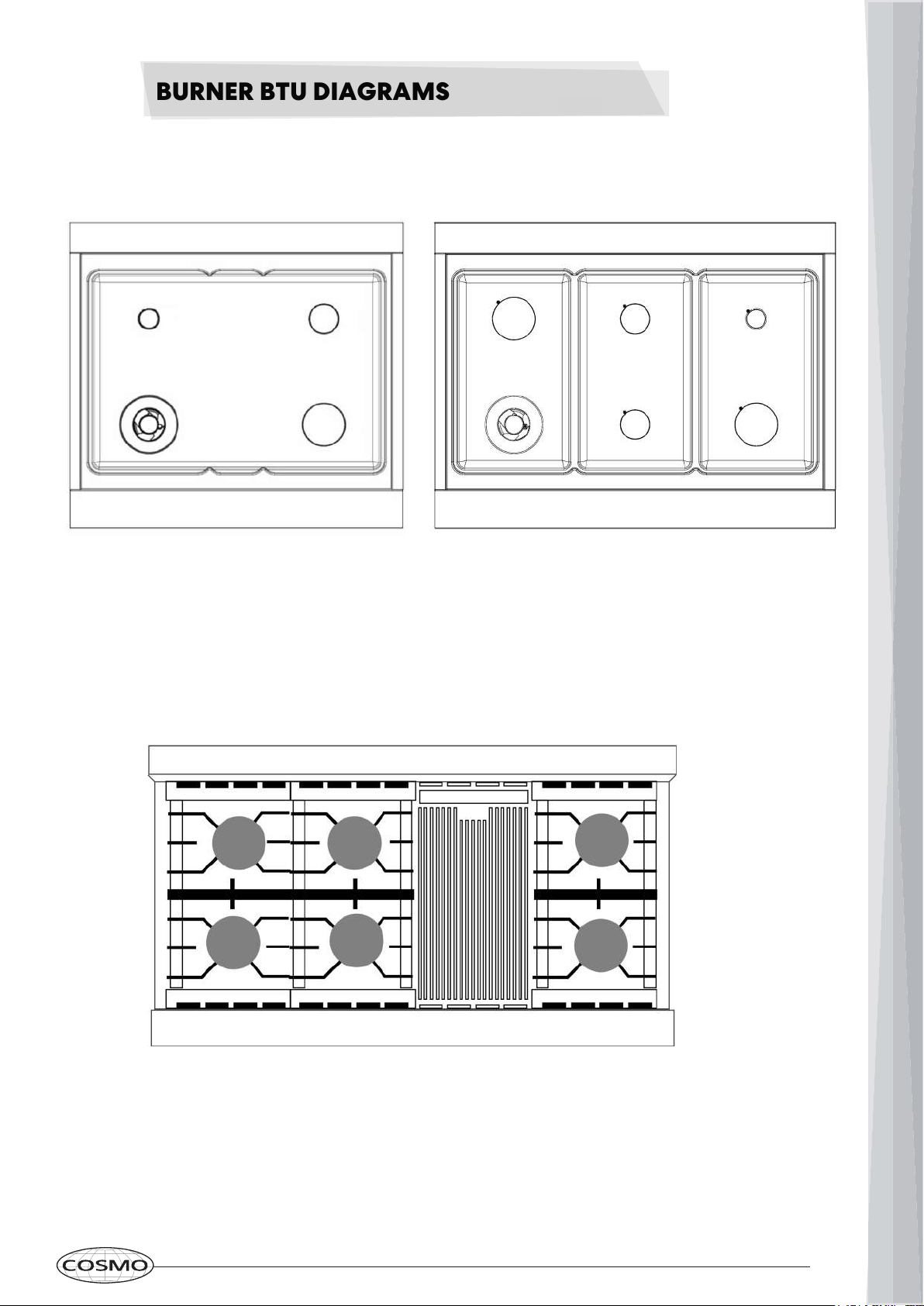
SURFACE BURNER LAYOUT
DFR304 DFR366
DFR486G
BURNERS
• Left Front: 18000 BTU
• Left Rear: 4200 BTU
• Right Front:13000 BTU
• Right Rear: 8500 BTU
BURNERS
• Left Front: 18000 BTU
• Left Rear: 8500 BTU
• Center Front: 4200 BTU
• Center Rear: 13000 BTU
• Griddle: 13000 BTU
• Right Front: 18000 BTU
• Right Rear: 8500 BTU
BURNERS
• Left Front: 18000 BTU
• Left Rear: 13000 BTU
• Center Front: 8500 BTU
• Center Rear: 8500 BTU
• Right Front: 13000 BTU
• Right Rear: 4200 BTU
BURNER BTU DIAGRAMS
25
OPERATING INSTRUCTIONS
COOKTOP SURFACE COOKING
IMPORTANT: Remember to set all cooktop / oven / broiler burners control knob
to OFF position when not in use.
SURFACE BURNER OPERATION
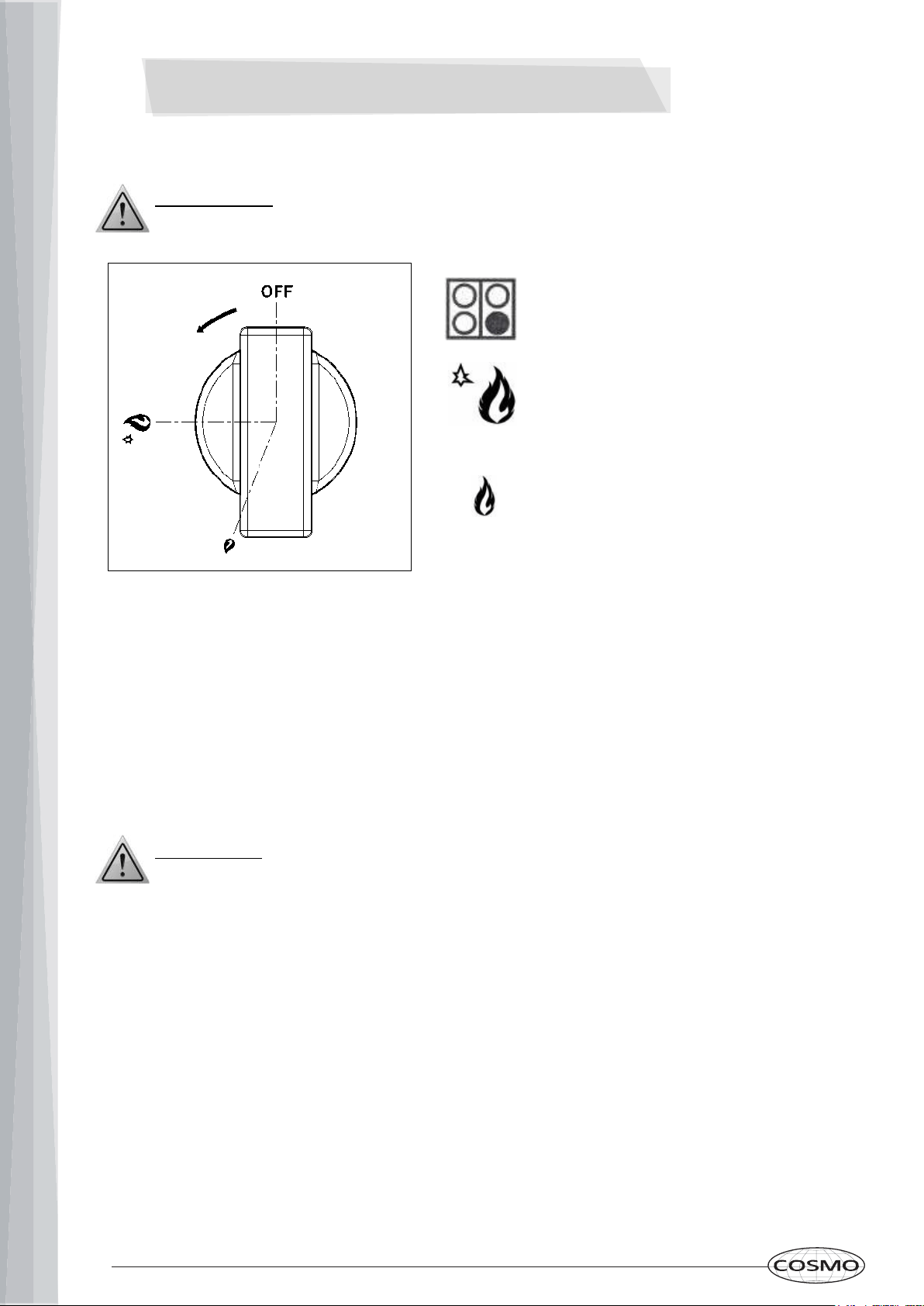
Electric Ignition
To activate the electric ignition, simply turn the control knob counter-clockwise to maximum
power (*position). Press the knob to start the flow of gas and the ignition spark. The spark will
released at the metal tip of the white ceramic pin located on the side of the burner. Once the
flame is on, release the control knob gently.
If the flame turns off, repeat the above procedure.
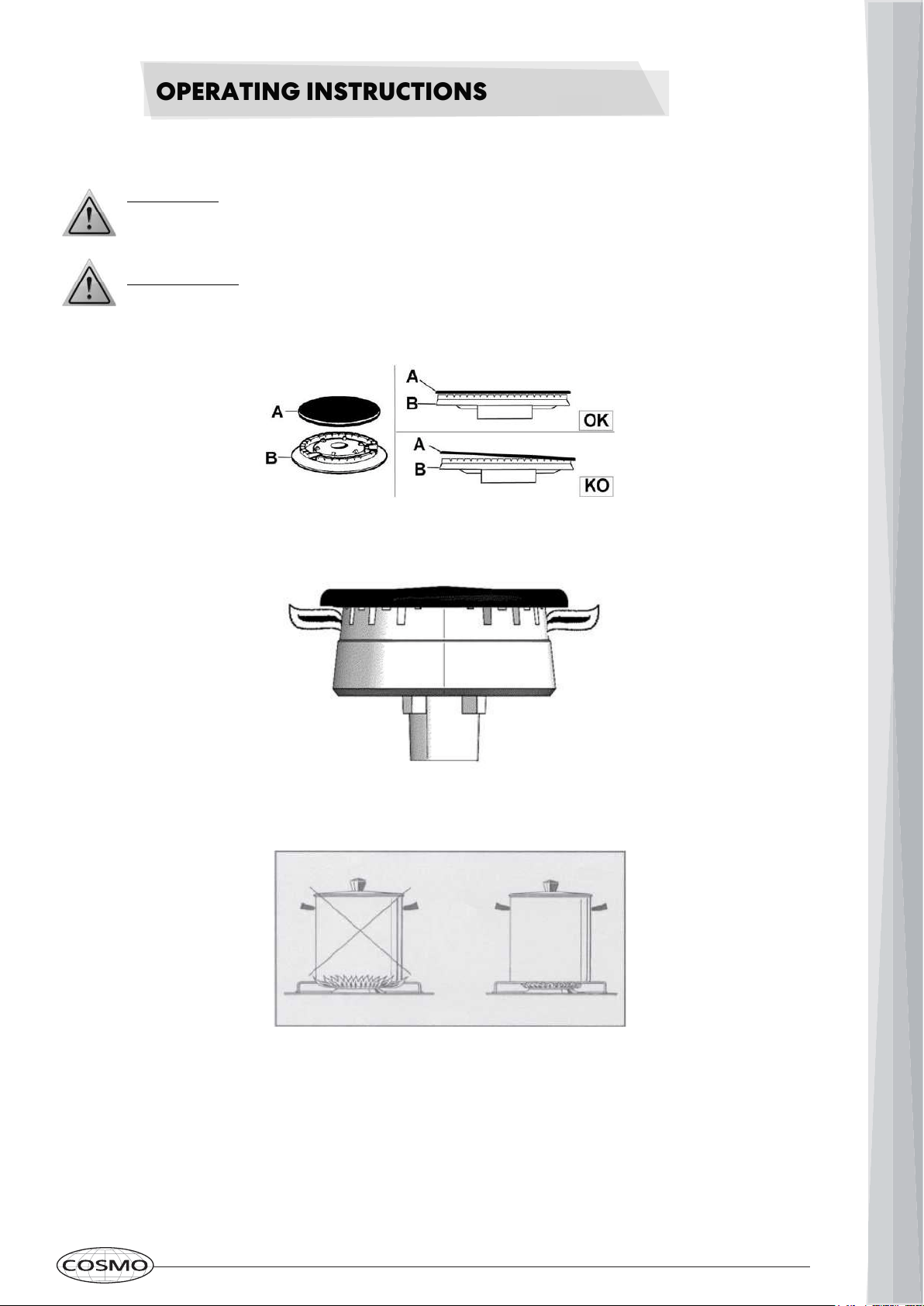
ATTENTION: Do not ignite burners if the black burner cap is not installed or not
centered. The flame will be irregular.
Manual Ignition
Manual ignition is always possible even when the power is cut off or in the event of power
failure. Turn the control knob counter-clockwise to the MAXIMUM position. Light the flame
with a kitchen lighter or with a match.
• Burner Position
Example showing Front right burner
• Maximum Temperature Setting
Recommended control knob
position for burner ignition
• Minimum Temperature Setting
(*) Appliance with worktop gas
valves alternative type
26
OPERATING INSTRUCTIONS
TIPS FOR USING BURNERS CORRECTLY
WARNING: KEEP CHILDREN AT A SAFE DISTANCE FROM THE APPLIANCE
DURING OPERATING. DO NOT ALLOW CHILDREN TO OPERATE THE
APPLIANCE.
IMPORTANT: Remember to set all cooktop / oven / broiler burners control knob
to OFF position when not in use.
1.) Always check that the burner caps are properly installed before operation.
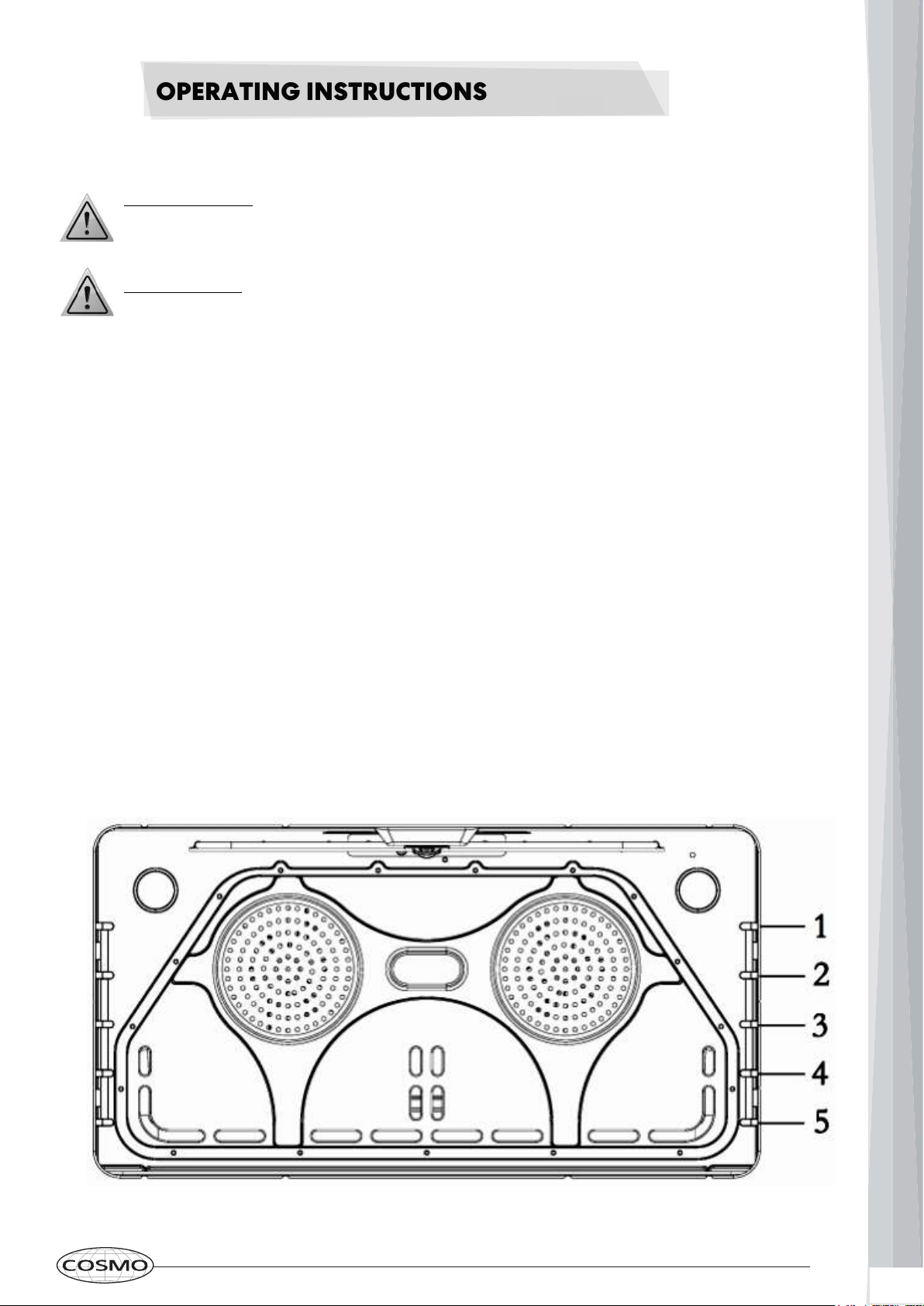
2.) Verify that the flame of the worktop burners be completely blue and with regular aspect as
shown below.
3.) Always adjust the burner flame so it does not extend beyond the edge of the pan.
27
OPERATING INSTRUCTIONS
TIPS FOR USING PANS CORRECTLY
ATTENTION: Always ensure that bottom and handles of pans do not
protrude from the worktop. When cooking with flammable fat such as oil,
do not leave the range unattended.
Use pots of the appropriate size on each burner following the below chart:
Burner Recommended Pan Size
Small
Medium
Large
Dual Burner
• When boiling liquids, turn the knob to the MINIMUM position once boiling is reached to
avoid overflow.
• Always use pots with matching lid.
• Dry the bottom of pans before operation.
• Use pots with a flat, thick bottom (except for wok cooking).
Wok Cooking
Always use the wok adapter supplied with the range. Wok pan external diameter shall
not be smaller than 10" (25cm) and larger than 16" (40cm).
inches (mm)
3 1/2" - 51/2" (90 -140)
5 1/2"-10 1/4" (140 - 260)
7 1/8" - 10 1/4" (180-260)
8 2/3" - 10 1/4" (220 - 260)
28
OPERATING INSTRUCTIONS
OVEN COOKING
BEFORE USE: When using the oven for the first time it should be operated for 15-30
minutes at a temperature of about 500°F without cooking anything inside in order to
eliminate any moisture and odors from the internal insulation.
IMPORTANT: In case of electric power failure, set oven/broiler controls in off position
and do not attempt to use oven/broiler until electric power has been restored.
TIPS
• Use care when opening the oven door. Let hot air or steam escape before removing or
replacing food.
• Do not heat unopened food containers. Buildup of pressure may cause container to burst
and result in injury.
• Keep oven vent ducts unobstructed.
• To keep the oven as clean as possible, cook on the tray.
• When available, always follow recipe book directions. Personal experience will help to
determine any variations in the values reported in the table. In any case, it is recommended
to follow the instructions of the specific recipe being used.
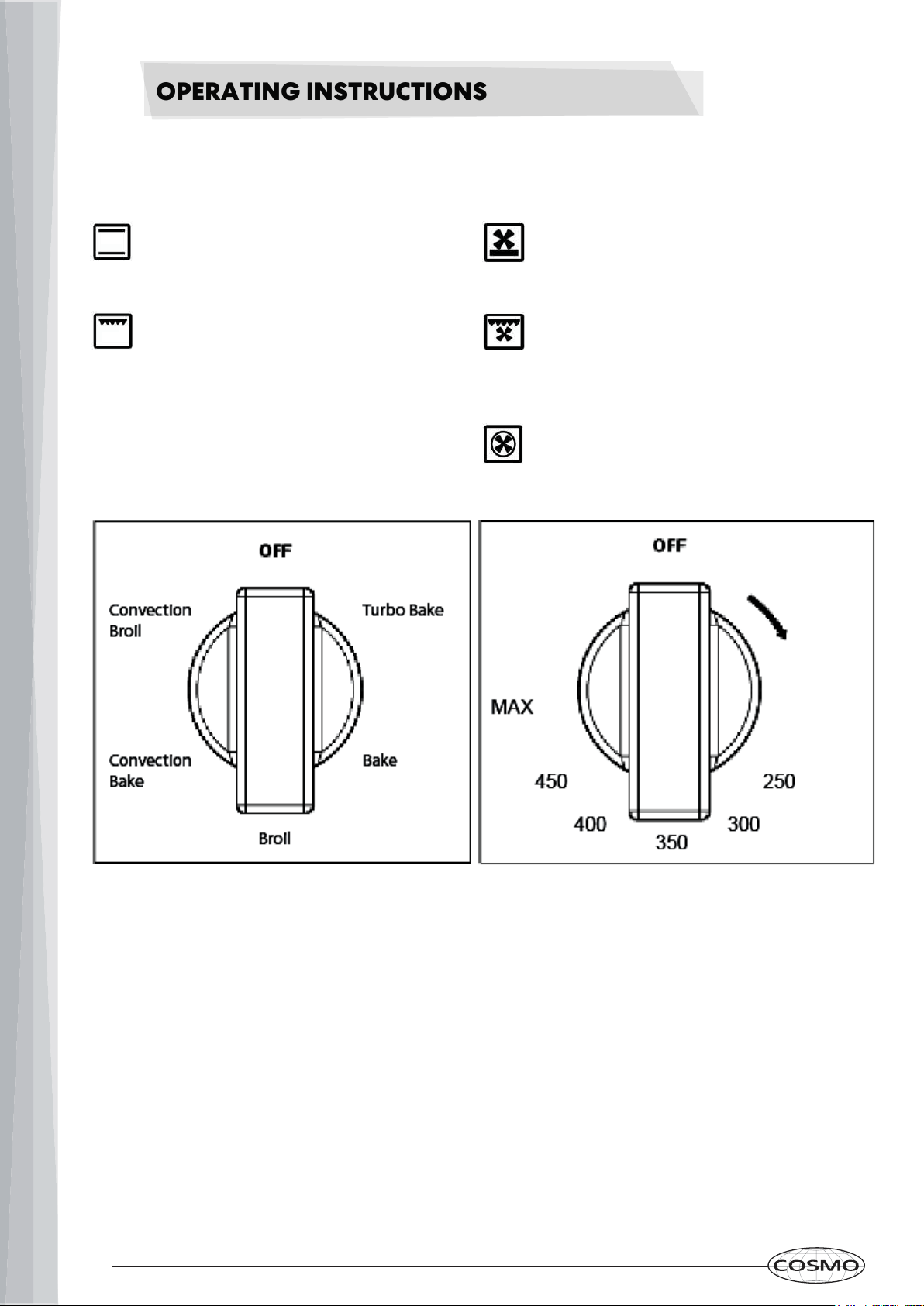
• The ranges are equipped with commercial grade shelves and an enamel cooking tray.
Shelves are mounted on the appropriate guides situated on the sides of the oven
compartment. Insert the shelf between top and bottom guide in any of the 5 positions
available.
29
OPERATING INSTRUCTIONS
OVEN FUNCTIONS
The oven has 5 functions defined for the following operations:
OVEN LIGHT
The appliance is equipped with two oven lamps that light up when the oven door is opened
or each time the oven is in operation. They are turned off during the cleaning cycle.
COOLING FANS
The appliance is equipped with two cooling fan motors that activate when the oven is in
operation for cooking or cleaning, except in case of DEHYDRATE and PROOFING
functions. In stand-by condition (both selector in OFF position), the cooling fan motors
operate if oven temperature exceeds approximately 430°F (220°C) and stop automatically
when oven temperature drops below approximately 285-360°F (140- 180°C).
FRONT INDICATOR LIGHT
This appliance is equipped with an indicator light on the front panel;the indicator light will be
lit when the oven is heating. Once the oven reaches set temperature, the light will dim. The
light will be completely OFF when both the oven temperature selection knob and the oven
function selector knob are in the "OFF" position.
BAKE - Broiler + Bottom heating
elements, to be used with oven
temperature from 100° to 500°F
BROIL - Broiler heating element, to
be used with temperature selector at
500°F for broiling
TURBO - Circular + Bottom heating
elements + fan, to be used with
oven temperature from 100° to 500°F
CONVECTION BROIL - Broiler heating
element + fan, to be used with
temperature selector at 500°F for
convection broiling
CONVECTION BAKE - Circular heating
element + fan, to be used with oven
temperature from 0 to 500°F
30
When roasting meats, check internal temperature prior to time recommended by recipe to
prevent over cooking. When roasting meats in convection mode, do not reduce temperature
setting.
Condensation
It is normal for a certain amount of moisture to evaporate from the food during any cooking
process The amount depends on the moisture content of the food. The moisture will
condense on any surface cooler than, the inside of the oven, such as the control panel.
Rack Positions
Large Main Oven One Rack Baking When baking on one rack, best results are obtained in
the bake mode (see Bake). When roasting a turkey or a large piece of meat, convection bake
may be used. Rack 4 is the most appropriate rack.
Two Rack Baking
Racks 4 and 2 are most appropriate when using the convection bake mode. Round cake
pans should be staggered on racks 4 and 2. Rectangular (9 x 13) cake pans and cookie
sheets should be placed on rack 4 directly under the one on rack 2. This may be used for
cakes, cookies, biscuits and other foods for which two rack baking is desirable. When several
casseroles, frozen pies or cakes are to be baked, use racks 4 and 2. These two racks can
also be used for a large oven meal.
Bakeware Type
Aluminum bake ware gives the best browning results. Cookie sheets with only two sides give
the best results. Aluminum commercial half-sheets or professional cooking utensils may be
used but baking times may be increased.
Placement
For better browning, utensils such as cookie sheets. Rectangular baking pans should be
placed crosswise on the rack with the shorter side facing right and left to allow better air flow.
When baking on more than one rack, cookie sheets and rectangular (9 x 13) cake pans
should not be staggered; round cake pans should be staggered.
Settings for BAKE/CONVECTION and BAKE/CONVECTION/TURBO Cooking Modes
These cooking modes are for baking, roasting or warming using one or two racks.
1.) Select BAKE/CONVECTION or BAKE/ CONVECTION/TURBO using the Selector
switch.
2.) Set the oven temperature using the oven temperature control knob (not over the
maximum 500°F position). If using CONVECTION, set the oven control knob 25°F below
the temperature suggested in the recipe. Do NOT change recipe temperature if roasting
meats or poultry.
Rack Positions
Large Main Oven One Rack Baking When baking on one rack, best results are obtained in the bake
mode (see Bake). When roasting a turkey or a large piece of meat, convection bake may be used.
Rack 4 is the most appropriate rack.
Two Rack Baking
Racks 4 and 2 are most appropriate when using the convection bake mode. Round cake pans should
be staggered on racks 4 and 2. Rectangular (9 x 13) cake pans and cookie sheets should be placed
on rack 4 directly under the one on rack 2. This may be used for cakes, cookies, biscuits and other
foods for which two rack baking is desirable. When several casseroles, frozen pies or cakes are to be
baked, use racks 4 and 2. These two racks can also be used for a large oven meal.
Bakeware Type
Aluminum bake ware gives the best browning results. Cookie sheets with only two sides give the best
results. Aluminum commercial half-sheets or professional cooking utensils may be used but baking
times may be increased.
Placement
For better browning, utensils such as cookie sheets. Rectangular baking pans should be placed
crosswise on the rack with the shorter side facing right and left to allow better air flow.
When baking on more than one rack, cookie sheets and rectangular (9 x 13) cake pans should not be
staggered; round cake pans should be staggered.
Settings for BAKE/CONVECTION and BAKE/CONVECTION/TURBO Cooking Modes
These cooking modes are for baking, roasting or warming using one or two racks.
1.) Select BAKE/CONVECTION or BAKE/ CONVECTION/TURBO using the Selector switch.
2.) Set the oven temperature using the oven temperature control knob (not over the maximum
500°F position). If using CONVECTION, set the oven control knob 25°F below the temperature
suggested in the recipe. Do NOT change recipe temperature if roasting meats or poultry.
When baking on more than one rack, cookie sheets and rectangular (9 x 13) cake pans should not be staggered; round cake
pans should be staggered.
Settings for BAKE/CONVECTION and BAKE/CONVECTION/TURBO Cooking Modes
These cooking modes are for baking, roasting or warming using one or two racks.
1.) Select BAKE/CONVECTION or BAKE/ CONVECTION/TURBO using the Selector switch.
2.) Set the oven temperature using the oven temperature control knob (not over the maximum 500°F position). If using
CONVECTION, set the oven control knob 25°F below the temperature suggested in the recipe. Do NOT change recipe
temperature if roasting meats or poultry.
OPERATING INSTRUCTIONS
BAKE
Preheating
Preheat the oven before baking. The oven does not need to be preheated for large pieces of
meat or poultry. See your recipe for preheating recommendation. Preheating time depends
on the temperature setting and the number of racks in the oven.
Tips for Getting the Best Results
• Minimize opening the door.
• Choose the right size bake ware.
• Use the bake ware recommended in the recipe. Store the broiler pans outside the oven:
extra pans without food affect the browning and cooking.
• Browning can depend from the type of pan used:
◦ For tender, golden brown crusts, use light non-stick anodized or shiny metal pans.
◦ For brown crisp crusts, use dark non-stick/anodized or dark, dull metal utensils or
glass bake ware. These may require lowering the bake temperature 25°F.
Bakeware Type
Metal bake ware (with or without a non-stick finish), heat-proof glass, glass ceramic, pottery,
or other utensils are suitable for the oven. Suitable cookie sheets have a small lip on one
side only. Heavy sheets or those with lips on more than one side may affect the baking time.
Bake Rack Positions
Rack level positions in the oven are numbered as in the diagram on Page 28.
One Rack Baking
The Bake mode is best for baking on one rack with rack level 3 and 4 used for most baked
items. When baking tall items, rack level 4 may be used. Pies are best baked on rack level 4
or 5 to ensure the bottom of the crust is done without over-browning the top. When large
pieces of meat or poultry are roasted such as a prime rib of beef or a turkey, rack level 4 is
the preferred rack.
Two Rack Baking
Rack levels 3 and 5 may be used when baking on two levels. Cookies and biscuits can be
cooked properly using these two racks. Casserole dishes may al so be baked using these
two levels.
31
OPERATING INSTRUCTIONS
COOKING WITH CONVECTION
There are many advantages to cooking with convection. In the convection system, a fan in
the back of the oven moves heated air evenly around the oven. The moving air provides even
heat so foods can be placed on any rack level with consistent results and without having to
rotate the pans. Convection also enables cooking simultaneously on multiple racks.
Low, shallow bake ware should be used with convection cooking. This allows the heated air
to properly move around the food. Pans with high sides or pans that are covered are not
suitable for convection cooking because high sides or lids prohibit the warm air from
circulating around the food.
Any food cooked uncovered will brown evenly and form a nice crust. Foods in covered dishes
(casseroles, pot roast) or delicate custards are not suitable for convection cooking.
CONVECTION BAKE & TURBO
Time can be saved by baking an entire batch of cookies at the same time. The cookies will
bake evenly and be done all at once. The baking time may be shorter due to the warm
circulating air. For small items such as cookies, check to see if they are done one to two
minutes before the recipe time. For larger baked items such as cakes, check five to six
minutes before the time indicated on the recipe.
Convection cooking of meat and poultry will result in foods that are brown and crispy on the
outside and moist and juicy on the inside. Large meat or poultry items may cook up to 30
minutes less than the suggested time so check them so they will not be over baked. A meat
thermometer or an instant read thermometer will provide more accurate results than the
"minute per pound" method. The larger the piece of meat or poultry, the more time you will
save.
Converting Conventional Baking to Convection Cooking
To convert most recipes for baked items (cookies, cakes, pies, etc.), reduce the oven
temperature by 25°F. For meats and poultry, use the temperature recommended in recipes
and cooking charts.
throughout the oven cavity for all uses. Multiple rack use is possible for baking large amounts
of food. When roasting, cool air is quickly replaced -searing meats on the outside and
retaining more juices and natural flavor on the inside with less shrinkage.
CONVECTION BAKE
Full power heat is radiated from the bake element in the bottom of the oven and partial power
is radiated from the top element. Air is circulated by the fan in the rear of the oven.
TURBO BAKE
The rear and bottom elements operate at full power. Air is circulated by the fan for even
heating. Use this setting to reduce pre-heating time of the oven or for recipes which require
uniform cooking with strong heat from bottom such as pizza and focaccia bread.
Continued on next page
32
OPERATING INSTRUCTIONS
CONVECTION BAKE & TURBO (Continued)
Preheating
Preheat the oven before baking. The oven does not need to be preheated for large pieces of
meat or poultry. See your recipe for preheating recommendation. Preheating time depends on
the temperature setting and the number of racks in the oven.
Temperature Setting
When using Convection Bake, reduce the temperature recommended in the recipe by 25°F.
When roasting meats, check internal temperature prior to time recommended by recipe to
prevent over cooking. When roasting meats in convection mode, do not reduce temperature
setting.
Condensation
It is normal for a certain amount of moisture to evaporate from the food during any cooking
process The amount depends on the moisture content of the food. The moisture will condense
on any surface cooler than, the inside of the oven, such as the control panel.
Rack Positions
Large Main Oven One Rack Baking When baking on one rack, best results are obtained in the
bake mode (see Bake). When roasting a turkey or a large piece of meat, convection bake may
be used. Rack 4 is the most appropriate rack.
Two Rack Baking
Racks 4 and 2 are most appropriate when using the convection bake mode. Round cake pans
should be staggered on racks 4 and 2. Rectangular (9 x 13) cake pans and cookie sheets
should be placed on rack 4 directly under the one on rack 2. This may be used for cakes,
cookies, biscuits and other foods for which two rack baking is desirable. When several
casseroles, frozen pies or cakes are to be baked, use racks 4 and 2. These two racks can also
be used for a large oven meal.
Bakeware Type
Aluminum bake ware gives the best browning results. Cookie sheets with only two sides give
the best results. Aluminum commercial half-sheets or professional cooking utensils may be
used but baking times may be increased.
Placement
For better browning, utensils such as cookie sheets. Rectangular baking pans should be
placed crosswise on the rack with the shorter side facing right and left to allow better air flow.
When baking on more than one rack, cookie sheets and rectangular (9 x 13) cake pans should
not be staggered; round cake pans should be staggered.
Settings for BAKE/CONVECTION and BAKE/CONVECTION/TURBO Cooking Modes
These cooking modes are for baking, roasting or warming using one or two racks.
1.) Select BAKE/CONVECTION or BAKE/CONVECTION/TURBO using the Selector
switch.
2.) Set the oven temperature using the oven temperature control knob (not over the
maximum 500°F position). If using CONVECTION, set the oven control knob 25°F below
the temperature suggested in the recipe. Do NOT change recipe temperature if roasting
meats or poultry.
33
OPERATING INSTRUCTIONS
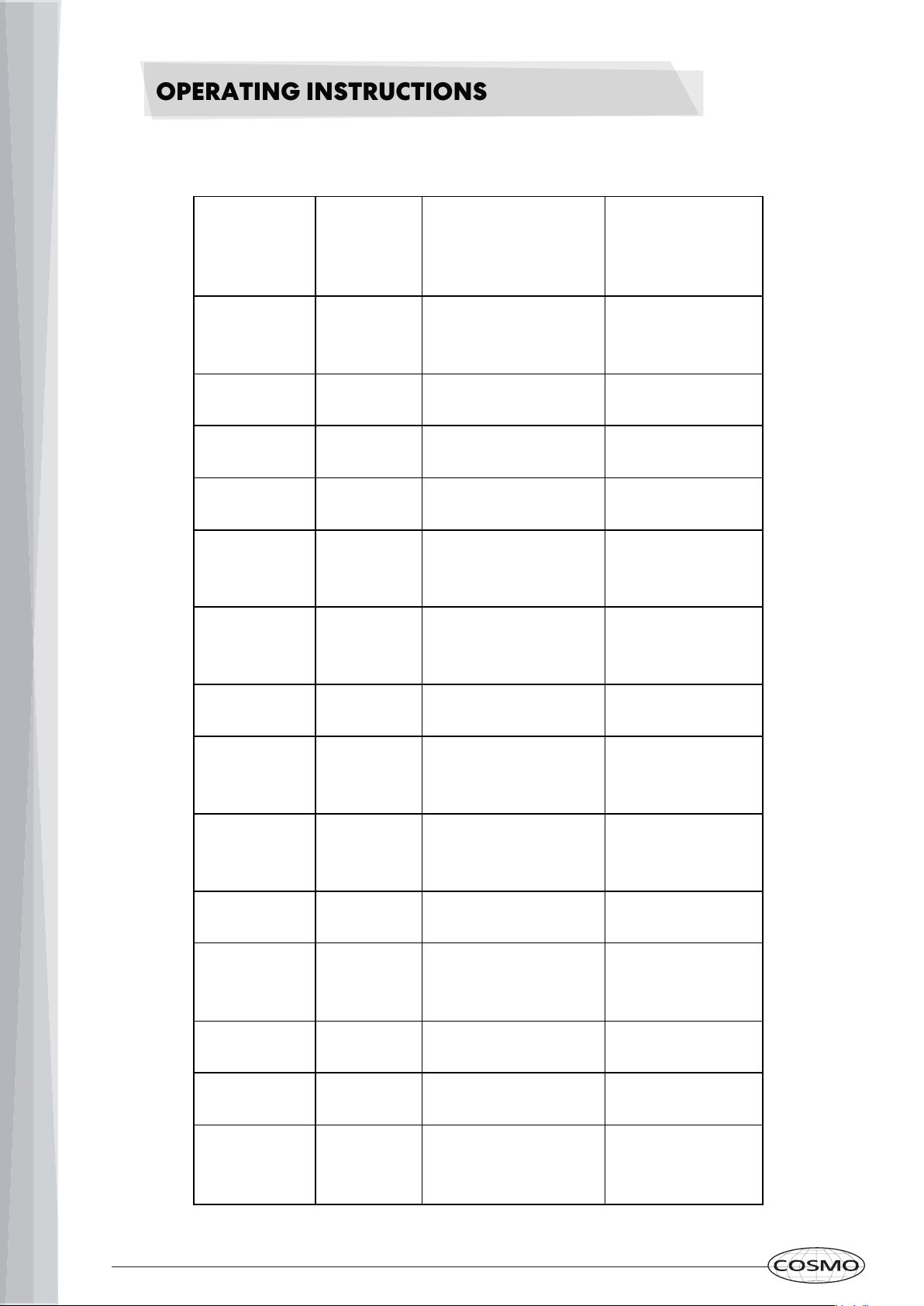
BAKING RECOMMENDATIONS
FOOD PAN
SIZE
CONTROL
TEMPERATURE
SETTING
TOTAL
SUGGESTED
COOKING
TIME
Cookies
12„X15'
Cookie
Sheet
375*
8 to 12 minutes
Layer
Cakes
8"or
9'Round
350*
25 to 35
minutes
Sheet
Cakes
9'x13”
Pan
350*
30 to 40
minutes
Bunt
Cakes
12 Cup 325*
60 to 75
minutes
Brownies or
Bar Cookies
9"x9"
Pan
325*
20 to 25
minutes
Biscuits
12"x15"
Cookie
Sheet
425* or Package
Directions
10 to 15
minutes
Quick
Bread
8"x4" Loaf
Pan
350*
55 to 70
minutes
Muffins
12 cup
Muffin Pan
425*
14 to 19
minutes
Fruit Pies
9“
Diameter
425*
35 to 45
minutes
Fruit
Cobblers
9"x9"
Pan
'400*
25 to 30
minutes
Yeast
Bread,
Loaves
8
H
x4” Loaf
Pan
375*
25 to 30
minutes
Dinner
Rolls
9”x13"
Pan
400*
12 to 18
minutes
Cinnamon
Rolls
9”x13”
Pan
375
25 to 30
minutes
Yeast
Cotter and
Cake
12"x15“
Cookie
Sheet
400*
20 to 30
minutes
34
6.) Close oven door. The door should be closed throughout the broil cycle.
6.) Close oven door. The door should be closed throughout the broil cycle.
OPERATING INSTRUCTIONS
FOOD
PREPARATION
APPROXIMATE DRYING
TIME (hrs)
TEST FOR DONENESS
Fruit
Apples
Dipped in 1/4 cup lemon juice and 2
clips water; 1/4" slices
11-15 Slightly pliable
Bananas
Dipped in 1/4 cup lemon juice and 2
cups water; 1/4" slices
10-15 Soft, pliable
Cherries
Wash and towel dry. For fresh
cherries, remove pits
10-15 Pliable, leathery, chewy
Orange peels and slices
1/4" slices of orange, orange part of
skin thinly peeled from oranges
PeeIs: 2-4 Slices: 12-16
Orange peel: dry and brittle.
Orange slices: skins are dry and brittle,
fruit is slightly
Pineapple rings Towel dried
Canned: 9-13 Fresh: a-12
Sott and pliable
Strawberries
Wash and towel dry. Sliced 1/2"
thick, skin (outside) down on rack
12-17
Dry, brittle
Vegetable
Peppers
Wash and towel dry. Remove
membrane of peppers, coarsely
chopped about 1" pieces
16-20
Leathery with no moisture inside
Mushrooms
Wash and towel dry. Cut off stem
end. Cut into 1/8" slices
7-12 Tough and leathery, dry
Tomatoes
Wash and towel dry. Cut thin slices,
1/6" thick, drain well.
16-23
Dry, brick red Colour
Herbs
Oregano, Sage, Parsley,
Thyme, Fennel
Rinse and dry with paper towel
3-5 Cnsp and brittle
Basil
Use basil leaves 3 to 4 inches from
top. Spray with water, shake off
moisture and pat dry
3-5
Crisp and brittle
BAKING RECOMMENDATIONS (continued)
35
OPERATING INSTRUCTIONS
BROIL / CONVECTION BROIL
Preheating
Broiling requires constant exposure to high, intense heat. Only the upper element heats in
the BROILER mode. It is recommended that you preheat the broil element before starting to
cook. Preheat until the "PRE-HEATING" light turns off (about 5-6 minutes).
Tips for Getting the Best Results
• Defrost food before broiling.
• Keep oven door closed during broiling.
• Steaks should be more than 1" thick if rare meat is desired. Use convection broil if
steaks are over 1-1/2 inches thick. Turn food over once after half cooking time. It is not
necessary to turn very thin food (ham slices, fillets of fish, etc.). Liver slices must be
turned over regardless of thickness.
• Use a timer. Set it for the minimum time and check the food.
• Center food directly under the broiling element for best browning.
Rack Positions
Before turning on the oven, place the rack in the desired position. After preheating the broiler,
center the broil pan under the broil element.
• Position 2: Use this rack position when broiling beef steaks, ground meat patties, ham
steak and lamb chops 1 inch or less thick. Also use when browning food.
• Position 3: Use this rack position when broiling meat 1 1/8 inches or more thick, fish,
poultry, pork chops,
ham steaks 1 inch or more thick.
• Position 3 or 4: Use this rack when broiling chicken quarters or halves.
Utensils
• A porcelain enamel broil pan is included with the range.
• Use metal or glass-ceramic bake ware when browning casseroles, main dishes, or
bread.
• DO NOT use heat-proof glass or pottery. This type of glassware cannot withstand the
intense hear of the broil element.
Broiling Using Meat Thermometer
To more accurately define the preparation of thick steaks or chops (at least 1 1/2 inches
thick), use a meat thermometer. Insert the point of the thermometer into the side of the meat
reaching the center of the steak or chop.
For rare steaks, cook the first side to 90°F. For medium or well done steaks, cook the first
side to 100°F. Turn and cook the second side to desired internal temperature.
Continued on next page
36
OPERATING INSTRUCTIONS
BROIL / CONVECTION BROIL (Continued)
Setting BROILER or CONVECTION BROILER
Select CONVECTION BROIL to brown food slightly also on the bottom side. This mode is
preferred for browning food on both side that is too delicate for turning such as fish. The
degree of browning of each side might be different.
Set Oven to BROIL or CONVECTION BROIL
1.) Place oven rack in desired position.
2.) Set Selector Switch to BROIL or CONVECTION BROIL.
3.) Set oven temperature control knob to BROILER or CONVECTION BROILER setting
corresponding to 500° fixed BROILER setting (not over maximum temperature 500°F or
under 450°F)
4.) Wait until PRE-HEATING light turns off, after approximately 5-6 minutes.
5.) Place food in oven at desired rack position as referenced on Page 28.
37
OPERATING INSTRUCTIONS
BROILING AND ROASTING RECOMMENDATIONS
FOOD ITEM
RACK
OVEN MODE
FUNCTION
SELECTOR
CONTROL
TEMPERATURE
SETTING
SELECTOR
APPROXIMATE
SPECIAL
INSTRUCTIONS AND
TIPS
BEEF
Ground Beef
Patties, Vt thick
2
Broiler or convection
Broiler
500°
15 to 20 minutes
Broil until no pink in
center
T-Bone Steak
2
Broiler or convection
Broiler
12 to 20 minutes
Time depends on
rareness of steak
Flank Steak
2
Broiler or convection
Broiler
12 to 20 minutes Rare to Medium Rare
Eye of Round
Roast
3
20 to 25 min/lb
Small roasts take more
minutes per pound;
reduce time by using
Convection Bake
PORK Loin Roast
3
Bake or Convection
bake
20 to 25 min/lb
Cook until juices are
clear
POULTRY Boneless
Skinless Chicken
Breasts
2
Broiler or convection
Broiler
20 to 25 minutes
Cook until juices are
clear
Chicken Thighs
3
Broiler or convection
Broiler
25 to 30 minutes
Remove skin; Cook until
juices are clear
Half Chickens
3
Broiler or convection
Broiler
30 to 45 minutes
Turn with tongs; Cook
until juices are clear
Roast Chicken
4
Bake or Convection
bake
350°
75 to 90 minutes
Do not stuff; reduce time
by using Convection
Bake
Turkey
4
Bake or Convection
bake
325°
20 to 25 min/lb
Do not stuff; reduce time
by using Convection
Bake
500°
500°
Bake or Convection
bake
500°
500°
500°
325°
325°
BROILING & ROASTING RECOMMENDATIONS
38
CARE & MAINTENANCE
REPLACING OVEN LIGHT BULBS
WARNING! Disconnect power before servicing unit.
To replace the oven light bulb, unscrew the protection cap that projects out inside the oven.
NOTE: Touching the bulb with fingers may cause the bulb to burn out. Always use protective
glove or use a cloth to remove the bulb.
CLEANING YOUR RANGE
ATTENTION: During cleaning operation never move the appliance from its
foreseen original installation position.
• Never use abrasive cleaners. Scratches on the stainless steel surfaces are permanent.
• Do not clean the range when hot.
Cleaning After Installation
Use a stainless steel cleaning product or wipe to eliminate the glue residues of the blue
protection film after removal.
Cleaning the Cooktop
Periodically clean the burner heads, the cast iron pan supports and the burner caps using
warm water. Remove burned food and fat residues with a rubber spatula . If food residue
prevent the smooth operation of the control knobs, call the customer service hotline to
schedule service by a factory-trained professional.
Cleaning Stainless Steel
For best results, use a stainless steel cleaner product with a soft sponge or wipe. Alternatively
use a soft sponge or cloth with a warm soap and water solution. Never use abrasive powders
or liquids.
Cleaning the Burner Caps
Lift the burner caps from the burner heads and wash them in a warm soap and water solution.
Dry thoroughly before using them again. Before reinstalling them on the burner head, check
that the gas flow holes are not clogged with food residues or cleaning product residues.
Cleaning Enamel
Enamelled parts should be cleaned frequently with warm soap and water solution applied with
a soft sponge or wipe. Never use abrasive powders or liquids. Do not leave acid or alkaline
substances on the enamelled parts (such as vinegar, lemon juice, salt, tomato sauce, etc.).
Use a rubber spatula to remove fat residues.
Cleaning the Glass Door
Clean the glass using a non-abrasive sponge or wipe with a warm soap and warm water
solution. Use a rubber spatula to remove fat residues.
ATTENTION: While cleaning the door, avoid spillage of food residues and
cleaning products in the venting holes situated on the top side of the door. To
clean the inside of the oven door, call a qualified professional. If you have any
further questions regarding cleaning the appliance, please contact your
appliance retailer.
39
TROUBLESHOOTING
CauseBaking Problem
Food browns unevenly
•
Oven not preheated
•
Aluminum foil on oven rack or oven bottom
•
Baking utensil too large for recipe
•
Pans touching each other or oven walls
Food too brown on bottom
•
Oven not preheated
•
Using glass, dull or darkened metal pans
•
Incorrect rack position
•
Pans touching each other or oven walls
Food is dry or has shrunk
excessively
•
Oven temperature too high
•
Baking time too long
•
Oven door opened frequently
•
Pan size too large
Food is baking or roasting too
slowly
•
Oven temperature too low
•
Oven not preheated
•
Oven door opened frequently
•
Tightly sealed with aluminum foil
•
Pan size too small
Pie crusts do not brown on
bottom or crust is soggy
•
Baking time not long enough
•
Using shiny steel pans
•
Incorrect rack position
•
Oven temperature is too low
Cakes pale, at and may not be
done inside
•
Oven temperature too low
•
Incorrect baking time
•
Cake tested too soon
•
Oven door opened too often
•
Pan size may be too large
Cakes high in middle with crack
on top
•
Oven temperature too high
•
Baking time too long
•
Pans touching each other or oven walls
•
Incorrect rack position
•
Pan size too small
Pie crust edges too brown
•
Oven temperature too high
•
Edges of crust too thin
40
TROUBLESHOOTING
PROBLEM POSSIBLE CAUSE
Burner will
not ignite
There is no power to
the cooktop
SOLUTION
Replace fuse or reset circuit breaker.
Burner
will not
operate
First time use. Air
still in the gas line.
Control knob is not
set correctly.
Turn on any one of the surface burner knobs
to release air from the gas lines.
Push in knob before turning to a setting.
The burner port is
clogged.
Clean burner port opening using a sti, nylon
toothbrush or a straightened paper clip.
Burner
Flames are
uneven,
yellow and/
or noisy
Burner port(s) are
clogged.
Clean burner port opening using a sti, nylon
toothbrush or a straightened paper clip.
Burner caps are not
positioned properly.
Place burner caps so that the alignment pins
are properly aligned with the slots.
Propane gas is being
used.
The range should be converted to LP gas by
a qualied technician.
Burner
ame is too
high or too
low
Cooktop gas supply
is not correct.
Ensure the range is set for the correct
gas type. It is factory set for natural gas. If
connected to LP gas the burners should be
converted to LP gas with the orice/injector
kit supplied and the pressure regulator
converted to the LP gas setting by a qualied
technician.
The gas pressure is
not correct.
Make sure the pressure regulator is installed
correctly and the gas line pressure is correct.
See Installation Instructions.
Burner
makes
popping
noises
The burner is wet. Allow the burner to dry before using.
The burner cap and/
or gas spreader
is not positioned
correctly.
Place burner caps so that the alignment pins
are properly aligned with the slots.
Excessive
heat
around
cookware
on cooktop
The cookware is not
the proper size for
the burner.
Use cookware with a bottom surface
approximately the same size as the cooking
area and burner. Cookware should not
extend more than 1” (2.5 cm) outside the
cooking area. Adjust the ame so that it
does not come up around the cookware.
Improper
installation.
Gases not
flowing.
Turn the manual gas shut-off valve on.
Installer should make sure regulator is
correctly oriented (arrow towards unit).
41
TROUBLESHOOTING
POSSIBLE CAUSE SOLUTIONPROBLEM
Oven is not
heating
No power to the
oven
Reset the circuit breaker or replace the
fuse in the electrical box to your oven.
Oven control not
turned on
Make sure the oven temperature has
been selected and timer is not "OFF".
Oven is not
cooking evenly
Not using the correct
bake ware or oven
rack position
Refer to cook charts for recommended
rack position. Always reduce recipe
temperature by 25 °F (15 °C) when
baking with Convention Bake mode.
Broil does
not work.
Knob settings are not
in the correct
positions.
Make sure oven temperature
selection knob is set to " BROIL" and
timer is not set to "OFF"
Cooling fan
continues to
run after oven
is turned o
The electronic
components have
not yet cooled
suciently
The fan will turn o automatically
when the electronic components have
cooled suciently.
Oven light is
not working
properly
Light bulb loose or
burned-out.
Reinsert or replace the light bulb.
Touching the bulb with ngers may
cause the bulb to burn out.
Oven light
stays on
Door is not closing
completely
Check for obstruction in oven door.
Check to see if hinge is bent or door
switch broken.
Cannot remove
lens cover
Soil build-up around
the lens cover.
Wipe lens cover area with a clean, dry
towel prior to attempting to remove
the lens cover.
Heat blowing out
from the front
of oven.
Oven cavity
ventilation on
The oven cavity ventilation is
operating until the oven is sufficiently
cooled. This is normal.
Excessive
Moisture
When using bake mode, preheat
the oven rst. Convection Bake and
Convection Roast will eliminate any
moisture in the oven.
Porcelain Chips
Porcelain interior
is bumped by oven
racks
When removing and replacing oven
racks, always tilt racks upward and do
not force them to avoid chipping the
porcelain.
FOR MORE HELP, VISIT COSMOAPPLIANCES.COM
OR CALL COSMO CUSTOMER SUPPORT: 1-888-784-3108.
42
LOCATION OF APPLIANCE TAGS
The rating tag shows the model and serial number of your range. It is located under the front
edge of the range cooktop, and is visible when the oven door is open (see illustration)
A= Rating tag(s) located under front edge of cooktop
B= Wiring / schematic diagram placed behind backside panel and on Pages 15-16
43
WARRANTY AND SERVICE
For full warranty details on this product please visit:
http://www.cosmoappliances.com/warranty
TO RECEIVE WARRANTY SERVICE, YOUR
PRODUCT MUST BE REGISTERED. TO REGISTER, VISIT:
WWW.COSMOAPPLIANCES.COM/WARRANTY
SCAN TO REGISTER
44
Correct Disposal of this product:
This marking indicates that this appliance should not
be disposed with other household wastes. To prevent
possible harm to the environment or human health
from uncontrolled waste disposal, recycle it responsibly to
promote the sustainable reuse of material resources.
IMPORTANT
Do Not Return This Product To The Store If
you have a problem with this product, please contact
Cosmo Customer Support at
+1(888)784-3108
DATED PROOF OF PURCHASE, MODEL #, AND SERIAL #
REQUIRED FOR WARRANTY SERVICE
IMPORTANT
Ne pas Réexpédier ce Produit au Magasin
Pour tout problème concernant ce produit, veuillez contacter
le service des consommateurs Cosmo Customer Support au
+1(888) 784-3108
UNE PREUVE D’ACHAT DATEE EST REQUISE POUR BENEFICIER DE
LA GARANTIE.
IMPORTANTE
No regrese este producto a la tienda
Si tiene algún problema con este producto, por favor contacte el
AYUDA AL CLIENTE COSMO al
+1(888)784-3108
(Válido solo en E.U.A).
NECESITA UNA PRUEBA DE DE COMPRA FECHADA, NÚMERO DE
MODELO Y DE SERIE PARA EL SERVICIO DE LA GARANTÍA

NOTE:
Electronic version of this manual is available at:
www.cosmoappliances.com
Cosmo is constantly making efforts to improve the quality and
performance of our products, so we may make changes to our
appliances without updating this manual.
