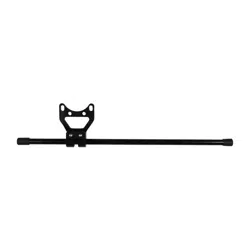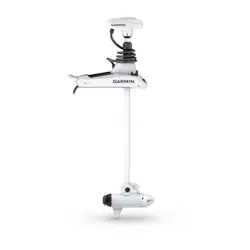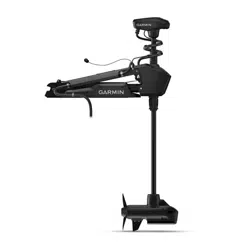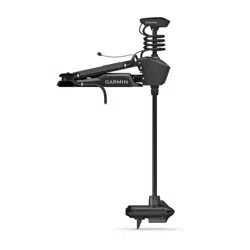

Table of Contents
Tools, Supplies, and Equipment Needed..................... 2
Tools, Supplies, and Equipment Needed for Maintenance........ 2
Tools, Supplies, and Equipment Needed for Repair.................. 2
Overview and Part Locations........................................ 2
Maintenance Needs and Schedule............................... 2
Cleaning and Lubricating the Locking Mechanism..................... 3
Lubricating the Hinges and Bushings......................................... 3
Servicing the Anodes.................................................................. 4
Checking and Cleaning the Power Terminals............................ 4
Checking and Replacing the Mount Rails................................... 4
Checking and Replacing the Mount Bumper.............................. 5
Replacing the Propeller.............................................................. 5
Fixing Paint Scratches................................................................ 5
Service Parts................................................................... 5
Shaft and Cable Parts.................................................................6
Propeller Drive Motor Parts........................................................ 6
Mount Parts................................................................................ 8
Mount Base Parts.................................................................. 9
Service Procedures........................................................ 9
Replacing the Pull Cable............................................................ 9
Removing the Pull Cable Handle........................................... 9
Removing the Pull Cable..................................................... 10
Installing a New Pull Cable.................................................. 10
Installing the Handle on the Pull Cable................................ 10
Removing the Power and Transducer Cables From the
Mount........................................................................................ 10
Routing the Power and Transducer Cables Through the
Mount................................................................................... 11
Removing the Shaft and Propeller Drive Motor from the Steering
System...................................................................................... 12
Opening the Shaft Cap........................................................ 12
Disconnecting the Cables in the Shaft Cap......................... 12
Removing the Transducer Cable from the Shaft Cap.......... 12
Removing the Shaft Cap...................................................... 12
Removing the Shaft from the Steering Servo...................... 13
Removing the Depth-Adjustment Collar................................... 13
Removing the Propeller Drive Motor and Nose Cone from the
Shaft......................................................................................... 13
Removing the Skeg and Nose Cone................................... 13
Removing the Propeller Drive Motor.................................... 13
Removing the Nose Cone and Transducer......................... 14
Disassembling the Nose Cone................................................. 14
Replacing the Nose Cone.................................................... 14
Installing the Propeller Drive Motor in the Shaft....................... 14
Installing the Nose Cone and Transducer in the Shaft........ 15
Installing the Propeller Drive Motor...................................... 15
Installing the Nose Cone and Skeg..................................... 16
Installing the Drive Motor and Shaft......................................... 17
Installing the Shaft in the Steering Servo Housing.............. 17
Installing the Shaft Cap........................................................ 17
Installing the Transducer Cable in the Shaft Cap................ 17
Connecting the Cables in the Shaft Cap.............................. 17
Closing the Shaft Cap.......................................................... 18
Removing the Steering Servo from the Mount......................... 18
Disconnecting the Lower Gas Spring.................................. 18
Disconnecting the Upper Link of the Mount......................... 18
Disconnecting the Upper Gas Spring.................................. 19
Disconnecting the Lower Link of the Mount from the Steering
Servo....................................................................................19
Connecting the Steering Servo to the Mount............................ 20
Installing the Steering Servo on the Lower Link of the
Mount................................................................................... 20
Securing the Upper Gas Spring........................................... 21
Connecting the Upper Link of the Mount to the Steering
Servo Housing..................................................................... 21
Connecting the Motor to the Display Panel......................... 21
Securing the Lower Gas Spring........................................... 22
Removing the Power Cable from the Steering Servo
Housing.....................................................................................22
Reconnecting the Power Cable........................................... 22
Removing the Coil Cable from the Steering Servo Housing..... 23
Reconnecting the Coil Cable............................................... 23
Removing the Coil Cable from the Shaft Cap...................... 23
Installing the Coil Cable in the Shaft Cap............................ 23
Replacing the Display Panel..................................................... 23
Removing the Upper Link from the Mount Base....................... 24
Reconnecting the Upper Link to the Mount Base................ 24
Removing the Lower Link from the Mount Base....................... 24
Replacing the Locking Mechanism in the Lower Link.......... 25
Reconnecting the Lower Link to the Mount Base................ 25
Replacing the Mount Base....................................................... 25
Replacing the Mount Shrouds............................................. 26
Replacing the Mount Rails................................................... 26
Replacing the Mount Bumper.............................................. 26
Replacing the Stow Support................................................ 26
i
FORCE
®
TROLLING MOTOR
USER MAINTENANCE MANUAL
Tools, Supplies, and Equipment Needed
The tools, supplies, and equipment needed to service and repair
the trolling motor depend on the service or repair needed. Not all
of the items listed are applicable for every procedure.
Tools, Supplies, and Equipment Needed for
Maintenance
When performing routine maintenance, you must have the
following tools and supplies.
• #2 Phillips screwdriver
• 4 mm and 3 mm hex bits or wrenches
• 10 and 15 mm sockets
•
9
/
16
in. socket
◦ For removing the propeller
◦ A 15 mm socket is acceptable, if necessary
• Replacement anodes (010-12832-35)
• Wire brush
• Silicone lubricating grease
• Non-stick, dry-film lubricant (such as DuPont
™
Dry Film
Lubricant with Teflon
®
)
• Dielectric grease
• Isopropyl alcohol (for cleaning areas before applying touch-
up paint)
• Liquid polyurethane paint (for touching up nicks and
scratches)
Tools, Supplies, and Equipment Needed for Repair
When performing repair or replacement procedures, you must
have the following tools and supplies.
• Suitable workbench or table
◦ Must be at least 8 ft. long for working on the 50 in. models
◦ Must be at least 10 ft. long for working on the 57 in.
models
• #1 Phillips screwdriver
• #2 Phillips screwdriver
• 3 mm and 4 mm and 8 mm hex bits or wrenches
• 10 and 15 mm socket
•
9
/
16
in. socket
◦ For removing the propeller
◦ A 15 mm socket is acceptable, if necessary
• 36 mm or adjustable wrench (for replacing the coil cable)
• Torque wrench
◦ With 4 mm and 8 mm hex bits
◦ Capable of measuring torque from 5 kgf-cm (4.3 lbf-in) to
55 N-m (40.5 lbf-in.)
• Silicone lubricating grease (for replacing the latching
mechanism)
• Needle-nose pliers
• Dielectric grease (for replacing the power cable or coil cable)
• Shaft and motor hardware service kit
◦ S00-01000-35
◦ For replacing the shaft or propeller drive motor
• Metal parts accessory kit
◦ S00-01000-20
◦ Contains all of the metal parts, such as brackets and
screws, that may be needed when performing repairs
• Plastic parts accessory kit
◦ S00-01000-46
◦ Contains all of the plastic parts, such as washers and
bushings, that may be needed when performing repairs
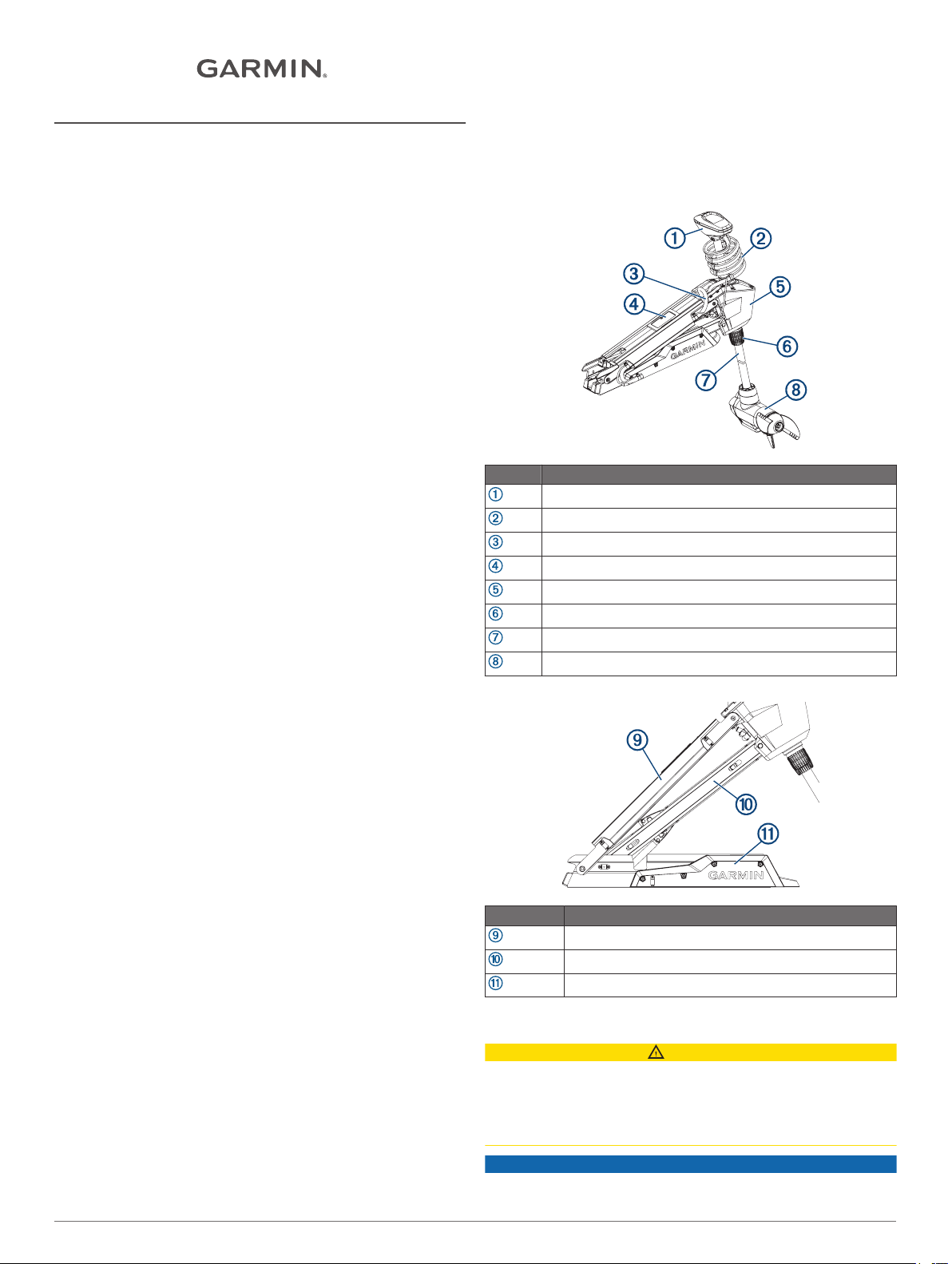
Overview and Part Locations
Item Description
Shaft cap
Coil cable (and transducer cable)
Power cable (and transducer cable)
Display panel
Steering servo housing
Depth-adjustment collar
Shaft
Drive motor and propeller
Item Description
Upper link of the mount
Lower link of the mount
Mount base
Maintenance Needs and Schedule
CAUTION
Use extreme care when following the procedures in this section.
Some maintenance tasks require you to move the motor from
the stowed to the deployed position multiple times, which
presents a potential for hands or fingers to be crushed by the
weight of the motor.
NOTICE
After using the motor in salt water or brackish water, you must
rinse off the entire motor with fresh water, and apply a water-
2
based silicone spray using a soft cloth. You should avoid
spraying jets of water at the cap on the top of the shaft when
rinsing the motor.
To maintain your warranty, you must perform a series of routine
maintenance tasks as you prepare your motor for the season. If
you use or transport the motor in dry, dusty environments
(traveling on gravel roads, for example) you should perform
these tasks more often during the season.
• Examine the power cable for wear, and patch or repair as
necessary .
• Check the power terminals, and clean them if necessary
(Checking and Cleaning the Power Terminals, page 4).
• Lubricate the hinges and bushings (Lubricating the Hinges
and Bushings, page 3).
• Clean and lubricate the stow and deploy latch mechanism
(Cleaning and Lubricating the Locking Mechanism,
page 3).
• Check the mount rails, and replace them if necessary
(Checking and Replacing the Mount Rails, page 4).
• Check the mount bumper, and replace it if necessary
(Checking and Replacing the Mount Bumper, page 5).
• Clean or replace the anodes in the propeller drive motor
(Servicing the Anodes, page 4).
Cleaning and Lubricating the Locking Mechanism
CAUTION
This procedure is best performed with the motor halfway
between the stowed and deployed positions. When in this
position, the motor is not secured, so you should support the
motor and use extreme caution to avoid pinching or crushing
hands or fingers.
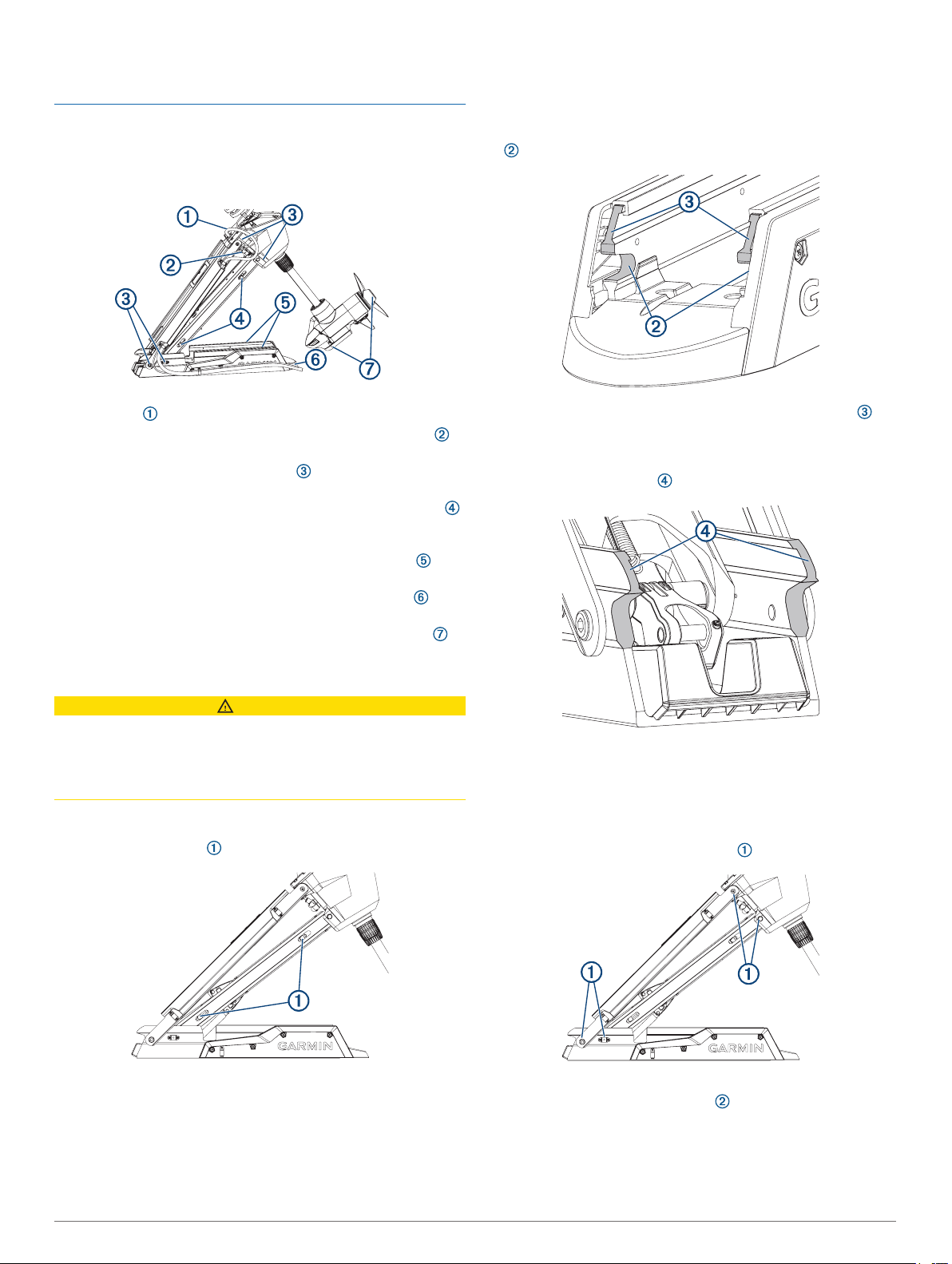
1
Place the motor between the stowed and deployed positions
so the base is oriented vertically and you can access both
locking mechanisms
.
2
Support the weight of the motor so it cannot fall and crush
your hands or fingers.
3
Clean any debris, dirt, and build up from all of the locking
mechanism channels.
4
Apply a silicone lubricating grease to the locking mechanisms
and the channels.
5
Pull and release the pull cable a number of times to move the
mechanisms in the channels and distribute the grease.
6
If necessary, apply additional grease and repeat the previous
step.
7
Clean any debris, dirt, and build up from the latch receivers
on the front of the mount base.
8
Apply a silicone lubricating grease to the upper surface
of
the latch receivers on the front of the mount base, so the
locking mechanisms slide smoothly into the receivers.
9
Repeat the previous two steps for the latch receivers on the
back of the mount base
.
10
Return the motor to the stowed or deployed position.
Lubricating the Hinges and Bushings
There are a number of hinges and bushings that allow the motor
to transition smoothly from the stowed to deployed position and
back again. You should lubricate these areas as needed.
1
Locate the four primary hinge points
.
2
Apply a non-stick, dry-film lubricant to each hinge point, in the
space between the moving parts
, and allow it to dry
according to the instructions provided with the product.
3
3
Move the motor from the stowed to the deployed position and
back a number of times to distribute the lubricant.
4
If necessary, apply additional lubricant and repeat the
previous step.
Servicing the Anodes
The anodes protect the motor components from corrosion, and
each season they must be examined and cleaned or replaced if
necessary.
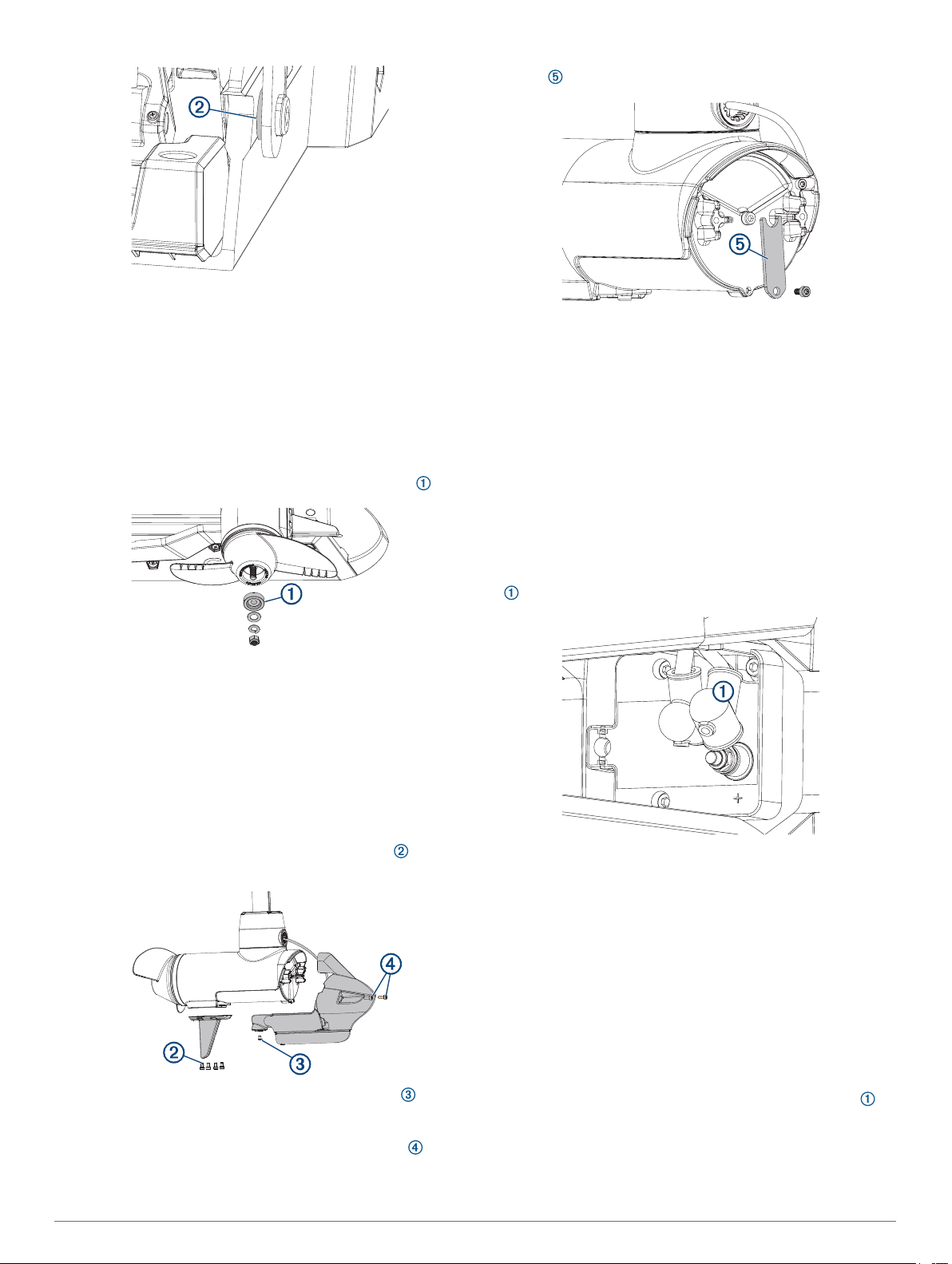
1
Using a
9
/
16
in (15 mm) socket, loosen the nut on the end of
the propeller.
2
Remove the nut, lock washer, flat washer, and anode
.
3
Examine the anode, and complete an action:
• If the anode is more than half of the original size, clean the
anode using a wire brush or sandpaper.
• If the anode is less than half of the original size, discard
the anode and purchase a replacement.
4
Place the cleaned or new anode on the propeller shaft, and
secure the propeller with the lock washer, flat washer, and
nut.
5
Using a
9
/
16
in (15 mm) socket, tighten the nut to 8.13 N-m
(6 lbf-ft).
6
Using a 4 mm hex bit or wrench, remove the skeg
from the
bottom of the motor.
7
Using a 3 mm hex bit or wrench, remove the screw
that
secures the transducer and nose cone to the bottom of the
motor .
8
Using a 4 mm hex bit or wrench, remove the screws
to
disconnect the nose cone from the front of the motor.
9
Using a 3 mm hex bit or wrench, remove the screw and
anode
on the front of the motor.
10
Examine the anode, and complete an action:
• If the anode is more than half of the original size, clean the
anode using a wire brush or sandpaper.
• If the anode is less than half of the original size, discard
the anode and purchase a replacement.
11
Place the cleaned or new anode on the screw and secure it
to the motor.
12
Secure the nose cone to the front of the motor.
13
Install the screw that secures the transducer and nose cone
to the bottom of the motor.
14
Install the skeg on the bottom of the motor.
Checking and Cleaning the Power Terminals
1
With the motor in the deployed position, pull the rubber
shields away from the positive and negative power terminals
.
2
If necessary, clean any corrosion from the terminals using a
wire brush.
NOTE: In cases of heavy corrosion, you may need to remove
the power cables for an effective cleaning (
Removing the
Power Cable from the Steering Servo Housing, page 22).
3
Cover the connections with dielectric grease.
4
Securely place the rubber shields back over the power
terminals.
Checking and Replacing the Mount Rails
The rails protect the propeller drive motor and the mount from
impact when stowing the motor, and may become worn over
time. If the rails are damaged or worn and the mount base is
visible through them, you must replace them.
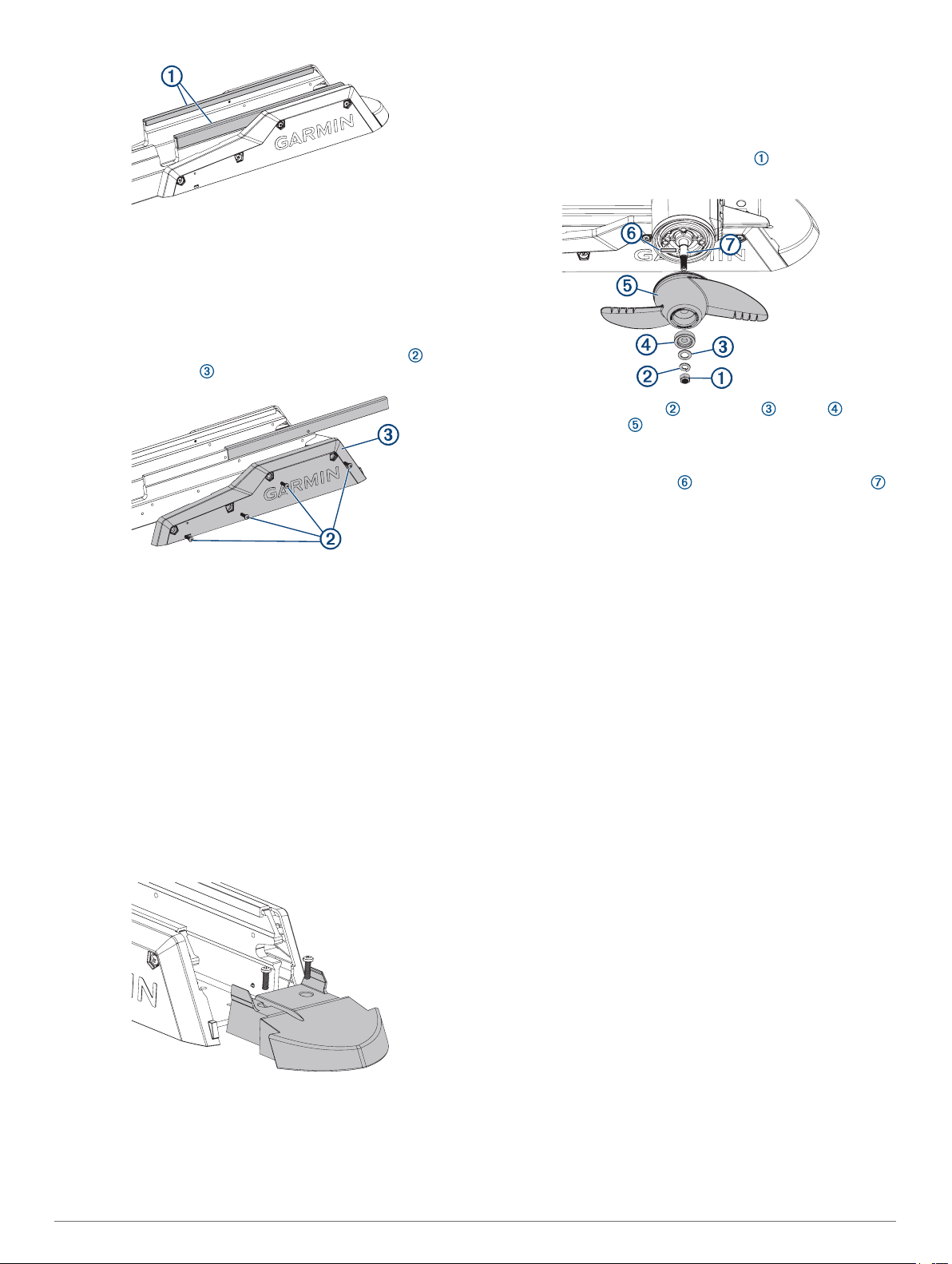
1
With the motor in the stowed position, examine the rails
for
wear and damage.
4
2
Select an action:
• If the rails are in good condition, and you cannot see the
metal mount base though any worn areas, no further
action is needed.
• If the rails are damaged or if you can see the metal mount
base through worn areas in the rails, proceed to the next
step to replace them.
3
Using a 4 mm hex bit or wrench, remove the screws
that
secure the shrouds to the mount base.
4
Slide the damaged rails off of the mount base.
5
Slide the replacement rails onto the mount base.
6
Secure the shrouds to the mount base using the screws you
removed previously.
Checking and Replacing the Mount Bumper
The mount bumper is the part of the mount base that overhangs
the bow of the boat.
1
Place the motor between the stowed and deployed positions,
and check the mount bumper for damage.
2
Select an action:
• If the mount bumper is undamaged, no further action is
needed.
• If the mount bumper is damaged, proceed to the next step
to replace it.
3
Using a 4 mm hex bit or wrench, remove the two screws that
secure the mount bumper to the mount base.
4
Install a replacement mount bumper, and secure it to the
mount base using the screws provided with the replacement
part.
Replacing the Propeller
If the propeller is damaged, you must replace it.
1
Using a 15 mm socket, remove the nut
that secures the
propeller.
2
Remove the lock washer
, flat washer , anode , and
damaged propeller .
3
Service the anode, if necessary (
Servicing the Anodes,
page 4).
4
If necessary, install the pin
in the propeller motor shaft .
5
Install a replacement propeller.
6
Place the anode, flat washer, lock washer, and nut onto the
end of the motor shaft.
7
Using a
9
/
16
in (15 mm) socket, tighten the nut to 8.13 N-m
(6 lbf-ft) to secure the propeller.
Fixing Paint Scratches
Over time, parts of the motor may become scratched or dinged.
You can use paint to touch up these areas for cosmetic
purposes.
1
Using isopropyl alcohol, throughly clean the areas where the
paint has been scratched or damaged.
2
Apply liquid polyurethane touch-up paint to the scratched or
damaged areas.
3
Follow the instructions on the paint, and allow for proper
drying before using the motor.
Service Parts
You can use these diagrams to identify and order service parts.
You can follow the links where provided for detailed disassembly
and replacement procedures.
To order the service parts listed in this manual, contact Garmin
®
at 1-800-800-1020 or go to support.garmin.com to place an
order using email.
5
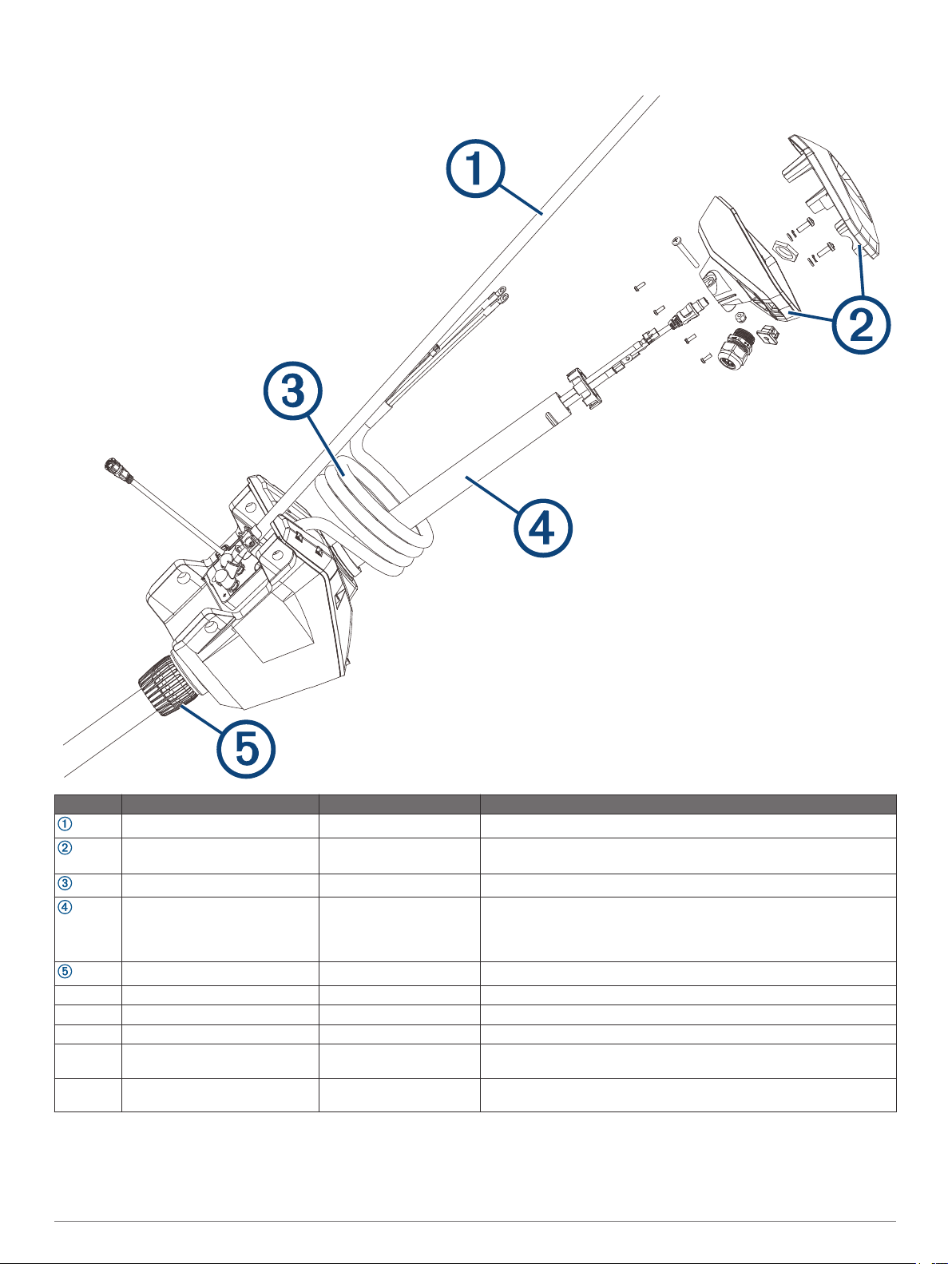
Shaft and Cable Parts
Item Description Service Part Number Details
Power cable S00-01000-22 Removing the Power Cable from the Steering Servo Housing, page 22
Shaft cap S00-01000-12 The service kit contains the internal hardware, cable grip, and grommet.
Removing the Shaft Cap, page 12
Coil cable S00-01000-48 Removing the Coil Cable from the Steering Servo Housing, page 23
Shaft 50 in. model:
S00-01000-02
57 in. model:
S00-01000-07
Removing the Propeller Drive Motor and Nose Cone from the Shaft,
page 13
Depth adjustment collar S00-01000-41 Removing the Depth-Adjustment Collar, page 13
Not shown Pull cable and handle 010-12832-30 Installing a New Pull Cable, page 10
Not shown 60 A circuit breaker accessory 010-12832-40 Instructions are provided with the circuit breaker.
Not shown Power cable plug accessory 010-12832-41 Instructions are provided with the power cable plug.
Not shown Power cable receptacle
accessory
010-12832-42 Instructions are provided with the power cable socket.
Not shown Foot pedal power cable
replacement
010-12832-10 Installation instructions are provided with your foot pedal.
Propeller Drive Motor Parts
6
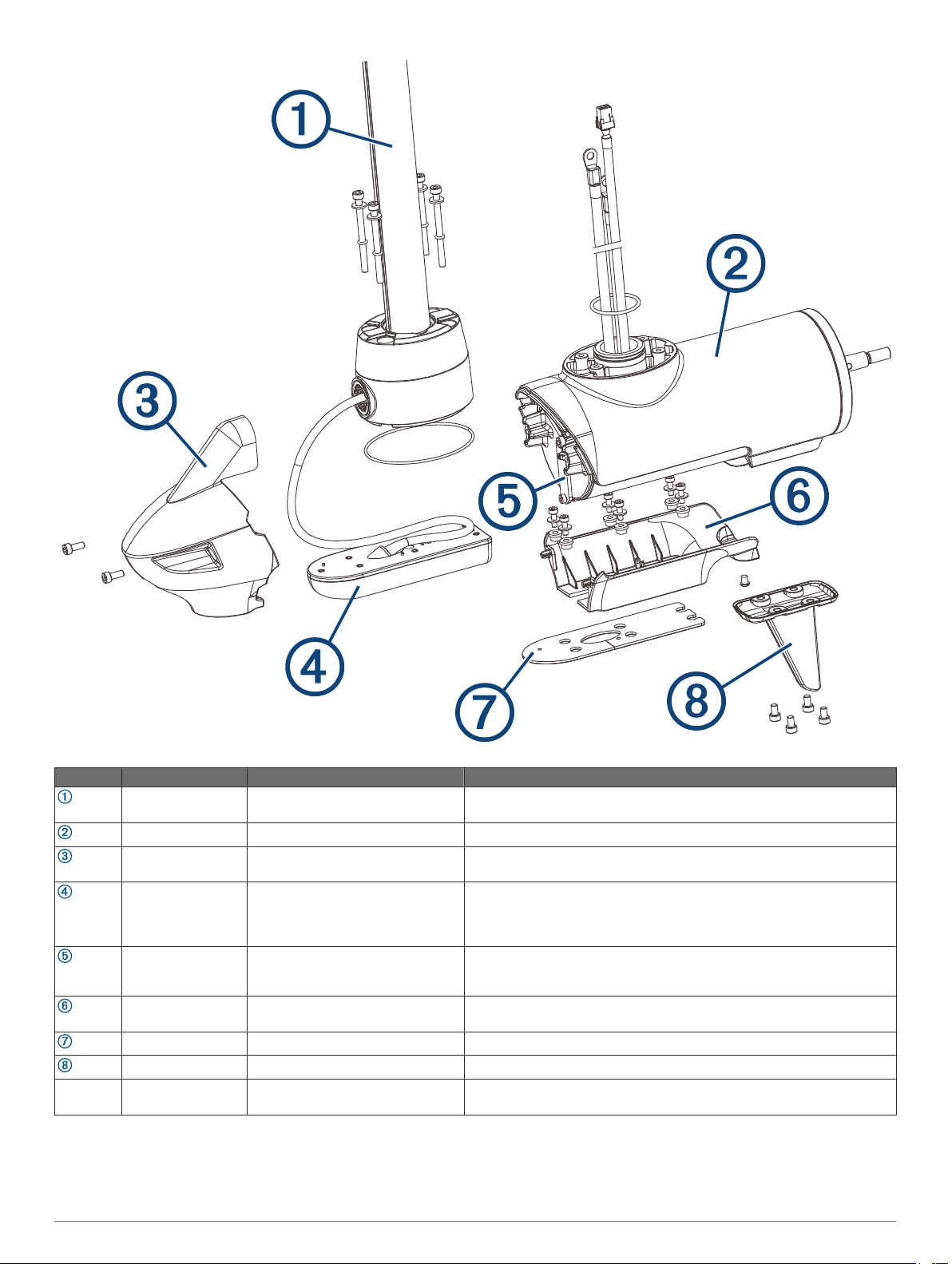
Item Description Service Part Number Details
Shaft 50 in. model: S00-01000-02
57 in. model: S00-01000-07
Removing the Propeller Drive Motor and Nose Cone from the Shaft,
page 13
Propeller drive motor N/A This part is replaceable by an authorized repair technician only.
Nose cone Transducer: 010-12832-20
No transducer: 010-12832-22
One of two parts included with a replacement nose cone.
(Replacing the Nose Cone, page 14)
Transducer Contact Garmin support for
replacement transducer options.
Transducer replacement kit:
010-12832-25
The replacement transducer and transducer replacement kit are sold
separately.
Detailed replacement instructions (190-02521-94) are included with the
transducer replacement kit.
Motor anode 010-12832-35 The anode kit contains the motor anode and the propeller anode (not
shown).
Servicing the Anodes, page 4
Lower nose cone Transducer: 010-12832-20
No transducer: 010-12832-22
One of two parts included with a replacement nose cone.
(Replacing the Nose Cone, page 14)
Transducer pad 010-12832-25 Included in the transducer replacement kit.
Skeg 010-12832-18 Removing the Skeg and Nose Cone, page 13
Not shown Propeller Power propeller: 010-12832-00
Weedless propeller: 010-12832-01
Replacing the Propeller, page 5
7
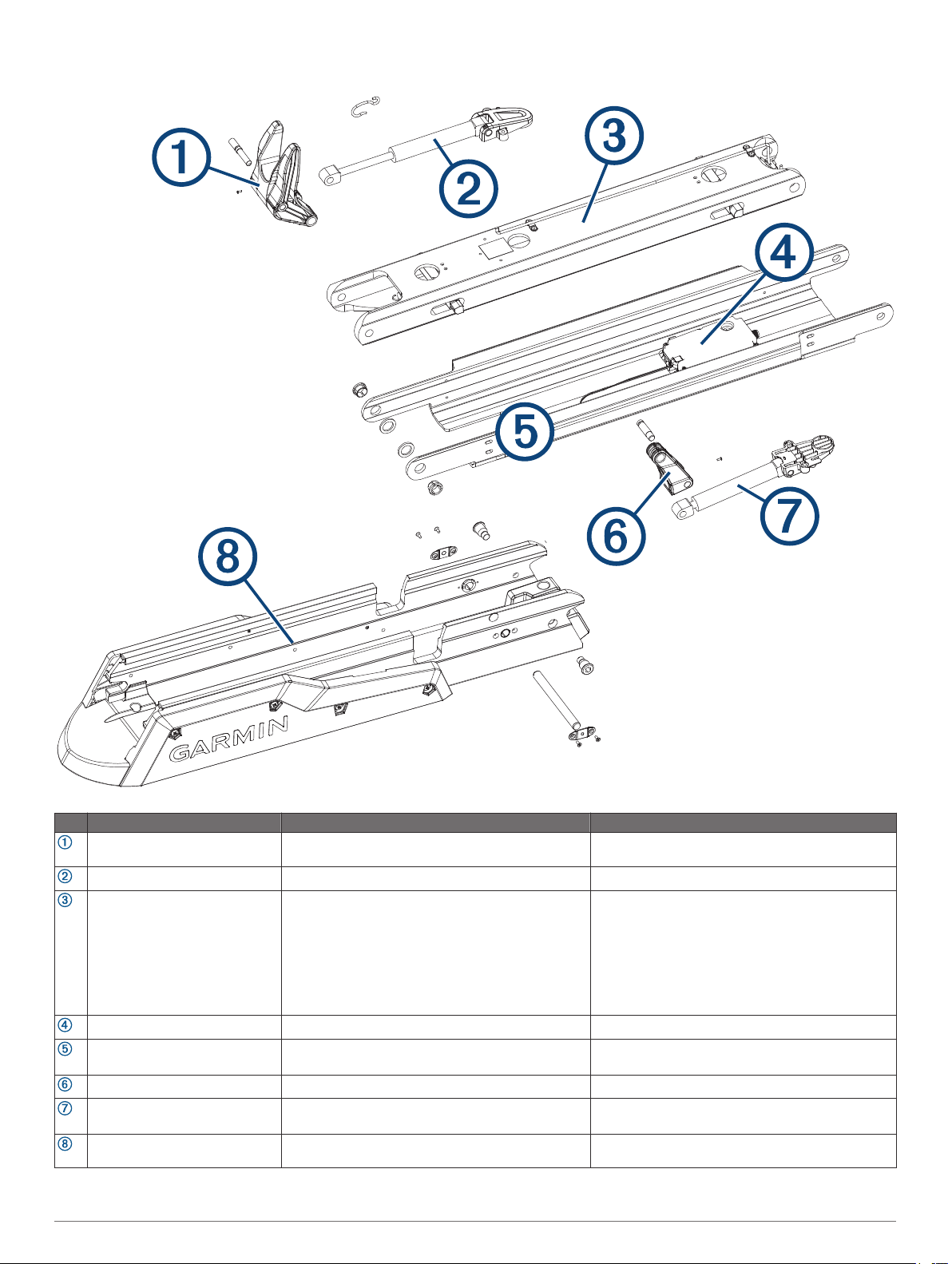
Mount Parts
Item Description Service Part Number Details
Lower gas spring arm and shaft
stabilizer
S00-01000-18 Disconnecting the Lower Gas Spring, page 18
Lower gas spring (deploy) S00-01000-37 Disconnecting the Lower Gas Spring, page 18
Mount lower link Lower link and latching components assembled,
50 in. model: S00-01000-04
Latching components only, 50 in. model:
S00-01000-45
Lower link and latching components assembled,
57 in. model: S00-01000-09
Latching components only, 57 in. model:
S00-01000-11
Removing the Lower Link from the Mount Base,
page 24
Display panel (Ebox) S00-01000-39 (Replacing the Display Panel, page 23)
Mount upper link 50 in. model: S00-01000-03
57 in. model: S00-01000-08
Removing the Upper Link from the Mount Base,
page 24
Upper gas spring arm S00-01000-17 Disconnecting the Upper Gas Spring, page 19
Upper gas spring (stow) 50 in. model: S00-01000-38
57 in. model: S00-01000-40
Disconnecting the Upper Gas Spring, page 19
Mount base See Mount Base Parts, page 9 for mount base
service part numbers.
Mount Base Parts, page 9
8
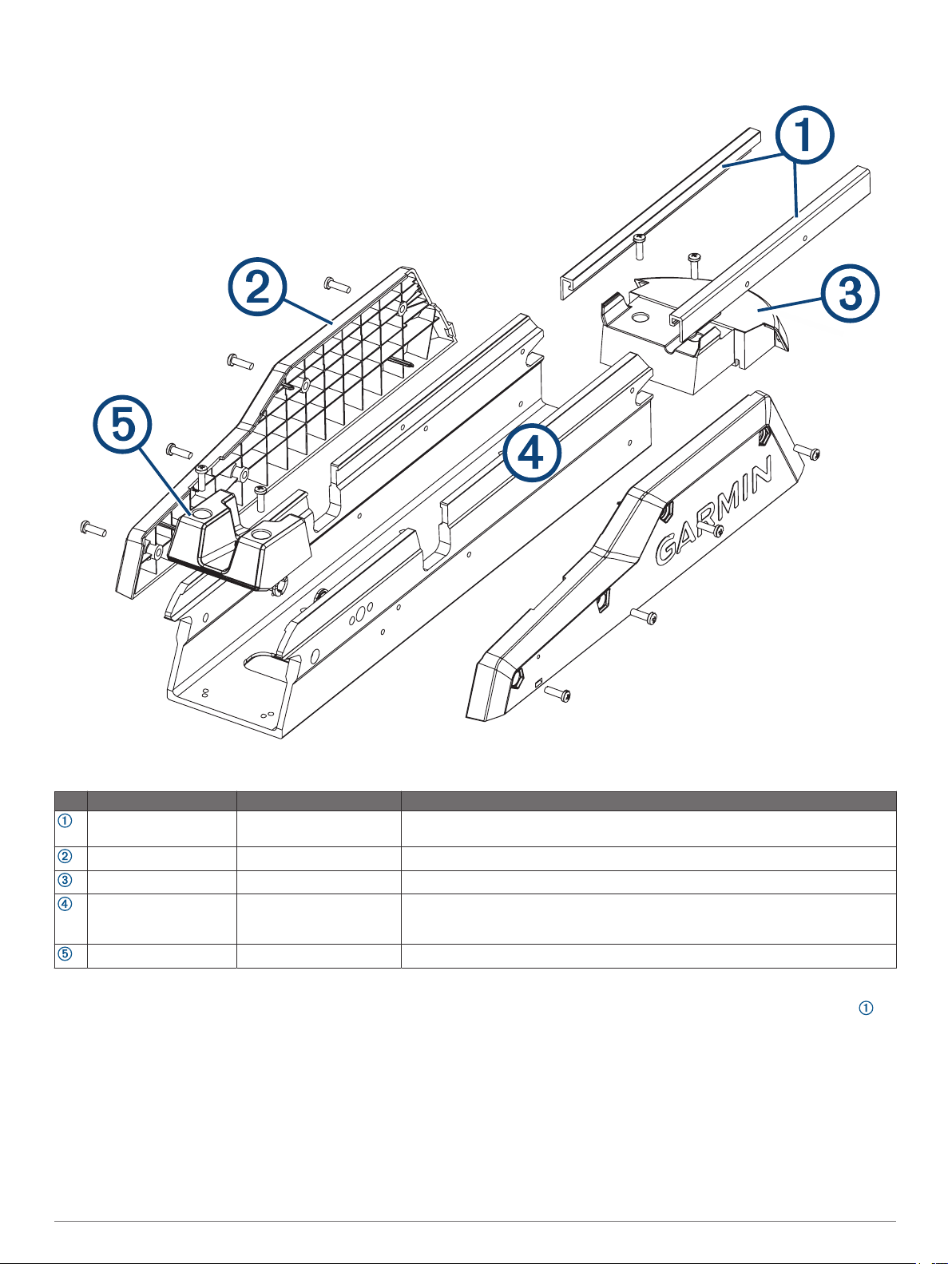
Mount Base Parts
Item Description Service Part Number Details
Mount base rails 50 in. model: S00-01000-33
57 in. model: S00-01000-34
Replacing the Mount Rails, page 26
Mount base shrouds S00-01000-14 Replacing the Mount Shrouds, page 26
Motor bumper S00-01000-19 Replacing the Mount Bumper, page 26
Mount base 50 in. model: S00-01000-05
57 in. model: S00-01000-10
This replacement part includes the base and all of the plastic parts, including the
shrouds, rails, stow support, and motor bumper, fully assembled.
Replacing the Mount Base, page 25
Mount base stow support S00-01000-47 Replacing the Stow Support, page 26
Service Procedures
Replacing the Pull Cable
You can replace the pull cable without disassembling the motor.
1
If necessary, remove the handle from the pull cable
(
Removing the Pull Cable Handle, page 9).
2
Remove the pull cable from the mount (
Removing the Pull
Cable, page 10).
3
Install the new pull cable on the mount (
Installing a New Pull
Cable, page 10).
4
Install the handle on the new pull cable (
Installing the Handle
on the Pull Cable, page 10).
Removing the Pull Cable Handle
1
Using a #1 Phillips screwdriver, remove the two screws
that secure top of the handle.
9
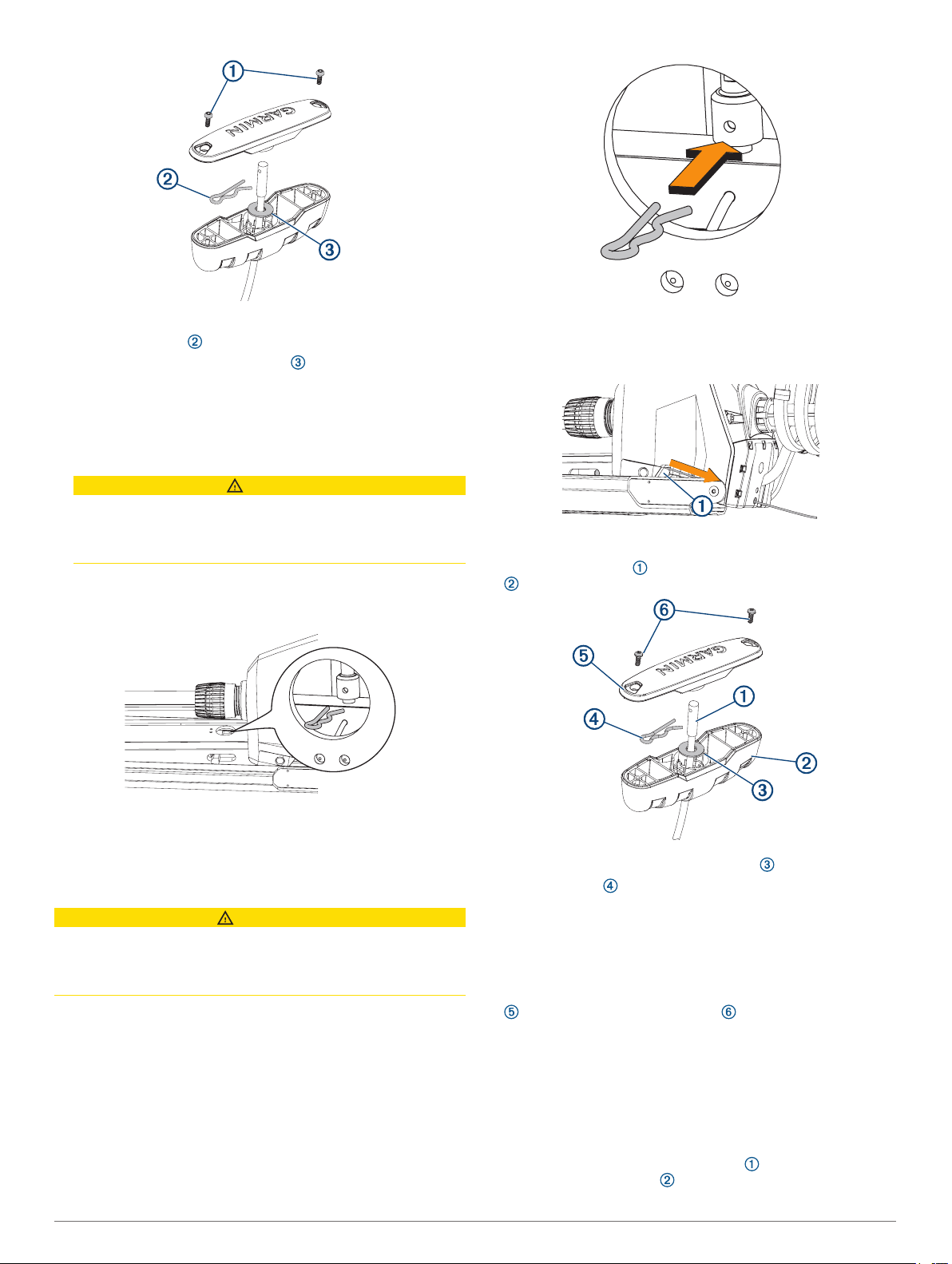
2
Push the pull cable up from the bottom of the handle, and
remove the R-pin
.
3
Pull the cable through the washer
and the bottom of the
handle.
Removing the Pull Cable
Before you can remove the pull cable, you must remove the pull
cable handle (Removing the Pull Cable Handle, page 9).
1
Transition the motor to the stowed position.
CAUTION
You should leave the motor in the stowed position until you
have connected the new pull cable. If the mount is not
securely locked in the deployed position, it may shift and
crush your hands or fingers.
2
Locate the access hole on the underside of the mount base.
3
Using needle-nose pliers, remove the R-pin that secures the
pull cable to the locking mechanism.
4
Remove the pull cable from the mount base, and pull it
through the steering servo housing.
Installing a New Pull Cable
Before you can install a new pull cable, you must remove the
existing pull cable (Removing the Pull Cable, page 10).
CAUTION
After you have removed the existing pull cable, should leave the
motor in the stowed position until you have connected the new
pull cable. If the mount is not securely locked in the deployed
position, it may shift and crush your hands or fingers.
1
Feed the end of the new pull cable into the mount base, and
place it over the stud on the locking mechanism.
2
Using needle-nose pliers, push the R-pin through the hole on
the end of the pull cable to secure it to the locking
mechanism.
3
Feed the other end of the pull cable through the steering
servo housing, routing the cable between the upper link of
the mount and the pivot pin.
Installing the Handle on the Pull Cable
1
Insert the pull cable
through the bottom half of the handle
.
2
Insert the pull cable through the washer
.
3
Push the R-pin
through the hole on the end of the pull
cable.
4
Pull the cable down so that the washer and R-pin rest in the
bottom half of the handle.
NOTE: The R-pin fits in the bottom half of the handle one
way only.
5
Using a #1 Philips screwdriver, secure the top of the handle
to the bottom using the screws .
Removing the Power and Transducer Cables From
the Mount
You should remove the power and transducer cables from the
mount if you are replacing a damaged cable, transducer, or
shaft.
1
Disconnect the motor from the power source.
2
With the motor in the stowed position, using a #1 Phillips
screwdriver, remove the single screw
that secures the
upper tab of the bracket to the mount base, and remove
the bracket.
10
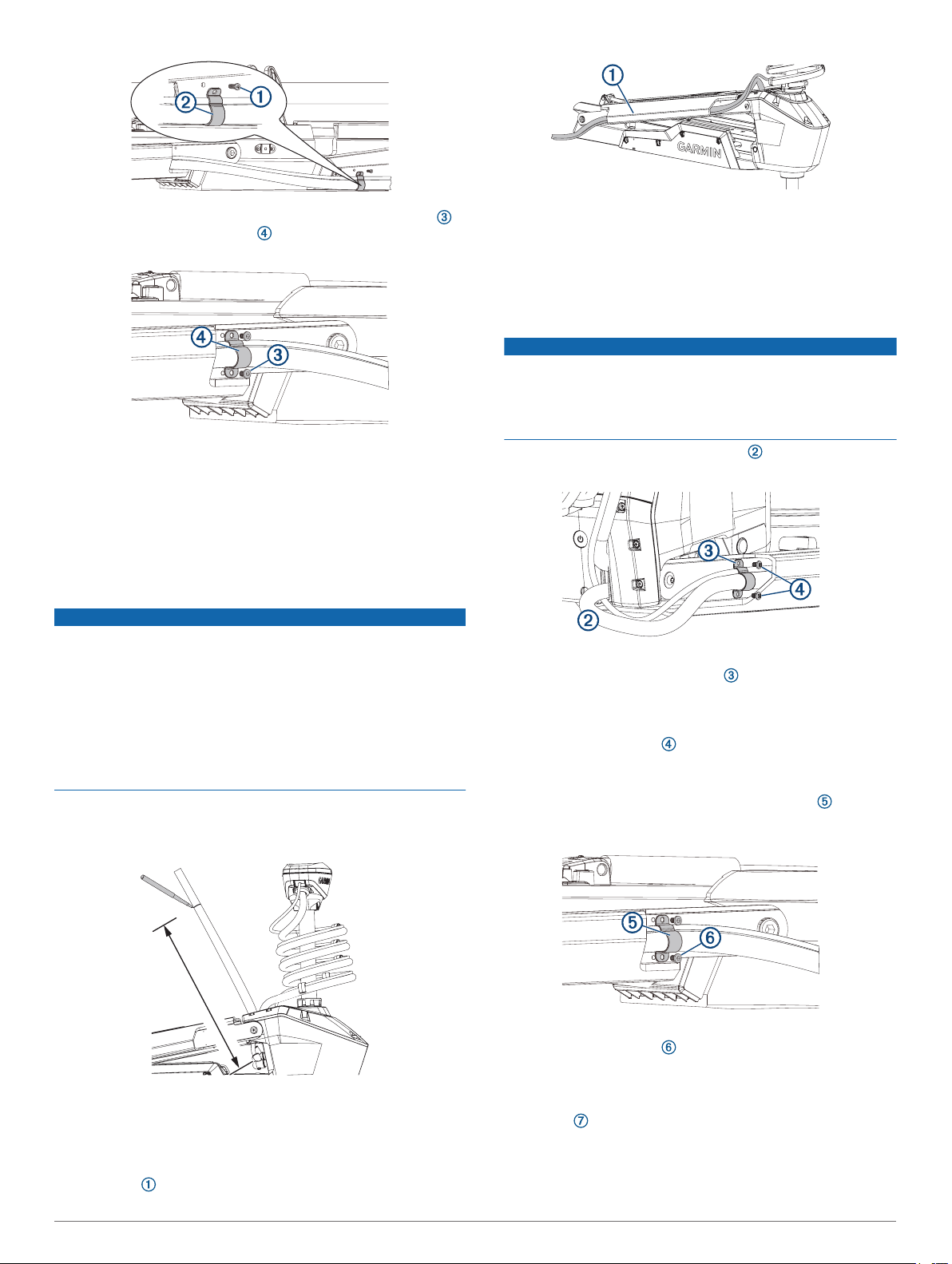
3
Using a 3 mm hex bit or wrench, remove the four screws
that secure the two brackets to the mount on both sides of
the cable channel.
4
Pull the power cable out of the channel along the side of the
mount.
5
Pull the transducer cable out of the channel along the side of
the mount.
Routing the Power and Transducer Cables Through the
Mount
After you have installed a replacement power cable, transducer,
or shaft, you should route the power and transducer cables
through the mount.
NOTICE
To avoid damaging the power and transducer cables when
deploying and stowing the trolling motor and to avoid
interference with the GPS and heading sensors in the motor,
you must route the cables through the right (starboard) side of
the mount and secure them using the included hardware. You
must not route the power cable through the left (port) side of the
mount, and it is not possible to install the included brackets on
the left (port) side. The left (port) side is reserved for additional
accessories or transducer cables that you may install in the
future.
1
Measure approximately 40 cm (16 in.) on the power cable
from where it connects to the steering servo housing, and
look for the mark on the cable applied at the factory.
2
If you do not see a mark on the cable, or if the mark is not
approximately 40 cm (16 in.) from the connection, make a
mark with a marker or tape.
3
With the motor in the deployed position, route the transducer
cable through the channel along the right (starboard) side of
the mount
.
TIP: To determine the right (starboard) side of the mount,
stand in a location where you can read the information on the
display panel.
4
Route the power cable through the channel above the
transducer cable.
5
Using the pull cable, carefully lift the motor from the deployed
position to the stowed position.
NOTICE
You must secure the cables to the mount with the motor in
the stowed position. If you complete this procedure with the
motor in the deployed position, the cables are not at their fully
extended length, and the added stress may damage the
cables during use.
6
Leaving a rounded bend in the cables
, hold them against
the side of the mount where they enter the channel.
7
At the marked location on the power cable, place one of the
brackets that has two screw holes
over the cables and
against the mount, aligning the holes on the bracket with the
holes on the mount.
8
Using a 3 mm hex bit or wrench, secure the bracket to the
mount using two screws
.
9
Hold the cables against the bottom of the mount where they
exit the channel.
10
Place the other bracket that has two screw holes
over the
cables and against the mount, aligning the holes on the
bracket with the holes on the mount.
11
Using a 3 mm hex bit or wrench, secure the bracket to the
mount using two screws
.
12
Hold the cables against the plastic portion of the mount base,
close to the boat deck.
13
Insert the lower tab on the remaining bracket into a slot below
the cables
, and rotate the bracket toward the mount base
to hold the cables.
11
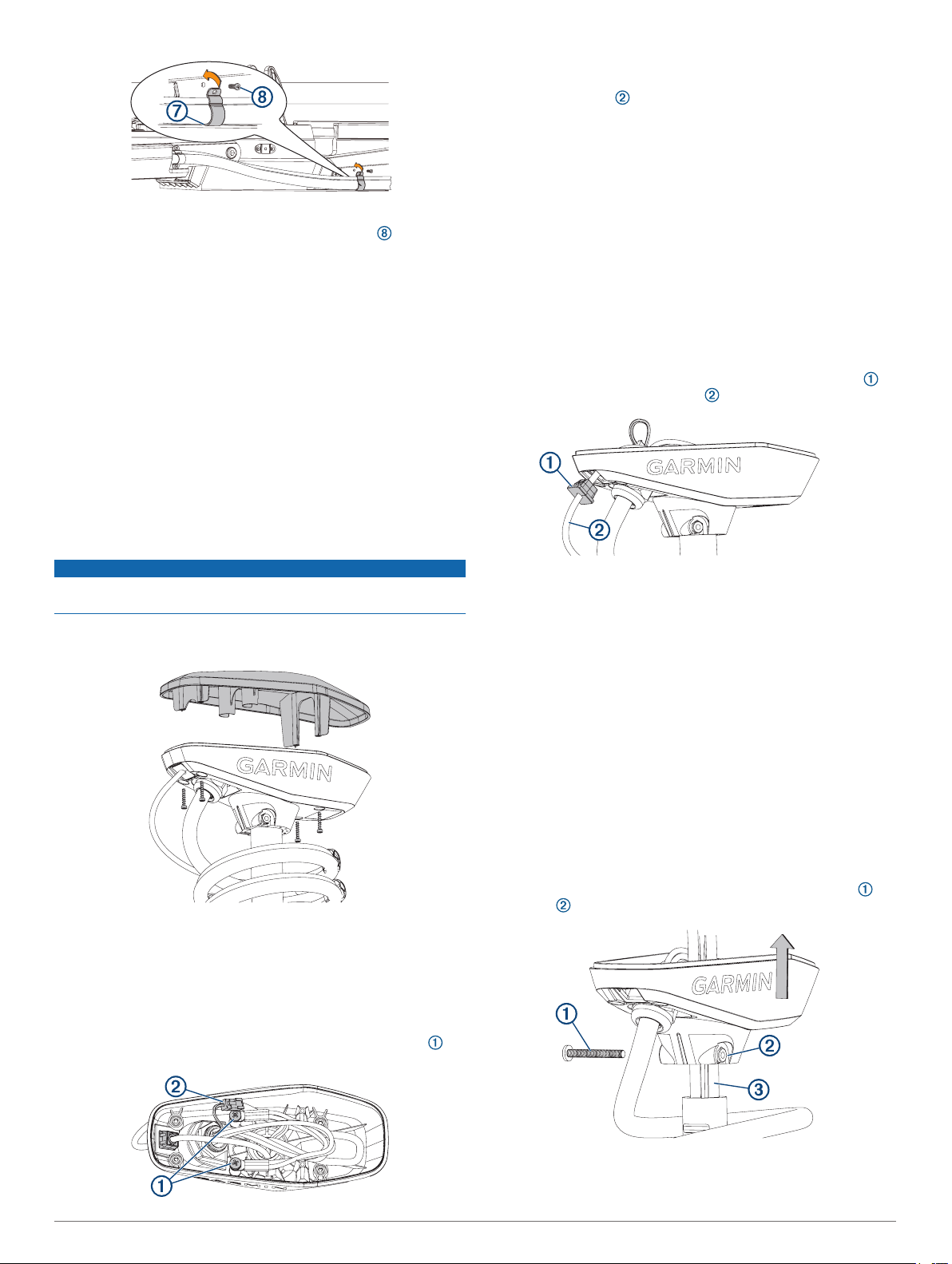
14
Using a #1 Phillips screwdriver, secure the upper tab of the
bracket to the mount base using a single screw
.
Removing the Shaft and Propeller Drive Motor from
the Steering System
Before you can remove the shaft and propeller drive motor, you
must remove the transducer cable from the mount, if applicable
(Removing the Power and Transducer Cables From the Mount,
page 10).
1
Disconnect the motor from the power source.
2
Open the shaft cap (
Opening the Shaft Cap, page 12).
3
Disconnect the cables in the shaft cap (
Disconnecting the
Cables in the Shaft Cap, page 12).
4
Remove the transducer cable from the shaft cap (
Removing
the Transducer Cable from the Shaft Cap, page 12).
5
Remove the shaft cap (
Removing the Shaft Cap, page 12).
6
Remove the shaft from the steering system (
Removing the
Shaft from the Steering Servo, page 13).
Opening the Shaft Cap
NOTICE
Before you open the shaft cap, you must disconnect the motor
from the power source.
1
Using a #2 Phillips screwdriver, remove the four screws that
secure the lid of the shaft cap.
You should place these screws in a safe place, because you
must use them to close the shaft cap.
2
Lift up to remove the lid of the shaft cap.
Disconnecting the Cables in the Shaft Cap
Before you can disconnect the cables in the shaft cap, you must
open the shaft cap (Opening the Shaft Cap, page 12).
1
Using a #3 Phillips screwdriver, remove the two screws
that secure the power cables in the shaft cap.
You should keep these screws in a safe place, because you
must use them when reconnecting the cables.
2
Release the latch
and pull the connectors apart to
disconnect the data cable.
Removing the Transducer Cable from the Shaft Cap
Before you can remove the transducer cable from the shaft cap,
you must open the shaft cap (Opening the Shaft Cap, page 12).
1
Disconnect the transducer cable from the chartplotter.
2
Remove the power and transducer cables from the mount
(
Removing the Power and Transducer Cables From the
Mount, page 10).
3
Remove the plastic cable clamps that secure the transducer
cable to the coiled power cable.
You should keep these cable clamps in a safe place,
because you must reinstall later.
4
Straighten the transducer cable so you can easily pull it
through the shaft cap.
5
Push from the inside out to remove the square grommet
that holds the transducer cable in the shaft cap.
6
Remove the grommet from the transducer cable.
The grommet is split on one side to make it easy to remove
from the cable.
You should keep the grommet in a safe place, because you
must reinstall it later.
7
Feed the transducer cable through the shaft cap from the
outside in until it is no longer routed through the square hole.
Removing the Shaft Cap
Before you can remove the shaft cap, you must remove the
transducer cable from the shaft cap (Removing the Transducer
Cable from the Shaft Cap, page 12) and disconnect the cables
in the shaft cap (Disconnecting the Cables in the Shaft Cap,
page 12).
1
Count and write down the number of coils in the coil cable
that wraps around the shaft.
When re-assembling the shaft and shaft cap, it is beneficial to
use the same number of coils around the shaft.
2
Using a 4 mm hex bit or wrench, remove the
1
/
4
-20 bolt
and nut that secure the shaft cap to the shaft.
You should keep this bolt and nut in a safe place, because
you must use them when reinstalling the shaft cap.
12
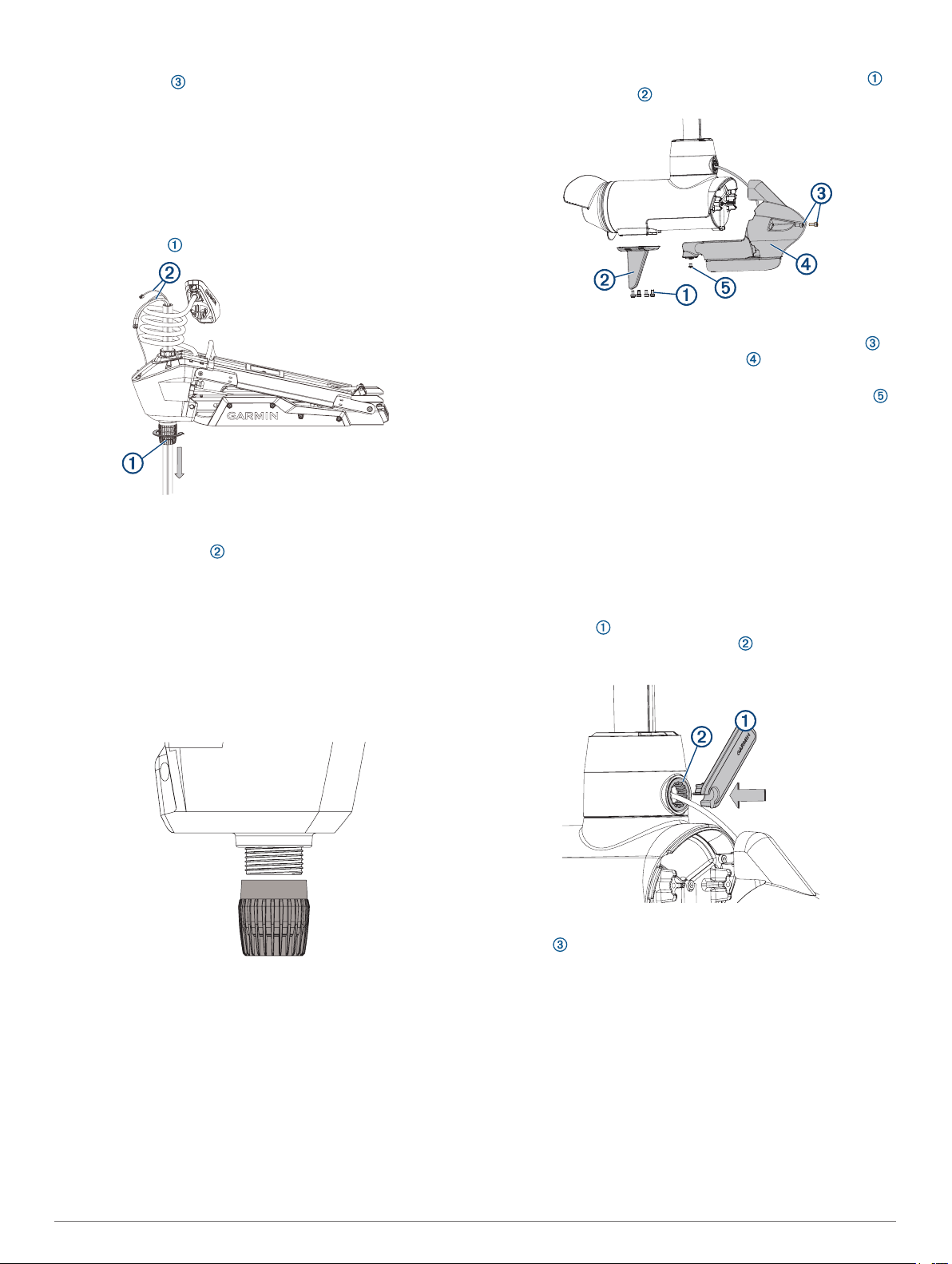
3
Lift up on the shaft cap to disconnect it from the shaft.
4
Pull the cables
from the shaft completely through the shaft
cap, taking care to avoid damaging the data cable connector
when you pull it through.
Removing the Shaft from the Steering Servo
Before you can remove the shaft from the steering servo, you
must remove the shaft cap (Removing the Shaft from the
Steering Servo, page 13).
This procedure is best performed with two people.
1
Loosen the depth adjustment collar on the base of the
steering servo
.
2
Slide the shaft down and out of the steering servo, taking
care not to damage the skeg and transducer or snag the
cables or connectors
as you pull it through.
TIP: Depending on the height of your trailer, you may find it
easier to remove the shaft if you transition the mount halfway
between the deployed and stowed positions.
Removing the Depth-Adjustment Collar
Before you can remove the depth-adjustment collar, you must
remove the shaft from the steering servo (Removing the Shaft
from the Steering Servo, page 13).
Turn the depth-adjustment collar counter-clockwise to
remove it from the steering servo.
Removing the Propeller Drive Motor and Nose Cone
from the Shaft
Before you can remove the propeller drive motor and transducer
from the shaft, you must remove the shaft from the steering
servo (Removing the Shaft and Propeller Drive Motor from the
Steering System, page 12).
1
Remove the skeg and nose cone from the propeller drive
motor (
Removing the Skeg and Nose Cone, page 13).
2
Remove the propeller drive motor from the shaft (
Removing
the Propeller Drive Motor, page 13).
3
Remove the nose cone and transducer from the shaft
(
Removing the Nose Cone and Transducer, page 14).
Removing the Skeg and Nose Cone
1
Using a 4 mm hex bit or wrench, remove the four screws
that secure the skeg to the propeller drive motor.
2
Remove the skeg.
3
Using a 4 mm hex bit or wrench, remove the two screws
that secure the front of the nose cone to the propeller drive
motor.
4
Using a 3 mm hex bit or wrench, remove the single screw
that secures the bottom of the nose cone to the propeller
drive motor.
You should keep all of these screws and parts in a safe
place, because you must reinstall them when reassembling
the skeg and nose cone.
Removing the Propeller Drive Motor
Before you can remove the propeller drive motor, you must
remove the shaft from the steering servo (Removing the Shaft
from the Steering Servo, page 13).
NOTE: When removing the propeller drive motor, using a ball-
head hex bit or wrench is highly recommended because of the
angle needed to reach the head of the screws.
1
Using the tool
included in the shaft and motor hardware
service kit, remove the recessed nut that secures the
transducer cable to the shaft.
2
Using a ball-head 4 mm hex bit or wrench, remove the four
screws
that secure the shaft base to the propeller drive
motor.
13
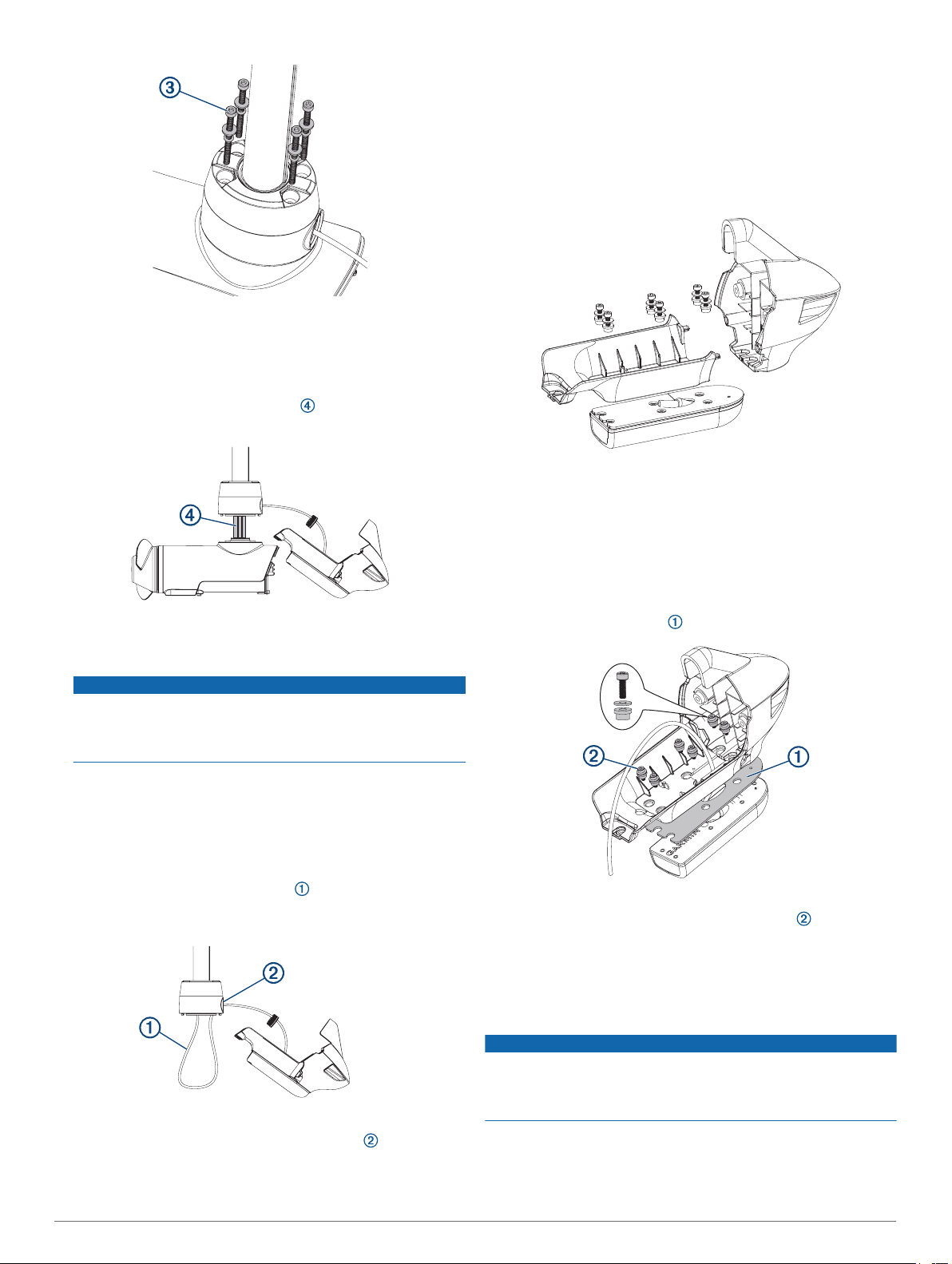
When replacing the transducer, you should dispose of these
four screws. New screws, washers, and O-rings are provided
in the shaft and motor hardware service kit.
3
Straighten the cables at the top of the shaft, and slowly pull
the propeller drive motor away from the shaft base until you
can see the power and data cables
connected to the
propeller drive motor.
4
Holding the cables only, slowly pull them through the shaft,
taking care that the ring terminals and data cable connector
do not get caught on the top of the shaft.
NOTICE
When removing the propeller drive motor from the shaft, you
must pull the cables themselves, and not the motor. Pulling
on the propeller drive motor may damage the cable
connections inside the motor.
The power and data cables should pull through the shaft, but
the transducer cable should mostly stay in place.
Removing the Nose Cone and Transducer
Before you can remove the nose cone and transducer, you must
remove the propeller drive motor (Removing the Propeller Drive
Motor, page 13).
1
Carefully pull the transducer cable
straight down through
the bottom of the shaft until it is completely removed from the
shaft.
2
After you pull the transducer cable out of the shaft, pull it
through the hole in the front of the shaft base
, along with
the rubber cable gland and the recessed nut.
3
Dispose of the cable gland and recessed nut.
The shaft and motor hardware service kit contains a new
cable gland and recessed nut.
Disassembling the Nose Cone
Before you can disassemble the nose cone, you must remove
the skeg and nose cone from the propeller drive motor
(Removing the Skeg and Nose Cone, page 13).
1
Using a 3 mm hex bit or wrench, remove the six screws that
secure the transducer to the nose cone.
2
Remove the transducer and transducer pad from the nose
cone.
If you are not replacing the transducer, you should keep the
transducer pad and six screws so you can secure the
transducer to the replacement nose cone.
Replacing the Nose Cone
Before you can replace the nose cone, you must disassemble
the nose cone (Disassembling the Nose Cone, page 14).
1
Place the transducer pad
on the transducer.
2
Using a 3 mm hex bit or wrench, secure the transducer to the
nose cone using the six screws and bushings
.
3
Install the nose cone and skeg on the shaft (
Installing the
Nose Cone and Skeg, page 16).
Installing the Propeller Drive Motor in the Shaft
You must perform these actions to reassemble the propeller
drive motor in the shaft.
NOTICE
The screws, replacement seals, and grease packet are included
in the motor hardware service kit (S00-01000-35). You should
use the new parts from the kit instead of reusing the screws and
seals you removed with the propeller drive motor.
1
Install the nose cone and transducer in the shaft (
Installing
the Nose Cone and Transducer in the Shaft, page 15).
2
Install the propeller drive motor on the shaft (
Installing the
Propeller Drive Motor, page 15).
14
3
Install the nose cone and skeg on the propeller drive motor
(
Installing the Nose Cone and Skeg, page 16).
Installing the Nose Cone and Transducer in the Shaft
NOTICE
The shaft and motor hardware service kit contains new seals.
You should use the new parts from the kit instead of reusing the
seals you removed with the nose cone and transducer.
NOTE: If you are performing this procedure because you are
removing the transducer completely, you should complete only
the first step.
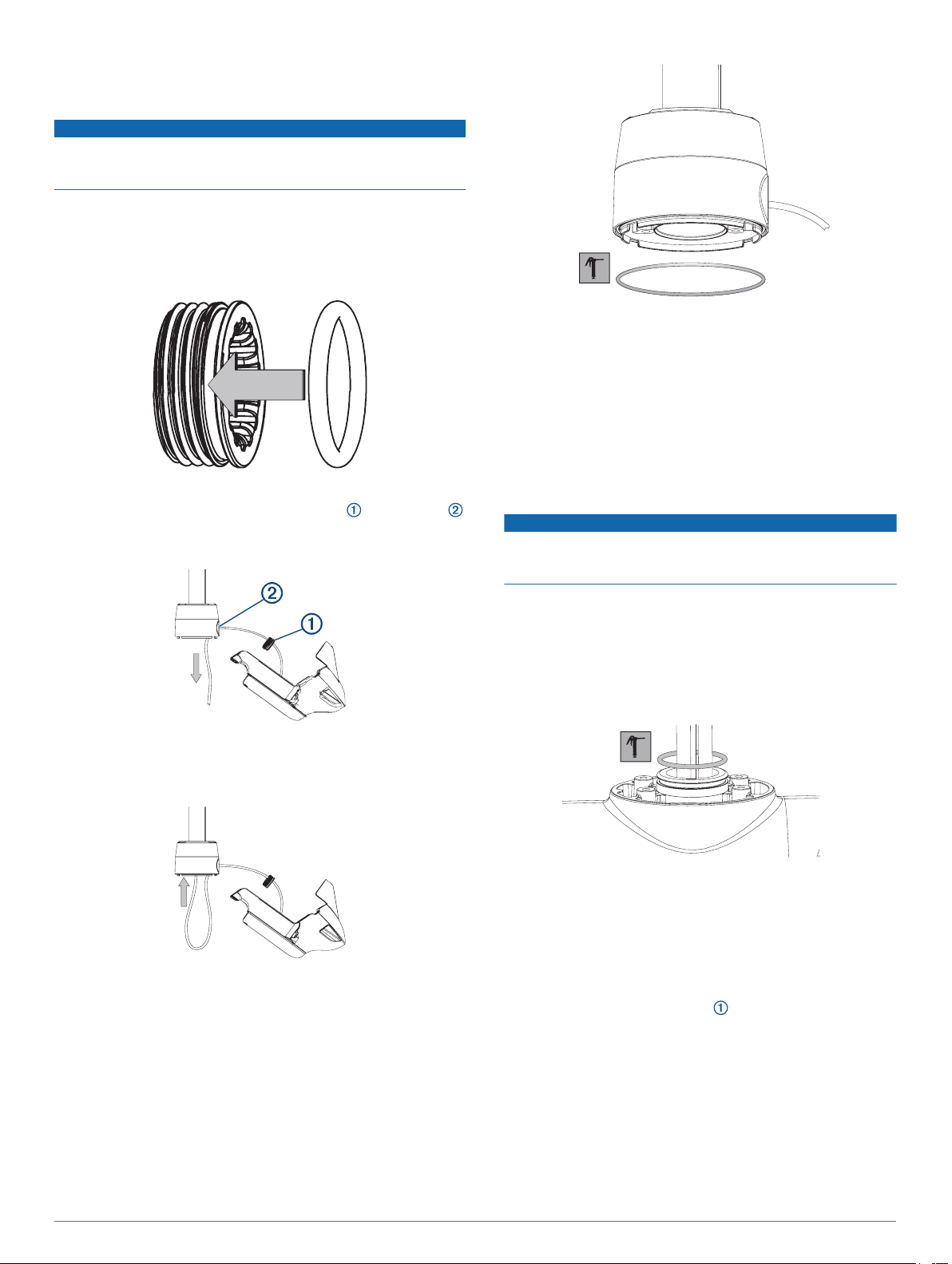
1
Place the 25 mm (1 in.) O-ring on the recessed nut from the
shaft and motor hardware service kit.
2
With the O-ring facing the transducer, feed the replacement
transducer cable through the recessed nut
and the hole
in the front of the shaft base, but do not feed it up through the
shaft.
3
After you have fed all but approximately 60 cm (2 ft.) of the
transducer cable through the hole in the shaft base, feed the
transducer cable up through the shaft.
Installing the Propeller Drive Motor
Before you can install the propeller drive motor in the shaft, you
must route the transducer cable through the shaft (if applicable)
(Installing the Nose Cone and Transducer in the Shaft,
page 15).
1
Remove the large 78 mm (3 in.) O-ring on the shaft base,
and discard it.
2
Using the packet included in the shaft and motor hardware
service kit, apply grease to the new 78 mm (3 in.) O-ring in
the shaft and motor hardware service kit.
3
Place the new 78 mm (3 in.) O-ring in the groove on the shaft
base.
4
Using canned compressed air or an air compressor, blow out
any dirt or debris in the four threaded holes on the top of the
propeller drive motor.
5
Apply a medium-strength thread-locking compound such as
LOCTITE
®
243
™
to the threads in the four threaded holes on
the top of the propeller drive motor.
NOTICE
Thread-locking compound is required in these holes to
maintain a tight connection between the shaft base and the
propeller drive motor.
6
Remove the 36 mm (1
7
/
16
in.) O-ring from the top of the
propeller drive motor, and discard it.
7
Thread the cables from the propeller drive motor through the
new 36 mm (1
7
/
16
in.) O-ring in the shaft and motor hardware
service kit.
8
Using the packet included in the shaft and motor hardware
service kit, apply grease to the new 36 mm (1
7
/
16
in.) O-ring.
9
Place the new 36 mm (1
7
/
16
in.) O-ring in the groove on the
top of the propeller drive motor.
10
If the power and data cables from the propeller drive motor
are not already aligned and bundled, straighten, align, and
bundle them with tape.
If the power and data cables are not straight and aligned,
they may not feed through the shaft smoothly.
11
Feed the power and data cables
from the propeller drive
motor up through the shaft until they emerge from the top.
15
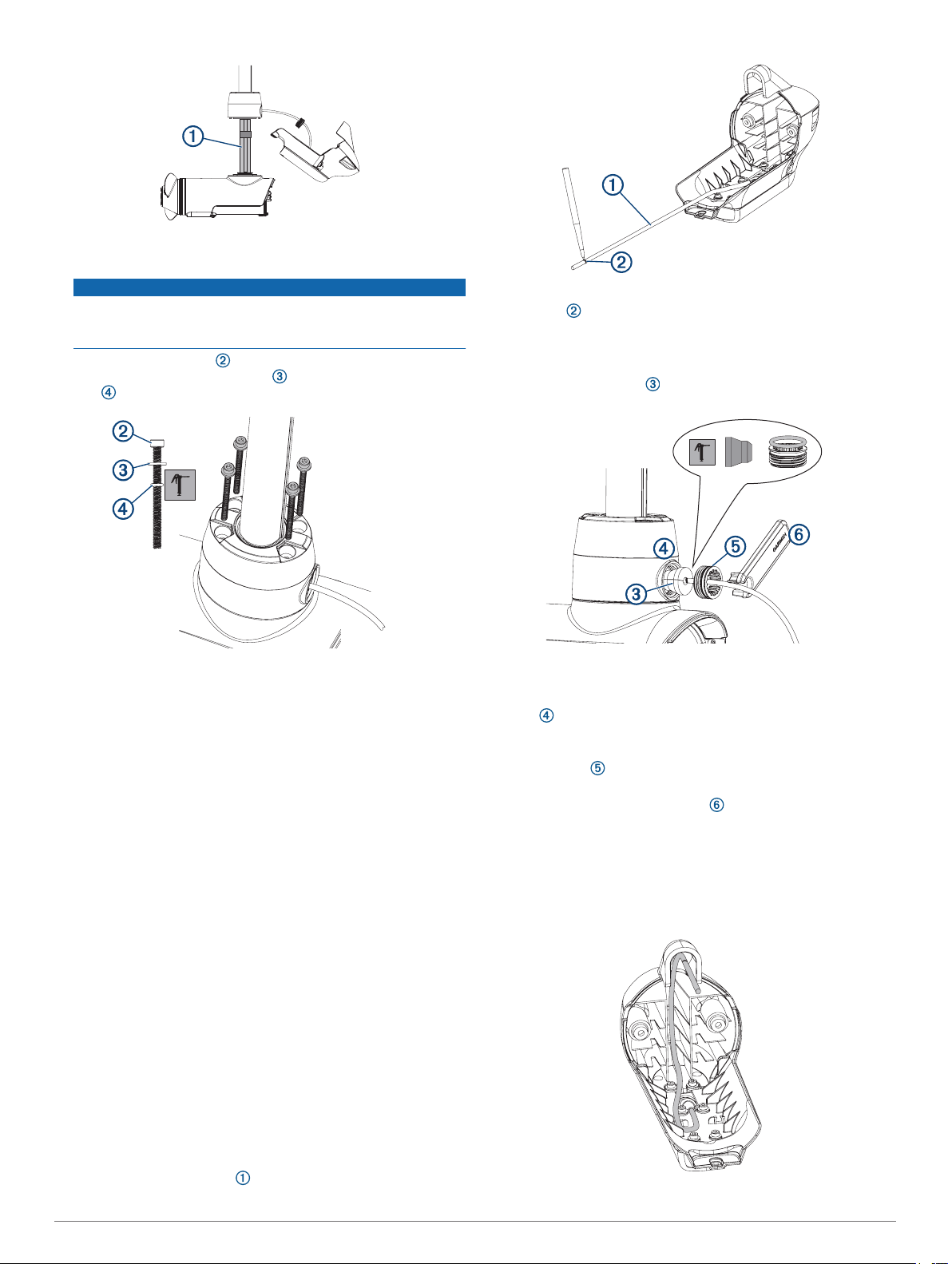
12
Gently pull the ends of the power and data cables as you
feed them the rest of the way through the shaft.
NOTICE
When feeding the cables, you must pull on the cable and not
on the cable connectors. The data cable connector is fragile
and may break if you pull on the connector.
13
Prepare the four bolts
in the shaft and motor hardware
service kit by placing a washer and a 4.75 mm (
3
/
16
in.) O-
ring on each one.
14
Using the grease packet included in the shaft and motor
hardware service kit, apply grease to the 4.75 mm (
3
/
16
in.)
O-ring on each bolt.
Avoid getting grease on the bolt threads.
NOTE: If you did not previously apply thread-locking
compound in the four mounting holes for these bolts, you
must apply it before installing these bolts.
15
Using a ball-head 4 mm hex bit or wrench, thread all four of
the prepared bolts approximately halfway to make sure that
the shaft base and the propeller drive motor are properly
aligned.
16
With the shaft base and the propeller drive motor properly
aligned, lightly tighten all four bolts by hand.
17
Using a torque wrench, tighten all four bolts to 4 N-m (35 lbf-
in).
Installing the Nose Cone and Skeg
Before you can install the nose cone and skeg, you must install
the propeller drive motor on the shaft base (Installing the
Propeller Drive Motor, page 15).
1
From the shaft and motor hardware service kit, select the
cable gland that fits your transducer cable:
• For a 4-pin transducer, select the cable gland with the
smaller hole.
• For an 8- or 12-pin transducer, select the cable gland with
the larger hole.
NOTE: A cable gland without a hole is provided if you are not
installing a transducer or not routing the transducer cable
through the shaft.
2
Pull the transducer cable
straight, and measure a 38 cm
(15 in.) from the where the cable enters the transducer.
3
Using a permanent marker, mark the measured location on
the cable
.
4
Using the packet included in the shaft and motor hardware
service kit, apply grease completely to all surfaces of the
cable gland you selected to fit your transducer cable.
5
Place the cable gland
at the marked location on the
transducer cable.
6
While keeping the cable gland aligned with the mark on the
transducer cable, gently pull the excess cable through the top
of the shaft until the cable gland fits into the hole on the shaft
base
.
7
Using the packet included in the shaft and motor hardware
service kit, apply grease to the 25 mm (1 in.) O-ring on the
recessed nut
on the transducer cable.
8
Place the recessed nut into the hole on the shaft base, and
tighten it using the included tool
.
9
Tighten the recessed nut until it stops, then loosen it
1
/
14
of a
turn.
NOTE: For reference, the notches inside the recessed nut
are centered
1
/
14
of a turn apart.
10
Route the transducer cable through the nose cone so it will fit
correctly onto the propeller drive motor.
11
Place the nose cone onto the propeller drive motor.
16
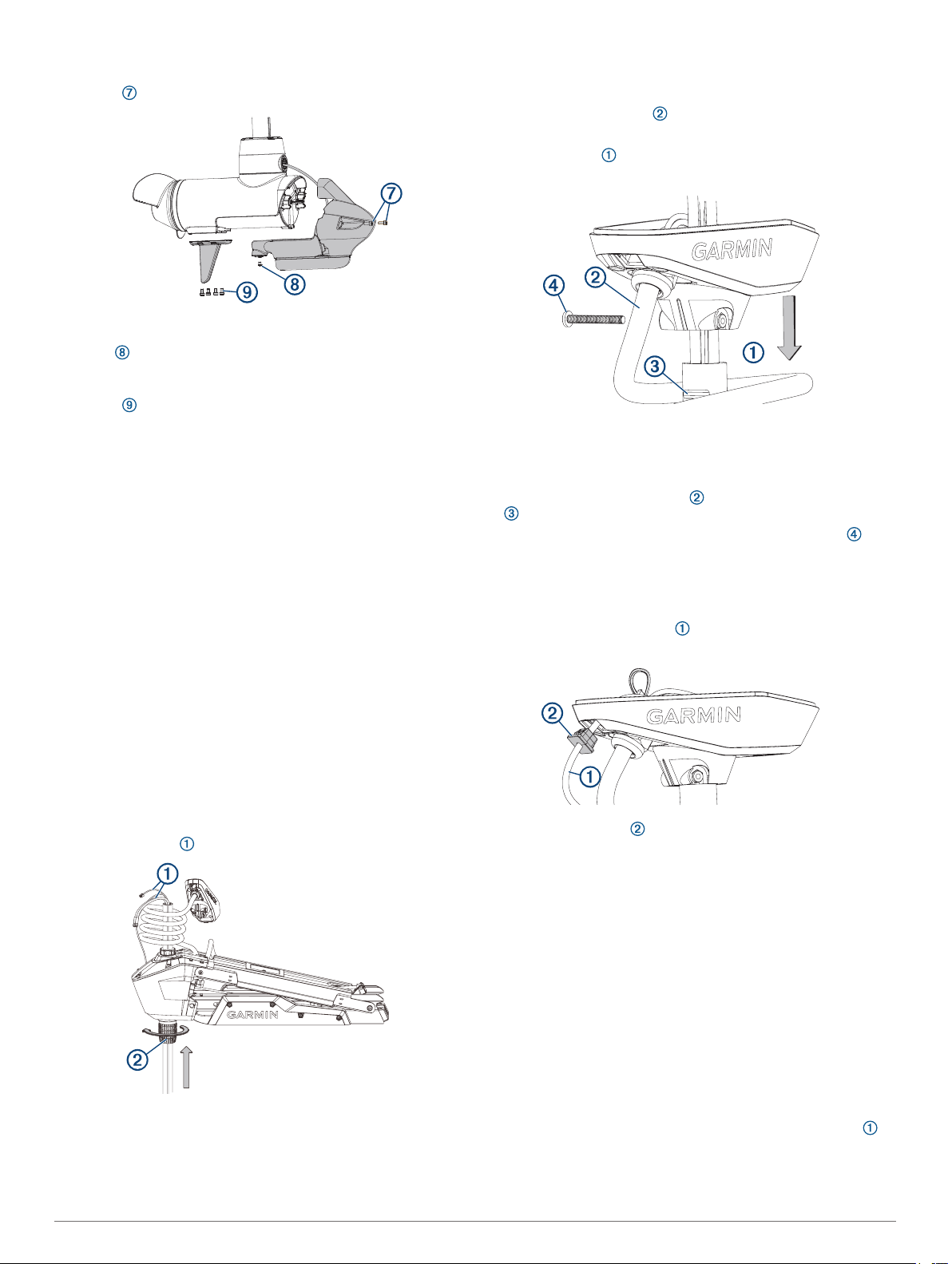
12
Using a 4 mm hex bit or wrench, secure the front of the nose
cone to the propeller drive motor using the existing two
screws
.
13
Using a 3 mm hex bit or wrench, secure the bottom of the
nose cone to the propeller drive motor using the existing
screw
.
14
Using a 4 mm hex bit or wrench, secure the skeg to the
bottom of the propeller drive motor using the existing four
screws
.
Installing the Drive Motor and Shaft
You should perform these actions to reassemble the trolling
motor after replacing the shaft or transducer.
1
Install the shaft in the steering servo housing (
Installing the
Shaft in the Steering Servo Housing, page 17).
2
Install the shaft cap on the shaft (
Installing the Shaft Cap,
page 17).
3
Install the transducer cable in the shaft cap (
Installing the
Transducer Cable in the Shaft Cap, page 17).
4
Connect the cables in the shaft cap (
Connecting the Cables
in the Shaft Cap, page 17).
5
Close the shaft cap (
Closing the Shaft Cap, page 18).
6
Route the power and transducer cables through the mount
(
Routing the Power and Transducer Cables Through the
Mount, page 11).
7
Connect the motor to the power source.
Installing the Shaft in the Steering Servo Housing
If you removed the depth-adjustment collar (Removing the
Depth-Adjustment Collar, page 13), you must reinstall it before
you install the shaft in the steering servo housing.
This procedure is best performed with two people.
1
2
Feed the cables
up through the steering servo housing.
TIP: Depending on the height of your trailer or workbench,
you may want to move the motor mount up about halfway to
make it easier to install the shaft.
3
Insert the shaft into the bottom of the steering servo housing,
and push it up through the top.
NOTE: The shaft is keyed to fit in the steering servo housing
one way only.
4
Tighten the depth adjustment collar on the base of the
steering servo housing
.
Installing the Shaft Cap
1
Pull the cables
from the shaft completely through the shaft
cap.
2
Using the coil count you recorded when you removed the
shaft cap, wrap the coil cable around the shaft the
appropriate number of times.
3
Place the shaft cap on the shaft, aligning the coil cable
extending from the shaft cap
with the groove on the shaft
.
4
Using a 4 mm hex bit or wrench, install the
1
/
4
-20 bolt
and
nut to secure the shaft cap to the shaft.
Installing the Transducer Cable in the Shaft Cap
Before you can install the transducer cable in the shaft cap, you
must install the shaft cap (Installing the Shaft Cap, page 17).
1
Feed the transducer cable
completely through the square
hole in the shaft cap.
2
Install the grommet
on the transducer cable.
The grommet is split on one side to make it easy to install on
the cable.
3
Push from the outside to secure the square grommet in the
shaft cap.
4
Route the transducer cable alongside the coil cable, using
the cable clamps to hold the cables together.
5
Route the transducer cable through the mount base
alongside the coil cable, using the cable clamps to secure the
cables to the base.
6
Route the transducer cable to the chartplotter, and connect it.
Connecting the Cables in the Shaft Cap
Before you can connect the cables in the shaft cap, you must
install the shaft cap (Installing the Shaft Cap, page 17).
1
Align the rings on the ends of the cables according to color.
You must stack the red cables together and stack the black
cables together, aligning the flat sides of the connectors
on the cables.
17
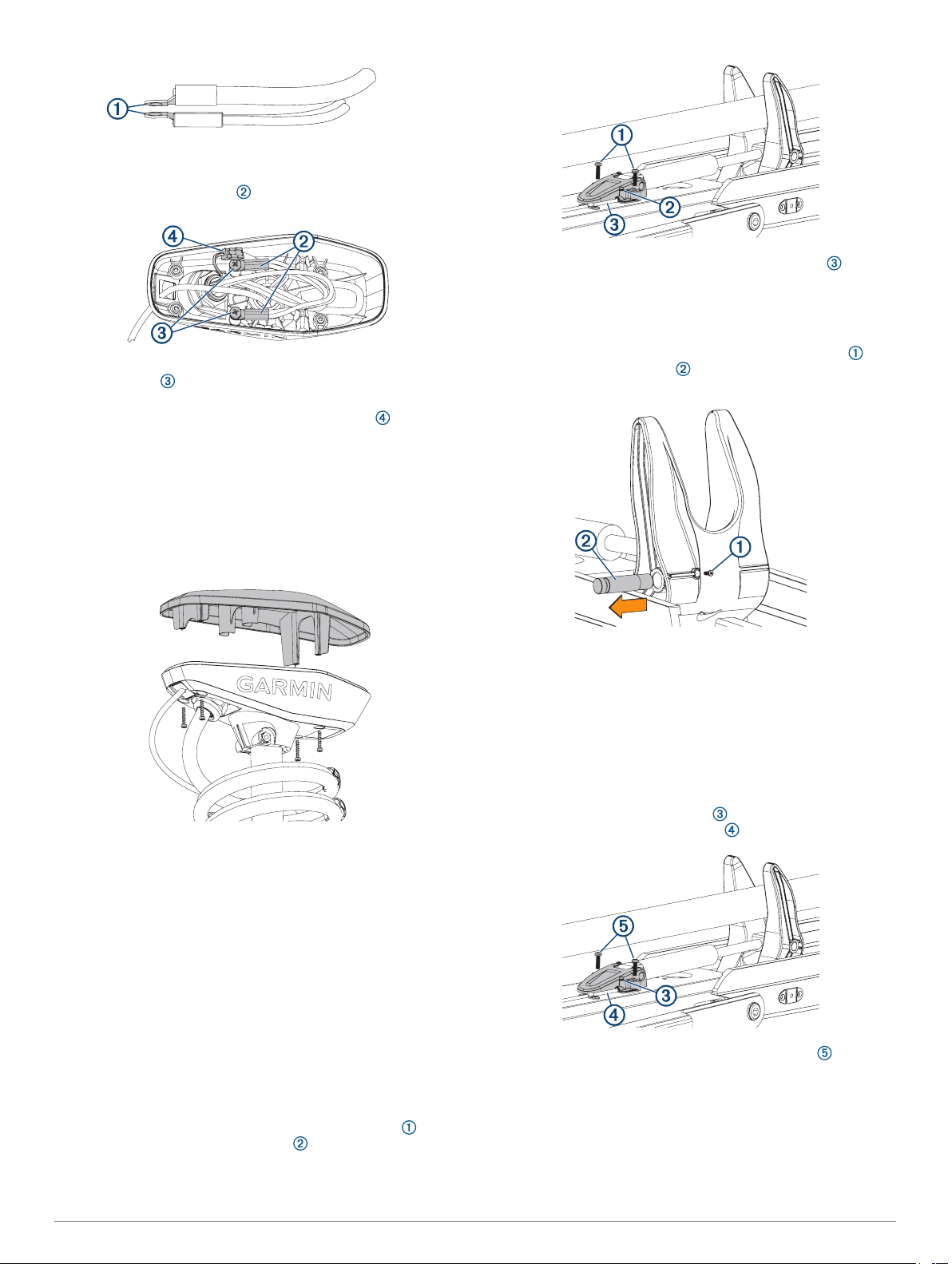
NOTE: If the cables are stacked incorrectly, you cannot close
the shaft cap cover.
2
Place the stacked cables
over the stand outs in the shaft
cap.
3
Using a #3 Phillips screwdriver, install the two screws and
lock washers
to secure the power cables onto the stand
outs in the shaft cap.
4
Align both sections of the data cable connector
, and push
together to connect them.
Closing the Shaft Cap
Before you can close the shaft cap, you must connect the cables
inside the shaft cap (Connecting the Cables in the Shaft Cap,
page 17).
1
Place the lid on the shaft cap.
2
Using a #2 Phillips screwdriver, install the four screws to
secure the lid of the shaft cap.
Removing the Steering Servo from the Mount
Before you can remove the steering servo from the mount, you
must remove the power and transducer cables from the mount
(Removing the Power and Transducer Cables From the Mount,
page 10).
1
Disconnect the lower gas spring (
Disconnecting the Lower
Gas Spring, page 18).
2
Disconnect the upper link of the mount (
Disconnecting the
Upper Link of the Mount, page 18).
3
Disconnect the upper gas spring (
Disconnecting the Upper
Gas Spring, page 19).
4
Disconnect the lower link of the mount (
Disconnecting the
Lower Link of the Mount from the Steering Servo, page 19).
Disconnecting the Lower Gas Spring
1
Place the trolling motor in the stowed position.
2
Using a #2 Phillips screwdriver, remove the screws
that
secure the lower gas spring clevis to the lower link of the
mount.
3
Lift the lower gas spring clevis off of the safety rod
.
Replacing the Lower Gas Spring
Before you can replace the lower gas spring, you must
disconnect it from the mount (Disconnecting the Lower Gas
Spring, page 18).
1
Using a #0 Phillips screwdriver, remove the set screw
that
secures the gas spring pin to the shaft stabilizer on the
mount.
2
Slide out the gas spring pin and lift up on the gas spring to
remove it.
3
Place the end of the replacement gas spring into the shaft
stabilizer on the mount.
4
Slide the gas spring pin into the shaft stabilizer, through the
end of the gas spring, until it is flush with the edge of the
shaft stabilizer.
5
Install the set screw in the shaft stabilizer to secure the gas
spring pin.
6
Place the lower gas spring clevis
on the lower link of the
mount, fitting it over the safety rod .
7
Using a #2 Phillips screwdriver, install the screws
that
secure the lower gas spring clevis to the lower link of the
mount.
Disconnecting the Upper Link of the Mount
Before you can disconnect the upper link of the mount, you must
remove the power and transducer cables from the mount
(Removing the Power and Transducer Cables From the Mount,
page 10).
18
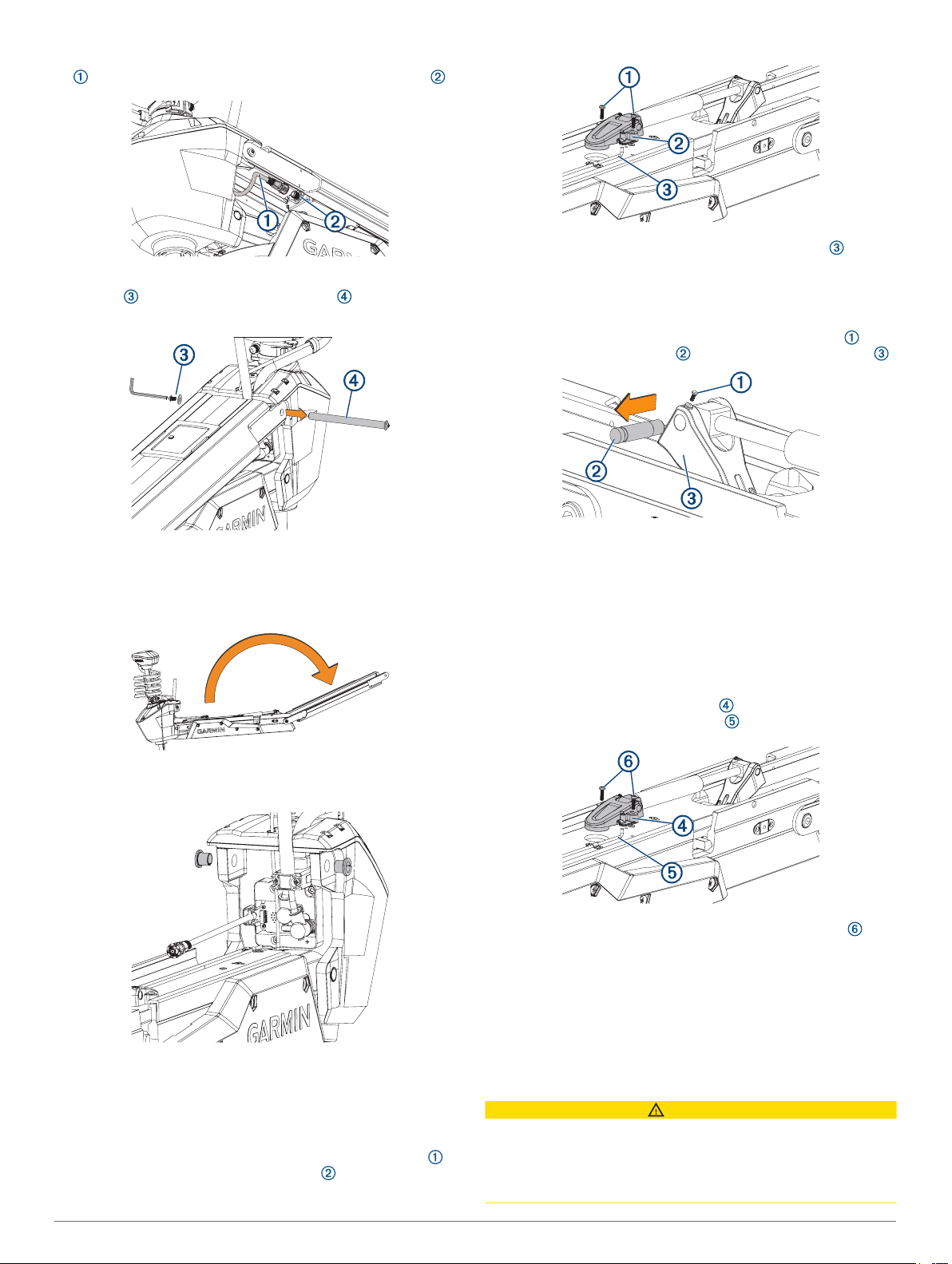
1
With the motor in the deployed position, disconnect the cable
from the display panel on the upper link of the mount .
2
Using an 4 mm hex bit or wrench, remove a screw and
washer
from one side of the upper pin on the steering
servo housing.
TIP: It is helpful to use another 4 mm hex wrench to hold one
end of the upper pin stationary while you remove one screw.
3
Remove the upper pin from the steering servo housing.
4
Pivot the upper link away from the steering servo housing.
5
Remove the bushings from the upper holes in the steering
servo housing.
Disconnecting the Upper Gas Spring
Before you can disconnect the upper gas spring, you must
disconnect the upper link of the mount (Disconnecting the Upper
Link of the Mount, page 18) and disconnect the lower gas spring
(Disconnecting the Lower Gas Spring, page 18).
1
Using a #2 Phillips screwdriver, remove the two screws
that secure the lower gas spring clevis to the lower link of
the mount.
2
Lift the upper gas spring clevis off of the safety rod
.
Replacing the Upper Gas Spring
Before you can replace the upper gas spring, you must
disconnect it from the mount (Disconnecting the Upper Gas
Spring, page 19).
1
Using a #0 Phillips screwdriver, remove the set screw
that
secures the gas spring pin to the upper gas spring arm .
2
Slide out the gas spring pin and lift up on the gas spring to
remove it.
3
Place the end of the replacement gas spring into the upper
gas spring arm.
4
Slide the gas spring pin into the upper gas spring arm,
through the end of the gas spring, until it is flush with the
edge of the upper gas spring arm.
5
Install the set screw in the upper gas spring arm to secure
the gas spring pin.
6
Place the upper gas spring clevis
on the lower link of the
mount, fitting it over the safety rod .
7
Using a #2 Phillips screwdriver, install the two screws
that
secure the lower gas spring clevis to the lower link of the
mount.
Disconnecting the Lower Link of the Mount from the
Steering Servo
Before you can disconnect the lower link of the mount from the
steering servo, you must disconnect the lower gas spring
(Disconnecting the Lower Gas Spring, page 18) and you must
disconnect the upper gas spring (Disconnecting the Upper Gas
Spring, page 19).
CAUTION
The lower pin is the final piece connecting the steering servo to
the mount. When you remove the pin, the steering servo, and
the drive motor and shaft, if they are still installed, may fall
causing injury or damage. Use caution to support the weight of
the steering servo before you remove the pin.
19
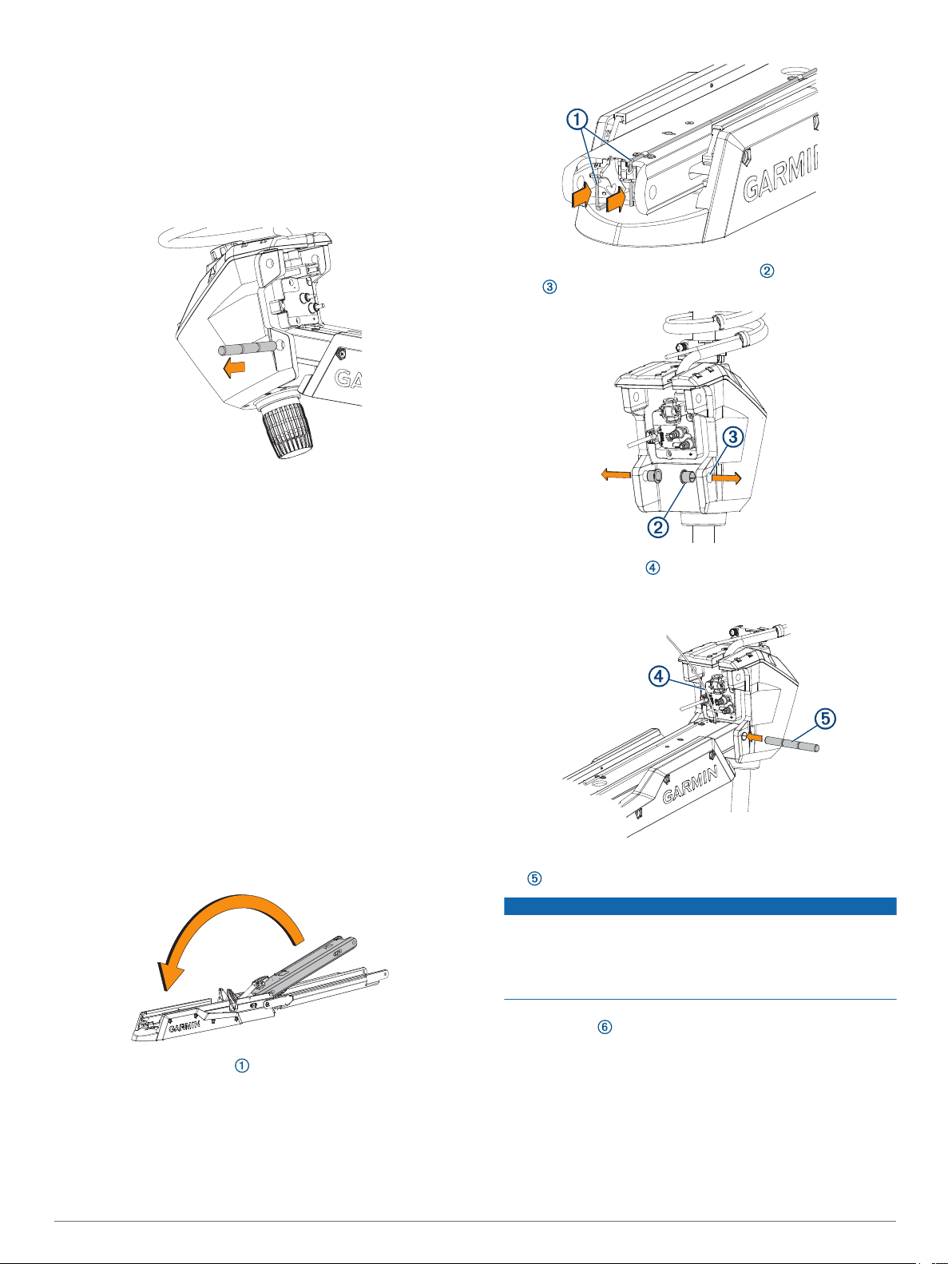
NOTE: This procedure is best performed with two people.
1
Slide the safety rods away from the steering servo to release
the lower pivot pin.
NOTE: The two safety rods don't need to move very far to
release the lower pivot pin. If either gas spring is still
connected to the lower link, however, the safety rods lock the
lower pivot pin in place, and it cannot be removed.
2
While supporting the weight of the steering servo, push the
lower pin out from one side, and pull to remove it completely.
The steering servo is no longer connected to the mount.
Connecting the Steering Servo to the Mount
If you removed the steering servo from the mount for service,
you can follow these procedures to reconnect it.
1
Connect the steering servo to the lower link of the mount
(
Installing the Steering Servo on the Lower Link of the Mount,
page 20).
2
Secure the upper gas spring (
Securing the Upper Gas
Spring, page 21).
3
Connect the upper link of the mount to the steering servo
(
Connecting the Upper Link of the Mount to the Steering
Servo Housing, page 21).
4
Connect the motor to the display panel (
Connecting the
Motor to the Display Panel, page 21).
5
Secure the lower gas spring (
Securing the Lower Gas Spring,
page 22).
6
Route the power and transducer cables through the mount
(
Routing the Power and Transducer Cables Through the
Mount, page 11).
Installing the Steering Servo on the Lower Link of the Mount
1
Pivot the lower link of the mount forward until it locks into the
base.
2
Push the two safety rods
into the lower link as far as
possible.
3
From the inside out, insert the bushings
into the lower
holes on the steering servo housing.
4
Holding the pull cable
up, place the steering servo housing
onto the lower link of the mount, aligning the lower holes on
the housing with the holes on the link.
5
While lifting up on the steering servo housing, push the pivot
pin
through the housing and the link to hold it in place.
NOTICE
Do not hit the pin with a hammer or other object. Do not drill
or modify the holes. Although it is a snug fit, the pin slides in
completely when pushed by hand. Damage caused by
hammering the pin or modifying the holes is not covered
under warranty.
6
Route the pull cable upward through the top of the steering
servo housing
.
20
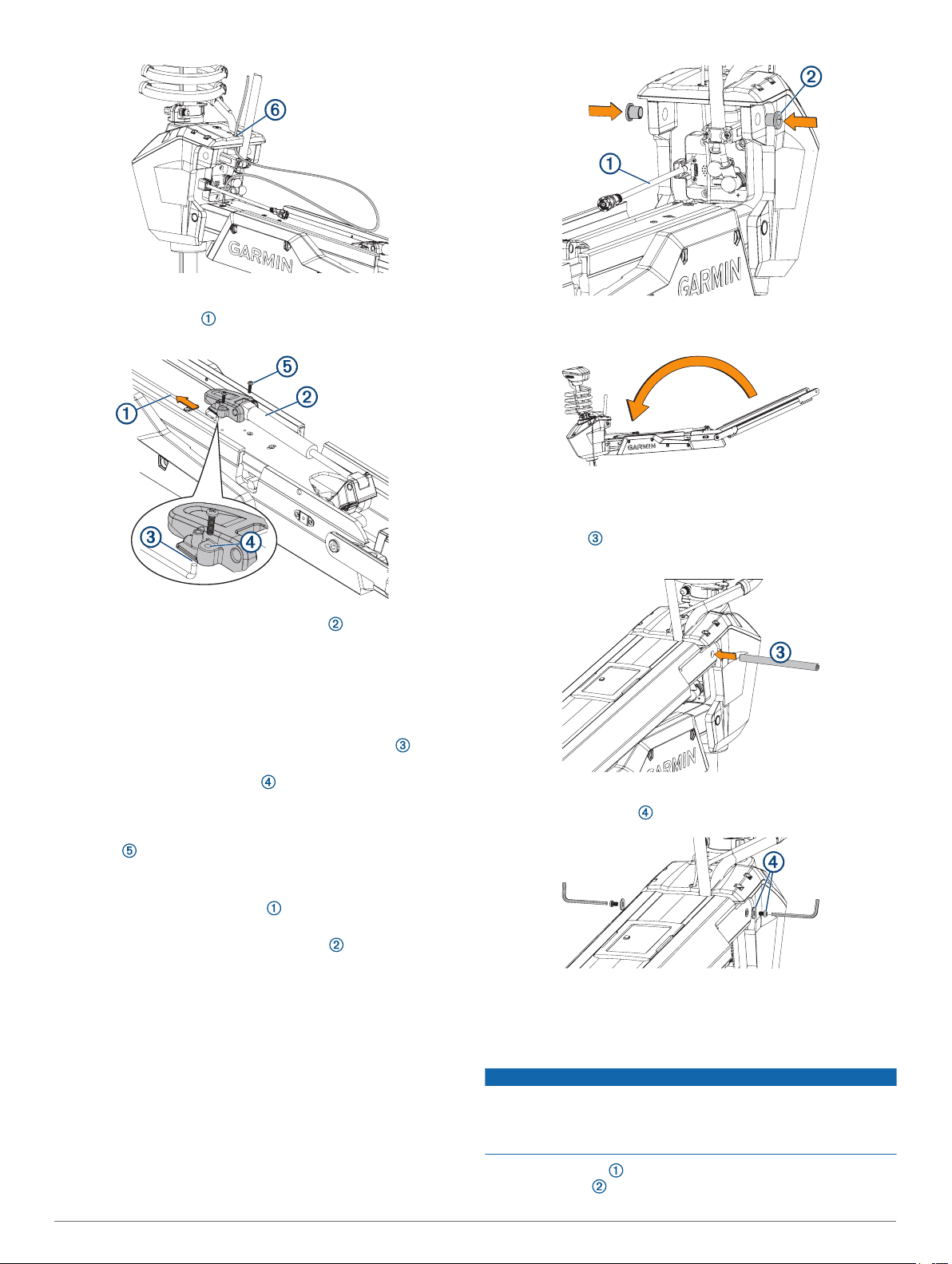
Securing the Upper Gas Spring
1
Push the safety rod
toward the steering servo housing as
far as possible to lock the lower pivot pin in place.
2
If necessary, pivot the upper gas spring
toward the lower
link of the mount so the base of the gas spring aligns with the
safety rod and mounting holes.
NOTE: If you must rotate the gas spring so the base aligns
with the mount, rotate the spring in a clockwise direction only.
Rotating the gas spring in a counter-clockwise direction may
loosen the fittings.
3
Align the single hole on the base of the gas spring
with the
safety rod, and press down.
The screw holes on the base should align with the holes
on the bottom of the mount.
4
Using a #2 Phillips screwdriver, secure the base of the gas
spring to the lower link of the mount using the included
screws
.
Connecting the Upper Link of the Mount to the Steering
Servo Housing
1
Make sure that the data cable
is accessible, and not
trapped by any part of the mount.
2
From the outside in, insert the bushings
in the upper holes
on the steering servo housing.
3
Pivot the upper link of the mount forward.
4
Tip the top of the steering servo housing inward so the holes
on the upper link and the housing align.
5
Push the pin
through the holes on the upper link of the
mount and the steering servo housing.
6
Using a 4 mm hex bit or hex wrench, secure the pin using the
screws and washers
on both sides.
NOTE: To properly secure the pin, you should use two hex
bits or wrenches so the pin does not rotate as you tighten the
screws.
Connecting the Motor to the Display Panel
NOTICE
You must connect the cable from the steering servo to the
display panel before proceeding further with assembly. If you do
not make this connection now, the unsecured cable may
damage the display panel when moving the mount.
1
Route the cable
from the steering servo housing to the
display panel on the upper link of the mount.
21
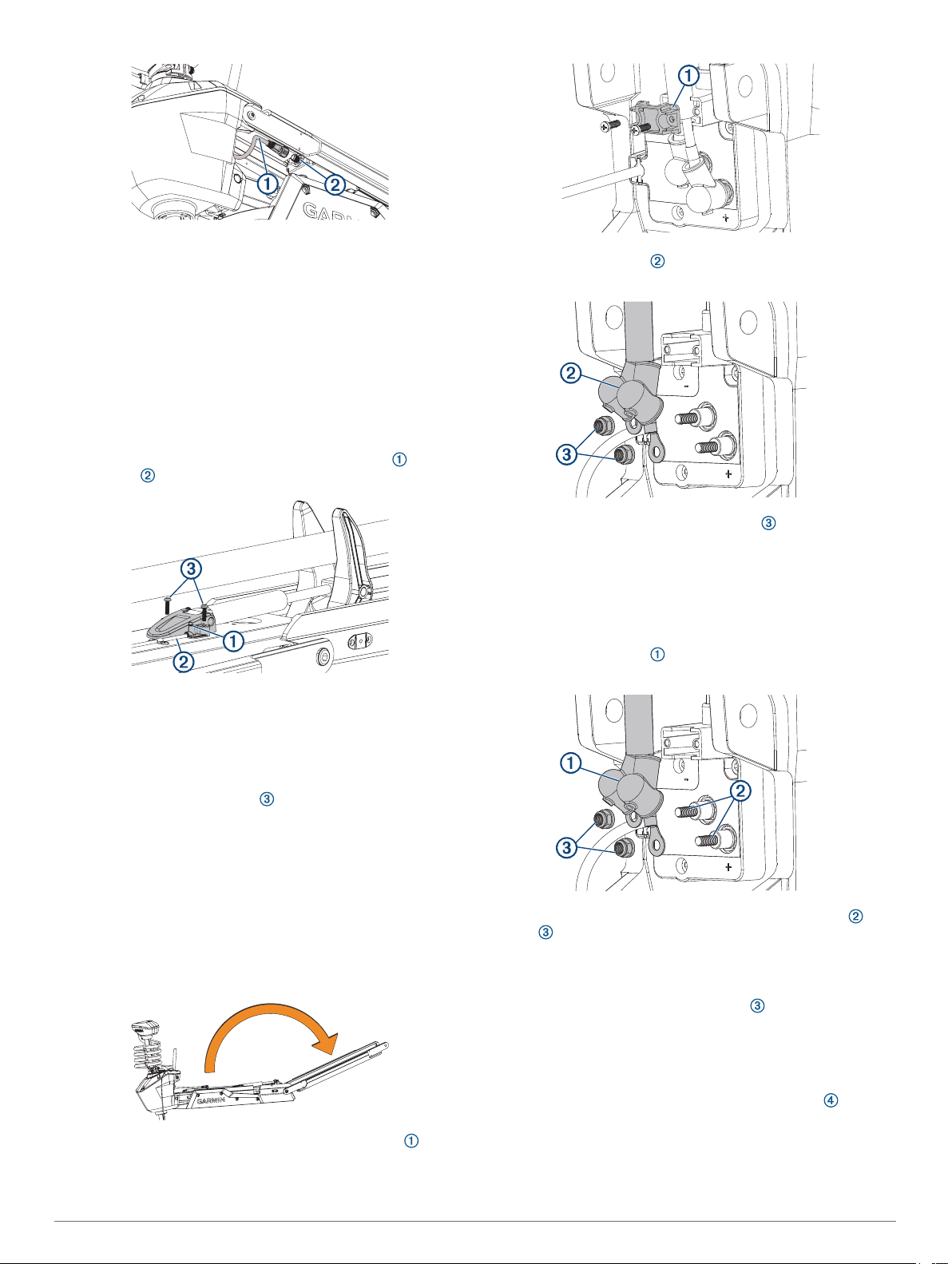
2
Push the connector onto the port on the display panel, and
rotate the locking ring clockwise to secure it.
NOTE: The connector is keyed to fit into the port one way
only, and will fit easily when aligned correctly. Do not force
the connector into the port.
Securing the Lower Gas Spring
1
If necessary, transition the trolling motor from the deployed to
the stowed position.
If the gas spring is positioned on the other side of the mount
after you stowed the motor, you may need to lift up the mount
and flip over the gas spring so you can secure it to the
mount.
2
Align the hole on the base of the lower gas spring
with the
safety rod , and press down.
NOTE: If you must rotate the gas spring so the base aligns
with the mount, rotate the spring in a clockwise direction only.
Rotating the gas spring in a counter-clockwise direction may
loosen the fittings.
3
Using a #2 Phillips screwdriver, secure the base of the lower
gas spring to the mount using the screws you removed when
disconnecting the gas spring
.
Removing the Power Cable from the Steering Servo
Housing
Before you can remove the power cable from the steering servo
housing, you must remove the power and transducer cables
from the mount (Removing the Power and Transducer Cables
From the Mount, page 10).
1
Disconnect the upper link of the mount from the steering
servo housing (
Disconnecting the Upper Link of the Mount,
page 18).
2
Pivot the upper link away from the steering servo housing.
3
Using a #2 Phillips screwdriver, remove the bracket
that
secures the power cable to the steering servo housing.
4
Pull the rubber shields
away from the power cable
connectors.
5
Using a 10 mm socket, remove the nuts
that secure the
power cable connectors.
6
Remove the power cable from the steering servo housing.
Reconnecting the Power Cable
If you are replacing the power cable, you must first remove the
existing power cable from the steering servo housing
Removing
the Power Cable from the Steering Servo Housing, page 22.
1
Pull the rubber shields
away from the power cable
connectors.
2
Apply dielectric grease to the power cable connectors
and
bolts on the steering servo housing.
3
Place the power cable connecters over the bolts on the
steering servo housing, with the red cable on the positive (+)
terminal, and the black cable on the negative (-) terminal.
4
Using a 10 mm socket, install the nuts
that secure the
power cable connectors.
5
Tighten the nuts to 30 kgf-cm (26 lbf-in).
6
Pull the rubber shields down to cover the power cable
connectors.
7
Using a #2 Phillips screwdriver, install the bracket
that
secures the power cable to the steering servo housing.
22
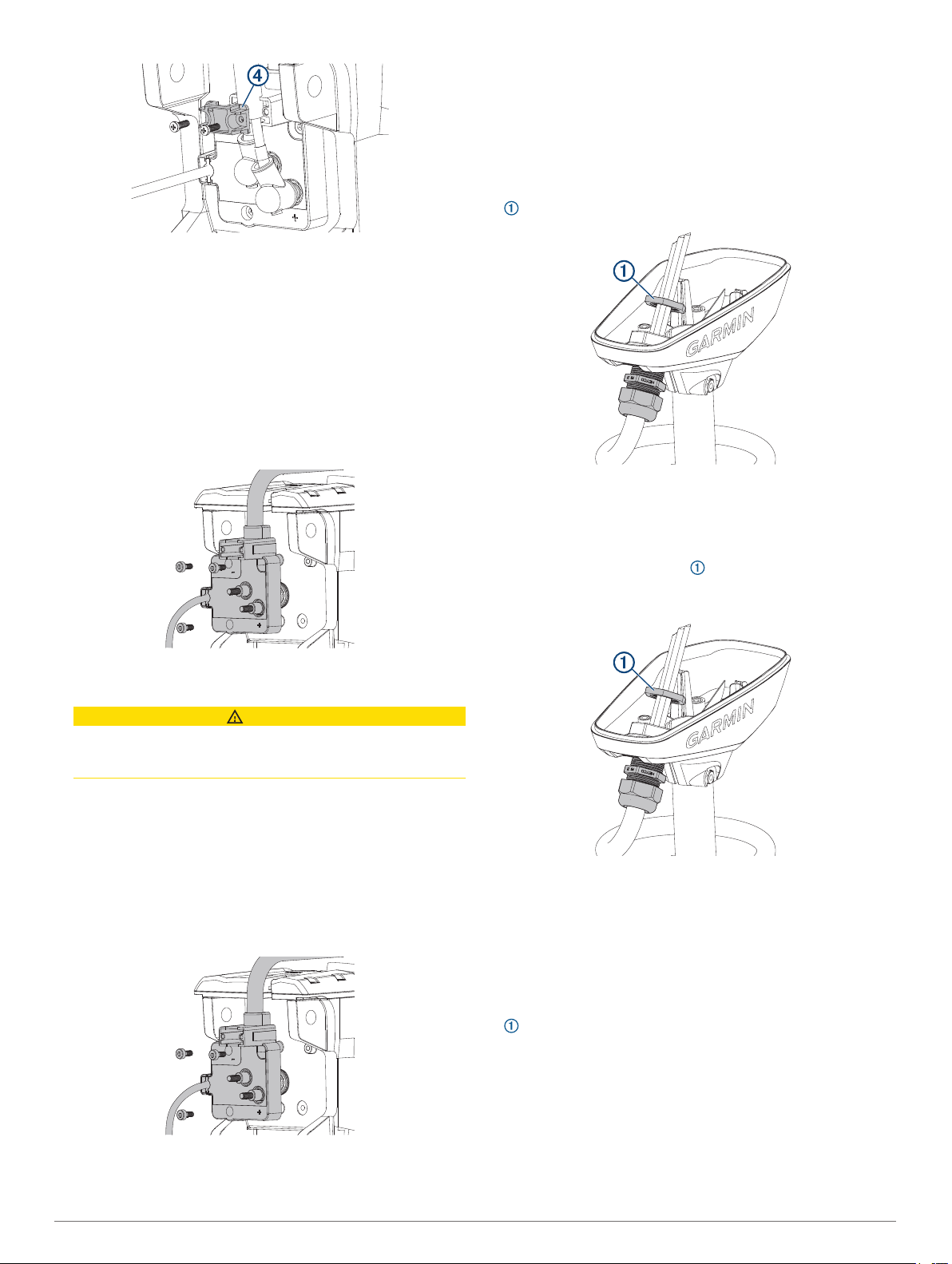
8
Tighten the screws to 5 kgf-cm (4.3 lbf-in).
9
Reconnect the upper link to the steering servo housing
(
Reconnecting the Upper Link to the Mount Base, page 24).
Removing the Coil Cable from the Steering Servo
Housing
Before you can remove the coil cable, you must disconnect the
power cable from the steering servo housing (Removing the
Power Cable from the Steering Servo Housing, page 22).
1
Using a 4 mm hex bit or screwdriver, remove the three
screws that secure the coil cable block to the steering servo
housing.
2
Pull the coil cable block away from the steering servo
housing to remove it.
CAUTION
The coil cable block connects to the PCB in the steering
servo housing. When removing the block take care to avoid
damaging the connector on the PCB.
Reconnecting the Coil Cable
1
If you are replacing the coil cable, remove the coil cable from
the shaft cap (
Removing the Coil Cable from the Shaft Cap,
page 23).
2
If necessary, install the replacement coil cable in the shaft
cap (
Installing the Coil Cable in the Shaft Cap, page 23).
3
Place the coil cable block over the connector on the steering
servo housing, and push it into place, taking care to avoid
damaging the connector.
4
Using a 4 mm hex bit or screwdriver, insert and tighten the
three screws to secure the coil cable block to the steering
servo housing.
5
tighten the three screws to 20 kgf-cm (17.4 lbf-in)
6
Reconnect the power cable (
Reconnecting the Power Cable,
page 22).
Removing the Coil Cable from the Shaft Cap
Before you can remove the coil cable from the shaft cap, you
must disconnect the cables in the shaft cap (Disconnecting the
Cables in the Shaft Cap, page 12).
1
Using a 36 mm or adjustable wrench, remove the plastic nut
on the coil-cable connector inside the shaft cap.
2
Pull the coil cable out of the shaft cap to remove it.
Installing the Coil Cable in the Shaft Cap
1
Feed the cables from the existing or replacement coil cable
into the hole on the shaft cap.
2
Using the existing plastic nut
or the nut provided with the
replacement coil cable, secure the coil-cable connector to the
shaft cap.
3
Using a 36 mm or adjustable wrench, tighten the plastic nut
on the coil-cable connector inside the shaft cap
Replacing the Display Panel
Before you can remove the display panel from the upper link of
the mount, you must disconnect the upper link of the mount from
the steering servo housing (Disconnecting the Upper Link of the
Mount, page 18).
1
Using a #0 Phillips screwdriver, remove the position sensor
from the upper link of the mount.
23
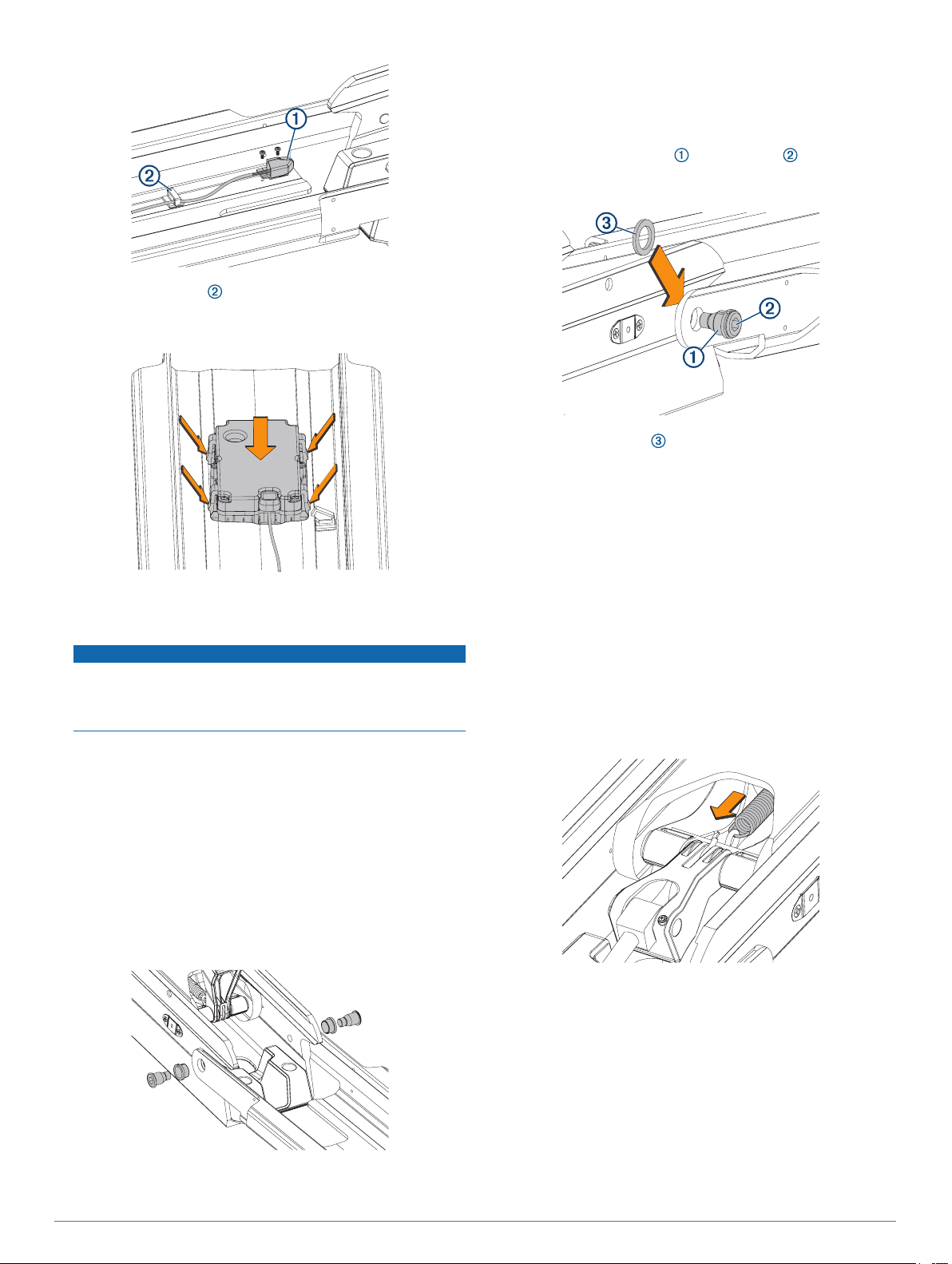
2
Open the cable clips
to remove the position-sensor cable.
3
Pinch the tabs on the side of the display panel, and push it
out of the upper link from the back.
4
Feed the cable from the replacement display panel through
the upper link, taking care to feed the cable completely
through the upper link.
NOTICE
Use caution when installing the replacement display panel,
because the cable may become pinched between the display
panel and the upper link. This damages the cable and causes
unwanted behavior when stowing the motor.
5
Secure the replacement display panel by placing it in the
upper link and pushing until it snaps into place.
6
Using a #0 Phillips screwdriver, secure the position sensor to
the mount.
7
Route the position sensor cable through the cable clips and
snap them closed to secure the cable.
Removing the Upper Link from the Mount Base
Before you can remove the upper link from the mount base, you
must disconnect the upper link from the steering servo housing
(Disconnecting the Upper Link of the Mount, page 18).
1
Using an 8 mm hex bit or wrench, loosen the two bolts that
secure the upper link to the mount base.
TIP: The bolts that secure the upper link to the mount base
are fastened very securely at the factory. You may need to
use a ratchet to hold the 8 mm hex bit to provide the leverage
needed to loosen these bolts.
2
Remove the bolts, bushings, and washers from both sides of
the upper link.
Reconnecting the Upper Link to the Mount Base
1
Place the plastic bushings
over the bolts you removed
with the original upper link, or over the two bolts supplied with
the replacement upper link.
2
Place a plastic washer
that you removed with the original
upper link or a washer supplied with the replacement upper
link between the upper link and the mount base.
NOTE: Replacement plastic washers may have adhesive on
one side. If your washers have adhesive, you can stick them
to the mount base to make installing the bolts easier.
3
Push one of the bolts with a plastic bushing through the
upper link and washer, and using an 8 mm hex bit or wrench,
screw it into the mount base.
4
Repeat the previous step on the other side of the mount.
5
Tighten the bolts to 55 Nm (40.5 lbf-ft.).
Removing the Lower Link from the Mount Base
Before you can remove the lower link from the mount base, you
must remove the steering servo from the mount (Removing the
Steering Servo from the Mount, page 18).
1
Rotate the lower link up so you can access the latching
mechanism spring.
2
Using needle-nose pliers, disconnect the spring from the
hook on the base of the gas spring.
3
Using a #2 Phillips screwdriver, remove the pin covers from
the sides of the mount base.
24
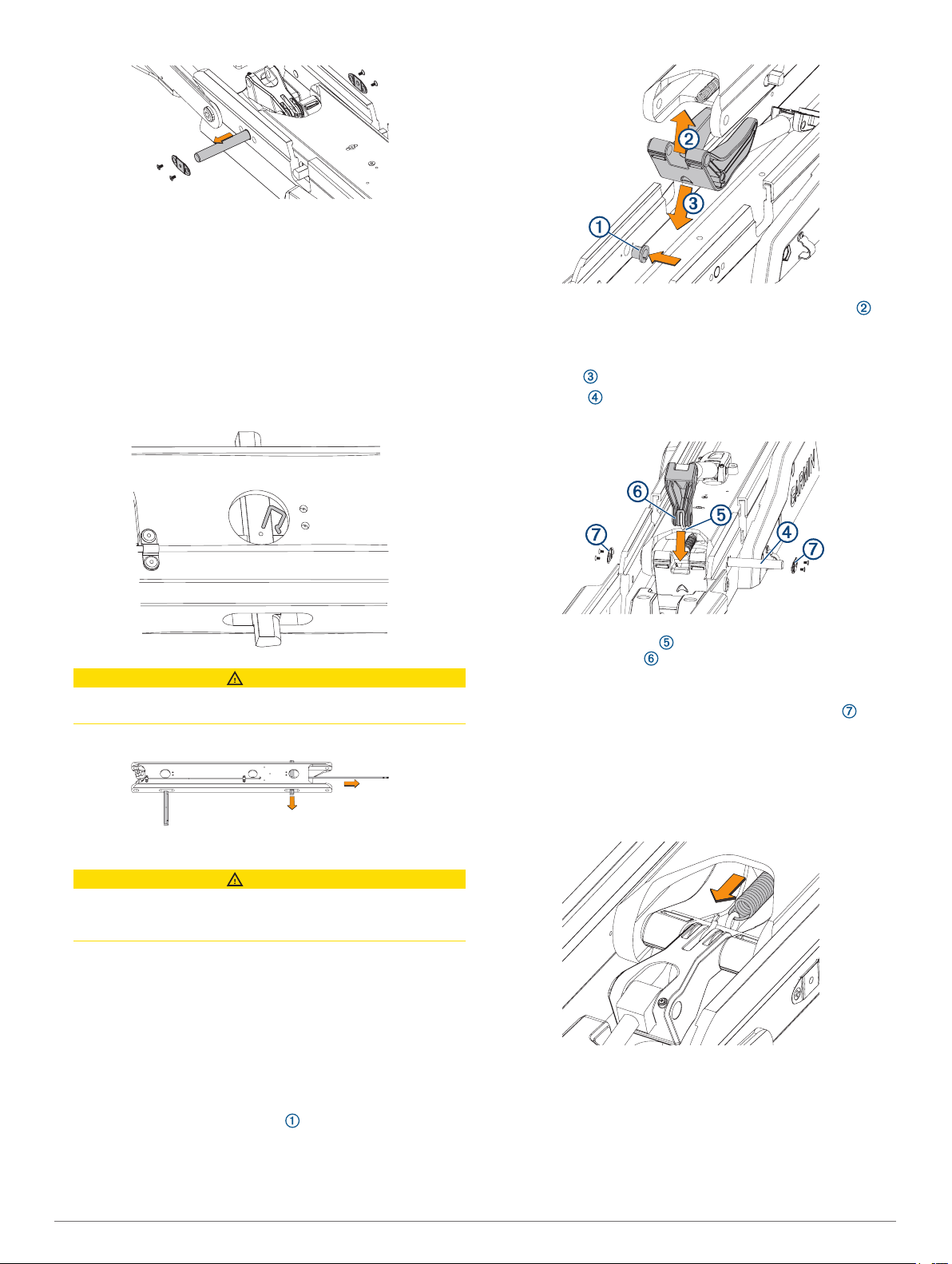
4
Push the pin out from one side and pull to remove it from the
mount base.
5
Lift up to remove the lower link from the mount base.
Replacing the Locking Mechanism in the Lower Link
Before you can replace the locking mechanism in the lower link,
you must remove the lower link from the mount base (Removing
the Lower Link from the Mount Base, page 24).
1
If it is still connected, remove the pull cable from the latching
mechanism (
Removing the Pull Cable, page 10).
2
Using a pair of needle-nose pliers, remove the pins that
secure the latch bars to the central rod.
CAUTION
Take note of the orientation of the latch pins prior to removing
them. Installing the latch pins incorrectly may cause damage.
3
Slide the central rod out of either end of the lower link.
4
Slide the two latch bars out of the lower link.
CAUTION
Take note of the orientation of the latch bars prior to
removing them. Installing the latch bars incorrectly may
cause damage.
5
Apply a silicon-based lubricating grease to the replacement
latch bars.
6
Insert the replacement latch bars into the lower link, with the
rounded ends of the latch bars facing the hinge end of the
lower link.
7
Insert the replacement rod into either end of the lower link,
feeding it through the holes in the two latch bars.
8
Reinstall the pins to secure the latch bars to the central rod.
Reconnecting the Lower Link to the Mount Base
1
If necessary, install the bushings
in the mount base from
the inside.
2
Insert the lower gas spring assembly into the lower link
,
with the shaft stabilizer pointing toward the front of the lower
link.
3
Insert the combined lower link and lower gas spring into the
mount base
.
4
Push the pin
into the mount base, feeding it through one
side of the lower link and shaft stabilizer.
5
Holding the spring hook
towards the lower link, place the
upper gas spring arm into the shaft stabilizer, and push
the pin the rest of the way through all of the parts, until it is
flush with the sides of the mount base.
6
Using a #2 Phillips screwdriver, install the pin covers
on
the sides of the mount base.
7
Rotate the lower link up so you can access the latching
mechanism.
8
Using needle-nose pliers, connect the spring from the
latching mechanism to the hook on the base of the gas
spring.
9
Install the steering servo on the mount (
Connecting the
Steering Servo to the Mount, page 20).
Replacing the Mount Base
1
Remove the steering servo from the mount (
Removing the
Steering Servo from the Mount, page 18).
2
Remove the upper link from the mount base (
Removing the
Upper Link from the Mount Base, page 24).
25
3
Remove the lower link from the mount base (
Removing the
Lower Link from the Mount Base, page 24).
4
Uninstall the fasteners that secure the mount base to the
boat.
5
Secure the replacement mount base to the deck of the boat,
replacing the existing mounting hardware if necessary.
6
Install the lower link on the mount base (
Reconnecting the
Lower Link to the Mount Base, page 25).
7
Install the upper link on the mount base (
Reconnecting the
Upper Link to the Mount Base, page 24).
8
Install the steering servo on the mount (
Connecting the
Steering Servo to the Mount, page 20).
Replacing the Mount Shrouds
1
Using a 4 mm hex bit or wrench, remove the screws that
secure the mount shrouds to the mount base.
2
Secure the replacement shrouds to the mount base using the
screws provided with the replacement shrouds.
Replacing the Mount Rails
Before you can replace the mount rails, you must remove the
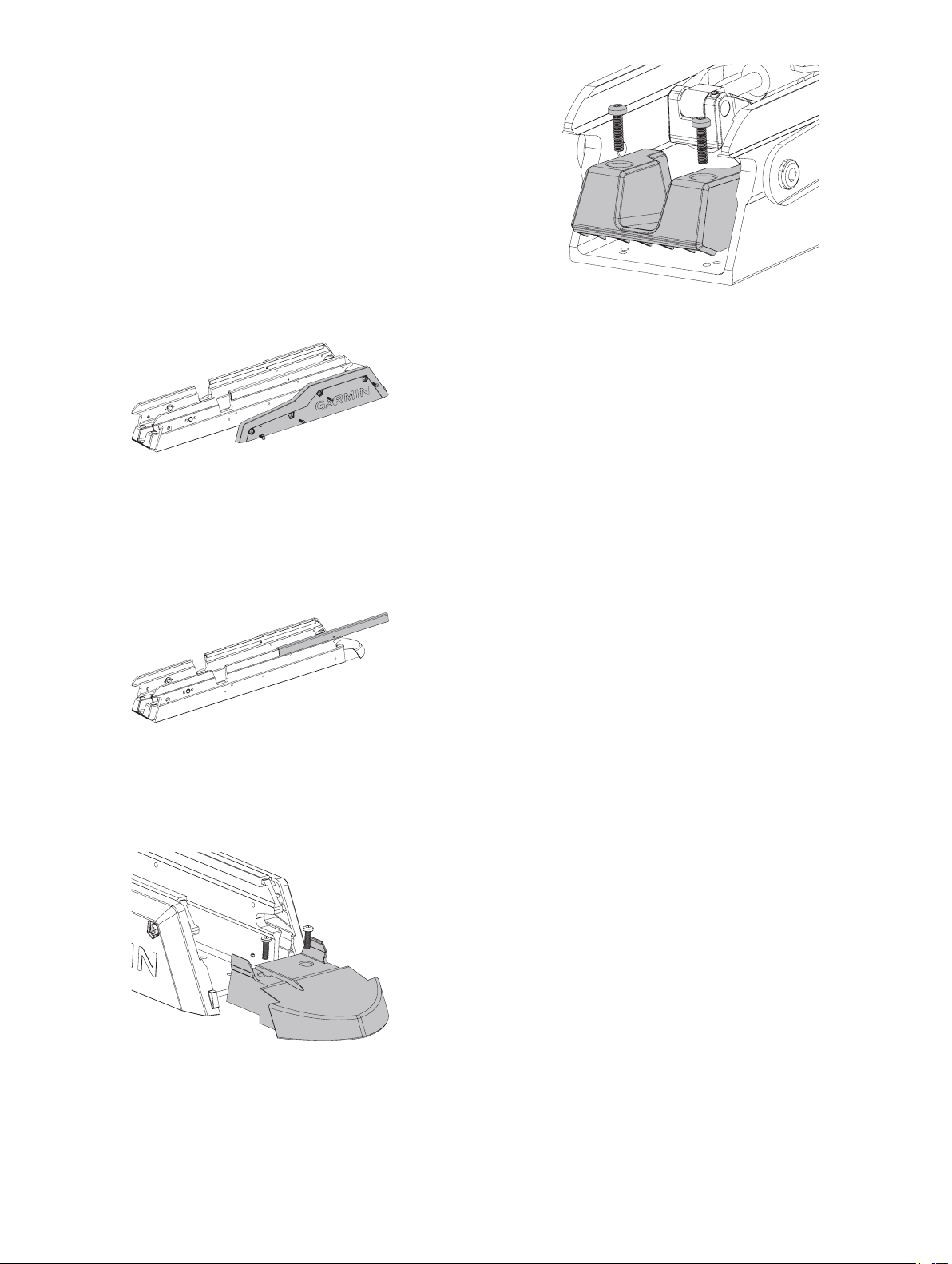
shrouds from the mount base (Replacing the Mount Shrouds,
page 26).
1
Slide the two mount rails off of the mount base.
2
Slide the replacement rails onto the mount base.
3
Reinstall the shrouds.
Replacing the Mount Bumper
1
Using a 4 mm hex bit or wrench, remove the two screws that
secure the mount bumper to the mount base.
2
Install the replacement mount bumper, and secure it to the
mount base using the screws provided with the replacement
part.
Replacing the Stow Support
1
Using a 4 mm hex bit or wrench, remove the screws securing
the stow support to the mount base.
2
Install the replacement stow support using the screws
provided with the replacement part.
© 2019 Garmin Ltd. or its subsidiaries
Garmin
®
, the Garmin logo, ActiveCaptain
®
, and Force
®
are trademarks of Garmin Ltd. or
its subsidiaries, registered in the USA and other countries. These trademarks may not
be used without the express permission of Garmin.
DuPont
™
and Teflon
®
are trademarks of E. I. du Pont de Nemours and Company or its
affiliates.
© 2019 Garmin Ltd. or its subsidiaries
support.garmin.com