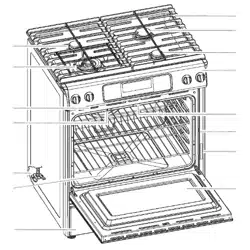
THANK YOU for purchasing this high-quality product. If you should experience a problem not covered in TROUBLESHOOTING,
call us at 1-866-664-2449.
You will need your model and serial number located on the oven frame behind the top right side of the oven door.
For warranty concerns, do not take the appliance back to the store. Please contact us in the U.S.A. or Canada at
1-866-664-2449.
This product features a Limited Warranty - See the “Warranty” section for complete details. IKEA
®
appliances carry a
5-year warranty (excludes LAGAN family - see warranty for coverage details).
NOTE: Proof of Purchase is required to obtain warranty service.
Para una versión de estas instrucciones en español, visite: www.whirlpool.com.
Necesitará tener a mano el número de modelo y de serie, que está ubicado en el marco del horno detrás del lado superior
derecho de la puerta del horno.
Si tiene dudas acerca de la garantía, no devuelva el aparato a la tienda. Póngase en contacto con nosotros en los EE.UU.
oenCanadá al 1-866-664-2449.
Este producto tiene una garantía limitada - Consulte la sección “Garantía” para obtener todos los detalles. Los aparatos
IKEA
®
tienen una garantía de 5 años (excluyendo los de la familia LAGAN - consulte la garantía para ver los detalles acerca
delacobertura).
NOTA: Se requiere la prueba de compra para obtener servicio bajo la garantía.
Table of Contents
User Guide
Gas Range
W11397129A
RANGE SAFETY .............................................................................2
The Anti-Tip Bracket ....................................................................3
KEY USAGE TIPS ...........................................................................4
Alternative Clean Self-Cleaning Technology................................4
Surface Temperatures ..................................................................4
Preheating ....................................................................................4
Surface Burners ...........................................................................4
FEATURE GUIDE ............................................................................5
Electronic Oven Controls .............................................................7
Surface Burners ...........................................................................9
COOKTOP .......................................................................................9
Surface Grates ...........................................................................10
Burner Size .................................................................................11
Cookware ...................................................................................11
Home Canning ...........................................................................12
OVEN .............................................................................................13
Aluminum Foil .............................................................................13
Positioning Racks and Bakeware ..............................................13
Oven Vent ...................................................................................14
Sabbath Mode............................................................................14
Baking and Roasting ..................................................................14
Broiling........................................................................................15
Cook Time ..................................................................................15
Oven Light ..................................................................................15
RANGE CARE ...............................................................................16
Clean Cycle ................................................................................16
General Cleaning ........................................................................17
TROUBLESHOOTING ..................................................................18
ACCESSORIES .............................................................................20
2
RANGE SAFETY
WARNING: If the information in these instructions is not followed exactly, a fire or
explosion may result causing property damage, personal injury or death.
– Do not store or use gasoline or other flammable vapors and liquids in the vicinity of this
or any other appliance.
– WHAT TO DO IF YOU SMELL GAS:
•
Do not try to light any appliance.
•
Do not touch any electrical switch.
•
Do not use any phone in your building.
•
Immediately call your gas supplier from a neighbor's phone. Follow the gas supplier's
instructions.
•
If you cannot reach your gas supplier, call the fire department.
– Installation and service must be performed by a qualified installer, service agency or
the gas supplier.
WARNING: Gas leaks cannot always be detected by smell.
Gas suppliers recommend that you use a gas detector approved by UL or CSA.
For more information, contact your gas supplier.
If a gas leak is detected, follow the “What to do if you smell gas” instructions.
3
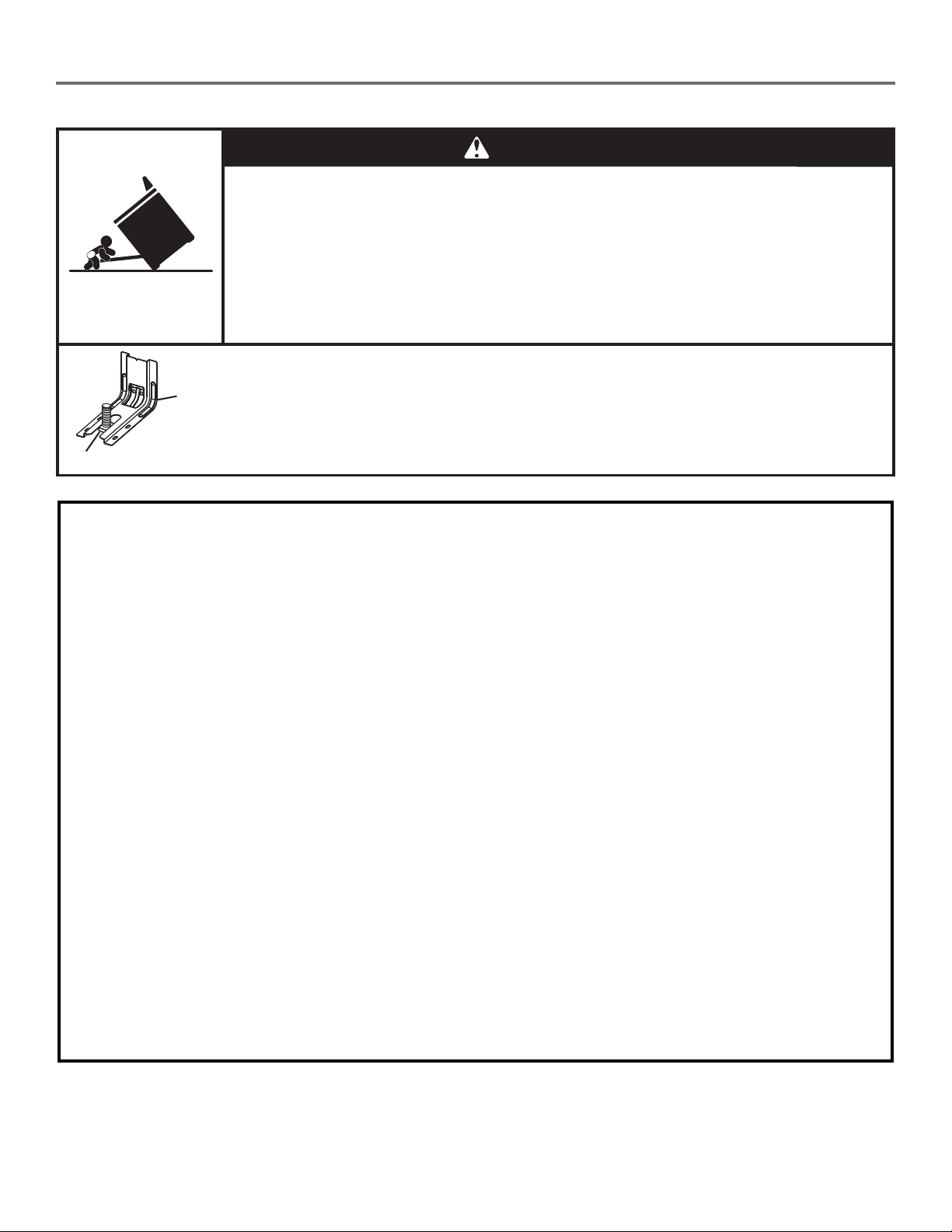
The Anti-Tip Bracket
The range will not tip during normal use. However, the range can tip if you apply too much force or weight to the open door without the
anti-tip bracket fastened down properly.
Tip Over Hazard
A child or adult can tip the range and be killed.
Install anti-tip bracket to floor or wall per installation instructions.
Slide range back so rear range foot is engaged in the slot of the anti-tip bracket.
Re-engage anti-tip bracket if range is moved.
Do not operate range without anti-tip bracket installed and engaged.
Failure to follow these instructions can result in death or serious burns to children and adults.
Anti-Tip
Bracket
To verify the anti-tip bracket is installed and engaged:
• Slide range forward.
• Look for the anti-tip bracket securely attached to floor or wall.
• Slide range back so rear range foot is under anti-tip bracket.
• See installation instructions for details.
Range Foot
WARNING
SAVE THESE INSTRUCTIONS
IMPORTANT SAFETY INSTRUCTIONS
WARNING: To reduce the risk of fire, electrical shock,
injury to persons, or damage when using the range, follow
basic precautions, including the following:
■
WARNING: TO REDUCE THE RISK OF TIPPING OF
THE RANGE, THE RANGE MUST BE SECURED BY
PROPERLY INSTALLED ANTI-TIP DEVICES. TO CHECK
IF THE DEVICES ARE INSTALLED PROPERLY, SLIDE
RANGE FORWARD, LOOK FOR ANTI-TIP BRACKET
SECURELY ATTACHED TO FLOOR OR WALL, AND
SLIDE RANGE BACK SO REAR RANGE FOOT IS UNDER
ANTI-TIP BRACKET.
■
WARNING:
NEVER use this appliance as a space
heater to heat or warm the room. Doing so may result in
carbon monoxide poisoning and overheating of the oven.
■
WARNING:
NEVER cover any slots, holes or passages
in the oven bottom or cover an entire rack with materials
such as aluminum foil. Doing so blocks air flow through the
oven and may cause carbon monoxide poisoning.
Aluminum foil linings may also trap heat, causing a fire
hazard.
■ CAUTION: Do not store items of interest to children in
cabinets above a range or on the backguard of a range –
children climbing on the range to reach items could be
seriously injured.
■
Proper Installation – The range, when installed, must be
electrically grounded in accordance with local codes or, in
the absence of local codes, with the
National Electrical
Code, ANSI/NFPA 70
. In Canada, the range must be
electrically grounded in accordance with Canadian
Electrical Code. Be sure the range is properly installed and
grounded by a qualified technician.
■
This range is equipped with a three-prong grounding plug
for your protection against shock hazard and should be
plugged directly into a properly grounded receptacle. Do
not cut or remove the grounding prong from this plug.
■ Disconnect power before servicing.
■
Injuries may result from the misuse of appliance doors or
drawers such as stepping, leaning, or sitting on the doors
or drawers.
■
Maintenance – Keep range area clear and free from
combustible materials, gasoline, and other flammable
vapors and liquids.
■ Storage in or on the Range – Flammable materials should
not be stored in an oven or near surface units.
■ Top burner flame size should be adjusted so it does not
extend beyond the edge of the cooking utensil.
For self-cleaning ranges –
■ Before Self-Cleaning the Oven – Remove broiler pan and
other utensils. Wipe off all excessive spillage before
initiating the cleaning cycle.
4
Alternative Clean Self-Cleaning
Technology
Alternative Clean Self-Cleaning Technology is a rst-of-its-kind
cleaning solution designed to minimize the time, temperature,
and odors that ordinarily come with traditional self-cleaning
methods. With Alternative Clean Self-Cleaning Technology, an
exclusive coating on the interior of the oven is activated with
heat and water to release baked-on soil. To use Alternative Clean
Self-Cleaning Technology, simply wipe out loose debris, pour
water into the oven bottom, and run the Alternative Clean Self-
Cleaning cycle. When the cycle nishes in under 1 hour at a lower
temperature than in traditional self-cleaning methods, just wipe
out the remaining water and loose debris. See the “Clean Cycle”
section for more detailed instructions.
Surface Temperatures
When the range is in use, all range surfaces may become hot,
such as the knobs and oven door.
Storage Drawer
When the oven is in use, the drawer may become hot. Do not
store plastics, cloth, or other items that could melt or burn in
thedrawer.
Oven Vent
The oven vent releases hot air and moisture from the oven, and
should not be blocked or covered. Do not set plastics, paper,
orother items that could melt or burn near the oven vent.
Preheating
When beginning a Bake, Convect Bake, or Convect Roast cycle,
the oven will begin preheating after Start is pressed. The oven
will take approximately 12 to 15 minutes to reach 350°F (177°C)
with all of the oven racks provided with your oven inside the
oven cavity. Higher temperatures will take longer to preheat.
The preheat cycle rapidly increases the oven temperature. The
actual oven temperature will go above your set temperature to
offset the heat lost when your oven door is opened to insert food.
This ensures that when you place your food in the oven, the
oven will begin at the proper temperature. Insert your food when
thepreheat tone sounds. Do not open the door during preheat
before the tone sounds.
Surface Burners
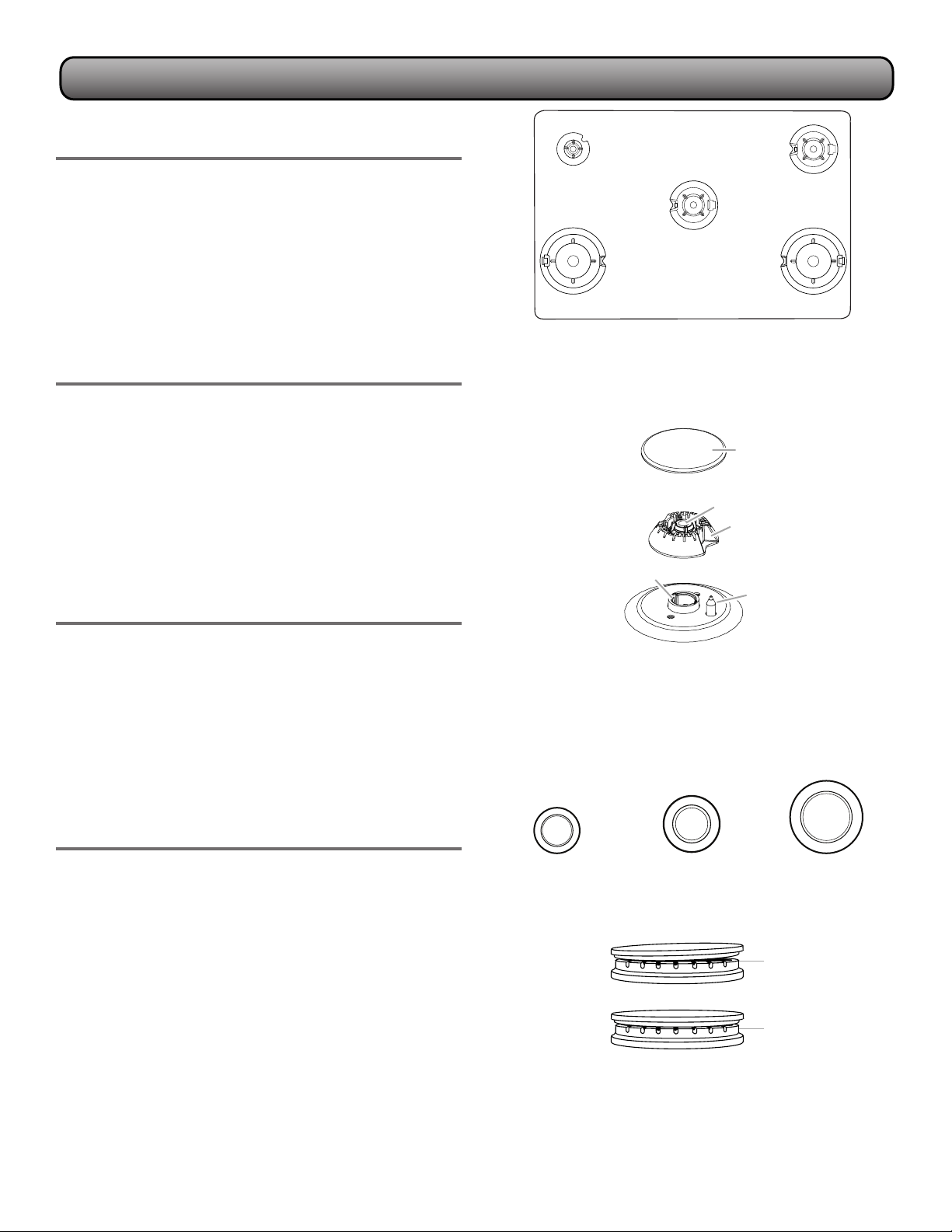
The burner bases and caps must be properly positioned before
cooking. Your range comes with 3 sizes of burners and caps.
Each round burner base is marked with a letter indicating
theburner size. Align the burner bases as shown in the following
illustration:
Align the gas tube opening in the burner base with the orice
holder on the cooktop and the igniter electrode with the notch
inthe burner base.
Each round burner cap is marked with a letter indicating the
burner size. Place the burner caps on the appropriate burner
bases.
AUX
SR
UR
Small cap (AUX) Medium cap (SR) Large cap (UR)
Burner caps should be level when properly positioned. If burner
caps are not properly positioned, surface burners will not light.
The burner cap should not rock or wobble when properly aligned.
A
D
C
BE
A. Small (AUX)
B. Large (UR)
C. Medium (SR) D. Medium (SR)
E. Large (UR)
A
B
C
D
E
A. Burner cap
B. Gas tube opening
C. Burner base
D. Igniter electrode
E. Orifice holder
A
B
A. Incorrect
B. Correct
KEY USAGE TIPS
5
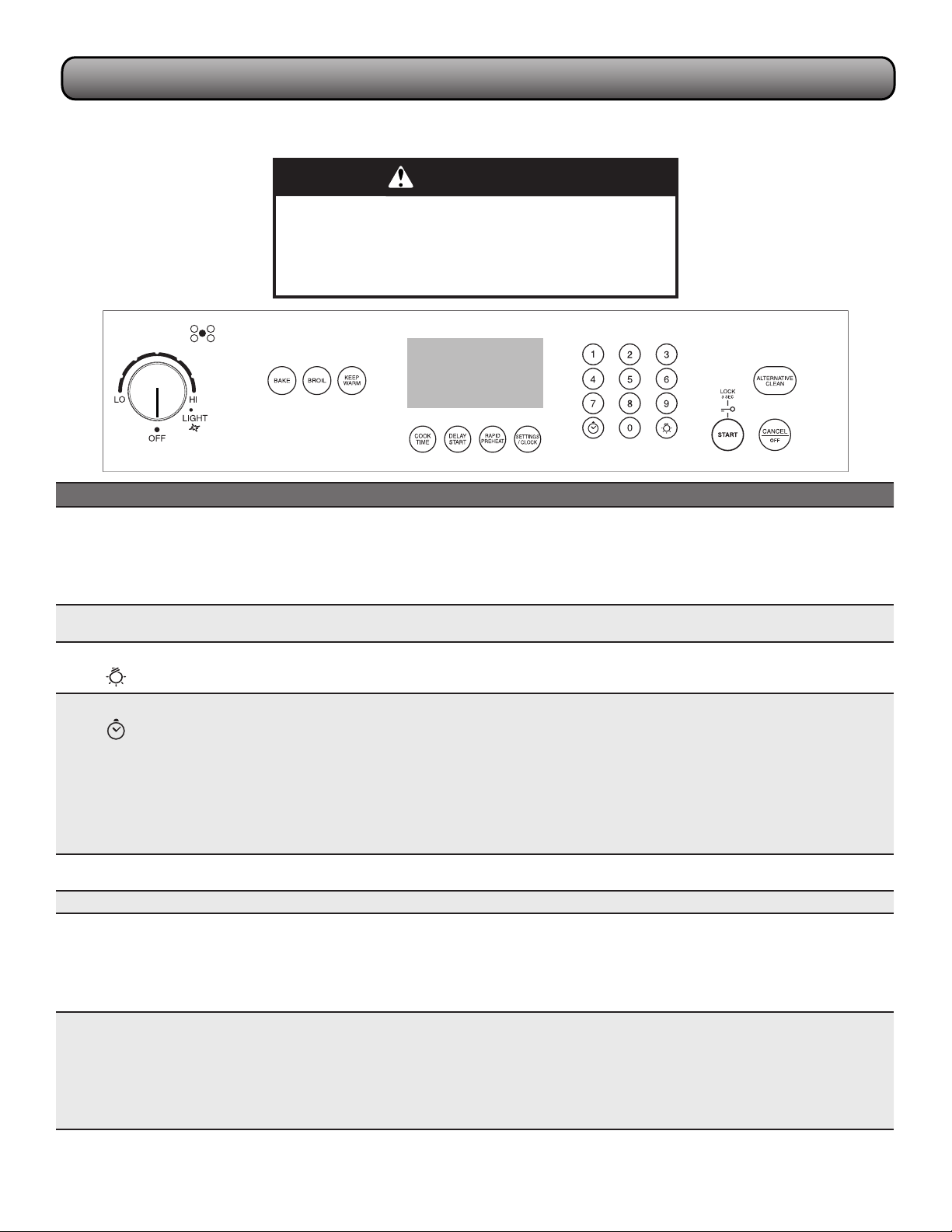
This manual covers several models. Your model may have some or all of the items listed. Refer to this manual or the Product Help
section of our website at www.whirlpool.com for more detailed instructions. In Canada, refer to the Product Help Section at
www.whirlpool.ca.
WARNING
Food Poisoning Hazard
Do not let food sit in oven more than one hour before
or after cooking.
Doing so can result in food poisoning or sickness.
FEATURE GUIDE
Keypad Feature Instructions
SETTINGS/
CLOCK
Clock The Clock can use a 12- or 24-hour cycle. See the “Electronic Oven Controls” section.
1. Press SETTINGS/CLOCK until “CLOCK” is displayed.
2. Use the number keypad to set the time of day.
3. Press START to change the time.
4. Press “3” for AM or “6” for PM.
SETTINGS/
CLOCK
Settings Settings enables you to personalize the audible tones and oven operation to suit your needs.
Seethe“Electronic Oven Controls” section.
OVEN LIGHT Oven cavity light The oven light is controlled by a keypad on the oven control panel. While the oven door
is closed, press the oven light keypad to turn the light on and off. When the oven door
isopened, the oven light will automatically come on.
TIMER Oven timer The Timer can be set in hours or minutes up to 9 hours and 59 minutes.
1. Press TIMER.
2. Press the number keypads to set the length of time in hr-min-min. Leading zeros do not
have to be entered. For example, for 2 minutes, enter “2.”
3. Press TIMER to begin the countdown. If enabled, 1 tone will sound at end ofcountdown.
4. Press TIMER again to cancel the Timer and return to the time of day. Do not press
theCancel/Off keypad because the oven will turn off.
5. If the Timer is running, but not in the display, press TIMER to display the countdown
for5seconds.
START Cooking start The Start keypad begins any oven function. If Start is not pressed within 2 minutes after
pressing a keypad, the function is canceled and the time of day is displayed.
CANCEL/OFF Range function The Cancel/Off keypad stops any function except the Clock and Timer.
BAKE Baking and
roasting
1. Press BAKE.
2. Press the number keypads to set the desired temperature.
3. Press START.
4. To change the temperature, repeat steps 2 and 3.
5. Press CANCEL/OFF when nished.
BROIL Broiling 1. Press BROIL.
2. Select the broiling temperature by pressing 1 - High or 2 - Low.
3. Press START and allow the oven to preheat for 5 minutes.
4. To change the temperature, repeat steps 2 and 3.
5. Position the cookware in the oven, and then close the door.
6. Press CANCEL/OFF when nished.

6
Keypad Feature Instructions
KEEP WARM Hold warm Food must be at serving temperature before placing it in the warmed oven.
1. Press KEEP WARM.
2. Set the desired temperature between 145°F and 190°F (63°C and 88°C) using
thenumberkeypads. The default temperature is 170°F (75°C).
3. Press START.
4. To change the temperature, repeat steps 2 and 3.
5. Press CANCEL/OFF when nished.
DELAY START Delayed start The Delay Start keypad is used to enter the starting time for an oven function with a delayed
start. Delay Start should not be used for foods such as breads and cakes because they may
not bake properly.
To set a Timed Cook or a Delayed Timed Cook, see the “Cook Time” section.
COOK TIME Timed cooking Timed cooking allows the oven to be set to turn on at a certain time of day, cook for a set
length of time, and/or shut off automatically.
To set a Timed Cook or a Delayed Timed Cook, see the “Cook Time” section.
RAPID
PREHEAT
Rapid oven
preheating
Provides the fastest preheat time for the Bake function. Rapid Preheat is preset to OFF,
butitcan be changed to ON.
1. Press RAPID PREHEAT.
2. The current setting will be displayed.
3. Press the “1” keypad to adjust the setting.
4. Press START or CANCEL/OFF to exit and display the time of day.
IMPORTANT: This feature should only be used for one-rack baking. Unused racks should
beremoved prior to Rapid Preheat. A standard rack should be used for Rapid Preheat.
If preheating for the Bake cycle has already started, Rapid Preheat may be started directly
bypressing RAPID PREHEAT.
ALTERNATIVE
CLEAN
Clean cycle See the “Clean Cycle” section.
START
(lock3sec)
Oven control
lockout
1. Check that the oven is OFF.
2. Press and hold START (lock 3 sec) for 3 seconds.
3. A tone will sound and “Control Locked” will scroll, and then “Locked” will be displayed.
4. Repeat to unlock. No keypads will function with the controls locked. The cooktop
functions are not affected by the oven control lockout.
SETTINGS/
CLOCK
Energy save 1. Press SETTINGS/CLOCK until “ENERGY SAVE” is displayed.
2. The current setting will be displayed.
3. Press the “1” keypad to adjust the setting.
4. Press CANCEL/OFF to exit and display the time of day.
If Energy Save is ON, the range will go into Sleep mode after 5 minutes of inactivity.
Anykeypad press will activate the display. If Energy Save is OFF, the display will be
ONatall times.

7
Electronic Oven Controls
Control Display
The display will ash when powered up or after a power loss.
Press CANCEL/OFF to clear. When the oven is not in use, the
time of day is displayed. If the range is in Energy Save mode,
thedisplay will be blank when not in use.
Tones
Tones are audible signals, indicating the following:
One Tone
■ Valid keypad press
■ Oven is preheated (long tone).
■ Function has been entered.
■ Reminder, repeating each minute after the end-of-cycle tones
Three Tones
■ Invalid keypad press
Four Tones
■ End of cycle
Use the Settings/Clock keypad to change the tone settings.
Energy Save
The Energy Save mode puts the range into Sleep mode and
reduces energy consumption.
To Activate the Energy Save Mode:
1. Press SETTINGS/CLOCK until “ENERGY SAVE” is displayed.
2. The current setting will be displayed.
3. Press the “1” keypad to adjust the setting.
4. Press CANCEL/OFF to exit and display the time of day.
5. The setting will be activated after 5 minutes.
To Deactivate the Energy Save Mode:
1. Press SETTINGS/CLOCK until “ENERGY SAVE” is displayed.
2. The current setting will be displayed.
3. Press the “1” keypad to adjust the setting.
4. Press CANCEL/OFF to exit and display the time of day.
5. The clock will reappear in the display and the range can be
operated as usual.
Settings
Many features of the oven control can be adjusted to meet your
personal needs. These changes are made using the Settings/
Clock keypad.
Use the Settings/Clock keypad to scroll through the features
thatcan be changed. Each press of the Settings/Clock keypad
will advance the display to the next setting. After selecting
the feature to be changed, the control will prompt you for the
required input. Then press START or CANCEL/OFF to exit and
display the time of day. Details of all of the feature changes are
explained in the following sections.
Press CANCEL/OFF to exit Settings.
Clock
The Clock can use a 12- or 24-hour cycle.
1. Press SETTINGS/CLOCK until “CLOCK” is displayed.
2. Use the number keypads to set the time of day.
3. Press START to change the time.
4. Press “3” for AM or “6” for PM.
Fahrenheit and Celsius
The temperature is preset to Fahrenheit, but can be changed
toCelsius.
1. Press SETTINGS/CLOCK until “TEMP UNIT” is displayed.
2. The current setting will be displayed.
3. Press the “1” keypad to adjust the setting.
4. Press START or CANCEL/OFF to exit and display the
timeofday.
Audible Tones Disable
Turns off all tones, including the end-of-cycle tone and keypress
tones. Reminder tones are still active when all tones are disabled.
1. Press SETTINGS/CLOCK until “SOUND” is displayed.
2. The current setting will be displayed.
3. Press the “1” keypad to adjust the setting.
4. Press START or CANCEL/OFF to exit and display the
timeofday.
Sound Volume
Sets the volume of the tone to either high or low.
1. Press SETTINGS/CLOCK until “SOUND VOLUME”
isdisplayed.
2. The current setting will be displayed.
3. Press the “1” keypad to adjust the setting.
4. Press START or CANCEL/OFF to exit and display the
timeofday.
End-of-Cycle Tone
Activates or turns off the tones that sound at the end of a cycle.
1. Press SETTINGS/CLOCK until “END TONE” is displayed.
2. The current setting will be displayed.
3. Press the “1” keypad to adjust the setting.
4. Press START or CANCEL/OFF to exit and display the
timeofday.
Keypress Tones
Activates or turns off the tones when a keypad is pressed.
1. Press SETTINGS/CLOCK until “KEYPRESS TONE”
isdisplayed.
2. The current setting will be displayed.
3. Press the “1” keypad to adjust the setting.
4. Press START or CANCEL/OFF to exit and display the
timeofday.
Reminder Tones Disable
Turns off the short repeating tone that sounds every 1 minute
after the end-of-cycle tones.
1. Press SETTINGS/CLOCK until “REMINDER TONE”
isdisplayed.
2. The current setting will be displayed.
3. Press the “1” keypad to adjust the setting.
4. Press START or CANCEL/OFF to exit and display the
timeofday.

8
12/24 Hour Clock
1. Press SETTINGS/CLOCK until “12/24 HOUR” is displayed.
2. The current setting will be displayed.
3. Press the “1” keypad to adjust the setting.
4. Press START or CANCEL/OFF to exit and display the
timeofday.
Demo Mode
IMPORTANT: This feature is intended for use on the sales oor
with 120 V power connection and permits the control features
to be demonstrated without the oven turning on. If this feature
isactivated, the oven will not work.
1. Press SETTINGS/CLOCK until “DEMO MODE” is displayed.
2. The current setting will be displayed.
3. Press the “1” keypad to adjust the setting.
4. Press START or CANCEL/OFF to exit and display the
timeofday.
Sabbath Mode
The Sabbath mode sets the oven to remain on in a bake setting
until turned off.
When the Sabbath mode is set, only the Bake cycle will operate.
All other cooking and cleaning cycles are disabled. No tones will
sound and the displays will not indicate temperature changes.
When the oven door is opened or closed, the oven light will
notturn on or off, and the heating elements will not turn on
oroffimmediately.
To Enable Sabbath Mode Capability (One Time Only):
1. Press SETTINGS/CLOCK until “SABBATH” is displayed.
2. The current setting will be displayed.
3. Press the “1” keypad to adjust the setting.
4. Press START or CANCEL/OFF to exit and display the
timeofday.
12-Hour Shutoff
The oven control is set to automatically shut off the oven
12hours after the oven initiates a cook or clean function.
Thiswillnot interfere with any timed or delay cook functions.
1. Press SETTINGS/CLOCK until “12Hr AUTO_OFF”
isdisplayed.
2. The current setting will be displayed.
3. Press the “1” keypad to adjust the setting.
4. Press START or CANCEL/OFF to exit and display the
timeofday.
Languages - Scrolling Display Text
Language options are English, Spanish, and French.
1. Press SETTINGS/CLOCK until “LANGUAGE” is displayed.
2. The current setting will be displayed.
3. Press the “1” or “2” keypad to select the desired language.
4. Press START or CANCEL/OFF to exit and display the
timeofday.
Oven Temperature Offset Control
IMPORTANT: Do not use a thermometer to measure oven
temperature. Elements will cycle on and off as needed to provide
consistent temperature but may run slightly hot or cool at any
point in time due to this cycling. Most thermometers are slow
to react to temperature change and will not provide an accurate
reading due to this cycling.
The oven provides accurate temperatures; however, it may cook
faster or slower than your previous oven, so the temperature can
be adjusted to personalize it for your cooking needs. It can be
changed to Fahrenheit or Celsius.
To Adjust Oven Temperature:
1. Press SETTINGS/CLOCK until “TEMP CALIB” is displayed.
2. On some models, press “1” to adjust the drawer temperature
calibration. Press START, wait 10 seconds for the display to
change, and then continue with Step 3.
OR
Press START to adjust the oven temperature calibration. Wait
10 seconds for the display to change, and then continue with
Step 3.
3. Press the “3” keypad to increase the temperature in 5°F
(3°C) increments, or press the “6” keypad to decrease the
temperature in 5°F (3°C) increments. The offset range is
from-30°F to +30°F (-18°C to +18°C).
4. Press START or CANCEL/OFF to exit and display the
timeofday.
9
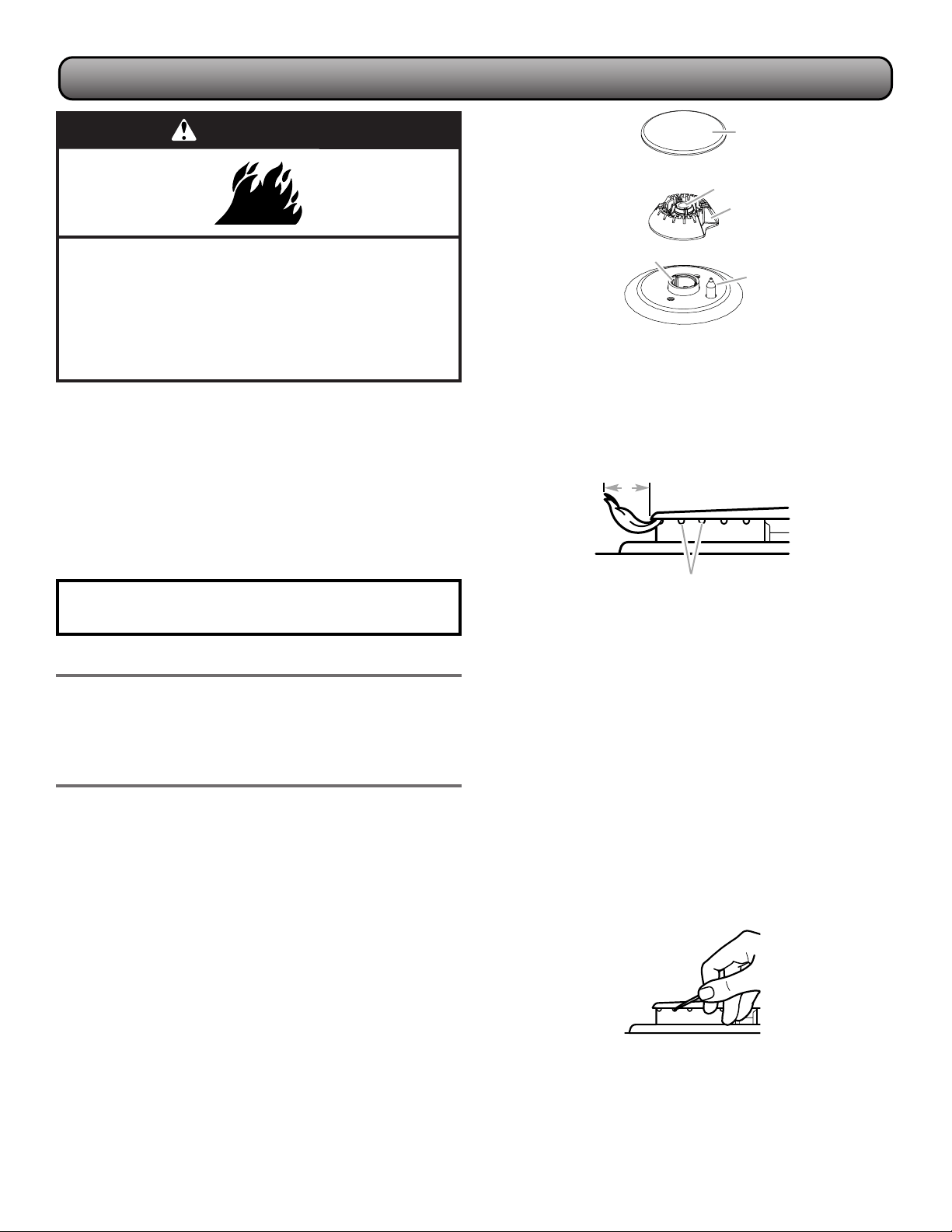
Electric igniters automatically light the surface burners
whencontrol knobs are turned to LIGHT.
Before setting a control knob, place lled cookware on
thegrate.Do not operate a burner using empty cookware
orwithout cookware on the grate.
To Set:
1. Push in and turn knob counterclockwise to LIGHT.
All surface burners will click. Only the burner with the
controlknob turned to LIGHT will produce a ame.
2. Turn knob to anywhere between HI and LO.
Power Failure
In case of prolonged power failure, the surface burners can
be lit manually. Hold a lit match near a burner, and then turn
knob counterclockwise to LIGHT. After burner lights, turn
knobtosetting.
Surface Burners
IMPORTANT: Do not obstruct the ow of combustion
andventilation air around the burner grate edges.
Burner Cap: Always keep the burner cap in place when using
asurface burner. A clean burner cap will help avoid poor ignition
and uneven ames. Always clean the burner cap after a spillover,
and routinely remove and clean the caps according to the
“General Cleaning” section.
NOTE: Each round burner base is marked with a letter indicating
theburner size.
Alignment: Be sure to align the gas tube opening in the burner
base with the orice holder on the cooktop and the igniter
electrode with the notch in the burner base.
NOTE: Each round burner base is marked with a letter indicating
theburner size.
Gas Tube Opening: Gas must ow freely throughout the gas
tube opening for the burner to light properly. Keep this area free
of soil, and do not allow spills, food, cleaning agents, or any other
material to enter the gas tube opening. Keep spillovers out of the
gas tube opening by always using a burner cap.
Burner Ports: Check burner ames occasionally for proper size
and shape as shown in the previous illustration. A good ame is
blue in color, not yellow. Keep this area free of soil, and do not
allow spills, food, cleaning agents, or any other material to enter
the burner ports.
To Clean:
IMPORTANT: Before cleaning, make sure all controls are OFF
andthe cooktop is cool. Do not use oven cleaners, bleach, or
rustremovers. Do not wash in the dishwasher.
1. Remove the burner cap and the burner base, and clean
according to the “General Cleaning” section.
2. Clean the gas tube opening with a damp cloth.
3. Clean clogged burner ports with a straight pin as shown.
Donot enlarge or distort the port. Do not use a wooden
toothpick. If the burner needs to be adjusted, contact
atrained repair specialist.
WARNING
Fire Hazard
Do not let the burner flame extend beyond the edge of
the pan.
Turn off all controls when not cooking.
Failure to follow these instructions can result in death
or fire.
REMEMBER: When range is in use, the entire cooktop area
may become hot.
A
B
C
D
E
A. Burner cap
B. Gas tube opening
C. Burner base
D. Igniter electrode
E. Orifice holder
B
A
A. 1" to 1
1
/
2
" (2.5 cm to 3.8 cm)
B. Burner ports
COOKTOP
10
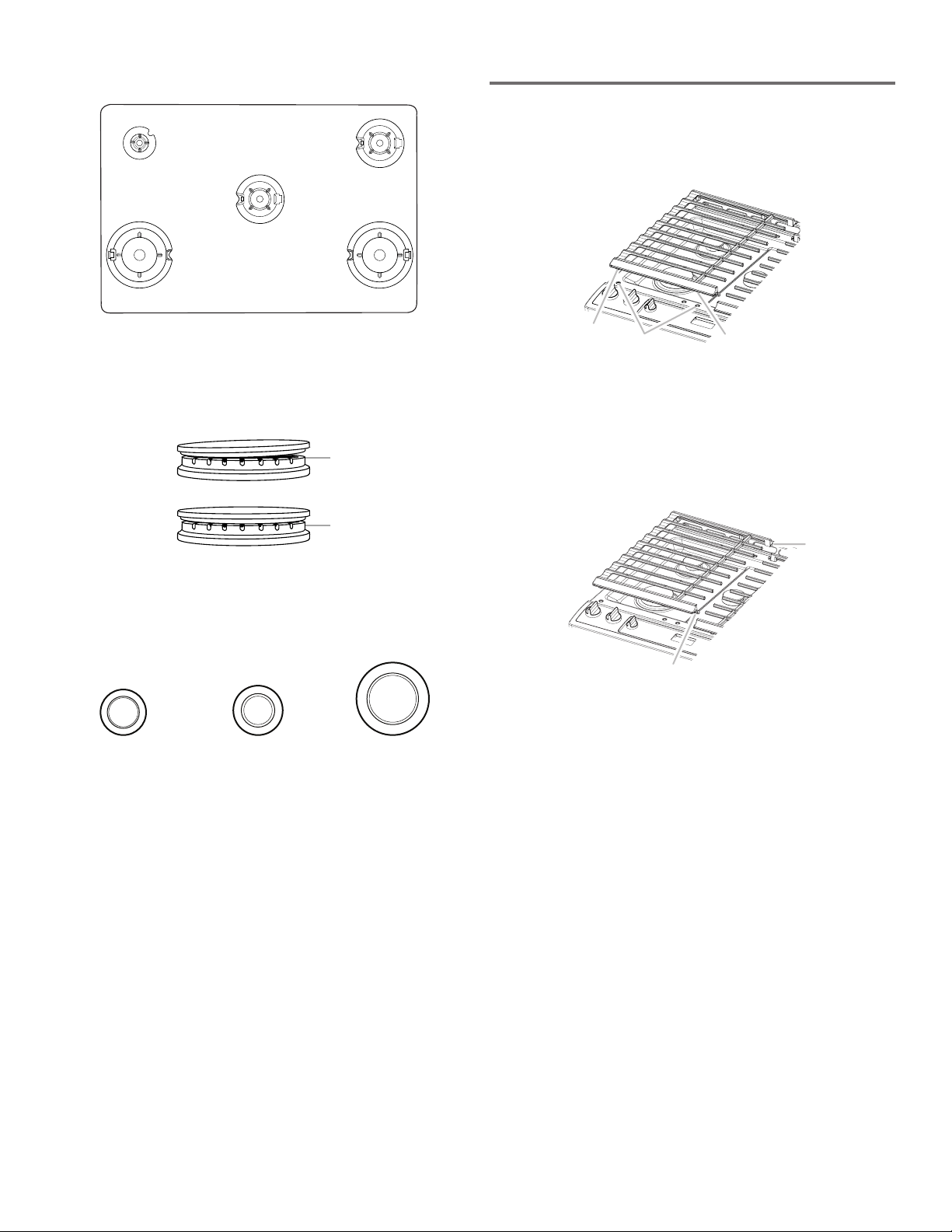
4. Replace the burner base. Each round burner base is marked
with a letter indicating theburner size. See the following
illustration forburner positions.
5. Each round burner cap is marked with a letter indicating
theburner size. Replace the burner cap, making sure it is
properly aligned with the burner base. The burner cap should
not rock or wobble when properly aligned.
IMPORTANT: The bottom of the small and medium caps
aredifferent. Do not put the wrong size burner cap on the
burner base.
AUX
SR
UR
Small cap (AUX) Medium cap (SR) Large cap (UR)
6. Turn on the burner. If the burner does not light, check cap
alignment. If the burner still does not light, turn off the burner.
Do not service the burner yourself. Contact a trained repair
specialist.
Surface Grates
The grates must be properly positioned before cooking. In the
proper position, the grates should be ush and level. Improper
installation of the grates may result in chipping or scratching of
the cooktop.
To ensure proper positioning, align bumpers on grate bottom
withthe indentations in the cooktop.
The surface grates interlock using the hook on one end of the
grate and the indent on the other. To remove the grates, lift the
rear of the left grate off the hook, and then lift the front of the
rightgrate off the hook and pull apart. To replace the grates,
replace the left grate rst. Place the front indent of the right
grateover the hook of the left grate, and then lift the rear of the
left grate and place the indent over the hook on the right grate.
Although the burner grates are durable, they will gradually lose
their shine and/or discolor due to the high temperatures of the
gas ame.
A
D
C
BE
A. Small (AUX)
B. Large (UR)
C. Medium (SR) D. Medium (SR)
E. Large (UR)
A
B
A. Incorrect
B. Correct
A
A
B
A. Bumpers
B. Alignment indentations
A
B
A. Hook
B. Indent
11
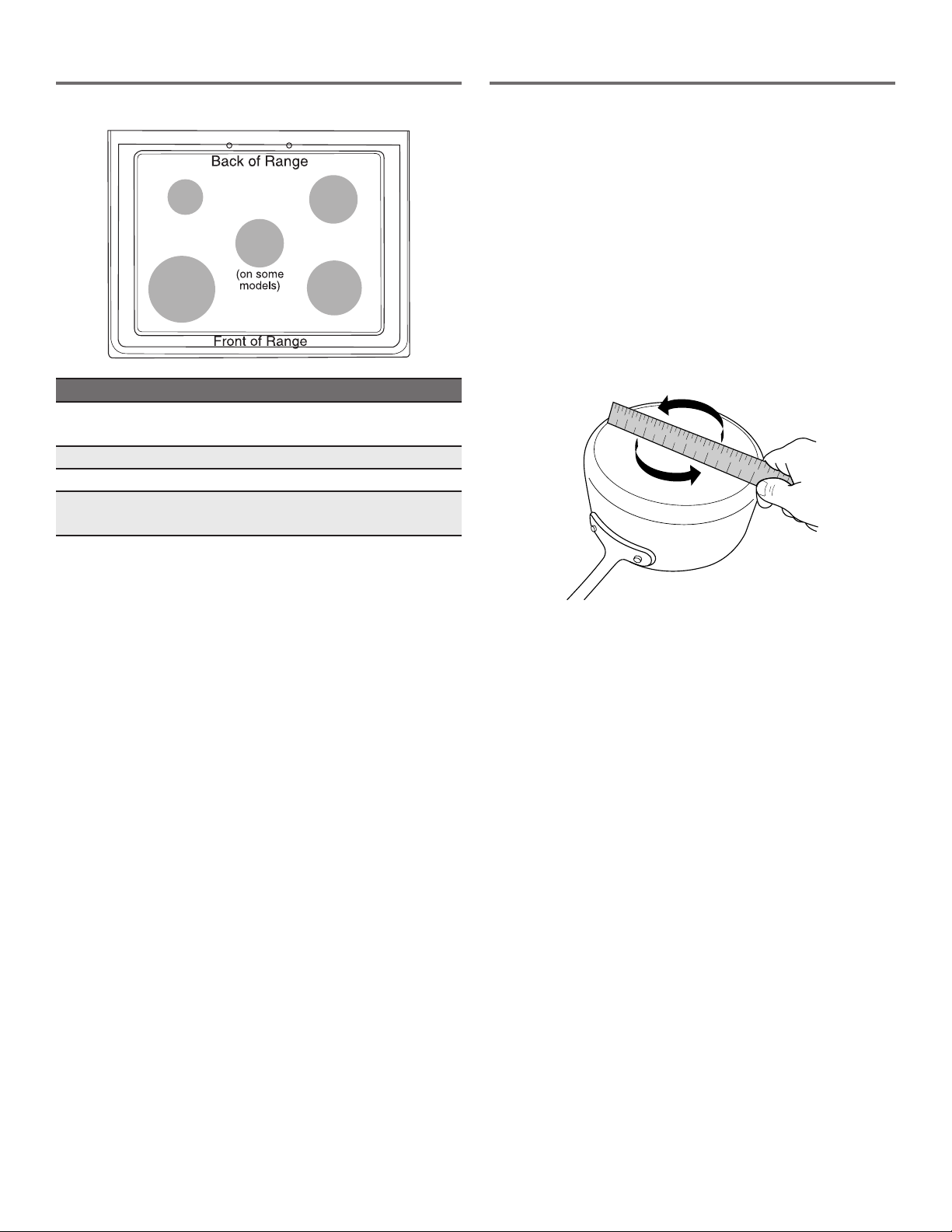
Burner Size
Select a burner that best ts your cookware. See the following
illustration and chart.
Burner Size Recommended Use
Small (AUX) ■ Low-heat cooking
■ Melting chocolate or butter
Medium (SR) ■ Multipurpose burner
Large (UR) ■ For large cookware
Large (UR)
(most powerful)
■ For large cookware
■ Most powerful burner
Cookware
IMPORTANT: Do not leave empty cookware on a hot surface
cooking area, element, or surface burner.
Ideal cookware should have a at bottom, straight sides, and a
well-tting lid, and the material should be of medium-to-heavy
thickness.
Rough nishes may scratch the cooktop or coils. Aluminum
andcopper may be used as a core or base in cookware.
However, when used as a base, they can leave permanent
markson the surfaces.
Cookware material is a factor in how quickly and evenly heat
is transferred which affects cooking results. A nonstick nish
has the same characteristics as its base material. For example,
aluminum cookware with a nonstick nish will take on the
properties of aluminum.
Cookware with nonstick surfaces should not be used under
thebroiler.
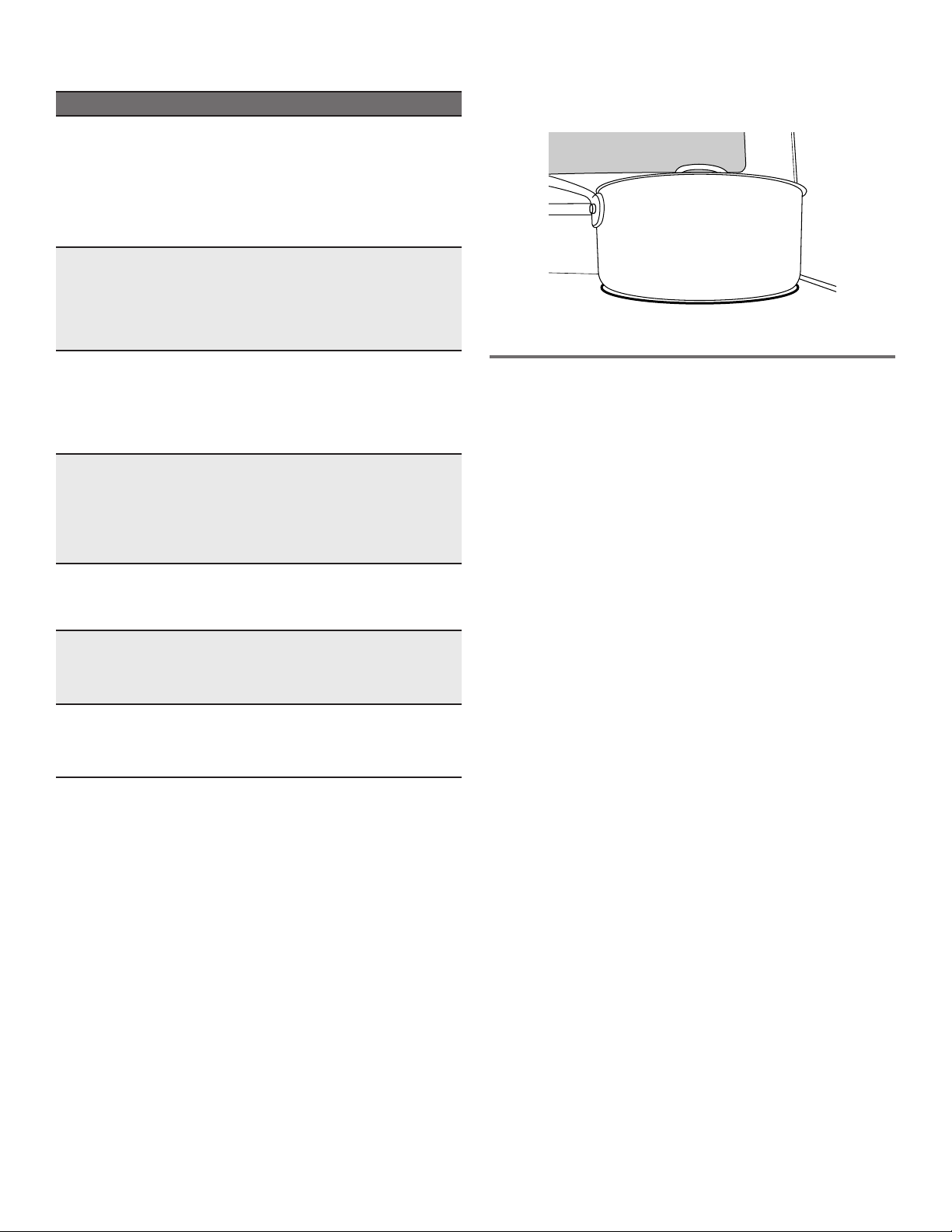
Check for atness by placing the straight edge of a ruler across
the bottom of the cookware. While you rotate the ruler, no space
or light should be visible between it and the cookware.
UR
(most
powerful)
AUX
SR
UR
SR
1
2
3
4
5
6
7
8
9
1 0
1 1
1 2
1 3
1 4
1 5
1 6
1 7
1 8
1 9
2 0
1
2
3
4
5
6
7
12
Use the following chart as a guide for cookware material
characteristics.
Cookware Characteristics
Aluminum ■ Heats quickly and evenly.
■ Suitable for all types ofcooking
■ Medium or heavy thickness is best
formostcooking tasks.
■ May leave aluminum residues
which may bediminished if cleaned
immediately after cooking.
Cast iron ■ Heats slowly and evenly.
■ Good for browning andfrying.
■ Maintains heat for slowcooking
■ Rough edges or burrs may scratch
thecooktop.
Ceramic or
ceramic glass
■ Follow manufacturer’s instructions.
■ Heats slowly, but unevenly.
■ Ideal results on low-to-medium heat
settings
■ May scratch the cooktop.
Copper ■ Heats very quickly andevenly.
■ May leave copper residues which may
bediminished if cleaned immediately
after cooking.
■ Can leave a permanent stain or bond
to the cooktop if overheated.
Earthenware ■ Follow manufacturer’s instructions.
■ Use on low heat settings.
■ May scratch the cooktop.
Porcelain
enamel-on-steel
or cast iron
■ See stainless steel orcastiron.
■ Porcelain enamel bakeware without the
metal base may bond to the cooktop if
overheated.
Stainless steel ■ Heats quickly, butunevenly.
■ A core or base of aluminum or copper
on stainless steel provides even
heating.
Use at-bottomed cookware for best cooking results and
energyefciency. The cookware should be about the same size
as thecooking area outlined on the cooktop or the coil element.
Cookware should not extend more than 1/2" (1.3 cm) beyond
thesurface cooking area or element.
Home Canning
When canning for long periods, alternate the use of surface
burners between batches. This allows time for the most recently
used areas to cool.
■ Center the canner on the grate above the burner.
■ Do not place canner on 2 surface burners at the same time.
■ For more information, contact your local agricultural
extension ofce or refer to published home canning guides.
Companies that manufacture home canning products can
also offer assistance.
13
OVEN
Odors and smoke are normal when the oven is used the rst
fewtimes or when it is heavily soiled.
IMPORTANT: The health of some birds is extremely sensitive
to the fumes given off by the oven. Exposure to the fumes may
result in death to certain birds. Always move birds to another
closed and well-ventilated room.
Aluminum Foil
IMPORTANT: To avoid permanent damage to the oven bottom
nish, do not line the oven bottom with any type of foil or liner.
For best cooking results, do not cover entire oven rack with foil
because air must be able to move freely.
Positioning Racks and Bakeware
IMPORTANT: To avoid permanent damage to the porcelain
nish, do not place food or bakeware directly on the oven door
orbottom.
Bakeware
To cook food evenly, hot air must be able to circulate. Allow 2"
(5cm) of space around bakeware and oven walls. Make sure
thatno bakeware piece is directly over another.
Racks
■ Position racks before turning on the oven.
■ Do not position racks with bakeware on them.
■ Make sure racks are level.
To position a rack, pull it out to the stop position, raise the front
edge, and then lift out. Use the following illustration and charts
asa guide.
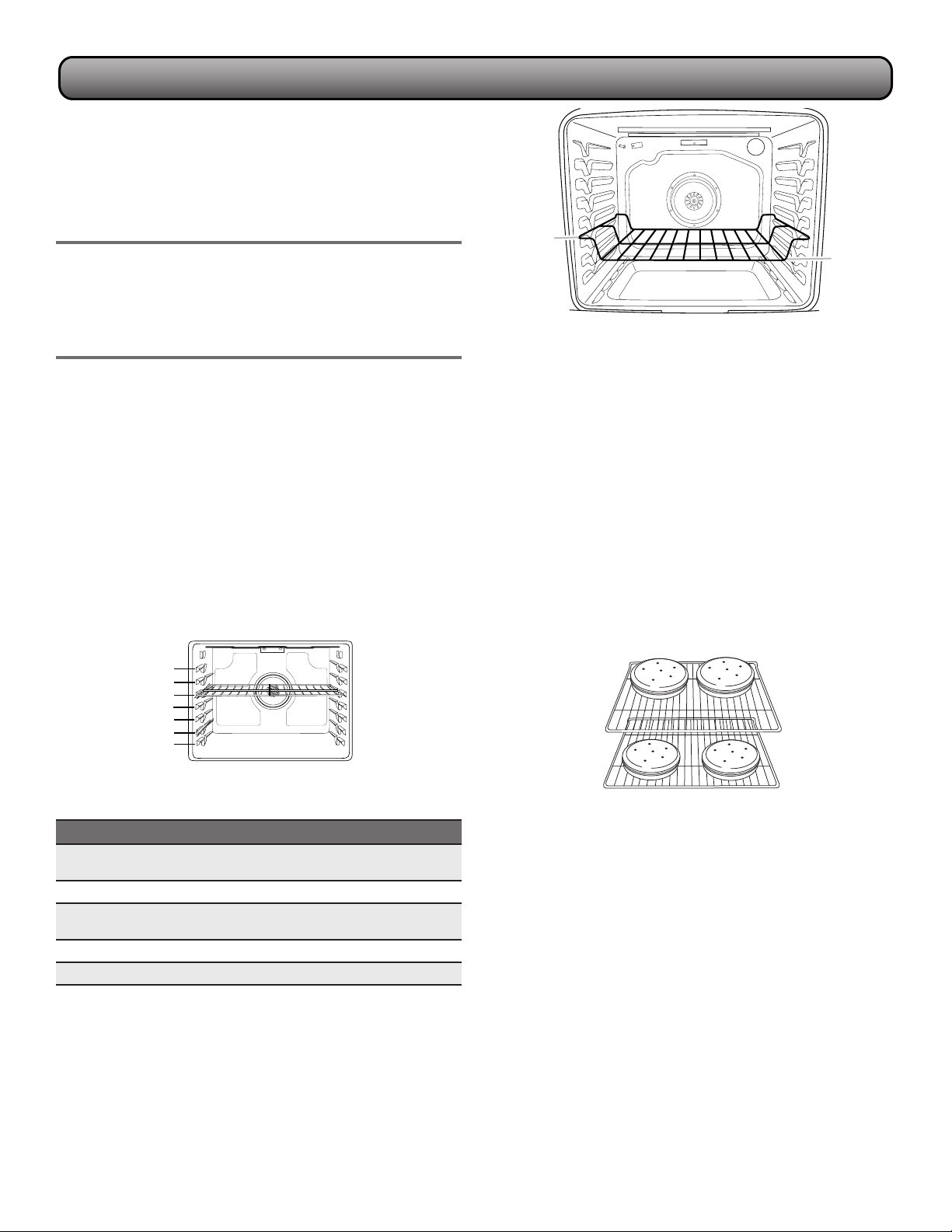
The oven has 7 positions for a at rack, as shown in the previous
illustration and the following table.
Flat Rack Position* Type of Food
7 Broiling/searing meats,
hamburgers,steaks
6 Broiled meats, poultry, sh
3 or 4 Most baked goods, casseroles,
frozen foods
2 Roasted meats
1 Large roasts or poultry
For hamburger patties to have a well-seared exterior and a rare
interior, use a at rack in rack position 7. Side 1 should cook
for approximately 2
1
/
2
to 3
1
/
2
minutes. Side 2 should cook for
approximately 4 to 5 minutes. Expect a moderate degree of
smoke when broiling.
* If your model has a Max Capacity Oven Rack, the recessed ends
must be placed in the rack position above the desired position
of the food. See the following illustration.
IMPORTANT: These rack positions are for at racks. If a Max
Capacity Oven Rack is used, the rack position must be adjusted
as shown in the previous gure.
Multiple Rack Cooking
2-rack (non-convection): Use rack positions 2 and 5 or 3 and 6.
2-rack (convection): Use rack positions 2 and 5 or 3 and 6.
3-rack (convection): Use rack positions 2 and 7 and a Max
Capacity Oven Rack in rack position 5.
Baking Cookies and Layer Cakes on 2 Racks
Baking Layer Cakes
For best results when baking cakes on 2 racks, use the
Convection Bake function, a at rack in rack position 2, and a
Max Capacity Oven rack in rack position 6. Place the cakes on
the racks as shown. Keep at least 3" (7.6 cm) of space between
the front of the racks and the front cakes.
Baking Cookies
For best results when baking cookies on 2 racks, use the
Convection Bake function, a at rack in rack position 2,
andaMax Capacity Oven rack in rack position 6.
7
6
5
4
3
2
1
A
B
A. Ends of rack in position 3
B. Food in position 2

14
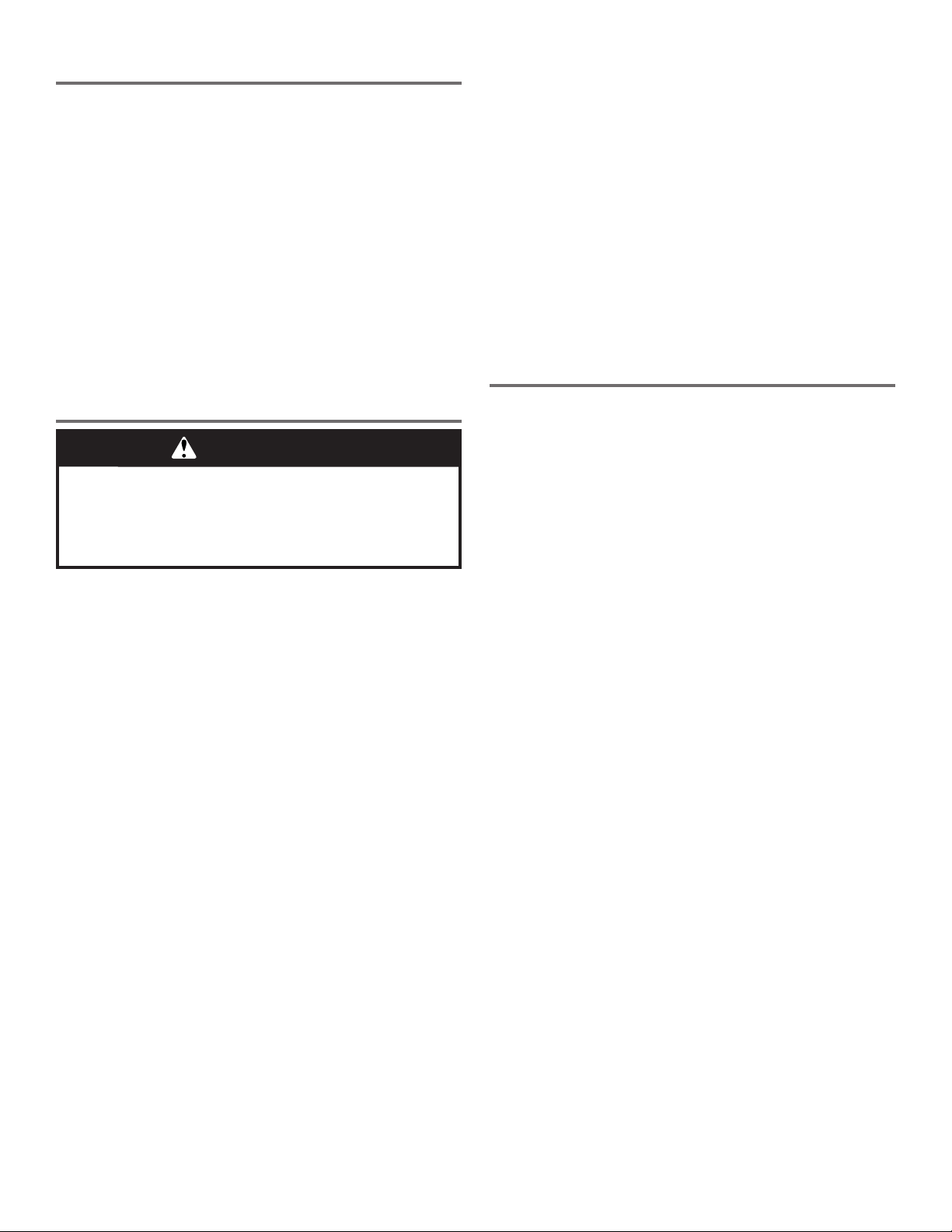
Oven Vent
The oven vent releases hot air and moisture from the oven
andshould not be blocked or covered. Blocking or covering the
oven vent will cause poor air circulation, affecting cooking and
cleaning results. Do not set plastics, paper, or other items that
could melt or burn near the oven vent.
Sabbath Mode
The Sabbath mode sets the oven to remain on in a bake setting
until turned off.
When the Sabbath mode is set, only the Bake cycle will operate.
All other cooking and cleaning cycles are disabled. No tones will
sound and the displays will not indicate temperature changes.
When the oven door is opened or closed, the oven light will
notturn on or off, and the heating elements will not turn on
oroffimmediately.
To Enable Sabbath Mode Capability (One Time Only):
1. Press SETTINGS/CLOCK until “SABBATH” is displayed.
“OFF. Press (1) for On” will scroll in the display.
2. Press the “1” keypad. “ON. Press (1) for Off” will scroll in
thedisplay. Sabbath mode can be activated for baking.
3. Press START or CANCEL/OFF to exit and display the
timeofday.
NOTE: To disable the Sabbath mode, repeat steps 1
through3 to change the status from “SABBATH ON”
to“SABBATH OFF.”
To Activate Sabbath Mode:
1. Press BAKE.
2. Press the number keypads to set a temperature other
than350°F (177°C).
3. Press START.
For timed cooking in Sabbath mode, press COOK TIME
andthen the number keypads to set the desired cook time.
Press START.
4. Press SETTINGS/CLOCK. Three tones will sound. Then
press“7.” “SAb” will appear in the display.
To Adjust Temperature (When Sabbath Mode is Running):
1. Press the number keypad as instructed by the scrolling text
to select the new temperature.
NOTE: The temperature adjustment will not appear on
thedisplay and no tones will sound. The scrolling text
willbeshown on the display as it was before the keypad
waspressed.
2. Press START.
To Deactivate Sabbath Mode:
Press SETTINGS/CLOCK, and then press “7” to return to regular
baking, or press CANCEL/OFF to turn off the range.
NOTE: No tones will sound while deactivating Sabbath mode.
Baking and Roasting
Preheating
When beginning a Bake, Convect Bake, or Convect Roast cycle,
the oven will begin preheating after Start is pressed. The oven
will take approximately 12 to 15 minutes to reach 350°F (177°C)
with all of the oven racks provided with your oven inside the
oven cavity. Higher temperatures will take longer to preheat. The
preheat cycle rapidly increases the oven temperature. The actual
oven temperature will go above your set temperature to offset
the heat lost when your oven door is opened to insert food. This
ensures that when you place your food in the oven, the oven
will begin at the proper temperature. Insert your food when the
preheat tone sounds. Do not open the door during preheat before
the tone sounds.
Rapid Preheat
Rapid Preheat can be used to shorten the preheating time. Only
1 standard at oven rack should be in the oven during Rapid
Preheat. Extra racks should be removed prior to starting Rapid
Preheat. Press RAPID PREHEAT, and follow the oven control
prompts, or, if preheating has already started, simply press
RAPID PREHEAT. The preheating cycle should be completed
before placing food in the oven. When the Rapid Preheat cycle
iscomplete, the oven starts a normal Bake cycle.
IMPORTANT: Rapid Preheat should be used only for one-rack
baking.
Oven Temperature
While in use, the oven elements will cycle on and off as needed
to maintain a consistent temperature, but they may run slightly
hot or cool at any point in time due to this cycling. Opening the
oven door while in use will release the hot air and cool the oven
which could impact the cooking time and performance. It is
recommended to use the oven light to monitor cooking progress.
NOTE: On models with convection, the convection fan may run
inthe non-convection Bake mode to improve oven performance.
Temperature Management System
The Temperature Management System electronically regulates
the oven heat levels during preheat and Bake to maintain a
precise temperature range for optimal cooking results. The
bake and broil elements or burners cycle on and off in intervals.
On convection range models, the fan will run while preheating
and may be cycled on and off for short intervals during bake to
provide the best results. This feature is automatically activated
when the oven is in use.
Before baking and roasting, position racks according to the
“Positioning Racks and Bakeware” section. When roasting, it is
not necessary to wait for the oven preheat cycle to end before
putting food in, unless it is recommended in the recipe.
A
A. Oven vent
15
Broiling
When broiling, preheat the oven for 5 minutes before putting
foodin, unless recommended otherwise in the recipe. Position
food on grid in a broiler pan, and then place it in the center of
theoven rack.
IMPORTANT: Close the door to ensure proper broiling
temperature.
Changing the temperature when broiling allows more precise
control when cooking. The lower the broil setting is, the slower
the cooking. Thicker cuts and unevenly shaped pieces of meat,
sh, and poultry may cook better at lower broil settings. Use rack
6 or 7 for broiling. Refer to the “Positioning Racks and Bakeware”
section for more information.
On lower settings, the broil element will cycle on and off to
maintain the proper temperature.
■ For best results, use a broiler pan and grid. It is designed
todrain juices and help avoid spatter and smoke.
If you would like to purchase a broiler pan, one may be
ordered. See the “Accessories” section.
Cook Time
To Set a Timed Cook:
1. Press BAKE or BROIL.
2. Press the number keypads to enter a temperature other
thanthe one displayed.
3. Press COOK TIME. The cook time oven indicator light
willlight up.
4. Press the number keypads to enter the length of time
tocook.
5. Press START. The display will count down the time.
Whenthetime ends, the oven will shut off automatically.
6. Press CANCEL/OFF to clear the display.
To Set a Delayed Timed Cook:
1. Press BAKE or BROIL.
2. Press the number keypads to enter a temperature other
thanthe one displayed.
3. Press COOK TIME. The cook time oven indicator light
willlight up.
4. Press number keypads to enter the length of time to cook.
5. Press DELAY START.
6. Press number keypads to enter the number of hours and/or
minutes you want to delay the start time.
7. Press START.
When the start time is reached, the oven will automatically
turn on. The temperature and/or time settings can be
changed anytime after the oven turns on by repeating steps
2 through 4. When the set cook time ends, the oven will shut
offautomatically.
8. Press CANCEL/OFF to clear the display.
Oven Light
The oven light is a standard 40 W appliance bulb. Before
replacing, make sure the oven and cooktop are cool and the
control knobs are in the Off position.
To Replace:
1. Unplug range or disconnect power.
2. Turn the glass bulb cover in the back of the oven
counterclockwise to remove.
3. Turn bulb counterclockwise to remove from socket.
4. Replace bulb by turning clockwise.
5. Replace bulb cover by turning clockwise.
6. Plug in range or reconnect power.
WARNING
Food Poisoning Hazard
Do not let food sit in oven more than one hour before
or after cooking.
Doing so can result in food poisoning or sickness.
16
Clean Cycle
Alternative Clean Technology is an innovative cleaning solution
that utilizes heat and water to release baked-on spills from the
oven in less than 1 hour. This new cleaning technology is a low-
heat, odor-free alternative to traditional self-cleaning options.
Allow the oven to cool to room temperature before using the
Clean cycle. If your oven cavity is above 200°F (93°C), “Oven
Cooling” will appear in the display, and the Clean cycle will
notbeactivated until the oven cavity cools down.
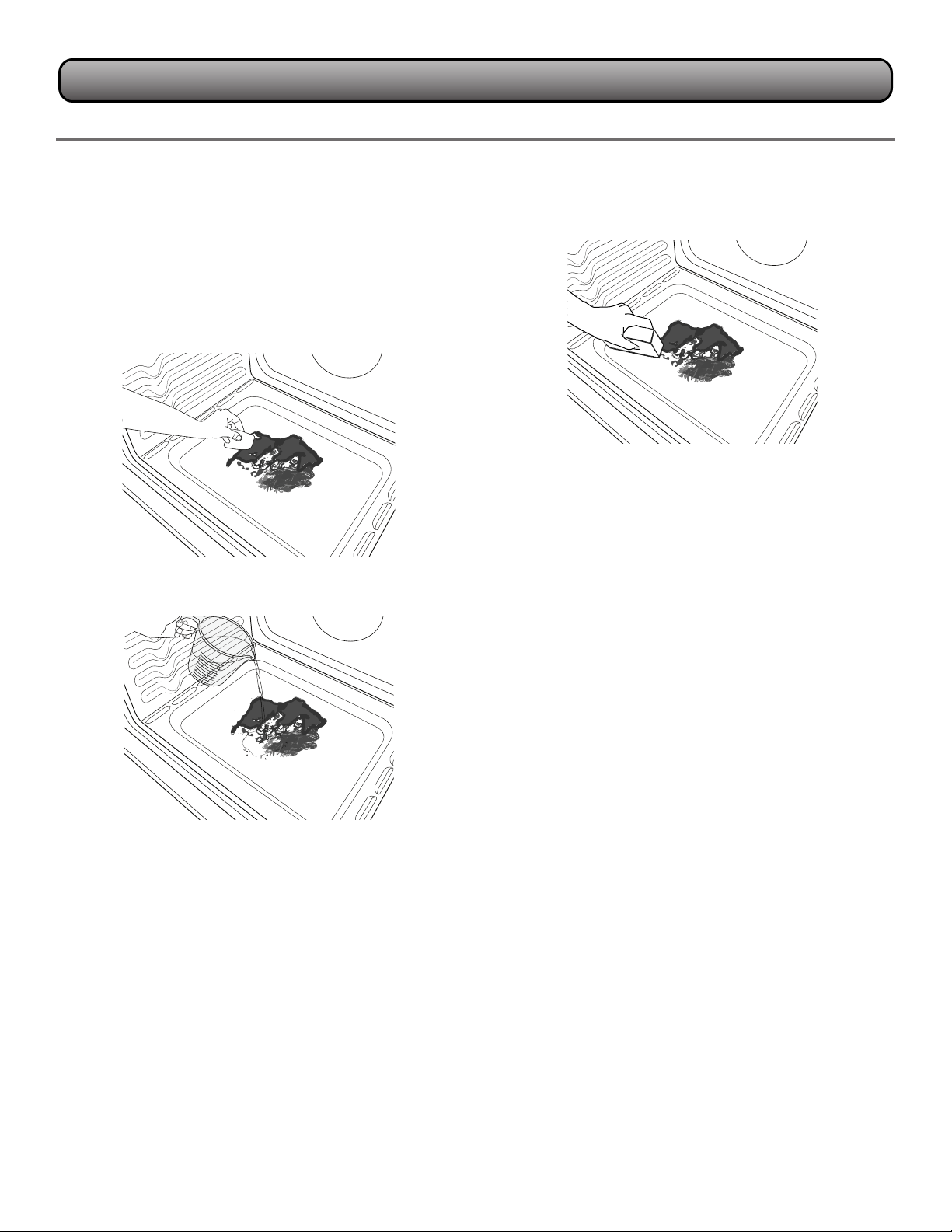
To Clean:
1. Remove all racks and accessories from the oven cavity,
andwipe excess soil. Use a plastic scraper to remove
easilyremoved soils.
2. Pour 1
3
/
4
cups (14 oz [414 mL]) of distilled or ltered water
onto the bottom of the empty oven and close the oven door.
IMPORTANT: Do not use chemicals or other additives with
the water. Do not open the oven door during the Clean cycle.
The water on the oven bottom is hot.
3. Press ALTERNATIVE CLEAN and then START on the oven
control panel.
4. Allow 40 minutes for cleaning and cooldown. A beep will
sound when the Clean cycle is complete.
5. Press CANCEL/OFF at the end of the cycle. Cancel/Off may
be pressed at any time to stop the Clean cycle.
6. Remove the residual water and loosened soils with a sponge
or cloth immediately after the Clean cycle is complete. Much
of the initial 1
3
/
4
cups (14 oz [414 mL]) of water will remain
inthe oven after the cycle is completed. If additional soils
remain, leave a small amount of water in the oven bottom
toassist with the cleaning.
7. If any soils remain, remove them with a non-scratch
scrubbing sponge or plastic scraper. Additional Clean
cyclesmay be run to help remove the stubborn soils.
IMPORTANT: Do not use oven cleaners. The use of chemicals,
including commercial oven cleaners or metal scouring pads,
maycause permanent damage to the porcelain surface of the
oven interior.
NOTES:
■ The range should be level to ensure that the entire surface
of the bottom of the oven cavity is covered by water at the
beginning of the Clean cycle.
■ For best results, use distilled or ltered water. Tap water
mayleave mineral deposits on the oven bottom.
■ Before removing the residual water and loosened soils at the
end of the Clean cycle, insert a cloth or paper towel between
the lower edge of the oven door and the front frame to keep
water from spilling onto the front of the range and the oor.
■ Soil baked on through several cooking cycles will be more
difcult to remove with the Clean cycle.
■ Nonabrasive scrub sponges or eraser-style cleaning pads
(without cleaners) can be effective for cleaning the oven
cavity walls, oven door, and oven bottom for difcult soils.
Forbest results, moisten the pads and sponges before use.
■ Run an additional Clean cycle for stubborn soils.
■ Affresh
®
Kitchen Appliance Cleaner and affresh
®
Cooktop
Cleaner may be used to clean the oven bottom, walls, and
door when the oven has nished the cycle and returned to
room temperature. If affresh
®
Cooktop Cleaner is used, it
isrecommended to wipe out the cavity with distilled water
as well. Refer to the “Accessories” section for information
onordering.
■ Additional AquaLift
®
Technology Cleaning Kits may be
obtained by ordering Part Number W10423113RP. See
the“Accessories” section for more information.
■ For assistance with Alternative Clean Technology, call
1-877-258-0808 in the U.S.A. or 1-800-807-6777 in Canada.
RANGE CARE

17
General Cleaning
IMPORTANT: Before cleaning, make sure all controls are
OFF and the oven and cooktop are cool. Always follow label
instructions on cleaning products. For additional information,
youcan visit our website at www.whirlpool.com. In Canada,
visit our website at www.whirlpool.ca.
Soap, water, and a soft cloth or sponge are suggested rst unless
otherwise noted.
EXTERIOR PORCELAIN ENAMEL SURFACES
(onsomemodels)
Food spills containing acids, such as vinegar and tomato, should
be cleaned as soon as the entire range is cool. These spills may
affect the nish.
Cleaning Method:
■ Glass cleaner, mild liquid cleaner or nonabrasive
scrubbingpad:
Gently clean around the model/serial/rating plate
becausescrubbing may remove numbers.
■ Affresh
®
Kitchen and Appliance Cleaner Part Number
W10355010 (not included):
See the “Accessories” section for more information.
STAINLESS STEEL (on some models)
NOTE: To avoid damage to stainless steel surfaces, do not use
soap-lled scouring pads, abrasive cleaners, Cooktop Cleaner,
steel-wool pads, gritty washcloths, or abrasive paper towels.
Damage may occur to stainless steel surfaces, even with one-
time or limited use.
Cleaning Method:
Rub in direction of grain to avoid damaging.
■ Affresh
®
Stainless Steel Cleaner Part Number W10355016
(not included):
See the “Accessories” section for more information.
METALLIC PAINT (on some models)
Do not use abrasive cleaners, cleaners with bleach, rust
removers, ammonia, or sodium hydroxide (lye) because the
paintsurface may stain.
PORCELAIN-COATED GRATES AND CAPS
Food spills containing acids, such as vinegar and tomato,
shouldbe cleaned as soon as the cooktop, grates, and caps
arecool. These spills may affect the nish.
To avoid chipping, do not bang grates and caps against
eachother or hard surfaces such as cast iron cookware.
Do not reassemble caps on burners while wet.
Cleaning Method:
■ Nonabrasive plastic scrubbing pad and mildly
abrasivecleanser:
Clean as soon as cooktop, grates, and caps are cool.
■ Dishwasher (grates only, not caps):
Use the most aggressive cycle. Cooked-on soils should
besoaked or scrubbed before going into a dishwasher.
Although the burner grates are durable, they may lose
theirshine and/or discolor when washed in a dishwasher.
■ Gas Grate and Drip Pan Cleaner Part Number 31617
(notincluded):
See the “Accessories” section for more information.
SURFACE BURNERS
Food spills containing acids, such as vinegar and tomato,
shouldbe cleaned as soon as the cooktop, grates, and caps
arecool. These spills may affect the nish.
To avoid chipping, do not bang grates and caps against
eachother or hard surfaces such as cast iron cookware.
Do not reassemble caps on burners while wet.
Do not clean in the Clean cycle.
Do not clean in dishwasher.
Cleaning Method:
■ Nonabrasive plastic scrubbing pad and mildly abrasive
cleanser:
Clean as soon as cooktop, grates, burners, and caps
arecool.
■ Gas Grate and Drip Pan Cleaner (not included)
COOKTOP CONTROLS
To avoid damage to the cooktop controls, do not use steel wool,
abrasive cleansers, or oven cleaner.
To avoid damage, do not soak knobs. When replacing knobs,
make sure knobs are in the Off position.
On some models, do not remove seals under knobs.
Cleaning Method:
■ Soap and water:
Pull knobs straight away from control panel to remove.
CONTROL PANEL AND OVEN DOOR EXTERIOR
To avoid damage to the control panel, do not use abrasive
cleaners, steel-wool pads, gritty washcloths, or abrasive
papertowels.
Cleaning Method:
■ Glass cleaner and soft cloth or sponge:
Apply glass cleaner to soft cloth or sponge, not directly
onpanel.
■ Affresh
®
Kitchen and Appliance Cleaner Part Number
W10355010 (not included):
See the “Accessories” section for more information.
OVEN RACKS
Cleaning Method:
■ Steel-wool pad
■ For racks that have discolored and are harder to slide,
alightcoating of vegetable oil applied to the rack guides
willhelp them slide.
STORAGE DRAWER
Check that storage drawer is cool and empty before cleaning.
Cleaning Method:
■ Mild detergent
OVEN CAVITY
Use Alternative Clean Technology regularly to clean oven spills.
Do not use oven cleaners.
Food spills should be cleaned when oven cools. At
high temperatures, foods react with porcelain. Staining,
etching,pitting, or faint white spots can result.
Cleaning Method:
■ Clean cycle:
See “Clean Cycle” section.
18
First try the solutions suggested here. If you need further assistance or more recommendations that may help you avoid a service call,
visit http://www.whirlpool.com/product_help. In Canada, visit http://www.whirlpool.ca.
TROUBLESHOOTING
Problem Possible Causes and/or Solutions
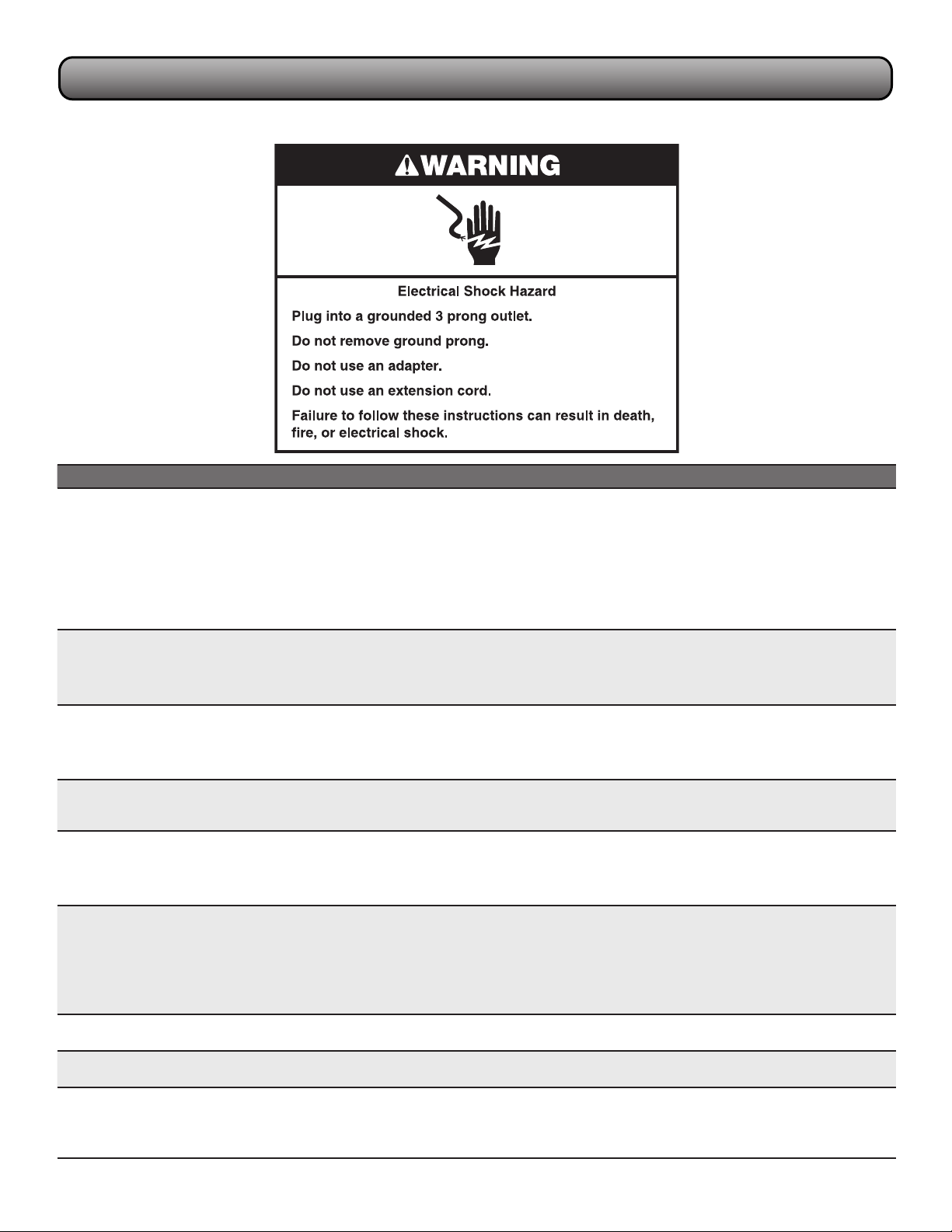
Nothing will operate Power supply cord is unplugged: Plug into a grounded 3 prong outlet.
ENERGY SAVE is active and the display is blank: Press any keypad on the control to display the time
ofday. See the “Electronic Oven Controls” section for more information.
Household fuse is blown or a circuit breaker is tripped: Replace the fuse or reset the circuit breaker.
Ifthe problem continues, call an electrician.
Main or regulator gas shut-off valve is in the Off position: See the Installation Instructions.
The range is improperly connected to the gas supply: Contact a trained repair specialist or see
Installation Instructions.
Surface burners
willnot operate
The control knob is not set correctly: Push in knob before turning to a setting.
Air in the gas lines: If this is the rst time the surface burners have been used, turn on any one of the
surface burner knobs to release air from the gas lines.
Clogged burner ports: See the “Sealed Surface Burners” section.
Surface burner
ames are uneven,
yellow and/or noisy
Clogged burner ports: See the “Sealed Surface Burners” section.
Burner caps positioned improperly: See the “Sealed Surface Burners” section.
Range converted improperly: If propane gas is being used, contact a service technician or see the cover
for contact information.
Excessive heat
around cookware
oncooktop
Cookware and ame are not matched: The cookware should be centered above the burner with the
bottom sitting level on the grate. The ame should be adjusted so that it does not extend up the sides
ofthepan.
Cooktop cooking
results not
whatexpected
Improper cookware: Ideal cookware should have a at bottom, straight sides, and a well-tting lid,
andthematerial should be of a medium-to-heavy thickness.
Control knob set to incorrect heat level: See the “Cooktop” section.
Range is not level: Level the range. See the Installation Instructions.
Oven will not operate Air in the gas lines: If this is the rst time the oven has been used, turn on any one of the surface burner
knobs to release air from the gas lines.
Control is locked: Press and hold START for 3 seconds to unlock.
The range is in Demo mode: Demo mode will deactivate all oven elements. See “Demo Mode” in the
“Electronic Oven Controls” section.
Electronic oven control set incorrectly: See the “Electronic Oven Controls” section.
Oven burner ames
are yellow or noisy
Range converted improperly: If propane gas is being used, contact a service technician or see the
coverfor contact information.
Oven temperature
too high or too low
Oven temperature needs adjustment: See “Oven Temperature Control” in the “Electronic OvenControls”
section.
Convection fan
notworking
The convection cycle is in the rst 5 minutes of operation: This is normal. The convection fan
willstartrunning approximately 5 minutes into the cycle.
Oven door is open: If the oven door is opened during convection cooking, the fan will turn off
immediately.It will come back on when the oven door is closed.

19
Problem Possible Causes and/or Solutions
Display shows
messages
Power failure (display shows ashing time): Clear the display. On some models, reset the clock,
ifneeded. See “Clock” keypad feature in the “Feature Guide” section.
Error code (display shows letter followed by number): Depending on your model, press CANCEL/OFF
toclear the display. See “Control Display” in the “Electronic Oven Controls” section. If it reappears, call
forservice. See the cover for contact information.
Start needs to be pressed so a cycle can begin (display shows “PUSH” or “PSH”): See the
“Start”keypad feature in the “Feature Guide” section.
Range is in Sabbath mode (display shows “SAb”): Press CANCEL/OFF to exit Sabbath mode.
Clean cycle did not
work on all spills
Several cooking cycles between Clean cycles or spills on oven walls and doors: Run additional
Cleancycles. Use the AquaLift
®
Technology Cleaning Kit. Affresh
®
Kitchen and Appliance Cleaner or
affresh
®
Cooktop Cleaner can be used for stubborn soils. See the “Accessories” and “Clean Cycle”
sectionsfor more information.
Mineral deposits
are left on the oven
bottom after the
Clean cycle
Tap water was used in the Clean cycle: Use distilled or ltered water in the Clean cycle.
To remove deposits, use a cloth soaked with vinegar. Then use a cloth dampened with water to thoroughly
remove any vinegar residue.
Range is not level: Mineral deposits will collect on dry areas of the oven bottom during the Clean cycle.
Level the range. See the Installation Instructions.
To remove deposits, use a cloth soaked with vinegar. Then use a cloth dampened with water to thoroughly
remove any vinegar residue.
Oven cooking results
not what expected
Range is not level: Level the range. See the Installation Instructions.
The set temperature was incorrect: Double-check the recipe in a reliable cookbook.
Oven temperature needs adjustment: See “Oven Temperature Control” in the “Electronic Oven Controls”
section.
Oven was not preheated: See the “Baking and Roasting” section.
Racks were positioned improperly: See the “Positioning Racks and Bakeware” section.
Not enough air circulation around bakeware: See the “Positioning Racks and Bakeware” section.
Darker browning of food caused by dull or dark bakeware: Lower oven temperature 25°F (15°C) ormove
rack to a higher position in the oven.
Lighter browning of food caused by shiny or light-colored bakeware: Move rack to a lower position
inthe oven.
Batter distributed unevenly in pan: Check that batter is level in the pan.
Incorrect length of cooking time was used: Adjust cooking time.
Oven door was not closed: Be sure that the bakeware does not keep the door from closing.
Oven door was opened during cooking: Oven peeking releases oven heat and can result in longercooking
times.
Rack is too close to bake burner, making baked items too brown on bottom: Move rack to higher
position in the oven.
Pie crusts browning too quickly: Use aluminum foil to cover the edge of the crust and/or reduce baking
temperature.
Noises
Problem Possible Causes and/or Solutions
Surface burner making popping noises Wet burner: Allow it to dry.
Gas range noises during bake and
broil operations
The following are some normal sounds
with the explanations.
These sounds are normal operational noises that can be heard each time the bake
or broil burners ignite during the cycle.
Pop Gas valve is opening or cycling on and will make a single pop when it snaps open
from the solenoid. It sounds similar to a suction cup being pulled off of a piece of
glass: This is normal.
Click The igniters will click several times until the ame is detected. These are short
clicking sounds like tapping a nail onto a piece of glass: This is normal.
Convection fan relay is cycling on and off (on some models): This is normal.
Woosh or poof Bake or broil burner is igniting: This is normal.
Oven burner ames are yellow or noisy Range converted improperly: If propane gas is being used, contact a service technician
or see the cover for contact information.

20
For accessories in the U.S.A., you can visit our website at www.whirlpool.com or call us at 1-866-664-2449.
In Canada, visit our website at www.whirlpool.ca or call us at 1-866-664-2449.
Complete Cooktop Cleaner Kit
(ceramic glass models)
(includes cleaner, protectant, protectant
applicator, scraper, and cleaner pads)
Order Part Number 31605
Cooktop Protectant
(ceramic glass models)
Order Part Number 31463A
Affresh
®
Stainless Steel Cleaning
Wipes
(stainless steel models)
Order Part Number W10355049
Affresh
®
Cooktop Cleaner
(ceramic glass models)
Order Part Number W10355051
Cooktop Cleaning Pads
(ceramic glass models)
Order Part Number W10391473
Affresh
®
Stainless Steel Cleaner
(stainless steel models)
Order Part Number W10355016
Affresh
®
Kitchen and Appliance
Cleaner
Order Part Number W10355010
AquaLift
®
Oven Cleaning Kit
Order Part Number W10423113RP
Cooktop Scraper
(ceramic glass models)
Order Part Number WA906B
Granite Cleaner and Polish
Order Part Number W10275756
Gas Grate and Drip Pan Cleaner
Order Part Number 31617A
Canning Unit Kit
(coil models)
Order Part Number 242905
Gourmet Griddle
Order Part Number W10432539
Standard Flat Oven Rack
Order Part Number W10551060
Split Oven Rack
Order Part Number 4396927
Max Capacity Oven Rack
Order Part Number W10289145
Porcelain Broiler Pan and Grid
Order Part Number 4396923
Premium Broiler Pan and Roasting
Rack
Order Part Number W10123240
Trim Assembly
5/8" (1.7 cm) White - Order Part Number
W10675027
5/8" (1.7 cm) Black - Order Part Number
W10675026
5/8" (1.7 cm) Stainless Steel - Order Part
Number W10675028
1
1
/
8
" (2.9 cm) White - Order Part Number
W10731885
1
1
/
8
" (2.9 cm) Black - Order Part Number
W10731886
1
1
/
8
" (2.9 cm) Stainless Steel - Order Part
Number W10731887
Backsplash Assembly
White - Order Part Number W10655448
Black - Order Part Number W10655449
Stainless Steel - Order Part Number
W10655450
Grill Kit
Order Part Number W10432545
IMPORTANT: When the range is used under microwave models: JMC82808CB-0, JMV9196CB-0, or YJMV9196CB-0,
theDoorBafePlate Part Number W10737014 must be ordered and used.
For additional product information, in the U.S.A., visit www.whirlpool.com. In Canada, visit www.whirlpool.ca.
If you do not have access to the Internet and you need assistance using your product or you would like to schedule service, you may
contact IKEA at the number below.
Have your complete model number ready. You can find your model number and serial number on the label, located on the oven frame
behind the top right side of the oven door.
For assistance or service in the U.S.A. or Canada, call 1-866-664-2449.
If you need further assistance, you can write to IKEA with any questions or concerns at the address below:
In the U.S.A.:
IKEA Brand Home Appliances
Customer eXperience Center
553 Benson Road
Benton Harbor, MI 49022-2692
In Canada:
Customer eXperience Centre
Whirlpool Canada LP
200-6750 Century Ave.
Mississauga, ON L5N 0B7
Please include a daytime phone number in your correspondence.
Please keep this User Guide and model number information for future reference.
ACCESSORIES

W11397129A
©2019.
All rights reserved.
Tous droits réservés.
®
IKEA is a registered trademark of Inter-Ikea Systems B.V.
AQUALIFT, AQUALIFT & Design and AFFRESH are trademarks of Whirlpool, U.S.A. used with permission.
®
IKEA est une marque déposée de Inter-Ikea Systems B.V.
AQUALIFT, le design AQUALIFT et AFFRESH sont des marques de commerce de Whirlpool, U.S.A. utilisées sous autorisation. 10/19