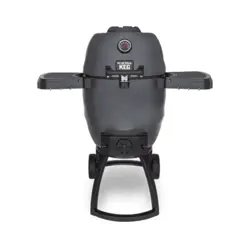
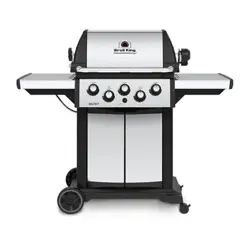
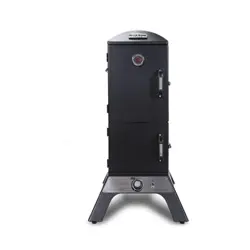
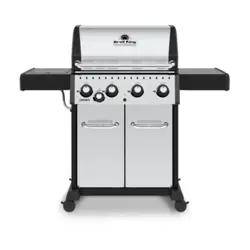
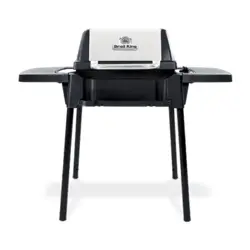
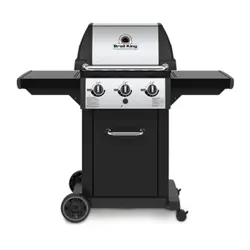
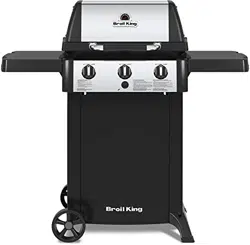
User Manual Broil King Gem™
OPERATION
Burn-off. Before cooking on your gas barbecue for the first time, burn off the barbecue to rid it of any odours or foreign matter as follows:
Remove cooking grids and warming rack and wash in mild soap and water. Ignite the burner. Close the lid and operate the barbecue for 20 minutes with the control knobs set at "MEDIUM/HIGH". Turn the gas off at the source. Turn the control knobs to "Off". Let the appliance cool down, replace the grids. You are now ready to use the appliance.
Preheating. When grilling, preheat the barbecue on Medium/High with the lid closed for ten minutes. Reduce heat as appropriate for what you are grilling. Scrub grids with a wire grill brush and brush or spray the grids with vegetable or olive oil to prevent food from sticking.
Lid Position. The position of the lid during cooking is a matter of personal preference, but the barbecue cooks faster, uses less gas, and controls the temperature best with the lid closed. A closed lid also imparts a smokier flavor to meat cooked directly on the grid, and is essential for smoke and convection cooking.
Vapourization Systems. Your gas grill is designed for use with the Flav-R-Wave™ vapourization system (included). Do not use lava rock, ceramic briquets or any other vapourization system other than the one that came with the barbecue.
COOKING TEMPERATURES
High Setting will produce temperatures at the cooking grid of approximately 600 - 650°F (320 - 340° C). Use this setting only for fast warm-up and for burning food residue from the cooking grids after the cookout is over. This setting is also ideal for quickly searing steaks before reducing temperature. Rarely, if ever, do you use the HIGH setting for extended cooking.
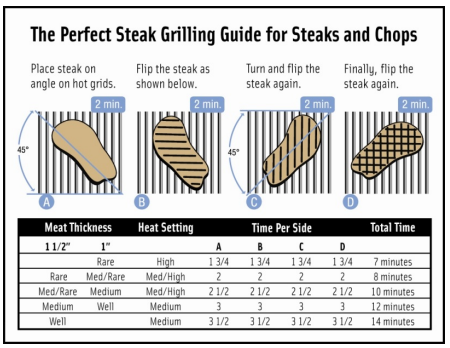
Medium/High Setting will produce temperatures at the cooking grid of approximately 550°F (290 ° C). Use this setting for warm-up and for grilling steaks and chops,
Medium Setting will produce temperatures inside the barbecue of approximately 450° F (230°C) with the lid down. Use this setting for most grilling of chicken, burgers, vegetables and for roasting, and baking.
Low Setting will produce temperatures inside the barbecue of approximately 310- 350° F (155-175° C). Use this setting for all smoke cooking, large cuts of meat, delicate fish, and for dough and pastry such as pizza and quesadillas.
These temperatures are approximate only and vary with the outside temperature and the amount of wind present.
COOKING TECHNIQUES
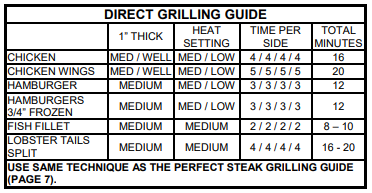
DIRECT GRILLING
The direct grilling method involves cooking the food on grids directly over the flame. Direct grilling is the most popular method for most single serving items such as steaks, chops, fish, burgers, kebabs and vegetables.
- . Prepare food in advance to avoid delay and timing problems. If using marinade or spices, they should be applied before placing meat on the cooking grid. If basting with sauces, they should be applied the last 2-4 minutes of grilling to avoid burning
- Organize the area around the barbecue to include forks, tongs, oven mitts, sauces and seasonings, to allow you to stay in the vicinity of the barbecue while cooking.
- Bring meat to room temperature just prior to grilling. Trim excess fat from meat to minimize the "flare-ups" that are caused by dripping grease.
- Pre-heat the barbecue to the desired temperature with the cover closed.
- Coat the grids with vegetable or olive oil to prevent food from sticking to the grids.
- Hold the salt when cooking meats on the barbecue. The meat will stay juicier if the salt is added after cooking.
- To prevent steaks from "drying out", use tongs rather than a fork and start on "MEDIUM/HIGH" to sear the meat and seal the juices in. Reduce the heat and extend cooking times when grilling thicker cuts of meat.
- Learn to test when the meat is done by time and feel. The meat firms up as it cooks. When the meat is soft it is rare. When it is firm, it is well done.
- Follow the perfect steak grilling guide for most meat, fish, poultry and vegetables.
COOKING TECHNIQUES
INDIRECT CONVECTION COOKING
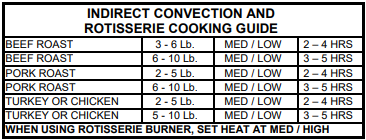
This method is ideal for cooking large cuts of meat such as roasts or poultry. The food is cooked by hot air circulating around it.
- For most applications of convection cooking with and without a rotisserie, a drip pan is recommended to catch the drippings. Place drip pan on top of the Flav-R-Wave, beneath center of food. Put half to one inch of water in the drip pan. Fruit juice, wine or marinade may also be added to enhance the flavor. Do not let the drip pan run dry
- Convection cooking without a rotisserie is best with the lid closed and the heat reduced. All burners can be set to low or the outside burners can be set to medium and the middle burner(s) can be turned off. Turning the center burner off will prevent juices in the drip pan from burning.
- Prior to placing the meat on the gas grill, baste the meat with vegetable oil. This will enhance browning on the outside of the meat.
- When cooking without a drip pan, close attention must be paid to avoid the risk of a grease fire and is not recommended.
- Turn gas grill off and allow it to cool before removing drip pan. The fat drippings are highly flammable and must be handled carefully to avoid injury
- For convection cooking roasts and poultry without a rotisserie, put meat in a roasting rack directly on grids.
ROTISSERIE COOKING
Follow the steps for Indirect Convection Cooking. (See left)
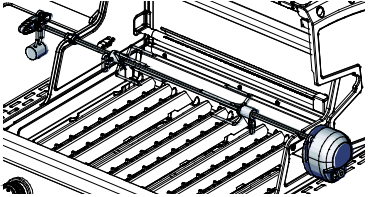
- The rotisserie can accommodate up to 7 kg (15lb) of meat with the limiting factor of rotating clearance. For best results the meat should be centered on the center line of spit to eliminate an out-of-balance condition.
- The rotisserie can be used with the cooking grids in place if space allows.
- Fasten the meat securely on the spit prior to placing it on the gas grill. For poultry, tie the wings and legs in tightly.
REAR BURNER ROTISSERIE
- Certain models feature a rear burner for rotisserie cooking. The rear burner rotisserie method is the ultimate for cooking roasts and poultry. With the heat source located behind the food, there is no chance of a flare up caused by fat drippings. A dish or drip pan placed below the spit will collect the juices for basting or for preparing a sauce.
- The spring loaded rear burner may be easily removed when not in use.
- To operate your rear burner, see “Lighting the Rear Burner.”
SPIT BALANCE
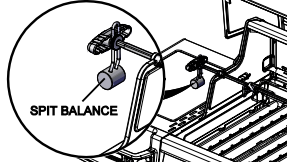
- Loosen the rod handle to allow the balance to turn freely.
- Set the rotisserie rod in the slots of the gas grill casting. Let the heaviest side of the meat rotate to the bottom.
- Adjust the balance to the top of the rod, opposite the heaviest side of the meat.
- Tighten the rod handle. Periodically, check to see if the meat turns smoothly while cooking. Adjust the balancer as necessary. CAUTION: Use oven mitt when adjusting balancer.
HOW TO USE A PROBE THERMOMETER
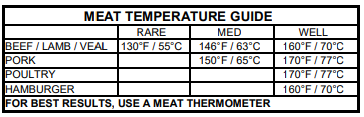
- The accurate way to determine when a large piece of meat is done is to use a probe thermometer. Insert the thermometer at an angle so the sturdy pointed metal tip rests in the center of the thickest part of the meat. Be careful that it doesn’t touch the spit or the bone, and that the point is not resting in fat (you will notice much less resistance when probing in fat)
- When the thermometer displays the desired temperature the meat is done. Add your sauces during the last few minutes of cooking time and let the meat stand about 15 minutes to firm up. Carve and serve.
- Poultry: insert the tip of the thermometer in the thickest part of the thigh close to the body
- Ham or roasts: insert the tip of the thermometer in the center of the heaviest section of the meat.
USING A SPIT – LEG OF LAMB
- Have 3” of bone sawed from small end of leg
- Leave meat around bone intact to form a flap.
- Put a spit fork on rod.
- Fold flap up and run rod through flap and leg
- Put second fork on rod and insert forks in each end of leg. Test for balance. Tighten screws.
USING A SPIT – POULTRY
- With breast down, bring neck skin up over cavity
- . Turn under edges of skin; skewer to back skin
- Loop twine around skewer and tie.
- Turn breast side up; tie or skewer wings to body
- Put a spit fork on rod. Insert rod in neck skin parallel to backbone and exit just above tail.
- Put second fork on rod and insert forks in breast and tail. Test for balance. Tighten screws
- Tie tail to rod with twine. Cross legs; tie to tail.
THREE CHICKENS ON A SPIT
- Tie or skewer wings to body.
- Put a spit fork on rod. Place chickens on rod as demonstrated in the above diagram.
- Loop twine around tails and legs; tie to rod
- Put second fork on rod and insert forks in chicken. Tighten screws.
MAINTENANCE
REGULAR MAINTENANCE
To ensure optimal performance and safety, the following components should be inspected and cleaned as required before use of your gas grill.
COOKING GRIDS - CAST IRON, CAST STAINLESS & HEAVY ROD STAINLESS
BROIL KING® Deep V cast iron and cast stainless cooking grids provide unsurpassed heat retention and grilling performance. BROIL KING® Heavy Rod stainless grids provide maximum durability and good heat retention and good grilling performance. BROIL KING® cast iron grids are coated with a porcelain enamel finish to protect the grids and reduce the tendency of food sticking to grids. Regular use and care improves performance and longevity of the grids.
For optimum performance:
- Before first use and after long periods of storage, wash grids using a light detergent and water and then rinse and dry with paper towel; never air dry grids or use a dishwasher
- Immediately after washing, season cooking grids by coating grids with an organic cold pressed cooking oil with a high smoke point, light the grill and operate on Med/Low for 30 minutes. Recommended cooking oils:
- Avocado Oil – smoke point (260C/500F)
- Rice Bran Oil – smoke point (255C/490F)
- Canola Oil – smoke point (204C/40
- Before and after each use, brush grids with a good quality stainless steel bristle brush (Item #’s 65225, 64014, 64034) and lightly coat with a high smoke point cooking oil. This will continue the seasoning process
- Use medium heat settings to preheat and grill to avoid burning off the protective seasoned coating
- Avoid applying sugar based marinades or salt to meat before grilling, apply sugar based marinades at end of grilling and salt after grilling
- Use oil based marinades, avoid water based marinades
- Lightly coat food with cooking oil of your choice before grilling
- Turn and rotate your grids periodically
- ensure the surface of the grid is always coated with a light layer of oil. This helps prevent rust and deterioration and improves the grids non-stick performance
- If rust does occur, Burn-Off the grid, brush with a stainless steel bristle brush and re-season
GREASE TRAY
The grease tray is in the pull out drawer located under the control panel. Clean regularly.
FLAV-R-WAVE™
The Flav-R-Wave™ is designed to generate smoke and vapor from the food drippings in order to provide that authentic barbecue flavor while protecting the burner. If residue accumulates on the Flav-RWave™, remove the cooking grids and scrape the residue off the Flav-R-Wave™ with the grid lifter.
GENERAL CLEANING
Perform a Burn-Off (see below). When gas grill is cool, remove grids, scrape the Flav-R-Wave™ clean with grid lifter then remove the Flav-R-Wave™. Clean the interior of the gas grill as necessary by scraping the sides and bottom of the cook box with the grid lifter and vacuum residue. Rust is a natural oxidation process and may appear on internal stainless steel parts. Rust will not affect performance of your grill.
BURN-OFF
Ignite the burners as per “Lighting” (page 6). Operate gas grill on HIGH with lid closed for 10 minutes maximum. Turn the gas source off then turn control knobs to OFF.
ANNUAL MAINTENANCE
The following components should be inspected and cleaned at least once a year or after any period of storage over 30 days to ensure optimal performance, safety and efficiency.
BURNER
Remove burner and inspect for cracks and deterioration. Clean venturi tubes using a pipe cleaner or venturi brush to eliminate any blockages. See “Venturi Tubes.” (Page 5) While the burner is removed, remove the grease shields, clean the interior of cook box by scraping the sides and bottom of the cook box and vacuuming.
HOSE
Inspect and replace if necessary. For propane see “Hose and Regulator.”
EXTERIOR ALUMINUM COMPONENTS
If white oxidation spots appear, wash the outside of the aluminum cook box with a mild soap and water solution. Rinse the surfaces thoroughly then wipe them with a cloth dipped in cooking oil to restore the luster. For repair of paint scratches and scuffs, use a good quality HIGH temperature (600°F) spray paint for touch-up.
STAINLESS STEEL & PORCELAIN COMPONENTS
Wash with soap and water. Use stainless steel cleaner or “Bar Keepers Friend” to polish and remove stains or rust marks if they occur. Weathering and extreme heat can cause a stainless steel lid to turn a tan color. This is discoloration and is not considered a manufacturing defect.
RESIN COMPONENTS AND SIDE SHELVES
Wash with soap and water.
REPLACEMENT PARTS
If a problem is found with the regulator, hose, burner, or control valves, do not attempt repair. See your dealer, approved service center, or contact the factory for repairs or replacement parts. To ensure optimum performance, use only original BROIL KING® replacement parts.