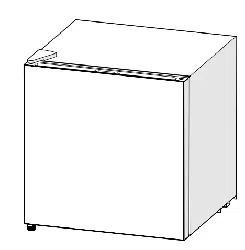
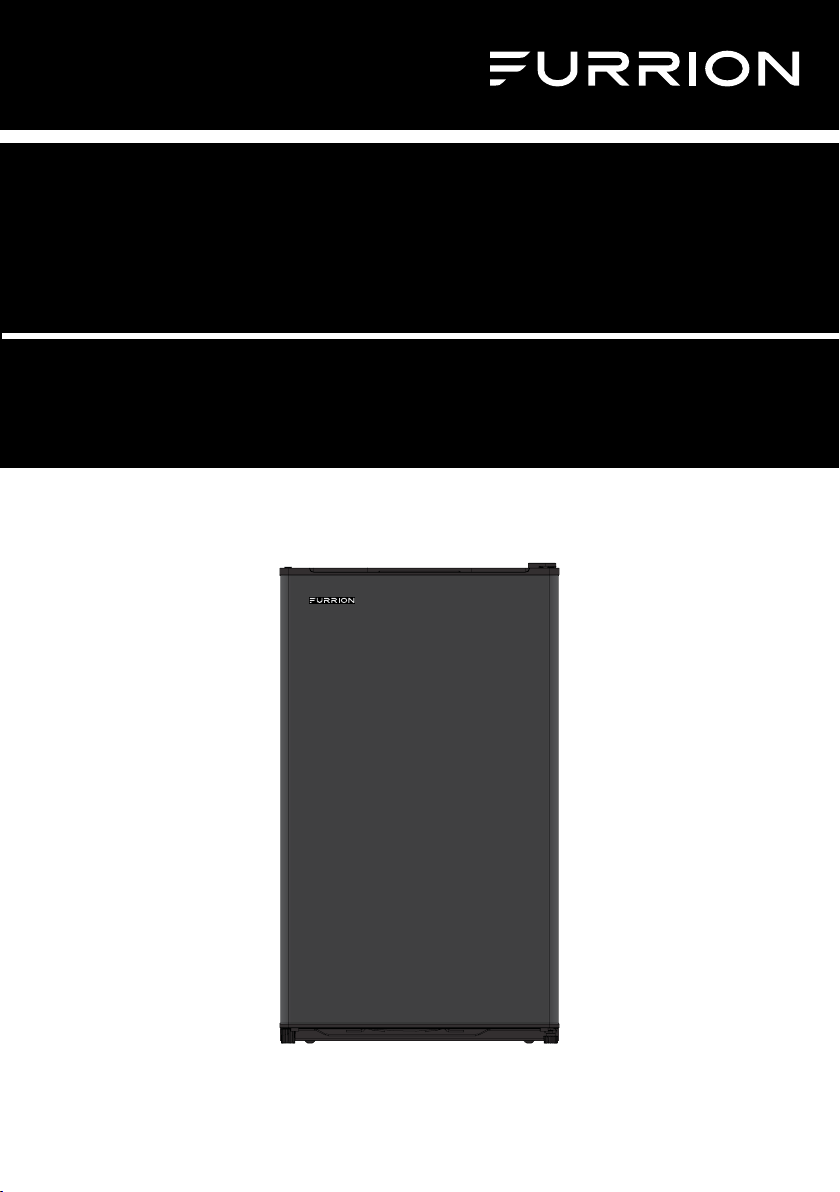
Model/Modèle: FCR33ACA-BL
* The product picture is
reference only
* L'image de produit est
référence seulement
3.3 cu. ft. Bar Refrigerator
Réfrigérateur-bar de 93 litres
(3,3 pieds cubiques)
Instruction Manual
Manuel d'instructions

1
Welcome
Thank you for purchasing this Furrion
®
refrigerator. Before placing your new
appliance into operation, please read these operating instructions carefully. This
instruction manual contains important information for safe use, installation and
maintenance of the appliance.
Please keep this instruction manual in a safe place for future reference. Pass it onto
possible new owners of the appliance.
The manufacturer does not accept responsibility for any damages that may arise due
to non-observation of these instructions.
If you have any further questions regarding our products, please contact us at

2
Contents
Welcome ............................................................................................1
Contents ............................................................................................2
Important Safety Instructions ............................................................3
General Safety Precautions ....................................................................................3
Electrical Shock Warnings ...................................................................................... 4
Grounding requirement...........................................................................................5
Before Use .........................................................................................6
Before Using for the First Time ..............................................................................6
What’s in the Box ....................................................................................................6
Parts and Features ............................................................................7
Installation ........................................................................................8
Before Using your Refrigerator ..............................................................................8
Finding a Suitable Location ....................................................................................8
Leveling your Refrigerator ...................................................................................... 8
Providing Proper Ventilation ...................................................................................8
Providing a Proper Power Supply ...........................................................................8
Reversing the Door Position ...................................................................................9
Operation ...........................................................................................11
Setting the Thermostat ...........................................................................................11
Shutting Down your Refrigerator - Long Vacations (several months) ...................11
Moving Your Refrigerator ........................................................................................11
Tips on Saving Energy .............................................................................................11
Maintaining your Refrigerator ................................................................................12
Specifications ....................................................................................13
Troubleshooting .................................................................................14
Warranty ............................................................................................15

3
Important Safety Instructions
General Safety Precautions
CAUTION
RISK OF ELECTRIC SHOCK
DO NOT OPEN
This symbol indicates that
dangerous voltage constituting
a risk of electric shock is
present within your compact refrigerator.
This symbol indicates that
there are important operating
and maintenance instructions
in the literature accompanying your
compact refrigerator.
WARNING:
1. Read these instructions.
2. Keep these instructions.
3. Heed all warnings.
4. Follow all instructions.
5. Do not use this
appliance near water.
6. Clean only with damp cloth.
7. Do not block any ventilation openings.
Install in accordance with the
manufacturer's instructions.
8. Do not install near any heat sources
such as radiators, heat registers,
stoves, or other apparatus (including
amplifiers) that produce heat.
9. Do not defeat the safety purpose of
the polarized or grounding-type plug.
A polarized plug has two blades with
one wider than the other. A grounding
type plug has two blades and a third
grounding prong. The wide blade or the
third prong are provided for your safety.
If the provided plug does not fit into
your outlet, consult an electrician for
replacement of t
he obsolete outlet.
10. Protect the power cord from being
walked on or pinched particularly at
plugs, convenience receptacles, and
the point where they exit from the
appliance.
11. Do not attempt to modify or extend
the power cord of this appliance.
12. Unplug this appliance during
lightning storms or when it will not
be used for long periods of time.
13. Make sure that the available
AC power matches the voltage
requirements of this appliance.
14. Do not handle the plug with wet hands.
This could result in an electric shock.
15. Unplug the power cord by holding the
plug, never by pulling the cord.
16. Do not turn the appliance on or off by
plugging or unplugging the power cord.
17. Turn off the appliance before
unplugging it.
18. Refer all servicing to qualified service
personnel. Servicing is required when
the appliance has been damaged in
any way, such as the power-supply
cord or plug is damaged, liquid has
been spilled or objects have fallen
into the appliance, the appliance has
been exposed to rain or moisture,
does not operate normally, or has
been dropped.
19. To reduce the risk of fire or electric
shock, do not expose this appliance to
rain, moisture, dripping, or splashing,
and no objects filled with liquids
should be placed on top of it.

4
Important Safety Instructions
Electrical Shock Warnings
WARNING
Electric Shock Hazard
Failure to follow these instructions can
result in electric shock, fire, or death.
1. WARNING–Keep ventilation openings
in the appliance enclosure or in the
built-in structure clear of obstruction.
2. WARNING–Do not touch the interior
of the chiller compartment with wet
hands. This could result in frost bite.
3. WARNING–Do not use mechanical
devices or other means to accelerate
the defrosting process, other
than those recommended by the
manufacturer.
4. WARNING–Do not damage the
refrigerant circuit when handling,
moving, or using the refrigerator.
5. WARNING–Do not use electrical
appliances inside the food storage
compartment of the refrigerator,
unless they are of the type
recommended by the manufacturer.
6. WARNING–DANGER—Never allow
children to play with, operate, or
crawl inside the refrigerator.
Risk of child entrapment. Before you
throw away your old refrigerator:
1) Take off the doors
2) Leave the shelves in place so that
children may not easily climb inside
7. Unplug the refrigerator before
carrying out user maintenance on it.
8. This appliance is not intended for use
by persons (including children) with
reduced physical, sensory or mental
capabilities, or lack of experience
and knowledge, unless they have
been given supervision or instruction
concerning use of the appliance by a
person responsible for their safety.
Children should be supervised to
ensure that they do not play with the
appliance.
9. If a component part is damaged,
it must be replaced by the
manufacturer, its service agent, or
similar qualified persons in order to
avoid a hazard.
10. Please dispose of the refrigerator
according to local regulations as the
refrigerator contains flammable gas
and refrigerant.
11. Follow local regulations regarding
disposal of the refrigerator due to
flammable refrigerant and gas.
All refrigeration products contain
refrigerants, which under the
guidelines of federal law must be
removed before disposal. It is the
consumer's responsibility to comply
with federal and local regulations
when disposing of this product.
12. This refrigerator is intended to
be used in household and similar
environments.
13. Do not store or use gasoline or any
flammable liquids inside or in the
vicinity of this refrigerator.
14. Do not use extension cords or
ungrounded (two prong) adapters
with this refrigerator. If the power
cord is too short, have a qualified
electrician install an outlet near the
refrigerator. Use of an extension
cord can negatively affect the
refrigerator’s performance.

5
Important Safety Instructions
15. If the supply cord is damaged, it must
be replaced by the manufacturer, its
service agent or similarly qualified
person in order to avoid a hazard.
Grounding requirement
This refrigerator must be grounded.
This refrigerator is equipped with a
cord having a grounding wire with a
grounding plug. The plug must be
inserted into an outlet that is properly
installed and grounded.
Improper use of the grounding plug can
result in a risk of electric shock. Consult
a qualified electrician or service person
if the grounding instructions are not
completely understood, or if doubt exists
as to whether the refrigerator is properly
grounded.
SAVE THESE FOR FUTURE
REFERENCE

6
Before Use
Before Using for the First Time
Remove all adhesive tape and packaging from the interior of the appliance.
Remove the transport protection pieces and pull off the adhesive tape.
Wash the inside of the appliance with lukewarm water with a little bicarbonate of
soda added (5 ml to 0.5 liter of water). Do not use soap or detergent as the smell
may linger. Dry the appliance thoroughly.
Allow 1 inch of space between the back and sides of the refrigerator from any
surrounding walls for proper air ventilation. Adjust the feet to keep the refrigerator level.
For good circulation, the vent at the back of the unit must not be blocked. Your
Refrigerator should be placed on flat and firm surface for quieter operation.
Do not expose the appliance to direct sunlight or a heat source such as ovens,
radiators, heaters, etc.
Do not under any circumstances place heated beverages in your Refrigerator.
Do not open the door more often than necessary to lessen the escape of cold air.
For better air circulation, do not overfill the unit.
Adjust the temperature regulator according to the amount of product and the
ambient temperature.
Turning it to maximum will cause it to run continuously and ice up. Avoid the
maximum setting.
What’s in the Box
Make sure you have all the accessories included in the packaging. If any item is
damaged or missing, contact your dealer.
3.3 cu. ft. compact refrigerator x 1
Instruction Manual x 1
Warranty Card x 1

7
Parts and Features
Item Part Name
1
Thermostat Control Knob
2
Glass Shelves
3
Crisper
4
Leveling Feet
5
Door Gasket
1
8
9
2
3
5
7
6
4
Item Part Name
6
Bottle Storage
7
Refrigerator Door
8
The Handle
9
Top Hinge

8
Installation
Before Using your
Refrigerator
Remove the exterior and interior
packing.
Let the refrigerator stand upright
for approximately four hours before
connecting it to power. This reduces
the possibility of a malfunction in
the cooling system from improper
handling during transportation.
Clean the interior surface with
lukewarm water using a soft cloth.
Finding a Suitable Location
This refrigerator is designed to be
free standing only, and should not be
recessed or built-in.
Place your refrigerator on a floor
that is strong enough to support the
refrigerator when it is fully loaded.
Allow 1 inch of space between the
back and sides of the refrigerator
from any surrounding walls for
proper air ventilation. Adjust the feet
to keep the refrigerator level.
Locate the refrigerator away from
direct sunlight and sources of heat
(stove, heater, radiator, and so
on). Direct sunlight may affect the
acrylic coating and heat sources may
increase electrical consumption.
Ambient temperature below 50°F
(10°C) or above 85°F (29.4°C) will
hinder the performance of this
refrigerator. This refrigerator is not
designed for use in a garage or any
other outside installation.
Avoid locating the refrigerator in
moist areas.
Leveling your Refrigerator
It is very important for the
refrigerator to be level in order to
function properly. If the refrigerator
is not leveled during installation, the
doors may not close or seal properly,
causing cooling, frost, or moisture
problems.
To level your refrigerator, turn the
leveling foot clockwise to raise that
side of the refrigerator or turn it
counter-clockwise to lower that side.
NOTE: Having someone push against
the top of the refrigerator helps to take
some weight off the leveling foot and
makes it easier to adjust.
Providing Proper Ventilation
Place the refrigerator at lease one
inch from the wall to ensure proper
airflow to the compressor and two sides
condenser. Do not place the refrigerator
near any heat sources, such as a heater
or stove, as this may put a strain on the
compressor.
Providing a Proper Power
Supply
Check your local power source. This
refrigerator requires a 110V-120V, 60Hz
power supply.
Use a receptacle that accepts the
grounding prong. The power cord is
equipped with a 3-prong (grounding)
plug which mates with a standard
3-prong (grounding) wall outlet to
minimize the possibility of electric shock

9
Installation
hazard from this refrigerator.
Using a 3-prong plug and outlet:
Receptacle
Receptacle
Box Cover
Grounding
Adapter
Grounding Lead
Screw
When using a grounding adapter, make sure the
receptacle box is fully grounded.
3-pronged
Receptacle
Receptacle
Box Cover
3-pronged
plug
When using a 3-pronged plug
Using a grounding adapter:
Receptacle
Receptacle
Box Cover
Grounding
Adapter
Grounding Lead
Screw
When using a grounding adapter, make sure the
receptacle box is fully grounded.
3-pronged
Receptacle
Receptacle
Box Cover
3-pronged
plug
When using a 3-pronged plug
NOTES:
The refrigerator should always
be plugged into its own individual
electrical outlet which has a voltage
rating that matches the rating plate.
Never unplug your refrigerator by
pulling on the power cord. Always
grip the plug firmly and pull straight
out from the outlet.
Reversing the Door Position
You will need: A 10 mm socket driver
and a Phillips screw driver available.
Make sure that your refrigerator is
unplugged and empty.
Have someone available to assist you
in the process.
Keep all of the parts you remove to
reuse them later.
Removing the door requires that the
refrigerator be tilted backwards.
Adjust the two leveling feet to their
highest position.
NOTE: Do not lay the refrigerator
completely flat as that could damage the
coolant system.
1. Remove the screw holding the
top hinge cover to the top of your
refrigerator, then remove the top
hinge cover.
2. Remove the screws holding the
top hinge to your refrigerator, then
remove the hinge.
3. Remove the screw hole covers from
the top left side of your refrigerator.
(Fig. A)
Fig. A
4. Pull the door upwards and remove it
from the refrigerator.
5. Unscrew the left leveling foot, then
remove it.
6. Remove the screws holding the
bottom hinge and door stopper to the
refrigerator, then remove the hinge
and the stopper. (Fig. B)

10
Installation
Fig. B
7. Install the leveling foot you removed
from the left side into the right
bottom of your refrigerator. (Fig. C)
8. Install the bottom hinge and the
door stopper on the right bottom of
your refrigerator using the screws
your previously removed. Tighten the
screws.
Fig. C
9. Align the hole in the bottom left of
the refrigerator door with the bottom
hinge pin, then install the door on the
hinge pin.
10. Place the top hinge pin into the top
of the refrigerator door, then install
the top hinge on the top left of the
refrigerator with the screws your
previously removed.
11. Check the fit and alignment (vertical
and horizontal) of the door and make
sure that it moves freely open and
closed, then tighten the screws
holding the top hinge.
12. Install the screw covers previously
removed into the holes in the top
right of the refrigerator. (Fig. D and
Fig. E)
Fig. D
Fig. E
13. Adjust the leveling feet to level the
refrigerator.

11
Operation
NOTE: The refrigerator’s temperature
ranges from 32° to 46.4°F (0° to 8°C).
Setting the Thermostat
The thermostat control knob for the
refrigerator and chiller is located beside
the chiller compartment. (Fig. F)
4
5
6
Fig. F
1. The first time you turn the
refrigerator on, adjust the thermostat
to “4” and let your refrigerator cool
completely before putting food in. A
full 24 hours is recommended.
2. After it is fully cooled, test the
temperature and adjust towards “1”
to make it less cool or towards “7”
to make it cooler, as needed. The
“4” setting should be appropriate for
home or office refrigerator use.
NOTES:
Turning the thermostat to “0” stops
the cooling cycle but does not shut off
the power to the refrigerator.
If the refrigerator is unplugged or
loses power, you must wait three to
five minutes before restarting it. If
you attempt to restart before this
time delay, the refrigerator will not
start.
Large amounts of food will lower the
cooling efficiency of the refrigerator.
If you choose to change the
thermostat setting, adjust it one
increment at a time. Allow several
hours for temperature to stabilize
between adjustments.
Shutting Down your
Refrigerator - Long
Vacations (several months)
CAUTION
Use extreme caution with children. The
unit should not be accessible to child's
play.
1. Turn off the refrigerator and unplug it
from the wall outlet.
2. Remove all food.
3. Clean the refrigerator.
4. Leave the door open slightly to avoid
possible formation of condensation,
mold, or odor.
Moving Your Refrigerator
NOTE: Be sure the refrigerator
stays in the upright position during
transportation.
1. Turn off the refrigerator and unplug it
from the wall outlet.
2. Remove all food.
3. Securely tape down all loose items
inside your refrigerator.
4. Tape the doors shut.

12
Operation
Tips on Saving Energy
Locate your refrigerator in the
coolest area of the room, away from
heat producing appliances or heating
ducts and out of the direct sunlight.
Let hot foods cool before placing them
in the refrigerator. Overloading the
refrigerator forces the compressor
to run longer. Foods that freeze too
slowly may lose quality or spoil.
Wrap foods properly and wipe
containers dry before placing them
in the refrigerator. This cuts down on
frost build-up inside the refrigerator.
Organize and label food to reduce
door openings and extended
searches.
Maintaining your
Refrigerator
Your refrigerator is designed for year-
round use with only minimal cleaning
and maintenance.
When you first receive it, wipe the case
with a mild detergent and warm water,
then wipe dry with a dry cloth. Do this
periodically to keep your refrigerator
looking new.
CAUTION
To prevent damage to the finish, do not
use:
Gasoline, benzine, thinner, or other
similar solvents.
Abrasive cleaners.
Cleaning the interior of your refrigerator:
1. Turn off the refrigerator and unplug it
from the wall outlet.
2. Remove all food.
3. Wash the inside with a damp warm
cloth soaked in a solution of one
quart of lukewarm water to two
tablespoons of baking soda solution.
4. Be sure to keep the door gasket
(seal) clean to keep the unit running
efficiently.
5. Dry the interior and exterior with a
soft cloth.

13
Specifications
Technical Specifications
Net Capacity (cu. ft.) 3.3 cu. ft. (93L)
Product Size (L x H x W) 19 ⁄” x 33” x 17 ⁄” (485 x 836 x 451 mm)
Gross Weight 59 lbs (26.8 kg)
Temperature Range +33° ~ 48°F
Power Requirements AC 115V / 60Hz
Rated Current 1.5A
Power Consumption (annual) 258 Kwh/h
Power Cord Length ≥4.9 ft. (≥1.5 m)
Refrigerant Type R600a

14
Troubleshooting
Problem Possible cause Possible solution
The refrigerator does
not operate
The refrigerator is unplugged.
Make sure that the refrigerator is plugged in
and that the plug is pushed completely into
the outlet.
The thermostat is set to the “0” position. Turn the thermostat knob to “4.”
The fuse on the circuit is blown or the
circuit breaker is tripped.
Check the house fuse/circuit breaker box and
replace the fuse or reset the circuit breaker.
Power failure.
If a power failure occurs, the refrigerator turns
off. Wait until the power is restored.
Food in the refrigerator
compartment is
freezing
The thermostat is set too cold. Adjust the thermostat to a warmer setting.
Food in the refrigerator
compartment is not
cold
The door has been opened too often or was
not closed properly.
Make sure that the door is closed properly.
You have just added a large amount of food
to the refrigerator.
Allow time for the new food to cool, then check
again.
The thermostat is set too warm. Set the thermostat to a colder setting.
The refrigerator is in a location that is too hot.
Ambient temperatures below 50°F (10°C)
or above 85°F (29.4°C) will hinder the
refrigerator’s performance.
Move the refrigerator away from direct
sunlight and other heat sources (such as
stoves or heaters).
The refrigerator is not designed to be used in a
garage or an outdoor installation.
The refrigerator makes
unusual noise
The refrigerator may not be level on the
floor.
Level the refrigerator with the leveling feet.
The body of the refrigerator is touching a
wall.
Move the refrigerator out from the wall.
Moisture is building up
in the interior of the
refrigerator
The door has been opened too often or was
not closed properly.
Make sure that the door is closed properly.
The refrigerator is in a location that is very
humid.
Move the refrigerator to a dryer location.
The food in the refrigerator is not packaged
properly.
Repackage the food in the refrigerator to make
sure that it is sealed.
The refrigerator
door does not close
completely
Food packages are interfering with the door. Move the food packages or remove some food.
The shelves are out of position. Adjust the shelves properly.
The door gaskets are dirty. Clean the door gaskets.
The refrigerator is not level. Level the refrigerator with the leveling feet.
CAUTION
Do not try to repair your refrigerator yourself. Doing so invalidates the warranty.

15
Warranty
Furrion warrants for a period of 1 year from date of retail purchase by the original
end-use purchaser, that this product, when delivered to you in new condition, in
original packaging, from a Furrion authorized reseller and used in normal conditions,
is free from any defects in manufacturing, materials, and workmanship. In case
of such defect, Furrion shall replace or repair the product at no charge to you.
This warranty does not cover: products where the original serial numbers have
been removed, altered or cannot readily be determined; damage or loss caused by
accident, misuse, abuse, neglect, product modification, failure to follow instructions
in owner’s manual, commercial or industrial use; damage or loss caused to the
decorative surface of product; to any data, software or information; and normal
wear and tear. This warranty only protects the original end-user (“you”) and is not
transferrable; any attempt to transfer this warranty shall make it immediately void.
This warranty is only valid in the country of purchase.
THIS WARRANTY AND REMEDIES SET FORTH ABOVE ARE EXCLUSIVE AND IN
LIEU OF ALL OTHER WARRANTIES, REMEDIES AND CONDITIONS, WHETHER
ORAL OR WRITTEN, EXPRESS OR IMPLIED. FURRION SPECIFICALLY DISCLAIMS
ANY AND ALL IMPLIED WARRANTIES, INCLUDING, WITHOUT LIMITATION,
WARRANTIES OF MERCHANTABILITY AND FITNESS FOR A PARTICULAR PURPOSE.
IF FURRION CANNOT LAWFULLY DISCLAIM IMPLIED WARRANTIES UNDER THIS
LIMITED WARRANTY, ALL SUCH WARRANTIES, INCLUDING WARRANTIES OF
MERCHANTABILITY AND FITNESS FOR A PARTICULAR PURPOSE ARE LIMITED IN
DURATION TO THE DURATION OF THIS WARRANTY.
No Furrion reseller, agent, or employee is authorized to make any modification,
extension, or addition to this warranty.

16
Warranty
FURRION IS NOT RESPONSIBLE FOR DIRECT, INDIRECT, SPECIAL, INCIDENTAL OR
CONSEQUENTIAL DAMAGES RESULTING FROM ANY BREACH OF WARRANTY OR
CONDITION, OR UNDER ANY OTHER LEGAL THEORY, INCLUDING BUT NOT LIMITED
TO LOST PROFITS, DOWNTIME, GOODWILL, DAMAGE TO OR REPLACEMENT OF
ANY EQUIPMENT OR PROPERTY, ANY COSTS OF RECOVERING, REPROGRAMMING,
OR REPRODUCING ANY PROGRAM OR DATA STORED IN OR USED WITH FURRION
PRODUCTS. FURRION’S TOTAL LIABILITY IS LIMITED TO THE REPAIR OR
REPLACEMENT OF THIS PRODUCT PURSUANT TO THE TERMS OF THIS WARRANTY.
SOME STATES DO NOT ALLOW THE EXCLUSION OR LIMITATION OF INCIDENTAL OR
CONSEQUENTIAL DAMAGES OR EXCLUSIONS OR LIMITATIONS ON THE DURATION
OF IMPLIED WARRANTIES OR CONDITIONS, SO THE ABOVE LIMITATIONS OR
EXCLUSIONS MAY NOT APPLY TO YOU. THIS WARRANTY GIVES YOU SPECIFIC LEGAL
RIGHTS, AND YOU MAY ALSO HAVE OTHER RIGHTS THAT VARY BY STATE OR (WHERE
APPLICABLE IN THE COUNTRIES WHERE FURRION HAS NON-US/CANADIAN
AUTHORIZED DEALERS) COUNTRY. NO ACTION OR CLAIM TO ENFORCE THIS
WARRANTY SHALL BE COMMENCED AFTER THE EXPIRATION OF THE WARRANTY
PERIOD.
Keep your receipt, delivery slip, or other appropriate payment record to establish the
warranty period. Service under this warranty must be obtained by contacting Furrion
at [email protected]om
Product features or specifications as described or illustrated are subject to change
without notice.

17
Bienvenue
Bienvenue. Merci d'avoir acheté ce réfrigérateur Furrion.
Avant d'allumer votre appareil, lisez ces instructions d'utilisation avec attention.
Ce mode d'emploi contient des informations importantes pour utiliser l'appareil en
toute sécurité, son installation et sa maintenance.
Conservez ce mode d'emploi en lieu sûr pour référence future. Si l'appareil change de
propriétaire, accompagnez-le de ce mode d'emploi.
Le fabricant se dégage de toute responsabilité concernant les dommages possibles
entraînés par le non-respect de ces instructions.
En cas de question concernant nos produits, contactez-nous à l'adresse

18
Sommaire
Bienvenue ..........................................................................................17
Sommaire ..........................................................................................18
Instructions de sécurité importantes ................................................19
Consignes de sécurité générales ...........................................................................19
Avertissements sur les électrocutions ................................................................... 20
Exigences de mise à la masse ................................................................................21
Avant utilisation .................................................................................22
Avant d'utiliser l'appareil pour la première fois .....................................................22
Dans la boîte............................................................................................................22
Composants et fonctionnalités ..........................................................23
Installation ........................................................................................24
Avant l’utilisation du réfrigérateur .........................................................................24
Trouver un emplacement approprié .......................................................................24
Mise de niveau du réfrigérateur .............................................................................24
Fournir une ventilation appropriée .........................................................................24
Fournir une alimentation appropriée .....................................................................25
Inversion de la position de la porte.........................................................................25
Utilisation ..........................................................................................28
Réglage du thermostat ...........................................................................................28
Mise hors service du réfrigérateur - vacances longues (plusieurs mois) .............28
Déplacement du réfrigérateur ................................................................................ 28
Conseils pour économiser de l’énergie ..................................................................29
Entretien du réfrigérateur ......................................................................................29
Caractéristiques ................................................................................30
Dépannage .........................................................................................31
Garantie .............................................................................................33

19
Instructions de sécurité importantes
Consignes de sécurité
générales
ATTENTION
RISQUE DE CHOC
ÉLECTRIQUE NE PAS
OUVRIR
Ce symbole indique qu'une
tension dangereuse,
constituant un risque de choc
électrique, est présente dans ce
réfrigérateur compact.
Ce symbole indique que
d'importantes instructions
concernant le fonctionnement
et l'entretien figurent dans la
documentation qui accompagne ce
réfrigérateur compact.
AVERTISSEMENT:
1. Lire ces instructions.
2. Conserver ces
instructions.
3. Respecter tous les
avertissements.
4. Observer toutes les
instructions.
5. Ne pas utiliser cet électroménager
près de l’eau.
6. Nettoyer uniquement avec un chiffon
humide.
7. Ne pas obstruer les ouvertures
d'aération. Installer l’ensemble.
conformément aux instructions
du fabricant.
8. Installer l’appareil à l’écart de sources
de chaleur, telles que radiateurs,
bouches de chaleur, fours ou autres
appareils (y compris les amplificateurs)
qui produisent de la chaleur.
9. Ne pas chercher à modifier le
dispositif de sécurité de la prise
polarisée ou de type mise à la terre.
Une prise polarisée comporte deux
plots, un plus large que l'autre.
Une prise de type mise à la terre
est composée de deux plots et d’un
troisième de mise à la terre. La lame
large ou le troisième plot ont été
prévus pour la sécurité de l'utilisateur.
Si la prise fournie ne rentre pas dans
la prise secteur, faire appel à un
électricien pour qu’il remplace cette
dernière qui est obsolète.
10. Protéger le cordon d’alimentation
afin d’éviter qu’on ne marche dessus
ou qu’il ne soit pincé, en particulier
au niveau des prises secteur, plaques
multiprises et à l’endroit où il est
raccordé à l'électroménager.
11. Ne pas essayer de modifier ou de
prolonger le cordon d'alimentation de
cet appareil.
12. Débrancher cet électroménager
pendant les orages ou quand il n'est
pas utilisé pendant une période
prolongée.
13. Vérifier que l'alimentation c.a.
disponible correspond aux exigences
de tension de cet électroménager.
14. Ne pas manipuler la prise avec
les mains mouillées. Cela pourrait
déclencher des chocs électriques.

20
Instructions de sécurité importantes
15. Débrancher le cordon d’alimentation
en tenant la prise, jamais en le tirant.
16. Ne pas mettre l'électroménager
en service ou hors service en
branchant ou débranchant le cordon
d'alimentation.
17. Éteindre l'électroménager avant de
le débrancher.
18. Toutes les réparations doivent
être réalisées par un personnel
qualifié. Faire réparer l'appareil s’il
a été endommagé, qu’il s’agisse du
cordon d’alimentation ou de la prise
qui seraient détériorés, de liquide
infiltré dans l'appareil ou d’objets
qui seraient tombés dessus, d’une
exposition à la pluie ou à l’eau, d’un
fonctionnement anormal ou qu’on
l’ait fait tomber.
19. Afin de réduire le risque d’incendie
et de choc électrique, ne pas exposer
cet électroménager à la pluie, à
l’humidité, aux éclaboussures ou à
des gouttes d’eau et ne pas placer
de récipients remplis de liquide sur
l'électroménager.
Avertissements sur les
électrocutions
AVERTISSEMENT
Risque de choc électrique
L'inobservation de ces instructions
peut être source de choc électrique,
de risque d'incendie ou de blessures
mortelles.
1. AVERTISSEMENT : Conserver
les ouvertures d'aération dans
l'emplacement de l'appareil ou dans
une structure intégrée à l'abri de
toute obstruction.
2. AVERTISSEMENT : Ne pas toucher
l'intérieur du compartiment de
refroidissement avec des mains
humides. Cela pourrait être cause
d'une engelure.
3. AVERTISSEMENT : Ne pas utiliser
d'appareils mécaniques ou d'autres
méthodes pour accélérer le
processus de décongélation, autres
que celles indiquées par le fabricant.
4. AVERTISSEMENT : Ne pas
endommager le circuit du réfrigérant
lors de la manipulation, du
déplacement ou de l'utilisation du
réfrigérateur.
5. AVERTISSEMENT : Ne pas utiliser
d'appareils électroménagers à
l'intérieur du compartiment de
stockage d'aliments du réfrigérateur,
sauf s'ils sont du type recommandé
par le fabricant.
6. AVERTISSEMENT–DANGER : Ne
jamais laisser les enfants jouer avec,
faire fonctionner ou grimper dans le
réfrigérateur. Risques de piégeage
de l'enfant. Avant de mettre au rebus
l'ancien réfrigérateur :
1) Enlever les portes
2) Laisser les étagères en place pour
éviter que les enfants n'y grimpent à
l'intérieur facilement
7. Débrancher le réfrigérateur avant
d'effectuer un entretien de la part de
l'utilisateur.

21
Instructions de sécurité importantes
8. Cet appareil n'est pas conçu pour
être utilisé par des personnes (y
compris des enfants) à capacités
physiques, sensorielles ou
intellectuelles réduites ou sans
expérience et connaissances, à moins
qu'ils soient sous surveillance ou
bien qu'ils aient été informées quant
à l'utilisation de l'appareil de manière
sûre, par une personne responsable
de leur sécurité. Les enfants doivent
être surveillés pour vérifier qu'ils ne
jouent pas avec l'appareil.
9. Si une pièce ou un élément a été
endommagé, il doit être remplacé par
le fabricant, son service d'assistance
technique ou d'autres personnes
disposant des qualifications requises,
afin d'éviter tout danger.
10. Disposer du réfrigérateur
conformément à la réglementation
locale car ce dernier contient du gaz
et du réfrigérant inflammable.
11. Suivre la réglementation locale
concernant la mise au rebut du
réfrigérateur en raison du gaz
et du réfrigérant inflammables.
Tous les appareils de réfrigération
contiennent des réfrigérants qui
doivent être, sous les directives de la
loi fédérale, éliminés avant la mise
aux rebut. C'est la responsabilité du
consommateur de se conformer à
la réglementation fédérale et locale
lors de la mise au rebut de cet
électroménager.
12. Ce réfrigérateur est prévu pour une
utilisation à domicile et d'autres
environnements semblables.
13. Ne pas entreposer ou utiliser
de l'essence ou autres liquides
inflammables à l'intérieur ou à
proximité du réfrigérateur.
14. Ne pas utiliser de rallonge électrique
ou d'adaptateurs non mis à la masse
(deux plots) avec ce réfrigérateur.
Si le cordon d'alimentation est
trop court, contacter un technicien
qualifié pour installer une prise à
côté du réfrigérateur. L'utilisation
d'une rallonge peut avoir des effets
négatifs sur le fonctionnement du
réfrigérateur.
15. Si le cordon d'alimentation a été
endommagé, il doit être remplacé par
le fabricant, son service d'assistance
technique ou d'autres personnes
disposant des qualifications requises,
afin d'éviter tout danger.
Exigences de mise à la
masse
Ce réfrigérateur doit être mis à la
masse. Ce réfrigérateur est muni
d'un cordon électrique comportant un
conducteur de terre et une prise de mise
à la terre. La prise doit être insérée dans
une prise secteur qui est correctement
installée et mise à la terre.
L'utilisation inappropriée de la prise de
mise à la terre pourrait présenter un
risque d’incendie ou de choc électrique.
Vérifier avec un technicien qualifié
ou un professionnel d'entretien si les
instructions de mise à la terre ne sont
pas totalement comprises ou en cas de
doute sur la mise à la terre correcte du
réfrigérateur.
CONSERVER POUR
RÉFÉRENCE FUTURE

22
Avant utilisation
Avant d'utiliser l'appareil pour la première fois
Retirez tous les morceaux de ruban adhésif ainsi que tout élément d'emballage
présent dans l'appareil.
Retirez les protections de transport ainsi que les morceaux de ruban adhésif.
Lavez l'intérieur du réfrigérateur avec une solution d'eau tiède et de bicarbonate
de soude (5 ml pour 0,5 l d'eau). Ne pas utiliser de savon ni de détergent, car ces
derniers peuvent donner une odeur au compartiment. Séchez l'appareil avec soin.
Laisser un espace de 1 po entre le dos et les côtés du réfrigérateur et des murs
environnants. Cela permet l'aération adéquate de l'air. Régler les pieds pour
maintenir le réfrigérateur de niveau.
Pour garantir une circulation correcte de l'air, les ouvertures de ventilation situées
à l'arrière de l'unité ne doivent pas être obstruées. Votre réfrigérateur doit être
installé sur une surface plane et solide pour garantir un fonctionnement plus
silencieux.
Ne pas exposer l'appareil à la lumière directe du soleil ni l'installer à proximité
d'une source de chaleur, comme un four, un radiateur, un chauffage, etc.
Ne jamais ranger de liquide chaud dans votre réfrigérateur.
Ne pas ouvrir la porte plus souvent que nécessaire, pour ne pas laisser l'air froid
s'échapper.
Ne pas remplir le réfrigérateur en excès, pour garantir une bonne circulation de
l'air dans le compartiment.
Réglez la température du réfrigérateur correctement selon son niveau
remplissage et la température ambiante.
Sélectionner le réglage maximum le forcera à fonctionner sans discontinuer,
entraînant la formation de glace. Évitez d'utiliser le réglage maximum.
Dans la boîte
Assurez-vous que tous les accessoires soient bien présents dans l'emballage. Si l'un
des accessoires est endommagé ou manquant, prenez contact avec votre revendeur.
Réfrigérateur compact de 3,3 pi3 x 1
Mode d'emploi x 1
Carte de garantie x 1

23
Composants et fonctionnalités
Item Part Name
1
Molette de contrôle de la température
2
Clayettes en verre
3
Compartiment conservateur
4
Patins de mise à niveau
5
Joint de porte
1
8
9
2
3
5
7
6
4
Item Part Name
6
Rangement pour bouteilles
7
Porte du réfrigérateur
8
Poignée
9
Charnière supérieure

24
Installation
Avant l’utilisation du
réfrigérateur
Enlever l'emballage extérieur et
intérieur.
Redresser le réfrigérateur
verticalement et le laisser ainsi
pendant quatre heures avant
de le brancher sur une prise
d'alimentation. Cela réduit le risque
d'un fonctionnement défectueux du
système de réfrigération dû à une
manutention incorrecte pendant le
transport.
Nettoyer la surface intérieure avec de
l'eau tiède à l'aide d'un chiffon doux.
Trouver un emplacement
approprié
Ce réfrigérateur est conçu
uniquement pour une installation
autonome et ne doit pas être encastré
ou intégré.
Placer le réfrigérateur sur un sol
qui est assez solide pour le soutenir
quand il est rempli.
Laisser un espace de 1 po entre le
dos et les côtés du réfrigérateur
et des murs environnants. Cela
permet l'aération adéquate de l'air.
Régler les pieds pour maintenir le
réfrigérateur de niveau.
Éloigner le réfrigérateur de la
lumière directe du soleil et d'autres
sources de chaleur (four, chauffage,
radiateur, etc.) La lumière directe
du soleil peut endommager le
revêtement acrylique et les sources
de chaleur peuvent augmenter
la consommation électrique. Une
température ambiante inférieure à 50
°F (10 °C) ou supérieure à 85 °F (29,4
°C) affectera le bon fonctionnement
de ce réfrigérateur. Ce réfrigérateur
n'est pas conçu pour une utilisation
dans un garage ou toute autre
installation à l'extérieur.
Éviter de placer le réfrigérateur dans
des endroits humides.
Mise de niveau du
réfrigérateur
Il est très important que le
réfrigérateur soit mis de niveau pour
qu'il fonctionne correctement. Si le
réfrigérateur n'est pas mis de niveau
pendant l'installation, il se peut que
les portes ne se ferment pas ou ne
soient scellées correctement, ce qui
pourrait être cause de problèmes de
réfrigération, de givre ou d'humidité.
Pour mettre le réfrigérateur de
niveau, il est nécessaire de tourner
le pied de mise de niveau dans le
sens horaire pour élever ce côté du
réfrigérateur ou le tourner dans le
sens antihoraire pour baisser ce côté.
Remarque: Le fait d'avoir quelqu'un
qui pousse la partie supérieure du
réfrigérateur aide à diminuer le poids
supporté par le pied de nivellement,
facilitant ainsi son réglage.

25
Installation
Fournir une ventilation
appropriée
Placer le réfrigérateur à un minimum
de 1 po du mur pour permettre une
aération appropriée du compresseur. Ne
pas placer le réfrigérateur à proximité
des sources de chaleur, telles qu'un
chauffage ou un four, car cela pourrait
affecter le compresseur.
Fournir une alimentation
appropriée
Vérifier la source d'alimentation
locale. Ce réfrigérateur requiert une
alimentation de 110 à 120 V, 60 Hz.
Utiliser une prise qui accepte un
plot de mise à la masse. Le cordon
d'alimentation est équipé d'une prise
à trois plots (mise à la masse) qui
correspond à une prise secteur à trois
plots standard (mise à la masse) pour
minimiser le risque de choc électrique
de ce réfrigérateur.
Utilisation d'une prise à trois plots et
d'une prise secteur
Prise
Câble de mise à la masse
Vis
When using a grounding adapter, make sure the
receptacle box is fully grounded.
When using a 3-pronged plug
Prise à trois
plots
Prise à trois
plots
Couvercle de la
prise
Adaptateur de
mise à la masse
Couvercle de la
prise
Utilisation d'un adaptateur de mise à la
masse:
Prise
Câble de mise à la masse
Vis
When using a grounding adapter, make sure the
receptacle box is fully grounded.
When using a 3-pronged plug
Prise à trois
plots
Prise à trois
plots
Couvercle de la
prise
Adaptateur de
mise à la masse
Couvercle de la
prise
Remarques:
Le réfrigérateur doit toujours être
branché sur une prise secteur
individuelle d'une tension nominale
correspondante à la plaque
signalétique.
Ne jamais débrancher le
réfrigérateur en tirant sur le cordon
d’alimentation. Toujours tenir la prise
fermement en la retirant de la prise
secteur.
Inversion de la position de la
porte
Sont nécessaires : un tournevis à
douille de 10 mm et un tournevis
cruciforme.
Vérifier que le réfrigérateur est
débranché et vide.
Une assistance sera nécessaire pour
cette opération.
Conserver toutes les pièces retirées
pour les réutiliser ultérieurement.
Le retrait de la porte nécessite que le
réfrigérateur soit incliné vers l'arrière.
Régler les deux pieds de nivellement à
leur position la plus élevée.

26
Installation
Remarques: Ne pas disposer le
réfrigérateur complètement à plat, car
cela pourrait endommager le système
de refroidissement.
1. Retirer la vis retenant le cache de la
charnière supérieure sur la partie
supérieure du réfrigérateur, puis
enlever le cache.
2. Retirer les vis fixant la charnière
supérieure au réfrigérateur, puis
enlever la charnière.
3. Retirer les cache-trous de vis
sur le côté supérieur gauche du
réfrigérateur. (Fig. A)
Fig. A
4. Soulever la porte vers le haut pour la
dégager du réfrigérateur.
5. Dévisser le pied de nivellement
gauche et le retirer.
6. Retirer les vis fixant la charnière
inférieure et la butée d'ouverture de
la porte au réfrigérateur, puis enlever
la charnière et la butée. (Fig. B)
Fig. B
7. Installer le pied de nivellement
qui a été retiré sur le côté gauche
dans la partie inférieure droite du
réfrigérateur. (Fig. C)
8. Installer la charnière inférieure
et la butée d'ouverture de la
porte sur la partie inférieure
droite du réfrigérateur à l'aide
des vis précédemment retirées.
Serrer les vis.
Fig. C
9. Aligner l'orifice de la partie inférieure
gauche de la porte du réfrigérateur
avec l'axe de la charnière inférieure,
puis positionner la porte sur l'axe de
la charnière.
10. Placer l'axe de la charnière
supérieure sur la partie supérieure
de la porte du réfrigérateur, puis
fixer la charnière supérieure
sur la partie supérieure gauche
du réfrigérateur à l'aide des vis
précédemment retirées.
11. Vérifier l'alignement (vertical et
horizontal) de la porte et s'assurer
qu'elle s'ouvre et se ferme
librement, puis serrer les vis fixant
la charnière supérieure.

27
Installation
12. Installer les cache-vis retirés
précédemment sur les orifices
de la partie supérieure droite du
réfrigérateur. (Fig. D and Fig. E)
Fig. D
Fig. E
13. Régler les pieds de nivellement pour
mettre le réfrigérateur de niveau.

28
Utilisation
Remarque : La température du
réfrigérateur va de 32 à 46,4 °F (0 à 8 °C)
Réglage du thermostat
La molette de contrôle de la température
pour le réfrigérateur et le compartiment
conservateur se trouve dans le
compartiment conservateur. (Fig. F)
4
5
6
Fig. F
1. La première fois que le réfrigérateur
est mis en marche, régler le
thermostat sur « 4 » et le laisser
fonctionner pendant environ deux
heures avant d'y ranger de la
nourriture. Au moins 24 heures sont
recommandées.
2. Une fois que la température atteint
son maximum, la tester en baissant
le réglage sur « 1 » pour réduire
le froid ou en le mettant sur « 7 »
pour une température plus froide,
si besoins est. Le réglage sur «
4 » devrait être approprié pour
l'utilisation du réfrigérateur au
domicile ou au bureau.
Remarques:
Mettre le thermostat sur « 0 »
arrête le cycle de refroidissement
mais ne coupe pas l'alimentation du
réfrigérateur.
Si le réfrigérateur est débranché ou
n'est plus alimenté, il est nécessaire
d'attendre trois à cinq minutes avant
de le remettre en marche. En cas
de tentative de remise en marche
avant ce délai, le réfrigérateur ne
redémarrera pas.
De grandes quantités d'aliments
diminueront les capacités de
réfrigération du réfrigérateur.
En cas de modification du réglage du
thermostat, le régler d'un incrément
à la fois. Attendre plusieurs heures
afin que la température se stabilise
entre les réglages.
Mise hors service du
réfrigérateur - vacances
longues (plusieurs mois)
ATTENTION
Être très prudent avec les enfants.
L’appareil ne doit pas être accessible
par les enfants pour jouer.
1. Éteindre le réfrigérateur et le
débrancher de la prise secteur.
2. Retirer tous les aliments.
3. Nettoyer le réfrigérateur.
4. Laisser la porte légèrement
entrouverte pour éviter la formation
éventuelle de condensation, de
moisissure ou d'odeur.
Déplacement du
réfrigérateur
NOTE: Assurez-vous que le réfrigérateur
reste en position verticale pendant son
transport.

29
Utilisation
1. Éteindre le réfrigérateur et le
débrancher de la prise secteur.
2. Retirer tous les aliments.
3. Fixer tous les éléments amovibles à
l'intérieur du réfrigérateur avec du
ruban adhésif.
4. Fixer la porte fermée avec du
ruban adhésif. S'assurer que le
réfrigérateur soit en position verticale
pendant le transport.
Conseils pour économiser
de l’énergie
Installer le réfrigérateur dans
l'endroit le plus frais de la pièce,
à l'écart des électroménagers
produisant de la chaleur ou des
tuyauteries de chauffage et à l'abri de
la lumière directe du soleil.
Laisser les aliments chauds se
refroidir avant de les placer dans
le réfrigérateur. Surcharger le
réfrigérateur force le compresseur
à fonctionner plus longtemps. Les
aliments qui se refroidissent plus
lentement peuvent perdre en qualité
ou s'abimer.
Envelopper les aliments
correctement et essuyer les
récipients pour qu'ils soient
secs avant de les placer dans
le réfrigérateur. Cela empêche
l'accumulation de givre à l'intérieur
du réfrigérateur.
Organiser et étiqueter les aliments
pour réduire les ouvertures de la
porte et les recherches prolongées.
Entretien du réfrigérateur
Ce réfrigérateur a été conçu pour
être utilisé tout au long de l'année
avec un minimum de nettoyage et de
maintenance.
Lorsque le réfrigérateur est réceptionné
pour la première fois, essuyer la caisse
avec un détergent doux et de l'eau
chaude, puis le sécher avec un chiffon
sec. Effectuer ceci périodiquement pour
le conserver à l'état neuf.
ATTENTION
Pour éviter d’endommager la finition,
ne pas utiliser :
d'essence, de benzène, de diluant
ou d'autres solvants similaires;
de nettoyants abrasifs.
Nettoyage de l’intérieur du
réfrigérateur :
1. Éteindre le réfrigérateur et le
débrancher de la prise secteur.
2. Retirer tous les aliments.
3. Laver l'intérieur à l'aide d'un chiffon
humide tiède, trempé dans une
solution d'un quart d'eau tiède
et de deux cuillères de table de
bicarbonate de soude.
4. S'assurer de conserver le joint de
la porte propre, afin que l'appareil
fonctionne de façon optimale.
5. Sécher l'intérieur et l'extérieur avec
un chiffon doux.

30
Caractéristiques
Caractéristiques techniques
Capacité nette (cu. ft.) 3.3 cu.ft (93L)
Taille de produit (L x H x W) 19 ⁄” x 33” x 17 ⁄” (485 x 836 x 451 mm)
Poids brut 59 lbs (26.8 kg)
Gamme de température +33° ~ 48°F
Alimentation électrique AC 115V / 60Hz
Courant nominal 1.5A
Consommation d'énergie
(annuelle)
258 Kwh/y
Longueur du cordon
d'alimentation
≥4,9 pi (≥1,5 m)
Type de réfrigérant R600a

31
Dépannage
Problème Cause éventuelle Solution possible
Le réfrigérateur ne
fonctionne pas.
Le réfrigérateur est débranché.
Vérifier que le réfrigérateur est branché et
que la prise est bien enfoncée dans la prise
secteur.
Le thermostat est réglé sur la position «
0 ».
Tourner le bouton du thermostat sur « 4 ».
Le fusible du circuit est grillé ou le
disjoncteur est déclenché.
Vérifier la boîte de fusibles ou de disjoncteurs
du domicile et remplacer le fusible ou
réinitialiser le disjoncteur.
Panne d'alimentation.
Si une panne d'électricité se produit,
le réfrigérateur s'éteint. Attendre que
l'électricité revienne.
Les aliments dans le
compartiment du
réfrigérateur sont
givrés.
Le thermostat est réglé sur
une température trop froide.
Régler le thermostat sur un paramètre plus
chaud.
Les aliments dans le
compartiment du
réfrigérateur ne sont
pas froids.
Les aliments dans le compartiment du
réfrigérateur ne sont pas froids.
Vérifier que la porte est bien fermée.
Une grande quantité d'aliments vient
d'être ajoutée dans les compartiments du
réfrigérateur.
Permettre aux nouveaux aliments de se
refroidir et vérifier de nouveau.
Le thermostat est réglé sur une
température trop chaude.
Régler le thermostat sur un paramètre plus
froid.
Le réfrigérateur est dans un endroit trop
chaud.
Une température ambiante inférieure à
50 °F (10 °C) ou supérieure à 85 °F (29,4
°C) affectera le bon fonctionnement de ce
réfrigérateur.
Éloigner le réfrigérateur de la lumière
directe du soleil et d'autres sources de
chaleur (tels que des fours ou des radiateur)
Le réfrigérateur n'est pas conçu pour une
utilisation dans un garage ou toute autre
installation à l'extérieur.
ATTENTION
L’utilisateur ne doit pas essayer de réparer cet appareil lui-même. Cela annulerait
la garantie.

32
Dépannage
Problème Cause éventuelle Solution possible
Le réfrigérateur émet
des bruits inhabituels.
Le réfrigérateur peut ne pas être de niveau
sur le sol.
Mettre le réfrigérateur de niveau à l'aide des
pieds de nivellement.
Le châssis du réfrigérateur touche le mur. Écarter le réfrigérateur du mur.
De l'humidité se
développe à l'intérieur
du réfrigérateur.
La porte a été ouverte trop souvent ou n'a
pas été refermée correctement.
Vérifier que la porte est bien fermée.
Le réfrigérateur est dans un endroit très
humide.
Déplacer le réfrigérateur vers un
emplacement plus sec.
Les aliments dans le réfrigérateur ne sont
pas emballés correctement.
Emballer de nouveau les aliments de façon
hermétique.
La porte du
réfrigérateur
ne se ferme pas
complètement.
Les paquets d'aliments gênent la porte.
Déplacer les paquets d'aliments ou enlever
quelques aliments.
Les étagères sont mal positionnées. Régler les étagères correctement.
Les joints de la porte sont sales. Nettoyer les joints de la porte.
Le réfrigérateur n'est pas de niveau.
Mettre le réfrigérateur de niveau à l'aide des
pieds de nivellement.

33
Garantie
FURRION GARANTIT, PENDANT UNE PÉRIODE D’UN AN À PARTIR DE LA DATE
DE L’ACHAT AU DÉTAIL PAR L’UTILISATEUR FINAL INITIAL, QUE CE PRODUIT,
S’IL EST LIVRÉ À L’ÉTAT NEUF, DANS SON EMBALLAGE ORIGINAL, PAR UN
REVENDEUR FURRION AUTORISÉ ET UTILISÉ EN CONDITIONS NORMALES, EST
LIBRE DE TOUT DÉFAUT DE FABRICATION, DE MATÉRIEL ET DE MAIN-D’ŒUVRE.
EN CAS DE DÉFAUT, FURRION S’ENGAGE À REMPLACER OU À RÉPARER LE
PRODUIT GRATUITEMENT. CETTE GARANTIE EXCLUT CE QUI SUIT : PRODUITS
DONT LE NUMÉRO DE SÉRIE ORIGINAL A ÉTÉ ENLEVÉ, MODIFIÉ OU RENDU
ILLISIBLE, LES DOMMAGES OU LES PERTES CAUSÉS PAR UN ACCIDENT, UNE
MAUVAISE UTILISATION, LA NÉGLIGENCE, LA MODIFICATION DU PRODUIT OU
LE MANQUEMENT À SUIVRE LES CONSIGNES DU GUIDE DE L’UTILISATEUR,
L’UTILISATION COMMERCIALE OU INDUSTRIELLE, LES DOMMAGES OU LES PERTES
CAUSÉES À LA SURFACE DÉCORATIVE DU PRODUIT, LES DOMMAGES CAUSÉS AUX
DONNÉES, LOGICIELS OU RENSEIGNEMENTS, AINSI QUE L’USURE NORMALE.
LA PRÉSENTE GARANTIE PROTÈGE UNIQUEMENT L’UTILISATEUR FINAL INITIAL
(«VOUS»), ET NE PEUT ÊTRE CÉDÉE À QUICONQUE. TOUTE TENTATIVE DE CESSION
DE LA PRÉSENTE GARANTIE AURA POUR EFFET SON ANNULATION IMMÉDIATE. LA
PRÉSENTE GARANTIE EST UNIQUEMENT VALIDE DANS LE PAYS D’ACHAT.
LA PRÉSENTE GARANTIE ET LES RECOURS PRÉCÉDEMMENT DÉFINIS SONT
EXCLUSIFS ET REMPLACENT TOUTES LES AUTRES RECOURS, GARANTIES ET
CONDITIONS, QU’ILS SOIENT ORAUX OU ÉCRITS, EXPLICITES OU IMPLICITES.
FURRION DÉCLINE SPÉCIFIQUEMENT TOUTES LES GARANTIES IMPLICITES,
Y COMPRIS, SANS S’Y LIMITER, LES GARANTIES DE QUALITÉ MARCHANDE ET
D’ADÉQUATION À UN USAGE PARTICULIER. SI FURRION NE PEUT LÉGALEMENT
DÉCLINER LES GARANTIES IMPLICITES DÉCOULANT DE LA PRÉSENTE GARANTIE
LIMITÉE, TOUTES CES GARANTIES, Y COMPRIS LES GARANTIES DE QUALITÉ
MARCHANDE ET D’ADAPTATION À UN USAGE PARTICULIER, SONT LIMITÉES À LA
DURÉE DE VALIDITÉ DE LA PRÉSENTE GARANTIE.
Aucun revendeur, agent ou employé de furrion n’est autorisé à modifier, prolonger ou
élargir la présente garantie.

34
Garantie
FURRION DÉCLINE TOUTE RESPONSABILITÉ POUR TOUT PRÉJUDICE DIRECT,
INDIRECT, SPÉCIAL, ACCESSOIRE OU CONSÉCUTIF RÉSULTANT DE TOUT
MANQUEMENT DE GARANTIE OU DE CONDITION, OU RECONNU PAR TOUTE
THÉORIE JURIDIQUE, INCLUANT SANS LIMITATION LES PERTES DE BÉNÉFICES, DE
TEMPS DE FONCTIONNEMENT, DE BIENS INCORPORELS, LES DOMMAGES À TOUT
APPAREIL OU BIEN OU LE REMPLACEMENT DE TOUT BIEN OU ÉQUIPEMENT, TOUT
COÛT DE RÉCUPÉRATION, DE REPROGRAMMATION OU DE REPRODUCTION DE TOUT
PROGRAMME OU DE TOUTE DONNÉE ENREGISTRÉ DANS LES PRODUITS FURRION
OU UTILISÉS AVEC CEUX-CI. LA RESPONSABILITÉ TOTALE DE FURRION SE LIMITE
À LA RÉPARATION OU AU REMPLACEMENT DE CE PRODUIT CONFORMÉMENT AUX
CONDITIONS DE LA PRÉSENTE GARANTIE.
CERTAINS ÉTATS N’AUTORISENT PAS LES EXCLUSIONS OU LES LIMITATIONS
DES PRÉJUDICES ACCESSOIRES OU CONSÉCUTIFS, NI LES EXCLUSIONS OU
LIMITATIONS DE LA DURÉE DES GARANTIES OU CONDITIONS IMPLICITES. POUR CE
MOTIF, LES LIMITES ET EXCLUSIONS PRÉCÉDEMMENT ÉNONCÉES POURRAIENT
NE PAS S’APPLIQUER À VOUS. LA PRÉSENTE GARANTIE VOUS CONFÈRE CERTAINS
DROITS JURIDIQUES SPÉCIFIQUES, QUI POURRAIENT S’AJOUTER À D’AUTRES
DROITS QUI VOUS SONT CONFÉRÉS PAR VOTRE JURIDICTION (DANS LES PAYS
OÙ FURRION COMPTE DES DÉTAILLANTS AUTORISÉS HORS CANADA ET ETATS-
UNIS). AUCUNE ACTION OU RÉCLAMATION POUR FAIRE APPLIQUER LA PRÉSENTE
GARANTIE NE POURRA ÊTRE INITIÉE APRÈS L’ÉCHÉANCE DE LA PÉRIODE DE
GARANTIE.
Conserver votre reçu d’achat, bon de livraison ou tout autre justificatif de paiement
pour établir la période de garantie. Les réparations aux termes de la présente
garantie doivent être réclamées auprès de Furrion: [email protected]om
Les fonctionnalités et les détails techniques du produit tels qu’ils sont décrits ou
illustrés peuvent changer sans préavis.

Furrion Innovation Center & Institute of Technology
52567 Independence Ct., Elkhart, IN 46514, USA Toll free:1-888-354-5792
Email: [email protected]
©2007-2018 Furrion Ltd. Furrion
®
and the Furrion logo are trademarks licensed for use by
Furrion Ltd. and registered in the U.S. and other countries.
©2007-2018 Furrion Ltd. Furrion
®
et le logo Furrion sont des marques déposées par Furrion
Ltd. et enregistrées aux Etats-Unis et ailleurs.
FURRION.COM
IM-FHA00009 V4.0