Operating instructions
Microwave oven
To avoid the risk of accidents or damage to the appliance it is essen-
tial to read these instructions before it is installed and used for the
first time.
en-GB M.-Nr. 11 357 070

Contents
2
Warning and Safety instructions...................................................................... 4
Before using for the first time .......................................................................... 14
Setup and connection ....................................................................................... 15
Electrical connection ........................................................................................... 16
Caring for the environment .............................................................................. 17
Guide to the appliance...................................................................................... 18
Accessories supplied........................................................................................ 19
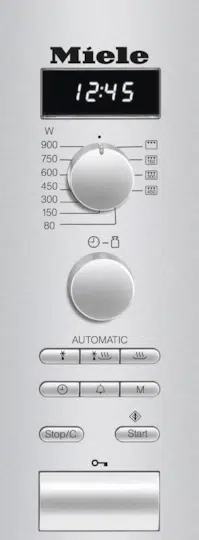
Control panel ..................................................................................................... 20
Description of function ..................................................................................... 21
Modes of operation ........................................................................................... 22
Functions............................................................................................................. 22
Microwave Solo mode.................................................................................... 22
Grilling ............................................................................................................ 22
Combination mode (Microwave + Grill).......................................................... 22
Automatic programmes.................................................................................. 22
Suitable containers for microwave ovens....................................................... 23
Material and shape.............................................................................................. 23
Testing containers ............................................................................................... 25
A heat-retaining cover ......................................................................................... 26
Before using for the first time .......................................................................... 27
Setting the time ................................................................................................... 27
Altering the time of day ....................................................................................... 27
Switching off the time of day display .................................................................. 27
Night switch-off ................................................................................................... 27
Operation............................................................................................................ 28
Opening the door ................................................................................................ 28
Placing the dish in the oven ................................................................................ 28
Turntable.............................................................................................................. 28
Closing the door.................................................................................................. 28
Starting a programme ......................................................................................... 28
“door” message.............................................................................................. 29
Interrupting or re-starting a programme.............................................................. 29
Altering settings................................................................................................... 30
Cancelling a programme ..................................................................................... 30
At the end of a programme ................................................................................ 30

Contents
3
Automatic keeping-warm function ...................................................................... 30
Quick start (programmable)................................................................................. 31
System lock......................................................................................................... 31
Using the minute minder ..................................................................................... 32
Altering a minute minder entry ....................................................................... 32
Minute minder + cooking function ................................................................. 32
Operation – grilling ............................................................................................ 33
Gourmet plate .................................................................................................... 35
Tips for use.......................................................................................................... 35
Searing/browning food........................................................................................ 35
Examples of use:................................................................................................. 36
Recipes................................................................................................................ 36
Operation - Automatic programmes................................................................ 39
Automatic defrosting .......................................................................................... 39
Automatic cooking .............................................................................................. 39
Recipes for automatic programmes................................................................ 41
Saving your favourite programme (Memory) .................................................. 47
Changing settings ............................................................................................. 48
Reheat ................................................................................................................ 50
Cooking .............................................................................................................. 52
Defrost................................................................................................................ 53
Examples of use ................................................................................................ 54
Note for test institutes ...................................................................................... 55
Cleaning and care ............................................................................................. 56
Accessories supplied .......................................................................................... 58
Problem solving guide ...................................................................................... 59
After sales service............................................................................................. 62
Contact in case of malfunction ........................................................................... 62
Warranty .............................................................................................................. 62

Warning and Safety instructions
4
This microwave oven complies with current safety requirements.
Inappropriate use can, however, lead to personal injury and mater-
ial damage.
Read the operating instructions carefully before using the appli-
ance. They contain important information on the installation,
safety, use and maintenance of the appliance. This prevents both
personal injury and damage to the appliance.
In accordance with standard IEC/EN60335-1, Miele expressly and
strongly advises that you read and follow the instructions in the
chapter on installing the appliance as well as the safety instruc-
tions and warnings.
Miele cannot be held liable for injury or damage caused by non-
compliance with these instructions.
Keep these operating instructions in a safe place and pass them
on to any future owner.
Correct application
This microwave oven is intended for private domestic use.
This appliance is not intended for outdoor use.
Do not use the appliance at altitudes of above 2000m.
The microwave oven is intended for domestic use only to cook,
defrost and to reheat food. Any other use is not permitted.
Do not use the microwave oven to store or dry items which could
ignite easily. If such items were dried in the microwave oven, the
moisture in the item would evaporate causing it to dry out and even
self-ignite. Never use the microwave oven to store or dry items which
could ignite easily.
This microwave oven can only be used by people with reduced
physical, sensory or mental capabilities or lack of experience and
knowledge if they are supervised whilst using it. They may only use it
unsupervised if they have been shown how to use it in a safe way.
They must be able to recognise and understand the consequences
of incorrect operation.

Warning and Safety instructions
5
The oven compartment is fitted with a special lamp to cope with
particular conditions (e.g. temperature, moisture, chemical resist-
ance, abrasion resistance and vibration). This special lamp must only
be used for the purpose for which it is intended. It is not suitable for
room lighting. Replacement lamps may only be fitted by a Miele au-
thorised technician or by the Miele Customer Service Department.
The microwave oven contains 1light source corresponding to en-
ergy efficiency classE.
Safety with children
Children under eight years of age must be kept away from the ap-
pliance unless they are constantly supervised.
Children aged eight and older may only use the microwave oven
without supervision if they have been shown how to use it in a safe
manner. Children must be able to recognise and understand the po-
tential risks of improper use.
Children must not be allowed to clean or maintain the appliance
unsupervised.
Children should be supervised in the vicinity of the microwave
oven. Never allow children to play with the appliance.
Danger of suffocation! Whilst playing, children could become en-
tangled in packaging (such as plastic wrapping) or pull it over their
head and suffocate. Keep packaging material away from children.
Danger of burning. Children's skin is far more sensitive to high
temperatures than that of adults. When grilling with or without the
microwave function, the oven interior, grill element and door can get
hot. Do not let children touch the microwave oven when it is in oper-
ation.
Technical safety
A damaged appliance could be dangerous. Check the appliance
for visible signs of damage. Do not use the appliance if it is dam-
aged.

Warning and Safety instructions
6
If the electrical connection cable is faulty, it must only be replaced
by a Miele authorised technician to protect the user from danger.
Temporary or permanent operation on an autonomous power sup-
ply system or a power supply system that is not synchronised with the
mains power supply (e.g. island networks, back-up systems) is pos-
sible. A prerequisite for operation is that the power supply system
complies with the specifications of EN50160 or an equivalent stand-
ard.
The function and operation of the protective measures provided in the
domestic electrical installation and in this Miele product must also be
maintained in isolated operation or in operation that is not synchron-
ised with the mains power supply, or these measures must be re-
placed by equivalent measures in the installation. As described, for
example, in the current version of BS OHSAS 18001–2 ISO 45001.
Operating a damaged appliance can result in microwave leakage
and present a hazard to the user. Do not use the appliance if
– the appliance door is warped.
– the door hinges are loose.
– holes or cracks are visible in the casing, the door or the oven in-
terior walls.
Any contact with live connections or tampering with the electrical
or mechanical components of the microwave oven will endanger
your safety and may lead to appliance malfunctions. Do not open the
appliance housing under any circumstances.
Before connecting the appliance to the mains supply, ensure that
the connection data on the data plate (voltage and frequency) match
the mains electricity supply. This data must correspond in order to
avoid the risk of damage to the appliance. Compare this before con-
necting the appliance to the mains. Consult a qualified electrician if
in any doubt.
Multi-socket adapters and extension leads do not guarantee the
required safety of the appliance (fire hazard). Do not use them to
connect the appliance to the mains.

Warning and Safety instructions
7
The electrical safety of this microwave oven can only be guaran-
teed when continuity is complete between it and an effective earth-
ing system. It is essential that this standard safety requirement is met
to avoid the risk of damage or electric shock. If in any doubt, please
have the electrical installation tested by a qualified electrician.
Do not situate the appliance too close to an adjacent furniture
unit. To ensure adequate ventilation, a minimum of gap of 5cm is re-
quired between the appliance and any neighbouring furniture or
walls. There must be a minimum gap of 19.5cm between the top of
the appliance and anything above it.
Unauthorised or incorrect repairs can cause considerable danger
to users. Repairs may only be carried out by a Miele authorised tech-
nician or by the Miele Customer Service Department.
While the microwave oven is under warranty, repairs should only
be undertaken by a Miele authorised service technician. Otherwise
the warranty is invalidated.
The microwave oven must be disconnected from the mains power
supply during repairs or cleaning and maintenance. It is only com-
pletely isolated from the electricity supply when:
– the plug has been disconnected from the back of the appliance or
the appliance has been switched off at the wall socket and the plug
withdrawn.
Pull by the plug and not by the mains connection cable to discon-
nect your appliance from the mains electricity supply.
– the mains circuit breaker is switched off.
– the mains screw-out fuse is removed (in countries where this is ap-
plicable).
Miele can only guarantee the safety of the appliance when genuine
original Miele replacement parts are used. Faulty components must
only be replaced by genuine Miele original spare parts.
Warning and Safety instructions
8
If the appliance is installed behind a kitchen furniture door, it may
only be used with the furniture door open. Do not close the furniture
door while the appliance is in use. Heat and moisture can build up
behind the closed furniture door. This can result in damage to the
appliance and furniture unit. Leave the furniture front/door open until
the appliance has cooled down completely.
If your microwave oven is built in with a lift-up door: do not bring
the door down into the closed position when the oven is in operation.
The appliance must not be used in a non-stationary location (e.g.
on a ship).
Correct use
Risk of burning due to the grill.
When grilling with or without the microwave function, the micro-
wave oven can get hot. You could burn yourself on the oven com-
partment, the grill element, food, accessories or the appliance door.
Use oven gloves when placing hot food in the appliance or remov-
ing it and when working in the hot oven compartment.
Always ensure that food is sufficiently cooked or reheated.
The time required for this depends a number of factors, such as the
nature of the food, its initial temperature and the amount to be
cooked and recipe variations.
Some foods may contain micro-organisms which are only destroyed
by thorough cooking at temperatures over 70°C for a minimum of
10minutes. Therefore when cooking or reheating foods, e.g. poultry,
it is particularly important that food is fully cooked through. If in any
doubt that a sufficiently high temperature has been reached, con-
tinue reheating for a little longer.

Warning and Safety instructions
9
It is important that the temperature in the food being cooked is
evenly distributed and sufficiently high.
This can be achieved by stirring or turning the food, and observing a
sufficiently long standing time (see charts), which should be added
to the time needed for reheating, defrosting or cooking. During the
standing time the temperature is distributed evenly in the food.
Always remember that times for cooking, reheating and defrosting
in a microwave oven are usually considerably shorter than with tradi-
tional methods of cooking food.
Excessively long cooking times can lead to food drying out and
burning, or could even cause it to catch fire. Fire hazard. There is
also a danger of fire if breadcrumbs, flowers, herbs, etc., are dried in
the microwave oven. Do not dry these items in the microwave oven.
Cushions or pads filled with cherry kernels, wheat grain, lavender
or gel, such as those used in aromatherapy can ignite when heated
even after they have been removed from the microwave oven. Do not
heat these up in the microwave oven. Fire hazard.
The microwave oven is not suitable for cleaning or disinfecting
items. Items can get extremely hot and there is a danger of burning
when the item is removed from the appliance. Fire hazard.
The appliance can be damaged if it is used without food being
placed in it or if it is incorrectly loaded. Therefore do not use the ap-
pliance to preheat crockery or to dry herbs or similar items.
Always ensure that food or a suitable microwave browning dish
has been placed in the microwave oven and that the turntable is in
position before switching on.
Pressure can build up when reheating in sealed containers, caus-
ing the container to explode. Never cook or reheat food or liquids in
sealed containers, jars or bottles.
With baby bottles, the screw top and teat must be taken off.

Warning and Safety instructions
10
Be careful when removing dishes from the appliance. Although
heat is not normally produced in the container itself by the mi-
crowaves (apart from stoneware), heat transfer from the food to the
container may be considerable, making the container itself hot. The
dish is only warmed by the heat of the food. Before serving, always
check the temperature of the actual food itself after taking it out of
the microwave. The temperature of the container is not an indication
of the temperature of the food or liquid in it. This is particularly im-
portant when preparing food for babies, children, and the elderly
or infirm. After reheating food, especially food for babies and small
children, stir the food or shake the container and check that the tem-
perature does not pose any danger. Double check after it has been
left to stand.
When heating liquids, milk, sauces etc, using microwave power,
the boiling point of the liquid may be reached without the production
of typical bubbles. The liquid does not boil evenly throughout. This so-
called 'boiling delay' can cause a sudden build-up of bubbles when
the container is removed from the oven or shaken, which can lead to
the liquid boiling over suddenly and explosively. Danger of burning.
The formation of bubbles can be so strong that the pressure forces
the oven door open. Danger of injury and damage to the appliance.
Stir liquids well before heating. After heating, wait at least 20seconds
before removing the container from the oven. In addition, during heat-
ing a glass rod or similar item, if available, can be placed in the con-
tainer.
To avoid fuelling any flames, do not open the oven door if smoke
occurs inside the appliance.
Interrupt the process by switching the appliance off and disconnect
it from the mains electricity supply.
Do not open the door until the smoke has dispersed.
Oils and fats can ignite if allowed to overheat. Never leave the
microwave oven unattended when cooking with oil or fats. Do not
use the appliance for deep-fat frying. Never attempt to put out oil or
fat fires with water. Switch the oven off and extinguish the flames by
leaving the door closed.

Warning and Safety instructions
11
Due to the high temperatures radiated, objects left near the micro-
wave oven when it is in use could catch fire. Do not use the appli-
ance to heat up the room.
If using alcohol in your recipes, please be aware that high temper-
atures can cause the alcohol to vaporise. The vapour can catch fire
on hot surfaces. Never heat undiluted alcohol in the microwave, as
this can easily ignite. Fire hazard.
Food which is stored in the oven or left in it to be kept warm can
dry out and the moisture released can lead to corrosion damage in
the microwave oven. This can also cause damage to the control
panel, worktop and surrounding kitchen furniture. Always cover food
that is left in the oven to keep warm.
Try to avoid the interior walls being splashed with food or liquids
containing salt. If it does happen, wipe these away thoroughly to
avoid corrosion to stainless steel surfaces inside the cabinet.
The oven interior can get hot during use. Danger of burning! Clean
the oven interior and accessories as soon as it has cooled down.
Waiting too long can make cleaning unnecessarily difficult and in
some cases impossible. Stubborn soiling could damage the micro-
wave oven in certain circumstances and could even be dangerous.
Fire hazard.
Please refer to the relevant instructions in “Cleaning and care”.
Fire hazard. Plastic containers which are not suitable for use in
microwave ovens can be badly damaged and cause damage to the
appliance if used. Do not use any containers or cutlery made from or
containing metal, aluminium foil, lead crystal glassware, temperat-
ure-sensitive plastics, wooden utensils or cutlery, metal clips or
plastic or paper covered wire ties. Do not use bowls with milled rims,
or plastic pots with the foil lid only partially removed (see "Suitable
containers for microwave use).
Using these items could result in damage to the container or present
a fire risk.

Warning and Safety instructions
12
Only those plastic disposable containers which are specified by the
manufacturer as suitable for use in a microwave oven may be used.
Do not leave the oven unattended when heating or cooking food in
disposable containers made of plastic, paper or other inflammable
materials.
Heat-retaining packaging consists of, among other things, a thin
layer of aluminium foil. Microwaves are reflected by metal. This re-
flected energy can, in turn, cause the outer paper covering to be-
come so hot that it ignites.
Do not use heat-retaining packaging, such as bags for grilled
chicken for warming food in the microwave oven.
If you cook eggs without their shells using microwave power, the
yolks could explode due to the resulting pressure. Prick the yolk sev-
eral times before cooking to avoid this.
Eggs heated in their shells using microwave power can burst,
even after they have been taken out of the oven. Eggs can only be
cooked in their shells in a specially designed egg-boiling device.
Do not reheat hard-boiled eggs in the microwave oven.
Food with a thick skin or peel, such as tomatoes, sausage, pota-
toes and aubergines can burst when heated. Pierce or score the skin
of these types of food several times to allow steam to escape.
Dishes with hollow knobs or handles are not suitable for use with
microwave power. Moisture which has gathered in the hollow re-
cesses can cause pressure to build up and the item can explode. If
the hollow recess is sufficiently ventilated, the item could be used.
However, we recommend that you do not use such dishes in the
microwave oven.
Do not use a thermometer containing mercury or liquid as these
are not suitable for use with very high temperatures and break very
easily.
To check food temperature, first interrupt the cooking process. Only
use a thermometer specifically approved for food use to measure the
temperature of the food.

Warning and Safety instructions
13
The steam from a steam cleaning appliance could reach live elec-
trical components and cause a short circuit. Do not use a steam
cleaner to clean the appliance.
The following applies for stainless steel surfaces:
The surface is susceptible to scratching. Even magnets can cause
scratches.
Accessories
Only use original Miele accessories. If other parts are used, war-
ranty, performance and product liability claims will be invalidated.
Miele will guarantee to supply functional spare parts for a min-
imum of 10years and up to 15years following the discontinuation of
your microwave oven.
The rack and gourmet plate supplied are designed for use with
microwave power and can be used for grilling with or without the
microwave function.
They must not, however, be used at the same time as this would
damage the gourmet plate. Always place the gourmet plate directly
on the turntable.
The gourmet plate gets extremely hot when in use. Always use
oven gloves when handling it to avoid burns. Place it on a suitable
heat-resistant mat or pot rest.
The rack and glass tray get hot during grilling (with and without the
microwave function).
Danger of burning.
Do not use the gourmet plate together with a commercially avail-
able, microwave-safe heat-retaining cover because the cover will get
too hot.
Before using for the first time
14
After transportation, let the unpacked
appliance stand for approx. 2hours
at room temperature before using it.
This is to allow time for the temperature
to equalise between the temperature in
the room and the appliance. This is im-
portant for the correct electronic func-
tioning of the appliance.
Risk of suffocation due to pack-
aging material.
Whilst playing, children may become
entangled in packaging material
(such as plastic wrapping) or pull it
over their head, presenting the risk of
suffocation.
Keep packaging material away from
children.
Remove all the packaging materials
and any protective film from the ap-
pliance.
Do not remove the cover from the
microwave outlet inside the oven
compartment or the film on the in-
side of the door.
Check the appliance for any damage.
Health risk caused by a faulty
appliance.
Operating a damaged appliance can
result in microwave leakage and
present a hazard to the user.
Do not use the microwave oven if:
– the appliance door is warped.
– the door hinges are loose.
– holes or cracks are visible in the
casing, the door or the oven interior
walls.
Clean the oven compartment and all
the accessories with a sponge or
cloth and hot water.
Stick the enclosed short instructions
to the frame behind the door as illus-
trated, making sure they do not block
any of the vents.
Setup and connection
*INSTALLATION*
15
When installing the microwave oven
ensure that there is unhindered vent-
ilation to and from the appliance
both underneath and to the rear.
Do not block the ventilation gaps or
block the gap between the base of
the appliance and the worktop sur-
face.
A minimum installation height of
85cm must be maintained.
The microwave oven can be placed on
a worktop.
To ensure adequate ventilation, a
minimum of gap of 5cm is required
between the appliance and any
neighbouring furniture or walls. There
must be a minimum gap of 19.5cm
between the top of the appliance and
anything above it.
Do not situate the appliance too
close to an adjacent furniture unit.
Heat and moisture can build up if the
microwave oven is installed behind a
closed furniture door. This can result
in damage to the appliance and fur-
niture unit.
The microwave oven may only be
used with the furniture door open.
Do not close the furniture door while
the appliance is in use.
Leave the furniture front/door open
until the appliance has cooled down
completely.
If your microwave oven is built in
with a lift-up door: do not bring the
door down into the closed position
when the oven is in operation.
Setup and connection
*INSTALLATION*
16
Electrical connection
Risk of injury caused by a faulty
appliance.
Before connecting the appliance, en-
sure that it has not been damaged in
any way.
Never use a faulty appliance.
The appliance is supplied ready for
connection with a cable and plug.
Ensure that the protective contact
socket is easily accessible at all times.
If that is not possible, ensure that a
suitable means of disconnection is
provided on the installation side for
each pole.
Fire hazard due to overheating.
Connecting the appliance to a multi-
socket plug adapter or to an exten-
sion lead can overload the cable.
The appliance must not be used with
so-called energy-saving devices.
These reduce the amount of energy
supplied to the appliance, causing it
to overheat.
For safety reasons, do not use an ex-
tension lead or multi-socket plug ad-
apter.
Connect the appliance directly to the
power supply using the original cable
and do not use any intermediate ele-
ments.
The electrical installation must comply
with VDE0100 requirements and local
regulations (e.g. BS 7671 in the UK).
If the connection cable is damaged, it
must only be replaced with a specific
connection cable of the same type
(available from the Miele Customer Ser-
vice Department). For safety reasons,
such replacement may only be carried
out by a qualified technician or the
Miele Customer Service Department.
The necessary connection data can be
found on the data plate located on the
front of the oven interior or on the back
of the appliance.
Compare the specifications on the data
plate with those of the electricity sup-
ply. Make sure that they match.
If in any doubt, consult a qualified elec-
trician.
Temporary or permanent operation on
an autonomous power supply system or
a power supply system that is not syn-
chronised with the mains power supply
(e.g. island networks, back-up systems)
is possible. A prerequisite for operation
is that the power supply system com-
plies with the specifications of
EN50160 or an equivalent standard.
The function and operation of the pro-
tective measures provided in the do-
mestic electrical installation and in this
Miele product must also be maintained
in isolated operation or in operation that
is not synchronised with the mains
power supply, or these measures must
be replaced by equivalent measures in
the installation. As described, for ex-
ample, in the current version of
BS OHSAS 18001–2 ISO 45001.
Caring for the environment
17
Disposing of the packaging
material
The packaging material is used for
handling and protects the appliance
from transport damage. The packaging
material used is selected from materials
which are environmentally friendly for
disposal and can generally be recycled.
Recycling the packaging material re-
duces the use of raw materials. Use
material-specific collection points for
valuable materials and take advantage
of return options. Your Miele dealer will
take the packaging material away.
Disposing of your old appli-
ance
Electrical and electronic appliances
contain many valuable materials. They
also contain certain materials, com-
pounds and components which were
essential for their correct functioning
and safety. These could be hazardous
to human health and to the environment
if disposed of with household waste or
if handled incorrectly. Please do not,
therefore, dispose of your old appliance
with household waste.
Instead, please make use of officially
designated collection and disposal
points to dispose of and recycle elec-
trical and electronic appliances in your
local community, with your dealer or
with Miele, free of charge. By law, you
are solely responsible for deleting any
personal data from the old appliance
prior to disposal. You are legally obliged
to remove any old batteries which are
not securely enclosed by the appliance
and to remove any lamps without des-
troying them, where this is possible.
These must be taken to a suitable col-
lection point where they can be handed
in free of charge. Please ensure that
your old appliance poses no risk to chil-
dren while being stored for disposal.
Guide to the appliance
18
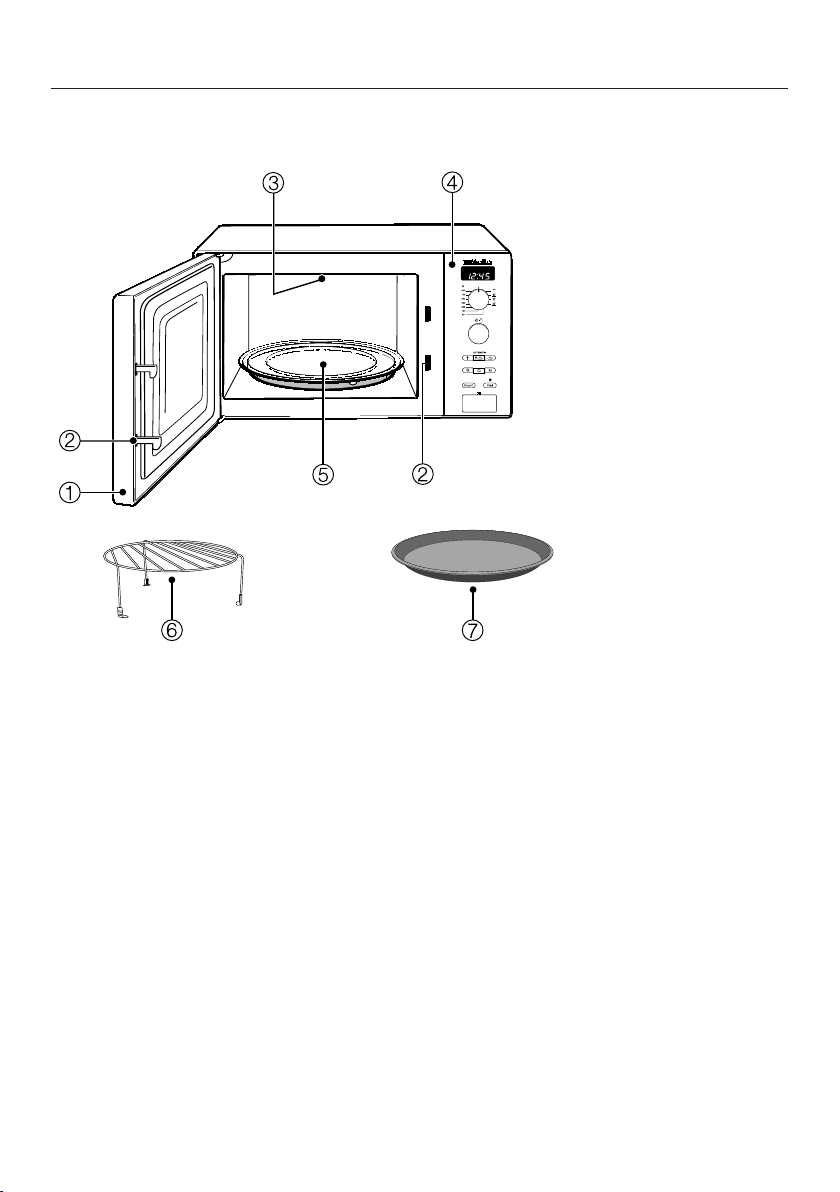
a
Door
b
Door lock
c
Grill
d
Control panel
e
Turntable
f
Grilling rack
g
Gourmet plate

Accessories supplied
19
Grilling rack
The grilling rack can be used for all
functions with and without micro-
wave power, except for Microwave
Solo mode.
To avoid the grilling rack being used in-
advertently with Microwave Solo, it
should not be stored inside the oven
compartment.
Gourmet plate
The gourmet plate is a round, non-stick
grilling plate. It can be used to heat
snacks or small meals quickly whilst
maintaining crispness.
Tip: These products and other ac-
cessories can be ordered through the
Miele Webshop.
They can also be ordered from Miele
(see end of this booklet for contact de-
tails) or from your Miele dealer.
Control panel
20
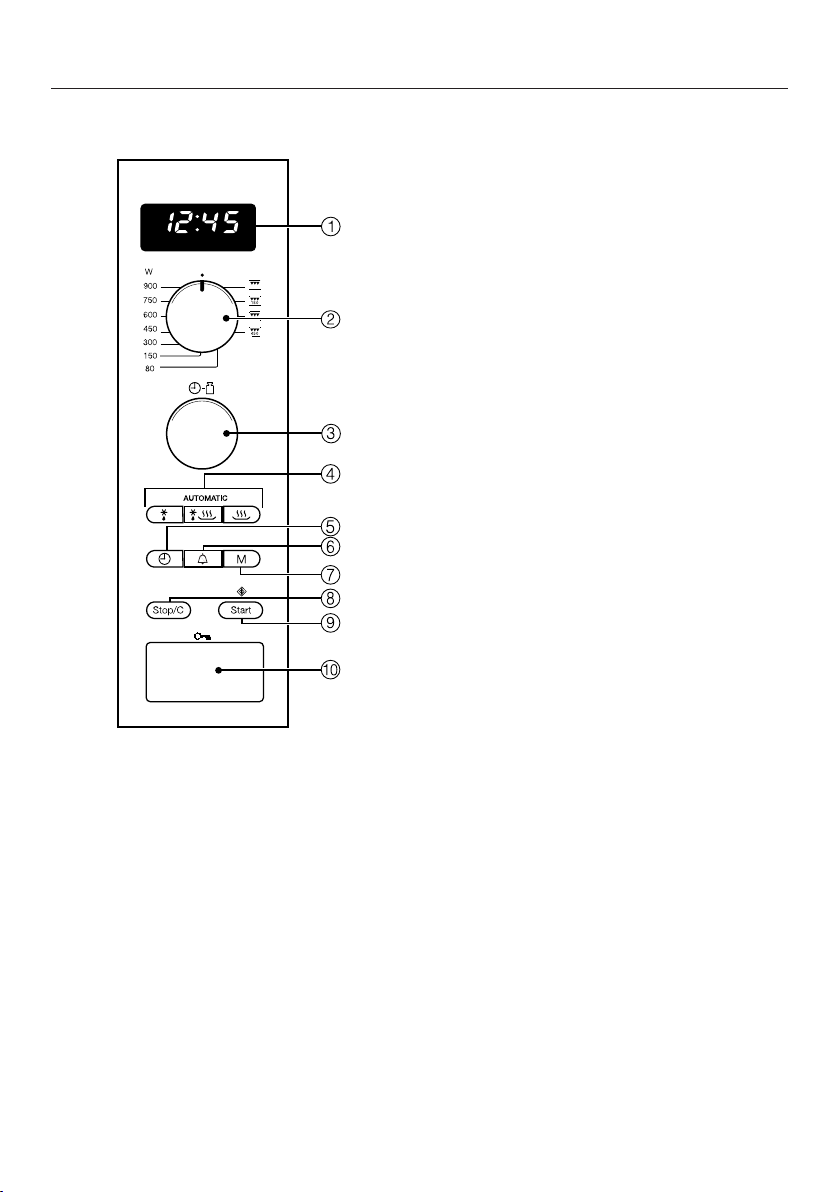
a
Display for showing the time of day
and information on operation
b
Rotary selector for microwave
power, grill and combination pro-
grammes
c
Rotary selector
to enter time and weight
d
Automatic programmes
e
Time of day
f
Minute minder
g
Memory button (to save a 1–3 stage
programme sequence)
h
Stop/Cancel button
i
Start/Add a minute/Quick start (pro-
grammable)
j
Door release

Description of function
21
The microwave oven contains a mag-
netron. This converts electrical energy
into electromagnetic waves (mi-
crowaves). These microwaves are dis-
tributed evenly throughout the oven
compartment, and are reflected off the
metal appliance walls. This enables the
microwaves to reach the food from all
sides and heat it up. Microwave distri-
bution is improved with the turntable
engaged.
In order for microwaves to reach the
food, they must be able to penetrate the
cooking container being used. Mi-
crowaves can pass through porcelain,
glass, cardboard and plastics, but not
metal. Do not, therefore, use containers
made of metal, or which contain metal,
for example in the form of gold or silver
trim. The metal reflects microwaves and
this could cause sparking. The mi-
crowaves cannot be absorbed.
Microwaves pass through a suitable
container and find their way directly into
the food. All food contains moisture
molecules which, when subjected to
microwave energy, start to oscillate at a
rate of 2.5billion times a second. This
vibration creates heat. It first starts de-
veloping around the outside of the food
and then slowly penetrates towards the
centre. The more water a food contains,
the faster it is reheated or cooked.
As heat is produced directly in the food,
this has the following advantages:
– Food can generally be cooked without
adding liquid or cooking oil, or with just
a little water or oil.
– Cooking, reheating and defrosting in a
microwave oven is quicker than using
conventional methods.
– Nutrients, such as vitamins and min-
erals, are generally retained.
– The colour, texture and taste of food
are not impaired.
Microwaves stop being produced as
soon as the cooking process is inter-
rupted or the appliance door is opened.
When the appliance is in operation, the
closed, sealed door prevents mi-
crowaves escaping from the appliance.

Modes of operation
22
Food is cooked, reheated or defrosted
quickly in a microwave oven.
You can use the microwave oven in the
following ways:
– Food can be defrosted, reheated or
cooked by entering a power setting and
a duration.
– Deep-frozen, ready meals can be de-
frosted and then reheated or cooked.
– The microwave oven can also be used
for other tasks, e.g. for proving yeast
dough, melting chocolate and butter,
dissolving gelatine, preparing cake
glazes and bottling small amounts of
fruit and vegetables.
Functions
Microwave Solo mode
Suitable for defrosting, reheating and
cooking.
Grilling
Ideal for grilling thin cuts of meat, e.g.
steak or sausages.
Combination mode (Microwave +
Grill)
Ideal for browning dishes with toppings.
The microwave cooks the food, and the
grill browns it.
Automatic programmes
You can choose from the following
automatic programmes:
five defrosting programmes
(: Ad 1 to Ad 5),
– four cooking programmes for frozen
food
(: Ac 1 to Ac 4 ),
and eight cooking programmes for fresh
food
(: Ac 1 to Ac 8).
These programmes are weight depend-
ent. You enter the weight of the food
and then the cooking duration is calcu-
lated automatically.
The weight of the food can be dis-
played as metric (g) or imperial (lb) (see
“Changing settings”).
Suitable containers for microwave ovens
23
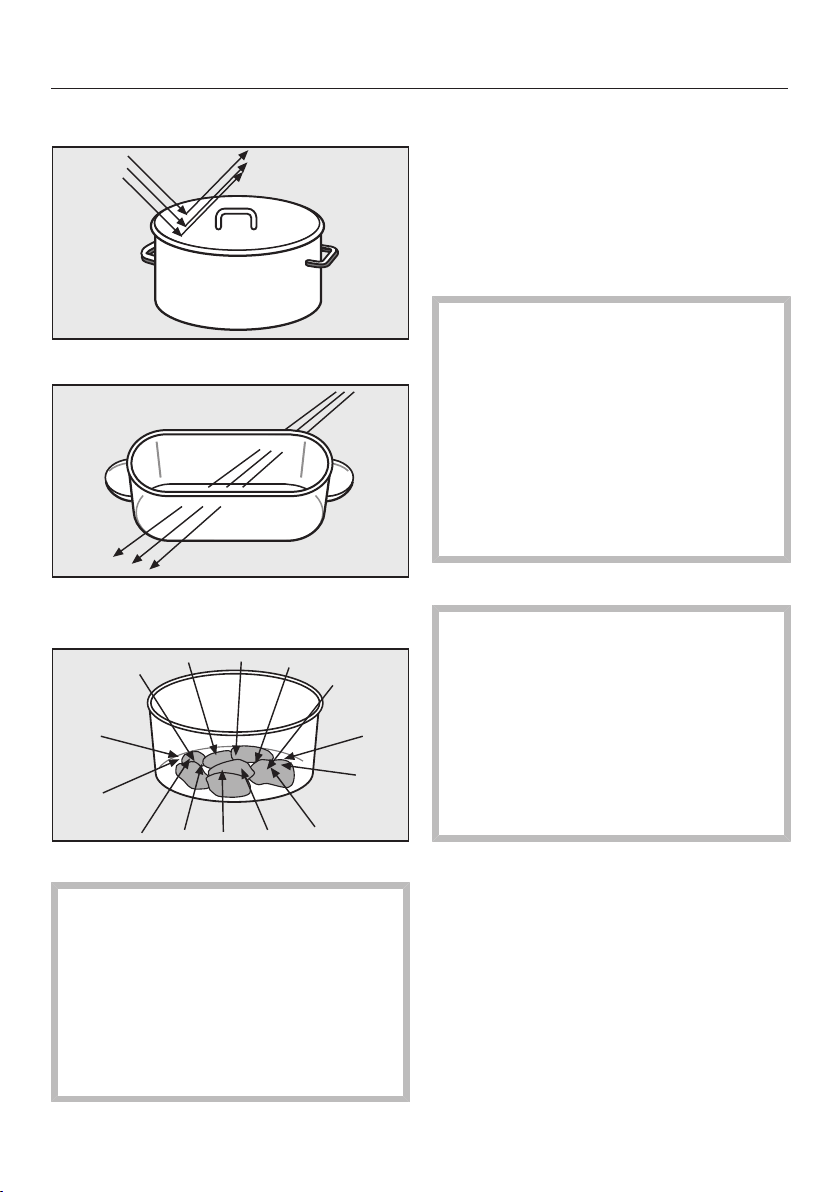
Microwaves:
- are reflected by metal.
- pass through glass, porcelain, plastic
and cardboard.
- are absorbed by food.
Fire hazard due to unsuitable
container.
Containers which are not suitable for
use in microwave ovens can be
badly damaged and cause damage
to the appliance if used.
Please observe the information on
suitable containers.
Material and shape
The material and shape of the container
used affect reheating and cooking dura-
tions. Round and oval-shaped shallow
containers are particularly suitable. Food
heats up more evenly in these containers
than in square containers.
Risk of injury due to hollow
handle elements and lid knobs.
When using containers with hollow
parts, moisture can get inside and
pressure can build up, causing the
container to crack or shatter.
Do not use containers with hollow
handle elements or lid knobs unless
the hollow parts are sufficiently vent-
ilated.
Metal
Metal containers, aluminium foil,
metal cutlery, and crockery with
metallic decoration, such as gold
rims or cobalt blue, must not be
used in the microwave oven. Metal
reflects microwaves and obstructs
the cooking process.
Do not use containers where the foil
lid has not been completely removed.
Exceptions:
- Ready meals in aluminium foil dishes.
These can be defrosted and reheated in
the microwave oven. Important: Remove
the lid and make sure the foil dish is at
least 2cm from the oven walls at all
times. However, food is only heated from
the top. Transferring the food from the
aluminium foil container to a dish suit-
able for use in a microwave oven will res-
ult in more even heat distribution.
Suitable containers for microwave ovens
24
Do not place aluminium foil dishes
on the rack in case the dish sparks
or arcs.
- Pieces of aluminium foil
For even defrosting and to avoid over-
cooking unevenly shaped cuts of meat,
poultry or fish, small pieces of alu-
minium foil may be used to mask wing-
tips or other thin parts for the last few
minutes of the programme.
Make sure that the aluminium foil is
at least 2cm from the oven walls at
all times. It must not touch the walls.
- Metal meat skewers or clamps
These should only be used if they are
very small in comparison to the size of
the cut of meat.
Glazes and colours
Some dishes have glazes and col-
ours containing metallic substances.
These dishes are unsuitable for
microwave ovens.
Glass
Heat-resistant glass or ceramic dishes
are ideal for use with microwave power.
Crystal glass is unsuitable as it con-
tains lead which could cause the
glass to crack in the microwave.
It is therefore not suitable.
Porcelain
Porcelain is a suitable material.
However do not use porcelain with gold
or silver edging or items with hollow
knobs or handles, as insufficient ventil-
ation may cause pressure.
Stoneware
Decorated stoneware is only suitable if
the decoration is beneath an all-over
glaze.
Stoneware can get hot.
Wear oven gloves.
Wood
Moisture contained in the wood
evaporates during the cooking pro-
cess. This causes the wood to dry
and crack.
Wooden dishes are therefore not
suitable.
Plastics
Damage due to heat-sensitive
plastic.
Plastic containers must be heat-res-
istant to a minimum of 110°C. Oth-
erwise the plastic may warp and fuse
with the food.
Use only plastic containers suitable
for use with Microwave Solo.
Special plastic containers designed for
use in microwave ovens are available
from specialist retail outlets.
Melamine containers are unsuitable.
Melamine absorbs microwave energy
and gets hot. When purchasing plastic
containers, make sure that they are
Suitable containers for microwave ovens
25
suitable for use in a microwave oven.
Disposable containers, such as trays
made from polystyrene, can only be
used to reheat food for a short time.
Plastic boiling bags can be used for
cooking and reheating. They should
be pierced beforehand. The holes al-
low the steam to escape. This pre-
vents a build-up of pressure from
forming and the bag from bursting.
There are also special bags available for
steam cooking which do not need to be
pierced. Please follow instructions given
on the packet.
Fire hazard due to unsuitable
material.
Metal clips and plastic or paper ties
containing wire can ignite.
Avoid using these clips and ties.
Single-use containers
Single-use containers made of plastic
must meet the requirements indicated
under “Plastics”.
Fire hazard due to unsuitable
container.
Single-use containers made of
plastic, paper or other inflammable
materials can ignite.
Do not leave the appliance unatten-
ded when reheating or cooking food
in single-use containers made of
plastic, paper or other inflammable
materials.
To protect the environment, we do not
recommend the use of single-use con-
tainers.
Testing containers
If in doubt as to whether glass, earthen-
ware or porcelain plates or dishes are
suitable for use in a microwave oven, a
simple test can be performed:
Place the item you wish to test in the
centre of the oven.
Close the door.
Turn the power selector to 900W.
Enter a duration of 30seconds with
the time selector.
Press the Start button.
If a crackling noise is heard accom-
panied by sparks during the test,
switch the appliance off immediately
(touch Stop/C twice)! Any crockery
which causes this reaction is unsuit-
able for use with microwave power. If
any doubt exists about the suitability
of containers, please contact the
supplier.
This test cannot be used to check
whether items with hollow knobs or
handles are suitable for use with
microwave power.
Suitable containers for microwave ovens
26
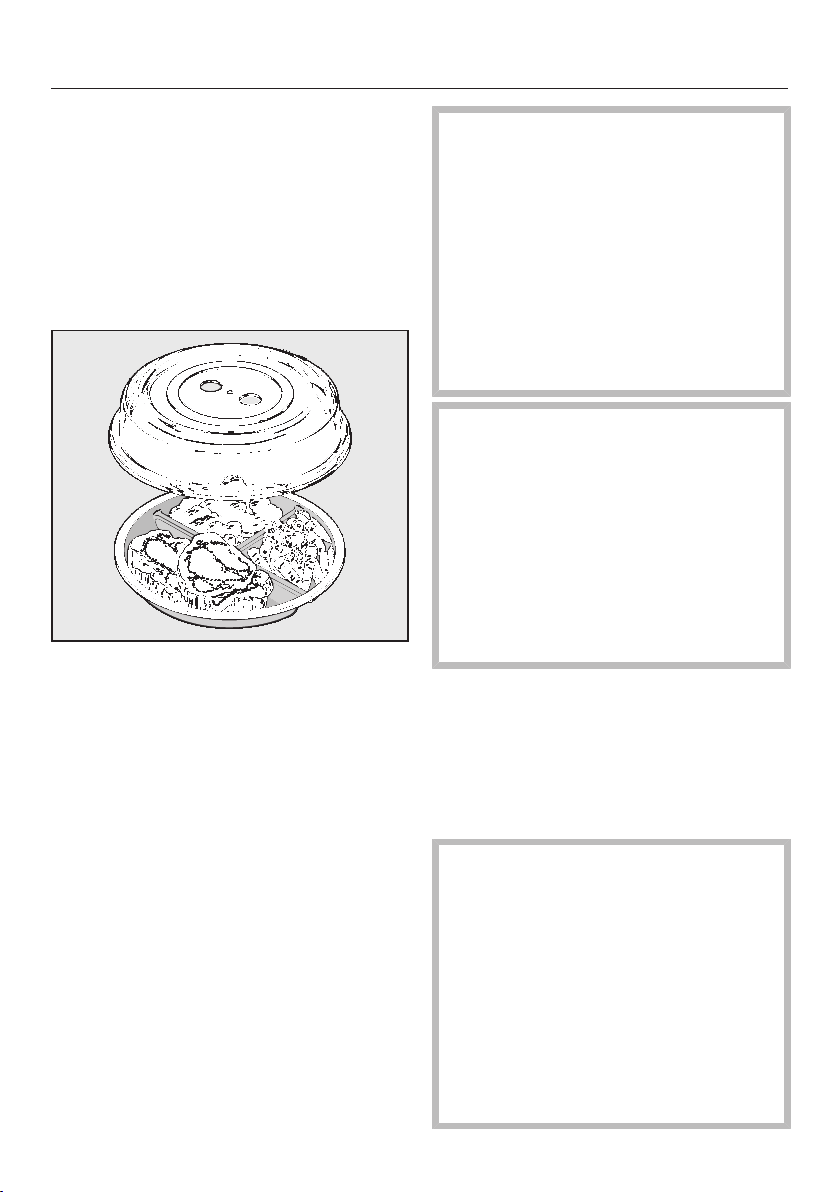
A heat-retaining cover
- prevents too much steam escaping,
especially when cooking foods with
longer reheating times.
- speeds up the reheating process.
- prevents food from drying out.
- helps keep the oven compartment
clean.
When using Microwave Solo mode,
always cover food with a microwave-
safe heat-retaining cover.
Suitable heat-retaining covers are avail-
able from retail outlets.
You can use a cling film recommended
for use in a microwave oven instead of
the heat-retaining cover. Heat can
cause normal cling film to distort and
fuse with the food.
Damage due to heat-sensitive
plastic.
The material of the cover can generally
withstand temperatures of up to
110°C (see manufacturer information).
At higher temperatures the plastic can
distort and fuse with the food.
The cover can therefore only be used
in microwave ovens and only in
Microwave Solo mode without the
gourmet plate.
Damage due to covered openings.
If the cover is used with a container
with a small diameter, the cover could
form a seal around the container and
steam may not be able to escape
through the openings in the side of the
cover. The cover could get too hot and
could start to melt.
Make sure that the cover does not
form a seal.
Do not use a heat-retaining cover if:
- food coated with breadcrumbs is be-
ing heated.
- cooking food which needs a crisp fin-
ish, e.g. toast.
- the gourmet plate is being used.
Danger of explosion due to pres-
sure build-up.
Pressure can build up during reheat-
ing in sealed containers or bottles,
causing them to explode.
Sealed glass containers, such as jars
of baby food, must be opened before
they are heated in the microwave
oven. Do not attempt to heat them up
unopened. With baby bottles, the
screw top and teat must be taken off.
Before using for the first time
27
Setting the time
Connect the appliance to the electri-
city supply.
12:00 and the symbol will flash in the
display until the current time of day is
set. Before this, the time of day will
start to run from 12:00, as the clock will
start as soon as the appliance is con-
nected to the mains electricity supply.
Turn the time selector to set the hour.
Press the button.
Then turn the time selector to set the
minutes.
Press the button to confirm, or
wait a few seconds.
The set time is now adopted. The colon
between hours and minutes flashes.
Altering the time of day
Press the button.
The symbol will flash in the display,
and the current hour will light up for a
few seconds.
Use the time selector to alter the
hour.
Press the button to confirm, or
wait for a few seconds.
The symbol will flash and the current
minutes will light up for a few seconds.
Use the time selector to alter the
minutes.
Press the button to confirm, or
wait for a few seconds.
Switching off the time of day
display
Press and hold in the button until
the display goes dark.
Pressing and holding in the button
again will bring back the time of day
display.
Night switch-off
The time of day display can be set to
switch itself off from 23:00 to 04:00 hrs.
Setting the time of day display to
switch off at night
Press and hold in the Stop/C button
and at the same time press the
button.
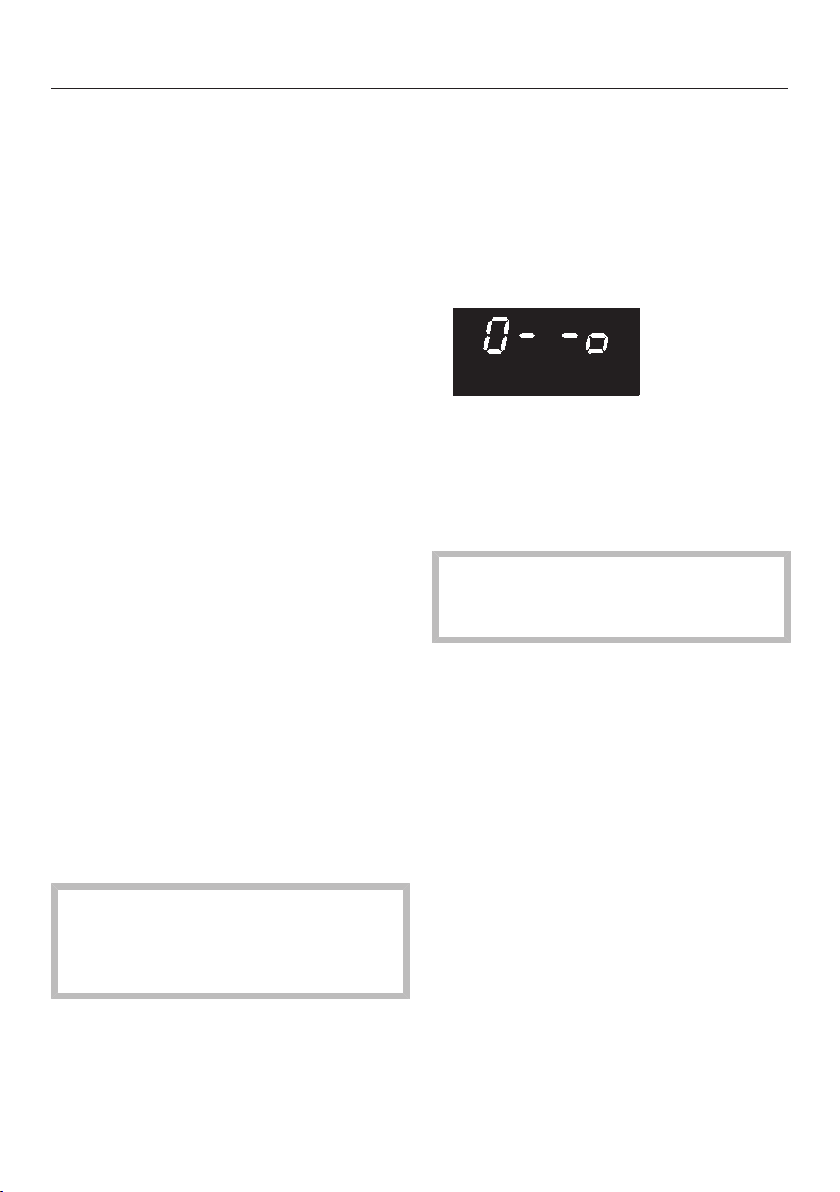
will appear in the display. The appli-
ance is ready for operation.
To switch the display back on
Press and hold in the Stop/C button
and at the same time press the
button.
will appear in the display.
Operation
28
Opening the door
Press to open the door.
If the microwave oven is being used,
opening the door will interrupt the
cooking programme.
Placing the dish in the oven
Ideally the dish should be placed in the
middle of the oven.
Turntable
The turntable helps the food to cook,
reheat or defrost evenly.
Do not operate the microwave
without the turntable in place.
The turntable starts turning automatic-
ally when the appliance is operated.
Do not cook, reheat or defrost food dir-
ectly on the turntable. Check that the
dish is not larger in size than the
turntable.
Turn or stir food during cooking, or turn
the dish so that it heats up evenly.
Closing the door
Push the door shut.
Press the Start button again to resume
an interrupted cooking programme.
The appliance will not start again if
the door has not been closed prop-
erly.
Starting a programme
Use the appropriate selector to choose
the microwave power level and the
cooking duration.
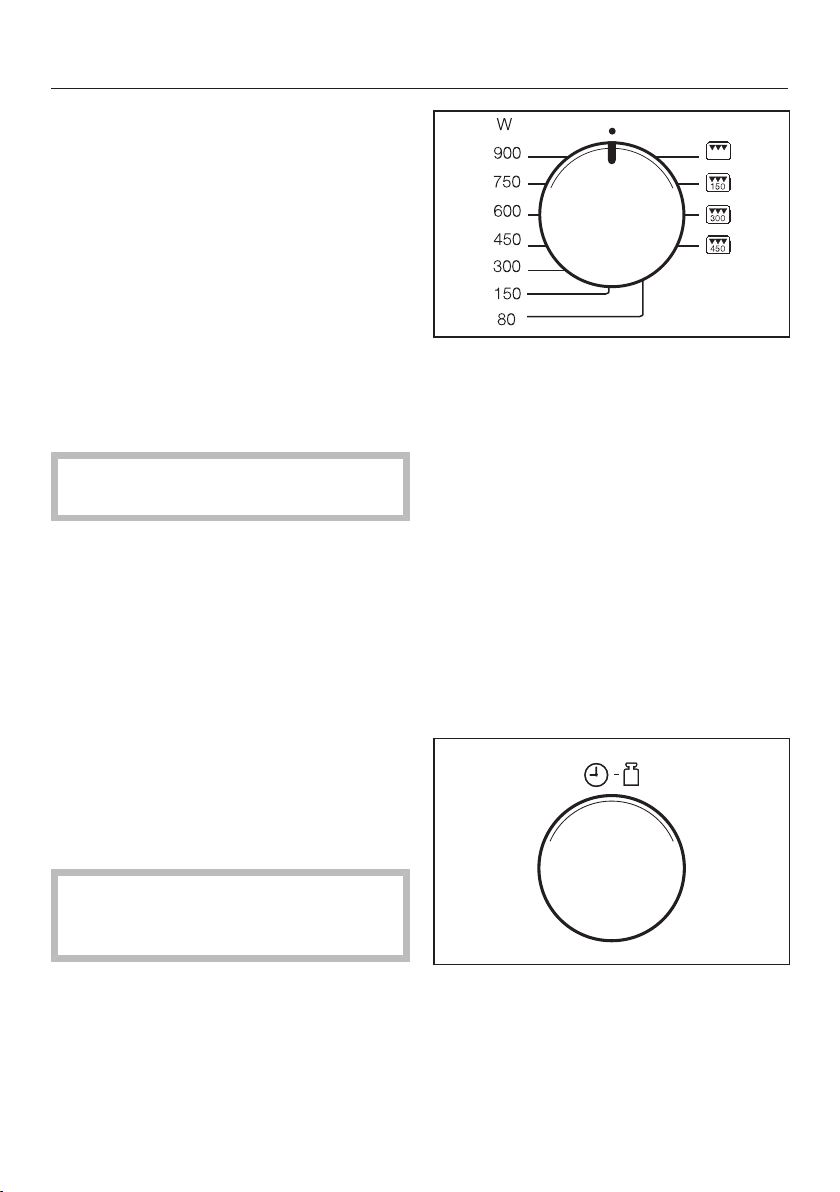
Use the power selector to select a
microwave power level.
and the microwave power level will
light up in the display. 0:00 will flash.
There is a choice of 7power levels.
The higher the power level, the more
microwaves reach the food.
When heating up food which cannot be
stirred or turned during cooking, as with
a plated meal, it is best to use a lower
microwave power level.
This ensures the heat is distributed
evenly. Heat for long enough to cook
the food properly.
Set the required duration using the
time selector.
The duration selected is visible in the
display.

Operation
29
A duration of between 10seconds and
90minutes can be set. Exception: If the
maximum microwave power level has
been selected, a maximum cooking
duration of only 15minutes can be set.
If you then continue to select full power,
the power level may reduce to 600W,
and this is shown in the display (protec-
tion against overheating).
The duration required depends on:
- the initial temperature of the food.
Food taken straight from the refriger-
ator takes longer to cook than food
which has been kept at room temper-
ature.
- the type and texture of the food.
Fresh vegetables contain more water
and cook more quickly than stored
vegetables.
- the frequency of stirring or turning
the food.
Frequent stirring or turning heats the
food more evenly, and it is therefore
ready in a shorter time.
- the amount of food.
As a general rule, allow approx. time
and a half for double the quantity
and for a smaller quantity, possibly
shorten the duration.
- the shape and material of the con-
tainer.
Press “Start” to start the programme.
The interior lighting comes on.
A programme can only be started if the
door is closed.
“door” message
The “door” message in the display is a
reminder that the appliance should not
be used without food inside it.
Operating the appliance without food
can damage the appliance.
If the Start button is pressed without
the door having first been opened, the
word door appears in the display. If the
door has been closed for 20minutes or
longer when the Start button is pressed,
the word door will appear in the display
to remind you to open the door and
make sure there is food in the oven be-
fore you press Start. You cannot start a
process until you do this.
Interrupting or re-starting a
programme
At any time you can . . . . .
. . interrupt a programme:
Press the Stop/C button, or open the
appliance door.
The duration stops counting down.
. . continue a programme.
Close the door and press Start.
The programme will continue.

Operation
30
Altering settings
If you discover after starting a pro-
gramme that . . . . .
. . . . . the microwave power level is
too high or too low, you can
select a new level.
. . . . . the duration set is too short or
too long, you can
interrupt the programme (press the
Stop/C button once), use the time se-
lector to set a new duration and con-
tinue the programme (press the Start
button),
or alternatively:
the cooking duration can be in-
creased by pressing the Start button
during operation. Each time the Start
button is pressed, the cooking dura-
tion is increased by another minute.
(Exception: the increased cooking
duration is in increments of
30seconds when the microwave
oven is being used on maximum
power.)
Cancelling a programme
Press the Stop/C button twice.
At the end of a programme
An audible tone will sound when the
cooking programme is complete. The
interior lighting goes off.
The audible tone will sound briefly as a
reminder every 5minutes for
20minutes after the end of the pro-
gramme.
If you want to stop the audible tone,
press the Stop/C button.
Automatic keeping-warm func-
tion
The keeping warm function will switch
on automatically after the end of a
cooking programme which has used at
least 450W, providing the door remains
closed and no buttons are pressed.
After approx. 2 minutes the keeping
warm function will switch on at 80 W for
a maximum period of 15 minutes.
, 80W and H:H will light up in the
display.
Opening the door or operating one of
the buttons or selectors while the keep-
ing warm function is in progress can-
cels the function.
The keeping warm function cannot be
set separately.
You can deactivate this function (see
“Changing settings”).
Operation
31
Quick start (programmable)
Pressing the Start/button is suffi-
cient to set the appliance operating on
maximum power.
Three set times are stored in the
memory:
30s: press Start/ 1 x
1min: press Start/ 2 x
2min: press Start/ 3 x
Pressing Start/ four times in succes-
sion will bring back the first stored dur-
ation and so on.
The cooking duration can be increased
by pressing “Start” during operation;
each time “Start” is pressed, the cook-
ing duration is increased by another 30
seconds.
Programming durations
Set durations can be altered.
Use the Start / button to select the
duration you want to re-programme
(press once, twice or three times) and
hold the Start/ button pressed in.
Alter the duration with the time se-
lector (to max 15minutes).
The altered programme runs when you
take your finger off the Start/ button.
An interruption to the power supply
will cancel any altered programmed
durations, and they will need to be
entered again.
System lock
The system lock prevents the appliance
being used by children, for example.
Activating the system lock
Press and hold the Stop/C button in
until an audible tone sounds and the
key symbol appears in the display:
The key symbol will go out after a short
time.
The key symbol reappears whenever
any button or one of the rotary selectors
is operated.
After an interruption to the power
supply, the system lock will need to
reactivated.
Deactivating the system lock
To cancel the system lock, press the
Stop/C button again and hold it
pressed in until an audible tone
sounds.

Operation
32
Using the minute minder
The minute minder can be used to time
any activity in the kitchen, e.g. boiling
eggs. The time set counts down in one
second steps.
Press the button.
0:00flashes and the symbol lights up
in the display.
Use the time selector to set the
minute minder time you require.
Press “Start” to start the programme.
The minute minder time will start itself
after a few seconds if the Start button is
not pressed.
At the end of the minute minder time,
an audible tone sounds. The time of
day reappears and the symbol
flashes.
Press the Stop/C button once and the
symbol disappears.
Altering a minute minder entry
Press the Stop/C button.
The current minute minder time is
stopped.
Set a new minute minder time, as de-
scribed above.
Minute minder + cooking function
The minute minder can be used at the
same time as a cooking function, and
counts down in the background.
Press the button during the cook-
ing programme.
0:00flashes and the symbol lights up
in the display.
Use the time selector to set the
minute minder time you require.
Wait a few seconds and the minute
minder set will begin to count down.
A few seconds later, the display will
change again to show the cooking dur-
ation counting down. The minute
minder time counting down in the back-
ground is represented by the illuminated
symbol.
Do not press the Start button in this in-
stance to start the minute minder, as
pressing the Start button would also in-
crease the cooking duration by a
minute.
To find out the minute minder time
remaining
Press the button.
The minute minder time still remaining
will show in the display.
Operation – grilling
33
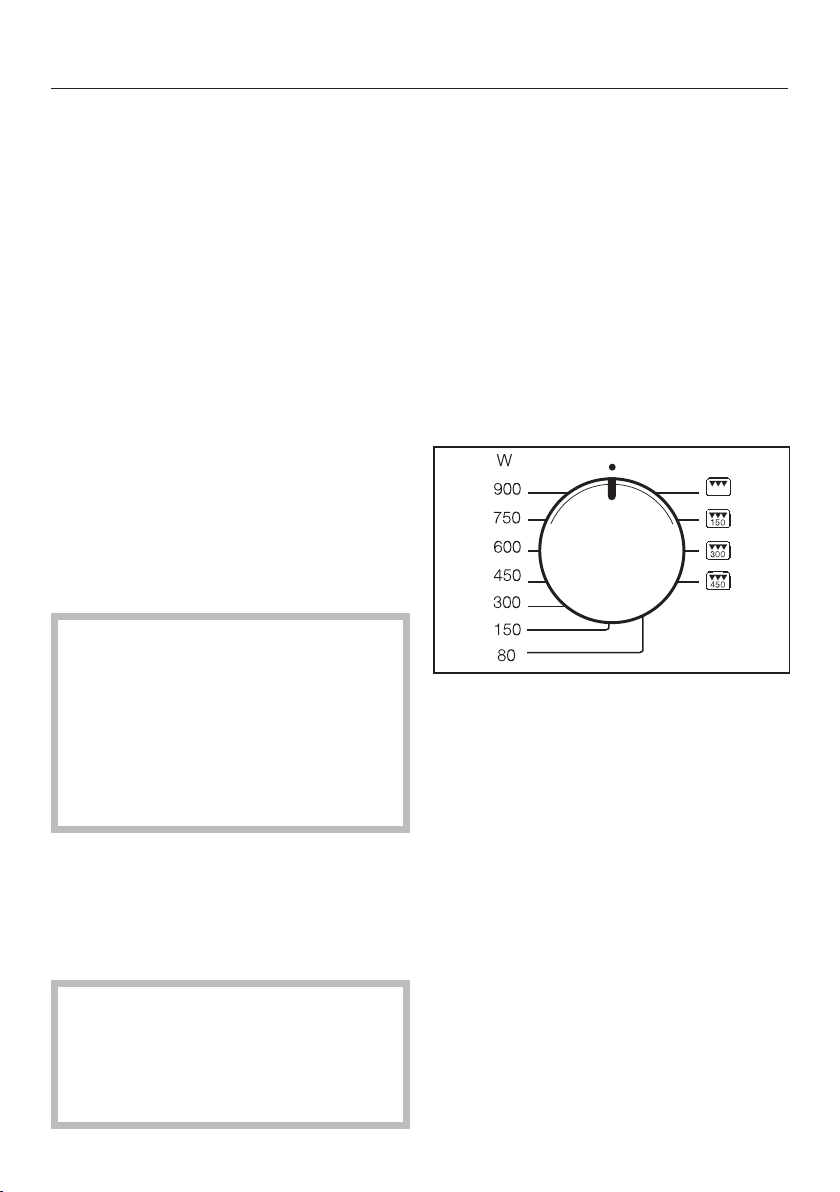
The grill has 4settings: grill solo and
3combination settings where the grill is
used together with a specific micro-
wave power level.
If the total grilling duration required is
less than 15minutes, the grill should be
pre-heated for approx. 5minutes.
Thin, flat cuts of fish and meat should
be turned half way through grilling for
even results. Larger, chunkier pieces
should be turned several times.
Grilling durations depend on the type
and thickness of the food and on the
user’s preference for a rare or well-
cooked result.
When grilling directly on the rack, a
heat-resistant, microwave-safe con-
tainer should be placed underneath the
rack to catch any fat or juices.
Risk of damage due to overheat-
ing.
The gourmet plate supplied is not
suitable for catching fat. It could
overheat when empty. This would
damage the coating.
Use a heat-resistant, microwave-safe
dish instead.
Place the food in a suitable dish.
Place the rack and a heat-resistant,
microwave-safe dish or the container
with the food to be cooked on the
turntable.
Risk of burning due to hot
dishes.
The rack and container become hot
during use.
Wear oven gloves.
The container (and glass tray) and grill
rack will be easier to clean if washed in
soapy water immediately after grilling.
The area on the ceiling around the grill
becomes discoloured over time. This is
an unavoidable consequence of use,
and does not impair the function of the
appliance in any way.
Grilling without the Microwave
function
Ideal for grilling thin cuts of meat, e.g.
steak or sausages.
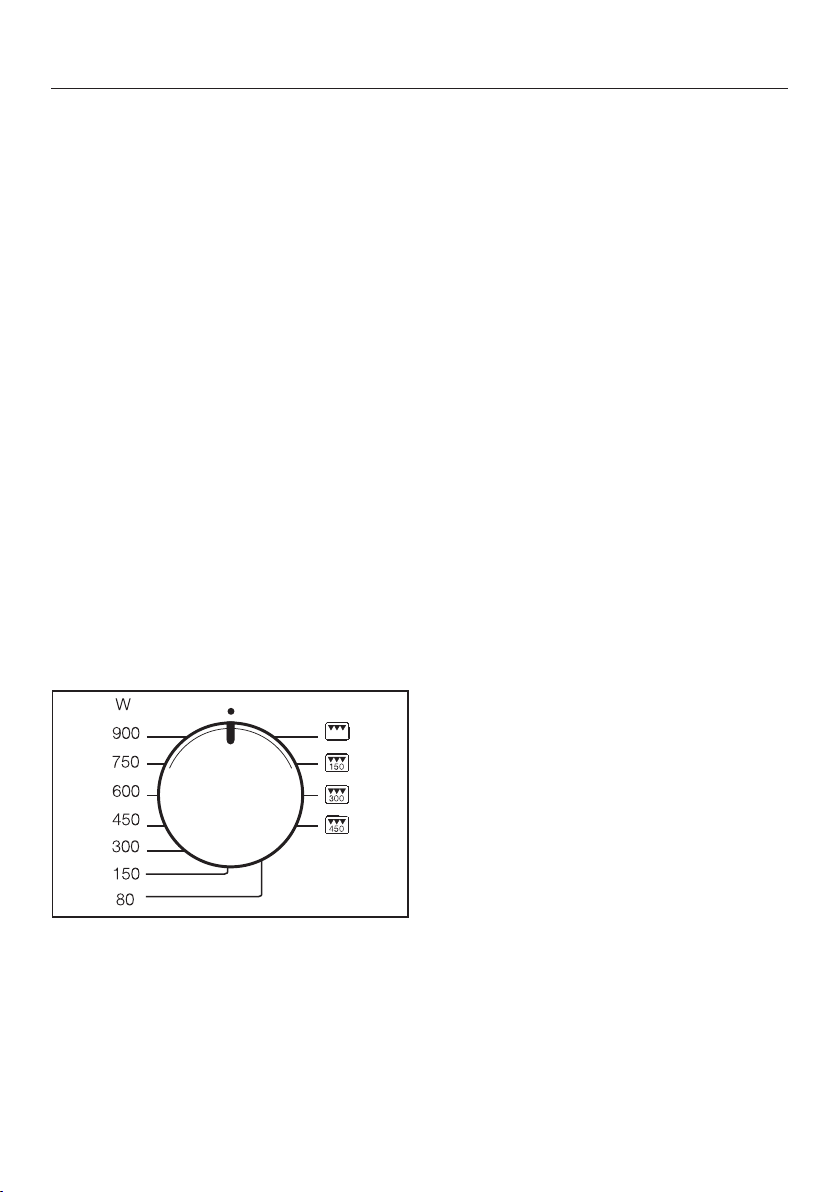
Turn the power selector to.
0:00flashes and the symbol lights
up in the display.
Select a cooking duration using the
time selector.
Press the Start button.
An audible tone will sound when the
cooking programme is complete.
Operation – grilling
34
To change a cooking duration
The cooking duration entered can be
changed during operation if required.
Interrupt the process by pressing the
Stop/C button, and change the dura-
tion. To continue, press the Start but-
ton. The cooking duration can also be
extended during operation by pressing
the Start button once for each minute
you wish to extend the cooking duration
by.
Combination mode - Micro-
wave + Grill
This function is very good for baking
and browning. The microwave cooks
the food, and the grill browns it.
The grill can be combined with one of
three different microwave power levels:
150, 300 and 450W. It is possible dur-
ing the cooking process to switch
between the different power levels
without interrupting the programme.
Use the power selector to select
or as you require.
Thesymbol, the microwave power
level and the grill symbol will light
up in the display. 0:00 will flash.
Select a cooking duration using the
time selector.
Press the Start button.
An audible tone will sound when the
cooking programme is complete.
To change a cooking duration
The cooking duration entered can be
changed during operation if required.
Interrupt the process by pressing the
Stop/C button, and change the dura-
tion. To continue, press the Start but-
ton. The cooking duration can also be
extended during operation by pressing
the Start button once for each minute
you wish to extend the cooking duration
by.
Gourmet plate
35
Tips for use
Risk of burning due to hot
dishes.
The gourmet plate gets extremely hot
when in use.
Always use oven gloves when hand-
ling it to avoid burns. Place it on a
suitable heat-resistant mat or stand.
Before using for the first time
Before using the gourmet plate for the
first time, fill it with 400ml water and
add 3 to 4tbsp vinegar or lemon juice.
Heat for 5minutes at 450W + Grill .
The gourmet plate has an easy-to-clean
anti-stick coating so that food can be
removed easily.
The coating is susceptible to cuts
and scratches.
Metallic or sharp objects can dam-
age the non-stick coating.
Therefore do not cut food up directly
on the plate.
Use wooden or plastic utensils to
mix or turn food.
Searing/browning food
Fire hazard due to overheating.
Oils and fats can ignite if allowed to
overheat.
Never leave the gourmet plate unat-
tended when cooking with oil or fats.
Only very little fat or oil is necessary
when cooking with this dish. This is
because food does not stick to the
non-stick coating. This has the added
advantage of keeping down the cal-
orie count.
When using the gourmet plate, make
sure that the food is ready to transfer
to the gourmet plate as soon as it has
heated up.
Place the gourmet plate directly on
the turntable.
Sparking can damage the gourmet
plate and the oven compartment.
Do not place the gourmet plate on
the rack. Make sure there is a gap of
approx. 2cm between the gourmet
plate and the interior walls of the
microwave oven so that sparking
cannot occur.
Heat the plate at 450W + Grill for
max. 5minutes.
Risk of damage due to overheat-
ing.
Do not overheat the empty gourmet
plate. This would damage the coat-
ing.
For this reason, do not place the
gourmet plate under the rack to
catch the fat when grilling.
If using oil, you can either heat up the
oil on the gourmet plate, or you can
heat the oil separately and then add it
to the plate.
Butter, however, should always be ad-
ded after heating up the gourmet plate.
It has a lower burning point than oil and
would get too dark or burn if added too
soon.
Always dry meat, poultry, fish and ve-
getables thoroughly before placing
them on the gourmet plate.

Gourmet plate
36
Eggs can explode.
Do not use the gourmet plate to
cook eggs or reheat cooked eggs.
Examples of use:
Pre-heat the gourmet plate directly on
the turntable for up to max. 5minutes
at 450W + Grill.
- Fish fingers (frozen), 150g + 2tbsp
oil, 3 – 4minutes each side
- Hamburgers, 2burgers + 2tbsp
oil, 3 – 4minutes each side
- Croquette potatoes (frozen), 10 –
12pieces + 2tbsp oil, 6 –
8minutes, turning halfway through
- Fillet steak, approx. 200g,
5minutes each side (according to
taste)
- Pizza (frozen), 300g,, 7–
9minutes
- Pizza (fresh), without pre-heating,
15minutes approx. (depending on
topping)
Recipes
The total time required includes the
time required for preparation and cook-
ing. Standing time or time for marinat-
ing food is quoted in addition to the
total time required.
Croque monsieur (serves 3)
Total time required: 10– 15minutes
-
Ingredients
6slices of white bread
30g soft butter
75g Emmental cheese, grated
3 slices of ham
Method
Butter the bread. Add the cheese to
three of the bread slices in equal
amounts and arrange a slice of ham on
top of each. Place the remaining three
slices of bread on top of the ham with
the buttered side face down. Pre-heat
the gourmet plate using 450W + Grill
for approx. 5minutes, then place the
bread on it. Place on the turntable and
cook using 450W + Grill for approx.
3minutes each side until golden.
Other fillings could include drained tuna
fish with finely sliced onion rings, or
pineapple, cheese and ham.

Gourmet plate
37
Vegetable medley (serves 3)
Total time required: 25– 35minutes
-
Ingredients
2 onions
2 tbsp oil
100g oyster mushrooms or button
mushrooms, cleaned
150g sliced carrots
100g broccoli florets
1 red pepper or 100g frozen sliced
peppers
1tomato
Salt and pepper
30g grated Parmesan cheese
Method
Slice the onions into fine rings. Halve,
quarter and deseed the pepper, and
then cut into strips. Dice the tomato.
Place the gourmet plate on the
turntable and pre-heat it using 450W +
Grill for approx. 5minutes. Add oil and
onion rings. Place gourmet plate back
on the turntable and cook using 450W
+ Grill for approx. 2minutes. Add the
mushrooms, carrots, broccoli, sliced
pepper, diced tomato and seasoning.
Mix well. Cook using 450Watt + Grill
for approx. 6minutes. Turn out and
sprinkle with Parmesan cheese before
serving.
Pork fillets (serves 2)
Total time required: 15– 20minutes
-
Ingredients
1 pork tenderloin (approx. 400 g)
4rashers of streaky bacon
Salt and pepper
10gbutter
200g sliced button mushrooms
200ml double cream
2tbsp brandy
Method
Cut the pork tenderloin into four pieces.
Season each piece with salt and pep-
per, and wrap in a rasher of streaky ba-
con. Secure with a cocktail stick if ne-
cessary. Place the gourmet plate on the
turntable and pre-heat it using 450W +
Grill for approx. 5minutes. Add the but-
ter to the plate, and place the meat on
top. Place on the turntable and cook
using 450W + Grill for approx.
3minutes each side. Transfer the meat
to a serving dish, cover and keep warm.
Add the mushrooms, cream and brandy
to the meat juices and heat on max-
imum power for approx. 4minutes.
Serve with the meat.
Pork fillet in a Roquefort sauce
Total time required: 10– 12minutes
-
Method
Cut 1 pork tenderloin into four pieces.
Place on the pre-heated gourmet plate
and cook using 450W + Grill for ap-
prox. 4minutes. Add 50ml white wine,
125ml double cream, 2tbsp roux
(made from 1tbsp each of flour and
melted butter) and 150g Roquefort
cheese. Stir the sauce until smooth,
and cook for a further 3minutes.

Gourmet plate
38
Curried chicken (serves 3)
Total time required: 25– 35minutes
-
Ingredients
600g chicken or turkey breast fillets
2 tbsp oil
2tbsp white wine
2 tbsp apple juice
1tbsp lemon juice
Salt and freshly ground black pepper
1tsp curry powder
1 pinch rosemary, ground
1 pinch ginger, ground
1 pinch cayenne pepper
1
/
2
tspTabasco
20g butter
Method
Dice the meat into 2x2cm pieces.
Combine the rest of the ingredients
apart from the butter, and pour over the
meat. Mix well, and leave to stand for
approx. 30minutes. Place the gourmet
plate on the turntable, Pre-heat it using
450Watt + Grill for approx. 5minutes.
Add the butter to the pre-heated plate,
then add the slightly drained meat.
Place the gourmet plate on the
turntable and cook using 450W + Grill
for approx. 4minutes, turn and cook for
a further 4minutes on the same setting.
Drain surplus liquid from the meat if ne-
cessary so that it browns well.
Fisherman's salmon (serves 2)
Total time required: 5– 10minutes
-
Ingredients
2salmon fillets (approx. 150g each)
1tbsp lemon juice
Salt, white pepper
Method
Drizzle the salmon with the lemon juice,
and leave to stand for approx.
10minutes. Place the gourmet plate on
the turntable and pre-heat using 450W
+ Grill for approx. 5minutes. Pat the
fish dry with kitchen paper, and place
on the gourmet plate, pressing it down
slightly. Place on the turntable and cook
using 450W + Grill for approx. 1
1
/
2
–
2minutes each side.
Serve with rice, hollandaise sauce or
melted butter and a fresh green salad.

Operation - Automatic programmes
39
All of the automatic programmes are
weight dependent.
The weight of the food can be dis-
played as metric (g) or imperial (lb) (see
“Changing settings”).
After selecting a programme, enter the
weight of the food. The appliance auto-
matically calculates the duration ac-
cording to the weight entered.
After cooking, allow the food to stand at
room temperature for the suggested
number of minutes (“standing time”) to
allow the heat to be distributed evenly
through the food.
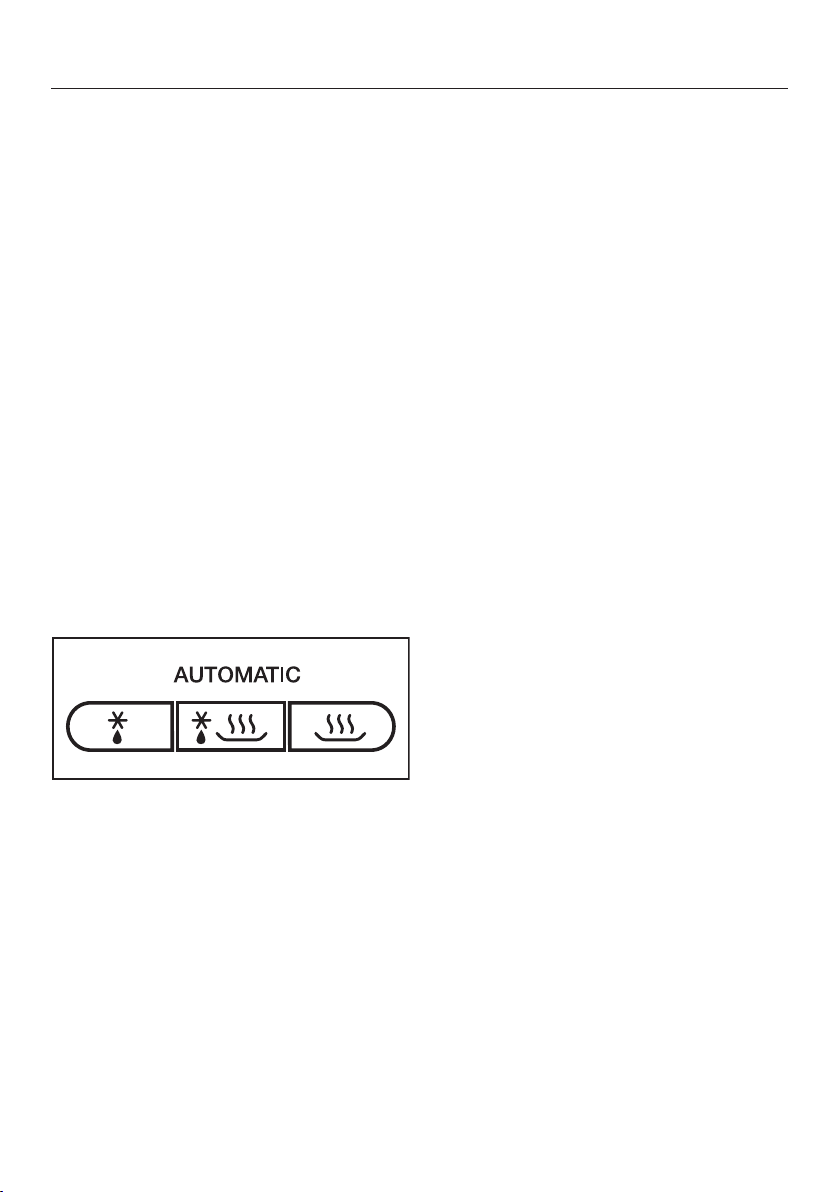
Automatic defrosting
There are five programmes for defrost-
ing different types of food (button).
The standing time for programme Ad3
is up to 30minutes, depending on
weight, and approx. 10minutes for the
remaining programmes.
Ad 1 Steak, chops
200–1.000 g
Ad 2 Minced meat
200–1.000 g
Ad 3 Chicken
900–1.800 g
Ad 4 Cakes
100–1.400 g
Ad 5 Bread
100–1.000 g
This programme is particularly suitable
for defrosting frozen sliced bread. If
possible, place single slices in the ap-
pliance, or separate the slices when the
buzzer sounds.
Automatic cooking
There are four programmes for frozen
food and eight programmes for fresh
food.
The standing time for each of these
programmes is approx. 2 minutes.
Damage due to heat-sensitive
plastic.
The material of a heat-retaining cover
can generally withstand temperat-
ures of up to 110°C (see manufac-
turer information). At higher temper-
atures the plastic can distort and
fuse with the food.
A heat-retaining cover must only be
used with Microwave Solo mode. On
no account must the cover be used if
the grill is switched on, i.e. with pro-
grammes AC4 to AC8.
Cooking food from frozen
AC 1 Vegetables
100–600 g
AC 2 Ready meals which can be
stirred
300–1.000 g
AC 3 Bakes / gratin
200–600 g
AC 4 French fries
200–400 g
Operation - Automatic programmes
40
Cooking fresh food
AC 1 Vegetables
100–600 g
AC 2 Potatoes
100–800 g
AC 3 Fish
500–1.500 g
AC 4 Kebabs
200–800 g
AC 5 Whole chicken
900–1.800 g
AC 6 Chicken drumsticks
250–1.000 g
AC 7 Fish pie
500–1.500 g
AC 8 Gratins/bakes,
z.B.: Potato gratin
500–1.500 g
Press the relevant button repeatedly
until the Automatic programme re-
quired shows in the display. For ex-
ample, to call up programme AC5
(Grilled chicken) press the button
five times.
g or lb will flash in the display to prompt
you to enter the weight and the pro-
gramme (e.g. AC5) will light up together
with the symbols for the functions being
used ( for Microwave and for
Grill).
Use the rotary selector to enter the
weight.
Press the Start button.
The duration (which depends on the
weight) will begin to count down, and
the symbols for the functions that are
currently in use will light up ( and/or
).
An audible tone will sound halfway
through the cooking duration.
Interrupt the programme to turn or stir
the food, and then continue the pro-
gramme.
The programmed duration can, if ne-
cessary, be extended by a few minutes
during operation by touching Start re-
peatedly until the time required shows
in the display. In all programmes it is
only possible to extend the time by a
few minutes.
An audible tone will sound when the
cooking programme is complete.
The interior lighting goes off.
Recipes for automatic programmes
41
Below are some recipe suggestions for
the Automatic programmes using the
“Cooking fresh food” function .
These can be adapted to suit your re-
quirements.
If the weight guidelines are ex-
ceeded, the food will not cook suffi-
ciently.
It is important to follow the weight
guidelines for the programme con-
cerned.
AC 1 Vegetables
Method
Place the washed and prepared veget-
ables in a container. Add 3–4tbsp wa-
ter, depending on freshness and mois-
ture content, and a little salt or other
seasoning. Enter the weight including
the water, place the covered cooking
container on the turntable and cook.
About halfway through the cooking dur-
ation, a buzzer will sound to prompt you
to turn or stir the food.
When cooking vegetables in a sauce,
the weight entered must include the
sauce. Do not exceed the maximum
weight guidelines.
Carrots in a chervil cream
sauce (serves2)
Total time required: 25– 35minutes
-
Ingredients
350g carrots, cleaned
5gbutter
50ml vegetable stock (instant)
75ml crème fraîche
1tbsp white wine
Salt and pepper
1pinch of sugar
1
/
2
tsp mustard
1-2tbsp chervil, fresh, chopped or
1tbsp chervil, dried and ground
Approx. 1tbsp cornflour
Method
Peel carrots, then cut into batons or
slice (approx. 3 – 4mm thick). Combine
the rest of the ingredients, and pour
over the carrots. Cover and cook. Stir
when the audible tone sounds.
-
Setting: Cooking fresh foodAC 1
Weight: 525g
Shelf level: Turntable

Recipes for automatic programmes
42
AC 2 Potatoes
This programme can be used to cook
peeled, new and bouillon potatoes.
-
Method
Enter the weight for the potatoes and
the cooking liquid.
For peeled potatoes, peel, wash and
drain the potatoes and place them in a
cooking container. Season with a little
salt, cover and cook.
When cooking potatoes, add approx. 1
tbsp water per potato. If cooking the
potatoes in their skins, pierce the skins
several times with a fork or skewer be-
fore cooking, then cover the container
and cook.
Golden curried potatoes
(serves 3)
Total time required: 25– 35minutes
-
Ingredients
500g peeled potatoes
1 onion, finely diced
10gbutter
1 – 2tbsp curry powder
250ml vegetable stock (instant)
50ml double cream
125g peas (frozen)
Salt and pepper
Method
Coarsely dice the potatoes (approx.
3x3cm) or use small potatoes. Mix to-
gether all the ingredients in a suitably
large dish. Cover and cook. Stir when
the audible tone sounds then continue
cooking.
-
Setting: Cooking fresh foodAC 2
Weight: 800g
Shelf level: Turntable

Recipes for automatic programmes
43
AC 8 Gratins/Bakes:
Vegetable gratin (serves 4)
Total time required: approx. 40minutes
-
Ingredients
400g cauliflower or broccoli
400g carrots
For the cheese sauce
20g margarine
20g flour
300ml vegetable stock (instant)
200ml milk
100g diced Emmental cheese
50g grated Gouda cheese
Pepper, salt, ground nutmeg
1tbsp chopped parsley
Method
Cut the cauliflower or broccoli into
small florets, and thinly slice the carrots
(approx. 3mm thick). Place the veget-
ables in a baking dish (approx. 24cm in
diameter), and mix well. Melt the mar-
garine in a pan on the hob, stir in the
flour and then add the stock and milk
whilst continuing to stir. Stir in the Em-
mental cheese, and simmer until the
cheese has melted. Season well with
nutmeg, salt and pepper and add the
parsley. Pour the sauce over the veget-
ables, and sprinkle over the grated
Gouda cheese. Bake in the oven un-
covered.
-
Setting: Cooking fresh foodAC 8
Weight: 1500g
Shelf level: Turntable
Potato cheese gratin (serves4)
Total time required: 45minutes
-
Ingredients
For the gratin
600g potatoes, floury
75g Gouda, grated
For the topping
250ml double cream
1tsp salt
Pepper
Nutmeg
For sprinkling
75g Gouda, grated
For the dish
1 clove of garlic
Accessories
Microwave-safe ovenproof dish,
Ø26cm
Method
Rub the ovenproof dish with the garlic
clove.
To make the cream topping, mix to-
gether the cream, salt, pepper and nut-
meg.
Peel the potatoes and cut them into
slices 3–4mm thick. Mix the potatoes
with the cheese and the cream topping,
and transfer to the ovenproof dish.
Sprinkle with gouda, then bake un-
covered.
-
Setting: Cooking fresh foodAC 8
Weight: 1000g
Shelf level: Turntable

Recipes for automatic programmes
44
AC 4 Pork kebabs (makes
8kebabs)
Total time required: approx. 25 –
35minutes + 1hour standing time
-
Ingredients
1fillet of pork (approx. 300g)
1 red pepper
2 onions
For the marinade
8tbsp oil
Salt, pepper, paprika and chilli powder
8wooden skewers
Method
Cut the pork fillet into 16 cubes. Wash
the pepper and cut into bite-sized
pieces. Cut the onions into eight pieces.
Place the meat, pepper and onion
pieces alternately on the skewers. Mix
together the ingredients for the marin-
ade and brush the kebabs with the mix-
ture. Allow to marinate for approx. an
hour. Lay the kebabs on a lightly oiled
grill rack, brush with butter and place in
the oven together with a heat-resistant,
microwave safe dish. Turn halfway
through grilling when the audible tone
sounds.
-
Setting: Cooking fresh foodAC 4
Weight: approx. 100g per kebab
Shelf level: Rack and dish on turntable
Chicken kebabs (makes
8kebabs)
Total time required: approx. 25 –
35minutes + 1hour standing time
-
Ingredients
4chicken breasts each approx. 120g
4 tinned pineapple rings
16tinned apricot halves
For the marinade
4tbsp oil
4tbsp sesame oil
Salt and pepper
1
/
2
tsp paprika
1
/
2
tsp curry powder
A little chilli powder
Ground ginger or coriander, if desired
8wooden skewers
Method
Cut each chicken breast into 4 pieces.
Cut the pineapple slices into quarters.
Drain the tinned apricot halves well. Mix
all ingredients for the marinade thor-
oughly.
Arrange the chicken pieces, pineapple
and apricots alternately on the wooden
skewers, brush with the marinade and
set aside for 1hour. Put the kebabs on
the grilling rack and place in the oven
together with a heat-resistant, micro-
wave safe dish. Turn halfway through
grilling when the audible tone sounds.
-
Setting: Cooking fresh foodAC 4
Weight: approx. 100g per kebab
Shelf level: Rack and dish on turntable

Recipes for automatic programmes
45
AC 6 Chicken thighs
Method
Brush the chicken thighs with butter or
oil and season. Place on the grill rack in
the oven together with a heat-resistant,
microwave-safe dish. Halfway through
cooking when a buzzer sounds, turn the
chicken thighs over and continue to
cook.
AC 5 Whole chicken
Method
Cut the chicken in half. Brush with
melted butter or oil, and season. Then
place the chicken halves on the grill
rack in the oven with the cut side facing
upwards together with a heat-resistant,
microwave safe dish. Halfway through
cooking when an audible tone sounds,
turn the chicken halves over and con-
tinue to cook.
Re. AC 6 and AC 5
Method
For a good colour and flavour when
grilling chicken, sprinkle with a mixture
of paprika and curry powder. The
spices will give the skin an appetising
golden colour as well as enhancing the
flavour.
AC 3 Fish:
Fish curry(serves4)
Total time required: 35– 45minutes
-
Ingredients
300g pineapple chunks
1 red pepper
1 small banana
500g firm white fish
3tbsp lemon juice
30g butter
100ml white wine
100ml pineapple juice
Salt, sugar and chilli powder
2 tbsp cornflour
Method
Dice the fish and place in a suitable
container. Drizzle with lemon juice.
Quarter the peppers, remove the seeds
and pith, and cut into narrow strips.
Peel and slice the banana. Add to the
fish together with the pepper and pine-
apple pieces and mix well. Add the but-
ter. Mix together the wine, juice,
seasoning and cornflour to make a
smooth sauce and pour over the fish.
Mix everything thoroughly, then cover
and cook.
-
Setting: Cooking fresh foodAC 3
Weight: approx. 1200g
Shelf level: Turntable

Recipes for automatic programmes
46
AC 7 Fish bake:
Crispy fish pie (serves2)
Total time required: 25– 35minutes
-
Ingredients
400g filleted white fish, e.g. cod
3tbsp lemon juice
Salt, white pepper
50g butter
2tsp mustard
1 onion, finely diced
40g grated Gouda cheese
20g breadcrumbs
2tbsp fresh dill, chopped
Method
Drizzle the fish filet with the lemon juice,
and leave to stand for approx. 10
minutes. Grease a flat oven dish with a
little butter. Pat the fish dry, season with
salt and pepper and place in the dish.
Mix the melted butter (450W, 40–
50sec.) with the mustard, onions,
Gouda cheese, breadcrumbs and dill
and brush onto the fish. Bake until
golden.
-
Setting: Cooking fresh foodAC 7
Weight: approx. 600g
Shelf level: Turntable
Rosefish and tomato gratin
(serves4)
Total time required: 35– 45minutes
-
Ingredients
500g filleted rosefish or other white
fish, e.g. cod
2tbsp lemon juice
500g tomatoes
Herbs, seasoning salt
2tsp ground oregano
150g grated Gouda cheese
Method
Cut the fish into pieces, drizzle with
lemon juice and leave to stand for ap-
prox. 10minutes. Dice the tomatoes,
and place in a baking dish with the fish
and half of the cheese. Season gener-
ously with herb salt and oregano, and
mix well. Sprinkle with the rest of the
cheese and bake uncovered.
-
Setting: Cooking fresh foodAC 7
Weight: approx. 1150g
Shelf level: Turntable
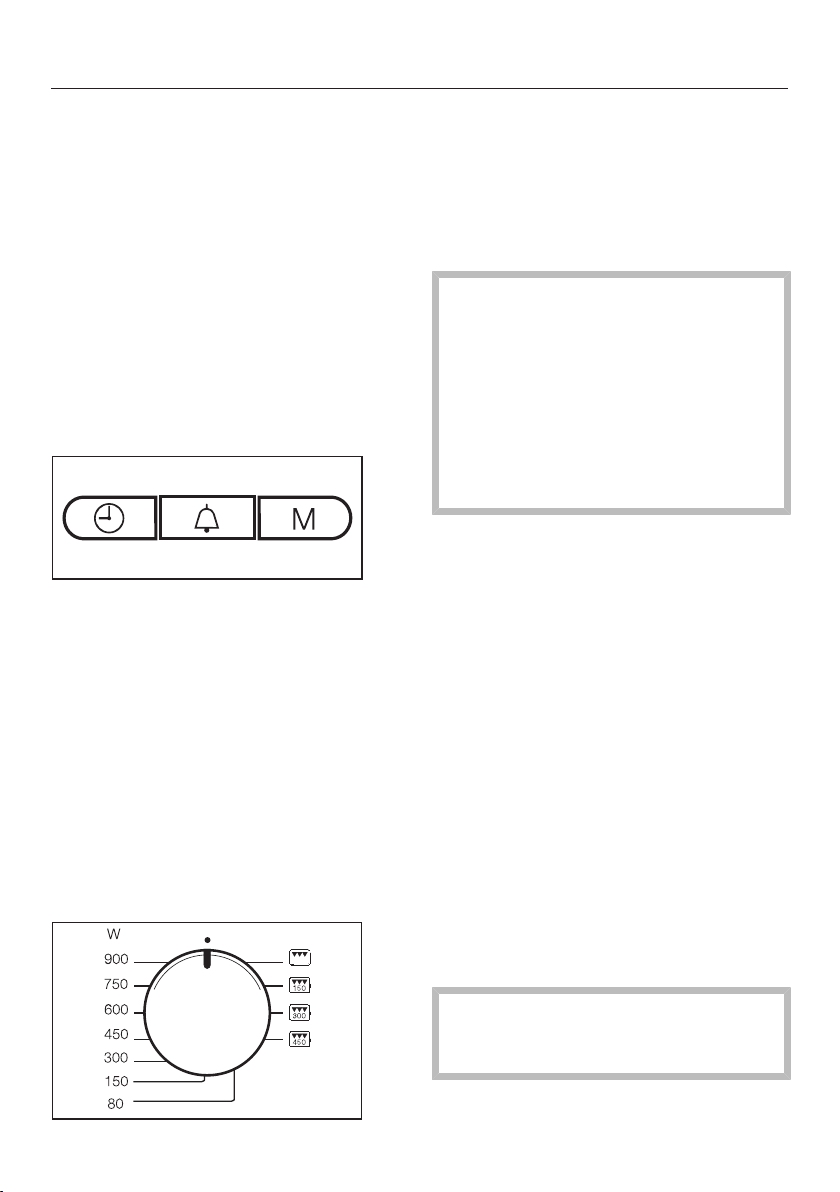
Saving your favourite programme (Memory)
47
You have the option of saving one fa-
vourite programme to memory. This pro-
gramme can be used for your most fre-
quently cooked recipe. The programme
can have up to 3stages (e.g.: 1minute
at 600W, followed by 2minutes grill and
finally 3minutes at 150W with grill).
Programming
(The example given is for a three-stage
programme)
First select the function for the first
stage.
Then select the duration.
Press the M button.
1 will light up in the display, and 2 will
flash.
Then select the second function and
duration.
Press the M button again.
2 will light up and 3 will flash.
Now select the third function and
duration and then touch OK. Press
the M button.
After this third step, you can use the
Mbutton to scroll through your entry
and check it.
When you have finished program-
ming, turn the power selector to the
12o’clock position.
Start the programme to save the
entry. Only ever run the entire pro-
gramme with food in the appliance.
Damage due to operation
without food.
The microwave oven can be dam-
aged if it is used without food being
placed in it.
If there is no food in the appliance,
press the Stop/C button twice as
soon as you have started the pro-
gramme.
1- and 2-stage programmes can be
saved in the same way. The program-
ming process is finished when the
power selector is in the 12 o’clock posi-
tion and the Start button has been
pressed, while pressing the Mbutton
shows the next stage.
To change an entry
Entering a new programme overrides
the previously saved programme.
To access your favourite pro-
gramme
Turn the programme selector to the
12o'clock position.
Press the M button.
Press the Start button.
In the event of a power cut, the fa-
vourite programme is no longer
saved and must be re-entered.
Changing settings
48
Some of the standard settings for the
appliance have an alternative.
Please consult the chart for the different
options for appliance settings.
The factory settings are marked with a
star* on the chart.
To change a setting, proceed as fol-
lows:
Press and hold the and Mbuttons
at the same time until and light
up in the display. Then release them.
If you press them for too long, the
time of day will appear again in the
display.
Use the rotary selector to select the
setting you wish to change ( to
and ). Turn it until the setting re-
quired shows in the display.
Then press the Mbutton to call up
the setting.
will appear in the display to show that
the setting can be changed.
Turn the time selector if you wish to
change the setting (see chart) and
confirm your entry by pressing the M
button (for and , press and
hold the M button for approx.
4seconds).
The change to the setting is then stored
in memory. will appear in the display
again together with the number for the
setting.
The other settings can be changed in
the same way.
When you have finished making the
changes you require, press the Stop/
C button.
The altered settings are retained after
a power cut.
Changing settings
49
Setting Settings available (* factory default)
Night time switch-
off
* Night time switch-off is deactivated.
Night time switch-off is activated. The time
of day display is switched off between the
hours of 23:00 and 04:00.
Automatic keeping-
warm function
* The automatic keeping warm function is
activated.
The automatic keeping warm function is
deactivated.
“door” message * The “door” message appears if the door
has not been opened for about
20minutes. Start is then blocked.
The “door” message does not appear.
Reminder tone * The reminder tone sounds briefly every 5
minutes in the first 20minutes after the
end of the programme.
Reminder tone is deactivated.
Demo mode (for
showroom use only)
* Demo mode is deactivated. When demo
mode is deactivated, _ _ _ _ appears
briefly in the display.
Demo mode is activated. When a button or
selector is operated, shows briefly in
the display. The appliance cannot be oper-
ated.
Unit of weight * Food weight is displayed in grammes (g).
Food weight is displayed in pounds (lb).
Factory default set-
tings
* Factory default settings have been re-
stored, or have not been changed.
Factory default settings have been
changed.
Reheat
50
Select the following microwave power
levels to reheat food:
Drinks 900W
Food 600W
Food for babies and children 450W
Risk of burning due to hot food.
Food for babies and children must
not be too hot.
Only heat it for 1/2 to 1minute at
450watts.
Tips on reheating
Always use a lid or cover when reheat-
ing food, except when a crispier finish is
needed, e.g. food with a breadcrumb
coating.
Danger of explosion due to pres-
sure build-up.
Pressure can build up during reheat-
ing in sealed containers or bottles,
causing them to explode.
Sealed glass containers, such as jars
of baby food, must be opened before
they are heated in the microwave
oven. Do not attempt to heat them
up unopened. With baby bottles, the
screw top and teat must be taken
off.
Risk of injury caused by over-
boiling.
When heating liquids using micro-
wave power, the boiling point of the
liquid may be reached without the
production of typical bubbles. The li-
quid does not boil evenly throughout.
This so-called boiling delay can
cause a sudden build-up of bubbles
when the container is removed from
the microwave or shaken, which can
lead to the liquid boiling over sud-
denly and explosively. The formation
of bubbles can be so strong that the
pressure forces the appliance door
open.
A boiling delay can be avoided by
stirring liquids before reheating them.
After reheating, wait at least
20seconds before removing the
container from the oven compart-
ment. In addition, a glass rod or sim-
ilar item, if available, can be placed
in the container during heating.
Eggs can explode.
Never reheat hard boiled eggs using
the microwave oven, even without
the shell.
Reheat
51
Food taken straight from the refrigerator
takes longer to cook than food which is
at room temperature. The time required
depends on the nature of the food, its
initial temperature and the amount to be
cooked.
Always ensure that food is suffi-
ciently cooked or reheated.
If in any doubt that a sufficiently high
temperature has been reached, con-
tinue reheating for a little longer.
Stir or turn larger amounts of food from
time to time during reheating. Stir the
food from the outside towards the
middle, as food heats more quickly
from the outside.
After reheating
Be careful when taking out a con-
tainer. It may be hot.
Although the container is not normally
heated by the microwaves (apart from
stoneware), heat may transfer from the
food to the container.
Allow food to stand for a few minutes at
room temperature at the end of a re-
heating process. This enables the heat
to spread evenly throughout the food.
Risk of burning due to hot food.
The food can be very hot after re-
heating.
After reheating food, especially food
for babies and small children, stir the
food or shake the container and
check that the temperature does not
pose any danger.
Cooking
52
Place the food in a microwave safe
container and cover it.
When cooking, it is a good idea to se-
lect a power level of 900W to start with
and then when the food is hot reduce
the power level to 450W for more
gentle continued cooking.
For dishes such as rice or semolina
pudding, first select a power level of
900W, and then reduce it to 150W for
simmering.
Tips on cooking
Vegetable cooking durations depend on
the texture of the vegetable. Fresh ve-
getables contain more water than ve-
getables which have been stored, and
usually cook more quickly. Add a little
water to vegetables which have been
stored.
Food taken straight from the refrigerator
takes longer to cook than food at room
temperature.
Stir or turn food from time to time dur-
ing cooking. This helps it cook more
evenly.
Health risk due to insufficient
cooking duration.
It is very important to make sure that
food which goes off easily, such as
fish, is cooked for a sufficient time.
Ensure that this type of food is
cooked for an appropriate length of
time.
Food with a thick skin or peel, such
as tomatoes, sausages, jacket potatoes
and aubergines, should be pierced or
the skin scored in several places before
cooking to allow steam to escape and
to prevent the food from bursting.
Risk of injury due to eggs with
shells.
Eggs heated in their shells can burst,
even after they have been taken out
of the oven compartment.
Eggs can only be cooked in their
shells in the microwave oven in a
specially designed egg-boiling
device.
Risk of burning due to eggs
without shells.
If you cook eggs without their shells
using microwave power, the yolks
could explode due to the resulting
pressure.
Eggs can only be cooked without
their shells in the microwave oven if
the yolk membrane has been punc-
tured several times first.
After cooking
Be careful when removing a dish
from the oven. It may be hot.
Although heat is not normally produced
in the container itself by the mi-
crowaves (apart from stoneware), heat
transfer from the food to the container
may be considerable, making the con-
tainer itself hot.
Allow food to stand for a few minutes at
room temperature at the end of cook-
ing. This enables the heat to spread
evenly throughout the food.
Defrost
53
Health risk due to refreezing.
Thawed or defrosted food loses nu-
tritional value through refreezing and
can go off.
Do not refreeze food once it has
thawed. Use it as quickly as pos-
sible. Defrosted food may only be re-
frozen after it has been cooked.
Select the following microwave power
levels for defrosting food:
- 80W
for defrosting very delicate food, e.g.
cream, butter, gateau and cheese.
- 150W
for defrosting everything else.
Remove the food from its packaging
and place in a microwave-proof con-
tainer. Defrost uncovered. Turn, stir or
separate the food about halfway
through the defrosting time.
To defrost meat, unpack the frozen
meat and place it on an upturned plate
in a glass or porcelain container so that
the meat juice can run off and be col-
lected. Turn halfway through defrosting.
Health risk due to risk of salmon-
ella.
It is particularly important to observe
food hygiene rules when defrosting
poultry.
Do not use the liquid produced dur-
ing defrosting.
Meat, poultry and fish does not need to
be fully defrosted before cooking.
Defrost until the food has started to
thaw. The surface will then be suffi-
ciently thawed to absorb herbs and
seasoning.
Defrosting and cooking
Deep-frozen food can be defrosted and
immediately reheated or cooked.
First select 900W followed by 450W.
Remove the food from its packaging
and place in a covered microwave-
proof dish for defrosting and reheating
or cooking. Exception: Minced meat
should be left uncovered while cooking.
Food with a high water content such as
soup, stew and vegetables should be
stirred several times during the process.
Carefully separate and turn slices of
meat halfway through the programme.
Turn pieces of fish at the halfway stage.
After defrosting and reheating or cook-
ing allow the food to stand at room
temperature for a few minutes to enable
the heat to spread evenly throughout
the food.
Examples of use
54
Food Quantity MW
power
level (W)
Duration
(in
minutes)
Notes
Melting butter/
margarine
100g 450 1:00 – 1:10 Do not cover
Melting chocol-
ate
100g 450 3:00 – 3:30 Do not cover, stir halfway
through melting
Dissolving
gelatine
1 packet + 5tbsp
water
450 0:10 – 0:30 Do not cover, stir halfway
through dissolving
Preparing flan
topping/jelly
glaze
1 packet + 250ml
liquid
450 4 – 5 Do not cover, stir halfway
through heating
Yeast dough Starter dough made
with 100g flour
80 3 – 5 Cover and leave to prove
Making pop-
corn
1 tbsp (20g) popcorn 900 3 – 4 Place popcorn in a 1litre
container, cover and cook,
sprinkle with sugar or salt
after cooking
Chocolate
coated marsh-
mallows
20g 600 0:10 – 0:20 Place on a plate, do not
cover
Steeping oil for
salad dressing
125ml 150 1 – 2 Heat uncovered on a gentle
heat
Tempering cit-
rus fruits
150g 150 1 – 2 Place on a plate, do not
cover
Cooking bacon 100g 900 2 – 3 Place on kitchen paper, do
not cover
Softening ice
cream
500g 150 2 Place open container in the
appliance
Skinning toma-
toes
Qty 3 450 6 – 7
Cut a cross into the top of
each tomato, cover, and heat
in a little water. The skins will
slip off easily. Take care, as the
tomatoes may get very hot.
Strawberry jam 300g strawberries,
300g jam sugar
900 7 – 9
Mix the fruit and sugar in a
deep container, cover and cook
Defrosting and
baking part-
baked bread
rolls
2rolls 150 +
Grill
Grill
1 – 2
4 – 6
Place uncovered on the rack,
turning halfway through
The information given in this chart is intended only as a guide.
Note for test institutes
55
Test food acc. to
EN60705
Microwave
power level
(W)+Grill/
Automatic
programme
Duration
(min)/
weight
Standing
time*
(min)
Notes
Custard,
1000 g
300 38–40 120
Container see Standard,
dimensions at the upper
rim (25 x 25 cm)
Sponge cake,
475g
600 8 5
Container see Standard,
external diameter at the
upper rim 220mm,
cook uncovered
Minced meat,
900g
600
450
7
12
5
Container see Standard,
dimensions at the upper
rim 250mmx124mm,
cook uncovered
Potato gratin,
1100g
AC 8 1100g 5
Container see Standard,
external diameter at the
upper rim 220mm,
cook uncovered
Chicken,
1200g
frozen weight, de-
frosted and
halved
AC 5 1200g 2 Grill rack with a heat-
resistant, microwave-
safe dish underneath,
make sure the cut sur-
faces are facing up-
wards first, turn
halfway through the
cooking duration.
Defrost meat,
(minced meat),
500g
150 11 5–10
Container see Standard,
do not cover, turn
halfway through de-
frosting
Raspberries,
250g
150 7 3
Container see Standard,
defrost uncovered
* Allow the food to stand at room temperature for the standing time specified to
enable the heat to spread evenly throughout the food.
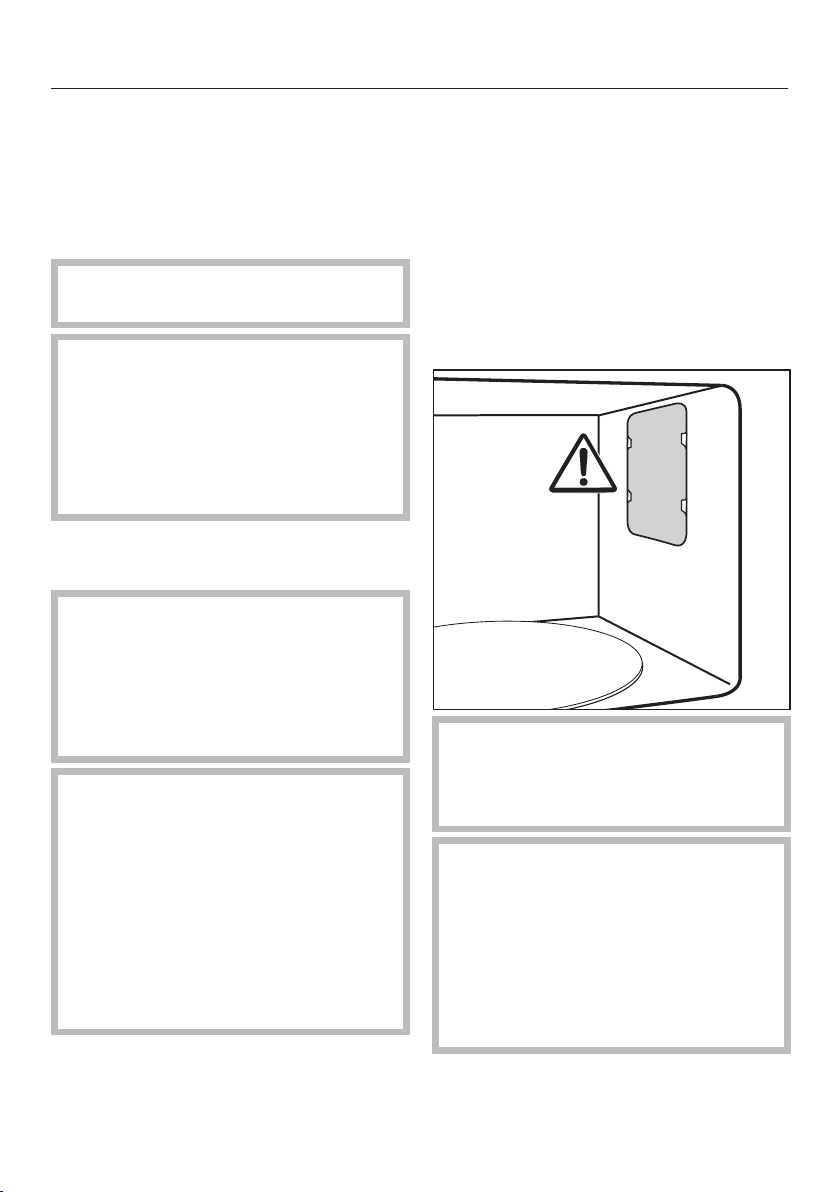
Cleaning and care
56
To help prevent re-soiling, a condition-
ing agent for stainless steel (available
from the Miele Customer Service De-
partment) can be used. Use a soft cloth
to apply sparingly with an even pres-
sure.
Disconnect the microwave oven from
the power supply before cleaning.
Under no circumstances should a
pressure cleaner be used to clean
the microwave oven.
The steam from a steam cleaning ap-
pliance could reach live electrical
components and cause a short cir-
cuit.
Housing, oven interior and in-
side of the door
Risk of burning due to hot oven
compartment.
The oven compartment may be too
hot to clean immediately after use.
Clean the oven compartment as
soon as it has cooled down.
Fire hazard due to excessive
soiling.
Excessive soiling could damage the
appliance in certain circumstances
and could even be dangerous due to
the fire risk.
Do not wait too long to clean the ap-
pliance as this will make cleaning un-
necessarily difficult and in extreme
cases, impossible.
The oven compartment and the inside
of the door can be wiped using a mild
detergent or a little washing-up liquid
and water. Wipe dry with a soft cloth.
For heavier soiling, heat a glass of water
inside the oven compartment for 2 or
3minutes until the water begins to boil.
The steam will collect on the walls and
soften the soiling. The oven interior can
now be wiped clean using a little wash-
ing-up liquid if necessary.
Stainless steel surfaces can be treated
with a conditioner for stainless steel
(available from Miele).
Do not remove the cover to the
microwave outlet inside the oven,
nor the film covering the inside of the
door.
Do not let water or any object find its
way into or block the air vents of the
appliance.
Do not use too much water and do
not let water or any other liquid find
its way into any openings.
Do not use scouring agents. These
will scratch.
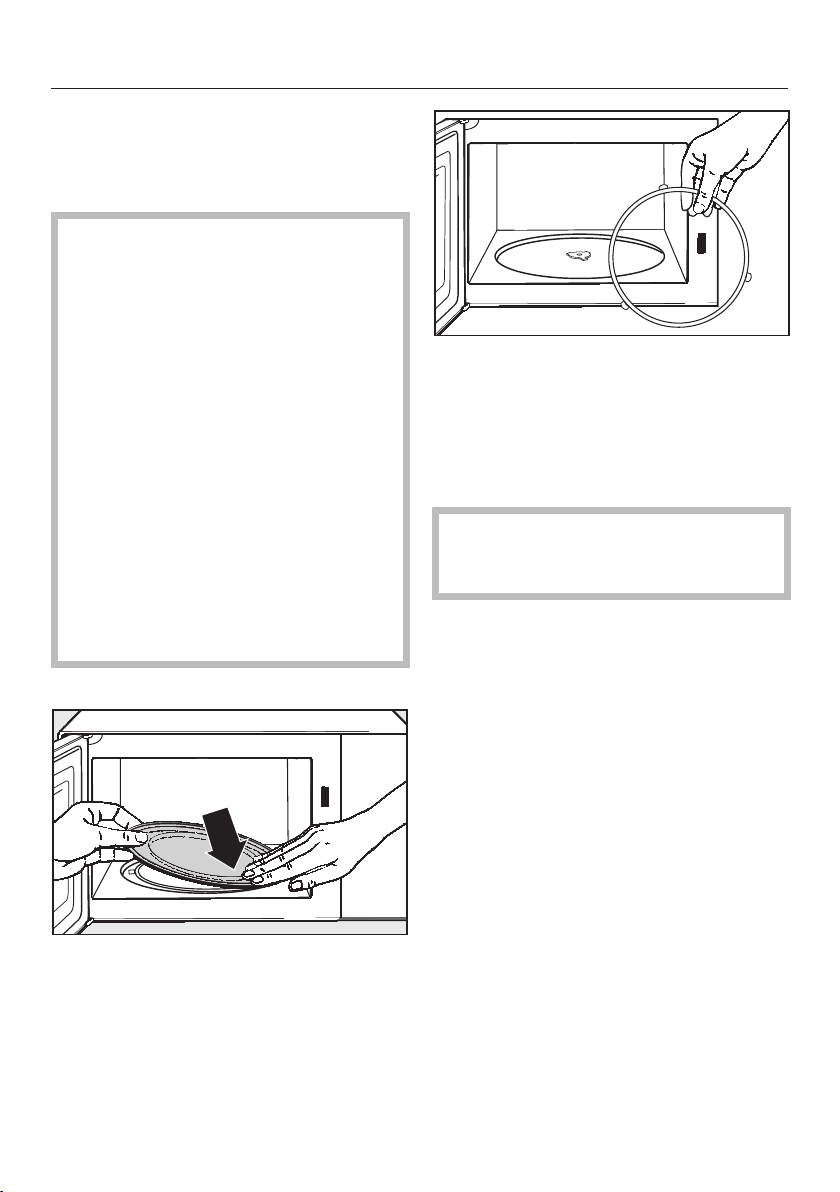
Cleaning and care
57
To neutralise odours in the microwave
oven compartment, put a cup of water
with some lemon juice in the appliance
and simmer for a few minutes.
Health risk caused by a faulty
appliance.
If any damage to the door is noticed,
the appliance should not be used un-
til the fault has been rectified by a
Miele authorised and trained service
technician. Operating a damaged ap-
pliance can result in microwave leak-
age and present a hazard to the user.
The door should be kept clean at all
times and checked at regular inter-
vals for any signs of damage. Do not
use the microwave oven if:
– the appliance door is warped.
– the door hinges are loose.
– holes or cracks are visible in the
casing, the door or the oven interior
walls.
To clean the interior:
Remove the turntable, and wash in
the dishwasher or by hand.
Always keep the roller ring under-
neath it clean as well as the oven
floor. Otherwise the turntable will not
turn smoothly.
Clean the surfaces between the
turntable and the roller ring.
Do not turn the turntable and/or loc-
ator manually, as this could damage
the drive motor.
Cleaning and care
58
Appliance front
Soiling that is left too long might be-
come impossible to remove and
could cause the surfaces to alter or
discolour.
Remove any soiling on the front of
the appliance straight away.
Clean the appliance front with a clean
soft sponge and a solution of warm wa-
ter and washing-up liquid. After clean-
ing, wipe dry using a soft cloth.
A clean, damp microfibre cloth without
cleaning agent can also be used.
All surfaces are susceptible to
scratching. Scratches on glass can in
some circumstances lead to break-
age.
Contact with unsuitable cleaning
agents can alter or discolour the ex-
ternal surfaces.
Please observe the cleaning instruc-
tions.
To avoid damaging the surfaces of
the appliance, do not use:
- detergents containing soda, ammo-
nia, acids or chlorides
- cleaning agents containing descaling
agents
- abrasive cleaning agents, e.g. scour-
ing powder, scouring liquid, or
pumice stones
- cleaning agents containing solvents
- stainless steel cleaning agents
- dishwasher cleaner
- oven sprays
- glass cleaning agents
- hard, abrasive sponges and brushes,
e.g. pot scourers
- eraser stain remover blocks
- sharp metal scrapers
Accessories supplied
Rack
Wash and dry the rack after each use. It
is dishwasher-proof. Remove stubborn
soiling with a stainless steel cleaner.
Gourmet plate
Clean the gourmet plate with hot water
and a cloth with a little washing-up li-
quid to remove any grease.
Do not use wire wool, or abrasive
sponges, aggressive or abrasive
cleaning agents.
Do not clean the gourmet plate in a
dishwasher.
If the gourmet plate has been used to
cook food with a strong aroma, you can
neutralise any odours by adding some
water and lemon juice to the gourmet
plate and heating it up in the microwave
oven using maximum power for a
2-3minutes. Rinse the gourmet plate
afterwards with clean water.
Problem solving guide
59
Many malfunctions and faults that can occur in daily operation can be easily
remedied. Time and money will be saved because a service call will not be
needed.
The following guide may help you to find the reason for a malfunction or a fault,
and to correct it.
Problem Cause and remedy
A programme will not
start.
Check whether:
the appliance door is closed.
the system lock has been activated (see “System
lock” section in the “Operation” chapter).
“door” has appeared in the display. The door has
not been opened for a long time (approx.
20minutes) (see “door message” section in the
“Operation” chapter).
the appliance is plugged into the electricity supply
and switched on at the socket.
the mains fuse has tripped. If it has, there could be
a fault with the appliance, the household electricity
supply or another appliance (disconnect the appli-
ance from the electricity supply and contact a
qualified electrician or the Miele Customer Service
Department, see “Customer service” chapter).
A noise can be heard
after a cooking pro-
gramme.
This is not a fault. The cooling fan will continue to
run for a while after the oven has been switched off
to prevent any humidity building up in the oven
compartment, on the control panel or on the oven
housing unit. It will switch off automatically.
The display does not
light up.
The time of day display has been switched off.
Press and hold the button for several seconds.
Night time switch-off is activated.
Deactivate it.
The turntable does not
turn smoothly.
The area underneath the turntable could be dirty.
Check whether there is any soiling underneath the
turntable.
Check whether the surfaces between the turntable
and the roller ring are clean.
Clean the area underneath the turntable.
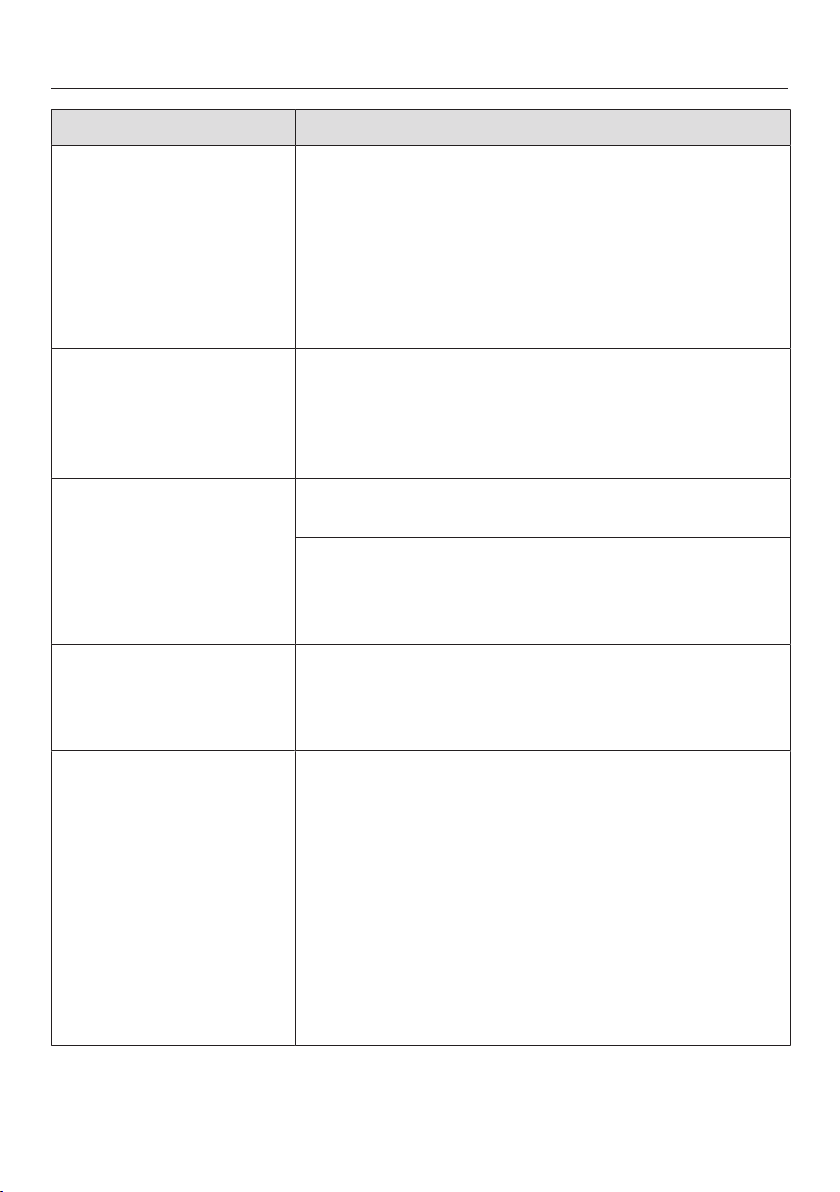
Problem solving guide
60
Problem Cause and remedy
Food is not adequately
defrosted, heated or
cooked at the end of
the selected cooking
duration.
The duration or power level were insufficient to cook
the food.
Check whether the correct power level was selec-
ted for the duration set.
The lower the power level, the longer the duration
required.
Check whether the programme has been interrup-
ted and not restarted.
The microwave function
is working but not the
oven lighting.
The lamp is faulty.
You can then operate the appliance as normal, but
not the lighting.
Contact Miele Customer Service if you need to re-
place the lighting.
Strange noises are
heard when the micro-
wave oven is being
used.
The food is covered with aluminium foil.
Remove the aluminium foil.
Sparks are being created by the use of crockery with
a metallic finish.
Please observe the information on suitable con-
tainers.
The time of day in the
display is not accurate.
If there has been a power cut, the time automatically
switches back to 12:00.
The time of day needs to be reset.
Set the correct time of day.
Food cools down too
quickly.
In the microwave oven, food begins to cook from the
outside first, the inside of the food relying on the
slower conduction of heat.
If food is cooked at a high power level, it is possible
that the heat may not have reached the centre of the
food, so it is hot on the outside but cold in the
centre. During standing time heat is transferred to the
centre of the food.
When reheating food with different densities, such
as plated meals, it is therefore sensible to select a
lower power level and lengthen the duration re-
quired.
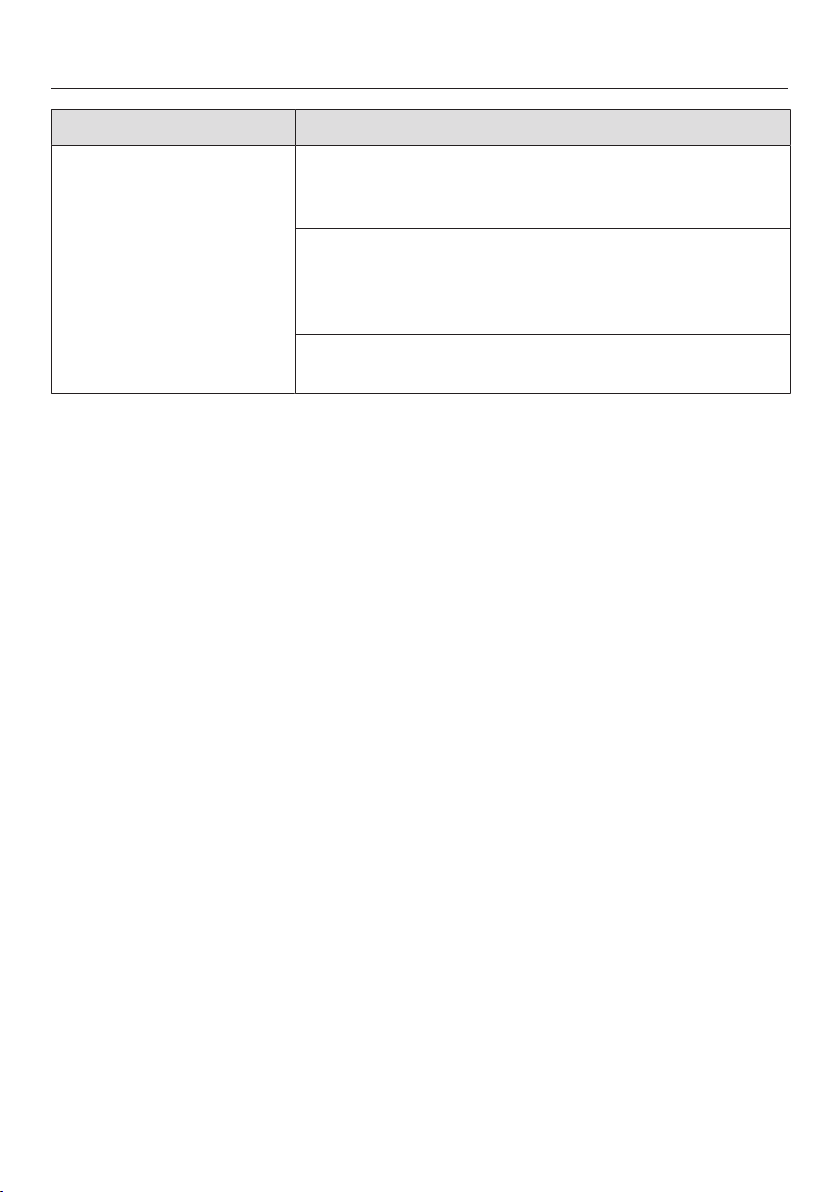
Problem solving guide
61
Problem Cause and remedy
The microwave oven
switches itself off dur-
ing a cooking, reheating
or defrosting pro-
gramme.
There may be insufficient air circulation.
Check whether the air inlet or outlet is blocked.
Remove any obstruction.
The appliance switches off automatically in cases of
overheating.
Cooking can be continued after a cooling-down
period.
The appliance switches itself off again.
Contact your Miele dealer.

After sales service
62
Contact in case of malfunction
In the event of any faults which you
cannot remedy yourself, please contact
your Miele Dealer or Miele Service.
Contact details for Miele are given at
the end of this booklet. N.B. A call-out
fee will be charged for service visits
where the problem could have been
resolved as described in these instruc-
tions.
When contacting your Dealer or Miele,
please quote the model and serial num-
ber of your appliance.
This information can be found on the
data plate located on the front of the
oven interior.
Warranty
The appliance warranty is valid for 2
years from date of purchase. In the UK,
you must activate your cover by calling
0330 160 6640 or registering online at
www.miele.co.uk.
For further information, please refer to
your warranty booklet.

United Kingdom
Miele Co. Ltd., Fairacres, Marcham Road, Abingdon, Oxon, OX14 1TW
Tel: 0330 160 6600, Internet: www.miele.co.uk/service, E-mail: [email protected]
Australia
Miele Australia Pty. Ltd.
ACN 005 635 398
ABN 96 005 635 398
Level 4, 141 Camberwell Road
Hawthorn East, VIC 3123
Tel: 1300 464 353
Internet: www.miele.com.au
Miele Electrical Appliances Co., Ltd.
1-3 Floor, No. 82 Shi Men Yi Road
Jing' an District
200040 Shanghai, PRC
Tel: +86 21 6157 3500
Fax: +86 21 6157 3511
E-mail: [email protected],
Internet: www.miele.cn
China Mainland
Miele (Hong Kong) Ltd.
41/F - 4101, Manhattan Place
23 Wang Tai Road
Kowloon Bay, Hong Kong
Tel: (852) 2610 1025
Fax: (852) 3579 1404
Email:
Website: www.miele.hk
Hong Kong, China
Miele India Pvt. Ltd.
1st Floor, Copia Corporate Suites,
Commercial Plot 9,
Mathura Road, Jasola,
New Delhi - 110025
E-mail: customercare@miele.in
Website: www.miele.in
India
Miele Ireland Ltd.
2024 Bianconi Avenue
Citywest Business Campus
Dublin 24
Tel: (01) 461 07 10
Fax: (01) 461 07 97
E-Mail: [email protected]
Internet: www.miele.ie
Ireland
Malaysia
Miele Sdn Bhd
Suite 12-2, Level 12
Menara Sapura Kencana
Petroleum
Solaris Dutamas No. 1
Jalan Dutamas 1
50480 Kuala Lumpur, Malaysia
Phone: +603-6209-0288
Fax: +603-6205-3768
Miele New Zealand Limited
IRD 98 463 631
8 College Hill
Freemans Bay, Auckland 1011
New Zealand
Tel: 0800 464 353
Internet: www.miele.co.nz
New Zealand
Miele Pte. Ltd.
29 Media Circle
#11-04 ALICE@Mediapolis
Singapore 138565
sTel: +65 6735 1191
Fax: +65 6735 1161
E-Mail: [email protected]
Internet: www.miele.sg
Singapore
Miele (Pty) Ltd.
63 Peter Place
Bryanston 2194
P.O. Box 69434
Bryanston 2021
Tel: (011) 875 9000
Fax: (011) 875 9035
E-mail: [email protected]
Internet: www.miele.co.za
South Africa
Miele Appliances Ltd.
Showroom 1
Eiffel 1 Building
P.O. Box 114782 - Dubai
Tel. +971 4 3044 999
Fax. +971 4 3418 852
800-MIELE (64353)
E-Mail: [email protected]
Website: www.miele.ae
United Arab Emirates
Manufacturer:
Miele & Cie. KG, Carl-Miele-Straße 29, 33332 Gütersloh, Germany
Thailand
Miele Appliances Ltd.
BHIRAJ TOWER at EmQuartier
43rd Floor Unit 4301-4303
689 Sukhumvit Road
North Klongton Sub-District
Vadhana District
Bangkok 10110, Thailand
Sheikh Zayed Road, Umm Al Sheif

M.-Nr. 11 357 070 / 05en-GB
M 6012 SC