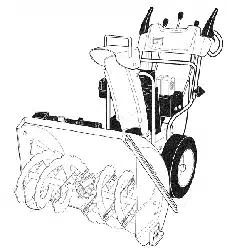
Owner's Manual
CRRFTSMRH°
S OWT ROW
11.5 Horsepower
Power-Propelled
30" Two-Stage
Model No.
917.881150
• EspaSol, p. 21
CAUTIO :
Read and follow all
Safety Rules and Instructions
before operating this equipment
Sears, Roebuck and Co., Hoffman Estates, IL 60179 U.S.A.
Visit our Craftsman website: www.sears.com/craftsman
iMPORTANT
Safe Operation Practices for Walk=Behind Snow Throwers
This snow thrower is capable of amputating hands and feet and throwing objects.
Failure to observe the following safety instructions could result in serious injury.
&
Look for this symbol to point out im-
portant safety precautions. It means
CAUTION!!! BECOMEALERT!!! YOUR
SAFETY IS INVOLVED.
&
WARNING: Always disconnect spark
plug wire and place it where it cannot
contact plug in order to prevent acci-
dental starting when setting up, trans-
porting, adjusting or making repairs.
WARNING: This snow thrower is for
use on sidewalks, driveways and other
ground level surfaces. Caution should
be exercised while using on sloping sur-
faces. Do not use snow thrower on
surfaces above ground level such as
roofs of residences, garages, porches
or other such structures or buildings.
WARNING: Snow throwers have ex-
posed rotating parts, which can cause
severe injury from contact, or from ma-
terial thrown from the discharge chute.
Keep the area of operation clear of all
persons, small children and pets at all
times including startup.
CAUTION: Muffler and other engine
parts become extremely hot during
operation and remain hot after engine
_ as stopped. To avoid severe burns oncontact, stay away from these areas.
WARNING: Engine exhaust, some of
its constituents, and certain vehicle
components contain or emit chemi-
cals known to the State of California
to cause cancer and birth defects or
other reproductive harm.
Training
1. Read, understand and follow all instructions on the
machine and in the manual(s) before operating this
unit. Be thoroughly familiar with the controls and the
proper use of the equipment. Know how to stop the
unit and disengage the controls quickly.
2. Never allow children to operate the equipment. Never
allow adults to operate the equipment without proper
instruction.
3. Keep the area of operation clear of all persons, par-
ticularly small children.
4. Exercise caution to avoid slipping or falling, especially
when operating the snow thrower in reverse.
Preparation
1. Thoroughly inspect the area where the equipment is
to be used and remove all doormats, sleds, boards,
wires, and other foreign objects.
2. Disengage all clutches and shift into neutral before
starting the engine (motor).
3. Do not operatethe equipment without wearing adequate
winter garments. Avoid loose fitting clothing that can
get caught in moving parts. Wear footwear that will
improve footing on slippery surfaces.
4. Handle fuel with care; it is highly flammable
(a) Use an approved fuel container.
(b) Never add fuel to a running engine or hot en-
gine.
(c) Fill fuel tank outdoors with extreme care. Never fill
fuel tank indoors.
(d) Never fill containers inside a vehicle or on a truck
or trailer bed with a plastic liner. Always place
containers on the ground, away from your vehicle,
before filling.
(e) When practical, remove gas-powered equipment
from the truck or trailer and refuel it on the ground.
If this is not possible, then refuel such equipment
on a trailer with a portable container, rather than
from a gasoline dispenser nozzle.
.
.
7.
.
(f) Keep the nozzle in contact with the rim of the fuel
tank or container opening at all times, until refuel-
ing is complete. Do not use a nozzle lock-open
device.
(g) Replace gasoline cap securely and wipe up spilled
fuel.
(h) If fuel is spilled on clothing, change clothing im-
mediately.
Use extension cords and receptacles as specified by
the manufacturer for all units with electric drive motors
or electric starting motors.
Adjust the collector housing height to clear gravel or
crushed rock surface.
Never attempt to make any adjustments while the
engine (motor) is running (except when specifically
recommended by manufacturer).
Always wear safety glasses or eye shields during op-
eration or while performing an adjustment or repair to
protect eyes from foreign objects that may be thrown
from the machine.
2
Operation
1. Do not put hands or feet near or under rotating parts.
Keep clear of the discharge opening at all times.
2. Exercise extreme caution when operating on or cross-
ing gravel drives, walks, or roads. Stay alert for hidden
hazards or traffic.
3. After striking a foreign object, stop the engine (motor),
remove the wire from the spark plug, disconnect the
cord on electric motors, thoroughly inspect the snow
thrower for any damage, and repair the damage before
restarting and operating the snow thrower.
4. If the unit should start to vibrate abnormally, stop the
engine (motor) and check immediately for the cause.
Vibration is generally a warning of trouble.
5. Stop the engine (motor) whenever you leave the oper-
ating position, before unclogging the collector/impeller
housing or discharge chute, and when making any
repairs, adjustments or inspections.
6. Whencleaning,repairingorinspectingthesnowthrower,
stoptheengineandmakecertainthecollector!impel-
ler andall movingpartshavestopped.Disconnect
thesparkplugwireandkeepthewireawayfromthe
plugtopreventsomeonefromaccidentallystartingthe
engine.
7. Do notruntheengineindoors,exceptwhenstarting
theengineandfortransportingthesnowthrowerinor
outof thebuilding.Opentheoutsidedoors;exhaust
fumesaredangerous.
8. Exerciseextremecautionwhenoperatingonslopes.
9. Neveroperatethesnowthrowerwithoutproperguards,
andothersafetyprotectivedevicesinplaceandwork-
ing.
10.Neverdirectthe dischargetowardpeopleor areas
wherepropertydamagecanoccur.Keepchildrenand
othersaway.
11.Donotoverloadthemachinecapacitybyattempting
toclearsnowattoofastarate.
12. Neveroperatethemachineat hightransportspeeds
onslipperysurfaces.Lookbehindandusecarewhen
operatinginreverse.
13.Disengagepowertothecollector!impellerwhensnow
throweristransportedornotin use.
14.Useonlyattachmentsandaccessoriesapprovedby
themanufacturerofthesnowthrower(suchaswheel
weights,counterweights,orcabs).
15. Neveroperatethesnowthrowerwithoutgoodvisibility
orlight.Alwaysbesureofyourfooting,andkeepafirm
holdonthehandles.Walk;neverrun.
16. Nevertouchahotengineor muffler.
Clearing a Clogged Discharge Chute
Hand contact with the rotating impeller insidethe discharge
chute is the most common cause of injury associated with
snow throwers. Never use your hand to clean out the dis-
charge chute. To clear the chute:
1. SHUT THE ENGINE OFF!
2. Wait 10 seconds to be sure the impeller blades have
stopped rotating.
3. Always use a clean-out tool, not your hands.
Maintenance and Storage
1. Check shear bolts and other bolts at frequent intervals
for proper tightness to be sure the equipment is in safe
working condition.
2. Never store the machine with fuel in the fuel tank
inside a building where ignition sources are present
such as hot water heaters, space heaters, or clothes
dryers. Allow the engine to cool before storing in any
enclosure.
3. Always refer to operator's manual for important details
if the snow thrower is to be stored for an extended
period.
4. Maintain or replace safety and instruction labels, as
necessary.
5. Run the machine a few minutes after throwing snow
to prevent freeze-up of the collector/impeller.
TABLE OF CONTENTS
SAFETY RULES ........................................................ 2-3
PRODUCT SPECIFICATIONS ...................................... 4
CUSTOMER RESPONSIBILITIES ................................ 4
WARRANTY .................................................................. 4
ASSEMBLY / PRE-OPERATION ............................... 6-8
OPERATION ............................................................ 9-14
MAINTENANCE ..................................................... 15-16
MAINTENANCE SCHEDULE ..................................... 15
SERVICE AND ADJUSTMENTS ........................... 17-19
STO RAG E................................................................... 19
TROUBLESHOOTING ................................................ 20
REPAIR PARTS ..................................................... 40-55
SEARS SERVICE ................................... BACK COVER
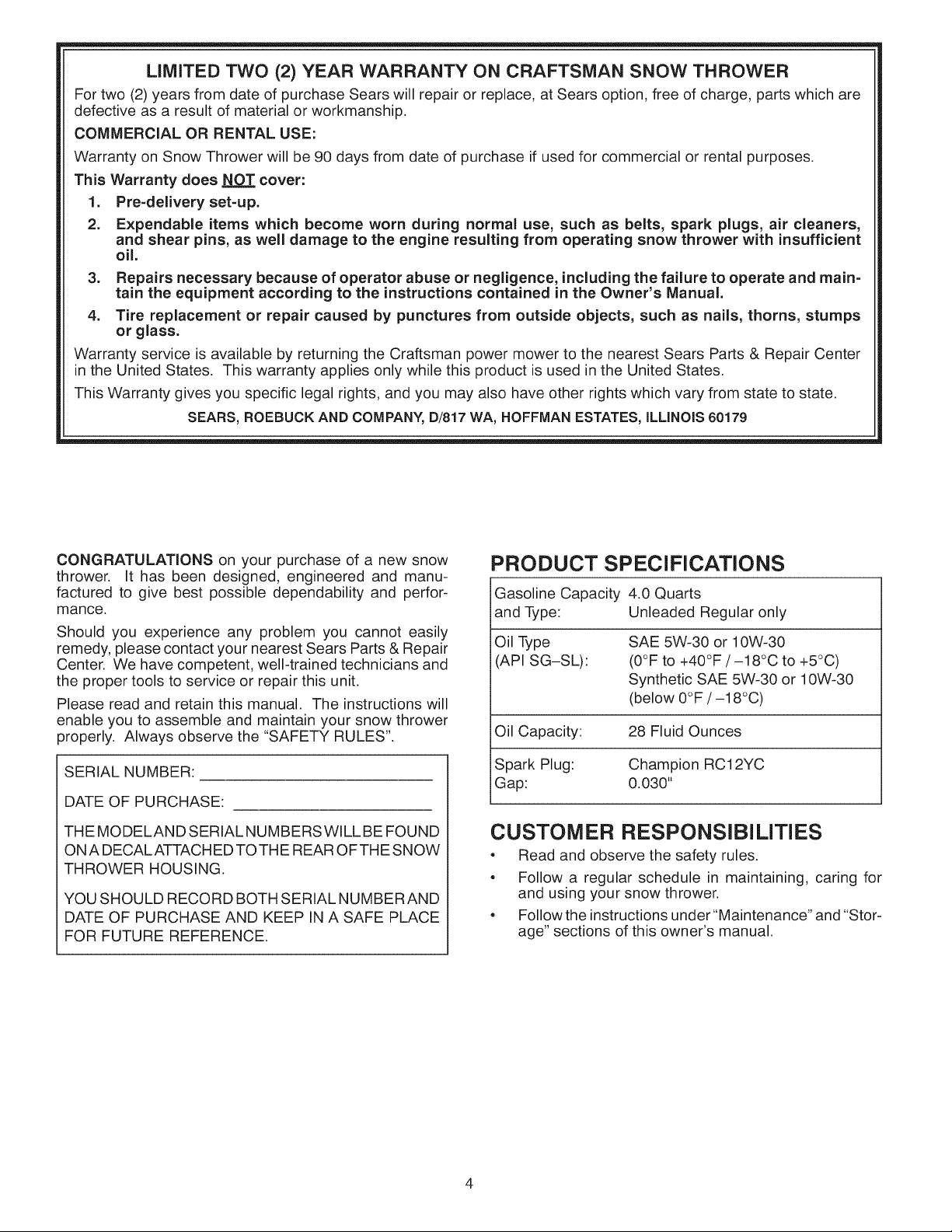
LiMiTED TWO (2) YEAR WARRANTY ON CRAFTSMAN SNOW THROWER
For two (2) years from date of purchase Sears will repair or replace, at Sears option, free of charge, parts which are
defective as a result of material or workmanship.
COMMERCIAL OR RENTAL USE:
Warranty on Snow Thrower will be 90 days from date of purchase if used for commercial or rental purposes.
This Warranty does _ cover:
1. Pre-delivery set-up.
2. Expendable items which become worn during normal use, such as belts, spark plugs, air cleaners,
and shear pins, as well damage to the engine resulting from operating snow thrower with insufficient
oil.
3. Repairs necessary because of operator abuse or negligence, including the failure to operate and main-
tain the equipment according to the instructions contained in the Owner's Manual.
4. Tire replacement or repair caused by punctures from outside objects, such as nails, thorns, stumps
or glass.
Warranty service is available by returning the Craftsman power mower to the nearest Sears Parts & Repair Center
in the United States. This warranty applies only while this product is used in the United States.
This Warranty gives you specific legal rights, and you may also have other rights which vary from state to state.
SEARS, ROEBUCK AND COMPANY, D/817 WA, HOFFMAN ESTATES, ILLiNOiS 60179
CONGRATULATIONS on your purchase of a new snow
thrower. It has been designed, engineered and manu-
factured to give best possible dependability and perfor-
mance.
Should you experience any problem you cannot easily
remedy, please contact your nearest Sears Parts & Repair
Center. We have competent, well-trained technicians and
the proper tools to service or repair this unit.
Please read and retain this manual. The instructions will
enable you to assemble and maintain your snow thrower
properly. Always observe the "SAFETY RULES".
SERIAL NUMBER:
DATE OF PURCHASE:
THE MODELAND SERIAL NUMBERSWILL BE FOUND
ON A DECAL ATTACH ED TO THE REAR OF THE SNOW
THROWER HOUSING.
YOU SHOULD RECORD BOTH SERIAL NUMBERAND
DATE OF PURCHASE AND KEEP IN A SAFE PLACE
FOR FUTURE REFERENCE.
PRODUCT SPECIFICATIONS
Gasoline Capacity 4.0 Quarts
and Type: Unleaded Regular only
Oil Type
(API SG-SL):
SAE 5W-30 or 10W-30
(0°F to +40°F / -18°C to +5°C)
Synthetic SAE 5W-30 or 10W-30
(below 0°F / -18°C)
Oil Capacity: 28 Fluid Ounces
Spark Plug: Champion RCl 2YC
Gap: 0.030"
CUSTOMER RESPONSIBILITIES
• Read and observe the safety rules.
• Follow a regular schedule in maintaining, caring for
and using your snow thrower.
• Follow the instructions under "Maintenance" and "Stor-
age" sections of this owner's manual.
4
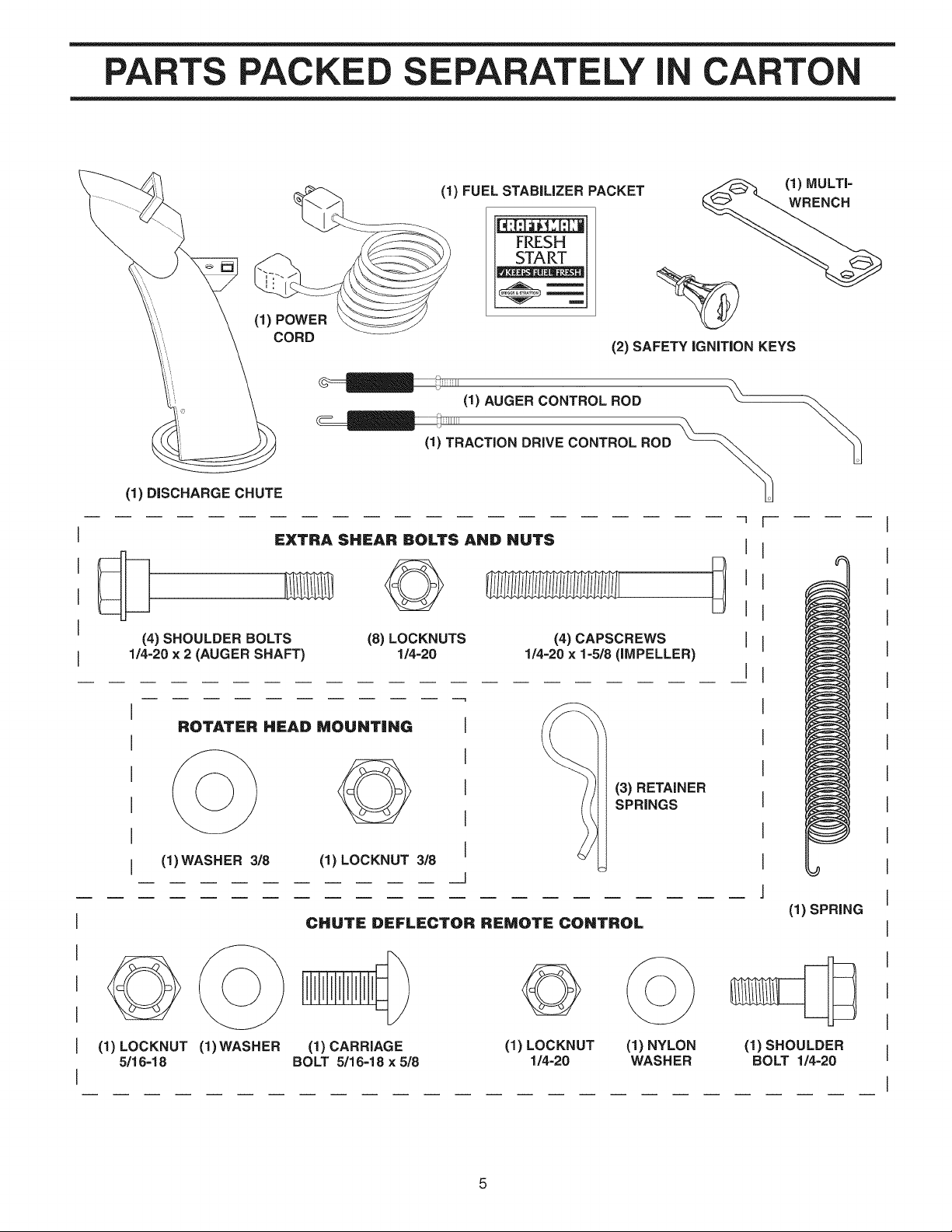
PARTS PAC E EPARATELYI CARTO
(1) POWER
CORD
(1) FUEL STABiLiZER PACKET
FRESH
START
(2) SAFETY iGNiTiON KEYS
(1) DISCHARGE CHUTE
(1) AUGER CONTROL ROD
_1111_
(1) TRACTION DRIVE CONTROL ROD
(4) SHOULDER BOLTS
1/4=20 x 2 (AUGER SHAFT)
(8) LOCKNUTS
1/4=20
(4) CAPSCREWS
1/4-20 X 1=5/8 (iMPELLER)
1 [
I
I
I
I
I
ROTATER HEAD MOUNTING
(1) WASHER 3/8 (1) LOCKNUT 3/8
I
I
I
I
I
]
(3) RETAINER
SPRINGS
CHUTE DEFLECTOR REMOTE CONTROL
J
(1) SPRING
(1) LOCKNUT (1)WASHER
5/16=18
(1) CARRIAGE
BOLT 5/16=18 x 5/8
(1) LOCKNUT
1/4=20
(1) NYLON
WASHER
(1) SHOULDER
BOLT 1/4=20
ASSE BL¥/ E-OPE ATION
Read these instructions and this manual in its entirety
before you attempt to assemble or operate your new
snow thrower. Reading the entire manual will familiar-
ize you with the unit, which will assist you in assembly,
operation and maintenance of the product.
Your new snow thrower has been assembled at the factory
with the exception of those parts left unassembled for ship-
ping purposes. All parts such as nuts, washers, bolts, etc.,
necessary to complete the assembly have been placed in
the parts bag. To ensure safe and proper operation of your
snow thrower, all parts and hardware you assemble must
be tightened securely. Use the correct tools as necessary
to ensure proper tightness.
REMOVE SNOW THROWER FROM CARTON
Remove all accessible loose parts and parts boxes
from carton.
.
2. Cut down all four corners of carton and lay panels flat.
3. Removethetwo (2) screws securing the auger housing
to the pallet.
4. Remove all packing materials except plastictie holding
speed control rod to lower handle.
5. Remove the two (2) plastic ties securing upper handle
to pallet.
6. Remove snow thrower from carton and check carton
thoroughly for additional loose parts.
HOW TO SET UP YOUR SNOW THROWER
TOOL BOX (See Fig. 10)
A toolbox is provided on your snow thrower. The toolbox is
located on top of the belt cover. Store the extra shear bolts,
nuts and multi-wrench provided in parts bag in the toolbox.
NOTE: The multi-wrench may be used for assembly of the
chute rotator head to snowthrower and making adjustments
to the skid plates.
UNFOLD UPPER HANDLE
1. Raise upper handletothe operating position andtighten
handle knobs securely.
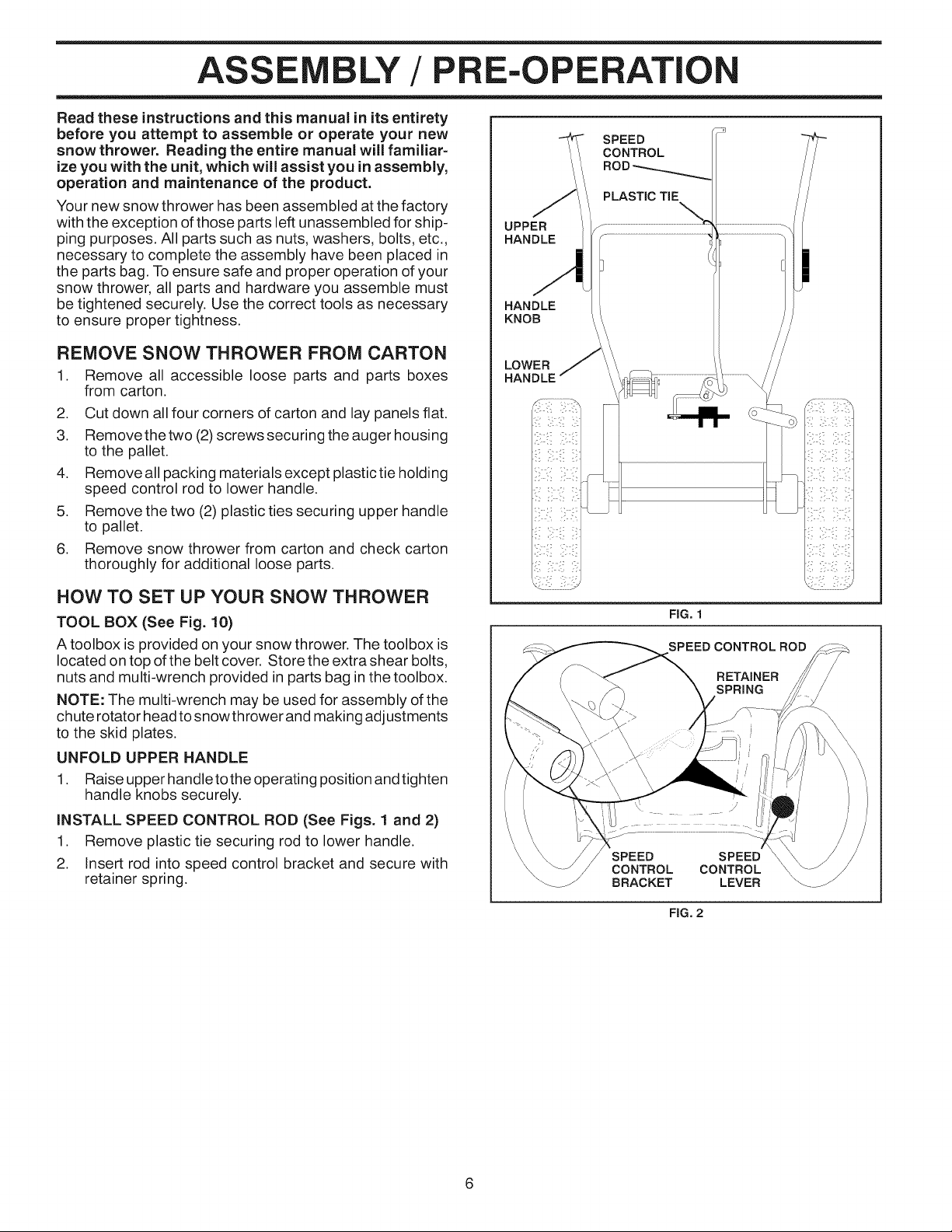
INSTALL SPEED CONTROL ROD (See Figs. 1 and 2)
1. Remove plastic tie securing rod to lower handle.
2. Insert rod into speed control bracket and secure with
retainer spring.
UPPER
HANDLE
HANDLE
KNOB
LOWER
HANDLE
SPEED
CONTROL
PLASTIC TiE
FIG. 1
SPEED CONTROL ROD
RETAINER
SPRING
SPEED
CONTROL
BRACKET
SPEED
CONTROL
LEVER
FiG. 2
6
ASSEM LY/P E-OPE 0
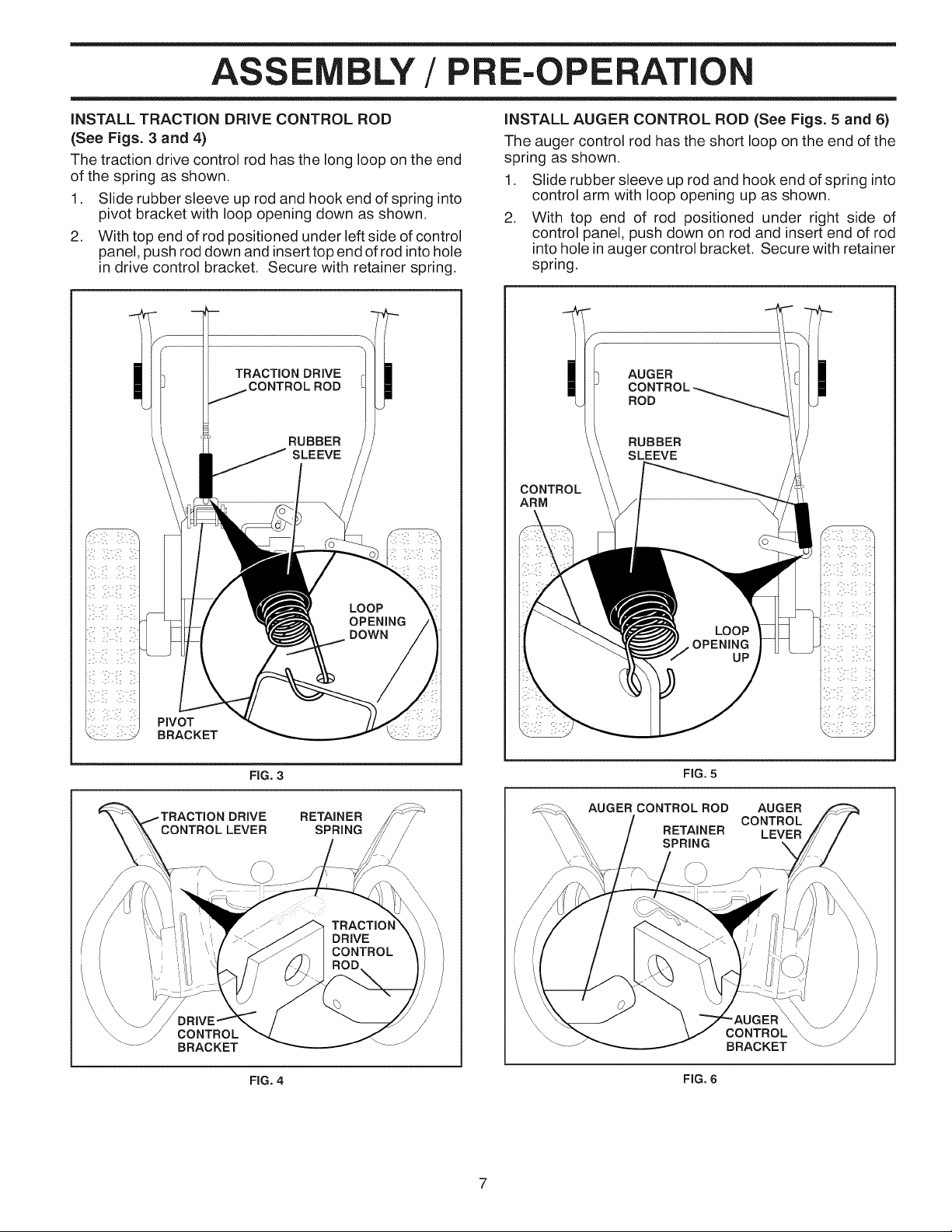
iNSTALL TRACTION DRIVE CONTROL ROD
(See Figs. 3 and 4)
The traction drive control rod has the long loop on the end
of the spring as shown.
1. Slide rubber sleeve up rod and hook end of spring into
pivot bracket with loop opening down as shown.
2. With top end of rod positioned under left side of control
panel, push rod down and inserttop end of rod into hole
in drive control bracket. Secure with retainer spring.
INSTALL AUGER CONTROL ROD (See Figs. 5 and 6)
The auger control rod has the short loop on the end of the
spring as shown.
1. Slide rubber sleeve up rod and hook end of spring into
control arm with loop opening up as shown.
2. With top end of rod positioned under right side of
control panel, push down on rod and insert end of rod
into hole in auger control bracket. Secure with retainer
spring.
PIVOT
BRACKET
CONTROL
ARM
AUGER
CONTROL
ROD
RUBBER
SLEEVE
FiG. 3
DRIVE RETAINER
SPRING
CONTROL
BRACKET
FiG. 4
FiG. 5
AUGER CONTROL ROD AUGER
CONTROL
RETAINER LEVER
SPRING \
CONTROL
BRACKET
FiG. 6
AS E BLY/PRE-OP ATION
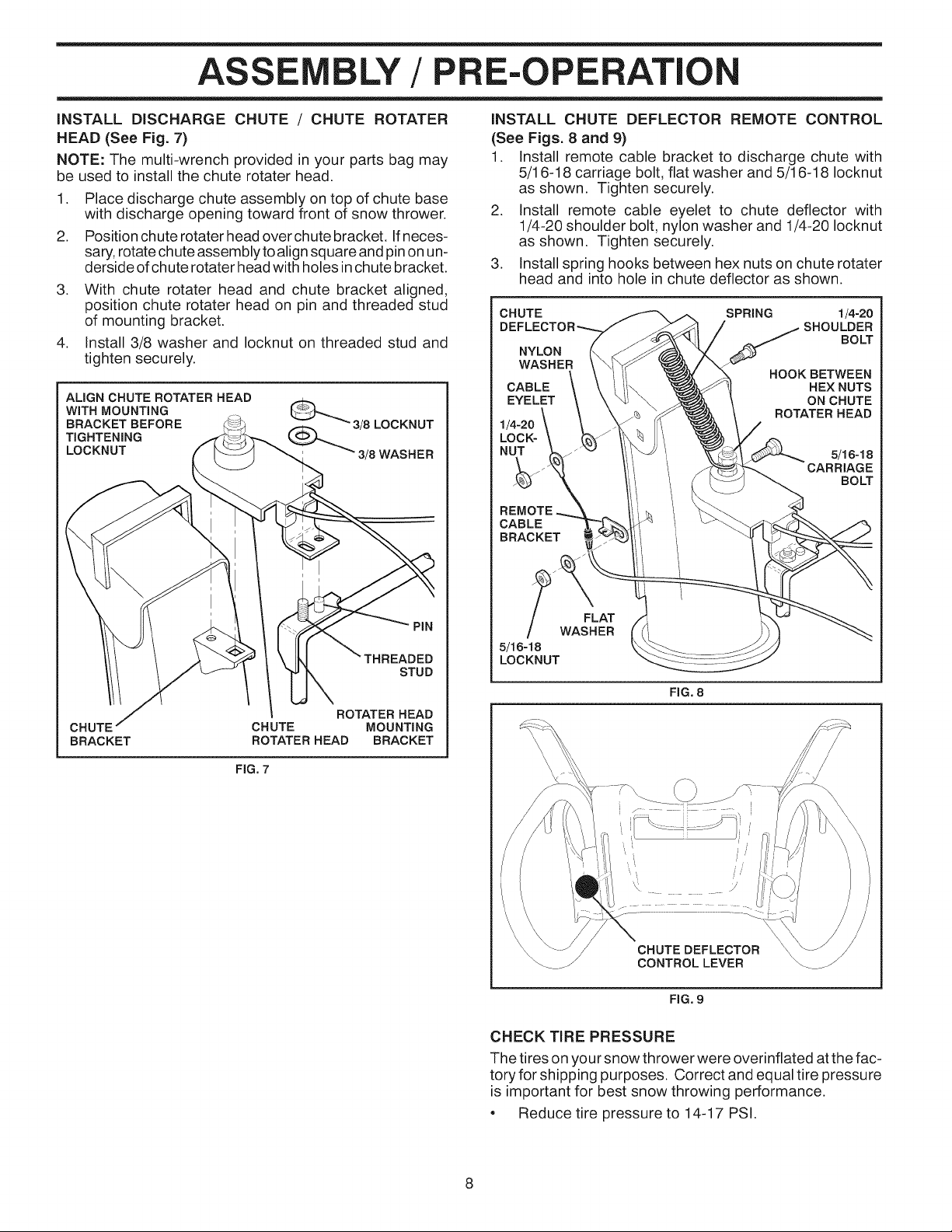
INSTALL DISCHARGE CHUTE / CHUTE ROTATER
HEAD (See Fig. 7)
NOTE: The multi-wrench provided in your parts bag may
be used to install the chute rotater head.
1. Place discharge chute assembly on top of chute base
with discharge opening toward front of snow thrower.
2. Position chute rotater head over chute bracket. If neces-
sary, rotate chute assembly to align square and pin on un-
derside of chute rotater head with holes in chute bracket.
3. With chute rotater head and chute bracket aligned,
position chute rotater head on pin and threaded stud
of mounting bracket.
4. Install 3/8 washer and Iocknut on threaded stud and
tighten securely.
ALIGN CHUTE ROTATER HEAD
WiTH MOUNTING
BRACKET BEFORE
TiGHTENiNG
LOCKNUT
_3/8 LOCKNUT
_3/8 WASHER
PIN
STUD
CHUTE
BRACKET
ROTATER HEAD
CHUTE MOUNTING
ROTATER HEAD BRACKET
FIG. 7
INSTALL CHUTE DEFLECTOR REMOTE CONTROL
(See Figs. 8 and 9)
1. Install remote cable bracket to discharge chute with
5/1 6-18 carriage bolt, flat washer and 5/16-18 Iocknut
as shown. Tighten securely.
2. Install remote cable eyelet to chute deflector with
1/4-20 shoulder bolt, nylon washer and 1/4-20 Iocknut
as shown. Tighten securely.
3. Install spring hooks between hex nuts on chute rotater
head and into hole in chute deflector as shown.
CHUTE
NYLON
WASHER
CABLE !
EYELET
SPRING 1/4-20
SHOULDER
BOLT
HOOK BETWEEN
HEX NUTS
ON CHUTE
ROTATER HEAD
REMOTE
CABLE
BRACKET
5/16-18
CARRIAGE
BO_
FLAT
WASHER
5/16-18
LOCKNUT
FIG. 8
CHUTE DEFLECTOR
CONTROL LEVER
FIG. 9
CHECK TIRE PRESSURE
The tires on your snow thrower were overinflated at the fac-
tory for shipping purposes. Correct and equal tire pressure
is important for best snow throwing performance.
• Reduce tire pressure to 14-17 PSI.
8
OPE 0
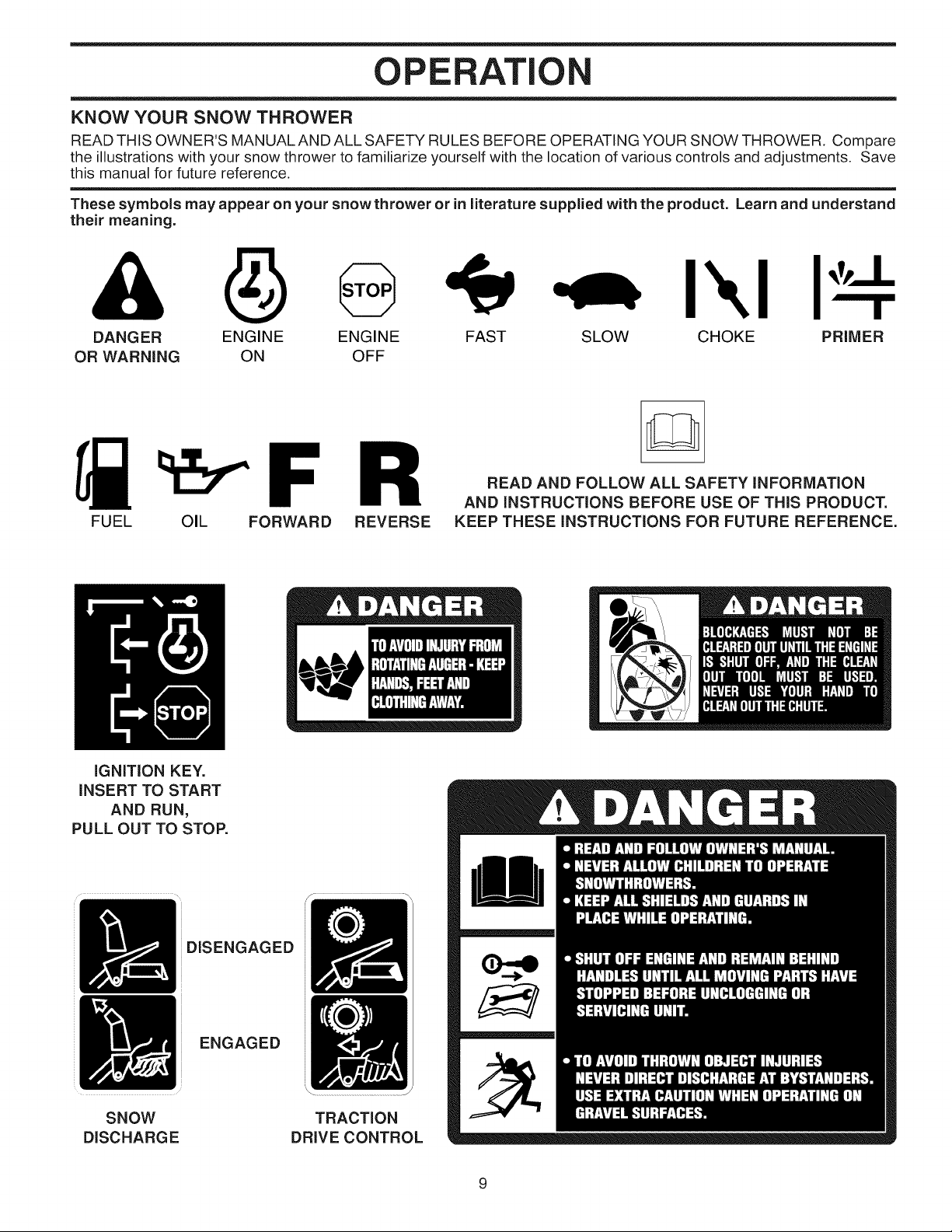
KNOW YOUR SNOW THROWER
READ THIS OWNER'S MANUALAND ALL SAFETY RULES BEFORE OPERATING YOUR SNOW THROWER. Compare
the illustrations with your snow thrower to familiarize yourself with the location of various controls and adjustments. Save
this manual for future reference.
These symbols may appear on your snowthrower or in literature supplied with the product. Learn and understand
their meaning.
I\1 It¢
ENGINE FAST
OFF
DANGER ENGINE SLOW CHOKE PRIMER
OR WARNING ON
R
FUEL OIL FORWARD REVERSE
READ AND FOLLOW ALL SAFETY INFORMATION
AND INSTRUCTIONS BEFORE USE OF THIS PRODUCT.
KEEP THESE iNSTRUCTIONS FOR FUTURE REFERENCE.
iGNITION KEY.
iNSERT TO START
AND RUN,
PULL OUT TO STOP.
DISENGAGED
ENGAGED
SNOW
DISCHARGE
TRACTION
DRIVE CONTROL
OPERATIO
GASOLINE
FILLER (
CON-
TROL
ELECTRIC AUGER
START CONTROL
BUTTON LEVER DRIVE SPEED
RECOIL _ONTRO L LEVER
(AUXILIARY)
STARTER
HANDLE
CHUTE
DEFLECTOR
DISCHARGECHUTECONTROLLEVER
DEFLECTOR REMOTE
CONTROL LEVER
'TRACTION
DRIVE
CONTROL
LEVER
=H TURN
TRIGGER
SAFETY
IGNITION
KEY FUEL
SHUTOFF
VALVE
NOTE: iTEMS ABOVE
ARE SHOWN iN
THEIR TYPICAL
LOCATION ON THE
ENGINE, ACTUAL
LOCATION MAY VARY
WiTH THE ENGINE
ON YOUR UNIT,
AUGERS
THROTTLE
/ENGINE
CONTROL
CHUTE
LIGHT
HANDLE
KNOB
TOOLBOX
DRIFT CUTTER
_KID PLATE
FiG. 10
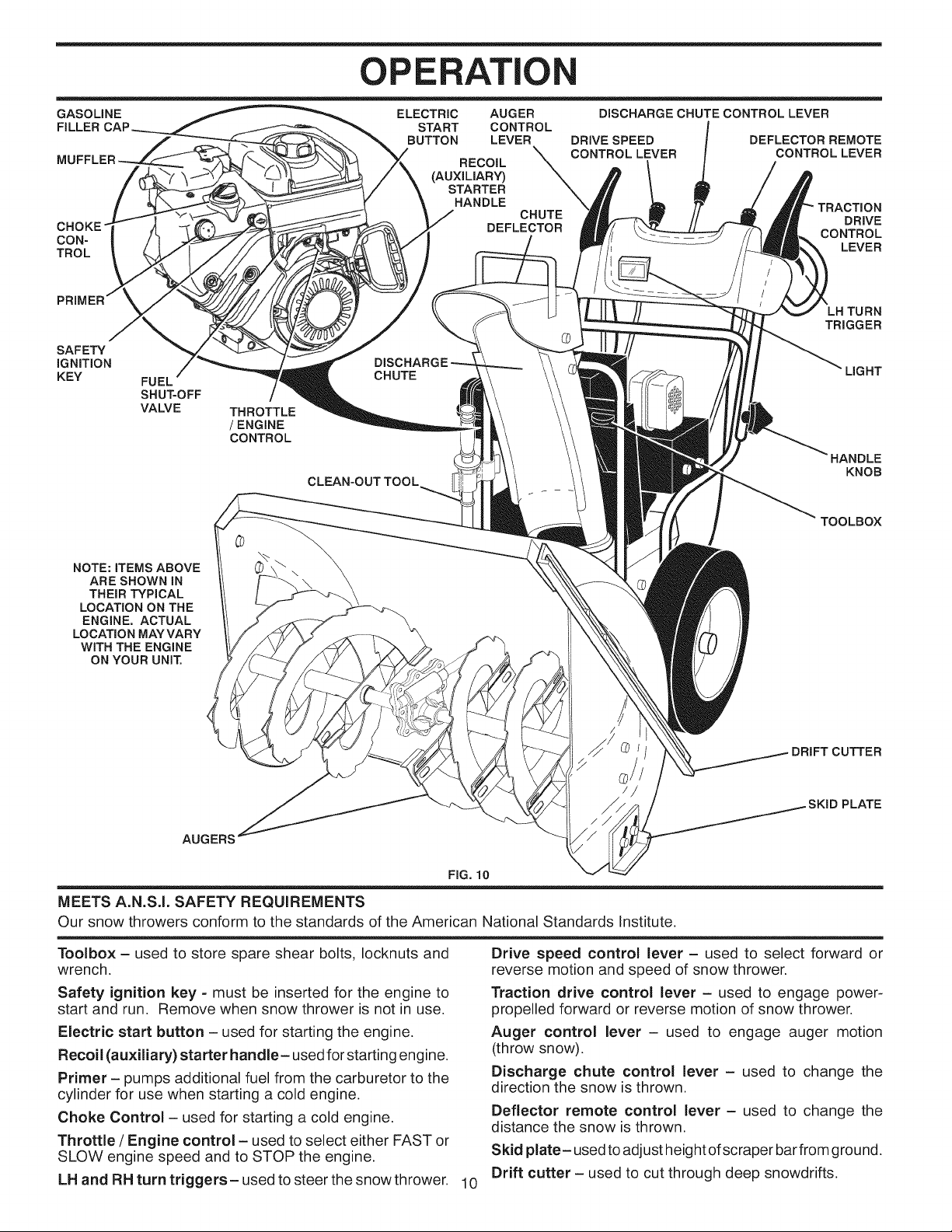
MEETS A.N.S.I. SAFETY REQUIREMENTS
Our snow throwers conform to the standards of the American National Standards Institute.
Toolbox - used to store spare shear bolts, Iocknuts and
wrench.
Safety ignition key - must be inserted for the engine to
start and run. Remove when snow thrower is not in use.
Electric start button - used for starting the engine.
Recoil (auxiliary) starter handle- used for starting engine.
Primer - pumps additional fuel from the carburetor to the
cylinder for use when starting a cold engine.
Choke Control - used for starting a cold engine.
Throttle / Engine control - used to select either FAST or
SLOW engine speed and to STOP the engine.
LH and RH turn triggers- used to steer the snow thrower.
10
Drive speed control lever - used to select forward or
reverse motion and speed of snow thrower.
Traction drive control lever - used to engage power-
propelled forward or reverse motion of snow thrower.
Auger control lever - used to engage auger motion
(throw snow).
Discharge chute control lever - used to change the
direction the snow is thrown.
Deflector remote control lever - used to change the
distance the snow is thrown.
Skid plate- used to adjust height ofscraper bar from ground.
Drift cutter - used to cut through deep snowdrifts.
OPE 0
The operation of any snow thrower can result
in foreign objects thrown into the eyes, which
can result in severe eye damage. Always wear
safety glasses or eye shields while operating
your snow thrower or performing any adjust-
ments or repairs. We recommend standard safety glasses
or a wide vision safety mask worn over spectacles.
HOW TO USE YOUR SNOW THROWER
Know how to operate all controls before adding fuel or
attempting to start the engine.
STOPPING
TRACTION DRIVE
* Release traction drive control lever to stop the forward
or reverse movement of the snow thrower.
AUGER
* Releasetheaugercontrollevertostopthrowingsnow.
ENGINE
1. Move throttle control to "STOP" position.
2. Remove (do not turn) safety ignition key to prevent
unauthorized use.
NOTE: Never use choke to stop engine.
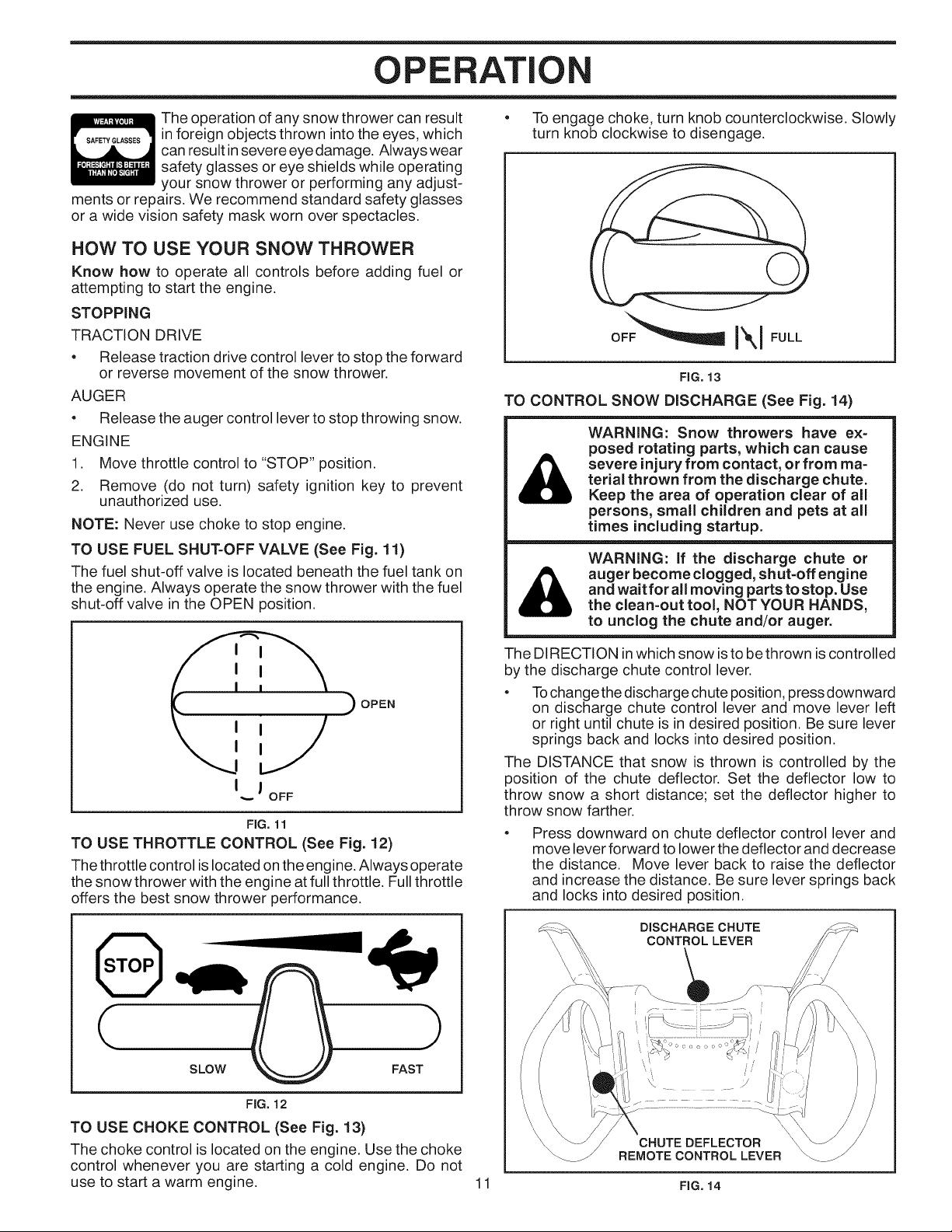
TO USE FUEL SHUT-OFF VALVE (See Fig. 11)
The fuel shut-off valve is located beneath the fuel tank on
the engine, Always operate the snow thrower with the fuel
shut-off valve in the OPEN position.
i i
I I
I...I OFF
OPEN
FIG. 11
TO USE THROTTLE CONTROL (See Fig. 12)
The throttle control is located on the engine. Always operate
the snow thrower with the engine at full throttle. Full throttle
offers the best snow thrower performance.
SLOW FAST
FIG, 12
TO USE CHOKE CONTROL (See Fig. 13)
The choke control is located on the engine. Use the choke
control whenever you are starting a cold engine. Do not
use to start a warm engine.
* To engage choke, turn knob counterclockwise. Slowly
turn knob clockwise to disengage.
I\l OLL
FIG. 13
TO CONTROL SNOW DISCHARGE (See Fig. 14)
&
&
WARNING: Snow throwers have ex-
posed rotating parts, which can cause
severe injury from contact, or from ma-
terial thrown from the discharge chute.
Keep the area of operation clear of all
persons, small children and pets at all
times including startup.
WARNING: If the discharge chute or
auger become clogged, shut-off engine
and wait for all moving parts to stop. Use
the clean-out tool, NOT YOUR HANDS,
to unclog the chute and/or auger.
The DIRECTION inwhich snow isto bethrown is controlled
by the discharge chute control lever.
* Tochangethe discharge chute position, press downward
on discharge chute control lever and move lever left
or right until chute is in desired position. Be sure lever
springs back and locks into desired position.
The DISTANCE that snow is thrown is controlled by the
position of the chute deflector. Set the deflector low to
throw snow a short distance; set the deflector higher to
throw snow farther.
Press downward on chute deflector control lever and
move lever forward to lower the deflector and decrease
the distance. Move lever back to raise the deflector
and increase the distance. Be sure lever springs back
and locks into desired position.
DISCHARGE CHUTE
CONTROL LEVER
CHUTE DEFLECTOR
REMOTE CONTROL LEVER
11 FIG.14
OPERATIO
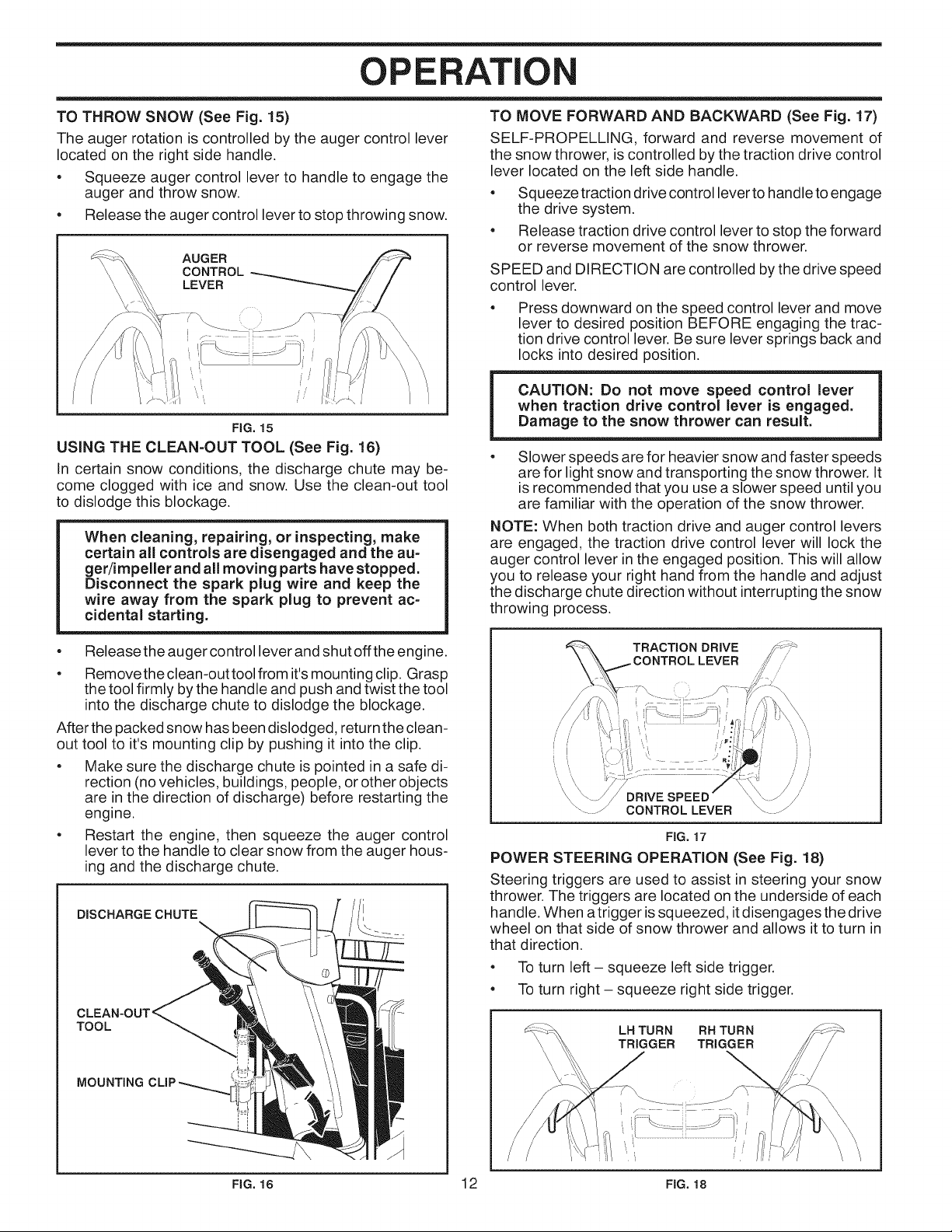
TO THROW SNOW (See Fig. 15)
The auger rotation is controlled by the auger control lever
located on the right side handle.
• Squeeze auger control lever to handle to engage the
auger and throw snow.
• Release the auger control lever to stop throwing snow.
AUGER
CONTROL
LEVER
FIG. 15
USING THE CLEAN-OUT TOOL (See Fig. 16)
In certain snow conditions, the discharge chute may be-
come clogged with ice and snow. Use the clean-out tool
to dislodge this blockage.
When cleaning, repairing, or inspecting, make
certain all controls are disengaged and the au-
ger/impeller and all moving parts have stopped.
Disconnect the spark plug wire and keep the
wire away from the spark plug to prevent ac-
cidental starting.
TO MOVE FORWARD AND BACKWARD (See Fig. 17)
SELF-PROPELLING, forward and reverse movement of
the snow thrower, is controlled by the traction drive control
lever located on the left side handle.
• Squeeze traction drive control lever to handleto engage
the drive system.
• Release traction drive control lever to stop the forward
or reverse movement of the snow thrower.
SPEED and DIRECTION are controlled by the drive speed
control lever.
Press downward on the speed control lever and move
lever to desired position BEFORE engaging the trac-
tion drive control lever. Be sure lever springs back and
locks into desired position.
CAUTION: Do not move speed control lever
when traction drive control lever is engaged.
Damage to the snow thrower can result.
• Slower speeds are for heavier snow and faster speeds
are for light snow and transporting the snow thrower. It
is recommended that you use a slower speed until you
are familiar with the operation of the snow thrower.
NOTE: When both traction drive and auger control levers
are engaged, the traction drive control lever will lock the
auger control lever in the engaged position. This will allow
you to release your right hand from the handle and adjust
the discharge chute direction without interrupting the snow
throwing 3rocess.
e
e
Release the auger control lever and shut offthe engine.
Removethe clean-out tool from it's mounting clip. Grasp
the tool firmly by the handle and push and twist the tool
into the discharge chute to dislodge the blockage.
After the packed snow has been dislodged, return the clean-
out tool to it's mounting clip by pushing it into the clip.
• Make sure the discharge chute is pointed in a safe di-
rection (no vehicles, buildings, people, or other objects
are in the direction of discharge) before restarting the
engine.
• Restart the engine, then squeeze the auger control
lever to the handle to clear snow from the auger hous-
ing and the discharge chute.
DISCHARGECHUTE
\
CLEAN-OUT<,_
TOOL
MOUNTING
TRACTION DRIVE
_LLEVER
/ /
i
DRIVE S
CONTROL LEVER
FIG. 17
POWER STEERING OPERATION (See Fig. 18)
Steering triggers are used to assist in steering your snow
thrower, The triggers are located on the underside of each
handle. When atrigger is squeezed, it disengages the drive
wheel on that side of snow thrower and allows it to turn in
that direction.
• To turn left - squeeze left side trigger,
• To turn right - squeeze right side trigger.
LH TURN RH TURN
TRIGGER TRIGGER
FIG. 16 12 FIG. 18
OPE 0
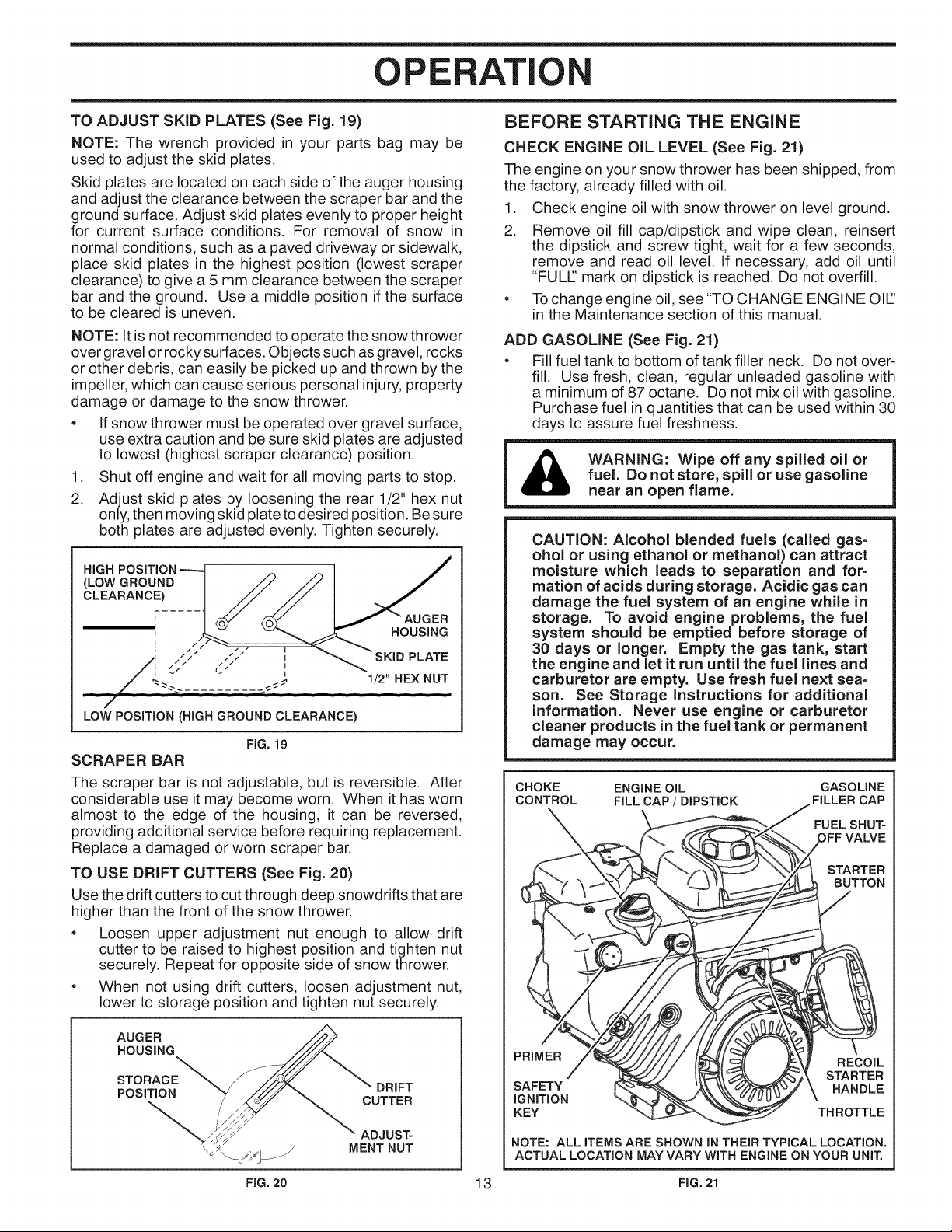
TO ADJUST SKID PLATES (See Fig. 19)
NOTE: The wrench provided in your parts bag may be
used to adjust the skid plates.
Skid plates are located on each side of the auger housing
and adjust the clearance between the scraper bar and the
ground surface. Adjust skid plates evenly to proper height
for current surface conditions. For removal of snow in
normal conditions, such as a paved driveway or sidewalk,
place skid plates in the highest position (lowest scraper
clearance) to give a 5 mm clearance between the scraper
bar and the ground, Use a middle position if the surface
to be cleared is uneven.
NOTE: It is not recommended to operate the snow thrower
over gravel or rocky surfaces. Objects such as gravel, rocks
or other debris, can easily be picked up and thrown by the
impeller, which can cause serious personal injury, property
damage or damage to the snow thrower.
• If snow thrower must be operated over gravel surface,
use extra caution and be sure skid plates are adjusted
to lowest (highest scraper clearance) position.
1. Shut off engine and wait for all moving parts to stop.
2. Adjust skid plates by loosening the rear 1/2" hex nut
only, then moving skid plate to desired position. Be sure
both plates are adjusted evenly. Tighten securely.
HIGH POSITION
(LOW GROUND
CLEARANCE)
I
HOUSING
I
I /
.. _......... __ _ 1/2"_ HEX NUT
/
LOW POSITION (HIGH GROUND CLEARANCE)
FIG. 19
SCRAPER BAR
The scraper bar is not adjustable, but is reversible. After
considerable use it may become worn. When it has worn
almost to the edge of the housing, it can be reversed,
providing additional service before requiring replacement.
Replace a damaged or worn scraper bar.
TO USE DRIFT CUTTERS (See Fig. 20)
Use the drift cutters to cut through deep snowdrifts that are
higher than the front of the snow thrower.
• Loosen upper adjustment nut enough to allow drift
cutter to be raised to highest position and tighten nut
securely. Repeat for opposite side of snow thrower.
• When not using drift cutters, loosen adjustment nut,
lower to storage position and tighten nut securely.
AUGER
HOUSING
STORAGE DRIFT
POSITION CUTTER
ADJUST-
\_; MENT NUT
BEFORE STARTING THE ENGINE
CHECK ENGINE OIL LEVEL (See Fig. 21)
The engine on your snow thrower has been shipped, from
the factory, already filled with oil.
1. Check engine oil with snow thrower on level ground.
2. Remove oil fill cap!dipstick and wipe clean, reinsert
the dipstick and screw tight, wait for a few seconds,
remove and read oil level. If necessary, add oil until
"FUL[L' mark on dipstick is reached. Do not overfill.
• To change engine oil, see "TO CHANGE ENGINE OIE'
in the Maintenance section of this manual.
ADD GASOLINE (See Fig. 21)
• Fill fuel tank to bottom of tank filler neck. Do not over-
fill. Use fresh, clean, regular unleaded gasoline with
a minimum of 87 octane. Do not mix oil with gasoline.
Purchase fuel in quantities that can be used within 30
days to assure fuel freshness.
i ,_ WARNING: Wipe off any spilled oil or
fuel. Do not store, spill or use gasoline
near an open flame.
CAUTION: Alcohol blended fuels (called gas-
ohol or using ethanol or methanol) can attract
moisture which leads to separation and for-
mation of acids during storage. Acidic gas can
damage the fuel system of an engine while in
storage. To avoid engine problems, the fuel
system should be emptied before storage of
30 days or longer. Empty the gas tank, start
the engine and let it run until the fuel lines and
carburetor are empty. Use fresh fuel next sea-
son. See Storage Instructions for additional
information. Never use engine or carburetor
cleaner products in the fuel tank or permanent
damage may occur.
CHOKE ENGINE OIL GASOLINE
CONTROL FILL CAP / DIPSTICK FILLER CAP
FUEL SHUT-
_FF VALVE
STARTER
BUTTON
PRIMER
SAFETY
IGNITION
KEY
RECOIL
STARTER
HANDLE
THROTTLE
NOTE: ALL ITEMS ARE SHOWN IN THEIR TYPICAL LOCATION.
ACTUAL LOCATION MAY VARY WITH ENGINE ON YOUR UNIT.
FIG. 20 13 FIG. 21
OPERATIC
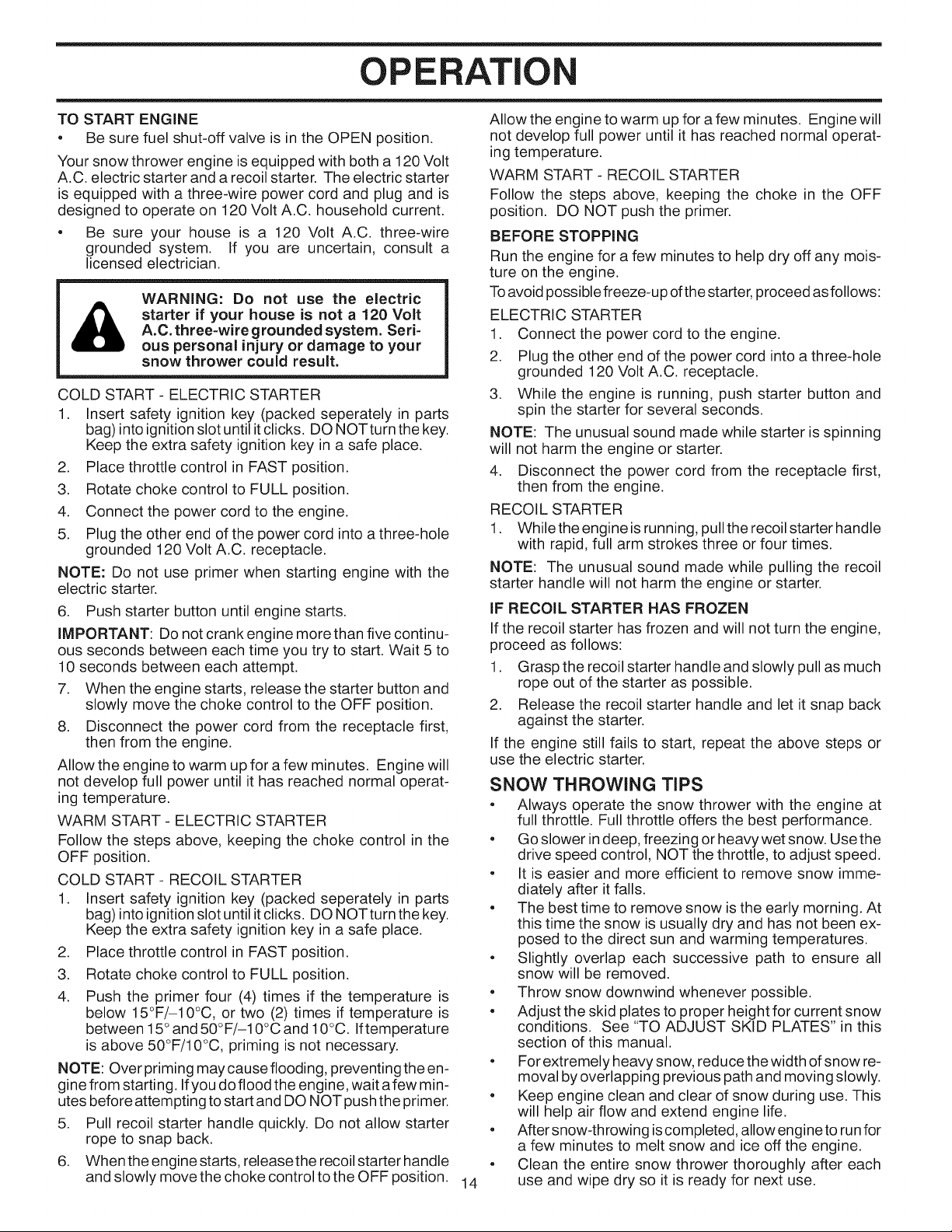
TO START ENGINE
• Be sure fuel shut-off valve is in the OPEN position.
Your snow thrower engine is equipped with both a 120 Volt
A.C. electric starter and a recoil starter. The electric starter
is equipped with a three-wire power cord and plug and is
designed to operate on 120 Volt A.C. household current.
• Be sure your house is a 120 Volt A.C. three-wire
grounded system. If you are uncertain, consult a
licensed electrician.
&
WARNING: Do not use the electric
starter if your house is not a 120 Volt
A.C. three-wire grounded system. Seri-
ous personal injury or damage to your
snow thrower could result.
COLD START - ELECTRIC STARTER
1. Insert safety ignition key (packed seperately in parts
bag) into ignition slot until it clicks. DO NOTturn the key.
Keep the extra safety ignition key in a safe place.
2. Place throttle control in FAST position.
3. Rotate choke control to FULL position.
4. Connect the power cord to the engine.
5. Plug the other end of the power cord into a three-hole
grounded 120 Volt A.C. receptacle.
NOTE: Do not use primer when starting engine with the
electric starter.
6. Push starter button until engine starts.
IMPORTANT: Do not crank engine morethan five continu-
ous seconds between each time you try to start. Wait 5 to
10 seconds between each attempt.
7. When the engine starts, release the starter button and
slowly move the choke control to the OFF position.
8. Disconnect the power cord from the receptacle first,
then from the engine.
Allow the engine to warm up for a few minutes. Engine will
not develop full power until it has reached normal operat-
ing temperature.
WARM START - ELECTRIC STARTER
Follow the steps above, keeping the choke control in the
OFF position.
COLD START - RECOIL STARTER
1. Insert safety ignition key (packed seperately in parts
bag) into ignition slot until it clicks. DO NOTturn the key.
Keep the extra safety ignition key in a safe place.
2. Place throttle control in FAST position.
3. Rotate choke control to FULL position.
4. Push the primer four (4) times if the temperature is
below 15°F/-10°C, or two (2) times if temperature is
between 15° and 50°F/-10°C and 10°C. Iftemperature
is above 50°F/10°C, priming is not necessary.
NOTE: Over priming may cause flooding, preventing the en-
gine from starting. If you do flood the engine, wait afew min-
utes before attempting to start and DO NOT push the primer.
5. Pull recoil starter handle quickly. Do not allow starter
rope to snap back.
6. When the engine starts, releasethe recoil starter handle
and slowly move the choke control to the OFF position.
14
Allow the engine to warm up for a few minutes. Engine will
not develop full power until it has reached normal operat-
ing temperature.
WARM START - RECOIL STARTER
Follow the steps above, keeping the choke in the OFF
position. DO NOT push the primer.
BEFORE STOPPING
Run the engine for a few minutes to help dry off any mois-
ture on the engine.
To avoid possible freeze-up ofthe starter, proceed as follows:
ELECTRIC STARTER
1. Connect the power cord to the engine.
2. Plug the other end of the power cord into a three-hole
grounded 120 Volt A.C. receptacle.
3. While the engine is running, push starter button and
spin the starter for several seconds.
NOTE: The unusual sound made while starter is spinning
will not harm the engine or starter.
4. Disconnect the power cord from the receptacle first,
then from the engine.
RECOIL STARTER
1. Whilethe engine is running, pull the recoil starter handle
with rapid, full arm strokes three or four times.
NOTE: The unusual sound made while pulling the recoil
starter handle will not harm the engine or starter.
IF RECOIL STARTER HAS FROZEN
If the recoil starter has frozen and will not turn the engine,
proceed as follows:
1. Grasp the recoil starter handle and slowly pull as much
rope out of the starter as possible.
2. Release the recoil starter handle and let it snap back
against the starter.
If the engine still fails to start, repeat the above steps or
use the electric starter.
SNOW THROWING TiPS
• Always operate the snow thrower with the eng=ne at
full throttle. Full throttle offers the best performance.
• Go slower in deep, freezing or heavy wet snow. Usethe
drive speed control, NOT the throttle, to adjust speed.
• It is easier and more efficient to remove snow imme-
diately after it falls.
• The best time to remove snow is the early morning. At
this time the snow is usually dry and has not been ex-
posed to the direct sun and warming temperatures.
• Slightly overlap each successive path to ensure all
snow will be removed.
• Throw snow downwind whenever possible.
• Adjust the skid plates to proper height for current snow
conditions. See "TO ADJUST SKID PLATES" in this
section of this manual.
• For extremely heavy snow, reduce the width of snow re-
moval by overlapping previous path and moving slowly.
• Keep engine clean and clear of snow during use. This
will help air flow and extend engine life.
• After snow-throwing is completed, allow engineto run for
a few minutes to melt snow and ice off the engine.
• Clean the entire snow thrower thoroughly after each
use and wipe dry so it is ready for next use.
&
snow thrower.
AINTE E
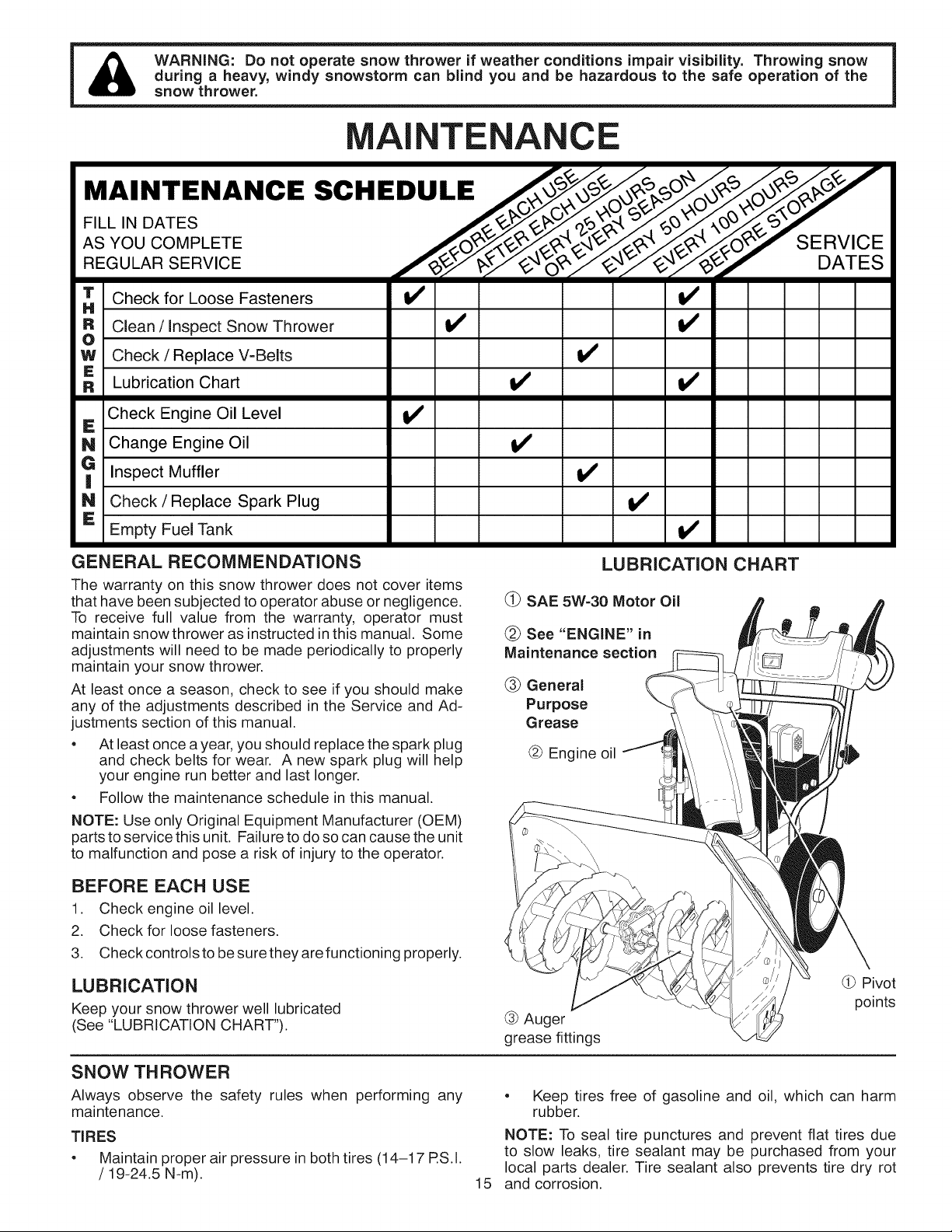
MAINTENANCE
FILL IN DATES
AS YOU COMPLETE
REGULAR SERVICE
Check for Loose Fasteners
R Clean / Inspect Snow Thrower
O
W Check/Replace V-Belts
RE Lubrication Chart
v'
v'
Check Engine Oil Level
E
N Change Engine Oil
Inspect Muffler
N Check / Replace Spark Plug
E
Empty Fuel Tank
i/
i/
i/
GENERAL RECOMMENDATIONS
The warranty on this snow thrower does not cover items
that have been subjected to operator abuse or negligence.
To receive full value from the warranty, operator must
maintain snow thrower as instructed in this manual. Some
adjustments will need to be made periodically to properly
maintain your snow thrower.
At least once a season, check to see if you should make
any of the adjustments described in the Service and Ad-
justments section of this manual.
• At least once a year, you should replace the spark plug
and check belts for wear. A new spark plug will help
your engine run better and last longer.
• Follow the maintenance schedule in this manual.
NOTE: Use only Original Equipment Manufacturer (OEM)
parts to service this unit. Failure to do so can cause the unit
to malfunction and pose a risk of injury to the operator.
LUBRiCATiON CHART
(_ SAE 5W-30 Motor Oil
@ See "ENGINE" in
Maintenance section
(_ General
Purpose
Grease
@ Engine oil
BEFORE EACH USE
1. Check engine oil level.
2. Check for loose fasteners.
3. Checkcontrolsto besuretheyarefunctioning properly.
LUBRiCATiON
Keep your snow thrower well lubricated
(See "LUBRICATION CHART").
(_ Auger
grease fittings
(_ Pivot
points
SNOW THROWER
Always observe the safety rules when performing any
maintenance.
TIRES
• Maintain proper air pressure in both tires (14-17 P.S.I.
/ 19-24.5 N-m).
15
• Keep tires free of gasoline and oil, which can harm
rubber.
NOTE: To seal tire punctures and prevent flat tires due
to slow leaks, tire sealant may be purchased from your
local parts dealer. Tire sealant also prevents tire dry rot
and corrosion.
I CE
V-BELTS TO CHANGE ENGINE OIL
Check V-belts for deterioration and wear after every 50
hours of operation and replace if necessary. The belts
are not adjustable. Replace belts if they begin to slip from
wear. (See "TO REMOVE BELT COVER" in the Service
and Adjustments section of this manual).
The V-belts on your snow thrower are ofspecial construction
and should be replaced by original equipment manufacturer
(OEM) belts available from your nearest dealer. Using other
than OEM belts can cause personal injury or damage to
the snow thrower.
AUGER GEAR CASE
The gear case was filled with lubricant to the proper
level at the factory. The only time the lubricant needs
attention is if service has been performed on the gear
case.
• If lubricant is required, use only Ronex ED #1 grease.
TRACTION DRIVE SYSTEM
DO NOT lubricate the drive components inside the snow
thrower. The sprockets, hex shafts, drive disc and friction
wheel require no lubrication. The bearings and bushings
are lifetime lubricated and require no maintenance.
CAUTION: Any lubricating of the above compo-
nents can cause contamination of the friction
wheel and damage to the drive system of your
snow thrower.
ENGINE
LUBRICATION
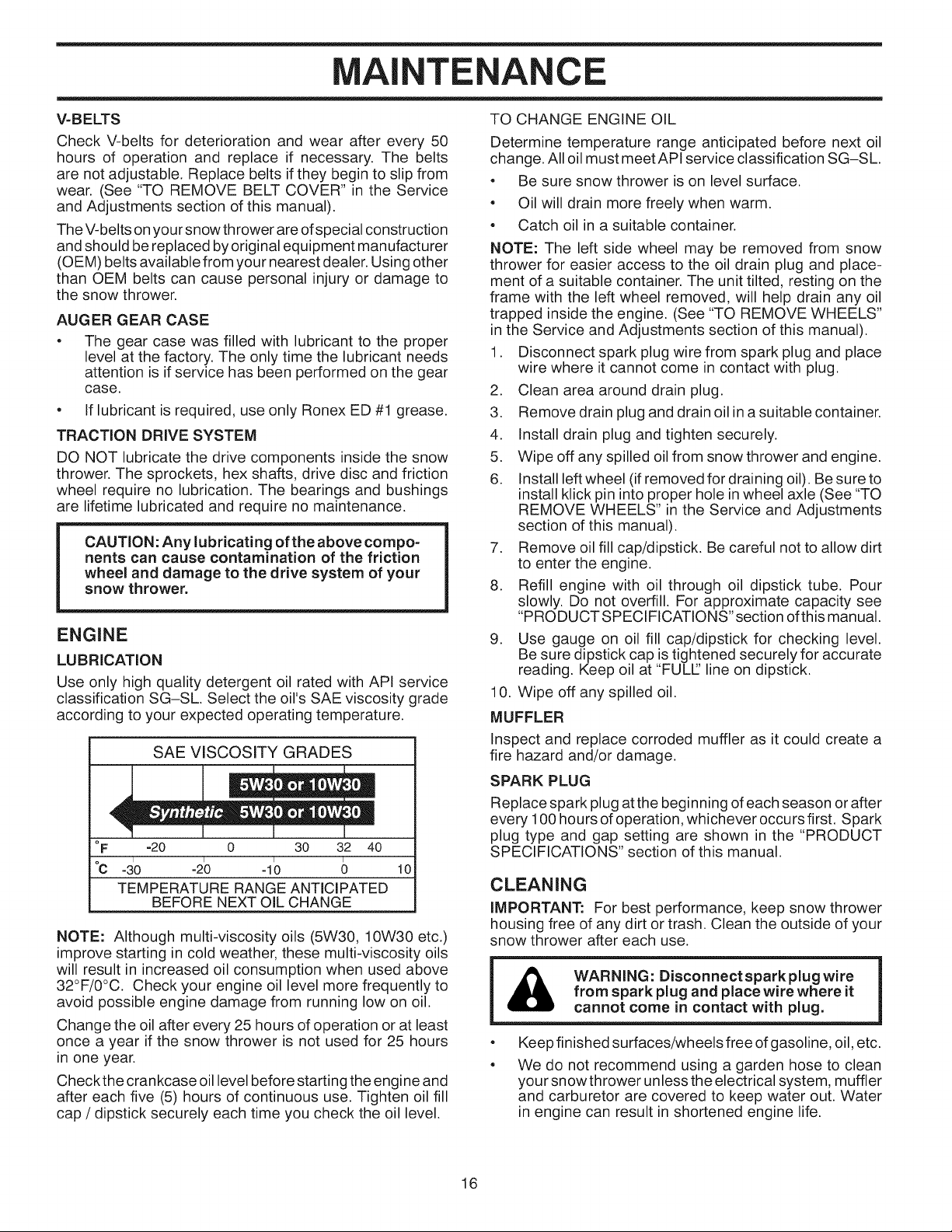
Use only high quality detergent oil rated with API service
classification SG-SL. Select the oil's SAE viscosity grade
according to your expected operating temperature.
SAE ViSCOSiTY GRADES
I I
°F -20 0 30 32 40
°C -3'0 -2'0 -10 0 10
TEMPERATURE RANGE ANTICIPATED
BEFORE NEXT OiL CHANGE
NOTE: Although multi-viscosity oils (5W30, 10W30 etc.)
improve starting in cold weather, these multi-viscosity oils
will result in increased oil consumption when used above
32°F/0°C. Check your engine oil level more frequently to
avoid possible engine damage from running low on oil.
Change the oil after every 25 hours of operation or at least
once a year if the snow thrower is not used for 25 hours
in one year.
Checkthe crankcase oil level before starting the engine and
after each five (5) hours of continuous use. Tighten oil fill
cap / dipstick securely each time you check the oil level.
Determine temperature range anticipated before next oil
change. All oil must meet API service classification SG-SL.
• Be sure snow thrower is on level surface.
• Oil will drain more freely when warm.
• Catch oil in a suitable container.
NOTE: The left side wheel may be removed from snow
thrower for easier access to the oil drain plug and place-
ment of a suitable container. The unit tilted, resting on the
frame with the left wheel removed, will help drain any oil
trapped inside the engine. (See "TO REMOVE WHEELS"
in the Service and Adjustments section of this manual).
1. Disconnect spark plug wire from spark plug and place
wire where it cannot come in contact with plug.
2. Clean area around drain plug.
3. Remove drain plug and drain oil in a suitable container.
4. Install drain plug and tighten securely.
5. Wipe off any spilled oil from snow thrower and engine.
6. Install leftwheel (if removed for draining oil). Besureto
install klick pin into proper hole in wheel axle (See "TO
REMOVE WHEELS" in the Service and Adjustments
section of this manual).
7. Remove oil fill cap!dipstick. Be careful not to allow dirt
to enter the engine.
8. Refill engine with oil through oil dipstick tube. Pour
slowly. Do not overfill. For approximate capacity see
"PRODUCT SPECIFICATIONS"section ofthis manual.
9. Use gauge on oil fill cap!dipstick for checking level.
Be sure dipstick cap is tightened securely for accurate
reading. Keep oil at "FULl" line on dipstick.
10. Wipe off any spilled oil.
MUFFLER
Inspect and replace corroded muffler as it could create a
fire hazard and!or damage.
SPARK PLUG
Replace spark plug atthe beginning of each season or after
every 100 hours of operation, whichever occurs first. Spark
plug type and gap setting are shown in the "PRODUCT
SPECIFICATIONS" section of this manual.
CLEANING
IMPORTANT: For best performance, keep snow thrower
housing free of any dirt or trash. Clean the outside of your
snow thrower after each use.
WARNING: Disconnectsparkplugwire
from spark plug and place wire where it
cannot come in contact with plug.
e
e
Keep finished surfaces!wheels free of gasoline, oil, etc.
We do not recommend using a garden hose to clean
your snowthrower unless the electrical system, muffler
and carburetor are covered to keep water out. Water
in engine can result in shortened engine life.
16
SERVICE A JUSTMENTS
WARNING: To avoid serious injury, before
performing any service or adjustments:
1. Be sure throttle is in STOP position.
&
2. Remove safety ignition key.
3. Make sure the augers and all moving
parts have completely stopped.
4. Disconnect spark plug wire from
spark plug and place wire where it
cannot come in contact with plug.
SNOW THROWER
TO ADJUST SNOW THROWER HEIGHT
See "TO ADJUST SKID PLATES" and "SCRAPER BAR"
in the Operation section of this manual.
CHUTE DEFLECTOR
The chute deflector, attached to the top of the discharge
chute, is provided to direct discharging snow away from
the operator, If the deflector becomes damaged, it should
be replaced.
WARNING: To avoid serious injury,
never operate your snow thrower with
the deflector removed or damaged.
* To change direction and!or distance snow is discharged,
see "TO CONTROL SNOW DISCHARGE" in the Op-
eration section of this manual.
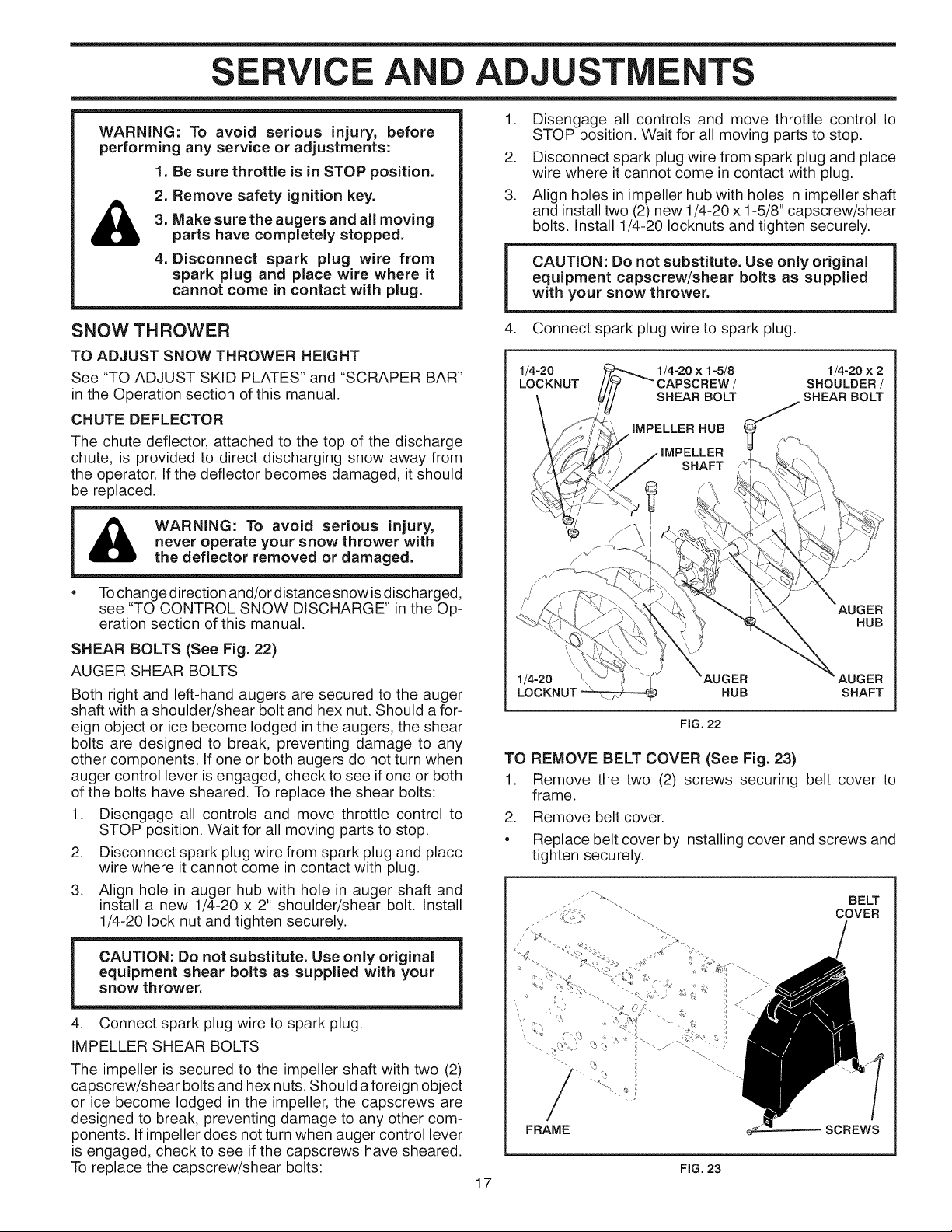
SHEAR BOLTS (See Fig. 22)
AUGER SHEAR BOLTS
Both right and left-hand augers are secured to the auger
shaft with a shoulder/shear bolt and hex nut. Should a for-
eign object or ice become lodged in the augers, the shear
bolts are designed to break, preventing damage to any
other components. If one or both augers do not turn when
auger control lever is engaged, check to see if one or both
of the bolts have sheared. To replace the shear bolts:
1. Disengage all controls and move throttle control to
STOP position. Wait for all moving parts to stop.
2. Disconnect spark plug wire from spark plug and place
wire where it cannot come in contact with plug.
3. Align hole in auger hub with hole in auger shaft and
install a new 1/4-20 x 2" shoulder/shear bolt. Install
1/4-20 lock nut and tighten securely.
CAUTION: Do not substitute. Use only original
equipment shear bolts as supplied with your
snow thrower.
4. Connect spark plug wire to spark plug.
IMPELLER SHEAR BOLTS
The impeller is secured to the impeller shaft with two (2)
capscrew/shear bolts and hex nuts. Should a foreign object
or ice become lodged in the impeller, the capscrews are
designed to break, preventing damage to any other com-
ponents. If impeller does not turn when auger control lever
is engaged, check to see if the capscrews have sheared.
To replace the capscrew/shear bolts:
17
1. Disengage all controls and move throttle control to
STOP position. Wait for all moving parts to stop.
2. Disconnect spark plug wire from spark plug and place
wire where it cannot come in contact with plug.
3. Align holes in impeller hub with holes in impeller shaft
and install two (2) new 1/4-20 x 1-5/8" capscrew/shear
bolts. Install 1/4-20 Iocknuts and tighten securely.
CAUTION: Do not substitute. Use only original
equipment capscrew/shear bolts as supplied
with your snow thrower.
4. Connect spark plug wire to spark plug.
1/4-20 1/4-20 x 1-5/8 1/4-20 x 2
LOCKNUT CAPSCREW / SHOULDER /
SHEAR BOLT SHEAR BOLT
iMPELLER HUB _
SHAFT
AUGER
HUB
,\
1/4-20 \ AUGER AUGER
HUB SHAFT
FiG. 22
TO REMOVE BELT COVER (See Fig. 23)
1. Remove the two (2) screws securing belt cover to
frame.
2. Remove belt cover.
* Replace belt cover by installing cover and screws and
tighten securely.
-"" "_ BELT
"" COVER
FRAME SCREWS
FiG. 23
E ViCE A ADJ STMENTS
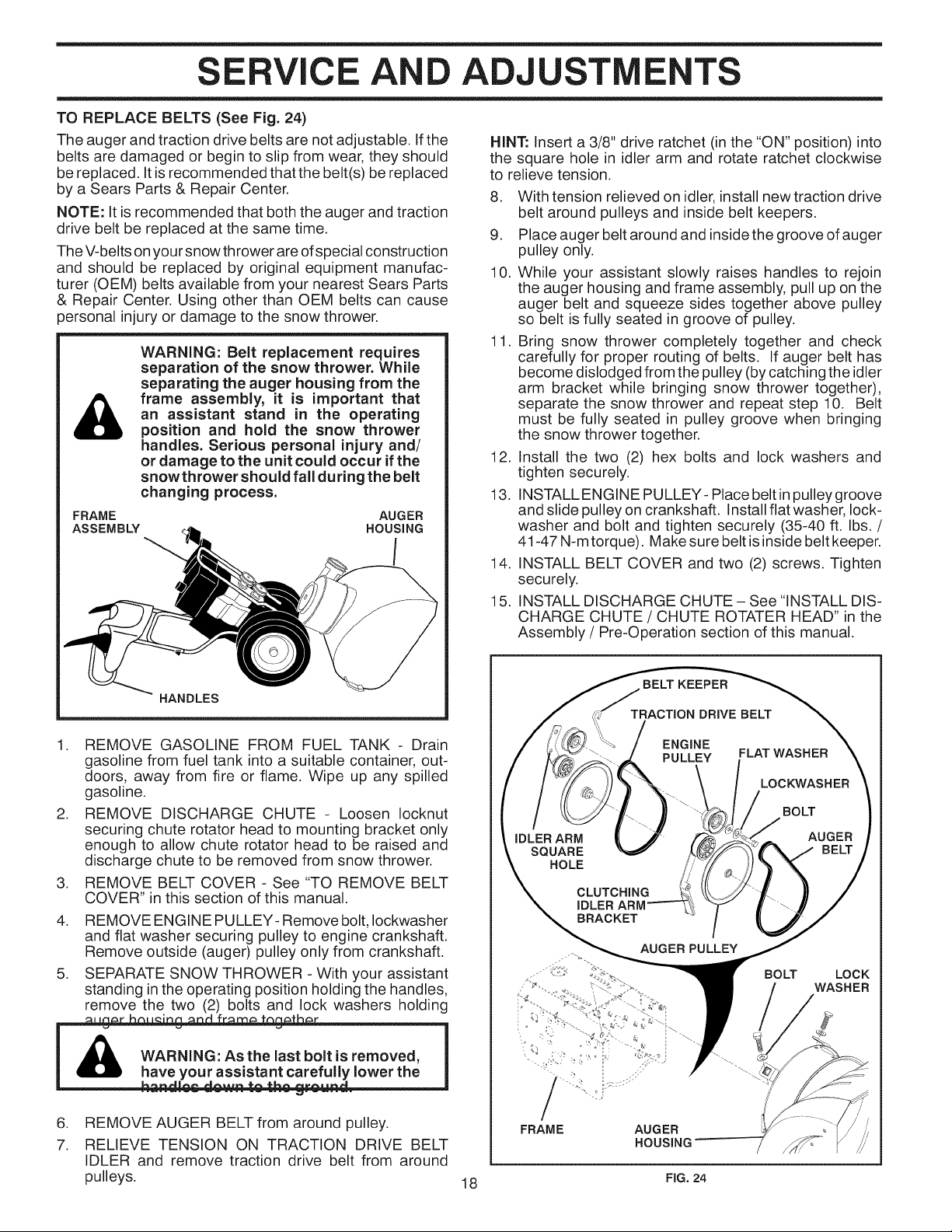
TO REPLACE BELTS (See Fig. 24)
The auger and traction drive belts are not adjustable. If the
belts are damaged or begin to slip from wear, they should
be replaced. It is recommended thatthe belt(s) be replaced
by a Sears Parts & Repair Center.
NOTE: It is recommended that both the auger and traction
drive belt be replaced at the same time.
The V-belts on your snow thrower are ofspecial construction
and should be replaced by original equipment manufac-
turer (OEM) belts available from your nearest Sears Parts
& Repair Center. Using other than OEM belts can cause
_ersonal injury or damage to the snow thrower.
&
WARNING: Belt replacement requires
separation of the snow thrower. While
separating the auger housing from the
frame assembly, it is important that
an assistant stand in the operating
position and hold the snow thrower
handles. Serious personal injury and/
or damage to the unit could occur if the
snowthrower should fall during the belt
changing process.
FRAME
ASSEMBLY
AUGER
HOUSING
HANDLES
1. REMOVE GASOLINE FROM FUEL TANK - Drain
gasoline from fuel tank into a suitable container, out-
doors, away from fire or flame. Wipe up any spilled
gasoline.
2. REMOVE DISCHARGE CHUTE - Loosen Iocknut
securing chute rotator head to mounting bracket only
enough to allow chute rotator head to be raised and
discharge chute to be removed from snow thrower.
3. REMOVE BELT COVER - See "TO REMOVE BELT
COVER" in this section of this manual.
4. REMOVE ENGINE PULLEY- Remove bolt, Iockwasher
and flat washer securing pulley to engine crankshaft.
Remove outside (auger) pulley only from crankshaft.
5. SEPARATE SNOW THROWER - With your assistant
standing in the operating position holding the handles,
remove the two (2) bolts and lock washers holding
_ WARNING: As the last bolt is removed, I
have your assistant carefully lower the |
J
.
7.
REMOVE AUGER BELT from around pulley.
RELIEVE TENSION ON TRACTION DRIVE BELT
IDLER and remove traction drive belt from around
pulleys.
HINT: Insert a 3/8" drive ratchet (in the "ON" position) into
the square hole in idler arm and rotate ratchet clockwise
to relieve tension.
8. With tension relieved on idler, install new traction drive
belt around pulleys and inside belt keepers.
9. Place auger belt around and inside the groove of auger
pulley only.
10. While your assistant slowly raises handles to rejoin
the auger housing and frame assembly, pull up on the
auger belt and squeeze sides together above pulley
so belt is fully seated in groove of pulley.
11. Bring snow thrower completely together and check
carefully for proper routing of belts. If auger belt has
become dislodged from the pulley (by catching the idler
arm bracket while bringing snow thrower together),
separate the snow thrower and repeat step 10. Belt
must be fully seated in pulley groove when bringing
the snow thrower together.
12. Install the two (2) hex bolts and lock washers and
tighten securely.
13. INSTALL ENGINE PULLEY- Place belt in pulley groove
and slide pulley on crankshaft. Install flat washer, lock-
washer and bolt and tighten securely (35-40 ft. Ibs. /
41-47 N-m torque). Make sure belt is inside belt keeper.
14. INSTALL BELT COVER and two (2) screws. Tighten
securely.
15. INSTALL DISCHARGE CHUTE - See "INSTALL DIS-
CHARGE CHUTE / CHUTE ROTATER HEAD" in the
Assembly / Pre-Operation section of this manual.
HOLE
BELT
FRAME AUGER
HOUSING
BO_ LOCK
WASHER
18 FiG.24
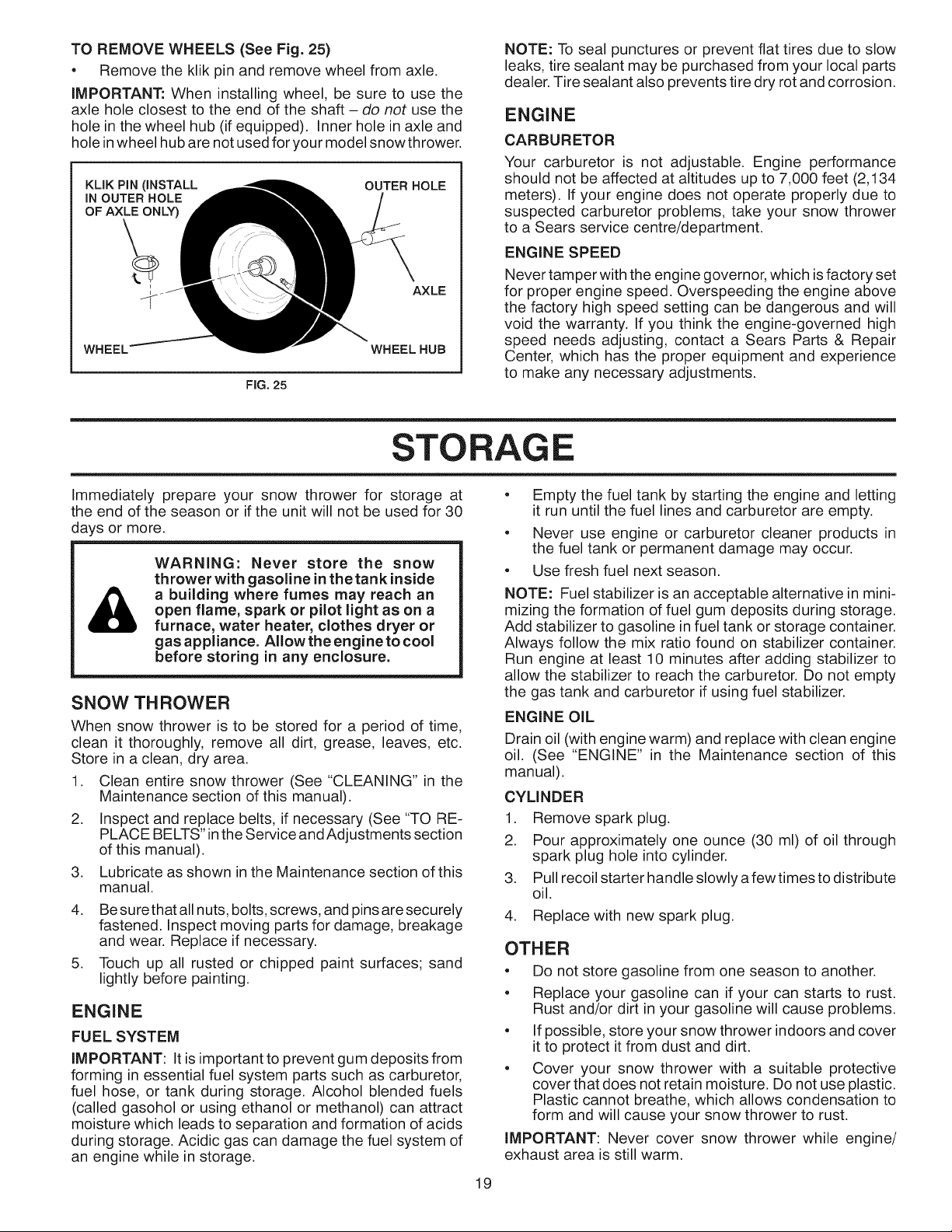
TOREMOVEWHEELS(SeeFig.25)
• Removetheklikpinandremovewheelfromaxle.
IMPORTANT:Wheninstallingwheel,besureto usethe
axleholeclosesttotheendoftheshaft- do not use the
hole in the wheel hub (if equipped), Inner hole in axle and
hole in wheel hub are not used for your model snow thrower.
KLIK PIN (INSTALL
IN OUTER HOLE
OF AXLE ONLY)
OUTER HOLE
AXLE
WHEEL
WHEEL HUB
FIG. 25
NOTE: To seal punctures or prevent flat tires due to slow
leaks, tire sealant may be purchased from your local parts
dealer. Tire sealant also prevents tire dry rot and corrosion.
ENGINE
CARBURETOR
Your carburetor is not adjustable. Engine performance
should not be affected at altitudes up to 7,000 feet (2,134
meters). If your engine does not operate properly due to
suspected carburetor problems, take your snow thrower
to a Sears service centre/department.
ENGINE SPEED
Never tamper with the engine governor, which is factory set
for proper engine speed. Overspeeding the engine above
the factory high speed setting can be dangerous and will
void the warranty. If you think the engine-governed high
speed needs adjusting, contact a Sears Parts & Repair
Center, which has the proper equipment and experience
to make any necessary adjustments.
STORAGE
Immediately prepare your snow thrower for storage at
the end of the season or if the unit will not be used for 30
days or more.
&
WARNING: Never store the snow
thrower with gasoline inthetank inside
a building where fumes may reach an
open flame, spark or pilot light as on a
furnace, water heater, clothes dryer or
gas appliance. Allow the engineto cool
before storing in any enclosure.
SNOW THROWER
.
4.
When snow thrower is to be stored for a period of time,
clean it thoroughly, remove all dirt, grease, leaves, etc.
Store in a clean, dry area.
1. Clean entire snow thrower (See "CLEANING" in the
Maintenance section of this manual).
2. Inspect and replace belts, if necessary (See "TO RE-
PLACE BELTS" in the Service and Adjustments section
of this manual).
Lubricate as shown in the Maintenance section of this
manual.
.
Besurethat all nuts, bolts, screws, and pins aresecurely
fastened. Inspect moving parts for damage, breakage
and wear. Replace if necessary.
Touch up all rusted or chipped paint surfaces; sand
lightly before painting.
ENGINE
FUEL SYSTEM
IMPORTANT: It is important to prevent gum deposits from
forming in essential fuel system parts such as carburetor,
fuel hose, or tank during storage. Alcohol blended fuels
(called gasohol or using ethanol or methanol) can attract
moisture which leads to separation and formation of acids
during storage. Acidic gas can damage the fuel system of
an engine while in storage.
• Empty the fuel tank by starting the engine and letting
it run until the fuel lines and carburetor are empty.
• Never use engine or carburetor cleaner products in
the fuel tank or permanent damage may occur.
• Use fresh fuel next season.
NOTE: Fuel stabilizer is an acceptable alternative in mini-
mizing the formation of fuel gum deposits during storage.
Add stabilizer to gasoline in fuel tank or storage container.
Always follow the mix ratio found on stabilizer container.
Run engine at least 10 minutes after adding stabilizer to
allow the stabilizer to reach the carburetor. Do not empty
the gas tank and carburetor if using fuel stabilizer.
ENGINE OIL
Drain oil (with engine warm) and replace with clean engine
oil. (See "ENGINE" in the Maintenance section of this
manual).
CYLINDER
1. Remove spark plug.
2. Pour approximately one ounce (30 ml) of oil through
spark plug hole into cylinder.
3. Pull recoil starter handle slowly a fewtimes to distribute
oil.
4. Replace with new spark plug.
OTHER
• Do not store gasoline from one season to another.
• Replace your gasoline can if your can starts to rust.
Rust and/or dirt in your gasoline will cause problems.
• If possible, store your snow thrower indoors and cover
it to protect it from dust and dirt.
• Cover your snow thrower with a suitable protective
cover that does not retain moisture. Do not use plastic.
Plastic cannot breathe, which allows condensation to
form and will cause your snow thrower to rust.
IMPORTANT: Never cover snow thrower while engine/
exhaust area is still warm.
19
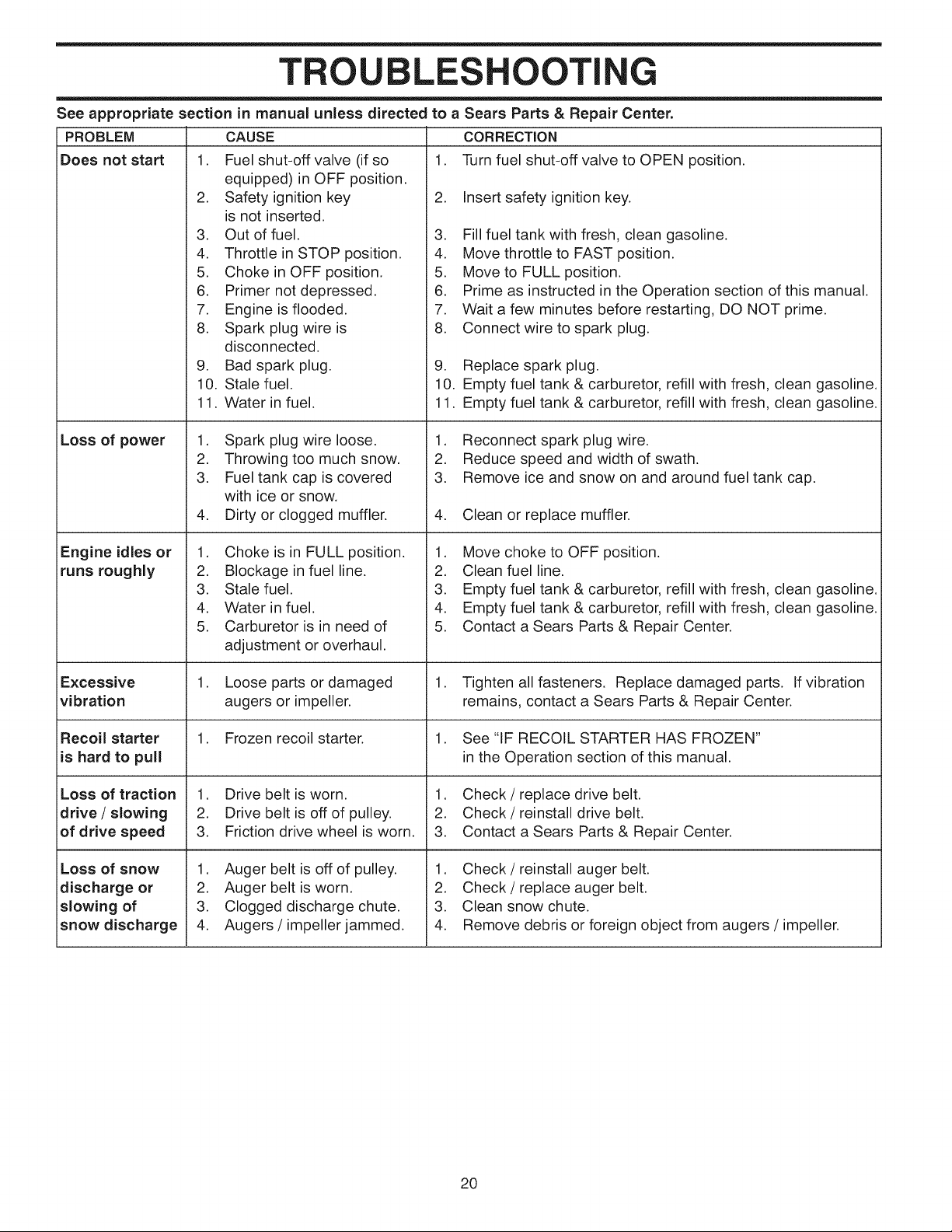
TROUBLESHOOTi G
to
See appropriate section in manual unless directed
PROBLEM CAUSE
Does not start 1.
JLoss of power
Engine idles or
runs roughly
Excessive
vibration
RecoiJ starter
jis hard to pull
Loss of traction
drive / slowing
iof drive speed
Loss of snow
discharge or
jslowing of
Jsnow discharge
Fuel shut-off valve (if so
equipped) in OFF position.
2. Safety ignition key
is not inserted.
3. Out of fuel.
4. Throttle in STOP position.
5. Choke in OFF position.
6. Primer not depressed.
7. Engine is flooded.
8. Spark plug wire is
disconnected.
9. Bad spark plug.
10. Stale fuel.
11. Water in fuel.
1. Spark plug wire loose.
2. Throwing too much snow.
3. Fuel tank cap is covered
with ice or snow.
4. Dirty or clogged muffler.
1. Choke is in FULL position.
2. Blockage in fuel line.
3. Stale fuel.
4. Water in fuel.
5. Carburetor is in need of
adjustment or overhaul.
.
Loose parts or damaged
augers or impeller.
1. Frozen recoil starter.
1. Drive belt is worn.
2. Drive belt is off of pulley.
3. Friction drive wheel is worn.
1. Auger belt is off of pulley.
2. Auger belt is worn.
3. Clogged discharge chute.
4. Augers / impeller jammed.
.
a Sears Parts & Repair Center.
CORRECTION
Turn fuel shut-off valve to OPEN position.
2. Insert safety ignition key.
3. Fill fuel tank with fresh, clean gasoline.
4. Move throttle to FAST position.
5. Move to FULL position.
6. Prime as instructed in the Operation section of this manual.
7. Wait a few minutes before restarting, DO NOT prime.
8. Connect wire to spark plug.
9. Replace spark plug.
10. Empty fuel tank & carburetor, refill with fresh, clean gasoline.
11. Empty fuel tank & carburetor, refill with fresh, clean gasoline.
1. Reconnect spark plug wire.
2. Reduce speed and width of swath.
3. Remove ice and snow on and around fuel tank cap.
4. Clean or replace muffler.
1. Move choke to OFF position.
2. Clean fuel line.
3. Empty fuel tank & carburetor, refill with fresh, clean gasoline.
4. Empty fuel tank & carburetor, refill with fresh, clean gasoline.
5. Contact a Sears Parts & Repair Center.
1. Tighten all fasteners. Replace damaged parts. If vibration
remains, contact a Sears Parts & Repair Center.
1. See "IF RECOIL STARTER HAS FROZEN"
in the Operation section of this manual.
1. Check/replace drive belt.
2. Check / reinstall drive belt.
3. Contact a Sears Parts & Repair Center.
1. Check / reinstall auger belt.
2. Check / replace auger belt.
3. Clean snow chute.
4. Remove debris or foreign object from augers / impeller.
20
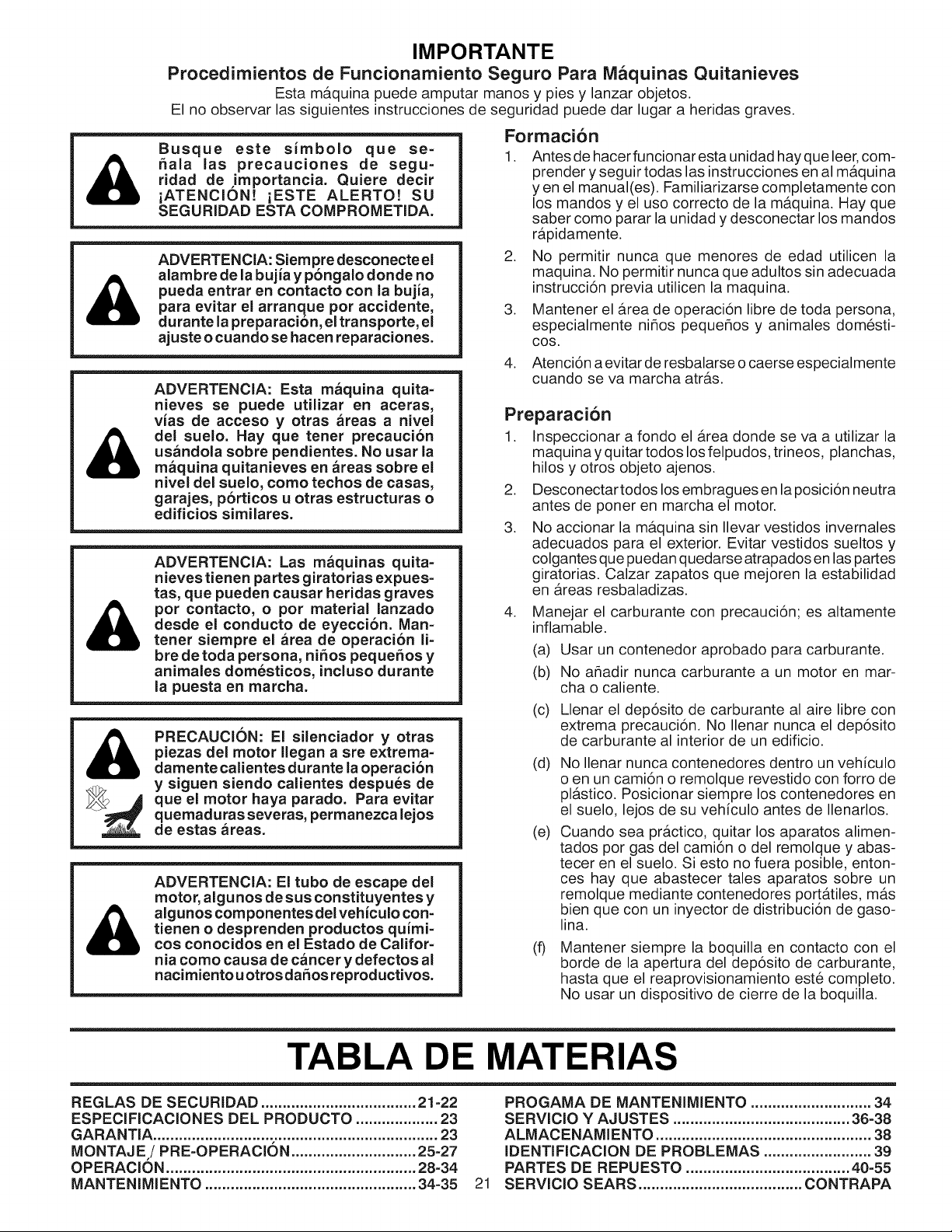
IMPORTANTE
Procedimientos de Funcionamiento Seguro Para Maquinas Quitanieves
Esta maquina puede amputar manos y pies y lanzar objetos.
El no observar las siguientes instrucciones de seguridad puede dar lugar a heridas graves.
&
Busque este simbolo que se-
5ala las precauciones de segu-
ridad de importancia. Quiere decir
iATENCION! iESTE ALERTO! SU
SEGURIDAD ESTA COMPROMETIDA.
ADVERTENCIA: Siempredesconecteel
alambre de la bujia y pongalo donde no
pueda entrar en contacto con la bujia,
para evitar el arranque pot accidente,
durante la preparacion, el transporte, el
ajuste o cuando se hacen reparaciones.
Formaci6n
1. Antes de hacerfuncionar esta unidad hay que leer, com-
prender y seguir todas las instrucciones en al maquina
yen el manual(es). Familiarizarse completamente con
los mandos y el uso correcto de la maquina. Hay que
saber como parar la unidad y desconectar los mandos
rapidamente.
2. No permitir nunca que menores de edad utilicen la
maquina. No permitir nunca que adultos sin adecuada
instrucci6n previa utilicen la maquina.
3. Mantener el area de operaci6n libre de toda persona,
especialmente nihos pequehos y animales domesti-
COS.
&
ADVERTENCIA: Esta maquina quita-
nieves se puede utilizar en aceras,
vias de acceso y otras areas a nivel
del suelo. Hay que tenet precauci6n
usandola sobre pendientes. No usar la
maquina quitanieves en areas sobre el
nivel del suelo, como techos de casas,
garajes, p6rticos u otras estructuras o
edificios similares.
&
ADVERTENCIA: Las maquinas quita-
nievestienen partes giratorias expues-
tas, que pueden causar heridas graves
pot contacto, o pot material lanzado
desde el conducto de eyecci6n. IVlan-
tenet siempre el area de operaci6n li-
bre de toda persona, niSos pequeSos y
animales domesticos, incluso durante
la puesta en marcha.
&
PRECAUCION: El silenciador y otras
piezas del motor Ilegan a sre extrema-
damente calientes durante la operaci6n
y siguen siendo calientes despues de
que el motor haya parado. Para evitar
quemaduras severas, permanezca lejos
de estas areas.
&
ADVERTENCIA: El tubo de escape del
motor, algunos de sus constituyentes y
algunos componentes del vehiculo con-
tienen o desprenden productos quimi-
cos conocidos en el Estado de Califor-
nia como causa de cancer y defectos al
nacimientouotrosdahosreproductivos.
4. Atenci6n a evitar de resbalarse o caerse especialmente
cuando se va marcha atras.
Preparaci6n
1. Inspeccionar a fondo el area donde se va a utilizar la
maquina y quitar todos los felpudos, trineos, planchas,
hilos y otros objeto ajenos.
2. Desconectartodos los embragues en laposici6n neutra
antes de poner en marcha el motor.
3. No accionar la maquina sin Ilevar vestidos invernales
adecuados para el exterior. Evitar vestidos sueltos y
colgantes que puedan quedarse atrapados en las partes
giratorias. Calzar zapatos que mejoren la estabilidad
en areas resbaladizas.
4. Manejar el carburante con precauci6n; es altamente
inflamable.
(a) Usar un contenedor aprobado para carburante.
(b) No a_adir nunca carburante a un motor en mar-
cha o caliente.
(c) Llenar el dep6sito de carburante al aire libre con
extrema precauci6n. No Ilenar nunca el dep6sito
de carburante al interior de un edificio.
(d)
(e)
No Ilenar nunca contenedores dentro un vehiculo
o en un cami6n o remolque revestido con forro de
plastico. Posicionar siempre los contenedores en
el suelo, lejos de su vehiculo antes de Ilenarlos.
Cuando sea practico, quitar los aparatos alimen-
tados por gas del cami6n o del remolque y abas-
tecer en el suelo. Si esto no fuera posible, enton-
ces hay que abastecer tales aparatos sobre un
remolque mediante contenedores portatiles, mas
bien que con un inyector de distribuci6n de gaso-
lina.
(f)
Mantener siempre la boquilla en contacto con el
borde de la apertura del dep6sito de carburante,
hasta que el reaprovisionamiento este completo.
No usar un dispositivo de cierre de la boquilla.
TABLA DE MA'rERIAS
REGLAS DE SECURIDAD .................................... 21-22
ESPEClFICACIONES DEL PRODUCTO ................... 23
GARANTIA .................................................................. 23
MONTAJE,/PRE-OPERACl6N ............................. 25-27
OPERACION .......................................................... 28-34
MANTENIMIENTO ................................................. 34-35 21
PROGAMA DE MANTENIMIENTO ............................ 34
SERVICIO Y AJUSTES ......................................... 36-38
ALMACENAMIENTO .................................................. 38
IDENTIFICACION DE PROBLEMAS ......................... 39
PARTES DE REPUESTO ...................................... 40-55
SERVICIO SEARS ...................................... CONTRAPA
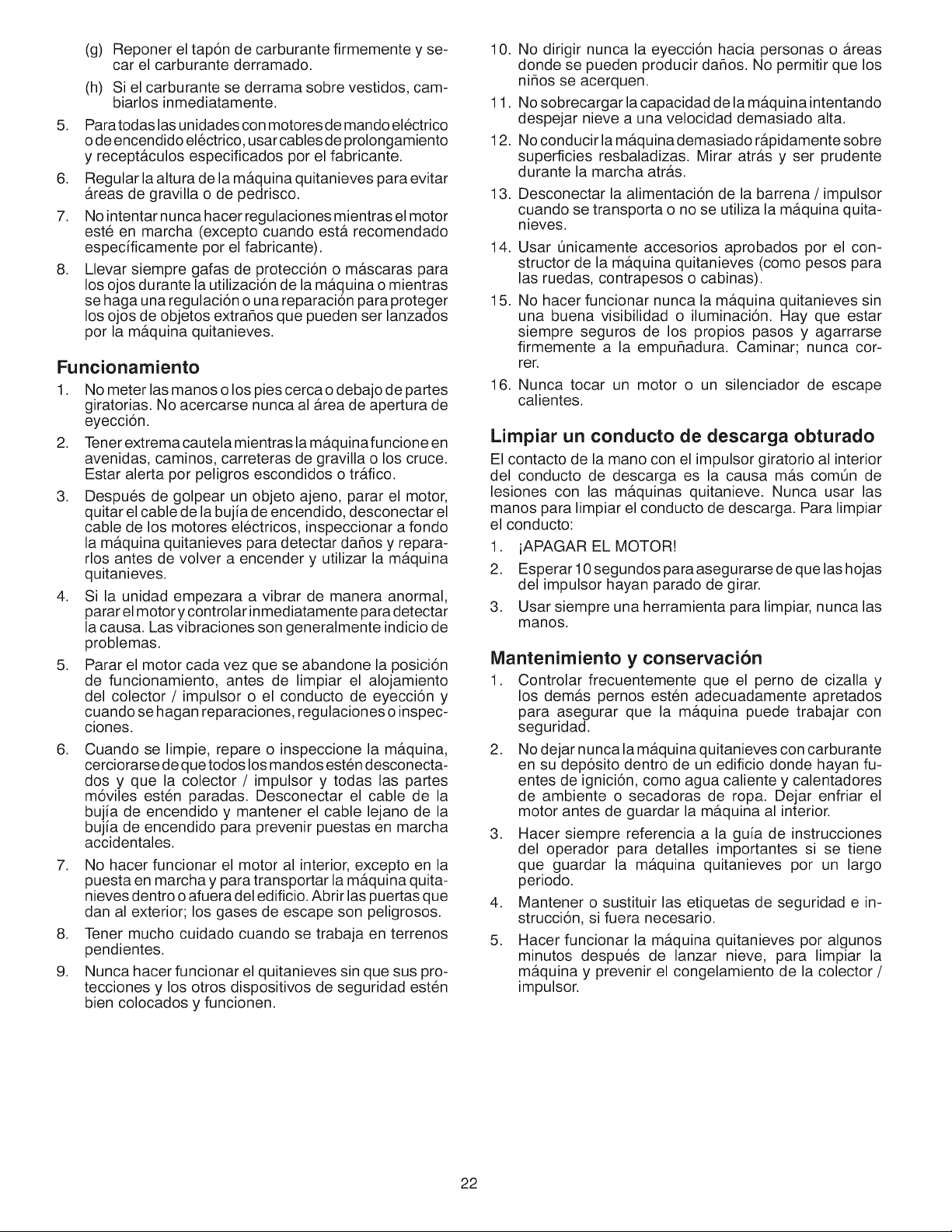
(g) Reponer el tap6n de carburante firmemente y se-
car el carburante derramado.
(h) Si el carburante se derrama sobre vestidos, cam-
biarlos inmediatamente.
5. Paratodas las unidades con motores de mando electrico
o de encendido electrico, usar cables de prolongamiento
y receptaculos especificados por el fabricante.
6. Regular la altura de la maquina quitanieves para evitar
Areas de gravilla o de pedrisco.
7. No intentar nunca hacer regulaciones mientras el motor
este en marcha (excepto cuando esta recomendado
especificamente por el fabricante).
8. Llevar siempre gafas de protecci6n o mascaras para
los ojos durante la utilizaci6n de la maquina o mientras
se haga una regulaci6n o una reparaci6n para proteger
los ojos de objetos extraflos que pueden set lanzados
por la maquina quitanieves.
Funcionamiento
1. No meter las manos o los pies cerca o debajo de partes
giratorias. No acercarse nunca al Area de apertura de
eyecci6n.
2. Tener extrema cautela mientras la maquinafuncione en
avenidas, caminos, carreteras de gravilla o los cruce.
Estar alerta por peligros escondidos o trafico.
3. Despues de golpear un objeto ajeno, parar el motor,
quitar el cable de la bujia de encendido, desconectar el
cable de los motores electricos, inspeccionar a fondo
la maquina quitanieves para detectar daflos y repara-
rlos antes de volver a encender y utilizar la maquina
quitanieves.
4. Si la unidad empezara a vibrar de manera anormal,
parar el motor y controlar inmediatamente para detectar
la causa. Las vibraciones son generalmente indicio de
problemas.
5. Parar el motor cada vez que se abandone la posici6n
de funcionamiento, antes de limpiar el alojamiento
del colector / impulsor o el conducto de eyecci6n y
cuando se hagan reparaciones, regulaciones o inspec-
ciones.
.
Cuando se limpie, repare o inspeccione la maquina,
cerciorarse de quetodos los mandos esten desconecta-
dos y que la colector / impulsor y todas las partes
m6viles esten paradas. Desconectar el cable de la
bujia de encendido y mantener el cable lejano de la
bujia de encendido para prevenir puestas en marcha
accidentales.
7. No hacer funcionar el motor al interior, excepto en la
puesta en marcha y para transportar la maquina quita-
nieves dentro o afuera del edificio. Abrir las puertas que
dan al exterior; los gases de escape son peligrosos.
8. Tener mucho cuidado cuando se trabaja en terrenos
pendientes.
9. Nunca hacer funcionar el quitanieves sin que sus pro-
tecciones y los otros dispositivos de seguridad esten
bien colocados y funcionen.
10. No dirigir nunca la eyecci6n hacia personas o Areas
donde se pueden producir daflos. No permitir que los
niflos se acerquen.
11. No sobrecargar la capacidad de la maquina intentando
despejar nieve a una velocidad demasiado alta.
12. No conducir la maquina demasiado rapidamente sobre
superficies resbaladizas. Mirar atras y ser prudente
durante la marcha atras.
13.
Desconectar la alimentaci6n de la barrena / impulsor
cuando se transporta o no se utiliza la maquina quita-
nieves.
14. Usar 0nicamente accesorios aprobados por el con-
structor de la maquina quitanieves (como pesos para
las ruedas, contrapesos o cabinas).
15. No hacer funcionar nunca la maquina quitanieves sin
una buena visibilidad o iluminaci6n. Hay que estar
siempre seguros de los propios pasos y agarrarse
firmemente a la empufladura. Caminar; nunca cor-
rer.
16.
Nunca tocar un motor o un silenciador de escape
calientes.
Limpiar un conducto de descarga obturado
El contacto de la mano con el impulsor giratorio al interior
del conducto de descarga es la causa mas comOn de
lesiones con las maquinas quitanieve. Nunca usar las
manos para limpiar el conducto de descarga. Para limpiar
el conducto:
1. iAPAGAR EL MOTOR!
2. Esperar 10segundos para asegurarse de que las hojas
del impulsor hayan parado de girar.
3. Usar siempre una herramienta para limpiar, nunca las
manos.
Mantenimiento y conservaci6n
1. Controlar frecuentemente que el perno de cizalla y
los demas pernos esten adecuadamente apretados
para asegurar que la maquina puede trabajar con
seguridad.
2. No dejar nunca la maquina quitanieves con carburante
en su dep6sito dentro de un edificio donde hayan fu-
entes de ignici6n, como agua caliente y calentadores
de ambiente o secadoras de ropa. Dejar enfriar el
motor antes de guardar la maquina al interior.
3. Hacer siempre referencia a la guia de instrucciones
del operador para detalles importantes si se tiene
que guardar la maquina quitanieves por un largo
periodo.
4. Mantener o sustituir las etiquetas de seguridad e in-
strucci6n, si fuera necesario.
5. Hacer funcionar la maquina quitanieves por algunos
minutos despues de lanzar nieve, para limpiar la
maquina y prevenir el congelamiento de la colector /
impulsor.
22
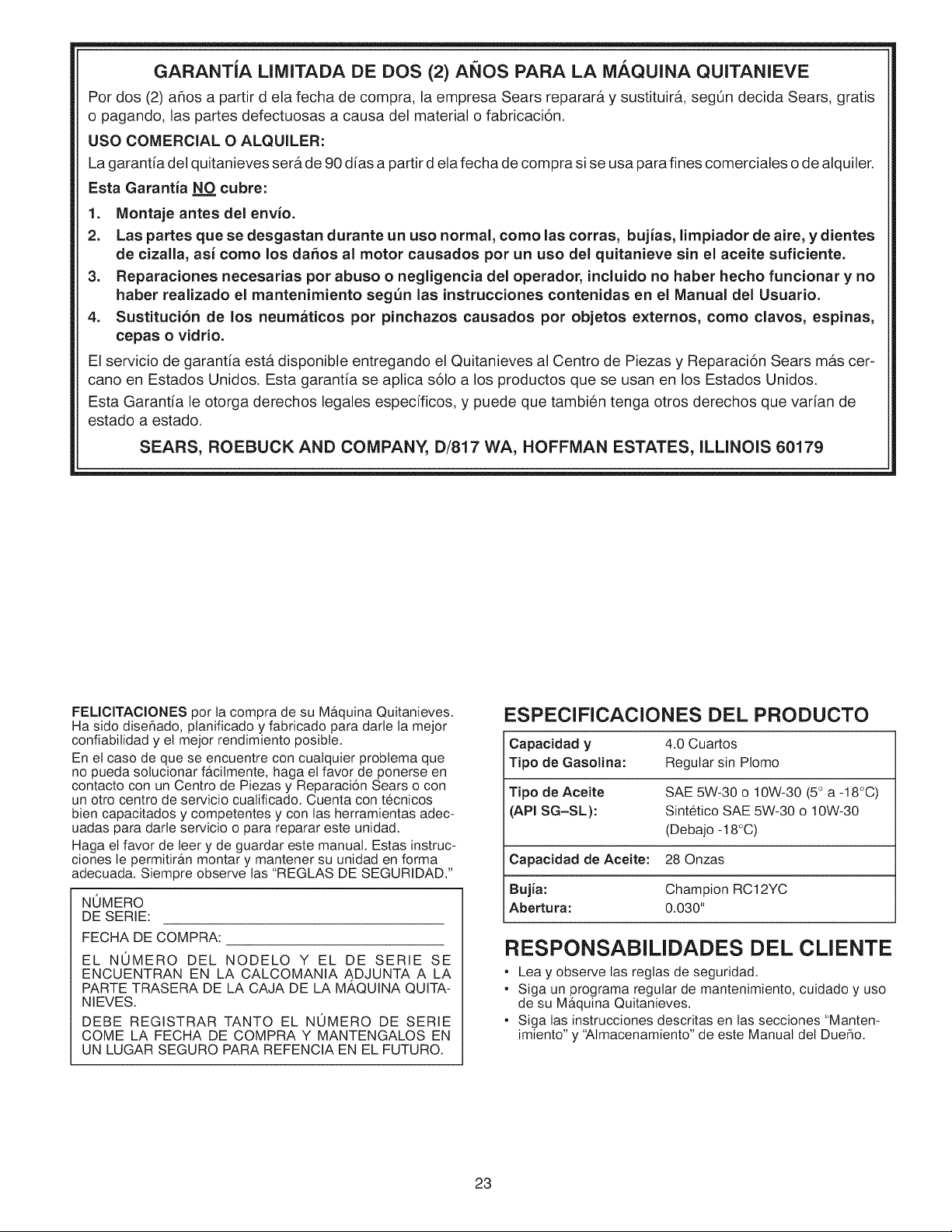
GARANTiA LllVllTADA DE DOS (2) ANOS PARA LA M.AQUINA QUITANIEVE
Por dos (2) anos a partir d ela fecha de compra, la empresa Sears reparara y sustituira, seg_n decida Sears, gratis
o pagando, las partes defectuosas a causa del material o fabricaci6n.
USO COMERClAL O ALQUILER:
La garantia del quitanieves sera de 90 dias a parti r d ela fecha de compra si se usa para fines comerciales o de alquiler.
Esta Garantia NO cubre:
1. Montaje antes del envio.
2. Las partes que se desgastan durante un uso normal, como las corras, bujJas, limpiador de aire, y dientes
de cizalla, asJ como Ros da_os al motor causados pot un uso del quitanieve sin el aceite suficiente.
3. Reparaciones necesarias pot abuso o negligencia del operador, incluido no haber hecho funcionar y no
haber realizado el mantenimiento segun las instrucciones contenidas en el Manual del Usuario.
4. Sustituci6n de los neumaticos por pinchazos causados por objetos externos, como clavos, espinas,
cepas o vidrio.
El servicio de garantia esta disponible entregando el Quitanieves al Centro de Piezas y Reparaci6n Sears mas cer-
cano en Estados Unidos. Esta garantia se aplica s61o a los productos que se usan en los Estados Unidos.
Esta Garantia le otorga derechos legales especificos, y puede que tambien tenga otros derechos que varian de
estado a estado.
SEARS, ROEBUCK AND COMPANY, D/817 WA, NOFFMAN ESTATES, iLLiNOiS 60179
FELICITACIONES por la compra de su Maquina Quitanieves.
Ha sido disefiado, planificado y fabricado para darle la mejor
confiabitidad y et mejor rendimiento posible.
En et caso de que se encuentre con cualquier problema que
no pueda solucionar facilmente, haga el favor de ponerse en
contacto con un Centro de Piezas y Reparaci6n Sears o con
un otro centro de servicio cualificado. Cuenta con tecnicos
bien capacitados y competentes y con las herramientas adec-
uadas para darle servicio o para reparar este unidad.
Haga el favor de leer y de guardar este manual. Estas instruc-
clones le permitir&n montar y mantener su unidad en forma
adecuada. Siempre observe las "REGLAS DE SEGURIDAD."
NOMERO
DE SERIE:
FECHA DE COMPRA:
EL NOMERO DEL NODELO Y EL DE SERIE SE
ENCUENTRAN EN LA CALCOMANIA A,DJUNTA A LA
PARTE TRASERA DE LA CAJA DE LA MAQUINA QUITA-
NIEVES.
DEBE REGISTRAR TANTO EL NOMERO DE SERIE
COME LA FECHA DE COMPRA Y MANTENGALOS EN
UN LUGAR SEGURO PARA REFENCIA EN EL FUTURO.
ESPECIFICACIONES DEL PRODUCTO
Capacidad y 4.0 Cuartos
TJpo de Gasolina: Regular sin Plomo
TJpo de AceJte SAE 5W-30 o 10W-30 (5° a -18°C)
(API SG-SL): Sintetico SAE 5W-30 o 10W-30
(Debajo -18°C)
Capacidad de Aceite: 28 Onzas
Bujia: Champion RC12YC
Abertura: 0.030"
RESPONSABILIDADES DEL CLIENTE
• Lea y observe las regtas de seguridad.
• Siga un programa regular de mantenimiento, cuidado y uso
de su M#,quina Quitanieves.
• Siga las instrucciones descritas en tas secciones "Manten-
imiento" y 'Atmacenamiento" de este Manual det Dueflo.
23
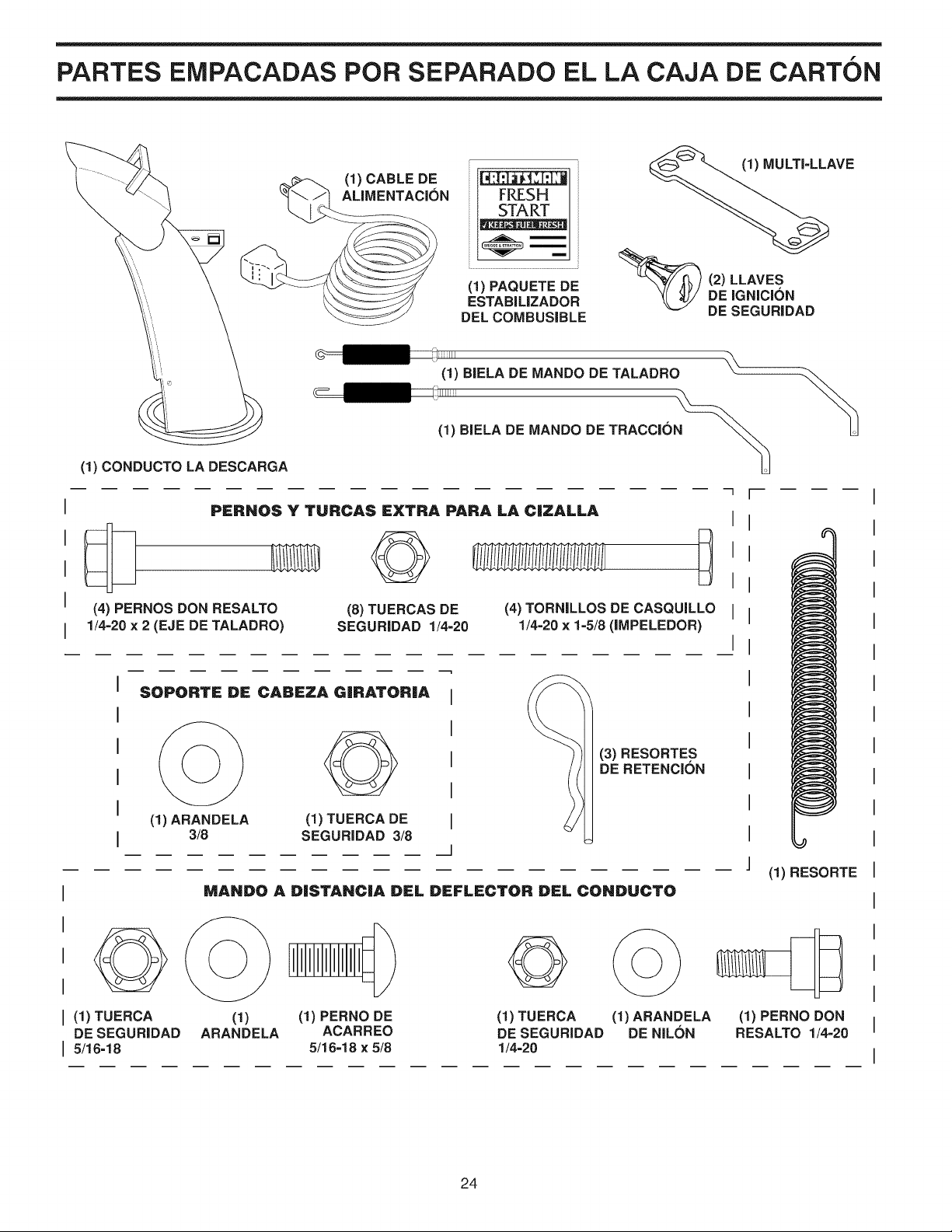
PARTES EMPACADAS POR SEPARADO EL LA CAJA DE CART(_N
(1) CABLE DE
ALIMENTACI(_N
(1) PAQUETE DE
ESTABILBZADOR
DEL COMBUSIBLE
LAVE
(2) LLAVES
DE IGNICI(_N
DE SEGURIDAD
(1) BIELA DE MANDO DE TALADRO
(1)CONDUCTO LA DESCARGA
(1) BIELA DE IVlANDO DE TRACCI(_N
PERNOS Y TURCAS EXTRA PARA LA C|ZALLA
(4) PERNOS DON RESALTO
1/4=20 x 2 (EJE DE TALADRO)
G
(8) TUERCAS DE
SEGURIDAD 1/4=20
D
(4) TORNILLOS DE CASQUILLO
1/4-20 x 1=5/8 (IMPELEDOR)
SOPORTE DE CABEZA G|RATOR|A
(1) ARANDELA (1) TUERCA DE
3/8 SEGURIDAD 3/8
-1
I
I
I
I
I
I
(3) RESORTES
DE RETENCION
MANDO A D|STANC|A DEL DEFLECTOR DEL CONDUCTO
J
(1) RESORTE
(1)TUERCA
DESEGURIDAD
5/16-18
(1) (1)PERNO DE (1)TUERCA
ARANDELA ACARREO DESEGURIDAD
5/16=18x5/8 1/4=20
(1) ARANDELA
DE NILON
(1) PERNO DON
RESALTO 1/4=20
24
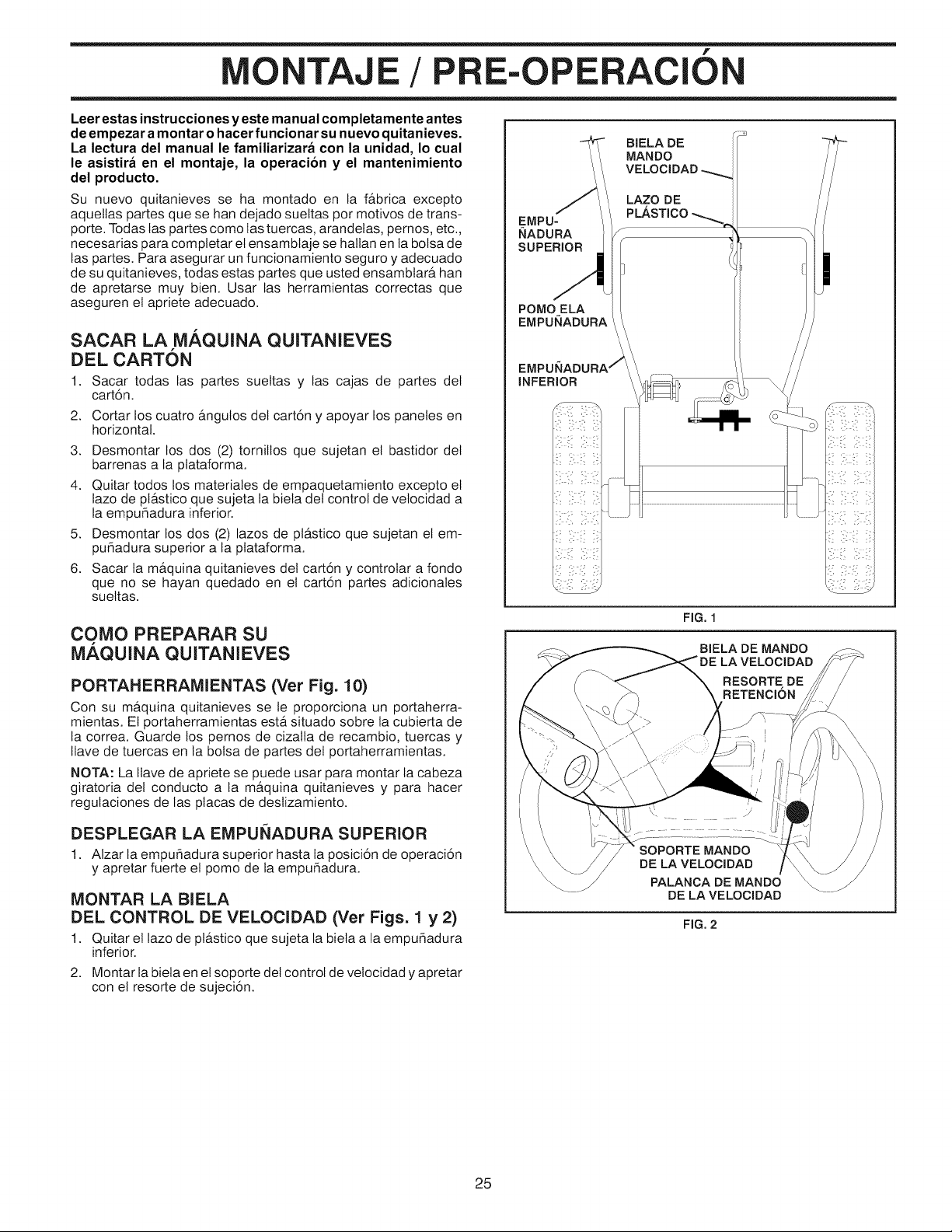
f
MONTAJE / E-OPE ACION
Leer estas instrucciones y este manual completamente antes
de empezar a montar o hacer funcionar su nuevo quitanieves.
La lectura del manual le familiarizara con la unidad, Io cual
le asistira en el montaje, la operacion y el mantenimiento
del producto.
Su nuevo quitanieves se ha montado en la fb,brica excepto
aquettas partes que se han dejado sueltas por motivos de trans-
porte. Todas tas partes como las tuercas, arandetas, pernos, etc.,
necesarias para completar et ensambtaje se hallan en la bolsa de
las partes. Para asegurar un funcionamiento seguro y adecuado
de su quitanieves, todas estas partes que usted ensamblarb, han
de apretarse muy bien. Usar las herramientas correctas que
aseguren el apriete adecuado.
SACAR LA MAQUINA QUITANIEVES
DEL CARTON
1. Sacar todas las partes sueltas y las cajas de partes del
cart6n.
2. Cortar los cuatro b,ngulos del cart6n y apoyar los paneles en
horizontal.
3. Desmontar los dos (2) tornillos que sujetan el bastidor del
barrenas a la ptataforma.
4. Quitar todos los materiales de empaquetamiento excepto el
lazo de pt&stico que sujeta la biela del control de velocidad a
la empuSadura inferior.
5. Desmontar los dos (2) lazos de plb,stico que sujetan et em-
puSadura superior a la plataforma.
6. Sacar lamb, quina quitanieves del cart6n y controtar a fondo
que no se hayan quedado en el cart6n partes adicionales
sueltas.
COMO PREPARAR SU
MAQUINA QUITANIEVES
PORTAHERRAMIENTAS (Ver Fig. 10)
Con su mb,quina quitanieves se le proporciona un portaherra-
mientas. Et portaherramientas est#,situado sobre la cubierta de
la correa. Guarde los pernos de cizalla de recambio, tuercas y
Itave de tuercas en la bolsa de partes det portaherramientas.
NOTA: La Ilave de apriete se puede usar para montar la cabeza
giratoria del conducto a la mb,quina quitanieves y para hacer
regutaciones de las ptacas de deslizamiento.
DESPLEGAR LA EMPUNADURA SUPERIOR
1. Atzar la empu_adura superior hasta la posici6n de operaci6n
y apretar fuerte el pomo de la empuSadura.
MONTAR LA BIELA
DEL CONTROL DE VELOCIDAD (Vet Figs. 1 y 2)
1. Quitar el lazo de ptb,stico que sujeta la biela a la empu_adura
inferior.
2. Montar la biela en el soporte det control de velocidad y apretar
con el resorte de sujeci6n.
"-_ BIELA DE
II MANDO
/_ VELOCIDAD
EMPU: ! _ PLASTICO_
FIG. 1
BIELA DE MANDO
LA VELOClDAD
RESORTE DE
RETENCION
SOPORTE MANDO
DE LA VELOCIDAD
PALANCA DE MANDO
DE LA VELOCIDAD
FIG. 2
25
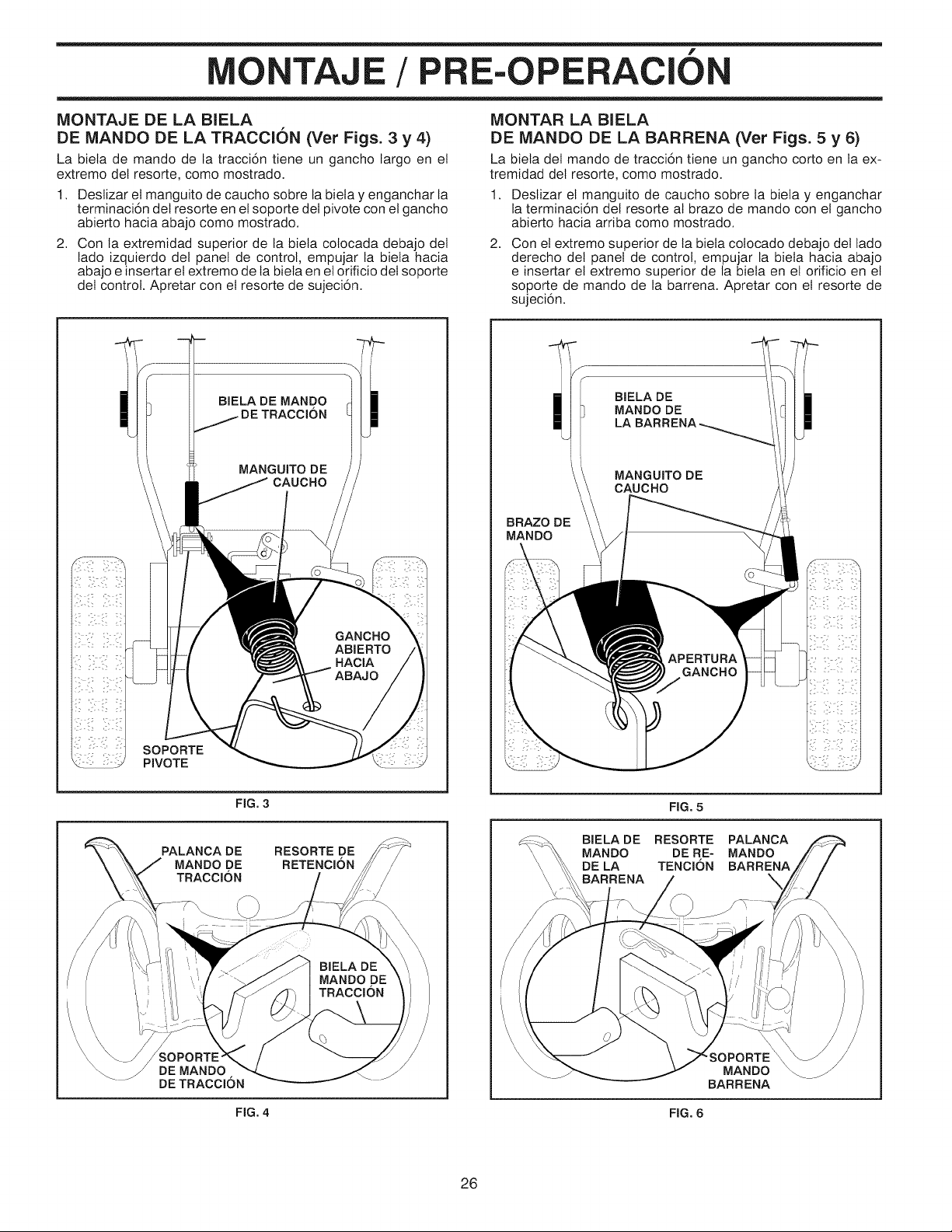
MONTAJE / P E-OPERACIO
MONTAJE DE LA BIELA
DE MANDO DE LA TRACCION (Vet Figs. 3 y 4)
La bieta de mando de la tracci6n tiene un gancho largo en el
extremo det resorte, como mostrado.
1. Destizar et manguito de caucho sobre la biela y enganchar la
terminaci6n det resorte en et soporte det pivote con el gancho
abierto hacia abajo como mostrado.
2. Con la extremidad superior de la biela colocada debajo del
lado izquierdo del panel de control, empujar la bieta hacia
abajo e insertar et extremo de la biela en el orificio det soporte
del control. Apretar con el resorte de sujeci6n.
MONTAR LA BIELA
DE MANDO DE LA BARRENA (Ver Figs. 5 y 6)
La bieta det mando de tracci6n tiene un gancho corto en la ex-
tremidad del resorte, como mostrado.
1. Deslizar et manguito de caucho sobre la bieta y enganchar
la terminaci6n del resorte al brazo de mando con el gancho
abierto hacia arriba como mostrado.
2,
Con el extremo superior de la bieta cotocado debajo del lado
derecho det panel de control, empujar la bieta hacia abajo
e insertar el extremo superior de la bieta en et orificio en el
soporte de mando de la barrena. Apretar con el resorte de
sujeci6n.
SOPORTE
PIVOTE
BIELA DE MANDO
BRAZO DE
MANDO
BIELA DE
MANDO DE
LA BARRENA_
MANGUITO DE
CAUCHO
FIG. 3
PALANCA DE
MANDO DE
TRACCION
RESORTE DE
RETENCION
SOPORTE
DE MANDO
DETRACCION
FIG. 4
FIG. 5
BIELA DE RESORTE PALANCA
MANDO DERE- MANDO
DE LA TENCION BARRENA
BARRENA
SOPORTE
MANDO
BARRENA
FIG. 6
26
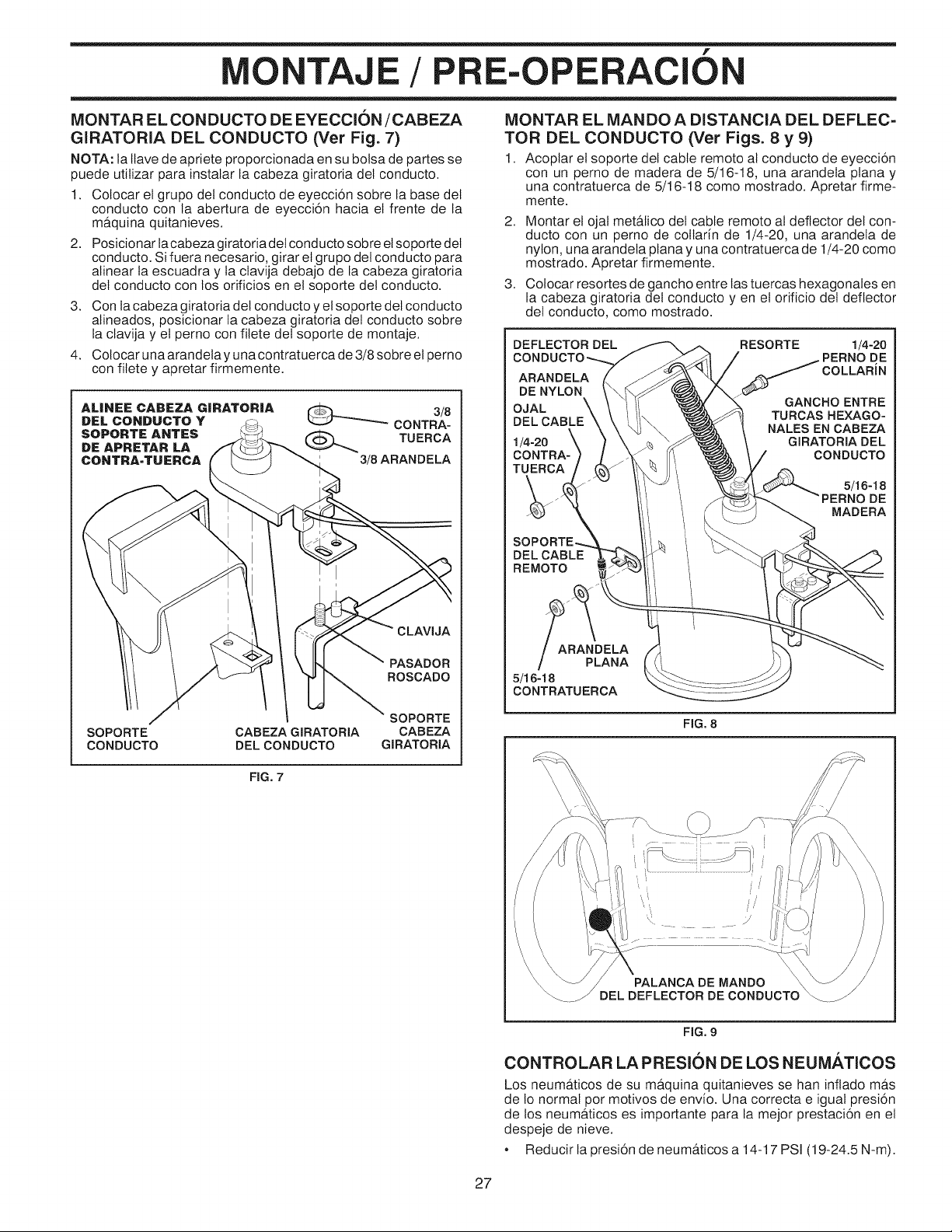
f
MONTAJE / E-OPE ACION
MONTAR EL CON DUCTO DE EYECCI(DN /CABEZA
GIRATORIA DEL CONDUCTO (Vet Fig. 7)
NOTA: la Ilave de apriete proporcionada en su bolsa de partes se
puede utitizar para instalar la cabeza giratoria del conducto.
1. Cotocar el grupo del conducto de eyecci6n sobre la base del
conducto con la abertura de eyecci6n hacia et frente de la
mb,quina quitanieves.
2. Posicionar lacabeza giratoria det conducto sobre el soporte det
conducto. Si fuera necesario, girar et grupo del conducto para
alinear la escuadra y ta clavija debajo de la cabeza giratoria
del conducto con los orificios en el soporte del conducto.
3. Con la cabeza giratoria del conducto y el soporte del conducto
alineados, posicionar la cabeza giratoria del conducto sobre
la clavija y el perno con filete del soporte de montaje.
4. Colocar una arandela y una contratuerca de 3/8 sobre el perno
con filete y apretar firmemente.
ALiNEE CABEZA GiRATORiA _ 3/8
DEL CONDUCTO Y __ CONTRA-
SOPORTE ANTES _ TUERCA
DE APRETAR LA
CONTRA-TUERCA 3/8 ARANDELA
CLAVIJA
PASADOR
ROSCADO
SOPORTE
CONDUCTO
SOPORTE
CABEZA GIRATORIA CABEZA
DEL CONDUCTO GIRATORIA
FiG. 7
MONTAR EL MANDO A DISTANCIA DEL DEFLEC-
TOR DEL CONDUCTO (Vet Figs. 8 y 9)
1. Acoptar et soporte det cable remoto al conducto de eyecci6n
con un perno de madera de 5/16-18, una arandeta plana y
una contratuerca de 5/16-18 como mostrado. Apretar firme-
mente.
2. Montar et ojal met&tico det cable remoto al deflector del con-
ducto con un perno de cottarin de 1/4-20, una arandela de
nylon, una arandela plana y una contratuerca de 1/4-20 como
mostrado. Apretar firmemente.
3. Colocar resortes de gancho entre las tuercas hexagonales en
la cabeza giratoria det conducto y en el orificio del deflector
del conducto, como mostrado.
DEFLECTOR DEL
ARANDELA
DE NYLON
OJAL
DELCABLE
1/4-20
CONTRA-
TUERCA
RESORTE 1/4-20
y ERNO DE
COLLARiN
GANCHO ENTRE
TURCAS HEXAGO-
NALES EN CABEZA
GIRATORIA DEL
CONDUCTO
5/16-18
PERNO DE
MADERA
DELCABLE
REMOTO
ARANDELA
PLANA
5/16-18
CONTRATUERCA
FiG. 8
PALANCA DE MANDO
DEL DEFLECTOR DE CONDUCTO
FiG. 9
CONTROLAR LA PRESION DE LOS NEUMATICOS
Los neumb,ticos de su maquina quitanieves se han inflado mb,s
de 1o normal por motivos de envio. Una correcta e igual presi6n
de los neumaticos es importante para la mejor prestaci6n en el
despeje de nieve.
* Reducir la presi6n de neumb,ticos a 14-17 PSI (19-24.5 N-m).
27
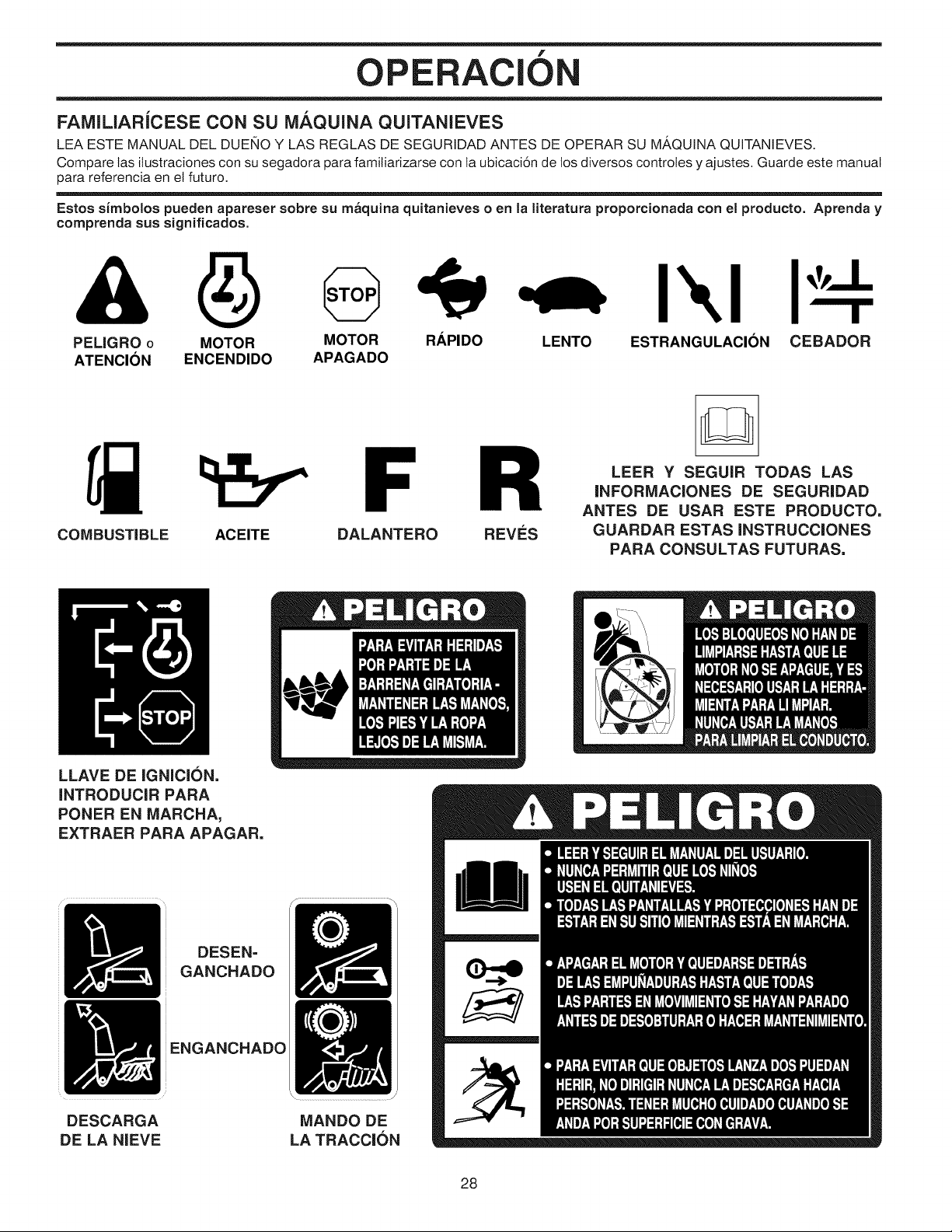
f
OPERAC
FAMILIARiCESE CON SU MAQUINA QUITANIEVES
LEA ESTE MANUAL DEL DUENO Y LAS REGLAS DE SEGURIDAD ANTES DE OPERAR SU M/kQUINA QUITANIEVES.
Compare las ilustraciones con su segadora para familiarizarse con la ubicaci6n de los diversos controles y ajustes. Guarde este manual
para referencia en el futuro.
Estos simbolos pueden apareser sobre su m_quina quitanieves o en la literatura proporcionada con el producto. Aprenda y
comprenda sus significados.
I\1
MOTOR RAPIDO
APAGADO
PELIGRO o MOTOR LENTO ESTRANGULACION CEBADOR
ATENCION ENCENDIDO
R
COMBUSTIBLE ACEITE DALANTERO REVI':-S
LEER Y SEGUIR TODAS LAS
INFORMACIONES DE SEGURIDAD
ANTES DE USAR ESTE PRODUCTO.
GUARDAR ESTAS INSTRUCCIONES
PARA CONSULTAS FUTURAS,
LLAVEDEIGNICION.
INTRODUCIR PARA
PONER EN MARCHA,
EXTRAER PARA APAGAR.
DESEN=
GANCHADO
ENGANCHADO
DESCARGA
DE LA NIEVE
MANDO DE
LATRACCION
28
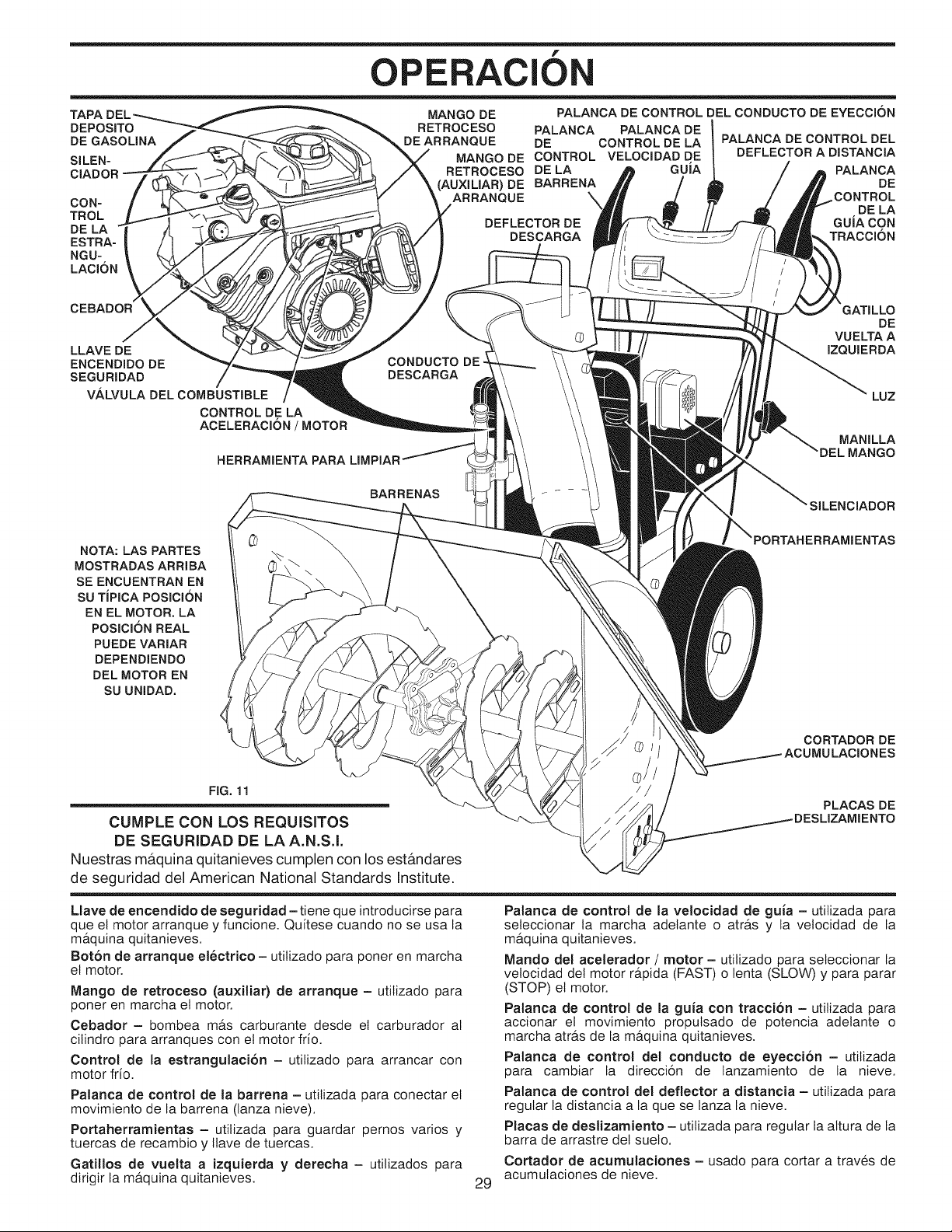
f
OPERAClO
MANGO DE PALANCA DE CONTROL DEL CONDUCTO DE EYECClON
DEPOSITO RETROCESO PALANCA PALANCA DE
DE GASOMNA DE ARRANQUE DE CONTROL DE LA PALANCA DE CONTROL DEL
SILEN- MANGO DE CONTROL VELOClDAD DE DEFLECTOR A DISTANClA
ClADOR RETROCESO DE LA GUiA PALANCA
(AUXIUAR) DE BARRENA DE
CON- ARRANQUE \ CONTROL
TROL DE LA
DE LA _ DEFLECTOR DE GUiA CON
ESTRA- DESCARGA TRACCK_N
NGU-
LACK_N
CEBADOR
LLAVE DE
ENCENDIDO DE
SEGURIDAD
VALVULA DELCOMBUSTIBLE
CONTROLDELA
ACELERAClON/MOTOR
CONDUCTO
DESCARGA
HERRAMIENTA PARA UMPIAR
BARRENAS
NOTA:LAS PARTES
MOSTRADAS ARRIBA
SE ENCUENTRAN EN
SU TiPICA POSICION
EN EL MOTOR. LA
POSICION REAL
PUEDEVARIAR
DEPENDIENDO
DEL MOTOR EN
SU UNIDAD.
\
GATILLO
DE
VUELTA A
IZQUIERDA
LUZ
MANILLA
MANGO
SILENClADOR
)RTAHERRAMI ENTAS
CORTADOR DE
FIG. 11
CUMPLE CON LOS REQUISITOS
DE SEGURIDAD DE LA A.N.SJ.
Nuestras maquina quitanieves cumplen con los estandares
de seguridad del American National Standards Institute.
PLACAS DE
;UZAMIENTO
Mave de encendido de seguridad - tiene que introducirse para
que el motor arranque y funcione. Quitese cuando no se usa la
mb,quina quitanieves.
Boron de arranque electrico - utitizado para poner en marcha
el motor.
Mango de retroceso (auxiliar) de arranque - utitizado para
poner en marcha el motor.
Cebador - bombea mb,s carburante desde et carburador al
cilindro para arranques con el motor frio.
Control de la estrangulaci6n - utitizado para arrancar con
motor frio.
Palanca de control de ta barrena - utitizada para conectar el
movimiento de la barrena (lanza nieve).
Portaherramientas - utilizada para guardar pernos varios y
tuercas de recambio y llave de tuercas.
Gatillos de vuelta a izquierda y derecha - utilizados para
dirigir la mb,quina quitanieves.
29
Palanca de control de la velocidad de gu{a - utitizada para
seleccionar la marcha adelante o atrb,s y la velocidad de la
mb,quina quitanieves.
Mando del acelerador / motor - utilizado para seleccionar la
vetocidad del motor rb,pida (FAST) o lenta (SLOW) y para parar
(STOP) el motor.
Patanca de control de la guia con tracci6n - utitizada para
accionar el movimiento proputsado de potencia adelante o
marcha atrb,s de la mb,quina quitanieves.
Palanca de control del conducto de eyecci6n - utilizada
para cambiar la direcci6n de lanzamiento de la nieve.
Palanca de control del deflector a distancia - utitizada para
regular la distancia a la que se lanza la nieve.
Placas de destizamiento - utitizada para regular la altura de la
barra de arrastre del suelo.
Cortador de acumulaciones - usado para cortar a traves de
acumutaciones de nieve.
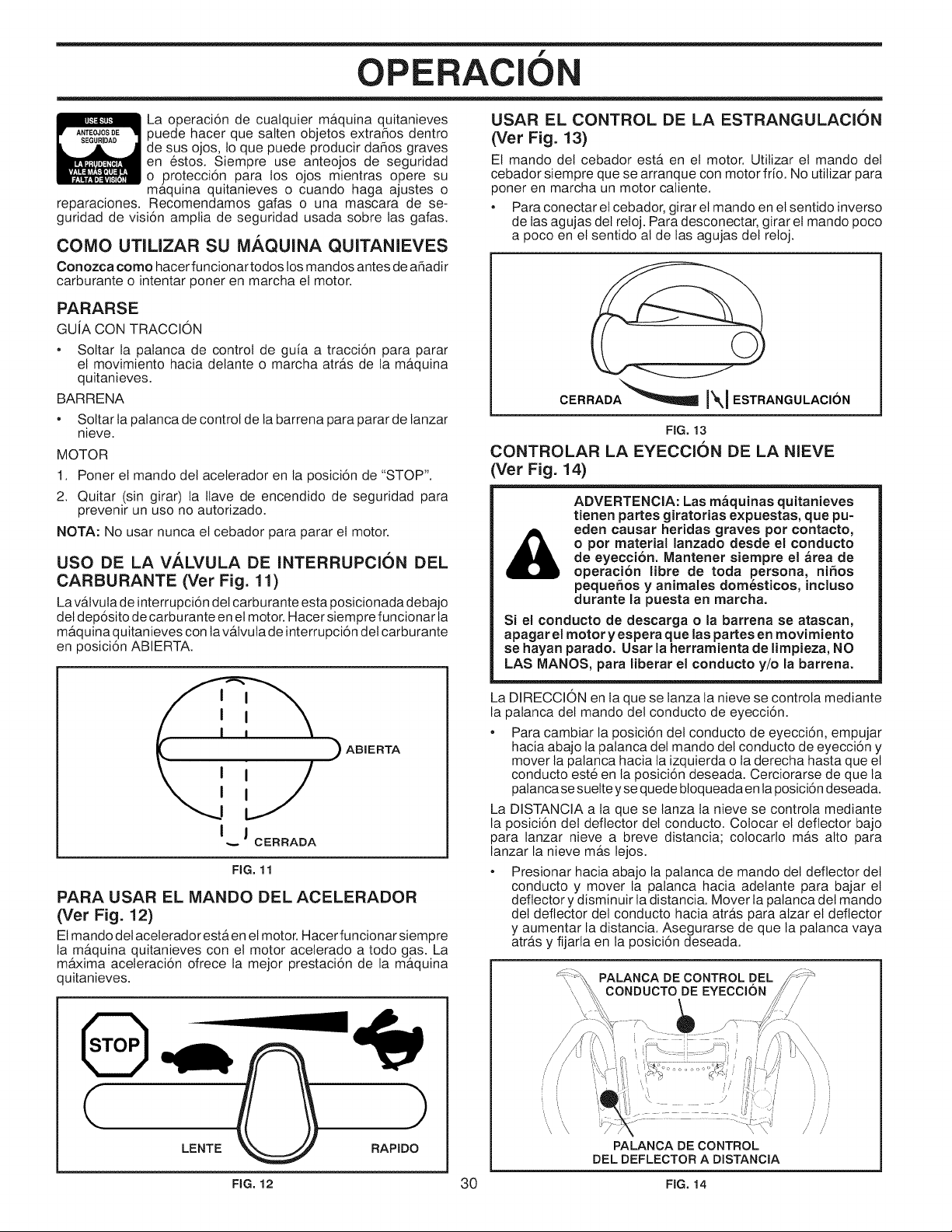
OPE ACION
La operaci6n de cualquier maquina quitanieves
puede hacer que salten objetos extraSos dentro
de sus ojos, Io que puede producir daSos graves
en estos. Siempre use anteojos de seguridad
o protecci6n para los ojos mientras opere su
maquina quitanieves o cuando haga ajustes o
reparaciones. Recomendamos gafas o una mascara de se-
guridad de visi6n amptia de seguridad usada sobre las gafas.
SEGURIDAD
COMO UTILIZAR SU MAQUINA QUITANIEVES
Conozca como hacer funcionar todos los mandos antes de a_adir
carburante o intentar poner en marcha el motor.
PARARSE
GUIA CON TRACCION
• Soltar la patanca de control de guia a tracci6n para parar
el movimiento hacia delante o marcha atrb,s de la mb,quina
quitanieves.
BARRENA
• Soltar la palanca de control de la barrena para parar de lanzar
nieve.
MOTOR
1. Poner el mando del acelerador en la posici6n de "STOP".
2. Quitar (sin girar) la Ilave de encendido de seguridad para
prevenir un uso no autorizado.
NOTA: No usar nunca el cebador para parar el motor.
USO DE LA VALVULA DE INTERRUPCION DEL
CARBURANTE (Ver Fig. 11)
La vb,lvuta de interrupci6n del carburante esta posicionada debajo
det dep6sito de carburante en et motor. Hacer siempre funcionar la
m&quina quitanieves con la vb,lvula de interrupci6n del carburante
en posici6n ABIERTA.
l i
I I
I._ I CERRADA
ABIERTA
FIG, 11
PARA USAR EL MANDO DEL ACELERADOR
(Vet Fig. 12)
El mando det acelerador esta en et motor. Hacer funcionar siempre
la maquina quitanieves con el motor aceterado a todo gas. La
mb,xima aceteraci6n ofrece la mejor prestaci6n de lamb, quina
quitanieves.
RAPIDO
FIG. 12 30
USAR EL CONTROL DE LA ESTRANGULACI()N
(Ver Fig. 13)
El mando det cebador esta en et motor. Utilizar el mando del
cebador siempre que se arranque con motor frio. No utilizar para
poner en marcha un motor caliente.
• Para conectar et cebador, girar el mando en el sentido inverso
de las agujas del reloj. Para desconectar, girar el mando poco
a poco en el sentido al de las agujas del reloj.
FIG. 13
CONTROLAR LA EYECCION DE LA NIEVE
(Vet Fig. 14)
ADVERTENCIA: Las maquinas quitanieves
tienen partes giratorias expuestas, que pu-
eden causar heridas graves pot contacto,
o pot material lanzado desde el conducto
de eyeccion. Mantener siempre et _rea de
operacibn libre de toda persona, nihos
pequehos y animales dom_sticos, incluso
durante la puesta en marcha.
Si el conducto de descarga o la barrena se atascan,
apagar el motor y espera que las partes en movimiento
se hayan parado. Usar la herramienta de limpieza, NO
LAS MANOS, para liberar el conducto y/o la barrena.
La DIRECCION en ta que se lanza la nieve se controla mediante
la palanca det mando del conducto de eyecci6n.
• Para cambiar la posici6n del conducto de eyecci6n, empujar
hacia abajo la palanca det mando del conducto de eyecci6n y
mover la palanca hacia la izquierda o la derecha hasta que el
conducto est6 en la posici6n deseada. Cerciorarse de que la
palancase suette yse quede bloqueada en la posici6n deseada.
La DISTANCIA a la que se lanza la nieve se controla mediante
la posici6n del deflector det conducto. Colocar el deflector bajo
para lanzar nieve a breve distancia; colocarlo mb,s alto para
lanzar la nieve mb,s lejos.
• Presionar hacia abajo la palanca de mando del deflector del
conducto y mover la palanca hacia adelante para bajar el
deflector y disminuir ta distancia. Mover la palanca del mando
det deflector del conducto hacia atras para alzar el deflector
y aumentar la distancia. Asegurarse de que la palanca vaya
atrb,s y fijarla en la posici6n deseada.
PALANCA DE CONTROL DEL
CONDUCTO DE EYECCION
/
/
/
PALANCA DE CONTROL
DEL DEFLECTOR A DISTANClA
,/
// ///
FIG. 14
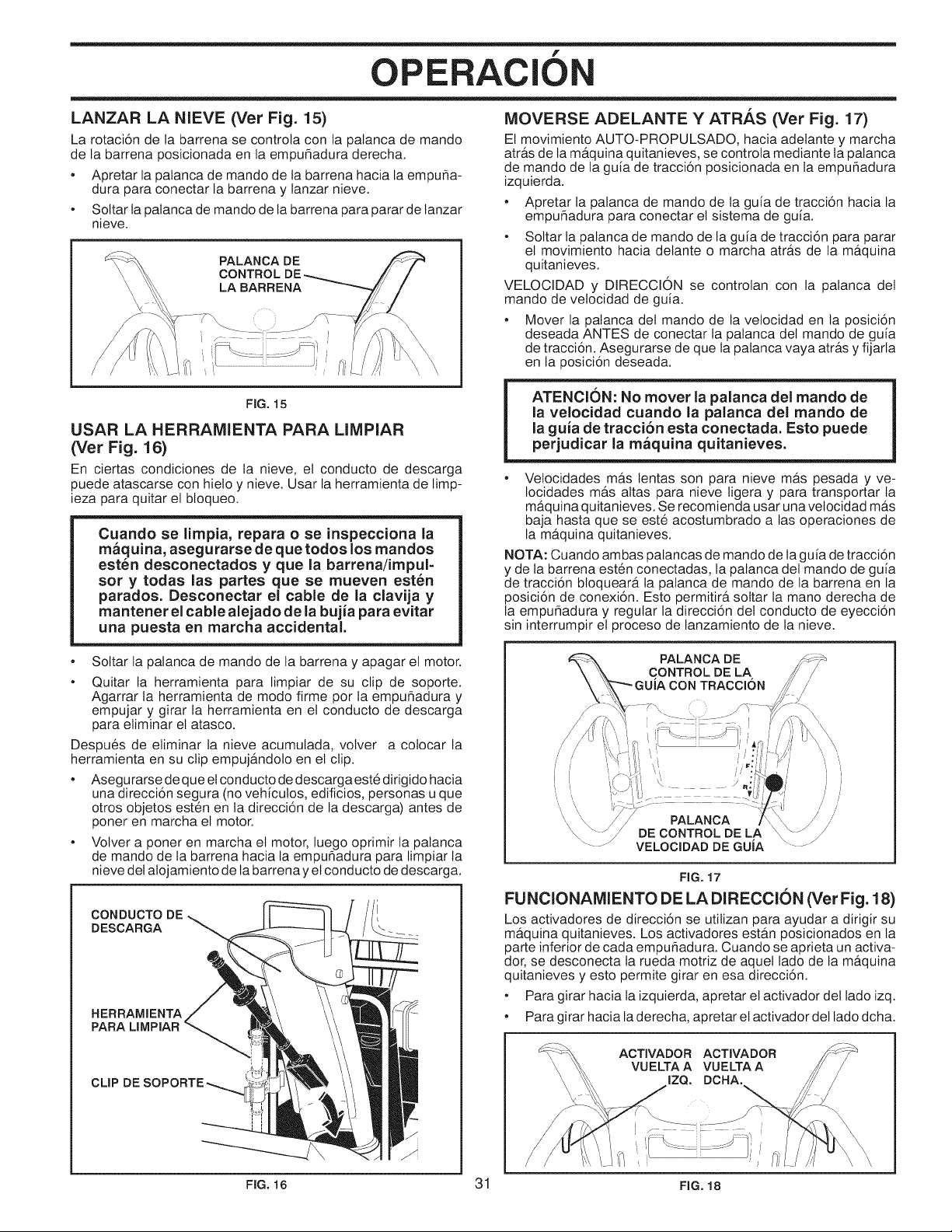
OPERAClO
LANZAR LA NIEVE (Ver Fig. 15)
La rotaci6n de la barrena se controla con la palanca de mando
de la barrena posicionada en la empufiadura derecha.
• Apretar la palanca de mando de la barrena hacia la empufla-
dura para conectar la barrena y lanzar nieve.
• Soltar la palanca de mando de la barrena para parar de lanzar
nieve.
PALANCA DE
CONTROL
LA BARRENA
FiG. 15
USAR LA HERRAIVllENTA PARA LiiVlPIAR
(Vet Fig. 16)
En ciertas condiciones de la nieve, el conducto de descarga
puede atascarse con hielo y nieve. Usar la herramienta de limp-
ieza para quitar el bloqueo.
Cuando se limpia, repara o se inspecciona la
maquina, asegurarse de que todos los mandos
esten desconectados y que la barrena/impul-
sot y todas las partes que se mueven esten
parados. Desconectar el cable de la clavija y
mantener el cable alejado de la bujia para evitar
una puesta en marcha accidental.
MOVERSE ADELANTE Y ATRAS (Vet Fig. 17)
Et movimiento AUTO-PROPULSADO, hacia adelante y marcha
atr&s de ta maquina quitanieves, se controla mediante la palanca
de mando de la guia de tracci6n posicionada en la empufiadura
izquierda.
• Apretar la palanca de mando de la guia de tracci6n hacia la
empufiadura para conectar el sistema de guia.
• Soltar la palanca de mando de la guia de tracci6n para parar
el movimiento hacia delante o marcha atrb.s de la maquina
quitanieves.
VELOCIDAD y DIRECCION se controlan con la palanca del
mando de velocidad de guia.
• Mover la palanca del mando de la velocidad en la posici6n
deseada ANTES de conectar la palanca del mando de gufa
de tracci6n. Asegurarse de que la palanca vaya atrb.sy fijarla
en la posici6n deseada.
ATENCION: No mover la palanca del mando de
la velocidad cuando la palanca del mando de
la guia de traccion esta conectada. Esto puede
perjudicar la maquina quitanieves.
• Velocidades m&s tentas son para nieve mb,s pesada y ve-
Iocidades m&s altas para nieve ligera y para transportar ta
mb,quina quitanieves. Se recomienda usar una vetocidad mb.s
baja hasta que se este acostumbrado alas operaciones de
la mb.quina quitanieves.
NOTA: Cuando ambas palancas de mando de ta guia de tracci6n
y de la barrena esten conectadas, la palanca del mando de guia
de tracci6n bloqueara ta palanca de mando de la barrena en la
posici6n de conexi6n. Esto permitira soltar la mano derecha de
la empufladura y regular la direcci6n del conducto de eyecci6n
sin interrumpir el proceso de lanzamiento de la nieve.
• Soltar la palanca de mando de la barrena y apagar el motor.
• Quitar la herramienta para limpiar de su clip de soporte.
Agarrar la herramienta de modo firme por la empufladura y
empujar y girar la herramienta en el conducto de descarga
para eliminar el atasco.
Despues de eliminar la nieve acumutada, volver a colocar la
herramienta en su clip empujb, ndolo en el clip.
• Asegurarse de queet conducto de descarga est6 dirigido hacia
una direcci6n segura (no vehiculos, edificios, personas u que
otros objetos esten en la direcci6n de la descarga) antes de
poner en marcha et motor.
• Volver a poner en marcha el motor, luego oprimir ta palanca
de mando de la barrena hacia la empufiadura para limpiar la
nieve det alojamiento de la barrena y el conducto de descarga.
DESCARGA
HERRAMIENTA
PARA LIMPIAR
CLIP DE
PALANCA DE
CONTROLDELA
CON TRACClON
z .... iP ....
PALANCA
DE CONTROL DE LA
VELOClDAD DE GUiA
\ \
/ /
/ /
/
///
//
/
FIG. 17
FUNCIONAMIENTO DE LADIRECCION (Vet Fig. 18)
Los activadores de direcci6n se utitizan para ayudar a dirigir su
mb,quina quitanieves. Los activadores estan posicionados en ta
parte inferior de cada empufladura. Cuando se aprieta un activa-
dor, se desconecta ta rueda motriz de aquel lado de la mb.quina
quitanieves y esto permite girar en esa direcci6n.
• Para girar hacia la izquierda, apretar el activador del lado izq.
• Para girar hacia la derecha, apretar el activador del lado dcha.
ACTIVADOR ACTIVADOR
VUELTA A VUELTA A
IZQ. DCHA.
FIG. 18
FIG. 16 31
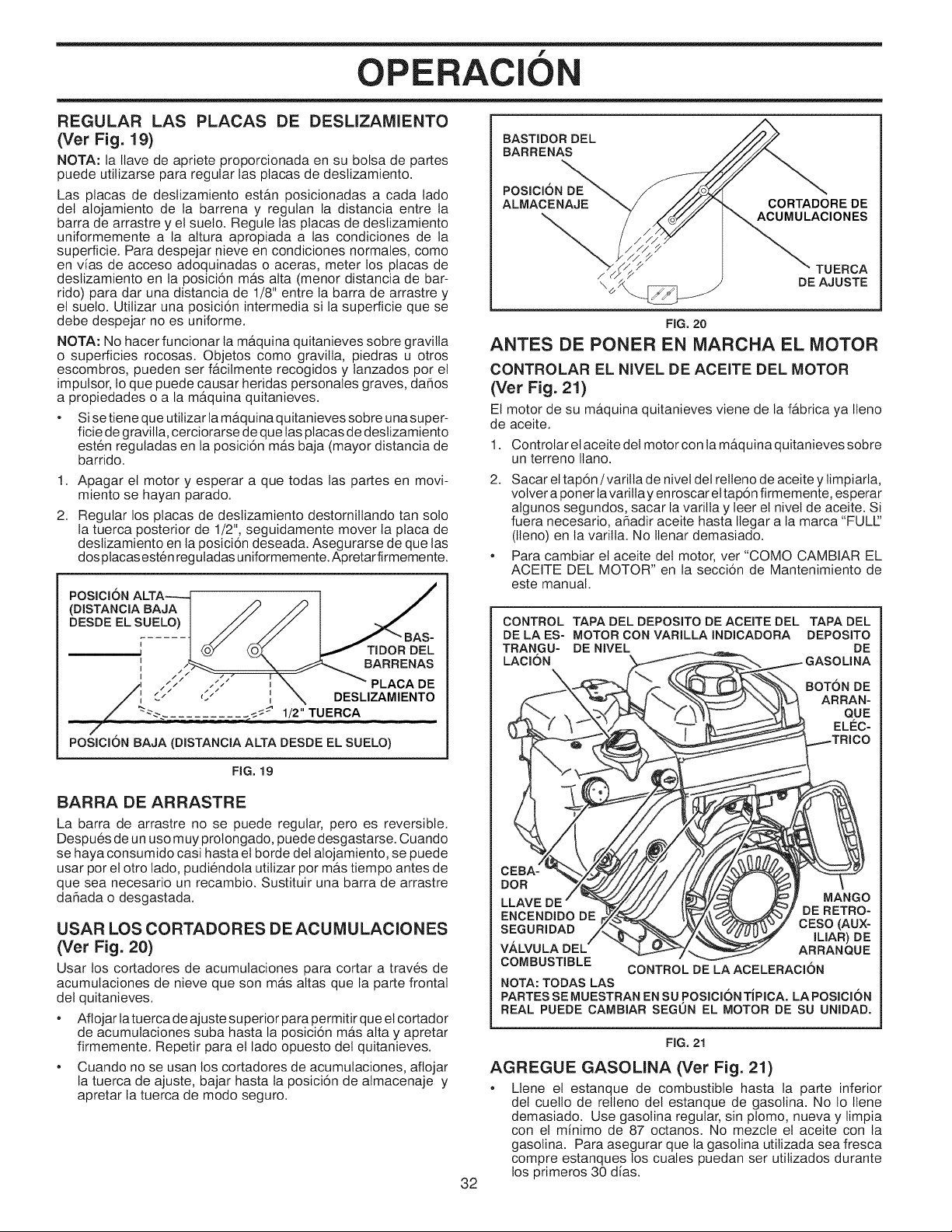
OPE AClON
REGULAR LAS PLACAS DE DESUZAMIENTO
(Ver Fig. 19)
NOTA: la Nave de apriete proporcionada en su bolsa de partes
puede utilizarse para regular las placas de destizamiento.
Las ptacas de destizamiento estb,n posicionadas a cada lado
del alojamiento de la barrena y regutan la distancia entre la
barra de arrastre y el sueto. Regule las placas de deslizamiento
uniformemente a la altura apropiada alas condiciones de la
superficie. Para despejar nieve en condiciones normales, como
en vfas de acceso adoquinadas o aceras, meter los placas de
destizamiento en la posici6n mb,s alta (menor distancia de bar-
rido) para dar una distancia de 1/8" entre la barra de arrastre y
et suelo. Utilizar una posici6n intermedia si la superficie que se
debe despejar no es uniforme.
NOTA: No hacer funcionar la m&quina quitanieves sobre gravilla
o superficies rocosas. Objetos como gravilta, piedras u otros
escombros, pueden ser facilmente recogidos y lanzados por et
imputsor, Io que puede causar heridas personales graves, daSos
a propiedades o a la m&quina quitanieves.
• Si se tiene que utilizar la m&quina quitanieves sobre una super-
ficie de gravilla, cerciorarse de que las ptacas de deslizamiento
esten regutadas en la posici6n mb.sbaja (mayor distancia de
barrido.
1.
2.
Apagar el motor y esperar a que todas las partes en movi-
miento se hayan parado.
Regular los placas de deslizamiento destornittando tan solo
la tuerca posterior de 1/2", seguidamente mover la ptaca de
deslizamiento en la posici6n deseada. Asegurarse de que las
dosptacasesten regutadas uniformemente.Apretarfirmemente.
POSlCION
(DISTANCIA BAJA
DESDE EL SUELO)
_T TIDOR DEL
I BARRENAS
I /'
_/_ /." .'-" PLACA DE
I /_/ ".,_ I
DESLIZAMIENTO
=_--......... _=._ 1/2" TUERCA =
2
POSICION BAJA (DISTANClA ALTA DESDE EL SUELO)
FIG. 19
BARRA DE ARRASTRE
La barra de arrastre no se puede regular, pero es reversible.
Despues de un uso muy prolongado, puede desgastarse. Cuando
se haya consumido casi hasta et borde det alojamiento, se puede
usar por et otto lado, pudiendota utilizar por mas tiempo antes de
que sea necesario un recambio. Sustituir una barra de arrastre
daSada o desgastada.
USAR LOS CORTADORES DE ACUMULACIONES
(Vet Fig. 20)
Usar los cortadores de acumulaciones para cortar a traves de
acumulaciones de nieve que son mb.s altas que la parte frontal
del quitanieves.
• Aflojar latuerca de ajuste superior para permitir que el cortador
de acumulaciones suba hasta la posici6n mb,s alta y apretar
firmemente. Repetir para et lado opuesto del quitanieves.
• Cuando no se usan los cortadores de acumutaciones, aflojar
la tuerca de ajuste, bajar hasta ta posici6n de almacenaje y
apretar la tuerca de modo seguro.
BASTIDOR DEL
BARRENAS
"Y,¢_ #'"
CORTADORE DE
LAClONES
_ TUERCA
DE AJUSTE
FIG. 20
ANTES DE PONER EN MARCHA EL MOTOR
CONTROLAR EL NIVEL DE ACEITE DEL MOTOR
(Vet Fig. 21)
Et motor de su mb,quina quitanieves viene de la fb,brica ya Iteno
de aceite.
1. Controlar el aceite del motor con la mb.quina quitanieves sobre
un terreno llano.
2. Sacar ettap6n/varilla de nivel del relleno de aceite y limpiarla,
volver a poner la varilla yen roscar et tap6n firmemente, esperar
algunos segundos, sacar la varilla y leer el nivet de aceite. Si
fuera necesario, aSadir aceite hasta Ilegar a la marca "FULl"
(tleno) en la varitta. No Ilenar demasiado.
• Para cambiar el aceite det motor, ver "COMO CAMBIAR EL
ACEITE DEL MOTOR" en la secci6n de Mantenimiento de
este manual.
32
CONTROL TAPA DEL DEPOSITO DE ACEITE DEL TAPA DEL
DE LA ES- MOTOR CON VARILLA INDICADORA DEPOSITO
TRANGU- DE NIVEL DE
LACION
BOTON DE
ARRAN-
QUE
EL[_C-
..._....-TRIC0
_D_E__4 MANGO
DE RETRO-
ENCENDIDO DE _
SEGURIDAD /.'_._ CESO (AUX-
DEL/_',,,_"_ ILIAR) DE
V/_.LVULA
ARRANQUE
COMBUSTIBLE
CONTROL DE LA ACELERACION
NOTA:TODAS LAS
PARTES SEMUESTRAN ENSU POSICIONTiPICA, LA POSICION
REAL PUEDE CAMBIAR SEGUN EL MOTOR DE SU UNIDAD.
FIG. 21
AGREGUE GASOLINA (Ver Fig. 21)
• Llene el estanque de combustible hasta la parte inferior
det cuetlo de retteno del estanque de gasolina. No Io Itene
demasiado. Use gasolina regular, sin plomo, nueva y limpia
con el minimo de 87 octanos. No mezcle et aceite con la
gasolina. Para asegurar que la gasolina utilizada sea fresca
compre estanques los cuales puedan ser utitizados durante
los primeros 30 dias.
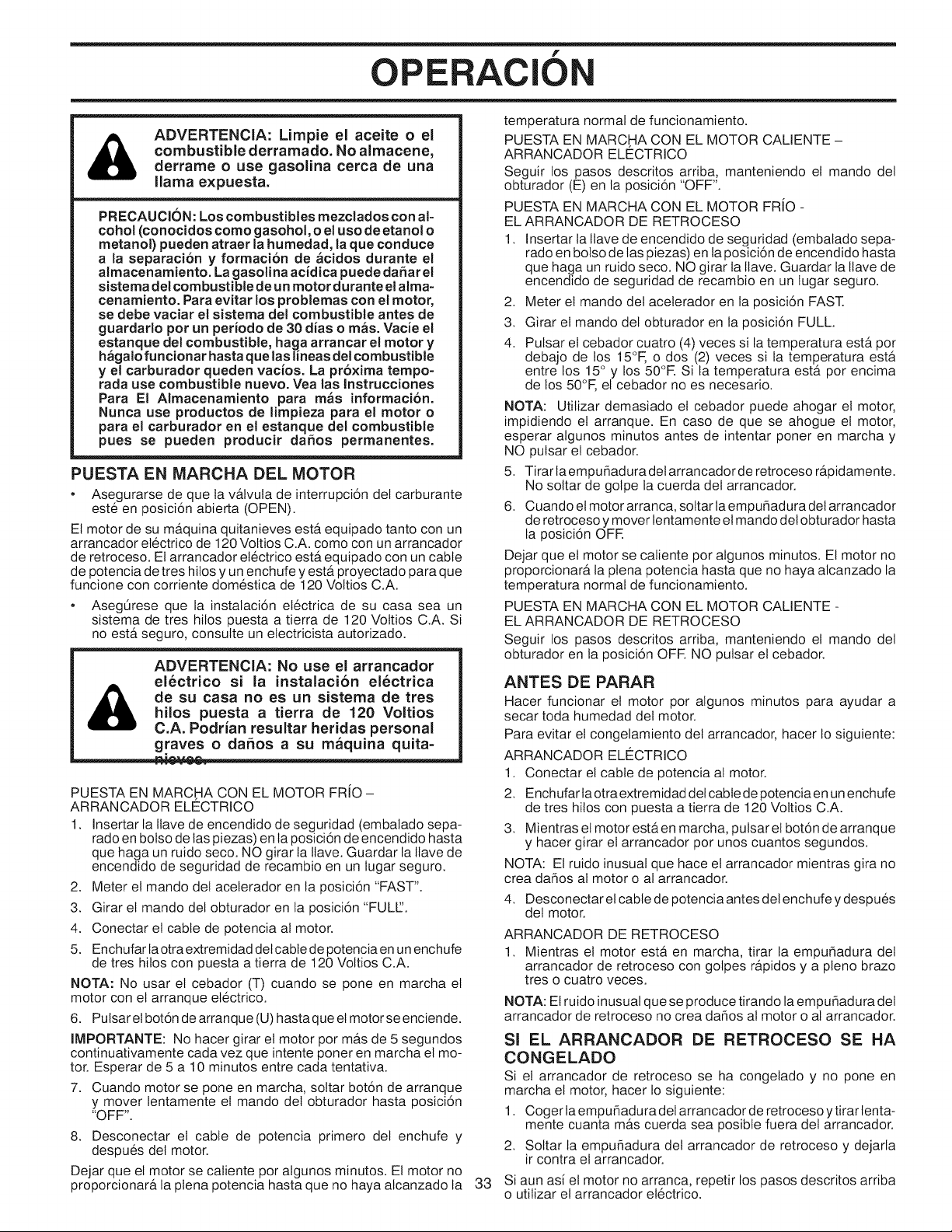
OPERAClO
&
ADVERTENCiA: Limpie el aceite o ei
combustible derrarnado. No aimacene,
derrame o use gasolina cerca de una
llama expuesta.
PRECAUCK_)N: Los combustibles mezclados con al-
cohol (conocidos como gasohol, o el uso de etanol o
metanol) pueden atraer la humedad, la que conduce
a la separaci6n y formaci6n de _cidos durante el
almacenamiento. La gasolina ac_dica puede dahar el
sistema del combustible de un motor durante el alma-
cenamiento. Para evitar los problemas con el motor,
se debe vaciar el sistema del combustible antes de
guardarlo pot un periodo de 30 dias o mas. Vacie el
estanque del combustible, haga arrancar el motor y
h_galo funcionar hasta que las lineas del combustible
y el carburador queden vacios. La pr6×ima tempo-
rada use combustible nuevo. Vea las Instrucciones
Para El Almacenamiento para m_s informaci6n.
Nunca use productos de limpieza para el motor o
para el carburador en et estanque del combustible
pues se pueden producir dahos permanentes.
PUESTA EN MARCHA DEL MOTOR
• Asegurarse de que la valvuta de interrupci6n det carburante
este en posici6n abierta (OPEN).
Et motor de su m&quina quitanieves esta equipado tanto con un
arrancador electrico de 120 Voltios C.A. como con un arrancador
de retroceso. El arrancador electrico esta equipado con un cable
de potencia de tres hilos y un enchufe y esta proyectado para que
funcione con corriente domestica de 120 Voltios C.A.
• AsegL_rese que la instalaci6n electrica de su casa sea un
sistema de tres hilos puesta a tierra de 120 Vottios C.A. Si
no estb, seguro, consulte un electricista autorizado.
ADVERTENCIA: No use el arrancador
electrico si la instalaci6n electrica
de su casa no es un sistema de treshilos puesta a tierra de 120 Voltios
C.A. Podrian resultar heridas personal
graves o daSos a su maquina quita°
. =
PUESTA EN MARC,HA CON EL MOTOR FRiO -
ARRANCADOR ELECTRICO
1. Insertar la Ilave de encendido de seguridad (embalado sepa-
rado en bolso de las piezas) en ta posici6n de encendido hasta
que haga un ruido seco. NO girar ta ttave. Guardar la ltave de
encendido de seguridad de recambio en un lugar seguro.
2. Meter el mando del acelerador en la posici6n "FAST".
3. Girar el mando det obturador en la posici6n "FULE'.
4. Conectar el cable de potencia al motor.
5. Enchufar la otra extremidad det cable de potencia en un enchufe
de tres hitos con puesta a tierra de 120 Vottios C.A.
NOTA: No usar el cebador (T) cuando se pone en marcha el
motor con el arranque electrico.
6. Pulsar el bot6n de arranque (U) hasta que el motorse enciende.
IMPORTANTE: No hacer girar el motor por mb,s de 5 segundos
continuativamente cada vez que intente poner en marcha el mo-
tor. Esperar de 5 a 10 minutos entre cada tentativa.
7. Cuando motor se pone en marcha, soltar bot6n de arranque
y mover lentamente el mando del obturador hasta posici6n
"OFF".
8. Desconectar el cable de potencia primero del enchufe y
despues del motor.
Dejar que et motor se caliente por algunos minutos. El motor no
proporcionarb, la ptena potencia hasta que no haya alcanzado la
33
temperatura normal de funcionamiento.
PUESTA EN MARC,HA CON EL MOTOR CALIENTE -
ARRANCADOR ELECTRICO
Seguir los pasos descritos arriba, manteniendo et mando del
obturador (E) en la posici6n "OFF".
PUESTA EN MARCHA CON EL MOTOR FRiO -
EL ARRANCADOR DE RETROCESO
1. Insertar la tlave de encendido de seguridad (embalado sepa-
rado en bolso de tas piezas) en la posici6n de encendido hasta
que haga un ruido seco. NO girar ta tlave. Guardar la tlave de
encendido de seguridad de recambio en un lugar seguro.
2. Meter el mando del acelerador en la posici6n FAST.
3. Girar el mando del obturador en la posici6n FULL.
4. Pulsar el cebador cuatro (4) veces si la temperatura est#, por
debajo de los 15°F, o dos (2) veces si la temperatura est#,
entre los 15 ° y los 50°R Si la temperatura estb, por encima
de los 50°F, et cebador no es necesario.
NOTA: Utilizar demasiado et cebador puede ahogar et motor,
impidiendo el arranque. En caso de que se ahogue el motor,
esperar algunos minutos antes de intentar poner en marcha y
NO pulsar el cebador.
5. Tirar la empufiadura det arrancador de retroceso rb,pidamente.
No sottar de golpe la cuerda del arrancador.
6. Cuando et motor arranca, sottar la empufladura del arrancador
de retroceso y mover lentamente el mando del obturador hasta
la posici6n OFR
Dejar que et motor se caliente por algunos minutos. El motor no
proporcionar#, la plena potencia hasta que no haya alcanzado la
temperatura normal de funcionamiento.
PUESTA EN MARCHA CON EL MOTOR CALIENTE -
EL ARRANCADOR DE RETROCESO
Seguir los pasos descritos arriba, manteniendo et mando del
obturador en la posici6n OFF. NO pulsar el cebador.
ANTES DE PARAR
Hacer funcionar el motor por algunos minutos para ayudar a
secar toda humedad del motor.
Para evitar el congelamiento del arrancador, hacer Io siguiente:
ARRANCADOR ELE_CTRICO
1. Conectar et cable de potencia al motor.
2. Enchufar ta otra extremidad del cable de potencia en unenchufe
de tres hilos con puesta a tierra de 120 Voltios C.A.
3. Mientras et motor est& en marcha, pulsar el bot6n de arranque
y hacer girar el arrancador por unos cuantos segundos.
NOTA: El ruido inusual que hace et arrancador mientras gira no
crea dafios al motor o al arrancador.
4. Desconectar el cable de potencia antes del enchufe y despues
det motor.
ARRANCADOR DE RETROCESO
1. Mientras el motor est& en marcha, tirar la empufladura det
arrancador de retroceso con golpes rb,pidos y a pleno brazo
tres o cuatro veces.
NOTA: Et ruido inusual que se produce tirando la empufiadura del
arrancador de retroceso no crea dafios al motor o al arrancador.
SI EL ARRANCADOR DE RETROCESO SE HA
CONGELADO
Si el arrancador de retroceso se ha congelado y no pone en
marcha el motor, hacer Io siguiente:
1. Coger la empufiadura det arrancador de retroceso ytirar lenta-
mente cuanta mas cuerda sea posibte fuera del arrancador.
2. Soltar la empufladura del arrancador de retroceso y dejarla
ir contra el arrancador.
Si aun asi el motor no arranca, repetir los pasos descritos arriba
o utitizar el arrancador el6ctrico.
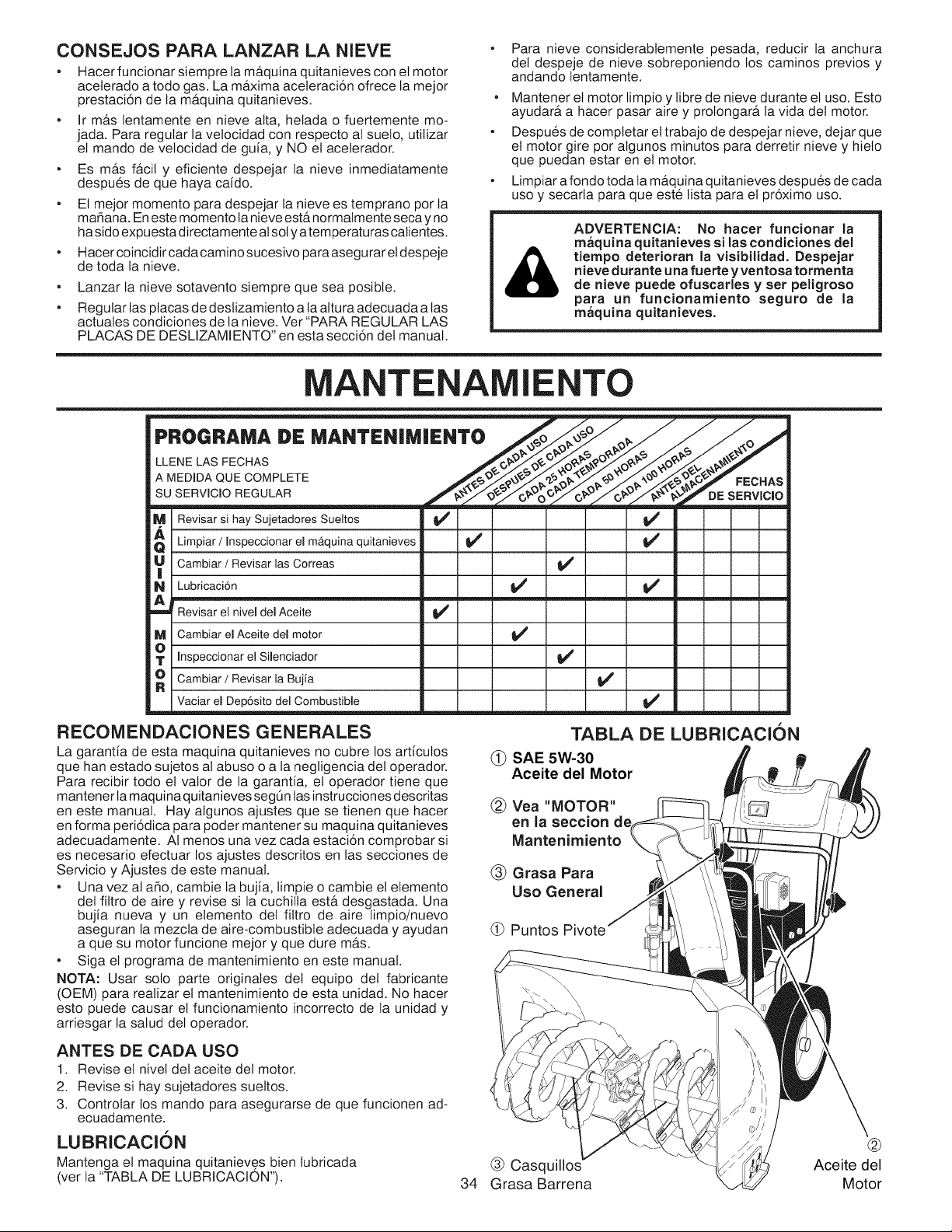
CONSEJOS PARA LANZAR LA NIEVE
• Hacer funcionar siempre lamb, quina quitanieves con el motor
acelerado a todo gas. La maxima aceteraci6n ofrece la mejor
prestaci6n de lamb, quina quitanieves.
• Ir mb,s lentamente en nieve alta, helada o fuertemente mo-
jada. Para regular la vetocidad con respecto al suelo, utilizar
el mando de velocidad de guia, y NO et acelerador.
• Es mb,s fb.cil y eficiente despejar la nieve inmediatamente
despues de que haya caido.
• Et mejor momento para despejar la nieve es temprano por la
ma_ana. En este momento ta nieve estb.normalmente seca y no
ha sido expu esta directamente al sot y atemperaturas calientes.
• Hacer coincidir cada camino sucesivo para asegurar et despeje
de toda la nieve.
o
o
Lanzar la nieve sotavento siempre que sea posible.
Regular las placas de deslizamiento a la altura adecuada alas
actuales condiciones de la nieve. Ver "PARA REGULAR LAS
PLACAS DE DESLIZAMIENTO" en esta secci6n del manual.
Para nieve considerablemente pesada, reducir la anchura
del despeje de nieve sobreponiendo los caminos previos y
andando lentamente.
• Mantener et motor limpio y libre de nieve durante el uso. Esto
ayudara a hacer pasar aire y prolongara ta vida del motor.
• Despues de comptetar el trabajo de despejar nieve, dejar que
el motor gire por algunos minutos para derretir nieve y hieto
que puedan estar en el motor.
• Limpiar a fondo toda lamb, quina quitanieves despues de cada
uso y secarla para que este lista para el pr6ximo uso.
&
ADVERTENCIA: No hacer funcJonar la
rnaquina quitanJeves sJ las condiciones del
tiernpo deterioran la vJsibJtidad. Despejar
nJeve durante una fuerte yventosa tormenta
de nieve puede ofuscarles y ser peligroso
para un funcJonarniento seguro de Ja
rn_quina quitanieves.
ANTEN lENTO
SU SERVlOIO REGULAR _'_ O_ _0_': O1_0_ O_,O/_ ¢_"_,'v; DE SERVICIO
Revisar si hay Sujetadores Sueltos _ _4'
Limpiar/ Inspeccionarel m_quinaquitanieves if _#'
Cambiar / Revisar las Correas _#4
Lubricaci6n _ t# #
M
?
N
_ Revisarel niveldel Aceite
M Cambiarel Aceite del motor
Inspeccionarel Silenciador
Cambiar/ Revisarla Bujia
Vaciarel Dep6sitodel Combustible
t/
v'
RECOMENDACIONES GENERALES
La garantia de esta maquina quitanieves no cubre los articulos (_
que han estado sujetos al abuso o a la negligencia del operador.
Para recibir todo et valor de la garantia, el operador tiene que
mantener la maquinaquitanieves segt3n tas instrucciones descritas
en este manual. Hay algunos ajustes que se tienen que hacer (_
en forma peri6dica para poder mantener su maquina quitanieves
adecuadamente. At menos una vez cada estaci6n comprobar si
es necesario efectuar los ajustes descritos en las secciones de
Servicio y Ajustes de este manual.
• Una vez al a_o, cambie la bujia, limpie o cambie el elemento
det filtro de aire y revise si la cuchilla est& desgastada. Una
bujia nueva y un elemento det filtro de aire limpio/nuevo
aseguran la mezcla de aire-combustibte adecuada y ayudan (_
a que su motor funcione mejor y que dure mb,s.
• Siga el programa de mantenimiento en este manual.
NOTA: Usar solo parte originales det equipo del fabricante
(OEM) para realizar el mantenimiento de esta unidad. No hacer
esto puede causar el funcionamiento incorrecto de la unidad y
arriesgar la salud det operador.
TABLA DE LUBRICACION
SAE 5W-30
Aceite del Motor
Yea "MOTO R"
en la seccJon
Mantenimiento
(_) Grasa Para
Uso General
Puntos
ANTES DE CADA USO
1. Revise el nivel del aceite det motor.
2. Revise si hay sujetadores sueltos.
3. Controlar los mando para asegurarse de que funcionen ad-
ecuadamente.
LUBRICACI()N
Mantenga el maquina quitanieves bier lubricada
(ver la "TABLA DE LUBRICACION").
@ Casquillos
34 Grasa Barrena
@
Aceite del
Motor
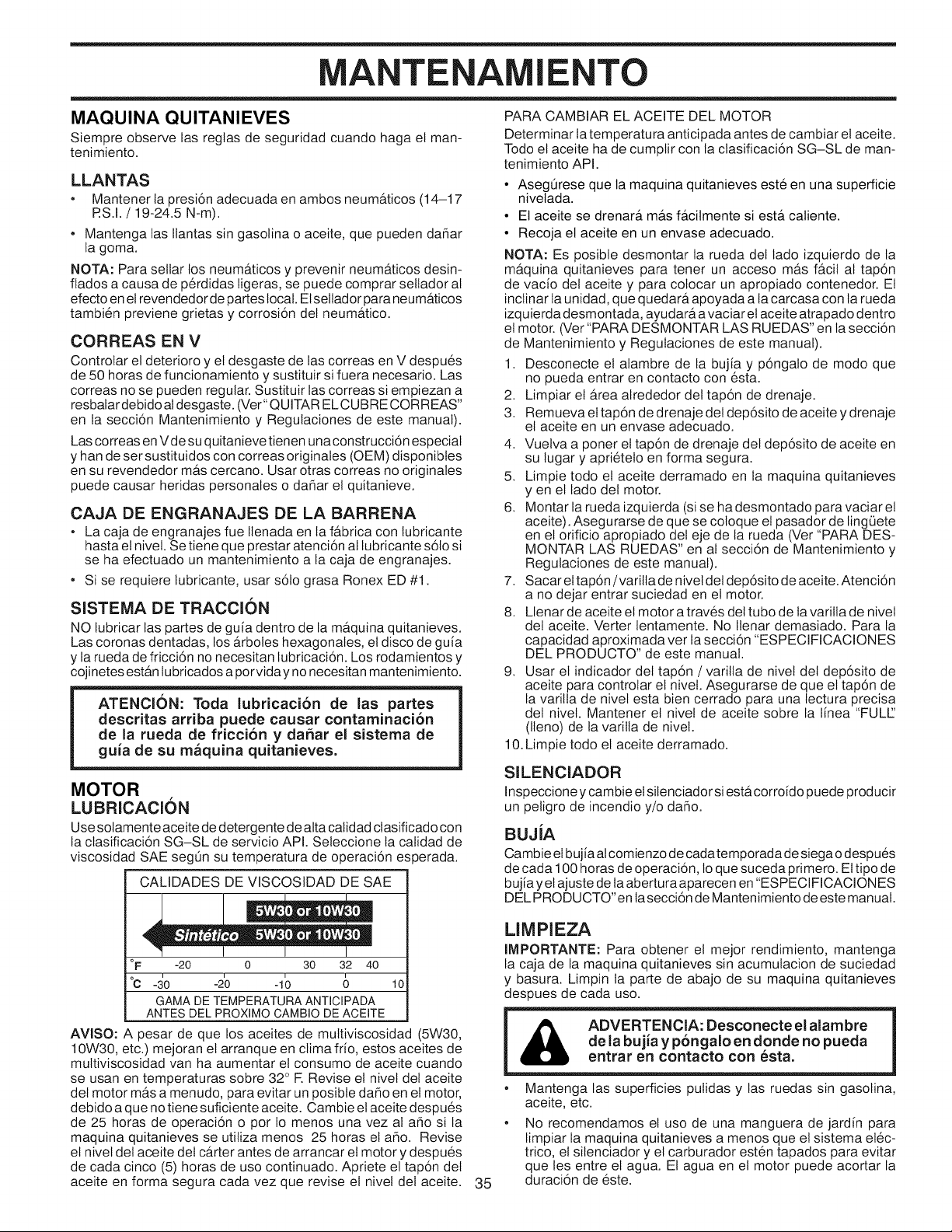
ANTE A TO
MAQUINA QUITANIEVES
Siempre observe las regtas de seguridad cuando haga el man-
tenimiento.
LLANTAS
• Mantener ta presi6n adecuada en ambos neumAticos (14-17
RS.I. / 19-24.5 N-m).
• Mantenga las Ilantas sin gasolina o aceite, que pueden daSar
la goma.
NOTA: Para sellar los neumAticos y prevenir neumAticos desin-
flados a causa de perdidas ligeras, se puede comprar settador al
efecto en et revendedor de partes local. El seltador para neumAticos
tambi6n previene grietas y corrosi6n det neumAtico.
CORREAS EN V
Controlar el deterioro y et desgaste de las correas en V despues
de 50 horas de funcionamiento y sustituir si fuera necesario. Las
correas no se pueden regular. Sustituir las correas si empiezan a
resbalar debido al desgaste. (Ver" QUITAR EL CUBRE CORREAS"
en la secci6n Mantenimiento y Regutaciones de este manual).
Las correas en Vde su quitanieve tienen unaconstrucci6n especial
y han de ser sustituidos con correas originales (OEM) disponibtes
en su revendedor m&s cercano. Usar otras correas no originales
puede causar heridas personales o daSar el quitanieve.
CAJA DE ENGRANAJES DE LA BARRENA
• La caja de engranajes fue Ilenada en la f&brica con tubricante
hasta et nivel. Se tiene que prestar atenci6n al lubricante s6to si
se ha efectuado un mantenimiento a la caja de engranajes.
• Si se requiere lubricante, usar s61o grasa Ronex ED #1.
SISTElVlA DE TRACCION
NO lubricar las partes de guia dentro de la m&quina quitanieves.
Las coronas dentadas, los Arboles hexagonales, et disco de guia
y la rueda de fricci6n no necesitan lubricaci6n. Los rodamientos y
cojinetes estan lubricados a por vida y no necesitan mantenimiento.
ATENCION: Toda lubdcaci6n de las partes
descritas arriba puede causar contaminaci6n
de la rueda de fricci6n y da_ar el sistema de
guJa de su maquina quitanieves.
MOTOR
LUBRICAClON
Use solamente aceite de detergente de alta calidad clasificado con
la clasificaci6n SG-SL de servicio API. Seteccione la catidad de
viscosidad SAE seg_n su temperatura de operaci6n esperada.
CALIDADES DE VISCOSIDAD DE SAE
!
°F -20 0 30 32 40
°c -2'o -1'o 6
GAMA DE TEMPERATURAANTICIPADA
ANTESDEL PROXIMOCAMBIODE ACEITE
10
AVlSO: A pesar de que los aceites de multiviscosidad (5W30,
10W30, etc.) mejoran el arranque en clima frio, estos aceites de
muttiviscosidad van ha aumentar et consumo de aceite cuando
se usan en temperaturas sobre 32 ° R Revise el nivet del aceite
del motor mas a menudo, para evitar un posibte daSo en el motor,
debido a que no tiene suficiente aceite. Cambie el aceite despues
de 25 horas de operaci6n o por Io menos una vez al afio si la
maquina quitanieves se utiliza menos 25 horas el aSo. Revise
et nivel del aceite del carter antes de arrancar el motor y despues
de cada cinco (5) horas de uso continuado. Apriete el tap6n del
aceite en forma segura cada vez que revise el nivet del aceite.
PARA CAMBIAR EL ACEITE DEL MOTOR
Determinar latemperatura anticipada antes de cambiar el aceite.
Todo el aceite ha de cumptir con la clasificaci6n SG-SL de man-
tenimiento API.
• AsegOrese que la maquina quitanieves este en una superficie
nivetada.
• El aceite se drenara mas facilmente siesta caliente.
• Recoja el aceite en un envase adecuado.
NOTA: Es posible desmontar la rueda del lado izquierdo de la
maquina quitanieves para tener un acceso mas facil al tap6n
de vacfo del aceite y para cotocar un apropiado contenedor. Et
inclinar la unidad, que quedara apoyada a la carcasa con la rueda
izquierda desmontada, ayudara a vaciar el aceite atrapado dentro
et motor. (Ver "PARA DESMONTAR LAS RUEDAS" en la secci6n
de Mantenimiento y Regulaciones de este manual).
1. Desconecte et alambre de la bujia y p6ngalo de modo que
no pueda entrar en contacto con esta.
2. Limpiar el Area alrededor del tap6n de drenaje.
3. Remueva et tap6n de drenaje del dep6sito de aceite y drenaje
el aceite en un envase adecuado.
4. Vuetva a poner et tap6n de drenaje del dep6sito de aceite en
su lugar y aprietelo en forma segura.
5. Limpie todo et aceite derramado en la maquina quitanieves
y en el lado del motor.
6. Montar la rueda izquierda (si se ha desmontado para vaciar el
aceite). Asegurarse de que se coloque et pasador de lingQete
en el orificio apropiado del eje de la rueda (Ver "PARA DES-
MONTAR LAS RUEDAS" en al secci6n de Mantenimiento y
Regulaciones de este manual).
7. Sacar el tap6n /varitla de nivel det dep6sito de aceite. Atenci6n
a no dejar entrar suciedad en el motor.
8. Llenar de aceite el motor a trav6s del tubo de la varilla de nivel
det aceite. Verter lentamente. No Ilenar demasiado. Para la
capacidad aproximada ver la secci6n "ESPECIFICACIONES
DEL PRODUCTO" de este manual.
9. Usar el indicador det tap6n / varitla de nivel del dep6sito de
aceite para controlar el nivel. Asegurarse de que et tap6n de
la varilla de nivet esta bien cerrado para una lectura precisa
del nivel. Mantener et nivel de aceite sobre la linea "FULE'
(lleno) de la varilla de nivel.
10. Limpie todo el aceite derramado.
SILENCIADOR
Inspeccione y cambie elsilenciador siesta corroido puede producir
un peligro de incendio y/o dafio.
BUJJA
Cambie el buj[a al comienzo de cadatemporada de siega o despues
de cada 100 horas de operaci6n, 1oque suceda primero. El tipo de
bujia yet ajuste de la abertura aparecen en "ESPECIFICACIONES
DEL PRODUCTO"en lasecci6n de Mantenimiento de este manual.
LIMPIEZA
IMPORTANTE: Para obtener el mejor rendimiento, mantenga
la caja de la maquina quitanieves sin acumutacion de suciedad
y basura. Limpin ta parte de abajo de su maquina quitanieves
despues de cada uso.
ADVERTENClA:Desconecteelalambre
de la bujJa y p6ngalo en donde no pueda
entrar en contacto con esta.
35
Mantenga las superficies putidas y las ruedas sin gasolina,
aceite, etc.
No recomendamos et uso de una manguera de jardin para
limpiar la maquina quitanieves a menos que el sistema etec-
trico, el silenciador y el carburador est6n tapados para evitar
que les entre et agua. El agua en el motor puede acortar la
duraci6n de este.
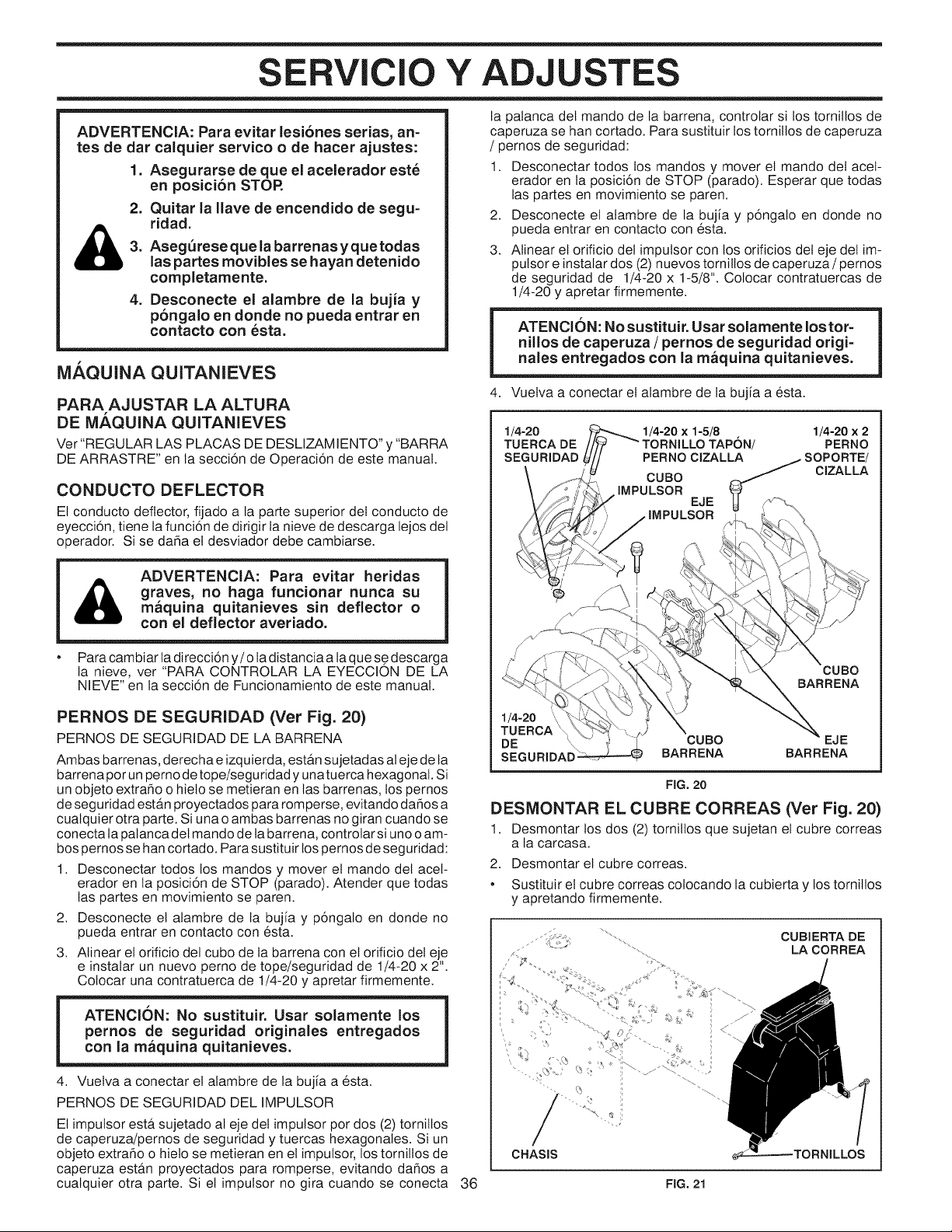
ERVlCIO YA JUSTE
ADVERTENCIA: Para evitar lesi6nes serias, an-
tes de dar calquier servico o de hacer ajustes:
1. Asegurarse de que el acelerador este
en posici6n STOR
2. Quitar la Ilave de encendido de segu-
ridad.
3. Asegureseque la barrenasyquetodas
las partes movibles se hayan detenido
completamente.
4. Desconecte el alambre de la bujJa y
p6ngalo en donde no pueda entrar en
contacto con esta.
MAQU INA QUITANIEVES
PARA AJUSTAR LA ALTURA
DE iVlAQUINA QUITANIEVES
Ver "REGULAR LAS PLACAS DE DESLIZAMIENTO" y "BARRA
DE ARRASTRE" en la secci6n de Operaci6n de este manual.
CONDUCTO DEFLECTOR
El conducto deflector, fijado a la parte superior del conducto de
eyecci6n, tiene la funci6n de dirigir la nieve de descarga lejos del
operador. Si se da_a el desviador debe cambiarse.
&
ADVERTENCIA: Para evitar herJdas
graves, no haga funcionar nunca su
maquina quitanieves sin deflector o
con el deflector averiado.
• Para cambiar la direcci6n y/o la distancia a la que s e descarga
la nieve, ver "PARA CONTROLAR LA EYECCION DE LA
NIEVE" en la secci6n de Funcionamiento de este manual.
PERNOS DE SEGURIDAD (Vet Fig. 20)
PERNOS DE SEGURIDAD DE LA BARRENA
Ambas barrenas, derecha e izquierda, estan sujetadas al eje de la
barrena por un perno de tope/seguridad y unatuerca hexagonal. Si
un objeto extrafio o hielo se metieran en las barrenas, los pernos
de seguridad estb,n proyectados para romperse, evitando daSos a
cualquier otra parte. Si una o ambas barrenas no giran cuando se
conecta ta palanca det mando de ta barrena, controlar si uno o am-
bos pernos se han cortado. Para sustituir los pemos de seguridad:
1. Desconectar todos los mandos y mover el mando del acel-
erador en la posici6n de STOP (parado). Atender que todas
las partes en movimiento se paren.
2. Desconecte el alambre de la bujia y p6ngalo en donde no
pueda entrar en contacto con esta.
3. Alinear el orificio del cubo de ta barrena con et orificio del eje
e instalar un nuevo perno de tope!seguridad de 1/4-20 x 2".
Colocar una contratuerca de 1/4-20 y apretar firmemente.
ATENCION: No sustituir. Usar solamente los
pernos de seguridad originales entregados
con la maquina quitanieves.
4. Vuelva a conectar el alambre de la bujia a esta.
PERNOS DE SEGURIDAD DEL IMPULSOR
Et imputsor estb, sujetado al eje del impulsor por dos (2) tornittos
de caperuza!pernos de seguridad y tuercas hexagonales. Si un
objeto extra_o o hielo se metieran en el imputsor, los tornillos de
caperuza estan proyectados para romperse, evitando da_os a
cualquier otra parte. Si et imputsor no gira cuando se conecta
la palanca del mando de la barrena, controlar si los torniltos de
caperuza se han cortado. Para sustituir los tornitlos de caperuza
/ pemos de seguridad:
1. Desconectar todos los mandos y mover el mando det acet-
erador en la posici6n de STOP (parado). Esperar que todas
las partes en movimiento se paren.
2. Desconecte el atambre de la bujia y p6ngalo en donde no
pueda entrar en contacto con esta.
3. Atinear et orificio del imputsor con los orificios det eje del im-
putsor e instalar dos (2) nuevos tornillos de caperuza / pernos
de seguridad de 1/4-20 x 1-5/8". Colocar contratuercas de
1/4-20 y apretar firmemente.
ATENCION: No sustituir. Usar solamente Iostor-
nillos de caperuza / pernos de seguridad origi-
hales entregados con la maquina quitanieves.
4. Vuelva a conectar el alambre de la bujia a esta.
1/4-20 _ 1/4-20 x 1-5/8 , 1/4-20 x 2
TUERCA DE //_-7_ _TORNILLO TAPON/ PERNO
SEGURIDAD U// PERNO CJZALLA _ SOPORTE/
\ -,_'_ CUBO _ CJZALLA
\/_ ,IY_'_ _/ ..... EJE [J
__ ',i" / IMPULSOR /,vt--_L
./
/
CUBO
BARRENA
1/4-20
TUERCA \
DE Y CUBO EJE
SEGURIDA_ BARRENA BARRENA
FiG, 20
DESMONTAR EL CUE}RE CORREAS (Vet Fig. 20)
1. Desmontar los dos (2) tomiltos que sujetan et cubre correas
a la carcasa.
2. Desmontar el cubre correas.
• Sustituir el cubre correas colocando la cubierta y los torniltos
y apretando firmemente.
CUBIERTA DE
LA CORREA
36 FiG. 21
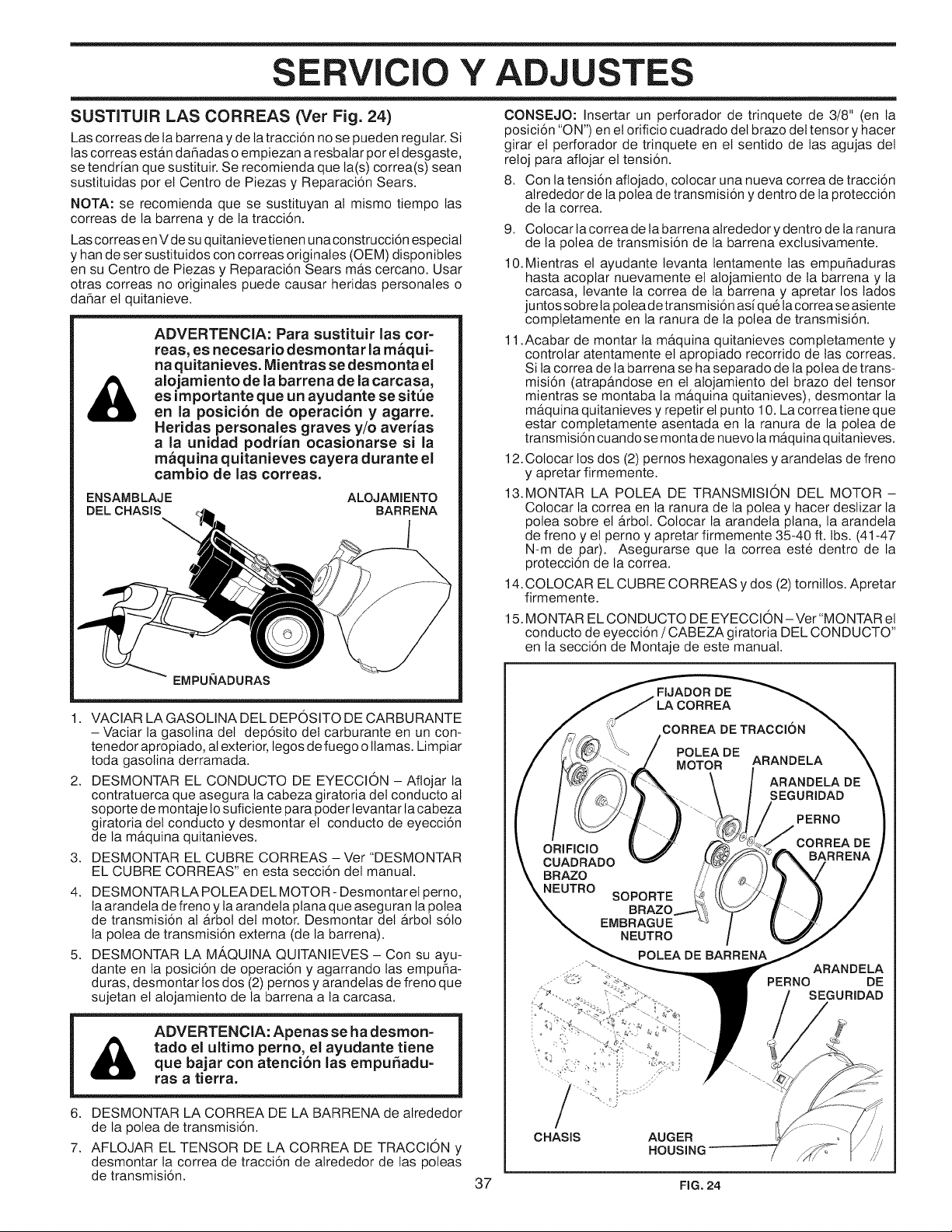
SE VlCIO YADJ STES
SUSTITUIR LAS CORREAS (Vet Fig. 24)
Las correas de la barrena y de la tracci6n no se pueden regular. Si
las correas estan daSadas o empiezan a resbalar por et desgaste,
se tendrian que sustituir. Se recomienda que la(s) correa(s) sean
sustituidas por et Centro de Piezas y Reparaci6n Sears.
NOTA: se recomienda que se sustituyan al mismo tiempo las
correas de la barrena y de la tracci6n.
Las correas en V de su quitanieve tienen una construcci6n especial
y han de ser sustituidos con correas originales (OEM) disponibles
en su Centro de Piezas y Reparaci6n Sears mb,s cercano. Usar
otras correas no originales puede causar heridas personales o
da_ar el quitanieve.
&
ADVERTENCIA: Para sustituir las cot-
teas, es necesario desmontar la maqui-
na quitanieves. Mientras se desmonta el
alojamiento de la barrena de la carcasa,
es importante que un ayudante se situe
en la posici6n de operacion y agarre.
Heridas personales graves y/o averJas
a la unidad podrJan ocasionarse si la
maquina quitanieves cayera durante el
cambio de las correas.
ENSAMBLAJE ALOJAMIENTO
DEL CHASIS BARRENA
CONSEJO: Insertar un perforador de trinquete de 3/8" (en la
posici6n "ON") en el orificio cuadrado del brazo del tensor y hacer
girar et perforador de trinquete en el sentido de las agujas del
reloj para aflojar el tensi6n.
8. Con latensi6n aflojado, colocar una nueva correa de tracci6n
alrededor de la polea de transmisi6n y dentro de la protecci6n
de la correa.
9. Cotocar la correa de la barrena alrededor y dentro de ta ranura
de la polea de transmisi6n de la barrena exctusivamente.
10. Mientras el ayudante tevanta lentamente las empuSaduras
hasta acoptar nuevamente el alojamiento de la barrena y la
carcasa, levante la correa de la barrena y apretar los lados
juntos sobre la polea detransmisi6n asique lacorrease asiente
comptetamente en la ranura de la potea de transmisi6n.
11 .Acabar de montar la m&quina quitanieves completamente y
controlar atentamente et apropiado recorrido de tas correas.
Si la correa de la barrena se ha separado de la polea de trans-
misi6n (atrapb,ndose en el alojamiento det brazo del tensor
mientras se montaba ta maquina quitanieves), desmontar la
mb,quina quitanieves y repetir el punto 10. La correatiene que
estar completamente asentada en ta ranura de la polea de
transmisi6n cuando se monta de nuevo lamb,quina quitanieves.
12. Colocar los dos (2) pernos hexagonales y arandelas de freno
y apretar firmemente.
13.MONTAR LA POLEA DE TRANSMISION DEL MOTOR -
Colocar la correa en la ranura de la polea y hacer destizar ta
polea sobre el &rbol. Cotocar la arandeta plana, la arandela
de freno y el perno y apretar firmemente 35-40 ft. Ibs. (41-47
N-m de par). Asegurarse que la correa este dentro de la
protecci6n de la correa.
14. COLOCAR EL CUBRE CORREAS y dos (2) tornillos. Apretar
firmemente.
15. MO NTAR EL CONDUCTO DE EYECCION -Ver "MO NTAR et
conducto de eyecci6n / CABEZA giratoria DEL CONDUCTO"
en la secci6n de Montaje de este manual.
2.
3.
4.
5.
VACIAR LA GASOLINA DEL DEPOSITO DE CARBURANTE
- Vaciar la gasolina del dep6sito det carburante en un con-
tenedor apropiado, al exterior, legos de fuego o llamas. Limpiar
toda gasolina derramada.
DESMONTAR EL CONDUCTO DE EYECCl0N - Aflojar la
contratuerca que asegura la cabeza giratoria det conducto al
soporte de montaje Io suficiente para poder levantar la cabeza
giratoria del conducto y desmontar el conducto de eyecci6n
de la maquina quitanieves.
DESMONTAR EL CUBRE CORREAS - Ver "DESMONTAR
EL CUBRE CORREAS" en esta secci6n del manual.
DESMONTAR LA POLEA DEL MOTOR- Desmontar et perno,
la arandela de freno y la arandela plana que aseguran la polea
de transmisi6n al arbol del motor. Desmontar det b,rbol s61o
la potea de transmisi6n externa (de la barrena).
DESMONTAR LA MAQUINA QUITANIEVES - Con su ayu-
dante en la posici6n de operaci6n y agarrando las empufia-
duras, desmontar los dos (2) pernos y arandetas de freno que
sujetan el alojamiento de la barrena a la carcasa.
ADVERTENCIA: Apenas se ha desmon-
tado el ultimo perno, el ayudante tiene
que bajar con atenci6n las empu_adu-
ras a tierra.
6. DESMONTAR LA CORREA DE LA BARRENA de alrededor
de la polea de transmisi6n.
7. AFLOJAR EL TENSOR DE LA CORREA DE TRACCION y
desmontar la correa de tracci6n de alrededor de las poleas
de transmisi6n.
BRAZO
NEUTRO
CHASIS AUGER
HOUSING
37 FIG. 24
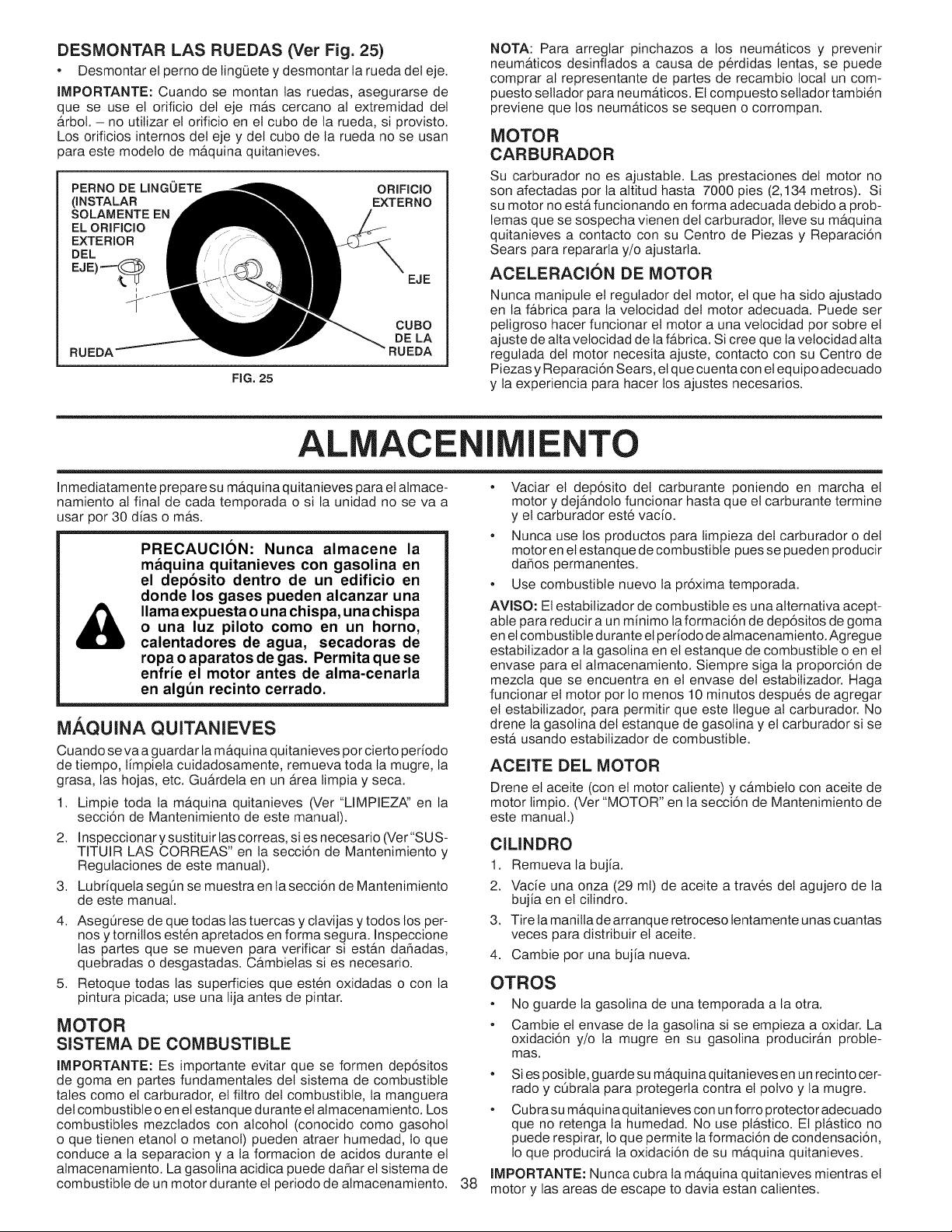
DESMONTAR LAS RUEDAS (Vet Fig. 25)
• Desmontar el perno de lingOete y desmontar la rueda del eje.
IMPORTANTE: Cuando se montan las ruedas, asegurarse de
que se use el orificio del eje mas cercano al extremidad del
Arbol. - no utitizar el orificio en et cubo de la rueda, si provisto.
Los orificios internos del eje y del cubo de la rueda no se usan
para este modelo de maquina quitanieves.
PERNO DE LINGUETE
(INSTALAR
SOLAMENTE EN
EL ORIFICIO
EXTERIOR
DEL
EJE)_
t.;
ORIFIClO
EXTERNO
EJE
RUEDA
FIG. 25
CUBO
DELA
RUEDA
NOTA: Para arregtar pinchazos a los neum&ticos y prevenir
neum&ticos desinflados a causa de perdidas lentas, se puede
comprar al representante de partes de recambio local un com-
puesto sellador para neumAticos. El compuesto seltador tambi6n
previene que los neumaticos se sequen o corrompan.
MOTOR
CARBURADOR
Su carburador no es ajustable. Las prestaciones del motor no
son afectadas por la altitud hasta 7000 pies (2,134 metros). Si
su motor no est& funcionando en forma adecuada debido a prob-
lemas que se sospecha vienen det carburador, lleve su maquina
quitanieves a contacto con su Centro de Piezas y Reparaci6n
Sears para repararla y/o ajustarla.
ACELERACION DE MOTOR
Nunca manipute el regulador det motor, el que ha sido ajustado
en la fAbrica para la vetocidad del motor adecuada. Puede ser
petigroso hacer funcionar el motor a una velocidad por sobre et
ajuste de alta velocidad de la fAbrica. Si cree que la velocidad alta
regutada del motor necesita ajuste, contacto con su Centro de
Piezas y Reparaci6n Sears, el que cuenta con el equipo adecuado
y la experiencia para hacer los ajustes necesarios.
ALMACE I TO
Inmediatamente prepare su mAquina quitanieves para et almace-
namiento al final de cada temporada o si la unidad no se va a
usar por 30 dias o mas.
&
PRECAUCION: Nunca almacene la
maquina quitanieves con gasolina en
el deposito dentro de un edificio en
donde los gases pueden alcanzar una
llama expuesta o una chispa, una chispa
o una luz piloto como en un homo,
calentadores de agua, secadoras de
ropa o aparatos de gas. Permita que se
enfrie el motor antes de alma-cenarla
en algun recinto cerrado.
MAQU INA QUITANIEVES
Cuando se va a guardar la maquina quitanieves por cierto periodo
de tiempo, limpiela cuidadosamente, remueva toda la mugre, la
grasa, las hojas, etc. Guardela en un Area limpia y seca.
1. Limpie toda la maquina quitanieves (Ver "LIMPIEZA? en la
secci6n de Mantenimiento de este manual).
2. Inspeccionar ysustituir las correas, si es necesario (Ver"SUS-
TITUIR LAS CORREAS" en la secci6n de Mantenimiento y
Regutaciones de este manual).
3. Lubriqueta segOn se muestra en la secci6n de Mantenimiento
de este manual.
4. AsegOrese de que todas las tuercas y clavijas y todos los per-
nosy torniltos est6n apretados en forma segura. Inspeccione
las partes que se mueven para verificar si estan daSadas,
quebradas o desgastadas. Cambielas si es necesario.
5. Retoque todas las superficies que esten oxidadas o con la
pintura picada; use una lija antes de pintar.
MOTOR
SiSTEMA DE COMBUSTIBLE
IMPORTANTE: Es importante evitar que se formen dep6sitos
de goma en partes fundamentates del sistema de combustible
tales como el carburador, el filtro del combustible, ta manguera
del combustible o en el estanque durante et almacenamiento. Los
combustibles mezclados con alcohol (conocido como gasohot
o que tienen etanol o metanol) pueden atraer humedad, to que
conduce a la separacion y a la formacion de acidos durante et
almacenamiento. La gasolina acidica puede daSar el sistema de
combustible de un motor durante et periodo de almacenamiento.
38
• Vaciar el dep6sito det carburante poniendo en marcha et
motor y dejandolo funcionar hasta que el carburante termine
y el carburador este vacio.
• Nunca use los productos para limpieza del carburador o del
motor en et estanque de combustible pues se pueden producir
daSos permanentes.
• Use combustible nuevo la pr6xima temporada.
AVISO: El estabilizador de combustible es una alternativa acept-
able para reducir a un m[nimo la formaci6n de dep6sitos de goma
en et combustible durante et periodo de almacenamiento. Agregue
estabilizador a ta gasolina en el estanque de combustible o en el
envase para el almacenamiento. Siempre siga la proporci6n de
mezcla que se encuentra en el envase del estabilizador. Haga
funcionar et motor por Io menos 10 minutos despues de agregar
et estabilizador, para permitir que este Ilegue al carburador. No
drene la gasolina del estanque de gasotina y el carburador si se
esta usando estabilizador de combustible.
ACEITE DEL MOTOR
Drene et aceite (con el motor caliente) y cambieto con aceite de
motor limpio. (Ver "MOTOR" en la secci6n de Mantenimiento de
este manual.)
ClLINDRO
1. Remueva la bujia.
2. Vacie una onza (29 ml) de aceite a traves det agujero de la
bujia en el cilindro.
3. Tire la manilla de arranque retroceso lentamente unas cuantas
veces para distribuir el aceite.
4. Cambie por una bujia nueva.
OTROS
o
o
No guarde la gasolina de una temporada a la otra.
Cambie et envase de la gasolina si se empieza a oxidar. La
oxidaci6n y/o la mugre en su gasolina producirAn probte-
mas.
• Si es posible, guarde su maquina quitanieves en un recinto cer-
rado y c5brala para protegerla contra et polvo y la mugre.
• Cubrasu maquinaquitanieves con un forro protector adecuado
que no retenga la humedad. No use plastico. Et plastico no
puede respirar, Io que permite la formaci6n de condensaci6n,
Io que producira la oxidaci6n de su maquina quitanieves.
IMPORTANTE: Nunca cubra ta maquina quitanieves mientras el
motor y las areas de escape to davia estan calientes.
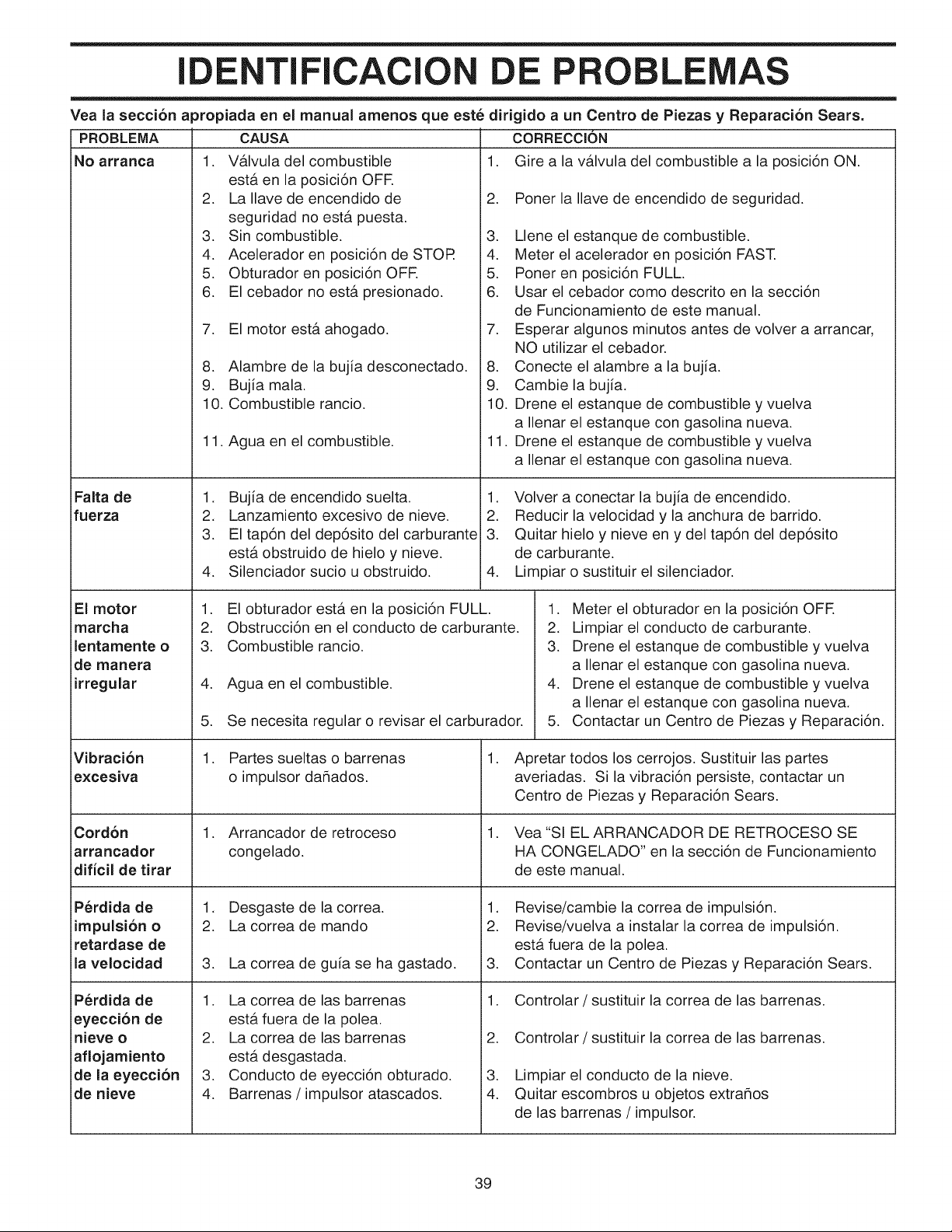
I TIFICACIO PROBLEMAS
Vea la secci6n apropiada en el manual amenos que este dirigido a un Centro de Piezas y Reparaci6n Sears.
PROBLEMA
No arranca
Falta de
fuerza
El motor
marcha
lentamente o
de manera
irregular
Vibraci6n
e×cesiva
Cord6n
arrancador
dificil de tirar
Perdida de
impulsi6n o
retardase de
la velocidad
Perdida de
eyeccion de
nieve o
afiojamiento
de la eyecci6n
de nieve
CAUSA
1. Valvula del combustible
esta en la posici6n OFR
2. La Ilave de encendido de
seguridad no esta puesta.
3. Sin combustible.
4. Acelerador en posici6n de STOR
5. Obturador en posici6n OFF.
6. El cebador no esta presionado.
7. El motor esta ahogado.
8. Alambre de la bujia desconectado.
9. Bujia mala.
10. Combustible rancio.
11. Agua en el combustible.
1, Bujia de encendido suelta.
2, Lanzamiento excesivo de nieve.
3. El tap6n del dep6sito del carburante
esta obstruido de hielo y nieve.
4. Silenciador sucio u obstruido.
.
CORRECCl0N
Gire a la valvula del combustible a la posici6n ON.
2. Poner la Ilave de encendido de seguridad.
3. Llene el estanque de combustible.
4. Meter el acelerador en posici6n FAST.
5. Poner en posici6n FULL.
6. Usar el cebador como descrito en la secci6n
de Funcionamiento de este manual.
7. Esperar algunos minutos antes de volver a arrancar,
NO utilizar el cebador.
8. Conecte el alambre a la bujia.
9. Cambiela bujia,
10. Drene el estanque de combustible y vuelva
a Ilenar el estanque con gasolina nueva.
11. Drene el estanque de combustible y vuelva
a Ilenar el estanque con gasolina nueva.
1, Volver a conectar la bujia de encendido.
2, Reducir la velocidad y la anchura de barrido.
3. Quitar hielo y nieve en y del tap6n del dep6sito
de carburante.
4. Limpiar o sustituir el silenciador.
1. El obturador esta en la posici6n FULL.
2, Obstrucci6n en el conducto de carburante.
3. Combustible rancio.
4. Agua en el combustible.
5. Se necesita regular o revisar el carburador.
1. Meter el obturador en la posici6n OFR
2, Limpiar el conducto de carburante.
3. Drene el estanque de combustible y vuelva
a Ilenar el estanque con gasolina nueva,
4. Drene el estanque de combustible y vuelva
a Ilenar el estanque con gasolina nueva,
5. Contactar un Centro de Piezas y Reparaci6n.
.
.
,
2.
3.
1.
2.
3.
4.
Partes sueltas o barrenas
o impulsor dahados.
Arrancador de retroceso
congelado.
Desgaste de la correa.
La correa de mando
La correa de guia se ha gastado.
La correa de las barrenas
esta fuera de la polea.
La correa de las barrenas
esta desgastada.
Conducto de eyecci6n obturado.
Barrenas /impulsor atascados.
1. Apretar todos los cerrojos. Sustituir las partes
averiadas. Si la vibraci6n persiste, contactar un
Centro de Piezas y Reparaci6n Sears.
1. Vea "SI EL ARRANCADOR DE RETROCESO SE
HA CONGELADO" en la secci6n de Funcionamiento
de este manual.
1, Revise!cambie la correa de impulsi6n.
2. Revise!vuelva a instalar la correa de impulsi6n.
esta fuera de la polea.
3. Contactar un Centro de Piezas y Reparaci6n Sears.
1. Controlar / sustituir la correa de las barrenas.
2. Controlar / sustituir la correa de las barrenas.
3. Limpiar el conducto de la nieve.
4. Quitar escombros u objetos extrahos
de las barrenas /impulsor.
39
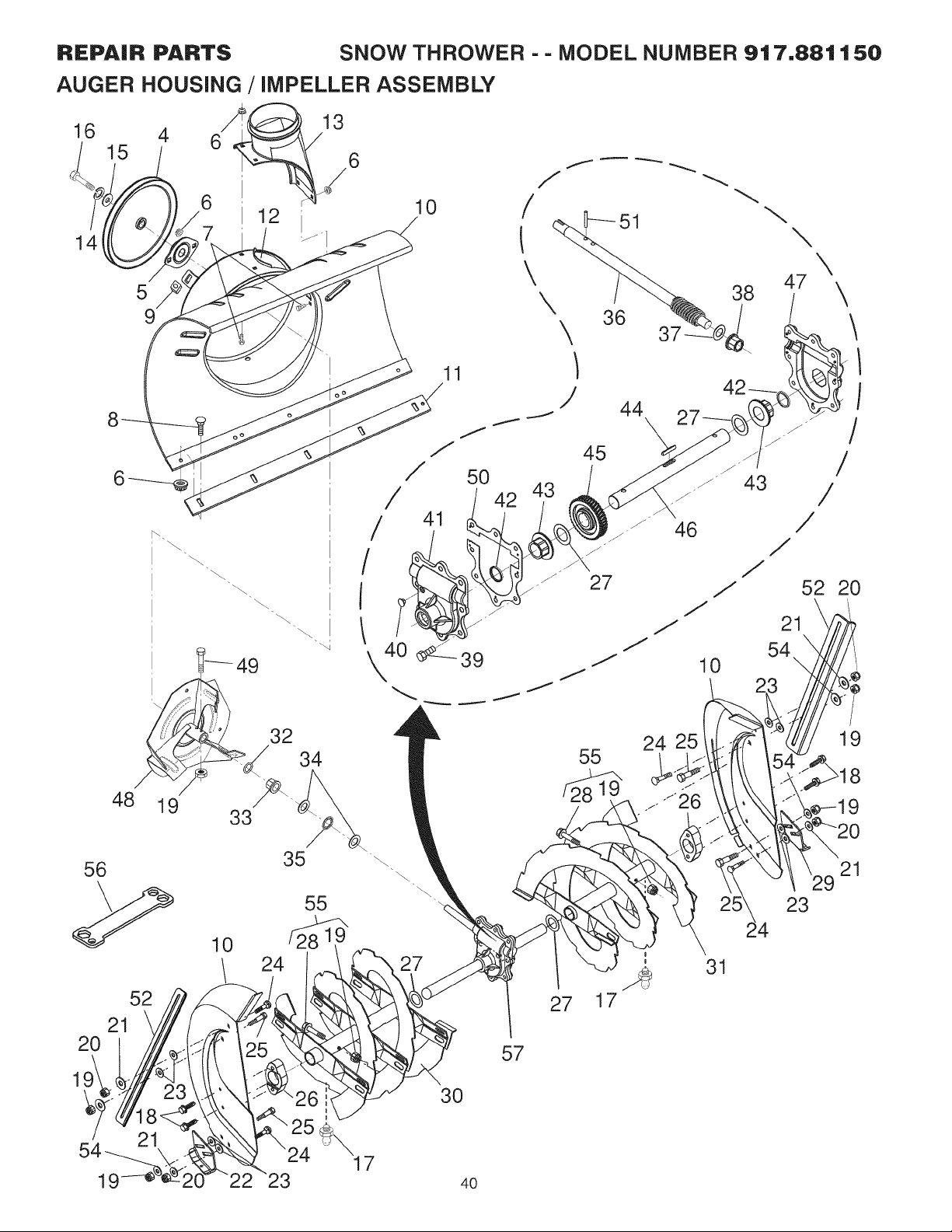
REPAIR PARTS SNOW THROWER - - MODEL NUMBER 917,881150
AUGER HOUSING /iMPELLER ASSEMBLY
16 4 6/__ 13
15 _.// 6
12 10
14
5
11
48
\
19
\
\
\.
\
49
32
34
33
/
/ 51
t
\
\ 36
\ 37
"/ 44
45
27
38
46
10
\
43
/
\
\
\
-/
/
/
/
/
/
/
21
54
\
52 20
/
19
8
9
56
°9
21 \
20
10
35
55
24 I
\\\
27 17
57
23
31
21
54
19
21
17
3
30
40
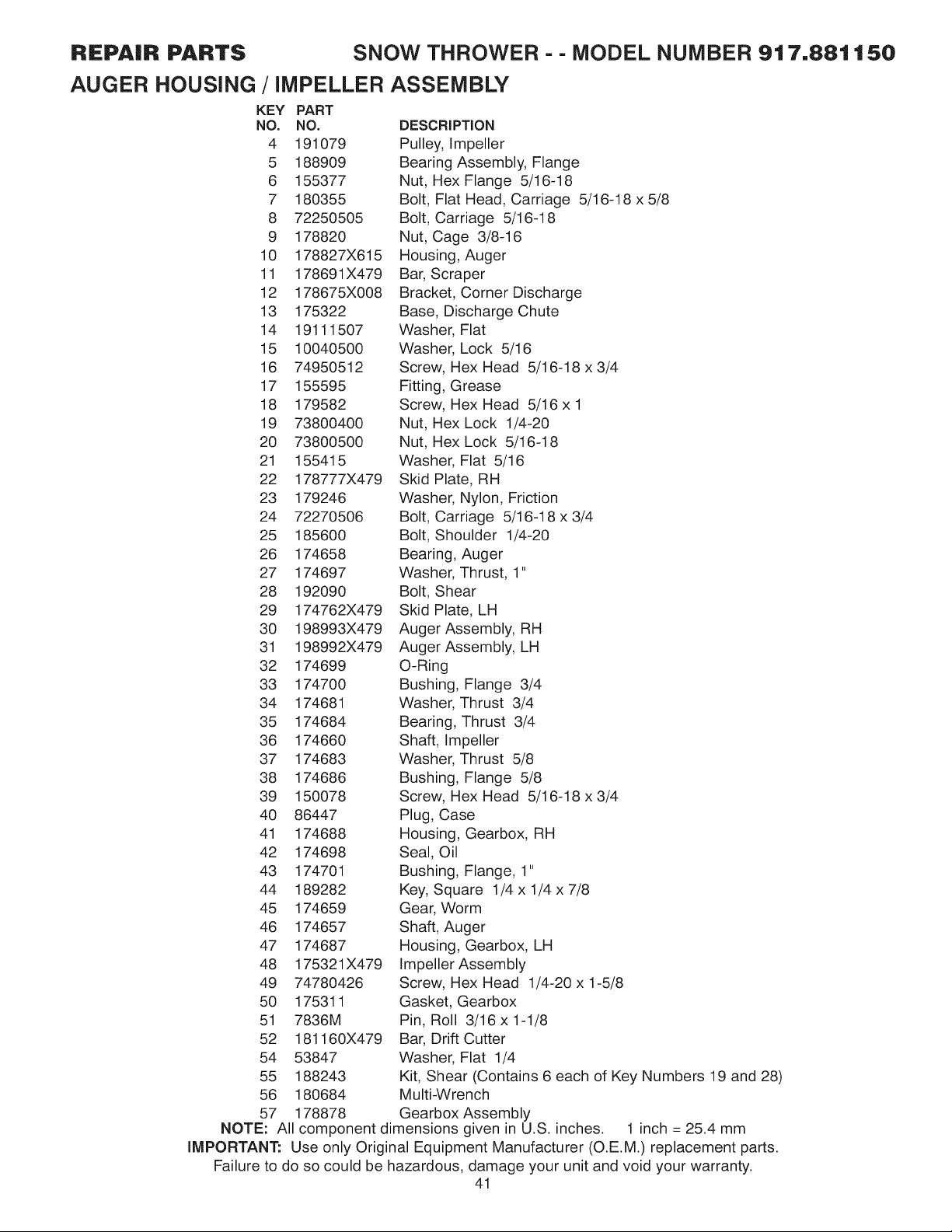
REPAIR PARTS SNOW THROWER - - MODEL NUMBER 917,881150
AUGER HOUSING / iMPELLER ASSEMBLY
KEY PART
NO. NO.
4 191079
5 188909
6 155377
7 180355
8 72250505
9 178820
10 178827X615
11 178691X479
12 178675X008
13 175322
14 19111507
15 10040500
16 74950512
17 155595
18 179582
19 73800400
20 73800500
21 155415
22 178777X479
23 179246
24 72270506
25 185600
26 174658
27 174697
28 192090
29 174762X479
30 198993X479
31 198992X479
32 174699
33 174700
34 174681
35 174684
36 174660
37 174683
38 174686
39 150078
40 86447
41 174688
42 174698
43 174701
44 189282
45 174659
46 174657
47 174687
48 175321X479
49 74780426
50 175311
51 7836M
52 181160X479
54 53847
55 188243
56 180684
57 178878
DESCRIPTION
Pulley, Impeller
Bearing Assembly, Flange
Nut, Hex Flange 5/16-18
Bolt, Flat Head, Carriage 5/16-18 x 5/8
Bolt, Carriage 5/16-1 8
Nut, Cage 3/8-16
Housing, Auger
Bar, Scraper
Bracket, Corner Discharge
Base, Discharge Chute
Washer, Flat
Washer, Lock 5/16
Screw, Hex Head 5/16-18 x 3/4
Fitting, Grease
Screw, Hex Head 5/16 x 1
Nut, Hex Lock 1/4-20
Nut, Hex Lock 5/16-1 8
Washer, Flat 5/16
Skid Plate, RH
Washer, Nylon, Friction
Bolt, Carriage 5/16-1 8 x 3/4
Bolt, Shoulder 1/4-20
Bearing, Auger
Washer, Thrust, 1"
Bolt, Shear
Skid Plate, LH
Auger Assembly, RH
Auger Assembly, LH
O-Ring
Bushing, Flange 3/4
Washer, Thrust 3/4
Bearing, Thrust 3/4
Shaft, Impeller
Washer, Thrust 5/8
Bushing, Flange 5/8
Screw, Hex Head 5/16-18 x 3/4
Plug, Case
Housing, Gearbox, RH
Seal, Oil
Bushing, Flange, 1"
Key, Square 1/4 x 1/4 x 7/8
Gear, Worm
Shaft, Auger
Housing, Gearbox, LH
Impeller Assembly
Screw, Hex Head 1/4-20 x 1-5/8
Gasket, Gearbox
Pin, Roll 3/16x 1-1/8
Bar, Drift Cutter
Washer, Flat 1/4
Kit, Shear (Contains 6 each of Key Numbers 19 and 28)
Multi-Wrench
Gearbox Assembly
NOTE: All component dimensions given in U.S. inches. 1 inch -- 25,4 mm
IMPORTANT: Use only Original Equipment Manufacturer (O.E.M.) replacement parts.
Failure to do so could be hazardous, damage your unit and void your warranty.
41
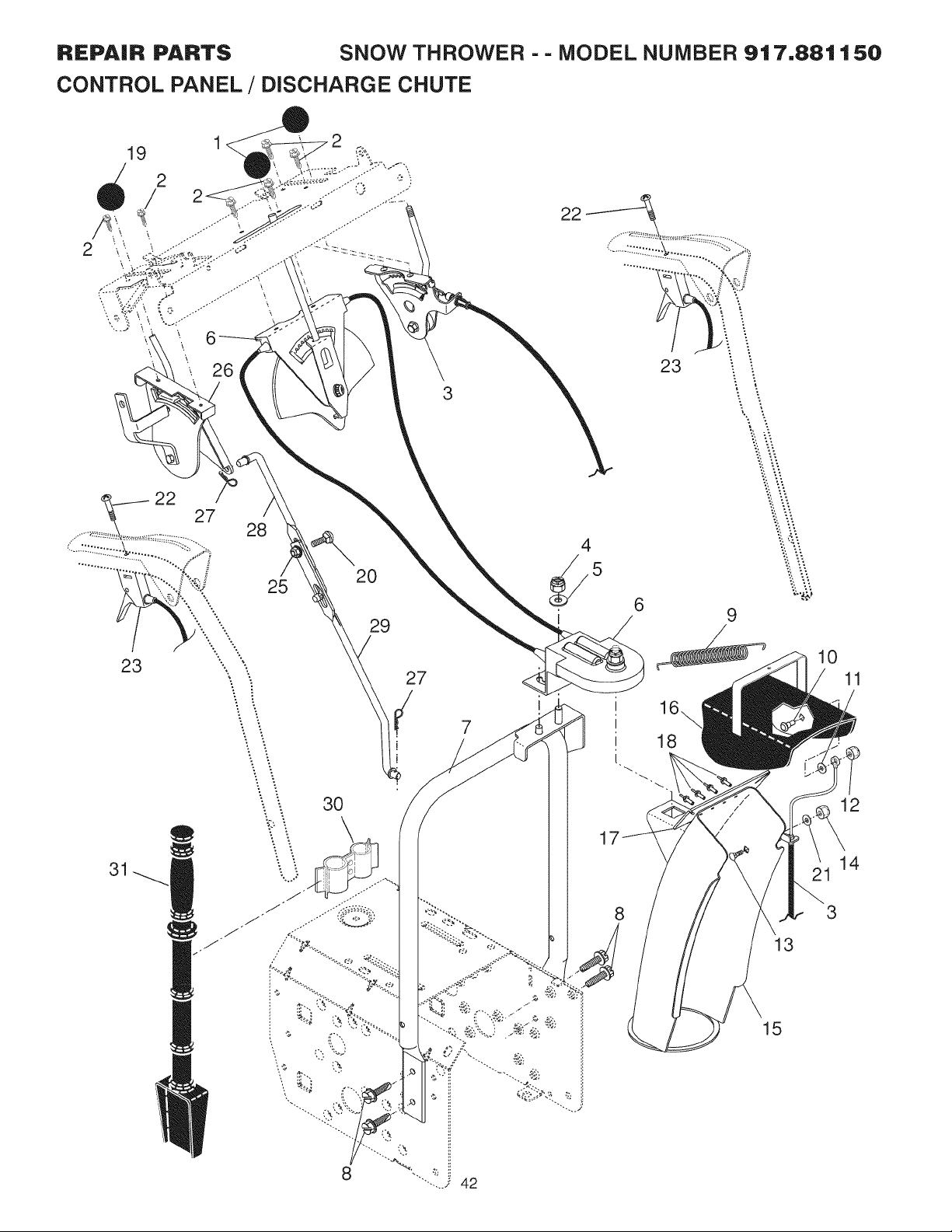
REPAIR PARTS SNOW THROWER - - MODEL NUMBER 917,881150
CONTROL PANEL/DISCHARGE CHUTE
19
2
23
31
28
20
25
\
\
3O
29
3
22
6
_ ..?..
9
I
7
8
16\
18
13
15
10
11
12
14
1
3
8
42
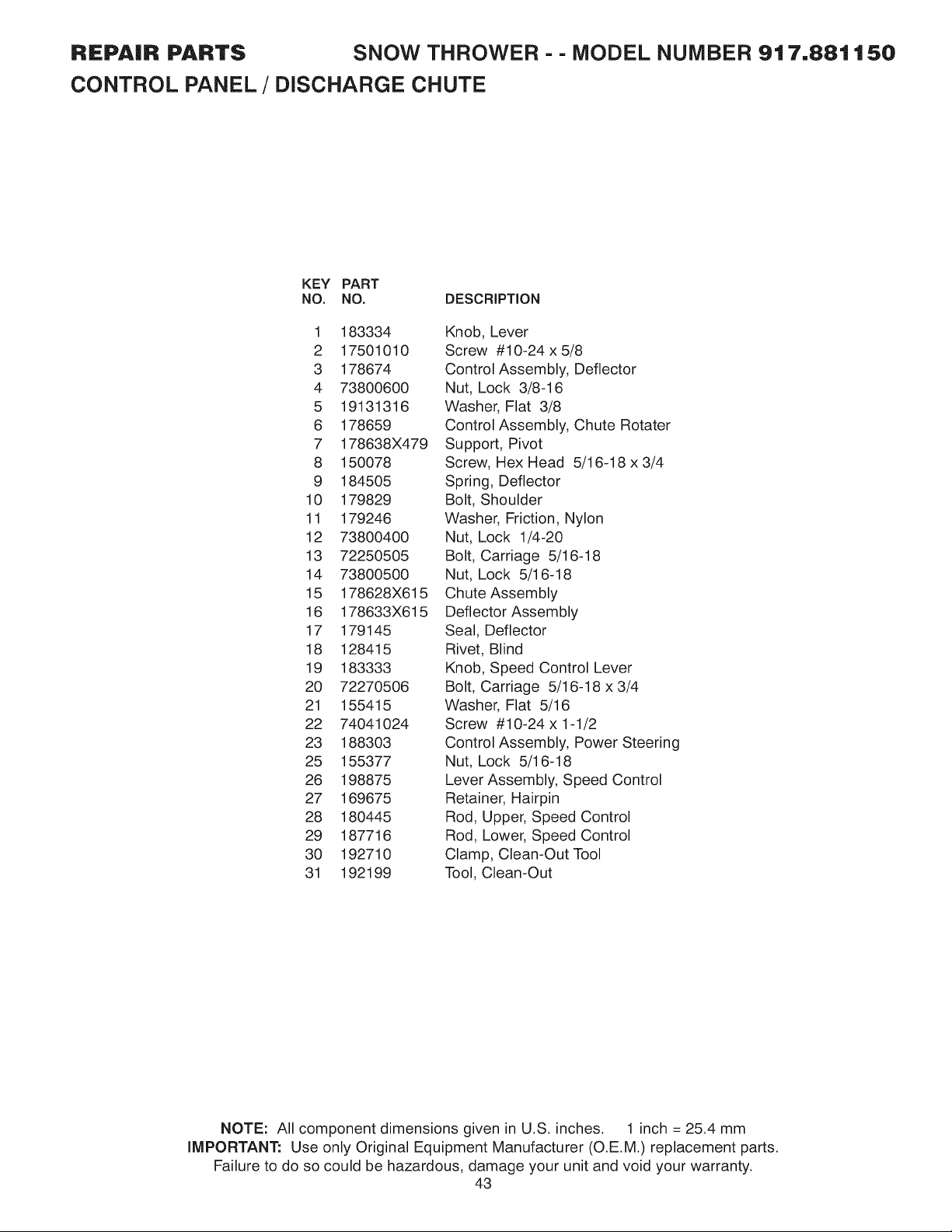
REPAIR PARTS SNOW THROWER - - MODEL NUMBER 917,881150
CONTROL PANEL / DISCHARGE CHUTE
KEY PART
NO. NO. DESCRIPTION
1 183334
2 17501010
3 178674
4 738O0600
5 19131316
6 178659
7 178638X479
8 150078
9 184505
10 179829
11 179246
12 73800400
13 72250505
14 73800500
15 178628X615
16 178633X615
17 179145
18 128415
19 183333
20 72270506
21 155415
22 74041024
23 188303
25 155377
26 198875
27 169675
28 180445
29 187716
30 192710
31 192199
Knob, Lever
Screw #10-24 x 5/8
Control Assembly, Deflector
Nut, Lock 3/8-16
Washer, Flat 3/8
Control Assembly, Chute Rotater
Support, Pivot
Screw, Hex Head 5/16-18 x 3/4
Spring, Deflector
Bolt, Shoulder
Washer, Friction, Nylon
Nut, Lock 1/4-20
Bolt, Carriage 5/16-18
Nut, Lock 5/16-18
Chute Assembly
Deflector Assembly
Seal, Deflector
Rivet, Blind
Knob, Speed Control Lever
Bolt, Carriage 5/16-18 x 3/4
Washer, Flat 5/16
Screw #10-24 x 1-1/2
Control Assembly, Power Steering
Nut, Lock 5/16-18
Lever Assembly, Speed Control
Retainer, Hairpin
Rod, Upper, Speed Control
Rod, Lower, Speed Control
Clamp, Clean-Out Tool
Tool, Clean-Out
NOTE: All component dimensions given in U.S. inches. 1 inch -- 25.4 mm
iMPORTANT: Use only Original Equipment Manufacturer (O.E.M.) replacement parts.
Failure to do so could be hazardous, damage your unit and void your warranty.
43
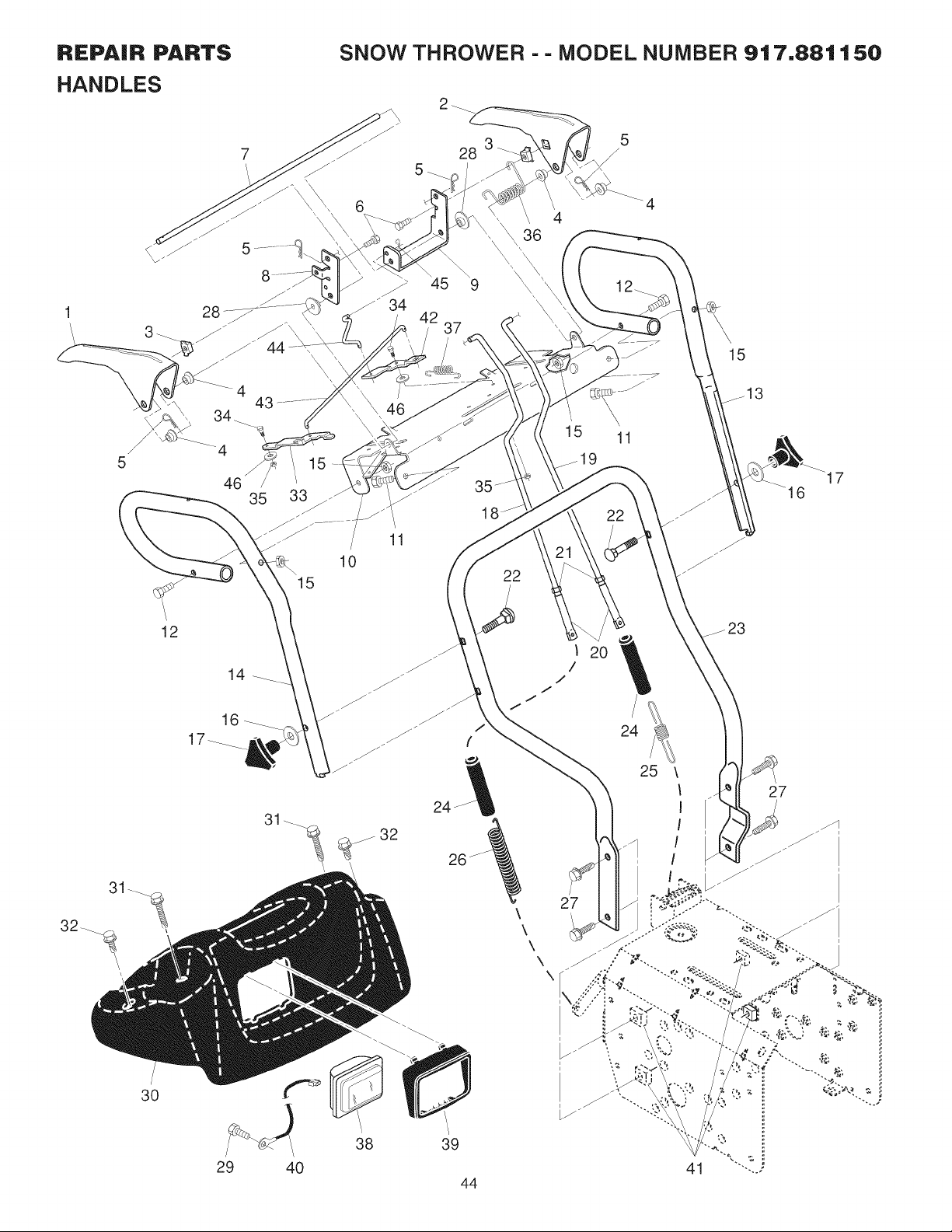
REPAIR PARTS SNOW THROWER - - MODEL NUMBER 917,881150
HANDLES
46 /
35
\\\\\\
/ 15
33
45
28
9
\
_36
\ \
22
\\ \'\
\
15
_19
11
15
17
12
/
3O
16
/
29
14
32
26
4O
38 39
44
I 20
/
/
24
\
\
\
\
i
41
27
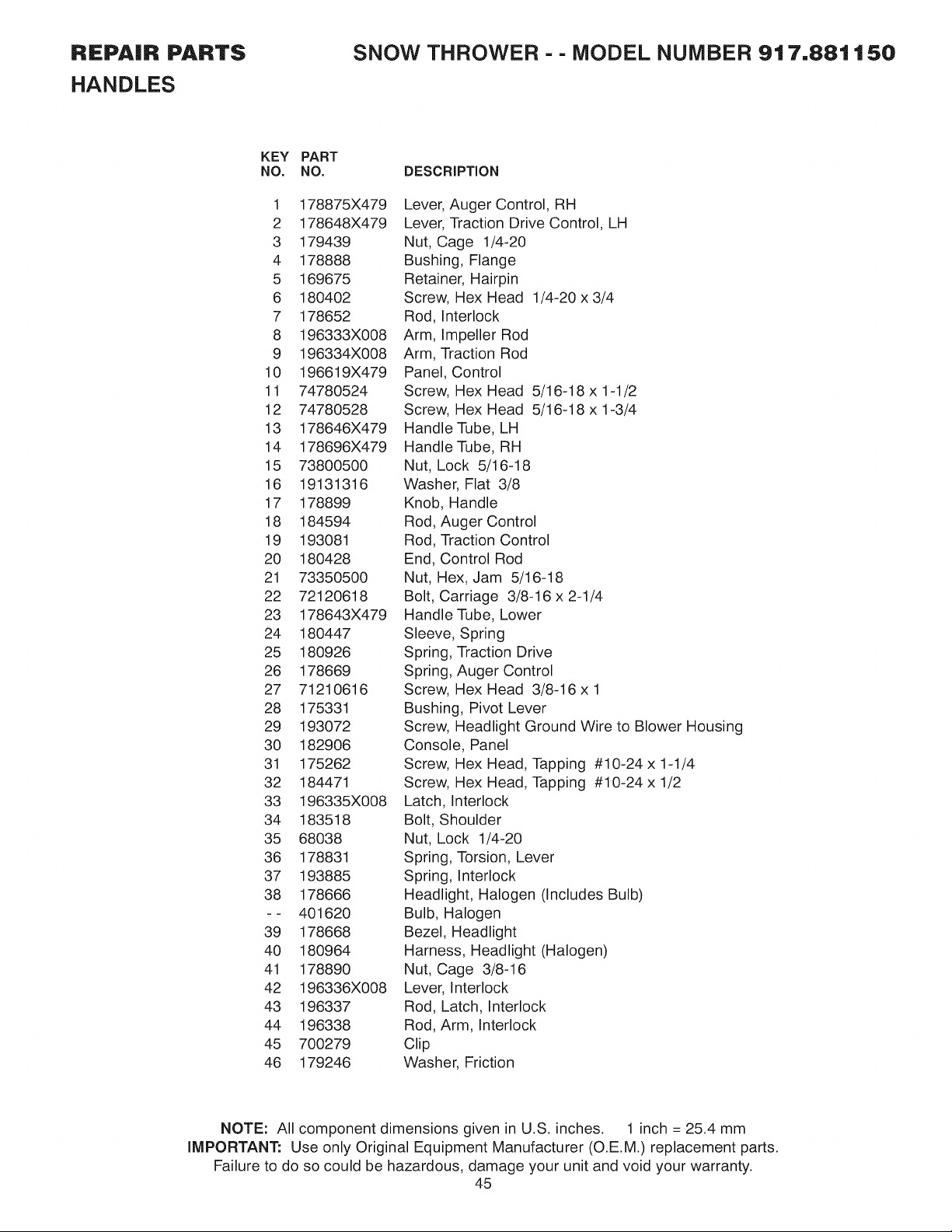
REPAIR PARTS
HANDLES
SNOW THROWER - - MODEL NUMBER 917,881150
KEY PART
NO. NO.
1 178875X479
2 178648X479
3 179439
4 178888
5 169675
6 180402
7 178652
8 196333X008
9 196334X008
10 196619X479
11 74780524
12 74780528
13 178646X479
14 178696X479
15 73800500
16 19131316
17 178899
18 184594
19 193081
20 180428
21 73350500
22 72120618
23 178643X479
24 180447
25 180926
26 178669
27 71210616
28 175331
29 193072
30 182906
31 175262
32 184471
33 196335X008
34 183518
35 68038
36 178831
37 193885
38 178666
-- 401620
39 178668
40 180964
41 178890
42 196336X008
43 196337
44 196338
45 700279
46 179246
DESCRIPTION
Lever, Auger Control, RH
Lever, Traction Drive Control, LH
Nut, Cage 1/4-20
Bushing, Flange
Retainer, Hairpin
Screw, Hex Head 1/4-20 x 3/4
Rod, Interlock
Arm, Impeller Rod
Arm, Traction Rod
Panel, Control
Screw, Hex Head 5/16-18 x 1-1/2
Screw, Hex Head 5/16-18 x 1-3/4
Handle Tube, LH
Handle Tube, RH
Nut, Lock 5/16-18
Washer, Flat 3/8
Knob, Handle
Rod, Auger Control
Rod, Traction Control
End, Control Rod
Nut, Hex, Jam 5/16-18
Bolt, Carriage 3/8-16 x 2-1/4
Handle Tube, Lower
Sleeve, Spring
Spring, Traction Drive
Spring, Auger Control
Screw, Hex Head 3/8-16 x 1
Bushing, Pivot Lever
Screw, Headlight Ground Wire to Blower Housing
Console, Panel
Screw, Hex Head, Tapping #10-24 x 1-1/4
Screw, Hex Head, Tapping #10-24 x 1/2
Latch, Interlock
Bolt, Shoulder
Nut, Lock 1/4-20
Spring, Torsion, Lever
Spring, Interlock
Headlight, Halogen (Includes Bulb)
Bulb, Halogen
Bezel, Headlight
Harness, Headlight (Halogen)
Nut, Cage 3/8-16
Lever, Interlock
Rod, Latch, Interlock
Rod, Arm, Interlock
Clip
Washer, Friction
NOTE: All component dimensions given in U.S. inches. 1 inch -- 25.4 mm
iMPORTANT: Use only Original Equipment Manufacturer (O.E.M.) replacement parts.
Failure to do so could be hazardous, damage your unit and void your warranty.
45
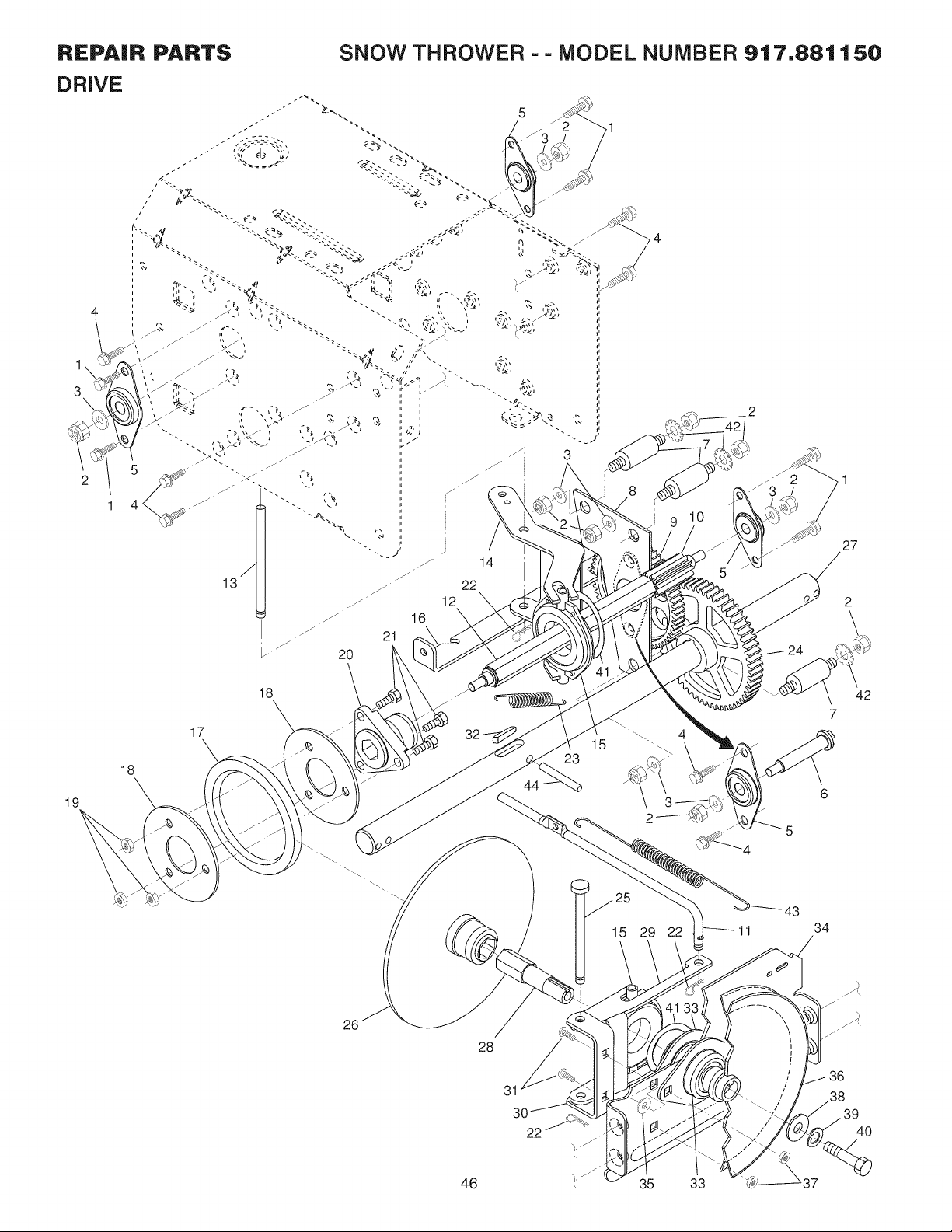
REPAIR PARTS SNOW THROWER - - MODEL NUMBER 917,881150
DRIVE
/.--
14
22
27
19
17
18
15
23
42
7
43
34
26
28
31
46
22
35 33
40
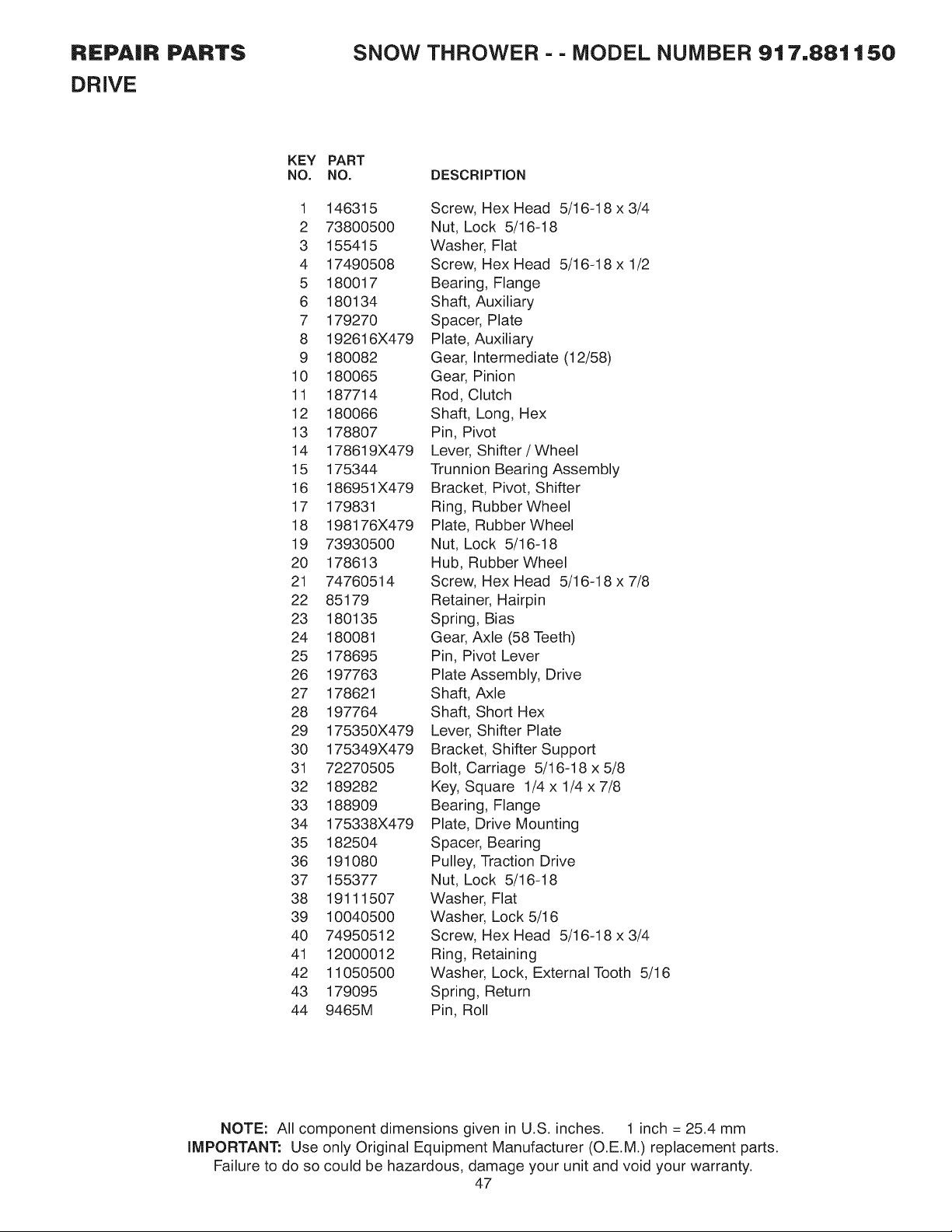
REPAIR PARTS
DRIVE
SNOW THROWER - - MODEL NUMBER 917,881150
KEY PART
NO. NO.
1 146315
2 73800500
3 155415
4 17490508
5 180017
6 180134
7 179270
8 192616X479
9 180082
10 180065
11 187714
12 180066
13 178807
14 178619X479
15 175344
16 186951X479
17 179831
18 198176X479
19 73930500
20 178613
21 74760514
22 85179
23 180135
24 180081
25 178695
26 197763
27 178621
28 197764
29 175350X479
30 175349X479
31 72270505
32 189282
33 188909
34 175338X479
35 182504
36 191080
37 155377
38 19111507
39 10040500
40 74950512
41 12000012
42 11050500
43 179095
44 9465M
DESCRIPTION
Screw, Hex Head 5/16-18 x 3/4
Nut, Lock 5/16-18
Washer, Flat
Screw, Hex Head 5/16-18 x 1/2
Bearing, Flange
Shaft, Auxiliary
Spacer, Plate
Plate, Auxiliary
Gear, Intermediate (12/58)
Gear, Pinion
Rod, Clutch
Shaft, Long, Hex
Pin, Pivot
Lever, Shifter / Wheel
Trunnion Bearing Assembly
Bracket, Pivot, Shifter
Ring, Rubber Wheel
Plate, Rubber Wheel
Nut, Lock 5/16-18
Hub, Rubber Wheel
Screw, Hex Head 5/16-18 x 7/8
Retainer, Hairpin
Spring, Bias
Gear, Axle (58 Teeth)
Pin, Pivot Lever
Plate Assembly, Drive
Shaft, Axle
Shaft, Short Hex
Lever, Shifter Plate
Bracket, Shifter Support
Bolt, Carriage 5/16-18 x 5/8
Key, Square 1/4 x 1/4 x 7/8
Bearing, Flange
Plate, Drive Mounting
Spacer, Bearing
Pulley, Traction Drive
Nut, Lock 5/16-18
Washer, Flat
Washer, Lock 5/16
Screw, Hex Head 5/16-18 x 3/4
Ring, Retaining
Washer, Lock, External Tooth 5/16
Spring, Return
Pin, Roll
NOTE: All component dimensions given in U.S. inches. 1 inch = 25.4 mm
IMPORTANT: Use only Original Equipment Manufacturer (O.E.M.) replacement parts.
Failure to do so could be hazardous, damage your unit and void your warranty.
47
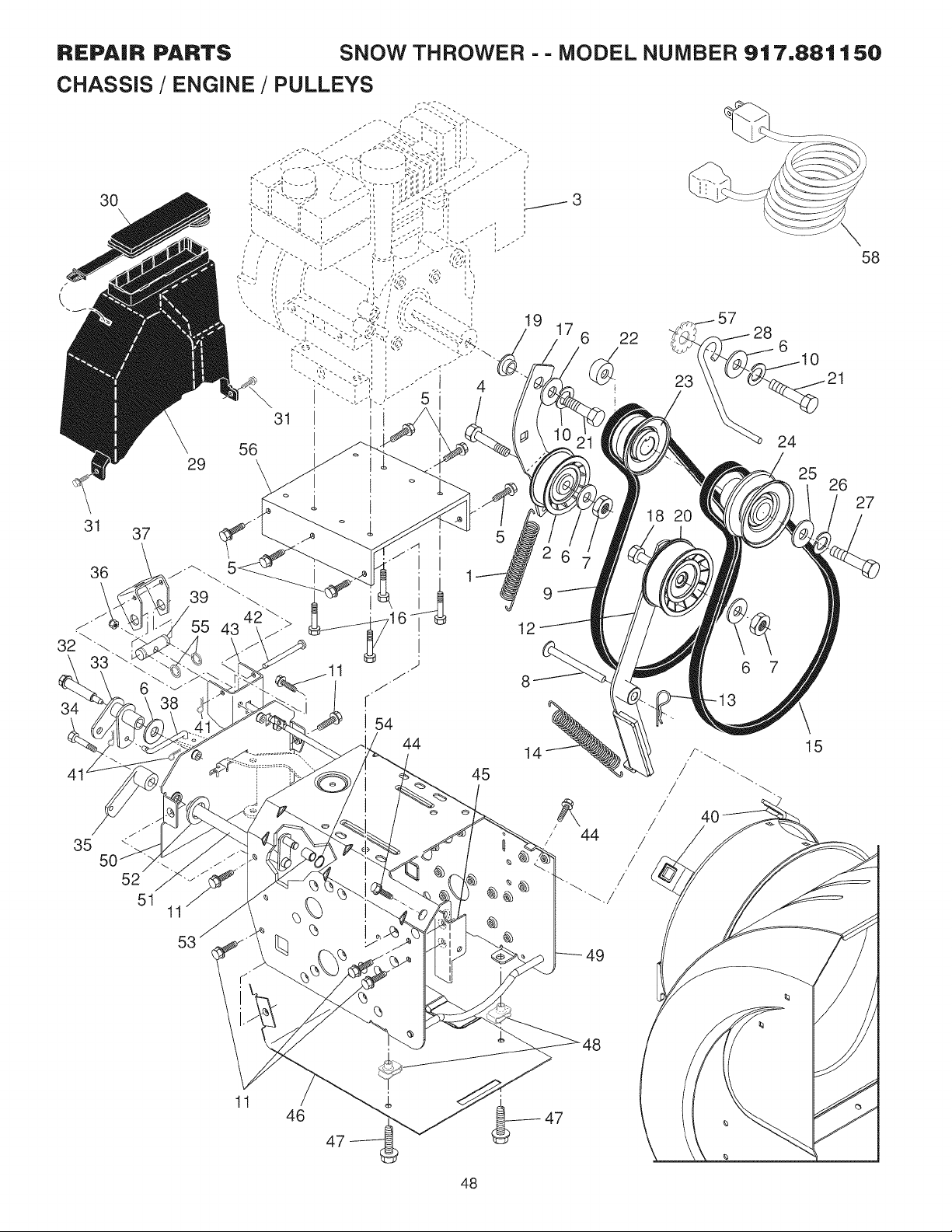
REPAIR PARTS SNOW THROWER - - MODEL NUMBER 917,881150
29
56
36
39
55S
32 __
33 \-\
4;
43 '
34
12
45
8
35
J
52
51
11
11
46
47
7
6 22
/
49
47
18 2O
28
6
0
24
5
26
7
15
58
27
48
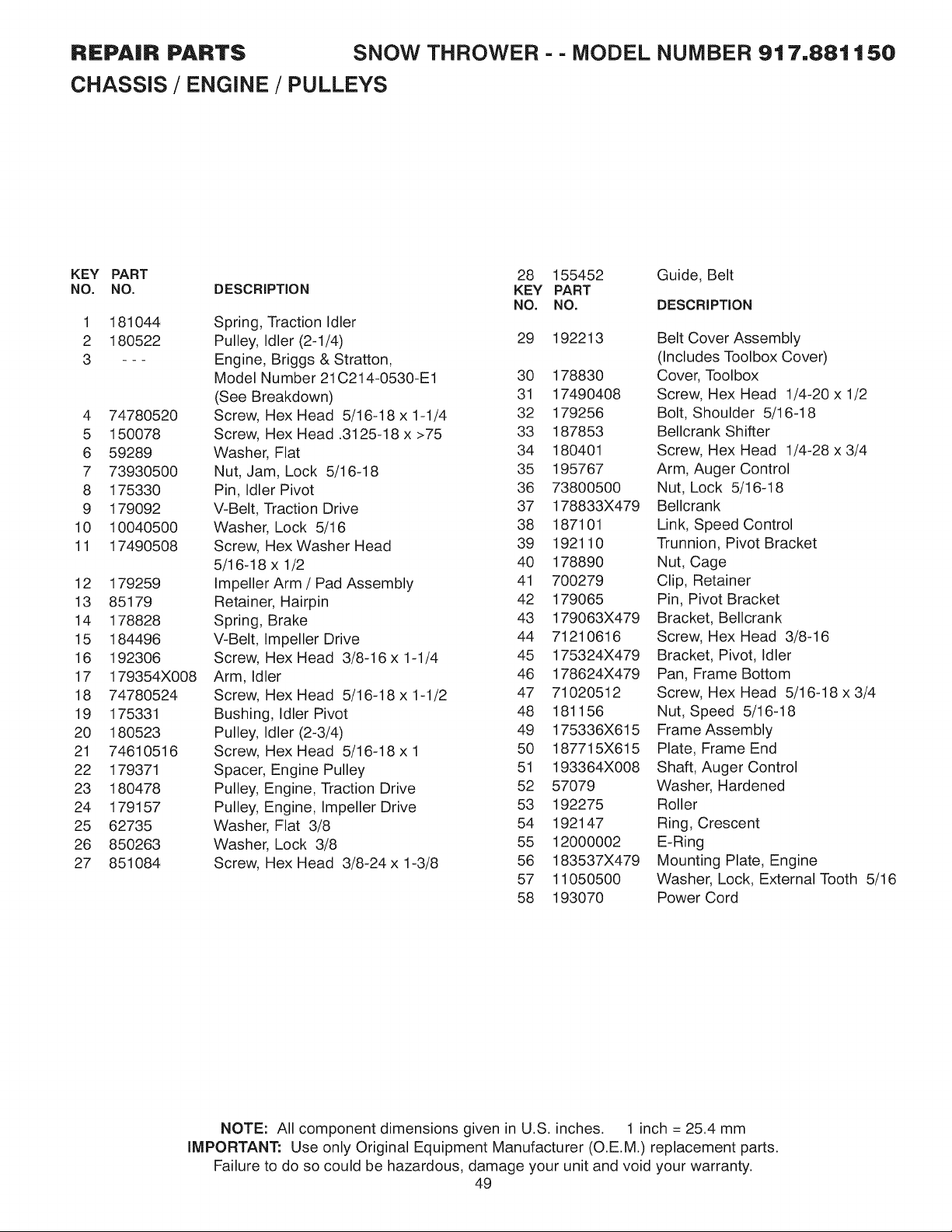
REPAIR PARTS SNOW THROWER - - MODEL NUMBER 917,881150
CHASSIS / ENGINE / PULLEYS
KEY PART 28 155452 Guide, Belt
NO. NO. DESCRIPTION KEY PART
NO. NO. DESCRIPTION
1 181044
2 180522
_ _ _
4
5
6
7
8
9
10
11
12
13
14
15
16
17
18
19
2O
21
22
23
24
25
26
27
74780520
150078
59289
73930500
175330
179092
10040500
17490508
179259
85179
178828
184496
192306
179354X008
74780524
175331
180523
74610516
179371
180478
179157
62735
850263
851084
Spring, Traction Idler
Pulley, Idler (2-1/4)
Engine, Briggs & Stratton,
Model Number 21C214-0530-E1
(See Breakdown)
Screw, Hex Head 5/16-18 x 1-1/4
Screw, Hex Head .3125-18 x >75
Washer, Flat
Nut, Jam, Lock 5/16-18
Pin, Idler Pivot
V-Belt, Traction Drive
Washer, Lock 5/16
Screw, Hex Washer Head
5/16-18 x 1/2
Impeller Arm / Pad Assembly
Retainer, Hairpin
Spring, Brake
V-Belt, Impeller Drive
Screw, Hex Head 3/8-16 x 1-1/4
Arm, Idler
Screw, Hex Head 5/16-18 x 1-1/2
Bushing, Idler Pivot
Pulley, Idler (2-3/4)
Screw, Hex Head 5/16-18 x 1
Spacer, Engine Pulley
Pulley, Engine, Traction Drive
Pulley, Engine, Impeller Drive
Washer, Flat 3/8
Washer, Lock 3/8
Screw, Hex Head 3/8-24 x 1-3/8
29 192213 Belt Cover Assembly
(Includes Toolbox Cover)
30 178830 Cover, Toolbox
31 17490408 Screw, Hex Head 1/4-20 x 1/2
32 179256 Bolt, Shoulder 5/16-18
33 187853 Bellcrank Shifter
34 180401 Screw, Hex Head 1/4-28 x 3/4
35 195767 Arm, Auger Control
36 73800500 Nut, Lock 5/16-18
37 178833X479 Bellcrank
38 187101 Link, Speed Control
39 192110 Trunnion, Pivot Bracket
40 178890 Nut, Cage
41 700279 Clip, Retainer
42 179065 Pin, Pivot Bracket
43 179063X479 Bracket, Bellcrank
44 71210616 Screw, Hex Head 3/8-16
45 175324X479 Bracket, Pivot, Idler
46 178624X479 Pan, Frame Bottom
47 71020512 Screw, Hex Head 5/16-18 x 3/4
48 181156 Nut, Speed 5/16-18
49 175336X615 Frame Assembly
50 187715X615 Plate, Frame End
51 193364X008 Shaft, Auger Control
52 57079 Washer, Hardened
53 192275 Roller
54 192147 Ring, Crescent
55 12000002 E-Ring
56 183537X479 Mounting Plate, Engine
57 11050500 Washer, Lock, External Tooth 5/16
58 193070 Power Cord
NOTE: All component dimensions given in U.S. inches. 1 inch -- 25.4 mm
iMPORTANT: Use only Original Equipment Manufacturer (O.E.M.) replacement parts.
Failure to do so could be hazardous, damage your unit and void your warranty.
49
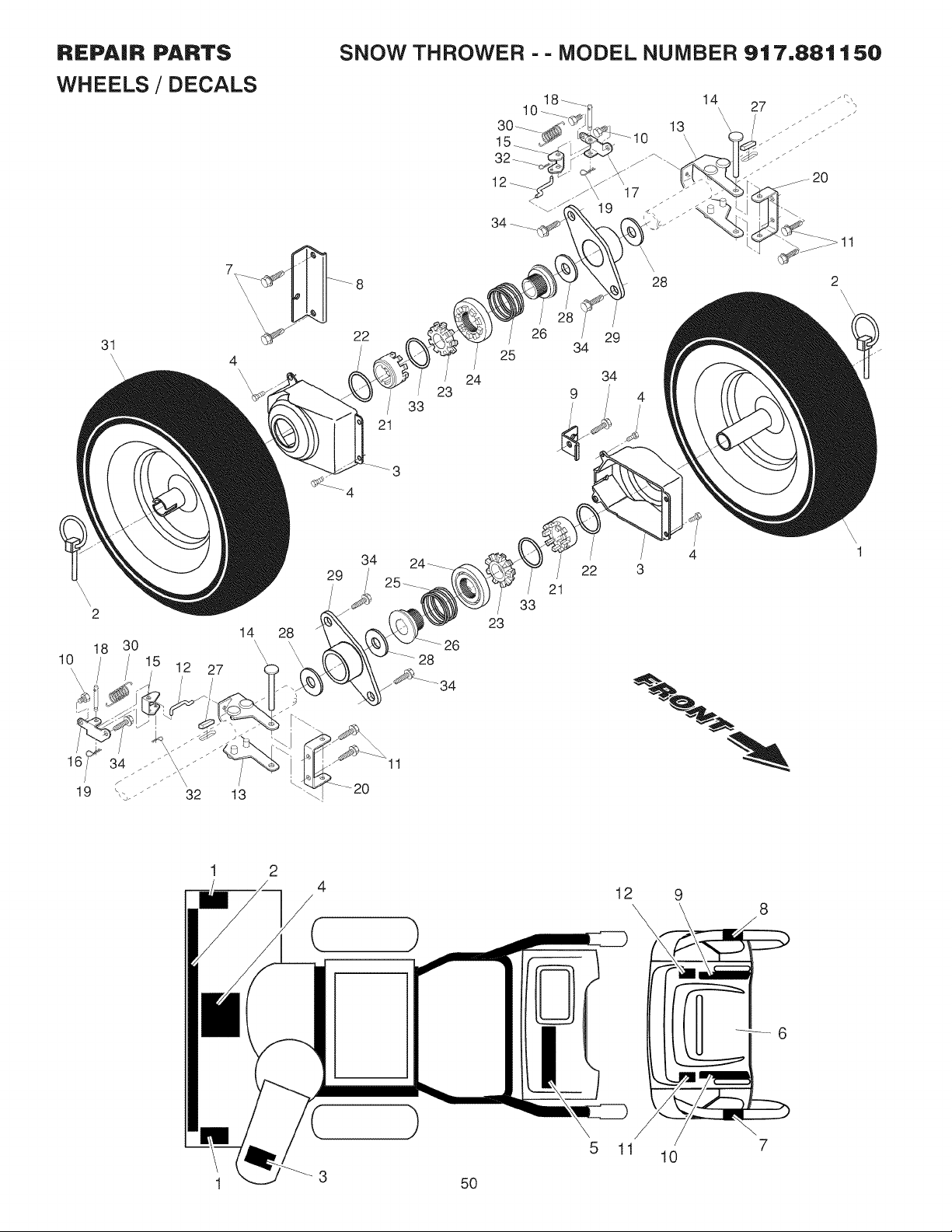
REPAIR PARTS SNOW THROWER - - MODEL NUMBER 917.881150
WHEELS / DECALS
31
24
23
33
21
2
18
10
16
19
30
5 12
27
13
14 28
\\
11
21
33
23
22
4
3
12 9
5 11
10
1 3 50
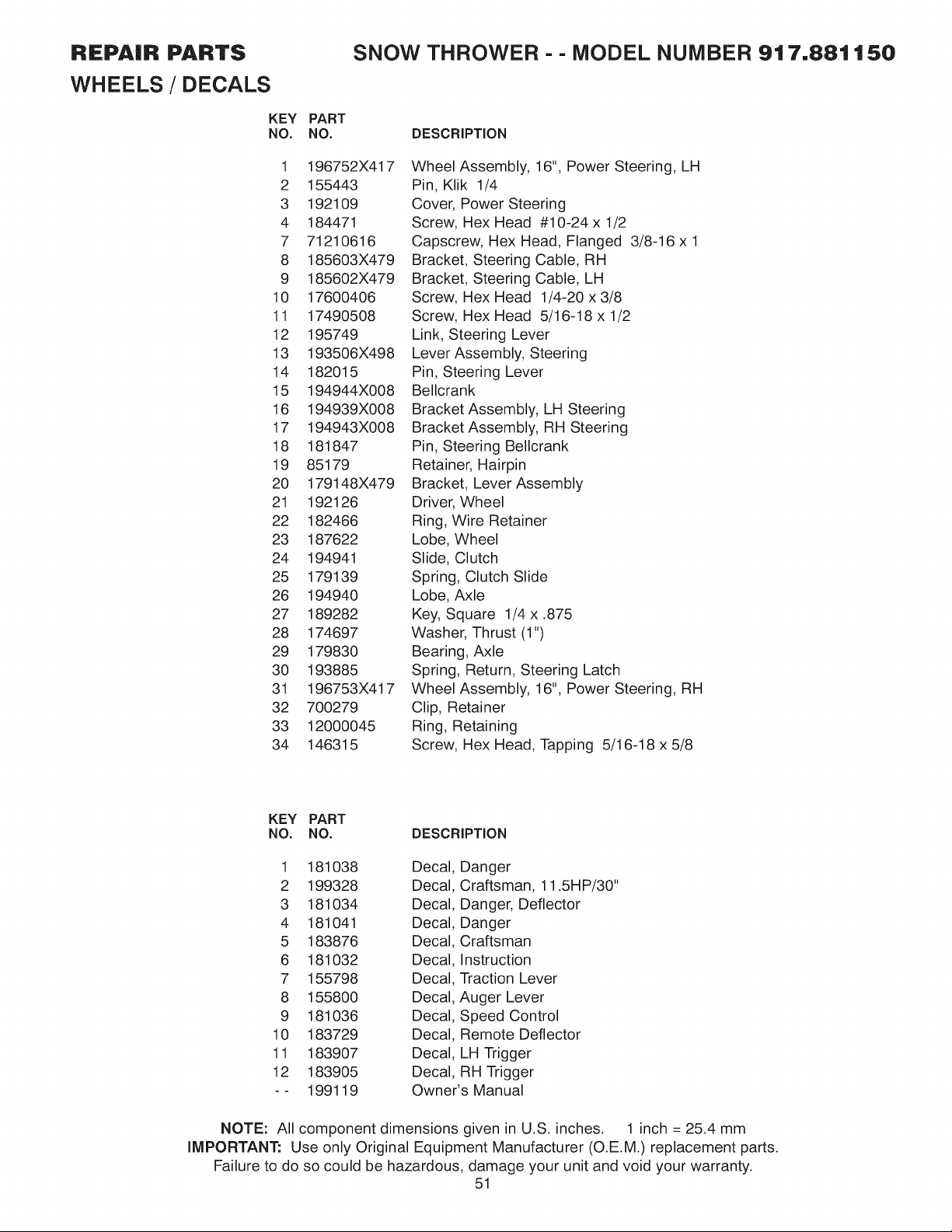
REPAIR PARTS
WHEELS / DECALS
KEY
NO.
1
2
3
4
7
8
9
10
11
12
13
14
15
16
17
18
19
2O
21
22
23
24
25
26
27
28
29
30
31
32
33
34
SNOW THROWER - - MODEL NUMBER 917,881150
PART
NO.
196752X417
155443
192109
184471
71210616
185603X479
185602X479
17600406
17490508
195749
193506X498
182015
194944X008
194939X008
194943X008
181847
85179
179148X479
192126
182466
187622
194941
179139
194940
189282
174697
179830
193885
196753X417
700279
12000045
146315
DESCRIPTION
Wheel Assembly, 16", Power Steering, LH
Pin, Klik 1/4
Cover, Power Steering
Screw, Hex Head #10-24 x 1/2
Capscrew, Hex Head, Flanged 3/8-16 x 1
Bracket, Steering Cable, RH
Bracket, Steering Cable, LH
Screw, Hex Head 1/4-20 x 3/8
Screw, Hex Head 5/16-18 x 1/2
Link, Steering Lever
Lever Assembly, Steering
Pin, Steering Lever
Bellcrank
Bracket Assembly, LH Steering
Bracket Assembly, RH Steering
Pin, Steering Bellcrank
Retainer, Hairpin
Bracket, Lever Assembly
Driver, Wheel
Ring, Wire Retainer
Lobe, Wheel
Slide, Clutch
Spring, Clutch Slide
Lobe, Axle
Key, Square 1/4 x .875
Washer, Thrust (1")
Bearing, Axle
Spring, Return, Steering Latch
Wheel Assembly, 16", Power Steering, RH
Clip, Retainer
Ring, Retaining
Screw, Hex Head, Tapping 5/16-18 x 5/8
KEY PART
NO. NO. DESCRIPTION
1 181038 Decal,
2 199328 Decal
3 181034 Decal
4 181041 Decal
5 183876 Decal
6 181032 Decal
7 155798 Decal
8 155800 Decal
9 181036 Decal
10 183729 Decal
11 183907 Decal
12 183905 Decal
- - 199119
Danger
Craftsman, 11.5HP/30"
Danger, Deflector
Danger
Craftsman
Instruction
Traction Lever
Auger Lever
Speed Control
Remote Deflector
LH Trigger
RH Trigger
Owner's Manual
NOTE: All component dimensions given in U.S. inches. 1 inch = 25.4 mm
IMPORTANT: Use only Original Equipment Manufacturer (O.E.M.) replacement parts.
Failure to do so could be hazardous, damage your unit and void your warranty.
51
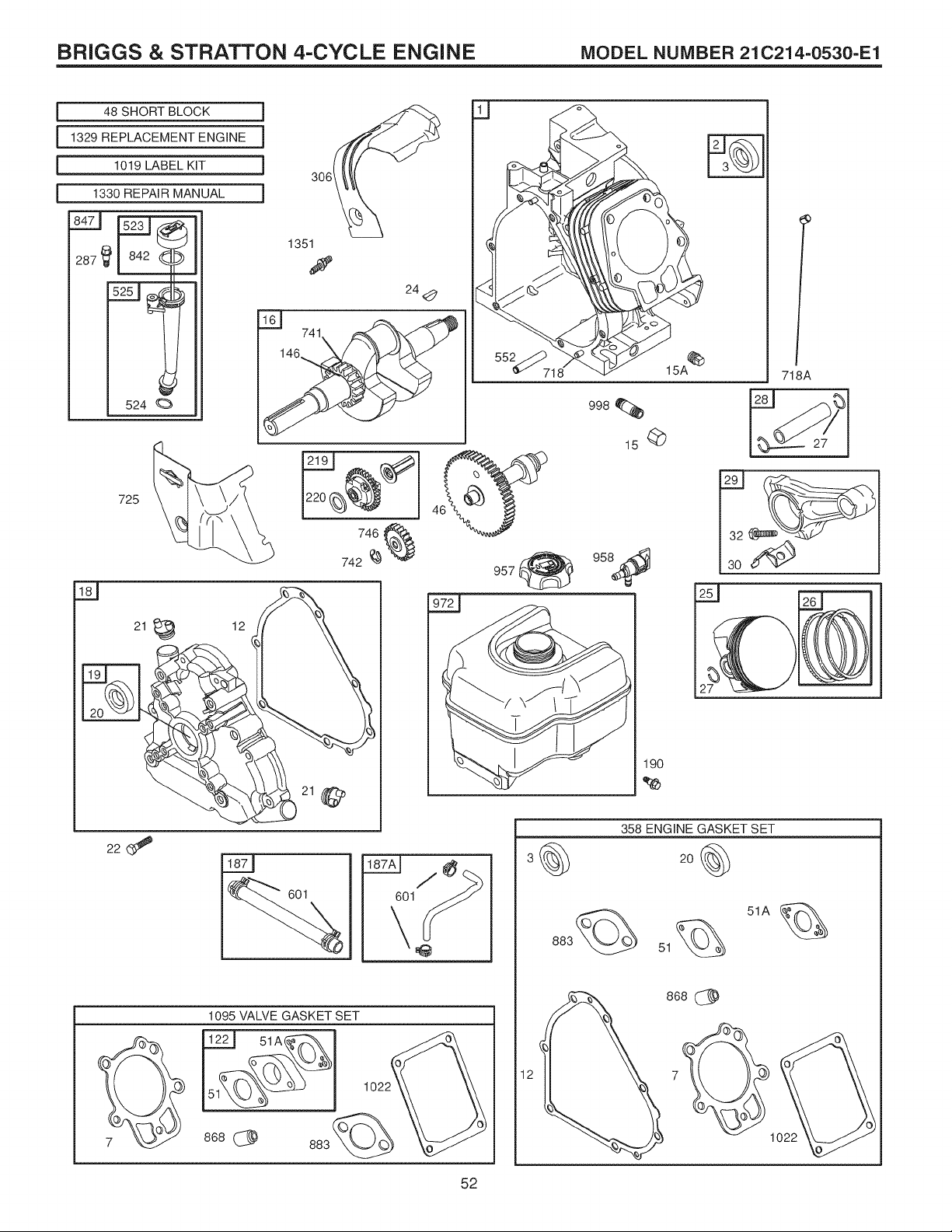
BRIGGS & STRATTON 4-CYCLE ENGINE MODEL NUMBER 21C214-0530=E1
{ 48 SHORT BLOCK
1329 REPLACEMENT ENGINE
i 1019 LABEL KiT
{ 1330 REPAIR MANUAL
524 _
725
22
]
]
] 306(
]
1351
J
741,
12
21@
24_
957
99s
15
718A
i
27
190
m
/
601
1095 VALVE GASKET SET
% 122 51A_
868 (_ 883(_
358 ENGINE GASKET SET
883 51
12
868 (_
O
1
52
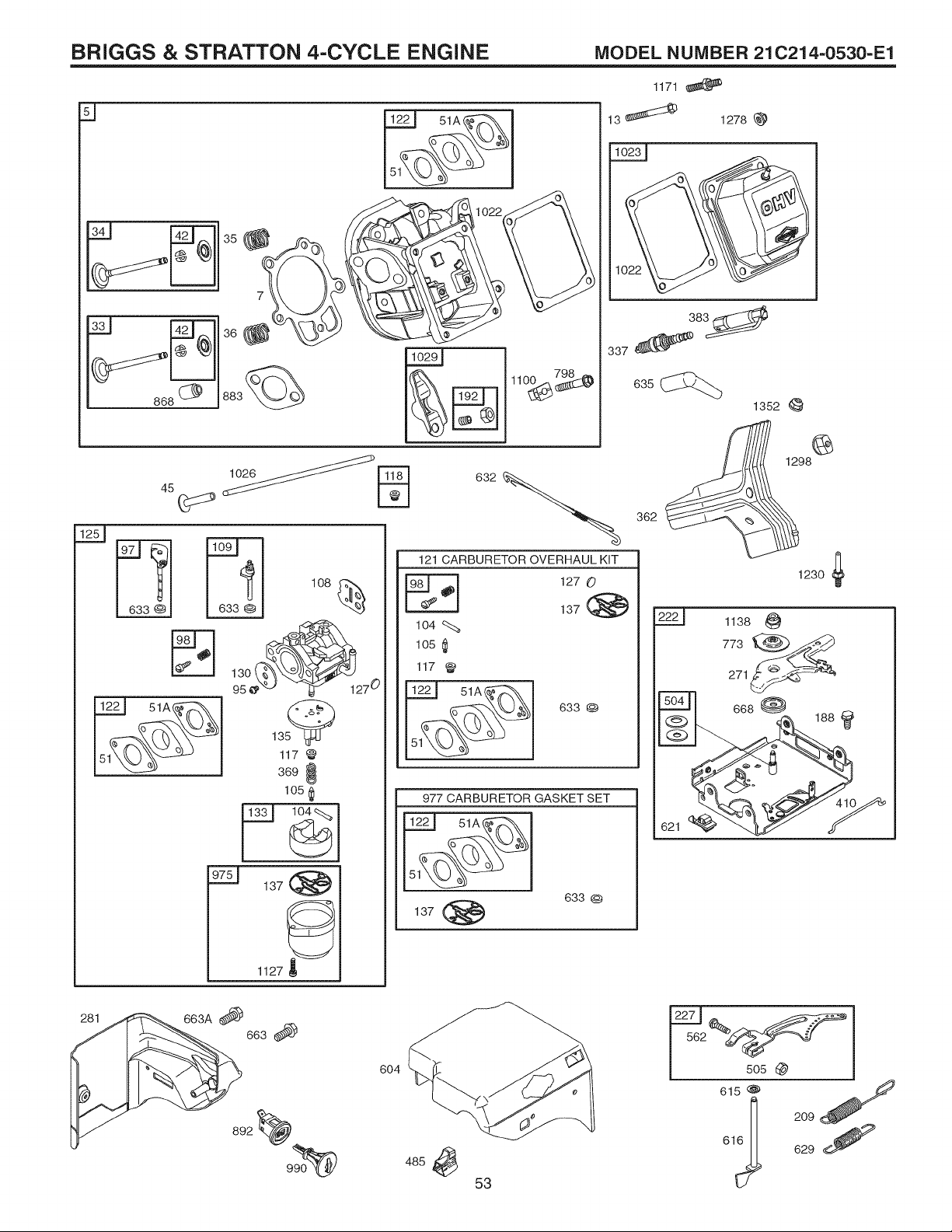
BRIGGS & STRATTON 4-CYCLE ENGINE MODEL NUMBER 21C214-0530=E1
3
i
i
108
1930__27 O
117
369 _
105 _
137(_
1127
121 CARBURETOR OVERHAUL KiT
104 q_
105
117 @
122 51A_
127 O
137 {_
633
977 CARBURETOR GASKET SET
m
122 51A_
137 (_
633
1171
13 _ 1278
i
383
337
835
362
1352
1230 _
m
_ 1138@
773
271
6O4
485
53
615
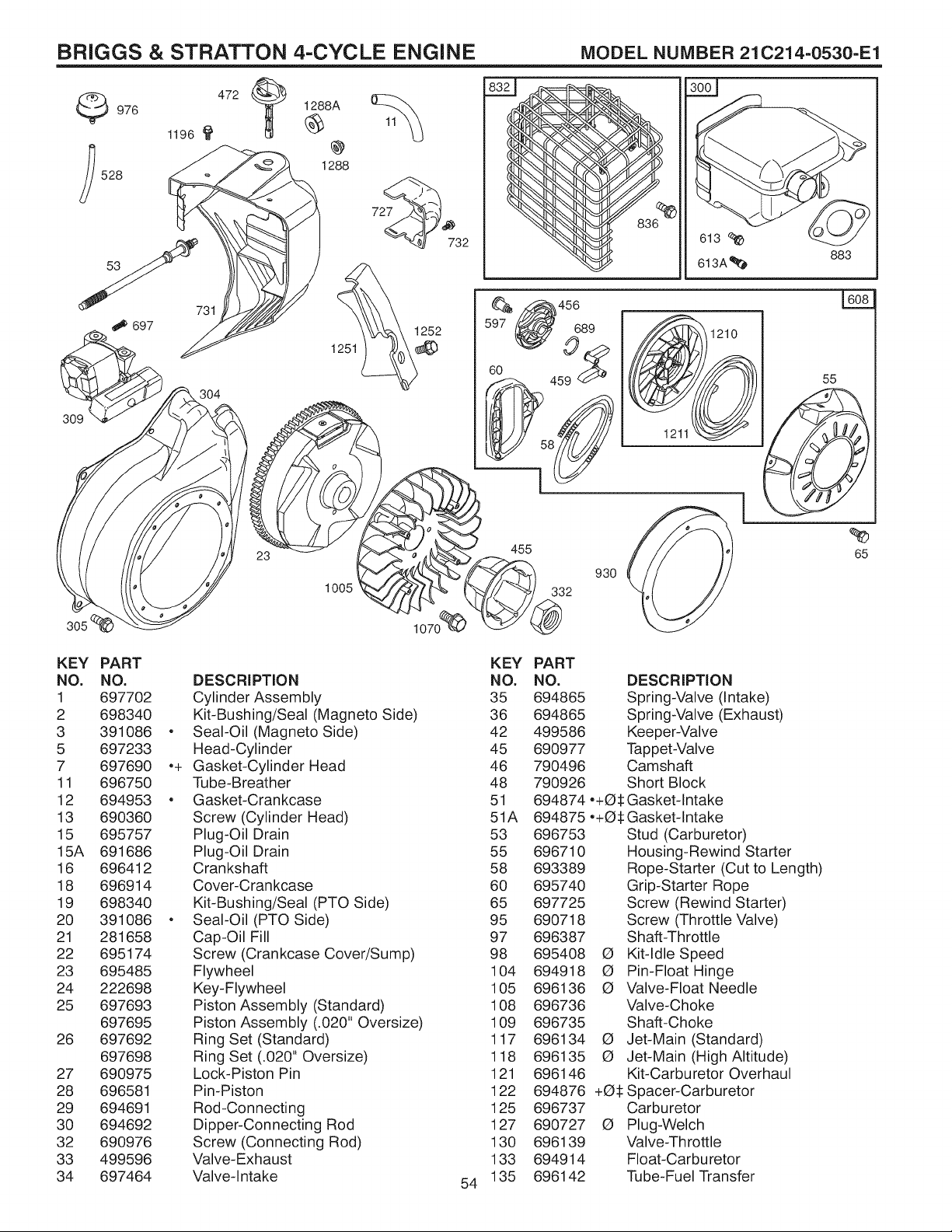
BRIGGS & STRATTON 4-CYCLE ENGINE MODEL NUMBER 21C214-0530-E1
472 _ 1288A
1196 G
@
1288
Y
731
697
304
_1252
309
23
1005
KEY
NO.
1
2
3
5
7
11
12
13
15
15A
16
18
19
2O
21
22
23
24
25
26
27
28
29
30
32
33
34
PART
NO.
697702
698340
391086
697233
697690
696750
694953
690360
695757
691686
696412
696914
698340
391086
281658
695174
695485
222698
697693
697695
697692
697698
690975
696581
694691
694692
690976
499596
697464
1070
o
_+
o
DESCRIPTION
Cylinder Assembly
Kit-Bushing!Seal (Magneto Side)
Seal-Oil (Magneto Side)
Head-Cylinder
Gasket-Cylinder Head
Tube-Breather
Gasket-Crankcase
Screw (Cylinder Head)
Plug-Oil Drain
Plug-Oil Drain
Crankshaft
Cover-Crankcase
Kit-Bushing!Seal (PTO Side)
Seal-Oil (PTO Side)
Cap-Oil Fill
Screw (Crankcase Cover/Sump)
Flywheel
Key-Flywheel
Piston Assembly (Standard)
Piston Assembly (.020" Oversize)
Ring Set (Standard)
Ring Set (.020" Oversize)
Lock-Piston Pin
Pin-Piston
Rod-Connecting
Dipper-Connecting Rod
Screw (Connecting Rod)
Valve-Exhaust
Valve-Intake
54
832
q
I
I
I
I
q
q
I
613
613A_
883
1211
455
930
332
55
65
KEY
NO.
35
36
42
45
46
48
51
51A
53
55
58
6O
65
95
97
98
104
105
108
109
117
118
121
122
125
127
130
133
135
PART
NO.
694865
694865
499586
690977
790496
790926
694874
694875
696753
696710
693389
695740
697725
690718
696387
695408
694918
696136
696736
696735
696134
696135
696146
694876
696737
690727
696139
694914
696142
DESCRIPTION
Spring-Valve (Intake)
Spring-Valve (Exhaust)
Keeper-Valve
Tappet-Valve
Camshaft
Short Block
•+O$ Gasket-Intake
•+O$ Gasket-Intake
Stud (Carburetor)
Housing-Rewind Starter
Rope-Starter (Cut to Length)
Grip-Starter Rope
Screw (Rewind Starter)
Screw (Throttle Valve)
Shaft-Throttle
O Kit-Idle Speed
O Pin-Float Hinge
O Valve-Float Needle
Valve-Choke
Shaft-Choke
O Jet-Main (Standard)
(_ Jet-Main (High Altitude)
Kit-Carburetor Overhaul
+O_: Spacer-Carburetor
Carburetor
O Plug-Welch
Valve-Throttle
Float-Carburetor
Tube-Fuel Transfer
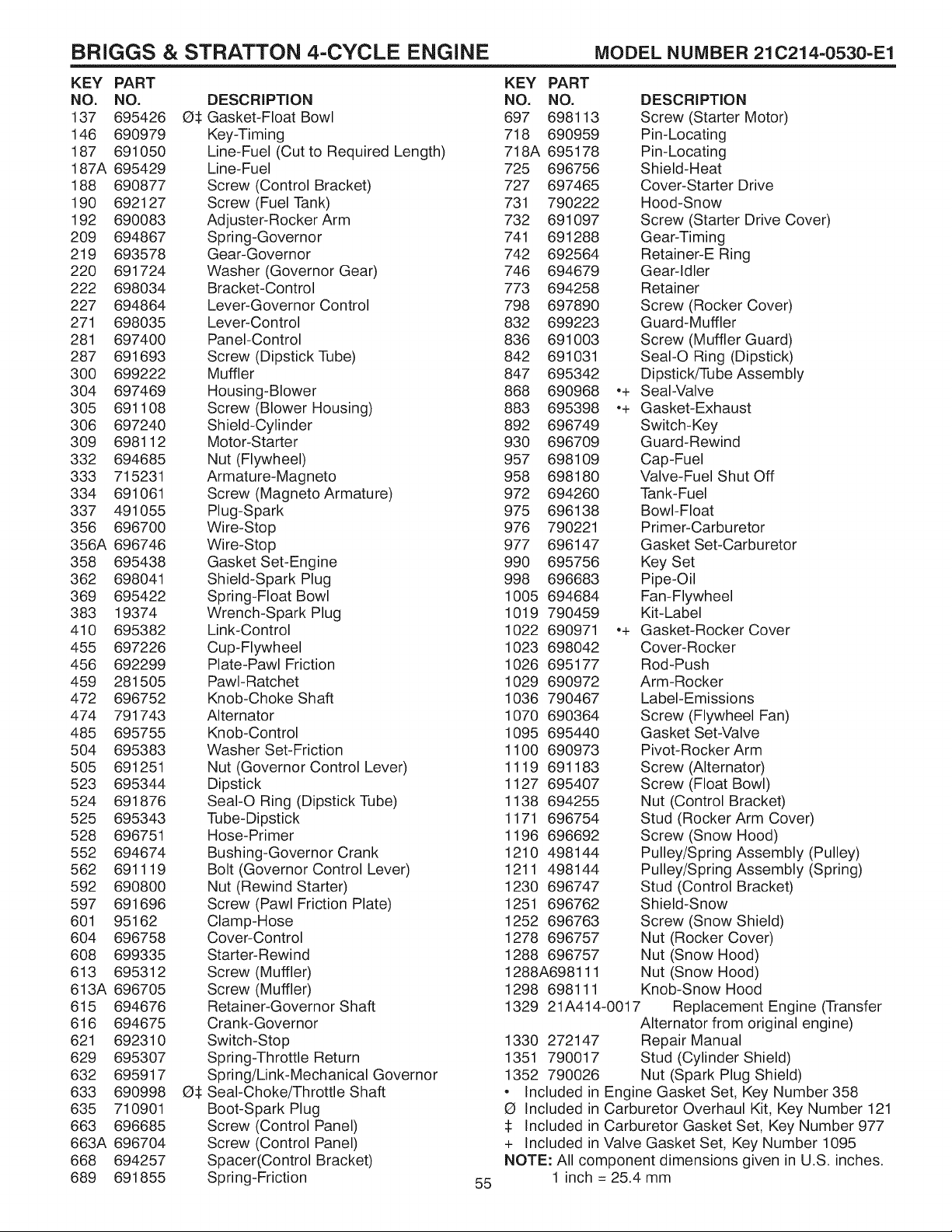
BRIGGS & STRATTON 4-CYCLE ENGINE MODEL NUMBER 21C214-0530=E1
KEY PART
NO. NO. DESCRIPTION
137 695426 O$ Gasket-Float Bowl
146 690979 Key-Timing
187 691050 Line-Fuel (Cut to Required Length)
187A 695429 Line-Fuel
188 690877 Screw (Control Bracket)
190 692127 Screw (Fuel Tank)
192 690083 Adjuster-Rocker Arm
209 694867 Spring-Governor
219 693578 Gear-Governor
220 691724 Washer (Governor Gear)
222 698034 Bracket-Control
227 694864 Lever-Governor Control
271 698035 Lever-Control
281 697400 Panel-Control
287 691693 Screw (Dipstick Tube)
300 699222 Muffler
304 697469 Housing-Blower
305 691108 Screw (Blower Housing)
306 697240 Shield-Cylinder
309 698112 Motor-Starter
332 694685 Nut (Flywheel)
333 715231 Armature-Magneto
334 691061 Screw (Magneto Armature)
337 491055 Plug-Spark
356 696700 Wire-Stop
356A 696746 Wire-Stop
358 695438 Gasket Set-Engine
362 698041 Shield-Spark Plug
369 695422 Spring-Float Bowl
383 19374 Wrench-Spark Plug
410 695382 Link-Control
455 697226 Cup-Flywheel
456 692299 Plate-Pawl Friction
459 281505 PawI-Ratchet
472 696752 Knob-Choke Shaft
474 791743 Alternator
485 695755 Knob-Control
504 695383 Washer Set-Friction
505 691251 Nut (Governor Control Lever)
523 695344 Dipstick
524 691876 SeaI-O Ring (Dipstick Tube)
525 695343 Tube-Dipstick
528 696751 Hose-Primer
552 694674 Bushing-Governor Crank
562 691119 Bolt (Governor Control Lever)
592 690800 Nut (Rewind Starter)
597 691696 Screw (Pawl Friction Plate)
601 95162 Clamp-Hose
604 696758 Cover-Control
608 699335 Starter-Rewind
613 695312 Screw (Muffler)
613A 696705 Screw (Muffler)
615 694676 Retainer-Governor Shaft
616 694675 Crank-Governor
621 692310 Switch-Stop
629 695307 Spring-Throttle Return
632 695917 Spring!Link-Mechanical Governor
633 690998 O$ Seal-Choke!Throttle Shaft
635 710901 Boot-Spark Plug
663 696685 Screw (Control Panel)
663A 696704 Screw (Control Panel)
668 694257 Spacer(Control Bracket)
689 691855 Spring-Friction
55
KEY PART
NO. NO. DESCRIPTION
697 698113 Screw (Starter Motor)
718 690959 Pin-Locating
718A 695178 Pin-Locating
725 696756 Shield-Heat
727 697465 Cover-Starter Drive
731 790222 Hood-Snow
732 691097 Screw (Starter Drive Cover)
741 691288 Gear-Timing
742 692564 Retainer-E Ring
746 694679 Gear-Idler
773 694258 Retainer
798 697890 Screw (Rocker Cover)
832 699223 Guard-Muffler
836 691003 Screw (Muffler Guard)
842 691031 SeaI-O Ring (Dipstick)
847 695342 Dipstick!Tube Assembly
868 690968 .+ Seal-Valve
883 695398 .+ Gasket-Exhaust
892 696749 Switch-Key
930 696709 Guard-Rewind
957 698109 Cap-Fuel
958 698180 Valve-Fuel Shut Off
972 694260 Tank-Fuel
975 696138 Bowl-Float
976 790221 Primer-Carburetor
977 696147 Gasket Set-Carburetor
990 695756 Key Set
998 696683 Pipe-Oil
1005 694684 Fan-Flywheel
1019 790459 Kit-Label
1022 690971 .+ Gasket-Rocker Cover
1023 698042 Cover-Rocker
1026 695177 Rod-Push
1029 690972 Arm-Rocker
1036 790467 Label-Emissions
1070 690364 Screw (Flywheel Fan)
1095 695440 Gasket Set-Valve
1100 690973 Pivot-Rocker Arm
1119 691183 Screw (Alternator)
1127 695407 Screw (Float Bowl)
1138 694255 Nut (Control Bracket)
1171 696754 Stud (Rocker Arm Cover)
1196 696692 Screw (Snow Hood)
1210 498144 Pulley!Spring Assembly (Pulley)
1211 498144 Pulley/Spring Assembly (Spring)
1230 696747 Stud (Control Bracket)
1251 696762 Shield-Snow
1252 696763 Screw (Snow Shield)
1278 696757 Nut (Rocker Cover)
1288 696757 Nut (Snow Hood)
1288A698111 Nut (Snow Hood)
1298 698111 Knob-Snow Hood
1329 21A414-0017 Replacement Engine (Transfer
Alternator from original engine)
1330 272147 Repair Manual
1351 790017 Stud (Cylinder Shield)
1352 790026 Nut (Spark Plug Shield)
• Included in Engine Gasket Set, Key Number 358
O Included in Carburetor Overhaul Kit, Key Number 121
$ Included in Carburetor Gasket Set, Key Number 977
+ Included in Valve Gasket Set, Key Number 1095
NOTE: All component dimensions given in U.S. inches.
1 inch -- 25.4 mm

Your Home
For repair - in your home - of all major brand appliances,
lawn and garden equipment, or heating and cooling systems,
no matter who made it, no matter who sold it!
For the replacement parts, accessories and
owner's manuals that you need to do-it-yourself.
For Sears professional installation of home appliances
and items like garage door openers and water heaters.
1-800-4-MY-HOME ® Anytime, day or night
(1-800-469-4663) (U.S.A. and Canada)
www.sears.com www.sears.ca
Our Home
For repair of carry-in products like vacuums, lawn equipment,
and electronics, call or go on-line for the nearest
Sears Parts and Repair Center.
1-800-488-1222 Anytime, day or night (U.S.A. only)
www,sears.com
To purchase a protection agreement (U.S.A.)
or maintenance agreement (Canada) on a product serviced by Sears:
1-800-827-6655 (U.S.A.) 1-800-361-6665 (Canada)
Para pedir servicio de reparaci6n
a domicilio, y para ordenar piezas:
1-888_U-HOG,_ ®
(1-888-784-6427)
Au Canada pour service en frangais:
1-800-LE-FOYER Mc
(1-800-533-6937)
www.sears.ca
Se rs
© Seam Brands, LLC
® Registered Trademark / TMTrademark / SMService Mark of Sears Brands, LLC
® Marca Registrada / TMMarca de Fabrica / SMMarca de Servicio de Sears Brands, LLC
MCMarque de commerce / MDMarque d6pos6e de Sears Brands, LLC
199119 Rev. 4 03.25.10 BYiTH Printed in U.S.A.