491061.B.1 06/2018
OWNER‘S MANUAL
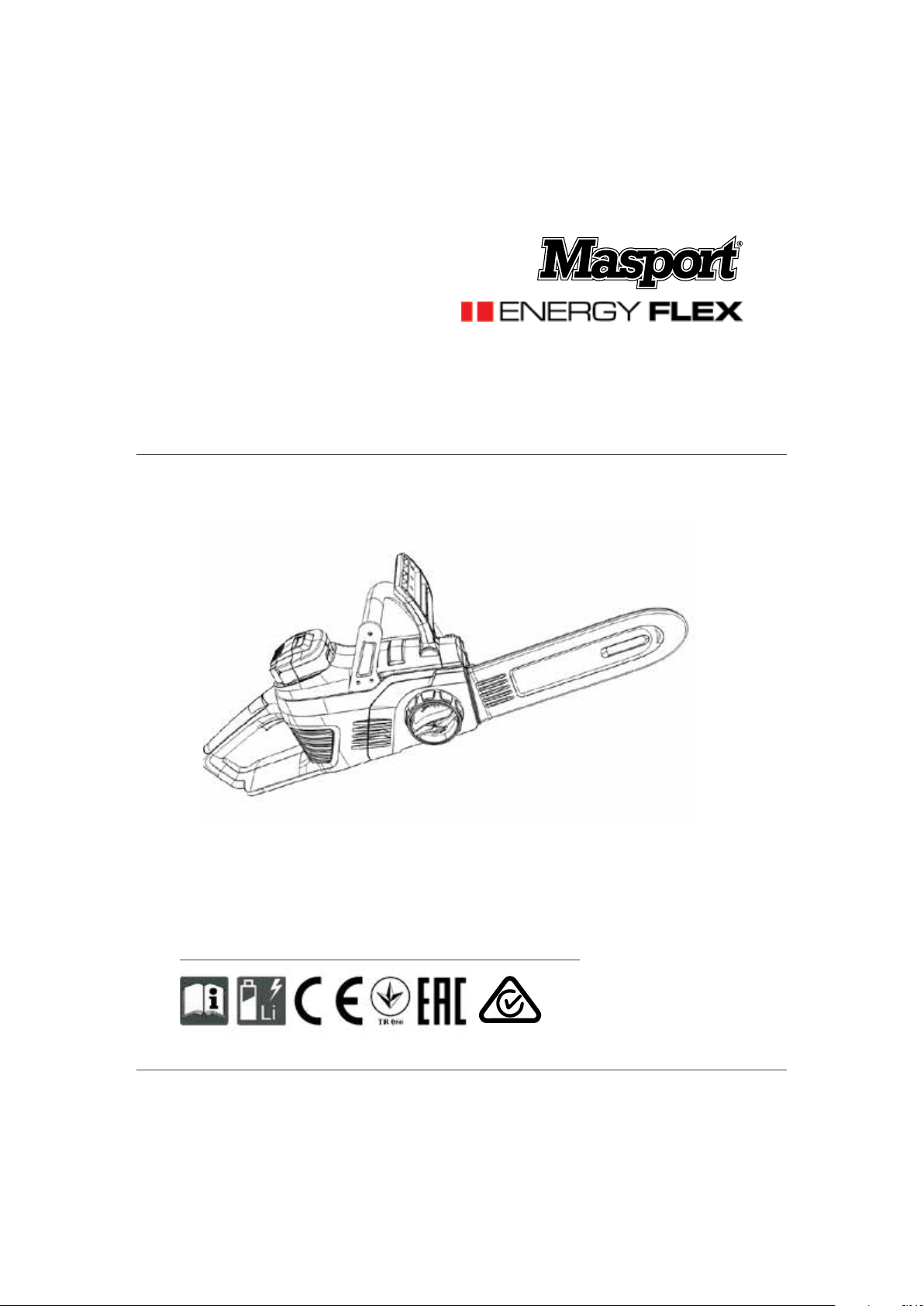
BATTERY CHAINSAW
CS 4030

2 CS 4030
Contents
1 About these operating instructions 3
1.1 Legends and signal words 3
2 Product description 3
2.1 Designated use 3
2.2 Residual Risks 3
2.3 Safety and protective devices 4
2.3.1 Switch-on protection 4
2.3.2 Chain brake 4
2.4 Symbols on the appliance 4
2.5 Scope of supply 4
2.6 Product Overview (01) 5
3 General safety instructions for power
tools 9
3.1 Work area safety 9
3.2 Electrical safety 9
3.3 Personal safety 9
3.4 Power tool use and care 9
3.5 Battery tool use and care 10
3.6 Service 10
4 Chain saw safety warnings 10
5 Causes and operator prevention of
kickback 11
6 Vibration load 11
7 Noise pollution 12
8 Safety information regarding the
rechargeable battery 12
9 Safety information regarding the charging
unit 13
10 Safety information when working 13
10.1 Operator 14
10.2 Operating times 14
10.3 Working with the chain saw 14
11 Installation 15
11.1 Installing the guide rail (05, 06) 15
11.2 Installing the saw chain (05, 06) 15
11.3 Tightening the saw chain (05, 07) 15
12 Start-up 15
12.1 Charging the rechargeable battery
(02) 16
12.2 Inserting the rechargeable battery
(03) 16
12.3 Pulling out the rechargeable battery
(03) 16
12.4 Checking the chain tension 16
12.5 Testing the function of the chain
brake 16
12.6 Function test of the chain brake
with the engine switched off (08) 17
12.7 Function test of the chain brake
with the motor switched on (08) 17
12.8 Filling saw chain oil (09) 17
13 Operation 17
13.1 Determining the charge status of
the rechargeable battery (04) 17
13.2 Check the saw chain oil 18
13.3 Testing the chain brake 18
13.4 Switching the engine on and off 18
14 Working behaviour and working
technique 18
14.1 Felling trees 19
14.2 Branch lopping 20
14.3 Cross-cutting 20
14.4 Cutting converted timber (12) 20
15 Maintenance and care 21
15.1 Sharpening the saw chain (13) 21
15.2 Cleaning the chain sprocket interior 22
15.3 Changing over the quick-tension
chain wheel (16) 22
15.4 Checking, turning and greasing the
guide rail (14, 15) 22
16 Help in case of malfunction 23
17 Transport 23
18 Storage 24
19 Disposal 24
3
20 Technical data 25
21 After-Sales / Service 25
22 Warranty 26
23 Declaration of conformity 29
1 ABOUT THESE OPERATING
INSTRUCTIONS
■ Itisessentialtoreadthroughtheseoperating
instructions carefully before start-up. This is
essential for safe working and trouble-free
handling.
■ Alwayssafeguardtheseoperating
instructions so that they can be consulted if
you need any information about the
appliance.
■ Onlypassontheappliancetootherpersons
together with these operating instructions.
■ Complywiththesafetyandwarning
information in these operating instructions.
1.1 Legends and signal words
DANGER!
Denotes an imminently dangerous
situation which will result in fatal or
serious injury if not avoided.
WARNING!
Denotes a potentially dangerous
situation which can result in fatal or
serious injury if not avoided.
CAUTION!
Denotes a potentially dangerous
situation which can result in minor or
moderate injury if not avoided.
IMPORTANT!
Denotes a situation which can result in
material damage if not avoided.
NOTE
Special instructions for ease of
understanding and handling.
2 PRODUCT DESCRIPTION
These operating instructions describe a hand-
operated electric chain saw that is operated with
a rechargeable battery.
2.1 Designated use
The chain saw is exclusively designed for
domestic, DIY and gardening applications. In this
sector, the chain saw can be used for light wood
sawing work, e.g. for:
■ Cutting up timber
■ Pruning hedgerows
■ Sawing firewood
Because of the electrical drive, the rechargeable
battery chain saw can be used not only on open
ground but also in closed rooms for sawing wood.
Any application not in accordance with the
application described here shall be regarded as
misuse.
The chain saw must not be used in the
commercial sector.
CAUTION!
Danger of injury due to non-
designated use!
If wood or other substances embedded
with foreign bodies are sawn with the
chain saw, injury can result.
■
Only use the chain saw for light
wood sawing work.
■
Before sawing wood, check for
foreign bodies, e.g. nails, screws,
fittings.
2.2 Residual risks
Even when using the appliance as intended,
there is always a certain residual risk that cannot
be excluded. The following hazards cannot be
ruled out due to the nature and design of the
appliance.
■ Contact with the exposed teeth of the chain
(risk of cutting)
■ Access to the moving chain (risk of cutting)
■ Sudden and unexpected movement of the
bar (risk of cutting)
■ Detachment of parts of the chain (risk of
cutting/injury)
■ Detachment of parts of the wood being
worked on
4 CS 4030
■ Impairment of hearing during work if ear
protection is not used
2.3 Safety and protective devices
WARNING!
Danger of serious injury from
manipulated safety and protective
devices
As a result of manipulated safety and
protective devices, serious injury can
occur when working with the chain saw.
■
Never deactivate safety and
protective devices.
■
Only work with the chain saw if all
safety and protective devices
function correctly.
2.3.1 Switch-on protection
If the operator applies the throttle quickly several
times in succession, the chain saw switches off
for a few seconds to protect the electronics and
the saw chain. In this case, wait until the chain
saw can be switched on again.
2.3.2 Chain brake
The chain saw has a manual chain brake that is
triggered by the hand guard, for example if
kickback occurs. When the chain brake is
triggered, the saw chain is abruptly stopped and
the engine switched off.
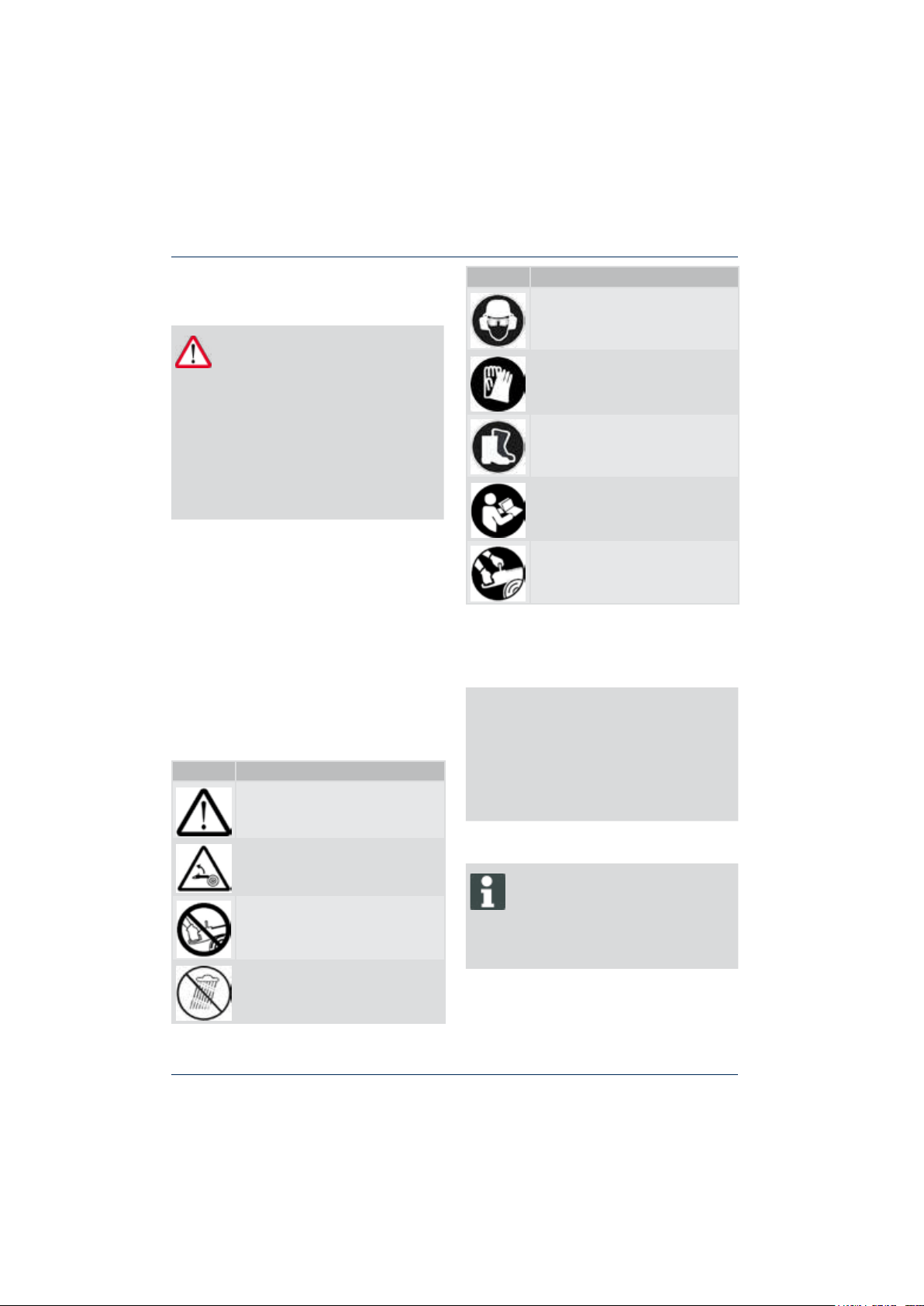
2.4 Symbols on the appliance
Symbol Meaning
Pay special attention when handling
this product.
Danger of kickback!
Do not operate the chain saw with
one hand!
Do not use in the rain! Protect
against moisture!
Symbol Meaning
Wear a protective helmet, ear and
eye protection!
Wear protective gloves!
Wear sturdy shoes!
Read the operating instructions
before starting operation.
Always operate the chain saw with
both hands!
2.5 Scope of supply
The battery-powered chain saw is intended for
operation with rechargeable battery B150 Li
(B05-3640, Art. No. 11328045)
IMPORTANT!
Danger of damage to the appliance
and battery
If the appliance is operated with an
unsuitable battery, both the device and
the battery may be damaged.
■
Only operate the appliance with the
specified rechargeable battery.
Charger C130 Li (Art. No. 11328145) is required
for charging the battery.
NOTE
You will find further information in the
following operating instructions:
■
Li-Ion rechargeable battery B150 Li /
B200 Li (Doc. No. 491013)
■
Charger C130 Li (Doc. No. 491024)
After unpacking check that all the parts have
been delivered.
5
NOTE
The rechargeable battery and the
charging unit are not included.
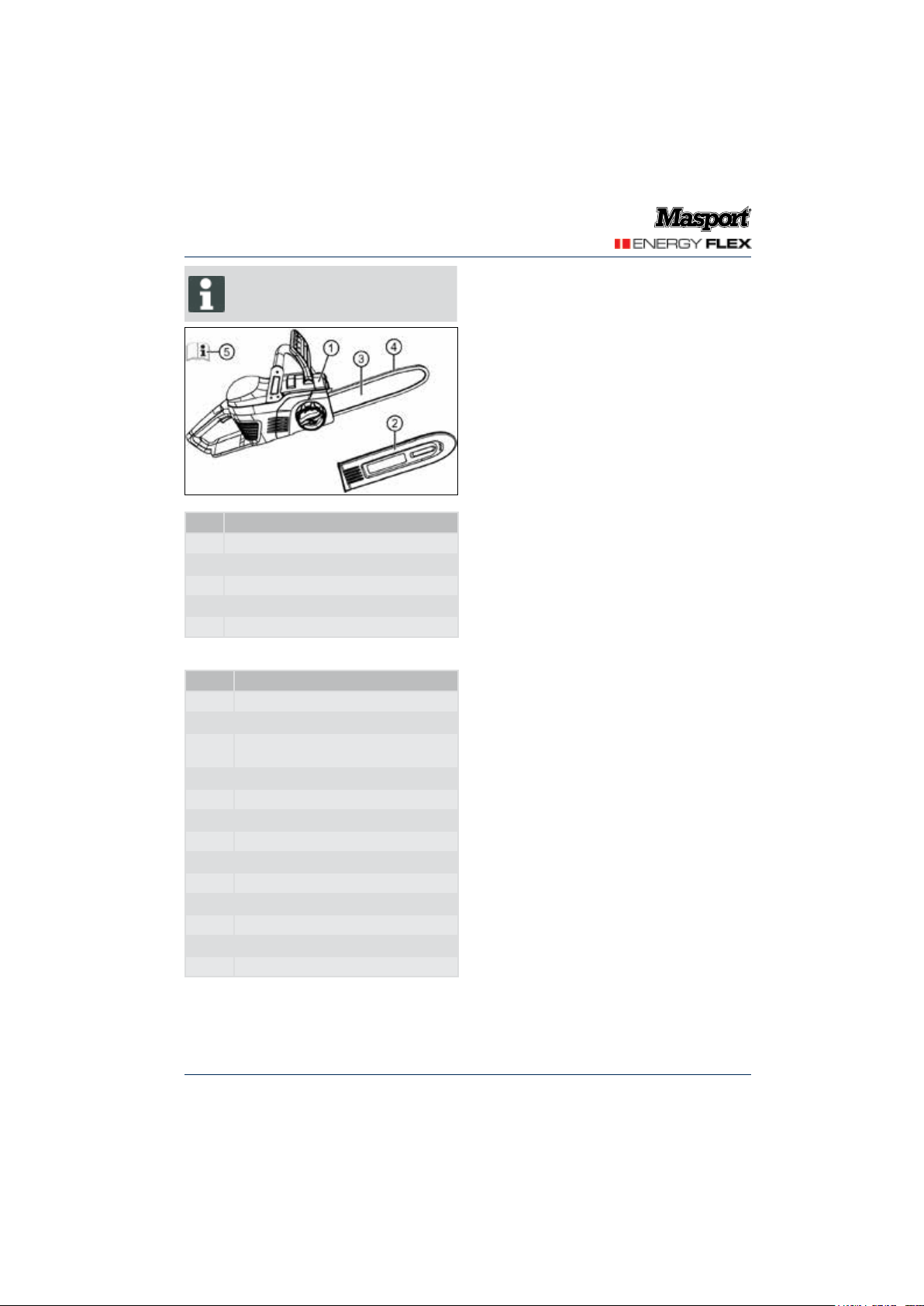
No. Component
1 CS 4030 battery-powered chain saw
2 Protective cover for the cutting blade
3 Chain bar
4 Saw chain
5 Operating instructions
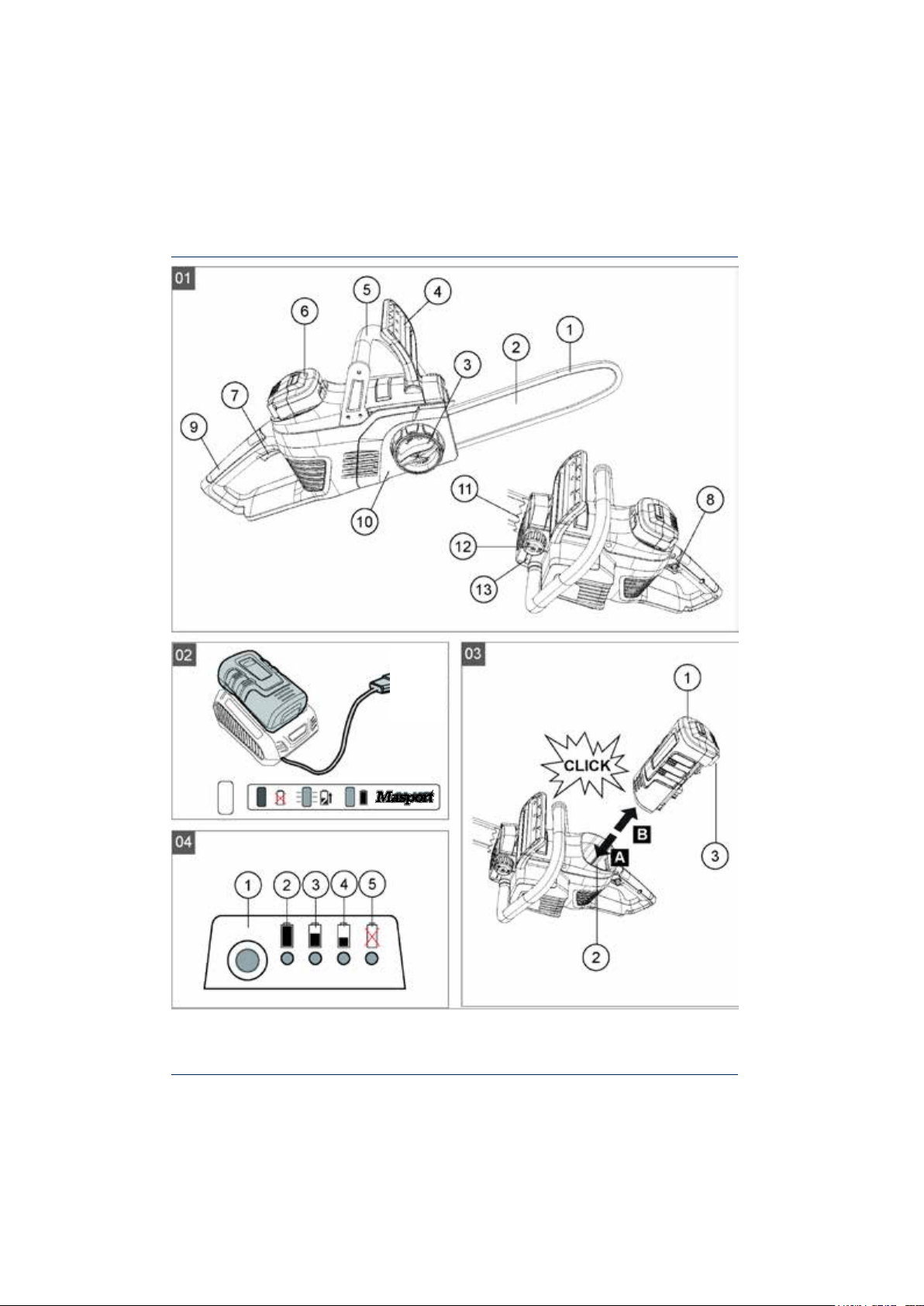
2.6 Product overview (01 - Page 6)
No. Component
1 Saw chain
2 Chain bar
3 Quick-tension chain wheel with central
lock and rotating ring
4 Hand guard
5 Handle
6 Battery
7 Throttle lever
8 Locking button
9 Rear handle
10 Cover for chain sprocket
11 Bumper spike
12 Cap of the chain oil tank
13 Viewing aperture of the chain oil tank
6 CS 4030
7
8 CS 4030

9
3 GENERAL POWER TOOL SAFETY
WARNINGS
WARNING!
Read all safety warnings and all
instructions.
Failure to follow the warnings and
instructions may result in electric shock,
fire and/or serious injury.
■
Save all warnings and instructions
for future reference.
The term “power tool” in the warnings refers to
your mains-operated (corded) power tool or
battery-operated (cordless) power tool.
3.1 Work area safety
■ Keep work area clean and well lit. Cluttered
and dark areas invite accidents.
■ Do not operate power tools in explosive
atmospheres, such as in the presence of
flammable liquids, gases or dust. Power
tools create sparks which may ignite the dust
or fumes.
■ Keep children and bystanders away while
operating a power tool. Distractions can
cause you to lose control.
3.2 Electrical safety
■ Power tool plugs must match the outlet.
Never modify the plug in any way. Do not
use any adapter plugs with earthed
(grounded) power tools. Unmodified plugs
and matching outlets will reduce the risk of
electric shock.
■ Avoid body contact with earthed or
grounded surfaces such as pipes,
radiators, ranges and refrigerators. There
is an increased risk of electric shock if your
body is earthed or grounded.
■ Do not expose power tools to rain or wet
conditions. Water entering a power tool will
increase the risk of electric shock.
■ Do not abuse the cord. Never use the cord
for carrying, pulling or unplugging the
power tool. Keep cord away from heat, oil,
sharp edges or moving parts. Damaged or
entangled cords increase the risk of electric
shock.
■ When operating a power tool outdoors,
use an extension cord suitable for
outdoor use. Use of a cord suitable for
outdoor use reduces the risk of electric
shock.
■ If operating a power tool in a damp
location is unavoidable, use a residual
current device (RCD) protected supply.
Use of an RCD reduces the risk of electric
shock.
3.3 Personal safety
■ Stay alert, watch what you are doing and
use common sense when operating a
power tool. Do not use a power tool while
you are tired or under the influence of
drugs, alcohol or medication. A moment of
inattention while operating power tools may
result in serious personal injury.
■ Use personal protective equipment.
Always wear eye protection. Protective
equipment such as a dust mask, non-skid
safety shoes, hard hat, or hearing protection
used for appropriate conditions will reduce
personal injuries.
■ Prevent unintentional starting. Ensure the
switch is in the off-position before
connecting to power source and/or
battery pack, picking up or carrying the
tool. Carrying power tools with your finger on
the switch or energising power tools that
have the switch on invites accidents.
■ Remove any adjusting key or wrench
before turning the power tool on. A wrench
or a key left attached to a rotating part of the
power tool may result in personal injury.
■ Do not overreach. Keep proper footing
and balance at all times. This enables
better control of the power tool in unexpected
situations.
■ Dress properly. Do not wear loose
clothing or jewellery. Keep your hair,
clothing and gloves away from moving
parts. Loose clothes, jewellery or long hair
can be caught in moving parts.
■ If devices are provided for the connection
of dust extraction and collection facilities,
ensure these are connected and properly
used. Use of these devices can reduce dust-
related hazards.
3.4 Power tool use and care
■ Do not force the power tool. Use the
correct power tool for your application.
The correct power tool will do the job better

10 CS 4030
and safer at the rate for which it was
designed.
■ Do not use the power tool if the switch
does not turn it on and off. Any power tool
that cannot be controlled with the switch is
dangerous and must be repaired.
■ Disconnect the plug from the power
source and/or the battery pack from the
power tool before making any
adjustments, changing accessories, or
storing power tools. Such preventive safety
measures reduce the risk of starting the
power tool accidentally.
■ Store idle power tools out of the reach of
children and do not allow persons
unfamiliar with the power tool or these
instructions to operate the power tool.
Power tools are dangerous in the hands of
untrained users.
■ Maintain power tools. Check for
misalignment or binding of moving parts,
breakage of parts and any other condition
that may affect the power tool’s operation.
If damaged, have the power tool repaired
before use. Many accidents are caused by
poorly maintained power tools.
■ Keep cutting tools sharp and clean.
Properly maintained cutting tools with sharp
cutting edges are less likely to bind and are
easier to control.
■ Use the power tool, accessories and tool
bits etc. in accordance with these
instructions, taking into account the
working conditions and the work to be
performed. Use of the power tool for
operations different from those intended
could result in a hazardous situation.
3.5 Battery tool use and care
■ Recharge only with the charger specified
by the manufacturer. A charger that is
suitable for one type of battery pack may
create a risk of fire when used with another
battery pack.
■ Use power tools only with specifically
designated battery packs. Use of any other
battery packs may create a risk of injury and
fire.
■ When battery pack is not in use, keep it
away from other metal objects, like
paperclips, coins, keys, nails, screws or
other small metal objects, that can make a
connection from one terminal to another.
Shorting the battery terminals together may
cause burns or a fire.
■ Under abusive conditions, liquid may be
ejected from the battery; avoid contact. If
contact accidentally occurs, flush with
water. If liquid contacts eyes, additionally
seek medical help. Liquid ejected form the
battery may cause irritation or burns.
3.6 Service
■ Have your power tool serviced by a
qualified repair person using only
identical replacement parts. This will
ensure that the safety of the power tool is
maintained.
4 CHAIN SAW SAFETY WARNINGS
■ Keep all parts of the body away from the
saw chain when the chain saw is
operating. Before you start the chain saw,
make sure the saw chain is not contacting
anything. A moment of inattention while
operating chain saws may cause
entanglement of your clothing or body with
the saw chain.
■ Always hold the chain saw with your right
hand on the rear handle and your left
hand on the front handle. Holding the chain
saw with a reversed hand configuration
increases the risk of personal injury and
should never be done.
■ Hold the power tool by insulated gripping
surfaces only, because the saw chain may
contact hidden wiring. Saw chains
contacting a “live” wire may make exposed
metal parts of the power tool “live” and could
give the operator an electric shock.
■ Wear safety glasses and hearing
protection. Further protective equipment
for head, hands, legs and feet is
recommended. Adequate protective clothing
will reduce personal injury by flying debris or
accidental contact with the saw chain.
■ Do not operate a chain saw in a tree.
Operation of a chain saw while up in a tree
may result in personal injury.
■ Always keep proper footing and operate
the chain saw only when standing on
fixed, secure and level surface. Slippery or
unstable surfaces such as ladders may
cause a loss of balance or control of the
chain saw.
11
■ When cutting a limb that is under tension
be alert for spring back. When the tension
in the wood fibres is released the spring
loaded limb may strike the operator and/or
throw the chain saw out of control.
■ Use extreme caution when cutting brush
and saplings. The slender material may
catch the saw chain and be whipped toward
you or pull you off balance.
■ Carry the chain saw by the front handle
with the chain saw switched off and away
from your body. When transporting or
storing the chain saw always fit the guide
bar cover. Proper handling of the chain saw
will reduce the likelihood of accidental
contact with the moving saw chain.
■ Follow instructions for lubricating, chain
tensioning and changing accessories.
Improperly tensioned or lubricated chains
may either break or increase the chance for
kickback.
■ Keep handles dry, clean, and free from oil
and grease. Greasy, oily handles are
slippery causing loss of control.
■ Cut wood only. Do not use chain saw for
purposes not intended. For example: do
not use chain saw for cutting plastic,
masonry or non-wood building materials.
Use of the chain saw for operations other
than intended could result in a hazardous
situation.
5 CAUSES AND OPERATOR
PREVENTION OF KICKBACK
Kickback may occur when the nose or tip of the
guide bar touches an object, or when the wood
closes in and pinches the saw chain in the cut.
Tip contact in some cases may cause a sudden
reverse reaction, kicking the guide bar up and
back towards the operator.
Pinching the saw chain along the top of the guide
bar may push the guide bar rapidly back towards
the operator.
Either of these reactions may cause you to lose
control of the saw which could result in serious
personal injury. Do not rely exclusively upon the
safety devices built into your saw. As a chain saw
user, you should take several steps to keep your
cutting jobs free from accident or injury.
Kickback is the result of tool misuse and/or
incorrect operating procedures or conditions and
can be avoided by taking proper precautions as
given below:
■ Maintain a firm grip, with thumbs and fingers
encircling the chain saw handles, with both
hands on the saw and position your body and
arm to allow you to resist kickback forces.
Kickback forces can be controlled by the
operator, if proper precautions are taken. Do
not let go of the chain saw.
■ Do not overreach and do not cut above
shoulder height. This helps prevent
unintended tip contact and enables better
control of the chain saw in unexpected
situations.
■ Only use replacement bars and chains
specified by the manufacturer. Incorrect
replacement bars and chains may cause
chain breakage and/or kickback.
■ Follow the manufacturer’s sharpening and
maintenance instructions for the saw chain.
Decreasing the depth gauge height can lead
to increased kickback.
6 VIBRATION LOAD
WARNING!
Danger due to vibration
The actual magnitude of the vibration
emissions during the use of the
appliance may deviate from that stated
by the manufacturer. Observe the
following influencing factors before or
during use:
■
Is the appliance being used as
intended?
■
Is the material being cut or
processed in the proper manner?
■
Is the appliance in a proper
condition of use?
■
Is the cutting tool properly
sharpened or is the correct cutting
tool installed?
■
Are the handle grips and any
optional vibration grips mounted,
and are they firmly attached to the
appliance?
■ Only operate the tool at the motor speed
required for the respective work. Avoid using
the maximum speed in order to reduce noise
and vibrations.

12 CS 4030
■ The noise and vibrations of the tool may
increase due to improper use and
maintenance. This leads to health damage.
In this case, immediately switch off the tool
and have it repaired by an authorised service
workshop.
■ The degree of stress due to vibration
depends on the work to be performed or on
the use of the tool. Estimate the stress and
plan appropriate work breaks. This
considerably reduces stress due to vibration
over the entire working time.
■ Extensive use of the tool exposes the
operator to vibrations, which can lead to
circulatory issues (“white fingers”). To avoid
this risk, wear gloves and keep your hands
warm. If any symptoms of “white fingers”
occur, immediately consult a physician.
These symptoms include: Numbness, loss of
feeling, tingling, itching, pain, reduced
muscular strength, changes in the colour or
condition of the skin. Normally these
conditions affect the fingers, hands or pulse.
The risk increases at low temperatures.
■ Take long breaks during your working day so
you can recover from the noise and the
vibrations. Plan your work in such a way that
the use of appliances that generate strong
vibrations is spread over several days.
■ If you notice an unpleasant sensation or
discolouration of the skin on your hands
when using the tool, stop work immediately.
Take sufficient work breaks. Without
sufficient breaks, a hand/arm vibration
syndrome can occur.
■ Minimise your risk of being exposed to
vibrations. Maintain the tool according to the
instructions in the operating instructions.
■ If the tool is used frequently, contact your
dealer to purchase anti-vibration accessories
(e.g. handles).
■ Avoid working with the tool at temperatures
below 10 °C. Define how the vibration load
can be limited in a work plan
7 NOISE POLLUTION
A certain level of noise exposure from this
appliance is inevitable. Carry out noisy work at
approved and specified time periods. Observe
rest periods as necessary and restrict the
duration of the work to a minimum. For your
personal protection and protection of persons in
the vicinity, appropriate hearing protection must
be worn.
8 SAFETY INFORMATION REGARDING
THE RECHARGEABLE BATTERY
This section mentions all the basic safety and
warning information to be heeded when using the
rechargeable battery. Read these instructions.
■ Only use the rechargeable battery as
designated, i.e. for Masport rechargeable
battery-driven appliances. Only charge the
rechargeable battery with the Masport
charging unit.
■ Only unpack the new rechargeable battery
from the original packaging when it is to be
used.
■ Fully charge the rechargeable battery before
using it for the first time and always use the
specified charger. Comply with the details
given in these instructions for use for
charging the rechargeable battery.
■ Do not use the rechargeable battery in
environments where there is a potential risk
of explosion and/or fire.
■ Do not expose the rechargeable battery to
moisture and humidity when in use with the
appliance.
■ Protect the rechargeable battery from heat,
oil and fire to prevent it being damaged so no
vapours and electrolyte liquids can escape.
■ Do not subject the rechargeable battery to
impacts or throw it.
■ Do not use the rechargeable battery when
soiled or wet. Before use, clean and dry the
rechargeable battery with a dry, clean cloth.
■ When battery pack is not in use, keep it away
from other metal objects, like paperclips,
coins, keys, nails, screws or other small
metal objects that can make a connection
from one terminal to another. Burns or fire
can result from a short-circuit.
■ Do not open, dismantle or crush the
rechargeable battery. There is a danger of
electric shock and short-circuit.
■ An improperly used and damaged
rechargeable battery can cause vapours and
electrolyte liquid to escape. Vent the room
adequately and in the case of any disorders,
consult a doctor.
If accidental contact with electrolyte liquid
occurs, flush with water and thoroughly rinse
the eyes immediately. Then consult a doctor.

13
■ This rechargeable battery must not be used
by unauthorised persons unless they are
supervised by a person responsible for their
safety or have been instructed on how to use
the rechargeable battery. Unauthorised
persons include, for example:
■
Persons (including children) with limited
physical, sensory or mental aptitude.
■
Persons who have no experience and/or
knowledge of the rechargeable battery.
■ Childrenmustbesupervisedandinstructed
so they do not play with the rechargeable
battery.
■ Donotleavetherechargeablebattery
permanently in the charger. For prolonged
storage, remove the rechargeable battery
from the charger.
■ Whennotinuse,removetherechargeable
batteries from the operated appliances.
■ Drytheunusedrechargeablebatteryand
store in a closed place. Protect from heat and
direct sunlight. Unauthorised persons and
children must not have access to the
rechargeable battery.
9 SAFETY INFORMATION REGARDING
THE CHARGING UNIT
This section mentions all the basic safety and
warning information to be heeded when using the
charger. Read these instructions.
■ Only use the appliance as designated, i.e. for
charging the intended rechargeable batteries.
Only charge original rechargeable batteries
from Masport in the charging unit.
■ Before each use, inspect the entire appliance
– and especially the mains cable and the
rechargeable battery compartment – for
damage. Only use the appliance when it is in
proper working order.
■ Do not use the appliance in environments
where there is a potential risk of explosion
and/or fire.
■ Only operate the appliance indoors and do
not expose it to moisture and humidity.
■ Always place the charging unit on a well
ventilated and non-inflammable surface
because it heats up during the charging
process. Keep the ventilation slots clear and
do not cover the appliance.
■ Before connecting the charging unit, make
sure that the mains voltage matches the
voltage stated in the “Technical data”.
■ Only use the mains cable for connecting the
charging unit, not for any other purpose. Do
not carry the charging unit by the mains cable
and do not remove the power plug from the
power outlet by pulling on the mains cable.
■ Protect the mains cable from heat, oil and
sharp edges to prevent it being damaged.
■ Do not use the charging unit and
rechargeable battery when soiled or wet.
Before using the appliance, clean and dry the
rechargeable battery.
■ Do not open the charging unit or
rechargeable battery. There is a danger of
electric shock and short-circuit.
■ For your own safety, have your appliance
repaired by qualified specialist personnel only
using original spare parts.
■ This appliance must not be used by
unauthorised persons unless they are
supervised by a person responsible for their
safety or have been instructed on how to use
the appliance. Unauthorised persons include,
for example:
■
Persons (including children) with limited
physical, sensory or mental aptitude
■
Persons who have no experience and/or
knowledge of the appliance.
■ Children must be supervised and instructed
so they do not play with the appliance.
■ Dry the unused appliance and store in a
closed place. Unauthorised persons and
children must not have access to the
appliance.
10 SAFETY INFORMATION WHEN
WORKING
■ Follow the country-specific safety regulations,
e.g. from the relevant trade associations,
social security systems, authorities for
industrial safety.
■ Only work in sufficient daylight or artificial
lighting.
■ Keep the working area free from objects (e.g.
off-cuts) – danger of stumbling.
■ The user is responsible for accidents
involving other people and their property.
■ If you are working with a chain saw for the
first time:
■
Have the salesperson or another expert
explain the operation of the chain saw, or
attend a course.
14 CS 4030
■
Prior to the first use, at the very least
practice cutting round wood on a saw
frame or stand.
10.1 Operator
■ Young people under 16 years of age and
people who do not know the operating
instructions are not allowed to use the tool.
■ To operate the chain saw, you must be
rested and in good physical and mental
health. If you must not exert yourself for
health reasons, ask your doctor whether it is
possible to work with a chain saw.
10.2 Operating times
Follow the country-specific regulations for the
operating times of chain saws. The operating
times of chain saws can be limited by national
and local regulations.
10.3 Working with the chain saw
WARNING!
Danger of serious injury.
If an incorrectly mounted chain saw is
used, serious injury can be caused.
■
Only use the saw chain when it has
been fully mounted.
■
Before each use, perform a visual
inspection in order to check that the
chain saw is complete and does not
contain damaged or worn
components. Safety and protective
devices must be intact.
WARNING!
Risk of injury due to chain saw being
started inadvertently
A chain saw that is started inadvertently
can lead to serious injury. Therefore,
remove the rechargeable battery during:
■
Testing, adjustment work and
cleaning work
■
Work on the cutting equipment
■
Leaving the chain saw
■
Transport
■
Storage
■
Maintenance and repair work
■
Danger
■ Never work alone.
■ Always keep a first-aid kit to hand in case of
accidents.
■ Avoid touching metal objects in the ground or
which are conductively connected to the
ground.
■ The personal protective equipment
comprises:
■
Protective helmet
■
Hearing protection (e.g. ear muffs,
especially when working for than 2.5
hours a day)
■
Protective glasses or face visor
incorporated in the protective helmet
■
Protective trousers with cut protection
inlay
■
Sturdy working gloves
■
Safety boots with high-grip sole and steel
toe caps
■ Do not use the chain saw above shoulder
height, since safe handling is no longer
possible in this way.
■ When changing position, switch off the
engine and put on the chain guard.
■ When chain saws are not in use, always put
on the chain guard and remove the
rechargeable battery.
■ Switch the chain saw off before putting it
down.
■ Do not use the chain saw for levering or
moving wood.
■ Only specialist personnel are allowed to saw
trunks that are thicker than the length of the
chain bar.
■ Only start the cut once the saw chain is
running, never switch on the chain saw
already in the kerf.
■ Make sure that no saw chain oil gets onto the
ground.
■ Do not undertake sawing work in the rain,
snow or stormy weather.
■ Never disable safety and protective devices.
15
11 INSTALLATION
WARNING!
Danger of serious injury.
If an incompletely mounted chain saw is
used, serious injury can be caused.
■
Only use the chain saw when it has
been fully mounted.
■
Before each use, perform a visual
inspection in order to check that the
chain saw is complete and does not
contain damaged or worn
components. Safety and protective
devices must be intact.
CAUTION!
Danger of laceration injuries.
The sharp edges of the saw chain can
cause laceration injuries when
assembling.
■
Before installation, remove the
rechargeable battery.
■
Wear safety gloves when installing
the saw chain and the guide rail.
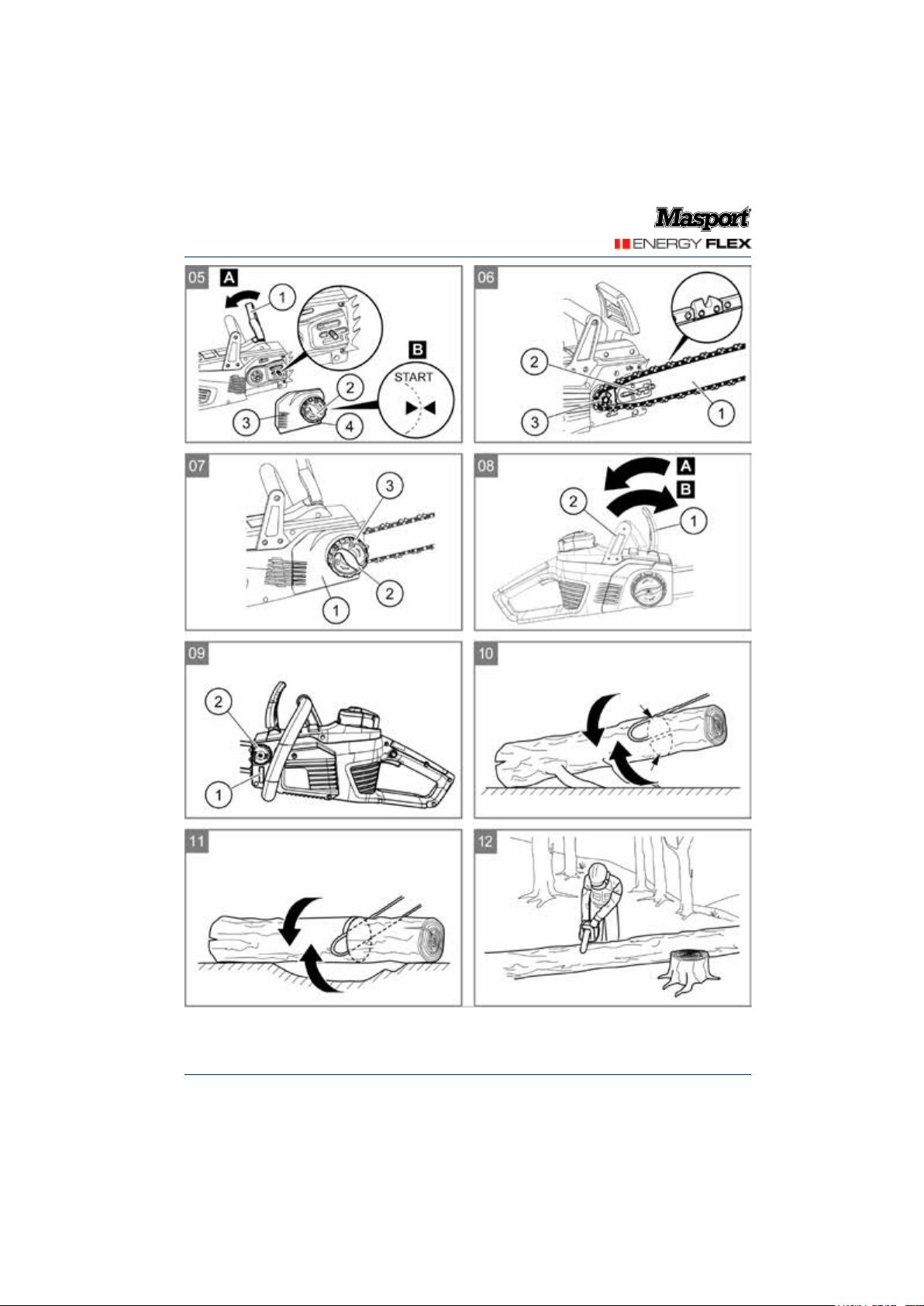
11.1 Installing the guide rail (05, 06 - Page 7)
1. Pull hand guard (05/1) in the direction of the
handle (05/A) in order to release the chain
brake.
2. Turn the central lock (05/2) anti clockwise
and remove together with the cover (05/3).
3. Set the guide rail (06/1) on the guide pin
(06/2) and push so far back that the saw
chain can be mounted.
11.2 Installing the saw chain (05, 06)
1. Place the saw chain on the chain sprocket
(06/3) and in the groove of the chain bar
(06/1).
2. Guide the saw chain around the reversing
sprocket of the chain bar. The saw chain
must hang down slightly on the underside of
the chain bar.
3. Put the cover (05/3) and tighten the central
lock (05/2) slightly.
11.3 Tightening the saw chain (05, 07 - Page
7)
NOTE
The saw chain has been tensioned
correctly when:
■
It is in contact with the underside of
the chain bar and can be pulled
through by hand.
■
It can be lifted by 3 – 4 mm in the
middle of the chain bar.
1. Check the seat of the saw chain so that it sits
correctly on the chain sprocket and in the
chain bar.
2. Turn the rotating ring (05/4) towards the
cover (05/3) so that the two triangles face
each other (05/B).
3. Put on the cover (07/1) and turn the central
lock (07/2) clockwise. Do not tighten the
central lock fully or turn back by one turn.
4. Turn the rotating ring (07/3) clockwise until
the saw chain has been tensioned correctly
as described above.
5. Turn the central lock (07/2) clockwise until it
is fixed in place.
12 START-UP
DANGER!
Danger of fatal injury and danger of
extremely severe injury.
Lack of knowledge of the safety
instructions and operating instructions
can lead to extremely serious and even
fatal injury.
■
Read and follow all safety
instructions and instructions for use
in these operating instructions as
well the operating instructions which
are referred to before you start using
the chain saw.
WARNING!
Danger of serious injury.
Serious injury can be caused if there are
damaged components on the chain saw.
■
Before each use, perform a visual
inspection in order to check that the
chain saw is complete and does not
contain damaged or worn
components. Safety and protective
devices must be intact.
16 CS 4030
12.1 Charging the rechargeable battery (02 -
Page 6)
The rechargeable battery is partially charged.
Fully charge the rechargeable battery before
using it for the first time. The rechargeable
battery can be charged in any charge status.
Interrupting charging does not damage the
rechargeable battery.
NOTE
For detailed information, heed the
separate operating instructions for the
rechargeable battery and for the
charging unit.
12.2 Inserting the rechargeable battery (03 -
Page 6)
1. Push (03/A) the rechargeable battery (03/1)
into the rechargeable battery slot (03/2) from
above until it engages.
12.3 Pulling out the rechargeable battery (03)
1. Press and hold the unlock button (03/3) on
the rechargeable battery (03/1).
2. Pull out (03/B) the rechargeable battery
(03/1).
12.4 Checking the chain tension
Frequently check the chain tension, because new
saw chains stretch.
At operating temperature, the saw chain
stretches and hangs down.
NOTE
The saw chain has been tensioned
correctly when:
■
It is in contact with the underside of
the chain bar and can be pulled
through by hand.
■
It can be lifted by 3 – 4 mm in the
middle of the chain bar.
CAUTION!
Danger of injury due to the saw chain
jumping off!
An insufficiently tensioned saw chain
can jump off during operation and lead
to injury.
■
Frequently check the chain tension.
The chain tension is too low if the
drive links come out of the groove
on the underside of the chain bar.
■
Re-tension the saw chain properly if
the chain tension is too low.
12.5 Testing the function of the chain brake
The chain saw has a manual chain brake that is
triggered by the hand guard, for example if
kickback occurs.
When the chain brake is triggered, the saw chain
is abruptly stopped and the engine switched off.
DANGER!
Danger of fatal injury as a result of
negligent handling!
Extremely serious injury and even fatal
injury can be caused as a result of
careless and unexpected movements of
the chain saw.
■
Pay attention to safety and work with
a high level of concentration when
using the chain saw.
■
Do not press any switch when
releasing the chain brake.
WARNING!
Danger of fatal injury and danger of
extremely severe injury due to a
defective chain brake
Extremely serious injury and even fatal
injury of the operator can be caused if
the chain brake does not function, e.g.
due to kickback by the running saw
chain.
■
Check the chain brake each time
before starting work.
■
Do not switch the chain saw on if the
chain brake is defective. in this case,
have the chain saw checked at your
local service dealer.
17
12.6 Function test of the chain brake with the
engine switched off (08 - Page 7)
1. Pull the rechargeable battery out of the
appliance, see chapter 12.3 „Pulling out the
rechargeable battery (03)“
2. To release the chain brake, pull (08/A) the
hand guard (08/1) in the direction of the
handle (08/2). The saw chain can be pulled
through by hand.
3. Push the hand guard (08/1) forwards (08/B)
to switch on the chain brake. It must not be
possible to pull the saw chain through.
12.7 Function test of the chain brake with the
motor switched on (08)
NOTE
Release the chain brake each time
before switching on the chain saw.
1. Hold the chain saw securely and firmly by the
handle and hand grip.
2. Release the chain brake.
3. Switch on the engine.
4. Push the hand guard (08/1) forwards (08/B).
The saw chain and engine must stop
immediately.
12.8 Filling saw chain oil (09 - Page 7)
IMPORTANT!
Danger of damaging the chain saw
The chain saw will be severely damaged
if there is too little or even no saw chain
oil in the tank or it has dried/is sticky.
Dried/sticky saw chain oil can lead to
damage to oil-channelling components
or the oil pump.
Damage also occurs if used oil is used.
The use of used oil leads to
environmental damage!
■
For start-up work, fill saw chain oil
into the tank.
■
Do not use any used oil!
■
Each time before changing the
rechargeable battery at the latest, fill
the tank with saw chain oil again.
The saw chain and the chain bar are continuously
supplied with oil during operation by means of an
automatic oiler system. The saw chain oil
protects against corrosion and premature wear.
There must always be sufficient saw chain oil in
the tank to lubricate the saw chain sufficiently.
To lubricate the saw chain and the chain bar,
only use environmentally friendly, biodegradable,
high-quality saw chain oil. This oil must be
transported and stored in approved and
appropriately labelled containers.
Each time before starting work or changing the
rechargeable battery, check the oil level and
replenish the saw chain oil if necessary:
1. Check the oil level in the viewing aperture of
the tank (09/1). It must always be possible to
see oil. The minimum and the maximum oil
level must not be exceeded.
2. Refill saw chain oil via the filler neck (09/2) if
necessary.
13 OPERATION
DANGER!
Danger of fatal injury and danger of
extremely severe injury.
Lack of knowledge of the safety
instructions and operating instructions
can lead to extremely serious and even
fatal injury.
■
Read and follow all safety
instructions and instructions for use
in these operating instructions as
well the operating instructions which
are referred to before you start using
the chain saw.
■ Comply with working time regulations in force
in your country.
■ Grip the rear saw grip firmly with your right
hand (right-handed operator) and the front
grip with your left hand, and hold them tightly.
■ Do not release the grips for as long as the
engine is running.
■ Do not use the chain saw if you are:
■
Tired
■
Unwell
■
Under the influence of alcohol, medicines
and drugs
13.1 Determining the charge status of the
rechargeable battery (04 - Page 6)
There is a control panel with a push-button (04/1)
and LED charge status displays (04/2 to 04/5) on
the front of the rechargeable battery.
18 CS 4030
1. Press the push-button (04/1).
The charge status displays light according to
the charge status of the rechargeable battery.
2. Read off the charge status.
Lighting LEDs Charge status of the
rechargeable battery
Green (04/2) The rechargeable battery is
fully charged.
Green (04/3)
and (04/4)
Rechargeable battery is
charged to over 50 %.
Green (04/4) Rechargeable battery is
charged to less than 50 %.
Red (04/5) The rechargeable battery is
fully discharged or the
rechargeable battery has
been overheated/
undercooled.
13.2 Check the saw chain oil
Procedure see chapter 12.8 “Filling saw chain oil
(09)”
IMPORTANT!
Danger of damaging the chain saw
The chain saw will be severely damaged
if there is too little or even no saw chain
oil in the tank or it has dried/is sticky.
Dried/sticky saw chain oil can lead to
damage to oil-channelling components
or the oil pump.
Damage also occurs if used oil is used.
The use of used oil leads to
environmental damage!
■
Each time before starting work,
check that enough saw chain oil is
present in the tank.
■
If the oil level is low, refill saw chain
oil.
■
Do not use any used oil!
13.3 Testing the chain brake
Procedure see chapter 12.5 “Testing the function
of the chain brake”
WARNING!
Danger of fatal injury and danger of
extremely severe injury due to a
defective chain brake
Extremely serious injury and even fatal
injury of the operator can be caused if
the chain brake does not function, e.g.
due to kickback by the running saw
chain.
■
Check the chain brake each time
before starting work.
■
Do not switch the chain saw on if the
chain brake is defective. in this case,
have the chain saw checked in a
customer service workshop.
13.4 Switching the engine on and off
CAUTION!
Danger of hearing impairment!
The operation of the chain saw causes
intense noise that can cause hearing
impairment.
■
During work with the chain saw,
wear ear protection.
NOTE
Release the chain brake each time
before switching on the chain saw.
Switching on the engine:
1. Release the chain brake.
2. Press and hold locking button (01/8) with
your thumb.
3. Press and hold the throttle lever (01/7).
4. Release the locking button (01/8). It is not
necessary to keep the locking button pressed
once the chain saw has started. The locking
button is intended to prevent inadvertent
starting of the chain saw.
Switching off the engine:
1. Release the throttle lever (01/7).
14 WORKING BEHAVIOUR AND
WORKING TECHNIQUE
NOTE
Courses in the use of chain saws and
techniques for felling trees are regularly
held by various forestry organisations.
19
DANGER!
Danger of fatal injury due to
inadequate technical knowledge!
Inadequate technical knowledge can
result in extremely serious up to fatal
injury!
■
Only trained and experienced
people are allowed to fell trees and
lop branches.
DANGER!
Danger of fatal injury from splintered
wood!
Wood chips caught up in the chain can
cause extremely serious and even fatal
injury!
■
Remove loose chips and wood
splinters from the part to be sawn.
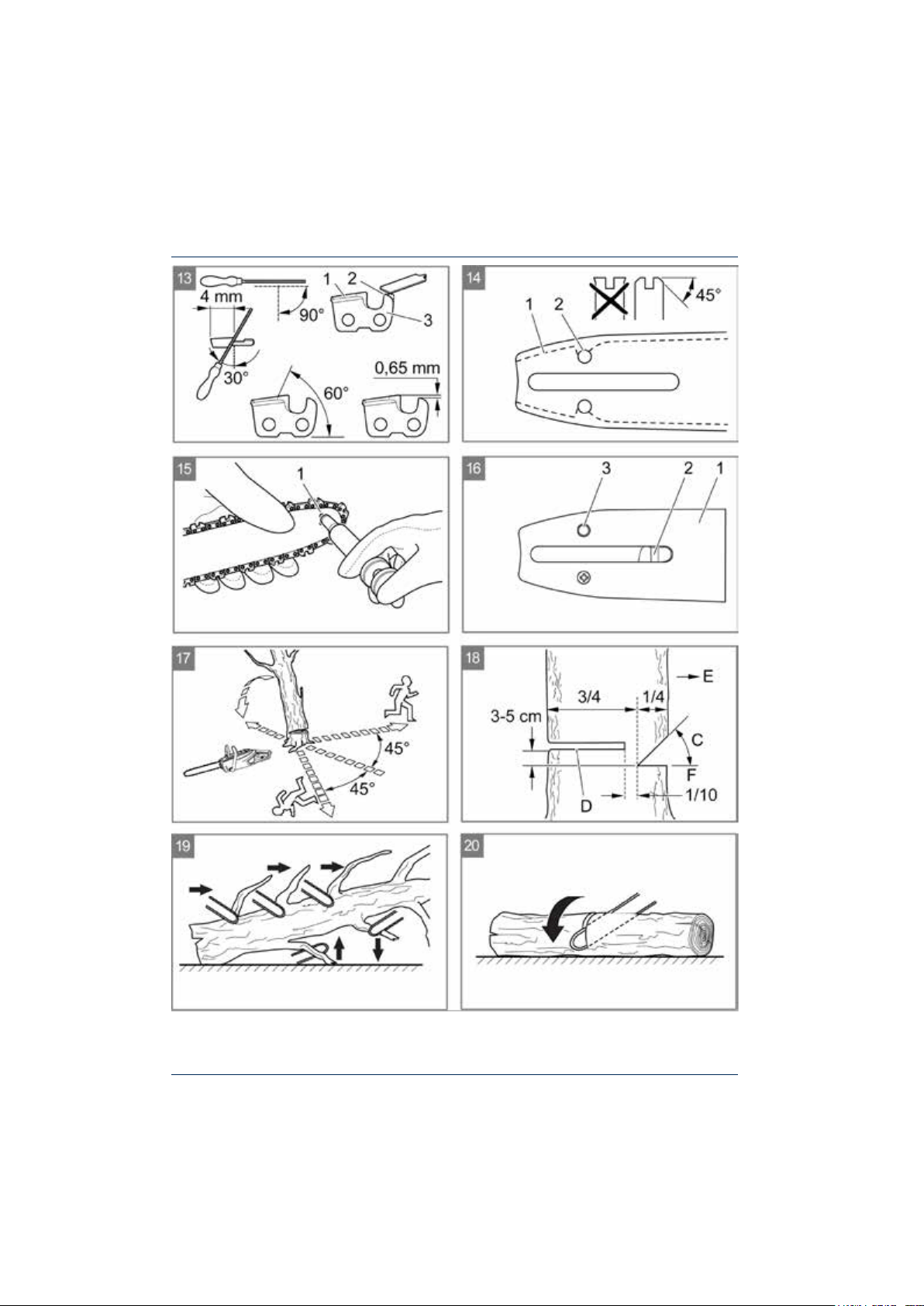
14.1 Felling trees (17,18 - Page 8)
Take the following measures before starting
felling work.
■ Makesurethatnootherpeople,animalsor
objects are in the danger area.
■ Thesafedistancefromotherworkplacesor
objects should be at least 2½ tree lengths.
■ Watchoutforpowerlinesandotherpeople’s
property. If necessary, notify the power
supply company or the property owner.
■ Judgethefallingdirectionofthetree.
Factors influencing the falling direction of the
tree:
■
Natural lean of the tree
■
Height of the tree
■
Branches growing on one side
■
Level ground or slope
■
Asymmetrical growth, wood damage
■
Wind direction and wind speed
■
Snow load
■ When working on a slope, always work uphill
of the tree to be felled.
■ Establish your escape route in advance, and
make sure that there are no obstacles in the
way. The escape route should be at an angle
of approx. 45° backwards from the falling
direction (17).
■ The trunk must be free from growth,
branches and foreign bodies (e.g. dirt,
stones, loose bark, nails, staples, wire, etc.).
Make two undercuts and one back cut in order to
fell a tree.
1. During back cuts and cross-cuts, place the
bumper spike firmly against the wood to be
cut.
2. Saw the first undercut (18/C) horizontally,
then the second undercut at an angle of at
least 45° from above. This prevents the chain
saw becoming trapped when you make the
second undercut. The undercut must be as
close as possible to the ground and in the
required felling direction (18/E). The depth of
the undercut should be about 1/4 of the
diameter of the trunk.
3. Cut the back cut (18/D) exactly horizontally
opposite to the undercut. The back cut must
be made 3-5 cm above the horizontal
undercut.
4. Saw in the back cut (18/D) sufficiently deep
so that a bridge (18/F) of at least 1/10 the
trunk diameter remains between the undercut
(18/C) and the back cut (18/D). This bridge
prevents the tree from twisting and falling in
the wrong direction. The tree should start to
fall when the back cut (18/D) approaches the
bridge (18/F).
If the tree falls whilst you are sawing:
■
Interrupt the back cut if the tree does fall
in the wrong direction or leans back and
traps the chain saw. To open the cut and
fell the tree, drive in wedges in the
direction of the required felling line.
■
Immediately pull the chain saw from the
cut, switch it off and put it down.
■
Walk away in the direction of the escape
route.
■
Watch out for falling branches and twigs.
5. If the tree remains standing, drive wedges
into the back cut in order to cause it to fall in
a controlled way.
6. At the end of sawing work, immediately
remove your ear protection and listen out for
signals or warning calls.
NOTE
Only use wedges made from wood,
plastic or aluminium.
20 CS 4030
DANGER!
Danger of fatal injury from a falling
tree!
Having no escape route when felling a
tree represents a danger of serious and
even fatal injury!
■
Do not start the felling work until you
are sure there is an unobstructed
escape route away from the tree to
be felled.
DANGER!
Danger of fatal injury from an
uncontrollably falling tree!
Uncontrolled falling trees can lead to
extremely serious and even fatal injury!
■
In order to guarantee controlled
felling of a tree, leave a bridge
between the undercut and the back
cut. The length of this bridge should
be approx. 1/10 of the trunk
diameter.
■
Do not carry out any felling work in
windy conditions.
14.2 Branch lopping (19 - Page 8)
Heed the following points during this work:
■ Support the chain saw against the tree trunk
during the work.
■ In the preliminary phase, leave larger,
downward-pointing branches that are
supporting the tree (19).
■ Cut off smaller branches with one cut.
■ Pay attention to branches under tension, and
saw through these from underneath upwards
in order to avoid the chain saw becoming
trapped (19).
■ Do not saw off free-hanging branches from
underneath.
■ Only experienced or trained people should
make plunge cuts, longitudinal cuts and
boring cuts (18).
14.3 Cross-cutting
Heed the following points during this work:
■ When working on a slope, always stand uphill
from the tree trunk, because it could roll away
(19).
■ Guide the chain saw so that there is no part
of your body in the extended sweep arc of
the saw chain.
■ Position the bumper spike directly adjacent to
the cut edge and allow the chain saw to pivot
about this point. Do not exert any pressure at
the end of the cut.
■ Make sure that the saw chain does not touch
the ground.
■ At the end of the cut, wait for the saw chain
to come to a halt before you remove the
chain saw.
■ Always switch off the engine of the chain saw
before you go to the next tree.
The entire length of the tree trunk is in contact
with the ground:
■ Saw through the tree trunk from above,
without cutting into the ground (20 - Page 8).
Tree trunk is lying raised at one end:
■ To prevent the chain saw becoming trapped
and the wood splintering, first saw through
1/3 of the trunk diameter from below, then
saw through the remainder from above, down
as far as the cut made from underneath (10 -
Page 7).
Tree trunk is lying raised at both ends:
To prevent the chain saw becoming trapped and
the wood splintering, first saw through 1/3 of the
trunk diameter from above, then saw through the
remainder from underneath, up as far as the cut
made from above
(11 - Page 7).
DANGER!
Danger of fatal injury due to kickback!
The operator can be fatally injured by
kickback of the appliance.
■
It is essential to comply with the
measures in order to avoid any
kickback.
Sharpen the saw chain frequently, without
removing much material while doing so. After
sharpening 3 to 4 times yourself, have the saw
chain resharpened by a specialist workshop. This
also involves resharpening the depth limiter.
Renew the saw chain as soon as the minimum
cutting tooth length of 4 mm (13) is reached.
14.4 Cutting converted timber (12 - Page 7)
Heed the following points during this work:
■ Useasecurecuttingsurface(sawingtrestle,
wedges, beams).
21
■ Makesureyouarestandingsecurelyand
that your bodyweight is evenly distributed.
■ Securelogstopreventthemtwisting.
■ Onlystartthecutoncethesawchainis
running. Never switch on the chain saw
already in the kerf.
■ Donotsecurethewoodwithyourfootanddo
not get another person to hold it.
15 MAINTENANCE AND CARE
WARNING!
Danger of cutting injuries
Danger of cutting injuries when reaching
into sharp-edged, moving appliance
parts and into cutting tools.
■
Before maintenance, care and
cleaning work, always switch off the
appliance. Remove the rechargeable
battery.
■
Always wear protective gloves
during maintenance, care and
cleaning work.
The chain saw complies with all relevant safety
standards. Repairs are only allowed to be
performed by qualified specialists, and with the
exclusive use of genuine spare parts.
■ Aftereachuse,checkthechainsawforwear
and renew any damaged components.
■ Do not get the machine wet or expose it to
moisture. Clean plastic parts with a cloth
and do not use any cleaning agents or
solvents.
■ Cleanthecoolingairslotsiftheyareblocked.
■ Do not spray the chain saw with water and
do not use a high-pressure cleaner.
■ Onlyusesparepartsspecifiedbythe
manufacturer.
15.1 Sharpening the saw chain (13 - Page 8)
DANGER!
Danger of fatal injury due to kickback!
The operator can be fatally injured by
kickback of the chain saw.
■
Sharpen the saw chain properly.
CAUTION!
Danger of injury from the saw chain!
The sharp edges of the saw chain can
cause serious laceration injuries.
■
Wear protective gloves when
resharpening the saw chain.
IMPORTANT!
Damage to the machine due to
incorrect sharpening!
Uneven cutting teeth mean that the
chain runs roughly and may even break.
All cutting teeth must have the same
length and width after sharpening.
■
Sharpen the saw chain properly.
NOTE
Inexperienced chain saw operators are
recommended to have the saw chain
sharpened by a specialist.
Do not work with a blunt or damaged saw chain.
The consequences include physical strain, a poor
cutting result and high levels of chain wear.
To achieve an optimum cutting result, it is
necessary for the saw chain to be resharpened at
regular intervals.
A correctly sharpened saw chain reduces the
danger of kickback and prevents high levels of
wear.
Sharpening is required if:
■ Thesawchipsarelikesawdust.
■ Greaterforceisnecessaryforcutting.
■ Thecutisnotstraight.
■ Vibrationincreases.
■ Fuelconsumptionincreases.
To sharpen the chain:
1. Switch off the chain saw and remove the
rechargeable battery.
2. Check the chain tension and adjust it if
necessary.
3. Only use a suitable tool for sharpening:
Round chain file Ø = 4.0 mm, file guide, chain
gauge.
These tools are available from specialist
retailers.
4. The individual chain links consist of a saw
link (13/3), saw tooth (13/1) and a depth
limiter (13/2).

22 CS 4030
5. Guide the file from the inside to the outside of
the cutting tooth, exerting slight pressure and
holding it perpendicular (13). A file guide is
helpful for handling the file correctly. 2 – 3 file
strokes are sufficient.
6. When sharpening, maintain the angles (13)
on the cutting tooth and the height of the
depth limiter (13/2) in relation to the cutter.
Make sure that all cutting teeth on the chain
have equally length and width after
sharpening.
7. If using the prescribed tools and the correct
handling, the specified angle values will be
obtained automatically. The values can be
checked with a chain gauge.
8. At the end, slightly round off the front part of
the depth limiter (13/2).
Sharpen the saw chain frequently, without
removing much material while doing so. After
sharpening 3 to 4 times yourself, have the saw
chain resharpened by a specialist workshop. This
also involves resharpening the depth limiter.
Replace the saw chain as soon as the
minimum cutting tooth length of 4 mm (13) is
reached.
15.2 Cleaning the chain sprocket interior
Thoroughly clean the chain saw after each use.
1. Remove the rechargeable battery and place
the chain saw on a stable base.
2. Unscrew the sprocket cover.
3. Clean the inside with a suitable brush.
4. Remove the saw chain and take out the
chain bar.
5. Clean the groove in the bar and the oil inlet
hole.
15.3 Changing over the quick-tension chain
wheel (16 - Page 8)
1. Remove the rechargeable battery and place
the chain saw on a stable base.
2. Remove the guide rail (16/1).
3. Unscrew the Phillips screw (16/3) and
release the adapter sheet metal from the
guide rail with the tensioning hook (16/2).
4. Turn the guide rail around the longitudinal
axis.
5. Attach the adapter sheet metal to the chain
bar with the tensioning hook again and fix in
place with the Phillips screw again.
6. Mount the chain bar again, see chapter 11.1
„Installing the guide rail (05, 06)“
15.4 Checking, turning and greasing the
guide rail (14, 15 - Page 8)
Checking the guide rail
Regularly check the guide rail for damage.
Remove any projecting burrs (14).
Turning the guide rail
The chain bar must be turned over after each
chain sharpening and chain change in order to
avoid one-sided wear.
1. Change over the quick-tension chain wheel
on the guide rail, see chapter 15.3 „Changing
over the quick-tension chain wheel (16)“
2. Turn the guide rail.
Greasing the guide rail
1. Carefully clean groove in bar (14/1) and oil
inlet hole (14/2).
2. Carefully clean lubricating hole (15/1) from
both sides.
3. Use a suitable grease gun to pump in
sufficient grease from both sides in
succession until the grease emerges evenly
at the tips of the sprocket. Keep turning the
sprocket when doing this.
23
16 HELP IN CASE OF MALFUNCTION
CAUTION!
Risk of injury
Sharp-edged and moving appliance parts can lead to injury.
■
Always wear protective gloves during maintenance, care and cleaning work.
■
Switch off the appliance and remove the rechargeable battery.
Malfunction Cause Remedy
Engine does not run. No battery voltage present. Have the power supply checked by a
qualified electrician.
Overload protection has
switched off.
Wait until the overload protection re-
establishes the power supply.
Chain brake engaged. Release the chain brake.
The guide rail and saw
chain become hot when
running. Generation of
smoke.
The saw chain is tensioned
too tightly.
Reduce chain tension.
Oil tank is empty. Replenish the saw chain oil.
Inspect the oil tank for damage.
The oil entry hole and/or
groove of the guide rail are
dirty.
Clean the oil entry hole and groove of the
guide rail.
Motor running, but the saw
chain does not move.
The saw chain is tensioned
too tightly.
Reduce chain tension.
Appliance faults Contact a Masport service centre.
Only sawdust is thrown out,
rather than wood chips.
The chain saw has to be
pushed through the wood.
The saw chain is blunt. Sharpen the saw chain or contact a
Masport service centre.
Appliance vibrates
unusually.
Appliance faults Contact a Masport service centre.
NOTE
If you encounter any malfunctions that
are not listed in this table or that you
cannot rectify yourself, please contact
your local service dealer.
17 TRANSPORT
WARNING!
Danger of fatal injury and danger of
extremely severe injury.
During transport, a running saw chain
can lead to extremely serious and even
fatal injury.
■
Never carry and transport the chain
saw with the saw chain running.
■
Before transporting, carry out the
measures mentioned above.
24 CS 4030
Before transporting, carry out the following
measures:
1. Switch off the chain saw and remove the
rechargeable battery.
2. Fit the chain guard.
3. Carry the chain saw only at the bow handle.
Guide rail and saw chain should be facing to
the rear.
4. In vehicles: Secure the chain saw against
tipping over, damage and leakage of chain
oil.
18 STORAGE
Thoroughly clean the chain saw after each use.
Store it in a dry, lockable place out of the reach of
children.
Carry out the following jobs before intervals in
work lasting for longer than 30 days:
■ Switch off the chain saw and remove the
rechargeable battery.
■ Empty the oil tank for the saw chain oil.
■ Remove the saw chain and guide rail, clean it
and spray it with rust-proofing oil.
■ Thoroughly clean the chain saw and store it
in a dry place.
IMPORTANT!
Danger of damaging the chain saw
Dried/sticky saw chain oil can lead to
damage to oil-channelling components
or the oil pump after lengthy storage.
■
Remove the saw chain oil from the
chain saw before each extended
period of storage.
19 DISPOSAL
■ Electrical and electronic appliances do
not belong in household waste, but
should be collected and disposed of
separately.
■ Used batteries or rechargeable batteries that
are not installed permanently in the old
appliance must be removed before disposal.
Their disposal is regulated by the battery law.
■ Owners or users of electrical and electronic
appliances are obliged by law to return them
after use.
■ The end user bears personal responsibility
for deleting his personal data from the old
appliance to be disposed of.
The symbol of the crossed-through rubbish bin
means that electrical and electronic appliances
may not be disposed of in the household rubbish.
Electrical and electronic appliances can be
handed in at the following places at no charge:
■ Public service disposal or collection points
(e.g. municipal building yards)
■ Points of sale of electrical appliances
(stationary and online) provided traders are
obliged to take them back or offer this
voluntarily.
These statements apply to appliances that are
installed and sold in the countries of the
European Union and are subject to European
Directive 2012/19/EU. Different provisions may
apply to the disposal of electrical and electronic
appliances in countries outside the European
Union.
■ Used batteries and rechargeable
batteries do not belong in household
waste, but should be collected and
disposed of separately.
■ For safe removal of batteries or rechargeable
batteries from the electrical appliance and for
information on their type or chemical system,
follow the further information within the
operating or installation instructions.
■ Owners or users of batteries and
rechargeable batteries are obliged by law to
return them after use. Return is limited to the
handover of customary household quantities.
Used batteries can contain harmful substances or
heavy metals that can cause damage to the
environment and human health. Reuse of the
used batteries and use of the resources
contained therein contributes to the protection of
these two essential commodities.
The symbol of the crossed-through rubbish bin
means that batteries and rechargeable batteries
may not be disposed of in household rubbish.
In addition, if the symbol Hg, Cd or Pb appears
under the rubbish bin, this stands for the
following:
■ Hg:Batterycontainsmorethan0.0005%
mercury
■ Cd:Batterycontainsmorethan0.002%
cadmium
■ Pb:Batterycontainsmorethan0.004%lead
25
Rechargeable batteries and batteries can be
handed in at the following places at no charge:
■ Publicservicedisposalorcollectionpoints
(e.g. municipal building yards)
■ Pointsofsaleofbatteriesandrechargeable
batteries
■ Disposalpointsofthecommontake-back
system for the used batteries of appliances
■ Disposalpointofthemanufacturer(ifnota
member of the common take-back system)
These statements apply to rechargeable batteries
and batteries that are sold in the countries of the
European Union and that are subject to
European Directive 2006/66/EU. Different
provisions can apply to the disposal of
rechargeable batteries and batteries in countries
outside the European Union.
20 TECHNICAL DATA
Type CS 4030
Art. no. 11361645
Idling speed 17 m/s
Operating speed 16 m/s ±
0.7 m/s
Length of the guide rail approx.
350 mm
Usable saw length 265 mm
Saw chain 91P045X
Drive link thickness 1.27 mm
Chain sprocket pitch 3/8”
Rated Voltage* 42V max.
Chain brake Yes
(electrical,
PCB and
brake rod)
Chain run-on time (DIN EN
60745-2-15 – 19.103 and 19.104)
Max. 0.15 s
Chain run-on time (DIN EN
50144-2-15:2001 – 18.104)
Max. 2 s
Activation of the chain Twofold
Chain oil tank volume 180 ml
Weight with guide rail and saw
chain
4.45 kg
Weight without guide rail and saw
chain
3.9 kg
Type CS 4030
Overload protection No
Sound power level LwA (DIN EN
ISO 3744)
101 dB(A)
Sound pressure level LpA (DIN
EN ISO 3744)
91.5 dB(A),
K =
± 3 dB(A)
Vibration value (DIN EN 28662-1) 3.159 m/s
2
–
3.193 m/s
2
K = ± 1.5 m/
s
2
Battery B150 Li /
B200 Li
Rated voltage* 42V max
Rated capacity 4 Ah / 5 Ah
Charging duration approx.
90 min /
approx.
120 min
Charging unit C130 Li
Mains voltage 100 V –
240 V (AC)
Mains frequency 50/60 Hz
Output voltage 42 V (DC)
Operating temperature range +5°C –
+40°C
Disclaimer: *Maximum initial battery voltage
(measured off load) is 42 V.
Nominal voltage as per industry rule (3.65V/cell)
is 36 Volts.
21 AFTER-SALES / SERVICE
In the event of questions of warranty, repair or
spare parts, please contact your nearest
Masport Service Centre. These can be found on
the Internet at: www.masport.com
26 CS 4030
22 WARRANTY
22.1 Warranty provider
22.1.1 The Warranty set out below is provided
by Masport Limited, a New Zealand
company located at 1-37 Mt Wellington
Highway, Panmure, Auckland 1060,
New Zealand and Masport Australia
Pty Ltd., 1/40 Abbotts Rd, Dandenong
South, Victoria 3175 Australia. For any
questions regarding this Warranty or to
make a warranty claim call 0800 627
767 (New Zealand) or 1300 366 225
(Australia), or contact your local Masport
Specialist retailer.
22.2 General warranty coverage
22.2.1 The New Zealand Consumer Guarantees
Act 1993 (“New Zealand Consumer
Act”) and the Australian Competition
and Consumer Act 2010 (including
the Australian Consumer Law 2011)
(“Australian Consumer Law”), as well as
other laws in each of those jurisdictions,
guarantee or imply certain conditions,
warranties and undertakings, and give
you other legal rights, in relation to
thequalityandtnessforpurposeof
our products sold in New Zealand and
Australia respectively.
22.2.2 For products sold in New Zealand, these
conditions, warranties and undertakings
cannotbemodiedorexcludedbyany
contract, except in those circumstances
contemplated by section 43(2) of the
New Zealand Consumer Act.
22.2.3 For products sold in Australia, our goods
come with guarantees that cannot be
excluded under the Australian Consumer
Law. You are entitled to a replacement
or a refund for a major failure and for
compensation for any other reasonably
foreseeable loss or damage. You are
also entitled to have the goods repaired
or replaced if the goods fail to be of
acceptable quality and the failure does
not amount to a major failure. What
constitutes a major failure is set out in the
Australian Consumer Law.
22.3 Warranty
22.3.1 Masport warrants to you that each
Product will be free from material defects
in workmanship
or materials from the date the Product is
originally purchased until the end of the
warranty
period set out in the table below;
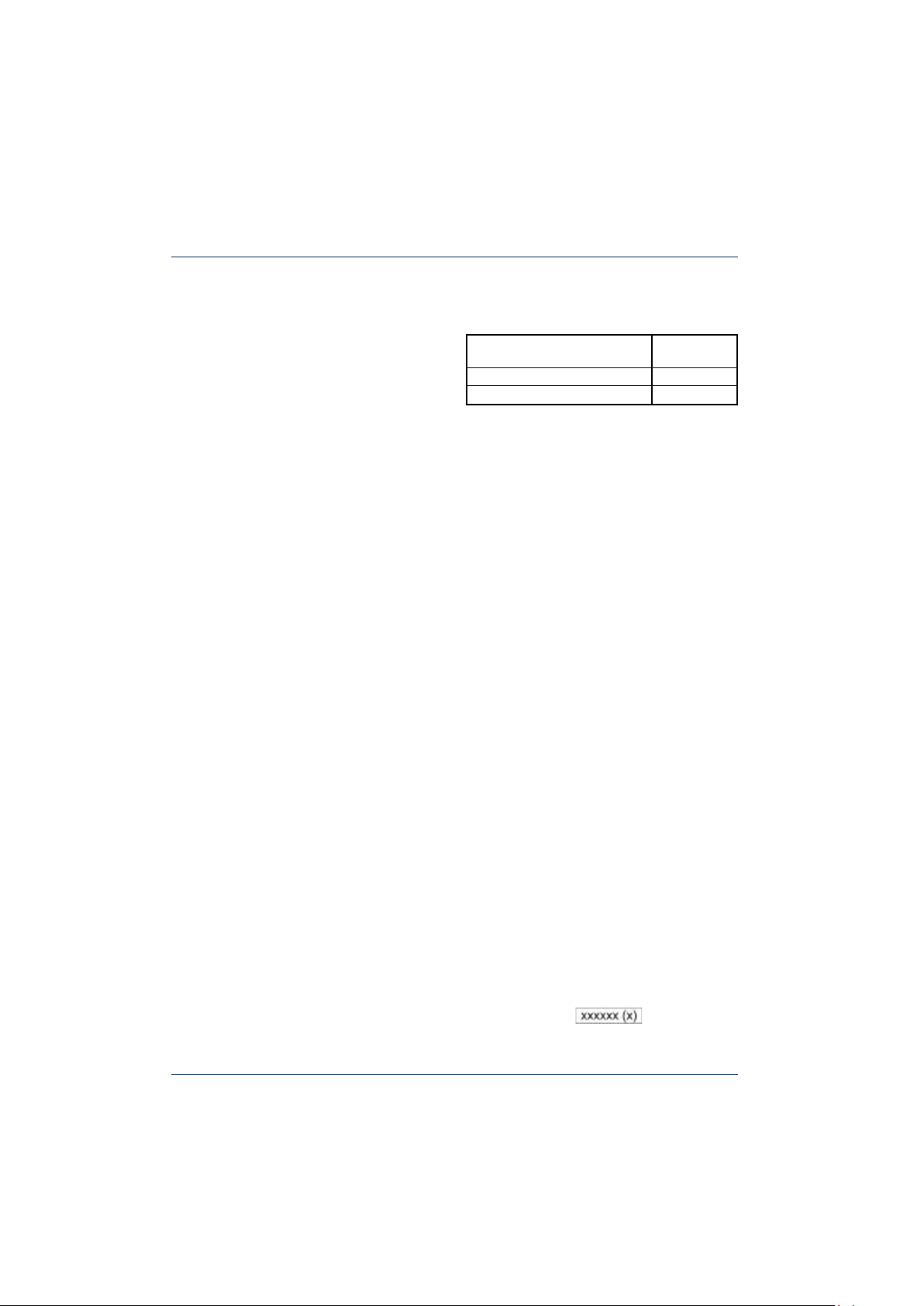
Garden Products Warranty
Period
Energy Flex Products 4 years
Li-ion Batteries and Charger 3 years
22.3.2 Energy Flex product range is not
intended for commercial use. Any
commercial use as well as unauthorised
conversions or add-ones will void this
warranty agreement.
22.3.3 Masport will repair or replace (at
Masport’s sole option) any Product that
does not comply with the Warranty.
The repair or replacement by Masport
may be performed by a Masport agent
or Specialist Retailer. You will not be
charged for any labour costs involved in
the repair or replacement but must bear
the cost of transporting or delivering
the Product to and from the location of
the Masport agent or Specialist Retailer
where the warranty claim is made.
22.3.4 Masport warrants that repair facilities
and spare parts will be made available
for each Product only from the date the
Product is originally purchased until the
end of the applicable warranty period as
stated in clause 22.3.1 above, but for no
longer period.
22.4 Exclusions from Warranty
22.4.1 No warranty is given under clause 22.3
where any defect, malfunction or failure
is caused or contributed to by any of the
following:
(a) Failure to follow all instructions in
this manual.
(b) modication,repairsoralterationof
the Product carried out by persons
other than authorised Masport
service agents;
(c) acts or omissions by anyone other
than Masport after the Product has
left Masport’s control;
(d) Wear parts that are marked with a
frame on the spare
parts list.
(e) Paint damage that can be attributed

27
to normal wear and tear
(f) accidental damage, neglect, misuse
of the product;
(g) any event outside of Masport’s
reasonable control, including
without limitation, adverse weather
conditions;
(h) sharpening or setting of blades; or
(i) pre-delivery assembly of the
Product by anyone except for
Masport, Masport authorised
service agents or any other person
authorised by Masport.
(j) Batteries left in a state of discharge
or not regularly maintained as per
instructions.
22.5 Warranty in addition to
consumer protection laws
22.5.1 Despite anything else in this warranty,
nothing in this warranty will exclude,
limit or modify any Consumer Protection
Warranty or any liability of Masport
imposed by applicable law if to do so
would be unlawful or make any part of
this warranty void or voidable.
22.5.2 The Warranty is in addition to any
Consumer Protection Warranty that
may apply, for example, under the New
Zealand Consumer Act or the Australian
Consumer Law, or under the laws of the
place where the Product was purchased.
To the extent permitted by applicable law,
Masport’s liability under any Consumer
Protection Warranty will be limited
(at Masport’s sole option) to Masport
repairing or replacing the relevant
Product or paying for such repair or
replacement.
22.6 No other warranties or liability
22.6.1 Subject to Clause 22.5, Masport
excludes all express or implied
warranties, guarantees, conditions
or terms in relation to the Product. All
statements, technical information and
recommendations about the Product
are believed to be reliable, but do not
constitute a guarantee or warranty.
No statements, representations or
recommendations other than those
containedintheofcialtechnical
information published by Masport, will
bind Masport, unless made in writing
signed by an authorised representative of
Masport.
22.6.2 Subject to Clause 22.5, in no event will
Masport be liable (whether in contract,
tort, negligence or in any other way) for:
(a) lossofprotsorsavings,lossof
goodwill or opportunity, loss of
production or wasted time; or
(b) loss, damage, cost or expense
of any kind whatsoever which is
indirect, consequential, or of a
special nature, arising directly or
indirectly from the Product, even if
Masport had been advised of the
possibility of such damages.
22.6.3 Subject to Clause 22.5, in no event will
Masport’s total liability under any claim
of whatever nature arising directly or
indirectly from the Product exceed the
price you paid for the Product.
22.6.4 This warranty embodies the entire
agreement between you and Masport
in relation to the subject matter of
this warranty and supersedes all prior
understandings, communications and
representations between you and
Masport, whether oral or written. No
amendment to this warranty will be
effective unless in writing and signed
by an authorised representative of
Masport. You may not assign or transfer
the Warranty without the prior written
consent of Masport. This warranty will be
governed by the law of New Zealand and
Australia, and will be subject to the non-
exclusive jurisdiction of the New Zealand
and Australian courts.
22.7 How to obtain service for a
faulty Product
22.7.1 You must return the Product to the place
of purchase or any Masport Specialist
retailer, along with reasonable evidence
of the date the Product was purchased,
for example, an original receipt.
22.7.2 Masport or its agent will assess the claim
and if accepted, will repair or replace the
Product in accordance with the normal
practices of the relevant Masport service
agent.

28 CS 4030
22.7.3 All claims under the Warranty must be
made within the relevant warranty period.
22.8 Definitions
In this warranty:
22.8.1 “Consumer Protection Warranty”
means any warranty, guarantee, term,
condition, right or remedy implied or
imposed by applicable law;
22.8.2 “Warranty” means the warranty in
Clause 22.3.1;
22.8.3 “Masport” means Masport Limited,
a New Zealand company located at
1-37 Mt Wellington Highway, Panmure
1060, Auckland, New Zealand and
Masport Australia Pty Ltd., 1/40 Abbotts
Rd, Dandenong South, Victoria 3175
Australia;
22.8.4 “Product” means the Masport garden
product accompanying this warranty;
22.8.5 “You” means the original purchaser of
the Product.
Thank you for purchasing your Masport
product. We know that you’ll enjoy it!
To register your product warranty,
simply visit our website:
www.masport.com
Failure to register your product warranty will not affect
your rights under any Consumer Protection Warranty,
however registration may help Masport deal with any
warrantyclaimmoreefciently.

29
23 DECLARATION OF CONFORMITY
We hereby declare that this product in its marketed form conforms to the requirements of the
harmonised EU Directives, EU safety standards and the product-specific standards.
Product
Battery chainsaw
Serial number
G4013012
Manufacturer
AL-KO Geräte GmbH
Ichenhauser Str. 14
D-89359 Kötz
Germany
Duly authorised person for
technical file
Andreas Hedrich
Ichenhauser Str. 14
D-89359 Kötz
Germany
Type
CS 4030
Sound power level
EN ISO 3744
measured/guaranteed
101 dB(A) / 105 dBA
EU directives
2006/42/EC
2014/30/EU
2000/14/EC
2011/65/EU
Conformity evaluation
2000/14/EC Appendix VI
Harmonised standards
EN 60745-1:2009+A11:2010
EN 60745-2-13:2009+A1:2010
EN 55014-1:2006+A1:2009
+A2:2011
EN 55014-2:2015
EC type approval
2006/42/EC Annex IX)
Approval No.
BM 5035921
8 0001
Notified body
(2000/14/EC)
TÜV Rheinland LGA
Products GmbH
Tillystraße 2
90431 Nuremberg
GERMANY
No. 0197
Dr Wolfgang Hergeth
Managing Director

© 2018
Masport Limited New Zealand
1–37 Mt. Wellington Highway, Panmure, Auckland 1060
PO Box 14-349, Panmure, Auckland 1741
P: 0800 MASPORT
F: 0508 570 570
www.masport.com
Masport Australia Pty Limited
1/40 Abbotts Road, Dandenong South, Victoria 3175
PO Box 533, Braeside, Victoria 3195, Australia
P: 1300 366 225
F: 1800 035 594
www.masport.com.au