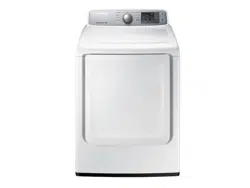
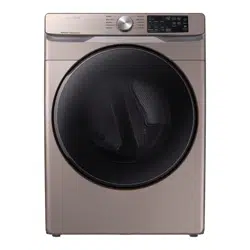
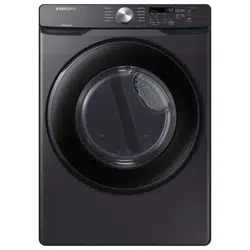
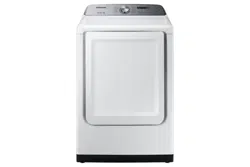
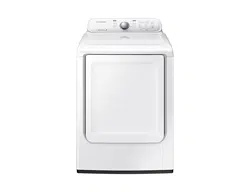
Installing your dryer.
UNPACKING YOUR DRYER
Unpack your dryer and Inspect it for shipping damage. Make sure you have received all of the items shown below. If your dryer was damaged during shipping, or you do not have all of the items, contact 1-800-SAMSUNG (726-7864).
To prevent personal injury or strain, wear protective gloves whenever lifting or carrying the dryer.
 Packing materials can be dangerous to children. Keep all packing material (plastic bags, polystyrene, etc.) well out of children’s reach.
Do not move the product while holding the front part of the top cover of the dryer.
- This may cause the cover to be separated and result in injury
-840142.png)
Tools needed
-653854.png)
Parts supplied (DV48(5)H7400E(G)* ONLY)
-328656.png)
BASIC REQUIREMENTS
Make sure you have everything necessary for proper installation
- A GROUNDED ELECTRICAL OUTLET is required. See Electrical Requirements.
- A POWER CORD for electric dryers (except in Canada).
- GAS LINES (if installing a gas dryer). The gas lines must meet national and local codes.
- EXHAUST SYSTEM - must be rigid metal or flexible stiff-walled metal exhaust ducting.
DUCTING REQUIREMENTS
- Use a 4-inch (10.2 cm) diameter rigid aluminum or rigid galvanized steel duct.
- Do not use a smaller duct.
- Ducts larger than 4 inches (10.2 cm) in diameter can cause increased lint accumulation. Lint accumulation should be cleaned regularly.
- If a flexible metal duct must be used, use the type with a stiff sheet metal wall. Do not use a flexible duct with a thin foil wall. Serious blockage can result if the flexible metal duct is bent too sharply.
- Never install any type of flexible duct in walls, ceilings, or other concealed spaces.
- Keep the exhaust duct as straight and short as possible.
- Secure joints with duct tape. Do not use screws.
- Plastic flexible duct can kink, sag, be punctured, reduce airflow, extend drying times, and affect dryer operation.
- Exhaust systems longer than recommended can extend drying times, affect machine operation, and may collect lint.
- The exhaust duct should end with an exhaust hood with a swing-out damper to prevent back drafts and the entry of wildlife. Never use an exhaust hood with a magnetic damper.
- The hood should have at least 12 inches (30.5 cm) of clearance between the bottom of the hood and the ground or other obstruction. The hood opening should point down.
- Never install a screen over the exhaust outlet.
- To avoid lint buildup, do not exhaust the dryer directly into a window well. Do not exhaust under a house or porch.
- If exhaust ductwork must run through an unheated area, the duct should be insulated and slope slightly down towards the exhaust hood to reduce condensation and lint buildup.
- Inspect and clean the interior of the exhaust system at least once a year. Unplug the power cord before cleaning.
- Check frequently to be sure the exhaust hood damper opens and closes freely.
- Check once per month, and clean at least one time per year. Note: If clothes are not getting dry, then check ducting for obstructions.
- Do not exhaust dryer into any wall, ceiling, crawl space, or concealed space of a building, gas vent, or any other common duct or chimney. This could create a fire hazard from lint expelled by the dryer.
-53578.png)
LOCATION CONSIDERATIONS
Locate the dryer where there is enough space at the front for loading the dryer, and enough space behind for the exhaust system. This dryer is factory-ready for rear exhaust. To exhaust out the bottom or the right or the left (electric model only), use the accessory exhaust kit (sold separately). Instructions are included with the kit. It’s important to make sure the room has enough fresh air. The dryer must be located where there is no air-flow obstruction.
On gas dryers, adequate clearance as noted on the data plate must be maintained to ensure adequate air for combustion and proper dryer operation.
Do not install or store the dryer in an area where it will be exposed to water and/or weather. Keep the dryer area clear of combustible materials, casoline, and other flammable vapors and liquids. A dryer produces combustible lint. The area around the dryer should be kept lint free.
CONNECTING THE INLET HOSE
Method1
The dryer must be connected to the cold water faucet using the new inlet hoses. Do not use old hoses.
1. If space permits, attach the brass female end of the “Y” connector to the cold water faucet.
2. Turn the cold water faucet off.
3. Attach the straight end of long hose to “Y’ connector.
4. Using pliers, tighten the coupling with an additional twothirds turn.
-948047.png) Do not overtighten, as it may damage the coupling.
Do not overtighten, as it may damage the coupling.
5. Attach angled end of long hoses to fill the valve at the bottom of the dryer’s rear frame. Screw on coupling by hand until it is seated on fill valve connector.
6. Using pliers, tighten the coupling with an additional two thirds turn.
Do not overtighten, as it may damage the coupling.
7. Check that the water faucets are on.
8. Check for leaks around “Y” connector, faucets and hoses.
-443853.png)
Method2
The dryer must be connected to the cold water faucet using the new inlet hoses. Do not use old hoses.
1. If “Y” connector cannot be attached directly to the cold water faucet, the short hose must be used.
2. Turn the cold water faucet off.
3. Attach short inlet hose to cold water faucet. Screw on coupling by hand until it is seated on the faucet.
4. Using pliers, tighten the coupling with an additional twothirds turn.
Do not overtighten, as it may damage the coupling.
5. Attach ‘Y” connector to brass male end of small hose. Screw on coupling by hand until it is seated on connector.
6. Using pliers, tighten the coupling with an additional twothirds turn.
Do not overtighten, as it may damage the coupling.
7. Attach angled end of long hoses to the fill valve at the bottom of the dryer rear frame. Screw on coupling by hand until it is seated on fill valve connector.
8. Using pliers, tighten the coupling with an additional twothirds turn.
Do not overtighten, as it may damage the coupling.
9. Check that the water faucets are on.
10. Check for leaks around “Y” connector, faucets and hoses
-465819.png)
DOOR REVERSAL
If you want to reverse the direction of the door, it is recommended calling a qualified service technician.
1. Unplug the power cord.
2. Remove the four hinge screws from the door
3. Remove the door by lifting it
-257253.png)
4. Remove the two screws from the holder-lever, and then remove the cover-holder.
5. Assemble the holder-lever on the opposite side using the screws that were removed from the holder-lever-in Step 4.
6. Assemble the cover-holder on the opposite side.
-960622.png)
7. Remove the two cover-hinges.
8. Assemble the two cover-hinges on the opposite side.
Use a flat head screwdriver(-) to remove the cover-holder’s cover-hinge.
-143032.png)
9. Remove the 14 screws.
Two screw (L) are longer than the other screws.
-490636.png)
10. Remove the holder-glass.
11. Exchange the positions of: : The cover-hinge and handle door : The holder-hinge and guiderholder glass
12. Remove the Lever-Door, CoverLever (DV45H7000E(G)* Only) and then install it on the opposite side. : DV48(5)H7400E(G)*/ DV45H7200E(G)* Refer Figure. 1 : DV45H7000E(G)* Refer Figure. 2
Refer to the illustrations on the right to aid you in the assembly process.
-750446.png)
13. Remove the cover-hole (P).
14. Assemble the holder glass and then fasten the 14 screws that you removed in step 9.
15. Attach the cover-hole.
-173157.png)
16. Install the door on the frame-front and then fasten the 4 screws that you removed in step 2.
Check the positions of the screws you installed in the hinge door.
-599674.png)
Operating instructions, tips
Setting/Releasing
If you want to set or release the Child Lock, press the Temp. and Time buttons simultaneously for 3 seconds.
Child Lock Details
- You can turn Child Lock on while your dryer is running.
- Once you turn Child Lock on, no button, except for the Power button, will respond until you turn off the Child Lock function.
- The Child Lock indicator will be lit.
If you have not turned off Child Lock, and then turned the dryer off and on, the Child Lock function will still be on. To turn off Child Lock, follow the instructions above.
When other buttons, except for the Power button, do not respond, check the Child Lock indicator. If Child Lock is on, follow the instructions above to turn Child Lock off .
CLEAN THE LINT FILTER
• After each load.
• To shorten drying time.
• To operate more energy efficiently.
Do not operate your dryer without the lint filter in place.
-396478.png)
LOAD THE DRYER PROPERLY
• Place only one washload in your dryer at a time.
• Mixed loads of heavy and lightweight fabrics will dry differently, which may result in lightweight fabrics being dry while heavy fabrics remain damp at the end of a drying cycle.
• Add one or more similar items to your dryer when only one or two articles of clothing need drying. This improves the tumbling action and drying efficiency.
• Overloading restricts tumbling action, resulting in uneven drying as well as excessive wrinkling of some fabrics.
GETTING STARTED
1. Load your dryer loosely – DO NOT overload.
2. Close the door.
3. Select the appropriate cycle and options for the load.
4. Press the Start/Pause button.
5. The dryer indicator light will illuminate.
6. The estimated cycle time will appear in the display. The time may fluctuate as humidity levels fluctuate in the dryer.
• When the cycle is complete, the Door Lock light will go out and “End” will appear in the display.
• Pressing Power cancels the cycle and stops your dryer.
• The Drying, Cooling, and Wrinkle Prevent indicator lights will illuminate during those portions of the cycle.
Do not place anything on top of your dryer while it is running.
Care and cleaning
CONTROL PANEL
Clean with a soft, damp cloth. Do not use abrasive substances. Do not spray cleaners directly on the panel. The control panel finish may be damaged by some laundry pre-treatment soil and stain remover products. Apply such products away from your dryer and wipe up any spills or overspray immediately.
TUMBLER
Remove any stains such as crayon, ink, or fabric dye (from new items such as towels or jeans) with an allpurpose cleaner. Tumble old towels or rags to remove any excess stain or cleaning substance. Once these steps are followed, stains may still be visible, but should not transfer to subsequent loads.
STAINLESS STEEL TUMBLER
To clean the stainless steel tumbler, use a damp cloth with a mild, non-abrasive cleaner suitable for stainless steel surfaces. Remove the cleaner residue and dry with a clean cloth.
DRYER EXTERIOR
Clean with a soft, damp cloth. Do not use abrasive substances. Protect the surface from sharp objects. Do not place any heavy or sharp objects or a detergent box on the dryer. Keep them on the purchased pedestal or in a separate storage box. This may scratch or damage the top cover of the dryer. Since the entire dryer has a high-gloss finish, the surface can be scratched or damaged. Therefore, avoid scratching or damaging the surface when using the dryer.
DRYER EXHAUST SYSTEM
Should be inspected and cleaned yearly to maintain optimum performance. The outside exhaust hood should be cleaned more frequently to ensure proper operation.
Troubleshooting
Doesn’t run.
• Make sure the door is latched shut.
• Be sure the power cord is plugged into a live electrical outlet.
• Check the home’s circuit breaker and fuses.
• Press the Start/Pause button again if the door is opened during the cycle.
Doesn’t heat.
• Check the home’s circuit breaker and fuses.
• Select a heat setting other than Air Fluff.
• On a gas dryer, check that the gas supply is on.
• Clean the lint filter and exhaust duct.
• Dryer may have moved into the cool-down phase of the cycle.
Doesn’t dry.
• Check all of the above, plus...
• Be sure the exhaust hood outside the home can open and close freely.
• Check exhaust system for lint buildup. Ducting should be inspected and cleaned annually.
• Use a 4” rigid metal exhaust duct.
• Do not overload. 1 wash load = 1 dryer load.
• Sort heavy items from lightweight items.
• Large, bulky items like blankets or comforters may require repositioning to ensure even drying.
• Check that the washer is draining properly to extract adequate water from the load.
• Load may be too small to tumble properly. Add a few towels.
Is noisy.
• Check the load for objects such as coins, loose buttons, nails, etc. Remove promptly.
• It is normal to hear the dryer gas valve or heating element cycle on and off during the drying cycle.
• Be sure the dryer is leveled properly as outlined in the installation instruction.
• It is normal for the dryer to hum due to the high velocity of air moving through the dryer drum and exhaust system.
Dries unevenly.
• Seams, pockets, and other similarly heavy areas may not be completely dry when the rest of the load has reached the selected dryness level. This is normal. Select the Very Dry setting if desired.
• If one heavy item is dried with a lightweight load, such as one towel with sheets, it is possible that the heavy item will not be completely dry when the rest of the load has reached the selected dryness level. Sort heavy items from lightweight items for best drying results.
Has an odor.
• Household odors from painting, varnishing, strong cleaners, etc. may enter the dryer with the surrounding room air. This is normal as the dryer draws the air from the room, heats it, pulls it through the tumbler, and exhausts it outside.
• When these odors linger in the air, ventilate the room completely before using the dryer.
Shuts off before load is dry
• Dryer load is too small. Add more items or a few towels and restart the cycle.
• Dryer load is too large. Remove some items and restart the dryer.
Lint on clothes
• Make sure the lint filter is cleaned before every load. With some loads that produce high amounts of lint, it may be necessary to clean the filter during the cycle.
• Some fabrics are lint producers (for example, a fuzzy white cotton towel)and they should be dried separately from clothes that are lint trappers(for example, a pair of lack linen pants)
• Divide larger loads into smaller loads for drying
• Check pockets thoroughly before washing and drying clothes.
Garments still wrinkled after Wrinkle-Care
• Small loads of 1 to 4 items work best.
• Load fewer garments.Load similar-type garments.
Odors remain in clothing after Refresh.
• Fabrics containing strong odors should be washed in a normal cycle.
INFORMATION CODES
tE
Temperature sensor problem. Restart the cycle. If the code reappears, call for service.
HE
Invalid heating Temp in running the dryer). Call for service.
dE
- Running the dryer with door open.
- Close the door and then restart. If the problem continues, call for service.
FE
- Invalid power source Frequency.
- Try restarting the cycle.
- If the problem continues, call for service.
9E1
- Electronic Control Problem (Over Voltage Error).
AE
- Electronic Control Problem (Communication Error).
E3
- Invalid state of Eeprom Communication.
dF
bE (DV45H7000E(G)*) bE2
- Unit detects a button is being pressed for over 30secs or button is stuck.
- Make sure a button is NOT being pressed continuously. Try restarting the cycle. If the problem continues, call for service.
FABRIC CARE CHART
The following symbols provide garment care direction. The Clothing care labels include symbols for washing, bleaching, drying and ironing, or dry cleaning when necessary. The use of symbols ensures consistency among garment manufacturers of domestic and imported items. Follow care label directions to maximize garment life and reduce laundering problems.
-787986.png)
PROTECTING THE ENVIRONMENT
This appliance is manufactured from recyclable materials. If you decide to dispose of this appliance, please observe local waste disposal regulations. Cut off the power cord so that the appliance cannot be connected to a power source. Remove the door so that animals and small children cannot get trapped inside the appliance.
DECLARATION OF CONFORMITY
This appliance complies with UL2158.
-901211.png)
-805962.png)