CAMCORDER
C8C_RY980_US_EN
Detailed User Guide
GZ-RY980
Table of Contents
Getting Started
Verifying the Accessories ........................................................ 4
Turning on this Unit ..................................................................
5
Opening the Terminal Cover (SD Card Cover) ........................ 5
Charging .................................................................................. 6
Grip Adjustment ....................................................................... 7
Attaching the Lens Cap ........................................................... 7
Inserting an SD Card ............................................................... 8
Types of Usable SD Card ..................................................... 8
Using the Touch Screen .......................................................... 9
Locking the Screen (when Shooting Underwater) ................ 9
Adjusting the Touch Screen ............................................... 10
Names of Buttons and Functions on the LCD Monitor ....... 11
Configuring the Initial Settings ............................................... 13
Readjusting the Clock after Initial Settings are Configured .... 14
Changing the Display Language after Initial Settings are
Configured ......................................................................... 14
Holding this Unit .................................................................... 15
Tripod Mounting .................................................................... 15
Using this Unit Overseas ....................................................... 16
Charging the Battery Pack Overseas ................................. 16
Setting the Clock to Local Time when Traveling ................. 16
Before Using Underwater or under Low Temperature ........... 18
Cautions on Using Underwater .......................................... 18
Maintenance after Use ....................................................... 18
Cautions on Using under Low Temperature ....................... 18
Other Precautions .............................................................. 18
Recording
Taking Videos in Auto Mode .................................................. 19
Capturing Still Images
............................................................ 21
Zooming ................................................................................ 21
Manual Recording ................................................................. 22
Adjusting Focus Manually (FOCUS) .................................. 23
Using the Focus Assist Function ........................................ 24
Enlarging the Image (EXPANDED) for Focus Adjustment .. 25
Adjusting Brightness .......................................................... 26
Setting Shutter Speed ........................................................ 27
Setting Aperture ................................................................. 28
Increasing the Light Sensitivity Level ................................. 29
Setting Backlight Compensation ........................................ 30
Setting White Balance ........................................................ 31
Recording Data to Both Slot A and Slot B .............................. 33
Slow-motion (High-speed) Recording .................................... 34
Shooting under Water ............................................................ 36
Capturing Subjects Clearly (TOUCH PRIORITY AE/AF) ....... 38
Reducing Camera Shake ....................................................... 39
Taking Close-up Shots (TELE MACRO) ................................ 40
Special Effect Recording ....................................................... 41
Time-lapse Recording (Time-Lapse Rec) .......................... 41
Pre Rec .............................................................................. 43
Scene Continuous .............................................................. 44
Using the Self-timer ............................................................... 45
Changing the Mode of Time Code (TC) Recording ................ 47
Checking the Remaining Battery Level and Recording Time . 48
Playback
Playing Back Videos .............................................................. 51
Normal Playback
................................................................ 51
Checking the Recording Date and Other Information ......... 54
Playing Back Still Images ....................................................... 55
Slideshow Playback ........................................................... 56
Connecting to and Viewing on TV .......................................... 57
Connecting via the HDMI Mini Connector .......................... 57
Editing
Deleting Unwanted Files ........................................................ 59
Deleting One Scene ........................................................... 59
Selecting and Deleting Multiple Scenes
............................. 60
Deleting All Scenes ............................................................ 62
Protecting Video Images ........................................................ 63
Protecting/Canceling Protection of the Displayed (Playback)
Scene ............................................................................. 63
Protecting/Releasing Protection of Selected Files .............. 63
Protecting/Canceling Protection of All Scenes ................... 65
Trimming Recorded Videos ................................................... 66
Capturing a Still Image from One Scene in a Video ............... 67
Copying
Backing up Data on a Computer ............................................ 68
When Using Windows 10 or Windows 8.1
......................... 68
When Using Windows 7 ..................................................... 70
Using CyberLink PowerDirector ............................................. 72
Installing PowerDirector ..................................................... 72
Using PowerDirector .......................................................... 73
Verifying System Requirements (Guideline) ....................... 74
Dubbing Files to a Disc by Connecting to a Blu-ray Recorder 76
Using Wi-Fi
Wi-Fi Capabilities ................................................................... 77
Precautions on Using Wi-Fi ...................................................
77
How to Establish a Wi-Fi Connection ..................................... 78
Ways of Wi-Fi Connection .................................................. 78
Preparing for Connection ................................................... 79
Connecting ......................................................................... 79
Still Image Transfer ................................................................ 86
View Remote ......................................................................... 90
Registering/Deleting Preset Zoom ..................................... 91
Changing the Settings via a Web Browser ............................. 93
Live Streaming ....................................................................... 95
Settings Menu
Operating the Menu ............................................................... 97
Operating the Menu ........................................................... 97
Main Menu ............................................................................. 98
Camera Function Menu ......................................................... 99
Camera Process Menu ........................................................ 101
Detail Adjust Menu ........................................................... 104
White Balance Adjust Menu ............................................. 105
TC Menu .............................................................................. 106
Monitor Menu ....................................................................... 107
Shooting Assist Menu ...................................................... 109
Display Settings Menu ..................................................... 110
A/V Set Menu ....................................................................... 112
Video Set Menu ............................................................... 112
Audio Set Menu ............................................................... 112
System Menu ....................................................................... 114
Record Set Menu ............................................................. 117
Network Settings Menu .................................................... 120
Names of Parts ........................................................... 125
Indications on the LCD monitor ............................... 128
Troubleshooting ......................................................... 131
When the unit is not working properly .................................. 131
Charging ..............................................................................
131
Power supply ....................................................................... 132
Recording ............................................................................ 132
SD Card ............................................................................... 133
Playback .............................................................................. 133
Editing/Copying ................................................................... 134
Computer ............................................................................. 134
Screen/Image ...................................................................... 135
Other Problems ................................................................... 135
Error Message ..................................................................... 136
2

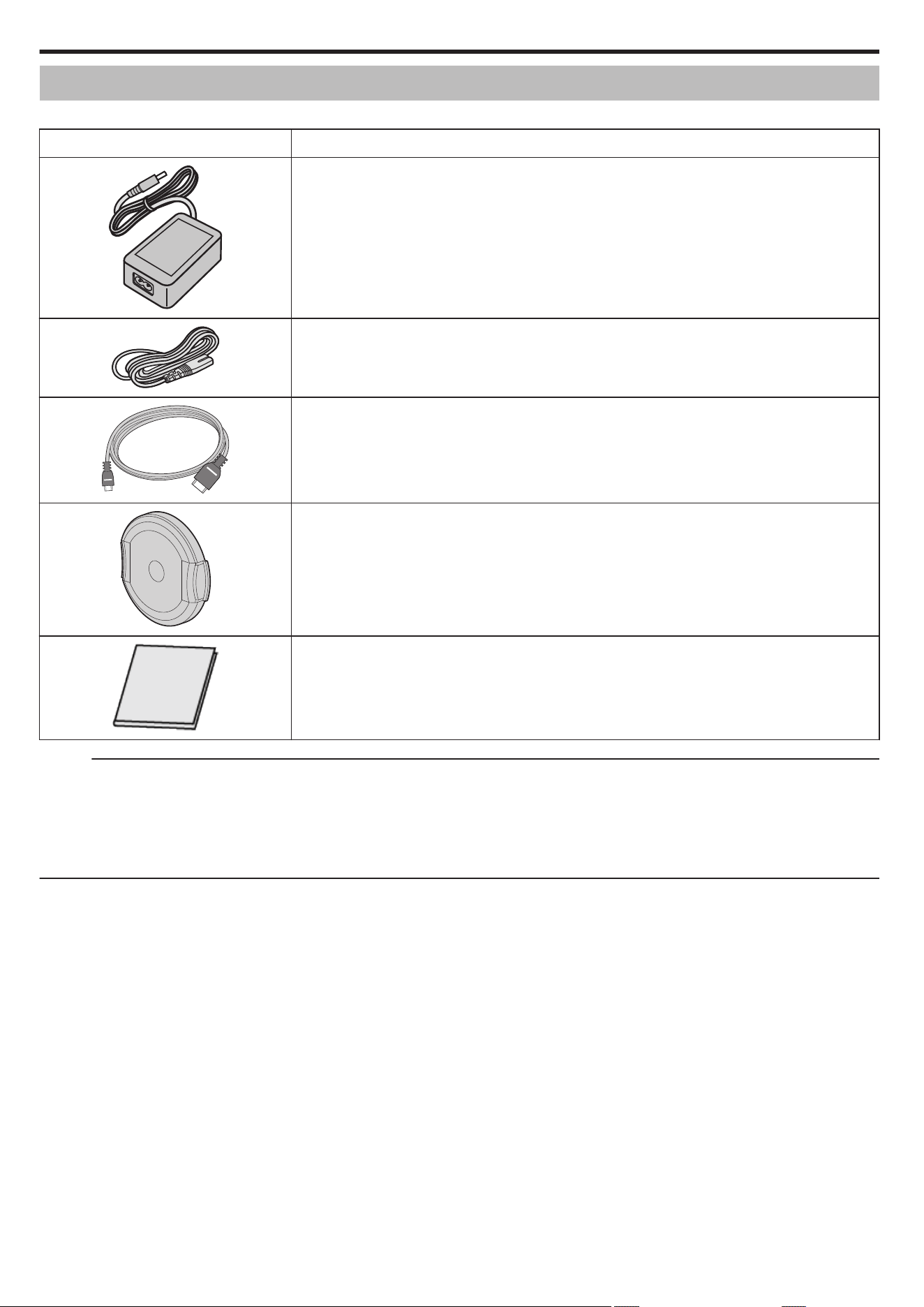
Verifying the Accessories
If any of the items are missing or defective, consult your JVC dealer or the nearest JVC service center.
Illustration Description
.
AC Adapter
UNI318-0530
0
Charges this unit.
It can also be used when recording or playing back videos indoors.
.
Power Cord
0
Connect the power cord to the AC adapter.
.
HDMI Mini Cable
0
Connects this unit to a TV to play back recorded images on the TV in a better quality.
.
Lens Cap
0
Attach the lens cap when this camera is not used or during transportation.
.
Basic User Guide
0
Read well and keep in a safe place where it can be accessed easily when necessary.
Memo :
0
Application software programs can be downloaded from CyberLink’s website.
“Using CyberLink PowerDirector” (A p. 72)
0
SD cards are sold separately.
“Types of Usable SD Card” (A p. 8)
0
When using the AC adapter overseas, please prepare a commercially available converter plug for the country or region of visit.
“Charging the Battery Pack Overseas” (A p. 16)
Getting Started
4
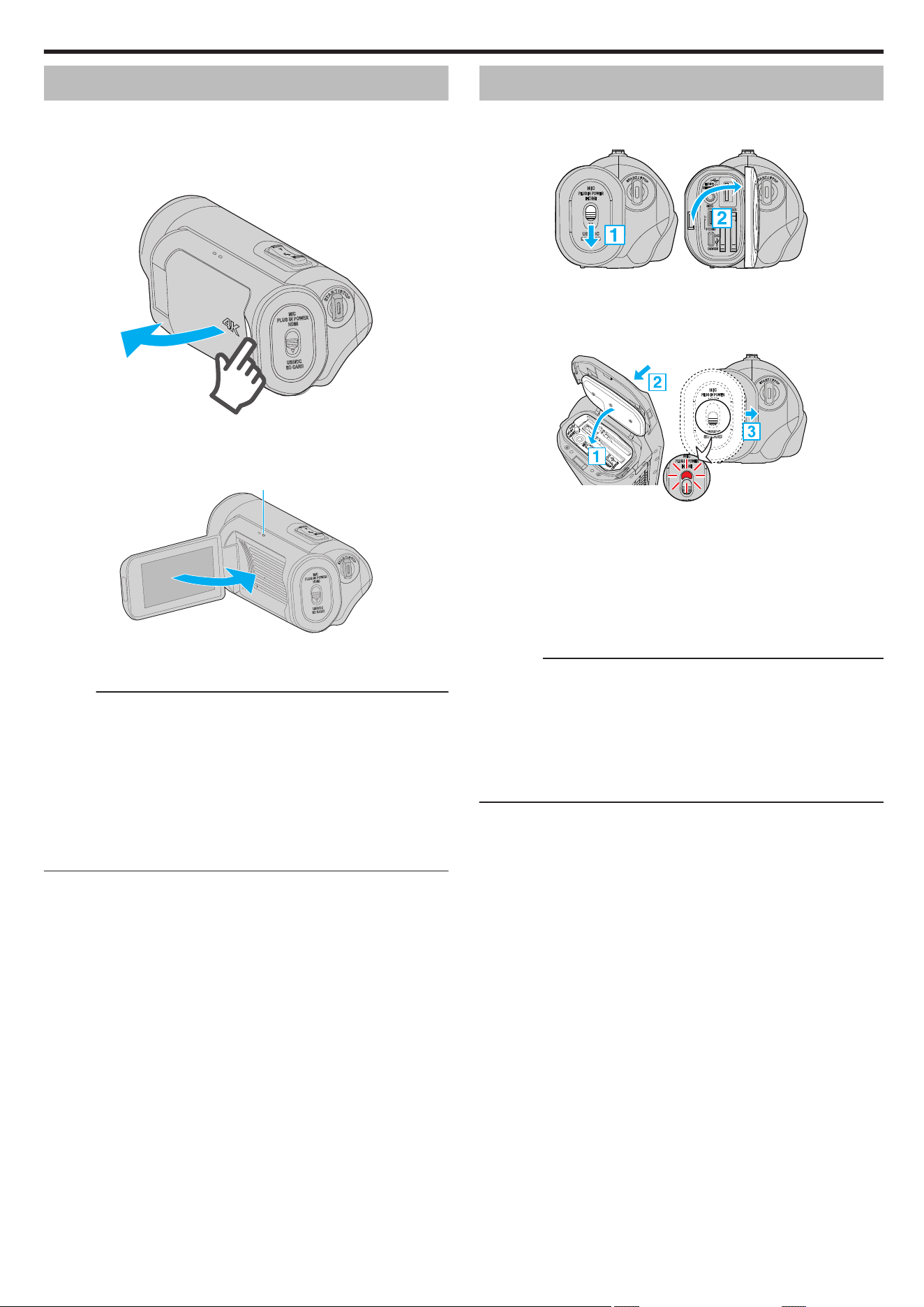
Turning on this Unit
Open the LCD monitor to turn on this unit.
To turn off the power, close the LCD monitor.
o
To turn on the power
Open the LCD monitor.
(Open carefully.)
.
o
To turn off the power
Close the LCD monitor.
(Close carefully.)
.
POWER/ACCESS Lamp
The POWER/ACCESS lamp goes off and the power is turned off.
The power can also be turned off from the menu.
“Operating the Menu” (A p. 97)
Memo :
0
Set Demo mode to “Off” before using.
“ Demo Mode ” (A p. 115)
0
When
“Auto Power Off” is set to “On”, this unit turns itself off automatically
to conserve power when it is not operated for 5 minutes. (When using the
AC adapter, this unit goes into standby mode.)
“ Auto Power Off ” (A p. 115)
0
If “LCD Closed Recording” is enabled, this unit does not turn off when the
LCD monitor is closed during recording or while it is connected to Wi-Fi.
(The power turns off when Wi-Fi is disconnected.)
“ LCD Closed Recording ” (A p. 115)
Opening the Terminal Cover (SD Card Cover)
o
To open
.
(Back of the camera)
A
Slide the cover lock downward.
0
The cover slides to the left automatically.
B
Lift the cover slowly.
o
To close
.
Not properly closed if the red mark
is visible.
A
Flip
down the cover slowly while making sure the gray waterproof seal
fits into the opening at the terminals.
B
Press the entire cover against the camera with equal force and firmly
attach the cover completely.
C
Slide the cover until it clicks into place.
(The cover is not properly closed if the red mark on the cover lock is
visible.)
Caution :
0
Ensure that the terminal cover and the gray waterproof seal are not
damaged and that there are no foreign materials (such as hair, lint, sand
or dust) adhered on the cover.
0
Stop
using the unit underwater if there are damages to the cover, etc. and
consult your JVC dealer or the nearest JVC service center.
0
Do not apply excessive force when opening/closing the terminal cover.
0
Read the “Cautions on Using Underwater” (A p. 18) before using the
camera underwater or in places exposed to water droplets.
Getting Started
5
Charging
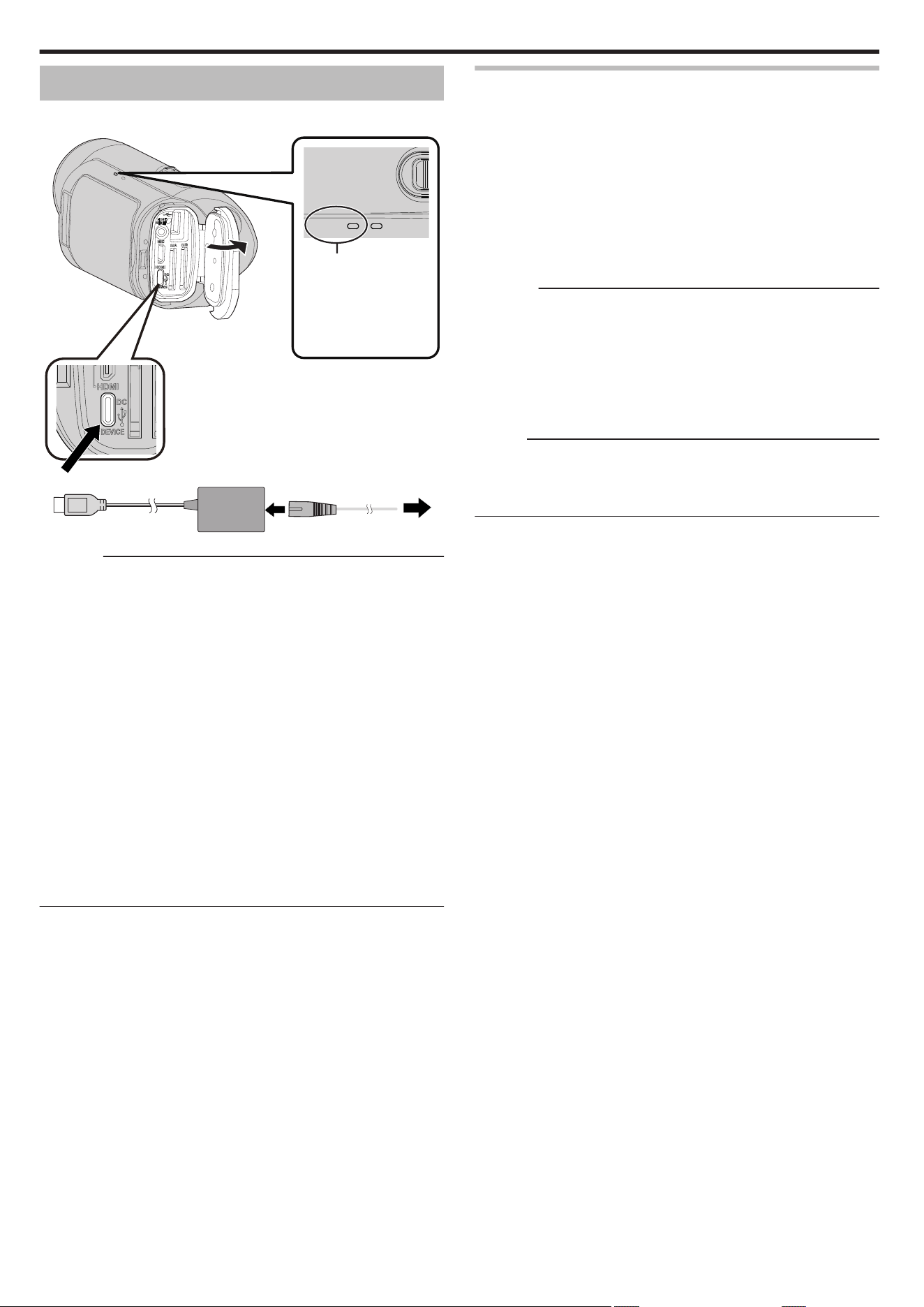
This unit is equipped with a built-in battery.
Open the connector cover, and connect the cable as shown in the figure.
.
CHARGE POWER/ACCE
S
Connect Power
Cord to Outlet
(AC 100 V to 240 V)
Power Cord (Provided)
AC Adapter (Provided)
To DC/USB Device Terminal (Type-C)
CHARGE Lamp
Lights up: Charging in
progress
Goes out: Charging
finished
Blinking: See below
Caution :
0
The built-in battery is not charged at the time of purchase.
0
At
the time of purchase or in case of the battery is not used for a long period
of time, the charging time will be longer than usual.
0
Charging time: Approx. 5 h (when charging at 25°C (77°F))
0
The battery cannot be charged outside the room temperature range of
10°C to 35°C (50°F to 95°F). The CHARGE lamp blinks slowly as a
notification if charging does not start. If the temperature increases or
decreases during charging, the CHARGE lamp will blink slowly and
charging will stop. When this occurs, charge the camera again within the
above room temperature range.
0
Using the supplied AC adapter allows charging to be performed
concurrently during recording or playback. (Charging time may be longer
than usual or charging may not be successful in some cases.) If the internal
temperature rises when using the unit, stop the charging temporarily. (The
CHARGE lamp blinks slowly when this occurs.)
0
If malfunctions (such as overvoltage) occur, charging will stop. In these
cases, CHARGE lamp blinks quickly as a notification.
0
During charging, the P icon on the screen changes to O to indicate that
charging is in progress. (when the provided AC adapter is used)
0
When the recording time becomes extremely short even when the battery
is fully charged, the battery needs to be replaced. For details on replacing
the built-in battery (subject to a fee), consult the nearest JVC service
center.
Using a Power Bank
Connecting to a power bank charges the built-in battery of this unit and
supplies the power during recording.
0
Usable power bank
–
Output rating: 5 V, 3 A or higher
– Battery capacity: 10000 mAh or more (recommended)
– Power bank that comes with a USB Type-C terminal or a cable with a
USB Type-C plug on one end
* This unit is not guaranteed to operate with all power banks that meet the
above requirements.
Similar to the AC adapter, connect the cable of the power bank to the
DC/USB device terminal (Type-C).
Caution :
0
Refer to “Caution” under the “Charging” section. The charging time is
about the same as the AC adapter.
0
This
camera may not be fully charged if the power bank used for charging
it has a small capacity.
0
Do not apply strong force to the DC/USB terminal when recording with the
power bank connected. In addition, take note that the Waterproof, Dust-
proof, Drop-proof and Freeze-proof functions do not function when the
terminal cover is opened.
Memo :
0
For
details on using the power bank, refer to the instruction manual of the
power bank.
0
For questions on the power bank, please consult the dealer or
manufacturer of the power bank.
Getting Started
6
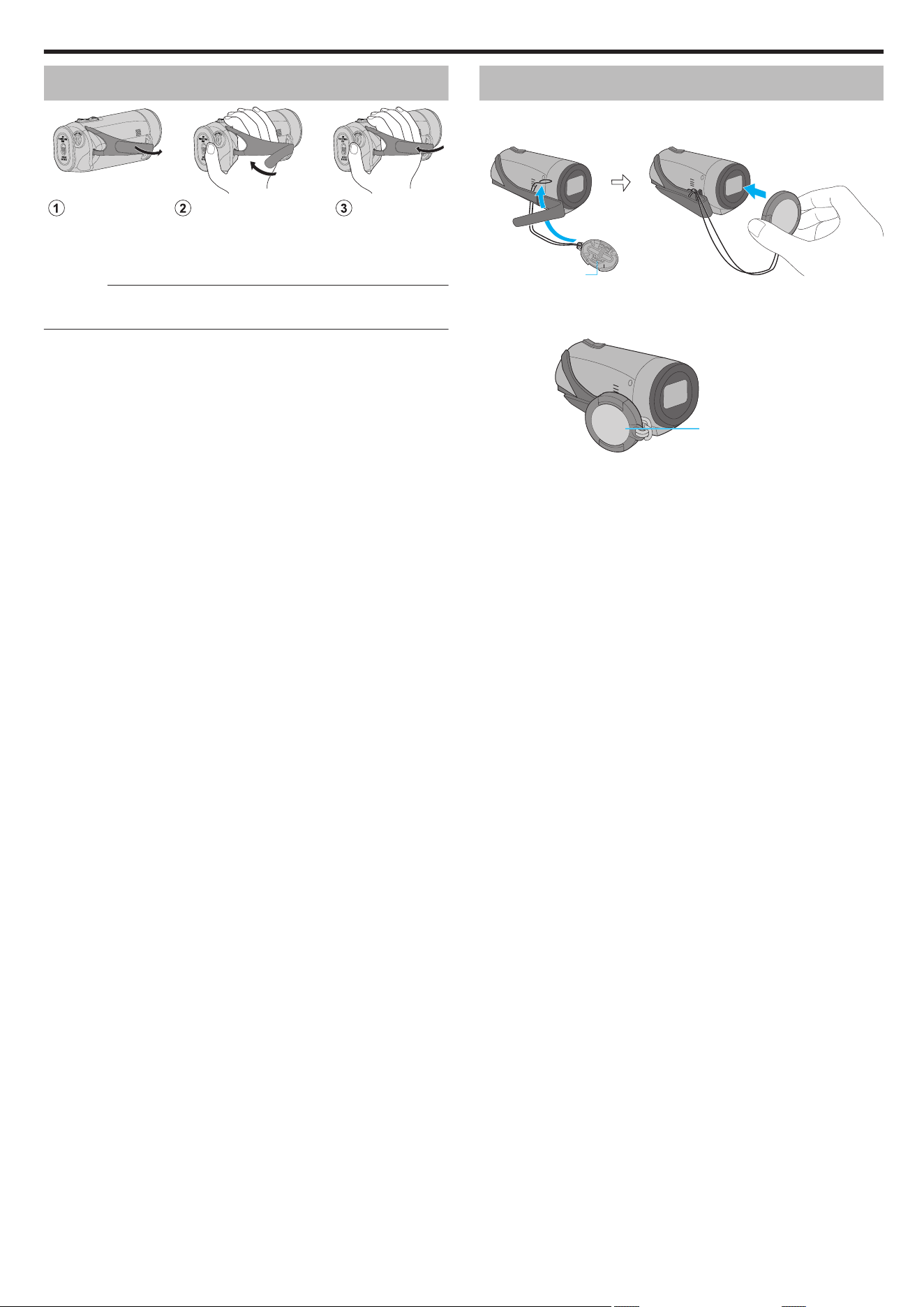
Grip Adjustment
.
Fasten the belt
Adjust the length of the belt
Open the belt
A
Open the belt
B
Adjust the length of the belt
C
Fasten the belt
Caution :
0
Be sure to fasten the grip belt properly.
If the belt is loose, this unit may drop and result in injuries or damages.
Attaching the Lens Cap
Attach the cap to protect the lens when not shooting.
.
Lens Cap
o
During recording
.
Fix to the grip belt
Getting Started
7
Inserting an SD Card
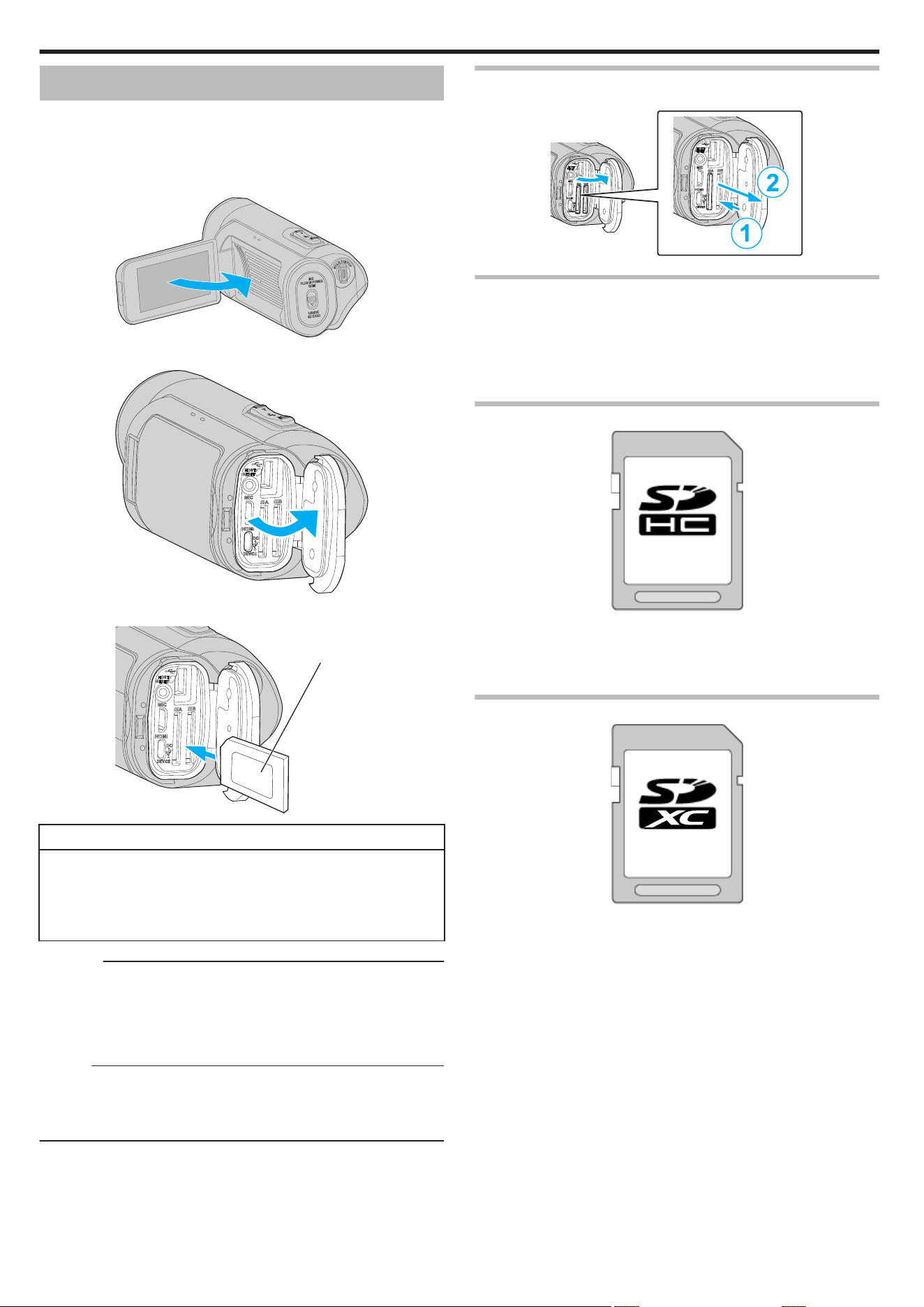
Before shooting, insert a commercially available SD card (4 GB to 512 GB)
into Slot A, Slot B or both slots.
“Types of Usable SD Card” (A p. 8)
“Approximate Video Recording Time” (A p. 50)
1
Close the LCD monitor to turn off this unit.
.
2
Open the terminal cover.
.
3
Insert an SD card.
.
Label
Warning
0
Make sure not to insert the SD card in the wrong direction.
It may cause damage to the unit and SD card.
0
Before inserting or removing the SD card, close the LCD monitor and
ensure that the POWER/ACCESS lamp goes off.
0
Do not touch the metal contact area when inserting the SD card.
Caution :
0
When “System” is set to “HD”, videos with “Frame Rate” at 60p/60i and
50p/50i cannot be mixed on the same card.
0
Before inserting a new SD card, check if the “Frame Rate” has been set
to the frame rate for shooting. (A p. 128
)
To change the “Frame Rate”, do so before inserting a new card.
Memo :
0
To use a new SD card or SD card used on other devices, it is necessary
to
format (initialize) the SD card using “Format SD Card” from the “System”
menu.
“ Format SD Card ” (A p. 114)
Removing the Card
Push the SD card inward once, then pull it out straight.
.
Types of Usable SD Card
The following SD cards can be used on this unit.
Operations are confirmed on the SD cards from the following manufacturers.
0
Panasonic
0
TOSHIBA
0
SanDisk
SDHC Card
.
0
For HD recording, use an SDHC card (4 GB to 32 GB) that is of Class 4
(K) or higher.
0
During 4K or High-Speed recording, use an SDHC card (4 GB to 32 GB)
that is of Class 10 (M) or higher.
SDXC Card
.
0
For HD recording, use an SDXC card (up to 512 GB) that is of Class 4
(K) or higher.
0
During 4K or High-Speed recording, use an SDXC card (up to 512 GB)
that is of Class 10 (M) or higher.
Getting Started
8
Memo :
0
This unit is not guaranteed to operate with all SD cards.
0
Do
not use a miniSD card or microSD card (even if the card is inserted in
an adapter). It may cause malfunction.
0
To protect the data, do not touch the terminals of the SD card.
0
UHS-I SDHC/SDXC cards can be used in the same manner as standard
SDHC/SDXC cards.
UHS Speed Class is not supported.
0
SD card that is used for recording or edited using this unit cannot be played
back or edited on other camcorder units.
0
When “4 GB Spanning” is set to “Off (SDXC)” using an SDXC card, it is
possible to record long videos without splitting the file into units of 4 GB.
0
Both videos and still images can be recorded on one SD card.
0
A maximum of 600 video scenes can be recorded on one SD card.
When the upper limit is reached, the remaining recording time is displayed
as “0min” and no further recordings can be made regardless of
“Approximate Video Recording Time” (A p. 50) .
A maximum of 4000 still images can also be recorded on one SD card.
When your computer cannot recognize the SDXC card
Confirm and update the OS of your computer.
Windows 7 Download and install the updating program (KB976422)
from the following URL.
32 bit version
http://www.microsoft.com/downloads/details.aspx?
displaylang=ja&FamilyID=3ee91fc2-a9bc-4ee1-
aca3-2a9aff5915ea
http://www.microsoft.com/downloads/en/details.aspx?
FamilyID=3ee91fc2-a9bc-4ee1-aca3-2a9aff5915ea
64 bit version
http://www.microsoft.com/downloads/details.aspx?
displaylang=ja&FamilyID=73f766dd-7127-4445-
b860-47084587155f
http://www.microsoft.com/downloads/en/details.aspx?
FamilyID=73f766dd-7127-4445-b860-47084587155f
Mac OS X
10.4 Tiger /
Mac OS X
10.5
Leopard
Not compatible.
Mac OS X
10.6 Snow
Leopard
Update the OS version to 10.6.5 or later.
Using the Touch Screen
The LCD monitor of this unit is a touch panel which enables operations by
touching the screen with your finger.
The operation buttons, thumbnails, and menu items are displayed on the
screen according to each mode (recording/playback/setting).
Tap the button (icon) or scene (file) on screen A to make a selection.
.
MENUREC
PLAY
SLOT
54min
---min
A
B
REC
MENU
ACTION
SLOT
000G0000 2018-01-01
1/8
STBY
00 : 00 : 00 . 00
2018 - 01 - 01
02 : 23 : 01
TC
100%
Index screen (thumbnail display)
Playback Screen
Recording Screen
Memo :
0
The
touch screen of this unit is pressure-sensitive. When the touch screen
does not respond smoothly, apply slightly more force to your fingertip.
0
Do not press or rub with excessive force.
0
Do not operate the touch screen using an object with a sharp tip.
0
Only one point on the screen can be tapped at any one time.
0
Perform “Touch Screen Adjust” if the reactive area of the screen is
misaligned with the touched area.
“Adjusting the Touch Screen” (A p. 10)
0
You cannot operate the touch screen under water. Lock the screen to
prevent operation errors.
“Shooting under Water” (A p. 36)
Locking the Screen (when Shooting Underwater)
Lock the screen before using this unit underwater to prevent operation errors
on the touch screen due to water pressure.
0
Once the screen is locked, operations on the touch screen except L are
disabled.
0
The START/STOP (recording) button and the zoom lever can be used
while the screen is locked.
o
Setting “Screen Lock”
A
Check that the unit is in the recording mode.
B
Tap “MENU”.
C
Select “System” and tap “SET”.
D
Select “Screen Lock” and tap “SET”.
0
The L button appears on the screen.
.
o
To Cancel “Screen Lock”
Tap the L button.
Memo :
0
“Screen Lock” cannot be set for the following cases:
- During recording
- When connected to Wi-Fi
- When “System” is set to “High-Speed”
- When “Rec Mode” is set to “Time-Lapse Rec”
Getting Started
9
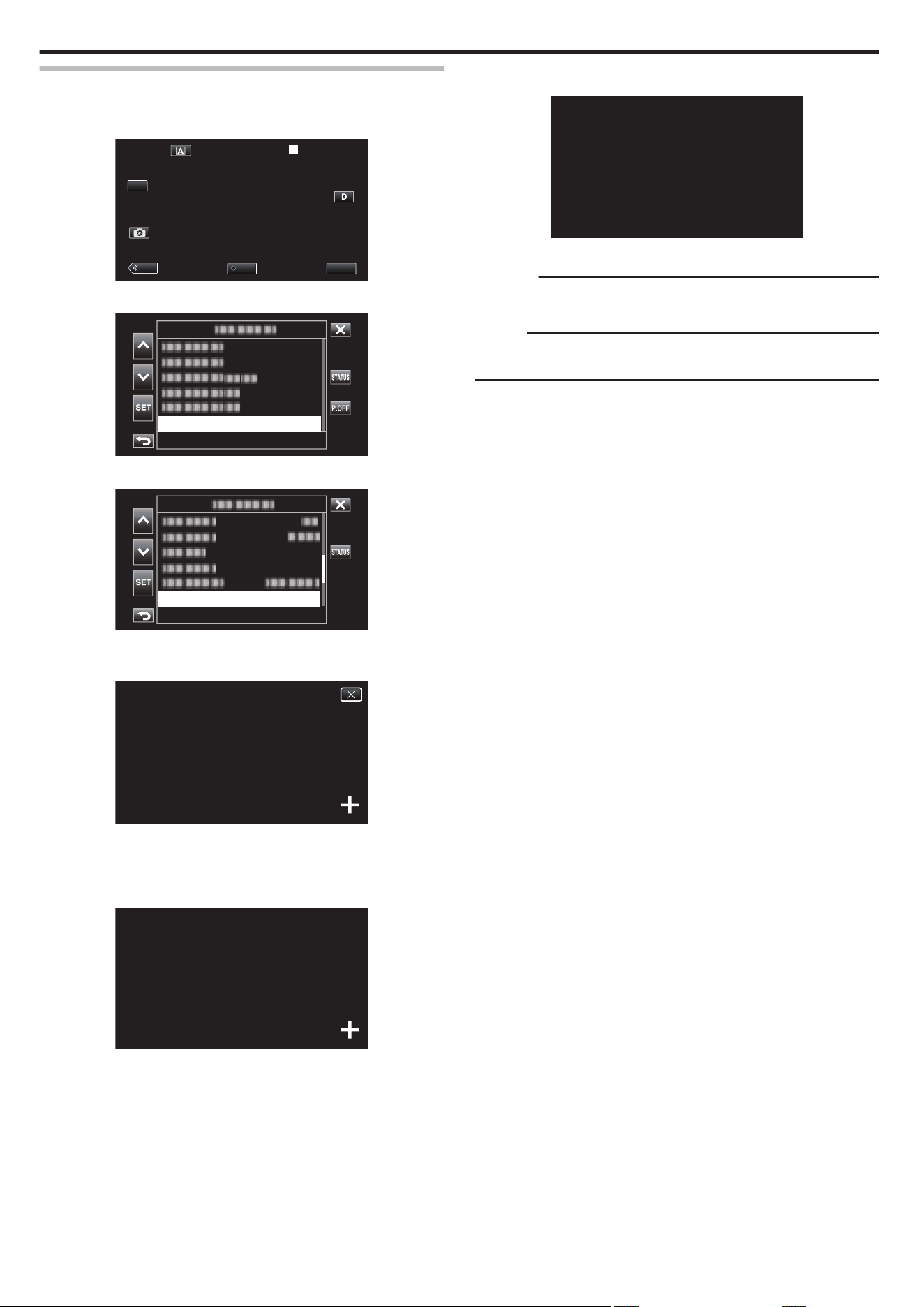
Adjusting the Touch Screen
Adjust the response position when the touch screen is touched.
1
Tap “MENU”.
.
MENUREC
PLAY
SLOT
STBY
00 : 00 : 00 . 00
2018 - 01 - 01
02 : 23 : 01
TC
2
Select “System” with 3 or 2, followed by tapping “SET”.
.
System...
3
Select “Touch Screen Adjust” with 3 or 2, followed by tapping “SET”.
.
Touch Screen Adjust
0
The touch screen adjustment screen appears.
4
Tap “+”. (3 times in total)
.
1/3
Press The + Mark
0
Keep tapping “+” as its position changes with every tap.
0
If areas other than the “+” mark are tapped, errors will occur. Make
sure to tap the “+” mark.
5
Tap “+” again to confirm the adjusted positions. (3 times in total)
.
1/3
Press + Mark Again
Confirm The Adjustment
0
Keep tapping “+” as its position changes with every tap.
6
Tap the screen.
.
Complete
0
Setting ends and returns to the menu screen.
Caution :
0
Do not tap areas other than the “+” mark during touch screen adjustment
(steps 4 - 5). Doing so may cause the touch screen to malfunction.
Memo :
0
Adjust by lightly tapping with a corner of an SD card, etc.
0
Do not press with an object with a sharp tip or do not press hard.
Getting Started
10
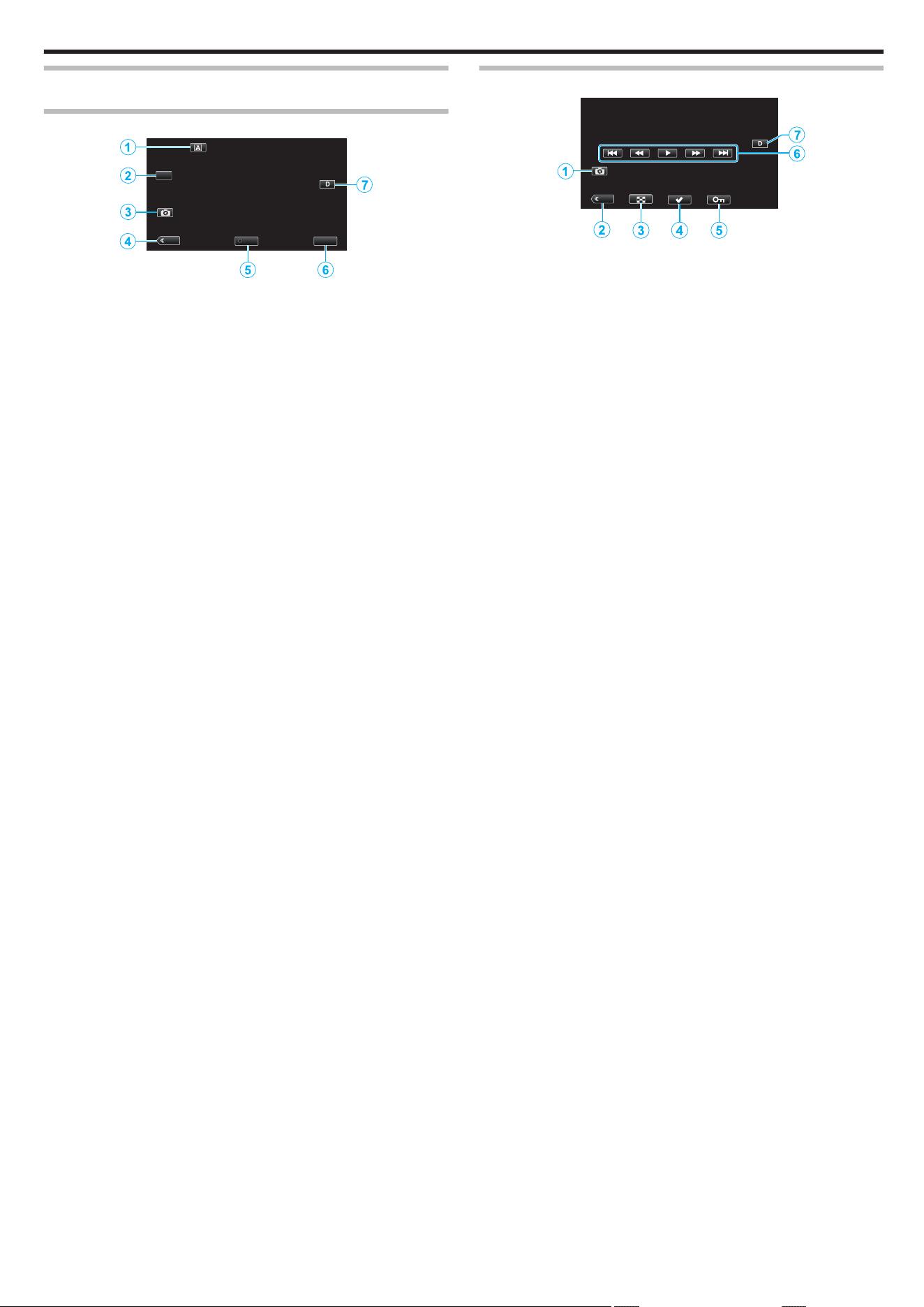
Names of Buttons and Functions on the LCD Monitor
Recording Screen
.
MENUREC
PLAY
SLOT
1
Auto/Manual Selection Button
0
Switches between the Auto and Manual modes.
2
Card Slot Selection Button
0
Switches the card slot to use between Slot A and Slot B when SD
cards are inserted into both slots.
3
Still Image Recording Button
0
Records still images while in the recording standby mode.
“Capturing Still Images” (A p. 21)
4
Playback Mode Button
0
Switches to the playback mode.
5
Recording Start/Stop Button
“Recording Start/Stop Button” (A p. 20)
0
E (black dot): Video Recording Start Button
0
E (red dot): Video Recording Stop Button
6
Menu Button
“Operating the Menu” (A p. 97)
7
Display Button
Switches the display between full (m) and simple (n) with every tap of
the button.
0
Simple display: Some displays disappear automatically when the
screen is not operated.
0
Full display: Displays everything. The display button changes from n
to m.
Playback Screen (Video)
.
REC
1
Video Scene Capture Button
0
Displayed when playback is paused.
0
Saves one scene of the video being played back as a still image.
2
Recording Mode Button
0
Switches to the recording mode.
3
Index Screen (Thumbnail Display) Button
0
Returns to the index screen (thumbnail display).
4
Select Button
By turning on the “Select” button to select the video that is currently
playing,
operations such as protect and delete can be performed easily.
Tapping the button each time toggles between the selected and
deselected state.
5
Protect Button
6
Operation Buttons
“Operation Buttons for Video Playback” (A p. 52)
7
Display Button
Switches the display between full (m) and simple (n) with every tap of
the button.
0
Simple display: Some displays disappear automatically when the
screen is not operated.
0
Full display: Displays everything. The display button changes from n
to m.
Getting Started
11
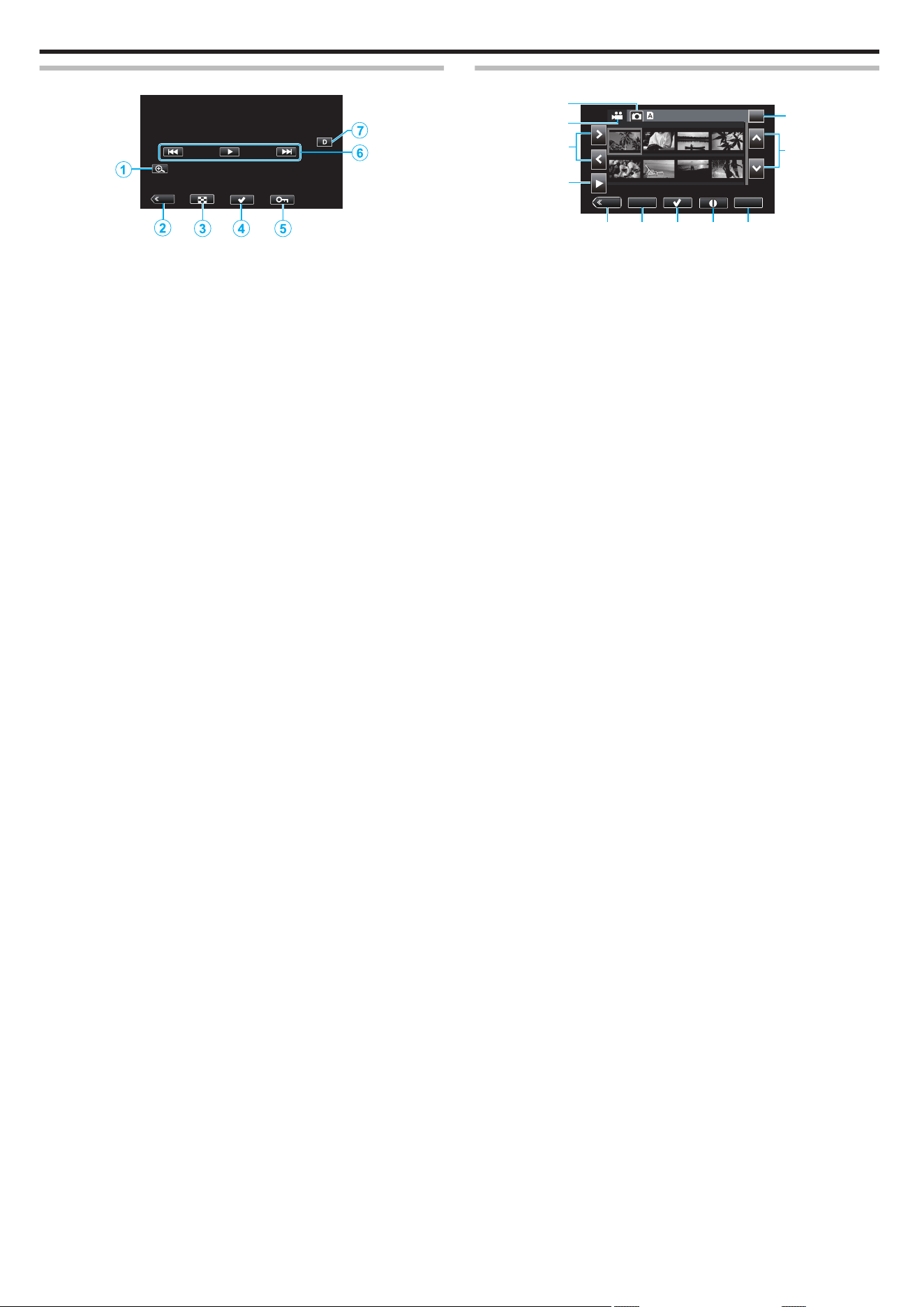
Playback Screen (Still Image)
.
REC
1
Enlarge Display Button
0
Enlarges the still image that is being played back.
2
Recording Mode Button
0
Switches to the recording mode.
3
Index Screen (Thumbnail Display) Button
0
Returns to the index screen (thumbnail display).
4
Select Button
By
turning on the “Select” button to select the still image that is currently
playing, operations such as protect and delete can be performed easily.
Tapping the button each time toggles between the selected and
deselected state.
5
Protect Button
6
Operation Buttons
“Operation Buttons for Still Image Playback” (A p. 55)
7
Display Button
Switches the display between full (m) and simple (n) with every tap of
the button.
0
Simple display: Some displays disappear automatically when the
screen is not operated.
0
Full display: Displays everything. The display button changes from n
to m.
Index Screen (Thumbnail Display) Display
.
MENU
ACTION
REC
SLOT
000G0000 2018-01-01
1/8
3
65 7 8
a
0
9
1
2
4
1
Still Image Playback Mode Selection Button
0
Switches to the Still Image Playback Mode screen.
2
Video Playback Mode Selection Button
0
Switches to the Video Playback Mode screen.
3
Left/Right Arrow Keys
0
Moves the cursor to the left or right.
4
Playback Button
5
Recording Mode Button
0
Switches to the recording mode.
6
Action Menu Button
““ACTION” Menu (Video)” (A p. 53)
““ACTION” Menu (Still Image)” (A p. 56
)
7
Select Button
For selecting the scene (file) to protect or delete.
Tapping the button each time toggles between the selected and
deselected state.
8
Detailed Information Screen Selection Button
0
For viewing the recording information.
9
Menu Button
0
Displays the menu.
10
Up/Down Arrow Keys
0
Moves the cursor upward or downward.
11
Slot Selection Button
0
Switches the card slot to Slot A or Slot B.
Getting Started
12
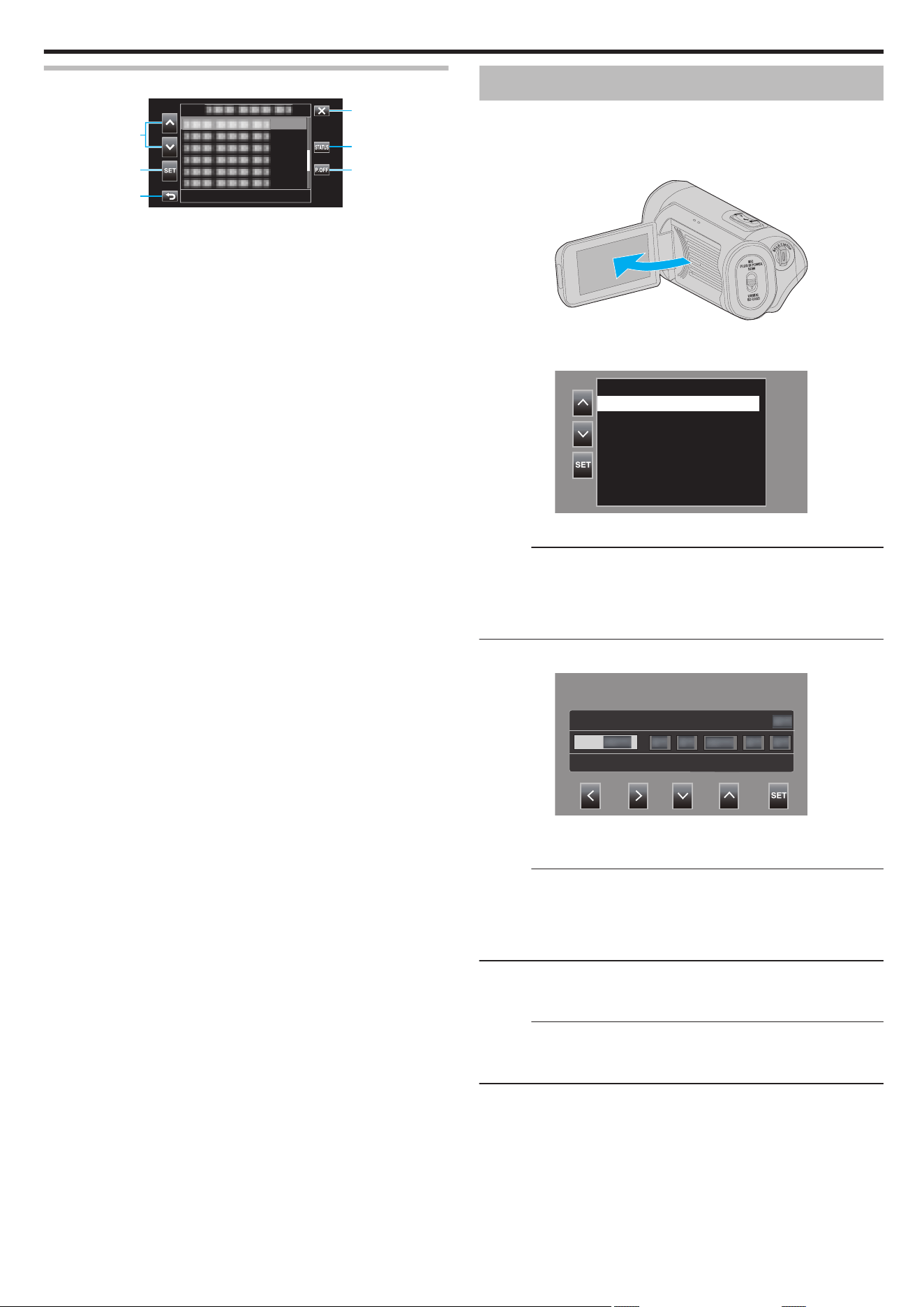
Menu Screen (Recording Mode)
.
2
3
6
5
4
1
1
Up/Down Arrow Keys
0
Moves the cursor upward or downward.
2
Set Button
0
Confirms the selected item.
3
Previous Button
0
Returns to the previous screen.
4
Power Off Button
0
Pressing the button for approximately 2 seconds or longer turns off
the power.
5
STATUS Screen Display Button
0
Displays the screen for check the current settings.
6
Close Button
0
Exit the menu.
Configuring the Initial Settings
When the power of this unit is turned on for the first time, it is necessary to
select a display language and configure the internal clock for the initial
settings. All operations are disabled until initial settings are configured.
1
Open the LCD monitor.
.
0
The power turns on, and a language selection screen appears.
2
Configure the language to use.
.
日本語
Language
Language
日本語
Français
Español
English
ᶮ㔈
0
Tap 3
or 2 to select the language to use, followed by tapping “SET”.
Memo :
0
The
Language screen appears when the power of this unit is turned on for
the first time, or when “System”F“FACTORY PRESET” is executed from
the menu.
0
The menus and messages on the LCD screen are displayed in the
selected language.
3
Set the time zone and date/time.
.
UTC
-
--
:
Initial Setting
0
Move the cursor with 0 1 to select an item.
0
Use 32 to change the setting.
Memo :
0
The Initial Settings screen appears when the power of this unit is turned
on for the first time, or when the unit is powered on again about a month
after the battery ran out.
0
Even
when the power is turned off, the configured date/time data is stored
using the built-in battery.
4
After the settings are configured, tap “SET” according to the time signal.
0
The clock is set to 0 seconds of the date and time entered.
Memo :
0
The configured date/time data can be displayed on the LCD screen or
recorded to an SD card.
0
The value of the year can be set in the range of “2000” to “2099”.
Getting Started
13
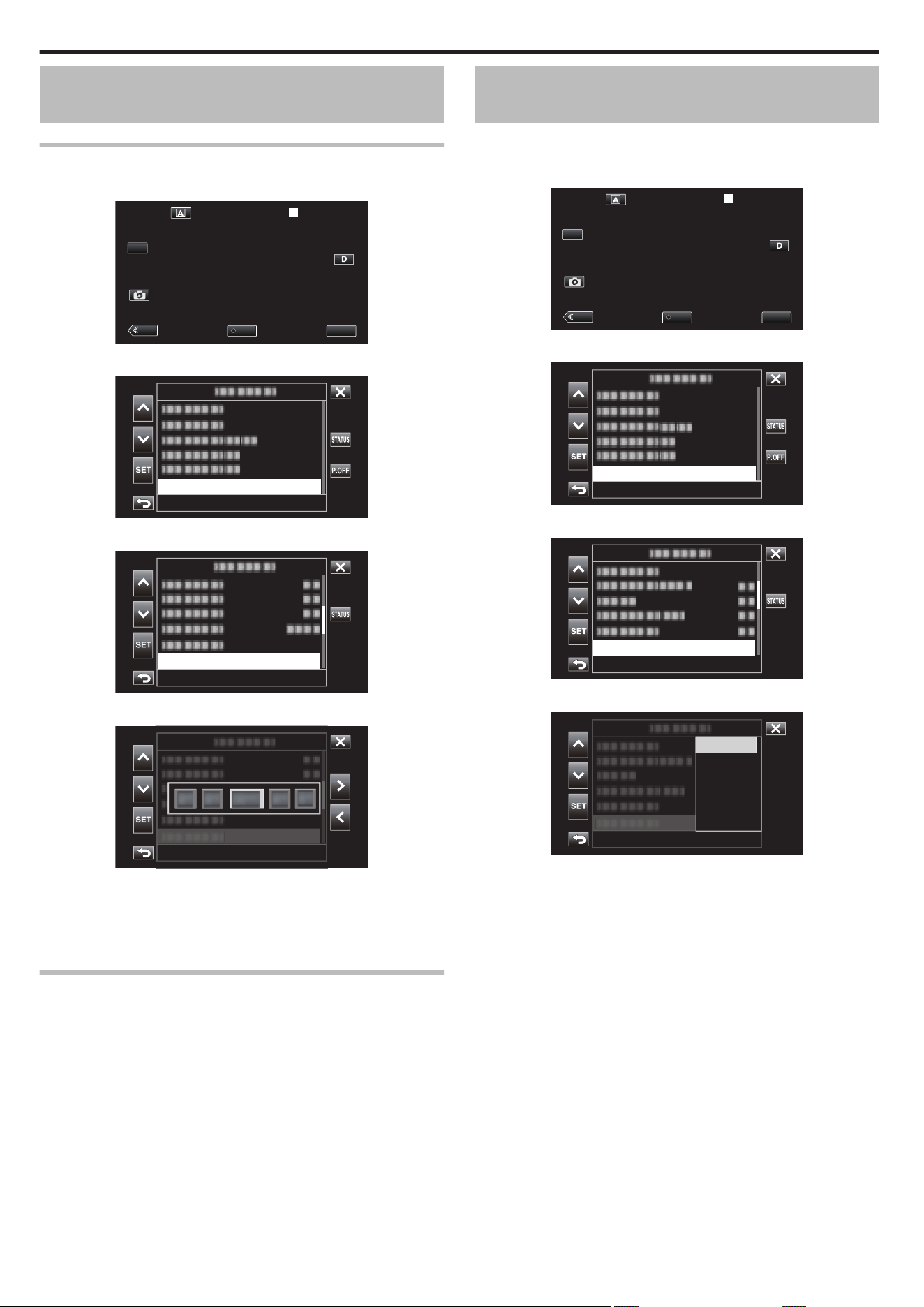
Readjusting the Clock after Initial Settings
are Configured
Setting the Date/Time
1
Tap “MENU”.
.
MENUREC
PLAY
SLOT
STBY
00 : 00 : 00 . 00
2018 - 01 - 01
02 : 23 : 01
TC
2
Select “System” with 3 or 2, followed by tapping “SET”.
.
System...
3
Select “Date/Time” with 3 or 2, followed by tapping “SET”.
.
Date/Time
4
Set the date and time.
.
-
--:
0
Move the cursor with 0 1 to select an item.
0
Use 32 to change the setting.
5
After
the settings are configured, tap “SET” according to the time signal.
0
The clock is set to 0 seconds of the date and time entered.
Changing the Display Style
Changes the date/time display style.
o
Date Display (Date Format) Setting
The date display can be changed in “Monitor”F“Display Settings”F“Date
Style”.
o
Time Display (Time Format) Setting
The time display can be changed in “Monitor”F“Display Settings”F“Time
Style”.
Changing the Display Language after Initial
Settings are Configured
The language on the display can be changed.
Change the language in the “Language” item of the menu.
1
Tap “MENU”.
.
MENUREC
PLAY
SLOT
STBY
00 : 00 : 00 . 00
2018 - 01 - 01
02 : 23 : 01
TC
2
Select “System” with 3 or 2, followed by tapping “SET”.
.
System...
3
Select “Language” with 3
or 2, followed by tapping “SET”.
.
English
Language
4
Select the desired language and tap “SET”.
.
English
Français
Español
ᶮ㔈
日本語
Getting Started
14
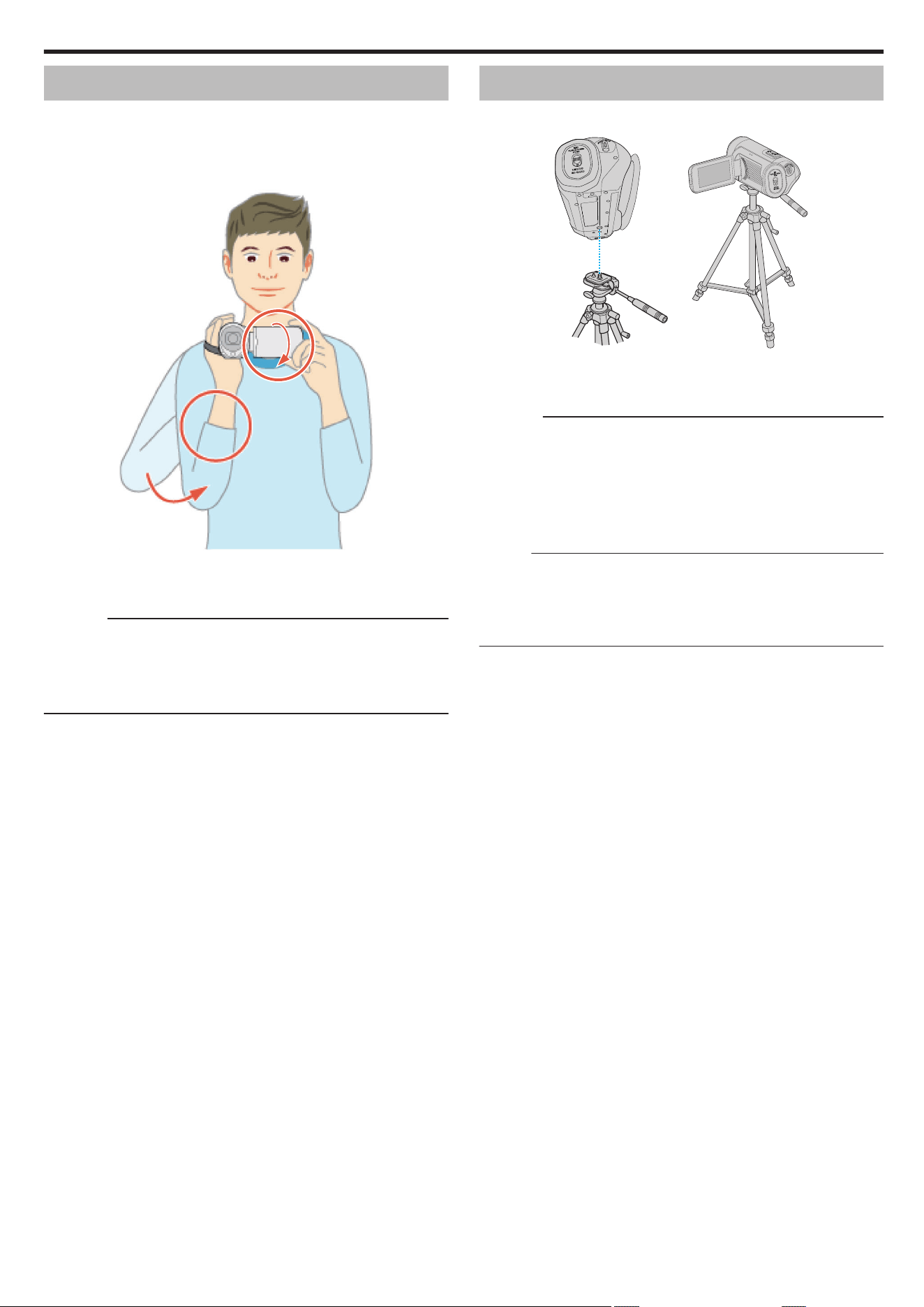
Holding this Unit
When holding this unit, keep your elbows close to your sides to prevent
camera shake.
.
0
Hold
the LCD monitor with your left hand and adjust the angle accordingly.
Holding the LCD monitor with your left hand helps to stabilize the camera
for recording.
Caution :
0
The photographer should pay attention to the surroundings during
shooting,
making sure that he/she is in no danger of falling or collision with
another person or vehicle.
0
Be careful not to drop this unit during transportation.
0
Guardians should pay close attention when this unit is used by children.
Tripod Mounting
This unit can be mounted on a tripod (or monopod). This is useful for
preventing camera shake and recording from the fixed position.
.
0
To
prevent this unit from falling off, check the tripod mounting screw holes
and positioning holes on the unit carefully before mounting, and turn the
screws until they are fastened firmly.
Caution :
0
To prevent injuries or damages which may result if this unit falls off, read
the instruction manual of the tripod (or monopod) to be used and make
sure that it is securely attached.
0
In strong wind conditions and when placed at an unstable location, there
is a risk of the tripod toppling and falling.
0
Please check beforehand if the use of a tripod is allowed as it may be
prohibited depending on the shooting location.
Memo :
0
It is recommended to use a tripod or monopod when recording in
conditions
prone to camera shake (such as in dark places or when zoomed
to the telephoto end).
0
When a tripod is used for recording, set “DIS” to “Off”.
“Reducing Camera Shake” (A p. 39)
Getting Started
15
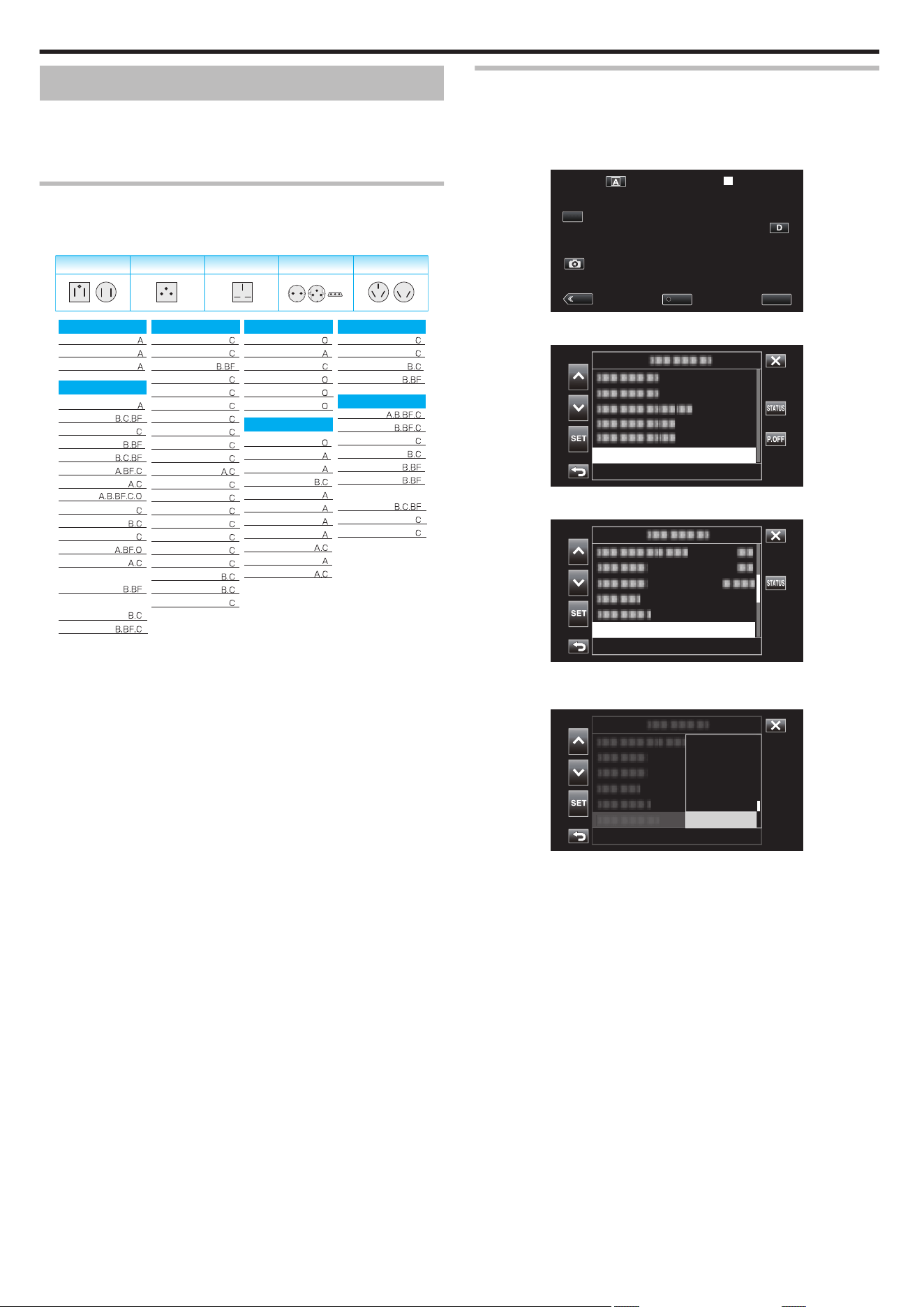
Using this Unit Overseas
The shape of the power outlet varies according to countries and regions.
To charge the battery pack, you need a converter plug that matches the
shape of the outlet.
“Charging the Battery Pack Overseas” (A p. 16)
Charging the Battery Pack Overseas
The shape of the power outlet varies according to countries and regions.
To charge the battery pack, you need a converter plug that matches the
shape of the outlet.
.
ABBFCO
Morocco
Mozambique
Republic of South
Africa
Tanzania
Zambia
Kenya
Guinea
Egypt
Algeria
Africa
Jordan
Kuwait
Iran
Israel
Middle East
Peru
Venezuela
Brazil
Puerto Rico
Bahamas
Panama
Haiti
Chile
Jamaica
Colombia
Argentina
Latin
Fiji
New Zealand
To n g a
Tahiti
Guam
Australia
Oceania
Romania
Portugal
Poland
Belgium
France
Finland
Hungary
Norway
Germany
Denmark
Spain
Sweden
Switzerland
Greece
Canary Islands
Netherlands
Austria
Italy
United Kingdom
Ireland
Iceland
Europe
Asia
Mexico
Japan
United States
North America
Canada
Malaysia
Macau Special
Administrative Region
Hong Kong Special
Administrative Region
Vietnam
Philippines
Bangladesh
Pakistan
Nepal
China
South Korea
Thailand
Sri Lanka
Singapore
Indonesia
India
Setting the Clock to Local Time when Traveling
Configure the date and time in “Date/Time” according to the local time.
(A p. 14)
Also, configure the time zone as and when necessary.
1
Tap “MENU”.
.
MENUREC
PLAY
SLOT
STBY
00 : 00 : 00 . 00
2018 - 01 - 01
02 : 23 : 01
TC
2
Select “System” with 3 or 2, followed by tapping “SET”.
.
System...
3
Select “Time Zone” with 3 or 2, followed by tapping “SET”.
.
UTC+xx:xx
Time Zone
4
Select the time zone according to the location you are in, followed by
tapping “SET”.
.
UTC-04:30
UTC-04:00
UTC-03:30
UTC-03:00
UTC-02:30
UTC-05:00
Getting Started
16

o
Time Zone of Major Cities
-11:00 MIDWAY ATOLL
-10:00
HAWAIIAN
ISLANDS
HONOLULU TAHITI
- 9:00 ALASKA ANCHORAGE
- 8:00 VANCOUVER SEATTLE LOS ANGELES
- 7:00 DENVER PHOENIX CALGARY
- 6:00 CHICAGO HOUSTON MEXICO CITY
- 5:00 TORONTO NEW YORK BOGOTA
- 4:00 MANAUS SANTIAGO
- 3:30 NEWFOUNDLAND
- 3:00 RIO DE JANEIRO SAO PAULO
BUENOS
AIRES
- 2:00
FERNANDO DE
NORONHA
- 1:00 AZORES
0:00 LONDON CASABLANCA LISBON
+ 1:00 BERLIN PARIS WARSAW
+ 2:00 HELSINKI ISTANBUL CAIRO
+ 3:00 MOSCOW RIYADH NAIROBI
+ 3:30 TEHRAN
+ 4:00 DUBAI ABU DHABI
+ 4:30 KABUL
+ 5:00 ISLAMABAD KARACHI MALE
+ 5:30 DELHI CALCUTTA BOMBAY
+ 6:00 DHAKA
+ 6:30 YANGON
+ 7:00 BANGKOK JAKARTA
+ 8:00 BEIJING HONG KONG SINGAPORE
+ 9:00 TOKYO SEOUL
+ 9:30 ADELAIDE DARWIN
+10:00 GUAM SYDNEY
+11:00
SOLOMON
ISLANDS
NEW CALEDONIA
+12:00 FIJI AUCKLAND WELLINGTON
+13:00 SAMOA
Getting Started
17
Before Using Underwater or under Low
Temperature
This section describes the precautions and methods of maintenance when
using the unit underwater or under low temperature conditions.
“Cautions on Using Underwater” (A p. 18)
“Maintenance after Use” (A p. 18)
“Cautions on Using under Low Temperature” (A p. 18)
“Other Precautions” (A p. 18)
Cautions on Using Underwater
Please take note of the followings when using this unit near water or
underwater.
0
Ensure that the cover is closed tightly.
“Opening the Terminal Cover (SD Card Cover)” (A p.
5)
0
Ensure that the terminal cover and the gray waterproof seal are not
damaged and that there are no foreign materials (such as hair, lint, sand
or dust) adhered on the cover.
0
Stop using the unit underwater if there are damages to the cover, etc.
and consult your JVC dealer or the nearest service center.
0
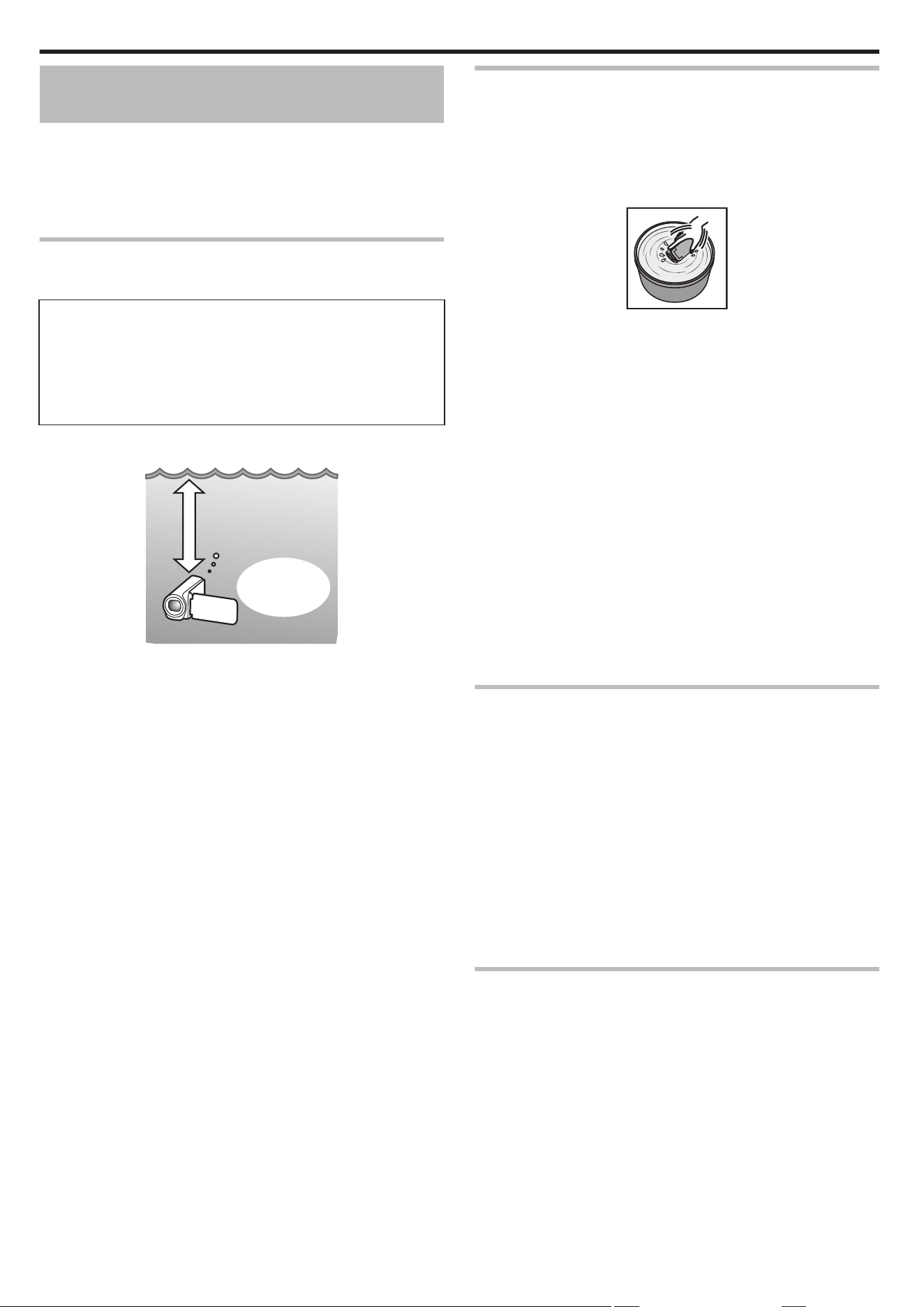
Use
the camera within a water depth of 5 m and a duration not longer than
1 hour.
.
Within 1 hour
Within Water
Depth of 5 m
0
Do not open/close the cover or insert/remove an SD card or any cables
while using underwater or on the beach, or if your hands contain water
droplets or sands. Doing so may cause water to enter into the camera or
malfunction.
0
Do
not subject the camera to high pressure or vibration resulted from swift
current, waterfall or diving into water.
0
The waterproof performance is not guaranteed if the camera is dropped
or subjected to other impact shock. If the camera has been subjected to
impact shock, consult your nearest service center.
0
While shooting underwater, noise generated inside of the camera
(zooming sounds, etc) may be picked up. This is not a malfunction.
0
Do not immerse into hot spring, or hot water above 40°C (104°F). Doing
so deteriorates waterproof performance.
0
Keep away from hands with sun oil or sun screen. Doing so may cause
discoloration or deterioration of material.
0
This unit sinks underwater. Fasten the grip belt firmly to prevent losing the
camera underwater.
0
The accessories are not waterproof.
0
Wi-Fi function is not available underwater.
0
Do not use the lens filter or conversion lens underwater or at locations
where there is water.
Maintenance after Use
After using underwater or in dusty places, rinse the camera with water
immediately and dry it completely.
1
Ensure that the terminal cover is closed.
2
Rinse with clean water.
Soak
the camera in a container filled with enough water to immerse the
camera completely, and rinse it gently.
.
0
After using the camera under the sea or on the beach, immerse the
camera in fresh water for about 10 minutes to remove salt particles,
replace the water and rinse the camera.
0
Open and close the LCD screen, and operate the buttons or zoom
operations to get rid of sands or dusts in the gap.
3
Dry the camera.
Wipe
the camera completely with a soft dry cloth and allow it to dry in a
well-ventilated and shady location.
0
Place the camera with the lens facing downward while the LCD
monitor is closed, and leave it for approximately 10 minutes. (By doing
so, microphone and LCD part are dried out easily.) Place the camera
in a up right position on a dry cloth afterward Close the terminal cover
after the camera is dried out completely.
0
Wipe off any foreign materials or water droplets inside the cover.
* If you leave the camera immersed in salt water or allow water droplets from
the salt water to remain on the camera, this may cause corrosion,
discoloration or deterioration of waterproof performance.
* If you wipe or dry the camera with sand particles adhered, this may cause
scratches on the camera.
* Do not wash with chemicals, soap, neutral detergents, or alcohol.
* Do not dry the camera with a hair dryer or other heat sources. This could
impair its waterproof performance.
Cautions on Using under Low Temperature
0
The
performance of the battery will drop temporarily when the temperature
is -10°C to 0°C (14°F to 32°F), this will cause the remaining recording time
to shorten.
0
Charging cannot be performed when the surrounding temperature is
below 10°C (50°F).
0
Turning on the camera while it is still cold will deteriorate the performance
of the LCD monitor. Problems such as the screen becoming dark
momentarily or residual image can occur.
0
If snow or water droplets adhere to the camera under sub-zero
temperature environment, ice can formed between the gaps around the
buttons, speaker or microphone. This will cause difficulty in operating the
buttons as well as decrease in the volume level.
0
Direct contact with exposed metal part under cold temperature can cause
the skin to stick on the metal part resulting in injuries such as frostbite. Do
not touch with bare hands.
Other Precautions
0
Do
not leave the camera under low temperature in cold climates or under
high temperature above 40 °C (104 °F) (such as under direct sunlight,
inside a vehicle in the hot sun, or near a heater). This will cause
deterioration of the waterproof performance.
0
Malfunction due to mishandling will void the warranty.
0
We are not responsible for any loss of data due to water entering into inside
of the camera. Please be forewarned.
0
It is recommended to replace the waterproof packing once a year to
maintain the waterproof performance. Consult your nearest service
center. (Subject to a fee)
Getting Started
18
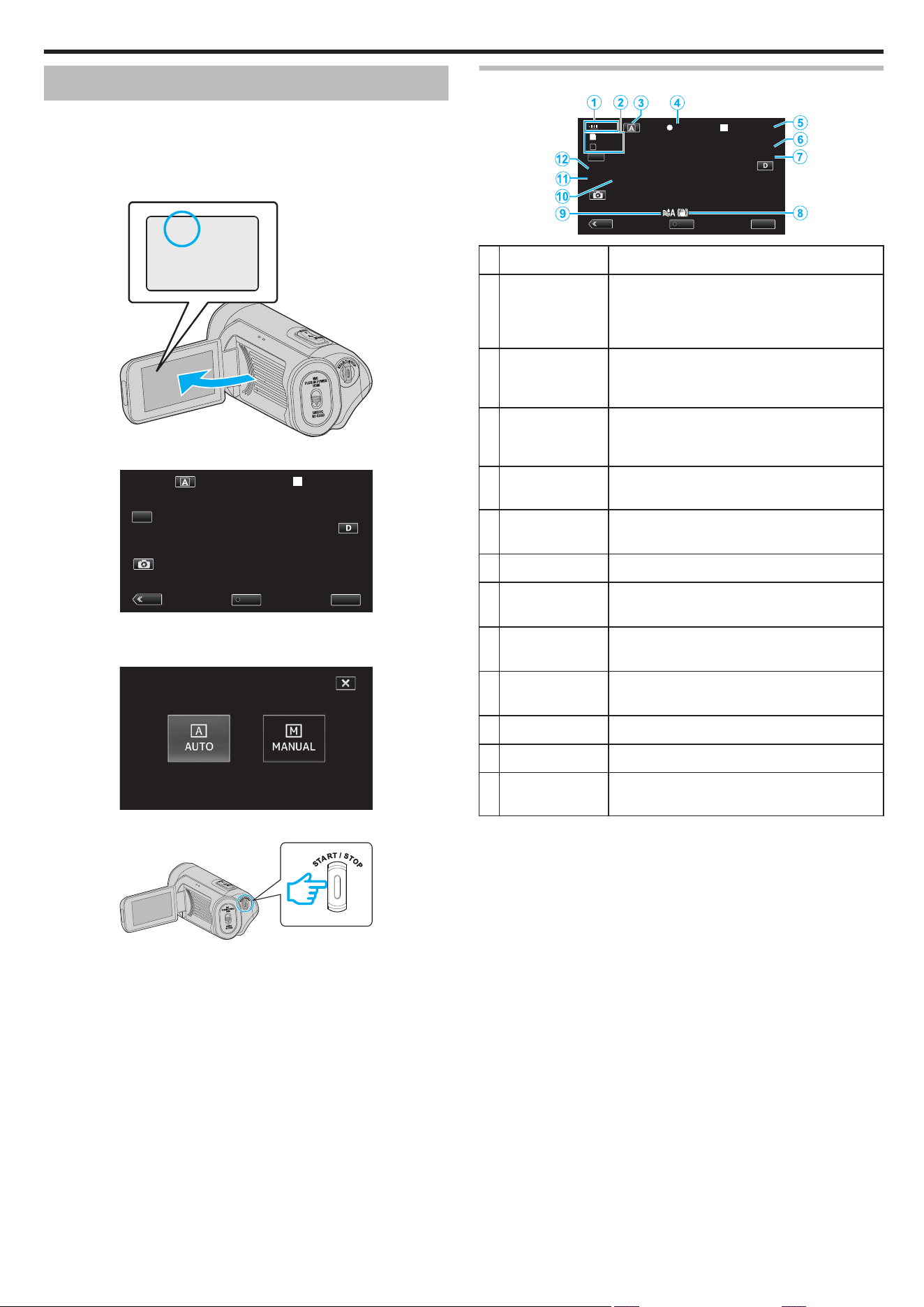
Taking Videos in Auto Mode
During Auto recording, the camera automatically adjusts the settings such
as brightness and focus to suit the shooting conditions.
0
Before
recording an important scene, it is recommended to conduct a trial
recording.
1
Open the LCD monitor.
.
T
2
Check if the recording mode is set to n.
.
MENUREC
PLAY
SLOT
STBY
00 : 00 : 00 . 00
2018 - 01 - 01
02 : 23 : 01
TC
0
If the mode is H Manual, tap H on the recording screen to display
the mode switching screen.
Tap n to switch the recording mode.
.
3
Press the START/STOP button to start recording.
.
0
Press again to stop.
0
Some displays disappear after approximately 3 seconds.
Use the n button to change the displays.
Indications for Video Recording
.
MENUREC
PLAY
SLOT
54min
100%
- - - min
A
B
REC
00 : 00 : 00 . 00
2018 - 01 - 01
02 : 23 : 01
TC
1920x1080
60i 18M
Display Icon Description
A
Battery Indicator Displays the approximate remaining battery
power during use.
“Checking the Remaining Battery Level and
Recording Time” (A p. 48)
B
Recording Media Displays the SD card icon and recordable time.
“Checking the Remaining Battery Level and
Recording Time” (A p. 48)
C
Recording Mode Displays the current recording mode as n (Auto)
or H (Manual).
Current shooting mode is displayed.
D
Recording Appears when recording is in progress. (“STBY”
appears when recording is stopped.)
E
Time Code Displays the time code that is recorded to a video.
“TC Menu” (A p. 106
)
F
Date Display Displays the date (year, month and day).
G
Time Displays the current time.
“Configuring the Initial Settings” (A p. 13)
H
DIS Displays the image stabilizer settings.
“Reducing Camera Shake” (A p. 39
)
I
Wind Cut Displays the wind cut settings.
“ Wind Cut ” (A p. 113)
J
Bit Rate Displays the bit rate settings.
K
Frame Rate Displays the frame rate settings.
L
Resolution Displays the resolution that is determined
according
to the “System” of the recording format.
Recording
19
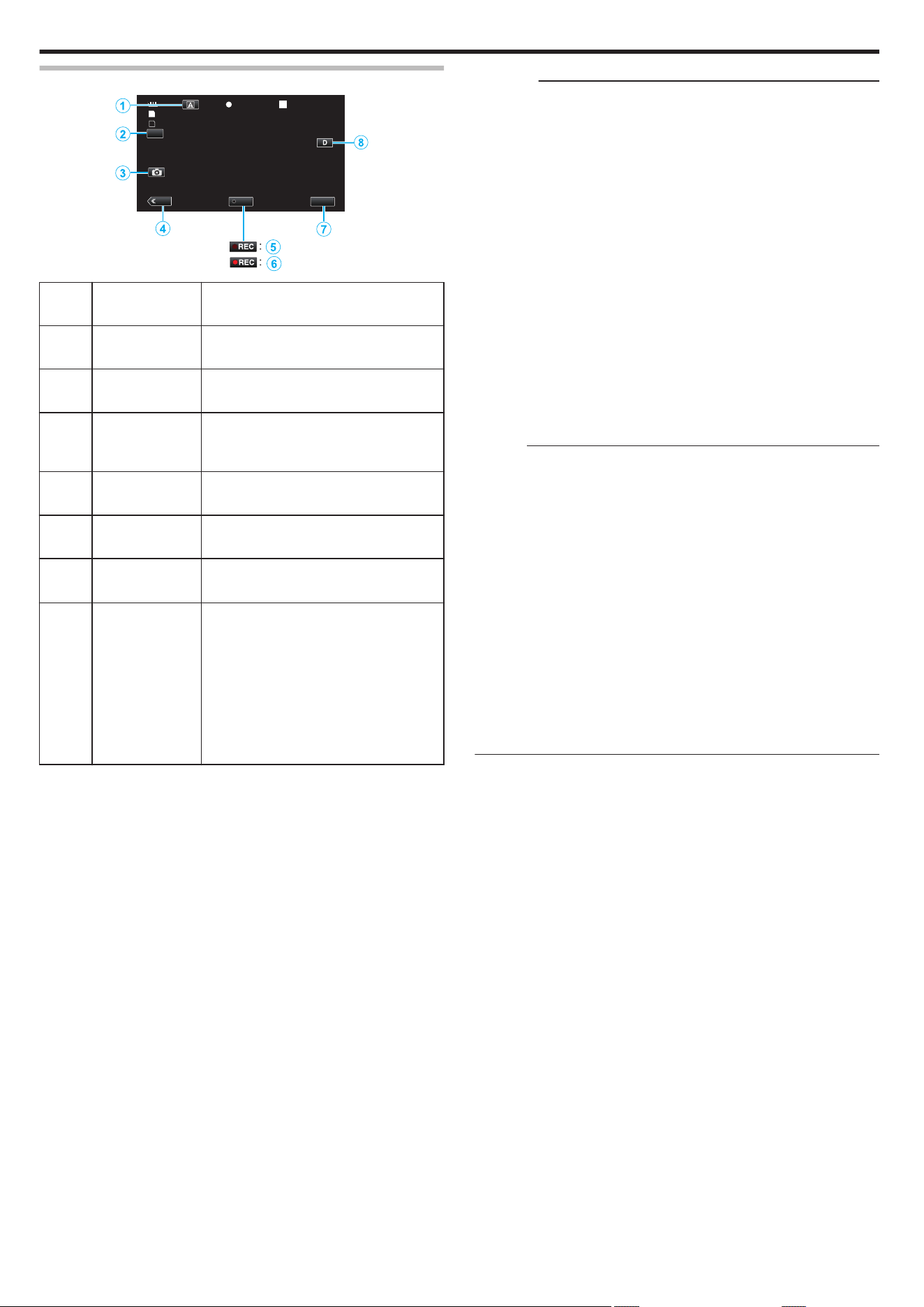
Operation Buttons for Video Recording
.
MENUREC
PLAY
SLOT
54min
-- - min
A
B
REC
00 : 00 : 00 . 00
2018 - 01 - 01
02 : 23 : 01
TC
Operation
Buttons
Description
A
Auto/Manual
Selection Button
Switches between the Auto and Manual
recording modes.
B
Card Slot
Selection Button
Switches the card slot to use between Slot
A and Slot B.
C
Still Image
Recording Button
Tap this button to record a still image during
recording standby.
“Capturing Still Images” (A p. 21)
D
Playback Mode
Button
Switches to the playback mode.
E/ F Recording Start/
Stop Button
Functions as the START/STOP button.
G
Menu Button Displays the main menu.
“Operating the Menu” (A p. 97
)
H
Display Button
Switches the display between full (m)
and
simple (n) with every tap of the button.
0
Simple display: Some displays
disappear automatically when the
screen is not operated.
0
Full display: Displays everything. The
display button changes from n to m.
0
When the power is turned off, the display
setting will revert to simple display (n).
Caution :
0
Do not expose the lens to direct sunlight.
0
While this unit can be used with the LCD monitor reversed or the LCD
monitor closed with “LCD CLOSED RECORDING” activated, the
temperature of this unit rises more easily. Leave the LCD monitor open
when
using this unit for long periods of time, or in places exposed to direct
sunlight or high temperatures.
0
The power may turn off to protect the circuit if the temperature of this unit
rises too much.
0
This unit is a microcomputer-controlled device. Electrostatic discharge,
external noise and interference (from a TV, a radio, etc.) might prevent it
from functioning properly. In such a case, close the monitor screen to turn
off the power and remove the AC adapter, then press the Reset button to
reset this unit.
“Resetting this Unit” (A p. 131)
0
Disclaimer
– We shall not be liable for any loss of recorded contents when videos or
audio cannot be recorded or played back properly due to malfunction
of this unit and accessories that come with it or the SD card.
– Recorded contents (data) that are lost, including loss due to malfunction
of this unit, cannot be restored. Please be forewarned.
– JVC will not be responsible for any lost data.
Memo :
0
Check that the remaining recording time in the media is sufficient before
you start recording. “Checking the Remaining Battery Level and
Recording Time” (A p. 48)
If the remaining recording time is not sufficient, save the files on a PC or
disc before deleting the files from the unit. “Deleting Unwanted Files”
(A p. 59)
0
Due to the specifications of this unit, continuous recording for a duration
of 12 hours or longer is not possible when recording is performed with
“System” set to “HD”. Recording stops automatically 12 hours after it is
started.
(It may take some time to resume recording.)
0
Up to 4GB per video file can be recorded. File recorded using long
recordings that exceeds 4GB is split and recorded into several video files.
However, recording up to 64 GB or 4 hours is possible when “4 GB
Spanning” is set to “Off (SDXC)” (This is configurable only when “System”
is set to “4K” or “High-Speed”, and when an SDXC card is used.)
0
Depending on the shooting conditions, the four corners of the screen may
appear dark, but this is not a malfunction. In this case, change the shooting
conditions by moving the zoom lever, etc.
Recording
20
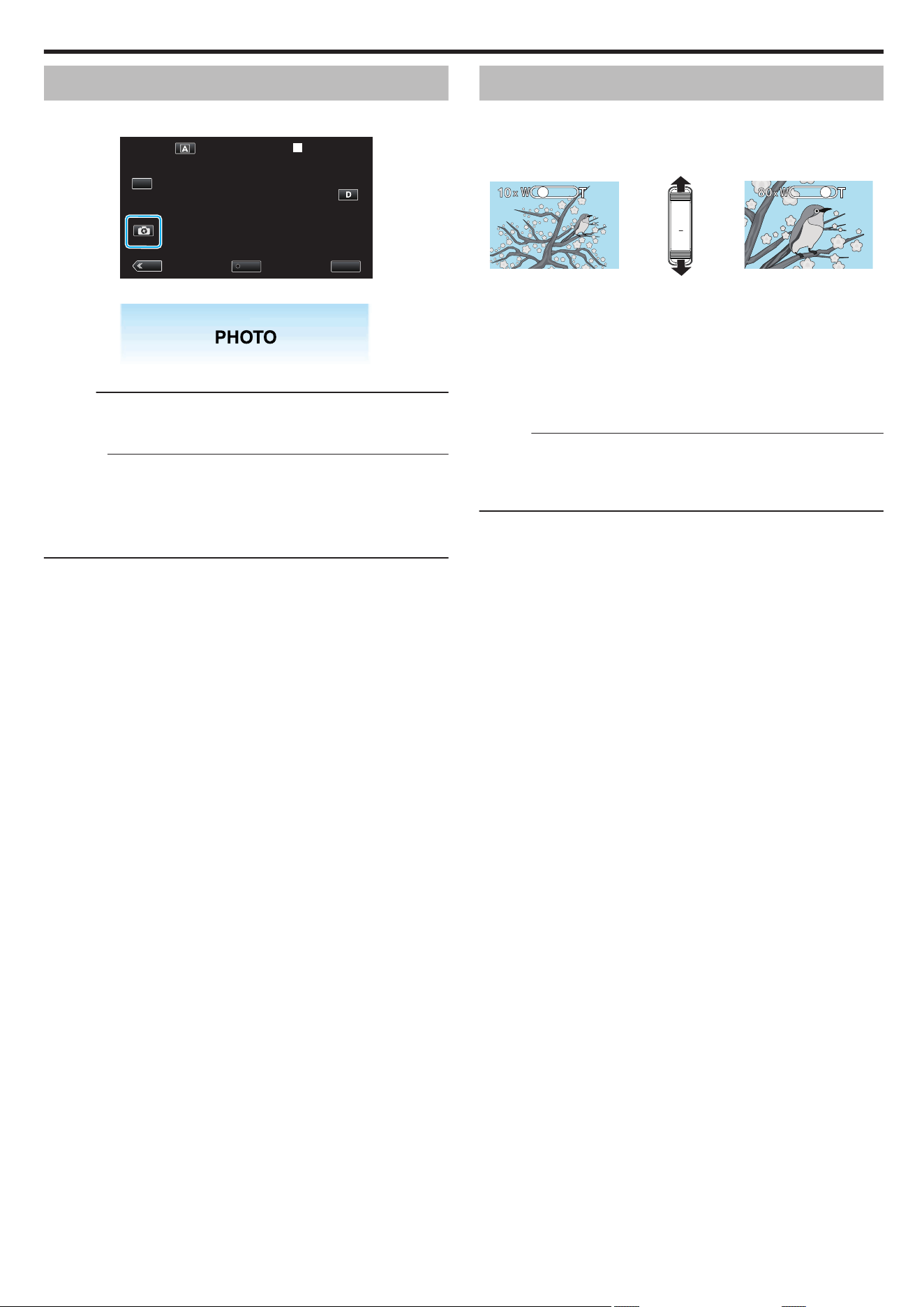
Capturing Still Images
Still
images can be captured by tapping the B button while in the recording
standby mode.
.
MENUREC
PLAY
SLOT
STBY
00 : 00 : 00 . 00
2018 - 01 - 01
02 : 23 : 01
TC
0
“PHOTO” lights up on the screen when a still image is being captured.
.
Memo :
0
This camera does not have a separate mode for capturing still images.
0
The still image has the same resolution as the video image.
Caution :
0
Still image capturing during recording standby is not possible in the
following cases.
- When the menu is displayed
- When “System” is configured to “High-Speed”
- When “Rec Mode” is set to “Pre Rec” or “Time-Lapse Rec”
- When connected to Wi-Fi
Zooming
The angle of view can be adjusted using zoom.
Memorizes the zoom position while the camera is turned off.
0
Use the W end (wide angle end) to shoot a wider field of view.
0
Use the T end (telephoto end) to magnify the subject for shooting.
.
T
W
VOL.
+
T (Telephoto End)
W (Wide Angle End)
0
The following zoom options are available:
- When in the 4K mode
Optical zoom (1x to 10x)
Digital zoom (11x to 200x)
- When in the HD mode
Optical zoom (1x to 10x)
Dynamic zoom (11x to 18x)
Digital zoom (19x to 200x)
Memo :
0
When digital zoom is used, the image becomes grainy as it is digitally
enlarged.
0
The zoom ratio range can be changed.
“ Zoom ” (A p. 100)
Recording
21
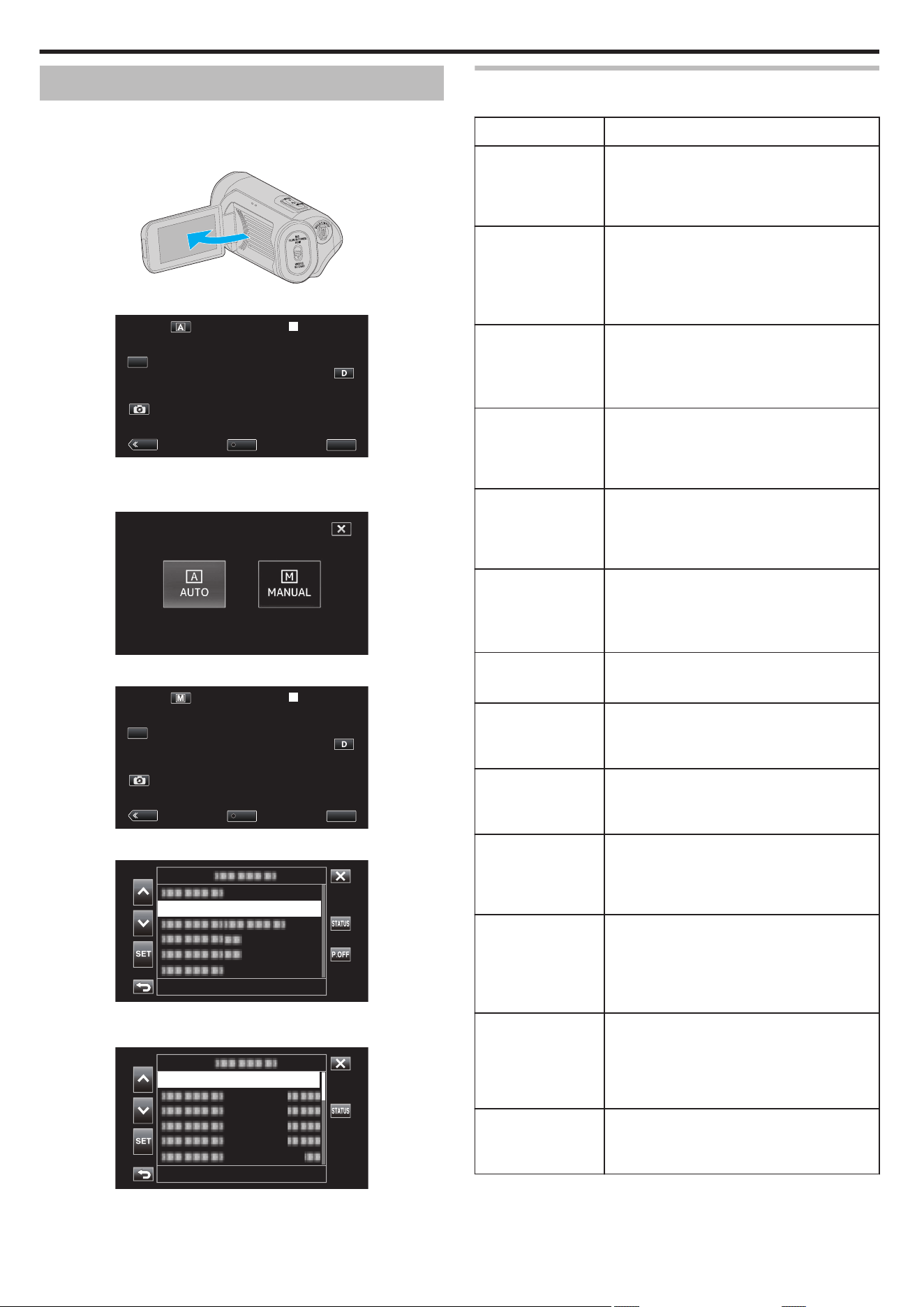
Manual Recording
In situations where recording cannot be performed correctly in the Auto
mode, it is possible to record videos with the recording mode changed to
Manual.
1
Open the LCD monitor.
.
2
Select the Manual recording mode.
.
MENUREC
PLAY
SLOT
STBY
00 : 00 : 00 . 00
2018 - 01 - 01
02 : 23 : 01
TC
0
If
the camera is in the n mode, tap n to display the mode selection
screen.
Tap H to switch the recording mode to Manual.
.
3
Tap “MENU”.
.
MENUREC
PLAY
SLOT
STBY
00 : 00 : 00 . 00
2018 - 01 - 01
02 : 23 : 01
TC
4
Select “Camera Process” with 3 or 2, followed by tapping “SET”.
.
Camera Process...
5
Select the desired item in the camera settings menu, followed by tapping
“SET”.
.
AutoFocus
0
For details on the manual settings, please refer to “Camera Setting
Menu”.
Camera Setting Menu
The following items can be set.
Name Description
Focus
0
Use manual focus if the subject is not focused
automatically.
“Adjusting Focus Manually (FOCUS)”
(A p. 23)
Brightness Adjust
0
Overall brightness on the screen can be
adjusted.
0
Use this when recording in a dark or bright
location.
“Adjusting Brightness” (A p. 26)
Shutter Speed
0
Shutter speed can be adjusted.
0
Use this when shooting a fast-moving subject
or to emphasize the subject’s movement.
“Setting Shutter Speed” (A p. 27)
Aperture
0
You can adjust the aperture to capture an
image with only the subject in focus while
blurring the surroundings.
“Setting Aperture” (A p. 28)
Gain Up
0
Automatically increases the light sensitivity
when the subject is not bright enough.
“Increasing the Light Sensitivity Level”
(A p. 29)
Backlight Comp
0
Corrects the image when the subject appears
dark due to backlight.
0
Use this when shooting against the light.
“Setting Backlight Compensation” (A p. 30)
Lolux
0
Selects the Lolux (low-light recording) mode.
“ Lolux ” (A p. 102)
Detail
0
Adjusts the outline enhancement level during
recording.
“ Detail ” (A p.
102)
Gamma
0
Corrects
the gamma curve that determines the
reproducibility of the black level.
“ Gamma ” (A p. 102)
WDR
0
Selects
the WDR mode (function for enhancing
the contrast of video images by applying
gradation correction to the video input).
“ WDR ” (A p. 103)
White Balance
0
Adjusts
the overall color of the image according
to the light source.
0
Use this when the color on the screen appears
differently from the actual color.
“Setting White Balance” (A p. 31)
Color Matrix
0
Adjusts the color according to the user’s
preference using the color matrix (matrix that
converts a color represented by 3 R, G and B
values with another set of RGB values).
“ Color Matrix ” (A p. 103)
Reset Process
0
Resets all the camera settings to their default
values.
“ Reset Process ” (A p. 103
)
Recording
22
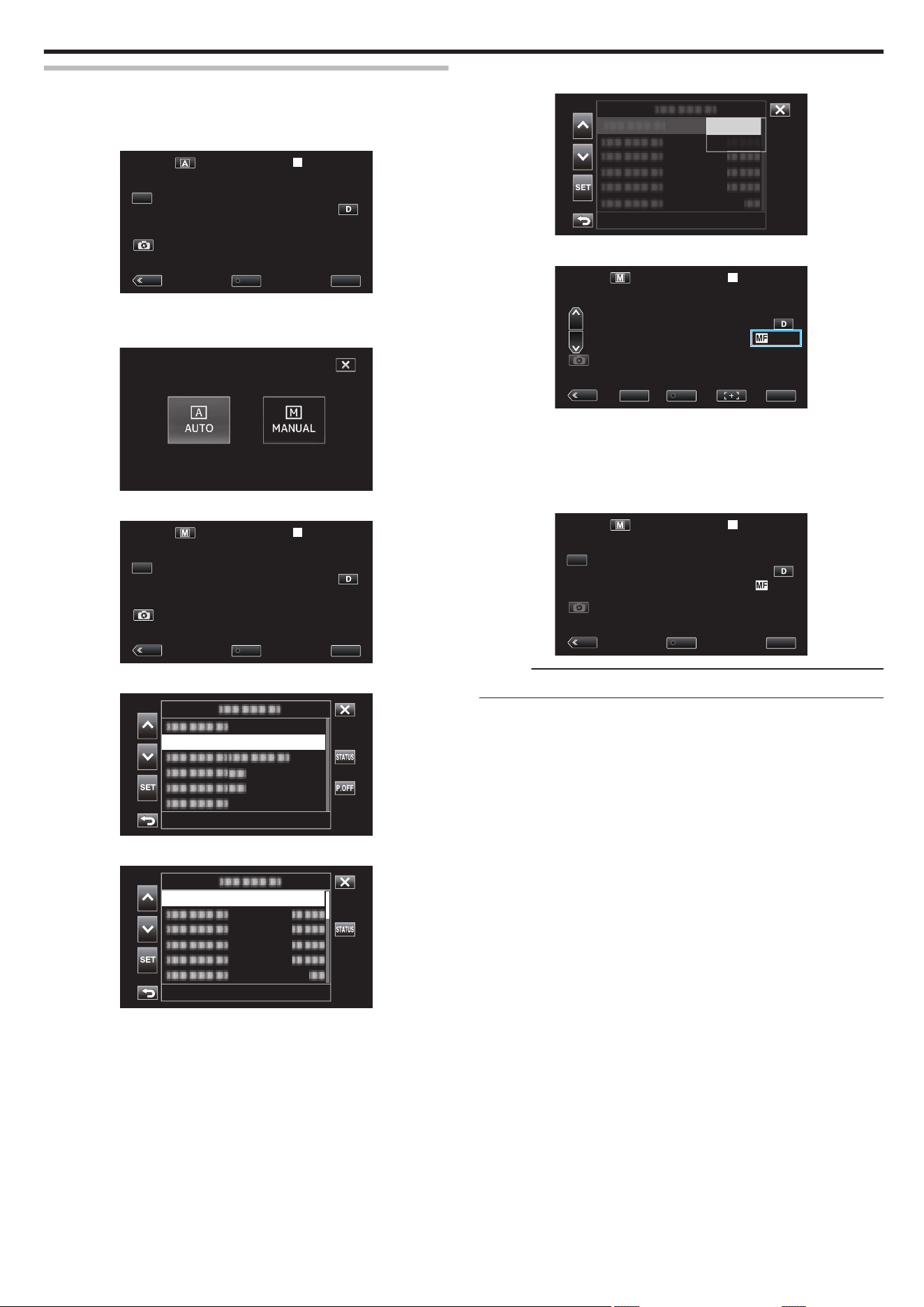
Adjusting Focus Manually (FOCUS)
Adjust the focus manually when focus cannot be achieved using Auto or
when you want to lock the focus.
1
Select the Manual recording mode.
.
MENUREC
PLAY
SLOT
STBY
00 : 00 : 00 . 00
2018 - 01 - 01
02 : 23 : 01
TC
0
If
the camera is in the n mode, tap n to display the mode selection
screen.
Tap H to switch the recording mode to Manual.
.
2
Tap “MENU”.
.
MENUREC
PLAY
SLOT
STBY
00 : 00 : 00 . 00
2018 - 01 - 01
02 : 23 : 01
TC
3
Select “Camera Process” with 3 or 2, followed by tapping “SET”.
.
Camera Process...
4
Select “Focus” with 3 or 2, followed by tapping “SET”.
.
AutoFocus
0
Tap L to exit the menu.
0
Tap J to return to the previous screen.
5
Select “Manual” with 3 or 2, followed by tapping “SET”.
.
Auto
Manual
6
Adjust the focus.
.
MENUREC
PLAY
SET
0.2 m
STBY
00 : 00 : 00 . 00
2018 - 01 - 01
02 : 23 : 01
TC
0
The manual focus icon (b) appears on the screen.
0
Tap 3 to focus on a distant subject.
0
Tap 2 to focus on a near subject.
0
Pressing and holding down the key allows focus to be adjusted
continuously.
7
Tap “SET” to confirm.
.
MENUREC
PLAY
SLOT
0.2 m
STBY
00 : 00 : 00 . 00
2018 - 01 - 01
02 : 23 : 01
TC
Memo :
0
This is selectable only during Manual recording.
Recording
23
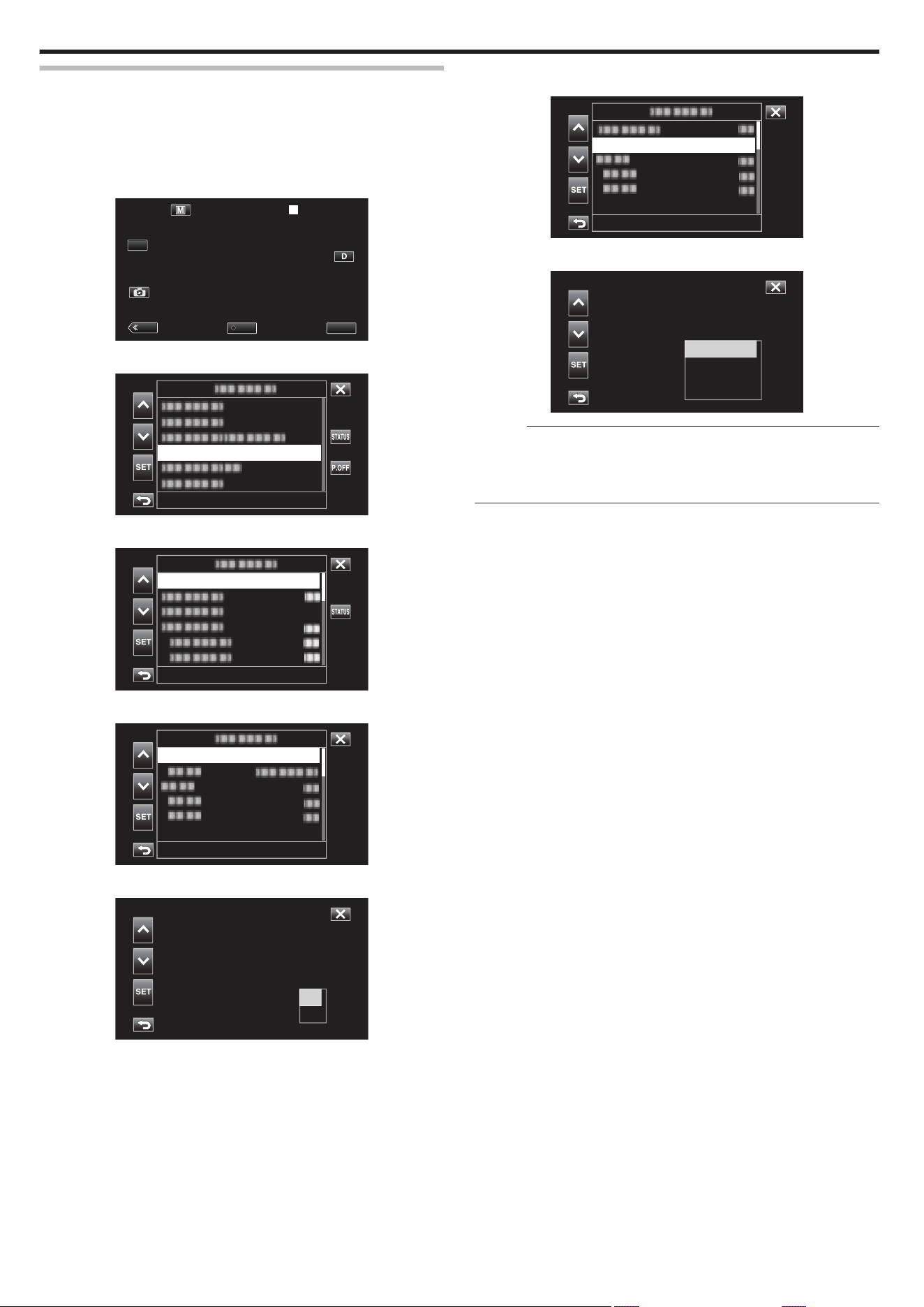
Using the Focus Assist Function
This function switches the display temporarily to black-and-white and
displays the outline of the parts of the image that are in focus in color.
Adjust the focus until the part to set focus on is displayed in color.
The
color of the outline (multiple colors, red, green or blue) can be configured
in the menu.
1
Tap “MENU”.
.
MENUREC
PLAY
SLOT
STBY
00 : 00 : 00 . 00
2018 - 01 - 01
02 : 23 : 01
TC
2
Select “Monitor” with 3 or 2, followed by tapping “SET”.
.
Monitor...
3
Select “Shooting Assist” with 3 or 2, followed by tapping “SET”.
.
Shooting Assist...
4
Select “Focus Assist” with 3 or 2, followed by tapping “SET”.
.
OffFocus Assist
5
Select “On” with 3 or 2, followed by tapping “SET”.
.
On
Off
6
Select “Color” with 3 or 2, followed by tapping “SET”.
.
MulticolorColor
7
Select the color of the outline with 3 or 2, followed by tapping “SET”.
.
Red
Green
Blue
Multicolor
Memo :
0
When
Focus Assist is used in a dimly-lit area, it may be difficult to identify
the colored outline of areas that are grainy.
0
Regardless of the “Display On TV” setting in “Video Set”, Focus Assist
effects cannot be output for display on a TV monitor.
Recording
24
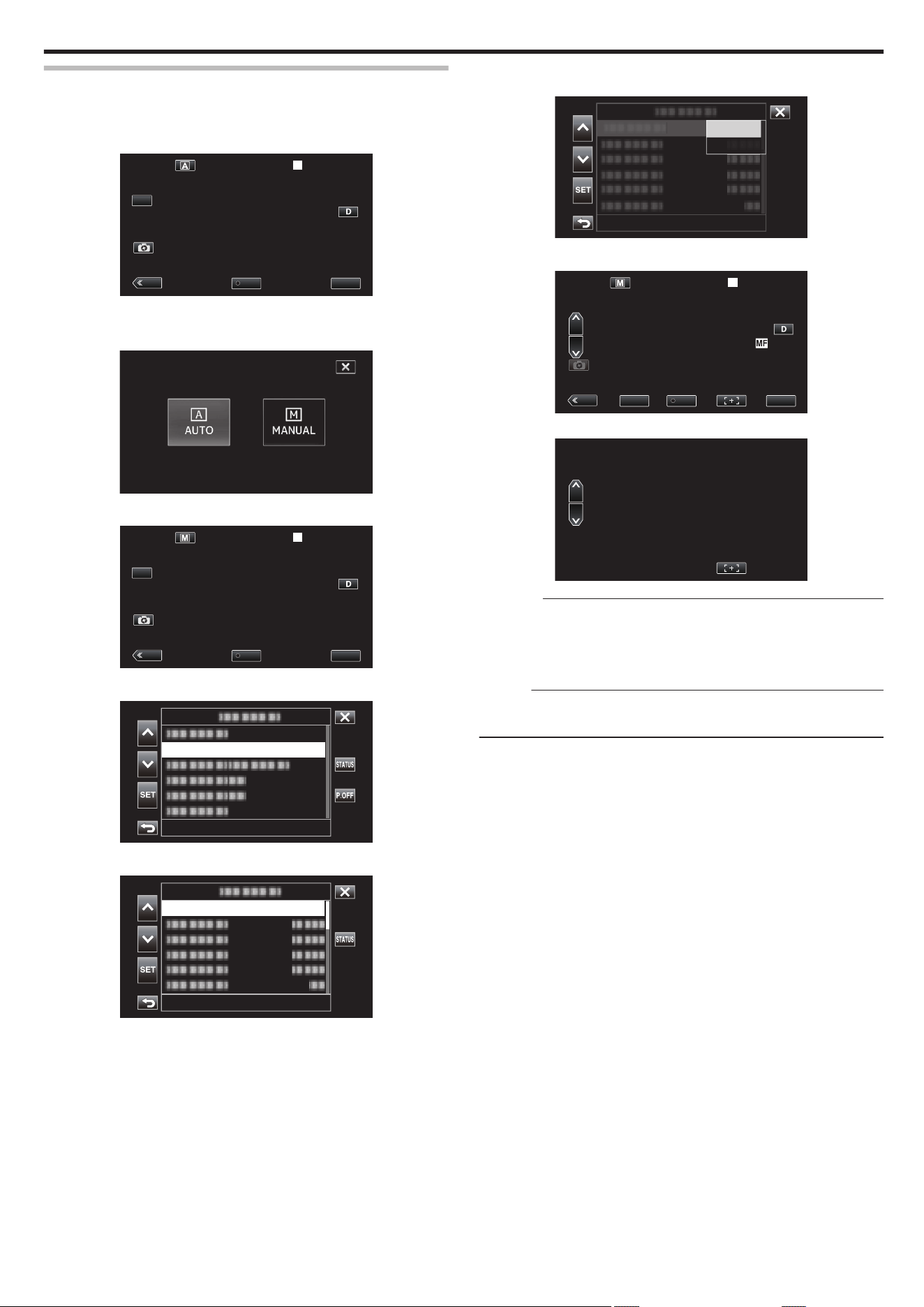
Enlarging the Image (EXPANDED) for Focus Adjustment
This function enlarges the area near the center of the image.
It is useful for checking or adjusting the focus.
1
Select the Manual recording mode.
.
MENUREC
PLAY
SLOT
STBY
00 : 00 : 00 . 00
2018 - 01 - 01
02 : 23 : 01
TC
0
If
the camera is in the n mode, tap n to display the mode selection
screen.
Tap H to switch the recording mode to Manual.
.
2
Tap “MENU”.
.
MENUREC
PLAY
SLOT
STBY
00 : 00 : 00 . 00
2018 - 01 - 01
02 : 23 : 01
TC
3
Select “Camera Process” with 3 or 2, followed by tapping “SET”.
.
Camera Process...
4
Select “Focus” with 3 or 2, followed by tapping “SET”.
.
AutoFocus
0
Tap L to exit the menu.
0
Tap J to return to the previous screen.
5
Select “Manual” with 3 or 2, followed by tapping “SET”.
.
Auto
Manual
6
Tap e.
.
MENUREC
PLAY
SET
0.2 m
STBY
00 : 00 : 00 . 00
2018 - 01 - 01
02 : 23 : 01
TC
0
Tap e to return to the previous screen.
.
EXPANDED
Caution :
0
Only
the part of the image where focus is to be adjusted manually appears
enlarged.
0
Images cannot be enlarged while recording is in progress.
0
Recording cannot be started while in the enlarged display mode.
Memo :
0
Magnifying an image does not alter the size of the recorded image.
0
Images that are output to the TV do not appear enlarged.
Recording
25
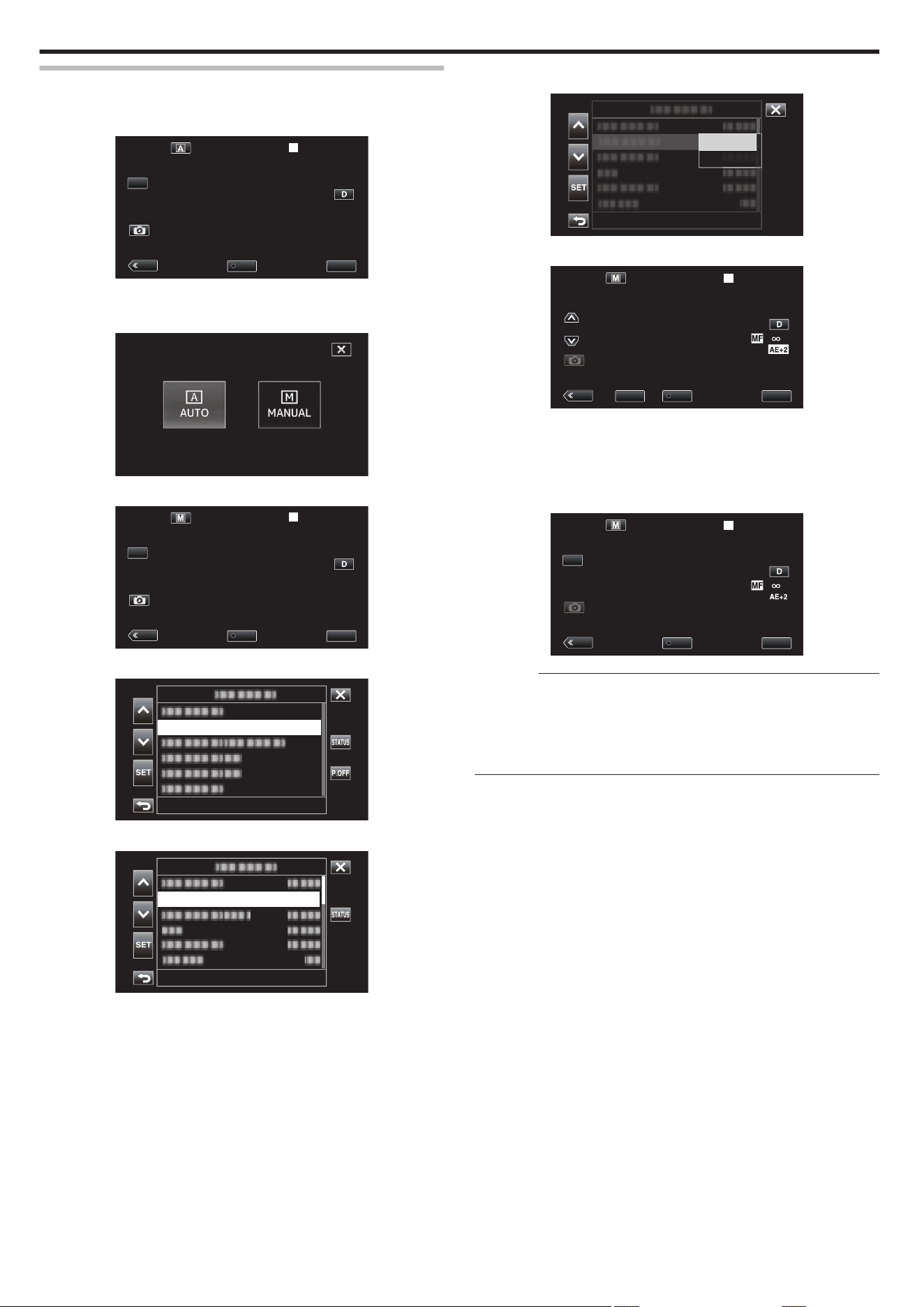
Adjusting Brightness
You can adjust the brightness to your preferred level.
1
Select the Manual recording mode.
.
MENUREC
PLAY
SLOT
STBY
00 : 00 : 00 . 00
2018 - 01 - 01
02 : 23 : 01
TC
0
If
the camera is in the n mode, tap n to display the mode selection
screen.
Tap H to switch the recording mode to Manual.
.
2
Tap “MENU”.
.
MENUREC
PLAY
SLOT
STBY
00 : 00 : 00 . 00
2018 - 01 - 01
02 : 23 : 01
TC
3
Select “Camera Process” with 3 or 2, followed by tapping “SET”.
.
Camera Process...
4
Select “Brightness Adjust” with 3 or 2, followed by tapping “SET”.
.
AutoBrightness Adjust
0
Tap L to exit the menu.
0
Tap J to return to the previous screen.
5
Select “Manual” with 3 or 2, followed by tapping “SET”.
.
Auto
Manual
6
Adjust the brightness value.
.
MENUREC
PLAY
SET
m
STBY
00 : 00 : 00 . 00
2018 - 01 - 01
02 : 23 : 01
TC
0
Compensation range: -6 to +6
0
Tap 3 to increase the brightness.
0
Tap 2 to decrease the brightness.
0
Pressing and holding down the key allows focus to be adjusted
continuously.
7
Tap “SET” to confirm.
.
MENUREC
PLAY
SLOT
m
STBY
00 : 00 : 00 . 00
2018 - 01 - 01
02 : 23 : 01
TC
Caution :
0
Brightness Adjust cannot be selected in the following cases.
–
During Auto recording
– When “Shutter Speed”, “Aperture” and “Gain Up” are set to “Manual”
– When “Backlight Comp” is set to “On”
– When “Lolux” is set to “On”
Recording
26
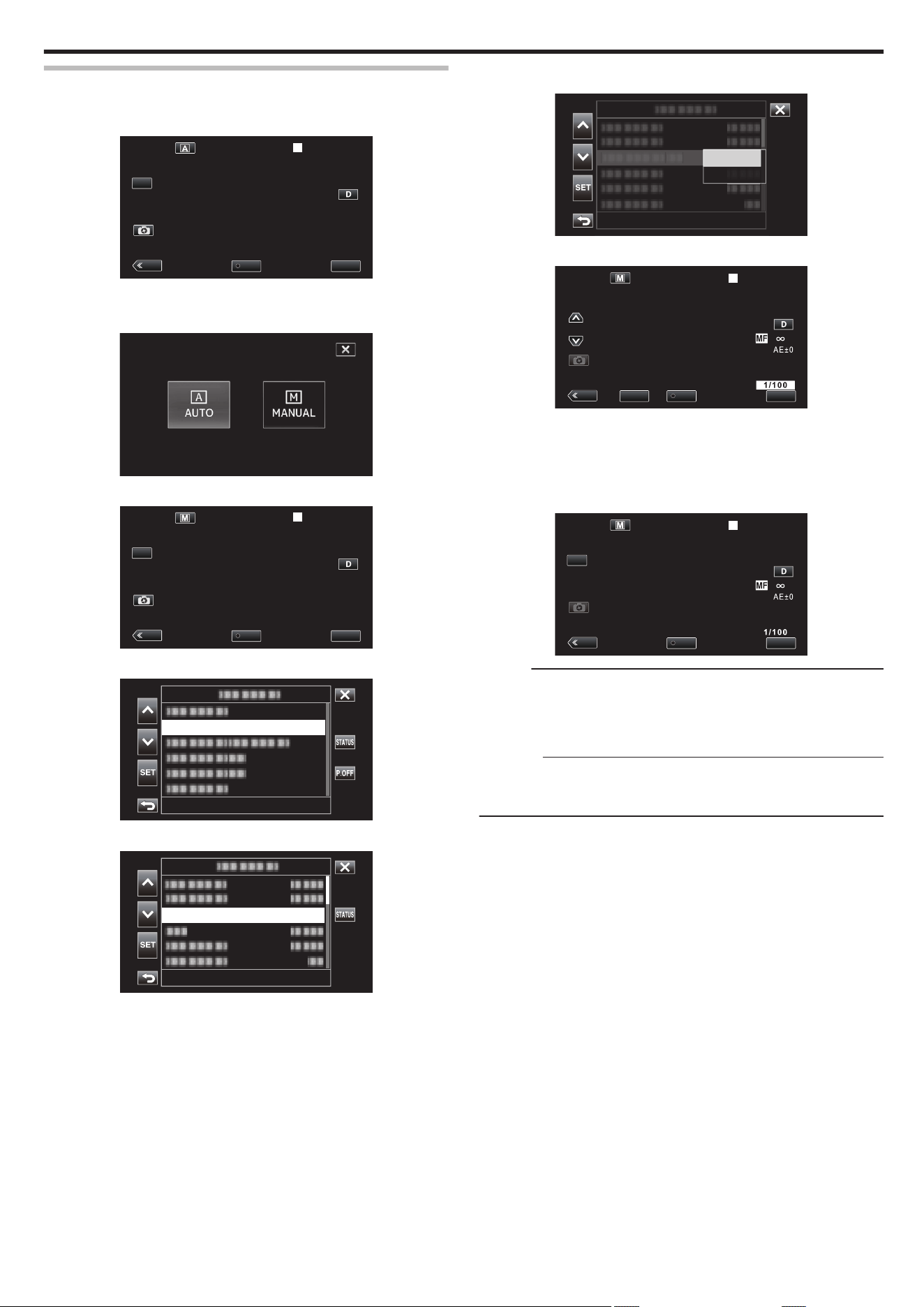
Setting Shutter Speed
You can set the shutter speed to suit the type of subject.
1
Select the Manual recording mode.
.
MENUREC
PLAY
SLOT
STBY
00 : 00 : 00 . 00
2018 - 01 - 01
02 : 23 : 01
TC
0
If
the camera is in the n mode, tap n to display the mode selection
screen.
Tap H to switch the recording mode to Manual.
.
2
Tap “MENU”.
.
MENUREC
PLAY
SLOT
STBY
00 : 00 : 00 . 00
2018 - 01 - 01
02 : 23 : 01
TC
3
Select “Camera Process” with 3 or 2, followed by tapping “SET”.
.
Camera Process...
4
Select “Shutter Speed” with 3
or 2, followed by tapping “SET”.
.
AutoShutter Speed
0
Tap L to exit the menu.
0
Tap J to return to the previous screen.
5
Select “Manual” with 3 or 2, followed by tapping “SET”.
.
Auto
Manual
6
Adjust the shutter speed.
.
MENUREC
PLAY
SET
m
STBY
00 : 00 : 00 . 00
2018 - 01 - 01
02 : 23 : 01
TC
0
Shutter speed can be set from 1/7.5 to 1/10000.
0
Tap 3 to increase the shutter speed.
0
Tap 2 to decrease the shutter speed.
0
Pressing and holding down the key allows focus to be adjusted
continuously.
7
Tap “SET” to confirm.
.
MENUREC
PLAY
SLOT
m
STBY
00 : 00 : 00 . 00
2018 - 01 - 01
02 : 23 : 01
TC
Memo :
0
While
fast-moving subjects can be captured clearly by increasing “Shutter
Speed”, the screen may appear darker. When recording in dark places
such as indoors, check the brightness of the LCD monitor and set “Shutter
Speed” accordingly.
Caution :
0
Shutter Speed cannot be selected in the following cases.
- During Auto recording
- When “Lolux” is set to “On”
Recording
27
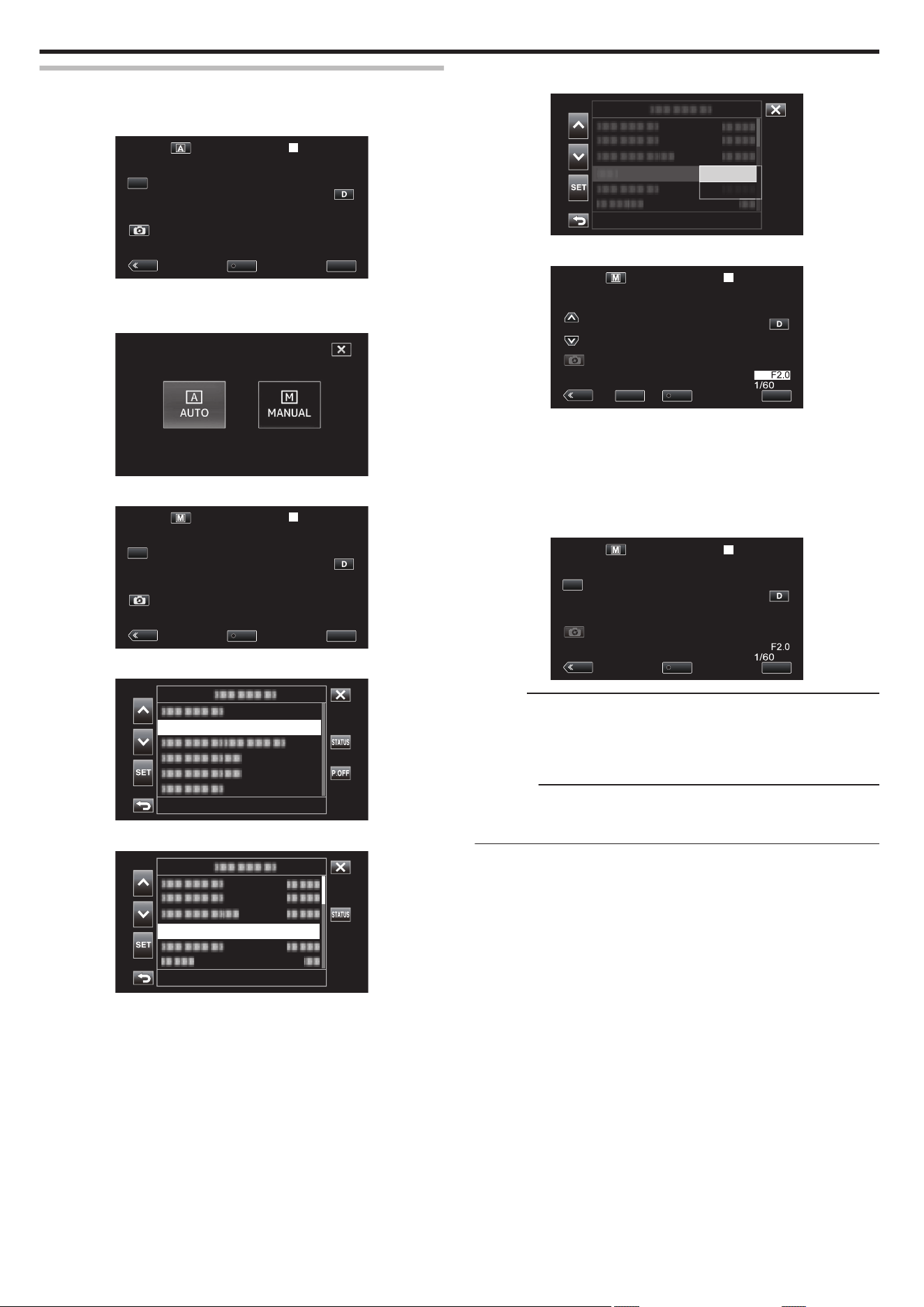
Setting Aperture
You can adjust the aperture to change the area of focus.
1
Select the Manual recording mode.
.
MENUREC
PLAY
SLOT
STBY
00 : 00 : 00 . 00
2018 - 01 - 01
02 : 23 : 01
TC
0
If
the camera is in the n mode, tap n to display the mode selection
screen.
Tap H to switch the recording mode to Manual.
.
2
Tap “MENU”.
.
MENUREC
PLAY
SLOT
STBY
00 : 00 : 00 . 00
2018 - 01 - 01
02 : 23 : 01
TC
3
Select “Camera Process” with 3 or 2, followed by tapping “SET”.
.
Camera Process...
4
Select “Aperture” with 3 or 2, followed by tapping “SET”.
.
AutoAperture
0
Tap L to exit the menu.
0
Tap J to return to the previous screen.
5
Select “Manual” with 3 or 2, followed by tapping “SET”.
.
オート
オ
ー
ト
Auto
Manual
6
Adjust the aperture.
.
MENUREC
PLAY
SET
STBY
00 : 00 : 00 . 00
2018 - 01 - 01
02 : 23 : 01
TC
0
Aperture can be set to a value between F1.8 and F4.0.
0
If you want the background to be in focus as well (larger aperture
value), tap 2.
0
If you want the background to appear blurry (smaller aperture value),
tap 3.
0
Pressing and holding down the key allows focus to be adjusted
continuously.
7
Tap “SET” to confirm.
.
MENUREC
PLAY
SLOT
STBY
00 : 00 : 00 . 00
2018 - 01 - 01
02 : 23 : 01
TC
Memo :
0
When
zooming to the Tele end, the aperture value is set according to the
zoom and indicated in yellow. The aperture value in this case will be
different from the preset value.
0
The larger the aperture value, the darker the subject may appear.
Caution :
0
Aperture cannot be selected in the following cases.
- During Auto recording
- When “Lolux” is set to “On”
Recording
28
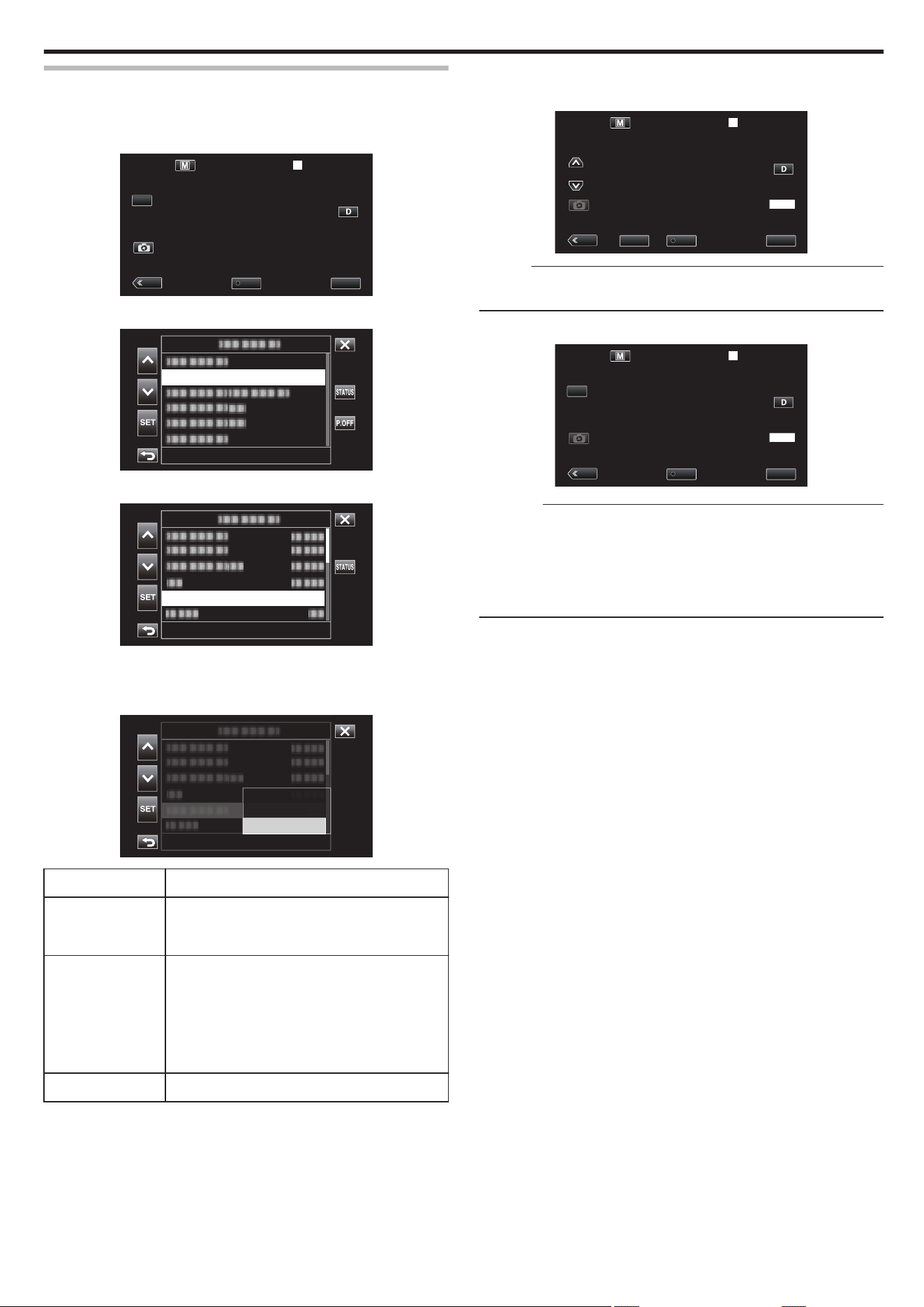
Increasing the Light Sensitivity Level
Automatically increases the light sensitivity when the subject is not bright
enough.
1
Tap “MENU”.
.
MENUREC
PLAY
SLOT
STBY
00 : 00 : 00 . 00
2018 - 01 - 01
02 : 23 : 01
TC
2
Select “Camera Process” with 3 or 2, followed by tapping “SET”.
.
Camera Process...
3
Select “Gain Up” with 3 or 2, followed by tapping “SET”.
.
AGC
Gain Up
0
Tap L to exit the menu.
0
Tap J to return to the previous screen.
4
Select the desired item with 3 or 2, followed by tapping “SET”.
.
AGC
Manual
Auto Slow-Shutter
Setting Description
Auto Slow-Shutter
Low-speed shutter that can be used to express
dynamic
motion. (However, it may result in blurring
due to camera shake.)
Manual
Manually adjust the brightness.
The brightness level can be configured to one of
the following values.
A larger value indicates a higher light sensitivity
level.
0dB, 3dB, 6dB, 9dB, 12dB, 15dB, 18dB, 21dB,
24dB
AGC Adjusts the brightness automatically.
<Go to Step 5 if Manual is selected>
5
Adjust the brightness to the desired level with 3
and 2.
.
MENUREC
PLAY
SET
STBY
00 : 00 : 00 . 00
2018 - 01 - 01
02 : 23 : 01
TC
0dB
Memo :
0
Increasing the light sensitivity level may cause the image to appear
grainier.
6
Tap “SET” to confirm.
.
MENUREC
PLAY
STBY
00 : 00 : 00 . 00
2018 - 01 - 01
02 : 23 : 01
TC
12dB
SLOT
Caution :
0
This function is not available for selection when “Lolux” is set to “On”.
0
“Manual” is not available for selection in the Auto Recording mode.
0
This
function is fixed at “AGC” in the Auto Recording mode when “System”
is set to “High-Speed”.
0
“Auto Slow-Shutter” is not available for selection in the Manual Recording
mode when “System” is set to “High-Speed”.
Recording
29
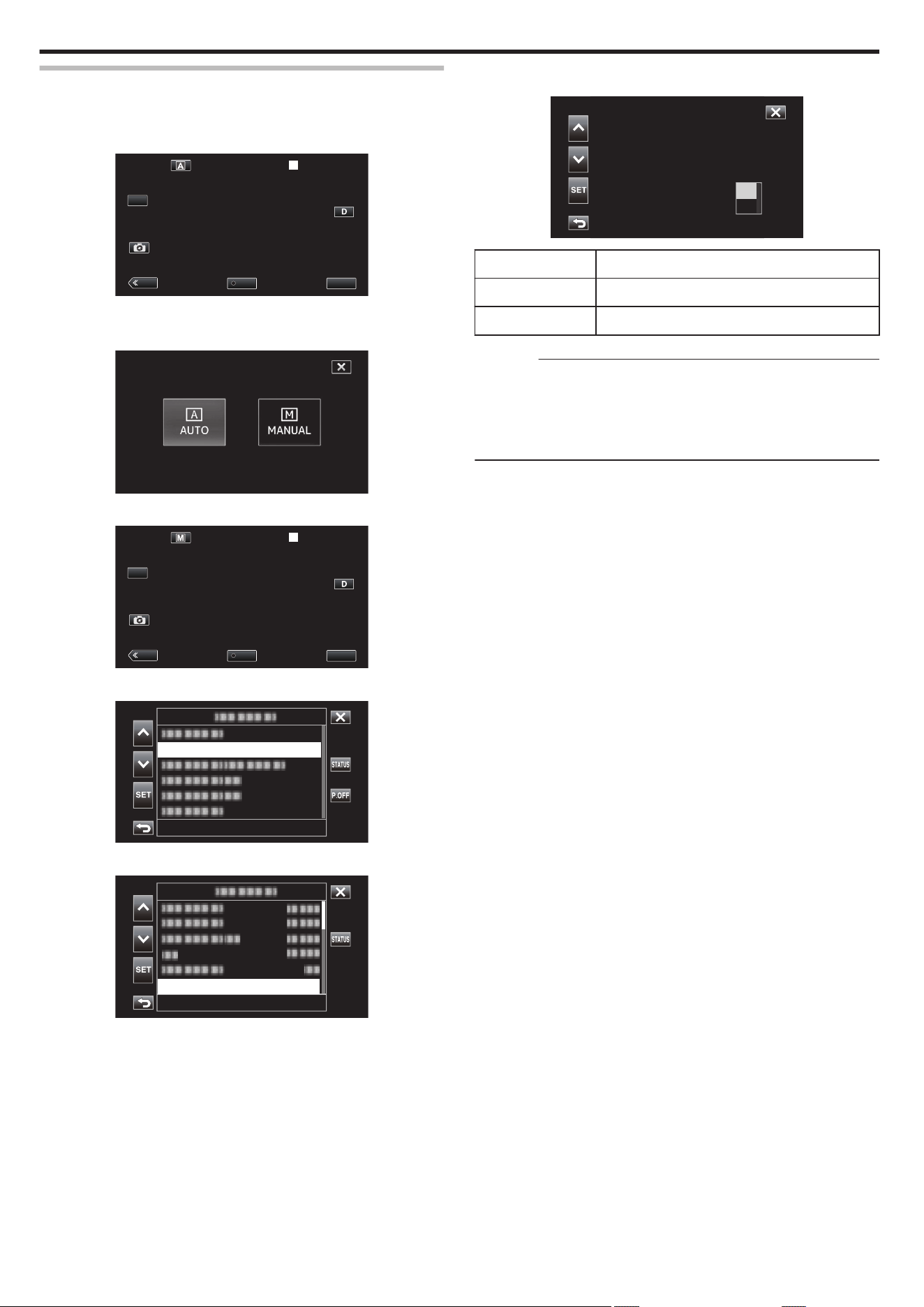
Setting Backlight Compensation
You can correct the image when the subject appears too dark due to
backlight.
1
Select the Manual recording mode.
.
MENUREC
PLAY
SLOT
STBY
00 : 00 : 00 . 00
2018 - 01 - 01
02 : 23 : 01
TC
0
If
the camera is in the n mode, tap n to display the mode selection
screen.
Tap H to switch the recording mode to Manual.
.
2
Tap “MENU”.
.
MENUREC
PLAY
SLOT
STBY
00 : 00 : 00 . 00
2018 - 01 - 01
02 : 23 : 01
TC
3
Select “Camera Process” with 3 or 2, followed by tapping “SET”.
.
Camera Process...
4
Select “Backlight Comp” with 3 or 2, followed by tapping “SET”.
.
OffBacklight Comp
0
Tap L to exit the menu.
0
Tap J to return to the previous screen.
5
Select “On” with 3 or 2, followed by tapping “SET”.
.
Off
On
Setting Details
On Backlight compensation is enabled.
Off Backlight compensation is disabled.
Caution :
0
Backlight Comp cannot be selected in the following cases.
–
During Auto recording
– When “System” is set to “High-Speed”
– When “Shutter Speed”, “Aperture” and “Gain Up” are set to “Manual”
– When “Lolux” is set to “On”
Recording
30
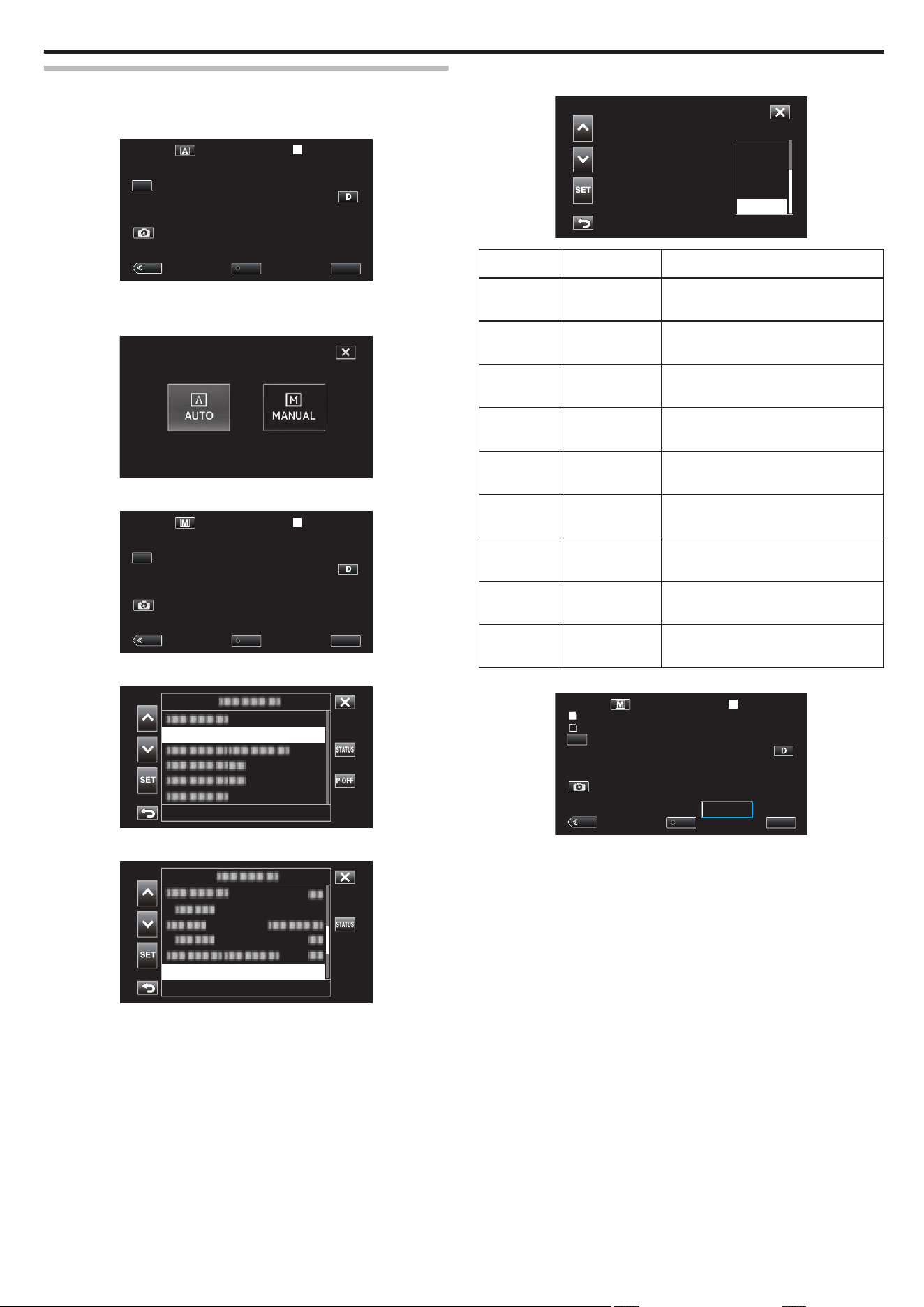
Setting White Balance
You can set the color tone to suit the light source.
1
Select the Manual recording mode.
.
MENUREC
PLAY
SLOT
STBY
00 : 00 : 00 . 00
2018 - 01 - 01
02 : 23 : 01
TC
0
If
the camera is in the n mode, tap n to display the mode selection
screen.
Tap H to switch the recording mode to Manual.
.
2
Tap “MENU”.
.
MENUREC
PLAY
SLOT
STBY
00 : 00 : 00 . 00
2018 - 01 - 01
02 : 23 : 01
TC
3
Select “Camera Process” with 3 or 2, followed by tapping “SET”.
.
Camera Process...
4
Select “White Balance” with 3 or 2, followed by tapping “SET”.
.
Auto
White Balance
0
Tap L to exit the menu.
0
Tap J to return to the previous screen.
5
Select
a white balance setting with 3 or 2, followed by tapping “SET”.
.
Marine1
Halogen
Cloud
Fine
Auto
Setting Display Description
Auto None
Adjusts automatically to the natural
colors.
Fine <FINE>
Set this when shooting outdoors on a
sunny day.
Cloud <CLOUD>
Set this when shooting on a cloudy day
or inside a shade.
Halogen <HALOGEN>
Set this when shooting under
illumination such as a video light.
Marine1 <MARINE 1>
Set this when shooting in deep waters
(water appears blue).
Marine2 <MARINE 2>
Set this when shooting in shallow
waters (water appears green).
Preset P< ****K>
Configure according to your
preference.
MWB A A< ****K>
Use this when the problem of unnatural
colors is not resolved.
MWB B B< ****K>
Use this when the problem of unnatural
colors is not resolved.
(****K: Color temperature)
.
MENU
PLAY
SLOT
REC
54min
- - - min
A
B
00 : 00 : 00 . 00
2018 - 01 - 01
02 : 23 : 01
TC
<
FINE
>
Recording
31
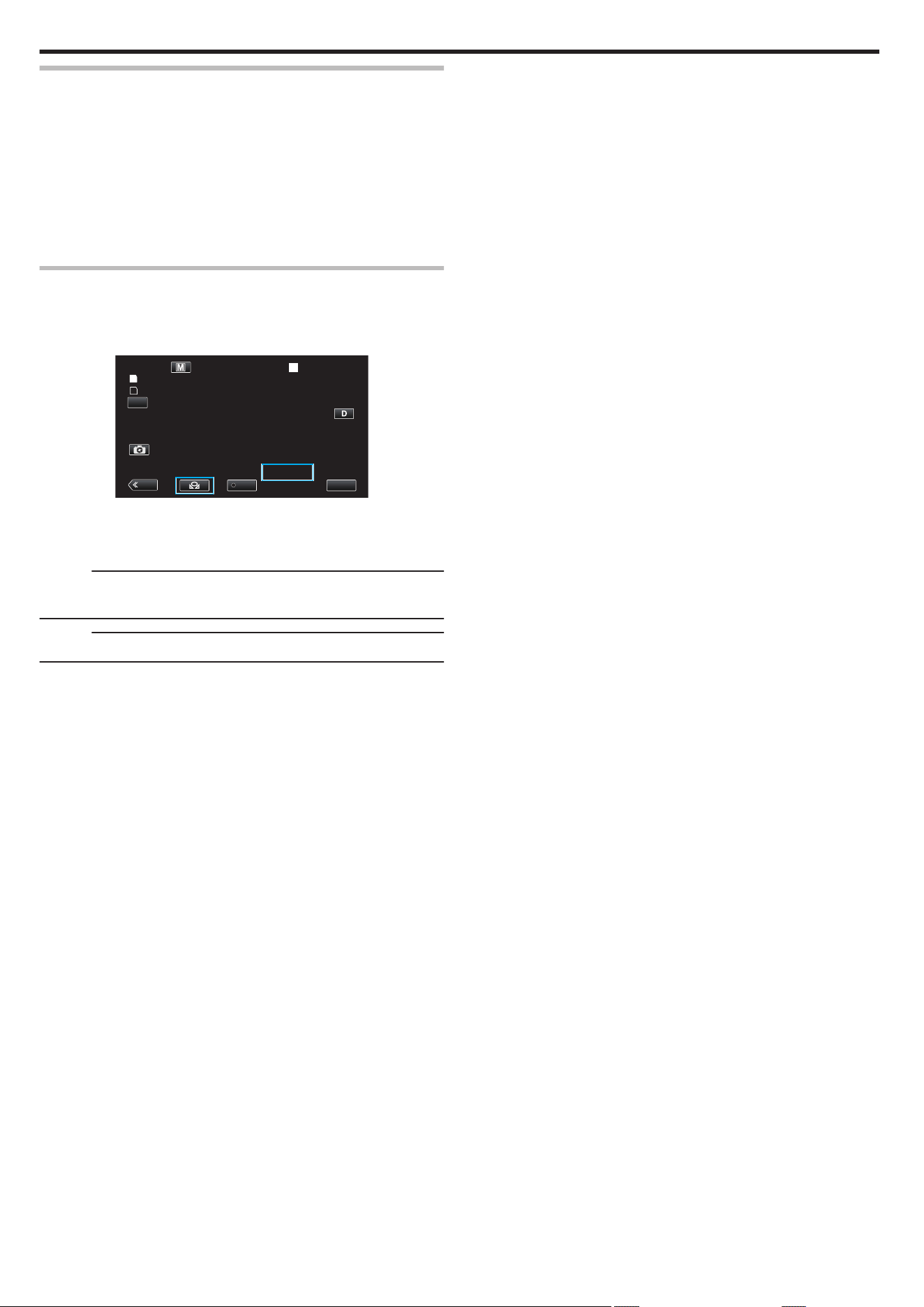
Using Preset
1
Select “Preset” with 3
or 2, followed by tapping “SET”.
2
In the Camera Process menu, select “Adjust” under White Balance,
followed by tapping “SET”.
3
Select “Preset Temp.” with 3 or 2, followed by tapping “SET”.
4
Select an appropriate color temperature with 3 or 2, followed by
tapping “SET”.
0
To specify the settings in greater detail, display the detailed color
temperature selection screen with 1.
To go back to the main color temperature setting screen, tap 1.
When using MWB A and MWB B
1
Select “MWB A” or “MWB B” with 3 or 2, followed by tapping “SET”.
2
Hold a sheet of plain white paper in front of the lens so that the white
paper fills the screen, followed by tapping l.
.
MENU
PLAY
SLOT
REC
54min
- - - min
A
B
00 : 00 : 00 . 00
2018 - 01 - 01
02 : 23 : 01
TC
A<
****
K>
0
“A<o>” or “B<o>” appears on the screen during the adjustment.
(The o icon starts to blink.)
0
After
color adjustment is complete, a rough estimation of the adjusted
color temperature will be displayed.
Memo :
0
Tapping o each time changes the color setting.
0
MWB A and MWB B can be configured to different colors.
Memo :
0
This is selectable only during Manual recording.
Recording
32
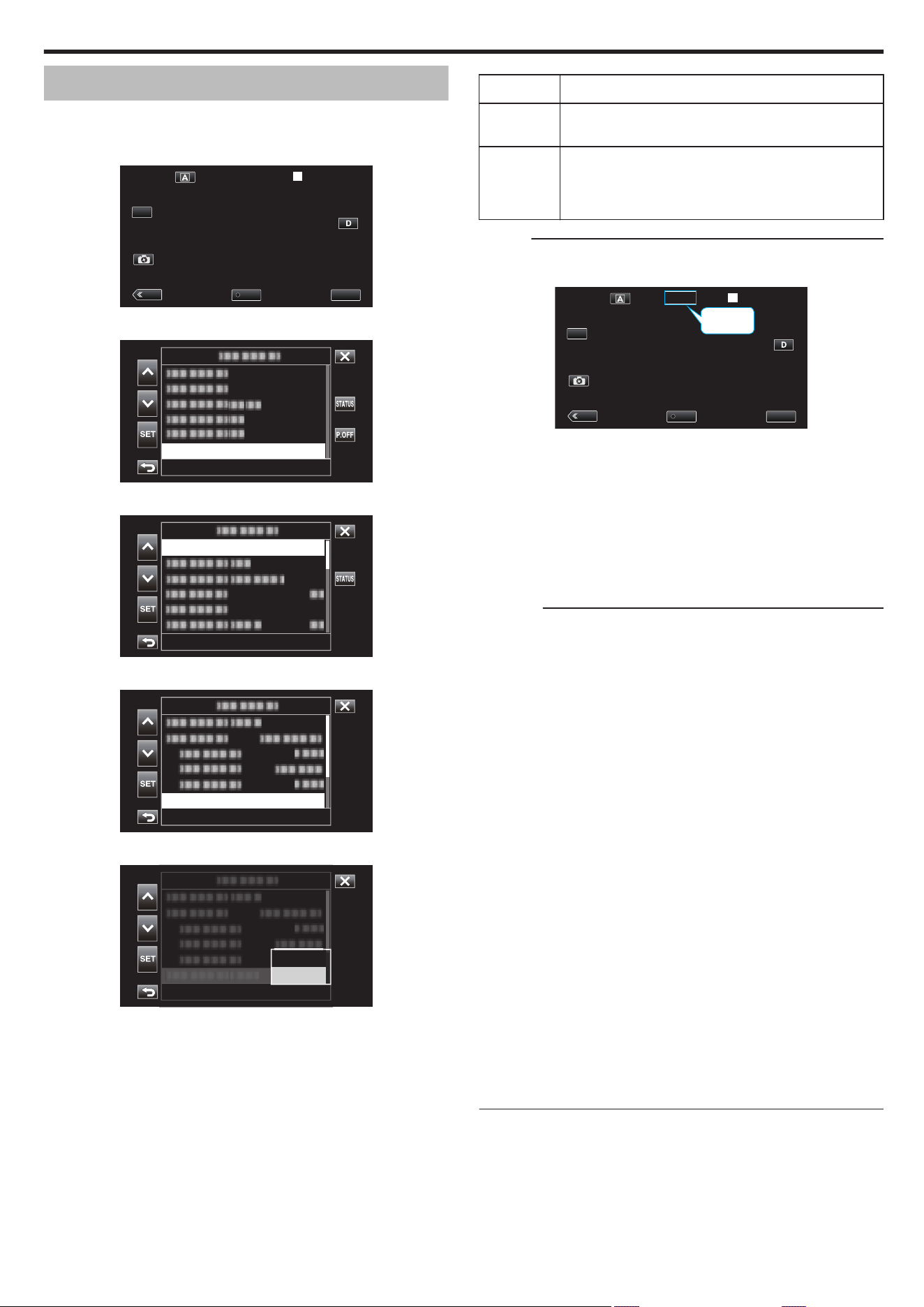
Recording Data to Both Slot A and Slot B
Inserting an SD card into each of Slot A and Slot B enables “continuous
recording to both SD cards” or “simultaneous recording to both SD cards”.
1
Tap “MENU”.
.
MENUREC
PLAY
SLOT
STBY
00 : 00 : 00 . 00
2018 - 01 - 01
02 : 23 : 01
TC
2
Select “System” with 3 or 2, followed by tapping “SET”.
.
System...
3
Select “Record Set” with 3 or 2, followed by tapping “SET”.
.
Record Set...
4
Select “Slot Mode” with 3 or 2, followed by tapping “SET”.
.
SeriesSlot Mode
5
Select
the method of recording with 3 or 2, followed by tapping “SET”.
.
Dual
Series
Item Description
Dual
Records videos simultaneously to the SD cards in both
slots if data can be recorded to the SD cards inserted.
Series
When recordable SD cards are inserted into both the card
slots, recording starts with the card in the selected card
slot. When the space on this card runs out, recording
continues with the card in the other slot.
Memo :
0
“Series” is configured by default.
0
“DUAL” appears on the recording screen while in the Dual Rec mode.
.
MENUREC
PLAY
SLOT
DUAL
00 : 00 : 00 . 00
2018 - 01 - 01
02 : 23 : 01
TC
DUAL
0
The icons for both SD cards are lit in red while Dual Recording is in
progress.
0
During
recording in the Dual Rec mode to two cards with a different amount
of remaining space, recording to both slots will stop automatically if the
space on one card runs out. After recording stops, recording automatically
resumes for the card with remaining space.
0
If the last recorded file on the SD cards that are inserted in the two slots
are different from each other, and “TC Generator” is set to “Regen”, the
Regen mode for the selected card slot will be enabled in the next
recording.
Caution :
0
When
“System” is set to “4K” or “High-Speed”, Dual Recording cannot be
configured.
0
To perform recording in the Dual Rec mode, it is recommended that this
be done using two formatted SD cards with the same capacity.
0
Dual Recording can be used concurrently with the Special Effect
Recording mode.
Even while the camera is in the Dual Rec mode, it is possible to configure
“Rec Mode” to “Normal”, “Pre Rec”, “Scene Continuous”, or “Time-Lapse
Rec”.
0
Dual Recording (simultaneous recording) can be performed when both
slots are inserted with recordable SD cards. If a recordable SD card is only
inserted in one of the slots, it is possible to start recording with one card.
0
In the Dual Rec mode, it is not possible to continue recording by switching
from the card in one slot to that in the other slot. Continuous recording will
not be performed if a recordable SD card is inserted into a slot after
recording to the card in the other slot has started.
0
If recording to one slot is in progress when the camera is configured to the
Dual Rec mode, inserting a recordable media to the other slot does not
enable the Dual Recording operation. To perform the Dual Recording
operation, stop recording (excluding pausing recording in the Continuous
Scene Rec mode) and start again.
0
When one of the SD cards is accidentally removed while recording is in
progress in the Dual Rec mode, recording to the card in the other slot will
continue. However, it may not be possible to repair the accidentally
removed card with the recovery function.
0
If an error occurs on one of the cards while recording is in progress in the
Dual Rec mode, recording to the malfunctioning card stops, while that to
the other card continues.
0
Operations such as deleting and protecting scenes of videos recorded in
the Dual Rec mode can only be performed on the SD card in the selected
slot.
Recording
33
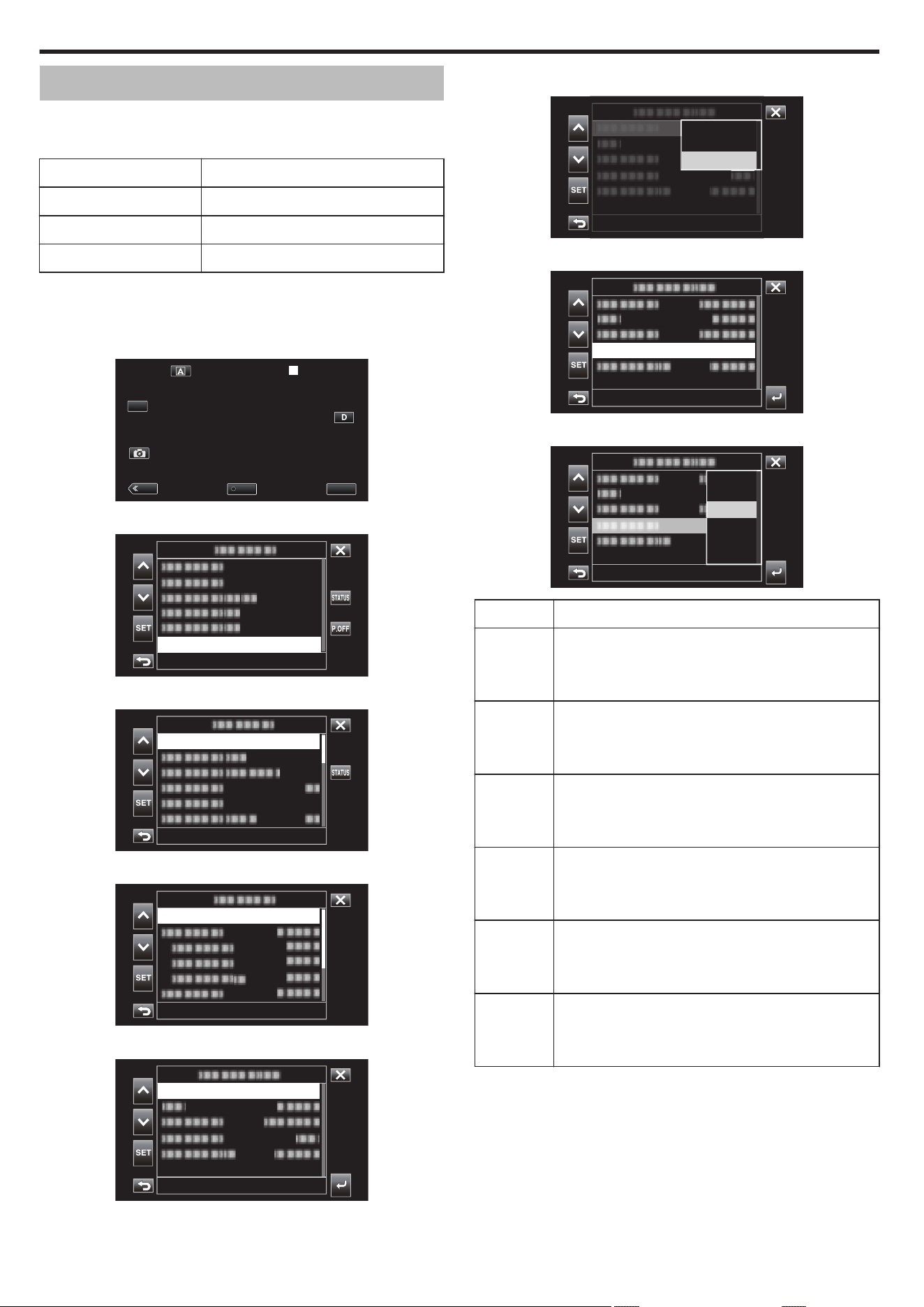
Slow-motion (High-speed) Recording
You
can record videos in slow-motion by increasing the recording speed to
emphasize the movements, and play back the slow-motion video smoothly.
Playing back casual scenes in slow motion helps to add a dramatic effect.
Item Value
Recording Speed 100 fps, 50 fps, 120 fps, 60 fps
Image Size 1920×1080
Bit rate 16 Mbps
0
The playback time will be 2 or 4 times of the actual recorded time.
(Example: If the recorded time is 1 minute, the playback time will be 2 or
4 minutes.)
1
Tap “MENU”.
.
MENUREC
PLAY
SLOT
STBY
00 : 00 : 00 . 00
2018 - 01 - 01
02 : 23 : 01
TC
2
Select “System” with 3 or 2, followed by tapping “SET”.
.
System...
3
Select “Record Set” with 3 or 2, followed by tapping “SET”.
.
Record Set...
4
Select “Record Format” with 3 or 2, followed by tapping “SET”.
.
Record Format...
5
Select “System” with 3 or 2, followed by tapping “SET”.
.
HD
System
6
Select “High-Speed” with 3 or 2, followed by tapping “SET”.
.
High-Speed
4K
HD
7
Select “Frame Rate” with 3 or 2, followed by tapping “SET”.
.
120/30p
Frame Rate
8
Select the recording speed with 3 or 2, followed by tapping “SET”.
.
60/30p
120/30p
100/50p
120/60p
100/25p
50/25p
Item Description
120/60p Records at 120 fps with a playback time that is 2 times
longer.
(Example) The playback time of a 1 minute video will be 2
minutes.
100/50p Records at 100 fps with a playback time that is 2 times
longer.
(Example) The playback time of a 1 minute video will be 2
minutes.
120/30p Records at 120 fps with a playback time that is 4 times
longer.
(Example) The playback time of a 1 minute video will be 4
minutes.
100/25p Records at 100 fps with a playback time that is 4 times
longer.
(Example) The playback time of a 1 minute video will be 4
minutes.
60/30p Records at 60 fps with a playback time that is 2 times
longer.
(Example) The playback time of a 1 minute video will be 2
minutes.
50/25p Records at 50 fps with a playback time that is 2 times
longer.
(Example) The playback time of a 1 minute video will be 2
minutes.
Recording
34
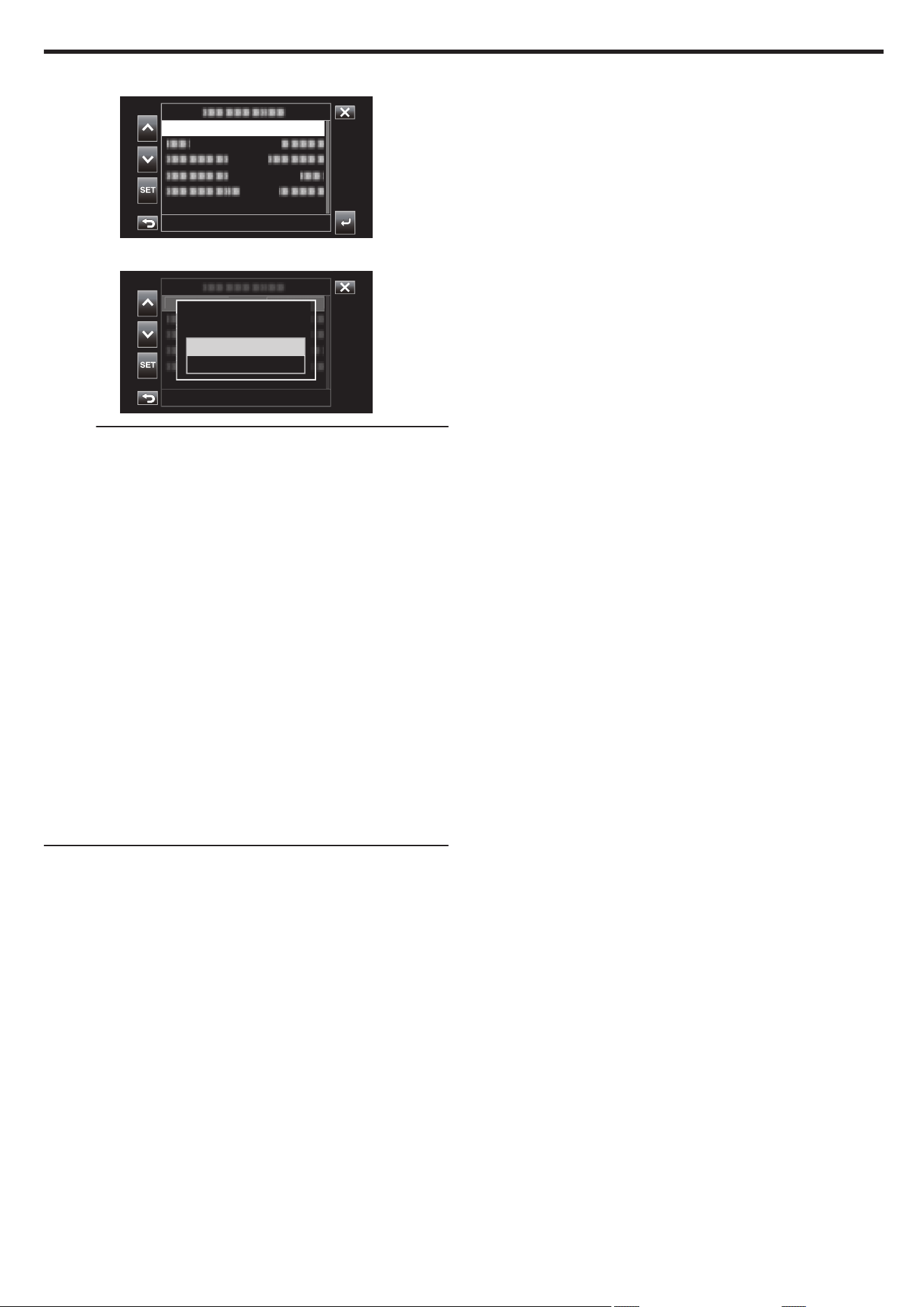
9
Tap J or O.
.
High-Speed
System
10
Select “Apply” with 3 or 2, followed by tapping “SET”.
.
Cancel
Apply
Apply Record Format?
Memo :
0
Fixes the recording mode at Normal.
0
Images
may appear grainier than other videos. It is recommended that the
subject be captured in a size that is as big as possible. The image
displayed on the LCD monitor during recording may also appear grainier.
0
Audio will not be recorded.
0
When high-speed recording is enabled, only the optical zoom can be
used.
0
During high-speed recording, “Touch Priority AE/AF” is set to “Off”. In
addition, as “DIS” is set to “Off”, it is recommended that a tripod be used,
and recording be performed at a bright location.
“Tripod Mounting” (A p. 15)
0
Only “Rec Run” or “Regen” can be selected for “TC Generator”.
0
It is not possible to configure a shutter speed that is slower than the frame
rate setting.
(Example: When the frame rate setting is 120/60p, the shutter speed can
be configured to a value between 1/120 and 1/10000.)
0
The media remaining indication displays the total playback time when
playing back the scenes recorded before the remaining space on the
media becomes “0”.
0
The remaining space on the media will decrease at a faster rate than usual.
(Example: As recording is performed at a speed that is 2 times slower than
usual at 120/60p, the remaining space on the media will decrease at a rate
that is about 2 times faster.)
0
The screen may darken for 5 to 6 seconds when the recording format
setting is changed.
Recording
35
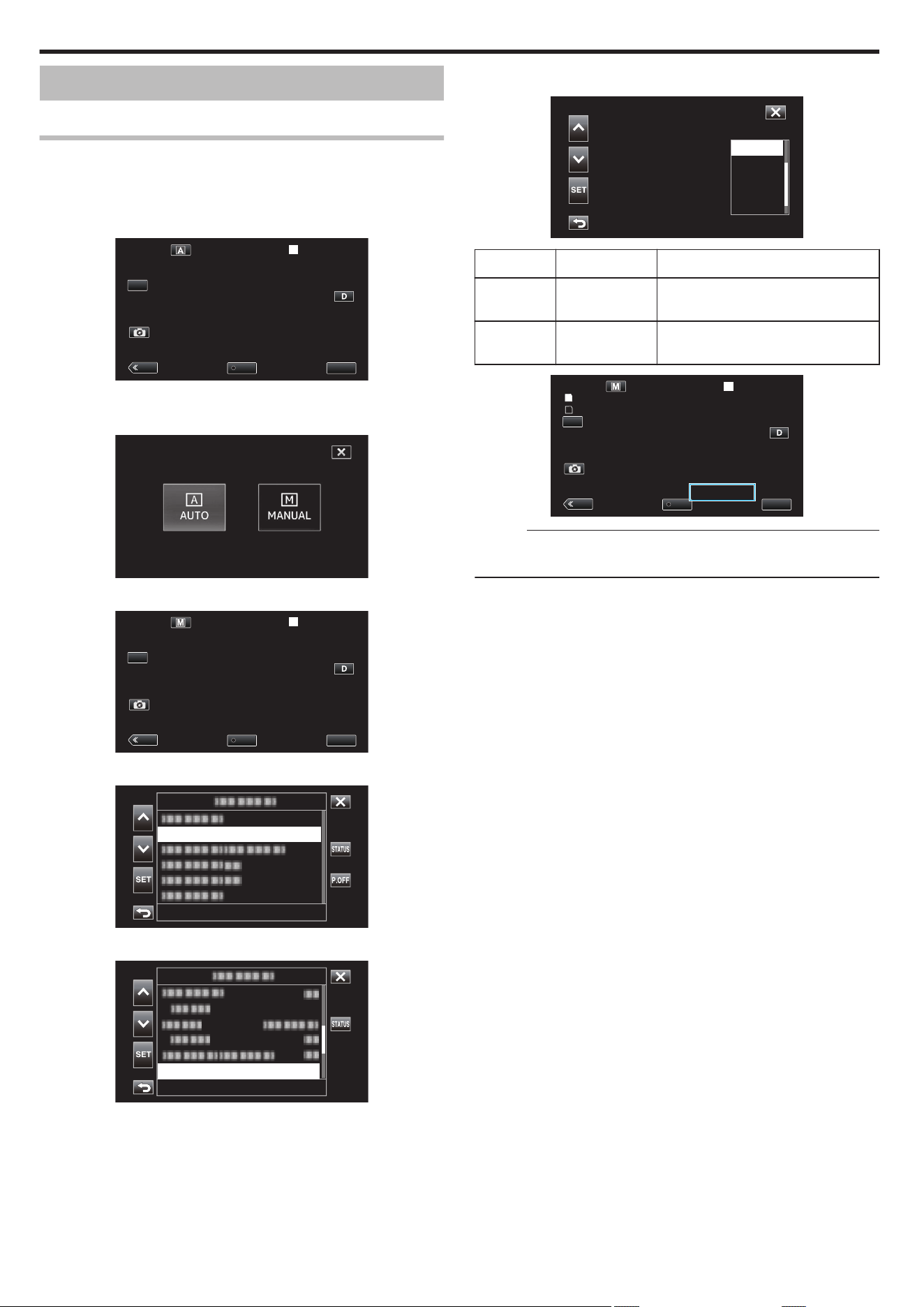
Shooting under Water
Perform the following settings to shoot underwater.
Setting the White Balance to Underwater Mode
Corrects the color when shooting underwater to record more natural images.
Select
from the following two settings depending on the color of the water at
the shooting location.
1
Select the Manual recording mode.
.
MENUREC
PLAY
SLOT
STBY
00 : 00 : 00 . 00
2018 - 01 - 01
02 : 23 : 01
TC
0
If
the camera is in the n mode, tap n to display the mode selection
screen.
Tap H to switch the recording mode to Manual.
.
2
Tap “MENU”.
.
MENUREC
PLAY
SLOT
STBY
00 : 00 : 00 . 00
2018 - 01 - 01
02 : 23 : 01
TC
3
Select “Camera Process” with 3 or 2, followed by tapping “SET”.
.
Camera Process...
4
Select “White Balance” with 3 or 2, followed by tapping “SET”.
.
Auto
White Balance
5
Select “Marine1” or “Marine2” with 3 or 2, followed by tapping “SET”.
.
Marine2
Marine1
Halogen
Cloud
Fine
Setting Display Description
Marine1 <MARINE 1> Set this when shooting in deep waters
(water appears blue).
Marine2 <MARINE 2> Set this when shooting in shallow
waters (water appears green).
.
MENU
PLAY
SLOT
REC
54min
- - - min
A
B
00 : 00 : 00 . 00
2018 - 01 - 01
02 : 23 : 01
TC
<
MARINE 1
>
Memo :
0
You may not necessarily achieve the correction effect as expected.
0
It is recommended to conduct a trial recording in advance.
Recording
36
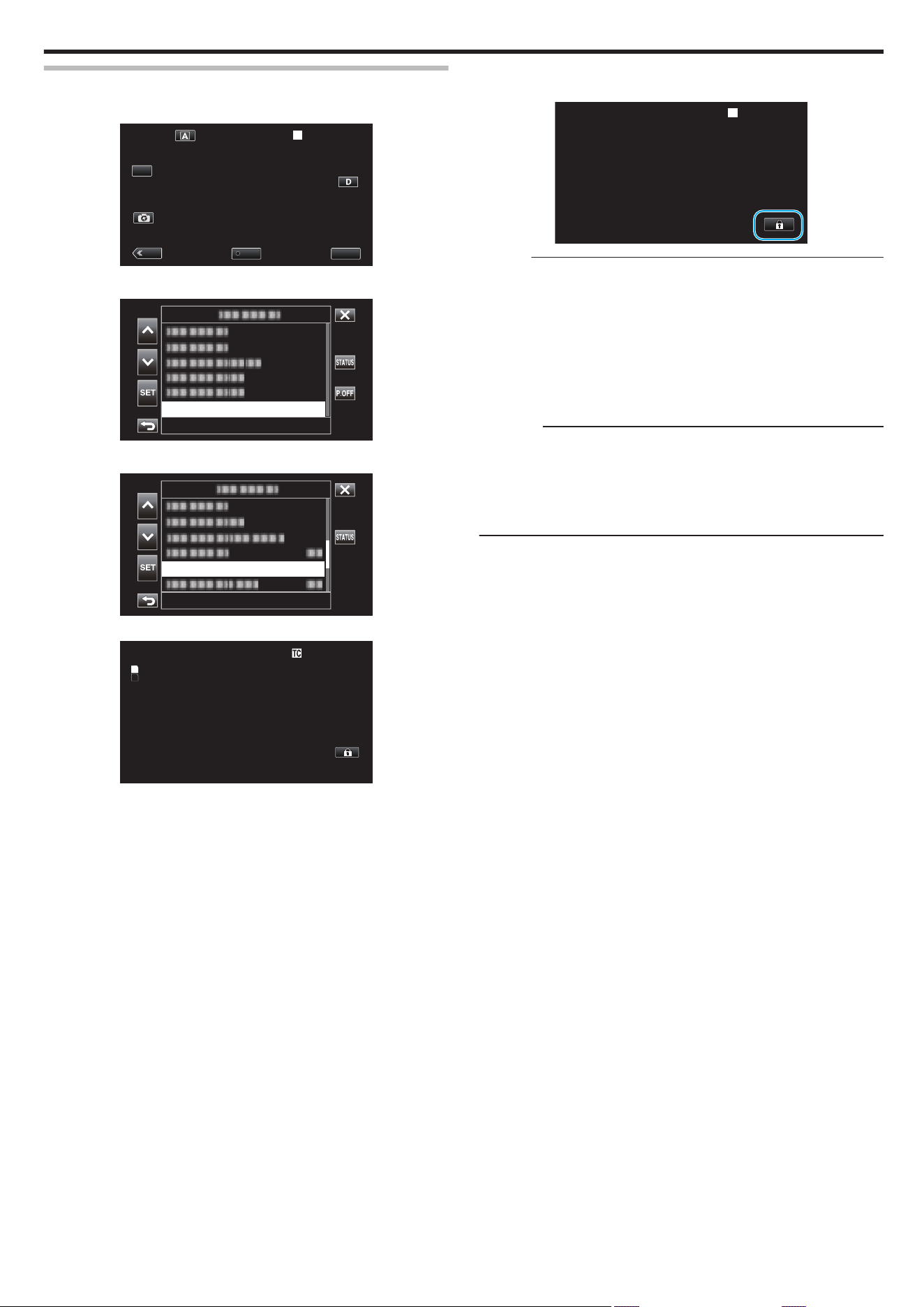
Locking the Screen
1
Tap “MENU”.
.
MENUREC
PLAY
SLOT
STBY
00 : 00 : 00 . 00
2018 - 01 - 01
02 : 23 : 01
TC
2
Select “System” with 3 or 2, followed by tapping “SET”.
.
System...
3
Select “Screen Lock” with 3
or 2, followed by tapping “SET”.
.
Screen Lock
0
The L button appears.
.
STBY
00:02:15.04
54min
---min
A
B
o
To Cancel “Screen Lock”
Tap the L button.
.
STBY
00 : 00 : 00 . 00
TC
Memo :
0
Once “Screen Lock” is set, only the L
button on the touch screen can be
operated.
0
The START/STOP (recording) button and the zoom lever can be used
while the screen is locked.
0
“Screen Lock” cannot be set for the following cases:
- During recording
- When “System” is set to “High-Speed”
- When “Time-Lapse Rec” is configured
- When connected to Wi-Fi
Caution :
0
Before using the camera underwater, read “Before Using Underwater or
under Low Temperature” (A p.
18) carefully. Improper usage resulting in
water submersion will damage the device and cause injury.
0
Ensure that the terminal cover is closed tightly before using underwater or
on the beach.
“Opening the Terminal Cover (SD Card Cover)” (A p. 5)
Recording
37
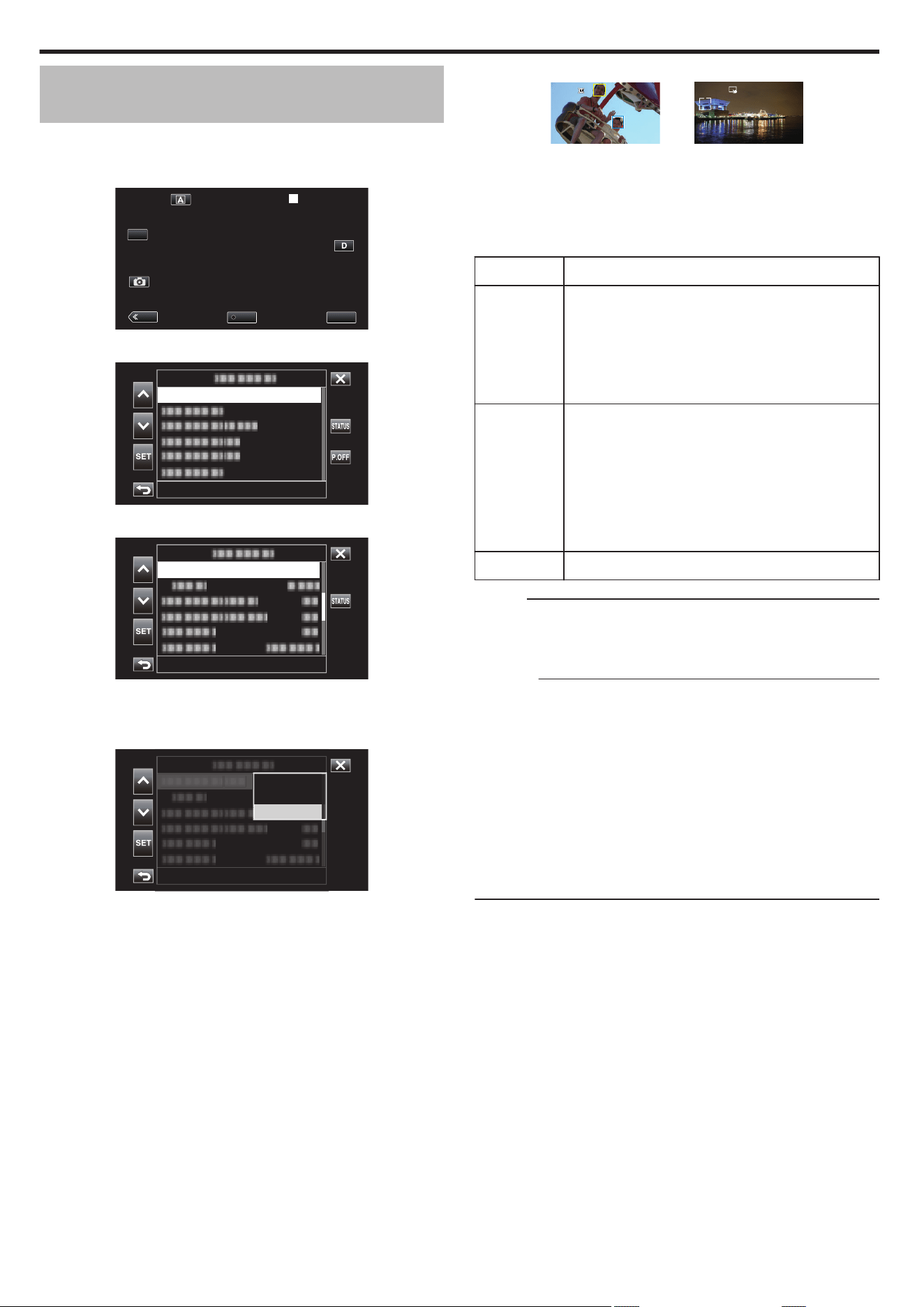
Capturing Subjects Clearly (TOUCH PRIORITY
AE/AF)
“Touch Priority AE/AF” is a function that adjusts focus and brightness based
on a tapped position.
1
Tap “MENU”.
.
MENUREC
PLAY
SLOT
STBY
00 : 00 : 00 . 00
2018 - 01 - 01
02 : 23 : 01
TC
2
Select “Camera Function” with 3 or 2, followed by tapping “SET”.
.
Camera Function...
3
Select “Touch Priority AE/AF” with 3
or 2, followed by tapping “SET”.
.
Touch Priority AE/AF
Off
0
Tap L to exit the menu.
0
Tap J to return to the previous screen.
4
Select the desired item, followed by tapping “SET”.
.
Off
FaceDet
AreaSel
.
AreaSel
FaceDet
0
Focus and brightness will be adjusted automatically based on the
tapped position (face/area). A blue frame appears around the
selected subject (face), while a white frame appears around the
selected area.
0
To reconfigure, tap the desired position (face/area) again.
0
To cancel “AreaSel”, tap the white frame.
Setting Details
AreaSel
g
appears on the screen. Recording is performed while
automatically adjusting the tapped area (fixed position)
with appropriate focus and brightness. In addition, a
white frame appears around the tapped area.
AreaSel in Touch Priority AE/AF is only available within
the optical zoom range. (Disabled when digital zoom is
operating)
FaceDet q appears on the screen.
A yellow frame appears around the detected face
(subject), which turns into blue color when it is tapped.
Doing so performs recording by automatically adjusting
the focus and brightness based on those of the subject.
AF & AE: Adjusts both the focus and brightness
automatically for the face that is being tracked.
AF: Adjusts the focus automatically for the face that is
being tracked.
Off Deactivates the function.
Memo :
0
When “Touch Priority AE/AF” is set, “Focus” will be set to “Auto”
automatically.
0
Settings
are canceled when zoom operation is performed. (“AreaSel” only)
Caution :
0
Subjects near the sides of the LCD monitor may not respond or be
recognized
when tapped. In this case, move the subject to the center and
tap again.
0
“AreaSel” is not available while the digital zoom is in use.
0
Touch Priority AE/AF cannot be selected in the following cases.
- When “Focus” is set to “Manual”
- When “System” is set to “High-Speed”
- When “Rec Mode” is set to “Time-Lapse Rec”
0
When all of “Shutter Speed”, “Aperture” and “Gain Up” are set to “Manual”,
“AreaSel” cannot be selected.
0
FaceDet cannot be selected in the following cases.
- When “Backlight Comp” is set to “On”
- When “Lolux” is set to “On”
Recording
38
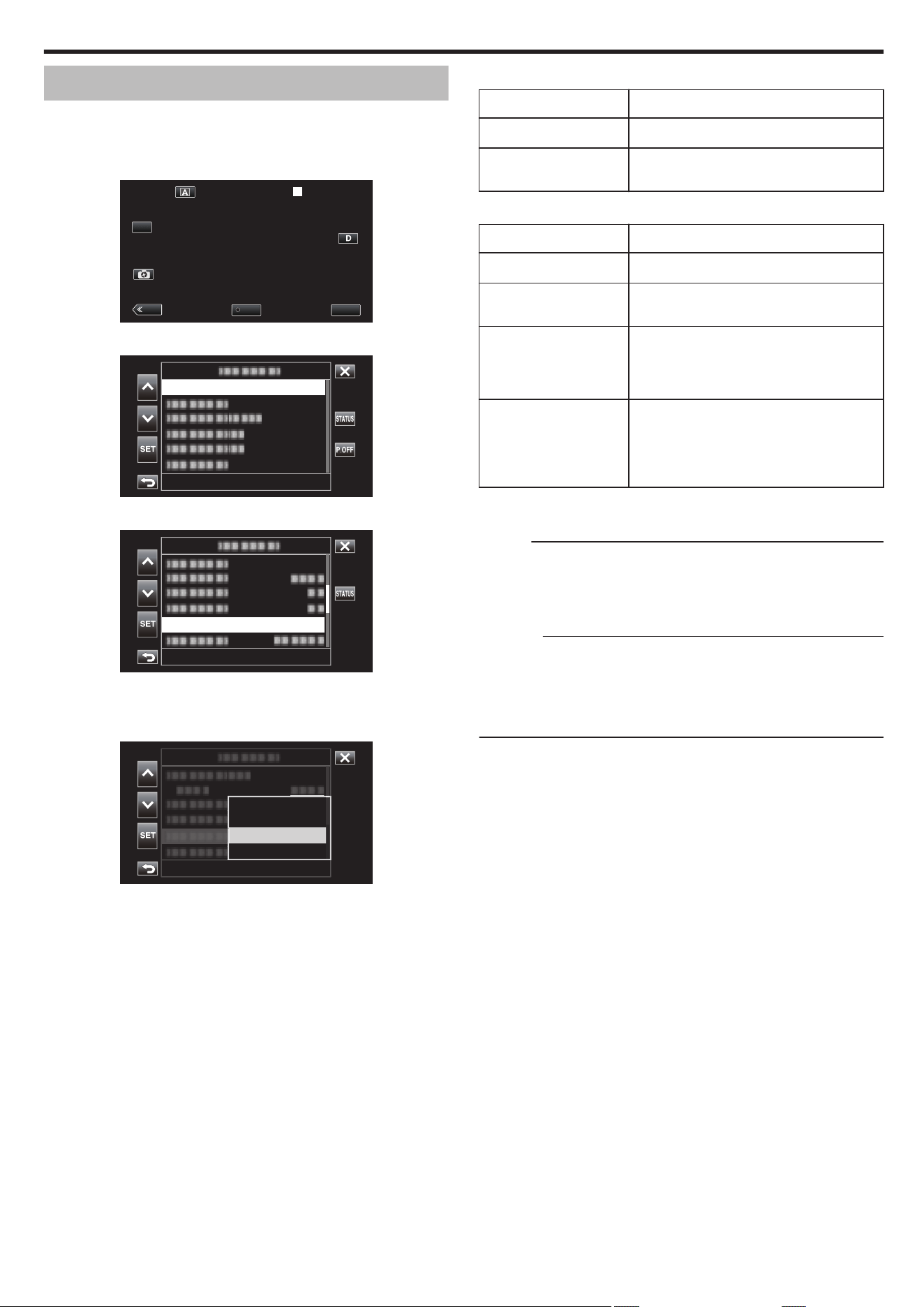
Reducing Camera Shake
When the image stabilizer is set, camera shake during video recording can
be effectively reduced.
The following are the steps when “System” is set to “HD”.
1
Tap “MENU”.
.
MENUREC
PLAY
SLOT
STBY
00 : 00 : 00 . 00
2018 - 01 - 01
02 : 23 : 01
TC
2
Select “Camera Function” with 3 or 2, followed by tapping “SET”.
.
Camera Function...
3
Select “DIS” with 3 or 2, followed by tapping “SET”.
.
On
DIS
0
Tap L to exit the menu.
0
Tap J to return to the previous screen.
4
Select the desired item, followed by tapping “SET”.
.
切
切
Off
On(AIS)
On(Enh.AIS)
On
o
When “System” is set to “4K”
Setting Details
b
Off
Deactivates image stabilizer.
a
On
Reduces camera shake under normal
shooting conditions.
o
When “System” is set to “HD”
Setting Details
b Off
Deactivates image stabilizer.
a On
Reduces camera shake under normal
shooting conditions.
r On(AIS)
Reduces camera shake more effectively
when shooting bright scenes on the wide
angle end.
Only on the wide angle end (approx. 5x).
s On(Enh.AIS)
The area of correction in the enhanced AIS
mode is greater than that in the AIS mode.
Camera shake can be reduced more
effectively
even when recording is performed
by zooming from wide angle to telephoto.
o
When “System” is set to “High-Speed”
Fixed at “Off”.
Memo :
0
It is recommended to set the image stabilizer to “Off” when shooting a
subject of little movement with the unit on a tripod.
0
Complete
stabilization may not be possible if camera shake is excessive.
0
Using the image stabilizer will narrow the angle of view.
Caution :
0
Image stabilization cannot be selected in the following cases.
–
During recording
– When “System” is set to “High-Speed”
– When “Rec Mode” is set to “Pre Rec” or “Time-Lapse Rec”
– When “Live Streaming” is set to “On”
Recording
39
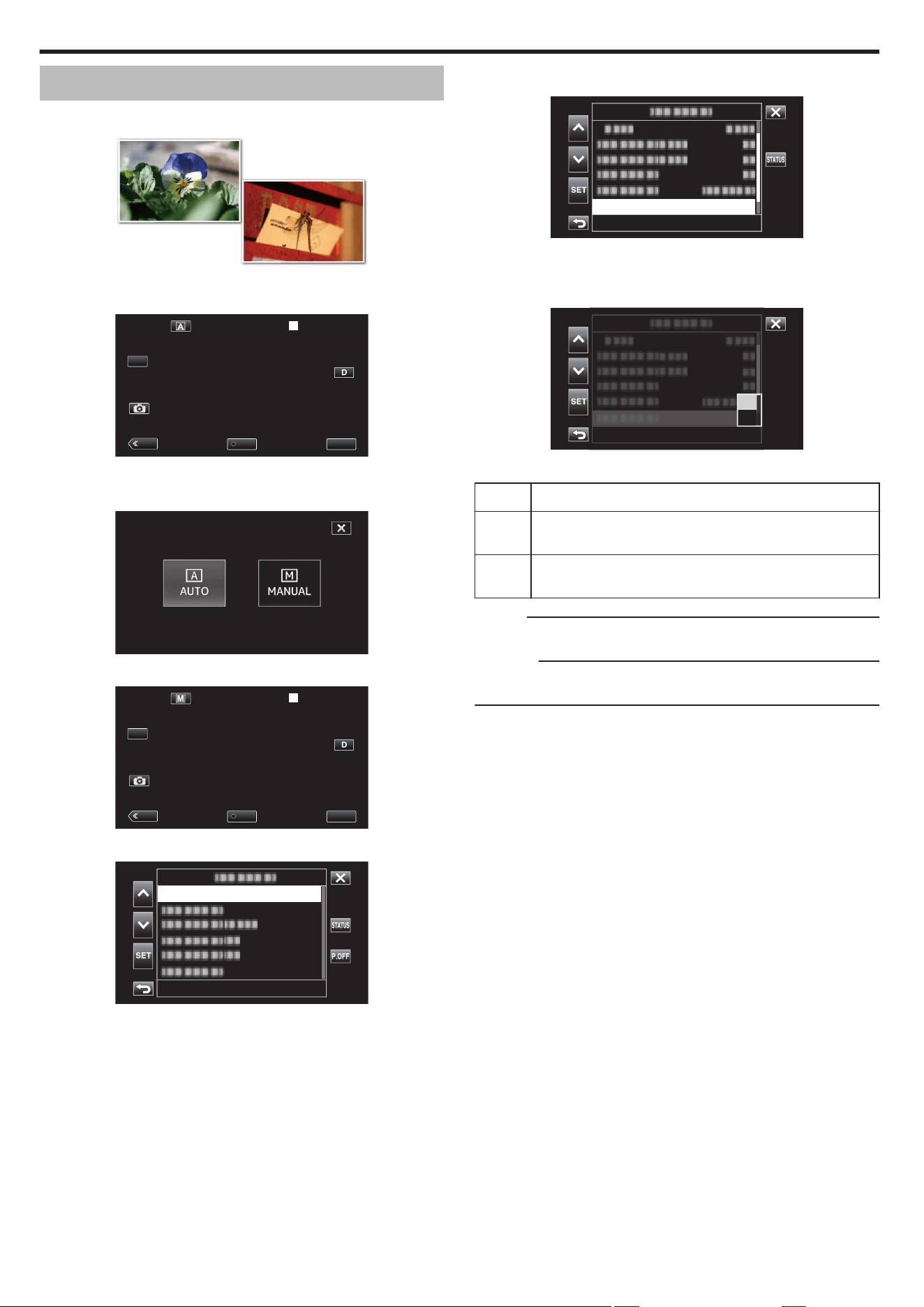
Taking Close-up Shots (TELE MACRO)
You
can take close-up shots of an object using the tele macro function even
when the unit is at the telephoto zoom setting.
.
*The image is only an impression.
1
Select the Manual recording mode.
.
MENUREC
PLAY
SLOT
STBY
00 : 00 : 00 . 00
2018 - 01 - 01
02 : 23 : 01
TC
0
If
the camera is in the n mode, tap n to display the mode selection
screen.
Tap H to switch the recording mode to Manual.
.
2
Tap “MENU”.
.
MENUREC
PLAY
SLOT
STBY
00 : 00 : 00 . 00
2018 - 01 - 01
02 : 23 : 01
TC
3
Select “Camera Function” with 3 or 2, followed by tapping “SET”.
.
Camera Function...
4
Select “Tele Macro” with 3 or 2, followed by tapping “SET”.
.
OffTele Macro
0
Tap L to exit the menu.
0
Tap J to return to the previous screen.
5
Select “On” with 3 or 2, followed by tapping “SET”.
.
On
Off
0
After setting, the tele macro icon o
appears.
Setting Details
Off Enables close-up shots up to 1 m at the telephoto (T) end.
Enables close-up shots up to 5 cm at the wide angle (W) end.
On Enables close-up shots up to 60 cm at the telephoto (T) end.
Enables close-up shots up to 5 cm at the wide angle (W) end.
Memo :
0
This is selectable only during Manual recording.
Caution :
0
When you are not taking close-up shots, set “Tele Macro” to “Off”.
Otherwise, the image may be blur.
Recording
40
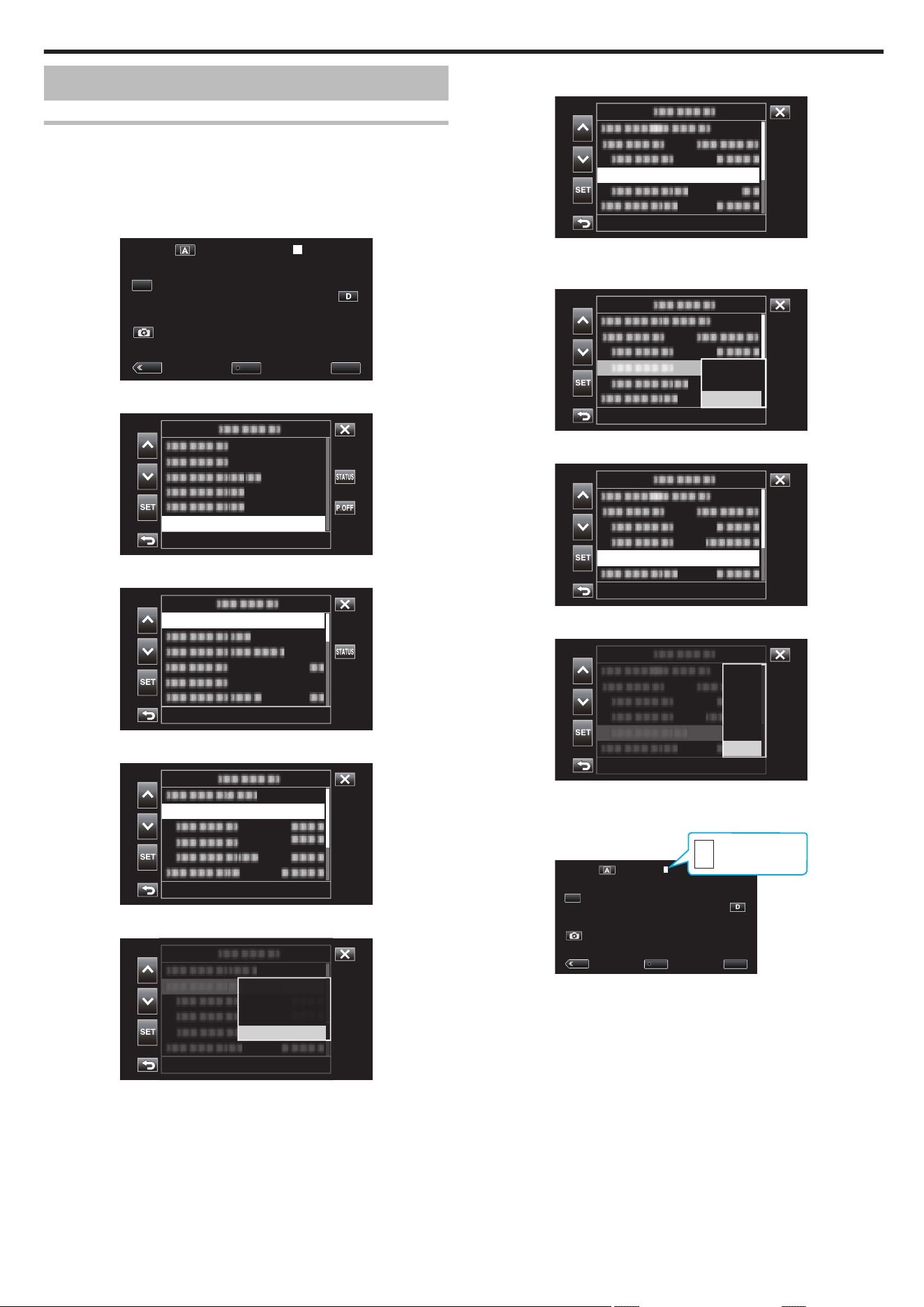
Special Effect Recording
Time-lapse Recording (Time-Lapse Rec)
This function enables the changes of a scene that occur slowly over a long
period to be shown within a short time by taking frames of it at a certain
interval.
This is useful for making observations such as the opening of a flower bud.
1
Tap “MENU”.
.
MENUREC
PLAY
SLOT
STBY
00 : 00 : 00 . 00
2018 - 01 - 01
02 : 23 : 01
TC
2
Select “System” with 3 or 2, followed by tapping “SET”.
.
System...
3
Select “Record Set” with 3 or 2, followed by tapping “SET”.
.
Record Set...
4
Select “Rec Mode” with 3 or 2, followed by tapping “SET”.
.
NormalRec Mode
5
Select “Time-Lapse Rec” with 3 or 2, followed by tapping “SET”.
.
Time-Lapse Rec
Scene Continuous
Pre Rec
Normal
0
Tap L to exit the menu.
0
Tap J to return to the previous screen.
6
Select “Rec Frames” with 3 or 2, followed by tapping “SET”.
.
1 frame
Rec Frames
0
Records according to the preset number of frames.
7
Select Rec Frames with 3 or 2, followed by tapping “SET”.
.
1 frame
3 frames
6 frames
8
Select “Rec Interval” with 3
or 2, followed by tapping “SET”.
.
1 sec
Rec Interval
9
Select Rec Interval with 3
or 2, followed by tapping “SET”.
.
1 sec
2 sec
5 sec
10 sec
30 sec
1 min
0
The
greater the number of seconds, the longer the recording interval.
10
Tap L to exit the menu.
.
MENUREC
PLAY
SLOT
STBY
00 : 00 : 00 . 00
2018 - 01 - 01
02 : 23 : 01
TC
T
T
Time-lapse
Recording Mode
Recording
41
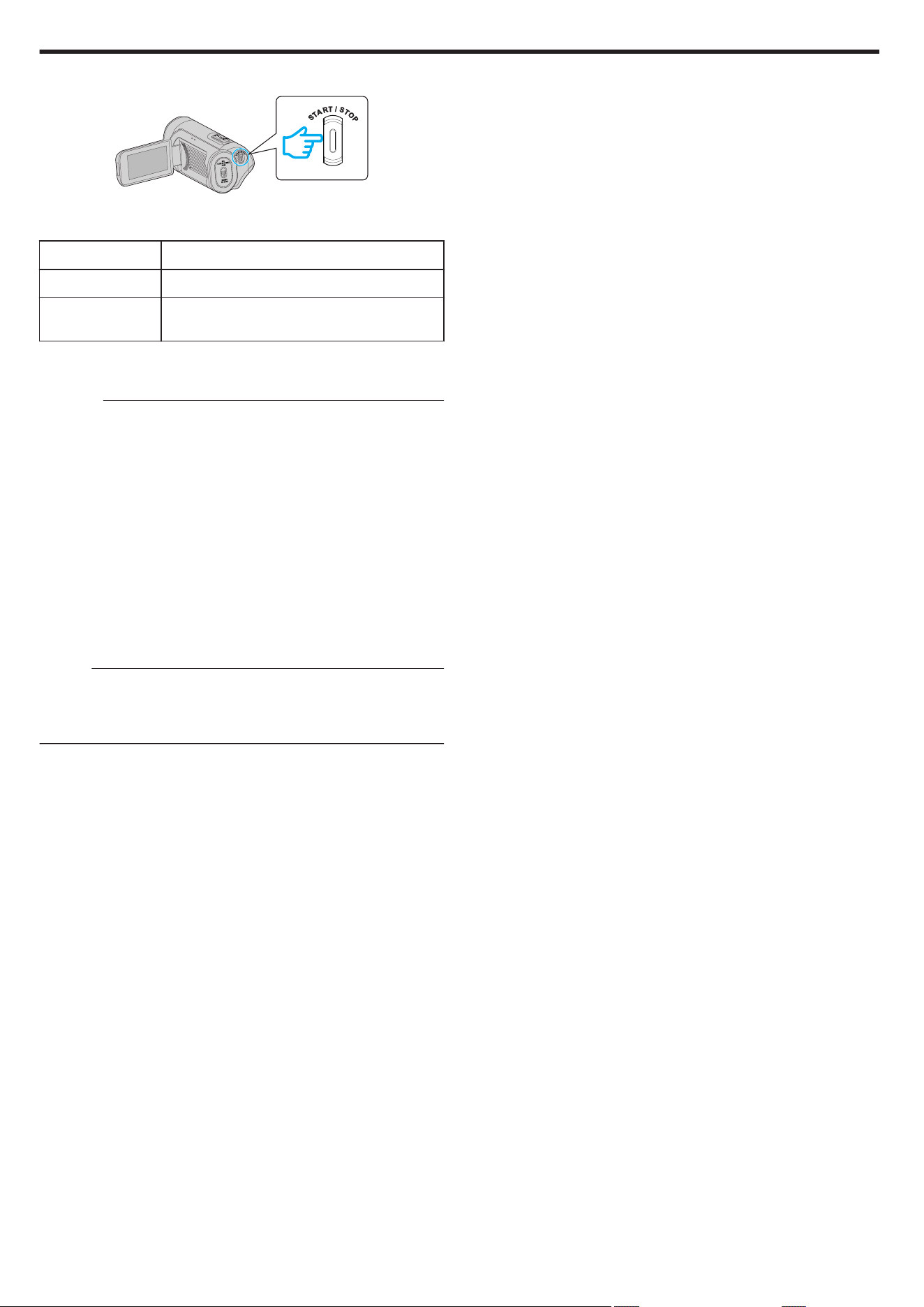
11
Start recording.
.
0
Records based on the preset recording interval and number of
frames.
Item Setting Value
Rec Frames 1 frame, 3 frames, 6 frames
Rec Interval
1 sec, 2 sec, 5 sec, 10 sec, 30 sec, 1 min, 2 min, 5
min, 10 min, 30 min, 1 hour
0
The display changes as follows: V F R F V (red
text) F R F V (red text) ...
Caution :
0
Do not remove the SD card during recording (R, red text) or while
recording is paused (V, red text).
0
Audio cannot be recorded with the video during time-lapse recording.
0
If the recorded scenes do not reach a specified amount when recording
is stopped, normal recording is performed and scenes are added to the
end of the clip until the amount is reached.
0
Simultaneous still image recording and image stabilizer are not usable
when time-lapse recording is enabled.
0
When time-lapse recording is enabled, “TC Generator” cannot be set to
“Free Run”.
0
Unavailable when “System” is set to “High-Speed”.
0
Time-Lapse Rec will be canceled when the power is turned off. “Rec
Mode” will be restored to “Normal”.
If “Quick Restart” is set to “On”, the camera will also return to “Normal”
recording mode when the LCD monitor is closed.
Memo :
0
Make use of a tripod and AC adapter for time-lapse recordings with long
intervals.
It is also recommended to fix the focus and white balance manually.
“Tripod Mounting” (A p. 15
)
Recording
42
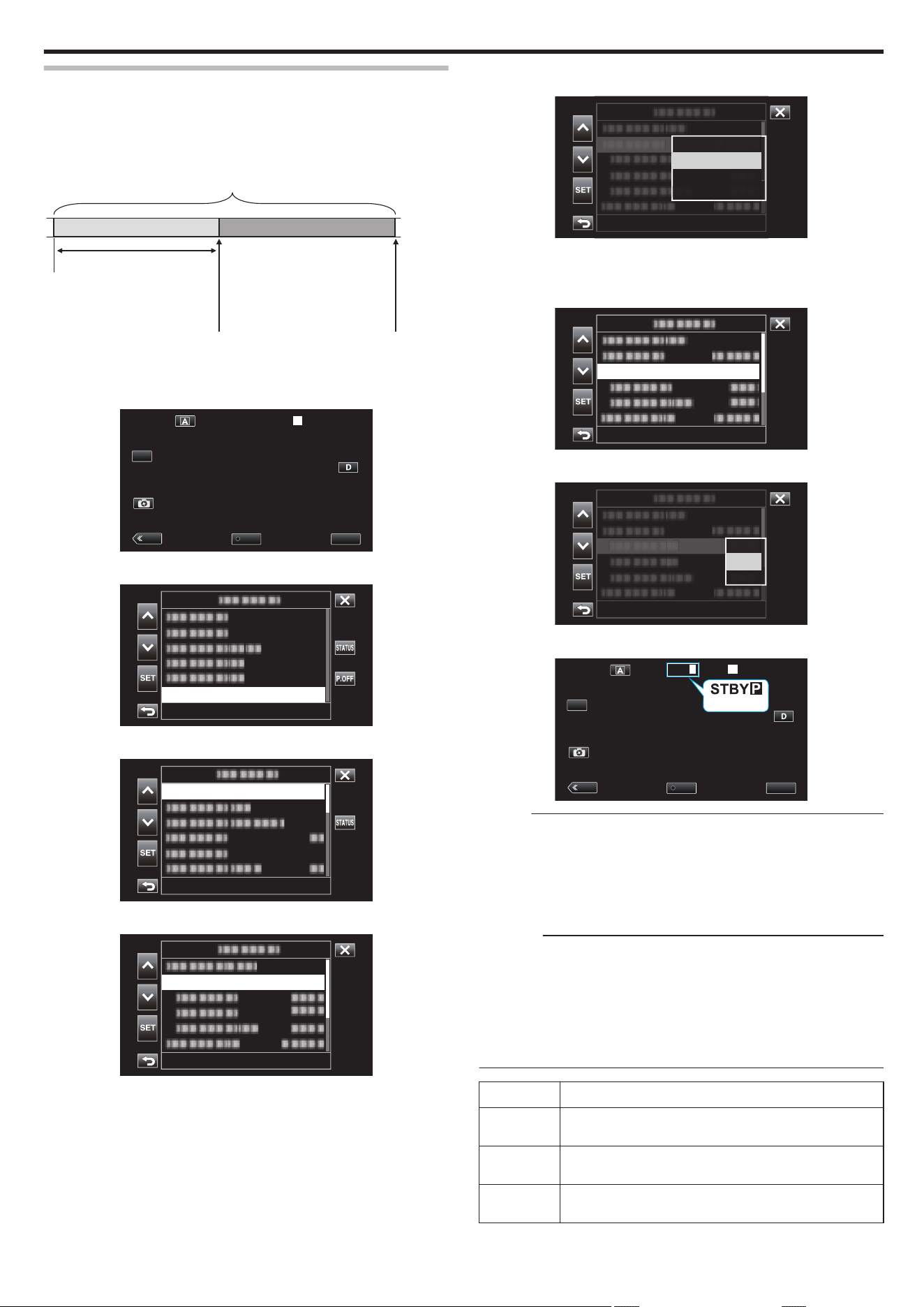
Pre Rec
“Pre Rec Time” can be used to specify the number of seconds for video and
audio to be recorded before the actual recording starts.
Using Pre Rec enables recording of a complete event without missing the
initial scenes even when you start the recording late.
.
(Stops recording)
(Starts recording)
Press E Press E
Recording starts a number
of seconds earlier based
on the “Pre Rec Time”
setting.
(Recorded video and audio)
Resulting File
1
Tap “MENU”.
.
MENUREC
PLAY
SLOT
STBY
00 : 00 : 00 . 00
2018 - 01 - 01
02 : 23 : 01
TC
2
Select “System” with 3 or 2, followed by tapping “SET”.
.
System...
3
Select “Record Set” with 3 or 2, followed by tapping “SET”.
.
Record Set...
4
Select “Rec Mode” with 3 or 2, followed by tapping “SET”.
.
NormalRec Mode
5
Select “Pre Rec” with 3 or 2, followed by tapping “SET”.
.
Time-Lapse Rec
Scene Continuous
Pre Rec
Normal
0
Tap L to exit the menu.
0
Tap J to return to the previous screen.
6
Select “Pre Rec Time” with 3
or 2, followed by tapping “SET”.
.
5 sec
Pre Rec Time
7
Select a setting value with 3 or 2, followed by tapping “SET”.
.
10 sec
15 sec
5 sec
8
Tap L to exit the menu.
.
MENUREC
PLAY
SLOT
STBY
00 : 00 : 00 . 00
2018 - 01 - 01
02 : 23 : 01
TC
P
(Pre Rec Mode)
Memo :
0
This is fixed at “5 sec” when “System” is set to “4K”.
0
Pre-recording will not be performed during the preconfigured interval in
“Pre Rec Time” if the time interval after the power of the camera is turned
on or after switching from the Playback mode to the Recording mode up
to the time when recording starts is shorter than the duration configured
here.
0
Operation sound is muted in Pre Rec mode.
Caution :
0
In the following cases, video and audio during the specified Pre Rec time
may not be recorded when the actual recording starts.
- Starting recording immediately after recording stops
- Immediately after configuring “Rec Mode”
0
Unavailable when “System” is set to “High-Speed”.
0
“Pre Rec” will be canceled when the power is turned off. “Rec Mode” will
be restored to “Normal”.
If “Quick Restart” is set to “On”, the camera will also return to “Normal”
recording mode when the LCD monitor is closed.
Setting Description
15 sec Records video and audio 15 seconds before actual
recording starts.
10 sec Records video and audio 10 seconds before actual
recording starts.
5 sec Records video and audio 5 seconds before actual
recording starts.
Recording
43
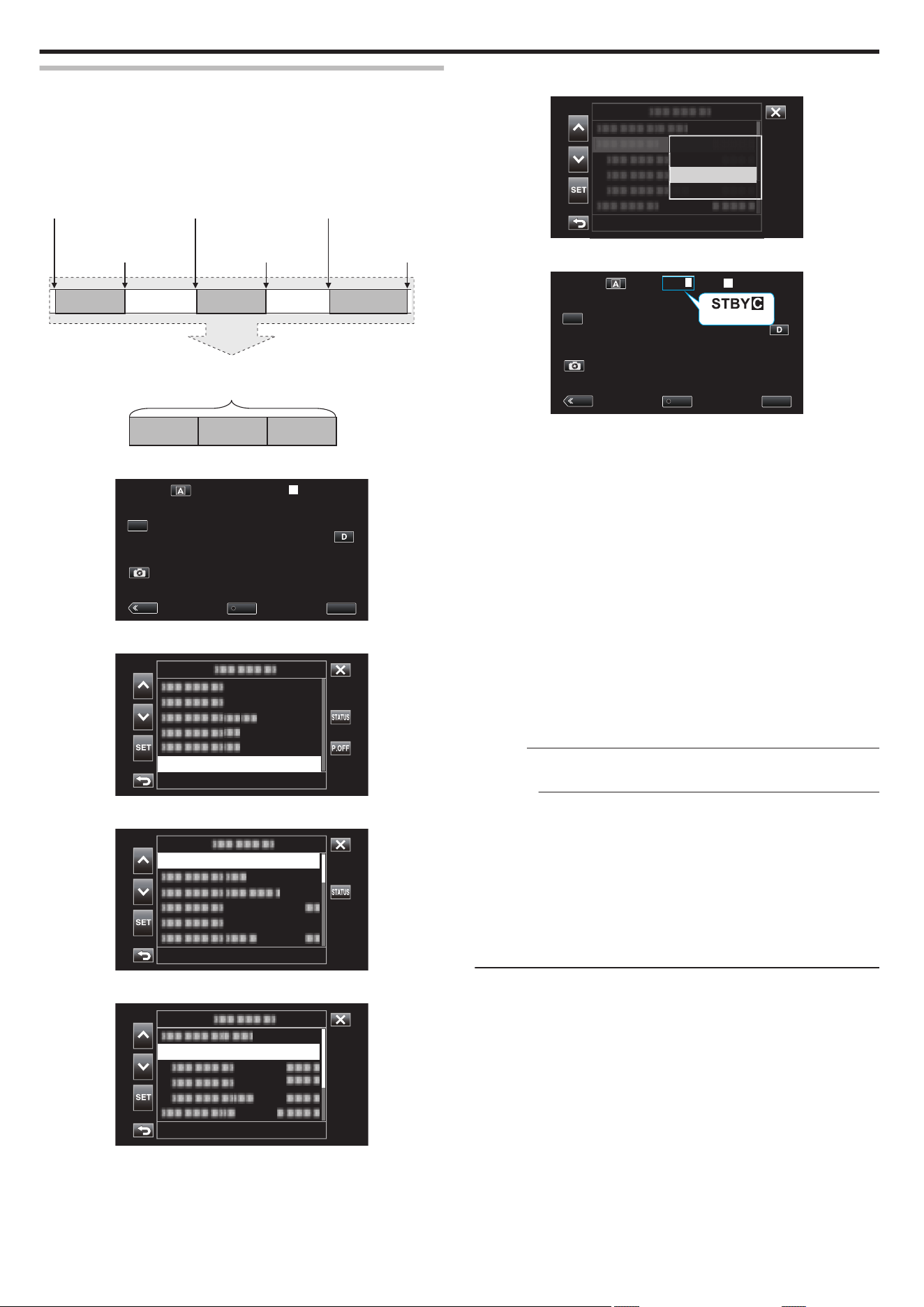
Scene Continuous
During normal recording, the image, audio and accompanying data from the
start
till the end of the recording are recorded as a single file when recording
stops. Scene Continuous enables several rounds of recordings (from the
time when recording starts to the time when it is stopped) to be consolidated
into a single file.
.
(Recorded video and audio)
Resulting File
Recording 3
Recording 2
Recording 1
(Stops recording)
(Pauses recording) (Pauses recording)
(Resumes recording) (Resumes recording)
(Starts recording)
Press and hold E
Press E Press E Press E
Press E Press E
Recording 3
Recording 2
Recording 1
1
Tap “MENU”.
.
MENUREC
PLAY
SLOT
STBY
00 : 00 : 00 . 00
2018 - 01 - 01
02 : 23 : 01
TC
2
Select “System” with 3 or 2, followed by tapping “SET”.
.
System...
3
Select “Record Set” with 3 or 2, followed by tapping “SET”.
.
Record Set...
4
Select “Rec Mode” with 3 or 2, followed by tapping “SET”.
.
NormalRec Mode
5
Select “Scene Continuous” with 3 or 2, followed by tapping “SET”.
.
Time-Lapse Rec
Scene Continuous
Pre Rec
Normal
6
Tap L to exit the menu.
.
MENUREC
PLAY
SLOT
STBY
00 : 00 : 00 . 00
2018 - 01 - 01
02 : 23 : 01
TC
C
(Scene Continuous Mode)
0
Tap L to exit the menu.
0
Tap J to return to the previous screen.
7
Start recording (Recording 1).
0
Displayed on screen: P
8
Pause recording.
0
Displayed on screen: T (yellow text)
9
Resume recording (Recording 2).
0
Displayed on screen: P
10
Pause recording.
0
Displayed on screen: T (yellow text)
11
Resume recording (Recording 3).
0
Displayed on screen: P
12
Press and hold E.
0
Stops recording.
0
Displayed on screen: T (white text)
Memo :
0
Switching of the SD card slot is disabled when recording is paused.
Caution :
0
Unavailable when “System” is set to “High-Speed”.
0
Do
not remove the SD card during recording or while recording is paused.
0
Recording stops if the remaining space on the SD card runs out during
recording.
0
If the power is cut off due to low battery power, a proper file may not be
generated.
0
“Scene Continuous” will be canceled when the power is turned off. “Rec
Mode” will be restored to “Normal”.
If “Quick Restart” is set to “On”, the camera will also return to “Normal”
recording mode when the LCD monitor is closed.
Recording
44
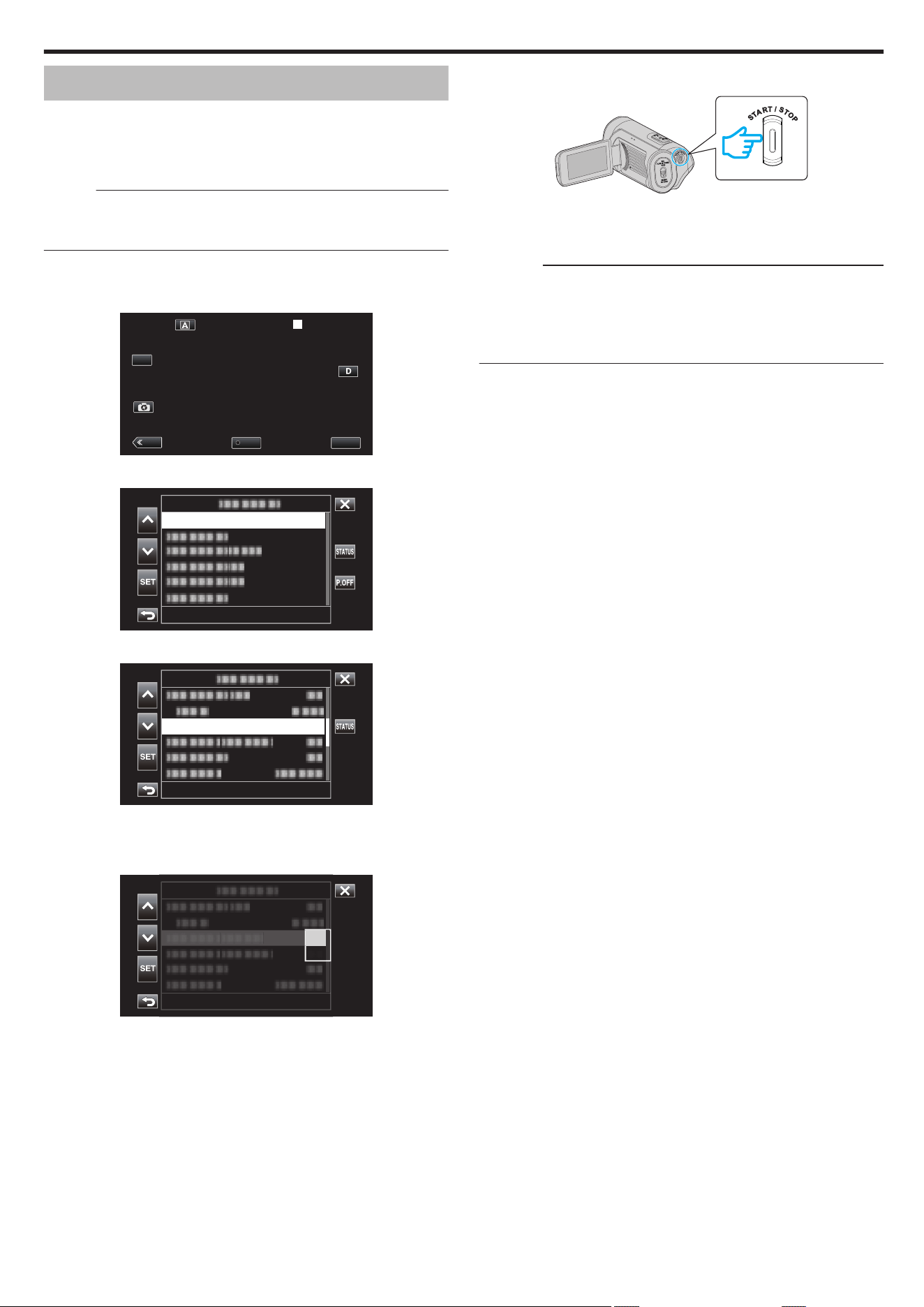
Using the Self-timer
You can record video or still image using the self-timer.
This is useful when taking a video or still image that includes the
photographer.
The 2-second self-timer is useful for preventing camera shake caused by
pressing the shutter button when taking a still image.
Memo :
0
When shooting a photo using the self-timer function, use of a tripod is
recommended.
“Tripod Mounting” (A p. 15
)
o
Using Video Self Timer
1
Tap “MENU”.
.
MENUREC
PLAY
SLOT
STBY
00 : 00 : 00 . 00
2018 - 01 - 01
02 : 23 : 01
TC
2
Select “Camera Function” with 3
or 2, followed by tapping “SET”.
.
Camera Function...
3
Select “Video Self Timer” with 3 or 2, followed by tapping “SET”.
.
OffVideo Self Timer
0
Tap L to exit the menu.
0
Tap J to return to the previous screen.
4
Select “On” with 3 or 2, followed by tapping “SET”.
.
On
Off
5
Press the START/STOP button.
.
0
The countdown to recording appears and recording will start after 5
seconds.
0
To stop the self-timer, press the recording button again.
Caution :
0
The
“Video Self Timer” setting cannot be changed in the following cases.
– During recording
– When “Rec Mode” is set to “Pre Rec” or “Time-Lapse Rec”
0
Also, the self-timer function is disabled when “Rec Mode” is set to “Pre
Rec” or “Time-Lapse Rec”.
Recording
45
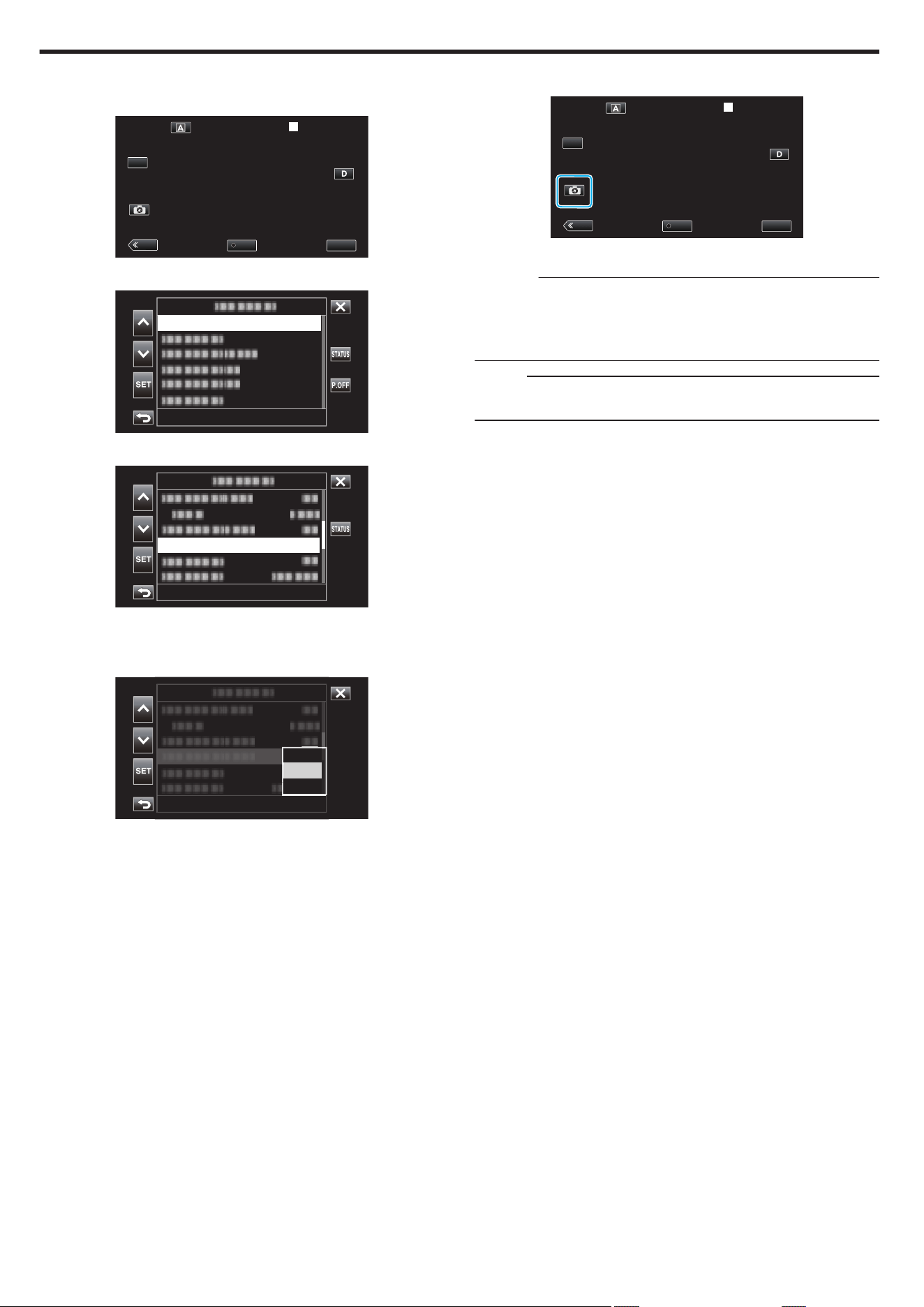
o
Using Still Self Timer
1
Tap “MENU”.
.
MENUREC
PLAY
SLOT
STBY
00 : 00 : 00 . 00
2018 - 01 - 01
02 : 23 : 01
TC
2
Select “Camera Function” with 3 or 2, followed by tapping “SET”.
.
Camera Function...
3
Select “Still Self Timer” with 3 or 2, followed by tapping “SET”.
.
Off
Still Self Timer
0
Tap L to exit the menu.
0
Tap J to return to the previous screen.
4
Select “2sec” or “10sec” with 3
or 2, followed by tapping “SET”.
.
2sec
10sec
Off
5
Tap B to take a shot.
.
MENUREC
PLAY
SLOT
STBY
00 : 00 : 00 . 00
2018 - 01 - 01
02 : 23 : 01
TC
0
A timer appears and countdown to shooting starts.
Caution :
0
The “Still Self Timer” setting cannot be changed in the following cases.
–
During recording
– When “System” is set to “High-Speed”
– When “Rec Mode” is set to “Pre Rec” or “Time-Lapse Rec”
Memo :
0
While the countdown timer is displayed, the buttons cannot be used as
they are not displayed on the screen.
Recording
46
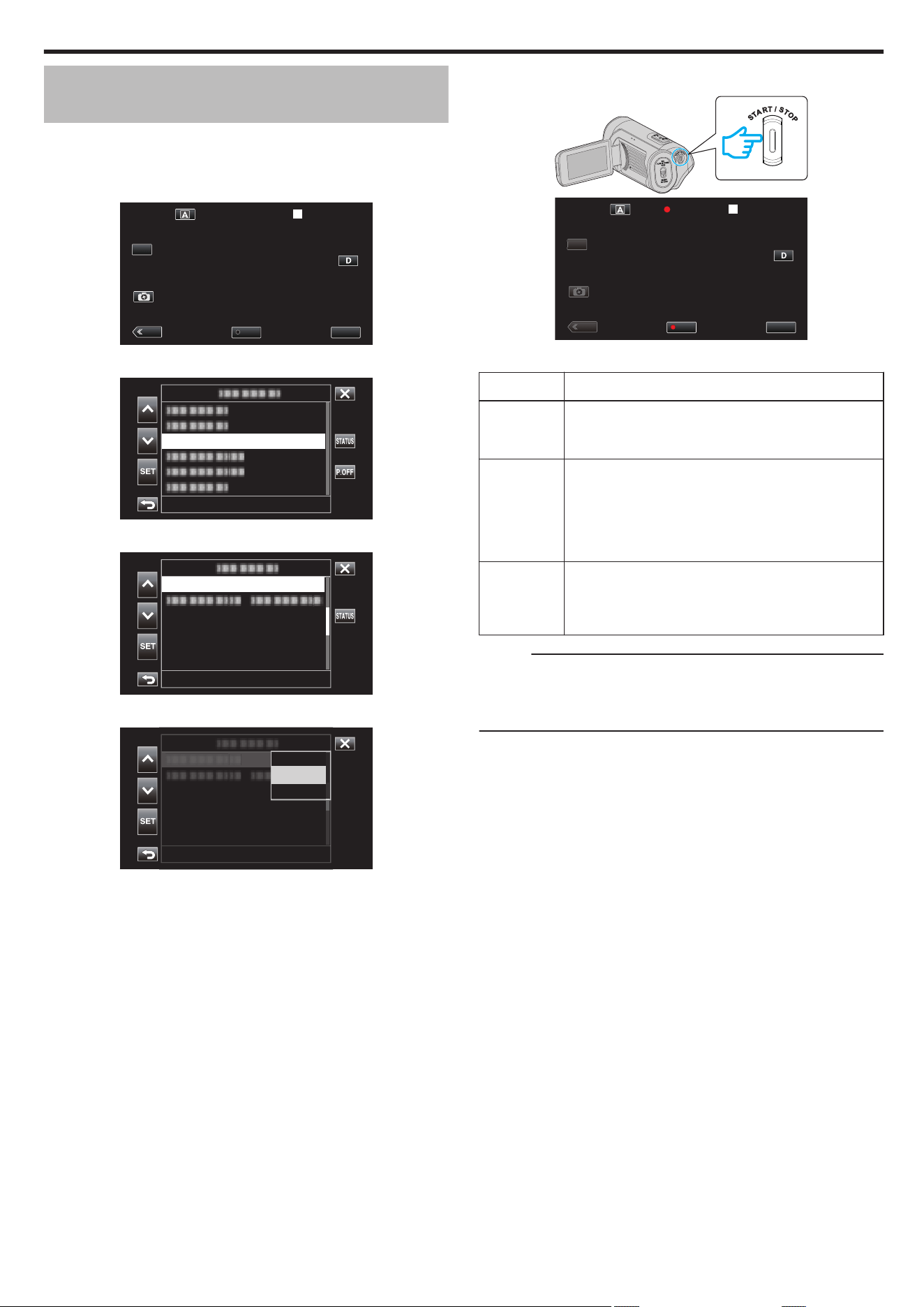
Changing the Mode of Time Code (TC)
Recording
The time code data is recorded together with the video.
The time code is displayed on the LCD monitor screen during playback or
recording.
1
Tap “MENU”.
.
MENUREC
PLAY
SLOT
STBY
00 : 00 : 00 . 00
2018 - 01 - 01
02 : 23 : 01
TC
2
Select “TC” with 3 or 2, followed by tapping “SET”.
.
TC...
3
Select “TC Generator” with 3 or 2, followed by tapping “SET”.
.
TC Generator
Rec Run
4
Select a setting value with 3 or 2, followed by tapping “SET”.
.
Regen
Rec Run
Free Run
5
Start recording.
.
.
MENUREC
PLAY
SLOT
00 : 00 : 00 . 10
TC
2018 - 01 - 01
02 : 23 : 01
REC
PLAY
S
L
O
T
0
Press the START/STOP button again to stop recording.
Setting Description
Free Run The time code advances at all times regardless of the
recording
status. The time code advances even when this
unit is turned off.
Rec Run The time code advances only when recording is in
progress. It continues to run in the order of the recorded
scenes as long as the SD card is not replaced. If the SD
card is removed and recording is made on another card,
time
code will be recorded on the new card from where it
was left off in the previous card.
Regen The time code advances only when recording is in
progress. When the SD card is replaced, the last time
code
recorded on the card is read and recorded on a new
card so that the time code continues in running order.
Memo :
0
When
“Rec Mode” is set to “Time-Lapse Rec” and “TC Generator” to “Free
Run”, the Rec Run mode is activated.
0
When “System” is set to “HD” and “Rec Mode” to “Pre Rec”, the Free Run
mode is activated.
Recording
47
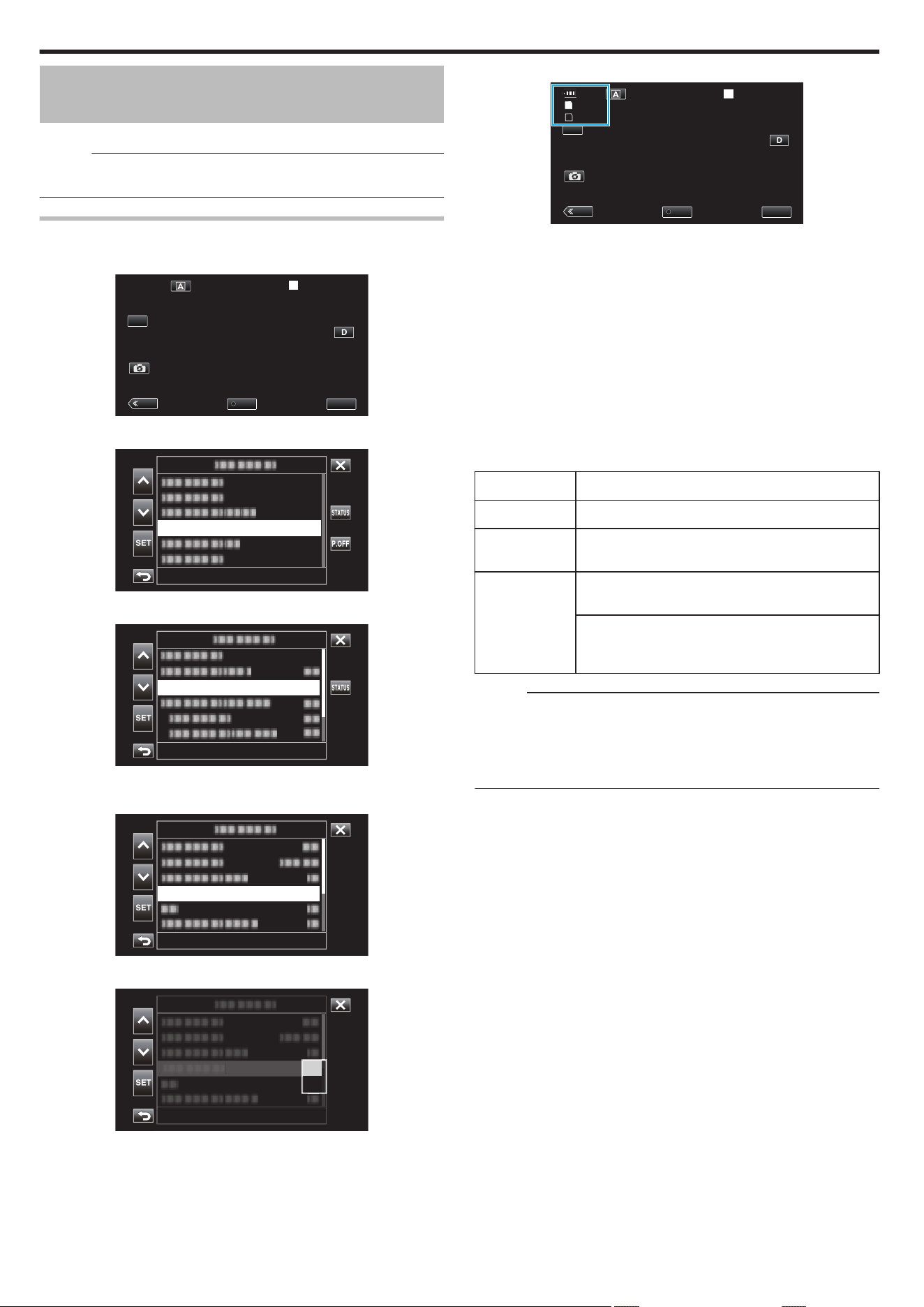
Checking the Remaining Battery Level and
Recording Time
Display the remaining battery power and the remaining recording time.
Memo :
0
The remaining battery power and the remaining recording time are
estimates.
Recording Mode
1
Tap “MENU”.
.
MENUREC
PLAY
SLOT
STBY
00 : 00 : 00 . 00
2018 - 01 - 01
02 : 23 : 01
TC
2
Select “Monitor” with 3
or 2, followed by tapping “SET”.
.
Monitor...
3
Select “Display Settings” with 3 or 2, followed by tapping “SET”.
.
Display Settings...
4
Select “Media Remain” or “Battery” with 3 or 2, followed by tapping
“SET”.
.
On
Media Remain
5
Select “On” with 3 or 2, followed by tapping “SET”.
.
Off
On
0
To exit the menu, tap L.
Remaining Recording Time, Battery Level
.
MENUREC
PLAY
SLOT
54min
100%
-- - min
A
B
STBY
00 : 00 : 00 . 00
2018 - 01 - 01
02 : 23 : 01
0
The white SD card icon indicates the slot that is currently selected.
0
When
the battery level is running low, the battery icon and the battery level
indicator changes to the following colors.
- When battery level is 30% or lower: yellow color
- When battery level is 10% or lower: red color
Charge the camera as soon as possible when the icon and indicator turn
red.
When the battery power runs out, a “RES” mark (red) appears.
Charge the camera immediately.
0
The remaining recording time is displayed in red color when it falls below
3 minutes.
Replace the SD card with a new one.
0
Recording cannot be performed when the recordable time is not displayed
and the following message appears.
Check the SD card when this occurs.
L
SD card is write-protected
! INVALID Writing/Reading error or unable to restore SD card
! INCORRECT
The SD card inserted does not meet the speed class
requirements
!REC INH
An SDHC card is inserted when [4 GB Spanning] is set
to [Off (SDXC)]
An attempt has been made to record video in 60p or
60i to an SD card recorded in 50p or 50i in [AVCHD],
and vice versa.
Memo :
0
If the remaining time and battery indicator display disappears, tap n.
0
When
an AC adapter is connected while “System” is set to “4K” or “High-
Speed”, the battery level indicator will not be displayed.
0
If an AC adapter is connected while “System” is set to “HD” and the battery
is not fully charged, O is displayed instead of the battery level indicator.
Recording
48
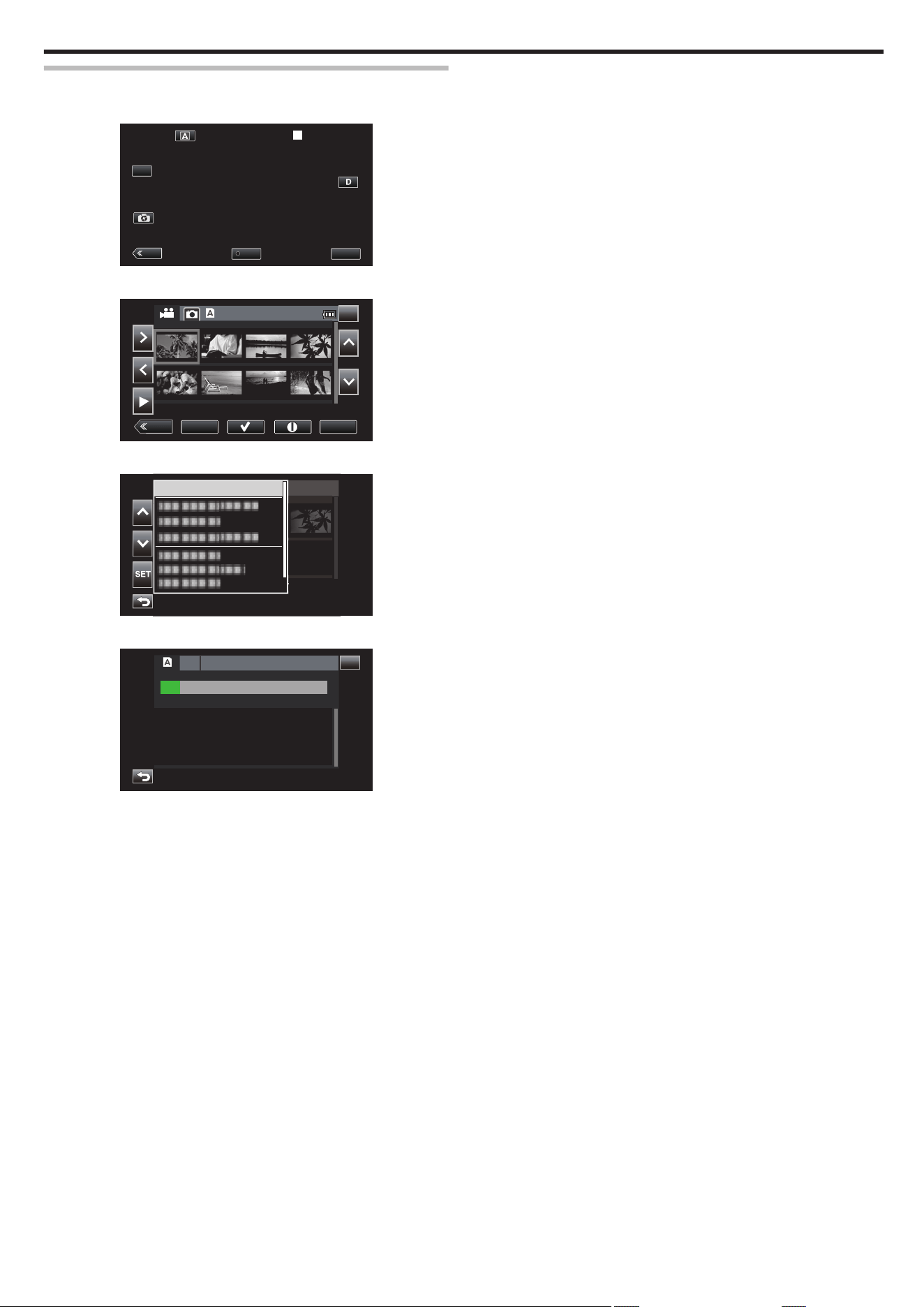
Playback Mode
1
Tap M to select the playback mode.
.
MENUREC
PLAY
SLOT
STBY
00 : 00 : 00 . 00
2018 - 01 - 01
02 : 23 : 01
TC
2
Tap “ACTION”.
.
MENU
ACTION
REC
SLOT
2018-01-01
1/8
000G0000
3
Select “Display Media Info.”, followed by tapping “SET”.
.
2018-01-01
1/8
000G0000
1
8-01-0
1
1/8
0
1
Display Media Info.
4
Check the remaining battery level and recording time.
.
SLOT
8GB
17
54
AVCHD
Media Size
Free:
min
0
The remaining recording time is displayed for the recording media
that is currently selected. To switch the recording media that is
displayed, tap A.
Recording
49
Approximate Video Recording Time
Picture Quality
SDHC/SDXC Card
4 GB 8 GB 16 GB 32 GB 64 GB 128 GB 256 GB 512 GB
4K 6 m 13 m 26 m 53 m 1 h 45 m 3 h 30 m 7 h 14 h
HD
28M 16 m 33 m 1 h 7 m 2 h 15 m 4 h 30 m 9 h 18 h 36 h 10 m
24M 19 m 39 m 1 h 18 m 2 h 37 m 5 h 15 m 10 h 30 m 21 h 42 h 10 m
18M 25 m 51 m 1 h 44 m 3 h 30 m 7 h 14 h 28 h 56 h 10 m
0
The recording time indicated above will change depending on the recording conditions.
0
“28M” is configurable only when “Frame Rate” is set to “60p”/“50p”, while “24M”“18M” is configurable only when “Frame Rate” is set to “60i”/“50i”.
0
The still image has the same resolution as the video image.
Approximate Number of Still Images (Unit: Number of Shots)
Image Size
SDHC/SDXC Card
4 GB 8 GB 16 GB 32 GB 64 GB
3840x2160 (8.3M) (16:9) 800 1600 3100 4000 4000
1920x1080 (2M) (16:9) 3100 4000 4000 4000 4000
0
The still image has the same resolution as the video image.
Approximate Duration of Built-in Battery
Record Format Actual Recording Time Continuous Recording Time
(Maximum Recording Time)
4K (30p / 70M) 2 h 20 m 4 h 20 m
HD (60i / 18M) 3 h 5 h 20 m
HD (60p / 28M) 2 h 30 m 4 h 30 m
0
The above are values when “LCD Backlight” is set to “0”.
0
The actual recording time is the recording time when operations such as starting/stopping recording, turning on/off the unit or zooming is performed
repeatedly.
0
Recording time may differ depending on the shooting environment and usage.
0
When the recording time becomes extremely short even when the battery is fully charged, the battery needs to be replaced. For details on replacing the
built-in battery (subject to a fee), consult the nearest JVC service center.
Recording
50
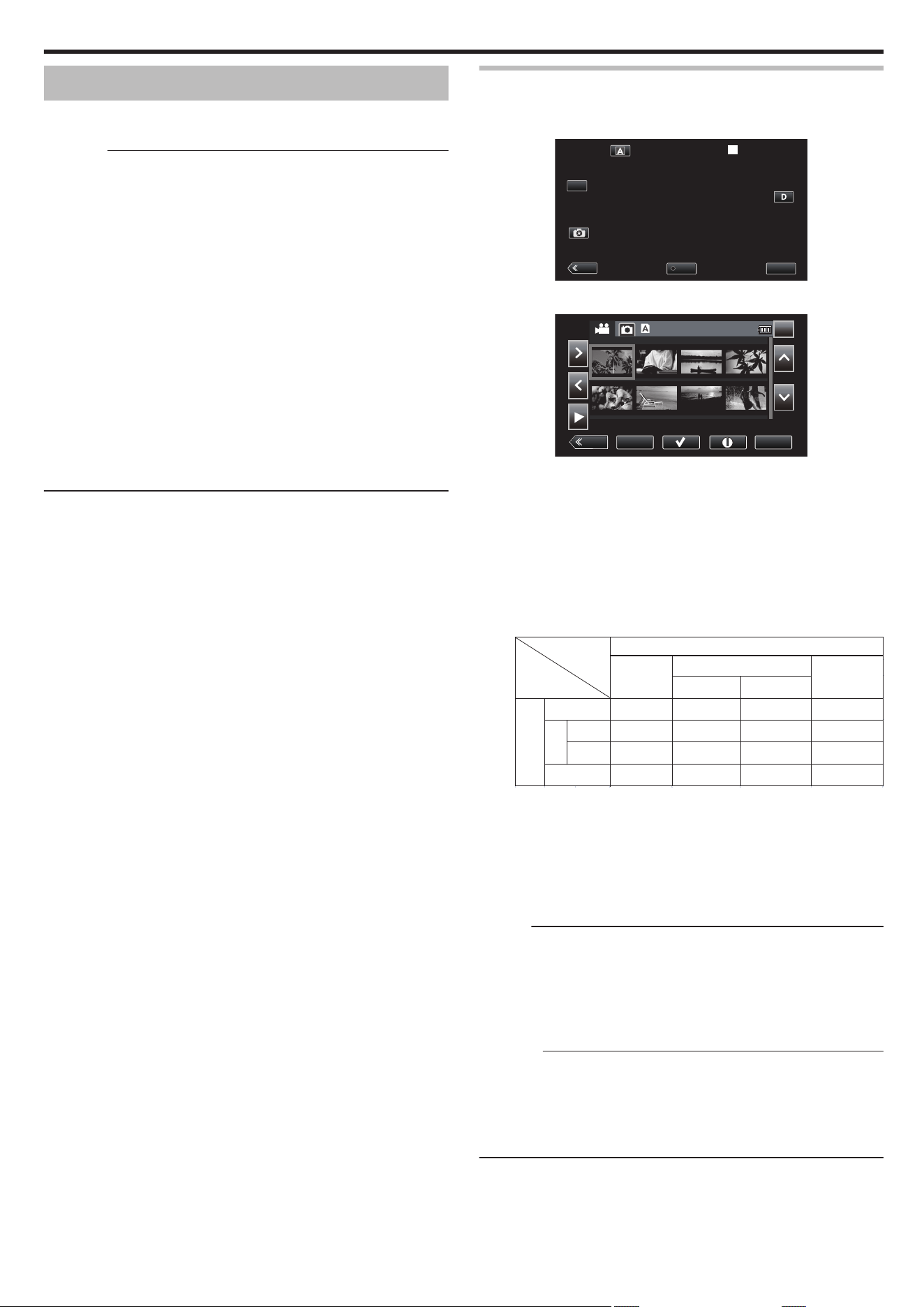
Playing Back Videos
You can select and play back the recorded videos from an index screen
(thumbnail display).
Caution :
0
Make a backup of important recorded data.
It
is recommended that important recorded data be copied to a PC or other
types of recording media (e.g., another SD card) for storage.
0
This unit is a microcomputer-controlled device. Electrostatic discharge,
external noise and interference (from a TV, a radio, etc.) might prevent it
from functioning properly. In such a case, close the monitor screen to turn
off the power and remove the AC adapter, then press the Reset button to
reset this unit.
“Resetting this Unit” (A p. 131)
0
When there are many files in the media, it may take time for them to be
displayed on the playback screen. Wait for a while as the POWER/
ACCESS lamp blinks, indicating normal operation.
0
Disclaimer
- We shall not be held responsible for loss of recorded contents when
recording videos/audio or playback cannot be operated due to
malfunctions in this unit, provided parts, or SD card.
- Once deleted, recorded contents (data), including data loss due to
malfunctions in this unit, cannot be restored. Please be forewarned.
- JVC will not be responsible for any lost data.
- In order for quality improvement, defective recording medium is subject
to be analyzed. Therefore, it may not be returned.
Normal Playback
Plays back the recorded videos.
1
Tap M to select the playback mode.
.
MENUREC
PLAY
SLOT
STBY
00 : 00 : 00 . 00
2018 - 01 - 01
02 : 23 : 01
TC
2
Select a scene and tap I to start playback.
.
MENU
ACTION
REC
SLOT
2018-01-01
1/8
000G0000
0
Playback can also be started by tapping the thumbnail.
0
Tapping the “SLOT” button switches the media to play back and
changes the index screen (thumbnail display).
0
The thumbnail images that are displayed on the index screen vary
according to the recording format setting immediately before
switching to the Playback mode as well as the recording format of the
recorded video.
If the video to play back cannot be found, switch to the Recording
mode and specify the recording format of the video to play back in
“System”F“Record Set”F“Record Format”F“System” or “Frame
Rate” of the menu.
.
60p/50p 60i/50i
60p/50p
60i/50i
4K High-Speed
HD
4K
HD
High-Speed
○× ×
△
×○△ ×
×
△ ○×
△ ××○
Recorded Videos
Recording Format upon Switching to Playback Mode
○: Thumbnail images are displayed and videos can be played back.
△: Substitute thumbnail images are displayed and videos cannot be
played back.
“Thumbnail Screen” (A p. 129)
×: Thumbnail images are not displayed on the index screen.
3
Playback starts.
0
Tap e to pause.
0
Tap u to return to the index screen.
Memo :
0
Videos recorded in the 4K setting cannot be played back when “System”
is set to “HD” or “High-Speed”.
0
Videos recorded in the HD setting cannot be played back when “System”
is set to “4K” or High-Speed.
0
Videos recorded in the High-Speed setting cannot be played back when
“System” is set to “4K” or HD.
Caution :
0
While this unit may be used with the LCD monitor reversed and closed,
the temperature rises more easily. Do not use this unit with the LCD
monitor reversed and closed for long periods of time, or in places exposed
to direct sunlight or high temperatures.
0
The power may turn off to protect the circuit if the temperature of this unit
rises too much.
Playback
51
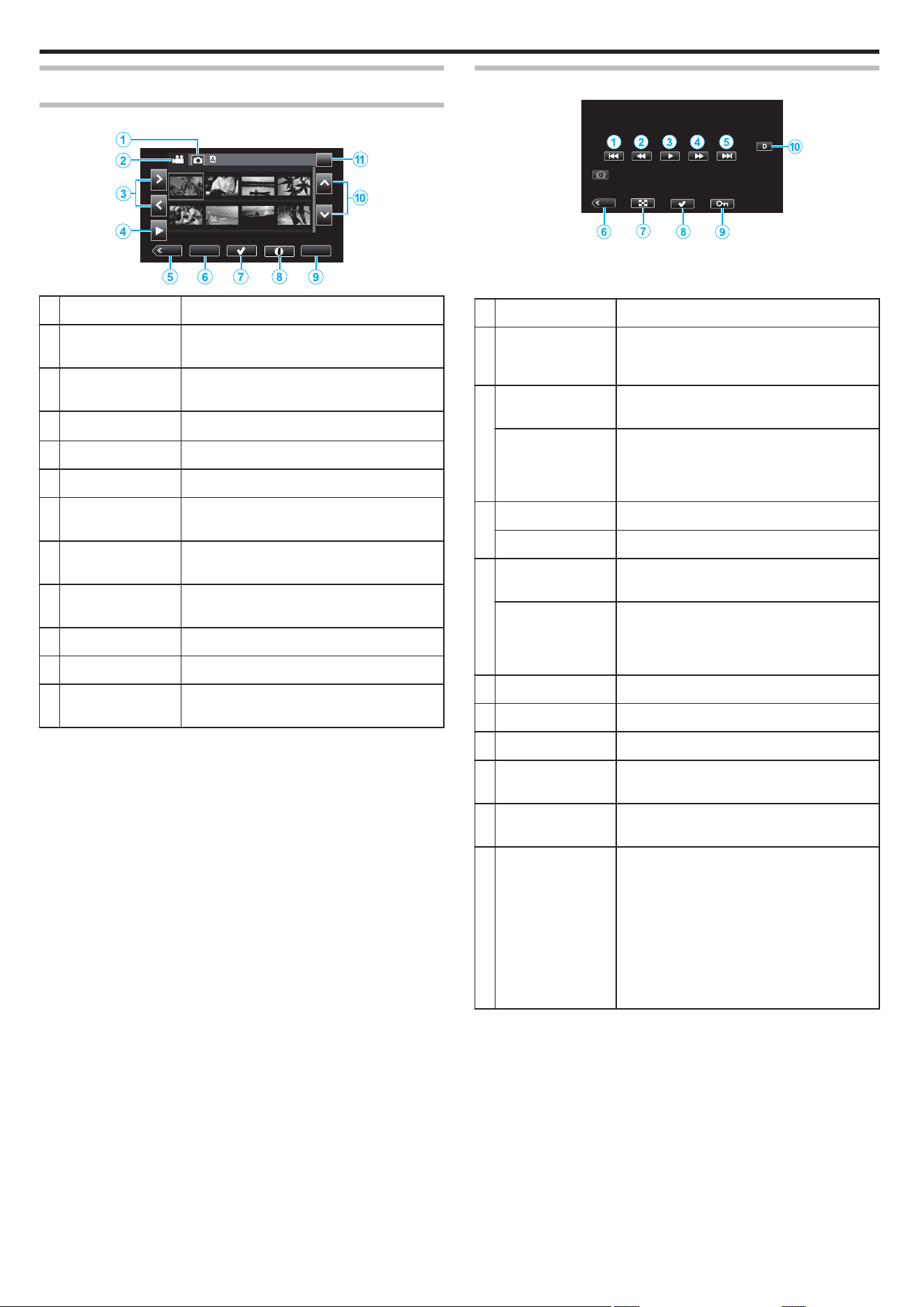
Operation Buttons for Video Playback
During Index Screen Display
.
MENU
ACTION
REC
SLOT
000G0000 2018-01-01
1/8
Display Description
A
Still Image Playback
Mode Selection
Switches to the still image playback mode.
B
Video Playback
Mode Selection
Switches to the video playback mode.
C
0 1 Moves the cursor to the left or right.
D
I
Starts playback.
E
3
Switches to the recording mode.
F
ACTION Opens the ACTION menu for configuring
deletion and protection or for trimming.
G
I
Videos to be deleted or protected can be
selected in advance.
H
C
Displays the recording information of the
recorded videos.
I
MENU Displays the menu screen.
J
3 2 Moves the cursor upward or downward.
K
SLOT Switches the SD card slot between Slot A and
Slot B.
During Video Playback
.
REC
0
When
this unit is not operated, the operation buttons on the touch screen
disappear automatically. Tap on the screen to display the operation
buttons again.
Display Description
A
h
Returns to the beginning of the scene Returns
to
the previous scene if tapped at the beginning
of a scene.
B
j (during
playback)
Reverse search (speed increases with each
tap)
l (during pause
mode)
Frame-by-frame reverse playback
Pressing and holding down the key allows
frame-by-frame reverse playback to operate
continuously.
C
d
Starts playback
e
Pause
D
i (during
playback)
Forward search (speed increases with each
tap)
k (during pause
mode)
Frame-by-frame playback
Pressing and holding down the key allows
frame-by-frame playback to operate
continuously.
E
g
Advances to the next scene
F
3
Switches to the recording mode.
G
u
Stop (returns to index screen)
H
I
Videos to be deleted or protected can be
selected in advance.
I
I
Protects a video to prevent it from being erased
accidentally.
J
n
Switches the display between full (m) and
simple (n) with every tap of the button.
0
Simple display: Some displays disappear
automatically when the screen is not
operated.
0
Full display: Displays everything. The
display button changes from n
to m.
0
When the power is turned off, the display
setting will revert to simple display (n).
Playback
52
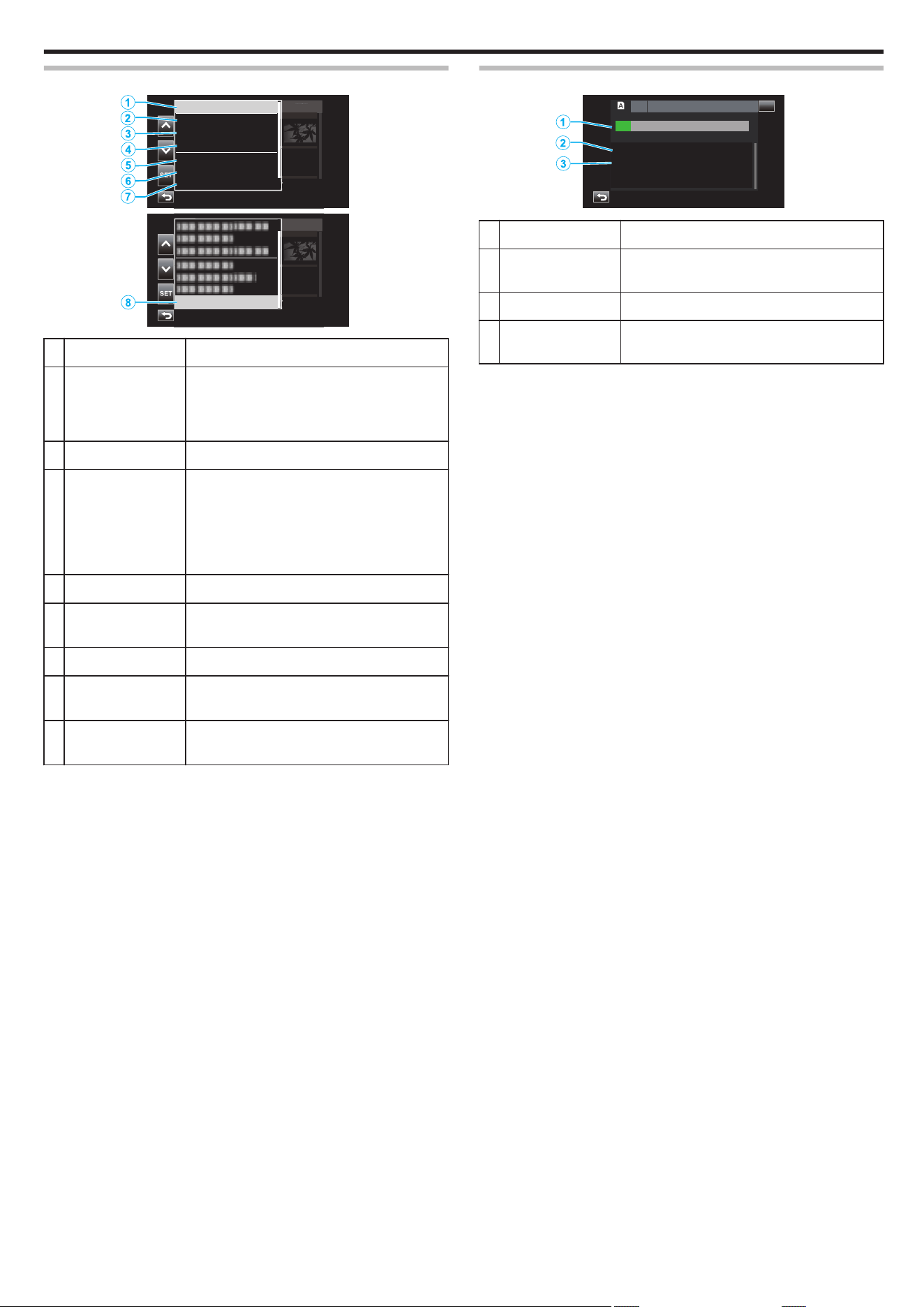
“ACTION” Menu (Video)
.
2018-01-01
1/8
000G0000
18
-
0
1-
0
1
1
/8
0
1
2018-01-01
1/8
000G0000
18
-
01
-
01
1/
8
0
1
Trim This Scene
Delete Scenes...
Remove Protection...
Protect...
Deselect All
Select Range
Select All Scenes
Display Media Info.
Display Description
A
Display Media Info.
Displays the recording information of the
recorded scenes.
“Media Information Screen (Videos Only)”
(A p. 53)
B
Select All Scenes Selects all the recorded scenes.
C
Select Range
Selects recorded scenes by specifying a
range.
“Selecting Multiple Discontinuous Scenes for
Enabling or Canceling Protection” (A p. 63)
“Selecting and Deleting Multiple Continuous
Scenes” (A p. 61)
D
Deselect All Clears all the selections.
E
Protect
Protects the selected scenes.
“Protecting Video Images” (A p. 63)
F
Remove Protection Cancels the preconfigured protection.
G
Delete Scenes
Deletes the selected scenes.
“Deleting Unwanted Files” (A p. 59)
H
Trim This Scene
Trims the selected scene.
“Trimming Recorded Videos” (A p. 66
)
Media Information Screen (Videos Only)
.
SLOT
8GB
17
51
AVCHD
Media Size
Free:
min
Display Description
A
Remaining
Recording Time
Displays the remaining recording time.
B
Media Size Displays the capacity of the media.
C
Recording Format
Displays the recording format and number of
files.
Playback
53
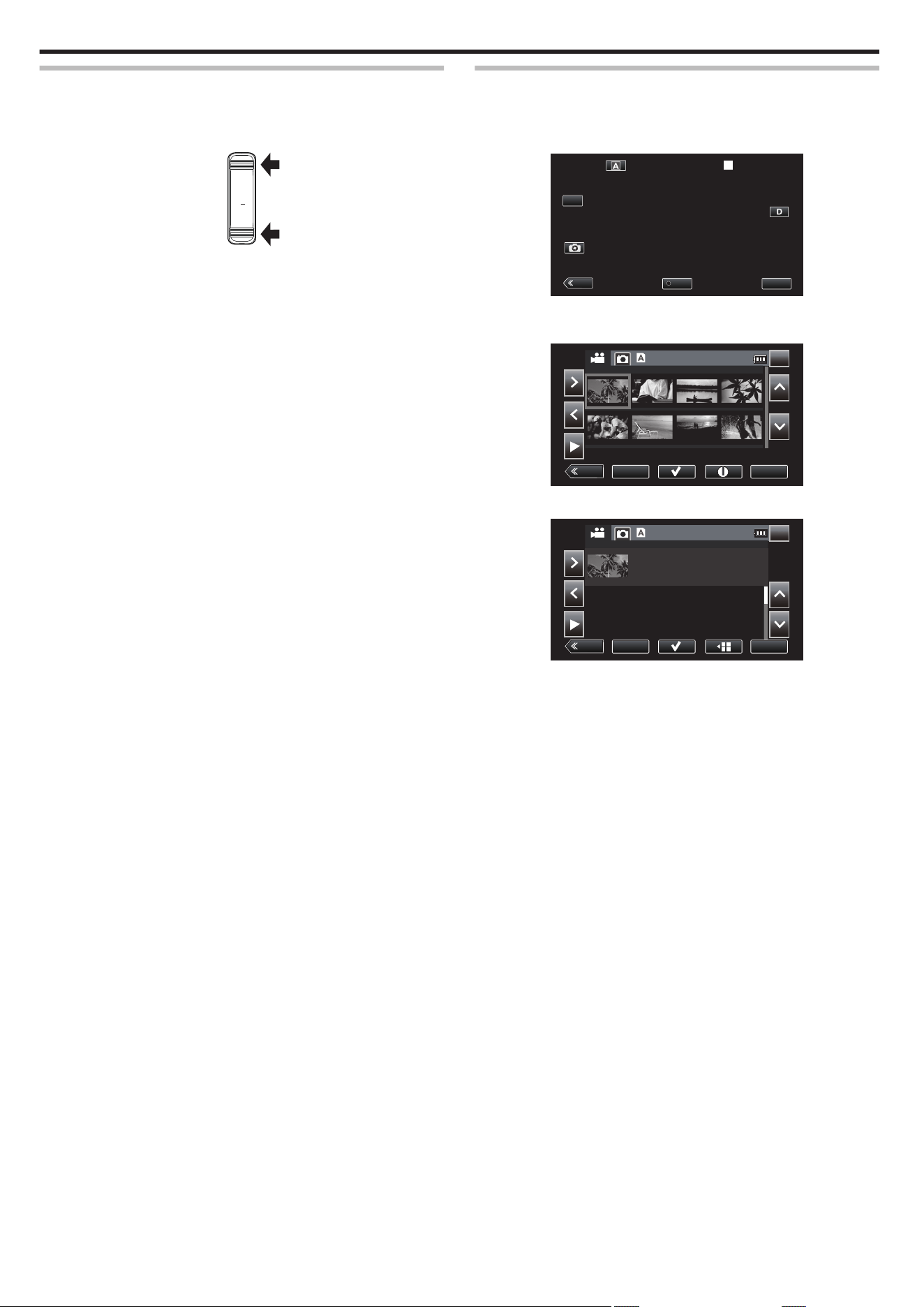
Adjusting the Volume of Videos
You can use the zoom/volume lever to control the volume.
.
T
W
VOL.
+
Turn up the volume
Turn down the volume
Checking the Recording Date and Other Information
The recording information of the recorded videos can be displayed for
viewing.
1
Tap M to select the playback mode.
.
MENUREC
PLAY
SLOT
STBY
00 : 00 : 00 . 00
2018 - 01 - 01
02 : 23 : 01
TC
2
Select the scene (file) for which information is to be displayed for
viewing, followed by tapping C.
.
MENU
ACTION
REC
SLOT
2018-01-01
1/8
000G0000
3
Check the recording information.
.
MENU
ACTION
REC
SLOT
2018-01-01
14:40:54
AVCHD
1920x1080 60i 18M
1/8
000G0021
Video
Format
Date Time
0
Tap 3 or 2 as needed to scroll through the displayed information.
(3 and 2
are not available for still images.)
0
Tap I to start playback.
Playback can also be started by tapping the thumbnail.
0
0 1 can be used to display information of the previous or next video.
0
Tap c to return to the thumbnail screen.
Playback
54
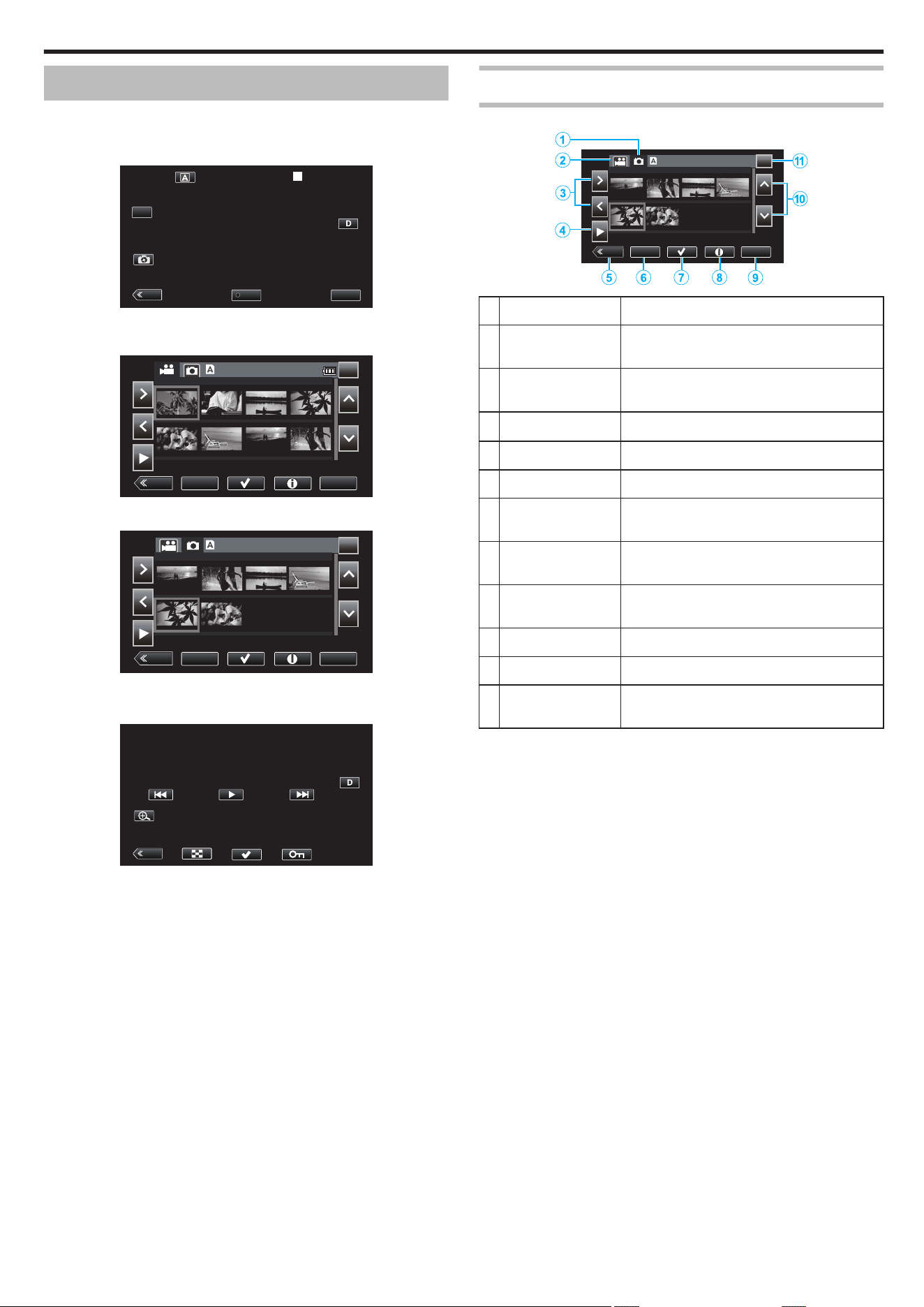
Playing Back Still Images
You
can select and play back the recorded still images from an index screen
(thumbnail display).
1
Tap M
to select the playback mode.
.
MENUREC
PLAY
SLOT
STBY
00 : 00 : 00 . 00
2018 - 01 - 01
02 : 23 : 01
TC
2
Tap the B (Still Image Playback Selection) button to switch to the Still
Image mode.
.
MENU
ACTION
REC
SLOT
2018-01-01
1/8
000G0000
3
Select a file (still image) and tap I.
.
MENU
ACTION
REC
SLOT
2018-01-01
1/8
PIC_0011
0
Playback can also be started by tapping the thumbnail.
4
Start playback.
.
REC
0
Tap u to return to the index screen.
Operation Buttons for Still Image Playback
During Index Screen Display
.
MENU
ACTION
REC
SLOT
2018-01-01
1/8
PIC_0011
Display Description
A
Still Image Playback
Mode Selection
Switches to the still image playback mode.
B
Video Playback
Mode Selection
Switches to the video playback mode.
C
0 1 Moves the cursor to the left or right.
D
I
Starts playback.
E
3
Switches to the recording mode.
F
ACTION Opens the ACTION menu for configuring
deletion and protection or for trimming.
G
I
Videos to be deleted or protected can be
selected in advance.
H
C
Displays the recording information of the
recorded videos.
I
MENU Displays the menu screen.
J
3 2 Moves the cursor upward or downward.
K
SLOT Switches the SD card slot between Slot A and
Slot B.
Playback
55
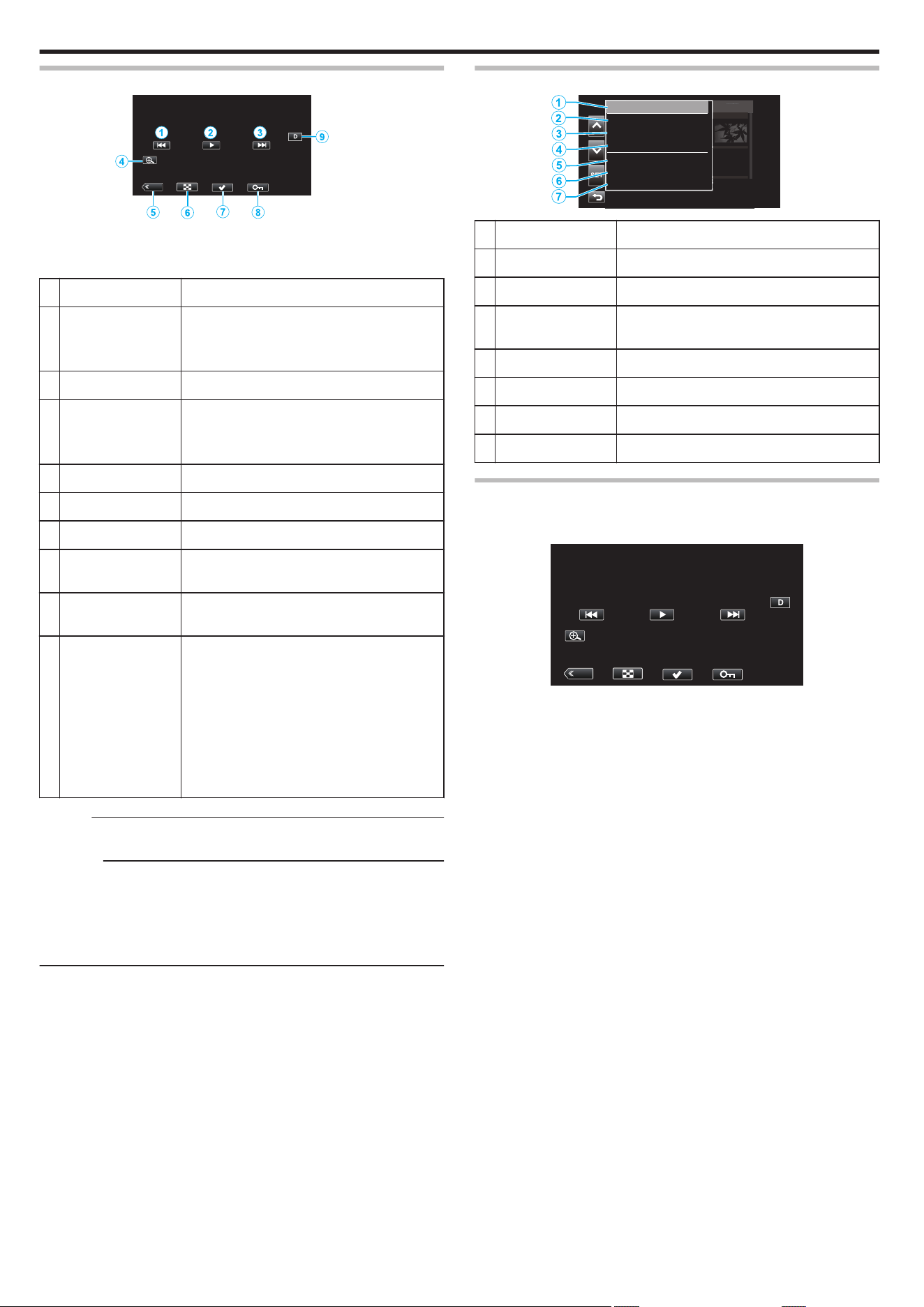
During Still Image Playback
.
REC
0
When
this unit is not operated, the operation buttons on the touch screen
disappear automatically. Tap on the screen to display the operation
buttons again.
Display Description
A
h
Returns to the previous still image
0
You
can perform the same operation with the
zoom lever.
B
d / e Starts/pauses slideshow
C
g
Advances to the next still image
0
You
can perform the same operation with the
zoom lever.
D
2
Enlarges the view.
E
3
Switches to the recording mode.
F
u
Returns to index screen
G
P
Videos to be deleted or protected can be
selected in advance.
H
I
Protects a video to prevent it from being erased
accidentally.
I
n
Switches the display between full (m) and
simple (n) with every tap of the button.
0
Simple display: Some displays disappear
automatically when the screen is not
operated.
0
Full display: Displays everything. The
display button changes from n
to m.
0
When the power is turned off, the display
setting will revert to simple display (n).
Memo :
0
Tap the touch screen to operate.
Caution :
0
This unit is a microcomputer-controlled device. Electrostatic discharge,
external noise and interference (from a TV, a radio, etc.) might prevent it
from
functioning properly. In such a case, close the monitor screen to turn
off the power and remove the AC adapter, then press the Reset button to
reset this unit.
“Resetting this Unit” (A p. 131)
“ACTION” Menu (Still Image)
.
2018-01-01
1/8
000G0000
18
-
0
1-
0
1
1
/8
0
1
Delete Files...
Select All Files
Remove Protection...
Protect...
Deselect All
Select Range
Display Media Info.
Display Description
A
Display Media Info. Not available for selection.
B
Select All Files Selects all the video recording files.
C
Select Range
Selects video recording files by specifying a
range.
D
Deselect All Clears all the selections.
E
Protect Protects the selected files.
F
Remove Protection Cancels the preconfigured protection.
G
Delete Files Deletes the selected files.
Slideshow Playback
Still images can be played back in a slideshow.
Tap I during still image playback to start the slideshow.
.
REC
“Operation Buttons for Still Image Playback” (A p. 55)
Playback
56
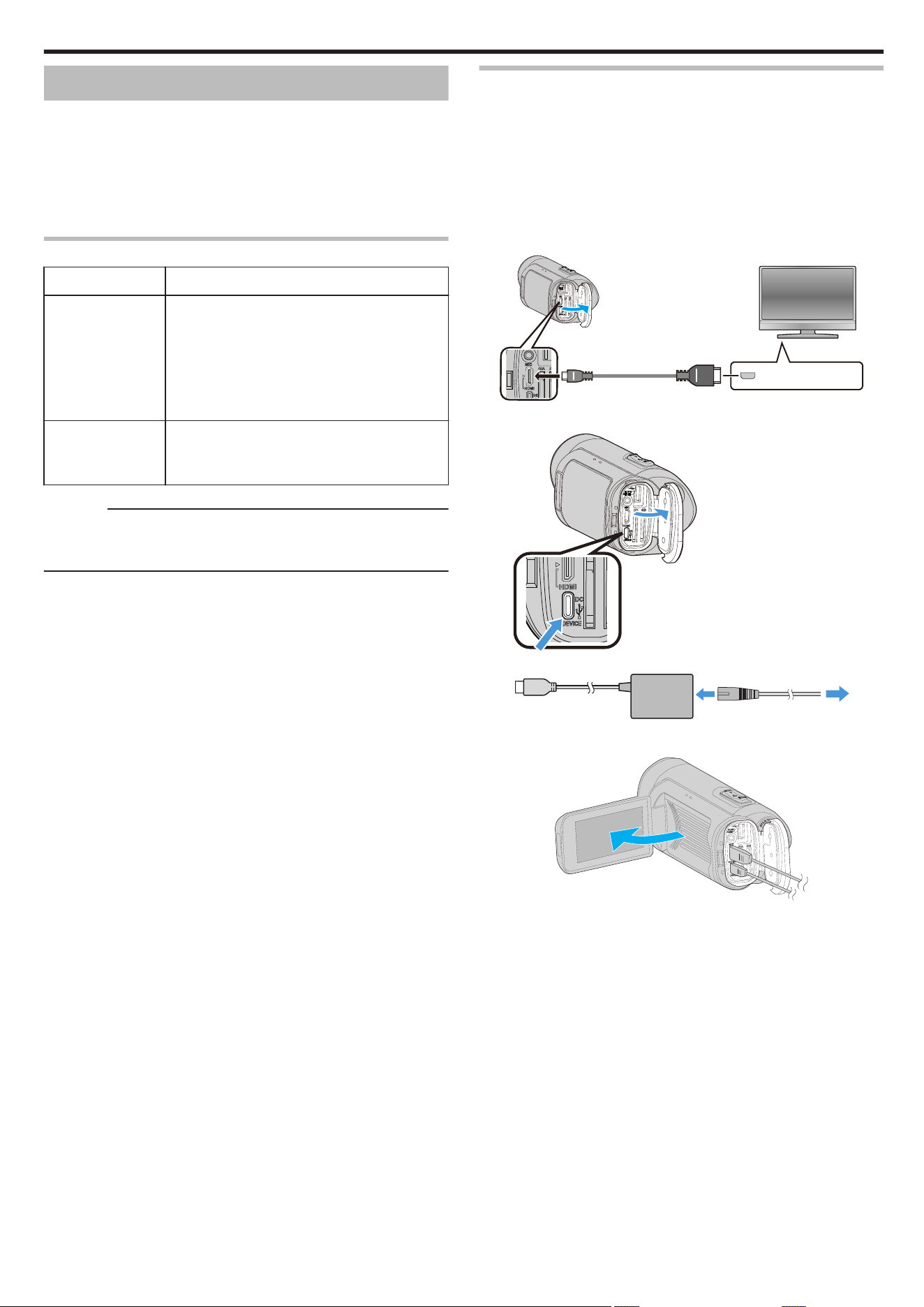
Connecting to and Viewing on TV
You
can connect this unit to a TV for playback. The image quality on the TV
varies with the type of TV in use.
0
Refer also to the instruction manual of the TV in use.
0
To display the date and time on TV, set both “Date/Time” and “Display On
TV” to “On”.
“ Date/Time ” (A p. 111)
“ Display On TV ” (A p. 112)
Unnatural Displays on TV
Trouble Action
HDMI-CEC
functions do not
work properly, and
the TV does not
work in conjunction
with this unit.
0
TVs may operate differently depending on the
specifications, even if they are HDMI-CEC
compliant. Therefore, the HDMI-CEC functions
of this unit cannot be guaranteed to operate in
combination with all the TVs. In such cases, set
“HDMI Control” to “Off”.
“ HDMI Control ” (A p. 112
)
The language on
the display
changed.
0
It may occur when you connect this unit to a TV
with different language setting using an HDMI
mini cable.
Caution :
0
Turn off this unit and the TV before making any connection.
0
Before inserting or removing the SD card, close the LCD monitor and
ensure that the POWER/ACCESS lamp goes off.
Connecting via the HDMI Mini Connector
By connecting to the HDMI mini terminal of this unit, 4K video recordings can
be
played back in 4K quality on TV sets that support 4K resolution and in HD
quality in the case of high-definition TVs.
0
Use a High Speed HDMI mini cable as the HDMI mini cable when not using
the provided one.
0
Videos on the camera cannot be played back on TVs that do not have a
HDMI input terminal.
0
Refer also to the instruction manual of the TV in use.
1
Connect to a TV.
.
TV
HDMI Mini Cable
(Provided)
HDMI Input Terminal
To HDMI Mini Connector
2
Connect the AC adapter to this unit.
.
Power Cord (Provided)
To DC/USB Device Terminal (Type-C)
AC Adapter(Provided)
Connect Power
Cord to Outlet
(AC 100 V to 240 V)
3
Open the LCD monitor.
.
0
The unit turns on automatically.
Playback
57
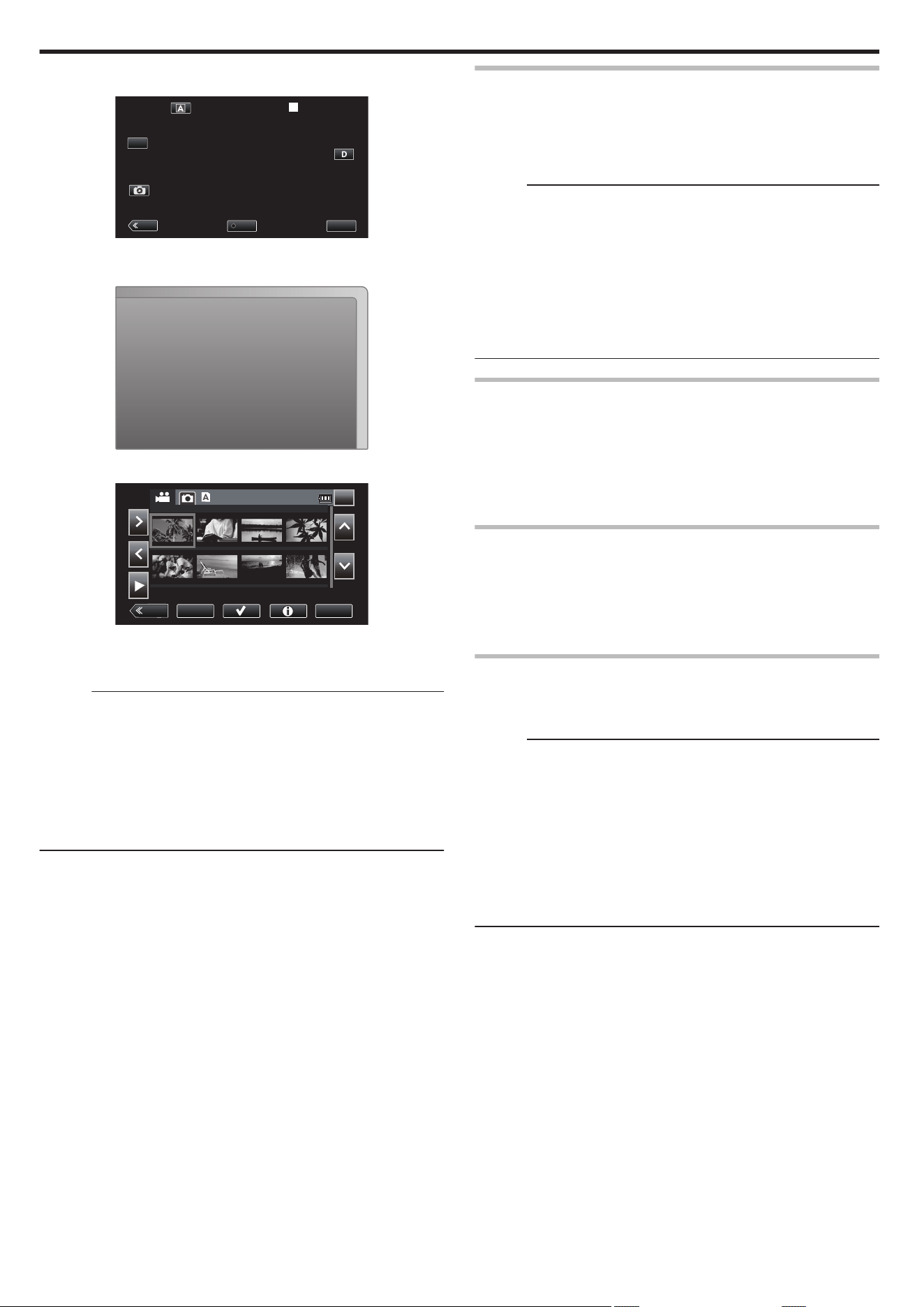
4
Tap M to select the playback mode.
.
MENUREC
PLAY
SLOT
STBY
00 : 00 : 00 . 00
2018 - 01 - 01
02 : 23 : 01
TC
5
Press the input selection button on the TV to switch to the input to the
terminal that is connected to this camera.
.
HDMI
HDMI
6
Select a scene (file) and tap I to start playback.
.
MENU
ACTION
REC
SLOT
2018-01-01
1/8
000G0000
0
Playback can also be started by tapping the thumbnail.
“Playing Back Videos” (A p. 51)
“Playing Back Still Images” (A p. 55)
Memo :
0
Change the settings in “HDMI Out” according to the connection.
“ HDMI Out ” (A p.
112)
0
When connected to the TV via the HDMI mini cable, images and sounds
may not be output properly depending on the TV connected.
In such cases, perform the following operations.
1) Disconnect the HDMI mini cable and connect it again.
2) Turn off and on this unit again.
0
For questions about the TV or method of connection, contact your TV's
manufacturer.
Operating in Conjunction with TV via HDMI
Connecting this unit to an HDMI-CEC enabled TV using the HDMI mini cable
allows linked operations with the TV to be performed.
0
HDMI-CEC (Consumer Electronics Control) is an industry standard that
enables interoperability between HDMI-CEC compliant devices that are
connected via HDMI cables.
Memo :
0
Not all HDMI control devices comply with the HDMI-CEC standard. The
HDMI control function of this unit will not work when connected to these
devices.
0
This
unit is not guaranteed to operate with all HDMI-CEC enabled devices.
0
Depending on the specifications of each HDMI-CEC enabled device,
some functions may not work with this unit. (For details, refer to the
instruction manual of your TV.)
0
Unintended operations may occur with some connected devices. In these
cases, set “HDMI Control” to “Off”.
“ HDMI Control ” (A p. 112)
Preparations
0
Connect an HDMI mini cable between this unit and the TV.
“Connecting via the HDMI Mini Connector” (A p. 57)
0
Turn
on the power of the TV and configure the HDMI CEC setting to “On”
(refer also to the instruction manual of the TV in use).
0
Set “HDMI Control” in the A/V Set menu to “On”.
“ HDMI Control ” (A p. 112)
Operation Method 1
1
Turn on this unit.
2
Select the playback mode.
0
TV turns on automatically and switches to HDMI input mode when
this unit is turned on.
Operation Method 2
1
Turn off the TV.
0
This unit turns off automatically.
Memo :
0
Depending on the TV connected, the display language of this unit will
automatically
switch to the language that is selected for the TV when this
unit is turned on.
(Applicable only when the display language selected on the TV is
supported by this camera) To use a display language different from that
used on the TV, set “HDMI Control” to “Off”.
0
The display language of the TV will not switch automatically, even if the
display language of this unit is changed.
0
These functions may not work correctly when devices such as amplifier
and selector are connected. In such cases, set “HDMI Control” to “Off”.
0
If HDMI-CEC does not work properly, turn off and on this unit again.
Playback
58
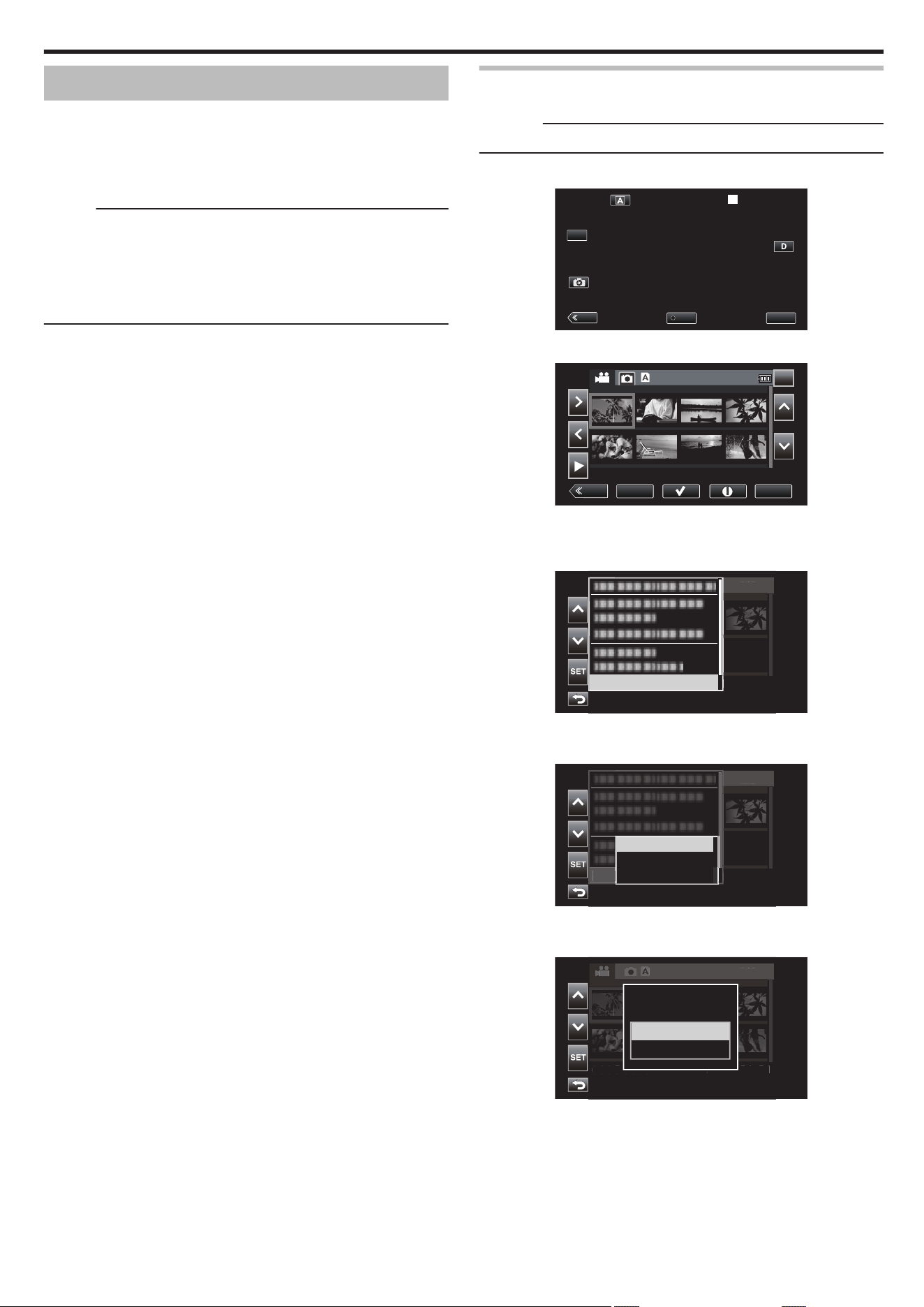
Deleting Unwanted Files
Delete unwanted videos and still images when the space in the recording
media is running out.
Doing so frees up more space in the recording media.
“Deleting One Scene” (A p. 59
)
“Selecting and Deleting Multiple Scenes” (A p. 60)
“Deleting All Scenes” (A p. 62)
Memo :
0
Deleted files cannot be restored.
0
Files that are protected cannot be deleted.
Release protection before deleting the file.
“Protecting Video Images” (A p. 63)
0
Be sure to back up important video files on a PC or any other media.
“Backing up Data on a Computer” (A p. 68
)
Deleting One Scene
Delete the scene that is currently being displayed (played).
Caution :
0
Deleted files cannot be restored.
1
Tap M to select the playback mode.
.
MENUREC
PLAY
SLOT
STBY
00 : 00 : 00 . 00
2018 - 01 - 01
02 : 23 : 01
TC
2
Select the scene to delete and tap “ACTION”.
.
MENU
ACTION
REC
SLOT
2018-01-01
1/8
000G0000
0
While the video mode is shown in the image, the same operations
apply for the still image mode.
3
Select “Delete Scenes” and tap “SET”.
.
2018-01-01
1/8
000G0000
1
8-01-0
1
1/8
0
1
Delete Scenes...
0
For still images, select “Delete Files...”.
4
Select “This Scene” and tap “SET”.
.
2018-01-01
1/8
000G0000
シーン削除 ...
1
8-01-0
1
1/8
1
シー
ン
All Scenes
Selected Scenes
This Scene
0
For still images, select “This File”.
5
Select “Delete” and tap “SET”.
.
2018-01-01
1/8
000G0000
2018-01-01
1/8
000G0000
Cancel
Delete
Delete This Scene?
0
To cancel the deletion, select “Cancel” and tap “SET”.
Editing
59
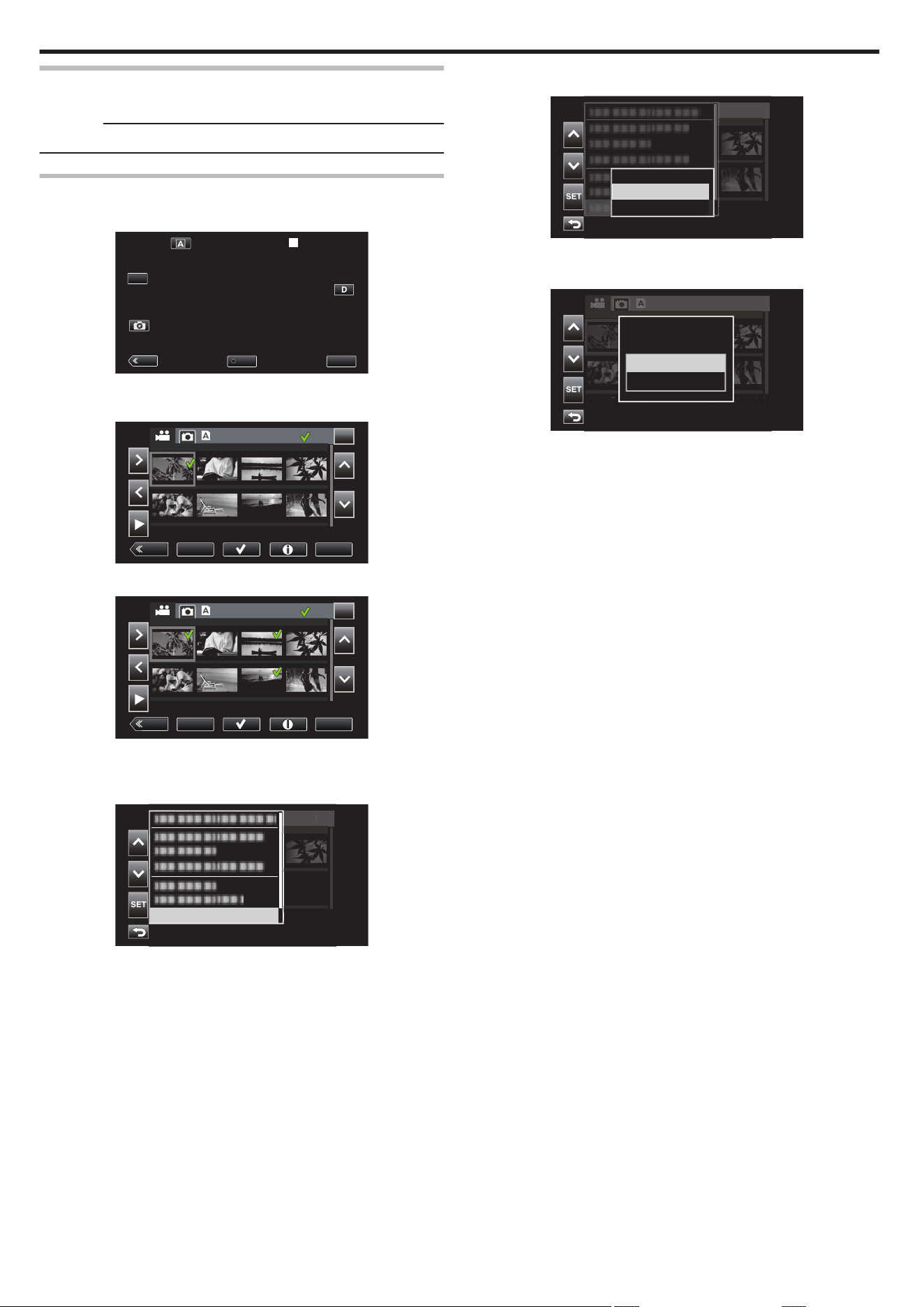
Selecting and Deleting Multiple Scenes
Deletes the selected files.
Caution :
0
Deleted files cannot be restored.
Selecting and Deleting Multiple Discontinuous Scenes
1
Tap M to select the playback mode.
.
MENUREC
PLAY
SLOT
STBY
00 : 00 : 00 . 00
2018 - 01 - 01
02 : 23 : 01
TC
2
Align the cursor with the scene (video) to delete and tap I.
Repeat the same step.
.
MENU
ACTION
REC
SLOT
2018-01-01
1
000G0000
3
Tap “ACTION”.
.
MENU
ACTION
REC
SLOT
2018-01-01
000G0000
3
0
While the video mode is shown in the image, the same operations
apply for the still image mode.
4
Select “Delete Scenes” and tap “SET”.
.
2018-01-01
1/8
000G0000
1
8-01-0
1
1/8
0
1
Delete Scenes...
5
Select “Selected Scenes” and tap “SET”.
.
2018-01-01
1/8
000G0000
1
8-01-0
1
1/8
1
All Scenes
Selected Scenes
This Scene
0
For still images, select “Selected Files”.
6
Select “Delete” and tap “SET”.
.
2018-01-01
1/8
000G0000
2018-01-01
1/8
000G0000
Delete Selected Scenes?
Cancel
Delete
0
To cancel the deletion, select “Cancel” and tap “SET”.
Editing
60
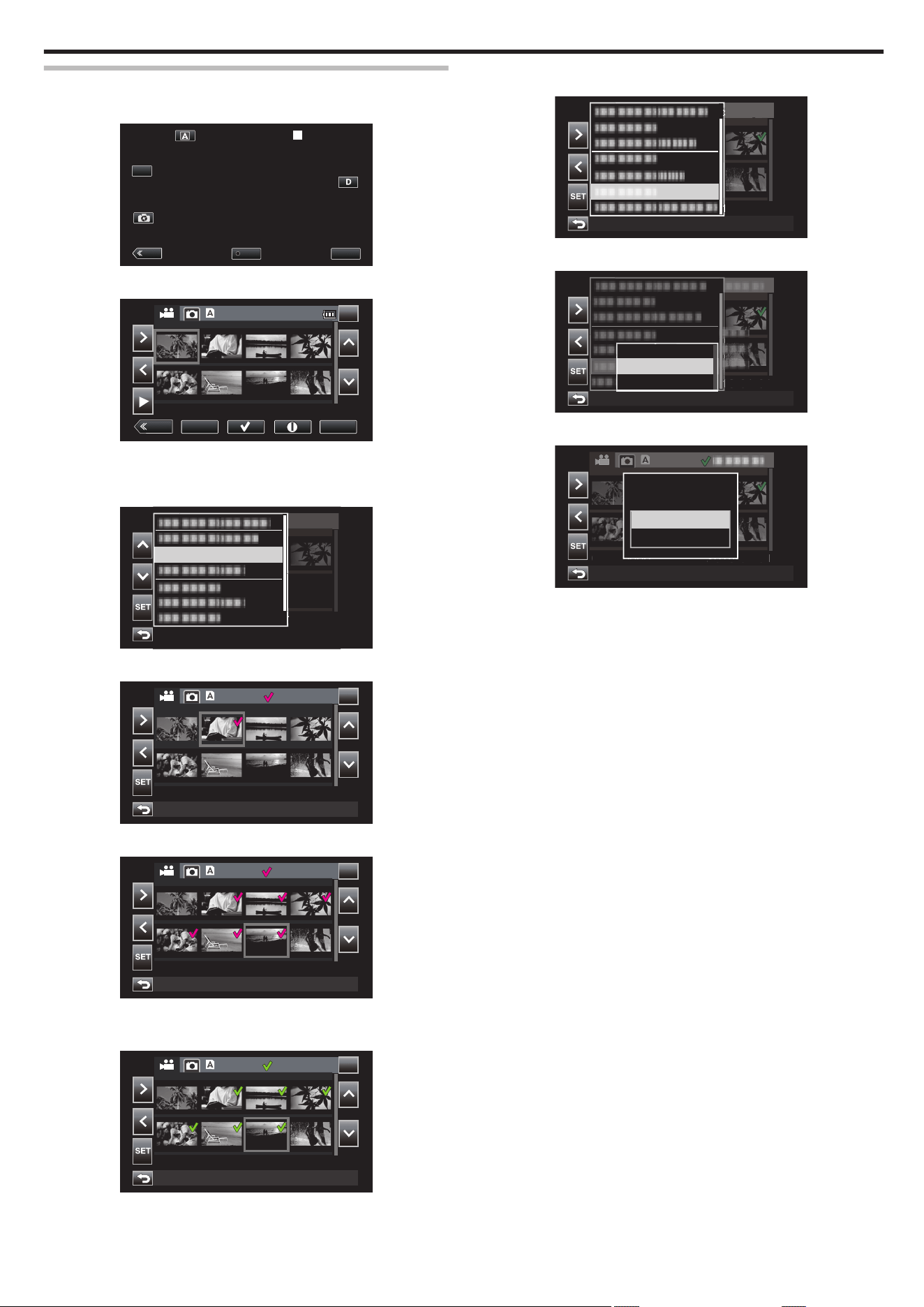
Selecting and Deleting Multiple Continuous Scenes
1
Tap M to select the playback mode.
.
MENUREC
PLAY
SLOT
STBY
00 : 00 : 00 . 00
2018 - 01 - 01
02 : 23 : 01
TC
2
Tap “ACTION”.
.
MENU
ACTION
REC
SLOT
2018-01-01
1/8
000G0000
0
While the video mode is shown in the image, the same operations
apply for the still image mode.
3
Select “Select Range” and tap “SET”.
.
2018-01-01
1/8
000G0000
1
8-01-0
1
1/8
0
1
Select Range
4
Select the starting point and tap “SET”.
.
SLOT
2018-01-01
000G0001
1
Selected Range:
5
Select the ending point and tap “SET”.
.
SLOT
2018-01-01
000G0006
6
Selected Range:
0
The color of the P changes from pink to green.
6
Tap “ACTION”.
.
SLOT
2018-01-01
000G0006
6
Selected Range:
7
Select “Delete Scenes” and tap “SET”.
.
2018-01-01
000G0006
1
8-01-0
1
c
ted Ran
g
e:
g
6
01
ec
1
c
Delete Scenes...
8
Select “Selected Scenes” and tap “SET”.
.
2018-01-01
000G0006
1
8-01-0
1
1
1
All Scenes
Selected Scenes
This Scene
9
Select “Delete” and tap “SET”.
.
2018-01-01
000G0006
2018-01-01
000G0006
Delete Selected Scenes?
Cancel
Delete
0
To cancel the deletion, select “Cancel” and tap “SET”.
Editing
61
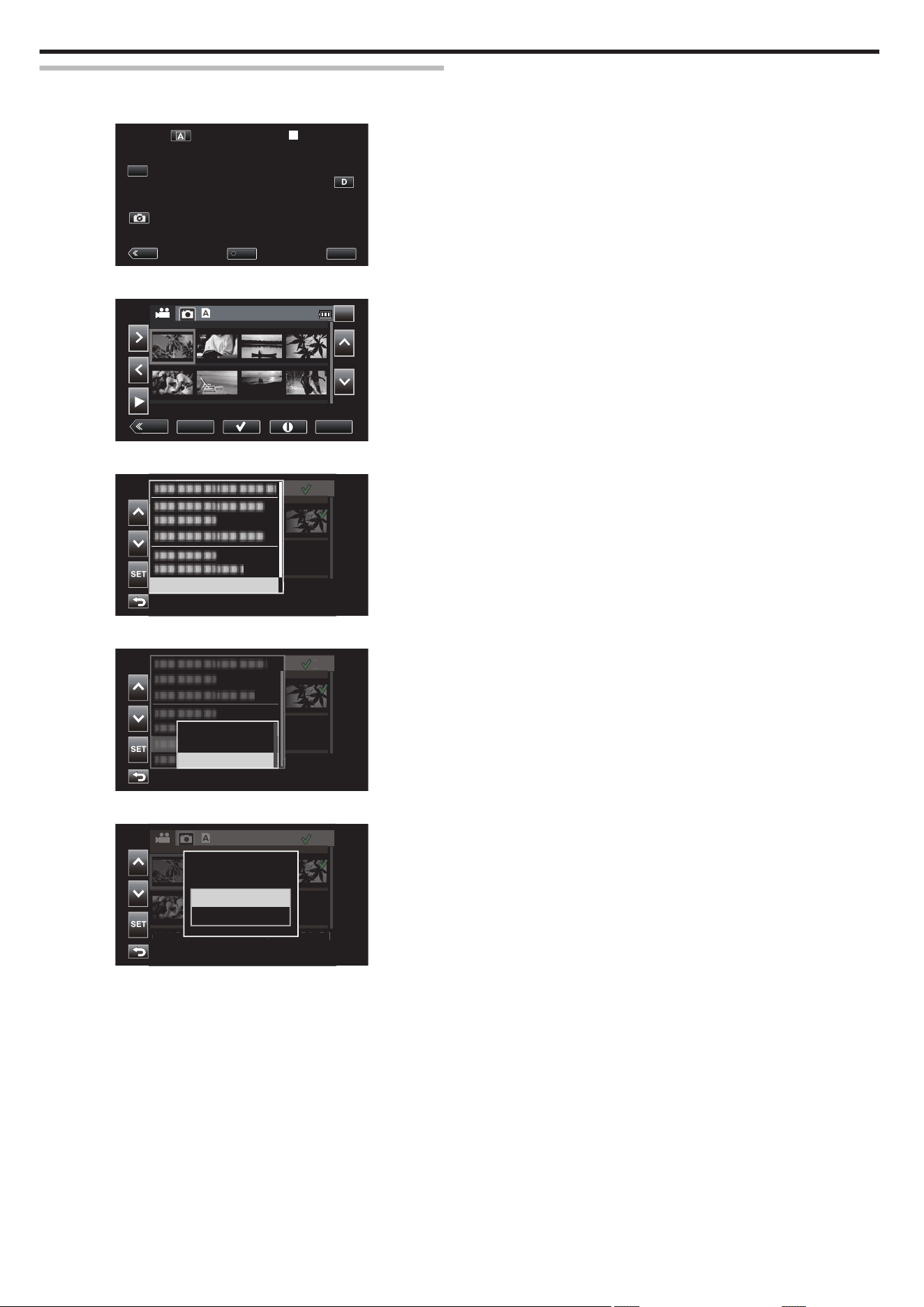
Deleting All Scenes
1
Tap M
to select the playback mode.
.
MENUREC
PLAY
SLOT
STBY
00 : 00 : 00 . 00
2018 - 01 - 01
02 : 23 : 01
TC
2
Tap “ACTION”.
.
MENU
ACTION
REC
SLOT
2018-01-01
1/8
000G0000
3
Select “Delete Scenes” and tap “SET”.
.
2018-01-01
8
000G0000
1
8-01-0
1
8
0
1
Delete Scenes...
4
Select “All Scenes” and tap “SET”.
.
2018-01-01
8
000G0000
1
8-01-0
1
8
1
1
All Scenes
Selected Scenes
This Scene
5
Select “Delete” and tap “SET”.
.
2018-01-01
8
000G0000
2018-01-01
8
000G0000
Delete All Scenes?
Cancel
Delete
0
To cancel the deletion, select “Cancel” and tap “SET”.
Editing
62
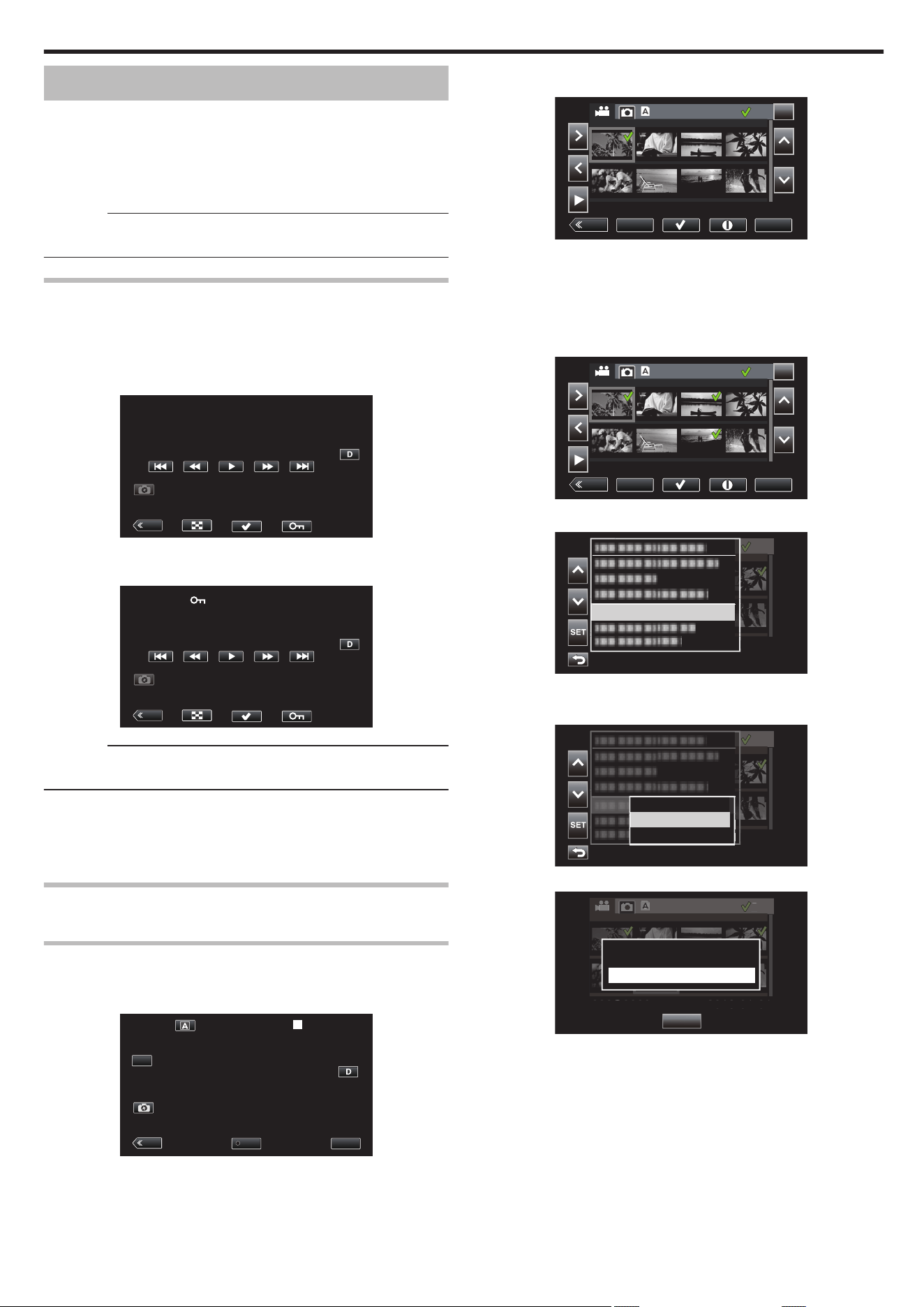
Protecting Video Images
Protect important videos/still images to prevent them from being deleted
accidentally.
“Protecting/Canceling Protection of the Displayed (Playback) Scene”
(A p. 63)
“Protecting/Releasing Protection of Selected Files” (A p. 63
)
“Protecting/Canceling Protection of All Scenes” (A p. 65)
Caution :
0
When the recording media is formatted, even the protected files will be
deleted.
Protecting/Canceling Protection of the Displayed (Playback)
Scene
Protect or cancel the protection of the file that is currently being displayed
(played).
o
Protecting a File
On the playback or paused screen, tap I.
.
REC
o
Canceling Protection
On the playback or paused screen of the protected scene, tap I.
.
REC
Caution :
0
Protect or cancel protect operation cannot be performed during fast
forward or fast reverse of the video.
Protecting/Releasing Protection of Selected Files
Protects or releases protection of the selected files.
Selecting Multiple Discontinuous Scenes for Enabling or
Canceling Protection
1
Tap M to select the playback mode.
.
MENUREC
PLAY
SLOT
STBY
00 : 00 : 00 . 00
2018 - 01 - 01
02 : 23 : 01
TC
2
Select the scene to protect and tap P.
.
MENU
ACTION
REC
SLOT
2018-01-01
1
000G0000
0
Repeat the same step to select other scenes to protect.
0
To
cancel protection of a scene, select the corresponding scene and
tap P.
0
While the video mode is shown in the image, the same operations
apply for the still image mode.
3
Tap ACTION.
.
MENU
ACTION
REC
SLOT
2018-01-01
3
000G0000
4
Select “Protect” and tap “SET”.
.
2018-01-01
6
000G0000
0
1-0
1
6
-
0
Protect...
0
To cancel protection, select “Remove Protection” and tap “SET”.
5
Select “Selected Scenes” and tap “SET”.
.
2018-01-01
6
000G0000
0
1-0
1
6
-
0
All Scenes
Selected Scenes
This Scene
0
For still images, select “Selected Files”.
.
2018-01-01
6
000G0000
2
018-01-0
1
6
000G0000
中止
Protecting
0
To cancel protection, tap “Stop”.
0
A I icon is displayed for the selected scene.
0
When
protection of a scene is canceled, the I icon that is appended
to the selected scene will disappear.
Editing
63
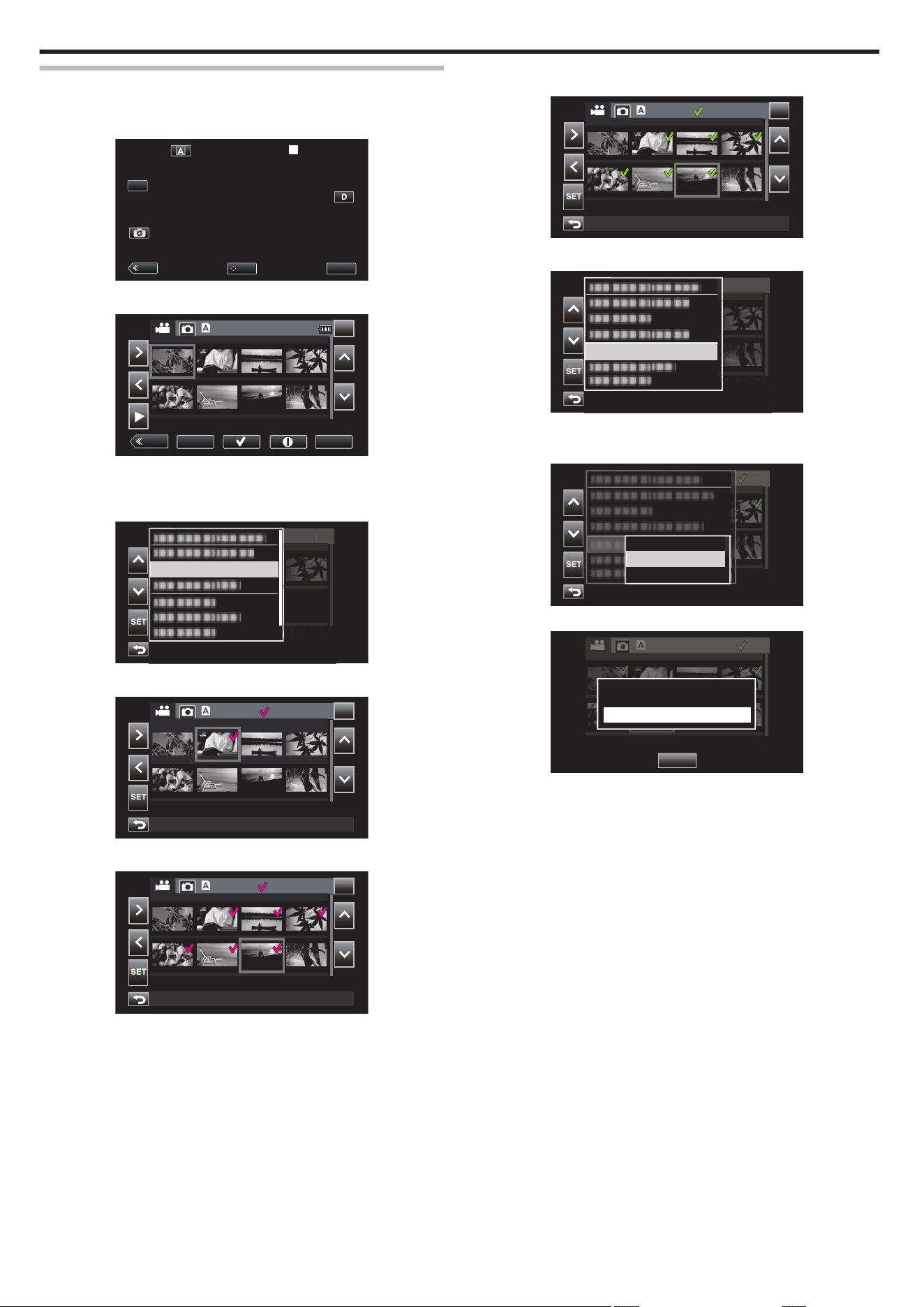
Selecting Multiple Continuous Scenes for Enabling or
Canceling Protection
1
Tap M to select the playback mode.
.
MENUREC
PLAY
SLOT
STBY
00 : 00 : 00 . 00
2018 - 01 - 01
02 : 23 : 01
TC
2
Tap “ACTION”.
.
MENU
ACTION
REC
SLOT
2018-01-01
1/8
000G0000
0
While the video mode is shown in the image, the same operations
apply for the still image mode.
3
Select “Select Range” and tap “SET”.
.
2018-01-01
1/8
000G0000
1
8-01-0
1
1/8
0
1
Select Range
4
Select the starting point and tap “SET”.
.
SLOT
2018-01-01
000G0001
1
Selected Range:
5
Select the ending point and tap “SET”.
.
SLOT
2018-01-01
000G0006
6
Selected Range:
0
The color of the P changes from pink to green.
6
Tap “ACTION”.
.
SLOT
2018-01-01
000G0006
6
Selected Range:
7
Select “Protect” and tap “SET”.
.
2018-01-01
1/8
000G0000
8-01-0
1
1/8
1
Protect...
0
To cancel protection, select “Remove Protection” and tap “SET”.
8
Select “Selected Scenes” and tap “SET”.
.
2018-01-01
6
000G0000
0
1-0
1
6
-
0
All Scenes
Selected Scenes
This Scene
0
For still images, select “Selected Files”.
.
2018-01-01
6
000G0000
2
018-01-0
1
6
000G0000
中止
Protecting
0
To cancel protection, tap “Stop”.
0
A I icon is displayed for the selected scene.
0
When
protection of a scene is canceled, the I icon that is appended
to the selected scene will disappear.
Editing
64
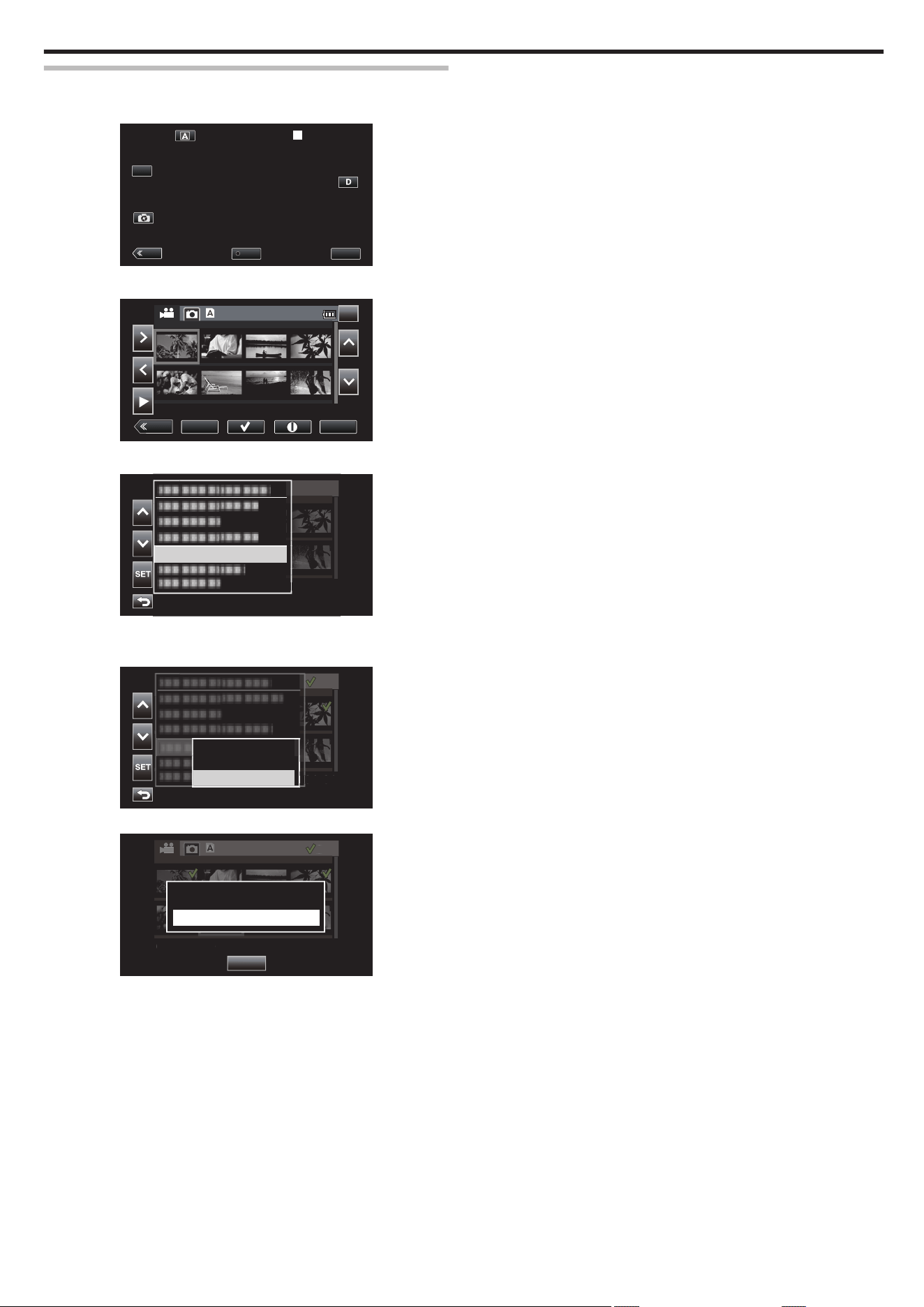
Protecting/Canceling Protection of All Scenes
1
Tap M to select the playback mode.
.
MENUREC
PLAY
SLOT
STBY
00 : 00 : 00 . 00
2018 - 01 - 01
02 : 23 : 01
TC
2
Tap “ACTION”.
.
MENU
ACTION
REC
SLOT
2018-01-01
1/8
000G0000
3
Select “Protect” and tap “SET”.
.
2018-01-01
1/8
000G0000
8-01-0
1
1/8
1
Protect...
0
To cancel protection, select “Remove Protection” and tap “SET”.
4
Select “All Scenes” and tap “SET”.
.
2018-01-01
6
000G0000
0
1-0
1
6
-
0
All Scenes
Selected Scenes
This Scene
0
For still images, select “All Files”.
.
2018-01-01
6
000G0000
2
018-01-0
1
6
000G0000
中止
Protecting
0
To cancel protection, tap “Stop”.
0
A I icon is displayed for all the scenes.
0
When
protection is canceled, the I icon that is appended to all the
scenes will disappear.
Editing
65
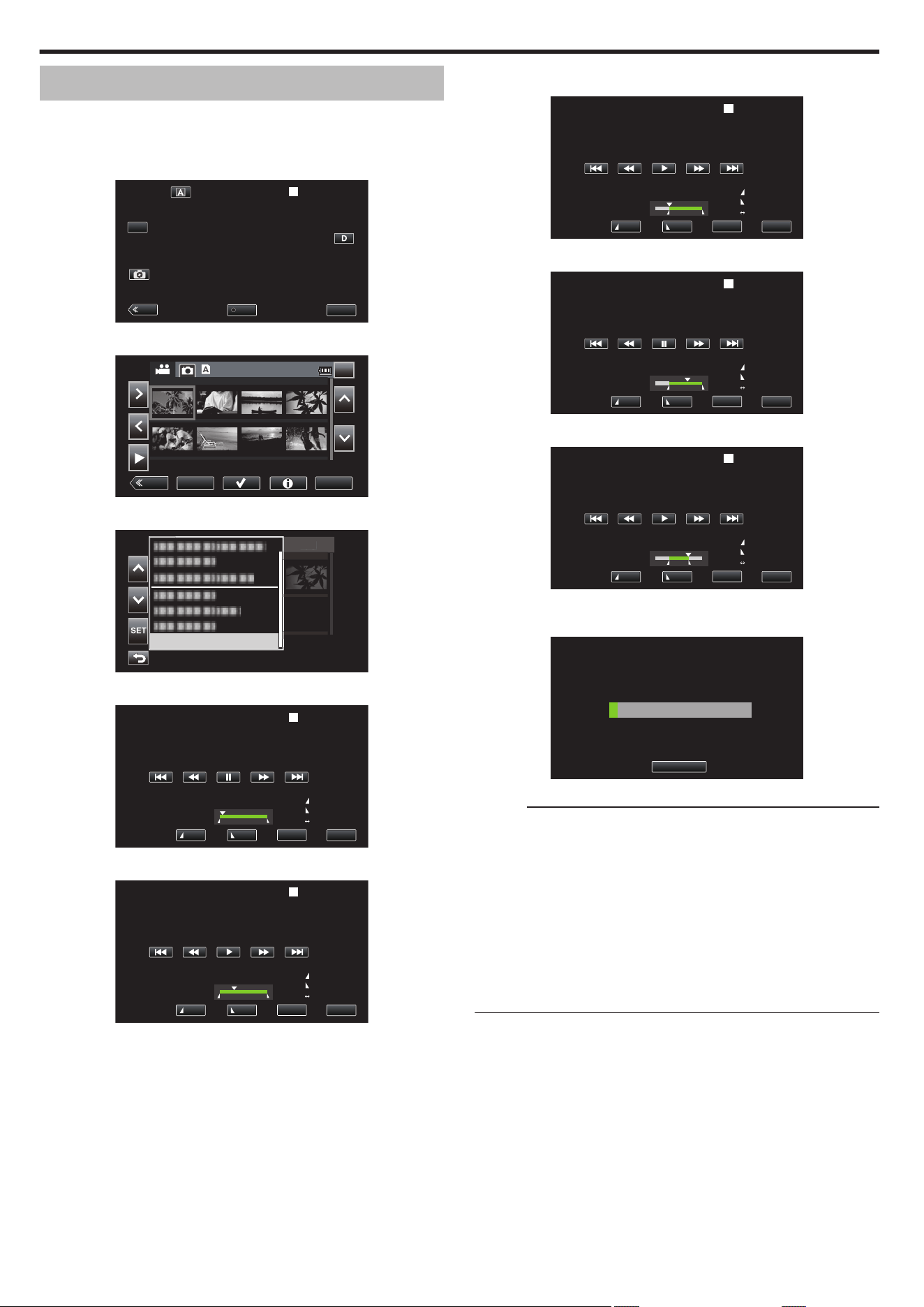
Trimming Recorded Videos
It
is possible to crop (trim) the necessary parts of a scene that is recorded in
an SD card. The trimmed scene is saved as a new file on the same SD card
as the original clip. The original scene will remain intact.
1
Tap M to select the playback mode.
.
MENUREC
PLAY
SLOT
STBY
00 : 00 : 00 . 00
2018 - 01 - 01
02 : 23 : 01
TC
2
Select the scene to trim and tap “ACTION”.
.
MENU
ACTION
REC
SLOT
2018-01-01
1/8
000G0000
3
Select “Trim This Scene” and tap “SET”.
.
2018-01-01
1/8
000G0000
1
8-01-0
1
1/8
0
1
Trim This Scene
4
Tap e at the point to start cropping.
.
CANCEL
OUTIN TRIM
PLAY
00 : 00 : 57 . 24
2018 - 01 - 01
02 : 23 : 01
00:00:11
00:01:08:01
00:00:57:00
TC
5
Tap “IN”.
.
CANCEL
OUTIN TRIM
PLAY
00 : 01 : 00 . 10
2018 - 01 - 01
02 : 23 : 01
00:00:011
00:01:08:01
00:00:57:00
TC
The point to start cropping is confirmed.
6
Tap I to start playback.
.
CANCEL
OUTIN TRIM
STILL
00 : 01 : 00 . 15
2018 - 01 - 01
02 : 23 : 01
00:00:07
00:10:08:01
00:01:00:15
TC
7
Tap e at the point to end cropping.
.
CANCEL
OUTIN TRIM
PLAY
00 : 01 : 05 . 10
2018 - 01 - 01
02 : 23 : 01
00:00:07
00:10:08:01
00:01:00:15
TC
8
Tap “OUT”.
.
CANCEL
OUTIN TRIM
STILL
00 : 01 : 05 . 10
2018 - 01 - 01
02 : 23 : 01
00:00:04
00:1:05:10
00:01:00:15
TC
The point to end cropping is confirmed.
9
Tap “TRIM”.
.
Scene Trimming...
Cancel
Trimming is complete when “Successfully Completed.” appears.
Memo :
0
The trimmed scene will be saved to the same card slot as that of the
original scene.
0
The
display appears in yellow if the recording duration corresponds to any
of the following. Trimming cannot be performed in this case.
“4K”: 3 minutes or longer; setting other than “4K”: 10 minutes or longer.
0
The display appears in yellow if the recording duration is longer than the
recordable time on the storage media. Trimming cannot be performed in
this case.
0
To return to the thumbnail screen while trimming is in progress, tap
CANCEL.
0
The IN and OUT points may deviate by up to 1 second prior to the specified
IN point and 1 second after the specified OUT point respectively.
Editing
66
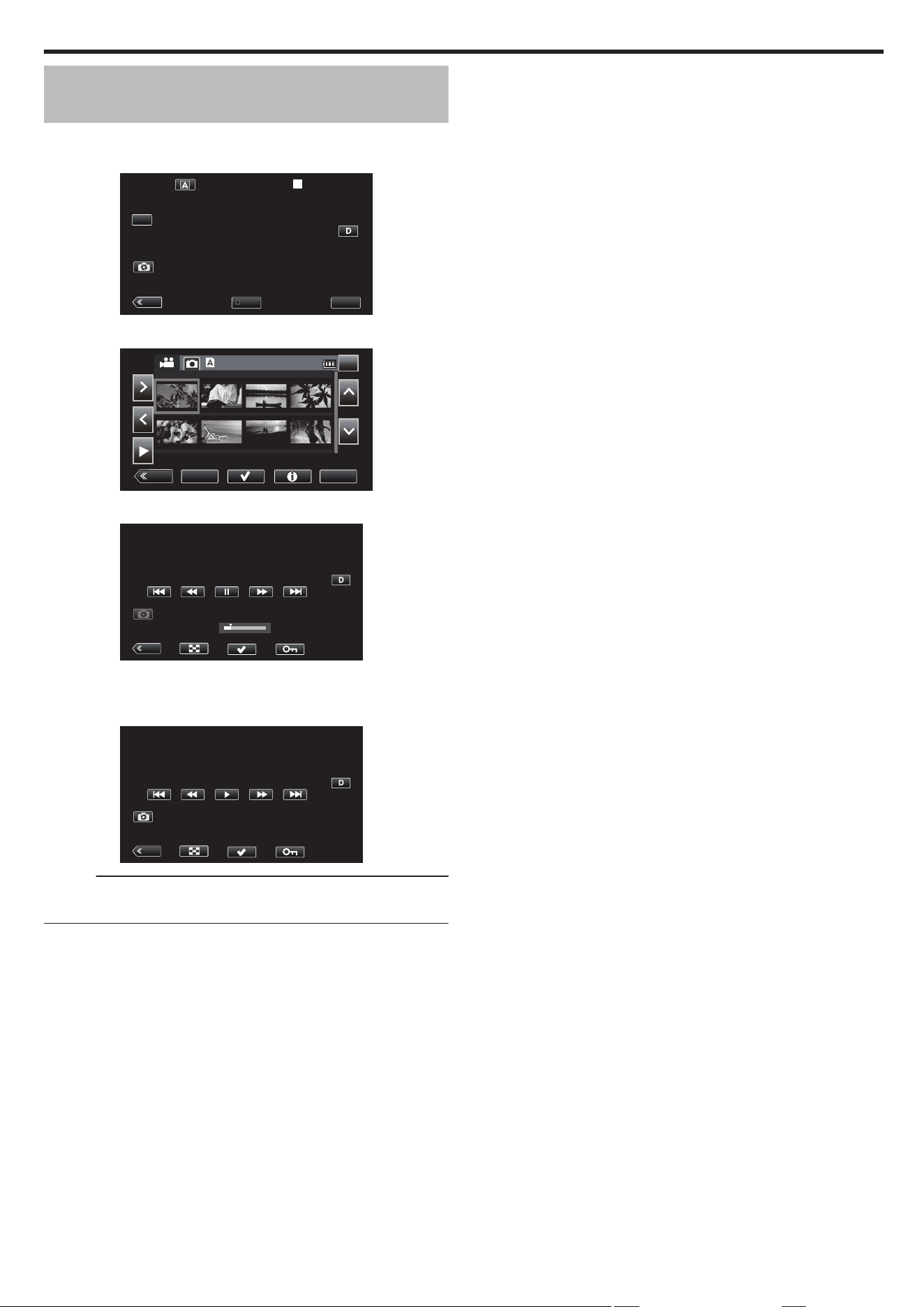
Capturing a Still Image from One Scene in a
Video
You can capture still images of the scenes you like in the recorded videos.
1
Tap M to select the playback mode.
.
MENUREC
PLAY
SLOT
STBY
00 : 00 : 00 . 00
2018 - 01 - 01
02 : 23 : 01
TC
2
Select a scene and tap I to start playback.
.
MENU
ACTION
REC
SLOT
2018-01-01
1/8
000G0000
3
Tap pause e at the desired scene during playback.
.
REC
PLAY
0
After pausing the video, you can fine-tune the point to capture by
tapping forward slow-motion k and reverse slow-motion l.
4
Tap B.
.
REC
STILL
Memo :
0
The cropped still image has the same resolution as the video image.
0
Cropped still images are saved to the selected SD card.
Editing
67
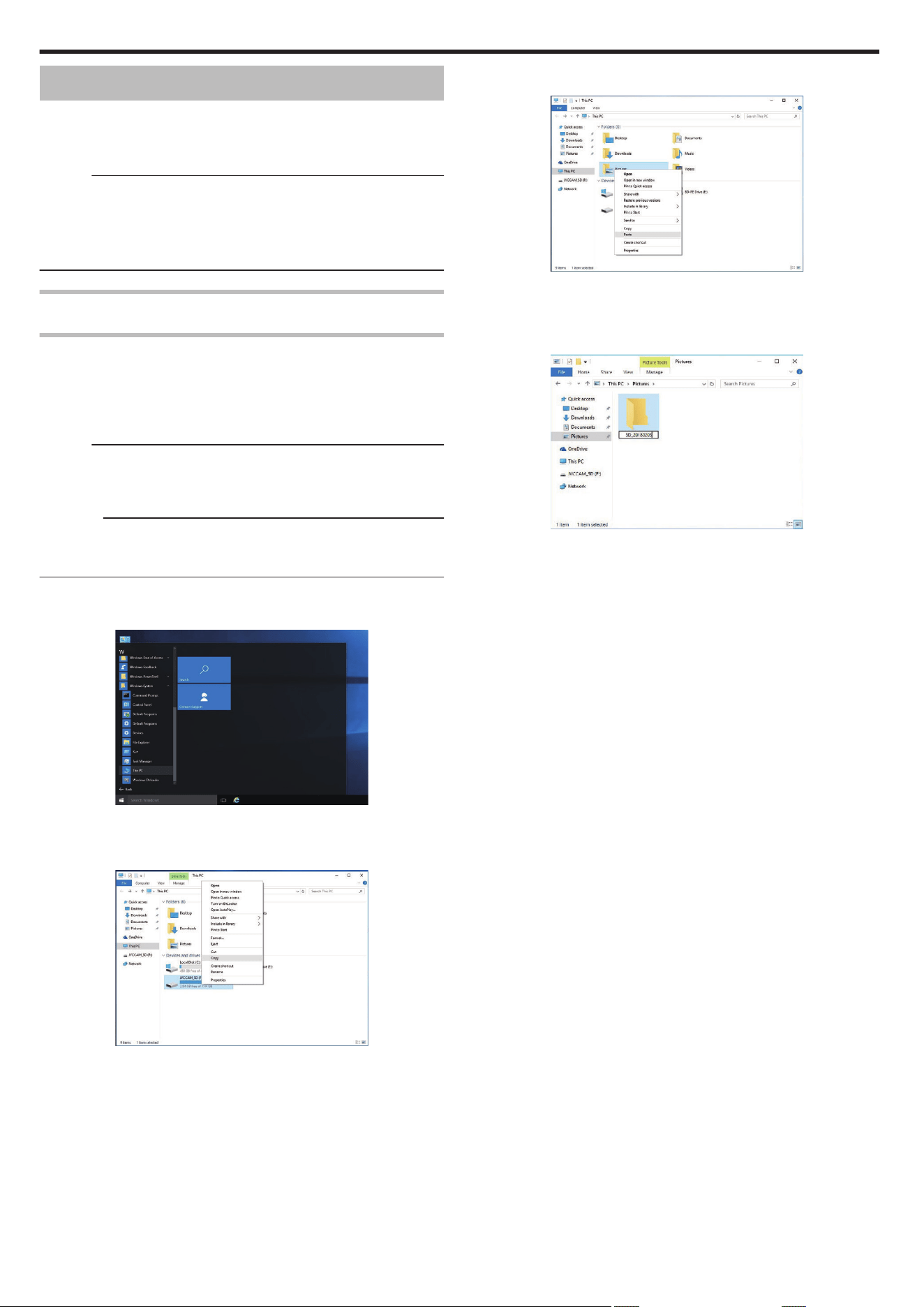
Backing up Data on a Computer
The
following describes the way to back up videos and still images in the SD
card to a PC.
By copying the entire folder from the SD card, it is possible to write the files
back to the SD card for playback on the camera.
Memo :
0
Backup can be performed without installing PowerDirector.
0
Playback on the camera will fail if the backup files on the PC are moved
or when their names are changed.
0
Video files output using PowerDirector and files recorded by a different
camera cannot be played back on this camera.
When Using Windows 10 or Windows 8.1
Backing up Data from an SD Card to a PC
1
Insert an SD card.
Insert the SD card that contains the recorded file into the SD card slot
of the PC or an SD card reader that is connected to the PC.
If an Auto Play dialog box or app appears, close it.
Memo :
0
If there is no SD card slot on the PC or you do not have a card reader,
insert
the SD card into the camera and connect the camera to a PC using
a USB cable. Then proceed to step.
Caution :
0
When connecting the camera to a PC to perform backup, the operation
cannot
be completed if the remaining battery power is not enough. Charge
the battery fully first.
2
Open the “Start menu”, and click “This PC” under “Windows System”.
0
For Windows 8.1, click F to open “Apps”.
.
0
If
a “This PC” icon is shown on desktop, double-click the icon to open
“This PC”.
3
Right-click the SD card drive and select “Copy”.
.
4
Right-click “Picture” and select “Paste”.
.
0
File copy starts.
0
Files can also be saved to a folder other than “Picture”.
5
Assign an easy-to-understand name for the copied folder, such as the
date.
.
6
Select
and right-click the SD card drive, followed by selecting “Remove”.
Copying
68
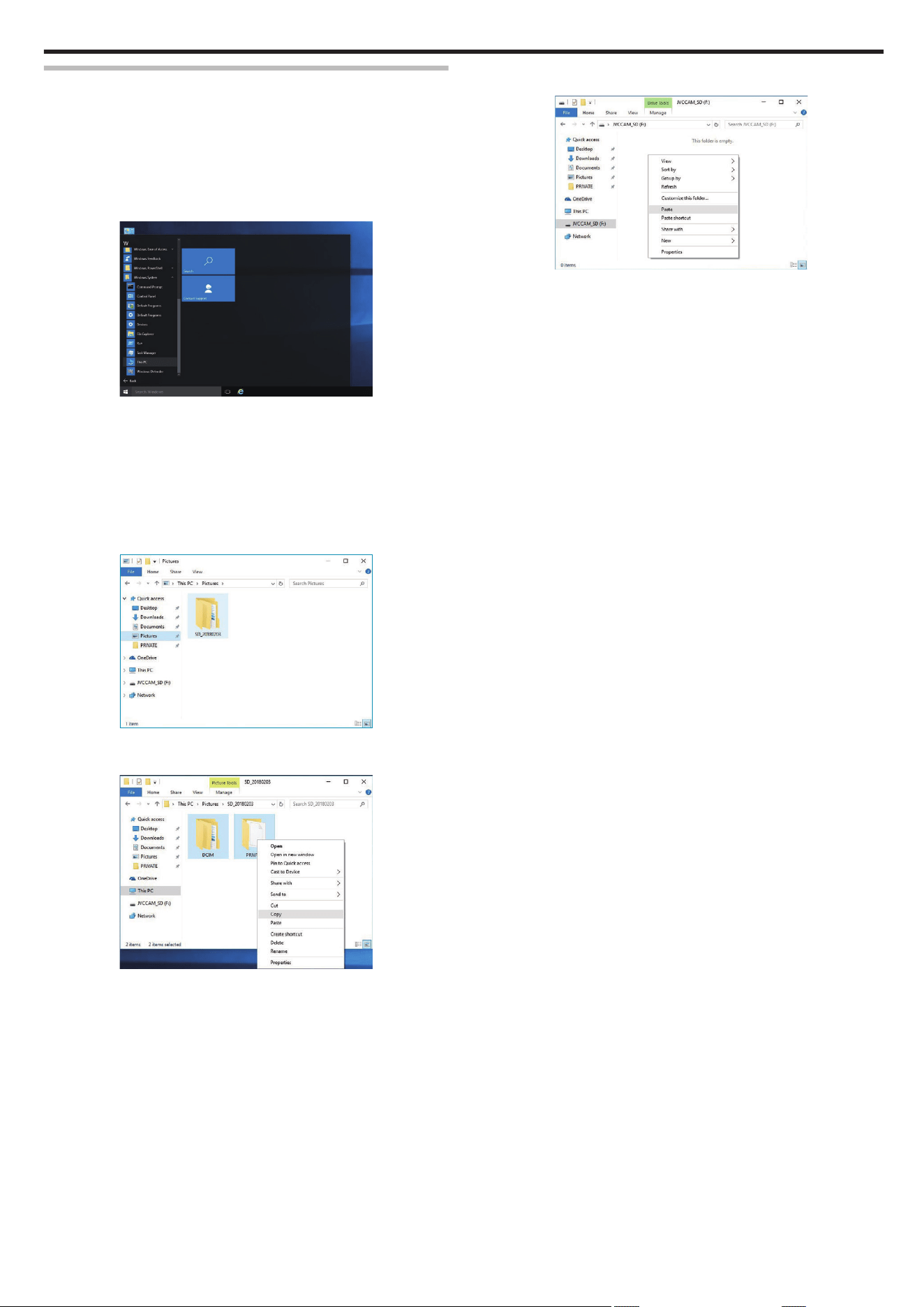
Writing Files Back from the PC to the SD Card
1
Insert an SD card.
0
Use an SD card that is formatted using the camera.
0
Insert an SD card into the SD card slot or SD card reader of the PC.
0
If an Auto Play dialog box or app appears, close it.
2
Open the “Start menu”, and click “This PC” under “Windows System”.
0
For Windows 8.1, click F to open “Apps”.
.
0
If
a “This PC” icon is shown on desktop, double-click the icon to open
“This PC”.
3
Click the SD card drive and check the folder.
0
Delete accordingly if there are folders in “DCIM”“PRIVATE”
“EXTMOV”.
0
If files that are needed still remain in the SD card, perform the step in
“Backing up Data from an SD Card to a PC” (A p. 68) first.
4
Open the folder that contains contents of the SD card.
.
5
Select and right-click the folder, followed by selecting “Copy”.
Select the “DCIM” and “PRIVATE” folders.
.
6
Select and right-click the SD card drive, followed by selecting “Paste”.
.
File copy starts.
7
Select
and right-click the SD card drive, followed by selecting “Remove”.
Copying
69
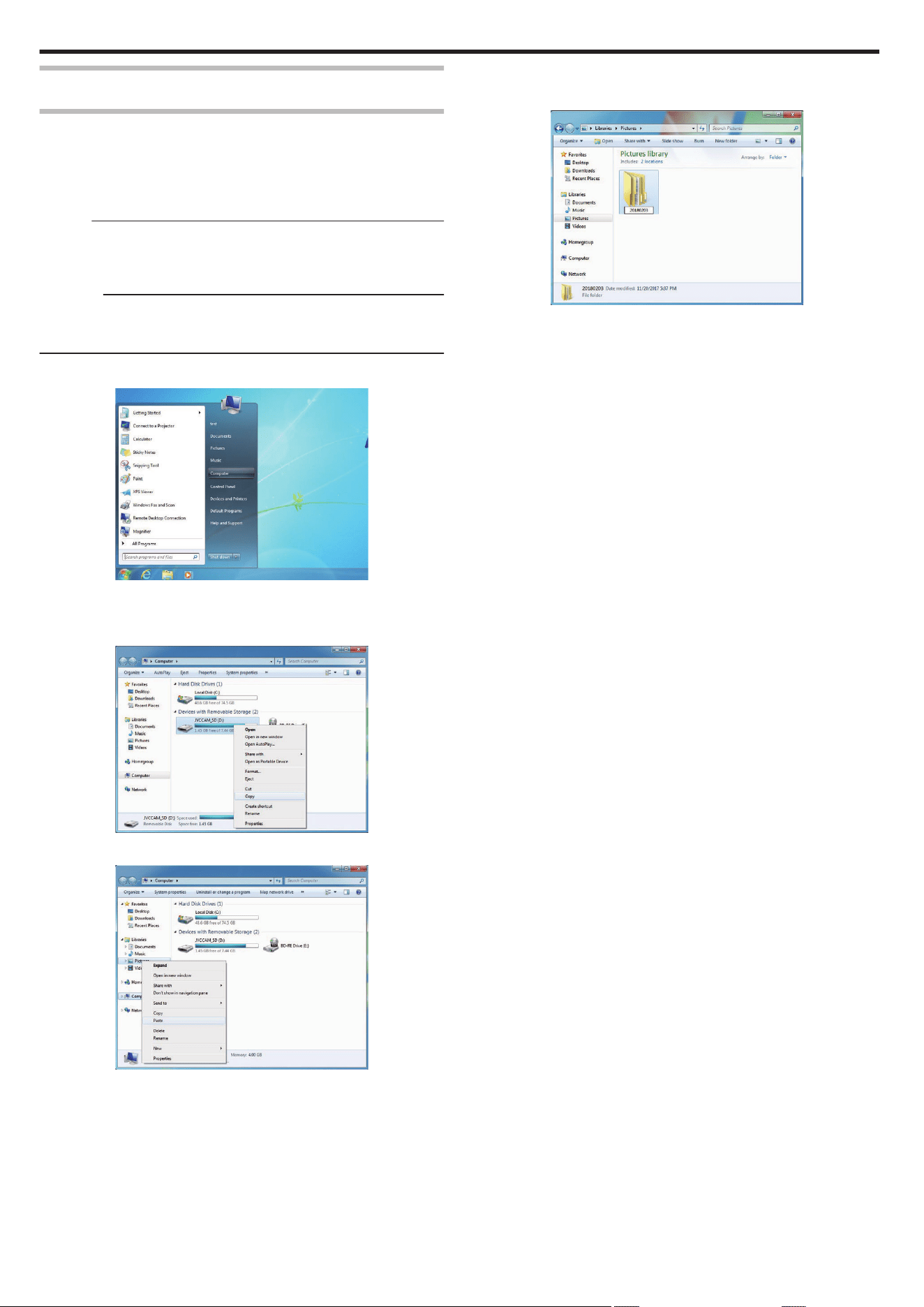
When Using Windows 7
Backing up Data from an SD Card to a PC
1
Insert an SD card.
Insert the SD card that contains the recorded file into the SD card slot
of the PC or an SD card reader that is connected to the PC.
If an Auto Play dialog box or app appears, close it.
Memo :
0
If there is no SD card slot on the PC or you do not have a card reader,
insert
the SD card into the camera and connect the camera to a PC using
a USB cable. Then proceed to step.
Caution :
0
When connecting the camera to a PC to perform backup, the operation
cannot
be completed if the remaining battery power is not enough. Charge
the battery fully first.
2
Click “Computer” in the Start menu.
.
0
If a “Computer” icon is shown on desktop, double-click the icon to
open “Computer”.
3
Right-click the SD card drive and select “Copy”.
.
4
Right-click “Picture” and select “Paste”.
.
0
File copy starts.
0
Files can also be saved to a folder other than “Picture”.
5
Assign an easy-to-understand name for the copied folder, such as the
date.
.
6
Select
and right-click the SD card drive, followed by selecting “Remove”.
Copying
70
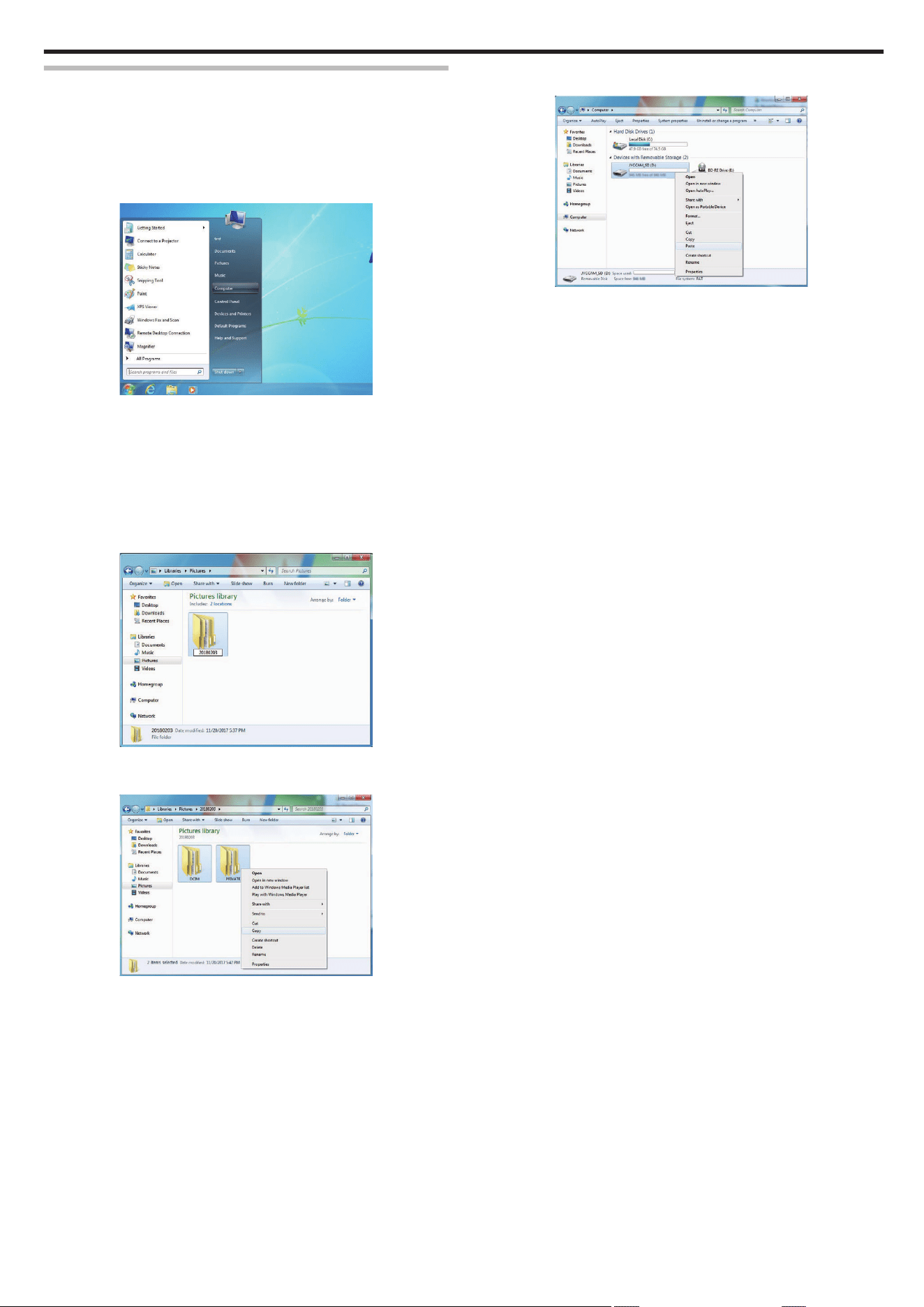
Writing Files Back from the PC to the SD Card
1
Insert an SD card.
0
Use an SD card that is formatted using the camera.
0
Insert an SD card into the SD card slot or SD card reader of the PC.
0
If an Auto Play dialog box or app appears, close it.
2
Click “Computer” in the Start menu.
.
0
If a “Computer” icon is shown on desktop, double-click the icon to
open “Computer”.
3
Click the SD card drive and check the folder.
0
Delete accordingly if there are folders in “DCIM”“PRIVATE”
“EXTMOV”.
0
If
files that are needed still remain in the SD card, perform the step in
“Backing up Data from an SD Card to a PC” (A p. 70) first.
4
Open the folder that contains contents of the SD card.
.
5
Select and right-click the folder, followed by selecting “Copy”.
Select the “DCIM” and “PRIVATE” folders.
.
6
Select and right-click the SD card drive, followed by selecting “Paste”.
.
File copy starts.
7
Select
and right-click the SD card drive, followed by selecting “Remove”.
Copying
71
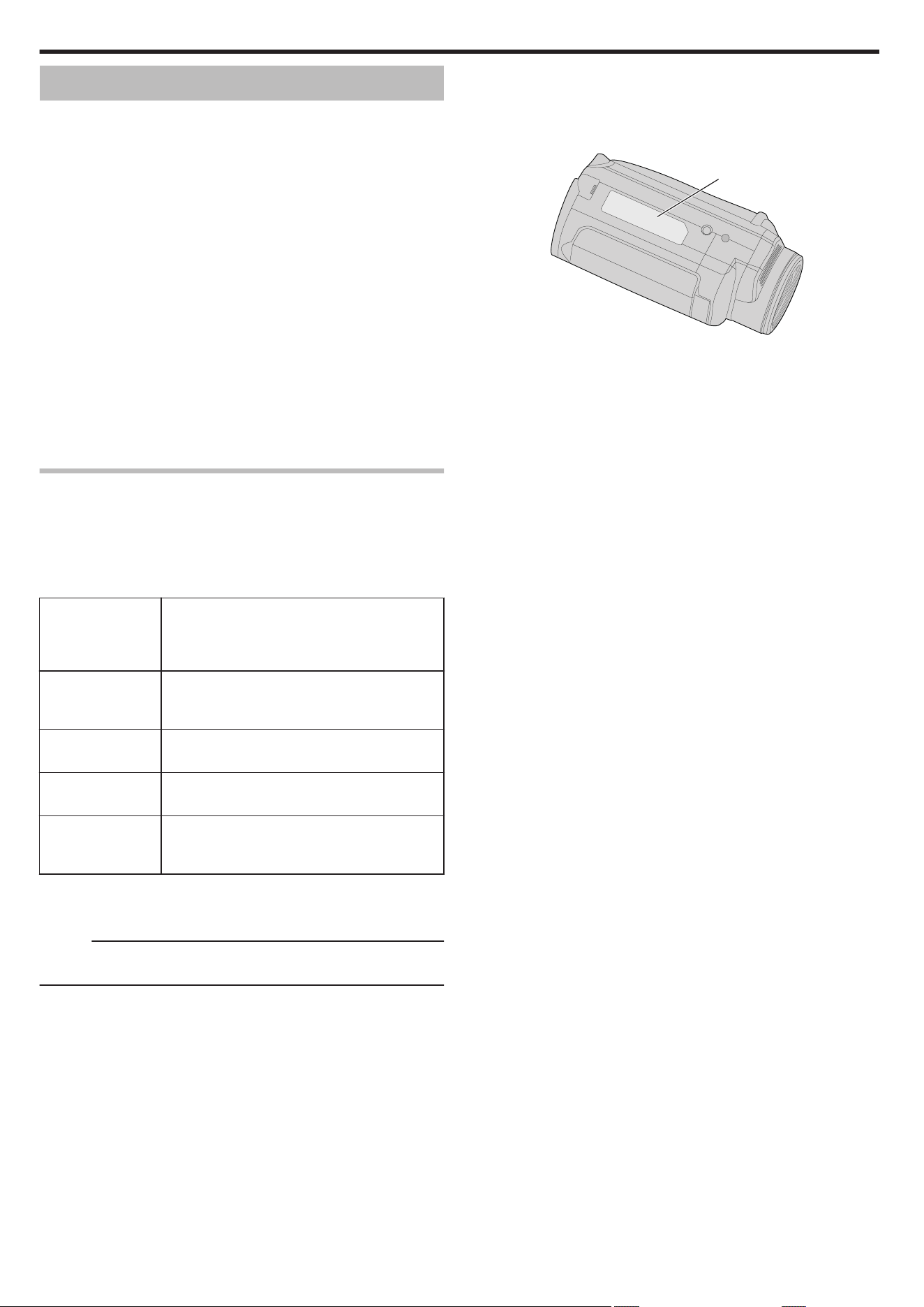
Using CyberLink PowerDirector
The
CyberLink PowerDirector 14 video-editing software can be downloaded
for use.
Power Director offers a diverse variety of editing functions such as cutting,
trimming, merging, transition, effect and text addition.
After editing, the files can be converted to a different format according to the
intended use, uploaded to movie websites or made into movie discs.
0
For more details on how to operate PowerDirector, please refer to the
PowerDirector User’s Guide. The User’s Guide can be downloaded from
the Download page.
If you encounter any problems with the provided software CyberLink
PowerDirector, please consult the “CyberLink Customer Support”.
o
Homepage
(Deutschland)
https://de.cyberlink.com/support/index.html
(France)
https://fr.cyberlink.com/support/index.html
(España)
https://es.cyberlink.com/support/index.html
(Italia)
https://it.cyberlink.com/support/index.html
(United Kingdom)(Rest of Europe)
https://www.cyberlink.com/support/index.html
Installing PowerDirector
1
Check the performance of the PC.
0
Check to ensure that the performance of the PC in use meets the
following system requirements.
0
If you are unsure of the specifications of the PC in use, refer to
“Verifying System Requirements (Guideline)” (A p. 74) .
OS
Windows® 10 (32 bits/64 bits)
Windows® 8.1 (32 bits/64 bits)
Windows® 7 (32 bits/64 bits)
(64 bits recommended)
CPU
Intel® Core i5 or higher (recommended)
(For editing of 4K videos, Intel® Core i7 or higher
is recommended)
RAM
3 GB or higher recommended (32 bits)
6 GB or higher recommended (64 bits)
Display
A 4K-compatible display is required for playing
back in 4K resolution
Graphics
VRAM 1 GB or higher recommended
A
4K-compatible video card is required for playing
back in 4K resolution
0
Other requirements
To create a disc, a rewritable disc drive that supports the intended
disc type is needed.
Memo :
0
For
more information on the system requirements, please refer to the Help
menu of PowerDirector.
2
Check the serial number.
0
Input of the serial number is needed during download.
0
The
serial number is printed on the label on the bottom surface of the
camera.
.
Label
(Bottom Surface of Camera)
3
Download.
0
Open the Download page from the link below.
http://www.cyberlink.com/JVC/PDR/
0
Follow the instructions on the Download page to download the file.
0
Write down the product key that is displayed on the Download page
or leave it displayed until you are ready to install.
4
Install.
0
Double-click the downloaded file to start installation.
0
Follow the instructions displayed on the installer to complete the
installation.
Copying
72
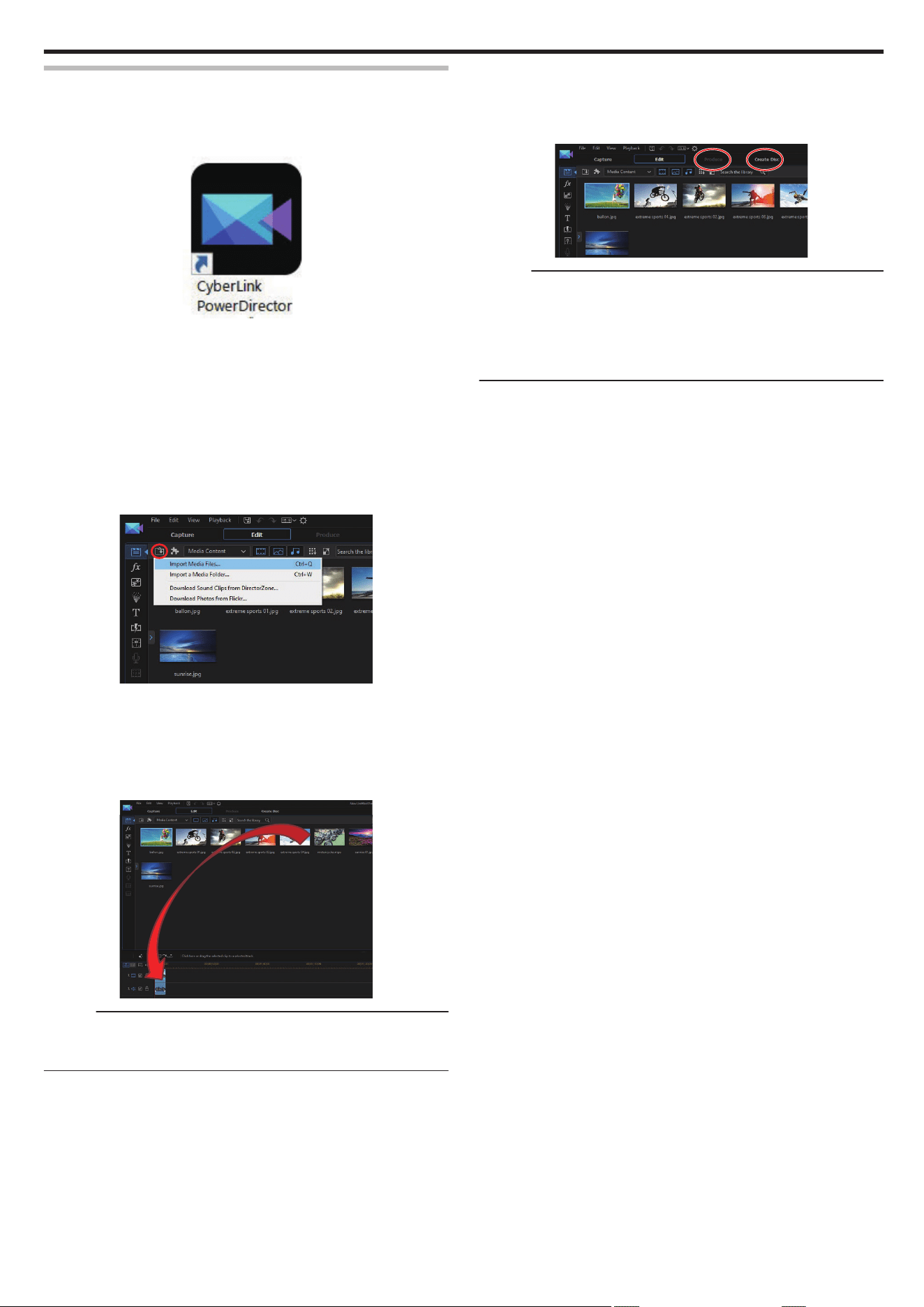
Using PowerDirector
1
Start up.
0
Double-click the “CyberLink PowerDirector” icon on the Desktop
screen.
.
0
Input of the product key is needed at the initial startup. (Product key
displayed on the Download page)
0
After the launcher has started up, select “Full Function Editor” under
normal circumstances.
2
Load a file.
0
Display the media room on the editing screen (in the startup state),
followed by selecting “Load Media”F“Load Media Files” to load a
video or still image file.
0
The loaded file is displayed as a media room thumbnail.
0
Although
it is also possible to load a file from the SD card, it has to be
in the same drive when you save a project and proceed to editing.
.
3
Edit.
0
Drag and drop the media room thumbnail in the video track of the
timeline.
0
Editing operations such as trimming, merging and application of
effects are possible on the timeline.
0
The edited data can be saved with “File”F“Save Project”.
.
Memo :
0
To play back (view) a video file, select the media room thumbnail without
adding the file to the timeline, followed by clicking “Playback” on the
preview window. The videos can be played back in high image quality.
4
Output.
0
After
editing is complete, files can be output as different video files or
uploaded to movie websites with “Output”.
“Create Disk” can be used to create different types of discs.
.
Memo :
0
Output of 4K video files may take a long time (10 times longer than the
actual time) even under the recommended environment.
0
Video
files output with PowerDirector cannot be played back on a camera.
0
A device or player software program that is compatible with the
corresponding disc format is needed to play back a disc created with
PowerDirector.
Copying
73
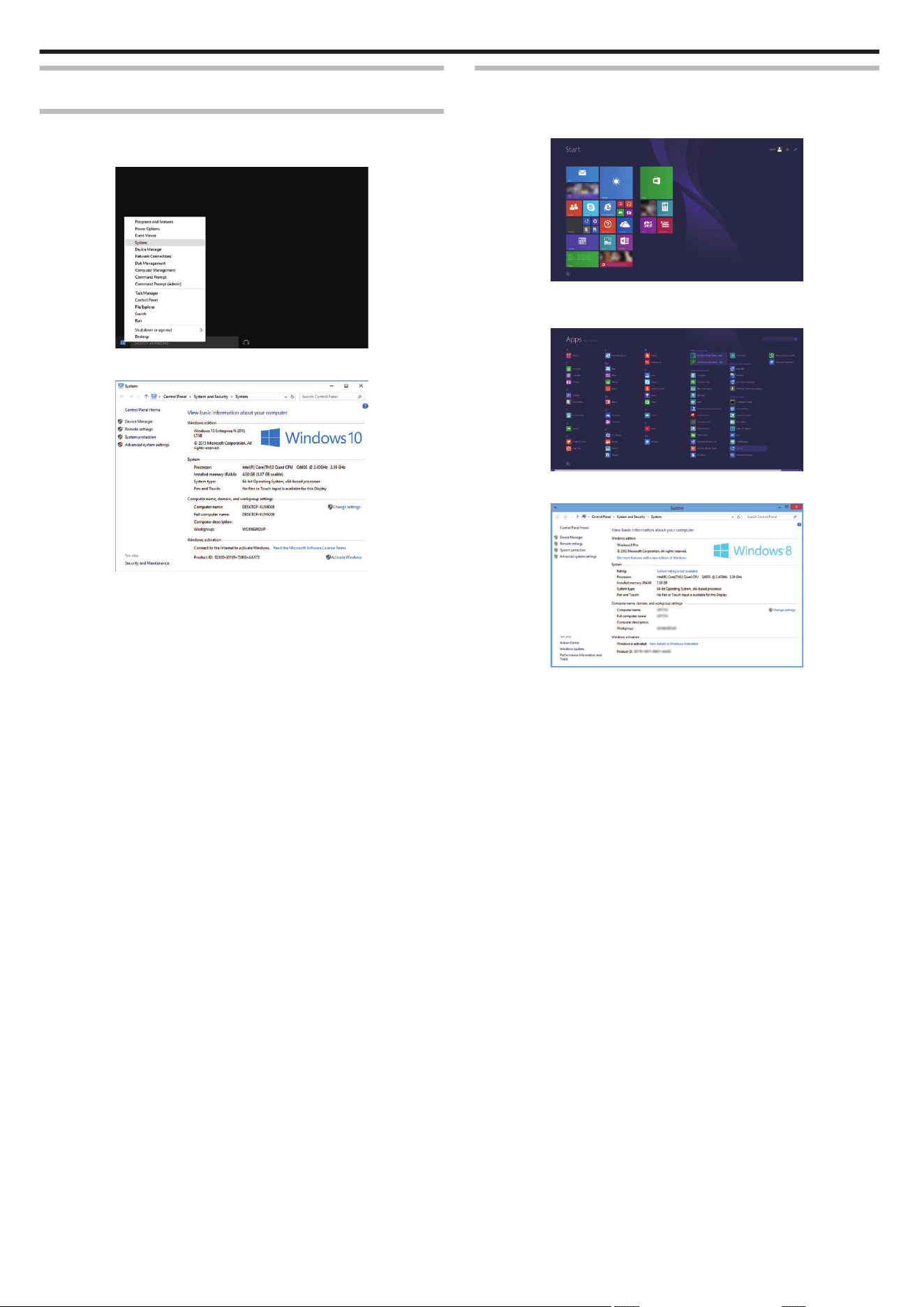
Verifying System Requirements (Guideline)
Windows 10
1
Right-click
the Start button, followed by selecting and clicking “System”.
.
2
Check the system information.
.
0
If
a “This PC” icon is shown on desktop, right-click the icon and select
“Properties” in the menu to display your computer information.
Windows 8.1
1
Display “Apps”.
Click F.
.
2
Right-click “PC” in the “Windows System Tool” menu to select the
checkbox.
.
3
Click “Properties” on the bottom bar to display.
.
0
If a “Computer” icon is shown on desktop, right-click the icon and
select
“Properties” in the menu to display your computer information.
Copying
74
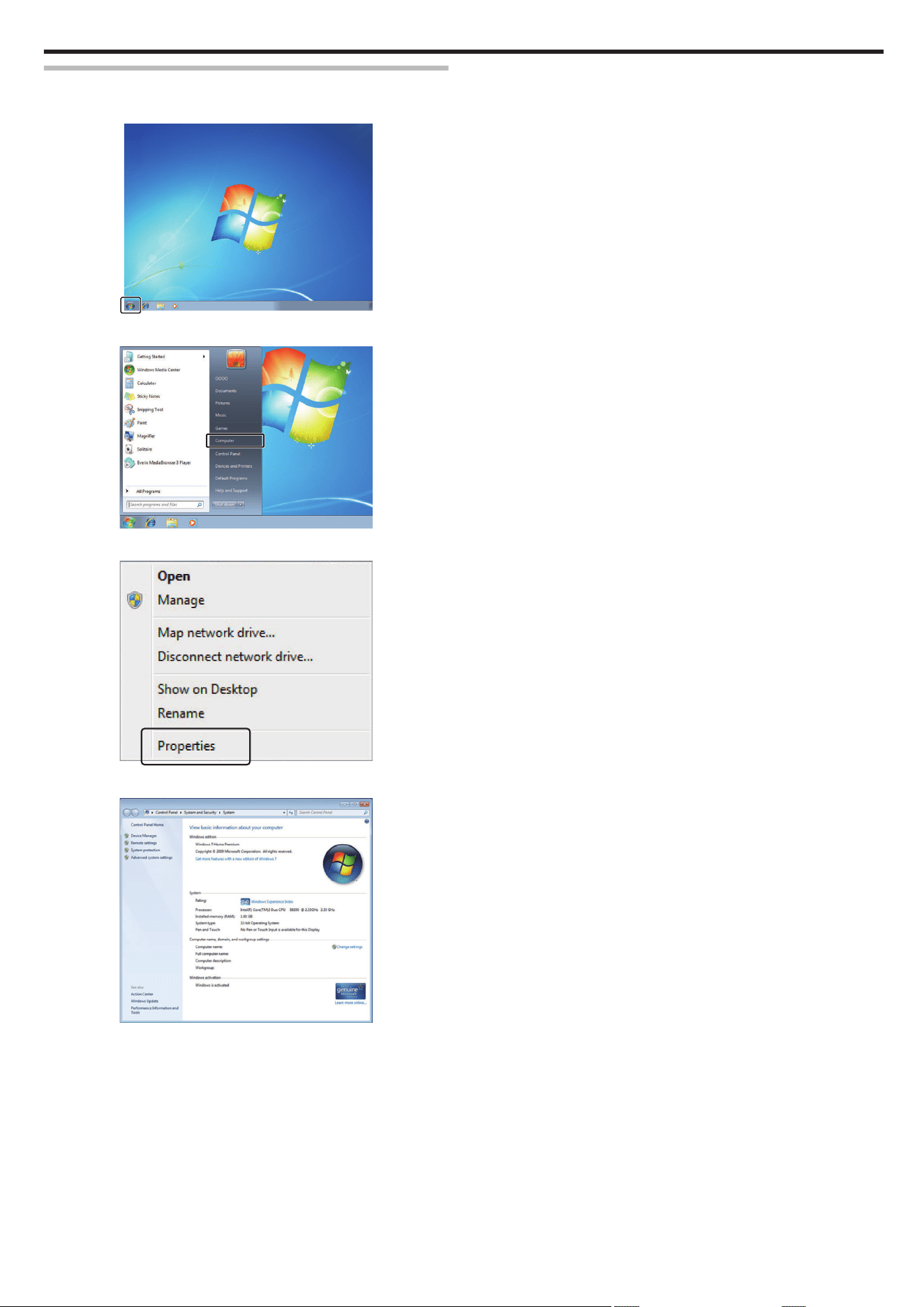
Windows 7
1
Click the start button.
.
2
Right-click Computer.
.
3
Click “Properties”.
.
4
Check the system information.
.
Copying
75
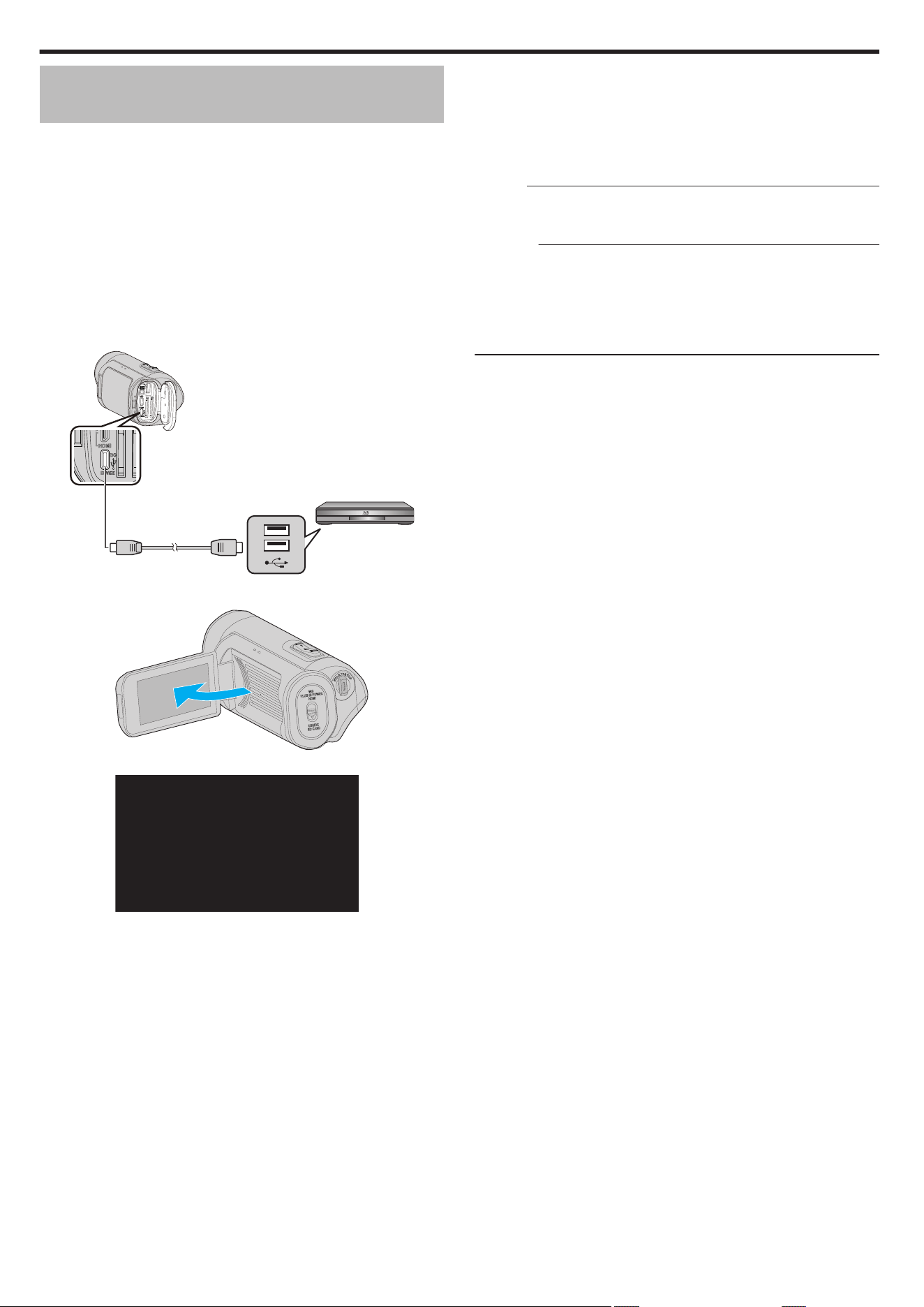
Dubbing Files to a Disc by Connecting to a
Blu-ray Recorder
Videos
recorded in the HD quality can be dubbed in the high-definition quality
by connecting an AVCHD-compliant Blu-ray recorder to this unit via a USB
cable. For details on creating the disc, refer to the instruction manual of your
Blu-ray recorder.
1
Open the terminal cover.
2
Insert the SD card to be dubbed.
0
Before inserting the SD card, close the LCD monitor and turn off the
power of this unit.
0
Insert only one SD card. Even when two cards are inserted, the Blu-
ray recorder only recognizes one SD card.
3
Connect to a Blu-ray recorder.
0
Connect using a USB cable (sold separately).
.
To USB Connector
Blu-ray Recorder
USB Cable (Sold Separately)
To DC/USB Device Terminal (Type-C)
4
Open the LCD monitor.
.
0
The power of this unit turns on, and a USB mode screen appears.
.
USB Mode
5
Perform dubbing on the Blu-ray recorder.
0
Refer also to the instruction manual of the Blu-ray recorder.
0
After dubbing is complete, close the LCD monitor of this unit and
check
that the POWER/ACCESS lamp goes off before disconnecting
the USB cable. Operations cannot be performed on this unit until the
USB cable is disconnected.
Memo :
0
To save videos that are recorded with “Frame Rate” set to “60p”/“50p”,
use an AVCHD Progressive-compatible Blu-ray recorder.
Caution :
0
Videos
recorded in the 4K or High-Speed quality cannot be saved to a Blu-
ray recorder.
0
Videos that are recorded with “Frame Rate” set to “60p”/“50p” cannot be
saved to a DVD.
0
This operation cannot be completed if the remaining battery power is not
enough. Charge the battery fully first.
Copying
76
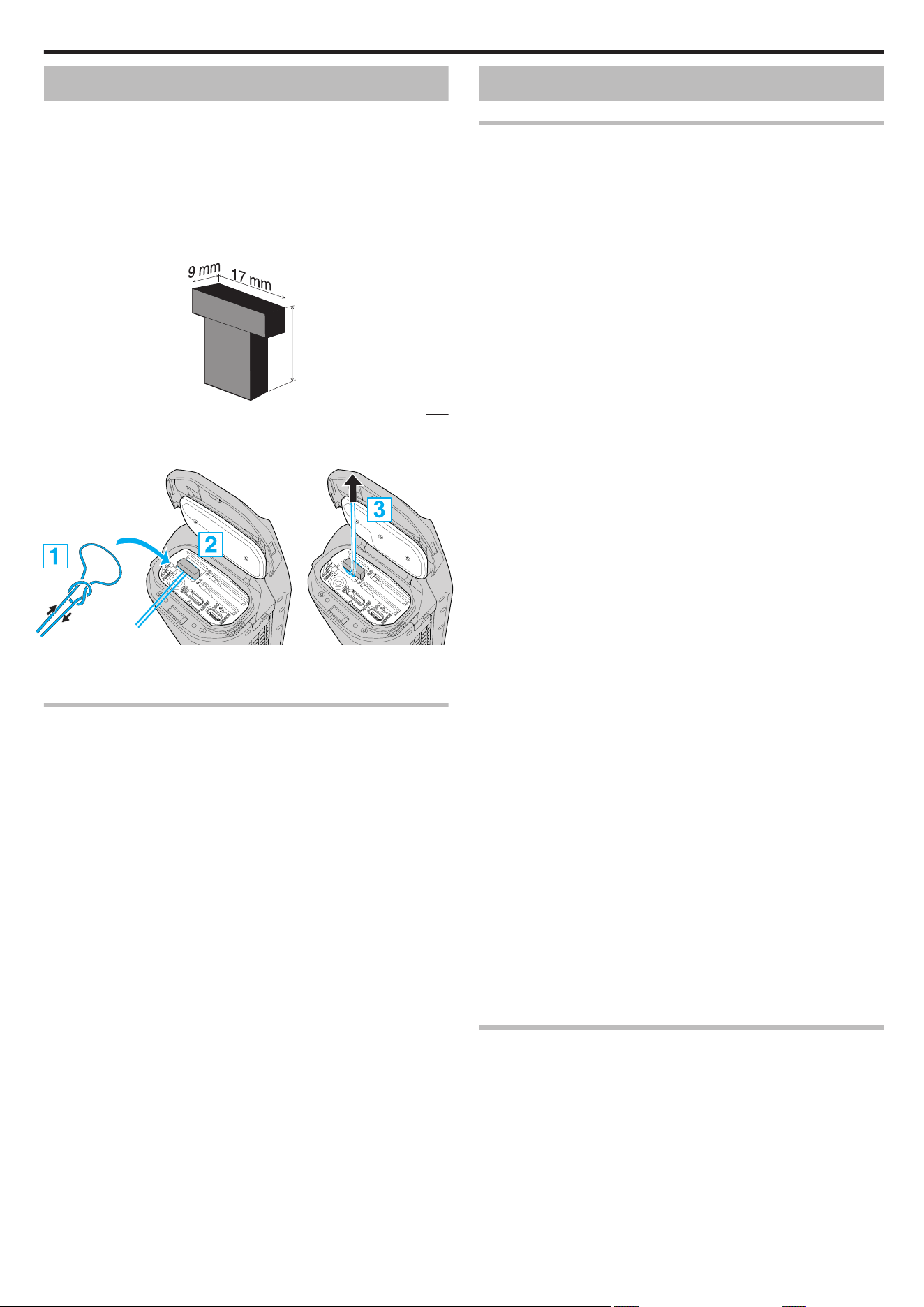
Wi-Fi Capabilities
The Wi-Fi function is able to function by attaching a wireless LAN adapter
(sold separately) to the USB host terminal of the camera unit.
It comes with a browser-based function that makes use of devices such as
smartphones,
tablet terminals and PCs, as well as a live streaming function.
o
Wireless LAN adapter (operation verified):
TP-LINK: TL-WN725N
0
This unit is not guaranteed to operate with all wireless LAN adapters.
0
The terminal cover cannot be closed properly when the dimensions of the
wireless LAN adapter in use are larger than those indicated in the diagram.
.
19 mm
When there is difficulty in removing the wireless LAN adapter:
Use objects such as by tying a string around the wireless LAN adapter to
remove it.
.
0
If
the string tends to slip off easily, use tools such as tweezers to insert the
string.
List of Functions
o
Browser-based Functions (Web Functions)
0
Still Image Transmission
Transfers (downloads) still images stored in the SD card to devices such as
a smartphone, tablet terminal or PC.
“Still Image Transfer” (A p. 86)
0
View Remote
It is possible to access the camera via a web browser on devices such as a
smartphone, tablet terminal or PC to check the live image and remotely
control the camera.
“View Remote” (A p. 90)
o
Live Streaming Function
By combining the camera with a decoder or PC application that supports live
streaming, audio and video streaming can be performed via the network.
“Live Streaming” (A p. 95)
Precautions on Using Wi-Fi
Cautions on Wi-Fi Function
0
Operation is not guaranteed on all devices.
0
This function is not designed for disaster or crime prevention.
0
Security of Wireless LAN
An advantage of wireless LAN is that instead of using a LAN cable, it
transmits information using radio waves, thus enabling LAN connection
to be established within the area covered by the radio waves. However,
as
radio waves penetrate through objects (such as walls) within the range
that they cover, security issues, such as interception of transmission or
illegal access, may arise if security settings are not configured.
Before you connect to the network in a wireless LAN environment, read
through the instruction manual for the wireless LAN device in use, and
configure the security settings accordingly. Failure to do so may increase
the risk of personal information being intercepted, such as user names,
passwords, and the content of your mails, or illegal access to the network.
0
Due to the design of wireless LAN, note that security may be breached by
unusual or unforeseeable means.
0
For more details on wireless LAN and network security, please consult the
manufacturer of your wireless LAN device.
0
JVC shall not be liable for any security issues, troubles, damages or losses
arising from the use of this feature.
0
Wi-Fi function is not available underwater.
o
Do not use this product near the following places.
0
Industrial, scientific, or medical equipment, such as microwave ovens and
pacemakers
0
Industrial, scientific, or medical equipment, such as microwave ovens and
pacemakers
0
Specified low-power radio stations (radio station license not required)
0
Bluetooth devices
Equipment such as the above mentioned devices makes use of the same
frequency bandwidth as that of Wi-Fi.
Using this product near the above equipment may cause radio wave
interference, and result in communication failure or a drop in communication
speed. In this case, turn off the power of devices that are not in use.
o
Avoid using this product near a TV or radio set.
TV or radio sets make use of a radio wave frequency bandwidth that is
different from that of Wi-Fi, and therefore has no effect on communication
by this product or the TV/radio set.
However, when a TV/radio set is placed close to a Wi-Fi product,
electromagnetic waves emitted by the Wi-Fi product may cause noise to
occur in the sound or images of the TV/radio.
0
Communication may not be carried out properly near radio equipment or
broadcasting stations. In this case, change the location accordingly.
o
Radio signals are unable to penetrate through reinforced
steel, metal, or concrete.
The radio waves used by the wireless LAN adapter are unable to penetrate
reinforced steel, metal, or concrete materials.
Communication may be adversely affected if the walls of the room are made
of any of these materials. Similarly, communication may be compromised if
the same materials are used between the floors of a building.
*Communication may also get weaker when there are human subjects or
parts of the body in between the Wi-Fi devices.
o
Do not connect to wireless networks that you do not have
authorization for.
Once connected, it may be considered as unauthorized access and legal
actions can be taken against you.
o
Do not use the Wi-Fi function outside the country where the
wireless LAN adapter is purchased.
Depending on the country, there may be restrictions on the use of radio
waves and any violations could be punishable by law.
Exporting/Bringing the Unit Overseas
Permission from the U.S. government may be required when bringing the
unit
to an export controlled country set by the U.S. government (such as Iran,
Sudan, North Korea, Syria and Cuba. As of September, 2017).
For more information, consult the U.S. Embassy Commercial Service.
Using Wi-Fi
77
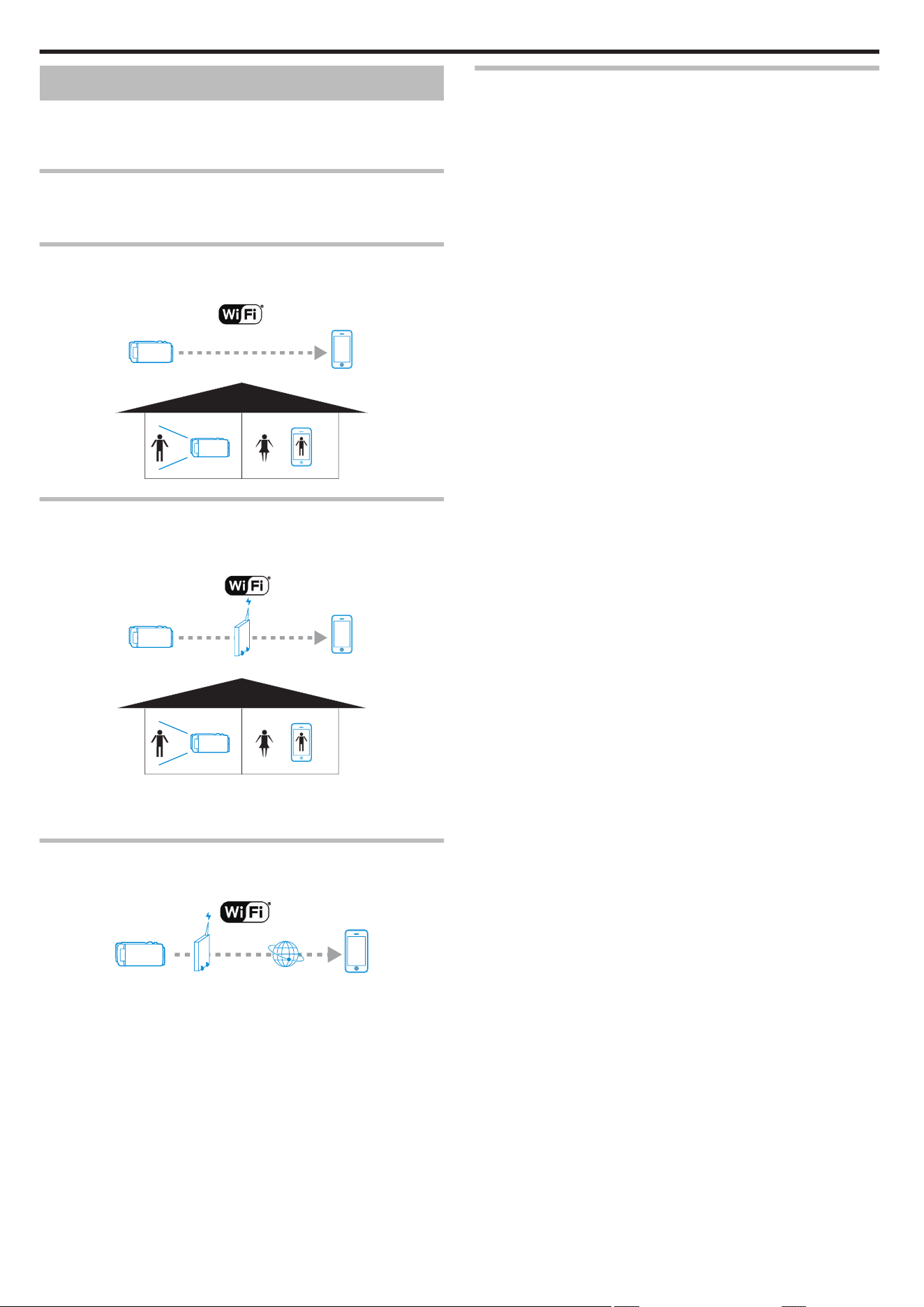
How to Establish a Wi-Fi Connection
“Ways of Wi-Fi Connection” (A p. 78)
“Preparing for Connection” (A p. 79)
“Connecting” (A p. 79)
Ways of Wi-Fi Connection
There are three ways of connecting the camera to devices such as a
smartphone, tablet terminal or PC.
Direct Connection
0
The camera can be connected to devices such as a smartphone, tablet
terminal or PC directly via Wi-Fi.
.
Local Area Network (LAN) Connection
0
The camera can be connected to devices such as a smartphone, tablet
terminal or PC within the same Local Area Network (LAN).
“What is Local Area Network (LAN)?” (A p. 78
)
.
* An access point (wireless LAN router) is needed for this mode of
connection.
“What is an access point?” (A p. 78)
Internet Connection
0
The camera can be connected to devices such as a distant smartphone,
tablet terminal or PC via the Internet.
.
* An Internet connection with a global IP address and an access point
(wireless LAN router) that is compatible with UPnP are needed for this
mode of connection.
“What is global IP address?” (A p. 78
)
“What is UPnP?” (A p. 78)
“What is an access point?” (A p. 78)
Network-related Terminology
o
What is an access point?
An access point refers to a device that makes use of Internet connections
wirelessly.
Some common examples include wireless LAN routers and Wi-Fi routers,
which come with a function for sharing a single connection among multiple
devices.
For Internet connections such as fiber-optic Internet and cable TV that are
connected
wirelessly, a wireless LAN router (or devices with a wireless LAN
router function, such as a modem) is used.
o
What is Local Area Network (LAN)?
While a wireless LAN router allows multiple devices to make use of a single
Internet connection, it is possible for devices that are connected to the same
wireless LAN router to communicate with one another.
Communication in this case is carried out independently of the Internet
connection, and is referred to as a Local Area Network (LAN) connection.
o
What is global IP address?
The Internet connection that we are using either makes use of a global IP
address or a local IP address.
A local IP address cannot be accessed from an external source, and thus
cannot be used for Internet connections.
If you are unsure of the type of Internet connection that you are using, please
consult your Internet service provider.
o
What is UPnP?
UPnP, which is the abbreviation of “Universal Plug and Play”, is a function
of wireless LAN routers.
This function can be used to grant limited access from external sources,
which is otherwise prohibited.
To find out whether the wireless LAN router in use supports UPnP, please
refer to the instruction manual or product catalog of the wireless LAN router.
If the UPnP function of a Wi-Fi router can be enabled or disabled, select
“Enable”.
Using Wi-Fi
78
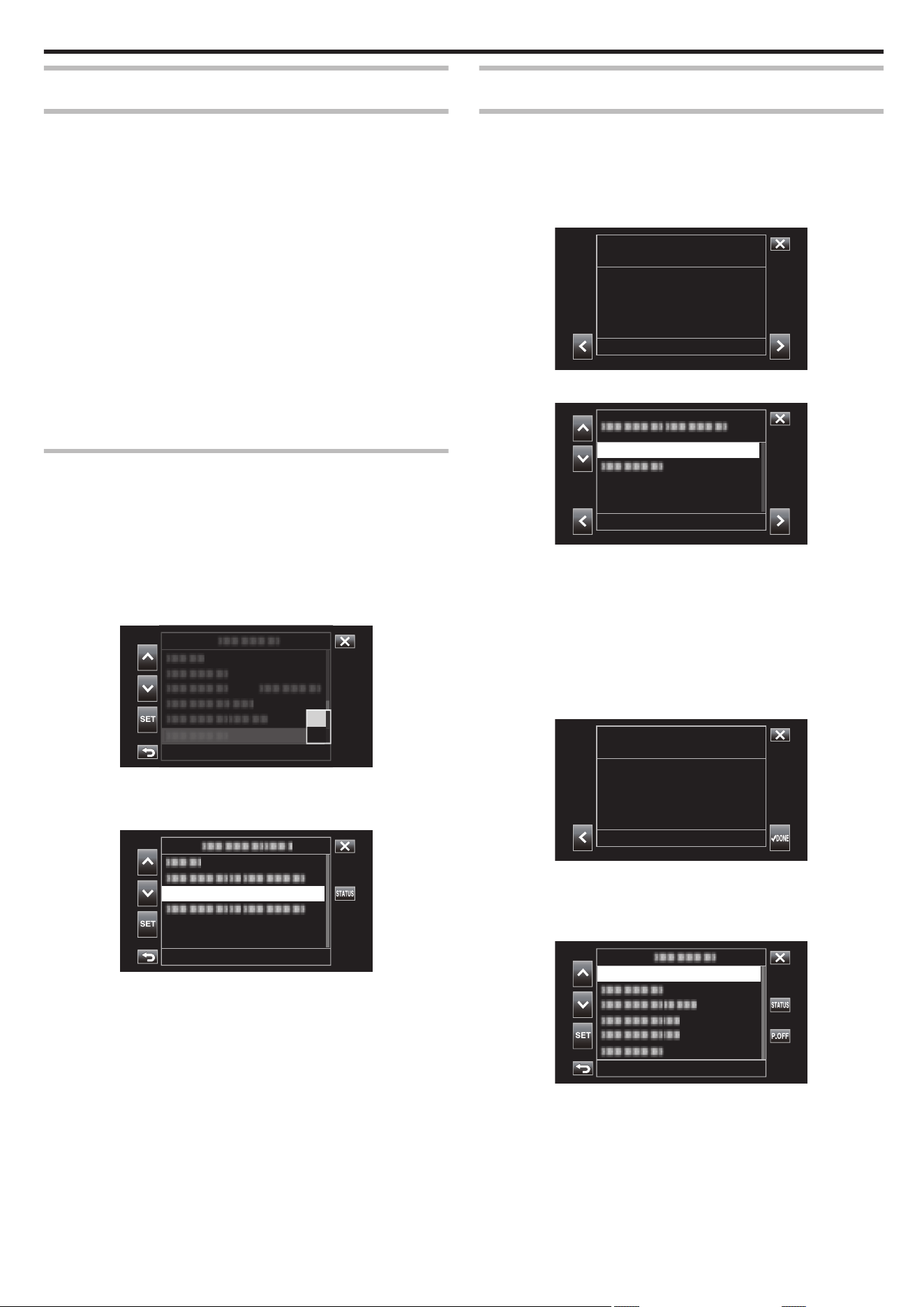
Preparing for Connection
Operating Environment
Operation has been verified for the following environments.
o
Computer
0
OS: Windows 7
Web browser: Internet Explorer 11
0
OS: Windows 10
Web browser: Edge
0
OS: Mac OS X
Web browser: Safari 11
o
Smartphone/Tablet Terminal
0
OS: iOS11 (iPhone 7)
Web browser: Safari 11
0
OS: iOS11 (iPad 5th generation)
Web browser: Safari 11
0
OS: Android 7 (Nexus9)
Web browser: Chrome
0
OS: Windows 8.1 (Surface)
Web browser: Internet Explorer 11
Preparation on the Camera
o
Attach a wireless LAN adapter to the USB host terminal of
the camera
0
Only a Wi-Fi connection adapter can be connected to the USB host
terminal.
0
Connect
or disconnect an adapter only after you have turned off the power
of the camera recorder.
1
Enable the network connection.
Set “MENU”F“System”F“Network” to “On”.
.
Off
On
2
Configure the connection settings.
Tap “Settings” that is directly below “Network”, select “Connection
Setup” and tap “SET”.
.
Connection Setup
0
A wizard screen appears. Follow the instructions on the screen to
perform setting.
Connecting
Direct Connection
This mode of connection enables direct access to the web functions of this
camera from devices such as a smartphone, tablet terminal or PC.
1
(Operation on this camera)
Launch the wizard screen and tap 1.
Starting
up the wizard screen (“Preparation on the Camera” (A p. 79) )
.
Wireless LAN
Available Adapter
2
Select “Direct Connection” and tap 1.
.
Direct Connection
Follow the screen instructions to complete setting.
Configure the settings for the following.
0
Configuration method
* Configuration of SSID and passphrase in the case of manual
configuration.
If
there is no need to alter the displayed SSID and passphrase, write
down the information and tap the 1 button.
To proceed to the next step, tap 1. To return to the previous step, tap
0.
3
Tap PDONE at the lower right of the screen.
.
into Your Device.
Please Input the Passphrase
Completed the Setup Wizard.
Finished
* Screen when “Manual” is selected and configuration is complete.
0
When “WPS” is selected on the “Select Setup Type” screen, the
following steps 4 and 5 are not required.
4
Tap “STATUS”.
.
Camera Function...
Using Wi-Fi
79
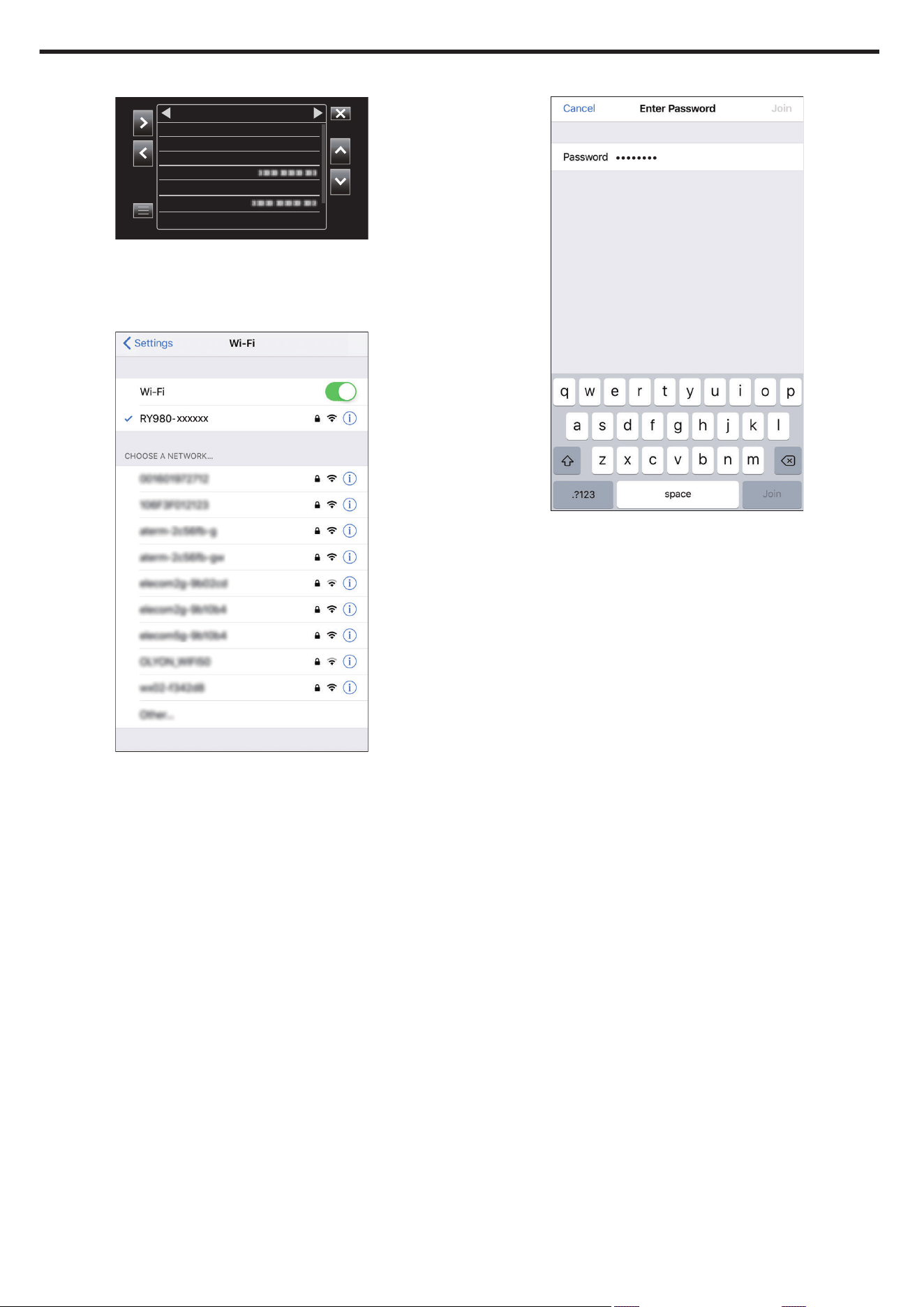
5
Tap 0 1 to display the “Network” screen.
.
RY980-
WPA2
192.168.0.1
********
***
Live Streaming
MAC Address
IP Address
Passphrase
Security Type
SSID
Type
Network
Check to ensure that the “SSID” and “Passphrase” that you have
configured in the wizard are displayed.
6
(Operation on a smartphone, tablet terminal or PC)
Display
the list of access points in the wireless connection settings and
select “RY980-xxxxxx”.
.
0
xxxxx varies with the device used.
7
A password confirmation screen appears.
.
Enter the “Passphrase” displayed on the “Network” screen in Step 5.
Using Wi-Fi
80
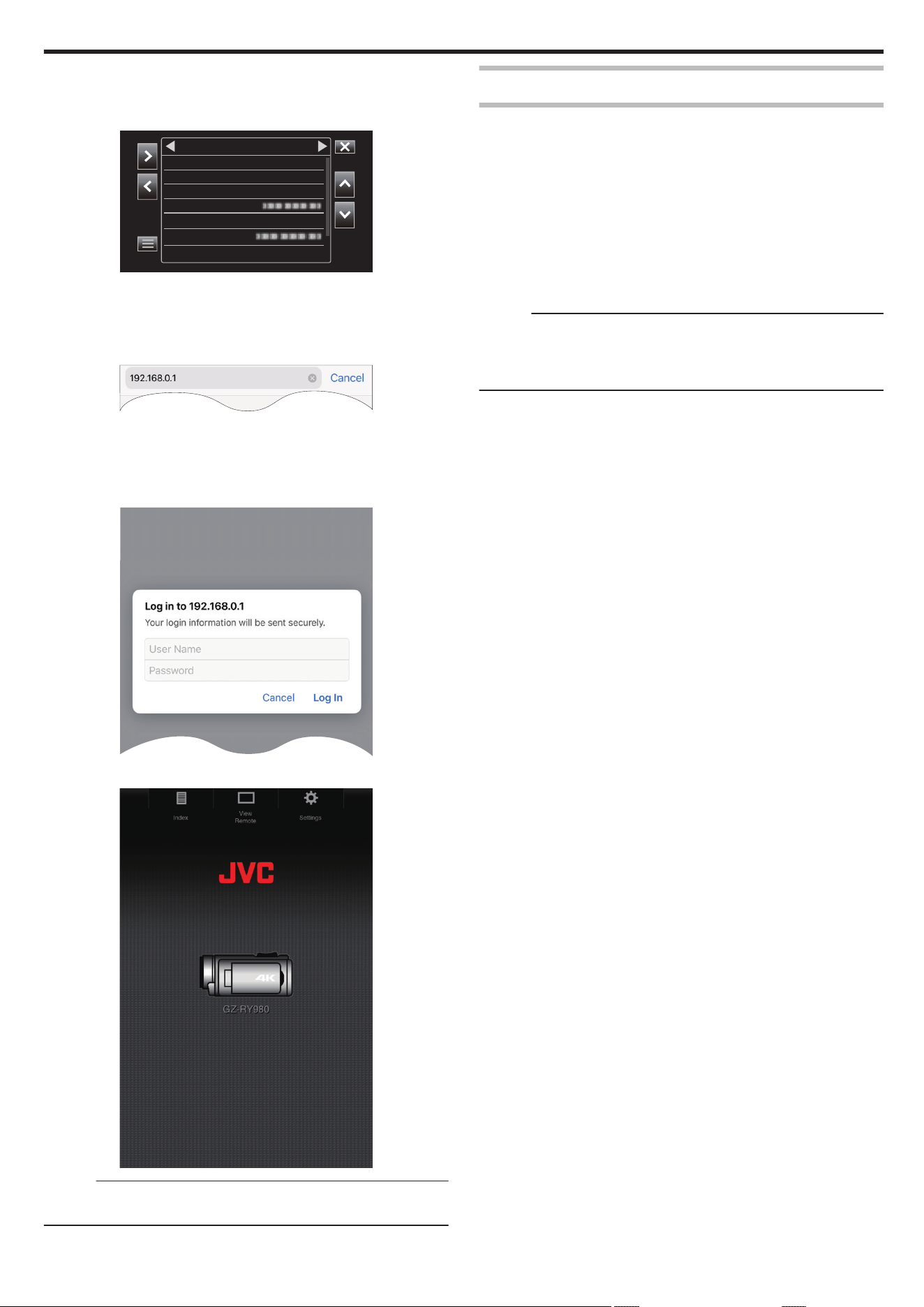
o
Access the camera via a web browser on devices such as
a smartphone, tablet terminal or PC
1
Display the “MENU”F“STATUS”F“Network” screen.
.
RY980-
WPA2
192.168.0.1
********
***
Live Streaming
MAC Address
IP Address
Passphrase
Security Type
SSID
Type
Network
Check the displayed IP address.
2
(Operation on a smartphone, tablet terminal or PC)
Start up the web browser on the terminal you wish to connect to the
camera, enter the “IP Address” that you have verified in Step 1 into the
address field and confirm the entry.
.
0
If “192.168.0.1” is displayed in “IP Address”, enter “http://
192.168.0.1”.
3
A login screen appears.
Enter the user name (jvc) and password (default value: 0000) and
confirm the input.
.
4
The main page of the camera is displayed.
.
Memo :
0
The password can be changed in “MENU”F“System”F“Network”/
“Settings”F“Web”F“Login Password”.
Connection via an Access Point
Internet Connection
This mode of connection enables access to the web functions of this camera
via the Internet from devices such as a smartphone, tablet terminal or PC.
*
To use this function, it is necessary to get ready a wireless LAN router
compatible with UPnP (Universal Plug and Play) and an Internet
connection that allows a global IP address to be acquired.
“What is UPnP?” (A p. 78)
“What is global IP address?” (A p. 78)
0
Use a wireless LAN router that supports UPnP.
(Products that come with a Wi-Fi certification logo)
To check whether UPnP is supported, please refer to the instruction
manual of the wireless LAN router in use.
Memo :
0
Depending
on the wireless LAN router in use and signal strength, you may
experience connection problems or slow connections.
0
When operating the zoom function using a smartphone, the response may
be slower compared to using the camera.
o
Obtaining a Dynamic DNS (DDNS) Account
By obtaining a dynamic DNS account, this unit may be used on the web as
usual
even if the IP address changes when making an access to this unit via
the Internet.
0
Only the JVC Dynamic DNS service can be configured on this camera.
To obtain (register) an account, perform the following steps.
1
Access
the following URL from a browser and register for a provisional
account.
(Operation on a PC or smartphone)
https://dd3.jvckenwood.com/user/
Set your e-mail address as the user name.
2
Check that you have received a confirmation e-mail to the address used
for the provisional registration, and access the URL stated in the e-mail.
(Operation on a computer or smartphone)
3
Check the account information (user name and URL for access (WAN)).
Write down the information needed for access.
Using Wi-Fi
81
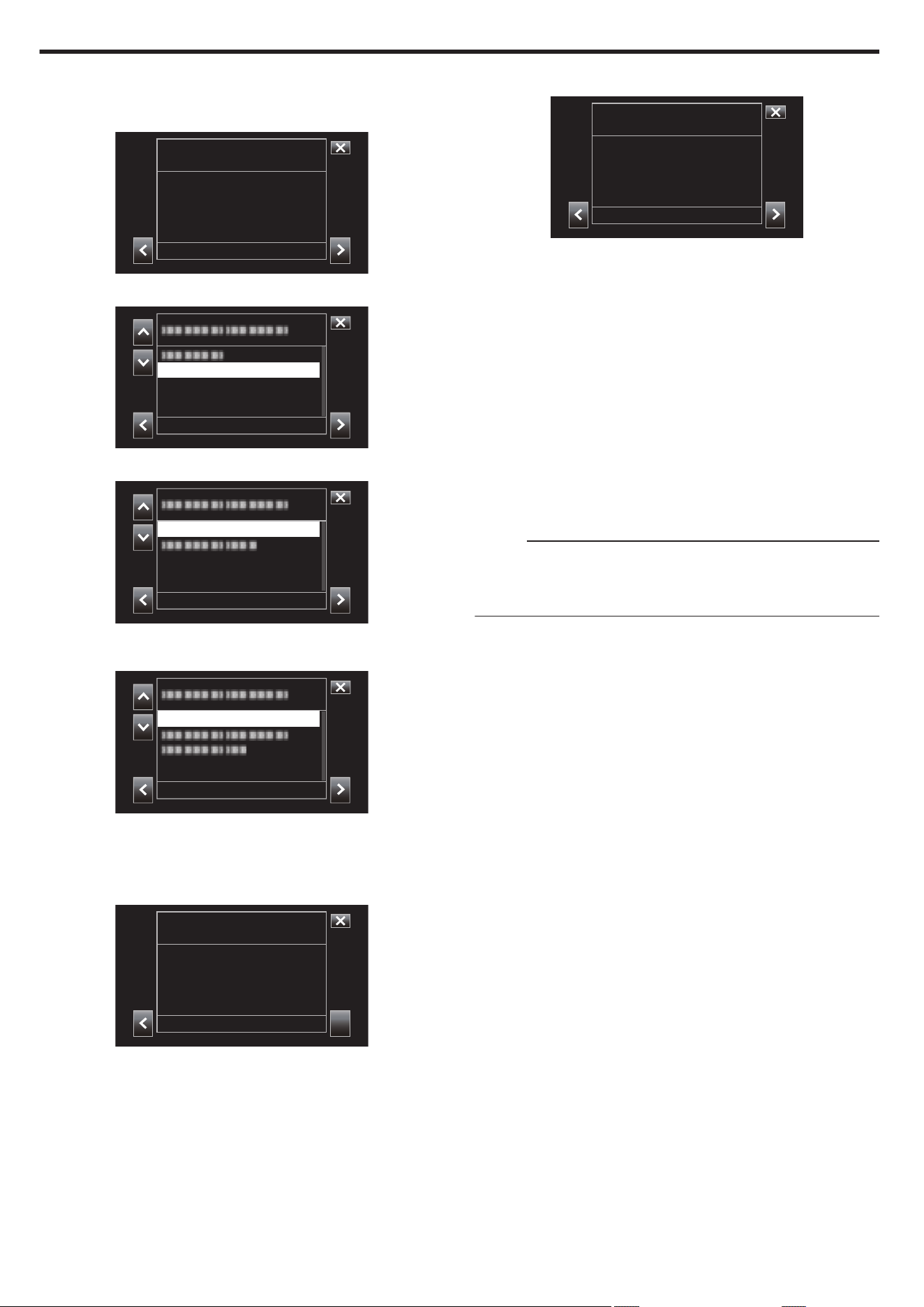
o
Connection Adapter Settings and Camera Connection
1
Launch the wizard screen and tap 1.
“Preparation on the Camera” (A p. 79)
.
Wireless LAN
Available Adapter
2
Select “Connect with Access Point”, followed by tapping 1.
.
Connect with Access Point
3
Select “Internet connection”, followed by tapping 1.
.
Internet connection
4
Select the method of configuration and tap 1.
Configure WPS here.
.
WPS
5
Press the WPS button on the access point.
For more information, please refer to the instruction manual of the
access point.
6
Tap “WPS”.
.
WPS
then Touch the WPS Button
on the Access Point
Press the WPS Button
WPS Setup
7
A connection successful screen appears.
.
Please Continue Settings.
Successfully Connected.
Connected
Follow the instructions on the screen to configure “HTTP Port”/“UPnP”/
“DDNS”/“Username”/“Password”.
0
HTTP Port:
Configure the port number for connecting to the Internet. This is
usually set to “80”.
0
UPnP:
Set to “On” if the UPnP protocol can be used to connect the device
to the network.
0
DDNS:
Configure the environment for connecting to the Internet. This is
usually set to “On”.
0
Username:
Configure a user name for the acquired DDNS account.
0
Password:
Configure a password for the acquired DDNS account.
0
For non-WPS, information such as SSID, type of encryption,
passphrase and IP address (“DHCP” or “Manual”) also need to be
configured.
Memo :
0
It
is also possible to configure the connection settings in the “Settings” tab
after direct connection is established and upon access to the main page
of the camera via the web browser. “Changing Connection Settings”
(A p. 94)
Using Wi-Fi
82
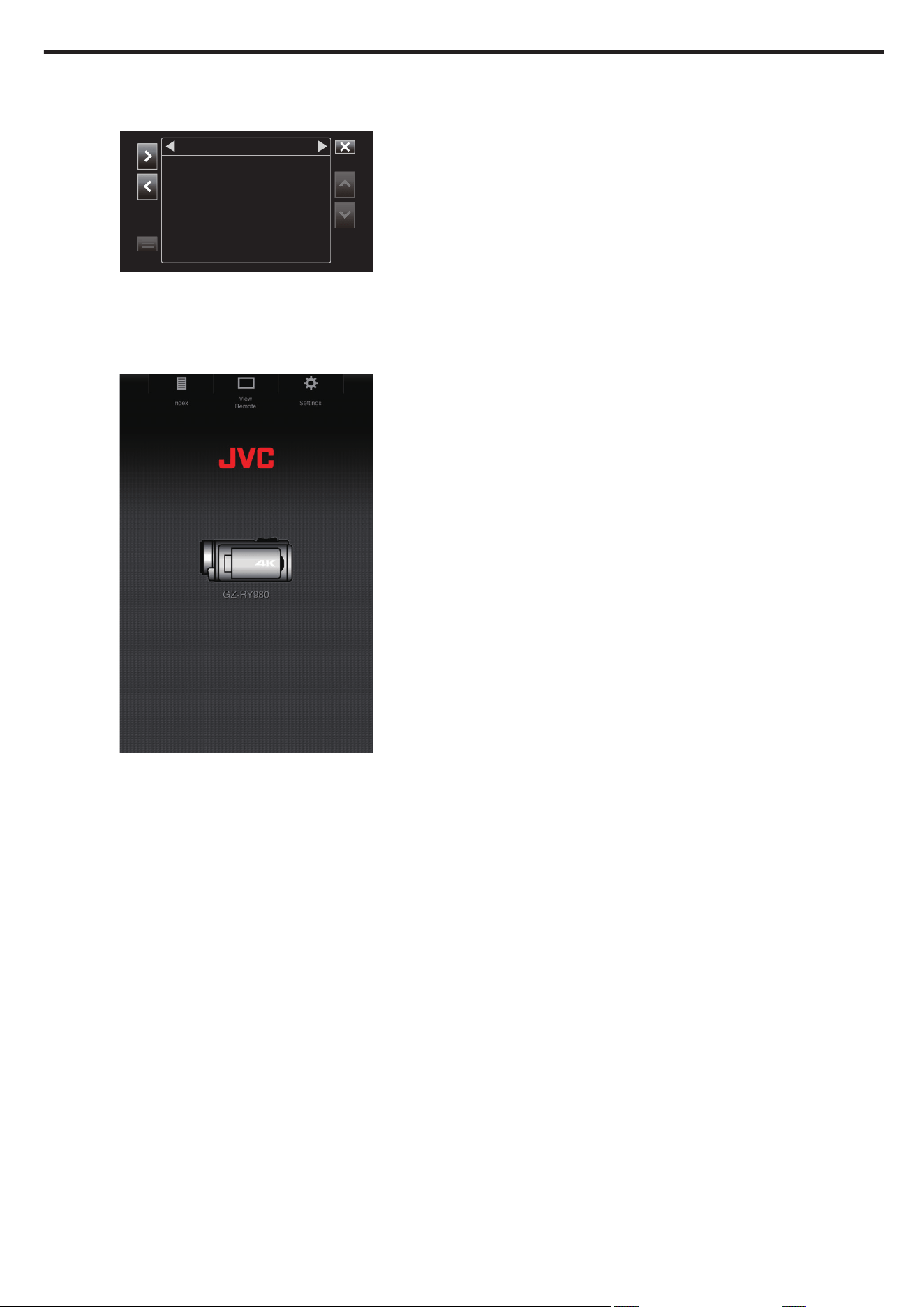
o
Access the camera via a web browser on devices such as
a smartphone, tablet terminal or PC
1
Check the URL in “MENU”F“STATUS”F“URL(WAN)” of the camera.
.
URL(WAN)
xxxxxxxxxxxxxxxxxxxxxxxxxx
2
Start up the web browser on devices such as a smartphone, tablet
terminal or PC and access the verified URL.
3
Enter the user name and password.
Upon entering the user name (jvc) and password (default value: 0000)
on the login screen, the main page of the camera is displayed.
.
Using Wi-Fi
83
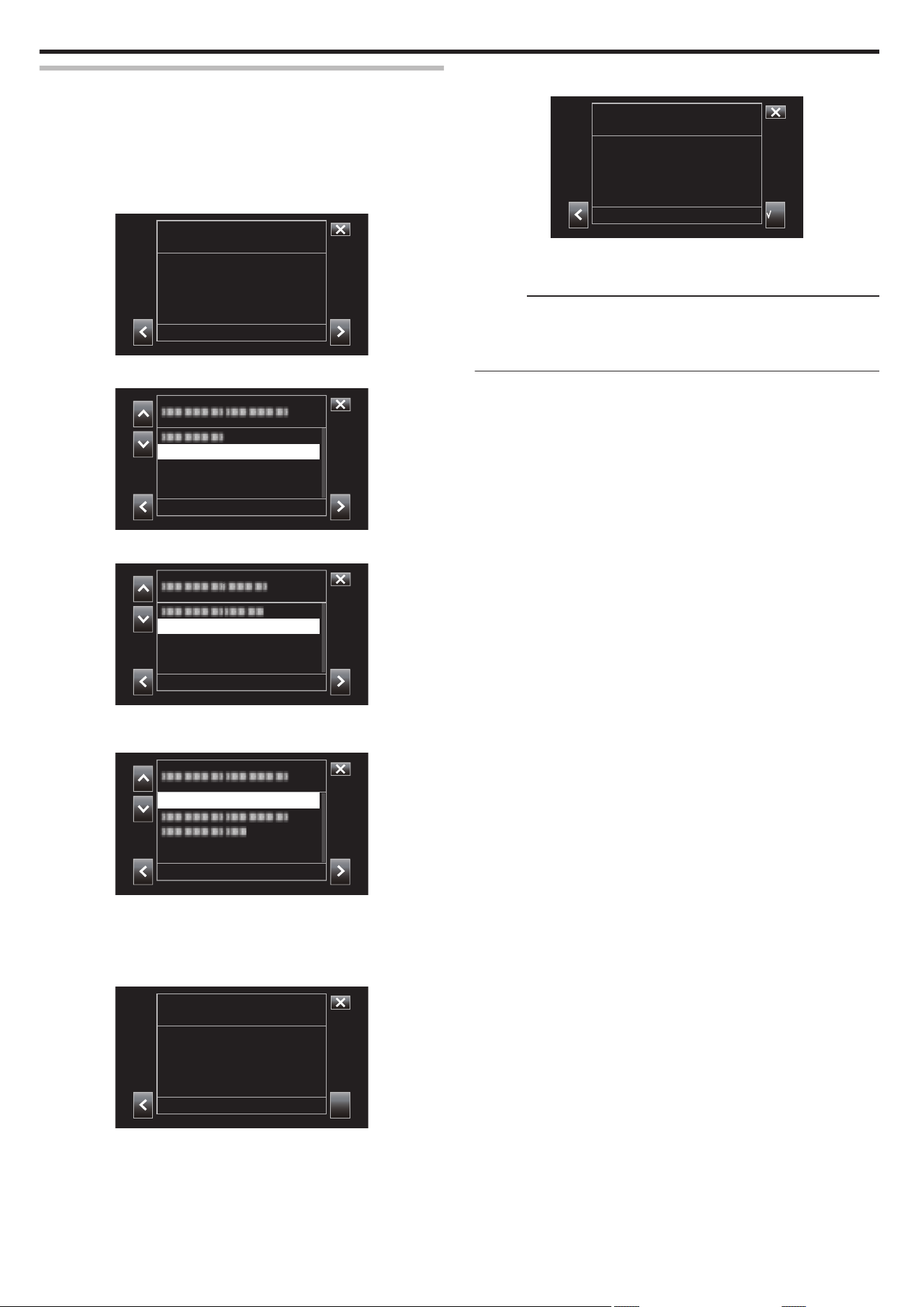
Local Area Network (LAN) Connection
This mode of connection enables access to the web functions of this camera
from devices such as a smartphone, tablet terminal or PC that is within the
same Local Area Network (LAN).
o
Connection Adapter Settings and Camera Connection
1
Launch the wizard screen and tap 1.
“Preparation on the Camera” (A p. 79)
.
Wireless LAN
Available Adapter
2
Select “Connect with Access Point”, followed by tapping 1.
.
Connect with Access Point
3
Select “In-network Connection”, followed by tapping 1.
.
In-network Connection
4
Select the method of configuration and tap 1.
Configure WPS here.
.
WPS
5
Press the WPS button on the access point.
For more information, please refer to the instruction manual of the
access point.
6
Tap “WPS”.
.
WPS
then Touch the WPS Button
on the Access Point
Press the WPS Button
WPS Setup
7
A connection successful screen appears.
.
DONE
Completed the Setup Wizard.
Successfully Connected.
Connected
For non-WPS, information such as SSID, type of encryption,
passphrase and IP address (“DHCP” or “Manual”) also need to be
configured.
Memo :
0
It
is also possible to configure the connection settings in the “Settings” tab
after direct connection is established and upon access to the main page
of the camera via the web browser. “Changing Connection Settings”
(A p. 94)
Using Wi-Fi
84
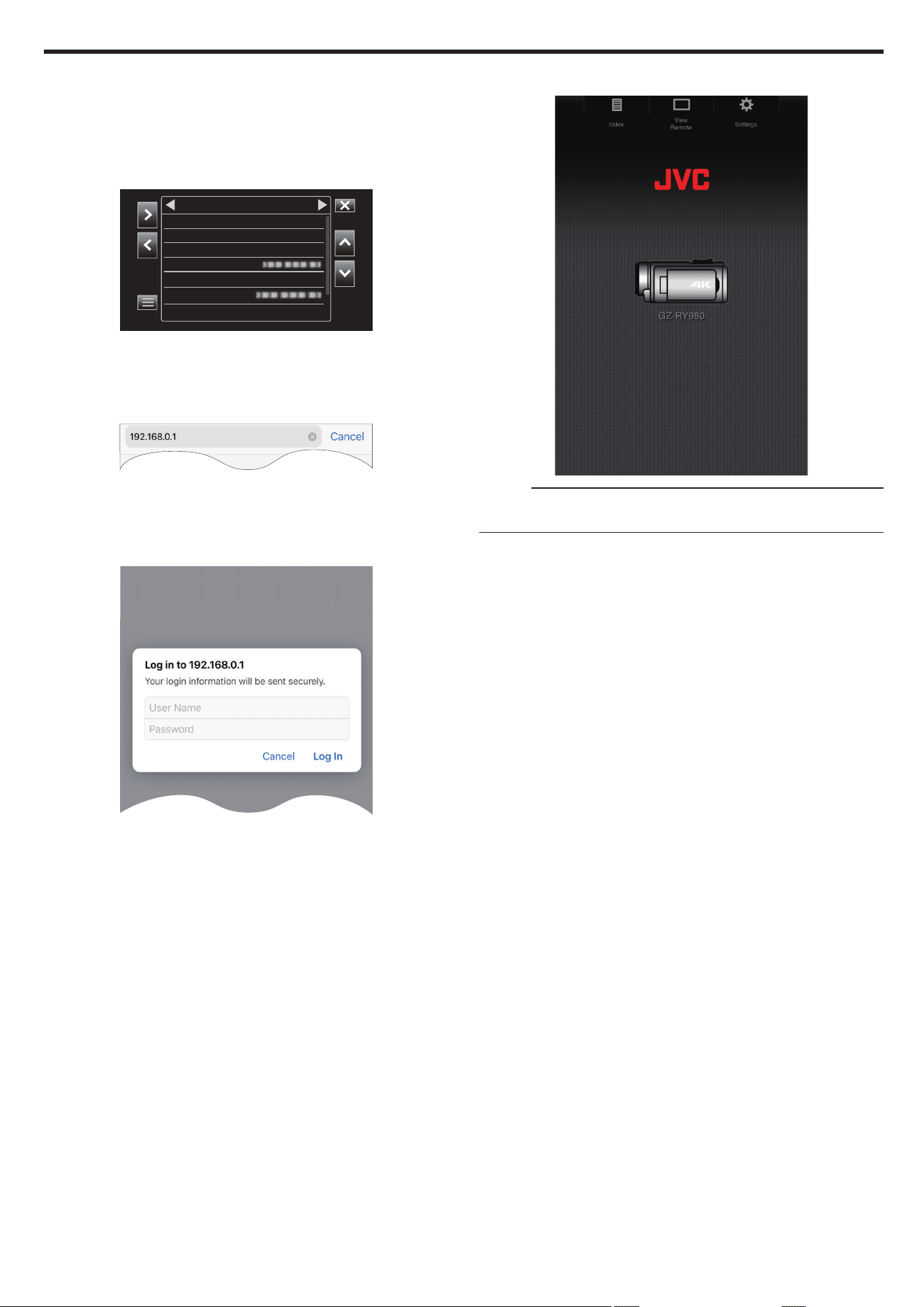
o
Access the camera via a web browser on devices such as
a smartphone, tablet terminal or PC
1
Connect a smartphone, tablet terminal or PC to a Local Area Network.
This setting is not required if the smartphone, tablet terminal or PC is
already connected to the Local Area Network.
2
Display the “MENU”F“STATUS”F“Network” screen.
.
RY980-
WPA2
192.168.0.1
********
***
Live Streaming
MAC Address
IP Address
Passphrase
Security Type
SSID
Type
Network
Check the displayed IP address.
3
(Operation on a smartphone, tablet terminal or PC)
Start up the web browser on the terminal you wish to connect to the
camera, enter the “IP Address” that you have verified in Step 2 into the
address field and confirm the entry.
.
0
If “192.168.0.1” is displayed in “IP Address”, enter “http://
192.168.0.1”.
4
A login screen appears.
Enter the user name (jvc) and password (default value: 0000) and
confirm the input.
.
5
The main page of the camera is displayed.
.
Memo :
0
The password can be changed in “MENU”F“System”F“Network”/
“Settings”F“Web”F“Login Password”.
Using Wi-Fi
85
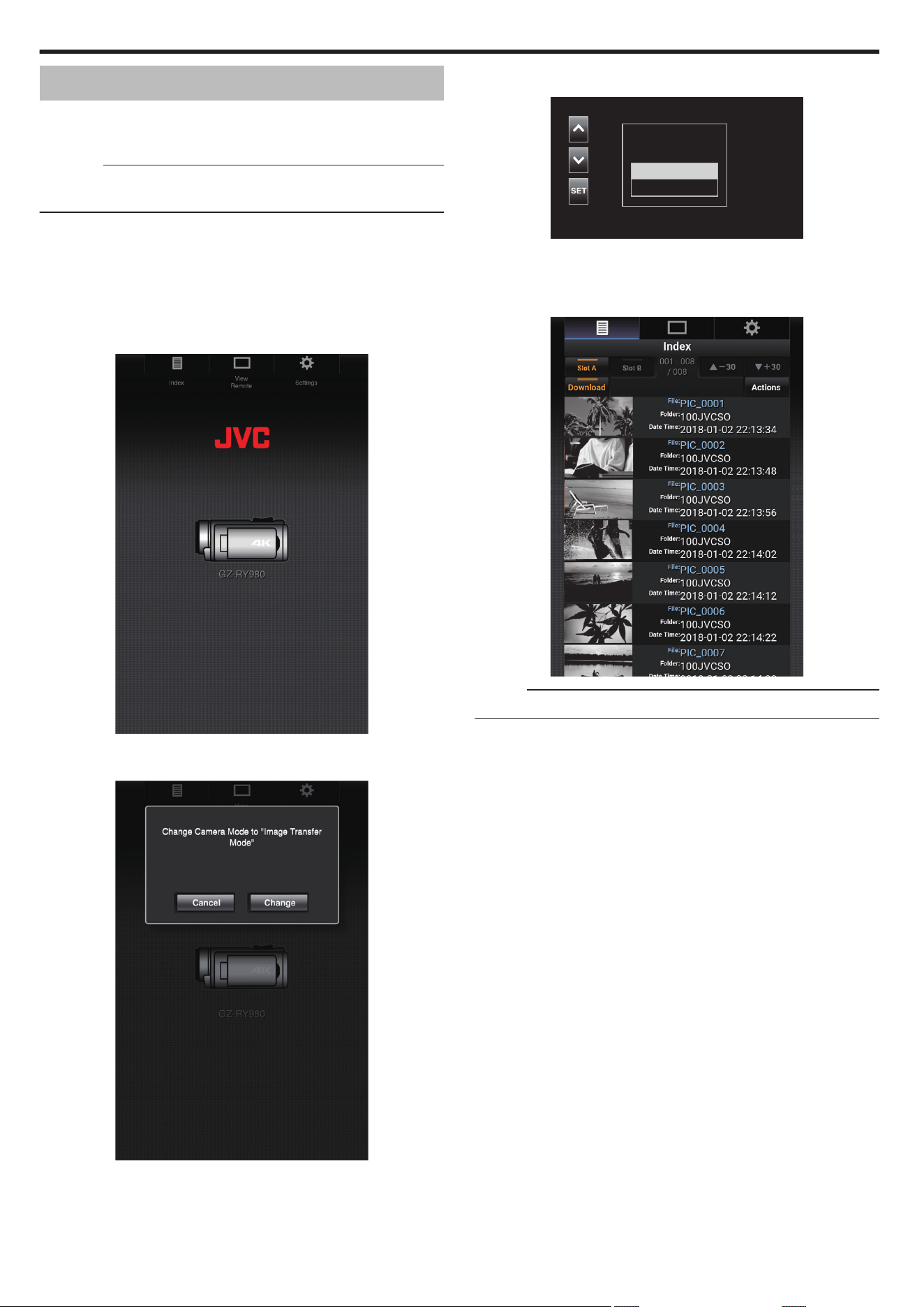
Still Image Transfer
This
function transfers (downloads) still images stored in the SD card of the
camera to a smartphone, tablet terminal or PC.
Multiple or all still images can be downloaded at a time.
Caution :
0
iOS
devices do not allow multiple image data to be downloaded all at once.
0
Also, disable the Pop-up block in the Safari settings of iOS devices.
o
When Multiple Files Can be Selected
1
Access the main page of the camera via the web browser of devices
such as a smartphone.
The method of operation varies with the mode of connection.
“Direct Connection” (A p. 79)
“Internet Connection” (A p. 81)
“Local Area Network (LAN) Connection” (A p. 84)
.
2
Tap (click) “Index”.
The following screen is displayed.
.
At the same time, the screen below also appears on the LCD monitor
screen of the camera.
.
Cancel
Change
Transfer Mode?
Change to Image
3
Tap
(click) “Change” on the web browser screen or select “Change” on
the camera and tap SET.
An index screen (data list) of the still images stored in the SD card of
the camera is displayed on the browser.
.
Memo :
0
To
download all files or files that are protected, Step 4 below is not needed.
Using Wi-Fi
86
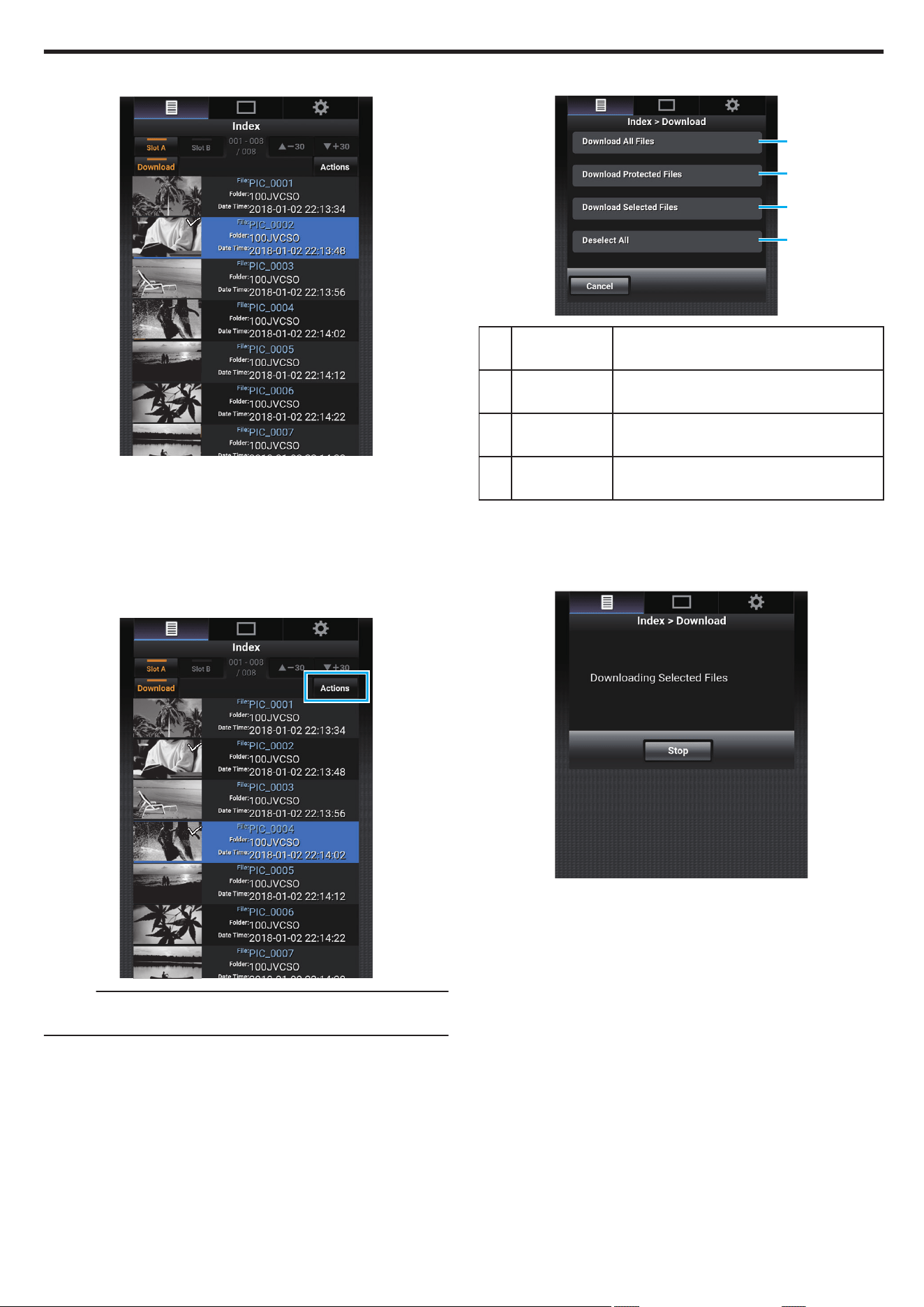
4
Tap (click) the still images to download.
.
0
When an SD card is inserted into both Slot A and Slot B, tapping
(clicking) Slot A or Slot B switches the display to the list of the
corresponding slot.
0
Up to 30 titles are displayed on each page of the list. Tapping
(clicking) “J-30”
displays the previous page, while tapping (clicking)
“K+30” displays the next page.
A check mark is appended to each of the selected files.
Multiple files can be selected.
5
Tap (click) “Action”.
.
Memo :
0
If there is no data on the index screen, “Action” is grayed out and cannot
be selected.
6
Select the method to transfer the files.
.
1
2
3
4
A
Download All
Files
Downloads all the files in the displayed slot.
B
Download
Protected Files
Downloads all protected files in the displayed
slot.
C
Download
Selected Files
Downloads the selected files.
D
Deselect All Clears all file selections and returns to the index
screen.
To cancel the operation, tap (click) “Cancel” to return to the index
screen.
0
If
the files to transfer are not selected, “Download Selected Files” and
“Deselect All” are grayed out and cannot be selected.
Tapping (clicking) a transfer method starts the transfer process.
.
0
To cancel the download, tap (click) “Stop”, followed by tapping
(clicking) “Yes” when “Stop Downloading?” appears.
Using Wi-Fi
87
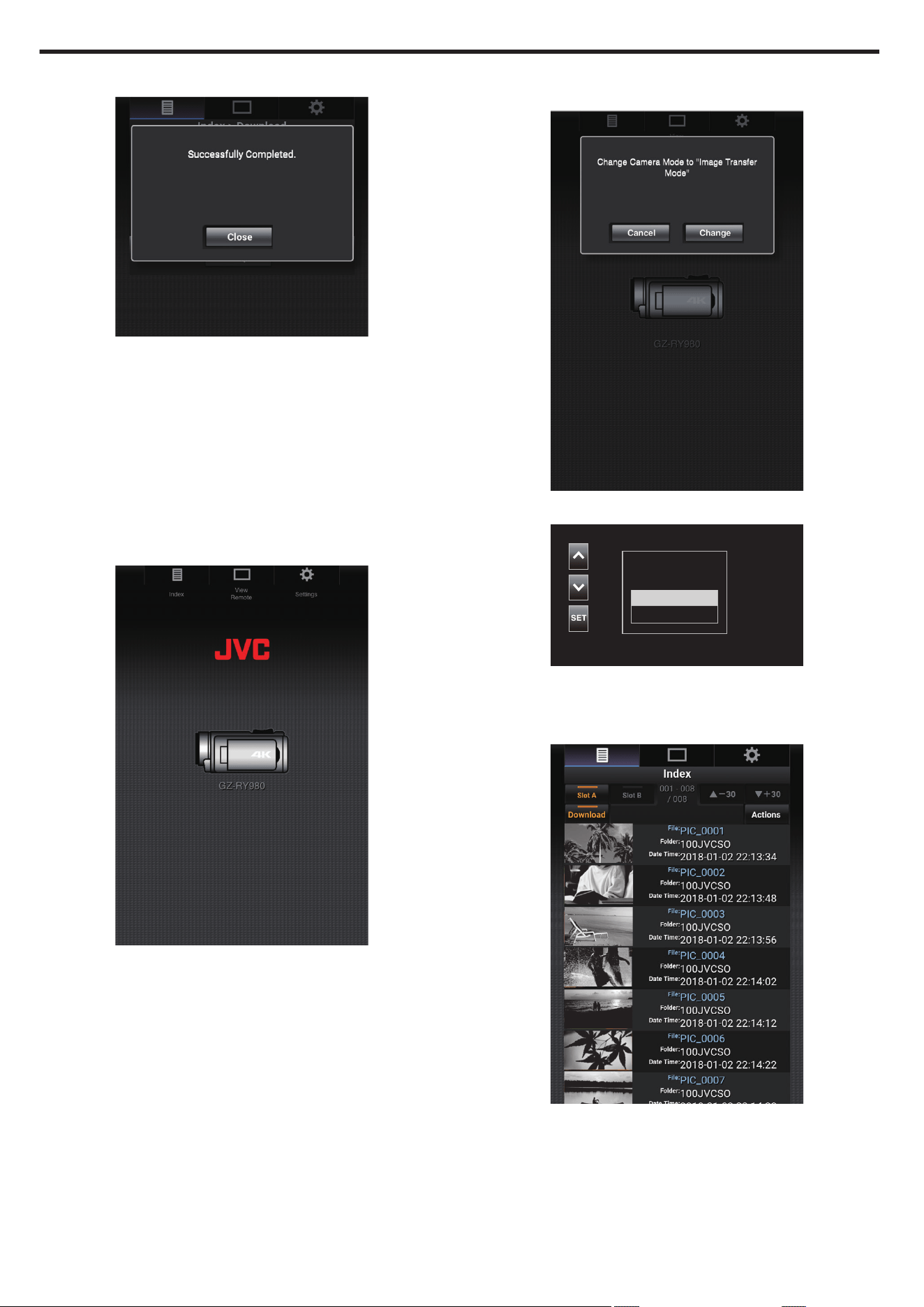
7
After transfer is complete, a transfer complete screen is displayed.
.
Tap (click) “Close” to end still image transfer and return to the main
screen.
o
When Multiple Files Cannot be Selected
1
Access the main page of the camera via the web browser of devices
such as a smartphone.
The method of operation varies with the mode of connection.
“Direct Connection” (A p. 79
)
“Internet Connection” (A p. 81)
“Local Area Network (LAN) Connection” (A p. 84)
.
2
Tap (click) “Index”.
The following screen is displayed.
.
At the same time, the screen below also appears on the LCD monitor
screen of the camera.
.
Cancel
Change
Transfer Mode?
Change to Image
3
Tap
(click) “Change” on the web browser screen or select “Change” on
the camera and tap SET.
An index screen (data list) of the still images stored in the SD card of
the camera is displayed on the browser.
.
Using Wi-Fi
88
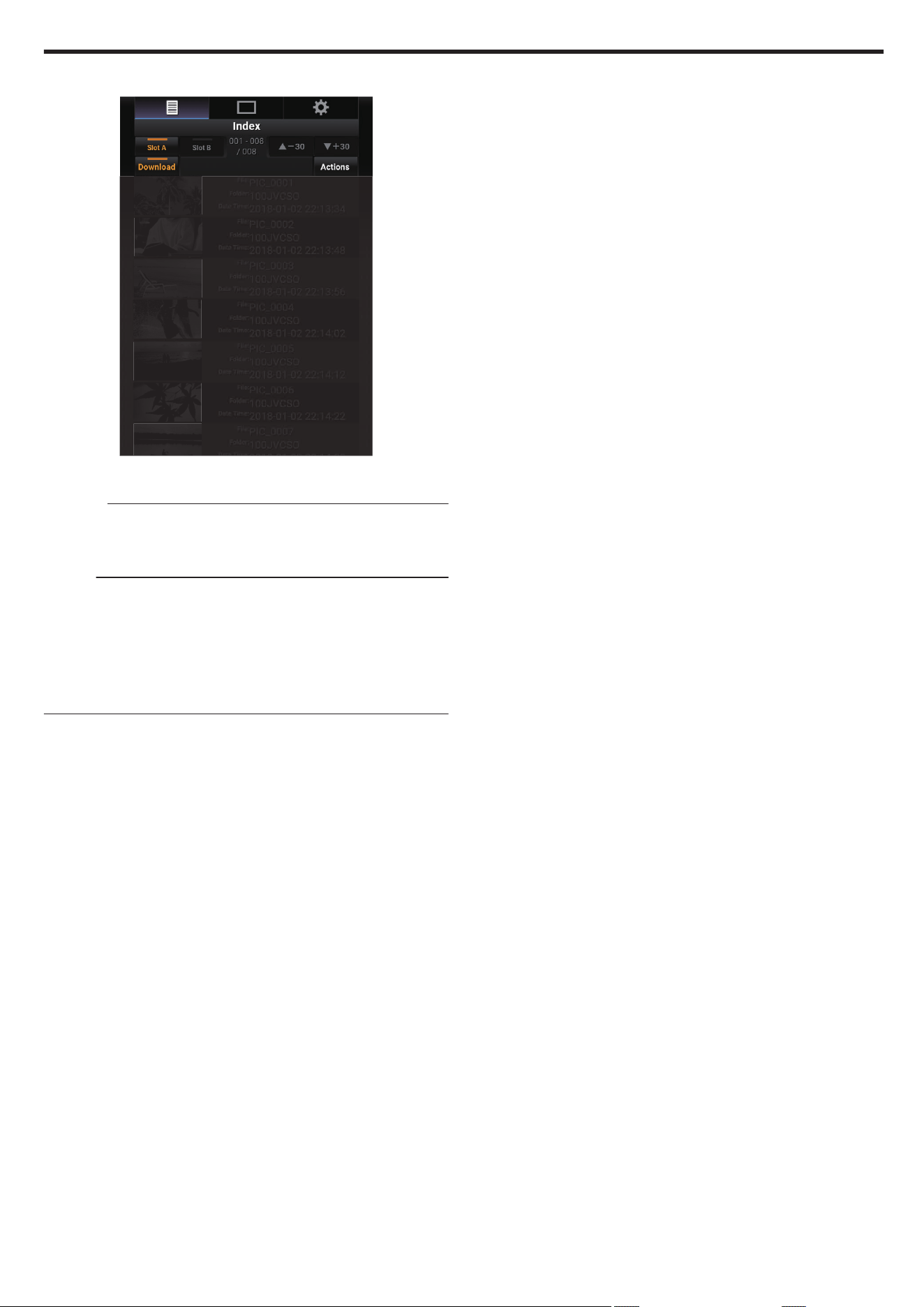
4
Select
the still image data to download one by one and tap (click) them.
.
Please waite...
A new tab appears on the browser. Operate according to the
instructions on the browser.
Caution :
0
The browser cannot be operated by tapping (clicking) “View Remote” or
“Settings” while download is in progress.
0
The browser cannot be operated during live streaming.
Memo :
0
When “View Remote” is tapped (clicked) while the index screen is
displayed, the “View Remote” screen appears. Also, the screen display
on the camera switches from the “Image Transfer Mode” display to the
recording standby screen.
0
When “Settings” is tapped (clicked) while the index screen is displayed,
the “Settings” screen appears. Also, the screen display on the camera
switches
from the “Image Transfer Mode” display to the recording standby
screen.
Using Wi-Fi
89
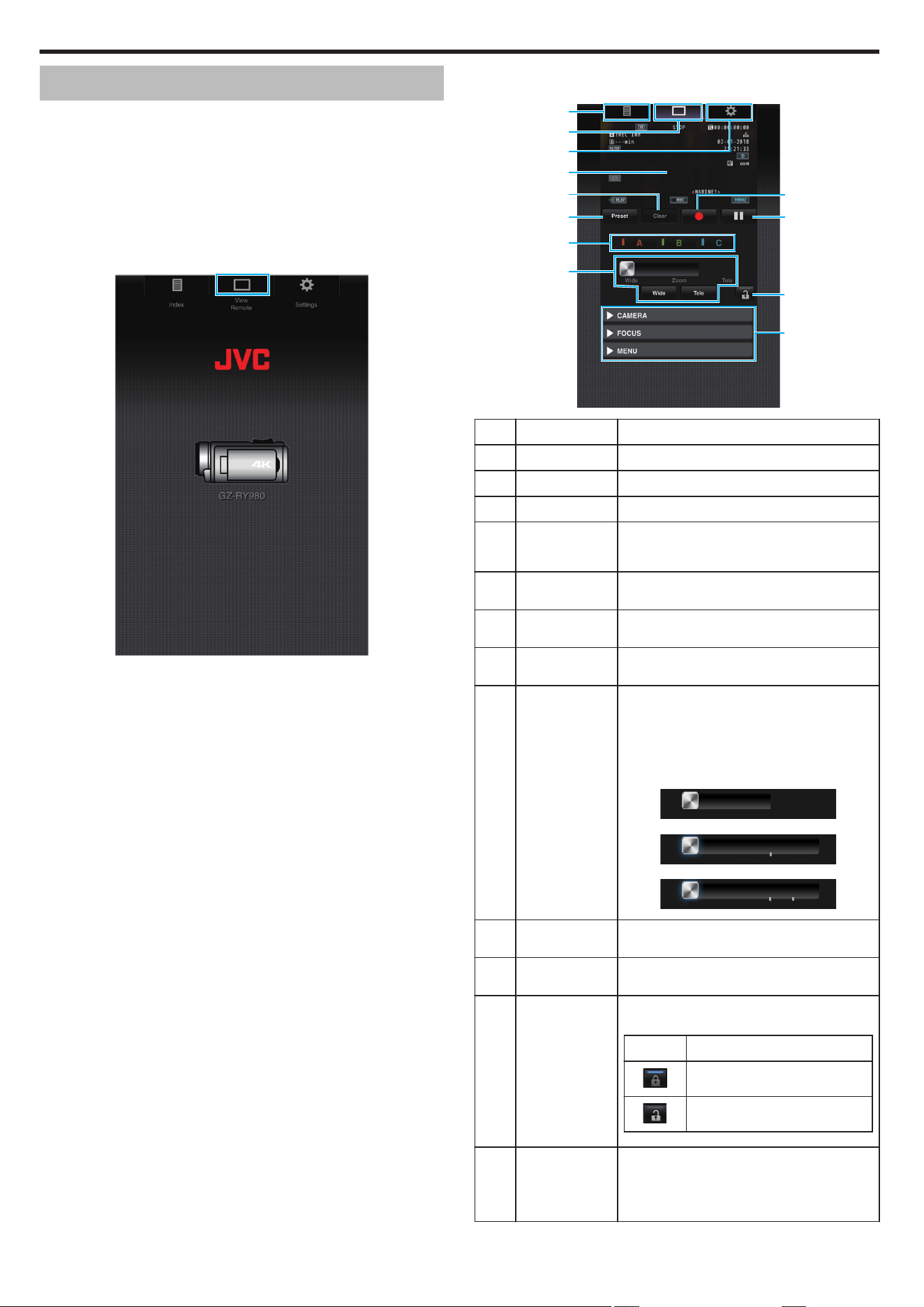
View Remote
It
is possible to access the camera via a web browser on devices such as a
smartphone, tablet terminal or PC and perform remote operations such as
checking the live image, starting or stopping recording, zooming in or out,
and operating the menu.
1
Access the main page of the camera from the web browser of devices
such as a smartphone, followed by tapping (clicking) “View Remote”.
The method of operation varies with the mode of connection.
“Direct Connection” (A p.
79)
“Internet Connection” (A p. 81)
“Local Area Network (LAN) Connection” (A p. 84)
.
The “View Remote” screen is displayed.
o
Operating Procedure
“View Remote” Screen
.
1
2
3
4
5
6
7
8
9
0
a
b
No. Tab Function
A
Index Displays the “Index” screen.
B
View Remote Displays the “View Remote” screen.
C
Settings Displays the “Settings” screen.
D
Recording
Screen
Displays the same screen as the live image on
the
camera. Icons on the screen are displayed
or hidden in tandem with those on the camera.
E
“Clear” Button
Switches to the Delete Preset Zoom Position
mode.
F
“Preset” Button
Switches to the Register Preset Zoom Position
mode.
G
“A”/“B”/“C”
Buttons
Use these buttons to perform preset
registration or delete a preset data.
H
Zoom Control
0
Operate the zoom function by dragging the
zoom button along the sliding bar.
0
Tap
(click) the “Wide” or “Tele” button to fine-
tune the zoom position.
0
The slide changes according to the dynamic
zoom and digital zoom.
Dynamic Zoom Off:
.
Wide Zoom Tele
Dynamic Zoom On:
.
Wide Zoom Tele
Digital zoom On:
.
Wide Zoom Tele
I
Recording Start
Button
Start recording.
J
Recording Stop
Button
Stops recording.
K
Function Lock
Button
Locks the functions that have been set on the
“Settings” screen.
Icon Description
.
Activates the lock.
.
Does not activate the lock.
L
Camera Control
Function
The camera can be controlled by accessing it
from a web browser on devices such as a
smartphone, tablet terminal or PC.
Operation can be performed for each of the
items.
Using Wi-Fi
90
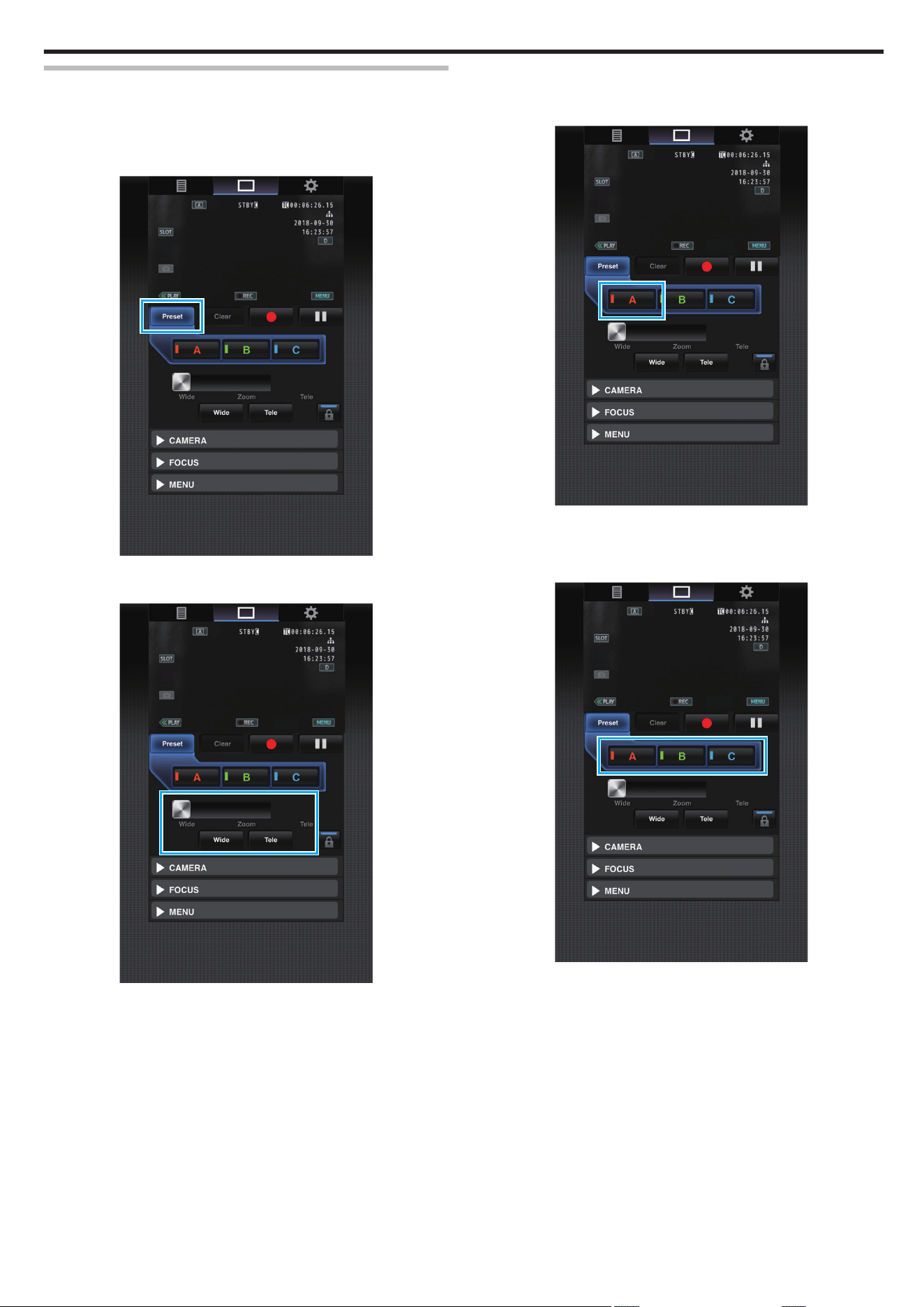
Registering/Deleting Preset Zoom
o
Registering Preset Zoom
Up to 3 zoom positions can be registered.
1
Tap (click) “Preset”.
Switches to the Register Preset Zoom Position mode.
.
2
Operate the zoom bar or “Wide” and “Tele” to determine the zoom
position.
.
3
Tap (click) “A”.
Position
“A” is registered and displayed on A of the zoom control sliding
bar.
.
4
In the same way, register positions “B” and “C”.
After all three positions A, B and C are registered, the positions of the
“A”,
“B” and “C” buttons will be rearranged according to the order of the
registered zoom position starting from the left.
.
Using Wi-Fi
91
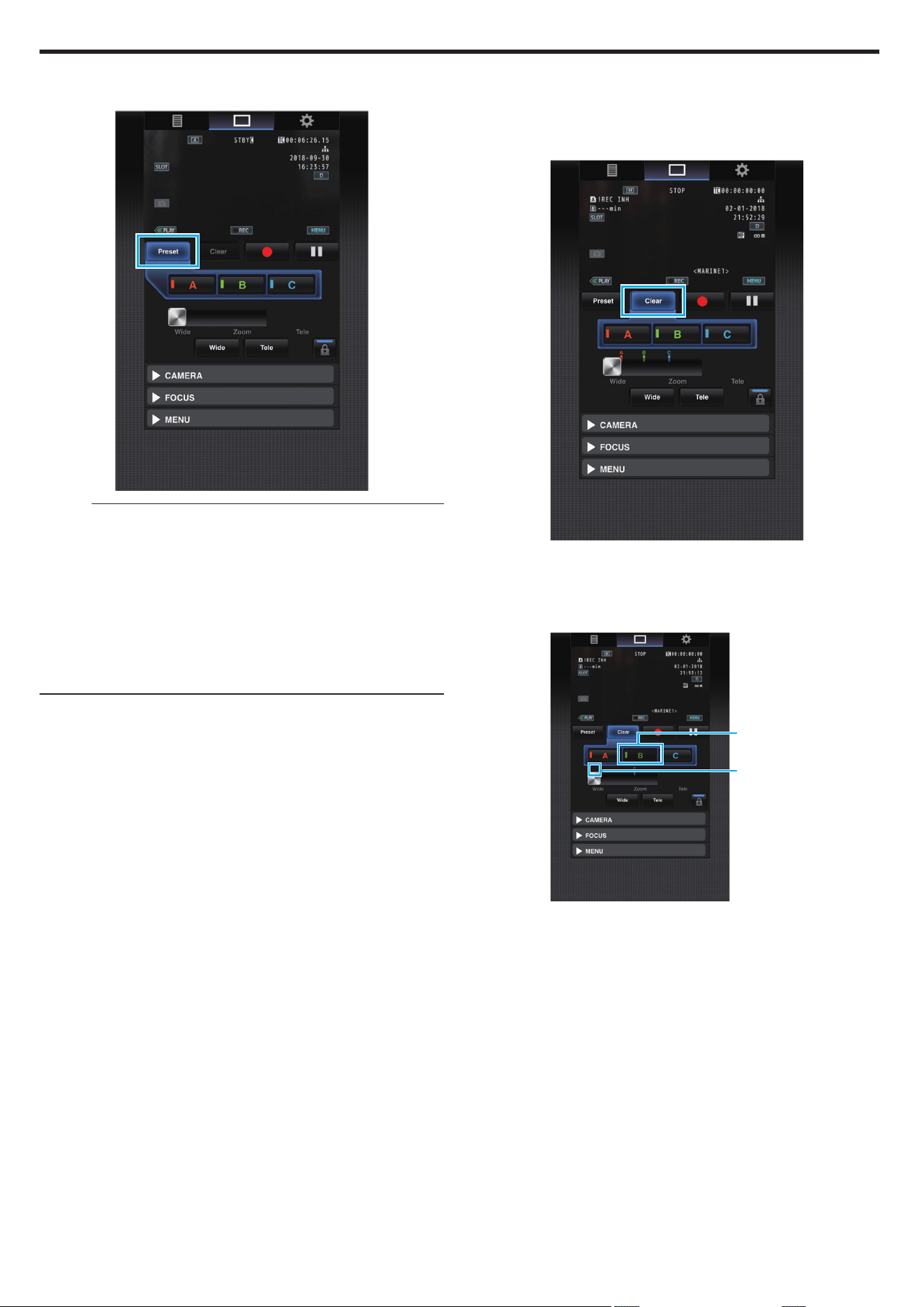
5
Tap (click) “Preset”.
Exits the Register Preset Zoom Position mode.
.
Memo :
0
After registration is complete, tapping (clicking) each button switches to
the corresponding preset zoom position.
0
The preset button where the dynamic zoom position is registered when
the dynamic zoom is on grays out when the dynamic zoom is off and the
zoom position cannot be changed.
0
When the dynamic zoom is off, the dynamic zoom position cannot be
registered.
0
When
digital zoom is on, the preset button where the digital zoom position
is registered grays out when digital zoom is off and the zoom position
cannot be changed.
0
When digital zoom is off, the digital zoom position cannot be registered.
o
Deleting a Preset Zoom
Cancels the preset zoom registered in all or any of the buttons “A”, “B” and
“C”.
1
Tap (click) “Clear”.
Switches to the Delete Preset Zoom Position mode.
.
2
Tap the position to delete (“A”/“B”/“C”).
If
“A” is tapped (clicked), the position registered to A is deleted and the
button grays out.
The corresponding zoom position mark on the sliding bar also
disappears.
.
Position mark
disappears
Grayed out
Using Wi-Fi
92
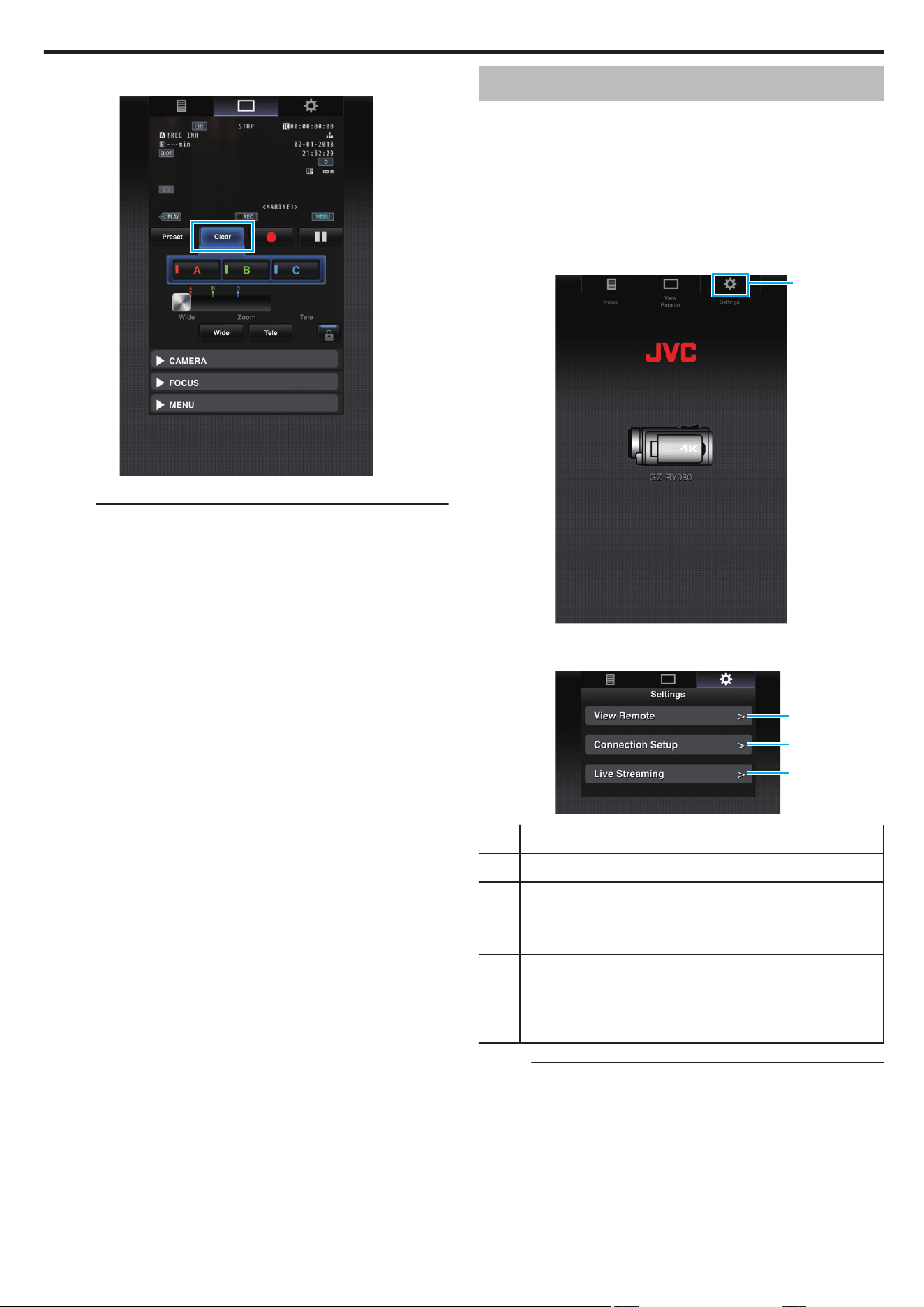
3
Tap (click) “Clear”.
.
Exits the Delete Preset Zoom Position mode.
Memo :
0
This function is available only in the recording mode.
0
It does not support audio.
0
Recorded images are not displayed during live streaming.
0
The possible remote operations are as follows.
CAMERA
–
Switching between the Auto and Manual modes
– Configuration of brightness level (BRIGHTNESS ADJUST)
– Configuration of aperture (APERTURE)
– Configuration of gain up level (GAIN UP)
– Configuration of shutter speed (SHUTTER)
– Configuration of white balance (WHITE BALANCE)
FOCUS
– Adjustment of focus
MENU
– Switching of TV display (DISPLAY ON TV)
Operates in tandem with the View Remote recording screen.
– Menu operation
– Switching of STATUS display
It is possible to switch between menus when a menu is displayed.
– Operation lock
Changing the Settings via a Web Browser
You can change the network-related settings by accessing via a web
browser on devices such as a smartphone, tablet terminal or PC.
1
Access the main page of the camera via the web browser of devices
such as a smartphone.
The method of operation varies with the mode of connection.
“Direct Connection” (A p. 79)
“Internet Connection” (A p. 81
)
“Local Area Network (LAN) Connection” (A p. 84)
2
Tap (click) the “Settings” tab.
.
2
3
The “Settings” screen appears.
Set each of the items as follows.
.
1
2
3
No. Item Description
A
View Remote Settings for operations on the View Remote.
B
Connection
Setup
Settings related to the network.
The settings for each of the preset items on the
wizard screen of the camera can be changed
directly.
C
Live
Streaming
Settings for streaming audio and video via the
network.
The latest settings are reflected, regardless of
whether they are specified via the camera
recorder or web operation.
Memo :
0
Priority is given to menu operation on the camera.
0
When the menu on the camera is opened while the “Settings” screen is
displayed on a web browser, a warning appears, after which the display
returns to the main screen.
0
While
the menu is displayed on the camera, the “Settings” screen cannot
be opened via the web browser.
Using Wi-Fi
93
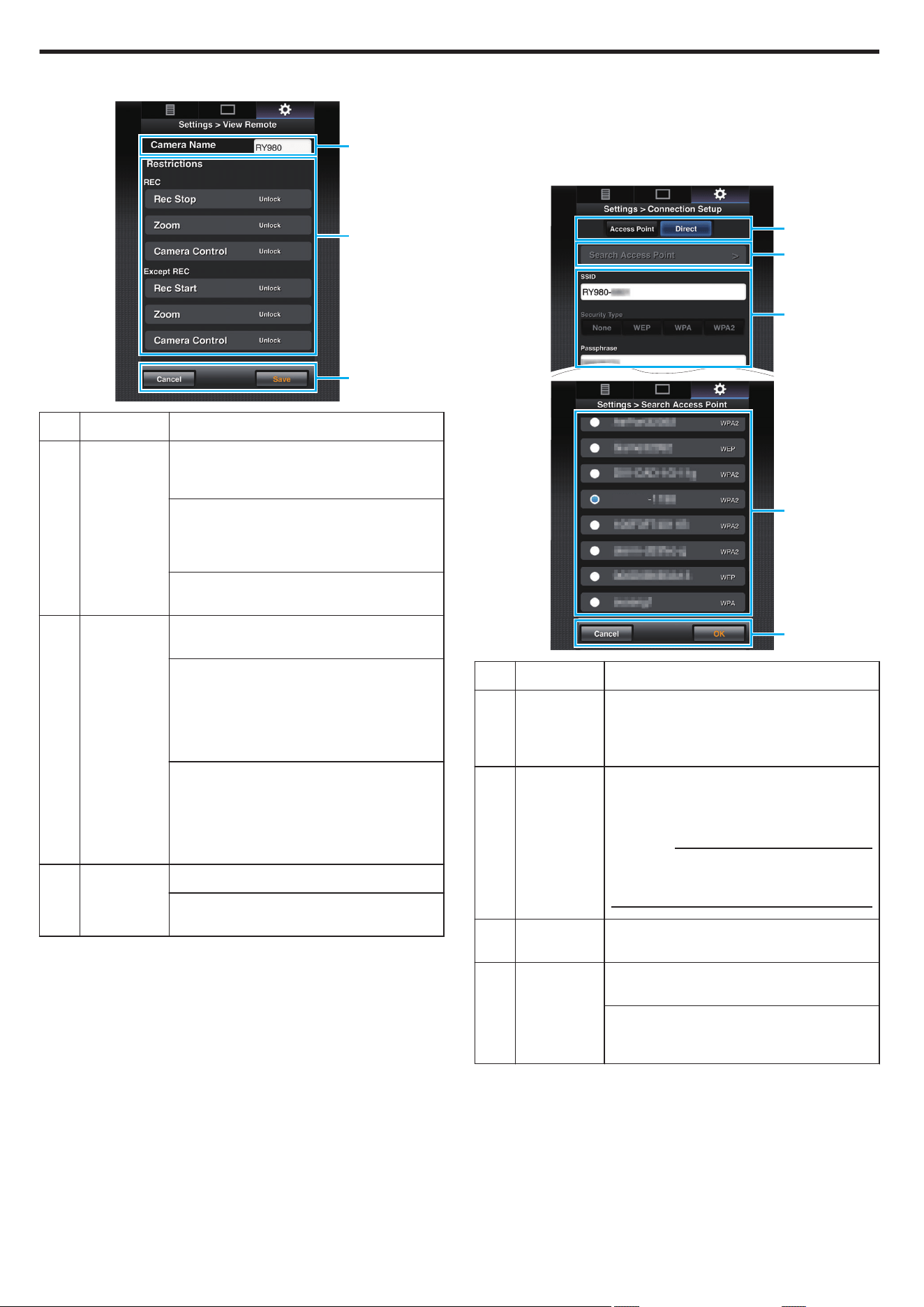
o
Changing Settings of the View Remote Function
For performing setting for using the View Remote function.
.
1
2
3
No. Item Description
A
Camera
Name
For configuring a camera name such as one that
differentiates the camera to connect from other
cameras.
Tapping (clicking) the text input area displays a
software keyboard.
If you are using a PC, enter using the PC
keyboard.
By tapping (clicking) the Go key after input is
complete, the software keyboard disappears.
B
Access
Restriction
For setting the buttons to be disabled on the View
screen while in the locked mode.
“REC”:
For configuring whether to disable the Sop
Recording button, zoom operation and camera
control in the recording mode.
Tap
(click) each item to switch between “Unlock”
and “Lock”.
“Except REC”:
For configuring whether to disable the Record
button, zoom operation and camera control in
modes other than the recording mode.
Tap
(click) each item to switch between “Unlock”
and “Lock”.
C
Save/Cancel
Tap (click) “Save” to save the settings.
Tap (click) “Cancel” to stop configuration and
return to the main “Settings” screen.
o
Changing Connection Settings
The
settings for each of the preset items on the wizard screen of the camera
can be changed directly.
0
If all the items cannot be displayed in a single page, scroll down to display
the remaining items.
0
Items that cannot be changed are grayed out according to the mode of
connection.
.
1
2
3
.
RY980
2
4
No. Item Description
A
Mode of
Wireless LAN
Connection
“Direct Connection” (A p. 79)
“Internet Connection” (A p. 81)
“Local Area Network (LAN) Connection”
(A p. 84)
B
“Search
Access Point”
Button
Tap (click) to display a list of the detected access
points. A check mark (c) appears at the
beginning of the access point that is currently
selected.
Caution :
0
“No Access Points” appears during direct
connection and the access point cannot be
selected.
C
Settings
For configuring settings such as SSID and
passphrase.
D
“OK”/
“Cancel”
Button
After changing of settings is complete, tap (click)
the “OK” button.
On the confirmation screen, tap (click) “Execute”
to
change the settings on the camera and restart
the network.
o
Changing Streaming Settings
You
can make direct changes to information on the destination of distribution
that is configured in “MENU”F“System”F“Network”/“Settings”F“Live
Streaming Set”.
“Live Streaming” (A p. 95)
Using Wi-Fi
94
Live Streaming
This is a function for distributing camera images to servers via the network.
By
combining the camera with a decoder or PC application that supports live
streaming, audio and video streaming can be performed via the network.
Memo :
0
A distribution protocol can be selected from MPEG2-TS/UDP, MPEG2-
TS/RTP, RTSP/RTP and RTMP.
o
Supported Formats
Video: H.264
0
1920x1080:
60i/50i (12.0 Mbps), 60i/50i (8.0 Mbps), 60i/50i (5.0 Mbps),
60i/50i (3.0 Mbps)
0
1280x720:
30p/25p (8.0 Mbps), 30p/25p (5.0 Mbps), 30p/25p (3.0 Mbps),
30p/25p (1.5 Mbps)
0
640x360:
30p/25p (3.0 Mbps), 30p/25p (1.5 Mbps), 30p/25p (0.8 Mbps),
30p/25p (0.3 Mbps)
Audio: AAC
Memo :
0
The following restrictions are applicable depending on the settings of
“MENU”“MENU”F“System”“MENU”F“Network”/“Settings”
“MENU”F“Live Streaming Set”“MENU”F“Streaming Server”
“MENU”F“Server *”“MENU”F“Type”.
(“Server *” is the name configured for the destination server.)
*
An encoding bit rate exceeding 8 Mbps cannot be selected when the
transmission mode is configured to MPEG2-TS/RTP or RTSP/RTP, and
a bit rate exceeding 5 Mbps cannot be selected in the RTMP mode.
* Depending on the type of network adapter used and the connection,
images and audio sound during live streaming may be choppy.
o
Supported Protocols
Network protocols:
TCP, UDP
Transport mode:
MPEG2-TS/UDP, MPEG2-TS/RTP, RTSP/RTP, RTMP
o
Distribution Settings
1
Configure “Record Format” according to the resolution and frame rate
of the video to be distributed.
Configure the settings in “MENU”F“System”“MENU”F“Record Set”
“MENU”F“Record Format”.
For more details on the “Record Format” settings, please refer to the
following.
“Combinations of “Record Format” and “Live Streaming” that Support
Transmission” (A p. 95)
2
Configure
the resolution and frame rate/image quality of the video to be
distributed.
Configure the settings in “MENU”F“System”F“Network”/
“Settings”F“Live Streaming Set”.
3
Specify the distribution protocol and related items.
Configure the distribution protocol and related settings in
“MENU”F“System”F“Network”/“Settings”F“Live Streaming
Set”F“Streaming Server”.
4
Select the server for live streaming.
Select the distribution server in “MENU”F“System”F“Network”/
“Settings”F“Live Streaming Set”F“Server”.
Memo :
0
Live streaming does not function when “MENU”F“System”F“Record
Set”F“Record Format”F“System” is set to “4K” or “High-Speed”.
0
Live streaming operation cannot be performed during recording.
To record while performing live streaming, stop the recording once, start
the live streaming operation, followed by starting the recording again.
Combinations of “Record Format” and “Live Streaming” that Support
Transmission
Record Format
Live Streaming
(Resolution, number of frames)
System Resolution
Frame
Rate
Bit Rate
1920x1080,
60i/50i
1280x720,
30p/25p
640x360,
30p/25p
4K
-
- - × × ×
HD
60p/50p 28M ○ ○ ○
60i/50i
24M/
18M
○ × ○
High-
Speed
- - × × ×
○: Supported; ×: Not supported
Using Wi-Fi
95
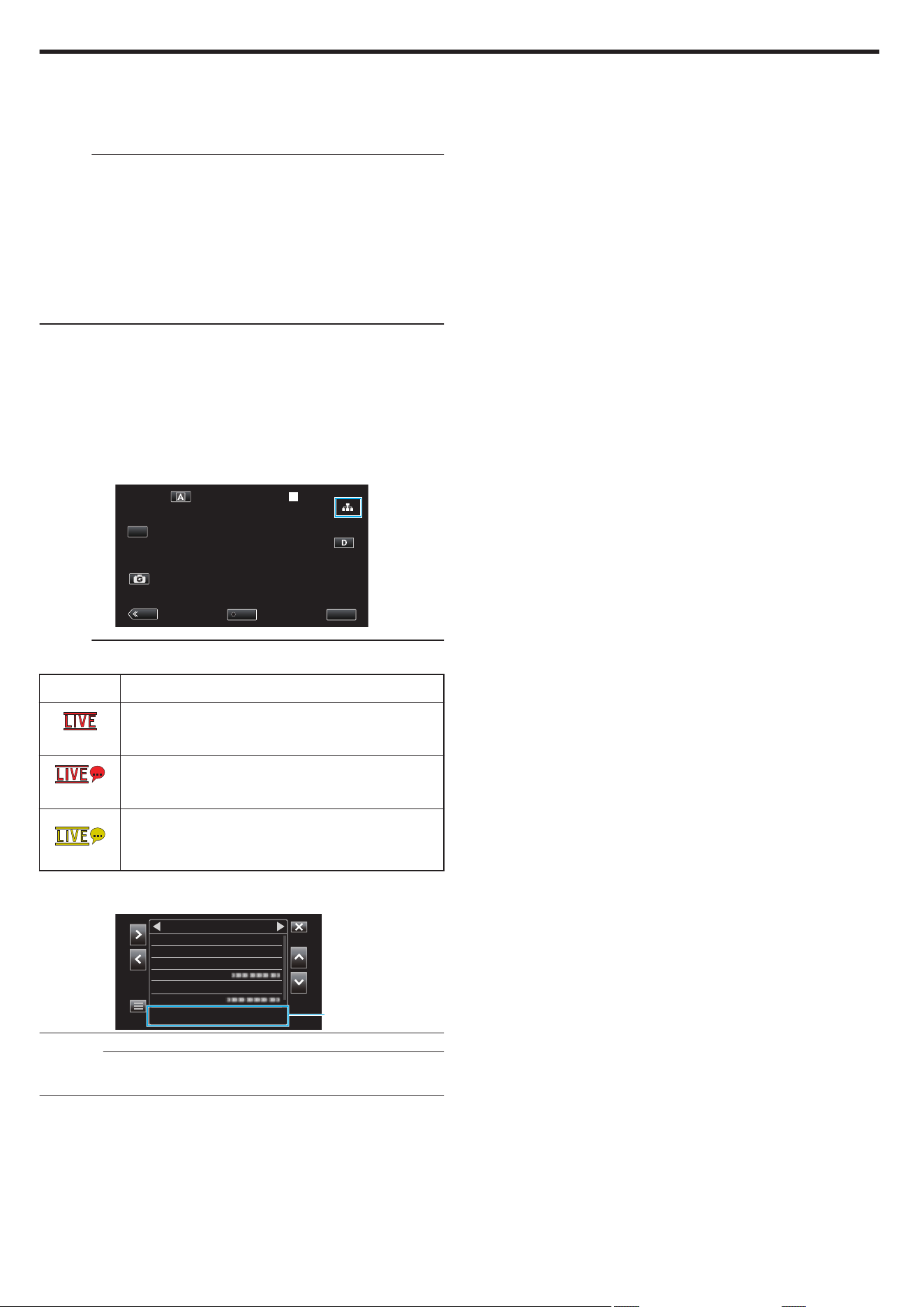
o
Starting Distribution
1
Perform the necessary setting for the decoder and PC application.
For more details on the settings, please refer to the instruction manual
of the respective devices and applications.
Memo :
0
If
there are devices such as an NAT router within the communication path
between the camera and the decoder, port forwarding setup is required.
For more details on the settings, please refer to the instruction manual of
the router in use.
– The following setting values are required when connecting to this camera
using RTSP/RTP.
Port number: 554
Stream ID: stream
– Use the following to access via URL.
Rtsp://<IP address of the camera>:554/stream
2
Connect the camera to the network via Wi-Fi.
“Preparing for Connection” (A p. 79
)
3
Set “Live Streaming” to “On”.
Set “MENU”F“System”F“Network”/“Settings”F“Live Streaming
Set”F“Live Streaming” to “On”.
0
The network connection mark appears on the LCD monitor screen
when a network connection is established.
“Network Connection” (A p. 128)
.
MENUREC
PLAY
SLOT
A
STBY
00 : 00 : 00 . 00
2018 - 01 - 01
02 : 23 : 01
TC
Memo :
0
You can view the status of distribution on the LCD monitor.
Icon Status
.
(Red)
Distribution in progress (good connection quality)
Blinks when distribution starts or stops
.
(Red)
Distribution in progress (poor connection quality)
.
(Yellow)
Waiting for connection (during RTSP/RTP) or connection
failed
0
When 5 is displayed, the error description is displayed on the
“STATUS”F“Network” screen.
.
RY980-
****
WPA2
192.168.0.1
Cause of
Error
Multicast Is Not Supported
Live Streaming
MAC Address
IP Address
Passphrase
Security Type
SSID
Direct Connection
Type
Network
Caution :
0
Streaming may be interrupted temporarily 24 hours after the process
started.
Using Wi-Fi
96
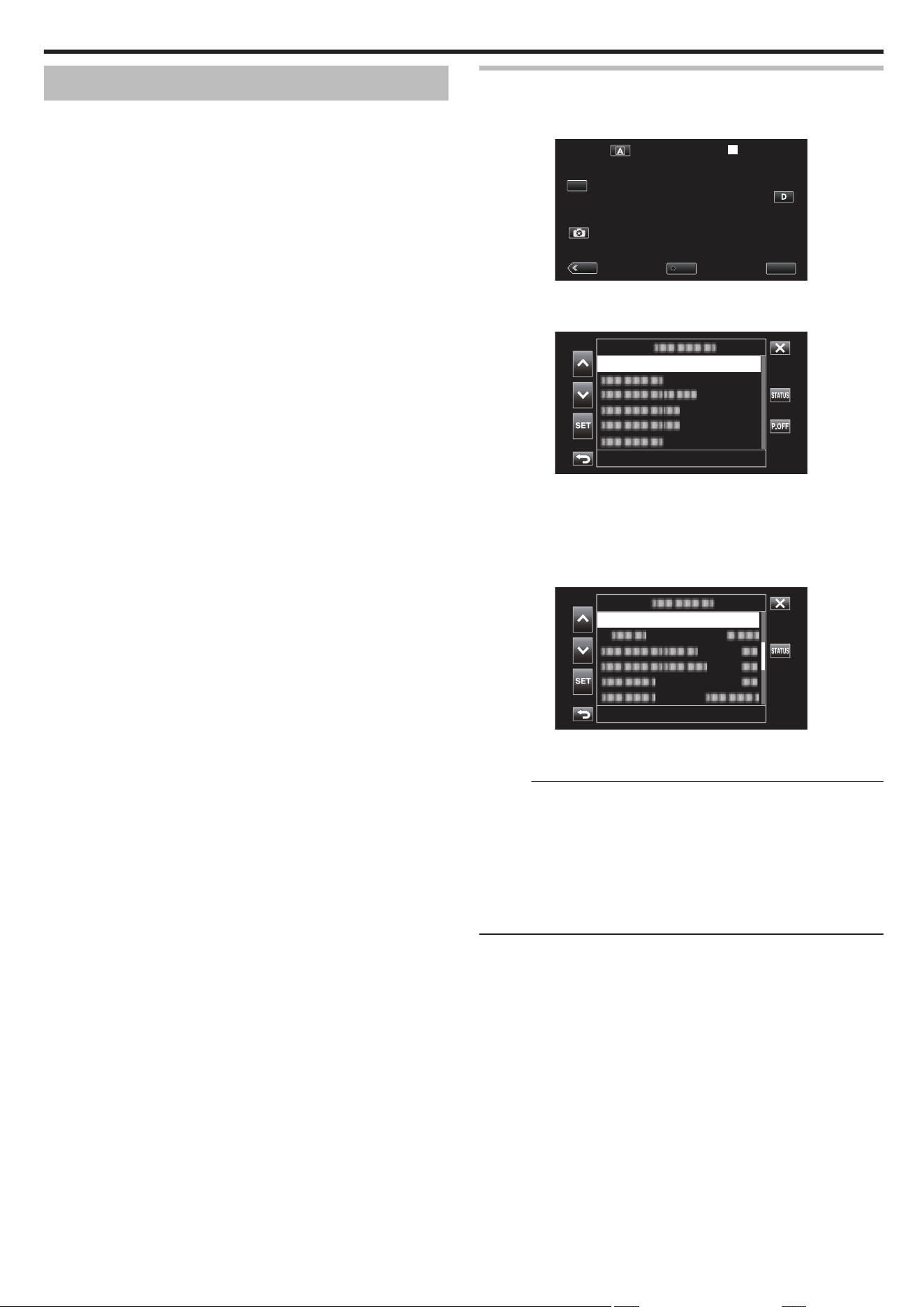
Operating the Menu
The following menu is available on this unit.
0
Camera Function Menu
For configuring the camera operation during recording (e.g., image
stabilizer).
0
Camera Process Menu
For configuring settings related to image quality adjustment during
recording.
0
TC Menu
For configuring the time code.
0
Monitor Menu
For configuring settings related to the LCD monitor display.
0
A/V Set Menu
For configuring settings related to audio and video output.
0
System Menu
For configuring the general settings of the camera, such as recording
format and clock.
Operating the Menu
You can configure various settings using the menu.
1
Tap “MENU”.
.
MENUREC
PLAY
SLOT
STBY
00 : 00 : 00 . 00
2018 - 01 - 01
02 : 23 : 01
TC
0
The main menu appears.
2
Select the desired item from the menu and tap the “SET” button.
.
Camera Function...
0
STATUS:
Displays the screen for checking the current settings.
0
P.OFF:
Pressing the button for approximately 2 seconds or longer turns off
the power.
3
Select the item to be configured.
.
Touch Priority AE/AF
Off
0
Use 3
and 2 to scroll up and down.
0
Tap “SET” to confirm the selection.
Memo :
0
To select an item
Tap 3, 2, 0 and 1.
0
To confirm selection
Tap “SET”.
0
To return to the previous screen
Tap J.
0
To exit the screen
Tap L (quit).
Settings Menu
97

Main Menu
Camera Function
For configuring the camera operation during recording (e.g., image stabilizer).
“Camera Function Menu” (A p. 99
)
Caution :
0
The camera functions are not available for selection during recording with “System” set to “High-Speed”.
Camera Process
For configuring settings related to image quality adjustment during recording.
“Camera Process Menu” (A p. 101
)
TC
For configuring the time code.
“TC Menu” (A p. 106
)
Monitor
For configuring settings related to the LCD monitor display.
“Monitor Menu” (A p. 107)
A/V Set
For configuring settings related to audio and video output.
“A/V Set Menu” (A p. 112)
System
For configuring the general settings of the camera, such as recording format and clock.
“System Menu” (A p. 114)
Settings Menu
98

Camera Function Menu
Touch Priority AE/AF
Automatically adjusts focus and brightness based on the subjects’ faces or selected area.
“Capturing Subjects Clearly (TOUCH PRIORITY AE/AF)” (A p. 38)
Caution :
0
Touch Priority AE/AF cannot be selected in the following cases.
–
When “Focus” is set to “Manual”
– When “System” is set to “High-Speed”
– When “Rec Mode” is set to “Time-Lapse Rec”
0
When all of “Shutter Speed”, “Aperture” and “Gain Up” are set to “Manual”, “AreaSel” cannot be selected.
0
FaceDet cannot be selected in the following cases.
– When “Backlight Comp” is set to “On”
– When “Lolux” is set to “On”
Video Self Timer
For configuring the self-timer for videos.
“Using Video Self Timer” (A p. 45)
Caution :
0
Video Self Timer cannot be selected in the following cases.
–
During recording
– When “Rec Mode” is set to “Pre Rec” or “Time-Lapse Rec”
Still Self Timer
For configuring the self-timer for still images.
“Using Still Self Timer” (A p. 46)
Caution :
0
Still Self Timer cannot be selected in the following cases.
–
During recording
– When “System” is set to “High-Speed”
– When “Rec Mode” is set to “Pre Rec” or “Time-Lapse Rec”
DIS
Camera shake during video recording can be effectively reduced.
“Reducing Camera Shake” (A p. 39)
Caution :
0
DIS cannot be selected in the following cases.
–
During recording
– When “System” is set to “High-Speed”
– When “Rec Mode” is set to “Pre Rec” or “Time-Lapse Rec”
– When “Live Streaming” is set to “On”
Settings Menu
99
Zoom
Sets the maximum zoom ratio.
o
When “System” is set to “4K”
Setting Details
10X/Optical Enables recording with 1 to 10x optical zoom. Set this when digital zoom is not desired.
200X/Digital Enables recording with 1 to 10x optical zoom and 11 to 200x digital zoom.
o
When “System” is set to “HD”
Setting Details
10X/Optical Enables recording with 1 to 10x optical zoom. Configure this item when the use of digital zoom is not desired.
18(17)X/Dynamic Enables recording with 1 to 10x optical zoom and 11 to 18x dynamic zoom when the image stabilizer is turned off.
Enables
recording with 1 to 10x optical zoom and 11 to 17x dynamic zoom when the image stabilizer is in the normal mode.
Enables recording with 1 to 10x optical zoom and 11 to 16x dynamic zoom when the image stabilizer is in the active mode.
Enables recording with 1 to 10x optical zoom and 11 to 12x dynamic zoom when the image stabilizer is in the powered active
mode.
200X/Digital Enables recording with 1 to 10x optical zoom, dynamic zoom in the zoom ratio according to the image stabilizer setting, and
up to 200x digital zoom.
o
When “System” is set to “High-Speed”
The setting is fixed at “10X/Optical”.
Caution :
0
Zoom ratio cannot be selected in the following cases.
–
During recording with “DIS” set to “On(Enh.AIS)”
– When “DIS” is set to “On(Enh.AIS)” and “Rec Mode” set to “Pre Rec”
– When “DIS” is set to “On(Enh.AIS)” and “Live Streaming” set to “On”
Tele Macro
Enables close-up shots when using the telephoto (T) end of the zoom.
“Taking Close-up Shots (TELE MACRO)” (A p. 40)
Memo :
0
This is selectable only during Manual recording.
Flicker Correction
For setting whether to adjust image flicker that occurs under a fluorescent light.
Setting Description
On Enables flicker correction.
Off Does not perform flicker correction.
Caution :
0
Flicker Correction cannot be selected in the following cases.
–
When “System” is set to “High-Speed”
– When “Frame Rate” is set to “24p”
– When “Shutter Speed” is slower than “1/60”
Settings Menu
100

Camera Process Menu
Focus
Focus can be adjusted manually.
“Adjusting Focus Manually (FOCUS)” (A p. 23)
Memo :
0
This is selectable only during Manual recording.
Brightness Adjust
Adjusts the overall brightness of the screen.
“Adjusting Brightness” (A p. 26)
Caution :
0
Brightness Adjust cannot be selected in the following cases.
–
During Auto recording
– When “Shutter Speed”, “Aperture” and “Gain Up” are set to “Manual”
– When “Backlight Comp” is set to “On”
– When “Lolux” is set to “On”
Shutter Speed
Shutter speed can be adjusted.
“Setting Shutter Speed” (A p. 27)
Caution :
– During Auto recording
–
When “Lolux” is set to “On”
Aperture
Adjusts the aperture value.
“Setting Aperture” (A p. 28)
Caution :
0
Aperture cannot be selected in the following cases.
–
During Auto recording
– When “Lolux” is set to “On”
Gain Up
Makes the subject appear bright automatically when recording in dark places.
“Increasing the Light Sensitivity Level” (A p. 29)
Caution :
0
This function is not available for selection when “Lolux” is set to “On”.
0
“Manual” is not available for selection in the Auto Recording mode.
0
This function is fixed at “AGC” in the Auto Recording mode when “System” is set to “High-Speed”.
0
“Auto Slow-Shutter” is not available for selection in the Manual Recording mode when “System” is set to “High-Speed”.
Backlight Comp
Corrects the image when the subject appears dark due to backlight.
“You can correct the image when the subject appears too dark due to backlight.” (A p. 30)
Caution :
0
Backlight Comp cannot be selected in the following cases.
–
During Auto recording
– When “System” is set to “High-Speed”
– When “Shutter Speed”, “Aperture” and “Gain Up” are set to “Manual”
– When “Lolux” is set to “On”
Settings Menu
101
Lolux
For configuring the Lolux mode (low-light recording mode) to increase the light sensitivity level at a dimly-lit location.
Setting Description
On Enables the Lolux setting.
Off Disables the Lolux setting.
Memo :
0
This is selectable only during Manual recording.
Detail
For adjusting the contour (detail) enhancement level.
Setting Description
-10 to -1, 0, +1 to +10 Increasing the value increases the sharpness of the contour.
Off Does not perform correction.
For adjustment of the details, go to “Detail Adjust Menu” (A p. 104) .
Memo :
0
This is selectable only during Manual recording.
Gamma
For adjusting the gamma curve that determines the gradation expression.
Setting Description
Standard Sets to a standard gamma curve.
Cinema Sets to a gamma curve with similar gradation to the screen characteristics of movies.
Caution :
0
Gamma cannot be selected in the following cases.
–
During Auto recording
– When “WDR” is set to “On”
Level
Adjusts the corresponding gamma level when “Gamma” is set to “Standard” or “Cinema”.
Setting Description
-5 to -1, 0, +1 to +5 Increasing the value enhances the gradation of the shadows. However, the gradation of bright areas deteriorates.
Decreasing the value enhances the gradation of the highlights. However, the gradation of shadows deteriorates.
Settings Menu
102
WDR
When shooting subjects with a wide dynamic range, such as a backlit subject, this function compresses the dynamic range while maintaining image contrast
by applying gradation compensation to the input video signals.
Setting Description
On Sets the wide dynamic range function to “On”.
Off Sets the wide dynamic range function to “Off”.
Caution :
0
WDR cannot be selected in the following cases.
–
During Auto recording
– When “System” is set to “High-Speed”
White Balance
You can set the color tone to suit the light source.
“Setting White Balance” (A p. 31)
For white balance adjustment, go to
“White Balance Adjust Menu” (A p. 105) .
Memo :
0
This is selectable only during Manual recording.
Color Matrix
Configures the color according to the user’s preference using the color matrix (colors represented by the 3 R, G and B values).
Setting Description
Standard Sets to a standard color matrix.
Cinema Vivid Sets to a vivid color matrix that is similar to the screen characteristics of movies.
Cinema Subdued Sets to a subdued color matrix that is similar to the screen characteristics of movies.
Memo :
0
This is selectable only during Manual recording.
Color Matrix Adjustment
The color matrix of the camera can be adjusted to suit the user’s preference.
When shooting is performed using multiple cameras, the colors of the different cameras can be adjusted, and a color of the user’s preference can be set on
this camera. The saturation, hue and brightness of the primary and complementary colors (6 colors in total) can be configured individually.
The adjusted values of “Standard”, “Cinema Vivid”, and “Cinema Subdued” in Color Matrix can be stored individually.
Reset Process
Restores “Camera Process” to the default settings.
Caution :
0
This item cannot be selected during recording.
Settings Menu
103
Detail Adjust Menu
Unavailable when “Detail” is set to “Off”.
V/H Balance
For configuring whether to apply outline enhancement in the vertical (V) or horizontal (H) direction.
Setting Description
V+4~V+1 Applies outline enhancement in the vertical (V) direction.
Normal Standard outline enhancement.
H+1~H+4 Applies outline enhancement in the horizontal (H) direction.
Skin Detail
Detects the skin tone and applies effects for a more refined look.
Setting Description
On Enables “Skin Detail”.
Off Disables “Skin Detail”.
Level
For configuring the smoothness of the outline in “Skin Detail”.
Setting Description
-3, -2, -1
For configuring the “Skin Detail” level.
“-3” gives the maximum effect.
Settings Menu
104
White Balance Adjust Menu
Preset Temp.
For selecting the color temperature when white balance is set to “Preset”.
Setting Description
2300K to 15000K For selecting a color temperature setting.
MWB Paint
The red and blue components can be adjusted when white balance is set to “MWB A” or “MWB B”.
* MWB is the abbreviation for Manual White Balance.
Setting Description
-32 to +32 Increasing the value enhances the red and blue tones.
Memo :
0
Separate settings can be specified for MWB A and MWB B.
Clear Paint After MWB
For configuring whether to restore the red and blue settings of MWB Paint to the default values when the o button is tapped for white balance to be adjusted
automatically after white balance is set to “MWB A” or “MWB B”.
Setting Description
On Restores the default values.
Off Does not restore the default values.
AWB Paint
The red and blue components can be adjusted when white balance is set to “Auto”.
* AWB is the abbreviation for Auto White Balance.
Setting Description
-32 to +32 Increasing the value enhances the red and blue tones.
Settings Menu
105

TC Menu
Caution :
0
This item cannot be selected during recording.
TC Generator
For setting the operation of the time code.
“Changing the Mode of Time Code (TC) Recording” (A p. 47
)
TC Preset
For configuring the time code (hour, minute, second, frame) when recording starts.
Unavailable when “TC Generator” is set to “Regen”.
Settings Menu
106
Monitor Menu
Shooting Assist
For configuring settings on supplementary shooting functions.
Go to
“Shooting Assist Menu” (A p. 109) .
Grid Marker
For configuring whether to display a 3x3 grid on the screen.
Setting Description
On Displays grids.
Off Does not display grids.
Display Settings
For configuring the displays on the LCD monitor screen.
Go to “Display Settings Menu” (A p. 110) .
Auto Monitor Brightness
Automatically adjusts the brightness of the LCD monitor according to the brightness of the shooting location.
Setting Description
On Adjusts the LCD monitor brightness automatically.
Off Does not adjust the LCD monitor brightness automatically.
Caution :
0
Unavailable when “Silent Mode” is set to “Silent & Dim LCD”.
Monitor Brightness
For configuring the brightness level of the LCD monitor screen.
Setting Description
-10 to -1, 0, +1 to +10 Increasing the value increases the brightness of the LCD monitor.
Memo :
0
Available when “Auto Monitor Brightness” is set to “Off”.
0
Changing the setting in “Monitor Brightness” does not affect the recorded videos.
Monitor Contrast
For configuring the contrast level of the LCD monitor screen.
Setting Description
-10 to -1, 0, +1 to +10 Increasing the value increases the contrast of the LCD monitor. (The images appear sharper when the contrast is higher.)
Memo :
0
Available when “Auto Monitor Brightness” is set to “Off”.
0
Changing the setting in “Monitor Contrast” does not affect the recorded videos.
Settings Menu
107

LCD Backlight
For configuring the brightness of the LCD monitor backlight.
Setting Description
-1, 0, +1 Increasing the value increases the brightness of the backlight.
Memo :
0
Available when “Auto Monitor Brightness” is set to “Off”.
0
Changing the setting in “LCD Backlight” does not affect the recorded videos.
Monitor Peaking
Adjusts the outline of the video image that is displayed on the LCD monitor.
Setting Description
-3 to -1, 0, +1 to +3 Increasing the value enhances the outline of the video image.
Memo :
0
Available when “Auto Monitor Brightness” is set to “Off”.
0
Changing the setting in “Monitor Peaking” does not affect the recorded videos.
Settings Menu
108
Shooting Assist Menu
Focus Assist
For setting whether to add color to the contour of the focused image upon switching the image to black-and-white.
Setting Description
On Enables the function.
Off Disables the function.
Color
For setting the display color of the focused area when Focus Assist is activated.
Selecting “Multicolor” changes the outline color in sequence from red to green to blue according to the sharpness of the focus.
Setting Description
Multicolor Displays the outline in multicolors.
Blue Displays the outline in blue color.
Green Displays the outline in green color.
Red Displays the outline in red color.
Zebra
For selecting whether to display zebra patterns at the bright areas of the subject.
Setting Description
On Displays the zebra pattern.
Off Does not display the zebra pattern.
Top
For configuring the maximum luminance level for the zebra pattern display.
Setting Description
5% to 95%, 98%, 100%,
Over
For configuring the maximum luminance limit.
Bottom
For configuring the minimum luminance level for the zebra pattern display.
Setting Description
0%, 5% to 95%, 98%, 100% For configuring the minimum luminance limit.
Settings Menu
109
Display Settings Menu
Zoom
For configuring the display on the LCD monitor when zoom is operated.
Setting Description
Number Displays in numerical values.
Bar Displays a zoom bar.
Off No display
Focus
For configuring the unit of measurement for indicating the position of focus.
Setting Description
Feet Displays the position of focus in feet.
Meter Displays the position of focus in meters.
Off No display
Record Format
For configuring whether to display the recording format.
Setting Description
On Displays the recording format.
Off No display
Media Remain
For configuring whether to display the SD card status and the remaining space on the card.
Setting Description
On Displays the SD card status and remaining space on the card.
Off No display
TC
For configuring whether to display the time code.
Setting Description
On Displays the time code.
Off No display
Audio Meter
For configuring whether to display the audio level meter.
Setting Description
On Displays the audio level meter.
Off No display
Settings Menu
110
Battery
For configuring whether to display the battery level.
Setting Description
On Displays the battery level.
Off No display
Date/Time
For configuring whether to display the date and time.
Setting Description
On Displays the date and time.
Off No display
Date Style
For configuring the date format.
Setting Description
YMD,
MDY1, MDY2,
DMY1, DMY2
Select a date format.
Time Style
For configuring the time format (24-hour or 12-hour display).
Setting Description
24-hour display
12-hour display
Select a time format.
Settings Menu
111
A/V Set Menu
Video Set
For configuring settings related to the LCD monitor output.
Go to “Video Set Menu” (A p. 112) .
Audio Set
For configuring audio-related settings.
Go to “Audio Set Menu” (A p. 112) .
Video Set Menu
Display On TV
For configuring whether to display icons and date/time on the TV.
Setting Details
On Displays icons and date/time on TV.
Off Does not display icons and date/time on TV.
HDMI Out
For configuring the HDMI Out resolution.
Setting Details
Auto It is recommended to select “Auto” usually.
480p or 576p Select this when the video is not output in “Auto” correctly.
HDMI Control
Sets whether to link operations with an HDMI-CEC compliant TV.
Setting Details
On Turns on linked operations.
Off Turns off linked operations.
Audio Set Menu
Zoom Mic
For configuring the zoom microphone. (Built-in microphone)
Setting Details
On Records audio sounds in the same direction as the zoom operation.
Off Deactivates the zoom microphone.
Caution :
0
This function is not available for selection when a microphone is connected to the mic terminal.
Memo :
0
When “On” is selected, the volume level at the wide-angle (W) end is lower than that at the telephoto (T) end.
Settings Menu
112
Audio Level
For configuring the audio level during recording on the Audio Level screen.
Caution :
0
This function is not available for selection in the Auto Recording mode.
Wind Cut
Reduces the noise caused by wind.
Setting Details
Auto Activate the function automatically.
On Activates the function.
Off Deactivates the function.
Caution :
0
This item cannot be selected during recording.
0
This item is set to “Off” and cannot be changed when “Live Streaming” is set to “On”.
K2 Technology
Reduces the degradation of sound quality caused by digital signal processing, and records a sound quality close to the original.
Setting Details
On Activates K2 Technology.
Off Deactivates K2 Technology.
Caution :
0
K2 Technology cannot be selected in the following cases.
–
During recording
– When “System” is set to “4K” or “High-Speed”
– When “Rec Mode” is set to “Pre Rec”
– When “Live Streaming” is set to “On” (this item is set to “Off”)
Operation Sound
For configuring the sound during operation.
Setting Description
High Increases the volume of the operating sound.
Low Decreases the volume of the operating sound.
Off No operating sound is output.
Caution :
0
Operation Sound cannot be selected in the following cases.
–
During recording
– When “Silent Mode” is set to “Silent” or “Silent & Dim LCD”
– When “Rec Mode” is set to “Pre Rec”
Settings Menu
113
System Menu
Record Set
For configuring settings related to the recording mode.
Go to “Record Set Menu” (A p. 117) .
Format SD Card
Deletes all files on the SD card.
Caution :
0
Not available for selection when no SD card is inserted.
0
All data on the SD card will be deleted when it is formatted.
Copy all files on the SD card to a computer before formatting.
0
Make sure that the battery pack is fully charged or connect the AC adapter as the formatting process may take some time.
Restore SD Card
If, for some reason, no image is displayed on the index screen (thumbnail display) in the playback mode even though video images are stored in the SD card,
performing SD card recovery may display the images.
Caution :
0
Not available for selection when no SD card is inserted or during recording.
0
Make sure that the battery is fully charged or connect the AC adapter as the recovery process may take some time.
Mobile User Guide
Displays the QR code to access the Mobile User Guide.
Memo :
0
To read the QR code, a relevant application is required. Enter the URL in the internet browser manually if the QR code cannot be read.
0
The Mobile User Guide is supported by Android devices and iPhone. It can also be viewed on standard browsers such as Google Chrome (Android) and
Mobile Safari (iPhone).
0
QR Code is a registered trademark of Denso Wave Incorporated.
Caution :
0
This item cannot be selected during recording.
Silent Mode
The Silent mode is a function for turning off the operation sound. The screen can also be dimmed depending on the setting. Use this mode to record quietly
in events such as recitals, presentations etc.
Setting Description
Silent & Dim LCD The LCD monitor screen darkens and no operating sound is output.
Silent No operating sound is output.
Off Disables the Silent mode.
Screen Lock
This function is used to lock the touch screen to prevent accidental operation when shooting under water.
“Locking the Screen (when Shooting Underwater)” (A p. 9)
Caution :
0
Screen Lock cannot be selected in the following cases.
–
During recording
– When “System” is set to “High-Speed”
– When “Rec Mode” is set to “Time-Lapse Rec”
– When connected to Wi-Fi
Settings Menu
114
LCD Closed Recording
During recording or while the camera is connected to Wi-Fi, closing the LCD monitor does not turn off the power of the camera. (The power turns off when
Wi-Fi is disconnected.)
Setting Details
On Activates LCD Closed Recording.
Off The unit is turned off when the LCD monitor is closed.
Caution :
0
This item cannot be selected during recording.
Quick Restart
Enables the power to turn on quickly when the LCD monitor is opened again within 5 minutes.
Setting Details
On Enables Quick Restart.
Off Deactivates the function.
Memo :
0
When “On” is selected, power continues to be consumed for about 5 minutes after closing the LCD monitor.
To minimize power consumption, select “Off”.
When “On” is selected, it is also possible to reduce power consumption by pressing and holding the “P.OFF” button in “MENU” to turn off the power.
“Operating the Menu” (A p. 97
)
Caution :
0
This item cannot be selected during recording.
Auto Power Off
When no operation is made for 5 minutes, this function turns off this unit or sets this unit to standby mode when using the AC adapter in case you forgot to
turn off the power.
Setting Details
On Turns off the power automatically if this unit is not operated for 5 minutes.
Off Power is not turned off even if this unit is not operated for 5 minutes.
Caution :
0
This item cannot be selected during recording.
Demo Mode
Plays a demonstration of the special features of this unit.
Setting Details
On Plays a demonstration of the special features of this unit.
Off Deactivates the function. (Recommended)
Memo :
0
This item cannot be selected in the playback mode.
0
Setting Demo mode to “On” may reset the record settings. Set to “Off” for normal use.
Caution :
0
This item cannot be selected during recording.
Language
The language on the display can be changed.
“Changing the Display Language after Initial Settings are Configured” (A p. 14
)
Settings Menu
115

FACTORY PRESET
Returns all the settings to their default values.
Caution :
0
This item cannot be selected during recording.
Date/Time
Resets the current time or sets to the local time when using this unit overseas.
“Readjusting the Clock after Initial Settings are Configured” (A p. 14)
Caution :
0
This item cannot be selected during recording.
Time Zone
For configuring the UTC (Coordinated Universal Time) time difference in units of 30 minutes.
Caution :
0
This item cannot be selected during recording.
Touch Screen Adjust
Adjusts the response position of the buttons on the touch screen.
“Adjusting the Touch Screen” (A p. 10)
Caution :
0
This item cannot be selected during recording.
Settings Menu
116
Network
For configuring the network.
When using the network function, select “On”.
Setting Description
On Uses a network device.
Off Does not use a network device.
Caution :
0
Network cannot be selected in the following cases.
–
When “System” is set to “High-Speed”
– When live streaming is in progress
Firmware Update
Updates the functions of this unit to the latest version.
For more details, please refer to the website below.
http://www3.jvckenwood.com/english/support/index.html
(When no program to update the software of this unit is available, nothing will be provided on the homepage.)
Caution :
0
This item cannot be selected during recording.
System Information
Displays the version information and open source software licenses.
Record Set Menu
Record Format
For configuring settings related to the recording format.
Go to “Record Format Menu” (A p. 119
) .
Rec Mode
For configuring the recording mode.
Setting Description
Normal When recording stops, the image, audio and accompanying data from the start till the end of the recording are recorded as
a single scene.
Pre Rec “Pre Rec Time” can be used to specify the number of seconds for video and audio to be recorded before the actual recording
starts.
“Pre Rec” (A p. 43)
Scene Continuous This function enables several rounds of recordings (from the time when recording starts to the time when it is stopped) to
be consolidated into a single scene.
“Scene Continuous” (A p. 44
)
Time-Lapse Rec This function enables the changes of a scene that occur slowly over a long period of time to be played back within a short
time by recording the number of frames configured in “Rec Frames” over the time interval configured in “Rec Interval”.
“Time-lapse Recording (Time-Lapse Rec)” (A p. 41
)
Caution :
0
Unavailable when “System” is set to “High-Speed”.
0
When this item is set to “Pre Rec”, “Scene Continuous” or “Time-Lapse Rec”, turning off the power will restore it to “Normal”.
Settings Menu
117
Pre Rec Time
For configuring Pre Rec Time when “Rec Mode” is set to “Pre Rec”.
Setting Description
15 sec Records video and audio 15 seconds before actual recording starts.
10 sec Records video and audio 10 seconds before actual recording starts.
5 sec Records video and audio 5 seconds before actual recording starts.
Caution :
0
When “System” is set to “4K”, the setting is fixed at “5 sec”.
Rec Frames
For configuring the number of frames to record when “Rec Mode” is set to “Time-Lapse Rec”.
Rec Interval
For configuring the recording time interval when “Rec Mode” is set to “Time-Lapse Rec”.
Slot Mode
For configuring the way to use the two card slots.
Setting Description
Dual Records simultaneously to the SD cards in both Slot A and Slot B.
Both the SD cards in the two slots will contain the same files.
Series Starts recording to the card in the other slot when the card in the slot where recording is in progress becomes full.
Caution :
0
This function is not available for selection when “System” is set to “4K” or “High-Speed”.
4 GB Spanning
For configuring whether to split the files in units of 4 GB when recording to an SDXC card.
Setting Description
On Splits a file when it exceeds 4 GB or 30 minutes.
Off (SDXC) Splits a file when it exceeds 64 GB or 4 hours.
Caution :
0
Unavailable when “System” is set to “HD”.
Memo :
0
This option is only valid if the SD card used for recording is of the SDXC card.
Video No. Reset
Resets the serial number of the video files.
By initializing the SD card when changing to a new one, you can record with the file number starting from “1” for each SD card.
(File number of an AVCHD video file starts from “0”.)
Image No. Reset
Resets the serial number of the still image files.
By initializing the SD card when changing to a new one, you can record with the file number starting from “1” for each SD card.
Settings Menu
118
Record Format Menu
Memo :
0
The screen may darken for 5 to 6 seconds when settings in the recording format menu are changed.
System
For configuring the resolution of the video recordings.
Setting Description
4K Records in “4K” quality.
HD Records in “HD” quality.
High-Speed Records in “High-Speed” quality.
Memo :
0
“4K” video recordings can be played back in 4K quality on TV sets that support 4K resolution and in HD quality in the case of high-definition TVs.
Format
Displays the file format of the recording.
Display Description
AVCHD Records in the AVCHD file format.
QuickTime Records in the QuickTime file format (.mov).
Resolution
Displays the size of the recorded image. (Horizontal x vertical)
Display Description
1920×1080 Records in 1920×1080 quality.
3840×2160 Records in 3840×2160 quality.
Frame Rate
For configuring the frame rate for recording.
And for configuring whether to perform progressive recording.
To capture scenes of a video as still images, progressive recording is recommended.
0
When “System” is set to “4K”: [Settings: 30p, 25p, 24p]
0
When “System” is set to “HD”: [Settings: 50p, 50i, 60p, 60i]
0
When “System” is set to “High-Speed”: [Settings: 50/25p, 100/25p, 60/30p、120/30p、100/50p, 120/60p]
Caution :
0
When “System” is set to “HD”, videos with “Frame Rate” at 60p/60i and 50p/50i cannot be mixed on the same card.
0
Before inserting a new SD card, check if the “Frame Rate” has been set to the frame rate for shooting.
(A p. 128)
To change the “Frame Rate”, do so before inserting a new card.
Bit Rate
For configuring the recording bit rate.
0
When “System” is set to “4K”, the setting is fixed at “70M”.
0
When “System” is set to “HD” and “Frame Rate” to “60p”/“50p”, the setting is fixed at “28M”.
0
When “System” is set to “HD” and “Frame Rate” to “60i”/“50i”: [Settings: 18M, 24M]
0
When “System” is set to “High-Speed”, the setting is fixed at “16M”.
Settings Menu
119

Network Settings Menu
Web
For configuring settings related to web access.
Go to
“Web Menu” (A p. 121) .
Live Streaming Set
For specifying settings for distributing live video images.
Go to
“Live Streaming Set Menu” (A p. 122) .
Caution :
0
Live Streaming Set cannot be selected in the following cases.
–
When “System” is set to “4K” or “High-Speed”
– When “Rec Mode” is set to “Time-Lapse Rec”
Connection Setup
For configuring the network connection settings.
A wizard screen appears. Follow the instructions.
“How to Establish a Wi-Fi Connection” (A p. 78
)
Caution :
0
Connection Setup cannot be selected in the following cases.
–
While transferring still image
– During live streaming
Reset Network
Restores the network settings to their default values.
Caution :
0
Reset Network cannot be selected in the following cases.
–
During recording
– During playback mode
– While transferring still image
– During live streaming
Settings Menu
120

Web Menu
Web Access
To access via a web browser, set to “On”.
Setting Description
On Enables web access.
Off Disables web access.
Camera Name
For setting the name to be displayed on the web browser. Enter not more than 8 characters using the software keyboard.
Login Name (Fixed)
The login name is fixed at “jvc”. Displays that are grayed out cannot be altered.
Login Password
Changes the password for accessing via a web browser.
The current password is displayed. Enter a new password directly.
Settings Menu
121
Live Streaming Set Menu
Live Streaming
Starts live distribution when “On” is selected.
Setting Description
On Starts live distribution.
Off Does not start live distribution.
Caution :
0
This item is fixed at “Off” during recording.
0
This item cannot be selected when a network connection is not established (when the network connection icon is in a color other than white).
Server
For selecting the server for live streaming.
Streaming Server
For configuring the live streaming server.
Go to “Streaming Server Settings Menu” (A p. 123
) .
Resolution
For setting the resolution of the video image during live distribution.
Setting Description
1920x1080, 1280x720,
640x360
Values when “Frame Rate” of “Record Format” is set to “60p”/“50p”.
1920x1080, 640x360 Values when “Frame Rate” of “Record Format” is set to “60i”/“50i”.
Frame & Bit Rate
For configuring the frame rate and encoding bit rate of the video image during live distribution.
Setting Description
60i/50i (12.0M), 60i/50i
(8.0M), 60i/50i (5.0M),
60i/50i (3.0M)
Values when the mode (type) of transfer for video distribution is set to “MPEG2-TS/UDP”, and “Resolution” of the live
distribution videos is set to “1920×1080”.
60i/50i (8.0M), 60i/50i
(5.0M), 60i/50i (3.0M)
Values when the mode (type) of transfer for video distribution is set to “MPEG2-TS/RTP” or “RTSP/RTP”, and “Resolution”
of the live distribution videos is set to “1920×1080”.
60i/50i (5.0M), 60i/50i (3.0M) Values when the mode (type) of transfer for video distribution is set to “RTMP”, and “Resolution” of the live distribution videos
is set to “1920×1080”.
30p/25p (8.0M), 30p/25p
(5.0M), 30p/25p (3.0M),
30p/25p (1.5M)
Values when the mode (type) of transfer for video distribution is set to “MPEG2-TS/UDP”, “MPEG2-TS/RTP” or “RTSP/RTP”,
and “Resolution” of the live distribution videos is set to “1280x720”.
30p/25p (5.0M), 30p/25p
(3.0M), 30p/25p (1.5M)
Values when the mode (type) of transfer for video distribution is set to “RTMP”, and “Resolution” of the live distribution videos
is set to “1280x720”.
30p/25p (3.0M), 30p/25p
(1.5M), 30p/25p (0.8M),
30p/25p (0.3M)
Values when “Resolution” of live distribution videos is set to “640x360”.
Settings Menu
122

Streaming Server Settings Menu
Alias
For setting a name to distinguish the settings of this camera.
Memo :
0
The default values are Server1/Server2/Server3/Server4.
0
You can enter up to 31 characters.
Type
For setting the system to transfer videos for distribution.
Memo :
0
Use reception devices that are compatible with the respective transfer systems.
0
The following items that can be set vary depending on the setting of this item.
Destination Address
For setting details such as the host name and the IP address of the live distribution destination.
Memo :
0
Enter not more than 127 characters using single-byte alphanumeric characters (a to z, 0 to 9), single-byte hyphen “-” or dot “.”.
Destination URL
For entering the URL of the live distribution destination beginning with “rtmp://”.
There is no default value (blank).
Memo :
0
You can enter up to 191 characters.
Destination Port
Enter the network port number of the live distribution destination using an integer between 1 and 65535.
The default value is 6504.
Memo :
0
When “Type” is set to “MPEG2-TS/RTP”, only even numbers from 2 to 65530 can be specified for the port number of the destination port.
0
When
“Type” is set to “MPEG2-TS/RTP” and “SMPTE 2022-1 FEC” is set to “On”, N+2 and N+4 port numbers are also used in addition to the specified port
number (N) of the destination port.
Stream Key
Enter the stream key specified at the live transmission destination.
There is no default value (blank).
Memo :
0
You can enter up to 63 characters.
Password
Changes the password for RTSP authentication to enable client access.
There is no default value (blank).
Memo :
0
You can enter up to 31 characters.
PCR Jitter
For configuring the setting to reduce PCR Jitter during live streaming.
Setting Description
Low Reduces PCR Jitter.
Normal Choose this setting if the decoder is not functioning correctly.
Settings Menu
123

SMPTE 2022-1 FEC
Setting Description
On Uses FEC (Forward Error Correction).
Off Does not use FEC (Forward Error Correction).
* The decoder must be compatible with SMPTE 2022-1.
FEC Matrix
For configuring the amount of “FEC” (Forward Error Correction) overhead when “SMPTE 2022-1 FEC” is enabled.
The amount of FEC overhead changes when the L and D values are changed.
Memo :
0
Increasing the amount of FEC overhead increases the packet loss resilience, but more network bandwidth is used.
0
Even with the same amount of overhead, increasing the L value will increase the packet loss (continuous packet loss) resilience.
Settings Menu
124
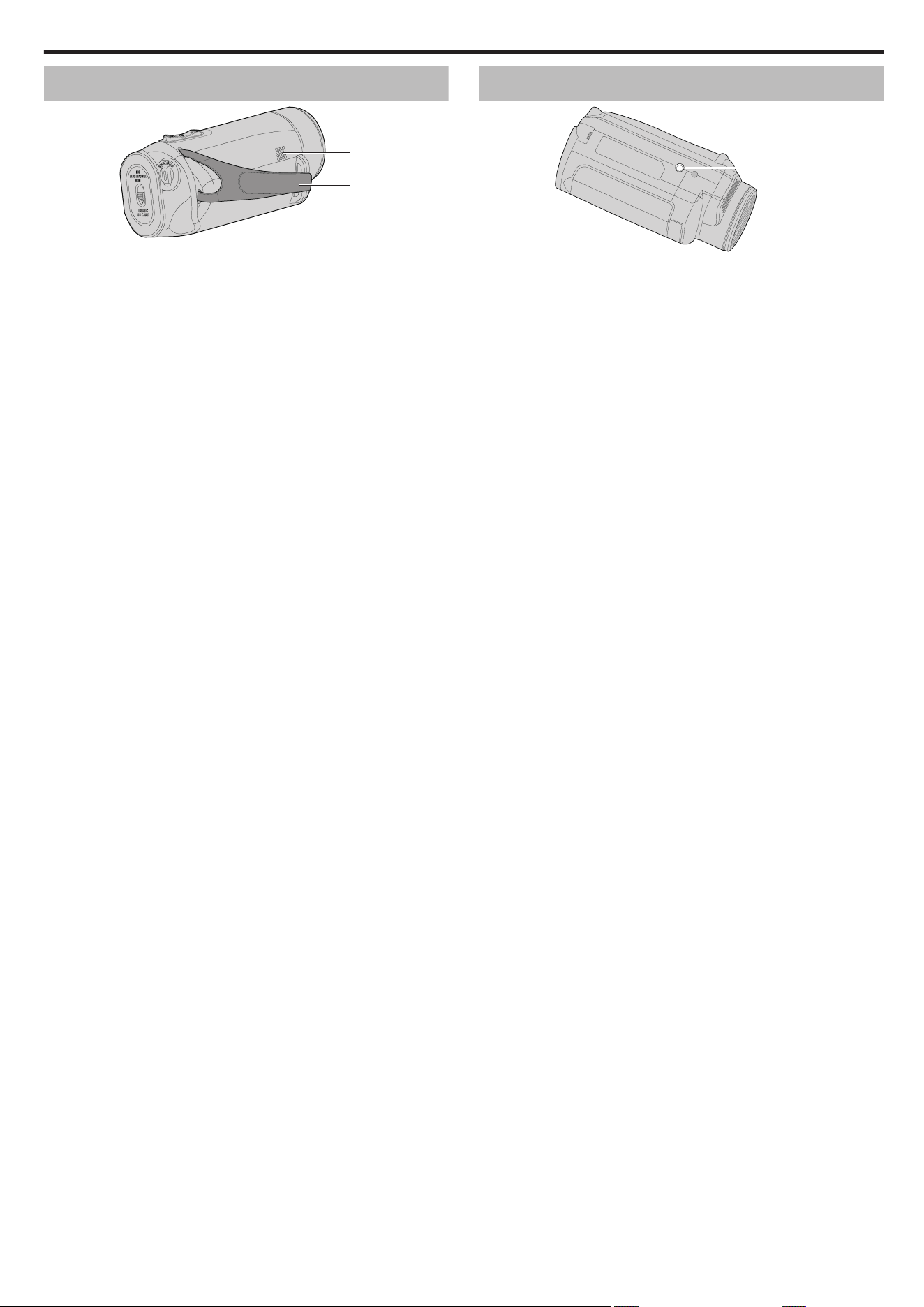
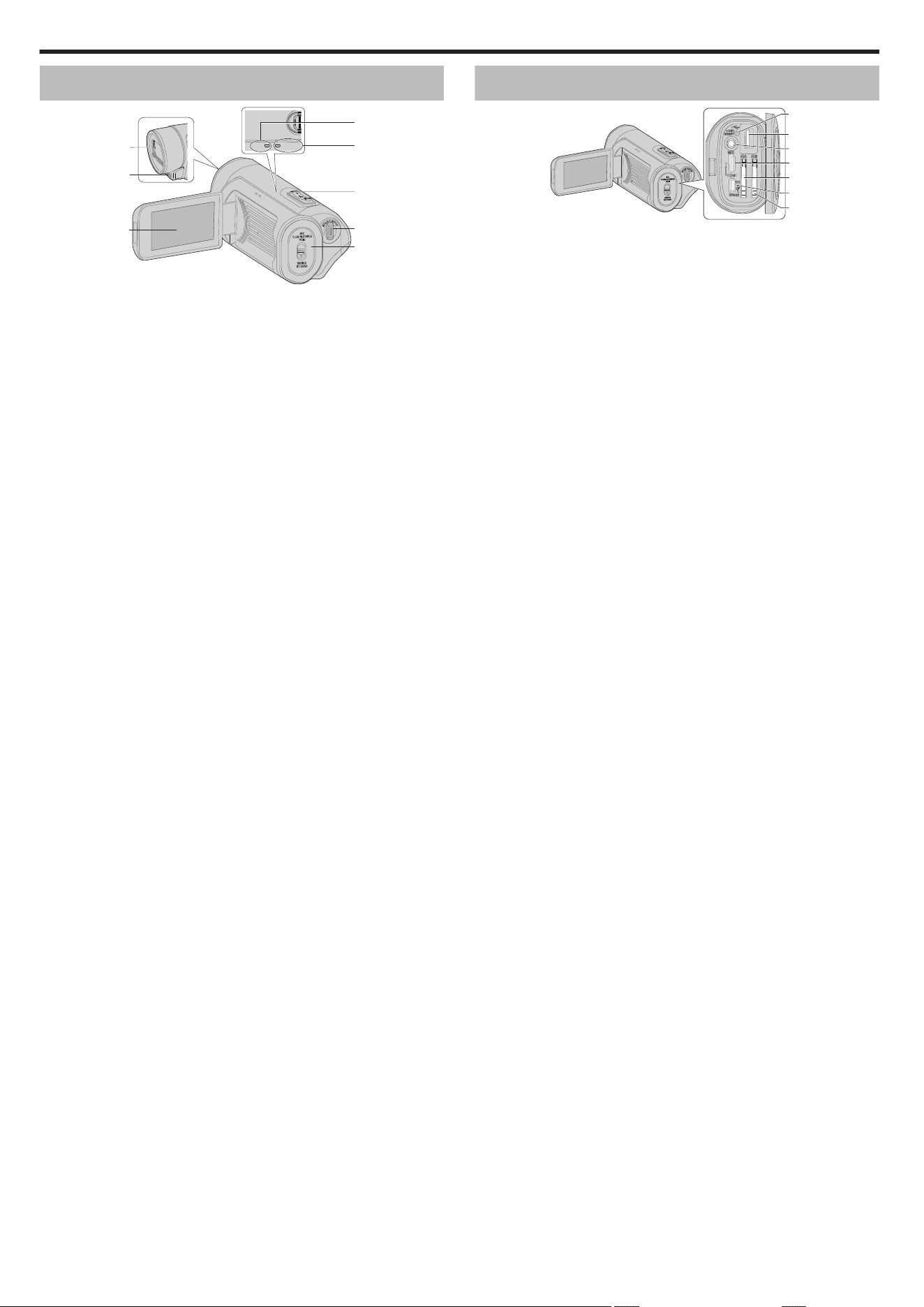
Top/Left/Rear Side
.
CHARGE POWER/ACCE
S
5
6
7
8
4
3
2
1
A Lens
0
The lens is protected by a protective glass cover.
0
If
the lens is dirty, use a commercially available lens blower to remove
any dust, and a commercially available cleaning cloth to wipe off any
dirt.
0
Do not cover the front of the lens with your fingers during recording.
B Stereo Microphone
0
Do not cover the microphone with your fingers during video recording.
C LCD Monitor
D CHARGE (Charging) Lamp
0
Lights up: Charging in progress
0
Goes out: Charging finished
0
Blinks: Charging error or abnormal temperature
E POWER/ACCESS (Power/Access) Lamp
0
Lights up/blinks during recording or playback.
Do not remove the SD card or any connecting cables.
F Zoom/Volume Lever
0
During shooting: Adjusts the shooting range.
0
During playback (index screen): Moves to the next or previous page.
0
During video playback: Adjusts the volume.
G START/STOP (Video Recording) Button
0
Starts/stops video recording.
H Terminal Cover
Inside Terminal Cover
.
1
7
4
5
6
3
2
A Reset Button
B USB Host Terminal (Type-A)
C Microphone Connector
0
This unit does not come with a hot shoe for mounting an external
microphone.
When using an external microphone, it is recommended that the
microphone
be secured with a commercially available straight bracket.
D HDMI Mini Connector
0
Connects to TV using an HDMI mini cable.
E SD Card Slot A
0
Insert an optional SD card.
F DC/USB Device Terminal (Type-C)
0
Connect to the AC adapter to perform charging.
It can also be used to connect the camera to a PC or Blu-ray recorder
via a USB cable.
G SD Card Slot B
0
Insert an optional SD card.
Names of Parts
126
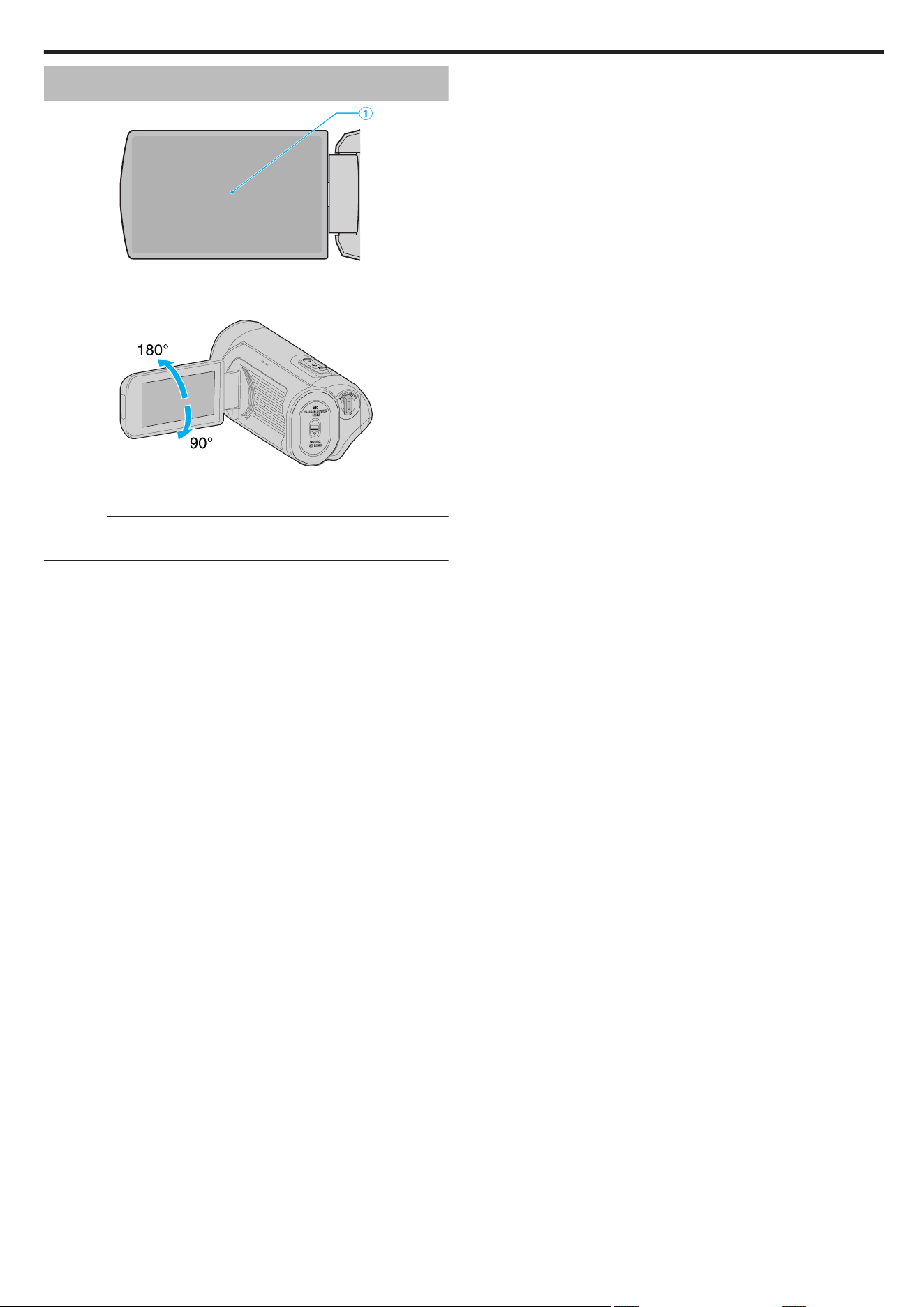
LCD Monitor
.
A LCD Monitor
0
Turns the power on/off by opening and closing.
0
Enables self-portraits to be taken by rotating the monitor.
.
“Using the Touch Screen” (A p. 9)
“Names of Buttons and Functions on the LCD Monitor” (A p. 11)
Caution :
0
Do not press against the surface with force or subject it to strong impact.
Doing so may damage or break the screen.
Names of Parts
127
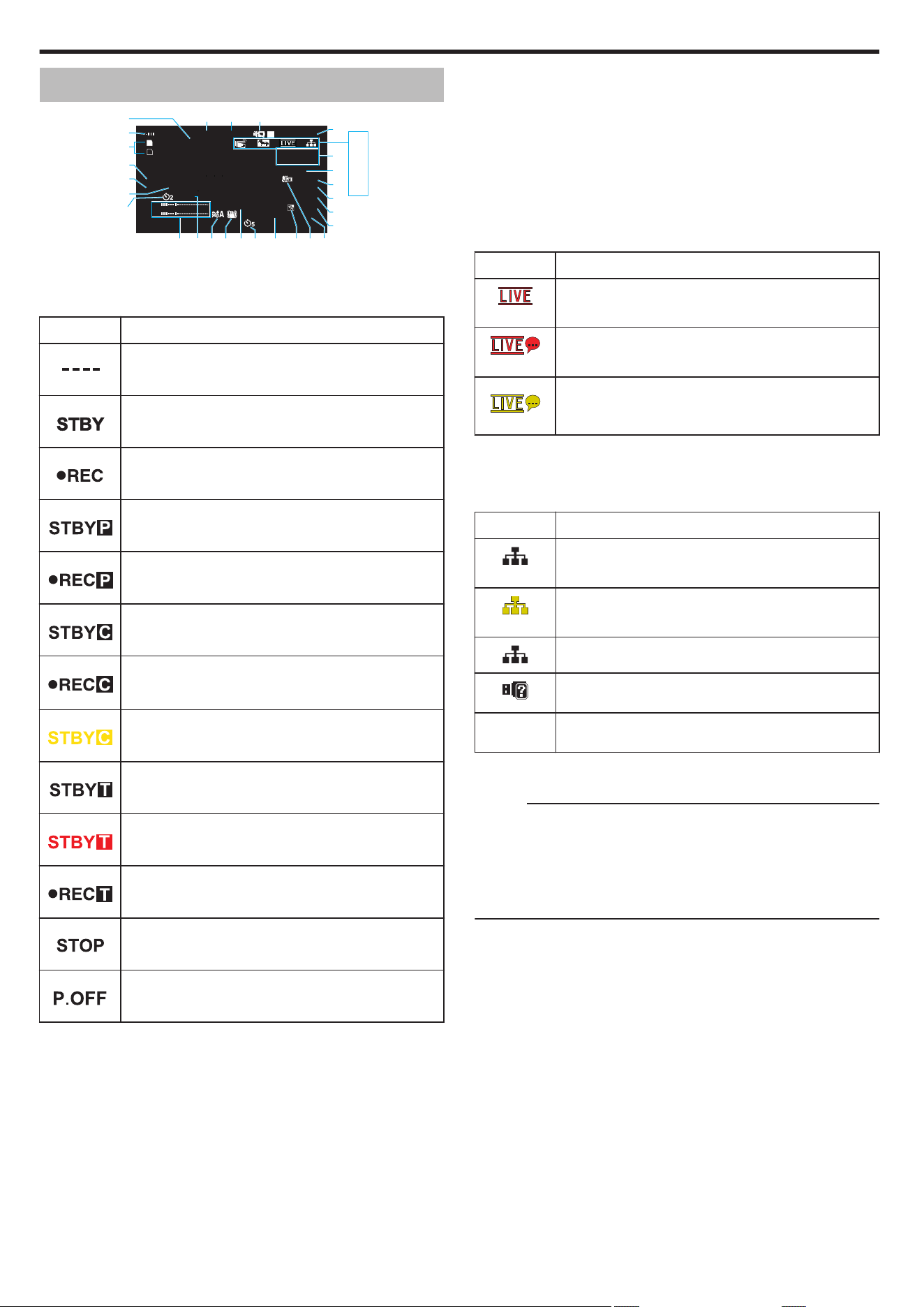
Recording
.
54min
- - - min
A
B
60i 18M
[4000]
STBYDUAL
00 : 00 : 00 . 00
2018 - 01 - 01
02 : 23 : 01
TC
-∞
4030
L
R
20 10 0
.. . . . .
.. . . . .
1920x1080
F1.8
1/60
6dB
AE+3
MF 5.0m
FOCUS
100%
×UPnP
A< 5600K>
High-Speed
r
q
p
o
s
t
u
kji h gfln m
2
31
9
d
c
b
a
0
4
5
6
7
8
e
A Simultaneous Recording (Dual Rec) Indicator
This item is not displayed when “Slot Mode” is set to “Series”.
B SD Card Status
Display Description
.
No card found in the selected slot
.
Recording standby
.
Recording
.
Pre Rec standby
.
Pre Rec in progress
.
Continuous Scene Rec standby
.
Continuous Scene Rec in progress
.
(Yellow text) Continuous Scene Rec paused
.
Time-lapse recording standby
.
(Yellow text) Time-lapse recording paused
.
Time-lapse recording in progress
.
Continues recording until the space on the SD card runs
out
.
Power OFF
C Silent Mode
“ Silent Mode ” (A p. 114
)
D Time Code (TC)
“Changing the Mode of Time Code (TC) Recording” (A p. 47)
E LCD Closed Recording
Displayed when “LCD Closed Recording” is “On”.
Displayed in white during recording or when Wi-Fi is connected, and in
gray in all other cases.
“ LCD Closed Recording ” (A p. 115
)
F Zebra
“ Zebra ” (A p. 109)
G Live Streaming
The distribution status is displayed when “System”F“Network”/
“Settings”F“Live Streaming Set”F“Live Streaming” is “On”.
“Live Streaming” (A p. 95)
Icon Status
.
(Red)
Distribution in progress (good connection quality)
.
(Red)
Distribution in progress (poor connection quality)
.
(Yellow)
Connection pending or connection failed
H Network Connection
The network connection status is displayed when “System”F“Network”
is “On”. This icon is not displayed when “Off” is selected.
“ Network ” (A p. 117
)
Icon Status
.
(Blink)
Connection is not established (starting up, preparing for
connection)
.
(Yellow)
Connection is not established (preparing for connection)
.
Connection is established
.
When a USB adapter different from the connection
settings is detected
(No display) When an incompatible USB adapter is detected, or when
“Network” is “Off”
I Date/Time Display
Displays the current date and time.
Memo :
0
The date/time display style can be configured in “Monitor”F“Display
Settings”F“Date Style”/“Time Style” of the menu.
“ Date Style ” (A p. 111)
“ Time Style ” (A p. 111
)
0
The item is not displayed when “Monitor”F“Display Settings”F“Date/
Time” of the menu is “Off”.
“ Date/Time ” (A p. 111)
J Focus Assist
“FOCUS” is displayed when auto focus is activated.
K Focus
No icon is displayed in the Auto Focus mode, but the Auto Focus icon
(AF) and (q) are displayed when “FaceDet” is activated, and the Auto
Focus icon (AF) and (g) are displayed when “AreaSel” is activated.
“Adjusting Focus Manually (FOCUS)” (A p. 23)
Indications on the LCD monitor
128
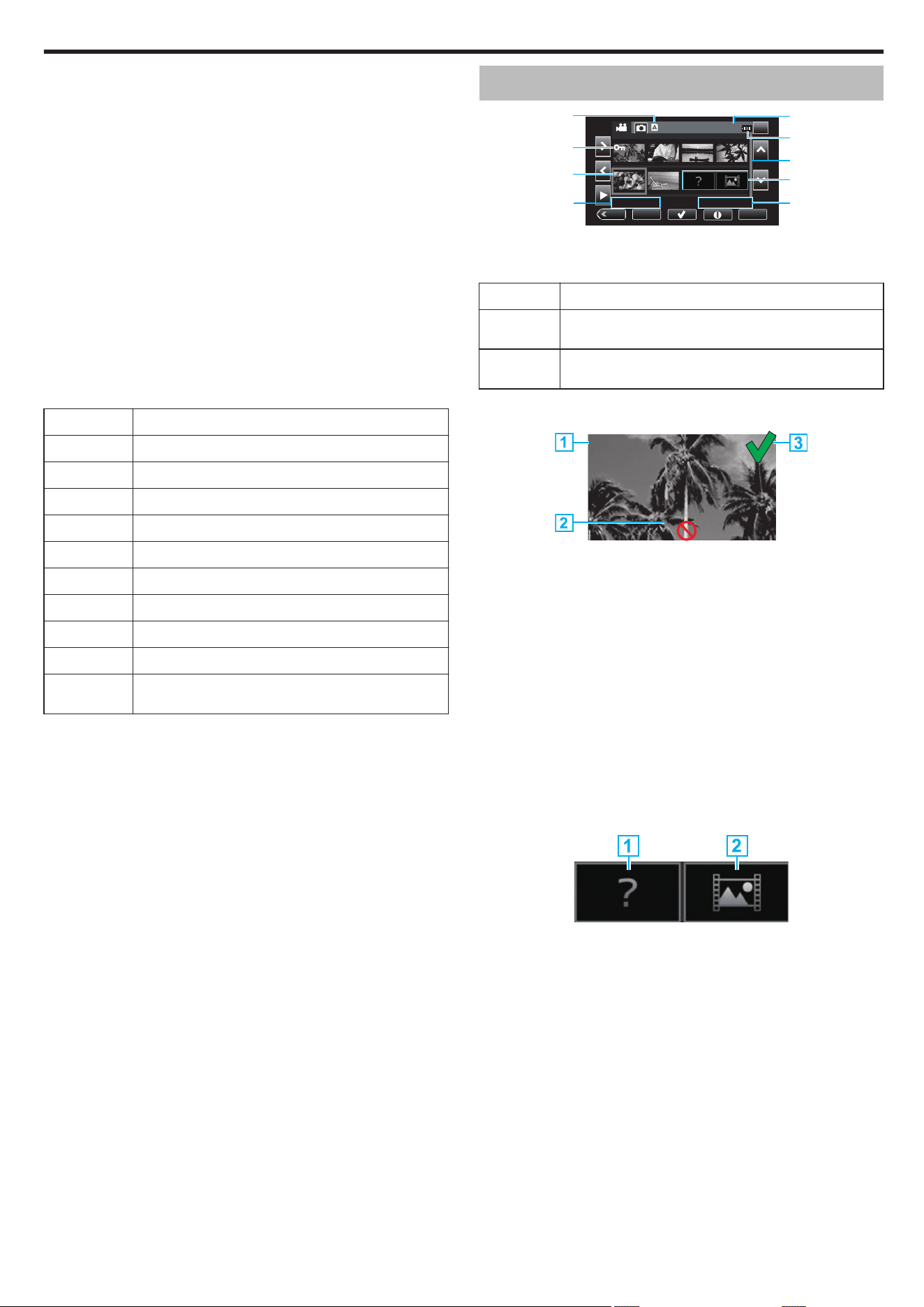
L Brightness
No
icon is displayed in the Auto mode, but q is displayed when “AF+AE”
is set to “FaceDet”, and g is displayed when it is set to “AreaSel”.
“Adjusting Brightness” (A p. 26)
M Sensitivity
Displays the gain value when “Gain Up” is set to the manual mode.
“LOLUX” is displayed when “Lolux” is “On”.
“Increasing the Light Sensitivity Level” (A p. 29)
N Aperture
“Setting Aperture” (A p. 28)
O Shutter Speed
“Setting Shutter Speed” (A p. 27)
P Backlight Comp
“Setting Backlight Compensation” (A p. 30)
Q Tele Macro
“Taking Close-up Shots (TELE MACRO)” (A p. 40)
R White Balance
Displays the current white balance mode.
(****K: Color temperature)
Display Description
None When “White Balance” is set to “Auto”
<FINE> When “White Balance” is set to “Fine”
<CLOUD> When “White Balance” is set to “Cloud”
<HALOGEN> When “White Balance” is set to “Halogen”
<MARINE 1> When “White Balance” is set to “Marine1”
<MARINE 2> When “White Balance” is set to “Marine2”
P<****K> When “White Balance” is set to “Preset”
A<****K> When “White Balance” is set to “MWB A”
B<****K> When “White Balance” is set to “MWB B”
o blinking
When the white balance settings for “MWB A” and “MWB
B” are activated
“Setting White Balance” (A p. 31)
S Video Self Timer
“Using Video Self Timer” (A p. 45)
T xUPnP
Displayed when UPnP cannot be used.
“Internet Connection” (A p. 81)
U DIS
“Reducing Camera Shake” (A p. 39)
V Wind Cut
“ Wind Cut ” (A p. 113
)
W Recordable Number of Still Shots
X Audio Level Meter
Y Still Self Timer
“Using Still Self Timer” (A p. 46)
Z Bit Rate
a Frame Rate
b Resolution
c Remaining Space on Recordable Media
“Checking the Remaining Battery Level and Recording Time” (A p. 48)
d Battery Indicator
“Checking the Remaining Battery Level and Recording Time” (A p. 48)
e High-Speed
“Slow-motion (High-speed) Recording” (A p. 34)
Thumbnail Screen
.
MENU
ACTION
REC
SLOT
000G0000 2018-01-01
1/8
8
9
6
7
5
1
2
3
4
A SD Card Information
Displays an icon that indicates the currently selected card slot and the
status of the inserted SD card.
Display Description
W z
Write-protect switch of the SD card in slot A is set to
“LOCK”.
S
Recovery or formatting is required for the SD card in slot
B, or the SD card is incompatible.
B Scene (File) Mark
Displays information on the scene (file).
.
I
C
A
Protect Mark
0
Scenes (files) that are appended with the Protect mark cannot be
deleted with this unit.
B
Uneditable Mark
0
Indicates scenes (files) for which Protect mark cannot be added or
deleted or scenes (files) that cannot be deleted.
C
Check Mark
0
A green check mark is displayed when a scene (file) is selected.
0
A red check mark is displayed when the selection is confirmed.
C Cursor
Scene
(file) that is the currently active item. Move through the items using
320 1.
D Scene (File) Number
Displays the scene (file) number of the selected scene (file).
E Recording Date
Displays the recording date of the scene (file).
F Thumbnail Substitution Display
.
A
Scene (file) with corrupted management information. These scenes
(files) cannot be played back.
B
Scene
(file) that cannot be played back nor displayed in thumbnail with
the current recording format settings.
G
Scroll Bar
0
Indicates the scroll position.
0
Black space below the scroll bar (white) indicates that there are more
pages.
0
When the scroll bar (white) is at the bottom, this indicates the last page.
H Remaining Battery Power
0
Displays the power status.
I Number of Scenes (Files)
0
Displays the scenes (files) for playback in the [serial number/total
number of scenes (files)] format.
Indications on the LCD monitor
129
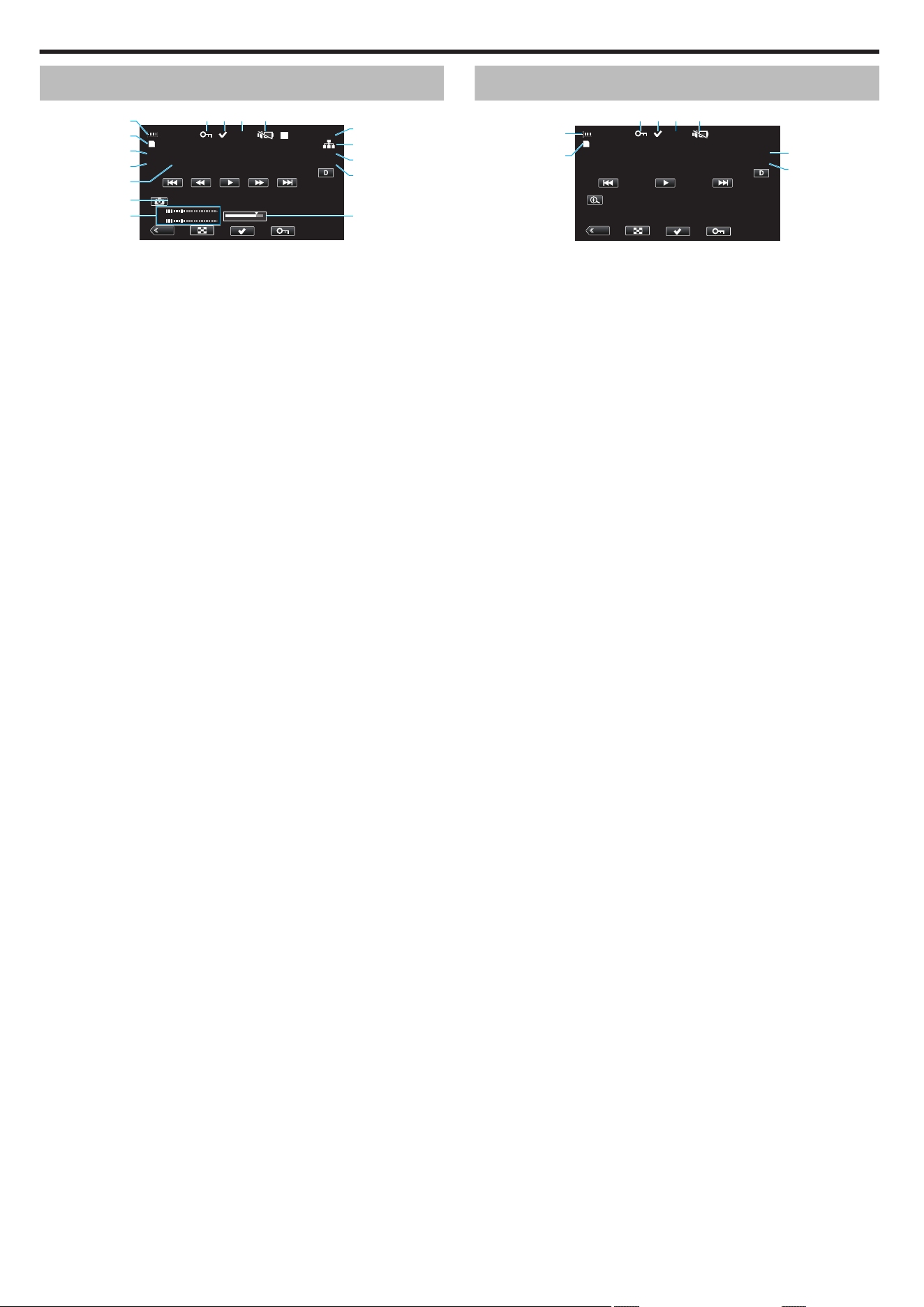
Video Playback
.
1/10
A
100%
60i 18M
1920x1080
00 : 00 : 00 . 00
2018 - 01 - 01
02 : 23 : 01
TC
-∞
4030
L
R
20 10 0
.. . . . .
.. . . . .
PLAY
[4000]
REC
6
d
c
b
7
8
5
9
e
f
0
a
3 412
A Protect Mark
“Protecting Video Images” (A p. 63)
B Check Mark
Displayed when the scene that is currently playing is selected.
This
function is used for protecting a scene (file), canceling the protection
of a scene (file) or deleting a scene (file) after playback.
“Selecting and Deleting Multiple Scenes” (A p. 60)
“Protecting/Releasing Protection of Selected Files” (A p. 63)
C SD Card Status
PLAY: Now playing
STILL: Playback is paused
FWD*: High-speed playback in the forward direction (*playback speeds:
5x, 15x, 60x, 360x)
REV*: High-speed playback in the reverse direction (*reverse playback
speeds: 5x, 15x, 60x, 360x)
D Silent Mode
“ Silent Mode ” (A p. 114)
E Time Code (TC) Recorded in the Playback File
F Network Connection Icon
“Network Connection” (A p. 128)
G Recording Date
H Recording Time
I Playback Position
J Audio Level Meter
K Recordable Number of Still Shots
L Bit Rate
M Frame Rate
N Resolution
O File Number of Current Playback File/Total Number of Files
P Battery Indicator
“Checking the Remaining Battery Level and Recording Time” (A p. 48)
Still Image Playback
.
REC
100-0012
A
100%
2018 - 01 - 01
02 : 23 : 01
PLAY
5
6
8
7
3 412
A Protect Mark
“Protecting Video Images” (A p. 63)
B Check Mark
Displayed when the file that is currently playing is selected.
This
function is used for protecting a scene (file), canceling the protection
of a scene (file) or deleting a scene (file) after playback.
“Selecting and Deleting Multiple Scenes” (A p. 60)
“Protecting/Releasing Protection of Selected Files” (A p. 63)
C PLAY: Slideshow playing now
D Silent Mode
“ Silent Mode ” (A p. 114)
E Recording Date
F Recording Time
G Folder Number-File Number
H Battery Indicator
“Checking the Remaining Battery Level and Recording Time” (A p. 48)
Indications on the LCD monitor
130
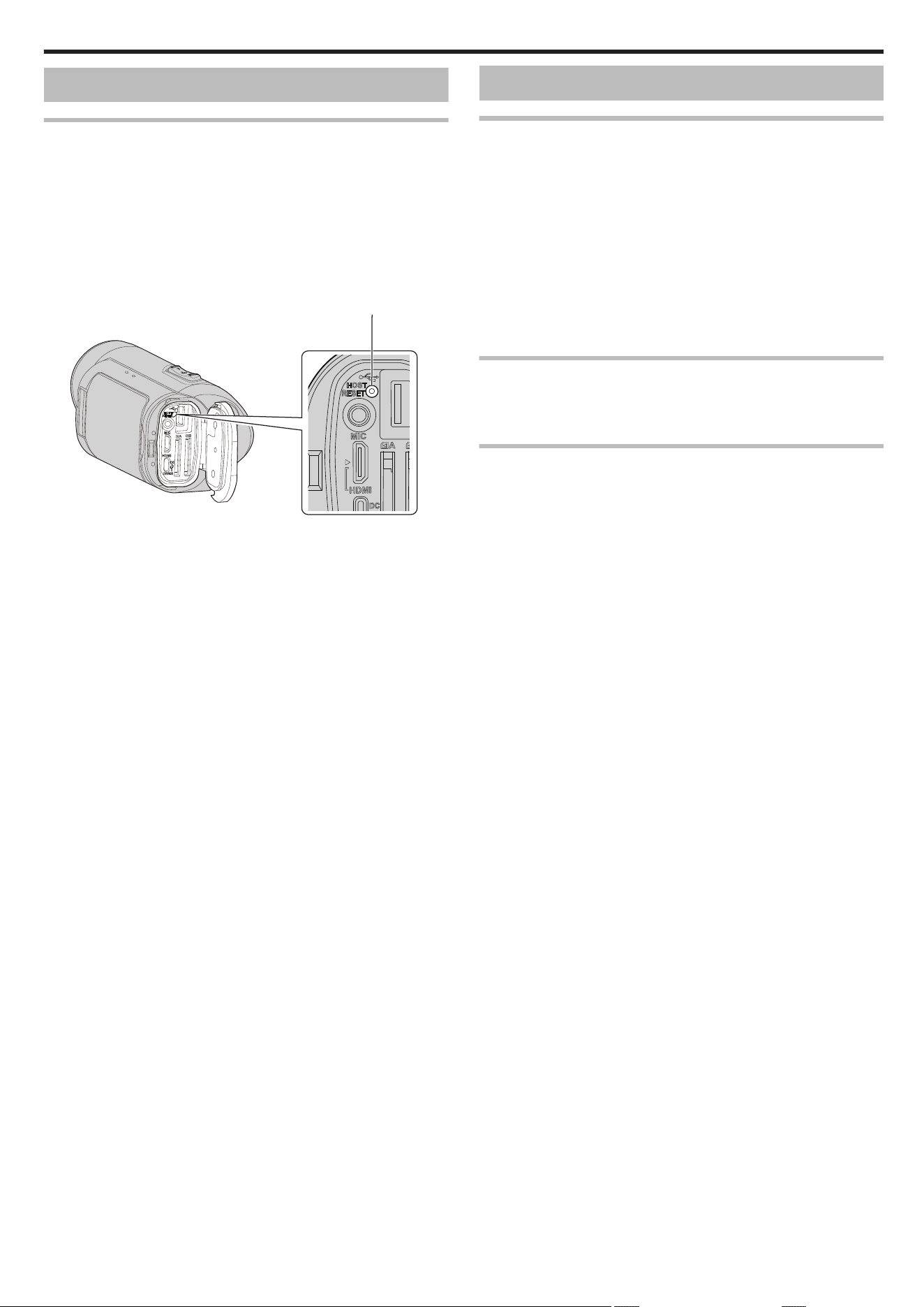
When the unit is not working properly
Resetting this Unit
This unit is a microcomputer-controlled device. Electrostatic discharge,
external
noise and interference (from a TV, a radio, etc.) might prevent it from
functioning properly. In that case, perform the steps below to reset this unit.
(The recorded data will not be erased.)
1
Open the terminal cover.
0
Remove the power cord and all connecting cables.
2
Close the LCD monitor to turn off this unit.
3
Press the Reset button gently using an object with pointed tip.
.
Reset Button
Charging
Unable to charge the battery.
0
When the battery pack is fully charged, the lamp does not light up.
Be sure to charge using the supplied AC adapter. Using an AC adapter
that
is not supplied with this camera may cause malfunction or damage of
the unit. Malfunction or damage of the camera arising from the use of an
AC adapter other than the one supplied is not covered in the warranty.
Check the connection, followed by disconnecting and reconnecting the
power bank cable.
Charging cannot be performed under low or high temperature
environments. Charge under the room temperature range of 10°C to 35°C
(50°F to 95°F). (Under environments beyond the temperature range,
charging may stop to protect the battery pack.)
0
Charging is not possible when the camera is turned on with “System” set
to “4K” or “High-Speed”.
The remaining battery display is not correct.
0
If this unit is used for long periods of time in high or low temperatures, or
if the battery pack is repeatedly charged, the amount of remaining battery
may not be displayed correctly.
The battery runs out quickly even after charging.
0
Be sure to charge using the supplied AC adapter. Malfunction in the unit
that
occurred due to the use of an AC adapter other than the one provided
is not included in the warranty.
The performance of the battery will drop temporarily when the temperature
is -10°C to 0°C (14°F to 32°F), this will cause the remaining recording time
to shorten.
When the recording time becomes extremely short even when the battery
is fully charged, the battery needs to be replaced. Malfunction of the built-
in battery due to the conditions of storage or use and deterioration in its
performance over time are not covered by the warranty even during the
warranty period. Users will need to pay for servicing and repair in these
cases.
For more information, please consult your nearest service center.
Troubleshooting
131

Power supply
Unable to turn on the power.
0
Check whether the AC adapter is properly connected.
See
“Charging” (A p. 6) .
0
When the unit does not turn on even after charging, reset the unit.
“When the unit is not working properly” (A p. 131)
Recording
Recording cannot be performed.
0
Check whether the inserted SD card supports the current recording
format.
0
Check whether the Write Protect switch of the SD card is set to “LOCK”.
0
Set to the recording mode by tapping the E
button on the screen.
Recording stops automatically.
0
Recording stops automatically as it cannot be performed for 12 or more
consecutive hours according to specifications. (It may take some time to
resume recording.)
0
Turn off this unit, wait for a while, and turn it on again. (This unit stops
automatically to protect the circuit when the temperature rises.)
The focus is not adjusted automatically.
0
If you are recording in a dark place or a subject that has no contrast
between dark and light, adjust the focus manually.
“Adjusting Focus Manually (FOCUS)” (A p. 23)
0
Wipe the lens with a lens cleaning cloth.
0
Cancel manual focus on the manual recording menu.
“Adjusting Focus Manually (FOCUS)” (A p. 23
)
The inside of the lens is foggy.
0
Open
the terminal cover; close the LCD monitor and leave as is for a while
to reduce the temperature.
Preventing fogging inside the lens
0
Models with waterproof function are airtight. When the temperature rises
during recording, condensation can occur inside the lens due to the
internal humidity.
o
During recording
0
To prevent the temperature of this unit from rising, we recommend that
you use the unit in the following ways.
A
Avoid frequent exposure to direct sunlight.
Record under the shade or use an umbrella. Best if you could keep a
wet towel cover the unit.
B
The use of a tripod is recommended.
Long
hours of recording while holding the unit in your hands will cause
the temperature of the unit to rise.
C
It is better to leave the terminal cover open while recording.
However, the waterproof, dust-proof and shockproof features do not
function in this condition. Do take note of the environment when using
the camera. (Do not use a wet towel.)
D
Make sure to turn off the power when you are not recording.
When the LCD monitor is closed, the unit turns off.
0
When “Quick Restart” is “On”, power continues to be consumed for
about 5 minutes after closing the LCD monitor screen.
o
During charging
0
It is recommended to charge the unit in a low humidity environment.
0
The moist air inside the unit can cause condensation.
0
We recommend that you charge the unit in a room where humidifier is not
in use, and in an air-conditioned room during summer.
The record settings have changed.
0
When “Demo Mode” is set to “On”, the record settings may reset. Set
“Demo Mode” to “Off” for normal use.
“ Demo Mode ” (A p. 115)
Troubleshooting
132
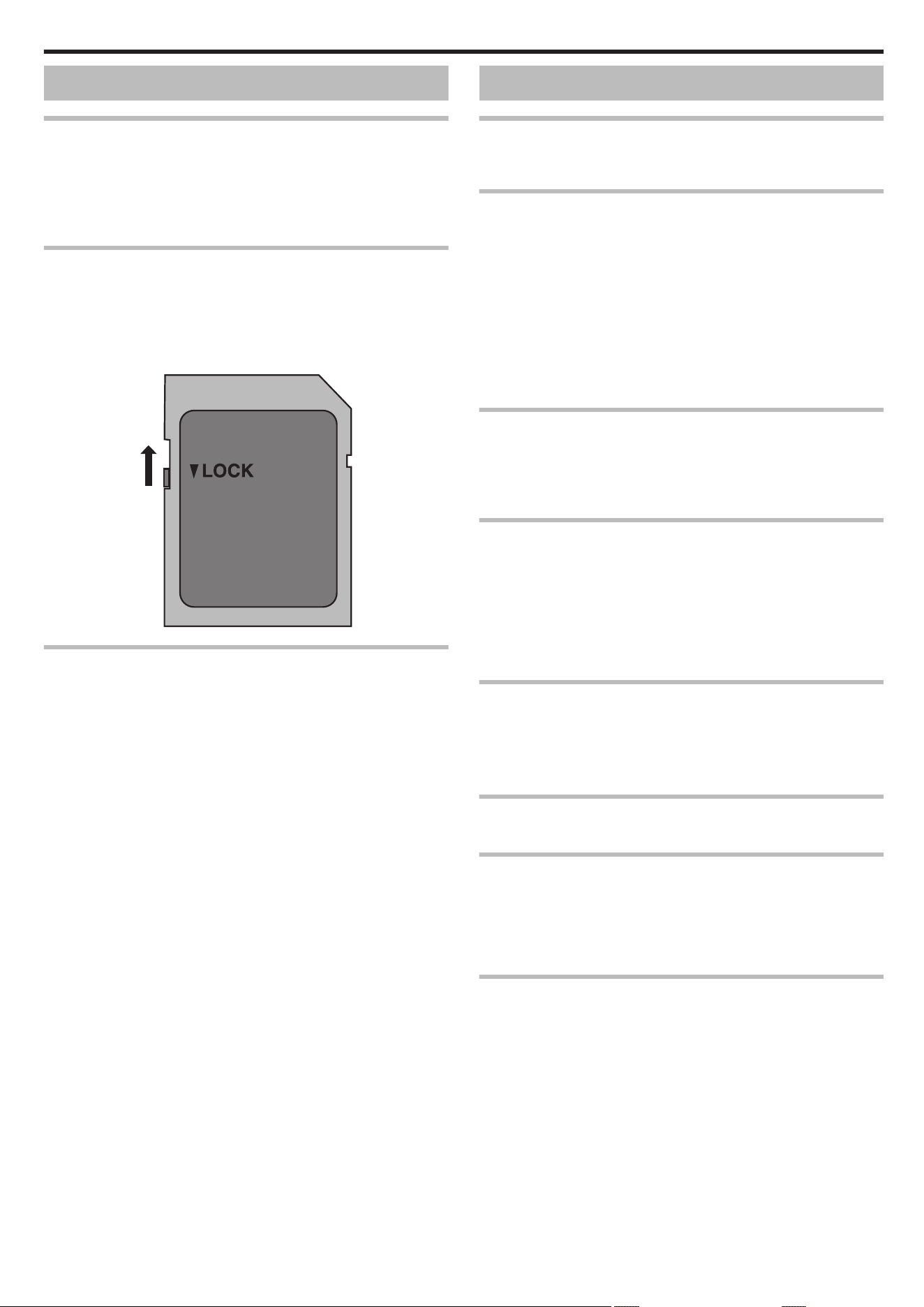
SD Card
Cannot insert the SD card.
0
Make sure not to insert the SD card in the wrong direction.
“Inserting an SD Card” (A p. 8)
0
Do
not use a miniSD card or microSD card on this unit (even if the card is
inserted in an adapter). It may cause malfunction.
“Types of Usable SD Card” (A p. 8)
Unable to copy to SD card.
0
To use a new SD card or SD card that was used on other devices, it is
necessary
to format (initialize) the SD card using “Format SD Card” in the
“System” menu.
“ Format SD Card ” (A p. 114)
0
When “Check Card's Write Protection Switch” appears, release the lock
on the SD card.
.
SD card cannot be removed.
0
The inability to remove the SD card may be due to adhesion of dust, etc.
Use a pair of tweezers to pull out the SD card, remove the dust and then
re-insert the card.
Playback
Sound or video is interrupted.
0
Sometimes
playback is interrupted at the connecting section between two
scenes. This is not a malfunction.
There is no sound.
0
When the Silent mode is used, operation sounds will not be output. Turn
off the Silent mode.
“ Silent Mode ” (A p. 114
)
0
Operation sound is not output when “Operation Sound” is set to “Off”.
Select “Low” or “High”.
“ Operation Sound ” (A p. 113)
0
Audio sound is not recorded for videos taken in High-Speed.
“Slow-motion (High-speed) Recording” (A p. 34)
0
Audio sound is not recorded for videos taken in Time-Lapse Rec.
“Time-lapse Recording (Time-Lapse Rec)” (A p. 41)
The same image is displayed for a long time.
0
Clean the terminals of the SD card with a dry cotton swab or something
similar.
0
Execute
“Format SD Card” in the “System” menu. (All data will be deleted.)
“ Format SD Card ” (A p. 114)
The motion is choppy.
0
Clean the terminals of the SD card with a dry cotton swab or something
similar.
0
Execute
“Format SD Card” in the “System” menu. (All data will be deleted.)
“ Format SD Card ” (A p. 114)
0
Verify the system requirements of your PC when using CyberLink
PowerDirector to play back.
“Verifying System Requirements (Guideline)” (A p. 74)
Images do not appear on the TV properly.
0
Disconnect the cable and connect again.
“Connecting via the HDMI Mini Connector” (A p. 57)
0
Reset this unit.
“Resetting this Unit” (A p. 131)
Images are projected vertically on the TV.
0
Adjust the TV's screen accordingly.
When connected to the TV via the HDMI mini cable, proper
images and sounds are not output.
0
Images and sounds may not be output properly depending on the TV
connected. In such cases, perform the following operations.
A
Disconnect the HDMI mini cable and connect it again.
“Connecting via the HDMI Mini Connector” (A p. 57)
When connected to the TV via the HDMI mini cable, displays
such as buttons on the screen are slow to appear.
0
Depending on the type of TV connected, this symptom is normal and not
a malfunction.
Troubleshooting
133

Editing/Copying
Unable to delete file.
0
Files (videos/still images) that are protected cannot be deleted. Release
protection before deleting the file.
“Protecting Video Images” (A p. 63)
Computer
Unable to copy files to DVD or Blu-ray disc with a PC.
0
To record to discs, a recordable DVD or Blu-ray drive is required for the
computer in use.
The computer cannot recognize the SDXC card.
0
Confirm and update the OS of your computer.
“When your computer cannot recognize the SDXC card” (A p. 9)
Troubleshooting
134

Screen/Image
Color and brightness of the screen changes and horizontal
stripes and flickers appear on screen
0
For images recorded under lighting from fluorescent or mercury lamps,
the
color and brightness of the screen may change and horizontal stripes
and flickers may appear on the screen, but this is not a malfunction.
0
If the image stabilizer has been set to “On(AIS)”, switch to “On” to improve
the condition.
“Reducing Camera Shake” (A p. 39)
A band or a ball of bright light appears on the LCD monitor.
0
Change the direction of this unit to prevent the light source from coming
into
view. (A band or a ball of bright light may appear when there is a bright
light source near this unit, but this is not a malfunction.)
The recorded subject is too dark.
0
Use backlight compensation when the background is bright and the
subject is dark.
“Setting Backlight Compensation” (A p. 30)
0
Use “Gain Up” in the menu.
“ Gain Up ” (A p. 101
)
0
Set “Brightness Adjust” in the Camera Process menu to the “+” side.
“Adjusting Brightness” (A p. 26)
The recorded subject is too bright.
0
Set the backlight compensation to “Off” if it is being used.
“Setting Backlight Compensation” (A p.
30)
0
Set “Brightness Adjust” in the Camera Process menu to the “-” side.
“Adjusting Brightness” (A p. 26)
0
The use of a commercially available ND filter is recommended for
recording under extremely bright conditions. (Filter diameter: 46 mm)
The color looks strange. (Too bluish, too reddish, etc.)
0
Wait for a while until natural colors are achieved. (It may take some time
for white balance to be adjusted.)
0
Configure “White Balance” in the Camera Process menu. Select from
“Fine”/“Cloud”/“Halogen” according to the light source. Select “Preset”
and configure the color temperature to an appropriate setting. Select
“MWB A” or “MWB B” and adjust accordingly.
“Setting White Balance” (A p. 31)
The color looks different.
0
Configure “White Balance” in the Camera Process menu.
“Setting White Balance” (A p. 31
)
There are bright or dark spots on the screen.
0
While the LCD monitor screen has more than 99.99% effective pixels,
0.01% of the pixels may be bright spots (red, blue, green) or dark spots.
This is not a malfunction. The spots will not be recorded.
Other Problems
The buttons on the touch screen do not work.
0
Tap the buttons on the touch screen with your fingers.
The buttons may not respond if you touch them with your fingernails or
with gloves on.
0
Disable
“Screen Lock”. You cannot operate the touch panel when “Screen
Lock” is enabled.
“Locking the Screen” (A p. 37)
The image is grainy.
0
When digital zoom is used, the image becomes grainy as it is digitally
enlarged.
This unit heats up.
0
This is not a malfunction. (This unit may become warm when used for a
long time.) Stop using the unit if it gets too warm.
The language on the display changed.
0
It may occur when you connect this unit to a TV with different language
setting using an HDMI mini cable.
“Operating in Conjunction with TV via HDMI” (A p. 58
)
When connected to the TV via the HDMI mini cable, proper
images and sounds are not output.
0
Images and sounds may not be output properly depending on the TV
connected. In such cases, perform the following operations.
A
Disconnect the HDMI mini cable and connect it again.
B
Turn off and on this unit again.
“Connecting via the HDMI Mini Connector” (A p. 57
)
HDMI-CEC functions do not work properly, and the TV does
not work in conjunction with this unit.
0
TVs
may operate differently depending on the specifications, even if they
are HDMI-CEC compliant. Therefore, the HDMI-CEC functions of this unit
cannot be guaranteed to operate in combination with all the TVs. In such
cases, set “HDMI Control” to “Off”.
“ HDMI Control ” (A p. 112)
The media remaining indication blinks without displaying the
time.
0
The indication blinks while the SD card is being recognized.
The camera takes some time to recognize the SD card when there are
many recorded files on the SD card. In this case, back up the recorded
files on a PC and format the SD card, or insert a new SD card.
“ Format SD Card ” (A p. 114
)
This unit does not function properly and error messages
appear.
0
This unit is a microcomputer-controlled device. Electrostatic discharge,
external noise and interference (from a TV, a radio, etc.) might prevent it
from
functioning properly. In such a case, close the monitor screen to turn
off the power and remove the AC adapter, then press the Reset button to
reset this unit.
“Resetting this Unit” (A p. 131)
Troubleshooting
135

CHARGE lamp and POWER/ACCESS lamp are blinking and
operation is disabled
0
Close
the monitor screen to turn off the power and remove the AC adapter,
then press the Reset button to reset this unit.
“Resetting this Unit” (A p. 131)
0
If these operations won’t solve the problem, contact your JVC dealer or
the JVC service center.
Disclaimer
0
We shall not be liable for any loss of recorded contents when videos or
audio cannot be recorded or played back properly due to malfunction of
this unit and accessories that come with it or the SD card.
0
Recorded contents (data) that are lost, including loss due to malfunction
of this unit, cannot be restored. Please be forewarned.
0
JVC will not be responsible for any lost data. Please be forewarned.
0
Defective recordable media that have been replaced may be used in our
analysis
for the purpose of quality improvement. Therefore, it may not be
returned.
Error Message
No Media/No Media
0
Insert an SD card into one of the card slots or both slots.
Formatting Required
0
Remove
the SD card, back up the data on a PC, and insert the card again.
Tap “Yes” when the formatting confirmation screen appears.
Check the Speed Class or Type of the Card
0
Check that the card is supported by this unit.
“Types of Usable SD Card” (A p. 8)
Recording Failure
0
Reset this unit.
“Resetting this Unit” (A p. 131)
Turn on the function in the menu to split the file into units of
4 GB.
0
Recording is not possible with SD cards other than those of the SDXC
format when “4 GB Spanning” is “Off”.
To
perform recording with “4 GB Spanning” set to “On”, use an SDXC card.
This Card Cannot Be Used for Recording or Editing on This
Camera
0
The
Frame Rate set on this unit is different from the Frame Rate recorded
in the SD card. Please change the Frame Rate.
0
After backing up the data, run “Format SD Card” from the “System” menu.
Check Card's Write Protection Switch
0
Set the write protect switch of the SD card to off.
Media Full!
0
Delete files, or move files to a computer or other devices.
0
Replace the SD card with a new one.
Scene Quantity Limit Exceeded
0
Move
the files or folders to a computer or other device. (Back up your files.)
File Quantity Limit Exceeded
0
Move
the files or folders to a computer or other device. (Back up your files.)
Camera Temperature Is Too High, Power Will Turn Off to
Protect the Camera
0
Turn on the power after the camera has cooled down.
Troubleshooting
136

Perform regular maintenance of this unit to enable it to be used for a long
time.
Caution :
0
Be sure to detach the AC adapter and power plug before performing any
maintenance.
Camcorder
0
Wipe this unit with a dry, soft cloth to remove any dirt.
0
When
it is extremely dirty, soak the cloth in a solution of neutral detergent,
wipe the body with it, and then use a clean cloth to remove the detergent.
Caution :
0
Do not use solvents such as benzene, thinner, or alcohol. Doing so may
cause damage to the unit.
0
When using a chemical cloth or cleaner, be sure to observe the warning
labels and instructions of the product.
0
Do
not leave the device in contact with rubber or plastic products for a long
time.
Lens/LCD Monitor
0
Use a lens blower (commercially available) to remove any dust, and a
cleaning cloth (commercially available) to wipe off any dirt.
Mold may form if the lens is left dirty.
0
You can use a commercially available anti-reflection or protective film on
the screen.
However,
depending on the thickness of the film, operations on the touch
screen may not be performed smoothly or the screen may darken slightly.
After using underwater or on the beach
0
For
care and cleaning where there is mud or dirt on the camera after using
underwater or on the beach, read “Before Using Underwater or under Low
Temperature” (A p. 18) .
Maintenance
137
Camera
Item Details
Power supply Using AC adapter: DC 5 V
Power consumption 4.3 W (when “System” is set to “4K”, “Frame Rate”
is set to “30p” and “LCD Backlight” is set to “0”)
Rated Current Consumption: 3A
Dimensions (mm) 79 x 76 x 162 (3-1/8" x 3" x 6-7/16")
(W x H x D: excluding grip belt)
Mass Approx. 620 g (1.37 lbs) (camera only)
Operating
environment
Allowable operating temperature: -10 °C to 40 °C
(14 °F to 104 °F)
Allowable
storage temperature: -20 °C to 50 °C (-4
°F to 122 °F)
Allowable charging temperature: 10 °C to 35 °C (50
°F to 95 °F)
Allowable relative humidity: 35 % to 80 %
Image pickup
device
1/2.3” 18,910,000 pixels (CMOS, back-
illuminated)
Recording area 6,650,000 to 7,950,000 pixels (image stabilizer:
off)
Lens F1.8 to F2.8
f= 3.76 mm to 37.6 mm
35 mm conversion:
29.9 mm to 299 mm (image stabilizer: off)
Filter diameter * 46 mm (screw pitch: 0.75 mm)
Lowest illumination 3 lux
Zoom Optical zoom: Up to 10x
Dynamic zoom: Up to 18x
Digital zoom: Up to 200x
LCD monitor 3.0" Wide, 460,000 pixels, color LCD
Recording media SDHC/SDXC card (commercially available)
“Types of Usable SD Card” (A p. 8)
Built-in battery Type: Lithium-ion battery
Rating: DC3.6 V 6400 mAh
* When a lens filter or conversion lens is attached, vignetting (the screen
getting dark, or appearance of shadows) may occur.
Connectors
Item Details
HDMI output
connector
HDMI mini connector
USB host terminal USB Type-A, USB 2.0-compliant
DC/USB device
terminal
USB Type-C, USB 2.0-compliant
Microphone
connector
Φ3.5 mm mini jack (stereo)
Video
Item Details
Recording/
Playback format
4K:
QuickTime file format
Video: MPEG-4 AVC/H.264
Audio: LPCM 2ch
No. of recording pixels: 3840 x 2160
HD:
AVCHD file format
Video: MPEG-4 AVC/H.264
Audio: Dolby Digital 2ch
No. of recording pixels: 1920 x 1080
High-Speed:
QuickTime file format
Video: MPEG-4 AVC/H.264
Audio: nil
No. of recording pixels: 1920 x 1080
Extension 4K/High-Speed : .MOV
HD: .MTS
Bit rate 4K: up to approx. 70 Mbps
HD:
up to approx. 28 Mbps, up to approx. 24 Mbps,
up to approx. 18 Mbps
High-Speed: up to approx. 16 Mbps
Sound quality
(Audio)
4K: 48kHz/16bit
HD: 48kHz/16bit, 256kbps
Still Image
Item Details
Recording format JPEG standard
Extension .JPG
Image Size
(Recording pixel
count)
(16:9 aspect ratio)
4K: 3840 pixels x 2160 pixels (8.3 M)
HD: 1920 pixels x 1080 pixels (2 M)
“Approximate Number of Still Images (Unit:
Number of Shots)” (A p. 50
)
Specifications
138

AC Adapter (UNI318-0530)
Item Details
Power supply AC 100 V to 240 V, 60 Hz/50 Hz
Output DC 5 V, 3 A
Allowable operating
temperature
0°C to 40°C (32°F to 104°F)
(10°C to 35°C (50°F to 95°F) during charging)
Dimensions (mm) 75 x 29.8 x 50.6 (3" x 1-3/16" x 2")
(W x H x D: excluding grip belt)
Mass Approx. 125 g (0.28 lbs)
Memo :
0
The
specifications and appearance of this product are subject to changes
for further improvement without prior notice.
Specifications
139

Trademarks
0
AVCHD Progressive and AVCHD Progressive logo are trademarks of
Panasonic Corporation and Sony Corporation.
0
The
terms HDMI and HDMI High-Definition Multimedia Interface, and the
HDMI Logo are trademarks or registered trademarks of HDMI Licensing
Administrator, Inc. in the United States and other countries.
0
Manufactured under license from Dolby Laboratories. Dolby, Dolby Audio
and the double-D symbol are trademarks of Dolby Laboratories.
0
SDXC logo is a trademark of SD-3C LLC.
0
Microsoft and Windows are either registered trademarks or trademarks of
Microsoft Corporation in the United States and/or other countries.
0
Mac, OS X, QuickTime, iMovie, iPhoto, iPhone and Safari are trademarks
of Apple Inc., registered in the U.S. and other countries.
0
Intel and Intel Core are trademarks or registered trademarks of Intel
Corporation in the United States.
0
Android, YouTube and Chrome are trademarks or registered trademarks
of Google Inc.
0
The company name of Fontworks, Fontworks, and the name of the fonts
are registered trademarks of Fontworks Inc.
0
QR Code is a registered trademark of Denso Wave Incorporated.
0
Other product and company names included in this instruction manual are
trademarks and/or registered trademarks of their respective holders.
0
Marks such as ™ and ® have been omitted in this manual.
Trademarks
140

0318TKH-SW-MTC8C
© 2018 JVC KENWOOD Corporation