Split-type Air-Conditioner
MXZ-2D52VA
English
Installation Manual
For INSTALLER
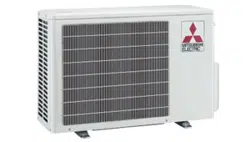
• This manual only describes the installation of outdoor unit.
When installing the indoor unit, refer to the installation manual of indoor unit.
JG79A641H01_en.indd 1 2013/09/06 15:47:04
En-1
1. BEFORE INSTALLATION
1-1. THE FOLLOWING SHOULD ALWAYS BE OBSERVED FOR SAFETY
• Be sure to read “THE FOLLOWING SHOULD ALWAYS BE OBSERVED FOR SAFETY” before installing the air conditioner.
• Besuretoobservethewarningsandcautionsspeciedhereastheyincludeimportantitemsrelatedtosafety.
• After reading this manual, be sure to keep it together with the OPERATING INSTRUCTIONS for future reference.
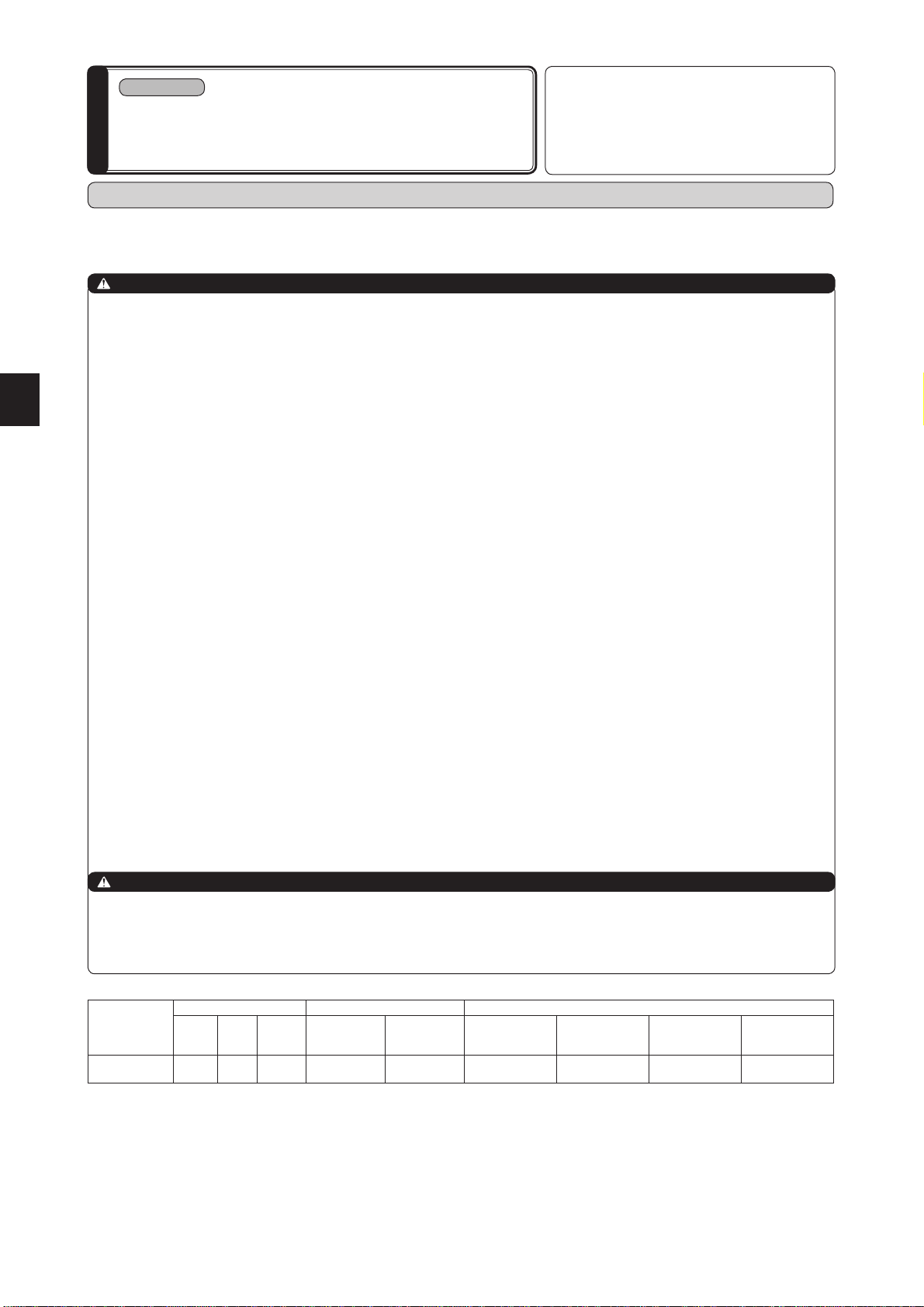
1-2. SPECIFICATIONS
CAUTION
(Could lead to serious injury in particular environments when operated incorrectly.)
n
Do not install the unit by yourself (user).
Incompleteinstallationcouldcausereorelectricshock,injuryduetothe
unit falling, or leakage of water. Consult the dealer from whom you pur
-
chased
theunitoraqualiedinstaller.
n
P
erform the installation securely referring to the installation manual.
Incompleteinstallationcouldcause re,electricshock,injury duetothe
unit falling, or leakage of water.
n
When
installing the unit, use appropriate protective equipment and
tools for safety.
Failure to do so could cause injury.
n
Install
the unit securely in a place which can bear the weight of the
unit.
If the installation location cannot bear the weight of the unit, the unit
could fall causing injury.
n
Electrical work should be performed by a qualified, experienced
electrician, according to the installation manual. Be sure to use an
exclusive circuit. Do not connect other electrical appliances to the
circuit.
If the capacity of the power circuit is insufcient or there is incomplete
electricalwork,itcouldresultinareoranelectricshock.
n
Do not damage the wires by applying excessive pressure with parts
or screws.
Damagedwirescouldcausereorelectricshock.
n
Be sure to cut off the main power in case of setting up the indoor P.C.
board or wiring works.
Failure to do so could cause electric shock.
n
Usethespeciedwirestoconnecttheindoorandoutdoorunitsse-
curely
andattachthewiresrmly totheterminalblockconnecting
sections so the stress of the wires is not applied to the sections. Do
not extend the wires, or use intermediate connection.
Incompleteconnectingandsecuringcouldcausere.
n
Do
notinstalltheunitinaplacewhereinammablegasmayleak.
If gas leaks and accumulates in the area around the unit, it could cause
an explosion.
n
Do
not use intermediate connection of the power cord or the exten-
sion cord and do not connect many devices to one AC outlet.
Itcouldcauseareoranelectricshockduetodefectivecontact,defec-
tive
insulation, exceeding the permissible current, etc.
n
Be
suretousethepartsprovidedorspeciedpartsfortheinstalla-
tion work.
The use of defective parts could cause an injury or leakage of water due
toare,anelectricshock,theunitfalling,etc.
n
When plugging the power supply plug into the outlet, make sure
that there is no dust, clogging, or loose parts in both the outlet and
the plug. Make sure that the power supply plug is pushed complete-
ly into the outlet.
If there is dust, clogging, or loose parts on the power supply plug or the
outlet,itcouldcauseelectricshockorre.Ifloosepartsarefoundonthe
power supply plug, replace it.
n
Attach the electrical cover to the indoor unit and the service panel
to the outdoor unit securely.
If the electrical cover of the indoor unit and/or the service panel of the
outdoor unit are not attached securely, it could result in a re or an
electric shock due to dust, water, etc.
n
When installing, relocating, or servicing the unit, make sure that
no
substanceother than the specied refrigerant (R410A) enters
the refrigerant circuit.
Any presence of foreign substance such as air can cause abnormal
pressure rise and may result in explosion or injury. The use of any re
-
frigerant
otherthanthatspeciedforthesystemwillcausemechanical
failure, system malfunction, or unit breakdown. In the worst case, this
could lead to a serious impediment to securing product safety.
n
Do not discharge the refrigerant into the atmosphere. If refrigerant
leaks during installation, ventilate the room.
Ifrefrigerantcomesincontactwithare,harmfulgascouldbegener-
ated.
n
Check that the refrigerant gas does not leak after installation has
been completed.
Ifrefrigerantgasleaksindoors,andcomesintocontactwiththeame
of a fan heater, space heater, stove, etc., harmful substances will be
generated.
n
Use appropriate tools and piping materials for installation.
The pressure of R410A is 1.6 times more than R22. Not using appropri-
ate
tools or materials and incomplete installation could cause the pipes
to burst or injury.
n
When pumping down the refrigerant, stop the compressor before
disconnecting the refrigerant pipes.
If the refrigerant pipes are disconnected while the compressor is run-
ning
and the stop valve is open, air could be drawn in and the pressure
in the refrigeration cycle could become abnormally high. This could
cause the pipes to burst or injury.
n
When installing the unit, securely connect the refrigerant pipes
before starting the compressor.
If the compressor is started before the refrigerant pipes are connected
and when the stop valve is open, air could be drawn in and the pres
-
s
ure in the refrigeration cycle could become abnormally high. This
could cause the pipes to burst or injury.
n
Fastenaarenutwithatorquewrenchasspeciedinthismanual.
Iffastenedtootight,aarenutmaybreakafteralongperiodandcause
refrigerant leakage.
n
The unit shall be installed in accordance with national wiring regu-
lations.
n
Earth the unit correctly.
Do not connect the earth to a gas pipe, water pipe, lightning rod or tele-
phone
earth. Defective earthing could cause electric shock.
n
Be sure to install an earth leakage breaker.
Failure to install an earth leakage breaker may result in electric shock
orre.
n
Perform the drainage/piping work securely according to the installa-
tion manual.
If there is defect in the drainage/piping work, water could drop from the
unit, soaking and damaging household goods.
n
Donottouchtheairinletorthealuminumnsoftheoutdoorunit.
This could cause injury.
n
Do not install the outdoor unit where small animals may live.
If small animals enter and touch the electric parts inside the unit, it
couldcause amalfunction,smoke emission,or re.Also, adviseuser
to keep the area around the unit clean.
WARNING
(Could lead to death, serious injury, etc.)
*1 Connect to the power switch which has a gap of 3 mm or more when
open to interrupt the source power phase. (When the power switch is shut
off, it must interrupt all phases.)
*2 Use wires in conformity with design 60245 IEC 57. Use the indoor/out-
door
connectingwireinconformitywiththewirespecicationsspeciedin
the installation manual of the indoor unit.
*3 Neverusepipeswith thicknesslessthanspecied. Thepressureresist-
ance
willbeinsufcient.
*4 Use a copper pipe or a copper-alloy seamless pipe.
*5 Be careful not to crush or bend the pipe during pipe bending.
*6 Refrigerant pipe bending radius must be 100 mm or more.
*7 Insulationmaterial:Heatresistingfoamplastic0.045specicgravity
*8 Besuretousetheinsulationofspeciedthickness.Excessivethickness
may cause incorrect installation of the indoor unit and insufcient thick
-
ness
may cause dew drippage.
*
9
If the outdoor unit is installed higher than the indoor unit, max. height
difference is reduced to 10 m.
*
10
If pipe length exceeds 20 m, additional refrigerant (R410A) charge is re-
quired. (No additional charge is required for pipe length less than 20 m.)
Additional refrigerant = A × (pipe length (m) - 20)
Required Tools for Installation
Phillips screwdriver
Level
Scale
Utility
knife or scissors
Torque wrench
Wrench (or spanner)
4 mm hexagonal wrench
Flare tool for R410A
Gauge manifold for R410A
Vacuum pump for R410A
Charge hose for R410A
Pipe cutter with reamer
ENGLISH
CONTENTS
1. BEFORE INSTALLATION ............................................................1
2. OUTDOOR UNIT INSTALLATION ...............................................3
3.
FLARING WORK AND PIPE CONNECTION ...............................3
4.
PURGING PROCEDURES, LEAK TEST, AND TEST RUN .........4
5.
RELOCATION AND MAINTENANCE ..........................................5
Model
Power supply *1 Wirespecications*2 Pipe length and height difference
*3, *4, *5, *6, *7, *8
Rated
Voltage
Fre-
quency
Breaker
capacity
Power supply
Indoor/outdoor
connecting wire
Max. pipe length
per indoor unit /
for multi-system
Max. height
difference
*9
Max. no. of bends
per indoor unit /
for multi system
Refrigerant adjust
-
ment
A *10
MXZ-2D52VA 230 V 50 Hz 15 A 3-core 2.0 mm
2
4-core
1.0/1.5 mm
2
20 m / 30 m 15 m 20 / 30 20 g/m
JG79A641H01_en.indd 1 2013/09/06 15:47:04
En-2
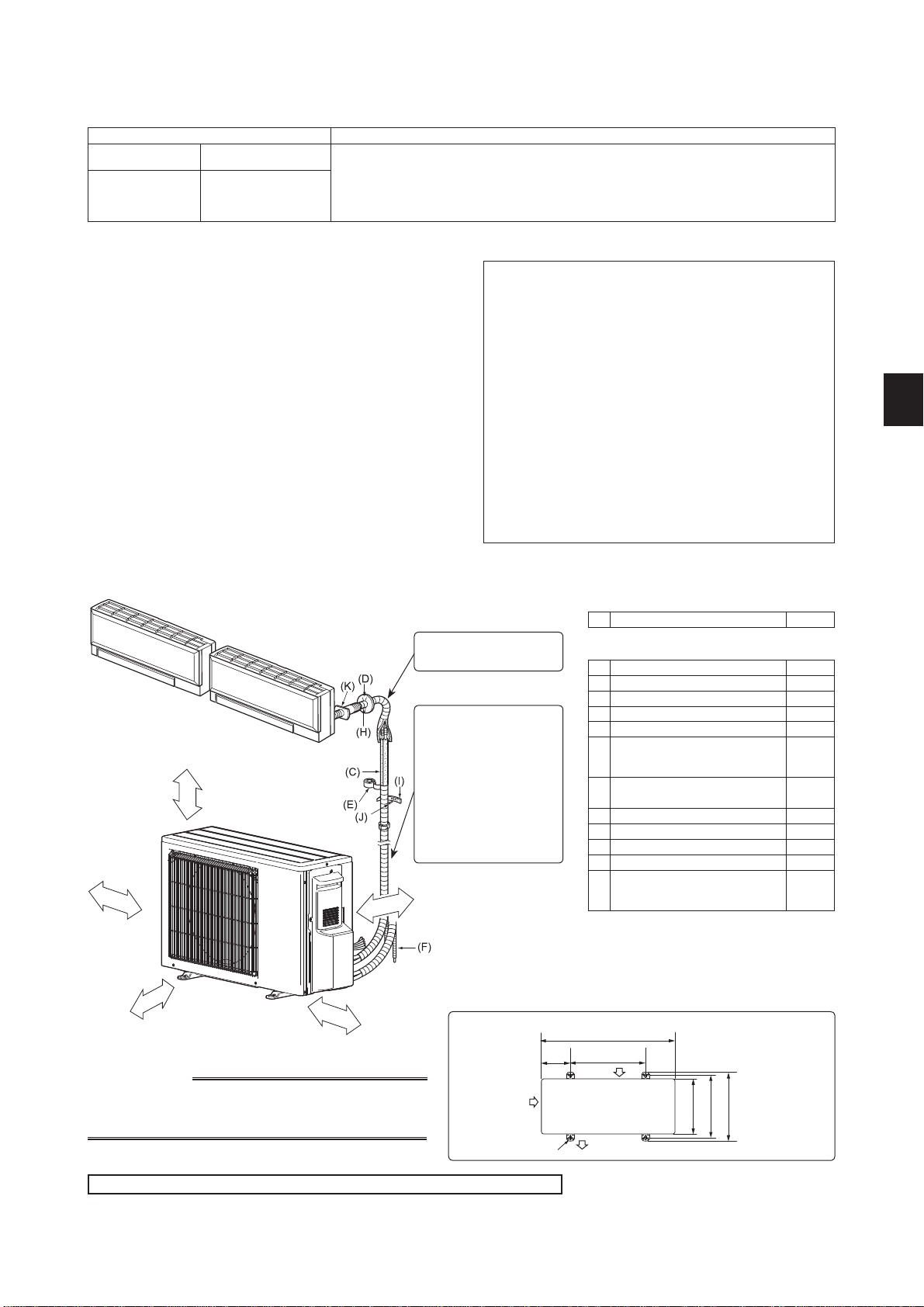
1-3. SELECTING OPTIONAL DIFFERENT-DIAMETER JOINTS
If the diameter of connection pipe does not match the port size of outdoor unit, use optional different-diameter joints according to the following table.
Port size of outdoor unit Optionaldifferent-diameterjoints(portsizeofoutdoorunit→diameterofconnectionpipe)
MXZ-2D Liquid
/ Gas
6,35 (1/4)
→
9,52 (3/8) : PAC-493PI
9,52 (3/8)
→
1
2,7 (1/2) : MAC-A454JP
9,52 (3/8)
→
1
5,88 (5/8) : PAC-SG76RJ
12,7 (1/2)
→
9,52 (3/8) : MAC-A455JP
12,7 (1/2)
→
1
5,88 (5/8) : MAC-A456JP
Refer to the installation manual of indoor unit for the diameter of connection pipe of indoor unit.
A , B UNIT 6,35 (1/4) / 9,52 (3/8)
1-4.SELECTINGTHEINSTALLATIONLOCATION
• Where it is not exposed to strong wind.
• Whereairowisgoodanddustless.
• Where rain or direct sunshine can be avoided as much as possible.
• Where neighbours are not annoyed by operation sound or hot air.
• Where rigid wall or support is available to prevent the increase of op
-
eration
sound or vibration.
• Where there is no risk of combustible gas leakage.
• When installing the unit, be sure to secure the unit legs.
• Where it is at least 3 m away from the antenna of TV set or radio. Op
-
e
ration of the air conditioner may interfere with radio or TV reception in
areaswherereceptionisweak.Anampliermayberequiredfortheaf-
f
ected device.
• Install the unit horizontally.
• Please install it in an area not affected by snowfall or blowing snow.
In areas with heavy snow, please install a canopy, a pedestal and/or
somebafeboards.
Note:
It
is advisable to make a piping loop near outdoor unit so as to reduce
vibration transmitted from there.
(Unit: mm (inch))
1-5. INSTALLATION DIAGRAM
ACCESSORIES
Check the following parts before installation.
(1) Drain socket 1
PARTS TO BE PROVIDED AT YOUR SITE
(A) Power supply cord* 1
(B) I
ndoor/outdoor unit connecting wire* 1
(C) Extension
pipe 1
(D) W
all hole cover 1
(E) Piping
tape 1
(F)
Extension
drain hose
(or soft PVC hose, 15 mm inner
diameter or hard PVC pipe VP16)
1
(G) Refrigeration
oil
Little
amount
(H) Putty 1
(I) Pipe
xingband 2 to 7
(J) Fixing
screw for (I) 2 to 7
(K) W
all hole sleeve 1
(L)
Soft
PVC hose, 15 mm inner di-
ameter
or hard PVC pipe VP16 for
drain socket (1)
1
* Note:
P
lace indoor/outdoor unit connecting wire (B) and
power supply cord (A) at least 1 m away from the
TV antenna wire.
The “Q’ty” for (B) to (K) in the above table is quan
-
tity
to be used per indoor unit.
Units should be installed by licensed contractor according to local code requirements.
After the leak test, apply insulat-
ing material tightly so that there is
no gap.
When the piping is to be at-
tached to a wall containing metals
(tin plated) or metal netting, use
a chemically treated wooden
piece 20 mm or thicker between
the wall and the piping or wrap 7
to 8 turns of insulation vinyl tape
around the piping.
To use existing piping, perform
COOL operation for 30 minutes
and pump down before removing
the old air conditioner. Remake
areaccordingtothedimension
for new refrigerant.
More than
100 mm
More than 100 mm
More than 200 mm if there are
obstacles to both sides
Open as a rule
More than 500 mm if the back,
both sides and top are open
More than 350 mm
Outdoor unit installation
(Unit: mm)
285
Air inlet
150 500
Air
inlet
4-10 × 21 Oval holes
304~325
344.5
Air outlet
800
Open
as a rule
More than 500 mm
if the front and both
sides are open
Note:
When operating the air conditioner in low outside temperature, be sure
to follow the instructions described below.
• Never install the outdoor unit in a place where its air inlet/outlet side
may be exposed directly to wind.
• To prevent exposure to wind, install the outdoor unit with its air inlet
side facing the wall.
•
To prevent exposure to wind, it is recommended to install a baffle
board on the air outlet side of the outdoor unit.
Avoid the following places for installation where air conditioner trouble
is liable to occur.
• Whereammablegascouldleak.
• Where there is much machine oil.
• Whereoilissplashedorwheretheareaislledwithoilysmoke(such
as cooking areas and factories, in which the properties of plastic
could be changed and damaged).
• Salty places such as the seaside.
• Wheresuldegasisgeneratedsuchasahotspring.
• Where there is high-frequency or wireless equipment.
• Where there is emission of high levels of VOCs, including phthalate
compounds, formaldehyde, etc., which may cause chemical crack
-
ing.
IMPORTANT NOTES
To comply with the requirements of Australian standard AS/NZS 3000
electrical installations (wiring rules), the electrical wiring required
between the indoor and outdoor units must be installed by a licenced
electrical contractor.
JG79A641H01_en.indd 2 2013/09/06 15:47:05
En-3
1-6. DRAIN PIPING FOR OUTDOOR UNIT
Please perform the drain piping work only when draining from one place.
1) Provide drain piping before indoor and outdoor piping connection.
2) Connect the soft PVC hose (L) I.D.15 mm as shown in the illustration.
3)Makesuretoprovidedrainpipingwithadownhillgradeforeasydrainow.
Note:
Install
the unit horizontally.
Do not use the drain socket (1) in the cold regions. Drain may freeze and it makes
the fan stop.
The outdoor unit produces condensate during the heating operation. Select the in
-
s
tallation place to ensure to prevent the outdoor unit and/or the grounds from being
wet by drain water or damaged by frozen drain water.
(1) Drain socket
(L) Soft PVC hose
2. OUTDOOR UNIT INSTALLATION
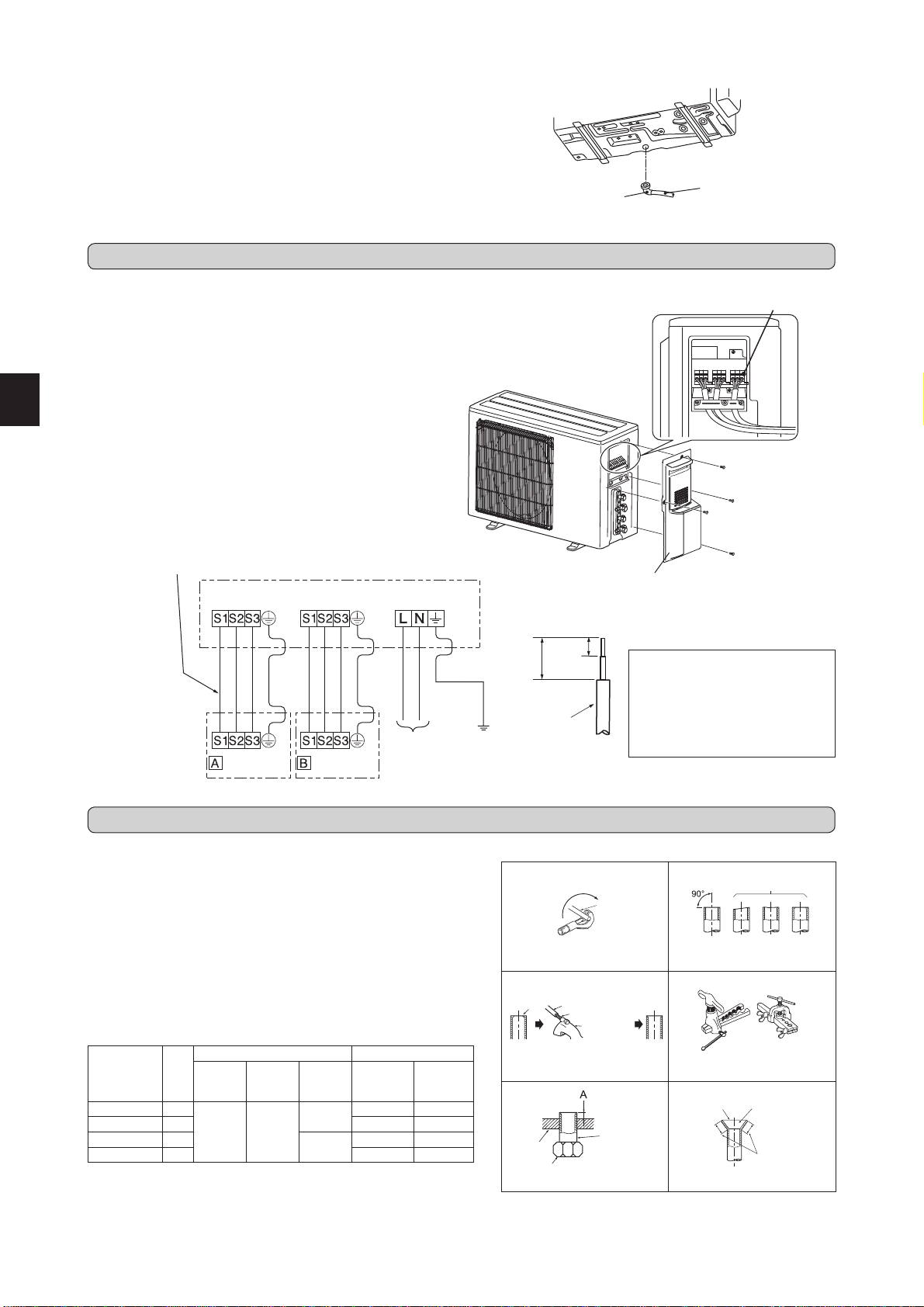
2-1. CONNECTING WIRES FOR OUTDOOR UNIT
• Be sure to attach each screw to its
correspondent terminal when secur-
i
ng the cord and/or the wire to the
terminal block.
• Make earth wire a little longer than
others. (More than 35 mm)
• For future servicing, give extra length
to the connecting wires.
Terminal block for power supply
1) Remove the service panel.
2) Loosen terminal screw, and connect indoor/outdoor unit connecting
wire (B) from the indoor unit correctly on the terminal block. Be careful
not to make mis-wiring. Fix the wire to the terminal block securely so
that no part of its core is appeared, and no external force is conveyed
to the connecting section of the terminal block.
3) Firmly tighten the terminal screws to prevent them from loosening. Af
-
ter
tightening,pullthewireslightlytoconrmthattheydonotmove.
4) Perform 2) and 3) for each indoor unit.
5) Connect power supply cord (A).
6) Fix indoor/outdoor unit connecting wire (B) and power supply cord (A)
with the cable clamps.
7) Close the service panel securely. Make sure that 3-2. PIPE CONNEC
-
TION
is completed.
• After making connections between both power supply cord (A) and
indoor/outdoorunitconnectingwire(B),besuretoxbothcableand
wire with cable clamps.
Indoor/outdoor unit connecting wire
<OUTDOOR UNIT>
35 mm
15 mm
Lead wire
Terminal block
UNIT
UNIT
Terminal
block for
power supply
<INDOOR UNIT>
POWER SUPPLY
~/N 230 V 50 Hz
Service panel
Fig. 1 Fig. 2
Fig. 3 Fig. 4
Fig. 5 Fig. 6
3. FLARING WORK AND PIPE CONNECTION
3-1. FLARING WORK
Pipe diameter
(mm)
Nut
(mm)
A (mm) Tightening torque
Clutch
type tool
for
R410A
Clutch
type tool
for R22
Wing nut
type tool
for R22
N•m kgf•cm
ø6.35 (1/4”) 17
0 to 0.5 1.0 to 1.5
1.5 to 2.0
13.7 to 17.7 140 to 180
ø9.52 (3/8”) 22 34.3
to 41.2 350 to 420
ø12.7 (1/2”) 26
2.0
to 2.5
49.0 to 56.4 500 to 575
ø15.88 (5/8”) 29 73.5
to 78.4 750 to 800
Tilted Uneven Burred
Good
No good
Burr
Copper pipe
Spare reamer
Pipe cutter
Smooth all
around
Even
length
all around
Inside is shin-
ing
without any
scratches.
Flare nut
Die
Copper
pipe
Clutch type
Flaring tool
Wing nut type
Copper
pipe
1) Cut the copper pipe correctly with pipe cutter. (Fig. 1, 2)
2) Completely remove all burrs from the cut cross section of pipe. (Fig. 3)
• Aim the copper pipe downward while removing burrs to prevent
burrs from dropping in the pipe.
3)Removearenutsattachedtoindoorandoutdoorunits,thenputthem
on pipe having completed burr removal. (Not possible to put them on
afteraringwork.)
4) Flaring work (Fig. 4, 5). Firmly hold copper pipe in the dimension
shown in the table. Select A mm from the table according to the tool
selected.
5)
Check
• ComparethearedworkwithFig.6.
• Ifareisnotedtobedefective,cutoffthearedsectionanddoar
-
ing
work again.
JG79A641H01_en.indd 3 2013/09/06 15:47:06
En-4
4-1.PURGINGPROCEDURESANDLEAKTEST
3-2. PIPE CONNECTION
1)Applyathincoatofrefrigerationoil(G)tothearedendsofthepipesandthepipeconnectionsoftheout-
door unit. Do not apply refrigeration oil on screw threads. Excessive tightening torque will result in damage
on the screw.
2)Alignthecenterofthepipewiththatofthepipeconnectionsoftheoutdoorunit,thenhandtightentheare
nut 3 to 4 turns.
3)Tightenthearenutwithatorquewrenchasspeciedinthetable.
•Over-tighteningmaycausedamagetothearenut,resultinginrefrigerantleakage.
• Be sure to wrap insulation around the piping. Direct contact with the bare piping may result in burns or
frostbite.
3-3. INSULATION AND TAPING
1) Cover piping joints with pipe cover.
2) For outdoor unit side, surely insulate every piping including valves.
3) Using piping tape (E), apply taping starting from the entry of outdoor unit.
• Stop the end of piping tape (E) with tape (with adhesive agent attached).
• When piping have to be arranged through above ceiling, closet or where the temperature and humidity
are high, wind additional commercially sold insulation to prevent condensation.
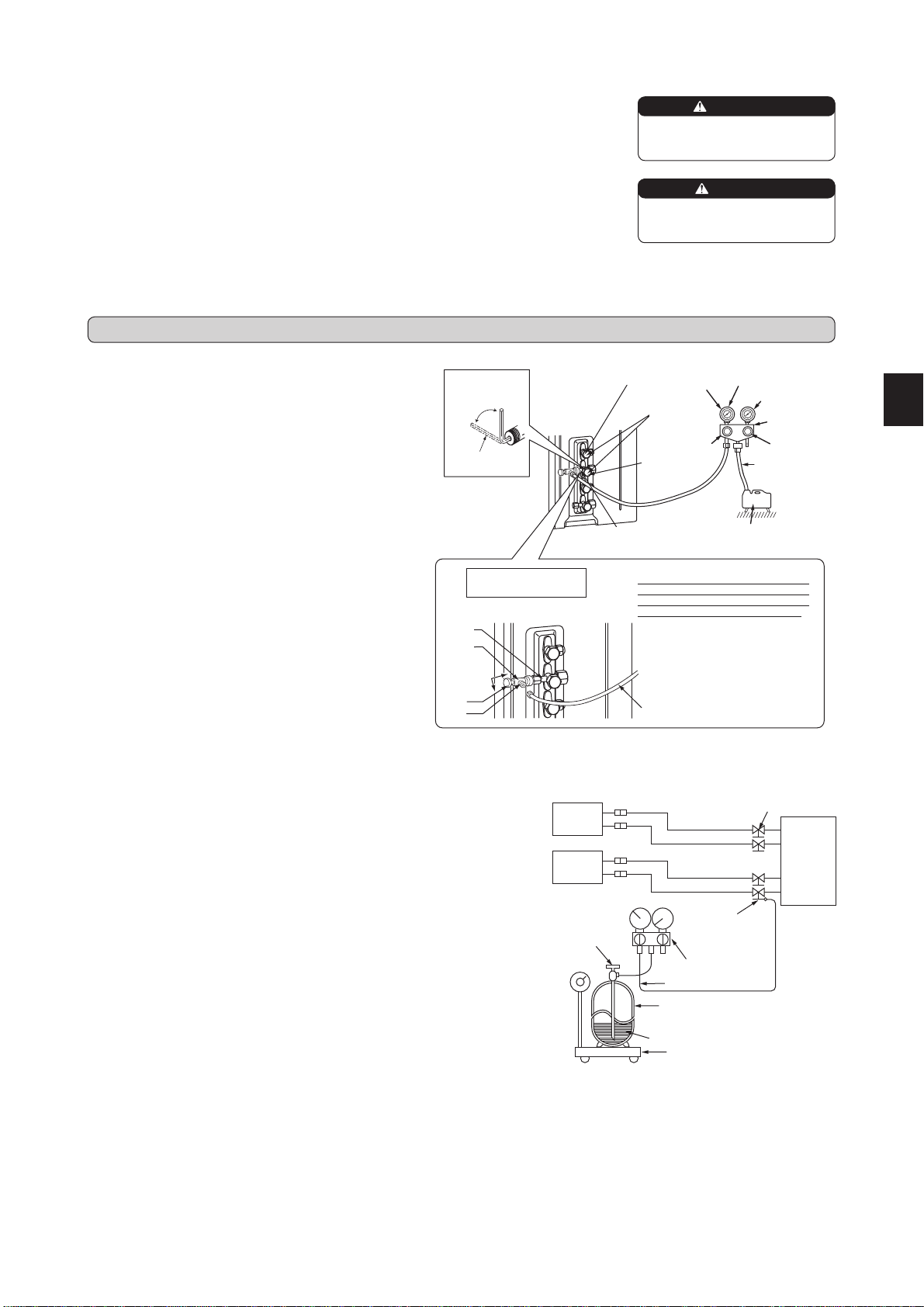
4. PURGINGPROCEDURES,LEAKTEST,ANDTESTRUN
1) Remove service port cap of stop valve on the side of the outdoor
unit gas pipe. (The stop valves are fully closed and covered in caps
in their initial state.)
2) Connect gauge manifold valve and vacuum pump to service port of
stop valve on the gas pipe side of the outdoor unit.
3) Run the vacuum pump. (Vacuumize for more than 15 minutes.)
4) Check the vacuum with gauge manifold valve, then close gauge
manifold valve, and stop the vacuum pump.
5) Leave as it is for one or two minutes. Make sure the pointer of
gauge manifold valve remains in the same position. Conrm that
pressure gauge shows -0.101 MPa [Gauge] (-760 mmHg).
6) Remove gauge manifold valve quickly from service port of stop
valve.
7)
Fully open all stop valves on the gas pipe and the liquid pipe. Oper-
ating
without fully opening lowers the performance and this causes
trouble.
8)
Refer to 1-2., and charge the prescribed amount of refrigerant if
needed. Be sure to charge slowly with liquid refrigerant. Otherwise,
composition of the refrigerant in the system may be changed and
affect performance of the air conditioner.
9) Tighten cap of service port to obtain the initial status.
10
) Leak test
WARNING
When installing the unit, securely
connect the refrigerant pipes before
starting the compressor.
CAUTION
When there are the ports which are
not used, make sure their nuts are
tightened securely.
Stop valve
for GAS
Stop valve
cap (Torque
19.6 to 29.4
N•m, 200 to
300 kgf•cm)
Gauge manifold
valve (for R410A)
Compound pressure
gauge (for R410A)
–0.101 MPa
(–760
mmHg)
Handle
Low
Handle
High
Vacuum pump
(for R410A)
*Close
*Open
Hexagonal
wrench
*4 to 5 turns
Stop valve
for LIQUID
Pressure gauge
(for R410A)
Precautions when using
the control valve
When attaching the control valve to
the service port, valve core may de-
form or loosen if excess pressure is
applied. This may cause gas leak.
Service
port
Charge hose
(for R410A)
Body
Close
Open
Control
valve
A
When attaching the control valve to
the service port, make sure that the
valve core is in closed position, and
then tighten part A. Do not tighten
part A or turn the body when valve
core is in open position.
Service port cap
(Torque 13.7 to 17.7 N•m,
140 to 180 kgf
•cm)
Charge
hose
(for R410A)
4-2.GASCHARGE
Perform gas charge to unit.
1) Connect gas cylinder to the service port of stop valve.
2) Perform air purge of the pipe (or hose) coming from refrigerant gas cylinder.
3)Replenish specied amountof the refrigerant, while operatingthe air condi-
tioner
for cooling.
Note:
In
caseofaddingrefrigerant,complywiththequantityspeciedfortherefrigerat-
ing
cycle.
CAUTION:
When
charging the refrigerant system with additional refrigerant, be sure to use
liquid refrigerant. Adding gas refrigerant may change the composition of the
refrigerant in the system and affect normal operation of the air conditioner. Also,
charge the liquid refrigerant slowly, otherwise the compressor will be locked.
To maintain the high pressure of the gas cylinder, warm the gas cylinder with
warmwater(under40°C)duringcoldseason.Butneverusenakedreorsteam.
Refrigerant gas
cylinder
operating
valve
(for R410A)
Indoor
unit
Charge
hose (for R410A)
Refrigerant gas cylinder
for R410A with siphon
Electronic scale for
refrigerant charging
Refrigerant (liquid)
Indoor
unit
Union
Union
Liquid
pipe
Gas pipe
Liquid pipe
Gas pipe
Stop valve
Service port
Outdoor
unit
Gauge
manifold
valve (for R410A)
JG79A641H01_en.indd 4 2013/09/06 15:47:06

En-5
4-3.LOCKINGTHEOPERATIONMODEOFTHEAIRCONDITIONER(COOL,DRY,HEAT)
4-4.LOWERINGTHEOPERATIONNOISEOFTHEOUTDOORUNIT
• Description of the function:
With this function, once the operation mode is locked to either COOL/DRY
mode or HEAT mode, the air conditioner operates in that mode only.
* Changing the setting is required to activate this function. Please explain about
this function to your customers and ask them whether they want to use it.
[How to lock the operation mode]
1
) Be sure to turn off the main power for the air conditioner before making the
setting.
2)
Set the “1” of SW1 on the outdoor display P.C. board to ON to enable this
function.
3)
To lock the operation mode in COOL/DRY mode, set the “2” of SW1 on the
outdoor display P.C. board to OFF. To lock the operation in HEAT mode, set
the same switch to ON.
4) Turn on the main power for the air conditioner.
• Description of the function:
With this function, the operating noise of the outdoor unit can be lowered by reducing the operation load, for example, during nighttime in COOL mode.
However, please note that the cooling and heating capacity may lower if this function is activated.
* Changing the setting is required to activate this function. Please explain about this function to your customers and ask them whether they want to use it.
Lower the operating noise
[How to lower the operating noise]
1) Be sure to turn off the main power for the air conditioner before making the setting.
2) Set the “3” of SW1 on the outdoor display P.C. board to ON to enable this function.
3) Turn on the main power for the air conditioner.
4-5.TESTRUN
• Test runs of the indoor units should be performed individually. See the installation manual coming with the indoor unit, and make sure all the units oper-
ate properly.
• If the test run with all the units is performed at once, possible erroneous connections of the refrigerant pipes and the indoor/outdoor unit connecting wires
cannot be detected. Thus, be sure to perform the test run one by one.
Make sure that the following is done.
• Power is supplied to the unit.
• Stop valves are open.
About the restart protective mechanism
Once
the compressor stops, the restart preventive device operates so the compressor will not operate for 3 minutes to protect the air conditioner.
4-6.EXPLANATIONTOTHEUSER
• UsingtheOPERATINGINSTRUCTIONS,explaintotheuserhowtousetheairconditioner(howtousetheremotecontroller,howtoremovetheairl-
ters, how to remove or put the remote controller in the remote controller holder, how to clean, precautions for operation, etc.).
• Recommend the user to read the OPERATING INSTRUCTIONS carefully.
COOL/DRY HEAT
5. PUMPING DOWN
When relocating or disposing of the air conditioner, pump down the system following the procedure below so that no refrigerant is released into the atmosphere.
1) Turn off the breaker.
2) Connect the gauge manifold valve to the service port of the stop valve on the gas pipe side of the outdoor unit.
3) Fully close the stop valve on the liquid pipe side of the outdoor unit.
4) Turn on the breaker.
5) Start the emergency COOL operation on all the indoor units.
6) When the pressure gauge shows 0.05 to 0 MPa [Gauge] (approx. 0.5 to 0 kgf/cm
2
), fully close the stop valve on the gas pipe side of the outdoor unit and
stop the operation. (Refer to the indoor unit installation manual about the method for stopping the operation.)
* If too much refrigerant has been added to the air conditioner system, the pressure may not drop to 0.05 MPa [Gauge] (approx. 0.5 kgf/cm
2
), or the protec-
tion function may operate due to the pressure increase in the high-pressure refrigerant circuit. If this occurs, use a refrigerant collecting device to collect all
of the refrigerant in the system, and then recharge the system with the correct amount of refrigerant after the indoor and outdoor units have been relocated.
7) Turn off the breaker. Remove the pressure gauge and the refrigerant piping.
When pumping down the refrigerant, stop the compressor before disconnecting the refrigerant pipes.
The compressor may burst and cause injury if any foreign substance, such as air, enters the pipes.
WARNING
JG79A641H01_en.indd 5 2013/09/06 15:47:07

A4-tombo-blank.indd 1 12/18/2006 9:45:16 AM
JG79A641H01
HEAD OFFICE: TOKYO BLDG., 2-7-3, MARUNOUCHI, CHIYODA-KU, TOKYO 100-8310, JAPAN
JG79A641H01_en_cover.indd 2 2013/08/22 13:30:01