
2011 Element
Owner’s Manual
(Unlinked)
This document does not contain hyperlinks and may be formatted for printing instead of web use. This is due to changes
in content and specifications of the vehicle that happen throughout the model year. This manual will be replaced with a
hyperlinked version at the end of the model year.
P/N 00X31-SCV-
© 2010 American Honda Motor Co., Inc. - All Rights Reserved
6800

OWNER _________________________________________________________
______________________________________________________________________________
ADDRESS _______________________________________________________
STREET
_________________________________ _________________________________ ___________________
CITY STATE ZIP CODE
V. I. N. ___________________________________________________________
DELIVERY DATE __________________________________________________
(Date sold to original retail purchaser)
DEALER NAME ___________________ DEALER NO. ___________________
ADDRESS _______________________________________________________
STREET
_________________________________ _________________________________ ___________________
CITY STATE ZIP CODE
OWNER'S SIGNATURE ___________________________________________
DEALER'S SIGNATURE ___________________________________________
This owner's manual should be considered a
permanent part of the vehicle and should
remain with the vehicle when it is sold.
This owner's manual covers all models of the
Element. You may find descriptions of
equipment and features that are not on your
particular model.
Images throughout this owner’s manual
(including the front cover) represent features
and equipment that are available on some,
but not all, models. Your particular model
may not have some of these features.
The information and specifications included
in this publication were in effect at the time of
approval for printing. Honda Motor Co., Ltd.
reserves the right, however, to discontinue or
change specifications or design at any time
without notice and without incurring any
obligation whatsoever.
Owner's Identification
10/08/06 08:34:41 11 ELEMENT MMC North America Owner's Man 50 31SCV680 enu
Congratulations! Your selection of a 2011 Honda Element was a wise
investment. It will give you years of driving pleasure.
One of the best ways to enhance the enjoyment of your new vehicle is to read
this manual. In it, you will learn how to operate its driving controls and
convenience items. Afterwards, keep this owner's manual in your vehicle so
you can refer to it at any time.
Several warranties protect your new vehicle. Read the warranty booklet
thoroughly so you understand the coverages and are aware of your rights
and responsibilities.
Maintaining your vehicle according to the Maintenance Minder™ shown in
the instrument panel helps to keep your driving trouble-free while it
preserves your investment. When your vehicle needs maintenance, keep in
mind that your dealer's staff is specially trained in servicing the many
systems unique to your vehicle. Your dealer is dedicated to your satisfaction
and will be pleased to answer any questions and concerns.
As you read this manual, you will find
information that is preceded by a
symbol. This information is
intended to help you avoid damage to
your vehicle, other property, or the
environment.
Introduction
i
10/08/06 08:34:41 11 ELEMENT MMC North America Owner's Man 50 31SCV680 enu
California Proposition 65 Warning
WARNING: This product contains or emits chemicals known to the State of California to cause cancer and birth
defects or other reproductive harm.
Event Data Recorders
This vehicle is equipped with one or more devices commonly referred to as event data recorders. These
devices record front seat belt use, front passenger seat occupancy, airbag deployment data, and the failure of
any airbag system component. This data belongs to the vehicle owner and may not be accessed by anyone else
except as legally required or with the permission of the vehicle owner.
Service Diagnostic Recorders
This vehicle is equipped with service-related devices that record information about powertrain performance. The data
can be used to verify emissions law requirements and/or help technicians diagnose and solve service problems. It
may also be combined with data from other sources for research purposes, but it remains confidential.
California Perchlorate Contamination Prevention Act
The airbags, seat belt tensioners, and CR type batteries in this vehicle may contain perchlorate materials - special
handling may apply. See www.dtsc.ca.gov/hazardouswaste/perchlorate/
Introduction
ii
10/08/06 08:34:41 11 ELEMENT MMC North America Owner's Man 50 31SCV680 enu
Your safety, and the safety of others,
is very important. And operating this
vehicle safely is an important
responsibility.
To help you make informed
decisions about safety, we have
provided operating procedures and
other information on labels and in
this manual. This information alerts
you to potential hazards that could
hurt you or others.
Of course, it is not practical or
possible to warn you about all the
hazards associated with operating or
maintaining your vehicle. You must
use your own good judgement.
You will find this important safety information in a variety of forms, including:
●
Safety Labels - on the vehicle.
●
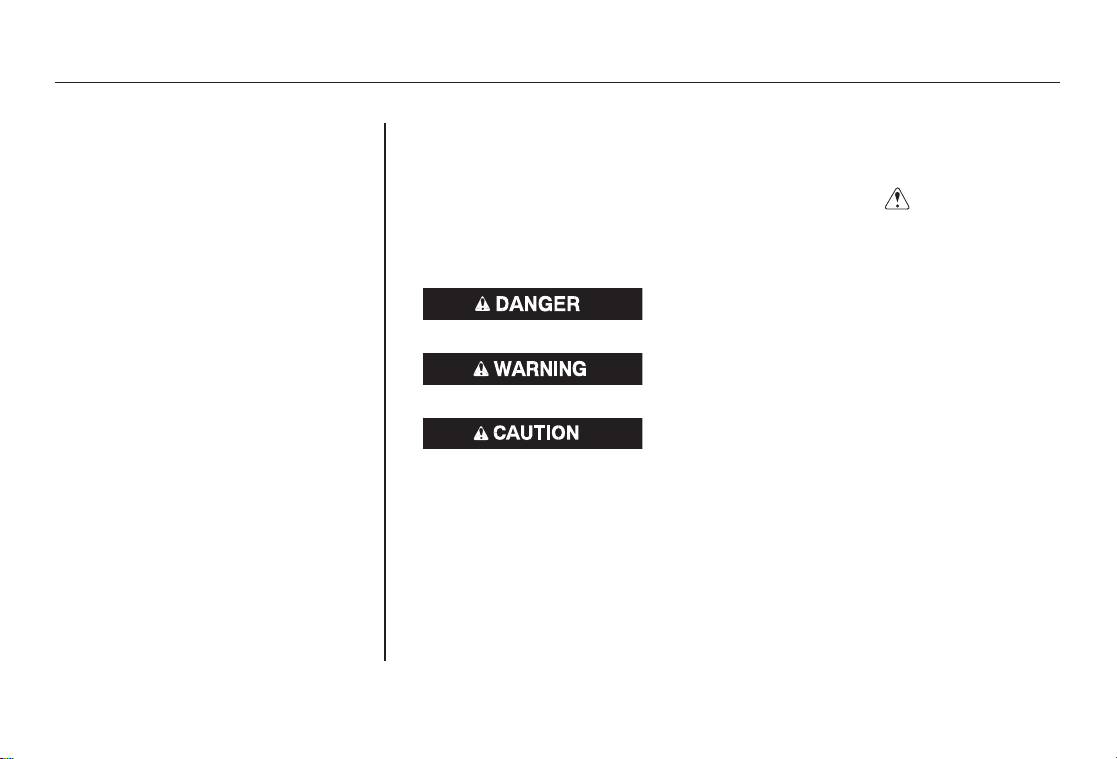
Safety Messages - preceded by a safety alert symbol and one of
three signal words: DANGER, WARNING,orCAUTION.
These signal words mean:
You WILL be KILLED or SERIOUSLY
HURT if you don't follow instructions.
You CAN be KILLED or SERIOUSLY
HURT if you don't follow instructions.
You CAN be HURT if you don't follow
instructions.
●
Safety Headings - such as Important Safety Reminders or Important
Safety Precautions.
●
Safety Section - such as Driver and Passenger Safety.
●
Instructions - how to use this vehicle correctly and safely.
This entire book is filled with important safety information - please read it
carefully.
A Few Words About Safety
iii
10/08/06 08:34:41 11 ELEMENT MMC North America Owner's Man 50 31SCV680 enu

Your Element has higher ground clearance than a passenger vehicle designed for use only on pavement. Higher
ground clearance has many advantages for off-highway driving. It allows you to travel over bumps, obstacles, and
rough terrain. It also provides good visibility so you can anticipate problems earlier.
These advantages come at some cost. Because your vehicle is taller and rides higher off the ground, it has a high
center of gravity. This means your vehicle can tip or roll over if you make abrupt turns. Utility vehicles have a
significantly higher rollover rate than other types of vehicles. In a rollover crash, an unbelted person is significantly
more likely to die than a person wearing a seat belt. As a reminder, make sure you and your passengers always wear
seat belts.
For information on how to reduce the risk of rollover, read ‘‘Driving Guidelines’’ on page 158 of this manual and the
Off-Highway Driving Guidelines
section on page 180. Failure to operate your vehicle correctly might result in loss of
control, a crash, or rollover.
Important Handling Information
iv
10/08/06 08:34:41 11 ELEMENT MMC North America Owner's Man 50 31SCV680 enu
Your Vehicle at a Glance (main controls) .................................................................................................................... 3
Driver and Passenger Safety (seat belts, SRS, and child protection)
........................................................................... 5
Instruments and Controls (indicators, gauges, dashboard, and steering column)
.................................................... 55
Features (heating and cooling, audio, steering wheel, cruise control, and other convenience items)
...................... 103
Before Driving (fuel, vehicle break-in, and cargo loading)
....................................................................................... 141
Driving (engine and transmission operation)
........................................................................................................... 157
Maintenance (minder, fluid checking, minor services, and vehicle storage)
........................................................... 183
Taking Care of the Unexpected (flat tire, jump starting, overheating, and fuses)
................................................... 221
Technical Information (vehicle specifications, tires, and emissions controls)
........................................................ 247
Warranty and Customer Relations (warranty and contact information)
................................................................ 263
Index
.............................................................................................................................................................................. I
INDEX
Service Information Summary (fluid capacities and tire pressures) ............................................................... last page
Contents
1
10/08/06 08:34:41 11 ELEMENT MMC North America Owner's Man 50 31SCV680 enu

Contents
A convenient reference to the
sections in this manual.
Your Vehicle at a Glance
A quick reference to the main
controls in your vehicle.
Driver and Passenger Safety
Important information about the
proper use and care of your vehicle's
seat belts, an overview of the
supplemental restraint system, and
valuable information on how to
protect children with child restraints.
Instruments and Controls
Explains the purpose of each
instrument panel indicator and
gauge, and how to use the controls
on the dashboard and steering
column.
Features
How to operate the heating and air
conditioning system, the audio
system, and other convenience
features.
Before Driving
What gasoline to use, how to break-
in your new vehicle, and how to load
luggage and other cargo.
Driving
The proper way to start the engine,
shift the transmission, and park; plus
what you need to know if you're
planning to tow a trailer.
Maintenance
The Maintenance Minder™ shows
you when you need to take your
vehicle to the dealer for maintenance
service. There is also a list of things
to check and instructions on how to
check them.
Taking Care of the Unexpected
This section covers several problems
motorists sometimes experience, and
details how to handle them.
Technical Information
ID numbers, dimensions, capacities,
and technical information.
Warranty and Customer Relations
A summary of the warranties
covering your new vehicle, and how
to contact us for any reason. Refer to
your warranty manual for detailed
information.
Index
Service Information Summary
A summary of the information you
need when you pull up to the fuel
pump.
Overview of Contents
2
10/08/06 08:34:41 11 ELEMENT MMC North America Owner's Man 50 31SCV680 enu
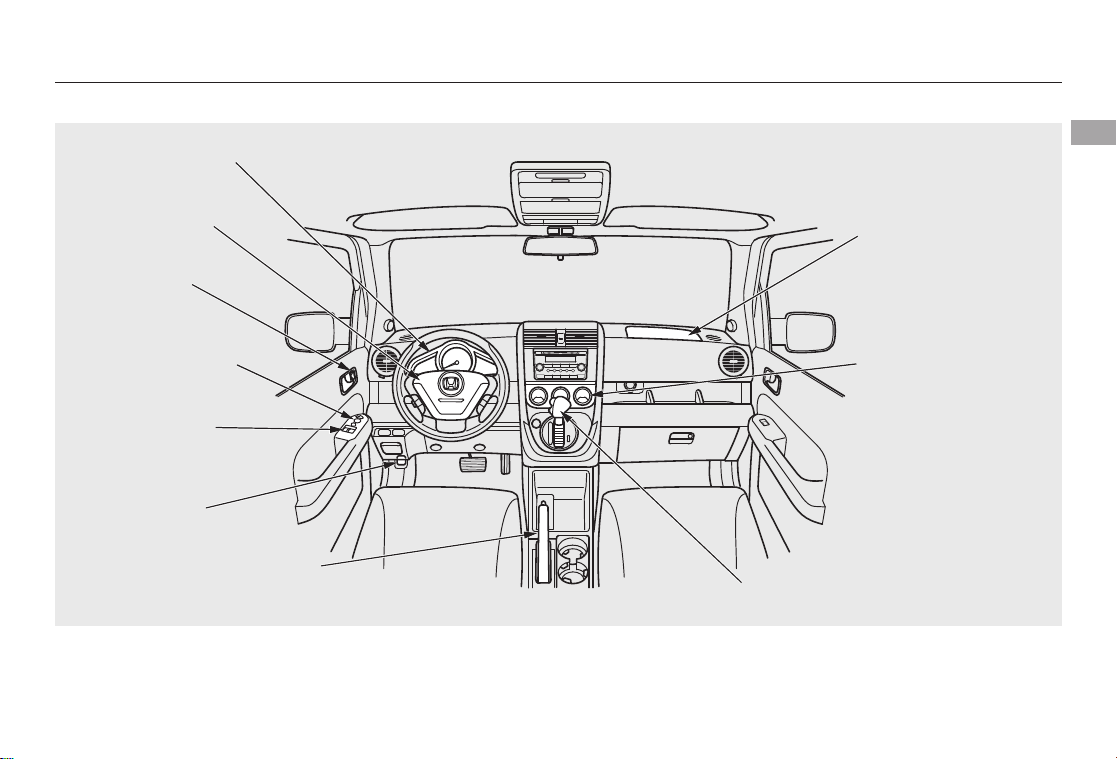
ꭧ: If equipped
POWER DOOR
LOCK SWITCH
(P. 80)
POWER WINDOW
SWITCHES
(P. 92)
HOOD RELEASE
HANDLE
(P. 144)
Ex model is shown.
AUTOMATIC TRANSMISSION (P. 161)
PARKING BRAKE
(P. 94)
HEATING/COOLING
CONTROLS
(P. 104)
PASSENGER'S
FRONT AIRBAG
(P. 9, 24)
DRIVER'S FRONT
AIRBAG (P. 9, 24)
INSTRUMENT PANEL (P. 57)
GAUGES (P. 64)
MIRROR CONTROLS
(P. 93)
CONTINUED
Your Vehicle at a Glance
3
Your Vehicle at a Glance
10/08/06 08:34:41 11 ELEMENT MMC North America Owner's Man 50 31SCV680 enu
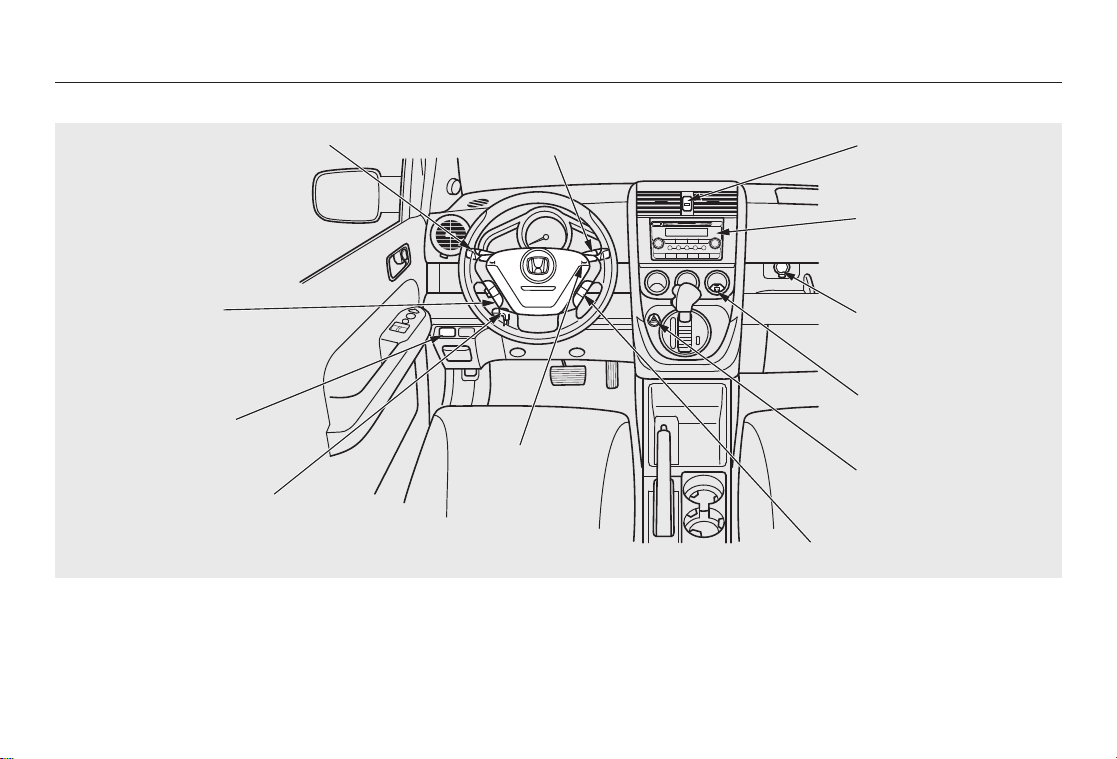
ꭧ1: To use the horn, press the center pad of the steering wheel.
ꭧ2: If equipped
HEADLIGHTS/TURN SIGNALS
(P. 71)
REMOTE AUDIO
CONTROLS
ꭧ2
(P. 135)
Ex model is shown.
STEERING WHEEL ADJUSTMENT
(P. 74)
CRUISE CONTROL BUTTONS
(P. 137)
WINDSHIELD WIPERS/WASHERS
(P. 70)
PASSENGER AIRBAG
OFF INDICATOR
(P. 32)
AUDIO SYSTEM
(P. 109)
DIGITAL CLOCK
(P. 133)
REAR WINDOW
DEFOGGER BUTTON
(P. 74)
ACCESSORY POWER
SOCKET
(P. 100)
HORN
ꭧ1
VSA OFF SWITCH
(P. 173)
HAZARD WARNING
BUTTON
(P. 73)
Your Vehicle at a Glance
4
10/08/06 08:34:41 11 ELEMENT MMC North America Owner's Man 50 31SCV680 enu

This section gives you important
information about how to protect
yourself and your passengers. It shows
you how to use seat belts. It explains
how your airbags work. And it tells you
how to properly restrain infants and
children in your vehicle.
Important Safety Precautions
............. 6
Your Vehicle's Safety Features
.......... 7
Seat Belts
..................................... 8
Airbags
........................................ 9
Protecting Adults and Teens
........... 11
1. Close and Lock the Doors
........ 11
2. Adjust the Front Seats
............. 11
3. Adjust the Seat-Backs
.............. 12
4. Adjust the Head Restraints
...... 13
5. Fasten and Position the Seat
Belts
.................................. 14
6. Maintain a Proper Sitting
Position
.............................. 15
Advice for Pregnant Women
........ 16
Additional Safety Precautions
...... 16
Additional Information About Your
Seat Belts
............................... 18
Seat Belt System Components
..... 18
Lap/Shoulder Belt
...................... 19
Automatic Seat Belt
Tensioners
............................. 20
Seat Belt Maintenance
................ 20
Additional Information About Your
Airbags
.................................. 22
Airbag System Components
........ 22
How Your Front Airbags Work
.... 24
How Your Side Airbags Work
...... 28
How Your Side Curtain Airbags
Work
..................................... 29
How the SRS Indicator Works
..... 30
How the Side Airbag Off
Indicator Works
..................... 31
How the Passenger Airbag Off
Indicator Works
..................... 32
Airbag Service
............................ 33
Additional Safety Precautions
...... 33
Protecting Children - General
Guidelines
.............................. 35
All Children Must Be
Restrained
.............................. 35
All Children Should Sit in a Back
Seat
....................................... 36
The Passenger's Front Airbag
Can Pose Serious Risks
........... 36
If You Must Drive with Several
Children
................................ 38
If a Child Requires Close
Attention
................................ 38
Additional Safety Precautions
...... 39
Protecting Infants and Small
Children
................................. 40
Protecting Infants
....................... 40
Protecting Small Children
........... 41
Selecting a Child Seat
..................... 42
Installing a Child Seat
..................... 43
Installing a Child Seat with
LATCH
.................................. 44
Installing a Child Seat with a
Lap/Shoulder Belt
.................. 46
Installing a Child Seat with a
Tether
................................... 48
Protecting Larger Children
............. 49
Checking Seat Belt Fit
................ 49
Using a Booster Seat
................... 50
When Can a Larger Child Sit in
Front
..................................... 50
Additional Safety Precautions
...... 51
Carbon Monoxide Hazard
............... 52
Safety Labels
.................................. 53
Driver and Passenger Safety
5
Driver and Passenger Safety
10/08/06 08:34:41 11 ELEMENT MMC North America Owner's Man 50 31SCV680 enu

You'll find many safety
recommendations throughout this
section, and throughout this manual.
The recommendations on this page
are the ones we consider to be the
most important.
Always Wear Your Seat Belt
A seat belt is your best protection in all
types of collisions. Airbags are
designed to supplement seat belts, not
replace them. So even though your
vehicle is equipped with airbags, make
sure you and your passengers always
wear your seat belts, and wear them
properly (see page 14).
Restrain All Children
Children age 12 and under should ride
properly restrained in a back seat, not
the front seat. Infants and small
children should be restrained in a
child seat. Larger children should use
a booster seat and a lap/shoulder belt
until they can use the belt properly
without a booster seat (see pages
35 - 51).
Be Aware of Airbag Hazards
While airbags can save lives, they can
cause serious or fatal injuries to
occupants who sit too close to them, or
are not properly restrained. Infants,
young children, and short adults are at
the greatest risk. Be sure to follow all
instructions and warnings in this
manual.
Don't Drink and Drive
Alcohol and driving don't mix. Even one
drink can reduce your ability to respond
to changing conditions, and your
reaction time gets worse with every
additional drink. So don't drink and
drive, and don't let your friends drink
and drive, either.
Pay Appropriate Attentio n to the
Task of Driving Safely
Engaging in mobile phone conversation
or other activities that keep you from
paying close attention to the road, other
vehicles and pedestrians could lead to a
crash. Remember, situations can
change quickly, and only you can
decide when it is safe to divert attention
away from driving.
Control Your Speed
Excessive speed is a major factor in
crash injuries and deaths. Generally, the
higher the speed, the greater the risk,
but serious injuries can also occur at
lower speeds. Never drive faster than is
safe for current conditions, regardless
of the maximum speed posted.
Keep Your Vehicle in Safe Condition
Having a tire blowout or a mechanical
failure can be extremely hazard ous. To
reduce the possibility of such problems,
check your tire pressures and condition
frequently, and perform all regularly
scheduled maintenance (see page 185).
Important Safety Precautions
6
10/08/06 08:34:41 11 ELEMENT MMC North America Owner's Man 50 31SCV680 enu
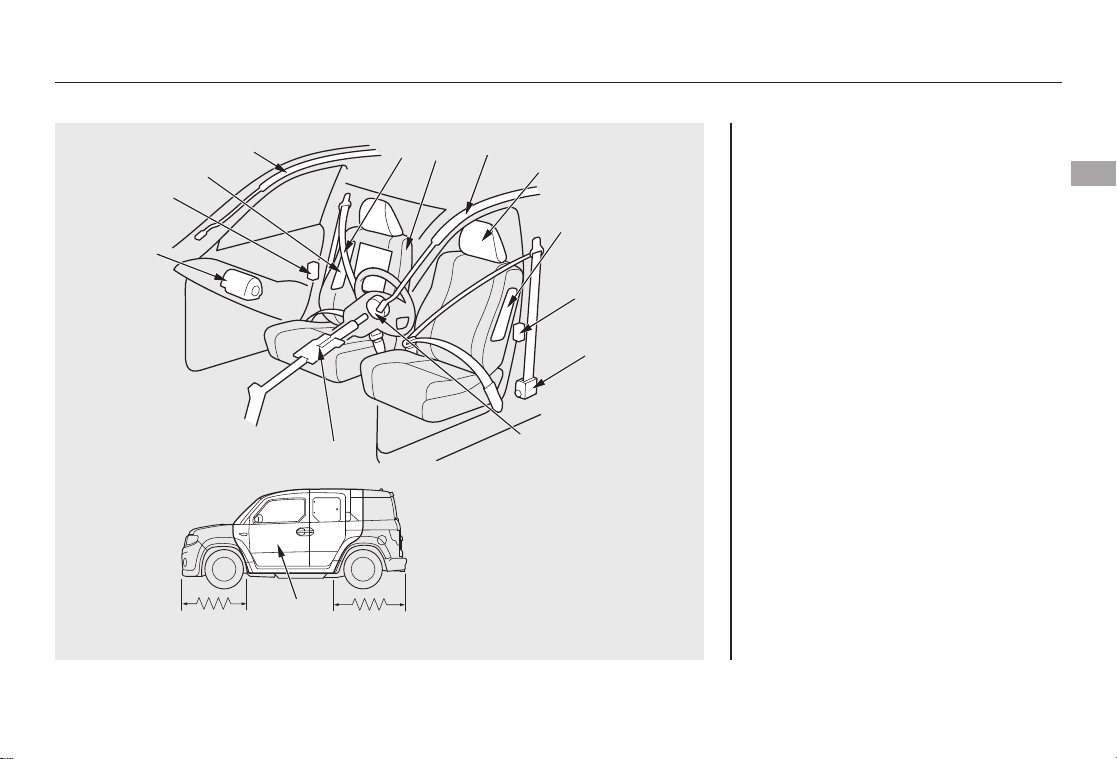
Your vehicle is equipped with many
features that work together to protect
you and your passengers during a
crash.
Some features do not require any
action on your part. These include a
strong steel framework that forms a
safety cage around the passenger
compartment, front and rear crush
zones, a collapsible steering column,
and tensioners that tighten the seat
belts in a crash.
However, you and your passengers
can't take full advantage of these
features unless you remain sitting in
the correct position and
always wear
your seat belts.
In fact, some safety
features can contribute to injuries if
they are not used properly.
The following pages explain how you
can take an active role in protecting
yourself and your passengers.
(5)
(7)
(11)
(8)
(3)
(4)
(9)
(1)
(2)
(8)
(10)
(2)
(1) Safety Cage
(2) Crus h Zones
(3) Seat s and Seat-Backs
(4) Head Restraints
(5) Collapsible Steering Column
(6) Seat Belts
(7) Front Airbags
(8) Side Airbags
(9) Side Curtain Airbags
(10) Door Locks
(11) Automatic Seat Belt Tensioners
(6)
(7)
(10)
(9)
Your Vehicle's Safety Features
7
Driver and Passenger Safety
10/08/06 08:34:41 11 ELEMENT MMC North America Owner's Man 50 31SCV680 enu

Seat Belts
Your vehicle is equipped with seat
belts in all seating positions.
Your seat belt system also includes
an indicator on the instrument panel
and a beeper to remind you and your
passengers to fasten your seat belts.
Why Wear Seat Belts
Seat belts are the single most
effective safety device for adults and
larger children. (Infants and smaller
children must be properly restrained
in child seats.)
Not wearing a seat belt properly
increases the chance of serious
injury or death in a crash, even
though your vehicle has airbags.
In addition, most states require you
to wear seat belts.
Not wearing a seat belt properly
increases the chance of serious
injury or death in a crash, even
though your vehicle has
airbags.
Be sure you and your
passengers always wear seat
belts and wear them properly.
When properly worn, seat belts:
●
Keep you connected to the vehicle
so you can take advantage of the
vehicle's built-in safety features.
●
Help protect you in almost every
type of crash, including:
–
frontal impacts
–
side impacts
–
rear impacts
–
rollovers
●
Help keep you from being thrown
against the inside of the vehicle
and against other occupants.
●
Keep you from being thrown out of
the vehicle.
●
Help keep you in a good position
should the airbags ever deploy. A
good position reduces the risk of
injury from an inflating airbag and
allows you to get the best
advantage from the airbag.
Of course, seat belts cannot
completely protect you in every
crash. But in most cases, seat belts
can reduce your risk of serious
injury.
What You Should Do:
Always wear your seat belt, and
make sure you wear it properly.
Your Vehicle's Safety Features
8
10/08/06 08:34:41 11 ELEMENT MMC North America Owner's Man 50 31SCV680 enu
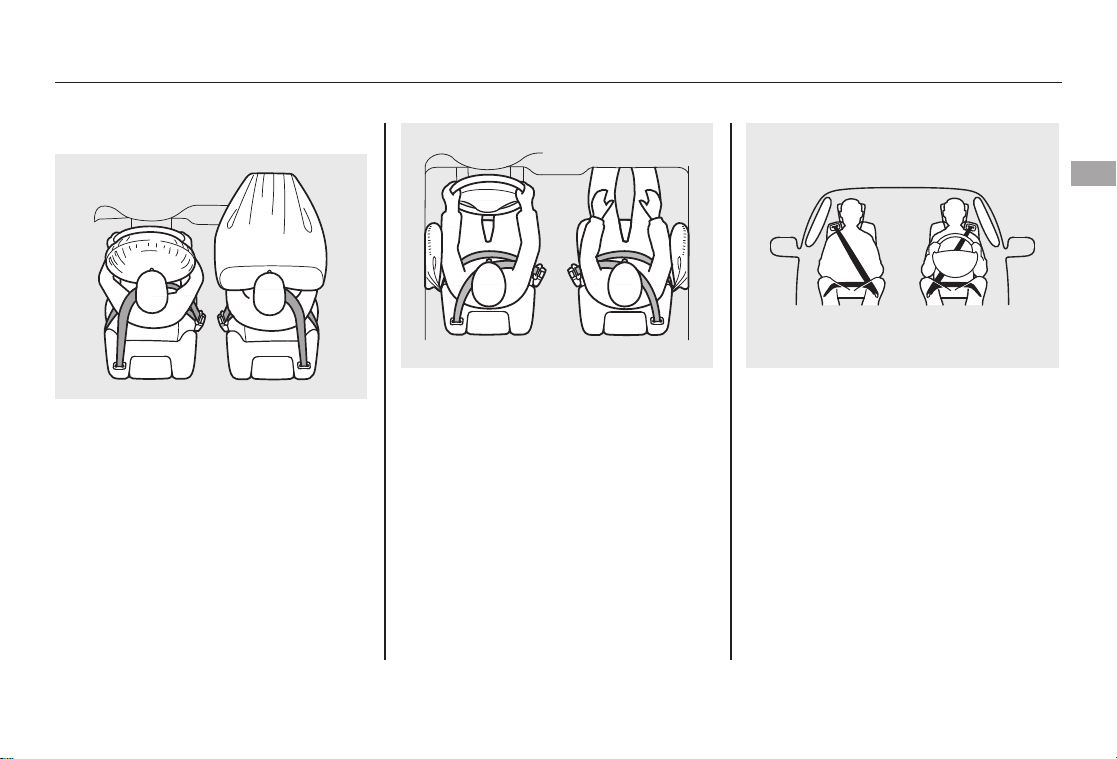
Airbags
Your vehicle has a supplemental
restraint system (SRS) with front
airbags to help protect the heads and
chests of the driver and a front seat
passenger during a moderate to
severe frontal collision (see page 24
for more information on how your
front airbags work).
Your vehicle also has side airbags to
help protect the upper torso of the
driver or a front seat passenger
during a moderate to severe side
impact (see page 28 for more
information on how your side airbags
work).
In addition, your vehicle has side
curtain airbags to help protect the
heads of the driver, front passenger,
and passengers in the outer rear
seating positions during a moderate
to severe side impact or rollover (see
page 29 for more information on how
your side curtain airbags work).
CONTINUED
Your Vehicle's Safety Features
9
Driver and Passenger Safety
10/08/06 08:34:41 11 ELEMENT MMC North America Owner's Man 50 31SCV680 enu

The most important things you need
to know about your airbags are:
●
Airbags do not replace seat belts.
They are designed to supplement
the seat belts.
●
Airbags offer no protection in rear
impacts, or minor frontal or side
collisions.
●
Airbags can pose serious hazards.
To do their job, airbags must
inflate with tremendous force. So
while airbags help save lives, they
can cause minor injuries or more
serious or even fatal injuries if
occupants are not properly
restrained or sitting properly.
What you should do:
Always wear
your seat belt properly, and sit
upright and as far back from the
steering wheel as possible while
allowing full control of the vehicle. A
front passenger should move their
seat as far back from the dashboard
as possible.
The rest of this section gives more
detailed information about how you
can maximize your safety.
Remember however, that no safety
system can prevent all injures or
deaths that can occur in a severe
crash, even when seat belts are
properly worn and the airbags
deploy.
Your Vehicle's Safety Features
10
10/08/06 08:34:41 11 ELEMENT MMC North America Owner's Man 50 31SCV680 enu
Introduction
The following pages provide
instructions on how to properly
protect the driver, adult passengers,
and teenage children who are large
enough and mature enough to drive
or ride in the front.
See pages 35 - 51 for important
guidelines on how to properly protect
infants, small children, and larger
children who ride in your vehicle.
1. Close and Lock the Doors
After everyone has entered the
vehicle, be sure the doors, the hatch,
and the tailgate are closed and
locked.
Your vehicle has a door and
tailgate open indicator on
the instrument panel to indicate
when a specific door, the tailgate or
the hatch is not tightly closed.
Locking the doors, the hatch, and the
tailgate reduces the chance of
someone being thrown out of the
vehicle during a crash, and it helps
prevent passengers from accidentally
opening a door, the hatch, or the
tailgate and falling out.
Locking the doors, the hatch, or the
tailgate also helps prevent an
outsider from unexpectedly opening
a door when you come to a stop.
See page 80 for how to lock the
doors, and page 61 for how the door
and tailgate indicator system works.
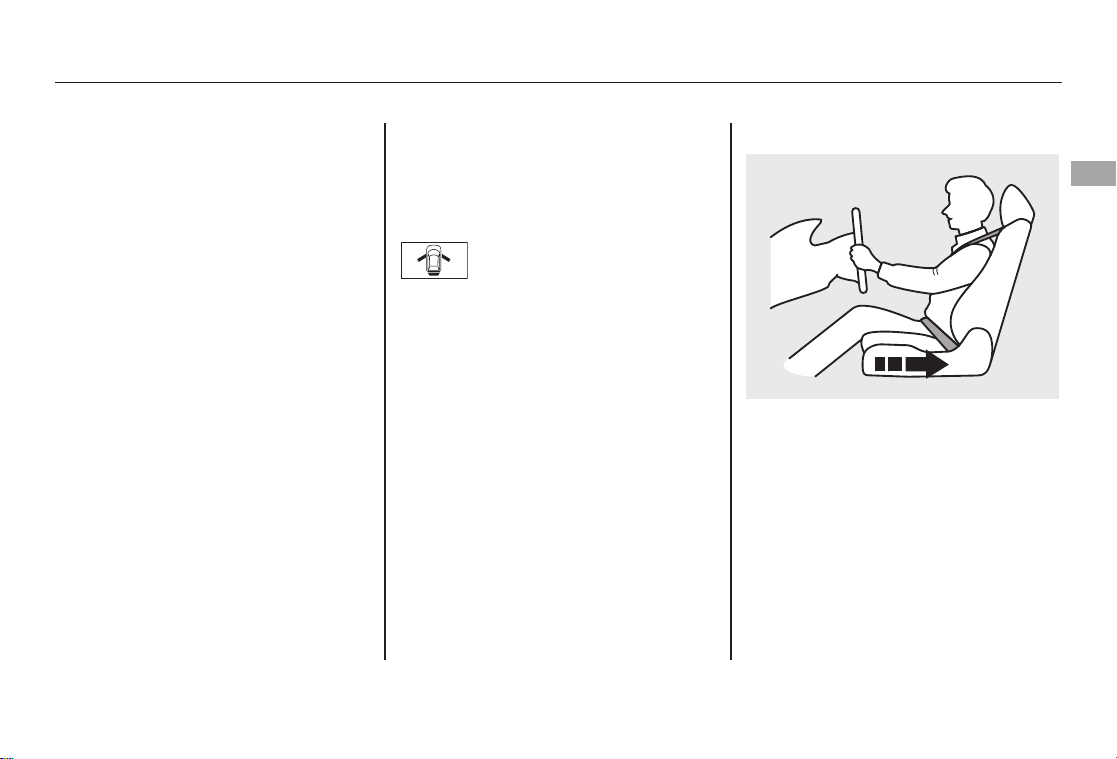
2. Adjust the Front Seats
Adjust the driver's seat as far to the
rear as possible while allowing you to
maintain full control of the vehicle.
Have a front passenger adjust their
seat as far to the rear as possible.
If you sit too close to the steering
wheel or dashboard, you can be
seriously injured by an inflating front
airbag, or by striking the steering
wheel or dashboard.
CONTINUED
Protecting Adults and Teens
11
Driver and Passenger Safety
10/08/06 08:34:41 11 ELEMENT MMC North America Owner's Man 50 31SCV680 enu
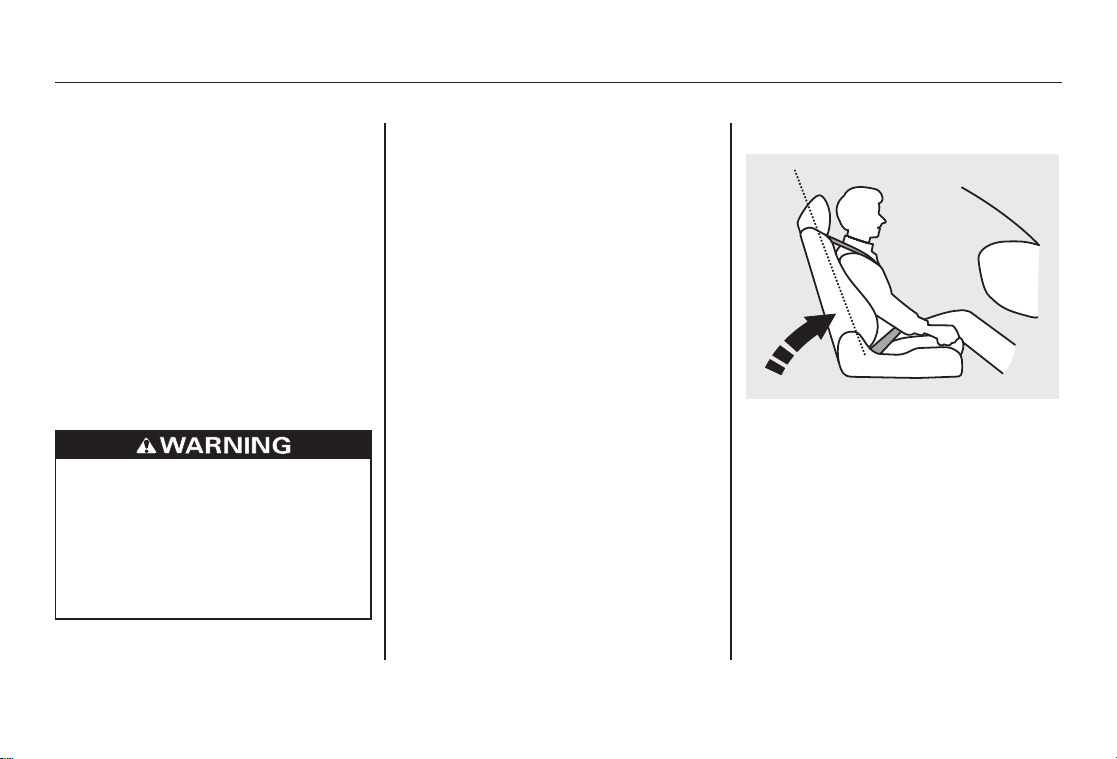
The National Highway Traffic Safety
Administration recommends that
drivers allow at least 10 inches (25
cm) between the center of the
steering wheel and the chest. In
addition to adjusting the seat, you
can adjust the steering wheel up and
down (see page 74).
If you cannot get far enough away
from the steering wheel and still
reach the controls, we recommend
that you investigate whether some
type of adaptive equipment may help.
Sitting too close to a front
airbag can result in serious
injury or death if the front
airbags inflate.
Always sit as far back from the
front airbags as possible.
Once a seat is adjusted correctly,
rock it back and forth to make sure it
is locked in position.
See page 83 for how to adjust the
front seats.
3. Adjust the Seat-Backs
Adjust the driver's seat-back to a
comfortable, upright position, leaving
ample space between your chest and
the airbag cover in the center of the
steering wheel.
Passengers with adjustable seat-
backs should also adjust their seat-
back to a comfortable, upright
position.
Protecting Adults and Teens
12
10/08/06 08:34:41 11 ELEMENT MMC North America Owner's Man 50 31SCV680 enu
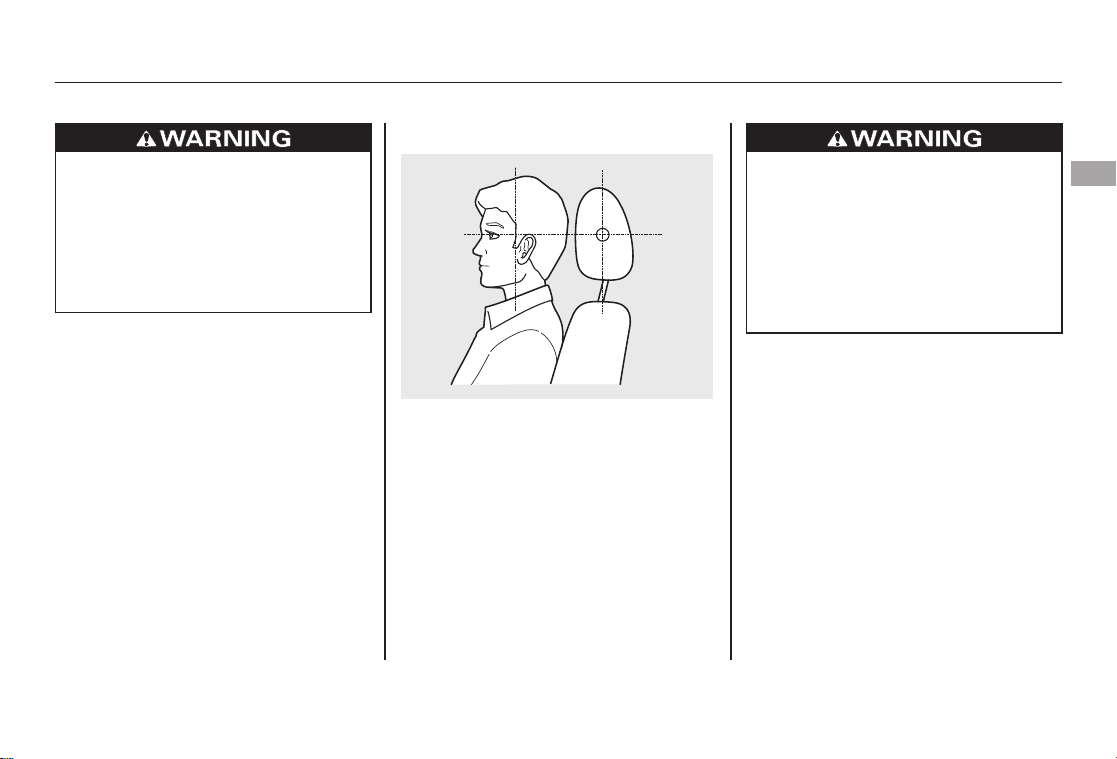
Reclining the seat-back too far
can result in serious injury or
death in a crash.
Adjust the seat-back to an
upright position, and sit well
back in the seat.
Reclining a seat-back so that the
shoulder part of the belt no longer
rests against the occupant's chest
reduces the protective capability of
the belt. It also increases the chance
of sliding under the belt in a crash
and being seriously injured. The
farther a seat-back is reclined, the
greater the risk of injury.
See page 83 for how to adjust the
seat-backs.
4. Adjust the Head Restraints
Adjust the driver's head restraint so
the center of the back of your head
rests against the center of the
restraint.
Have passengers adjust their head
restraints properly as well. Taller
persons should adjust their restraint
as high as possible.
Improperly positioning head
restraints reduces their
effectiveness and you can be
seriously injured in a crash.
Make sure head restraints are
in place and positioned properly
before driving.
Properly adjusted head restraints will
help protect occupants from whiplash
and other crash injuries.
See page 85 for how to adjust the
head restraints.
Protecting Adults and Teens
13
Driver and Passenger Safety
10/08/06 08:34:41 11 ELEMENT MMC North America Owner's Man 50 31SCV680 enu
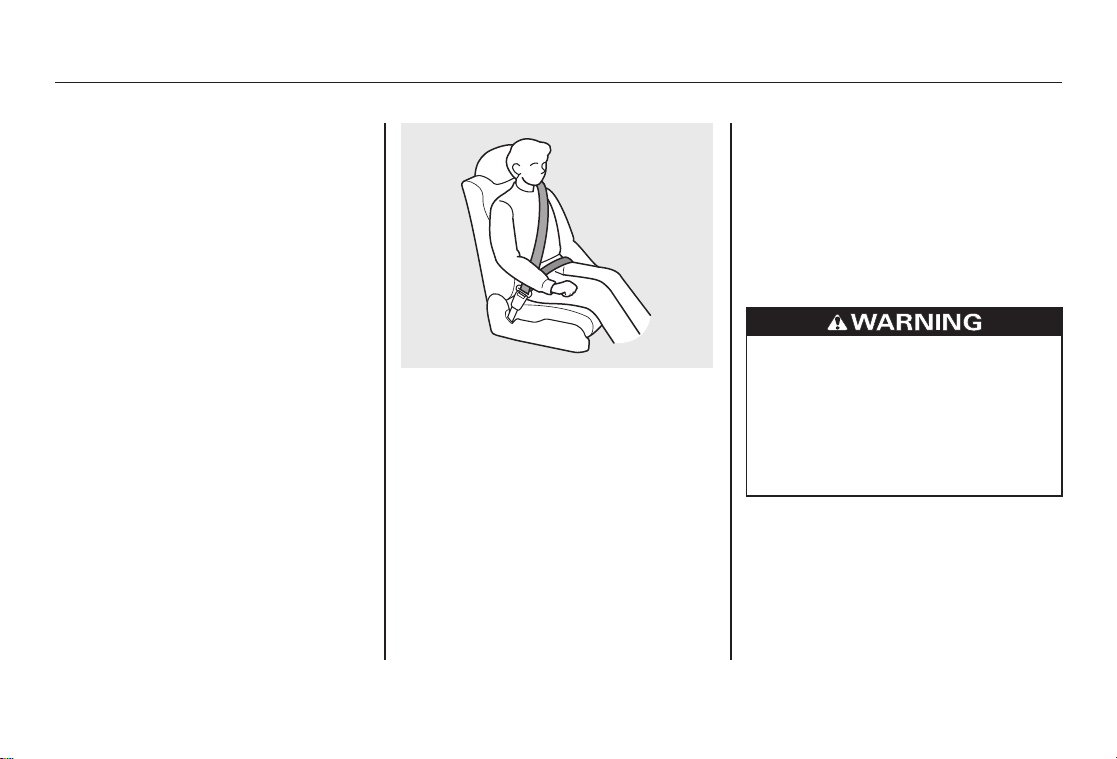
5. Fasten and Position the Seat
Belts
Insert the latch plate into the buckle,
then tug on the belt to make sure the
belt is securely latched. Check that
the belt is not twisted, because a
twisted belt can cause serious
injuries in a crash.
Position the lap part of the belt as low
as possible across your hips, then
pull up on the shoulder part of the
belt so the lap part fits snugly. This
lets your strong pelvic bones take the
force of a crash and reduces the
chance of internal injuries.
If necessary, pull up on the belt again
to remove any slack, then check that
the belt rests across the center of
your chest and over your shoulder.
This spreads the forces of a crash
over the strongest bones in your
upper body.
Improperly positioning the seat
belts can cause serious injury
or death in a crash.
Make sure all seat belts are
properly positioned before
driving.
Protecting Adults and Teens
14
10/08/06 08:34:41 11 ELEMENT MMC North America Owner's Man 50 31SCV680 enu
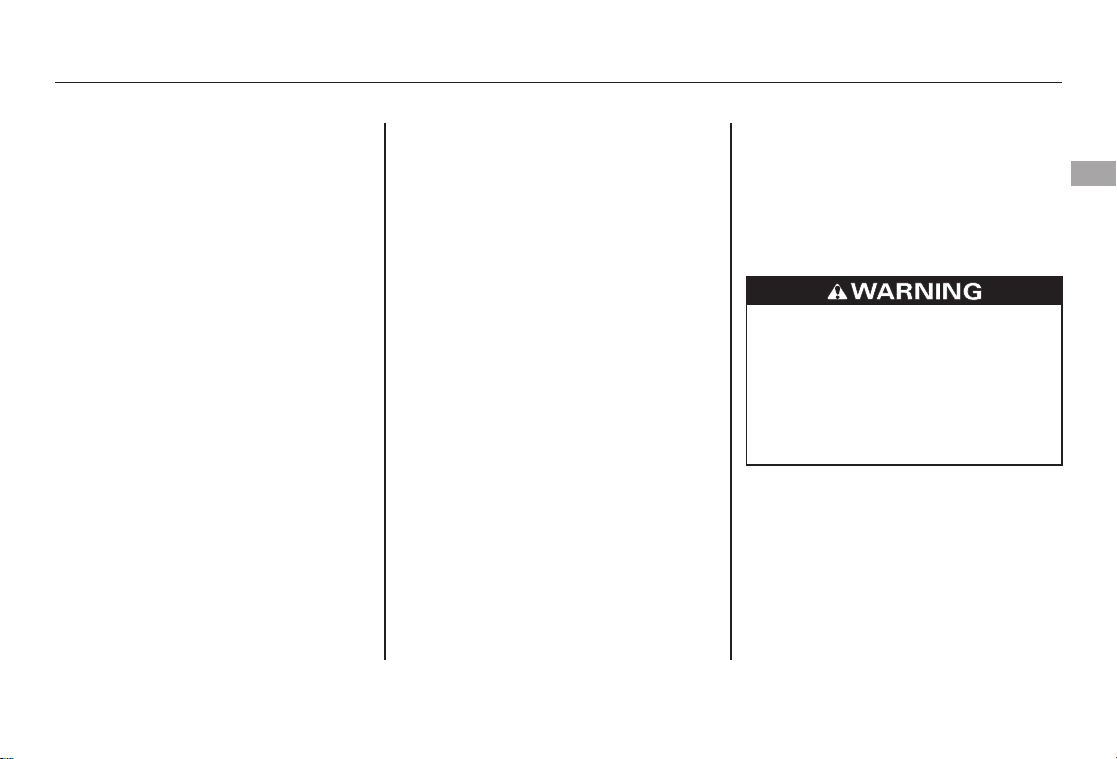
Never place the shoulder portion of a
lap/shoulder belt under your arm or
behind your back.
This could cause
very serious injuries in a crash.
If a seat belt does not seem to work
properly, it may not protect the
occupant in a crash.
No one should sit in a seat wi th an
inoperative seat belt.
Using a seat
belt that is not working properly can
result in serious injury or death.
Have your dealer check the belt as
soon as possible.
See page 18 for additional
information about your seat belts and
how to take care of them.
6. Maintain a Proper Sitting
Position
After all occupants have adjusted
their seats and head restraints, and
put on their seat belts, it is very
important that they continue to sit
upright, well back in their seats, with
their feet on the floor, until the
vehicle is safely parked and the
engine is off.
Sitting improperly can increase the
chance of injury during a crash. For
example, if an occupant slouches, lies
down, turns sideways, sits forward,
leans forward or sideways, or puts
one or both feet up, the chance of
injury during a crash is greatly
increased.
In addition, an occupant who is out of
position in the front seat can be
seriously or fatally injured in a crash
by striking interior parts of the
vehicle or being struck by an
inflating front airbag.
Sitting improperly or out of
position can result in serious
injury or death in a crash.
Always sit upright, well back in
the seat, with your feet on the
floor.
Protecting Adults and Teens
15
Driver and Passenger Safety
10/08/06 08:34:41 11 ELEMENT MMC North America Owner's Man 50 31SCV680 enu
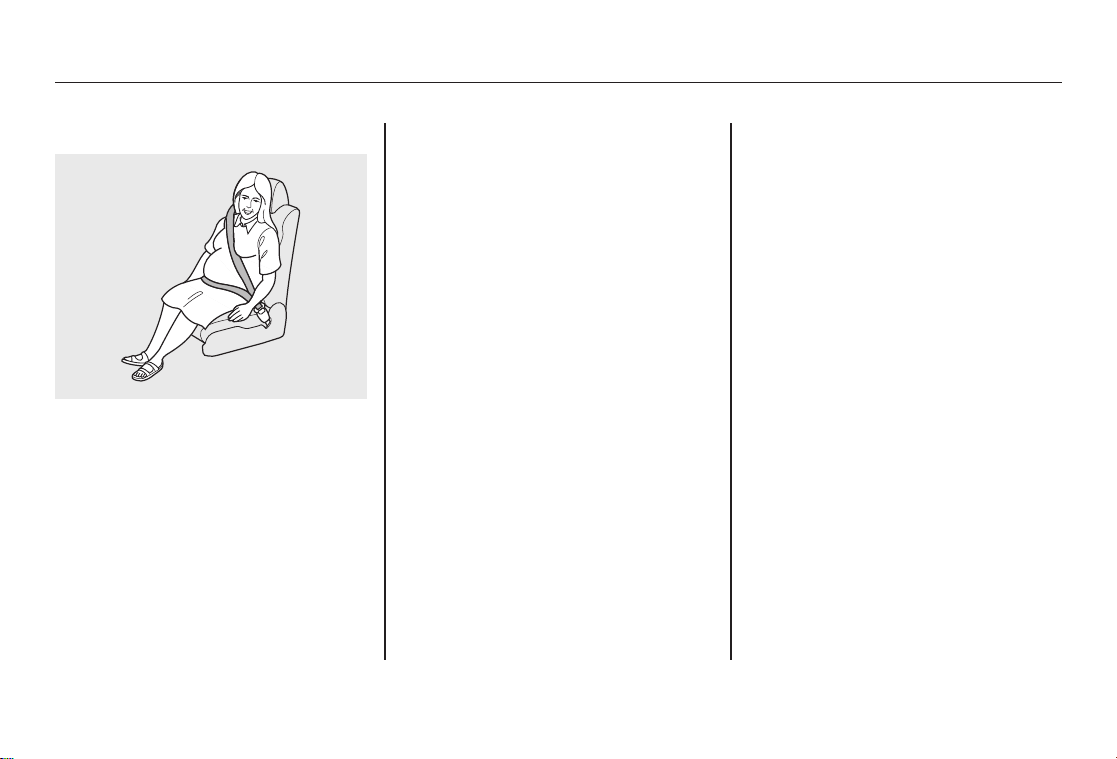
Advice for Pregnant Women
If you are pregnant, the best way to
protect yourself and your unborn
child when driving or riding in a
vehicle is to always wear a seat belt,
and keep the lap part of the belt as
low as possible across the hips.
When driving, remember to sit
upright and adjust the seat as far
back as possible while allowing full
control of the vehicle. When riding
as a front passenger, adjust the seat
as far back as possible.
This will reduce the risk of injuries to
both you and your unborn child that
can be caused by a crash or an
inflating front airbag.
Each time you have a checkup, ask
your doctor if it's okay for you to
drive.
Additional Safety Precautions
●
Never let passengers ride in the
cargo area or on top of a folded-
down back seat.
If they do, they
could be very seriously injured in a
crash.
●
Passengers should not stand up or
change seats while the vehicle is
moving.
A passenger who is not
wearing a seat belt during a crash
or emergency stop can be thrown
against the inside of the vehicle,
against other occupants, or out of
the vehicle.
●
Two people should never use the
same seat belt.
If they do, they
could be very seriously injured in a
crash.
Protecting Adults and Teens
16
10/08/06 08:34:41 11 ELEMENT MMC North America Owner's Man 50 31SCV680 enu

●
Do not put any accessories on seat
belts.
Devices intended to improve
occupant comfort or reposition the
shoulder part of a seat belt can
reduce the protective capability of
the belt and increase the chance of
serious injury in a crash.
●
Do not place hard or sharp objects
between yourself and a front
airbag.
Carrying hard or sharp
objects on your lap, or driving with
a pipe or other sharp object in your
mouth, can result in injuries if your
front airbag inflates.
●
Do not attach or place objects on
the front airbag covers.
Objects on
the covers marked ‘‘SRS AIRBAG’’
could interfere with the proper
operation of the airbags or be
propelled inside the vehicle and
hurt someone if the airbags inflate.
●
Do not attach hard objects on or
near a door.
If a side airbag or a
side curtain airbag inflates, a cup
holder or other hard object
attached on or near the door could
be propelled inside the vehicle and
hurt someone.
●
Keep your hands and arms away
from the airbag covers.
If your
hands or arms are close to an
airbag cover, they could be injured
if the front airbag inflates.
●
Do not cover or replace front seat-
back covers without consulting
your dealer.
Improperly replacing
or covering front seat-back covers
can prevent your side airbags from
inflating during a side impact.
Protecting Adults and Teens
17
Driver and Passenger Safety
10/08/06 08:34:41 11 ELEMENT MMC North America Owner's Man 50 31SCV680 enu
Seat Belt System Components
Your seat belt system includes lap/
shoulder belts in all four seating
positions. The front seat belts are
also equipped with automatic seat
belt tensioners.
The seat belt system
includes an indicator on the
instrument panel and a beeper to
remind you and your passengers to
fasten your seat belts.
This system monitors the front seat
belts. If you turn the ignition switch
to the ON (II) position before your
seat belt is fastened, the beeper will
sound and the indicator will flash. If
your seat belt is not fastened before
the beeper stops, the indicator will
stop flashing but remain on.
If a front passenger does not fasten
their seat belt, the indicator will
come on about 6 seconds after the
ignition switch is turned to the ON
(II) position.
If either the driver or a front
passenger does not fasten their seat
belt while driving, the beeper will
sound and the indicator will flash
again at regular intervals.
When no one is sitting in the front
passenger's seat, or a child or small
adult is riding there, the indicator
should not come on and the beeper
should not sound.
If the indicator comes on or the
beeper sounds when the driver's seat
belt is latched and there is no front
seat passenger and no items on the
front seat, something may be
interfering with the monitoring
system. Look for and remove:
●
Any items under the front
passenger's seat.
●
Any object(s) hanging on the seat
or in the seat-back pocket.
●
Any object(s) touching the rear of
the seat-back.
If no obstructions are found, have
your vehicle checked by a dealer.
Additional Information About Your Seat Belts
18
10/08/06 08:34:41 11 ELEMENT MMC North America Owner's Man 50 31SCV680 enu

Lap/Shoulder Belt
The lap/shoulder belt goes over your
shoulder, across your chest, and
across your hips.
To fasten the belt, insert the latch
plate into the buckle, then tug on the
belt to make sure the buckle is
latched (see page 14 for how to
properly position the belt).
To unlock the belt, press the red
PRESS button on the buckle. Guide
the belt across your body so that it
retracts completely. After exiting the
vehicle, be sure the belt is out of the
way and will not get closed in the
door.
All seat belts have an emergency
locking retractor. In normal driving,
the retractor lets you move freely in
your seat while it keeps some tension
on the belt. During a collision or
sudden stop, the retractor
automatically locks the belt to help
restrain your body.
The seat belts in all positions except
the driver's have a lockable retractor
that must be activated to secure a
child seat (see page 46).
If the shoulder part of the belt is
pulled all the way out, the lockable
retractor will activate. The belt will
retract, but it will not allow the
passenger to move freely.
To deactivate the lockable retractor,
unlatch the buckle and let the seat
belt fully retract. To refasten the seat
belt, pull it out only as far as needed.
Additional Information About Your Seat Belts
19
Driver and Passenger Safety
10/08/06 08:34:41 11 ELEMENT MMC North America Owner's Man 50 31SCV680 enu
Automatic Seat Belt Tensioners
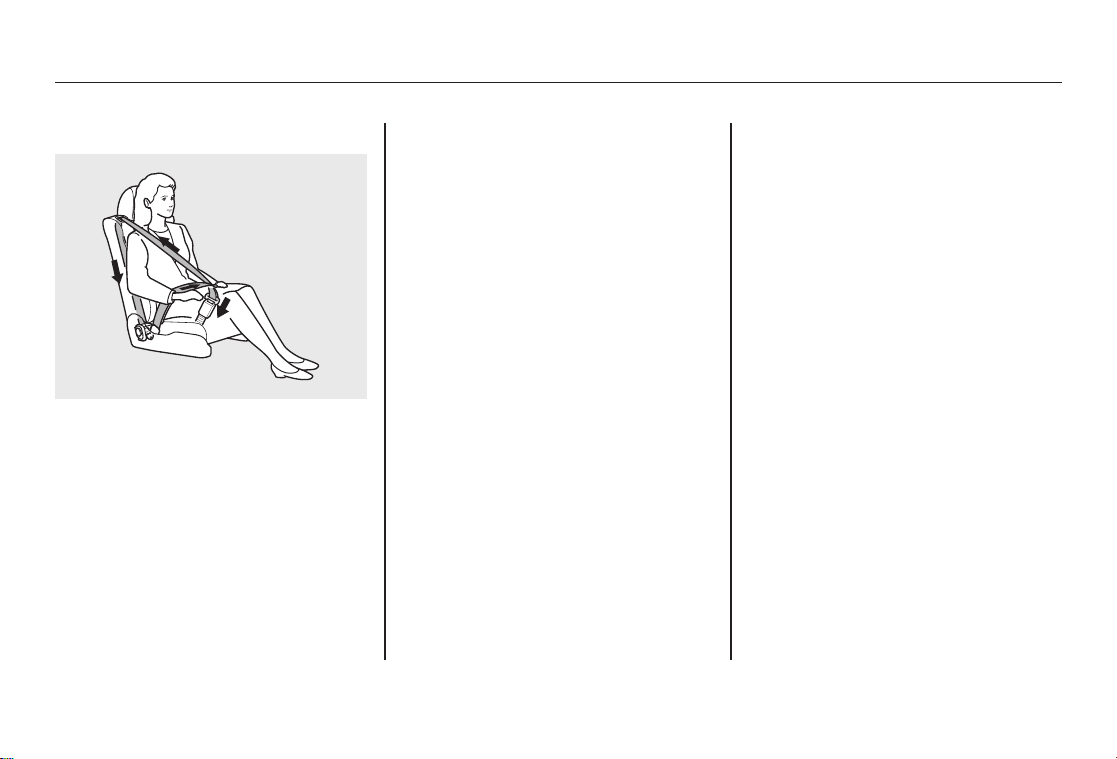
For added protection, the front seat
belts are equipped with automatic
seat belt tensioners. When activated,
the tensioners immediately tighten
the belts to help hold the driver and a
front passenger in position.
The tensioners can be activated
during a collision in which the front
airbags
do not deploy.
In this case, the
airbags would not be needed, but the
additional restraint could be helpful.
If the tensioner is activated, the SRS
indicator comes on and the tensioner
must be replaced.
Seat Belt Maintenance
For safety, you should check the
condition of your seat belts regularly.
Pull each belt out fully, and look for
frays, cuts, burns, and wear. Check
that the latches work smoothly and
the belts retract easily. If a belt does
not retract easily, cleaning the belt
may correct the problem (see page
209). Any belt that is not in good
condition or working properly will
not provide good protection and
should be replaced as soon as
possible.
Honda provides a limited warranty
on seat belts. See your
Honda
Warranty Information
booklet for
details.
Additional Information About Your Seat Belts
20
10/08/06 08:34:41 11 ELEMENT MMC North America Owner's Man 50 31SCV680 enu
If a seat belt is worn during a crash,
it must be replaced by your dealer. A
belt that has been worn during a
crash may not provide the same level
of protection in a subsequent crash.
The dealer should also inspect the
anchors for damage and replace
them if needed. If the automatic seat
belt tensioners activate during a
crash, they must be replaced.
Not checking or maintaining
seat belts can result in serious
injury or death if the seat belts
do not work properly when
needed.
Check your seat belts regularly
and have any problem
corrected as soon as possible.
Additional Information About Your Seat Belts
21
Driver and Passenger Safety
10/08/06 08:34:41 11 ELEMENT MMC North America Owner's Man 50 31SCV680 enu
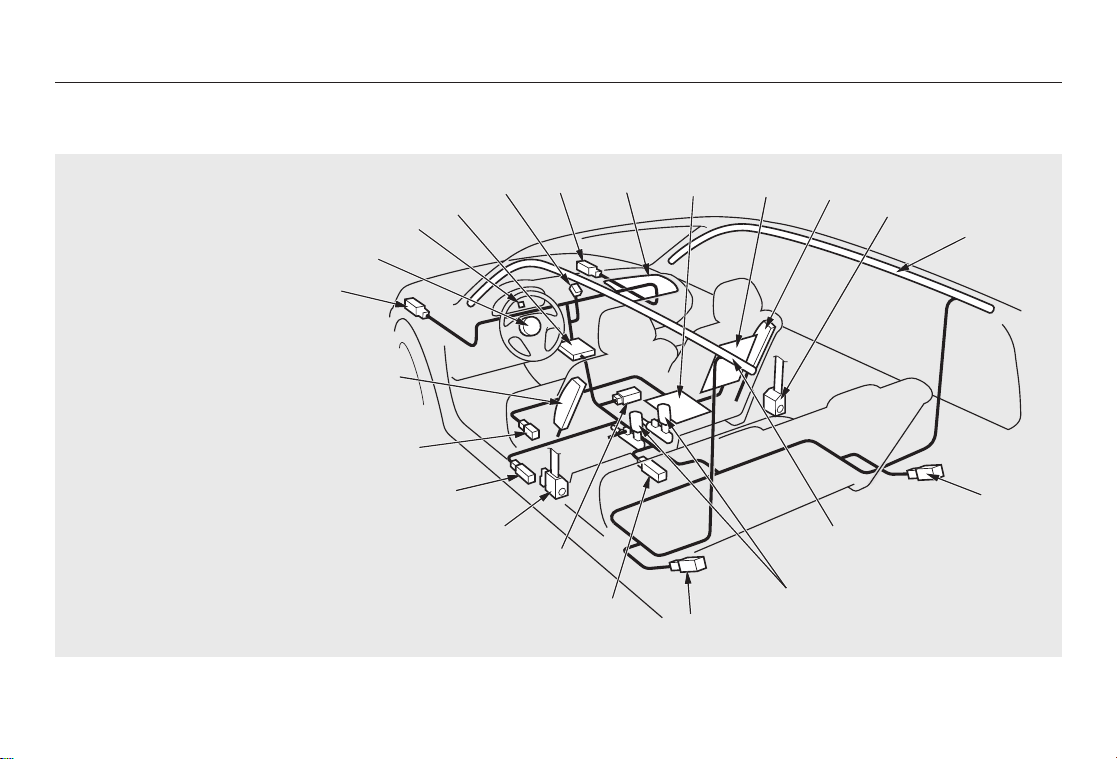
Airbag System Components
(12)
(1)
(3)
(5)
(6)
(10)
(4)
(14)
(15)
(7)
(4)
(5)
(11)
(13)
(2)
(9)
(8)
(1) Driver's Front Airbag
(2) Passenger's Front Airbag
(3) Control Unit
(4) Front Seat Belt Tensioners
(5) Side Airbags
(6) Driver's Seat Position Sensor
(7) Front Passenger's Weight Sensors
(8) Front Impact Sensors
(9) Passenger Airbag Off Indicator
(10) Side Impact Sensors (First)
(11) Occupant Position Detection System (OPDS) Sensors
(12) Side Impact Sensors (Second)
(13) Side Curtain Airbags
(14) Supplemental Restraint System (SRS) Indicator
(15) Rear Safing Sensor
(16) Rollover Sensor
(13)
(8)
(12)
(16)
(4)
Additional Information About Your Airbags
22
10/08/06 08:34:41 11 ELEMENT MMC North America Owner's Man 50 31SCV680 enu

Your airbag system includes:
●
Two SRS (supplemental restraint
system) front airbags. The driver's
airbag is stored in the center of the
steering wheel; the front
passenger's airbag is stored in the
dashboard. Both are marked ‘‘SRS
AIRBAG’’ (see page 24).
●
Two side airbags, one for the
driver and one for a front
passenger. The airbags are stored
in the outer edges of the seat-
backs. Both are marked ‘‘SIDE
AIRBAG’’ (see page 28).
●
Two side curtain airbags, one for
each side of the vehicle. The
airbags are stored in the ceiling,
above the side windows. The front
and rear pillars are marked ‘‘SIDE
CURTAIN AIRBAG’’ (see page 29).
●
Automatic front seat belt
tensioners (see page 20).
●
Sensors that can detect a moderate
to severe front impact, side impact,
or rollover.
●
Sensors that can detect whether a
child is in the passenger's side
airbag path and signal the control
unit to turn the airbag off (see
page 29).
●
Sensors that can detect whether
the driver's seat belt and the front
passenger's seat belt are latched or
unlatched (see page 18).
●
A rollover sensor that can detect if
your vehicle is about to roll over
and signal the control unit to
deploy both side curtain airbags
(see page 29).
●
A driver's seat position sensor that
monitors the distance of the seat
from the front airbag. If the seat is
too far forward, the airbag will
inflate with less force (see page
26).
●
Weight sensors that monitor the
weight on the front passenger's
seat. If the weight is about 65 lbs
(29 kg) or less (the weight of an
infant or small child), the
passenger's front airbag will be
turned off (see page 26).
●
A sophisticated electronic system
that continually monitors and
records information about the
sensors, the control unit, the
airbag activators, the seat belt
tensioners, and driver and front
passenger seat belt use when the
ignition switch is in the ON (II)
position.
CONTINUED
Additional Information About Your Airbags
23
Driver and Passenger Safety
10/08/06 08:34:41 11 ELEMENT MMC North America Owner's Man 50 31SCV680 enu
●
An indicator on the instrument
panel that alerts you to a possible
problem with your airbag system
components (see page 30).
●
An indicator on the instrument
panel that alerts you that the
passenger's side airbag has been
turned off (see page 31).
●
An indicator on the dashboard that
alerts you that the passenger's
front airbag has been turned off
(see page 32).
●
Emergency backup power in case
your vehicle's electrical system is
disconnected in a crash.
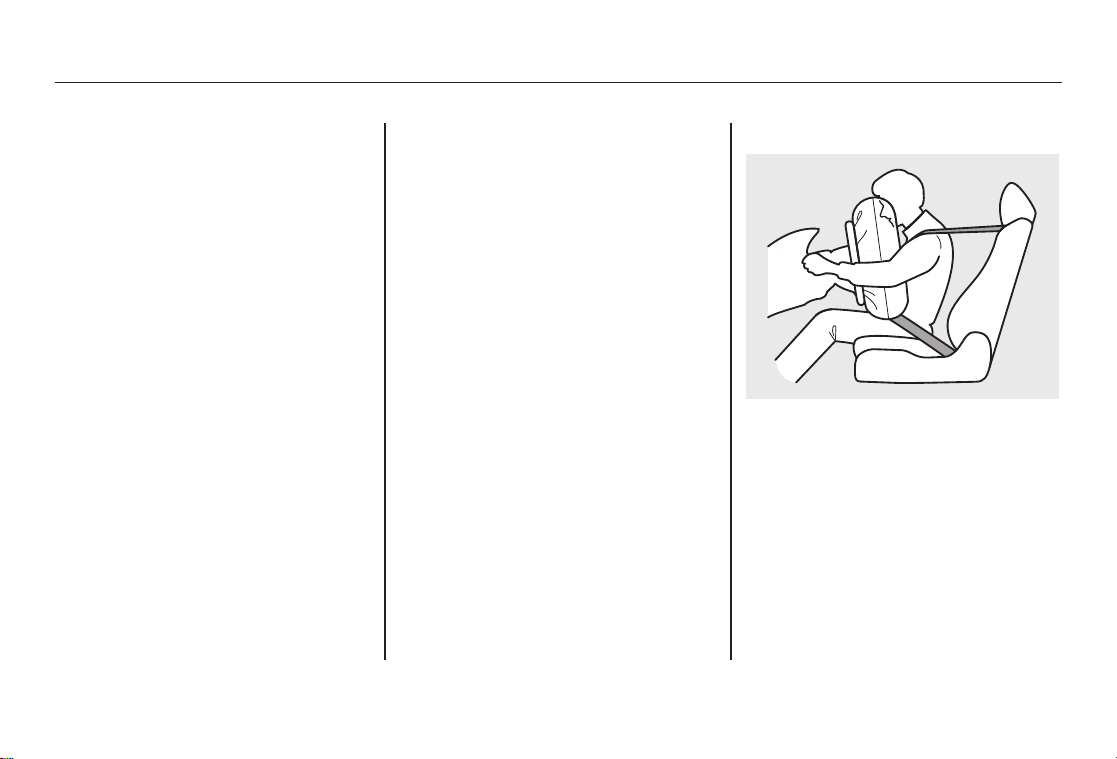
How Your Front Airbags Work
If you ever have a moderate to severe
frontal collision, sensors will detect
the vehicle's rapid deceleration.
If the rate of deceleration is high
enough, the control unit will inflate
the driver's and front passenger's
airbags, at the time and with the
force needed.
Additional Information About Your Airbags
24
10/08/06 08:34:41 11 ELEMENT MMC North America Owner's Man 50 31SCV680 enu
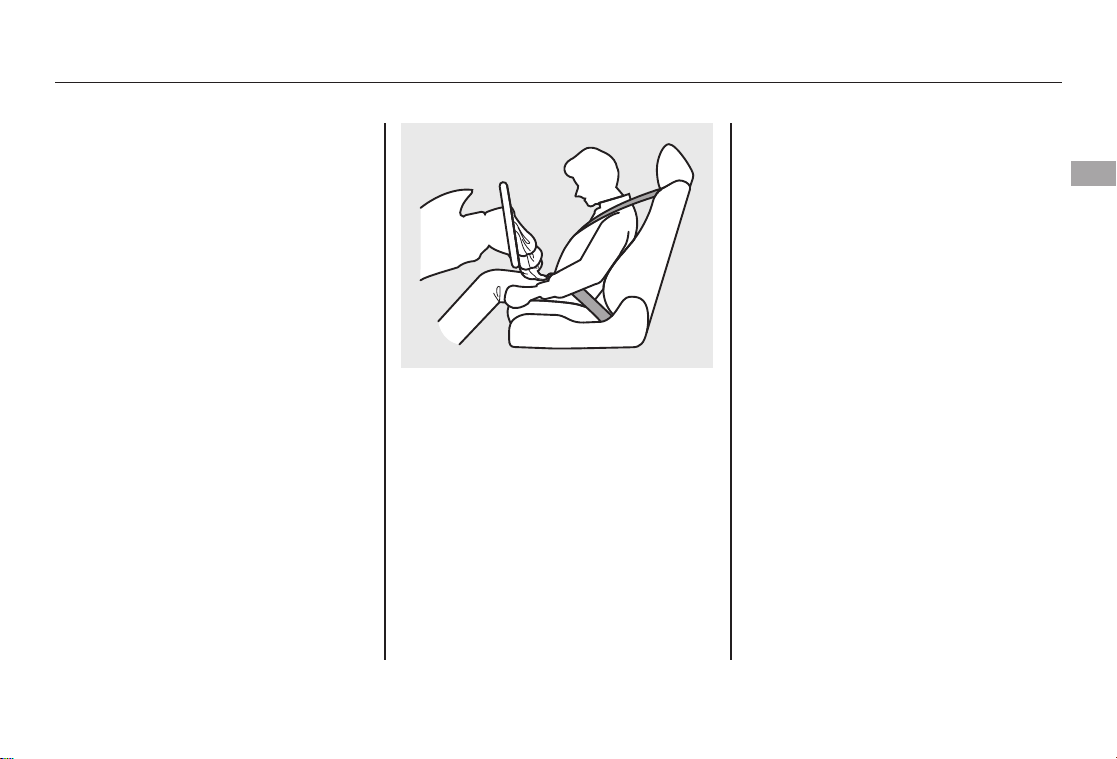
During a frontal crash, your seat belt
restrains your lower body and torso,
and the front airbag helps protect
your head and chest.
Although both airbags normally
inflate within a split second of each
other, it is possible for only one
airbag to deploy.
This can happen if the severity of a
collision is at the margin, or
threshold, that determines whether
or not the airbags will deploy. In
such cases, the seat belt will provide
sufficient protection, and the
supplemental protection offered by
the airbag would be minimal.
Only the driver's airbag can deploy if
there is no passenger in the front
seat, or if the advanced airbag
system has turned the passenger's
airbag off (see page 26).
After inflating, the front airbags
immediately deflate, so they won't
interfere with the driver's visibility,
or the ability to steer or operate other
controls.
The total time for inflation and
deflation is one-tenth of a second, so
fast that most occupants are not
aware that the airbags deployed until
they see them lying in their laps.
After a crash, you may see what
looks like smoke. This is actually
powder from the airbag's surface.
Although the powder is not harmful,
people with respiratory problems
may experience some temporary
discomfort. If this occurs, get out of
the vehicle as soon as it is safe to do
so.
CONTINUED
Additional Information About Your Airbags
25
Driver and Passenger Safety
10/08/06 08:34:41 11 ELEMENT MMC North America Owner's Man 50 31SCV680 enu

Dual-Stage, Multiple-Threshol d Front
Airbags (SRS)
Your vehicle is equipped with dual-
stage, multiple-threshold front
airbags (SRS). During a frontal crash
severe enough to cause one or both
front airbags to deploy, the airbags
can inflate at different rates,
depending on the severity of the
crash, whether or not the seat belts
are latched, and / or other factors.
Front airbags are designed to
supplement the seat belts to help
reduce the likelihood of head and
chest injuries in frontal crashes.
Advanced Airbags
Your front airbags are also advanced
airbags. The main purpose of this
feature is to help prevent airbag-
caused injuries to short drivers and
children or small statured adults who
ride in front.
For both advanced airbags to work
properly:
●
Occupants must sit upright and
wear their seat belts properly.
●
Do not spill any liquids on or
under the seats, cover the sensors,
or put any objects or metal items
under the front seats.
●
Objects placed or pushed under
the front passenger's seat may
cause the sensor to malfunction,
increasing the risk of injury in a
crash.
Failure to follow these instructions
could damage the sensors or prevent
them from working properly.
Additional Information About Your Airbags
26
10/08/06 08:34:41 11 ELEMENT MMC North America Owner's Man 50 31SCV680 enu
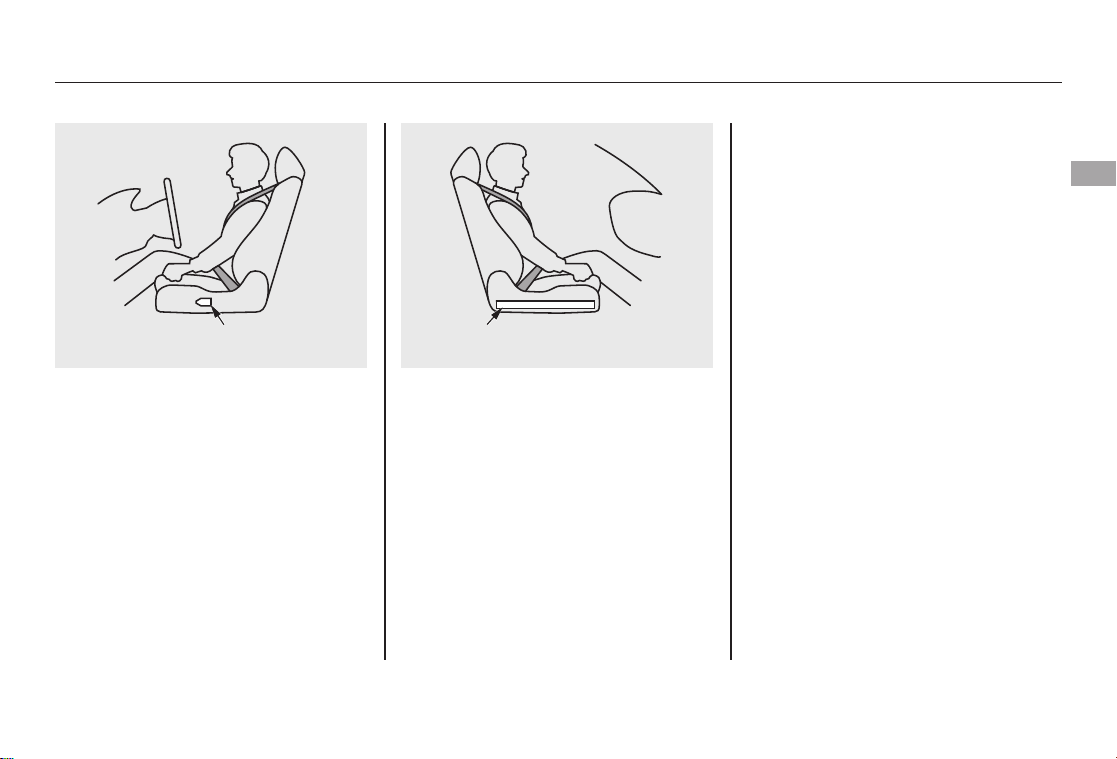
The driver's advanced front airbag
system includes a seat position
sensor under the seat. If the seat is
too far forward, the airbag will inflate
with less force, regardless of the
severity of the impact.
If there is a problem with the sensor,
the SRS indicator will come on, and
the airbag will inflate in the normal
manner regardless of the driver's
seating position.
The passenger's advanced front
airbag system has weight sensors
under the seat. Although Honda does
not encourage carrying an infant or
small child in front, if the sensors
detect the weight of an infant or
small child (up to about 65 lbs or 29
kg), the system will automatically
turn the passenger's front airbag off.
Be aware that objects placed on the
passenger's seat can also cause the
airbag to be turned off.
When the passenger airbag gets
turned off by the weight sensors, a
‘‘passenger airbag off’’ indicator in
the center of the dashboard comes
on (see page 32).
If the weight sensors detect there is
no passenger in the front seat, the
airbag is automatically turned off.
However, the passenger airbag off in
this situation indicator will not come
on.
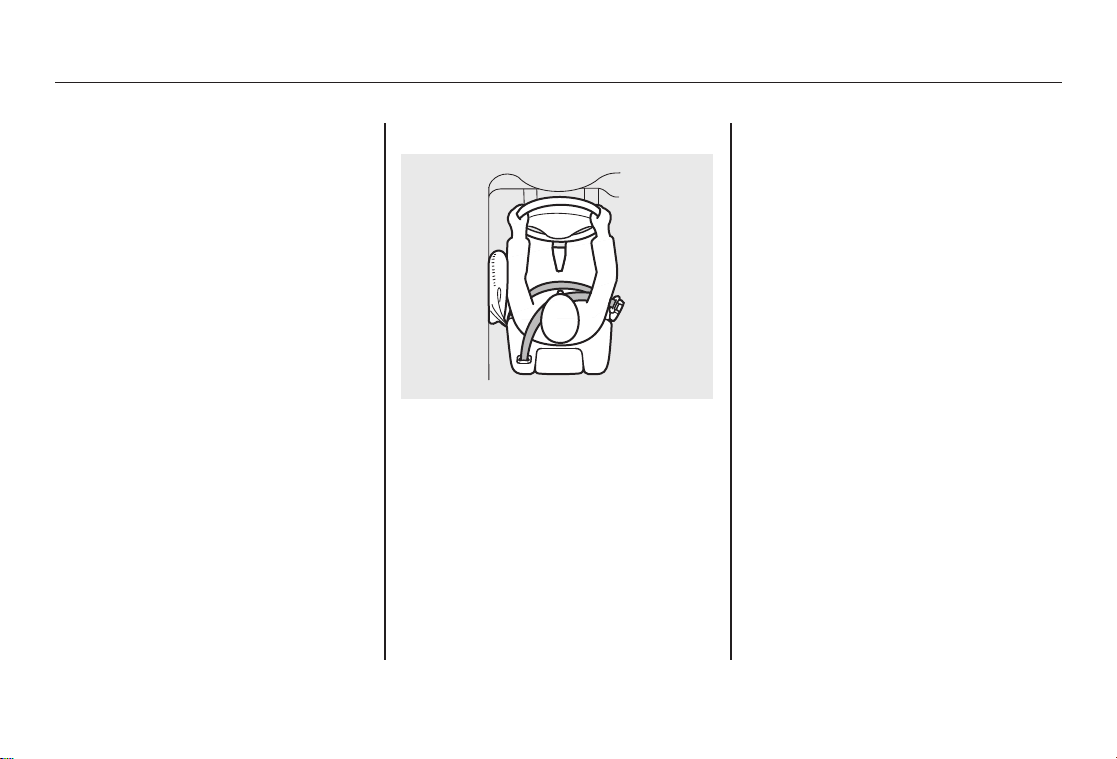
To ensure that the passenger's
advanced front airbag system will
work properly,
do not do anything
that would increase or decrease the
weight on the front passenger's seat.
This includes:
●
A rear passenger pushing or
pulling on the back of the front
passenger's seat.
DRIVER'S SEAT
POSITION SENSOR
PASSENGER'S SEAT
WEIGHT SENSOR
CONTINUED
Additional Information About Your Airbags
27
Driver and Passenger Safety
10/08/06 08:34:41 11 ELEMENT MMC North America Owner's Man 50 31SCV680 enu
●
Moving the front seat forcibly back
against cargo on the seat or floor
behind it.
●
Hanging heavy items on the front
passenger seat, or placing heavy
items in the seat-back pocket.
●
Moving the front seat or seat-back
forcibly back against the folded
rear seat.
●
Back seat passengers should not
wedge objects or intentionally
force their feet under front
passenger seat.
If your vehicle has optional floor
mats, make sure the mat behind the
front passenger's seat is hooked to
the floor mat anchor (see page 209).
If it is not, the mat may interfere with
the proper operation of the sensors
and operation of the seat.
How Your Side Airbags Work
If you ever have a moderate to severe
side impact, sensors will detect rapid
acceleration and signal the control
unit to instantly inflate either the
driver's or the passenger's side
airbag.
Only one airbag will deploy during a
side impact. If the impact is on the
passenger's side, the passenger's
side airbag will deploy even if there
is no passenger.
To get the best protection from the
side airbags, front seat occupants
should wear their seat belts and sit
upright and well back in their seats.
Additional Information About Your Airbags
28
10/08/06 08:34:41 11 ELEMENT MMC North America Owner's Man 50 31SCV680 enu
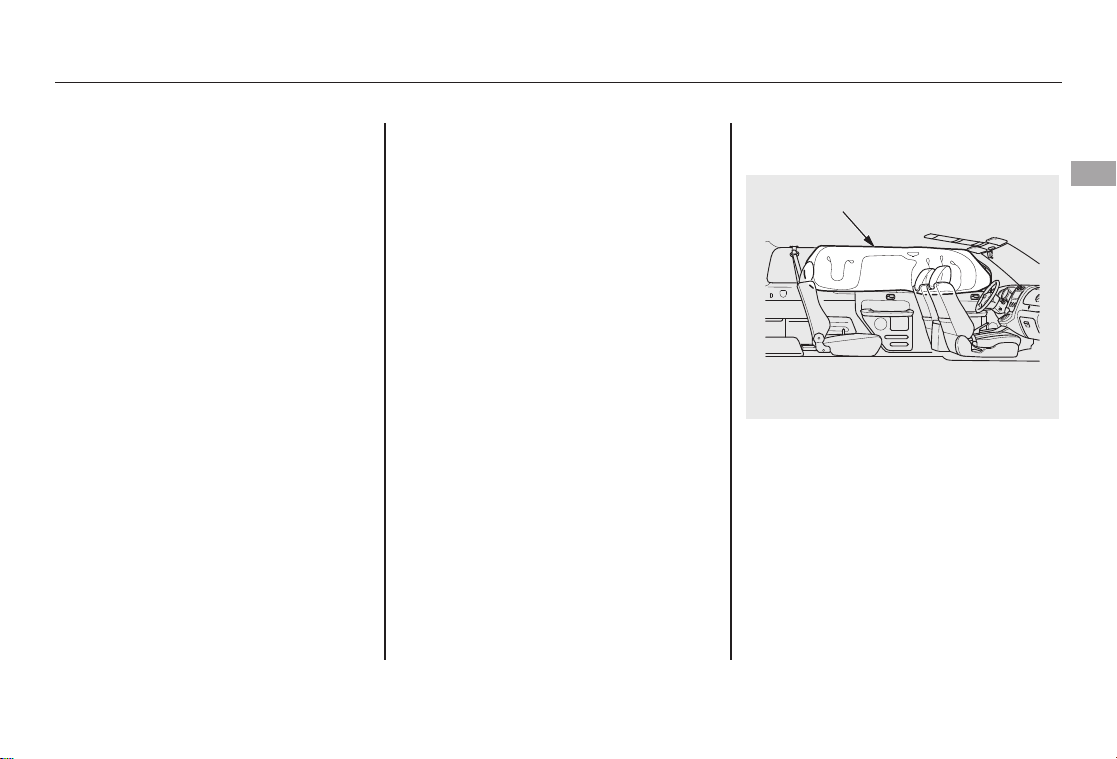
Side Airbag Cutoff System
Your vehicle has a side airbag cutoff
system designed primarily to protect
a child riding in the front passenger's
seat.
Although Honda does not encourage
children to ride in front, if the
position sensors detect a child has
leaned into the side airbag's
deployment path, the airbag will shut
off.
The side airbag may also shut off if a
short adult leans sideways, or a
larger adult slouches and leans
sideways into the airbag's
deployment path.
Objects placed on the front
passenger seat can also cause the
side airbag to be shut off.
If the side airbag off indicator comes
on (see page 31), have the passenger
sit upright. Once the passenger is
out of the airbag's deployment path,
the system will turn the airbag back
on, and the indicator will go out.
There will be some delay between
the moment the passenger moves
into or out of the airbag deployment
path and when the indicator comes
on or goes off.
A front seat passenger should not
use a cushion or another object as a
backrest. It may prevent the cutoff
system from working properly.
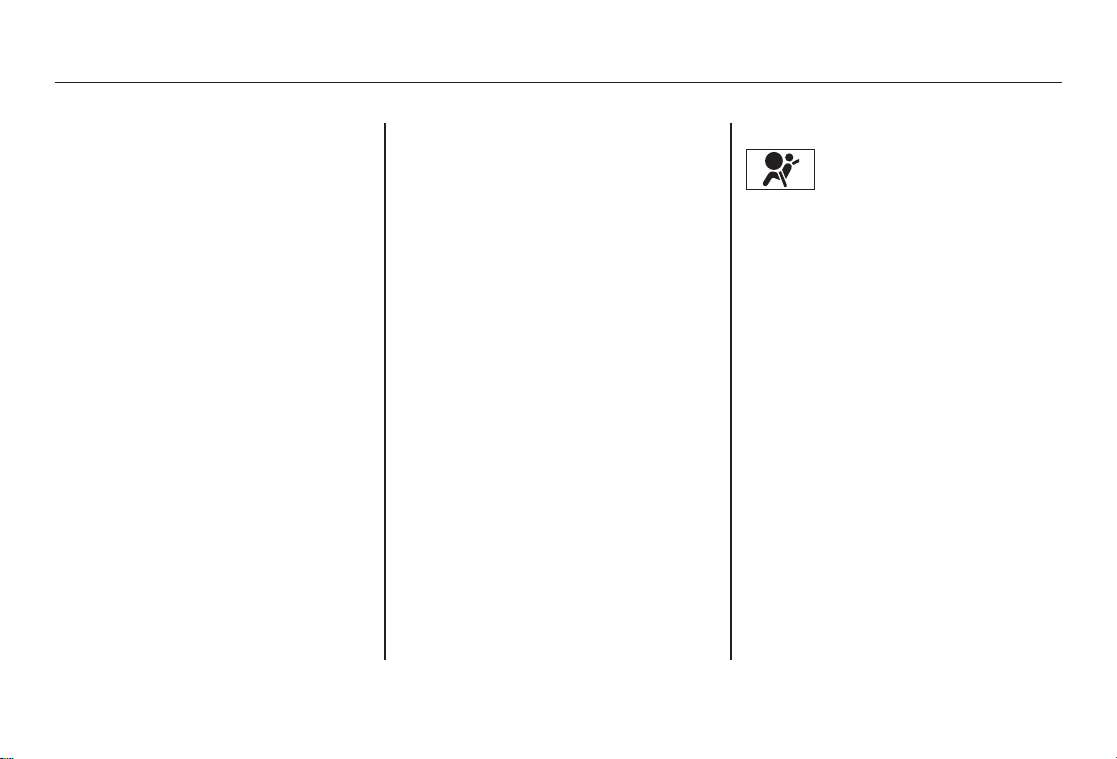
How Your Side Curtain Airbags
Work
In a Side Impact
In a moderate to severe side impact,
sensors will detect rapid acceleration
and signal the control unit to
instantly inflate the side curtain
airbag.
SIDE CURTAIN AIRBAG
CONTINUED
Additional Information About Your Airbags
29
Driver and Passenger Safety
10/08/06 08:34:41 11 ELEMENT MMC North America Owner's Man 50 31SCV680 enu
If the impact is on the passenger's
side, the passenger's side curtain
airbag will inflate even if there are no
occupants on that side of the vehicle.
In a Rollover
If the rollover sensor detects your
vehicle is about to roll over, it signals
the control unit, which immediately
deploys both side curtain airbags and
activates both front seat belt
tensioners.
The airbag on the passenger's side
will deploy, and the seat belt
tensioner will activate, even if there
are no passengers on that side of the
vehicle.
To get the best protection from the
side curtain airbags, occupants
should wear their seat belts and sit
upright and well back in their seats.
How the SRS Indicator Works
The SRS indicator alerts
you to a potential problem
with your airbag system components.
When you turn the ignition switch to
the ON (II) position, this indicator
comes on briefly then goes off. This
tells you the system is working
properly.
Additional Information About Your Airbags
30
10/08/06 08:34:41 11 ELEMENT MMC North America Owner's Man 50 31SCV680 enu
If the indicator comes on at any other
time, or does not come on at all, you
should have the system checked by
your dealer. For example:
●
If the SRS indicator does not come
on after you turn the ignition
switch to the ON (II) position.
●
If the indicator stays on after the
engine starts.
●
If the indicator comes on or flashes
on and off while you drive.
If you see any of these indications,
the airbag system components may
not work properly when you need
them.
Ignoring the SRS indicator can
result in serious injury or death
if the airbag systems or
tensioners do not work
properly.
Have your vehicle checked by a
dealer as soon as possible if
the SRS indicator alerts you to
a possible problem.
How the Side Airbag Off Indicator
Works
This indicator alerts you that the
passenger's side airbag has been
automatically shut off. It does
not
mean there is a problem with your
side airbags.
When you turn the ignition switch to
the ON (II) position, the indicator
should come on briefly and then go
off (see page 59). If it doesn't come
on, stays on, or comes on while
driving without a passenger in the
front seat, have the system checked.
Additional Information About Your Airbags
31
Driver and Passenger Safety
10/08/06 08:34:41 11 ELEMENT MMC North America Owner's Man 50 31SCV680 enu
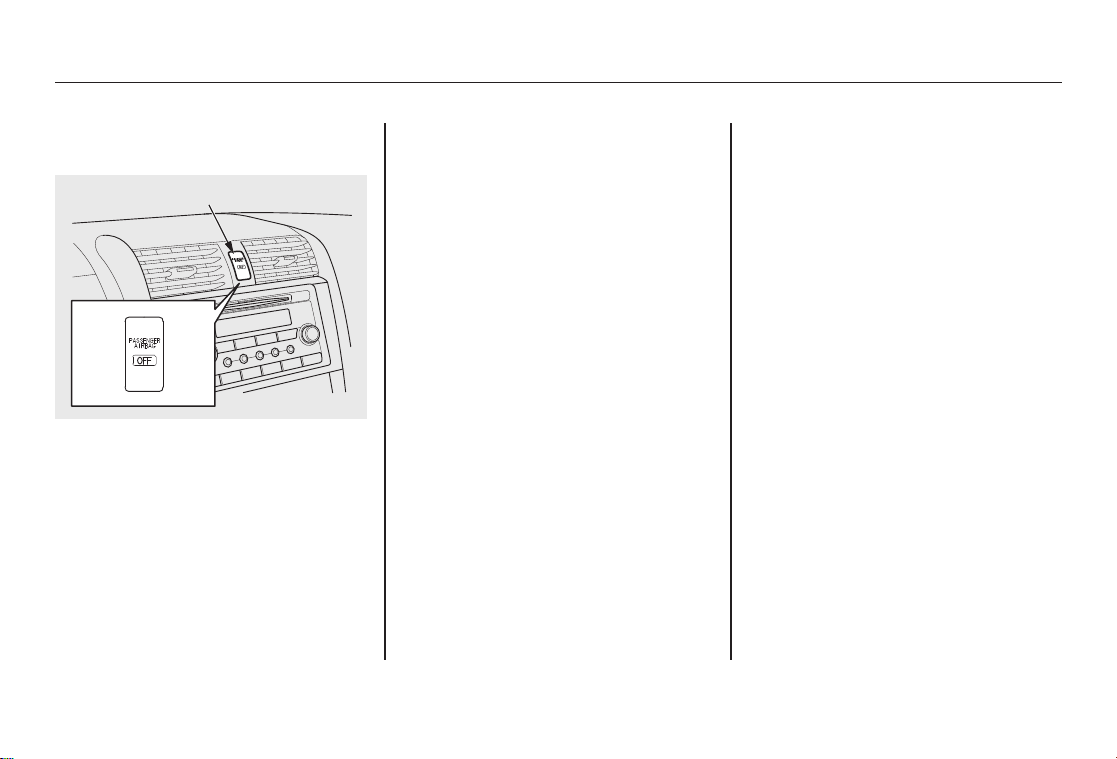
How the Passenger Airbag Off
Indicator Works
This indicator alerts you that the
passenger's front airbag has been
shut off because weight sensors
detect about 65 lbs (29 kg) or less
(the weight of an infant or small
child) on the front passenger's seat.
It does
not mean
there is a problem
with the airbag.
Be aware that objects placed on the
front seat can cause the indicator to
come on.
If no weight is detected on the front
seat, the airbag will be automatically
shut off. However, the indicator will
not come on.
The passenger airbag off indicator
may come on and off repeatedly if the
total weight on the seat is near the
airbag cutoff threshold.
If an adult or teenage passenger is
riding in front, move the seat as far to
the rear as possible, and have the
passenger sit upright and wear the
seat belt properly.
If the indicator comes on with no
front seat passenger and no objects
on the seat, or with an adult riding
there, something may be interfering
with the weight sensors. Look for
and remove:
●
Any items under the front
passenger's seat.
●
Any object(s) hanging on the seat
or in the seat-back pocket.
●
Any object(s) touching the rear of
the seat-back.
If no obstructions are found, have
your vehicle checked by a dealer as
soon as possible.
PASSENGER AIRBAG OFF INDICATOR
Additional Information About Your Airbags
32
10/08/06 08:34:41 11 ELEMENT MMC North America Owner's Man 50 31SCV680 enu

Airbag Service
Your airbag systems are virtually
maintenance free, and there are no
parts you can safely service.
However, you must have your
vehicle serviced if:
●
An airbag ever inflates.
Any airbag
that has deployed must be
replaced along with the control
unit and other related parts. Any
seat belt tensioner that activates
must also be replaced.
Do not try to remove or replace
any airbag by yourself. This must
be done by an authorized dealer or
a knowledgeable body shop.
●
The SRS indicator alerts you to a
problem.
Take your vehicle to an
authorized dealer as soon as
possible. If you ignore this
indication, your airbags may not
operate properly.
●
If your vehicle has a moderate to
severe impact.
Even if your airbags
do not inflate, your dealer should
inspect the driver's seat position
sensor, the front passenger's
weight sensors, the front seat belt
tensioners, and all seat belts and
their anchors worn during a crash
to make sure they are operating
properly.
Additional Safety Precautions
●
Do not attempt to deactivate your
airbags.
Together, airbags and
seat belts provide the best
protection.
●
Do not tamper with airbag
components or wiring for any
reason.
Tampering could cause
the airbags to deploy, possibly
causing very serious injury.
●
Do not expose the front
passenger's seat-back to liquid.
If
water or another liquid soaks into
the seat-back, it can prevent the
side airbag cutoff system from
working properly.
CONTINUED
Additional Information About Your Airbags
33
Driver and Passenger Safety
10/08/06 08:34:41 11 ELEMENT MMC North America Owner's Man 50 31SCV680 enu

●
Do not remove or modify a front
seat without consulting your
dealer.
This could make the
driver's seat position sensor or the
front passenger's weight sensors
ineffective. If it is necessary to
remove or modify a front seat to
accommodate a person with
disabilities, first contact Honda
Automobile Customer Service at
(800) 999-1009.
Additional Information About Your Airbags
34
10/08/06 08:34:41 11 ELEMENT MMC North America Owner's Man 50 31SCV680 enu
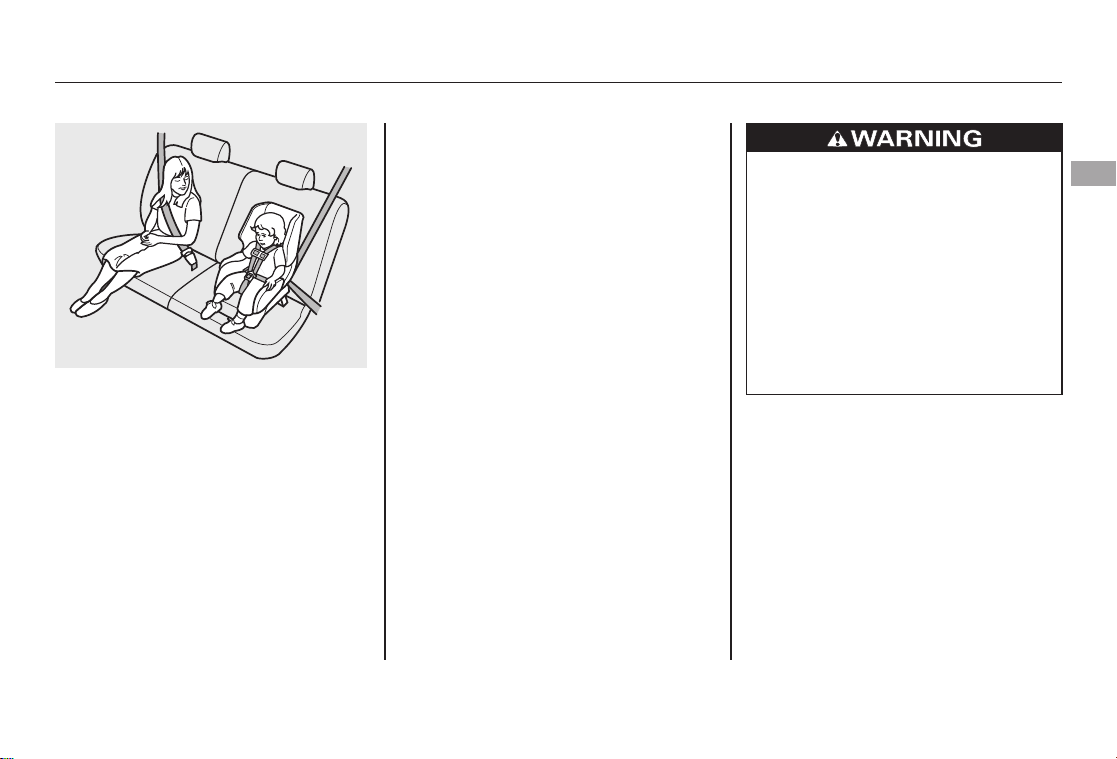
Children depend on adults to protect
them. However, despite their best
intentions, many adults do not know
how to
properly
protect child
passengers.
If you have children, or ever need to
drive with a child in your vehicle, be
sure to read this section. It begins
with important general guidelines,
then presents special information for
infants, small children, and larger
children.
All Children Must Be Restrained
Each year, many children are injured
or killed in vehicle crashes because
they are either unrestrained or not
properly restrained. In fact, traffic
collisions are the number one cause
of death of children age 12 and
under.
To reduce the number of child
deaths and injuries, every state
requires that infants and children be
restrained when they ride in a
vehicle.
Infants and small children must be
restrained in an approved child seat
that is properly secured to the vehicle
(see pages 40 - 48).
Children who are unrestrained
or improperly restrained can be
seriously injured or killed in a
crash.
Any child too small for a seat
belt should be properly
restrained in a child seat. A
larger child should be properly
restrained with a seat belt and
use a booster seat if necessary.
Larger children must be restrained
with a lap/shoulder belt and ride on a
booster seat until the seat belt fits
them properly
(see pages 49 - 51).
Protecting Children - General Guidelines
35
Driver and Passenger Safety
10/08/06 08:34:41 11 ELEMENT MMC North America Owner's Man 50 31SCV680 enu

All Children Should Sit in a Back
Seat
According to crash statistics,
children of all ages and sizes are
safer when they are restrained in a
back seat.
The National Highway Traffic Safety
Administration recommends that all
children aged 12 and under be
properly restrained in a back seat.
Some states have laws restricting
where children may ride.
Children who ride in back are less
likely to be injured by striking
interior vehicle parts during a
collision or hard braking. Also,
children cannot be injured by an
inflating front airbag when they ride
in the back.
The Passenger's Front Airbag Can
Pose Serious Risks
Front airbags have been designed to
help protect adults in a moderate to
severe frontal collision. To do this,
the passenger's front airbag is quite
large, and it can inflate with enough
force to cause very serious injuries.
Even though your vehicle has an
advanced front airbag system that
automatically turns the passenger's
front airbag off under certain
circumstances (see page 32), please
follow these guidelines:
Infants
Never put a rear-facing child seat in
the front seat of a vehicle equipped
with a passenger's front airbag.
If the
airbag inflates, it can hit the back of
the child seat with enough force to
kill or very seriously injure an infant.
Small Children
Placing a forward-facing child seat in
the front seat of a vehicle equipped
with a passenger's front airbag can be
hazardous.
If the vehicle seat is too
far forward, or the child's head is
thrown forward during a collision, an
inflating front airbag can strike the
child with enough force to kill or
very seriously injure a small child.
Larger Children
Children who have outgrown child
seats are also at risk of being injured
or killed by an inflating passenger's
front airbag.
Whenever possible,
larger children should sit in the back
seat, on a booster seat if needed, and
be properly restrained with a seat
belt (see page 49 for important
information about protecting larger
children).
Protecting Children - General Guidelines
36
10/08/06 08:34:41 11 ELEMENT MMC North America Owner's Man 50 31SCV680 enu
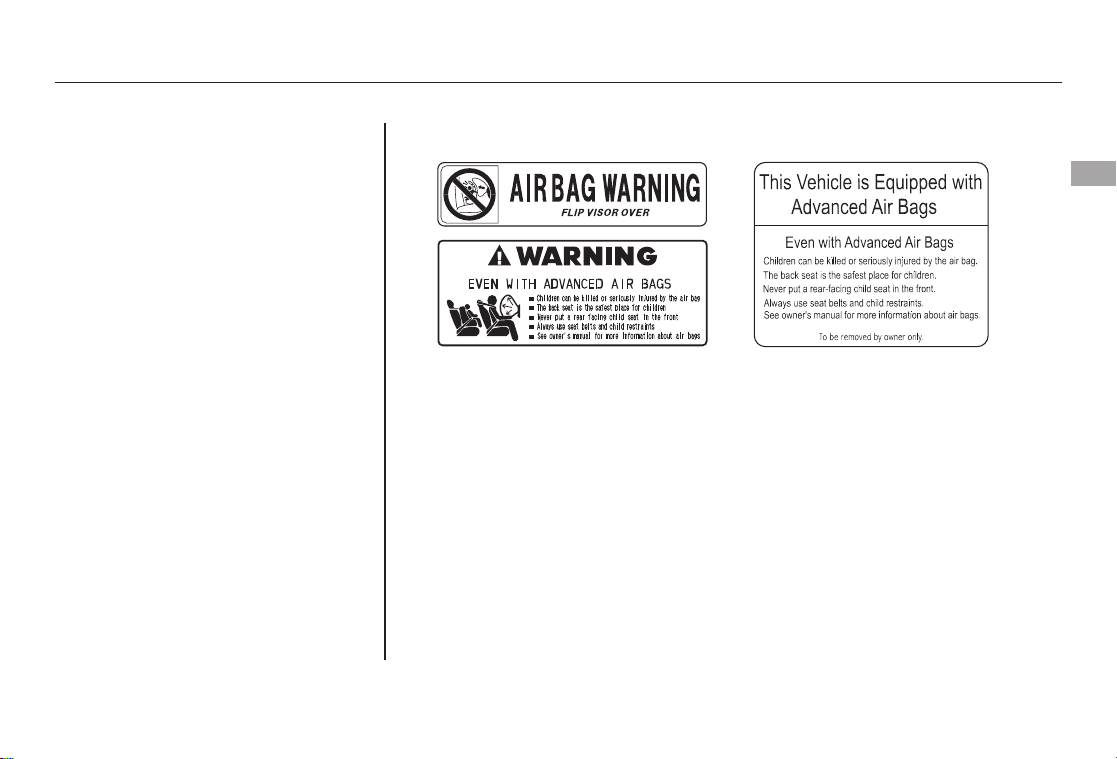
To remind you of the passenger's
front airbag hazards, and that
children must be properly restrained
in a back seat, your vehicle has
warning labels on the dashboard and
on the front visors. Please read and
follow the instructions on these
labels.
DASHBOARD
SUN VISORS
Protecting Children - General Guidelines
37
Driver and Passenger Safety
10/08/06 08:34:41 11 ELEMENT MMC North America Owner's Man 50 31SCV680 enu

If You Must Drive with Several
Children
Your vehicle has two back seats
where children can be properly
restrained. If you ever have to carry a
group of children, and a child must
ride in front:
●
Place the largest child in the front
seat, provided the child is large
enough to wear the lap/shoulder
belt properly (see page 49).
●
Move the vehicle seat as far to the
rear as possible (see page 83).
●
Have the child sit upright and well
back in the seat (see page 15).
●
Make sure the seat belt is properly
positioned and secured (see page
14).
If a Child Requires Close
Attention
Many parents say they prefer to put
an infant or a small child in the front
passenger seat so they can watch the
child, or because the child requires
attention.
Placing a child in the front seat
exposes the child to hazards in a
frontal collision, and paying close
attention to a child distracts the
driver from the important tasks of
driving, placing both of you at risk.
If a child requires physical attention
or frequent visual contact, we
strongly recommend that another
adult ride with the child in the back
seat. The back seat is far safer for a
child than the front.
Protecting Children - General Guidelines
38
10/08/06 08:34:41 11 ELEMENT MMC North America Owner's Man 50 31SCV680 enu

Additional Safety Precautions
●
Never hold an infant or child on
your lap.
If you are not wearing a
seat belt in a crash, you could be
thrown forward and crush the
child against the dashboard or a
seat-back. If you are wearing a seat
belt, the child can be torn from
your arms and be seriously hurt or
killed.
●
Never put a seat belt over yourse lf
and a child.
During a crash, the
belt could press deep into the child
and cause serious or fatal injuries.
●
Never let two children use the
same seat belt.
If they do, they
could be very seriously injured in a
crash.
●
Make sure any unused seat belt
that a child can reach is buckled,
the lockable retractor is activated,
and the belt is fully retracted and
locked.
If a child wraps a loose
seat belt around their neck, they
can be seriously or fatally injured.
(See page 46 for how to activate
and deactivate the lockable
retractor.)
●
Do not leave children alone in a
vehicle.
Leaving children without
adult supervision is illegal in most
states, and can be very hazardous.
For example, infants and small
children left in a vehicle on a hot
day can die from heatstroke. A
child left alone with the key in the
ignition switch can accidentally set
the vehicle in motion, possibly
injuring themselves or others.
●
Lock all doors, the tailgate and the
hatch when your vehicle is not in
use.
Children who play in vehicles
can accidentally get trapped inside.
Teach your children not to play in
or around vehicles.
●
Keep vehicle keys and remote
transmitters out of the reach of
children.
Even very young
children learn how to unlock
vehicle doors, turn on the ignition,
and open the tailgate or hatch,
which can lead to accidental injury
or death.
Protecting Children - General Guidelines
39
Driver and Passenger Safety
10/08/06 08:34:41 11 ELEMENT MMC North America Owner's Man 50 31SCV680 enu
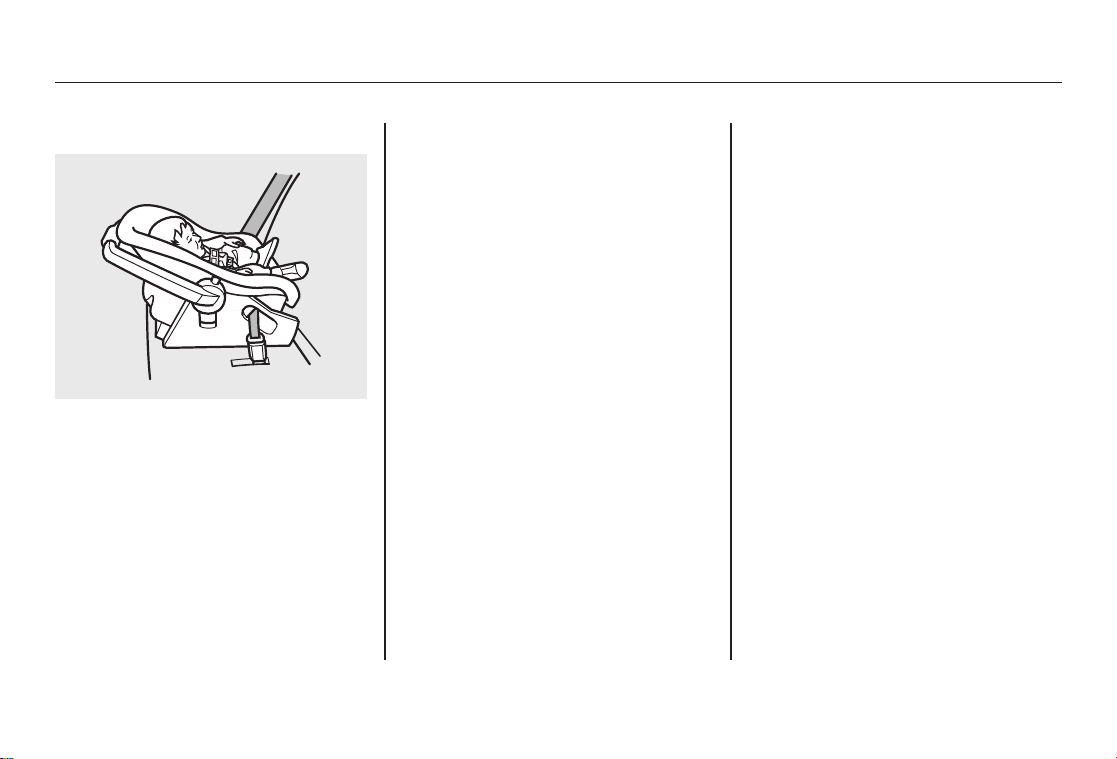
Protecting Infants
Child Seat Type
An infant must be properly restrained
in a rear-facing, reclining child seat
until the child reaches the seat
maker's weight or height limit for the
seat, and the child is at least one year
old.
Only a rear-facing child seat provides
proper support for a baby's head,
neck, and back.
Two types of seats may be used: a
seat designed exclusively for infants,
or a convertible seat used in the rear-
facing, reclining mode.
Do not put a rear-facing child seat in
a forward-facing position.
If placed
facing forward, an infant could be
very seriously injured during a
frontal collision.
Rear-facing Child Seat Placement
A rear-facing child seat can be placed
in any seating position in the back
seat, but not in the front.
Never put a
rear-facing child seat in the front seat.
If the passenger's front airbag
inflates, it can hit the back of the
child seat with enough force to kill or
seriously injure an infant.
When properly installed, a rear-
facing child seat may prevent the
driver or a front passenger from
moving their seat as far back as
recommended, or from locking their
seat-back in the desired position.
It could also interfere with proper
operation of the passenger's
advanced front airbag system.
Protecting Infants and Small Children
40
10/08/06 08:34:41 11 ELEMENT MMC North America Owner's Man 50 31SCV680 enu
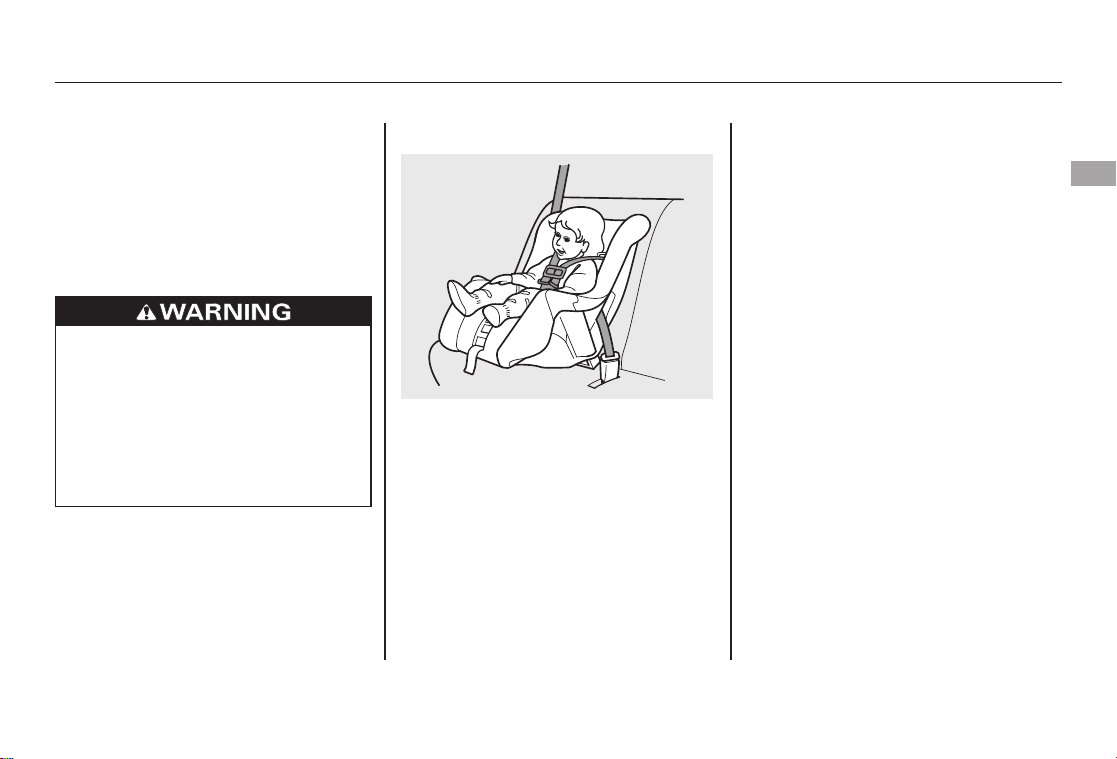
In any of these situations, we
strongly recommend that you install
the child seat directly behind the
front passenger's seat, move the seat
as far forward as needed, and leave it
unoccupied. Or, you may wish to get
a smaller rear-facing child seat.
Placing a rear-facing child seat
in the front seat can result in
serious injury or death during a
crash.
Always place a rear-facing child
seat in the back seat, not the
front.
Protecting Small Children
Child Seat Type
Many states allow a child one year of
age or older who also meets the
minimum size and weight
requirements to transition from a rear-
facing child seat to a forward facing
seat. Know the requirements where
you are driving and follow the child
seat instructions. Many experts
recommend use of a rear-facing seat up
to age two, if the child's height and
weight are appropriate for a rear-facing
seat.
Of the different seats available, we
recommend those that have a five-point
harness system as shown.
We also recommend that a small child
use the child seat until the child
reaches the weight or height limit for
the seat.
Child Seat Placement
We strongly recommend placing a
forward-facing child seat in a back seat,
not the front.
Placing a forward-facing child seat in
the front seat of a vehicle equipped
with a passenger's airbag can be
hazardous.
If the vehicle seat is too far
forward, or the child's head is thrown
forward during a collision, an inflating
airbag can strike the child with enough
force to cause very serious or fatal
injuries.
CONTINUED
Protecting Infants and Small Children
41
Driver and Passenger Safety
10/08/06 08:34:41 11 ELEMENT MMC North America Owner's Man 50 31SCV680 enu
Even with advanced front airbags that
automatically turn the passenger's front
airbag off (see page 32), a back seat is
the safest place for a small child.
If it is necessary to put a forward-facing
child seat in the front, move the vehicle
seat as far to the rear as possible, and
be sure the child seat is firmly secured
to the vehicle and the child is properly
strapped in the seat.
Placing a forward-facing child
seat in the front seat can result in
serious injury or death if the front
airbag inflates.
If you must place a forward-facing
child seat in front, move the
vehicle seat as far back as
possible, and properly restrain
the child.
Selecting a Child Seat
When buying a child seat, you need
to choose either a conventional child
seat, or one designed for use with
the Lower Anchors and Tethers for
CHildren (LATCH) system.
Conventional child seats must be
secured to a vehicle with a seat belt,
whereas LATCH-compatible seats
are secured by attaching the seat to
hardware built into the rear seats.
Since LATCH-compatible child seats
are easier to install and reduce the
possibility of improper installation,
we recommend selecting this style.
In seating positions and vehicles not
equipped with LATCH, a LATCH-
compatible child seat can be installed
using a seat belt.
Whatever type of seat you choose, to
provide proper protection, a child
seat should meet three
requirements:
1.
The child seat should meet Federal
Motor Vehicle Safety Standard
213.
Look for FMVSS 213 on the
box.
2.
The child seat should be of the
proper type and size to fit the child.
Rear-facing for infants, forward-
facing for small children.
Protecting Infants and Small Children, Selecting a Child Seat
42
10/08/06 08:34:41 11 ELEMENT MMC North America Owner's Man 50 31SCV680 enu

3.
The child seat should fit the vehicle
seating position (or positions)
where it will be used.
Before purchasing a conventional
child seat, or using a previously
purchased one, we recommend that
you test the seat in the specific
vehicle seating position or positions
where the seat will be used.
Installing a Child Seat
After selecting a proper child seat
and a good place to install the seat,
there are three main steps in
installing the seat:
1.
Properly secure the child seat to
the vehicle.
All child seats must be
secured to the vehicle with the lap
part of a lap/shoulder belt or with
the LATCH (Lower Anchors and
Tethers for CHildren) system. A
child whose seat is not properly
secured to the vehicle can be
endangered in a crash.
2.
Make sure the child seat is firmly
secured.
After installing a child
seat, push and pull the seat
forward and from side-to-side to
verify that it is secure.
A child seat secured with a seat belt
should be installed as firmly as
possible. However, it does not need
to be ‘‘rock solid.’’ Some side-to-side
movement can be expected and
should not reduce the child seat's
effectiveness.
If the child seat is not secure, try
installing it in a different seating
position, or use a different style of
child seat that can be firmly secured.
3.
Secure the child in the child seat.
Make sure the child is properly
strapped in the child seat
according to the child seat maker's
instructions. A child who is not
properly secured in a child seat
can be seriously injured in a crash.
The following pages provide
guidelines on how to properly install
a child seat. A forward-facing child
seat is used in all examples, but the
instructions are the same for rear-
facing child seats.
Selecting a Child Seat, Installing a Child Seat
43
Driver and Passenger Safety
10/08/06 08:34:41 11 ELEMENT MMC North America Owner's Man 50 31SCV680 enu
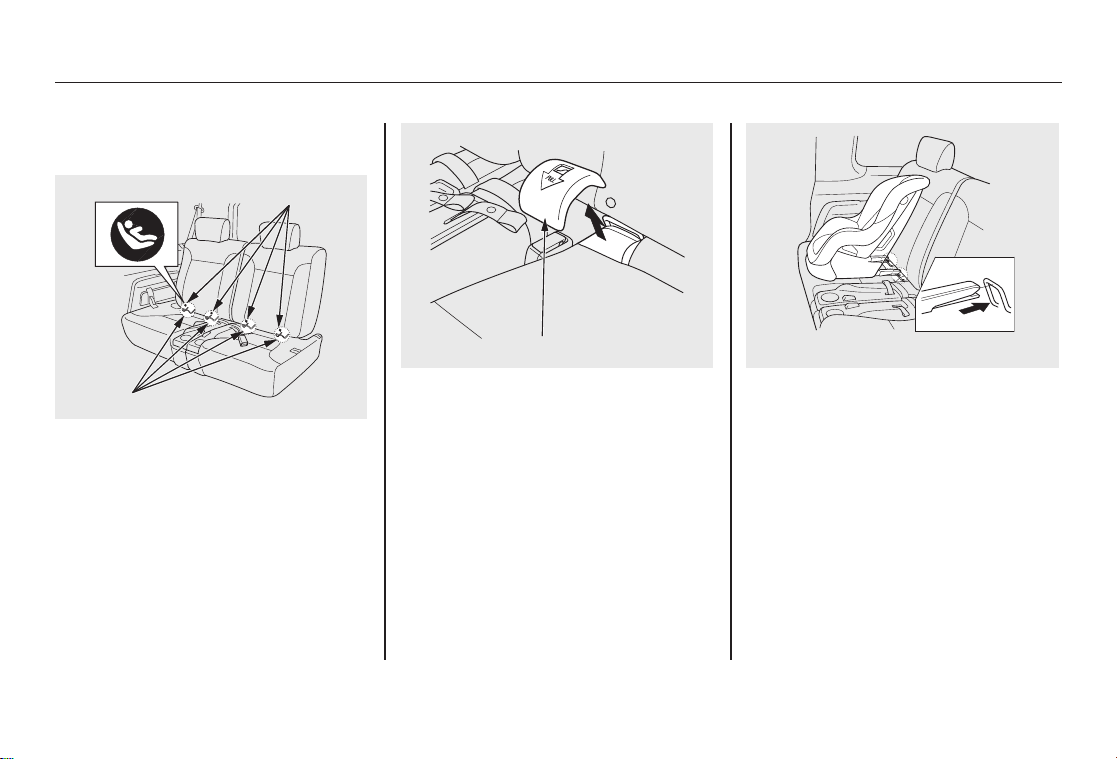
Installing a Child Seat with
LATCH
Your vehicle is equipped with
LATCH (Lower Anchors and Tethers
for CHildren) at the rear seats.
The lower anchors are located
between the seat-back and seat
bottom, and are to be used only with
a child seat designed for use with
LATCH.
The location of each lower anchor is
indicated by a small button above the
anchor point.
To install a LATCH-compatible child
seat:
1. Remove both anchor covers by
pulling forward.
2. Make sure there are no objects
near the anchors that could
prevent a secure connection
between the child seat and the
anchors.
3. Place the child seat on the vehicle
seat, then attach the seat to the
lower anchors according to the
child seat maker's instructions.
Some LATCH-compatible seats
have a rigid-type connector as
shown above.
MARKS
LOWER ANCHORS
ANCHOR COVER
Rigid-type
Installing a Child Seat
44
10/08/06 08:34:41 11 ELEMENT MMC North America Owner's Man 50 31SCV680 enu
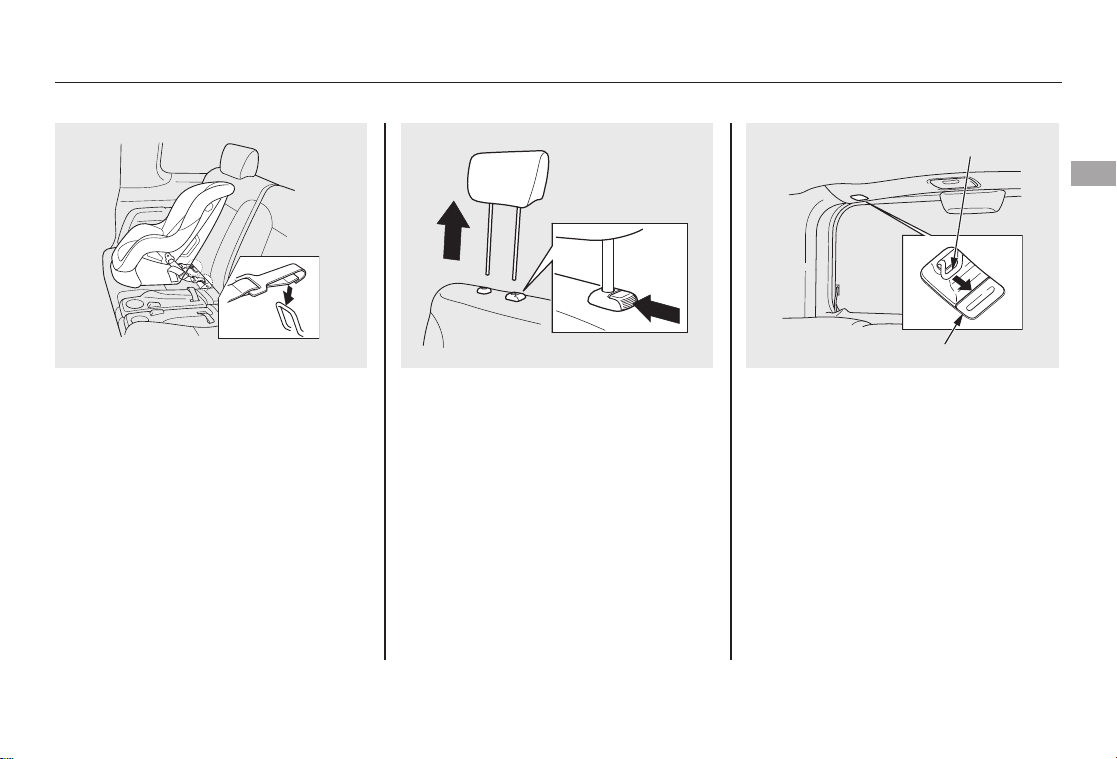
Other LATCH-compatible seats have
a flexible-type connector as shown
above.
4. Whatever type you have, follow the
child seat maker's instructions for
adjusting or tightening the fit.
5. Remove the head restraint (see
page 85). Make sure the removed
head restraints are secured in the
cargo area, and reinstalled when
the child seat is removed.
6. Route the tether strap over the top
of the seat-back, making sure the
strap is not twisted.
7. Slide the anchor cover open.
Flexible-type
ANCHOR COVER
TETHER ANCHOR
CONTINUED
Installing a Child Seat
45
Driver and Passenger Safety
10/08/06 08:34:41 11 ELEMENT MMC North America Owner's Man 50 31SCV680 enu
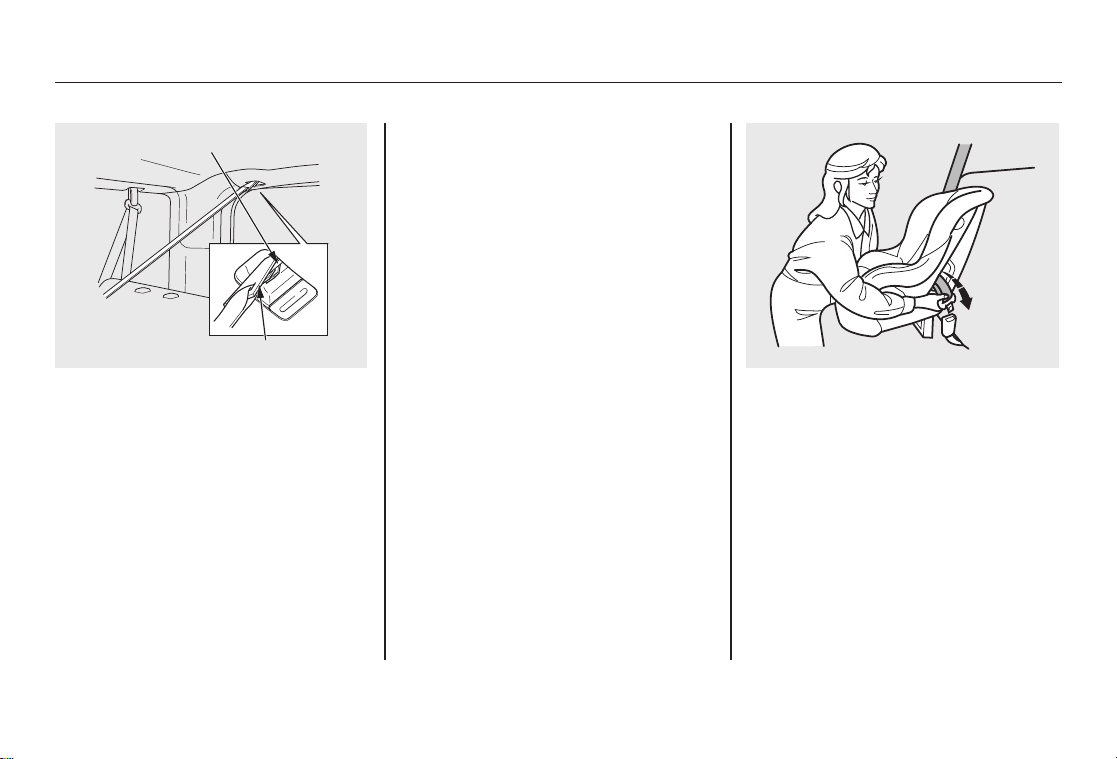
8. Attach the tether strap hook to the
tether anchor, then tighten the
strap as instructed by the child
seat maker.
If the tether strap is too long and
cannot be tightened firmly, find a
route where the strap can be
tightened securely.
9. Push and pull the child seat
forward and from side-to-side to
verify that it is secure.
Installing a Child Seat with a Lap/
Shoulder Belt
When not using the LATCH system,
all child seats must be secured to the
vehicle with the lap part of a lap/
shoulder belt.
In addition, the lap/shoulder belts in
all seating positions except the
driver's have a lockable retractor that
must be activated to secure a child
seat.
1. With the child seat in the desired
seating position, route the belt
through the child seat according to
the seat maker's instructions, then
insert the latch plate into the
buckle and remove any slack from
the lap portion of the belt.
TETHER STRAP HOOK
TETHER ANCHOR
Installing a Child Seat
46
10/08/06 08:34:41 11 ELEMENT MMC North America Owner's Man 50 31SCV680 enu
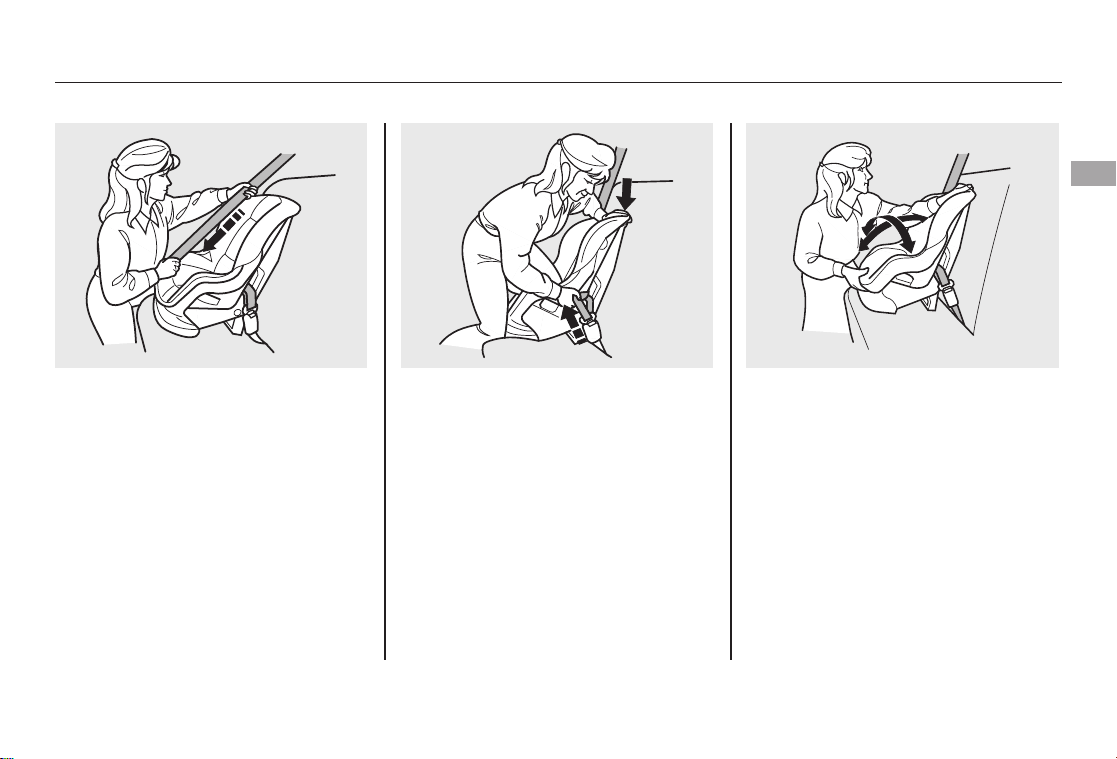
2. To activate the lockable retractor,
slowly pull the shoulder part of the
belt all the way out until it stops,
then let the belt feed back into the
retractor.
3. After the belt has retracted, tug on
it. If the belt is locked, you will not
be able to pull it out. If you can pull
the belt out, it is not locked, and
you will need to repeat these steps.
4. After confirming that the belt is
locked, grab the shoulder part of
the belt near the buckle, and pull
up to remove any slack from the
lap part of the belt. Remember, if
the lap part of the belt is not tight,
the child seat will not be secure.
To remove slack, it may help to put
weight on the child seat, or push
on the back of the seat while
pulling up on the belt.
5. Push and pull the child seat
forward and from side-to-side to
verify that it is secure enough to
stay upright during normal driving
maneuvers. If the child seat is not
secure, unlatch the belt, allow it to
retract fully, then repeat these
steps.
To deactivate the lockable retractor
and remove a child seat, unlatch the
buckle, unroute the seat belt, and let
the belt fully retract.
Installing a Child Seat
47
Driver and Passenger Safety
10/08/06 08:34:41 11 ELEMENT MMC North America Owner's Man 50 31SCV680 enu
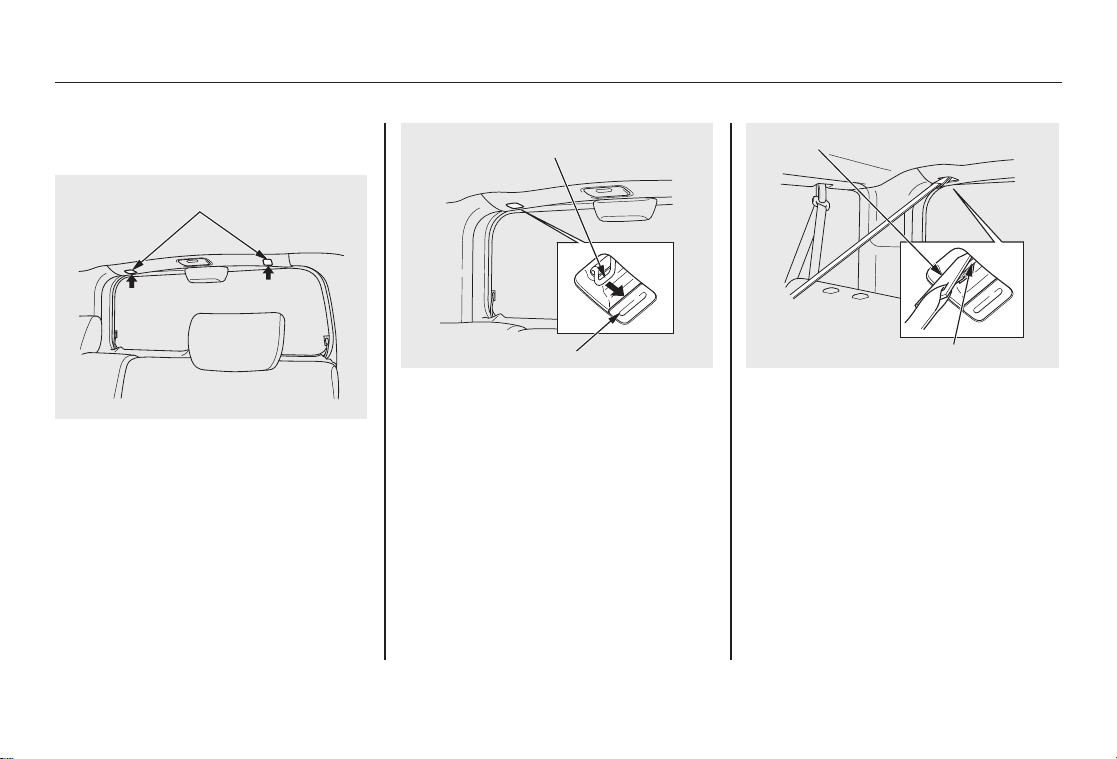
Installing a Child Seat with a
Tether
A child seat with a tether can be
installed in either back seat, using
one of the anchor points shown
above.
Since a tether can provide additional
security to the lap/shoulder belt
installation, we recommend using a
tether whenever one is required or
available.
1. After securing the child seat in the
desired position (see page 46),
remove the head restraint (see
page 85), then route the tether
strap over the top of the seat-back.
2. Slide the anchor cover open as
shown.
3. Attach the tether strap hook to the
anchor, making sure the strap is
not twisted.
4. Tighten the strap according to the
seat maker's instructions. Make
sure the removed head restraint is
secured in the cargo area. Reinstall
the head restraint in place when
you remove the child seat.
TETHER ANCHORAGE POINTS
TETHER ANCHOR
ANCHOR COVER
TETHER ANCHOR
TETHER STRAP HOOK
Installing a Child Seat
48
10/08/06 08:34:41 11 ELEMENT MMC North America Owner's Man 50 31SCV680 enu
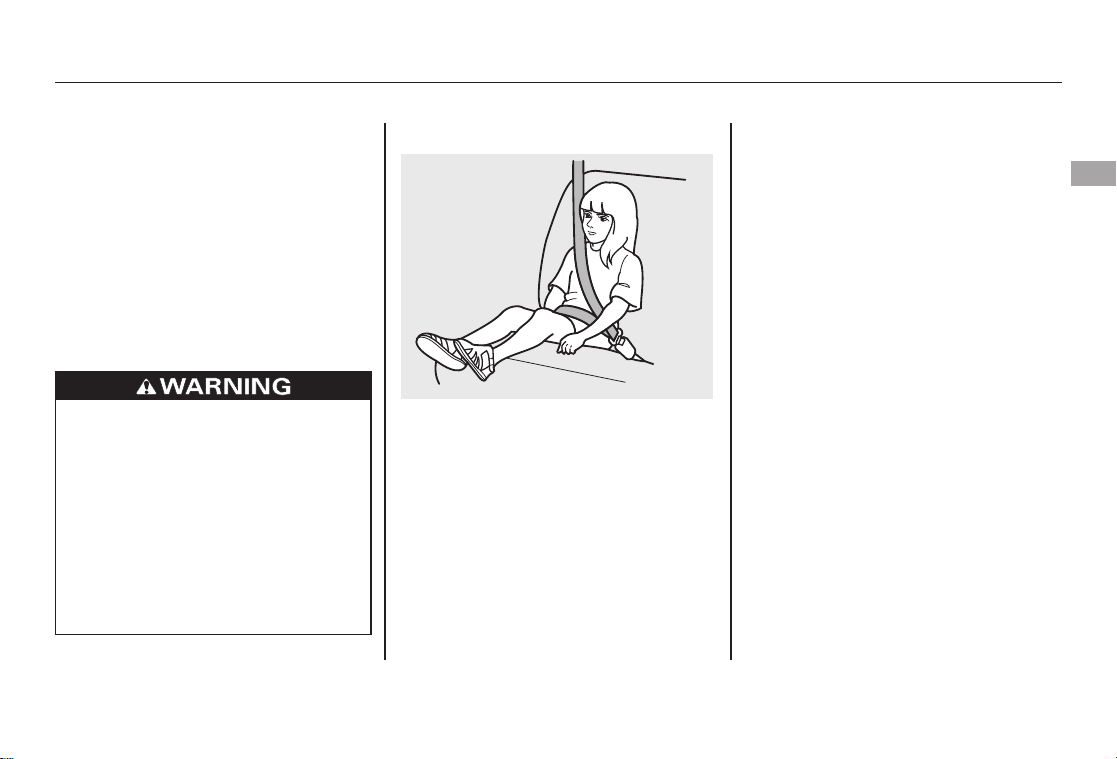
When a child reaches the
recommended weight or height limit
for a forward-facing child seat, the
child should sit in a back seat on a
booster seat and wear the lap/
shoulder belt.
The following pages give instructions
on how to check proper seat belt fit,
what kind of booster seat to use if one
is needed, and important precautions
for a child who must sit in front.
Allowing a child age 12 or under
to sit in front can result in injury
or death if the passenger's front
airbag inflates.
If a child must ride in front, move
the vehicle seat as far back as
possible, use a booster seat if
needed, have the child sit up
properly and wear the seat belt
properly.
Checking Seat Belt Fit
To determine if a lap/shoulder belt
properly fits a child, have the child
put on the seat belt, then ask
yourself:
1. Does the child sit all the way back
against the seat?
2. Do the child's knees bend
comfortably over the edge of the
seat?
3. Does the shoulder belt cross
between the child's neck and arm?
4. Is the lap part of the belt as low as
possible, touching the child's
thighs?
5. Will the child be able to stay
seated like this for the whole trip?
If you answer yes to all these
questions, the child is ready to wear
the lap/shoulder belt correctly. If
you answer no to any question, the
child needs to ride on a booster seat.
Protecting Larger Children
49
Driver and Passenger Safety
10/08/06 08:34:41 11 ELEMENT MMC North America Owner's Man 50 31SCV680 enu
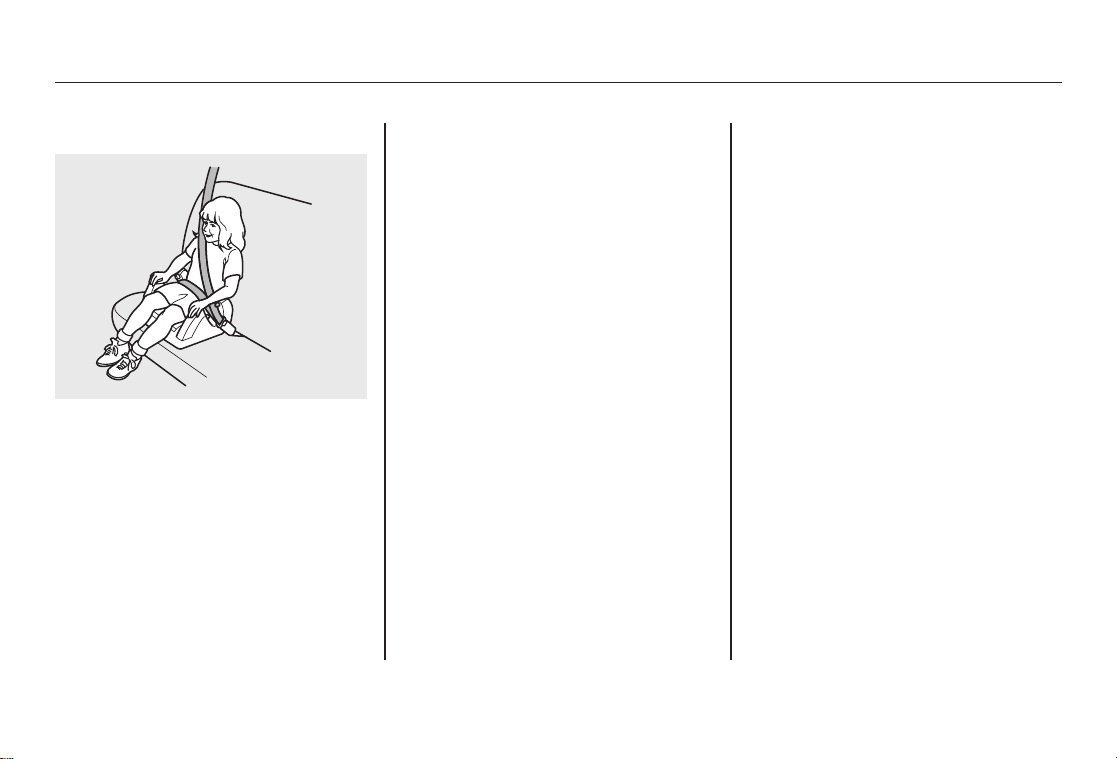
Using a Booster Seat
A child who has outgrown a forward-
facing child seat should ride in a
back seat and use a booster seat until
the lap/shoulder belt fits them
properly without the booster.
Some states also require children to
use a booster seat until they reach a
given age or weight (e.g., 6 years or
60 lbs). Be sure to check current
laws in the states where you intend
to drive.
Booster seats can be high-back or
low-back. Whichever style you select,
make sure the booster meets federal
safety standards and that you follow
the booster seat maker's
instructions.
If a child who uses a booster seat
must ride in front, move the vehicle
seat as far back as possible and be
sure the child is wearing the seat belt
properly.
A child may continue using a booster
seat until the tops of their ears are
even with the top of the vehicle's or
booster's seat-back. A child of this
height should be tall enough to use
the lap/shoulder belt without a
booster seat.
When Can a Larger Child Sit in
Front
The National Highway Traffic Safety
Administration recommends that all
children aged 12 and under be
properly restrained in a back seat.
If the passenger's front airbag
inflates in a moderate to severe
frontal collision, the airbag can cause
serious injuries to a child who is
unrestrained, improperly restrained,
sitting too close to the airbag, or out
of position.
A side airbag also poses risks. If any
part of a larger child's body is in the
path of a deploying side airbag, the
child could receive possibly serious
injuries.
Protecting Larger Children
50
10/08/06 08:34:41 11 ELEMENT MMC North America Owner's Man 50 31SCV680 enu

Of course, children vary widely. And
while age may be one indicator of
when a child can safely ride in front,
there are other important factors you
should consider.
Maturity
To safely ride in front, a child must
be able to follow the rules, including
sitting properly, and wearing the seat
belt properly throughout a ride.
Physical Size
Physically, a child must be large
enough for the lap/shoulder belt to
properly fit (see pages 14 and 49). If
the seat belt does not fit properly,
with or without the child sitting on a
booster seat, the child should not sit
in front.
If you decide that a child can safely
ride up front, be sure to:
●
Carefully read the owner's manual,
and make sure you understand all
seat belt instructions and all safety
information.
●
Move the vehicle seat to the rear-
most position.
●
Have the child sit up straight, back
against the seat, and feet on or
near the floor.
●
Check that the child's seat belt is
properly and securely positioned.
●
Supervise the child. Even mature
children sometimes need to be
reminded to fasten the seat belts
or sit properly.
Additional Safety Precautions
●
Do not let a child wear a seat belt
across the neck.
This could result
in serious neck injuries during a
crash.
●
Do not let a child put the shoulder
part of a seat belt behind the back
or under the arm.
This could cause
very serious injuries during a
crash. It also increases the chance
that the child will slide under the
belt in a crash and be injured.
●
Two children should never use the
same seat belt.
If they do, they
could be very seriously injured in a
crash.
●
Do not put any accessories on a
seat belt.
Devices intended to
improve a child's comfort or
reposition the shoulder part of a
seat belt can make the belt less
effective and increase the chance
of serious injury in a crash.
Protecting Larger Children
51
Driver and Passenger Safety
10/08/06 08:34:41 11 ELEMENT MMC North America Owner's Man 50 31SCV680 enu
Your vehicle's exhaust contains
carbon monoxide gas. Carbon
monoxide should not enter the
vehicle in normal driving if you
maintain your vehicle properly and
follow the information on this page.
Have the exhaust system inspected
for leaks whenever:
●
The vehicle is raised for an oil
change.
●
You notice a change in the sound
of the exhaust.
●
The vehicle was in a collision that
may have damaged the underside.
Carbon monoxide gas is toxic.
Breathing it can cause
unconsciousness and even kill
you.
Avoid any enclosed areas or
activities that expose you to
carbon monoxide.
High levels of carbon monoxide can
collect rapidly in enclosed areas,
such as a garage. Do not run the
engine with the garage door closed.
Even with the door open, run the
engine only long enough to move the
vehicle out of the garage.
With the tailgate or hatch open, air
flow can pull exhaust gas into your
vehicle's interior and create a
hazardous condition. If you must
drive with the tailgate or hatch open,
open all the windows and set the
heating and cooling system as shown
below.
If you must sit in your parked vehicle
with the engine running, even in an
unconfined area, adjust the heating
and cooling system as follows:
1. Select the fresh air mode.
2. Select the
mode.
3. Turn the fan on high speed.
4. Set the temperature control to a
comfortable setting.
Carbon Monoxide Hazard
52
10/08/06 08:34:41 11 ELEMENT MMC North America Owner's Man 50 31SCV680 enu
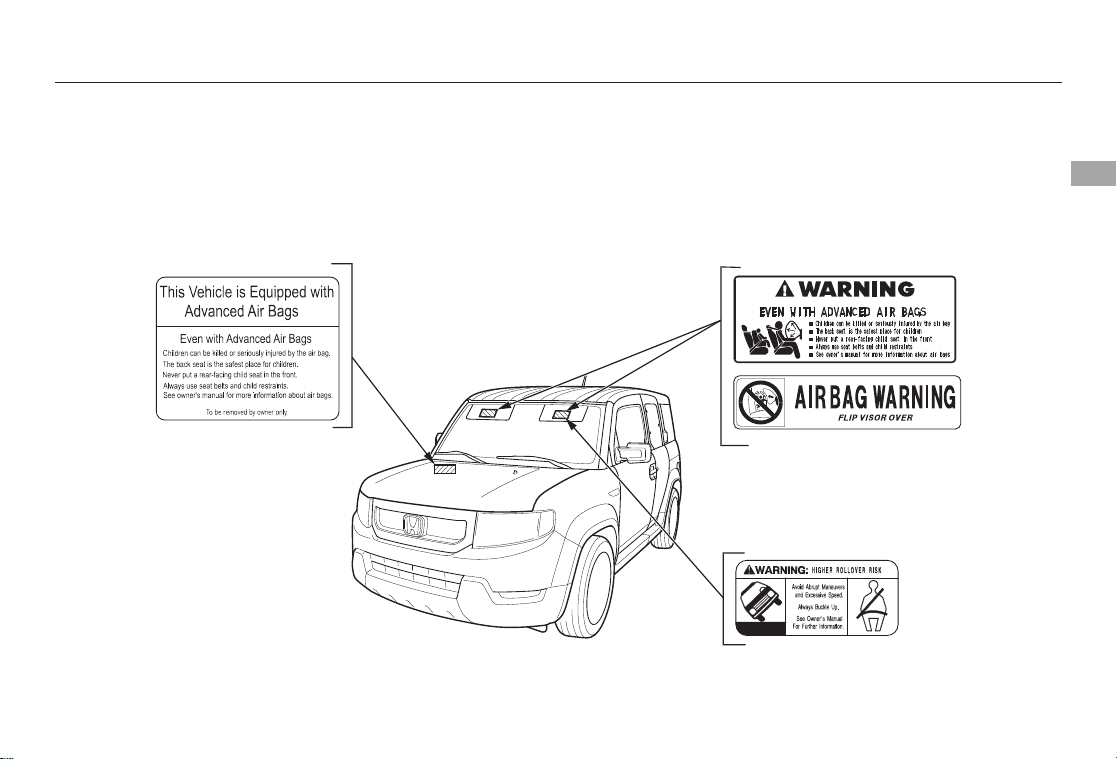
These labels are in the locations shown. They warn you of potential hazards that could cause serious injury or death.
Read these labels carefully.
If a label comes off or becomes hard to read (except for the dashboard label which may be removed by the owner),
contact your dealer for a replacement.
DASHBOARD
SUN VISOR
CONTINUED
Safety Labels
53
Driver and Passenger Safety
10/08/06 08:34:41 11 ELEMENT MMC North America Owner's Man 50 31SCV680 enu
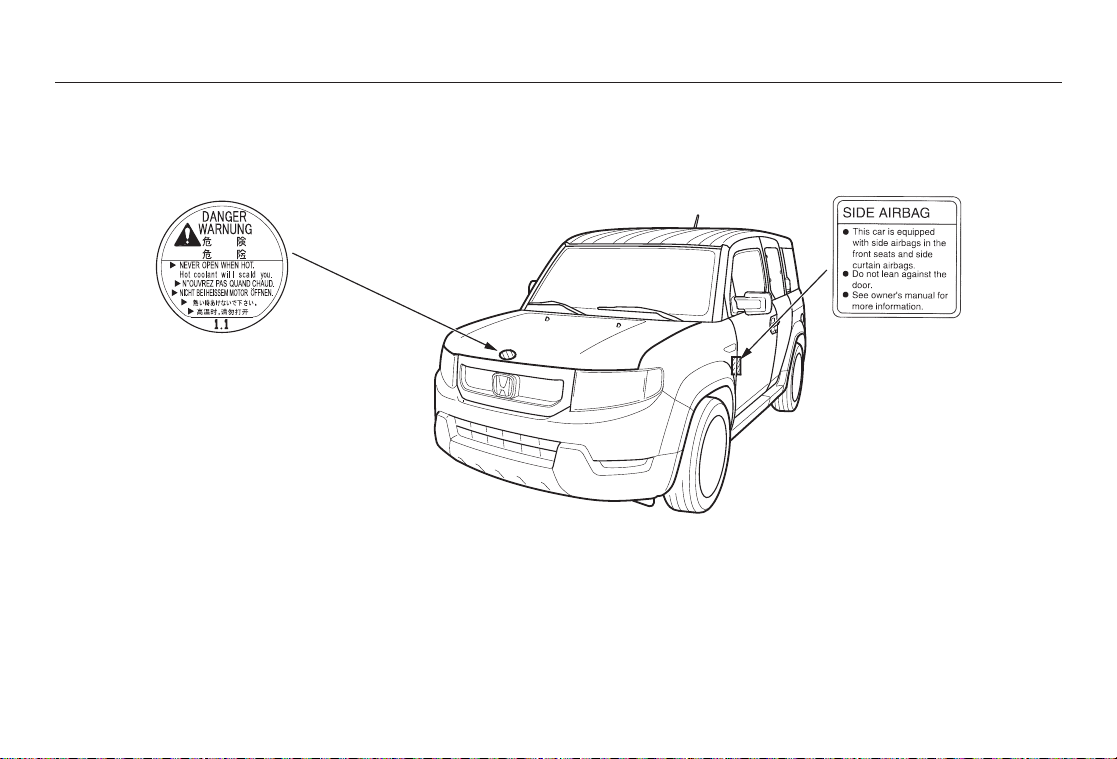
RADIATOR CAP
DOORJAMBS
Safety Labels
54
10/08/06 08:34:41 11 ELEMENT MMC North America Owner's Man 50 31SCV680 enu

This section gives information about
the controls and displays that
contribute to the daily operation of
your vehicle. All the essential
controls are within easy reach.
Control Locations
.......................... 56
Instrument Panel
.......................... 57
Instrument Panel Indicators
.......... 58
Gauges
.......................................... 64
Information Display
.................. 65
Odometer
.................................. 65
Trip Meter
................................ 66
Fuel Gauge
............................... 66
Check Fuel Cap Message
......... 66
Temperature Gauge
.................. 67
Maintenance Minder™
.............. 67
Outside Temperature
Indicator
............................... 68
Controls Near the Steering
Wheel
....................................... 69
Windshield Wipers and
Washers
.................................... 70
Turn Signals and Headlights
......... 71
Instrument Panel Brightness
........ 72
Hazard Warning Button
................ 73
Rear Window Defogger
................. 74
Steering Wheel Adjustment
.......... 74
Keys and Locks
............................. 75
Immobilizer System
...................... 76
Remote Transmitter
...................... 77
Ignition Switch
.............................. 79
Door Locks
................................... 80
Power Door Locks
.................... 80
Rear Doors
................................ 81
Hatch
........................................ 81
Tailgate
..................................... 82
Seats
............................................. 83
Seat Adjustments
...................... 83
Driver's Seat Height
Adjustment
........................... 84
Front Seat Armrests
.................. 85
Head Restraints
......................... 85
Reclining the Front Seats
.......... 87
Folding the Rear Seats
.............. 88
Removing the Rear Seats
.......... 90
Power Windows
............................ 92
Mirrors
......................................... 93
Adjusting the Power Mirrors
..... 93
Rear Windows
............................... 94
Parking Brake
............................... 94
Interior Lights
............................... 95
Light Control Switch
................. 95
Individual Map Lights
............... 95
Ceiling Light
............................. 96
Cargo Area Light
....................... 96
Ignition Switch Light
................. 96
Interior Convenience Items
........... 97
Cooler Box
................................ 98
Beverage Holders
..................... 99
Accessory Power Sockets
....... 100
Glove Box
............................... 100
Sun Visor
................................ 100
Vanity Mirror
.......................... 101
Overhead Console
.................. 101
Instruments and Controls
55
Instruments and Controls
10/08/06 08:34:41 11 ELEMENT MMC North America Owner's Man 50 31SCV680 enu
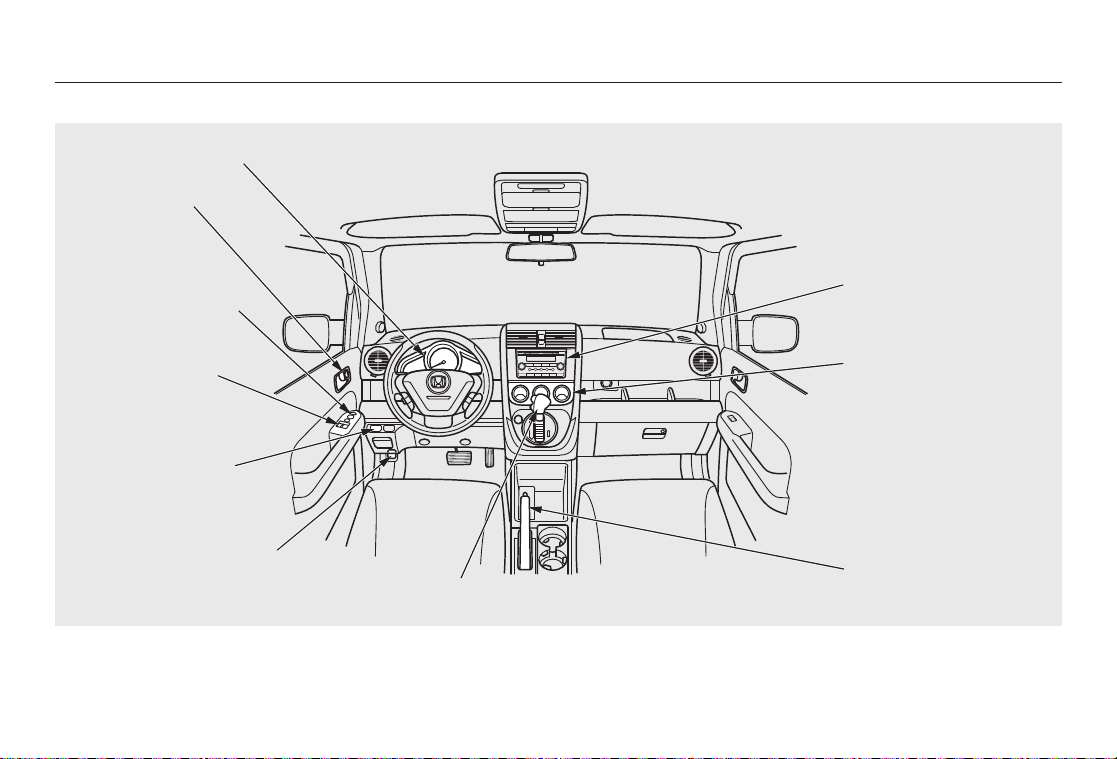
VEHICLE STABILITY
ASSIST (VSA) OFF
SWITCH (P. 173)
PARKING BRAKE
(P. 94)
AUDIO SYSTEM
(P. 109)
HEATING/COOLING
CONTROLS
(P. 104)
Ex model is shown.
POWER DOOR
LOCK SWITCH
(P. 80)
MIRROR CONTROLS
(P. 93)
POWER WINDOW
SWITCHES
(P. 92)
INSTRUMENT PANEL (P. 57)
HOOD RELEASE HANDLE
(P. 144)
GAUGES (P. 64)
AUTOMATIC TRANSMISSION (P. 161)
Control Locations
56
10/08/06 08:34:41 11 ELEMENT MMC North America Owner's Man 50 31SCV680 enu
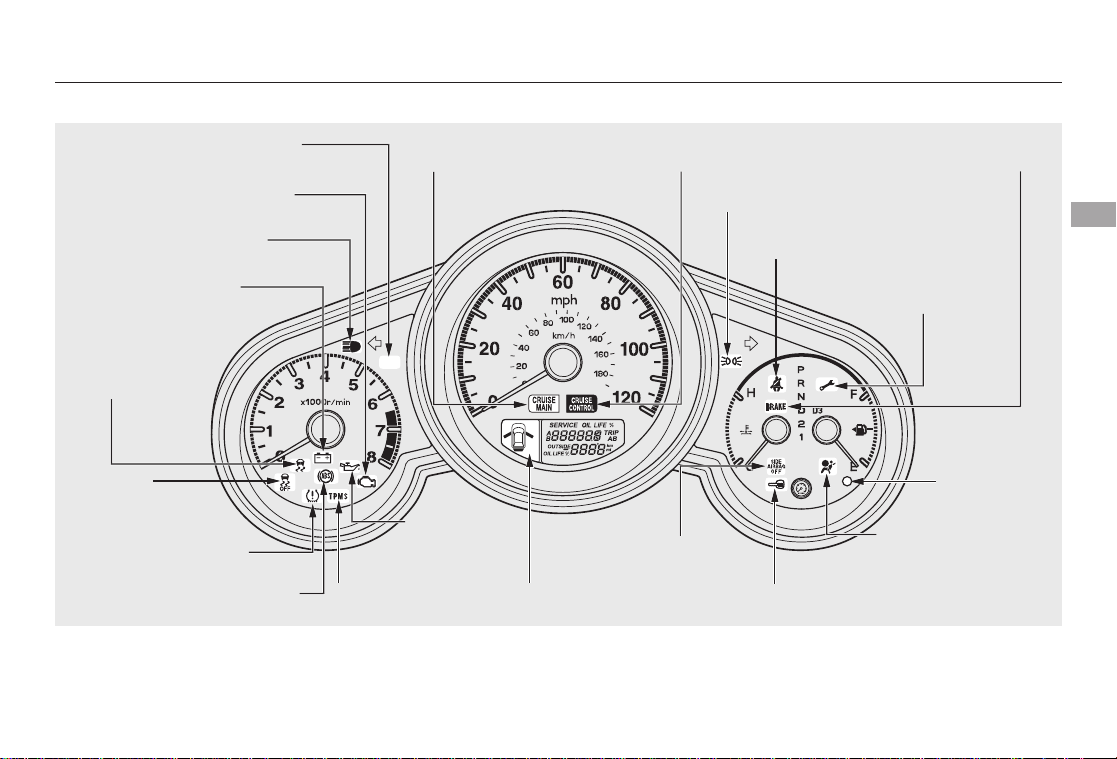
DRL
DAYTIME RUNNING LIGHTS
INDICATOR (P. 60)
HIGH BEAM INDICATOR
(P. 61)
CHARGING SYSTEM
INDICATOR (P. 58, 235)
VEHICLE STABILITY
ASSIST (VSA)
INDICATOR
(P. 62)
VSA OFF
INDICATOR
(P. 62)
ANTI-LOCK BRAKE SYSTEM
(ABS) INDICATOR (P. 59)
LOW OIL
PRESSURE
INDICATOR
(P. 58, 235)
DOOR AND TAILGATE
OPEN INDICATOR (P. 61)
SIDE AIRBAG OFF
INDICATOR (P. 59)
IMMOBILIZER SYSTEM
INDICATOR (P. 60)
SUPPLEMENTAL
RESTRAINT SYSTEM
INDICATOR (P. 59)
LOW FUEL
INDICATOR
(P. 61)
MAINTENANCE MINDER
INDICATOR (P. 59)
SEAT BELT REMINDER
INDICATOR (P. 58)
LIGHTS ON INDICATOR (P. 61)
PARKING BRAKE AND
BRAKE SYSTEM INDICATOR
(P. 58, 237)
CRUISE CONTROL
INDICATOR (P. 60)
TPMS INDICATOR
(P. 63)
CRUISE MAIN INDICATOR
(P. 60)
MALFUNCTION INDICATOR
LAMP (P. 58, 236)
LOW TIRE PRESSURE
INDICATOR (P. 62)
Instrument Panel
57
Instruments and Controls
10/08/06 08:34:41 11 ELEMENT MMC North America Owner's Man 50 31SCV680 enu
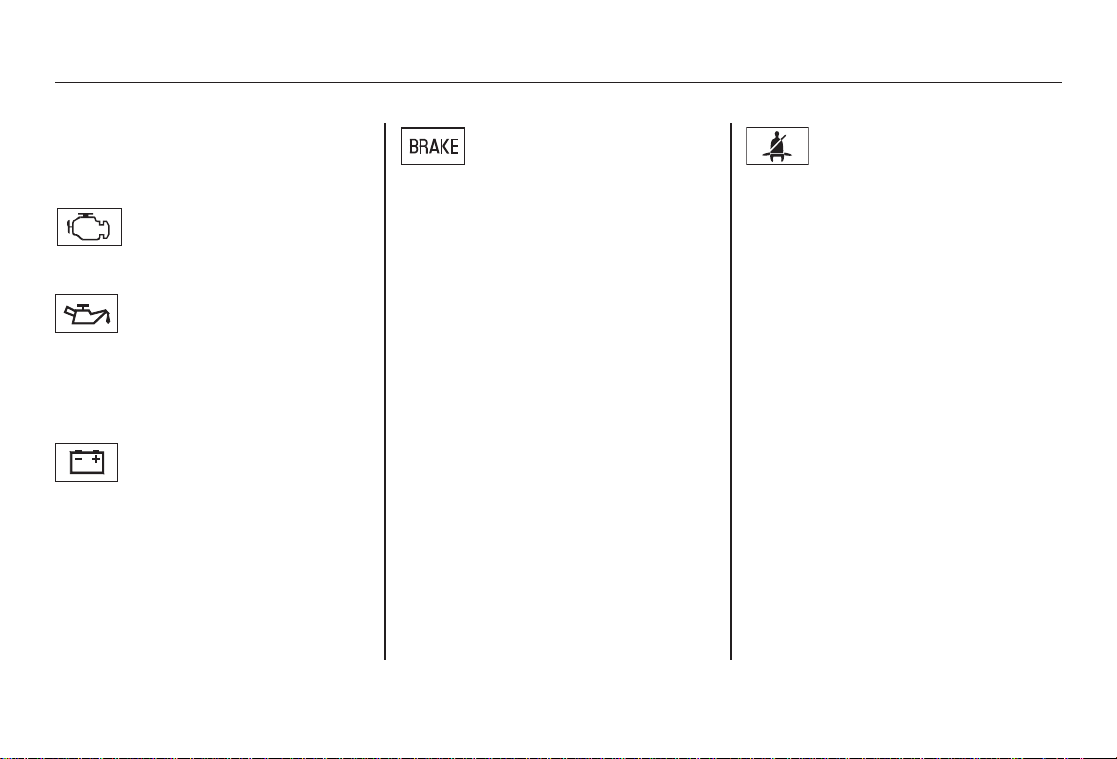
The instrument panel has many
indicators that give you important
information about your vehicle.
Malfunction Indicator
Lamp
For more information, see page 236.
Low Oil Pressure
Indicator
The engine can be severely damaged
if this indicator flashes or stays on
when the engine is running. For
more information, see page 235.
Charging System
Indicator
If this indicator comes on when the
engine is running, the battery is not
being charged. For more
information, see page 235.
Parking Brake and Brake
System Indicator (Red)
This indicator has two functions:
1. It comes on when you turn the
ignition switch to the ON (II)
position. It is a reminder to check
the parking brake. A beeper
sounds if you drive with the
parking brake not fully released.
Driving with the parking brake not
fully released can damage the
brakes and tires.
2. If it remains on after you have fully
released the parking brake while
the engine is running, or if it
comes on while driving, there
could be a problem with the brake
system. For more information, see
page 237.
Seat Belt Reminder
Indicator
This indicator comes on when you
turn the ignition switch to the ON
(II) position. It reminds you and your
passengers to fasten your seat belts.
A beeper also sounds if you have not
fastened your seat belt.
If you turn the ignition switch to the
ON (II) position before fastening
your seat belt, the beeper sounds
and the indicator flashes. If you do
not fasten your seat belt before the
beeper stops, the indicator stops
flashing but remains on.
If your front passenger does not
fasten their seat belt, the indicator
comes on about 6 seconds after the
ignition switch is turned to the ON
(II) position.
Instrument Panel Indicators
58
10/08/06 08:34:41 11 ELEMENT MMC North America Owner's Man 50 31SCV680 enu
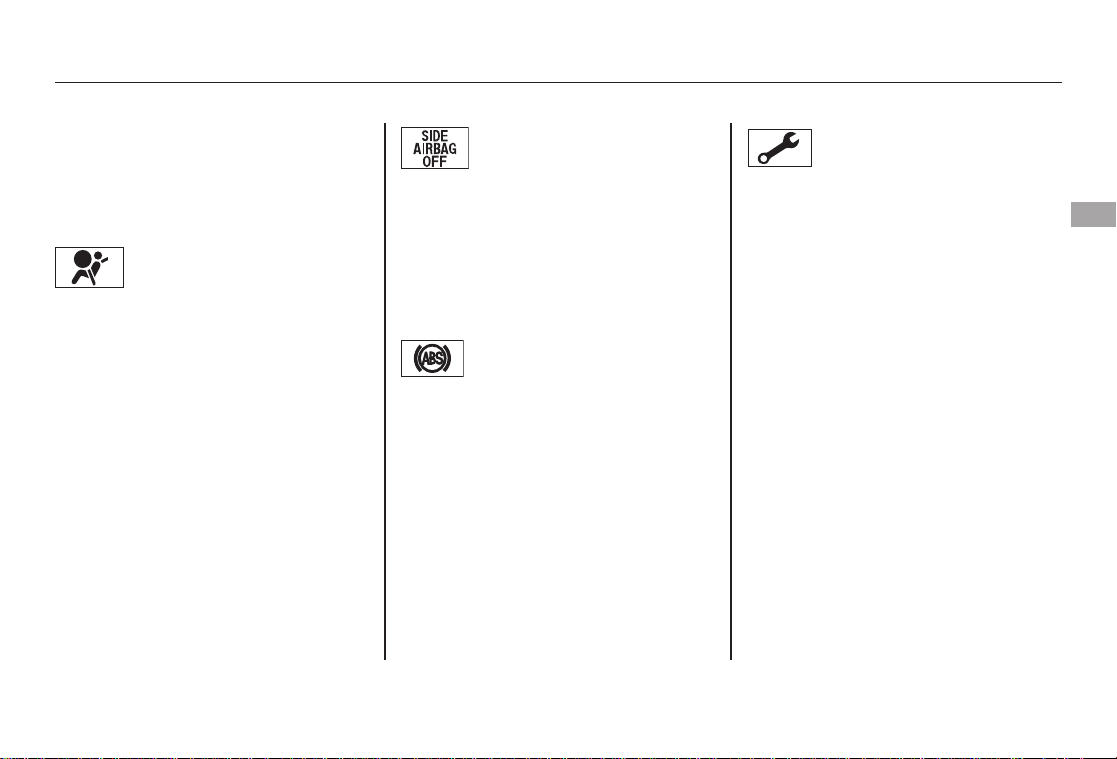
If either of you do not fasten your
seat belt while driving, the beeper
will sound and the indicator will flash
again at regular intervals. For more
information, see page 18.
Supplemental Restraint
System Indicator
This indicator comes on briefly when
you turn the ignition switch to the
ON (II) position. If it comes on at any
other time, it indicates a potential
problem with your front airbags. This
indicator will also alert you to a
potential problem with your airbag
system components. For more
information, see page 30.
Side Airbag Off Indicator
This indicator comes on briefly when
you turn the ignition switch to the
ON (II) position. If it comes on at any
other time, it indicates that the
passenger's side airbag has
automatically shut off. For more
information, see page 31.
Anti-lock Brake System
(ABS) Indicator
This indicator normally comes on for a
few seconds when you turn the ignition
switch to the ON (II) position. If it
comes on at any other time, there is a
problem with the ABS. If this happens,
have your vehicle checked at a dealer.
With this indicator on, your vehicle still
has normal braking ability but no anti-
lock function. For more information,
see page 168.
Maintenance Minder
Indicator
This indicator comes on for a few
seconds when you turn the ignition
switch to the ON (II) position. It
reminds you that it is time to take
your vehicle in for scheduled
maintenance. The maintenance main
items and sub items will be displayed
in the information display. See page
185 for more information on the
Maintenance Minder™.
This indicator goes off when your
dealer resets it after completing the
required maintenance service.
CONTINUED
Instrument Panel Indicators
59
Instruments and Controls
10/08/06 08:34:41 11 ELEMENT MMC North America Owner's Man 50 31SCV680 enu
Immobilizer System
Indicator
This indicator comes on for a few
seconds when you turn the ignition
switch to the ON (II) position. It will
then go off if you have inserted a
properly coded ignition key. If it is
not a properly coded key, the
indicator will blink, and the engine
will not start (see page 76).
This indicator also blinks several
times when you turn the ignition
switch from the ON (II) position to
the ACCESSORY (I) or LOCK (0)
position.
Turn Signal and
Hazard Warning
Indicators
The left or right turn signal indicator
blinks when you signal a lane change
or turn. If the indicators do not blink
or they blink rapidly, it usually
means one of the turn signal bulbs is
burned out (see page 204). Replace
the bulb as soon as possible, since
other drivers cannot see that you are
signaling.
When you press the hazard warning
button, both turn signal indicators
and all turn signals on the outside of
the vehicle flash.
Daytime Running Lights
Indicator
If this indicator comes on when the
ignition switch is turned to the ON
(II) position and the parking brake is
released, it means there is a problem
with a circuit. Have your vehicle
checked by your dealer.
Cruise Control Indicator
This indicator comes on when you
set the cruise control. See page 137
for information on operating the
cruise control.
Cruise Main Indicator
This indicator comes on when you
turn on the cruise control system by
pressing the CRUISE button on the
steering wheel (see page 137).
Instrument Panel Indicators
60
10/08/06 08:34:41 11 ELEMENT MMC North America Owner's Man 50 31SCV680 enu
Lights On Indicator
This indicator reminds you that the
exterior lights are on. It comes on
when the light switch is in either the
or position. If you turn the
ignition switch to the ACCESSORY
(I) or LOCK (0) position without
turning off the light switch, this
indicator will stay on. A reminder
chime will also sound when you open
the driver's door.
High Beam Indicator
This indicator comes on with the
high beam headlights. For more
information, see page 71.
Low Fuel Indicator
This indicator comes on as a
reminder that you must refuel soon.
When the indicator comes on, there
is about 2.8 U.S. gal (10.5 L) of fuel
remaining in the tank before the
needle reaches E. There is a small
reserve of fuel remaining in the tank
when the needle does reach E.
Door and Tailgate Open Indicator
The appropriate indicator comes on
in this display if the hatch, the
tailgate, or any door is not closed
tightly.
LOW FUEL INDICATOR
CONTINUED
Instrument Panel Indicators
61
Instruments and Controls
10/08/06 08:34:41 11 ELEMENT MMC North America Owner's Man 50 31SCV680 enu
Vehicle Stability Assist
(VSA) System Indicator
This indicator normally comes on for
a few seconds when you turn the
ignition switch to the ON (II)
position.
It flashes when VSA is active (see
page 172).
If it comes on and stays on at any
other time, there is a problem with
the VSA system. Take your vehicle to
a dealer to have it checked. Without
VSA, your vehicle still has normal
driving ability, but will not have VSA
traction and stability enhancement.
See page 172 for more information
on the VSA system.
VSA OFF Indicator
It comes on as a reminder that you
have turned off the vehicle stability
assist (VSA) system.
This indicator normally comes on for
a few seconds when you turn the
ignition switch to the ON (II)
position. See page 172 for more
information on the VSA system.
Low Tire Pressure
Indicator
This indicator normally comes on for
a few seconds when you turn the
ignition switch to the ON (II)
position.
If it comes on while driving, it
indicates that one or more of your
vehicle's tires are significantly low on
pressure.
If this happens, pull to the side of the
road when it is safe, check which tire
has lost pressure, and determine the
cause. If it is because of a flat tire,
replace the flat tire with the compact
spare (see page 222), and have the
flat tire repaired as soon as possible.
If two or more tires are underinflated,
call a professional towing service
(see page 244). For more
information, see page 169.
Instrument Panel Indicators
62
10/08/06 08:34:41 11 ELEMENT MMC North America Owner's Man 50 31SCV680 enu
Tire Pressure Monitoring
System (TPMS) Indicator
This indicator normally comes on for
a few seconds when you turn the
ignition switch to the ON (II)
position.
If this indicator comes on and stays
on at any other time, or if it does not
come on when you turn the ignition
switch to the ON (II) position, there
is a problem with the TPMS; the
system that monitors tire pressure.
With this indicator on, the low tire
pressure indicator will not come on
when a tire loses pressure. Take the
vehicle to your dealer to have the
system checked. For more
information, see page 170.
Instrument Panel Indicators
63
Instruments and Controls
10/08/06 08:34:41 11 ELEMENT MMC North America Owner's Man 50 31SCV680 enu
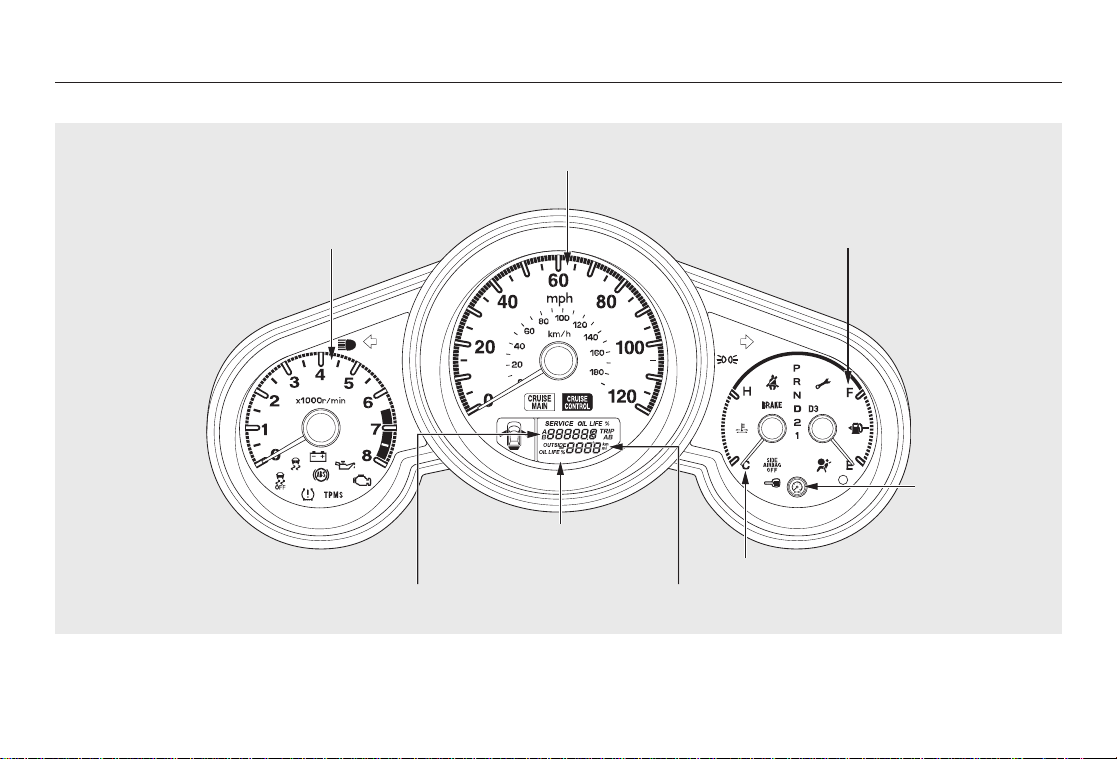
ꭧ: If equipped.
DRL
TACHOMETER
SPEEDOMETER
FUEL GAUGE
INFORMATION DISPLAY
ODOMETER/TRIP METER/
CHECK FUEL CAP MESSAGE
TEMPERATURE GAUGE
SELECT/RESET
KNOB
OUTSIDE TEMPERATURE
INDICATOR
ꭧ
Gauges
64
10/08/06 08:34:41 11 ELEMENT MMC North America Owner's Man 50 31SCV680 enu
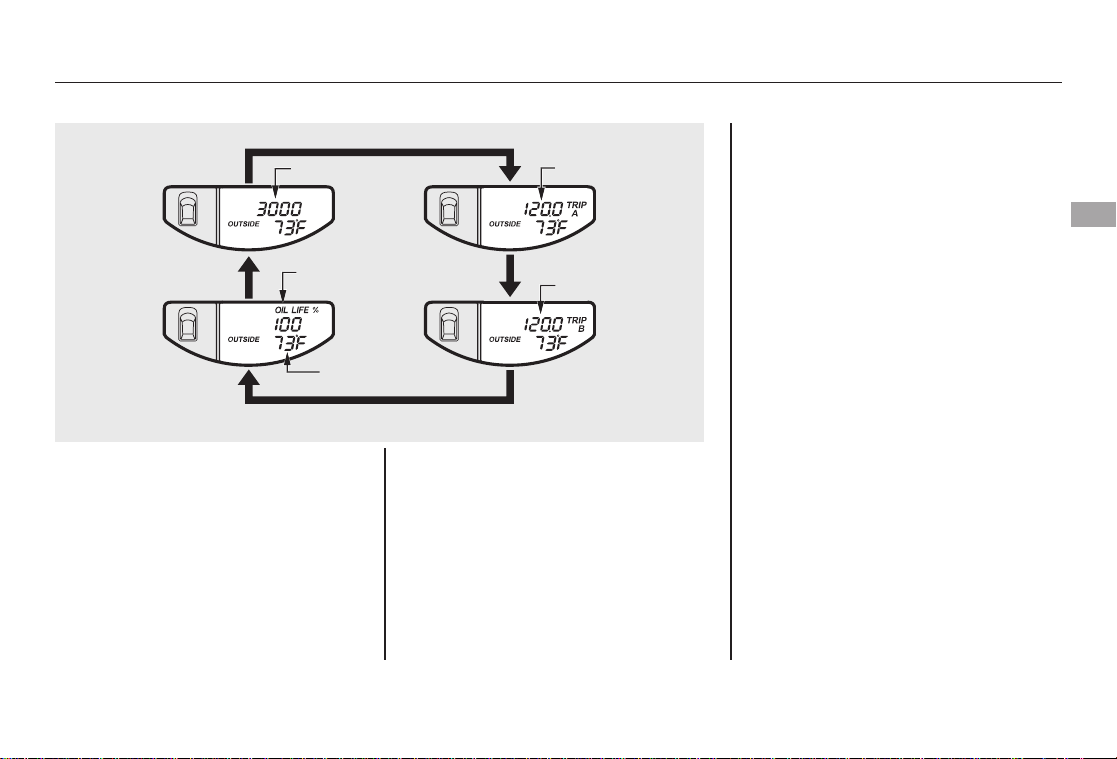
Information Display
The information display shows the
odometer, trip meter, engine oil life,
outside temperature (if equipped),
and maintenance item code(s).
To switch the display, press and
release the select/reset knob
repeatedly. When you turn the
ignition switch to the ON (II)
position, your last selection is
displayed.
Odometer
The odometer shows the total
distance your vehicle has been
driven. It measures miles. It is illegal
under U.S. federal law to disconnect,
reset, or alter the odometer with the
intent to change the number of miles
indicated.
OUTSIDE
TEMPERATURE
INDICATOR
ODOMETER TRIP METER A
ENGINE OIL
LIFE
TRIP METER B
Gauges
65
Instruments and Controls
10/08/06 08:34:41 11 ELEMENT MMC North America Owner's Man 50 31SCV680 enu
Trip Meter
This shows the number of miles
driven since you last reset it.
There are two trip meters: Trip A and
Trip B. Switch between these
displays by pressing the select/reset
knob repeatedly.
Each trip meter works
independently, so you can keep track
of two different distances.
When you turn the ignition switch to
the ON (II) position, the last
selection is displayed.
To reset a trip meter, display it, and
then press and hold the select/reset
knob until the number resets to
‘‘0.0’’.
Fuel Gauge
This shows how much fuel you have.
It may show slightly more or less
than the actual amount. The needle
returns to the bottom after you turn
off the ignition.
Avoid driving with an extremely low
fuel level. Running out of fuel could
cause the engine to misfire, damaging
the catalytic converter.
Check Fuel Cap Message
Your vehicle's onboard diagnostic
system will detect a loose or missing
fuel fill cap as an evaporative system
leak. The first time a leak is detected
a ‘‘CHECK FUEL CAP’’ message
appears on the information display.
Turn the engine off, and confirm the
fuel fill cap is installed. If it is, loosen
it, then retighten it until it clicks at
least once. The message should go
off after several days of normal
driving once you tighten or replace
the fuel fill cap. To scroll to another
display, press the select/reset knob.
The ‘‘CHECK FUEL CAP’’ message
will appear each time you restart the
engine until the system turns the
message off.
Gauges
66
10/08/06 08:34:41 11 ELEMENT MMC North America Owner's Man 50 31SCV680 enu

If the system still detects a leak in
your vehicle's evaporative emissions
system, the malfunction indicator
lamp (MIL) comes on. If the fuel fill
cap was not already tightened, turn
the engine off, and check or
retighten the fuel fill cap until it
clicks at least once. The MIL should
go off after several days of normal
driving once the cap is tightened or
replaced. If the MIL does not go off,
have your vehicle inspected by a
dealer. For more information, see
page 236.
Temperature Gauge
This shows the temperature of the
engine's coolant. During normal
operation, the pointer should rise to
about the middle of the gauge. In
severe driving conditions, the pointer
may rise to the upper zone. If it
reaches the red (hot) mark, pull
safely to the side of the road. Turn to
page 233 for instructions and
precautions on checking the engine's
cooling system.
Maintenance Minder™
The information display in the
instrument panel shows you the
engine oil life and maintenance
service items when the ignition
switch is in the ON (II) position. This
information helps to keep you aware
of the periodic maintenance your
vehicle needs for continued trouble-
free driving. Refer to page 185 for
more information.
Gauges
67
Instruments and Controls
10/08/06 08:34:41 11 ELEMENT MMC North America Owner's Man 50 31SCV680 enu

Outside Temperature Indicator
On EX model
This indicator displays the outside
temperature in Fahrenheit.
The temperature sensor is in the
front bumper. The temperature
reading can be affected by heat
reflection from the road surface,
engine heat, and the exhaust from
surrounding traffic. This can cause
an incorrect temperature reading
when your vehicle speed is under 19
mph (30 km/h). When you start your
trip, the sensor is not fully
acclimatized, therefore it may take
several minutes until the proper
temperature is displayed.
In certain weather conditions,
temperature readings near freezing
(32°F, 0°C) could mean that ice is
forming on the road surface.
If the outside temperature is
incorrectly displayed, you can adjust
it up to ꭗ5°F warmer or cooler.
NOTE: The temperature must be
stabilized before doing this
procedure.
To adjust the outside temperature
indicator, make sure the odometer is
shown in the display, then press and
hold the select/reset knob for 10
seconds. The following sequence will
appear for 1 second each: 0, 1, 2, 3, 4,
5, -5, -4, -3, -2, -1, 0.
When the temperature reaches the
desired value, release the select/
reset knob. You should see the new
outside temperature displayed.
Gauges
68
10/08/06 08:34:41 11 ELEMENT MMC North America Owner's Man 50 31SCV680 enu
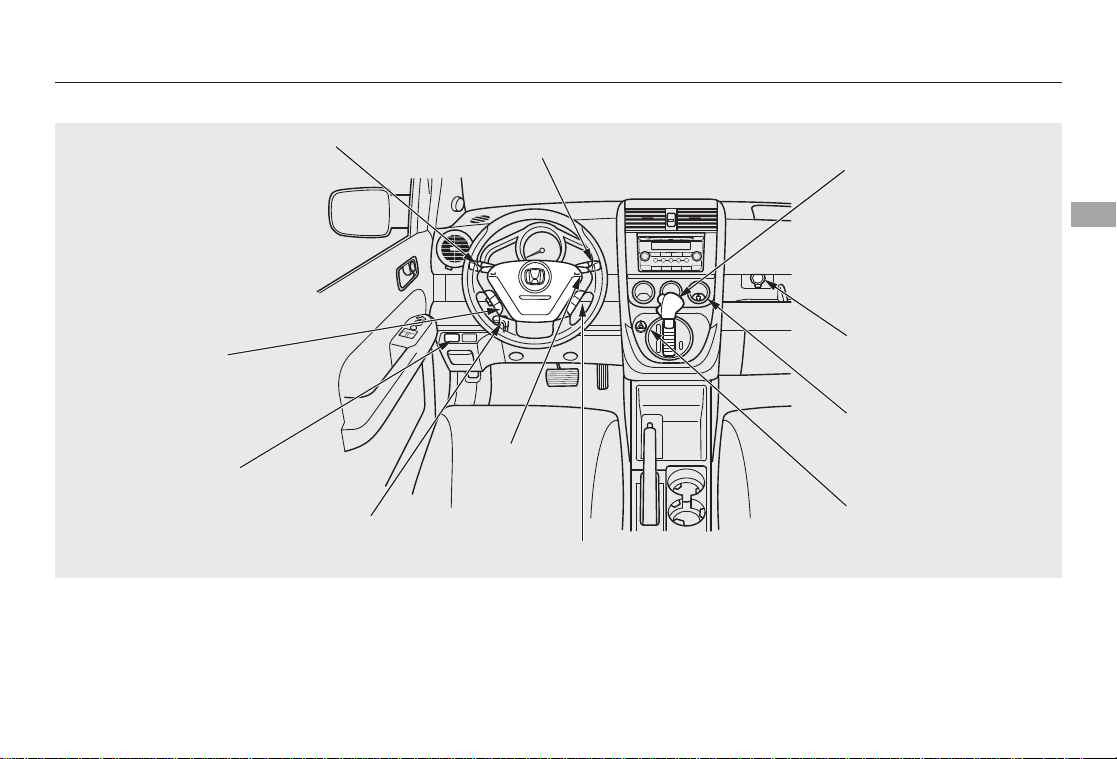
ꭧ1: To use the horn, press the center pad of the steering wheel.
ꭧ2: If equipped
HAZARD WARNING BUTTON
(P. 73)
CRUISE CONTROL BUTTONS (P. 137)
STEERING WHEEL ADJUSTMENT (P. 74)
HORN
ꭧ1
Ex model is shown.
VSA OFF SWITCH
(P. 173)
REMOTE AUDIO
CONTROLS
ꭧ2
(P. 135)
HEADLIGHTS/TURN SIGNALS
(P. 71)
WINDSHIELD WIPERS/WASHERS
(P. 70)
REAR WINDOW
DEFOGGER BUTTON
(P. 74)
AUTOMATIC
TRANSMISSION
(P. 161)
ACCESSORY
POWER SOCKET
(P. 100)
Controls Near the Steering Wheel
69
Instruments and Controls
10/08/06 08:34:41 11 ELEMENT MMC North America Owner's Man 50 31SCV680 enu
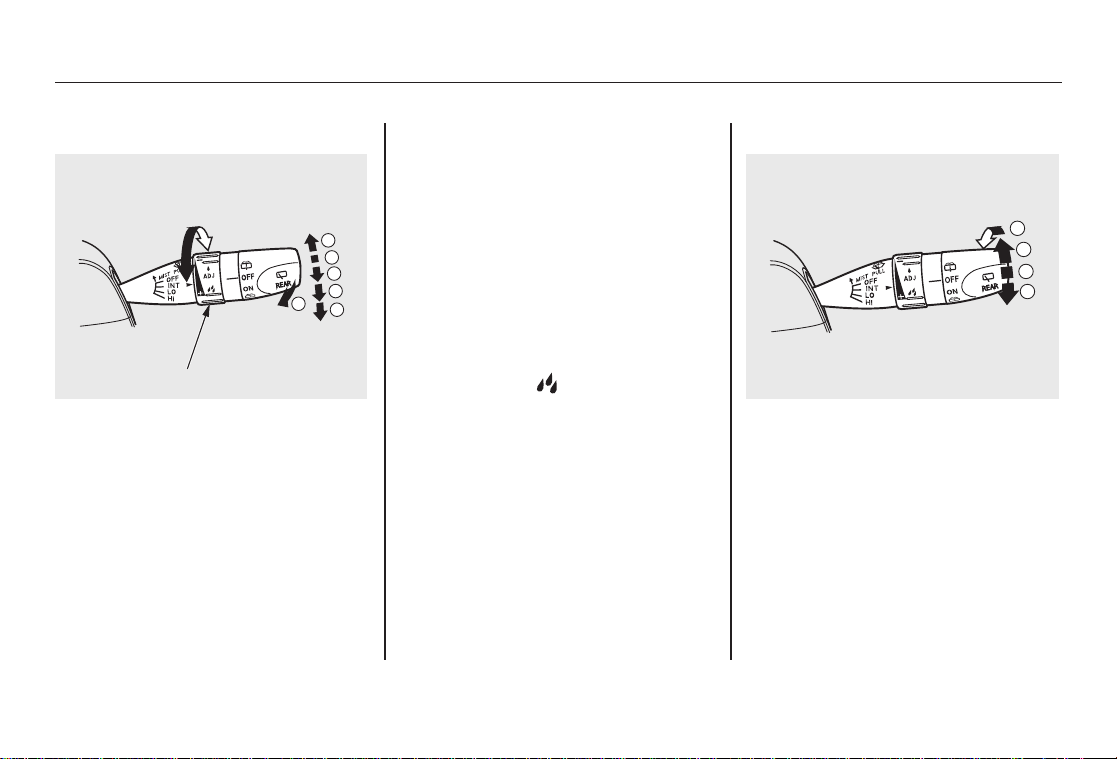
Windshield Wiper
1. MIST
2. OFF
3. INT - Intermittent
3. LO - Low speed
5. HI - High speed
6. Windshield washers
Push the right lever up or down to
select a position.
MIST - The wipers run at high
speed until you release the lever.
OFF - The wipers are not activated.
INT - The length of the wipe
interval is varied automatically
according to vehicle's speed.
Vary the delay by turning the
adjustment ring. If you turn it to the
shortest delay (
position), the
wipers change to low speed
operation when the vehicle speed
exceeds 12 mph (20 km/h).
LO - The wipers run at low speed.
HI - The wipers run at high speed.
Windshield Washer - Pull the
wiper control lever toward you, and
hold it. The washers spray until you
release the lever. The wipers run at
low speed, then complete one more
sweep after you release the lever.
Rear Window Wiper and Washer
1. Rotate the switch clockwise to turn
the rear window wiper ON.
2. Hold past ON to turn the window
wiper on and the window washer
on.
3. OFF
4. Rotate the switch
counterclockwise and hold to
spray the window washer and
operate the wiper.
ADJUSTMENT RING
Windshield Wipers and Washers
70
10/08/06 08:34:41 11 ELEMENT MMC North America Owner's Man 50 31SCV680 enu
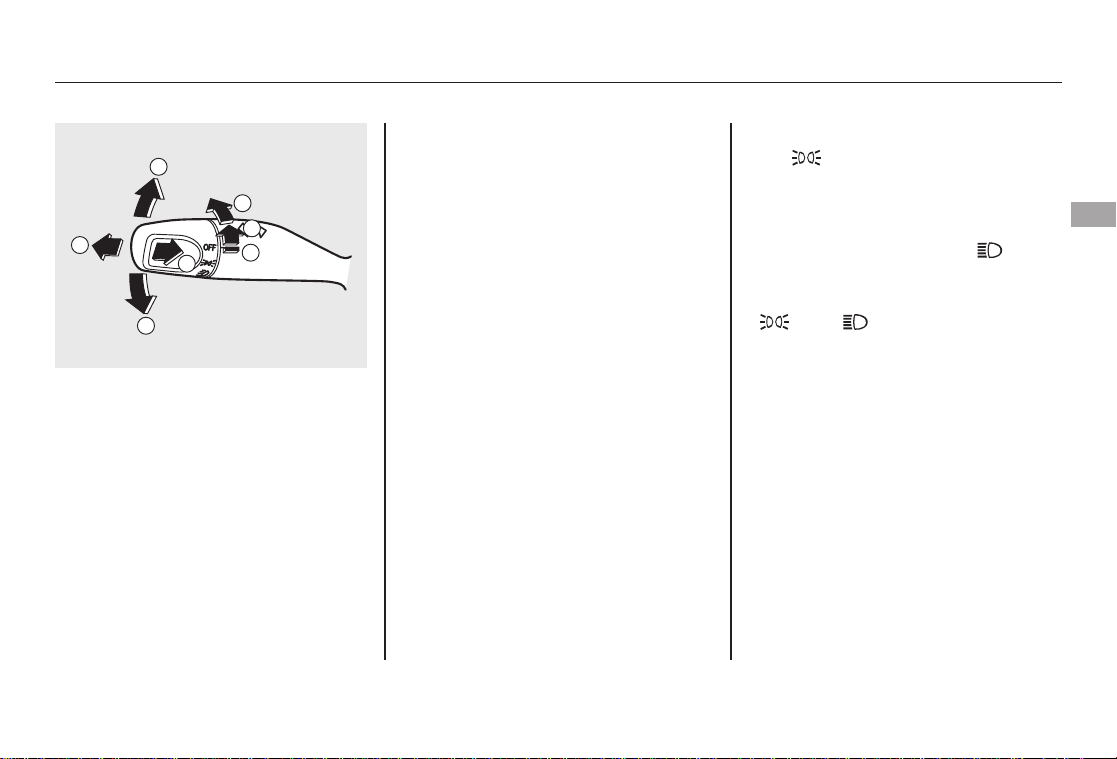
1. Turn signal
2. Off
3. Parking and instrument panel
lights
4. Headlights on
5. High beams
6. Flash high beams
Turn Signal - Push down on the
lever to signal a left turn and up to
signal a right turn. To signal a lane
change, push lightly on the lever,
and hold it. The lever will return to
center when you release it or
complete a turn.
Headlights - Turning the switch to
the ‘‘
’’ position turns on the
parking lights, taillights, instrument
panel lights, side-marker lights, and
rear license plate lights.
Turning the switch to the ‘‘
’’
position turns on the headlights.
When the light switch is in the
‘‘
’’ or ‘‘ ’’ position, the lights
on indicator comes on as a reminder.
This indicator stays on if you leave
the light switch on and turn the
ignition switch to the ACCESSORY
(I) or the LOCK (0) position.
If you leave the lights on with the key
removed from the ignition switch,
you will hear a reminder chime when
you open the driver's door.
CONTINUED
Turn Signals and Headlights
71
Instruments and Controls
10/08/06 08:34:41 11 ELEMENT MMC North America Owner's Man 50 31SCV680 enu
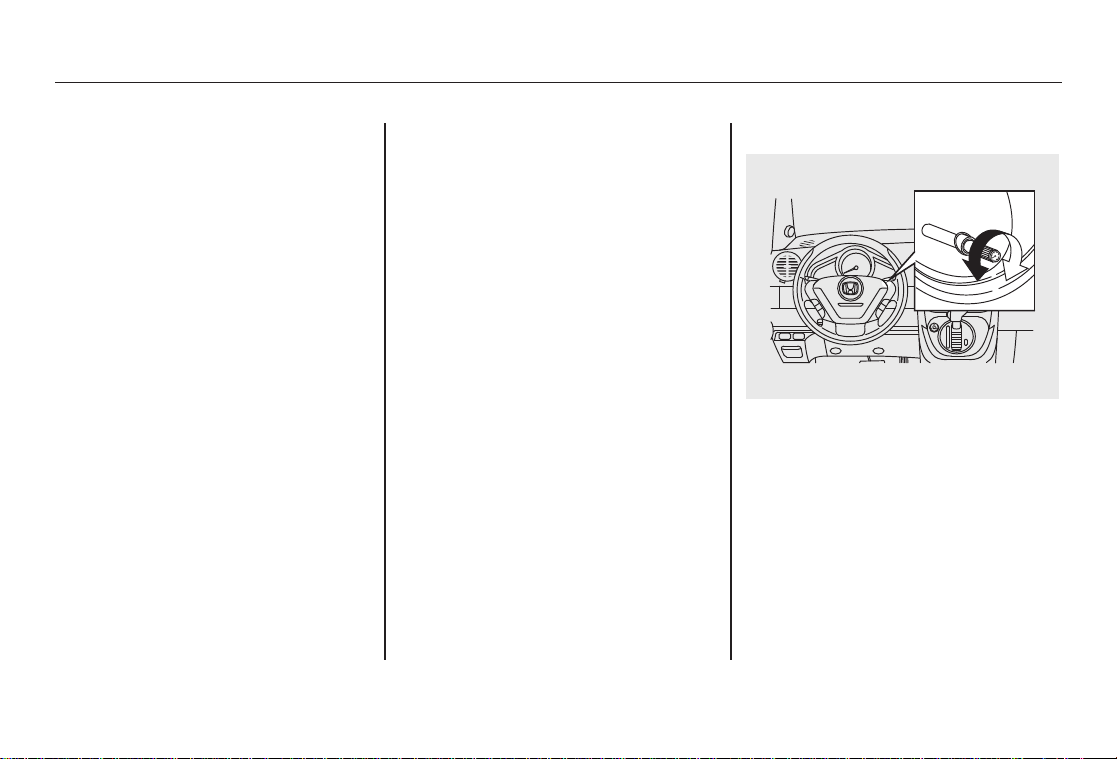
High Beams - Push the lever back
until you hear a click to turn on the
high beams. The blue high beam
indicator will come on (see page 61).
Pull the lever back again to low
beams.
To flash the high beams, pull the
lever back lightly, then release it.
The high beams will stay on as long
as you hold the lever back.
Daytime Running Lights
With the headlight switch off, the
daytime running lights come on
when you turn the ignition switch to
the ON (II) position and release the
parking brake. They remain on until
you turn the ignition switch off, even
if you set the parking brake.
When the headlights are on, the
daytime running lights are off.
Instrument Panel Brightness
The select/reset knob on the
instrument panel controls the
brightness of the instrument panel
lights. Turn the knob to adjust the
brightness.
Separate adjustments can be made
when the headlights are on and off.
Turn Signals and Headlights, Instrument Panel Brightness
72
10/08/06 08:34:41 11 ELEMENT MMC North America Owner's Man 50 31SCV680 enu
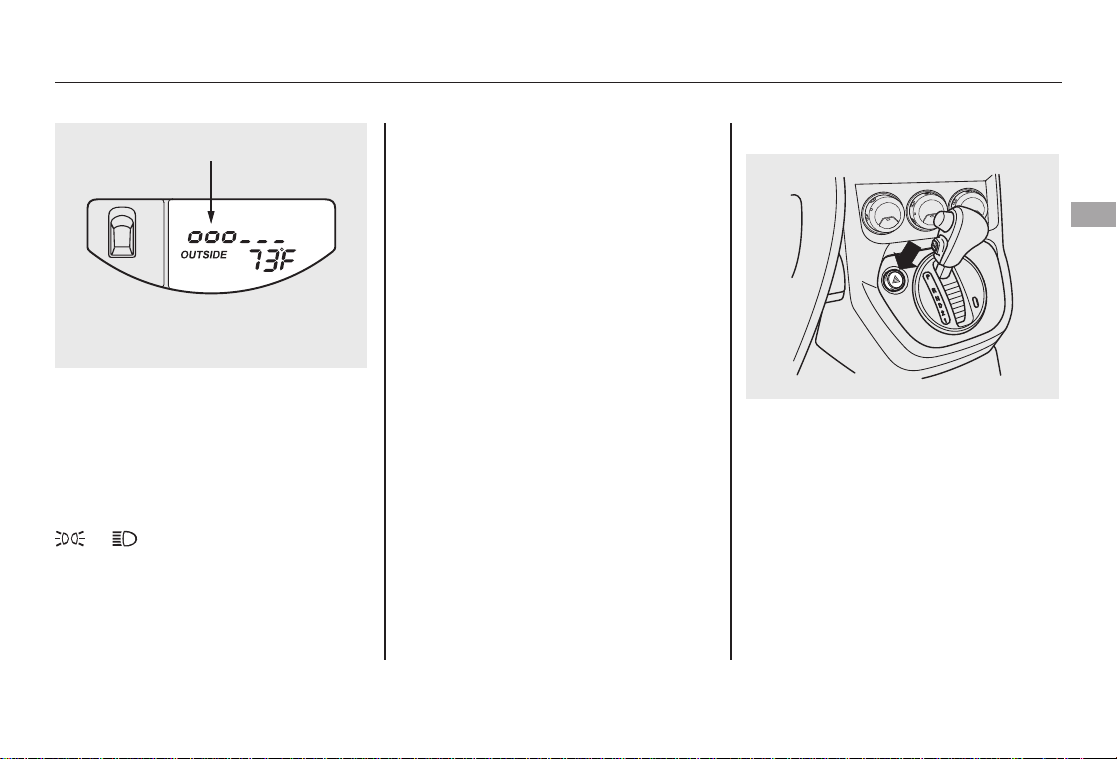
The level of brightness is shown on
the information display while you
adjust it. It goes out about 5 seconds
after you finish adjusting.
To reduce glare at night, the
instrument panel illumination dims
when you turn the light switch to
or . Turning the select/reset
knob to the right until you hear a
beep will cancel the reduced
brightness.
The instrument panel will illuminate
with reduced brightness when you
unlock and open the driver's door.
The brightness will increase slightly
when you insert the key in the
ignition switch, then go to normal
brightness when you turn the
ignition switch to the ON (II)
position.
If you do not insert the key in the
ignition switch after opening the
driver's door, the illumination turns
off about 30 seconds after you close
the door.
If you insert the key but do not turn
the ignition switch to the ON (II)
position, the illumination turns off in
about 10 seconds.
Hazard Warning Button
Push the button next to the shift
lever to turn on the hazard warning
lights (four-way flashers). This
causes all four outside turn signals
and both turn indicators in the
instrument panel to flash. Use the
hazard warning lights if you need to
park in a dangerous area near heavy
traffic, or if your vehicle is disabled.
BRIGHTNESS LEVEL
Instrument Panel Brightness, Hazard Warning Button
73
Instruments and Controls
10/08/06 08:34:41 11 ELEMENT MMC North America Owner's Man 50 31SCV680 enu
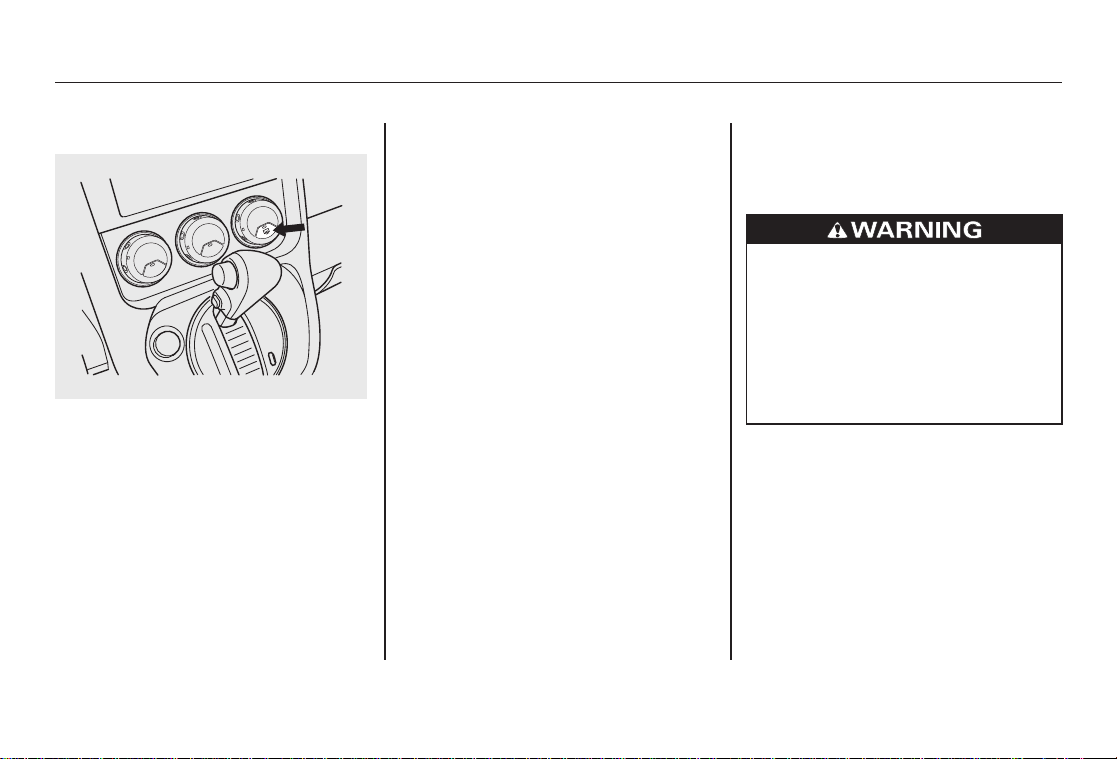
Rear Window Defogger
The rear window defogger will clear
fog, frost, and thin ice from the
window. Push the defogger button to
turn it on and off. The indicator in the
button comes on to show the
defogger is on. If you do not turn it
off, the defogger will shut itself off
after about 15 minutes. It also shuts
off when you turn off the ignition
switch. You have to turn the
defogger on again when you restart
the vehicle.
Make sure the rear window is clear
and you have good visibility before
starting to drive.
The defogger wires on the inside of
the rear window can be accidentally
damaged. When cleaning the glass,
always wipe side-to-side.
Steering Wheel Adjustment
Make any steering wheel adjustment
before you start driving.
Adjusting the steering wheel
position while driving may
cause you to lose control of the
vehicle and be seriously injured
in a crash.
Adjust the steering wheel only
when the vehicle is stopped.
Rear Window Defogger, Steering Wheel Adjustment
74
10/08/06 08:34:41 11 ELEMENT MMC North America Owner's Man 50 31SCV680 enu
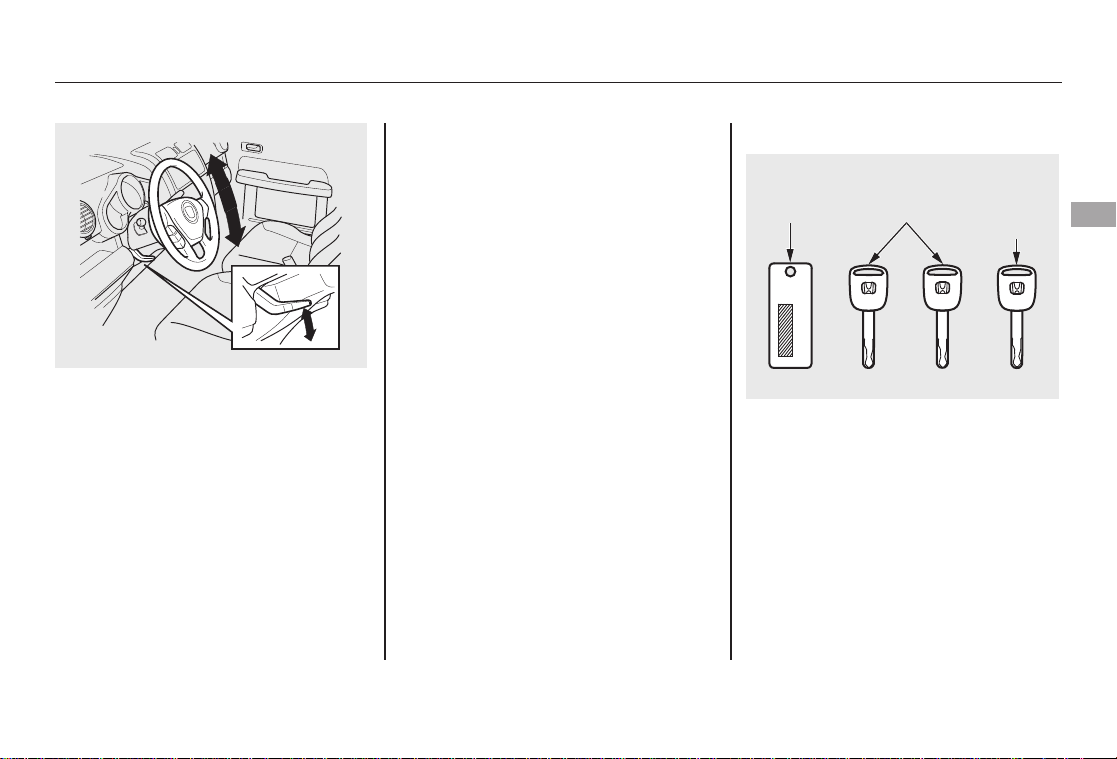
To adjust the steering wheel upward
or downward:
1. Push the lever under the left side
of the steering column all the way
down.
2. Move the steering wheel up or
down to the desired position.
Make sure you can see the
instrument panel gauges and the
indicators.
3. Push the lever up to lock the
steering wheel in that position.
4. Make sure you have securely
locked the steering wheel in place
by trying to move it up and down.
Keys and Locks
The master key fits all the locks on
your vehicle. The valet key works
only in the ignition and the door
locks. You can keep the glove box
and hatch locked when you leave
your vehicle and the valet key at a
parking facility.
KEY
NUMBER
TAG
MASTER
KEYS
(BLACK)
VALET
KEY
(LIGHT
GRAY)
CONTINUED
Steering Wheel Adjustment, Keys and Locks
75
Instruments and Controls
10/08/06 08:34:41 11 ELEMENT MMC North America Owner's Man 50 31SCV680 enu

You should have received a key
number tag with your set of keys.
You will need this key number if you
ever have to get a key replaced. Use
only Honda-approved key blanks.
These keys contain electronic
circuits that are activated by the
immobilizer system. They will not
work to start the engine if the circuits
are damaged.
●
Protect the keys from direct
sunlight, high temperature, and
high humidity.
●
Do not drop the keys or set heavy
objects on them.
●
Keep the keys away from liquids.
If they get wet, dry them
immediately with a soft cloth.
The keys do not contain batteries.
Do not try to take them apart.
See page 77 for an explanation of the
remote transmitter's operation.
Immobilizer System
The immobilizer system protects
your vehicle from theft. If an
improperly coded key (or other
device) is used, the engine's fuel
system is disabled.
When you turn the ignition switch to
the ON (II) position, the immobilizer
system indicator should come on for
a few seconds, then go off. If the
indicator starts to blink, it means the
system does not recognize the
coding of the key. Turn the ignition
switch to the LOCK (0) position,
remove the key, reinsert it, and turn
the ignition switch to the ON (II)
position again.
The system may not recognize your
key's coding if another immobilizer
key or other metal object (i.e. key
chain) is near the ignition switch
when you insert the key.
Keys and Locks, Immobilizer System
76
10/08/06 08:34:41 11 ELEMENT MMC North America Owner's Man 50 31SCV680 enu
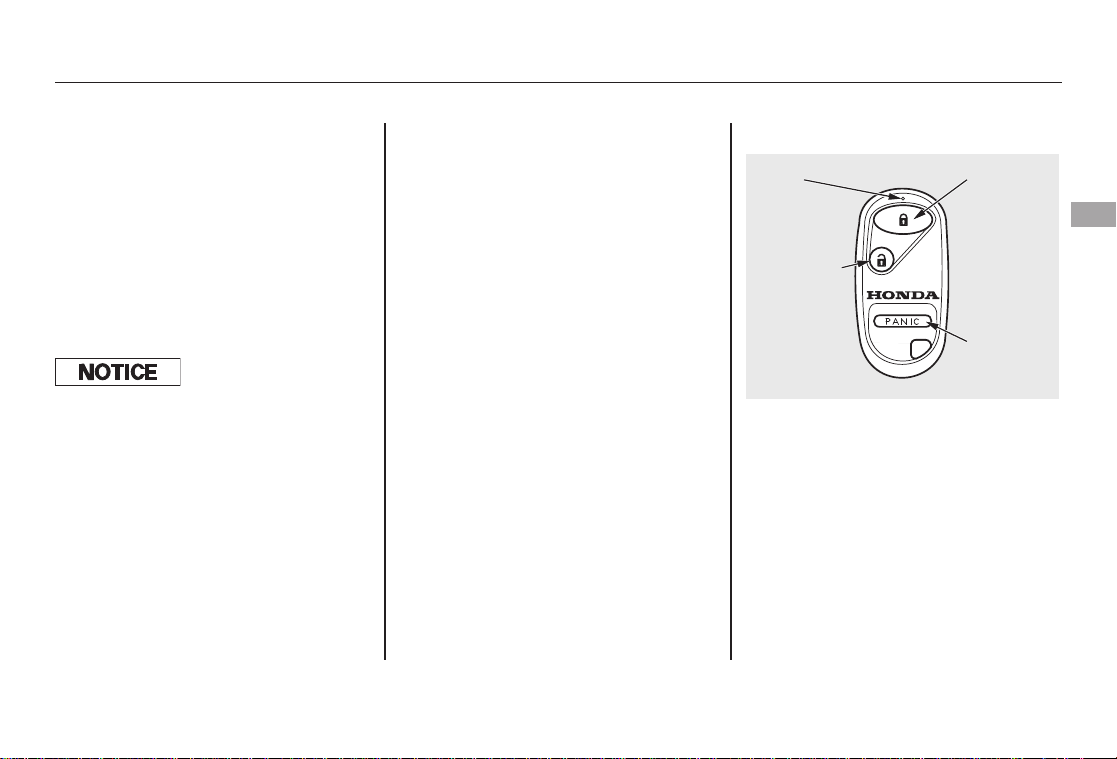
If the system repeatedly does not
recognize the coding of your key,
contact your dealer.
Do not attempt to alter this system or
add other devices to it. Electrical
problems could result that may make
your vehicle inoperable.
If you have lost your key and cannot
start the engine, contact your dealer.
Always take the ignition key with you
whenever you leave the vehicle alone.
As required by the FCC:
This device complies with Part 15 of the
FCC rules. Operation is subject to the
following two conditions: (1) This device
may not cause harmful interference, and
(2) this device must accept any
interference received, including
interference that may cause undesired
operation.
Changes or modifications not expressly
approved by the party responsible for
compliance could void the user's
authority to operate the equipment.
Remote Transmitter
LOCK - Press this button once to
lock both doors and hatch. Some
exterior lights will flash. When you
push LOCK twice within 5 seconds,
you will hear a horn to verify that the
doors are locked. You cannot lock it
if any door is not fully closed or the
key is in the ignition switch.
LED
UNLOCK
BUTTON
LOCK
BUTTON
PANIC
BUTTON
CONTINUED
Immobilizer System, Remote Transmitter
77
Instruments and Controls
10/08/06 08:34:41 11 ELEMENT MMC North America Owner's Man 50 31SCV680 enu
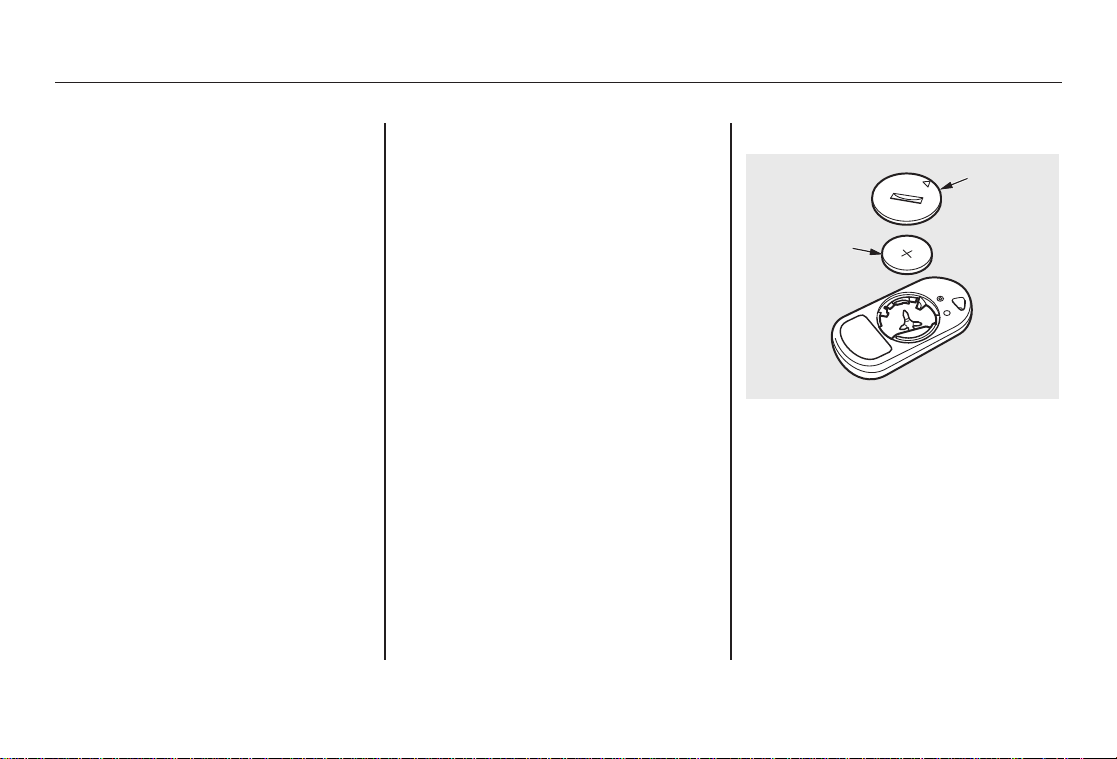
UNLOCK - Press this button once
to unlock the driver's door. Push it
twice to unlock the passenger's door
and the hatch. Some exterior lights
will flash twice each time you press
the button. If you do not open either
door or the hatch within 30 seconds,
they will automatically relock.
PANIC - Press this button for
about 1 second to attract attention;
the horn will sound and the exterior
lights will flash for about 30 seconds.
To cancel panic mode, press any
other button on the remote
transmitter, or turn the ignition
switch to the ON (II) position.
Remote Transmitter Care
●
Avoid dropping or throwing the
transmitter.
●
Protect the transmitter from
extreme temperature.
●
Do not immerse the transmitter in
any liquid.
●
If you lose a transmitter, the
replacement needs to be
reprogrammed by your dealer.
Replacing the Transmitter Battery
If it takes several pushes on the
button to lock or unlock the doors
and the hatch, replace the battery as
soon as possible.
Battery type: CR2025
ROUND
COVER
BATTERY
Remote Transmitter
78
10/08/06 08:34:41 11 ELEMENT MMC North America Owner's Man 50 31SCV680 enu
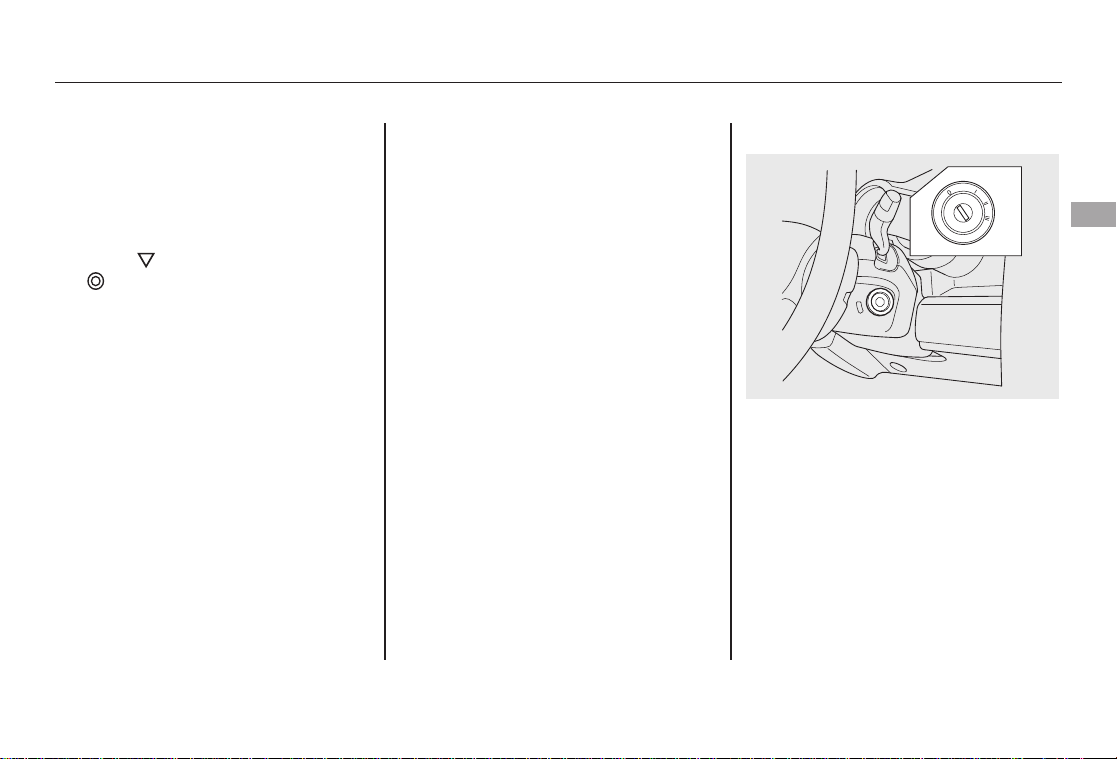
To replace the battery, remove the
round cover on the back of the
transmitter by turning it
counterclockwise with a coin. Insert
a new battery with the + side facing
up, and reinstall the cushion ring.
Align the
mark on the cover with
the
mark on the transmitter. Set
the cover in place and turn it
clockwise.
As required by the FCC:
This device complies with Part 15 of the
FCC rules. Operation is subject to the
following two conditions: (1) This device
may not cause harmful interference, and
(2) this device must accept any
interference received, including
interference that may cause undesired
operation.
Changes or modifications not expressly
approved by the party responsible for
compliance could void the user's
authority to operate the equipment.
Ignition Switch
The ignition switch has four
positions: LOCK (0), ACCESSORY
(I), ON (II), and START (III).
LOCK (0) - You can insert or
remove the key only in this position.
To turn the key, push it in slightly.
The shift lever must also be in Park.
CONTINUED
Remote Transmitter, Ignition Switch
79
Instruments and Controls
10/08/06 08:34:41 11 ELEMENT MMC North America Owner's Man 50 31SCV680 enu
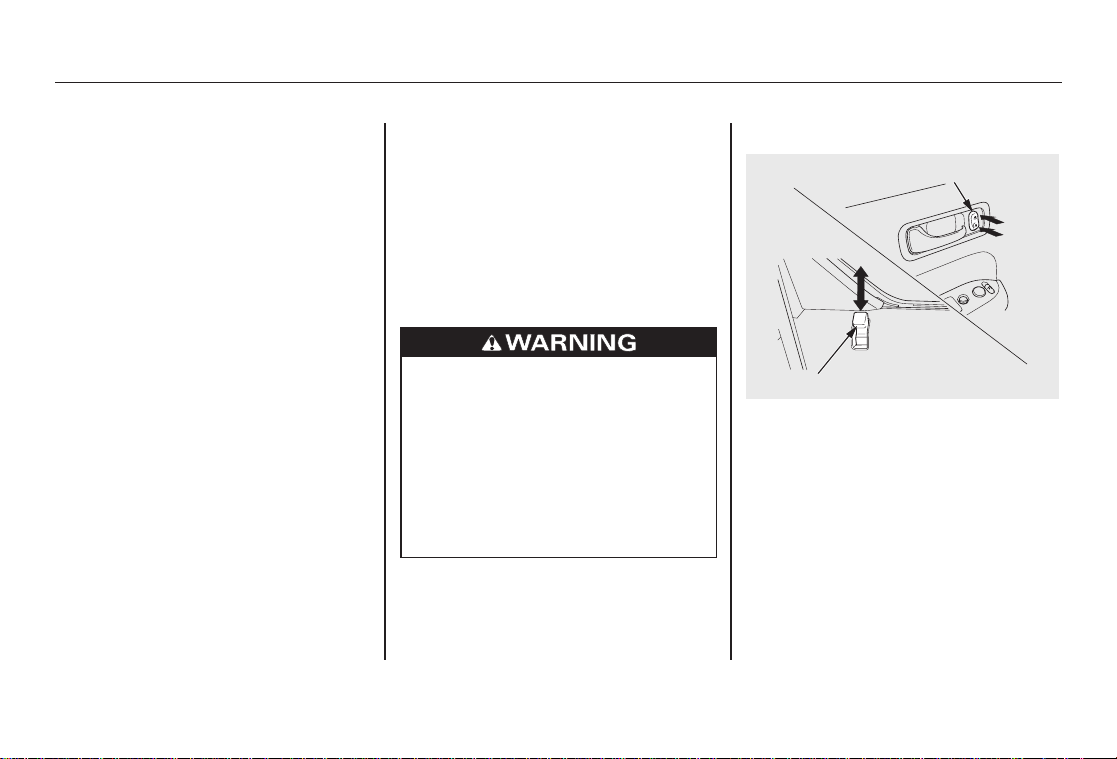
If the front wheels are turned, the
anti-theft lock may make it difficult to
turn the key. Firmly turn the steering
wheel to the left or right as you turn
the key.
ACCESSORY (I) - You can operate
the audio system and the accessory
power sockets in this position.
ON (II) - This is the normal key
position when driving. Several of the
indicators on the instrument panel
come on as a test when you turn the
ignition switch from the
ACCESSORY (I) to the ON (II)
position.
START (III) - Use this position
only to start the engine. The switch
returns to the ON (II) position when
you let go of the key.
You will hear a reminder beeper if
you leave the key in the LOCK (0) or
the ACCESSORY (I) position and
open the driver's door. Remove the
key to turn off the beeper.
The shift lever must be in Park
before you can remove the key from
the ignition switch.
Removing the key from the
ignition switch while driving
locks the steering. This can
cause you to lose control of the
vehicle.
Remove the key from the
ignition switch only when
parked.
Power Door Locks
To lock all of the doors and hatch,
press the door lock switch on the
driver's door, or press the lock tab
down on the driver's door, or use the
key on the outside lock. Pressing up
on the door lock switch will unlock
all of the doors and the hatch.
LOCK TAB
DOOR LOCK SWITCH
Ignition Switch, Door Locks
80
10/08/06 08:34:41 11 ELEMENT MMC North America Owner's Man 50 31SCV680 enu
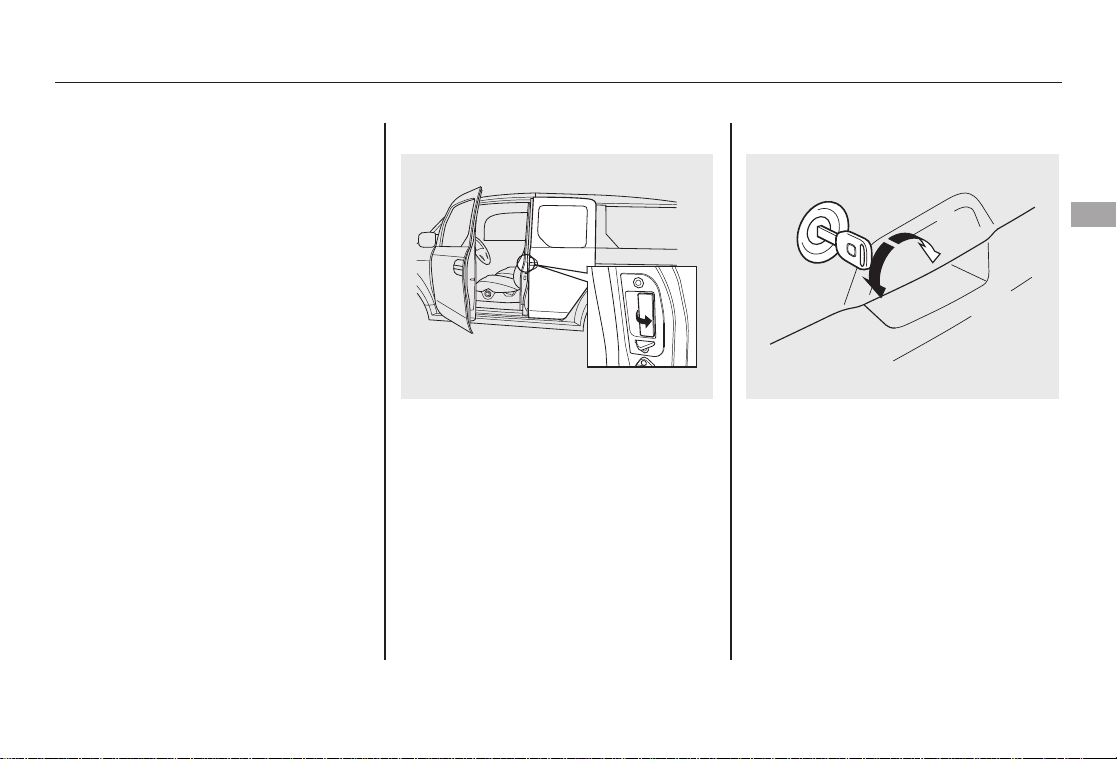
The lock tab on the passenger's door
locks and unlocks only that door.
Pulling up on the driver's door lock
tab only unlocks the driver's door.
To lock the driver's door, remove the
key from the ignition switch, push
the lock tab down or push the door
lock switch down, then close the
door.
To unlock the driver's door from the
outside, turn the key and release it.
Lockout Prevention
With the driver's door open and the
key in the ignition switch, the master
door lock switch is disabled. It is not
disabled if the driver's door is closed.
If you try to lock the open driver's
door with the key in the ignition
switch by pushing in the lock tab, the
tabs on all doors pop up when you
close the door.
Rear Doors
To open the rear door, pull the rear
door handle located in the rear door
edge. The rear door can be opened
only when the front door is open.
To close the doors, close the rear
door first, then the front door. The
front door cannot be latched without
first closing the rear door. Closing
the rear door on the front door will
damage both doors.
Hatch
To lock or unlock the hatch.
●
Use your master key to lock and
unlock the hatch. Turn the key
counterclockwise to lock the
hatch, and clockwise to unlock it.
Unlock
Lock
CONTINUED
Door Locks
81
Instruments and Controls
10/08/06 08:34:41 11 ELEMENT MMC North America Owner's Man 50 31SCV680 enu
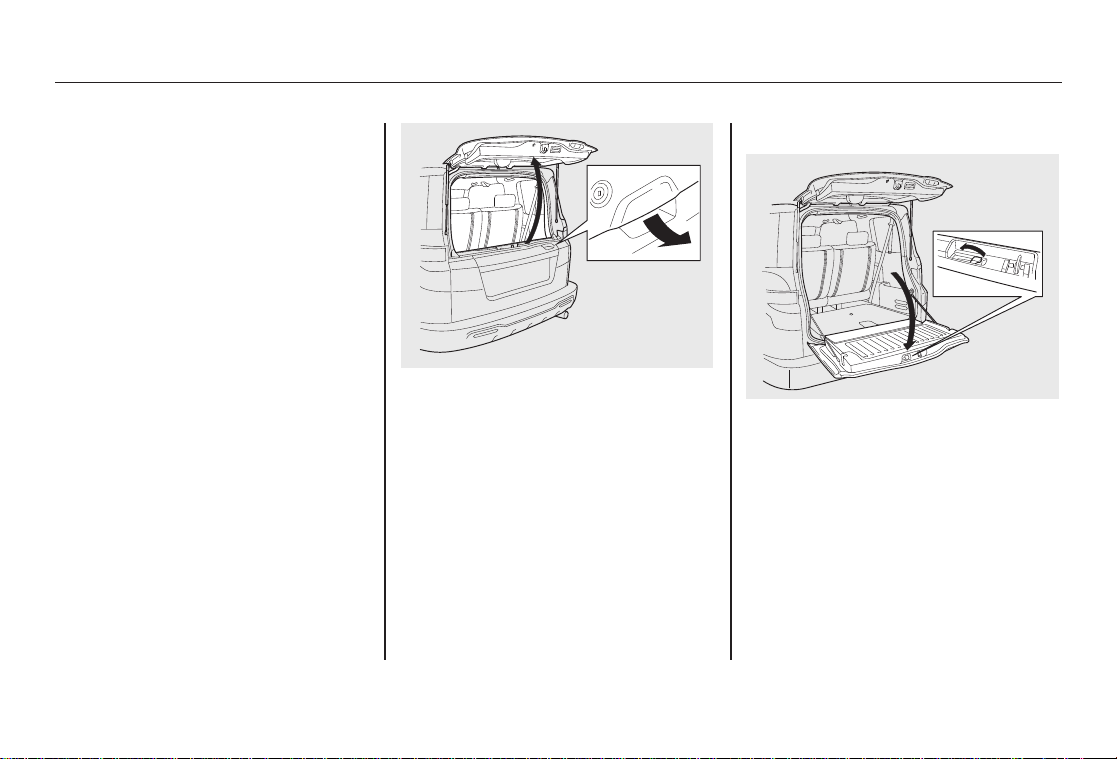
●
Lock the hatch by pushing down
the lock tab on the driver's door
(see page 80), or by using the
master key in the driver's door
lock.
●
Lock or unlock the hatch with the
master door lock switch.
With the hatch unlocked, open it by
pulling the handle and lifting up.
To close the hatch, lower it, then
press down on the back edge.
When both the hatch and tailgate are
open, the hatch cannot be latched
without first closing the tailgate.
Tailgate
You can open the tailgate only when
the hatch is open. To open the
tailgate, slide the lock lever to the left
and swing down the tailgate. To close
the tailgate, lift it up and push it
firmly until it latches.
Before closing the tailgate, make
sure the hatch is raised. Closing the
tailgate on the lowered hatch can
damage the hatch and the tailgate.
Door Locks
82
10/08/06 08:34:41 11 ELEMENT MMC North America Owner's Man 50 31SCV680 enu
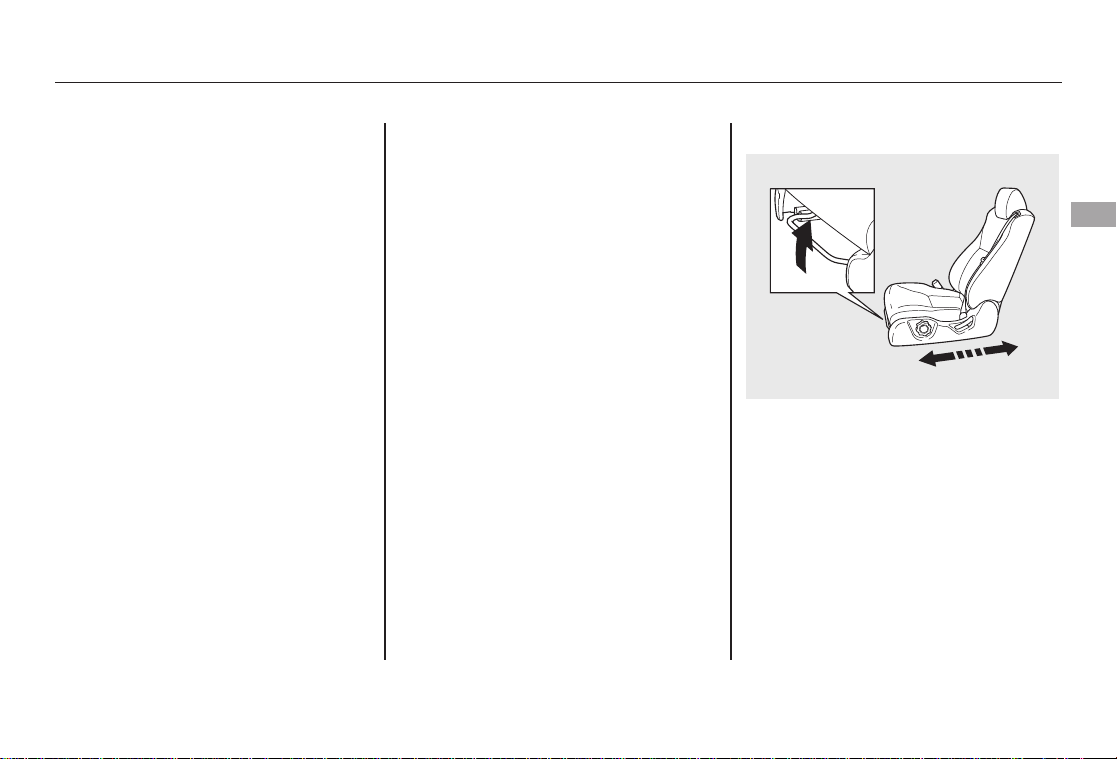
See page 154 for information on
cargo loading. Keep the tailgate and
the hatch closed at all times while
driving to avoid damaging them, and
to prevent exhaust gas from getting
into the interior. See Carbon
Monoxide Hazard on page 52.
Seat Adjustments
See pages 11 - 13 for important safety
information and warnings about how to
properly position seats and seat-backs.
Make all seat adjustments before you
start driving.
Front Seat
To adjust the seat forward and
backward, pull up on the bar under
the seat cushion's front edge. Try to
move the seat to make sure it is
locked in position.
CONTINUED
Door Locks, Seats
83
Instruments and Controls
10/08/06 08:34:41 11 ELEMENT MMC North America Owner's Man 50 31SCV680 enu
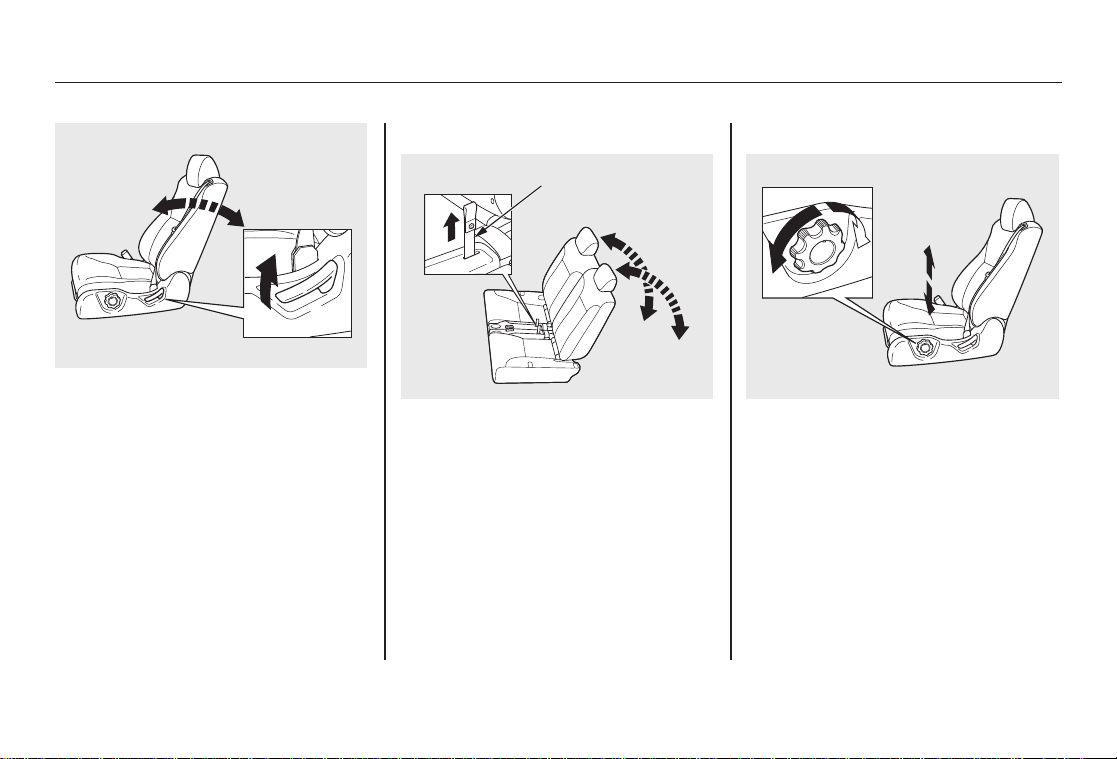
To change the seat-back angle of the
front seat, pull up on the lever on the
outside of the seat bottom. Adjust the
seat-back and make sure it locks into
position.
Rear Seat
To change the angle of the rear seat-
back, pull the strap at the inside edge
of the seat cushion, make sure the
seat-back locks into position.
Driver's Seat Height Adjustment
To adjust the height of the driver's
seat, turn the dial on the outside of
the seat bottom.
SEAT-BACK ADJUSTMENT STRAP
Seats
84
10/08/06 08:34:41 11 ELEMENT MMC North America Owner's Man 50 31SCV680 enu
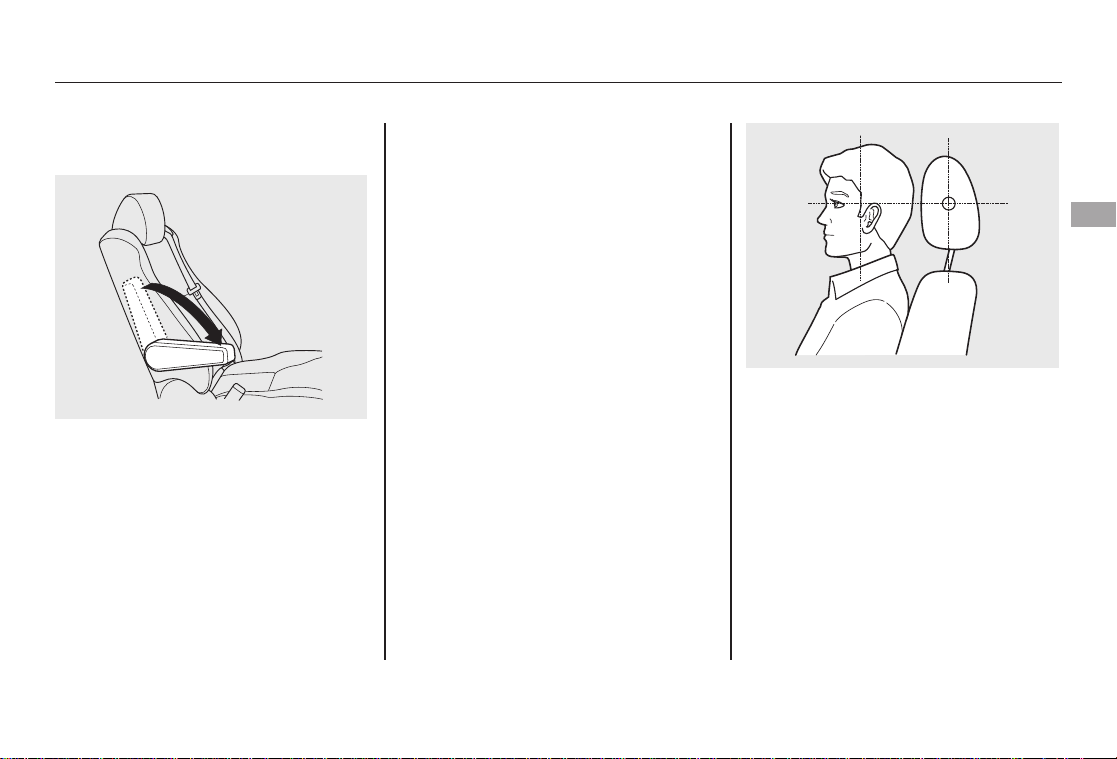
Front Seat Armrests
On EX model
Each front seat has an armrest on the
side of the seat-back. To use it, pivot
it down.
Head Restraints
See page 13 for important safety
information and a warning about
improperly positioning head restraints.
Your vehicle is equipped with head
restraints in all seating positions to
help protect you and your
passengers from the likelihood of
whiplash and other injuries.
They are most effective when you
adjust them so the center of the back
of the occupant's head rests against
the center of the restraint.
CONTINUED
Seats
85
Instruments and Controls
10/08/06 08:34:41 11 ELEMENT MMC North America Owner's Man 50 31SCV680 enu
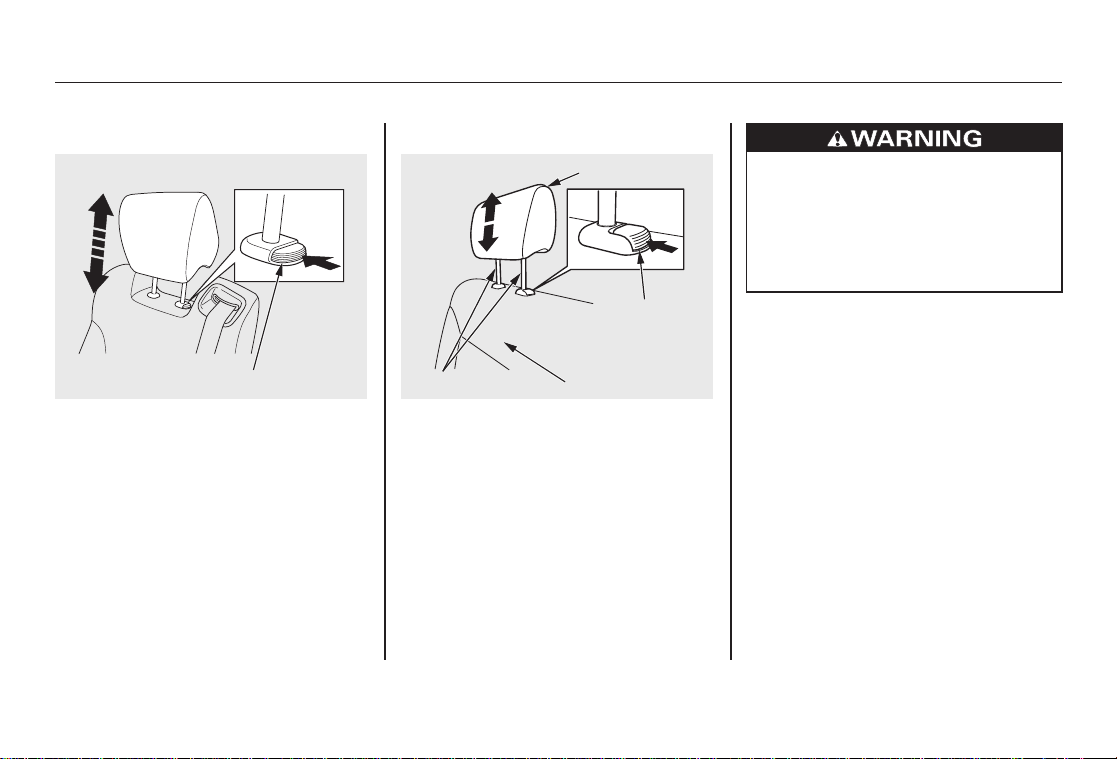
Adjusting the Head Restraint
The head restraints in the front and
rear seating positions adjust for
height. You need both hands to
adjust the restraint. To raise it, pull
upward. To lower the restraint, push
the release button sideways and
push the restraint down.
Removing the Head Restraint
To remove a head restraint for
cleaning or repair, pull it up as far as
it will go. Push the release button,
then pull the restraint out of the seat-
back.
Failure to reinstall the head
restraints can result in severe
injury during a crash.
Always replace the head
restraints before driving.
When reinstalling a head restraint,
put the legs back in place. Then
adjust it to the appropriate height
while pressing the release button.
Make sure the head restraint locks in
position when you reinstall it.
RELEASE BUTTON
Front
Rear
CUSHION
RELEASE
BUTTON
SEAT-BACKLEGS
Seats
86
10/08/06 08:34:41 11 ELEMENT MMC North America Owner's Man 50 31SCV680 enu
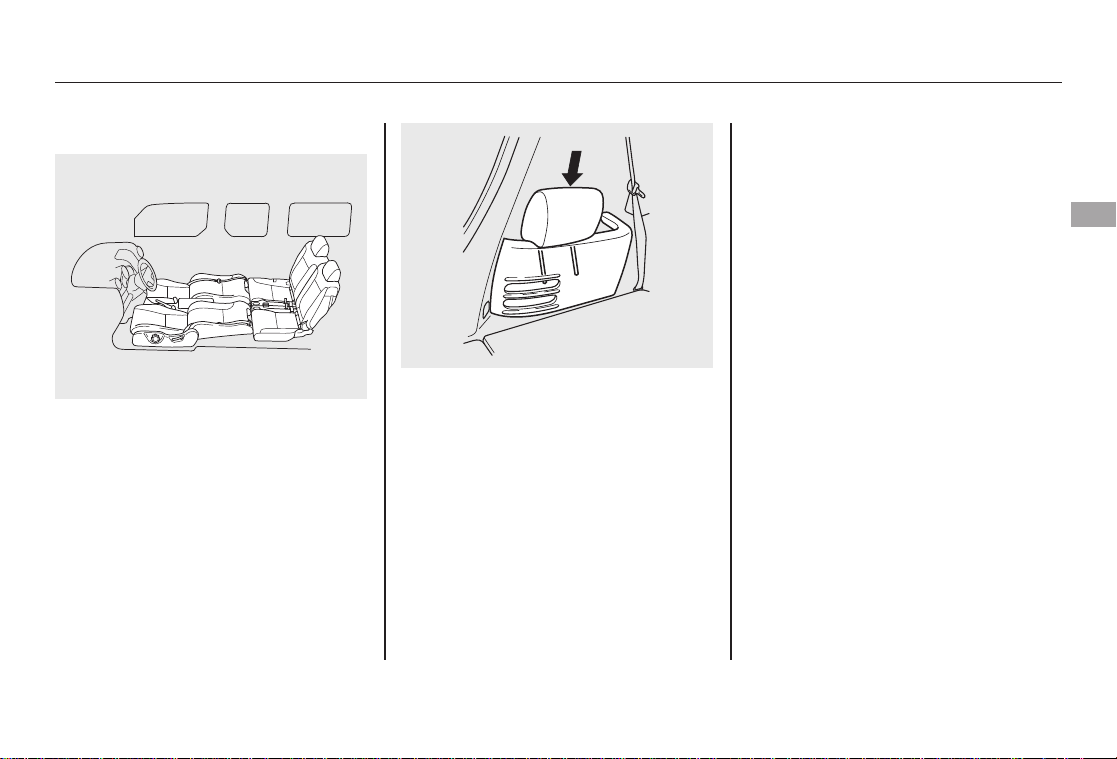
Reclining the Front Seats
You can recline the seat-backs on the
front seats so they are level with the
rear seat cushions, making a large
cushioned area. To do this:
1. Remove the head restraints from
the front seats (see page 85), and
store them in the side pockets of
the cargo area.
2. Adjust the front seats forward as
far as possible. Pull up the seat-
back angle adjustment lever and
pivot the seat-back backward until
it is level with the rear seat
cushion.
3. Move the front seat backward until
it touches the rear seat.
4. Adjust the rear seat-back to the
desired position.
Reverse this procedure to return the
front and rear seats to the upright
position. Make sure you install the
head restraints and the seats are
locked securely before driving.
When you return the seat-back to its
upright position, hold the seat-back
to keep it from going up too quickly.
Seats
87
Instruments and Controls
10/08/06 08:34:41 11 ELEMENT MMC North America Owner's Man 50 31SCV680 enu
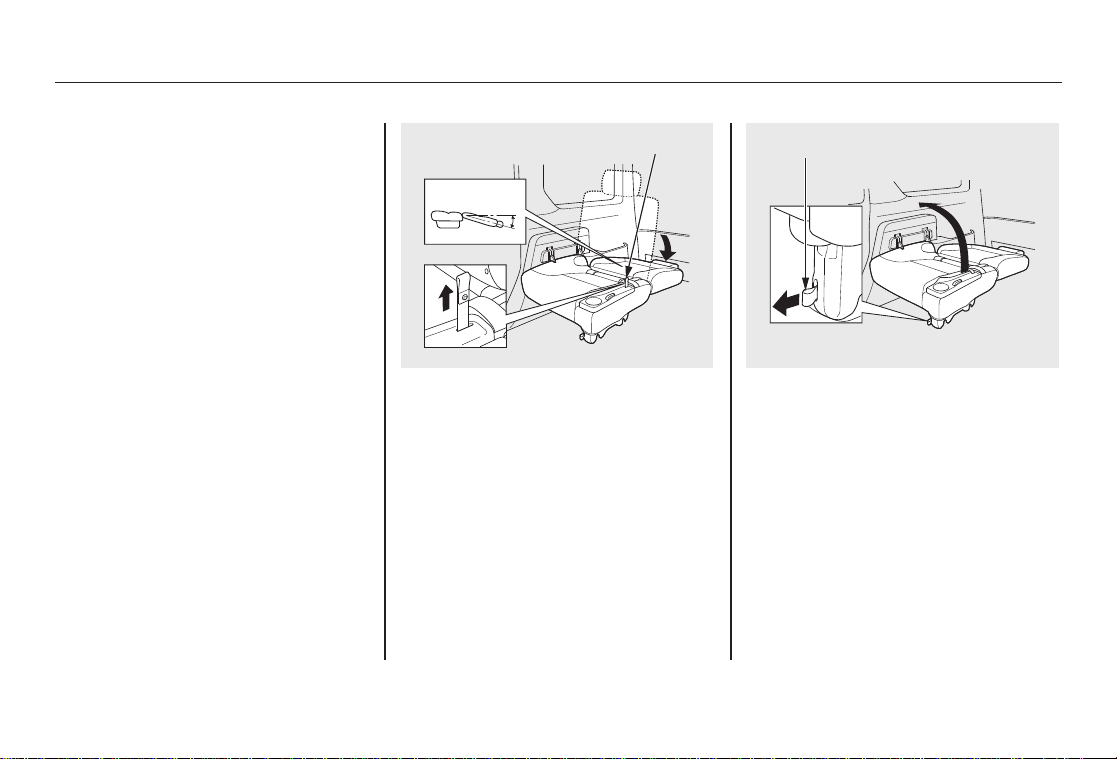
Folding the Rear Seats
To create more cargo space, you can
fold up each rear seat to each side
wall separately.
1. Lower the head restraint to its
lowest position.
2. Pull the seat-back adjustment strap
at the inside edge of the seat
cushion and push the seat-back
backward as far as it will go.
3. Pull the release strap on the seat
support, and pivot the seat toward
the vehicle's side wall.
SEAT-BACK ADJUSTMENT STRAP
RELEASE STRAP
Seats
88
10/08/06 08:34:41 11 ELEMENT MMC North America Owner's Man 50 31SCV680 enu
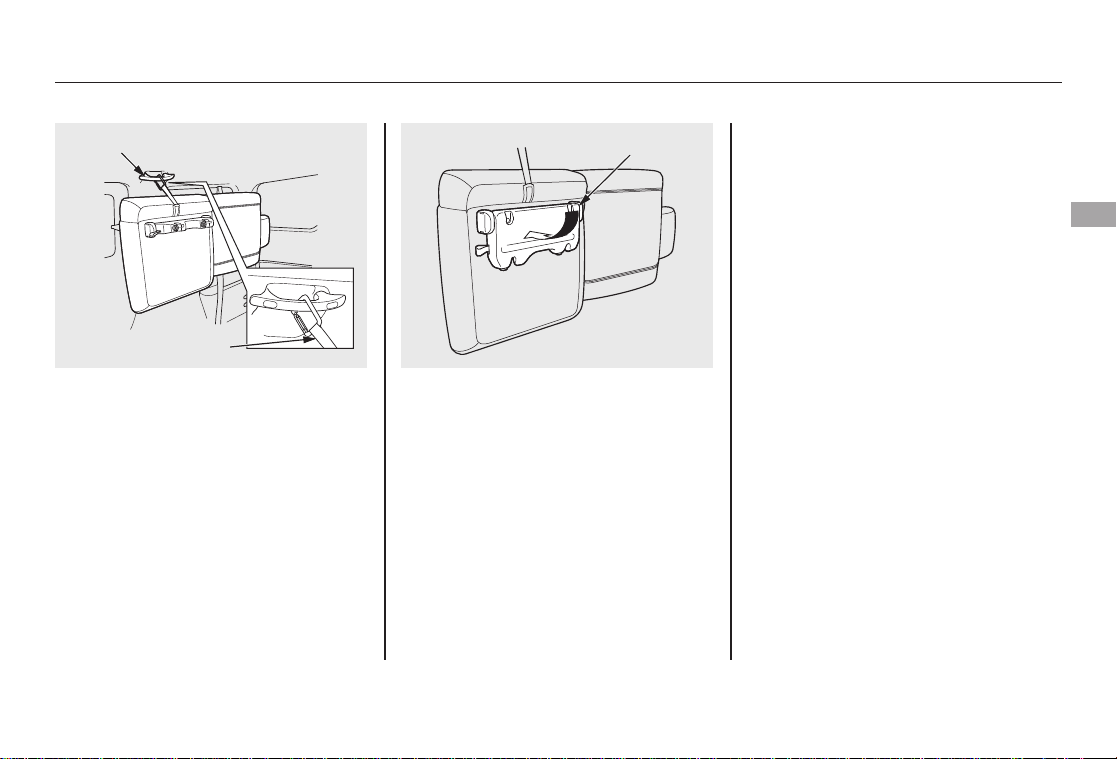
4. A fastening strap is attached to the
inside of the seat cushion. While
pushing the seat up and toward the
side wall, hook the fastening strap
to the grab rail.
5. Fold down the seat support.
Reverse this procedure to return the
rear seat to the upright position.
When not in use, store the fastening
strap hook in the fabric pocket on the
bottom of the seat cushion. Make
sure the seat is locked securely.
GRAB RAIL
FASTENING STRAP
SEAT SU PPORT
Seats
89
Instruments and Controls
10/08/06 08:34:41 11 ELEMENT MMC North America Owner's Man 50 31SCV680 enu
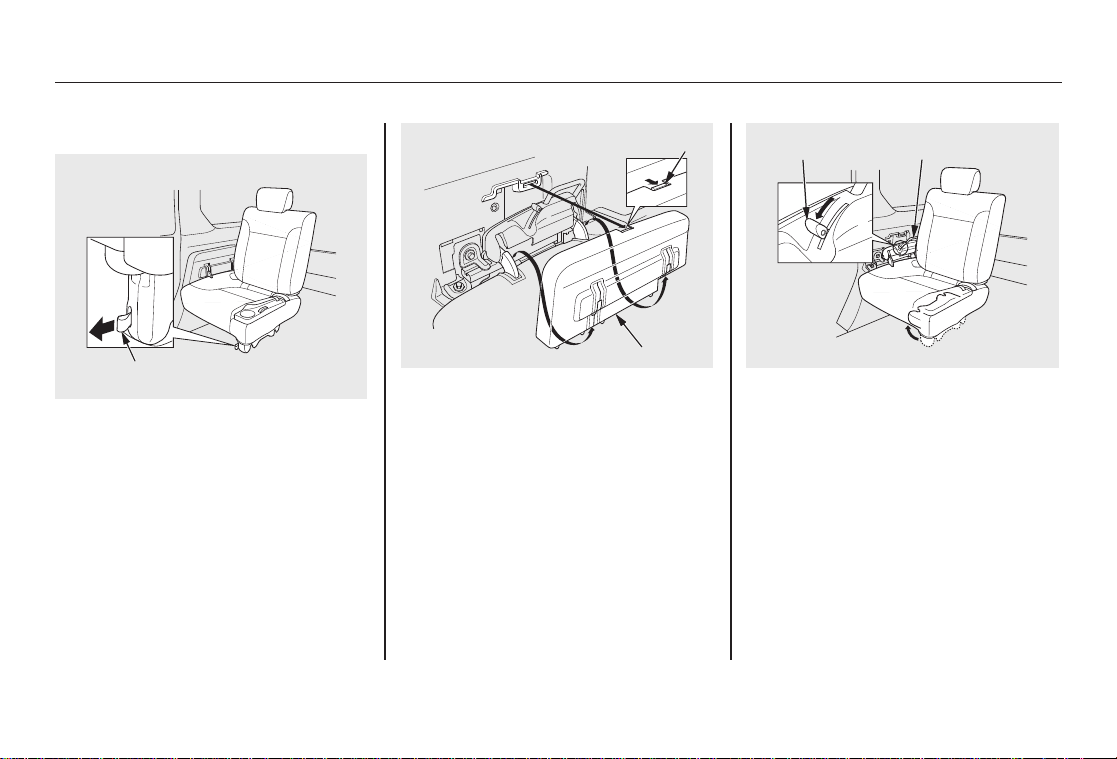
Removing the Rear Seats
Both seats can be removed to give
more cargo capacity. To remove a
seat:
1. Pull the release strap on the seat
support to unlock the seat support.
2. Remove the cover between the
seat cushion and the side wall by
pulling the tab and pulling the
cover straight up.
3. Push the lock lever forward to
unlock the seat and fold down the
seat support.
RELEASE STRAP
TAB
COVER
LOCK LEVER STEEL HANDLE
Seats
90
10/08/06 08:34:41 11 ELEMENT MMC North America Owner's Man 50 31SCV680 enu
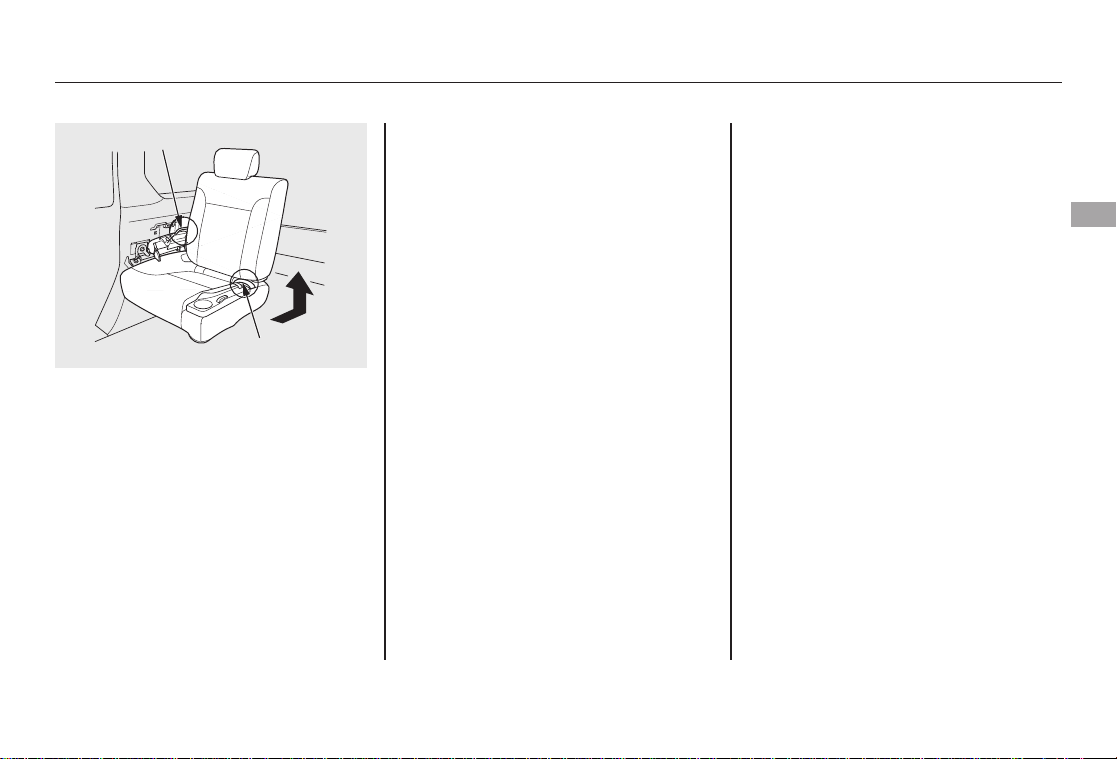
4. Hold the steel handle next to the
lock lever and the handle strap at
the outside edge of the seat
cushion, and remove the entire
seat by pulling it up and backward.
Reverse this procedure to reinstall
the seat. Make sure the seats are
securely locked in place before
driving.
Always remove an unsecured seat
from the vehicle before driving. A
seat that is not locked in place could
be thrown about and cause injury in a
sudden stop or crash.
STEEL HANDLE
HANDLE STRAP
Seats
91
Instruments and Controls
10/08/06 08:34:41 11 ELEMENT MMC North America Owner's Man 50 31SCV680 enu
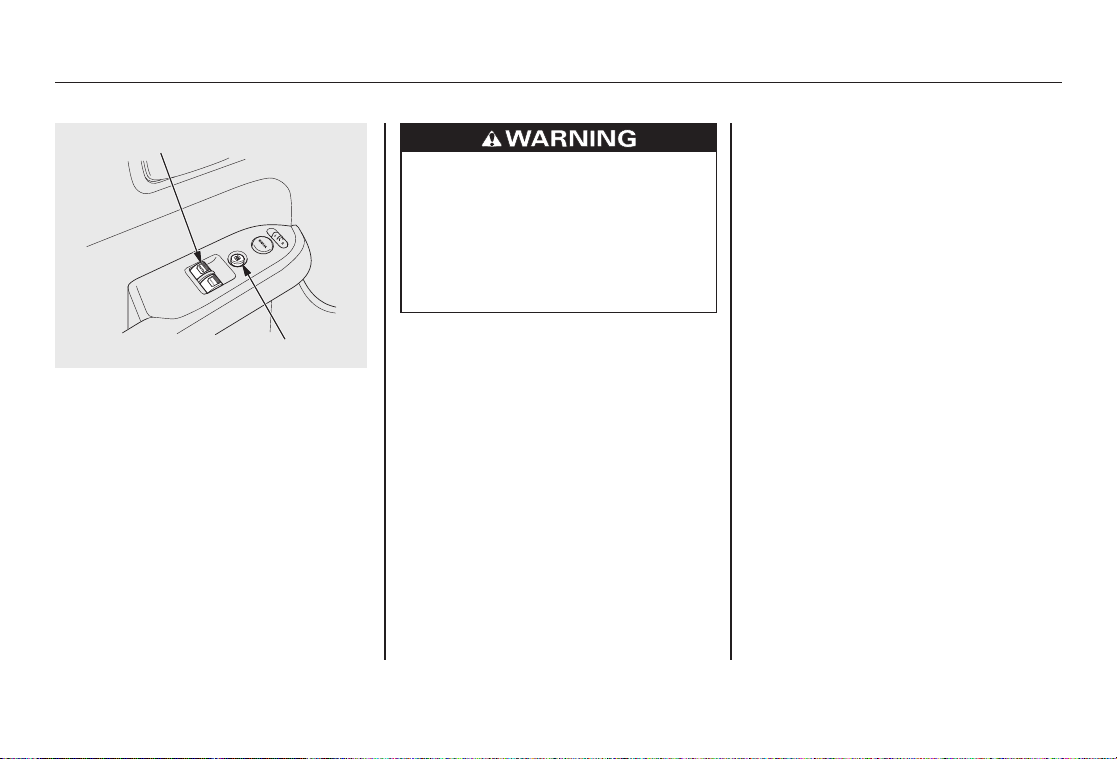
Turn the ignition switch to the ON
(II) position to raise or lower either
window. To open a window, push the
switch down and hold it. Release the
switch when you want the window to
stop. Pull back on the switch and
hold it to close the window.
Closing a power window on
someone's hands or fingers can
cause serious injury.
Make sure your passengers are
away from the window before
closing them.
AUTO - To open/close the driver's
window, push the window switch
firmly down or up to the second
detent, and release it. The window
will automatically go up or down all
the way. To stop the window, pull/
push on the window switch briefly.
If the MAIN switch is OFF, the
passenger's window cannot be raised
or lowered. Keep the MAIN switch
off when you have children in the
vehicle so they do not injure
themselves by operating the
passenger's window unintentionally.
AUTO REVERSE - If the driver's
window senses any obstacle while it is
closing automatically, it will reverse
direction, and then stop. To close the
window, remove the obstacle, then use
the window switch again.
If your vehicle's battery is disconnected
or goes dead, or the driver's window
fuse is removed, the AUTO function
may be disabled. If this happens, the
power window system will need to be
reset after reconnecting the battery or
installing the fuse.
1. Start the engine. Push down and
hold the driver's window switch until
the window is fully open.
2. Pull and hold the driver's window
switch to close the window
completely, then hold the switch for
about 2 seconds.
If the power windows do not operate
properly after resetting, have your
vehicle checked by your dealer.
DRIVER'S WINDOW SWITCH
MAIN SWITCH
Power Windows
92
10/08/06 08:34:41 11 ELEMENT MMC North America Owner's Man 50 31SCV680 enu

Keep the inside and outside mirrors
clean and adjusted for best visibility.
Be sure to adjust the mirrors before
you start driving.
The inside mirror has day and night
positions. The night position reduces
glare from headlights behind you.
Flip the tab on the bottom edge of
the mirror to select the day or night
position.
Adjusting the Power Mirrors
1. Turn the ignition switch to the ON
(II) position.
2. Move the selector switch to L
(driver's side) or R (passenger's
side).
3. Push the appropriate edge of the
adjustment switch to move the
mirror right, left, up, or down.
4. When you finish, move the
selector switch to the center (off)
position. This turns the adjustment
switch off to keep your settings.
TAB
SELECTOR SWITCH
ADJUSTMENT SWITCH
Mirrors
93
Instruments and Controls
10/08/06 08:34:41 11 ELEMENT MMC North America Owner's Man 50 31SCV680 enu
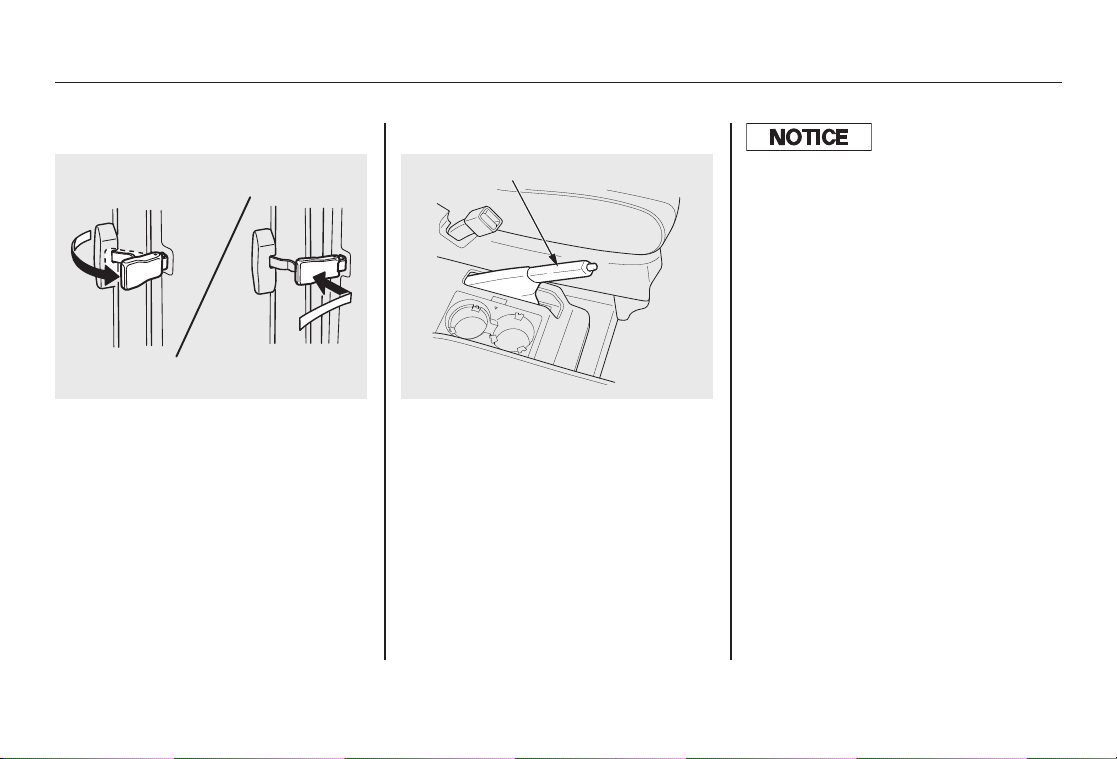
Rear Windows
To open a rear window, pull the lever
towards you, then push it out until it
locks. To close the rear window pull
the lever towards you, then push it
back. Make sure the window is fully
closed and locked.
Parking Brake
To apply the parking brake, pull the
lever up fully. To release it, pull up
slightly, push the button, and lower
the lever. The parking brake
indicator on the instrument panel
should go out when the parking
brake is fully released (see page 58).
Driving the vehicle with the parking
brake applied can damage the rear
brakes and axles. A beeper will sound if
the vehicle is driven with the parking
brake on.
PARKING BRAKE LEVER
Rear Windows, Parking Brake
94
10/08/06 08:34:41 11 ELEMENT MMC North America Owner's Man 50 31SCV680 enu
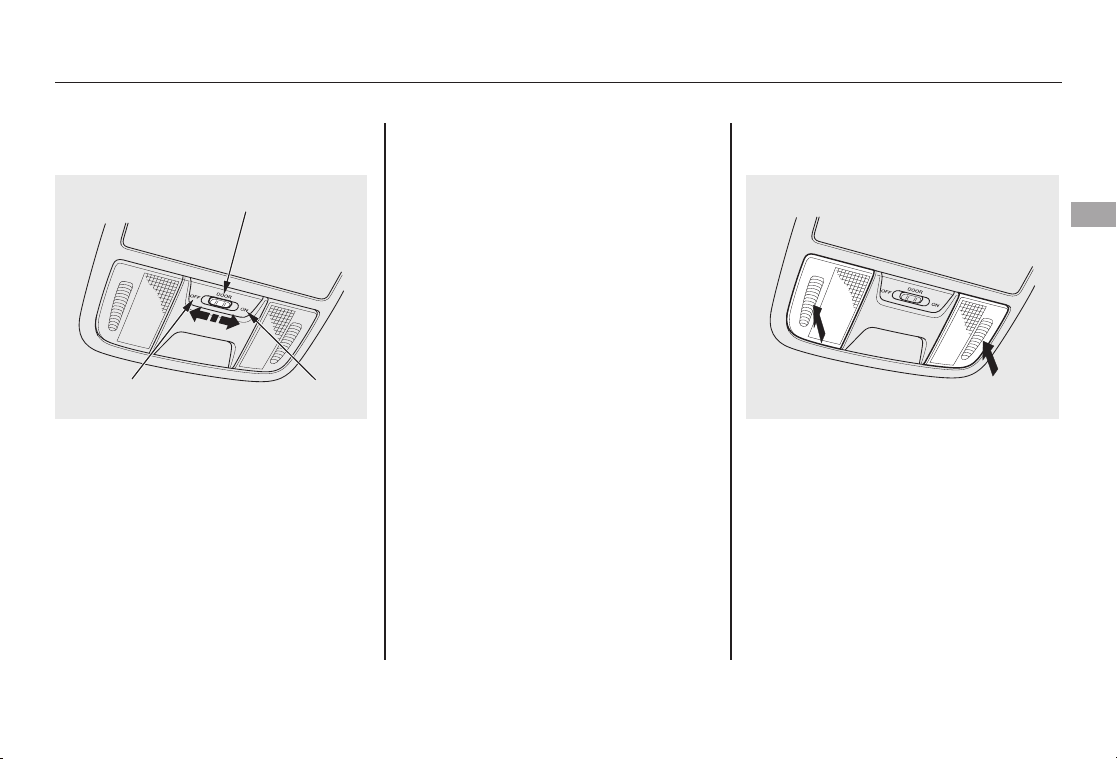
Light Control Switch
On EX model
The light control switch has three
positions: OFF, Door Activated, and
ON.
When the switch is in the OFF position:
●
The individual map lights can be
turned on and off by pressing the
lenses.
●
The ceiling light cannot be turned
on.
When the switch is in the door activated
position:
●
The individual map lights come on
when any door is opened, or when
the remote transmitter is used to
unlock the doors (see page 77).
When the doors are closed, each
light can be turned on and off by
pushing the lens.
After all doors are closed tightly, the
lights dim slightly, then fade out in
about 30 seconds.
With any door left open, the lights stay
on about 3 minutes, then go out.
The lights also come on when the key
is removed from the ignition switch.
When the light control switch is in the
ON position:
●
All the individual map lights and
ceiling light come on and stay on as
long as the switch remains in the ON
position.
Individual Map Lights
On EX model
Turn on the individual map lights by
pushing the lens. Push the lens again
to turn it off.
OFF ON
DOOR ACTIVATED POSITION
Interior Lights
95
Instruments and Controls
10/08/06 08:34:41 11 ELEMENT MMC North America Owner's Man 50 31SCV680 enu
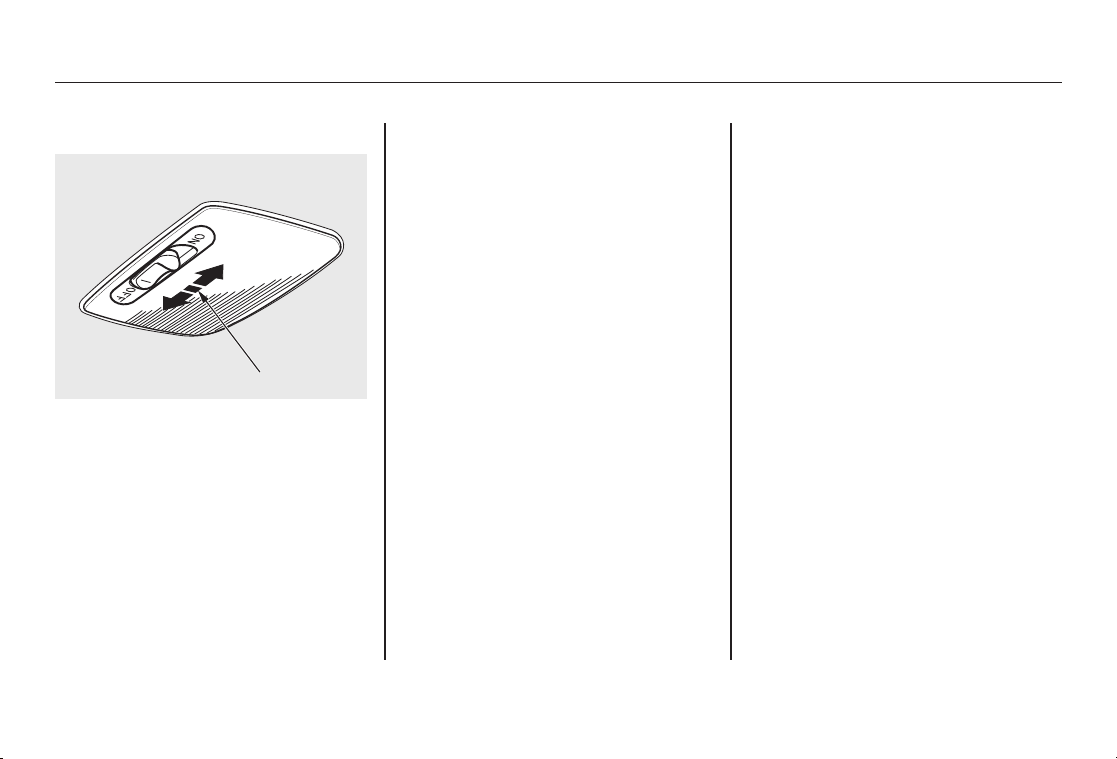
Ceiling Light
The ceiling light has a three-position
switch: ON, Door Activated, and
OFF.
In the Door Activated (center)
position, the light comes on when
you:
●
Open any door.
●
Remove the key from the ignition.
If you do not open a door, the light
fades out in about 30 seconds.
●
Unlock the doors with the key or
remote transmitter.
Cargo Area Light
The cargo area light has a three-
position switch. In the center
position, the light comes on when
you open the hatch.
Ignition Switch Light
The ignition switch light comes on
when you unlock the driver's door,
and fades out about 30 seconds after
you close the door.
ON
OFF
DOOR ACTIVATED
Interior Lights
96
10/08/06 08:34:41 11 ELEMENT MMC North America Owner's Man 50 31SCV680 enu
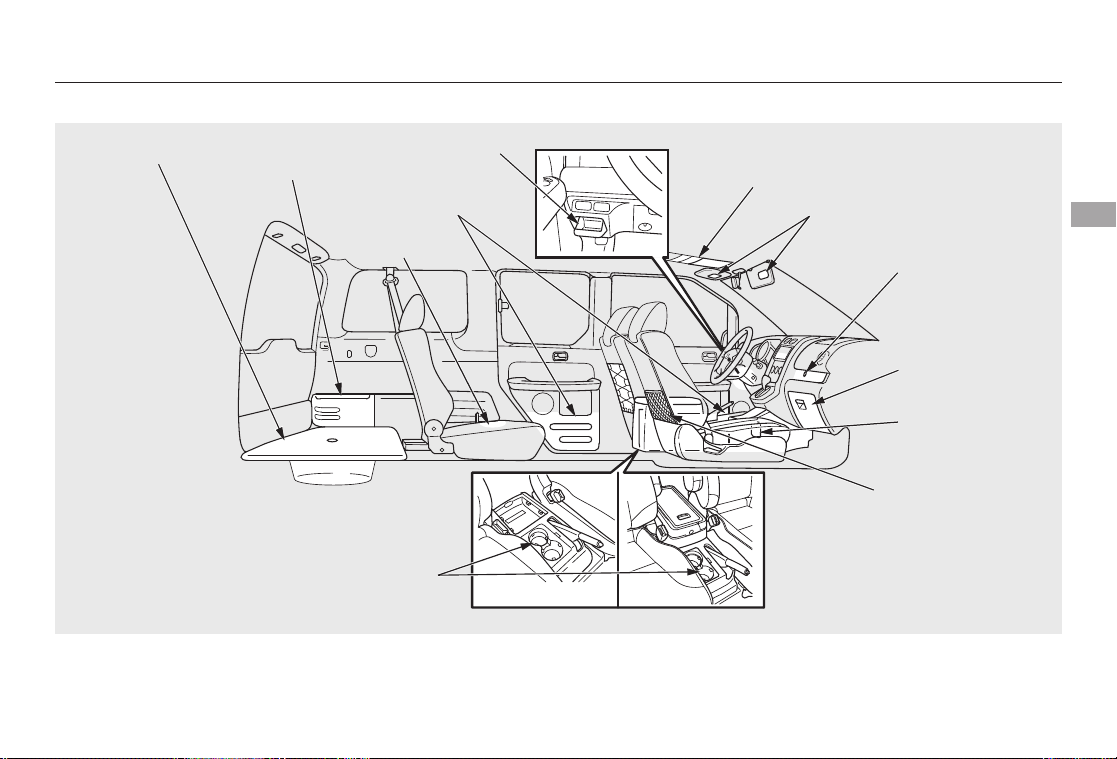
ꭧ: If equipped.
CARGO AREA CARGO AREA
SIDE POCKET
COIN TRAY
DOOR POCKETS
BEVERAGE HOLDERS
LX model EX model
OVERHEAD CONSOLE
ꭧ
ACCESSORY
POWER
SOCKET
GLOVE BOX
CENTER LOWER
POCKET
ꭧ
SEAT-BACK POCKET
ꭧ
VANITY MIRRORS
ꭧ
BEVERAGE
HOLDERS
EX model is shown.
Interior Convenience Items
97
Instruments and Controls
10/08/06 08:34:41 11 ELEMENT MMC North America Owner's Man 50 31SCV680 enu
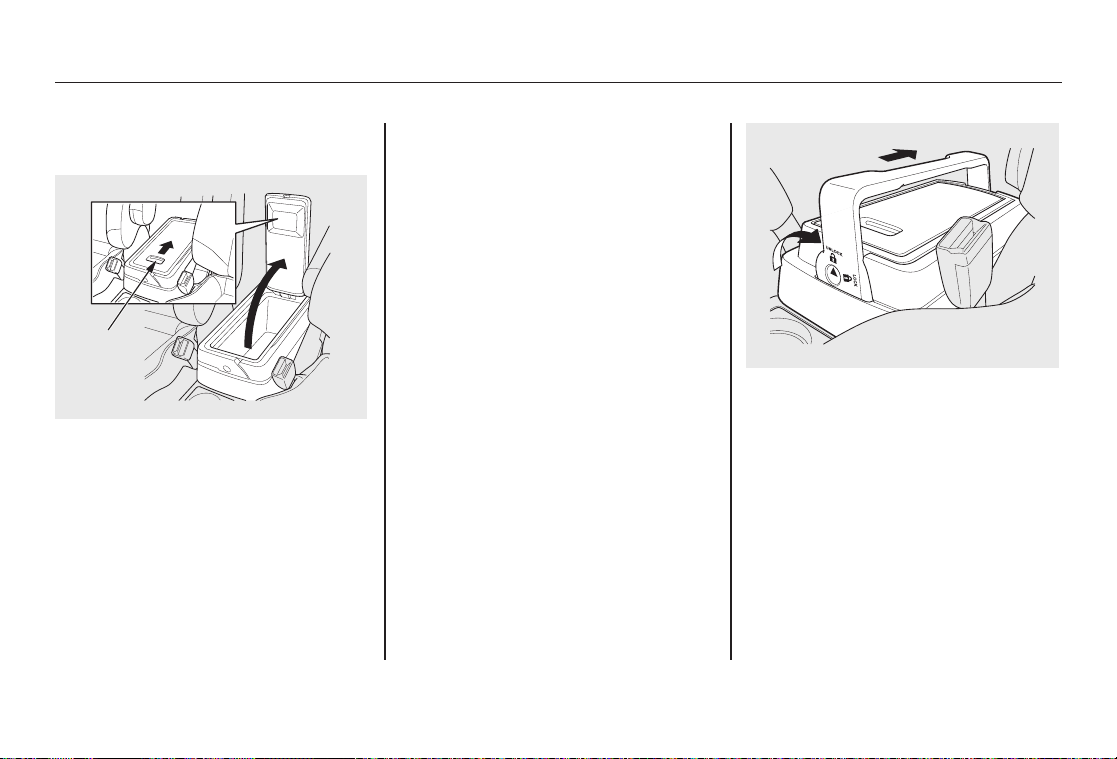
Cooler Box
On EX model
There is a cooler box between the
driver's and passenger's seats.
To open the cooler box, slide the tab
backward, and pull up the lid.
The lid has a breakaway feature. If
the lid is rotated back too far it will
break away from the box without
damage.
To reinstall the lid, vertically set the
rear lid hinge to the pins on the box
and push down. The lid must be
vertical as shown in the illustration.
To remove the cooler box, rotate the
handle up to the unlocked position.
Slide the console towards the rear of
the vehicle then lift the console.
TAB
Interior Convenience Items
98
10/08/06 08:34:41 11 ELEMENT MMC North America Owner's Man 50 31SCV680 enu
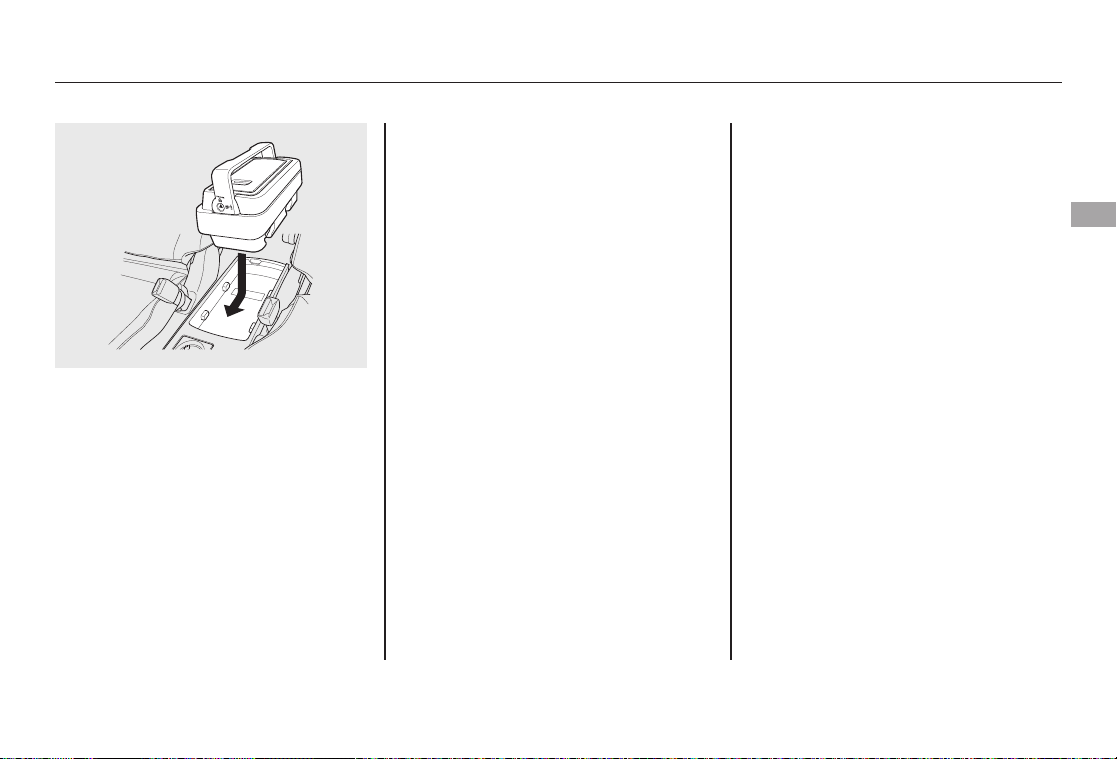
To reinstall the cooler box, set the
cooler box into the floor base, then
slide the cooler box forward.
Rotate the handle down to the locked
position.
Make sure the cooler box is securely
locked in place. A cooler box that is
not locked in place could become a
projectile and cause injury in a
sudden stop or crash.
If you take the cooler box out, put it
in a safe place outside the vehicle.
NOTE: The cooler box must be
locked to floor base while driving.
Beverage Holders
Be careful when you are using the
beverage holders. A spilled liquid
that is very hot can scald you or your
passengers. Spilled liquids can also
damage the upholstery, and electrical
components in the interior.
The front beverage holder is
removable. To remove it, push the
tab and pull it up.
Interior Convenience Items
99
Instruments and Controls
10/08/06 08:34:41 11 ELEMENT MMC North America Owner's Man 50 31SCV680 enu
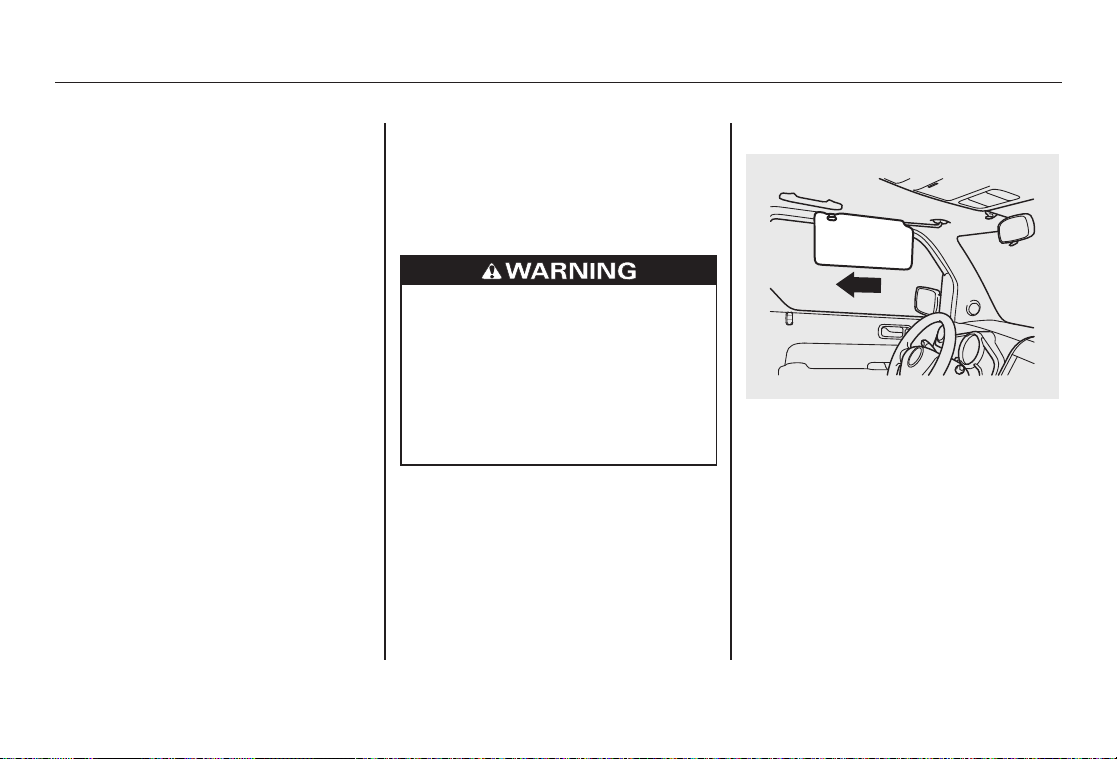
Accessory Power Sockets
Your vehicle has one or two
accessory power sockets, depending
on the model. All models have a front
accessory power socket on the
dashboard above the glove box.
EX model has an accessory power
socket in the cargo area on the
passenger's side.
These sockets are intended to supply
power for 12 volt DC accessories that
are rated 120 watts or less (10 amps).
None of the sockets will power an
automotive type cigarette lighter
element. When more than one
socket is being used, the combined
power rating of the accessories
should be 120 watts or less (10
amps).
Glove Box
Open the glove box by pulling the
bottom of the handle. Close it with a
firm push. Lock or unlock the glove
box with the master key.
An open glove box can cause
serious injury to your passenger
in a crash, even if the
passenger is wearing the seat
belt.
Always keep the glove box
closed while driving.
Sun Visor
To use the sun visor, pull it down.
When using the sun visor for the
side window, remove the support rod
from the clip, and swing it out.
In this position, the sun visor can be
adjusted by moving it on its slider.
Do not use the extended sun visor
over the inside mirror.
Make sure you put the sun visor
back in place when you are getting
into or out of the vehicle.
Slide
Interior Convenience Items
100
10/08/06 08:34:41 11 ELEMENT MMC North America Owner's Man 50 31SCV680 enu
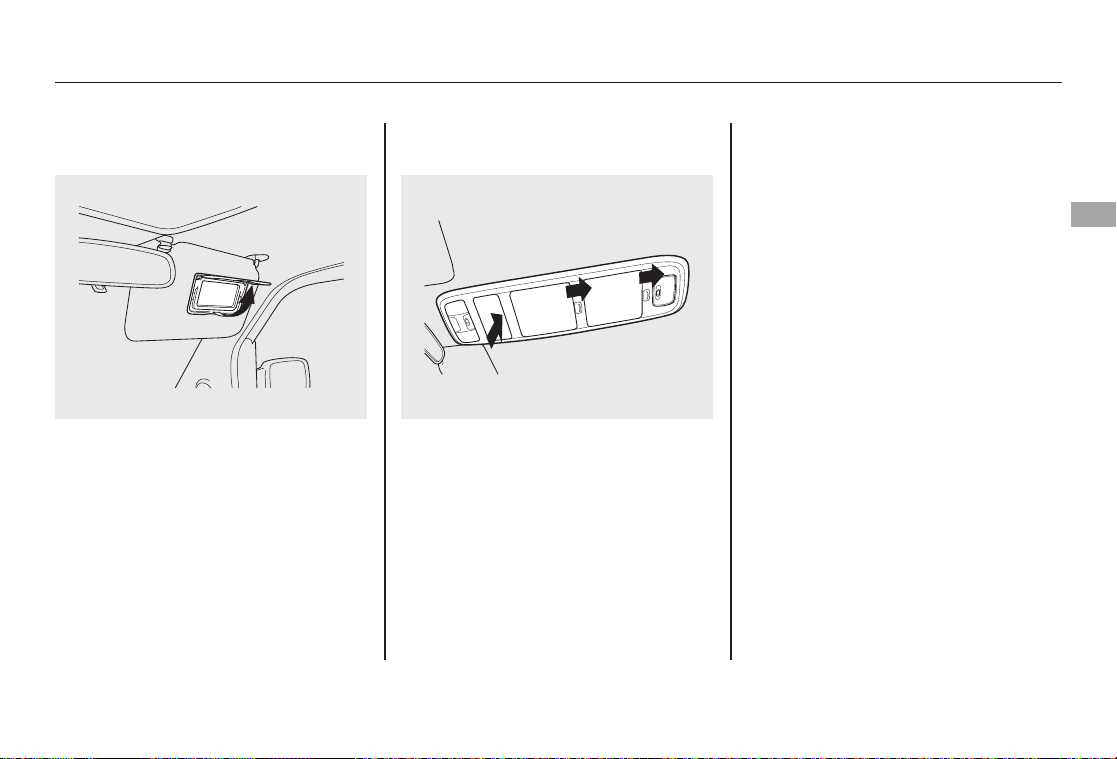
Vanity Mirror
On EX model
To use the vanity mirror on the back
of the sun visor, pull up the cover.
Overhead Console
On EX model
To open the overhead console, push
on the rear edge or slide the tab as
shown in the illustration. It will
unlatch and swing down. To close it,
push it until it latches. Make sure the
holder is closed while you are
driving.
You may also store small items in
this holder. Make sure they are small
enough to let the holder close and
latch, and that they are not heavy
enough to cause the holder to pop
open while driving.
Push
Slide
Slide
Interior Convenience Items
101
Instruments and Controls
10/08/06 08:34:41 11 ELEMENT MMC North America Owner's Man 50 31SCV680 enu

102
10/08/06 08:34:41 11 ELEMENT MMC North America Owner's Man 50 31SCV680 enu

The heating and air conditioning
system in your vehicle provides a
comfortable driving environment in
all weather conditions.
The standard audio system has many
features. This section describes
those features and how to use them.
(If you have an optional audio
system, refer to the operating
instructions that came with it.)
On EX model
Your vehicle has an anti-theft audio
system that requires a code number
to enable it.
Vents, Heating, and A/C
............. 104
Air Flow Controls
.................... 105
Ventilation
............................... 106
Using the Heater
..................... 106
Using the A/C
......................... 106
Dehumidify the Interior
.......... 107
To Defog and Defrost
.............. 107
To Remove Exterior Frost or
Ice From the Windows
........ 108
To Turn Everything Off
........... 108
Audio System
.............................. 109
Playing the AM/FM Radio
.......... 110
Playing the XM
®
Radio................ 113
Playing a Disc
............................. 119
Disc Player Error Messages
....... 125
Disc Changer Error
Messages
................................ 126
Protecting Your Discs
................. 127
FM/AM Radio Reception
............ 130
Radio Theft Protection
................ 132
Setting the Clock
......................... 133
Remote Audio Controls
............... 135
Auxiliary Input Jack
.................... 136
Cruise Control
............................ 137
Features
103
Features
10/08/06 08:34:41 11 ELEMENT MMC North America Owner's Man 50 31SCV680 enu
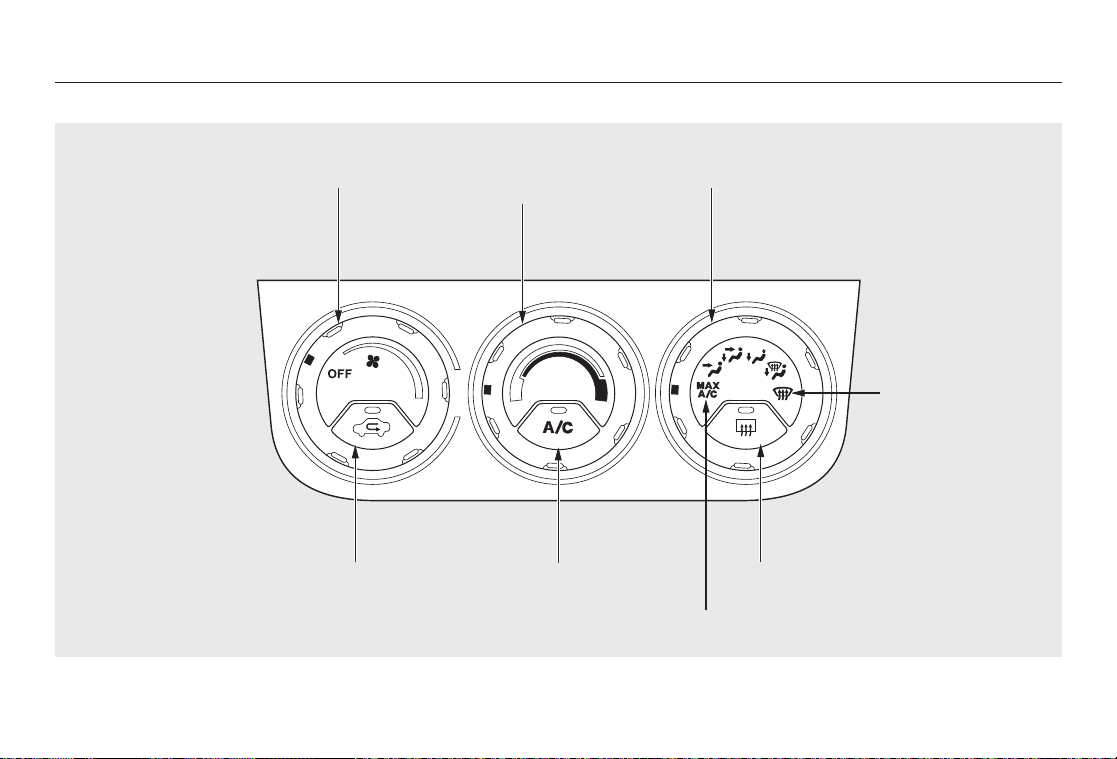
FAN CONTROL DIAL TEMPERATURE
CONTROL DIAL
MODE CO NTROL DIAL
DEFROST POSITION
REAR WINDOW DEFOGGER
BUTTON
MAX A/C POSITION
A/C (AIR CONDITIONING)
BUTTON
RECIRCULATION BUTTON
Vents, Heating, and A/C
104
10/08/06 08:34:41 11 ELEMENT MMC North America Owner's Man 50 31SCV680 enu
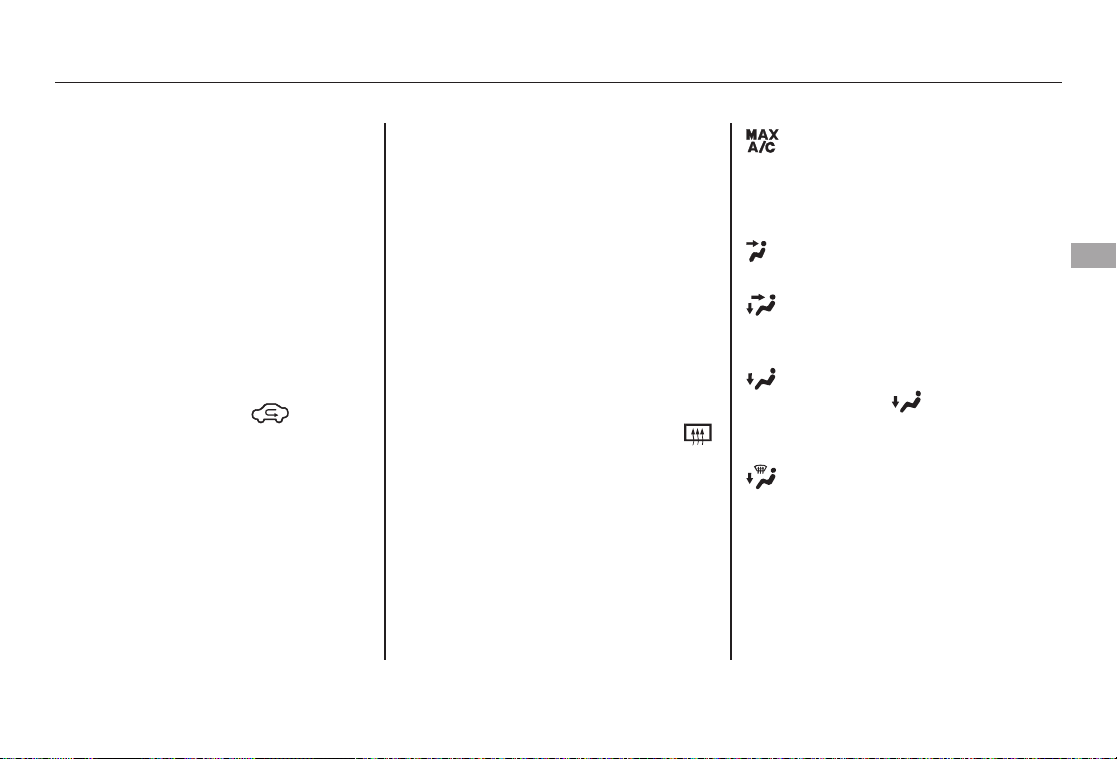
Air Flow Controls
Fan Control Dial
Turn this dial clockwise to increase
the fan speed and airflow.
Temperature Control Dial
Turning this dial clockwise increases
the temperature of the airflow.
Air Conditioning (A/C) Button
This button turns the air
conditioning on and off. The
indicator in the button is on when the
A/C is on.
Recirculation Button
When the recirculation indicator is
on, air from the vehicle's interior is
sent throughout the system again.
When the indicator is off, air is
brought in from the outside of the
vehicle (fresh air mode).
The outside air intakes for the
heating and cooling system are at the
base of the windshield. Keep this
area clear of leaves and other debris.
The system should be left in fresh air
mode under almost all conditions.
Keeping the system in recirculation
mode, particularly with the A/C off,
can cause the windows to fog up.
Switch to recirculation mode when
driving through dusty or smoky
conditions, then return to fresh air
mode.
Rear Window Defogger Button
This button turns the rear window
defogger on and off (see page 74).
Mode Control Dial
Use the mode control dial to select
the vents the air flows from. Some air
will flow from the dashboard vents in
all modes.
The system automatically turns
on the A/C and switches to
recirculation mode. Air flows from
the center and side vents in the
dashboard (see page 106).
Air flows from the center and
corner vents in the dashboard.
Airflow is divided between the
vents in the dashboard and the floor
vents.
Air flows from the floor vents.
When you select
, the system
automatically switches to fresh air
mode.
Airflow is divided between the
floor vents and the defroster vents at
the base of the windshield.
CONTINUED
Vents, Heating, and A/C
105
Features
10/08/06 08:34:41 11 ELEMENT MMC North America Owner's Man 50 31SCV680 enu
Air flows from the defroster
vents at the base of the windshield.
When you select
or , the
system automatically switches to
fresh air mode and turns on the A/C.
The A/C indicator does not come on.
Ventilation
The flow-through ventilation system
draws in outside air, circulates it
through the interior, then discharges
it through vents near the tailgate.
1. Set the temperature to the lower
limit.
2. Make sure the A/C is off.
3. Select
and fresh air mode.
4. Set the fan to the desired speed.
Using the Heater
The heater uses engine coolant to
warm the air. If the engine is cold, it
will be several minutes before you
feel warm air coming from the
system.
1. Select
and fresh air mode.
2. Set the fan to the desired speed.
3. Adjust the warmth of the air with
the temperature control dial.
Using the A/C
Air conditioning places an extra load
on the engine. Watch the engine
coolant temperature gauge (see page
67). If it moves near the red zone,
turn off the A/C until the gauge
reading returns to normal.
1. Turn on the A/C by pressing the
button. The indicator in the button
comes on when a fan speed is
selected.
2. Set the temperature to the lower
limit.
3. Select
.
4. If the outside air is humid, select
recirculation mode. If the outside
air is dry, select fresh air mode.
5. Set the fan to the desired speed.
If the interior is very warm,
you can
cool it down more rapidly by partially
opening the windows, turning on the
A/C, and setting the fan to maximum
speed in fresh air mode.
To cool the interior with MAX A/C:
1. Set the mode control dial to MAX
A/C.
The system automatically turns on
the A/C, selects
and switches
to recirculation mode.
2. Set the temperature to the lower
limit.
3. Set the fan to the desired speed.
Vents, Heating, and A/C
106
10/08/06 08:34:41 11 ELEMENT MMC North America Owner's Man 50 31SCV680 enu
Dehumidify the Interior
Air conditioning, as it cools, removes
moisture from the air. When used in
combination with the heater, it
makes the interior warm and dry and
can prevent the windows from
fogging up.
1. Turn the fan on.
2. Turn on the air conditioning.
3. Select
and fresh air mode.
4. Adjust the temperature to your
preference.
This setting is suitable for all driving
conditions whenever the outside
temperature is above 32°F (0°C).
To Defog and Defrost
To remove fog from the inside of the
windows:
1. Set the fan to the desired speed, or
high for faster defrosting.
2. Select
. The system
automatically switches to fresh air
mode and turns on the A/C. The
A/C indicator will not come on if it
was off to start with.
3. Adjust the temperature control dial
so the airflow feels warm.
4. Select
to help clear the rear
window.
5. To increase airflow to the
windshield, close the corner vents.
When you select
or , the
system automatically turns on the
A/C. This helps to dehumidify the air
and to defog the windshield. In either
mode, you cannot turn off the A/C.
When you switch to another mode,
the A/C returns to its original
setting, either on or off.
Vents, Heating, and A/C
107
Features
10/08/06 08:34:41 11 ELEMENT MMC North America Owner's Man 50 31SCV680 enu
To Remove Exterior Frost or Ice
From the Windows
1. Select
. The system
automatically switches to fresh air
mode and turns on the A/C. The
A/C indicator does not come on if
the A/C was off to start with.
2. Select
.
3. Set the fan and temperature
controls to maximum level.
4. Select
to help clear the rear
window.
To clear the windows faster, you can
close the dashboard corner vents by
rotating the tab below each vent.
This sends more warm air to the
windshield defroster vents. Once the
windshield is clear, select fresh air
mode to avoid fogging the windows.
For your safety, make sure you have
a clear view through all the windows
before driving.
To Turn Everything Off
Turning the fan speed control dial all
the way to the left shuts the system
off.
●
Keep the system off for short
periods only.
●
To keep stale air and mustiness
from collecting, you should have
the fan running at all times.
Vents, Heating, and A/C
108
10/08/06 08:34:41 11 ELEMENT MMC North America Owner's Man 50 31SCV680 enu
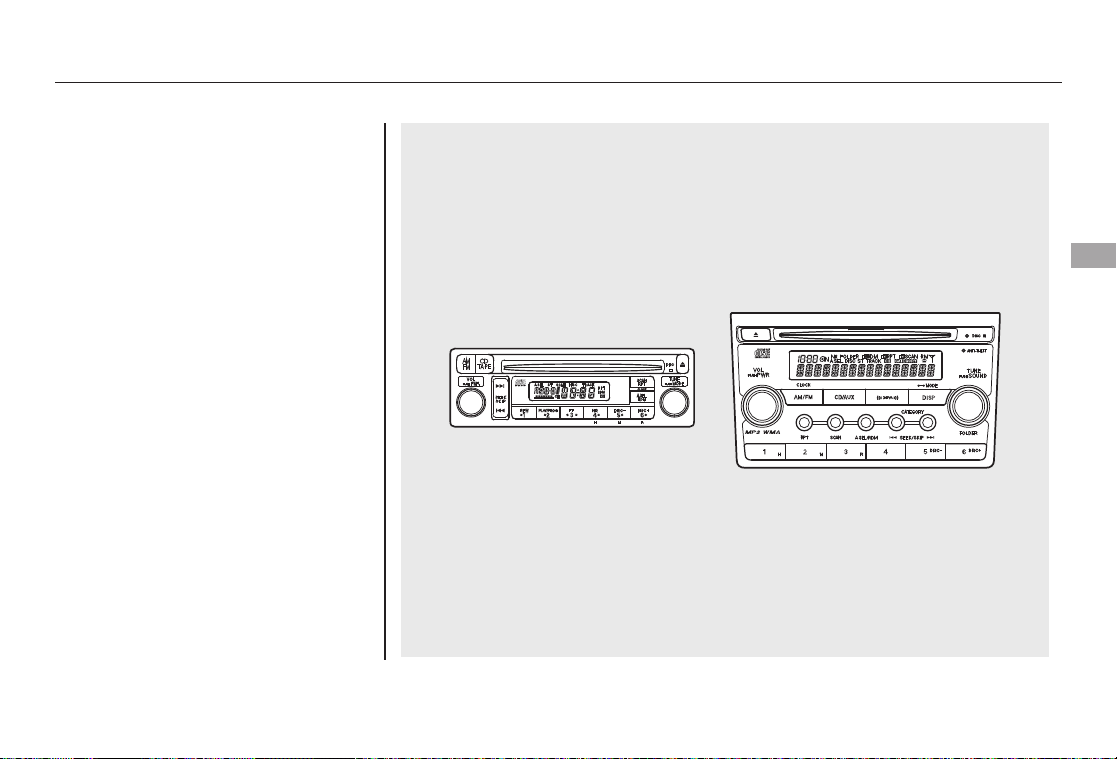
An audio system is standard on all
models. Read the appropriate pages
to use your vehicle's audio system.
LX model EX model
Audio System
109
Features
10/08/06 08:34:41 11 ELEMENT MMC North America Owner's Man 50 31SCV680 enu

LX model
EX model
AM/FM BUTTON
STEREO INDICATOR
SCAN BUTTON
SCAN
INDICATOR
VOL/PWR
KNOB
SEEK/SKIP BAR
PRESET BUTTONS
TUNE KNOB
A.SEL
BUTTON
VOL/PWR KNOB
AM/FM BUTTON
STEREO INDICATOR
SCAN BUTTON PRESET BUTTONS TUNE KNOB
A.SEL BUTTON
SEEK/SKIP BUTTON
Playing the AM/FM Radio
110
10/08/06 08:34:41 11 ELEMENT MMC North America Owner's Man 50 31SCV680 enu
To Play the Radio
The ignition switch must be in the
ACCESSORY (I) or the ON (II)
position. Turn the system on by
pushing the VOL/PWR knob or the
AM/FM button. Adjust the volume
by turning the same knob.
The band and frequency that the
radio was last tuned to is displayed.
To change bands, press the AM/FM
button. On the FM band, ST will be
displayed if the station is
broadcasting in stereo. Stereo
reproduction in AM is not available.
To Select a Station
You can use any of five methods to
find radio stations on the selected
band: tune, seek, scan, the preset
buttons, and auto select.
TUNE - Use the TUNE knob to
tune the radio to a desired frequency.
Turn the knob right to tune to a
higher frequency, or left to tune to a
lower frequency.
SEEK - The seek function searches
up and down from the current
frequency to find a station with a
strong signal. To activate it, press
either (
or ), then release it.
SCAN - The scan function samples
all stations with strong signals on the
selected band. To activate it, press
the SCAN button, then release it.
You will see SCAN in the display.
The system will scan for a station
with a strong signal. When it finds
one, it will stop and play that station
for about 5 seconds (LX model) or 10
seconds (EX model).
If you do nothing, the system will
then scan for the next strong station
and play it for 5 seconds (LX model)
or 10 seconds (EX model). When it
plays a station you want to listen to,
press the SCAN button again.
Preset - Each preset button can
store one frequency on AM and two
frequencies on FM.
1. Select the desired band, AM or
FM. FM1 and FM2 let you store
six stations each.
2. Use the tune, seek, or scan
function to tune the radio to a
desired station.
3. Pick a preset number (1-6), and
hold it until you hear a beep.
4. Repeat steps 1 through 3 to store a
total of six stations on AM and
twelve stations on FM.
CONTINUED
Playing the AM/FM Radio
111
Features
10/08/06 08:34:41 11 ELEMENT MMC North America Owner's Man 50 31SCV680 enu

AUTO SELECT - If you are
traveling and can no longer receive
your preset stations, you can use the
auto select feature to find stations in
the local area.
Press the A.SEL button. ‘‘A.SEL’’
flashes in the display, and the system
goes into scan mode for several
seconds. It stores the frequencies of
six AM and twelve FM stations in the
preset buttons.
You will see a ‘‘0’’ displayed after
pressing a preset button if auto select
cannot find a strong station for every
preset button.
If you do not like the stations auto
select has stored, you can store other
frequencies on the preset buttons as
previously described.
To turn off auto select,
press the A.SEL
button. This restores the presets you
originally set.
For information on FM/AM radio
frequencies and reception, see page
130.
Adjusting the Sound
Press the MODE or SOUND knob
repeatedly to display the bass (BAS),
treble (TRE), balance (BAL), fader
(FAD), and sub-woofer (SUB-W)
ꭧ
settings.
ꭧ: If equipped
Each mode is shown in the display as
it changes. Turn the MODE or
SOUND knob to adjust the setting to
your liking. When the level reaches
the center, you will see ‘‘C’’ in the
display. The system will
automatically return the display to
the selected audio mode about 5
seconds after you stop adjusting a
mode.
Balance/Fader - These two
modes adjust the strength of the
sound coming from each speaker.
BAL adjusts the side-to-side strength,
while FAD adjusts the front-to-back
strength.
Treble/Bass/Sub-Woofer - Use
the TRE/BAS/SUB-W modes to
adjust the tone to your liking.
Playing the AM/FM Radio
112
10/08/06 08:34:41 11 ELEMENT MMC North America Owner's Man 50 31SCV680 enu
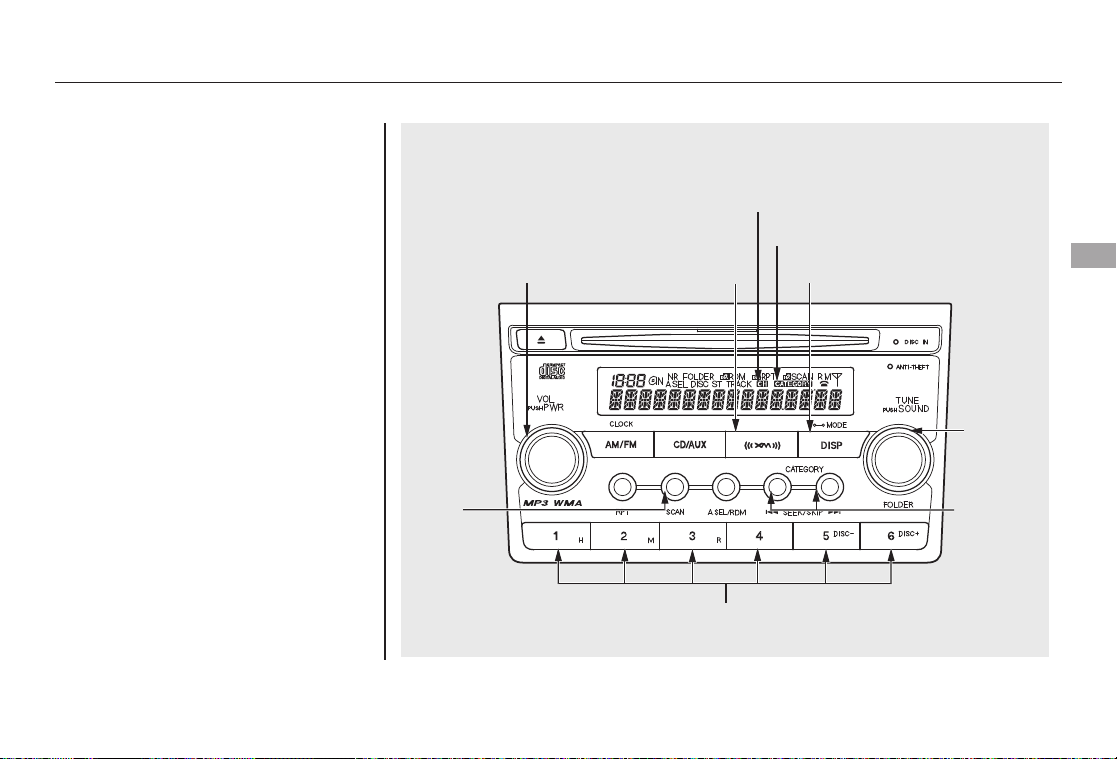
XM
®
Radio
On EX model
Your vehicle is capable of receiving
XM
®
Radio anywhere in the United
States, and Canada except Hawaii,
Alaska and Puerto Rico. XM is a
registered trademark of Sirius XM
Radio
®
, Inc.
PRESET BUTTONS
CATEGORY
BUTTONS
TUNE
KNOB
SCAN
BUTTON
VOL/PWR KNOB XM BUTTON
CHANNEL INDICATOR
CATEGORY INDICATOR
DISP/MODE BUTTON
CONTINUED
Playing the XM
®
Radio
113
Features
10/08/06 08:34:41 11 ELEMENT MMC North America Owner's Man 50 31SCV680 enu
XM Radio receives signals from two
satellites to produce clear, high-
quality digital reception. It offers
many channels in several categories.
Along with a large selection of
different types of music, XM Radio
allows you to view channel and
category selections in the display.
Operating the XM Radio
To listen to the XM Radio, turn the
ignition switch to the ACCESSORY
(I) or ON (II) position. Push the
VOL/PWR knob to turn on the audio
system, and press the XM button.
Adjust the volume by turning the
VOL/PWR knob. The last channel
you listened to will show in the
display.
MODE - To switch between
channel mode and category mode,
press and hold the DISP/MODE
button until the mode changes.
In the channel mode, you can select
all of the available channels. In the
category mode, such as Jazz, Rock,
Classical, etc., you can select all of
the channels within that category.
Each time you press and release the
DISP/MODE button, the display
changes in the following sequence:
channel name, channel number,
category, artist name, and music title.
You may experience periods when
XM Radio does not transmit the
artist's name and song title
information. If this happens, there is
nothing wrong with your system.
TUNE - Turn the TUNE knob left
or right to select channels. In the
category mode, you can only select
channels within that category.
CATEGORY (
or ) - Press
either button to select another
category.
Playing the XM
®
Radio
114
10/08/06 08:34:41 11 ELEMENT MMC North America Owner's Man 50 31SCV680 enu

SCAN - The scan function gives
you sampling of all channels while in
the channel mode. In the category
mode, only the stations within that
category are scanned. To activate
scan, press the SCAN button. The
system plays each channel in
numerical order for a few seconds,
then selects the next channel. When
you hear a channel you want to
continue listening to, press the
button.
Preset - You can store up to 12
preset channels using the six preset
buttons. Each button stores one
channel from the XM1 band and one
channel from the XM2 band.
To store a channel:
1. Press the XM button. Either XM1
or XM2 will show in the display.
2. Use the TUNE knob, the
CATEGORY buttons, or the SCAN
buttons to tune to a desired
channel.
In category mode, only channels
within that category can be
selected. In channel mode, all
channels can be selected.
3. Pick the preset button you want for
that channel. Press and hold the
button until you hear a beep.
4. Repeat steps 2 and 3 to store the
first six channels.
5. Press the XM button again. The
other XM band will show. Store
the next six channels using steps 2
and 3.
Once a channel is stored, press and
release the proper preset button to
tune to it.
CONTINUED
Playing the XM
®
Radio
115
Features
10/08/06 08:34:41 11 ELEMENT MMC North America Owner's Man 50 31SCV680 enu
XM Radio Display Messages
‘‘LOADING’’ - XM is loading the
audio or program information.
‘‘OFF AIR’’ - The channel
currently selected is no longer
broadcasting.
‘‘UPDATING’’ - The encryption
code is being updated. Wait until the
encryption code is fully updated.
Channels 0 and 1 should still work
normally.
‘‘NO SIGNAL’’ - The signal is
currently too weak. Move the vehicle
to an area away from tall buildings,
and with an unobstructed view of the
southern horizon.
‘‘
’’ - The selected channel
number does not exist, is not part of
your subscription, or this channel
has no artist or title information at
this time.
‘‘ANTENNA’’ - There is a problem
with the XM antenna. Please consult
your dealer.
Playing the XM
®
Radio
116
10/08/06 08:34:41 11 ELEMENT MMC North America Owner's Man 50 31SCV680 enu

The XM satellites are in orbit over
the equator; therefore, objects south
of the vehicle may cause satellite
reception interruptions. To help
compensate for this, ground-based
repeaters are placed in major
metropolitan areas.
Satellite signals are more likely to be
blocked by tall buildings and
mountains the farther north you
travel from the equator. Carrying
large items on a roof rack can also
block the signal.
Signal may be blocked
by mountains or large
obstacles to the south.
Signal weaker in
these areas.
SATELLITE
GROUND REPEATER
CONTINUED
Playing the XM
®
Radio
117
Features
10/08/06 08:34:41 11 ELEMENT MMC North America Owner's Man 50 31SCV680 enu

Depending on where you drive, you
may experience reception problems.
Interference can be caused by any of
these conditions:
●
Driving on the north side of an
east/west mountain road.
●
Driving on the north side of a large
commercial truck on an east/west
road.
●
Driving in tunnels.
●
Driving on a road beside a vertical
wall, steep cliff, or hill to the south
of you.
●
Driving on the lower level of a
multi-tiered road.
●
Driving on a single lane road
alongside dense trees taller than
50 ft. (15 m) to the south of you.
●
Large items carried on a roof rack.
There may be other geographic
situations that could affect XM Radio
reception.
As required by the FCC:
Changes or modifications not expressly
approved by the party responsible for
compliance could void the user's
authority to operate the equipment.
Receiving XM Radio Service
If your XM Radio service has expired or
you purchased your vehicle from a
previous owner, you can listen to a
sampling of the broadcasts available on
XM Radio. With the ignition switch in the
ACCESSORY (I) or ON (II) position,
push the VOL/PWR knob to turn on the
audio system and press the XM button. A
variety of music types and styles will
play.
If you decide to purchase XM Radio
service, contact XM Radio at
www.xmradio.com,
or at 1-800-852-9696.
You will need to give them your radio I.
D. number and your credit card number.
To get your radio I.D. number, turn the
TUNE knob until ‘‘0’’ appears in the
display. Your I.D. will appear in the
display.
After you've registered with XM Radio,
keep your audio system in the XM Radio
mode while you wait for activation. This
should take about 30 minutes.
While waiting for activation, make sure
your vehicle remains in an open area
with good reception. Once your audio
system is activated, you'll be able to
listen to XM Radio broadcasts. XM Radio
will continue to send an activation signal
to your vehicle for at least 12 hours from
the activation request. If the service has
not been activated after 36 hours, contact
XM
®
Radio.
Playing the XM
®
Radio
118
10/08/06 08:34:41 11 ELEMENT MMC North America Owner's Man 50 31SCV680 enu
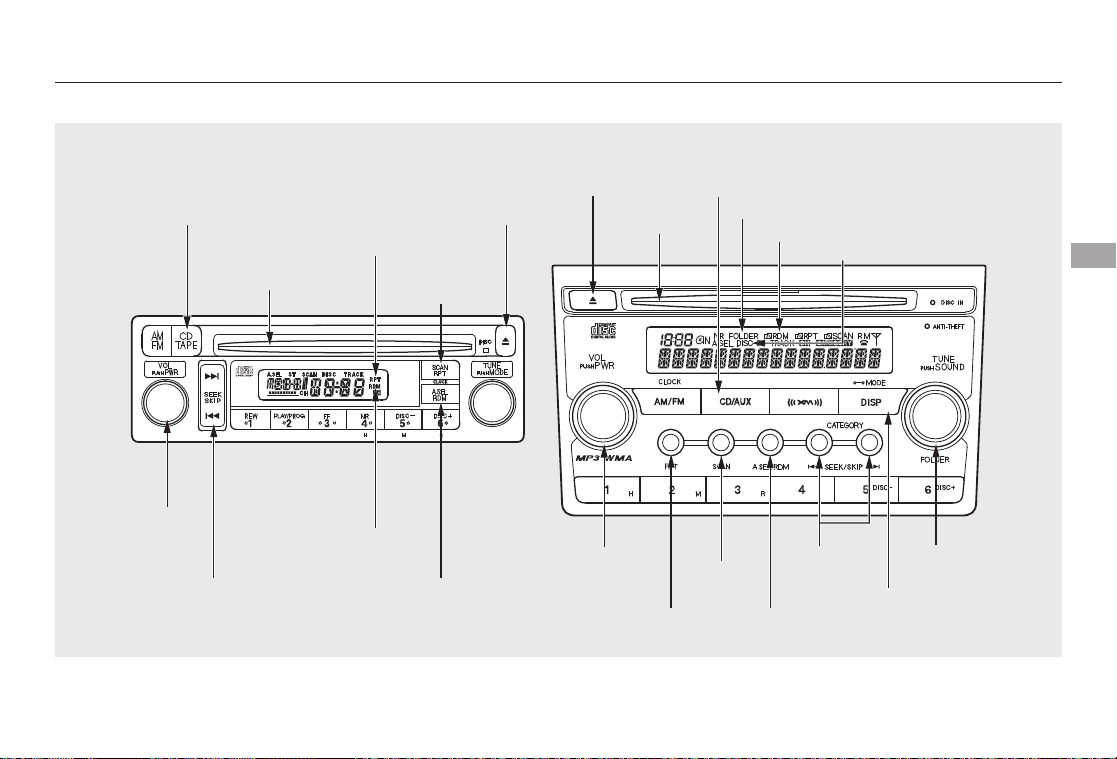
RDM (RANDOM)
BUTTON
DISC INDICATOR
FOLDER KNOBSEEK/SKIP
BUTTONS
RPT (REPEAT)
BUTTON
RANDOM BUTTON
SEEK/SKIP BAR
VOL/PWR
KNOB
RANDOM INDICATOR
REPEAT INDICATOR
EJECT BUTTONCD/TAPE BUTTON
CD SLOT
CD SLOT
EJECT BUTTON
FOLDER INDICATOR
EX modelLX model
RANDOM INDICATOR
DISPLAY BUTTON
RPT (REPEAT)
BUTTON
SCAN
BUTTON
CD/AUX BUTTON
VOL/PWR
KNOB
CONTINUED
Playing a Disc
119
Features
10/08/06 08:34:41 11 ELEMENT MMC North America Owner's Man 50 31SCV680 enu
To Play a Disc
To load or play discs, the ignition
switch must be in the ACCESSORY
(I) or ON (II) position.
Do not use discs with adhesive labels.
The label can curl up and cause the
disc to jam in the unit.
You operate the disc player with the
same controls used for the radio. To
select the disc player, press the CD/
TAPE or the CD/AUX button. You
will see ‘‘CD’’ in the display. The
number of the track playing is shown
in the display. The system will
continuously play a disc until you
change modes.
Video CDs and DVDs do not work in
this unit.
On EX model
The disc player can also play CD-Rs
and CD-RWs compressed in MP3 or
WMA formats.
When playing a disc in MP3, you will
see ‘‘MP3’’ in the display. The folder
and track numbers are displayed.
Each disc can hold up to 400 playable
files within 8 folder layers. A disc can
support a maximum number of 100
folders, and each folder can hold 255
playable files.
When playing a disc in WMA, you
will see ‘‘WMA’’ in the display. The
folder and track numbers are
displayed. Each disc can hold up to
200 files within 16 subdirectories, 8
folder layers. A disc can support a
maximum number of 100 folders, and
each folder can hold 255 playable
files.
NOTE: If a file on an MP3 or WMA
disc is protected by digital rights
management (DRM), the audio unit
displays FORMAT, and then skips to
the next file.
Depending on the software the files
were made with, it may not be
possible to play some files, or display
some text data.
Insert the disc about halfway into the
disc slot. The drive will pull the disc
in the rest of the way and begin to
play it. When the system reaches the
end of the disc, it will return to the
beginning and play the disc again.
To play the radio when a disc is
playing, press the AM/FM button.
Press the CD/TAPE or CD/AUX
button again to switch back to the
CD player.
Playing a Disc
120
10/08/06 08:34:41 11 ELEMENT MMC North America Owner's Man 50 31SCV680 enu
If you turn the system off while a disc
is playing, either with the VOL/PWR
knob or by turning off the ignition
switch, the disc will stay in the drive.
When you turn the system back on,
the disc will begin playing where it
left off.
On EX model
If you press the DISP/MODE button
while playing a disc, additional
information (track, album, artist, etc.)
may be displayed.
To Change or Select Tracks/Files
On EX model
Use the SEEK/SKIP button while a
disc is playing to select passages and
change tracks (files in MP3/WMA
mode).
In MP3/WMA mode, use the
FOLDER knob to select folders in
the disc, and use the SEEK/SKIP
button to change files.
SEEK/SKIP - Each time you press
and release the
, the player skips
forward to the beginning of the next
track (files in MP3/WMA mode).
Press and release the
to skip
backward to the beginning of the
current track. Press it again to skip to
the beginning of the previous track.
To move rapidly within a track, press
and hold
or .
On LX model
You will see CUE or REW in the
display while moving within a track.
REPEAT (TRACK/FILE REPEAT)
- To continuously replay a track
(files in MP3/WMA mode), press
and release the RPT button. You will
see RPT in the display. Press the
RPT button again to turn it off.
On EX model
In MP3/WMA mode
FOLDER SELECTION - To select
a different folder, use the FOLDER
knob to move to the beginning of the
next folder. Turn the knob right to
move to the beginning of the current
folder. Turn the knob left to skip to
the beginning of the previous folder.
CONTINUED
Playing a Disc
121
Features
10/08/06 08:34:41 11 ELEMENT MMC North America Owner's Man 50 31SCV680 enu
On EX model
In MP3/WMA mode
FOLDER-REPEAT - This feature,
when activated, replays all the files
on the selected folder in the order
they are compressed in MP3/WMA.
To activate folder repeat, press and
hold the RPT button for 2 seconds.
You will see
RPT in the display.
The system continuously replays the
current folder. Press and hold the
RPT button for 2 seconds to turn it
off.
RANDOM (Random within a Disc)
- This feature plays the tracks (all
files in each folder in MP3/WMA
mode) within a disc in random order.
To activate random play, press and
release the RDM button. You will see
RDM in the display. Press the RDM
button again to return to normal play.
On EX model
In MP3/WMA mode
FOLDER-RANDOM - This
feature, when activated, plays the
files within a folder in random order,
rather than in the order they are
compressed in MP3/WMA. To
activate folder random play, press
and hold the RDM button. You will
see
RDM in the display. The
system will then select and play files
randomly. This continues until you
deactivate folder random play by
pressing the RDM button again or
selecting a different folder with the
FOLDER knob.
On EX model
SCAN - The scan function samples
all tracks/files on the disc in the
order they are recorded. To activate
scan, press and hold the SCAN
button until you hear a beep. You will
see SCAN in the display. You will get
a 10 second sampling of each track/
file on the disc. Press the SCAN
button again to exit scan and play the
last track/file sampled.
Pressing either side of the SEEK/
SKIP button also turns off scan.
Playing a Disc
122
10/08/06 08:34:41 11 ELEMENT MMC North America Owner's Man 50 31SCV680 enu
On EX model
In MP3/WMA mode
FOLDER SCAN - This feature,
when activated, samples all files on
the selected folder in order. To
activate folder scan, press and hold
the SCAN button until you hear a
beep. You will see
SCAN in the
display. The system will then play
the first file for about 10 seconds. If
you do nothing, the system will then
play the first file in each folder for 10
seconds. When it plays a file you
want to continue listening to, press
the SCAN button again.
Pressing either side of the SEEK/
SKIP button or selecting a different
folder with the FOLDER knob also
turns off folder scan.
To Stop Playing a Disc
Press the eject button (
)to
remove the disc. If you eject the disc,
but do not remove it from the slot,
the system will automatically reload
the disc after 10 seconds (EX model)
or 15 seconds (LX model) and put it
in pause mode. To begin playing,
press the CD/TAPE or CD/AUX
button.
Press the AM/FM button to switch
to the radio while a disc is playing.
To play the disc, press the CD/TAPE
or CD/AUX button.
If you turn the system off while a disc
is playing, either with the VOL/PWR
knob or by turning off the ignition
switch, the disc will stay in the drive.
When you turn the system back on,
the disc will begin playing where it
left off.
Audio System Malfunction
See pages 125 and 126 for
information on error messages.
Protecting Discs
For information on how to handle
and protect discs, see page 127.
CONTINUED
Playing a Disc
123
Features
10/08/06 08:34:41 11 ELEMENT MMC North America Owner's Man 50 31SCV680 enu

Operating the Optional Disc
Changer
On LX model
An optional six disc changer is
available for your vehicle. This disc
changer uses the same controls used
for the in-dash disc player or the
radio.
Load the desired discs in the
magazine, and load the magazine in
the changer according to the
instructions that came with the unit.
To select the disc changer, press the
CD/TAPE button. The disc and track
numbers will be displayed. To select
a different disc, use the preset 5
button (DISC -) or the preset 6
button (DISC +). To select the
previous disc, press the preset 5
button (DISC -), or the preset 6
button (DISC +) to select the next
disc in sequence.
If you select an empty slot in the
magazine, the changer will search for
the next available disc to load and
play.
Playing a Disc
124
10/08/06 08:34:41 11 ELEMENT MMC North America Owner's Man 50 31SCV680 enu
The chart on the right explains the
error messages you may see in the
display while playing a disc.
If you see an error message in the
display while playing a disc, press
the eject button. After ejecting the
disc, check it for damage or
deformation. If there is no damage,
insert the disc again.
For additional information on
damaged discs, see page 128.
The audio system will try to play the
disc. If there is still a problem, the
error message will reappear. Press
the eject button, and pull out the
disc.
Insert a different disc. If the new disc
plays, there is a problem with the
first disc. If the error message cycle
repeats and you cannot clear it, take
your vehicle to a dealer.
Error
Message
Cause Solution
ꐀ HEAT ERROR High temperature Will disappear when the temperature returns to
normal.
ꐁ HOT
ꐀ FORMAT
Track/File format not
supported
Current track will be skipped. The next
supported track or file plays automatically.
ꐁ DISC FOCUS error
Press the EJECT button, and pull out the disc.
Make sure it is inserted correctly in the disc
player.
Make sure the disc is not scratched or damaged.
For more information, see page 128.
ꐀ
BAD DISC
PLEASE
CHECK
OWNER'S
MANUAL
PUSH EJECT
Mechanical error
Press the EJECT button, and pull out the disc.
Check the disc for serious damage, signs of
deformation, excessive scratches, and/or dirt
see page 128.
Insert the disc again. If the code does not
disappear, or the disc cannot be removed,
consult your dealer. Do not try to force the disc
out of the player.
ꐁ ERR
ꐀ
BAD DISC
PLEASE
CHECK
OWNER'S
MANUAL
Servo error
ꐀ: EX model
ꐁ: LX model
Disc Player Error Messages
125
Features
10/08/06 08:34:41 11 ELEMENT MMC North America Owner's Man 50 31SCV680 enu
If you see an error message in the
display while playing a disc, find the
cause in the chart to the right. If you
cannot clear the error message, take
your vehicle to your dealer.
Error
Message
Cause Solution
DISC FOCUS error
Press the EJECT button, and pull out the disc.
Make sure it is inserted correctly in the disc
player.
Make sure the disc is not scratched or damaged.
For more information, see page 128.
NO No disc in the magazine Insert disc.
ERR Mechanical error
Press the EJECT button, and pull out the disc.
Check the disc for damage or deformation.
For more information, see page 128.
If the disc cannot be pulled out, or the error
message does not disappear after the disc is
ejected, see your dealer.
HOT
High temperature Will disappear when the temperature returns to
normal.
EJEC
No magazine in the
changer
Insert magazine.
Disc Changer Error Messages
126
10/08/06 08:34:41 11 ELEMENT MMC North America Owner's Man 50 31SCV680 enu
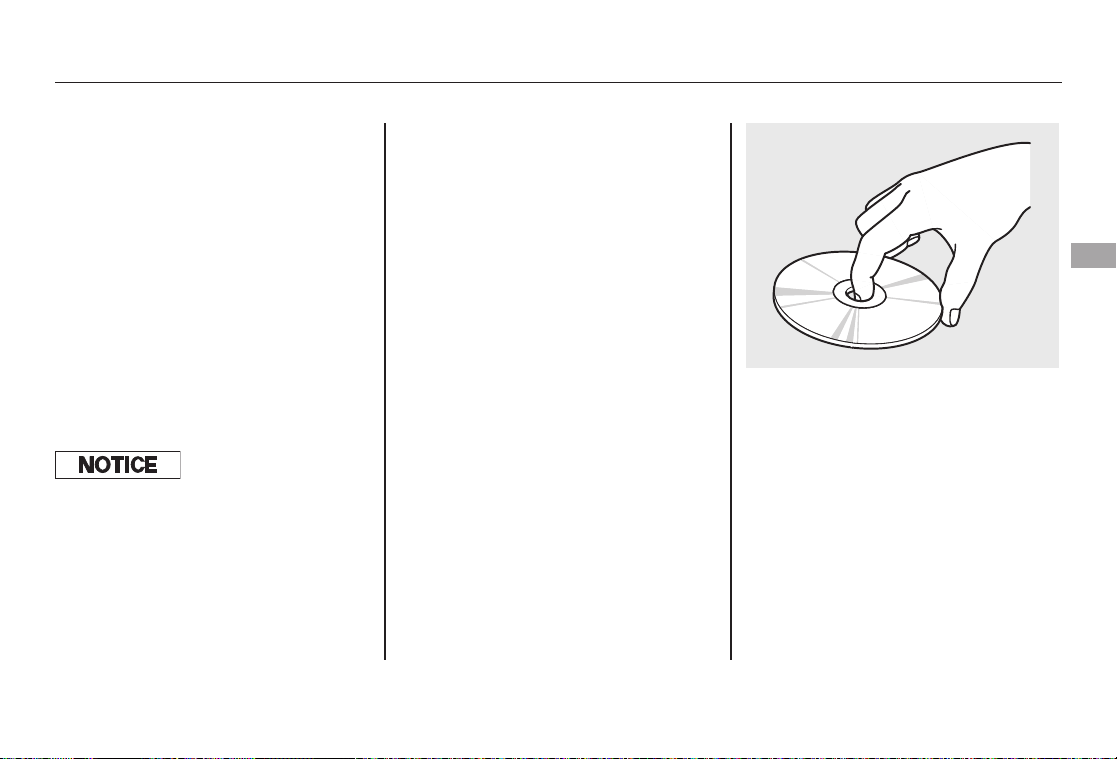
General Information
●
When using CD-R or CD-RW
discs, use only high quality CDs
labeled for audio use.
●
When recording a CD-R or
CD-RW, the recording must be
closed for it to be used by the
system.
●
Play only standard round discs.
Odd-shaped discs may jam in the
drive or cause other problems.
●
Handle your discs properly to
prevent damage and skipping.
Do not use discs with adhesive labels.
The label can curl up and cause the
disc to jam in the unit.
Protecting Discs
When a disc is not being played,
store it in its case to protect it from
dust and other contamination. To
prevent warpage, keep discs out of
direct sunlight and extreme heat.
To clean a disc, use a clean soft cloth.
Wipe across the disc from the center
to the outside edge.
A new disc may be rough on the
inner and outer edges. The small
plastic pieces causing this roughness
can flake off and fall on the recorded
surface of the disc, causing skipping
or other problems. Remove these
pieces by rubbing the inner and
outer edges with the side of a pencil
or pen.
Never try to insert foreign objects in
the CD player or the magazine.
Handle a disc by its edges; never
touch either surface. Do not place
stabilizer rings or labels on the disc.
These, along with contamination
from finger prints, liquids, and felt-tip
pens, can cause the disc to not play
properly, or possibly jam in the drive.
CONTINUED
Protecting Your Discs
127
Features
10/08/06 08:34:41 11 ELEMENT MMC North America Owner's Man 50 31SCV680 enu
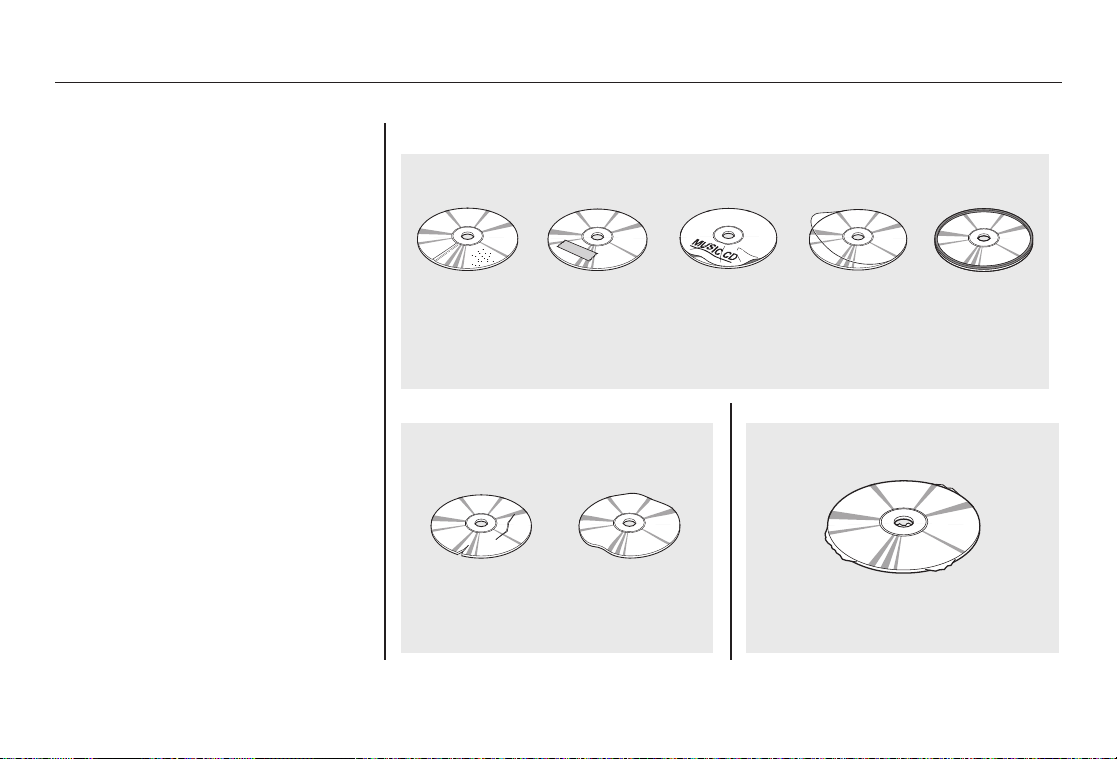
Additional Information on
Recommended Discs
The disc player/changer has a
sophisticated and delicate
mechanism. If you insert a damaged
disc as indicated below, it may
become stuck inside and damage the
audio unit.
Examples of these discs are shown to
the right:
1. Bubbled, wrinkled, labeled, and excessively thick discs
2. Damaged discs 3. Poor quality discs
Bubbled/
Wrinkled
With Label/
Sticker
Using Printer
Label Kit
Sealed With Plastic
Ring
Chipped/
Cracked
Warped
Burrs
Protecting Your Discs
128
10/08/06 08:34:41 11 ELEMENT MMC North America Owner's Man 50 31SCV680 enu
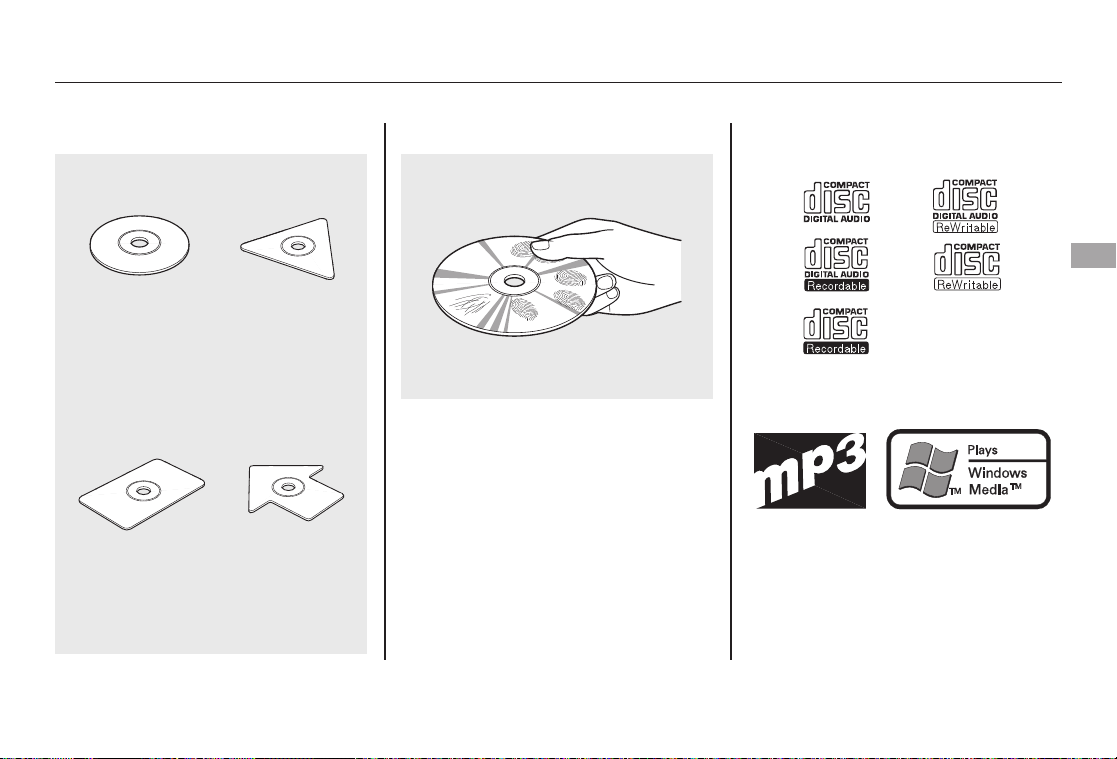
4. Small, irregular shaped discs 5. Discs with scratches, dirty discs
●
CD-R or CD-RW may not play due
to the recording conditions.
●
Scratches and fingerprints on the
discs may cause the sound to skip.
●
Recommended discs are printed
with the following logo.
●
Audio unit may not play the
following formats.
●
This audio unit cannot play a Dual-
disc
®
.
3-inch (8-cm) CD Triangle Shape
Can Shape Arrow Shape
Fingerprints, scratches, etc.
Protecting Your Discs
129
Features
10/08/06 08:34:41 11 ELEMENT MMC North America Owner's Man 50 31SCV680 enu
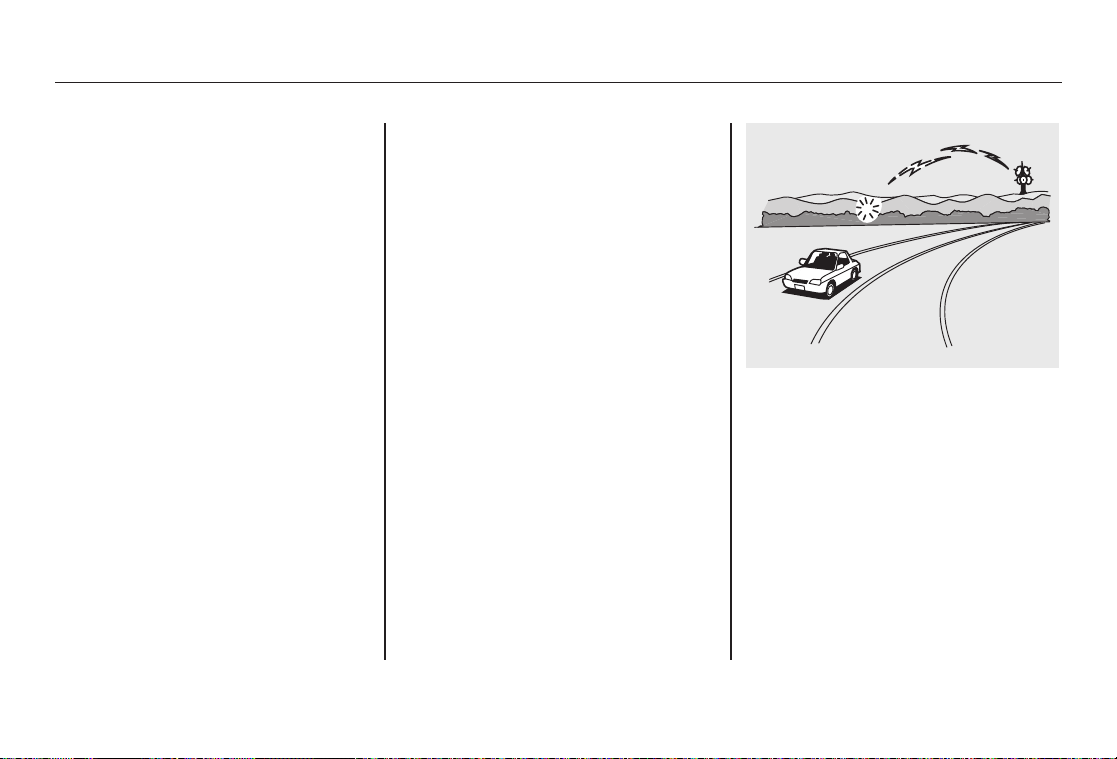
Radio Frequencies
The radio can receive the complete
AM and FM bands.
Those bands cover these
frequencies:
AM band: 530 to 1,710 kHz
FM band: 87.7 to 107.9 MHz
Radio stations on the AM band are
assigned frequencies at least 10 kHz
apart (530, 540, 550). Stations on the
FM band are assigned frequencies at
least 0.2 MHz apart (87.9, 88.1, 88.3).
Stations must use these exact
frequencies. It is fairly common for
stations to round-off the frequency in
their advertising, so your radio could
display a frequency of 100.9 even
though the announcer may identify
the station as ‘‘FM101.’’
FM/AM Radio Reception
How well the radio receives stations
is dependent on many factors, such
as the distance from the station's
transmitter, nearby large objects, and
atmospheric conditions.
A radio station's signal gets weaker
as you get farther away from its
transmitter. If you are listening to an
AM station, you will notice the sound
volume becoming weaker, and the
station drifting in and out. If you are
listening to an FM station, you will
see the stereo indicator flickering off
and on as the signal weakens.
Eventually, the stereo indicator will
go off and the sound will fade
completely as you get out of range of
the station's signal.
Driving very near the transmitter of a
station that is broadcasting on a
frequency close to the frequency of
the station you are listening to can
also affect your radio's reception. You
may temporarily hear both stations,
or hear only the station you are close
to.
FM/AM Radio Reception
130
10/08/06 08:34:41 11 ELEMENT MMC North America Owner's Man 50 31SCV680 enu
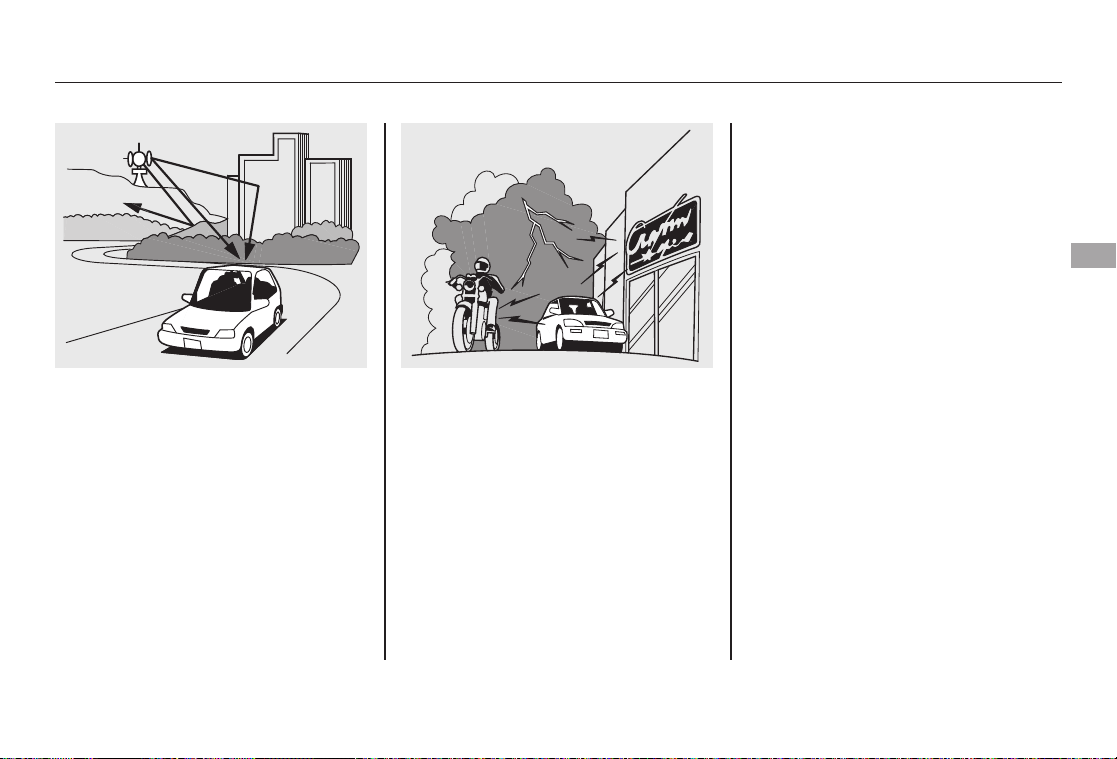
Radio signals, especially on the FM
band, are deflected by large objects
such as buildings and hills. Your
radio then receives both the direct
signal from the station's transmitter,
and the deflected signal. This causes
the sound to distort or flutter. This is
a main cause of poor radio reception
in city driving.
Radio reception can be affected by
atmospheric conditions such as
thunderstorms, high humidity, and
even sunspots. You may be able to
receive a distant radio station one
day and not receive it the next day
because of a change in conditions.
Electrical interference from passing
vehicles and stationary sources can
cause temporary reception problems.
As required by the FCC:
Changes or modifications not expressly
approved by the party responsible for
compliance could void the user's
authority to operate the equipment.
FM/AM Radio Reception
131
Features
10/08/06 08:34:41 11 ELEMENT MMC North America Owner's Man 50 31SCV680 enu

On EX model
Your vehicle's audio system will
disable itself if it is disconnected
from electrical power for any reason.
To make it work again, you must
enter a specific code in the preset
buttons. Because there are hundreds
of number combinations possible
from specific digits, making the
system work without knowing the
exact code is nearly impossible.
You should have received a radio
code card that lists your audio
system's code and serial numbers. It
is best to store this card in a safe
place at home. In addition, you
should write the audio system's
serial number in this owner's
manual.
If you lose the card, you must obtain
the code number from a dealer. To
do this, you will need the system's
serial number.
If your vehicle's battery is
disconnected or goes dead, the audio
system will disable itself. If this
happens, you will see ‘‘ENTER
CODE’’ in the frequency display the
next time you turn on the system.
Use the preset buttons to enter the
code. The code is on the radio code
card included in your owner's
manual kit. When it is entered
correctly, the radio will start playing.
If you make a mistake entering the
code, do not start over; complete the
sequence, then enter the correct
code. You have 10 tries to enter the
correct code. If you are unsuccessful
in 10 attempts, you must then leave
the system on for 1 hour before
trying again.
Radio Theft Protection
132
10/08/06 08:34:41 11 ELEMENT MMC North America Owner's Man 50 31SCV680 enu
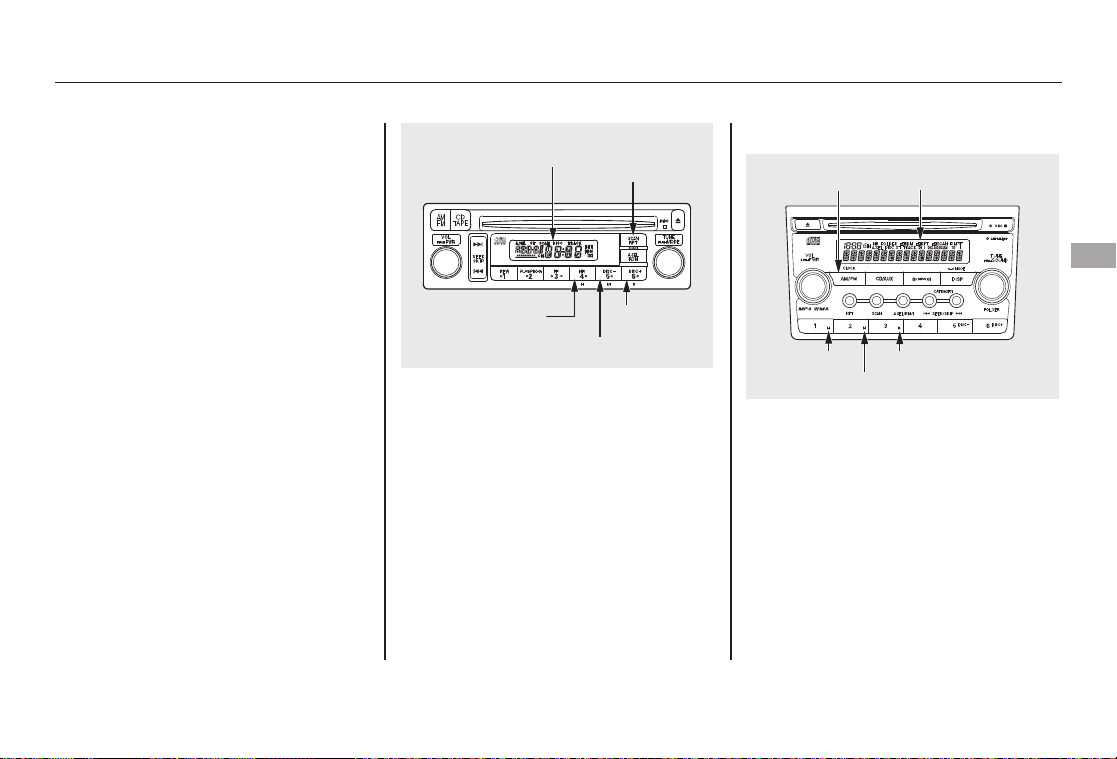
If your vehicle's battery is
disconnected or goes dead, you may
need to set the clock.
On LX model
To set the hour, press the H button
while pressing the CLOCK (SCAN/
RPT) button until the hour advances
to the desired time. Change the
minute by pressing the M button
while pressing the CLOCK (SCAN/
RPT) button until the minute
advances to the desired time.
You can use the R button to quickly
set the time to the nearest hour.
Press the R button while pressing the
CLOCK button. If the displayed time
is before the half hour, pressing R
sets the clock back to the previous
hour. If the displayed time is after the
half hour, pressing R sets the clock
forward to the beginning of the next
hour.
For example:
1:06 will reset to 1:00
1:53 will reset to 2:00
On EX model
Press and hold the CLOCK button
until the numbers flash and you hear
a beep. Change the hour by pressing
the H button until the numbers
advance to the desired time. Change
the minute by pressing the M button
until the numbers advance to the
desired time.
TIME DISPLAY CLOCK
BUTTON
H BUTTON R BUTTON
M BUTTON
TIME DISPLAYCLOCK BUTTON
H BUTTON R BUTTON
M BUTTON
CONTINUED
Setting the Clock
133
Features
10/08/06 08:34:41 11 ELEMENT MMC North America Owner's Man 50 31SCV680 enu

You can quickly set the time to the
nearest hour. If the displayed time is
before the half hour, press the R
(RESET) button to set the clock back
to the previous hour. If the displayed
time is after the half hour, pressing R
sets the clock forward to the
beginning of the next hour.
For example:
1:06 will reset to 1:00
1:53 will reset to 2:00
When you are finished, press the
CLOCK button again.
Setting the Clock
134
10/08/06 08:34:41 11 ELEMENT MMC North America Owner's Man 50 31SCV680 enu
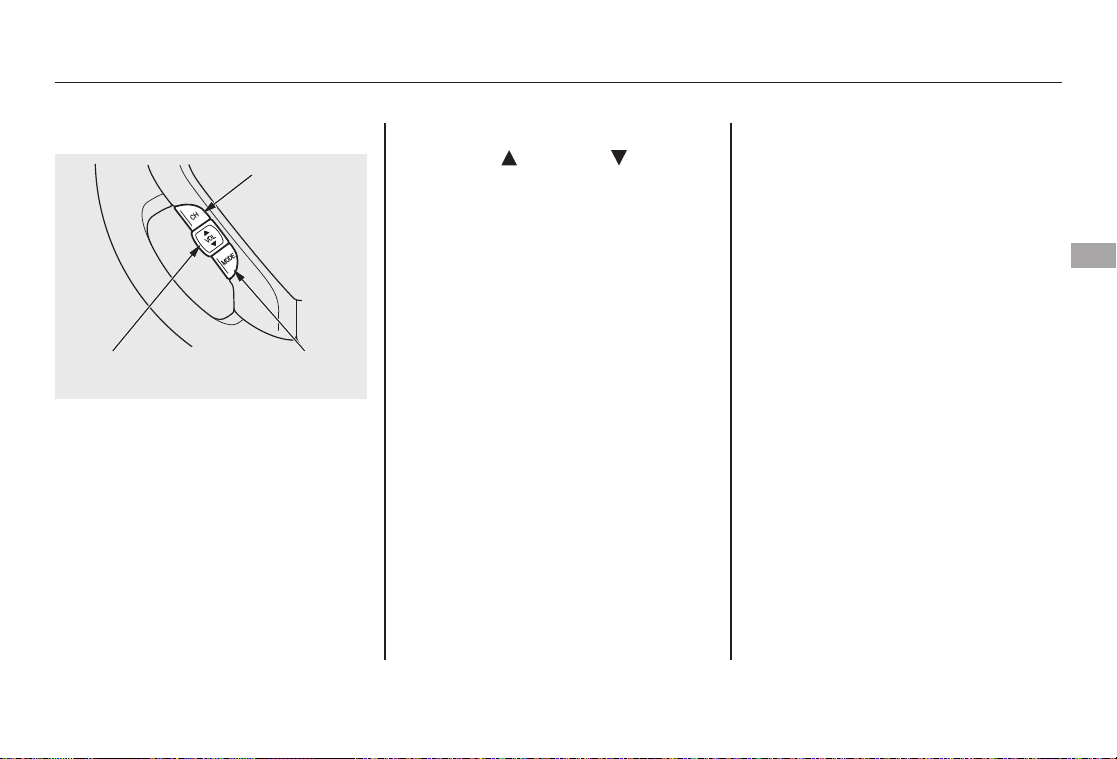
On EX model
Three controls for the audio system
are mounted in the steering wheel
hub. These let you control basic
functions without removing your
hand from the wheel.
The middle button adjusts the
volume up (
) or down ( ). Press
the top or bottom of the button and
hold it until the desired volume is
reached, then release it.
The MODE button changes the
mode.
Pressing the MODE button
repeatedly cycles through all
present, connected media sources.
Media sources that are not present
or connected will not appear when
cycling with the MODE button.
The CH button has two functions,
depending on whether you are
listening to the radio, or playing a
disc.
If you are listening to the radio, use
the CH button to change stations.
Each time you press this button, the
system advances to the next preset
station on the band you are listening
to. You will see the number of the
selected Preset button in the display.
To change bands, or to change from
FM1 to FM2 or XM1 to XM2, press
the MODE button.
If you are playing a disc, the system
skips to the beginning of the next
track (file in MP3 or WMA format)
each time you press the CH button.
You will see the track/file number
and the elapsed time. If the disc has
text data or the disc is compressed in
MP3 or WMA, you can also see any
other information (track title, file
name, folder name, etc.).
CH BUTTON
MODE
BUTTON
VOLUME
BUTTON
CONTINUED
Remote Audio Controls
135
Features
10/08/06 08:34:41 11 ELEMENT MMC North America Owner's Man 50 31SCV680 enu
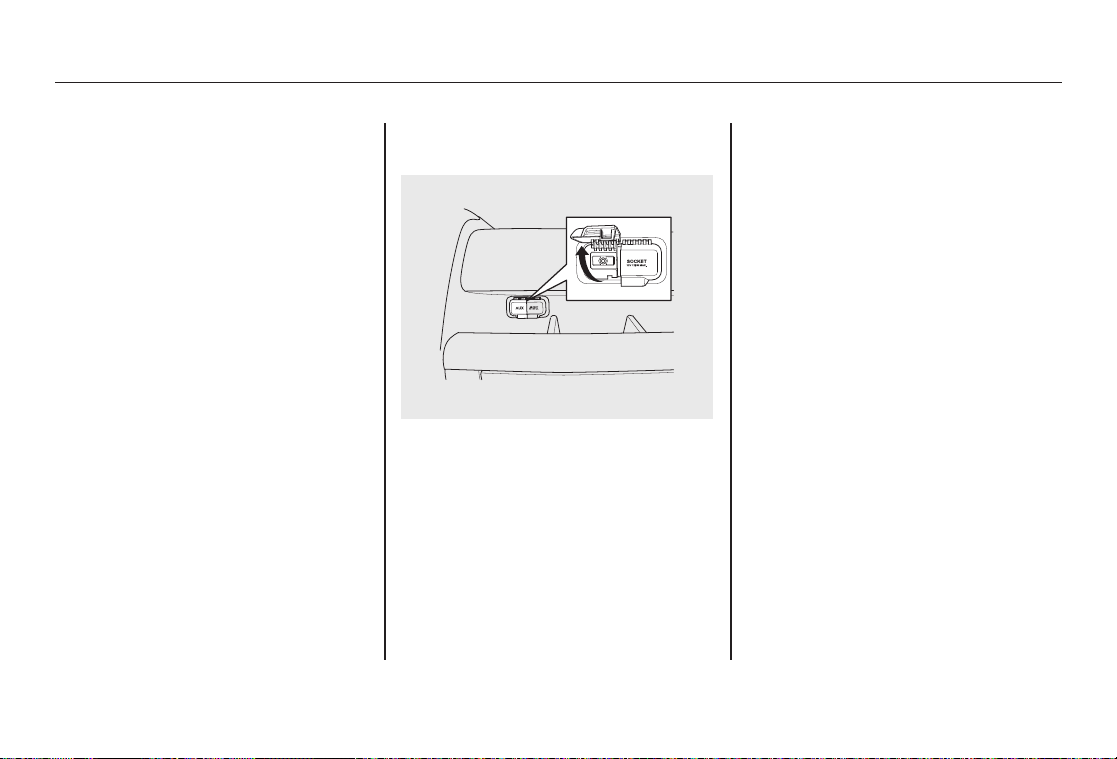
In MP3 or WMA mode, you can use
the seek function to select folders.
Press and hold the CH button until
you hear a beep, to skip forward to
the first file of the next folder.
Auxiliary Input Jack
On EX model
Your vehicle has the auxiliary input
jack on the front panel. The system
will accept auxiliary input from
standard audio accessories.
When a compatible audio unit is
connected to the jack, press the
CD/AUX button to select it.
Remote Audio Controls, Auxiliary Input Jack
136
10/08/06 08:34:41 11 ELEMENT MMC North America Owner's Man 50 31SCV680 enu
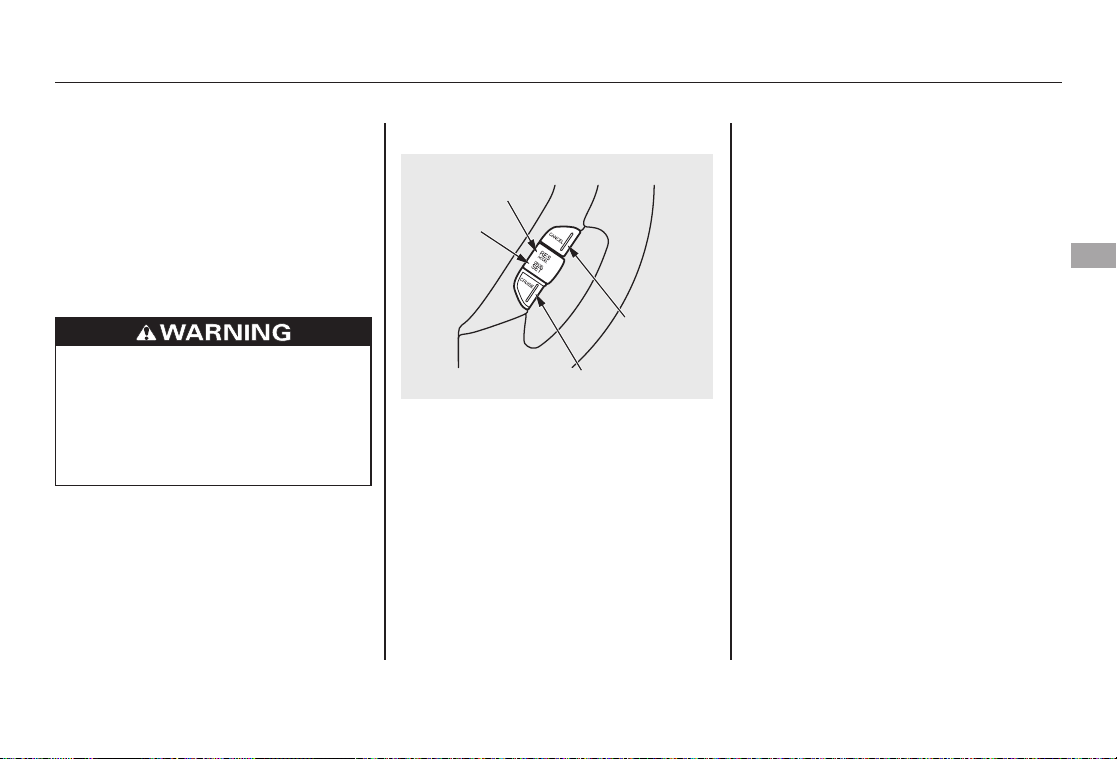
Cruise control allows you to maintain
a set speed above 25 mph (40 km/h)
without keeping your foot on the
accelerator pedal. It should be used
for cruising on straight, open
highways. It is not recommended for
city driving, winding roads, slippery
roads, heavy rain, or bad weather.
Improper use of the cruise
control can lead to a crash.
Use the cruise control only
when traveling on open
highways in good weather.
Using Cruise Control
1. Push the CRUISE button on the
steering wheel. The CRUISE
MAIN indicator on the instrument
panel comes on.
The cruise control system can be left
on, even when it is not in use.
2. Accelerate to the desired cruising
speed above 25 mph (40 km/h).
3. Press and release the SET/
DECEL button on the steering
wheel. The CRUISE CONTROL
indicator on the instrument panel
comes on to show the system is
now activated.
RES/ACCEL
BUTTON
CANCEL
BUTTON
SET/DECEL
BUTTON
CRUISE BUTTON
CONTINUED
Cruise Control
137
Features
10/08/06 08:34:41 11 ELEMENT MMC North America Owner's Man 50 31SCV680 enu

Cruise control may not hold the set
speed when you are going up and
down hills. If your speed increases
going down a hill, use the brakes to
slow down. This will cancel cruise
control. To resume the set speed,
press the RES/ACCEL button. The
CRUISE CONTROL indicator on the
instrument panel will come back on.
Changing the Set Speed
You can increase the set cruising
speed in any of these ways:
●
Press and hold the RES/ACCEL
button. When you reach the
desired cruising speed, release the
button.
●
To increase your speed in very
small amounts, tap the RES/
ACCEL button. Each time you do
this, the vehicle will speed up
about 1 mph (1.6 km/h).
●
Push on the accelerator pedal.
Accelerate to the desired cruising
speed, then press the SET/
DECEL button.
You can decrease the set cruising
speed in any of these ways:
NOTE: If you need to decrease your
speed quickly, use the brakes as you
normally would.
●
Press and hold the SET/DECEL
button. Release the button when
you reach the desired speed.
●
To slow down in very small
amounts, tap the SET/DECEL
button. Each time you do this,
your vehicle will slow down about
1 mph (1.6 km/h).
●
Tap the brake pedal lightly with
your foot. The CRUISE CONTROL
indicator on the instrument panel
will go out. When the vehicle
slows to the desired speed, press
the SET/DECEL button.
Even with the cruise control turned
on, you can still use the accelerator
pedal to speed up for passing. After
completing the pass, take your foot
off the accelerator pedal. The vehicle
will return to the set cruising speed.
Resting your foot on the brake pedal
causes the cruise control to cancel.
RES/ACCEL
BUTTON
CANCEL
BUTTON
SET/DECEL
BUTTON
Cruise Control
138
10/08/06 08:34:41 11 ELEMENT MMC North America Owner's Man 50 31SCV680 enu
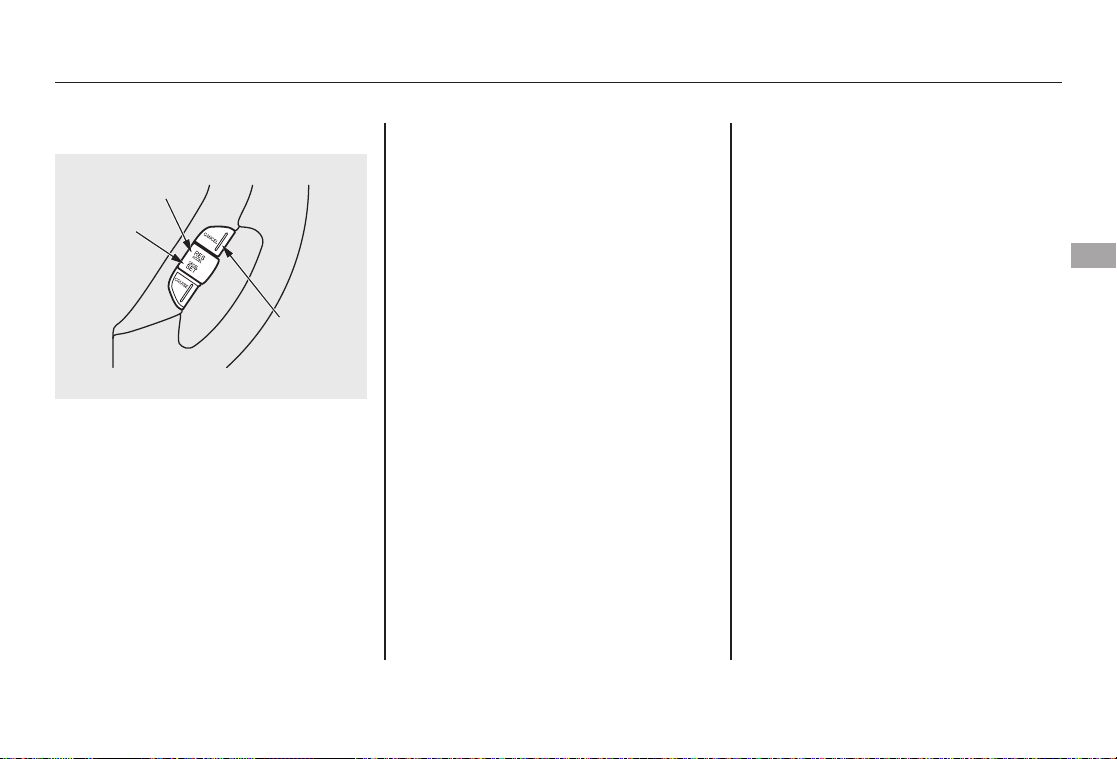
Canceling Cruise Control
You can cancel cruise control in any
of these ways:
●
Tap the brake pedal.
●
Push the CANCEL button on the
steering wheel.
●
Push the CRUISE button on the
steering wheel.
Resuming the Set Speed
When you push the CANCEL button,
or tap the brake pedal, the system
will remember the previously set
cruising speed. To return to that
speed, accelerate to above 25 mph
(40 km/h) then press and release the
RES/ACCEL button. The CRUISE
CONTROL indicator will come on.
The vehicle will accelerate to the
same cruising speed as before.
Pressing the CRUISE button turns
the system completely off and erases
the previous cruising speed.
RES/ACCEL
BUTTON
CANCEL
BUTTON
SET/DECEL
BUTTON
Cruise Control
139
Features
10/08/06 08:34:41 11 ELEMENT MMC North America Owner's Man 50 31SCV680 enu

140
10/08/06 08:34:41 11 ELEMENT MMC North America Owner's Man 50 31SCV680 enu

Before you begin driving your
vehicle, you should know what
gasoline to use and how to check the
levels of important fluids. You also
need to know how to properly store
cargo or packages. The information
in this section will help you. If you
plan to add any accessories to your
vehicle, please read the information
in this section first.
Break-in Period
........................... 142
Fuel Recommendation
................ 142
Service Station Procedures
......... 143
Refueling
................................. 143
Opening and Closing the
Hood
................................... 144
Oil Check
................................ 145
Engine Coolant Check
............ 145
Fuel Economy
............................. 146
Accessories and
Modifications
.......................... 149
Carrying Cargo
........................... 151
Before Driving
141
Before Driving
10/08/06 08:34:41 11 ELEMENT MMC North America Owner's Man 50 31SCV680 enu

Break-in Period
Help assure your vehicle's future
reliability and performance by paying
extra attention to how you drive
during the first 600 miles (1,000 km).
During this period:
●
Avoid full-throttle starts and rapid
acceleration.
●
Do not change the oil until the
scheduled maintenance time.
●
Avoid hard braking for the first 200
miles (300 km).
●
Do not tow a trailer.
You should also follow these
recommendations with an
overhauled or exchanged engine, or
when the brakes are replaced.
Fuel Recommendation
Your vehicle is designed to operate
on unleaded gasoline with a pump
octane number of 87 or higher. Use
of a lower octane gasoline can cause
a persistent, heavy metallic rapping
noise that can lead to engine
damage.
We recommend using quality
gasoline containing detergent
additives that help prevent fuel
system and engine deposits.
In addition, in order to maintain good
performance, fuel economy, and
emissions control, we strongly
recommend, in areas where it is
available, the use of gasoline that
does NOT contain manganese-based
fuel additives such as MMT.
Use of gasoline with these additives
may adversely affect performance,
and cause the malfunction indicator
lamp on your instrument panel to
come on. If this happens, contact
your authorized dealer for service.
Some gasoline today is blended with
oxygenates such as ethanol or
MTBE. Your vehicle is designed to
operate on oxygenated gasoline
containing up to 10% ethanol by
volume and up to 15% MTBE by
volume. Do not use gasoline
containing methanol.
Break-in Period, Fuel Recommendation
142
10/08/06 08:34:41 11 ELEMENT MMC North America Owner's Man 50 31SCV680 enu
If you notice any undesirable
operating symptoms, try another
service station or switch to another
brand of gasoline.
For further important fuel-related
information for your vehicle, or
information on gasoline that does not
contain MMT, visit Owner Link at
owners.honda.com
.
Refueling
1. Park with the driver's side closest to
the service station pump.
2. Outside of the vehicle, open the fuel
fill door by pulling its notched edge.
Gasoline is highly flammable and
explosive. You can be burned or
seriously injured when handling
fuel.
●
Stop the engine and keep heat,
sparks, and flame away.
●
Handle fuel only outdoors.
●
Wipe up spills immediately.
3. Remove the fuel fill cap slowly. You
may hear a hissing sound as
pressure inside the tank escapes.
Place the cap in the holder on the
fuel fill door.
4. Stop filling the tank after the fuel
nozzle automatically clicks off. Do
not try to ‘‘top off’’ the tank. This
leaves some room in the fuel tank for
the fuel to expand with temperature
changes.
If the fuel nozzle keeps clicking off
even though the tank is not full,
there may be a problem with your
vehicle's fuel vapor recovery system.
The system helps keep fuel vapor
from going into the atmosphere. Try
filling at another pump. If this does
not fix the problem, consult your
dealer.
5. Screw the fuel fill cap back on until it
clicks at least once. If you do not
properly tighten the cap, the
malfunction indicator lamp may
come on (see page 236). You will
also see a ‘‘CHECK FUEL CAP’’
message on the information display.
6. Close the fuel fill door.
Fuel Recommendation, Service Station Procedures
143
Before Driving
10/08/06 08:34:41 11 ELEMENT MMC North America Owner's Man 50 31SCV680 enu
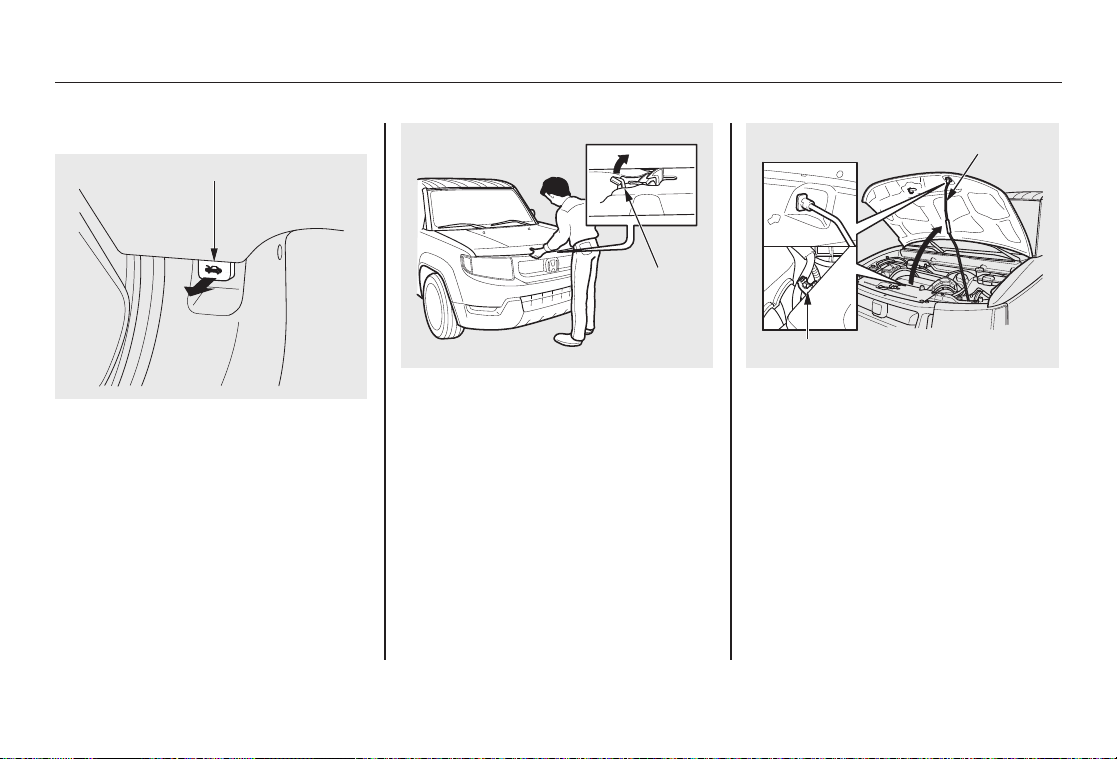
Opening and Closing the Hood
1. Park the vehicle, and set the
parking brake. Pull the hood
release handle located under the
lower left corner of the dashboard.
The hood will pop up slightly.
2. Put your fingers under the front
edge of the hood near the center.
The hood latch handle is above the
‘‘H’’ logo. Push this handle up to
release it. Lift up the hood.
If the hood latch handle moves
stiffly, or if you can open the hood
without lifting the handle, the
mechanism should be cleaned and
lubricated.
3. Pull the support rod out of its clip
and insert the end into the
designated hole in the hood.
To close the hood, lift it up slightly to
remove the support rod from the
hole. Put the support rod back into
its holding clip. Lower the hood to
about a foot (30 cm) above the
fender, then let it drop. Make sure it
is securely latched.
HOOD RELEASE HANDLE
LATCH
SUPPORT ROD
CLIP
Service Station Procedures
144
10/08/06 08:34:41 11 ELEMENT MMC North America Owner's Man 50 31SCV680 enu
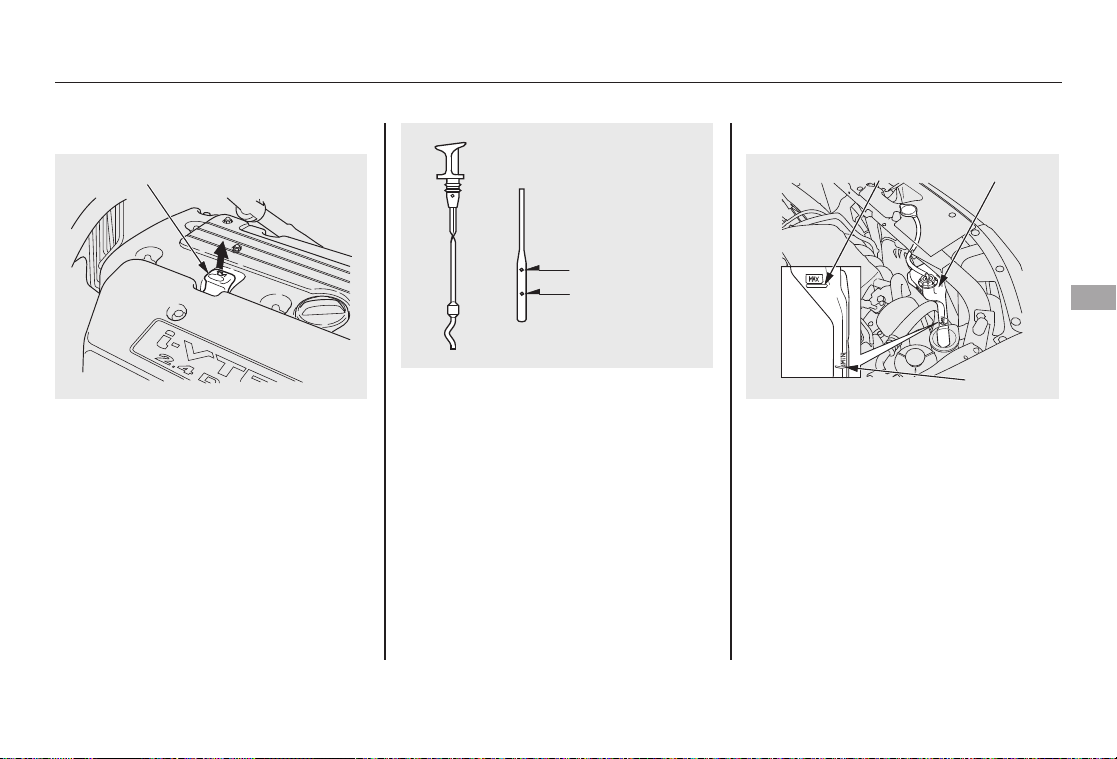
Oil Check
Wait a few minutes after turning the
engine off before you check the oil.
1. Remove the dipstick (orange tab).
2. Wipe the dipstick with a clean
cloth or paper towel.
3. Insert it all the way back in its
tube.
4. Remove the dipstick again, and
check the level. It should be
between the upper and lower
marks.
If it is near or below the lower mark,
see Adding Engine Oil on page 193.
Engine Coolant Check
Look at the coolant level in the
radiator reserve tank. Make sure it is
between the MAX and MIN lines. If
it is below the MIN line, see Adding
Engine Coolant on page 196 for
information on adding the proper
coolant.
Refer to Owner's Maintenance
Checks on page 190 for information
about checking other items on your
vehicle.
DIPSTICK
UPPER MARK
LOWER MARK
MIN
MAX RESERVE TANK
Service Station Procedures
145
Before Driving
10/08/06 08:34:41 11 ELEMENT MMC North America Owner's Man 50 31SCV680 enu
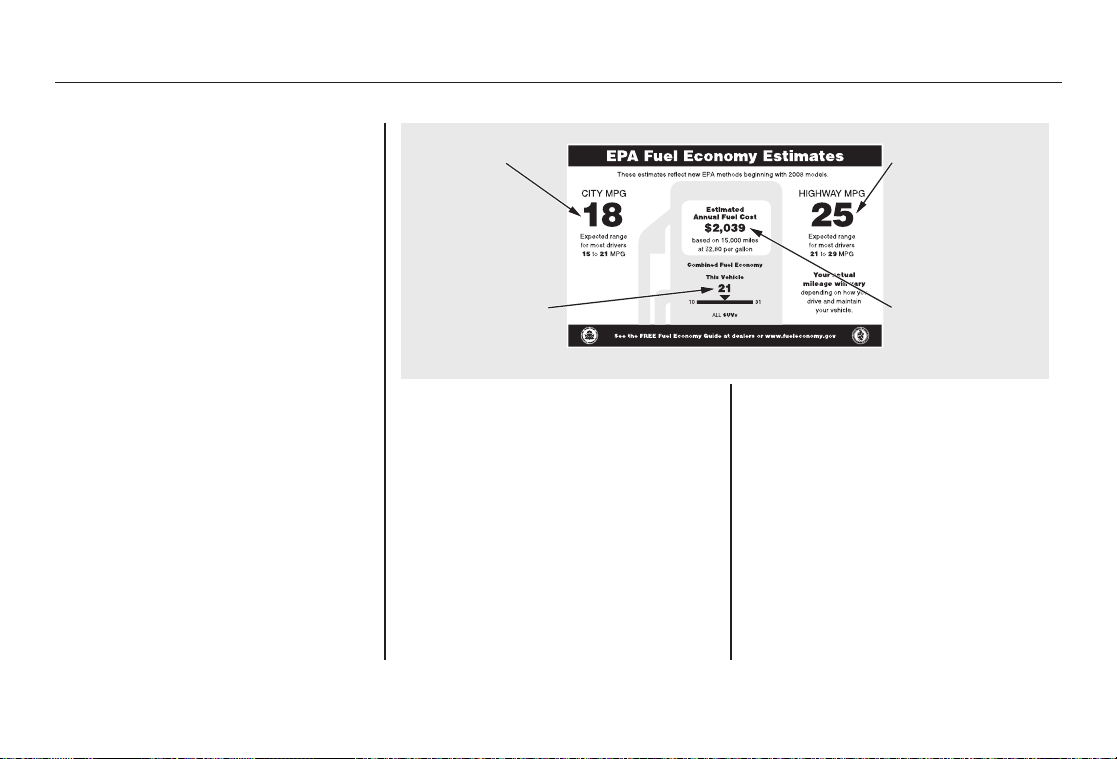
Actual Mileage and EPA Fuel
Economy Estimates Comparison.
Fuel economy is not a fixed number.
It varies based on driving conditions,
driving habits and vehicle condition.
Therefore, it is not possible for one
set of estimates to predict fuel
economy precisely for all drivers in
all environments.
The EPA fuel economy estimates
shown in the example to the right are
a useful tool for comparison when
buying a vehicle. EPA estimates
include:
City MPG - Represents urban
driving in a vehicle in light traffic. A
range of miles per gallon achieved is
also provided.
Highway MPG - Represents a
mixture of rural and interstate
driving, in a warmed-up vehicle,
typical of longer trips in free-flowing
traffic. A range of miles per gallon
achieved is also provided.
Combined Fuel Economy -
Represents a combination of city and
highway driving. The scale
represents the range of combined
fuel economy for other vehicles in
the class.
Estimated Annual Fuel Cost -
Provides an estimated annual fuel
cost, based on 15,000 miles (20,000
km) per year multiplied by the cost
per gallon (based on EPA fuel cost
data) divided by the combined fuel
economy.
For more information on fuel
economy ratings and factors that
affect fuel economy, visit
www.
fueleconomy.gov
City MPG
Combined Fuel
Economy
Highway MPG
Estimated Annual
Fuel Cost
(Sample EPA label shown)
Fuel Economy
146
10/08/06 08:34:41 11 ELEMENT MMC North America Owner's Man 50 31SCV680 enu

Fuel Economy Factors
The following factors can lower your
vehicle's fuel economy:
●
Aggressive driving (hard
acceleration and braking)
●
Excessive idling, accelerating and
braking in stop-and-go traffic
●
Cold engine operation (engines are
more efficient when warmed up)
●
Driving with a heavy load or the air
conditioner running
●
Improperly inflated tires
Improving Fuel Economy
Vehicle Maintenance
A properly maintained vehicle
maximizes fuel economy. Poor
maintenance can significantly reduce
fuel economy. Always maintain your
vehicle according to the maintenance
messages displayed on the
information display (see Owner's
Maintenance Checks on page 190).
For example:
●
Use the recommended viscosity
motor oil, displaying the API
Certification Seal (see page 193).
●
Maintain proper tire inflation -
An underinflated tire increases
‘‘rolling resistance,’’ which reduces
fuel economy.
●
Avoid carrying excess weight in
your vehicle - It puts a heavier
load on the engine, increasing fuel
consumption.
●
Keep your vehicle clean - In
particular, a build-up of snow or
mud on your vehicle's underside
adds weight and rolling resistance.
Frequent cleaning helps your fuel
economy.
Drive Efficiently
●
Drive moderately - Rapid
acceleration, abrupt cornering, and
hard braking increase fuel
consumption.
●
Observe the speed limit -
Aerodynamic drag has a big effect
on fuel economy at speeds above
45 mph (75 km/h). Reduce your
speed and you reduce the drag.
Trailers, car top carriers, roof
racks and bike racks are also big
contributors to increased drag.
●
Avoid excessive idling - Idling
results in 0 miles per gallon (0 kms
per liter).
●
Minimize the use of the air
conditioning system - The A/C
puts an extra load on the engine
which makes it use more fuel. Use
the fresh-air ventilation when
possible.
CONTINUED
Fuel Economy
147
Before Driving
10/08/06 08:34:41 11 ELEMENT MMC North America Owner's Man 50 31SCV680 enu
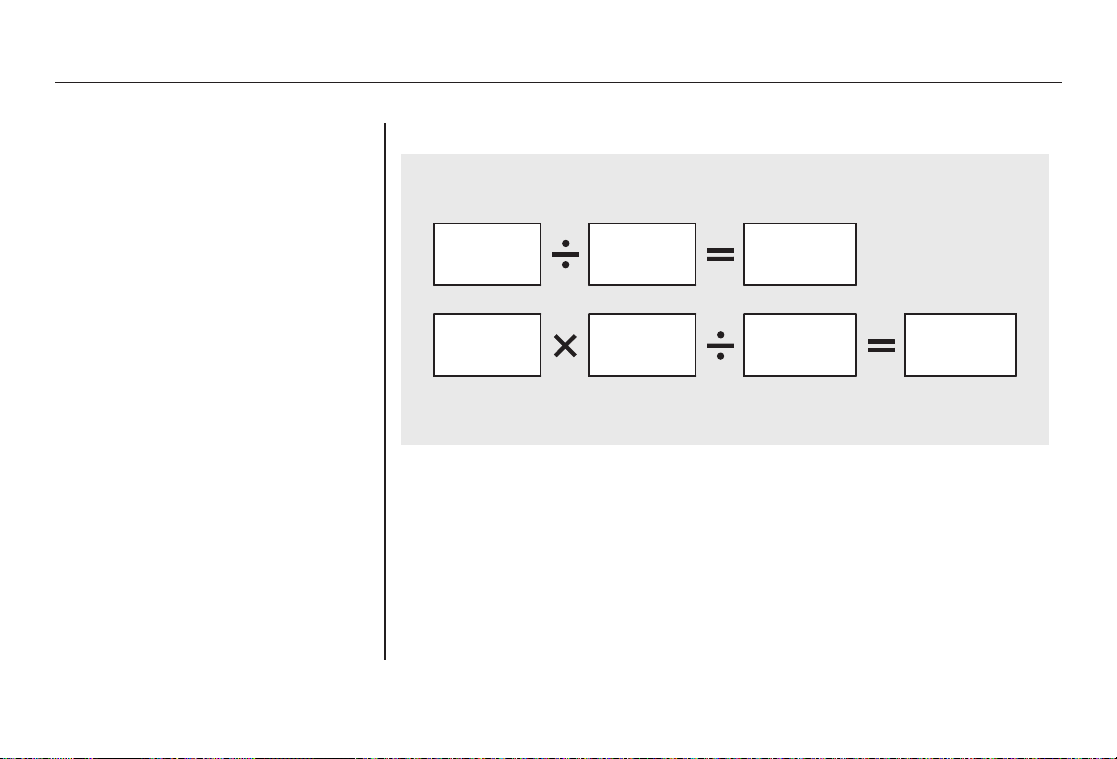
●
Plan and combine trips -
Combine several short trips into
one. A warmed-up engine is more
fuel efficient than a cold one.
Calculating Fuel Economy
Measuring Techniques
Direct calculation is the
recommended source of information
about your actual fuel economy.
Using frequency of fill-ups or taking
fuel gauge readings are NOT
accurate measures of fuel economy.
Fuel economy may improve over the
first several thousand miles.
Checking Your Fuel Economy
1) Fill the fuel tank until the nozzle automatically clicks off.
2) Reset trip counter to zero.
3) Record the total gallons (liters) needed to refill.
4) Follow one of the simple calculations above.
100 Liter Kilometers
L per
100 km
Miles
driven
Gallons
of fuel
Miles per
Gallon
Fuel Economy
148
10/08/06 08:34:41 11 ELEMENT MMC North America Owner's Man 50 31SCV680 enu
Modifying your vehicle, or installing
some non-Honda accessories, can
make it unsafe. Before you make any
modifications or add any accessories,
be sure to read the following
information.
Accessories
Your dealer has Honda accessories
that allow you to personalize your
vehicle. These accessories have been
designed and approved for your
vehicle, and are covered by warranty.
Although non-Honda accessories
may fit on your vehicle, they may not
meet factory specifications, and could
adversely affect your vehicle's
handling, stability, and reliability.
Improper accessories or
modifications can affect your
vehicle's handling, stability, and
performance, and cause a
crash in which you can be hurt
or killed.
Follow all instructions in this
owner's manual regarding
accessories and modifications.
When properly installed, cellular
phones, alarms, two-way radios, and
low-powered audio systems should
not interfere with your vehicle's
computer controlled systems, such
as your airbags, anti-lock brakes, and
tire pressure monitoring system.
Before installing any accessory:
●
Make sure the accessory does not
obscure any lights, or interfere
with proper vehicle operation or
performance.
●
Be sure electronic accessories do
not overload electrical circuits (see
page 239) or interfere with the
proper operation of your vehicle.
●
Before installing any electronic
accessory, have the installer
contact your dealer for assistance.
If possible, have your dealer
inspect the final installation.
●
Do not install accessories on the
side pillars or across the rear
windows. Accessories installed in
these areas may interfere with
proper operation of the side
curtain airbags.
CONTINUED
Accessories and Modifications
149
Before Driving
10/08/06 08:34:41 11 ELEMENT MMC North America Owner's Man 50 31SCV680 enu

Modifying Your Vehicle
Removing parts from your vehicle, or
replacing components with non-
Honda components could seriously
affect your vehicle's handling,
stability, and reliability.
Some examples are:
●
Lowering the vehicle with a non-
Honda suspension kit that
significantly reduces ground
clearance can allow the
undercarriage to hit speed bumps
or other raised objects, which
could cause the airbags to deploy.
●
Raising your vehicle with a non-
Honda suspension kit can affect
the handling and stability.
●
Non-Honda wheels, because they
are a universal design, can cause
excessive stress on suspension
components, and are not
compatible with the tire pressure
monitoring system (TPMS).
●
Larger or smaller wheels and tires
can interfere with the operation of
your vehicle's anti-lock brakes and
other systems.
●
Modifying your steering wheel or
any other part of your vehicle's
safety features can make the
systems ineffective.
If you plan to modify your vehicle,
consult your dealer.
Accessories and Modifications
150
10/08/06 08:34:41 11 ELEMENT MMC North America Owner's Man 50 31SCV680 enu
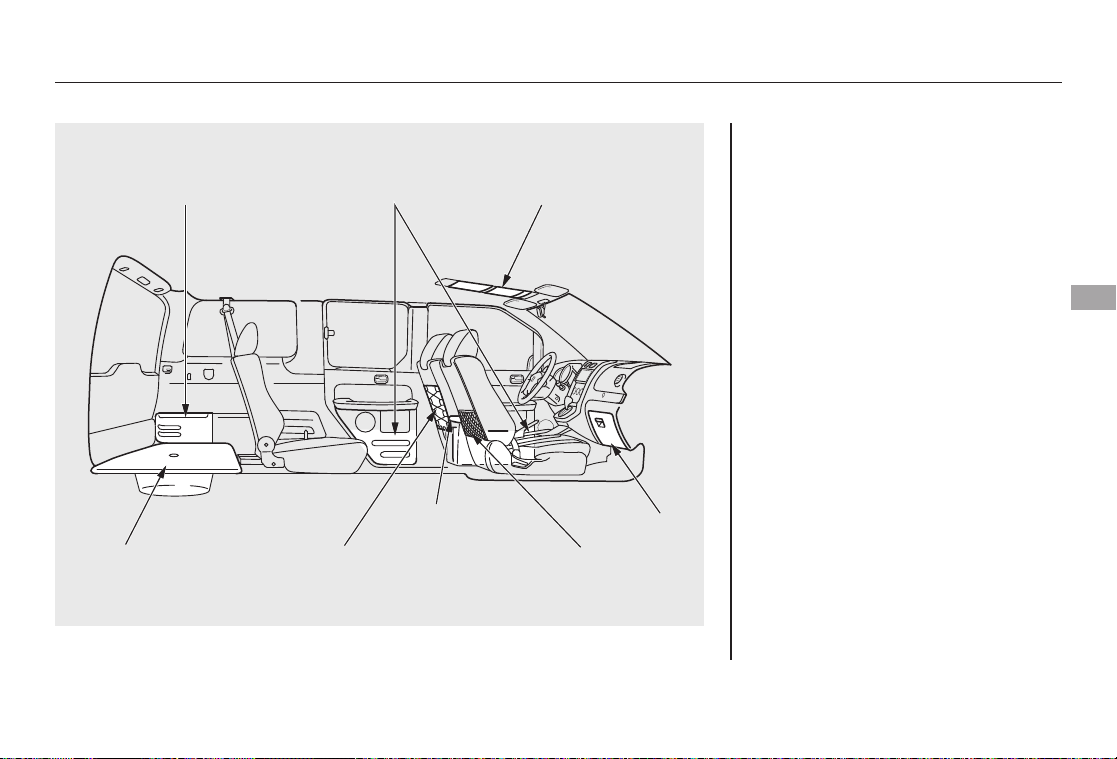
ꭧ: If equipped
Your vehicle has several convenient
storage areas:
●
Cargo area side pockets
●
Glove box
●
Overhead console (EX model)
●
Door pockets
●
Seat-back pocket (EX model)
●
Cargo area (including rear seats
when they are folded down, folded
to the side, or removed)
●
Seat-back bungee (EX model)
●
Roof-rack (if installed)
●
Cooler box (EX model)
However, carrying too much cargo, or
improperly storing it, can affect your
vehicle's handling, stability, stopping
distance, tires, and make it unsafe.
Before carrying any type of cargo, be
sure to read the following pages.
CARGO AREA
COOLER BOX
ꭧ
SEAT-BACK POCKET
ꭧ
GLOVE BOX
CARGO AREA SIDE POCKET DOOR POCKETS OVERHEAD CONSOLE
ꭧ
SEAT-BACK BUNGEE
ꭧ
EX model is shown .
CONTINUED
Carrying Cargo
151
Before Driving
10/08/06 08:34:41 11 ELEMENT MMC North America Owner's Man 50 31SCV680 enu
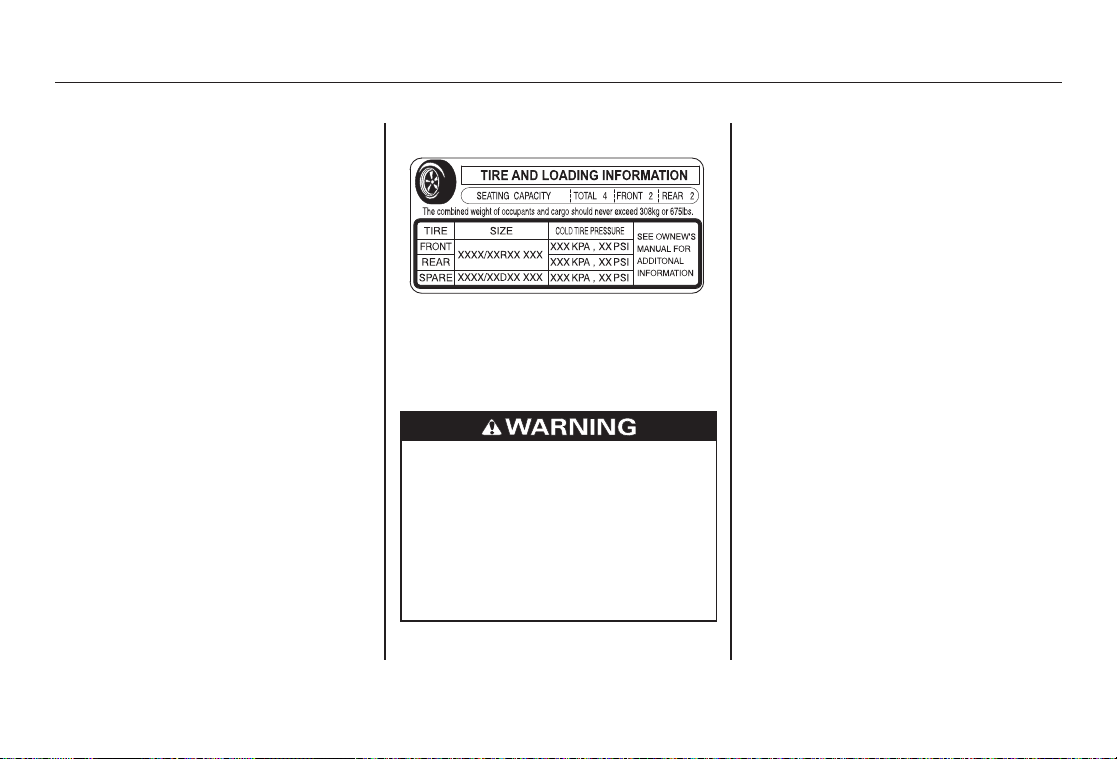
Load Limits
The maximum load for your vehicle
is 670 lbs (305 kg).
See Tire And Loading Information
label attached to the driver's
doorjamb.
Label Example
This figure includes the total weight
of all occupants, cargo, and
accessories, and the tongue load if
you are towing a trailer.
Overloading or improper
loading can affect handling and
stability and cause a crash in
which you can be hurt or killed.
Follow all load limits and other
loading guidelines in this
manual.
Steps for Determining Correct Load
Limit -
1. Locate the statement ‘‘The
combined weight of occupants and
cargo should never exceed XXX kg
or XXX lbs.’’ on your vehicle's
placard.
2. Determine the combined weight of
the driver and passengers that will
be riding in your vehicle.
3. Subtract the combined weight of
the driver and passengers from
XXX kg or XXX lbs.
Carrying Cargo
152
10/08/06 08:34:41 11 ELEMENT MMC North America Owner's Man 50 31SCV680 enu
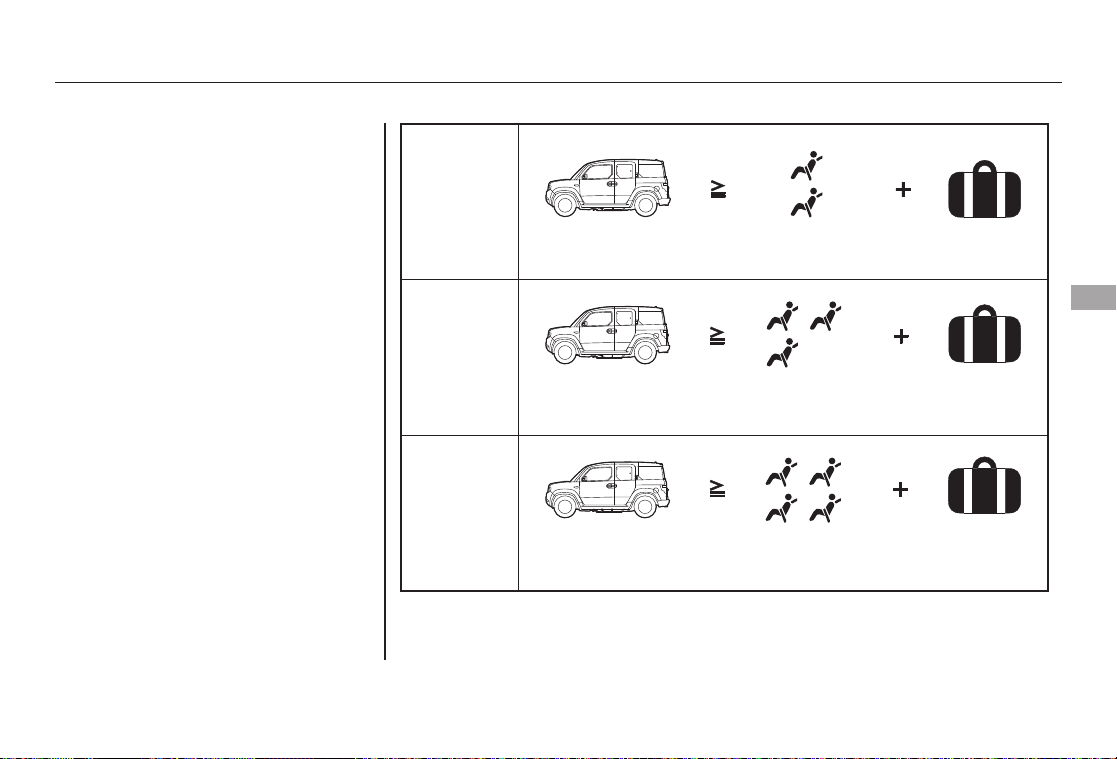
4. The resulting figure equals the
available amount of cargo and
luggage load capacity. For
example, if the ‘‘XXX’’ amount
equals 1,400 lbs. and there will be
five 150 lb. passengers in your
vehicle, the amount of available
cargo and luggage load capacity is
650 lbs.
(1,400 - 750 (5 ╳ 150) = 650 lbs.)
5. Determine the combined weight of
luggage and cargo being loaded on
the vehicle. That weight may not
safely exceed the available cargo
and luggage load capacity
calculated in Step 4.
6. If your vehicle will be towing a
trailer, load from your trailer will be
transferred to your vehicle. Consult
this manual to determine how this
reduces the available cargo and
luggage load capacity of your
vehicle.
Example 1
Example 2
Example 3
In addition, the total weight of the vehicle, all occupants, accessories, cargo, and trailer
tongue load must not exceed the Gross Vehicle Weight Rating (GVWR) or the Gross
Axle Weight Rating (GAWR). Both are on a label on the driver's doorjamb.
Max Load (670 lbs)
Passenger Weight
(150 lbs x 2 = 300 lbs)
(68 kg x 2 = 136 kg)
Cargo Weight
(370 lbs)
(169 kg)
(305 kg)
Max Load (670 lbs)
Cargo Weight
(220 lbs)
(101 kg)
Passenger Weight
(150 lbs x 3 = 450 lbs)
(68 kg x 3 = 204 kg)
(305 kg)
Max Load (670 lbs)
Passenger Weight
(150 lbs x 4 = 600 lbs)
(68 kg x 4 = 272 kg)
Cargo Weight
(70 lbs)
(33 kg)
(305 kg)
CONTINUED
Carrying Cargo
153
Before Driving
10/08/06 08:34:41 11 ELEMENT MMC North America Owner's Man 50 31SCV680 enu

Carrying Items in the Passenger
Compartment
●
Store or secure all items that could
be thrown around and hurt
someone during a crash.
●
Be sure items placed on the floor
behind the front seats cannot roll
under the seats and interfere with
the pedals, the seat operation, or
the proper operation of the sensors
under the seats.
●
Keep the glove box closed while
driving. If it is open, a passenger
could injure their knees during a
crash or sudden stop.
●
If you fold the rear seats down or
up, or remove them, tie down
items that could be thrown about
the vehicle during a crash or
sudden stop. Also, keep all cargo
below the bottom of the windows.
If it is higher, it could interfere
with the proper operation of the
side curtain airbags.
Carrying Cargo in the Cargo Area
or on a Roof Rack
●
Distribute cargo evenly on the
floor of the cargo area, placing the
heaviest items on the bottom and
as far forward as possible. Tie
down items that could be thrown
about the vehicle during a crash or
sudden stop.
●
If you carry large items that
prevent you from closing the
tailgate or the hatch, exhaust gas
can enter the passenger area. To
avoid the possibility of carbon
monoxide poisoning, follow the
instructions on page 52.
●
If you carry any items on a roof
rack, be sure the total weight of
the rack and the items does not
exceed 75 lbs (34 kg).
If you use an accessory roof rack,
the roof rack weight limit may be
lower. Refer to the information that
came with your roof rack.
Carrying Cargo
154
10/08/06 08:34:41 11 ELEMENT MMC North America Owner's Man 50 31SCV680 enu
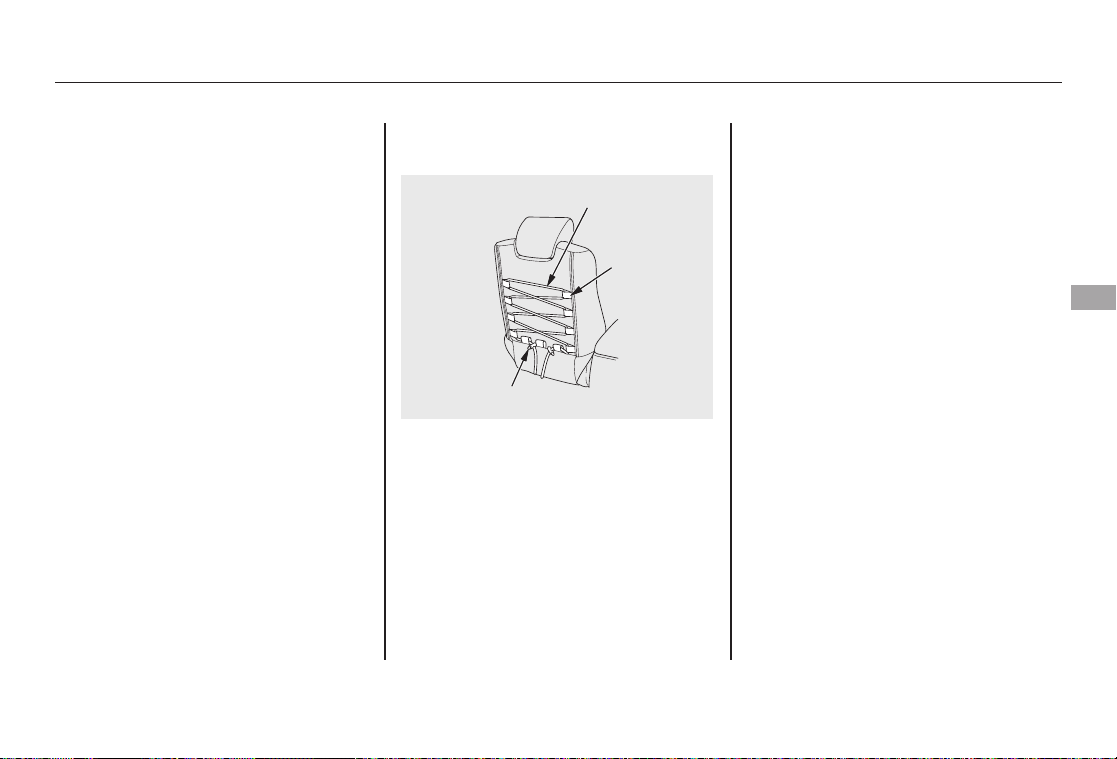
Optional Cargo Net
The cargo net can be used to help
hold down light items in the cargo
area. The cargo net may not prevent
heavy items from being thrown
forward in a crash or a sudden stop.
Heavy items should be secured to
the cargo area floor with the hooks
or cinch straps attached to the cargo
hooks.
Seat-Back Bungee
On EX model
The driver's seat-back and left rear
seat-back are equipped with
adjustable bungee cords to hold
medium-sized, lightweight objects.
If the cords are not installed, route
one cord through the loops as
shown. To attach the hooks, press
the top of the hook down, and slide
to the desired position, then release.
Adjust as needed.
ADJUSTABLE BUNGEE CORD
LOOP
HOOK
CONTINUED
Carrying Cargo
155
Before Driving
10/08/06 08:34:41 11 ELEMENT MMC North America Owner's Man 50 31SCV680 enu
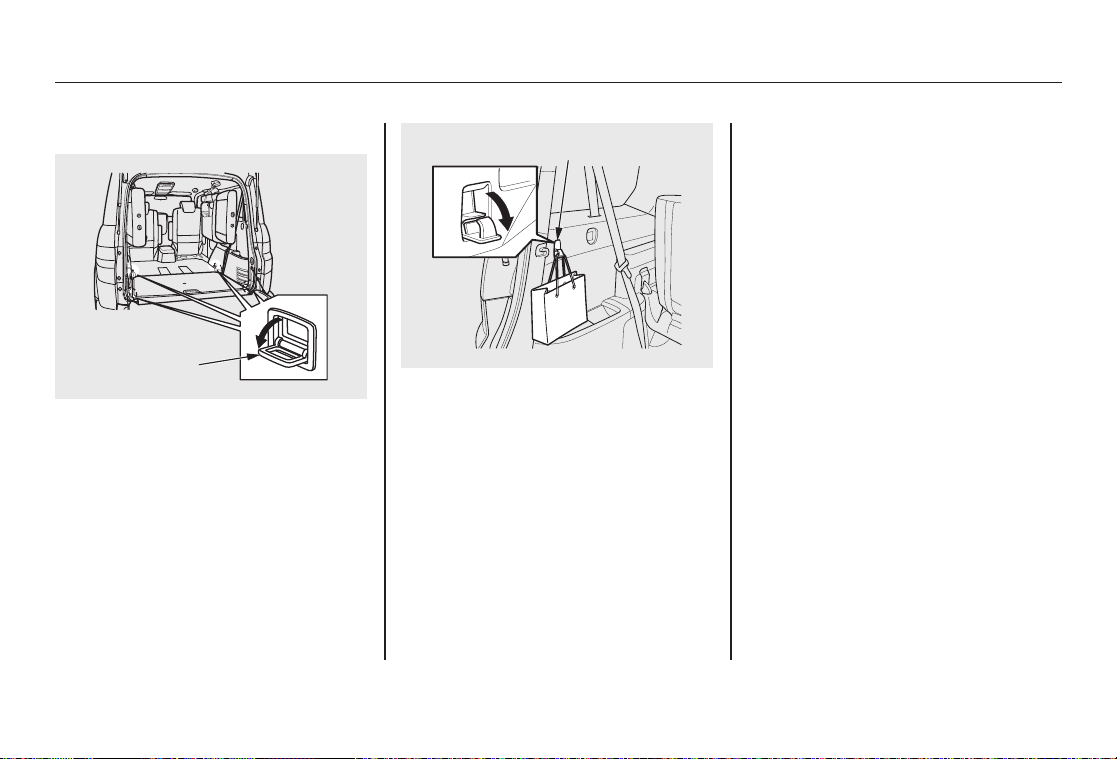
Cargo Hooks
The four hooks on the side panels
can be used to install a net for
securing items. Each hook is
designed to hold up to 50 lbs (23 kg)
of weight.
Your vehicle also has a grocery hook
on each side panel in the cargo area.
They are designed to hold light
items. Heavy objects may damage
the hook. Make sure any items put
on each hook weigh less than 6.5 lbs
(3 kg).
CARGO HOOKS
GROCERY HOOKS
Carrying Cargo
156
10/08/06 08:34:41 11 ELEMENT MMC North America Owner's Man 50 31SCV680 enu

This section gives you tips on
starting the engine under various
conditions, and how to operate the
automatic transmission. It also
includes important information on
parking your vehicle, the braking
system, the vehicle stability assist
(VSA
®
) system, the tire pressure
monitoring system (TPMS), and
facts you need if you are planning to
tow a trailer or drive off-highway.
Driving Guidelines
...................... 158
Preparing to Drive
...................... 159
Starting the Engine
..................... 160
Automatic Transmission
............. 161
Parking
....................................... 165
Braking System
.......................... 166
Anti-lock Brakes (ABS)
............... 167
Tire Pressure Monitoring System
(TPMS)
................................... 169
Vehicle Stability Assist (VSA
®
),
aka Electronic Stability Control
(ESC), System
..................... 172
Towing a Trailer
.......................... 174
Off-Highway Driving
Guidelines
............................... 180
Driving
157
Driving
10/08/06 08:34:41 11 ELEMENT MMC North America Owner's Man 50 31SCV680 enu

Your vehicle has a higher ground
clearance that allows you to travel
over bumps, obstacles, and rough
terrain. It also provides good
visibility so you can anticipate
problems earlier.
Because your vehicle rides higher off
the ground, it has a high center of
gravity that can cause it to roll over if
you make abrupt turns. Utility
vehicles have a significantly higher
roll over rate than other types of
vehicles.
To prevent rollovers or loss of
control:
●
Take corners at slower speeds
than you would with a passenger
vehicle.
●
Avoid sharp turns and abrupt
maneuvers whenever possible.
●
Do not modify your vehicle in any
way that would raise the center of
gravity.
●
Do not carry heavy cargo on the
roof.
Four-wheel drive models
Your vehicle is equipped with a four-
wheel drive (4WD) system. When
the system senses a loss of front-
wheel traction, it automatically
transfers some power to the rear
wheels. This gives you better traction
and mobility.
You still need to exercise the same
care when accelerating, steering, and
braking that you would in a two-
wheel drive vehicle.
See page 180 for off-highway driving
guidelines.
Driving Guidelines
158
10/08/06 08:34:41 11 ELEMENT MMC North America Owner's Man 50 31SCV680 enu

You should do the following checks
and adjustments before you drive
your vehicle.
1. Make sure all windows, mirrors,
and outside lights are clean and
unobstructed. Remove frost, snow,
or ice.
2. Check that the hood is fully
closed.
3. Visually check the tires. If a tire
looks low, use a gauge to check its
pressure.
4. Check that any items you may be
carrying are stored properly or
fastened down securely.
5. Check the seat adjustment (see
page 83).
6. Check the adjustment of the inside
and outside mirrors (see page 93).
7. Check the steering wheel
adjustment (see page 74).
8. Make sure the doors, the hatch,
and the tailgate are securely
closed and locked.
9. Fasten your seat belt. Check that
your passengers have fastened
their seat belts (see page 14).
10. When you start the engine, check
the gauges and indicators in the
instrument panel (see page 57).
Preparing to Drive
159
Driving
10/08/06 08:34:41 11 ELEMENT MMC North America Owner's Man 50 31SCV680 enu
1. Apply the parking brake.
2. In cold weather, turn off all
electrical accessories to reduce the
drain on the battery.
3. Make sure the shift lever is in
Park. Press on the brake pedal.
4. Without touching the accelerator
pedal, turn the ignition key to the
START (III) position. Do not hold
the key in the START (III) position
for more than 15 seconds at a time.
If the engine does not start right
away, pause for at least 10 seconds
before trying again.
The immobilizer system protects your
vehicle from theft. If an improperly
coded key (or other device) is used, the
engine's fuel system is disabled. For
more information, see page 76.
The engine is harder to start in cold
weather. Also, the thinner air found at
altitudes above 8,000 feet (2,400
meters) adds to this problem.
Starting the Engine
160
10/08/06 08:34:41 11 ELEMENT MMC North America Owner's Man 50 31SCV680 enu
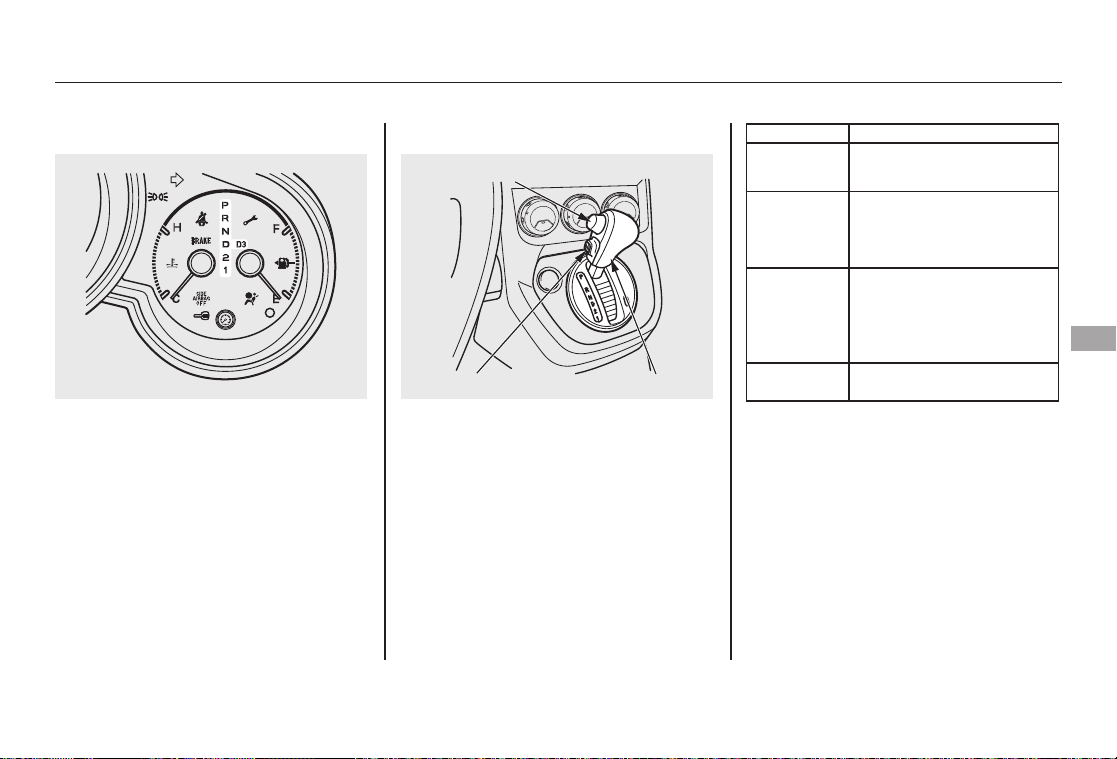
Shift Lever Position Indicators
These indicators on the instrument
panel show which position the shift
lever is in.
The ‘‘D’’ indicator comes on for a few
seconds when you turn the ignition
switch to the ON (II) position. If it
flashes while driving (in any shift
position), it indicates a possible
problem in the transmission. Avoid
rapid acceleration, and have the
transmission checked by your dealer
as soon as possible.
Shifting
To shift from any position, press
firmly on the brake pedal, push the
release button, and pull the lever
toward you. You cannot shift out of
Park when the ignition switch is in
the LOCK (0) or ACCESSORY (I)
position.
To shift from: Do this:
PtoR
Press the brake pedal, and
press the shift lever release
button.
RtoP
Press the shift lever release
button.
NtoR
Dto2
2to1
1to2
Move the shift lever.
2toD
DtoN
NtoD
RtoN
D3 to D
Press the D
3 button.
DtoD3
Park (P) - This position
mechanically locks the transmission.
Use Park whenever you are turning
off or starting the engine. To shift out
of Park, you must press on the brake
pedal and press the release button on
the shift lever. Make sure your foot is
off the accelerator pedal.
RELEASE BUTTON
D3 BUTTON
SHIFT LEVER
CONTINUED
Automatic Transmission
161
Driving
10/08/06 08:34:41 11 ELEMENT MMC North America Owner's Man 50 31SCV680 enu

If you have done all of the above and
still cannot move the lever out of
Park, see Shift Lock Release on
page 163.
To avoid transmission damage, come
to a complete stop before shifting
into Park. You must also press the
release button to shift into Park. The
shift lever must be in Park before
you can remove the key from the
ignition switch.
Reverse (R) - Press the brake
pedal and press the release button to
shift from Park to reverse. To shift
from reverse to neutral, come to a
complete stop, and then shift.
Neutral (N) - Use neutral if you
need to restart a stalled engine, or if
it is necessary to stop briefly with the
engine idling. Shift to the Park
position if you need to leave your
vehicle for any reason. Press on the
brake pedal when you are moving
the shift lever from neutral to
another gear.
Drive (D) - Use this position for
your normal driving. The
transmission automatically selects a
suitable gear (1 through 5) for your
speed and acceleration. You may
notice the transmission shifting up at
higher engine speeds when the
engine is cold. This helps the engine
warm up faster.
Drive (D3) - To use D3, press the
D3 button when the shift lever is in
the ‘‘D’’ position. This position is
similar to D, except only the first
three gears are selected instead of all
five. Use D3 when towing a trailer in
hilly terrain, or to provide engine
braking when going down a steep
hill. D3 can also keep the
transmission from cycling between
third and fourth gears in stop-and-go
driving.
Automatic Transmission
162
10/08/06 08:34:41 11 ELEMENT MMC North America Owner's Man 50 31SCV680 enu

Second (2) - This position locks
the transmission in second gear. It
does not downshift to first gear when
you come to a stop.
Use second gear:
●
For more power when climbing.
●
To increase engine braking when
going down steep hills.
●
For starting out on a slippery
surface or in deep snow.
●
To help reduce wheel spin.
●
When driving downhill with a
trailer.
First (1) - This position locks the
transmission in first gear. By
upshifting and downshifting through
1, 2, D3, and D, you can operate the
transmission much like a manual
transmission without a clutch pedal.
Engine Speed Limiter
If you exceed the maximum speed
for the gear you are in, the engine
speed will enter into the
tachometer's red zone. If this occurs,
you may feel the engine cut in and
out. This is caused by a limiter in the
engine's computer controls. The
engine will run normally when you
reduce the rpm below the red zone.
Shift Lock Release
This allows you to move the shift
lever out of Park if the normal
method of pushing on the brake
pedal and pressing the release button
does not work.
1. Set the parking brake.
2. Remove the key from the ignition
switch.
CONTINUED
Automatic Transmission
163
Driving
10/08/06 08:34:41 11 ELEMENT MMC North America Owner's Man 50 31SCV680 enu
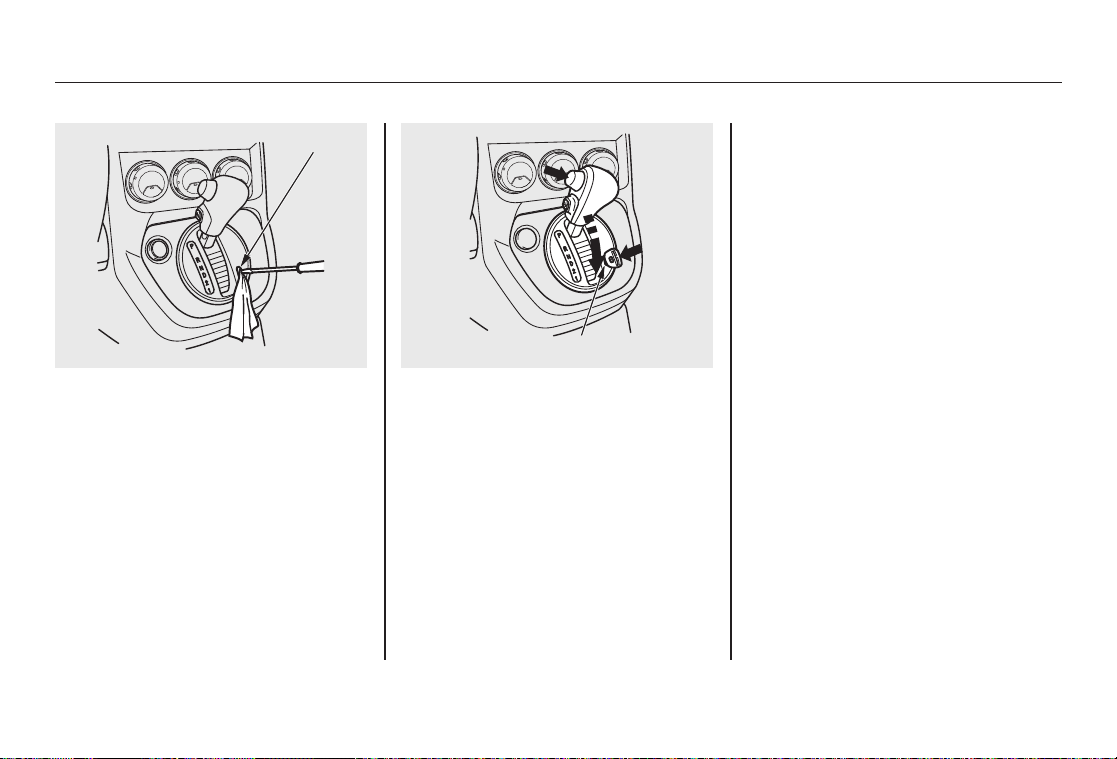
3. Put a cloth on the edge of the shift
lock release slot cover next to the
shift lever to prevent scratches.
Using a flat-tip screwdriver,
carefully pry on the edge of the
cover to remove it.
4. Insert the key in the shift lock
release slot.
5. Push down on the key while you
press the release button on the
shift lever and move the shift lever
out of Park to neutral.
6. Remove the key from the shift lock
release slot, then reinstall the
cover. Make sure the notch on the
cover is on the right side. Insert
the key into the ignition switch,
press the brake pedal, and restart
the engine.
If you need to use the shift lock
release, it means your vehicle is
developing a problem. Have it
checked by your dealer.
COVER
SHIFT LOCK RELEASE SLOT
Automatic Transmission
164
10/08/06 08:34:41 11 ELEMENT MMC North America Owner's Man 50 31SCV680 enu

Always use the parking brake when
you park your vehicle. Make sure the
parking brake is set firmly, or your
vehicle may roll if it is parked on an
incline.
Set the parking brake before you put
the transmission in Park. This keeps
the vehicle from moving and putting
pressure on the parking mechanism
in the transmission.
Parking Tips
●
Make sure the windows are
closed.
●
Turn off the lights.
●
Place any packages, valuables, etc.
in the cargo area or take them with
you.
●
Lock the doors and the hatch with
the key.
●
Never park over dry leaves, tall
grass, or other flammable
materials. The hot three way
catalytic converter could cause
these materials to catch on fire.
●
If the vehicle is facing uphill, turn
the front wheels away from the
curb.
●
If the vehicle is facing downhill,
turn the front wheels toward the
curb.
●
Make sure the parking brake is
fully released before driving away.
Driving with the parking brake
partially set can overheat or
damage the rear brakes.
Parking
165
Driving
10/08/06 08:34:41 11 ELEMENT MMC North America Owner's Man 50 31SCV680 enu

Your vehicle is equipped with disc
brakes at all four wheels. A power
assist helps reduce the effort needed
on the brake pedal. The emergency
brake assist system increases the
stopping force when you depress the
brake pedal hard in an emergency
situation. The anti-lock brake system
(ABS) helps you retain steering
control when braking very hard.
Resting your foot on the pedal keeps
the brakes applied lightly, builds up
heat, reduces their effectiveness and
reduces brake pad life. In addition,
fuel economy can be reduced. It also
keeps your brake lights on all the
time, confusing drivers behind you.
Constant application of the brakes
when going down a long hill builds
up heat and reduces their
effectiveness. Use the engine to
assist the brakes by taking your foot
off the accelerator and downshifting
to a lower gear.
Check your brakes after driving
through deep water. Apply the
brakes moderately to see if they feel
normal. If not, apply them gently and
frequently until they do. Be extra
cautious and alert in your driving.
Braking System Design
The hydraulic system that operates
the brakes has two separate circuits.
Each circuit works diagonally across
the vehicle (the left-front brake is
connected with the right-rear brake,
etc.). If one circuit should develop a
problem, you will still have braking
at two wheels.
Braking System
166
10/08/06 08:34:41 11 ELEMENT MMC North America Owner's Man 50 31SCV680 enu

Brake Pad Wear Indicators
If the brake pads need replacing, you
will hear a distinctive, metallic
screeching sound when you apply
the brake pedal. If you do not have
the brake pads replaced, they will
screech all the time. It is normal for
the brakes to occasionally squeal or
squeak when you apply them.
Anti-lock Brakes (ABS)
The anti-lock brake system (ABS)
helps prevent the wheels from
locking up, and helps you retain
steering control by pumping the
brakes rapidly, much faster than a
person can do it.
The electronic brake distribution
(EBD) system, which is part of the
ABS, also balances the front-to-rear
braking distribution according to
vehicle loading.
You should never pump the brake pedal.
Let the ABS work for you by always
keeping firm, steady pressure on the
brake pedal. This is sometimes
referred to as ‘‘stomp and steer.’’
You will feel a pulsation in the brake
pedal when the ABS activates, and
you may hear some noise. This is
normal: it is the ABS rapidly
pumping the brakes. On dry
pavement, you will need to press on
the brake pedal very hard before the
ABS activates. However, you may
feel the ABS activate immediately if
you are trying to stop on snow or ice.
CONTINUED
Braking System, Anti-lock Brakes (ABS)
167
Driving
10/08/06 08:34:41 11 ELEMENT MMC North America Owner's Man 50 31SCV680 enu
ABS Indicator
If this indicator comes on, the anti-
lock function of the braking system
has shut down. The brakes still work
like a conventional system, but
without anti-lock. You should have
your dealer inspect your vehicle as
soon as possible.
If the indicator comes on while
driving, test the brakes as instructed
on page 237.
If the ABS indicator and the brake
system indicator come on together,
and the parking brake is fully
released, the EBD system may also
be shut down.
Test your brakes as instructed on
page 237. If the brakes feel normal,
drive slowly and have your vehicle
repaired by your dealer as soon as
possible. Avoid sudden hard braking
which could cause the rear wheels to
lock up and possibly lead to a loss of
control.
Important Safety Reminders
ABS does not reduce the time or
distance it takes to stop the
vehicle. It only helps with steering
control during braking.
ABS will not prevent a skid that
results from changing direction
abruptly, such as trying to take a
corner too fast or making a sudden
lane change. Always drive at a safe
speed for the road and weather
conditions.
ABS cannot prevent a loss of
stability. Always steer moderately
when you are braking hard. Severe
or sharp steering wheel movement
can still cause your vehicle to veer
into oncoming traffic or off the road.
A vehicle with ABS may require a
longer distance to stop on loose or
uneven surfaces, such as gravel or
snow, than a vehicle without anti-
lock.
Anti-lock Brakes (ABS)
168
10/08/06 08:34:41 11 ELEMENT MMC North America Owner's Man 50 31SCV680 enu
Your vehicle is equipped with a tire
pressure monitoring system (TPMS)
that turns on every time you start the
engine and monitors the pressure in
your tires while driving.
Each tire has its own pressure sensor
(not including the spare tire). If the
air pressure of a tire becomes
significantly low, the sensor in that
tire immediately sends a signal that
causes the low tire pressure indicator
to come on.
Low Tire Pressure
Indicator
When the low tire pressure indicator
is on, one or more of your tires is
significantly underinflated. You
should stop and check your tires as
soon as possible, and inflate them to
the proper pressure as indicated on
the vehicle's tire information placard.
If you think you can safely drive a
short distance to a service station,
proceed slowly, and inflate the tire to
the recommended pressure shown on
the driver's doorjamb.
If the tire is flat, or if the tire pressure
is too low to continue driving, replace
the tire with the compact spare tire
(see page 222).
If you cannot make the low tire
pressure indicator go out after
inflating the tires to the specified
values, have your dealer check the
system as soon as possible.
Driving on a significantly
underinflated tire causes the tire to
overheat and can lead to tire failure.
Underinflation also reduces fuel
efficiency and tire tread life, and may
affect the vehicle's handling and
stopping ability.
Because tire pressure varies by
temperature and other conditions, the
low tire pressure indicator may come
on unexpectedly.
CONTINUED
Tire Pressure Monitoring System (TPMS)
169
Driving
10/08/06 08:34:41 11 ELEMENT MMC North America Owner's Man 50 31SCV680 enu
For example, if you check and fill
your tires in a warm area, then drive
in extremely cold weather, the tire
pressure will be lower than measured
and could be underinflated and cause
the low tire pressure indicator to
come on. Or, if you check and adjust
your tire pressure in cooler
conditions, and drive into extremely
hot conditions, the tire may become
overinflated. However, the low tire
pressure indicator will not come on if
the tires are overinflated.
Refer to page 212 for tire inflation
guidelines.
Although your tire pressure is
monitored, you must manually check
the tire pressures monthly.
Each tire, including the spare, should
be checked monthly when cold and
set to the recommended inflation
pressure as specified in the vehicle
placard and this owner's manual (see
page 252).
Tire Pressure Monitoring
System (TPMS) Indicator
This indicator comes on and stays on
if there is a problem with the tire
pressure monitoring system.
If this happens, the system will shut
off and no longer monitor tire
pressures. Have the system checked
by your dealer as soon as possible.
When you restart the vehicle with
the compact spare tire, the TPMS
indicator may also come on and stay
on after driving several miles
(kilometers).
Changing a Tire with TPMS
If you have a flat tire, the low tire
pressure indicator will come on.
Replace the flat tire with the compact
spare tire (see page 222).
Each wheel (except the compact
spare tire wheel) is equipped with a
tire pressure sensor. You must use
TPMS specific wheels. It is
recommended that you always have
your tires serviced by your dealer or
qualified technician.
After you replace the flat tire with the
compact spare tire, the low tire
pressure indicator stays on. This is
normal; the system is not monitoring
the spare tire pressure. Manually
check the spare tire pressure to be
sure it is correct. After several miles
(kilometers) driving with the
compact spare tire, the TPMS
indicator comes on and the low tire
pressure indicator goes off.
Tire Pressure Monitoring System (TPMS)
170
10/08/06 08:34:41 11 ELEMENT MMC North America Owner's Man 50 31SCV680 enu

The low tire pressure indicator or the
TPMS indicator will go off, after
several miles (kilometers) driving,
when you replace the spare tire with
the specified regular tire equipped
with the tire pressure monitor
sensor.
Never use a puncture-repairing agent
in a flat tire. If used, you will have to
replace the tire pressure sensor.
Have the flat tire repaired by your
dealer as soon as possible.
As required by the FCC:
This device complies with Part 15 of the
FCC rules. Operation is subject to the
following two conditions: (1) This device
may not cause harmful interference, and
(2) this device must accept any
interference received, including
interference that may cause undesired
operation.
Changes or modifications not expressly
approved by the party responsible for
compliance could void the user's
authority to operate the equipment.
Tire Pressure Monitoring System (TPMS)
171
Driving
10/08/06 08:34:41 11 ELEMENT MMC North America Owner's Man 50 31SCV680 enu
The vehicle stability assist (VSA)
system helps to stabilize the vehicle
during cornering if the vehicle turns
more or less than desired. It also
assists you in maintaining traction
while accelerating on loose or
slippery road surfaces. It does this by
regulating the engine's output and by
selectively applying the brakes.
When VSA activates, you may notice
that the engine does not respond to
the accelerator in the same way it
does at other times. You will also see
the VSA system indicator blink.
The VSA system cannot enhance the
vehicle's driving stability in all
situations and does not control your
vehicle's entire braking system. It is
still your responsibility to drive and
corner at reasonable speeds and to
leave a sufficient margin of safety.
VSA OFF Indicator
When VSA is off, the VSA OFF
indicator comes on as a reminder.
Vehicle Stability Assist
(VSA) System Indicator
When VSA activates, you will see the
VSA system indicator blink.
If this indicator comes on while
driving, pull to the side of the road
when it is safe, and turn off the
engine. Reset the system by
restarting the engine. If the VSA
system indicator stays on or comes
back on while driving, have the VSA
system inspected by your dealer.
NOTE: The main function of the VSA
system is generally known as
Electronic Stability Control (ESC).
The system also includes a traction
control function.
If the indicator does not come on
when the ignition switch is turned to
the ON (II) position, there may be a
problem with the VSA system. Have
your dealer inspect your vehicle as
soon as possible.
Without VSA, your vehicle will have
normal braking and cornering ability,
but it will not have VSA traction and
stability enhancement.
Vehicle Stability Assist (VSA
®
), aka Electronic Stability Control (ESC), System
172
10/08/06 08:34:41 11 ELEMENT MMC North America Owner's Man 50 31SCV680 enu
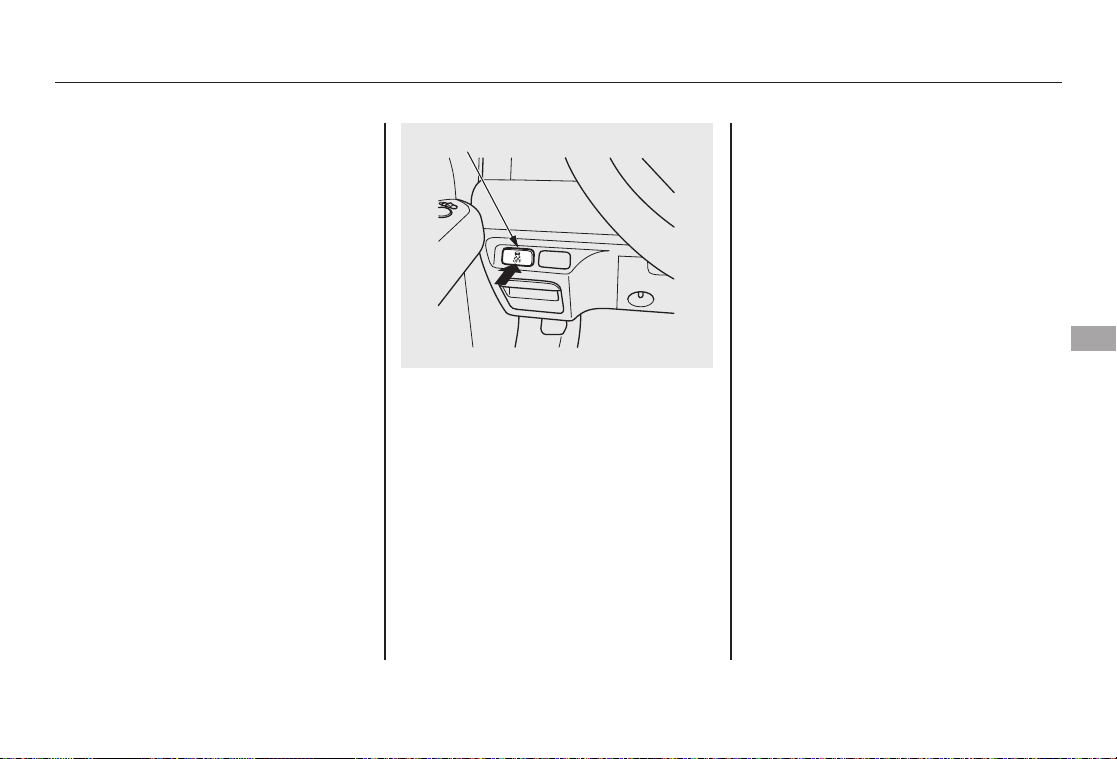
VSA OFF Switch
In certain unusual conditions when
your vehicle gets stuck in shallow
mud or fresh snow, it may be easier
to free it with the VSA temporarily
switched off. When the VSA system
is off, the traction control system is
also off. You should only attempt to
free your vehicle with the VSA off if
you are not able to free it when the
VSA is on.
Immediately after freeing your
vehicle, be sure to switch the VSA on
again. We do not recommend driving
your vehicle with the VSA and
traction control systems switched off.
This switch is under the driver's side
vent. To turn the VSA system on and
off, press and hold it until you hear a
beep.
When VSA is off, the VSA OFF
indicator comes on as a reminder.
Press and hold the switch again. It
turns the system back on.
VSA is turned on every time you start
the engine, even if you turned it off
the last time you drove the vehicle.
VSA and Tire Sizes
Driving with varying tire or wheel
sizes may cause the VSA to
malfunction. When replacing tires,
make sure they are the same size
and type as your original tires (see
page 216).
If you install winter tires, make sure
they are the same size as those that
were originally supplied with your
vehicle. Exercise the same caution
during winter driving as you would if
your vehicle was not equipped with
VSA.
VSA OFF SWITCH
Vehicle Stability Assist (VSA
®
), aka Electronic Stability Control (ESC), System
173
Driving
10/08/06 08:34:41 11 ELEMENT MMC North America Owner's Man 50 31SCV680 enu
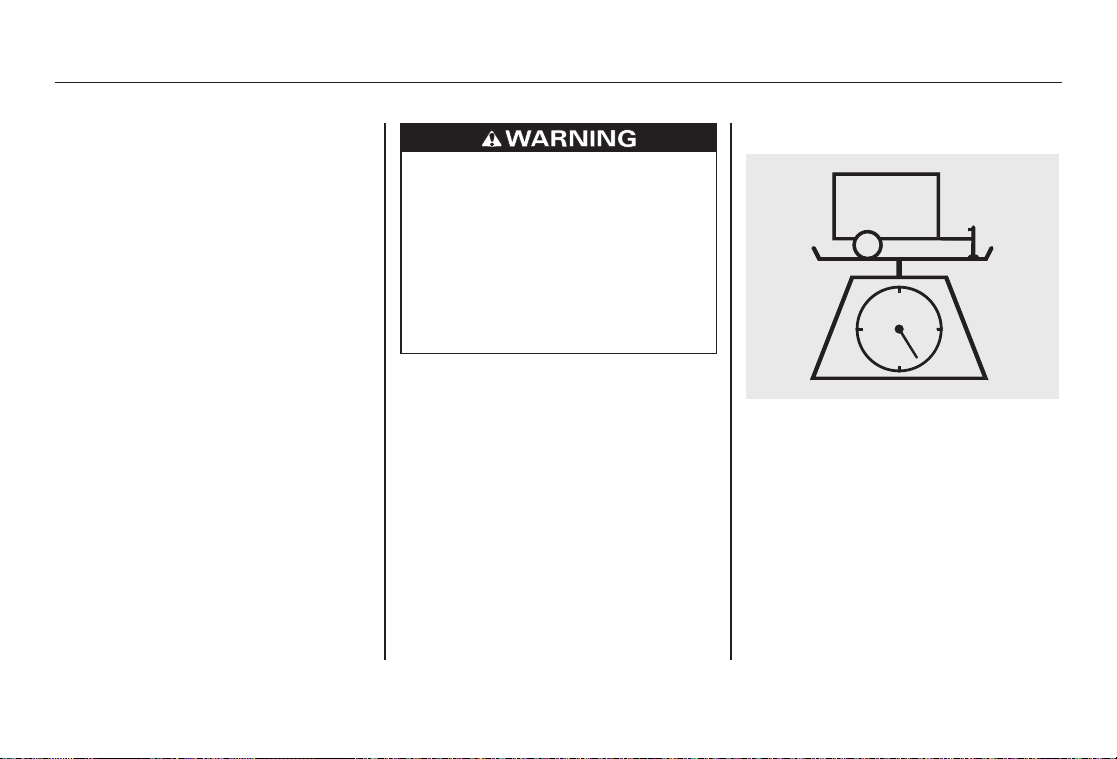
Your vehicle has been designed
primarily to carry passengers and
their cargo. You can also use it to tow
a trailer if you carefully observe the
load limits, use the proper
equipment, and follow the guidelines
in this section.
Break-In Period
Avoid towing a trailer during your
vehicle's first 600 miles (1,000 km)
(see page 142).
Be sure to read the Off-Highway
Driving Guidelines section on page
180 if you plan to tow off paved
surfaces.
Exceeding any load limit or
improperly loading your vehicle
and trailer can cause a crash in
which you can be seriously hurt
or killed.
Check the loading of your
vehicle and trailer carefully
before starting to drive.
Load Limits
Total Trailer Weight: The maximum
allowable weight of the trailer and
everything in or on it must not
exceed 1,500 lbs (680 kg). Towing a
trailer that is too heavy can seriously
affect your vehicle's handling and
performance. It can also damage the
engine and drivetrain.
Towing a Trailer
174
10/08/06 08:34:41 11 ELEMENT MMC North America Owner's Man 50 31SCV680 enu
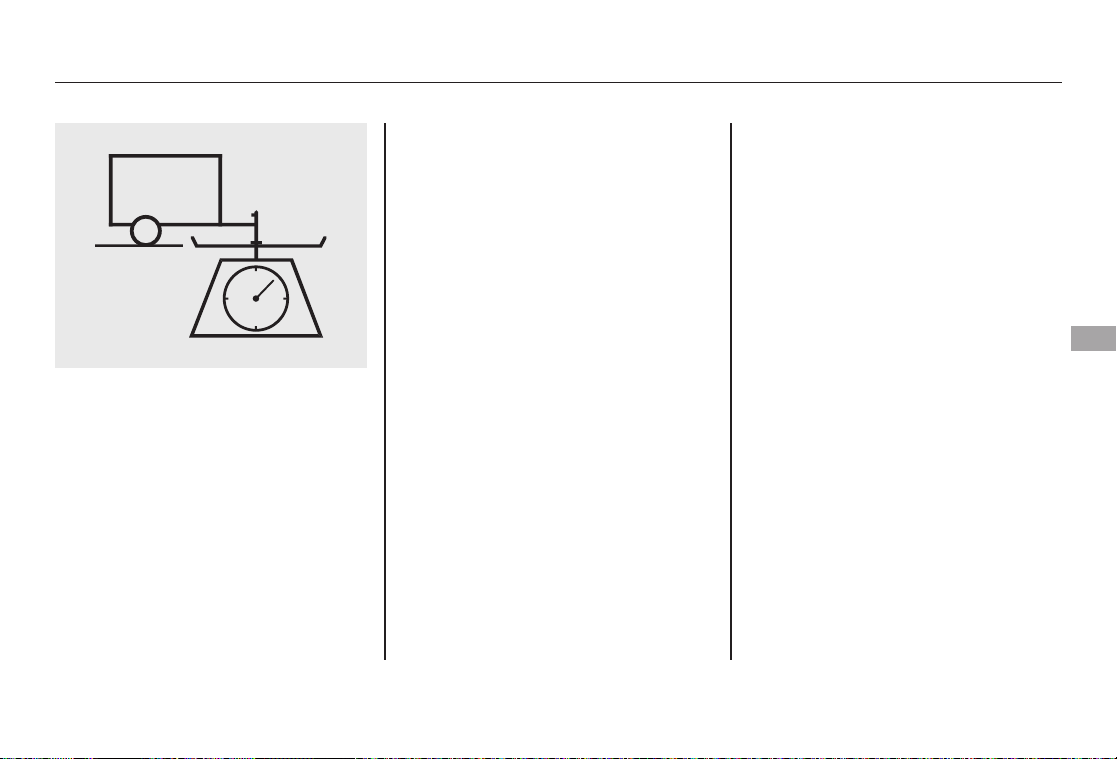
Tongue Load: The weight that the
tongue of a fully-loaded trailer puts
on the hitch should be approximately
10% of the total trailer weight. Too
much tongue load reduces front-tire
traction and steering control. Too
little tongue load can make the trailer
unstable and cause it to sway.
To achieve a proper tongue load,
start by loading 60% of the load
toward the front of the trailer and 40%
toward the rear, then re-adjust the
load as needed.
●
Gross Vehicle Weight Rating
(GVWR):
The maximum allowable weight of
the vehicle, all occupants, all
accessories, all cargo, and the
tongue load is:
4,450 lbs (2,020 kg)
●
Gross Axle Weight Rating
(GAWR):
The maximum allowable weight of
the vehicle axles is:
2,300 lbs (1,045 kg)
on the front axle
2,205 lbs (1,000 kg)
on the rear axle
Checking Loads
The best way to confirm that all loads
are within limits is to check them at a
public scale. For public scales in your
area, check your local phone book,
or contact your trailer dealer or
rental agency for assistance.
If you cannot get to a public scale,
you can estimate the total trailer
weight by adding the weight of your
trailer (as quoted by the
manufacturer) with everything in or
on the trailer.
If you normally pull the same load
each time you tow a trailer, you can
use a suitable scale or a special
tongue load gauge to check the
tongue load the first time you set up
a towing combination (a fully loaded
vehicle and trailer), then recheck the
tongue load whenever the conditions
change.
CONTINUED
Towing a Trailer
175
Driving
10/08/06 08:34:41 11 ELEMENT MMC North America Owner's Man 50 31SCV680 enu

Towing Equipment and
Accessories
Towing can require a variety of
equipment, depending on the size of
your trailer, how it will be used, how
much load you are towing, and
where you tow. To ensure the
highest quality equipment, purchase
Honda equipment whenever
possible.
Discuss your needs with your trailer
sales or rental agency, and follow the
guidelines in the rest of this section.
Also make sure that all equipment is
properly installed and that it meets
federal, state, provincial, territorial
and local regulations.
Hitches
Any hitch used on your vehicle must
be properly bolted to the underbody.
Safety Chains
Always use safety chains when you
tow a trailer. Make sure the chains
are secured to the trailer and hitch,
and that they cross under the tongue
and can catch the trailer if it becomes
unhitched. Leave enough slack to
allow the trailer to turn corners
easily, but do not let the chains drag
on the ground.
Trailer Brakes
Honda recommends that any trailer
with a total weight of 1,000 lbs (450
kg) or more has its own brake.
There are two common types of
trailer brakes; surge and electric.
Surge brakes are common for boat
trailers, since the brakes will get wet.
If you choose electric brakes, be sure
they are electronically actuated. Do
not attempt to tap into your vehicle's
hydraulic system. No matter how
successful it may seem, any attempt
to attach trailer brakes to your
vehicle's hydraulic system will lower
braking effectiveness and create a
potential hazard.
See your trailer dealer or rental
agency for more information on
installing electric brakes.
Towing a Trailer
176
10/08/06 08:34:41 11 ELEMENT MMC North America Owner's Man 50 31SCV680 enu

Trailer Lights
Trailer lights and equipment must
comply with federal, state, provincial,
territorial, and local regulations.
Check with your local trailer dealer
or rental agency for the requirements
in the area where you plan to tow,
and use only equipment designed for
your vehicle.
Since lighting and wiring vary by
trailer type and brand, you should
have a qualified technician install a
suitable connector between the
vehicle and the trailer. Improper
equipment or installation can cause
damage to your vehicle's electrical
system and affect your vehicle
warranty.
Additional Towing Equipment
Many states require special outside
mirrors when towing a trailer. Even if
they don't, you should install special
mirrors if you cannot clearly see
behind you, or if the trailer creates a
blind spot.
Ask your trailer sales or rental
agency if any other items are
recommended or required for your
towing situation.
CONTINUED
Towing a Trailer
177
Driving
10/08/06 08:34:41 11 ELEMENT MMC North America Owner's Man 50 31SCV680 enu

Pre-Tow Checklist
When preparing to tow, and before
driving away, be sure to check the
following:
●
The vehicle has been properly
serviced, and the tires, brakes,
suspension, cooling system, and
lights are in good operating
condition.
●
The trailer has been properly
serviced and is in good condition.
●
All weights and loads are within
limits (see pages 174 and 175).
●
The hitch, safety chains, and any
other attachments are secure.
●
All items in or on the trailer are
properly secured and cannot shift
while you drive.
●
Your vehicle tires and spare are
properly inflated (see page 212),
and the trailer tires and spare are
inflated as recommended by the
trailer maker.
Driving Safely With a Trailer
The added weight, length, and
height of a trailer will affect your
vehicle's handling and performance,
so driving with a trailer requires
some special driving skills and
techniques.
For your safety and the safety of
others, take time to practice driving
maneuvers before heading for the
open road, and follow the guidelines
below.
Towing Speeds and Gears
Drive slower than normal in all
driving situations, and obey posted
speed limits for vehicles with trailers.
Use the D position when towing a
trailer on level roads. D3 is the
proper shift lever position to use
when towing a trailer in hilly terrain.
(See ‘‘
Driving on Hills
’’ on the next
page for additional gear information.)
Towing a Trailer
178
10/08/06 08:34:41 11 ELEMENT MMC North America Owner's Man 50 31SCV680 enu

Making Turns and Braking
Make turns more slowly and wider
than normal. The trailer tracks a
smaller arc than your vehicle, and it
can hit or run over something the
vehicle misses. Allow more time and
distance for braking. Do not brake or
turn suddenly as this could cause the
trailer to jackknife or turn over.
Driving on Hills
When climbing hills, closely watch
your temperature gauge. If it nears
the red (Hot) mark, turn the air
conditioning off, reduce speed and, if
necessary, pull to the side of the road
to let the engine cool.
If the automatic transmission shifts
frequently while going up a hill, shift
to D3.
If you must stop when facing uphill,
use the foot brake or parking brake.
Do not try to hold the vehicle in place
by pressing on the accelerator, as
this can cause the automatic
transmission to overheat.
When driving down hills, reduce
your speed, and shift down to second
gear. Do not ‘‘ride’’ the brakes, and
remember, it will take longer to slow
down and stop when towing a trailer.
Handling Crosswinds and Buffeting
Crosswinds and air turbulence
caused by passing trucks can disrupt
your steering and cause the trailer to
sway. When being passed by a large
vehicle, keep a constant speed, and
steer straight ahead. Do not try to
make quick steering or braking
corrections.
Backing Up
Always drive slowly and have
someone guide you when backing
up. Grip the
bottom
of the steering
wheel, then turn the wheel to the left
to get the trailer to move to the left,
and turn the wheel right to move the
trailer to the right.
Parking
Follow all normal precautions when
parking, including firmly setting the
parking brake and putting the
transmission in Park. Also, place
wheel chocks at each of the trailer's
tires.
Towing Your Vehicle
Your vehicle is not designed to be
towed behind a motor home. If your
vehicle needs to be towed in an
emergency, see page 244.
Towing a Trailer
179
Driving
10/08/06 08:34:41 11 ELEMENT MMC North America Owner's Man 50 31SCV680 enu
General Information
Your vehicle has been designed
primarily for use on pavement. But
its higher ground clearance allows
you to occasionally travel on unpaved
roads, such as campgrounds, picnic
sites, and similar locations. It is not
designed for trail-blazing, mountain
climbing, or other challenging off-
road activities.
If you decide to drive on unpaved
roads, you will find that it requires
somewhat different driving skills.
Your vehicle will also handle
somewhat differently than it does on
pavement. So be sure to read this
owner's manual, pay special attention
to the precautions and tips in this
section, and get acquainted with your
vehicle before you leave the
pavement.
Improperly operating this
vehicle on or off pavement can
cause a crash or rollover in
which you and your passengers
could be seriously injured or
killed.
●
Follow all instructions and
guidelines in this owner's
manual.
●
Keep your speed low, and
don't drive faster than
conditions permit.
Important Safety Precautions
To avoid loss of control or rollover,
be sure to follow all precautions and
recommendations.
●
Be sure to store cargo properly,
and do not exceed your vehicle
cargo load limits (see pages 152
and 174).
●
Wherever you drive, make sure
you and your passengers always
wear seat belts.
●
Keep your speed low, and never go
faster than the conditions allow.
●
It's up to you to continually assess
the situation and drive within the
limits.
Off-Highway Driving Guidelines
180
10/08/06 08:34:41 11 ELEMENT MMC North America Owner's Man 50 31SCV680 enu

Check Out Your Vehicle
Before you leave the pavement, be
sure to do all scheduled maintenance
and service, and inspect your vehicle
for any problems. Pay special
attention to the condition of the tires,
and check the tire pressures.
After you return to the pavement,
carefully inspect your vehicle to
make sure there is no damage that
could make driving it unsafe.
Recheck the condition of the tires
and the tire pressures.
Remember
The route presents limits (too steep
or bumpy roads). You have limits
(driving skill and comfort). And your
vehicle has limits (traction, stability,
and power).
Driving off-highway can be
hazardous if you fail to recognize
limits and take the proper
precautions.
Accelerating and Braking
For better traction on all surfaces,
accelerate slowly and gradually build
up speed. If you try to start too fast
on wet soil, mud, snow, or ice, you
might not have enough traction to
get underway, and you may dig
yourself a hole. Starting with the shift
lever in second (2) gear will help you
have a smoother start on snow or ice.
Keep in mind that you will usually
need more time and distance to
brake to a stop on unpaved surfaces.
Avoid hard braking. Do not ‘‘pump’’
the brakes; let the anti-lock braking
system pump them for you.
Avoiding Obstacles
Debris on the road can damage your
suspension or other components.
Because your vehicle has a high
center of gravity, driving over a large
obstacle, or allowing a wheel to drop
into a deep hole can cause your
vehicle to tip or roll over.
Driving on Slopes
If you can't clearly see all conditions
or obstacles on a slope, walk the
slope before you drive on it. If you
have any doubt whether or not you
can safely drive on the slope, don't
do it. Find another route.
If you are driving up a hill and find
that you cannot continue,
do not try to
turn around.
Your vehicle could roll
over. Slowly back down the hill,
following the same route you took up
the hill.
CONTINUED
Off-Highway Driving Guidelines
181
Driving
10/08/06 08:34:41 11 ELEMENT MMC North America Owner's Man 50 31SCV680 enu

Crossing a Stream
Avoid driving through deep water. If
you encounter water in your route (a
small stream or large puddle, for
example), evaluate it carefully before
going ahead. Make sure it is shallow,
flowing slowly, and has firm ground
underneath. If you are not sure of the
depth or the ground, turn around and
find another route.
Driving through deep water can also
damage your vehicle. The water can
get into the transmission and
differential, diluting the lubricant and
causing an eventual failure. It can
also wash the grease out of the wheel
bearings.
If You Get Stuck
Avoid driving on soft sand, deep
mud, or other surfaces where you
could get stuck. If you do happen to
get stuck because of inclement
weather or other conditions, choose
a safe and appropriate course of
action.
You should never use a jack to try
getting unstuck. A jack only works
on firm, level ground. Also, your
vehicle could easily slip off the jack
and hurt you or someone else.
4-Wheel Drive Vehicles
If you spin the wheels excessively
trying to get unstuck, you may
overheat the components of the 4-
wheel drive system. If this happens,
the 4-wheel drive system shuts off
and only the front wheels receive
power. At this point, you must stop
and allow everything to cool down.
The 4-wheel drive system will work
again after its temperature drops.
If you slip the clutch for a long time
while trying to get unstuck, you may
overheat and damage it.
Off-Highway Driving Guidelines
182
10/08/06 08:34:41 11 ELEMENT MMC North America Owner's Man 50 31SCV680 enu

This section explains why it is important
to keep your vehicle well maintained and
how to follow basic maintenance safety
precautions.
This section also includes instructions
on how to read the Maintenance Minder
messages on the information display,
and instructions for simple maintenan ce
tasks you may want to take care of
yourself.
If you have the skills and tools to
perform more complex maintenance
tasks on your vehicle, you may want to
purchase the service manual. See page
267 for information on how to obtain a
copy, or see your dealer.
Maintenance, replacement, or repair
of emissions control devices and
systems may be done by any
automotive repair establishment or
individual using parts that are
‘‘certified’’ to EPA standards.
Maintenance Safety..................... 184
Maintenance Minder
TM
............... 185
Fluid Locations
........................... 192
Adding Engine Oil
...................... 193
Changing the Engine Oil and
Filter
....................................... 194
Engine Coolant
........................... 196
Windshield Washers
................... 197
Automatic Transmission Fluid
.... 198
Brake Fluid
................................. 199
Power Steering Fluid
.................. 200
Cleaning the Body Panels
........... 201
Lights
.......................................... 201
Cleaning the Seat Belts
............... 209
Floor Mats
.................................. 209
Dust and Pollen Filter
................. 210
Wiper Blades
.............................. 210
Wheels
........................................ 212
Tires
........................................... 212
Checking the Battery
.................. 218
Vehicle Storage
........................... 219
Maintenance
183
Maintenance
10/08/06 08:34:41 11 ELEMENT MMC North America Owner's Man 50 31SCV680 enu
All service items not detailed in this
section should be performed by a
certified technician or other qualified
mechanic.
Important Safety Precautions
To eliminate potential hazards, read
the instructions before you begin,
and make sure you have the tools
and skills required.
●
Make sure your vehicle is parked
on level ground, the parking brake
is set, and the engine is off.
●
To clean parts, use a commercially
available degreaser or parts
cleaner, not gasoline.
●
To reduce the possibility of fire or
explosion, keep cigarettes, sparks,
and flames away from the battery
and all fuel-related parts.
●
Wear eye protection and protective
clothing when working with the
battery or compressed air.
Improperly maintaining this
vehicle, or failing to correct a
problem before driving can
cause a crash in which you can
be seriously hurt or killed.
Always follow the inspection
and maintenance
recommendations and
schedules in this owner's
manual.
Potential Vehicle Hazards
●
Carbon Monoxide poison from
engine exhaust. Be sure there is
adequate ventilation whenever you
operate the engine.
●
Burns from hot parts. Let the
engine and exhaust system cool
down before touching any parts.
●
Injury from moving parts. Do not
run the engine unless instructed to
do so.
Failure to properly follow
maintenance instructions and
precautions can cause you to be
seriously hurt or killed.
Always follow the procedures
and precautions in this owner's
manual.
Some of the most important safety
precautions are given here. However,
we cannot warn you of every
conceivable hazard that can arise in
performing maintenance. Only you
can decide whether or not you should
perform a given task.
Maintenance Safety
184
10/08/06 08:34:41 11 ELEMENT MMC North America Owner's Man 50 31SCV680 enu

Your vehicle displays engine oil life
and maintenance service items on
the information display to show you
when you should have your dealer
do engine oil replacement and
indicated maintenance service.
Based on the engine operating
conditions and accumulated engine
revolutions, the onboard computer in
your vehicle calculates the remaining
engine oil life and displays it as a
percentage.
Engine Oil Life Display
To see the current engine oil life,
turn the ignition switch to the ON
(II) position, then press and release
the select/reset knob repeatedly
until the engine oil life indicator
appears.
The remaining engine oil life is
shown on the display according to
this table:
Calculated Engine
Oil Life (%)
Displayed
Engine Oil Life (%)
100% - 91% 100%
90% - 81% 90%
80% - 71% 80%
70% - 61% 70%
60% - 51% 60%
50% - 41% 50%
40% - 31% 40%
30% - 21% 30%
20% - 16% 20%
15% - 11% 15%
10% - 6% 10%
5% - 1% 5%
0% 0%
ENGINE OIL LIFE INDICATOR
SELECT/RESET KNOB
CONTINUED
Maintenance Minder
TM
185
Maintenance
10/08/06 08:34:41 11 ELEMENT MMC North America Owner's Man 50 31SCV680 enu

If the remaining engine oil life is 15
to 6 percent, you will see the engine
oil life indicator every time you turn
the ignition switch to the ON (II)
position. The Maintenance Minder
indicator will also come on, and the
maintenance item code(s) for other
scheduled maintenance items
needing service will be displayed
above the ‘‘OIL LIFE’’ message.
The 15 and 10 percent oil life
indicator reminds you that the time is
coming soon to take your vehicle in
for the required maintenance.
When the remaining engine oil life is
5 to 1 percent, you will see a
‘‘SERVICE’’ message along with the
same maintenance item code(s),
every time you turn the ignition
switch to the ON (II) position.
MAINTENANCE MINDER INDICATOR
MAINTENANCE
ITEM CODE(S)
ENGINE OIL LIFE
INDICATOR
Maintenance Minder
TM
186
10/08/06 08:34:41 11 ELEMENT MMC North America Owner's Man 50 31SCV680 enu
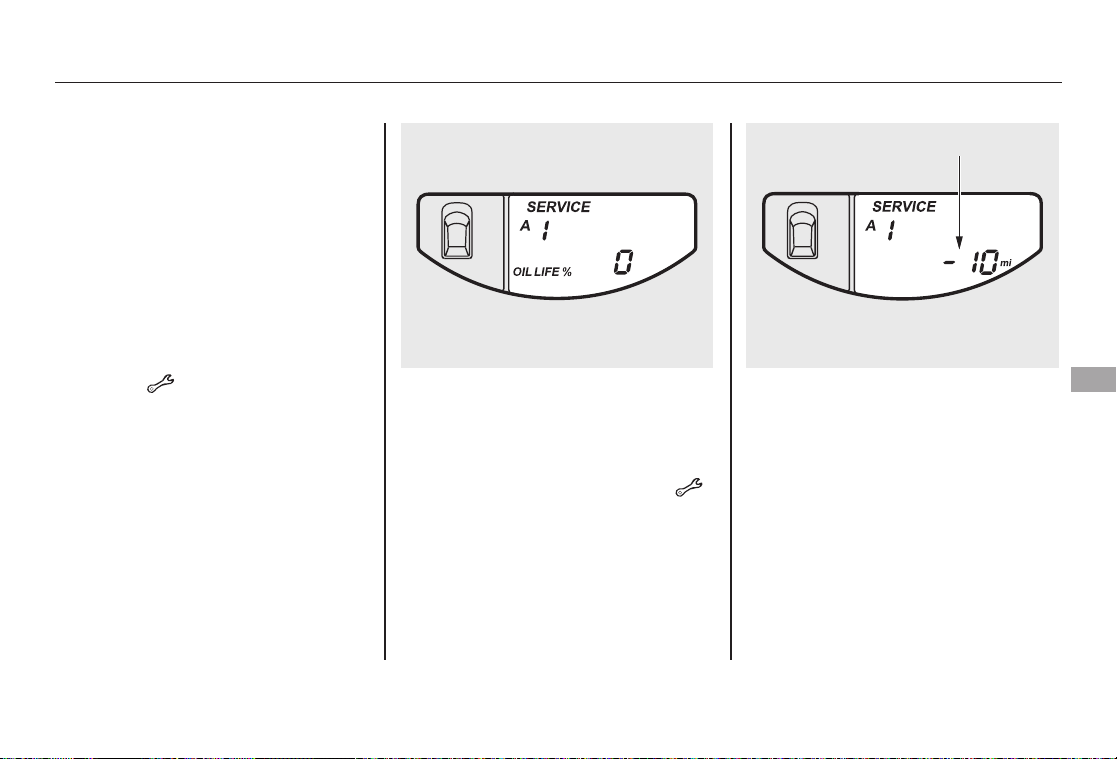
The maintenance item code or codes
indicate the main and sub items
required at the time of the oil change
(see page 188).
You can switch the information
display from the engine oil life
display to the odometer or the trip
meter. Press and release the select/
reset knob on the instrument panel.
When the engine oil life is 15 to 1
percent, the Maintenance Minder
indicator (
) comes on every time
you turn the ignition switch to the
ON (II) position, then it goes out if
you switch the information display.
When you see this message, have
the indicated maintenance performed
by your dealer as soon as possible.
When the remaining engine oil life is
0 percent, the engine oil life indicator
will blink. The display comes on
every time you turn the ignition
switch to the ON (II) position. The
Maintenance Minder indicator (
)
also comes on and remains on in the
instrument panel. When you see this
message, immediately have the
indicated maintenance done by your
dealer.
If you do not perform the indicated
maintenance, negative distance
traveled is displayed and begins to
blink after the vehicle has been
driven 10 miles or more.
Negative distance traveled means
your vehicle has passed the
maintenance required point.
Immediately have the indicated
maintenance done by your dealer.
NEGATIVE DISTANCE TRAVELED
CONTINUED
Maintenance Minder
TM
187
Maintenance
10/08/06 08:34:41 11 ELEMENT MMC North America Owner's Man 50 31SCV680 enu

To change the information display
from the engine oil life display to the
odometer or the trip meter, press and
release the select/reset knob.
When the engine oil life is 0 percent
or negative distance traveled, the
Maintenance Minder indicator (
)
remains on even if you change the
information display.
Immediately have the service
performed, and make sure to reset
the display as described as follows.
Maintenance Main Items and Sub
Items
All maintenance items displayed on
the information display are in code.
For an explanation of these
maintenance codes, see page 191.
Resetting the Engine Oil Life
Display
Your dealer will reset the display
after completing the required
maintenance service. You will see
‘‘OIL LIFE 100%’’ on the information
display the next time you turn the
ignition switch to the ON (II)
position.
If maintenance service is done by
someone other than your dealer,
reset the Maintenance Minder as
follows:
1. Turn the ignition switch to the ON
(II) position.
2. Press the select/reset knob
repeatedly until the engine oil life
is displayed.
MAINTENANCE MAIN ITEM
MAINTENANCE SUB ITEM(S)
Maintenance Minder
TM
188
10/08/06 08:34:41 11 ELEMENT MMC North America Owner's Man 50 31SCV680 enu
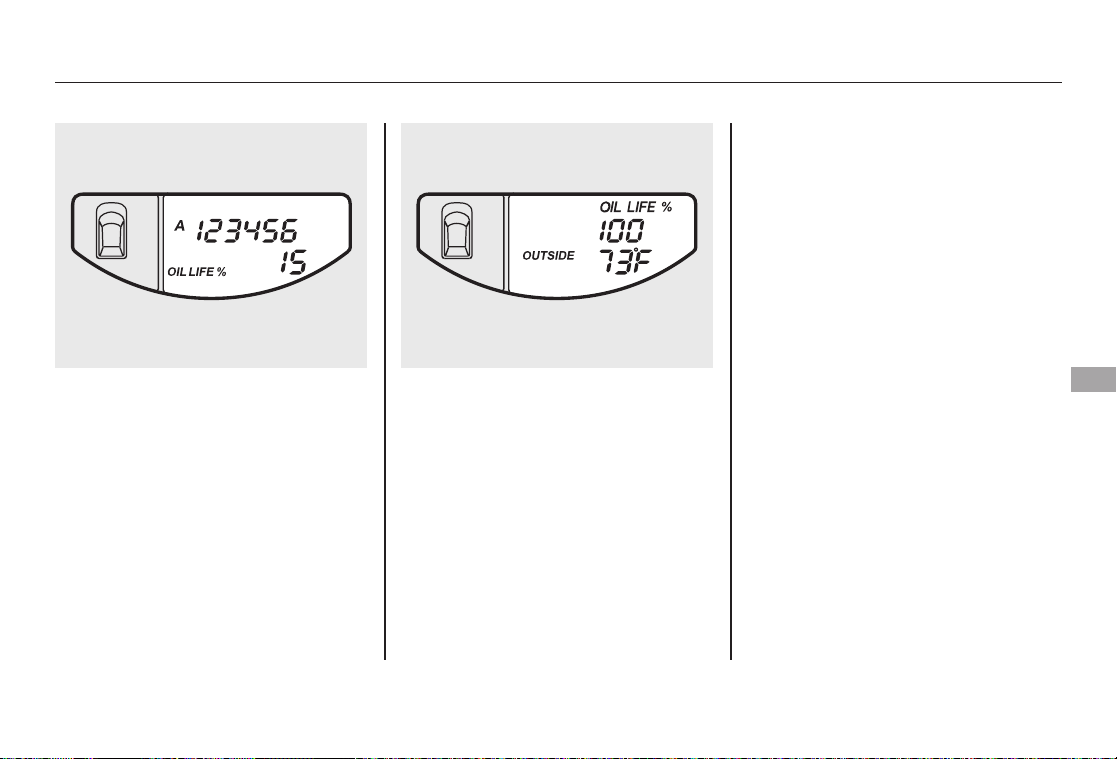
3. Press the select/reset knob for
about 10 seconds. The engine oil
life and the maintenance item
code(s) will blink.
4. Press the select/reset knob for
another 5 seconds. The
maintenance item code(s) will
disappear, and the engine oil life
will reset to ‘‘100.’’
Important Maintenance
Precautions
If you have the required service done
but do not reset the display, or reset
the display without doing the service,
the system will not show the proper
maintenance intervals. This can lead
to serious mechanical problems
because you will no longer have an
accurate record of when
maintenance is needed.
Your authorized Honda dealer knows
your vehicle best and can provide
competent, efficient service.
CONTINUED
Maintenance Minder
TM
189
Maintenance
10/08/06 08:34:41 11 ELEMENT MMC North America Owner's Man 50 31SCV680 enu

However, service at a dealer is not
mandatory to keep your warranties in
effect. Maintenance may be done by
any qualified service facility or
person who is skilled in this type of
automotive service. Make sure to
have the service facility or person
reset the display as previously
described. Keep all receipts as proof
of completion, and have the person
who does the work fill out your
Honda Service History. Check your
warranty booklet for more
information.
We recommend using Honda parts
and fluids whenever you have
maintenance done. These are
manufactured to the same high
quality standards as the original
components, so you can be confident
of their performance and durability.
According to state and federal
regulations, failure to perform
maintenance on the items marked
with # will not void your emissions
warranties. However, all
maintenance services should be
performed in accordance with the
intervals indicated by the information
display.
Owner's Maintenance Checks
You should check the following
items at the specified intervals. If you
are unsure of how to perform any
check, turn to the appropriate page
listed.
●
Engine oil level - Check every
time you fill the fuel tank. See page
145.
●
Engine coolant level - Check the
radiator reserve tank every time
you fill the fuel tank. See page 145.
●
Automatic transmission - Check
the fluid level monthly. See page
198.
●
Brakes - Check the fluid level
monthly. See page 199.
●
Tires - Check the tire pressure
monthly. Examine the tread for
wear and foreign objects. See page
212.
●
Lights - Check the operation of
the headlights, parking lights,
taillights, high-mount brake light,
and license plate lights monthly.
See page 201.
Maintenance Minder
TM
190
10/08/06 08:34:41 11 ELEMENT MMC North America Owner's Man 50 31SCV680 enu
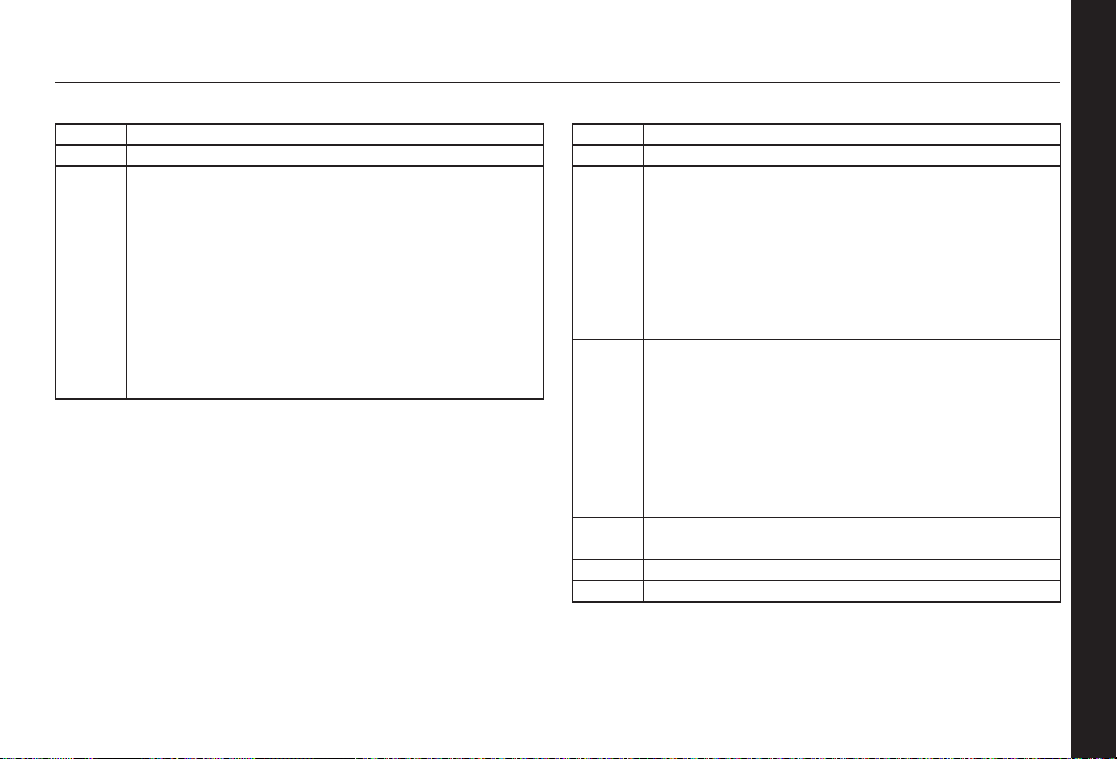
Symbol Maintenance Main Items
A
●
Replace engine oil
ꭧ1
B
●
Replace engine oil
ꭧ1
and oil filter
●
Inspect front and rear brakes
●
Check parking brake adjustment
●
Inspect these items:
●
Tie rod ends, steering gear box, and boots
●
Suspension components
●
Driveshaft boots
●
Brake hoses and lines (including ABS/VSA)
●
All fluid levels and condition of fluids
●
Exhaust system
#
●
Fuel lines and connections
#
ꭧ1: If the message ‘‘SERVICE’’ does not appear more than 12 months after the
display is reset, change the engine oil every year.
#: See information on maintenance and emissions warranty on page 190.
NOTE:
●
Independent of the maintenance message in the information display,
replace the brake fluid every 3 years.
●
Inspect idle speed every 160,000 miles (256,000 km).
●
Adjust the valves during services A, B, 1, 2, or 3 if they are noisy.
Symbol Maintenance Sub Items
1
●
Rotate tires
2
●
Replace air cleaner element
If you drive in dusty conditions, replace
every 15,000 miles (24,000 km).
●
Replace dust and pollen filter
If you drive primarily in urban areas that have high
concentrations of soot in the air from industry and
from diesel-powered vehicles, replace every
15,000 miles (24,000 km).
●
Inspect drive belt
3
●
Replace transmission fluid
Driving in mountainous areas at very low vehicle
speeds or trailer towing results in higher transmission
and transfer temperatures. This requires transmission
and transfer fluid changes more frequently than
recommended by the Maintenance Minder. If you
regularly drive your vehicle under these conditions,
have the transmission and transfer fluid changed at
60,000 miles (100,000 km), then every 30,000 miles
(48,000 km).
4
●
Replace spark plugs
●
Inspect valve clearance
5
●
Replace engine coolant
6
●
Replace rear differential fluid (4WD model only)
Maintenance Minder
TM
Maintenance Minder
191
10/08/06 08:34:41 11 ELEMENT MMC North America Owner's Man 50 31SCV680 enu
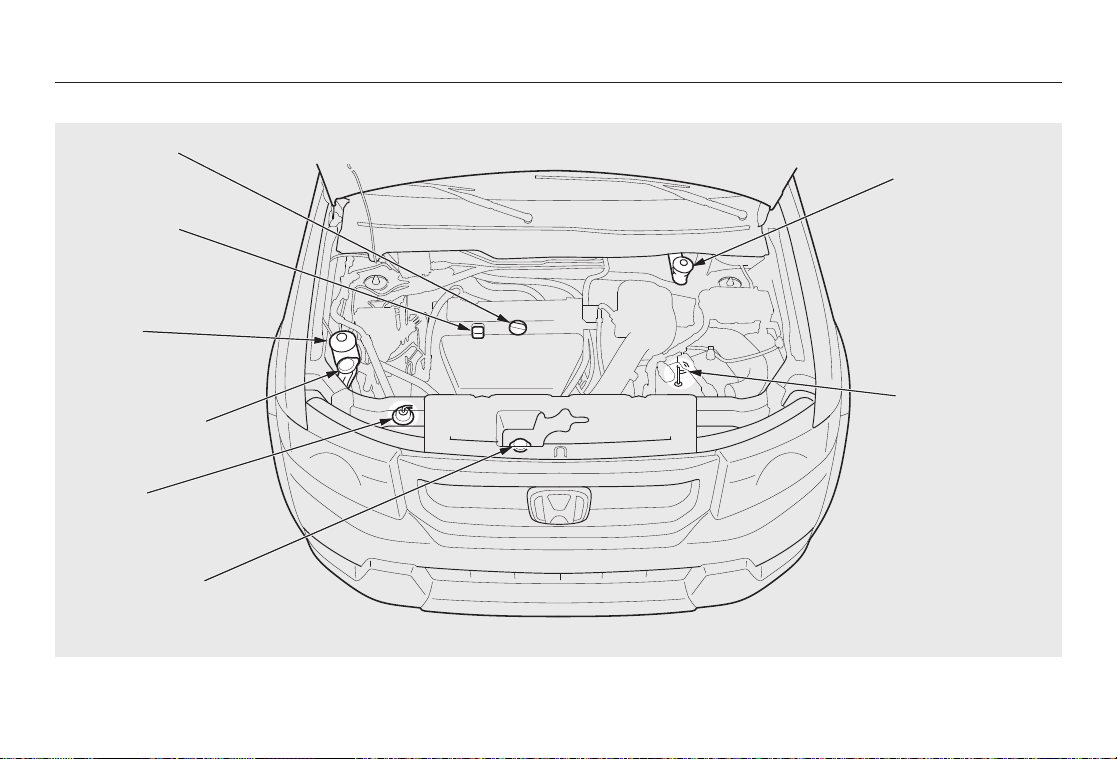
ENGINE OIL
FILL CAP
ENGINE OIL
DIPSTICK
(Orange tab)
POWER
STEERING FLUID
(Red cap)
WASHER FLUID
(Blue cap)
ENGINE
COOLANT
RESERVOIR
RADIATOR CAP
BRAKE FLUID
(Gray cap)
AUTOMATIC
TRANSMISSION
FLUID DIPSTICK
(Yellow loop)
Fluid Locations
192
10/08/06 08:34:41 11 ELEMENT MMC North America Owner's Man 50 31SCV680 enu
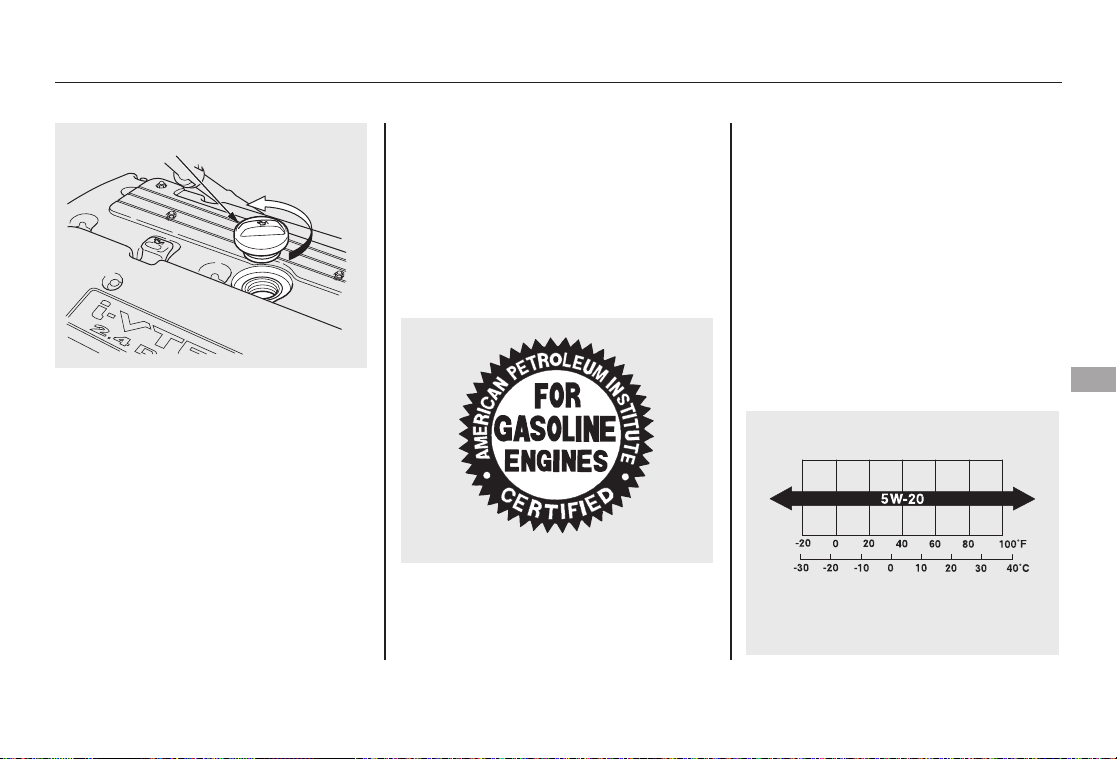
Unscrew and remove the engine oil
fill cap on top of the valve cover. Pour
in the oil slowly and carefully so you
do not spill. Clean up any spills
immediately. Spilled oil could
damage components in the engine
compartment.
Reinstall the engine oil fill cap, and
tighten it securely. Wait a few
minutes, and recheck the oil level on
the engine oil dipstick. Do not fill
above the upper mark; you could
damage the engine.
Recommended Engine Oil
Oil is a major contributor to your
engine's performance and longevity.
Always use a premium-grade 5W-20
detergent oil displaying the API
Certification Seal. This seal indicates
the oil is energy conserving, and that
it meets the American Petroleum
Institute's latest requirements.
Honda motor oil is the preferred
5W-20 lubricant for your vehicle. It is
highly recommended that you use
Honda motor oil in your vehicle for
optimum engine protection. Make
sure the API Certification Seal says
‘‘For Gasoline Engines.’’
The oil viscosity or weight is
provided on the container's label.
5W-20 oil is formulated for year-
round protection of your vehicle to
improve cold weather starting and
fuel economy.
ENGINE OIL FILL CAP
API CERTIFICATION SEAL
Ambient Temperature
CONTINUED
Adding Engine Oil
193
Maintenance
10/08/06 08:34:41 11 ELEMENT MMC North America Owner's Man 50 31SCV680 enu
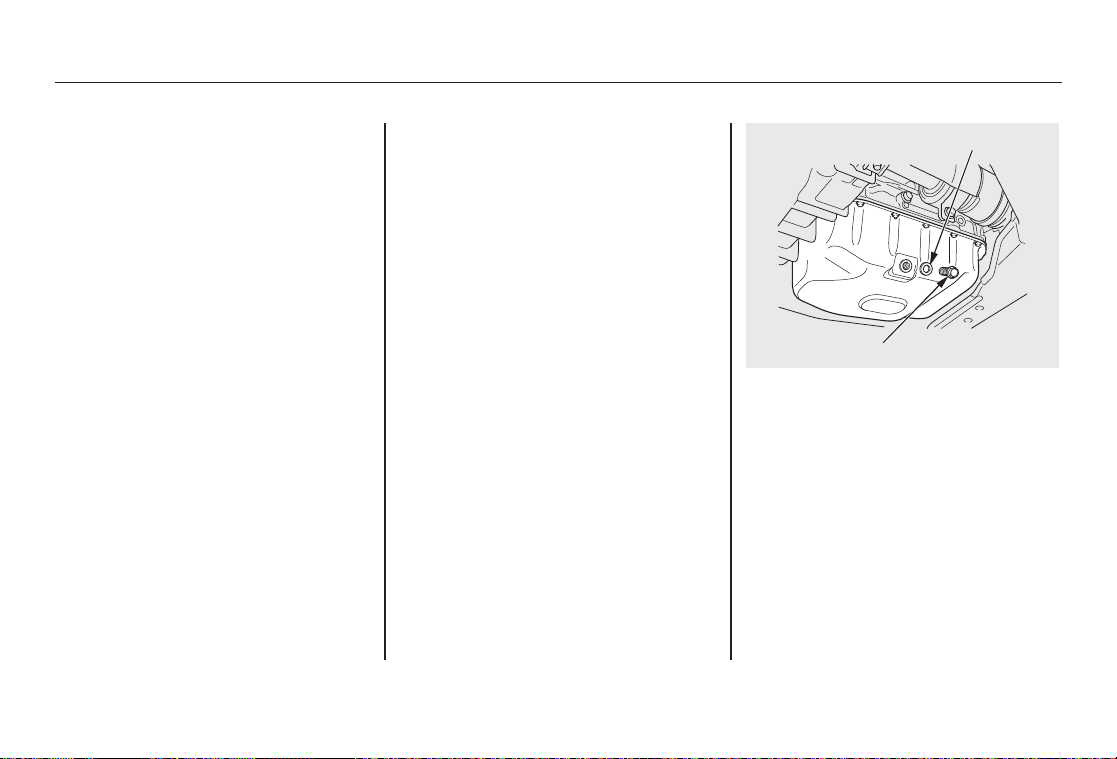
Synthetic Oil
You may use a synthetic motor oil if
it meets the same requirements
given for a conventional motor oil, it
displays the API Certification Seal,
and it is the proper weight. You must
follow the oil and filter change
intervals shown on the Maintenance
Minder display.
Engine Oil Additives
Your vehicle does not require any oil
additives. Additives may adversely
affect the engine or transmission
performance and durability.
Changing the Engine Oil and
Filter
Always change the oil and filter
according to the maintenance
messages shown on the information
display. The oil and filter collect
contaminants that can damage your
engine if they are not removed
regularly.
Changing the oil and filter requires
special tools and access from
underneath the vehicle. The vehicle
should be raised on a service station-
type hydraulic lift for this service.
Unless you have the knowledge and
proper equipment, you should have
this maintenance done by a skilled
technician.
1. Run the engine until it reaches
normal operating temperature,
then shut it off.
2. Open the hood, and remove the
engine oil fill cap. Remove the oil
drain bolt and washer from the
bottom of the engine. Drain the oil
into an appropriate container.
OIL DRAIN BOLT
WASHER
Adding Engine Oil, Changing the Engine Oil and Filter
194
10/08/06 08:34:41 11 ELEMENT MMC North America Owner's Man 50 31SCV680 enu
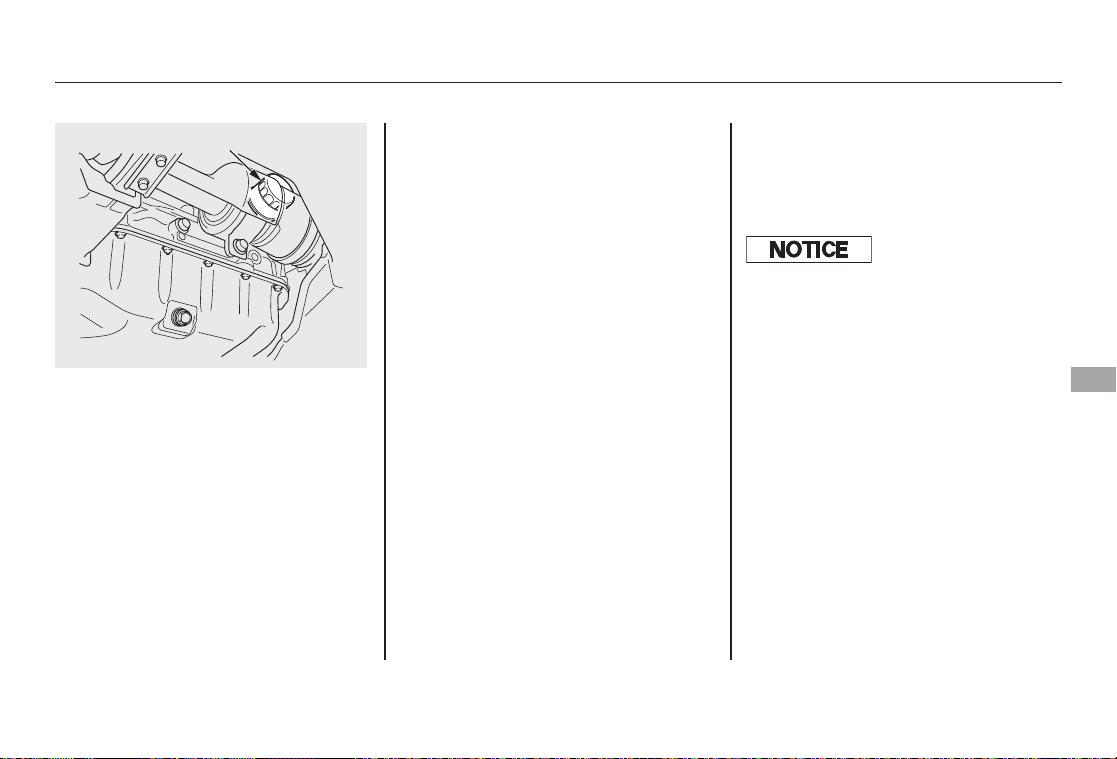
3. Remove the oil filter and let the
remaining oil drain. A special
wrench (available from your
dealer) is required.
Make sure the oil filter gasket is
not stuck to the engine block. If it
is, remove it before installing a
new oil filter.
4. Install a new oil filter according to
the instructions that come with it.
Make sure to clean off any dirt and
dust on the connecting surface of a
new oil filter.
5. Put a new washer on the drain
bolt, then reinstall the drain bolt.
Tighten the drain bolt to:
33 lbf·ft (45 N·m, 4.5 kgf·m)
6. Refill the engine with the
recommended oil.
Engine oil change capacity
(including filter):
4.4 US qt (4.2 L)
7. Replace the engine oil fill cap. Start
the engine. The oil pressure
indicator should go out within 5
seconds. If it does not, turn off the
engine, and check your work.
8. Let the engine run for several
minutes, then check the drain bolt
and oil filter for leaks.
9. Turn off the engine and let it sit for
several minutes, then check the oil
level on the dipstick. If necessary,
add more oil.
Improper disposal of engine oil can be
harmful to the environment. If you
change your own oil, please dispose of
the used oil properly. Put it in a sealed
container, and take it to a recycling
center. Do not discard it in a trash bin
or dump it on the ground.
OIL FILTER
Changing the Engine Oil and Filter
195
Maintenance
10/08/06 08:34:41 11 ELEMENT MMC North America Owner's Man 50 31SCV680 enu
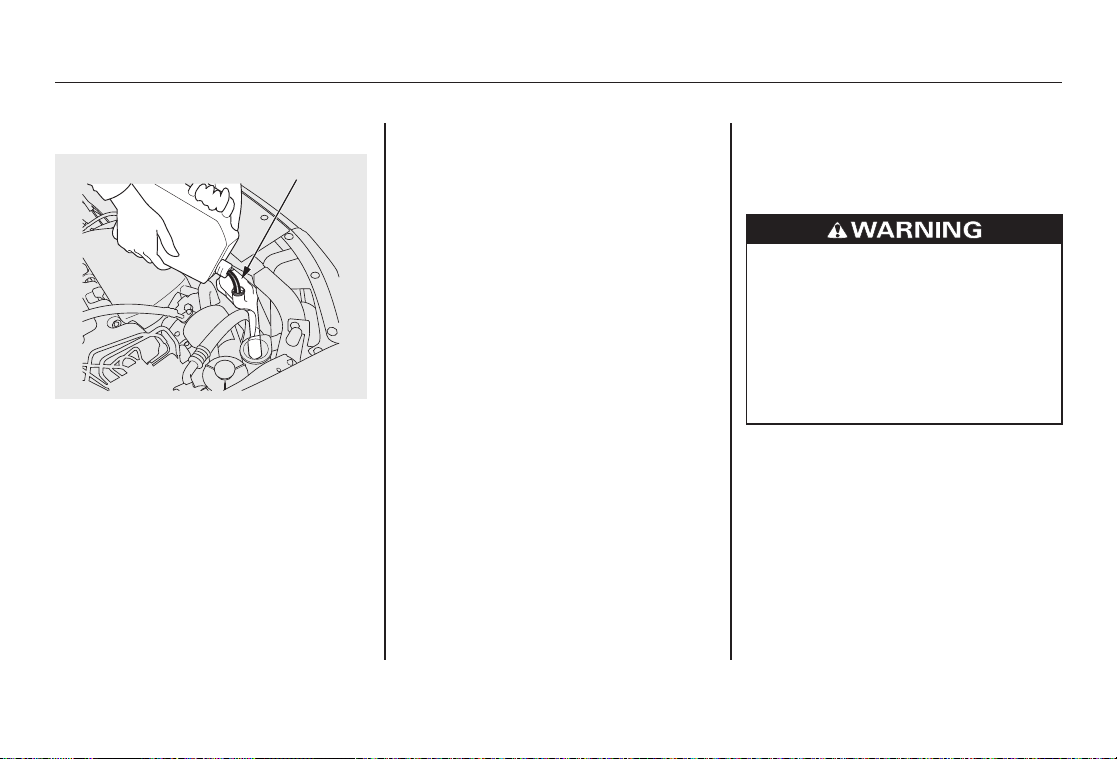
Adding Engine Coolant
If the coolant level in the reserve
tank is at or below the MIN line, add
coolant to bring it up to the MAX
line. Inspect the cooling system for
leaks.
Always use Honda Long-life Anti-
freeze/Coolant Type 2. This coolant
is pre-mixed with 50 percent
antifreeze and 50 percent distilled
water. Never add straight antifreeze
or plain water.
If Honda antifreeze/coolant is not
available, you may use another
major-brand non-silicate coolant as a
temporary replacement. Make sure it
is a high-quality coolant
recommended for aluminum
engines. Continued use of any non-
Honda coolant can result in
corrosion, causing the cooling
system to malfunction or fail. Have
the cooling system flushed and
refilled with Honda antifreeze/
coolant as soon as possible.
If the reserve tank is completely
empty, you should also check the
coolant level in the radiator.
Removing the radiator cap
while the engine is hot can
cause the coolant to spray out,
seriously scalding you.
Always let the engine and
radiator cool down before
removing the radiator cap.
RESERVE TANK
Engine Coolant
196
10/08/06 08:34:41 11 ELEMENT MMC North America Owner's Man 50 31SCV680 enu
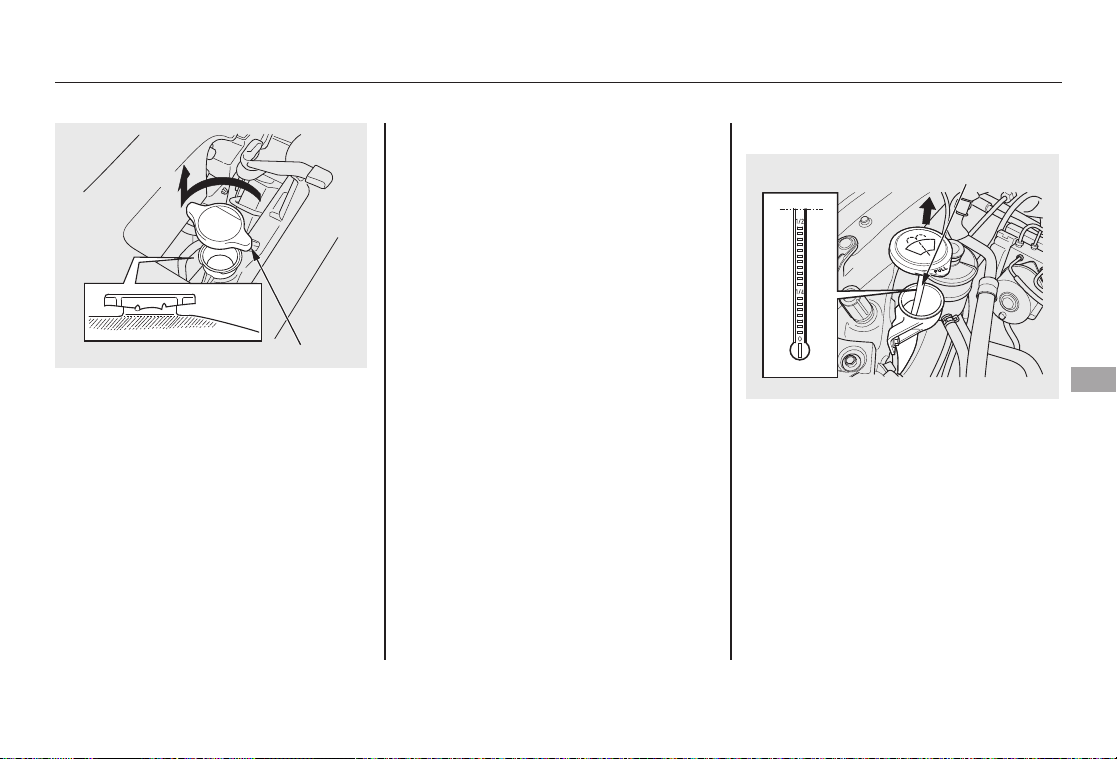
1. Make sure the engine and radiator
are cool.
2. Relieve any pressure in the cooling
system by turning the radiator cap
counterclockwise, without
pressing down.
3. Remove the radiator cap by
pushing down and turning
counterclockwise.
4. The coolant level should be up to
the base of the filler neck. Add
coolant if it is low.
Pour the coolant slowly and
carefully so you do not spill any.
Clean up any spill immediately; it
could damage components in the
engine compartment.
5. Put the radiator cap back on and
tighten it fully.
6. Pour coolant into the reserve tank.
Fill it to halfway between the MAX
and MIN marks. Put the cap back
on the reserve tank.
Do not add any rust inhibitors or
other additives to your vehicle's
cooling system. They may not be
compatible with the coolant or
engine components.
Windshield Washers
Check the fluid level in the
windshield washer reservoir at least
monthly during normal use.
Check the reservoir's fluid level by
removing the cap and looking at the
level gauge attached to the cap.
RADIATOR CAP
LEVEL GAUGE
CONTINUED
Engine Coolant, Windshield Washers
197
Maintenance
10/08/06 08:34:41 11 ELEMENT MMC North America Owner's Man 50 31SCV680 enu
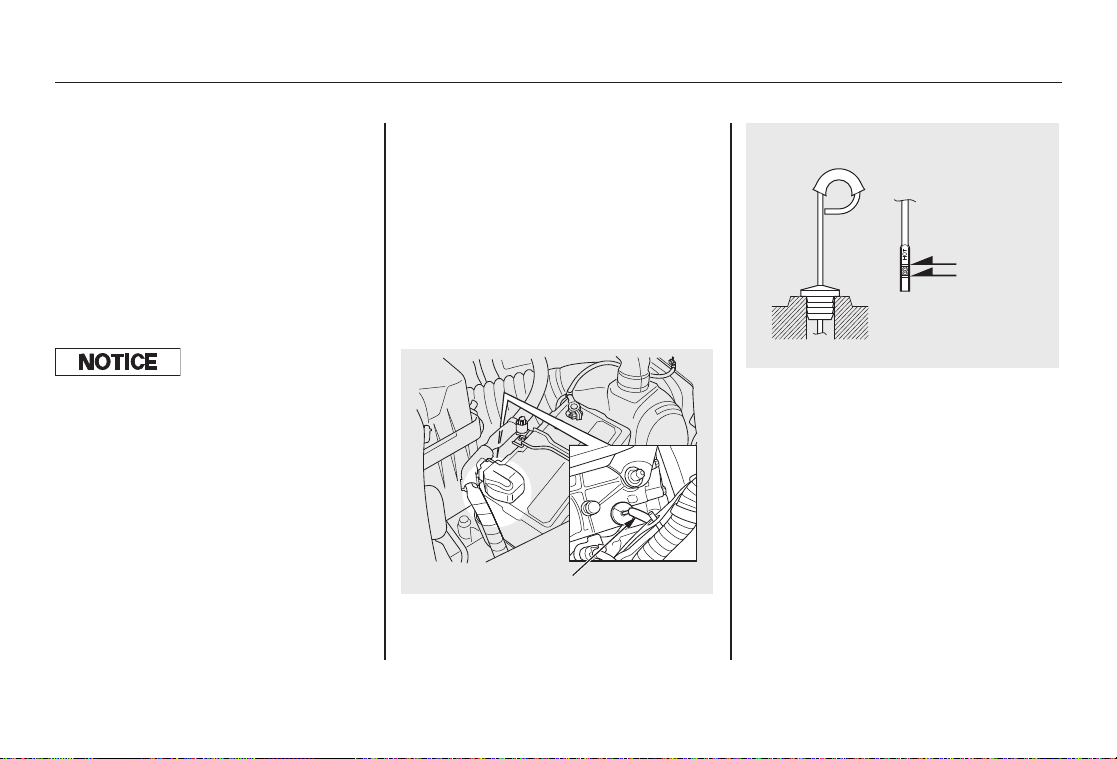
Fill the reservoir with a good-quality
windshield washer fluid. This
increases the cleaning capability and
prevents freezing in cold weather.
When you refill the reservoir, clean
the edges of the windshield wiper
blades with windshield washer fluid
on a clean cloth. This will help to
condition them.
Do not use engine antifreeze or a
vinegar/water solution in the
windshield washer reservoir. Antifreeze
can damage your vehicle's paint, while
a vinegar/water solution can damage
the windshield washer pump. Use only
commercially-available windshield
washer fluid.
Automatic Transmission Fluid
Check the fluid level with the engine
at normal operating temperature.
1. Park the vehicle on level ground.
Start the engine, let it run until the
radiator fan comes on, then shut
off the engine. For accurate
results, wait about 60 seconds (but
no longer than 90 seconds) before
doing step 2.
2. Remove the dipstick (yellow loop)
from the transmission, and wipe it
with a clean cloth.
3. Insert the dipstick all the way into
the transmission securely as
shown in the illustration.
4. Remove the dipstick and check the
fluid level. It should be between
the upper and lower marks.
DIPSTICK
UPPER
MARK
LOWER
MARK
Windshield Washers, Automatic Transmission Fluid
198
10/08/06 08:34:41 11 ELEMENT MMC North America Owner's Man 50 31SCV680 enu
5. If the level is below the lower
mark, add fluid into the dipstick
hole to bring it to the level
between the upper and lower
marks.
Pour the fluid slowly and carefully
so you do not spill any. Clean up
any spill immediately; it could
damage components in the engine
compartment.
Always use Honda ATF DW-1
(automatic transmission fluid).
Use only Honda ATF DW-1 (automatic
transmission fluid). Do not mix with
other transmission fluids.
Using transmission fluid other than
Honda ATF DW-1 may cause
deterioration in transmission operation
and durability, and could result in
damage to the transmission.
Damage resulting from the use of
transmission fluid other than Honda
ATF DW-1 is not covered by the Honda
new vehicle warranty.
6. Insert the dipstick all the way back
into the transmission securely as
shown in the illustration.
The transmission should be drained
and refilled with new fluid according
to the Maintenance Minder™ (see
page 185).
If you are not sure how to add fluid,
contact your dealer.
Brake Fluid
Check the fluid level in the brake
fluid reservoir monthly.
Independent of the Maintenance
Minder display, replace the brake
fluid every 3 years.
Always use Honda Heavy Duty
Brake Fluid DOT 3. If it is not
available, you should use only DOT 3
or DOT 4 fluid, from a sealed
container, as a temporary
replacement.
Using any non-Honda brake fluid can
cause corrosion and decrease the life
of the system. Have the brake
system flushed and refilled with
Honda Heavy Duty Brake Fluid DOT
3 as soon as possible.
Brake fluid marked DOT 5 is not
compatible with your vehicle's
braking system and can cause
extensive damage.
CONTINUED
Automatic Transmission Fluid, Brake Fluid
199
Maintenance
10/08/06 08:34:41 11 ELEMENT MMC North America Owner's Man 50 31SCV680 enu
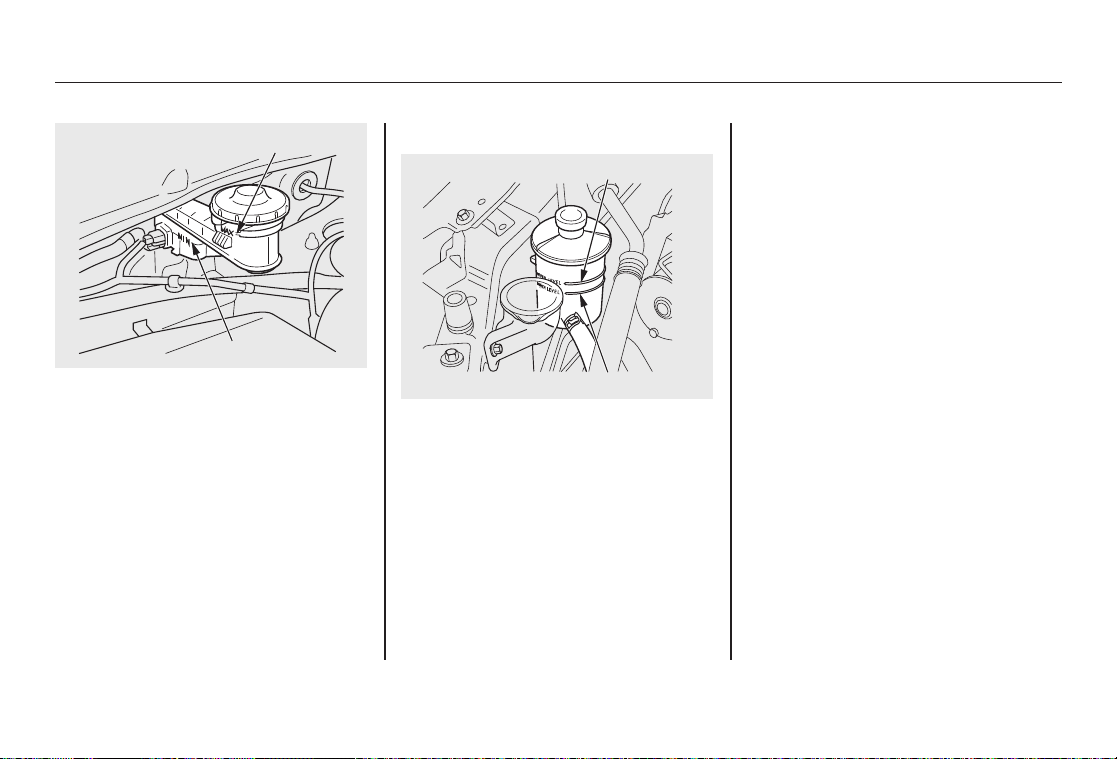
The fluid level should be between
the MIN and MAX marks on the side
of the reservoir. If the level is at or
below the MIN mark, your brake
system needs attention. Have the
brake system inspected for leaks or
worn brake pads.
Power Steering Fluid
Check the level on the side of the
reservoir when the engine is cold.
The fluid should be between the
UPPER LEVEL and LOWER LEVEL.
If not, add power steering fluid to the
UPPER LEVEL.
Pour the fluid slowly and carefully so
you do not spill any. Clean up any
spills immediately; it could damage
components in the engine
compartment.
Always use Honda Power Steering
Fluid. You may use another power
steering fluid as an emergency
replacement, but have the power
steering system flushed and refilled
with Honda PSF as soon as possible.
MAX
MIN
UPPER LEVEL
LOWER LEVEL
Brake Fluid, Power Steering Fluid
200
10/08/06 08:34:41 11 ELEMENT MMC North America Owner's Man 50 31SCV680 enu
A low power steering fluid level can
indicate a leak in the system. Check
the fluid level frequently, and have
the system inspected as soon as
possible.
If you are not sure how to add fluid,
contact your dealer.
Turning the steering wheel to full left or
right lock and holding it there can
damage the power steering pump.
Cleaning the Body Panels
If equipped with body panels
To clean the gray composite body
panels, wash them with soap and
water only. Do not apply wax to the
panels; it will cause discoloration.
Headlight Aiming
The headlights were properly aimed
when your vehicle was new. If you
regularly carry heavy items in the
cargo area or pull a trailer,
readjustment may be required.
Adjustments should be done by your
dealer or another qualified
technician.
CONTINUED
Power Steering Fluid, Cleaning the Body Panels, Lights
201
Maintenance
10/08/06 08:34:41 11 ELEMENT MMC North America Owner's Man 50 31SCV680 enu
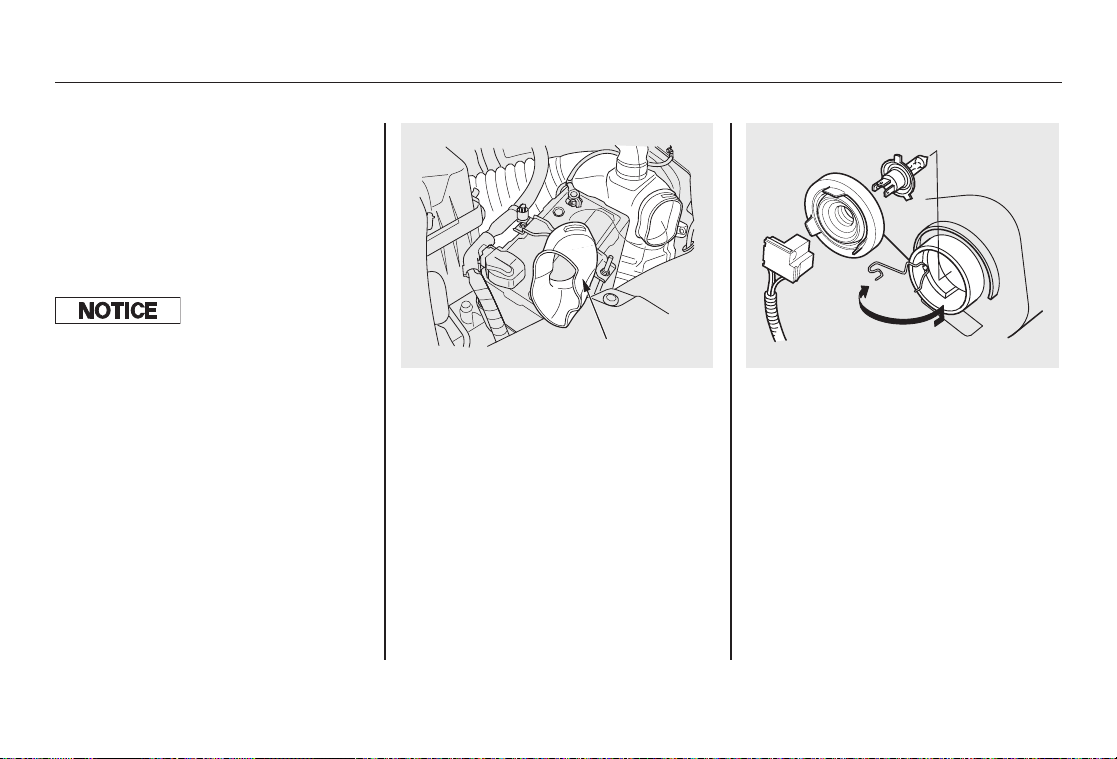
Replacing a Headlight Bulb
Your vehicle has halogen headlight
bulbs. Handle it by its steel base and
protect the glass from contact with
your skin or hard objects. If you
touch the glass, clean it with
denatured alcohol and a clean cloth.
Halogen headlight bulbs get very hot
when lit. Oil, perspiration, or a scratch
on the glass can cause the bulb to
overheat and shatter.
1. Open the hood.
If you need to change the
headlight bulb on the driver's side,
remove the front end of the air
intake duct by pulling it out.
2. Remove the electrical connector
from the bulb by pulling the
connector straight back.
3. Remove the rubber weather seal
by pulling on the tab.
4. Unclip the end of the hold-down
wire from its slot. Pivot the wire
out of the way, then remove the
bulb.
AIR INTAKE DUCT
Lights
202
10/08/06 08:34:41 11 ELEMENT MMC North America Owner's Man 50 31SCV680 enu
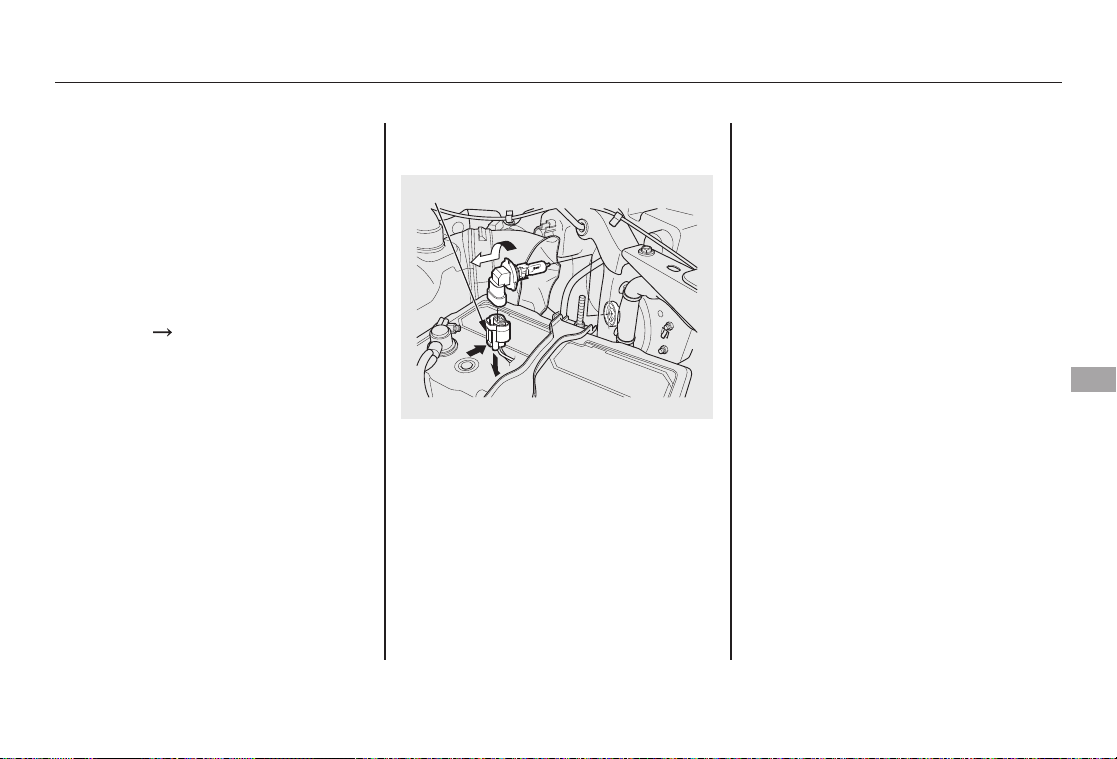
5. Install the new bulb into the hole,
making sure the tabs are in their
slots. Pivot the hold-down wire
back in place, and clip the end into
the slot.
6. Install the rubber seal over the
back of the headlight assembly.
Make sure one of the three arrows
on the rubber seal is facing up; it is
marked ‘‘
’’.
7. Push the electrical connector onto
the new bulb. Make sure it is
connected securely. Turn on the
headlights to test the new bulb.
8. (Driver's side)
Install the front end of the air
intake duct.
Replacing a Daytime Running
Light Bulb
1. Open the hood.
2. Remove the electrical connector
from the bulb by pushing on the
tab and pulling the connector
down.
3. Remove the bulb by turning it one-
quarter turn counterclockwise.
4. Insert the new bulb into the hole,
and turn it one-quarter turn
clockwise to lock it in place.
5. Push the electrical connector back
onto the bulb. Make sure it is on
all the way.
6. Test the lights to make sure the
new bulb is working.
TAB
CONTINUED
Lights
203
Maintenance
10/08/06 08:34:41 11 ELEMENT MMC North America Owner's Man 50 31SCV680 enu
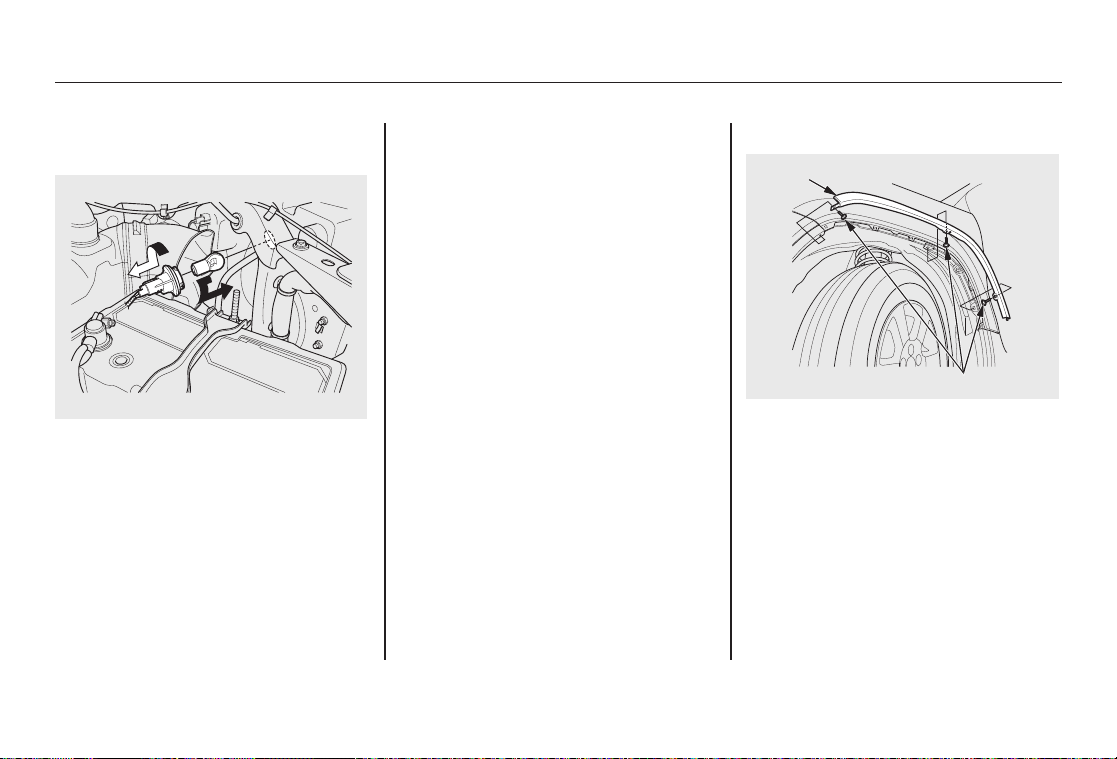
Replacing a Front Parking/Turn
Signal Light Bulb
1. Open the hood.
2. Remove the socket from the
headlight assembly by turning it
one-quarter turn counterclockwise.
3. Remove the bulb from the socket
by pushing the bulb in and turning
it counterclockwise until it
unlocks.
4. Install the new bulb in the socket
by pushing the bulb in and turning
it clockwise until it locks.
5. Test the lights to make sure the
new bulb is working.
Replacing a Side Turn Signal Bulb
1. If you are changing the bulb on the
driver's side, start the engine, turn
the steering wheel all the way to
the left, and turn off the engine. If
you are changing the bulb on the
passenger's side, turn the steering
wheel to the right.
2. Use a Phillips-head screwdriver to
remove the three holding screws,
and remove the wheel arch
protector from the inner fender.
WHEEL ARCH PROTECTOR
SCREWS
Lights
204
10/08/06 08:34:41 11 ELEMENT MMC North America Owner's Man 50 31SCV680 enu
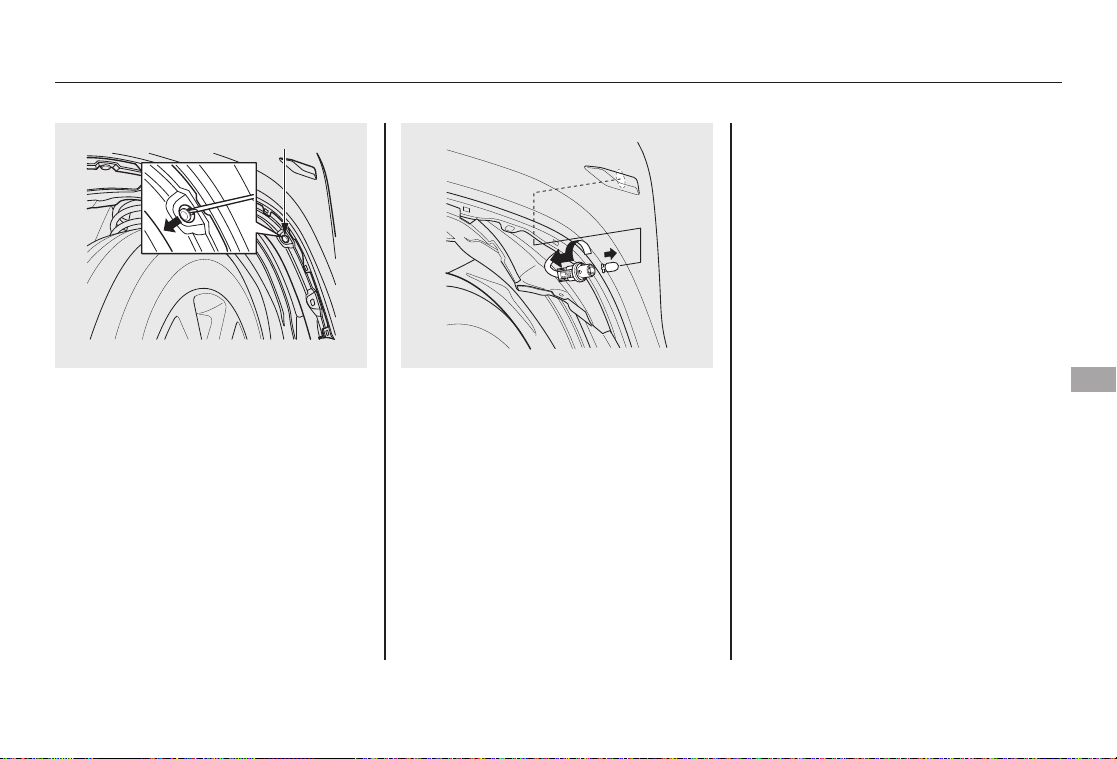
3. Use a flat-tip screwdriver to
remove the holding clip from the
inner fender.
4. Pull the inner fender cover away
from the fender.
5. Remove the socket from the turn
signal assembly by turning it one-
quarter turn counterclockwise.
6. Pull the burned out bulb straight
out of its socket.
Push the new bulb straight into
the socket until it bottoms.
7. Insert the socket back into the
turn signal assembly. Turn it
clockwise to lock it in place.
8. Turn on the lights to make sure
the new bulb is working.
9. Put the inner fender cover in place.
Install the holding clip.
Lock the clip in place by pushing
on the center.
Install the wheel arch protector
and tighten the screws securely.
CLIP
CONTINUED
Lights
205
Maintenance
10/08/06 08:34:41 11 ELEMENT MMC North America Owner's Man 50 31SCV680 enu
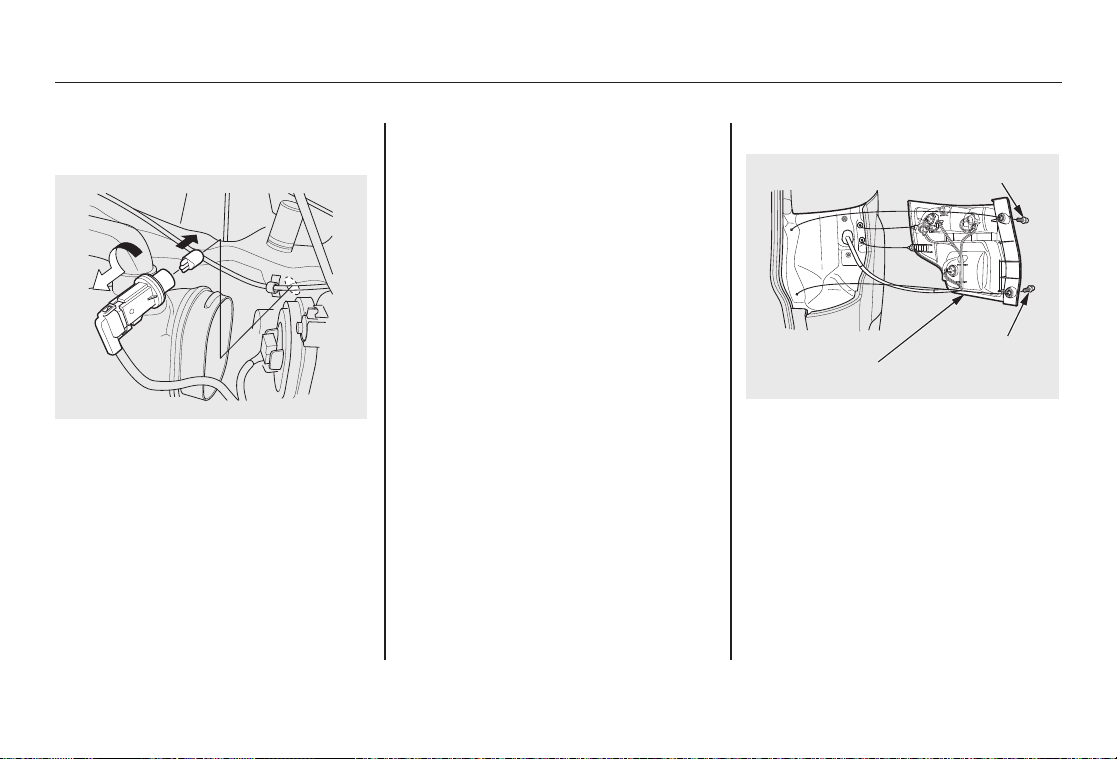
Replacing a Front Side Marker
Light Bulb
1. Open the hood.
To change the driver's side,
remove the front end of the air
intake duct by pulling it out (see
page 202).
2. Remove the socket from the light
assembly by turning it one-quarter
turn counterclockwise.
3. Pull the bulb straight out of its
socket. Push the new bulb straight
into the socket until it bottoms.
4. Reinstall the socket into the light
assembly by turning it clockwise
until it locks.
5. Test the lights to make sure the
new bulb is working.
6. Install the front end of the air
intake duct.
Replacing Rear Bulbs
1. Open the hatch and the tailgate.
Remove the two mounting screws
with a Phillips-head screwdriver,
and remove the taillight assembly
from the body by pulling it back.
2. Determine which of the four bulbs
is burned out: brake/taillight, turn
signal light, side marker light, or
back-up light.
SCREW
SCREW
TAILLIGHT ASSEMBLY
Lights
206
10/08/06 08:34:41 11 ELEMENT MMC North America Owner's Man 50 31SCV680 enu
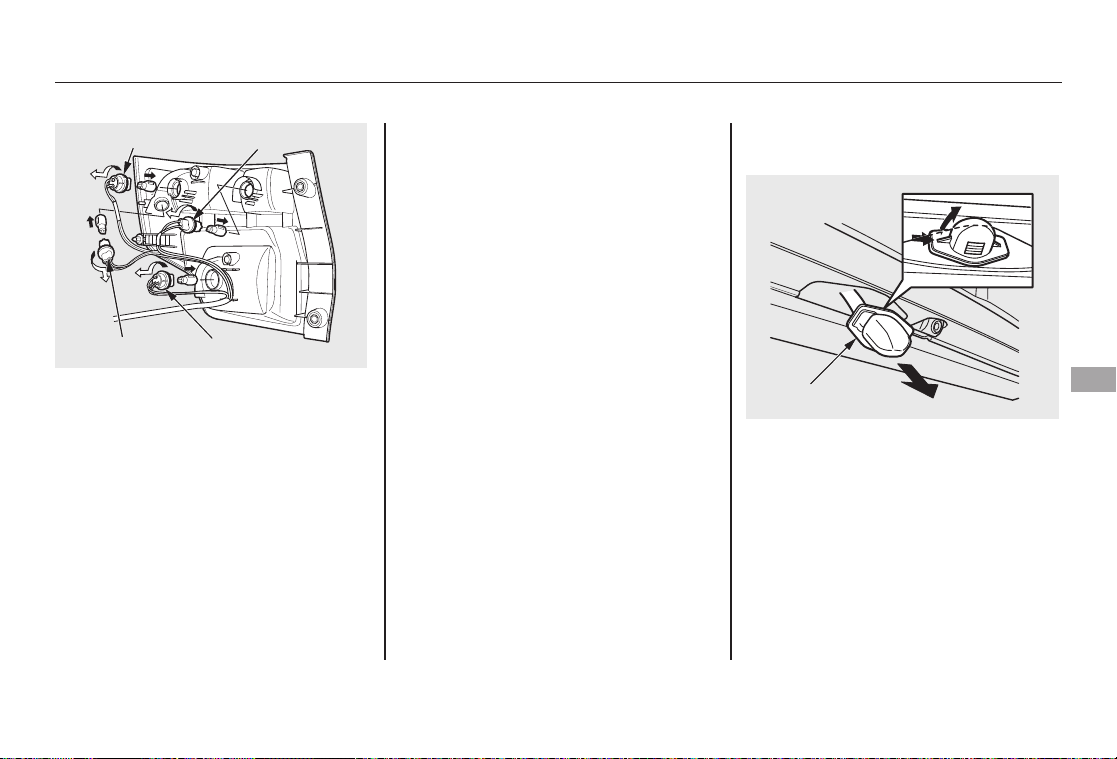
3. Remove the socket by turning it
one-quarter turn counterclockwise.
4. Pull the bulb straight out of its
socket. Push the new bulb straight
into the socket until it bottoms.
5. Reinstall the socket into the light
assembly by turning it clockwise
until it locks.
6. Test the lights to make sure the
new bulb is working.
7. When reinstalling the taillight
assembly, first place the two pins
in the holes in place. Tighten the
two mounting screws.
Replacing a Rear License Plate
Bulb
1. Remove the license light assembly
by pushing the left edge of the
lens toward the right and pulling
the assembly out.
2. Pull the bulb straight out of its
socket. Push the new bulb in until
it bottoms in the socket.
SOCKET SOCKET
SOCKETSOCKET
LENS
CONTINUED
Lights
207
Maintenance
10/08/06 08:34:41 11 ELEMENT MMC North America Owner's Man 50 31SCV680 enu
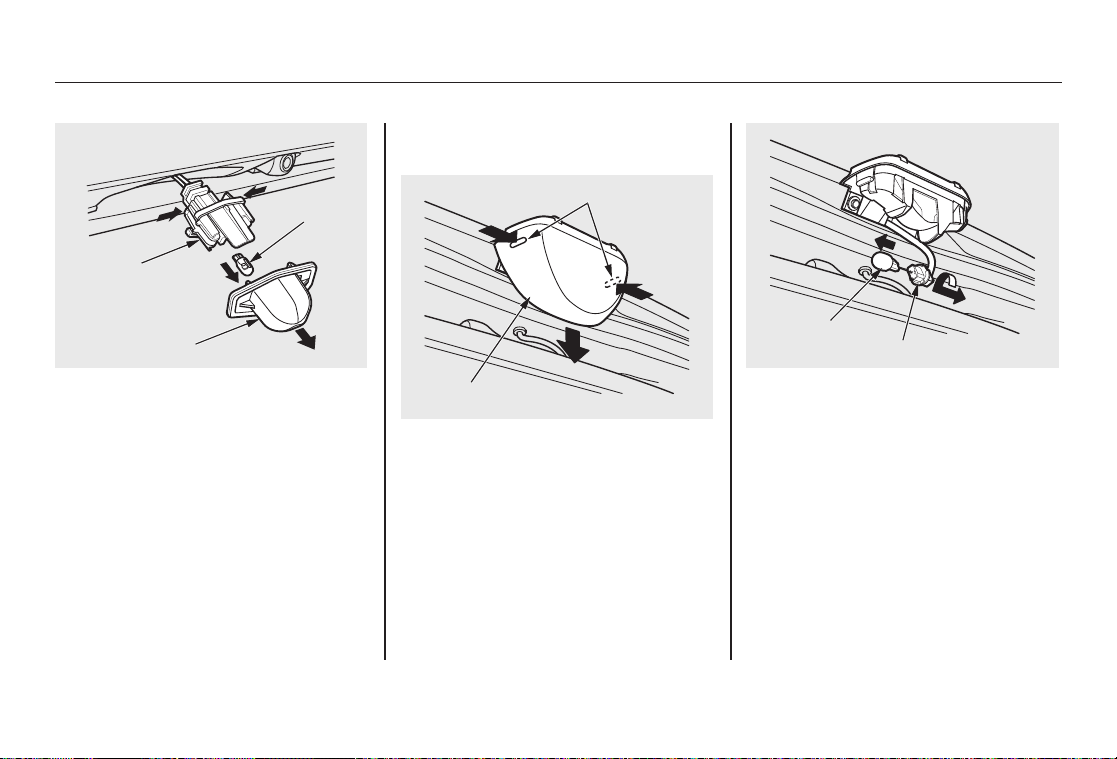
3. Turn on the parking lights and
check that the new bulb is
working.
4. Put the lens back on the socket
until it locks.
5. Slide the right side of the light
assembly into the hole. Push on
the left side to latch the assembly
into place.
Replacing a High-mount Brake
Light Bulb
1. Open the hatch. Remove the light
assembly cover by pushing in on
the tabs on both sides and pulling
the cover down.
2. Remove the socket from the light
assembly by turning it one-quarter
turn counterclockwise.
3. Pull the bulb straight out of its
socket. Push the new bulb straight
into the socket until it bottoms.
4. Press the brake pedal to make
sure the new bulb is working.
SOCKET
BULB
LENS
TABS
COVER
BULB
SOCKET
Lights
208
10/08/06 08:34:41 11 ELEMENT MMC North America Owner's Man 50 31SCV680 enu
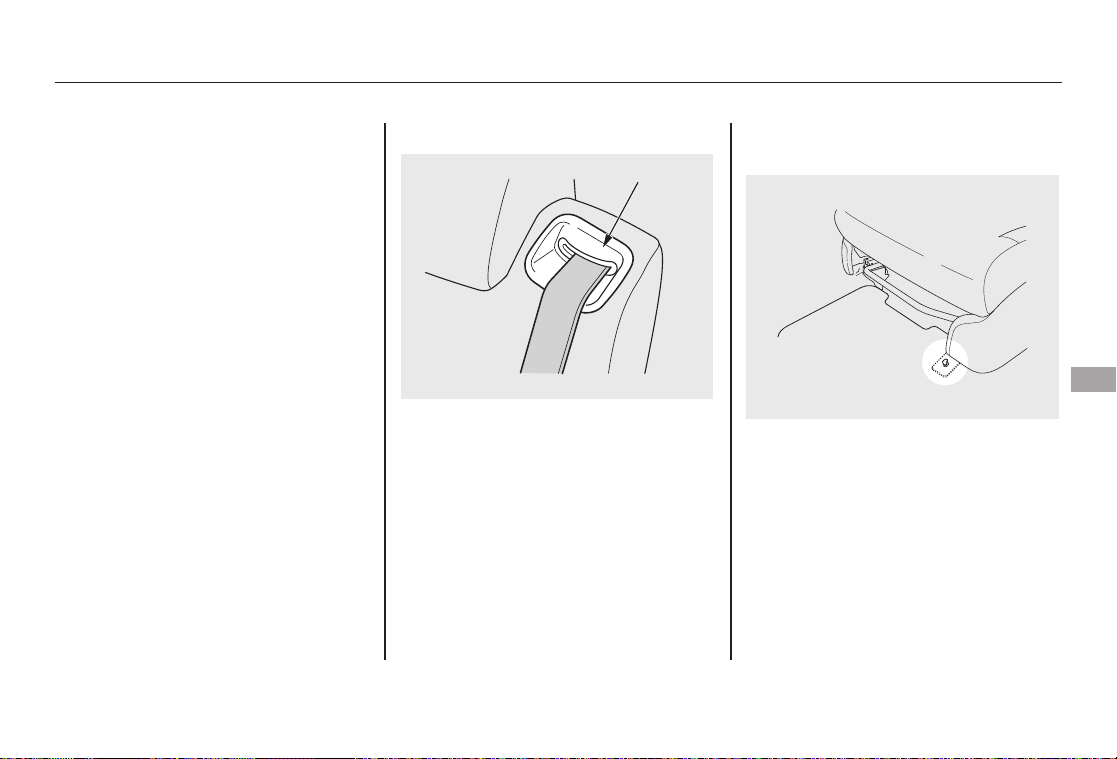
5. Put the socket back into the light
assembly, and turn it clockwise to
lock it in place.
6. Put the cover back onto the light
assembly. Push it on until it locks
in place.
Cleaning the Seat Belts
If your seat belts get dirty, use a soft
brush with a mixture of mild soap
and warm water to clean them. Do
not use bleach, dye, or cleaning
solvents. Let the belts air-dry before
you use the vehicle.
Dirt build-up in the loops of the seat
belt anchors can cause the belts to
retract slowly. Wipe the insides of
the loops with a clean cloth
dampened in mild soap and warm
water or isopropyl alcohol.
Floor Mats
If equipped
The floor mats that came with your
vehicle hook over the floor mat
anchors. This keeps the floor mats
from sliding forward, possibly
interfering with the pedals, or
backwards, making the front
passenger's weight sensors
ineffective.
LOOP
Driver’s seat
CONTINUED
Lights, Cleaning the Seat Belts, Floor Mats
209
Maintenance
10/08/06 08:34:41 11 ELEMENT MMC North America Owner's Man 50 31SCV680 enu
If you remove the driver's floor mat,
make sure to re-anchor it when you
put it back in your vehicle.
If you use non-Honda floor mats,
make sure they fit properly and that
they can be used with the floor mat
anchors. Do not put additional floor
mats on top of the anchored mats.
Dust and Pollen Filter
This filter removes the dust and
pollen that is brought in from the
outside through the heating and
cooling system.
Have your dealer replace the filter
when this service is indicated by a
maintenance message on the
information display. It should be
replaced every 15,000 miles
(24,000 km) if you drive primarily in
urban areas that have high
concentrations of soot in the air, or if
the flow from the heating and cooling
system becomes less than usual.
Wiper Blades
Check the condition of the wiper
blades at least every 6 months.
Replace them if you find signs of
cracking in the rubber, areas that are
getting hard, or if they leave streaks
and unwiped areas when used.
1. Front:
Raise the wiper arm off the
windshield.
Do not open the hood when the wiper
arms are raised, or you will damage the
hood and the arms.
Rear:
Raise the wiper arm off the hatch
glass and hold it.
Floor Mats, Dust and Pollen Filter, Wiper Blades
210
10/08/06 08:34:41 11 ELEMENT MMC North America Owner's Man 50 31SCV680 enu
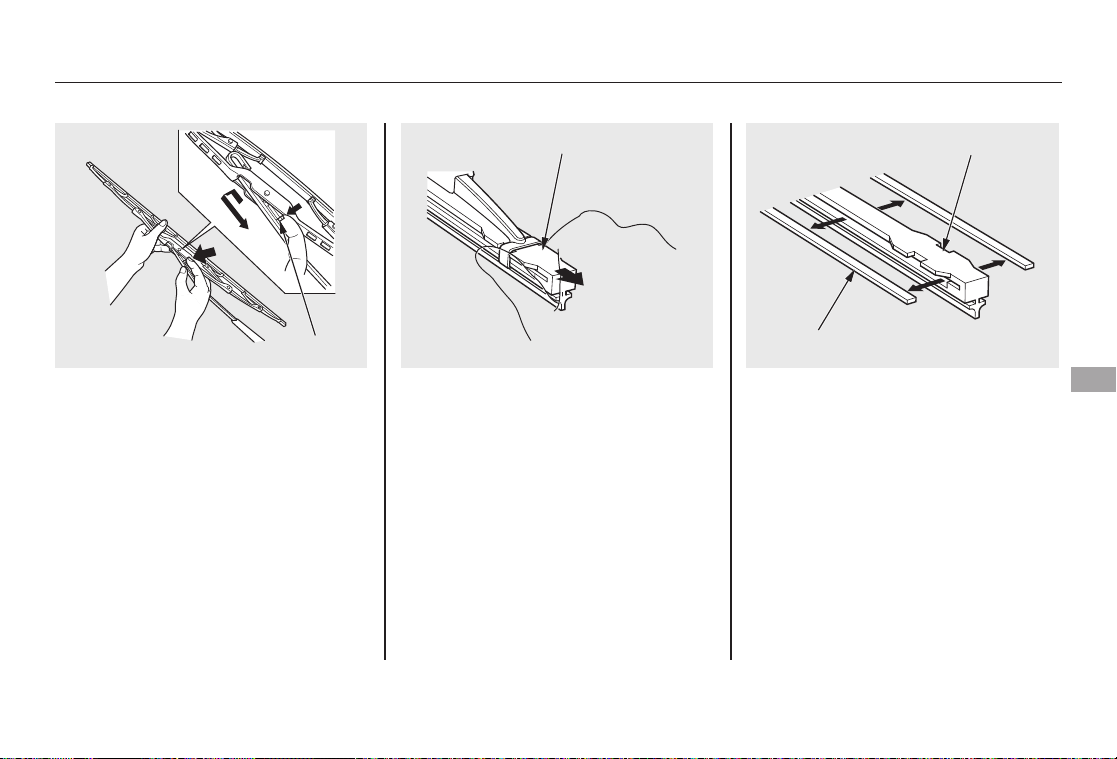
2. Disconnect the blade assembly
from the wiper arm by pushing in
the lock tab. Hold the lock tab in
while you push the blade assembly
toward the base of the arm.
If you are changing the rear wiper
blade, go to step 6.
3. Remove the blade from its holder
by grabbing the tabbed end of the
blade. Pull up firmly until the tabs
come out of the holder.
4. Examine the new wiper blades. If
they have no plastic or metal
reinforcement along the back
edge, remove the metal
reinforcement strips from the old
wiper blade, and install them in the
slots along the edge of the new
blade.
5. Slide the new wiper blade into the
holder until the tabs lock.
6. Slide the wiper blade assembly
onto the wiper arm. Make sure it
locks in place.
7. Lower the wiper arm down against
the windshield or the hatch glass.
LOCK TAB
BLADE
BLADE
REINFORCEMENT
Wiper Blades
211
Maintenance
10/08/06 08:34:41 11 ELEMENT MMC North America Owner's Man 50 31SCV680 enu
Wheels
Clean the wheels as you would the
rest of the exterior. Wash them with
the same solution, and rinse them
thoroughly.
If equipped
Aluminum alloy wheels have a
protective clear-coat that keeps the
aluminum from corroding and
tarnishing. Cleaning the wheels with
harsh chemicals (including some
commercial wheel cleaners) or a stiff
brush can damage the clear-coat. To
clean the wheels, use a mild
detergent and a soft brush or sponge.
Tires
To safely operate your vehicle, your
tires must be the proper type and
size, in good condition with adequate
tread, and correctly inflated.
The following pages give more
detailed information on how to take
care of your tires and what to do
when they need to be replaced.
Using tires that are excessively
worn or improperly inflated can
cause a crash in which you can
be seriously hurt or killed.
Follow all instructions in this
owner's manual regarding tire
inflation and maintenance.
Inflation Guidelines
Keeping the tires properly inflated
provides the best combination of
handling, tread life, and riding
comfort.
●
Underinflated tires wear unevenly,
adversely affect handling and fuel
economy, and are more likely to
fail from being overheated.
●
Overinflated tires can make your
vehicle ride more harshly, are
more prone to damage from road
hazards, and wear unevenly.
The tire pressure monitoring system
(TPMS) will warn you when a tire
pressure is low. See page 169 for
more information on the TPMS.
Wheels, Tires
212
10/08/06 08:34:41 11 ELEMENT MMC North America Owner's Man 50 31SCV680 enu
Even though your vehicle is
equipped with TPMS, we
recommend that you visually check
your tires every day. If you think a
tire might be low, check it
immediately with a tire gauge.
Use a gauge to measure the air
pressure in each tire at least once a
month. Even tires that are in good
condition may lose 1 to 2 psi (10 to
20 kPa, 0.1 to 0.2 kgf/cm
2
) per
month. Remember to check the
spare tire at the same time.
Check the air pressures when the
tires are cold. This means the vehicle
has been parked for at least 3 hours,
or driven less than 1 mile (1.6 km).
Add or release air, if needed, to
match the recommended cold tire
pressures.
If you check air pressures when the
tires are hot [driven for several miles
(kilometers)], you will see readings 4
to 6 psi (30 to 40 kPa, 0.3 to 0.4
kgf/cm
2
) higher than the cold
readings. This is normal. Do not let
air out to match the recommended
cold air pressure. The tire will be
underinflated.
You should get your own tire
pressure gauge and use it whenever
you check your tire pressures. This
will make it easier for you to tell if a
pressure loss is due to a tire problem
and not due to a variation between
gauges.
While tubeless tires have some
ability to self-seal if they are
punctured, you should look closely
for punctures if a tire starts losing
pressure.
Recommended Tire Pressures
The following chart shows the
recommended cold tire pressures for
most normal and high-speed driving
conditions.
Tire Size Cold Tire Pressure
for Normal Driving
P215/70R16 99S
Front:
33 psi (230 kPa,
2.3 kgf/cm
2
)
Rear:
35 psi (240 kPa,
2.4 kgf/cm
2
)
CONTINUED
Tires
213
Maintenance
10/08/06 08:34:41 11 ELEMENT MMC North America Owner's Man 50 31SCV680 enu
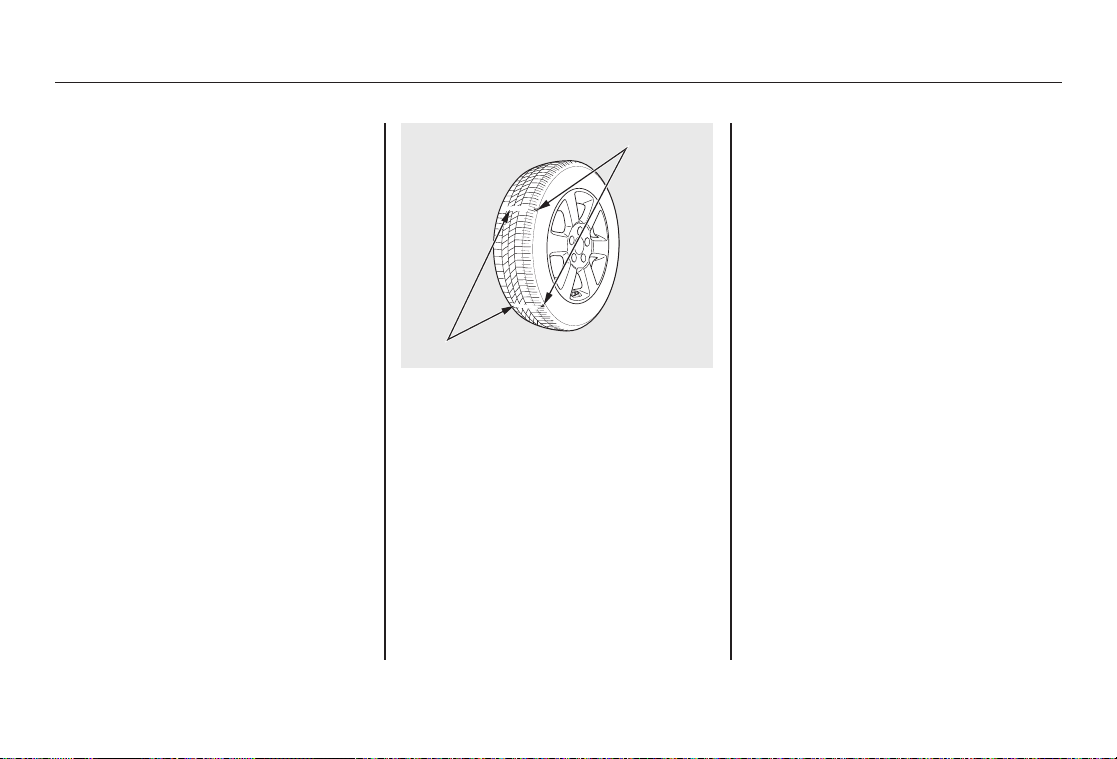
The compact spare tire pressure is:
60 psi (420 kPa, 4.2 kgf/cm
2
)
For convenience, the recommended
tire sizes and cold tire pressures are
on a label on the driver's doorjamb.
For additional technical information
about your tires, see page 253.
Tire Inspection
Every time you check inflation, you
should also examine the tires for
damage, foreign objects, and wear.
You should look for:
●
Bumps or bulges in the tread or
side of the tire. Replace the tire if
you find either of these conditions.
●
Cuts, splits, or cracks in the side of
the tire. Replace the tire if you can
see fabric or cord.
●
Excessive tread wear.
Your tires have wear indicators
molded into the tread. When the
tread wears down, you will see a
1/2 inch (12.7 mm) wide band across
the tread. This shows there is less
than 1/16 inch (1.6 mm) of tread left
on the tire.
A tire this worn gives very little
traction on wet roads. You should
replace the tire if you can see three
or more tread wear indicators.
Tire Service Life
The service life of your tires is
dependent on many factors,
including, but not limited to, driving
habits, road conditions, vehicle
loading, inflation pressure,
maintenance history, speed, and
environmental conditions (even
when the tires are not in use).
In addition to your regular
inspections and inflation pressure
maintenance, it is recommended that
you have annual inspections
performed once the tires reach five
years old. It is also recommended
that all tires, including the spare, be
removed from service after 10 years
from the date of manufacture,
regardless of their condition or state
of wear.
The last four digits of the TIN (tire
identification number) are found on
the sidewall of the tire and indicate
the date of manufacture (See Tire
Labeling on page 255).
INDICATOR LOCATION MARKS
TREAD WEAR INDICATORS
Tires
214
10/08/06 08:34:41 11 ELEMENT MMC North America Owner's Man 50 31SCV680 enu
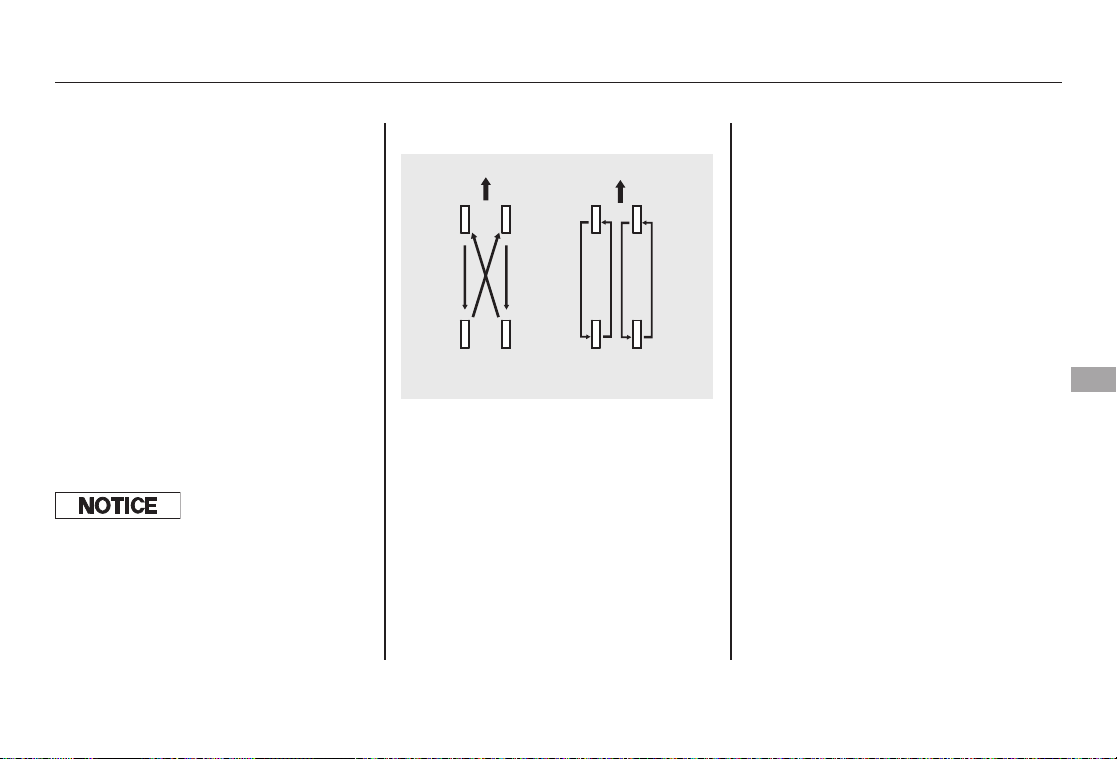
Tire Maintenance
In addition to proper inflation, correct
wheel alignment helps to decrease
tire wear. If you find a tire is worn
unevenly, have your dealer check the
wheel alignment.
Have your dealer check the tires if
you feel a consistent vibration while
driving. A tire should always be
rebalanced if it is removed from the
wheel. When you have new tires
installed, make sure they are
balanced. This increases riding
comfort and tire life. For best results,
have the installer perform a dynamic
balance.
On vehicles with aluminum wheels,
improper wheel weights can damage
your vehicle's aluminum wheels. Use
only Honda wheel weights for
balancing.
Tire Rotation
To help increase tire life and
distribute wear more evenly, rotate
the tires according to the
maintenance messages displayed on
the information display.
Move the tires to the positions
shown in the illustration each time
they are rotated. If you purchase
directional tires, rotate only front-to-
back.
Replacing Tires and Wheels
Replace your tires with radial tires of
the same size, load range, speed
rating, and maximum cold tire
pressure rating (as shown on the
tire's sidewall).
Mixing radial and bias-ply tires on
your vehicle can reduce braking
ability, traction, and steering
accuracy. Using tires of a different
size or construction can cause the
ABS and vehicle stability assist
system (VSA) to work inconsistently.
ABS and VSA system work by
comparing the speed of the wheels.
When replacing tires, use the same
size originally supplied with the
vehicle. Tire size and construction
can affect wheel speed and may
cause the ABS or VSA system to
activate.
Front
Front
(For Non-directional
Tires and Wheels)
(For Directional
Tires and Wheels)
CONTINUED
Tires
215
Maintenance
10/08/06 08:34:41 11 ELEMENT MMC North America Owner's Man 50 31SCV680 enu
It is best to replace all four tires at
the same time. If that is not possible
or necessary, replace the two front
tires or two rear tires as a pair.
Replacing just one tire can seriously
affect your vehicle's handling.
If you ever replace a wheel, make
sure that the wheel's specifications
match those of the original wheels.
Also be sure you use only TPMS
specific wheels. If you do not, the tire
pressure monitoring system will not
work.
Replacement wheels are available at
your dealer.
Installing improper tires on your
vehicle can affect handling and
stability. This can cause a crash
in which you can be seriously
hurt or killed.
Always use the size and type of
tires recommended in this
owner's manual.
Wheel and Tire Specifications
Wheels:
16 x 6 1/2JJ
Tires:
P215/70R16 99S
See page 253 for DOT tire quality
grading information, and page 255
for tire size and labeling information.
Winter Driving
Tires marked ‘‘M + S’’ or ‘‘All
Season’’ on the sidewall have an all-
weather tread design suitable for
most winter driving conditions.
For the best performance in snowy
or icy conditions, you should install
snow tires or tire chains. They may
be required by local laws under
certain conditions.
Tires
216
10/08/06 08:34:41 11 ELEMENT MMC North America Owner's Man 50 31SCV680 enu
Snow Tires
If you mount snow tires on your
vehicle, make sure they are radial
tires of the same size and load range
as original tires. Mount snow tires on
all four wheels. The traction provided
by snow tires on dry roads may be
lower than your original tires. Check
with the tire dealer for maximum
speed recommendations.
Tire Chains
Mount tire chains on your tires when
required by driving conditions or local
laws. Install them only on the front
tires.
Because your vehicle has limited tire
clearance, use only SAE Class ‘‘S’’
cable-type traction devices, with
rubber chain tensioners, on the front
tires. Use traction devices only when
required by driving conditions or local
laws. Make sure they are the correct
size for your tires. Metal link-type
‘‘chains’’ should not be used.
Traction devices that are the wrong size
or improperly installed can damage your
vehicle's brake lines, suspension, body,
and wheels. Stop driving if they are
hitting any part of the vehicle.
When installing cables, follow the
manufacturer's instructions, and
mount them as tight as you can.
Make sure they are not contacting
the brake lines or suspension. Drive
slowly with them installed. If you
hear them coming into contact with
the body or chassis, stop and
investigate. Remove them as soon as
you begin driving on cleared roads.
Using the wrong chains, or not
properly installing chains, can
damage the brake lines and
cause a crash in which you can
be seriously injured or killed.
Follow all instructions in this
owner's manual regarding the
selection and use of tire chains.
Tires
217
Maintenance
10/08/06 08:34:41 11 ELEMENT MMC North America Owner's Man 50 31SCV680 enu
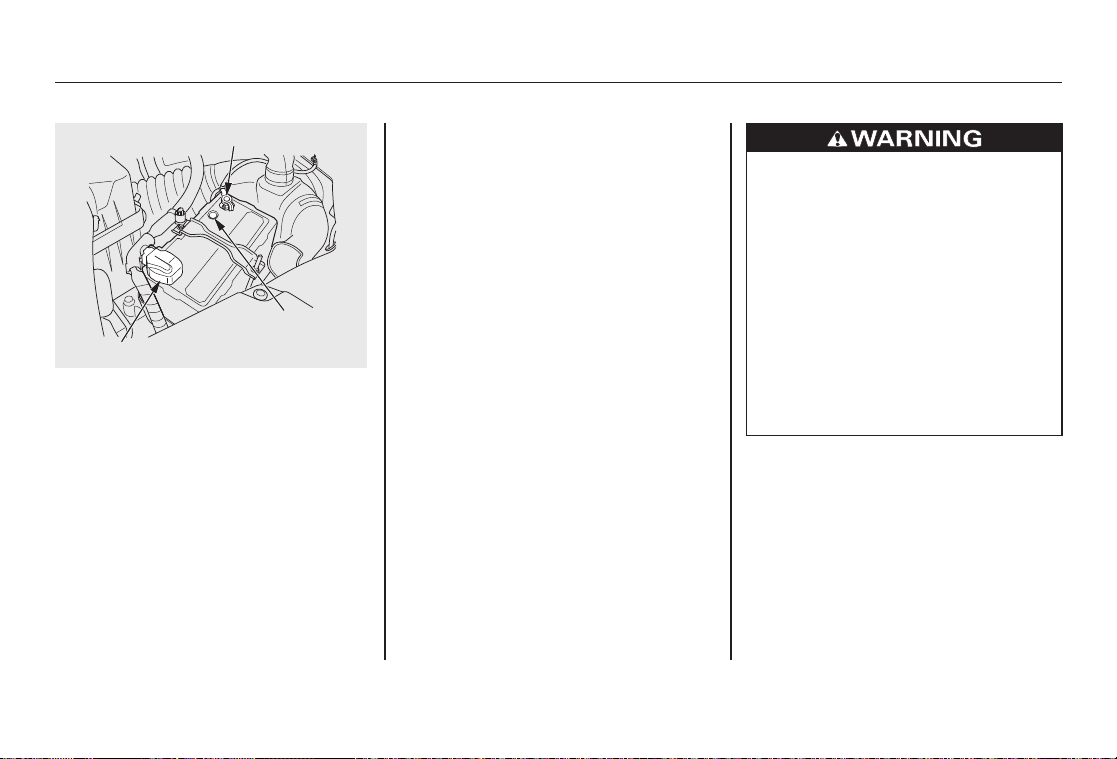
Check the condition of the battery
monthly by looking at the test indicator
window. The label on the battery
explains the test indicator's colors.
Check the terminals for corrosion (a
white or yellowish powder). To remove
it, cover the terminals with a solution of
baking soda and water. It will bubble
up and turn brown. When this stops,
wash it off with plain water. Dry off the
battery with a cloth or paper towel.
Coat the terminals with grease to help
prevent future corrosion.
If additional battery maintenance is
needed, see your dealer or a
qualified technician.
WARNING: Battery posts,
terminals, and related accessories
contain lead and lead compounds.
Wash your hands after handling.
If you need to connect the battery to
a charger, disconnect both cables to
prevent damaging your vehicle's
electrical system. Always disconnect
the negative (-) cable first, and
reconnect it last.
If your vehicle's battery is
disconnected, or goes dead, the time
setting may be lost. To reset the
time, see page 133.
The battery gives off explosive
hydrogen gas during normal
operation.
A spark or flame can cause the
battery to explode with enough
force to kill or seriously hurt
you.
Wear protective clothing and a
face shield, or have a skilled
technician do the battery
maintenance.
On EX model
If your vehicle's battery is
disconnected or goes dead, the audio
system may disable itself. The next
time you turn on the radio, you will
see ‘‘ENTER CODE’’ in the
frequency display. Use the preset
buttons to enter the code (see page
132).
NEGATIVE TERMINAL
TEST INDICATOR
WINDOW
POSITIVE TERMINAL
Checking the Battery
218
10/08/06 08:34:41 11 ELEMENT MMC North America Owner's Man 50 31SCV680 enu

If you need to park your vehicle for
an extended period (more than 1
month), there are several things you
should do to prepare it for storage.
Proper preparation helps prevent
deterioration and makes it easier to
get your vehicle back on the road. If
possible, store your vehicle indoors.
●
Fill the fuel tank.
●
Wash and dry the exterior
completely.
●
Clean the interior. Make sure the
carpeting, floor mats, etc., are
completely dry.
●
Leave the parking brake off. Put
the transmission in Park.
●
Block the rear wheels.
●
If the vehicle is to be stored for a
longer period, it should be
supported on jackstands so the
tires are off the ground.
●
Leave one window open slightly (if
the vehicle is being stored
indoors).
●
Disconnect the battery.
●
Support the front and rear wiper
blade arms with a folded towel or
rag so they do not touch the
windshield.
●
To minimize sticking, apply a
silicone spray lubricant to all door
and tailgate seals. Also, apply a
vehicle body wax to the painted
surfaces that mate with the door
and tailgate seals.
●
Cover the vehicle with a
‘‘breathable’’ cover, one made from
a porous material such as cotton.
Non-porous materials, such as
plastic sheeting, trap moisture,
which can damage the paint.
●
If possible, periodically run the
engine until it reaches full
operating temperature (the cooling
fans cycle on and off twice).
Preferably, do this once a month.
Vehicle Storage
219
Maintenance
10/08/06 08:34:41 11 ELEMENT MMC North America Owner's Man 50 31SCV680 enu

220
10/08/06 08:34:41 11 ELEMENT MMC North America Owner's Man 50 31SCV680 enu

This section covers the more
common problems that motorists
experience with their vehicles. It
gives you information about how to
safely evaluate the problem and what
to do to correct it. If the problem has
stranded you on the side of the road,
you may be able to get going again. If
not, you will also find instructions on
getting your vehicle towed.
Compact Spare Tire
.................... 222
Changing a Flat Tire
................... 223
If the Engine Won't Start
............. 229
Jump Starting
.............................. 231
If the Engine Overheats
.............. 233
Low Oil Pressure Indicator
......... 235
Charging System Indicator
......... 235
Malfunction Indicator Lamp
........ 236
Brake System Indicator
............... 237
Fuses
.......................................... 239
Fuse Locations
............................ 242
Emergency Towing
..................... 244
Taking Care of the Unexpected
221
Taking Care of the Unexpected
10/08/06 08:34:41 11 ELEMENT MMC North America Owner's Man 50 31SCV680 enu
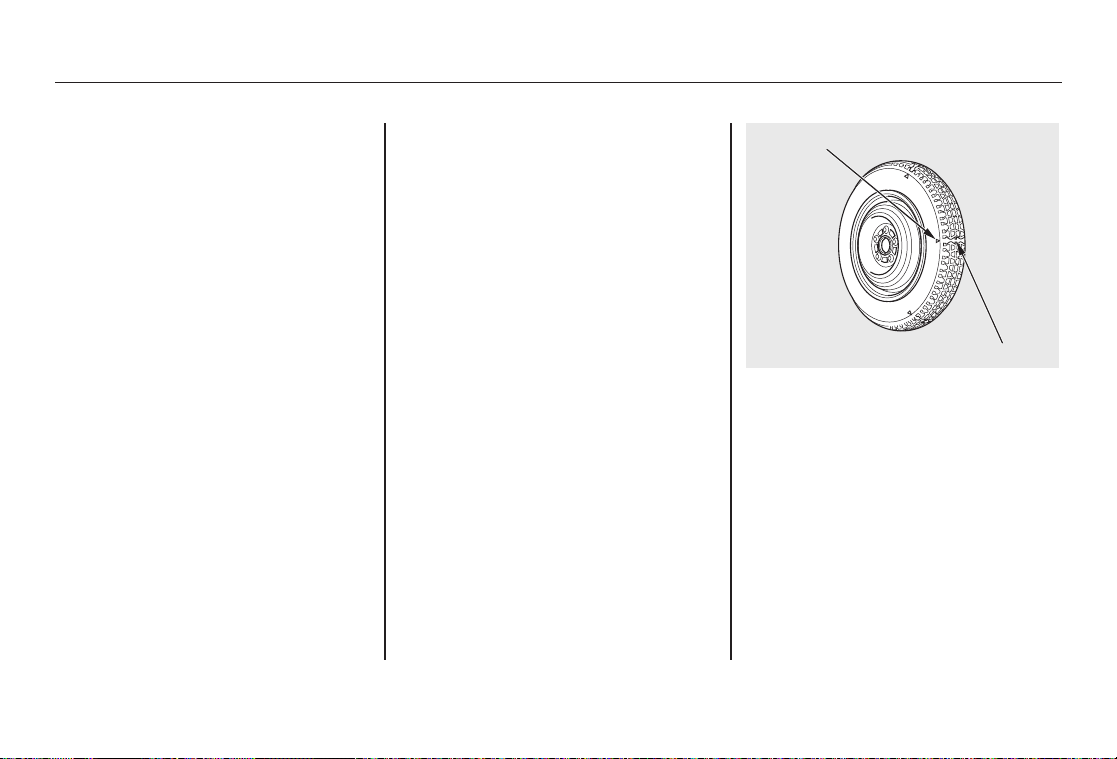
Use the compact spare tire as a
temporary replacement only. Get
your regular tire repaired or
replaced, and put it back on your
vehicle as soon as you can.
Check the inflation pressure of the
compact spare tire every time you
check the other tires. It should be
inflated to:
60 psi (420 kPa, 4.2 kgf/cm
2
)
Follow these precautions:
●
Never exceed 50 mph (80 km/h).
●
This tire gives a harsher ride and
less traction on some road
surfaces. Use greater caution while
driving.
●
Do not mount snow chains on the
compact spare tire.
●
Do not use your compact spare tire
on another vehicle unless it is the
same make and model.
●
The low tire pressure indicator
comes on and stays on after you
replace the flat tire with the
compact spare tire. After several
miles (kilometers) driving with the
compact spare tire, the TPMS
indicator comes on and the low tire
pressure indicator goes off.
Replace the tire when you can see
the tread wear indicator bars. The
replacement should be the same size
and design tire, mounted on the
same wheel. The spare tire is not
designed to be mounted on a regular
wheel, and the spare wheel is not
designed for mounting a regular tire.
INDICATOR LOCATION MARK
TREAD WEAR INDICATOR BAR
Compact Spare Tire
222
10/08/06 08:34:41 11 ELEMENT MMC North America Owner's Man 50 31SCV680 enu

If you have a flat tire while driving,
stop in a safe place to change it.
Drive slowly along the shoulder until
you get to an exit or an area to stop
that is far away from the traffic lanes.
The vehicle can easily roll off
the jack, seriously injuring
anyone underneath.
Follow the directions for
changing a tire exactly, and
never get under the vehicle
when it is supported only by the
jack.
1. Park the vehicle on firm, level, and
non-slippery ground. Put the
transmission in Park. Apply the
parking brake.
If you are towing a trailer, unhitch
the trailer.
2. Turn on the hazard warning lights,
and turn the ignition switch to the
LOCK (0) position. Have all
passengers get out of the vehicle
while you change the tire.
3. Open the hatch and the tailgate.
4. The spare tire, jack, and tools are
under the cargo area floor.
TOOLS
SPARE TIRE
JACK
CONTINUED
Changing a Flat Tire
223
Taking Care of the Unexpected
10/08/06 08:34:41 11 ELEMENT MMC North America Owner's Man 50 31SCV680 enu

5. Push the rear edge of the handle
to raise the handle loop and pull up
the loop to raise the cargo area
floor.
6. Unscrew the wing bolt, and take
the spare tire out of the cargo area.
7. Remove the tools and the jack. To
remove the jack, turn the jack's
end bracket counterclockwise to
loosen it.
8. Loosen the five wheel nuts 1/2
turn with the wheel nut wrench.
JACK
WHEEL NUTS
WHEEL NUT WRENCH
Changing a Flat Tire
224
10/08/06 08:34:41 11 ELEMENT MMC North America Owner's Man 50 31SCV680 enu

9. Locate the jacking point nearest
the tire you need to change. It is
pointed to by an arrow molded into
the underside of the body. Place
the jack under the jacking point.
Turn the end bracket clockwise
until the top of the jack contacts
the jacking point. Make sure the
jacking point tab is resting in the
jack notch.
10. Use the extension and the wheel
nut wrench as shown to raise the
vehicle until the flat tire is off the
ground.
11. Remove the wheel nuts, then
remove the flat tire. Handle the
wheel nuts carefully; they may be
hot from driving. Place the flat tire
on the ground with the outside
surface facing up.
JACKING POINTS
EXTENSION
WHEEL NUT WRENCH
CONTINUED
Changing a Flat Tire
225
Taking Care of the Unexpected
10/08/06 08:34:41 11 ELEMENT MMC North America Owner's Man 50 31SCV680 enu
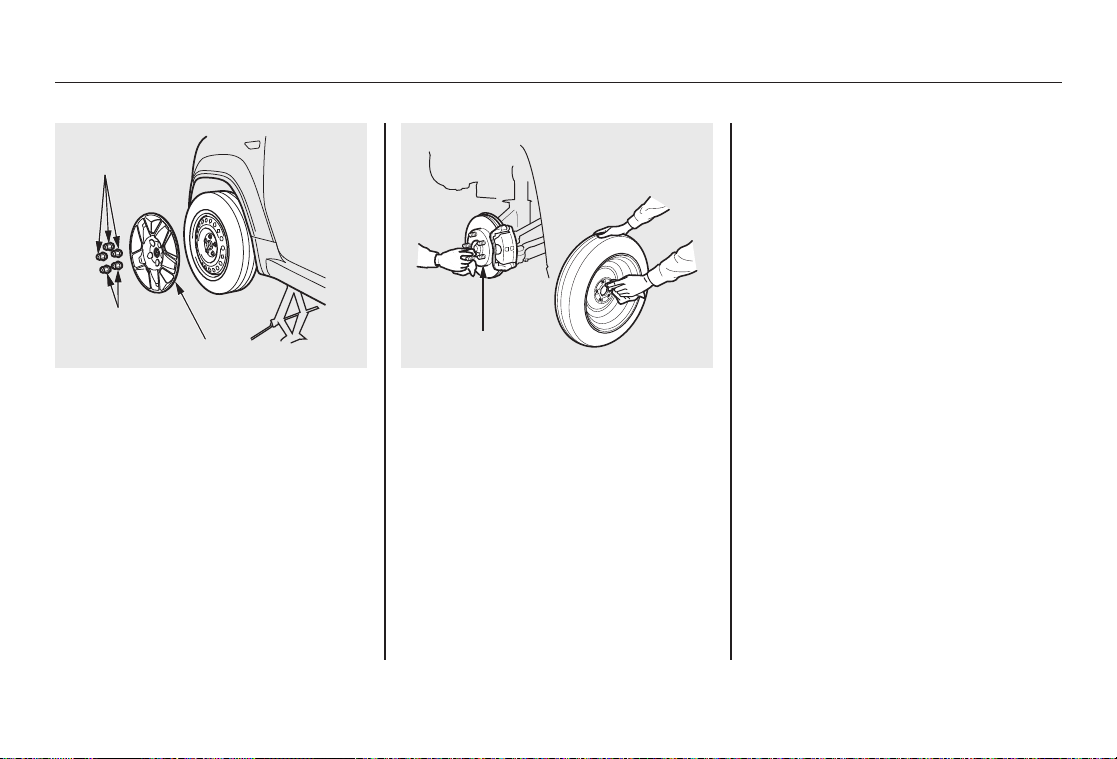
On LX model
Do not attempt to forcibly pry the
wheel cover off with a screwdriver
or other tool. The wheel cover
cannot be removed without first
removing the wheel nuts.
12. Before mounting the spare tire,
wipe any dirt off the mounting
surface of the wheel and hub with
a clean cloth. Wipe the hub
carefully; it may be hot from
driving.
13. Put on the spare tire. Put the
wheel nuts back on finger-tight,
then tighten them in a crisscross
pattern with the wheel nut wrench
until the wheel is firmly against the
hub. Do not try to tighten the
wheel nuts fully.
WHEEL NUTS
WHEEL NUTS
WHEEL COVER
BRAKE HUB
Changing a Flat Tire
226
10/08/06 08:34:41 11 ELEMENT MMC North America Owner's Man 50 31SCV680 enu
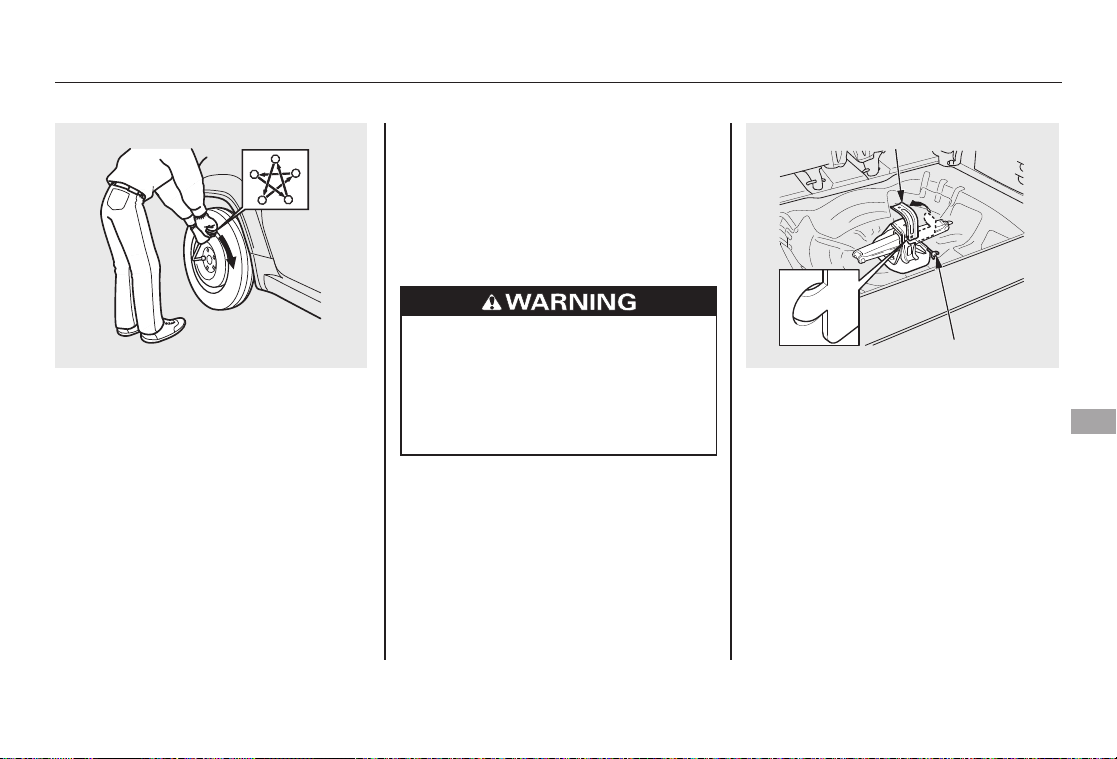
14. Lower the vehicle to the ground,
and remove the jack.
15. Tighten the wheel nuts securely in
the same crisscross pattern. Have
the wheel nut torque checked at
the nearest automotive service
facility.
Tighten the wheel nuts to:
80 lbf·ft (108 N·m, 11 kgf·m)
16. Store the jack in its holder. Turn
the jack's end bracket to lock it in
place. Store the tools.
17. Remove the center cap (if
equipped) from the flat tire, and
store it in the spare tire well.
Loose items can fly around the
interior in a crash and could
seriously injure the occupants.
Store the wheel, jack, and tools
securely before driving.
18. Remove the wing bolt on the spare
tire mount, and pivot the arm 90°
to the upright position. Then
tighten the wing bolt securely.
ARM
WING BOLT
CONTINUED
Changing a Flat Tire
227
Taking Care of the Unexpected
10/08/06 08:34:41 11 ELEMENT MMC North America Owner's Man 50 31SCV680 enu

19. Remove the small round plug from
the cargo area floor by pushing it
from the back side to make a hole.
Store the removed plug in a place
you can easily remember.
20. Reinstall the cargo area floor.
Place the flat tire face down on the
cargo area floor.
21. Align the center of the flat tire with
the hole in the cargo area floor.
Remove the spacer cone from the
wing bolt, turn it over, and put it
back on the bolt.
22. Secure the flat tire by screwing the
wing bolt to the spare tire mount
through the hole in the cargo area
floor.
23. Your vehicle's original tire has a
tire pressure monitoring system
sensor. To replace a tire, refer to
Changing a Tire with TPMS (see
page 170).
SPACER CONE
WING BOLT
Changing a Flat Tire
228
10/08/06 08:34:41 11 ELEMENT MMC North America Owner's Man 50 31SCV680 enu

Diagnosing why the engine won't
start falls into two areas, depending
on what you hear when you turn the
ignition switch to the START (III)
position:
●
You hear nothing, or almost
nothing. The engine's starter
motor does not operate at all, or
operates very slowly.
●
You can hear the starter motor
operating normally, or the starter
motor sounds like it is spinning
faster than normal, but the engine
does not start up and run.
Nothing Happens or the Starter
Motor Operates Very Slowly
When you turn the ignition switch to
the START (III) position, you do not
hear the normal noise of the engine
trying to start. You may hear a
clicking sound, a series of clicks, or
nothing at all.
Check these things:
●
Check the transmission interlock.
The transmission must be in Park
or neutral or the starter will not
operate.
●
Turn the ignition switch to the ON
(II) position. Turn on the
headlights, and check their
brightness. If the headlights are
very dim or do not come on at all,
the battery is discharged (see
Jump Starting on page 231).
●
Turn the ignition switch to the
START (III) position. If the
headlights do not dim, check the
condition of the fuses. If the fuses
are OK, there is probably
something wrong with the
electrical circuit for the ignition
switch or starter motor. You will
need a qualified technician to
determine the problem. See
Emergency Towing on page 244.
If the headlights dim noticeably or go
out when you try to start the engine,
either the battery is discharged or
the connections are corroded. Check
the condition of the battery and
terminal connections (see page 218).
You can then try jump starting the
vehicle from a booster battery (see
page 231).
CONTINUED
If the Engine Won't Start
229
Taking Care of the Unexpected
10/08/06 08:34:41 11 ELEMENT MMC North America Owner's Man 50 31SCV680 enu

The Starter Operates Normally
In this case, the starter motor's speed
sounds normal, or even faster than
normal, when you turn the ignition
switch to the START (III) position,
but the engine does not run.
●
Are you using a properly coded
key? An improperly coded key will
cause the immobilizer system
indicator in the instrument panel
to blink rapidly (see page 60).
●
Are you using the proper starting
procedure? Refer to Starting the
Engine on page 160.
●
Do you have fuel? Check the fuel
gauge; the low fuel indicator may
not be working.
●
There may be an electrical
problem, such as no power to the
fuel pump. Check all the fuses (see
page 239).
If you find nothing wrong, you will
need a qualified technician to find the
problem (see Emergency Towing
on page 244).
If the Engine Won't Start
230
10/08/06 08:34:41 11 ELEMENT MMC North America Owner's Man 50 31SCV680 enu

Although this seems like a simple
procedure, you should take several
precautions.
A battery can explode if you do
not follow the correct
procedure, seriously injuring
anyone nearby.
Keep all sparks, open flames,
and smoking materials away
from the battery.
You cannot start your vehicle with an
automatic transmission by pushing
or pulling it.
To Jump Start Your Vehicle:
1. Open the hood, and check the
physical condition of the battery.
In very cold weather, check the
condition of the electrolyte. If it
seems slushy or frozen, do not try
jump starting until it thaws.
If a battery sits in extreme cold, the
electrolyte inside can freeze. Attempting
to jump start with a frozen battery can
cause it to rupture.
2. Turn off all the electrical
accessories: heater, A/C, audio
system, lights, etc. Put the
transmission in Park, and set the
parking brake.
The numbers in the illustration
show you the order to connect the
jumper cables.
BOOSTER BATTERY
CONTINUED
Jump Starting
231
Taking Care of the Unexpected
10/08/06 08:34:41 11 ELEMENT MMC North America Owner's Man 50 31SCV680 enu
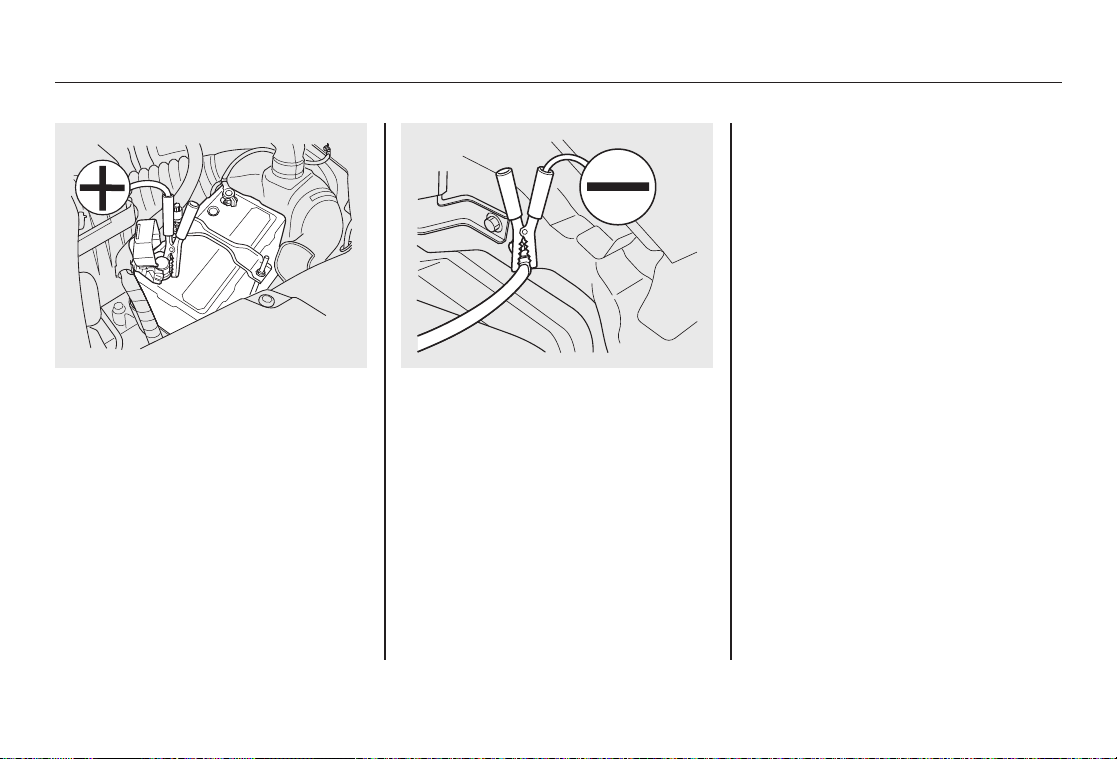
3. Connect one jumper cable to the
positive (+) terminal on your
battery. Connect the other end to
the positive (+) terminal on the
booster battery.
4. Connect the second jumper cable
to the negative (-) terminal on
the booster battery. Connect the
other end to the grounding strap
on your vehicle as shown. Do not
connect this jumper cable to any
other part of the engine.
5. If the booster battery is in another
vehicle, have an assistant start that
vehicle and run it at a fast idle.
6. Start your vehicle. If the starter
motor still operates slowly, check
that the jumper cables have good
metal-to-metal contact.
7. Once your vehicle is running,
disconnect the negative cable from
your vehicle, then from the
booster battery. Disconnect the
positive cable from your vehicle,
then from the booster battery.
Keep the ends of the jumper cables
away from each other and any metal
on the vehicle until everything is
disconnected. Otherwise, you may
cause an electrical short.
Jump Starting
232
10/08/06 08:34:41 11 ELEMENT MMC North America Owner's Man 50 31SCV680 enu
The pointer of the vehicle's
temperature gauge should stay in the
midrange. If it climbs to the red
mark, you should determine the
reason (hot day, driving up a steep
hill, etc.).
If the vehicle overheats, you should
take immediate action. The only
indication may be the temperature
gauge climbing to or above the red
mark. Or you may see steam or spray
coming from under the hood.
Driving with the temperature gauge
pointer at the red mark can cause
serious damage to the engine.
Steam and spray from an
overheated engine can
seriously scald you.
Do not open the hood if steam
is coming out.
1. Safely pull to the side of the road.
Put the transmission in Park, and
set the parking brake. Turn off all
the accessories, and turn on the
hazard lights.
2. If you see steam and/or spray
coming from under the hood, turn
off the engine. Wait until you see
no more signs of steam or spray,
then open the hood.
3. If you do not see steam or spray,
leave the engine running and
watch the temperature gauge. If
the high heat is due to
overloading, the engine should
start to cool down almost
immediately. If it does, wait until
the temperature gauge comes
down to the midpoint, then
continue driving.
4. If the temperature gauge stays at
the red mark, turn off the engine.
CONTINUED
If the Engine Overheats
233
Taking Care of the Unexpected
10/08/06 08:34:41 11 ELEMENT MMC North America Owner's Man 50 31SCV680 enu
5. Look for any obvious coolant
leaks, such as a split radiator hose.
Everything is still extremely hot,
so use caution. If you find a leak, it
must be repaired before you
continue driving (see Emergency
Towing on page 244).
6. If you don't find an obvious leak,
check the coolant level in the
radiator reserve tank. Add coolant
if the level is below the MIN mark.
7. If there was no coolant in the
reserve tank, you may need to add
coolant to the radiator. Let the
engine cool down until the pointer
reaches the middle of the
temperature gauge or lower before
checking the radiator.
Removing the radiator cap
while the engine is hot can
cause the coolant to spray out,
seriously scalding you.
Always let the engine and
radiator cool down before
removing the radiator cap.
8. Using gloves or a large heavy
cloth, turn the radiator cap
counterclockwise, without pushing
down, to the first stop. After the
pressure releases, push down on
the cap, and turn it until it comes
off.
9. Start the engine, and set the
temperature control dial to
maximum heat. Add coolant to the
radiator up to the base of the filler
neck. If you do not have the proper
coolant mixture available, you can
add plain water. Remember to
have the cooling system drained
and refilled with the proper
mixture as soon as you can.
10. Put the radiator cap back on
tightly. Run the engine, and check
the temperature gauge. If it goes
back to the red mark, the engine
needs repair (see Emergency
Towing on page 244).
11. If the temperature stays normal,
check the coolant level in the
radiator reserve tank. If it has gone
down, add coolant to the MAX
mark. Put the cap back on tightly.
If the Engine Overheats
234
10/08/06 08:34:41 11 ELEMENT MMC North America Owner's Man 50 31SCV680 enu
Low Oil Pressure Indicator
This indicator should never
come on when the engine is
running. If it starts flashing or stays
on, the oil pressure has dropped very
low or lost pressure. Serious engine
damage is possible, and you should
take immediate action.
Running the engine with low oil
pressure can cause serious mechanical
damage almost immediately. Turn off
the engine as soon as you can safely get
the vehicle stopped.
1. Safely pull off the road, and shut
off the engine. Turn on the hazard
warning lights.
2. Let the vehicle sit for a minute.
Open the hood, and check the oil
level (see page 145). An engine
very low on oil can lose pressure
during cornering and other driving
maneuvers.
3. If necessary, add oil to bring the
level back to the full mark on the
dipstick (see page 193).
4. Start the engine, and watch the oil
pressure indicator. If it does not go
out within 10 seconds, turn off the
engine. There is a mechanical
problem that needs to be repaired
before you can continue driving
(see Emergency Towing on page
244).
Charging System Indicator
If the charging system
indicator comes on brightly
when the engine is running, the
battery is not being charged.
Immediately turn off all electrical
accessories. Try not to use other
electrically operated controls such as
the power windows. Keep the engine
running; starting the engine will
discharge the battery rapidly.
Go to a service station or garage
where you can get technical
assistance.
Low Oil Pressure Indicator, Charging System Indicator
235
Taking Care of the Unexpected
10/08/06 08:34:41 11 ELEMENT MMC North America Owner's Man 50 31SCV680 enu
If this indicator comes on
while driving, it means one
of the engine's emissions control
systems may have a problem. Even
though you may feel no difference in
your vehicle's performance, it can
reduce your fuel economy and cause
increased emissions. Continued
operation may cause serious damage.
If you have recently refueled your
vehicle, the indicator coming on
could be due to a loose or missing
fuel fill cap. You will also see a
‘‘CHECK FUEL CAP’’ message on
the information display. Tighten the
cap until it clicks at least once.
Tightening the cap will not turn the
indicator off immediately; it can take
several days of normal driving.
If the indicator comes on repeatedly,
even though it may turn off as you
continue driving, have your vehicle
checked by your dealer as soon as
possible.
If you keep driving with the malfunction
indicator lamp on, you can damage
your vehicle's emissions controls and
engine. Those repairs may not be
covered by your vehicle's warranties.
The malfunction indicator lamp may
also come on with the ‘‘D’’ indicator.
Readiness Codes
Your vehicle has certain ‘‘readiness
codes’’ that are part of the on-board
diagnostics for the emissions
systems. In some states, part of the
emissions testing is to make sure
these codes are set. If they are not
set, the test cannot be completed.
If the battery in your vehicle has
been disconnected or gone dead,
these codes may be erased. It can
take several days of driving under
various conditions to set the codes
again.
Malfunction Indicator Lamp
236
10/08/06 08:34:41 11 ELEMENT MMC North America Owner's Man 50 31SCV680 enu
To check if they are set, turn the
ignition switch to the ON (II)
position, without starting the engine.
The malfunction indicator lamp will
come on for 20 seconds. If it then
goes off, the readiness codes are set.
If it blinks five times, the readiness
codes are not set. If possible, do not
take your vehicle for an emissions
test until the readiness codes are set.
Refer to Emissions Testing for
more information (see page 261).
Brake System Indicator (Red)
The brake system indicator (red)
normally comes on when you turn
the ignition switch to the ON (II)
position, and as a reminder to check
the parking brake. It will stay on if
you do not fully release the parking
brake.
If the brake system indicator (red)
comes on while driving, the brake
fluid level is probably low. Press
lightly on the brake pedal to see if it
feels normal. If it does, check the
brake fluid level the next time you
stop at a service station (see page
199).
If the fluid level is low, take your
vehicle to a dealer, and have the
brake system inspected for leaks or
worn brake pads.
CONTINUED
Malfunction Indicator Lamp, Brake System Indicator
237
Taking Care of the Unexpected
10/08/06 08:34:41 11 ELEMENT MMC North America Owner's Man 50 31SCV680 enu

However, if the brake pedal does not
feel normal, you should take
immediate action. A problem in one
part of the system's dual circuit
design will still give you braking at
two wheels. You will feel the brake
pedal go down much farther before
the vehicle begins to slow down, and
you will have to press harder on the
pedal.
Slow down by shifting to a lower
gear, and pull to the side of the road
when it is safe. Because of the long
distance needed to stop, it is
hazardous to drive the vehicle. You
should have it towed and repaired as
soon as possible (see Emergency
Towing on page 244).
If you must drive the vehicle a short
distance in this condition, drive
slowly and carefully.
If the ABS indicator and the VSA
system indicator come on with the
brake system indicator, have your
vehicle inspected by your dealer
immediately.
Brake System Indicator
238
10/08/06 08:34:41 11 ELEMENT MMC North America Owner's Man 50 31SCV680 enu
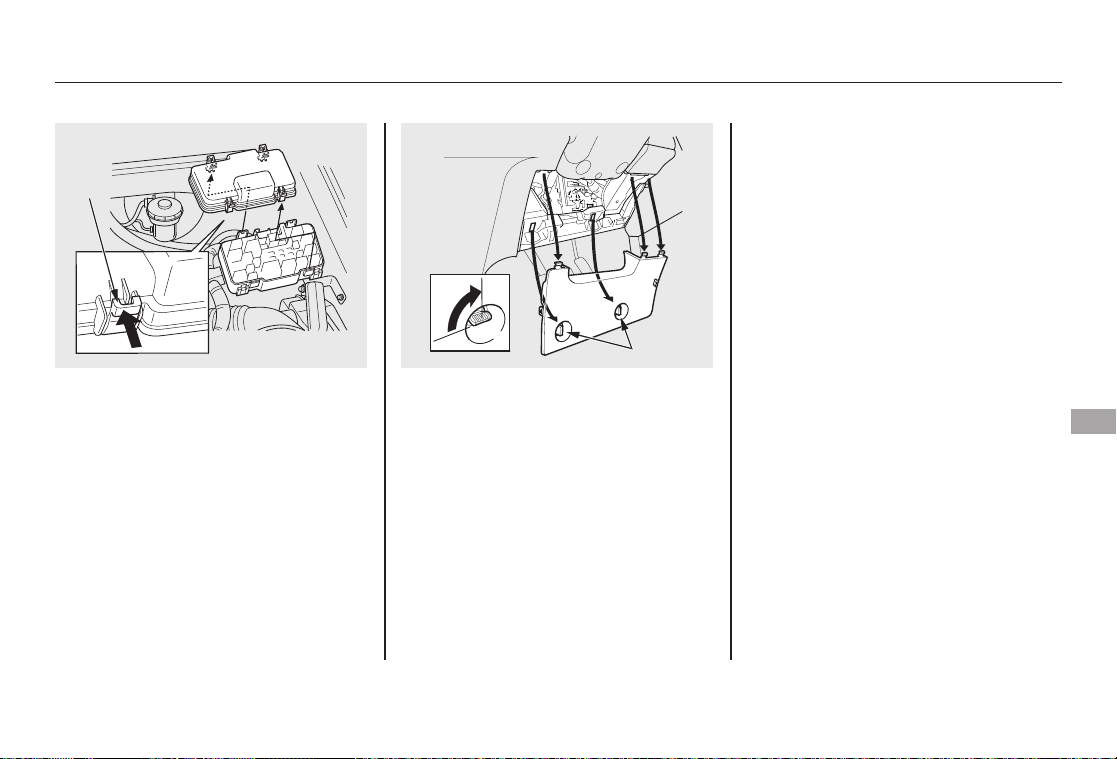
The vehicle's fuses are located in two
fuse boxes. The under-hood fuse box
is located in the engine compartment
on the driver's side. To open it, push
the tabs as shown.
The interior fuse box is underneath
the steering column. To remove the
fuse box lid, turn the knobs
clockwise and pull the lid out of its
hinges.
Checking and Replacing Fuses
If something electrical in your
vehicle stops working, check for a
blown fuse first. Determine from the
chart on pages 242 and 243, or the
diagram on the fuse box lid, which
fuse or fuses control that device.
Check those fuses first, but check all
the fuses before deciding that a
blown fuse is the cause. Replace any
blown fuses, and check if the device
works.
1. Turn the ignition switch to the
LOCK (0) position. Make sure the
headlights and all other
accessories are off.
2. Remove the cover from the fuse
box.
UNDER-HOOD
TAB
INTERIOR
KNOBS
CONTINUED
Fuses
239
Taking Care of the Unexpected
10/08/06 08:34:41 11 ELEMENT MMC North America Owner's Man 50 31SCV680 enu
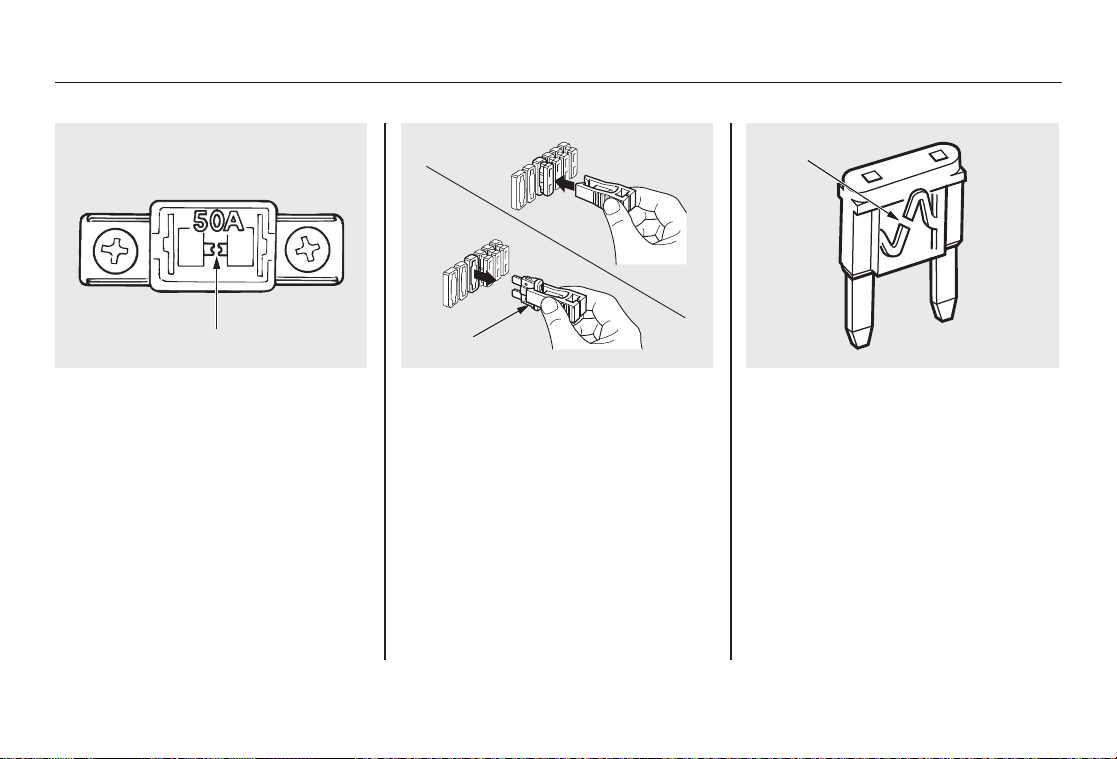
3. Check each of the large fuses in
the under-hood fuse boxes by
looking through the top at the wire
inside. Removing these fuses
requires a Phillips-head
screwdriver.
4. Check the smaller fuses in the
under-hood fuse box and all the
fuses in the interior fuse box by
pulling out each one with the fuse
puller provided in the under-hood
fuse box.
5. Look for a blown wire inside the
fuse. If it is blown, replace it with
one of the spare fuses of the same
rating or lower.
FUSE
BLOWN
FUSE PULLER
BLOWN
Fuses
240
10/08/06 08:34:41 11 ELEMENT MMC North America Owner's Man 50 31SCV680 enu
If you cannot drive the vehicle
without fixing the problem, and you
do not have a spare fuse, take a fuse
of the same rating or a lower rating
from one of the other circuits. Make
sure you can do without that circuit
temporarily (such as the accessory
power socket or radio).
If you replace the blown fuse with a
spare fuse that has a lower rating, it
might blow out again. This does not
indicate anything wrong. Replace the
fuse with one of the correct rating as
soon as you can.
Replacing a fuse with one that has a
higher rating greatly increases the
chances of damaging the electrical
system. If you do not have a
replacement fuse with the proper rating
for the circuit, install one with a lower
rating.
6. If the replacement fuse of the same
rating blows in a short time, there
is probably a serious electrical
problem in your vehicle. Leave the
blown fuse in that circuit and have
your vehicle checked by a
qualified technician.
Fuses
241
Taking Care of the Unexpected
10/08/06 08:34:41 11 ELEMENT MMC North America Owner's Man 50 31SCV680 enu
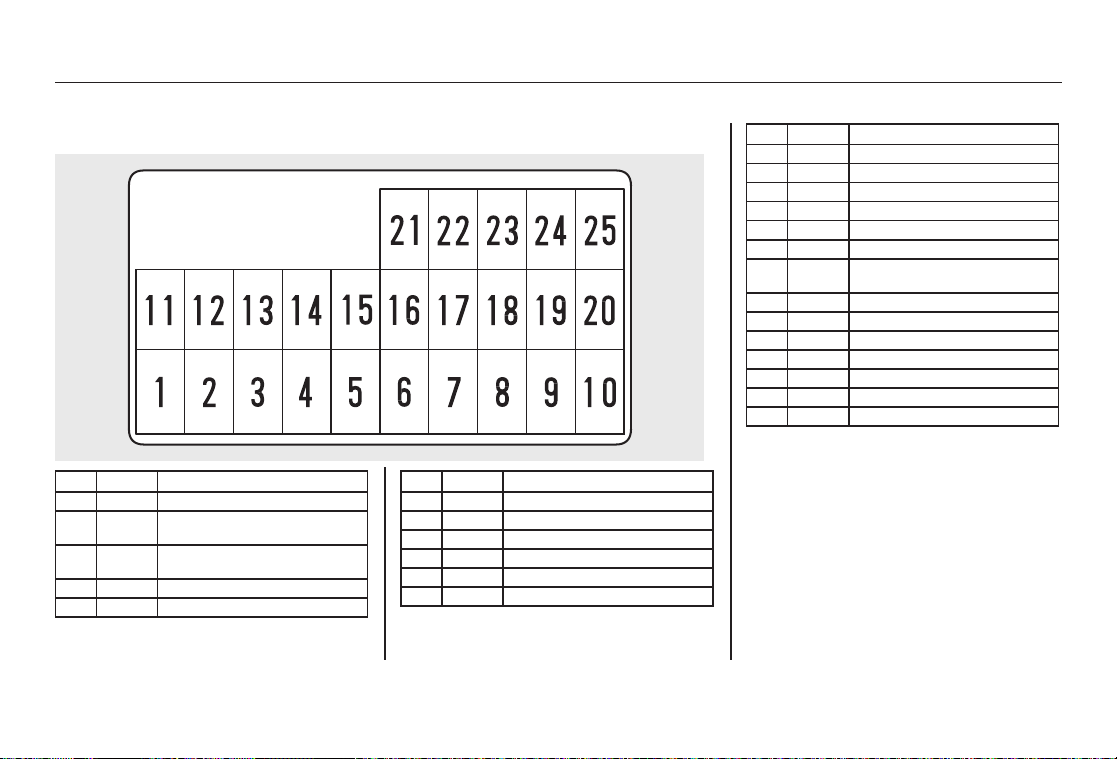
INTERIOR FUSE BOX
No.
Amps. Circuits Protected
1 - Not Used
2 10 A Rear Accessory Power
Socket
3 10 A Daytime Running Lights/
TPMS
4 10 A ACG
5 - Not Used
No. Amps.
Circuits Protected
6 7.5 A Power Window Relay
7 20 A AMP
ꭧ
8 7.5 A Accessory, Radio
9 10 A Rear Wiper
10 7.5 A Meter
11 - Not Used
No. Amps.
Circuits Protected
12 7.5 A Daytime Running Lights
13 10 A SRS
14 10 A Remote Control Mirrors
15 20 A LAF Heater
16 15 A Ignition Relay
17 15 A Fuel Pump
18 15 A Front Accessory Power
Socket
19 7.5 A Turn Signal Lights
20 20 A Front Wiper
21 - Not Used
22 20 A Passenger's Power Window
23 20 A Driver's Power Window
24 - Not Used
25 - Not Used
ꭧ: If equipped
Fuse Locations
242
10/08/06 08:34:41 11 ELEMENT MMC North America Owner's Man 50 31SCV680 enu

UNDER-HOOD FUSE BOX
No. Amps.
Circuits Protected
1 30 A Condenser Fan
2 15 A Small Light
3 7.5 A Interior Light
4 20 A Cooling Fan Motor
5 15 A Hazard
6 15 A FI ECU
No. Amps.
Circuits Protected
7 15 A Horn, Stop
8 15 A DBW
9 10 A Back Up
10 30 A VSA Motor
11 20 A Rear Defroster
12 40 A Heater Motor
No. Amps.
Circuits Protected
13 40 A Power Window Main
14 40 A Option
15 15 A Left Headlight
16 15 A Door Lock
17 15 A Right Headlight
18 30 A VSA F/S
19 100 A Battery
20 50 A IG1 Main
21-25 7.5 A-30 A
Spare Fuses
Fuse Locations
243
Taking Care of the Unexpected
10/08/06 08:34:41 11 ELEMENT MMC North America Owner's Man 50 31SCV680 enu
If your vehicle needs to be towed, call
a professional towing service or
organization. Never tow your vehicle
with just a rope or chain. It is very
dangerous.
On 4WD models
The only way you can safely tow
your vehicle is with flat-bed
equipment. The operator will load
your vehicle on the back of a truck.
Any other method of towing will
damage the drive system. When you
contact the towing agency, inform
them a flat-bed is required.
Towing with only two tires on the
ground will damage parts of the 4WD
system. It should be transported on a f
lat-bed truck or trailer.
On 2WD models
There are two ways to tow your
vehicle:
Flat-bed Equipment
- The operator
loads your vehicle on the back of a
truck. This is the best way to
transport your vehicle.
Wheel-lift Equipment
- The tow
truck uses two pivoting arms that go
under the front tires and lift them off
the ground. The rear tires remain on
the ground. This is an acceptable
way to tow your vehicle.
If, due to damage, your vehicle must
be towed with the front wheels on
the ground, do this:
●
Start the engine.
●
Shift to D position and hold for 5
seconds, then to N.
●
Turn off the engine.
●
Leave the ignition switch in the
ACCESSORY (I) position so the
steering wheel does not lock.
●
Release the parking brake.
Improper towing preparation will
damage the transmission. Follow the
above procedure exactly. If you cannot
shift the transmission or start the
engine, your vehicle must be
transported with the all four wheels off
the ground.
Emergency Towing
244
10/08/06 08:34:41 11 ELEMENT MMC North America Owner's Man 50 31SCV680 enu
With the front wheels on the ground,
it is best to tow the vehicle no farther
than 50 miles (80 km), and keep the
speed below 35 mph (55 km/h).
The steering system can be damaged if
the steering wheel is locked. Leave the
ignition switch in the ACCESSORY (I)
position, and make sure the steering
wheel turns freely before you begin
towing.
Emergency Towing
245
Taking Care of the Unexpected
10/08/06 08:34:41 11 ELEMENT MMC North America Owner's Man 50 31SCV680 enu

246
10/08/06 08:34:41 11 ELEMENT MMC North America Owner's Man 50 31SCV680 enu

The diagrams in this section give you
the dimensions and capacities of
your vehicle and the locations of the
identification numbers. It also
includes information you should
know about your vehicle's tires and
emissions control systems.
Identification Numbers
............... 248
Specifications
.............................. 250
DOT Tire Quality Grading (U.S.
Vehicles)
............................. 253
Uniform Tire Quality
Grading
............................... 253
Treadwear
............................... 253
Traction
.................................. 253
Temperature
........................... 254
Tire Labeling
.............................. 255
Tire Pressure Monitoring System
(TPMS) - Required Federal
Explanation
......................... 256
Emissions Controls
..................... 258
The Clean Air Act
.................... 258
Crankcase Emissions Control
System
................................ 258
Evaporative Emissions Control
System
................................ 258
Onboard Refueling Vapor
Recovery
............................. 258
Exhaust Emissions
Controls
.............................. 259
Three Way Catalytic
Converter
................................ 260
Emissions Testing
....................... 261
Technical Information
247
Technical Information
10/08/06 08:34:41 11 ELEMENT MMC North America Owner's Man 50 31SCV680 enu
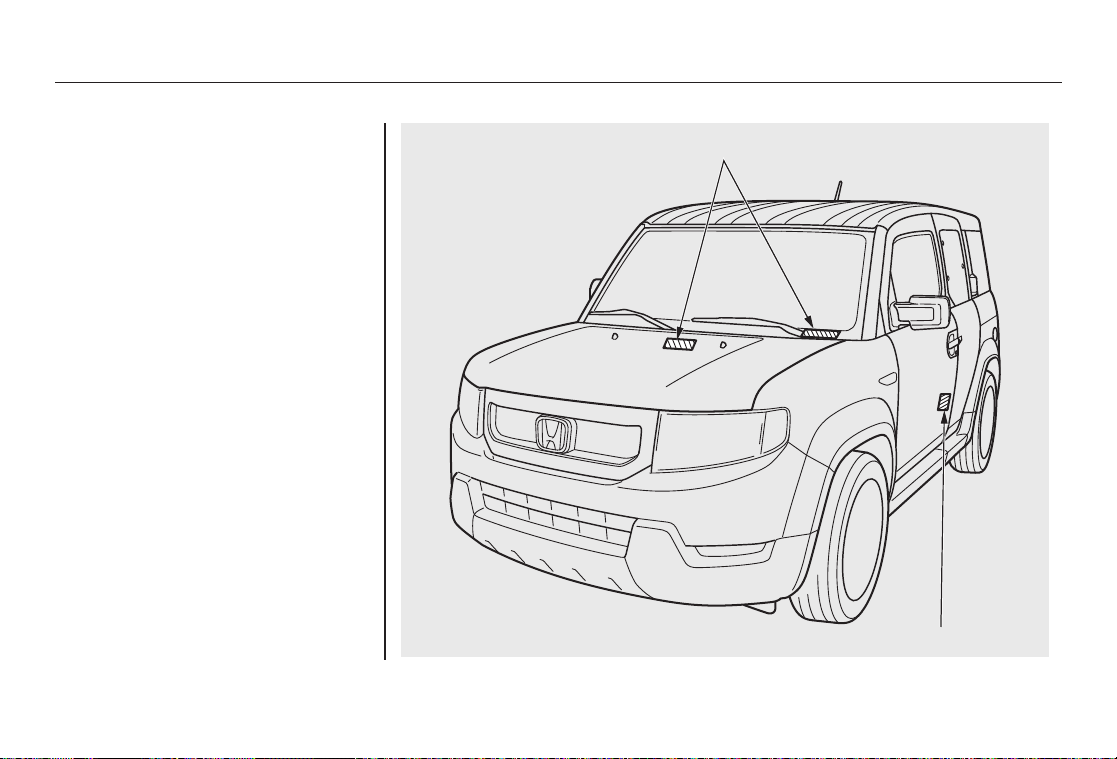
Your vehicle has several identifying
numbers located in various places.
The vehicle identification number
(VIN) is the 17-digit number your
dealer uses to register your vehicle
for warranty purposes. It is also
necessary for licensing and insuring
your vehicle. The easiest place to
find the VIN is on a plate fastened to
the top of the dashboard. You can
see it by looking through the
windshield on the driver's side. It is
also on the certification label
attached to the driver's doorjamb
(front edge of rear door), and is
stamped on the engine compartment
bulkhead. The VIN is also provided
in bar code on the certification label.
VEHICLE IDENTIFICATION NUMBER (VIN)
CERTIFICATION LABEL
Identification Numbers
248
10/08/06 08:34:41 11 ELEMENT MMC North America Owner's Man 50 31SCV680 enu
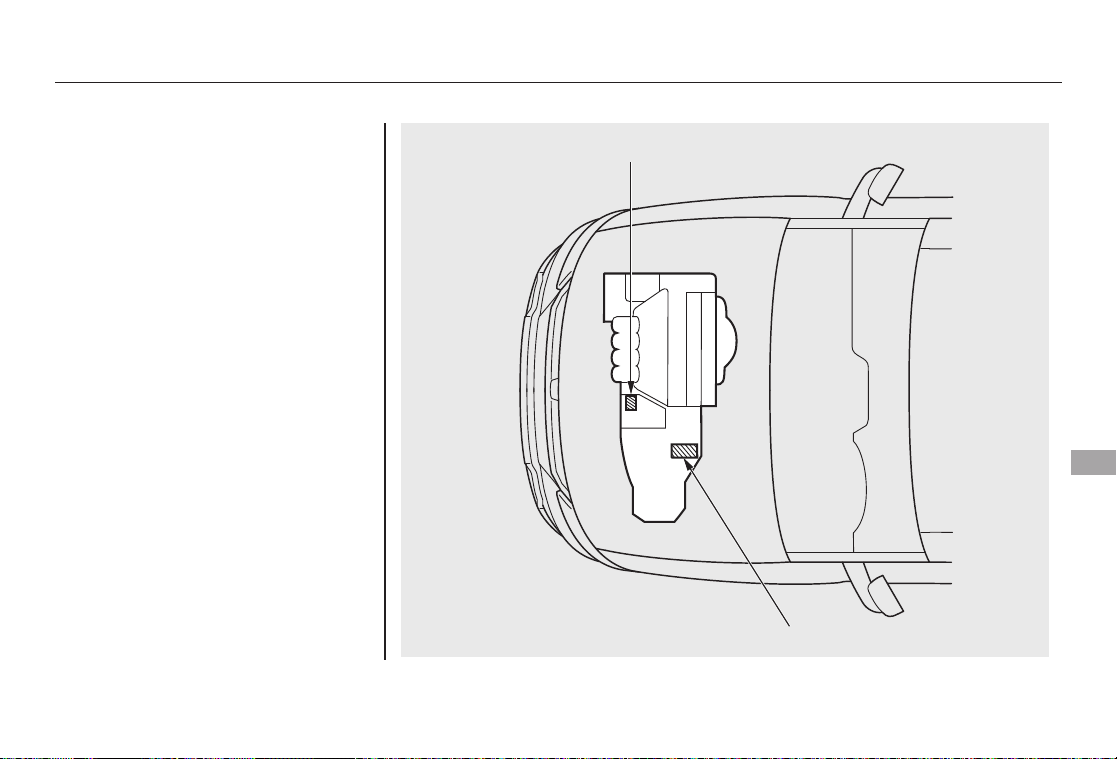
The engine number is stamped into
the engine block.
The transmission number is on a
label on top of the transmission.
AUTOMATIC TRANSMISSION NUMBER
ENGINE NUMBER
Identification Numbers
249
Technical Information
10/08/06 08:34:41 11 ELEMENT MMC North America Owner's Man 50 31SCV680 enu
Dimensions
Length 169.9 in (4,316 mm)
Width 71.6 in (1,819 mm)
Height 70.4 in (1,788 mm)
Wheelbase 101.4 in (2,575 mm)
Track Front 62.1 in (1,577 mm)
Rear 62.3 in (1,582 mm)
Weights
Gross vehicle weight rating See the certification label
attached to the driver's doorjamb
(front edge of rear door).
Seating Capacities
Total 4
Front 2
Rear 2
Engine
Type Water cooled 4-stroke DOHC
i-VTEC 4-cylinder gasoline engine
Bore x Stroke 3.43 x 3.90 in (87.0 x 99.0 mm)
Displacement 144 cu-in (2,354 cm
3
)
Compression ratio 9.7 : 1
Spark plugs NGK: IZFR6K11
DENSO: SKJ20DR-M11
Specifications
250
10/08/06 08:34:41 11 ELEMENT MMC North America Owner's Man 50 31SCV680 enu
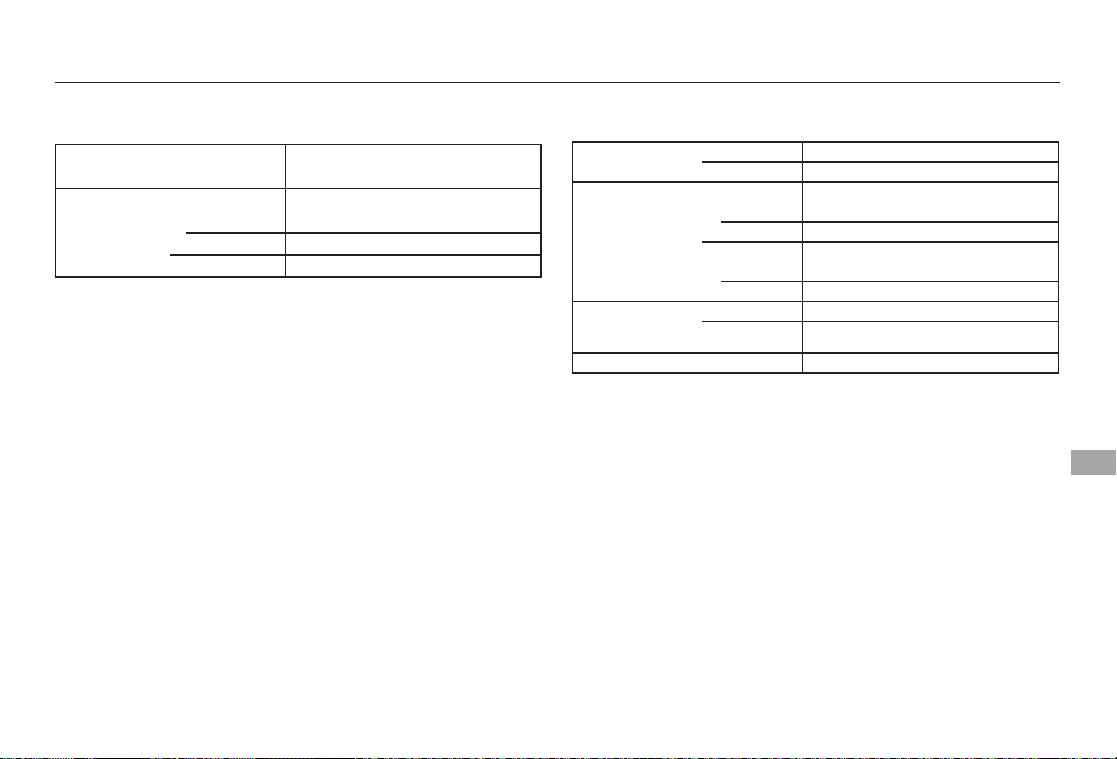
Capacities
Fuel tank Approx.
15.9 US gal (60 L)
Engine oil Change
ꭧ1
Including filter 4.4 US qt (4.2 L)
Without filter 4.2 US qt (4.0 L)
Total 5.6 US qt (5.3 L)
Capacities
Engine coolant Change
ꭧ2
1.35 US gal (5.1 L)
Total 1.90 US gal (7.2 L)
Automatic
transmission
fluid
Change
4WD 2.6 US qt (2.5 L)
2WD 2.7 US qt (2.6 L)
Total
4WD 7.6 US qt (7.2 L)
2WD 7.4 US qt (7.0 L)
Rear
differential
fluid (4WD)
Change 1.1 US qt (1.0 L)
Total 1.3 US qt (1.2 L)
Windshield washer reservoir 4.8 US qt (4.5 L)
ꭧ1: Excluding the oil remaining in the engine
ꭧ2: Including the coolant in the reserve tank and that remaining in the engine
Reserve tank capacity:
0.15 US gal (0.55 L)
Specifications
251
Technical Information
10/08/06 08:34:41 11 ELEMENT MMC North America Owner's Man 50 31SCV680 enu
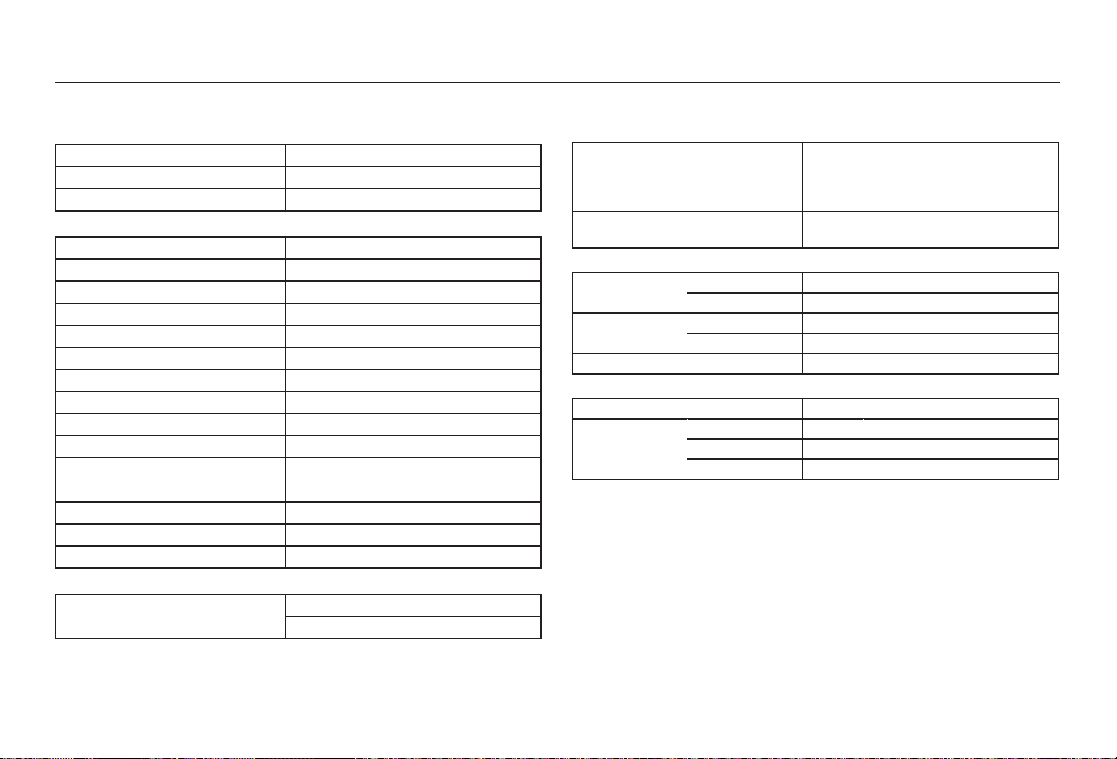
Air Conditioning
Refrigerant type HFC-134a (R-134a)
Charge quantity 17.6-19.4 oz (500-550 g)
Lubricant type ND-OIL8
Lights
Headlights 60/55 W (H4/HB2)
Daytime running lights 60 W (HB3)
Front turn signal/parking lights 27/8 W (Amber)
Front side marker lights 3 CP
Side turn signal lights 3 CP
Rear turn signal lights 21 W (Amber)
Rear side marker lights 3 CP
Stop/taillights 21/5 W
Back-up lights 21 CP
License plate lights 5 W
Ceiling light 8 W
ꭧ1
5W
ꭧ2
Spotlights 8 W
ꭧ2
Cargo area light 8 W
High-mount brake light 21 W
Battery
Capacity 12 V - 47 AH/20 HR
12 V - 38 AH/5 HR
Fuses
Interior See page 242 or the fuse label
attached to the inside of the fuse
box lid under the steering
column.
Under-hood See page 243 or the fuse box
cover.
Alignment
Toe-in Front 0.0 in (0 mm)
Rear 0.08 in (2.0 mm)
Camber Front -0°13’
Rear -1°00’
Caster Front 1°50’
Tires
Size Front/Rear P215/70R16 99S
Pressure Front 33 psi (230 kPa, 2.3 kgf/cm
2
)
Rear 35 psi (240 kPa, 2.4 kgf/cm
2
)
Spare 60 psi (420 kPa, 4.2 kgf/cm
2
)
ꭧ1: LX model
ꭧ2: EX model
Specifications
252
10/08/06 08:34:41 11 ELEMENT MMC North America Owner's Man 50 31SCV680 enu

The tires on your vehicle meet all
U.S. Federal Safety Requirements.
All tires are also graded for
treadwear, traction, and temperature
performance according to
Department of Transportation (DOT)
standards. The following explains
these gradings.
Uniform Tire Quality Grading
Quality grades can be found where
applicable on the tire sidewall
between tread shoulder and
maximum section width. For
example:
Treadwear 200
Traction AA
Temperature A
All passenger car tires must conform
to Federal Safety Requirements in
addition to these grades.
Treadwear
The treadwear grade is a
comparative rating based on the wear
rate of the tire when tested under
controlled conditions on a specified
government test course. For
example, a tire graded 150 would
wear one and one-half (1 1/2) times
as well on the government course as
a tire graded 100. The relative
performance of tires depends upon
the actual conditions of their use,
however, and may depart
significantly from the norm due to
variations in driving habits, service
practices and differences in road
characteristics and climate.
Traction
The traction grades, from highest to
lowest, are AA, A, B, and C. Those
grades represent the tire's ability to
stop on wet pavement as measured
under controlled conditions on
specified government test surfaces of
asphalt and concrete. A tire marked
C may have poor traction
performance.
Warning: The traction grade
assigned to this tire is based on
straight-ahead braking traction tests,
and does not include acceleration,
cornering, hydroplaning, or peak
traction characteristics.
DOT Tire Quality Grading (U.S. Vehicles)
253
Technical Information
10/08/06 08:34:41 11 ELEMENT MMC North America Owner's Man 50 31SCV680 enu

Temperature
The temperature grades are A (the
highest), B, and C, representing the
tire's resistance to the generation of
heat and its ability to dissipate heat
when tested under controlled
conditions on a specified indoor
laboratory test wheel. Sustained high
temperature can cause the material
of the tire to degenerate and reduce
tire life, and excessive temperature
can lead to sudden tire failure. The
grade C corresponds to a level of
performance which all passenger car
tires must meet under the Federal
Motor Vehicle Safety Standard No.
109. Grades B and A represent
higher levels of performance on the
laboratory test wheel than the
minimum required by law.
Warning: The temperature grade for
this tire is established for a tire that
is properly inflated and not
overloaded. Excessive speed,
underinflation, or excessive loading,
either separately or in combination,
can cause heat buildup and possible
tire failure.
DOT Tire Quality Grading (U.S. Vehicles)
254
10/08/06 08:34:41 11 ELEMENT MMC North America Owner's Man 50 31SCV680 enu
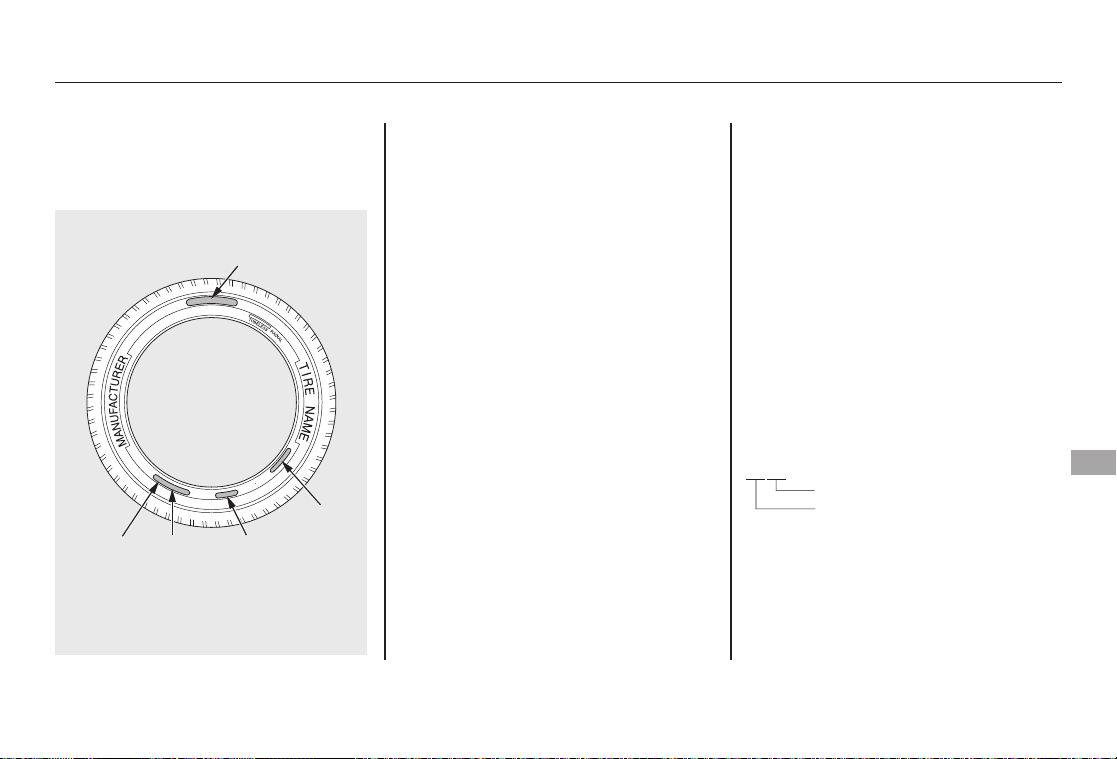
The tires that came on your vehicle
have a number of markings. Those you
should be aware of are described
below.
Tire Size
Whenever tires are replaced, they
should be replaced with tires of the
same size. Following is an example of
tire size with an explanation of what
each component means.
P215/70R16 99S
P - Vehicle type (P indicates
passenger vehicle).
215 - Tire width in millimeters.
70 - Aspect ratio (the tire's section
height as a percentage of its
width).
R - Tire construction code (R
indicates radial).
16 - Rim diameter in inches.
99 - Load index (a numerical code
associated with the maximum
load the tire can carry).
S - Speed symbol (an
alphabetical code indicating
the maximum speed rating).
Tire Identification Number (TIN)
The tire identification number (TIN)
is a group of numbers and letters that
look like the following example. TIN
is located on the sidewall of the tire.
DOT B97R FW6X 2202
DOT - This indicates that the tire
meets all requirements of
the U.S. Department of
Transportation.
B97R - Manufacturer's
identification mark.
FW6X - Tire type code.
TIRE LABELING EXAMPLE
(1) Tire Size
(2) Tire Identification Number (TIN)
(3) Maximum Tire Pressure
(4) Maximum Tire Load
(1)
(2)
(1)
(3)(4)
2202 -
Year
Week
Date of manufacture.
CONTINUED
Tire Labeling
255
Technical Information
10/08/06 08:34:41 11 ELEMENT MMC North America Owner's Man 50 31SCV680 enu
Glossary of Tire Terminology
Cold Tire Pressure - The tire air
pressure when the vehicle has been
parked for at least three hours or
driven less than 1 mile (1.6km).
Load Rating - Means the maximum
load that a tire is rated to carry for a
given inflation pressure.
Maximum Inflation Pressure - the
maximum tire air pressure that the
tire can hold.
Maximum Load Rating - Means the
load rating for a tire at the maximum
permissible inflation pressure for that
tire.
Recommended Inflation Pressure -
The cold tire inflation pressure
recommended by the manufacturer.
Treadwear Indicators (TWI) - Means
the projections within the principal
grooves designed to give a visual
indication of the degrees of wear of
the tread.
Tire Pressure Monitoring System
(TPMS)
Each tire, including the spare (if
provided), should be checked
monthly when cold and inflated to
the inflation pressure recommended
by the vehicle manufacturer on the
vehicle placard or tire inflation
pressure label.
(If your vehicle has tires of a different
size than the size indicated on the
vehicle placard or tire inflation
pressure label, you should determine
the proper tire inflation pressure for
those tires.)
As an added safety feature, your
vehicle has been equipped with a tire
pressure monitoring system (TPMS)
that illuminates a low tire pressure
telltale
when one or more of your tires is
significantly under-inflated.
Accordingly, when the low tire
pressure telltale illuminates, you
should stop and check your tires as
soon as possible, and inflate them to
the proper pressure.
Tire Labeling, Tire Pressure Monitoring System (TPMS) - Required Federal Explanation
256
10/08/06 08:34:41 11 ELEMENT MMC North America Owner's Man 50 31SCV680 enu
Driving on a significantly under-
inflated tire causes the tire to
overheat and can lead to tire failure.
Under-inflation also reduces fuel
efficiency and tire tread life, and may
affect the vehicle's handling and
stopping ability.
Please note that the TPMS is not a
substitute for proper tire
maintenance, and it is the driver's
responsibility to maintain correct tire
pressure, even if under-inflation has
not reached the level to trigger
illumination of the TPMS low tire
pressure telltale.
Your vehicle has also been equipped
with a TPMS malfunction indicator to
indicate when the system is not
operating properly. The TPMS
malfunction indicator is provided by
a separate telltale, which displays the
symbol ‘‘TPMS’’ when illuminated.
When the malfunction indicator is
illuminated,
the system may not be able to detect
or signal low tire pressure as
intended.
TPMS malfunctions may occur for a
variety of reasons, including the
installation of replacement or
alternate tires or wheels on the
vehicle that prevent the TPMS from
functioning properly.
Always check the TPMS malfunction
telltale after replacing one or more
tires or wheels on your vehicle to
ensure that the replacement or
alternate tires and wheels allow the
TPMS to continue to function
properly.
Tire Pressure Monitoring System (TPMS) - Required Federal Explanation
257
Technical Information
10/08/06 08:34:41 11 ELEMENT MMC North America Owner's Man 50 31SCV680 enu

The burning of gasoline in your
vehicle's engine produces several by-
products. Some of these are carbon
monoxide (CO), oxides of nitrogen
(NOx), and hydrocarbons (HC).
Gasoline evaporating from the tank
also produces hydrocarbons.
Controlling the production of NOx,
CO, and HC is important to the
environment. Under certain
conditions of sunlight and climate,
NOx and HC react to form
photochemical ‘‘smog.’’ Carbon
monoxide does not contribute to
smog creation, but it is a poisonous
gas.
The Clean Air Act
The United States Clean Air Act sets
standards for automobile emissions. It
also requires that automobile
manufacturers explain to owners how
their emissions controls work and
what to do to maintain them. This
section summarizes how the
emissions controls work.
Crankcase Emissions Control
System
Your vehicle has a positive crankcase
ventilation system. This keeps gasses
that build up in the engine's crankcase
from going into the atmosphere. The
positive crankcase ventilation valve
routes them from the crankcase back
to the intake manifold. They are then
drawn into the engine and burned.
Evaporative Emissions Control
System
As gasoline evaporates in the fuel
tank, an evaporative emissions
control canister filled with charcoal
adsorbs the vapor. It is stored in this
canister while the engine is off. After
the engine is started and warmed up,
the vapor is drawn into the engine
and burned during driving.
Onboard Refueling Vapor
Recovery
The onboard refueling vapor
recovery (ORVR) system captures
the fuel vapors during refueling. The
vapors are adsorbed in a canister
filled with activated carbon. While
driving, the fuel vapors are drawn
into the engine and burned off.
Emissions Controls
258
10/08/06 08:34:41 11 ELEMENT MMC North America Owner's Man 50 31SCV680 enu

Exhaust Emissions Controls
The exhaust emissions controls
include three systems: PGM-FI,
ignition timing control, and three
way catalytic converter. These three
systems work together to control the
engine's combustion and minimize
the amount of HC, CO, and NOx that
comes out the tailpipe. The exhaust
emissions control systems are
separate from the crankcase and
evaporative emissions control
systems.
PGM-FI System
The PGM-FI system uses sequential
multiport fuel injection. It has three
subsystems: air intake, engine
control, and fuel control. The
powertrain control module (PCM)
uses various sensors to determine
how much air is going into the
engine. It then controls how much
fuel to inject under all operating
conditions.
Ignition Timing Control System
This system constantly adjusts the
ignition timing, reducing the amount
of HC, CO, and NOx produced.
Three Way Catalytic Converter
The three way catalytic converter is
in the exhaust system. Through
chemical reactions, it converts HC,
CO, and NOx in the engine's exhaust
to carbon dioxide (CO
2), nitrogen
(N
2), and water vapor.
Replacement Parts
The emissions control systems are
designed and certified to work
together in reducing emissions to
levels that comply with the Clean Air
Act. To make sure the emissions
remain low, you should use only new
Honda replacement parts or their
equivalent for repairs. Using lower
quality parts may increase the
emissions from your vehicle.
The emissions control systems are
covered by warranties separate from
the rest of your vehicle. Read your
warranty manual for more
information.
Emissions Controls
259
Technical Information
10/08/06 08:34:41 11 ELEMENT MMC North America Owner's Man 50 31SCV680 enu
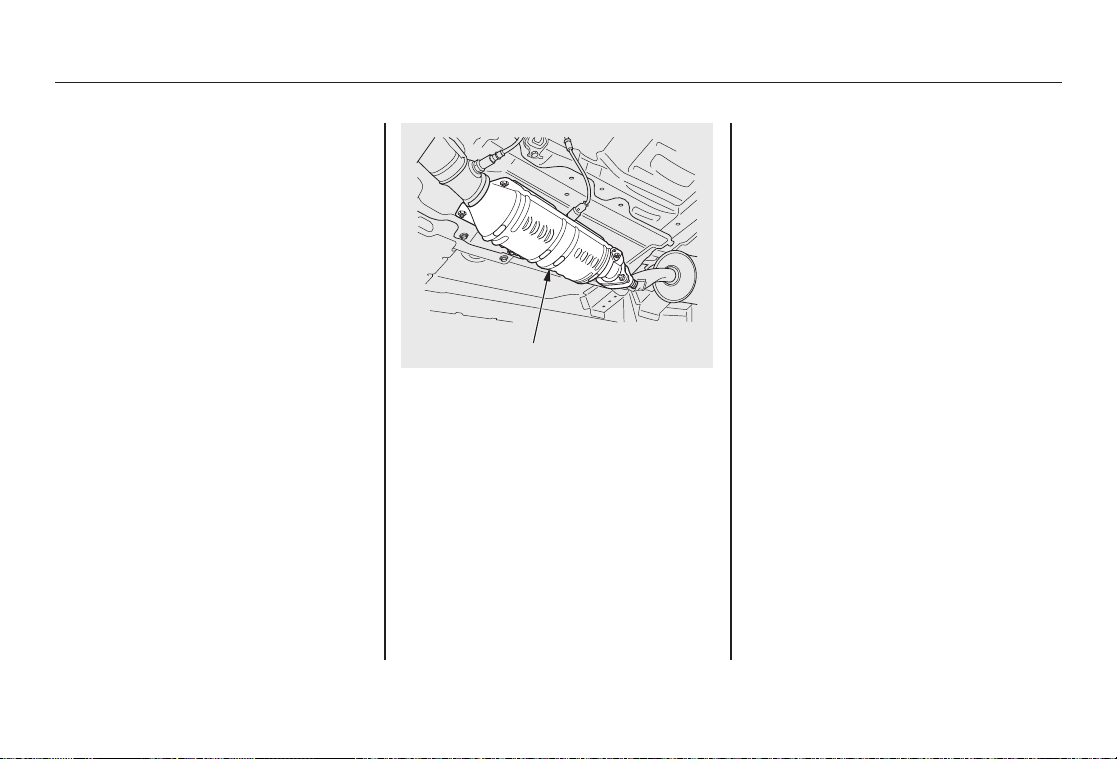
The three way catalytic converter
contains precious metals that serve
as catalysts, promoting chemical
reactions to convert the exhaust
gasses without affecting the metals.
The catalytic converter is referred to
as a three-way catalyst, since it acts
on HC, CO, and NOx. A replacement
unit must be an original Honda part
or its equivalent.
The three way catalytic converter
must operate at a high temperature
for the chemical reactions to take
place. It can set on fire any
combustible materials that come
near it. Park your vehicle away from
high grass, dry leaves, or other
flammables.
A defective three way catalytic
converter contributes to air pollution,
and can impair your engine's
performance. Follow these
guidelines to protect your vehicle's
three way catalytic converter.
●
Always use unleaded gasoline.
Even a small amount of leaded
gasoline can contaminate the
catalyst metals, making the three
way catalytic converter ineffective.
●
Keep the engine well maintained.
●
Have your vehicle diagnosed and
repaired if it is misfiring,
backfiring, stalling, or otherwise
not running properly.
THREE WAY CATALYTIC CONVERTER
Three Way Catalytic Converter
260
10/08/06 08:34:41 11 ELEMENT MMC North America Owner's Man 50 31SCV680 enu

Testing of Readiness Codes
If you take your vehicle for an
emissions test shortly after the
battery has been disconnected or
gone dead, it may not pass the test.
This is because of certain ‘‘readiness
codes’’ that must be set in the on-
board diagnostics for the emissions
systems. These codes are erased
when the battery is disconnected,
and set again only after several days
of driving under a variety of
conditions.
If the testing facility determines that
the readiness codes are not set, you
will be requested to return at a later
date to complete the test. If you must
get the vehicle retested within the
next two or three days, you can
condition the vehicle for retesting by
doing the following.
1. Make sure the fuel tank is nearly,
but not completely full (around
3/4).
2. Make sure the vehicle has been
parked with the engine off for 6
hours or more.
3. Make sure the ambient
temperature is between 40° and
95°F (4° and 35°C).
4. Without touching the accelerator
pedal, start the engine, and let it
idle for 20 seconds.
5. Keep the vehicle in Park. Increase
the engine speed to 2,000 rpm, and
hold it there until the temperature
gauge rises to at least 1/4 of the
scale (about 3 minutes).
6. Without touching the accelerator
pedal, let the engine idle for 20
seconds.
CONTINUED
Emissions Testing
261
Technical Information
10/08/06 08:34:41 11 ELEMENT MMC North America Owner's Man 50 31SCV680 enu

7. Select a nearby lightly traveled
major highway where you can
maintain a speed of 50 to 60 mph
(80 to 97 km/h) for at least 20
minutes. Drive on the highway in
D. Do not use cruise control.
When traffic allows, drive for 90
seconds without moving the
accelerator pedal. (Vehicle speed
may vary slightly; this is okay.) If
you cannot do this for a continuous
90 seconds because of traffic
conditions, drive for at least 30
seconds, then repeat it two more
times (for a total of 90 seconds).
8. Then drive in city/suburban traffic
for at least 10 minutes. When
traffic conditions allow, let the
vehicle coast for several seconds
without using the accelerator pedal
or the brake pedal.
9. Make sure the vehicle has been
parked with the engine off for 30
minutes.
If the testing facility determines the
readiness codes are still not set, see
your dealer.
Emissions Testing
262
10/08/06 08:34:41 11 ELEMENT MMC North America Owner's Man 50 31SCV680 enu
Customer Service Information .... 264
Warranty Coverages
................... 265
Reporting Safety Defects
............. 266
Authorized Manuals
.................... 267
Warranty and Customer Relations
263
Warranty and Customer Relations
10/08/06 08:34:41 11 ELEMENT MMC North America Owner's Man 50 31SCV680 enu

Honda dealership personnel are
trained professionals. They should
be able to answer all your questions.
If you encounter a problem that your
dealership does not solve to your
satisfaction, please discuss it with the
dealership's management. The
service manager or general manager
can help. Almost all problems are
solved in this way.
If you are dissatisfied with the
decision made by the dealership's
management, contact Honda
Customer Service.
U.S. Owners:
American Honda Motor Co., Inc.
Automobile Customer Service
Mail Stop 500-2N-7A
1919 Torrance Boulevard
Torrance, California 90501-2746
Tel: (800) 999-1009
In Puerto Rico and the U.S. Virgin
Islands:
Bella International
P.O. Box 190816
San Juan, PR 00919-0816
Tel: (787) 620-7546
When you call or write, please give
us this information:
●
Vehicle identification number (see
page 248)
●
Name and address of the dealer
who services your vehicle
●
Date of purchase
●
Odometer reading of your vehicle
●
Your name, address, and
telephone number
●
A detailed description of the
problem
●
Name of the dealer who sold the
vehicle to you
Customer Service Information
264
10/08/06 08:34:41 11 ELEMENT MMC North America Owner's Man 50 31SCV680 enu

Your new vehicle is covered by these
warranties:
New Vehicle Limited Warranty
-
covers your new vehicle, except for
the emissions control systems and
accessories, against defects in
materials and workmanship.
Emissions Control Systems Defects
Warranty and Emissions
Performance Warranty
- these two
warranties cover your vehicle's
emissions control systems. Time,
mileage, and coverage are
conditional. Please read your
warranty booklet for exact
information.
Seat Belt Limited Warranty
- a seat
belt that fails to function properly is
covered by a limited warranty. Please
read your warranty booklet for
details.
Rust Perforation Limited Warranty
-
all exterior body panels are covered
for rust-through from the inside for
the specified time period with no
mileage limit.
Accessory Limited Warranty
-
Honda accessories are covered
under this warranty. Time and
mileage limits depend on the type of
accessory and other factors. Please
read your warranty booklet for
details.
Replacement Parts Limited
Warranty
- covers all Honda
replacement parts against defects in
materials and workmanship.
Replacement Battery Limited
Warranty
- provides prorated
coverage for a replacement battery
purchased from your dealer.
Replacement Muffler Lifetime
Limited Warranty
- provides
coverage for as long as the purchaser
of the muffler owns the vehicle.
Restrictions and exclusions apply to
all these warranties. Please read the
2011 Honda warranty information
booklet that came with your vehicle
for precise information on warranty
coverages. Your vehicle's original
tires are covered by their
manufacturer. Tire warranty
information is in a separate booklet.
Warranty Coverages
265
Warranty and Customer Relations
10/08/06 08:34:41 11 ELEMENT MMC North America Owner's Man 50 31SCV680 enu

If you believe that your vehicle has a
defect which could cause a crash or
could cause injury or death, you
should immediately inform the
National Highway Traffic Safety
Administration (NHTSA) in addition
to notifying American Honda Motor
Co., Inc.
If NHTSA receives similar
complaints, it may open an
investigation, and if it finds that a
safety defect exists in a group of
vehicles, it may order a recall and
remedy campaign. However, NHTSA
cannot become involved in individual
problems between you, your dealer,
or American Honda Motor Co., Inc.
To contact NHTSA, you may call the
Vehicle Safety Hotline toll-free at
1-888-327-4236
(TTY: 1-800-424-9153); go to
http://www.safercar.gov; or write to:
Administrator, NHTSA, 1200 New
Jersey Avenue, SE., Washington, DC
20590.
You can also obtain other information
about motor vehicle safety from
http://www.safercar.gov.
Reporting Safety Defects
266
10/08/06 08:34:41 11 ELEMENT MMC North America Owner's Man 50 31SCV680 enu
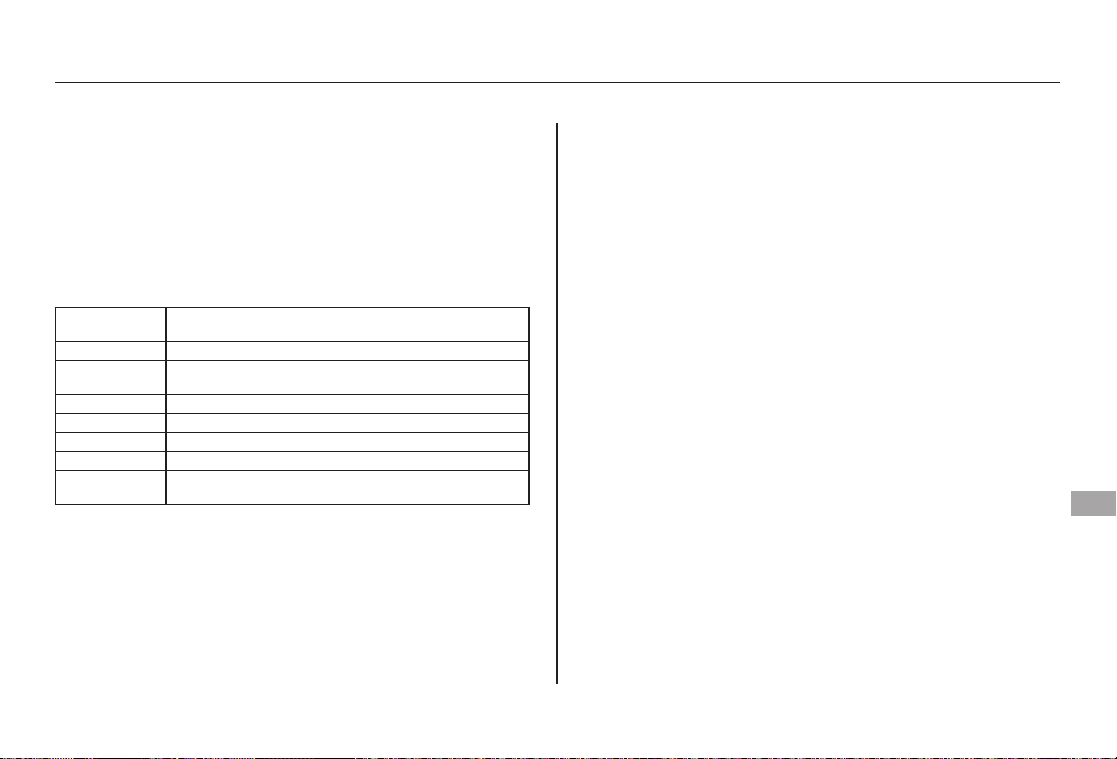
Purchasing Factory Authorized Manuals
The publications shown below can be purchased from Helm
Incorporated. You can order by phone or online:
●
Call Helm Inc. at (800)782-4356 (credit card orders only)
●
Go online at www. helminc. com
If you are interested in other years or models, contact Helm Inc.
at (800) 782-4356.
Publication
Form Number
Form Description
61SCV09 2011 Honda Element Service Manual
61SCV09EL 2011 Honda Element
Electrical Troubleshooting Manual
61SCV30 2009 Honda Element Body Repair Manual
31SCV680 2011 Honda Element Owner's Manual
31SCVM60 2011 Honda Element Honda Service History
31SCVQ80 2011 Honda Element Technology Reference Guide
HON-R Order Form for Previous Years-
Indicate Year and Model Desired
Service Manual:
Covers maintenance and recommended procedures for
repair to engine and chassis components. It is written
for the journeyman mechanic, but it is simple enough
for most mechanically inclined owners to understand.
Electrical Troubleshooting Manual:
Complements the Service Manual by providing in-depth
troubleshooting information for each electrical circuit in
your vehicle.
Body Repair Manual:
Describes the procedures involved in the replacement
of damaged body parts.
Authorized Manuals
267
Warranty and Customer Relations

268
10/08/06 08:34:41 11 ELEMENT MMC North America Owner's Man 50 31SCV680 enu
A
Accessories and
Modifications
.......................... 149
ACCESSORY (Ignition Key
Position)
................................... 79
Accessory Power Sockets
.......... 100
Additives, Engine Oil
................. 194
Adjusting the Steering Wheel
...... 74
Advanced Airbags
........................ 26
Airbag (SRS)
............................ 9, 22
Air Conditioning System
............ 104
Air Pressure, Tires
.............. 212, 213
Alcohol in Gasoline
.................... 142
Antifreeze
................................... 196
Anti-lock Brakes (ABS)
Indicator
............................ 59, 168
Operation
................................ 167
Anti-theft, Audio System
............. 132
Anti-theft Steering Column
Lock
......................................... 79
Audio System
............................. 109
Automatic Seat Belt Tensioners
... 20
Automatic Speed Control
........... 137
Automatic Transmission
............ 161
Capacity, Fluid
........................ 251
Checking Fluid Level
.............. 198
Shifting
................................... 161
Shift Lever Position
Indicators
............................ 161
Shift Lever Positions
............... 161
Shift Lock Release
................... 163
Auxiliary Input Jack
................... 136
B
Battery
Charging System
Indicator
........................ 58, 235
Jump Starting
.......................... 231
Maintenance
........................... 218
Specifications
.......................... 252
Before Driving
........................... 141
Belts, Seat
................................ 8, 18
Beverage Holders
........................ 99
Booster Seats
............................... 50
Brakes
Anti-lock Brakes (ABS)
........... 167
Break-in, New Linings
............. 142
Bulb Replacement
................... 206
Fluid
....................................... 199
Parking
.................................... 94
System Design
........................ 166
System Indicator
............... 58, 237
Wear Indicators
....................... 167
Braking System
.......................... 166
Break-in, New Vehicle
................ 142
Brightness Control,
Instruments
.............................. 72
Bulb Replacement
Back-up Lights
........................ 206
Brake Lights
........................... 206
Daytime Running Lights
......... 203
Front Parking/Turn Signal
Lights
.................................. 204
Front Side Marker Lights
........ 206
Headlights
.............................. 202
High-mount Brake Light
......... 208
Rear Bulbs
.............................. 206
Rear License Plate Lights
........ 207
Side Turn Signal Lights
........... 204
Specifications
.......................... 252
Taillights
................................. 206
Turn Signal Lights
.......... 204, 206
CONTINUED
Index
I
INDEX
10/08/06 08:34:41 11 ELEMENT MMC North America Owner's Man 50 31SCV680 enu
Bulbs, Halogen ...................... .... 202
Bungee Cords
............................ 155
C
Capacities Chart ......................... 251
Carbon Monoxide Hazard
............ 52
Cargo
......................................... 151
Cargo Area Light
.......................... 96
Cargo Hooks
.............................. 156
Cargo, How to Carry
.................. 151
Carrying Cargo
.......................... 151
CAUTION, Explanation of
............ iii
CD Care
..................................... 127
Ceiling Light
................................ 96
Certification Label
...................... 248
Chains, Tires
.............................. 217
Changing a Flat Tire
.................. 223
Changing Oil
How to
.................................... 194
When to
.................................. 185
Charging System
Indicator
........................... 58, 235
Check Fuel Cap Message
............ 66
Checklist, Before Driving
........... 159
Child Safety
.................................. 35
Booster Seats
........................... 50
Child Seats
.................... 40, 41, 42
Important Safety Reminders
..... 39
Infants
...................................... 40
Larger Children
....................... 49
LATCH
..................................... 44
Risks with Airbags
................... 36
Small Children
......................... 41
Tethers
.................................... 48
Warning Labels
........................ 37
Where Should a Child Sit?
........ 36
Child Seats
............................. 35, 42
LATCH Anchorage Points
........ 44
Tether Anchorage Points
......... 48
Cleaning the Seat Belts
.............. 209
Clock
.......................................... 133
Code, Audio System
................... 132
CO in the Exhaust
................ 52, 258
Cold Weather, Starting in
........... 160
Compact Spare Tire
.................... 222
Controls, Instruments and
............ 55
Coolant
Adding
.................................... 196
Checking
................................ 145
Proper Solution
....................... 196
Temperature Gauge
................. 67
Cooler Box
................................... 98
Crankcase Emissions Control
System
................................... 258
Cruise Control Indicator
............... 60
Cruise Control Operation
........... 137
Cruise Main Indicator
.................. 60
Cup Holders
................................. 99
Customer Service
....................... 264
D
DANGER, Explanation of ............. iii
Dashboard
............................... 3, 56
Daytime Running Lights
.............. 72
Daytime Running Lights
Indicator
................................... 60
Dead Battery
.............................. 231
Defects, Reporting Safety
........... 266
Defogger, Rear Window
............... 74
Dimensions
................................ 250
Dimming the Headlights
.............. 71
Dipstick
Automatic Transmission
......... 198
Engine Oil
............................... 145
Index
II
10/08/06 08:34:41 11 ELEMENT MMC North America Owner's Man 50 31SCV680 enu
Directional Signals ................. 60, 71
Disc Brake Wear Indicators
....... 167
Disc Care
................................... 127
Disc Changer Error
Messages
............................... 126
Disc Player Error Messages
...... 125
Disposal of Used Oil
................... 195
Doors
Indicator
................................... 11
Locking and Unlocking
............ 80
Power Door Locks
................... 80
DOT Tire Quality Grading (U.S.
Vehicles)
................................ 253
Driver and Passenger Safety
.......... 5
Driving
....................................... 157
Economy
................................. 146
Driving Guidelines
..................... 158
Dust and Pollen Filter
................ 210
E
Economy, Fuel ........................... 146
Emergencies on the Road
.......... 221
Battery, Jump Starting
............. 231
Brake System Indicator
..... 58, 237
Changing a Flat Tire
............... 223
Charging System
Indicator
........................ 58, 235
Checking the Fuses
................ 239
Driving with a Flat Tire
........... 223
Hazard Warning Flashers
........ 73
Jump Starting
.......................... 231
Low Oil Pressure
Indicator
........................ 58, 235
Malfunction Indicator
Lamp
............................. 58, 236
Overheated Engine
................. 233
Towing
.................................... 244
Emergency Brake
........................ 94
Emergency Flashers
.................... 73
Emergency Towing
.................... 244
Emissions Controls
.................... 258
Emissions Testing
...................... 261
Engine
Adding Engine Coolant
........... 196
Coolant Temperature Gauge
.... 67
If it Won't Start
........................ 229
Malfunction Indicator
Lamp
............................. 58, 236
Oil Life Indicator
..................... 185
Oil Pressure Indicator
....... 58, 235
Oil, What Kind to Use
............. 193
Overheating
............................ 233
Specifications
.......................... 250
Speed Limiter
.......................... 163
Starting
................................... 160
Engine Coolant
.......................... 196
Engine Number
......................... 249
Ethanol in Gasoline
.................... 142
Evaporative Emissions
Controls
.................................. 258
Exhaust Fumes
............................ 52
Expectant Mothers, Use of Seat
Belts by
.................................... 16
F
Fan, Interior ............................... 105
Features
..................................... 103
Filters
Dust and Pollen
....................... 210
Oil
........................................... 194
Flashers, Hazard Warning
........... 73
Flat Tire, Changing a
................. 223
Floor Mats
................................. 209
CONTINUED
Index
III
INDEX
10/08/06 08:34:41 11 ELEMENT MMC North America Owner's Man 50 31SCV680 enu
Fluids
Automatic Transmission
......... 198
Brake
...................................... 199
Location
.................................. 192
Power Steering
........................ 200
Windshield Washer
................. 197
FM/AM Radio Reception
........... 130
Folding the Rear Seats
................. 88
Four-way Flashers
........................ 73
Front Airbags
........................... 9, 24
Front Seat
Adjusting
.................................. 83
Fuel
............................................ 142
Check Fuel Cap Message
........ 66
Economy
................................. 146
Fill Door and Cap
.................... 143
Gauge
...................................... 66
Low Fuel Indicator
................... 61
Octane Requirement
............... 142
Reserve Indicator
..................... 61
Tank, Filling the
...................... 143
Fuel Economy
............................ 146
Fuses, Checking the
.................. 239
G
Gas Mileage, Improving ............. 147
Gasoline
..................................... 142
Gauge
...................................... 66
Low Fuel Indicator
................... 61
Octane Requirement
............... 142
Tank, Refueling
....................... 143
Gas Station Procedures
.............. 143
Gauges
Engine Coolant Temperature
... 67
Fuel
.......................................... 66
Odometer
................................. 65
Outside Temperature
Indicator
............................... 68
Speedometer
............................ 64
Tachometer
.............................. 64
Trip meter
................................ 66
Gearshift Lever Positions
Automatic
Transmission
....................... 161
Glove Box
.................................. 100
Gross Axle Weight Rating
(GAWR)
................................. 174
Gross Vehicle Weight Rating
(GVWR)
.......................... 153, 174
H
Halogen Headlight Bulbs ........... 202
Hatch
........................................... 81
Hazard Warning Flashers
............ 73
Headlights
Aiming
.................................... 201
Daytime Running Lights
.......... 72
High Beam Indicator
................ 61
High Beams, Turning on
.......... 71
Lights On Indicator
.................. 61
Low Beams, Turning on
........... 71
Reminder Chime
...................... 71
Replacing Halogen Bulbs
........ 202
Turning on
............................... 71
Head Restraints
............................ 85
Heating and Cooling
.................. 104
High Altitude, Starting at
............ 160
Hood, Opening and Closing
the
.......................................... 144
Horn
........................................ 4, 69
Index
IV
10/08/06 08:34:41 11 ELEMENT MMC North America Owner's Man 50 31SCV680 enu
I
Identification Number,
Vehicle
................................... 248
Ignition
Keys
......................................... 75
Switch
...................................... 79
Immobilizer System
..................... 76
Important Safety Precautions
......... 6
Indicators, Instrument Panel
........ 57
ABS (Anti-lock Brake)
....... 59, 168
Brake (Parking and Brake
System)
......................... 58, 237
Charging System
.............. 58, 235
Cruise Control
.......................... 60
Cruise Main
............................. 60
Door and Tailgate Open
........... 61
DRL (Daytime Running
Lights)
.................................. 60
High Beam
............................... 61
Key (Immobilizer System)
....... 60
Lights On
................................. 61
Low Fuel
.................................. 61
Low Oil Pressure
.............. 58, 235
Low Tire Pressure
............. 62, 169
Maintenance Minder
TM
..... 59, 185
Malfunction Indicator
Lamp
............................. 58, 236
Passenger Airbag Off
............... 32
Seat Belt Reminder
............. 18, 58
Side Airbag Off
.................... 31, 59
SRS
..................................... 30, 59
TPMS
................................ 63, 170
Turn Signal and Hazard
Warning
............................... 60
VSA OFF
.................................. 62
VSA System
............................. 62
Individual Map Lights
.................. 95
Infant Restraint
............................ 40
Infant Seats
.................................. 40
Tether Anchorage Points
......... 48
Inflation, Proper Tire
.................. 212
Recommended Pressures
....... 213
Inside Mirror
............................... 93
Inspection, Tire
.......................... 214
Installing a Child Seat
.................. 43
Instrument Panel
.......................... 57
Instrument Panel Brightness
....... 72
Instruments and Controls
............. 55
Interior Lights
.............................. 95
Introduction
................................... i
J
Jacking up the Vehicle ............... 223
Jack, Tire
................................... 223
Jump Starting
............................. 231
K
Keys ............................................. 75
L
Label, Certification ..................... 248
Lane Change, Signaling
............... 71
Lap/Shoulder Belt
................. 14, 19
LATCH Anchorage System
.......... 44
Light Control Switch
.................... 95
Lights
Bulb Replacement
................... 202
Indicator
................................... 57
Interior
..................................... 95
Parking
.................................... 71
Turn Signal
.............................. 71
Load Limit
.................................. 152
CONTINUED
Index
V
INDEX
10/08/06 08:34:41 11 ELEMENT MMC North America Owner's Man 50 31SCV680 enu
LOCK (Ignition Key Position) ...... 79
Locks
Anti-theft Steering Column
....... 79
Fuel Fill Door
.......................... 143
Glove Box
............................... 100
Hatch
....................................... 81
Lockout Prevention
.................. 81
Power Door
.............................. 80
Tailgate
.................................... 82
Low Coolant Level
...................... 145
Lower Anchors
............................. 44
Low Fuel Indicator
....................... 61
Low Oil Pressure
Indicator
........................... 58, 235
Lubricant Specifications Chart
... 251
Luggage, Storing (cargo)
........... 151
M
Maintenance .............................. 183
Main Items and Sub Items
...... 188
Minder
.................................... 185
Minder Indicator
...................... 59
Owner's Maintenance
Checks
................................ 190
Safety
...................................... 184
Malfunction Indicator
Lamp
................................ 58, 236
Meters, Gauges
............................ 64
Methanol in Gasoline
................. 142
Mirrors, Adjusting
........................ 93
Modifications
............................. 150
Modifying Your Vehicle
............. 150
N
Neutral Gear Position ................. 162
New Vehicle Break-in
................. 142
NOTICE, Explanation of
................ i
Numbers, Identification
............. 248
O
Octane Requirement,
Gasoline
................................. 142
Odometer
..................................... 65
Off-Highway Driving
Guidelines
.............................. 180
Off-Road Precautions
.................. 180
Oil
Change, How to
...................... 194
Change, When to
.................... 185
Checking Engine
.................... 145
Life, Engine
............................. 185
Pressure Indicator
............. 58, 235
Selecting Proper Viscosity
Chart
................................... 193
Onboard Refueling Vapor
Recovery
................................ 258
ON (Ignition Key Position)
.......... 79
Opening the Tailgate
.................... 82
Outside Mirrors
........................... 93
Outside Temperature Indicator
.... 68
Overhead Console
...................... 101
Overheating, Engine
.................. 233
Owner's Maintenance Checks
.... 190
Oxygenated Fuels
...................... 142
P
Panel Brightness Control ............. 72
Park Gear Position
..................... 161
Parking
...................................... 165
Parking Brake
.............................. 94
Index
VI
10/08/06 08:34:41 11 ELEMENT MMC North America Owner's Man 50 31SCV680 enu
Parking Brake and Brake System
Indicator
........................... 58, 237
Parking Over Things that
Burn
................................ 165, 260
Passenger Airbag Off Indicator
.... 32
PGM-FI System
.......................... 259
Playing a Disc
............................ 119
Pollen Filter
............................... 210
Power Door Locks
....................... 80
Power Socket Locations
............. 100
Power Steering Fluid
................. 200
Power Windows
........................... 92
Pregnancy, Using Seat Belts
........ 16
Preparing to Drive
...................... 159
Proper Seat Belt Usage
................ 14
Protecting Adults and Teens
........ 11
Additional Safety Precautions
... 16
Advice for Pregnant Women
.... 16
Protecting Children
...................... 35
General Guidelines
.................. 35
Protecting Infants
..................... 40
Protecting Larger Children
...... 49
Protecting Small Children
........ 41
Using Child Seats with
Tethers
................................. 48
Using LATCH
.......................... 44
R
Radiator Overheating ................. 233
Radio/CD Sound System
........... 109
Radio Theft Protection
............... 132
Readiness Codes
........................ 261
Rear Lights, Bulb
Replacement
........................... 206
Rear Seat, Folding
........................ 88
Rearview Mirror
........................... 93
Rear Window Defogger
................ 74
Rear Window Wiper and
Washer
..................................... 70
Reclining the Front Seats
............. 87
Refueling
.................................... 143
Reminder Indicators
..................... 58
Remote Audio Controls
.............. 135
Remote Transmitter
..................... 77
Replacement Information
Dust and Pollen Filter
............. 210
Engine Oil and Filter
............... 194
Fuses
...................................... 239
Light Bulbs
............................. 202
Spark Plugs
............................. 250
Tires
....................................... 215
Wiper Blades
.......................... 210
Replacing Seat Belts After a
Crash
........................................ 20
Reporting Safety Defects
............ 266
Reserve Tank, Engine
Coolant
............................ 145, 196
Restraint, Child
............................ 35
Reverse Gear Position
................ 162
Rotation, Tire
............................. 215
S
Safety Belts .............................. 8, 18
Safety Defects, Reporting
........... 266
Safety Features
.............................. 7
Airbags
................................. 9, 22
Door Locks
.............................. 11
Head Restraints
........................ 13
Seat Belts
........................ 8, 14, 18
Seats & Seat-Backs
.............. 11, 12
Safety Labels, Location of
............. 53
Safety Messages
.......................... iii
Seat Adjustments
......................... 83
CONTINUED
Index
VII
INDEX
10/08/06 08:34:41 11 ELEMENT MMC North America Owner's Man 50 31SCV680 enu

Seat Belts ................................. 8, 18
Additional Information
............. 18
Advice for Pregnant Women
.... 16
Automatic Seat Belt
Tensioners
........................... 20
Cleaning
.................................. 209
Lap/Shoulder Belt
.............. 14, 19
Maintenance
............................ 20
Reminder Indicator and
Beeper
............................. 18, 58
System Components
................ 18
Use During Pregnancy
............. 16
Wearing a Lap/Shoulder
Belt
.................................. 14, 19
Seats
............................................ 83
Head Restraints
........................ 85
Seats, Adjusting the
..................... 83
Sensors
Driver's Seat Position Sensor
... 26
Front Passenger's Weight
Sensors
................................ 26
Impact Sensors
........................ 22
Serial Number
............................ 248
Service Intervals
......................... 185
Service Manual
.......................... 267
Service Station Procedures
........ 143
Setting the Clock
........................ 133
Shifting the Automatic
Transmission
.......................... 161
Shift Lever Position Indicators
... 161
Shift Lock Release
...................... 163
Side Airbags
................................. 28
How the Side Airbag Off
Indicator Works
................... 31
How Your Side Airbags Work
.. 28
Side Curtain Airbags
.................... 29
How Your Side Curtain Airbags
Work
.................................... 29
Side Marker Lights, Bulb
Replacement in
....................... 206
Signaling Turns
............................ 60
Snow Tires
................................. 217
Sound System
............................ 109
Spare Tire
.................................. 222
Inflating
........................... 212, 222
Specifications
.......................... 252
Spark Plugs
................................ 250
Specifications
............................. 250
Speed Control
............................ 137
Speed Limiter
............................. 163
Speedometer
................................ 64
SRS, Additional Information
......... 22
Additional Safety Precautions
... 33
Airbag Service
.......................... 33
Airbag System Components
..... 22
How the Side Airbag Off
Indicator Works
................... 31
How the SRS Indicator Works
.. 30
How Your Front Airbags
Work
.................................... 24
How Your Side Airbags Work
.. 28
How Your Side Curtain Airbags
Work
.................................... 29
SRS Indicator
......................... 30, 59
START (Ignition Key Position)
..... 79
Starting the Engine
.................... 160
In Cold Weather at High
Altitude
................................ 160
With a Dead Battery
................ 231
State Emissions Testing
............. 261
Steam Coming from Engine
....... 233
Steering Wheel
Adjustment
............................... 74
Anti-theft Column Lock
............ 79
Buttons
........................... 135, 137
Stereo Sound System
.......... 109, 110
Storing Your Vehicle
.................. 219
Index
VIII
10/08/06 08:34:41 11 ELEMENT MMC North America Owner's Man 50 31SCV680 enu
Sun Visor ................................... 100
Supplemental Restraint
System
.............................. 9, 22
Servicing
.................................. 33
SRS Indicator
...................... 30, 59
System Components
................ 22
Synthetic Oil
.............................. 194
T
Tachometer .................................. 64
Tailgate
........................................ 82
Open Indicator
......................... 61
Opening the
............................. 82
Taillights, Changing Bulbs in
..... 206
Taking Care of the
Unexpected
............................ 221
Technical Descriptions
DOT Tire Quality Grading (U.S.
Vehicles)
............................. 253
Emissions Control Systems
..... 258
Three Way Catalytic
Converter
............................ 260
Tire Labeling
........................... 255
Tire Pressure Monitoring System
(TPMS) - Required Federal
Explanation
...................... 256
Temperature Gauge
..................... 67
Tensioners, Seat Belts
.................. 20
Tether Anchorage Points
............. 48
Theft Protection, Radio
.............. 132
Three Way Catalytic
Converter
............................... 260
Tilt the Steering Wheel
................ 74
Time, Setting the
........................ 133
Tire Chains
................................ 217
Tire, How to Change a Flat
........ 223
Tire Information
......................... 255
Tire Labeling
.............................. 255
Tire Pressure Monitoring System
(TPMS)
........................... 169, 256
Tires
.......................................... 212
Air Pressure
............................ 213
Chains
..................................... 217
Checking Wear
....................... 214
Compact Spare
........................ 222
DOT Tire Quality Grading (U.S.
Vehicles)
............................. 253
Inflation
................................... 212
Inspection
............................... 214
Labeling
.................................. 255
Low Tire Pressure
Indicator
........................ 62, 169
Maintenance
........................... 215
Pressure Monitoring System
... 169
Replacing
................................ 215
Rotating
.................................. 215
Snow
....................................... 217
Specifications
.......................... 252
Tools, Tire Changing
................. 223
Towing
A Trailer
.................................. 174
Emergency Wrecker
............... 244
TPMS (Tire Pressure Monitoring
System)
.............................. 169
Indicator
............................ 63, 170
Required Federal
Explanation
......................... 256
Transmission
Checking Fluid Level
.............. 198
Fluid Selection
........................ 198
Identification Number
............. 248
Shifting the Automatic
............. 161
Treadwear
.................................. 253
Trip Meter
................................... 66
CONTINUED
Index
IX
INDEX
10/08/06 08:34:41 11 ELEMENT MMC North America Owner's Man 50 31SCV680 enu
Turn Signals ................................. 60
Turn Signals and Headlights
........ 71
U
Unexpected, Taking Care of
the
.......................................... 221
Uniform Tire Quality Grading
(U.S. only)
.............................. 253
Unleaded Gasoline
..................... 142
Used Oil, How to Dispose of
...... 195
V
Vanity Mirror ............................. 101
Vehicle Capacity Load
................ 152
Vehicle Dimensions
................... 250
Vehicle Identification Number
... 248
Vehicle Stability Assist (VSA
®
),
aka Electronic Stability
Control (ESC), System
VSA OFF Indicator
.................. 172
Vehicle Stability Assist (VSA)
System
................................ 172
VSA OFF Indicator
................... 62
VSA OFF Switch
..................... 173
VSA System Indicator
.............. 62
Vehicle Storage
.......................... 219
Ventilation
.................................. 106
VIN
............................................ 248
Viscosity, Oil
.............................. 193
W
WARNING, Explanation of ........... iii
Warning Labels, Location of
......... 53
Warranty Coverages
.................. 265
Washer, Windshield
Checking the Fluid Level
........ 197
Operation
................................. 70
Wheels
....................................... 212
Adjusting the Steering
.............. 74
Alignment and Balance
........... 215
Compact Spare
........................ 222
Wrench, Nut
........................... 223
Windows
Operating the Power
................ 92
Rear, Defogger
......................... 74
Windshield
Cleaning
................................... 70
Defroster
................................. 107
Washers
............................ 70, 197
Wipers, Windshield
Changing Blades
..................... 210
Operation
................................. 70
Worn Tires
................................. 214
Wrecker, Emergency Towing
.... 244
Index
X
10/08/06 08:34:41 11 ELEMENT MMC North America Owner's Man 50 31SCV680 enu

10/08/06 08:34:41 11 ELEMENT MMC North America Owner's Man 50 31SCV680 enu

Gasoline:
Unleaded gasoline, pump octane
number of 87 or higher.
Fuel Tank Capacity:
15.9 US gal (60 L)
Recommended Engine Oil:
API Premium grade 5W-20
detergent oil (see page 193).
Oil change capacity (including
filter):
4.4 US qt (4.2 L)
Automatic Transmission Fluid:
Honda ATF DW-1 (automatic
transmission fluid) (see page 198).
4WD models only
Rear Differential Fluid:
Honda Dual Pump Fluid II. Do not
use ATF.
Capacity:
1.1 US qt (1.0 L)
Power Steering Fluid:
Honda Power Steering Fluid
preferred, or another brand of
power steering fluid as a
temporary replacement. Do not
use ATF (see page 200).
Brake Fluid:
Honda Heavy Duty Brake Fluid
DOT 3 preferred, or a DOT 3 or
DOT 4 brake fluid as a temporary
replacement (see page 199).
Tire Pressure (measured cold):
Front:
33 psi (230 kPa, 2.3 kgf/cm
2
)
Rear:
35 psi (240 kPa, 2.4 kgf/cm
2
)
Spare Tire Pressure:
60 psi (420 kPa, 4.2 kgf/cm
2
)
Service Information Summary
10/08/06 08:34:41 11 ELEMENT MMC North America Owner's Man 50 31SCV680 enu