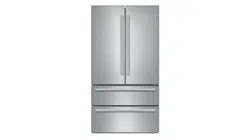
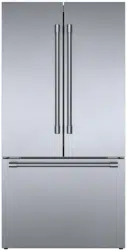
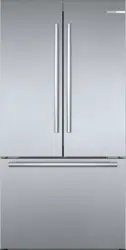
User Manual Refrigerator
Installing the appliance
Have a qualified technician install and connect the appliance according to the enclosed Installation Instructions.
WARNING
- Do not install the appliance: outdoors,
- in an environment subject to drips of water,
- in rooms with risk of freezing temperatures.
Transporting
The appliance is heavy and must be secured during transport and installation. The castors are provided for installation purposes only. Do not use the castors for transporting the appliance
WARNING Risk of injury! The appliance is very heavy. It can fall over and cause serious injuries during transport and installation. At least two people are required to install the appliance safely. Keep the refrigerator doors closed until the appliance is upright and level at the installation location. Hidden surfaces may have sharp edges. Use caution when reaching behind or under appliance.
Installation location
WARNING Risk of explosion! Do not install the appliance near explosive or flammable substances.
A dry, well-ventilated room is suitable as an installation location. The installation location should not be exposed to direct sunlight or placed near a heat source, e.g. a cooker, radiator, etc. If installation next to a heat source is unavoidable, use a suitable insulating plate or observe the following minimum distances from the heat source:
- 11/4 (3 cm) to electric or gas stoves.
- 113/16 (30 cm) to oil or solid fuel stoves.
To ensure that the Ice Maker functions correctly, the appliance must be upright and level.
Climatic classes
The climate class can be found on the rating plate. The climate class indicates within which ambient temperatures the appliance can be operated.
Climatic class ------ Permitted ambient temperature
SN --------------- 50 °F to 90 °F (+10 °C to 32 °C)
N --------------- 61 °F to 90 °F (+16 °C to 32 °C)
ST--------------- 61 °F to 100 °F (+16 °C to 38 °C)
T --------------- 61 °F to 110 °F (+16 °C to 43 °C)
Subsurface
NOTICE The appliance is very heavy. The floor on which the appliance is to be installed must be rigid. Reinforce the floor, if necessary.
Ventilation
The refrigeration unit is ventilated only via the ventilation grille in the base. Never cover the ventilation grille or place anything in front of it. Otherwise the refrigeration unit must work harder, increasing the power consumption.
Aligning the appliance
NOTICE To ensure that the appliance operates correctly, use a level to align the appliance. If the appliance is not level, water may flow out of the ice maker, ice cubes may be irregular, or the doors may not close properly.
1. Place the appliance in the designated location.
2. So that the appliance cannot move, unscrew the two front feet until they are standing firmly on the floor.
3. Screw the feet in/out until the appliance is exactly level.
4. Use the level to check if the appliance is level.
NOTICE To ensure that the appliance does not move, the front feet must be firmly planted on the floor.
5. If the height of the refrigerator compartment doors are uneven or if the freezer compartment drawer is slanted after adjusting the level of the appliance, use the following method to adjust them.
Adjusting the refrigerator doors
The appliance must be level in order to get the doors to align.
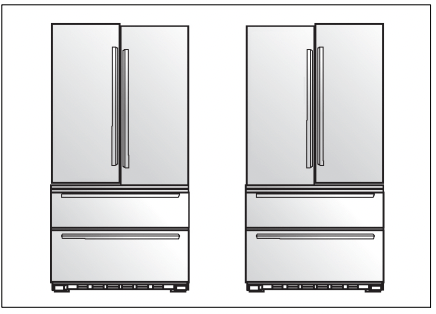
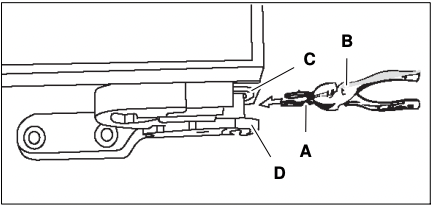
1. Raise the lower door up to the level of the higher door.
2. Insert the supplied fastener-ring (A) using a pair of pliers (B) in the gap between the hinge-grommet (C) and the lower hinge (D). The number of fasten-rings you will need to insert depends on the gap.
Installing the base plate
1. Mount the base plate.
2. Insert the three screws and tighten (the screws are located in the manual kit).
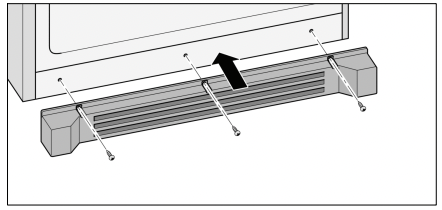
Connecting the appliance
Have a technician install and connect the appliance according to the enclosed Installation Instructions.
Do not remove the transportation protection devices from the shelves and storage compartments until the appliance has been installed and aligned.
Always connect the water before the power.
Apart from statutory national regulations, you should comply with all applicable local electricity and water companies' codes and requirements.
After installing the appliance, wait at least 6 hours before switching the appliance on. During transportation the oil in the compressor may have flowed into the refrigeration system.
Before switching the appliance on for the first time, clean the interior of the appliance (see chapter “Cleaning the Appliance”).
Water connection
WARNING Risk of electric shock and damage to the appliance! Disconnect the appliance from the power source before performing any work on the water connection. Only a qualified installation technician may connect the appliance to the water supply in accordance with plumbing and relevant water utility company regulations.
Connect the appliance to a drinking water line only:
- Minimum pressure: 0.17 MPa (1.72 bar, 24.95 PSI)
- Maximum pressure: 0.82 MPa (8.25 bar, 119.66 PSI)
- Pressure over 0.82 MPa (8.25 bar, 119.66 PSI): install a pressure limiter between drinking water connection and hose set.
The water should be connected only by a competent plumber according to the local regulations of the appropriate Water Supply company.
A cold water connection is necessary for operating the ice maker. The water pressure must be between MPa (1.72 bar, 24.95 PSI) and MPa (8.25 bar, 119.66 PSI). The installation must correspond to the local plumbing regulations.
A separate Shut-Off-Valve should be installed in the cold-water inflow.
The Shut-Off-Valve should not be located behind the appliance. It is recommended that you mount the Shut-Off-Valve directly next to the appliance or at another place that is easily accessible.
When installing the water connection, pay attention to the permissible installation area for the water line.
For connection to the drinking water line use only water pipes that are suitable for drinking water. Observe national regulations and the connection conditions of the local Water Supply companies.
Electrical connection
WARNING Risk of electric shock and fire if electrical connection is not installed properly! Plug into a fixed, grounded 3-prong outlet only. The outlet must be installed and grounded according to code by a qualified electrician. If necessary, have the installation inspected by a qualified electrician to ensure it is properly grounded. Never remove grounding conductor. Do not use an extension cord, adapters or power strip. Non-compliance with these instructions may result in death, fire or an electric shock. Improper connection of the grounding conductor may result in an electric shock. If you are in doubt whether the appliance has been grounded properly, have the appliance tested by a qualified electrician.
The receptacle must be installed according to the Installation Manual.
Connect the appliance to 115 V/60 Hz AC through a correctly installed 3-pole grounded receptacle. The receptacle must be protected with a 15 to 20 A fuse.
The appliance comes with a UL registered 3-wire Power Cord.
Please see the following table:

Check on the Rating Plate whether the indicated voltage and current type correspond with the values of your power supply. The location of the Rating Plate can be found in the chapter “Customer Service”.
WARNING Never connect the appliance to electronic energy saving devices. This appliance can be used with power line and sine-controlled inverters. Power line-controlled inverters are used for photovoltaic systems which are connected directly to the national grid. Sine-controlled inverters must be used for isolated applications (e.g. on ships or in mountain lodges) which are not connected directly to the national grid.
Installing the handles
Difference between the freezer and the refrigerator door handle
Handles are located inside of the carton box.
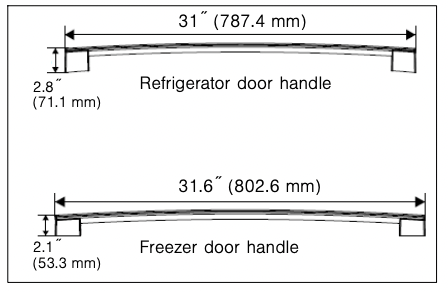
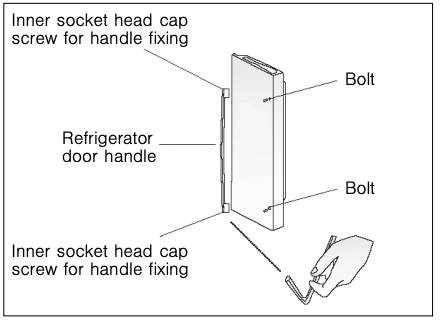
Refrigerator door handle
1. Take the refrigerator door handle out of the box and place it as per the direction shown in the figure (Note: i.e. the direction which both screw holes on the handle are close to the edge) and hang the handle above the set bolt.
2. Use the small hexagon wrench supplied in the box to set the handle screws into both the small screwed holes on the handle. After they are screwed down, gently shake the handle to confirm the handle is tightened.
Freezer door handle
The assembly steps of the freezer door handle are the same as the ones of the refrigerator door handle. During the assembly of the handle the direction of tapping hole is downward (towards the ground).
Appliance and Installation Dimensions
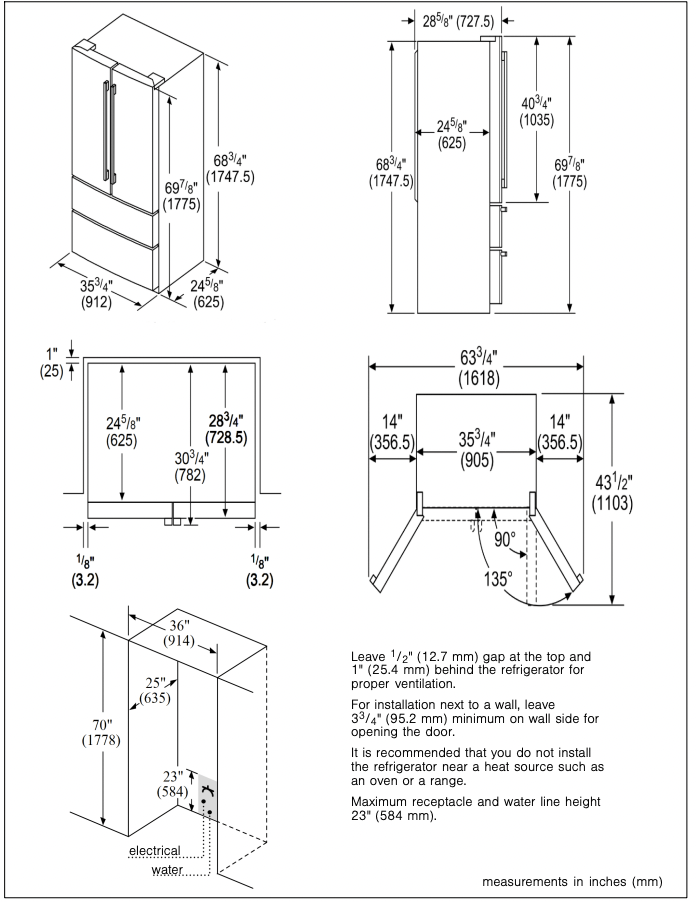
Getting to know your appliance
These operating and installation instructions apply to several models. The illustrations may differ from your particular model.
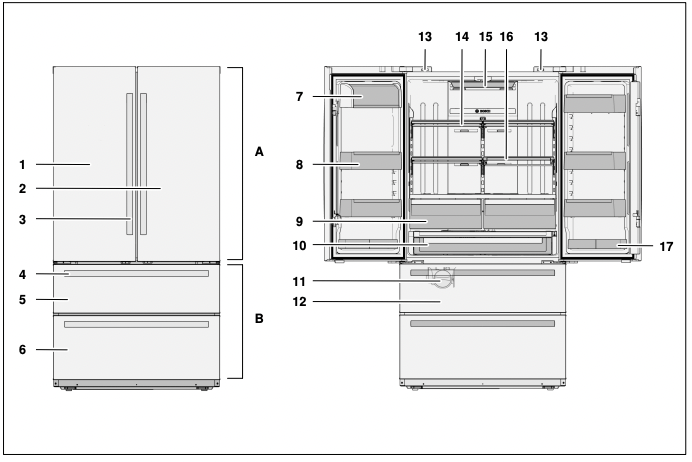
A Refrigerator compartment can be adjusted between 34 °F (+1 °C) and 44 °F (+7 °C)
B Freezer compartment can be adjusted between 9 °F (-13 °C) and -7 °F (-22 °C)
1 Left door for refrigerator compartment
2 Right door for refrigerator compartment
3 Door handle
4 Drawer handle
5 Upper freezer drawer
6 Lower freezer drawer
7 Dairy Bin
8 Door bin
9 Crisper drawers
10 Chiller drawer
11 Ice maker
12 Ice storage box
13 Switch for refrigerator compartment lamp
14 Adjustable shelf
15 Control and display panel
16 Retractable Shelf
17 Small tray
Control and display panel
Display
When turned on for the first time all button lamps and temperature displays shows for 3 seconds then it enters into screen extinction state.
Display control
After 30 seconds with no actions for door opening and no button operation the display panel light will go out. Every time the door is opened, closed or the display is touched, the display panel returns to normal.
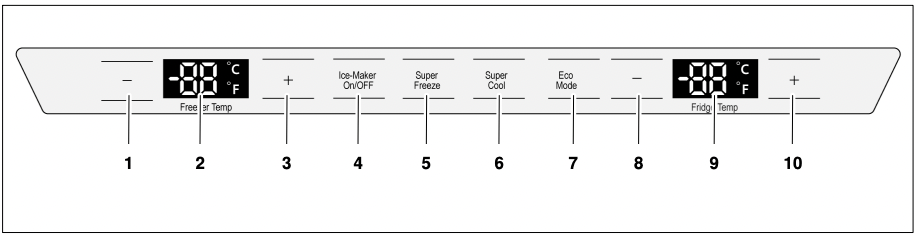
1 “Freezer Temp. –” button
Button for down-regulation of the temperature in the freezer compartment
2 Freezer compartment temperature display
Displays the temperature set for the freezer compartment.
3 “Freezer Temp. +” button
Button for up-regulation of the temperature in the freezer compartment
4 ”Ice Maker On/OFF” button
Button for switching the ice maker on and off.
5 “Super Freeze” button
Button for switching the ”Super freeze” function on and off.
6 “Super Cool” button
Button for switching the ”Super Cool” function on and off.
7 ”Eco Mode” button
Button for switching the Eco Mode on and off.
8 ”Fridge Temp. –” button
Button for down-regulation of the temperature in the refrigerator compartment
9 Refrigerator compartment temperature display
Displays the temperature set for the refrigerator compartment.
10 ”Fridge Temp. +” button
Button for up-regulation of the temperature in the refrigerator compartment
Operating tips
Opening and closing the refrigerator compartment doors
The refrigerator compartment doors can be opened and closed independently. The left refrigerator compartment door has a foldaway door bar.
NOTICE Risk of damage to the appliance! The door bar could become damaged if you attempt to close the left refrigerator compartment door when the door bar is not folded back. Before closing the refrigerator compartment doors, make sure that the door bar is folded at a right angle to the door.
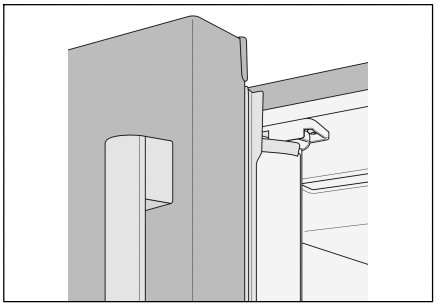
When closing the left refrigerator compartment door, the door bar folds behind the right refrigerator compartment door, forming a seal between the refrigerator compartment doors.
Switching on the appliance
NOTICE After installing the appliance, wait at least 6 hours before plugging in the appliance. The oil in the compressor may have flowed into the refrigeration system during transport.
Connect the appliance plug to the outlet.
After the appliance has been plugged in, the refrigeration process will begin. The interior light in the refrigerator compartment switches on when the door is open.
It will take several hours for the inside of the appliance to reach the temperatures set at the factory. Do not place food in the appliance until these temperatures are reached.
Initial temperature
- Refrigerator compartment: 39 °F (+4 °C)
- Freezer compartment: 0 °F (-18 °C).
Setting the temperature
Freezer compartment
The temperature can be adjusted between 9 °F (-13 °C) up to -7 °F (-22 °C).
1. Press the “Freezer Temp. –" or the “Freezer Temp. +" button. The freezer compartment temperature illuminate.
2. Repeatedly press the “Freezer Temp. –" or the “Freezer Temp. +" button until the desired freezer compartment temperature is set.
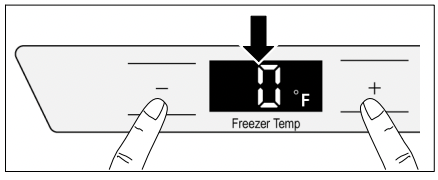
The temperature cannot be set circularly; every time the temperature will increase by 1 °F (1 °C) after the button is pressed for once.
After the temperature adjustment is completed, the new temperature setting will be active for 15 seconds after button was pressed.
We recommend a setting of 0 °F (-18 °C).
Refrigerator compartment
The temperature can be adjusted between 34 °F (+1 °C) up to 44 °F (+7 °C).
1. Press the "Fridge Temp. –" or the "Fridge Temp. +" button. The refrigerator compartment temperature illuminate.
2. Repeatedly press the "Fridge Temp. –" or the "Fridge Temp. +" button until the desired refrigerator compartment temperature is set.
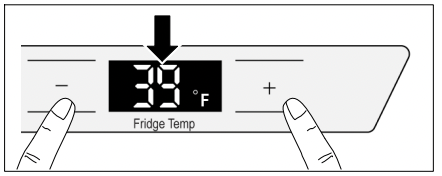
The temperature cannot be set circularly; every time the temperature will increase by 1 °F (1 °C) after the button is pressed for once.
After the temperature adjustment is completed, the new temperature setting will be active for 15 seconds after button was pressed.
We recommend a setting of 39 °F (+4 °C).
Perishable foods should not be stored at temperatures higher than 39 °F (+4 °C)
Temperature unit
The temperature can be displayed in degrees Fahrenheit (°F) or Celsius (°C).
After the appliance is switched on, the temperature appears in degrees Fahrenheit (°F).
To set the temperature unit:
Press the “Freezer Temp. –" and the Freezer Temp. +" button for 3 seconds.
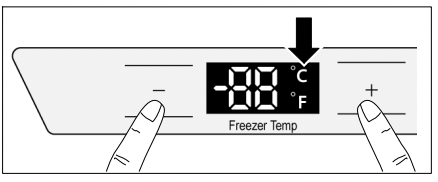
The temperature unit switches.
Super Freeze
Food should be frozen as quickly as possible in order to retain their vitamins, nutritional value, appearance and flavor.
To prevent an undesirable rise in temperature when placing fresh food in the freezer compartment, switch on Super Freeze several hours beforehand.
As a rule, 4 to 6 hours is adequate. Allow for a minimum of 24 hours if planning to use the maximum freezing capacity.
Smaller quantities of food can be frozen without Super Freeze.
To switch on Super Freeze:
Press the ”Super Freeze” button.
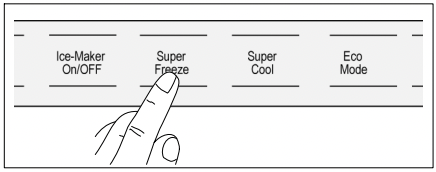
The corresponding button lamp lights up. The temperature is set to -7 °F (-22 °C).
To switch off Super Freeze:
Press the ”Super Freeze” button. The corresponding button lamp put out. After 6 hours Super Freeze mode will turn off automatically
Super Cool
Super Cool cools the refrigerator compartment down as low as possible. Super Cool is particularly recommended for the following:
- Before placing large quantities of food in the refrigerator compartment.
- To cool drinks quickly.
To switch on Super Cool:
Press the ”Super Cool” button.
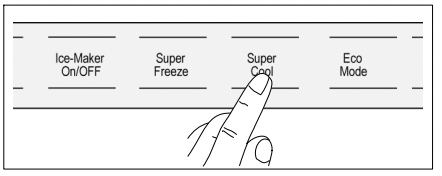
The corresponding button lamp lights up. The temperature is set to 34 °F (+1 °C).
To switch off Super Cool:
Press the ”Super Cool” button. The corresponding button lamp put out. After 2.3 hours, Super Cool mode will turn off automatically.
Eco Mode
This mode is for going on vacation or not using the refrigerator for a long period of time.
The temperature of refrigerator compartment is automatically set to 44 °F (7 °C) and the temperature of the freezer compartment is set to 5 °F (-15 °C).
To switch on Eco Mode:
Press the ”Eco Mode” button.
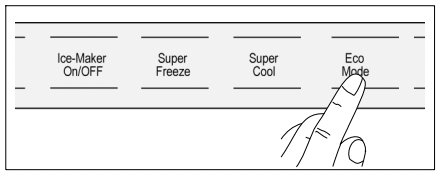
The corresponding button lamp lights up.
To switch off Eco Mode:
Press the ”Eco Mode” button. The corresponding button lamp put out.
Refrigerator compartment
WARNING Risk of explosion! Do not store explosive substances in the appliance.
The Refrigerator compartment is the ideal storage location for ready meals, cakes and pastries, preserved food, condensed milk, milk, cheese, spreads, sauces, dips and eggs
When purchasing food, please note
The freshness at point of purchase is important for the shelf-life of your food. In principle, the fresher the produce when placed in the crisper drawers, the longer it stays fresh. Therefore, when buying food, always pay attention to the degree of freshness. Observe the expiration date specified by the manufacturer for ready products and bottled products.
Arranging Food in the Appliance
- Wrap or cover food before placing in the appliance. This will retain the aroma, color and freshness of the food. In addition, flavors will not be transferred between foods and the plastic parts in the appliance will not become discolored.
- Allow warm food and drinks to cool down before placing in the appliance.
- Do not block air outlet openings with food in the refrigerator compartment, otherwise the air circulation will be impaired. Food which is stored directly in front of the air outlet openings may be frozen by the cold air flowing out.
- Avoid contact of oil and fat with the plastic parts and door seal.
Fresh food compartment
The following foods are suitable for keeping in the fresh food compartment
- Fish, seafood, meat, sausage and cold meats, dairy products, ready meals
- Vegetables (e.g. carrots, asparagus, celery, leeks, beetroot, mushrooms, cabbage, broccoli, cauliflower, sprouts, kohlrabi)
- Lettuce varieties (e.g. lamb's lettuce, iceberg, chicory, round lettuce)
- Herbs (e.g. dill, parsley, chives, basil)
- Fruit (varieties not sensitive to cold, e.g. apples, peaches, berries, grapes).
CAUTION After power failure or disconnection of the appliance from the power source, the temperature of the fresh food compartment must be readjusted.
Freezer compartment
WARNING Risk of explosion! Never store products containing flammable propellants (such as spray cans) or explosive or easily combustible substances in the appliance.
CAUTION Do not refreeze thawing or thawed food. Never keep frozen food longer than the maximum storage duration
Using the freezer compartment
- To store deep-frozen food.
- To freeze food.
- To make and store ice cubes.
NOTICE Make sure that the freezer compartment drawers are always kept closed. The frozen food will thaw if the freezer compartment drawers are open. The freezer compartment will become covered with thick ice. Also: Energy will be lost due to high power consumption. When the freezer compartment drawers are closed, low pressure occurs inside the compartment. If you cannot reopen the freezer compartment drawers right away, wait two to three minutes until the low pressure has adjusted itself.
Freezing food
Purchasing Frozen Food
- Packaging must not be damaged.
- Use by the “expiration” date.
- Temperature in the supermarket freezer must be 0 °F (-18 °C) or lower.
- If possible, transport deep-frozen food in an insulated bag and place immediately in the Freezer Compartment.
Freezing fresh food
Freeze fresh and undamaged food only. To retain the best possible nutritional value, flavor and color, vegetables should be blanched before freezing. Eggplants, peppers, zucchini and asparagus do not require blanching. Literature on freezing and blanching can be found in bookshops.
NOTICE Keep food that is to be frozen away from food that is already frozen.
- The following foods are suitable for freezing: Cakes and pastries, fish and seafood, meat, game, poultry, vegetables, fruit, herbs, eggs without shells, dairy products such as cheese, butter and quark, and ready meals and leftovers such as soups, stews, cooked meat and fish, potato dishes, soufflés and desserts.
- The following foods are not suitable for freezing: Types of vegetables that are usually consumed raw such as lettuce or radishes, eggs in shells, grapes, whole apples, pears and peaches, hard-boiled eggs, yogurt, butter milk, sour cream, crème fraîche and mayonnaise.
Packing Frozen Food
To prevent food from losing its flavor or drying out, place in airtight containers.
1. Place food in packaging.
2. Remove air.
3. Seal the wrapping.
4. Label packaging with contents and date of freezing.
Suitable Packaging:
Cling wrap, polyethylene hose film, aluminum foil, freezer containers. These products are available from specialist outlets.
Unsuitable Packaging:
Wrapping paper, greaseproof paper, cellophane, bin liners and used shopping bags.
Items Suitable for Sealing Packaged Food:
Rubber bands, plastic clips, string, cold-resistant adhesive tape, etc. Bags and tubular film made of polyethylene can be sealed with a film heat sealer.
Storage life of frozen food
The storage life depends on the type of food. At a temperature setting of 0 °F (-18 °C):
- Fish, sausage, ready meals, cakes and pastries: up to 6 months
- Cheese, poultry and meat: up to 8 months
- Fruit and vegetables: up to 12 months.
Thawing frozen food
CAUTION Risk of poisoning! Do not refreeze food that is beginning to thaw or has already thawed. The food cannot be refrozen until it has been prepared (boiled or fried). Do not store these refrozen products for the maximum storage period.
Depending on the type of food and its intended use, frozen food can be thawed as follows:
- in the refrigerator compartment
- in an electric oven with/without fan-assisted hot air
- in the microwave.
Ice maker
The ice maker makes ice cubes. When the ice storage box is full, the ice maker stops ice production automatically. The ice maker is capable of producing 2.8 - 3.3 lb (1.3 - 1.5 kg) of ice in 24 hours depending on the temperature of freezer compartment, surrounding temperature, frequency of door opening/closing and other working conditions.
Points to observe when switching on for the first time
The ice maker only functions when the appliance is connected to the water supply. The ice maker starts to make ice cubes as soon as the appliance has reached the set temperature. When using the ice maker for the first time, do not use the first 30 to 40 ice cubes for reasons of hygiene.
Switching on
1. Make sure that ice storage box is in its place and locked into position.
2. Press the ”Ice Maker On/OFF” button.
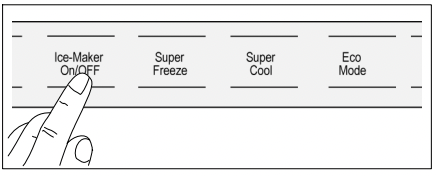
The corresponding button lamp lights up. Before the ice maker is switched on again after a long period, clean the ice cube maker and the ice storage box. When the ice maker is switched on, the temperature for the freezer compartment automatically shown on the display is 0° F (‐18 °C).
Notes on using the ice-maker
You will hear the sound of the motor after about two hours. This is the sound of the valve providing water to the ice maker and does not indicate a malfunction. It is normal that several ice cubes may stick together or get crushed. Ice making takes longer if you open the drawer frequently.
Switching off
Before switching the ice maker off, it is most important that you switch the water supply to the appliance off for a few hours.
1. Press the ”Ice Maker On/OFF” button.
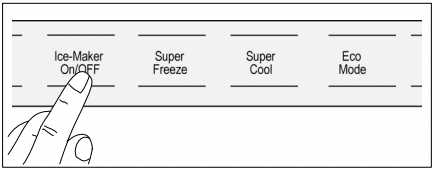
The corresponding button lamp put out.
2. Taking out and cleaning the ice storage box.
3. Taking out and cleaning the ice cube box.
Taking out and cleaning the ice cube box
If the ice maker is not used for a long period, ice cubes that are first produced might have an unpleasant smell. You must take out and clean the ice cube box.
1. Open the upper drawer in the freezer compartment.
2. Turn the handle from the horizontal position to vertical to release the lock.
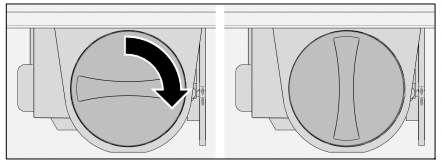
3. Pull the ice maker rack out.
4. Take out the ice cube box.
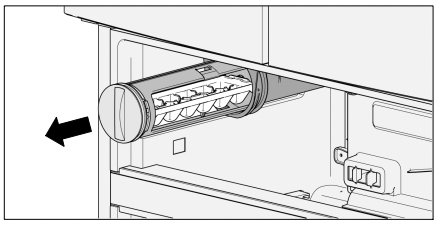
5. Rinse the ice cube box with warm water (below 140 °F / 60 °C). Do not use detergent.
6. Dry the ice cube box completely by air to ensure that water droplets in the ice cube box are gone which could otherwise cause abnormal functioning of the ice maker.
7. Insert the ice cube box onto the ice maker rack.
8. Push in the ice maker rack.
9. Turn the handle from the vertical position to horizontal to lock.
Interior Fittings
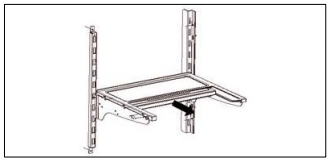
Adjustable Shelf
The Adjustable Shelf can be adjusted to the proper height required by various food items.
Adjusting
Tilt the shelf upward, raise it and pull it out towards you.
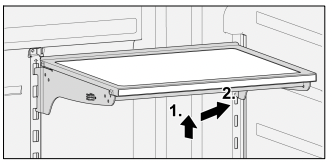
During installation, put the upper end of the fixed leg into the desired slot. Lower the shelf. The lower end of the fixed leg engages into a lower slot.
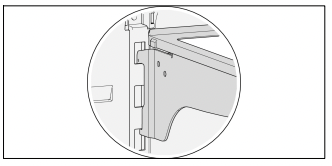
Retractable Shelf
Folding
Put fore-end of the retractable glass shelf up until it coincides with rear-end.
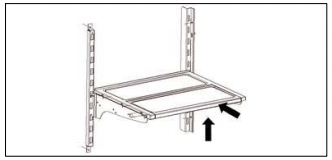
Unfolding
Pull out the retractable glass shelf directly until it is at the fore-end level of fixed glass shelf, then the buckle of retractable glass shelf will drop into the slot of fixed shelf and will not withdraw due to factor of gravity
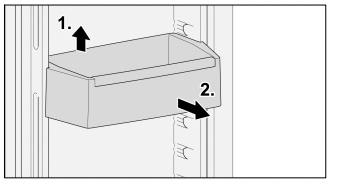
Door bin
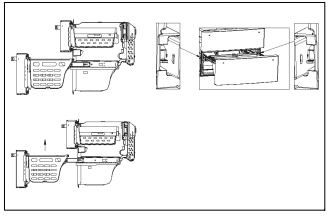
Lower freezer drawer
1. Pull out the lower freezer drawer to the proper position.
2. Press the buttons in both slots respectively (must press both sides at the same time), pull out the freezer drawer until it stops.
3. Take out the lower drawer as directed by the arrows.
Chiller Drawer
The Chiller Drawer has a maximum load of 22 lb (10 kg).
Pulling out and installing the Chiller Drawer
1. Pull out the Chiller Drawer.
2. Find the hooks at the left and right sides at the drawer bottom (shown in the figure).
3. Hold the hook at two sides with a nose pliers and push it up and out of the groove of sliding rail and take out the hook at the other side with the same method.
4. Take out the drawer.
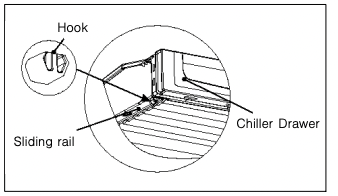
5. Install the drawer by putting the hook into the slots.
Switching off and disconnecting the appliance
Switching off the appliance
Unplug the appliance or switch off the fuse.
Switching the refrigerator compartment on and off
To switch off:
Press the ”Eco Mode” button for 3 seconds.
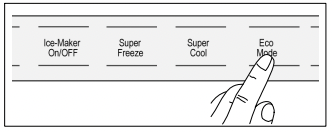
The refrigerator compartment is turned off and a beep tone sounds. The refrigerator compartment temperature display shows ”- -”.
To switch on:
Press the ”Eco Mode” button for 3 seconds. Refrigerator compartment is turned on and a beep tone sounds.
Disconnecting the appliance
If the appliance is not used for an extended period of time:
1. It is imperative that you disconnect the water supply to the appliance for a few hours before switching off the appliance.
2. Remove all food from the appliance.
3. Unplug the appliance.
4. Empty and clean the ice maker and the ice storage box.
5. Clean the appliance interior (see ”Cleaning the appliance”).
Defrosting
Freezer compartment
The fully automatic Nofrost system ensures that the freezer compartment remains free of ice. Defrosting is not required.
Refrigerator compartment
Defrosting takes place automatically. The condensation runs through the drainage hole into an evaporation pan at the rear of the appliance.
Cleaning
WARNING Risk of electric shock! Unplug the appliance or turn off the circuit breaker or fuse before cleaning the appliance.
CAUTION To avoid personal injury or damage to property, observe the following: Never use a steam cleaner to clean the appliance. Do not use abrasive or acidic cleaning agents or solvents. Wipe lights and the control and display panel with a damp cloth only. Do not let water used for cleaning drip into the lights or onto the control and display panel. Do not let cleaning water run into the drainage hole in the evaporation area. Never clean shelves and containers in a dishwasher. The parts may warp.
Cleaning the appliance
The Crisper Drawers and Chiller Drawer can be removed for cleaning.
1. Unplug the appliance or turn off the circuit breaker.
2. Remove all food from the appliance and store in a cool location.
3. Clean the appliance with a soft cloth, using lukewarm water and a small amount of pH-balanced dishwashing liquid.
4. Rub dry when done.
5. Wipe the door seal with clear water only and then thoroughly wipe dry.
6. After cleaning, reconnect to switch on the appliance.
LED light
The appliance features a maintenance-free LED light.
CAUTION Risk of eye injury from Class 1M laser light (IEC 60825)! Do not look directly into the light with optical instruments.
These lights must be repaired by customer service or an authorized technicians only
Energy saving tips
- Install the appliance in a dry, well ventilated room, but not in direct sunlight and not near a heat source (radiator, stove, etc.). Use an insulating plate, if required.
- Allow warm food and drinks to cool down before placing in the appliance.
- When thawing frozen food, place it in the refrigerator compartment. The low temperature of the frozen products cools the food in the appliance.
- Open and close the appliance doors and drawers as quickly as possible.
Operating noises
Normal noises
- Humming - refrigerating unit is running. The fan in the circulating air system is running.
- Bubbling, whirring or gurgling noises - refrigerant is flowing through the tubing or water is flowing into the ice maker.
- Clicking - motor is switching on or off. The solenoid valve at the water connection is opening or closing.
- Rumbling - ready ice cubes from the ice maker are falling into the ice storage box.
Solving simple noise problems
The appliance is not level
Align the appliance using a level. Use the height-adjustable feet.
The appliance is touching adjacent units or appliances
Move the appliance away from adjacent units or appliances.
Loose or sticking drawers, baskets or storage areas
Check the removable parts and, if required, reinsert them.
Receptacles are touching each other
Move bottles or receptacles slightly away from each other.
Before Calling for Service
Before you call Customer Service: Please check whether you can troubleshoot yourself based on the following information. Customer Service may charge you for an unnecessary service call. Please see Warranty Statement for coverage and exceptions.
Appliance
No display on the display panel, interior light is not working, and the appliance is not working.
The power cord is not plugged in.
The fuse has blown or circuit breaker has been tripped.
- Replace fuse or reset the circuit breaker.
- Check if electricity is present at outlet.
Power outage.
- Wait until power has been restored. If necessary, contact an electrician or the utility company.
The interior light is not working.
The light switch to the freezer or refrigerator compartment is sticking.
- Check whether the light switch can be moved.
The LED bulb is defective.
Food is too cold.
Temperature has been set too low.
- Adjust to a higher temperature.
Food is too warm.
Door will not close properly.
- Align the appliance with a level. See ”Aligning the appliance”.
- Check the position of the drawers and correct, if necessary.
- Check the door seals and foldaway door bar; if necessary, clean or correct position.
Temperature has been set too high.
- Select a lower temperature.
Ventilation opening is blocked.
- Remove any food blocking the ventilation opening.
Doors were opened frequently or were open for an extended period of time.
- Wait until the temperature in the appliance drops.
A large amount of fresh food has been placed in refrigerator.
- Fresh food must first reach the correct storage temperature.
Appliance has an unpleasant odor.
Food with a strong odor was placed in the refrigerator.
- Wrap up the food or place it in an airtight container.
The interior compartment is dirty.
- Clean the interior compartment.
Water droplets are forming on the exterior of the appliance.
Door will not close properly.
- Align the appliance with a level. See ”Aligning the appliance”.
- Check the position of the drawers and correct, if necessary.
- Check the door seals and foldaway door bar; if necessary, clean or correct position.
Humidity is too high.
- This may be normal in certain regions.
Water droplets are forming inside the appliance.
Humidity is too high or doors have been opened frequently.
- Do not open doors as frequently or do not keep them open too long.
The door seals are not tight.
- Check the door seals and foldaway door bar; if necessary, clean or correct position.
Drawers can only be closed with great difficulty.
The drawer has not been inserted correctly.
- Insert the drawer correctly.
The drawer rails are dirty.
The ice maker is not making ice cubes.
The ice maker is switched off.
The appliance is not being supplied with water.
- Have a qualified technician check the water connection.
The water connection line has kinks in it.
- Shut off the water supply. Straighten out the kinks. Have damaged water connection lines replaced with original manufacturer parts.
Water pressure is too low.
- Have the water pressure checked.
The ice storage box is not inserted correctly.
- Insert the ice storage box correctly.
The water connection is installed incorrectly.
- If the water connection is not installed correctly, this can cause low water pressure and can damage the appliance.