Introduction 2
Description 5
Operating Instructions 14
Troubleshooting 24
All rights reserved. Reproduction by any means, electronic or mechanical
including photocopying, recording or by any information storage and retrieval
system or translation in whole or part is not permitted without written
authorization from Ford Motor Company. Ford may change the contents without
notice and without incurring obligation.
Copyright © 2000 Ford Motor Company
Table of contents
1
Your Rear Seat Entertainment System (RSES) allows you to watch movie
rentals and your favorite home videocassettes. It also allows you to plug
in and play a variety of standard video games. Please review this user
manual to become familiar with the RSES features and controls as well
as the very important safety information.
SAFETY INFORMATION
Read all of the safety and operating instructions before operating the
system and retain for future reference.
Do not attempt to service, repair or modify the Rear Seat Entertainment
System (RSES). See your Ford or Lincoln Mercury dealer.
Do not insert foreign objects into the videocassette player (VCP)
compartment.
The front glass on the liquid crystal display (LCD) flip-down
screen may break when hit with a hard surface. If the glass
breaks, do not touch the liquid crystalline material. In case of contact
with skin, wash immediately with soap and water.
Do not expose the liquid crystal display (LCD) flip-down screen
to direct sunlight or intensive ultraviolet rays for extensive
periods of time. Ultraviolet rays deteriorate the liquid crystal.
The driver must not attempt to operate any function of the floor
console mounted videocassette player (VCP) while the vehicle is
in motion. Give full attention to driving and to the road. Pull off the
road and park in a safe place before inserting or extracting video tapes
from the VCP. A remote control is included in the system to allow the
rear seat occupants to operate the VCP functions without distracting
the driver.
Be sure to review User Manuals for video games and video game
equipment when used as auxiliary inputs for your Rear Seat
Entertainment System (RSES).
Do not operate video games or video equipment if the power cords
and/or cables are broken, split or damaged. Carefully place cords and/or
cables where they will not be stepped on or interfere with the operation
of seats and/or compartments.
Introduction
2

Disconnect video games and video equipment power cords and/or cables
when not in use.
Avoid touching auxiliary input jacks with your fingers. Do not blow on
them or allow them to get wet or dirty.
Do not clean any part of the RSES with benzene, paint thinner or any
other solvent.
FEDERAL COMMUNICATION COMMISSION (FCC) COMPLIANCE
Changes or modifications not approved by Ford Lincoln-Mercury could
void user’s authority to operate the equipment. This equipment has been
tested and found to comply with the limits for a Class B digital device,
pursuant to Part 15 of the FCC Rules. These limits are designed to provide
reasonable protection against harmful interference in a residential
installation. This equipment generates, uses and can radiate radio
frequency energy and, if not installed and used in accordance with the
instructions, may cause harmful interference and radio communications.
However, there is no guarantee that interference will not occur in a
particular installation. If this equipment does cause harmful interference
to radio or television reception, which can be determined by turning the
equipment off and on, the user is encouraged to consult the dealer or an
experienced radio/TV technician for help.
CARE AND SERVICE OF THE VIDEOCASSETTE PLAYER (VCP)
Environmental extremes
Videocassette players (VCP) subjected to harsh environmental conditions
may be damaged or perform at less than maximum capability. To avoid
these outcomes, whenever possible avoid exposing your video cassette
player to:
• extremely hot or cold temperatures.
• direct sunlight.
• high humidity.
• a dusty environment.
• locations where strong magnetic fields are generated.
Temperature extremes
When the vehicle is parked under direct sunlight or in an extremely cold
place for a long period of time, wait until the cabin temperature of the
vehicle is at normal temperature before operating the system.
Introduction
3

Humidity and moisture condensation
Moisture in the air will condense in the videocassette player (VCP)
under extremely humid conditions or when moving from a cold place to
a warm one. Moisture condensation on the tape playback head drum may
damage the videocassette and/or drum. If moisture condensation occurs,
do not insert a videocassette into the player. If a videocassette is already
in the player, remove it. Turn the VCP power ON to dry the moisture
before inserting a videocassette. This could take an hour or more.
Cleaning video heads
Magnetic video heads convert the videocassette into pictures on the
screen during playback. Over a period of time, particles rub off the tape
and are left on the heads. Using an old or poor quality tape together with
dust and air particles, high temperature and humidity cause dirty heads.
Dirty heads generally cause “snowy” pictures and, in some severe cases,
blurred or interrupted pictures. A variety of products are available at
video stores to clean tape heads. Use these products sparingly, because
some are abrasive to the video heads. If normal head cleaning
procedures do not resolve the problem, have the system checked by a
service technician.
Cleaning the liquid crystal display (LCD) flip-down screen
Clean the display screen by applying a small amount of water or any
ammonia-based household glass cleaner directly to a soft cloth. Rub the
screen gently until the dust, dirt or fingerprints are removed. Do not
spray the screen directly with water or glass cleaning solvents. Overspray
from these fluids could drip down into the internal electronics of the
screen and cause damage. Do not apply excessive pressure while
cleaning the screen.
Cleaning the exterior of the videocassette player (VCP)
Clean the outside of the VCP with a soft cloth dampened with water.
Avoid getting the VCP controls wet. Do not spray the VCP directly with
water or other fluids as they could drip down into the internal
electronics of the VCP and cause damage.
Foreign substances
Exercise care to prevent dirt and foreign objects from entering the
videocassette player (VCP) compartment. Be especially careful not to
spill liquids of any kind onto the media controls or into the videocassette
player. If liquid is accidentally spilled onto the system, immediately turn
the system OFF and consult a qualified service technician.
Introduction
4
REAR SEAT ENTERTAINMENT SYSTEM (RSES)
Features
• 4–head stereo hi-fi videocassette player (VCP)
• High performance 6.4” flip-down liquid crystal display (LCD) screen
with dimmer/brightness control
• Rear Seat Entertainment Module (RSEM) with touch controls
• Three (3) standard headphone jacks
• Headphones (2 sets)
• Remote control unit
• Video and audio jacks for connecting video games and video
equipment*
* Auxiliary video or game equipment may require a 12–volt DC to
120–volt AC power inverter.
* RSEM controls are backlit when the vehicle headlamps are ON.
Playback and format
• The videocassette player (VCP) of your Rear Seat Entertainment
System (RSES) can only be used in the “playback” mode. (The VCP
does not offer a record feature.)
• The system plays standard videocassettes marked “VHS” (or “S-VHS).
Audio system
• An ON/OFF speaker switch (
/ ) on the Rear Seat Entertainment
Module (RSEM) allows the passengers to listen to audio over the
vehicle’s speakers or over headphones connected to the RSEM.
VCP PROTECTION CIRCUITS
Dew sensor circuit
• Under high moisture (dewed) conditions, the tape heads and cassette
tape may be damaged if the videocassette player (VCP) is operated.
• When the vehicle’s cabin temperature is very low and then is heated
quickly, or the humidity is very high within the vehicle, the inside of
the windows most likely will be fogged. Under these conditions, the
inside of the VCP most likely is dewed.
Description
5

• When a dewed condition exists, the dew sensor circuit stops machine
operation and the POWER button on the VCP will illuminate and
continue to flash on and off. A message on the liquid crystal display
(LCD) flip-down screen will also appear indicating DEW PLEASE
WAIT until the system is dry enough to operate safely.
• If the POWER button on the VCP flashes continuously for longer than
one hour, and the VCP will not return to normal operation after
attempted use on more than one occasion, see your Ford and Lincoln
Mercury dealer.
High temperature sensor circuit
• Excessively high temperatures may cause damage to the videocassette
player (VCP).
•
When the temperature of the VCP becomes too hot, the high
temperature sensor circuit stops machine operation and the POWER
button on the VCP will illuminate red and continue to flash. A message
will also appear on the liquid crystal display (LCD) flip-down screen
indicating HIGH TEMP PLEASE POWER OFF. If this occurs, turn the
power on the VCP off until the system is cool enough to operate safely.
• If the POWER button on the VCP flashes continuously for longer than
one hour, and the VCP will not return to normal operation after
attempted use on more than one occasion, see your Ford and Lincoln
Mercury dealer for service.
Tape protection circuit
• When the system is in PAUSE mode, the tape mechanism will
continue to create tension on the tape.
• When the videocassette player (VCP) is in PAUSE mode for more than
five minutes, the tape protection circuit automatically goes into STOP
mode to avoid damage to the tape.
Over voltage protection circuit
• If the Rear Seat Entertainment System (RSES) experiences excessive
voltage situations from the vehicle’s electrical system (approximately
18 volts), damage to the system components can occur.
• When the RSES experiences an over voltage situation, the POWER
button on the VCP will illuminate orange and flash continuously. If this
occurs, see your Ford and Lincoln Mercury dealer for service as soon
as possible.
Description
6
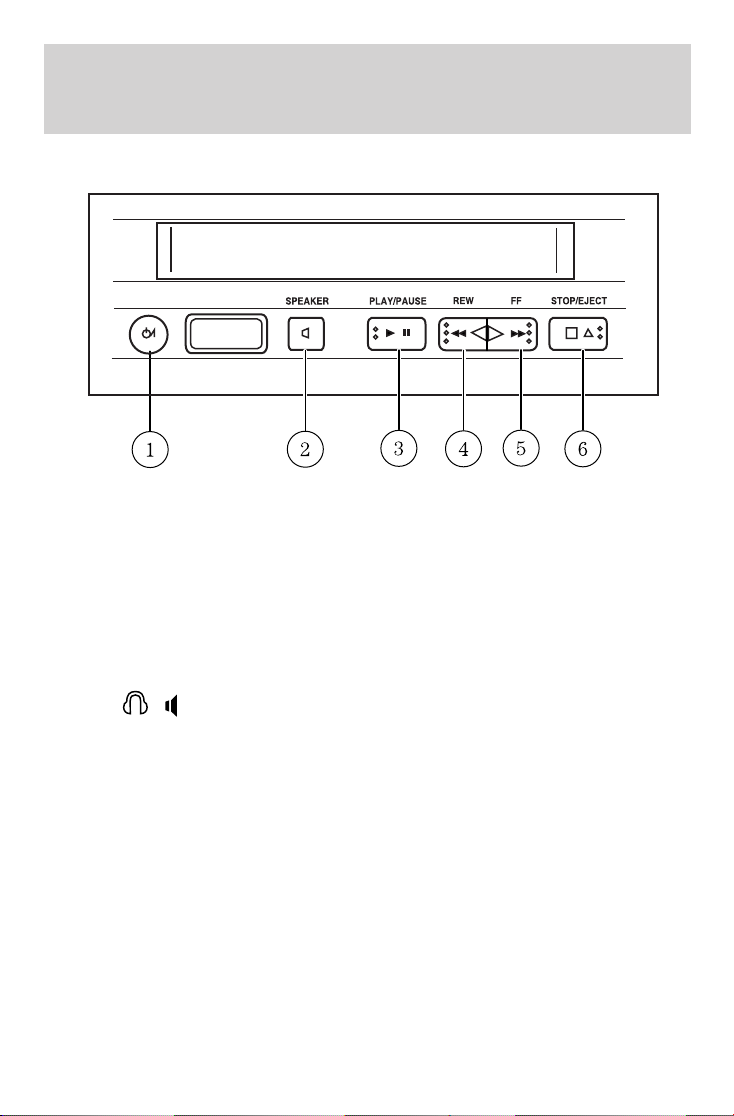
VIDEOCASSETTE PLAYER (VCP) CONTROLS
1. POWER button
Press to turn the VCP ON or OFF. Will flash to indicate the following
conditions:
• green — high dew situation
• red — high heat situation
• orange — over voltage situation
2. SPEAKER button
Do not press — this button is not functional.
Use the
/ control on the Rear Seat Entertainment Module (RSEM)
to enable the radio speakers or headphone mode. Disregard any
indications that may appear on the liquid crystal display (LCD) screen
regarding speaker functionality. The radio display will always indicate in
which mode the system is currently operating.
3. PLAY/PAUSE button
Press to playback or pause the videocassette tape.
4. REW (Rewind) button
Press to rewind the videocassette tape.
5. FF (Fast Forward) button
Press to fast forward the videocassette tape.
6. STOP/EJECT button
Press to stop playback operation or to eject the videocassette tape from
the VCP.
Description
7
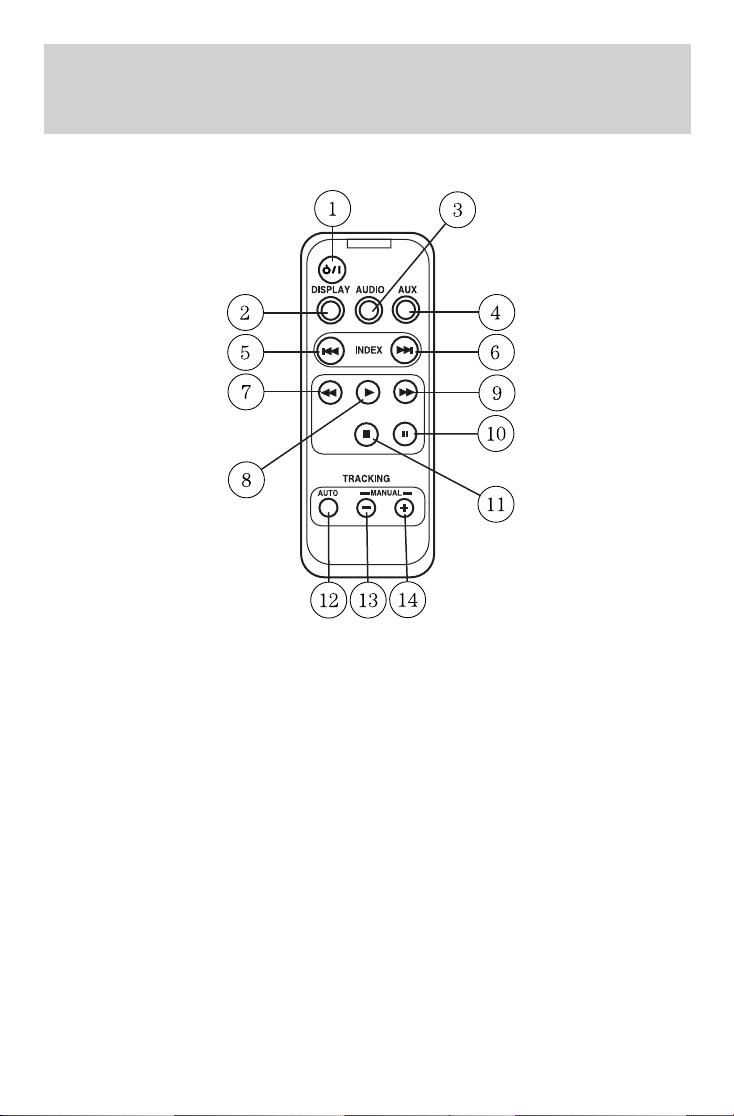
REMOTE CONTROL
1. POWER (ON/OFF) button
Press to turn videocassette player ON or OFF.
2. DISPLAY button
Press to select display of tape counter or tape remainder (by time).
3. AUDIO selector button
Press to select a desired audio output, which will be shown on the
screen.
HI-FI : Hi-Fi audio output.
L : Audio output on left channel only.
R : Audio output on right channel only.
NORM : Normal audio output.
MIX : Mixed audio output.
4. AUX button
Do not press — this button is not functional.
Description
8

Use the MEDIA button on the Rear Seat Entertainment Module (RSEM)
to toggle between media sources. Disregard any indications that may
appear on the liquid crystal display (LCD) screen regarding AUX
functionality. The radio display will always indicate in which mode the
system is currently operating.
5. INDEX (
) button
Press to reverse direction while searching a program on a videocassette
tape.
6. INDEX (
) button
Press to search the beginning of a program on a videocassette tape.
7. REW (Rewind) button
Press to rewind videocassette tape.
8. PLAY button
Press to playback videocassette tape.
9. FF (Fast-Forward) button
Press to fast-forward videocassette tape.
10. PAUSE button
Press to suspend playback temporarily.
11. STOP button
Press to stop tape playback.
12. AUTO button
Press to switch automatic tracking ON/OFF.
13. TRACKING (−) button
Press this button for manual tape tracking. (Turn OFF automatic
tracking with the AUTO button first.)
14. TRACKING (+) button
Press this button for manual tape tracking. (Turn OFF automatic
tracking with the AUTO button first.)
Description
9
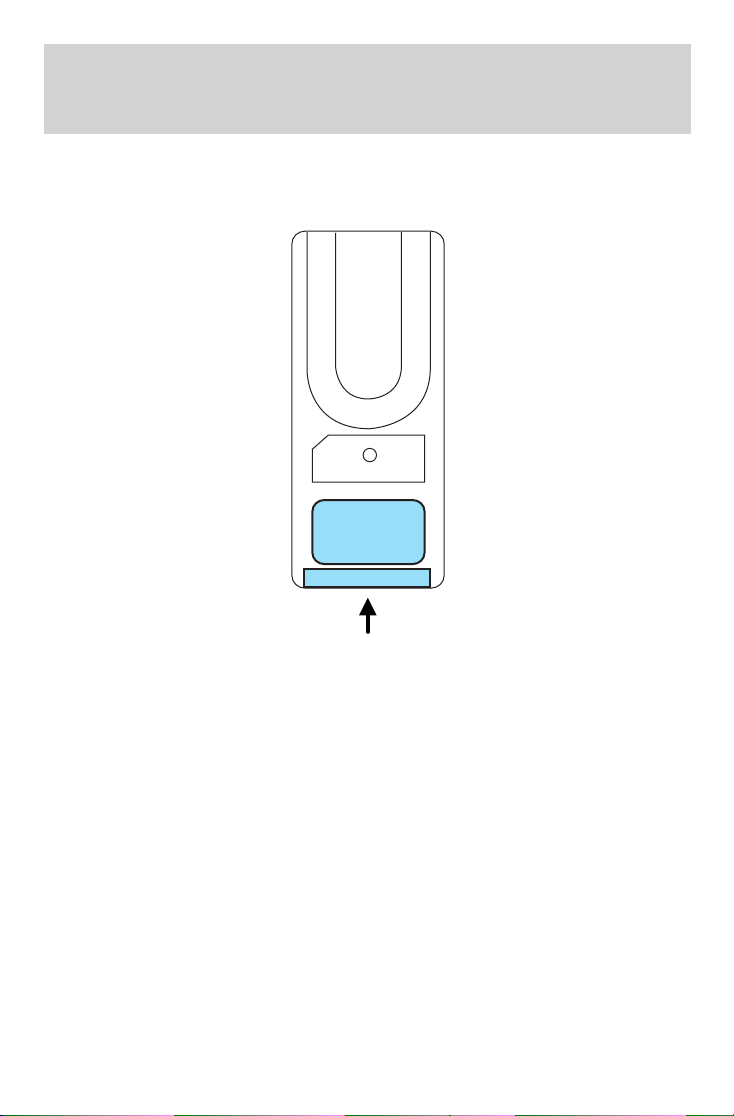
BATTERY REPLACEMENT
Use a pen tip to remove the battery cover. (See the back panel of remote
control for instructions.)
The need for battery replacement is usually indicated if the remote
control only functions at extremely close distances to the entertainment
center or not at all.
When replacing the battery for the remote, use battery CR2025 and
install with correct orientation as indicated on the remote.
Description
10
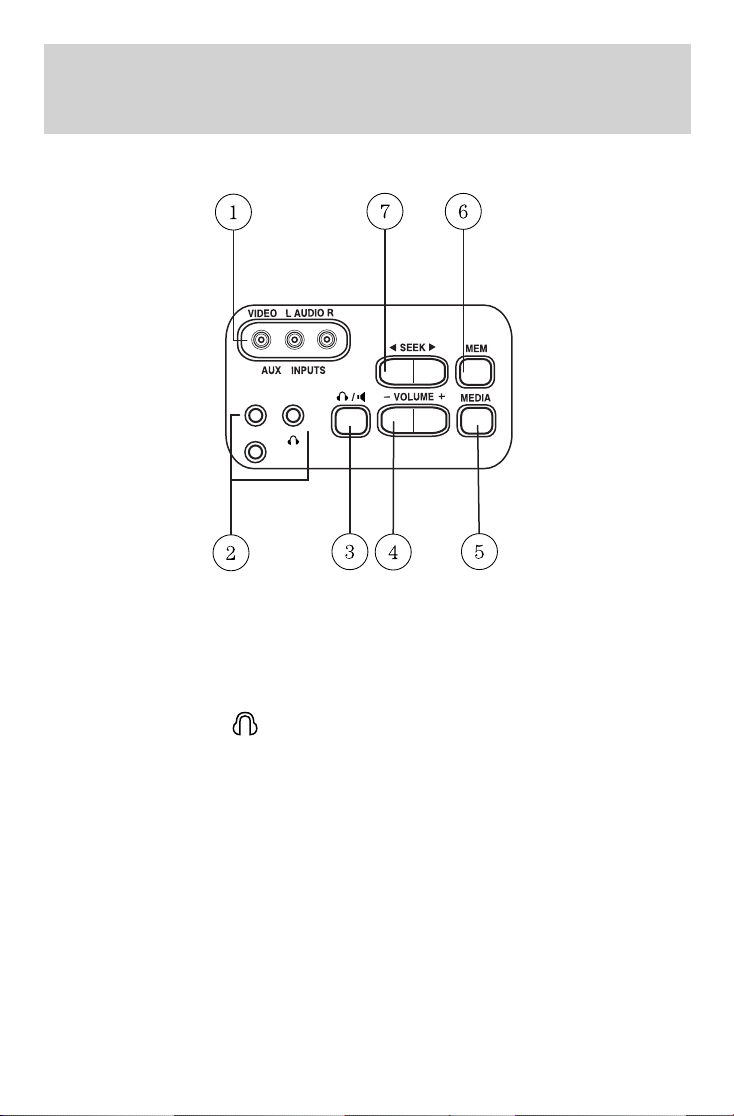
REAR SEAT ENTERTAINMENT MODULE (RSEM)
The Rear Seat Entertainment Module (RSEM) allows the rear seat
passengers to operate the Rear Seat Entertaiment System (RSES). They
can toggle between radio, cassette, CD or CD/DJ media sources when
enabled. To enable the RSES and RSEM, simultaneously press the
memory preset buttons 3 and 5 on the radio face. When the RSEM
controls are enabled,
will appear in the radio display. Press the 3
and 5 presets again to disable the RSES system.
1. AUX INPUTS video and audio input jacks
YELLOW: Video
WHITE: Left Audio
RED: Right Audio
2. HEADPHONE terminals
Standard 1/8” stereo headphone jacks.
3. SPEAKER button
The vehicle’s speakers automatically default to SINGLE PLAY mode. In
SINGLE PLAY mode, the audio is played through all four speakers for all
passengers to hear.
Description
11

Press the speaker control to enter into DUAL PLAY. The rear speakers
will turn off and the rear seat passengers will enter into headphone
mode. They are able to listen to their selected media source via
headphones and control the volume level. While DUAL PLAY is engaged,
the front seat passengers can listen to the desired media source through
the radio speakers.
4. VOLUME buttons
Press (+) or (−) button to decrease or increase audio volume. When
ignition is turned ON, volume defaults to LOW. In SINGLE PLAY mode,
the volume level can be changed in all media sources. However, the rear
seat passengers cannot exceed the volume level set by the front seat
passengers. In DUAL PLAY mode, only headphone volume level may be
changed.
5. MEDIA button
Press to toggle between the following media sources: AM, FM1, FM2,
TAPE, CD, CDDJ, VCP and AUX. When chosen, the media source will
illuminate in the radio display.
When the Rear Seat Entertainment System (RSES) is in dual play mode,
the selected media source will illuminate in the radio display. The letters
RSC will appear in front of the selected mode. “RSC” indicates “Rear
Seat Control” and identifies the mode as being used by the rear seat
passengers.
Note: While in dual play mode, both AM and FM media sources cannot
be selected simultaneously. A selected radio station will be shared by
front and rear seat passengers.
6. MEM
Press in radio mode to scroll through the memory presets in AM, FM1 or
FM2.
Press in CDDJ mode to select the next disc in the compact disc changer.
The memory function does not operate in TAPE, CD, VCP or AUX
modes.
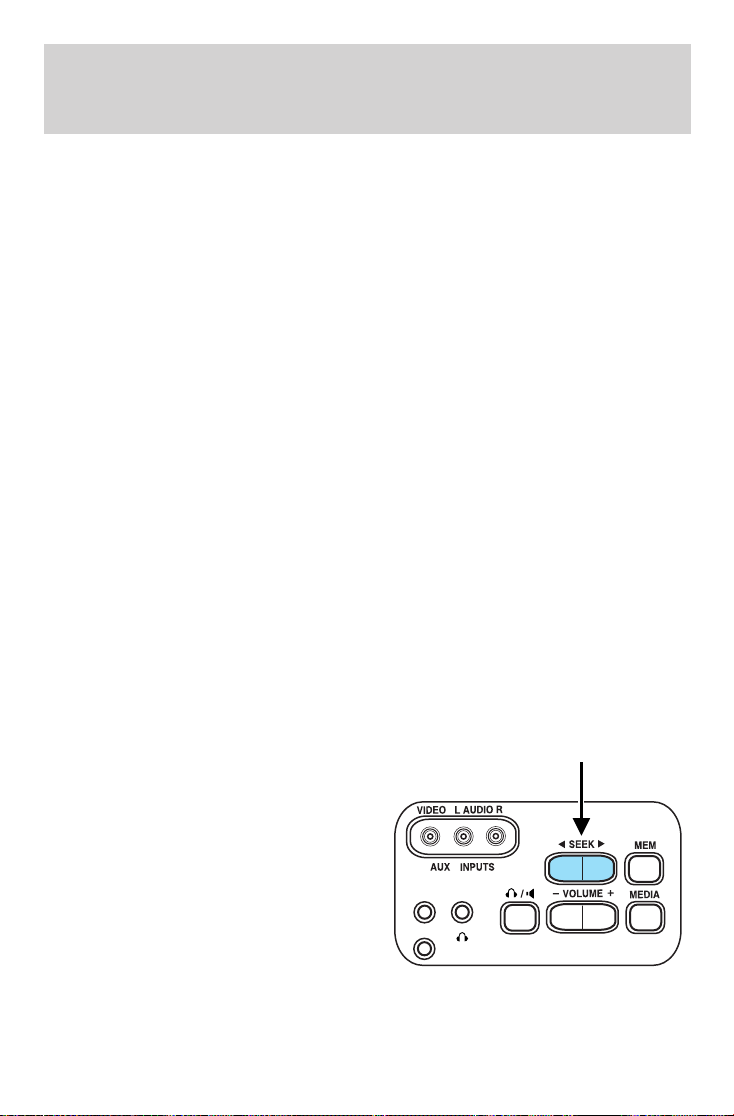
7. SEEK buttons
Press to find the next or previous listenable radio station, tape selection
or CD track (depending on the mode).
Description
12
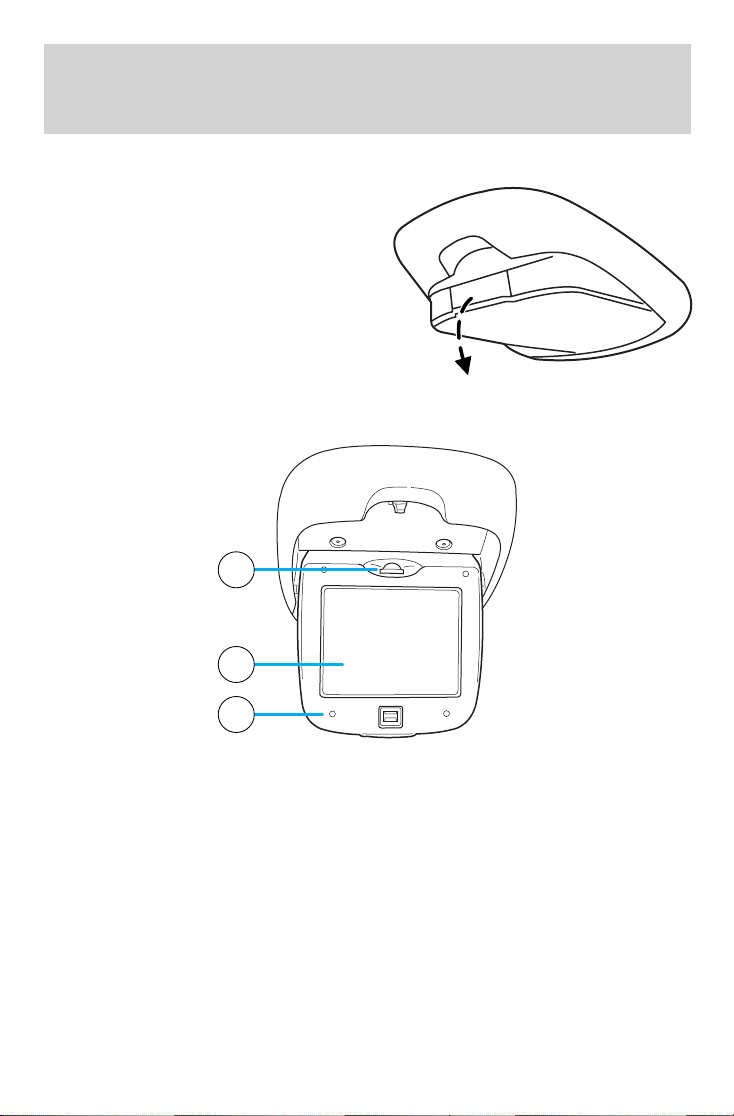
LIQUID CRYSTAL DISPLAY (LCD) FLIP-DOWN SCREEN
The screen rotates down to view
and up into housing to store when
not in use. Be sure the screen is
latched into the housing when being
stored.
1. 6.4” (diagonal) color liquid crystal display (LCD) screen.
2. Screen housing.
3. Dimmer switch. Rotate to increase/decrease the brightness of the
screen.
Note: On-screen indicators may appear on the LCD flip-down screen
regarding the current operating mode of the system. These on-screen
indicators may or may not be accurate. Always refer to the radio display
for an accurate indication of the current operating mode.
1
3
2
Description
13
GENERAL OPERATION
• When the engine is not running, use the system sparingly otherwise it
will run the battery down.
•
When the ignition is turned to OFF, the Rear Seat Entertainment System
(RSES) is also turned OFF. When the ignition is turned ON, the RSES
returns to SINGLE PLAY mode and the last media position. To play a
video tape, toggle the MEDIA control on the RSEM to VCP mode.
• Do not leave the videocassette in the videocassette player (VCP)
overnight or for long periods of time.
• To listen through the vehicle’s speaker system, press the speaker
button (
/ ) on the Rear Seat Entertainment Module (RSEM).
When the ignition is turned ON, audio is through the headphones at
LOW volume. Press the (+) control to increase volume.
•
To enable or disable the RSES, simultaneously press the 3 and 5 memory
presets on the radio face. When the RSEM controls are enabled,
will
appear in the radio display. Press the presets again to disable the RSES.
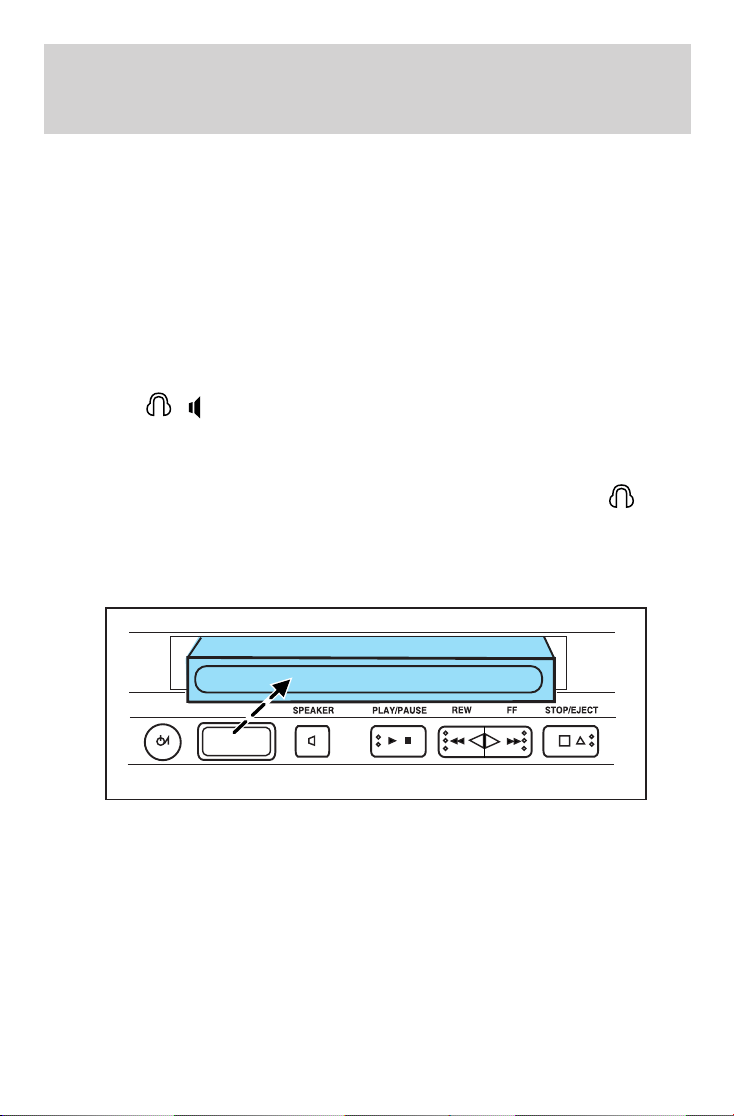
Inserting/removing cassette
Inserting cassette
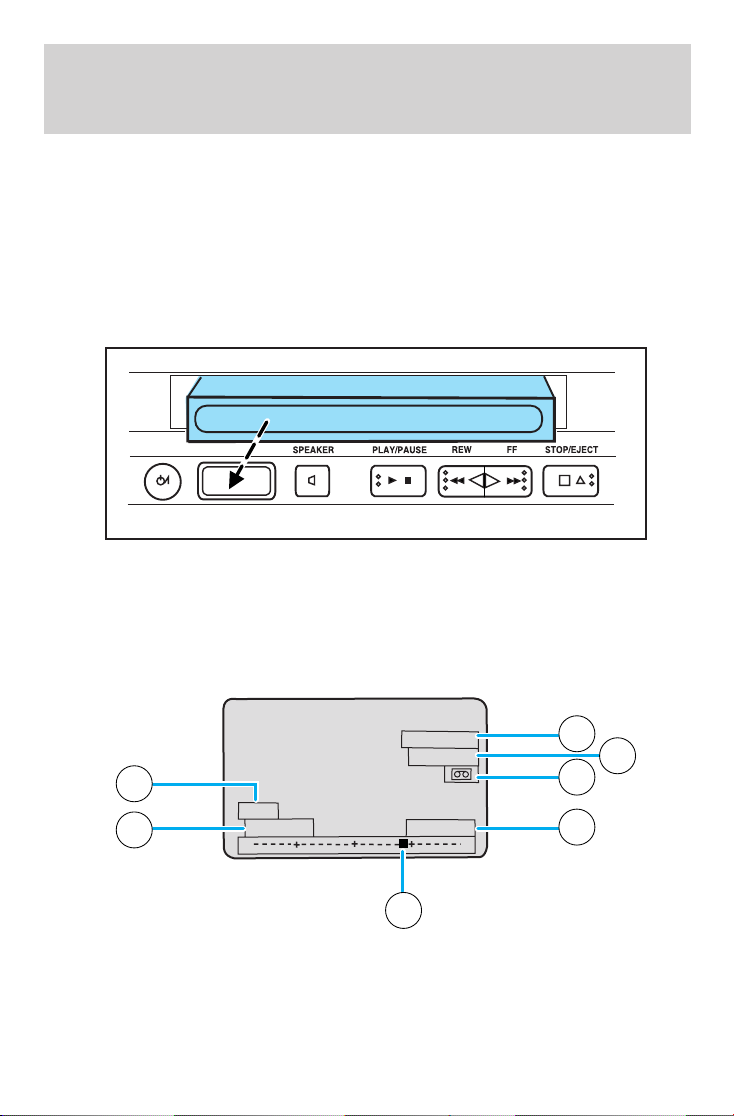
• Open the center console cover. Insert a videocassette into the cassette
compartment.
Inserting a videocassette into the VCP automatically turns the power ON
and the tape should begin playback if the tape is an autoplay videocasette
tape (recording protection tabs are removed).
The tape counter is automatically reset to 0:00:00.
If the vehicle is traveling over rough terrain, it may be difficult to insert
the cassette because the machine attempts to hold the cassette firmly to
prevent vibration. If this condition is encountered, either press firmly or
Operating Instructions
14
remove the cassette and insert it again. If a cassette is inserted in the
wrong position, the protection circuit will automatically eject the
cassette. If this occurs, wait a few seconds and insert the cassette again
in the correct position.
• Once the cassette is completely inserted, close the console cover.
• Ensure that the overhead screen is down for viewing.
Removing cassette
1. Open the console cover and press the STOP/EJECT button to stop
playback.
2. Press the STOP/EJECT button again to eject the videocassette.
On-screen indicators
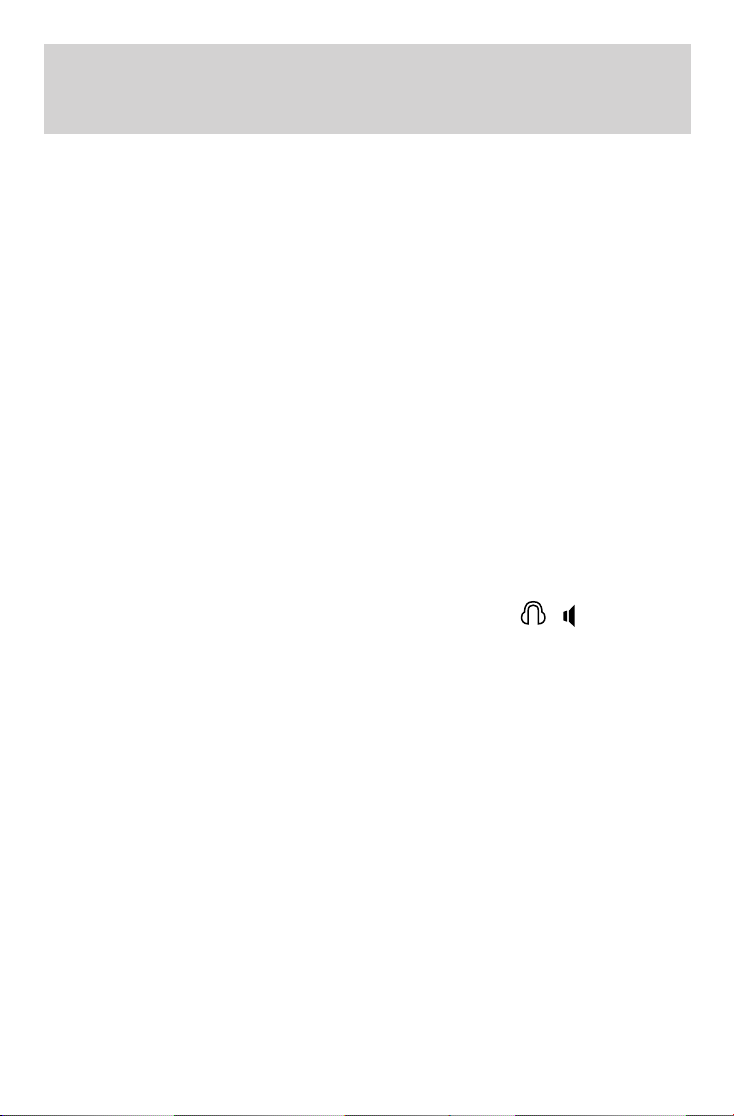
Each time a button is pressed, the operational status of the videocassette
player (VCP) is shown on the screen for approximately five seconds
when the Rear Seat Entertainment System (RSES) is in VCP mode. The
following are possible indicators:
B
E
SP
PLAY
HI-FI
INDEX
–1
0 : 00 :00
5
7
6
4
3
2
1
Operating Instructions
15

1. TAPE SPEED
• SP (standard play) or EP (extended play)
2. TAPE COUNTER
Tape counter provides a reference
number. Press the DISPLAY button
on the remote control to switch between tape counter and no tape
counter.
3. PRESENT TAPE POSITION
4. TAPE STATUS (PLAY/FF/REW/PAUSE)
5. AUDIO OUTPUT
• HI-FI: Hi-Fi audio
• L: Left audio
• R: Right audio
• NORM: Normal audio
• MIX: Mixed audio
6. CASSETTE INDICATION
7. PROGRAM INDICATION
• “MARK” indication blinks for approximately two seconds.
Note: On-screen indicators may appear on the LCD flip-down screen
regarding the current operating mode of the system. These on-screen
indicators may or may not be accurate. Always refer to the radio display
for an accurate indication of the current operating mode.
Playback operation
1. Press the POWER button on the videocassette player (VCP).
2. Insert videocassette into the VCP.
3. Video should automatically begin playback if the tape is an autoplay
videocassette tape (recording protection tabs are removed).
• If video is not shown on the screen, press the MEDIA button on the
Rear Seat Entertainment Module (RSEM) to switch to VCP mode.
4. Tracking is automatically adjusted.
0
:
00
:
00
Operating Instructions
16
• If excessive video “noise” (picture fluctuates up and down) occurs,
press the AUTO button on the remote control to switch OFF
automatic tracking. Manually adjust tape tracking with the TRACKING
(+) (−) buttons.
5. Press the STOP button to discontinue playback, or press EJECT to
remove the cassette.
Single play/ Dual play modes
Your Rear Seat Entertainment System (RSES) system is equipped with
single play and dual play modes. This unique feature allows front and
rear seat passengers to simultaneously listen to different media sources.
However, the front and rear seat passengers cannot listen to two
different radio stations simultaneously.
Note: Always refer to the radio display to determine whether the system
is in single play or dual play mode. The liquid crystal display (LCD) has
on-screen indicators that may or may not accurately indicate the current
mode.
Single play
In single play mode, only one media source is selected at a time. The
audio is played through all four speakers for all passengers to hear.
SINGLE PLAY appears in the radio display. Press the
/ control on
the Rear Seat Entertainment Module (RSEM) to alternate between single
play and dual play modes. The SPEAKER button on the videocassette
player (VCP) is NOT functional and cannot be used to alternate between
single and dual play modes.
Dual play
Dual play mode allows the rear seat passengers to listen to different
media sources than the front seat passengers. When in dual play mode,
the rear speakers turn off and the audio level is brought in through the
headphones. The headphone audio level is controlled by the volume
control on the Rear Seat Entertainment Module (RSEM).
From the RSEM the speaker volume cannot be set higher than the
current volume radio setting. When in dual play mode (headphone
mode), the RSEM controls can change the volume setting to any desired
level.
Operating Instructions
17
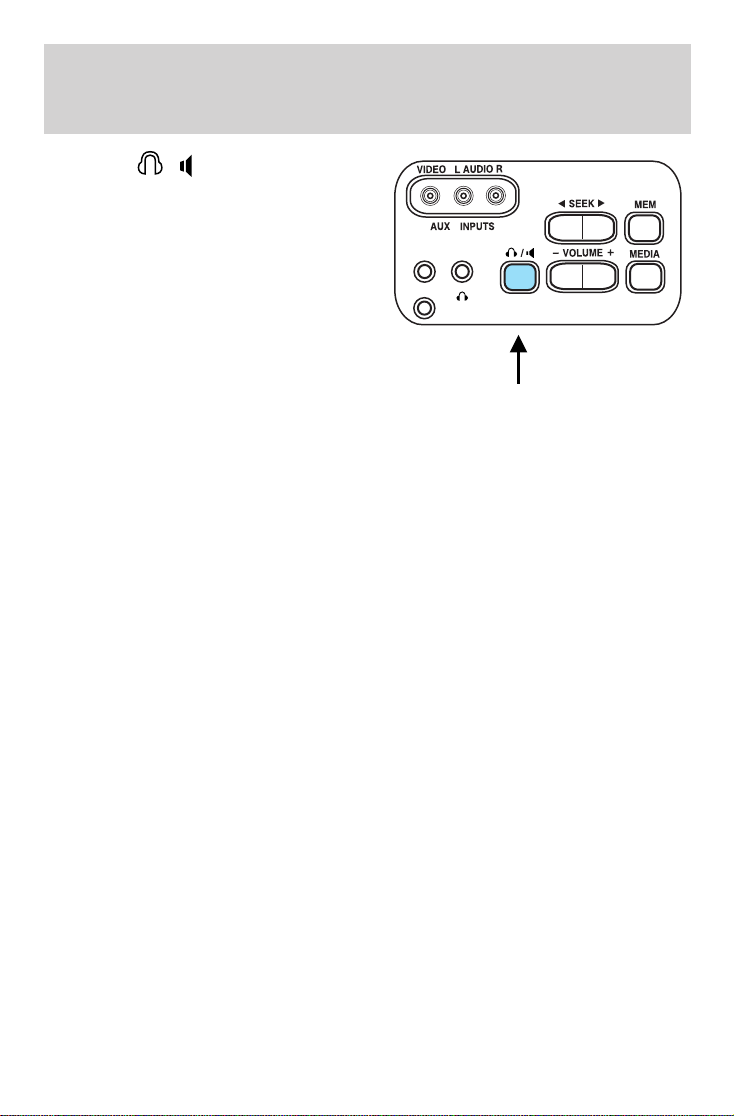
Press the / control to enter
into dual play mode. DUAL PLAY
appears in the radio display. The
selected media source (AM, FM1,
FM2, TAPE, CD, CDDJ, VCP or
AUX) will also appear in the radio
display with the letters RSC in front
of the mode. “RSC” indicates “Rear
Seat Control” and identifies the
mode being used by the rear seat
passengers.
Fast-forward or rewind (no picture)
1. With the tape stopped, press the FF or REW button.
2. Fast-forwarding or rewinding stops when the tape reaches its end or
beginning.
• If the POWER button is pressed within two seconds after the REW
button is pressed, the videocassette player (VCP) is automatically
turned OFF after the tape rewinds to the beginning.
• If the PLAY button is pressed within two seconds after the REW
button is pressed, the videocassette player (VCP) starts playback of
the tape.
Fast-forward or rewind (with picture)
1. While the tape is playing, momentarily press the FF button or REW
button.
2.
The videocassette player (VCP) starts search playback in the normal
(FF button) or reverse (REW button) direction at a speed seven times as
fast as normal in the SP mode, or twenty-one times as fast in the EP mode.
3. To play the tape normally, press the PLAY button.
• Continuously pressing the FF button or REW button for two seconds
or longer while a tape is playing causes the tape to be played at five
times the normal speed in the SP mode or seven times as fast in the
EP mode. When the FF button or REW button is released, tape speed
returns to normal.
Special effects playback (using the remote control)
If video “noise” (picture fluctuates up and down) occurs, press the
AUTO button on the remote control to switch OFF automatic tracking.
Manually adjust tape tracking with the TRACKING (+) (−) buttons.
Operating Instructions
18

Tracking adjustment occasionally may be difficult with poorly recorded
videotapes.
Audio output is muted (no sound) in these Special Effects playback modes.
If the videocassette player (VCP) is continuously operated in a Special
Effects mode for five minutes or longer, the VCP is automatically turned
OFF to protect the tape.
Still playback
1. While a tape is playing, press the PAUSE button.
2. The picture freezes to a “still” frame.
Frame-to-frame playback
1.
With the videocassette player (VCP) in the “still” playback mode, press
the PAUSE button on the remote. The picture will advance one frame.
2. Each time the PAUSE button is pressed, pictures will be played one
frame at a time.
• If the tape is searching in reverse, pictures will be played one frame at
a time in the reverse direction.
Slow playback
1. While a tape is playing, continuously press the PAUSE button on the
remote for two seconds or longer.
2. Playback speed will be decreased to 1/6 of normal speed (slow speed).
• If the tape is searching in reverse, pictures will be played at slow
speed in the reverse direction.
Return to normal speed
• To return to normal playback, press the PLAY button.
Repeated playback
1. Press the PLAY button continuously for five seconds or longer.
2. The tape will be played from beginning to end twenty times in a row,
and will stop after the twentieth playback.
3. To discontinue repeated playback, press the STOP button.
Search playback (with remote control only)
Playback from the beginning of each program.
1. Search the index recorded at the beginning point of each program.
Operating Instructions
19
2. Choose a desired address (index) with the INDEX button on the
remote control.
3. Search a desired address (index) for automatic playback of a program.
4. Each time the right button is pressed, the index number increases.
Pressing the left button decreases the index number.
5. A maximum of nine programs can be chosen at a time.
6. To discontinue search playback, press the STOP button.
Use the INDEX controls to search in a forward or reverse direction.
Memory control
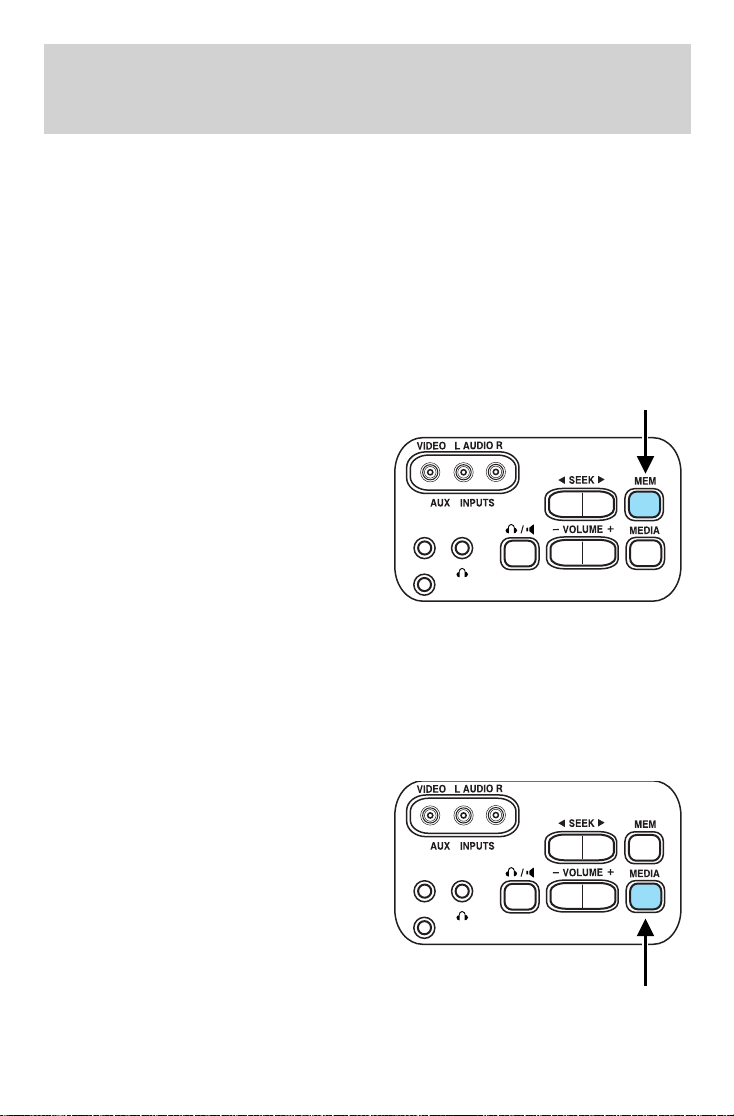
The MEM (Memory) control allows
you to access preset radio stations
or your CD selections.
In AM, FM1 or FM2 modes, press the MEM (Memory) control to access
the first preset station. Press the control successively to access the
remaining preset stations.
In CD DJ mode, press the MEM (Memory) control to access the next
disc in the CD changer.
Media select
The MEDIA control allows you to
select from many different listening
medias. The selected media source
will appear in the radio display.
When in dual play mode, the
selected media source will appear in
the radio display with the letters
RSC in front of the mode. “RSC”
indicates “Rear Seat Control” and
identifies the mode being used by
the rear seat passengers.
Operating Instructions
20
Press the MEDIA control to toggle between AM, FM1, FM2, TAPE, CD,
CDDJ, VCP and AUX modes. When selected, the media source will
illuminate in the radio display.
Note: On-screen indicators may appear on the LCD flip-down screen
regarding the current operating mode of the system. These on-screen
indicators may or may not be accurate. Always refer to the radio display
for an accurate indication of the current operating mode.
• AM
AM radio frequency band
• FM1, FM2
FM radio frequency bands
• TAPE
cassette tape (if equipped)
• CD
single cd player (if equipped)
• CDDJ
compact disc changer (if equipped)
• VCP
videocassette player
• AUX
auxiliary jack input
Seek function
The SEEK control allows you to
access preset radio stations or your
CD selections.
The SEEK control has varying functions depending on which mode is
enabled.
Operating Instructions
21
In radio mode (AM, FM1, FM2):
Press the
control to find the next listenable station down the
frequency band.
Press the control to find the next listenable station up the frequency
band.
In tape mode, press the SEEK control to access the previous ( )or
the next (
) selection.
In CD mode, press the SEEK control to access the previous (
)or
the next (
) track.
In CDDJ mode, press the SEEK control to access the previous (
)or
the next (
) track of the currently selected disc.
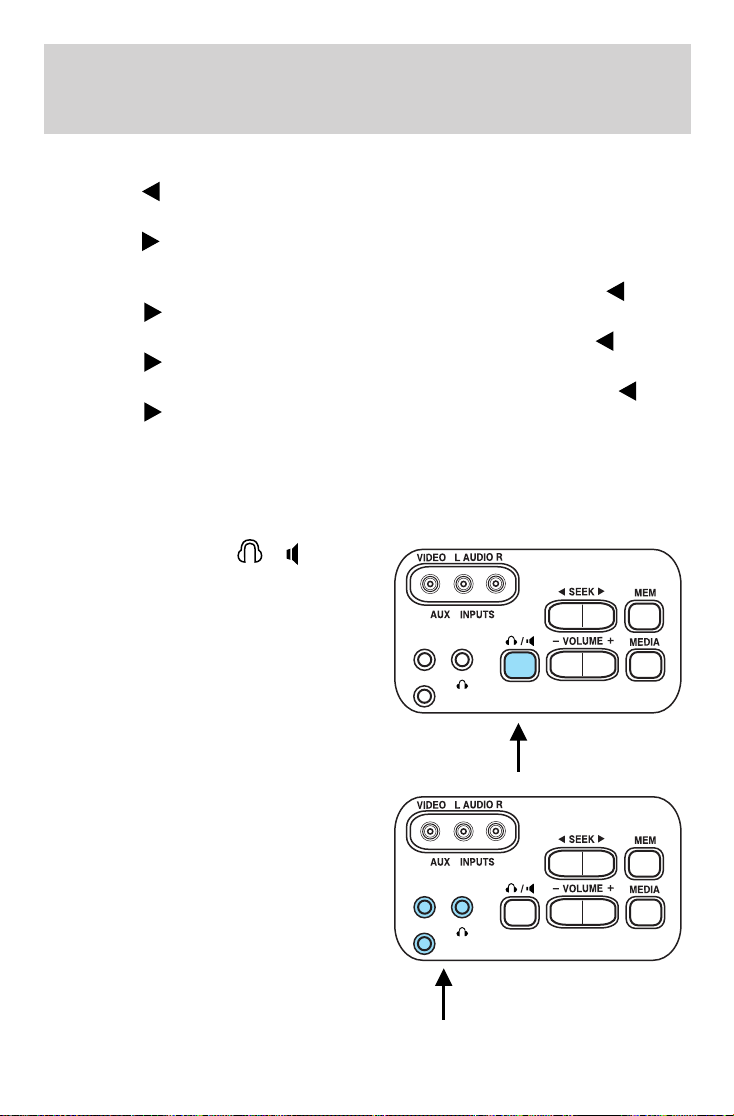
Using headphones
Your Rear Seat Entertainment System (RSES) allows the rear seat
passengers to listen to one media source (radio, TAPE, CD, CDDJ, VCP,
or AUX) while the front seat passengers listen to another.
To activate, press the
/
control.
and plug a 3.5mm headphone into
the headphone jack. With the
headphones ON, the rear speakers
will not operate.
Operating Instructions
22
Press the MEDIA control to toggle to the desired media source.
Use the SEEK, VOLUME and MEM controls to make any desired
adjustments.
Press the
/ control again to engage the radio speakers and
deactivate the Dual Play Feature.
AUXILIARY INPUT DEVICE CONNECTION
Connecting auxiliary video equipment
The Rear Seat Entertainment System (RSES) accepts video and audio
RCA type connectors for all standard video games and video equipment
(such as camcorders) at the auxiliary input jacks of the Rear Seat
Entertainment Module (RSEM).
Playing video games
• Press the / control to enter Dual Play mode.
• Connect the video line to the YELLOW jack (video input).
• Connect left and right audio cables to the WHITE (left audio input)
and RED (right audio input) jacks respectively.
• Connect headphones to the headphone jacks.
• Press the MEDIA button on the Rear Seat Entertainment Module
(RSEM) to select AUX mode. The liquid crystal display (LCD) screen
will be turned ON, and the AUX indicator lamp will be lit. (The
remote control cannot be used to enable AUX mode.)
• Adjust the VOLUME control buttons as desired and view the game on
the LCD flip-down screen. Adjust screen brightness with the thumb
switch.
Using auxiliary video equipment
• Connect the video line to the YELLOW jack.
• Connect the left and right audio wires to the WHITE and RED jacks
respectively.
• Follow operating instructions for the video equipment.
Auxiliary video equipment can be powered by the power point and may
require a 12–volt DC to 120–volt AC power inverter.
Operating Instructions
23
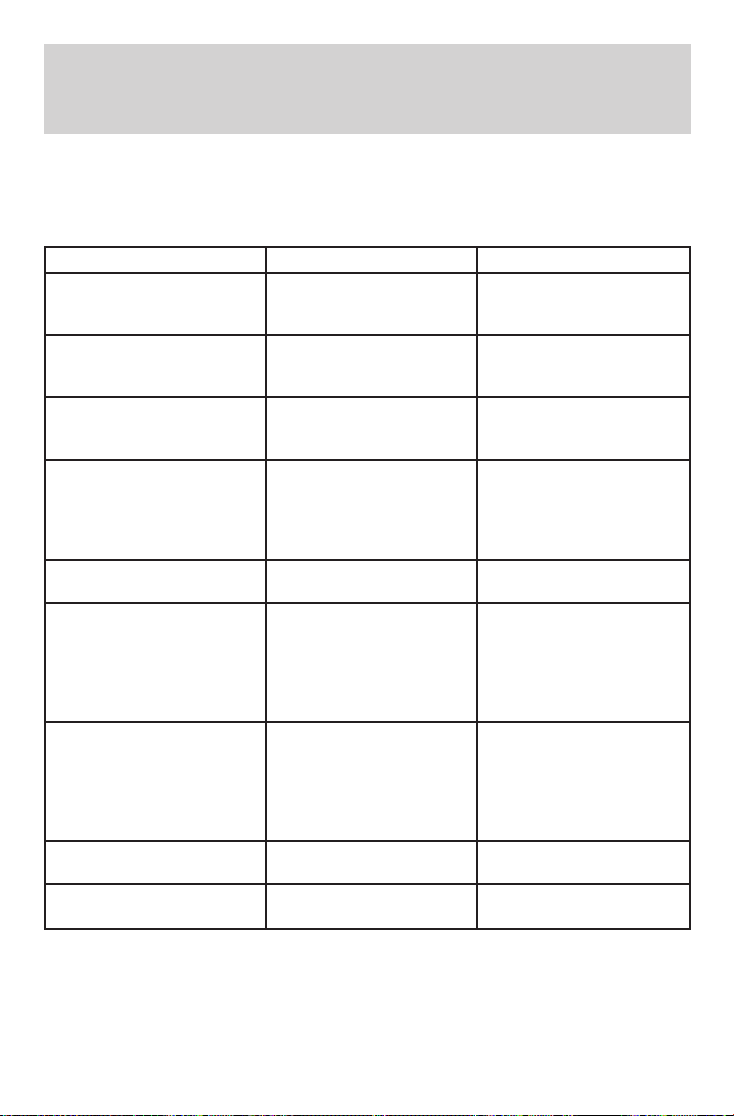
TROUBLESHOOTING
Use the following troubleshooting chart to remedy symptoms you may
experience. If the problem is not readily corrected, consult your Ford,
Lincoln-Mercury dealer.
Symptom Possible Cause Solution
No power supply.
Ignition ON, power
indicator light is OFF.
Power line
disconnected, shorted
or damaged. Blown fuse
Contact your local Ford
Lincoln-Mercury dealer.
VCP does not operate.
Power button is blinking
green.
Machine is dewed
inside. Protection
circuit is operating.
Wait until VCP
becomes dry inside.
May take several hours.
VCP does not operate.
Power button is blinking
red.
Temperature too high.
Temperature protection
circuit is operating.
Wait until vehicle cabin
temperature cools
down.
VCP does not operate.
Power button is blinking
orange.
Over voltage situation
has occurred from
vehicle’s electrical
system
Take your vehicle in for
service as soon as
possible to your local
Ford and Lincoln
Mercury Dealer.
Function indicators do not
disappear from screen.
Incorrect display mode.
Press the DISPLAY
button on remote control.
Video 9noise9
(distortion) in playback.
Abnormal tracking. If
noise appears at same
part of the tape all the
time, the tape is likely
damaged.
Press AUTO button on
remote control to
cancel automatic
tracking. Manually
adjust (+) (−)
TRACKING buttons.
Still picture fluctuates
up and down.
Incorrect vertical hold
adjustment.
Press AUTO button on
remote control to
cancel automatic
tracking. Manually
adjust (+) (−)
TRACKING buttons.
Playback picture rough
or frosted.
Dirty VCP heads. Clean heads with head
cleaning cassette.
No video playback on
screen.
RSES not in VCP
mode.
Press MEDIA button.
OBTAINING A FRENCH SUPPLEMENT
French supplements can be obtained from your dealer or by writing to
Ford Motor Company of Canada, Limited, Service Publications, P.O. Box
1580, Station B, Mississauga, Ontario L4Y 4G3.
Troubleshooting
24