www.philips.com/welcome
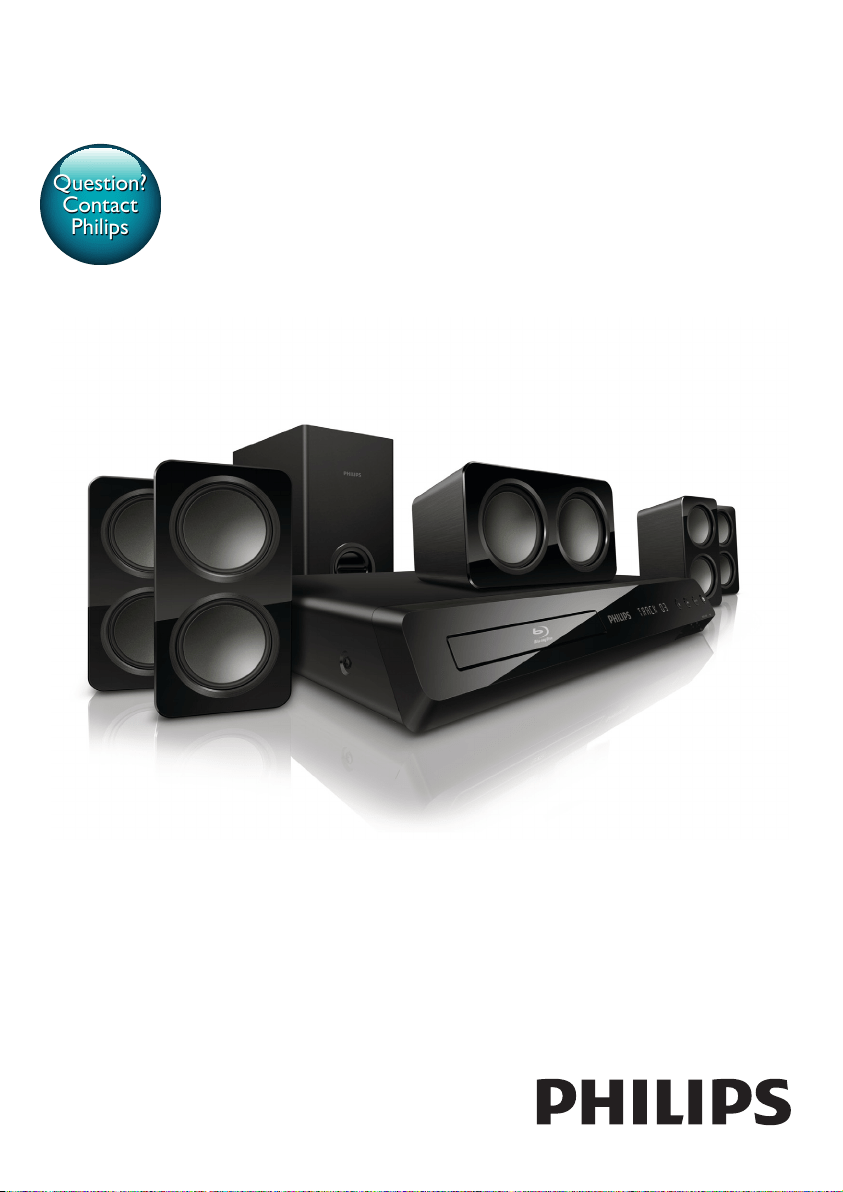
User manual
Always there to help you
Register your product and get support at
HTS3541
Question?
Contact
Philips

2EN
Contents
1 Notice 3
Copyright 3
Compliance 3
Mains fuse (UK only) 3
Open source software 3
Trademarks 3
2 Important 5
Safety 5
Care for your product 6
Care of the environment 6
3 Your home theater 7
Main unit 7
Remote control 7
4 Connect your home theater 9
Speakers 9
Connectors 10
Connect to TV 11
Connect audio from TV and other
devices 12
Internet 13
5 Use your home theater 15
Choose sound 15
Discs 16
USB storage devices 18
DivX 18
Audio, video, and picture options 19
Radio 20
MP3 player 21
EasyLink 21
6 Change settings 23
Picture 23
Sound 23
Language 24
Parental control 25
Energy saving 25
Apply factory settings 26
7 Update software 27
Check software version 27
Update software through the Internet 27
Update software through USB 27
8 Productspecications 29
9 Troubleshooting 32
10 Index 34
3 EN
1 Notice
This section contains the legal and trademark
notices.
Copyright
This item incorporates copy protection
technology that is protected by U.S. patents
and other intellectual property rights of
Rovi Corporation. Reverse engineering and
disassembly are prohibited.
Copyright in the UK
Recording and playback of material may require
consent. See Copyright Act 1956 and The
Performers Protection Acts 1958 to 1972.
Compliance
This product is in compliance with the essential
requirements and other relevant provisions
of Directives 2006/95/EC (Low Voltage),
2004/108/EC (EMC).
Mains fuse (UK only)
This information applies only to products with a
UK mains plug.
This product is tted with an approved molded
plug. If you replace the fuse, use one with:
• the ratings shown on the plug,
• a BS 1362 approval, and
• the ASTA approval mark.
Contact your dealer if you are not sure about
what type of fuse to use.
Caution: To conform with the EMC directive
(2004/108/EC), do not detach the plug from
the power cord.
Open source software
Philips Electronics Singapore Pte Ltd hereby
offers to deliver, upon request, a copy of the
complete corresponding source code for the
copyrighted open source software packages
used in this product for which such offer is
requested by the respective licenses. This offer
is valid up to three years after product purchase
to anyone in receipt of this information. To
obtain source code, please contact open.
[email protected]. If you prefer not to use
email or if you do not receive conrmation
receipt within a week after mailing to this email
address, please write to "Open Source Team,
Philips Intellectual Property & Standards, P.O.
Box 220, 5600 AE Eindhoven, The Netherlands".
If you do not receive timely conrmation
of your letter, please email to the email
address above. The texts of the licenses and
acknowledgements for open source software
used in this product are included on a separate
leaet.
Trademarks
"Blu-ray Disc", "Blu-ray" and "Blu-ray Disc" logo
are trademarks of Blu-ray Disc Association.
4EN
Java and all other Java trademarks and logos are
trademarks or registered trademarks of Sun
Microsystems, Inc. in the United States and/or
other countries.
Manufactured under license under U.S. Patent
Nos: 5,956,674; 5,974,380; 6,226,616; 6,487,535;
7,392,195; 7,272,567; 7,333,929; 7,212,872
& other U.S. and worldwide patents issued
& pending. DTS-HD, the Symbol, & DTS-
HD and the Symbol together are registered
trademarks & DTS-HD Master Audio | Essential
is a trademark of DTS, Inc. Product includes
software. DTS, Inc. All Rights Reserved.
Manufactured under license from Dolby
Laboratories. Dolby and the double-D symbol
are trademarks of Dolby Laboratories.
Covered by one or more of the following
U.S. patents: 7,295,673; 7,460,668; 7,515,710;
7,519,274.
DivX
®
, DivX Certied
®
, DivX Plus
®
HD
and associated logos are trademarks of Rovi
Corporation or its subsidiaries and are used
under license.
ABOUT DIVX PLUS
®
HD: DivX
®
is a digital
video format created by DivX, Inc. This is an
ofcial DivX Certied
®
device that plays DivX
video, including DivX
®
Plus HD video (H.264/.
MKV) up to 1080p and premium content.
Visit www.divx.com for more information and
software tools to convert your les into DivX
video.
ABOUT DIVX VIDEO: DivX
®
is a digital video
format created by DivX, LLC, a subsidiary
of Rovi Corporation. This is an ofcial DivX
Certied
®
device that plays DivX video. Visit
divx.com for more information and software
tools to convert your les into DivX videos.
ABOUT DIVX VIDEO-ON-DEMAND: This
DivX Certied
®
device must be registered
in order to play purchased DivX Video-on-
Demand (VOD) movies. To obtain your
registration code, locate the DivX VOD section
in your device setup menu. Go to vod.divx.com
for more information on how to complete your
registration.
HDMI, the HDMI logo, and High-Denition
Multimedia Interface are trademarks or
registered trademarks of HDMI licensing LLC in
the United States and other countries.
CLASS 1
LASER PRODUCT

5 EN
2 Important
Read and understand all instructions before you
use your home theater. If damage is caused by
failure to follow instructions, the warranty does
not apply.
Safety
Riskofelectricshockorre!
• Never expose the product and accessories
to rain or water. Never place liquid
containers, such as vases, near the product.
If liquids are spilt on or into the product,
disconnect it from the power outlet
immediately. Contact Philips Consumer
Care to have the product checked before
use.
• Never place the product and accessories
near naked ames or other heat sources,
including direct sunlight.
• Never insert objects into the ventilation
slots or other openings on the product.
• Where the mains plug or an appliance
coupler is used as the disconnect device,
the disconnect device shall remain readily
operable.
• Disconnect the product from the power
outlet before lightning storms.
• When you disconnect the power cord,
always pull the plug, never the cable.
Riskofshortcircuitorre!
• Before you connect the product to the
power outlet, ensure that the power
voltage matches the value printed on the
back or bottom of the product. Never
connect the product to the power outlet if
the voltage is different.
Riskofinjuryordamagetothehometheater!
• For wall-mountable products, use only the
supplied wall mount bracket. Secure the
wall mount to a wall that can support the
combined weight of the product and the
wall mount. Koninklijke Philips Electronics
N.V. bears no responsibility for improper
wall mounting that results in accident,
injury or damage.
• For speakers with stands, use only the
supplied stands. Secure the stands to the
speakers tightly. Place the assembled stands
on at, level surfaces that can support the
combined weight of the speaker and stand.
• Never place the product or any objects
on power cords or on other electrical
equipment.
• If the product is transported in
temperatures below 5°C, unpack the
product and wait until its temperature
matches room temperature before
connecting it to the power outlet.
• Visible and invisible laser radiation when
open. Avoid exposure to beam.
• Do not touch the disc optical lens inside
the disc compartment.
• Parts of this product can be made of
glass. Handle with care to avoid injury and
damage.
Riskofoverheating!
• Never install this product in a conned
space. Always leave a space of at least four
inches around the product for ventilation.
Ensure curtains or other objects never
cover the ventilation slots on the product.
Riskofcontamination!
• Do not mix batteries (old and new or
carbon and alkaine, etc.).
• Danger of explosion if batteries are
incorrectly replaced. Replace only with the
same or equivalent type.
• Remove batteries if they are exhausted or
if the remote control is not to be used for
a long time.
• Batteries contain chemical substances, they
should be disposed of properly.
Riskofswallowingbatteries!
• The product/remote control may contain
a coin/button type battery, which can be
swallowed. Keep the battery out of reach
6EN
of children at all times! If swallowed, the
battery can cause serious injury or death.
Severe internal burns can occur within two
hours of ingestion.
• If you suspect that a battery has been
swallowed or placed inside any part of the
body, seek immediate medical attention.
• When you change the batteries, always
keep all new and used batteries out of
reach of children. Ensure that the battery
compartment is completely secure after
you replace the battery.
• If the battery compartment cannot be
completely secured, discontinue use of the
product. Keep out of reach of children and
contact the manufacturer.
This is CLASS II apparatus with double
insulation, and no protective earth provided.
Care for your product
• Do not insert any objects other than discs
into the disc compartment.
• Do not insert warped or cracked discs into
the disc compartment.
• Remove discs from the disc compartment
if you are not using the product for an
extended period of time.
• Use only microber cloth to clean the
product.
Care of the environment
Your product is designed and manufactured
with high quality materials and components,
which can be recycled and reused.
When this crossed-out wheeled bin symbol is
attached to a product it means that the product
is covered by the European Directive 2002/96/
EC. Please inform yourself about the local
separate collection system for electrical and
electronic products.
Please act according to your local rules and
do not dispose of your old products with your
normal household waste.
Correct disposal of your old product helps to
prevent potential negative consequences for the
environment and human health.
Your product contains batteries covered by the
European Directive 2006/66/EC, which cannot
be disposed with normal household waste.
Please inform yourself about the local rules
on separate collection of batteries because
correct disposal helps to prevent negative
consequences for the environmental and
human health.
7 EN
3 Your home
theater
Congratulations on your purchase, and
welcome to Philips! To fully benet from the
support that Philips offers, register your home
theater at www.philips.com/welcome.
Main unit
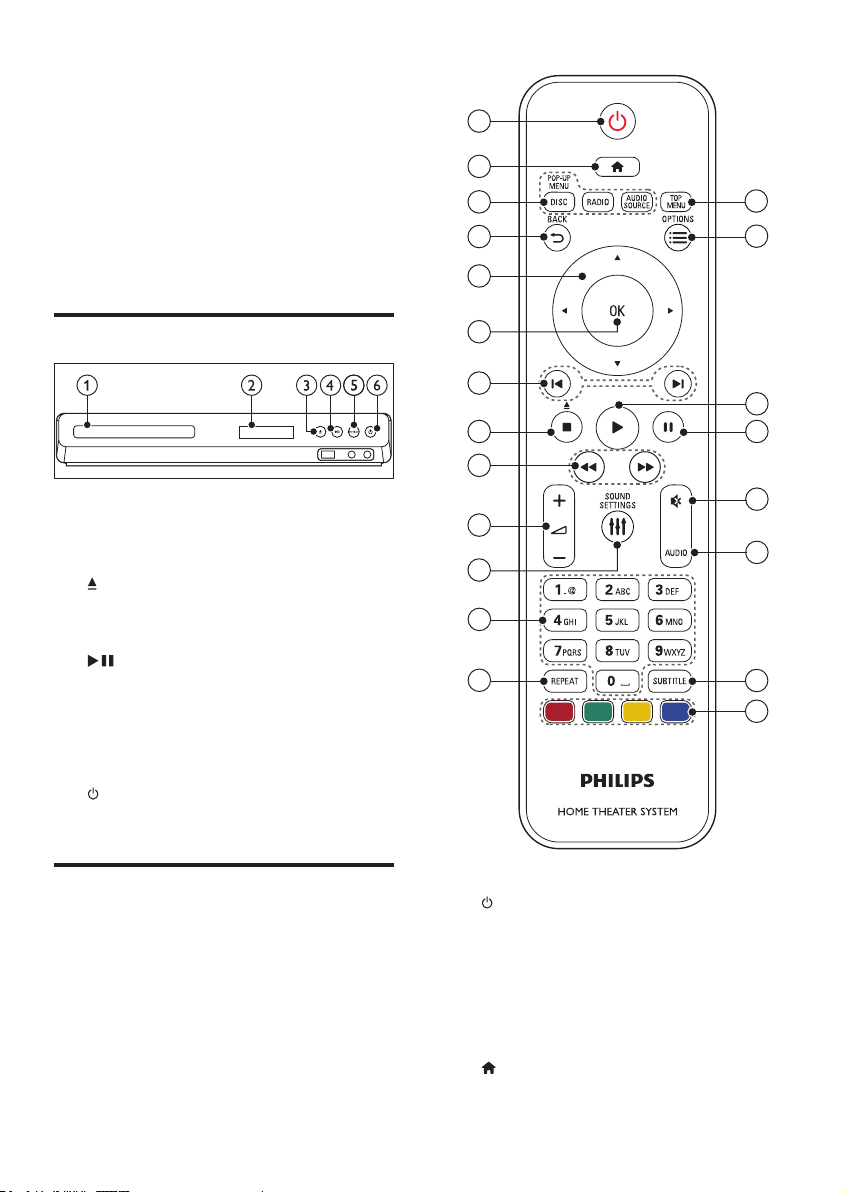
a Disc compartment
b Display panel
c (Open/Close)
Open or close the disc compartment, or
eject the disc.
d (Play/Pause)
Start, pause or resume play.
e SOURCE
Select an audio or video source for the
home theater.
f (Standby-On)
Switch the home theater on or to standby.
Remote control
This section includes an overview of the
remote control.
a (Standby-On)
• Switch the home theater on or to
standby.
• When EasyLink is enabled, press
and hold for at least three seconds
to switch all connected HDMI CEC
compliant devices to standby.
b (Home)
Access the home menu.
1
2
7
3
4
5
9
11
12
19
20
21
13
6
16
17
18
8
10
15
14

8EN
c Source buttons
• DISC/POP-UP MENU : Switch to disc
source.Access or exit the disc menu
when you play a disc.
• RADIO : Switch to FM radio.
• AUDIO SOURCE : Select an audio
input source.
d BACK
• Return to a previous menu screen.
• In radio mode, press and hold to erase
the current preset radio stations.
e Navigation buttons
• Navigate menus.
• In radio mode, press left or right to
start auto search.
• In radio mode, press up or down to
tune the radio frequency.
f OK
Conrm an entry or selection.
g / (Previous/Next)
• Skip to the previous or next track,
chapter or le.
• In radio mode, select a preset radio
station.
h (Stop) / (Eject/Open/Close)
• Stop play.
• Press and hold for three seconds to
open or close the disc compartment,
or eject the disc.
i / (Fast Backward / Fast Forward)
Search backwards or forward. Press
repeatedly to change the search speed.
j +/- (Volume)
Increase or decrease volume.
k SOUND SETTINGS
Access or exit sound options.
l Alphanumeric buttons
Enter values or letters (using SMS style
entry).
m REPEAT
Select or turn off repeat mode.
n TOP MENU
Access the main menu of a disc.
o OPTIONS
• Access more play options while playing
a disc or a USB storage device.
• In radio mode, set a radio station.
p (Play)
Start or resume play.
q (Pause)
Pause play.
r (Mute)
Mute or restore volume.
s AUDIO
Select an audio language or channel.
t SUBTITLE
Select subtitle language for video.
u Color buttons
Select tasks or options for Blu-ray discs.
EasyLink controls
With Easylink, you can control your home
theater and the TV with the following buttons
on your home theater remote control (see
'EasyLink' on page 21).
• (Standby-On): Press and hold to switch
your home theater, TV and the connected
devices to standby.
• (Play): When a video disc is in the disc
compartment, wake up the TV from
standby, and then play a disc.
9 EN
4 Connect your
home theater
This section helps you connect your home
theater to a TV and other devices.
For information about the basic connections
of your home theater and accessories, see
the quick start guide. For a comprehensive
interactive guide, see www.connectivityguide.
philips.com.
Note
• For identication and supply ratings, refer to the type
plate at the back or bottom of the product.
• Before you make or change any connections, make sure
that all devices are disconnected from the power outlet.
Speakers
Position, connect, and set up your speakers for
best surround sound.
Position
Speaker position plays a critical role in setting
up a surround sound effect.
For best results, place your speakers and the
subwoofer as shown below.
Note
• Surround sound depends on factors such as room
shape and size, type of wall and ceiling, windows and
reective surfaces, and speaker acoustics. Experiment
with the speaker positions to nd the optimum setting
for you.
Follow these general guidelines, and then set up
your speakers.
1 Seating position:
This is the center of your listening area.
2 FRONT CENTER (front center) speaker:
Place the center speaker directly in front of
the seating position, either above or below
your TV. Make sure that it is close to your
ear height when you are seated.
3 FRONT LEFT (front left) and FRONT
RIGHT (front right) speakers:
Place the left and right speakers in the
front, and equidistant from the center
speaker in an arc, so that all the three
speakers are at same distance from your
seating position. For best effect, point the
speakers towards the seating position and
place the speakers close to the ear level
(when seated).
4 REAR LEFT (rear left) and REAR RIGHT
(rear right) speakers:
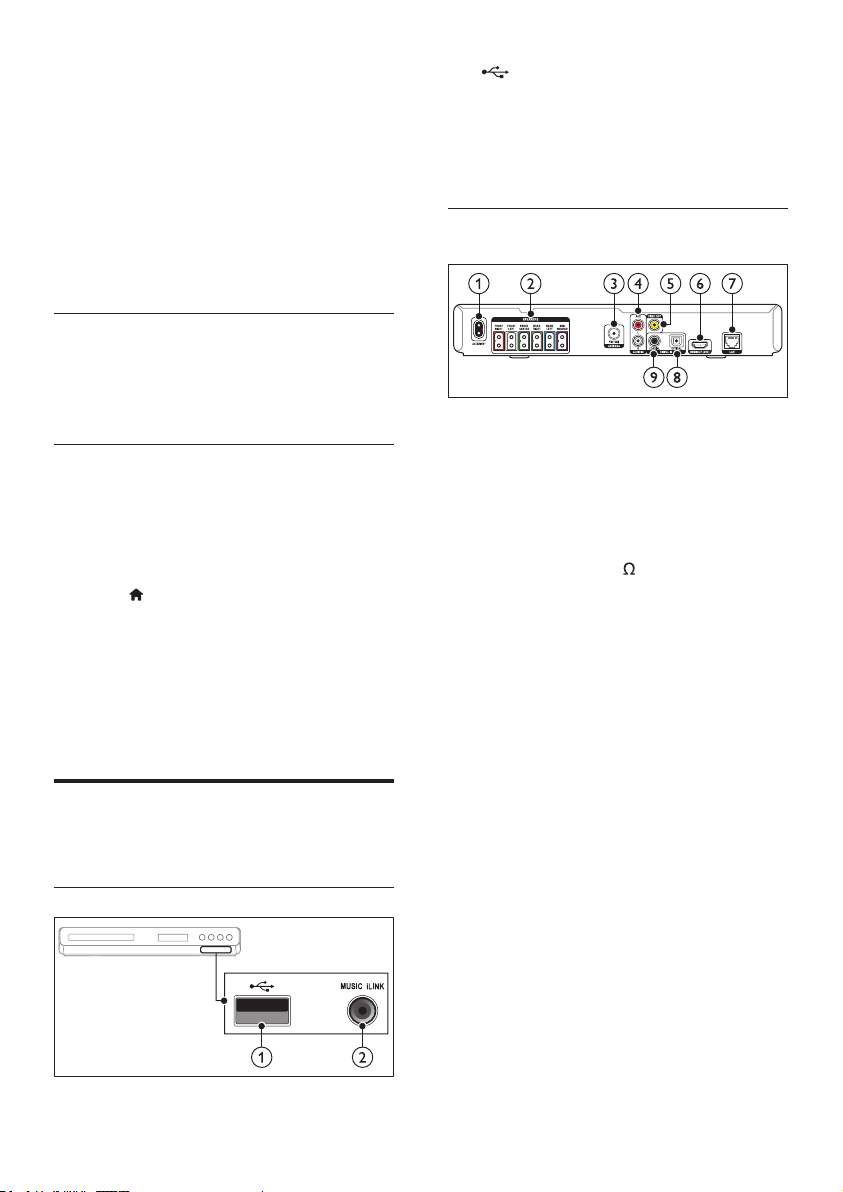
10EN
Place the rear surround speakers to the
left and right side of your seating position,
either in line with it or slightly behind it. For
best effect, point the speakers towards the
seating position and place the speakers just
above the ear level (when seated).
5 SUBWOOFER (subwoofer):
Place the subwoofer at least one meter to
the left or right of the TV. Leave about ten
centimeter clearance from the wall.
Connect
Connect your speakers and the subwoofer to
your home theater as described in the quick
start guide.
Setup
Set up your speakers through the speaker setup
menu.
1 Connect your speakers and subwoofer as
described in the Quick start guide.
2 Press (Home) on your home theater
remote control, and select [Setup] >
[Audio] > [Speaker Setup].
3 Enter the distance for each speaker, and
then listen to the test tones and change
the volume. Experiment a little with the
speaker positions to nd the ideal setting.
Connectors
Connect other devices to your home theater.
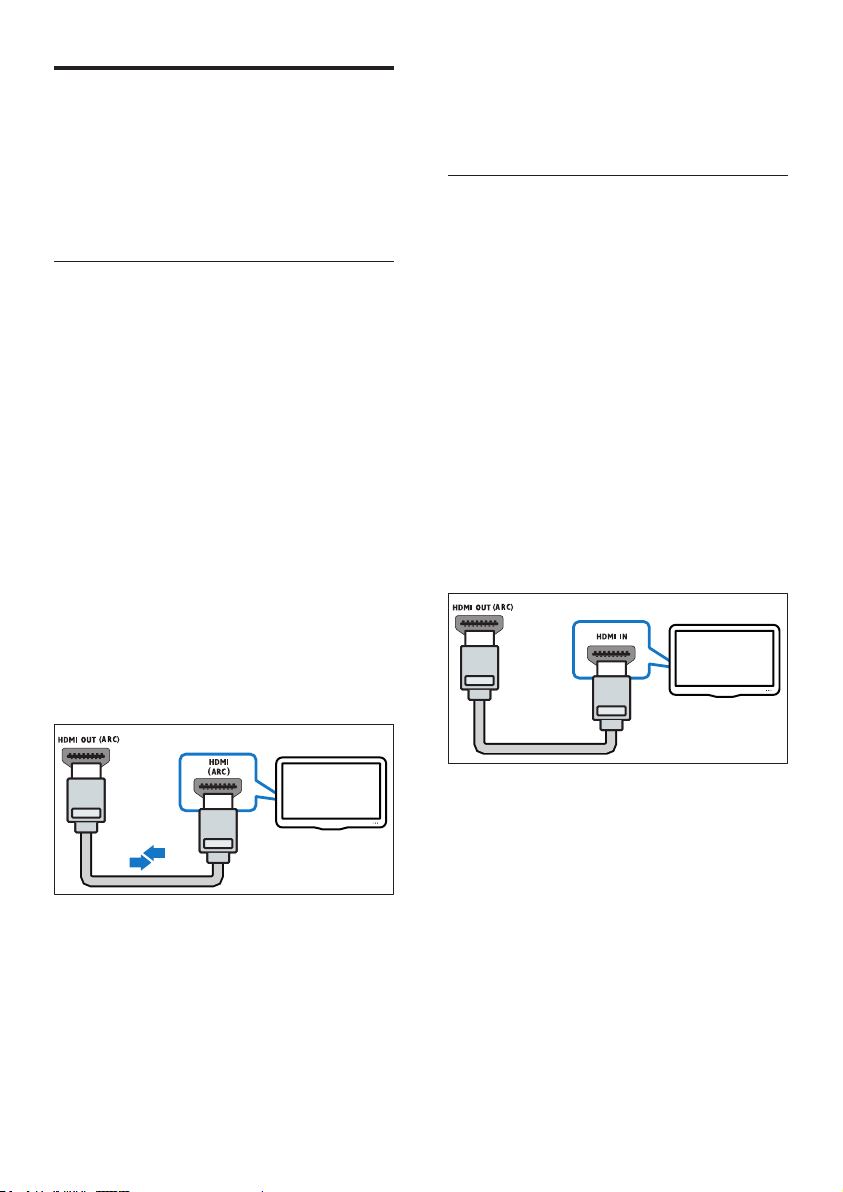
Front
a (USB)
Audio, video or picture input from a USB
storage device.
b MUSIC iLINK
Audio input from an MP3 player.
Back connectors
a AC MAINS
Connect to the power supply.
b SPEAKERS
Connect to the supplied speakers and
subwoofer.
c ANTENNA FM 75
Signal input from an antenna, cable or
satellite.
d AUDIO IN-AUX
Connect to an analog audio output on the
TV or an analog device.
e VIDEO OUT
Connect to the composite video input on
the TV.
f HDMI OUT (ARC)
Connect to the HDMI input on the TV.
g LAN
Connect to the LAN input on a
broadband modem or router.
h DIGITAL IN-OPTICAL
Connect to an optical audio output on the
TV or a digital device.
i DIGITAL IN-COAXIAL
Connect to a coaxial audio output on the
TV or a digital device.
11 EN
Connect to TV
Connect your home theater to a TV to
watch videos. You can listen to audio from TV
programs through your home theater speakers.
Use the best quality connection available on
your home theater and TV.
Option 1: Connect to TV through
HDMI (ARC)
Best quality video
Your home theater supports HDMI version
with Audio Return Channel (ARC). If your TV
is HDMI ARC compliant, connect your home
theater to the TV through the HDMI ARC
connection for easy and quick setup.
With HDMI ARC, you do not need an
additional audio cable to play audio from TV
through your home theater.
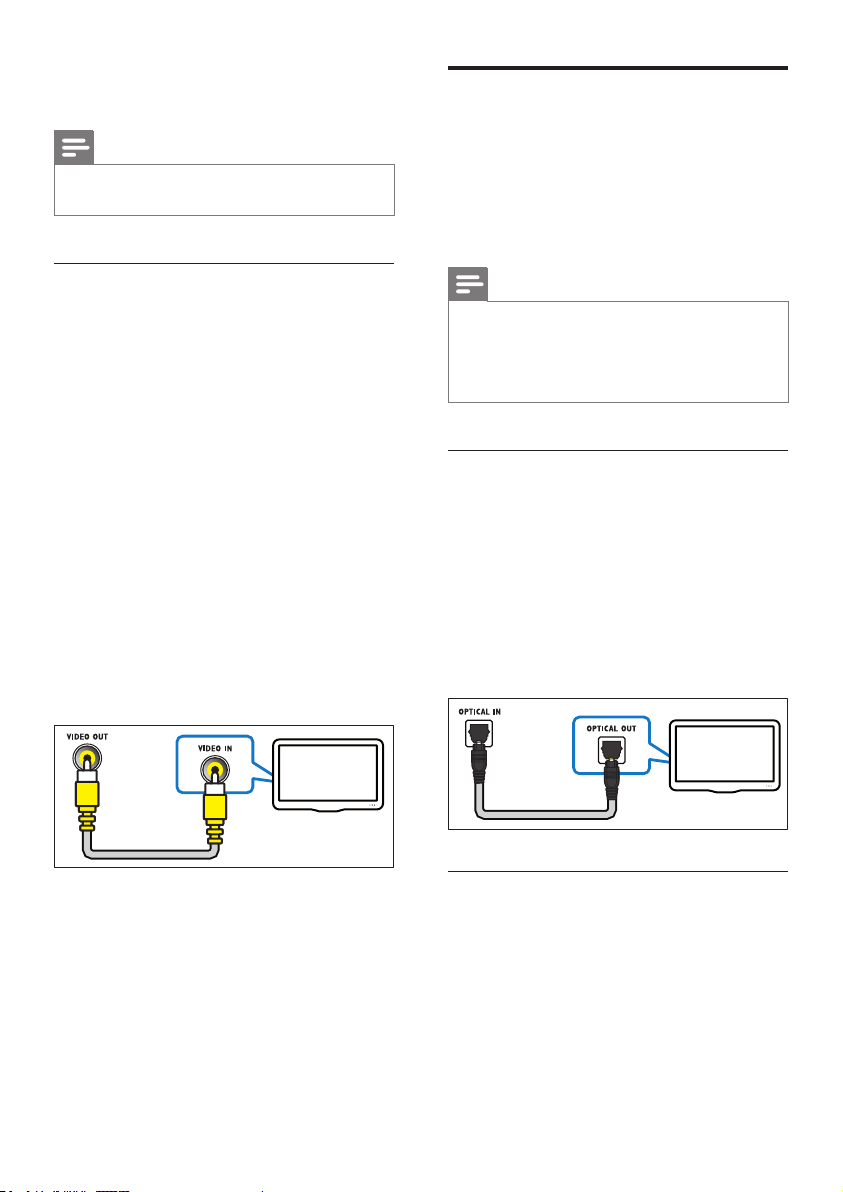
1 Using a High Speed HDMI cable, connect
the HDMI OUT (ARC) connector on
your home theater to the HDMI ARC
connector on the TV.
The HDMI ARC connector on the TV
might be labeled HDMI IN or HDMI. For
details on TV connectors, see the TV user
manual.
2 On your TV, turn on HDMI-CEC. For
details, see the TV user manual.
» When you play a disc on your home
theater, the video is automatically
displayed on TV and the audio is
automatically played on the home
theater.
TV
3 If audio from the TV does not play
automatically on your home theater, set up
the audio manually (see 'Set up audio for
connected devices' on page 13).
Option 2: Connect to TV through
HDMI
Best quality video
If your TV is not HDMI ARC compliant, connect
your home theater to the TV through a
standard HDMI connection.
With a standard HDMI connection, you need
an additional audio cable to play the audio
from the TV through your home theater (see
'Connect audio from TV and other devices' on
page 12).
1 Using a High Speed HDMI cable, connect
the HDMI OUT (ARC) connector on your
home theater to the HDMI connector on
the TV.
The HDMI connector on the TV might be
labeled HDMI IN.
2 On your TV, turn on HDMI-CEC. For
details, see the TV user manual.
» When you play a disc on your home
theater, the video is automatically
displayed on TV and the audio is
automatically played on the home
theater.
3 To play audio from TV programs through
your home theater, connect an additional
audio cable (see 'Connect audio from TV
and other devices' on page 12).
4 If audio from the TV does not play
automatically on your home theater, set up
TV
12EN
the audio manually (see 'Set up audio for
connected devices' on page 13).
Note
• If your TV has a DVI connector, you can use an HDMI/
DVI adapter to connect to TV.
Option 3: Connect to the TV through
composite video
Basic quality video
If your TV does not have HDMI connectors,
connect your home theater to the TV through a
composite connection. A composite connection
does not support high-denition video.
With a composite connection, you need
an additional audio cable to play the audio
from the TV through your home theater (see
'Connect audio from TV and other devices' on
page 12).
1 Using a composite video cable, connect
the VIDEO OUT connector on your
home theater to the composite video
connector on the TV.
The composite video connector might be
labeled AV IN, VIDEO IN, COMPOSITE,
or BASEBAND.
2 On your TV, switch to the correct video
input.
3 To play audio from TV programs through
your home theater, connect an additional
audio cable (see 'Connect audio from TV
and other devices' on page 12).
On your home theater, press SOURCE
repeatedly to select the correct audio
input.
TV
Connect audio from TV and
other devices
Play audio from TV or other devices through
your home theater.
Use the best quality connection available on
your TV, home theater, and other devices.
Note
• The audio connections in this user manual are only
recommendations. You can use other connections too.
• When your home theater and TV are connected
through HDMI ARC, an audio connection is not
required.
Option 1: Connect audio through a
digital optical cable
Best quality audio
Using an optical cable, connect the OPTICAL
connector on your home theater to the
OPTICAL OUT connector on the TV or other
device.
The digital optical connector might be labeled
SPDIF, SPDIF OUT, or OPTICAL.
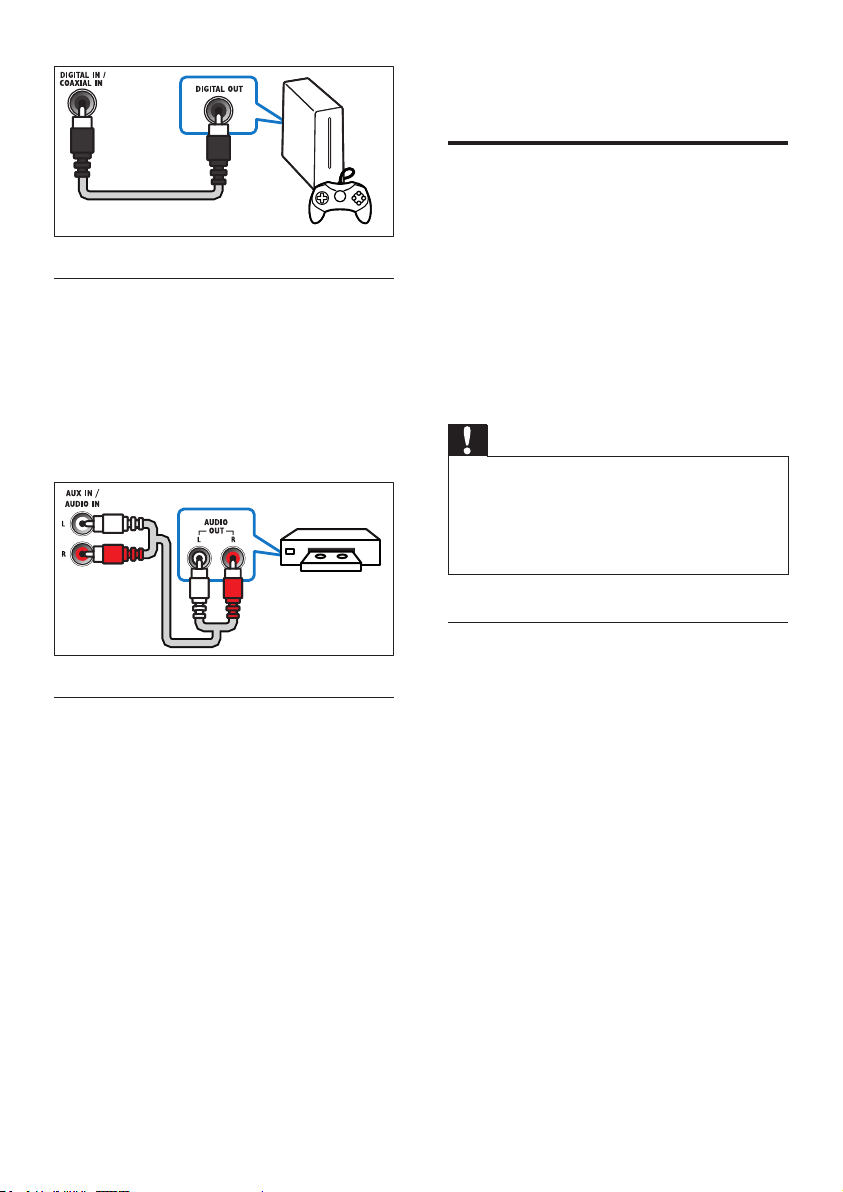
Option 2: Connect audio through a
digital coaxial cable
Good quality audio
Using a coaxial cable, connect the COAXIAL
connector on your home theater to the
COAXIAL/DIGITAL OUT connector on the
TV or other device.
The digital coaxial connector might be labeled
DIGITAL AUDIO OUT.
TV
13 EN
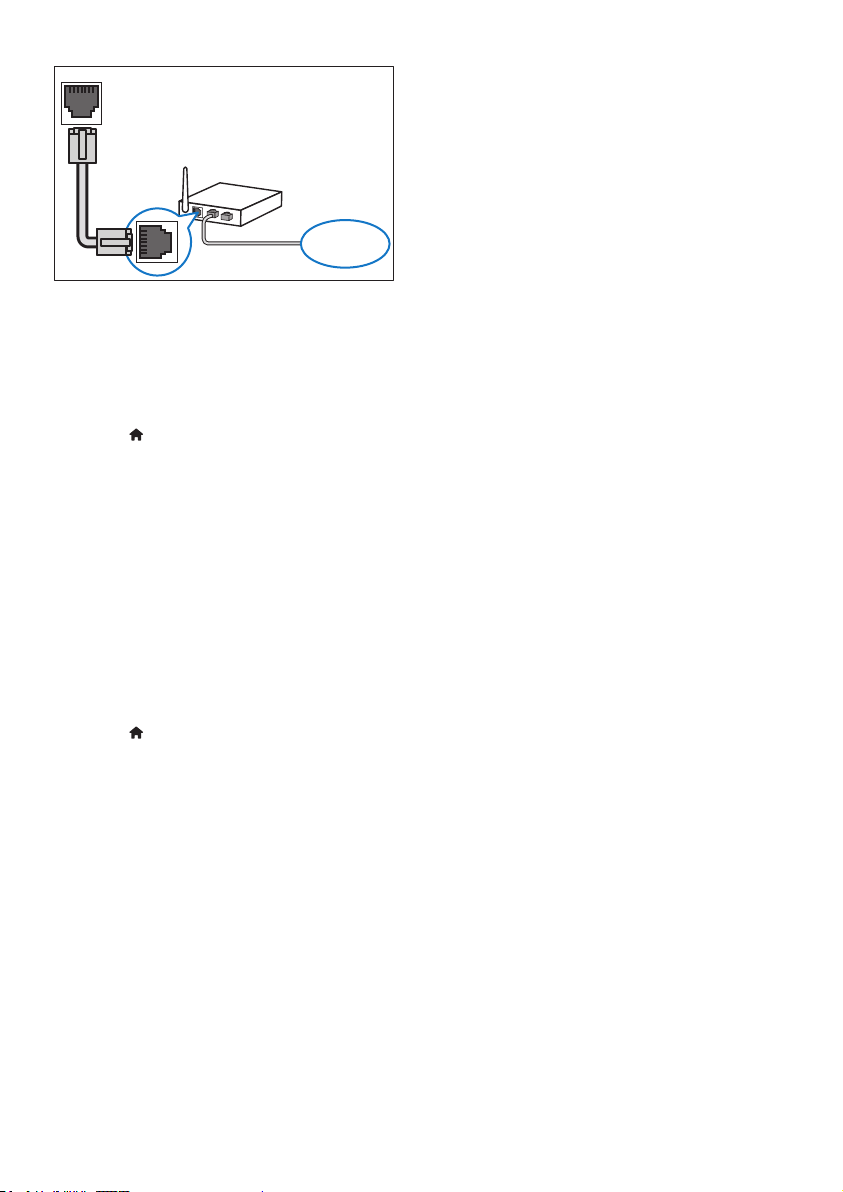
Option 3: Connect audio through
analog audio cables
Basic quality audio
Using an analog cable, connect the AUX
connectors on your home theater to the
AUDIO OUT connectors on the TV or other
device.
Set up audio for connected devices
When you connect a device to your home
theater, check the audio settings.
1 On your TV and other devices, turn on
HDMI-CEC. For details, see the user
manual of the TV and the other device.
2 Select 'Amplier' from the TV speakers
menu. For details, see the TV user manual.
3 On your home theater, turn on System
Audio Control, and then map the audio
of the connected device to the correct
connectors on your home theater (see
'Play audio from home theater' on page
22).
If the connected device is not HDMI-CEC
compliant, press SOURCE repeatedly on
VCR
your home theater to select the correct
audio input.
Internet
Connect your home theater to the internet and
enjoy:
• BD-Live applications: Access exclusive
services from the BD-Live enabled Blu-ray
discs (see 'BD-Live on Blu-ray' on page 17).
• Software update: update the home
theater software through the network (see
'Update software through the Internet' on
page 27).
Caution
• Before you try to connect the home theater to
a computer network, familiarize yourself with the
network router and networking principles. If necessary,
read documentation that accompanies the network
components. Philips is not responsible for lost, damaged,
or corrupt data.
Wired connection
Connect your home theater to your router
through a network cable.
What you need
• A network router (with DHCP enabled).
• A network cable (RJ45 straight cable).
• For BD-Live application and software
update, make sure that the network router
has access to the Internet and the rewall
is disabled.
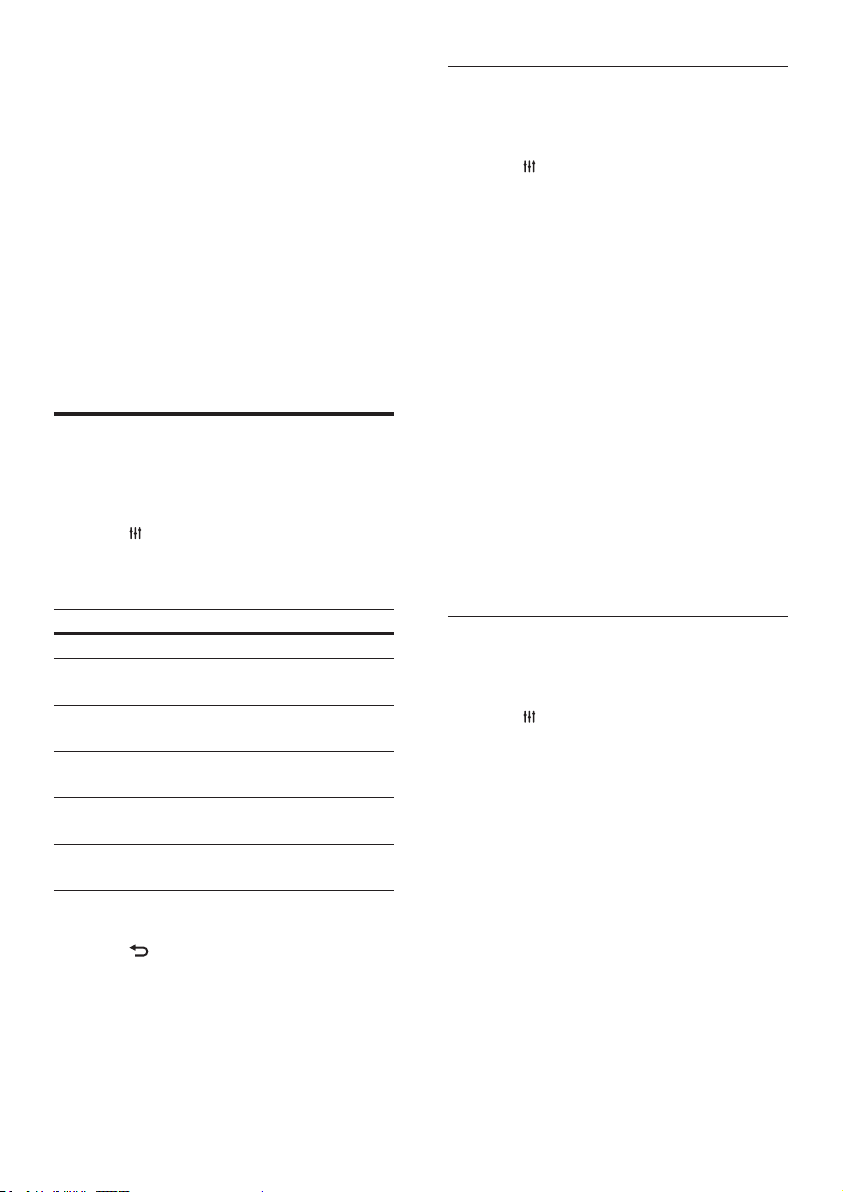
Set up the wired network
Connect your home theater to your router as
shown below, and then switch on the devices.
14EN
1 Connect the home theater to a network
router through a wired connection (see
'Wired connection' on page 13).
2 Turn on your TV, and switch to the correct
source for the home theater.
3 Press (Home).
4 Select [Setup], and then press OK.
5 Select [Network] > [Network
Installation] > [Wired (Ethernet)], and
then press OK.
6 Follow the instructions on the TV to
complete the setup.
» The home theater connects to the
internet. If connection fails, select
[Retry], and then press OK.
7 Select [Finish], and then press OK to exit.
Check wired network settings
1 Press (Home).
2 Select [Setup], and then press OK.
3 Select [Network] > [View Network
Settings], and then press OK.
» The current network settings are
displayed.
LAN
www
15 EN
5 Use your home
theater
This section helps you use the home theater to
play media from a wide range of sources.
Before you start
• Make the necessary connections described
in the Quick start guide and the user
manual.
• Switch the TV to the correct source for
the home theater.
Choose sound
This section helps you choose the ideal sound
for your video or music.
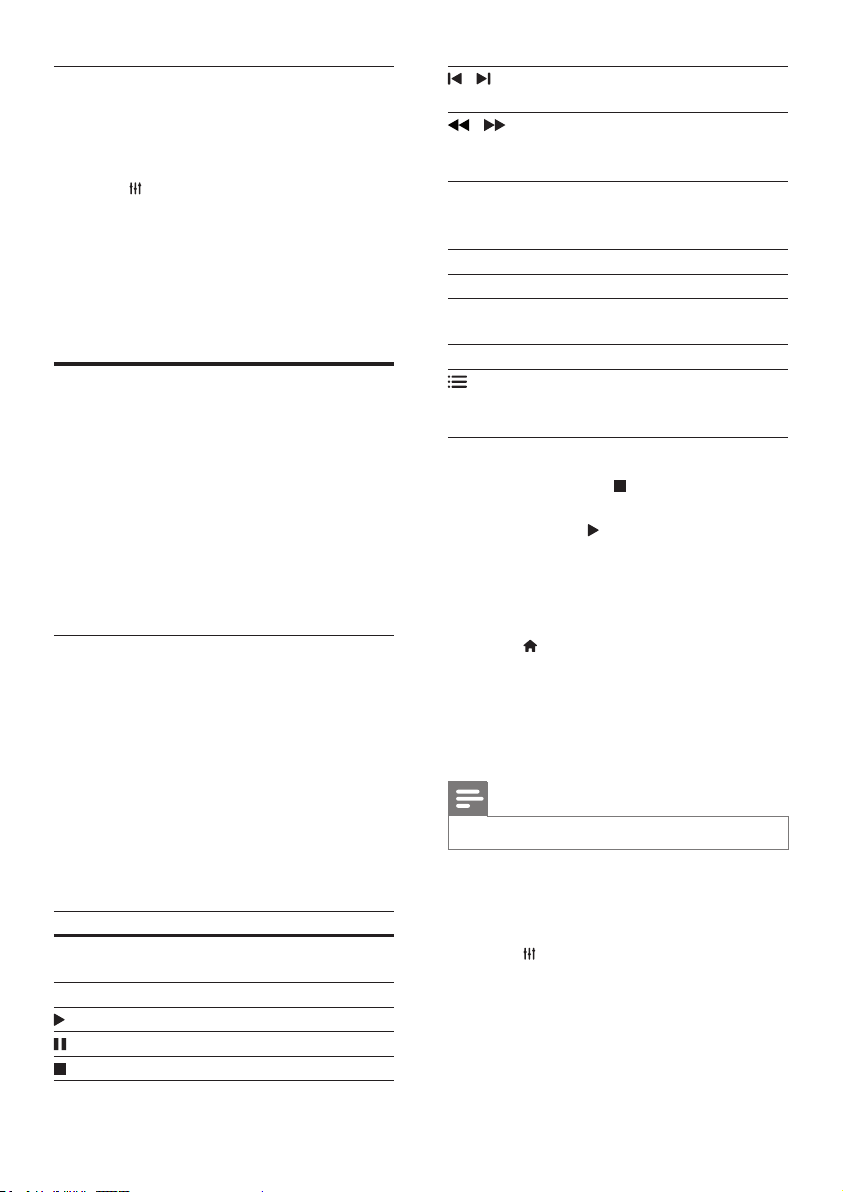
1 Press SOUND SETTINGS.
2 Press the Navigation buttons (left/ right)
to access the sound options on the display.
Sound settings Description
SOUND Select a sound mode.
SURROUND Select surround sound or
stereo sound.
TREBLE Change the high frequency
output.
MID Change the middle frequency
output.
BASS Change the low frequency
output.
AUD SYNC Delay the audio to match the
video.
3 Select an option, and then press OK.
4 Press BACK to exit.
If you do not press a button within a
minute, the menu exits automatically.
Sound mode
Select predened sound modes to suit your
video or music.
1 Press SOUND SETTINGS.
2 Select SOUND, and then press OK.
3 Press the Navigation buttons (up/down)
to select a setting on the display:
• MOVIE: Enjoy a cinematic audio
experience, specially enhanced for
movies.
• MUSIC: Recreate the original recording
environment of your music, in the
studio or at a concert.
• ORIGINAL: Experience the original
sound of your movies and music,
without added sound effects.
• NEWS: Hear every word with
optimized speech and clear vocals.
• GAMING: Enjoy thrilling arcade
sounds, ideal for action-packed video
games or loud parties.
4 Press OK to conrm.
Surround sound mode
Experience an immersive audio experience with
surround sound modes.
1 Press SOUND SETTINGS.
2 Select SURROUND, and then press OK.
3 Press the Navigation buttons (up/down)
to select a setting from your display:
• AUTO: Surround sound based on the
audio stream.
• 5CH STER: Enhanced stereo sound.
Ideal for party music.
• MULTI-CH: Immersive multi-channel
sound for an enhanced movie
experience.
• STEREO: Two-channel stereo sound.
Ideal for listening to music.
4 Press OK to conrm.
16EN
Equalizer
Change the high frequency (treble), mid
frequency (mid), and low frequency (bass)
settings of the home theater.
1 Press SOUND SETTINGS.
2 Select TREBLE, MID or BASS, and then
press OK.
3 Press the Navigation buttons (up/down)
to change the frequency.
4 Press OK to conrm.
Discs
Your home theater can play DVDs, VCDs, CDs,
and Blu-ray discs. It can also play discs that
you’ve made at home, such as CD-R discs of
photos, videos, and music.
What you need
• Audio and video connection between your
home theater and the TV.
• An audio or a video disc.
Play discs
1 Insert a disc into the home theater.
» Your TV switches to the correct source
and the disc plays automatically.
2 If the disc does not play automatically, press
DISC or select [play Disc] in the home
menu, and then press OK.
3 Press the play buttons to control play (see
'Play buttons' on page 16).
Play buttons
Button Action
Navigation
buttons
Navigate menus.
OK Conrm an entry or selection.
(Play) Start or resume play.
Pause play.
Stop play.
/ Skip to the previous or next track,
chapter or le.
/ Fast backwards or fast forwards.
Press repeatedly to change the
search speed.
Navigation
buttons
(up/down)
Rotate the picture clockwise or
counter-clockwise.
SUBTITLE Select subtitle language for video.
DISC Access or exit the disc menu.
AUDIO Select an audio language or
channel.
REPEAT Select or turn off repeat mode.
OPTIONS
Access the advanced options
when you play your audio, video,
or media les.
For video formats such as DivX:
• To stop play, press .
• To resume the video from where you
stopped, press (Play).
• To play the video from the start, press OK.
Display menu for VCD and SVCD
Display the content menu on VCD and SVCD
discs.
1 Press (Home).
2 Select [Setup] > [Preference], and then
press OK.
3 Select [VCD PBC] > [On], and then press
OK.
Note
• To skip the content menu, select [Off].
Synchronize picture and sound
If the audio and video are not synchronized,
delay the audio to match the video.
1 Press SOUND SETTINGS.
2 Select AUD SYNC, and then press OK.
3 Press the Navigation buttons (up/down)
to synchronize the audio with the video.
4 Press OK to conrm.
17 EN
Bonus View on Blu-ray
On Blu-ray discs that support the Bonus
View, enjoy extra content, such as a director's
commentary, while you watch the main feature.
Bonus View is also known as picture-in-picture.
1 Enable Bonus View (picture-in-picture) in
the Blu-ray disc menu.
2 While you play the main feature, press
OPTIONS.
» The options menu is displayed.
3 Select [PIP Selection] > [PIP], and then
press OK.
» Depending on the video, PIP option [1]
or [2] is displayed.
» The picture-in-picture video is
displayed in a small window.
4 Select [2nd Audio Language] or [2nd
Subtitle Language], and then press OK.
5 Select the language, and then press OK.
Note
• To turn off Bonus View, press OPTIONS, select [PIP
Selection] > [Off], and then press OK.
BD-Live on Blu-ray
On Blu-ray discs with BD-Live content, access
additional features, such as internet chats
with the director, latest movie trailers, games,
wallpaper, and ringtones.
What you need
• a Blu-ray disc with BD-Live content
• an internet connection
• a USB storage device, with at least 1GB of
memory
Note
• BD-Live services vary from country to country, and
depend on the disc.
• When you use BD-Live, data on the disc and home
theater are accessed by the content provider.
Access BD-Live with a USB storage
device
1 Connect your home theater to the home
network and internet (see 'Internet' on
page 13).
2 Connect the USB storage device to the
home theater.
• The USB storage device is used
to store the downloaded BD-Live
content.
3 Select the BD-Live icon in the disc menu,
and then press OK.
» BD-Live starts to load. The loading
time depends on the disc and your
internet connection.
4 Press the Navigation buttons to navigate
BD-Live, and then press OK to select an
item.
Clear memory
If your storage device does not have enough
memory for the BD-Live content, clear the
memory on the storage device.
1 Press (Home).
2 Select [Setup], and then press OK.
3 Select [Advanced] > [Clear memory], and
then press OK.
» This clears the local memory and
deletes the BD-Live les that you
downloaded on your storage device.
Disable BD-Live
To restrict access to BD-Live, turn on the BD-
Live security.
1 Press (Home).
2 Select [Setup], and then press OK.
3 Select [Advanced] > [BD-Live security] >
[On], and then press OK.
» BD-Live access is restricted.
18EN
Note
• You cannot restrict internet access on commercial
Blu-ray discs.
USB storage devices
Enjoy pictures, audio and video on a USB
storage device.
What you need
• A USB storage device that is formatted for
FAT or NTFS le systems, and complies
with the Mass Storage Class.
• A USB extension cable, if the USB storage
device does not t into the connector.
Note
• You can use digital cameras connected by USB if they
can play the les without using a special computer
program.
• To play DivX DRM - protected les from a USB
storage device, connect your home theater to a TV
through an HDMI cable.
Playles
1 Connect the USB storage device to the
home theater.
2 Press (Home).
» The home menu is displayed.
3 Select [browse USB], and then press OK.
» A content browser is displayed.
4 Select a le, and then press OK.
5 Press the playback buttons to control play
(see 'Play buttons' on page 16).
DivX
Play DivX videos from :
• a disc (see 'Discs' on page 16),
• a USB storage device (see 'USB storage
devices' on page 18).
Note
• To play DivX DRM protected les from a disc or a USB
storage device, connect your home theater to a TV
through an HDMI cable.
VOD code for DivX
Before you purchase DivX videos and play
them on your home theater, register the home
theater on www.divx.com using the DivX VOD
code.
1 Press (Home).
2 Select [Setup], and then press OK.
3 Select [Advanced] > [DivX
®
VOD Code],
and then press OK.
» The DivX VOD registration code for
your home theater is displayed.
Subtitles
If your video has subtitles in multiple languages,
select a subtitle language.
1 While playing video, press SUBTITLE to
select a language.
Note
• Make sure that the subtitle le has the same name as
the video le. For example, if the video le is named
'movie.avi', save the subtitle le as 'movie.srt' or 'movie.
sub'.
• Your home theater can play subtitle les in the
following formats: .srt, .sub, .txt, .ssa, .ass, smi, and .sami.
These les do not appear in the le navigation menu.
• If the subtitles do not appear correctly, change the
character set.
Subtitle character set
If the subtitles do not appear correctly, change
the character set that supports the DivX
subtitle.

19 EN
1 Press OPTIONS.
» The options menu is displayed.
2 Press the Navigation buttons to select
[Character Set], and then press OK.
3 Select a character set.
Europe, India, and Russia
Character
Set
Language
[Standard] English, Albanian, Danish, Dutch,
Finnish, French, Gaelic, German,
Italian, Kurdish (Latin), Norwegian,
Portuguese, Spanish, Swedish and
Turkish
[Central
Europe]
Albanian, Croat, Czech, Dutch,
English, German, Hungarian, Irish,
Polish, Romanian, Slovak, Slovene
and Sorbian
[Cyrillic] Bulgarian, Belorussian, English,
Macedonian, Moldavian, Russian,
Serbian and Ukrainian
[Greek] Greek
Audio, video, and picture
options
Use advanced features when you play audio,
video, or media les from a disc or a USB
storage device.
Audio options
While playing audio, repeat an audio track, a
disc, or a folder.
1 Press OPTIONS repeatedly to cycle
through the following functions:
• RPT TRACK / RPT FILE: Repeat the
current track or le.
• RPT DISC / RPT FOLDER: Repeat all
the tracks on the disc or the folder.
• RPT RANDOM: Play audio tracks in
random order.
• RPT OFF: Turn off the repeat mode.
Video options
While watching video, select options such
as subtitles, audio language, time search, and
picture settings. Depending on the video source,
some options are not available.
1 Press OPTIONS.
» The video options menu is displayed.
2 Press the Navigation buttons and OK to
select and change:
• [Audio Language]: Select audio
language for video.
• [Subtitle Language]: Select subtitle
language for video.
• [Subtitle Shift]: Change the subtitle
position on the screen.
• [Info]: Display information about what
is playing.
• [Character Set]: Select a character set
that supports the DivX subtitle.
• [Time Search]: Skip to a specic part
of the video by entering the time of
the scene.
• [2nd Audio Language]: Select the
second audio language for Blu-ray
video.
• [2nd Subtitle Language]: Select the
second subtitle language for Blu-ray
video.
• [Titles]: Select a specic title.
• [Chapters]: Select a specic chapter.
• [Angle List]: Select a different camera
angle.
• [Menus]: Display the disc menu.
• [PIP Selection]: Display Picture-in-
Picture window when playing a Blu-ray
disc that supports the Bonus View.
• [Zoom]: Zoom into a video scene or
picture. Press the Navigation buttons
(left/right) to select a zoom factor.
• [Repeat]: Repeat a chapter or title.
• [Repeat A-B]: Mark two points within a
chapter or track to repeat play, or turn
off the repeat mode.
• [Picture Settings]: Select a predened
color setting.
20EN
Picture options
While viewing a picture, zoom into the picture,
rotate it, add animation to a slideshow, and
change the picture settings.
1 Press OPTIONS.
» The picture options menu appears.
2 Press the Navigation buttons and OK to
select and change the following settings:
• [Rotate +90]: Rotate the picture 90
degree clockwise.
• [Rotate -90]: Rotate the picture 90
degree counter-clockwise.
• [Zoom]: Zoom into a video scene or
picture. Press the Navigation buttons
(left/right) to select a zoom factor.
• [Info]: Display picture information.
• [Duration per slide]: Select the display
speed for each picture in a slide show.
• [Slide Animation]: Select animation for
the slide show.
• [Picture Settings]: Select a predened
color setting.
• [Repeat]: Repeat a selected folder.
Slideshows
While playing audio, access fun features such as
picture and musical slideshows.
Picture slideshows
View a slideshow of your pictures stored in
your disc or a USB storage device.
1 Select a picture from a disc or USB storage
device, and then press (Play).
2 Press OPTIONS.
3 Press Navigation buttons and OK to
select the following settings:
• [Slide Animation]: Select an animation
for the slideshow.
• [Duration per slide]: Select a display
speed for each picture in a slideshow.
4 Press to stop the slideshow.
Musical slideshows
Create a musical slideshow to play music and
pictures at the same time.
1 Select a music track, and then press OK.
2 Press BACK, and go to the picture
folder.
3 Select a picture, and then press (Play) to
start the slideshow.
4 Press to stop slideshow.
5 Press again to stop music.
Radio
Listen to FM radio on your home theater, and
store up to 40 radio stations.
What you need
• FM antenna.
Note
• AM and digital radio are not supported.
• If no stereo signal is detected, you are prompted to
install the radio stations again.
• For the best reception, place the antenna away from
the TV or other sources of radiation.
Tune stations
1 Connect the FM antenna as described in
the Quick start guide.
2 Press RADIO.
» If you have already installed the radio
stations, the last channel that you
listened to is played.
» If you have not installed any radio
stations, the message AUTO
INSTALL...PRESS PLAY appears on
the display panel. Press (Play).
3 Press the following buttons to listen or to
change radio stations:
21 EN
Button Action
/
or
Alphanumeric
buttons
Select a preset radio station.
Navigation
buttons (left/
right)
Search for a radio station.
Navigation
buttons (up/
down)
Fine tune a radio frequency.
Press to stop the installation
of radio stations.
BACK Press and hold to erase the
preset radio station.
OPTIONS Manual:
1) Press OPTIONS.
2) Press / to select
your preset. 3) Press
OPTIONS again to store the
radio station.
Automatic: Press and hold
for three seconds to reinstall
the radio stations.
Listen to radio
1 Press RADIO.
• To listen to a preset station, press
or .
• To search for a radio station, and then
listen, press Navigation buttons (left/
right).
2 Press +/- (Volume) to change the volume.
MP3 player
Connect your MP3 player to play your audio
les or music.
What you need
• An MP3 player.
• A 3.5mm stereo audio cable.
Play music
1 Connect the MP3 player to the home
theater as described in the Quick start
guide.
2 Press AUDIO SOURCE repeatedly until
'MUSIC I-LINK' appears on the display
panel.
3 Press the buttons on the MP3 player to
select and play audio les or music.
EasyLink
The home theater supports Philips EasyLink,
which uses the HDMI-CEC (Consumer
Electronics Control) protocol. EasyLink-
compliant devices that are connected through
HDMI can be controlled by a single remote
control.
Philips does not guarantee 100%
interoperability with all HDMI-CEC devices.
What you need
• HDMI-CEC compliant devices.
• An HDMI connection between the
connected devices.
Switch on
1 On the TV and other connected devices,
turn on the HDMI-CEC operations. For
details, see the manual of the TV or other
devices.
2 Press (Home).
3 Select [Setup], and then press OK.
4 Select [EasyLink] > [EasyLink], and then
press OK.
5 Select [On], and then press OK.
Control devices
Control the home theater and the other
connected HDMI-CEC compliant devices with
a single remote control.
22EN
One-touch play
If you enable One-touch play, the TV
automatically switches to the correct channel
when you play a disc in your home theater.
One-touch standby
When you press and hold (Standby) on the
remote control, the home theater and all the
connected HDMI-CEC devices (that support
one-touch standby) switch to the standby
mode.
If one-touch standby is enabled on your home
theater, you can switch to standby with the
remote control of the TV or other HDMI-
CEC devices.
System Audio Control
When you play a device that has its audio
output routed to the home theater, the home
theater switches to the corresponding audio
source automatically.
To use one-touch audio, turn on System Audio
Control and follow the instructions on the TV
to map connected devices to the audio input
connectors of the home theater.
Audio Input Mapping
When you connect a new device to your
home theater, map the device to the audio
input connector (see 'Play audio from home
theater' on page 22).
Play audio from home theater
Play the audio from a connected device through
your home theater.
1 Press (Home).
2 Select [Setup], and then press OK.
3 Select [EasyLink] > [System Audio
Control] > [On], and then press OK.
• To play the audio from the TV
speakers, select [Off], and skip the
following steps.
4 Select [EasyLink] > [Audio Input
Mapping], and then press OK.
5 Follow the instructions on the TV to map
the audio of the connected device to the
audio inputs on your home theater.
Note
• If you connect your home theater to the TV through an
HDMI ARC connection, make sure that the TV audio is
mapped to the ARC input on your home theater.
23 EN
6 Change settings
This section helps you to change the settings of
your home theater.
Caution
• Most of the settings are already congured with the
best value for your home theater. Unless you have a
reason to change a setting, it is best to leave it at the
default value.
Note
• You cannot change a setting that is grayed out.
• To return to the previous menu, press BACK. To
exit the menu, press (Home).
Picture
Change the picture settings to suit your
preferences.
Note
• The best setting is automatically selected for the TV. If
you change the setting, make sure that the TV supports
the new settings.
Picture settings and format
1 Press (Home).
2 Select [Setup], and then press OK.
3 Select [Video], and then press OK.
4 Change the following settings, and then
press OK:
• [TV Display]: Picture format.
• [Picture Settings]: Predened color
settings.
Picture color
Deep Color recreates the natural world on
your TV screen and displays vivid images in over
a billion of colors.
If your TV supports Deep Color and is
connected to your home theater through an
HDMI cable, you can change the Deep Color.
1 Press (Home).
2 Select [Setup], and then press OK.
3 Select [Video] > [HDMI Deep Color],
and then press OK.
4 Select the following options, and then press
OK:
• [Auto]: Automatically select HDMI
Deep Color.
• [On]: View vivid images.
• [Off]: Display standard 24-bit color.
Picture resolution
For HDMI video settings, connect your home
theater to the TV through an HDMI cable.
1 Press (Home).
2 Select [Setup], and then press OK.
3 Select [Video] > [HDMI Video], and then
press OK.
4 Change the HDMI resolution setting, and
then press OK.
Subtitle position
Automatically change the position of the
subtitles to t your TV screen.
1 Press (Home).
2 Select [Setup], and then press OK.
3 Select [Preference] > [Auto Subtitle Shift]
> [On], and then press OK.
Sound
Change the sound settings to suit your
preference.
24EN
HDMI audio
To hear an HDMI audio output from your TV,
connect your home theater to the TV through
an HDMI cable.
1 Press (Home).
2 Select [Setup], and then press OK.
3 Select [Audio] > [HDMI Audio], and then
press OK.
4 Select the following options, and then press
OK:
• [Bitstream]: Enable bitstream output
over HDMI.
• [Auto]: Automatically select the best
supported audio format.
• [Off]: Disable audio from the TV.
Audio post processing
To select a predened sound mode, enable
audio post processing at the speaker (see
'Sound mode' on page 15).
1 Press (Home).
2 Select [Setup], and then press OK.
3 Select [Advanced] > [Enhanced Audio] >
[On], and then press OK.
Note
• To play the original audio of the disc, select [Off].
Night mode
For quiet listening, decrease the volume of loud
sounds when you play discs. Night mode is only
available for Dolby-encoded DVD and Blu-ray
discs.
1 Press (Home).
2 Select [Setup], and then press OK.
3 Select [Audio] > [Night Mode] > [On],
and then press OK.
Restore sound mode settings
Restore the equalizer settings of all the sound
modes to the default values.
1 Press (Home).
2 Select [Setup], and then press OK.
3 Select [Audio] > [Default sound settings],
and then press OK.
Language
Select a language for the home menu, audio,
and subtitles.
Home menu
1 Press (Home).
2 Select [Setup], and then press OK.
3 Select [Preference] > [Menu language],
and then press OK.
4 Select a menu language, and then press
OK.
Disc audio
1 Press (Home).
2 Select [Setup], and then press OK.
3 Select [Preference] > [Audio], and then
press OK.
4 Select an audio language for discs, and then
press OK.
Note
• If your preferred disc language is not available, select
[Others] from the list, and enter the 4-digit language
code found at the end of this user manual.
• If you select a language that is not available on a disc,
the home theater uses the default language of the disc.
25 EN
Disc subtitle
1 Press (Home).
2 Select [Setup], and then press OK.
3 Select [Preference] > [Subtitle], and then
press OK.
4 Select a subtitle language for discs, and
then press OK.
Disc menu
1 Press (Home).
2 Select [Setup], and then press OK.
3 Select [Preference] > [Disc Menu], and
then press OK.
4 Select a menu language for discs, and then
press OK.
Note
• If your preferred disc language is not available, select
[Others] from the list, and enter the 4-digit language
code found at the the end of this user manual.
• If you select a language that is not available on a disc,
the home theater uses the default language of the disc.
Parental control
Restrict access to discs that are recorded with
ratings.
Password
You can set or change your password to play a
restricted disc.
1 Press (Home).
2 Select [Setup], and then press OK.
3 Select [Preference] > [Change Password],
and then press OK.
» A change password menu is displayed.
4 Follow the instructions on the TV to set or
change password.
• If you do not have a password or you
have forgotten, enter 0000.
5 Press OK.
Ratings
Some discs are recorded with ratings according
to age. You can set up your home theater to
play only discs with an age rating lower than
your child’s age.
1 Press (Home).
2 Select [Setup], and then press OK.
3 Select [Preference] > [Parental Control],
and then press OK.
» A message prompts you to enter the
password.
4 Enter the password with the Numeric
buttons.
5 Select an age rating, and then press OK.
• To play all discs irrespective of the
rating, select level 8 or [Off].
Energy saving
Save energy by changing the following settings.
Auto standby
When playing a disc or a USB storage device,
automatically switch your home theater to
standby if:
• it is in pause or stop mode, and
• no button is pressed for 30 minutes.
1 Press (Home).
2 Select [Setup], and then press OK.
3 Select [Preference] > [Auto Standby] >
[On], and then press OK.
Sleep timer
Set timers to switch the home theater to
standby after a specied time.
1 Press (Home).

26EN
2 Select [Setup], and then press OK.
3 Select [Preference] > [Sleep Timer], and
then press OK.
4 Select the duration of the sleep timer.
» The sleep timer can be set up to 60
minutes. If the sleep timer is set to
[Off], it switches off.
5 Press OK to activate.
» The home theater switches to standby
after the specied time.
Screen saver
Automatically switch your home theater to
screen saver mode if:
• it is in pause or stop mode, and
• no button is pressed for 10 minutes.
1 Press (Home).
2 Select [Setup], and then press OK.
3 Select [Preference] > [Screen Saver] >
[On], and then press OK.
Display panel
Change the brightness of the home theater
display panel.
1 Press (Home).
2 Select [Setup], and then press OK.
3 Select [Preference] > [Display Panel], and
then press OK.
4 Select the brightness, and then press OK.
Apply factory settings
Reset your home theater to the default settings.
You cannot reset the parental control settings.
1 Press (Home).
2 Select [Setup], and then press OK.
3 Select [Advanced] > [Restore default
settings], and then press OK.
4 Select [OK], and then press OK.

27 EN
7 Update software
To continue to get the best features and
support for your home theater, update the
software regularly. Compare the version of your
current software with the latest version on
www.philips.com/support.
Check software version
1 Press (Home).
2 Select [Setup], and then press OK.
3 Select [Advanced] > [Version Info.], and
then press OK.
» The software version is displayed.
Update software through the
Internet
1 Connect your home theater to the
network through a wired connection (see
'Set up the wired network' on page 13).
2 Press (Home).
3 Select [Setup], and then press OK.
4 Select [Advanced] > [Software Update] >
[Network].
» If an upgrade media is detected, you
are prompted to start or cancel the
update.
5 Follow the instruction on the TV to
conrm the update.
» When the software update is
complete, the home theater
automatically switches off and restarts.
If it does not, disconnect the power
cord for a few seconds and then
reconnect it.
Note
• If the home theater cannot connect to the Philips
server, press (Home).
• Select [Setup] > [Network] > [Network Installation]
to set up the network.
Update software through
USB
What you need
• A USB ash drive, with at least 75MB of
memory. The USB ash drive must be FAT
or NTFS formatted. Do not use a USB
hard drive.
• A computer with Internet access.
• An archive utility that supports the ZIP
le format (for example, WinZip
®
for
Microsoft
®
Windows
®
or Stuft
®
for
Macintosh
®
).
Step 1: Download the latest software
1 Connect a USB ash drive to your
computer.
2 In your web browser, go to www.philips.
com/support.
3 At the Philips Support website, nd your
product and locate the Software and
drivers.
» The software update is available as a
zip le.
4 Save the zip le in the root directory of
your USB ash drive.
5 Use the archive utility to extract the
software update le in the root directory
of the USB ash drive.
» The les are extracted under the
UPG_ALL folder of your USB ash
drive.
6 Disconnect the USB ash drive from your
computer.
28EN
Step 2: Update the software
Caution
• Before you connect the USB ash drive to your home
theater, make sure that there is no disc in the disc
compartment, and the disc compartment is closed.
1 Connect the USB ash drive to your home
theater.
2 Switch your TV to the correct source for
your home theater.
3 Press (Home), and then select [Setup].
4 Select [Advanced] > [Software Update]
> [USB].
5 Follow the instructions on the TV to
conrm the update.
» When the software update is
complete, the home theater
automatically switches off and restarts.
If it does not, disconnect the power
cord for a few seconds, and then
reconnect it.
Note
• When the software update is in progress, do not turn
off the power or remove the USB ash drive.
29 EN
8 Product
specifications
Note
• Specications and design are subject to change without
notice.
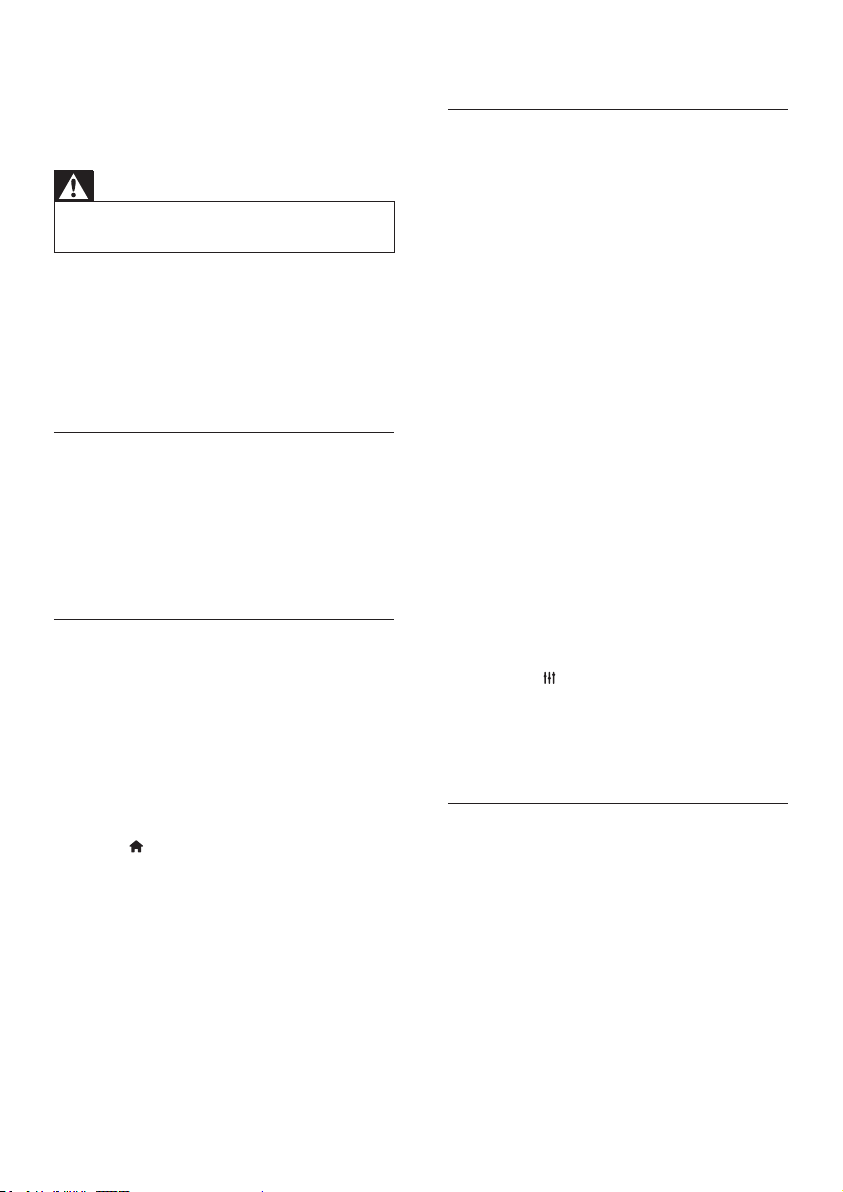
Region codes
The type plate on the back or bottom of the
home theater shows which regions it supports.
Media formats
• AVCHD, BD, BD-R/ BD-RE, BD-Video,
DVD-Video, DVD+R/+RW, DVD-R/-RW,
DVD+R/-R DL, CD-R/CD-RW, Audio CD,
Video CD/SVCD, Picture les, MP3 media,
WMA media, DivX Plus HD media, USB
storage device
Country
DVD BD
Europe,
United Kingdom
Korea
Latin America
Australia,
New Zealand
Russia, India
China
AA
AA
CC
CC
Asia Pacific, Taiwan,
File formats
• Audio: .aac, .mka, .mp3, .wma, .wav
• Video: .avi, .divx, .mp4, .mkv, .asf, .mpg,
.mpeg
• Picture: .jpg, .jpeg, .gif, .png
Audio formats
Your home theater supports the following
audio les.
Extension Container Audio
codec
Bit rate
.mp3 MP3 MP3 32 kbps ~
320 kbps
.wma ASF WMA 64 kbps ~
160 kbps
.aac AAC AAC, HE-
AAC
192 kbps
.wav WAV PCM 1.4 Mbps
.m4a MKV AAC 192 kbps
.mka MKA PCM 27.648
Mbps
.mka MKA Dolby
Digital
640 kbps
.mka MKA DTS core 1.54 Mbps
.mka MKA MPEG 912 kbps
.mka MKA MP3 32 kbps ~
320 kbps
.mka MKA WMA 64 kbps ~
160 kbps
.mka MKA AAC ,
HE-
AAC
192 kbps
Video formats
If you have a high denition TV, your home
theater allows you to play your video les with:
• Resolution: 1920 x 1080 pixels at
• Frame rate: 6 ~ 30 frames per second.

30EN
.avilesinAVIcontainer
Audio
codec
Video codec Bit rate
PCM,
Dolby
Digital,
DTS
core,
MP3,
WMA
DivX 3.11,
DivX 4.x, DivX 5.x,
DivX 6.x
10 Mbps max
MPEG 1, MPEG 2 20 Mbps
(peak 40
Mbps)
MPEG 4 ASP 10 Mbps max
H.264/AVC
[email protected]/4.0;
[email protected]/3.1/3.0
20 Mbps
(peak 40
Mbps)
.divxlesinAVIcontainer
Audio
codec
Video codec Bit rate
PCM,
Dolby
Digital,
MP3,
WMA
DivX 3.11,
DivX 4.x,
DivX 5.x, DivX 6.x
10 Mbps max
MPEG 1, MPEG 2 20 Mbps
(peak 40
Mbps)
MPEG 4 ASP 10 Mbps max
.mp4or.m4vlesinMP4container
Audio
codec
Video codec Bit rate
Dolby
Digital,
MPEG,
MP3, AAC,
HE-AAC
MPEG 1,
MPEG 2
20 Mbps (peak
40 Mbps)
MPEG 4 ASP 10 Mbps max
H.264/AVC
[email protected]/4.0;
[email protected]/3.1/3.0
20 Mbps (peak
40 Mbps)
.mkvlesinMKVcontainer
Audio codec Video codec Bit rate
PCM, Dolby
Digital, DTS
core, MPEG,
MP3, WMA,
AAC, HE-
AAC
MPEG 1,
MPEG 2
20 Mbps
(peak 40
Mbps)
MPEG 4 ASP 10 Mbps
max
H.264/AVC
[email protected]/4.0;
[email protected]/3.1/3.0
20 Mbps
(peak 40
Mbps)
Amplier
• Total output power: 300W RMS (30%
THD)
• Frequency response: 20 Hz-20 kHz /
• ±3 dB
• Signal-to-noise ratio: > 65 dB (CCIR) /
(A-weighted)
• Input sensitivity:
• AUX: 2 V
• Music iLink: 1 V
Video
• Signal system: PAL / NTSC
• HDMI output: 480i/576i, 480p/576p, 720p,
1080i, 1080p, 1080p24
Audio
• S/PDIF Digital audio input:
• Coaxial: IEC 60958-3
• Optical: TOSLINK
• Sampling frequency:
• MP3: 32 kHz, 44.1 kHz, 48 kHz
• WMA: 44.1 kHz, 48 kHz
• Constant bit rate:
• MP3: 32 kbps - 320 kbps
• WMA: 48 kbps - 192 kbps

31 EN
Radio
• Tuning range:
• Europe/Russia/China: FM 87.5-108
MHz (50 kHz)
• Asia Pacic/Latin America: FM 87.5-108
MHz (50/100 kHz)
• Signal-to-noise ratio: FM 50 dB
• Frequency response: FM 200 Hz-12.5 kHz
/ ±6 dB
USB
• Compatibility: Hi-Speed USB (2.0)
• Class support: USB Mass Storage Class
(MSC)
• File system: FAT16, FAT32, NTFS
• Maximum memory support: < 160 GB
Main unit
• Power supply:
• Europe/China/Russia/India: 220-240
V~, 50 Hz
• Latin America/Asia Pacic: 110-240 V~,
50-60 Hz
• Power consumption: 60 W
• Standby power consumption: ≤ 0.9 W
• Dimensions (WxHxD): 360 x 58 x 325
mm
• Weight: 2.4 kg
Subwoofer
• Output power: 50 W RMS (30% THD)
• Impedance: 4 ohm
• Speaker drivers: 133 mm (5.25") woofer
• Dimensions (WxHxD): 160 x 265 x 265
mm
• Weight: 2.50 kg
Speakers
Center speaker:
• Output power: 50 W RMS (30% THD)
• Speaker impedance: 4 ohm
• Speaker drivers: 1 x 63.5 mm (2.5") woofer
• Dimensions (WxHxD): 159 x 84.5 x 80
mm
• Weight: 0.35 kg
Front/Rear speaker:
• Output power: 4 x 50 W RMS (30% THD)
• Speaker impedance: 4 ohm
• Speaker drivers: 1 x 63.5 mm (2.5") woofer
• Dimensions (WxHxD): 84.5 x 159 x 80
mm
• Weight: 0.35 kg/each
Remote control batteries
• 2 x AAA-R03-1.5 V
Laser
• Laser Type (Diode): InGaN/AIGaN (BD),
AIGaInP (DVD/CD)
• Wave length: 405 +7 nm/-7 nm (BD), 655
+10 nm/-10 nm (DVD), 790 +10 nm/-20
nm (CD)
• Output power (Max. ratings): 20 mW
(BD), 6 mW (DVD), 7 mW (CD)
32EN
9 Troubleshooting
Warning
• Risk of electric shock. Never remove the casing of the
product.
To keep the warranty valid, never try to repair
the product yourself.
If you have problems using this product, check
the following points before you request service.
If you still have a problem, get support at www.
philips.com/support.
Main unit
The buttons on the home theater do not
work.
• Disconnect the home theater from the
power supply for a few minutes, then
reconnect.
Picture
No picture.
• Make sure that the TV is switched to the
correct source for the home theater.
No picture on a TV connected through HDMI.
• Make sure that the HDMI cable is not
faulty. If it is faulty, replace it with a new
cable.
• Press (Home) and then 731 on the
remote control to restore the default
picture resolution.
• Change the HDMI video setting, or wait
for 10 seconds for auto recovery (see
'Picture resolution' on page 23).
Discdoesnotplayhigh-denitionvideo.
• Make sure that the disc contains high-
denition video.
• Make sure that the TV supports high-
denition video.
• Use an HDMI cable to connect to the TV.
Sound
No sound from home theater speakers.
• Connect the audio cable from your home
theater to your TV or other devices.
You do not need a separate audio
connection when the home theater and
TV are connected through an HDMI ARC
connection.
• Set up the audio for the connected device
(see 'Set up audio for connected devices'
on page 13).
• Reset your home theater to its factory
settings (see 'Apply factory settings' on
page 26), then switch it off and switch on
again.
• On your home theater, press SOURCE
repeatedly to select the correct audio
input.
Distorted sound or echo.
• If you play audio from the TV through the
home theater, make sure that the TV is
muted.
Audio and video are not synchronized.
• 1) Press SOUND SETTINGS. 2) Press
the Navigation buttons (left/right) to
select AUD SYNC, and then press OK. 3)
Press the Navigation buttons (up/down)
to synchronize the audio with the video.
Play
Cannot play a disc.
• Clean the disc.
• Make sure that the home theater supports
the type of disc (see 'Media formats' on
page 29).
• Make sure that the home theater supports
the region code of the disc (see 'Region
codes' on page 29).
• If the disc is a DVD±RW or DVD±R disc,
make sure that it is nalized.

33 EN
CannotplayaDivXle.
• Make sure that the DivX le is encoded
according to the 'Home Theater Prole'
with the DivX encoder.
• Make sure that the DivX le is complete.
DivX subtitles do not display correctly.
• Make sure that the subtitle le name is
the same as the movie le name (see
'Subtitles' on page 18).
• Select the correct character set: 1) Press
OPTIONS. 2) Select [Character Set].
3) Select the supported character set. 4)
Press OK.
Cannot read the contents of a USB storage
device.
• Make sure that the format of the USB
storage device is compatible with the
home theater.
• Make sure that the le system on the USB
storage device is supported by the home
theater.
'No entry' or 'x' sign appears on the TV.
• The operation is not possible.
EasyLink does not work.
• Make sure that the home theater is
connected to a Philips brand EasyLink
TV, and the EasyLink option is on (see
'EasyLink' on page 21).
When you switch on the TV, the home theater
automatically switches on.
• This behavior is normal when you are using
Philips EasyLink (HDMI-CEC). To make the
home theater work independently, switch
off EasyLink.
Cannot access BD-Live features.
• Make sure that the home theater is
connected to the network (see 'Set up the
wired network' on page 13).
• Make sure that the network is set up (see
'Set up the wired network' on page 13).
• Make sure that the Blu-ray disc supports
BD-Live features.
• Clear memory storage (see 'Clear
memory' on page 17).
TV screen is black when you play a Blu-ray
video or a DivX copy protected video.
• Make sure that the home theater is
connected to the TV through an HDMI
cable.
• Switch to the correct HDMI source on
the TV.

34EN
10 Index
A
advanced
BD-Live security 17
enhanced audio 24
restore default settings 26
software update 27
software version 27
amplier 30
audio
HDMI audio 24
night mode 24
post processing 24
predened modes 15
quality 12
settings 23
source 13
speaker setup 10
specications 30
audio formats 29
audio input mapping 22
audio language 24
audio options 19
auto standby 25
B
bass 16
BD-Live
BD-Live (USB) 17
clear memory 17
disable 17
Blu-ray 16
Bonus View 17
brightness 26
browse
disc 16
USB storage device 18
C
care
environment 6
product 6
character set 18
close disc compartment 7
compliance 3
computer
connect to 13
connect
audio (analog cable) 13
audio (coaxial cable - digital) 12
audio (optical cable - digital) 12
audio from TV and other devices 12
home network 13
speakers 10
TV (Composite) 12
TV (HDMI ARC) 11
TV (HDMI) 11
connectors
back connectors 10
front connectors 10
control
disc play 16
Easylink (HDMI-CEC) 8
main unit 7
parental control 25
radio 20
copyright protection 3
D
disable
audio post processing 24
BD-Live 17
HDMI-CEC 21
discs
audio 19
audio language 24
BD-Live 17
Bonus View 17
control buttons 16
DivX 18
menu language 25
options 19
picture 20
picture-in-picture 17
play 16
subtitle 25
synchronize picture and sound 16
time search 19

35 EN
titles 19
display panel 7
DivX
character set 18
subtitles 18
VOD code 18
E
EasyLink (HDMI-CEC)
audio input mapping 22
control buttons 8
one-touch play 21
one-touch standby 21
system audio control 21
eject disc 7
enable
auto standby 25
auto subtitle shift 23
BD-Live 17
HDMI-CEC 21
predened sound mode 24
screen saver 26
energy
auto standby 25
brightness 26
screen saver 26
sleep timer 25
F
factory settings 26
FM antenna 10
FM antenna 10
front connectors 10
H
HDMI
audio 24
Deep color 23
TV (HDMI ARC) 11
video 23
HDMI-CEC 21
I
Internet
BD-Live 17
connect to 13
update software 27
L
language
2nd audio language 17
2nd subtitle language 17
audio 24
disc menu 25
onscreen menu 24
subtitle 25
legal notices 3
M
main unit
overview 7
specications 31
troubleshooting 32
manually setup speakers 10
media formats 29
MP3
connector 10
play 21
multimedia content
from disc 16
from USB storage device 18
N
network
home network 13
settings 13
update software 27
wired connection 13
night mode 24
O
one-touch play 21
one-touch standby 21
open disc compartment 7
open source software 3
options
audio 19
picture 20

36EN
video 19
overview
connectors 10
HDMI-CEC 21
main unit 7
remote control 7
settings 23
speaker setup 10
P
parental control
password 25
ratings 25
password 25
PC
connect to 13
Philips Easylink 21
picture
options 20
rotate 20
settings 23
slideshows 20
troubleshooting 32
zoom 20
picture options 20
picture-in-picture
2nd audio language 17
2nd subtitle language 17
play
discs 16
DivX 18
MP3 21
radio 31
slideshows 20
troubleshooting 32
USB 18
position
connectors 10
position 9
subtitle 23
power options
auto standby 25
brightness 26
screen saver 26
sleep timer 25
preference
audio 23
auto standby 25
auto subtitle shift 23
change password 25
disc menu 25
display panel 26
menu language 24
parental control 25
screen saver 26
sleep timer 25
subtitle 25
productspecications 29
R
radio
control buttons 20
FM antenna 10
listen to radio 21
specications 31
tune stations 20
ratings 25
recycling 6
region codes 29
remote control
batteries 31
overview 7
repeat 19
S
safety
disposal 6
use of the product 5
screen saver 26
settings
audio 23
auto standby 25
auto subtitle shift 23
default 26
disc language 25
HDMI audio 24
HDMI video 23
HDMI-CEC 21
menu language 24
parental rating 25
password 25
picture 23

37 EN
power 25
resolution 23
restore 26
screen saver 26
sleep timer 25
subtitle language 25
video 23
setup speakers
manually 10
sleep timer 25
slideshows
animation 20
duration 20
musical 20
picture 20
software
check current version 27
update 27
sound
bass 16
default sound mode 24
equalizer 16
predened sound mode 15
surround sound 15
synchronize picture and sound 16
treble 16
troubleshooting 32
speakers
connect 10
manual setup 10
position 9
setup 10
specications 31
surround sound 15
specications 29
subtitle
character set 18
language 25
position 23
subwoofer
specications 31
synchronize picture and sound 16
system audio control 21
T
time search 19
titles 19
trademarks 3
treble 16
troubleshooting
connection 32
main unit 32
picture 32
play 32
sound 32
U
update software
check current version 27
from a USB storage device 27
from network 27
USB
format 31
USB storage device
options 19
play 18
specications 31
update software 27
V
video
HDMI deep color 23
picture resolution 23
picture settings 23
synchronize picture and sound 16
VOD code for DivX 18
video formats 30
video options 19
VOD code for DivX 18
W
wired network
settings 14
wired connection 13
38
Abkhazian 6566
Afar 6565
Afrikaans 6570
Amharic 6577
Arabic 6582
Armenian 7289
Assamese 6583
Avestan 6569
Aymara 6589
Azerhaijani 6590
Bahasa Melayu 7783
Bashkir 6665
Belarusian 6669
Bengali 6678
Bihari 6672
Bislama 6673
Bokmål, Norwegian 7866
Bosanski 6683
Brezhoneg 6682
Bulgarian 6671
Burmese 7789
Castellano, Español 6983
Catalán 6765
Chamorro 6772
Chechen 6769
Chewa; Chichewa; Nyanja
7889
9072
Chuang; Zhuang 9065
Church Slavic; Slavonic 6785
Chuvash 6786
Corsican 6779
Česky 6783
Dansk 6865
Deutsch 6869
Dzongkha 6890
English 6978
Esperanto 6979
Estonian 6984
Euskara 6985
6976
Faroese 7079
Français 7082
Frysk 7089
Fijian 7074
Gaelic; Scottish Gaelic 7168
Gallegan 7176
Georgian 7565
Gikuyu; Kikuyu 7573
Guarani 7178
Gujarati 7185
Hausa 7265
Herero 7290
Hindi 7273
Hiri Motu 7279
Hrwatski 6779
Ido 7379
Interlingua (International)7365
Interlingue 7365
Inuktitut 7385
Inupiaq 7375
Irish 7165
Íslenska 7383
Italiano 7384
Ivrit 7269
Japanese 7465
Javanese 7486
Kalaallisut 7576
Kannada 7578
Kashmiri 7583
Kazakh 7575
Kernewek 7587
Khmer 7577
Kinyarwanda 8287
Kirghiz 7589
Komi 7586
Korean 7579
Kuanyama; Kwanyama 7574
Kurdish 7585
Lao 7679
Latina 7665
Latvian 7686
Letzeburgesch; 7666
Limburgan; Limburger 7673
Lingala 7678
Lithuanian 7684
Luxembourgish; 7666
Macedonian 7775
Malagasy 7771
Magyar 7285
Malayalam 7776
Maltese 7784
Manx 7186
Maori 7773
Marathi 7782
Marshallese 7772
Moldavian 7779
Mongolian 7778
Nauru 7865
Navaho; Navajo 7886
Ndebele, North 7868
Ndebele, South 7882
Ndonga 7871
Nederlands 7876
Nepali 7869
Norsk 7879
Northern Sami 8369
North Ndebele 7868
Norwegian Nynorsk; 7878
Occitan; Provencal 7967
Old Bulgarian; Old Slavonic 6785
Oriya 7982
Oromo 7977
Ossetian; Ossetic 7983
Pali 8073
Panjabi 8065
Persian 7065
Polski 8076
Português 8084
Pushto 8083
Russian 8285
Quechua 8185
Raeto-Romance 8277
Romanian 8279
Rundi 8278
Samoan 8377
Sango 8371
Sanskrit 8365
Sardinian 8367
Serbian 8382
Shona 8378
Shqip 8381
Sindhi 8368
Sinhalese 8373
Slovensky 8373
Slovenian 8376
Somali 8379
Sotho; Southern 8384
South Ndebele 7882
Sundanese 8385
Suomi 7073
Swahili 8387
Swati 8383
Svenska 8386
Tagalog 8476
Tahitian 8489
Tajik 8471
Tamil 8465
Tatar 8484
Telugu 8469
Thai 8472
Tibetan 6679
Tigrinya 8473
To nga (Tonga Islands) 8479
Tsonga 8483
Tswana 8478
Türkçe 8482
Turkmen 8475
Tw i
8487
Uighur 8571
Ukrainian 8575
Urdu 8582
Uzbek 8590
Vietnamese 8673
Volapuk 8679
Walloon 8765
Welsh 6789
Wolof 8779
Xhosa 8872
Yiddish 8973
Yoruba 8979
Zulu 9085
Language Code

Specifications are subject to change without notice
© 2012 Koninklijke Philips Electronics N.V.
All rights reserved.
HTS3541_12_UM_V1.0