
www.lg.com
OWNER'S MANUAL
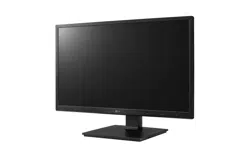
CLOUD MONITOR
(LED LCD MONITOR)
23CAV42K
Please read the safety information carefully before using the product.
CLOUD Monitor(LED LCD Monitor) Model
English

2
ENG
English
Table of Contents
TABLE OF CONTENTS
3 ASSEMBLING AND
PREPARING
3 Unpacking
4 Parts and buttons
6 Lifting and moving the Monitor
6 Setting Up the Monitor set
6 - Attaching the Stand Base
7 - Mounting on a table
7 - Adjusting the angle
8 - Adjusting the stand height
8 - Using the Kensington locking device
9 - Detaching the stand base
9 - Detaching the stand body
10 - Swivel stand
10 - Using the Pivot function
11 - Installing the wall mount plate
11 - Mounting on a wall
13 USING THE MONITOR SET
13 Connecting Input Signal Cable
13 - D-SUB IN connection - PC
14 - DVI connection
15 Connecting LAN/Peripherals
15 - LAN connection
16 - Peripheral device connection
17 - Self Image Adjustment
18 CUSTOMIZING SETTINGS
19 Customizing Settings
19 - Menu Settings
20 - PICTURE
21 - COLOR
22 - DISPLAY
23 - OTHERS
24 - VOLUME
25 TROUBLESHOOTING
27 PRODUCT SPECIFICATION
28 Preset Mode
28 Power Indicator
29 PROPER POSTURE
29 Proper posture for using the monitor
30 USING CLOUD SOLUTION
3
ENG
English
ASSEMBLING AND PREPARING
ASSEMBLING AND PREPARING
Unpacking
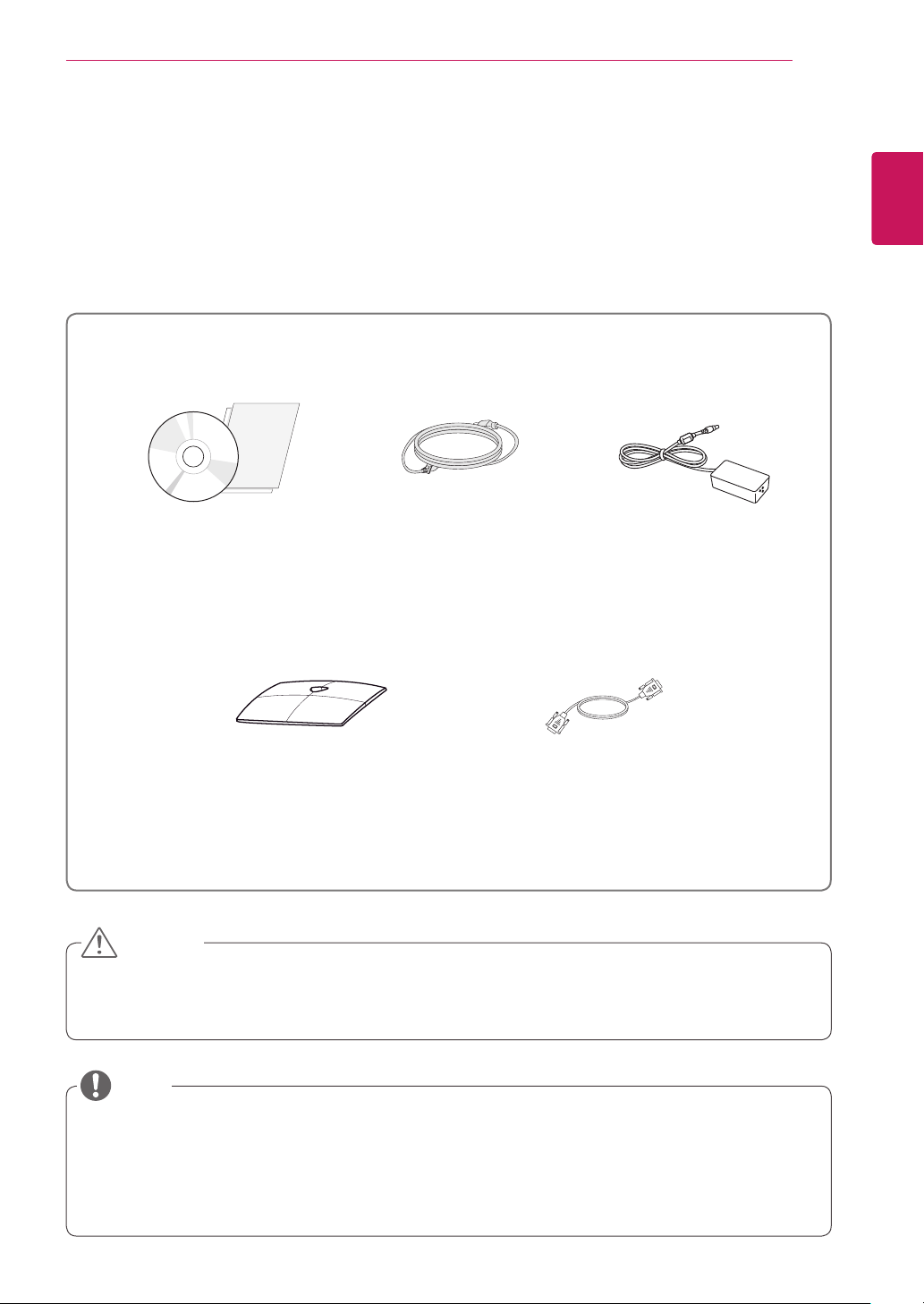
Please check whether all the components are included in the box before using the product. If there are
missing components, contact the retail store where you purchased the product. Note that the product and
components may look different from those shown here.
y
Only use an approved LG power adapter.
y
Damage caused by other power adapters is not covered by warranty.
y
Note that the components may look different from those shown here.
y
Without prior notice, all information and specifications in this manual are subject to change to improve
the performance of the product.
y
To purchase optional accessories, visit an electronics store or online shopping site or contact the retail
store where you purchased the product.
Power CordUser Manual/Card
Stand Base
Adaptor
CAUTION
NOTE
15-pin D-SUB Signal Cable
(This cable is not included in all
counties)
5
ENG
English
ASSEMBLING AND PREPARING
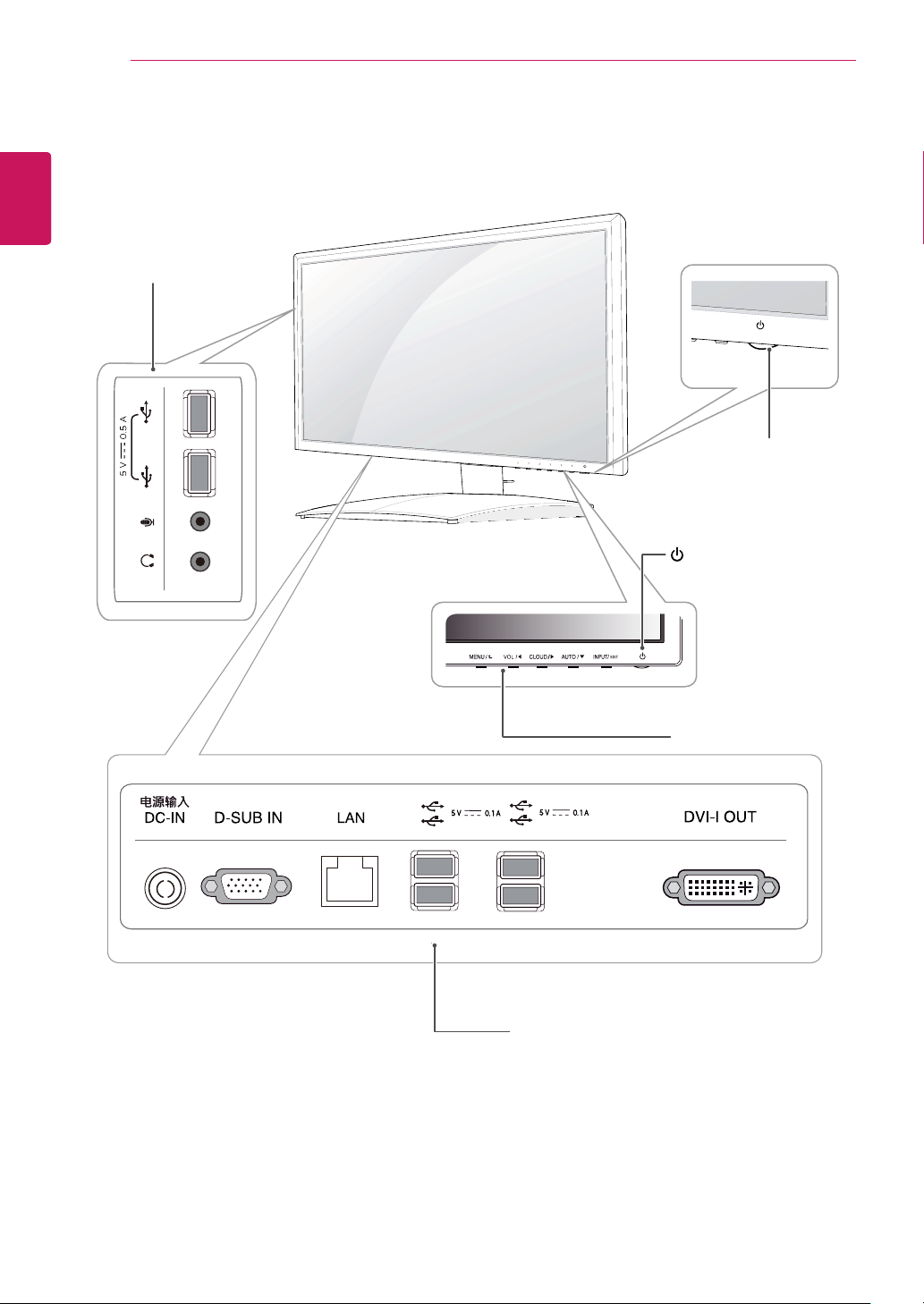
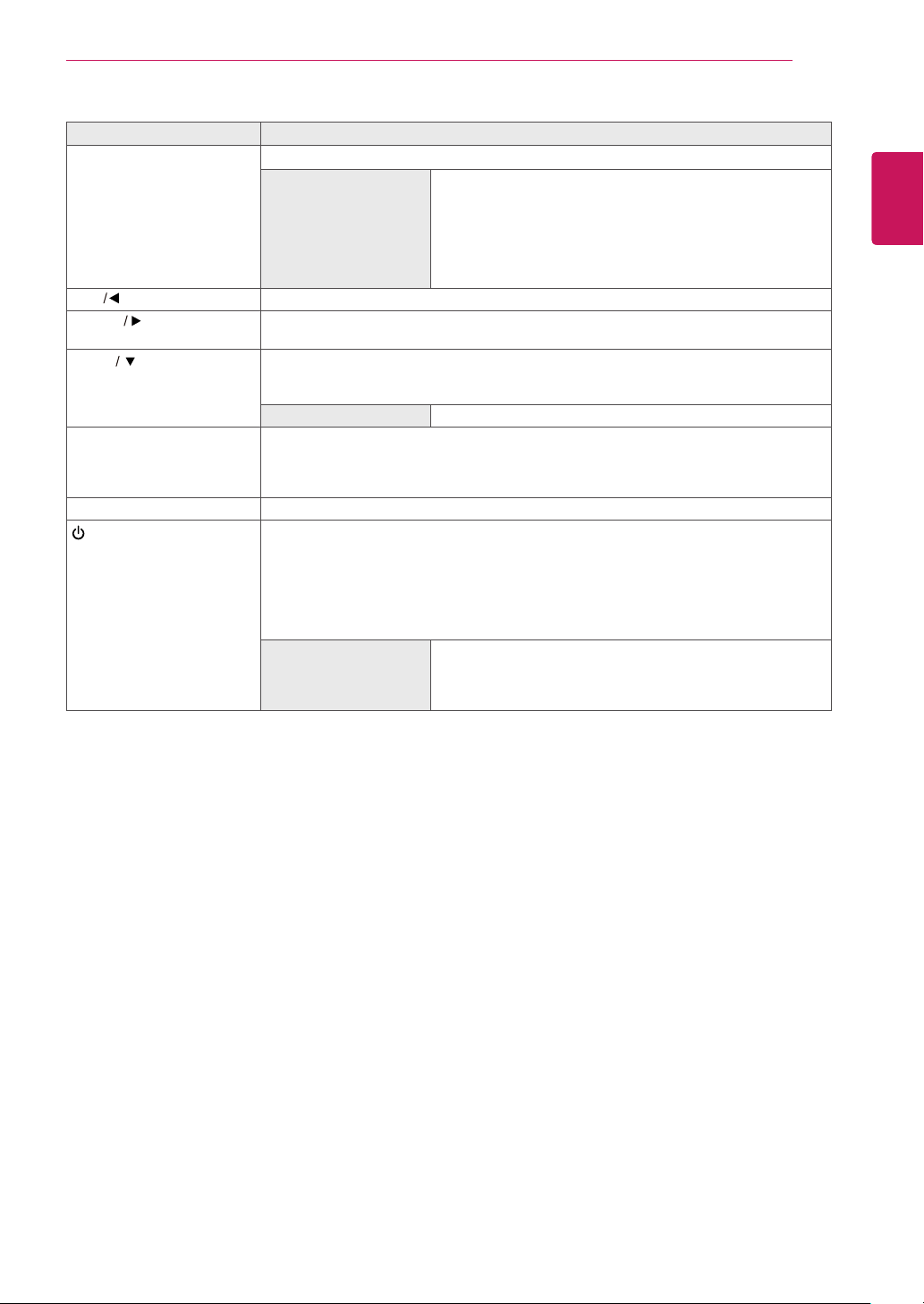
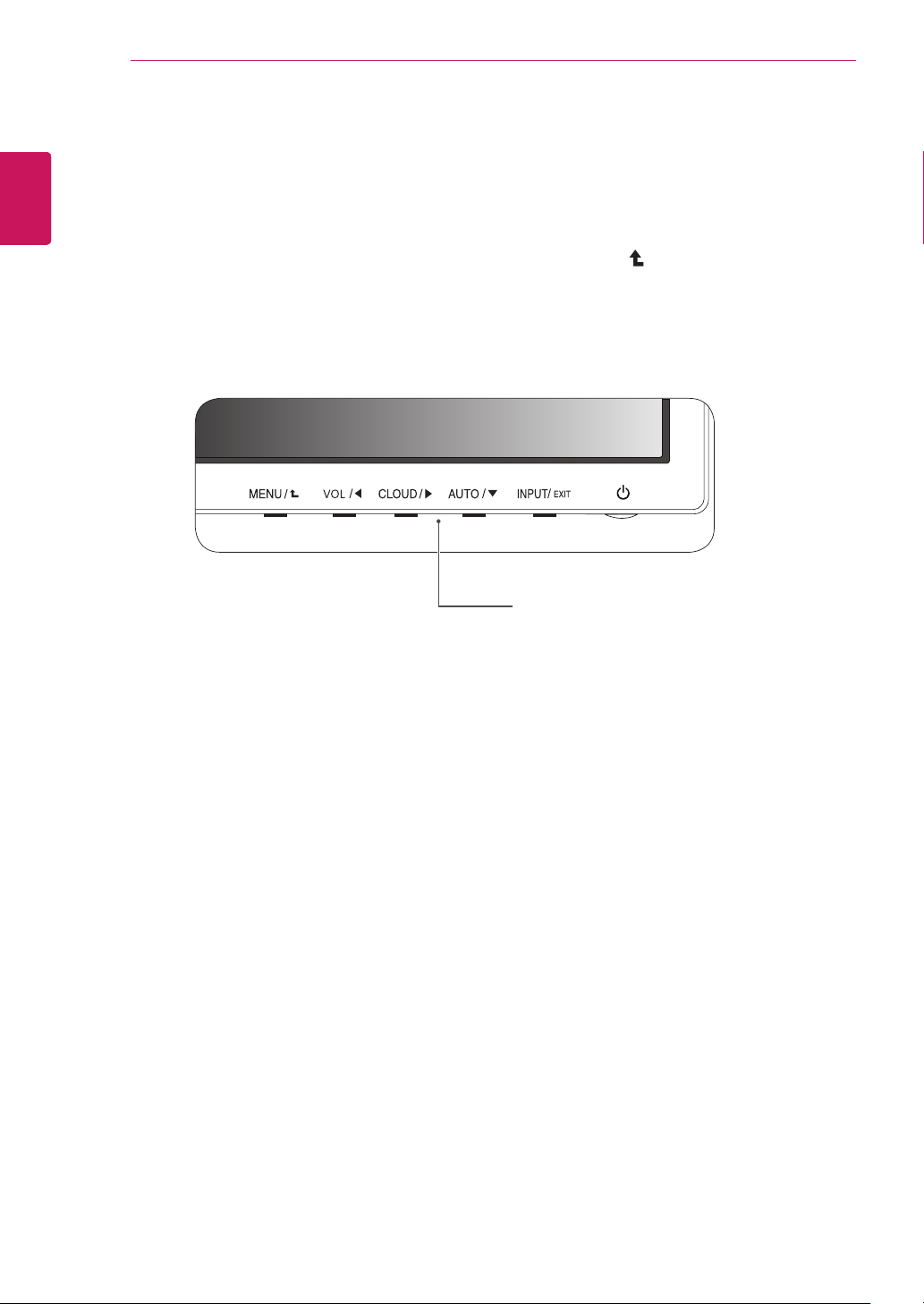
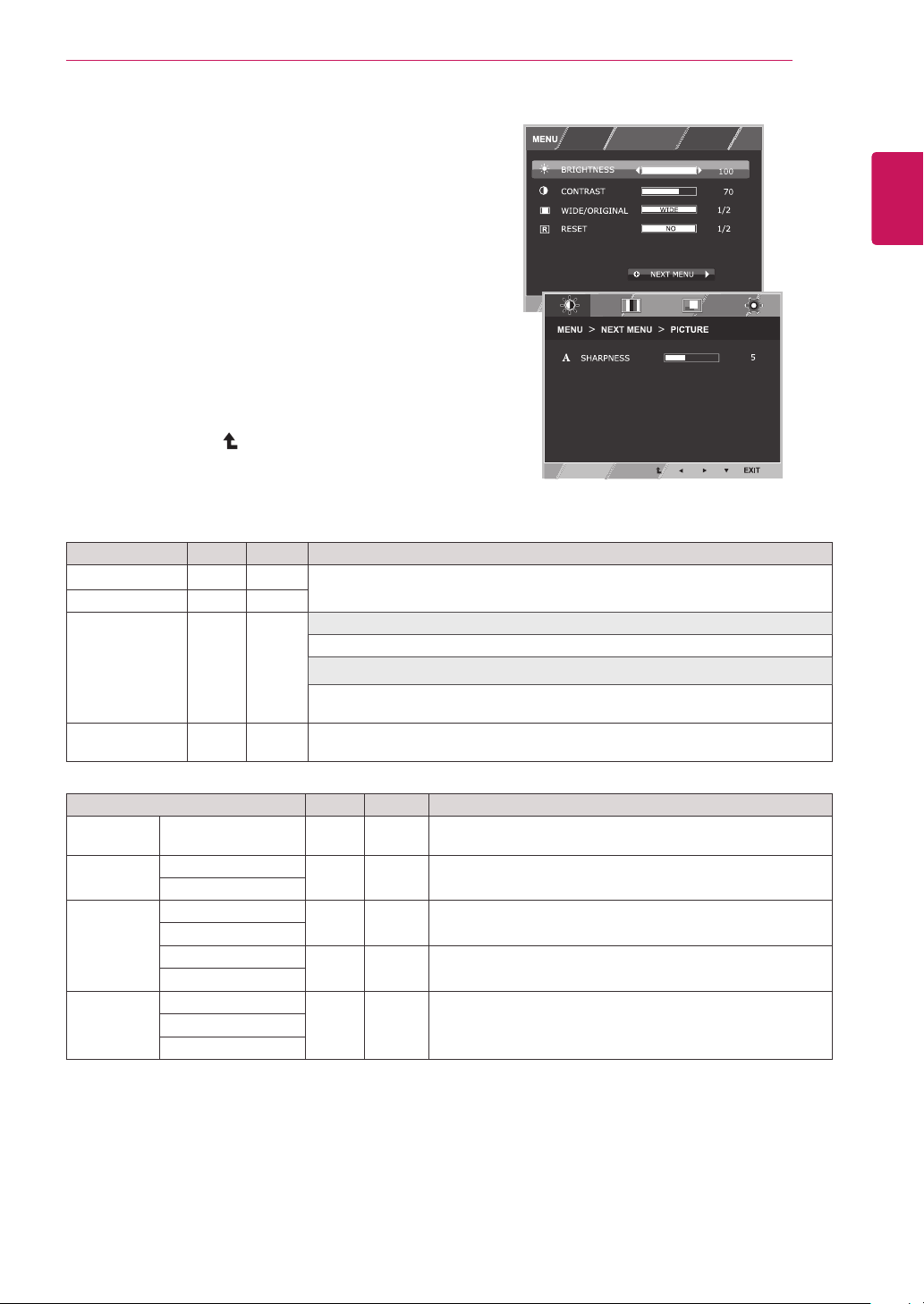
Button Description
MENU Activates the main menu.
OSD Lock/Unlock
Functions
Locks/unlocks the OSD screen.
y
To lock the OSD screen, press and hold the MENU button
for several seconds. The "OSD LOCKED" message will be
displayed and the screen will be locked.
y
To unlock the OSD screen, press and hold the MENU
button again for several seconds. The "OSD UNLOCKED"
message will be displayed and the screen will be unlocked.
VOL
Adjust the volume of the monitor.(only works in Cloud mode)/the left arrow key.
CLOUD
Disconnects the connection when the key is pressed for a few seconds while in Cloud
mode;the right arrow key.
AUTO To adjust the monitor settings, press the AUTO button on the MONITOR SETUP OSD
menu (only supported for analog signal).
For optimal screen display, use the following resolution.
Optimal Resolution
1920 x 1080
INPUT Allows selection of the input signal.
y
If you connect the monitor to a computer using a D-SUB cable, select either the
CLOUD or D-SUB input signal.
y
The initial input signal is D-SUB.
EXIT Exits the OSD menu.
(Power Button)
y
D-SUB Input: Power On/Off
y
CLOUD Input
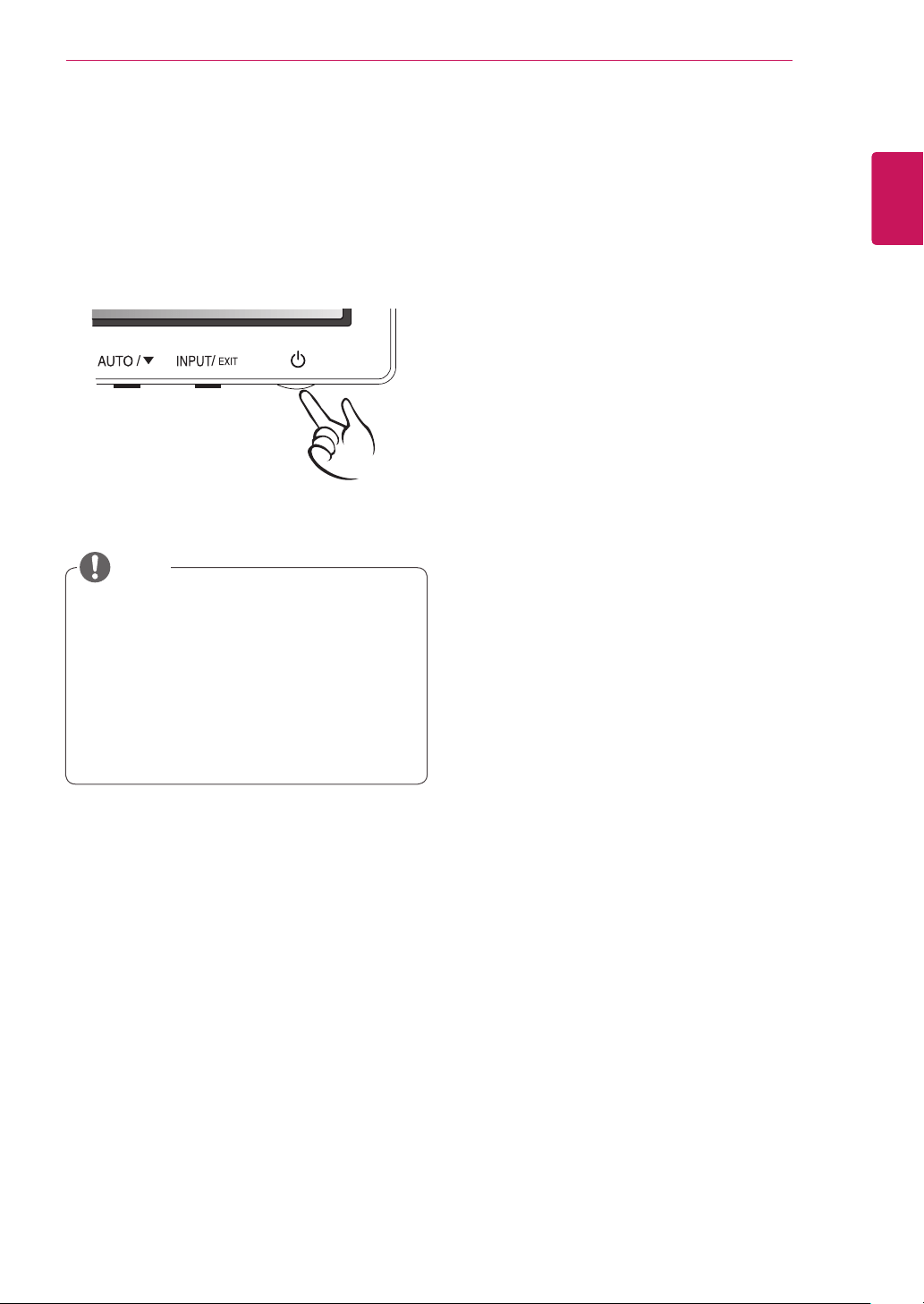
Monitor Off: Press the power button once then the monitor will be turned off after 5
seconds.
CLOUD Off: Press the power button twice then the monitor and CLOUD connection
will be disabled.
CLOUD On: Press the power button.
Power Indicator
When the monitor is in operating mode, the power indicator
will turn Red (on mode).
When the monitor is in power saving mode, the power indica-
tor will blink Red.
6
ENG
English
ASSEMBLING AND PREPARING
Setting Up the Monitor set
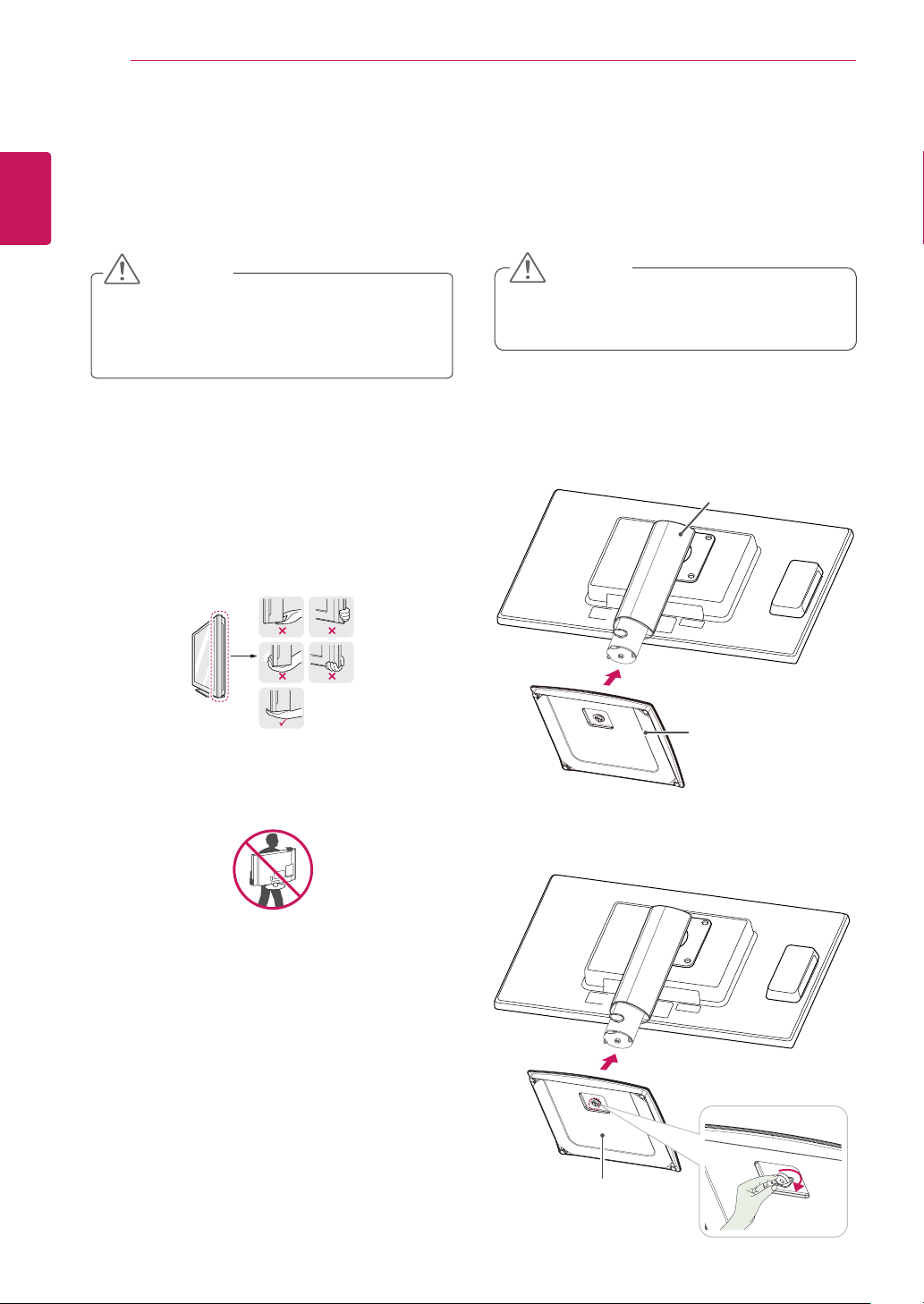
Attaching the Stand Base
1
Place the monitor's screen face down.
y
To protect the screen from scratches, cover
the surface with a soft cloth.
3
Using a coin, turn the screw clockwise to se-
cure
the
stand base.
2
Check the
position (at the front and rear)
of
the stand body,
then
mount the
stand base
on
the
stand body
as shown in the figure.
CAUTION
Stand Body
Stand Base
Stand Base
Lifting and moving the
Monitor
Please heed the following information when
moving the monitor.
y
Avoid touching the screen at all times, as this
may result in damage to the screen or pixels .
CAUTION
y
It is recommended to move the Monitor in
the box or packing material that the Monitor
originally came in.
y
Before moving or lifting the Monitor,
disconnect the power cord and all cables.
y
Hold the top and bottom of the Monitor frame
firmly. Make sure not to hold the transparent
part area.
y
When holding the Monitor, the screen should
face away from you to prevent the screen
from scratches.
y
When transporting the Monitor, do not
expose the Monitor to jolts or excessive
vibration.
y
When transporting the Monitor, keep the
Monitor upright, never turn the Monitor on its
side, or tilt towards the left or right.
7
ENG
English
ASSEMBLING AND PREPARING
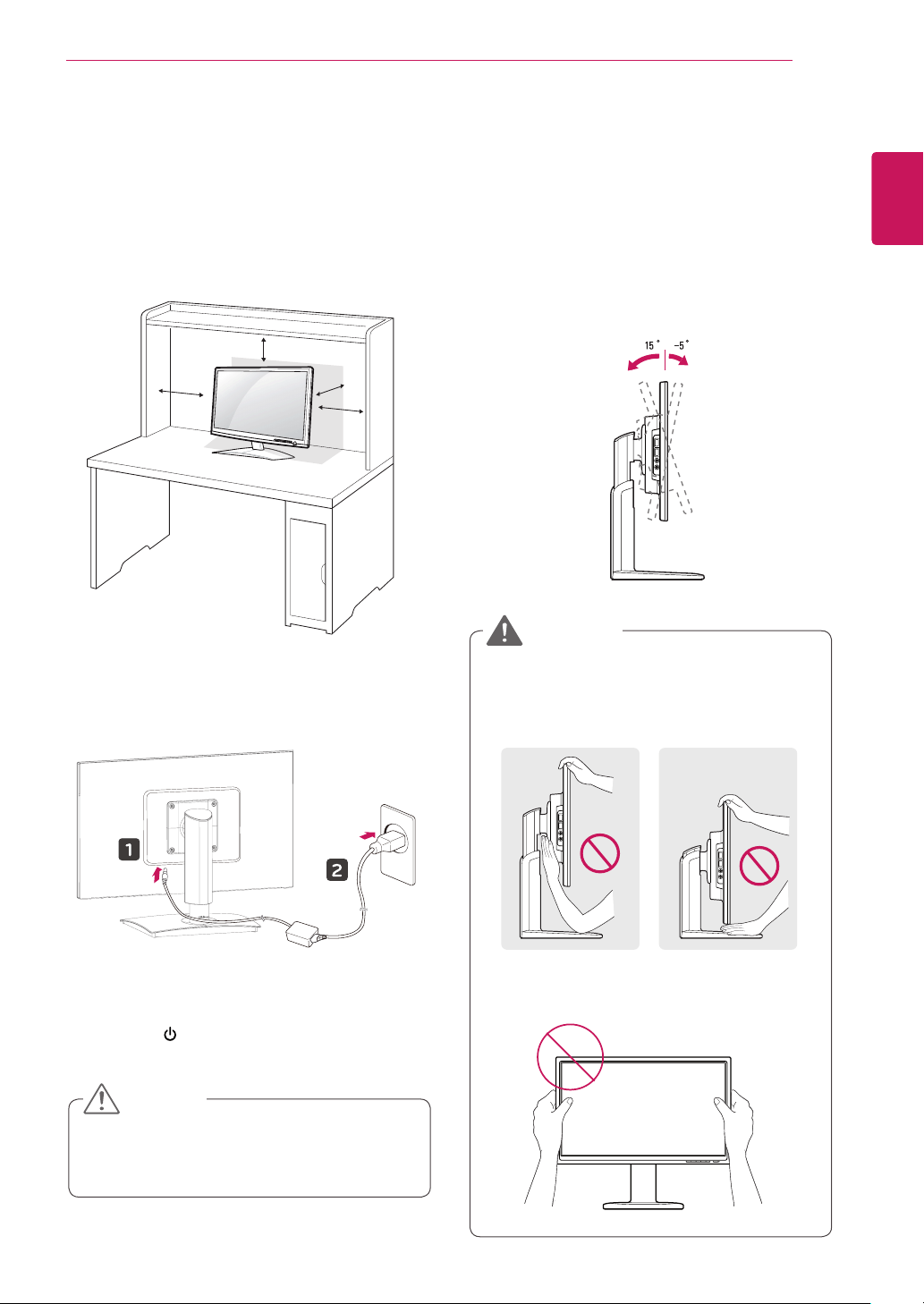
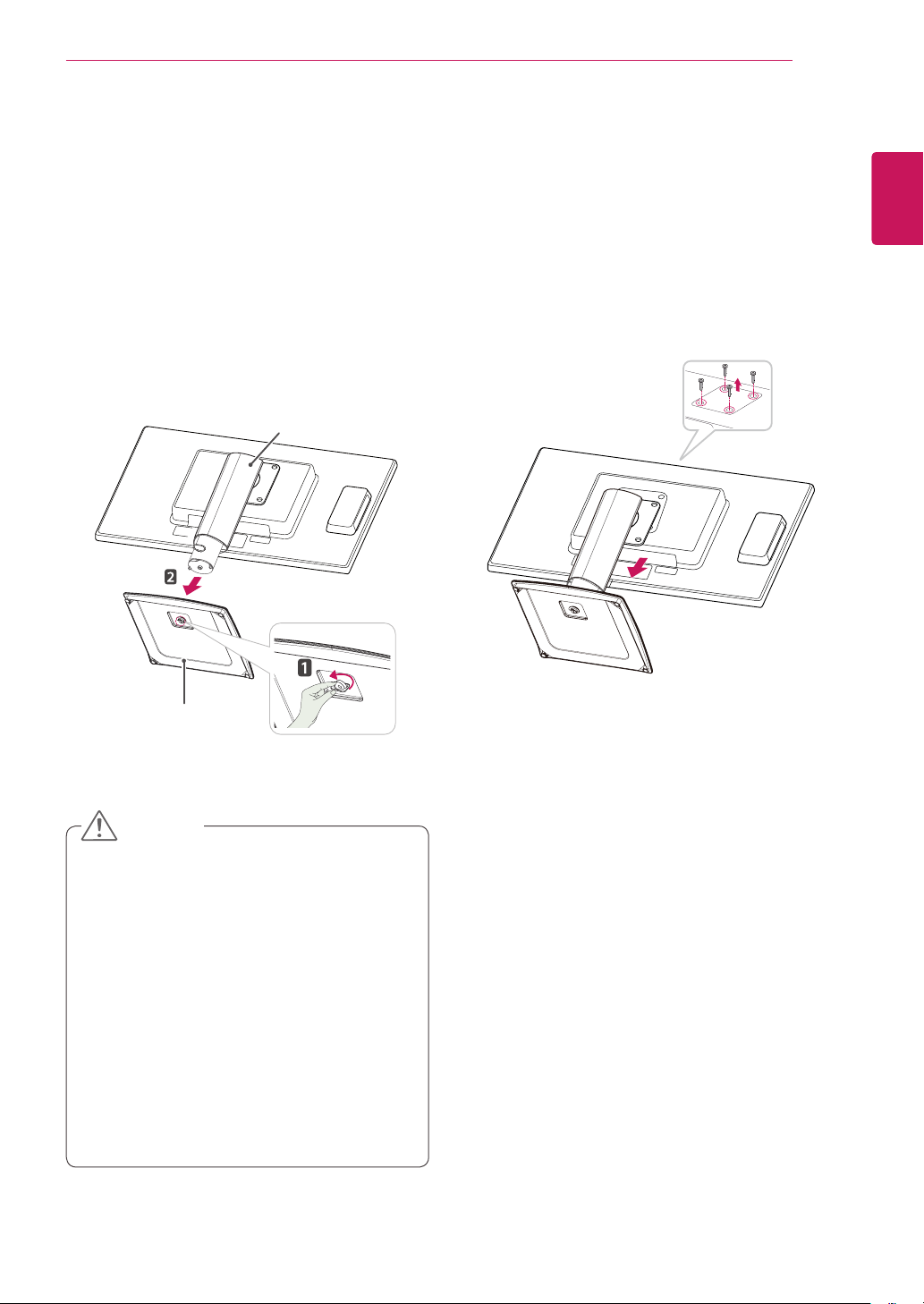
Adjusting the angle
1
Place the monitor mounted on the stand base
in an upright position.
2
Adjust the angle of the screen. The angle of
the screen can be adjusted up to 5° forwards
and 15° backwards for a comfortable viewing
experience.
y
To avoid injury to the fingers when adjusting
the screen, do not hold the lower part of the
monitor's frame as illustrated below.
y
Be careful not to touch or press the screen
area when adjusting the angle of the monitor.
WARNING
Mounting on a table
1
Lift the monitor and place it on the table in an
upright position.
Install at least
100 mm
away from the wall to
ensure sufficient ventilation.
2
Connect the adaptor to the monitor, then plug
the power cord into the wall outlet.
3
Press the (Power) button on the front of the
monitor to turn on the monitor.
100 mm
100 mm
100 mm
100 mm
y
Unplug the power cord prior to moving or
installing the monitor. There is risk of electric
shock.
CAUTION
Front SideRear Side
8
ENG
English
ASSEMBLING AND PREPARING
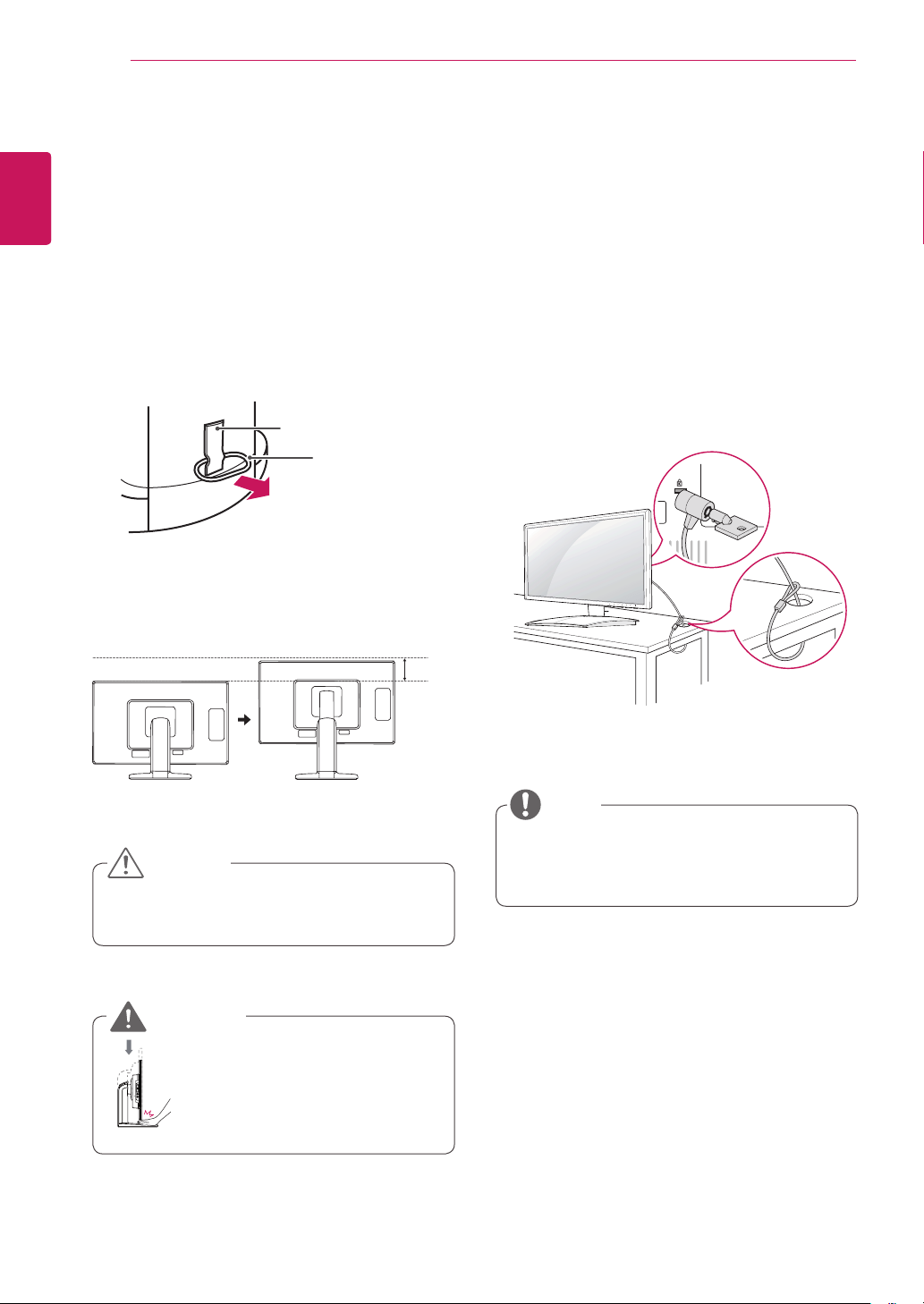
Using the Kensington locking
device
The connector for the Kensington lock is located
on the rear of the monitor.
For more information on installation and usage,
refer to the Kensington lock user manual or visit
the website at http://www.kensington.com.
Connect the monitor to the table with the Kensing-
ton lock cable.
y
Using the Kensington lock is optional. The
accessories can be purchased at your local
electronics store.
NOTE
y
Once the pin is removed, it is not necessary
to re-insert it to adjust the height.
Adjusting the stand height
1
Place the monitor mounted on the stand base
in an upright position.
2
Remove the
tape
attached at the bottom rear
of the
stand body,
then pull out the
locking
pin
.
3
The height can be adjusted up to
130 mm
.
y
Do not put your finger be-
tween the screen and the
base (chassis) when adjust-
ing the screen's height.
Tape
Locking Pin
Stand Body
CAUTION
WARNING
130.0mm
9
ENG
English
ASSEMBLING AND PREPARING
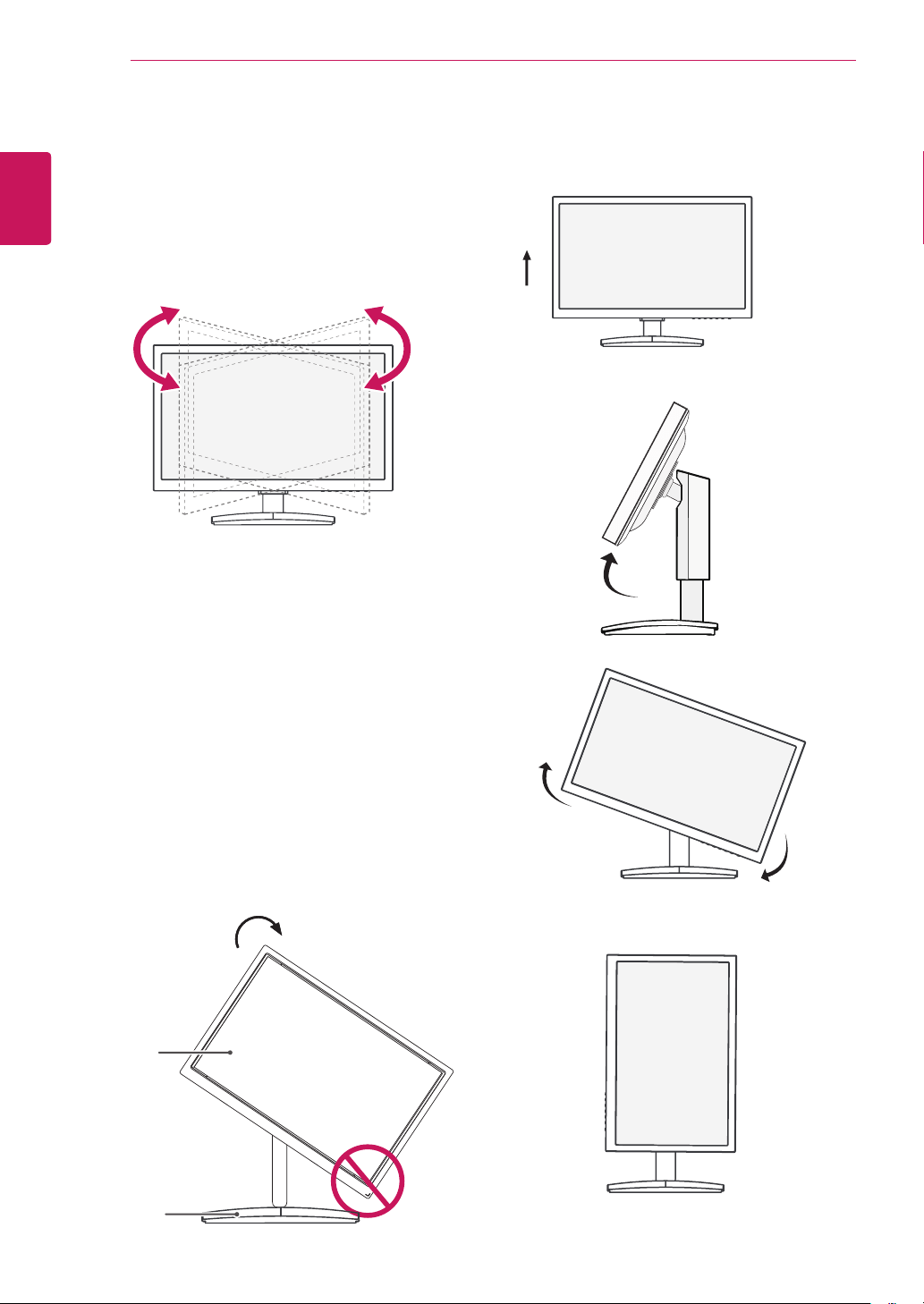
Detaching the stand body
1
Place the monitor's screen face down. To
protect the screen from scratches, cover the
surface with a soft cloth.
2
Using a screwdriver, remove the four screws
and detach the stand from the monitor.
y
The components appearing in the illustra-
tions may look different from the actual prod-
uct.
y
Do not carry the monitor upside-down as this
may cause it to fall off its stand, resulting in
damage or injury.
y
To avoid damaging the screen when lifting
or moving the monitor, only hold the stand or
the plastic cover. This avoids putting unnec-
essary pressure on the screen.
y
Only remove the tape and the locking pin
when the monitor is mounted on the stand
base and is in an upright position. Otherwise,
the stand body may protrude, which may
lead to injury.
Detaching the stand base
1
Place the monitor's screen face down.
To protect the screen from scratches, cover the
surface with a soft cloth.
2
Using a coin, turn the screw in the stand base
counterclockwise. Detach the
stand base
from
the
stand body
.
CAUTION
Stand Body
Stand Base
10
ENG
English
ASSEMBLING AND PREPARING
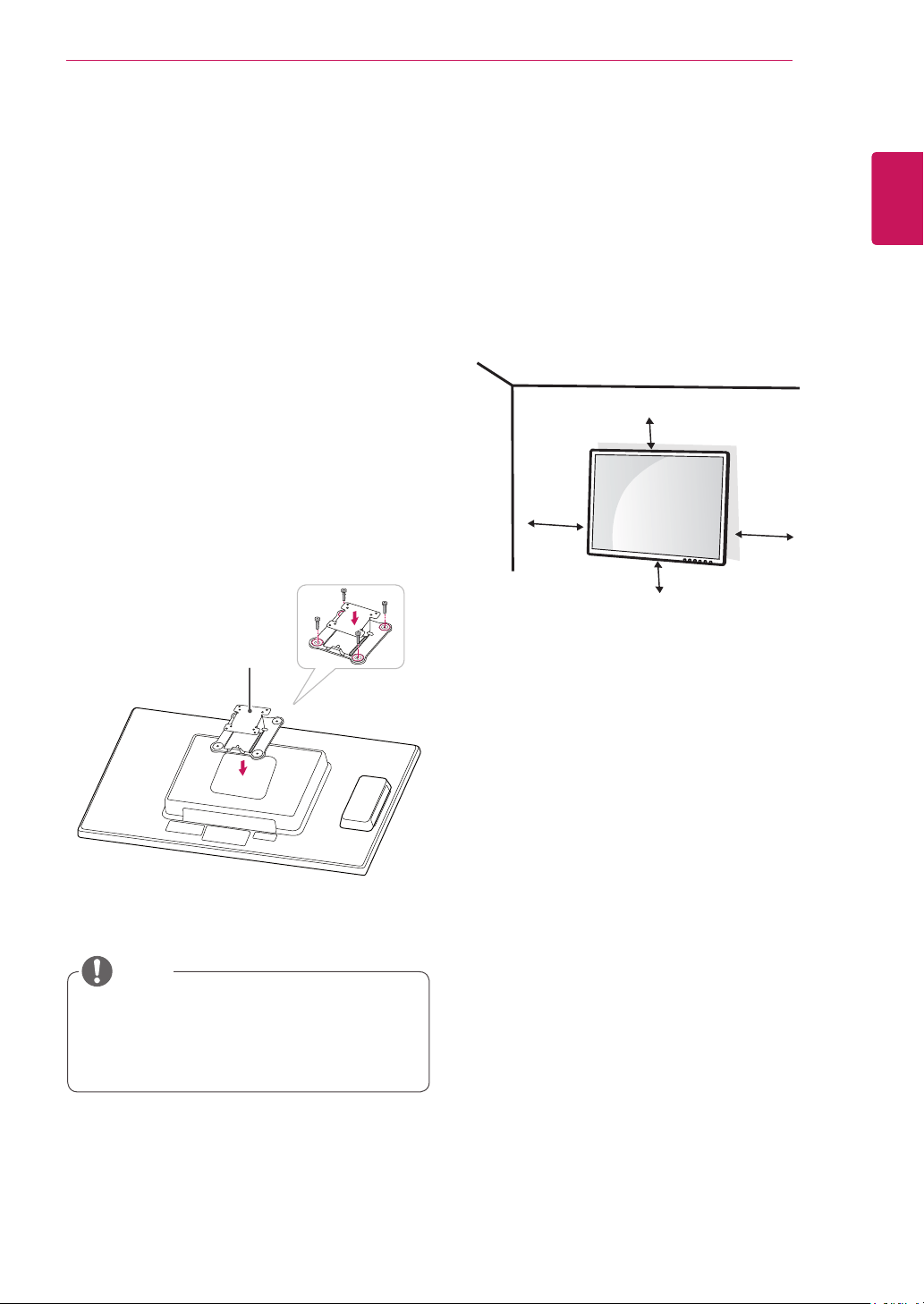
Swivel stand
y
Image shown may differ from your Monitor
set.
1
Swivel 90 degrees and adjust the angle of the
Monitor set to suit your view.
1
Lift the monitor to its highest height to utilize
the Pivot function.
Using the Pivot function
The pivot function allows you to rotate the screen
90 degrees clockwise.
2
Landscape & Portrait : You can rotate the panel
90° clockwise. Please be cautious and avoid
contact between the monitor head and the
Stand Base when rotating the screen to access
the Pivot function. If the monitor head touches
the Stand Base, then the Stand Base could
crack.
Head
section
Stand
section
3
Be careful with the cables when rotating the
screen.
11
ENG
English
ASSEMBLING AND PREPARING
100 mm
100 mm
100 mm
100 mm
If you intend to mount the Monitor set to a wall,
attach Wall mounting interface (optional parts) to
the back of the set.
When you install the Monitor set using a wall
mounting interface (optional parts), attach it
carefully so it will not drop.
1
Please, Use the screw and wall mount interface
in accordance with VESA Standards.
2
If you use screw longer than standard, the
monitor might be damaged internally.
3
If you use improper screw, the product might be
damaged and drop from mounted position. In
this case, LG Electronics is not responsible for
it.
4
VESA compatible.
5
Please use VESA standard as below.
y
784.8 mm (30.9 inch) and under
* Wall Mount Pad Thickness : 2.6 mm
* Screw : Φ 4.0 mm x Pitch 0.7 mm x
Length 10 mm
y
787.4 mm (31.0 inch) and above
* Please use VESA standard wall mount pad
and screws.
Mounting on a wall
Install the monitor at least 100 mm away from the
wall and leave about 100 mm of space at each
side of the monitor to ensure sufficient ventilation.
Detailed installation instructions can be obtained
from your local retail store. Please refer to the
manual to install and set up a tilting wall mounting
bracket.
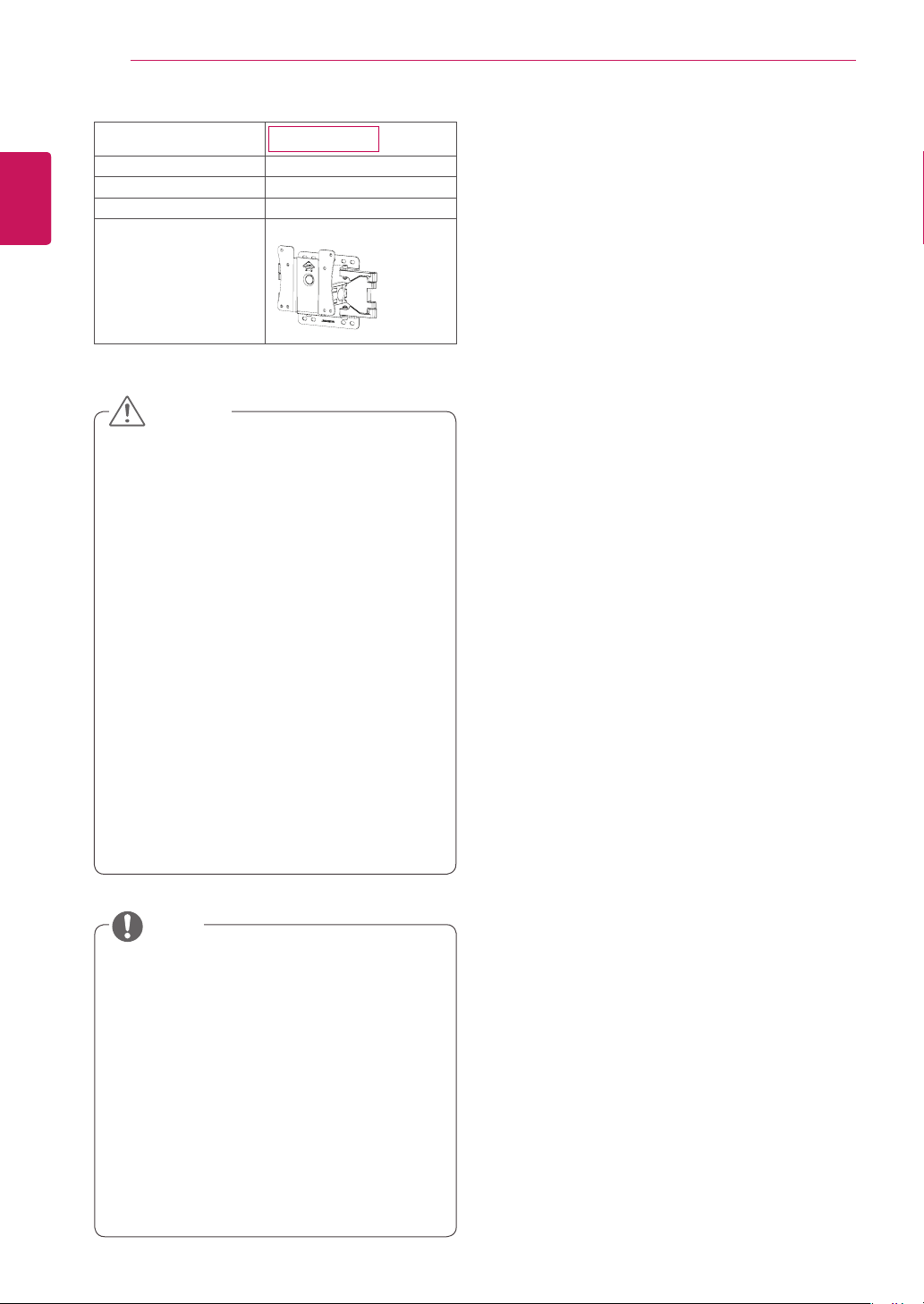
Installing the wall mount plate
This monitor has a VESA compatible mount on the
back. Most mounts will require an LG mounting
plate.
1
Place the monitor's screen face down. To
protect the screen from scratches, cover the
surface with a soft cloth.
2
Place the wall mount plate on the monitor and
align it with the screw holes on the monitor.
3
Using a screwdriver, tighten the four screws to
fix the plate onto the monitor.
y
The wall mount plate is sold separately.
y
For more information on the installation, refer
to the wall mount plate's installation guide.
NOTE
Wall Mount Plate
12
ENG
English
ASSEMBLING AND PREPARING
y
Unplug the power cord before moving or in-
stalling the monitor to avoid electric shocks.
y
Installing the monitor on the ceiling or on a
slanted wall may result in the monitor falling
off, which could lead to injury. Please use
a LG wall mounting bracket when using a
VESA mount. For more information, contact
your local retail store or a qualified installer.
y
Applying excessive force when fastening
screws may cause damage to the moni-
tor. Damage caused in this way will not be
covered by the product warranty.
y
Use the wall mounting bracket and screws
that conform to the VESA standard. Dam-
age caused by the use or misuse of inap-
propriate components will not be covered
by the product warranty.
y
Use the screws specified in the VESA stan-
dard.
y
The wall mount kit includes the installation
guide and necessary parts.
y
The wall mounting bracket is optional. The
accessories can be purchased at your local
retail store.
y
The length of the screw may differ for each
wall mounting bracket. Ensure the correct
length of the screw is used.
y
For more information, please refer to the user
manual for the wall mounting bracket.
Model
23CAV42K
VESA (A x B)
100 x 100
Stand Screw
M4
Required Screw
4
Wall Mount Plate
(Optional)
LSW 149
CAUTION
NOTE
13
ENG
English
USING THE MONITOR SET
USING THE MONITOR SET
Connecting Input Signal Cable
y
This monitor supports the *Plug and Play
feature.
*Plug and Play: A feature that allows you to
add a device to your computer, without having
to reconfigure anything or install any manual
drivers.
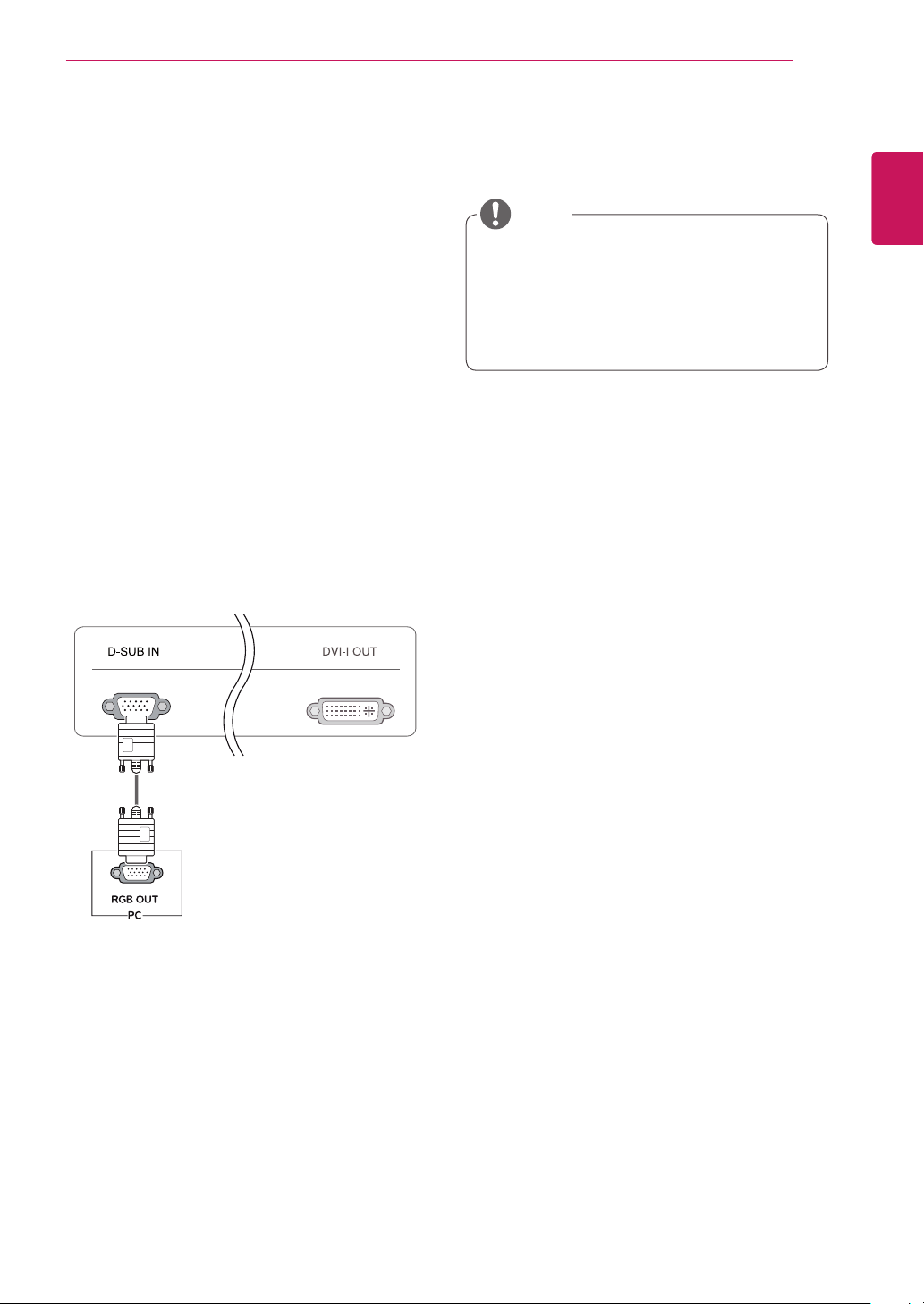
D-SUB IN connection - PC
D-SUB IN transfers analog video signals from the
PC to the monitor.
Connect the monitor to the PC using the provided
15-pin D-SUB signal cable as illustrated below.
NOTE
RGB IN
MONITOR
y
Apple Adapter
An adapter may be needed for Apple
computers. This adapter can be purchased
from Apple.
14
ENG
English
USING THE MONITOR SET
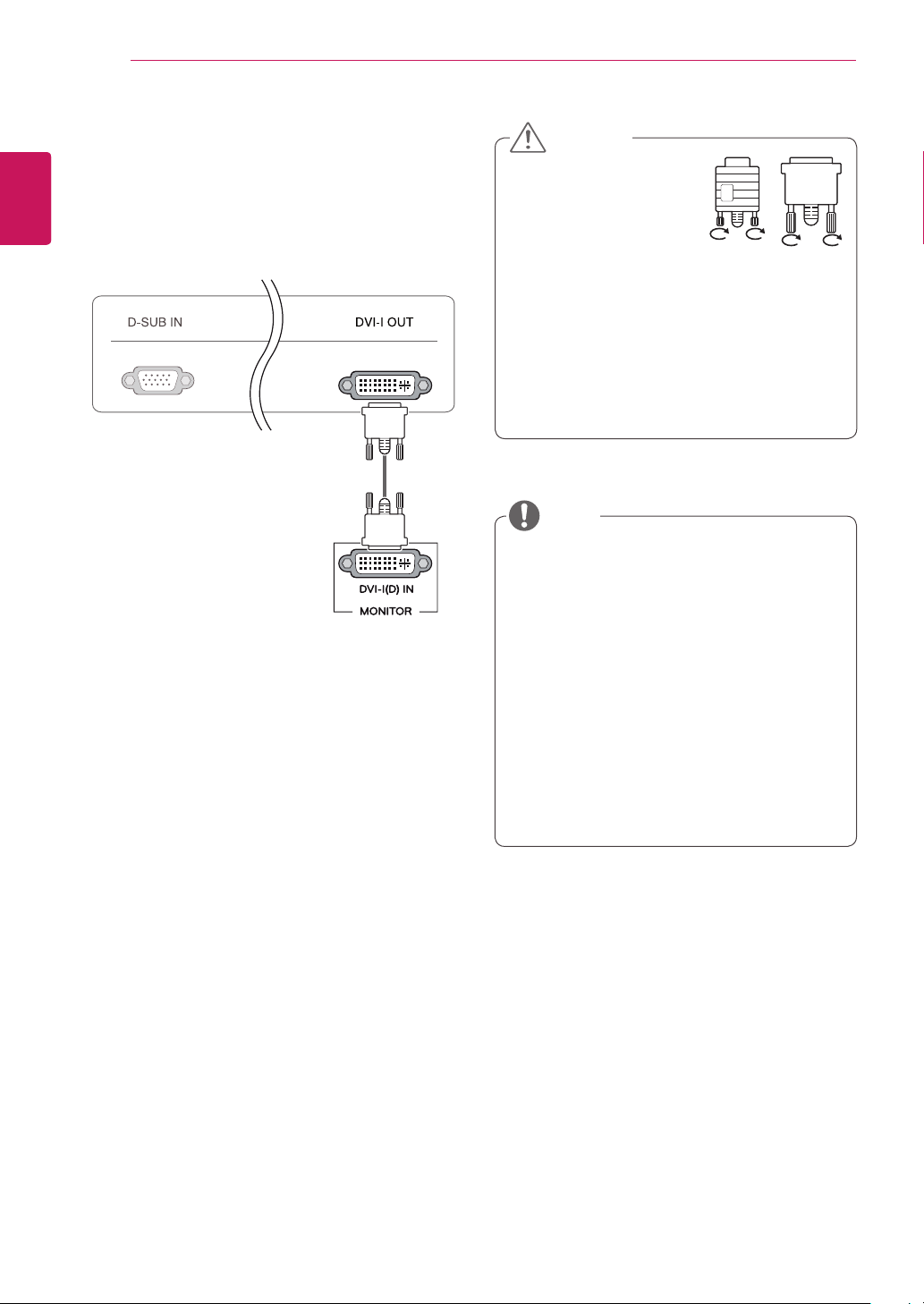
DVI connection
Transfers digital video signals from the Cloud Mon-
itor to an extended monitor.
Connect the Cloud Monitor to an extended monitor
using a DVI cable.
y
To connect the monitor to a computer, use
the appropriate signal cable (LAN and D-
SUB).
y
A converter can be used to convert the DVI-I
input signal to D-SUB input signal.
y
When connecting the power cord to the out-
let, use a grounded (3-hole) multi-socket or a
grounded wall outlet.
y
The monitor may flicker when turned on in an
area of low temperature. This is normal.
y
Sometimes red, green or blue spots may ap-
pear on the screen. This is normal.
y
Connect the input signal
cable and tighten in the
direction of the arrow. To
prevent disconnection
secure the cable tightly.
y
Do not press on the screen for a prolonged
time. This may cause image distortion.
y
Do not display a still image on the screen
for a prolonged time. This may cause image
retention. If possible, use the screen saver.
CAUTION
NOTE
15
ENG
English
USING THE MONITOR SET
Connecting LAN/Peripherals
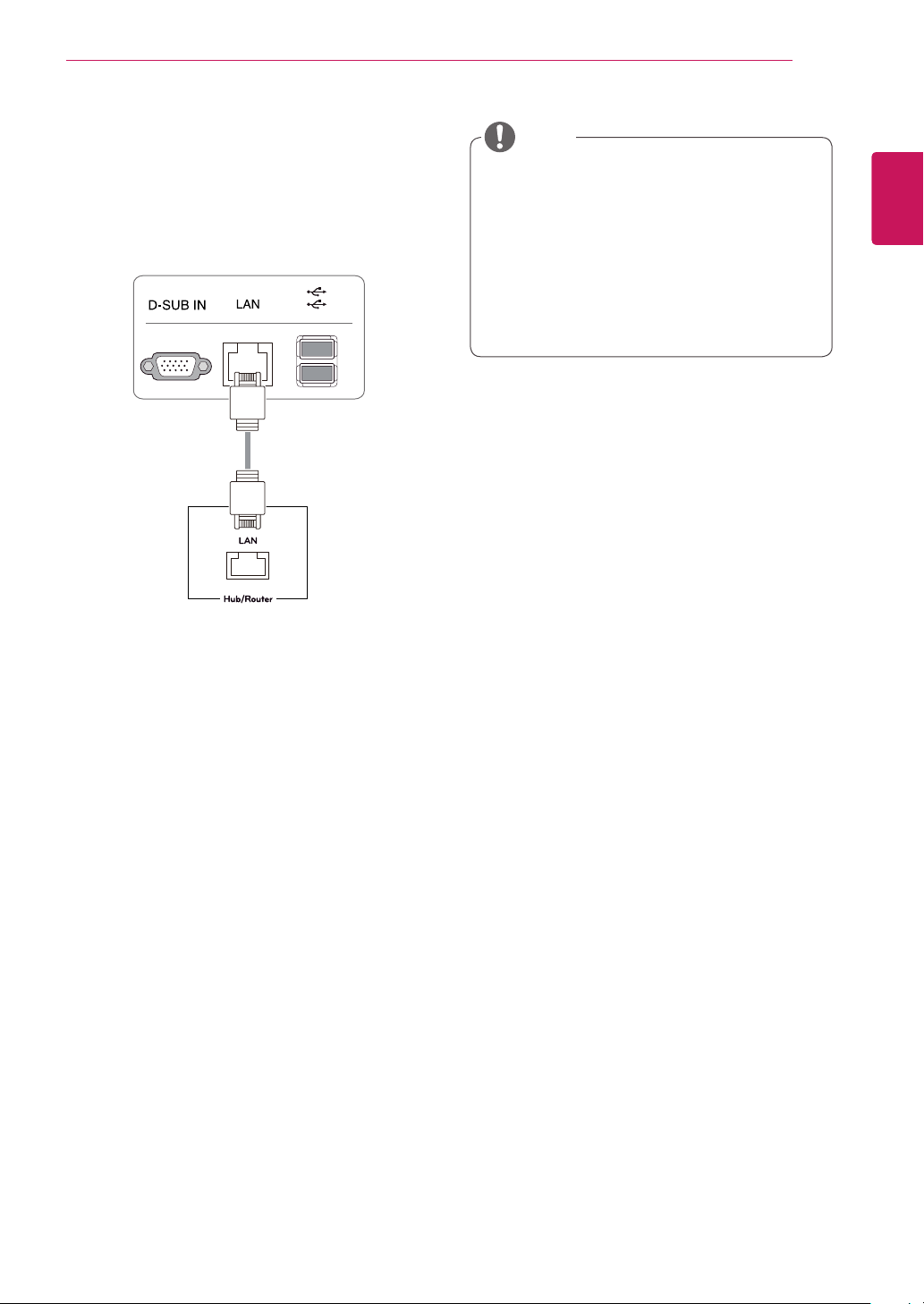
LAN connection
Connect the router or switch to the monitor using a
LAN cable as illustrated below.
y
The LAN cable is sold separately.
y
The following LAN cable type can be used:
Standard: IEEE 802.3 ETHERNET
y
If a device is connected into the earphone
out port via a LAN cable, you can adjust the
volume with the volume icon on PC taskbar.
y
Connect the LAN cable and the peripheral
devices prior to booting up the PC.
NOTE
16
ENG
English
USING THE MONITOR SET
y
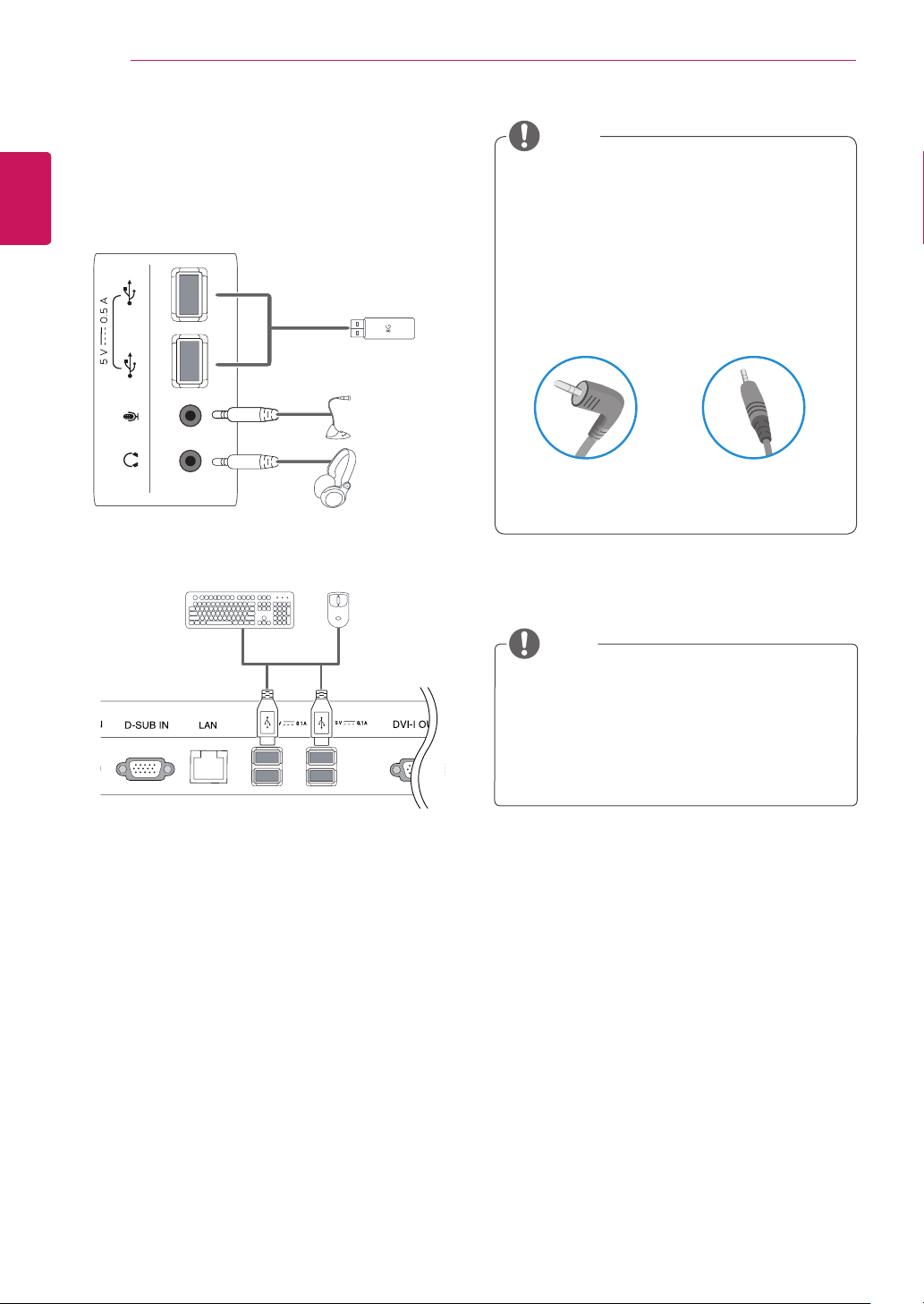
Peripheral devices are sold separately.
y
The USB ports on the left and bottom of the
monitor can be used to connect the key-
board, mouse, and other USB devices.
y
Cables with angled plugs may have clear-
ance issues, use straight plugs when pos-
sible.
Angle Type Straight Type
Peripheral device connection
Connect peripheral devices to the monitor using
USB, microphone and headphone ports.
NOTE
NOTE
y
Headphones, speakers or microphone may
not work normally, depending on the server
PC settings.
y
Virtual solutions may affect the functions or
speed of the specific USB storage device.
Left
Bottom
1
1
1
1
17
ENG
English
USING THE MONITOR SET
y
What is "Self Image Adjustment"? This func-
tion runs when the monitor is connected for
the first time and performs automatic image
adjustment for each signal (only available for
analog [D-SUB input] signals) to provide an
optimal screen display.
Self Image Adjustment
Press the power button on the front to turn on
the monitor. When powered on, the
"Self Image
Adjustment"
function will run automatically (only
available for analog [D-SUB input] signals).
NOTE
18
ENG
English
CUSTOMIZING SETTINGS
CUSTOMIZING SETTINGS
1
Press the desired button on the bottom of the Monitor set.
2
Change the value of the menu item by pressing the buttons on the bottom of the Monitor set.
To return to the upper menu or set other menu items, use the up arrow ( ) button.
3
Select
EXIT
to leave the OSD menu.
Monitor set Buttons
19
ENG
English
CUSTOMIZING SETTINGS
Customizing Settings
Menu Settings
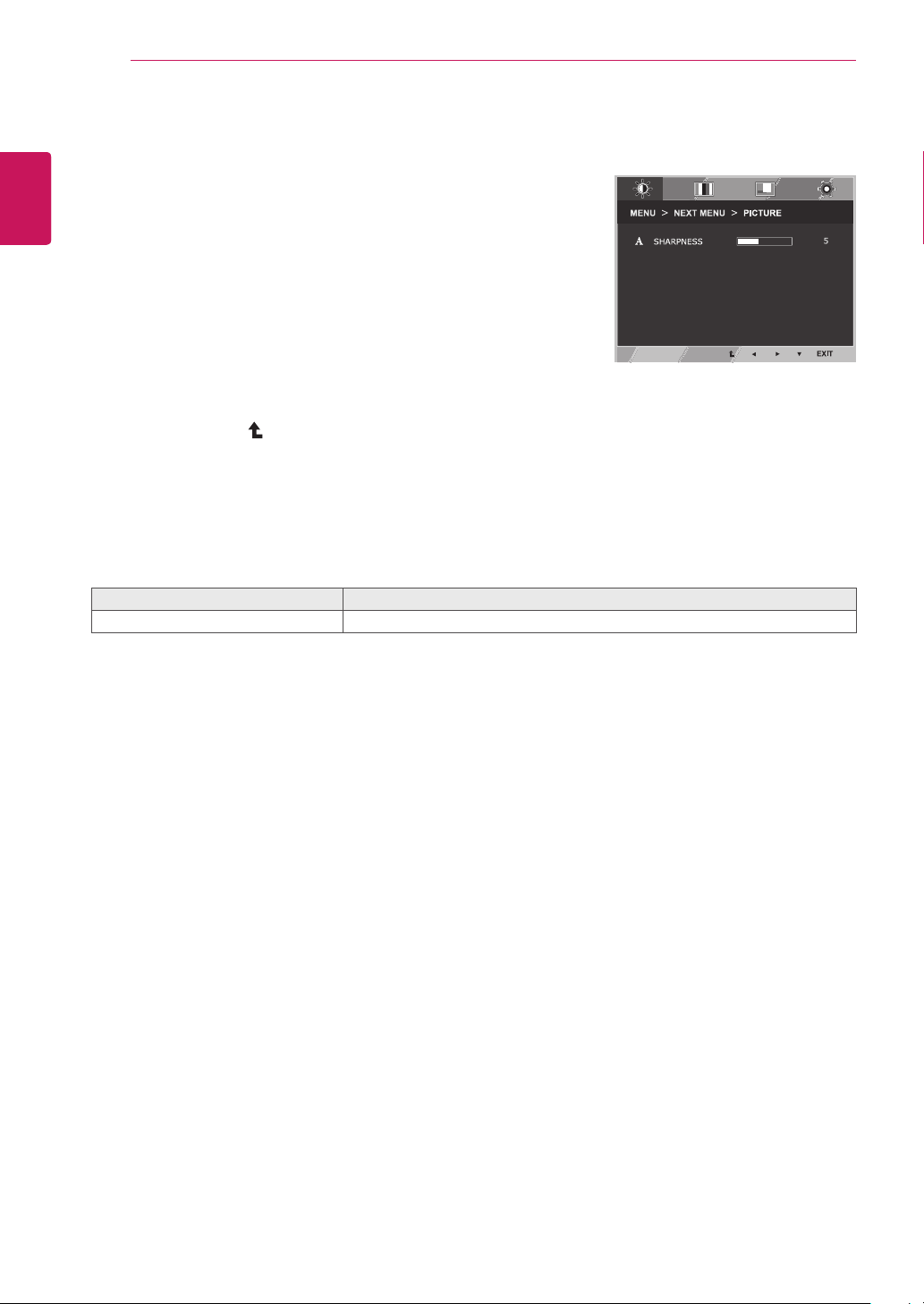
1
Press
MENU
button on the bottom of the Monitor set
to display the
MENU
OSD.
2
Set the options by pressing the ◄ or ► or ▼
buttons.
3
Select the "
NEXT MENU
" button to enter the more
option settings.
4
Select
EXIT
to leave the OSD menu.
To return to the upper menu or set other menu items,
use the up arrow ( ) button.
Each option is explained below.
MENU > NEXT MENU D-SUB CLOUD Description
PICTURE
SHARPNESS ● ●
To adjust the clearness of the screen .
COLOR GAMMA
● ●
To customize the color of the screen
COLOR TEMP
DISPLAY HORIZONTAL
●
To adjust the position of the screen
VERTICAL
CLOCK
●
To improve the clarity and stability of the screen
PHASE
OTHERS LANGUAGE
● ●
To customize the screen status for a user's operating
environment
CLOUD
POWER INDICATOR
y
CLOUD:
Using PC via a network.
MENU D-SUB CLOUD Description
BRIGHTNESS
● ●
To adjust the brightness, contrast of the screen
CONTRAST ● ●
WIDE/ORIGINAL
● ●
WIDE
Switch to full screen mode according to input image signal.
ORIGINAL
Change the input image signal ratio to original.
* This function works only if input resolution is lower than Monitor set ratio (16:9).
RESET
● ●
Restore all factory default settings. Press the
◄
,
►
buttons to reset
immediately.
DUAL
WEB
DUAL
WEB
20
ENG
English
CUSTOMIZING SETTINGS
PICTURE
1
Press
MENU
button on the bottom of the Monitor set
to display the
MENU
OSD.
2
Select the "
NEXT MENU
" button to enter the more
option settings.
3
Enter to
PICTURE
by pressing the ▼ button.
4
Set the options by pressing the ◄ or ► or ▼
buttons.
5
Select
EXIT
to leave the OSD menu.
To return to the upper menu or set other menu items,
use the up arrow ( ) button.
Each option is explained below.
MENU > NEXT MENU > PICTURE Description
SHARPNESS
To adjust the clearness of the screen.
DUAL
WEB
21
ENG
English
CUSTOMIZING SETTINGS
COLOR
1
Press
MENU
button on the bottom of the Monitor set
to display the
MENU
OSD.
2
Select the "
NEXT MENU
" button to enter the more
option settings.
3
Select
COLOR
by pressing the ► button.
4
Enter to
COLOR
by pressing the ▼ button.
5
Set the options by pressing the ◄ or ► or ▼
buttons.
6
Select
EXIT
to leave the OSD menu.
To return to the upper menu or set other menu items,
use the up arrow ( ) button.
Each option is explained below.
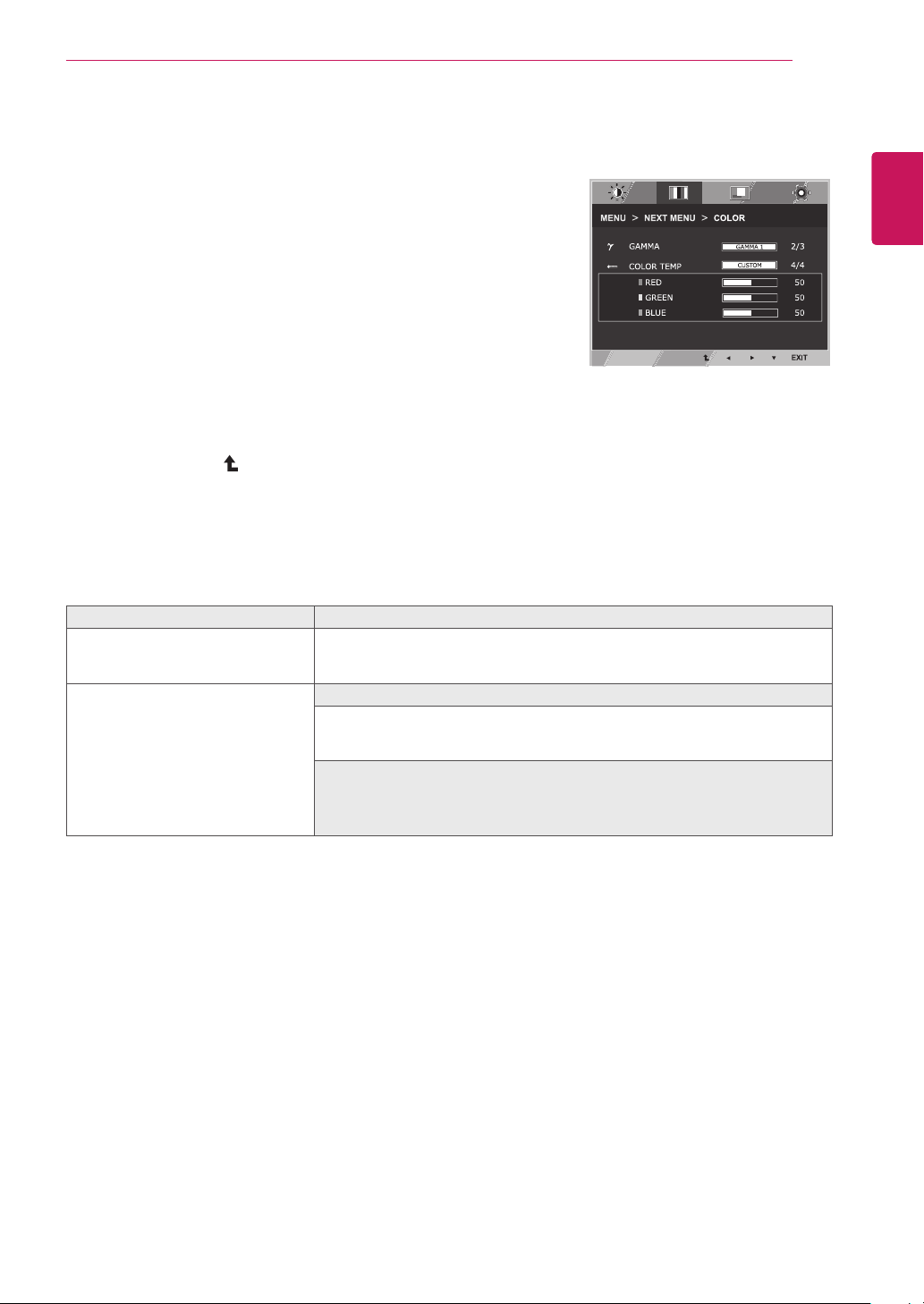
MENU > NEXT MENU > COLOR Description
GAMMA
Set your own gamma value. : GAMMA 0, GAMMA 1, GAMMA 2 on the monitor,
high gamma values display whitish images and low gamma values display
blackish images.
COLOR TEMP CUSTOM
• RED:
Set your own red color levels.
• GREEN:
Set your own green color levels.
• BLUE:
Set your own blue color levels.
Select the screen color.
WARM:
Set the screen to warm color temperature (more red).
MEDIUM:
Set the screen to medium color temperature.
COOL:
Set the screen to cool color temperature (more blue).
DUAL
WEB
22
ENG
English
CUSTOMIZING SETTINGS
DISPLAY
1
Press
MENU
button on the bottom of the Monitor set
to display the
MENU
OSD.
2
Select the "
NEXT MENU
" button to enter the more
option settings.
3
Select
DISPLAY
by pressing the ► button.
4
Enter to
DISPLAY
by pressing the ▼ button.
5
Set the options by pressing the ◄ or ► or ▼
buttons.
6
Select
EXIT
to leave the OSD menu.
To return to the upper menu or set other menu items,
use the up arrow ( ) button.
Each option is explained below.
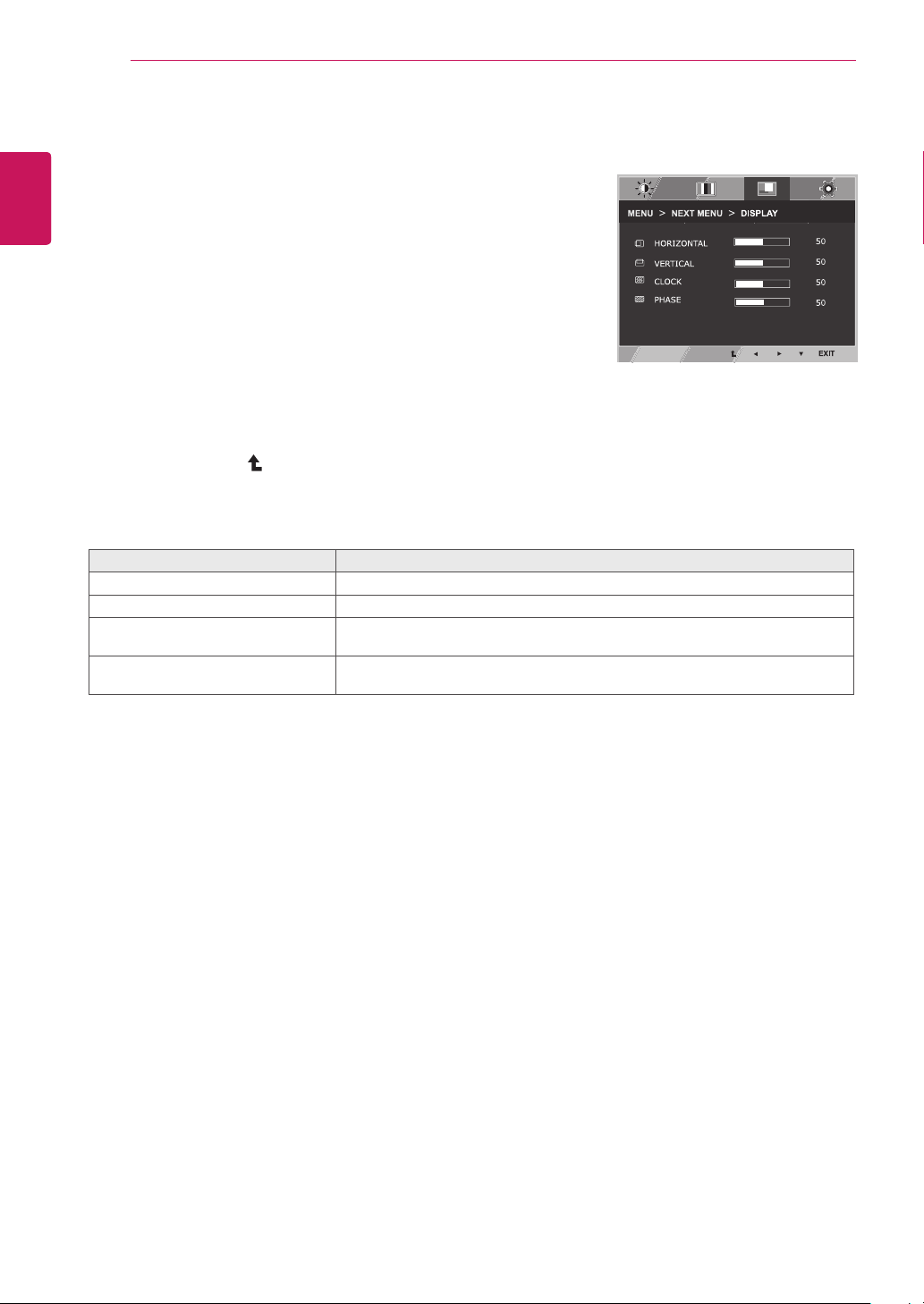
MENU > NEXT MENU > DISPLAY Description
HORIZONTAL
To move image left and right.
VERTICAL
To move image up and down.
CLOCK
To minimize any vertical bars or stripes visible on the screen background.The
horizontal screen size will also change.
PHASE
To adjust the focus of the display. This item allows you to remove any horizontal
noise and clear or sharpen the image of characters.
DUAL
WEB
y
Only available in D-SUB input mode.
23
ENG
English
CUSTOMIZING SETTINGS
OTHERS
1
Press
MENU
button on the bottom of the Monitor set
to display the
MENU
OSD.
2
Select the "
NEXT MENU
" button to enter the more
option settings.
3
Select
OTHERS
by pressing the ► button.
4
Enter to
OTHERS
by pressing the ▼ button.
5
Set the options by pressing the ◄ or ► or ▼
buttons.
6
Select
EXIT
to leave the OSD menu.
To return to the upper menu or set other menu items,
use the up arrow ( ) button.
Each option is explained below.
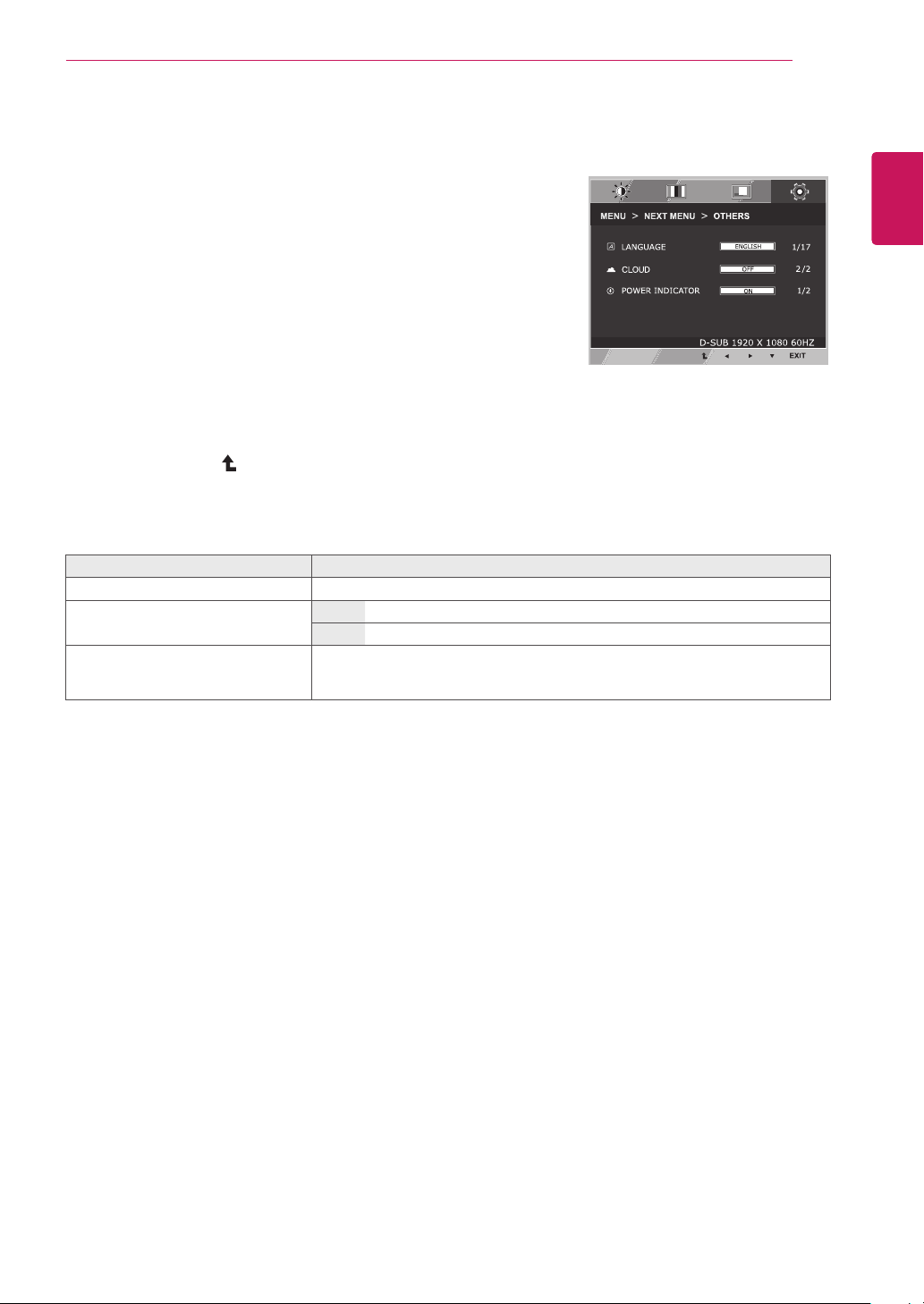
MENU > NEXT MENU > OTHERS Description
LANGUAGE
To choose the language in which the control names are displayed.
CLOUD Off
CLOUD is disabled in D-SUB input mode.
On
CLOUD is enabled in D-SUB input mode.
POWER
INDICATOR
Use this function to set the power indicator on the bottom side of the monitor to
ON or OFF.If you set OFF, it will go off.
If you set ON at any time, the power indicator will automatically be turned on.
DUAL
WEB
24
ENG
English
CUSTOMIZING SETTINGS
VOLUME
1
Press the
VOL
button at the bottom of the monitor to
display the
VOL
OSD menu.
2
Press the ◄ or ► button to adjust the volume.
3
Press the button to enable or disable Mute.
4
Select
EXIT
to leave the OSD menu.
Each option is explained below.
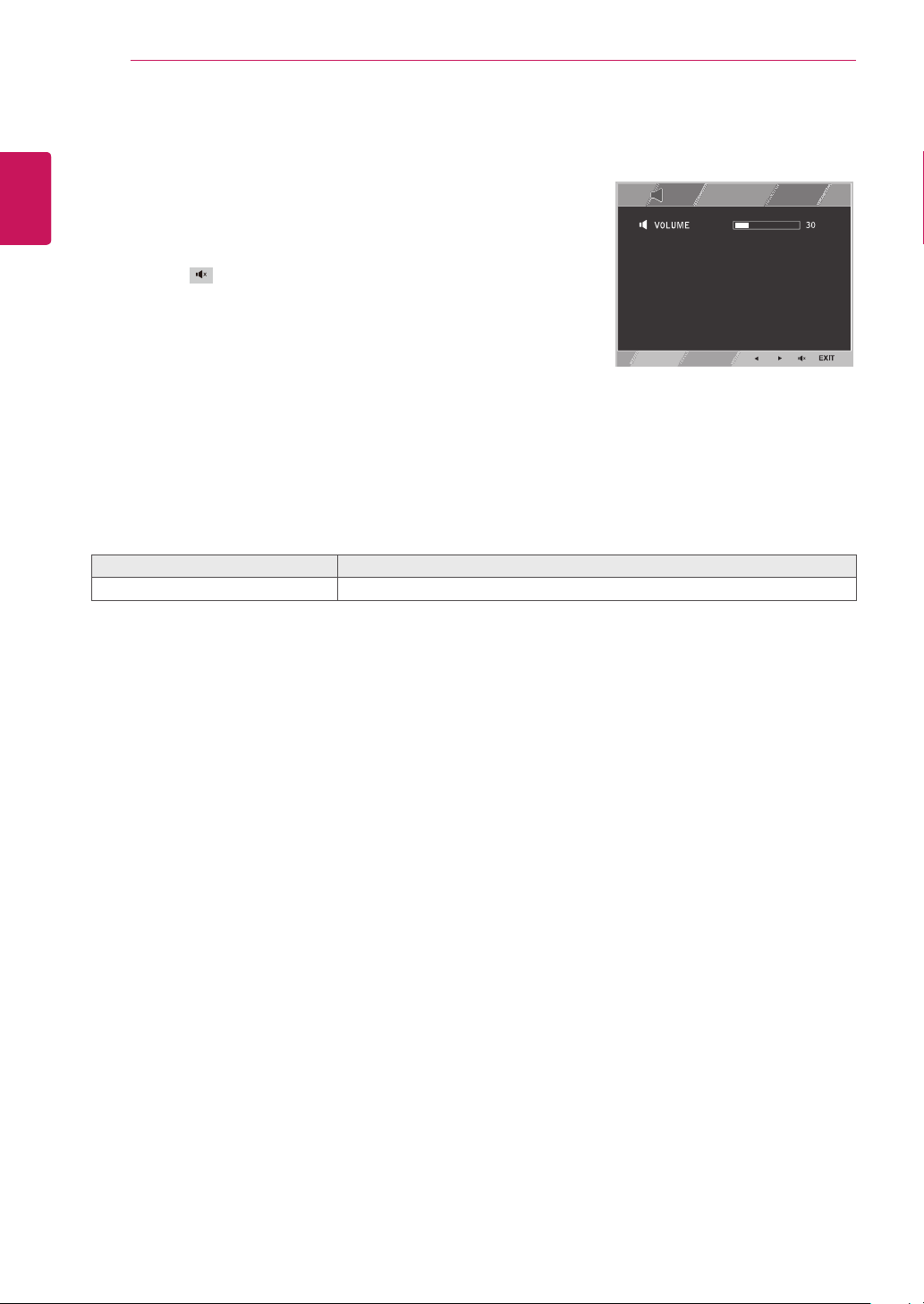
MENU > NEXT MENU > VOLUME Description
VOLUME
Adjusts the volume (only available in CLOUD input mode).
DUAL
WEB
25
ENG
English
Troubleshooting
TROUBLESHOOTING
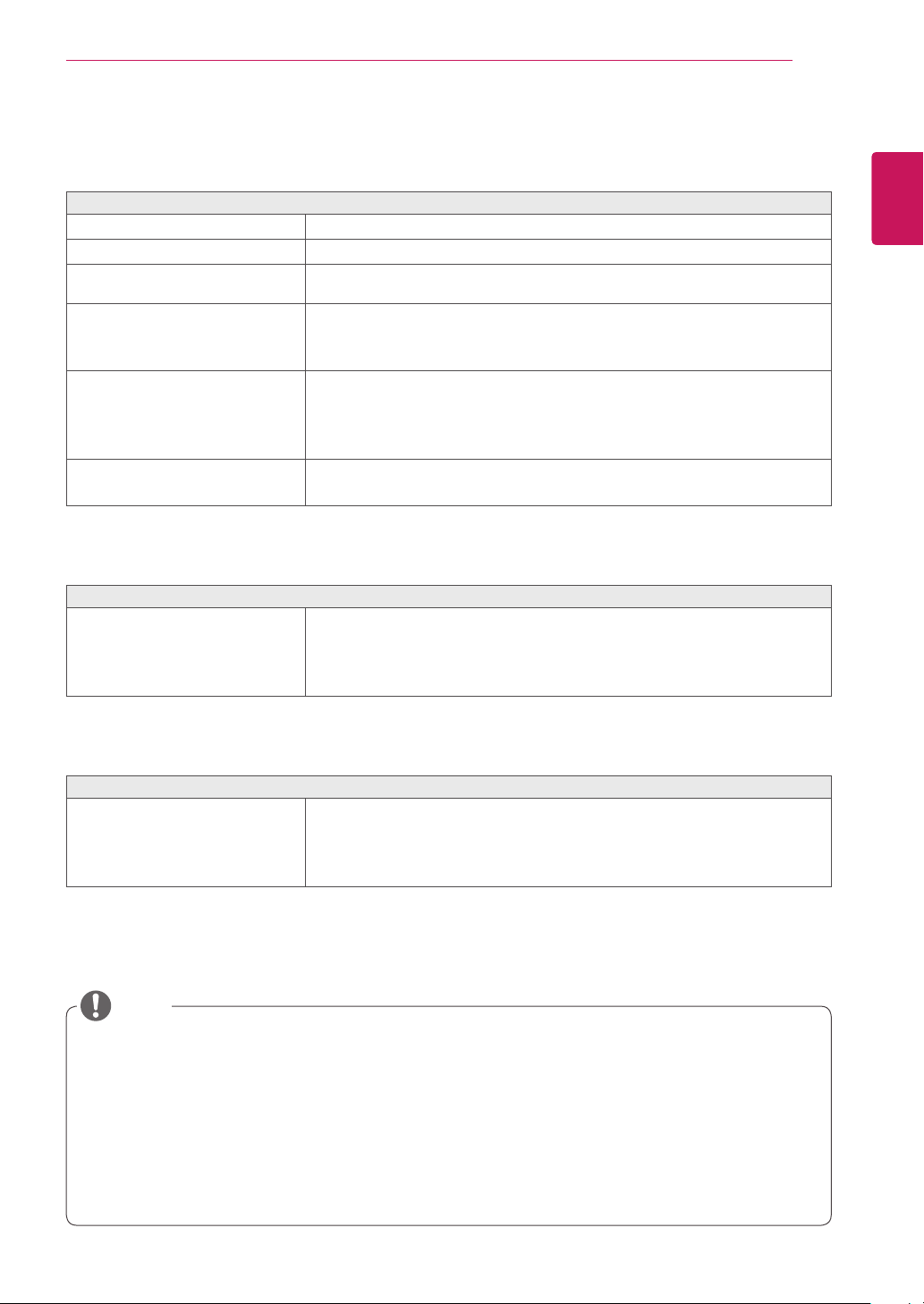
Nothing is displayed on the screen
Is the monitor's power cord plugged in?
y
Check if the power cord is correctly plugged in to the outlet.
Is the power indicator on?
y
Check the power indicator.
Is the power indicator displaying as
red?
y
Adjust the brightness and the contrast.
Is the power indicator blinking?
y
If the monitor is in power saving mode, move the mouse or press any
key on the keyboard to switch the display on.
y
Check if the computer is turned on.
Is the "OUT OF RANGE" message
displayed?
y
This occurs when signals transferred from the PC (video card) are out
of the horizontal or vertical frequency range of the monitor. Please see
the "Product Specification" section of this manual to set the appropri-
ate frequency.
Is the "CHECK SIGNAL CABLE"
message is displayed?
y
This is displayed when the signal cable between the PC and the moni-
tor is missing or disconnected. Check the cable and reconnect.
The "OSD LOCKED" message is displayed.
Is the "OSD LOCKED" message
displayed when the MENU button is
pressed?
y
The OSD lock feature is enabled to prevent undesired modification
of the OSD settings. Press and hold the MENU button for a couple of
seconds to unlock the OSD. (The "OSD UNLOCKED" message will be
displayed.)
The screen retains an image.
Does image sticking occur even
when the monitor is turned off?
y
Displaying a still image for a prolonged time may cause damage to the
screen, resulting in the retention of the image.
y
Use a screen saver to protect the screen when using the monitor for a
prolonged period of time.
y
Vertical Frequency:
In order to display an image, the screen must be refreshed dozens of times per
second like a fluorescent lamp. The number of times the screen is refreshed per second is called
vertical frequency or refresh rate and is represented by Hz.
y
Horizontal Frequency:
The time it takes to display one horizontal line is called the horizontal cycle.
The number of horizontal lines displayed in one second
can be calculated by dividing one by the horizontal cycle. This is called horizontal frequency and is
represented by kHz.
NOTE
26
ENG
English
Troubleshooting
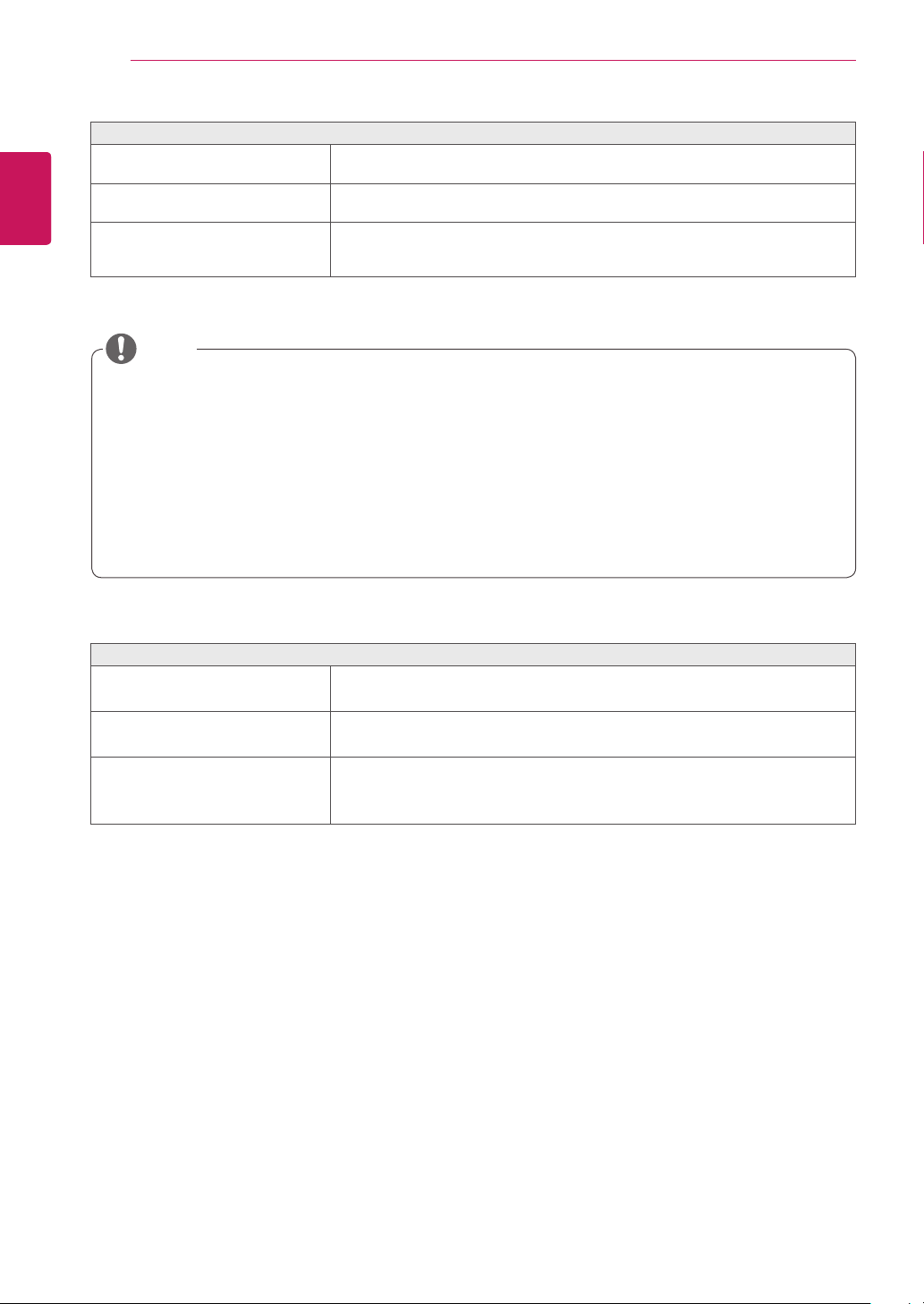
The image is displayed abnormally.
Does the display area appear un-
centered?
Pressing the AUTO button will automatically optimize the screen to the current
display mode.
Does the screen exhibit vertical
lines?
Pressing the AUTO button will automatically optimize the screen to the current
display mode.
Does the screen display horizontal
frequencies, or does the text appear
blurred?
Pressing the AUTO button will automatically optimize the screen to the current
display mode.
y
Check if the video card's resolution or frequency is within the range allowed by the monitor and set to
the recommended (optimal) resolution in
Control Panel >
Display > Settings.
y
Failing to set the video card to the recommended (optimal) resolution may result in blurred text, a
dimmed screen, a truncated display area or misalignment of the display.
y
The configuration procedure may differ depending on your computer and/or operating system. Also,
some video cards may not support certain resolutions. If this is the case, contact the computer or
video card manufacturer for assistance.
y
The AUTO option is only available for D-SUB (analog) signals.
The display color is abnormal.
Does the display color appear dis-
colored (16 color)?
y
Set the color to 24 bit (true color) or higher. In Windows, go to Control
Panel > Display > Settings > Color Quality.
Does the display color appear un-
stable or in monochrome?
y
Check if the signal cable is connected properly. Re-connect the cable
or re-insert the PC's video card.
Are there spots on the screen?
y
When using the monitor, pixilated spots (red, green, blue, white or
black) may appear on the screen. This is normal for the LCD screen.
It is not an error nor is it related to the monitor's performance.
NOTE
27
ENG
English
Product Specication
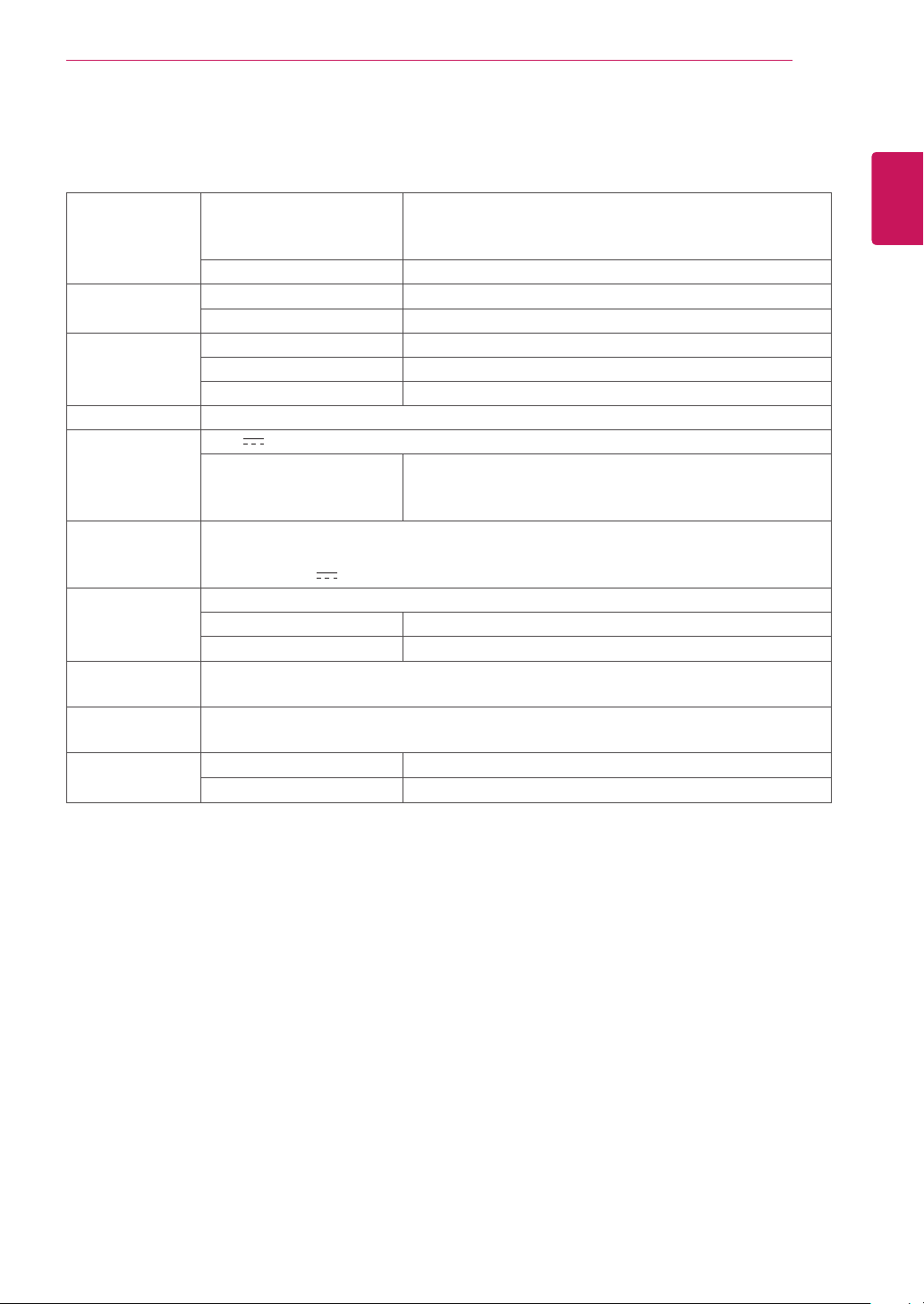
PRODUCT SPECIFICATION
LCD Screen Type 58.42 cm (23 inch) TFT (Thin Film Transistor)
LCD (Liquid Crystal Display) Screen
Diagonal length of the screen: 58.42 cm
Pixel Pitch 0.2652 mm x 0.2652 mm
Resolution Maximum Resolution 1920 x 1080 @ 60 Hz
Recommended Resolution 1920 x 1080 @ 60 Hz
Video Signal Horizontal Frequency 30 kHz to 68 kHz
Vertical Frequency 57 Hz to 63 Hz
Synchronization Separate Sync
Input Connector 15-pin D-SUB (Analog)
Power 19 V 2.3 A
Power Consumption:
CLOUD/D-SUB
On Mode: 24 W(D-sub)/29 W(CLOUD)
Power Saving Mode ≤ 0.5 W(CLOUD mode:7 W)
Off Mode ≤ 0.5 W
AC/DC Adapter
Type PA-1650-43, manufactured by LITE-ON TECHNOLOGY CORPORATION.
or Type DA-48F19, manuafactured by Asian Power Devices Inc.
OUTPUT: 19 V 2.53 A
Dimension/
Weight
Monitor Size (Width x Height x Depth)
With Stand 544.2 mm x 406 mm x 130.6 mm
Without Stand 544.2 mm x 332.3 mm x 47 mm
Weight (Without
Packaging)
5.54 kg
Stand Angle
Adjustment
Forwards/Backwards: -5° to 15° (Monitor)
Environment
Condition
Operating Condition Temperature: 10°C to 35°C; Humidity: 10% to 80%
Storing Condition Temperature: -20°C to 60°C; Humidity: 5% to 90%
The specifications are subject to change without notice.
28
ENG
English
Product Specication
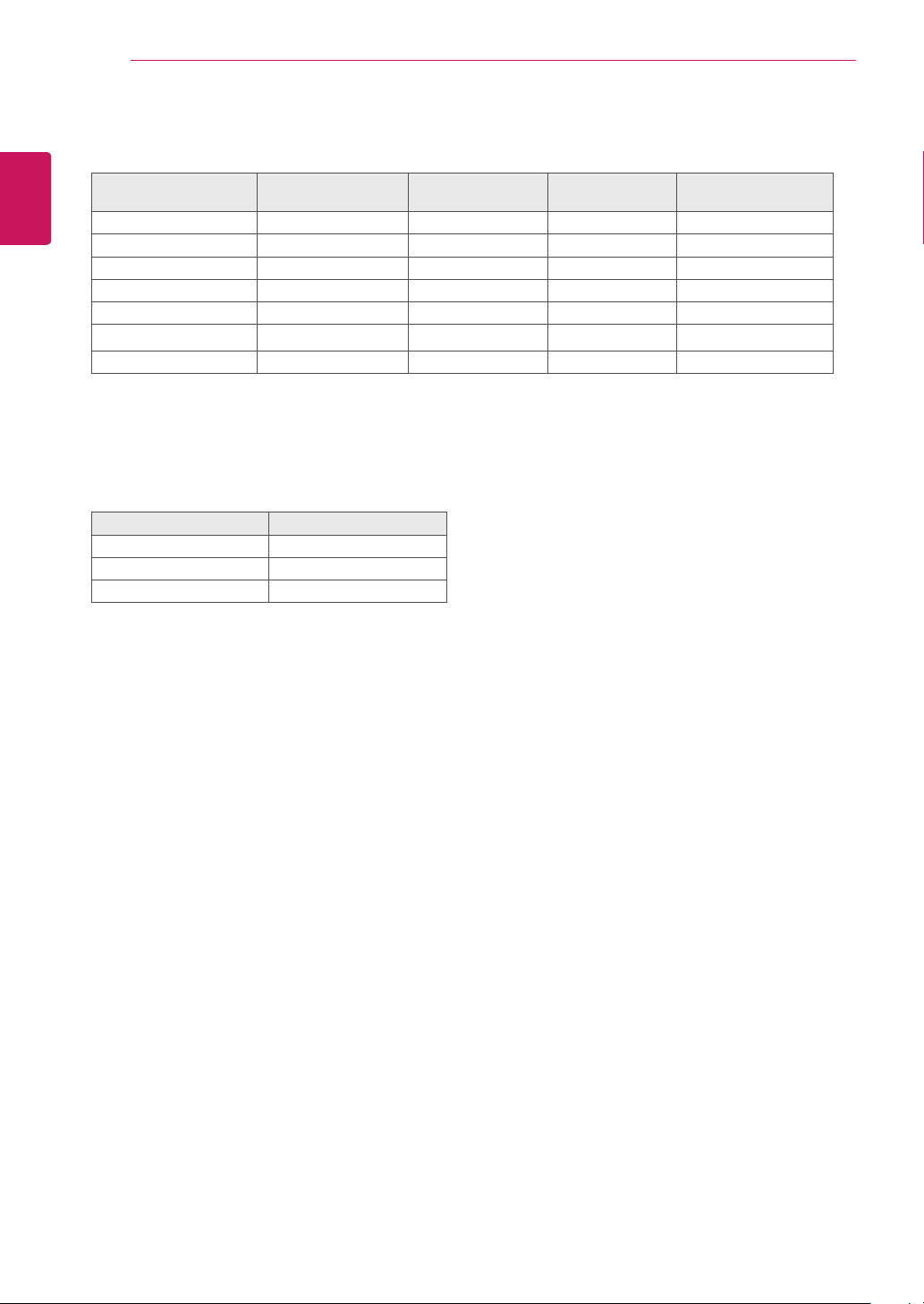
Preset Mode
Display Modes
(Resolution)
Horizontal
Frequency (kHz)
Vertical
Frequency (Hz)
Polarity (H/V) Remark
720 x 400 31.468 70.08 -/+
640 x 480 31.469 59.94 -/-
800 x 600 37.879 60.317 +/+
1024 x 768 48.363 60 -/-
1280 x 1024 63.981 60.02 +/+
1680 x 1050 65.290 59.954 -/+
1920 x 1080 67.5 60 +/+ Recommended Mode
Power Indicator
Mode LED Color
On Mode Red
Power Saving Blinking Red
Off Mode Off
29
ENG
English
Proper Posture
PROPER POSTURE
Proper posture for using the monitor
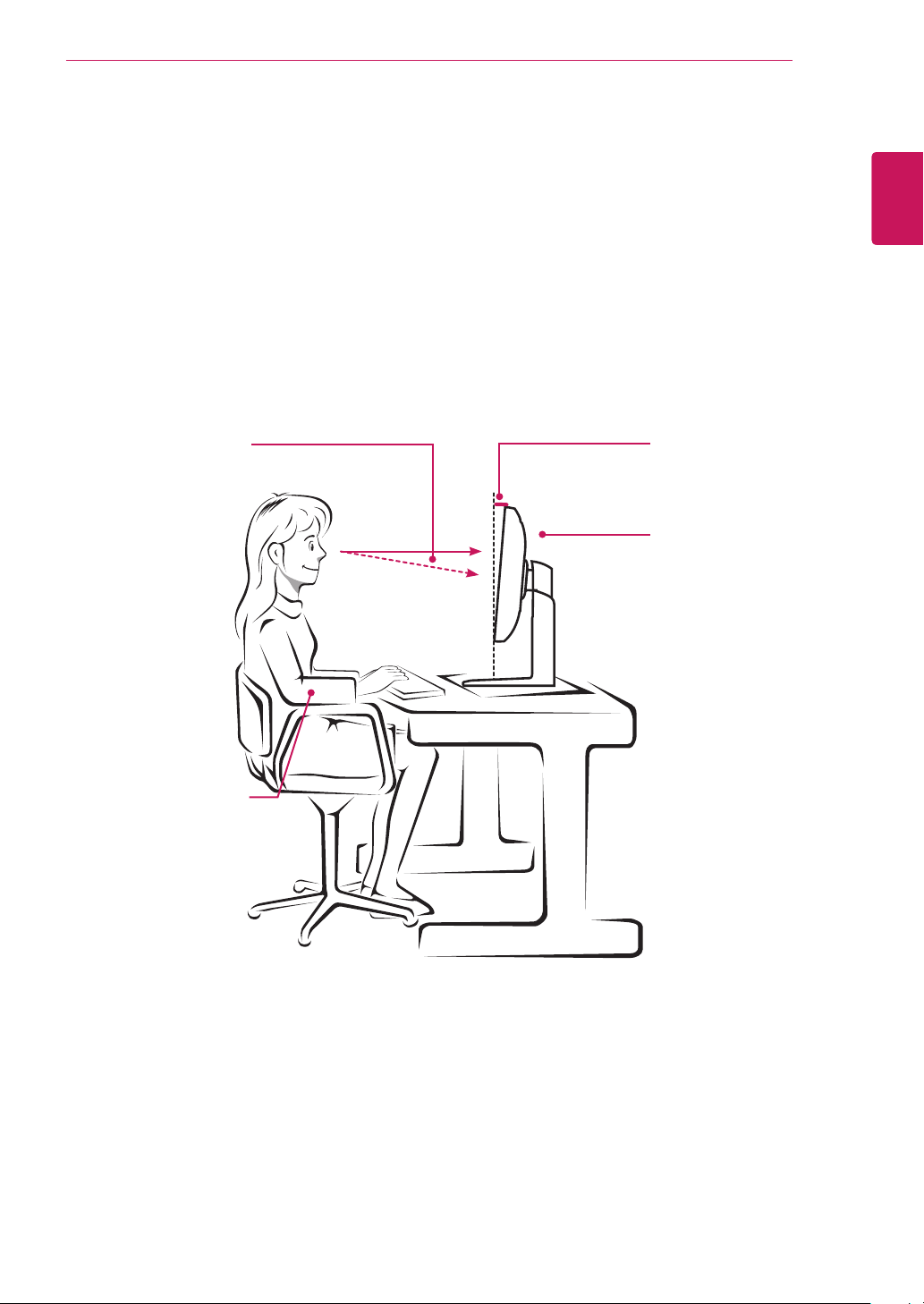
Adjust the angle so that the screen is slightly lower than your eyes.
y
Using the monitor for a prolonged period of time can cause eye fatigue. Take a 10-minute break every
hour.
y
The stand is designed to best support the monitor when the optimal conditions are selected.
Adjust the angle of the monitor from -5° to 15° to obtain the best view of the screen.
You should be
looking
slightly down at
the screen.
Place your hands gently
on the keyboard,
keeping your arms bent at
the elbows
and extended horizontally
in front of you.
Adjust the angle
from -5° to 15°
so that there is no re-
flection
or glare from the
screen.
30
ENG
English
Using CLOUD Solution
USING CLOUD SOLUTION
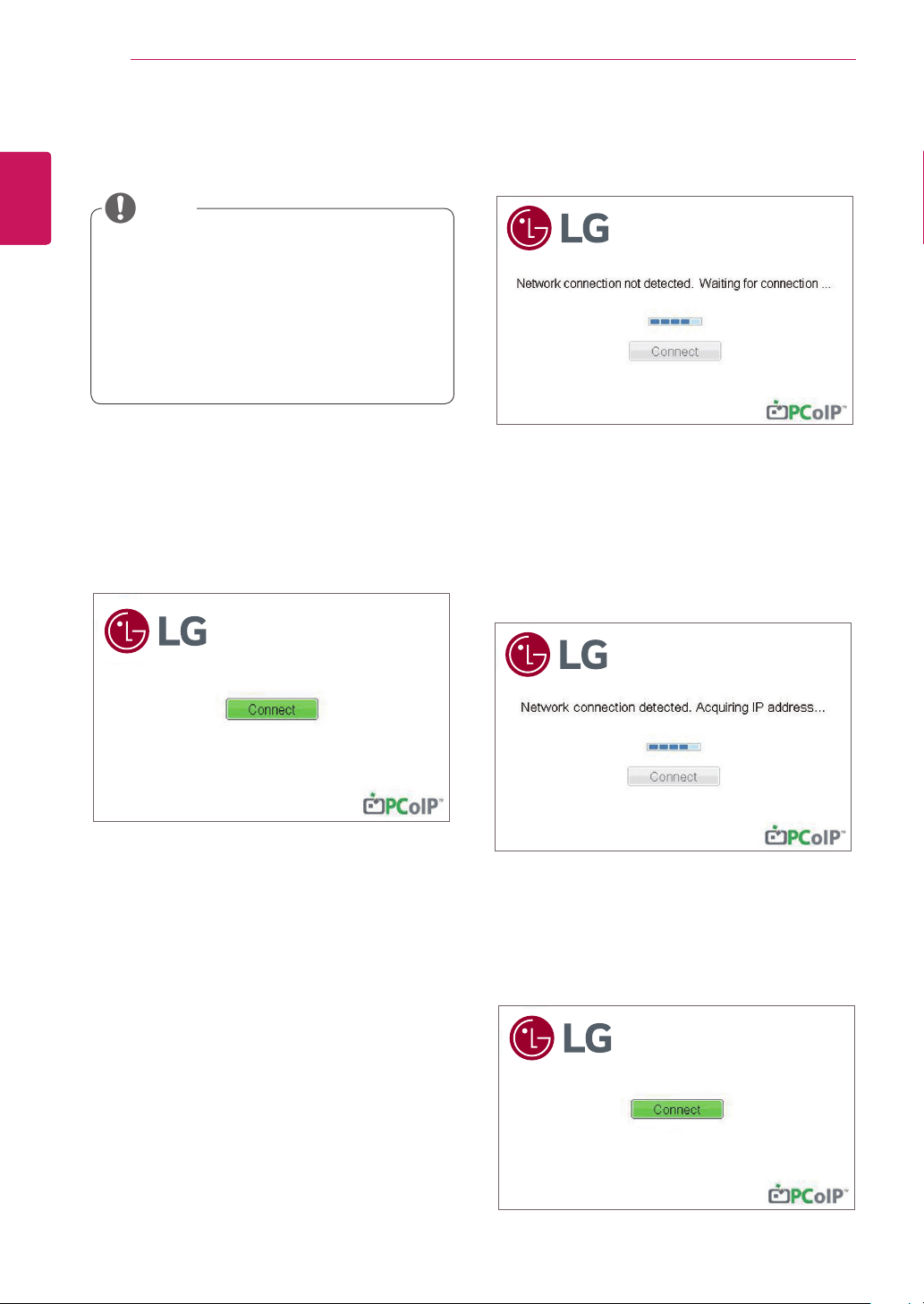
If the network is connected and IP is being ac-
quired, the message "Network connection detect-
ed. Acquiring IP address …" is displayed on the
Connection screen. Figure 2-3 shows the message
displayed when the network is ready and the IP is
being acquired.
The below is the Connection screen displayed
when network is completely ready.
If the network is not properly connected (e.g., dur-
ing portal boot up), or connection is being created,
the "Network connection lost. Waiting for connec-
tion …" message is displayed on the Connection
screen.
Figure 2-2 shows the message displayed when the
network is not ready.
<Figure 2-1: OSD Connect Screen>
<Figure 2-3 Acquiring the IP after Network Con-
nected>
Connect Screen
The Connect screen is shown during start-up,
except when the portal has been configured for a
managed start-up or auto-reconnect. The logo dis-
played above the Connect button can be changed
by uploading a replacement image via the admin
interface.
<Figure 2-2: Network Not Ready>
NOTE
y
Menus and functions in CLOUD mode may
be slightly different depending on the firm-
ware version.You can download the user
manual for each version from the Teradici
homepage: http://www.teradici.com
y
To check the firmware version, see page
<47>.
<Figure 2-4: Network Ready>
31
ENG
English
Using CLOUD Solution
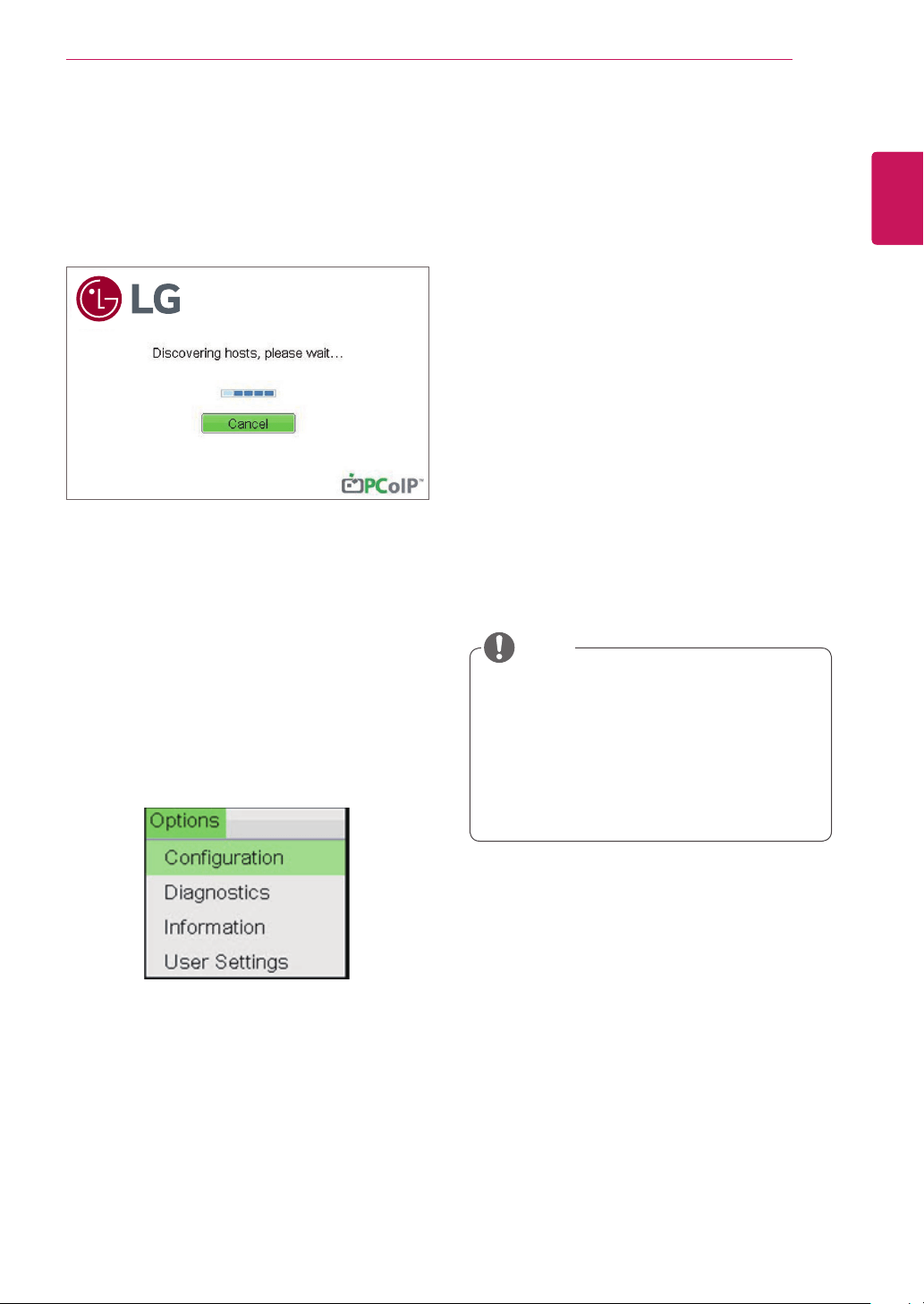
<Figure 2-5: OSD Connect Screen (Connecting)>
OSD Options Menu
Selecting the Options menu will produce a list of
selections. The OSD Options menu contains:
y
Configuration
y
Diagnostics
y
Information
y
User Settings
Selecting one of the options will produce a settings
window.
y
Some PCoIP devices have their password
protection disabled and can be logged into
the management web page or access the
OSD parameters without a password. The
login page and the OSD's password protec-
tion can be enabled in the PCoIP manage-
ment console.
NOTE
If you select the Connect button, the connection
session is started. When the connection is pend-
ing, the "Discovering hosts, please wait…" mes-
sage is displayed on the OSD local GUI.When the
connection is established, the OSD local GUI will
disappear and be replaced by the session image.
<Figure 2-6: OSD Options Menu>
Configuration Window
In the Configuration window, the administrator can
access the window tabs that contain the settings to
configure and manage the portal environment.
The Configuration window has the following tabs:
y
Network
y
Label
y
Connection Management
y
Discovery
y
Session
y
RDP
y
Language
y
OSD
y
Reset
y
Display
y
VMware View
Each tab contains OK, Cancel and Apply buttons
to allow the administrator to apply or cancel the
modified settings as well as the Advanced button
for advanced settings.
32
ENG
English
Using CLOUD Solution
y
In order to utilize the FQDN feature, a DNS
server, configured properly with DHCP option
81, must be used.
y
Gateway
The Gateway field contains the gateway IP ad-
dress of the device. If DHCP is disabled, this field
is required. If DHCP is enabled, this field cannot be
edited.
y
Primary DNS Server
The Primary DNS Server field contains the primary
DNS IP address of the device. This field is option-
al. If DHCP is enabled, this field cannot be edited.
y
Secondary DNS Server
The Secondary DNS Server field contains the sec-
ondary DNS IP address of the device. This field is
optional. If the DHCP is enabled, this field cannot
be edited.
y
Domain Name
The Domain Name field contains the domain name
used, e.g. "domain local". This field is optional. It speci-
fies on which domain the host or portal operates.
y
FQDN
The FQDN field represents the Fully Qualified Do-
main Name of the host or portal. The default value is
PCoIP-host-MAC or PCoIP-portal-MAC, where MAC
is the MAC address of the host or portal. If there is
a domain name, it will be added to the FQDN in the
format of PCoIP-host-MAC.domain.local
y
Ethernet Mode
The Ethernet Mode field specifies the portal's Eth-
ernet mode.
The available options are as follows.
y
Auto
y
100 Mbps Full-Duplex
y
10 Mbps Full-Duplex
If another network device (for example, a switch) is
configured to operate under 10 Mbps Full-Duplex,
100Mbps Full-Duplex or 1GbpsFull-Duplex, the
administrator should always set the Ethernet Mode
field to Auto; and if the device is to operate under
only one speed out of multiple settings, select ei-
ther 10 Mbps Full-Duplex or 100 Mbps Full-Duplex.
NOTE
y
The network parameters can also be con-
figured using the Webpage Administration
Interface.
NOTE
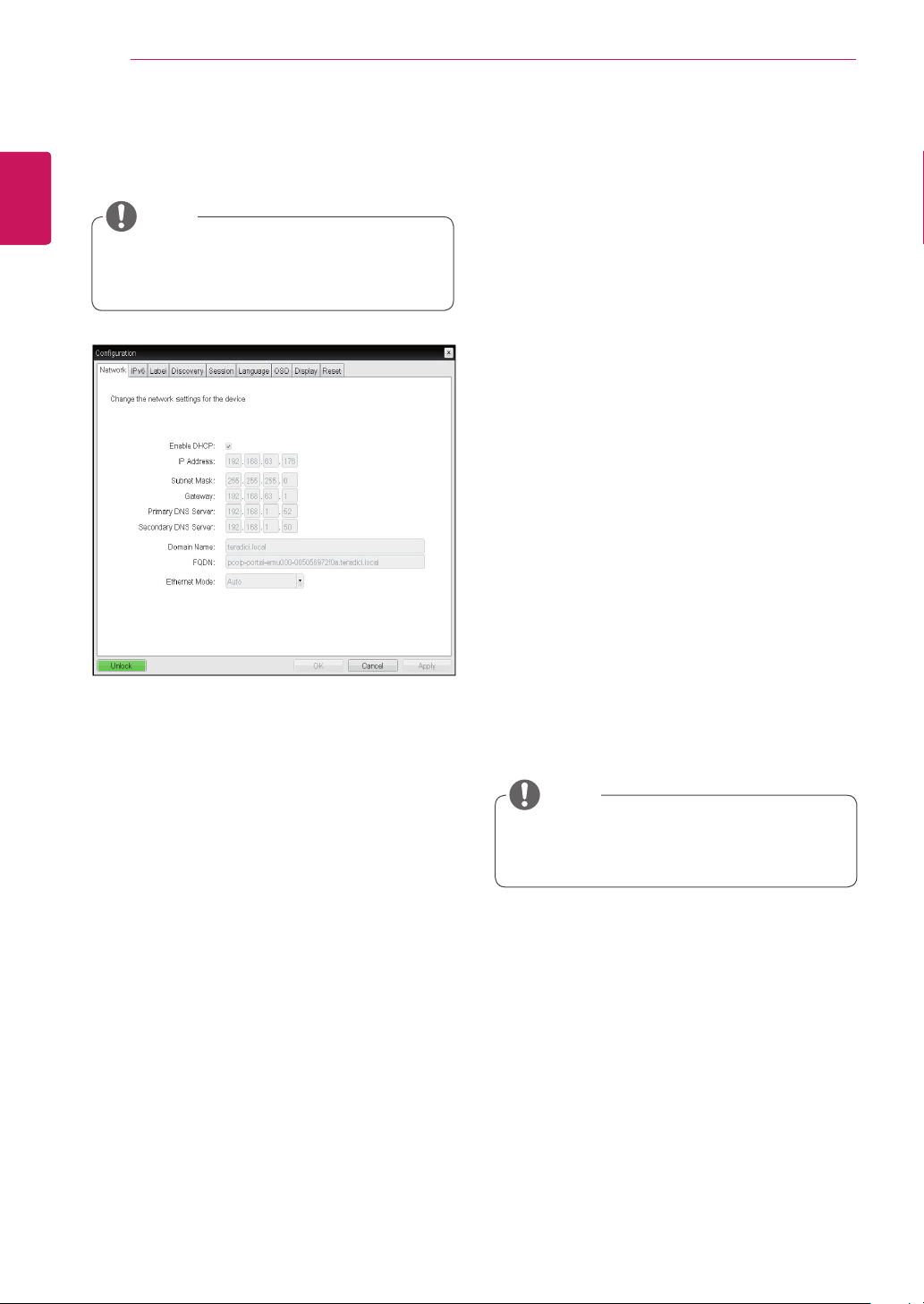
Network Tab
The Network tab allows the administrator to config-
ure the portal network parameters.
Figure 2-7. Network Configuration
y
Enable DHCP
If the Enable DHCP option is selected, a device will
be connected to the DHCP server. that allocates
the IP address, subnet mask, gateway IP address,
and DNS server. If this option is disabled, the
above parameters must be configured manually.
y
IP Address
The IP Address field contains the IP address of the
device. If DHCP is disabled, this field is required.
If DHCP is enabled, this field cannot be edited.
This field must contain the correct IP address. If an
incorrect IP address is provided, an OSD message
is displayed prompting the administrator to provide
the correct the IP address.
y
Subnet Mask
The Subnet Mask field contains the subnet mask
of the device. If DHCP is disabled, this field is
required. If DHCP is enabled, this field cannot be
edited. This field must have the correct subnet
mask. If an incorrect subnet mask is provided, an
OSD message is displayed prompting the adminis-
trator to provide the correct the subnet mask.
33
ENG
English
Using CLOUD Solution
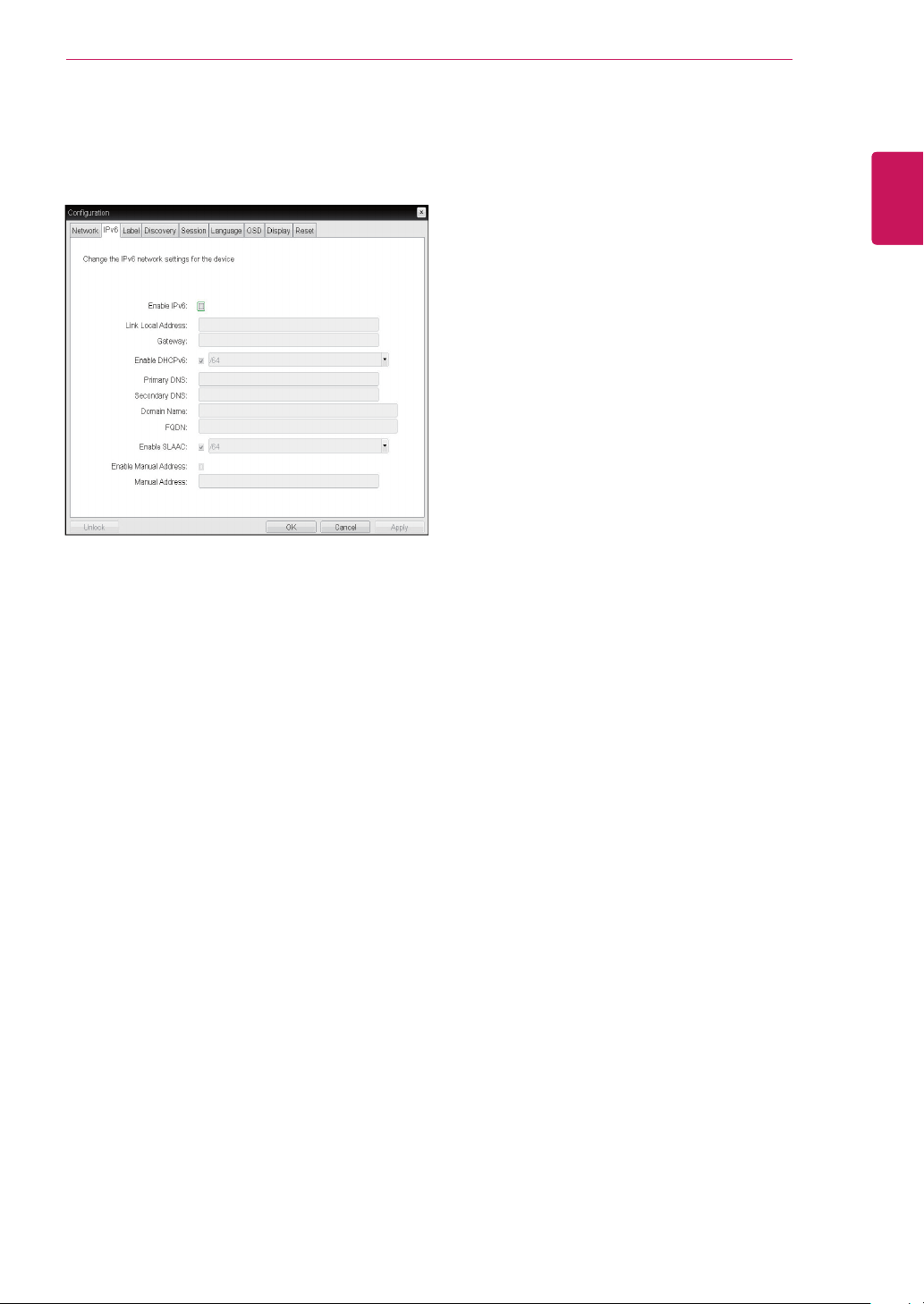
<Figure 2-8: IPv6 Configuration>
<IPv6> Tab
The IPv6 tab is used when the portal is connected
to the network configured with the IP v6.
y
Enable IPv6
If you select Enable IPv6, the portal in use can be
connected to the network configured with the IPv6.
y
Link Local Address
The Link Local Address field is automatically filled
with the IP address of a device.
y
Gateway
The Gateway field contains the gateway IP ad-
dress of the device. Enter the gateway address to
be used by a device.
y
Enable DHCPv6
To assign the Dynamic Host Configuration Protocol
version 6 (DHCPv6) of a device select the Enable
DHCPv6 field.
y
DHCPv6 Addresses
When DHCPv6 is enabled and the device restarts,
the server enters the device addresses automati-
cally.
y
Primary DNS Server
The Primary DNS Server field contains the pri-
mary DNS IP address of the device. This field is
optional. If DHCPv6 is enabled, this field cannot be
edited.
y
Secondary DNS Server
The Secondary DNS Server field contains the sec-
ondary DNS IP address of the device. This field is
optional. If DHCPv6 is enabled, this field cannot
beedited.
y
Domain Name
The Domain Name field contains the domain name
used, e.g. "domain local". This field is optional. It
specifies on which domain the host or portal oper-
ates.
y
FQDN
The FQDN field represents the Fully Qualified Do-
main Name of the host or portal. The default value
is PCoIP-host-MAC or PCoIP-portal-MAC, where
MAC is the MAC address of the host or portal. If
there is a domain name, it will be added to the
FQDN in the format of PCoIP-host-MAC.domain.
local.
y
Enable SLAAC
Select the Enable SLAAC field to use the stateless
auto-configuration of the device.
y
Enable Manual Address
Select the Enable Manual Address field to enter
the device address manually.
y
Manual Address
In the Manual Address field, enter the IP address
manually.
34
ENG
English
Using CLOUD Solution
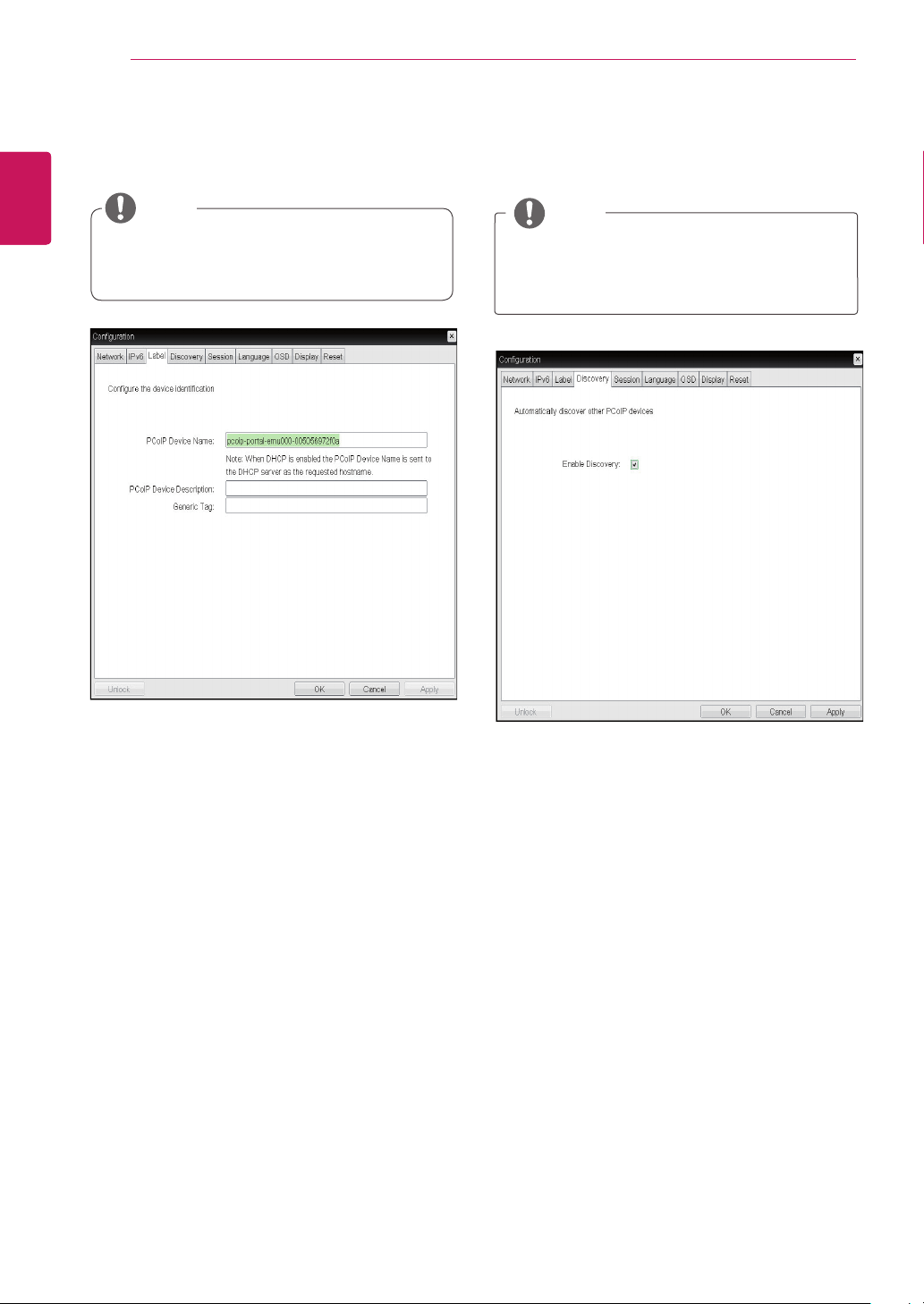
<Figure 2-9: Label Configuration>
Label Tab
The Label tab allows the administrator or host to
add customized information to the portal.
y
The portal label parameters can also be con-
figured using the Webpage Administration
Interface.
y
PCoIP Device Name
In the PCoIP Device Name field, the administrator
can specify a logical name to the host or portal.
The default value is PCoIP-host-MAC or PCoIP-
portal-MAC, where MAC is the MAC address of the
host or portal.
y
PCoIP Device Description
In the PCoIP Device Description field, the administra-
tor can add specific information, such as the endpoint
location, or add a description to the host or portal.
This field cannot be used in the PCoIP firmware and
accessibility is strictly limited to the administrator.
y
Generic Tag
In the Generic Tag field, the administrator can add a
generic tag to the host or portal.
This field cannot be used in the PCoIP firmware and
accessibility is strictly limited to the administrator.
NOTE
y
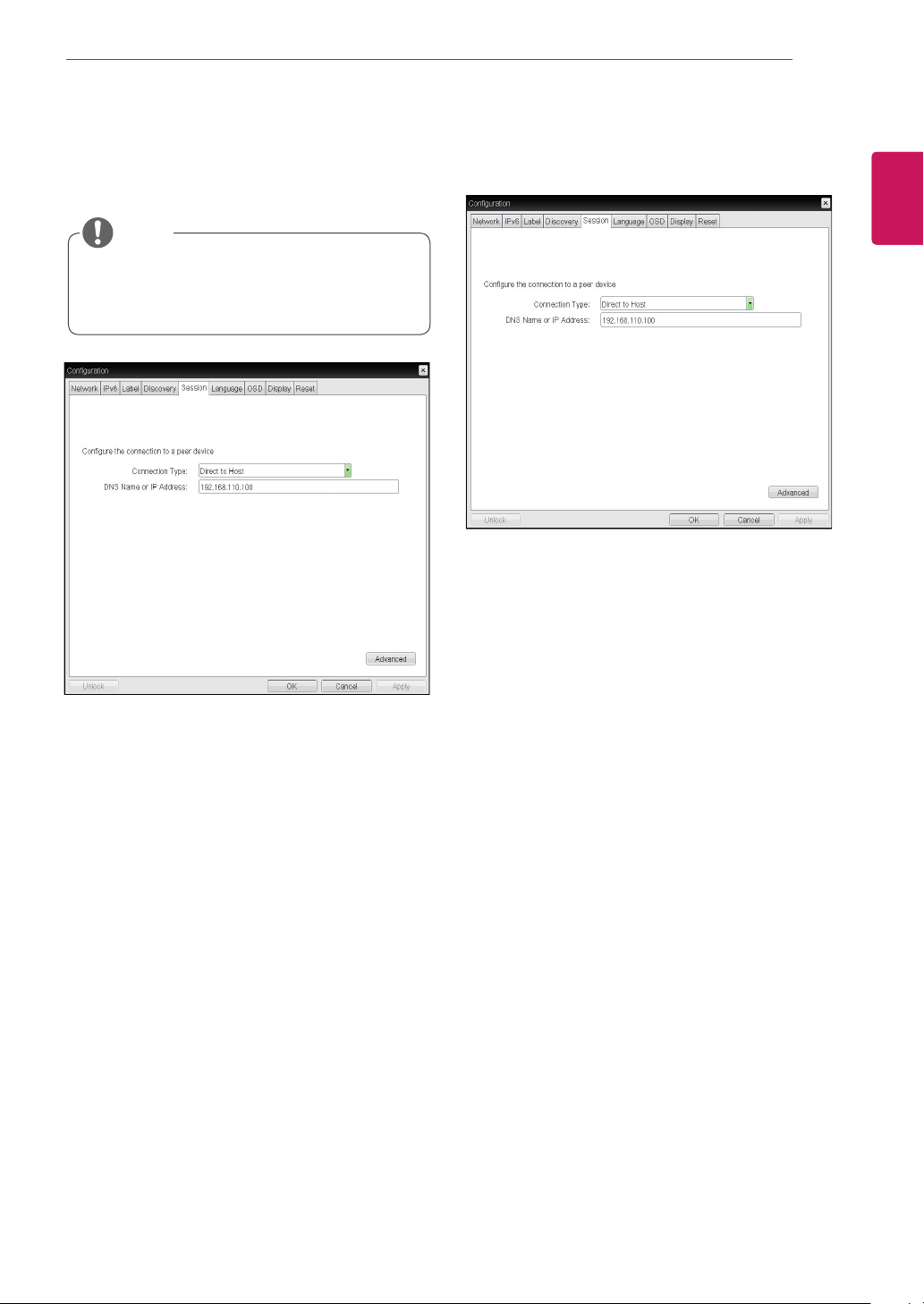
Enable Discovery
If the Enable Discovery option is selected, a device
will use SLP Discovery to dynamically locate the
peer device without requiring any information about
the location of the device in the network. This
means that the configuration and maintenance
work in a complicated system can be significantly
reduced.
As SLP Discovery requires a multicast-enabled
router, the recommended search structure is DNS-
SRV Discovery.
<Figure 2-10: Discovery Configuration>
Discovery Tab
The Discovery tab allows the administrator to eas-
ily find a portal in the PCoIP system.
y
The Discovery parameters can also be con-
figured using the Webpage Administration
Interface.
NOTE
<Figure 2-9: Label Configuration>
35
ENG
English
Using CLOUD Solution
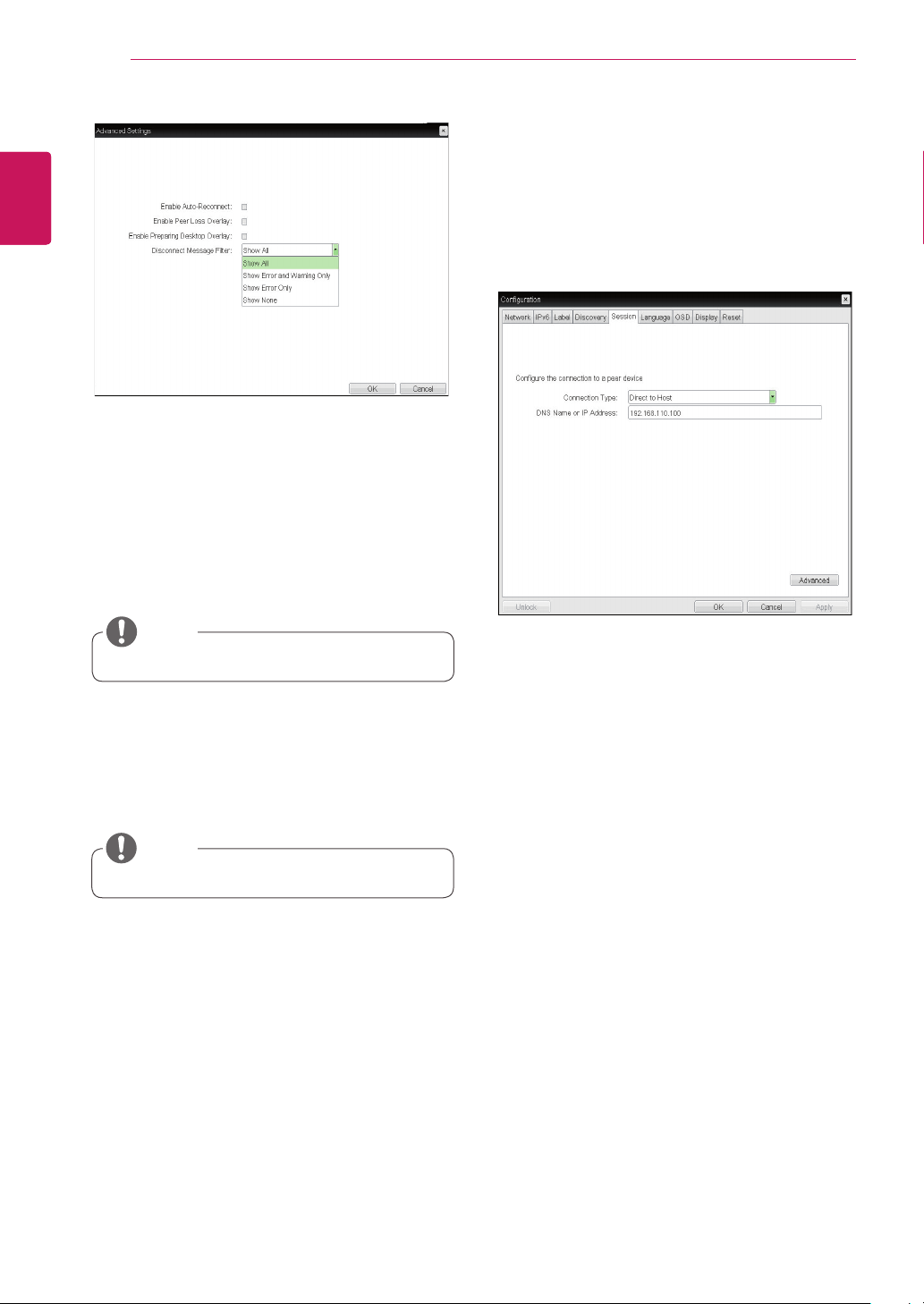
y
Direct to Host
You can view the screen of the host PC by estab-
lishing 1:1 connection between the PCI host card
connected to the host PC through the entered IP
address of the host PC and the portal.
y
DNS Name or IP Address
Enter the DNS name or IP address of the host PC.
<Figure 2-12: Direct to Host Setting>
<Figure 2-11: Session Configuration>
Session Tab
The Session tab allows the administrator to set the
method to connect the device to a peer device.
y
The Session parameters can also be con-
figured using the Webpage Administration
Interface.
NOTE
y
Connection Type
The Connection Type field allows the user to select
the device to be connected with the portal.
The Connection Type field has following options:
y
Direct to Host
y
Direct to Host + SLP Host Discovery
y
View Connection Server
y
View Connection Server + Auto-Logon
y
View Connection Server + Kiosk
y
View Connection Server + Imprivata OneSign
y
Connection Management Interface
See below for information how to set for each op-
tion.
36
ENG
English
Using CLOUD Solution
y
Enable Auto-Reconnect
If this option is selected, reconnection is attempted
automatically when a session is disconnected or
the user is logged off.
<Figure 2-13: Advanced Settings for Direct to
Host>
<Figure 2-14: Direct to Host + SLP Host Discovery Set-
tings>
y
This setting is provided only for the client.
NOTE
y
Enable Peer Loss Overlay
The "Connection Lost" message is displayed.The
display is the same as in the VDI environ-ment.
The default is Disable.
y
This setting is provided only for the client.
NOTE
y
Enable Preparing Desktop Overlay
If this option is selected, the "Preparing Desk-top"
message is displayed on the screen when the user
is logged in.
y
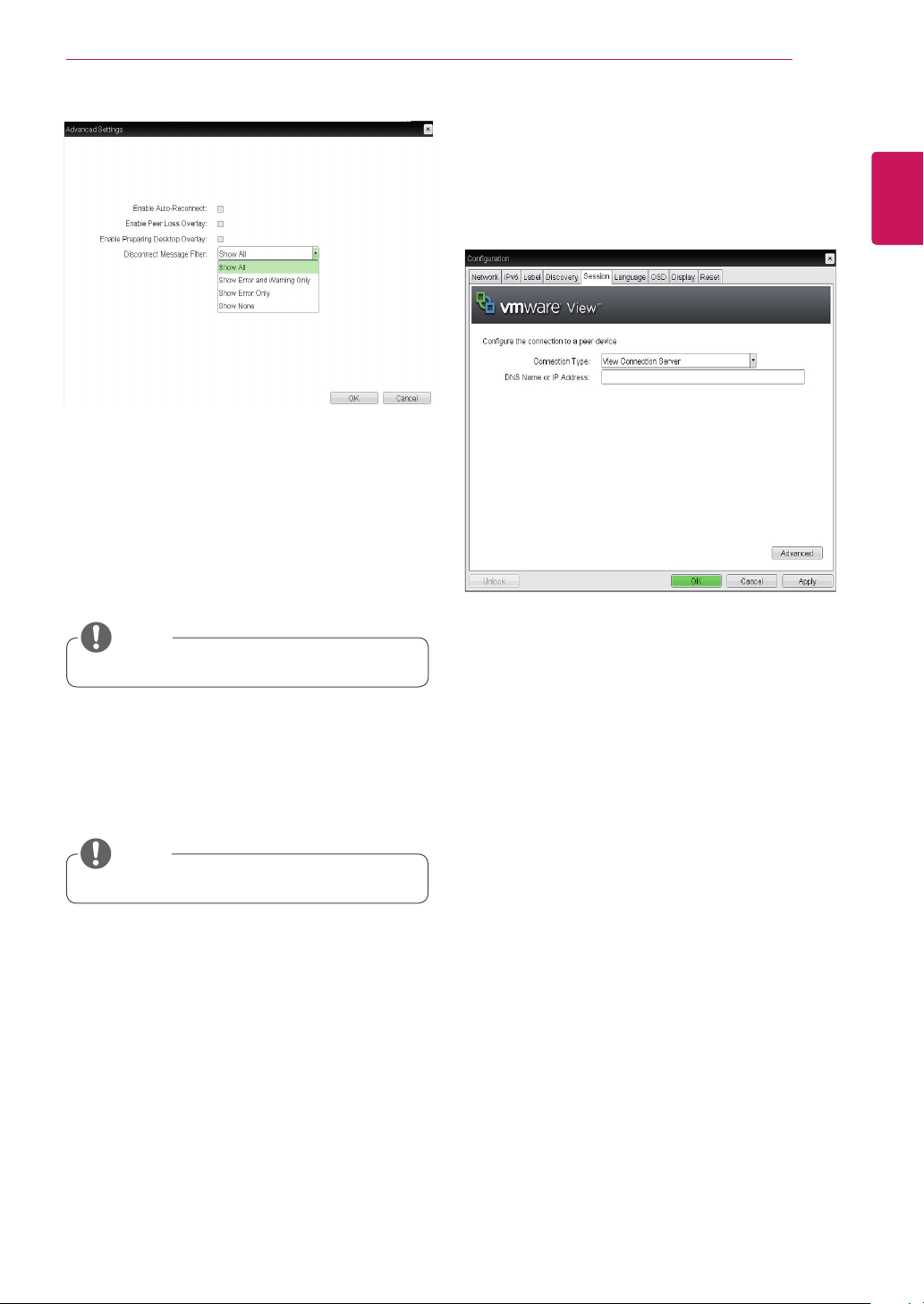
Disconnect Message Filter
This option determines the type of message to
display when a session is disconnected.
- Show All: Shows all the error messages.
- Show Error and Warning Only: Shows the
error and warning messages only.
- Show Error Only: Shows the error messages
only.
- Show None: Shows nothing.
y
Direct to Host + SLP Host Discovery
You can view the screen of the host PC by discov-
ering the host PC within the network and estab-
lishing 1:1 connection between the PCI host card
connected to the host PC and the portal.
37
ENG
English
Using CLOUD Solution
<Figure 2-15: Advanced Settings for Direct to Host
+ SLP Host Discovery>
y
Enable Auto-Reconnect
If this option is selected, reconnection is attempted
automatically when a session is disconnected or
the user is logged off.
y
This setting is provided only for the client.
NOTE
y
Enable Peer Loss Overlay
The "Connection Lost" message is displayed.The
display is the same as in the VDI environ-ment.
The default is Disable.
y
This setting is provided only for the client.
NOTE
y
Enable Preparing Desktop Overlay
If this option is selected, the "Preparing Desk-top"
message is displayed on the screen when the user
is logged in.
y
Disconnect Message Filter
This option determines the type of message to
display when a session is disconnected.
- Show All: Shows all the error messages.
- Show Error and Warning Only: Shows the
error and warning messages only.
- Show Error Only: Shows the error messages
only.
- Show None: Shows nothing.
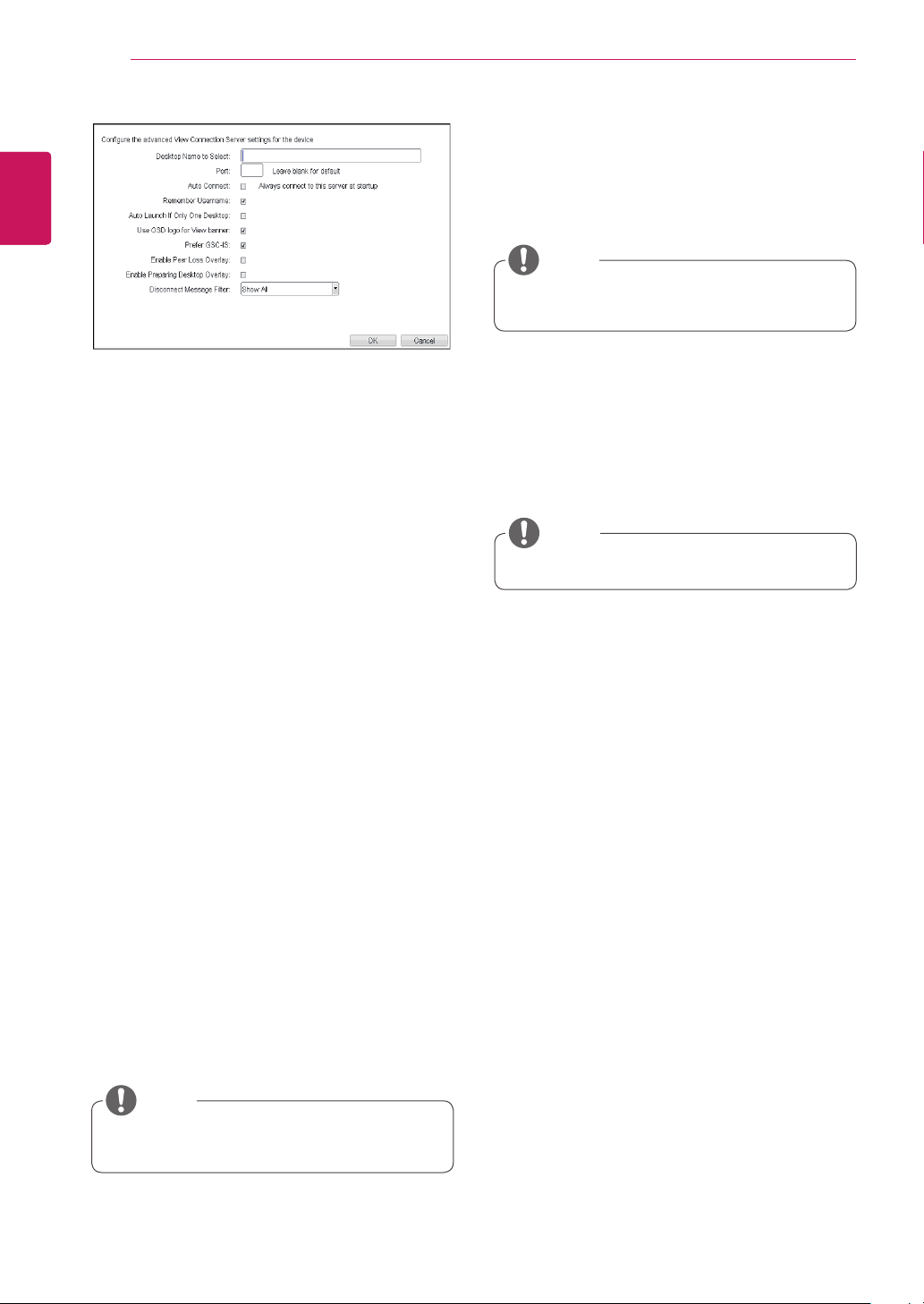
<Figure 2-16: View Connection Server Setting>
y
View Connection Server
In the Session tab, you can select to enable the
user client to access the VMware View Connec-
tionServer. To do this, select View Connection
Server for Connection Type.
y
DNS Name or IP Address
Enter the DNS name or IP address of the VM-
ware View Connection Server.
38
ENG
English
Using CLOUD Solution
y
Desktop Name to Select
Enter the name of the pool/desktop which the
user client uses upon starting a session.
y
Port
For the default setting, leave the port field empty.
When the VMware View Connection Server uses
the SSL authentication, enter 443 in the Port field.If
the server where a user tries to access uses a port
other than a general port, enter the port.
y
Auto Connect
If this option is enabled, the selected VMware View
Connection Server is automatically connected
when the user client is powered on.
If the Auto Connect option is enabled, you should
turn the user client off and turn it on again at least
once.
y
Remember Username
If this option is selected, the username which is
previously used to access the VMware View
Connection Server is automatically entered in the
username field.
y
Auto Launch if Only One Desktop
If this option is selected, connection is established
to the desktop when there is only one virtual desk-
top that a user wants to access.
y
Use OSD logo for View banner
If this option is enabled, you can change the OSD
logo of PCoIP during the login.
<Figure 2-17: Advanced Settings for View Connec-
tion Server>
y
Prefer GSC-IS
If this option is selected, the GCS-IS interface
is used when a smart card supports more than
one interface. If the smart card supports only one
interface, it is not used.
y
The OSD logo can be uploaded using the
Webpage Administration Interface.
NOTE
y
This setting is provided only when a smart
card is used.
NOTE
y
Enable Peer Loss Overlay
If this option is selected, the "Network Connection
Lost" message is displayed on the screen when it
is confirmed that the network is disconnected.
The display is the same as in the VDI environ-
ment. The default is Disable.
y
Enable Preparing Desktop Overlay
If this option is selected, the "Preparing Desk-
top" message is displayed on the screen when the
user is logged in.
y
Disconnect Message Filter
This option determines the type of message to
display when a session is disconnected.
- Show All: Shows all the error messages.
- Show Error and Warning Only: Shows the
error and warning messages only.
- Show Error Only: Shows the error messages
only.
- Show None: Shows nothing.
y
This setting is provided only for the client.
NOTE
39
ENG
English
Using CLOUD Solution
y
Desktop Name to Select
Enter the name of the pool/desktop which the
user client uses upon starting a session.
y
Port
For the default setting, leave the port field empty.
When the VMware View Connection Server uses
the SSL authentication, enter 443 in the Port field.If
the server where a user tries to access uses a port
other than a general port, enter the port.
y
Auto Connect
If this option is enabled, the selected VMware View
Connection Server is automatically connected
when the user client is powered on.
If the Auto Connect option is enabled, you should
turn the user client off and turn it on again at least
once.
y
Remember Username
If this option is selected, the username which is
previously used to access the VMware View
Connection Server is automatically entered in the
username field.
y
Auto Launch if Only One Desktop
If this option is selected, connection is established
to the desktop when there is only one virtual desk-
top that a user wants to access.
y
Use OSD logo for View banner
If this option is enabled, you can change the OSD
logo of PCoIP during the login.
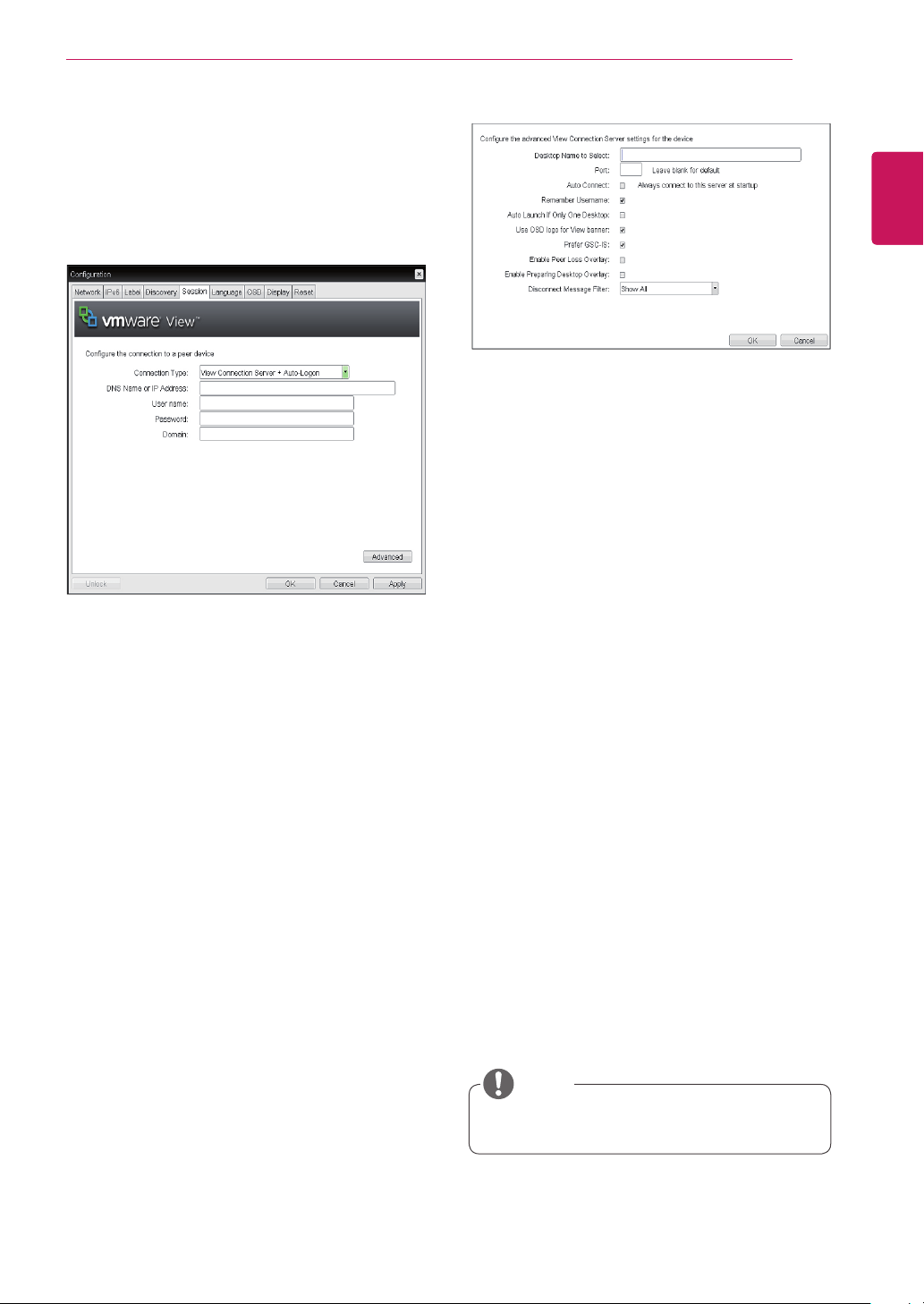
<Figure 2-19: Advanced Settings for View Connec-
tion Server with Auto-Logon>
y
View Connection Server with Auto-Logon
In the Session tab, you can select to enable the
user client to automatically access the VMware
View Connection Server.To do this, select View
Connection Server with Auto-Logon for Connection
Type.
<Figure 2-18: View Connection Server with Auto-
Logon Setting>
y
DNS Name or IP Address
Enter the DNS name or IP address of the VM-
ware View Connection Server.
y
Username
Enter the username for the user client.
y
Password
Enter the password for the user client.
y
Domain
Enter the domain name.
y
The OSD logo can be uploaded using the
Webpage Administration Interface.
NOTE
40
ENG
English
Using CLOUD Solution
y
Prefer GSC-IS
If this option is selected, the GSC-IS interface
is used when a smart card supports more than
one interface. If the smart card supports only one
interface, it is not used.
y
This setting is provided only when a smart
card is used.
NOTE
y
Enable Peer Loss Overlay
If this option is selected, the "Network Connection
Lost" message is displayed on the screen when it
is confirmed that the network is disconnected.
The display is the same as in the VDI environ-
ment. The default is Disable.
y
Enable Preparing Desktop Overlay
If this option is selected, the "Preparing Desk-
top" message is displayed on the screen when the
user is logged in.
y
Disconnect Message Filter
This option determines the type of message to
display when a session is disconnected.
- Show All: Shows all the error messages.
- Show Error and Warning Only: Shows the
error and warning messages only.
- Show Error Only: Shows the error messages
only.
- Show None: Shows nothing.
y
This setting is provided only for the client.
NOTE
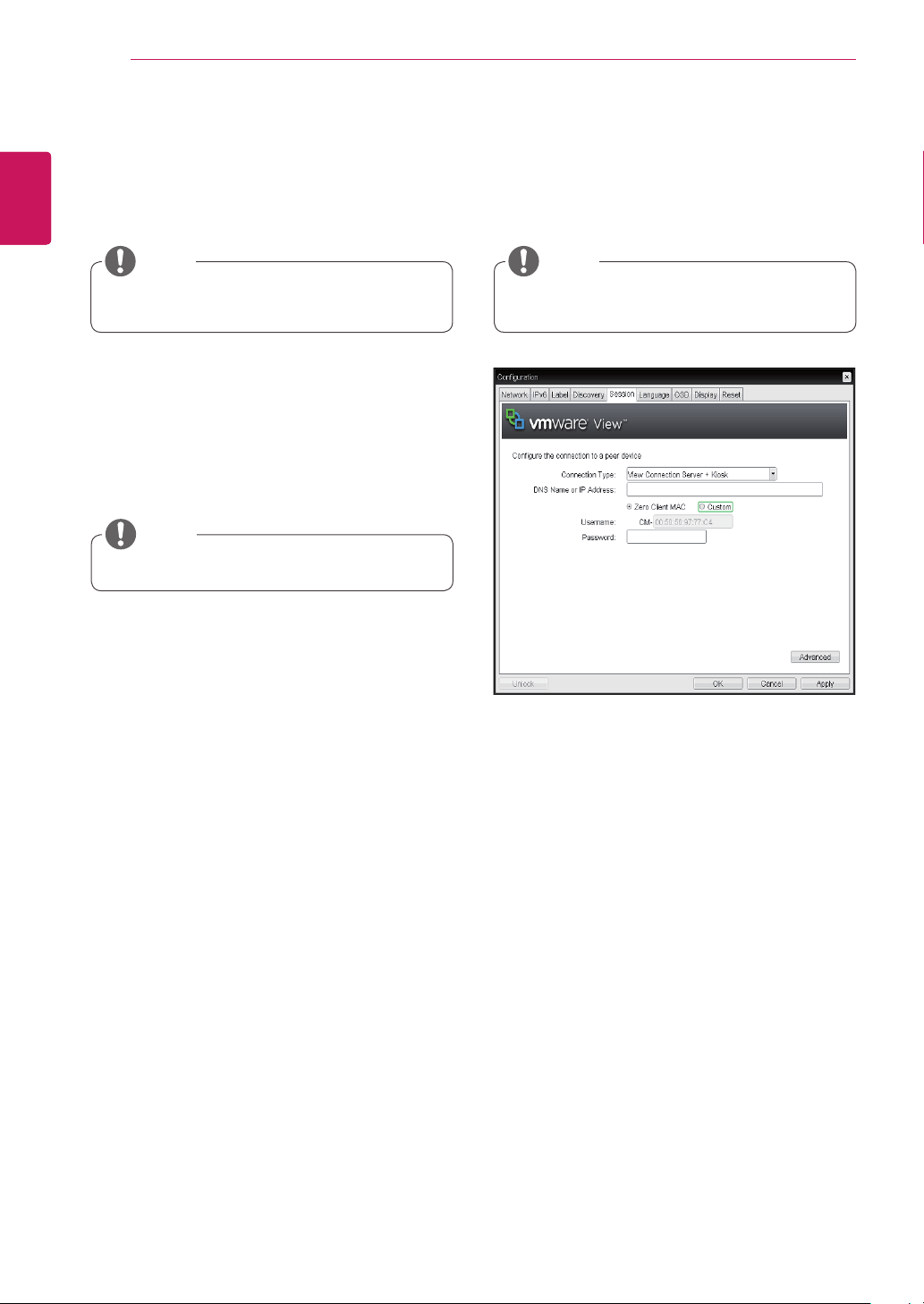
<Figure 2-20: View Connection Server + Kiosk
Setting>
y
View Connection Server + Kiosk
Select View Connection Server + Kiosk to use
the kiosk mode. You can configure the View Con-
nection Server + Kiosk mode using the Webpage
Administration Interface.
y
You cannot use the kiosk mode by connect-
ing to the host PC.
NOTE
y
DNS Name or IP Address
Enter the DNS name or IP address of the VM-
ware View Connection Server.
y
Username
Select the type of username that matches the de-
vice name used in the VMware View Con-
nection Server.
y
Password
Enter the password for the user client.
41
ENG
English
Using CLOUD Solution
<Figure 2-21: Advanced Setting for View Connec-
tion Server + Kiosk>
<Figure 2-22: View Connection Server + Imprivata One-
Sign Connection Setting>
y
Port
For the default setting, leave the port field empty.
When the VMware View Connection Server uses
the SSL authentication, enter 443 in the Port field.
If the server where a user tries to access uses a
port other than a general port, enter the port.
y
Use OSD logo for View banner
If this option is enabled, you can change the OSD
logo of PCoIP during the login.
y
The OSD logo can be uploaded using the
Webpage Administration Interface.
NOTE
y
Enable Peer Loss Overlay
If this option is selected, the "Network Connection
Lost" message is displayed on the screen when it
is confirmed that the network is disconnected.
The display is the same as in the VDI environ-
ment. The default is Disable.
y
This setting is provided only for the client.
NOTE
y
Enable Preparing Desktop Overlay
If this option is selected, the "Preparing Desk-
top" message is displayed on the screen when the
user is logged in.
y
Disconnect Message Filter
This option determines the type of message to
display when a session is disconnected.
- Show All: Shows all the error messages.
- Show Error and Warning Only: Shows the
error and warning messages only.
- Show Error Only: Shows the error messages
only.
- Show None: Shows nothing.
y
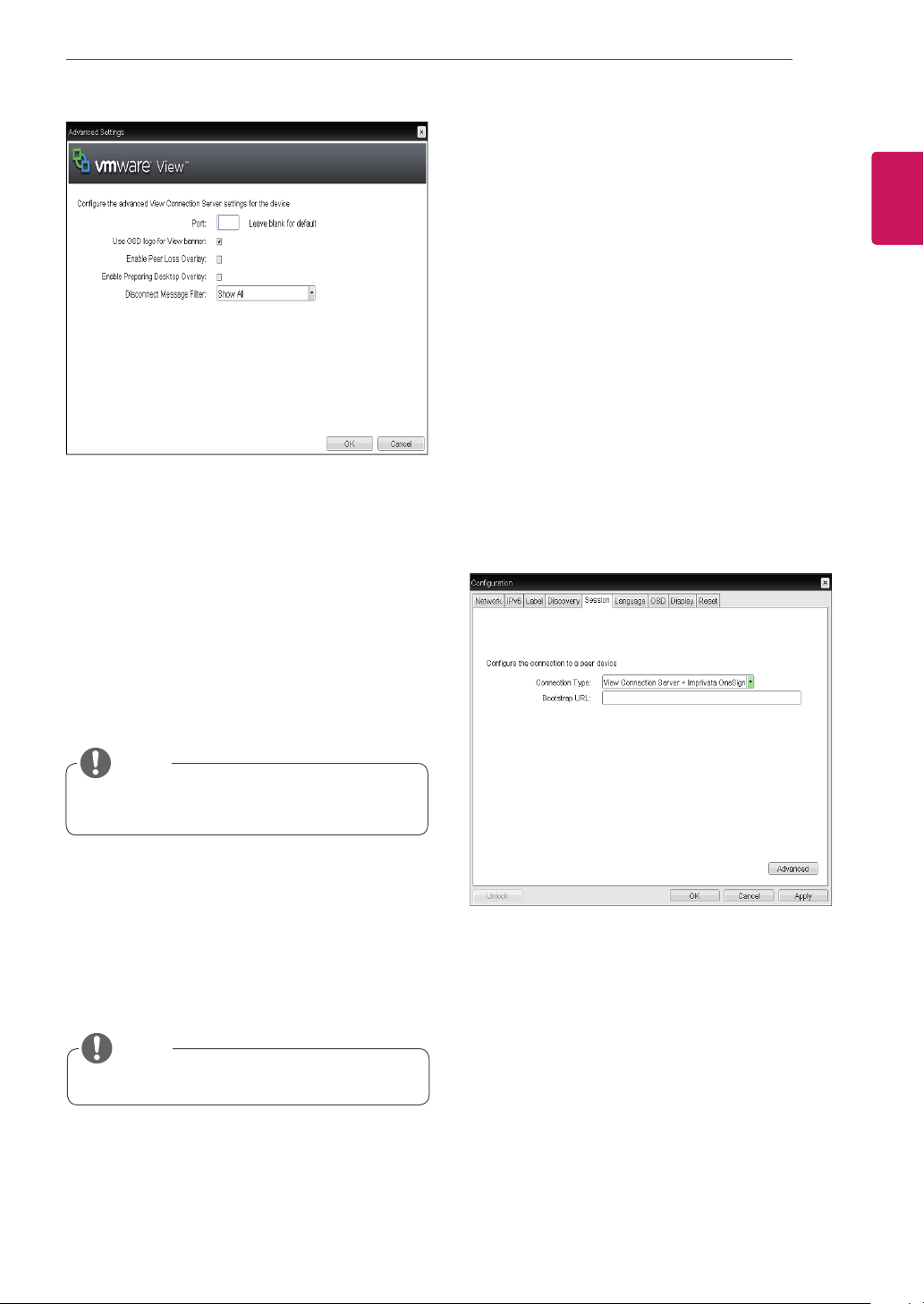
View Connection Server + Imprivata OneSign
Connection
Select View Connection Server + Imprivata One-
sign Connection to use the Imprivata One-
sign Connection for the client authentication.
y
Bootstrap URL
Enter the IP address or FQDN information of the
server which performs the OneSign au-
thentication.
42
ENG
English
Using CLOUD Solution
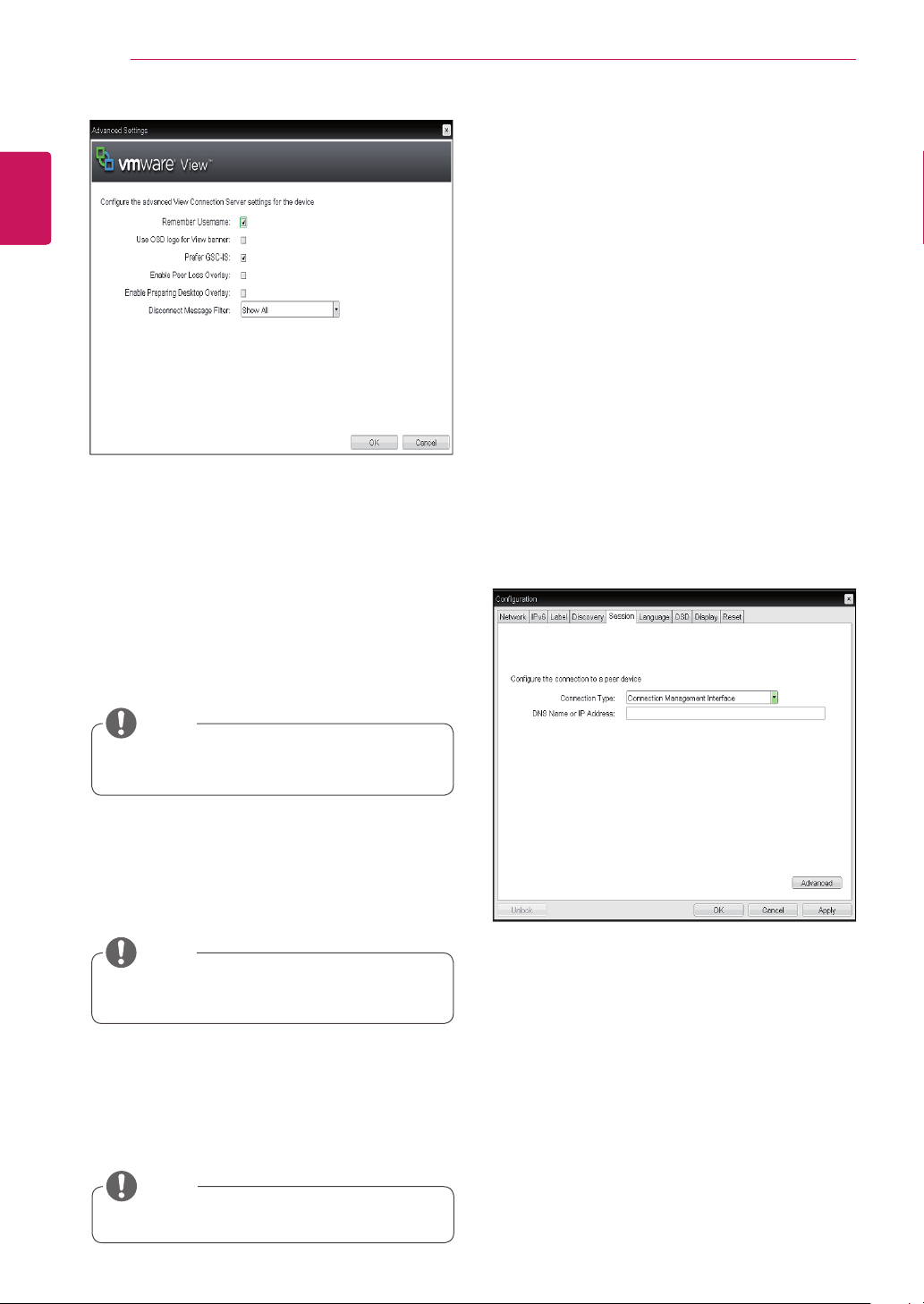
<Figure 2-23: Advanced Settings for View Connec-
tion Server + Imprivata OneSign Connection>
y
Remember Username
If this option is selected, the username which is
previously used to access the VMware View
Connection Server is automatically entered in the
username field.
y
Use OSD logo for View banner
If this option is enabled, you can change the OSD
logo of PCoIP during the login.
y
The OSD logo can be uploaded using the
Webpage Administration Interface.
NOTE
y
Prefer GSC-IS
If this option is selected, the GCS-IS interface
is used when a smart card supports more than
one interface. If the smart card supports only one
interface, it is not used.
y
This setting is provided only when a smart
card is used.
NOTE
y
Enable Peer Loss Overlay
If this option is selected, the "Network Connection
Lost" message is displayed on the screen when it
is confirmed that the network is disconnected.
The display is the same as in the VDI environ-
ment. The default is Disable.
y
This setting is provided only for the client.
NOTE
y
Enable Preparing Desktop Overlay
If this option is selected, the "Preparing Desk-
top" message is displayed on the screen when the
user is logged in.
y
Disconnect Message Filter
This option determines the type of message to
display when a session is disconnected.
- Show All: Shows all the error messages.
- Show Error and Warning Only: Shows the
error and warning messages only.
- Show Error Only: Shows the error messages
only.
- Show None: Shows nothing.
y
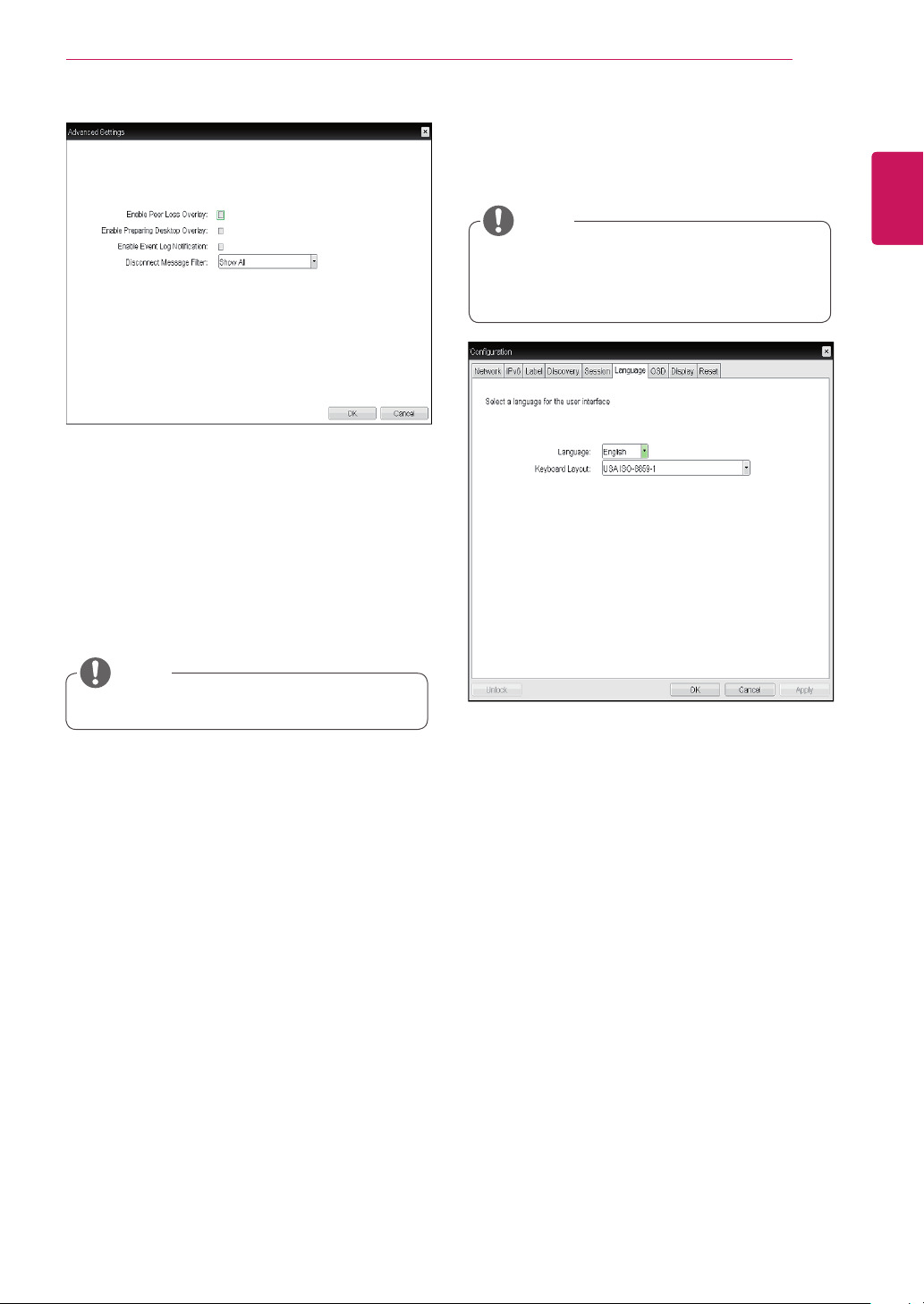
Connection Management Interface
In the Connection Management Interface setting,
you can manage the connection by entering the IP
address for connection management instead of us-
ing the IP address of the VMware View Connection
Server and can select to enable or disabled the
management interface.
<Figure 2-24: Connection Management Interface
Setting>
y
DNS Name or IP Address
Enter the DNS name or IP address of the VMware
View Connection Server.
43
ENG
English
Using CLOUD Solution
y
Language
The Language field is used to set the display
language of the OSD and the user level event log
messages.
y
Keyboard Layout
The Keyboard Layout field allows the administrator
to modify the keyboard layout.
<Figure 2-26: Language Configuration>
Language Tab
The Language tab allows the administrator to set
the OSD language.
y
The Language parameters can also be con-
figured using the Webpage Administration
Interface.
NOTE
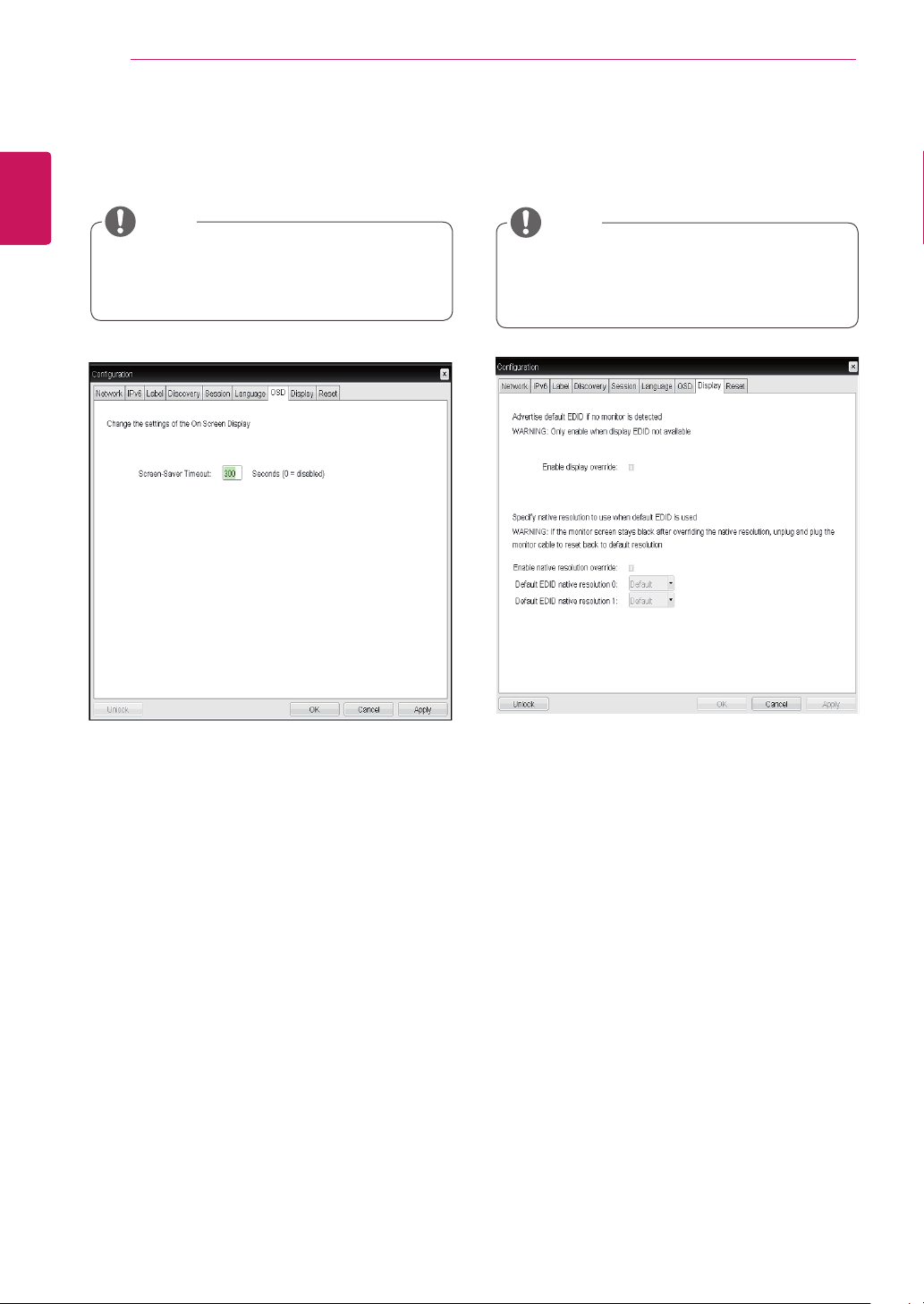
<Figure 2-25: Advanced Settings for Connection
Management Interface>
y
Enable Peer Loss Overlay
If this option is selected, the "Network Connection
Lost" message is displayed on the screen when it
is confirmed that the network is disconnected.
The display is the same as in the VDI environ-
ment. The default is Disable.
y
This setting is provided only for the client.
NOTE
y
Enable Preparing Desktop Overlay
If this option is selected, the "Preparing Desk-
top" message is displayed on the screen when the
user is logged in.
y
Enable Event Log Notification
With this option, you can select whether to allow
the host and client device to send their event log
information to the Connection Management Server.
y
Disconnect Message Filter
This option determines the type of message to
display when a session is disconnected.
- Show All: Shows all the error messages.
- Show Error and Warning Only: Shows the
error and warning messages only.
- Show Error Only: Shows the error messages
only.
- Show None: Shows nothing.
44
ENG
English
Using CLOUD Solution
y
Screen-Saver Timeout
The Screen-Saver Timeout field allows the ad-
ministrator to set a time limit for the screen saver.
The time limit is defined in seconds. The maximum
time is 9999 seconds. If it is set to 0 seconds, the
screen saver will be turned off.
<Figure 2-27: OSD Configuration>
OSD Tab
The OSD tab allows the administrator to modify the
On Screen Display (OSD) parameters.
y
The OSD parameters can also be configured
using the Webpage Administration Interface.
NOTE
<Figure 2-28: Display Configuration>
Display Tab
The Display tab allows the user to configure the
EDID function of the monitor.
y
The Enable display override function can be
used when the EDID function of the monitor
is not running.
NOTE
45
ENG
English
Using CLOUD Solution
y
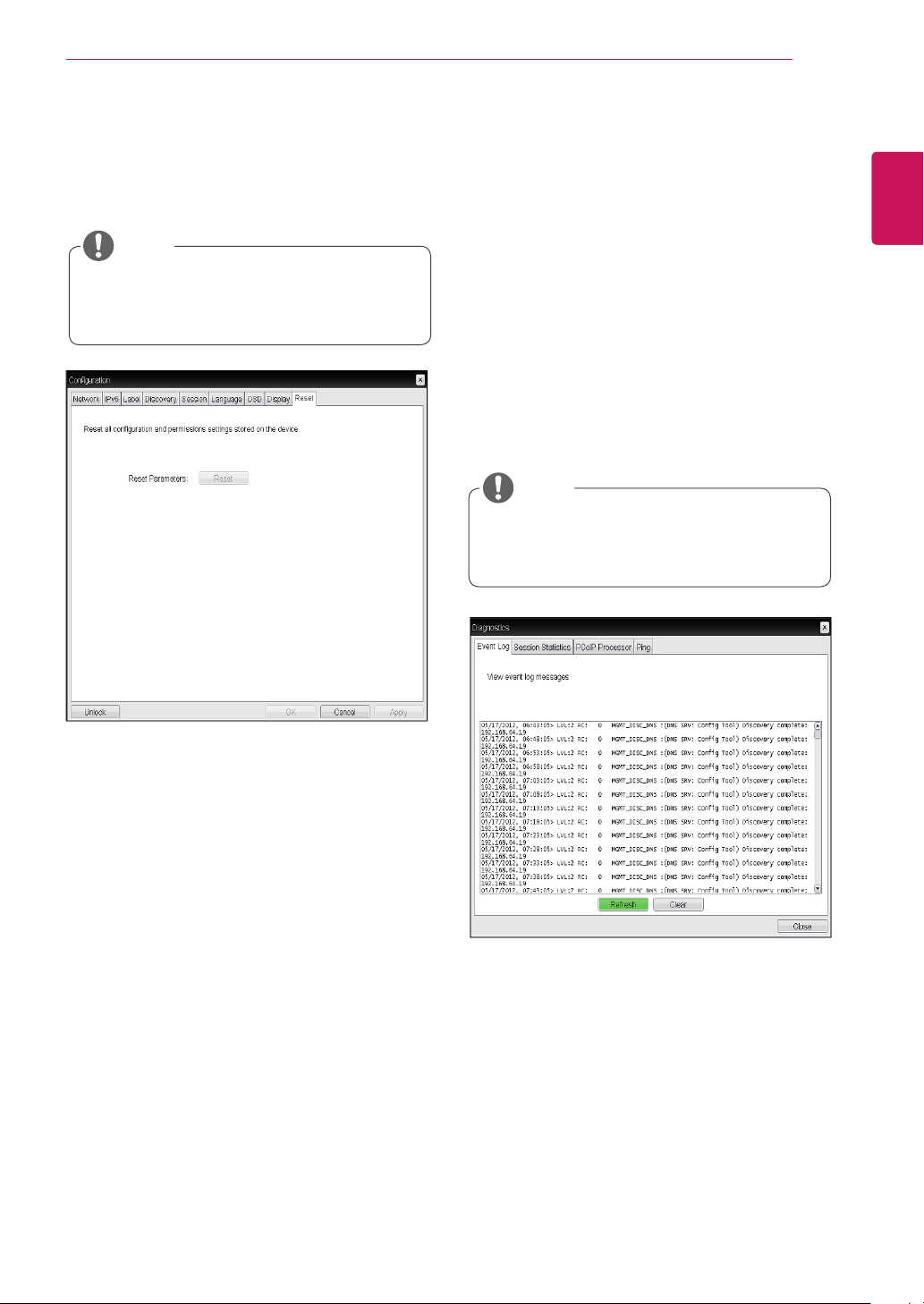
Reset Parameters
Pressing the Reset Parameters button will reset all
settings and options to the factory default settings.
When this button is pressed, an OSD message is
displayed. This is to prompt the administrator and
prevent accidental reset.
<Figure 2-29: Reset>
Reset Tab
The Reset tab allows the administrator to reset all
configurable parameters stored in Flash.
y
The Reset function can also be accessed
through the Webpage Administration Inter-
face.
NOTE
y
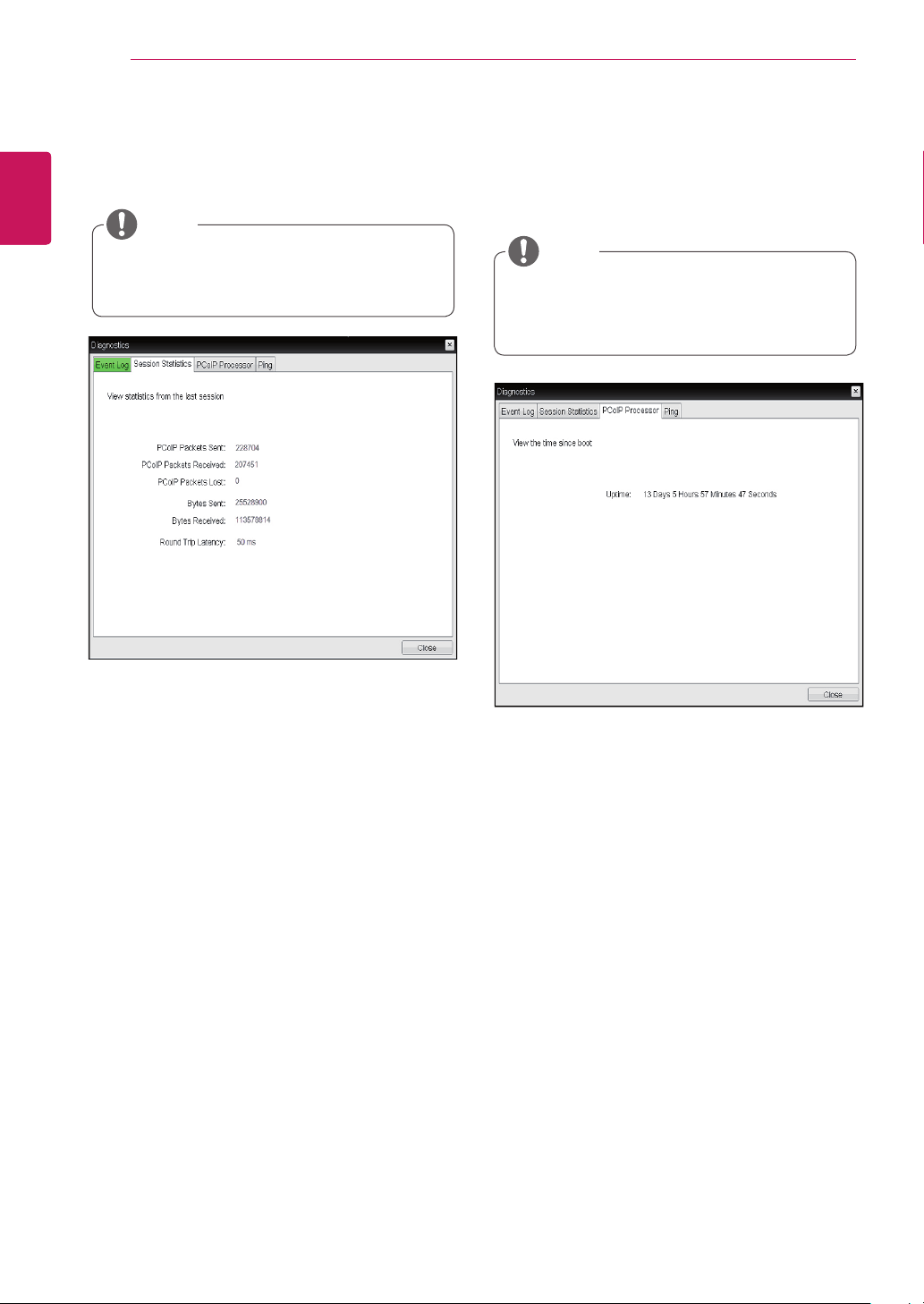
Event Log
y
Session Statistics
y
PCoIP Processor
y
Ping
Each tab has the Close button to close the window.
Diagnostics Window
In the Diagnostics window, the administrator can
access the window tab to diagnose the portal. The
Diagnostics window has the following tabs:
y
View Event Log Message
The View Event Log Message field displays the log
messages accompanied by the timestamp informa-
tion. The following two buttons are available:
y
Refresh
The Refresh button refreshes the displayed event
log messages.
y
Clear
The Clear button clears all event log messages.
<Figure 2-30: Event Log>
Event Log Tab
The Event Log tab allows the administrator to view
and delete the event log messages from the portal.
y
The event log (regardless of the quantity)
can also be reset using the Webpage Admin-
istration Interface.
NOTE
46
ENG
English
Using CLOUD Solution
y
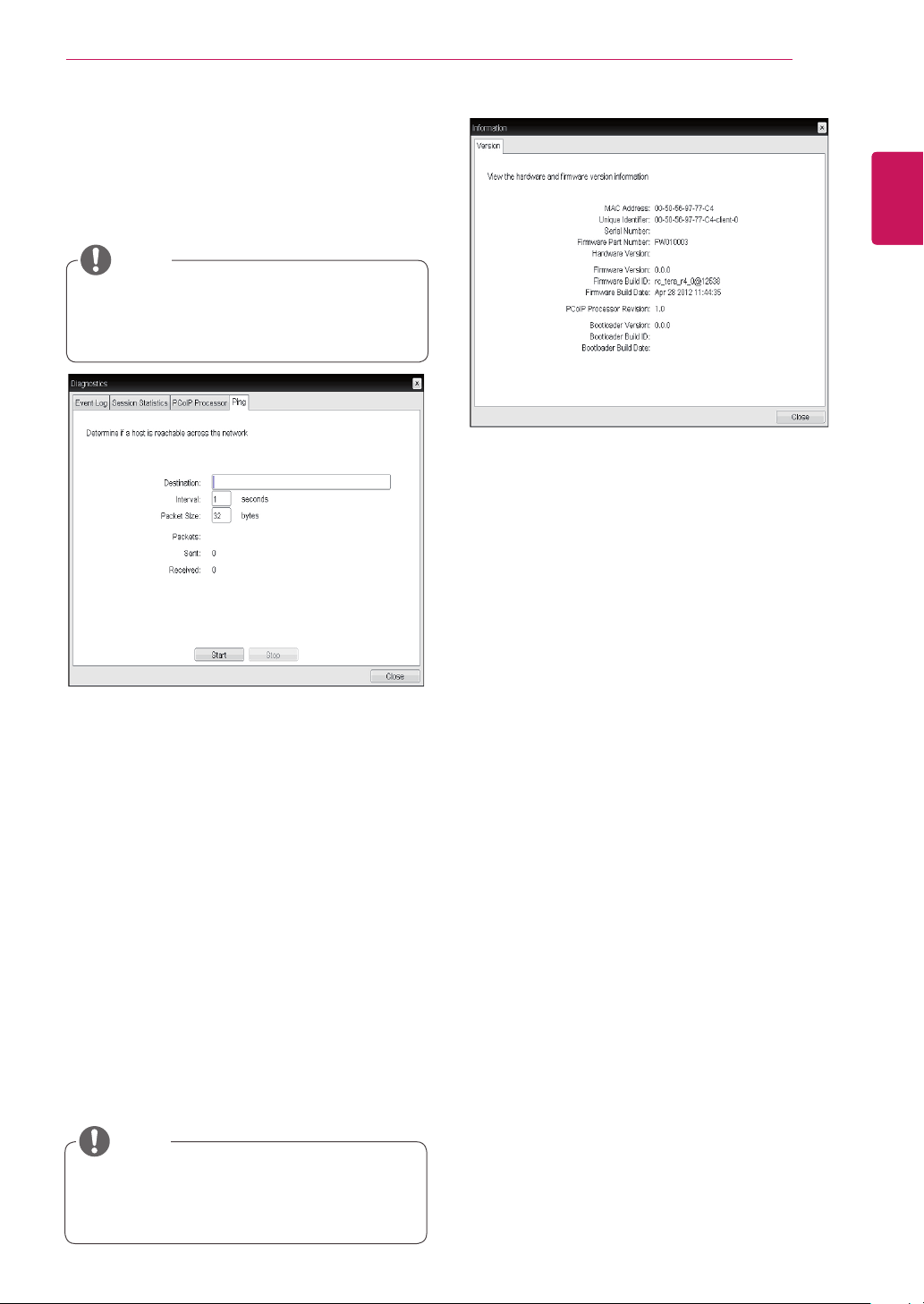
PCoIP Packets Statistics
y
PCoIP Packets Sent
The PCoIP Packets Sent field shows the total
number of PCoIP packets sent from the portal
to the host in the last active session.
y
PCoIP Packets Received
The PCoIP Packets Received field shows the
total number of PCoIP packets received from
the host to the portal in the last active session.
y
PCoIP Packets Lost
The PCoIP Packets Lost field shows the total
number of PCoIP packets lost in the last ac-
tive session.
<Figure 2-31: Session Statistics>
Session Statistics Tab
The Session Statistics tab allows the administrator
to view the PCoIP specific statistics of the last ac-
tive PCoIP session from the portal.
y
Bytes Statistics
y
Bytes Sent
The Bytes Sent field shows the total number
of bytes sent in the last active session.
y
Bytes Received
The Bytes Received field shows the total
number of bytes received in the last active
session.
y
Round Trip Latency
The Round Trip Latency field shows the total
round-trip PCoIP system (e.g. from the portal to
the host, then back to the portal) and the network
latency in milliseconds (+/- 1 ms).
y
The session statistics (regardless of the
quantity) can also be viewed using the Web-
page Administration Interface.
NOTE
<Figure 2-32: PCoIP Processor>
PCoIP Processor Tab
The PCoIP Processor tab allows the administrator
to view the portal PCoIP processor's uptime since
its last booting.
y
The PCoIP Processor Uptime can also be
viewed using the Webpage Administration
Interface.
NOTE
47
ENG
English
Using CLOUD Solution
y
Ping Settings
y
Destination
The IP address or FQDN to perform the ping
test.
y
Interval
The interval between the ping packets.
y
Packet Size
The size of the ping packet.
y
Packets
y
Sent
The number of ping packets sent.
y
Received
The number of ping packets received.
<Figure 2-33: Ping>
Ping Tab
The Ping tab allows the administrator to perform a
ping test to the device and check if it can reach the
overall IP network. This is useful to check whether
the device can reach the host.
y
The Ping tab has no corresponding menu in
to the Webpage Administration Interface of
Section 1.
NOTE
y
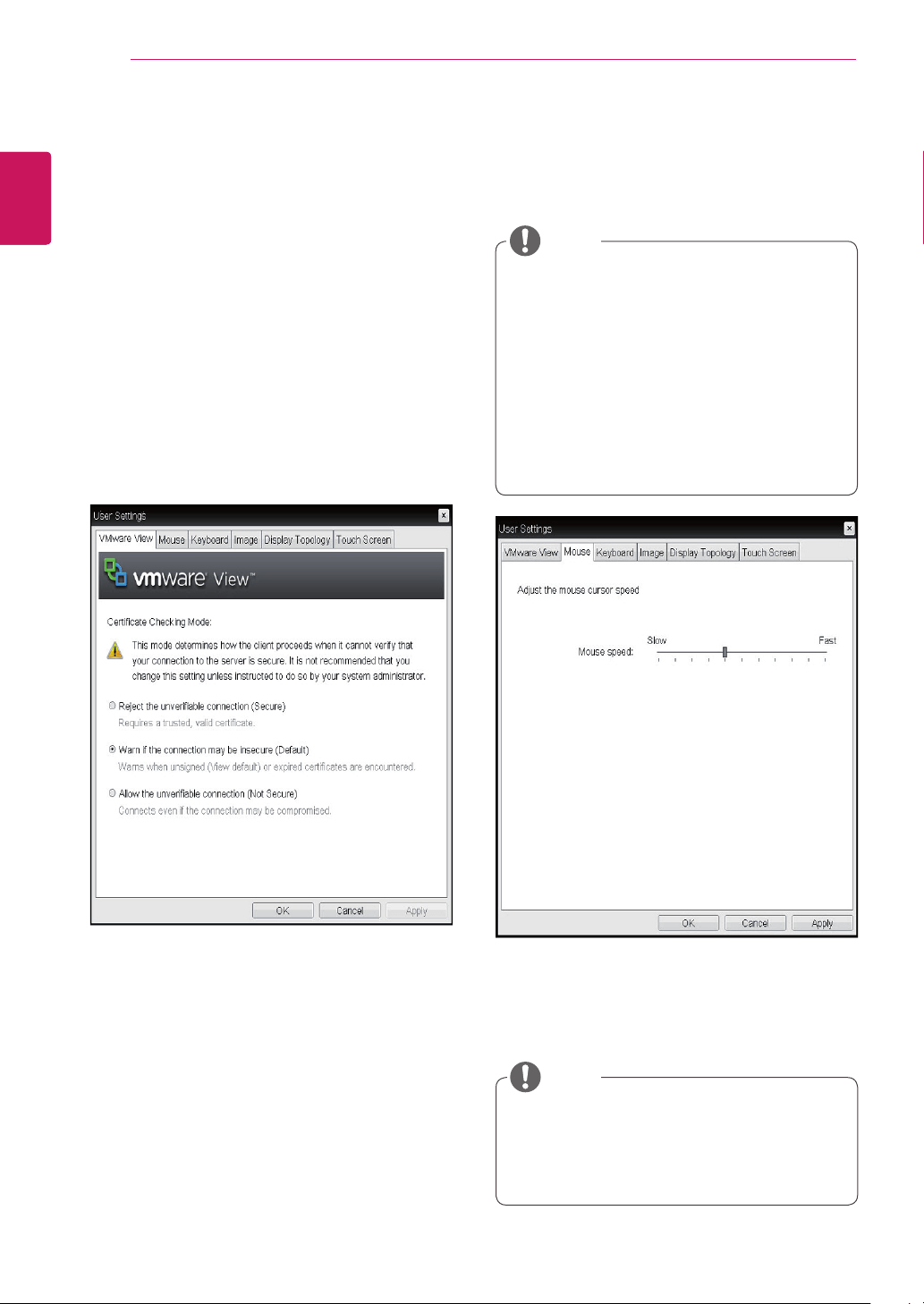
VPD Information
The Vital Product Data (VPD) is information that
uniquely identifies each portal or host.
y
MAC Address
The portal MAC address
y
Unique Identifier
The portal ID
y
Serial Number
The portal serial number
y
Firmware Part Number
The part number of the PCoIP firmware
y
Hardware Version
The portal hardware version
y
Firmware Information
The Firmware Information shows the details of the
current PCoIP firmware.
y
Firmware Version
The current PCoIP firmware version
y
Firmware Build ID
The current PCoIP firmware revision code
y
Firmware Build Date
The current PCoIP firmware build date
<Figure 2-34: Version>
Information Window
In the Information window, the administrator can
access the Version tab that contains the device
related information.
y
The version information can also be viewed
using the Webpage Administration Interface.
NOTE
y
Boot Loader Information
The Boot Loader Information shows the details of
the current PCoIP boot loader.
y
Boot Loader Version
The current PCoIP boot loader version
y
Boot Loader Build ID
The current PCoIP boot loader revision code
y
Boot Loader Build Date
The current PCoIP boot loader build date
PCoIP Processor Revision
This shows the PCoIP processor's revision code.
TERA1x00 Revision A silicone is denoted by 0.0
and TERA1x00 Revision B silicone is denoted by
1.0.
48
ENG
English
Using CLOUD Solution
User Settings Window
In the User Settings window, the administrator can
access the tab to select the mouse and keyboard
and define the PCoIP image quality.
The User Settings window has the following tabs:
y
VMware View
y
Mouse
y
Keyboard
y
Image
y
Display Topology
y
Touch Screen
y
Mouse Speed
The Mouse Speed field allows the user to set the
portal's mouse cursor speed.
<Figure 2-36: Mouse>
Mouse Tab
The Mouse tab allows the user to modify the OSD
and RDP session's mouse cursor speed setting.
y
The OSD mouse cursor speed setting does
not affect the mouse cursor settings when
a PColP session is active unless the Local
Keyboard Host Driver function is being used
(see PColP Host Software User Guide for
more information).
y
The Mouse tab has no corresponding menu
in the Webpage Administration Interface of
Section 1.
y
The Mouse Speed can also be configured via
the PCoIP Host Software. For more informa-
tion on using the PCoIP Host Software, refer
to the PCoIP Host Software User Guide.
NOTE
NOTE
<Figure 2-35: VMware View>
y
VMware View Tab
The VMware View tab allows user to specify the
client behavior for when a user cannot check the
secure connection to a server.
y
Reject the unverifiable connection (Secure)
Connection can be established only when the cer-
tificate is verified and otherwise it cannot.
y
Warn if the connection may be insecure (De-
fault)
The authentication status is checked and a warn-
ing message is displayed, if required. However,
there is no connection limit.
y
Allow the unverifiable connection (Not Se-
cure)
No authentication is required and no connec-tion
limit exists.
49
ENG
English
Using CLOUD Solution
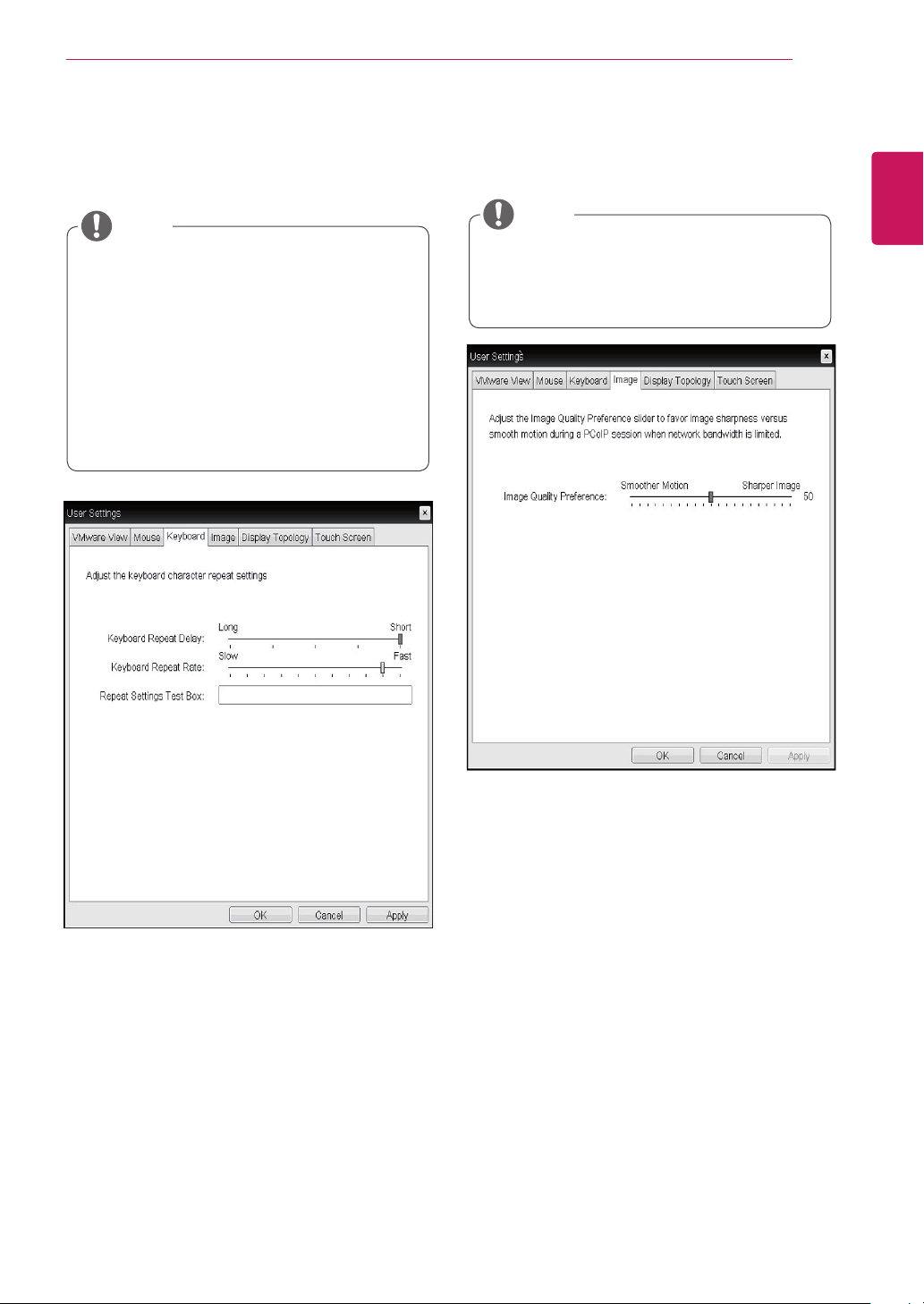
y
Keyboard Repeat Delay
The Keyboard Repeat Delay field allows the user
to set the portal's keyboard repeat delay.
y
Keyboard Repeat Rate
The Keyboard Repeat Rate field allows the user to
set the portal's keyboard repeat rate.
y
Repeat Settings Test Box
The Repeat Settings Test Box allows the user to
test the selected keyboard settings.
<Figure 2-37: Keyboard>
Keyboard Tab
The Keyboard tab allows the user to modify the
OSD and RDP session's keyboard repeat setting.
y
The OSD keyboard setting does not affect
the keyboard settings when a PColP session
is active unless the Local Keyboard Host
Driver function is being used (see PColP
Host Software User Guide for more informa-
tion).
y
The Keyboard tab has no corresponding
menu in the Webpage Administration Inter-
face of Section 1.
NOTE
y
Minimum Image Quality
The Minimum Image Quality slider allows the ad-
ministrator to make compromises between image
quality and frame rate when network bandwidth
is limited. Sometimes, lower-quality images at a
higher frame rate may be required, while at other
times, higher-quality images at a lower frame rate
may be preferred.
In environments where the network bandwidth is
limited, moving the slider towards Reduced en-
sures higher frame rates;
moving the slider towards Perception-Free ensures
higher image quality. When network bandwidth is
not limited, the PCoIP system will maintain percep-
tion-free quality regardless of the Minimum Image
Quality setting.
<Figure 2-38: Image>
Image
The Image tab allows a user to change the image
settings on the PCoIP system.
y
The Image parameters can also be con-
figured using the Webpage Administration
Interface.
NOTE
50
ENG
English
Using CLOUD Solution
y
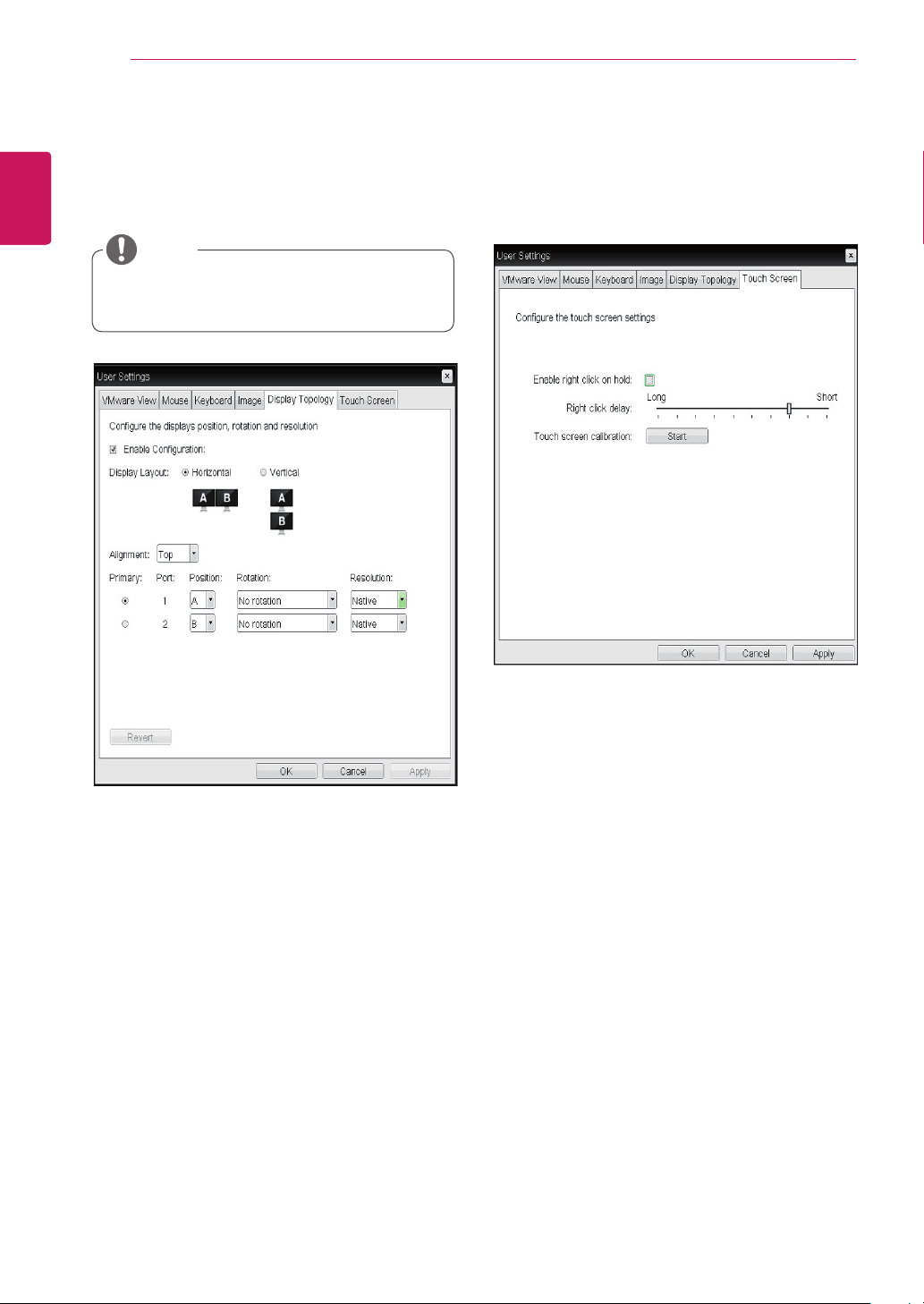
Display Topology Tab
The Display Topology tab allows the user to specify
the position and alignment of a connected second-
ary monitor.
y
It is applicable when the VMware View Con-
nection Server version is 4.5 or later.
NOTE
<Figure 2-39: Display Topology>
y
Enable Configuration
When this option is selected, you can set the
display position and alignment. You can save the
settings by clicking the Apply or OK button, and
the settings will be reset if you initialize the monitor
set.
y
Display Layout
This option allows the user to specify the direction
of monitor connection: vertical or horizontal.
y
Alignment
This option allows the user to specify the align-
ment position of the monitor to be connected when
there is a resolution difference between the two
monitors.
y
Primary
This option allows the user to change the primary/
secondary settings of the connected monitor.
y
Touch Screen Tab
The Touch Screen tab allows the user to specify
the touch sensitivity and alignment when the moni-
tor supports the touch screen function.
<Figure 2-40: Touch Screen>
y
Enable right click on hold
If this option is selected, clicking and holding the
touch screen for several seconds works the same
as the mouse right click.
y
Right Click Delay
This option allows the user to make moving the
pointer position work the same as the mouse right
click. You can also specify the distance to move
(from Long to Short).
y
Touch screen calibration
The alignment of a touch screen is started when
clicking the Start button.
MODEL
SERIAL
Make sure to read the Safety Precautions before
using the product.
Keep the Owner’s Manual (CD) in an accessible
place for future reference.
The model and serial number of the SET is
located on the back and one side of the SET.
Record it below should you ever need service.
To obtain the source code under GPL, LGPL,
MPL and other open source licenses, that is
contained in this product, please visit http://
opensource.lge.com .
In addition to the source code, all referred
license terms, warranty disclaimers and
copyright notices are available for download.
LG Electronics will also provide open source
code to you on CD-ROM for a charge covering
the cost of performing such distribution (such
as the cost of media, shipping and handling)
upon email request to opensource@lge.com.
This offer is valid for three (3) years from the
date on which you purchased the product.