Portable
Generator
Owner's Man
u
al
TG3500 Construction Series
TG5000 Construction Series
TG750 0
TG8000
TG9000

Attention:
All information, illustrations and specifications in this manual are based on the latest information available at
the time of publishing. The illustrations used in this manual are intended as representative reference views only.
Moreover, because of our continuous product improvement policy, we may modify information, illustrations and/or
specifications to explain and/or exemplify a product, service or maintenance improvement. Tomahawk Power LLC
reserves the right to make any change at any time without notice. Some images may vary depending upon which
model is shown.
Please Note:
California Proposition 65 Warning: The engine exhaust from this product contains chemicals known to the state of
California to cause cancer, birth defects or other reproductive harm.
CONGRATULATIONS ON OWNING A TOMAHAWK GENERATOR
For Your Records:
Date of Purchase: Generator Model Number:
Purchased from Store/Dealer: Generator Serial Number:
Purchase Receipt: (retain your purchase receipt to ensure trouble-free warranty coverage)
Product Registration
To ensure trouble-free warranty coverage, it is important you register your Tomahawk generator. You can register
your generator by either:
1.
Filling in the product registration form below and mailing to:
Tomahawk Power LLC
6955 Camino Maquildora Suite G San Diego, CA,
92101, USA
To register your generator you will need to locate the following information:
Model Number Serial Number
Product Registration Form
PERSONAL INFORMATION GENERATOR INFORMATION
First Name: Model Number:
Last Name: Serial Number:
Street Address: Date Purchased:
Street Address: Purchased From:
City, State, ZIP:
Country:
Phone Number:
E-Mail:
This manual contains important instructions for operating this generator. For your safety and
the safety of others, be sure to read this manual thoroughly before operating the generator.
Failure to properly follow all instructions and precautions can cause you and others to be
seriously hurt or killed.
!
DANGER

TABLE OF CONTENTS
CONGRATULATIONS ON OWNING A TOMAHAWK GENERATOR ..................................................................... 3
For Your Records:..................................................................................................................................... 3
Product Registration ................................................................................................................................. 3
Product Registration Form........................................................................................................................ 3
MODEL NUMBER REFERENCE ......................................................................................................................... 4
SAFETY ............................................................................................................................................................... 7
SAFETY DEFINITIONS .................................................................................................................................. 7
SAFETY SYMBOL DEFINITIONS .................................................................................................................. 7
GENERAL SAFETY RULES ........................................................................................................................... 8
SAFETY LABELS AND DECALS.................................................................................................................. 10
UNPACKING ................................................................................................................................................................... 12
UNPACKING THE GENERATOR ............................................................................................................................ 12
WHEEL KIT ACCESSORIES BOX ......................................................................................................................... 12
Components: ......................................................................................................................................... 12
ASSEMBLY ..................................................................................................................................................................... 13
ASSEMBLY ............................................................................................................................................................... 13
INSTALLING THE BATTERY (ELECTRIC START GENERATORS ONLY) .......................................................... 15
FEATURES...................................................................................................................................................................... 16
GENERAL GENERATOR FEATURES ................................................................................................................... 16
CONTROL PANEL FEATURES............................................................................................................................... 18
OPERATION ...................................................................................................................................................... 19
BEFORE STARTING THE GENERATOR ............................................................................................................... 19
POWER CORD ............................................................................................................................................ 20
Using Extension Cords ........................................................................................................................... 20
Using a Tomahawk Power Cord ............................................................................................................. 21
TRANSFER SWITCH CONNECTIONS ........................................................................................................ 21
ADDING / CHECKING ENGINE FLUIDS AND FUEL .................................................................................... 22
Checking and / or Adding Engine Oil ...................................................................................................... 22
Adding Gasoline to the Fuel Tank .................................................................................................................... 22
STARTING THE GENERATOR ............................................................................................................................... 23
Manually Starting a Generator ................................................................................................................ 23
Starting an Electric Start Generator ........................................................................................................ 25
STOPPING THE GENERATOR .............................................................................................................................. 26
Normal Operation ................................................................................................................................... 26
During an Emergency ............................................................................................................................ 26
MAINTENANCE ................................................................................................................................................. 27
MAINTENANCE ........................................................................................................................................... 27
Maintenance Schedule ........................................................................................................................... 27
ENGINE OIL MAINTENANCE ...................................................................................................................... 28
Engine Oil Specification ......................................................................................................................... 28
Checking Engine Oil ............................................................................................................................... 28
Adding Engine Oil .................................................................................................................................. 29
Changing Engine Oil .............................................................................................................................. 29
AIR FILTER MAINTENANCE ........................................................................................................................ 29
Cleaning the Air Filter ............................................................................................................................. 29
SPARK PLUG MAINTENANCE .................................................................................................................... 32
TESTING GFCI OUTLETS ........................................................................................................................... 33
BATTERY SERVICE ..................................................................................................................................... 33
Battery Replacement .............................................................................................................................. 33
CLEANING THE SPARK ARRESTOR .......................................................................................................... 34
CLEANING THE GENERATOR............................................................................................................................... 35
STORAGE ................................................................................................................................................... 36
TROUBLESHOOTING ....................................................................................................................................... 37
TROUBLESHOOTING ................................................................................................................................. 37
SAFETY
SAFETY DEFINITIONS
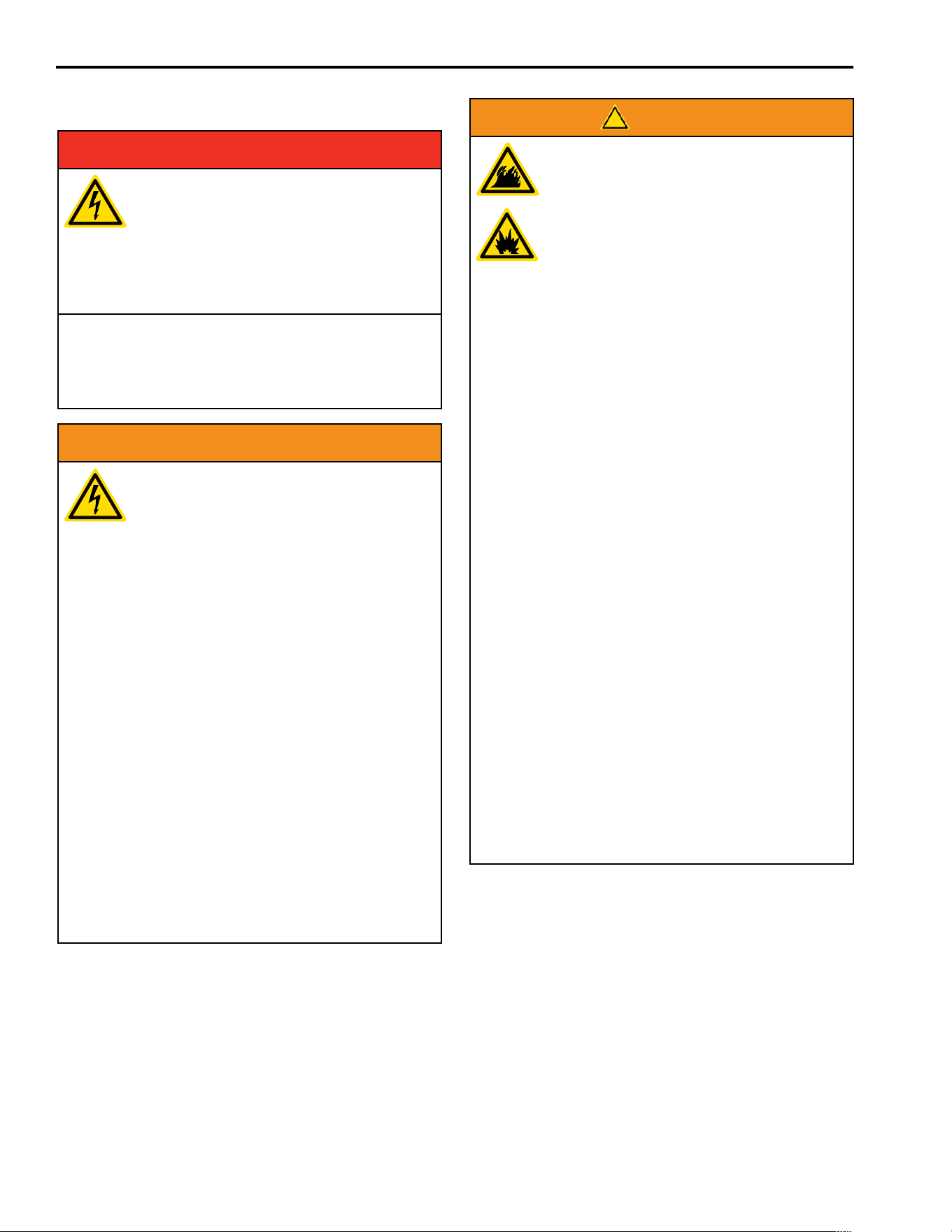
The words DANGER, WARNING, CAUTION and
NOTICE are used throughout this manual to highlight
important information. Be certain that the meanings of
these alerts are known to all who work on or near the
equipment.
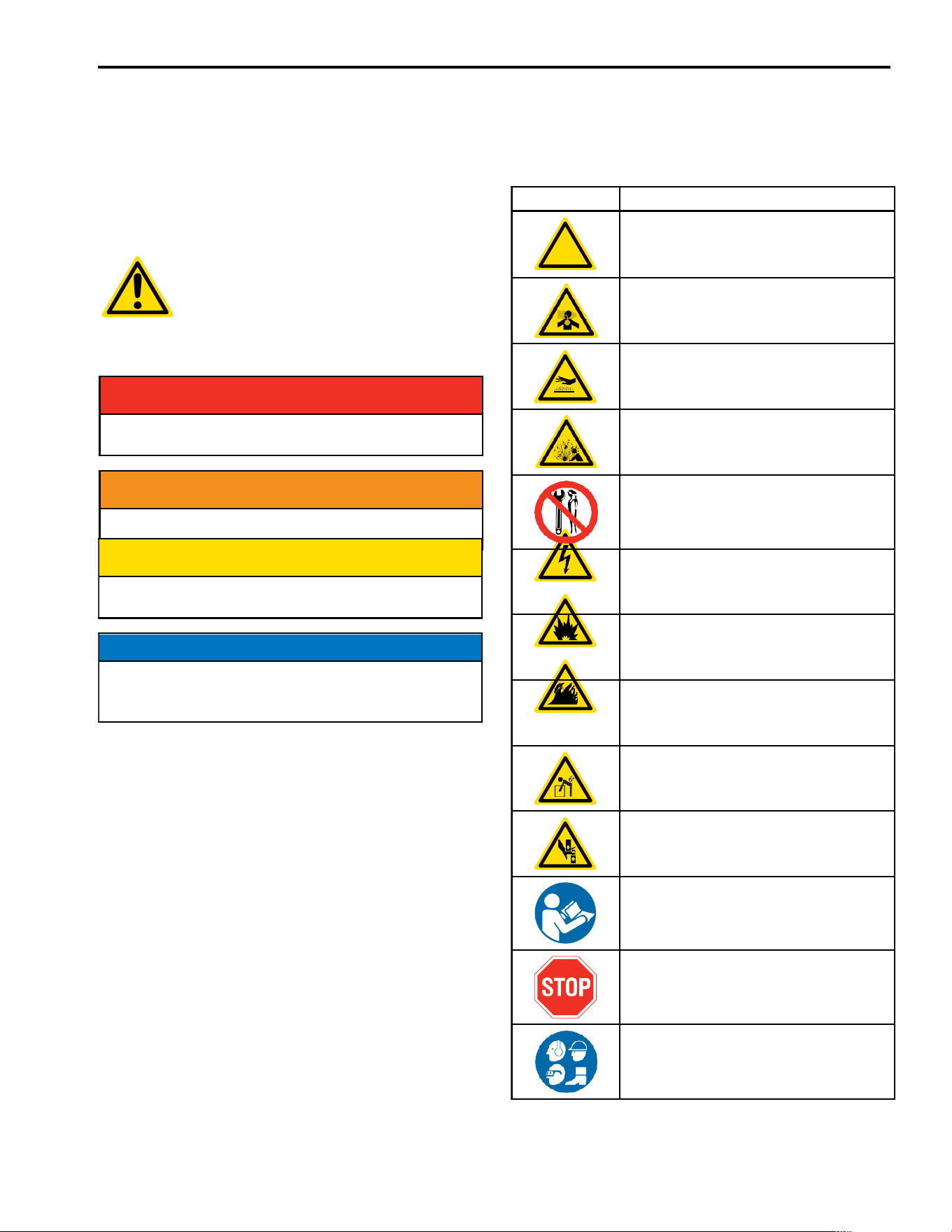
SAFETY SYMBOL
DEFINITIONS
This safety alert symbol appears
with most safety statements. It
means attention, become alert, your
safety is involved! Please read and
abide by the message that follows
the safety alert symbol.
!
DANGER
Indicates a hazardous situation which, if not
avoided, will result in death or serious injury.
!
WARNING
Indicates a hazardous situation which, if not
avoided, could result in death or serious injury.
Symbol
Description
!
Safety Alert Symbol
Asphyxiation Hazard
Burn Hazard
Burst/Pressure Hazard
Don’t leave tools in the area
Electrical Shock Hazard
Explosion Hazard
Fire Hazard
Lifting Hazard
Pinch-Point Hazard
Read Manufacturer’s Instructions
Read Safety Messages Before
Proceeding
Wear Personal Protective Equipment
(PPE)
!
CAUTION
Indicates a hazardous situation which, if not
avoided, could result in minor or moderate injury.
NOTICE
Indicates a situation which can cause damage to the
generator, personal property and/or the environment,
or cause the equipment to operate improperly.
SAFETY
GENERAL SAFETY RULES
!
DANGER
Never use the generator in a location
that is wet or damp. Never expose the
generator to rain, snow, water spray or
standing water while in use. Protect the
generator from all hazardous weather
conditions. Moisture or ice can cause a
short circuit or other malfunction in the
electrical circuit.
Never operate the generator in an
enclosed area. Engine exhaust
contains carbon monoxide. Only
operate the generator outside and away
from windows, doors and vents.
!
WARNING
Voltage produced by the generator
could result in death or serious injury.
•
Never operate the generator in
rain or a floodplain unless proper
precautions are taken to avoid being
subject to rain or a flood.
•
Never use worn or damaged
extension cords.
•
Always have a licensed electrician
connect the generator to the utility
circuit.
•
Never touch an operating generator
if the generator is wet or if you have
wet hands.
•
Never operate the generator in highly
conductive areas such as around
metal decking or steel works.
•
Always use grounded extension
cords. Always use three-wire or
double-insulated power tools.
•
Never touch live terminals or
bare wires while the generator is
operating.
•
Be sure the generator is properly
grounded before operating.
!
WARNING
Gasoline and gasoline vapors are
extremely flammable and explosive
under certain conditions. Beware of
Carbon Monoxide and ordorless gas
that kills.
•
Always refuel the generator outdoors,
in a well-ventilated area.
•
Never remove the fuel cap with the
engine running.
•
Never refuel the generator while
the engine is running. Always turn
engine off and allow the generator to
cool before refueling.
•
Only fill fuel tank with gasoline.
•
Keep sparks, open flames or other
form of ignition (such as match,
cigarette, static electric source) away
when refueling.
•
Never overfill the fuel tank. Leave
room for fuel to expand. Overfilling
the fuel tank can result in a sudden
overflow of gasoline and result in
spilled gasoline coming in contact
with HOT surfaces. Spilled fuel
can ignite. If fuel is spilled on
the generator, wipe up any spills
immediately. Dispose of rag properly.
Allow area of spilled fuel to dry
before operating the generator.
•
Wear eye protection while refueling.
•
Never use gasoline as a cleaning
agent.
•
Store any containers containing
gasoline in a well-ventilated area,
away from any combustibles or
source of ignition.
•
Check for fuel leaks after refueling.
Never operate the engine if a fuel leak
is discovered.

UNPACKING
UNPACKING THE
GENERATOR
Tools required – box cutter or similar device.
1.
Carefully cut the packing tape on top of the carton.
2.
Fold back top flaps to reveal the manual.
3.
Remove the Wheel Kit Accessories cardboard box.
4.
Carefully cut two sides of the carton to remove the
generator.
WHEEL KIT ACCESSORIES
BOX
Open the Wheel Kit Accessories box and verify the
contents against the list below. The wheel kit is optional
for the WHL2500 model and is not available for the
WHL1000 model. If any parts are missing, please
locate an authorized Tomahawk Generator dealer at
(866) 577-4476
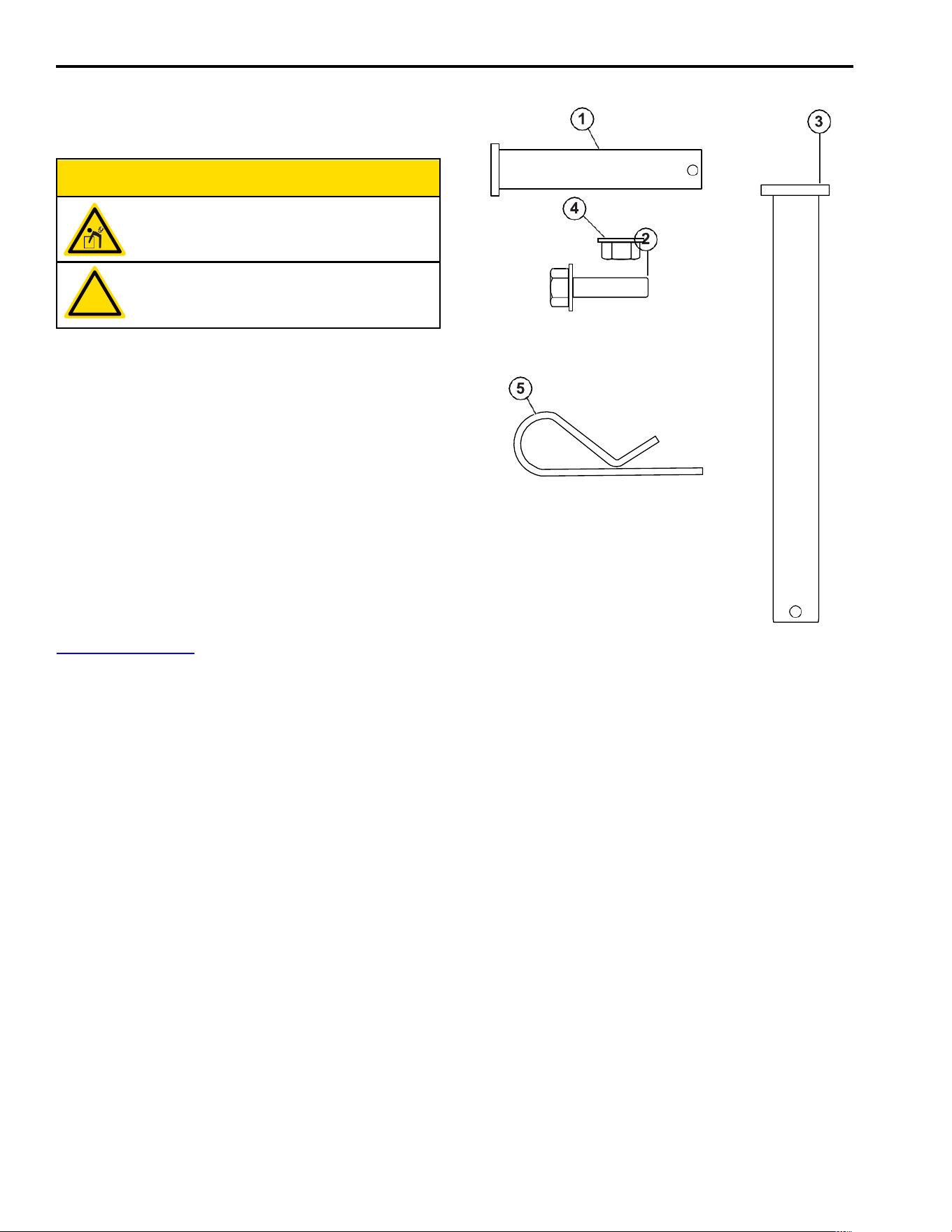
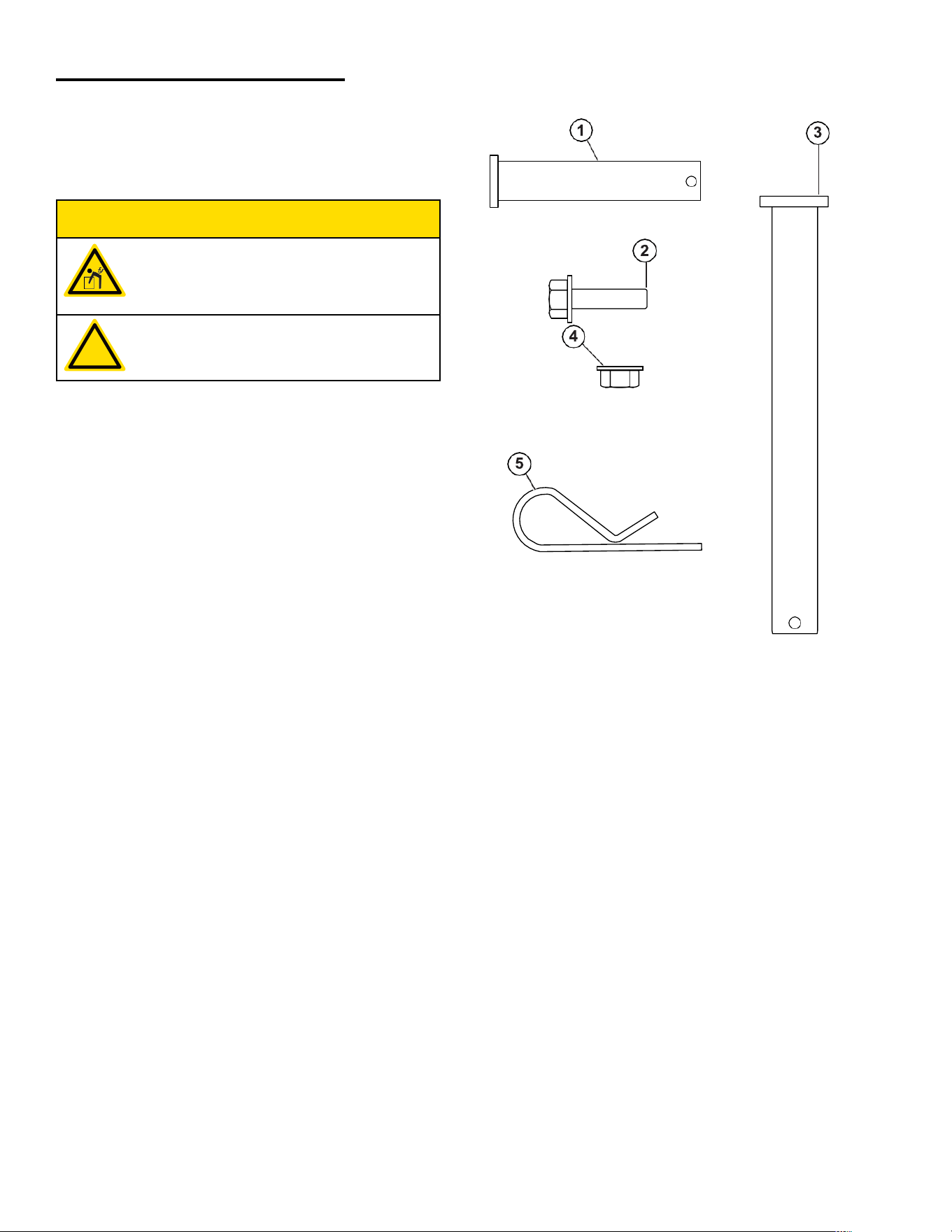
Figure 3 – Wheel Kit Hardware
Components:
Wheels (2)
Handles with Grips (2)
Tool Bag (1)
Spark Plug Socket
Wrench (1)
Mounting Foot (1)
1
- Clevis Pin
55 x 8 mm
(2 used)
2
- Flange Bolt
M8 x 16 mm
(2 used)
3
- Wheel Axle Pin -
3250 Series Only
16 mm x 95 mm
(2 used)
Wheel Axle Pin -
5500 to 7500
Series Only
16 mm x 100 mm
(2 used)
4
- Locking Flange
Nut M8 (2 used)
5
- Hairpin Cotter
(2 used)
!
CAUTION
Always have assistance when lifting
the generator. The generator is heavy;
lifting it could cause bodily harm.
Avoid cutting on or near staples to
!
prevent personal injury.
ASSEMBLY
ASSEMBLY
Before assembling the generator,
review Safety on page 7 and the
following safety messages.
!
CAUTION
Never lift the generator without
assistance. The generator is heavy and
lifting without assistance could result
in personal injury.
Never use the handles as a lifting
!
point to support the entire weight of
the generator. Only use the handles
to move the generator by lifting the
handles and using the wheels to move
the generator.
Use caution when collapsing the
handles. Hands and fingers could get
caught and pinched.
NOTICE
Assembling the generator will require lifting the unit
on one side. Make sure all engine oil and fuel are
drained from the unit prior to assembling.
Once assembled, the wheel kit is not intended for
on-road use. The wheel kit is designed for use on this
generator only.
Tools required – tool bag (included).
1.
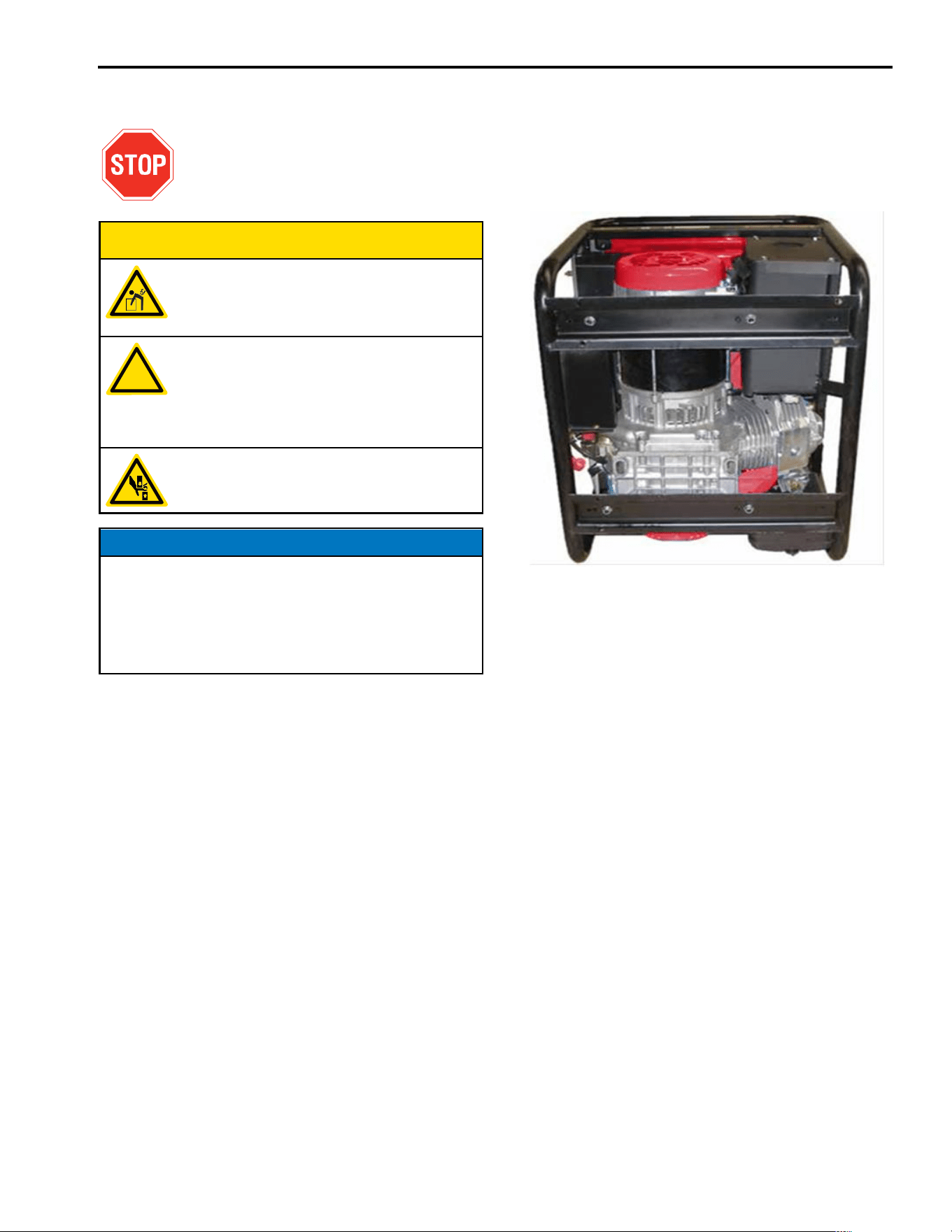
Place generator on a flat surface.
2.
Place a piece of cardboard or other soft material
to tip the generator onto, to protect the frame
paint and prevent the generator from sliding. Tip
the generator onto its side as shown in Figure 4
(engine should be on the bottom).
Figure 4 – Tip the Generator onto its Side
ASSEMBLY
3.
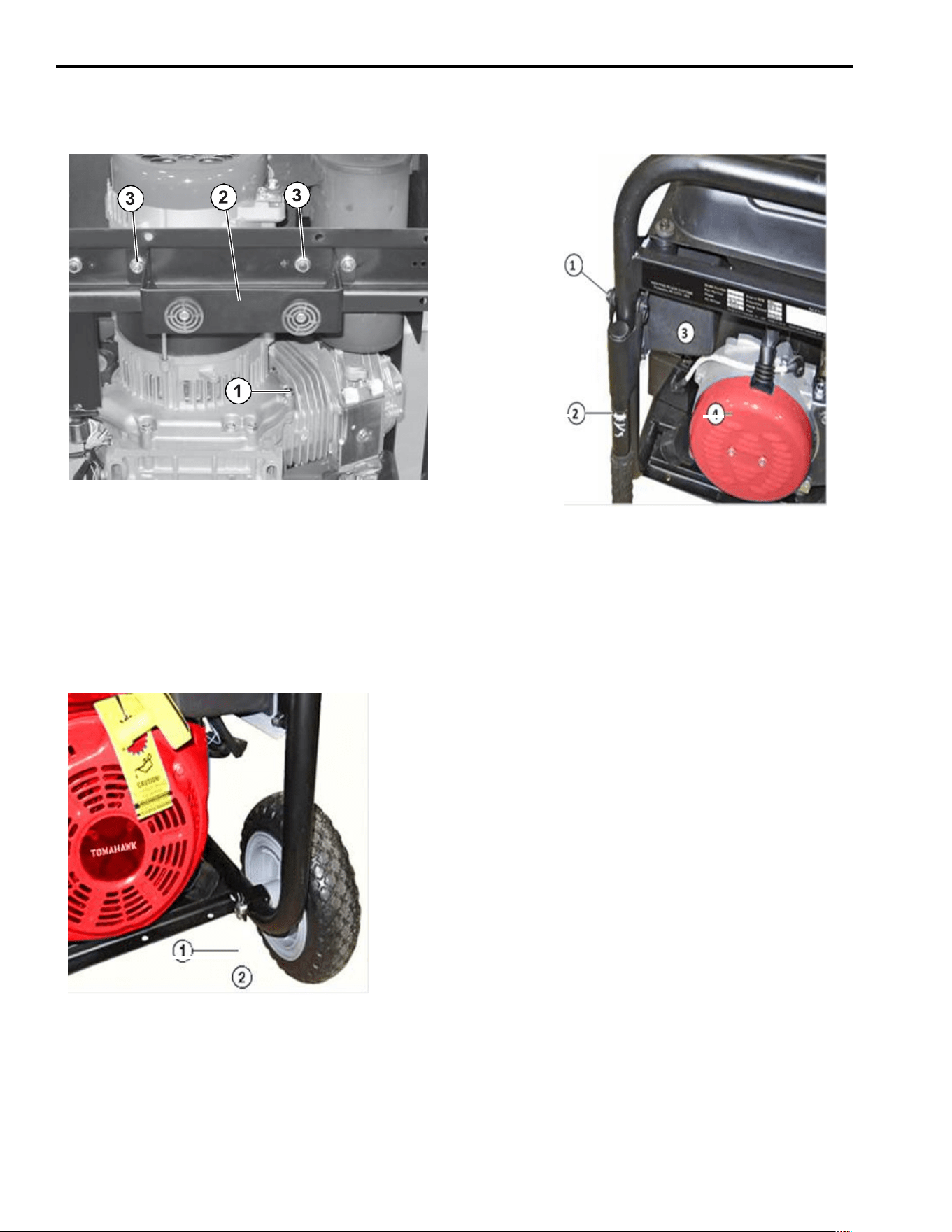
Install the mounting foot to the frame using M8
flange bolts and nuts.
6. Install the handles using the clevis pin and hairpin
cotter as shown in Figure 7.
Figure 5 – Assemble Mounting Foot to Frame
1 - Rubber Pads 3 - M8 Flange Bolt Figure 7 – Attaching the Handles
2 - Mounting Foot
and Nut
1 - Clevis Pin 3 - Hairpin Cotter
4.
Install the 16 mm x 105 mm axle pin through the
axle bracket on the frame.
5.
Install the hairpin cotter through the axle pin.
2 - Handle 4 - Negative Battery
Cable
Figure 6 – Assemble Wheels to Frame
1 - Axle Pin 2 - Hairpin Cotter
ASSEMBLY
INSTALLING THE BATTERY
(ELECTRIC START
GENERATORS ONLY)
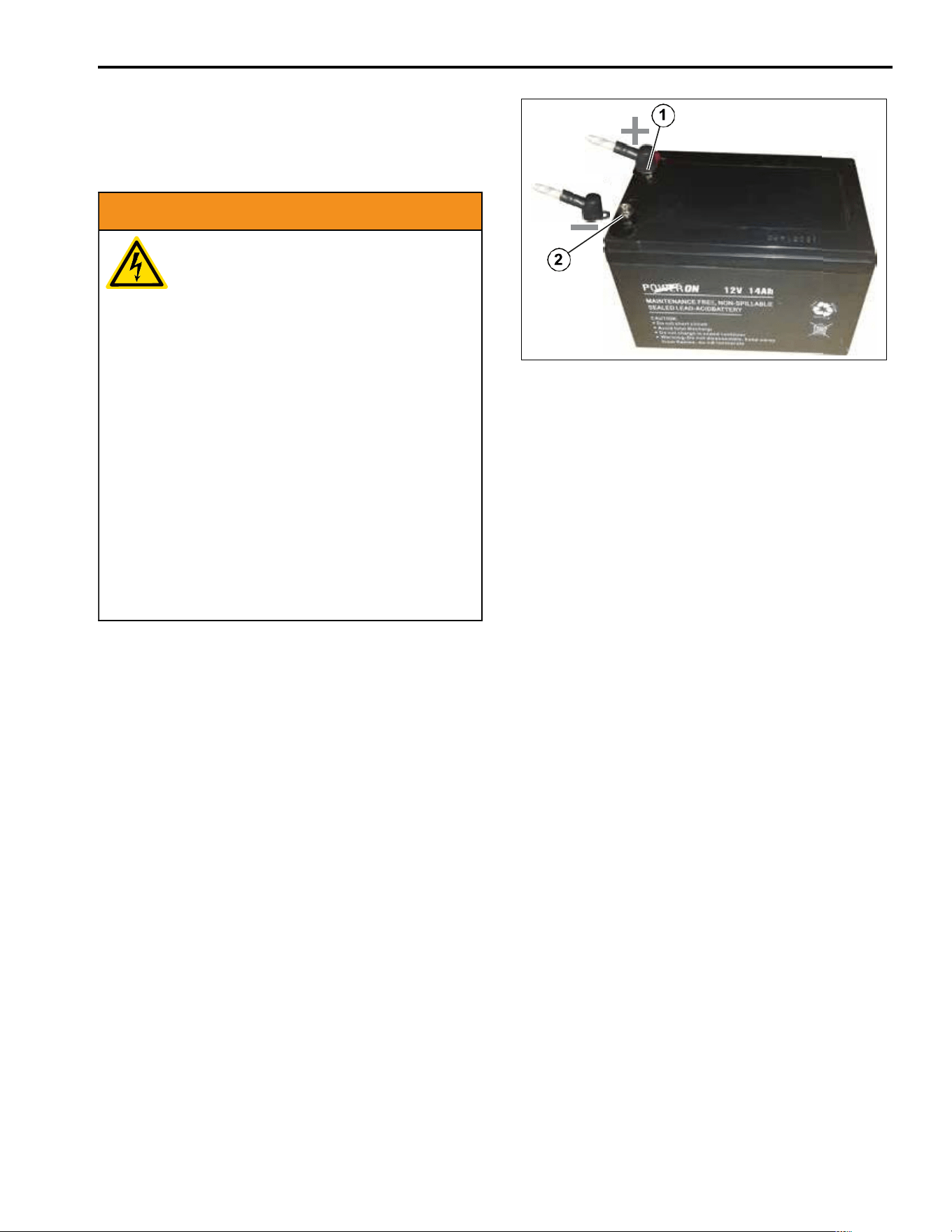
Figure 8 – Attaching the Negative (-) Battery Cable
(Black)
NOTE:
The generator comes equipped with the
positive battery cable (red boot) already
attached.
1 - Positive (+)
Battery Cable
(Red)
2 - Negative (-)
Battery Cable
(Black)
1.
Verify the positive (+) battery cable (red boot) is
securely tightened to the positive (+) battery post.
Make sure boot is over battery post.
2.
Carefully remove the protective wrapping around
the lug of the negative (-) battery cable (black boot).
3.
Locate negative (-) cable attached to alternator
cable, remove tie and route to the negative (-)
battery post.
4.
Pull back the black boot and securely attach
the negative (-) battery cable (black boot) to the
negative (-) battery post as shown in Figure 8.
Replace the black boot so it protects the cable lug
and battery post.
!
WARNING
To avoid electric shock:
•
ALWAYS connect the positive (+)
battery cable (red boot) first when
connecting battery cables.
•
ALWAYS disconnect the negative (-)
battery cable (black boot) first when
disconnecting battery cables.
•
NEVER connect the negative (-)
battery cable (black boot) to the
positive (+) post on the battery.
•
NEVER connect the positive (+)
battery cable (red boot) to the
negative (-) post on the battery.
•
NEVER touch both battery posts
simultaneously.
•
NEVER place a metal tool across
both battery posts.
•
ALWAYS use insulated or non-
conducting tools when installing the
battery.
FEATURES
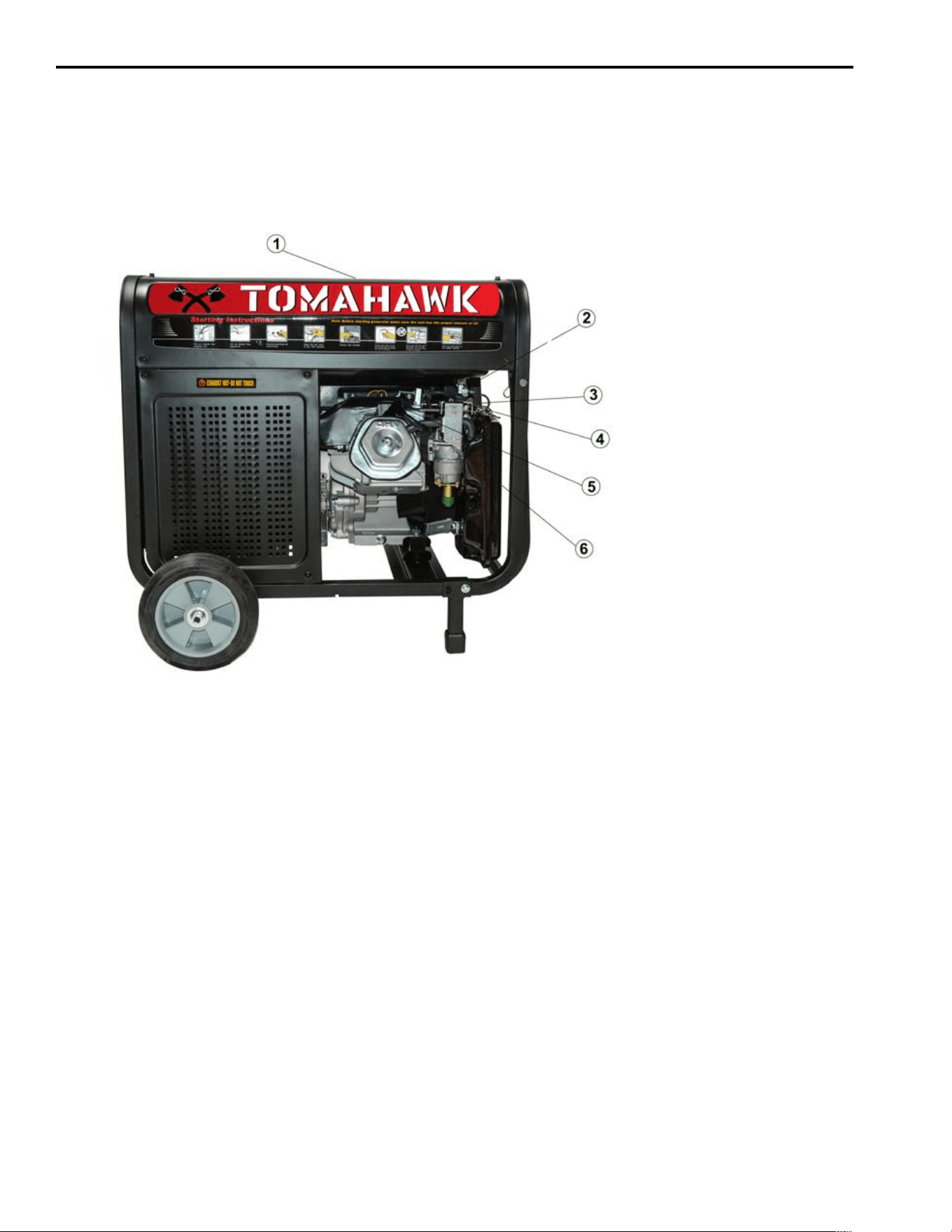
GENERAL GENERATOR FEATURES
1 - Engine Control Switch: Turns the engine on
and off.
Figure 9
5
- Battery: For electric start models only.
6
- Oil Fill Plug/Dipstick: Must be removed to
2
- Fuel Cap: Close until clicking sound is heard.
3
- Control Panel: Contains the circuit breakers
and outlets.
4
- Muffler and Spark Arrester: Avoid contact
until engine is cooled down. Spark arrestor
prevents sparks from exiting the muffler. It
must be removed for servicing.
add and check oil.
7
- Oil Drain Plug: Must be removed to drain
engine oil.
FEATURES
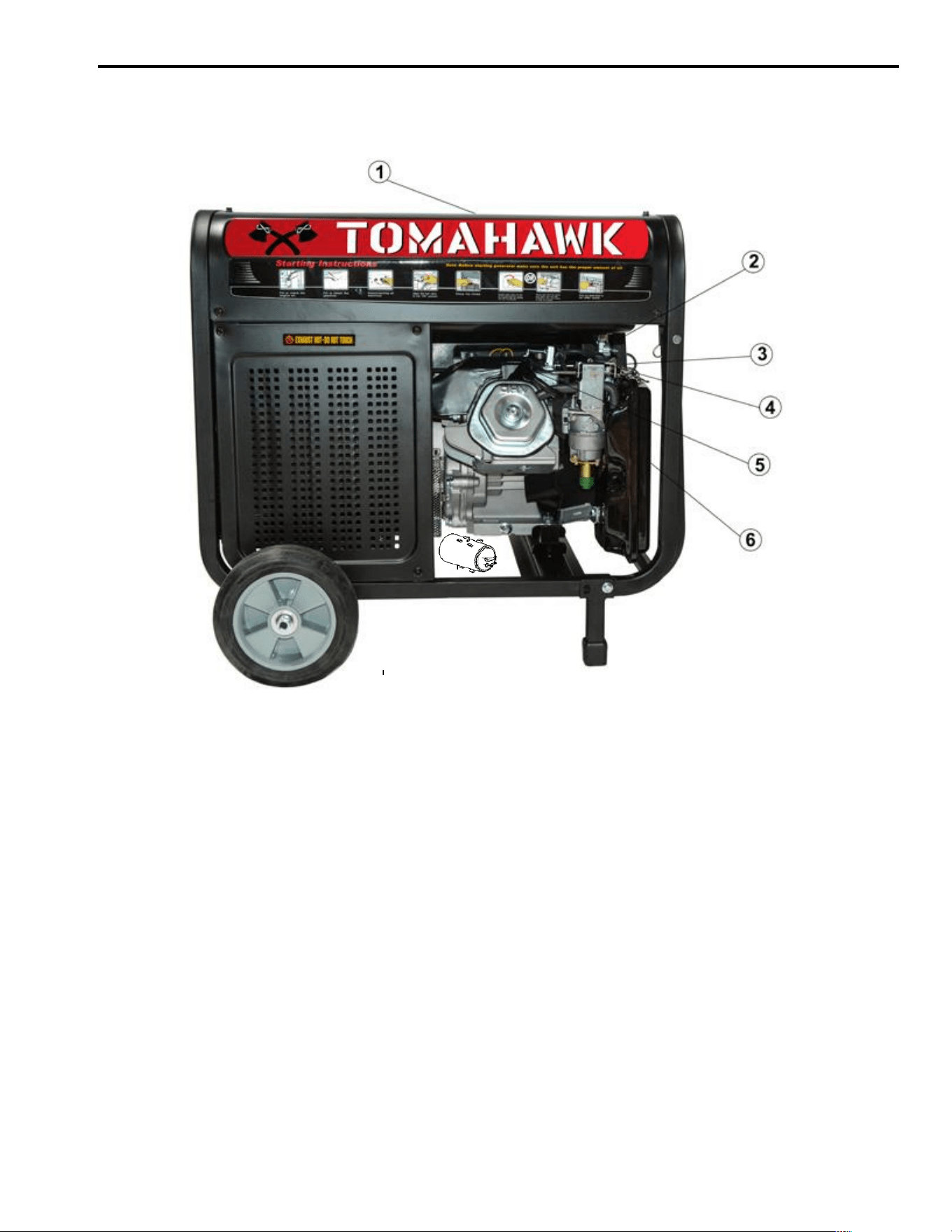
1
- Fuel Gauge: Indicates fuel level.
2
- Fuel Shutoff Valve: Controls the flow of fuel
to the engine.
3
- Recoil Handle: Must pull to start engine for
manual start units.
4
- Air Cleaner Cover: Must remove to service
the air cleaner.
Figure 10
5
- Choke Lever: Must be put in the ON position
to start the engine and returned to the OFF
position once the engine is running.
6
- CARB Canister: Model numbers followed
by a “C” will be equipped with a carbon
canister.
7
- Spark Plug Boot (Wire): Must be removed
when servicing the engine or the spark plug.
FEATURES
CONTROL PANEL FEATURES
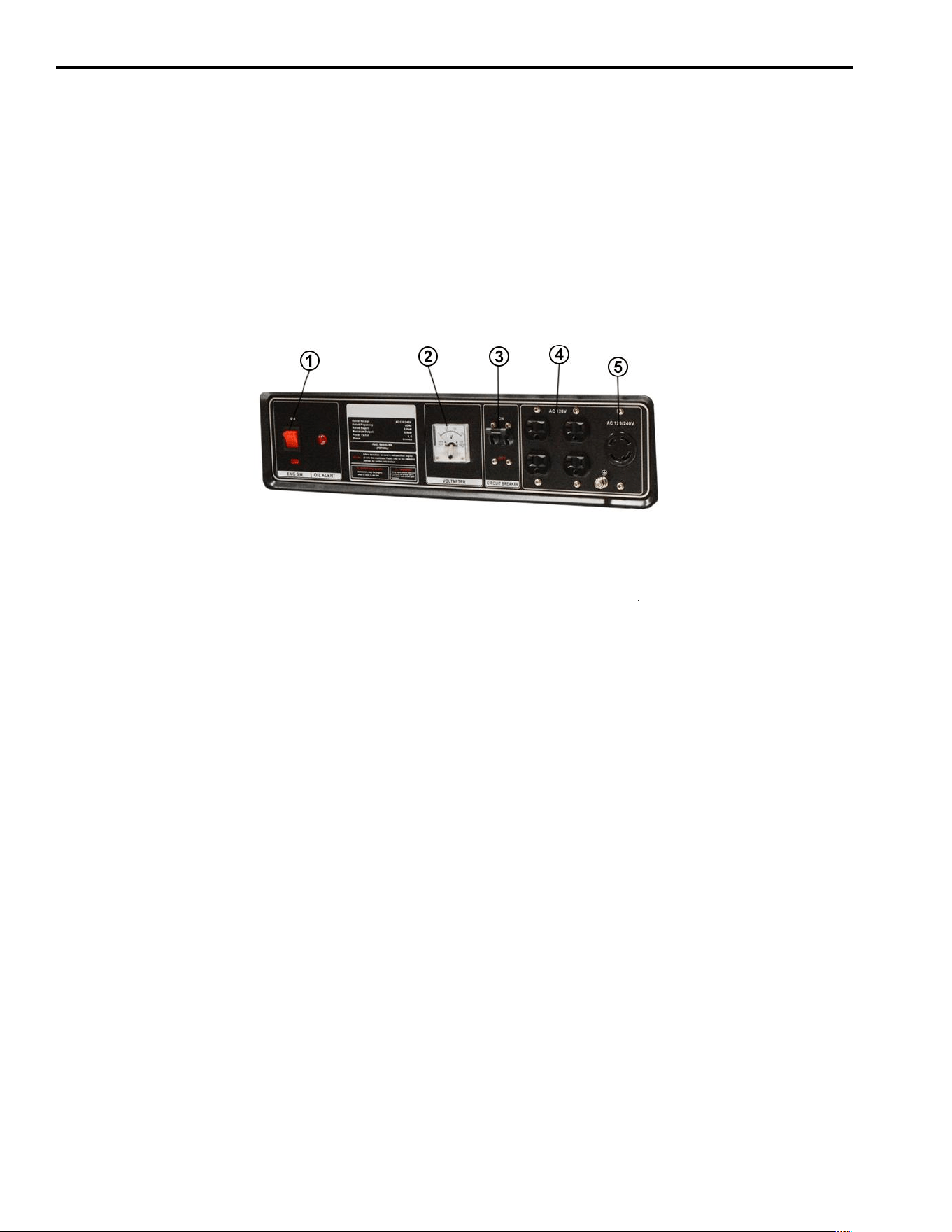
Figure 11 – Control Panel Features
1.
Engine Control Switch (RUN/STOP for
Manual Start Units):
ON - In the ON position, the switch
allows the generator to be started (for
manual start models).
OFF - In the OFF position, the switch
stops the engine.
2.
Hour Meter: Displays how many hours the
generator has been run when under load.
3.
Main Circuit Breaker: The main circuit
breaker controls total output of all outlets to
protect the generator.
4.
240-Volt, 30-Amp: Outlet can supply
either 240V output.
5.
120-Volt, 20-Amp: Each outlet is capable
of carrying a maximum of 20 amps on a
single receptacle or a combination of
both receptacles.
6.
20-Amp Circuit Breakers: Each circuit
breaker limits the current that can be
delivered through the 120-volt duplex outlets
to 20 amps.
7.
Ground Terminal: The ground terminal is
used to ground the generator.
8.
Engine Control Switch (ON/OFF for
Electric Start Units):
ON - When the switch is momentarily
depressed and held in the ON position, the
electric start motor engages and starts the
engine. Once the engine starts, release the
switch. (The switch will automatically go to
the ON position.)
ON - Once started, the switch will remain
in the ON position.
OFF - To stop the engine, move the switch
to the OFF position.
OPERATION
BEFORE STARTING THE
GENERATOR
Before starting the generator, review
Safety on page 7.
Location Selection – Before starting the generator,
avoid exhaust and location hazards by verifying:
You have selected a location to operate the
generator that is outdoors and well ventilated.
You have selected a location with a level and solid
surface on which to place the generator.
You have selected a location that is at least 6 feet
(1.8 m) away from any building, other equipment or
combustible material.
If the generator is located close to a building, make
sure it is not located near any windows, doors
and/or vents.
Weather – Never operate your generator outdoors
during rain, snow or any combination of weather
conditions that could lead to moisture collecting on, in
or around the generator.
Dry Surface – Always operate the generator on a dry
surface free of any moisture.
No Connected Loads – Make sure the generator
has no connected loads before starting it. To ensure
there are no connected loads, unplug any electrical
extension cords that are plugged into the control panel
receptacles.
NOTICE
Starting the generator with loads already applied
to it could result in damage to any appliance being
powered off the generator during the brief start-up
period.
Grounding the Generator – The National Electric
Code (NEC), as well as many local electrical codes,
require the generator to be connected to earth ground
before operating. Before starting the generator, make
sure it is connected to earth ground by connecting
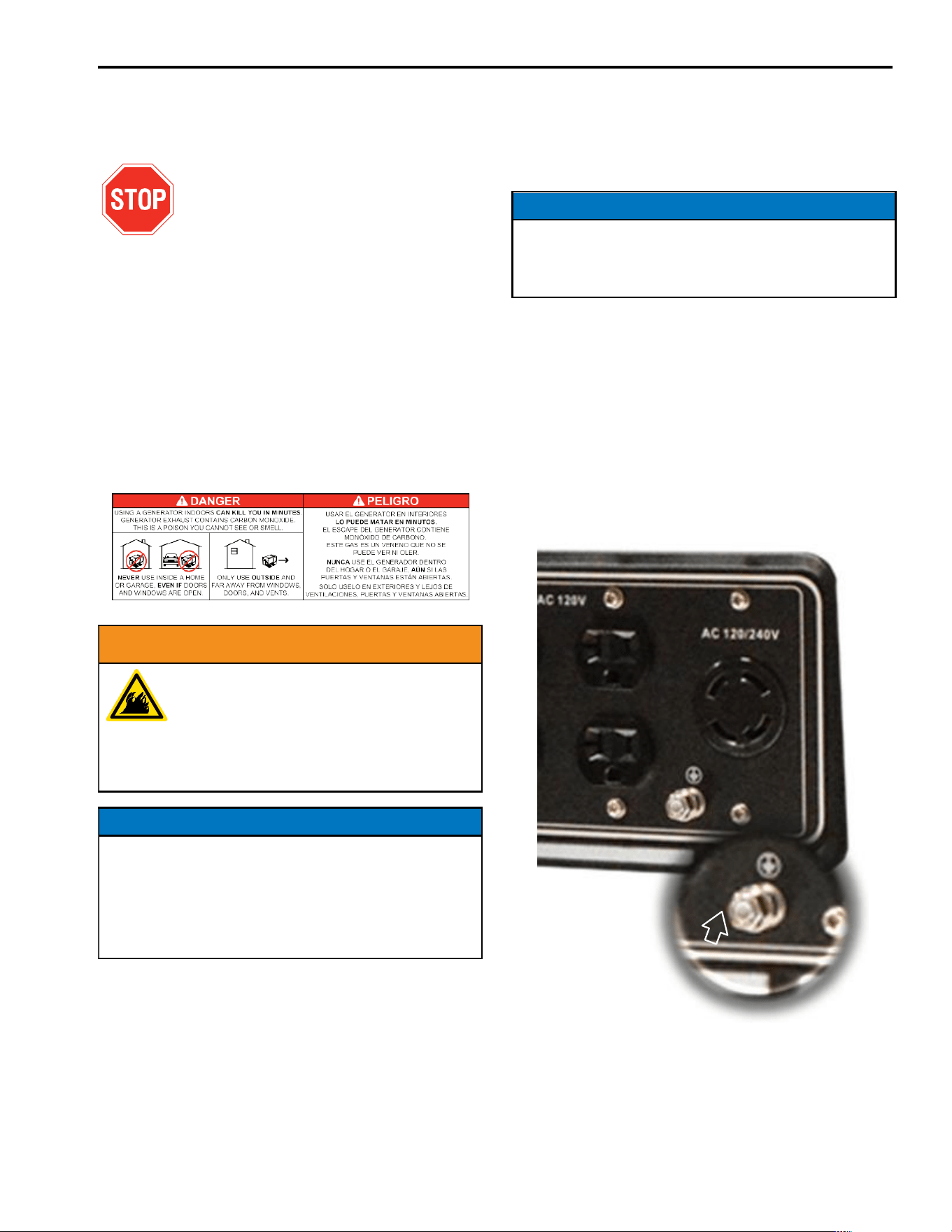
the ground terminal on the control panel (see Figure
12)
to earth ground using copper wire (minimum 10
AWG). Consult a qualified electrician for local grounding
requirements.
Figure 12 – Ground Terminal on the Control Panel
!
WARNING
Always operate the generator on a level
surface. Placing the generator on non-
level surfaces can cause the generator
to tip over, causing fuel and oil to spill.
Spilled fuel can ignite if it comes in
contact with an ignition source such as
a very hot surface.
NOTICE
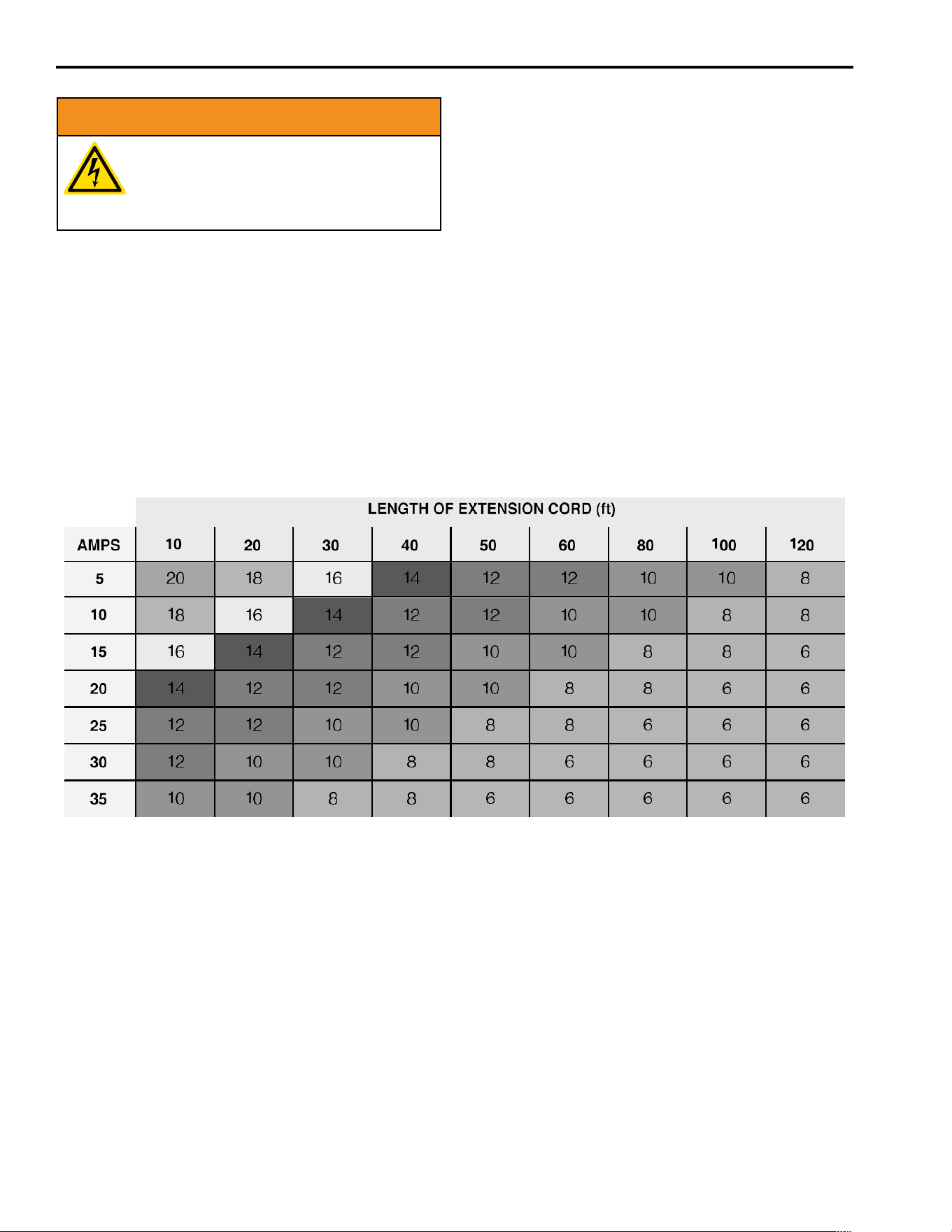
Only operate the generator on a solid, level surface.
Operating the generator on a surface with loose
material such as sand or grass clippings can cause
debris to be ingested by the generator that could:
•
Block cooling vents
•
Block air intake system
OPERATION
!
WARNING
Be sure the generator is properly
connected to earth ground before
operating. The generator must be
grounded to prevent electrical shock
due to faulty appliances.
POWER CORD
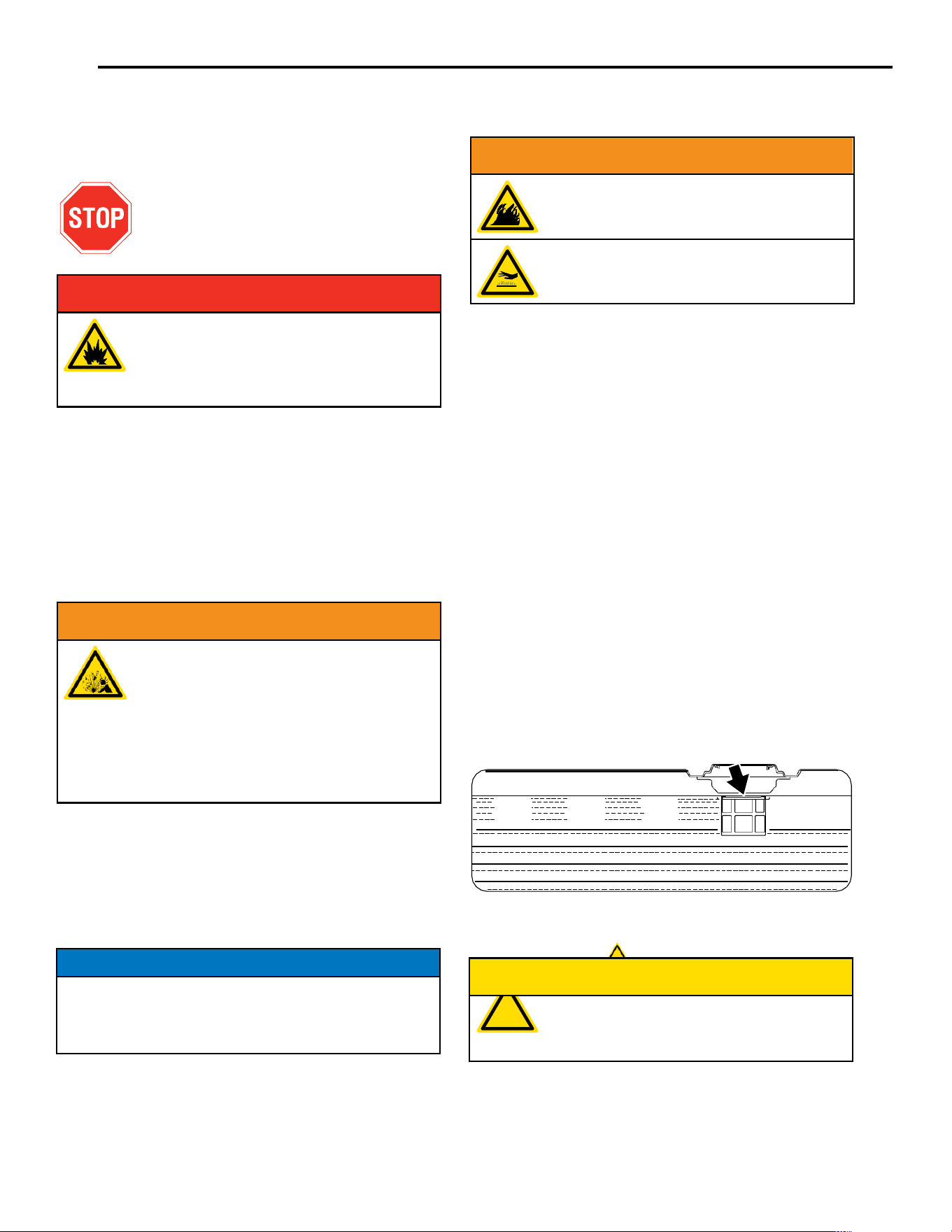
Using Extension Cords
Tomahawk assumes no responsibility for the content
within this table. The use of this table is the
responsibility of the user only. This table is intended
for reference only. The results produced by using this
table are not guaranteed to be correct or applicable in
all situations as the type and construction of cords are
highly variable. Always check with local regulations and
a licensed electrician prior to installing or connecting an
electrical appliance.
Extension Cord Wire Gauge Size
OPERATION
ADDING / CHECKING ENGINE
FLUIDS AND FUEL
Before adding/checking engine
fluids and fuel, review Safety on
page 7.
!
DANGER
Filling the fuel tank with gasoline while
the generator is running can cause
gasoline to leak and come in contact
with hot surfaces that can ignite the
gasoline.
Before starting the generator, always check the level of:
Engine oil
Gasoline in the fuel tank
Once the generator is started and the engine gets
warm, it is not safe to add gasoline to the fuel tank or
engine oil to the engine while the engine is running or
the engine and muffler are hot.
Checking and / or Adding Engine Oil
!
WARNING
Internal pressure can build in the
engine crankcase while the engine
is running. Removing the oil fill plug/
dipstick while the engine is hot can
cause extremely hot oil to spray out
of the crankcase and can severely
burn skin. Allow engine oil to cool for
several minutes before removing the oil
fill plug/dipstick.
The unit as shipped does not contain oil in the
engine. You must add engine oil before starting the
generator for the first time. See Checking Engine
Oil on page 28 and Adding Engine Oil on
page 29 for instructions on checking engine oil
level and the procedure for adding engine oil.
Adding Gasoline to the Fuel Tank
!
WARNING
Never refuel the generator while the
engine is running.
Always turn the engine off and allow
the generator to cool before refueling.
Required Gasoline – Only use gasoline that meets the
following requirements:
Unleaded gasoline only
Gasoline with maximum 10% ethanol added
Gasoline with an 87 octane rating or higher
Filling the Fuel Tank – Follow the steps below to fill the
fuel tank:
1.
Shut off the generator.
2.
Allow the generator to cool down so all surface
areas of the muffler and engine are cool to the
touch.
3.
Move the generator to a flat surface.
4.
Clean area around the fuel cap.
5.
Remove the fuel cap by rotating counterclockwise.
6.
Slowly add gasoline into the fuel tank. Be very
careful not to overfill the tank. The gasoline level
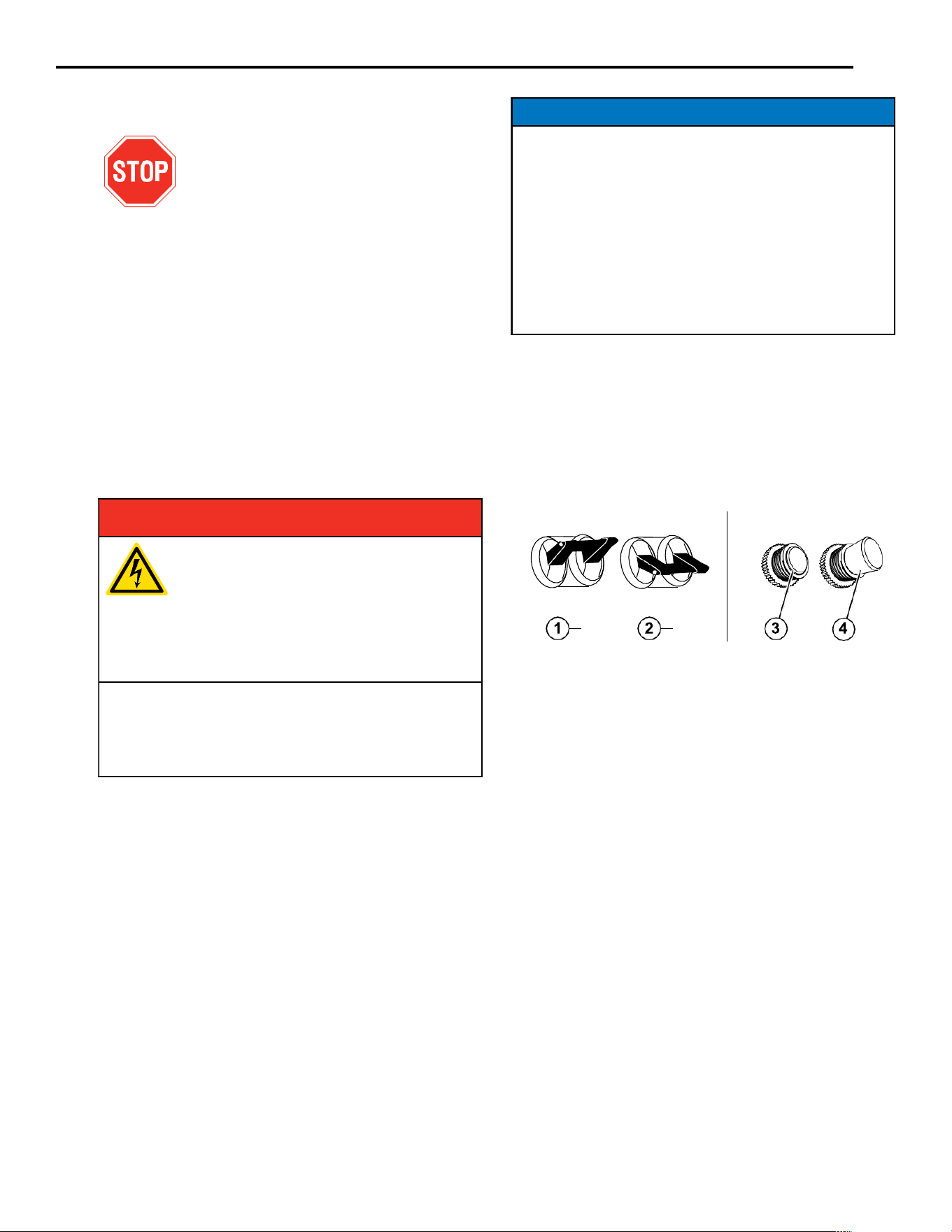
should NOT be higher than the filler neck (see
Figure 15).
7.
Install the fuel cap by rotating clockwise until
you hear a click, indicating the cap is completely
installed.
Figure 15 – Maximum Gasoline Fill Level
NOTICE
The generator does not contain engine oil as shipped.
Attempting to start the engine without adding
engine oil can permanently damage internal engine
components.
!
CAUTION
Avoid prolonged skin contact with
!
gasoline. Avoid prolonged breathing of
gasoline vapors.
OPERATION
STARTING THE GENERATOR
Before starting the generator, review
Safety on page 7.
Before attempting to start the generator, verify the
following:
The engine is filled with engine oil (see Checking
Engine Oil on page 28).
The generator is situated in a proper location (see
Location Selection on page 19).
The generator is on a dry surface (see Weather and
Dry Surface on page 19).
Manually Starting a Generator
All loads are disconnected from the generator (see
No Connected Loads on page 19).
NOTE:
This procedure can also be used on an
electric start generator.
The generator is properly grounded (see Grounding
the Generator on page 19).
1.
Make sure the circuit breakers are properly set (see
Figure 16).
Figure 16 – Breakers
Breaker
Position
NOTICE
The engine is equipped with a low oil shutdown
switch. If the oil level becomes low, the engine will
shut down and will not start until the oil is filled to the
proper level.
Be sure the engine has the proper oil level before
using. Failure to verify that the engine has the proper
oil level could result in engine damage.
Disconnect all loads from the generator before
starting. Failure to verify all loads are disconnected
prior to starting the generator could result in damage
to the connected appliances.
!
DANGER
Never use the generator in a location
that is wet or damp. Never expose the
generator to rain, snow, water spray or
standing water while in use. Protect the
generator from all hazardous weather
conditions. Moisture or ice can cause a
short circuit or other malfunction in the
electrical circuit.
Never operate the generator in an
enclosed area. Engine exhaust
contains carbon monoxide. Only
operate the generator outside and away
from windows, doors and vents.
1 -
240/120V Main
Circuit Breaker
Operating
Position
3 -
120V Circuit
Operating
2 -
240/120V Main
Circuit Breaker
Tripped Position
4 -
120V Circuit
Breaker Tripped
Position
OPERATION
2.
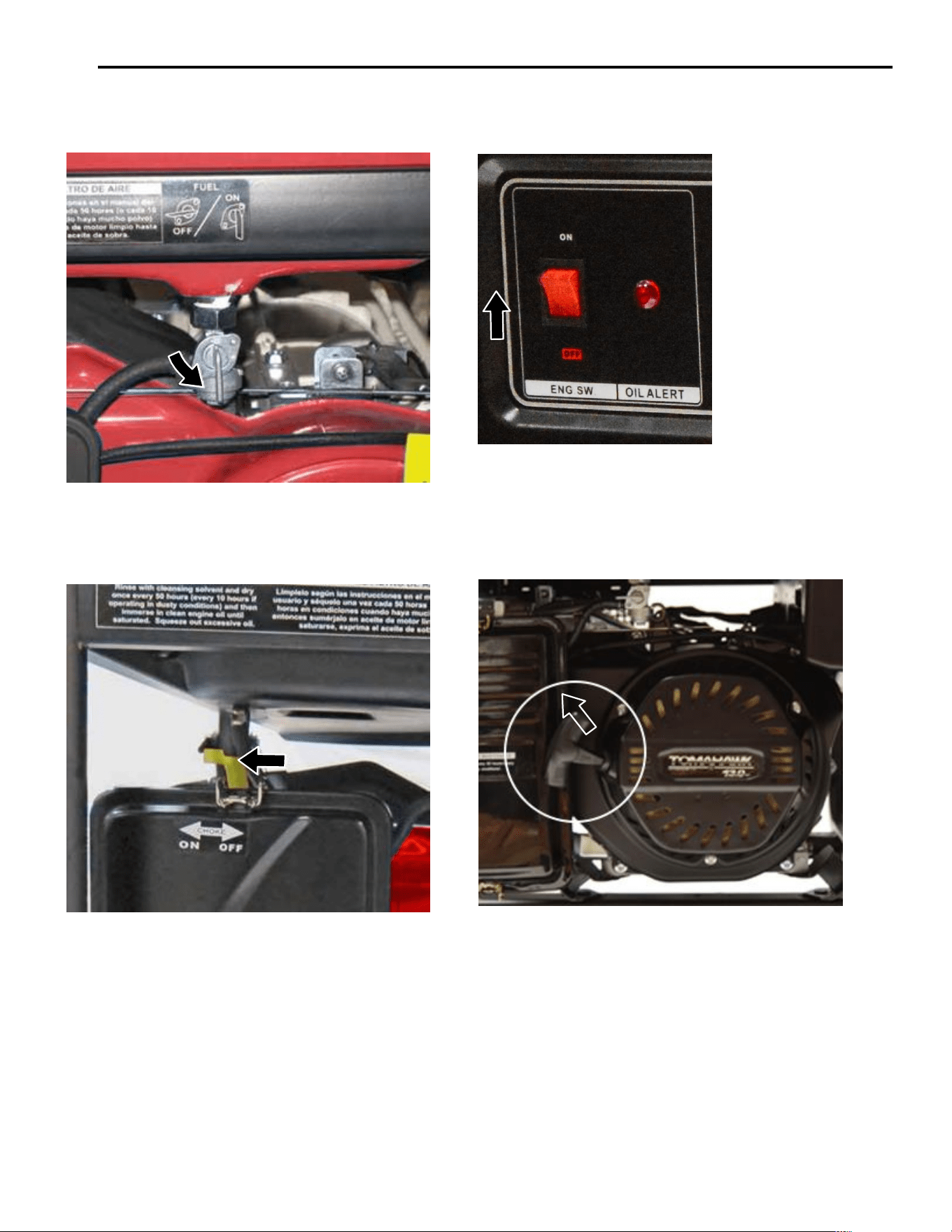
Move the fuel shutoff valve to the ON position (see
Figure 17).
4.
Push the engine control switch into the RUN
position (see Figure 19).
Figure 17 – Fuel Shutoff Valve in the ON Position
3. Move the choke lever to the ON position (see
Figure 18).
Figure 19 – Engine Control Switch
5.
Firmly grasp and pull the recoil handle slowly until
you feel increased resistance. At this point, apply a
rapid pull while pulling up and slightly away from the
generator (see Figure 20).
Figure 18 – Choke Lever
Figure 20
6.
As the engine starts and stabilizes, gradually move
the choke lever back to the OFF position.
OPERATION
Starting an Electric Start Generator
1.
Verify the battery is properly installed and both
battery cables are attached (see Installing the
Battery (Electric Start Generators Only) on page
15).
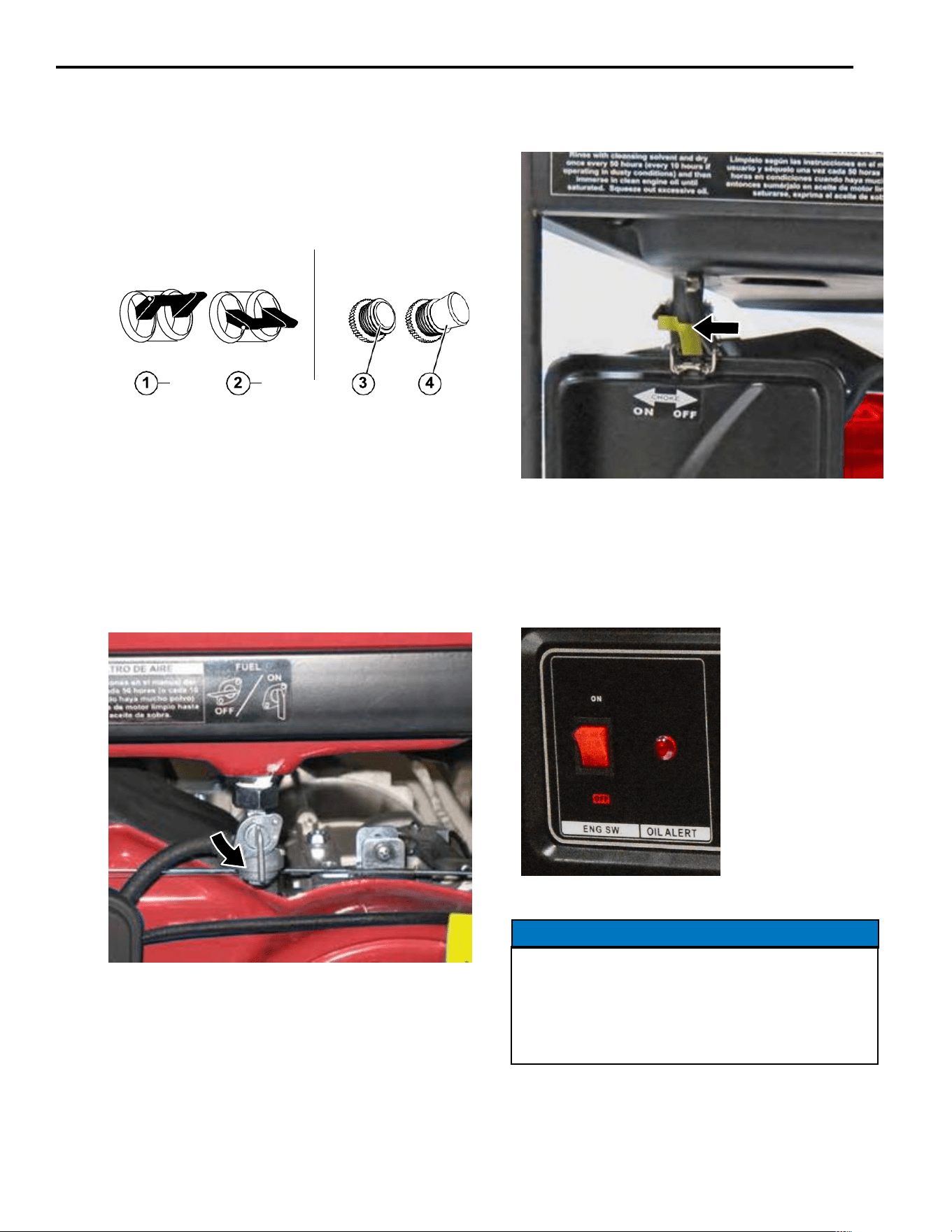
2.
Make sure the circuit breakers are properly set (see
Figure 21).
4.
Move the choke lever to the ON position (see
Figure 23).
Figure 21 – Circuit Breakers
1 - 240/120V Main
Circuit Breaker
Operating
Position
2 - 240/120V Main
Circuit Breaker
Tripped Position
3
- 120V Circuit
Breaker
Operating
Position
4
- 120V Circuit
Breaker Tripped
Position
Figure 23 – Choke Lever
5.
Push and hold the engine control switch in the ON
position until the engine starts. Once the engine
starts, release the engine control switch; the
3. Move the fuel shutoff valve to the ON position (see
Figure 22).
switch will automatically move into the ON position
(see Figure 24).
Figure 24 – Engine Control Switch
Figure 22 – Fuel Shutoff Valve in the ON Position
6. As the engine starts and stabilizes, gradually move
the choke lever back to the OFF position.
NOTICE
Failure to release the engine control switch once
the engine starts could result in damage to the
generator.
Never push the engine control switch to the ON
position while the engine is running; this could
damage the generator.

OPERATION
NOTE:
NOTE:
If the engine fails to start after 5 seconds,
release the engine control switch. Let the
generator sit idle for 15 seconds and then
repeat step 5. If the cranking speed drops
after each unsuccessful attempt, then the
battery may not be adequately charged.
Manually start the generator as instructed
inManuallyStartingaGeneratoronpage
23.
The electric start generator is equipped
with a battery charging feature. Once
the engine is running, a small charge is
supplied to the battery via the battery
cables and will slowly recharge the battery.
STOPPING THE GENERATOR
Normal Operation
During normal operation, use the following steps to stop
your generator:
1.
Remove any connected loads from the control
panel receptacles.
2.
Allow the generator to run at “no load” to reduce
and stabilize engine and alternator temperatures.
3.
Turn the fuel shutoff valve to the OFF position. This
will automatically run the fuel out of the carburetor
and turn itself off, or you can just turn off the engine
control switch.
During an Emergency
If there is an emergency and the generator must be
stopped quickly, push the engine control switch to the
OFF position immediately.
MAINTENANCE
MAINTENANCE
Before performing maintenance
on the generator, review Safety on
page 7 and the following safety
messages.
!
WARNING
Avoid accidentally starting the
!
generator during maintenance by
removing the spark plug boot from
the spark plug. For electric start
generators, also disconnect the battery
cables from the battery (disconnect the
black negative (-) cable first) and place
the cables away from the battery posts
to avoid arcing.
Allow hot components to cool to
the touch prior to performing any
maintenance procedure.
Internal pressure can build in the
engine crankcase while the engine
is running. Removing the oil fill plug/
dipstick while the engine is hot can
cause extremely hot oil to spray out
of the crankcase and can severely
burn skin. Allow engine oil to cool for
several minutes before removing the oil
fill plug/dipstick.
Always perform maintenance in a well-
ventilated area. Gasoline fuel and fuel
vapors are extremely flammable and
can ignite under certain conditions.
Table 1: Maintenance Schedule - Owner Performed
Maintenance Schedule
!
WARNING
Failure to perform periodic
!
maintenance or not following
maintenance procedures can cause
the generator to malfunction and could
result in death or serious injury.
NOTICE
Periodic maintenance intervals vary depending
on generator operating conditions. Operating the
generator under severe conditions, such as sustained
high-load, high-temperature, or unusually wet or
dusty environments, will require more frequent
periodic maintenance. The intervals listed in the
maintenance schedule should be treated only as a
general guideline.
Following the maintenance schedule is important
to keep the generator in good operating condition.
The following is a summary of maintenance items by
periodic maintenance intervals.
Maintenance
Item
Before Every
Use
After First 20
Hours or First
Month of Use
After 50 Hours
of Use or Every
3 Months
After 100 Hours
of Use or Every
6 Months
After 300 Hours
of Use or Every
Year
Engine Oil
Check Level
Change
Change
–
–
Cooling
Features
Check/Clean
–
–
–
–
Air Filter
Check
–
Clean
1
–
Replace
Spark Plug
–
–
–
Check/Clean
Replace
Spark Arrestor
–
–
–
Check/Clean
–
1
Service more frequently if operating in dry and dusty conditions.
!
CAUTION
Avoid skin contact with engine oil or
gasoline. Prolonged skin contact with
engine oil or gasoline can be harmful.
Frequent and prolonged contact with
engine oil may cause skin cancer.
Take protective measures and wear
protective clothing and equipment.
Wash all exposed skin with soap and
water.
MAINTENANCE
Table 2: Maintenance Schedule – Authorized Tomahawk Service Dealer Performed
Maintenance
Item
Before Every
Use
After First 20
Hours or First
Month of Use
After 50 Hours
of Use or Every
3 Months
After 100 Hours
of Use or Every
6 Months
After 300 Hours
of Use or Every
Year
Valve Clearance
–
–
–
–
Check/Adjust
Fuel Filter
–
–
–
Check/Clean
–
Idle Speed
–
–
–
–
Check/Adjust
ENGINE OIL MAINTENANCE
Engine Oil Specification
1.
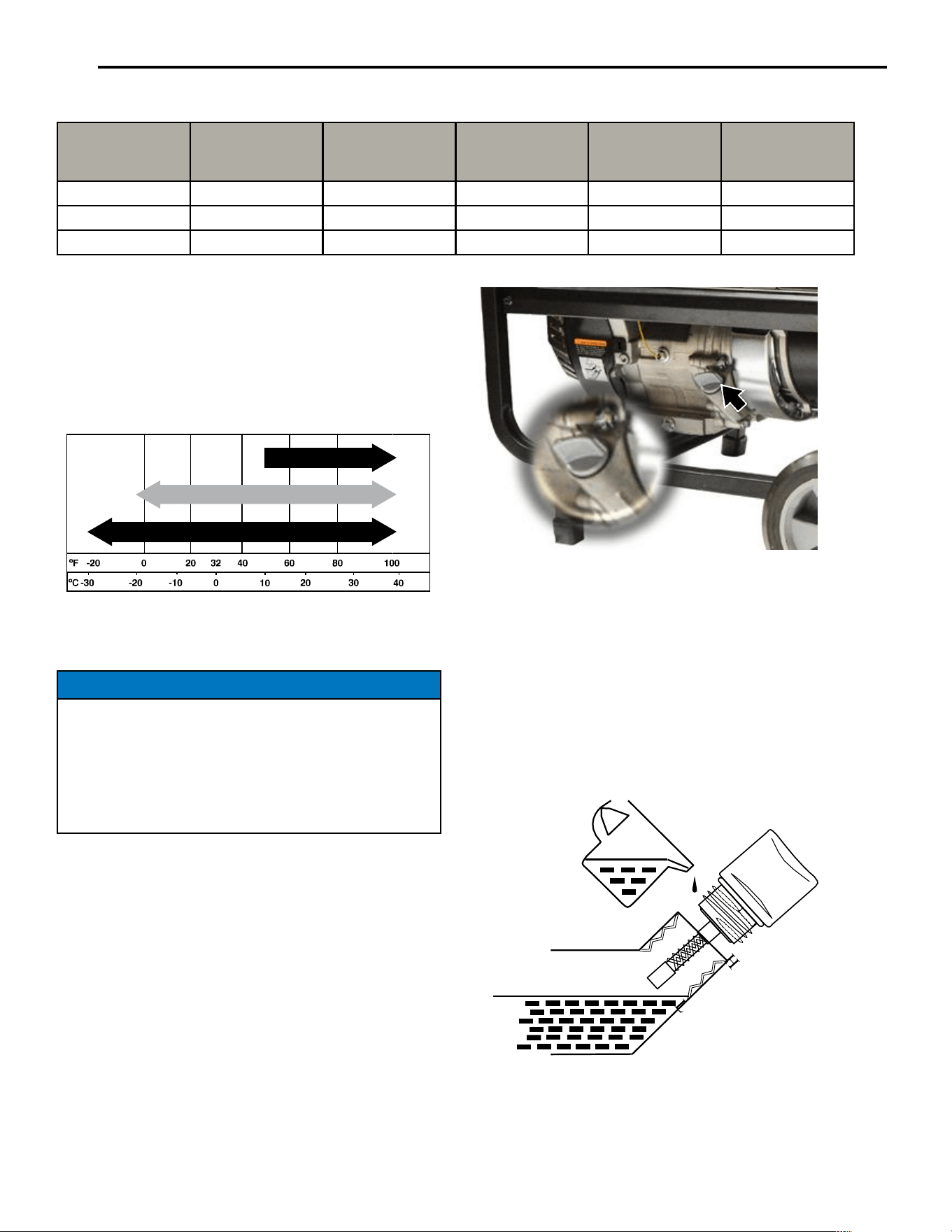
Only use the engine oil specified in Figure 25.
2.
Only use 4-stroke/cycle engine oil. NEVER
USE 2-STROKE/CYCLE OIL. Synthetic oil is an
acceptable substitute for conventional oil.
Figure 25 – Recommended Oil
Checking Engine Oil
NOTICE
Always maintain proper engine oil level. Failure to
maintain proper engine oil level could result in severe
damage to the engine and/or shorten the life of the
engine.
Always use the specified engine oil. Failure to use the
specified engine oil can cause accelerated wear
and/or shorten the life of the engine.
Engine oil level should be checked before every use.
1.
Always operate or maintain the generator on a flat
surface.
2.
Stop engine if running.
3.
Let engine sit and cool for several minutes (allow
crankcase pressure to equalize).
4.
With a damp rag, clean around the oil fill plug/
dipstick.
5.
Remove oil fill plug/dipstick (see Figure 26).
Figure 26 – Oil Fill Plug/Dipstick
6.
Check oil level:
When checking the engine oil, remove the oil fill
plug/dipstick and wipe it clean. Thread the oil fill
plug/dipstick all the way back in and then remove
and check the oil level on the oil fill plug/dipstick.
Acceptable Oil Level – Oil is visible on the cross-
hatches between the H and L lines on the oil fill
plug/dipstick (see Figure 27).
Low Oil – Oil is below the L line on the oil fill plug/
dipstick.
Figure 27 – Checking Oil Level
SAE 30
Conventional 10W-30
5W-30
MAINTENANCE
Adding Engine Oil
1.
Always operate or maintain the generator on a flat
surface.
2.
Stop engine if running.
3.
Let engine sit and cool for several minutes (allow
crankcase pressure to equalize).
4.
Thoroughly clean around the oil fill plug/dipstick.
5.
Remove oil fill plug/dipstick and wipe clean.
6.
Select the proper engine oil as specified in Figure
25.
7.
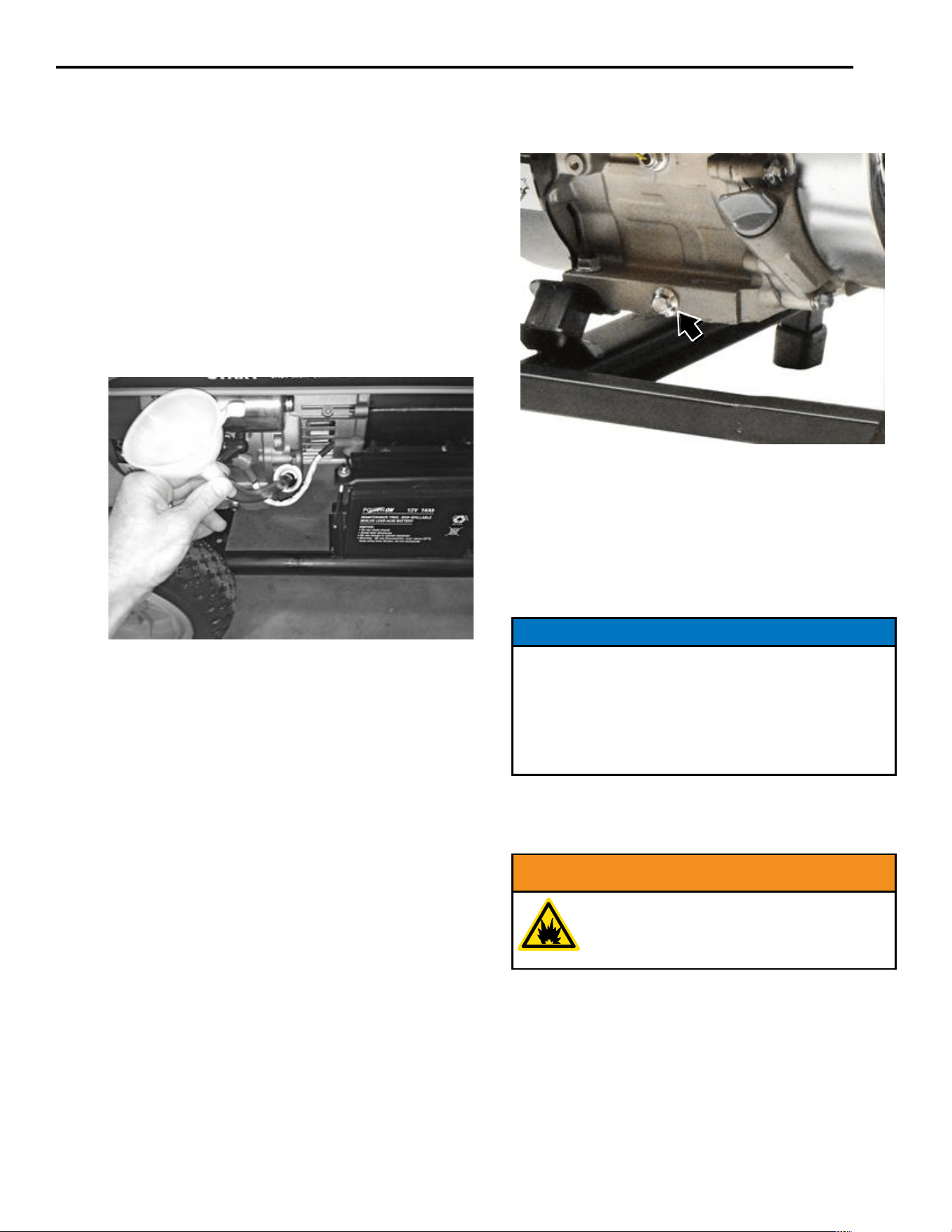
Using the supplied funnel and tube, slowly add
engine oil to the engine. Stop frequently to check
the level to avoid overfilling (see Figure 28).
Figure 28 – Adding Engine Oil
8.
Continue to add oil until the oil is at the correct
level. See Checking Engine Oil on page 28.
Changing Engine Oil
1.
Stop the engine.
2.
Let engine sit and cool for several minutes (allow
crankcase pressure to equalize).
3.
Place oil pan (or suitable container) under the oil
drain plug.
4.
With a damp rag, thoroughly clean around the oil
drain plug.
5.
Remove the oil drain plug (see Figure 29). Once
removed, place the oil drain plug on a clean
surface.
Figure 29 – Oil Drain Plug
6.
Remove the oil fill plug so the oil can drain more
easily from the oil drain port.
7.
Allow oil to completely drain.
8.
Replace oil drain plug.
9.
Fill crankcase with oil following the steps outlined in
Adding Engine Oil on page 29.
NOTICE
Never dispose of used engine oil by dumping the
oil into a sewer, on the ground, or into groundwater
or waterways. Always be environmentally
responsible. Follow the guidelines of the EPA or
other governmental agencies for proper disposal
of hazardous materials. Consult local authorities or
reclamation facility.
10.
Dispose of used engine oil properly.
AIR FILTER MAINTENANCE
!
WARNING
Never use gasoline or other flammable
solvents to clean the air filter. Use only
household detergent soap to clean the
air filter.
Cleaning the Air Filter
The air filter must be cleaned after every 50 hours of
use or 3 months (frequency should be increased if
generator is operated in a dusty environment).
1.
Turn off the generator and let it cool for several
minutes if running.
MAINTENANCE
2.
Move the generator to a flat, level surface.
3.
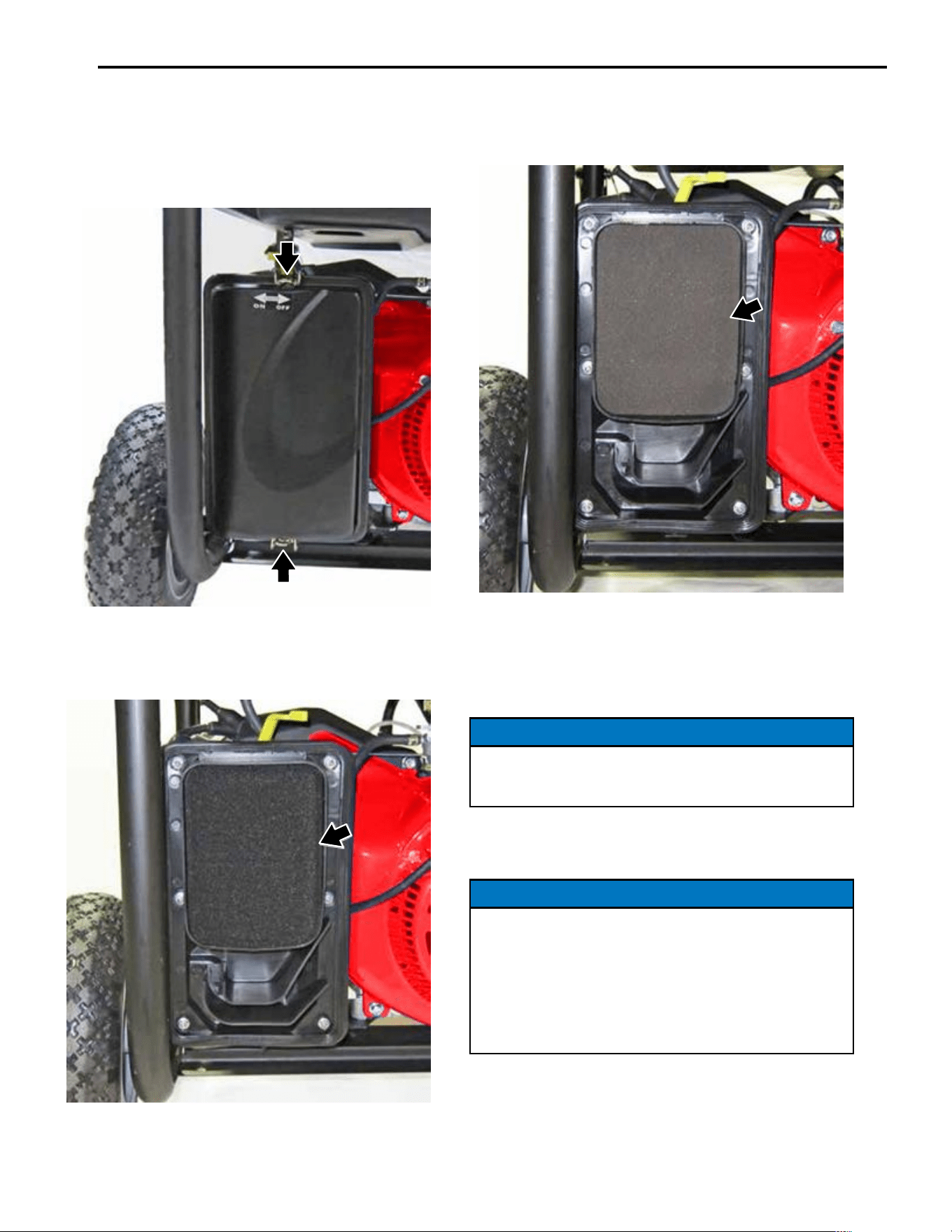
Unclip the clips on the top and bottom of the air
filter cover (see Figure 30) and remove the air filter
cover.
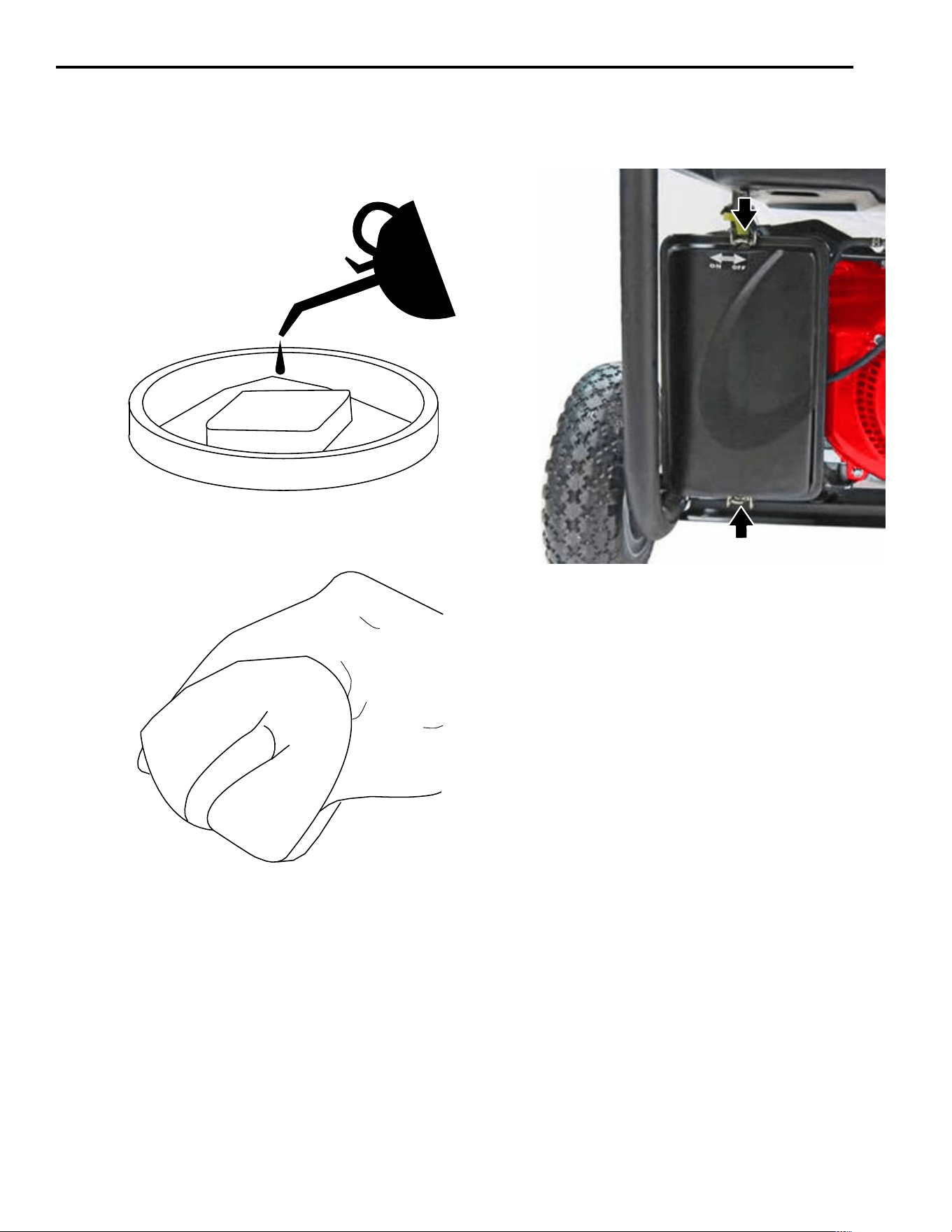
5.
Remove the gray fine inside air filter (see Figure
32).
Figure 30 – Removing Air Filter Cover
4. Remove the black coarse outside air filter (see
Figure 31).
Figure 32 – Removing Fine Inside Air Filter
6.
Wash the foam air filter elements by submerging
the elements in a solution of household detergent
soap and warm water. Slowly squeeze the foam to
thoroughly clean.
NOTICE
NEVER twist or tear the foam air filter element
during cleaning or drying. Only apply slow but firm
squeezing action.
7.
Rinse in clean water by submerging the air filter
elements in fresh water and applying a slow
squeezing action.
NOTICE
Never dispose of soap cleaning solution used to
clean the air filter by dumping the solution into
a sewer, on the ground, or into groundwater or
waterways. Always be environmentally responsible.
Follow the guidelines of the EPA or other
governmental agencies for proper disposal of
hazardous materials. Consult local authorities or
reclamation facility.
8.
Dispose of used soap cleaning solution properly.
Figure 31 – Removing Coarse Outside Air Filter
MAINTENANCE
9.
Dry the air filter elements by again applying a slow
firm squeezing action.
10.
Once the air filters are dry, coat the air filters with
clean engine oil (see Figure 33).
14.
Install the air filter cover by clipping the clips on the
top and bottom of the air filter assembly (see Figure
35).
Figure 33
11.
Squeeze the filters to remove any excess oil (see
Figure 34).
Figure 35 – Installation of Air Filter Cover
Figure 34
12.
Install the gray fine inside air filter into the air filter
housing first.
13.
Install the black coarse outside air filter on top of
the fine filter.
MAINTENANCE
SPARK PLUG MAINTENANCE
The spark plug must be checked and cleaned after
every 100 hours of use or 6 months and must be
replaced after 300 hours of use or every year.
1.
Stop the generator and let it cool for several
minutes if running.
2.
Move the generator to a flat, level surface.
3.
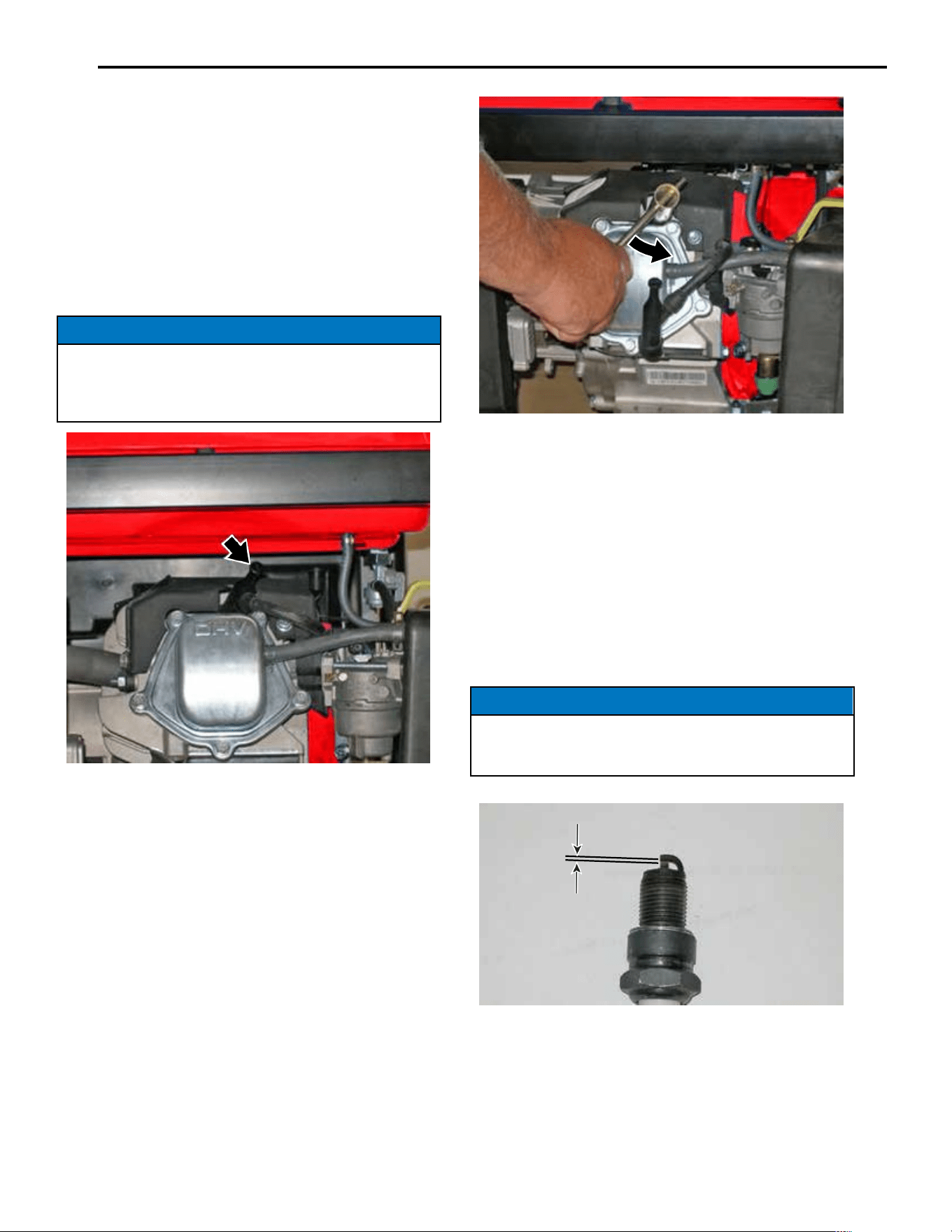
Remove the spark plug boot by firmly pulling the
plastic spark plug boot handle directly away from
the engine (see Figure 36).
NOTICE
Never apply any side load or move the spark plug
laterally when removing the spark plug. Applying a
side load or moving the spark plug laterally may crack
and damage the spark plug boot.
Figure 36 – Removal of Spark Plug Boot
4.
Clean area around the spark plug.
5.
Using the 13/16" spark plug socket wrench
provided, remove the spark plug from the cylinder
head (see Figure 37).
Figure 37 – Removing Spark Plug
6.
Place a clean rag over the opening created by the
removal of the spark plug to make sure no dirt can
get into the combustion chamber.
7.
Inspect the spark plug for:
Cracked or chipped insulator
Excessive wear
Spark plug gap (the acceptable limit of 0.024 –
0.032 in. [0.60 – 0.80 mm]) (see Figure 38).
If the spark plug fails any one of the conditions
listed above, replace the plug with a Champion
RN9YC plug or equivalent.
NOTICE
Only use the recommended spark plug (Champion
RN9YC or equivalent). Using a non-recommended
spark plug could result in damage to the engine.
Figure 38 – Spark Plug Gap Requirements
MAINTENANCE
8.
Install the spark plug by carefully following the steps
outlined below:
a - Carefully insert the spark plug back into the
cylinder head. Hand-thread the spark plug until
it bottoms out.
b - Using the 13/16" spark plug socket wrench
provided, turn the spark plug to ensure it is fully
seated.
c - Replace the spark plug boot, making sure the
boot fully engages the spark plug’s tip.
Recommended Spark Plug Replacement:
AutoLite
63
Champion
RN9YC
Bosch
WR7DS
Torch
F6RTC
BATTERY SERVICE
To ensure the battery remains charged, the generator should be
started every 2 to 3 months and run for a minimum of 15 minutes.
If the generator is stored more than a year without running, a
battery charger may be needed to recharge the battery.
Battery Replacement
1.
Remove the spark plug wire from spark plug.
2.
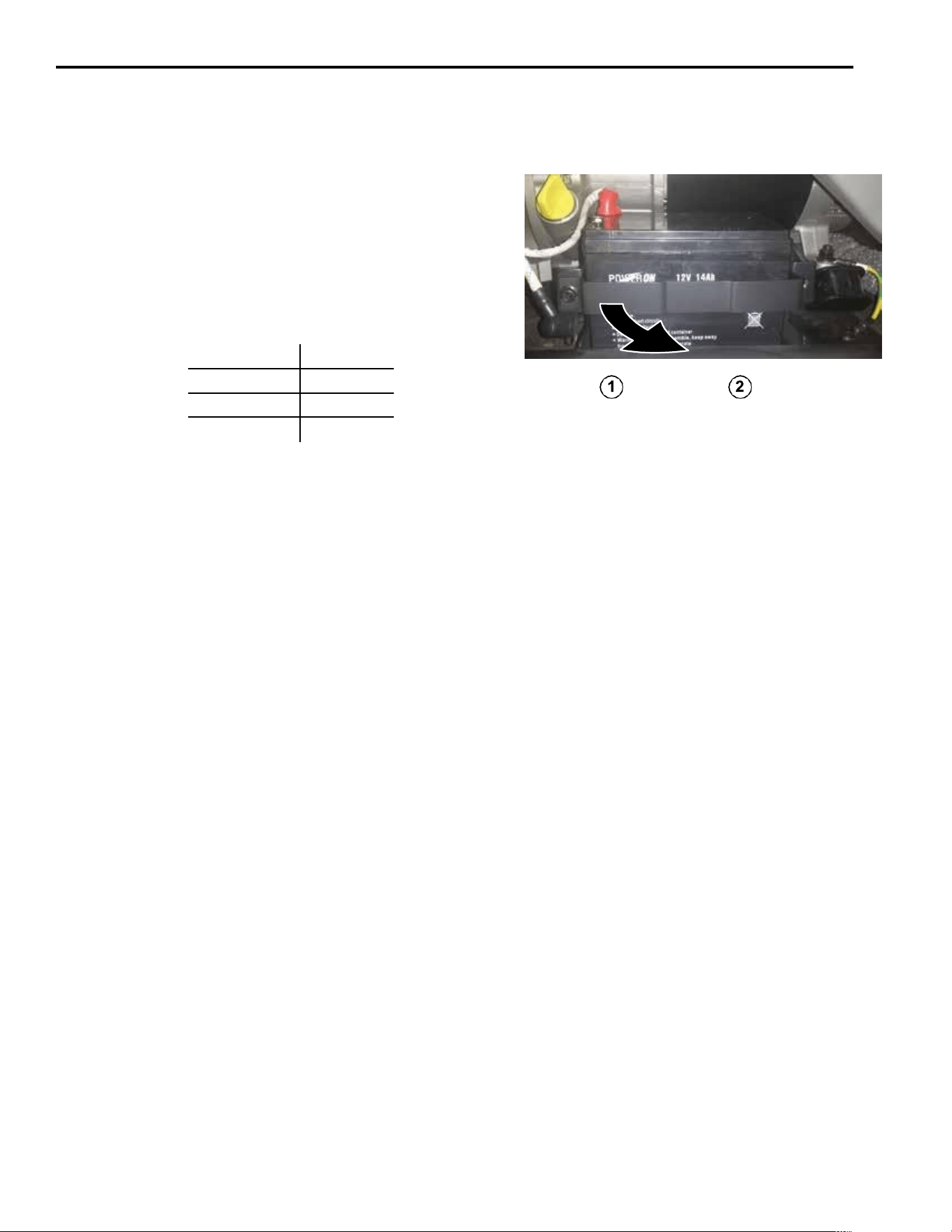
Loosen and remove the bolt on the battery hold-
down plate and swing the plate out (see Figure 40).
Figure 40
1 - Bolt 2 - Battery Hold-
Down Plate
3.
Tip the battery forward slightly to access battery
cables.
4.
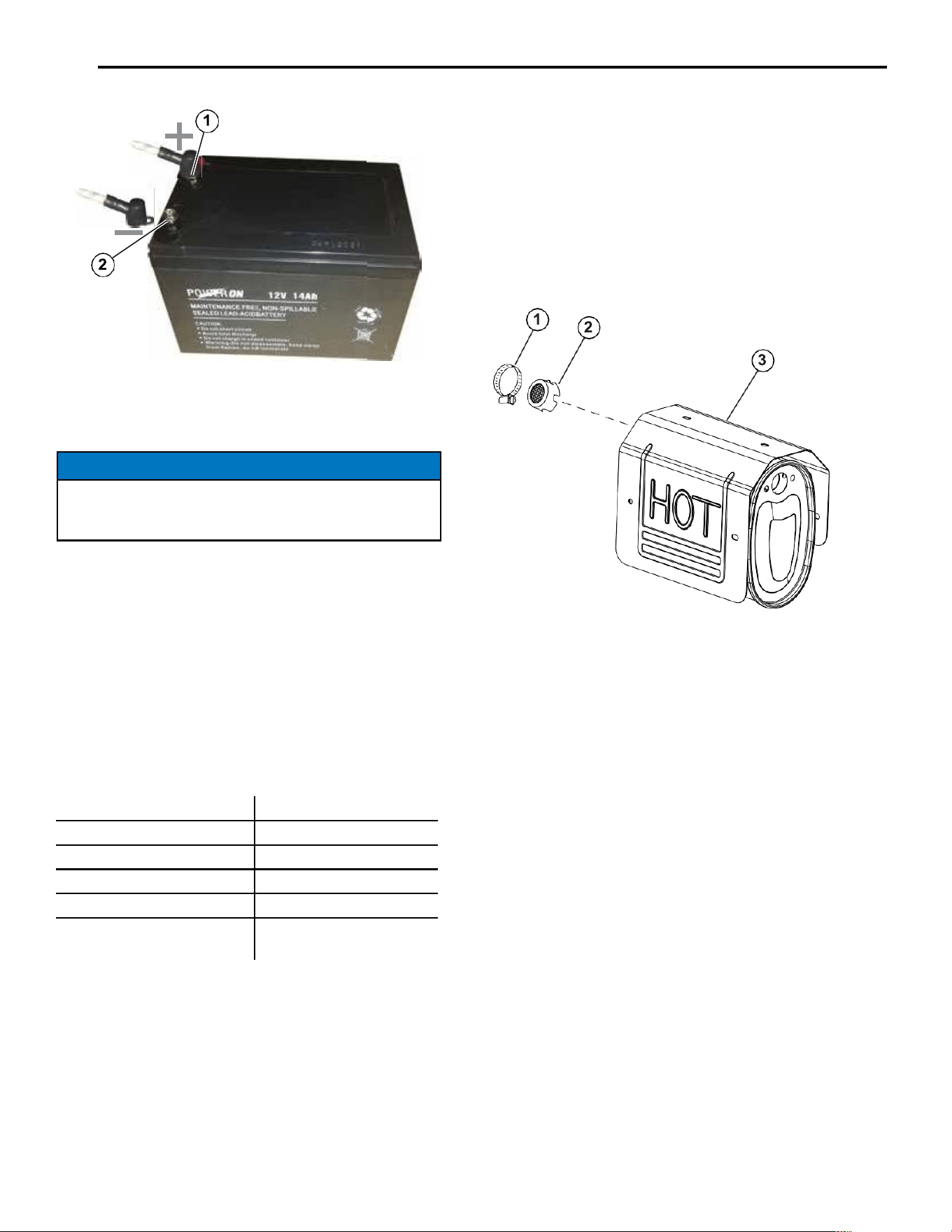
Disconnect the black negative (-) battery cable from
the battery first.
5.
Disconnect the red positive (+) battery cable
second and remove the battery.
Figure 39 – GFCI Outlet
1 - Test Button 2 - Reset Button
3.
The reset button should pop out and there will be
no power from the outlets. If the reset button does
not pop out, the GFCI outlet is not working correctly
and must be repaired before the generator can be
operated.
4.
Press the reset button to restore power to the outlet.
MAINTENANCE
CLEANING THE SPARK
ARRESTOR
Check and clean the spark arrestor after every 100
hours of use or 6 months.
1.
Stop the generator and let it cool for several
minutes if running.
2.
Move the generator to a flat, level surface.
3.
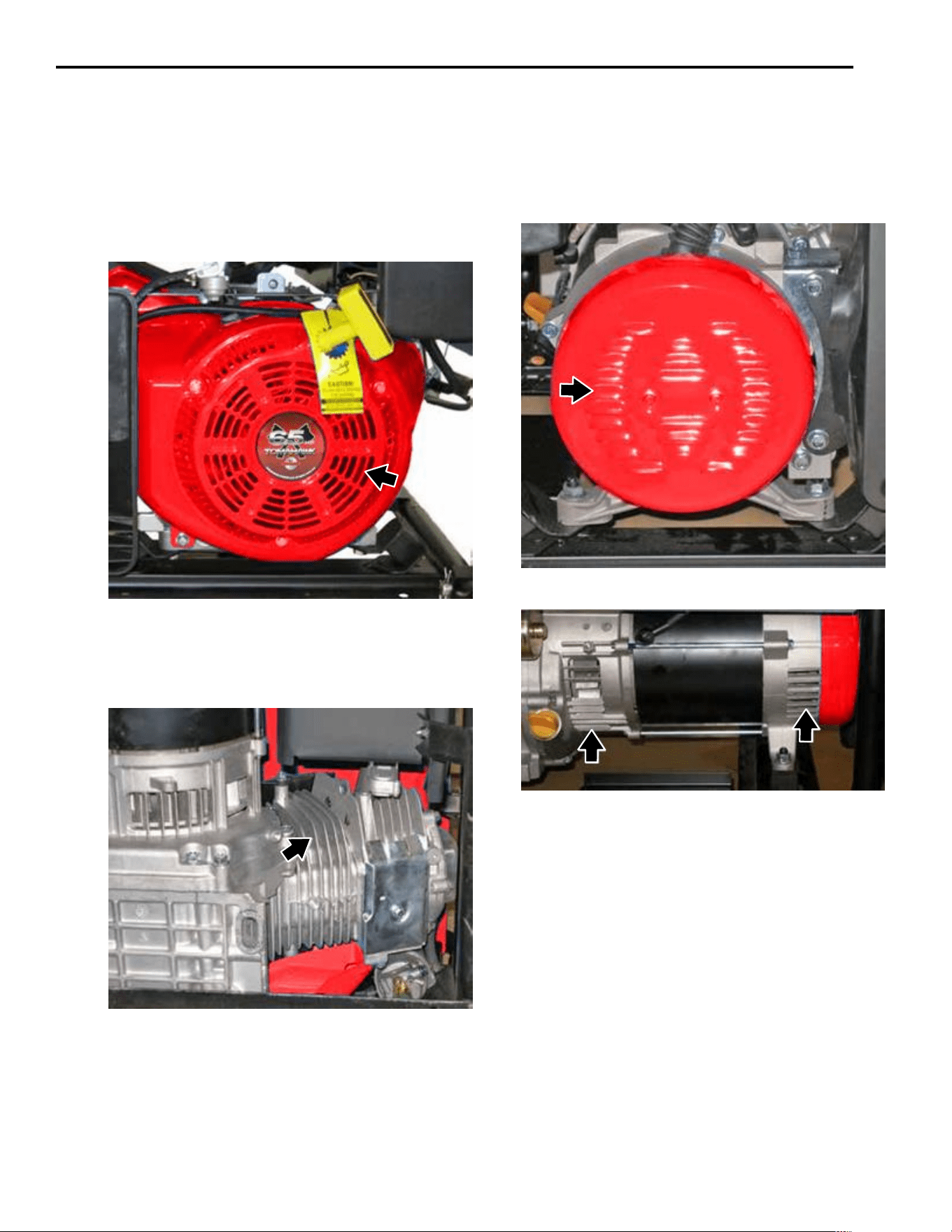
Using a flathead screwdriver, loosen the spark
arrestor band clamp (see Figure 42).
Figure 41
1 - Red Positive (+)
Battery Cable
2 - Black Negative (-)
Battery Cable
NOTICE
Dispose of the used battery properly according to
the guidelines established by your local or state
government.
6.
Install the new battery into the generator frame.
7.
Connect the red positive (+) battery cable to the
battery first.
8.
Connect the black negative (-) battery cable to the
battery second.
9.
Install the battery hold-down plate using the nuts
Figure 42 – Spark Arrestor Assembly
removed in step 2.
10.
Install the spark plug wire onto spark plug.
The battery is the same as a motorcycle/utility battery.
1
- Spark Arrestor
Band Clamp
2
- Spark Arrestor
Screen
3
- Muffler
4.
Slide the spark arrestor band clamp off the spark
arrestor screen.
5.
Pull the spark arrestor screen off the muffler
exhaust pipe.
6.
Using a wire brush, remove any dirt and debris that
may have collected on the spark arrestor screen.
7.
If the spark arrestor screen shows signs of wear
(rips, tears or large openings in the screen), replace
the spark arrestor screen.
8.
Install the spark arrestor components in the
following order:
a - Place spark arrestor screen over the muffler
exhaust pipe. Push on the screen until it fully
bottoms out.
b - Place the spark arrestor band clamp over the
screen and tighten with a flathead screwdriver.
Type
14L-A2
Tomahawk Model No.
100284
Batteries Plus Model No.
WKPC12-14NB
Volts
12
Amp
14
Dimensions (L x H x W)
6.0 x 3.75 x 3.75 in.
(15.2 x 9.4 x 9.4 cm)
MAINTENANCE
CLEANING THE GENERATOR
It is important to inspect and clean the generator before
every use.
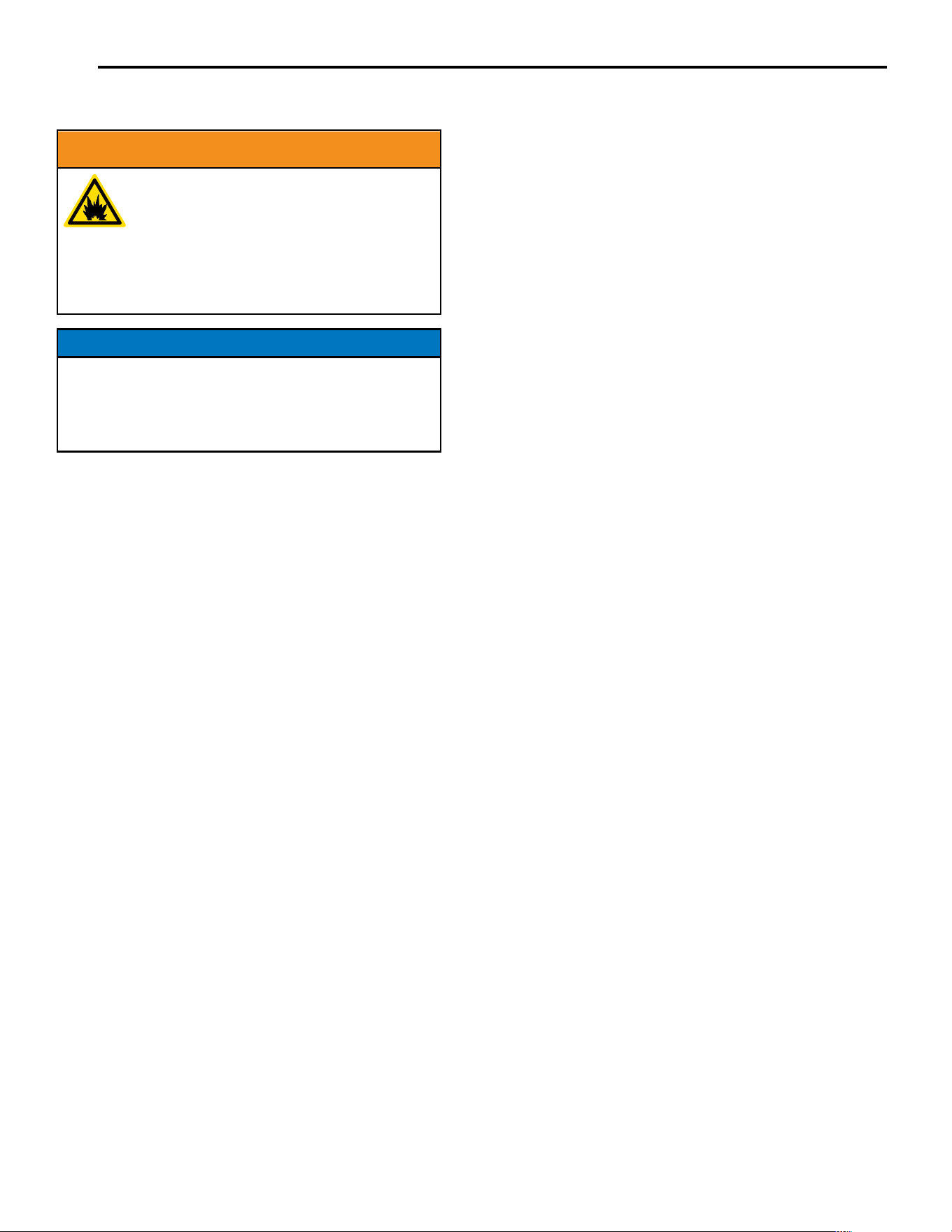
Clean All Engine Air Inlet and Outlet Ports – Make
sure all engine air inlet and outlet ports are clean of any
dirt and debris to ensure the engine does not run hot
(see Figure 43).
Clean All Alternator Cooling Air Inlets and Exhaust
Ports – Make sure the cooling air inlets and exhaust
ports of the alternator are free of any debris and
obstructions. Use a vacuum cleaner to remove dirt and
debris stuck in the cooling air inlets and exhaust ports
(see Figure 45 and Figure 46).
Figure 45 – Alternator Cooling Air Inlet and Outlet Port
Figure 43 – Engine Air Inlet and Outlet Ports
Clean All Engine Cooling Fins – Use a damp rag and
a brush to loosen and remove all dirt on or around the
engine’s cooling fins (see Figure 44).
Figure 46 – Alternator Cooling Air Inlet and Outlet Port
General Cleaning of the Generator – Use a damp rag
to clean all remaining surfaces.
Figure 44 – Engine Cooling Fins
MAINTENANCE
STORAGE
!
WARNING
Never store a generator with fuel in the
tank indoors or in a poorly ventilated
area where the fumes can come in
contact with an ignition source such
as a: 1) pilot light of a stove, water
heater, clothes dryer or any other gas
appliance; or 2) spark from an electric
appliance.
NOTICE
Gasoline stored for as little as 60 days can go bad,
causing gum, varnish and corrosive buildup in fuel
lines, fuel passages and the engine. This corrosive
buildup restricts the flow of fuel, preventing an engine
from starting after a prolonged storage period.
Proper care should be taken to prepare the generator
for any storage.
1.
Clean the generator as outlined in Cleaning the
Generator on page 35.
2.
Drain all gasoline from the fuel tank as best as
possible.
3.
With the fuel shutoff valve open, start the engine
and allow the generator to run until all the
remaining gasoline in the fuel lines and carburetor
is consumed and the engine shuts off.
4.
Close the fuel shutoff valve.
5.
Change the oil (see Changing Engine Oil on page
29).
6.
Remove the spark plug (see Spark Plug
Maintenance on page 32) and place about 1
tablespoon of oil in the spark plug opening. While
placing a clean rag over the spark plug opening,
slowly pull the recoil handle to allow the engine to
turn over several times. This will distribute the oil
and protect the cylinder wall from corroding during
storage.
7.
Replace the spark plug (see Spark Plug
Maintenance on page 32).
8.
Move the generator to a clean, dry place for
storage.

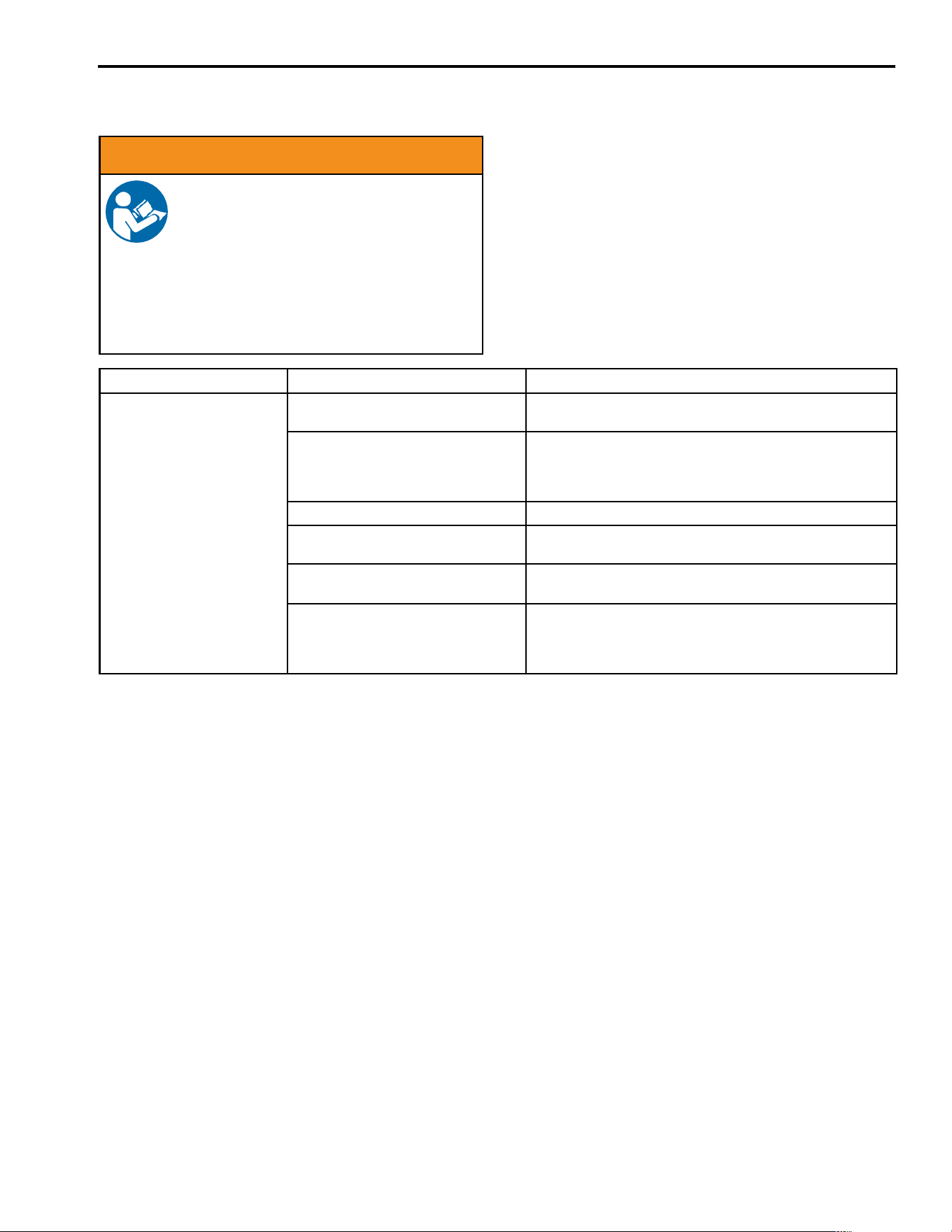
TROUBLESHOOTING
TROUBLESHOOTING
!
WARNING
Before attempting to service or
troubleshoot the generator, the owner
or service technician must first read
the owner’s manual and understand
and follow all safety instructions.
Failure to follow all instructions may
result in conditions that can lead to
voiding of the EPA certification or
product warranty, serious personal
injury, property damage or even death.
PROBLEM
POTENTIAL CAUSE
SOLUTION
Engine is running, but no
electrical output.
1. Circuit breakers are tripped.
1. Reset the circuit breakers and check for overload
condition (see pages 23 and 25).
2. The power cord’s plug
connector is not fully engaged
in the generator’s outlet.
2. Verify plug connector is firmly engaged in the
generator’s outlet. If using the 240V outlet, make sure
plug connector is rotated 1/4 turn in the clockwise
direction.
3. Faulty or defective power cord
3. Replace power cord.
4. Faulty or defective electrical
appliance
4. Try connecting a known good appliance to verify the
generator is producing electrical power.
5. GFCI outlet is tripped
5. Press the reset button on the GFCI outlet (see page
33).
6. If trying 1-5 above does not
solve the problem, the cause
might be the generator has a
fault.
6. Take the generator to your nearest authorized
service dealer.

TROUBLESHOOTING
PROBLEM
POTENTIAL CAUSE
SOLUTION
Engine will not start or
remain running while trying
to start.
1. Fuel shutoff valve is in the OFF
position.
1. Move the fuel shutoff valve to the ON position (see
pages 24 and 25).
2. Generator is out of gasoline.
2. Add gasoline to the generator (see page 22).
3. Fuel flow is obstructed.
3. Inspect and clean fuel delivery passages.
4. Unit is overchoked.
4. Move the choke lever halfway between the ON and
OFF positions (see pages 24 and 25).
5. Starting battery may have
insufficient charge
5. On electric start models only. Check battery output
and charge battery as necessary.
6. Dirty air filter
6. Check and clean the air filter (see pages 29-31).
7. Low oil level shutdown switch
is preventing the unit from
starting.
7. Check oil level and add oil if necessary (see pages
28 and 29).
8. Spark plug boot is not fully
engaged with the spark plug tip.
8. Firmly push down on the spark plug boot to ensure
the boot is fully engaged (see pages 32 and 33).
9. Spark plug is faulty.
9. Remove and check the spark plug. Replace if faulty
(see pages 32 and 33).
10. Dirty/plugged spark arrestor
10. Check and clean the spark arrestor (see page 34).
11. Stale fuel
11. Drain fuel and replace with fresh fuel (see page
22).
12. If trying 1-11 above does not
solve the problem, the cause
might be the generator has a
fault.
12. Take the generator to your nearest authorized
service dealer.
Generator suddenly stops
running.
1. Generator is out of fuel.
1. Check fuel level (see page 22). Add fuel if
necessary.
2. The low oil shutdown switch
has stopped the engine.
2. Check oil level and add oil if necessary (see pages
28 and 22.
3. Too much load
3. Restart the generator and reduce the load.
4. If trying 1-3 above does
not solve the problem, the
cause might be a fault in the
generator.
4. Take the generator to your nearest authorized
service dealer.
Engine runs erratic; does
not hold a steady RPM.
1. Choke was left in the ON
position.
1. Move choke to the OFF position (see pages 24
and 25).
2. Dirty air filter
2. Clean the air filter (see pages 29-31).
3. Applied loads may be cycling
on and off
3. As applied loads cycle, changes in engine speed
may occur; this is a normal condition.
4. If trying 1-3 above does not
solve the problem, the cause
might be a fault in the generator
4. Take the generator to your nearest authorized
service dealer.
TG3500 Línea Profesional
TG5000 Línea Profesional
TG750 0
TG8000
TG9000

EXCLUSIONES:
Toda la información, las ilustraciones y especificaciones de este manual se basan en la información más reciente
disponible al momento de la publicación. Las ilustraciones que se utilizan en este manual están destinadas a
representar vistas de referencia únicamente. Además, debido a nuestra política de mejora continua del producto
podemos modificar la información, las ilustraciones y/o las especificaciones para explicar y/o ejemplificar una
mejora de producto, servicio o mantenimiento. Nos reservamos el derecho a realizar cualquier cambio en cualquier
momento sin aviso. Algunas imágenes podrán variar dependiendo del modelo que se está mostrando.
TODOS LOS DERECHOS RESERVADOS:
Ninguna parte de esta publicación se puede reproducir ni usar por ningún medio, sea gráfico, electrónico o
mecánico, incluido el uso de fotocopias, grabaciones, grabaciones en cinta o de sistemas de almacenamiento y
recuperación de información, sin el permiso por escrito de Tomahawk Power.


FELICITACIONES POR ADQUIRIR UN GENERADOR TOMAHAWK
Para sus registros:
Fecha de compra: Número de modelo del generador:
Comprado a Negocio/Distribuidor: Número de serie del generador:
Recibo de compra: (conserve el recibo de compra para asegurar la cobertura sin problemas de la garantía).
Registro del producto:
Para asegurar la cobertura sin problemas de la garantía es importante que registre el generador Tomahawk.
Complete el formulario de registro del producto que está a continuación y envíelo a:
Mison San Diego
Para registrar el generador deberá ubicar la siguiente información:
Número de Modelo Número de Serie
Formulario de registro del producto
INFORMACIÓN PERSONAL INFORMACIÓN SOBRE EL GENERADOR
Nombre: Número de modelo:
Apellido: Número de serie:
Dirección: Fecha de adquisición:
Dirección: Comprado a:
Ciudad, Estado, Código postal:
País:
Número de teléfono:
Este manual contine instrucciones importantes para la operación de este generador. Para
su seguridad y la de los demás, debe leer este manual completamente antes de operar el
generador. Si no sigue adecuadamente todas las instrucciones y precauciones, usted y otras
personas pueden resultar gravemente heridos o morir.
!
PELIGRO


ÍNDICE
FELICITACIONES POR ADQUIRIR UN GENERADOR TOMAHAWK ............................................................. 3
Para sus registros: ................................................................................................................................... 3
Registro del producto: .............................................................................................................................. 3
Formulario de registro del producto .......................................................................................................... 3
NÚMERO DE MODELO REFERENCIA ................................................................................................................ 4
SEGURIDAD ........................................................................................................................................................ 7
DEFINICIONES DE SEGURIDAD .................................................................................................................. 7
DEFINICIONES DE LOS SÍMBOLOS DE SEGURIDAD ................................................................................. 7
NORMAS GENERALES DE SEGURIDAD...................................................................................................... 8
ETIQUETAS Y CALCOMANÍAS DE SEGURIDAD......................................................................................... 10
DESEMBALAR .................................................................................................................................................. 12
PROCEDIMIENTO PARA DESEMBALAR EL GENERADOR ........................................................................ 12
CAJA DE ACCESORIOS DEL KIT DE LAS RUEDAS .......................................................................................... 12
Componentes: ....................................................................................................................................... 12
MONTAJE ....................................................................................................................................................................... 13
MONTAJE ................................................................................................................................................................. 13
INSTALACIÓN DE LA BATERÍA (SÓLO PARA GENERADORES CON ARRANQUE ELÉCTRICO) .............. 15
CARACTERÍSTICAS ......................................................................................................................................... 16
CARACTERÍSTICAS GENERALES DEL GENERADOR .............................................................................. 16
CARACTERÍSTICAS DEL PANEL DE CONTROL ........................................................................................ 18
FUNCIONAMIENTO ........................................................................................................................................... 19
ANTES DE ENCENDER EL GENERADOR .................................................................................................. 19
CABLE DE SUMINISTRO ............................................................................................................................ 20
Utilización de los prolongadores ............................................................................................................. 20
Uso del cable de suministro Tomahawk ................................................................................................. 21
CONEXIONES DEL INTERRUPTOR DE TRANSFERENCIA ....................................................................... 21
PROCEDIMIENTO PARA AGREGAR/CONTROLAR EL COMBUSTIBLE Y LOS LÍQUIDOS DEL MOTOR ...22
Procedimiento para controlar y/o agregar el aceite para motor ............................................................... 22
Procedimiento para agregar gasolina al depósito de combustible ........................................................... 22
ENCENDIDO DEL GENERADOR ................................................................................................................ 23
Arranque manual del generador ............................................................................................................. 23
Encendido de un generador con arranque eléctrico ................................................................................ 25
DETENCIÓN DEL GENERADOR ................................................................................................................. 26
Funcionamiento normal .......................................................................................................................... 26
Durante una emergencia ........................................................................................................................ 26
MANTENIMIENTO ............................................................................................................................................. 27
MANTENIMIENTO ....................................................................................................................................... 27
Cronograma de mantenimiento .............................................................................................................. 27
MANTENIMIENTO DEL ACEITE DEL MOTOR ..................................................................................................... 28
Especificación del aceite del motor ......................................................................................................... 28
Procedimiento para controlar el aceite del motor .................................................................................... 28
Procedimiento para agregar el aceite del motor ...................................................................................... 29
Procedimiento para cambiar el aceite del motor ..................................................................................... 29
MANTENIMIENTO DEL FILTRO DE AIRE .................................................................................................... 30
Limpieza del filtro de aire ....................................................................................................................... 30
MANTENIMIENTO DE LA BUJÍA DE ENCENDIDO ...................................................................................... 32
PROBANDO DE LOS TOMACORRIENTES GFCI ........................................................................................ 33
SERVICIO A LA BATERÍA ....................................................................................................................................... 34
Reemplazo de la batería ........................................................................................................................ 34
LIMPIEZA DEL AMORTIGUADOR DE CHISPAS ................................................................................................. 35
LIMPIEZA DEL GENERADOR ..................................................................................................................... 35
ALMACENAMIENTO .................................................................................................................................... 35
SOLUCIÓN DE PROBLEMAS ........................................................................................................................... 38
SOLUCIÓN DE PROBLEMAS ...................................................................................................................... 38
SEGURIDAD
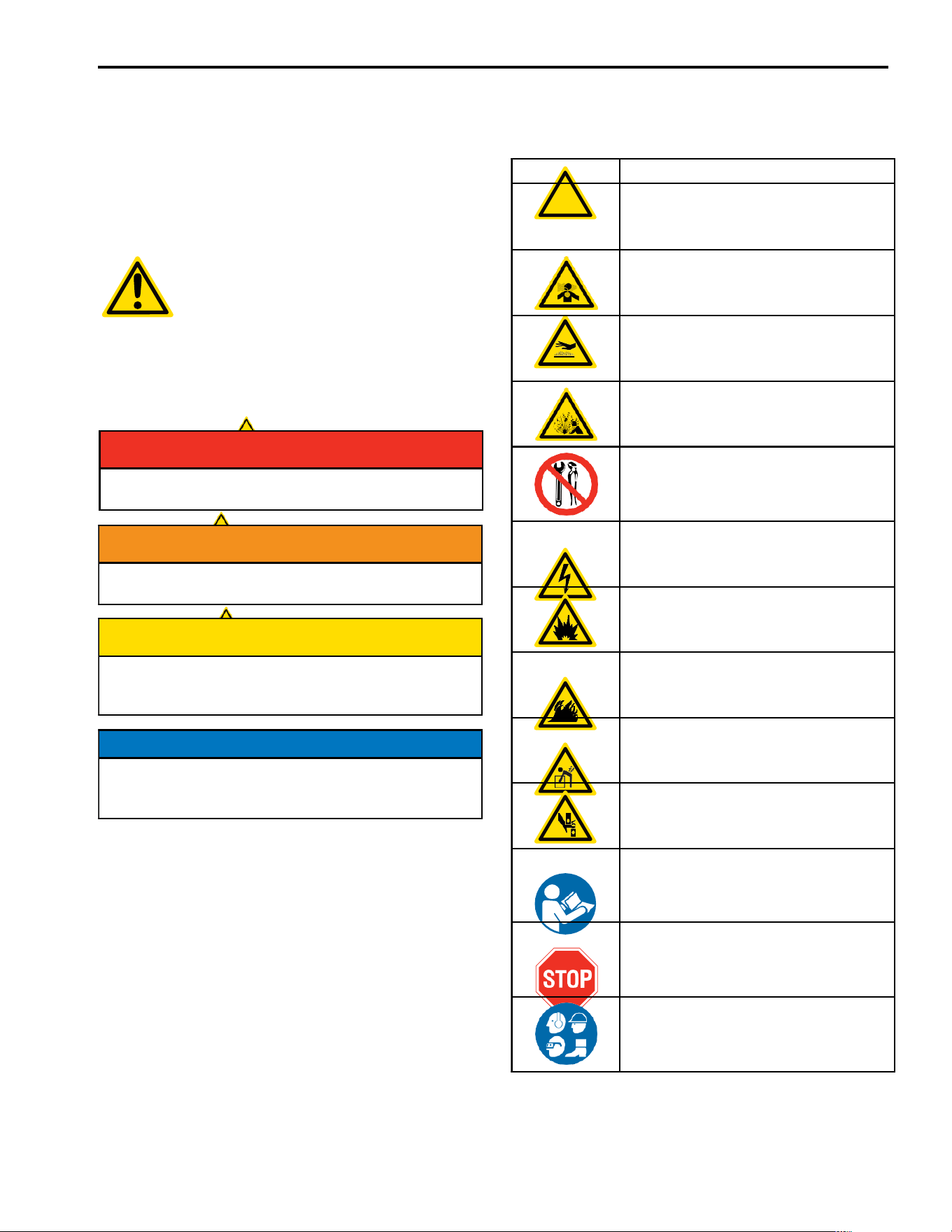
DEFINICIONES DE
SEGURIDAD
Las palabras PELIGRO, ADVERTENCIA,
PRECAUCIÓN y AVISO se usan a lo largo de este
manual para destacar la información importante.
Asegúrese de que todo aquel que trabaje con el equipo
o cerca de él conozca el significado de estas alertas.
Este símbolo de alerta de seguridad
aparece con la mayoría de las
declaraciones de seguridad.
Significa: ¡atención, esté alerta, su
seguridad está en riesgo! Lea y
respete el mensaje que aparece a
continuación del símbolo de alerta
de seguridad.
DEFINICIONES DE LOS
SÍMBOLOS DE SEGURIDAD
!
PELIGRO
Indica una situación de riesgo que, si no se evita,
causará lesiones graves o la muerte.
NOTA: Indica un procedimiento, una práctica o
una condición que debe seguirse a fin de
que el generador funcione conforme al
diseño.
!
ADVERTENCIA
Indica una situación de riesgo que, si no se evita,
podría causar lesiones graves o la muerte.
Símbolo
Descripción
!
Símbolo de alerta de seguridad
Peligro de asfixia
Peligro de quemaduras
Peligro de explosión/presión
No deje las herramientas en la zona
Peligro de electrocución
Peligro de explosión
Peligro de incendio
Peligro de elevación
Peligro de aplastamiento
Lea las instrucciones del fabricante
Lea los mensajes de seguridad antes
de proceder
Use equipo de protección personal
(PPE, en inglés)
!
PRECAUCIÓN
Indica una situación de riesgo que, si no se evita,
podría causar lesiones menores o de gravedad
moderada.
AVISO
Indica una situación que puede dañar el generador,
la propiedad personal y/o el entorno, o que puede
hacer que el equipo funcione incorrectamente.
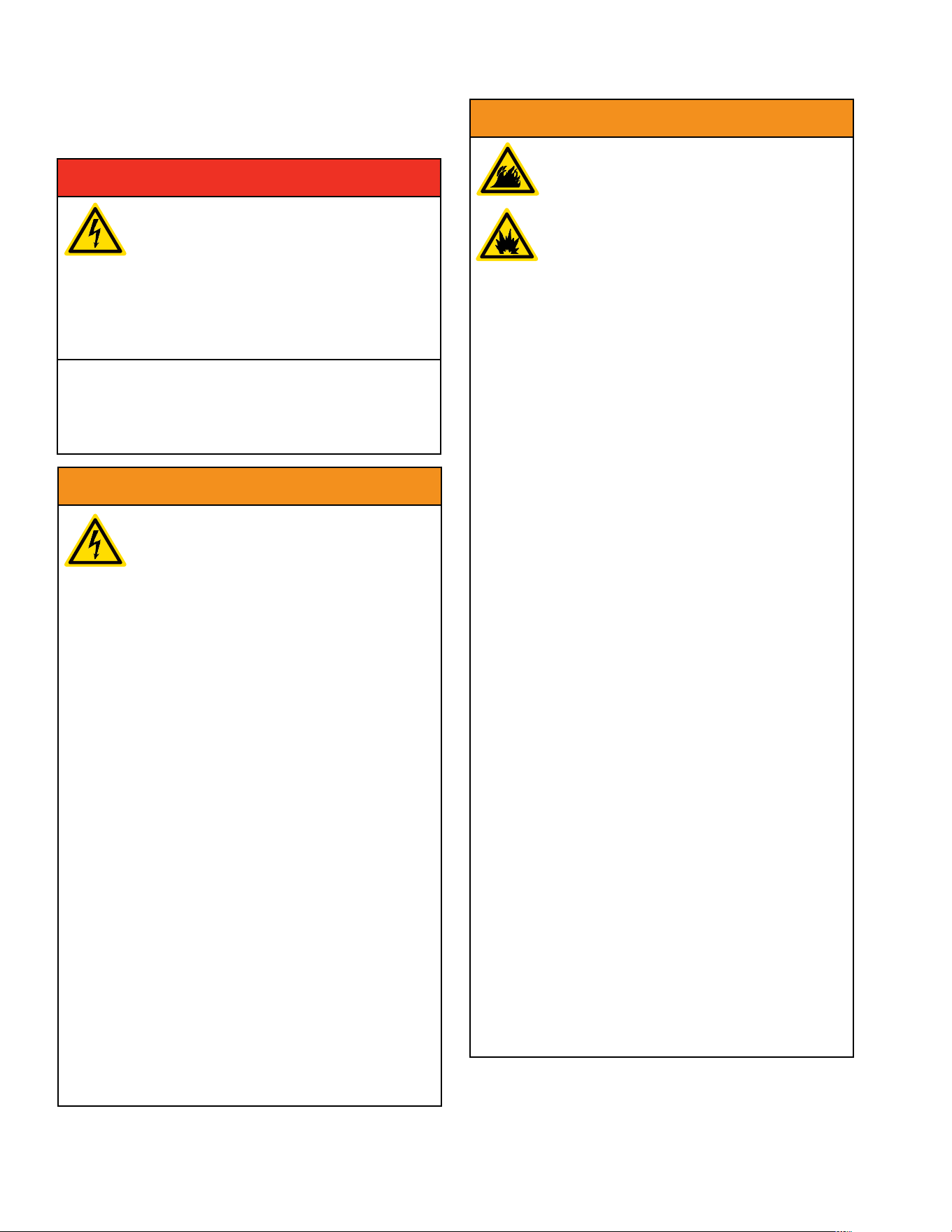
NORMAS GENERALES DE
SEGURIDAD
!
ADVERTENCIA
El voltaje del generador puede producir
lesiones graves o la muerte.
•
Nunca utilice el generador bajo la
lluvia o en planicies de inundación a
menos que se tomen las precauciones
correspondientes para evitar que quede
expuesto a la lluvia o la inundación.
•
No utilice nunca prolongadores
desgastados o dañados.
•
Siempre debe contratar a un
electricista matriculado para que
conecte el generador al circuito de la
red general.
•
Nunca toque el generador cuando
está en marcha si el generador está
húmedo o si usted tiene las manos
mojadas.
•
Nunca utilice el generador en zonas
con alto nivel de conducción como
cerca de plataformas metálicas o
estructuras de acero.
•
Utilice siempre prolongadores
conectados a tierra. Siempre use
herramientas mecánicas de tres hilos
o con aislamiento doble.
•
Nunca toque los terminales que
tienen corriente o los hilos desnudos
mientras el generador está en
funcionamiento.
•
Asegúrese de que el generador esté
conectado a tierra correctamente
antes de utilizarlo.
!
PELIGRO
Nunca use el generador en lugares
mojados o húmedos. Nunca exponga
el generador a lluvia, nieve, rociado
de agua o agua estancada durante el
uso. Proteja el generador de todas las
condiciones climáticas peligrosas. La
humedad o el hielo pueden causar un
cortocircuito u otro tipo de problema de
funcionamiento en el circuito eléctrico.
Nunca opere el generador en un lugar
cerrado. El escape del motor contiene
monóxido de carbono. Sólo debe operar
el generador en exteriores y alejado de
ventanas, puertas y ventilaciones.
!
ADVERTENCIA
La gasolina y los vapores de la
gasolina son extremadamente
inflamables y explosivos en
determinadas condiciones.
•
Siempre debe hacer la recarga
de combustible del generador en
exteriores, en una zona bien ventilada.
•
Nunca saque el tapón de combustible
con el motor en marcha.
•
Nunca haga la recarga de combustible
del generador mientras el motor está
en marcha. Apague siempre el motor y
deje que se enfríe el generador antes
de recargar combustible.
•
Siempre cargue el depósito de
combustible con gasolina.
•
Cuando realice la recarga, mantenga
alejadas las chispas, llamas abiertas
u otras formas de ignición (como
cerillos, cigarrillos, fuentes de
electricidad estática).
•
Nunca sobrecargue el depósito de
combustible. Deje espacio para
la expansión del combustible.
La sobrecarga del depósito de
combustible puede producir un
desbordamiento repentino de gasolina
y hacer que la gasolina derramada
tome contacto con superficies
CALIENTES. El combustible
derramado puede encenderse. Si
se derrama combustible sobre el
generador, debe eliminar los derrames
de inmediato. Deseche los trapos
como corresponda. Deje que se seque
la superficie donde se produjo el
derrame antes de operar el generador.
•
Utilice protección ocular durante la
recarga de combustible.
•
Nunca utilice gasolina como agente
de limpieza.
•
Almacene los recipientes que
contienen gasolina en una zona bien
ventilada, alejada de los combustibles
o las fuentes de encendido.
•
Controle si hay pérdidas de
combustible después de la recarga
de combustible. Nunca opere el
motor si se descubre que hay una
fuga de combustible.
SEGURIDAD
!
ADVERTENCIA
Nunca opere el generador si se
sobrecalientan los componentes
eléctricos, si cae la salida de energía
eléctrica, si salen chispas, llamas
o humo del generador, o si los
receptáculos están calientes.
Nunca use el generador para alimentar
!
equipos de asistencia médica.
Siempre retire del generador las
herramientas u otros equipos de
servicio que se utilicen durante el
mantenimiento antes de usarlo.
AVISO
Nunca modifique el generador.
Nunca utilice el generador si vibra a altos niveles, si
la velocidad del motor cambia significativamente o si
el motor falla con frecuencia al encender.
Siempre desconecte las herramientas y los artefactos
del generador antes del encendido.
DESEMBALAR
PROCEDIMIENTO
PARA DESEMBALAR EL
GENERADOR
Herramientas requeridas: trincheta o dispositivo
similar.
1.
Corte con cuidado la cinta de embalar que está en
la parte superior de la caja.
2.
Pliegue las aletas superiores para dejar a la vista el
manual.
3.
Saque la caja de cartón de los accesorios del kit de
las ruedas.
4.
Corte con cuidado dos costados de la caja para
extraer el generador.
CAJA DE ACCESORIOS DEL
KIT DE LAS RUEDAS
Figura 3 – Elementos de ferretería del kit de las ruedas
Abra la caja de los accesorios del kit de las ruedas
y controle el contenido con la lista que se incluye a
continuación. El kit de las ruedas es opcional para
el modelo WHL2500 y no está disponible para el
modelo WHL1000. Si falta alguna pieza, ubique a un
distribuidor autorizado de Tomahawk.
www.tomahawk-power.com
Componentes:
1
- Pasador de
horquilla 55 x 8
mm (se usan 2)
2
- Perno de brida
M8 x 16 mm
(se usan 2)
3
- Pasador del eje
de la rueda -
serie 3250 solo
4
- Contratuerca de
cierre M8
(se usan 2)
5
- Chaveta de
horquilla
(se usan 4)
Ruedas (2)
Manigas con
empuñaduras (2)
Bolsa de herramientas (1)
Llave de cubo para
bujías (1)
Botella de un 0,6 litro
Aceite SAE 10W30 (1)
(WH3250 modelo)
Botella de un litro
Aceite SAE 10W30 (1)
Pie de montaje (1)
Embudo de aceite (1)
16 mm x 95 mm
(se usan 2)
Pasador del eje
de la rueda -
series 5500 a
7500 solo
16 mm x 100 mm
(se usan 2)
!
PRECAUCIÓN
Siempre debe solicitar ayuda para
levantar el generador. El generador
es pesado, levantarlo puede causarle
lesiones físicas.
Evite cortar sobre o cerca de grapas
!
para evitar lesiones personales.
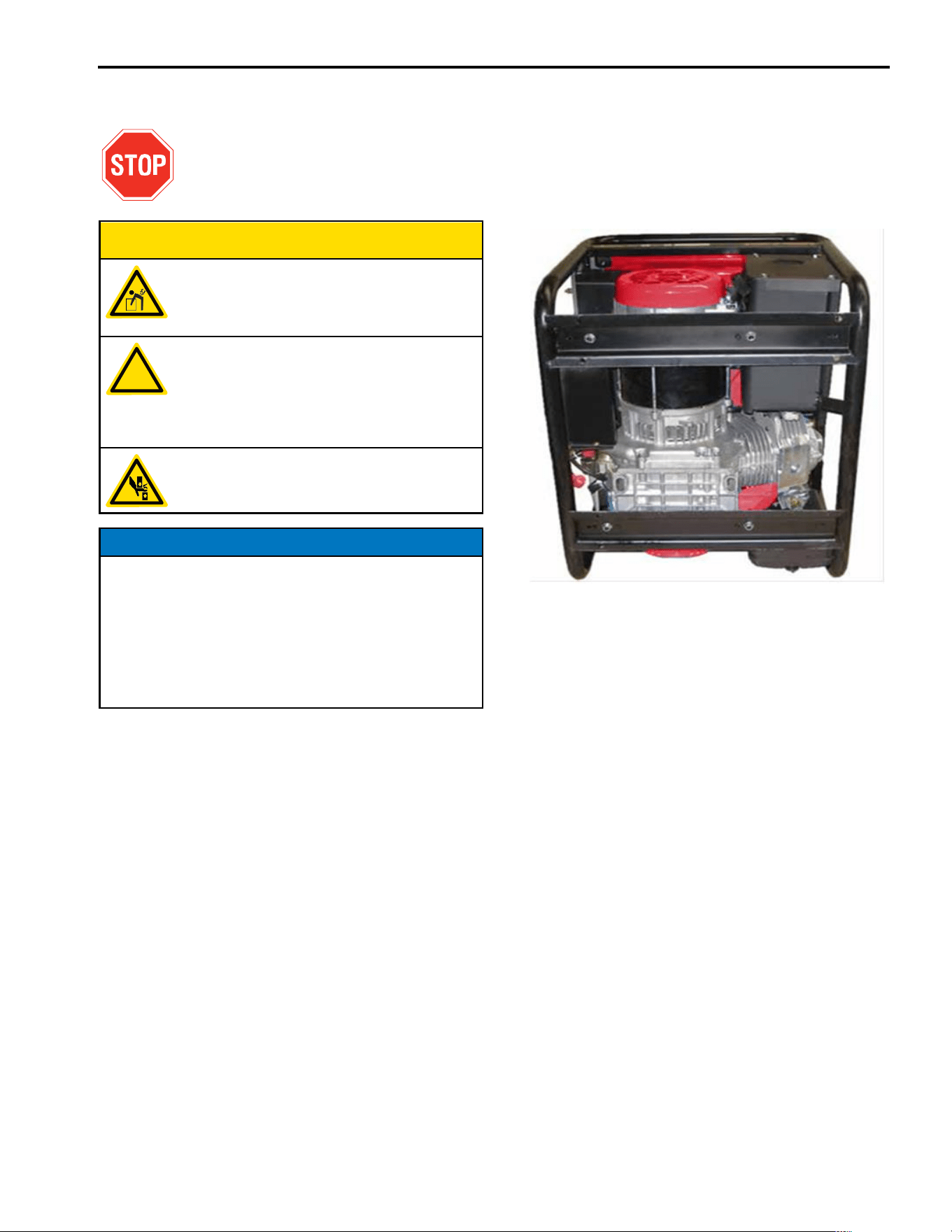
MONTAJE
MONTAJE
Antes de ensamblar el generador,
revise Seguridad en la página
7 y los siguientes mensajes de
seguridad.
!
PRECAUCIÓN
Nunca levante el generador sin ayuda.
El generador es pesado y levantarlo
sin ayuda podría causarle lesiones
personales.
Nunca utilice las manijas como punto
!
de elevación para sostener todo
el peso del generador. Utilice las
manijas sólo para mover el generador
levantando las manijas y usando las
ruedas para mover el generador.
Sea precavido al plegar las manijas.
Podrían quedarle atrapados las manos
y los dedos y ser apretados.
AVISO
El ensamblado del generador requerirá elevar la
unidad sobre un costado. Asegúrese de que todo
el aceite del motor y el combustible se drenen de la
unidad antes del ensamblado.
Una vez montado, el kit de las ruedas no está
diseñado para usarse en carreteras. El kit de las
ruedas está diseñado para usarse únicamente en
este generador.
Herramientas requeridas: bolsa de herramientas (se
incluye).
1.
Coloque el generador sobre una superficie plana.
2.
Coloque un trozo de cartón u otro material blando
para inclinar el generador sobre él, a fin de proteger
la pintura del bastidor y evitar que el generador
se deslice. Incline el generador de costado como
se indica en la Figura 4 (el motor debe estar en la
base).
Figura 4 – Incline el generador de costado
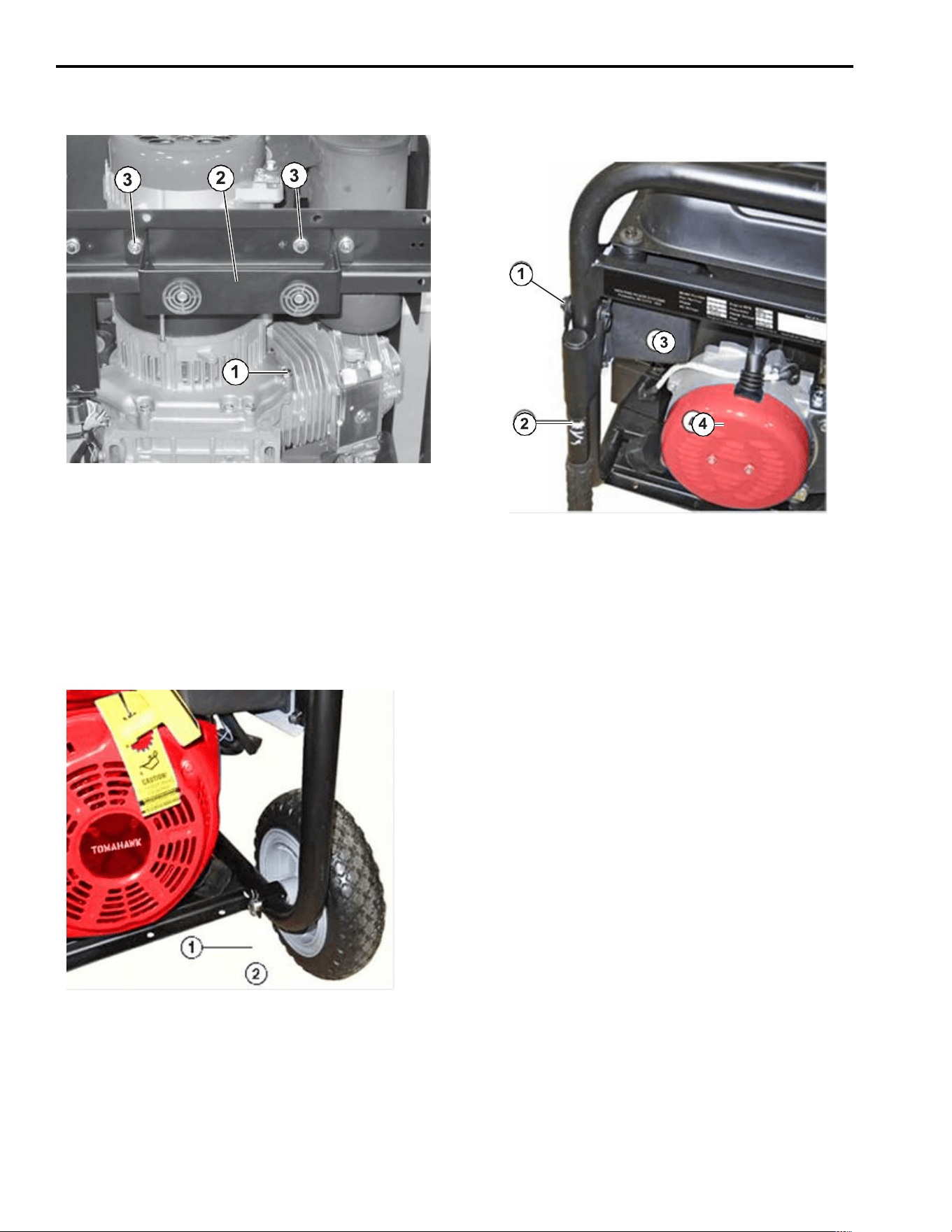
MONTAJE
3.
Coloque el pie de montaje en el bastidor usando
pernos de brida y tuercas M8.
6.
Coloque las manijas usando el pasador de horquilla
y la chaveta de horquilla como se indica en la
Figura 7.
Figura 5 – Ensamble el pie de montaje al bastidor
1
- Tacos de goma
2
- Pie de montaje
3
- Pernos de brida y
tuercas M8
Figura 7 – Colocación de las manijas
4.
Coloque el pasador del eje de 16 mm x 105 mm
por entre el soporte del eje en el bastidor.
5.
Coloque la chaveta de horquilla por entre el
pasador del eje.
1
- Pasador de
horquilla
2
- Manija
3
- Chaveta de
horquilla
4
- Cable de battería
negativo
Figura 6 – Ensamble las ruedas al bastidor
1 - Soporte del eje 2 - Tuerca de brida
dentada
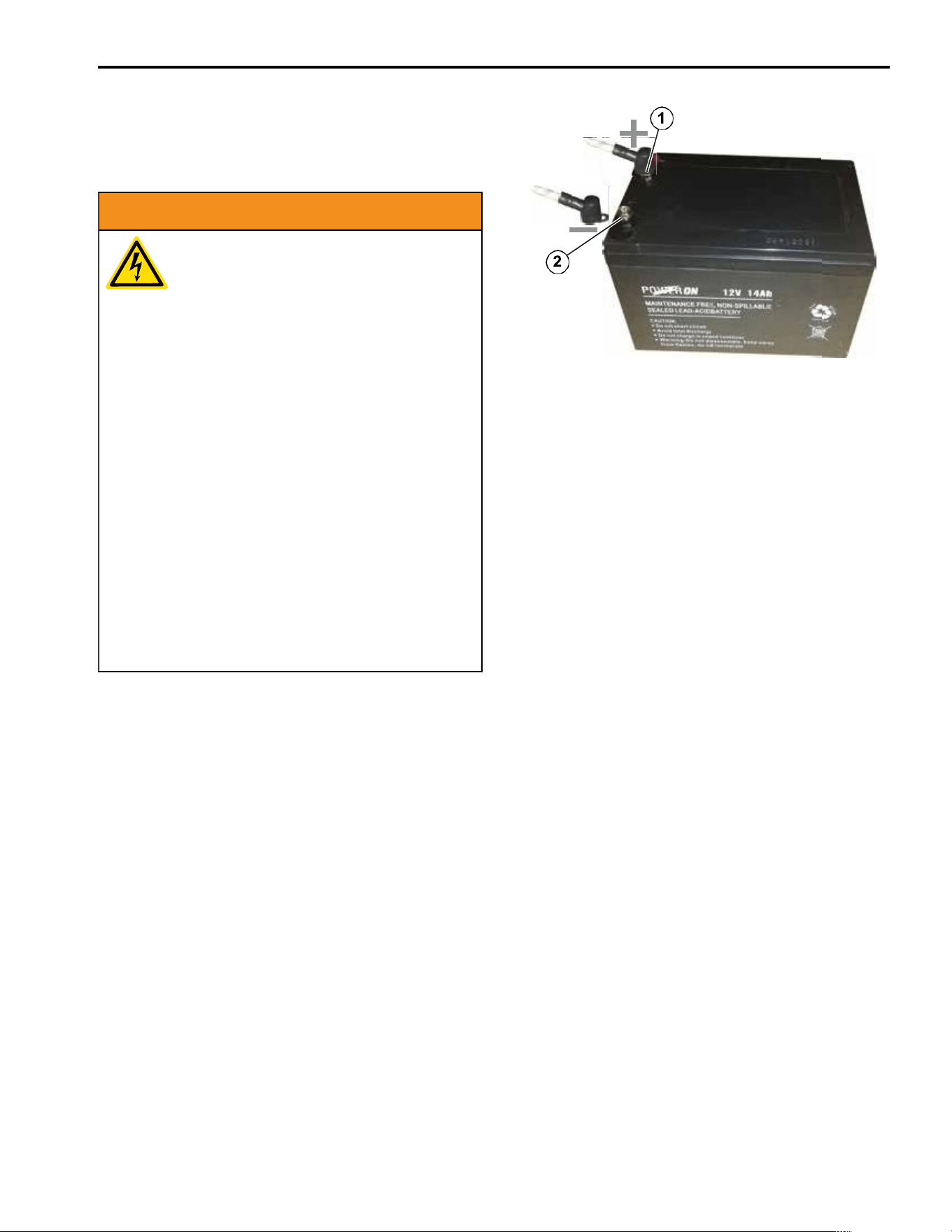
MONTAJE
INSTALACIÓN DE LA BATERÍA
(SÓLO PARA GENERADORES
CON ARRANQUE ELÉCTRICO)
Figura 8 – Conexión del cable (negro) negativo (-) de la
batería
NOTA:
El generador viene equipado con el cable
de batería positivo (capuchón rojo) ya
conectado.
1 - Cable (rojo)
positivo (+) de la
batería
2 - Cable (negro)
negativo (-) de la
batería
1.
Verifique que el cable positivo (+) de la batería
(capuchón rojo) esté bien ajustado al terminal
positivo (+) de la batería. Compruebe que el
capuchón quede sobre el terminal de la batería.
2.
Quite con cuidado la envoltura protectora que
rodea la lengüeta del cable negativo (-) de la
batería (capuchón negro).
3.
Localice el cable negativo (-) acoplado a cable del
alternador, retire conexión y canalice al terminal de
la batería negativa (-).
4.
Tire hacia atrás el capuchón negro y sujete bien el
cable negro (-) de la batería (capuchón negro) al
terminal negativo (-) de la batería como se indica
en la Figura 8. Reponga el capuchón negro para
que proteja la lengüeta del cable y el terminal de la
batería.
!
ADVERTENCIA
Para evitar descargas eléctricas:
•
SIEMPRE conecte primero el cable
positivo (+) (capuchón rojo) de la
batería cuando conecte los cables de
la batería.
•
SIEMPRE desconecte primero el
cable negativo (-) (capuchón negro)
de la batería cuando desconecte los
cables de la batería.
•
NUNCA conecte el cable negativo
(-) (capuchón negro) de la batería al
terminal positivo (+) de la batería.
•
NUNCA conecte el cable positivo
(+) (capuchón rojo) de la batería al
terminal negativo (-) de la batería.
•
NUNCA conecte ambos terminales de
la batería simultáneamente.
•
NUNCA coloque una herramienta
metálica cruzando ambos terminales
de la batería.
•
SIEMPRE use herramientas aisladas
o no conductoras cuando instale la
batería.
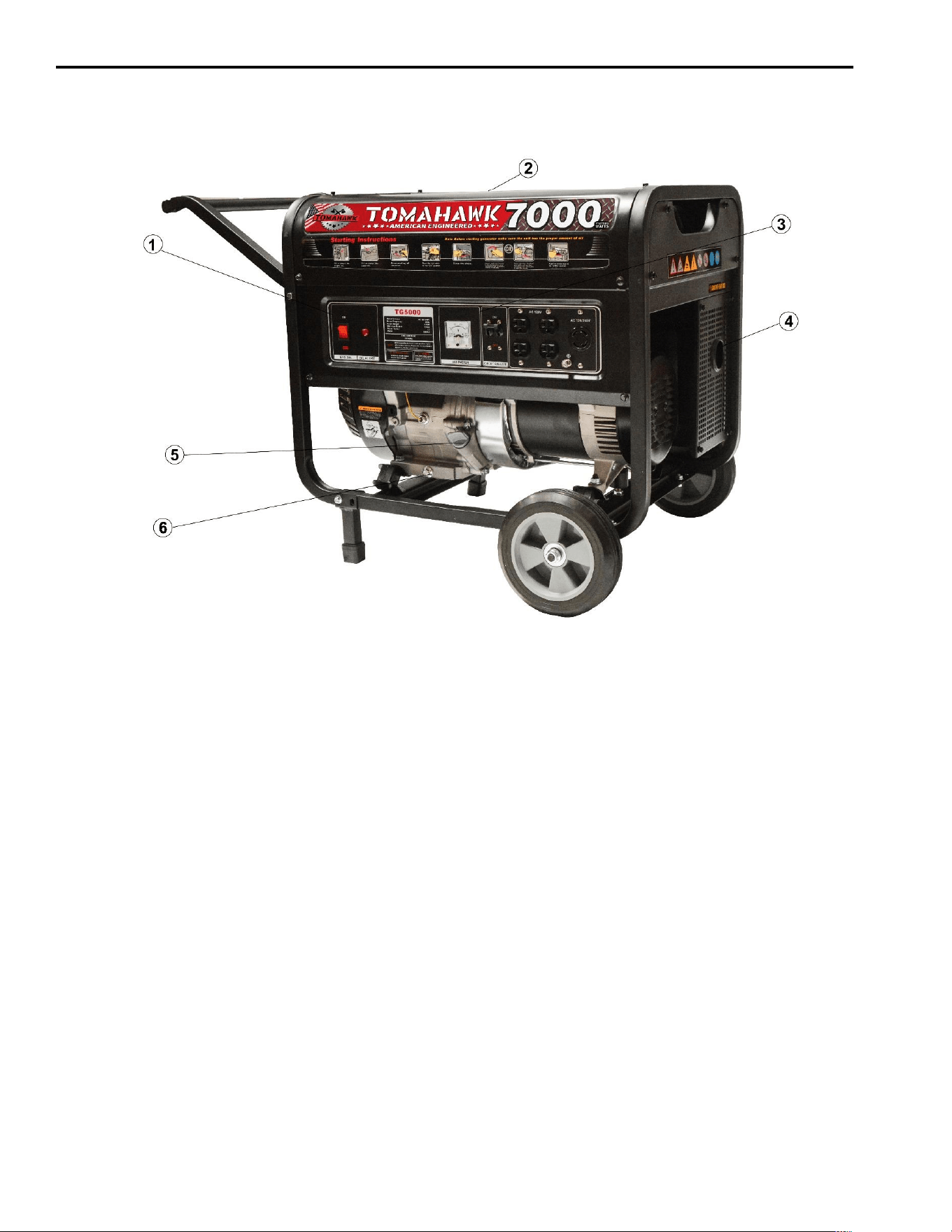
CARACTERÍSTICAS
CARACTERÍSTICAS GENERALES DEL GENERADOR
1 - Interruptor de control del motor: Enciende
y apaga el motor.
Figura 9
5
- Batería: Únicamente para los modelos con
arranque eléctrico.
2
- Tapón del combustible: Cierre hasta que se
escuche un clic.
3
- Panel de control: Contiene los interruptores
y los tomacorrientes.
4
- Silenciador y amortiguador de chispas:
Evite el contacto hasta que el motor se haya
enfriado. El amortiguador de chispas evita
que las chispas salgan del silenciador. Se
debe extraer para realizar el mantenimiento.
6
- Tapón de llenado/Varilla de medición
de aceite: Se debe quitar para agregar y
controlar el aceite.
7
- Tapón de drenaje del aceite: Se debe quitar
para drenar el aceite del motor.
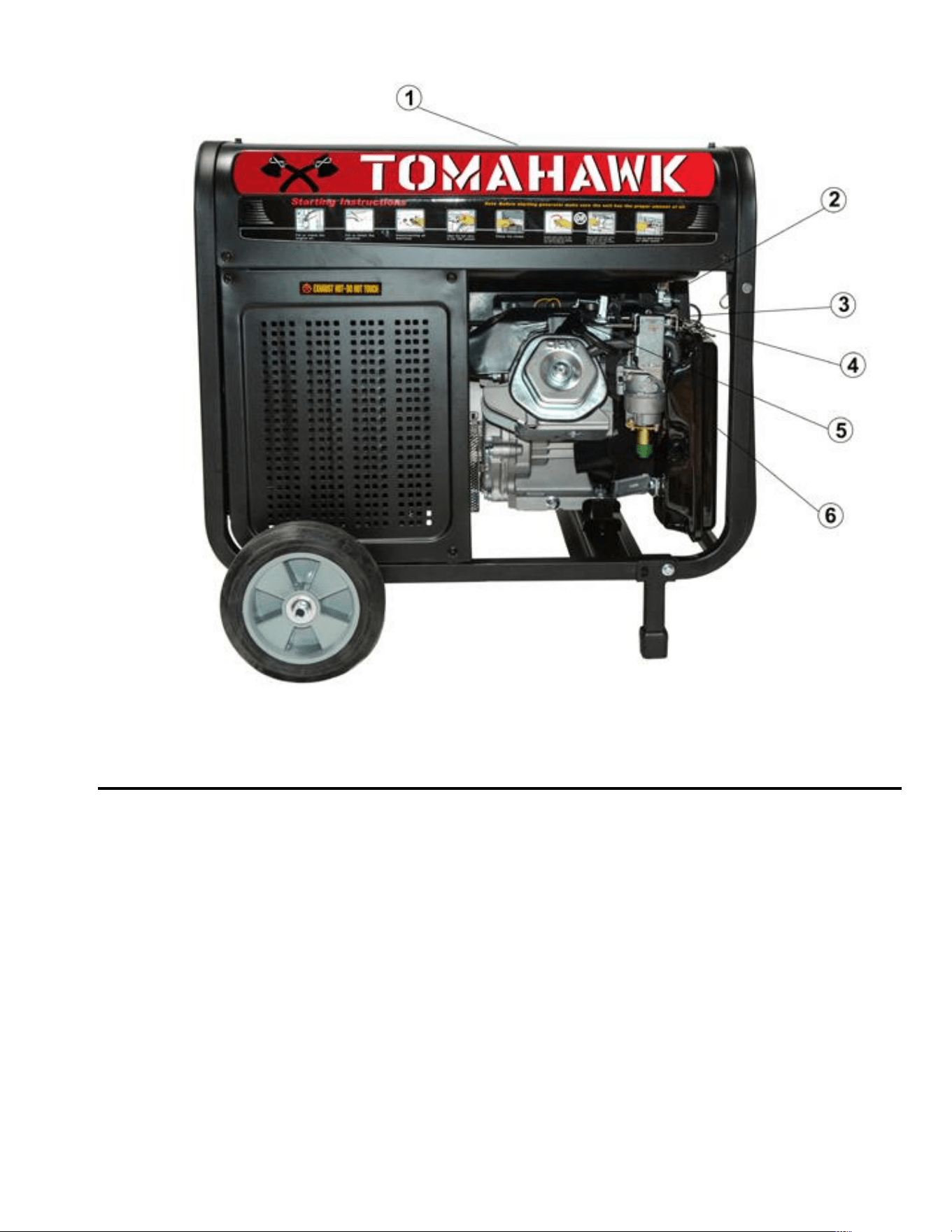
CARACTERÍSTICAS
Figura 10
1
- Indicador de combustible: Indica el nivel de
combustible.
2
- Válvula de cierre del combustible: Controla
el flujo de combustible hacia el motor.
3
- Manija de retroceso: Debe jalarse para
arrancar el motor de las unidades con
arranque manual.
4
- Cubierta del filtro de aire: Se debe quitar
para realizar el mantenimiento del filtro de
aire.
5
- Palanca del cebador: Debe estar en la
posición ON (encendido) para encender el
motor y se debe regresar a la posición OFF
(apagado) una vez que el motor esté en
marcha.
6
- Caja de carbono: Los números de modelo
seguidos de una “C” vendrán equipados con
una caja de carbono.
7
- Capuchón (cable) de la bujía: Se debe
quitar cuando se realiza el mantenimiento del
motor o de la bujía.
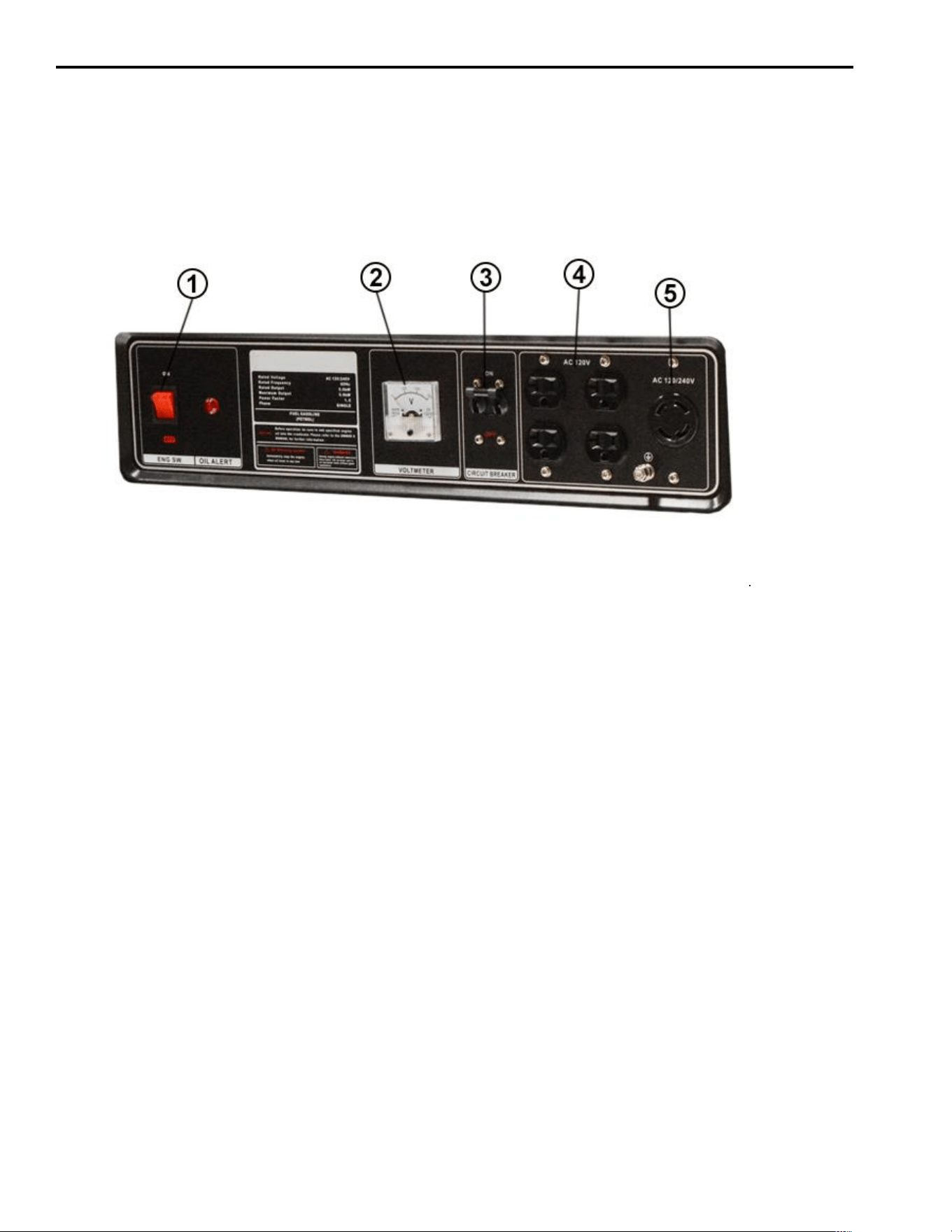
CARACTERÍSTICAS
CARACTERÍSTICAS DEL PANEL DE CONTROL
Figura 11 – Características del panel de control
1.
Interruptor de control del motor (RUN
[funcionamiento]/STOP [detención] para
unidades con arranque manual):
•
RUN (funcionamiento) - En la posición RUN
(funcionamiento), el interruptor permite
encender el generador (para los modelos con
arranque manual).
•
STOP (detención) - En la posición STOP
(detención), el interruptor para el motor.
2.
Medidor de horas: Indica cuantas horas el
generador ha estado en marcha bajo carga.
3.
Disyuntor principal: El disyuntor principal
controla la potencia de salida total de todos los
tomacorrientes para proteger al generador.
4.
Tomacorriente de giro de seguridad de 120/240
Voltios, 30 Amperios (NEMA L14-30R): El
tomacorriente puede suministrar 120 V o 240 V de
potencia de salida.
5.
Tomacorrientes de 120 Voltios, 20 Amperios
Duplex GFCI (NEMA 5-20R): Cada tomacorriente
tiene capacidad de suministrar un máximo de
20 amperios en un único receptáculo o una
combinación de ambos receptáculos.
6.
Disyuntores de 20 Amperios: Cada disyuntor
limita la corriente que se puede suministrar a través
de los tomacorrientes duplex de 120 Voltios a 20
Amperios.
7.
Terminal de tierra: El terminal de tierra se usa
para conectar el generador a tierra.
8.
Interruptor de control del motor (ON
[encendido]/ON [funcionamiento]/OFF
[detención] para las unidades con arranque
eléctrico):
•
ON (encendido) - Cuando se oprime el
interruptor momentáneamente y se lo
mantiene en la posición ON (encendido), el
motor de arranque eléctrico se engrana y
arranca el motor. Después de que el motor
arranque, suelte el interruptor. (El interruptor
pasará automáticamente a la posición ON
(funcionamiento)).
•
ON (funcionamiento) - Después del arranque,
el interruptor permanecerá en la posición ON
(funcionamiento).
•
OFF (detención) - Para detener el motor,
mueva el interruptor a la posición OFF
(detención).
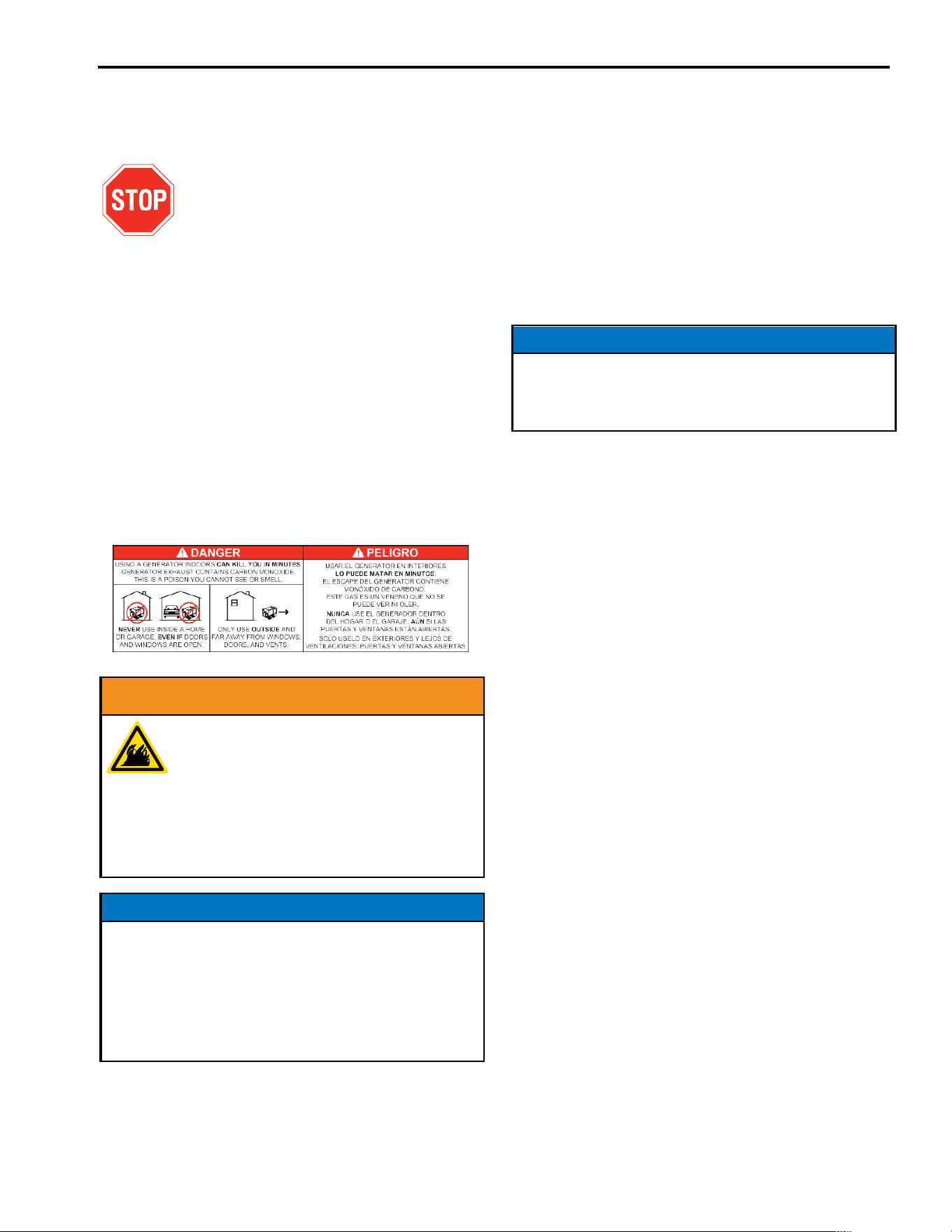
FUNCIONAMIENTO
ANTES DE ENCENDER EL
GENERADOR
Antes de encender el generador,
revise Seguridad en la página 7.
Elección de la ubicación: Antes de poner en marcha
el generador, evite los peligros relacionados con el
escape y la ubicación, para lo cual debe verificar:
•
Que se haya seleccionado una ubicación para
operar el generador que sea en exteriores y esté
bien ventilada.
•
Que se haya seleccionado una ubicación con una
superificie nivelada y sólida sobre la cual colocar el
generador.
•
Que se haya seleccionado una ubicación que esté
al menos a 6 pies (1,8 metros) de cualquier edificio,
otros equipos o materiales combustibles.
•
Si el generador está ubicado cerca de un edificio,
compruebe que no esté ubicado cerca de ventanas,
puertas y/o ventilaciones.
Clima: Nunca opere el generador en exteriores
si llueve, nieva o si están presentes condiciones
climáticas que favorecen la acumulación de humedad,
sobre, adentro y alrededor del generador.
Superficie seca: Opere siempre el generador sobre
una superficie seca, libre de humedad.
No debe haber cargas conectadas: Compruebe
que el generador no tenga cargas conectadas antes
de encenderlo. Para asegurar que no haya cargas
conectadas, desenchufe los prolongadores eléctricos
que estén enchufados en los receptáculos del panel de
control.
AVISO
Si se enciende el generador con cargas aplicadas
al mismo, durante el breve período de puesta en
marcha podrían dañarse los artefactos que se
accionan con el generador.
Conexión a tierra del generador: El Código Eléctrico
Nacional (NEC, en inglés), así como numerosos
códigos eléctricos locales, exigen que se conecte el
generador a tierra antes de su operación. Antes de
poner en marcha el generador, compruebe que esté
conectado a tierra conectando el terminal de tierra
del panel de control (vea la Figura 12) a tierra usando
alambre de cobre (10 AWG como mínimo). Consulte a
un electricista calificado para conocer los requisitos de
conexión a tierra locales.
!
ADVERTENCIA
Opere siempre el generador sobre
una superficie nivelada. Si se coloca
un generador sobre superficies que
no están niveladas puede tumbarse,
derramando combustible y aceite.
El combustible derramado puede
encenderse si entra en contacto con
una fuente de ignición como una
superficie muy caliente.
AVISO
Sólo debe operar el generador sobre una superficie
sólida y nivelada. La operación de un generador
sobre una superficie en la que hay materiales sueltos
como arena o recortes de césped puede hacer que
ingresen residuos al generador que podrían:
•
Obstruir las ventilaciones de refrigeración.
•
Obstruir el sistema de admisión de aire.
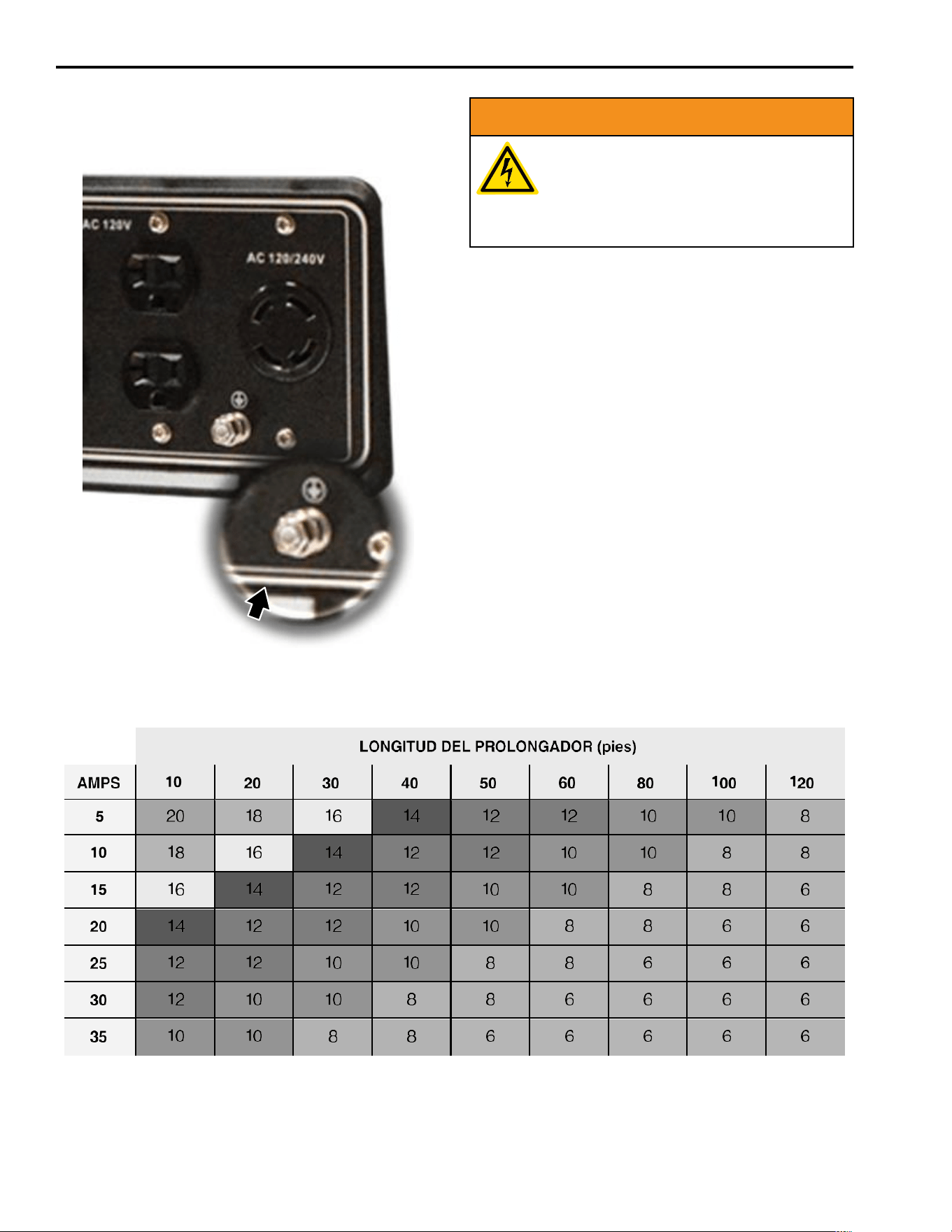
FUNCIONAMIENTO
!
ADVERTENCIA
Asegúrese de que el generador esté
correctamente conectado a tierra
antes de usarlo. El generador se debe
conectar a tierra para evitar descargas
eléctricas causadas por artefactos
defectuosos.
CABLE DE SUMINISTRO
Utilización de los prolongadores
Tomahawk no se responsabiliza por el contenido
en esta tabla. El uso de esta tabla es
responsabilidad exclusiva del usuario. Esta tabla es
únicamente para fines de referencia. No se garantiza
que los resultados al utilizar esta tabla sean correctos o
aplicables a todas las situaciones dado que el tipo y la
construcción de los cables son muy variables. Siempre
verifique las regulaciones locales y consulte con un
electricista matriculado antes de instalar o conectar un
artefacto eléctrico.
Figura 12 – Terminal de conexión a tierra del panel de
control
Tamaño del espesor del alambre del prolongador
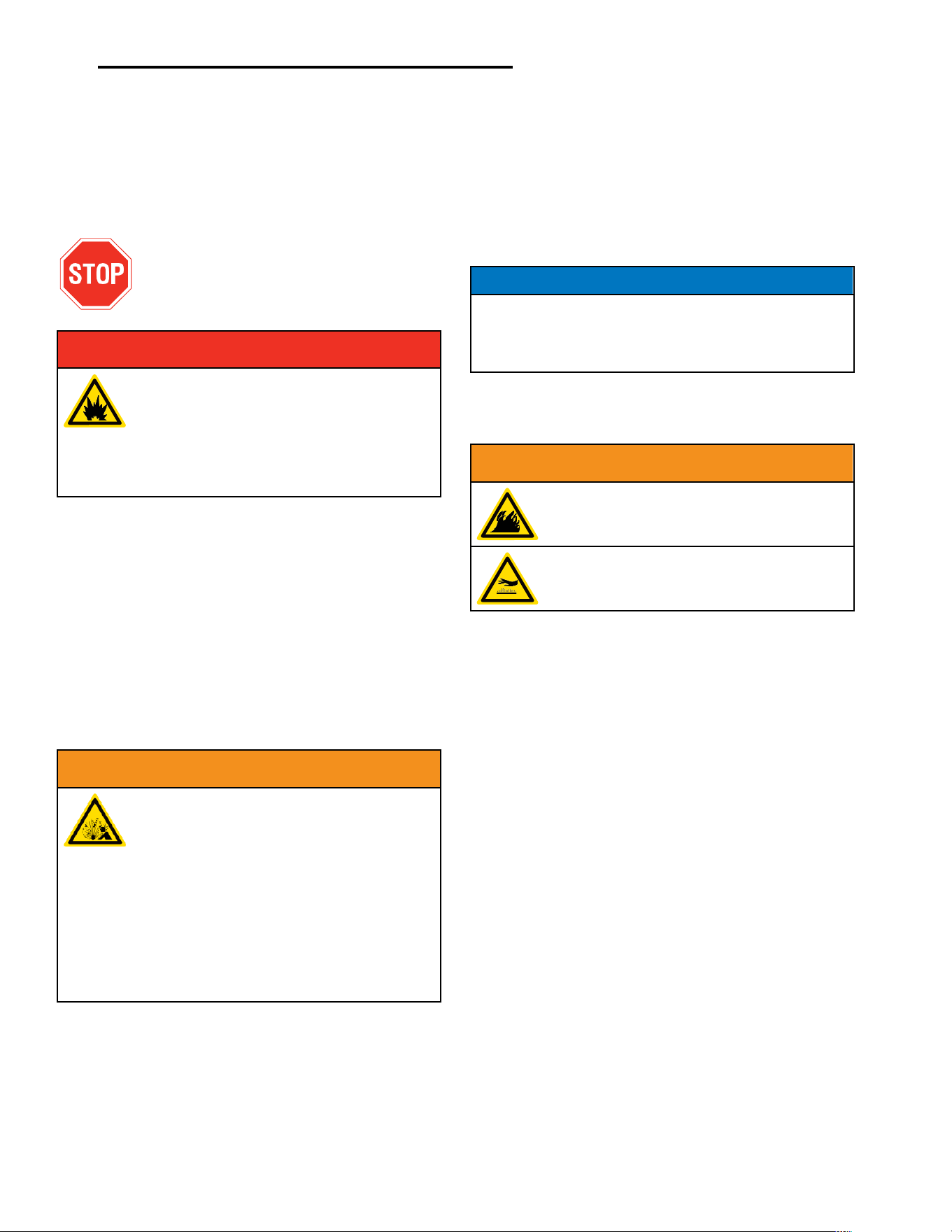
PROCEDIMIENTO PARA
AGREGAR/CONTROLAR
EL COMBUSTIBLE Y LOS
LÍQUIDOS DEL MOTOR
Antes de agregar/controlar el
combustible y los líquidos del motor,
revise Seguridad en la página 7.
!
PELIGRO
Si se carga el depósito de combustible
con gasolina mientras el generador
está en marcha, se pueden provocar
pérdidas de gasolina que pueden
entrar en contacto con superficies
calientes que pueden encender la
gasolina.
Antes de encender el generador, controle siempre el
nivel de:
•
Aceite de motor
•
Gasolina en el depósito de combustible.
Después de encender el generador y de que se
caliente el motor, no es seguro agregar gasolina al
depósito de combustible ni aceite de motor al motor
mientras el motor está en funcionamiento o mientras el
motor y el silenciador están calientes.
Procedimiento para controlar y/o
agregar el aceite para motor
!
ADVERTENCIA
La presión interna puede acumularse
en el cárter del motor mientras el motor
está en marcha. Si se extrae el tapón de
llenado/la varilla de medición del aceite
mientras el motor está caliente, se
puede salpicar aceite extremadamente
caliente hacia el exterior del cárter que
puede producir quemaduras graves en
la piel. Deje que se enfríe el aceite del
motor durante varios minutos antes de
extraer el tapón de llenado/la varilla de
medición del aceite.
La unidad como se envía no contiene aceite en
el motor. Debe agregar aceite del motor antes
de encender el generador por primera vez. Vea
Procedimientoparacontrolarelaceitedelmotor
en la página 28 y Procedimiento para agregar
el aceite del motor en la página 29 para obtener
instrucciones sobre el control del nivel de aceite
del motor y el procedimiento para agregar el aceite
del motor.
AVISO
El generador no contiene aceite de motor cuando
se envía. Si se intenta encender el motor sin
agregarle aceite de motor, se pueden dañar de forma
permanente los componentes internos del motor.
Procedimiento para agregar gasolina al
depósito de combustible
!
ADVERTENCIA
Nunca haga la recarga de combustible
del generador mientras el motor está
en marcha.
Siempre debe apagar el motor y dejar
que el generador se enfríe antes de
recargar combustible.
Gasolina requerida: Sólo debe usar gasolina que
cumpla con los siguientes requisitos:
•
Gasolina sin plomo únicamente
•
Gasolina con etanol agregado hasta un máximo del
10%
•
Gasolina con 87 de octanaje o superior
Procedimiento para cargar el depósito de
combustible: Siga los pasos a continuación para
cargar el depósito de combustible:
1.
Apague el generador.
2.
Permita que el generador se enfríe de manera que
toda la superficie del silenciador y el motor esté
fresca al tacto.
3.
Traslade el generador a una superficie plana.
4.
Limpie la zona que rodea al tapón de combustible.
5.
Quite el tapón de combustible girándolo en sentido
contrario a las agujas del reloj.
6.
Agregue gasolina lentamente dentro del depósito
de combustible. Tenga mucho cuidado de no llenar
el depósito en exceso. El nivel de gasolina NO
DEBERÁ quedar más alto que la boca de llenado
(vea la Figura 15).
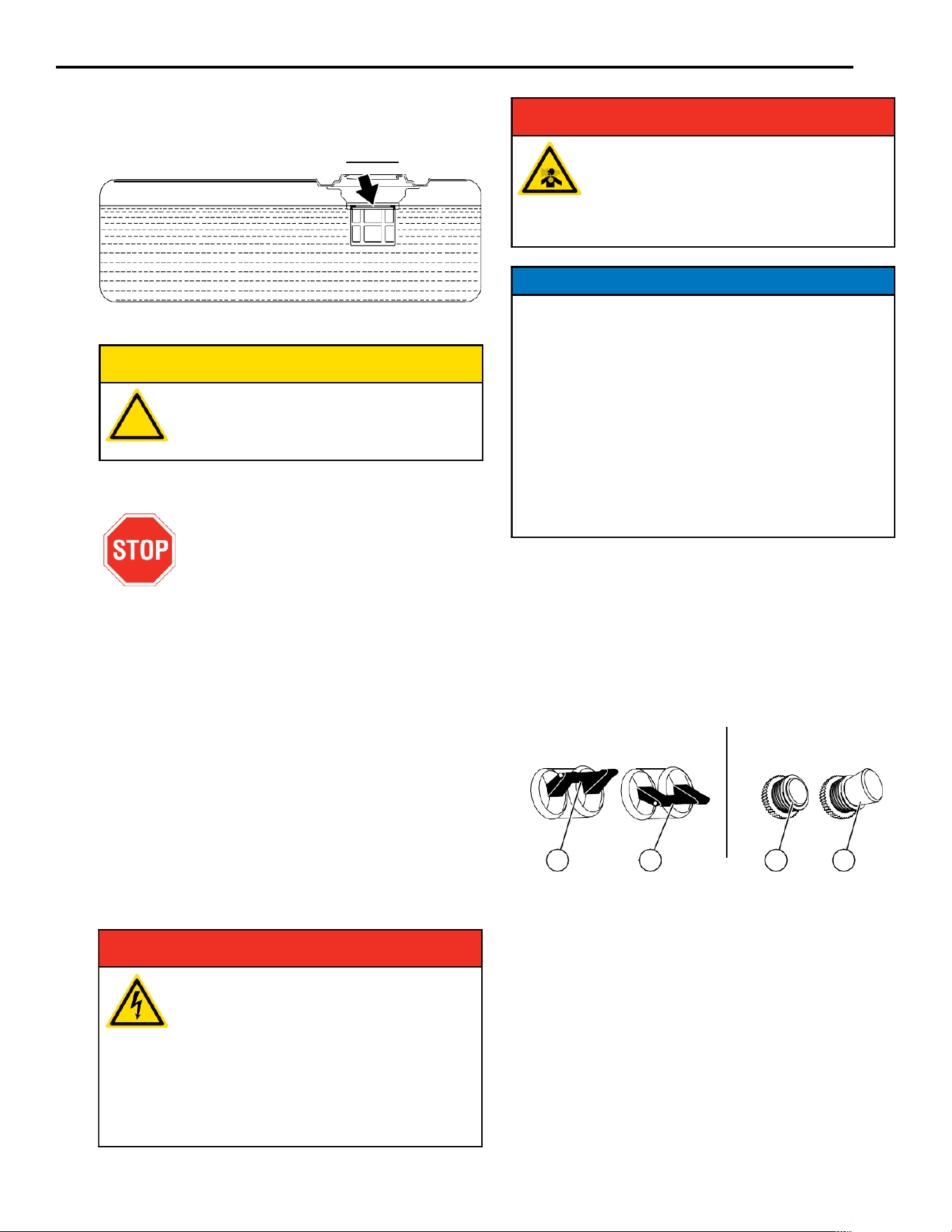
FUNCIONAMIENTO
7.
Instale el tapón de combustible girándolo en
el sentido de las agujas del reloj hasta que se
escuche un clic que indica que el tapón está
completamente instalado.
Figura 15 – Nivel máximo de carga de gasolina
!
PRECAUCIÓN
Evite el contacto prolongado de la piel
!
con la gasolina. Evite respirar durante
períodos prolongados los vapores de
la gasolina.
ENCENDIDO DEL GENERADOR
Antes de encender el generador,
revise Seguridad en la página 7.
Arranque manual del generador
Antes de intentar encender el generador, verifique lo
siguiente:
•
El motor se carga con aceite de motor (vea
NOTA: Este procedimiento también se puede
utilizar en un generador con arranque
eléctrico.
Procedimiento para controlar el aceite del motor en
la página 28).
•
El generador se ubica en un lugar adecuado (vea
1.
Compruebe que los diyuntores estén configurados
adecuadamente (vea la Figura 16).
Elección de la ubicación en la página 19).
•
El generador está sobre una superficie seca (vea
Clima y Superficie seca en la página 19).
•
Se desconectan todas las cargas del generador (vea
No debe haber cargas conectadas en la página 19).
•
El generador está adecuadamente conectado a
tierra (vea Conexión a tierra del generador en la
página 19).
1 2 3 4
Figura 16 – Disyuntores
1 - Posición de
funcionamiento
del disyuntor
principal de
240/120 V
2 - Posición de
activación
del disyuntor
principal de
240/120 V
3
- Posición de
funcionamiento
del disyuntor de
120 V
4
- Posición de
activación del
disyuntor de
120 V
!
PELIGRO
Nunca opere el generador en un lugar
cerrado. El escape del motor contiene
monóxido de carbono. Sólo debe
operar el generador en exteriores
y alejado de ventanas, puertas y
ventilaciones.
AVISO
El motor cuenta con un interruptor de desconexión
por nivel bajo de aceite. Si el nivel del aceite es bajo,
el motor se apagará y no se encenderá hasta que se
cargue aceite hasta el nivel adecuado.
Asegúrese de que el motor tenga el nivel de aceite
adecuado antes de usarlo. Si no se verifica que el
motor tenga el nivel de aceite adecuado se podría
dañar el motor.
Desconecte todas las cargas del generador antes
de encenderlo. Si no se verifica que todas las
cargas estén desconectadas antes de encender el
generador se podrían dañar los artefactos que estén
conectados.
!
PELIGRO
Nunca use el generador en lugares
mojados o húmedos. Nunca exponga
el generador a lluvia, nieve, rociado
de agua o agua estancada durante el
uso. Proteja el generador de todas las
condiciones climáticas peligrosas. La
humedad o el hielo pueden causar un
cortocircuito u otro tipo de problema
de funcionamiento en el circuito
eléctrico.
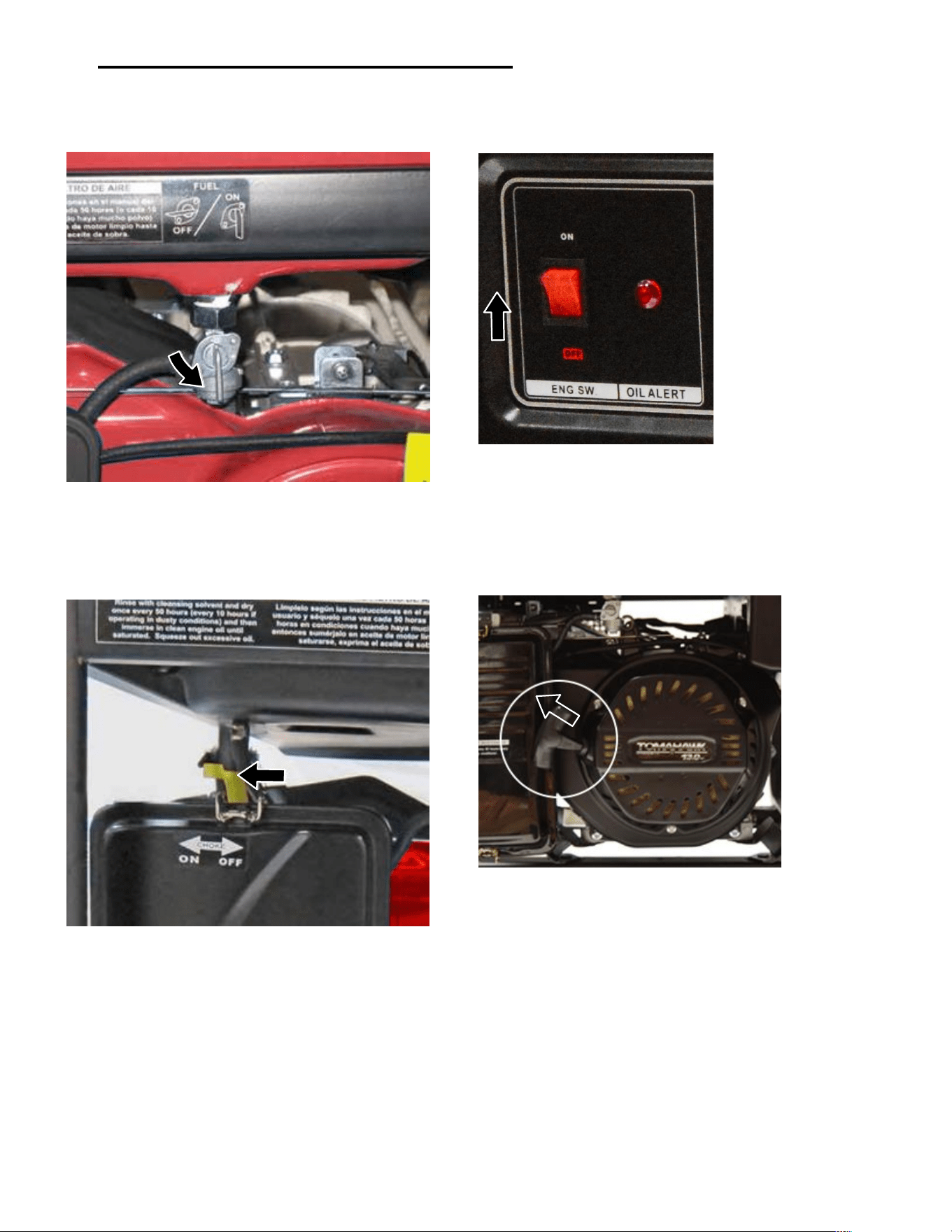
2.
Mueva la válvula de cierre del combustible hasta la
posición ON (encendido) (vea la Figura 17).
4.
Empuje el interruptor de control del motor hasta la
posición RUN (funcionamiento) (vea la Figura 19).
Figura 17 – Válvula de cierre del combustible en la
posición ON (encendido)
3. Mueva la palanca del cebador a la posición ON
(encendido) (vea la Figura 18).
Figura 19 – Interruptor de control del motor
5.
Tome con firmeza y tire de la manija de retroceso
lentamente hasta que sienta que aumenta la
resistencia. En este punto, dé un tirón rápido
mientras tira hacia arriba y alejándose ligeramente
del generador (vea la Figura 20).
Figura 18 – Palanca del cebador
Figura 20
6.
Mientras el motor se enciende y estabiliza, mueva
gradualmente la palanca de cebado nuevamente a
la posición OFF (apagado).
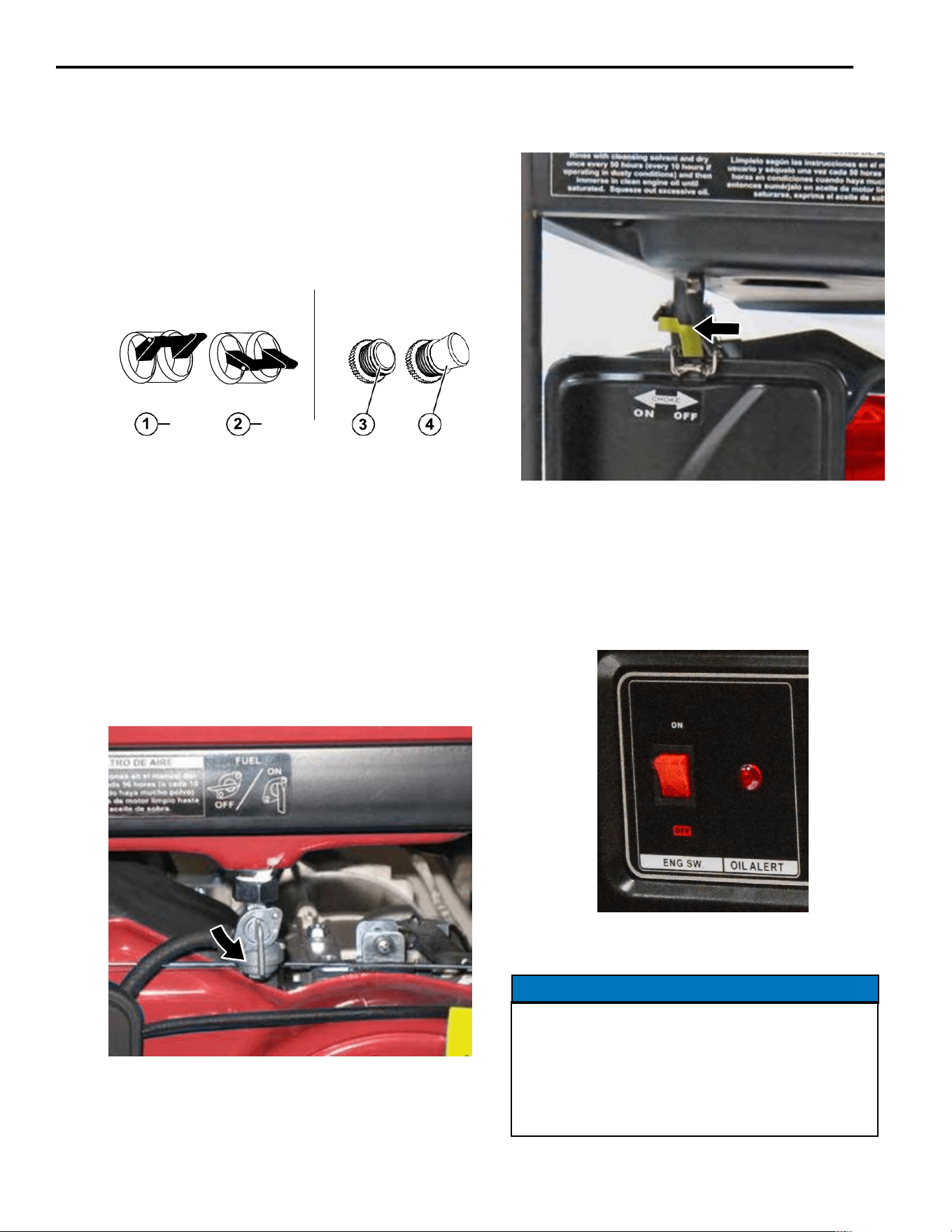
FUNCIONAMIENTO
Encendido de un generador con
arranque eléctrico
1.
Verifique que la batería esté adecuadamente
instalada y que ambos cables de la batería estén
conectados (vea Instalación de la batería (sólo para
generadores con arranque eléctrico) en la página
15).
2.
Compruebe que los diyuntores estén configurados
adecuadamente (vea la Figura 21).
4.
Mueva la palanca del cebador a la posición ON
(encendido) (vea la Figura 23).
Figura 21 – Disyuntores
1
- Posición de
funcionamiento
del disyuntor
principal de
240/120 V
2
- Posición de
activación
del disyuntor
principal de
240/120 V
3
- Posición de
funcionamiento
del disyuntor de
120 V
4
- Posición de
activación del
disyuntor de
120 V
Figura 23 – Palanca del cebador
5.
Oprima y mantenga apretado el interruptor
de control del motor en la posición ON
(encendido) hasta que el motor arranque. Después
de que se encienda el motor, suelte el interruptor
de control del motor; se moverá automáticamente
a la posición RUN (funcionamiento) (vea la Figura
24).
3. Mueva la válvula de cierre del combustible hasta la
posición ON (encendido) (vea la Figura 22).
Figura 24 – Interruptor de control del motor
Figura 22 – Válvula de cierre del combustible en la
posición ON (encendido)
AVISO
Si no se suelta el interruptor de control del motor
después del encendido del motor, se podría dañar
el generador.
Nunca empuje el interruptor de control del motor
hasta la posición ON (encendido) mientras el
motor está en marcha; esto podría dañar el
generador.

6.
Mientras el motor se enciende y estabiliza, mueva
gradualmente la palanca de cebado nuevamente a
la posición OFF (apagado).
NOTA:
NOTA:
Si el motor no arranca después de 5
segundos, suelte el interruptor de control
del motor. Deje que el generador quede
inactivo durante 15 segundos y luego
repita el paso 5. Si la velocidad de arranque
se reduce luego de cada intento fallido, es
posible que la batería no esté bien cargada.
Arranque el generador manualmente
como se indica en Arranque manual del
generador en la página 23.
El generador de arranque eléctrico está
equipado con una función de carga de
baterías. Después de que el motor esté en
funcionamiento, se suministra una pequeña
carga a la batería a través de los cables de
la batería y se la recarga lentamente.
DETENCIÓN DEL GENERADOR
Funcionamiento normal
Durante el funcionamiento normal, use los siguientes
pasos para detener el generador:
1.
Retire las cargas conectadas de los receptáculos
del panel de control.
2.
Deje que el generador funcione “sin carga” para
reducir y estabilizar las temperaturas del motor y el
alternador.
3.
Cambie la válvula de cierre del combustible a la
posición OFF (apagado). Esto automáticamente
purgará el combustible fuera del carburador y
se apagará por sí mismo, o puede apagar el
interruptor de control del motor.
Durante una emergencia
Si surje una emergencia y se debe detener el
generador rápidamente, oprima el interruptor de
control del motor hasta la posición OFF (apagado) de
inmediato.
MANTENIMIENTO
MANTENIMIENTO
Antes de realizar el mantenimiento
del generador debe revisar
Seguridad en la página 7 y los
siguientes mensajes de seguridad.
Cronograma de mantenimiento
AVISO
Los intervalos del mantenimiento periódico varían
en función de las condiciones de funcionamiento del
generador. Si se usa el generador en condiciones
adversas, como con cargas elevadas sostenidas,
temperaturas elevadas o en entornos inusualmente
húmedos o con abundante polvo, será necesario
hacer un mantenimiento periódico más frecuente.
Los intervalos mencionados en el cronograma de
mantenimiento se deben tratar únicamente como una
orientación general.
Es importante respetar el cronograma de
mantenimiento para mantener el generador en buenas
condiciones de funcionamiento. A continuación se
incluye un resumen de las tareas de mantenimiento
según los intervalos de mantenimiento periódicos.
Tabla 1: Cronograma de mantenimiento - Realizado por el propietario
Tareas de
mantenimiento
Antes de cada
uso.
Después de las
primeras 20 horas
o el primer mes
de uso.
Después de 50
horas de uso o
cada 3 meses.
Después de 100
horas de uso o
cada 6 meses.
Después de 300
horas de uso o
todos los años.
Aceite de motor
Controlar el nivel
Cambiar
Cambiar
–
–
Características de
refrigeración
Controlar/limpiar
–
–
–
–
Filtro de aire
Controlar
–
Limpiar
1
–
Sustituir
Bujía de encendido
–
–
–
Controlar/limpiar
Sustituir
Amortiguador de
chispas
–
–
–
Controlar/limpiar
–
1
Realice el mantenimiento con mayor frecuencia si se usa en entornos secos y donde abunda el polvo.
!
ADVERTENCIA
Si no se realiza un mantenimiento
!
periódico o no se realizan
procedimientos de mantenimiento el
generador puede funcionar mal y podría
causar lesiones graves o la muerte.
!
PRECAUCIÓN
Evite que la piel esté en contacto con
el aceite del motor o la gasolina. El
contacto prolongado de la piel con el
aceite del motor o la gasolina puede
ser perjudicial. El contacto frecuente
y prolongado con el aceite del motor
puede causar cáncer de piel. Tome
medidas de protección y utilice
vestimenta y equipos de protección.
Lave con agua y jabón toda la piel que
haya quedado expuesta.
!
ADVERTENCIA
Extraiga de la bujía el capuchón de
!
la bujía de encendido para evitar
encender accidentalmente el generador
durante el mantenimiento. Para los
generadores con arranque eléctrico,
también debe desconectar de la batería
los cables de la batería (desconecte
primero el cable negativo (-) de color
negro) y ubique los cables alejados de
los terminales de la batería para evitar
la formación de un arco.
Deje que los componentes calientes
se enfríen al tacto antes de realizar los
procedimientos de mantenimiento.
La presión interna puede acumularse
en el cárter del motor mientras el motor
está en marcha. Si se extrae el tapón de
llenado/la varilla de medición del aceite
mientras el motor está caliente, se
puede salpicar aceite extremadamente
caliente hacia el exterior del cárter que
puede producir quemaduras graves en
la piel. Deje que se enfríe el aceite del
motor durante varios minutos antes de
extraer el tapón de llenado/la varilla de
medición del aceite.
Siempre debe realizar el mantenimiento
en una zona bien ventilada. La gasolina
y los vapores del combustible son
extremadamente inflamables y pueden
encenderse en ciertas condiciones.
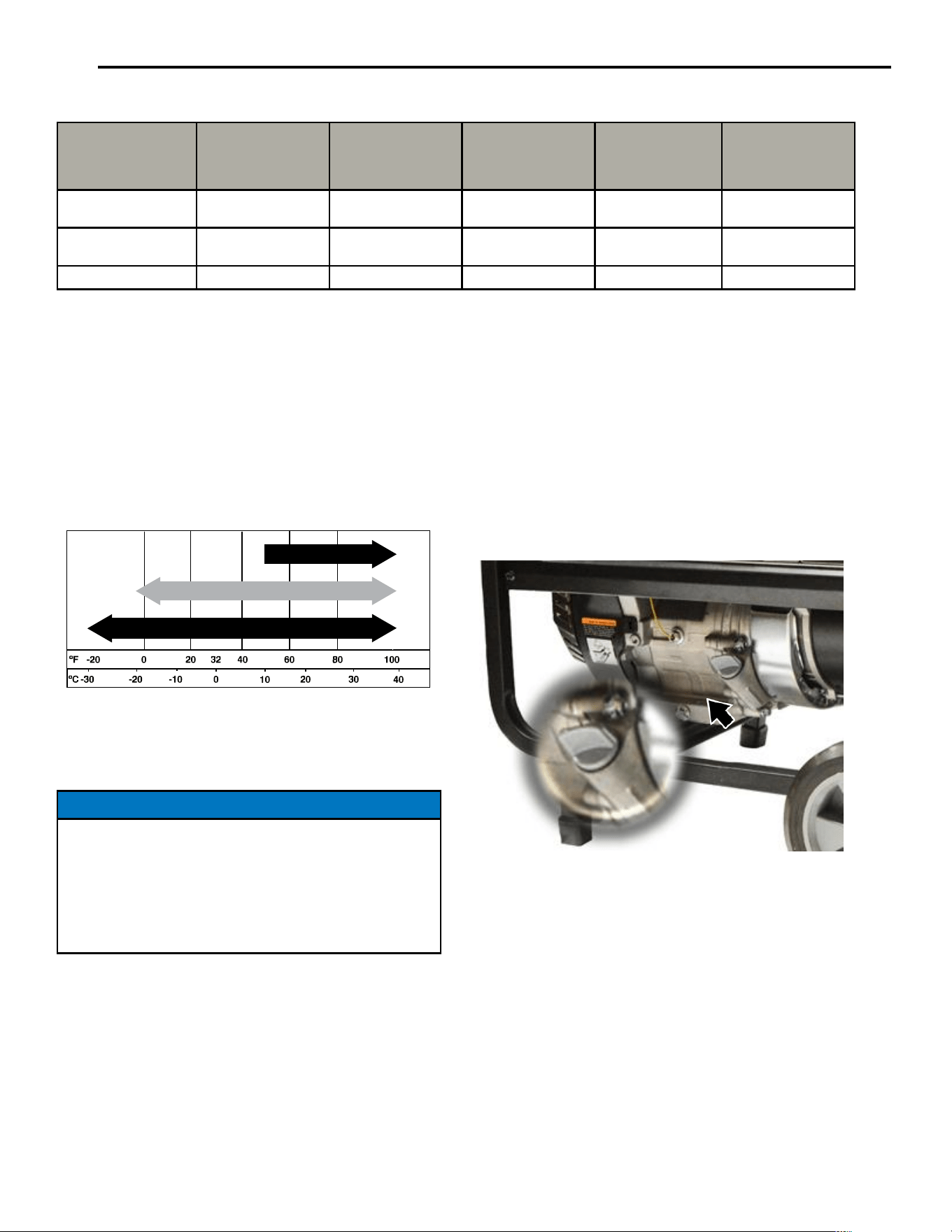
MANTENIMIENTO
Tabla 2: Cronograma de mantenimiento - Realizado por el Distribuidor autorizado de servicio Tomahawk
Tareas de
mantenimiento
Antes de cada
uso.
Después de las
primeras 20 horas
o el primer mes
de uso.
Después de 50
horas de uso o
cada 3 meses.
Después de 100
horas de uso o
cada 6 meses.
Después de 300
horas de uso o
todos los años.
Separación de la
válvula
–
–
–
–
Controlar/ajustar
Filtro de
combustible
–
–
–
Controlar/limpiar
–
Velocidad al ralentí
–
–
–
–
Controlar/ajustar
MANTENIMIENTO DEL
ACEITE DEL MOTOR
Especificación del aceite del motor
1.
Utilice únicamente el aceite del motor que se
especifica en la Figura 25.
2.
Utilice únicamente el aceite de motor de 4
tiempos. NUNCA UTILICE ACEITE DE MOTOR
DE 2 TIEMPOS. El aceite sintético es un sustituto
aceptable para el aceite convencional.
Se debe controlar el aceite del motor antes de cada
uso.
1.
Siempre opere o mantenga el generador sobre una
superficie plana.
2.
Detenga el motor si está en marcha.
3.
Deje que el motor quede inactivo y se enfríe
durante varios minutos (deje que la presión del
cárter se equilibre).
4.
Con una tela húmeda, limpie alrededor del tapón
de llenado/la varilla de medición del aceite.
5.
Retire el tapón de llenado/la varilla de medición del
aceite (vea la Figura 26).
Figura 25 – Aceite recomendado
Procedimiento para controlar el aceite
del motor
AVISO
Mantenga siempre un nivel de aceite del motor
adecuado. Si no se mantiene el nivel de aceite del
motor adecuado se podría dañar gravemente el
motor y/o acortar su vida útil.
Siempre use el aceite del motor especificado. Si no
se usa el aceite del motor especificado se puede
acelerar el desgaste del motor y/o acortar su vida útil.
Figura 26 – Tapón de llenado/varilla de medición del
aceite
6.
Controle el nivel de aceite:
Cuando controle el nivel de aceite, retire el tapón
de llenado/la varilla de medición del aceite y
límpielos. Enrosque el tapón de llenado/la varilla
de medición del aceite completamente y luego
sáquelos para controlar el nivel de aceite del tapón
de llenado/la varilla de medición del aceite.
•
Nivel de aceite aceptable: se puede ver el aceite
sobre las rayas que hay entre las líneas H (alto)
y L (bajo) del tapón de llenado/la varilla de
medición del aceite (vea la Figura 27).
SAE 30
Conventional 10W-30
5W-30
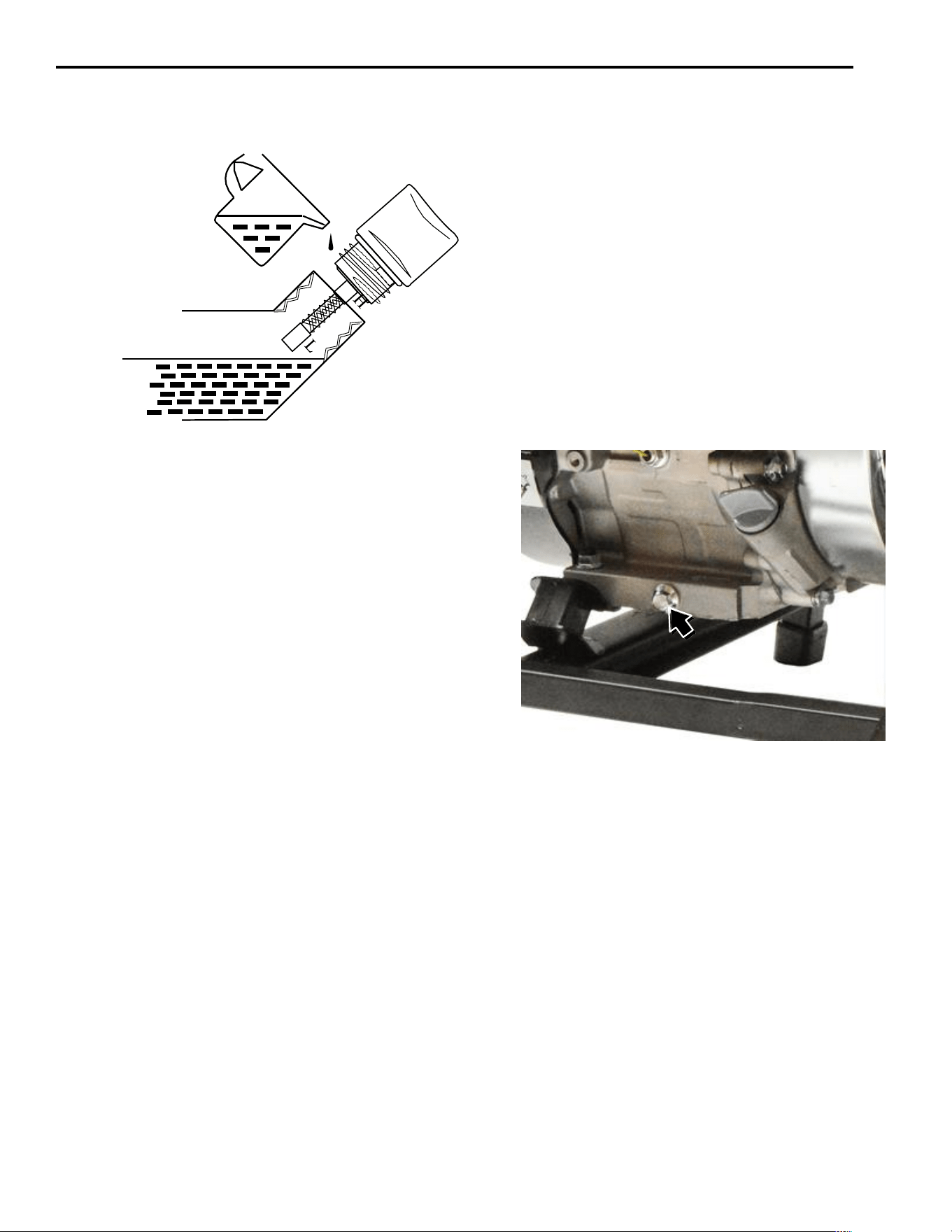
MANTENIMIENTO
•
Nivel de aceite bajo: el aceite está por debajo de
la línea L (bajo) del tapón de llenado/la varilla de
medición del aceite.
Figura 27 – Control del nivel de aceite
Procedimiento para agregar el aceite
del motor
1.
Siempre opere o mantenga el generador sobre una
superficie plana.
2.
Detenga el motor si está en marcha.
3.
Deje que el motor quede inactivo y se enfríe
durante varios minutos (deje que la presión del
cárter se equilibre).
4.
Limpie completamente alrededor del tapón de
llenado/la varilla de medición del aceite.
5.
Retire el tapón de llenado/la varilla de medición del
aceite y límpielos.
6.
Seleccione el aceite de motor correcto según lo
especificado en la Figura 25.
7.
Usando el embudo y el tubo suministrado, agregue
aceite de motor lentamente al motor. Pare con
frecuencia para controlar el nivel y evitar así que se
desborde (vea la Figura 28).
8.
Continúe agregando aceite hasta que esté en el
nivel correcto. Vea Procedimiento para controlar el
aceite del motor en la página 28.
Procedimiento para cambiar el aceite
del motor
1.
Pare el motor.
2.
Deje que el motor quede inactivo y se enfríe
durante varios minutos (deje que la presión del
cárter se equilibre).
3.
Coloque un recogedor de aceite (o un recipiente
adecuado) debajo del tapón de drenaje del aceite.
4.
Con una tela húmeda, limpie completamente
alrededor del tapón de drenaje del aceite.
5.
Retire el tapón de drenaje del aceite (vea la Figura
29). Después de hacerlo, coloque el tapón de
drenaje del aceite sobre una superficie limpia.
Figura 29 – Tapón de drenaje del aceite
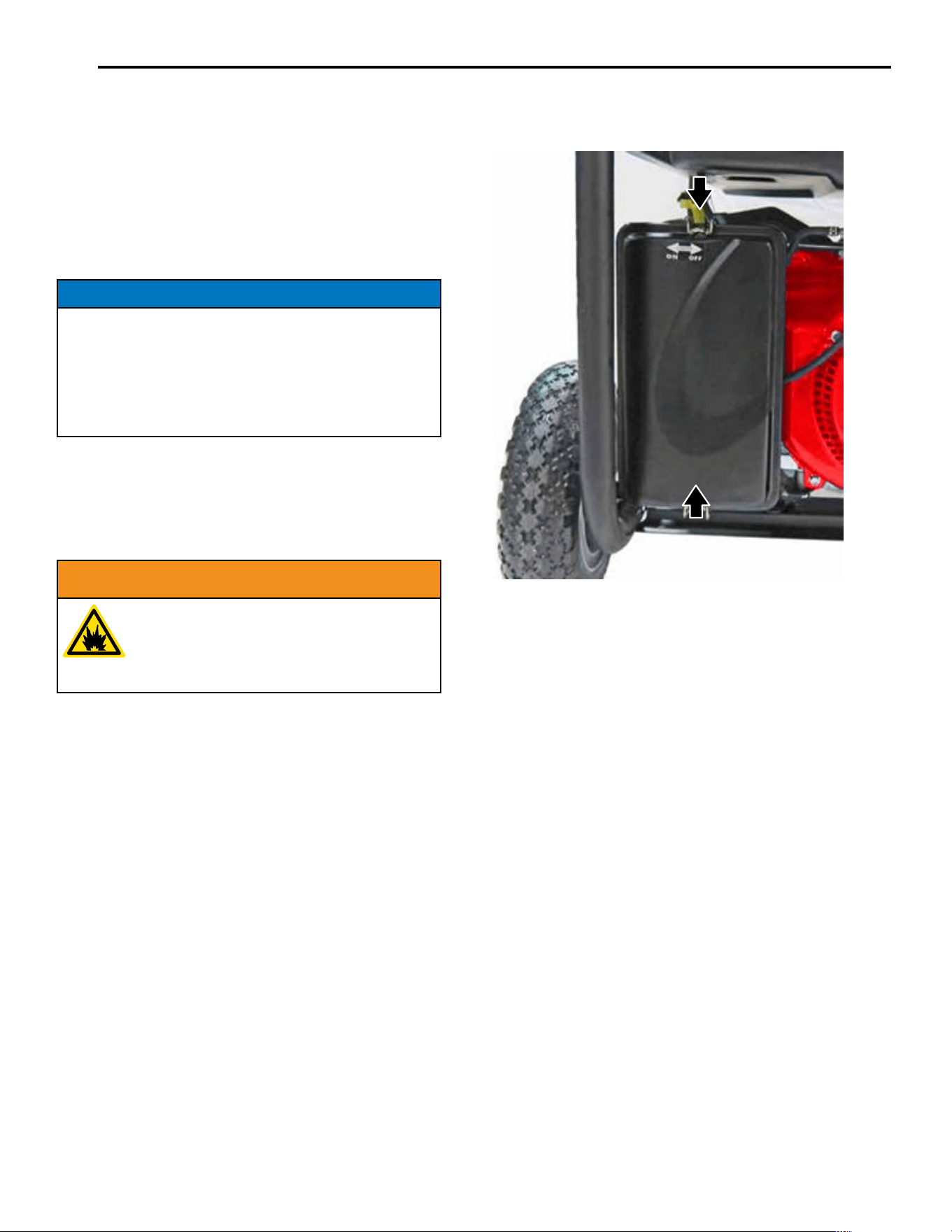
MANTENIMIENTO
6.
Retire el tapón de llenado del aceite para que el
aceite se pueda drenar más fácilmente del orificio
de drenaje del aceite.
7.
Deje que se drene totalmente el aceite.
8.
Coloque nuevamente el tapón de drenaje del
aceite.
9.
Llene el cárte de aceite siguiendo los pasos que se
detallan en Procedimiento para agregar el aceite
del motor en la página 29.
AVISO
Nunca deseche el aceite de motor usado arrojándolo
en un desagüe, en la tierra o en aguas subterráneas
o vías fluviales. Siempre debe ser responsable con
el medio ambiente. Siga los lineamientos de la EPA o
de otras agencias gubernamentales para el desecho
adecuado de materiales peligrosos. Consulte a las
autoridades locales o las instalaciones de reciclado.
10.
Deseche el aceite de motor usado de manera
adecuada.
MANTENIMIENTO DEL FILTRO
DE AIRE
!
ADVERTENCIA
Nunca use gasolina ni otros
disolventes inflamables para limpiar
el filtro de aire. Debe usar únicamente
detergente para el hogar para limpiar el
filtro de aire.
Limpieza del filtro de aire
El filtro de aire debe limpiarse después de 50 horas de
uso o cada 3 meses (se debe aumentar la frecuencia si
el generador funciona en un entorno donde abunda el
polvo).
1.
Apague el generador y déjelo enfriar durante varios
minutos si está en funcionamiento.
2.
Mueva el generador hasta una superficie plana y
nivelada.
3.
Desenganche las presillas ubicadas arriba y abajo
de la tapa del filtro de aire (vea la Figura 30) y
remueva la tapa del filtro de aire.
Figura 30 – Remoción de la Tapa del Filtro de Aire
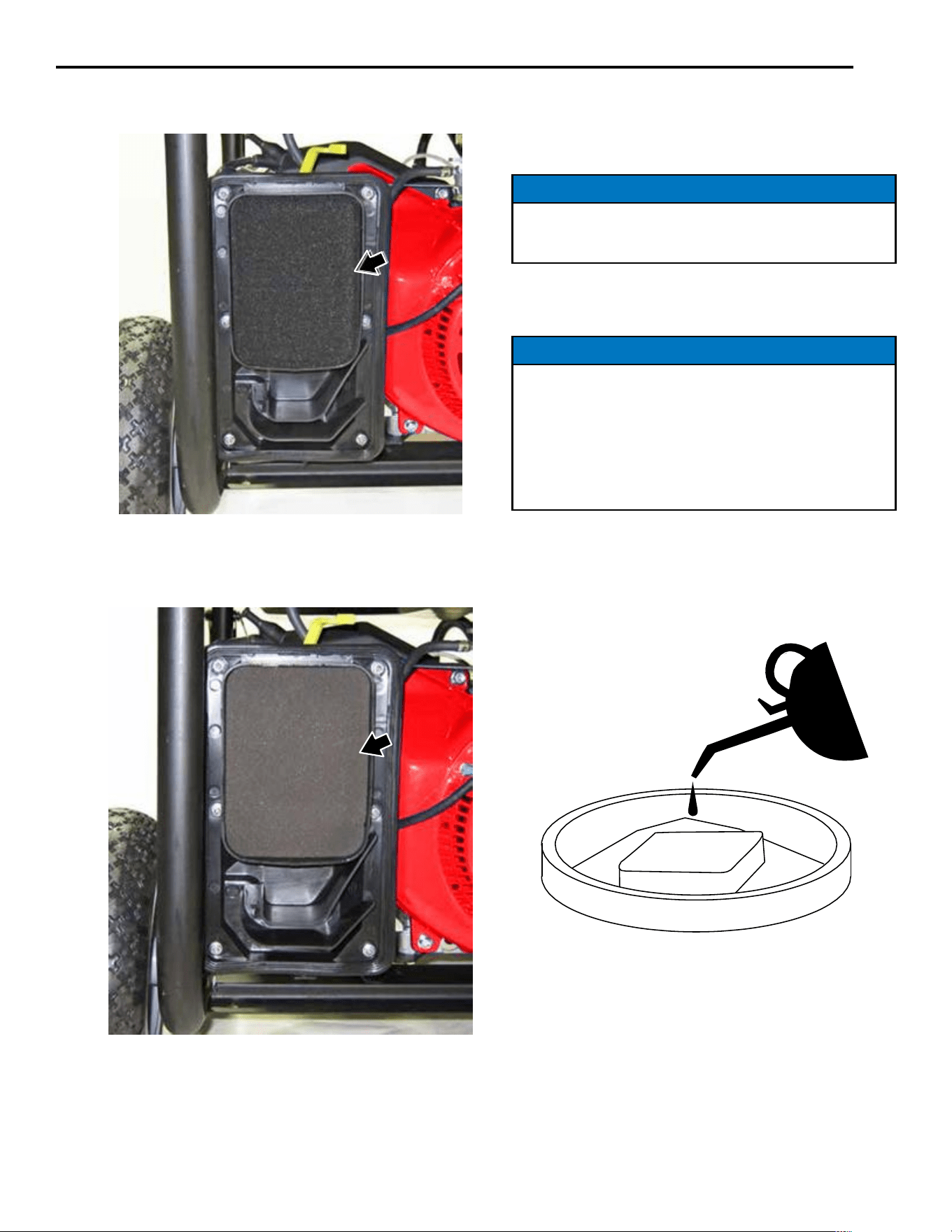
MANTENIMIENTO
4.
Remueva el elemento áspero negro ubicado en el
exterior del filtro de aire (vea la Figura 31).
Figura 31 – Remoción del Elemento Áspero del Filtro
de Aire
5.
Remueva el elemento fino gris ubicado en el
interior del filtro de aire (vea la Figura 32).
6.
Lave los elementos de espuma del filtro de aire
sumergiéndolo en una solución de detergente para
el hogar y agua caliente. Apriete lentamente la
espuma hasta que quede completamente limpia.
AVISO
NUNCA tuerza o rasgue el elemento de espuma del
filtro de aire durante la limpieza o el secado. Sólo
debe apretarlo lenta pero firmemente.
7.
Enjuáguela en agua limpia sumergiendo los
elementos del filtro de aire en agua dulce y
apretándolo lentamente.
AVISO
Nunca deseche la solución jabonosa usada para
limpiar el filtro de aire arrojándola en un desagüe,
en la tierra o en aguas subterráneas o vías fluviales.
Siempre debe ser responsable con el medio
ambiente. Siga los lineamientos de la EPA o de
otras agencias gubernamentales para el desecho
adecuado de materiales peligrosos. Consulte a las
autoridades locales o las instalaciones de reciclado.
8.
Deseche la solución jabonosa usada de manera
adecuada.
9.
Seque los elementos del filtro de aire apretándolo
firmemente otra vez.
10.
Una vez que los filtros de aire esté seco, cubra los
filtros con aceite de motor limpio (vea la Figura 33).
Figura 33
Figura 32 – Remoción del Elemento Fino del Filtro
de Aire
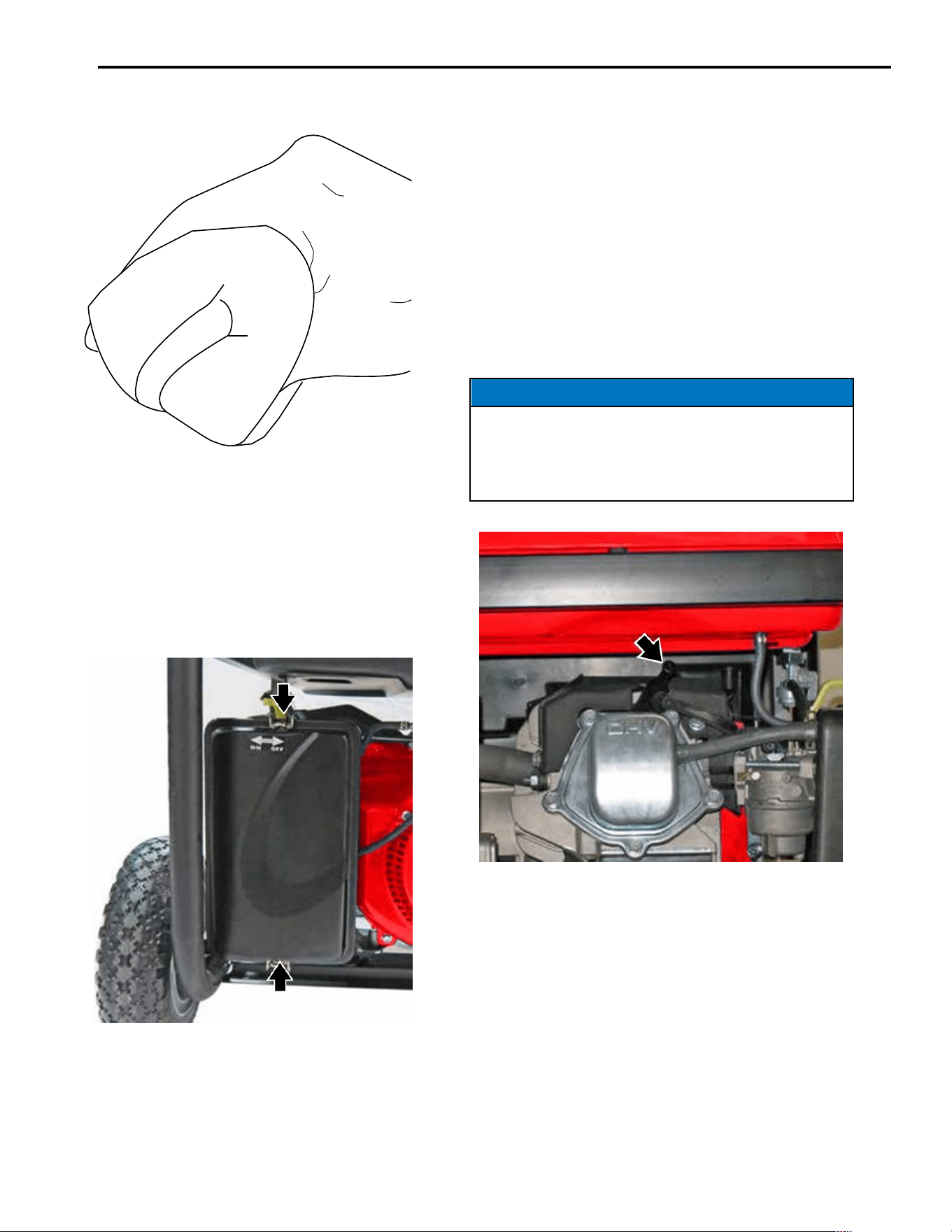
MANTENIMIENTO
11.
Exprima los filtros para remover el exceso de aceite
(vea la Figura 34).
Figura 34
12.
Instale primero el elemento gris fino del filtro de
aire dentro de la carcasa del filtro de aire.
13.
Instale el elemento áspero negro en la parte
externa del filtro de aire encima del elemento de
filtro fino.
14.
Instale la tapa del filtro de aire enganchando las
presillas arriba y abajo del ensamble del filtro de
aire (vea la Figura 35).
MANTENIMIENTO DE LA
BUJÍA DE ENCENDIDO
Se debe controlar y limpiar la bujía de encendido cada
100 horas de uso o 6 meses y se la debe reemplazar
después de 300 horas de uso o todos los años.
1.
Detenga el generador y deje que se enfríe durante
varios minutos si está en funcionamiento.
2.
Traslade el generador hasta una superficie plana y
nivelada.
3.
Retire el capuchón de la bujía de encendido tirando
firmemente de la manija plástica del capuchón de
la bujía, alejándolo directamente del motor (vea la
Figura 36).
AVISO
Nunca debe aplicar una carga lateral ni mover la
bujía hacia los costados cuando extraiga la bujía. Si
se aplica una carga lateral o se mueve la bujía hacia
los costados se puede agrietar y se puede dañar el
capuchón de la bujía.
Figura 36 – Procedimiento para retirar el capuchón de
la bujía de encendido
4.
Limpie la zona que rodea a la bujía de encendido.
5.
Con la llave de cubo de 13/16" para bujías
suministrada, retire la bujía de la cabeza del cilindro
(vea la Figura 37).
Figura 35 – Instalación de la Tapa del Filtro de Aire
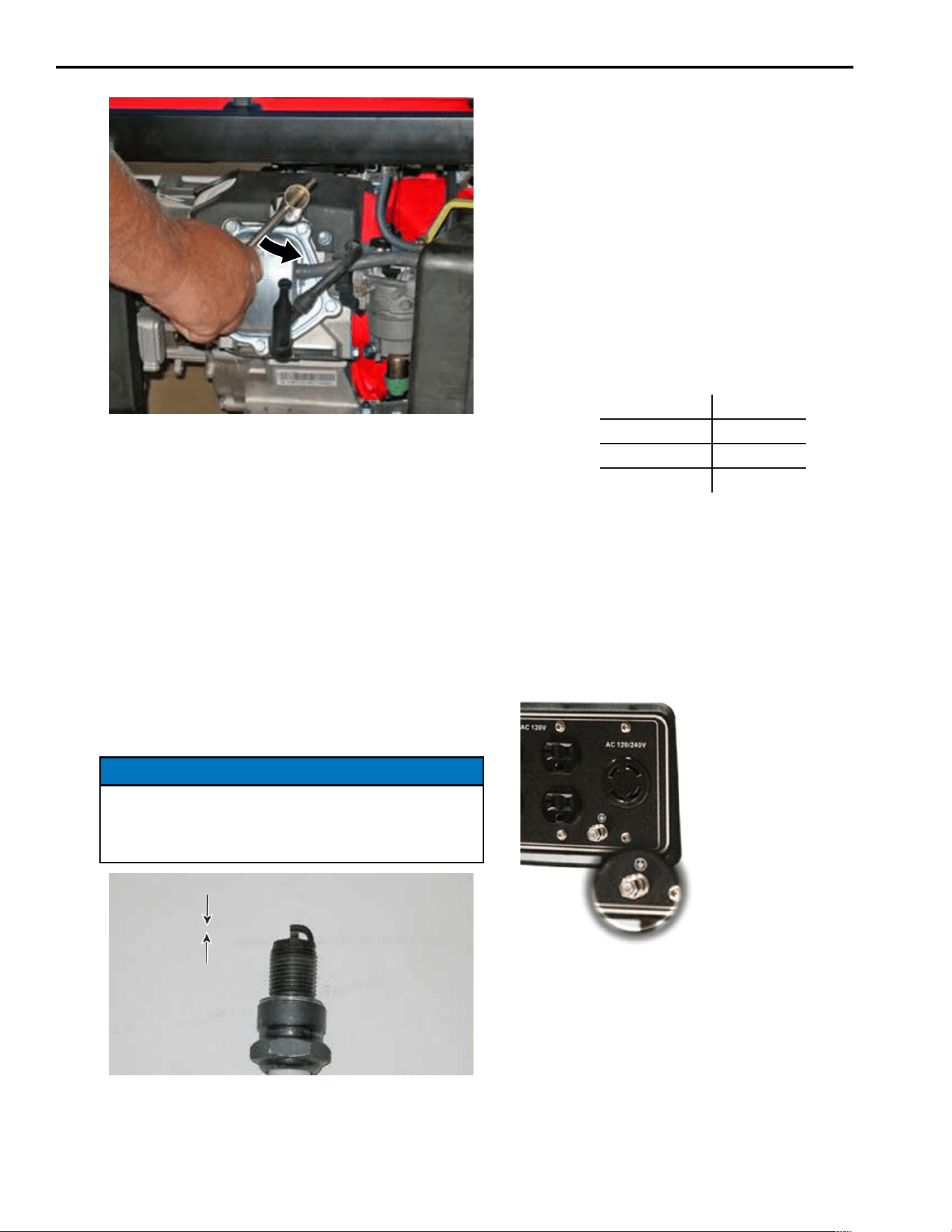
MANTENIMIENTO
8. Coloque la bujía de encendido siguiendo
atentamente los pasos que se detallan a
continuación:
a - Inserte con cuidado la bujía nuevamente
dentro de la cabeza del cilindro. Enrosque
manualmente la bujía hasta que sobresalga la
base.
b - Con la llave de cubo de 13/16" para bujías
suministrada, gire la bujía hasta asegurar que
esté completamente asentada.
c - Vuelva a colocar el capuchón de la bujía,
comprobando que se enganche completamente
con la punta de la bujía.
Reemplazos de bujías recomendados:
Figura 37 – Procedimiento para extraer la bujía
6.
Coloque una tela limpia sobre la abertura que
se generó al extraer la bujía de encendido para
asegurar que no pueda ingresar suciedad en la
cámara de combustión.
7.
Inspeccione la bujía de encendido para detectar:
•
Si el aislador está agrietado o astillado.
•
Si está excesivamente desgastada
•
Si la separación de la bujía de encendido es
incorrecta (el límite que se acepta es de 0,024 –
0,032 pulgadas [0,60 – 0,80 mm]) (vea la Figura
38).
Si la bujía de encendido tiene algún problema
en relación con las condiciones establecidas
precedentemente, debe reemplazarla por una
Champion RN9YC o equivalente.
AVISO
Sólo debe usar la bujía de encendido recomendada
(Champion RN9YC o equivalente). Si se utiliza una
bujía de encendido no recomendada se podría dañar
el motor.
Figura 38 – Requisitos de separación de la bujía
PROBANDO DE LOS
TOMACORRIENTES
Arranque el generador y déjelo calentar.
Figura 39 – Tomacorriente
AutoLite
63
Champion
RN9YC
Bosch
WR7DS
Torch
F6RTC
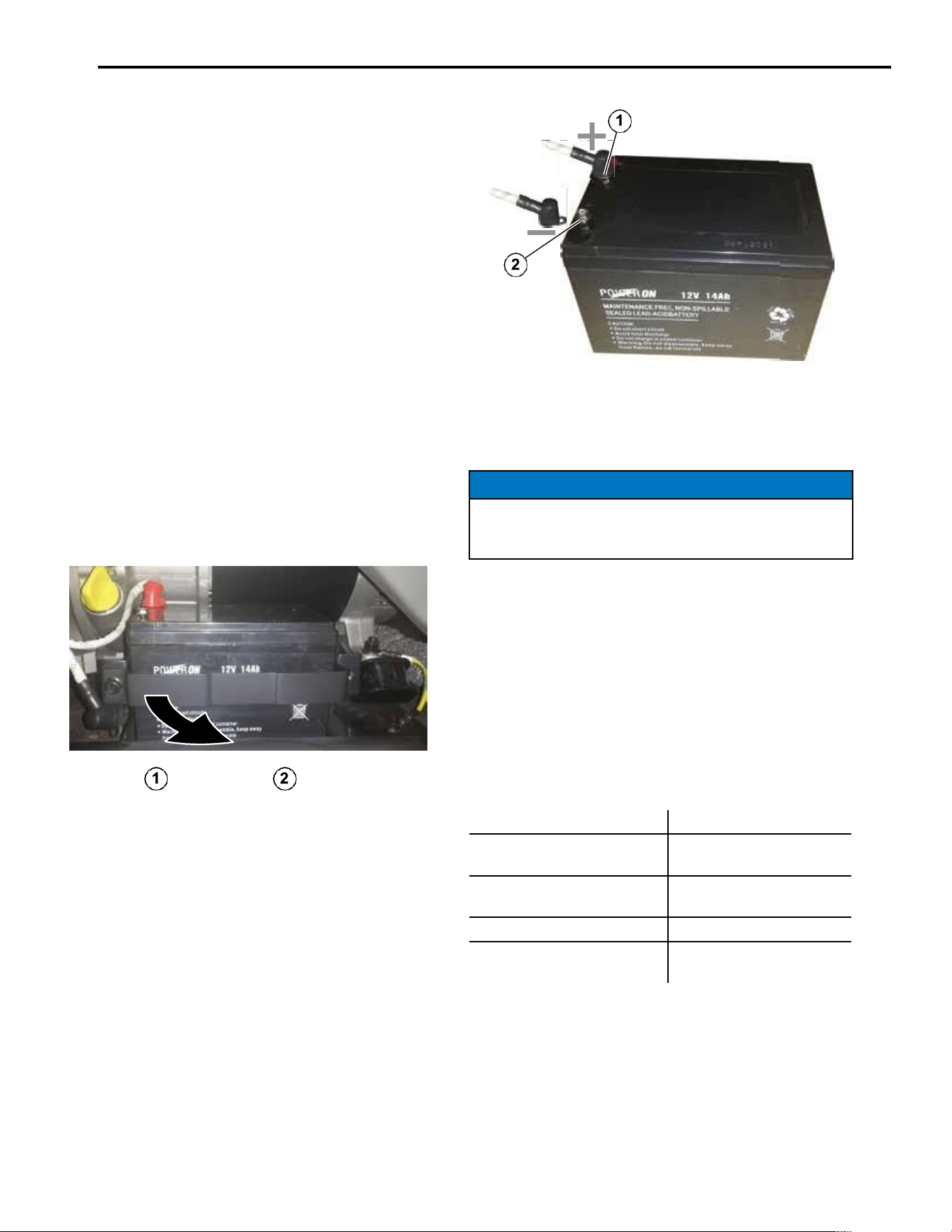
MANTENIMIENTO
1.
El botón de restablecimiento deberá saltarse y
no habrá energía en el tomacorriente. Si el botón
de restablecimiento no se salta, el tomacorriente
GFCI no está trabajando correctamente y deberá
ser reparado antes de que el generador pueda ser
operado.
2.
Presione el botón de restablecimiento para
restablecer la energía al tomacorriente.
SERVICIO A LA BATERÍA
Para asegurarse de que la batería se mantenga
cargada, el generador debe ser arrancado cada 2 ó
3 meses y operado durante un tiempo mínimo de 15
minutos. Si el generador es almacenado por más de
un año sin hacerlo funcionar, pueda que sea necesario
usar un cargador de batería para recargar la batería.
Figura 41
Reemplazo de la batería
1.
Remueva el cable de la bujía de la bujía.
2.
Afloje y remueva el tornillo de la placa de sujeción
de la batería y gire la placa hacia afuera (vea la
Figura 40).
1 - Cable de batería
positivo (+) rojo
2 - Cable de batería
negativo (-)
negro
Figura 40
1 - Tornillo 2 - Placa de sujeción
de la batería
3.
Incline la batería ligeramente hacia adelante para
obtener acceso a los cables de batería.
4.
Desconecte primero el cable de batería negativo (-)
negro de la batería.
5.
Desconecte después el cable de batería
positivo (+) rojo y retire la batería.
6.
Instale la batería nueva en el marco del generador.
7.
Conecte primero el cable de batería positivo (+)
rojo en la batería.
8.
Conecte después el cable de batería negativo (-)
negro en la batería.
9.
Instale la placa de sujeción de la batería usando las
tuercas removidas en el paso 2.
10.
Instale el cable de la bujía en la bujía.
La batería es la misma que la de una batería para
motocicleta/utilitaria.
Tipo
14L-A2
Tomahawk número de
modelo
100284
Batteries Plus número
de modelo
WKPC12-14NB
Amp.
14
Dimensiones (L x A x A)
6.0 x 3.75 x 3.75 pul.
(15,2 x 9,4 x 9,4 cm)
AVISO
Deshágase apropiadamente de la batería usada de
acuerdo con las normas establecidas por su gobierno
local o estatal.
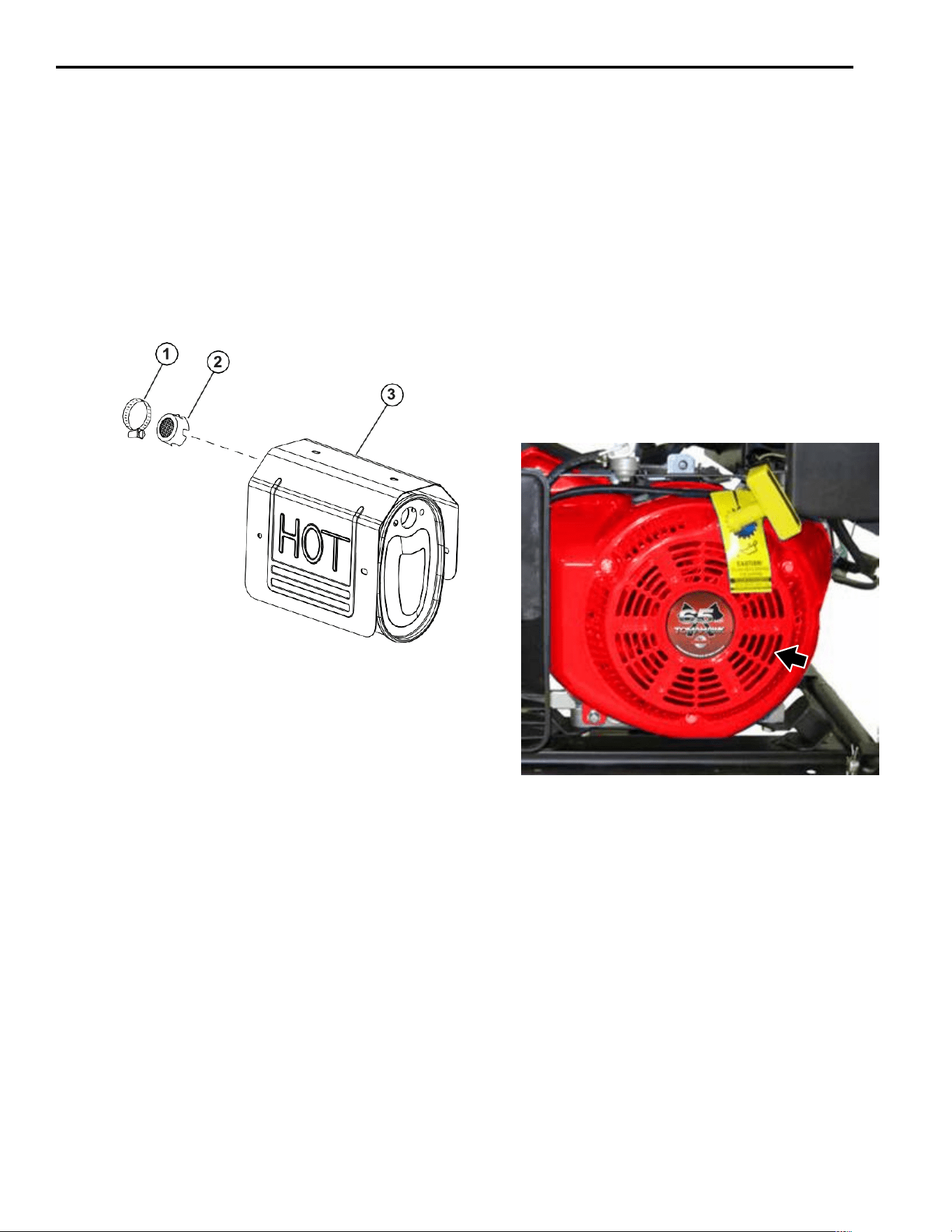
MANTENIMIENTO
LIMPIEZA DEL
AMORTIGUADOR DE CHISPAS
Controle y limpie el amortiguador de chispas después
de 100 horas de uso o cada 6 meses.
1.
Detenga el generador y deje que se enfríe durante
varios minutos si está en funcionamiento.
2.
Traslade el generador hasta una superficie plana y
nivelada.
3.
Con un destornillador de punta plana, afloje la
abrazadera de banda del amortiguador de chispas
(vea la Figura 42).
8.
Coloque los componentes del amortiguador de
chispas en el siguiente orden:
a - Coloque la pantalla del amortiguador de
chispas sobre el tubo de escape del silenciador.
Presione la pantalla hasta que sobresalga
completamente la base.
b - Coloque la abrazadera de banda del
amortiguador de chispas sobre la pantalla y
ajústela con un destornillador de punta plana.
LIMPIEZA DEL GENERADOR
Es importante inspeccionar y limpiar el generador antes
de cada uso.
Limpie todos los orificios de entrada y salida de
aire del motor. Compruebe que todos estos orificios
estén limpios y no haya desechos o sucedad a fin de
asegurar que el motor no funcione en HOT (caliente)
(vea la Figura 43).
Figura 42 – Conjunto del amortiguador de chispas
1
- Abrazadera
de banda del
amortiguador de
chispas
2
- Pantalla del
amortiguador de
chispas
3
- Silenciador
Figura 43 – Orificios de entrada y salida de aire del
motor
4.
Deslice la abrazadera de banda del amortiguador
de chispas fuera de la pantalla del amortiguador de
chispas.
5.
Tire de la pantalla del amortiguador de chispas
para sacarla del tubo de escape del amortiguador.
6.
Con un cepillo de alambre, elimine la suciedad y
los residuos que se puedan haber acumulado en la
pantalla del amortiguador de chispas.
7.
Si la pantalla del amortiguador de chispas presenta
signos de desgaste (está rasgada o rota, o tiene
grandes agujeros), debe reemplazarla.
Limpie todas las aletas de refrigeración del motor.
Use una tela húmeda y un cepillo para aflojar y retirar
toda la suciedad que haya sobre o alrededor de las
aletas de refrigeración del motor (vea la Figura 44).
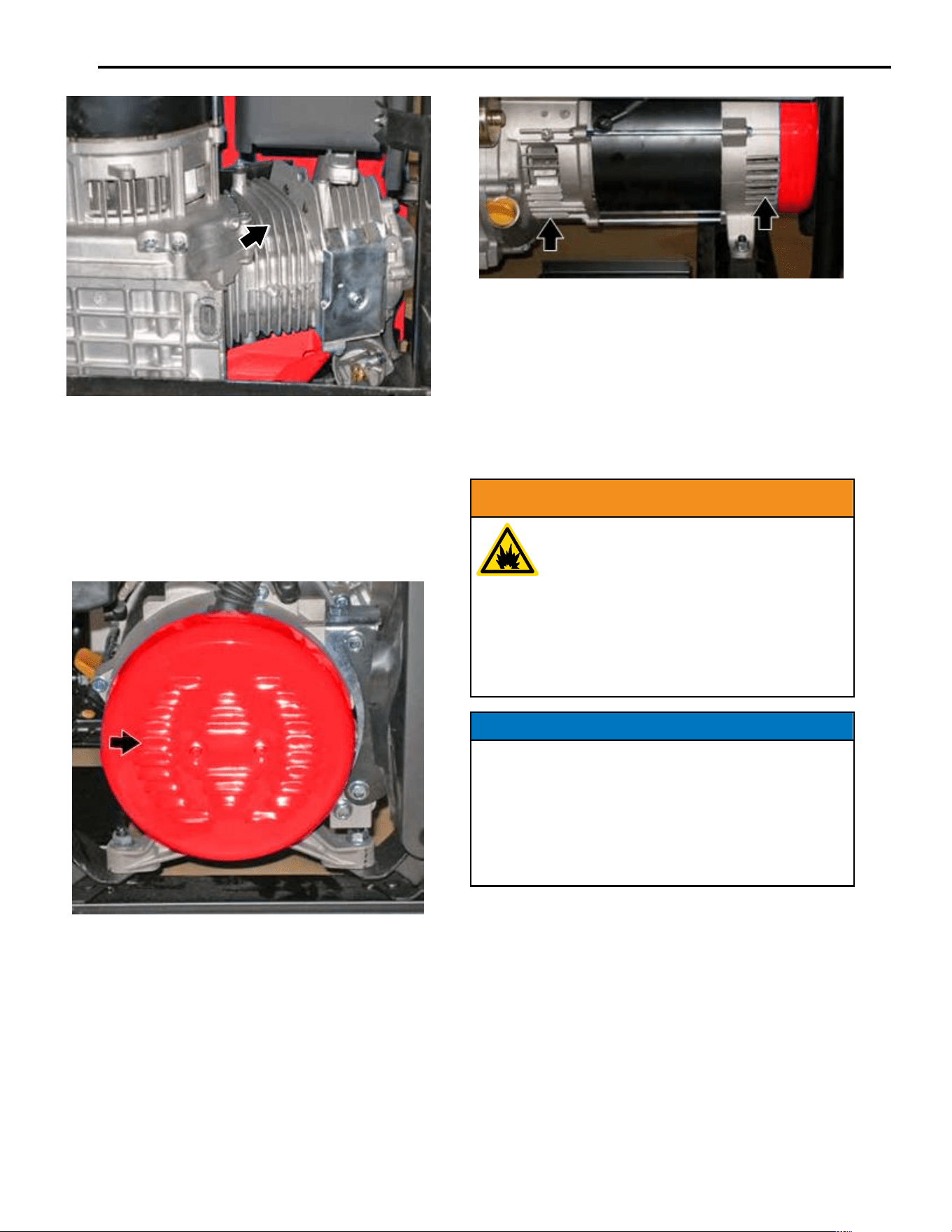
MANTENIMIENTO
Figura 44 – Aletas de refrigeración del motor
Limpie todas las entradas de aire de refrigeración
y todos los orificios de escape del alternador.
Compruebe que las entradas de aire de refrigeración
y los orificos de escape del alternador estén libres de
desechos y obstrucciones. Utilice una aspiradora para
eliminar la suciedad y los residuos que estén trabados
en las entradas de aire de refrigeración y los orificos de
escape (vea la Figura 45 y Figura 46).
Figura 45 – Entrada de aire de refrigeración y orifico de
escape del alternador
Figura 46 – Entrada de aire de refrigeración y orifico de
escape del alternador
Limpieza general del generador: Utilice una tela
húmeda para limpiar todas las superficies restantes.
ALMACENAMIENTO
!
ADVERTENCIA
Nunca almacene el generador
con combustible en el depósito
en interiores o en una zona con
ventilación insuficiente en la que los
humos puedan entrar en contacto
con una fuente de ignición como: 1)
luz piloto de una estufa, calentador
de agua, secador de ropa o cualquier
otro artefacto a gas; o 2) chispa de un
artefacto eléctrico.
AVISO
La gasolina que se almacena por tan sólo 60 días
puede echarse a perder, provocando la formación
de goma, barniz y acumulación corrosiva en las
líneas de combustible, los conductos de combustible
y el motor. Esta acumulación corrosiva limita la
circulación de combustible, lo que evita que el motor
arranque después de un período de almacenamiento
prolongado.
Se deben tomar precauciones adecuadas para
preparar el generador para un almacenamiento.

MANTENIMIENTO
1.
Limpie el generador como se indica en Limpieza del
generador en la página 35.
2.
Drene toda la gasolina del depósito de combustible
lo mejor posible.
3.
Con la válvula de cierre del combustible abierta,
encienda el motor y deje que el generador funcione
hasta que se consuma la gasolina que haya
quedado en las líneas de combustible y en el
carburador y se apague el motor.
4.
Cierre la válvula de cierre del combustible.
5.
Cambie el aceite (vea Procedimiento para cambiar
el aceite del motor en la página 29).
6.
Retire la bujía de encendido (vea Mantenimiento de
la bujía de encendido en la página 32) y coloque
aproximadamente 1 cucharada de aceite en la
abertura de la bujía. Mientras coloca una tela limpia
sobre la abertura de la bujía de encendido, tire
lentamente de la manija de retroceso para permitir
que el motor gire varias veces. Así se distribuirá
el aceite y se protegerá la pared del cilindro de la
corrosión durante el almacenamiento.
7.
Coloque nuevamente la bujía (vea Mantenimiento
de la bujía de encendido en la página 32).
8.
Traslade el generador a un lugar limpio y seco para
almacenarlo.
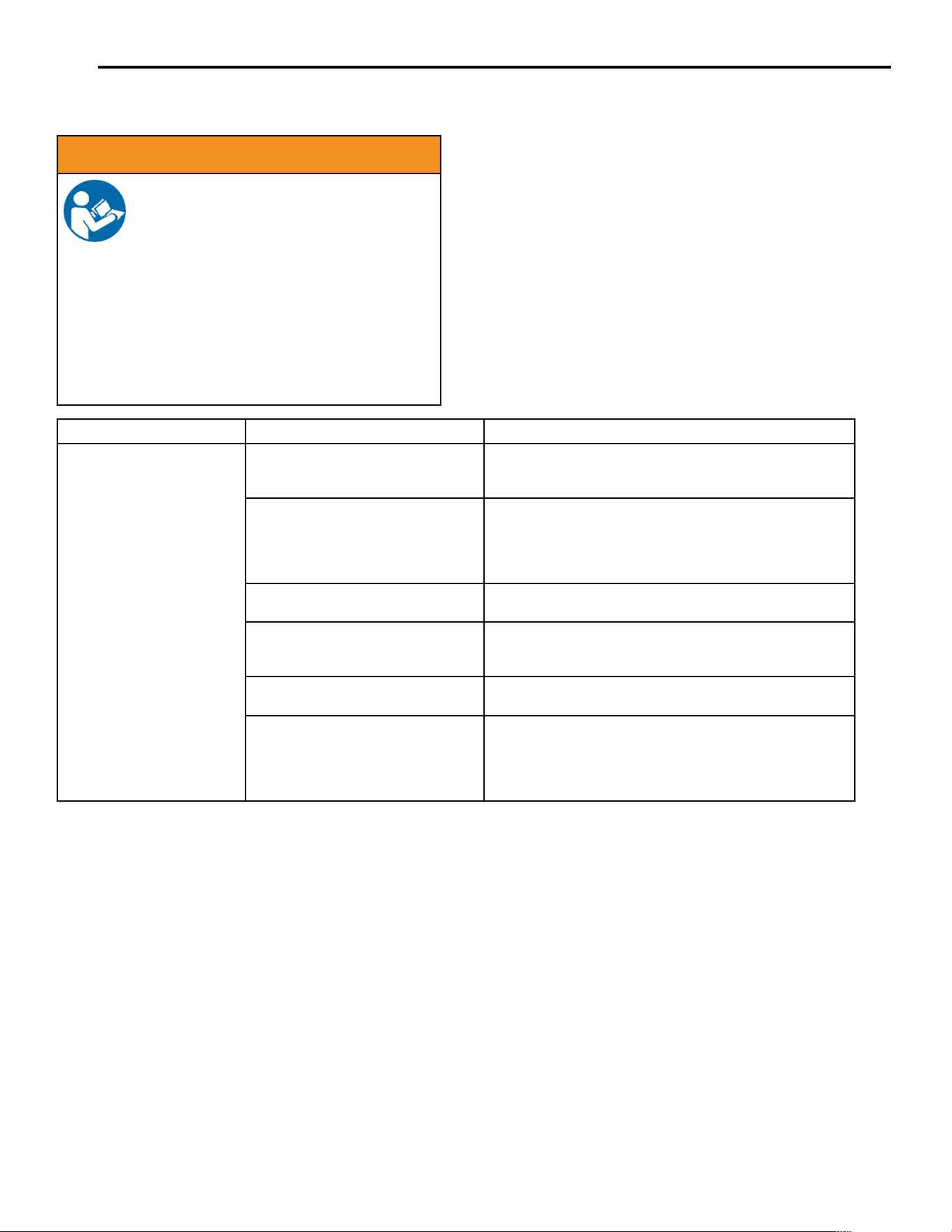
MANTENIMIENTO
SOLUCIÓN DE PROBLEMAS
!
ADVERTENCIA
Antes de intentar realizar el servicio
o detectar los problemas del
generador, el propietario o el técnico
de servicios deben leer primero el
manual del propietario y comprender
y respetar todas las instrucciones de
seguridad. Si no se respetan todas
las instrucciones, se pueden generar
condiciones que pueden provocar
la anulación de la certificación de la
EPA o de la garantía del producto,
lesiones personales graves, daños a la
propiedad o incluso la muerte.
PROBLEMA
CAUSA POSIBLE
SOLUCIÓN
El motor está en
funcionamiento pero no hay
salida de energía eléctrica.
1. Los disyuntores se activaron.
1. Reponga los disyuntores y controle si hay una
condición de sobrecarga (vea las páginas 23 y
25).
2. El conector de clavija del
cable de suministro no está
completamente conectado en el
tomacorriente del generador.
2. Controle que el conector de clavija esté firmemente
conectado en el tomacorriente del generador. Si
usa el tomacorriente de 240 V, compruebe que el
conector de clavija esté girado 1/4 de giro en el
sentido de las agujas del reloj.
3. El cable de suministro presenta
una falla o está defectuoso.
3. Reemplace el cable de suministro.
4. El artefacto eléctrico presenta
una falla o está defectuoso.
4. Intente conectar un artefacto que sabe que funciona
correctamente para verificar que el generador
produce energía eléctrica.
5. El tomacorriente GFCI se ha
disparado
5. Oprima el botón de restablecimiento en el
tomacorriente GFCI (Vea la página 33).
6. Si después de intentar con los
paso 1 a 5 precedentes no
se soluciona el problema, la
causa podría ser una falla en el
generador.
6. Lleve el generador al distribuidor de servicio
autorizado más cercano.
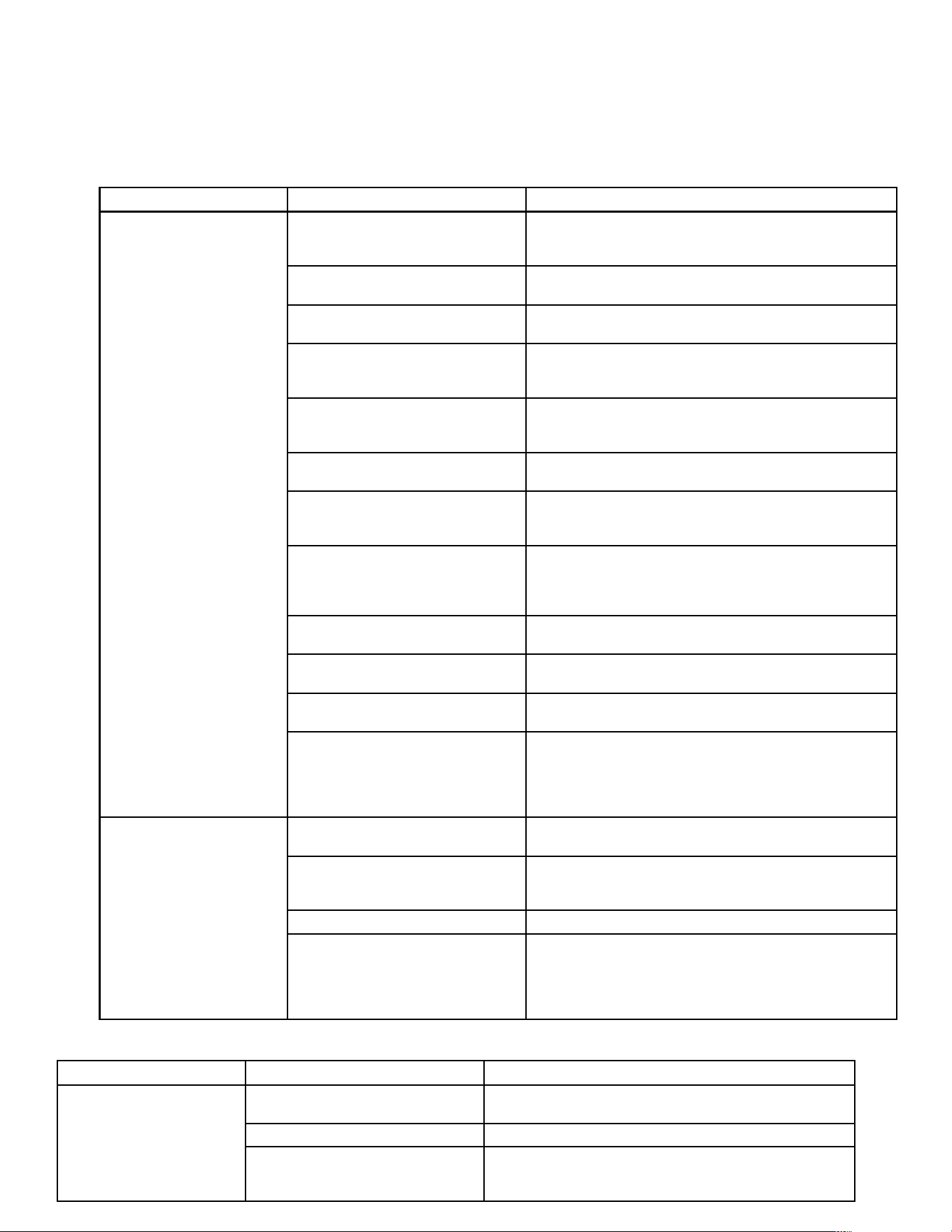
PROBLEMA
CAUSA POSIBLE
SOLUCIÓN
El motor no enciende o
sigue funcionando mientras
trata de encenderlo.
1. La válvula de cierre del
combustible está en la posición
OFF (apagado).
1. Mueva la válvula de cierre del combustible hasta la
posición ON (encendido) (vea las páginas 24 y 25).
2. Se agotó la gasolina del
generador.
2. Agregue gasolina al generador (vea la página 23).
3. La circulación de combustible
está obstruida.
3. Inspeccione y limpie los conductos de suministro de
combustible.
4. La unidad se cebó en exceso.
4. Mueva la palanca del cebador hasta que quede en el
medio entre las posiciones ON (encendido) y OFF
(apagado) (vea las páginas 24 y 26).
5. La carga de la batería de
arranque puede ser insuficiente.
5. Únicamente para los modelos con arranque eléctrico.
Controle la potencia de salida de la batería y
cárguela según sea necesario.
6. El filtro de aire está sucio.
6. Controle y limpie el filtro de aire (vea las páginas
30-32).
7. El interruptor de desconexión
por nivel bajo de aceite no
permite encender la unidad.
7. Controle el nivel de aceite y agregue más si es
necesario (vea las páginas 28 y 29).
8. El capuchón de la bujía
de encendido no está
completamente conectado con
la punta de la bujía.
8. Presione firmemente el capuchón de la bujía de
encendido para comprobar que esté completamente
conectado (vea las páginas 32 y 34).
9. La bujía de encendido está
defectuosa.
9. Retire y controle la bujía de encendido. Reemplácela
si está defectuosa (vea las páginas 32-34).
10. El amortiguador de chispas
está sucio/obstruido.
10. Controle y limpie el amortiguador de chispas (vea las
páginas 33 y 34).
11. El combustible está viejo.
11. Drene el combustible y reemplácelo con combustible
nuevo (vea las páginas 22 y 23).
12. Si después de intentar con los
paso 1 a 11 precedentes no
se soluciona el problema, la
causa podría ser una falla en el
generador.
12. Lleve el generador al distribuidor de servicio
autorizado más cercano.
El motor dejó de funcionar
de manera repentina.
1. Se agotó el combustible del
generador.
1. Controle el nivel de combustible (vea las páginas 22
y 23). Agregue combustible si es necesario.
2. El interruptor de desconexión
por nivel bajo de aceite ha
parado el motor.
2. Controle el nivel de aceite y agregue más si es
necesario (vea las páginas 28 y 29).
3. La carga es excesiva
3. Restablezca el generador y reduzca la carga.
4. Si después de intentar con los
paso 1 a 3 precedentes no
se soluciona el problema, la
causa podría ser una falla en el
generador.
4. Lleve el generador al distribuidor de servicio
autorizado más cercano.
PROBLEMA
CAUSA POSIBLE
SOLUCIÓN
El motor funciona de
manera errática, no
1. Se dejó el cebador en la
posición ON (encendido).
1. Mueva el cebador a la posición OFF (apagado) (vea
las páginas 24 y 26).
2. El filtro de aire está sucio.
2. Limpie el filtro de aire (vea las páginas 30-32).
3. Las cargas aplicadas alternan
entre encendido y apagado
3. Mientras las cargas aplicadas alternan, se pueden
producir cambios en la velocidad del motor; es una
condición normal.

MANTENIMIENTO
mantiene RPM constantes.
4. Si después de intentar con los
paso 1 a 3 precedentes no
se soluciona el problema, la
causa podría ser una falla en el
generador.
4. Lleve el generador al distribuidor de servicio
autorizado más cercano.
