4G LTE SMARTPHONE
User Manual
Please read this manual before operating your
phone and keep it for future reference.

Warning!
This product contains chemicals known to the State of California to cause cancer and reproductive toxicity.
Intellectual Property
All Intellectual Property, as defined below, owned by or which is otherwise the property of Samsung or its respective suppliers
relating to the SAMSUNG Phone, including but not limited to, accessories, parts, or software relating there to (the “Phone
System”), is proprietary to Samsung and protected under federal laws, state laws, and international treaty provisions. Intellectual
Property includes, but is not limited to, inventions (patentable or unpatentable), patents, trade secrets, copyrights, software,
computer programs, and related documentation and other works of authorship. You may not infringe or otherwise violate the
rights secured by the Intellectual Property. Moreover, you agree that you will not (and will not attempt to) modify, prepare
derivative works of, reverse engineer, decompile, disassemble, or otherwise attempt to create source code from the software. No
title to or ownership in the Intellectual Property is transferred to you. All applicable rights of the Intellectual Property shall remain
with SAMSUNG and its suppliers.
Open Source Software
Some software components of this product incorporate source code covered under GNU General Public License (GPL), GNU Lesser
General Public License (LGPL), OpenSSL License, BSD License and other open source licenses. To obtain the source code covered
under the open source licenses, please visit:
http://opensource.samsung.com
.
T889_MR3_UM_English_MK5_PS_111413_F3

Disclaimer of Warranties; Exclusion of Liability
EXCEPT AS SET FORTH IN THE EXPRESS WARRANTY CONTAINED ON THE WARRANTY PAGE ENCLOSED WITH THE PRODUCT, THE
PURCHASER TAKES THE PRODUCT "AS IS", AND SAMSUNG MAKES NO EXPRESS OR IMPLIED WARRANTY OF ANY KIND
WHATSOEVER WITH RESPECT TO THE PRODUCT, INCLUDING BUT NOT LIMITED TO THE MERCHANTABILITY OF THE PRODUCT OR
ITS FITNESS FOR ANY PARTICULAR PURPOSE OR USE; THE DESIGN, CONDITION OR QUALITY OF THE PRODUCT; THE
PERFORMANCE OF THE PRODUCT; THE WORKMANSHIP OF THE PRODUCT OR THE COMPONENTS CONTAINED THEREIN; OR
COMPLIANCE OF THE PRODUCT WITH THE REQUIREMENTS OF ANY LAW, RULE, SPECIFICATION OR CONTRACT PERTAINING
THERETO. NOTHING CONTAINED IN THE INSTRUCTION MANUAL SHALL BE CONSTRUED TO CREATE AN EXPRESS OR IMPLIED
WARRANTY OF ANY KIND WHATSOEVER WITH RESPECT TO THE PRODUCT. IN ADDITION, SAMSUNG SHALL NOT BE LIABLE FOR
ANY DAMAGES OF ANY KIND RESULTING FROM THE PURCHASE OR USE OF THE PRODUCT OR ARISING FROM THE BREACH OF
THE EXPRESS WARRANTY, INCLUDING INCIDENTAL, SPECIAL OR CONSEQUENTIAL DAMAGES, OR LOSS OF ANTICIPATED PROFITS
OR BENEFITS.
Modification of Software
SAMSUNG IS NOT LIABLE FOR PERFORMANCE ISSUES OR INCOMPATIBILITIES CAUSED BY YOUR EDITING OF REGISTRY SETTINGS,
O
R YOUR MODIFICATION OF OPERATING SYSTEM SOFTWARE.
USING CUSTOM OPERATING SYSTEM SOFTWARE MAY CAUSE YOUR DEVICE AND APPLICATIONS TO WORK IMPROPERLY. YOUR
C
ARRIER MAY NOT PERMIT USERS TO DOWNLOAD CERTAIN SOFTWARE, SUCH AS CUSTOM OS.

SAFE™ (Samsung Approved For Enterprise)
SAFE™: "SAFE™" (Samsung for Enterprise) is a mark for a Samsung device which has been tested against Samsung's own
internal criteria for interoperability with certain third party security-related solutions for MDM and VPN. The testing includes field
testing with local network connection and menu tree testing which tests functionality of the solutions in conjunction with the
Samsung device. During the testing, the device is tested with the security solutions to see if the solutions work with the device as
described by the third party security solution providers. The testing, for example, includes field testing with local network
connection and menu tree testing which tests functionality of the solutions in conjunction with the Samsung device. For more
information about Samsung's SAFE™ program, please refer to
www.samsung.com/us/safe
.
Disclaimer of Warranties: EXCEPT AS OTHERWISE PROVIDED IN THEIR STANDARD END USER LICENSE AND WARRANTY, TO THE
FULL EXTENT PERMITTED BY LAW SAMSUNG ELECTRONICS CO., LTD., SAMSUNG TELECOMMUNICATIONS AMERICA, LLC, AND
THEIR AFFILIATES (COLLECTIVELY REFERRED TO HEREIN AS THE "SAMSUNG ENTITIES") EXPRESSLY DISCLAIM ANY AND ALL
WARRANTIES, EXPRESS OR IMPLIED, INCLUDING ANY WARRANTY OF MERCHANTABILITY, FITNESS FOR A PARTICULAR PURPOSE,
INTEROPERABILITY OR NON-INFRINGEMENT, WITH RESPECT TO INFORMATION TECHNOLOGY SECURITY PROTECTION, SAFE™
DEVICES AND APPLICATIONS TESTED WITH SAFE™ DEVICES. IN NO EVENT SHALL THE SAMSUNG ENTITIES BE LIABLE FOR ANY
DIRECT, INDIRECT, INCIDENTAL, PUNITIVE, OR CONSEQUENTIAL DAMAGES OF ANY KIND WHATSOEVER WITH RESPECT TO
INFORMATION TECHNOLOGY SECURITY PROTECTION, SAFE™ DEVICES OR APPLICATIONS TESTED WITH SAFE™ DEVICES. In
addition, information technology security protection will be affected by features or functionality associated with, among other
things the e-mail platform, master data management, and virtual private network solutions selected by the software provider,
solution provider or user. Choice of an e-mail, master data management, and virtual private network solution is at the sole
discretion of the software provider, solution provider or user and any associated effect on information technology security
protection is solely the responsibility of the software provider, solution provider or user. For complete statement of limited
warranty, please refer to
www.samsung.com/us/safe
, available on the web and where Samsung smartphone and Galaxy Tab™
devices are sold. [101212]

Samsung Telecommunications America (STA), LLC
Headquarters:
1301 E. Lookout Drive
Richardson, TX 75082
Customer Care Center:
1000 Klein Rd.
Plano, TX 75074
Toll Free Tel: 1.888.987.HELP (4357)
Internet Address:
http://www.samsung.com
©
2013 Samsung Telecommunications America, LLC. Samsung is a registered trademark of Samsung Electronics Co., Ltd.
Do you have questions about your Samsung Mobile Device?
For 24 hour information and assistance, we offer a new FAQ/ARS System (Automated Response System) at:
www.samsung.com/us/support
The actual available capacity of the internal memory is less than the specified capacity because the operating system and default
a
pplications occupy part of the memory. The available capacity may change when you upgrade the device.
Nuance
®
, VSuite™, T9
®
Text Input, and the Nuance logo are trademarks or registered trademarks of Nuance Communications,
Inc., or its affiliates in the United States and/or other countries.

,
ACCESS
®
and NetFront™ are trademarks or registered trademarks of ACCESS Co., Ltd. in Japan and other countries.
The Bluetooth
®
word mark, figure mark (stylized “B Design”), and combination mark (Bluetooth word mark and “B Design”) are
registered trademarks and are wholly owned by the Bluetooth SIG.
microSD™ and the microSD logo are Trademarks of the SD Card Association.
Openwave
®
is a registered Trademark of Openwave, Inc.
Google, the Google logo, Android, the Android logo, Google Play, Gmail, Google Mail, Google Maps, Google Music, Google
Hangouts, Picasa, YouTube and other marks are trademarks of Google Inc.
Wi-Fi is a registered trademark of the Wireless Fidelity Alliance, Inc.
LTE is a trademark of ETSI
Swype and the Swype logos are trademarks of Swype, Inc.
©
2010 Swype, Inc. All rights reserved.
DivX
®
, DivX Certified
®
and associated logos are trademarks of Rovi Corporation or its subsidiaries and are used under
license.
DivX Certified
®
to play DivX
®
video up to HD 720p, including premium content.
ABOUT DIVX VIDEO: DivX
®
is a digital video format created by DivX, LLC, a subsidiary of Rovi Corporation. This is an official DivX
Certified
®
device that has passed rigorous testing to verify that it plays DivX video. Visit
www.divx.com
for more information and
software tools to convert your files into DivX videos.
ABOUT DIVX VIDEO-ON-DEMAND: This DivX Certified
®
device must be registered in order to play purchased DivX
Video-on-Demand (VOD) movies. To obtain your registration code, locate the DivX VOD section in your device setup menu (tap
Apps > Settings > More
tab
> About device > Legal information > License settings > DivX® VOD > Register
). Go to
vod.divx.com
for
more information on how to complete your registration.

Dynamic Noise Suppression from Audience
Your phone is equipped with an advanced voice processing chip that delivers clear mobile calls by suppressing background noise,
intermittent sounds (like a siren or nearby conversation), and echoes, allowing you to hear and be heard nearly anywhere.
How Does It Work?
Based on the intelligence of the human hearing system, the technology:
•
Captures, evaluates and distinguishes all the sound signals surrounding your phone, and the person you're speaking with.
•
Then isolates the primary voice in conversation and filters out the background noise - so the person you're calling hears only your voice,
without disturbing background noise.
•
Dynamically equalizes and adjusts voice volume to optimize your calling experience, so you can hear clearly and don't need to speak louder to
overcome surrounding noise.
The noise suppression technology is built-in and already enabled in your new mobile phone. So it's ready to provide unsurpassed
voice clarity with every call.

Table of Contents
Section 1: Getting Started ...........................7
Understanding this User Manual . . . . . . . . . . . .7
Removing the Battery Cover . . . . . . . . . . . . . . .9
Installing and Removing the SIM card . . . . . . . 10
Installing the microSD Memory Card . . . . . . . . 11
Installing the Battery . . . . . . . . . . . . . . . . . . . .12
Replacing the Battery Cover . . . . . . . . . . . . . .13
Charging the Battery . . . . . . . . . . . . . . . . . . . . 13
Extending Your Battery Life . . . . . . . . . . . . . . . 15
Switching the Device On or Off . . . . . . . . . . . .16
Initial Device Configuration . . . . . . . . . . . . . . .16
Restarting the Device . . . . . . . . . . . . . . . . . . .17
Locking and Unlocking the Device . . . . . . . . . . 17
Voicemail . . . . . . . . . . . . . . . . . . . . . . . . . . . .18
Section 2: Understanding Your Device .....20
Features of Your Device . . . . . . . . . . . . . . . . . .20
Front View . . . . . . . . . . . . . . . . . . . . . . . . . . . . 22
Back View . . . . . . . . . . . . . . . . . . . . . . . . . . . . 24
Side Views . . . . . . . . . . . . . . . . . . . . . . . . . . .24
Device Display . . . . . . . . . . . . . . . . . . . . . . . . .25
Status Bar . . . . . . . . . . . . . . . . . . . . . . . . . . . .25
Home Screen . . . . . . . . . . . . . . . . . . . . . . . . . .31
Customizing the Screens . . . . . . . . . . . . . . . . .36
Screen Navigation . . . . . . . . . . . . . . . . . . . . . .43
S Pen . . . . . . . . . . . . . . . . . . . . . . . . . . . . . . . .45
Using Motions and Gestures . . . . . . . . . . . . . .49
Using the Multi Window . . . . . . . . . . . . . . . . . .52
Menu Navigation . . . . . . . . . . . . . . . . . . . . . . .57
Section 3: Call Functions and
Contacts List ..............................................59
Displaying Your Phone Number . . . . . . . . . . . .59
Making a Call . . . . . . . . . . . . . . . . . . . . . . . . .59
Ending a Call . . . . . . . . . . . . . . . . . . . . . . . . . .60
Making Emergency Calls . . . . . . . . . . . . . . . . .61
Dialing Options . . . . . . . . . . . . . . . . . . . . . . . .62
Answering a Call . . . . . . . . . . . . . . . . . . . . . . .62
Managing Reject Calls . . . . . . . . . . . . . . . . . . .63
International Calls . . . . . . . . . . . . . . . . . . . . . .64
1

Pause Dialing . . . . . . . . . . . . . . . . . . . . . . . . . 65
Wait Dialing . . . . . . . . . . . . . . . . . . . . . . . . . . 65
Redialing the Last Number . . . . . . . . . . . . . . . 66
Speed Dialing . . . . . . . . . . . . . . . . . . . . . . . . 66
Wi-Fi Calling . . . . . . . . . . . . . . . . . . . . . . . . . 68
In Call Options . . . . . . . . . . . . . . . . . . . . . . . . 71
Logs Tab . . . . . . . . . . . . . . . . . . . . . . . . . . . . 77
Section 4: Entering Text ........................... 81
Text Input Methods . . . . . . . . . . . . . . . . . . . . 81
Selecting the Text Input Method . . . . . . . . . . . 81
Entering Text Using Swype . . . . . . . . . . . . . . . 82
Using the Samsung Keyboard . . . . . . . . . . . . 86
Using the Google Voice Typing . . . . . . . . . . . . 90
Section 5: Contacts .................................. 92
Accounts . . . . . . . . . . . . . . . . . . . . . . . . . . . . 92
Contacts List . . . . . . . . . . . . . . . . . . . . . . . . . 92
Finding a Contact . . . . . . . . . . . . . . . . . . . . . . 95
Contact List Options . . . . . . . . . . . . . . . . . . . . 98
Contact Menu Options . . . . . . . . . . . . . . . . . . 99
Contact Entry Options . . . . . . . . . . . . . . . . . 100
Linking Contact Information . . . . . . . . . . . . . 100
Sending a Namecard . . . . . . . . . . . . . . . . . . 103
Copying Contact Information . . . . . . . . . . . . 104
Synchronizing Contacts . . . . . . . . . . . . . . . . 105
Display Options . . . . . . . . . . . . . . . . . . . . . . 106
Adding more Contacts via Accounts
and Sync . . . . . . . . . . . . . . . . . . . . . . . . . 107
Additional Contact Options . . . . . . . . . . . . . . 108
Groups . . . . . . . . . . . . . . . . . . . . . . . . . . . . . 110
The Favorites Tab . . . . . . . . . . . . . . . . . . . . . 112
Section 6: Messaging ..............................113
Types of Messages . . . . . . . . . . . . . . . . . . . 113
Creating and Sending Messages . . . . . . . . . 114
Message Options . . . . . . . . . . . . . . . . . . . . . 115
Viewing Newly Received Messages . . . . . . . 118
Deleting Messages . . . . . . . . . . . . . . . . . . . . 120
Message Search . . . . . . . . . . . . . . . . . . . . . 121
Messaging Settings . . . . . . . . . . . . . . . . . . . 121
Assigning Messages as Spam . . . . . . . . . . . 125
Accessing your Spam Folder . . . . . . . . . . . . 126
Text Templates . . . . . . . . . . . . . . . . . . . . . . 126
Using Email . . . . . . . . . . . . . . . . . . . . . . . . . 127
Microsoft Exchange Email (Outlook) . . . . . . . 132
Using Google Mail . . . . . . . . . . . . . . . . . . . . 138
2

Section 7: Multimedia .............................140
Assigning the Default Storage Location . . . . . 140
Using the Camera . . . . . . . . . . . . . . . . . . . . .141
Camera Options . . . . . . . . . . . . . . . . . . . . . .142
Using the Camcorder . . . . . . . . . . . . . . . . . . .149
Sharing Pictures . . . . . . . . . . . . . . . . . . . . . .153
The Gallery . . . . . . . . . . . . . . . . . . . . . . . . . .160
AllShare Cast Hub . . . . . . . . . . . . . . . . . . . . .160
Section 8: Applications and
Development ............................................162
Applications . . . . . . . . . . . . . . . . . . . . . . . . . 162
Amazon . . . . . . . . . . . . . . . . . . . . . . . . . . . . .164
Calculator . . . . . . . . . . . . . . . . . . . . . . . . . . . 164
Calendar . . . . . . . . . . . . . . . . . . . . . . . . . . . . 165
Camera . . . . . . . . . . . . . . . . . . . . . . . . . . . . . 167
ChatON . . . . . . . . . . . . . . . . . . . . . . . . . . . . . 167
Chrome . . . . . . . . . . . . . . . . . . . . . . . . . . . . .169
Clock . . . . . . . . . . . . . . . . . . . . . . . . . . . . . . . 170
Contacts . . . . . . . . . . . . . . . . . . . . . . . . . . . . 173
Downloads . . . . . . . . . . . . . . . . . . . . . . . . . . 174
Dropbox . . . . . . . . . . . . . . . . . . . . . . . . . . . .174
Drive . . . . . . . . . . . . . . . . . . . . . . . . . . . . . . . 176
Email . . . . . . . . . . . . . . . . . . . . . . . . . . . . . . .176
Flipboard . . . . . . . . . . . . . . . . . . . . . . . . . . . .176
G+ Photos . . . . . . . . . . . . . . . . . . . . . . . . . . .176
Gallery . . . . . . . . . . . . . . . . . . . . . . . . . . . . . .177
Gmail . . . . . . . . . . . . . . . . . . . . . . . . . . . . . . .177
Google . . . . . . . . . . . . . . . . . . . . . . . . . . . . . .178
Google Settings . . . . . . . . . . . . . . . . . . . . . . .179
Google + . . . . . . . . . . . . . . . . . . . . . . . . . . . .179
Group Play . . . . . . . . . . . . . . . . . . . . . . . . . . .180
Hangouts . . . . . . . . . . . . . . . . . . . . . . . . . . . .181
Help . . . . . . . . . . . . . . . . . . . . . . . . . . . . . . . .182
Internet . . . . . . . . . . . . . . . . . . . . . . . . . . . . .182
KNOX . . . . . . . . . . . . . . . . . . . . . . . . . . . . . . .190
Maps . . . . . . . . . . . . . . . . . . . . . . . . . . . . . . .191
Messaging . . . . . . . . . . . . . . . . . . . . . . . . . . .192
Mobile HotSpot . . . . . . . . . . . . . . . . . . . . . . .192
Music . . . . . . . . . . . . . . . . . . . . . . . . . . . . . .193
Using Playlists . . . . . . . . . . . . . . . . . . . . . . . .195
Creating a Playlist . . . . . . . . . . . . . . . . . . . . .195
Transferring Music Files . . . . . . . . . . . . . . . .197
Removing Music Files . . . . . . . . . . . . . . . . . .197
My Files . . . . . . . . . . . . . . . . . . . . . . . . . . . . .197
3

Need for Speed Most Wanted . . . . . . . . . . . . 199
Paper Artist . . . . . . . . . . . . . . . . . . . . . . . . . 199
PEN.UP . . . . . . . . . . . . . . . . . . . . . . . . . . . . 199
Phone . . . . . . . . . . . . . . . . . . . . . . . . . . . . . 200
Play Books . . . . . . . . . . . . . . . . . . . . . . . . . . 200
Play Games . . . . . . . . . . . . . . . . . . . . . . . . . 200
Play Magazines . . . . . . . . . . . . . . . . . . . . . . 201
Play Movies & TV . . . . . . . . . . . . . . . . . . . . . 201
Play Music . . . . . . . . . . . . . . . . . . . . . . . . . . 202
Play Store . . . . . . . . . . . . . . . . . . . . . . . . . . 205
Downloading a New Google Application . . . . 205
Launching an Installed Google Application . . 207
Polaris Office 4.0 . . . . . . . . . . . . . . . . . . . . . 208
S Note . . . . . . . . . . . . . . . . . . . . . . . . . . . . . 209
S Suggest . . . . . . . . . . . . . . . . . . . . . . . . . . 209
S Voice . . . . . . . . . . . . . . . . . . . . . . . . . . . . 210
Samsung Apps . . . . . . . . . . . . . . . . . . . . . . . 211
Samsung Hub . . . . . . . . . . . . . . . . . . . . . . . 211
Samsung Link . . . . . . . . . . . . . . . . . . . . . . . 214
Settings . . . . . . . . . . . . . . . . . . . . . . . . . . . . 218
T-Mobile My Account . . . . . . . . . . . . . . . . . . 219
T-Mobile Name ID . . . . . . . . . . . . . . . . . . . . 219
T-Mobile TV . . . . . . . . . . . . . . . . . . . . . . . . . 220
Video . . . . . . . . . . . . . . . . . . . . . . . . . . . . . . 221
Visual Voicemail . . . . . . . . . . . . . . . . . . . . . . 222
Voice Recorder . . . . . . . . . . . . . . . . . . . . . . . 223
Voice Search . . . . . . . . . . . . . . . . . . . . . . . . 224
VPN Client . . . . . . . . . . . . . . . . . . . . . . . . . . 225
YouTube . . . . . . . . . . . . . . . . . . . . . . . . . . . . 225
Section 9: Connections ...........................227
Bluetooth . . . . . . . . . . . . . . . . . . . . . . . . . . . 227
Enable Downloading for Web Applications . . 231
PC Connections . . . . . . . . . . . . . . . . . . . . . . 232
Wi-Fi . . . . . . . . . . . . . . . . . . . . . . . . . . . . . . 233
USB Tethering . . . . . . . . . . . . . . . . . . . . . . . 236
Mobile HotSpot . . . . . . . . . . . . . . . . . . . . . . . 237
Section 10: Changing Your Settings .......240
Accessing Settings . . . . . . . . . . . . . . . . . . . . 240
Settings Tabs - Overview . . . . . . . . . . . . . . . 240
Wi-Fi Settings . . . . . . . . . . . . . . . . . . . . . . . 241
Bluetooth settings . . . . . . . . . . . . . . . . . . . . 247
Data Usage . . . . . . . . . . . . . . . . . . . . . . . . . 248
More Networks . . . . . . . . . . . . . . . . . . . . . . . 249
Lock Screen . . . . . . . . . . . . . . . . . . . . . . . . .
259
4

Display Settings . . . . . . . . . . . . . . . . . . . . . .264
LED Indicator . . . . . . . . . . . . . . . . . . . . . . . . . 266
Sound Settings . . . . . . . . . . . . . . . . . . . . . . .266
Home Screen Mode . . . . . . . . . . . . . . . . . . . .269
Call Settings . . . . . . . . . . . . . . . . . . . . . . . . .270
Blocking Mode . . . . . . . . . . . . . . . . . . . . . . .278
Hands-free Mode . . . . . . . . . . . . . . . . . . . . .279
Power Saving Mode . . . . . . . . . . . . . . . . . . . .279
Accessory . . . . . . . . . . . . . . . . . . . . . . . . . . . 280
Accessibility Settings . . . . . . . . . . . . . . . . . . .280
One-handed Operation . . . . . . . . . . . . . . . . .282
Language and Input Settings . . . . . . . . . . . . . 283
Motion Settings . . . . . . . . . . . . . . . . . . . . . . .289
Smart screen . . . . . . . . . . . . . . . . . . . . . . . .291
Voice control . . . . . . . . . . . . . . . . . . . . . . . . .292
S Pen Settings . . . . . . . . . . . . . . . . . . . . . . . .292
Add Account . . . . . . . . . . . . . . . . . . . . . . . . . 293
Cloud . . . . . . . . . . . . . . . . . . . . . . . . . . . . . .295
Backup and Reset . . . . . . . . . . . . . . . . . . . . .296
Backing up Your Data Before Factory Reset . . 296
Location Services . . . . . . . . . . . . . . . . . . . . .301
Security . . . . . . . . . . . . . . . . . . . . . . . . . . . . .302
Application Manager . . . . . . . . . . . . . . . . . . .305
Battery Usage . . . . . . . . . . . . . . . . . . . . . . . .307
SD Card & Device Storage . . . . . . . . . . . . . . .308
Date and Time . . . . . . . . . . . . . . . . . . . . . . . .309
About Device . . . . . . . . . . . . . . . . . . . . . . . . .310
Software Update . . . . . . . . . . . . . . . . . . . . . .311
Section 11: Health and Safety
Information ..............................................312
Exposure to Radio Frequency (RF) Signals . . .312
Specific Absorption Rate (SAR) Certification
Information . . . . . . . . . . . . . . . . . . . . . . . . .317
FCC Part 15 Information to User . . . . . . . . . . .318
Commercial Mobile Alerting System (CMAS) .319
Smart Practices While Driving . . . . . . . . . . . .319
Battery Use and Safety . . . . . . . . . . . . . . . . .320
Samsung Mobile Products and Recycling . . . .322
UL Certified Travel Charger . . . . . . . . . . . . . .323
Display / Touch-Screen . . . . . . . . . . . . . . . . .324
GPS & AGPS . . . . . . . . . . . . . . . . . . . . . . . . .324
Emergency Calls . . . . . . . . . . . . . . . . . . . . . .325
Care and Maintenance . . . . . . . . . . . . . . . . . .326
Responsible Listening . . . . . . . . . . . . . . . . . .327
5

Operating Environment . . . . . . . . . . . . . . . . 329
FCC Hearing Aid Compatibility (HAC)
Regulations for Wireless Devices . . . . . . . 331
Restricting Children's Access to Your
Mobile Device . . . . . . . . . . . . . . . . . . . . . . 333
FCC Notice and Cautions . . . . . . . . . . . . . . . 333
Other Important Safety Information . . . . . . . 333
Section 12: Warranty Information .......... 336
Standard Limited Warranty . . . . . . . . . . . . . . 336
End User License Agreement for Software . . 341
Index ........................................................ 349
6

Section 1: Getting Started
This section explains how to get started with your phone by
installing and charging the battery, installing the micro SIM
card and optional memory card, and setting up your voice
mail.
Before using your device for the first time, you’ll need to
install and charge the
battery and install the micro SIM card.
The micro SIM card is loaded with your subscription details,
such as your PIN, available optional services, and many
other
features. If desired, you can also install an SD card to store
media for use with your device.
Understanding this User Manual
The sections of this manual generally follow the features of
your phone. A robust index for features begins
on page 349.
Also included is important safety information that you should
know before using your phone. This information is available
near the back of the guide, beginning on
page 312.
Th
is manual provides navigation instructions according to
the default display settings. If you select other settings,
navigation may be different.
Unless otherwise specified, all instructions in this manual
assume you are starting from the Home screen and using the
available keys.
Note:
Instructions in this manual are based on default settings,
and may vary from your device, depending on the
software version on your device, and any changes to the
device’s Settings.
Unless stated otherwise, instructions in this User Manual
start with the device unlocked, at the Home screen.
All screen images in this manual are simulated. Actual
displays may vary, depending on the software version of
your device and any changes to the device’s Settings.
7

Special Text
Throughout this manual, you’ll find text that is set apart from
the rest. These are intended to point out important
information, share quick methods for activating features, to
define terms, and more. The definitions for these methods
are as follows:
•
Notes
: Presents alternative options for the current feature, menu,
or sub-menu.
•
Tips
: Provides quick or innovative methods, or useful shortcuts.
•
Important
: Points out important information about the current
feature that could affect performance.
•
Warning
: Brings to your attention important information to
prevent loss of data or functionality, or even prevent damage to
your phone.
Text Conventions
This manual provides condensed information about how to
use your phone. To make this possible, the following text
conventions are used to represent often-used steps:
Arrows are used to represent the sequence of
selecting successive options in longer, or
repetitive, procedures.
Example:
From the Home screen, press (
Menu
)
Settings
Connections
tab
Bluetooth
.
Getti
ng Started
8
Release Latch
Removing the Battery Cover
The battery, micro SIM card and SD card are installed under
the battery cover.
Important!
Before removing or replacing the battery cover,
make sure the device is switched off. To turn the
device off, hold down the key until the
power-off image displays, then tap
Power off
.
Caution!
Do not bend or twist the back cover excessively
during installation or removal. Doing so may damage
the cover.
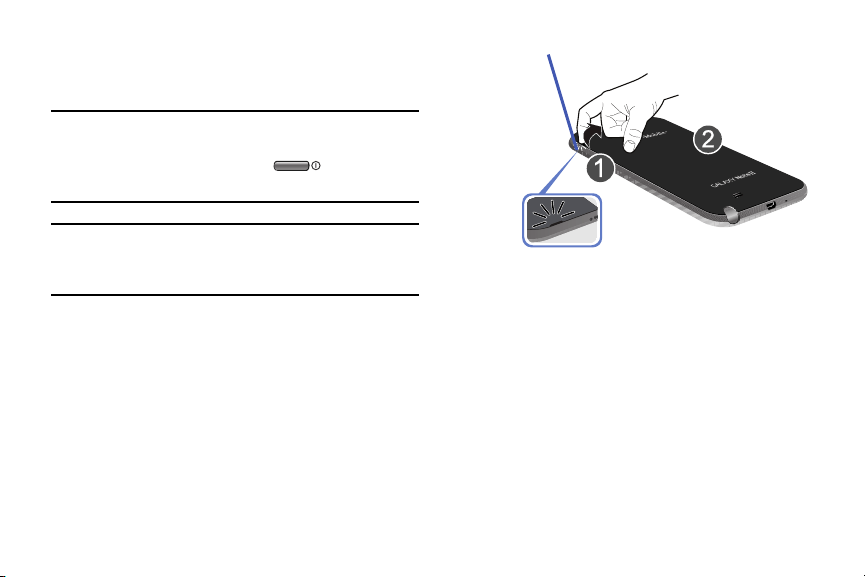
To remove the battery cover:
1. Hold the device firmly and locate the cover release
latch (1).
2. Place your fingernail in the opening (2) and firmly
“pop” the cover off the device (similar to a soda can).
9
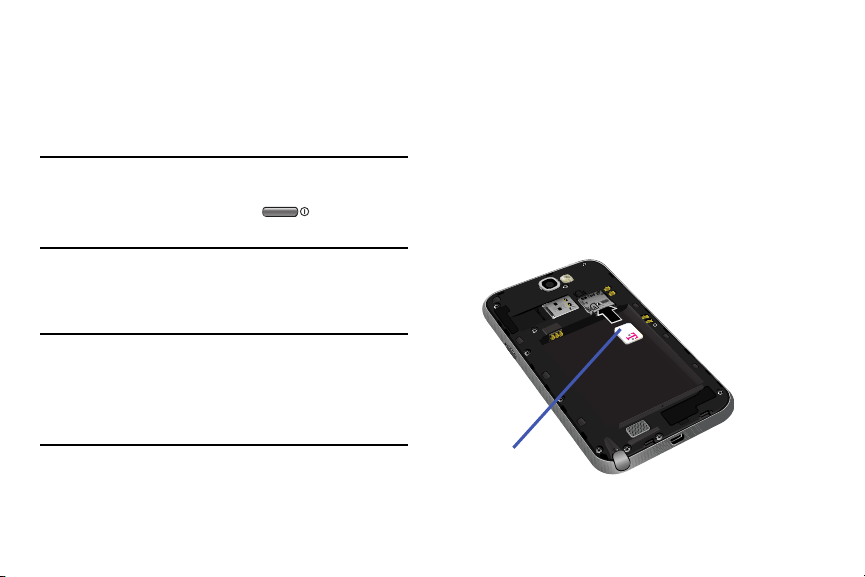
Micro SIM card
Installing and Removing the SIM card
This device uses a different type of SIM card called a “micro
SIM”. Other larger SIM cards will not function or fit within this
slot.
SIM Card Overview
Important!
Before removing or replacing the battery cover,
make sure the device is switched off. To turn the
device off, hold down the
key
until the
power-off image displays, then tap
Power off
.
The micro SI
M card is loaded with your subscription details
such as your telephone number, PIN, available optional
services, and many other features.
Important!
The micro SIM card and its information can be
easily damaged by scratching or bending, so be
careful when handling, inserting, or removing the
card. Keep all SIM cards out of reach of small
children.
Some features on your device (such as Wi-Fi Calling) can be
unlocked by using the new micro SIM card.
To use this new micro SIM card, call or contact T-Mobile
customer service for more information.
This card contains the necessary information for identifying
and authenticating the user to the IMS (IP Multimedia
Subsystem).
To install the SIM card:
1. Carefully slide the micro SIM card into the SIM card
socket until it clicks into place.
Getting Started 10

2. Make sure that the card’s gold contacts face into the
phone and that the upper-left angled corner of the card
is positioned as shown.
To remove the micro SIM card:
1. Remove the battery cover.
2. Carefully place your fingernail into the end of the micro
SIM slot and push the card slightly out.
3. Carefully slide the card out of the micro SIM card
socket.
Note:
If the card is not inserted correctly, the device will not
detect it and no service will be available. If this happens,
turn off the device, remove the card, and reinstall the
card in the correct orientation.
Installing the microSD Memory Card
Your device supports an optional (external) microSD™
memory cards for storage of media such as music, pictures,
video and other files. The SD card is designed for use with
this mobile device and other devices.
Note:
This device supports a memory card of up to a 64GB.
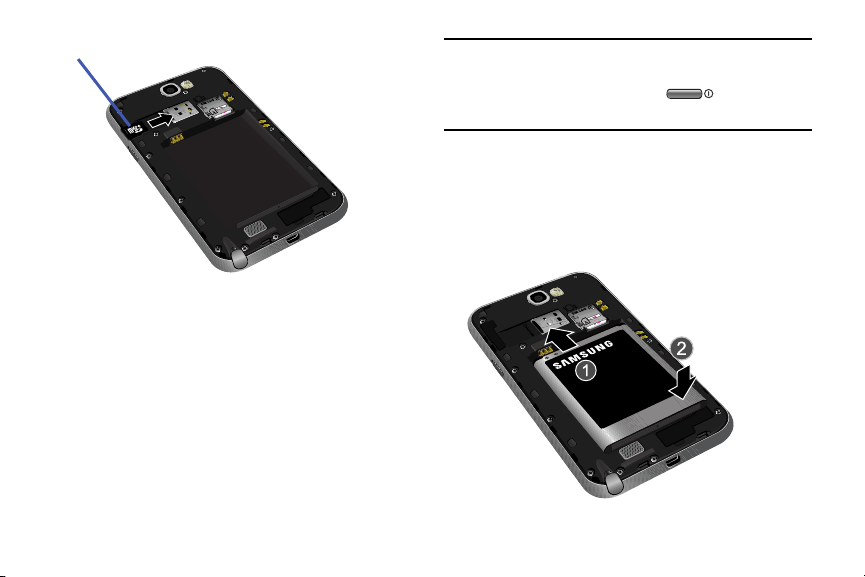
1. Remove the battery cover.
2. Locate the microSD card slot on the inside of the
device.
3. Orient the card with the gold strips facing down.
4. Carefully slide the microSD card into the card socket
until it clicks into place.
Important!
Be sure to align the gold contact pins on the card
with the device’s contact pins.
Note:
MicroSD cards should be formatted within the Storage
menu. Using an older or slow microSD card can affect
camera performance, especially for video recording.
11
Micro SD card
Installing Battery
To remove the microSD Memory Card:
1. Remove the battery cover.
2. Firmly press the card into the slot and release it. The
card should pop partially out of the slot.
3. Remove the card from the slot.
4. Replace the battery cover.
Installing the Battery
Before using your device for the first time, install the battery
and charge it fully.
Important!
Before removing or replacing the battery cover,
make sure the device is switched off. To turn the
device off, hold down the key until the
power-off image displays, then tap
Power off
.
To install the battery:
1. Slide the battery into the compartment (1) so that the
tabs on the end align with the slots at the bottom of the
phone, making sure the connectors align.
2. Gently press down to secure the battery (2).
Getting Started 12
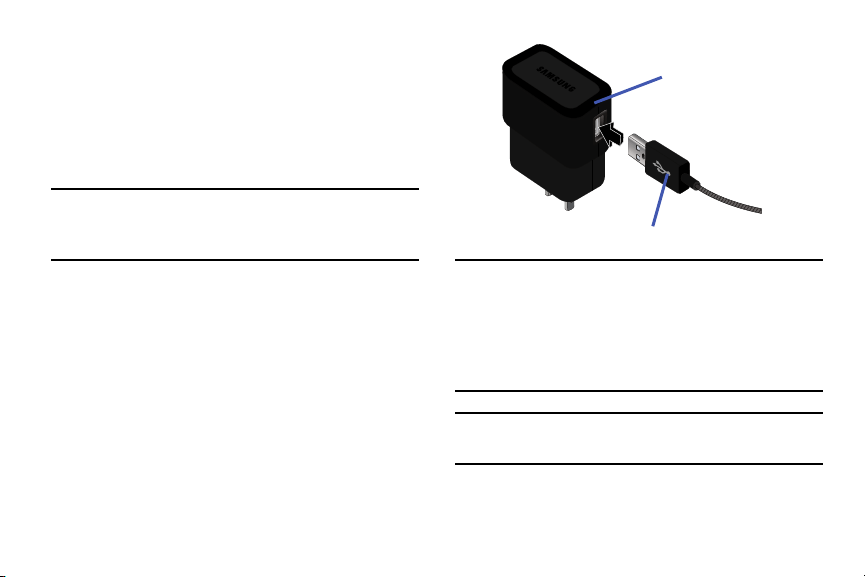
Charging Head
USB Cable
To remove the battery:
Grip the battery at the top end and lift it up and out of
the battery compartment.
Replacing the Battery Cover
Position the battery cover over the battery
compartment and press down until you hear a click.
Caution!
When replacing the battery cover, do not apply
pressure to the screen (“squeeze”) as this can
damage the screen.
Charging the Battery
Your device is powered by a rechargeable Li-ion battery. A
wall charger, which is used for charging the battery, is
included with your device. Use only approved batteries and
chargers. Ask your local Samsung dealer for further details.
Before using your device for the first time, you must fully
charge the battery.
Note:
Verify that the battery is installed prior to connecting the
wall charger. If both the wall charger is connected and
the battery is not installed, the handset will power cycle
continuously and prevent proper operation. Failure to
unplug the wall charger before you remove the battery,
can cause the device to become damaged.
Important!
It is recommended you fully charge the battery
before using your device for the first time.
1. Connect the USB cable to the charging head.
13
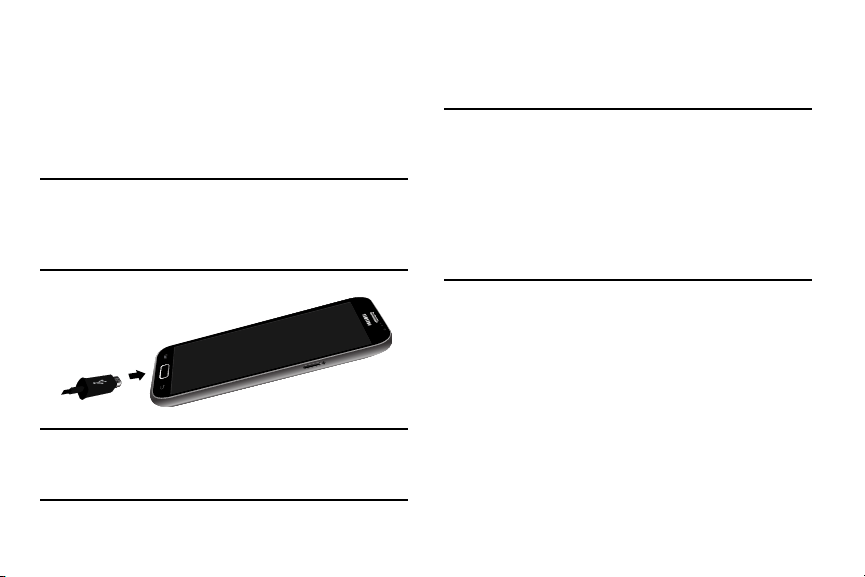
2. Locate the Charger/Accessory jack.
3. Insert the USB cable into the device’s Charger/
Accessory jack.
4. Plug the charging head into a standard AC power
outlet. The device turns on with the screen locked and
indicates both its charge state and percent of charge.
Warning!
While the device is charging, if the touch screen
does not function due to an unstable power supply
unplug the USB power adapter from the power outlet
or unplug the USB cable from the device.
Note:
If the charger is incorrectly connected, damage to the
accessory port will occur therefore voiding the phone’s
warranty.
5. When charging is finished, first unplug the charger’s
power plug from the AC wall outlet, then disconnect
the charger’s connector from the phone.
Important!
If your handset has a touch screen display, please
note that a touch screen responds best to a light
touch from the pad of your finger or a non-metallic
stylus. Using excessive force or a metallic object
when pressing on the touch screen may damage
the tempered glass surface and void the warranty.
For more information, refer to “Standard Limited
Warranty” on page 336.
Getting Started
14

Low Battery Indicator
When the battery level is low and only a few minutes of talk
time remain (~15% charge), a warning tone sounds and the
“Battery low” message repeats at regular intervals on the
display. In this condition, your device conserves its remaining
battery power, by dimming the backlight.
When the battery level becomes too low, the device
automa
tically turns off.
The on-
screen battery charge is represented (by default) as a
colore
d battery icon. You can also choose to display a
perc
entage value. Having a percentage value on-screen can
provid
e a better idea of the remaining charge on the battery.
Press and then tap
Settings
My device
tab
Display
Show battery percentage
.
For more information, refer to “Display Settings” on page
264.
Extending Your Battery Life
Active applications, light levels, Bluetooth usage, and GPS
functionality all act to drain your battery. The following is a
list of helpful tips that can help conserve your battery power:
•
Reduce your backlight on time.
•
Turn Bluetooth off when not in use.
•
Turn Wi-Fi off when not in use.
•
Deactivate the GPS when not needed. Most applications using
this function will periodically query the GPS satellites for your
current location; each query drains your battery.
•
Do not wait until your battery is completely depleted before
charging your device. Repeating this process of a complete
discharge and recharge can over time reduce the storage
capacity of any battery.
•
Use the Power Saving feature to deactivate some hardware and
interface functions.
•
Check the Battery use screen to review what features or functions
have been consuming your battery resources.
•
Check the Running Services and close any unnecessary
applications.
15
•
Use the Task Manager feature to end/shutdown background
applications that are still running. These minimized applications
can, over time, cause your device to “slow down”.
•
Animated wallpapers use processing power, memory, and more
power. Change your Live Wallpaper to a non-animated Wallpaper
gallery or Gallery image.
Switching the Device On or Off
Once the device has been configured, you will not be
prompted with setup screens again.
To turn the device on:
1. Press and hold (
Power/End
) until the device
switches on.
The device searches for your network and after finding
it, you can make or receive calls.
Note:
The display language is preset to English at the factory.
To change the language, use the Language menu.
For
more informatio
n, refer to “Language and Input
Settings” on page 283.
To turn the device off:
1. Press and hold (
Power/End
) until the Device
options screen appears.
2. Tap
Power off
( ).
Initial Device Configuration
1. Select a language from the associated field.
English is the default language.
Note:
If you are visually impaired or have difficulty hearing, tap
Accessibility
to configure the accessibility settings.
2. Tap
Next
and follow the on-screen setup instructions.
Note:
You may be prompted with a notification that your
activation is completed.
Note:
Enabling Google location services can drain battery
power.
For more information, refer to “Creating a Samsung Account”
on page 294.
Getting Started 16
Important!
The device name is also used to provide an
identification for your device’s Bluetooth and
Wi-Fi Direct names.
3. Tap
Finish
to complete your configuration process.
4. Read the on-screen System Manager Application
information.
Note:
This software collects only diagnostic data from your
device so that T-Mobile technicians can better
troubleshoot issues with your device.
5. Select either
More Info..
(to read additional information)
or
Close
to close the message screen.
Important!
Selecting
Close
only closes the current description
screen and does not disable data collection.
To disable data collection, go to
Settings
Accounts
tab
Backup and reset
Collect
diagnostics
and turn off the
Allow Diagnostics
feature. For more information, refer to “Collect
Diagnostics” on page 300.
Restarting the Device
1. Press and hold (
Power/End
) until the Device
options screen appears.
2. Tap
Restart
( ).
Locking and Unlocking the Device
By default, the device screen locks when the backlight turns
off.
Place your finger on the screen and swipe the glass in
any of the directions shown unlock the device.
Note:
You can choose to configure lock settings to prevent
unauthorized use of your device.
For more
information,
refer to “Security” on pa
ge 302.
17
Voicemail
Setting Up Your Voicemail
Your device automatically transfers all unanswered calls to
voicemail, even if your device is in use or turned off. As soon
as your battery is charged and the micro SIM card inserted,
activate your voicemail account.
Important!
Always use a password to protect against
unauthorized access.
For new users, follow the instructions below to set up
voicemail:
Note:
Voicemail setup may be different depending on your
network.
1. From the Home screen, tap and then touch and
hold the
key until the device dials voicemail.
You may be prompted to enter a password.
2. Follow the tutorial to create a password, a greeting,
and a display name.
Accessing Your Voicemail
You can access your Voicemail by either pressing and holding
on the keypad, or by using the device’s Application
icon, then tapping the Voicemail application. To access Voice
Mail using the menu:
1. From the Home screen, tap and then touch and
hold
until t
he device dials voicemail.
Note:
Touching and holding will launch Visual voicemail
if it is already active on your device.
2. When connected, follow the voice prompts from the
voicemail center.
Getting Started 18

Accessing Your Voice Mail From Another Phone
1. Dial your wireless phone number.
2. When you hear your voicemail greeting, press the
asterisk key on the phone you are using.
3. Enter your passcode.
19

Section 2: Understanding Your Device
This section outlines key features of your device. It also
describes the device’s keys, screen and the icons that
display when the device is in use.
Features of Your Device
Your device is lightweight, easy-to-use and offers many
significant features. The following list outlines a few of the
features included in your device.
•
Touch screen with virtual (on-screen) QWERTY keyboard
•
High Speed Packet Access Plus (HSPA+) delivering data speeds
faster than the current 3G network technology.
•
4G LTE network-compliant
•
5.5” HD Super AMOLED
®
screen (1280x720)
•
1.6 gigahertz quad-core processor
•
mDNIe (Samsung’s exclusive image & video enhancement
engine)
•
Android 4.3, Jelly Bean Platform
•
Galaxy Gear™ compliant. For a list of compatible smartphones,
please visit: www.samsung.com/us/galaxygearsupport.
•
Smart Switch™ compliant. For more information, see
www.samsungsmartswitch.com
•
KNOX™ compliant. For more information, see
www.samsung.com/knox
•
Natural and intuitive S Pen and AirView technology
•
S Note sharing via S Beam
•
Multi Window technology
•
Support for Motion (Screen Shot, Quick pause, Quick Rotate, Tap
to Top of List, Missed Event Alert, and Camera Quick Access)
•
Wi-Fi
®
Capability
•
USB Tethering-capable
•
Apps available to download from the Google Play™ Store
•
Samsung Link™ to share your media content across connected
devices. Cloud connectivity is enabled via the use of an external
Web storage service
•
Compliant with AllShare Cast Hub
®
(Wi-Fi display receiver with
support for full HD [1080p])
•
8 Megapixel Camera and Camcorder with autofocus and digital
zoom
Understanding Your Device 20

•
1.9 Megapixel Front Facing camera for Video Chat
•
S-Beam and Android Beam file transfer technology
•
Share Shot camera sharing-capable via multi-connect Wi-Fi
Direct connection
•
Bluetooth enabled
•
NFC-compatible
•
Full Integration of Google Mobile™ Services (Gmail, YouTube,
Google Maps, Google Voice Search)
•
Multiple Messaging Options: Text/Picture/Video Messaging and
Google Hangouts™
•
Corporate and Personal Email
•
VPN Client
•
Music Player with multitasking features
•
Pre-loaded e-reader applications such as: Play Books™ and Play
Magazines™
•
Assisted GPS (Google Navigation)
•
Webkit-based browser
•
Expandable memory slot - supports up to 64GB microSD card
•
Mobile HotSpot Capability
•
T-Mobile
®
TV
21
•
Google Play™ Music
•
Compatibility with a new micro SIM card
•
Wi-Fi
®
Calling via the use of a micro SIM card
•
Access Movies, TV Shows, Music, Games, and Books with
Samsung Hub™
•
HD Video Player 1080p
– Codec: MPEG4, H.264, H.263, VC-1, WMV7/8, VP8, MP43
– Format: 3GP (MP4), WMV (ASF), AVI, and DivX
•
Video Player support for PIP (Picture in Picture) viewing
•
DivX Certified
®
to play DivX
®
video up to HD 720p, including
premium content
•
Kies Air to wirelessly sync your PC with your phone via a Wi-Fi
®
connection
Front View
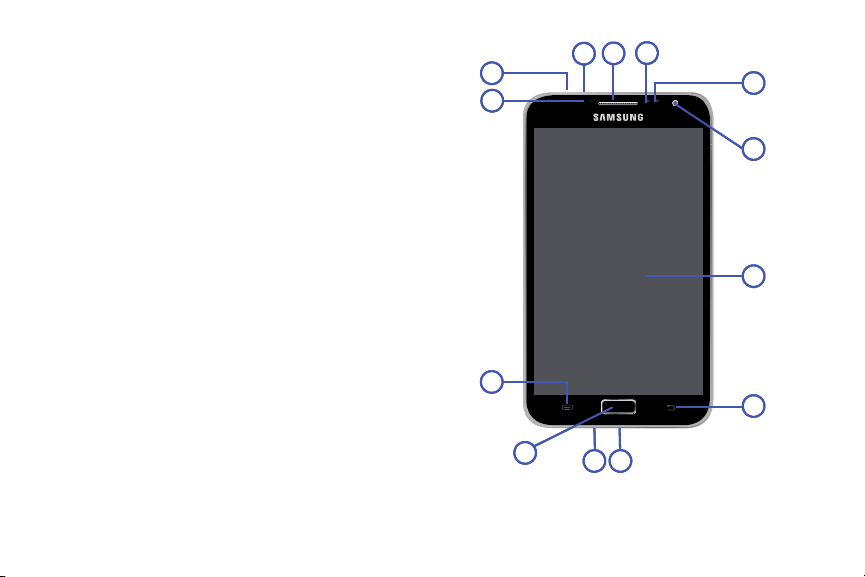
The following illustrations show the main elements of your
device. The following list correlates to the illustrations.
1.
Headset jack
allows you to connect a hands-free
headset so you can listen to music.
2.
Indicator light
illuminates with a series of distinct
colors and flashing patterns to indicate different
notifications and statuses. Events include Charging,
Low battery, and Missed event:
•
Powering on -
blue
blinks/animates
•
Battery Charging -
red
remains on
•
Battery Fully Charged -
green
remains on.
•
Low Battery or Charging Error-
red
blinks/animates
•
Missed Notification (Call or Messaging) -
blue
blinks/animates
For more information, refer to “LED Indicator” on page
266.
7
8
9
10
11
4
3
1
12
5 6
2
5
7
8
9
10
11
4
3
1
12
5 6
2
5
Understanding Your Device 22

3.
Menu key
displays a list of options available for the
current screen. From the Home screen it displays
Add apps and widgets, Create folder, Set wallpaper,
Edit page, Search, and Settings options.
4.
Home
key displays the Home screen when pressed.
Press and hold to display your recent apps, Task
manager, Google Search, and Remove all option.
Double-press to activate S Voice.
5.
Microphone
is used during phone calls and allows other
callers to hear you clearly when you are speaking to
them. There are two microphones on the device:
•
Bottom microphone: used during handset mode.
•
Top microphone: used while an active call is in the
speakerphone mode and assists in noise cancellation
(2 microphone solution).
6.
USB Power/Accessory connector
allows you to connect
a power cable or optional accessories such as a USB/
data cable.
7.
Back key
redisplays the previous screen or clears
entries.
8.
Display
shows all the information needed to operate
your phone, such as the connection status, received
signal strength, phone battery level, and time.
9.
Front Facing Camera
allows you to take pictures while
facing the screen and allows you to video conference.
10.
Proximity Sensor
detects how close an object is to the
surface of the screen. This is typically used to detect
when your face is pressed up against the screen, such
as during a phone call.
•
While talking on the phone, the sensor detects talk activity and
locks the keypad to prevent accidental key presses.
11.
Light Sensor
lets you use the ambient light level to
adjust the screen brightness/contrast. This sensor
decreases screen brightness in dim light.
•
In a bright light condition (outdoors), the sensors cause the
device to increase the brightness and contrast for better
viewing.
•
In dim light conditions, the device increases the screen
brightness to compensate.
12.
Receiver
allows you to hear the other caller and the
different ring tones or sounds offered by your device.
23
1 5
4
2 3
1
2
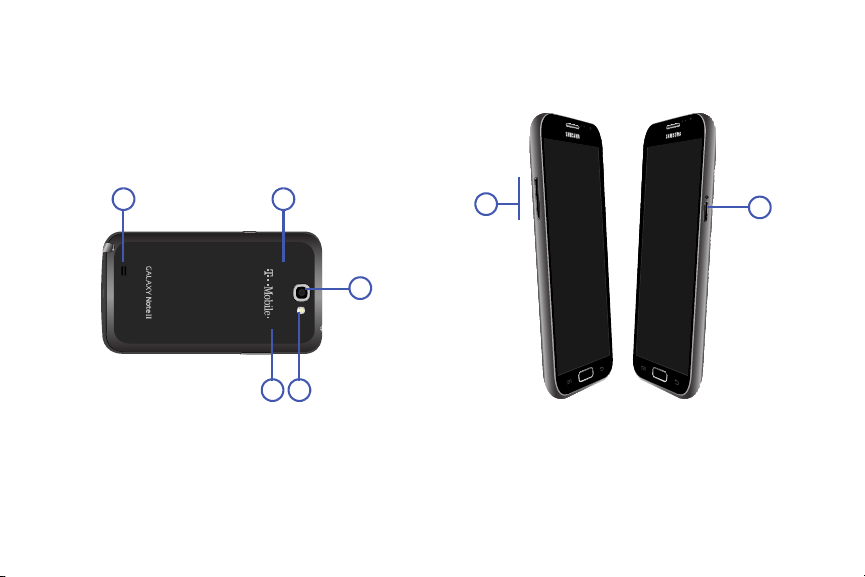
Back View
The following illustration shows the external elements:
1.
External speaker
allows you to hear ringers, music, and
other sounds offered by your phone.
2.
micro SIM Card Slot
(internal) Installation location for
SIM card.
3.
Flash
is used to take photos in low-light conditions.
4.
Camera lens
is used to take photos.
5.
microSD Card Slot
(internal) allows you use a microSD
card to expand the memory of your device.
Side Views
The following illustration shows the side elements of your
device:
1.
Volume key
allows you to adjust the ringer volume in
standby mode (with the phone open) or adjust the voice
volume during a call.
When receiving an incoming call:
•
Pressing the volume key down mutes the ring tone.
Understanding Your Device 24
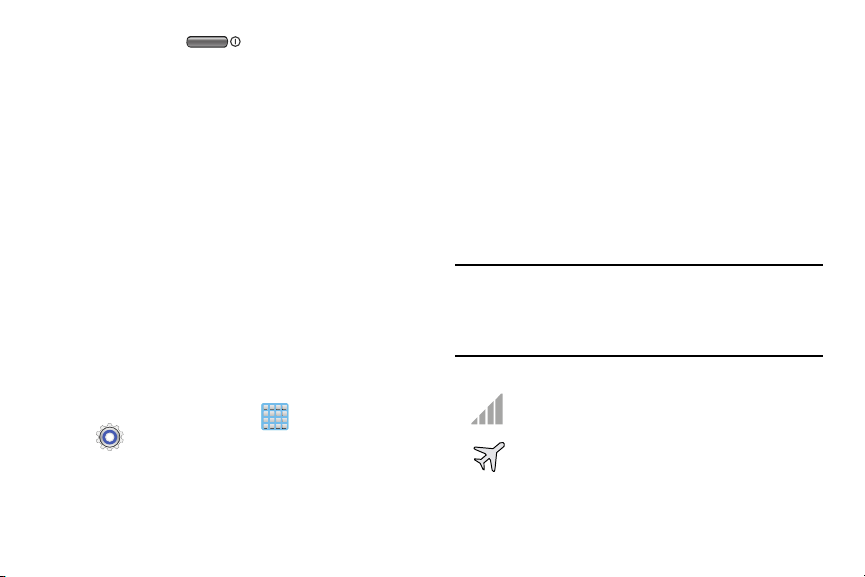
2.
Power/End key
switches the phone off and
on. Press and hold for two seconds to turn toggle the
Silent mode or Airplane mode states, turn the device
on or off, or Restart.
Device Display
Your display provides information about the device’s status,
and is the interface to manage features. The display
indicates your connection status, signal strength, battery
status and time. Icons display at the top of the device when
an incoming call or message is received and also alerts you
at a specified time when an alarm was set. The screen also
displays notifications, and Application (or shortcut) bar with
five primary shortcuts: Phone, Messaging, S Note, Internet,
and Apps.
Display settings
In this menu, you can change various settings for the for the
wallpaper, LED, brightness or backlight.
From the Home screen, tap (
Apps
)
(
Settings
)
Display
. For more information, refer
to “Display Settings” on page 264.
Status Bar
The Status Bar shows information about the connection
status, signal strength, phone battery level, and time, and
displays notifications about incoming messages, calls and
other actions.
This list identifies the icons you see on your device’s display
screen:
Indicator Icons
This list identifies the symbols you’ll see on your device’s
display and Indicator area:
Note:
Some Notification icons can be hidden manually by
toggling the status of the Notification panel function.
For
m
ore information, refer to “Accessing Additional Screen
Functions” on page 35.
Displays your current signal strength. The greater
the number of bars, the stronger the signal.
Indicates that the Airplane Mode is active. You
cannot send or receive any calls or access online
information.
25
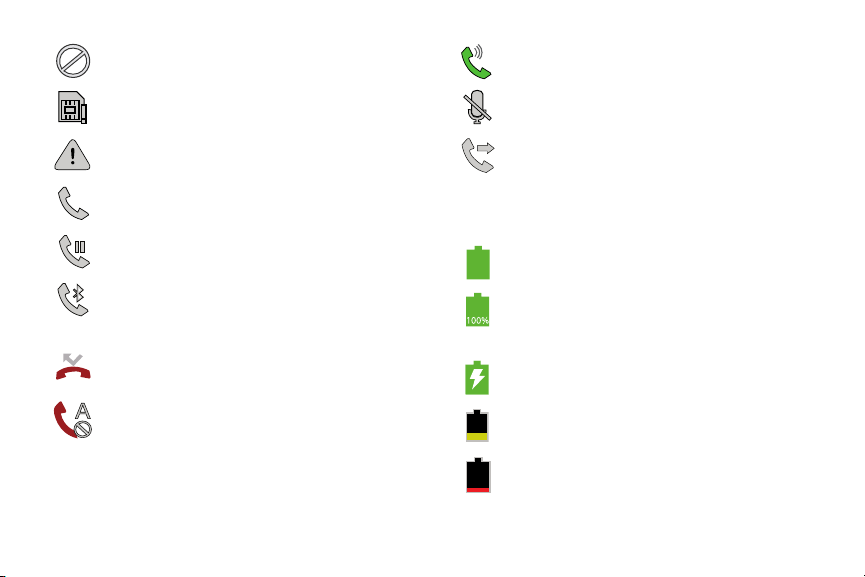
Indicates there is no signal available.
Displays when there is no SIM card in the phone.
Displays when there is a system error or alert.
Displays when a call is in progress. Icon is displayed
in the Status bar area.
Displays when a call is on hold. Icon is displayed in
the Status bar area.
Displays when an active call is routed through a
Bluetooth headset. Icon is displayed in the Status
bar area.
Displays when you have missed an incoming call.
Displays when you device is set to automatically
reject all incoming calls. The All numbers option
is enabled from within
Call settings
Call rejection
Auto reject mode
menu.
Displays when the speakerphone is on. Icon is
displayed in the Status bar area.
Displays when the microphone is muted. Icon is
displayed in the Status bar area.
Displays when Call forwarding is set to Always
forward. Displayed in the Status bar when the
current call is minimized.
For m
ore information,
refer to “Conf
iguring Additional Voice Call Settings”
on page 274.
Displays your current battery charge level. Icon
shown is fully charged.
Displays when the current battery is 100 percent
charged. When the battery is 100 percent, an icon
will be shown at the top left of the screen.
Displays your battery is currently charging.
Displays your current battery charge level is
low (Charge: ~28% - 15%).
Displays your current battery charge level is
very low (Charge: ~15% - 5%).
Understanding Your Device 26
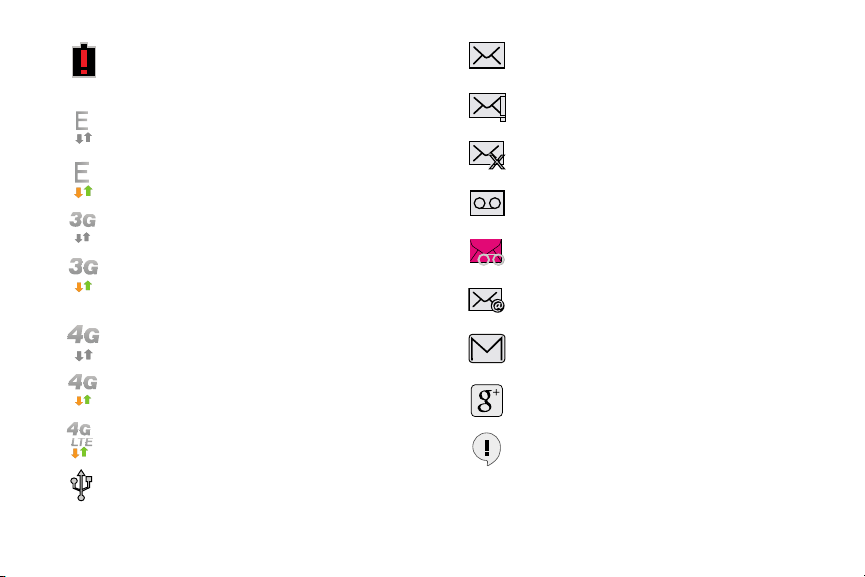
Shows your current battery only has up to 4%
power remaining and will soon shutdown.
(Charge: ~4% - 1%).
Displays when connected to the EDGE network.
Displays when your device is communicating
with the EDGE network.
Displays when connected to the 3G network.
3G indicator is only seen when roaming.
Displays when your device is communicating
with the 3G network. 3G indicator is only seen
when roaming.
Displays when connected to the HSPA+ network.
Displays when your device is communicating
with the HSPA+ network.
Displays when your device is communicating
with the 4G LTE network.
Displays when the phone has detected an active
USB connection and is in a USB Debugging mode.
Displays when there is a new text message.
Displays when an outgoing text message has
failed to be delivered.
Displays when an incoming text message
content has failed to be downloaded.
Displays when there is a new voicemail message.
Displays when there is a new visual voicemail
message.
Displays in the notifications window when there
is a new Email message.
Displays in the notifications window when there
is a new Gmail message.
Displays when a new Google+ notification has
been received.
Displays when Hangout updates are available for
download.
27
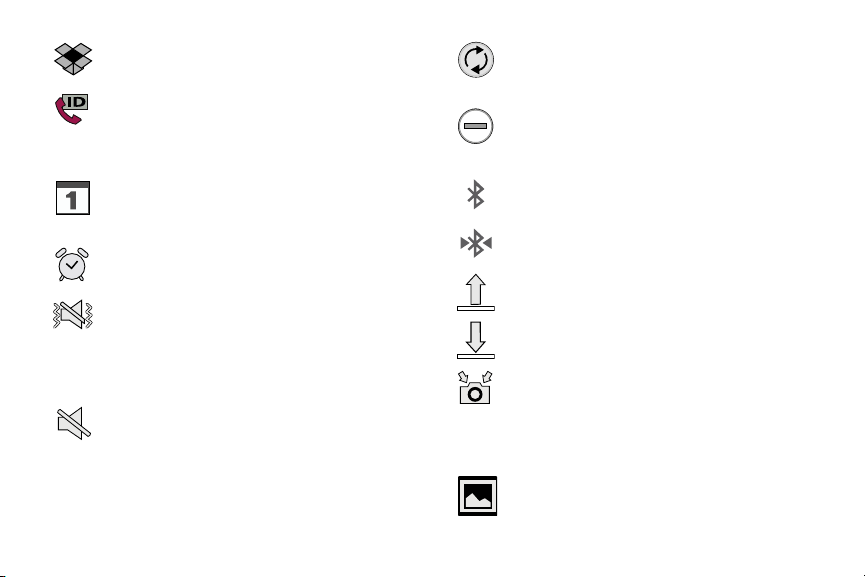
Displays when the user is prompted to set up a
new Dropbox account.
Displays when the T-Mobile Name ID
application did not recognize a recent number
and would like to know whether you wish to
Not add, or add as a New or Existing number.
Displays when the time and date for a Calendar Event
has arrived.
Fo
r more information, refer to
“Calendar” on page 165.
Displays when an alarm is set.
For more information, refer to “Clock” on page 170.
Displays when the device is in Silent mode.
All sounds except media and alarms are silenced,
and Silent mode is set to
Vibrate
. For more
information, refer to “Silent mode via Device
Options Screen” on page 266.
Displays when the device is in Silent mode.
All sounds are silenced, and Silent mode is set to
Mute
.
Displays when data synchronization and
application sync is active and synchronization is in
progress for Gmail, Calendar, and Contacts.
Displays when the Blocking mode feature is
active. For more information, refer to “Blocking
Mode” on page 278.
Displays when Bluetooth technology is active and
enabled.
Displays when the Bluetooth technology is active
and communicating with an external device.
Displays when the an outbound file transfer is in
progress.
Displays when a file or application download is in
progress.
Displays when the Share shot option is enabled
from within the Camera Shooting mode menu and
images and being shared via Wi-Fi Direct.
For more information, refer to “Camera Options” on
page 142.
Displays when a screen capture has been taken and
stored in the clipboard.
Understanding Your Device 28
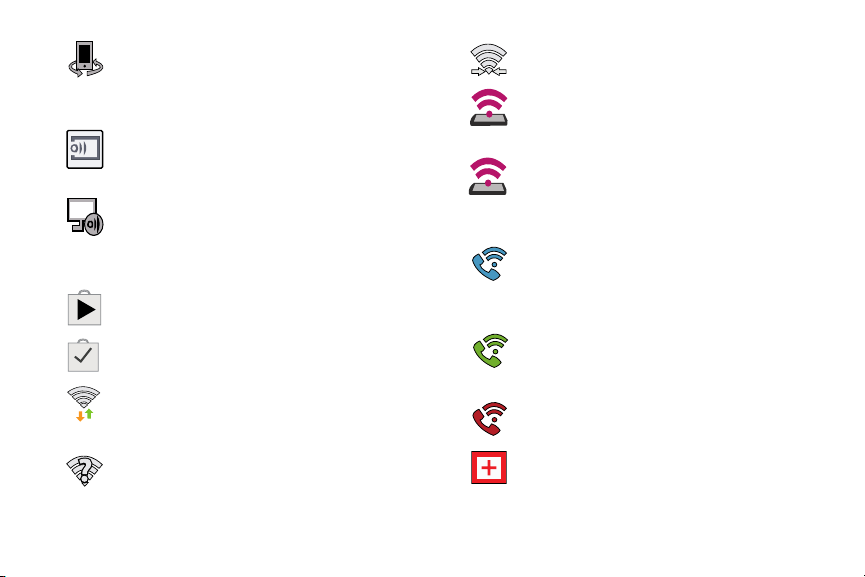
Displays when your device is connected being used
to control streaming media and is connected to a
Digital Living Network Alliance (DLNA) certified
device using the AllShare Play application.
Displays when your device is currently sharing/
streaming media to paired device using the
Samsung Link application.
Displays when AllShare Cast Hub is active,
connected to your device, and communicating.
For more information, refer to “AllShare Cast Hub”
on page 160.
Displays when updates are available for download.
Displays when a Play Store download has
completed.
Displays when Wi-Fi is connected, active, and
communicating with a Wireless Access Point
(WAP).
Displays when Wi-Fi is active and there is an
available open wireless network.
Displays when Wi-Fi Direct is communicating
with another compatible device.
Displays when the USB Tethering mode is active
and communicating.
Fo
r more information, refer to
“USB Tet
hering” on page 236.
Displays when Wi-Fi is being used as a Mobile
HotSpot and the feature is both active and
communicating. For more information, refer to
“Mobile HotSpot” on page 237.
Displays when the Wi-Fi calling feature is active.
Minutes used while connected to the Wi-Fi network
count against available rate plan minutes.
For mor
e
inform
ation, refer to “Wi-Fi Calling” on page 68.
Displays when the Wi-Fi calling feature is active
and you are using it with within your current
active call.
Displays when there is an error in the use or 911
registration of the Wi-Fi Calling feature.
Displays when you are currently in Emergency
calling mode. You must exit this mode to resume
normal calling function.
29
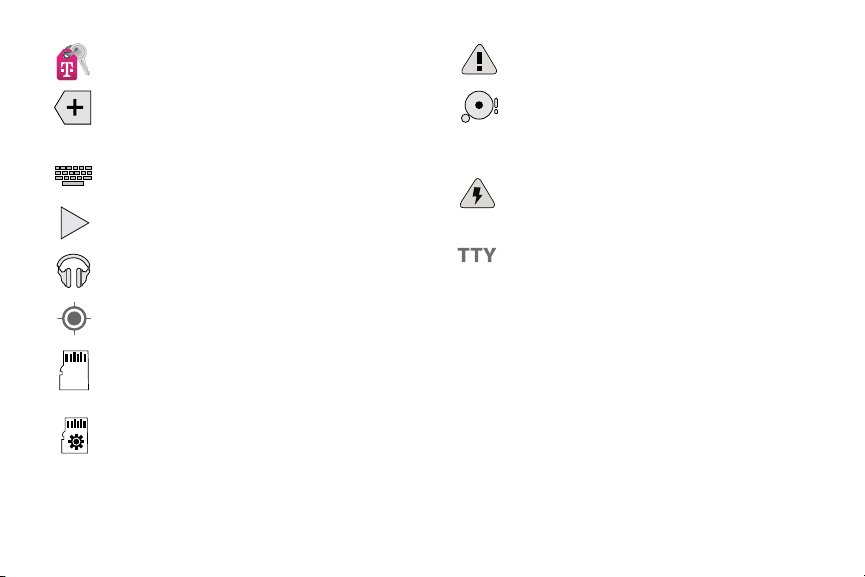
Displays in the notifications window when
a new T-Mobile account information is available.
Displays in the notifications window when there are
too many on-screen notification icons to display.
Tap to show more notifications.
Tap to select a text input method.
Displays in the notifications window when a song is
currently playing within the Music Player.
Displays in the notifications window when a song is
currently playing within the Play Music application.
Displays when your device’s GPS is on and
communicating.
Displays when the external SD card (internal
microSD) has been disconnected (unmounted)
from the device.
Displays when the External SD card is being
prepared for mounting to the device. This is
required for communication with the External SD
card.
Displays when the microSD card has been
improperly removed or unexpectedly.
Displays when storage within either the internal
location or the external SD card has reached its
capacity. It is recommended you either move
files off or delete them to make additional room.
Displays when the Power saving alert notification
has been activated. You are then prompted to view
your current battery level.
Displays when TTY device has been inserted.
For more details on configuring your device’s settings,
see
“Changing Your Settings” on page 240.
Understanding Your Device 30
Signal strength
Connection Status
Battery status
Status Bar
Time
Widget
area
Status
Notification
Home Screen
area
Google search
Shortcuts
Primary
Shortcuts
Home Screen
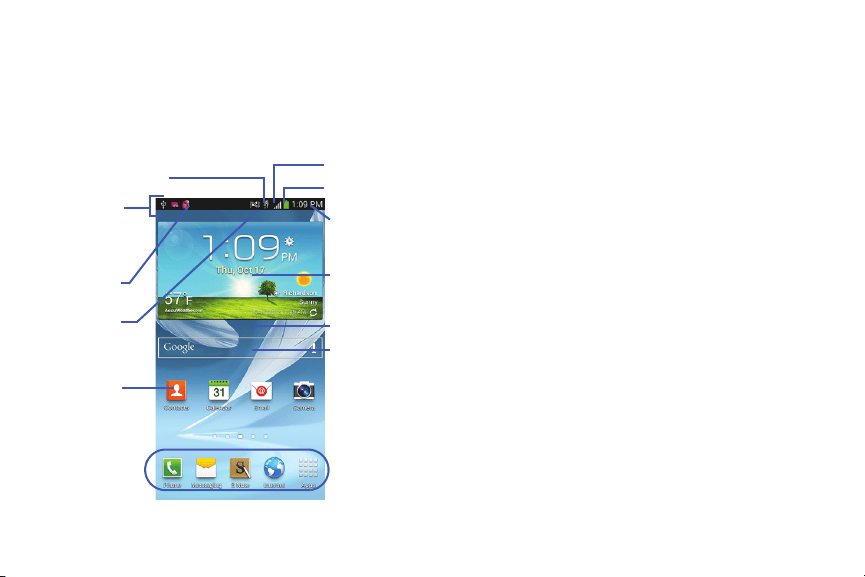
The Home screen is the starting point for using the
applications on your device. There are initially seven
available panels, each populated with default shortcuts or
applications. You can customize each of these panels.
•
Notification area
displays those icons associated with end-user
notifications such as: email messages, calls (missed, call in
progress), new voicemail, upcoming event, USB connection,
Emails, and Text/MMS messages.
–
These notifications appear at the top-left of the screen (within
the Status bar area) and display important user information.
–
This information can be accessed by swiping down from the
Status bar
(pa
ge 34).
•
Status area
displays those icons associated with the status of
the device such as communication, coverage, Bluetooth,
LTE/4G/3G, Wi-Fi communication, battery levels, etc.
•
Home Screen
is a customizable screen that provides information
about notifications and device status, and allows access to
application Widgets.
•
Extended Home Screens
extend beyond the current visible
screen width to provide more space for adding icons, widgets,
and other customization features.
–
There are six available extended screens (panels) each of
which may be populated with its own shortcuts or widgets.
These screens share the use of the five Primary Shortcuts.
–
The eighth available screen is called the S Pen screen that
provides access to features enhanced by using the S Pen.
31
–
The current screen is indicated at the bottom by a white
square. Up to seven (7) total screens are available.
Note:
Both the status bar and primary shortcuts are visible
across all screens.
•
Google search
is an on-screen Internet search engine powered
by Google™. Tap to access either the Voice Actions feature or
Google Now™.
–
Tap (
Voice Actions
) to launch these functions from
within this Google widget.
•
Widgets
are self-contained on-screen applications (not
shortcuts). These can be placed onto any of the available screens
(Home or extended).
•
Shortcuts
are icons that launch available device applications
such as Camera, YouTube, Contacts, Phone, Email, Play Store,
etc. These function the same as shortcuts on your computer.
–
Although some may already be found on the Extended Home
screens, the majority can also be found within the Applications
screens.
–
The Application screens can be accessed by tapping
(
Apps
) from the Primary shortcuts area.
–
Shortcuts can be removed from a screen and added back any
number of times.
•
Primary Shortcuts
: are five shortcuts present throughout all of
the available screens and can be used to both navigate within the
device or launch any of the following functions:
–
Phone
( ) launches the phone-related screen functions
(Keypad, Logs, Favorites, and Contacts).
–
Messaging
( ) launches the Messaging menu (create new
messages or open an existing message string).
–
S Note
( ) launches the S Note application.
–
Internet
( ) launches the built-in Web browser.
Understanding Your Device 32

–
Apps
launches the Applications page.
•
Tap (
Apps
) to access the Application screens.
•
While in the Applications screens, tap (
Back
) to easily
return to the Home screen.
Note:
When you are on the S Pen screen, the primary
shortcuts can change based on your usage. As an
application is used more frequently, that application
shortcuts then gets placed at the bottom of the screen in
the primary shortcut area.
As you transition from screen to screen, a screen indicator
(located at the bottom) displays the currently active panel.
Home Key
The
Home
key ( ) takes you back to your Home screen
(#3 - by default).
Press and hold to launch the Recent apps/Task
manager/Google Search screen. For more information,
refer to “Accessing Recently-Used Applications” on
page 163.
Menu Key
The
Menu
key ( ) activates an available menu function
for the current screen or application.
Back Key
The
Back
key ( ) returns you to the previously active
screen. If the on-screen keyboard is currently open, this key
closes the keyboard.
33
Home Screen Menu Settings
When on the Home screen, press and then select any
of the following menu options:
•
Add apps and widgets
allows you to quickly access the Widget
tab where you can then drag a selected widget to an available
area on a selected screen. For more information, refer to
“Adding
and Removing Widgets”
on page 41.
•
Create folder
allows you to create on-screen folders to help
organize files of application shortcuts.
•
Set wallpaper
allows you to assign the current wallpaper for the
Home screen, Lock screen, or Home screen and lock screens.
Choose from Gallery, Live wallpapers, or Wallpapers.
•
Edit page
allows you to add or remove extended screens from
your device. You can have up to six extended screens (one Home
screen and six Extended screens).
•
Search
displays the Google Search box that you can use to
search for a key term online.
•
Settings
provides quick access to the device’s settings menu.
–
The Settings menu can also be accessed by pressing
an
d then tapping
Settings
.
Notification Screen
The Notification area indicates new message events (data
sync status, new messages, calendar events, call status,
etc). You can expand this area to display the Notification
screen that provides more detailed information about the
current on-screen notification icons.
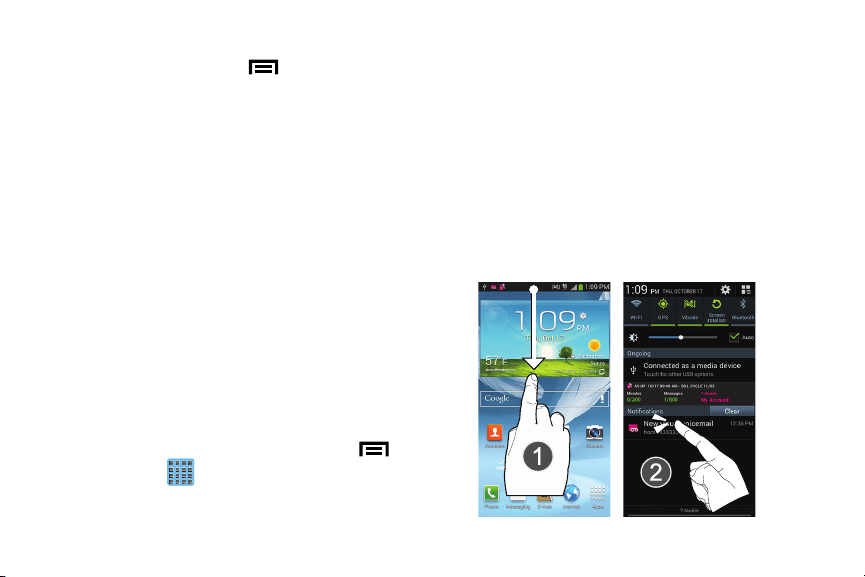
1. Touch the Status bar to reveal the Notifications tab, and
then drag the tab to the bottom of the screen to open
the Notifications panel (1).
2. Tap a notification entry to open the associated
application (2).
Understanding Your Device 34
Clearing Notifications
1. In a single motion, touch and drag the Status bar down
to the bottom of the screen to open the Notifications
screen.
2. Tap
Clear
. The notifications are cleared from the panel.
Accessing Additional Screen Functions
In addition to notifications, this screen also provides quick
and ready access to device functions. These can be quickly
activated or deactivated.
Scrolling across a horizontal list of functions has been
enhanced with an accessible Grid view.
Note:
You can select the function buttons you see at the top of
the Notifications panel.
Only 5 buttons are shown at any one time.
The Grid view is the only way to view all functions.
To activate the Grid view:
From the Notification panel, tap (
Open Grid view
)
to display additional functions.
To minimize the Grid view:
From the Notification panel, tap (
Close Grid view
)
to show only your primary functions.
To customize the functions displayed:
1. From the Notification screen, tap (
Open Grid
view
) to display additional functions.
2. Tap
(
Edit
) then locate the Notifications panel area
located at the bottom of the Notifications panel screen.
3. In a single motion, touch and hold a desired function
then drag it to the top row.
35
Customizing the Screens
You can customize the Home screens (panels) to display the
Widgets, Shortcuts, Folders, or Wallpapers. For example, one
screen could contain the Music Player shortcut and other
forms of media, while another screen might contain
communication apps such as Gmail.
You can customize your Home screen by doing the following:
•
Adding, Deleting, and Rearranging screens
•
Assigning a New Home screen
•
Sharing Application Information
•
Managing Shortcuts
•
Adding and Removing Primary Shortcuts
•
Creating an Application Folder
•
Adding a New page to the Application Menu
•
Adding and Removing Widgets
•
Changing the Background (Wallpapers)
Adding and Deleting Screens
Your phone comes with seven screens. You can delete these
screens and then add them back later.
Note:
These screens can be deleted and re-arranged.
Important!
Your phone can only contain at most seven screens
and at least one screen.
To delete a screen:
1. From the Home screen press and then tap
Edit page
.
2. Touch and hold, then drag the undesired screen down
to the
Remove
tab ( ).
3. Press
to return to the main Home screen.
To add a screen:
1. From the Home screen press and then tap
Edit page
.
2. Tap
(
Add screen
). The newly added screen
appears as the last page.
3. Press
to return to the main Home screen.
Understanding Your Device 36
Touch and hold a screen and then drag it into its new
location. Upper-left is screen position #1 and
bottom-right is screen last screen.
Assigning a New Home Screen
From the Home screen, press and then tap
Edit
page
.
Tap . The new Home screen then indicates this
(
Home screen
) icon in the upper-right.
From the Home screen, press and then tap
Edit page
.
1. From the Home screen, tap
2. Press
and then tap
Share apps
.
3. Place a check mark alongside those applications you
wish to share information about and tap
Done
.
Note:
Shared applications consist of those that have
previously been downloaded from
the Play Store.
Rearranging the Screens Sharing an App
1.
The device’s Applications menu now comes with a feature
that allows
you to share information about your selected
applications with external users.
2.
(
Apps
).
1.
2.
4. Select a sharing method. Choose from: Add to
Dropbox, Bluetooth, Cha
tON, Copy to clipboard, Drive,
Email, Flipboard, Gmail, Google+, Hangouts,
Messaging, S Note, and Wi-Fi Direct.
5. The recipient will be notified about the receipt of the
new information.
37

Managing Shortcuts
Note:
To move a shortcut from one screen to another, you
must carefully touch and hold the shortcut and slowly
drag it to the edge of the screen. As the shortcut turns
light blue, you can begin to move it to the adjacent
screen.If this does not work, delete it from its current
screen. Activate the new screen and then add the
selected shortcut.
To add a shortcut from the Applications screen:
1. From the Home screen, select a screen location for
your new shortcut by scrolling across your available
screens until you reach the desired one.
2.
Tap
Apps
( ) to reveal all your current available
applications. By default, applications are displayed as
an Alphabetical grid.
3. Scro
ll across the screens and locate your desired
application.
4. Touch and hold the on-screen icon. The new shortcut
then appears to hover over the current screen.
5. While still holding the on-screen icon, position it on the
current screen. Once complete, release the screen to
lock the shortcut into its new position.
To add a shortcut via the Add to Home screen:
1. From the Home screen, navigate to a screen with an
empty area.
2. Touch and hold an empty area of the screen.
3. From the
Home screen
window tap
Apps and widgets
.
4. Scroll across the pages and tap a selection.
To delete a shortcut:
1. From the Home screen, touch and hold the desired
shortcut. This unlocks it from its location on the current
screen.
) and
release it.
2. Drag the shortcut over the
Remove
tab (
Understanding Your Device 38
Adding and Removing Primary Shortcuts
Note:
You can change any of your primary shortcuts with the
exception of the
Apps
shortcut.
To remove a primary shortcut:
From the Home screen, touch and hold the primary
shortcut you want to replace, then drag it to an empty
space on any available screen. The primary shortcuts
are now updated to show an empty slot.
To insert a new primary shortcut:
1. From the Home screen, tap (
Apps
).
2. Locate your desired application, then touch and hold
the on-screen icon to position it on a desired screen.
For more information, refer to “Managing Shortcuts”
on page 38.
3. Locate the screen with the desired shortcut you want
to add as the new primary shortcut.
4. Touch and hold the shortcut until it detaches from the
screen.
5. In a single motion, touch and hold the new shortcut,
then drag it to the empty space in the row of primary
shortcuts. The new primary shortcut will now appear
on both the Home and Extended screens.
Creating Application Folders
You can create application folders to hold similar applications
if you wish.
1. From the Home screen, (
Apps
).
2. Tap the
Apps
tab at the top of the screen if it is not
already selected.
3. Press and then tap
Create folder
.
4. Enter nam
e for the new folder and tap
OK
. The new
empty folder is located alphabetically in the Apps area.
5. Press
and then tap
Edit
and tap the empty folder.
(
Add apps to
folder
), scroll across the available Apps page and place
checkmarks on those apps you wish to add to these
grouped folder.
6. Tap the folder entry and select
7. Tap
Done
to complete the process. The contained apps
appear on top of the folder.
39
8. Tap
Save
.
– or –
1. From the Home screen, tap (
Apps
).
2.
Pr
ess
and then tap
Edit
.
3. T
ouch and hold the first application that you would like
to move to a folder.
4. Drag the shortcut over (
Create folder
).
5. Name the folder and tap
OK
. The folder is then
displayed in alphabetical order on the Apps page with
the application icon displayed on top of it.
6. Add more shortcuts to this folder by dragging those
apps over the new folder.
7. Drag the desired application shortcut over
(
Apps Info
). to view information on the application.
8. Tap
Save
.
Adding a New Page to the Application Menu
You can add a new page to your application menu by
following these steps:
1. From the Home screen, tap (
Apps
).
2. Tap the
Apps
tab at the top of the screen if it is not
already selected.
3. In a single motion, touch and drag the first application
(that you would like to move to a new page) towards
the top of the screen.
4. Drag the shortcut over (
Create page
).
5. The app will appear on a new page.
Understanding Your Device
40

Adding and Removing Widgets
Widgets are self-contained applications that can be placed
on any screen. Unlike shortcuts, widgets appear as
applications.
To add a Widget:
1. From the Home screen, tap (
Apps
)
Widgets
tab.
2. Scroll across the Widget pages and locate a desired
Widget.
3. Touch and hold an available Widget until it detaches
from the screen.
4. While still holding the Widget, scroll left or right across
the available screens and let go of the Widget to place
it on your current screen.
To remove a Widget:
1. Touch and hold a Widget until it unlocks from the
current screen.
2. Drag the widget over the
Remove
tab ( ) and
release it.
•
As you place the Widget into the Trash, both items turn red.
•
This action doesn’t delete the Widget, it just removes it from the
current screen.
To place a widget onto a different screen:
1. Touch and hold the widget until it becomes
transparent.
2. Slowly drag it past the edge of the screen until the
adjacent page appears highlighted and it then snaps
onto the new page.
3. Drag the widget to its desired position on the new
screen.
4. Repeat these steps to continue moving it to other
screens.
41

Managing Wallpapers
Wallpapers consist of either Gallery images (user taken), Live
wallpapers (animated backgrounds), or Wallpaper gallery
(default phone wallpapers).
Note:
Selecting animated Live wallpapers will require
additional battery power.
To change the current Home screen wallpaper:
1. Navigate to any screen.
– or –
P
r
ess
to go to the Home screen.
2. Touch and hold an empty area of the screen.
3. Fr
om the
Home screen
window tap
Set wallpaper
Home screen
.
4. Select a Wallpaper type:
•
Tap
Gallery
to select from a user image stored in the camera
image Gallery. Crop the image, and tap
Done
.
•
Tap
Live wallpapers
to select from a list of animated
backgrounds, once done tap
Set wallpaper
.
•
Tap
Wallpapers
, scroll through the images, tap a wallpaper
image, then tap
Set wallpaper
.
Note:
Wallpapers supports the following image types: JPEG,
PNG, GIF, BMP, and WBMP.
To change Wallpapers from Settings Menu:
1. From the main
Settings
page, tap
My device
tab
Display
Wallpaper
.
– or –
T
ouch and hold an empty area of the screen and select
Set wallpaper
.
2. Cho
ose from
Home screen
,
Lock screen
, or
Home and
lock screens
.
Note:
The
Home and lock screens
is an additional option that
allows you to change both screens at the same time.
3. Sel
ect a wallpaper type (
Gallery
,
Live wallpaper
, or
Wallpapers
).
4.
Cho
ose an image and tap
Done
or
Set wallpaper
.
Understanding Your Device 42

To change the current Lock screen wallpaper:
1. Navigate to any screen, touch and hold an empty area
of the screen, and tap
Set wallpaper
Lock screen
.
– or –
From the main
Settings
page, tap
My device
tab
Display
Wallpaper
Lock screen
.
2. Select a
Wallpaper type:
•
Tap
Gallery
to select from a user image stored in the camera
image Gallery. Crop the image, and tap
Done
.
•
Tap
Wallpaper
, scroll through the images, tap a wallpaper
image, then tap
Set wallpaper
.
Screen Navigation
Using the touch screen display and the keys, you can
navigate the features of your device and enter characters.
The following conventions are used in this manual to
describe the navigation action in the procedures.
Navigating Through the Screens
The following terms describe the most common hardware
and on-screen actions.
•
Press and hold
: Pressing relates to use of the hardware keys and
buttons to select or activate an item. For example: press the
Navigation key to scroll through a menu. Some buttons and keys
require you to press and hold them to activate a feature, for
example, you press the Lock key to lock and unlock the device.
•
Tap
: Use a brief touch to select items on the display or to enter
text on the virtual QWERTY keyboard. For example: touch an
Application icon to open the application. A light touch works best.
•
Touch and hold
: Touch and hold an icon or key to open the
a
vailable options, or to access a pop-up menu. For exampl
e:
to
uch and hold from the Home screen to access a menu o
f
customization options.
43
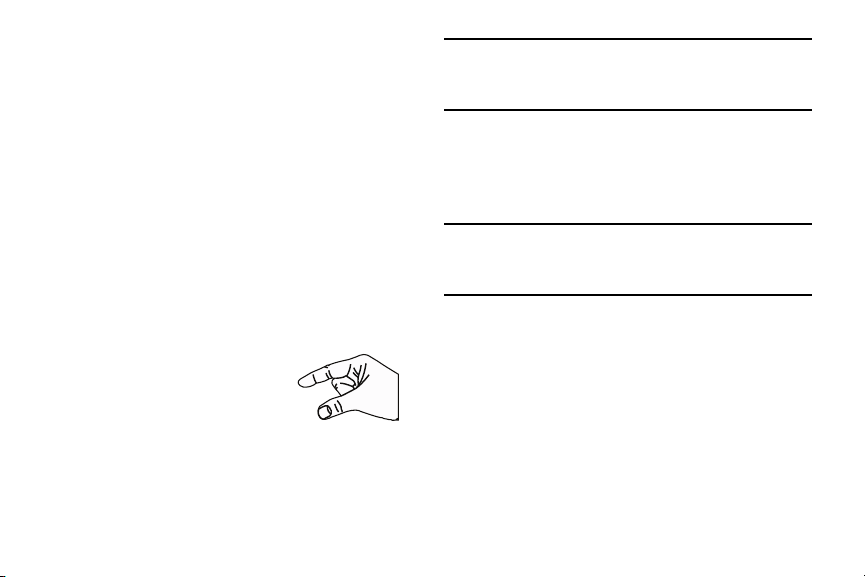
•
Flick
: Move your finger in lighter, quicker strokes than swiping.
This finger gesture is always used in a vertical motion, such as
when flicking through contacts or a message list.
•
Swipe or slide
: Quickly drag your finger vertically or horizontally
across the screen. This allows you to move the area of focus or to
scroll through a list. For example: slide your finger left or right on
the Home screen to scroll among the seven panels.
•
Drag
: Press and hold your finger with some pressure before you
start to move it. Do not release your finger until you have reached
the target position.
•
Rotate
: Automatically change the screen orientation from portrait
to landscape by turning the device sideways. For example: rotate
to landscape orientation when entering text, to provide a larger
keyboard, or when viewing web content to minimize scrolling.
•
Pinch
: “Pinch” the screen using your
thumb and forefinger to zoom out when
viewing a picture or a Web page. (Move
fingers inward to zoom out.)
•
Spread
: “Spread” the screen using your thumb and forefinger to
zoom in when viewing a picture or a Web page. (Move fingers
outward to zoom in.)
Note:
These screens can be re-arranged in any desired order.
For more information, refer to “Customizing the
Screens” on page 36.
•
Motion Navigation and Activation
: The device comes equipped
with the ability to assign specific functions to certain device
actions that are detected by both the accelerometer and
gyroscope.
Note:
Motion must be enabled for this feature to be active. For
more
information, refer to “Motion Settings” on page
289.
Understanding Your Device 44
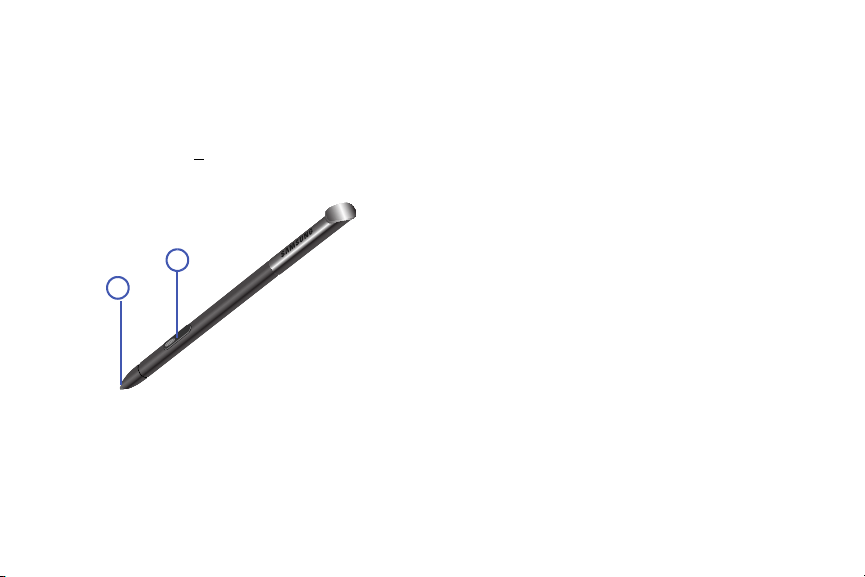
1
2
S Pen
The S Pen™ is a stylus that assists you in performing
different functions. By using the Pen button, you can
minimize having to switch between touch and pen input.
Air View is a new S Pen technology that allows you to hover
over the touch screen (< 2mm) and still interact with the
display.
1.
Pen button
: by pressing the Pen button, you can add
functionality to the S Pen.
2.
Stylus tip
: the tip of the S Pen is used for tapping the
screen.
For more information, refer to “S Pen Settings” on page 292.
Rich S Pen Functionality
•
Air View
: Hover S Pen over the screen to preview information.
•
Effectively express yourself
: Write/Draw directly into an email,
or the calendar, annotate Word, Excel, PowerPoint, and PDF
documents, capture your ideas in S Note, write a note on the back
of the picture.
•
Quick Command
: Launch Quick Command to activate frequently
used applications or actions. Press the S Pen button and then
drag the S Pen up the screen to display the Quick Command
window.
•
Easy Clip
: Instantly outline and crop anything on the screen and
freely edit or share with others.
45
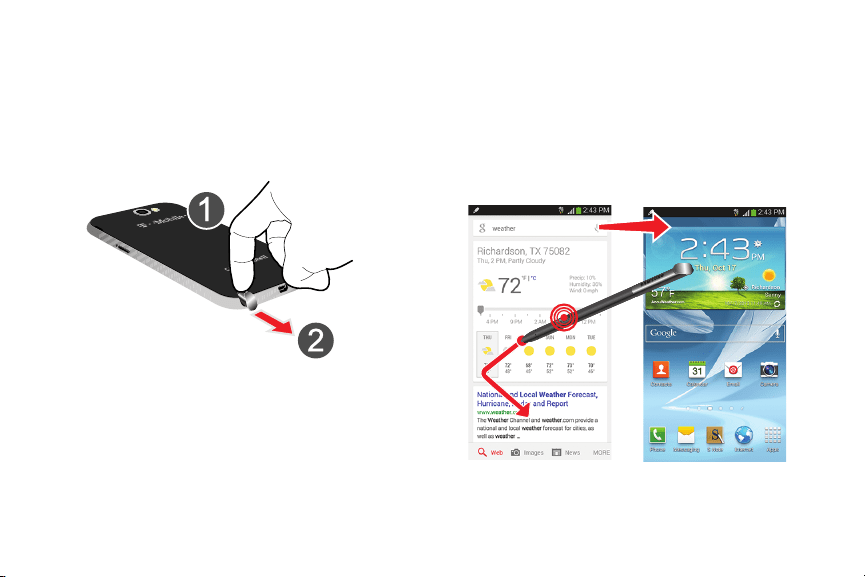
Removing the S Pen from your Phone
The S Pen is stored within your device to make it easier to
keep track of.
To remove the S Pen:
1. In a single motion, use your fingernail or a sharp object
to pop the end of the S Pen out of the device (1).
2. Pull the S Pen out from the device (2).
Using the S Pen
There are several different available functions.
Back Button Function
To move to a previous screen:
1. Grasp the pen and press the
Pen button
.
2. In a single motion, press the S Pen button and the drag
the screen as shown. The previous screen is displayed.
Understanding Your Device 46

Screen Shots Using S Pen
To take a screen capture using the pen:
Note:
These steps allow you to take a capture of the entire
screen contents.
1. Grasp the pen and press the
Pen button
.
2. Pressing the S Pen button then touch and hold the
screen for 2 seconds takes a screen shot.
Using Easy Clip
Instantly outline and crop images displayed on the screen in
any shape to share or paste with Easy Clip. Once desired
image is selected, users can freely edit the cropped content,
or personalize with their own handwriting.
To take a selective screen capture:
Note:
These steps allow you to capture selected areas of a
screen based on a freehand area drawn on-screen.
1. Grasp the pen.
2. In a single motion, press and hold the
Pen button
then
quickly draw a freeform enclosed shape on the screen
to select the area you want to capture.
Note:
The shape you draw must be completed by ending over
the same point at which you started. This creates a
closed shape.
3. After a second, confirm the newly captured image
appears on-screen.
Note:
Additional options are available by scrolling left across
the bottom of the screen
4. Tap a destination for the newly captured image from
the bottom of the screen. Tap one of the following
options: Scrapbook (creates a scrapbook folder in your
S Note application), S Note, Email, Messaging, ChatON,
Add to Dropbox, Bluetooth, Drive, Flipboard, Gmail,
Google+, Group Play, Hangouts, Paper Artist, PEN.UP,
Picasa, or Wi-Fi Direct.
Note:
If you take no action, after approximately 5 seconds, the
image is automatically stored in the clipboard.
47
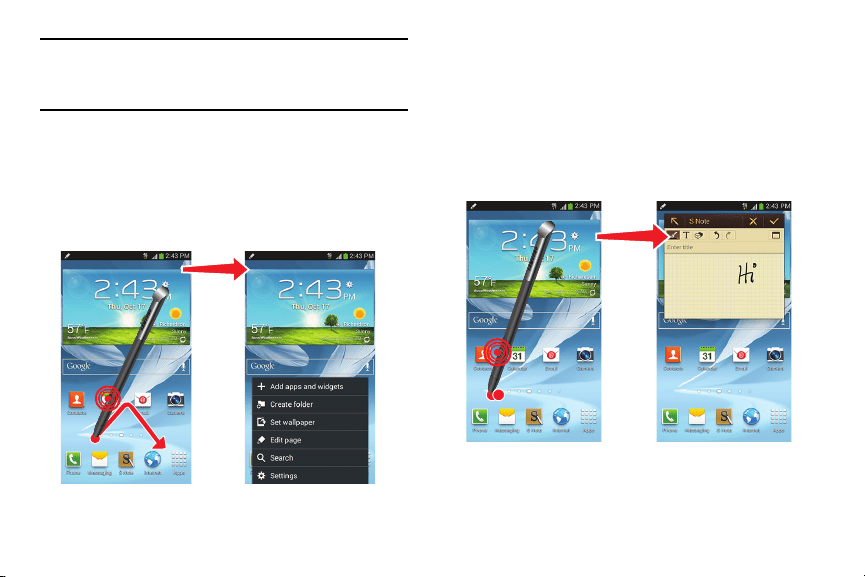
Important!
These images files are saved in the
My Files
All files
Device storage
Pictures
Screenshots
folder.
Menu Button Function
To display the menu from any screen:
1. Grasp the pen and press the
Pen button
.
2. In a single motion, press the S Pen button, then touch
and drag the pen as shown to display the menu.
Launch S Note Lite
S Note Lite is an application that you can launch from any
screen to take quick notes or jot down ideas.
To launch S Note from any screen:
1. Grasp the pen and press the
Pen button
.
2. Quickly double tap the screen to display the S Note Lite
app.
Understanding Your Device 48
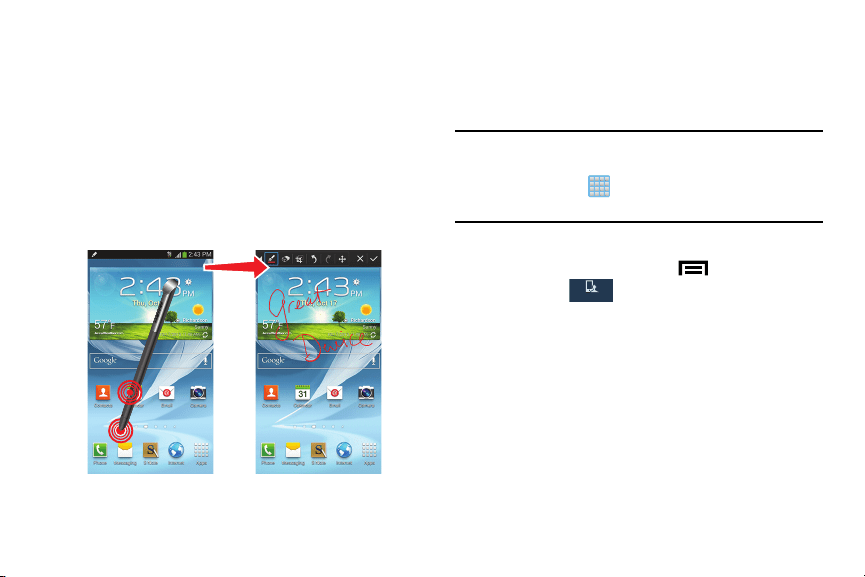
Write on any Screen after Capture
To take a screen capture of any screen:
1. Grasp the pen and press the
Pen button
.
2. Pressing the S Pen button then touch and hold the
screen for 2 seconds takes a screen shot.
3. With the screen capture shown, use the pen to draw or
write on the screen. Select the checkmark to store files
in the
My Files
All files
Device storage
Pictures
Screenshots
folder.
For information on using your S Pen with the S Memo
application, see “S Pen Settings” on page 292.
Using Motions and Gestures
By activating the various motion and gesture features within
this menu (page 289), you can access a variety of time
saving functions.
Caution!
Excessive shaking or impact to the device may cause
unintended results. To learn how to properly control
motions, tap (
Apps
)
Settings
My device
tab
Motion
Learn about hand motions
.
To activate motion:
1. From the Home screen, press and then tap
Settings
(
My device
tab).
My
My
device
device
2. In a single motion touch and slide the
Motion
slider to
the right to turn it on.
3. Tap the desired on-screen motion option. The feature is
active when a green checkmark appears in the
adjacent field.
The following is a description some of the most commonly
used gestures:
49

•
Quick glance
: Once enabled, allows you to check key device
information at a glance by just reaching towards your device.
Refer to the Advanced settings information to set which gestures
can be quickly glanced.
•
Direct call
: Once enabled, the device will dial the currently
displayed on-screen Contact entry as soon as you place the
device to your ear.
•
Smart alert
: Once enabled, pickup the device to be alerted and
notified of you have missed any calls or messages.
•
Double tap to top
: Once enabled, double tap the top of the
device to be taken to the top of the current on-screen list.
•
Tilt to zoom
: Once enabled, you must be on a screen where
content can be zoomed. In a single motion, touch and hold two
points on the display then tilt the device back and forth to zoom in
or out. Access the Advanced settings to change its sensitivity
setting.
•
Pan to move icon
: Once enabled, touch and hold a desired
application shortcut icon or widget on the screen. Once it
detaches, move the device left or right to migrate it to a new
location. Access the Advanced settings to change its sensitivity
setting.
•
Pan to browse images
Once enabled, touch and hold a desired
on-screen image to pan around it. Move the device left or right to
pan vertically or up and down to pan horizontally around the large
on-screen image. Access the Advanced settings to change its
sensitivity setting.
•
Shake to update
: Once enabled, shake your device to rescan for
Bluetooth devices, rescan for Wi-Fi devices, Refresh a Web page,
etc..
•
Turn over to mute/pause
: Once enabled, mute incoming calls
and any playing sounds by turning the device display down on a
surface.
•
Advanced settings
: provides access to advanced gesture
settings such as:
• Quick glance
: allows you to set which features are displayed at
a glance when a user reaches for the device. Choose from:
Missed call, New messages, Battery, Current music, or
Notification icons.
• Sensitivity settings
: When any of the following features are
enabled, you can then adjust their sensitivity.
Choose from: Tilt to zoom, Pan to move icon, and Pan to
browse images.
Understanding Your Device 50
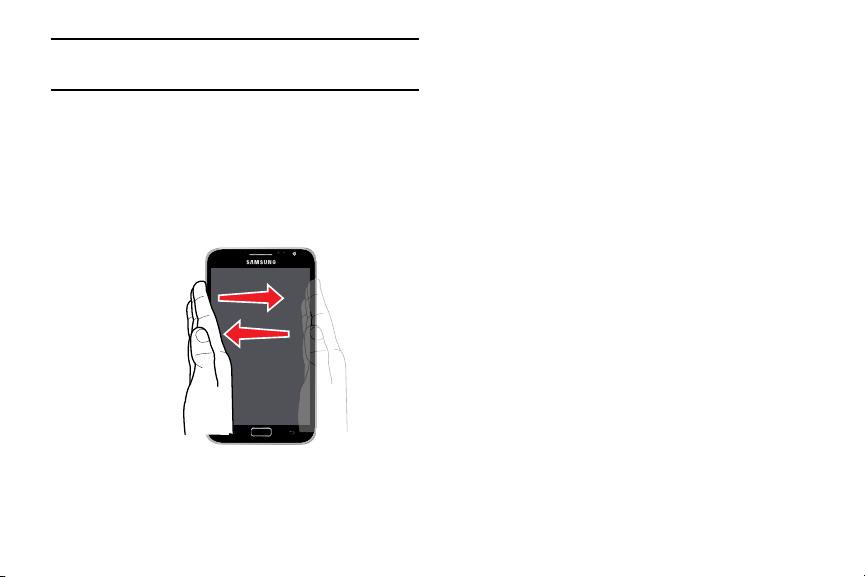
Palm Swipe to
Screen Capture
Note:
Sensitivity settings are only accessible if the gesture is
currently active.
In addition to these motions, the device is capable of several
Hand motions (gestures):
•
Palm swipe to capture
: Once enabled, you can capture any
on-screen information swiping across the screen. In a single
motion, press the side of your hand on the screen and swipe form
left to right. The image is then copied to the clipboard.
•
Palm touch to mute/pause
: Once enabled, you can pause any
on-screen video or mute any current sound by simply covering
the screen with your hand. Once you remove your hand from the
screen, the device goes back to normal by either continuing to
play the current video or unmuting the current sound.
•
Learn about hand motions
: Provides you with on-screen
tutorials about selected motions such as: Palm swipe to capture
and Palm touch to mute/pause.
51
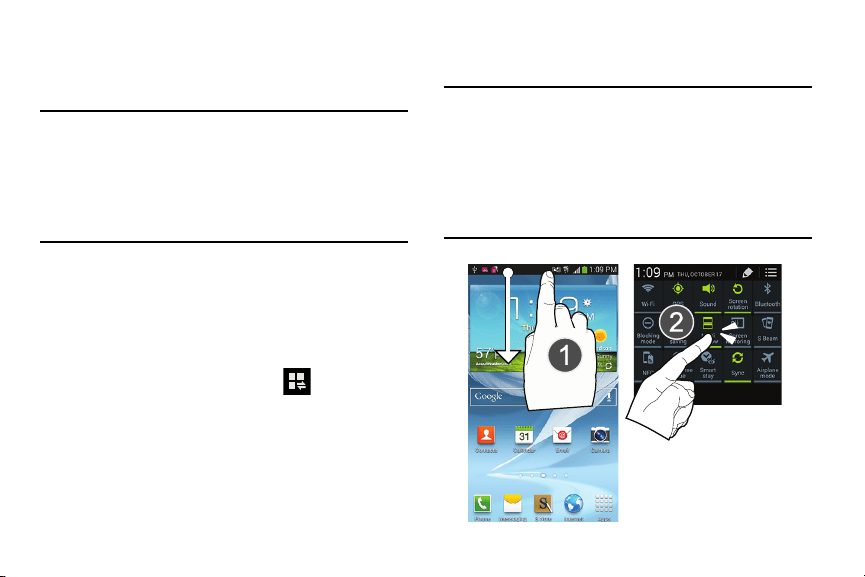
Using the Multi Window
This feature allows you to run multiple applications on the
current screen at the same time.
Note:
Only applications found within the Multi window panel
can be active atop another current application on the
screen.
When launching applications that contain multimedia
files (music/video), audio from both files will be played
simultaneously.
3. Tap the
Multi window
entry to activate the feature (2).
The icon turns green when active.
Note:
Although the Multi window feature is now active
(as shown via the Notifications screen), the user must
enable/display the Multi window list is shown only by
using the Back button.
This action is a one time event during the initial access.
After that, the Multi window list is displayed whenever
the feature in active via the Notifications screen (2).
Activating and Deactivating Multi window
To activate Multi window via the Notification screen:
1. In a single motion, touch the Status bar to reveal the
Notifications tab, and then drag it to the bottom of the
screen to open the Notifications screen (1).
2. From the Notification screen, tap
(
Open Grid
view
) to display additional functions.
Understanding Your Device 52

To display Multi window via the Back button:
1. Press and hold the
Back
key ( ). The Multi window
tab appears (by default) on the left side of the
screen.
Note:
Initially open activation, the entire apps panel is briefly
displayed, then minimized to only show the tab.
2. Tap the tab to open the application panel showing all
the available Multi window apps.
To hide the Multi window tab:
Press and hold the
Back
key ( ). This action hides
the Multi window tab from view.
Repositioning the Multi Window
The Multi window contains two components: tab and apps
panel. The tab can be manually moved across the screen.
The apps panel (containing the scrollable apps) can be
relocated to lock onto the different sides of the screen.
To move the tab:
1. Activate the Multi window feature (page 52).
2.
Press and hold the
Back
key ( ) to view the tab.
3. In a single motion, touch and hold the tab
for
approximately one-second, then slowly drag it to its
new location
along the current
screen edge.
Note:
This is a quick way to get the tab out of the way if you
can’t get to a button or option behind it.
53

To relocate the Multi window apps panel:
1. Activate the Multi window feature.
2. Tap the tab to display the apps panel (containing the
scrollable apps).
Note:
Notice that when the apps are visible, the tab turns a
dark grey. Its only in this state that the entire panel can
be relocated.
3. In a single motion, touch and hold for
approximately one-second to detach it from the
screen, then slowly drag it to its new location
along any
other
available screen edge.
Customizing the Multi Window apps
The applications found within the apps panel of the Multi
window can be organized by either being rearranged or
removed.
To rearrange the Multi window applications:
1. Activate the Multi window feature.
2. Tap the tab to display the apps panel (containing the
scrollable apps).
3. In a single motion, touch and hold a desired app until it
detaches from the panel, then carefully drag it to a new
location in the list of apps. Lift your finger or stylus off
the screen to let go of the app and drop it into its new
location.
To remove a Multi window application:
1. Activate the Multi window feature.
2. Tap the tab to display the apps panel (containing the
scrollable apps).
3. Tap the
Edit
button (located at the bottom of the list) to
reveal a staging area that can house any removed
applications from the Multi window panel.
Understanding Your Device
54

4. Tap
Done
once you have completed the removal
process.
To restore a Multi window application:
1. Activate the Multi window feature.
2. Tap the tab to display the apps panel (containing the
scrollable apps).
3. Tap the
Edit
button (located at the bottom of the list) to
reveal the staging area containing any previously
removed apps.
4. Locate the desired application.
5. In a single motion, touch and hold a desired app until it
detaches from the staging area, then carefully drag it
to a new location in the current list of apps.
Using Multi Window to run multiple apps on the
same screen
Any of the apps found within the Multi window panel can be
run a
t the same time as a current on-screen app.
Once multiple apps are running on the same screen, you can
then choose to either swap their positions or maximize a
desired app.
Note:
Only applications found within the Multi-window panel
can be active atop another current application on the
screen.
When launching applications that contain multimedia
files (music/video), audio from both files will be played
simultaneously.
55
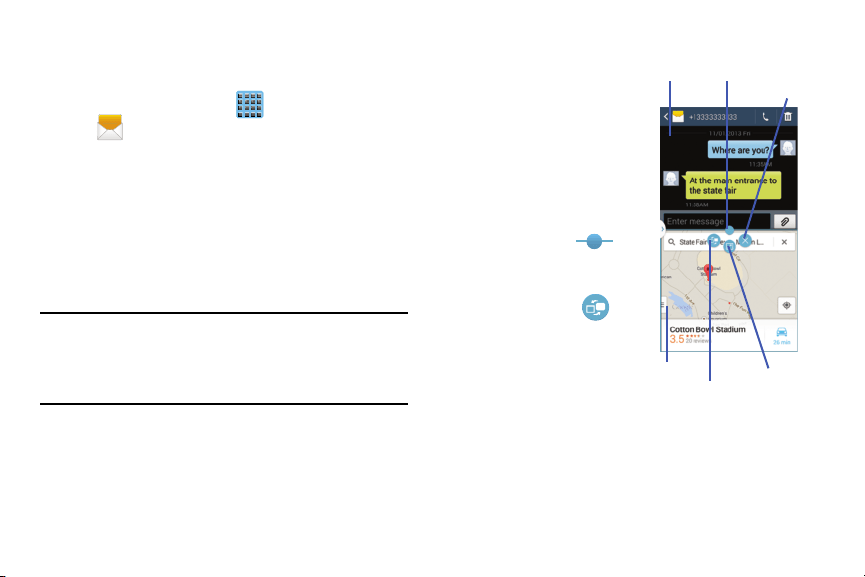
In this example we will be launching both the Maps and
Messaging applications.
To switch the arrangement of the applications:
1. With the two
applications shown in a
split screen, tap the
Border bar to show the
on-screen icons.
App #1 Border Bar
Exit
App #2
Maximize
Switch
Positions
1. Launch an application.
•
From the Home screen, tap (
Apps
)
(
Messaging
).
2. Activate the Multi window fea
ture.
3. Tap the tab to display the apps panel. 2. With the two
applications shown in a
split screen, tap the
Border button
to show the on
-screen
functions.
4. Touch and hold the desired app, such as Maps, until it
detaches from the panel.
5. In a single motion, drag it over the current app and
drop the new Multi window app over either the top or
bottom area of the current on-screen app.
3. Locate and tap
(
Switch app location
).
The current apps are
switched.
Note:
Once two applications are running, the device displays a
split screen view containing both the initial app and the
new Multi window app.
Each application is still independent of the other.
To increase t he size of a
desired application window:
1. With the two
applications shown in a split screen, locate the Border
bar indicating the edge of the app window.
Understanding Your Device 56
1. From the Home screen, tap
(
Apps
). The first
Application Menu screen displays.
•
To close the Applications screen, press
(
Home
)
.
2. Sweep the screen to access the other menus.
2. In a single motion, touch and hold the Border bar then
drag it to resize the desired window.
To split the current applications:
1. With the two applications shown in a split screen, tap
the Border bar to show the on-screen icons.
2. Tap the desired application area (top or bottom).
(
Maximize the app
). The current
apps are the both maximized.
3. Locate and tap
To close a selected application:
1. With the two applications shown in a split screen, tap
one of the two on-screen apps to select it.
2. Tap the Border bar to show the on-screen icons.
3. Loca
te and tap
(
Close the app
). The current app is
c
lose and the remaining app is
maximized.
Menu Navigation
You can tailor the device’s range of functions to fit your needs
using both menus and applications. Menus, sub-menus, and
features are accessed by scrolling through the available
on-screen menus. Your device defaults with seven screens.
Navigating Through the Application Menus
There are three default Application Menu screens available.
As you add more applications from the Play Store, more
screens are created to house these new apps.
3. Tap any of the on-screen icons to launch the
associated application.
Using Sub-Menus
Sub-menus are available from within most screen and
applications.
1. Press
. A sub-menu displays at the bottom of the
screen.
2. Tap an available on-screen option.
57
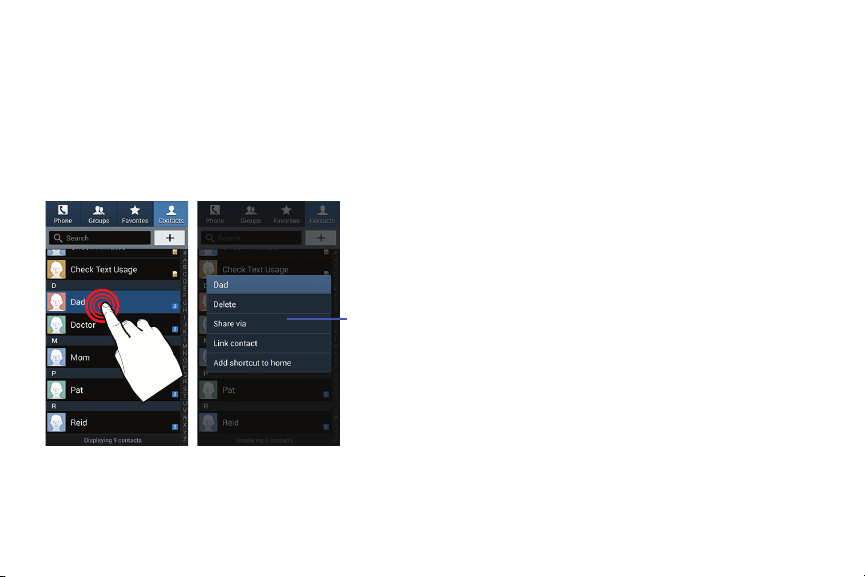
Context
Menu
Using Context Menus
Context menus (also called pop-up menus) contain options
that apply to a specific item on the screen. They function
similarly to menu options that appear when you right click
your mouse on your desktop computer.
Touch and hold an item on-screen to open its context
menu.
Understanding Your Device 58
.
Section 3: Call Functions and Contacts List
This section describes features and functionality associated
with making or answering calls, and the Contacts list, which
is used to store contact information.
Displaying Your Phone Number
From the Home screen, press and then tap
Settings
(
More
tab)
About device
Status
. Your phone number displays in the
My phone number
field.
Note:
The device’s
Settings
menu can also be accessed by
pressing and then tapping (
Apps
)
(
Settings
).
Making a Call
You can store phone numbers that are regularly used to the
SIM card or to the device’s memory. These entries are
referred to as the
Contacts list
.
1.
Press
and then tap (
Phone
).
2. Enter the phone number and then tap
If you make a mistake while dialing, tap to clear
the last digit. Touch and hold to clear the entire
sequence.
Note:
When you activate the Auto redial option in the
Call
settings
Additional settings
menu, the device
automatically redials up to 10 times when the person
does not answer the call or is already on the phone,
provided your call is not sent to voicemail.
Note:
If your screen goes black during your interaction with
the device (Launching Keypad, etc.), you might be
accidentally swiping over the front sensors.
59
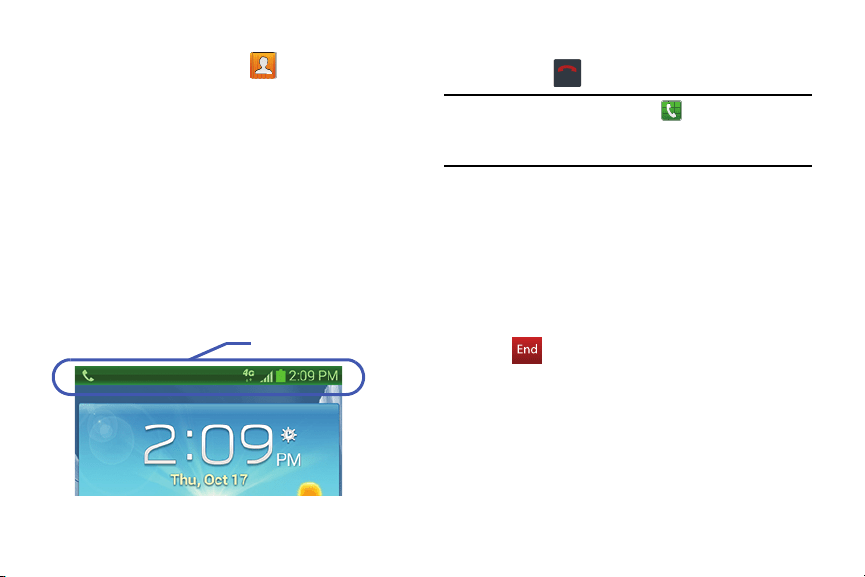
In Call Notification
Quick Dialing a Number from the Contacts List
Ending a Call
1. From the Home screen, tap (
Contacts
).
Briefly tap
End call
End call
key to end the call.
2. Locate a contact from the list.
Note:
To redial a recent number, tap at the end of the call
or locate the number from the Logs list, tap the entry
and tap
Call
.
3. In a single motion, touch and drag your finger over the
number by going to the right. This action places a call
to the recipient.
Running a Call in the Background
Ending a Call from the Status Bar
If you exit the current call screen and return to the Home
screen, you are visually notified that you are still on an active
call by the green phone icon within the Status bar.
1. Fro
m an active call, you can launch a separate
applicat
ion or return to the Home screen. The current
call is kept active
in the background.
This is the best way to stay on your current call and do
something else (multi-task) such as access the Contacts list,
view a recent email, locate a picture, etc..
2. Tap the Status bar to reveal the Notifications tab, and
then drag the tab to the bottom of the screen to open
the Notifications panel.
3. Tap (
End
) to end the currently active call.
Call Functions and Contacts List 60
Making Emergency Calls
If you do not have a SIM card installed the first time you turn
on the phone, the
Insert SIM card to make calls
message
displays and an animated tutorial shows you how to install
the SIM card.
Without a SIM card, you can only make an eme
rgency call
with the phone
; normal cell phone service is not available.
Making an Emergency Call Without a SIM card
installed
1. Tap
Emergency call
from the on-screen display to make
an emergency call.
2. Enter 9-1-1 and tap
. Complete your call.
During this type of call, you will have access to the
Speaker mode, Keypad, and End Call features.
Note:
Selecting Location consent may drain battery power. For
more information, refer to “Power Saving Mode” on
page 279.
3. Tap
End call End call
to exit this calling mode.
Making an Emergency Call With a SIM card installed
The Emergency calling mode makes redialing an emergency
number a 1-tap process. Before you can resume normal
calling operations, you should first exit this mode.
1. Swipe the Lock screen to unlock the device.
2. From the Home screen, tap
.
3.
Enter the emergency number (ex: 911) and then tap
.
4. Complete your call. During this type of call, you will
have access to the Speaker mode, Keypad, and End
Call features.
Note:
This mode can drain your battery power more rapidly
than a normal calling mode.
5. At the Emergency Callback screen, follow the
on-screen instructions.
61
Dialing Options
When you enter numbers on the Keypad, you will see three
on-screen options.
From the keypad screen, use one of the following options:
•
Voice Mail
( ) to access your Voice Mail service.
•
Call
( ) to call the entered number.
•
Delete
( ) to delete digits from the current number.
To view additional dialing options:
After entering a number, tap :
• Send message
to send the current caller a text message while
still maintaining the current call active.
•Add to contacts
to add the current number to either a new or
existing Contacts entry.
• Speed dial setting
to access the Speed dialing setting menu
where you can assign a speed dial location to a current
Contacts entry.
• Add 2-sec pause
to insert a two-second pause to enter a
2-second delay within a number string (the phone continues
dialing after 2 seconds without any additional keys being
pressed.
Tip:
You can create pauses longer than two seconds by
entering multiple 2 second pauses.
• Add wait
to insert a hard pause within the number string (the
phone waits for your input). A wait requires that any
consecutive numbers be manually sent by tapping
Yes
.
• One-handed operation On/Off
to enable or disable the resize
and reposition the keypad/dialer for either left (Off) or right
handed operation (On).
• Call settings
to provide you access to the Call settings screen.
Answering a Call
When somebody calls you, the phone rings and displays the
incoming call image. The caller's phone number, picture, or
name if stored in Contacts List, displays.
At the incoming call screen:
•
Touch and slide in any direction to answer the call.
•
Touch and slide in any direction to reject the call.
•
Touch and drag the
Reject call with message
tab upward and
tap a predefined rejection message or tap
Create new
message
to create a new custom outgoing response.
Call Functions and Contacts List 62
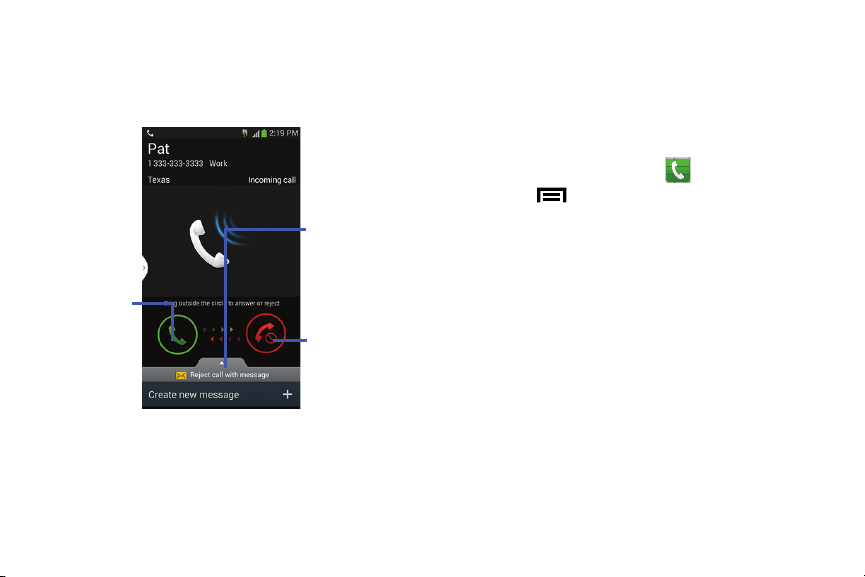
Touch and
slide in any
direction to
answer the
call
Touch and drag
upward
to reject
with a message
Touch and slide
in any direction
to reject the call
Pressing the Volume down button mutes the ringer.
If
the incoming call is from a number stored in your Contacts,
the entry’s name is displayed. You may also see the caller’s
phone number, if available.
Managing Reject Calls
This feature allows you to categorize both known and
unknown callers as rejected contacts. These Contacts are
then added to you Rejection list which can be managed for
individual entries from within the Contacts list or as a whole
from the Call rejection screen.
1. From the Home screen, tap
.
2. Pr
ess
and then tap
Call settings
Call rejection
.
3. Tap the
Auto reject mode
field to configure your
automatic rejection settings. Rejected calls are routed
automatically to your voicemail. Choose from:
•Off
: disables the auto rejection feature.
•All numbers
: enables the features for all known and
unknown numbers, including those contacts that are not
assigned to the rejection list.
•Auto reject numbers
: automatically rejects all entries
assigned to the Reject list/Blocklist.
63
Adding numbers to the rejection list
Entries can be added to the list via either the Contacts menu
or via the Auto reject list menu. The Contacts menu option
assigns all numbers for an individual as rejected. The Auto
reject list allows to assign individual numbers.
To assign multiple numbers as rejected via Contacts:
1. From the Home screen, tap (
Contacts
).
2. L
ocate an entry and tap it to open
the Contact
Overview Screen (page 100).
and then tap
Add to reject list
. All phone
numbers associated with this entry are then added to
the reject list.
3. Press
To assign single number as rejected via Auto reject list:
1. From the main
Call settings
page, tap
Call rejection
Auto reject list
.
2. Tap
(
Create
) and either enter the phone number
or select a Contact from your Logs or Contacts list.
3. Tap
Save
to complete the assignment.
International Calls
1. From the Home screen, tap
and then touch and
hold
unt
il the device shows “+” on-screen.
2. Use the on-screen keypad to enter the country code,
area code, and phone number.
3. If you make a mistake, tap
once to delete a
single digit
.
– or –
T
ouch and
hold
to delete all digits.
4. Tap
.
Call Functions and Contacts List 64
Pause Dialing
You can dial or save phone numbers with pauses for use with
automated systems, such as voicemail or financial phone
numbers.
•
2-Second Pause
automatically sends the next set of numbers
after a two-second pause. This is indicated in the number string
as a comma (
,
).
1. From the Home screen, tap and use the
on-screen keypad to enter the phone number.
2. Press
and then tap
Add 2-sec pause
. This feature
adds an automatic two-second pause.
3. Use the keypad to enter the additional numbers that
will be dialed automatically after the second pause.
Tip:
You can create pauses longer than two seconds by
entering multiple 2 second pauses.
4. Tap
.
Wait Dialing
Inserting a Wait into your dialing sequence means that the
phone waits until it hears a dial tone before proceeding with
the next sequence of numbers.
•
Wait
sends the next set of numbers only after tapping
Yes
. This is
indicated in the number string as a semicolon (
;
).
Note:
Do not add multiple Waits (;) to a number string as this
will continue to prompt you after each sequence.
1. From the Home screen, tap and use the
on-screen keypad to enter the phone number.
2. Press and then tap
Add wait
. This feature causes
the phone to require your acceptance before sending
the next set of entered digits.
3. Tap .
4. Once prompte
d to
Send the following tones?
, tap
Yes
to dial the remaining digits.
65
Tap the name/number and tap
.
Redialing the Last Number
The device stores the numbers of the calls you’ve dialed,
received, or missed if the caller is identified.
To recall any of these numbers:
1. From the Home screen, tap
2. Tap
(
Logs
tab) to display the list of recent calls.
Logs
Logs
Logs
LogsLogs
Logs
3. .
Speed Dialing
Once you have stored phone numbers from your Contacts
List, you can set up to 99 speed dial entries (2-100) and then
dial them easily whenever you want, simply by touching the
associated numeric key.
Note:
Speed dial location #1 must be reserved for Voicemail
use.
Setting Up Speed Dial Entries
Important!
Speed dial location #1 is reserved for Voicemail. No
other number can be assigned to this slot.
1. From the Home screen, tap
.
and then tap
Speed dial setting
. The
Speed
dial setting
screen displays a virtual list of locations
with the numbers 2 through 100.
2. Press
3. Tap an unassigned number slot. The
Select contact
screen displays.
4. Tap a contact and select a number to assign it to the
speed dial location. The selected contact number/
image is displayed in the speed dial number box.
Call Functions and Contacts List 66
Changing a Speed Dial Entry Order
1. From the Home screen, tap .
2. Press
and then tap
Speed dial setting
.
Important!
The number 1 is reserved for Voicemail and
another number cannot be assigned to this slot.
and then tap
Change order
.3. Press
4. Tap the current entry then tap the new target speed
dial location.
Note:
Tapping 2 existing speed dial locations causes the
entries to switch positions.
5. Tap
Done
to save the entry in the new location, exit the
Change order screen, and return to the previous
screen.
6. Press
to return to the previous screen.
Removing a Speed Dial Entry
1. From the Home screen, tap .
and then tap
Speed dial setting
.2. Press
3. Touch and hold a existing on-screen speed dial
location and select
Remove
from the context menu.
– or –
Press
and then tap
Remove
. Tap an entry or
select
(
Remove entry
). Select either
Done
(to
complete the deletion) or
Cancel
(to exit).
4. Press
to return to the previous screen.
Making a Call Using Speed Dial
You can assign a short cut number to a phone number in the
Contacts List for speed dialing.
1. From the Home screen, tap
.
2. Touch and hold a previously created speed dial location
(numbers 2-100, or 1 if you are dialing voice mail) until
the number begins to dial.
3. If you are not certain of the speed dial location, tap
Speed dial setting
and tap a speed
dial number to view the assigned phone number.
67
Wi-Fi Calling
Wi-Fi Calling is a free feature for T-Mobile customers using
this device with the new ISIM card. Wi-Fi Calling is an
excellent solution for coverage issues in and around the
home or wherever cellular coverage is limited. Minutes used
while connected to the Wi-Fi network count against available
rate plan minutes.
The benefits of Wi-Fi Calling include the following:
•
Wi-Fi Calling provides a coverage option to improve upon your
current in-home coverage experience
•
Wi-Fi Calling works anywhere there is a Wi-Fi signal available
Important!
A new micro SIM card must be installed within the
device prior to using this feature. Wi-Fi must first
be active and communicating prior to launching
Wi-Fi Calling.
Note:
This feature is active by default. If you are in an active
Wi-Fi call and go out of range of your Wi-Fi, the call will
be dropped.
Activating Wi-Fi
1. From the Home screen, press and then tap
Settings
(
Connections
tab).
2. Locate the
Wi-Fi
field and in a single motion touch and
slide
OFF
OFF
OFF
OFF
to the right to turn it on.
3. Select a Wi-Fi net
work from the list of available
networks. Follow the on-screen instructions to
complete connection.
Wi-Fi Connected
Displays when Wi-Fi is connected, active, and
communicating with a Wireless Access Point
(WAP).
Wi-Fi Available
Displays when Wi-Fi is active and there is an
available open wireless network.
Note:
To avoid international data roaming fees when using
Wi-Fi calling when outside the United States, the Data
Roaming feature on your device must be turned off.
Call Functions and Contacts List 68
Note:
With certain rate plans, minutes used while connected
to the Wi-Fi network count against available rate plan
minutes.
Important!
If you are not using a new ISIM card, you will
receive an
Error: ERXX Invalid SIM
message. You
must be using a new ISIM card to use this feature.
Activating Wi-Fi Calling
1. Ensure that the
Wi-Fi connected
icon displays on
the Status Bar.
•
If prompted with an on-screen “Did you know your phone can
make calls over Wi-Fi” popup, tap
Learn
and follow the
remaining on-screen instructions. Tap
Next
Done
.
2. From the main
Settings
page, tap
Connections
tab
More networks
.
3. Loca
te the
Wi-Fi Calling
field and in a single motion
touch and slide
OFF
OFF
OFF
OFF
to the right to turn it on.
4. If (
Missing 911 Address
) displays in the Status
Bar, follow these steps to provide 911 an address for
emergency situations:
•
Log into
my.t-mobile.com
.
•
Click on
Profile
and edit the
Edit customer information
.
•
Enter your emergency location information and complete the
online registration.
5. From the main
Settings
page, tap
Connections
tab
More networks
Wi-Fi Calling
.
6. Ta
p
Connection Preferences
and select a preference for
use by the Wi-Fi Calling feature:
• Wi-Fi Preferred
: Wi-Fi network is preferred over cellular
network when making calls. Calling requires you to stay in the
Wi-Fi range.
• Cellular Network Preferred
: The cellular network is preferred
over a Wi-Fi network when making calls.
• Never use Cellular Network
: Use only Wi-Fi for calls.
Do not use Cellular Network, even if available.
7. From the main
Settings
page, tap
Connections
tab
More networks.
69
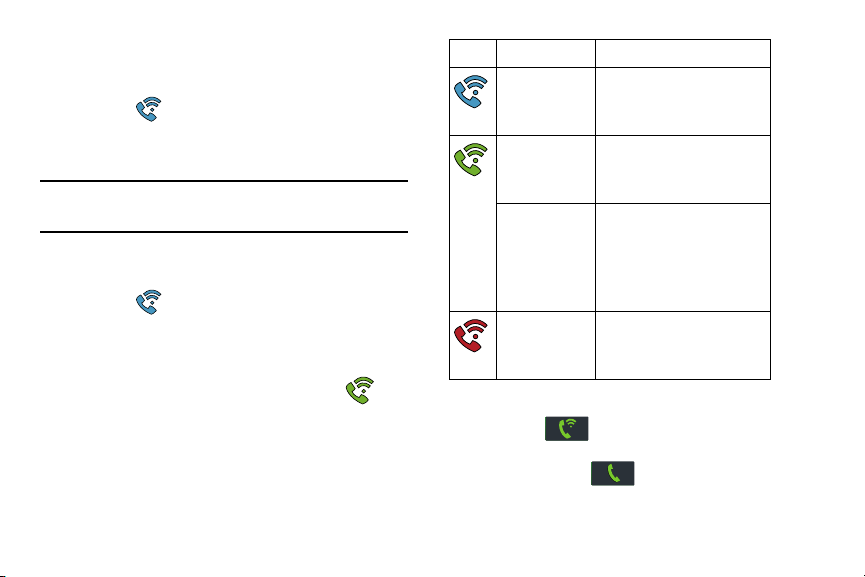
8. Tap
Wi-Fi Calling
slider to toggle off the feature, then
tap it again to reactivate the feature and re-register
your device with the T-Mobile Network.
(
Wi-Fi Calling Ready
) displays in the
Status Bar.
9. Confirm
Launching Wi-Fi Calling
Note:
Verify you are currently connected to a Wireless Access
Point.
1. Ensure that the
Wi-Fi connected
icon displays on the
status bar.
2. Confirm (
Wi-Fi Calling Ready
) displays in the
Status Bar.
3. Use the phone Dialer, Logs, or Contacts list to make a
call.
When Action Then
Displays on the
screen status
bar.
You are connected to the
T-Mobile network and can
make Wi-Fi calls.
Displays on the
screen status
bar.
The Wi-Fi calling feature is
active and in use within an
active call.
Does not
display on the
screen status
bar.
You ar
e charged normal
calling rate minutes.
For more information, refer to
“Activating Wi-Fi Calling” on
page 69.
Displays on the
screen status
bar.
There is an error in the use
or 911 registration of the
Wi-Fi Calling feature.
4. Go to the dialer and make a call. Make sure
While Wi-Fi Calling mode is active, the call button shows a
(
Wi-Fi Calling in use
) appears during the call.
Wi-Fi indicator
When Wi-Fi Calling is disabled, the call button goes back to
show normal operation
.
.
Call Functions and Contacts List 70
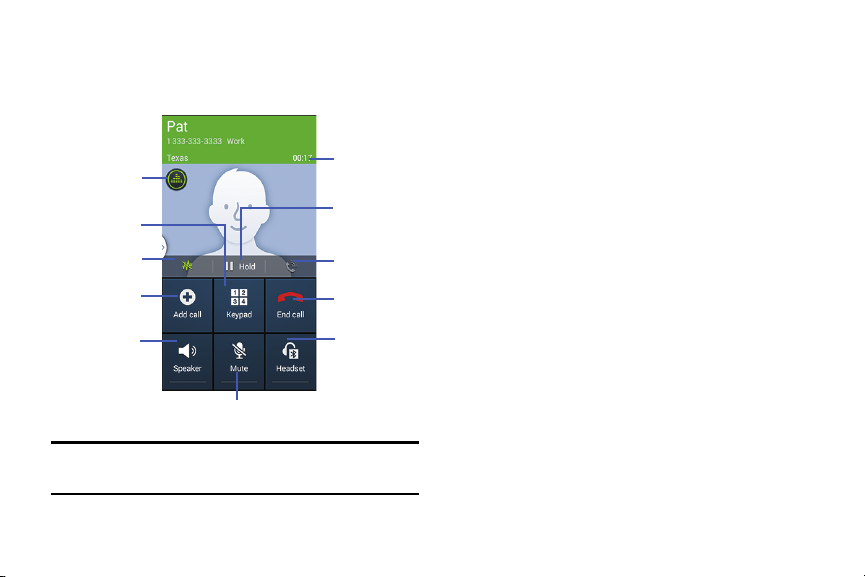
Mutes or Unmutes
the call
Personalized
call sound
Dialer
Noise
Reduction
Adds a
new call
Activates or
Deactivates
speakerphone
Call duration
Places a
call on hold
Extra volume
Ends the
call
Activates or
Deactivates
Bluetooth
Headset
In Call Options
Your phone provides a number of features that are available
for use during a call.
Adjusting the Call Volume
During a call, use the Volume keys on the left side of the
device, to adjust the earpiece volume.
During a call, press the
Up
volume key to increase the
volume level and the
Down
volume key to decrease the
level.
– or –
Adjust the audio by enabling selecting an audio preset.
Tap the on-screen
Personalize call sound
button select
an equalizer setting for the incoming call.
•
Enabled/disabled via the Call settings menu (
Call settings
Personalize call sound
)). For more information, refer to
“Configuring General Call Settings”
on page 270.
– or –
Quickly add more volume to the incoming audio by
tapping the on-screen
Extra volume
button
From the Home
screen, you can also adjust the ring volume
using these keys.
Note:
Noise reduction and Extra volume features are disabled
while using Wi-Fi Calling.
71
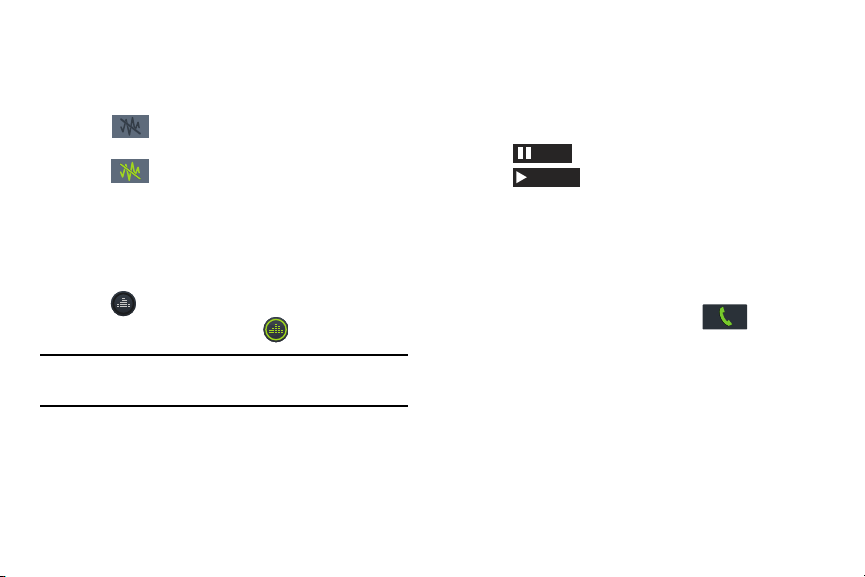
Hold
Adjusting Noise Reduction
During a call it may be necessary to adjust the noise
reduction feature. Activating this feature can improve the
quality of your conversation by reducing ambient noise.
1. Tap
(
Noise reduction off
) to toggle the status
and activate the feature.
2. Tap
(
Noise reduction on
) to toggle the status
and deactivate the feature.
Personalizing the Call Sound Setting
During a call it may be necessary to adjust the sound of the
incoming call by selecting an audio equalizer setting for the
current call.
1. Tap
(
Personalize call sound
).
2. Confirm the option is enabled
.
Note:
If prompted to enable the feature via the Call settings
menu, go to
Call settings
Personalize call sound
.
3. Select an available option.
Choose from: Adapt Sound, Soft sound, Clear sound,
and Off.
Placing a Call on Hold
You can place the current call on hold whenever you want. If
your network supports this service, you can also make
another call while a call is in progress.
To place a call on hold:
1. Tap
Unhold
(
Hold
) to place the current call on hold.
2. Tap (
Unhold
) to activate the call that is on
hold.
To make a new call while a call is in progress:
1. Enter the new phone number that you wish to dial or
look it up in Call history.
2. Once connected, tap
Add call
to dial the second call.
3. Dial the new phone number and tap
.
To switch between the two calls:
Tap
Swap
.
The previous In call number turns gray and displays
On hold. The new active call displays a green
background behind the number.
Call Functions and Contacts List 72
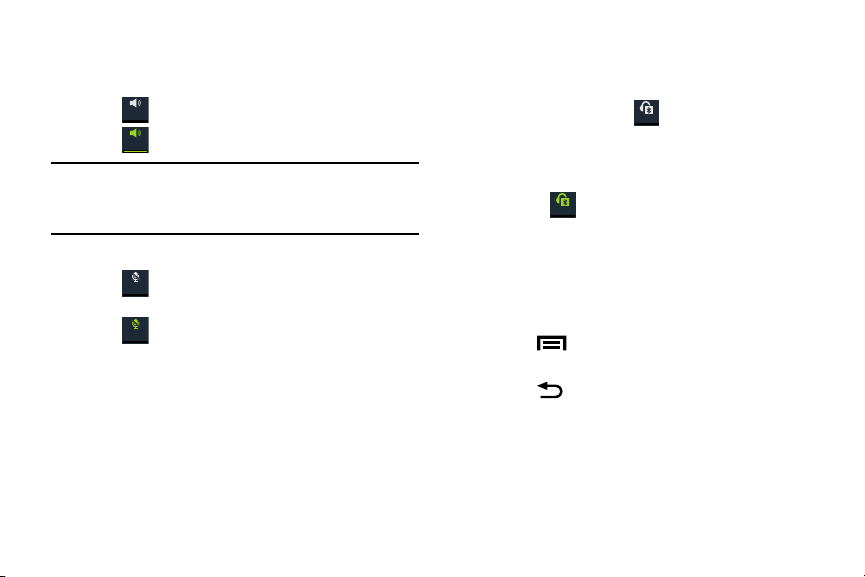
Speaker Speaker
Turning the Speakerphone on and off
While on a call, you can use your Speakerphone by following
these steps:
1. Tap
Speaker
(
Speaker off
) to toggle the speakerphone on.
2. Tap (
Speaker on
) to toggle the speakerphone off.
Tip:
When the speaker is turned
On
, the color of the speaker is
green. When the speaker is turned
Off
, the color of the
speaker is white.
Muting a Call
1. Tap
Mute Mute
(
Mute off
) to turn mute on so the other caller
cannot hear you speaking.
2. Tap
Mute Mute
(
Mute on
) to turn mute off and resume your
conversation.
Switching to Bluetooth Headset
1. Pair the target Bluetooth headset prior to your call.
2. While on a call, switch to the Bluetooth headset instead
of speaker by tapping
Headset
(
Headset off
).
3. At the prompt, tap
OK
to enable Bluetooth if it is not
already activated.
4. While on a call, switch back to the device speaker by
tapping
Headset
(
Headset on
).
More In-call Options
During a call you can save the current caller’s information to
the Contacts list, or create a Memo.
Viewing the Contacts List
During a call you can look up a number in the Contacts list.
1. Press
and then tap
Contacts
.
2. Browse the Contacts list for the information you need.
3. Press
to return to the active call.
73
Creating an S Note During a Call
During a call it may be necessary to record information (a
Note).
1. Press
and then tap
S Note
.
2. Use either your S Pen or on-screen keyboard to enter
the content and then tap
(
Save
).
•
If desired, press to close the popup note and return to
your active call.
Creating a Message During a Call
During a call you can create a message.
1. Press
and then tap
Message
(
Compose
).
2. Address and create the message.
(
Send
).3. Review your message and tap
Multi-Party calls
Making a Multi-Party Call
A multi-party call is a network service that multiple people to
participate in a multi-party or conference call.
For further details about subscribing to this service, contact
T-Mobile customer service.
Setting up a Multi-Party Call
1. From the Home screen, tap .
2. Dial the number for the first participant and tap
.
3. Tap
Add call
, enter the second phone number and
tap
. The first caller is placed on hold.
4. Wait for the second caller to answer the incoming call
and tap
Merge
. The two calls are now joined into a
multi-party call and display in the order in which they
were called.
Important!
Multiple callers can be joined to a single
multi-party line. Additional callers participate in a
new Multiparty session and are held in conjunction
with the previous multiparty call. You can swap or
place each multi-party call on hold.
Call Functions and Contacts List
74
Having a Private Conversation With One Participant
When you have two participants in a multi-party session, it
might be necessary to place one of those participants on
hold so that a private conversation can be held with a single
caller. While you are in a multi-party call:
1. Press
and then tap
Manage conference call
.
2. Tap
adjacent to the participants you would like
to split from the current multi-line call. The list displays
the callers in the order they were dialed.
Note:
The Manage conference call option is not available for
multi-party calls created while using the Wi-Fi Calling
feature. You must be on the cellular network to use the
manage feature.
3. Tap the participant to which you want to speak
privately.
You can now talk privately to that person while the
other participants can continue to converse with each
other. If there is only one other participant, that person
is placed on hold.
4. To return to the multi-party call, tap the Merge icon. All
of the multi-party call participants can now hear each
other.
Dropping One Participant
1. Press and then tap
Manage conference call
End
to the right of the number to drop.
The participant is disconnected and you can continue
the call with the other participant.
2. Tap
End call
to end your conversation with the remaining
caller.
75
Call Waiting
You can answer an incoming call while you have a call in
progress, if this service is supported by the network and you
have previously set the Call waiting option to Activate.
You are notified of an incoming call by a call waiting tone.
For
m
ore information, refer to “Configuring Additional Voice Call
Settings” on page 274.
To answer a new call while you have a call in progress:
1. In a single motion, touch and slide in any
direction to answer the new incoming call.
2. Tap an option from the Accept call after menu:
• Putting xxx on hold
to place the previous caller on hold while
you answer the new incoming call.
• Ending call with xxx
to end the previous call and answer the
new call.
Note:
The new caller appears at the top of the list. The
previous caller is placed on hold and appears at the
bottom of the list.
3. Tap Swap to switch between the two calls. This places
the new caller on hold and activates the previous call.
Important!
The currently active call is displayed with a green
background.
4. Tap
Swap
again to switch back.
Call Functions and Contacts List
76
Logs Tab
The Logs tab is a list of the phone numbers (or Contacts
entries) for calls you placed, accepted, or missed. The Logs
tab makes redialing a number fast and easy. It is continually
updated as your device automatically adds new numbers to
the beginning of the list and removes the oldest entries from
the bottom of the list.
The Notification area of the Home screen (upper-left) displays
phone notifications, status, or alerts such as:
Displays when a call is in progress.
Displays when a call wa
s missed.
Accessing the Logs Tab
1. From the Home screen, tap
Logs
Logs
Logs
LogsLogs
Logs
(
Logs
tab).
2. Tap an entry to view available options.
Note:
The Logs tab only records calls that occur while the
phone is turned on. If a call is received while it is turned
off, it will not be included in your calling history.
Each
en
try contains the phone number (if it is available) and
Contacts entr
y name (if the number is in your Contacts).
Indi
cates all outgoing calls made fr
om your device.
Indi
cates any received calls that were answered.
Indicates a missed call.
Indicates any rece
ived calls that were rejected.
Indicates auto rejected calls.
77

Accessing Call log from The Notifications Area
1. Locate from the Notifications area of the Status
bar.
2. Tap the Status bar to reveal the Notifications tab, and
then drag the tab to the bottom of the screen to open
the Notifications panel.
3.
Ta
p the Missed call entry to open the Logs screen.
This list provides easy access to redial an entry, or you can
also choose to access two types of history entry lists
depending on how they are touched.
Call logs - Caller Overview
•
Tap a contact entry name or number to reveal the
Call options
screen:
• Create contact
to save the number if it is not already in your
Contacts.
•View contact
to view the Contact details for the current entry.
•Update existing
to update an existing Contacts entry with the
current number.
•Call
allows you to redial the entry by name or number.
• Send message
allows you to create a new text message to the
selected entry.
•Time
provides the time and date of the call and its duration.
•
Press (
Menu
) to reveal additional options:
–
Copy to dialing screen
to pass the current number to your
dialer and then edit the selected number before you place your
next outbound call.
–
Delete
to delete the Contacts entry.
–
Send number
to send the current Contacts entry information to
an external recipient.
–
Add to reject list
to add the current phone number to an
automatic rejection list. Similar to a block list, the selected caller
will be blocked from making an incoming calls to your phone.
•
Touch and hold an entry to display the entry-specific context
menu:
• Copy to dialing screen
to make alterations to the current
phone number prior to redial.
•Add to contacts
to save the number if it is not already in your
Contacts.
•View contact
to view the information for the currently stored
Contacts entry.
• Send number
to send the current Contacts entry information to
an external recipient.
Call Functions and Contacts List 78
to erase the numbers.
.
Logs
Logs
Logs
LogsLogs
Logs
Logs
Logs
.
Logs
LogsLogs
Logs
• Add to reject list
to add the current phone number to an
automatic rejection list. Similar to a block list, the selected caller
will be blocked from making an incoming calls to your phone.
• Delete
to delete the entry from the Logs list.
Altering Numbers from the Logs List
If you need to make a call from the Logs screen and you
need to alter the number prior to dialing, you can add the
appropriate prefix by prepending the number.
4. Edit the number using t he on-screen keypad or
delete
digits by pressing
1. From the Home scree
n, tap
Tap
Copy to dialing screen
.
Logs
Logs
.
Logs
LogsLogs
Logs
2. Touch and hold an entry to access the entry-specific
context menu.
3.
5. Tap
onc
e the number has been changed.
Erasing the Call logs List
You can delete either an individual call log entry or all current
entries from the Logs list.
To clear a single entry from the list:
1. From the Home screen, tap
2. Touch and hold an entry and select
Delete
OK
.
F
rom the Home screen
, tap
To clear all entries from the list:
1.
2.
Press and then tap
Delete.
3. Tap
Select all
.
4. Tap
Delete
to continue with the erasure.
– or –
Tap
Cancel
to stop the current process.
79
Logs
Logs
.
Logs
LogsLogs
Logs
and then tap
Call duration
.
Call Duration
1. From the Home screen, tap
2. Press
3. The following times are displayed for Voice and Data:
• Last call
: shows the length of time for the last call.
• Dialed calls
: shows the total length of time for all calls made.
• Received calls
: shows the total length of time for all calls
received.
• All calls
: shows the total length of time for all calls made and
received.
You may reset these times to zero by pressing
then tapping
Reset
.
Viewing Missed Calls from Lock Screen
When you are unable to answer a call for any reason and
your screen is locked, the number of missed calls are
displayed on the Lock screen immediately after a call is
missed.
1. Press
(
Power/End
) to reactivate the screen.
2. Touch and drag the button (with the number of missed
calls on it) anywhere on the screen. The Logs tab is
then displayed.
Call Functions and Contacts List 80

Section 4: Entering Text
This section describes how to select the desired text input
method when entering characters into your phone. This
section also describes the predictive text entry system that
reduces the amount of key strokes associated with entering
text.
Your device comes equipped with an orientation detector that
can tell if the phone is being held in an upright (Portrait) or
sideways (Landscape) orientation. This is useful when
entering text.
Your phone also provides several on-screen keypad text
entry options to make the task of text entry that much easier.
Text Input Methods
There are three text input methods available:
•
Google voice typing
: provides a voice to text interface.
•
Samsung keyboard
(default): an on-screen QWERTY
keyboard that can be used in both portrait and landscape
orientation.
•
Swype
: a new way to enter text on touch screens. Instead
of tapping each key, use your finger to trace over each
letter of a word.
The on-screen QWERTY keypad works the same in both
portrait and landscape mode.
Selecting the Text Input Method
The Text Input Method can be assigned from within one of
two locations:
Settings Menu:
From the Home screen, press and then tap
Settings
My device
My device
(
My device
tab)
Language and
input
Default
and select an input method.
Text Input field:
1. From a screen where you can enter text, in a single
motion, touch and drag the Status bar down to the
bottom of the screen to open the Notifications screen.
2. Tap
(
Select input method
) and select an available
input method.
81

Entering Text Using Swype
Swype™ is the default text input method that allows you to
enter a word by sliding your finger or stylus from letter to
letter, lifting your finger between words. Swype uses error
correcting algorithms and a language model to predict the
next word. Swype also includes a touch predictive text
system.
The on-screen keyboard options are different between the
Android keyboard and Swype on-screen input methods.
Note:
During its initial use, you may be prompted by a series of
Swype Connect set up screens. Follow the initial
on-screen set up instructions.
Enabling and Configuring Swype
If you configure another text input method (Samsung
keyboard) you must re-enable Swype before using the
Swype keyboard.
When Swype is enabled there can also be normal keyboard
functionality.
1. From the main
Settings
page, tap
My device
tab
Language and input
.
2. Ta
p
Default
Swype
.
For more information on Swype settings,
see “Using Swipe”
on pag
e 259.
Swype Text Entry Tips
You can access the SwypeTips application and watch a video
or tutorial on using Swype. You can also use the following
Swype text entry tips.
•
Create a squiggle (like an S shape) to create a double letter (such
as
pp
in apple).
•
Touch and hold a key to view the punctuation menu then make a
selection.
•
Move your finger or stylus over the apostrophe to enter
contracti
o
ns.
•
Double-touch on the word you want to change to correct a
misspelled word, then touch the delete key to erase one
character. Touch and hold the delete key to erase an entire word.
Entering Text 82
Selecting a Text Input Mode in Swype
1. From a screen where you can enter text, tap the text
input field to reveal the on-screen keyboard.
2. With Swype as your text entry method, select one of
the following text mode options:
Edit
ABC
•ABC
to use Swype with alphanumeric characters from
the on-screen keyboard.
123
+!=
•SYM
(Symbol) to enter numbers and symbols from the
on-screen keyboard.
Note:
After typing an initial uppercase character, the key
changes to
and all letters that follow are in lower
case.
Swype Keyboard Overview
• Recipients
: a field where you can enter the recipients of the
current message. You can choose from
Contacts
,
Call log
,
Groups
, or
Favorites
.
• Text Input field
: a field where text, number, or other characters
can be entered.
• CAPS/ALT key
: When in 123ABC mode, this key changes the
capitalization of the subsequent entered characters. When in
SYM mode, this key can show additional symbol characters.
• SWYPE settings
: Touch and hold this button to access the
Swype settings screen.
• Text Input mode
: There are two available modes:
123ABC
and
SYM.
–
123ABC mode contains alphanumeric characters and a few
common punctuation marks. Text mode button indicates
SYM
.
–
SYM mode contains only symbols and numbers. Text mode
button indicates
123ABC
.
83
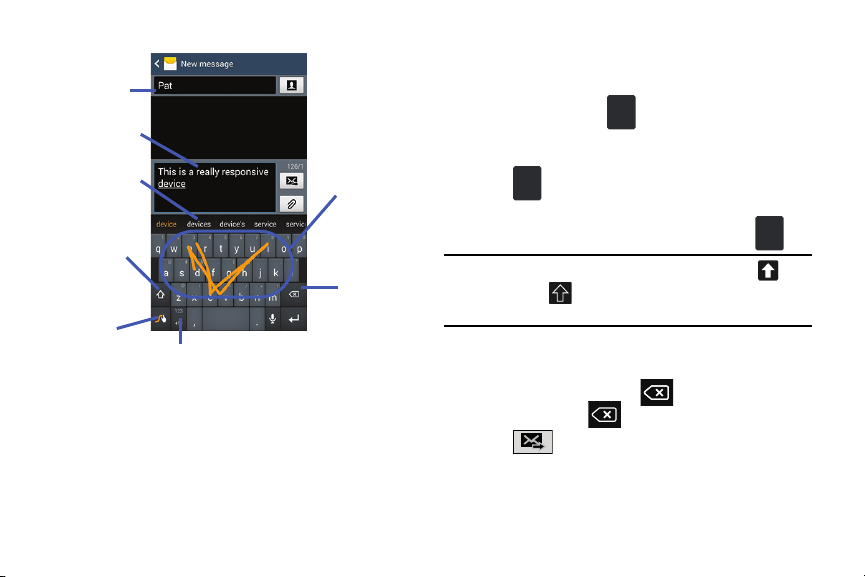
(
Send
) to deliver the message.
Using 123ABC Mode in SWYPE
–
If you make a mistake, tap
Note:
After typing an initial uppercase character, the key
changes to
and all letters that follow are in lower
case.
Delete
Recipients
T
ext input field
Suggestions
Current
Mode
CAPS/ALT
key
SWYPE Settings
Text Input mode
In
123ABC
mode, you can enter only letters and a few
common punctuation marks from the on-screen keyboard.
The text mode key shows
123
.
+!=
123
+!=
Touch and hold
to erase an entire word.
Edit
ABC
.
123
+!=
1. From a screen where you can enter text, tap the text
input field to reveal the on-screen keyboard.
2. Tap to configure the keyboard for 123ABC mode
(showing letters and numbers on the on-screen keys).
Once in this mode, the text input type shows
3. Swipe your finger continuously over the letters to form
a word.
to erase a single character.
4. Tap
Entering Text 84
All lowercase
Displays when the next character is entered in
lowercase. Pressing this while in 123SYM mode,
reveals additional numeric-symbols keys.
Initial Uppercase
Displays when the first character of each word is
entered as uppercase but all subsequent
characters are lowercase.
All Uppercase
Displays when all characters will be entered as
uppercase characters.
By default, the first letter of an entry is capitalized and the
following letters are lower case. After a word is entered and
you lift your finger, the cursor automatically adds a space
after the word.
Note:
If multiple word choices exist for your Swype entry, an
on-screen popup appears to provide additional word
choices.
Entering Numbers and Symbols in SWYPE
By using the on-screen keyboard in portrait mode, some
symbols are not available (such as Emoticons or Smileys).
In SYM mode using Swype, you can only enter symbols and
numbers from the on-screen keyboard.
Once in SYM mode, the text mode key shows .
Edit
ABC
1. From a screen where you can enter text, tap the text
input field to reveal the on-screen keyboard.
2. Tap
123
+!=
to configure the keyboard for SYM mode.
Edit
ABC
Once in this mode, the text input type shows .
3. Tap the on-screen key for the number or symbol you
want to enter.
4. Tap
2
1
to select from additional symbols.
For example:
•
To enter
®
: tap
123
+!=
2
1
and select the
®
key.
85
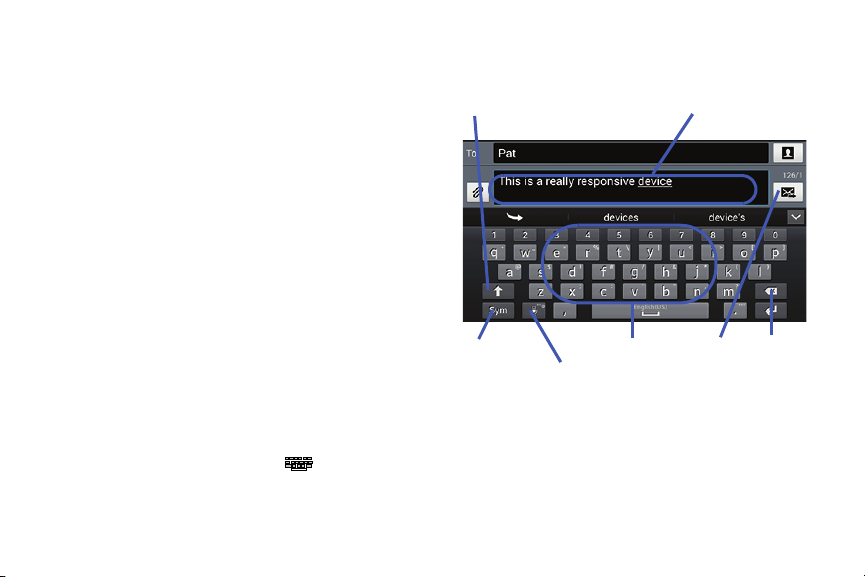
Shift key
Text input field
Input Mode Current Mode Send Delete
Indicator
Input Methods
/Settings
Using the Samsung Keyboard
This QWERTY keyboard can be used to enter text in either a
Portrait or landscape orientation. The only difference
between the two orientations are the sizes of the keys.
From a screen where you enter text, rotate your phone
counterclockwise to a landscape orientation. The on-screen
QWERTY keyboard displays.
The Samsung Keyboard
This device has a built-in, QWERTY keypad (portrait mode) or
keyboard (landscape mode). Using the QWERTY keypad/
keyboard, you can type letter, numbers, punctuation, and
other characters.
To use the Samsung keyboard you must first configure the
settings to default to the Samsung keyboard.
1. From the main
Settings
page, tap
Language and input
Default
Samsung keyboard
.
– or –
From a screen where you can enter text, in a single
motion, touch and drag the Status bar down to the
bottom of the screen, then select
(
Select input
method
)
Samsung keyboard
.
2. The virtual keyboard is then assigned to the Samsung
keyboard configuration for all subsequent text input.
For more information on Samsung Keyboard settings, see
“Samsung Keyboard Settings” on page 283.
For more information on using Predictive Text, see
“Pre
dictive Text - Advanced Settings” on page 285.
Entering Text 86
Entering Text using Different Input Options
Although the default text input method with the Samsung
keyboard is to use the on-screen keys you have other
options.
Note:
To access settings, touch and hold the
Input Methods
button , then tap (
Settings
) to select it from
the available options.
1. From within an active message, tap the text input field
to reveal the on-screen keyboard.
2. Tap
(
Input Methods
) to use the default Voice
typing input method to convert your spoken words to
on-screen text.
– or –
Touch and hold
to select from other input
methods such as:
• Voice to text
to convert spoken words into on-screen text.
• Handwriting
to launch an on-screen handwriting area that can
be used to convert on-screen patterns (text) to text.
•Clipboard
to launch the device’s clipboard area from where
you can select a current clipboard item to place in your current
message.
• Settings
to access the Samsung keyboard settings menu.
• Keyboard alignment
to detach the on-screen keyboard so that
you can manually dock it anywhere on the current text entry
screen. Selecting the feature again redocks the keyboard into
its original location using the original size.
Changing the Text Input Mode in Keyboard
1. From a screen where you can enter text, tap the text
input field to reveal the on-screen keyboard.
2. With Samsung keyboard as your text entry method,
select one of the following text mode options:
•
ABC
Abc
: to use alphabet
Sym
ic characters from the on-screen
keyboard. In this mode, the text mode button displays
Sym
.
•Symbol/Numeric
: to enter numbers by pressing the
numbers selecting them on the on-screen keyboard. In this
mode, the text mode button displays
ABC
.
There are up to 3 available pages of numeric symbols available
by tapping
1/3
.
87
2. Tap
Once in this mode, the text input t
ype shows
Note:
After typing an initial uppercase character, the key
changes to
case.
3.
Enter your text using the on-screen keyboard.
Touch and hold to erase an entire word.
4. Tap (
Send
) to deliver the message.
All lowercase
Displays when the next character is entered in
lowercase.
Initial Uppercase
Displays when the first character of each word is
entered as uppercase but all subsequent
characters are lowercase.
All Uppercase
Displays when all characters will be entered as
uppercase characters.
Using ABC Mode in Samsung Keyboard
Note:
After typing an initial uppercase character, tap to
toggle capitalization.
1. From a screen where you can enter text, tap the text
input field to reveal the on-screen keyboard.
to config
ure the keyboard for ABC mode.
and all letters that follow are in lower
–
If you make a mistake, tap to erase a single character.
ABC
Sym
.
By default, the first letter of a new entry is capitalized and the
following letters are lowercased. After a character is entered,
the cursor automatically advances to the next space.
Entering Text 88
Using Symbol/Numeric Mode
Use the Symbol/Numeric Mode to add numbers, symbols,
or emoticons. While in this mode, the text mode key
displays
ABC
.
1. From a screen where you can enter text, tap the text
input field to reveal the on-screen keyboard. Rotate the
phone counterclockwise to a landscape orientation, if
desired.
2. Tap
Sym
to configure the keyboard for Symbol
mode. Once in this mode, the text input type shows
.
ABC
3. Tap a number, symbol, or emoticon character.
4. Tap
ABC
to return to ABC mode.
To enter symbols:
1. Tap
Sym
to configure the keyboard for Symbol
mode.
2. Tap the appropriate symbol key.
– or –
Tap
1/3
button to cycle through additional pages.
•
The first number on this key indicates which page (1, 2, or 3) of
additional characters is active.
89
Using the Handwriting Mode
The device also provides you with the ability to use your S
Pen to hand write on the screen and have to converted into
text just as easily as the voice to text feature.
•
tap to enable the Handwriting to Text mode
•
tap to enable the Keyboard mode
1. Remove your S Pen from its location at the bottom of
the device.
2. From within an active message, tap the text input field
to reveal the on-screen keyboard.
3. Touch and hold
(
Input Methods
) then select
to enable the Handwriting mode.
4. Touch t
he screen within the handwriting area and
begin to write either single letters or entire words.
5. Stop after each word and allow at least 1 second for
the device to both recognize the characters and know
you are done writing.
Input Options/Settings
Handwriting Area Spacebar Delete Return
6. Tap the spacebar to add a space and proceed writing
your next set of characters.
7. In a single motion, touch and hold (
Input
Methods
) and then select (
Activate Keyboard
Mode
) to return to the keyboard mode.
Using the Google Voice Typing
This feature uses Google voice recognition to convert your
spoken words into on-screen text. You can use your voice to
enter text using the Google Voice typing feature.
For more information on Configuring Voice Typing,
see
“Configure G
oogle Voice Typing” on page 287.
1. From within an active text entry screen, touch the top
of the screen and drag it down to display your
notification panel.
2. Tap
(
Select input method
)
Google voice typing
.
3. At the Listening prompt (
Speak now
), speak
clearly and distinctly into the microphone.
The text is displayed in the message as you are
speaking.
4. Tap
(
Done
) when you are finished.
– or –
Tap
(
Resume
) to resume recognition.
Note:
The feature works best when you break your message
down into smaller segments.
Entering Text
90

Using Google Voice Typing
1. From a screen where you can enter text, in a single
motion, touch and drag the Status bar down to the
bottom of the screen, then select
(
Select input
method
)
Google voice typing
. The virtual keyboard is
then removed and all subsequent input to done via the
microphone as text to speech.
2. Speak into the device’s microphone and watch your
text being entered on-screen.
3. If the text is incorrect, tap
DELETE
.
91
Section 5: Contacts
This section explains how to use and manage your Contacts
List. You can save phone numbers to your phone’s memory.
Accounts
From the Accounts menu you decide if you want applications
to synchronize, send, and receive data at any given time, or if
you want the applications to synchronize automatically. After
determining how you want the accounts to synchronize,
indicate which account to synchronize with your Contacts
list.
1. Sign in to your Google account.
2. From the Home screen, press
and then ta
p
Settings
(
Accounts
tab) and then navigate
to the
My accounts
area.
– or –
From the Home screen, tap (
Apps
)
(
Settings
) and then navigate to the
Accounts
area.
Note:
The Accounts area lists those accounts that have been
added to the device and provides an
Add account
button
to quickly and easily add new ones.
Contacts List
Creating a Contact
The default storage location for saving phone numbers to
your Contacts List is your device’s built-in memory.
If existing Google and Corporate email accounts have been
synchronized to your phone, these will be made available to
your device during the creation of new entries. These new
Contacts entries can be assigned or saved to synced
accounts such as Device, SIM, Google, or Corporate.
Your device automatically sorts the Contacts entries
alphabetically. You can create either a
Device, SIM
,
Google,
Microsoft Exchange ActiveSync
, or
Samsung account
contact.
Note:
Before you can save a contact to the Phone, Contact
settings must be set to
Save new contacts to Phone
.
Important!
The Google and Microsoft Exchange ActiveSync
account types are only visible after creating an
email account of those types on your phone.
Contacts 92
•
Device
contacts are stored locally on the device.
Note:
If the device is ever reset to its factory default
parameters, contacts stored on the phone can be lost.
•
SIM
contacts are stored within the micro SIM Card.
Note:
SIM contacts only store the Name and Phone number for
an entry.
•
Google
contacts are shared with your existing Google account
and can also be imported to your phone after you have created a
Google Mail account.
•
Samsung Account
contacts are shared with your existing
Samsung account.
•
Microsoft Exchange ActiveSync
(also known as Work or
Outlook) contacts are those contacts that are intended to be
shared with either an Exchange Server or from within Microsoft
®
Outlook
®
.
•
Add new account
lets you create a new account type. Choose
from Samsung account, Microsoft Exchange ActiveSync, or
Google.
Note:
When storing an entry into your micro SIM card, note
that only the Name, and Number are saved. To save
additional information for a particular contact, such as
notes, email, dates, etc., it is important to save that
Contact into your phone’s onboard memory.
1. From the Home screen, tap
(
Contacts
).
2. Tap
to create a contact.
Note:
You can also add a new contact by entering a number
from the keypad and pressing
and then tap
Add to contacts
Create contact
. Continue with step 3.
3. Tap a destination type (
Device
,
SIM
,
Samsung account
,
Google
, or
Microsoft Exchange ActiveSync
) (depending
on where you want to save the new contact
information).
4. Tap the
Name
field and enter a name for this contact
using the displayed keypad.
•
Tap to access additional name entries such as: Name
prefix, First name, Middle name, Last name, and Name suffix.
93
5. Tap the image icon and select a photo for this contact.
Selections are:
Image, Pictures by people, Take picture,
or
S Note
.
Note:
The label entries below can change and are dependant
on the selected destination type (ex: the Other and
Custom might not appear with an Exchange ActiveSync
account destination type).
6. T
ap the label button (to the left of the
Phone
field) and
scroll through the list to select a category such as
Mobile
(default),
Home
,
Work
,
Main, Work Fax
,
Home
Fax
,
Pager
,
Other
,
Callback
, or
Custom
.
7. T
ap a phone number field and enter a phone number.
•
Tap on the QWERTY keyboard to remove a previously
ente
red ph
one number.
•
Tap to enter an additional phone number
•
Tap to remove a previously entered phone number.
8. Enter additional information such as:
Email, Groups
,
Ringtone
,
Message alert
,
Vibration pattern
or tap
Add
another field
to input additional category information.
•Add another field
contains the following options: Phonetic
name, Organization, IM, Address, Notes, Nickname, Website,
Internet call, Events, or Relationship.
•
Use your finger to slide the page up or down to see additional
fields and categories.
9. Tap
Save
to complete and store the new entry.
– or
–
Ta
p
Cancel
to delete the current entry.
Conta
cts 94
To save a Number from your Keypad:
1. From the Home screen, tap (
Phone
).
2. Enter a phone number using the on-screen dialpad.
3. Tap
Add to contacts
Create contact
or select the
Contact entry from the on-screen list.
– or –
Press
and then tap
Add to contacts
Create
contact
or select the Contact entry from the on-screen
list.
•
If you're updating an existing contact, tap the entry from the list
and proceed to step 5.
4. Enter information into the available on-screen fields.
5. Tap
Save
to complete and store the new entry.
– or –
Tap
Cancel
to delete the current entry.
Note:
For further details about how to enter characters, see
“T
ext Input Methods” on page 81.
Finding a Contact
You can store phone numbers and their corresponding
names onto either your SIM card, your phone’s built-in
memory, or an external location (such as Google, Exchange,
or T-Mobile Backup). They are all physically separate but are
used as a single entity, called Contacts.
Depending on the storage size of the particular SIM card, the
maximum number of phone numbers the card can store may
differ.
1. From the Home screen, tap
(
Contacts
).
2. Swipe up or down until you see the contact displayed.
– or –
Tap the
Search
field and begin entering the entry’s
name. Matching entries are then displayed. This
process filters through all of your current account
Contact entries to only show you the matching entries.
– or –
In a single motion, touch and hold the letter tab area
(on the right) until on-screen letters appear, then scroll
through the list. You are then taken to that section of
the Contacts list. Touch the contact entry.
95
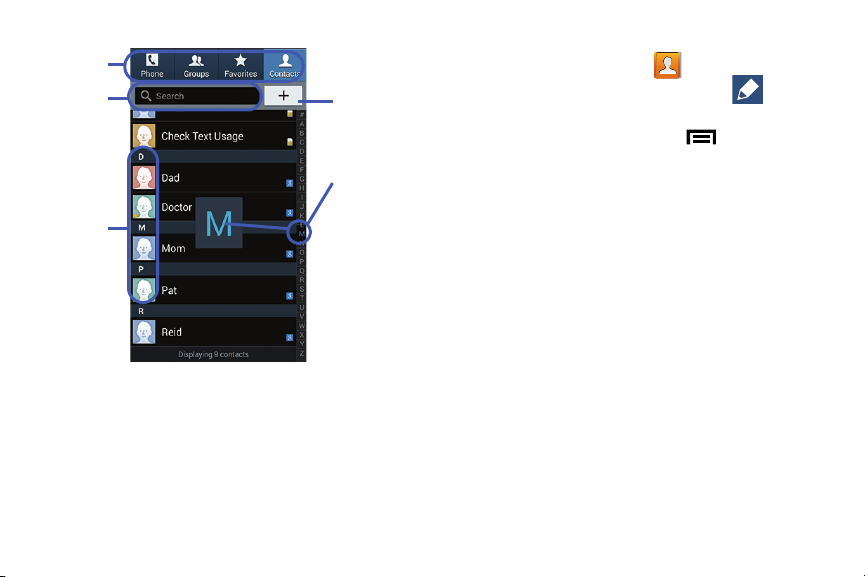
Editing Contact Information
Tabs
Search
Create
Contacts
field
Contacts
Tabbed
Navigation
Contacts
1. From the Home screen, tap
.
2. Tap a contact name from the list and tap (
Edit
).
– or –
Select a contact name and press
and tap
Edit
.
3. Edit the contact information then:
•
Tap
Save
to complete and store the new entry or
•
Tap
Cancel
to delete the current entry.
Contacts 96
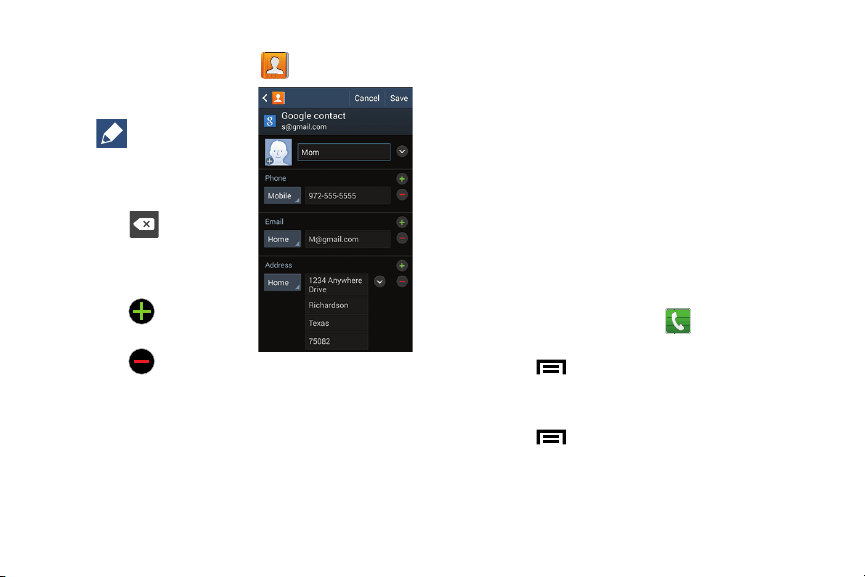
Adding a Number to an Existing Contact
4. Enter additional information such as:
Email, Groups
,
Ringtone
,
Message alert
,
Vibration pattern
or tap
Add
another field
to input additional category information.
. 1. From the Home screen, tap
2. Tap a contact name
from the list and tap
(
Edit
).
• Add another field
contains the following options: Phonetic
name, Organization, IM, Address, Notes, Nickname, Website,
Inte
rne
t
ca
ll, Events, or Relationship.
3. Tap a phone number
field and enter a phone
number.
•
Use your finger to slide the page up or down to see additional
fields and categories.
5. Tap
Save
to complete and store the new entry.
•
Tap on the
QWERTY keyboard to
remove a previously
entered phone number.
– or –
Tap
Cancel
to delete the current entry.
Adding a Pause or Wait to an Existing Contact
•
Tap to enter an
additional phone number
1. From the Home screen, tap and use the
Tap to remove a
previously entered phone
number.
on-screen keypad to enter a new phone number.
•
2. Press and then tap
Add 2-sec pause
. This feature
adds an automatic two-second pause.
– or –
Press
and then tap
Add wait
. This feature causes
the phone to require your acceptance before sending
the next set of entered digits.
3. Tap
Add to contacts
Update existing
.
Contact Details Screen
97
4. Scroll through the available list of existing entries and
select the desired target.
Note:
This new phone number is then added as a new number
to the selected entry.
5. Tap the label button (to the left of the new phone
number) and scroll through the list to select a category
type.
6. Tap
Save
to store and update the entry.
Deleting Contacts
Important!
Once Contacts list entries are deleted, they cannot
be recovered.
1. From the Home screen, tap
.
2. Touch and hold a contact name from the list and select
Delete
OK
.
Contact List Options
1. From the Home screen, tap .
2. Press
. The following options display:
• Delete
: allows you to delete 1 or more of your contacts.
•Import/Export
: imports or exports contacts to or from the USB
storage location, and SIM card or SD card.
• Share namecard via
: allows you to send namecards via
methods such as Bluetooth, ChatON, Drive, Email, Gmail,
Messaging, or Wi-Fi Direct.
• Merge accounts
: allows you to merge all of your current
Contact entries with either your active Google or Samsung
account. If several of your contacts are from other external
sources, this allows you to “back them up” or copy them to
your Samsung account. Tap
OK
to continue or
Cancel
to exit.
• Accounts
: allows you to
Auto sync
or Allows you to add and
manage mobile accounts on Samsung account, ChatON,
Google, LDAP, Microsoft Exchange ActiveSync, or Server. This
option also allows you to manually synchronize all of your
current contacts with their respective accounts.
• Speed dial setting
: allows you to set up speed-dialing.
Contacts 98

• Send message/email
: allows you to send a text /picture
message or an email using your Google account.
Contact Menu Options
1. From the Home screen, tap .
• Contacts to display
: allows you to choose to display All
contacts, those on your Device, SIM card, Samsung account,
Gmail, or only display contacts that are part of a Customized
list.
2. Touch and hold an entry to reveal the context menu.
The following options display:
•Delete
: allows you to delete the currently selected Contacts
entry.
• Settings
: allows you to configure where you save new contacts
to, or view your service numbers, or send contact information.
Options include: Only contacts with phones, List by, Display
contacts by, Service numbers, and Contact sharing settings.
•Share via
: allows you to send the current Contact entry’s
information to an external recipient via either
Bluetooth
,
ChatON
,
Drive
,
Email
(Exchange or Internet),
Gmail
,
Messaging
, or
Wi-Fi Direct
.
• Link contact
: allows you to link the current contact to another
current contact. Similar to a “see also” feature. If you can’t
remember a contact’s information, linking entries can help you
find the person you are looking for.
• Add shortcut to home
: adds a shortcut to the current Contacts
entry to an available screen location.
99
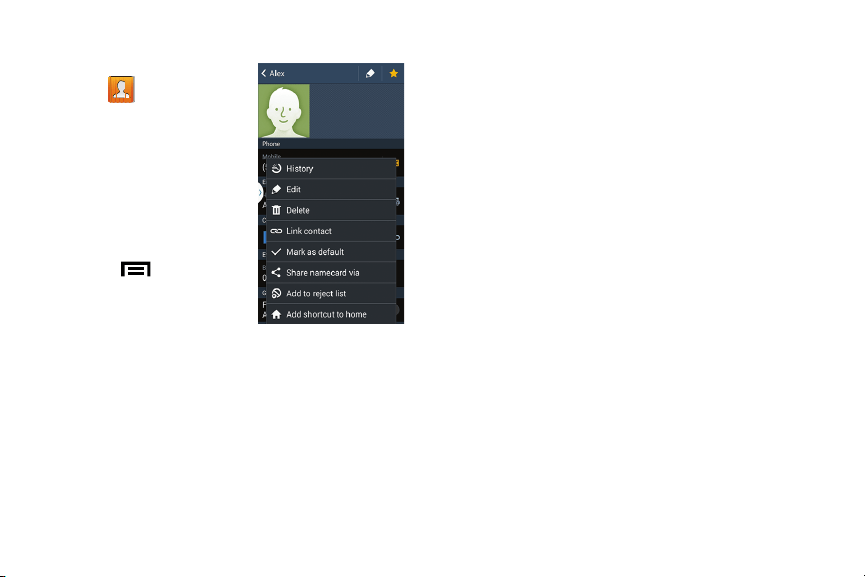
Contact Entry Options
1. From the Home screen,
tap
.
2. Tap an entry to reveal the
Contact entry’s Overview
Screen
. This screen
contains Name, contact
numbers, email, and
linked contact
information.
3. Press to reveal the
context menu specific to
this entry.
4. Tap an available option.
Contact Overview Screen
Linking Contact Information
Most people now maintain multiple email accounts, social
networking logins, and other similar account information. For
example, a Facebook account login name might differ from a
corporate email account login because they are maintained
separately and for different groups of people.
This device can synchronize with multiple accounts. When
you synchronize your phone with those accounts, each
account creates a separate contact entry in the Contacts list.
If one of your contacts (Amy Smith) has a regular email
account that you maintain in Gmail, but also has a Facebook
account under her maiden and married name, as well as a
Video! chat account, when you merge those accounts into
your Contacts list you can join all of her entries and view the
information in one record.
Joining contact information makes sending messages easy.
You can select any account email address or information all
from one screen, versus searching multiple, individual
screens to locate the desired account information.
Next time you synchronize your phone with your accounts,
any updates contacts make to email account names, email
addresses, etc. automatically update in your contacts list.
Contacts 100
1. From the Home screen, tap .
2. T
ap a contact name (the name you want to link to
another entry) to reveal the
Contact entry’s Overview
Screen
.
Note:
Typically this is the same contact with a different name
or account information.
3. Press
and then tap
Link contact
.
4. T
ap the second contact entry (the entry in which to
link). The second contact is now linked with the first
and the account information is merged into one screen.
Note:
The information is still maintained in both entries, but
displays in one record for easier viewing when you link
the contacts.
Important!
It is the first contact image that is displayed for
both, and the first contact’s name that is used.
For example: If Amy (original entry) is joined with
Julie (second entry). Julie seems to disappear and
only Amy remains. Tap the Amy entry (showing the
Amy image) to view both.
5. T
ap the main linked contact to view the contact
information you linked. The contacts and information
displays with an icon next to the contact name to
indicate what type of account information is contained
in the entry.
101
Unlinking a Contact
1. From the Home screen, tap .
2. Tap a contact name (the account name from which you
want to unjoin an entry). This reveals the details for
entry.
Note:
Typically this is the same contact with a different name
or account information.
3. Tap the link icon within the
Connection
area.
– or –
Press
and then tap
Separate contact
.
4. Tap next to the entry you want to unjoin and
se
lect
OK
. The contacts are “unjoined” or separated
and no longer display in the merged record screen.
Both contacts now go back to being separately
displayed.
Marking a Contact as Default
When you use applications such as the Voice Dialer or other
messaging type applications, the application needs to know
which information is primary (default) in a contact entry list.
For example, when you say “Call John Smith”, if you have
three phone records for John Smith, the Voice dialer is
looking for the “default” number or entry.
The
Mark as default
option marks one entry in a contact
record to use as the default. This comes in handy when you
have multiple entries for the same person.
1. From the Home screen, tap
.
2. Tap a Contact entry.
3. Press
and then tap
Mark as default
. The Mark as
default screen displays radio buttons next to the
contact name, phone number, or other contact
information.
4. Tap the radio button next to the entry information you
want to be the primary information (such as name,
phone number, or email) and select
Done
.
Contacts 102
Note:
If there are multiple phone numbers assigned to an
entry, assigning one as the default will automatically dial
that number when the contact is selected for dialing.
Sending a Namecard
A Namecard contains contact information, and can be sent to
recipients as a Virtual Business Card (V-card) attachment
using Bluetooth, Google Mail, or as a message.
1. From the Home screen, tap
.
2. Tap a Contact entry.
3. Press
and then tap
Share namecard via
and
select a delivery method:
Bluetooth
,
ChatON
,
Drive
,
Email
(Exchange or Internet),
Gmail
,
Messaging
, or
Wi-Fi Direct
.
The Namecard attaches to the selected message type
and is delivered when you send the message.
Note:
Email appears as an option only after an Internet or
Exchange email account has been created.
Sending All Current Namecards
Rather than selecting once Contact entry at a time, you can
send all of your current entries at once.
1. From the Home screen, tap
.
2. Press
and then tap
Share namecard via
.
3. Tap
Select all
to place a check mark alongside all
currently displayed Contact entries.
4. Tap
Done
and select a delivery method:
• Bluetooth
to transmit the contacts to another bluetooth-
compatible device.
•ChatON
to send the contacts to selected buddies.
•Drive
to send the contacts to a designated Google Drive
location.
•Email
to attach the contact cards to a new outgoing email
(Exchange or Internet).
•Gmail
to attach the contact cards to a new outgoing Internet-
based email.
• Messaging
to attach the contact cards to a new outgoing text
message.
• Wi-Fi Direct
to transmit the entries to another Wi-Fi Direct
enabled device.
103
Sending a namecard using Bluetooth
You must create a Contact prior to sending a namecard to a
recipient. For more information, refer to “Creating a Contact”
on page 92.
1. From the Home screen, tap
.
2. Touch and hold the entry to reveal the on-screen
context menu.
3. Tap
Share via
Bluetooth
.
Important!
You must activate Bluetooth to use this feature.
4. Tap the Bluetooth device in which to send this name
card. Bluetooth forwards the namecard to the recipient.
Copying Contact Information
Copying Contact Information to the SIM Card
The default storage location for saving phone numbers to
your Contacts list is your phone’s built-in memory. This
procedure allows you to copy numbers saved to the phone’s
memory, onto the SIM card.
1. From the Home screen, tap
.
2. From the Contacts List, press
and then tap
Import/Export
Export to SIM card
.
3. Tap
Select all
to choose all current phone contact
entries.
– or –
Select a specific entry by touching an entry. A check
mark indicates a selection.
4. Tap
Done
. The name and phone number for the
selected contact is then copied to the SIM.
Contacts 104
Copying Contact Information to the microSD
Card
This procedure allows you to copy entry information saved
on the phone’s memory, onto the SIM card.
1. From the Home screen, tap
.
2. From the Contacts List, press
and then tap
Import/Export
Export to SD card
.
3. Tap
OK
to choose all current phone contact entries.
Synchronizing Contacts
Syncing data from your managed accounts allows you to add
and manage a new or existing contact from your online or
remote accounts to your phone. Prior to syncing, you must
first have an active Google or Microsoft Exchange account
with current Contact entries, and be signed into your account
via the phone.
With syncing, any Contacts entries (with phone numbers,
ema
il addresses, pictures, etc.) are updated and synced with
your device.
1. Fr
om the Home screen, press
and then tap
Settings
(
Accounts
tab) and then navigate
to the
My accounts
area.
2. Select the email account containing the contacts you
wish to synchronize.
3. Tap
within the adjacent account field to reveal the
account’s synchronization settings screen.
4. To synchronize only Contacts, toggle the active state of
the
Sync Contacts
field. A green checkmark indicates
the feature is enabled.
105
Note:
The process of updating your Contacts tab can take
several minutes. If after 10-20 minutes, your list has not
been updated, repeat step 2-3.
5. Your
Contacts
tab then reflects any updated Contact
information.
Note:
Syncing of contacts requires you are logged into your
Gmail and Corporate accounts via the device.
Display Options
The Display options menu allows you to allows you to choose
which contacts to display. You can also choose to display
only contacts that have phone numbers.
Note:
Once a display filter has been selected, only those
Contact entries are shown until the
All contacts
option is
re-selected.
1. From the Home screen, tap
.
2. Press
and then tap
Contacts to display
. Select
any of the following to filter according to the selection:
• All contacts
allows you to display all available Contacts.
•Device
lists those Contacts currently found only on your device.
•SIM
lists those Contacts currently found only on your SIM card.
• Samsung account
lists those Contacts currently found and
sync’d within the Samsung account.
• Google
lists those Contacts currently found within the Google
account.
• Microsoft Exchange ActiveSync
lists those Contacts currently
found within the Exchange account.
• Customized list
allows you to enable which account
categories are displayed. For example, on Google contacts, you
can filter which Contact categories are shown (Friends, Family,
etc..)
Contacts 106
Adding more Contacts via Accounts
and Sync
When you synchronize applications such as Facebook,
Twitter, a corporate email account, or Google, using the
Accounts and sync option synchronizes the data from the
selected account type with your Contacts list.
1. From the Home screen, press
and then tap
Settings
and then navigate to the
Accounts
area.
2. Tap
Add account
.
3. Determine which type of account information you want
to synchronize with your Contact list. Selections are:
Samsung account, ChatON, Dropbox, Email, Google,
LDAP, Microsoft Exchange ActiveSync, Server, Sync apps
with Facebook,
or
Twitter
.
4. Tap an account type to add.
5. Follow the prompts. The selected account type
synchronizes with your Contacts list.
6. After synchronizing accounts you may want to link
contact information.
For more information, refer to
“Li
nking Contact Information” on page 100.
To add Facebook content to your Contacts list:
You can now add your Facebook contact information, such as
pictures, email, and phone numbers directly to your Contacts
list. All of their current contact information is then migrated
over to your device. If a Contacts entry already exists with a
slightly different name, separate entries are created and can
later be linked (joined) together into a single entry.
Important!
This process not only synchronizes your contact
information but also your status, events, and more.
1. From the Home screen, tap
(
Play Store
).
2. Search for and select the
Facebook
app.
3. When you are prompted to download the Facebook
application from the Play Store.
•
Tap
INSTALL
ACCEPT
to complete the process.
•
Tap
OPEN
to launch the application.
4. Log into your Facebook account:
•
Enter your account’s access
Email
and
Password
information
and tap
Log in
.
5. If prompted, configure any requested optional
permissions and tap
Log in
.
107
6. If prompted, configure any requested optional
permissions and tap
Log in
.
7. If prompted, select a Contacts Sync option. Choose
from: Sync all, Sync with existing contacts, or Don’t
sync.
8. Tap
Done
to complete the login and sync process.
To resync Social Network Contacts:
1. From the Home screen, press and then tap
Settings
Accounts
tab and then navigate to the
Accounts
area.
2. Tap
Facebook
and toggle the checkmark alongside the
desired fields.
3. Choose the parameters to sync (ex: Sync Calendar,
Sync Contacts, or Sync Gallery) and tap
Sync now
.
Note:
From the Facebook sync page you can also tap
Sync all
to resync all parameters.
Additional Contact Options
Sending an Email to a Contact
Note:
Contacts must contain and email account and address
before you can use the Send email feature.
1. From the Home screen, tap
.
2. Press
and then tap
Send message/email
Send
email
. Contacts that contain an email address display.
3. Tap the contact(s) to which you want to send an email.
A checkmark displays next to the selection.
Note:
The select contact must have an email as part of their
details screen.
4. Tap
Done
.
5. Select an email account type.
6. Compose the email and tap
Send
.
Contacts 108
Export/Import
For more information, refer to “Copying Contact Information”
on page 104.
Contact List Settings
From this menu you can determine the default storage
location for Contacts, display your device’s primary number,
and view service numbers listed in your Contact list.
1. F
rom the Home screen, tap
.
2. Press
and then tap
Settings
. Configure any of the
following options:
• Only contacts with phones
allows you to display only those
contacts containing phone numbers.
•List by
defines how the current list of Contacts are sorted:
First name
or
Last name
.
• Display contacts by
defines how the current list of Contacts
are listed:
First name first
(ex: Steve Smith) or
Last name first
(Smith, Steve).
• Service numbers
lists the currently available service numbers.
• Contact sharing settings
allows you configure how your
Contacts entries are sent: individually or as a single file
containing all available entries.
Tap
Settings
to select a share setting.
–
Send all namecards
allows you to set your Contact sharing
option to all so that your entire Contacts entries are sent as a
group and not as multiple single files. If all your entries are
selected only a single file is sent.
Note:
Your destination device must support this feature or no
entries will be received by the external device.
–
Send individual namecards
allows you to set your default to
send individual contacts one at a time. Even if you select all your
entries, each is sent individually.
109
Groups
This feature allows you to add a new or existing contact to a
call group. This group can be one of the already present
groups (Family, Friends, or Work) or a user-created group.
Creating a New Caller Group
1. From the Home screen, tap (
Groups
tab).
2. Press
and then tap
Create
.
3. Tap the
Group name
field and use the on-screen
keypad to enter a new group name.
For more
in
formation, refer to “Text Input Methods” on page 81.
4. Tap
Group ringtone
and select a ringtone for the group.
Selections are:
Default ringtone, Ringtones
(select from
available ringtones) or
Add
(to navigate your device and
select an existing audio file).
5. Tap
Message alert
and select a message alert ringtone
to be associated with this group.
6. Tap
Vibration pattern
and select a unique vibration
pattern either from an available list or Create your own.
This pattern is then associated with this group.
7. Tap
Add member
to add Contacts to the new group.
8. From the available list of contacts, tap the contact(s)
you want to add. A check mark displays next to contact
entry. Then tap
Done
.
– or –
Tap
Select all
to place a check mark alongside all
current entries. Then tap
Done
.
9. Tap
Save
to store the newly created group.
Note:
Some externally maintained group types (such as
Google) can only be managed or updated remotely
online vs via the device. These external types will not
allow editing or deleting members locally via the phone.
Adding an Existing Entry to a Current Caller
Group
1. From the Home screen, tap .
(
Add group member
).2. Tap a group entry
3. From the available list of contacts, tap the contact(s)
you want to add. A check mark displays next to contact
entry.
4. Tap
Done
. The selected contacts are added to the
group.
Contacts 110
Removing an Entry From a Caller Group
1. From the Home screen, tap .
2. Tap a group entry.
3. Press
and then tap
Remove member
.
4. Tap all of the contacts you want to remove from this
group. A check mark displays next to contact entry.
5. Tap
Done
.The contacts are removed from the group.
Editing a Caller Group
To edit a Group entry, there must be at least one member as
part of the selected group.
1. From the Home screen, tap
.
2. Touch and hold a group entry then select
Edit group
.
3. Make modifications to the
Group name
,
Group ringtone
,
Message alert
,
Vibration pattern
fields, or
Add member
.
4. Tap
Save
.
Deleting a Caller Group
1. From the Home screen, tap .
2. Press
and then tap
Delete groups
.
3. Select either
Select all
or tap the desired group.
4. Tap
Delete
.
5. Select either the
Group only
or
Group and group
members
.
6. Tap
OK
.
Sending a Message to a Group
1. From the Home screen, tap .
2. Tap an existing group, and press
and then tap
Send message
.
– or –
Touch and hold a group entry and select
Send message
.
3. Select the recipients of the new message (indicated by
a green checkmark). If an entry contains multiple
phone numbers, each must be selected individually.
4. Tap
Done
.
(
Send
).5. Type your message, and tap
111

The Favorites Tab
The Favorites tab is a list of the phone numbers that have
been designated as favorite contacts.
For more information,
refer
to “Logs Tab” on page 77.
1. From the Home screen, tap
.
2. Tap
(
Favorites
tab).
Adding a contact to your favorites list:
1. From within the Favorites tab, press and select
Add to favorites
.
2. Place a check mark alongside those current Contacts
entries you wish to assign as favorites.
3. Tap
Done
to complete the process.
Contacts
112
Section 6: Messaging
This section describes how to send or receive different types
of messages. It also explains the features and functionality
associated with messaging.
Types of Messages
Your phone provides the following message types:
•
Text Messages
•
Multimedia (Picture, Video, and Audio) Messages
•
Email and Gmail Messages
•
Hangouts
•
Google+
•
Messenger
•
ChatON
The Short Message Service (SMS) lets you send and receive
text messages to and from other mobile phones or email
addresses. To use this feature, you may need to subscribe to
your service provider’s message service.
The
Multimedia Messaging Service (MMS) lets you send and
receive multimedia messages (such as picture, video, and
audio messages) to and from other mobile phones or email
addresses. To use this feature, you may need to subscribe to
your service provider’s multimedia message service.
Important!
During the creation of a text message, adding an
image, sound file, or video clip automatically
changes it from a text message (SMS) to a
multimedia message (MMS).
Message Icons on the Status Bar
Messaging icons are displayed on the Status Bar at the top of
the display when new messages are received.
For more
info
rmation, refer to “Status Bar” on page 25.
Note:
The Messaging application can also be accessed by
pressing
and then tapping (
Apps
) >
(
Messaging
).
113
Creating and Sending Messages
1. From the Home screen, tap (
Messaging
)
(
Compose
).
2. Tap the
Enter recipient
field to manually enter a
recipient.
– or –
Tap
to select from one of the following:
• Groups
: to select a recipient from the Group list.
•Favorites
: to select a recipient from the Favorites list.
•Contacts
: to select a recipient from your Contacts list (valid
entries must have a wireless phone number or email address).
•Logs
: to select a recipient from a list of recently sent
messages.
3. If adding a recipient from either Logs, Contacts, or
Group, tap the contact to place a checkmark then tap
Done
. The contact displays in the recipient field.
Note:
Delete any unnecessary members by tapping their
name/number in the recipient area and selecting
Delete
.
4. Add more recipients by tapping either the
Enter
recipient
field or and selecting recipients.
5. Tap the
Enter message
field and use the on-screen
keypad to enter a
message. For more inf
ormation, refer
to “Text Input
Methods” on page 81.
6. Review your message and tap
(
Send
).
7. If you have more than one recipient, the same text
message is sent to all recipients in the Enter Recipients
field.
Note:
If you exit a message before you send it, it will be
automatically saved as a draft.
Messaging 114
Quick Messaging a Number from the Contacts
List
1. From the Home screen, tap (
Contacts
).
2. Locate an entry from the Contacts list.
3. In a single mo
tion, touch and drag your finger over the
number by going to the left. This action addresses a
new text message to the selected recipient.
Message Options
Options before composing a message
1. From the Home screen, tap (
Messaging
).
2. Before composing a message, press from the
main Messaging screen to display additional
messaging options:
•Search
: allows you to search through all of your messages for
a certain word or string of words. Use the on-screen keypad to
enter a word or phrase in which to search, then tap
.
For more information, refer to
“Message Search”
on page
121.
• Delete threads
: allows you to delete any message thread.
Select the messages to delete and a green checkmark will
appear next to the message. Tap
Delete
. For more
information, refer to
“Deleting a single message thread”
on page 120.
•Draft messages
: displays the draft messages folder and its
contents.
• Locked messages
: displays the locked messages folder and
its contents.
• Scheduled messages
: displays the scheduled messages
folder and its contents.
• Spam messages
: displays the spam messages folder and its
contents.
• Text templates
: displays your available text message reply
templates. For more information, refer to
“Text Templates”
on page 126.
• Settings
: allows you to access Messaging settings. For more
information
, refer to
“Messaging Settings”
on page 121.
3. From the Messaging screen list, touch and hold an
on-screen message and select an option:
115

• Delete thread
: deletes the entire message and its bubbles. For
more information, refer to
“Deleting Messages”
on page
120.
•View contact
: allows you to view the current entry information
for the sender.
•Add to contacts
: allows you to add the sender to either a new
or existing Contacts entry.
• Add to spam numbers
: allows you to tag a number as spam
so that these messages can be directly delivered to your spam
folder.
Options while composing a message
1. From the Home screen, tap (
Messaging
).
2. From within an open message, press to display
additional messaging options:
• Insert smiley
: allows you to add insert smiley icons
images (emoticons).
•Add text
: allows you to add text items from sources
such as: S Memo, Calendar, Location, Contacts, and
Text templates.
•Preview
(only in MMS): allows you to add preview the
MMS message prior to delivery.
•Add to contacts
: allows you to add the sender to either a new
or existing Contacts entry.
•View contact
: reveals the current Contact’s overview screen.
• Add slide
: converts an SMS message into an MMS
(Multimedia) message and allows you to attach an existing
slideshow.
• Remove slide
: allows you to remove a previously attached
slideshow.
• Add subject
: allows you to enter a subject.
Messaging 116

• Duration (5 sec)
(only in MMS): allows you to change the
duration of the image slideshow.
• Layout (bottom)
(only in MMS): allows you to change the
layout.
• Add recipients
: allows you to enter additional recipients to the
message.
• Scheduling
: allows you to schedule a time for the current
message to be delivered.
• Add to spam numbers
: allows you to tag a number as spam
so that these messages can be directly delivered to your spam
folder.
•Discard
: closes the current open message.
Adding attachments to a message
To add an attachment to your message, tap (
Attach
)
and select one of the following options:
•
Image
: allows you to tap an existing image from your Pictures list
to add it to your message.
•
Take a picture
: allows you to temporarily exit the message, take
a photo with phone’s camera, and then add it to your message by
tapping
Save
.
•
Video
: allows you to choose an existing video from the Videos list,
then add it to your message
.
•
Record video
: allows you to temporarily exit the message,
record a video clip using the phone’s camera, and then add it
to your message by tapping
Save
.
•
Audio
: allows you to choose an existing audio file from the
Audio list, then add it to your message by tapping the circle to
the right of the audio so that it turns green, then tapping
Done
.
•
Record audio
: allows you to temporarily exit the message and
record an audio clip using the phone’s microphone. It is then
automatically attached to the message.
•
S Note
: allows you to add an S Note that you have created.
•
Calendar
: allows you to add an event from your calendar.
117
•
Location
: allows you to attach a thumbnail of a map showing
your location.
•
Contacts
: allows you to tap on an existing Address Book entry,
then add it to your message by tapping
Done
.
Adding Additional Text
You can copy text such as names, phone numbers, and
events from your Contacts, Calendar, or a Memo.
1. While composing a message, press
Add text
.
2. At the Add text screen, select one of the following:
•S Note
: allows you to insert text from an existing S Note.
•Calendar
: allows you to add the name, date, and time of a
calendar event to your message.
•Location
: allows you to add an address and the link to the
location on Google Maps.
•Contacts
: allows you to add the name and phone number of
any of your contacts to your message.
• Text templates
: allows you to add pre-defined phrases and
sentences.
For m
ore information, refer to
“Text Templates”
on page 126.
The information is added to your message.
Viewing Newly Received Messages
When you receive a message, your phone notifies you by
displaying
within the Notification area at the top left of
your Home screen.
To read a message:
1. Open the Notification Bar and select the message. For
more infor
mation, refer to “Notification Screen” on
page 34.
– or –
From the Home screen, tap
then tap the new
message to view its contents. The selected message
displays on the screen.
2. Tap
to play a multimedia message.
•
To pause playback of the multimedia message, tap .
3. In a single motion, touch and drag up or down the page
to scroll through the message (if additional pages were
added).
Messaging 118
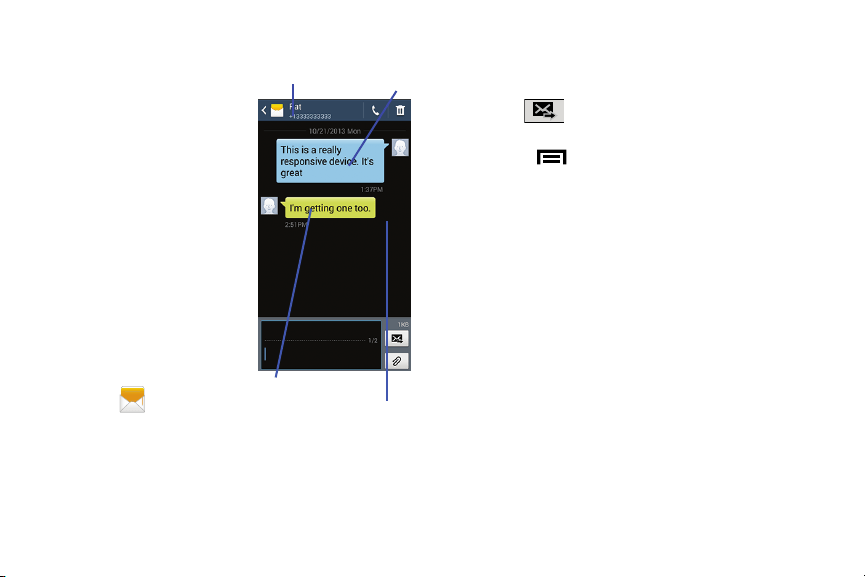
Current Recipient
My Text
Reply Bubble
Text Message Thread
Message Threads
3. Compose your reply.
Sent and received text and
picture messages are
gr
ouped into message
threads. Threaded messages
allow you to see all the
messages exchanged (similar
to a chat program) and
displays a contact on the
screen.
Message threads are listed in
the order in which they we
re
received, with the latest
message displayed at the
top.
Your texts are colored Blue and your caller’s replies are
Yellow.
4. Tap (
Send
) to deliver your reply.
– or –
Press
and then select one of the available
message options (page 115).
To access message thread options:
From the main Messaging screen, touch and hold the
message to display the following options:
•Delete
: deletes the currently selected message thread.
•View contact
: displays the Contact’s Overview page.
•Add to contact
: begins the process of adding the new number
to your Contacts list.
To reply to a text message:
• Add to spam numbers
: adds the current sender to a spam list.
ny new texts from this sender are automatically blocked.
1. From the Home screen,
tap
.
2. While the message is
open, ta
p the
Enter message
field and then type your
reply messa
ge.
119

To access additional Bubble options:
Touch and hold the message bubble within an active
message conversation to display the following options:
•Delete
: deletes the currently selected message bubble from
the thread.
•Copy text
: copies the currently selected message bubble from
the thread.
•Forward
: allows you to forward the currently selected message
bubble to an external recipient.
•Lock/Unlock
: locks or unlocks the currently selected message
bubble from being accidentally deleted.
•Copy to SIM
: copies the currently selected message bubble as
a single text message within the SIM card.
• View message details
: displays details for the currently
selected message bubble.
Deleting Messages
Deleting a single message thread
1. From the Messaging screen, touch and hold a message
from the Messages list, then select
Delete
.
2. At the prompt, tap
OK
to delete or
Cancel
to exit.
Deleting multiple message threads
1. From the Messaging screen, press and then tap
Delete threads
.
2. Tap each message thread you want to delete. A check
mark displays beside each selected message.
3. Tap
Delete
.
4. At the prompt, tap
OK
to delete or
Cancel
to end the
process.
Messaging 120

Deleting a single message bubble
1. From the Messaging screen, open a message to reveal
the message string.
2. Touch and hold a message bubble, then select
Delete
.
3. At the prompt, tap
OK
to delete or
Cancel
to exit.
Deleting multiple message bubbles
1. From the Messaging screen, open a message to reveal
the message string.
2. Tap (
Delete
) then select each message bubble
you want to delete. A check mark displays beside each
selected message.
3. Tap
Delete
.
4. At the prompt, tap
OK
to delete or
Cancel
to end the
process.
Message Search
You can search through your messages by using the
Message Search feature.
1. From the Messaging screen, press
and then tap
Search
.
2. Use
the on-screen keypad to enter a word or phrase in
which to search, then tap
.
3. All messages that contain the entered search string
display.
Messaging Settings
To configure the settings for text messages, multimedia
messages, Voicemails, and Push messages.
From the Messaging screen, press and then tap
Settings
.
The following Messaging settings are available:
General settings
• Delete old messages
: deletes old messages when the limit is
reached, rather than overwriting them.
• Text message limit
: allows you to set a limit on how many text
messages are allowed in one conversation.
121

• Multimedia message limit
: allows you to set a limit on how
many multimedia messages are allowed in one conversation.
Text message (SMS) settings
• Delivery reports
: when this option is activated, the network
informs you whether or not your message was delivered.
• Manage SIM card messages
: allows you to manage the
messages stored on the SIM card.
• Message center
: allows you to enter the number of your
message center where your messages reside while the system
is attempting to deliver them.
• Input mode
: allows you to set the input mode for your text
messages. Choose from: GSM Alphabet, Unicode, or
Automatic.
Multimedia message (MMS) settings
• Delivery reports
: when this option is activated, the network
informs you whether or not your message was delivered.
•Read reports
: when this option is activated, your phone
receives a request for a read reply along with your message to
the recipient.
•Auto retrieve
: allows the message system to automatically
retrieve messages.
• Roaming auto retrieve
: allows the message system to
automatically retrieve while roaming.
•Creation mode
: allows you to select the creation mode: Free,
Restricted, or Warning.
–
Restricted
: you can only create and submit messages with
content belonging to the Core MM Content Domain.
–
Warning
: the phone will warn you via pop up messages that
you are creating a multimedia message which does not fit the
Core MM Content Domain.
–
Free
: you may add any content to the message.
• MMS alert
: alerts you when the messaging modes changes
from an SMS (text) to MMS (multimedia) mode.
Display
• Bubble style
: allows you to choose from several bubble styles
for your messages. Bubbles are the rounded boxes that
surround each message.
• Background style
: allows you to choose from several
background styles for your messages.
•Split view
: when in Landscape mode, allows you to view both
the message list and the contents of the currently selected
message.
Messaging 122

• Use the volume key
: allows you to change the text size by
using the up or down volume keys.
Push message settings
• Push messages
: allows you to receive push messages from
the network.
• Service loading
: allows you to set the type of service loading
notification. Choose from: Always, Prompt, or Never.
Notification settings
• Notifications
: allows you to see message notifications on your
status bar.
• Select ringtone
: allows you to set the ringtone for your
message notifications.
•Vibrate
: allows you to enable/disable the vibration mode
associated with message alerts.
• Message alert repetition
: allows you to set the interval for new
message alerts. Choose from: Once, Every 2 minutes, or
Every 10 minutes.
• Preview message
: when enabled, allows you to view a brief
preview of new message text on the Status bar.
Emergency message settings
• Emergency alerts
: allows you to configure emergency alert
settings. You can enable/disable those alert categories you
wish to receive. Choose from: Imminent extreme alert,
Imminent severe alert, and AMBER alerts.
Note:
The Presidential alert can not be disabled.
• Emergency notification preview
: allows you to play a sample
emergency alert tone. Tap
Stop
to cancel the playback.
Signature settings
• Add signature
: when enabled, this feature allows you to create
a signature at the end of your outgoing text messages.
• Signature text
: allows you to enter a desired signature for your
message.
Spam message settings
• Spam settings
: when enabled, allows you to configure
available spam settings such as:
–
Add to spam numbers
: allows you to manually enter and
assign a phone number as being sent from a spam source.
–
Add to spam phrases
: allows you to assign a specific text
phrase as belonging to a spam message. Ex: Dear friend.
123

–
Block unknown senders
: when active, automatically blocks
incoming messages from unknown sources or blocked
numbers.
Emergency Alert Configuration
This device is designed to receive wireless emergency alerts
from the Commercial Mobile Alerting System (CMAS); which
may also be known as the Personal Localized Alerting
Network (PLAN). If your wireless provider has chosen to
participate in CMAS/PLAN, alerts are available while in the
provider's coverage area. If you travel outside your provider's
coverage area, wireless emergency alerts may not be
available. For more information, please contact your wireless
provider.
Emergency Alerts allows customers to receive
geographically-targeted messages. Alert messages are
provided by the US Department of Homeland Security and
will alert customers of imminent threats to their safety within
their area. There is no charge for receiving an Emergency
Alert message.
There are three types of Emergency Alerts:
•
Alerts issued by the President
•
Alerts involving imminent threats to safety of life
•
AMBER Alerts (missing child alert)
Customers may choose not to receive Extreme Alerts, Severe
Alerts, and AMBER Alerts.
Important!
Alerts issued by the President can not be disabled.
To disable Extreme, Severe, and AMBER Alerts:
1. From the Home screen, tap .
2. Press and then tap
Settings
.
3. Scroll to the bottom and select
Emergency alerts
. All
alerts are enabled by default (checkmark showing).
4. Tap on an alert option to disable the alert and remove
the checkmark.
Messaging 124
Assigning Messages as Spam
You can now assign either a phone number as spam or use a
key term or phrase. Any message assigned as spam is
automatically placed with your Spam messages folder.
To assign a phone number from Messages list as spam:
1. From the Home screen, tap .
2. Touch and hold a message from a phone number.
3. Select
Add to spam numbers
and tap
OK
.
To assign a phone number manually as spam:
1. From the Home screen, tap .
2. Press and then tap
Settings
.
3. Locate and activate the
Spam settings
option.
• Spam settings
: when enabled, allows you to configure
available spam settings such as: Register number as spam,
Register phrase as spam, and Block unknown senders.
4. Tap
Add to spam numbers
(
Add new
).
•
This function allows you to manually enter and assign a phone
number as being sent from a spam source.
5. Tap the
Number
field to manually enter phone number.
– or –
Ta
p
to select from either your existing Logs or
Contacts.
Tap
Match criteria
and select a parameter that must
match for the spam action to take effect. Choose from:
Same as, Starts with (ex: 800 or 888), Ends with, or
includes.
6. Tap
Save
.
To register text phrases as spam:
Some incoming messages might not be associated with a
phone number but rather an email address. In these cases,
the only way to block those messages, would be assign a
key used term or phrase to activate the Spam block. Ex:
“Dear friend”, “Stock Alert”, or “Act Now”.
1. From the Messaging screen, press
and then tap
Settings
.
2. Locate and activate the
Spam settings
option.
3. Tap
Add to spam phrases
(
Add new
).
•
This function allows you to assign a specific text phrase as
belonging to a spam message. Ex: Dear friend.
125

4. Enter a term or word into the field.
5. Tap
Save
.
To register unknown numbers as spam:
Some incoming messages might not be associated with
either a phone number or email address. These incoming
messages contain no information as their info is blocked by
the sender.
1. From the Messaging screen, press
and then tap
Settings
.
2. Locate and activate the
Spam settings
option.
3. Tap
Block unknown senders
. A green checkmark
indicates the feature is active.
• Block unknown senders
: when active, automatically blocks
incoming messages from unknown sources or blocked
numbers.
If an incoming message is designated in coming from an
unknown sender, it is automatically assigned as spam and is
now located in your Spam folder.
Accessing your Spam Folder
Any message assigned as spam is automatically placed with
your Spam messages folder.
From the Messaging screen, press and then tap
Spam messages
.
Text Templates
This screen displays your available text message reply
templates. This is a readily accessible list of both default and
user-defined text snippets that can be used to quickly reply
to incoming messages.
1. F
rom the Home screen, tap
.
2. From the Messaging list, press
and then tap
Text templates
.
3. Tap a message to immediately insert it into your
current message conversation.
To create your own text template:
1. From the Home screen, tap .
2. Fro
m the Messaging list, press
and then tap
Text templates
.
(
Create text template
).3. Tap
4. Enter a new text string and tap
Save
.
Messaging 126
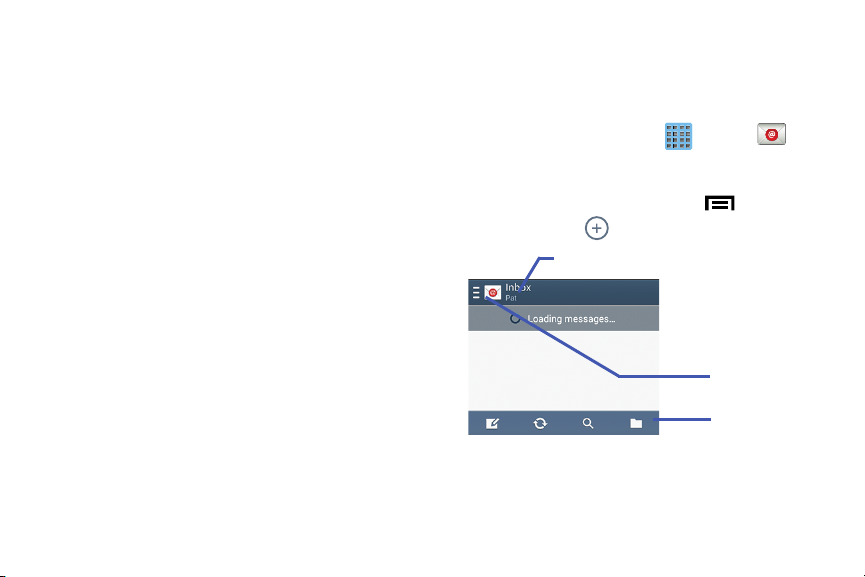
Using Email
Email (or Internet Email) enables you to review and create
email using several email services. You can also receive text
message alerts when you receive an important email. Your
phone’s Email application lets you access and manage
multiple email accounts simultaneously in one convenient
location.
There are currently three main types of email accounts on
your phone: Gmail, Internet-based email (Gmail, Yahoo, etc..),
and Microsoft Exchange (Corporate email or Outlook
®
).
To send and receive email messages through an ISP (Internet
Service Provider) account, or if you wish to use your device
to access your corporate email through a VPN (Virtual Private
Network), you will first need to set up an IMAP or POP
account.
•
IMAP
(Internet Message Access Protocol) - This protocol is
fr
equently used in large networks and commercial setting
s.
IMAP4 is the current standard.
•
POP3
(Post Office Protocol) - This protocol is supported by most
ISPs (Internet service providers) and common among consumer
applications. POP3 is the current standard.
•
Microsoft Exchange ActiveSync
- This protocol is frequently
used with a large corporate email server system and provides
access to email, contact, and calendar synchronization.
Creating an Internet Email Account
1. From the Home screen, tap
•
Open an existing email account, press and then tap
Settings
(
Add account
).
2. If you already have other email account setup:
(
A pps
)
(
Email
).
Account name
Access available
accounts and
folders
Email functions
– or –
Enter your
Email address
and
Password
information.
Email address
: your Internet email address.
127

• Password
: typically your network access password
(case-sensitive).
3. Tap
Show password
to display the password as you
enter it in the associated field.
•
Tap
Manual setup
to configure your connection settings
manually (POP3 or IMAP). Follow the on-screen prompts and
enter the information specific to your email provider.
•
Tap
Send email from this account by default
to assign this
email account as your default account for all outgoing emails.
4. Tap
Next
.
5. At the
Account options
screen, select the frequency
which the device should check for new email on the
server and tap
Next
.
Important!
The
Sync Email
feature must be enabled to allow
synching between your device and the remote
server.
•
Tap the
Notify me when email arrives
field to receive new
email notifications.
•
Tap the
Automatically download attachments when
connected to Wi-Fi
field to assist with faster access to large
email attachments when using Wi-Fi.
6. At the
Set up email
screen, name the account and enter
a screen name to identify yourself on this account.
•
The unique account name is used to differentiate this account
from other email accounts accessed by your device.
7. Tap
Done
to store the new account.
Messages for this account display on the Inbox tab. You can
also view Personal information for this account, Receipts (if
you setup the account to return receipts), Travel information,
and more (if available).
Messaging 128
Opening an Email
1. From the Home screen, tap (
Email
).
2. Tap (account name field upper-left) to open
the complete email account list page.
•
Selecting
Combined view
allows you to view all the emails for
your current accounts, managed by the application, to be listed
on a single screen.
3. Select an email account and tap an email message.
Refreshing Email messages
1. From the Home screen, tap (
Email
).
2. Select an email account.
•
If you are already in an email account, tap the account name
field (upper-left) to open the complete email account list page.
•
Select an available email account.
3. Tap (
Refresh
).
Composing Email
1. From the Home screen, tap (
Email
).
2. Tap (account name field upper-left) to open
the complete email account list page.
3. Tap
Inbox
(
Compose
).
4. Enter the recipient’s email address in the
To
field.
•
If you are sending the email message to several recipients,
separate the email addresses with a comma. You can add as
many message recipients as you want.
5. Tap
Cc/Bcc
to add additional carbon copy and blind
copy recipients.
•
Use the
Cc
field to carbon copy additional recipients.
•
Use the
Bcc
field to blind copy additional recipients.
6. Tap the
Subject
field and enter the email subject.
7. Tap the email text field and compose your email
message.
•
To add a n attachment (such as image, video, audio, etc..),
tap
Attach
(from the top of the screen) and make a
category selection.
–
Tap the file you wish to attach.
–
Tap to delete the attached file.
129
Note:
If you attach an image to your email, you have the option
to resize it prior to delivery. Choose from: Original,
Large (70%), Medium (30%), or Small (10%). Once
chosen, tap either
Always
or
Just once
.
8. Tap (
Save
) to store a draft of the current email on
your device so that you can come back later and
continue the email.
9. Tap (
Delete
) to discard the current email.
10. Once complete, tap (
Send
).
Configuring Email Settings
1. From the Home screen, tap (
Email
).
2. Select an account.
3.
Press
and then tap
Settings
and alter any of the
following General settings:
•Display
: allows you to configure the way in which your email
list is displayed. Options include: Auto fit content, Message
preview line, and Title line in list.
• Composing and sending
: allows you to configure the
functions available during both creating and sending emails.
Options include: Quick responses, Default image size, Delay
email sending.
•Auto advance
: allows you to assign an action after an email is
deleted. Choose from: Next email, Previous email, or Email list.
• Confirm deletions
: requires that you provide confirmation
before deleting a selected email.
•Priority senders
: allows you to assign Contacts as priority
senders, set as the default folder, assign email notifications,
ringotnes, and vibration patterns for emails from these senders.
• Spam addresses
: allows you to create a list of spam email
addresses.
• Rules for filtering
: allows you to create and manage filters for
emails. Filter parameters include: Filter name, Subject includes,
or From.
• Split view mode
: allows you to toggle the split screen either on
or off while in landscape mode.
– or –
Messaging
130

4. Press and then tap
Settings
Account settings
Account
. Alter any of the following settings:
• Sync settings
: allows you to adjust the email synchronization
settings, adjust the sync schedule, and adjust the email
retrieval size.
•Signature
: lets you both attach a customized signature and
include a handwritten signature to the bottom of all outgoing
emails.
–
In a single motion touch and slide the
Signature
slider to the
right to turn it on.
–
Tap the
Signature
field, change the current text, and tap
Done
to save the new signature.
or
Use your S Pen to enter a handwritten signature within the
empty box field below the current on-screen text.
• Default account
: Assign this account as the default email
account used for outgoing messages.
• Password
: allows you to update your password to match the
one on the email server.
• Email notifications
: Activates the email notification icon to
appear within the Notifications area of the status bar when a
new email (Gmail, etc..) is received.
• Select ringtone
: Plays a selected ringtone when a new email
message is received.
•Vibrate
: Activates a vibration when a new email message is
received.
5. Tap the
More settings
field to access additional options:
•Account name
: displays your uniquely created account display
name.
•Your name
: displays the name used in the From field of your
outgoing email messages.
• Always Cc/Bcc myself
allows you to include your own email
address in either the CC, Bcc, or None fields. Lets you always
receive a copy of outgoing emails.
•Show images
: allows you to view embedded images located
within the body of the currently displayed email.
• Security options
: allows you to enable several security options
such as: Encrypt all, Sign all, Create keys, Private keys, Public
keys, and Set default key. These security policies could restrict
some functions from corporate servers.
131
• Number of emails to load
: allows you to select the number of
on-screen emails to keep loaded on the screen by default.
Microsoft Exchange Email (Outlook)
Your phone also provides access to your company’s Outlook
Exchange server. If your company uses either Microsoft
Exchange Server 2003 or 2007, you can use this email
application to wirelessly synchronize your email, Contacts,
and Calendar information directly with your company’s
Exchange server.
• Auto download attachments
: allows the device to
automatically download email attachments when an active
Wi-Fi connection is detected. This process speeds up the
process of downloading an emails attachments for offline
review by not using a 3G or 4G network connection.
Setting Up a Microsoft Exchange Email account
• Auto resend times
: enables the device to resend an outgoing
email a specified number of times if delivery fails.
1. From the Home screen, tap
• Incoming settings
: Lets you specify incoming email settings,
such as User name, Password, IMAP server, Security type,
Port, and IMAP path prefix.
2. If you already have other email account setup:
(
Email
).
•
Open an existing email account, press and then tap
Settings
(
Add account
).
• Outgoing settings
: Lets you specify outgoing email settings,
such as SMTP server, Security type, Port, Require sign-in, User
name, or Password.
– or –
Enter your
Email address
and
Password
information.
Email address
: your Outlook work email address.
• Password
: typically your network access password
Note:
Some the above options may not be displayed when
using some Internet account types.
(case-sensitive).
3. Tap
Send email from this account by default
, to make
this your default email account for outbound emails.
4. Tap
Show password
to display the password as you
enter it in the associated field.
Messaging 132

Note:
If selected, the
Manual setup
button changes to read
Microsoft Exchange ActiveSync
. If activated, skip to
step 6.
5. Tap
Next
. Consult your Network or IT Administrator for
further details and support.
6. Tap
Microsoft Exchange ActiveSync
(from the add new
email account screen).
Note:
If prompted with an on-screen notification that the
connection that the “Setup could not finish”, tap
Edit
details
to continue with a manual update of necessary
information.
7. When prompted to provide additional detailed
information within the Exchange server settings
screen, enter an updated
Domain
, and confirm your
user name
and
Password
information.
Important!
Remember to manually place the cursor in the
correct spot and enter a Domain name before the
“
[Domain]\[user name]
” entry. Most servers only
provide a username.
8. Update or re-enter your
Exchange server
information
within the appropriate field. This field can often be
populated with incorrect or out of date information
provided by your server.
• Exchange Server
: your exchange server remote email
address. Typically starts with
mail.XXX.com
. Obtain this
information from your company network administrator.
Important!
Do not accept the default entry as this is a guess
based on returned information.
•
If your network requires SSL encryption, tap the
Use secure
connection (SSL)
field to place a check mark in the box and
activate this additional level. Most often, this option should be
enabled.
133

•
If your network requires that you accept SSL certificates, tap
the
Accept all SSL certificates
field to place a check mark in
the box and activate this additional level. Most often, this option
is not required. Confirm this information with your IT
Administrator.
Important!
If your Exchange server requires this feature,
leaving this field unchecked can prevent
connection.
9. Consult your IT Administrator if it is necessary to
enable the
Use client certification
option.
10. With the new server information entered, tap
Next
.
11. Read the on-screen
Activation
disclaimer and, when
prompted, tap
OK
. The device then verifies your
incoming server settings.
12. If prompted, read the
Remote security administration
information and tap
OK
to accept the service and
continue.
13. Adjust the various on-screen configuration fields and
tap
Next
. It may take a few seconds for the next screen
to load.
•
Enabling the
Automatically download attachments when
connected to Wi-Fi
option decreases the wait time to access
large email attachments when an available Wi-Fi connection is
available.
14. If prompted, read the
Activate device administrator?
screen and tap
Activate
to complete the email setup
process.
Note:
This process can take a few minutes. If the previous
setup screen re-appears,
ignore it and do not alter any
fields
during this process.
15. Identify your new work email account with a unique
name (Ex: Work), then tap
Done
.
Messaging 134
Opening an Exchange Email
1. From the Home screen, tap (
Email
).
2. Tap the account name field (upper-left) to open the
complete email account list page.
3. Select an exchange email account and tap an email
message.
Refreshing Exchange Email
1. From the Home screen, tap (
Email
).
2. Select an email account.
•
If you are already in an email account, tap the account name
field (upper-left) to open the complete email account list page.
•
Select an available email account.
3. Tap (
Refresh
).
Composing Exchange Email
For more information, refer to “Composing Email” on
page 129.
Deleting an Exchange Email Message
Touch and hold an email (from your inbox list) and then
tap (
Delete
).
Configuring Microsoft Exchange Email Settings
1. From the Home screen, press and then tap
Settings
(
Accounts
tab) and then navigate
to the
My accounts
area.
2. Tap the Microsoft Exchange account and
Settings
<
Exchange email account>
.
– or –
From the current Email inbox listing, press
and
then tap
Settings
.
3. Alter any of the following General settings:
•Display
: allows you to configure the way in which your email
list is displayed. Options include: Auto fit content, Message
preview line, and Title line in list.
• Composing and sending
: allows you to configure the
functions available during both creating and sending emails.
Options include: Quick responses, Default image size, Delay
email sending.
•Auto advance
: allows you to assign an action after an email is
deleted. Choose from: Next email, Previous email, or Email list.
• Confirm deletions
: requires that you provide confirmation
before deleting a selected email.
135

•Priority senders
: allows you to assign Contacts as priority
senders, set as the default folder, assign email notifications,
ringotnes, and vibration patterns for emails from these senders.
• Spam addresses
: allows you to create a list of spam email
addresses.
• Rules for filtering
: allows you to create and manage filters for
emails. Filter parameters include: Filter name, Subject includes,
or From.
• Split view mode
: allows you to toggle the split screen either on
or off while in landscape mode.
– or –
4. From the current Email inbox listing, press and
then tap
Settings
Account settings
<Exchange
email account>
. Alter any of the following settings:
• Sync settings
: allows you to adjust the email synchronization
settings, adjust the sync schedule, and adjust the email
retrieval size.
•Signature
: lets you both attach a customized signature and
include a handwritten signature to the bottom of all outgoing
emails.
–
In a single motion touch and slide the
Signature
slider to the
right to turn it on.
–
Tap the
Signature
field, change the current text, and tap
Done
to save the new signature.
or
Use your S Pen to enter a handwritten signature within the
empty box field below the current on-screen text.
• Out of office settings
: allows you to configure your out of office
email settings.
• Default account
: assign this account as the default email
account used for outgoing messages.
•Password
: allows you to update your password to match the
one on the email server.
• Email notifications
: activates the email notification icon to
appear within the Notifications area of the status bar when a
new email (Gmail, etc..) is received.
• Select ringtone
: plays a selected ringtone when a new email
message is received.
Messaging 136

•Vibrate
: activates a vibration when a new email message is
received.
5. Tap the
More settings
field to access additional options:
•Account name
: displays your uniquely created account display
name.
• Always Cc/Bcc myself
allows you to include your own email
address in either the CC, Bcc, or None fields. Lets you always
receive a copy of outgoing emails.
•Show images
: allows you to view embedded images located
within the body of the currently displayed email.
• Auto download attachments
: allows the device to
automatically download email attachments when an active
Wi-Fi connection is detected. This process speeds up the
process of downloading an emails attachments for offline
review by not using a 3G or 4G/LTE network connection.
• Auto resend times
enables the phone to resend an outgoing
email a specified number of times if delivery fails.
The default is 3 auto resends.
• Folder sync settings
allows you to configure the sync settings
for various folders such as Inbox, Drafts, Outbox, etc..
• Period to sync Calendar
assigns a period for your phone to
sync calendar events. Choose from:
2 weeks, 1 month
,
3 months
,
6 months
, or
All calendar
.
• Empty server trash
: allows you to delete your email
account’s trash bin remotely.
• In case of sync conflict
allows you to assign the master
source on emails. If there is a conflict with the current email
sync you can assign the server as the main source for all
emails
(
Server has priority
) or assign the phone to be the main
source and update the server accordingly (
Device has
priority
).
• Security options
: allows you to enable several security
options such as: Encryption, Encryption algorithm, Sign, Sign
algorithms, Email encryption cert, Email signing cert, and
Security policy list. These security policies could restrict some
functions from corporate servers.
• SyncC ontacts
synchronizes the contacts between your
device and the remote exchange server.
• SyncC alendar
synchronizes your exchange calendar entries
between your device and the remote exchange server.
137
• Sync Task
synchronizes your exchange tasks entries between
your device and the remote exchange server.
• Exchange server settings
provides access to the
Domain\user name, Password, and Exchange server settings.
6. Press to return to the previous page.
Using Google Mail
Google Mail (Gmail) is Google’s web-based email. When you
first setup the phone, Gmail is configured. Depending on the
synchronization settings, Gmail is automatically synchronized
with your Gmail account.
Signing into Google Mail
1. From the Home screen, tap (
Gmail
).
Note:
You must sign in to your Gmail account in order to
access features such as Google Mail and Play Store.
2. Tap
New
if you do not have a Google account.
– or –
Tap
Existing
if you have a Google account.
The Inbox loads conversations and email.
Opening Gmail
1. From the Home screen, tap (
Gmail
).
2. Tap an existing email message.
Refreshing Gmail Mail
From within the Gmail message list, press and
tap
Refresh
at the bottom of the screen to refresh the
screen, send and receive new emails, and synchronize
your email with the Gmail account.
Other Gmail Options
From the main Gmail screen, tap (
Search
) at the
bottom of the screen to search through your Gmail
messages.
Composing a Gmail Message
1. From the Home screen, tap (
Gmail
).
2. From the Gmail Inbox, tap (
Compose
) at the
bottom of the screen to create a new message.
3. Enter the recipients Email address in the
To
field.
Tip:
Separate multiple recipient email addresses with a
comma.
Messaging 138
4. Press
and select
Add Cc/Bcc
to add a carbon or
Creating an Additional Gmail Account
blind copy.
1. From the Home screen, tap
(
Gmail
).
5. Enter the subject of this message in the
Subject
field.
2. Press
and then tap
Settings
ADD ACCOUNT
6. Tap the
Compose email
field and begin composing your
message.
and follow
the same steps as referenced in the
previous section. For more information, refer to
(
Send
).
“Signing into Google Mail” on page 138.
7. Once complete tap
Viewing a Gmail Message
1. From the Gmail Inbox, tap a message to view the
following options located on the screen:
•Archive
: archives the selected Email.
• Delete
: deletes the currently selected Email.
• Mark as Unread
: tags the current message as unread
and returns you to the Google Mail Inbox.
139
Section 7: Multimedia
This section explains how to use the multimedia features of
your device, including the Camera/Camcorder, Music Player,
Samsung Link, and how to manage your photos, images and
sounds.
You can take photographs and shoot video by using the
built-in camera functionality. Your camera produces photos in
JPEG format.
Important!
Do not take photos of people without their
permission.
Do not take photos in places where cameras are
not allowed.
Do not take photos in places where you may
interfere with another person’s privacy.
Note:
An SD card is no longer needed to take pictures or shoot
video since there is already built-in storage.
Assigning the Default Storage
Location
Important!
Too many users can overlook this storage location
until something goes wrong. It is recommended
that you verify this location or change it before
initiating the use of the camera or camcorder
features.
(
Apps
)
(
Camera
).
1. From the Home screen, tap
2. From the viewfinder screen, tap (
Settings
) and
scroll down to the
Storage
entry.
3. Tap this entry and select the desired default storage
location for newly taken pictures or videos. Choose
from:
Device
or
Memory card
.
Note:
It is recommended that you set the option to
Memory
card
.
4. Press
to return to the Home screen.
Multimedia 140
Using the Camera
Taking Photos
Taking pictures with your device’s built-in camera is as
simple as choosing a subject, pointing the camera, then
pressing the camera key.
Note:
When taking a photo in direct sunlight or in bright
conditions, shadows may appear on the photo.
1. From the Home screen, tap (
Apps
)
(
Camera
).
2. Using the device’s main display screen as a viewfinder,
adjust the image by aiming the camera at the subject.
Note:
On your initial activation of the camera, firmware
configuration can take up to 1 minute. This is a one time
process.
3. Before you take a picture, use the
Up
and
Down
Volume
keys to zoom in or out. You can magnify the picture up
to x4 (400 percent).
– or –
Pinch the screen to zoom out or pinch outwards to
zoom in.
4. If desired, before taking the photo, you can tap
on-screen icons to access various camera options and
settings.
5. You can also tap the screen to move the focus to a
desired area of interest.
6. Press (
Camera
) until the shutter sounds. (The
picture is automatically stored within your designated
storage location (
pa
ge 140).
If no microSD is installed,
all pictures are stored on the Device.)
For more
informa
tion, refer to “Camera Options” on page 142.
Note:
Touch and hold to take a burst shot. These are
saved using a Fine image quality.
141
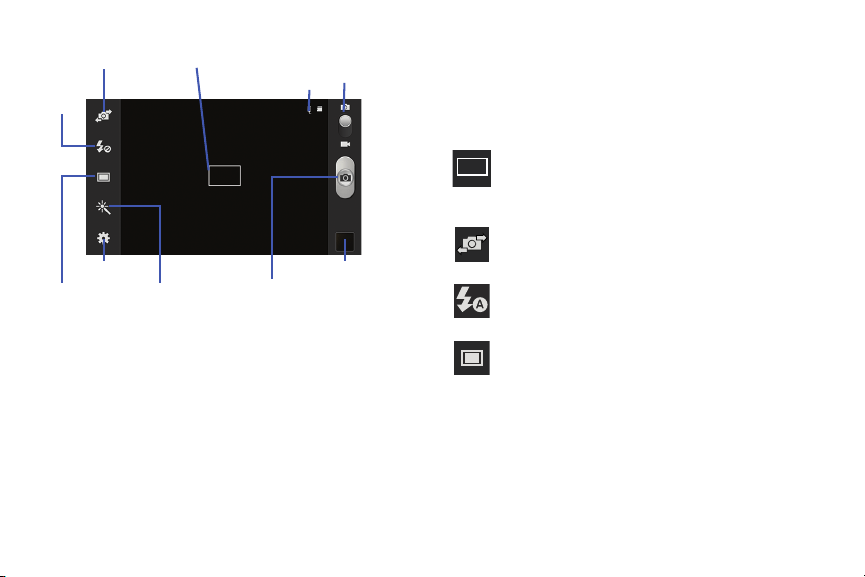
Self-portrait Fo
cus area Camera/Camcorder
Flash
Shooting
Settings Image viewer
mode
Storage/Charge
Effects Camera/Camcorder
mode button
Camera Options
Options are represented by icons across both sides of the
screen.
The following shortcuts are available for the camera:
Focus area
: displays the area of the image used as the
main focus area.
If the image is too close, the square will turn red.
Self portrait
: allows you to set the front camera so you
can take pictures of yourself.
Flash
: allows you to set the flash options to Off, On, or
Auto flash.
Shooting mode
: allows you to set the shooting mode
to one of the following:
•
Single shot
: takes a single photo and view it
before returning to the shooting mode.
•
Best photo
: takes a series of photographs
simultaneously, then allows you to
cycle through
the available thumbnails and choose the best
photo to keep. Tap
Done
to select the photo.
Multimedia 142
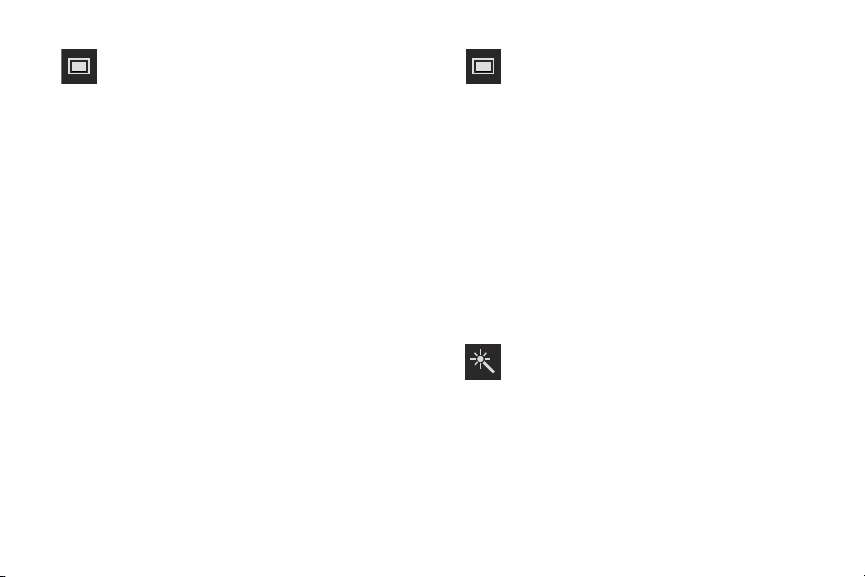
Shooting mode (continued):
•
Best face
: takes a series of photographs
simultaneously, then allows you to cycle through
the available thumbnails and choose the best
photo showing the subject’s best face. Tag
subject from the image, tap a desired image, and
select
Save
to store the photo.
•
Sound & shot
: Use this mode to enrich pictures by
adding background sounds for a few seconds.
The background sound is recorded for up to
9 seconds after taking the photo.
•
Face detection
: adjusts the camera focus based
on face detection technology.
•
Panorama
: takes a landscape photo by taking an
initial photo and then adding additional images to
itself. The guide box lets you view the area
where the second part of the panoramic picture
should fall within.
•
Share shot
: uses Wi-Fi Direct to share your
pictures quickly with your friends.
For more
in
formation, refer to “Enabling Share Shot” on
page 154.
Shooting mode (continued):
•
HDR
: takes pictures in HDR (High Dynamic
Range) mode to increase image detail.
•
Buddy photo share
: uses face recognition from
pictures in your contacts to send your friends or
family pictures of themselves.
•
Beauty
: adjusts the contrast to smooth facial
features.
•
Smile shot
: the camera focuses on the face of
your subject. Once the camera detects the
person’s smile, it takes the picture.
•
Low light
: adjusts the aperture and light settings
to take better images in low light conditions.
Effects
: allows you to change the color tone or
apply special effects to the photo. Options include:
No effect, Cold vintage, Warm vintage, Posterize,
Solarize, Green point, Blue point, Red-yellow
point, Washed out, Cartoonify, Black and white,
Sepia, and Negative.
143
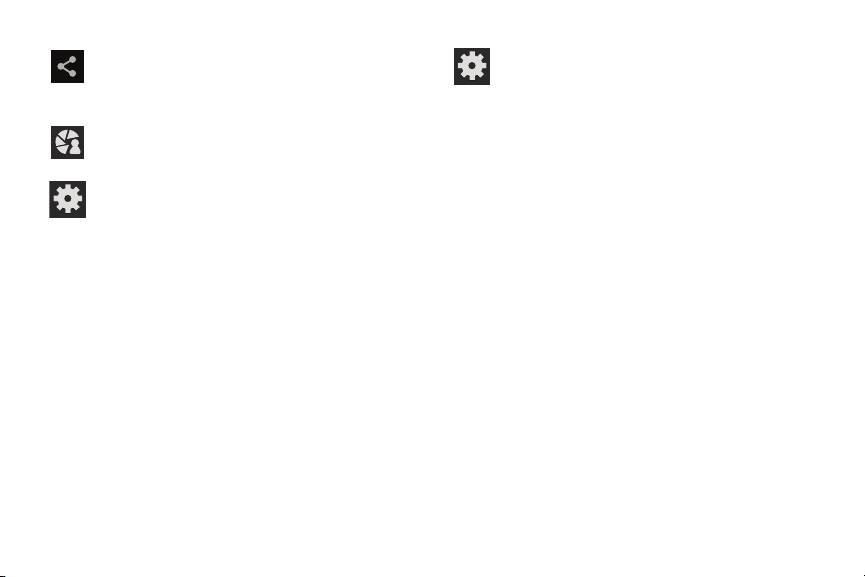
Share shot - Share with
: tap to display the current
participants sharing images with you via an active
Wi-Fi Direct Share shot session.
Share shot - Shooting mode
: lists the current shooting
modes available from with the Share Shot mode.
Settings:
Edit shortcuts
: allows you to set shortcut icons for the
settings that you use the most.
Use the volume key as
: allows you to s et the volume
button to function as either a zoom key or
camera key.
Burst shot
: allows several photographs to be captured
in quick succession by touching and holding the
Camera button.
GPS tag
: allows you to turn GPS On or Off (also known
as Geo-tagging). The location of where the picture
is taken is attached to the picture.
Self-portrait
: allows you to set the front camera so
you can take pictures of yourself or video chat.
Settings (continued):
Flash
: allows you to set the flash options to Off, On, or
Auto flash.
Shooting mode
: allows you to set the shooting mode.
For more information, see Shooting mode
description.
Effects
: allows you to change the color tone or apply
special effects to the photo. Options include:
No effect, Cold vintage, Warm vintage, Posterize,
Solarize, Green point, Blue point, Red-yellow
point, Washed out, Cartoonify, Black and white,
Sepia, and Negative.
Scene mode
: allows you to set the Scene to help take
the best pictures possible. Options include None,
Portrait, Landscape, Sports, Party/Indoor,
Beach/Snow, Sunset, Dawn, Autumn Color, Text,
Candlelight, Firework, Backlight, and Night.
Helpful tips are shown for each scene mode at the
bottom of the display screen.
Exposure value
: allows you to adjust the brightness
level by moving the slider.
Multimedia 144

Settings (continued):
Focus mode
: allows you to set this option to Auto
focus or Macro. Use Auto focus for all other focal
situations.
Timer
: allows you to set a timer for how long to wait
before taking a picture. Options include: Off, 2 sec,
5 sec, and 10 sec.
Resolution
: allows you to set the image size to either:
8M (3264x2448), W6M (3264x1836),
3.2M (2048x1536), W2.4M (2048x1152),
W0.9M (1280x720), or 0.3M (640x480).
White balance
: allows you to set this option to one of
the following choices: Auto, Daylight, Cloudy,
Incandescent, or Fluorescent.
ISO
: ISO determines how sensitive the light meter
is on your digital camera. Choose from Auto, 100,
200, 400, or 800. Use a lower ISO number to
make your camera less sensitive to light, a higher
ISO number to take photos with less light, or
Auto to let the camera automatically adjust the ISO
for each of your shots.
Settings (continued):
Metering
: allows you to set how the camera
measures or meters the light source:
Matrix, Center-weighted, or Spot.
Auto contrast
: provides a clear image even under
backlight circumstances where intensity of
illumination can vary excessively.
Guidelines
: allows you to turn the guidelines On or Off.
Auto share shot
: allows you to make share shot an
automatic action.
Anti-shake
: compensates for camera movement.
Shutter sound
: allows you to set the Shutter sound to
On or Off.
Contextual filename
: (requires GPS tagging) allows
you to adjust the filename based on contextual
information such as your current GPS location.
145
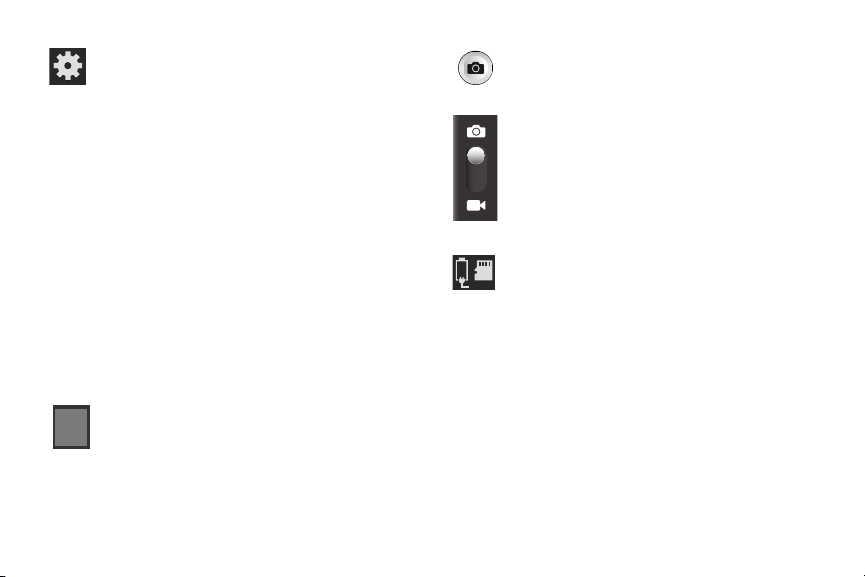
Settings (continued):
Voice control
: allows you to use your voice to take a
new photo vs tapping the Camera button.
activate the camera function then uses commands
such as “Capture”, “Shoot”, “Smile”, or “Cheese” to
take the new photo.
Save as flipped
: allows you to automatically save
a new images as
a mirror image “flipped” of the
original.
Image quality
: allows you to set the image quality to:
Superfine, Fine, or Normal.
Storage
: allows you to configure the default storage
location for images or videos as either Device or
Memory card (if inserted).
Reset
: allows you to reset all camera or camcorder
settings to the default values.
Image viewer
: allows you to access the Image
viewer and the various viewing options for a
selected picture. The last picture you took, will be
displayed as a thumbnail in the Image viewer icon.
Camera button
: takes a photo when pressed in
Camera mode.
Camera Mode
: allows you to take a photo in various
modes. Once you change the mode, the
corresponding indicator appears at the
top left of the display. Slide the button up for Camera,
or down for Camcorder.
Connection Status/Storage location
: indicates the
device is connected to an adapter and the current
storage location for images (Device or Memory card)
on the device.
Multimedia 146
Pictures and Videos Image Viewer Options
After you take a photo or record a video, you can access
various options.
Photo viewing options
1. Tap a thumbnail to view the picture.
Note:
If no control icons are displayed on the screen in
addition to the picture, tap anywhere on the screen to
display them.
2. The following options are available at the top of the
screen:
• Change player
: allows you to select a different
AllShare/Samsung Link device from your available list.
•Share via
: allows you to share the picture via ChatON,
Group Play, Add to Dropbox, Bluetooth, Email, Flipboard, Gmail,
Google+, Hangouts, Messaging, PEN.UP, Picasa, S Note, or
Wi-Fi Direct.
•Edit
: allows you to edit the current image. Choose from
either Photo Editor or Paper Artist.
• Delete
: allows you to delete the current picture.
3. Press for additional options such as:
–
Favorites
: allows you to assign the current image as a favorite.
–
Slideshow
:
allows you to see your photos in a slideshow.
–
Photo frame
: takes the current image and creates a
surrounding photo frame that can be edited with edited text or
drawn object, then saved.
–
Photo note
:
allows you
to write notes on your current image
and then save it.
–
Copy to clipboard
allows you to copy one or more pictures to a
different folder.
–
Print
: allows you to print the current image on a compatible
Samsung printer.
–
Rename
: allows you to rename the current file.
–
Buddy photo share
: allows you to share the current image
with active ChatON buddies.
–
Rotate left
: allows you to rotate the view of the current image in
a counterclockwise direction.
–
Rotate right
: allows you to rotate the view of the current image
in a clockwise direction.
147
–
Crop
: provides an on-screen box that allows you to crop the
current picture. Tap
Done
to update the image with the new
dimensions or tap
Cancel
to ignore any changes.
–
Set as
: allows you to assign the current image as a Contact
photo, Home screen, Lock screen, or Home and lock screens.
–
Details
: files details such as Title, Type, Date, Album, Size,
Resolution, Orientation, Manufacturer, Model, Flash, Focal
length, White balance, Aperture, Exposure time, ISO, and Path.
–
Settings
: provides access to the Gallery options menu. Choose
from SNS data management, Tags, and Sound & shot.
Video viewing options
Note:
If no control icons are displayed on the screen in
addition to the picture, tap anywhere on the screen to
display them.
1. Tap a video to select it.
2. Tap
to play the video.
– or –
Select any of these on-screen options:
•Share via
: allows you to share the picture via ChatON,
Add to
Dropbox, Bluetooth, Email, Gmail, Google+,
Messaging,
Picasa, S Note, Wi-Fi Direct, or YouTube.
•Trim
: activates the Trim feature so that you can edit the
length of the current video.
• Delete
: allows you to delete the current picture.
3. Press for additional options.
Multimedia
148
.
Using the Camcorder
In addition to taking photos, the camera also doubles as a
camcorder that also allows you to record, view, and send
high definition videos.
Note:
To ensure the Camcorder can record the video, use an
SDHC memory card.
Shooting Video
Tip:
When shooting video in direct sunlight or in bright
conditions, it is recommended that you provide your
subject with sufficient light by having the light source
behind you.
(
Apps
)
(
Camera
) to activate the camera mode.
1. From the Home screen, tap
2. Tap and slide the Camera mode button down to
Camcorder
Mode.
3. Using the device’s main display screen as a viewfinder,
adjust the image by aiming the camcorder at the
subject.
Note:
Use either the Up and Down volume keys or spread/
pinch the screen to zoom in or out.
For m
ore
info
rmation, refer to “Navigating Through the Screens”
on page 43.
4.
Tap the Video key ( ) to begin shooting video. The
red light will blink while recording.
5. Tap anywher
e on the screen to re-focus the camera on
that object. The camcorder auto-focuses on the new
target area.
6.
Tap the screen
then select
to turn on auto focus.
This will
automatically focus the video based on the
object at the middle of the screen.
7.
To captur
e an image from the video while recording,
tap
This feature is not available while the
anti-shake feature is activated.
(
Stop
) to stop the recording and save the
video file to your Camera folder.
8. Tap the
9. Once the file has been saved, tap the image viewer,
then tap (
Play
) to playback your video for review.
10.
Press to return to the viewer.
149

Camcorder Options
You can change options using your keypad in capture mode.
The following short cuts are available:
Self portrait
: allows you to activate the front facing
camera so you can take videos of yourself or video
chat.
Flash
: allows you to set the flash options to Off or On.
When you set the flash to On, it stays on continually
while you are taking a video.
Recording mode
: allows you to set the recording
mode to: Normal, which is limited only by available
space on the destination location, Normal,
Limit for MMS (which is limited by MMS size
restrictions), Slow motion (adds a slow motion effect
to your video), or Fast motion (adds a fast motion
playback effect to your current video).
Effects
: allows you to change the color tone or
apply special effects to the video. Options include:
No effect, Cold vintage, Warm vintage, Posterize,
Solarize, Green point, Blue point, Red-yellow point,
Washed out, Cartoonify, Black and white, Sepia, or
Negative.
Multimedia
150
Settings:
Edit shortcuts
: allows you to set shortcut icons for the
settings that you use the most.
Use the volume key as
: allows you to set the volume
button to function as either a zoom key or
camera key.
GPS tag
: allows you to turn GPS On or Off (also
known as Geo-tagging). The location of where the
video is shot is attached to the file.
Self-recording
: allows you to set the front camera so
you can take videos of yourself or video chat.
Flash
: allows you to set the flash options to Off or On.
When you set the flash to On, it stays on continually
while you are taking a video.
Recording mode
: allows you to set the recording mode
to:
•
Normal
: is limited only by available space on the
destination location.
•
Limit for MMS
: is limited by MMS size
restrictions.
•
Slow motion
: applies a slow motion video effect.
•
Fast motion
: applies a fast motion video effect.
Settings (continued):
Effects
: allows you to change the color tone
or apply
special effects to the video. Options
include:
No effect, Cold vintage, Warm vintage, Posterize,
Solarize, Green point, Blue point, Red-yellow point,
Washed out, Cartoonify, Black and white, Sepia, or
Negative.
Exposure value
: allows you to adjust the brightness
level by moving the slider.
Timer
:
allows you to set a timer for how long to wait
before taking a video. Options include: Off, 2 sec,
5 sec, and 10 sec.
Resolution
: allows you to set the image size to either:
1920x1080, 1280x720, 720x480, 640x480, or
320x240.
White balance
: allows you to set this option to one
of the following choices: Auto, Daylight, Cloudy,
Incandescent, or Fluorescent.
151
Settings (continued):
Guidelines
: allows you to turn the guidelines On or Off.
Anti-shake
: reduces image blur due to the movement
of the subject of the video or hand movement.
Contextual filename
: (requires GPS tagging) allows
you to adjust the filename based on contextual
information such as your current GPS location.
Save as flipped
: allows you to automatically save
a new video as a mirror image “flipped” of the
original.
Video quality
: allows you to set the image quality to:
Superfine, Fine, or Normal.
Storage
: allows you to configure the default storage
location for images or videos as either Device or
Memory card (if inserted).
Reset
: allows you to reset all camera or camcorder
settings to the default values.
Image viewer
: allows you to access the Image
viewer and the various viewing options for a
selected video. Image viewer options are
described in the following section. The last video
you took, will be displayed as a thumbnail in the Image
viewer icon.
Camcorder button
: shoots or stops video recording
when pressed in Camcorder mode.
Live Shooting
: takes a photo during a video
recording session in Camcorder mode.
Note:
This feature is not functional when the
Anti-shake feature is activated.
Camcorder Mode
: allows you to shoot video.
Slide the button up for Camera mode or down for
Camcorder mode.
Multimedia 152
Connection Status/Storage location
: indicates the
device is connected to an adapter and the current
storage location for videos (Device or Memory card)
on the device.
Sharing Pictures
Pictures are the best way of remembering the moment, but
an even better treat is to share them with others.
Two new features allow you to either instantly share a series
of pictures as they are taken or quickly share a picture
without using email or messaging.
•
Share Shot
is a great way to instantly share a series of pictures
among a group of users. The best example for this feature is
having multiple users instantly sharing each others pictures at a
company or family gathering. As each person takes a separate
picture with their own device, they are all pooled together and
instantly appear in each user’s Gallery.
No more “Email your pictures to me later”. Each person walks out
of the event with all the pictures taken by everyone.
This method of image transfer requires that both devices have
Wi-Fi Direct active and be paired prior to use.
Note:
You can only share a shot with other external users who
also have their Wi-Fi Direct feature active.
•
S Beam Transfer
uses the NFC (near Field Communication)
feature found on your device to transmit large files directly to
another compatible device by
direct touch
.
This method of image transfer requires NFC and S Beam to be
enabled prior to use.
For more information, refer to
“Using S Beam to Share
Pictures”
on page 156.
153
Enabling Share Shot
Share shot is a Wi-Fi Direct group sharing feature where
multiple users can Wi-Fi connect their devices and then all
share each others pictures in real-time. This is really useful
in group events (ex: family gathering or company party)
where you don’t want to have to email everyone later and
make sure you all can share your pics at a later date.
For more information, refer to “Wi-Fi Direct Setup and
Settings” on page 246.
The general process is:
•
Enable Wi-Fi Direct communication
•
Pair your device with other users
•
Enable Share shot
To enable Wi-Fi Direct:
Impor
tant!
The target device must already be connected to the
same Wi-Fi and have its Wi-Fi Direct feature active
and scanning before you can your pairing.
1. From the main
Settings
page, tap
Connections
tab.
2. In a single motion touch and slide the
Wi-Fi
slider to the
right to turn it on. The slider color indicates the
activation status.
3. Tap
Wi-Fi Direct
.
4. Tap
Scan
and select the single device name to begin
the connection process to another Wi-Fi Direct
compatible device.
– or –
Tap
Multi-connect
Scan
and select all the device
names to begin the connection process to these Wi-Fi
Direct compatible devices.
Note:
The target device must also have Wi-Fi Direct service
active and running before it can be detected by your
device.
5. Tap
Done
. The direct connection is then established.
Confirm
appears in the Status bar.
6. When prompted to complete the connection, the
recipient should tap
OK
. Your status field now reads
“Connected” and your connected device is listed within
the Wi-Fi Direct devices listing.
Multimedia
154
7. Each partner (including yourself) must then tap
Accept
to consent to the new Wi-Fi Direct pairing.
To enable Share shot on Camera:
1. From the Home screen, tap (
Camera
)
(
Shooting Mode
)
Share shot
.
2. If you are prompted to activate your Wi-Fi Direct
connection, tap
OK
and follow the activation
procedures for Wi-Fi Direct.
To configure your Share Shot options:
1. Confirm the Share Shot viewfinder is active (see
below).
2. Tap (
Devices for sharing with
) to display list of
current participants.
•
Stop sharing images with select participants by tapping their
entry and removing the green check mark.
3. Tap (
Shooting modes
) to display list of currently
available shooting modes from within Share Shot.
4. Tap (
Settings
) to disable share shot while
maintaining a Wi-Fi Direct connection.
To take share shot images:
1. Press (
Camera
) until the shutter sounds.
2. From the Home screen, tap (
Apps
)
(
Gallery
) to locate your newly shot images located in
their default ShareShot storage location.
•
External users will be able to locate their images in either a
downloaded or
RECV
(received) folder.
3. Confirm (
Share shot images delivered/received
)
appears in the Notifications area of the screen.
155

Using S Beam to Share Pictures
This feature (when activated via NFC) allows you to beam
large files directly to another compatible device that is in
direct contact. These files can be larger, such as Videos, HD
pictures, and other large files.You can beam images and
videos from your gallery, music files from your music player,
and more.
1. From the main
Settings
page, tap
Connections
tab.
2. If not already active, in a single motion touch and slide
the
NFC
slider to the right to turn it on.
3. Tap
S Beam
and make sure the feature is turned on.
4. If not already active, in a single motion touch and slide
the
S Beam
slider to the right to turn it on.
5. On the source device (containing the desired image or
video), tap (
Apps
) (
Gallery
).
6. Locate and tap the selected image to open it in the
preview window.
Important!
Neither device must be in Lock mode or displaying
the Lock screen. They must both be active and
unlocked. It is recommended that the target device
be on the Home screen.
7. Place the two active NFC-enabled devices back to back
to begin.
Note:
If the
Touch to beam
screen does not appear on the
source device:
- Pull them apart
- Verify the image is visible in the preview window on
the source device (providing the file)
- Place them together again
8. Fr
om the
Touch to beam
screen, tap the reduced image
preview to begin the transfer. After a few seconds
(depending on file size) the recipient with then see the
transferred file displayed on their screen.
Multimedia 156
To share multiple pictures via S Beam:
1. On the source device (containing the desired image or
video), tap (
Apps
) (
Gallery
).
2. Locate the selected folder.
3. Touch and hold the first image and place a check mark
on it and all desired images.
4. Place the two active NFC-enabled devices back to back
to begin.
5. From the
Touch to beam
screen, tap the reduced image
preview to begin the transfer.
6. When prompted, separate the two devices.
Camera Gallery Options
The Gallery is where you can access the Gallery of stored
camera images.
1. From the Home screen, tap (
Apps
)
(
Gallery
).
2. Select a folder location (ex:
Camera
) and tap an image
to open it.
– or –
Touch and hold an image to place a checkmark on the
file and select multiple files.
– or –
Tap the upper-right camera to begin taking pictures
that are placed in this folder.
– or –
Tap the on-screen image to use additional image menu
options.
157
Sharing a Gallery Image to a Target Device
Important!
Make sure all communicating devices are
connected to the same Wi-Fi.
1. Launch Samsung Link on the target device (such as an
Internet TV, Samsung Tablet, etc..).
2. From the Home screen, tap (
Apps
)
(
Gallery
).
Note:
You must be signed in to your Samsung Account before
you can use this feature.
3. Open a selected image.
4. Tap (
Stream to connected devices
) and select an
available target device to begin streaming.
5. On a target device (ex: Internet TV) select the
on-screen
Allow
button to continue.
Note:
At this stage your device is requesting access to share
media with the external source.
6. Confirm (
AllShare Controller enabled
) appears in
the Notification area at the top of the device to indicate
you are using your device as the media source.
Taking a Screen Shot
Also known as a screen capture, this feature allows you to
mimic the print screen function on most computers.
1. From the main
Settings
page, tap
My device
tab
Motion
.
2. In a single motion touch and slide the
Motion
slider to
the right to turn it on.
3. Tap the desired on-screen motion option.
4. Although enabled by default, enable the
Palm swipe to
capture
field by placing a check mark in the adjacent
field.
5. With the current screen showing the desired image, in
a single motion, place the side of your palm along the
one side of the device and then slowly swipe it in the
opposite direction over the screen.
Multimedia 158
Assigning an Image as a Contact Photo
1. From the Home screen, tap (
Apps
)
(
Gallery
).
2. Select a folder location and tap a file to open it.
3. With the image displayed, press and then tap
Set as
Contact photo
.
4. Tap a contact to make a selection.
5. Use the on-screen crop the image by dragging it
around or out from its corners.
6. Tap
Done
to store the new image.
Assigning an Image as a Wallpaper
1. From the Home screen, tap (
Apps
)
(
Gallery
).
2. Select a folder location and tap a file to open it.
3. With the image displayed, press and then tap
Set as
.
4. Select one of the these options:
• Home screen
assigns the current image to the home screen
background. This image is spread across all available screens.
• Lock screen
assigns the selected image to the background for
the lock screen.
• Home and lock screens
assigns the current image to both the
Home screen and Lock screens.
5. Touch and drag the crop box anywhere on the picture.
Touch and drag the sides of the crop box to zoom in or
out to create a cropped area.
6. Tap
Done
to assign the wallpaper image.
– or –
Tap
Cancel
to stop without updating the wallpaper
image.
159
The Gallery
The Gallery is where you view photos and play back videos.
For photos, you can also perform basic editing tasks, view a
slideshow, set photos as wallpaper or caller image, and
share as a picture message.
Note:
If the phone displays a memory full message when
accessing the Gallery, access
Files
and remove some of
the media files from the folders, and then open the
Gallery.
Opening the Gallery
From the Home screen, tap (
Apps
)
(
Gallery
). For more information, refer to “Camera
Gallery Options” on page 157.
Note:
If you stored your files in folders (directories) on the
storage card, Gallery displays these folders as separate
albums. The top left album contains all the pictures in
the storage card.
Viewing a Video within the Gallery
1. From the Home screen, tap (
Apps
)
(
Gallery
).
2. Locate your folder and video.
3.
Ta
p (
Play
) to playback your video.
For more information on using the Picture-in-Picture feature
for video playback,
see “Using Picture-In-Picture” on
pa
ge 221.
AllShare Cast Hub
This hardware allows you to enjoy what’s currently on your
device directly on your TV.
Note:
There is no need to be connected to a Wi-Fi network or
to be logged into your Samsung Account to use this
feature.
AllShare Cast Hub establishes a WI-Fi Direct connection
between the device and the hub.
For more information about this device, go to:
http://www.samsung.com/us/mobile/cell-phones-accessories/EAD-
T10JDEGSTA
Multimedia 160

Connecting AllShare Cast Hub
To connect your AllShare Cast Hub hardware:
Screen Mirroring
(with Hub
accessory)
This feature functions with an
external AllShareCast Hub to fully
mirror what is currently displayed on
your device to the external TV.
1. Connect the A
llShare Cast Hub to a power source via
the USB Travel Adapter.
Note:
The status LED begins to blink solid red to indicate
it has begun the start up process.
LED Color/Patterns Description
Red - Solid
Indicates the AllShare Cast Hub is
booting or processing.
Red - Blinking
Indicates the AllShare Cast Hub is in
standby mode (ready for connection).
Blue - Solid
Indicates the AllShare Cast Hub is
ready to be connected with a new
device.
2. Connect your TV to the AllShare Cast Hub via an HDMI
cable (A-to-A cable).
3. Change the source input on your TV to match the input
port used by the incoming HDMI cable.
Note:
The television screen should now display an on-screen
tutorial showing you how to configure your device’s
AllShare Cast Hub and device settings.
To activate Screen Mirroring on your device:
1. From the main
Settings
page, tap
Connections
tab
Screen Mirroring
.
•
If not already on, tap the
Screen Mirroring
and then
move the slider to the right to turn it on. The slider
color indicates the activation status.
161
Section 8: Applications and Development
This section contains a description of each application that is
available in the Apps Menu, its function, and how to navigate
through that particular application. If the application is
already described in another section of this user manual,
then a cross reference to that particular section is provided.
Note:
This manual only addresses applications that have been
loaded on your [device/computer/tablet] as of the date
of purchase. Information concerning third party
applications that you may choose to download from the
Google Play Store or otherwise should be obtained from
the application provider directly.
Tip:
To open applications quickly, add the icons of
frequently-used applications to one of the Home screens.
For more information, refer to “Customizing the Screens”
on page 36.
You can also add an application icon as a Primary
Shortcut that will display on all Home screens. If you add
an application as a primary shortcut, the application icon
will not be displayed in the Apps menu.
Applications
The Applications list provides quick access to all the
available applications on the device.
The Application menu provides quick access to the most
frequently used applications. Applications display on each of
the three panels on the Applications screens.
Important!
Once you log into your Google account. All
previously downloaded apps should now be
populated within the Application screens.
Application Screen Menu Settings
When on the Apps screen, the following menu options are
available:
1. Press
and then tap
(
Apps
).
2. Press and then select from the following options:
•Play Store
: provides quick access to the Play Store (page 205).
•Edit
: allows you to organize your current applications by moving
them around the screen, edit or delete existing App folders.
Applications and Development 162
• Create folder
: allows you to create an application folder where
you can better organize and group desired apps.
• Uninstall
: allows you to uninstall a user-downloaded
application. Only those applications that are not default to the
device can be downloaded. Tap
to remove the selected
app.
•View type
: allows you to customize the way the Apps menu
listing is shown.
• Share apps
: allows you to share information about selected
applications with external users.
• Hide applications
: allows you to specify which current
applications are hidden from view in this menu. Once you have
selected the apps, tap
Done
.
• Show hidden applications
: allows you to specify which
previously hidden applications are can be made visible again
for viewing in this menu. Once you have selected the apps, tap
Done
.
3. Press to return to the Home screen.
Accessing Recently-Used Applications
1. Press and hold from any screen to open the
recently-used applications window.
2. Tap an icon to open the selected application.
– or –
Tap
to go to the Task manager.
– or –
Tap
to go to Google Search.
– or –
Tap
to delete the record of all recently used
applications.
Shutting Down an Currently Active Application
Press and hold (
Home
) and then tap (
Task
manager
).
1.
2. From the
Active applications
tab, tap
End
to close
selected applications.
– or –
Tap
End all
to close all background running
applications.
163
Task Manger Overview
Press and hold (
Home
) and then tap (
Task
manager
). This screen contains the following tabs:
–
Active applications
display those currently active applications
running on your phone.
–
Downloaded
displays any installed packages or applications
from the Play Store that are taking up memory space. Tap
Uninstall
to remove them from your phone.
–
RAM
, which displays the amount of current RAM (Random
Access Memory) currently being used and allow you to
Clear
Memory
.
–
Clear defaults
allows you to clear the current default
applications.
–
Storage
displays a visual graph indicating the available and
used space within the System storage and external SD card.
–
Help
provides on-screen Help information.
Amazon
This mobile application provides a user with access to the
online Amazon website.
1. From the Home screen, tap (
Apps
)
(
Amazon
).
2. Log in to the site and follow the on-screen instructions.
Calculator
Using this feature allows you to use your device as a
calculator. The calculator provides the basic arithmetic
functions; addition, subtraction, multiplication, and division.
You can also use this as a scientific calculator.
1. From the Home screen, tap (
Apps
)
(
Calculator
).
2. Enter the first number using the numeric keys.
3. Enter the operation for your calculation by tapping the
Plus, Minus, Multiplication,
or
Division
key.
4. Enter the next number.
5. To view the result, tap the
= (equals)
key.
6. Repeat steps 1 to 4 as many times as required.
Applications and Development 164
Note:
Place the screen in Landscape mode to reveal additional
scientific functions.
Calendar
With this feature, you can consult the calendar by day, week,
or month, create events, and set an alarm to act as a
reminder. Google Calendar is built into the phone and
synchronizes both new and existing entries between your
phone and your online Google account.
Important!
You should previously add an account (Facebook,
Microsoft Exchange ActiveSync, or Google) prior to
using the Calendar.
(
Apps
)
(
Calendar
). The following tabs are available on
the right side of the display:
1. From the Home screen, tap
•Year
: displays the Year view.
•Month
: displays the Month view.
• Week
: displays the Week view.
•Day
: displays the Day view.
•List
: displays the events in a List view.
•Task
: allows you to search for tasks.
2. Tap (
Create event
) to create a new Calendar
event.
– or –
Tap
Today
to display the current date indicated by a
blue box, then press
and select one of the
following options:
•Go to
: displays a specific date.
•Delete
: allows you to delete All events, All events before today,
or an individual event.
•Search
: allows you to search within your current events.
•Sync
: synchronizes your current calendar events with your
available accounts (such as Gmail, Microsoft Exchange
ActiveSync, etc..).
•Calendars
: synchronizes your current calendar events with
your available accounts (such as Gmail, Microsoft Exchange
ActiveSync, etc..).
• Settings
: displays a list of configurable settings.
165
.
Creating a Calendar Event
1. From the Home screen, tap (
Apps
)
(
Calendar
).
2. Within the Year, Month, Week, and Day tabs, tap
(
Create event
).
Writing On a Calendar
1. From the Home screen, tap (
Apps
)
(
Calendar
).
2. Tap (
Markup Calendar
) to access the calendar’s
handwriting functions. Here you markup on the
on-screen calendar, erase markups, go forward/back
in your actions history, add a new event, or go back to
normal function.
3. Make your marks on the calendar as an image.
4. Tap (
Save
) to return to the normal calendar
function.
Calendar Settings
Using the Calendar settings you can select the day with
which you want the calendar to begin. You also select how
you want to view the calendar, by Month, Week, or Day or
determine how to manage events, notifications, sounds, and
defaults reminders.
1. From the Home screen, tap (
Apps
)
2.
Press
Settings
.
3. Ta
p
View styles
and select an option.
•
Tap
Month view styles
and select an option.
•
Tap
Week view
and select a type.
4. Tap
First day of week
and select either
Locale default,
Saturday, Sunday
or
Monday
.
5. Tap
Hide declined events
to activate this option. A check
mark indicates selection.
6. Tap
Lock time zone
(to lock event time based on your
current user-selected time zone). Select a time zone
from within the
Select time zone
field.
7. Tap
Show week number
to display the week numbers
along the side of the week entries.
Applications and Development 166
8. Tap
Set alerts and notifications
to adjust the event
notification method. Choose from:
Alert
,
Status bar
notification
, and
Off
.
9. Tap
Select ringtone
to assign a ringtone to a calendar
event notification.
10. Tap
Vibration
to assign a vibration notification to this
event.
11. Tap
Quick responses
to edit your default quick
responses for outbound emails. These are default
responses similar to those used by text templates.
Camera
Use your 8.0 megapixel camera feature to produce photos in a
JPEG format. The Camcorder shoots High Definition video in an
MP4 format.
Note:
A microSD card is no longer necessary before you take
pictures or shoot video.
It is recommended that you confirm your default storage
location for images and videos.
From the Home screen, tap (
Apps
)
(
Camera
).
For more information, refer to “Using the Camera” on page 141.
ChatON
Provides a global mobile communication service where you
can chat with more than 2 buddies via a group chat, In this
service you can send pictures, videos, animation messages
(Scribbles), audio, Contacts, Calendar entries, and Location
information. Create special animated messages for your
friends using handwritten messages, text, photos,
background images and music.
1. From the Home screen, tap (
Apps
)
(
ChatON
).
2. Log in to the service and follow the on-screen
inst
ructions.
For mo
re information, visit:
https://web.samsungchaton.com
.
167
Registering with the Service
1. Confirm you have already logged in to your Samsung
account.
2. From the Home screen, tap (
Apps
)
(
ChatON
).
3. If prompted to connect via a mobile network, tap
Connect
.
4. Select either the
Terms and conditions
or
Privacy policy
and read the on-screen information. Tap
Accept
to
continue.
5. Select a country code, enter your current phone
number to register with the service, and tap
Register
.
6. Choose to receive the verification code via either
SMS
(text message) or
Voice
(answering machine call) to
your device.
Note:
If you opt to receive the verification code via SMS, this
information is sent directly to your device. Once received
and opened, the
Verification
field is automatically filled
in.
7. Enter the verification code and tap
Next
.
8. From the Contact sync screen, decide if you wish to
include SIM contacts to your buddies list and tap
OK
.
9. Enter your real name and tap
Done
.
10. Tap
Sign in
to log into your Samsung account
– or –
Tap
Not now
to continue without logging in.
Adding Your First Chat On Buddy
1. From the
ChatON
application screen, tap (
Add
buddy
) and choose a search method.
• Suggestions
: provides a list of suggested buddies that you
might know.
• Tell friends
: to send current buddies a download link so that
they can then install ChatON.
• Phone number
: to search by Country code and phone number.
• Search by ID
: to search by using a known Samsung account
ID.
2. Select a country code if it differs from yours.
3.
Enter the information and tap (
Search
). Once the
recipient is matched, their entry appears in the
Results
area.
Applications and Development 168
4. Tap (
Add
) and confirm your new buddy appears
in the Buddies tab.
Using ChatON for Chatting
1. From the
ChatON
application screen, tap the Buddies
tab.
2. Select a buddy by tapping the Chat image to initiate
your chat.
3. Enter your message using the on-screen text entry
method.
4. Tap (
Send
).
To reply to a ChatON message:
1. While the chat session is active, tap the
Enter message
field and then type your reply message.
2. Compose your reply.
Your texts are colored Blue and your buddy’s messages
are white.
3. Tap (
Send
) to deliver your reply.
Deleting a single message bubble
1. From the
ChatON
application screen, launch a chat
session to reveal the message string.
2. Touch and hold a message bubble, then select
Delete
.
Chrome
The Google Chrome app allows you to use the Google
Chrome Web browser on your device.
1. From the Home screen, tap
(
Apps
)
(
Chrome
).
2. Read the Google Chrome Terms of Service and tap
Accept and Continue
.
3. If you have an existing Chrome account, tap
Sign in
to
bring your open tabs, bookmarks, and data from your
computer to your phone, otherwise tap
No thanks
.
4. Follow the on-screen instructions to use Google
Chrome.
169

Clock
Here you can set an Alarm, configure and view the World
clock, use a Stopwatch, set a Timer, or use a Desk Clock.
The applications display in a tabular format and quickly
accessed with the touch of a finger.
Setting an Alarm
1. From the Home screen, tap (
Apps
)
(
Clock
).
(
Create alarm
).2. From the
Alarm
tab, tap
3. Use the arrow symbols to enter adjust the hour, and
minutes, then tap
AM
or
PM
(toggles depending on
which was last selected).
4. Tap the
Alarm repeat
field and touch the number of
times you want this alarm to repeat. Selections are:
day blocks or
Repeat weekly
. Selected day blocks turn
blue when active.
5. Tap the
Alarm type
field and select one of the following:
Melody
,
Vibration
,
Vibration and melody
, or
Briefing
.
6. Tap the
Alarm tone
field and either select an available
tone or select
Add
to use locate a sound to use as an
alarm ringtone. Tap
OK
to activate the ringtone.
7. Slide the slider bar left or right in the
Alarm volume
field
to decrease or increase the alarm volume. A sample of
the volume level plays.
8. Move the
Location alarm
slider to the On position to
then use a map location to activate the alarm event.
Activating this feature causes the alarm to only be
activated if you are at the specified location.
•
Tap a location on the map or enter a location into the available
field.
•
Tap
Done
to store the new location.
9. Move the
Snooze
slider to the right to activate the
feature. Tap the field to assign a
Interval
time
(3 minutes, 5 minutes, 10 minutes, 15 minutes, or
30 minutes) and
Repeat
(1 time, 2 times, 3 times,
5 times, and 10 times).
•Interval
indicates the length of time the alarm will remain silent
between alarm notifications (snooze time).
•Repeat
indicates the numbers of snooze sessions that are
assigned to this alarm. How many times will the snooze silence
the alarm.
Applications and Development 170
10. Move the
Smart alarm
slider to the right to activate this
feature which slowly increases screen brightness and
the volume of nature tones to simulate dawn breaking.
Tap the field to assign a interval time (1 minute,
3 minutes, 5 minutes, 10 minutes, 15 minutes, or
30 minutes) and nature tone (Fairy fountain, Birdsong
by the lake, Sparkling mist, The secret forest, Serenity,
or Gentle spring rain).
•Interval
category describes the length of time the alarm will
remain silent between alarm notifications (snooze time).
•Tone
category provides one of several nature sounds that are
used as the alarm tone.
11. Tap the
Name
field and enter a name for this Alarm.
12. Tap
Save
to store the new alarm event.
Turning Off an Alarm
To stop an alarm when it sounds, touch and slide
to any
direction.
Setting the Snooze Feature
To activate the Snooze feature after an alarm sounds,
touch and slide
to any direction. Snooze must
first be set in the alarm settings.
Note:
Pressing the volume key all the way down also snoozes
the alarm.
Deleting an Existing Alarm
1. From within the
Clock
application, touch and hold an
on-screen alarm event.
2. Tap
Delete
.
171

Using the World Clock
This feature allows you to find out what time it is another part
of world.
1. From within the
Clock
application, tap the
World clock
tab.
2. Tap
Add city
then scroll and select the desired city, or
tap in the search field to locate a city.
To assign DST settings:
1. Locate a desired city from the World clock list.
2. Touch and hold a city and select
DST settings
.
3. Select a DST setting (Automatic, Off, or 1 hour).
If Daylight Savings Time is selected, a sun symbol
appears next to the World Clock city listing.
Using the Stopwatch
This feature allows you to capture elapsed time while letting the
stopwatch keep running.
1. From within the
Clock
application, tap
Stopwatch
tab.
2. Tap
Start
to start the stopwatch counter.
3. Tap
Lap
to begin the lap time counter.
4. Tap
Stop
to stop the counter.
5. Tap
Restart
to restart the lap counter. You can have
multiple lap times.
6. Tap
Reset
to reset the counter.
Setting a Timer
1. From within the
Clock
application, tap
Timer
tab.
2. Tap the
Hours
,
Minutes
, or
Seconds
field and use the
on-screen keypad to enter the hour, minute, or
seconds. The timer plays an alarm at the end of the
countdown.
3. Tap
Start
to start the timer.
4. Tap
Stop
to stop the timer or
Reset
to reset the timer
and start over.
5. Tap
Restart
to resume the timer counter.
Applications and Development 172
Configuring a Desk Clock
This feature lets you activate an on-screen clock that can be
viewed when the device is docked.
1. From within the
Clock
application, tap
Desk clock
tab.
The default Desk clock is displayed.
Note:
You might have to scroll across the tabs to locate the
Desk clock tab at the far right.
and then tap
Settings
.
The following options are displayed while in full-screen
mode:
2. To make changes, press
•Calendar
: when this is checked, the calendar is displayed. Tap
to uncheck.
• Weather
: when this is activated, the location, temperature, and
weather condition is displayed. Touch and slide the slider to the
right to turn it on.
•Dock
: allows you to set your Dock settings such as Dock
sound, Audio output mode, Desk home screen display,
Automatic unlock, and Audio output.
Fo
r more information,
refer to
“Accessory”
on page 280.
3. Tap to display the Desk clock in full-screen mode.
4. To make changes in full screen mode, press
and
then tap:
• Edit shortcuts
: allows you to edit the shortcuts shown at the
bottom of full screen mode.
• Hide/Show shortcuts
: allows you to hide or view the current
on-screen shortcuts located along the bottom of the full screen
mode.
• Settings
: provides access to the Desk clock settings menu
from where you can alter the following: Hide status bar,
Wallpaper, Calendar, Weather, and Dock.
• Date and time
: provides access to the Date and time menu.
Contacts
The default storage location for saving phone numbers to
your Contacts List is your phone’s built-in memory.
From the Home screen, tap (
Apps
)
(
Contacts
).
For more information, refer to “Contacts List” on page 92.
173

Downloads
Provides quick access to tabs containing a list of your current
downloaded files (Internet and Other).
1. From the Home screen, tap
(
Apps
)
(
Downloads
).
2. Place a checkmark on an available file to select it.
3. Choose an available action such as Share, Delete, Sort
by size/date, or Clear list.
Dropbox
Works to provide access to your desktop files directly from
your device. This applications allows you to bring your files
with you when you're on the go, edit files in your Dropbox
from your device, upload photos and videos to Dropbox, and
share your selected files freely with family and friends.
The in-device application works in conjunction with a partner
program placed on a target computer using an active Internet
connection.
Dropbox creates a folder that automatically synchronizes its
contents across all of your connected devices on your
account. Update a file to your Dropbox on your computer, and
its automatically updated to the same folder on your other
devices.
Download the Desktop application
1. Use your computer’s browser to navigate to:
http://www.dropbox.com/
.
2. Follow the on-screen setup and installation instructions
on your target computer containing the desired files.
Important!
The computer application must be installed on the
computer containing the desired files. This
computer must have an active Internet connection.
Note:
It might be necessary to configure your router’s firewall
settings to allow this application to gain access to the
Internet.
Applications and Development 174
Accessing Dropbox on your Device
1. From the Home screen, tap (
Apps
)
(
Dropbox
)
Start
.
2. Tap
Sign in
, enter your current account credentials, and
tap
Sign in
.
– or –
Tap
Sign up for Dropbox
and follow the on-screen
instructions to register for a new account.
3. Follow the on-screen instructions.
4. Initially, you will need to configure your
Camera Upload
parameters. Choose from Wi-Fi only or Wi-Fi or data
plan.
•
Tap
Turn on Camera Upload
after making your selection.
Caution!
Enabling this feature can incur data charges
(depending on your plan) if the Wi-Fi or data plan is
selected.
(
Access Dropbox
) at the top of the application
window to access the files and folders you area
currently sharing from your computer.
5. Tap
Manually uploading a Picture to Dropbox
1. From the Home screen, tap (
Apps
)
(
Camera
).
2. After the image is taken, tap the Image Viewer box at
the bottom right. This previews the current image.
3. Tap the image to reveal the image options at the top of
the screen.
4. Tap (
Add to Dropbox
) select a folder
location and tap
Add
.
Note:
If your share folder is located on your computer, you will
momentarily receive an on-screen popup notifying you
that a new image was uploaded to your shared Dropbox
folder.
175
Drive
Also known as Google Drive, this application is a file storage
and synchronization service provided by Google. This service
enables user access cloud storage and enable file sharing.
1. Log into your existing Goolgle account.
2. From the Home screen, tap (
Apps
)
(
Drive
).
3. Follow the on-screen instructions to set up your drive.
Email
Email enables you to review and create email using most
email services. The device alerts you when you receive an
email message.
From the Home screen, tap (
Apps
)
(
Email
).
For more information, refer to “Using Email” on page 127.
Flipboard
This application creates a personalized digital magazine out
of everything being shared with you. Access news stories,
personal feeds and other related material. Flip through your
Facebook newsfeed, tweets from your Twitter account,
photos from friends and much more.
1. From the Home screen, tap (
Apps
)
(
Flipboard
).
2. Follow the on-screen instructions.
G+ Photos
This application provides a shortcut to the Photos tab inside
the Google+ app.
1. From the Home screen, tap (
Apps
)
(
G+ Photos
).
2. Follow the on-screen instructions.
Applications and Development 176

Gallery
The Gallery is where you view photos and play back videos.
For photos, you can also perform basic editing tasks, view a
slideshow, set photos as wallpaper or caller image, and
share as a picture message.
From the Home screen, tap (
Apps
)
(
Gallery
).
For more information, refer to “The Gallery” on page 160.
Gmail
Google Mail (Gmail) is a web-based email service. Gmail is
configured when you first set up your device. Depending on
your synchronization settings, Gmail can automatically
synchronize with your Gmail account on the Web.
From the Home screen, tap (
Apps
)
(
Gmail
).
For more information, refer to “Using Google Mail” on page
138.
Creating a New Google Account
You should create a Google
™
Account when you first use
your device in order to fully utilize the functionality. This
account provides access to several device features such as
Gmail
™
, Hangouts
™
, and the Google Play Store
™
applications. Before you are able to access Google
applications, you must enter your account information. These
applications sync between your device and your online
Google account.
Signing into Your Google Account
1. Launch an application that requires a Google account
(such as Play Store or Gmail).
2. Click
Existing
.
3. Tap the
Email
and
Password
fields and enter your
information.
4. Tap (
Sign in
). Your device communicates with
the Google servers to confirm your information.
5. If prompted, you can enable the option to stay up to
date on news and offers, then tap
OK
.
177
Opening Gmail
1. From the Home screen, tap (
Apps
)
(
Gmail
).
2. Tap an existing email message.
Google
Use Google Search to search the Web. Google Now
®
(a part
of the Google application) recognizes a user’s repeated
actions performed on the device (including access of
common locations, repeated calendar appointments, search
queries, etc.). This information is then used to display more
relevant information to the user in the form of “cards”. These
scrollable on-screen cards are displayed when the Google
Now application is launched.
These cards are not manually added. The service uses your
GPS, Google Search, and usage information to generate
these cards automatically.
From the Home screen, tap (
Apps
)
(
Google
) and enter the search text.
– or –
Tap on the Google Search bar and say the search
information.
To initially set up Google Now:
1. Press and hold (
Home
) and then tap
(
Google Now
).
– or –
From the Home screen, tap (
Apps
)
(
Google
) and enter the search text.
2. Follow the on-screen instructions to review the
available information.
3. When prompted, agree to launch the application. Some
initial on-screen “cards” are shown. A default is the
Weather card that provides updated weather
information in your area.
To configure the Google Now settings:
1. Press and hold (
Home
) and then tap
(
Google Now
).
2. Press and select
Settings
.
3. Access each desired Settings page and configure it as
des
ired.
When these condition are met, new card information will
begin to appear in the Google Now list of cards.
Applications and Development 178
Note:
Google Now will recognize searches and display them
on your device, even if that search took place on your
home computer or on another device. These searches
are linked into your Google Account.
Google Settings
As Google has become more intertwined with other
applications, this menu provides a quick and ready access
point to configure preferences for Google+, Maps & Latitude,
Location, etc.. You can also use the Search function to
initiate a Google Search from this menu.
1. From the Home screen, tap (
Apps
)
(
Google Settings
) and select an on-screen option.
2. Select one of the available on-screen options.
3. Follow the on-screen prompts.
Google +
Google+ makes messaging and sharing with your friends a
lot easier. You can set up Circles of friends, visit the Stream
to get updates from your Circles, use Messenger for fast
messaging with everyone in your Circles, or use Instant
Upload to automatically upload videos and photos to your
own private album on Google+.
1. Sign on to your Google account. For more information,
refer to “Creating a New Google Account” on page
177.
2. From the Home screen, tap (
Apps
)
(
Google+
).
3. Select the account you want to use to sign in to
Google+.
– or
–
Tap
Add account
to create another account.
4. Follow the on-screen instructions to use Google+.
5. Visit
www.google.com/mobile/+/
for more information.
Note:
Google+ instant upload may resize your images in order
to reduce size.
179
Group Play
This application lets you share documents, photos or music
in real-time with other connected friends.
Note:
Group Play is not the same as Screen mirroring which
requires a connection to a Wi-Fi capable Samsung TV or
via the use of the AllShare Cast Hub.
Important!
To share a Group Play, all users must be connected
to the same Wi-Fi access point.
(
Apps
)
(
Group Play
).
1. From the Home screen, tap
2. Read the on-screen Disclaimer and tap
Agree
.
3. Follow the on-screen tutorials.
Creating a group
If you have media you want to share, create a group for other
users to join to and then share/collaborate with what you are
sharing.
The creator of the group is the leader and it the source of the
shared file. All other joined members can then interact with
the file being shared.
1. Connect to an active Wireless Access Point and confirm
your other participants are also connected to this same
Wi-Fi.
2. From the Home screen, tap (
Apps
)
(
Group Play
).
3. Tap the
Set group password
field to enable the function
which requires users to enter a password prior to
connecting to your new group.
4. Tap
Create group
. If previously selected, enter your
group password and tap
OK
. Mobile AP is enabled.
5. Tap one of the media items listed under the
Share and
play content
heading.
6. Tap to select the items you want to share (indicated by
a checkmark), then tap
Done
or
OK
.
Applications and Development 180
7. Have your friends sign onto Group Play from their
devices (see below) and they can view your media
using you as a Mobile AP.
Joining a group
A joiner is the participant of an already created group. You
can only view and interact with media shared by the leader
of an existing group.
1. Connect to an active Wireless Access Point and confirm
your connection is this same Wi-Fi as the group leader.
2. From the Home screen, tap (
Apps
)
(
Group Play
).
3. Tap
Join group
. Your device then scans for available
groups for you to join.
4. Select a group to join. Once connected, you can then
select the shared content and interact with your
group’s shared media.
5.
Press and select
Help
for additional information.
Hangouts
Previously known as Google Talk™, is an updated place to
hangout, share photos, and even video calls. This is a free
web-based application for instant messaging offered by
Google. Conversation logs are automatically saved to a Chats
area in your Gmail account. This allows you to search a chat
log and store them in your Gmail accounts.
Note:
Before using this application, you must first have an
active Gmail account available and be currently
logged in.
1. From the Home screen, tap (
Hangouts
).
Note:
Make sure you are logged into your Google account.
2. When prompted, read the on-screen information and
tap
OK
.
3. Confirm your phone number is correct before using the
application. Tap
Confirm
.
Note:
Confirming your phone number does not make it publicly
available.
181
.
.
Help
Provides access to built-in Help information.
1.
2. Select an on-screen topic for m
ore information:
• Learning the basics
: provides help on topics such as Keys,
Unlock, Notifications, etc..
• Changing important settings
: provides basic information on
changing some device settings such as: Wi-Fi, Bluetooth, etc...
• Use key applications
: provides information on how to use key
applications such as: Phon, Contacts, Messaging, Internet, and
S Note.
• Product Videos
: provides access to online support videos.
• Help settings
: provides on-screen help tip po-ups.
Internet
Your device is equipped with a Google browser to navigate
the mobile Web. This section explains how to navigate the
browser and use the basic features.
Accessing the Internet
To access the Browser:
From the Home screen, tap (
Apps
)
(
Internet
).
Navigating with the Browser
1. Tap an entry to select an item.
2. Sweep the screen with your finger in an up or down
motion to scroll through a website.
3. To return to a previous page, tap
4. To move forward to a Web page, tap
Applications and Development 182
From the Home screen, tap (
Apps
)
➔
(
Help
).

Browser Options
1. From the top of the browser screen, select one of the
available options:
• Navigation
: use the forward and back buttons to navigate
through your browsing activity.
•Refresh
: reloads the current page.
•Windows
: displays a list of the windows you have open.
•Bookmarks
: provides access to the Bookmarks screen.
– or –
From the current page, press
to access the
following options:
•Home
: takes you to the currently assigned Home page.
•New window
: launches a new browser window. By default,
this screen shows the web2go home page.
•Add bookmark
: allows you to add a URL to your bookmark list.
• Add shortcut
: allows you to add a shortcut to your Home
screen.
•Share via
: allows you to share the page using Add to Dropbox,
Bluetooth, ChatON, Email, Flipboard, Gmail, Google+,
Hangouts, Messaging, S Note, or Wi-Fi Direct.
• Find on page
: allows you to search in the current page.
•Desktop view
: allows you to assign the browser to display the
current page in the desktop view (to closely mimic the display
as it would appear on a Desktop computer).
• Save for offline reading
: allows you to store the current page
in memory so that it can be read later even if you loose your
Internet connection.
•Brightness
: allows you to assign a brightness level specifically
for the browser window. This is independent of the brightness
assigned within the device’s Settings menu.
•Downloads
: displays the download history.
•Print
: provides print access on compatible Samsung printers.
• Settings
: allows you to change the way you view your web
pages by changing these options.
For more information, refer
to
“Browser Settings”
on page 188.
183
1. From your browser window, tap (
Window
)
(
New window
).
2. A new browser window displays.
Entering a URL
You can access a website quickly by entering the URL.
Websites are optimized for viewing on your phone.
To enter a URL and go to a particular website:
From the homepage tap the URL fie ld at the top of the
screen, enter the URL and tap
.
Note:
This is not the same application as the Google Search
Widget. The web2go screen can not be accessed via a
Wi-Fi connection.
Search the Internet
To perform an Internet search using keywords:
1. From within the Google search application, tap the
Google search field, enter the keyword(s) to search
using the on-screen keypad.
2. Tap the entry from the list of search results that are
displayed.
3. Tap a link to view the website.
Adding and Deleting Windows
You can several Internet windows open at one time.
To add a new window:
Note:
The number of currently open windows is displayed at
the bottom of the Windows screen.
3. Scroll across the screen to view the currently active
windows and tap an entry to launch the selected
Internet window.
To delete an existing window:
1. From your browser window, tap (
Windows
).
2. Scroll across the available windows and locate your
target window.
3. Tap
next to the listing to delete the window.
Applications and Development 184
1. From your browser window, tap (
Windows
).
2. Scroll across the available window
s and locate the
incognito window. The incognito icon
appears in
the
upper
-
left of the new browser window while you
are in this mode.
3. Tap
next to the incognito listing to delete this
window.
Using Bookmarks
While navigating a website, you can book
mark a
site to
quickly and easily access it at a future time. The URLs
(website addresses) of the bookmar
ked sites display in the
Bookmarks page. From the Bookmarks page you can also
view your Most visited websites and view your History.
Going Incognito
To exit from the incognito window:
Note:
The incognito icon appears in the upper-left of the new
browser window while you are in this mode.
1. From the webpage, tap
(
Bookmarks
).
The
Bookmarks
page displays. Additional pages
include
History
and
Saved pages
.
2. Press to display the follo
wing options:
The incognito feature allows you to view Internet sites
outside of the normal browsing. Pages viewed in this
incognito window won’t appear within your browser history
or search history, and no traces (such as cookies) are left on
your device.
185
Note:
Any downloaded files will be preserved and will stay on
your device after you exit the incognito mode.
To add a new incognito window:
1. From your browser window, tap (
Windows
) ➔
(
Incognito
).
2. A new browser window displays.

• List/Thumbnail view
: select
Thumbnail view
(default) to view
a thumbnail of the webpage with the name listed, or select
List view
to view a list of the bookmarks with Name and URL
listed.
•Create folder
: creates a new folder in which to store new
bookmarks.
• Change order
: rearranges the current bookmarks.
• Move to folder
: selected bookmarks are moved to a selected
folder.
•Delete
: erases selected bookmarks.
3. Tap a bookmark to view the webpage, or touch and
hold a bookmark for the following options:
•Open
: opens the webpage of the selected bookmark.
• Open in new window
: opens the webpage in a new window.
• Edit bookmark
: allows you to edit the name or URL of the
bookmark.
•Add shortcut
: adds a shortcut to the bookmarked webpage to
your phone’s Home screen.
• Share link
: allows you to share a URL address via Add to
Dropbox, Bluetooth, ChatON, Email, Flipboard, Gmail, Google+,
Hangouts, Messaging, S Note, or Wi-Fi Direct.
•Copy link URL
: allows you to copy the URL address to use in a
message.
• Delete bookmark
: allows you to delete a bookmark.
• Set as homepage
: sets the bookmark to your new homepage.
Adding Bookmarks
1. From the webpage, tap
Add bookmark
.
2. Use the on-screen keypad to enter the name of the
bookmark and the URL.
3. Select a storage location for your new bookmark.
4. Update the title of the Bookmark and confirm the URL.
5. Tap
Save
. The new save page now appears on the
Bookmarks page.
Applications and Development
186

Editing Bookmarks
1. From the Bookmarks page, touch and hold the
bookmark you want to edit.
2. Tap
Edit bookmark
.
3. Use the on-screen keypad to edit the name of the
bookmark or the URL.
4. Tap the
Location
field to assign a new folder location.
5. Tap
Save
or
Cancel
to exit the operation.
Deleting Bookmarks
1. From the Bookmarks page, touch and hold the
bookmark you want to delete.
2. Tap
Delete bookmark
.
3. At the confirmation window, tap
OK
.
Emptying the Cookies
A cookie is a small file placed on your phone by a website
during navigation. In addition to containing some site-
specific information, a cookie can also contain some
personal information (such as a username and password)
which might pose a security risk if not properly managed.
You can clear these cookies from your device at any time.
1. From an active Web page, press
and then tap
Settings
Privacy and security
Clear all cookie data
.
2. Tap
OK
to delete the cookies or tap
Cancel
to exit.
Using Web History
The History list displays a list of the most recently viewed
websites. These entries can be used to return to previously
unmarked web pages.
1. From the webpage, tap
History
tab.
2. Select a visited range category. Choose from: Today,
Yesterday, or Most visited.
3. Tap an entry to display the webpage.
– or –
Press
and then tap
Clear history
to delete the
current History list.
187

Using Save Pages
The Saved pages list provides you with a list of the websites
that you have saved.
1. From the webpage, tap
Saved pages
tab.
2. Tap an entry to display the webpage.
– or –
Pr
ess
and then tap
Clear saved pages
to delete
the current entries.
Browser Settings
To configure browser settings:
1. From the Home screen, tap (
Apps
)
(
Internet
).
2.
P
ress
and then tap
Settings
.
3. C
hoose an option from the following categories:
General:
• Set h
ome page
: sets the current home page for the Web
browser.
•Form auto-fill
: allows you to fill in Web forms with a single tap.
•Auto-fill text
: allows you to set the text used for the Web form
auto-fill feature.
Privacy and security:
• Clear cache
: deletes all currently cached data. Tap
OK
to
complete the process.
• Clear history
: clears the browser navigation history. Tap
OK
to
complete the process.
• Show security warnings
: notifies you if there is a security
issue with the current website. Remove the check mark to
disable this function.
• Accept cookies
: allows sites, that require cookies, to save and
read cookies from your device.
• Clear all cookie data
: deletes all current browser cookie files.
• Remember form data
: allows the device to store data from
any previously filled out forms. Remove the check mark to
disable this function.
• Clear form data
: deletes any stored data from previously filled
out forms. Tap
OK
to complete the process.
• Turn on location
: allows websites to request access to your
location.
• Clear location access
: clears location access for all websites.
Tap
OK
to complete the process.
Applications and Development 188

• Remember passwords
: stores usernames and passwords for
visited sites. Remove the check mark to disable this function.
• Clear passwords
: deletes any previously stored usernames or
passwords. Tap
OK
to complete the process.
• Turn on notifications
: enables notifications for all websites.
Select either: Always on, On demand (user driven), or Off.
• Clear notifications
: clears Web notification access for all
websites. Tap
OK
to complete the process.
Accessibility:
• For
ce zoom
: allows you to override a website’s zoom setting
and forces a zoom view.
•Text size
: allows you to manually adjust the size of the
on-screen text size (Scale text up and down), Zoom amount on
double tap, and minimum font size via the use of an on-screen
slider.
• Inverted rendering
: allows you to adjust the way a Web page
is displayed to make it easier to view or read. Enabling this
feature causes a page to rendered in reverse - Black becomes
white and vice versa. On-screen white text is displayed as
white text on a black background.
•Contrast
: allows you to adjust the on-screen contrast.
Note:
The Contrast feature is disabled until the Inverted
rendering function is active.
Advanced:
• Select search engine
: allows you to choose a default search
engine for your phone. Choose from:
Google
,
Yahoo!
, or
Bing
.
• Open in background
: new pages are launched in a separate
page and displayed behind the current one. Remove the check
mark to disable this function.
• Turn on JavaScript
: enables javascript for the current Web
page. Without this feature, some pages may not display
properly. Remove the check mark to disable this function.
• Allow multiple tabs per app
: allows you to use multiple
navigation tabs per application.
• Turn on plug-ins
: allows the download of plug-ins such as
Adobe Flash.
•Default storage
: sets the default storage to Memory card.
• Website settings
: view advanced settings for individual
websites.
•Default zoom
: adjusts the zoom feature. Set to Far, Medium, or
Close.
189

• Open pages in overview
: displays an overview of recently
viewed web pages.
• Auto fit pages
: allows web pages to be resized to fit as much
of the screen as possible.
• Block pop-ups
: prevents popup advertisement or windows
from appearing on-screen. Remove the check mark to disable
this function.
• Text encoding
: adjusts the current text encoding.
• Reset to default
: clears all browser data and resets all settings
to default.
Bandwidth management:
• Preload search results
: allows the browser to preload high
confidence search results in the background. If the device can
accurately guess your in progress search, it will preempt you by
beginning to load the matching Web page before you complete
the search request.
• Page preloading
: allows the browser to preload pages in the
background.
•Load images
: allows web page images to load along with the
other text components of a loaded website.
Labs:
• Quick controls
: allows you to enable on-screen quick controls
via the use of Swype thumb actions.
• Full screen
: allows Web pages to be resized to fit as much of
the screen as possible.
KNOX
Samsung KNOX is a comprehensive enterprise mobile
solution for use with both work and play. With the increasing
use of smartphones in businesses, Samsung KNOX
addresses the mobile security needs of enterprise IT without
invading the privacy of its employees. This application must
be downloaded to the device before use.
For more information, go to:
www.samsung.com/knox
.
1. From the Home screen, tap (
Apps
)
(
KNOX
).
2. Tap
Install
and read the on-screen Terms and
Conditions, agree to the terms and tap
Confirm
.
3. Follow the on-screen instructions.
Applications and Development
190
Maps
Google Maps allow you to track your current location, view
real-time traffic issues, and view detailed destination
directions. There is also a search tool included to help you
locate places of interest or a specific address. You can view
locations on a vector or aerial map, or you can view locations
at the street level.
Important!
Before using Google Maps you must have an active
data (3G/4G/LTE) or Wi-Fi connection. The Maps
application does not cover every country or city.
From the Home screen, tap (
Apps
)
(
Maps
).
Important!
For best results, it is recommended that you enable
all of your location services.
For more information,
re
fer to “Location Services” on page 301.
Enabling a Location source
Before you use Google Maps and find your location or search
for places of interest, you must enable a location source. To
enable the location source you must enable the wireless
network, or enable the GPS satellites.
Important!
The more location determining functions are
enabled, the more accurate the determination will
be of your position.
1. From the main
Settings
page, tap
More
tab
Location
services
.
2. Tap
Access to my location
to enable sharing your
location with requesting applications.
3. Tap
Use GPS satellites
to enable the GPS satellite.
4. Tap
Use wireless networks
to allow apps to use data
from sources such as Wi-Fi and mobile networks to
provide a better approximation of your current location.
191
To receive better GPS signals, avoid using your device in the
following conditions:
•
inside a building or between buildings
•
in a tunnel or underground passage
•
in poor weather
•
around high-voltage or electromagnetic fields
•
in a vehicle with tinted windows
Opening Maps
1. From the Home screen, tap (
Apps
)
(
Maps
).
2. Tap
Accept & continue
from within the Welcome page.
3. Tap the bottom-right My location button to find your
location on the map with a blinking blue dot.
4. Locate the top row of the buttons to access additional
options.
Messaging
This application allows you to use the Short Message Service
(SMS) to send and receive short text messages to and from
other mobile phones.
You can also use the Multi Media Service (MMS) to create
multimedia messages to send and receive from other mobile
phones.
From the Home screen, tap (
Apps
)
(
Messaging
).
For more information, refer to “Messaging” on page 113.
Mobile HotSpot
Provides access to the Tethering and portable HotSpot menu
where you can use either the USB tethering or Mobile
HotSpot functionality.
1. From the Home screen, tap (
Apps
)
(
Mobile HotSpot
).
2. Activate the desired connection method.
For more information see either"USB Tethering"on page 236
or "Mobile HotSpot"on page 237.
Applications and Development 192
Music
The Music player is an application that can play music files.
The music player supports files with extensions AAC, AAC+,
eAAC+, MP3, WMA, 3GP, MP4, and M4A. Launching the
Music Player allows you to navigate through your music
library, play songs, and create playlists (music files bigger
than 300 KB are displayed).
Playing Music
1. From the Home screen, tap (
Apps
)
(
Music
).
2. Tap a library category tab to select the music category:
Songs
,
Playlists
,
Albums
,
Artists
, or
Folders
.
3. Scroll through the list and tap an entry to begin
playback.
4. Use any of the following Music player controls:
Press and hold to fast-forward the song. Tap to
go to next song.
Volume control and SoundAlive.
Volume control showing volume muted.
Plays the entire song list once.
Replays the current list when the list ends.
Repeats the currently playing song.
shuffles the current list of songs randomly.
songs play in order and are not shuffled.
lists the current playlist songs
Returns the user to the music category screen.
Assign the current song as a Favorite.
Streams
the current music file to another device
via Samsung Link.
Pause the song.
Start the song after pausing.
Press and hold to rewind the song. Tap to go to
previous song.
193

Making a Song a Phone Ringtone
1. From within the
Music
application, tap the
Songs
tab.
2. Touch and hold a song from the list to reveal the
on-screen context menu.
3. Tap
Set as
Phone ringtone.
4. Select
Done
.
5. Additional Set as options include
Caller ringtone
and
Alarm tone
.
Music Player Options
The Music Player Settings menu allows you to set
preferences for the music player such as whether you want
the music to play in the background, sound effects, and how
the music menu displays.
With the Music player application displayed and
playing a song, press
and select one of the
following options:
• Via Bluetooth
: scans for devices and pairs with a Bluetooth
headset.
• Play via Group Play
: allows you to share music with others via
the Group Play application. All users must be connected to the
same Wi-Fi. For more information, refer to
“Group Play”
on
page 180.
•Add to playlist
: allows you to add the current music file to a
selected playlist.
•Set as
: allows you to set the current song as a Phone ringtone,
Caller ringtone, or Alarm tone.
•Settings
: allows you to change your music player settings.
•Details
: allows you to view media info such as Artist, Title,
Album, Track length, Genre, Track number, Format, Bit depth,
Sampling rate, Size, and Location.
•End
: closes the application.
Music Settings
The settings menu allows you to set preferences for the
music player such as whether you want the music to play in
the background, sound effects, and how the music menu
displays.
1. From within the
Music
application, press
Settings
.
2. Select one of the following settings:
A
pplications and Development
194

• Music menu
: this menu allows you to select which categories
you want to display. Choices are: Albums, Artists, Genres,
Music square, Folders, Composers, Years, Most played,
Recently played, or Recently added. Tap each item that you
want to display in the Music menu.
•SoundAlive
: set a type of equalization such as Normal, Pop,
Rock, Dance, Jazz, Classic, etc.
• Play speed
: set the play speed anywhere between 0.5X and
2.0X using the slider.
• Music auto off
: when enabled, sets a timer for the Music
application to automatically turn off after a pre-selected amount
of time.
•Lyrics
: when activated, the lyrics of the song are displayed if
available.
• Smart volume
: when activated, automatically adjusts each
track’s volume to an equal level.
• Voice control
: when activated, allows you to use voice control
commands to control the music player.
Using Playlists
Playlists are used to assign music files into groups for
playback. These Playlists can be created using the Music
player on this device, or using a third-party application (such
as Windows Media Player) and downloading those files to an
SD card inserted into the device.
Creating a Playlist
1. From within the
Music
application, tap the
Playlists
tab.
2. Press
and then tap
Create playlist
.
3. Delete the default playlist title and type a new name for
this playlist, then tap
OK
.
195
Adding Music to a Playlist
1. From within the
Music
application, tap the
Playlists
tab.
2. Tap the playlist name in which to add music.
3. Tap
(
Add music
). This option is available within
user-created playlists.
Note:
If a playlist is empty, add a song by touching a holding a
song name from the main screen to open the context
menu. Select
Add to playlist
and choose the playlist.
4. Tap a music file, or tap
Select all
to add all the music
tracks to this playlist then tap
Done
.
Removing Music from a Playlist
1. From within the
Music
application, tap the
Playlists
tab.
2. Tap the playlist name in which to delete music.
3. Touch and hold a song to reveal the on-screen context
menu.
4. Tap
Remove
.
Editing a Playlist
Besides adding and removing music files in a playlist, you
can also share, delete, or rename the playlist.
Note:
Only those playlist you have created can be edited.
Default playlists can not be renamed.
1. From within the
Music
application, tap the
Playlists
tab.
2. Touch and hold a playlist entry to reveal the on-screen
context menu.
3. Tap
Edit title
.
4. Enter a new name for this playlist and tap
OK
.
Applications and Development 196
Transferring Music Files
Music files can be downloaded to the phone using one of two
methods:
1. Downloaded to the device from the Play Store.
Music files are directly stored on your phone.
2. Downloaded to the phone via a direct USB connection.
Music files are stored into a Music folder on the SD
card.
Removing Music Files
1. From within the
Music
application, tap the
Songs
tab.
2. Touch and hold a song entry to reveal the on-screen
context menu.
3. Tap
Delete
OK.
The music file(s) is deleted.
My Files
This application allows you to manage your sounds, images,
videos, Bluetooth files, Android files, and other memory card
data in one convenient location. This application allows you
to launch a file if the associated application is already on
your phone (ex: MP4).
From the Home screen, tap (
Apps
)
(
My Files
).
Note:
Navigation in this viewer works on a hierarchy structure
with folders, subfolders, etc.
Note:
The application lets you view supported image files and
text files on both your internal storage and microSD
card.
197

Opening and Navigating within Files
DCIM is the default location for pictures or video taken by the
device. These files are actually stored in the DCIM folder
location.
1. From the Home screen, tap
(
Apps
)
(
My Files
).
2. Tap
All files
and select a folder, then scroll down or up
until you locate your selected file.
•Home tab
allows you to back up to the root directory.
•Up tab
allows you to back up into a higher directory.
•
Press and then tap
View by
to change the way the files
are displayed on-screen. Choose from:
List
,
List and details
,
or
Thumbnail
.
•
Press for these additional options:
Select all
,
Create folder
,
Search
,
View by
,
Sort by
, and
Settings
.
3. Once you have located your file, tap the file name to
launch the associated application.
To navigate:
1. Tap
All files
Device storage/SD memory card
to see
the contents of either device or your internal SD card.
2. The following folders may display:
•ShareShot
: displays the files shared via a group share shot
session.
•Alarms
: this folder contains any alarm files you may have.
•Android
: the Android folder stores files that are used in Android
applications.
• Bluetooth
: this folder stores files sent via a Bluetooth device.
•DCIM
: this is the default location for pictures and videos taken
by the device. Tap
DCIM
Camera
to view the picture or
video files.
• Download
: this folder contains downloads you have made.
•Movies
: this folder contains your Video and Movie files.
•Music
: this folder contains your Music files.
• Notifications
: this folder contains all of the notifications you
have received.
•Pictures
: this folder contains your photos.
•Podcasts
: this folder contains all of your podcasts.
Applications and Development 198
•Ringtones
: this folder contains any ringtones you have
purchased.
Note:
Different folders may appear depending on how your
phone is configured.
3. Once you have located your file, tap the file name to
launch the associated application.
Need for Speed Most Wanted
This application provides access to a built-in game.
1. From the Home screen, tap (
Apps
)
(
Need for Speed Most Wanted
).
2. Follow the on-screen instructions.
Paper Artist
This graphic application provides a user with the ability to
start from either an empty canvas or by importing a picture
from your Gallery or as a new image.
1. From the Home screen, tap (
Apps
)
(
Paper Artist
).
2. Follow the on-screen instructions.
PEN.UP
This Samsung application allows you to join a an online
community, follow your favorite artists, show off your
artwork, and connect with other artists.
Th
is community brings together anyone that uses the S Pen
to draw, sketch, scribble or paint. Share pictures, comment
on other creations, or just browse through the pages for
something to add to your personal collection.
1. From the Home screen, tap (
Apps
)
(
PEN.UP
).
2. From the main screen tap either
Sign up
or
Explore
PEN.UP
.
3. Follow the on-screen instructions.
199
Phone
This application provides the ability to make or answering
calls, access the Contacts list, which is used to store contact
information.
From the Home screen, tap (
Phone
).
For more information, refer to “Call Functions and Contacts
List” on page 59.
Play Books
Formerly known as Google Books, this application allows you
to read millions of ebooks on the go.
Build your ebooks library in the cloud with Play Books: jump
right into a bestseller or select from nearly 3 million free
ebooks. Personalize the reader to your liking, pick up reading
where you left off on your phone or computer, and settle
down with a great book on your Android phone!
Note:
You must logged into your Google account prior to using
this feature.
(
Apps
)
(
Play Books
).
1. From the Home screen, tap
2. If prompted, tap
Turn sync on
. This synchronizes your
books you have previously selected between your
Books account and your device.
3. Tap to begin searching for both free and paid
ebooks.
4. Follow the on-screen prompts to download the ebook
to your device.
Play Games
This application takes you directly to the Play Store Games
area from where you can make purchases.
1. From the Home screen, tap (
Apps
)
(
Play Games
).
2. Accept the Mobile terms of service for Google+ by
tapping
Accept
.
3. Select from an available on-screen option.
Applications and Development 200
Play Magazines
With Google Play Magazines, you can subscribe to your
favorite magazines and have them available to read on your
device at any time or any place.
1. From the Home screen, tap (
Apps
)
(
Play Magazines
).
2. Log on to your Google account if you have not already
done so.
For more information, refer to “Creating a
Samsung
Account” on page 294.
3. Tap
Read Now
to review available material.
4. Tap
My Library
to view material you have purchased.
5. Tap
Shop
to purchase new material.
6. Tap a magazine to see more information and
subscribe.
7. Follow the on-screen instructions to subscribe to a
magazine.
Play Movies & TV
This application allows you to connect to the Play Store,
download a movie and then watch it instantly.
Choose from thousands of movies, including new releases and
HD titles in the Play Store and stream them instantly on your
Android device.
Movies, previously rented via the Play Store are automatically
added to your My Movies library across your devices.
Learn more about Google Play Movies at:
http://play.google.com/about/movies
.
1. From the Home screen, tap (
Apps
)
(
Play Movies & TV
).
2. Log on to your Google account if you have not already
done so. A list of videos sorted on the SD card displays
in the Video list.
3. Following the on-screen instructions for renting and
viewing movies.
4. Tap
Watch Now
to search through available categories
from this screen.
5. Tap
My Movies
to view movies you have rented.
6. Tap
My TV Shows
to view shows you have rented.
201
7. Tap
Shop
to purchase or rent material.
Play Music
Also known as Google Music, allows you to browse, shop,
and playback songs purchased from the Play Store. The
music you choose is automatically stored in your Google
Music library and instantly ready to play or download.
Access the new music tab from within your Play Store
application.
The Music application contains a music player that plays
music and other audio files that you copy from your computer.
1. From the Home screen, tap (
Apps
)
(
Play Music
).
The Music app searches both your online library and
your device’s internal storage for music and playlists;
this can take from a few seconds to several minutes,
depending on the amount of new music added since
you last opened the application. It then displays a
carousel view of your new and recent music, organized
by album.
2. If prompted to join the service, select either
Add
account
or
Not now
.
3. Follow the on-screen log in screens.
4. Return to the Library screen from most other screens
in the Music application by tapping the Music
application icon (
Music notification icon
) at the
top-left of the Application bar.
Searching for Music in Your Library
1. From the main
Play Music
page, tap (
Search
) to
search through your available songs.
2. Type the name of an artist, album, song, or playlist.
Matching songs are displayed in a list below the search
box.
3. Tap a matching song to play it, tap a matching album,
artist or playlist to view a list of its’ songs.
Tab Options
There are various options available from the various tabs:
From within the
Play Music
application, select one of
the following tabs and tap to access an available
option.
•GENRES:
Add to queue.
•ARTISTS:
Add to queue, Keep on device, Add to playlist.
Applications and Development 202
•ALBUMS:
Add to queue, Keep on device, Add to playlist, or
Go to artist.
• SONGS:
Add to queue, Add to playlist, Go to artist, Go to album,
or Delete.
Playing Music
From within the
Play Music
application, tap a song in
your library to listen to it.
The
Now playing
screen opens and the song you
touched or the first song in the album or playlist starts
to play. The tracks in the current list play in order until
you reach the end of the list (unless you choose a
repeat option). Otherwise, playback stops only if you
stop it, even when you switch applications.
Note:
If you navigate away from the
Now playing
screen in the
Music application, the Now Playing bar appears at the
bottom of the screen.
Making Online Music Available Offline
In addition to playing the music that you add to your online
library, you can play music stored on your device’s internal
storage. Then you can listen to music when you have no
Internet connection. To do this, make some of your online
music available offline.
Tip:
You can also copy music directly from your computer to
your device.
To make your online music available offline on your device:
1. From within the
Play Music
application, change your
library view to Albums, Artists, or playlists.
2. Tap and then select
Keep on device
to make
available offline.
A blue pin indicates that the item is already
available offline.
Darker pins appear next to the items you can make
available offline. A bar at the bottom of the screen
shows how much space is available on your device for
music and other files.
203

Dim blue pins indicate songs or albums that you copied
directly from a computer to your device.
Displaying the Now Playing Screen
3. Tap the dark pin next to each item you want to make
available offline or tap a blue pin to stop making it
available offline. You can switch to other views of your
library to make other kinds of items available offline as
well.
If you navigate away from the
Now playing
screen, to return
to the
Now playing
screen from other Music screens:
Tap the name of the current song in the Now Playing
bar.
– or –
In a single motion, touch and drag
(
Music
notification icon
) down from the Status bar and tap the
song title from the Notifications area. You can also
pause and resume playback and skip to the next song
in the panel. For more information, refer to
“Notification Screen” on page 34.
4. Tap
Done
in the bar at the bottom of the screen. The
Music application starts
downloading the items to your
device.
Applications and Development
204
Play Store
Formerly known as the “Android Market”, this application
provides access to downloadable applications and games to
install on your phone. The Play Store also allows you to
provide feedback and comments about an application, or flag
an application that might be incompatible with your phone.
Before using the Play Store, you must have a Google
Account.
Accessing the Play Store
1. From the Home screen, tap (
Apps
)
(
Play Store
).
2. If not already logged in with your Google account, tap
Next
.
3. Tap
Existing
and enter your Google account
information.
4. Tap
Accept
to agree to the Play Store terms of service.
Downloading a New Google
Application
To download a new application, you will need to use your
Google account to sign in to the Play Store. The home page
provides several ways to find applications. The home page
features applications and includes a list of item applications
by category, a list of games, a link to search, and a link to My
apps.
1. From the Home screen, tap (
Apps
)
(
Play Store
).
2. Browse through the categories, find an application
you're interested in, and tap the name.
3. Read the application descriptions.
205
Important!
If the selected application requires access to data
or control of a function on your device, the Play
Store displays the information the application will
access.
Tap
OK
if you agree to the conditions of the
application. Once you tap
OK
on this screen you are
responsible for using this application on the device
and the amount of data it uses. Use this feature
with caution.
4. Tap
INSTALL
ACCEPT
.
Note:
Use caution with applications which request access to
any personal data, functions, or significant amounts of
data usage times.
5. If prompted, follow the on-screen instructions to pay
for the application.
6. Check the progress of the current download by
opening the Notifications panel. The content download
icon
appears in the notification area of the status
bar.
7. On the main Play Store screen, press and then
tap
My apps
, tap an installed application in the list, and
then tap
OPEN
.
Tip:
The newly downloaded applications display in the
applications list and are shown in alphabetical order if the
View Type is set to Alphabetical grid or Alphabetical list, or
at the end of the list if View type is set to Customizable
grid.
Note:
A data plan is required to use this feature. Charges may
apply. Please contact your service provider for further
details.
Applications and Development
206

Launching an Installed Google
Application
1. From the Home screen, tap (
Apps
).
2. Tap the newly installed application. This application is
typically located on the last Applications page.
Unknown sources
This feature can be used for Android application
development. The feature allows developers to install
non-Play Store applications.
From the main
Settings
page, tap
More
tab
Security
Unknown sources
.
Unknown sources displays a check mark to indicate it
is active.
Note:
If Unknown sources is disabled, those applications
without a certificate will not be allowed to download to
your device.
Manage applications
This feature allows you to manage and remove installed
applications. You can also view the amount of memory or
resources used as well as the remaining memory and
resources for each of the applications on your device and
clear the data, cache, or defaults.
From the main
Settings
page, tap
More
tab
Application manager
.
Clearing application cache and data
1. From the main
Settings
page, tap
More
tab
Application manager
.
2. Tap an application in which to clear the cache or data.
3. Tap
Force stop
,
Turn off, Uninstall, Clear data
,
Clear
cache
, or
Clear defaults
.
Uninstalling third-party applications
You can uninstall any application you downloaded and
installed from the Play Store.
1. From the main
Settings
page, tap
More
tab
Application manager
DOWNLOADED
.
2. Tap the third-party application, and from the
App info
screen, tap
Uninstall
.
207

Polaris Office 4.0
Polaris Office Mobile for Android is a Microsoft Office
compatible office suite. This application provides a central
place for managing your documents online or offline.
The application can also open Adobe PDF (Portable
Document Format) files.
1. From the Home screen, tap
(
Apps
)
(
Polaris Office 4.0
).
2. From the Registration screen, tap
Skip
to begin using
the application without registration.
– or –
Enter your email address and tap
Register
to use the
currently indicated email address for registration
purposes.
3. On its initial launch, navigate the application to begin
use:
•New
: creates a new office document.
• Recent documents
: provides a scrollable list of recently
accessed documents.
•Browser
: allows you to search on your device and SD card for
compatible documents.
•Clouds
: provides access to documents stored on your
configured Cloud storage location.
•Form type
: allows you to quickly access your documents
based on file type. Each type is separated into several available
tabs located at the bottom of the screen, such as: Word, Excel,
PowerPoint, Other, and PDF.
•Favorites
: allows you to list only those documents tagged as
Favorite.
Applications and Development 208
S Note
Use this application to create notes with productivity tools
that turn handwriting into typed text and correct drawn
shapes, lines, and formulas to make them perfect.
1. From the Home screen, tap (
Apps
)
(
S Note
).
2. Tap
OK
to remove the Learn about application pop-up.
Tip:
Tap
Menu
Tutorial
from the main S Note screen to learn
more about the application.
S Suggest
Provides on-screen recommendations for applications that
are specifically supported and made for use on your device.
Note:
Access to this feature requires that you already be
logged in to your Samsung account application.
For
more in
formation, refer to “Creating a Samsung
Account” on page 294.
1. From the Home screen, tap (
Apps
)
(
S Suggest
).
2. Read the terms and conditions.
3. Place a checkmark in the
Agree
field then tap
Agree
.
4. Select an application from one of the available
categories (Picks, Categories, Games, Friends, and
Info).
5. Follow the on-screen download and installation
instructions.
209
S Voice
Launches your phone’s built-in voice recognition system that
allows you to initiate several common tasks without having
to touch the phone. Features include: Call, Text, Navigate,
Play music, Memo, and Driving mode.
From the Home screen, tap (
Apps
)
(
S Voice
).
Using S Voice
1. From the Home screen, tap (
Apps
)
(
S Voice
).
2. Read the on-screen disclaimer information and tap
Confirm
to continue.
3. Review the Terms of Service and tap
Agree
to continue.
4. Navigate through the following on-screen tutorial
screens by reading the information and tapping
Next
,
or tap
Skip
to continue without reading the information.
5. Wake up the application by repeating the phrase
Hi Galaxy
.
Note:
The wake-up command/phrase can be changed from
“Hi Galaxy” to anything else.
6. Tap (
Speak
) if the device does not hear you or
to give it a command.
Example 1:
•
I want to find the best pizza online.
•
Tap and say “Find me the best Pizza”. This launches
an Internet search.
Example 2:
•
I want to go to Cambridge.
•
Tap and say “Navigate to Cambridge”. This launches
the Map application and indicates where this is in relation to
your current position.
Applications and Development 210

Samsung Apps
Allows you to easily download an abundance of applications
that are directly compatible with your device. This includes
games, news, reference, social networking, navigation, and
more. Samsung Apps makes your Smartphone smarter.
Note:
Access to this feature requires that you already be
logged in to your Samsung account application.
For
m
ore information, refer to “Creating a Samsung
Account” on page 294.
1. Confirm you are currently signed into your Samsung
account.
2. From the Home screen, tap (
Apps
)
(
Samsung Apps
).
3. If prompted, read the Disclaimer, Terms and conditions,
and Privacy policy and tap
Accept
.
4. Tap
Accept
if prompted to allow Google to check your
currently installed application for unsafe behavior.
5. Follow the on-screen instructions.
Samsung Hub
Samsung Hub makes it easy to find, sample, and purchase
movies, TV shows, books, games, and music, in one user-
friendly location. With hundreds of titles available,
entertaining your family on-the-go has never been easier.
You can rent or purchase your favorite content and watch
from any location. Samsung Hub is your gateway to mobile
entertainment.
You must have an active Samsung Account to purchase and
rent content via Samsung Hub.
Note:
Samsung Hub usage is based on service availability.
Important!
You must be using an active Wi-Fi/4G/LTE
connection to preview and download a media file.
The internal memory acts as a storage location for
your downloaded rental or purchase.
Important!
The Samsung account manages the access
information (username/password) to several
applications, such as Samsung Link, Chat On, and
Samsung Hub.
211
Creating a New Samsung Hub Account
Before you can rent or buy media, you must first log in using
your Samsung account. Enter the required information.
1. Confirm you have already logged in to your Samsung
account.
2. From the Home screen, tap (
Apps
)
(
Samsung Hub
).
3. When prompted to connect via mobile networks, select
either
Cancel
or
Connect
.
4. If notified your Samsung account is not yet active or
verified, tap
OK
. You must be signed in to your
Samsung account to use the application’s various
features.
Tip:
In some cases it might be necessary to sign in to your
Samsung account via the application.
Press and then select
Sign in
.
Note:
Your Samsung Hub account is managed by the Samsung
account application. This application manages your user
profile information.
Using Samsung Hub
The main Samsung Hub screen provides an overview of all
the available categories on one page such as: Music, Video,
Books, and Games. The overview page also displays recently
added media that you can rent or purchase.
1. From the Home screen, tap (
Apps
)
(
Samsung Hub
).
•
The
OVERVIEW
screen (landing page) displays an main access
for all available categories and recently available content for
purchase or rental.
2. Scroll across the screen to select from the following
available pages:
•MUSIC
: displays featured Music content available for purchase/
stream from the Music store & Radio. This page also allows you
to search for new content, or navigate directly to the Music
store page by clicking on the "Music” link at the top of the
page.
•VIDEO
: displays featured film and TV content available for
purchase/rent from the video store. This page also allows you
to search for new content, or navigate directly to the Movie &
TV store page by clicking the "Video" link a the top of the page.
Applications and Development 212

•BOOKS
: displays featured Book content available for purchase
from the Book store. This page also allows you to search for
new content, or navigate directly to the Book store page by
clicking the "Books" link a the top of the page.
•GAMES
: displays featured Game content available from the
Game store. This page also allows you to search for new
content, or navigate directly to the Game store page by clicking
the "Games" link a the top of the page.
3. To purchase or view featured content in more detail,
tap on any content (Thumbnail or text) to navigate to
the product detail page.
4. Depending on the content, you can either purchase,
rent, or stream the content directly from the product
detail page.
5. Choose a payment method, then follow the on-screen
instructions.
Samsung Hub Notices
•
Any media item (Media Content) may be rented or purchased after
you create an account in Samsung Hub.
•
Media Content that is purchased and downloaded may be viewed
concurrently on up to five (5) devices with Samsung Hub (or “the
service”) that are also registered to the same account.
•
You may remove a device from your account no more than once
every 90 days.
•
You may remove Media Content from a device as many times as
you’d like. You will have the ability to re-download the Media
Content later subject to content re-download availability and
content provider permissions.
•
You may need network coverage to access Media Content you
have acquired through the Service.
•
You can use 3G, 4G, or Wi-Fi connectivity to download Media
Content.
•
Unlike purchased Media Content, rented Media Content will be
viewable on only 1 device in your account at a time.
•
Media Content is downloaded and saved to your authorized
device's SD card. No SD Card included out of box.
213

•
Your Media Content may pause/stop or not download in networks
where there is a weak signal.
•
You may begin watching downloaded Media Content as soon as a)
license acquisition has occurred and b) sufficient amount of the
Media Content has been buffered.
•
You must finish watching Media Content within the time limit set
out for each piece of content (which may be as short as 24
consecutive hours).
•
Stopping, pausing or restarting rented Media Content does not
extend the available viewing time.
•
In no event will rented Media Content be available for a period
of more than thirty (30) days (or shorter on a title-by-title basis)
after the Media Content has been rented (e.g., if you begin
viewing rented Media Content on the 29th day after the rental
transaction, but do not finish viewing the entire title, that rented
Media Content may not be available for the entire twenty-four
(24) consecutive hour period if such period would extend the
viewable time beyond the thirty (30) day rental window).
Unless otherwise restricted by the Content Providers, you can
download Media Content to your TV using HDMI connections;
otherwise, you cannot play Media Content downloaded from
your mobile device output. (4/1/2013)
Samsung Link
This application wirelessly synchronizes your Samsung
mobile phone with your TV, streams content and even keeps
tabs on who calls or sends text messages with real-time,
on-screen monitoring. Samsung’s Samsung Link makes
staying connected easy.
Allows users to share their in-device media content with
other external devices using DLNA certified™ (Digital Living
Network Alliance) Devices. These external devices must also
be DLNA-compliant. Wi-Fi capability can be provided to TVs
via a digital multimedia streamer.
Samsung Link/
AllShare Play
This new feature builds on the
previous AllShare Play functionality. It
includes features
such as Web storage
integration and social networking
integration. This is a Web service
that requires using a Samsung account.
Applications and Development 214
Group Play
A subset feature of Samsung Link, this
allows you to mirror photos and
multimedia presentations with other
members of your current Wi-Fi
group. Users must be on the same
Wi-Fi and provide an access code to
join the group.
AllShare Cast
(with Hub
accessory)
This feature functions with an
external AllShareCast Hub to fully
mirror what is currently displayed on
your device to the external TV.
Important!
You must first connect both of your communicating
devices to the same Wi-Fi and be using an
active/registered Samsung account prior to using
this application.
For more information, refer to “Wi-Fi settings” on
page 241.
For more information, refer to “Creating a
Samsung Account” on page 294.
Important!
The Samsung account manages the access
information (username/password) to several
applications, such as Samsung Link, Chat On, and
Samsung Hub.
1. Confirm you have already logged in to your Samsung
account.
(
Apps
)
(
Samsung Link
).
2. From the Home screen, tap
3. If prompted with an on-screen notification about no
Wi-Fi detected, tap
Cancel
(to continue by using your
network connection) or
Connect
to continue.
4. Tap
Get started
.
5. Follow the on-screen prompts.
6. Tap and select a target device. Available tabs
include: Photos, Music, Video, or Document.
215
Configuring Samsung Link Settings
The Samsung Link™ application must first be configured
prior to its initial use. You must setup parameters such as
connected Wi-Fi, Items to share, source server address, and
external device acceptance rights.
1. From the Home screen, tap (
Apps
)
(
Samsung Link
).
2. Press and then tap
Settings
and configure the
following settings as desired:
•Registered storage
: allows you to add a Web storage location.
Without a storage service/location added, you will not be able
to use Samsung Link.
•Save to
: allows you to save your media to your internal phone
memory or to an SD card.
• Auto upload
: allows you to enable automatic upload of images
from your device to those storage locations specified within the
Web storage list. Move the slider to the on position to activate
the feature.
• Video optimization
: allows you to setup the video quality for
streamed video content. Move the slider to the on position to
activate the feature.
•Password lock
: allows you to restrict access to Samsung Link
by requiring a user enter the currently active and associated
Samsung account password. Move the slider to the on position
to activate the feature.
•My account
: displays Samsung account information.
• About this service
: displays application information.
Setting Up Web Storage
Web storage services allow you to use storage space to store
your files and share them on the “Cloud”.
Note:
If you are using another Web storage service, log into
that service first before using Samsung Link.
1. From the Home screen, tap (
Apps
)
(
Samsung Link
).
Note:
When adding storage, an N Drive is added.
Applications and Development
216
2. Tap
Add storage
and choose from:
SugarSync, Dropbox, or SkyDrive.
– or –
Press and then tap
Settings
Registered
storage
(
Add storage
).
3. Follow the on-screen instructions to register or log into
your cloud service.
4. Once the process is successfully completed, the Web
storage icon or name appears in the Web storage area
of the main screen.
5. From the main screen, select a connected device and
then tap on the media that you would like to share.
•
A file with in the upper-left indicates it is stored remotely
on a Web storage location. Selecting this media causes your
device to access the file currently stored on your services’
servers.
To de-register Web storage service:
1. From the Samsung Link application, press and
then tap
Settings
Registered storage
.
2. Select (
Delete
) (
Delete
).
3. Select a current storage service and tap
OK
.
Sharing Media via Samsung Link to a Target
Device
Important!
Make sure all communicating devices are
connected to the same Wi-Fi.
1. Launch AllShare Play/Samsung Link on the target
device (such as an Internet TV, Samsung Tablet, etc..).
2. From the Home screen, tap (
Apps
)
(
Samsung Link
).
Note:
You must be signed in to your Samsung Account before
you can use this feature.
3. Tap and select your device name from the
Registered devices
area.
4. Tap an available category tab and select a file.
•
A file with in the upper-left indicates it is stored remotely
on a Web storage location. Selecting this media causes your
device to access the file currently stored on your services’
servers.
217
5. Tap (
Stream to connected devices
) and select an
available target device to begin streaming.
6. On a target device (ex: Internet TV) select the
on-screen
Allow
button to continue.
Note:
At this stage your device is requesting access to share
media with the external source.
7. Confirm (
Samsung Link Controller enabled
)
appears in the Notification area at the top of the device
to indicate you are using your device as the media
source.
Settings
This icon navigates to the sound and phone settings for your
phone. It includes such settings as: display, security,
memory, and any extra settings associated with your phone.
From the Home screen, tap
(
Apps
)
(
Settings
).
– or –
From the Home screen, press
and then tap
Settings
.
F
or more information, refer to “Changing Your Settings” on
page 240.
Applications and Development 218
T-Mobile My Account
This application provides you online access to account
information such as your current activity, billing information,
service plans, downloads, and other information.
Note:
Wi-Fi connection must be disabled prior to use, this
application requires use of a T-Mobile network
connection.
1. From the Home screen, tap (
Apps
)
(
T-Mobile My Account
).
2. If prompted, follow the on-screen information for
what’s new in the app.
Note:
Some features may require you to log into your account.
3. The application screen provides several available
options:
• Account Info
provides access to account-specific features
such as: Notifications.
• Device Support
provides details about your current billing
summary.
• Notifications
provides about both your current plan, other
available plans and other related services.
• [promotional]
provides promotional information.
T-Mobile Name ID
Allows you to modify the on-screen Caller ID information.
Name ID identifies unknown callers by Name, City, and State.
1. From the Home screen, tap (
Apps
)
(
T-Mobile Name ID
).
2. Choose an on-screen option.
219
T-Mobile TV
4. Tap
Start Trial
to begin a free 30-day trial of the
service.
– or –
Tap
OK
to keep viewing the free content or
Purchase
Options
to buy the paid features.
T-Mobile TV is an application that allows you to get live TV
and Video on Demand.
1. From the Home screen, tap (
Apps
)
(
T-Mobile TV
). The T-Mobile Terms and Conditions
page displays.
5. Tap any of the following categories to begin viewing:
Home
,
Live TV
,
TV Shows
,
Favorites
,
Help
,
Search
,
More
Info
,
Browse
,
or
Live Channels
.
Note:
A data plan is required to use this feature. Charges may
apply. Please contact your service provider for further
details.
2. Tap
Accept
if you accept the Terms and Conditions.
– or –
Tap
Exit
to close the application.
Note:
T-Mobile TV must be initialized over a cellular network
before it can be used. During this initial registration
process, any Wi-Fi connections must be disabled.
3. Tap
Disable Wi-Fi
if you currently have an active Wi-Fi
connection.
Applications and Development 220
From the Home screen, tap (
Apps
)
(
Video
). After a few seconds, each
on-screen video begins to cycle through a preview of
the first five seconds of the clip.
Video
The Video player application plays video files stored on your
microSD card.
Using Video
The Video application plays video files stored on the SD card.
This device is able to playback DivX videos.
1. From the Home screen, tap (
Apps
)
(
Video
). A list of available videos displays in the
Video list.
2. T
ap a video file to begin viewing.
Sharing Videos
1.
2. Pr
ess and then tap
Share via
.
3. Select either individual videos or tap
Select all
.
4. Click
Done
to complete the process or
Cancel
to quit.
5. Select a sharing option. Choose from: Add to Dropbox,
Bluetooth, ChatON, Email, Gmail, Google+, Messaging,
Picasa, S Note, Wi-Fi Direct, or YouTube.
Using Picture-In-Picture
This feature can be used during playback of supported video
types via either the Gallery, Play Videos, or Video player.
Note:
Some applications might not allow this video to remain
active in the foreground (ex: Camera/Camcorder
screen).
This feature allows you to continue to view your video as a
background operation while you multi-task and do other
things, such as surf the Internet, access your Contacts list,
look for a picture, etc..
1. From the Home screen, tap (
Apps
).
2. Tap the desired video playback application.
3. Tap the desired video to begin playback.
Note:
The Picture-In-Picture feature only works when using
the Video player application. Other video players (ex:
YouTube), do not support this feature.
221
4. As playback is initiated, locate and tap
(
Picture-in-Picture
) from the bottom-right of the
playback screen. Your current video is then sent to
foreground of any new page and most application
screens.
5. The video disappears from the screen once it ends.
DivX Overview
This device is able to playback DivX videos. DivX Certified
®
to play DivX
®
video up to HD 720p, including premium
content. If you try to play DivX VOD content not authorized for
your device, the message “Authorization Error” will be
displayed and your content will not play. Learn more at
www.divx.com/vod
.
Your device must first be registered to playback protected or
purchased DivX content. DRM-free or unprotected content
does not required DivX VOD registration.
Locating Your VOD Registration Number
1. From the main
Settings
page, tap
More
tab
About
device
Legal information
License settings
DivX® VOD
Register
.
2. Write down your Registration code.
3. Tap
OK
.
Important!
There is no special registration or configuration
necessary to playback DRM-free DivX movies.
Registration of your device is only required for
playback of protected DivX material.
Visual Voicemail
Visual Voicemail enables users to view a list of people who
left a voicemail message, and listen to the any message they
want without being limited to chronological order.
1. From the Home screen, tap
(
Apps
)
(
Visual Voicemail
).
2. Read the on-screen information and tap
Next.
Note:
You must subscribe to the Visual Voicemail service to
use this feature. Charges may apply. Please contact your
service provider for further details.
3. Tap an on-screen voicemail message to play it back.
Applications and Development 222
To check Visual Voicemail messages:
1. From the Home screen, tap (
Apps
)
(
Visual Voicemail
).
2. Tap the voicemail message you want to play.
(
Play
).
To delete Visual Voicemail messages:
3. Tap
1. From the Home screen, tap (
Apps
)
(
Visual Voicemail
).
2. Tap the voicemail message you want to delete.
3. Tap (
Delete
)
OK
.
Voice Recorder
The Voice Recorder allows you to record an audio file up to
one minute long and then immediately send it as a message.
1. From the Home screen, tap (
Apps
) (
Voice
Recorder
).
2. Tap (
List
) to display a list of current recordings.
3. Tap (
Recording quality
) to adjust the recording
quality. Choose from: Normal or High quality recording.
4. Tap (
Record
) to record an audio file.
5. Tap (
Stop
) to stop recording. The file
automatically saves to the Voice list.
– or –
Tap (
Pause
) to pause the recording of an audio
file.
– or –
Tap (
Cancel
) to cancel the recording of an audio
file.
223
6. From the Recorded files page, press and then
select one of the following:
•Share via
and select a method in which to share this audio file.
Selections are: Add to Dropbox, Bluetooth, ChatON, Email,
Gmail, Messaging, or Wi-Fi Direct. Refer to each specific
section, depending on the method you selected to send this
voice recording.
•Delete
: allows you to delete 1 or more voice recordings. Tap
the recordings to delete and tap
Delete
.
•Settings
: the following settings are available:
–
Storage
: allows you to choose where your recordings will be
saved. Select between Device or memory card.
–
Recording quality
: allows you to set the recording quality to
High or Normal.
–
Limit for multimedia messages
: allows you to select On or
Off. If you Limit for MMS by selecting On, you will be assured
that the recording can be sent in a message.
–
Contextual filename
: (requires GPS tagging) allows you to
adjust the filename based on contextual information such as
your current GPS location.
–
Default name
: allows you to choose the name prefix for your
recordings. For example, if your Default name is Voice, your
recordings would be named Voice 001, Voice 002, Voice 003,
etc.
–
Skip interval
: allows you to assign a skip length.
•End
: allows you to exit the application.
Voice Search
Launches the Google Now application that is used for voice
to text Internet searching.
1. From the Home screen, tap
(
Apps
)
(
Voice Search
).
2. When prompted, speak into the built-in microphone.
3. Use the on-screen options to find a matching search
term.
Applications and Development 224

VPN Client
This is a full-featured VPN Client that provides support for the
latest IPSec VPN standards and provides interoperability with
support for all major VPN Gateways.
1. From the Home screen, tap (
Apps
)
(
VPN CLient
).
2. Follow the on-screen instructions to configure the VPN
Client.
YouTube
YouTube is a video sharing website on which users can
upload and share videos, and view them in MPEG-4 format.
1. From the Home screen, tap (
Apps
)
(
YouTube
).
2.
Ta
p the search field
to search for specific videos,
scroll down to browse through the main page
thumbnails, or scroll to the bottom to explore additional
options.
3. To
view a video, tap an available preview thumbnail or
tap the title link.
To configure YouTube Settings:
Press and then tap
Settings
and configure the
following parameters:
• General
–
High quality on mobile
, when enabled, allows you to start all
videos in high quality mode while you are connected to a mobile
network.
–
Caption font size
allows you to set the font size used by
on-screen captions. Choose from: Small, Medium, Large, or
Huge.
–
Uploads
specifies network preferences for uploads.
–
Content localization
allows you to prioritize channels and
videos from a specific country or region.
–
Improve YouTube
allows you to anonymously send YouTube
information to help improve the application.
–
New video notifications
allows you to receive notifications
when new videos are posted that meet your interest criteria.
• Connected TVs
–
Allows you to pair your device to a wireless TV running a
YouTube application. Options include Add a TV and Edit TVs.
225

•Search
–
Clear search history
allows you to clear previous YouTube
searches from showing up in the YouTube search box.
–
Never remember history
allows you to force YouTube to never
store search history information.
–
SafeSearch filtering
allows you to configure block settings for
videos containing restricted content. This option blocks these
videos from appearing within your search results. Choose from:
Don’t filter or Strict.
• Preloading
–
Preload subscriptions
allows you to preload (or go get videos
while on Wi-Fi and charging) your subscription videos.
–
Preload watch later
allows you to enable the preload function
on selected videos so you can watch them later. Read the data
usage information and tap
OK
to accept the terms.
Note:
Preloading YouTube videos will use some of your
device’s storage space and may result in additional
charges if your Wi-Fi plan is not unlimited.
• About
–
Help
provides answers to most YouTube questions.
–
Feedback
allows you to provide user feedback to YouTube.
–
Google Mobile Terms of Service
–
YouTube Terms of Service
–
Google Mobile Privacy Policy
–
YouTube Privacy Policy
–
Open source licenses
–
App version
displays the software version for the current
YouTube application.
To watch a high quality video:
Press and then tap
Settings
General
High
quality on mobile
.
Applications and Development 226

Section 9: Connections
Your device is equipped with features that allow you to
quickly connect to the Web.
Bluetooth
About Bluetooth
Bluetooth is a short-range communications technology that
allows you to connect wirelessly to a number of Bluetooth
devices, such as headsets and hands-free car kits, and
Bluetooth-enabled handhelds, computers, printers, and
wireless devices. The Bluetooth communication range is
usually up to approximately 30 feet.
Turning Bluetooth On and Off
To turn Bluetooth on:
1. From the Home screen, press and then tap
Settings
.
2. In a single motion touch and slide the
Bluetooth
slider
to the right to turn it on.
The slider color indicates the activation status. When
active,
displays in the Status area.
To turn Bluetooth off:
1. From the Home screen, press and then tap
Settings
Connections
tab.
2. In a single motion touch and slide the
Bluetooth
slider
to the left to turn it off.
Bluetooth Status Indicators
The following icons show your Bluetooth connection status
at a glance:
Displays when Bluetooth is active.
Displays when Bluetooth is connected (paired) and
communicating.
227
To set visibility:
Bluetooth Settings
4. Tap to erase the current device name and enter
a new name for this device using the keyboard.
The Bluetooth settings menu allows you to set up many o
f
the characteristics of your device’s Bluetooth service,
including:
5. Tap
OK
to confirm your set
ting.
•
Entering or changing the name your device uses for Bluetooth
communication and description
1. Verify your Bluetooth is active.
2. From the top of the Bluetooth settings page, t
oggle the
state of the visibility check mark. Activating this feature
enable d your device visible allows other devices to pair
and communicate.
•
Setting your device’s visibility (or “discoverability”) for other
Bluetooth devices
•
Displaying your
device’s Bluetooth address
To access the Bluetooth Settings menu:
Note:
Your device visibility is based on the time set within the
Visible time-out field (2 Minutes, 5 Minutes, 1 Hour, or
Never timeout). Press
(
Menu
)
Visibility timeout
.
This value appears as a countdown within this
Visibility
timeout
field.
1. From the Home screen, press and then tap
Settings
Connections
tab
Bluetooth
.
ON
ON
ON
ONON
ON
ON
ONON
ON
2. Verify Bluetooth is active (indicated by ).
3. Press and tap the
Visibility timeout
and
Received
files
fields to set the options.
To change your Bluetooth name:
To scan for Bluetooth devices:
1. Verify Bluetooth is active.
1. Verify Bluetooth is active.
2. From the bottom of the Bluetooth settings page, tap
Scan
to search for visible external
Bluetooth-compatible devices such as headsets,
devices, printers, and computers.
2.
From the Home screen, press and then tap
Settings
More
tab
About device
.
3. Tap the
Device name
field and use the on-screen
keyboard to edit the current device name.
Connections 228
To review your Bluetooth received files:
1. Verify Bluetooth is active.
2. From the Bluetooth settings page, press
and
then tap
Received files
.
Pairing Bluetooth Devices
The Bluetooth pairing process allows you to establish trusted
connections between your device and another Bluetooth
device. When you pair devices, they share a passkey,
allowing for fast, secure connections while bypassing the
discovery and authentication process.
Note:
Pairing between two Bluetooth devices is a one-time
process. Once pairing is established the devices
continue to recognize their partnership and exchange
information without entering a passcode.
To pair your device with another Bluetooth device:
1. Verify Bluetooth is active.
2. From the Bluetooth settings page, tap the
Visibility
field
(shown by the device name).
Your device must be visible to successfully pair with an
external device. This is shown by a green check mark.
3. Tap
Scan
. Your device displays a list of discovered in-
range Bluetooth devices.
4. Tap a device from the list to initiate pairing.
5. Enter the passkey or PIN code, if needed, and tap
OK
.
6. The external device must accept the connection and
enter your device’s PIN code.
Once successfully paired to an external device,
displays in the Status area.
Note:
Due to different specifications and features of other
Bluetooth-compatible devices, display and operations
may be different, and functions such as transfer or
exchange may not be possible with all Bluetooth-
compatible devices.
Important!
If callers can not hear you during a call while using
a paired Bluetooth headset (with built-in
microphone), verify the
Call audio
option is enabled
within the entry’s Bluetooth Settings page.
229
Configuring Bluetooth Device Settings
Some connected Bluetooth devices are capable of more than
just functioning as a headphone, but also have built in
microphones for picking up voice. Although both functions
are detected by the device and activated, there might be
times when you need to change or update these settings for
Phone and Media Audio:
•
I can hear the other person but they can’t hear me...
•
I want to use my Bluetooth device only as a headphone
1. Verify Bluetooth is active.
(
Settings
).2. From the Bluetooth settings page, tap
3. Toggle the
Call audio
field to activate/de-activate the
Bluetooth device’s on-board microphone.
4. Toggle the
Media audio
field to activate/de-activate the
Bluetooth device’s headset functions.
Note:
If callers can not hear you during a call while using a
paired Bluetooth headset (with built-in microphone),
verify the
Call audio
option is enabled within the entry’s
Bluetooth Settings page.
Disconnecting a Paired Bluetooth Device
Disconnecting a paired device breaks the connection
between the device and your phone, but retains the
knowledge of the pairing. At a later point when you wish to
reconnect the device, there is no need to setup the
connection information again.
1. Verify your Bluetooth is active.
2. From the Bluetooth settings page, tap the previously
paired device (from the bottom of the page).
3. Tap
OK
to confirm disconnection.
Note:
Disconnections are manually done but often occur
automatically if the paired device goes out of range of
your phone or it is powered off.
Deleting a Paired Bluetooth Device
Deleting a device from your list removes its “connection
record” and upon reconnection would require that you
re-enter all the previous pairing information.
1. Verify Bluetooth is active.
2. From the Bluetooth settings page, tap
(
Settings
)
Unpair
to delete the paired device.
Connections
230
Sending Contacts via Bluetooth
Depending on your paired devices’ settings and capabilities,
you may be able to send pictures, Contact information, or
other items using a Bluetooth connection.
Note:
Prior to using this feature, Bluetooth must first be
enabled on both your phone and the external device, and
the recipient’s device must be visible.
1. Verify your Bluetooth is active and your phone is
visible.
2. From the Home screen, tap
(
Contacts
).
3. Touch and hold the entry from the list to display the
on-screen context menu.
4. Tap
Share via
Bluetooth
and select a paired external
Bluetooth device.
Note:
The external Bluetooth device must be visible and
communicating for the pairing to be successful.
5. A Bluetooth share notification displays in your
notifications list.
Enable Downloading for Web
Applications
Important!
Before you can download a web application you
must insert an SD into the phone and enable the
Unknown sources
feature (enables downloading).
For more information, refer to “Installing the
mi
croSD Memory Card” on page 11.
Also, see
“Mounting the SD Card” on page 82.
1. From the Home screen, press and then tap
Settings
(
More
tab)
Security
Unknown
sources
check box.
2. Tap
OK
to allow install of non-Play Store applications.
Tap again to remove the check mark and disable the
installation of non-Play Store applications.
Warning!
Not all web applications are safe to download. In
order to protect your phone and data, use the Play
Store to install web applications.
For more
information, refer to “Downloading a New Google
Application” on page 205.
231

PC Connections
You can connect your device to a PC using an optional PC
data cable using various USB connection modes.
Media device (MTP)
: allows you to transfer media files in
Windows, or using an Android file transfer on a Mac.
Camera (PTP)
: allows you to transfer photos using the camera
software, and transfer any files onto a PC that does not
support MTP.
Note:
To sync your device to your computer it is highly
recommended that you install Samsung Kies which is
available at
http://www.samsung.com/kies
(for Windows/
Mac).
Note:
If you are a Windows XP user, ensure that you have
Windows XP Service Pack 3 or higher installed on your
computer. Also, ensure that you have Samsung Kies 2.0
or Windows Media Player 10 or higher installed on your
computer.
Connecting as a Storage Device
You can connect your device to a PC as a removable disk and
access the file directory. If you insert a memory card in the
device, you can also access the files directory from the
memory card by using the device as a memory card reader.
Note:
The file directory of the memory card displays as a
removable disk, separate from the internal memory.
1. Connect the USB cable to the device and connect the
cable to the computer. After a few seconds, a pop-up
window displays on the PC when connected.
2. Open the folder to view files.
3. Copy files from the PC to the memory card.
Connections
232

Wi-Fi
About Wi-Fi
Wi-Fi (short for "wireless fidelity") is a term used for certain
types of Wireless Local Area Networks (WLAN). Wi-Fi
communication requires access to an existing and accessible
Wireless Access Point (WAP). These WAPs can either be
Open (unsecured) as within most Hot Spots, or Secured
(requiring knowledge of the Router name and password).
Note:
After you complete a connection to an active Wi-Fi
network, the Wi-Fi Calling feature will automatically be
enabled.
Note:
For additional information on WPS Connections, refer to
"WPS Push Button" on page 245 and "WPS PIN Entry"
on page 245.
Activating Wi-Fi
By default, your device’s Wi-Fi feature is turned off
(deactivated). Activating Wi-Fi allows your device to discover
and connect to compatible in-range WAPs (Wireless Access
Points).
1. From the Home screen, press
and then tap
Settings
(
Connections
tab).
2. In a single motion touch and slide the
Wi-Fi
slider to the
right to turn it on. The device scans for available
in-range wireless networks and displays them under
Wi-Fi networks on the same screen.
Connecting to a Wi-Fi Network
1. From the Home screen, press and then tap
Settings
Connections
tab
Wi-Fi
.
The network names and security settings (Open
network or Secured with WEP) of detected Wi-Fi
networks display in the Wi-Fi networks section.
2. Tap the network you wish to connect to.
Note:
When you select an open network you are automatically
connected.
233
3. Enter a wireless password (if necessary).
4. Tap
Connect
.
Wi-Fi Status Indicators
The following icons indicate the Wi-Fi connection status:
Displays when Wi-Fi is connected, active, and
communicating with a Wireless Access Point
(WAP).
Displays when Wi-Fi is active and there is an
available open wireless network.
Displays when Wi-Fi Direct is active and
communicating
Displays when Wi-Fi is being used as a Mobile
HotSpot feature is active and communicating.
F
or more information, refer to “Wi-Fi Direct Setup and
Settings” on page 246.
Manually Add a New Network Connection
1. From the Wi-Fi network screen, tap
Add Wi-Fi network
.
2. Enter the Network SSID (the name of your Wireless
Access Point).
3. Tap the
Security
field and select a security option. This
must match the current security setting on your target
WAP.
4. Enter your WAP’s password if the WAP is secure.
5. Tap
Connect
to store the new information and connect
to the target WAP.
Note:
No prompt to enter the WAP key displays if this is the
second time to connect to a previously accessed or
secured wireless network. The WAP key is required
when the device is reset using factory default settings.
Connections 234

Deactivating Wi-Fi
1. From the Home screen, press and then tap
Settings
Connections
tab.
2. In a single motion touch and slide the
Wi-Fi
slider to the
left to turn it off.
– or –
Activate and Deactivate Wi-Fi from the Notification bar.
Note:
Use of wireless data connections such as Wi-Fi and
Bluetooth can reduce battery life and use times.
Manually Scan for a Wi-Fi Network
1. From the Home screen, press and then tap
Settings
Connections
tab
Wi-Fi
.
2. In a single motion touch and slide the
Wi-Fi
slider to the
right to turn it on.
3. Tap
Scan
.
Wi-Fi Advanced Settings
The Wi-Fi settings - Advanced menu allows you to set up
many of the device’s Wi-Fi services, including:
•
Setting the Wi-Fi sleep policy
•
Viewing the device’s MAC Address
•
Configuring use of either a DHCP or Static IP
To access the Wi-Fi Advanced Settings menu:
1. From the Home screen, press and then tap
Settings
Connections
tab
Wi-Fi
.
2. Press
and then tap
Advanced
.
235
USB Tethering
This option allows you to share your device’s mobile data
connection via a direct USB connection between your device
and a single computer. The Mobile HotSpot connectivity is a
wireless version of this same functionality and allows you to
provide Internet connectivity to multiple devices.
Note:
You can not mount your device’s microSD card to your
computer while using the USB tethering feature.
If additional software or USB drivers are required,
navigate to: http://www.samsung.com/us/support/
downloads.
To connect using USB Tethering:
1. From the Home screen, tap (
Apps
)
(
Mobile HotSpot
).
– or –
F
rom the Home screen, press
and then tap
Settings
(
Connections
tab)
More
networks
Tethering and Mobile HotSpot
.
2. Pl
ug in the USB cable between your computer and your
device.
3. Plug in the USB cable between your computer and your
device.
4. Tap
USB tethering
from the Tethering menu. This places
a green check mark next to the entry and activates the
feature. A Tethering or HotSpot active notification
briefly appears on the screen.
Look for the Tethering active icon in the Status
bar area of the screen.
5. Read the on-screen notification regarding data use and
tap
OK
.
To disconnect tethering:
1. From the Home screen, tap (
Apps
)
(
Mobile HotSpot
).
2. Tap
USB tethering
from the Tethering menu to remove
the check mark and deactivate the feature.
3. Remove the USB cable from the device.
Connections 236
Mobile HotSpot
This feature allows you to turn your device into a Wi-Fi
hotspot. The feature works best when used in conjunction
with 4G/LTE data services (although 3G service can also be
used).
The Mobile HotSpot connectivity is a wireless version of this
same functionality and allows you to provide Internet
connectivity to multiple devices.
Important!
The Mobile HotSpot service cannot be active when
device is connected to Wi-Fi. Please disconnect
your Wi-Fi connection prior to activating this
service.
Note:
You must have a tethering plan on your account in order
to use the Mobile HotSpot.
To activate the Mobile HotSpot service:
1. From the Home screen, tap (
Apps
)
(
Mobile HotSpot
).
– or –
Fr
om the Home screen, press
and then tap
Settings
(
Connections
tab)
More
networks
Tethering and Mobile HotSpot
.
2. In a single mo
tion to
uch and slide the
Mobile HotSpot
slider to the right to turn it on.
3. Read the on-screen notification regarding data use and
tap
OK
.
4. Edit the
Network SSID
name and then write it down.
5. Enable the
Broadcast network name (SSID)
field if you
would like to broadcast your SSID name to nearby
devices.
6. Verify the
Security
field is set to
WPA2 PSK
.
7. Enter a new password then write it down.
–
Additional options include Show password and Show advanced
options.
8. Tap
Save
to store the new settings.
237
9. Confirm the Mobile HoSpot active icon appears
at the top of the screen.
Note:
By default, the connection is not secured.
Note:
Using your Mobile HotSpot drains your device’s battery
much faster. The best way to keep using the device as a
HotSpot is by connecting to a Charger.
To connect to the HotSpot:
1. Enable Wi-Fi (wireless) functionality on your target
device (laptop, media device, etc.).
2. Scan for Wi-Fi networks from the external device and
select your device’s Mobile HotSpot name from the
network list.
•
The SSID name for your device’s hotspot is determined by what
you entered into the
Network SSID
field.
•
You can change the name by tapping
Configure
Network
SSID
and changing the entry.
3. Select this HotSpot and follow your on-screen
instructions to complete the connection.
4. Launch your Web browser to confirm you have an
Internet connection.
To change the Portable HotSpot password:
1. From the Home screen, tap (
Apps
)
(
Mobile HotSpot
).
2. Tap
Mobile HotSpot
Configure
.
3. Tap the
Security
field and select
WPA2 PSK
.
4. With security enabled, delete the previous password
and enter a new one into the
Password
field.
Important!
The more complex the password, the harder it will
be for intruders to break your security. It is
recommended that you not use names, birthdays,
or other personal information.
5. Tap
Save
to store the new settings.
Connections 238
To manage connected devices:
This feature allows you to provide MAC filtering on your
device. This is similar to a “VIP list” where only device on the
list are allowed access.
1. From the Home screen, tap (
Apps
)
(
Mobile HotSpot
).
2. Tap
Mobile HotSpot
Allowed devices
.
3. Tap (
Add new device
) to add devices to the
allowed for connection list.
4. Enter the Device name and Mac address.
5. Tap
OK
to save the new device.
239
Section 10: Changing Your Settings
This section explains the sound and phone settings for your
device. It includes such settings as: display, security,
memory, and any extra settings associated with your device.
Accessing Settings
From the Home screen, tap (
Apps
)
(
Settings
).
– or –
F
rom the Home screen, press and then tap
Settings
. The Settings screen displays.
Settings Tabs - Overview
The Settings are divided into 4 main groups. When the
Settings screen displays, the following 4 tabs are located at
the top of the screen:
Connections
:
This tab allows you to see all of settings related
to the connection of your device to external
sources.
Features include: Wi-Fi, Bluetooth, Data
usage, More networks (Airplane mode, Mobile
networks, Tethering
and Mobile HotSpot, VPN,
and
Wi-Fi Calling), NFC, S Beam, Nearby devices, and
Screen Mirroring.
My device
:
My
My
device
device
This tab provides access to device configuration
and customization features. Features include:
Lock screen, Display, LED indicator, Sound,
Home screen mode, Call, Blocking mode,
Hands-free mode, Power saving mode, Accessory,
Accessibility, One-handed operation, Language
and input, Motion, Smart
screen, Voice control, and
S Pen.
Changing Your Settings
240
Accounts
:
This tab provides both the ability to create and
modify your accounts (ex: Samsung account,
Email, etc.), configure Cloud functionality, and
access Backup and reset features.
More
:
This tab provides access to the remaining set of
device settings not listed under the other tabs.
These include Location services, Security,
Application manager, Battery, Storage, Date and
time, and About device.
Note:
The settings for your device are described below using
the order in which they appear in the Settings menu.
Functions found under the Connections tab are listed
first, followed by My device, Accounts, and More tabs.
Wi-Fi Settings
This section describes the Wi-Fi settings. For more
information, refer to “Wi-Fi” on page 233.
Activating Wi-Fi
1. From the Home screen, press and then tap
Settings
.
2. In a single motion touch and slide the
Wi-Fi
slider to the
right to turn it on
ON
ON
ON
ONON
ON
. The device scans for
available in-range wireless networks and displays
them under Wi-Fi networks on the same screen.
Wi-Fi settings
Once set up for Wi-Fi connectivity, your device automatically
uses Wi-Fi, when available, for all your mobile services.
1. From the main
Settings
page, tap
Connections
tab
Wi-Fi
.
2.
Press
and then tap
Advanced
. Configure the
settings as desired.
The a
vailable Wi-Fi connection are displayed with a security
type displayed next to them.
241

Network Notification
By default, when Wi-Fi is on, you receive notifications in the
Status bar anytime your phone detects an available Wi-Fi
network. You can deactivate this feature if you do not want to
receive notifications.
1. From the main
Settings
page, tap
Connections
tab
Wi-Fi
.
2. Press
and then tap
Advanced
.
3. Tap
Network notification
. A check mark displayed next
to the feature indicates Network notification is active.
4. Tap
Network notification
again to remove the check
mark and deactivate this feature.
Sort by
Allows you to sort available WAPs either alphabetically or by
signal strength.
1. From the main
Settings
page, tap
Connections
tab
Wi-Fi
.
2. Press
and then tap
Advanced
Sort by
and
select an available option.
• Alphabet
: lists the WAP entries in alphabetical order.
• Signal strength
: lists the WAPs in order of signal strength.
Changing Your Settings 242

Wi-Fi During Sleep
By default, when your device enter a sleep mode, your Wi-Fi
connection stays on all the time. If the feature is Never
enabled during sleep that current data usage is taken over by
your SIM and its network connection.
1. From the main
Settings
page, tap
Connections
tab
Wi-Fi
.
2. Press
and then tap
Advanced
Keep Wi-Fi on
during sleep
.
3. Select an available option:
•Always
: maintains your current active Wi-Fi connection even
during sleep.
• Only when plugged in
: maintains the active Wi-Fi connection
only when the device detects it is connected to a power supply.
This reduced the drain on your device’s battery.
• Never (increase data usage)
: shuts off the current Wi-Fi
connection during sleep and diverts any current data usage to
the cellular network connection.
Allow scanning
Allows the Google location service and other apps to scan for
networks, even when Wi-Fi is turned off.
1. From the main
Settings
page, tap
Connections
tab
Wi-Fi
.
2. Press
and then tap
Advanced
.
3. Tap the
Always allow scanning
field to activate or
deactivate the feature.
Auto Network selection
Allows the device to automatically switch between Wi-Fi
network or cellular network.
1. From the main
Settings
page, tap
Connections
tab
Wi-Fi
.
2. Press
and then tap
Advanced
.
3. Tap the
Auto network switch
to activate the feature that
would allow the device to connect to the best available
signal connection.
243

Install certificates
1. From the main
Settings
page, tap
Connections
tab
Wi-Fi
.
2. Press
and then tap
Advanced
.
3. Tap
Install certificates
and follow the on-screen
instructions.
Finding your WI-Fi Address Information
1. From the main
Settings
page, tap
Connections
tab
Wi-Fi
.
2. Press
and then tap
Advanced
.
3. Locate the MAC Address and IP Address information at
the bottom of the screen.
•MAC address
: view your device’s MAC address, required
when connecting to some secured networks (not configurable).
•IP address
: view your device’s IP address.
Manually Adding a Wi-Fi Network
1. From the main
Settings
page, tap
Connections
tab
Wi-Fi
Add Wi-Fi network
.
2. Enter the Network SSID (the name of your Wireless
Access Point).
3. Tap the
Security
field and select a security option. This
must match the current security setting on your target
WAP (Wireless Access Point).
4. Enter your WAP’s password if the WAP is secure.
5. Tap
Connect
to store the new information and connect
to the target WAP.
Note:
An SSID is a unique key which identifies a wireless LAN.
Its purpose is to stop other wireless equipment from
accessing your LAN — whether accidentally or
intentionally. To communicate, wireless devices must be
configured with the same SSID.
Changing Your Settings 244

WPS Push Button
The WPS (Wi-Fi Protected Setup) feature (sometimes
associated with a physical or on-screen button on most
WAPs) allows you to pair your device and WAP without the
need for entering a passcode. This process is similar to Wi-Fi
Direct pairing.
In this case, once the WPS feature is active on your WAP,
your device can then detect it and then immediately pair to it.
Note:
WPS-capable routers appear in the Wi-Fi list of available
devices with the term (
WPS available
) below their name.
To pair your device using WPS:
1. Follow the WPS activation instructions specific to your
Wireless Access Point.
2. From the main
Settings
page, tap
Connections
tab
Wi-Fi
.
3. Press
then tap
WPS push button
.
4. Once the connection is complete, confirm the external
router now appears in the Wi-Fi list as connected.
WPS PIN Entry
If a WPS Push Button does not work, there is an alternative
WPS connection method where you would use a device
generated PIN number to establish the connection. This
number is then entered into your WAP’s WPS client PIN field
to complete the connection.
To pair your device using WPS PIN:
1. From the main
Settings
page, tap
Connections
tab
Wi-Fi
.
2. Press
then tap
WPS PIN entry
.
3. Write down the generate PIN number and enter it into
your Wi-Fi Router’s client PIN field.
4. Once the connection is complete, confirm the external
router now appears in the Wi-Fi list as connected.
245
Wi-Fi Direct Setup and Settings
You can configure your device to connect directly with other
Wi-Fi capable devices. This is an easy way to transfer data
between devices. These devices must be enabled for Wi-Fi
direct communication. This connection is direct and not via a
HotSpot or WAP.
Displays when Wi-Fi Direct is active and
communicating.
Note:
Activating this feature will disconnect your current Wi-Fi
network connection.
To activate your connection:
1. From the main
Settings
page, tap
Connections
tab.
2. In a single motion touch and slide the
Wi-Fi
slider to the
right to turn it on. The slider color indicates the
activation status.
3. Tap
Wi-Fi Direct
.
4. Tap
Scan
and select the single device name to begin
the connection process to another Wi-Fi Direct
compatible device.
– or –
Tap
Multi connect
Scan
and select all the device
names to begin the connection process to these Wi-Fi
Direct compatible devices.
Note:
The target device must also have Wi-Fi Direct service
active and running before it can be detected by your
device.
Changing Your Settings 246
5. Tap
Done
. The direct connection is then established.
Confirm
appears in the Status bar.
6. When prompted to complete the connection, the
recipient should tap
OK
. Your status field now reads
“Connected” and your connected device is listed within
the Wi-Fi Direct devices listing.
Bluetooth settings
In this menu you can activate Bluetooth, view or assign a
device name, activate your phone so other Bluetooth devices
can discover it, or scan for other, available Bluetooth devices
with which to pair. For more information, refer to “Bluetooth”
on pa
ge 227.
Turning Bluetooth On and Off
To turn Bluetooth on:
1. From the Home screen, press and then tap
Settings
(
Connections
tab).
2. From the main
Settings
page, touch and slide the
Bluetooth
slider to the right to turn it on.
The slider color indicates the activation status. When
active,
displays in the Status area.
To turn Bluetooth off:
1. From the Home screen, press and then tap
Settings
.
2. In a single motion touch and slide the
Bluetooth
slider
to the left to turn it off.
Note:
Bluetooth must be enabled prior to use.
Changing the Device Name
1. From the Home screen, press and then tap
Settings
(
More
tab)
About device
.
2. Tap the
Device name
field and use the on-screen
keyboard to edit the current device name.
3. Tap
to erase the current device name and enter
a new name for this device using the keyboard.
4. Tap
OK
to confirm your setting.
247
Activating Visibility
1. From the main
Settings
page, tap
Connections
tab
Bluetooth
.
2. Verify your Bluetooth is active.
3. From the top of the Bluetooth settings page, toggle the
state of the visibility check mark. Activating this feature
enabled your device visible allows other devices to pair
and communicate.
Scanning for Devices
This option allows you to scan for active Bluetooth devices so
you can pair with them.
1. From the main
Settings
page, tap
Connections
tab
Bluetooth
.
2. From the bottom of the Bluetooth settings page, tap
Scan
to search for visible external Bluetooth-
compatible devices such as headsets, devices,
printers, and computers.
Important!
Some Bluetooth devices are secured and require a
PIN number to confirm and pair with them.
3. Enter a PIN to pair with the device, if one is required,
and tap
OK
.
Data Usage
Monitor and mange your device’s data usage capabilities.
Features include activation/deactivation or network data
usage, set mobile data usage for a set period of time, and
view application data usage.
From the Home screen, press and then tap
Settings
(
Connections
tab)
Data usage
.
To activate/deactivate Mobile data usage:
1. From the main
Settings
page, tap
Connections
tab
Data usage
.
2. Tap the
Mobile data
field to activate the feature. A
green check mark indicates the feature is active.
3. Tap the
Mobile data
field again to deactivate the
feature.
Changing Your Settings 248

To set a mobile data limit:
1. From the main
Settings
page, tap
Connections
tab
Data usage
.
2. Place a check mark in the
Set mobile data limit
field.
3. Read the on-screen disclaimer info and tap
OK
.
4. Touch and drag the far right ends of the Red or Orange
horizontal lines to manually adjust both the Warning
and Maximum data limits.
5. Touch and drag the bottom grey vertical lines to adjust
the time frames.
6. Tap the
Data usage cycle
button and select either the
current cycle or define your own by selecting
Change
cycle
.
7. Press
and then select from the available on-
screen options:
• Data roaming
allows you to connect to your service provider’s
partner networks and access data services when you are out of
your service providers area of coverage.
For more information,
refer to
“Data Roaming”
on page 251.
• Restrict background data
prevents background data usage.
This can help prevent over usage of your data minutes.
• Auto sync data
allows the device to automatically sync
information and updates with your various services.
•Show Wi-Fi usage
activates an additional Wi-Fi tab that shows
you your Wi-Fi data usage.
• Mobile hotspots
allows you to select available Wi-Fi networks
that can service as mobile hotspots. Place a check mark on
those entries you wish to use.
More Networks
This tab displays additional wireless and network
information.
From the Home screen, press and then tap
Settings
(
Connections
tab)
More
networks
.
249

Airplane Mode
This mode allows you to use many of your device’s features,
such as Camera, Games, and more, when you are in an
airplane or in any other area where making or receiving calls
or data is prohibited.
Important!
When your device is in Airplane mode, it cannot
send or receive any calls or access online
information or applications.
1. From the main
Settings
page, tap
Connections
tab
More networks
.
2. Tap
Airplane mode
. A check mark displayed next to the
feature indicates Airplane mode is active.
The Airplane mode icon
is displayed at the top of
your screen.
Mobile networks
Before you use applications such as Google Maps and find
your location or search for places of interest, you must
enable the Mobile networks options.
From the main
Settings
page, tap
Connections
tab
More networks
Mobile networks
.
The follo
wing options display:
Use mobile data
Allows you to activate mobile data usage on your device.
From the main
Settings
page, tap
Connections
tab
More networks
Mobile networks
Mobile data
.
Changing Your Settings
250

Data Roaming
Data roaming allows you to connect to your service
provider’s partner networks and access data services when
you are out of your service providers area of coverage.
1. From the main
Settings
page, tap
Connections
tab
More networks
Mobile networks
.
2.
Tap
Data roaming
to connect to data services while
roaming outside your network.
– or –
Tap
Data roaming
again to remove the green check
mark and deactivate the feature.
Access Point Names
To access a wireless access point:
From the main
Settings
page, tap
Connections
tab
More networks
Mobile networks
Access Point
Names
. A list of the Access point names display. The
active access point displays a bright green, filled circle
to the right of the name.
Network mode
You can configure your device to either automatically select
the LTE option (LTE/WCDMA/GSM (auto connect) [by default]),
WCDMA/GSM (auto connect), GSM only, or WCDMA only.
From the main
Settings
page, tap
Connections
tab
More networks
Mobile networks
Network mode
.
• LTE/WCDMA/GSM (auto connect)
is the default network
mode option. This selection allows the device to choose the
fastest connection from among the available connection
speeds, including LTE.
• WCDMA/GSM (auto connect)
allows you to exclude the LTE
network and choose from only 4G, 3G, and 2G networks.
• WCDMA only
restricts your connection to only the 3G network.
•GSM only
restricts your connection to only the 2G network.
251

Using the LTE Network Option
To confirm you are always using the fastest possible
connection, the device has an automatic detection method
where it finds both the fastest and most stable connection/
communication method from among this selected set
(LTE/4G/3G/2G).
1. From the main
Settings
page, tap
Connections
tab
More networks
Mobile networks
Network mode
.
2. Tap
LTE/WCDMA/GSM (auto connect)
. A selection
indicator displays next to this option to show that it is
active. This is the default mode for this device.
Using the WCDMA/GSM Option
If you wish to not use LTE but still require a fast connection
using the standard 3G/2G network speed, follow these
instructions to connect to these network types.
1. From the main
Settings
page, tap
Connections
tab
More networks
Mobile networks
Network mode
.
2. Tap
WCDMA/GSM (auto connect)
. A selection indicator
displays next to this option to show that it is active.
This is the default mode for this device.
Using the WCDMA - 3G Only Network
This option uses a 3G connection only.
1. From the main
Settings
page, tap
Connections
tab
More networks
Mobile networks
Network mode
.
2. Tap
WCDMA only
. A check mark displays next to this
option to indicate that it is active. Connecting to 3G
networks slows the data transfer speed and time.
Using the 2G - GSM Only Network
If you are not using applications that require a faster network
speed (any application that accesses the network or uses a
browser), using the 2G only (WCDMA) network saves battery
life.
1. From the main
Settings
page, tap
Connections
tab
More networks
Mobile networks
Network mode
.
2. Tap
GSM only
. A check mark displays next to this option
to indicate that it is active. Connecting to 2G networks
slows the data transfer speed and time.
Changing Your Settings 252

Network Operators
Using this feature you can view the current network
connection. You can also scan and select a network operator
manually, or set the network selection to Automatic.
1. From the main
Settings
page, tap
Connections
tab
More networks
Mobile networks
.
2. Tap
Network operators
. The current network connection
displays at the bottom of the list.
Important!
You must deactivate data service prior to searching
for an available network.
3. Tap
Search now
to manually search for a network.
4. Tap
Select automatically
to automatically select a
network connection.
Note:
Connecting to 2G networks slows the data transfer
speed and time.
Default Setup Options
Your device default is set to Automatic (to automatically
search for an available network. You can set this option to
Manual to select a network each time you connect.
1. From the main
Settings
page, tap
Connections
tab
More networks
Mobile networks
Network
operators
.
2. Tap
Default setup
.
3. Tap
Automatic
to allow the device to automatically
select a network.
– or –
Tap
Manual
to locate and connect to a network
manually.
253
Tethering and Mobile HotSpot
This option allows you to share your phone’s mobile data
connection via a direct USB connection between your phone
and computer. A wireless version of this same functionality
would be the Mobile AP feature.
Note:
You can not mount your device’s microSD card to your
computer while using the USB tethering feature.
If additional software or USB drivers are required,
navigate to: http://www.samsung.com/us/support/
downloads.
From the main
Settings
page, tap
Connections
tab
More networks
Tethering and Mobile HotSpot
.
F
or more information, refer to “USB Tethering” on page 236.
For more information, refer to “Mobile HotSpot” on page
237.
VPN
The VPN settings menu allows you to set up and manage
Virtual Private Networks (VPNs).
Note:
Before using VPN, you must first set up a screen unlock
PIN or password.
For more information, refer to
“Secur
ity” on page 302.
Adding a VPN
Before you add a VPN you must determine which VPN
protocol to use: PPTP, L2TP/IPSec PSK, L2TP/IPSec RSA,
IPSec Xauth PSK, IPSec Xauth RSA, IPSec Hybrid RSA.
Important!
Before you can use a VPN you must establish and
configure one.
1. From the main
Settings
page, tap
Connections
tab
More networks
VPN
.
2. If prompted, read the screen lock information and
follow the on-screen steps to setup an unlock PIN or
password.
3. Tap
(
Add VPN network
).
Changing Your Settings 254
4. In the form that appears, fill in the information provided
by your network administrator.
5. Tap
Save
.
Note:
Similar setup process can be used for all available VPN
types.
Connecting to a VPN
1. From the main
Settings
page, tap
Connections
tab
More networks
VPN
.
2. Tap the VPN entry you want to connect to.
3. Enter any requested credentials into the pop-up that
opens.
4. Tap
Connect
.
Edit a VPN
1. From the main
Settings
page, tap
Connections
tab
More networks
VPN
.
2. Touch and hold the VPN that you want to edit.
3. In the pop-up that opens, select
Edit network
.
4. Make the desired VPN setting changes.
5. Tap
Save
.
Delete a VPN
1. From the main
Settings
page, tap
Connections
tab
More networks
VPN
.
2. Touch and hold the VPN that you want to delete.
3. Tap
Delete network
within the pop-up that opens up.
Wi-Fi Calling
You can configure your device to make and receive calls over
an active Wi-Fi connection. Wi-Fi Calling is an excellent
solution for coverage issues in and around the home or
wherever cellular coverage is limited. Minutes used while
connected to the Wi-Fi network count against available rate
plan minutes.
For more information, refer to “Wi-Fi Calling” on page 68.
1. Ensure that the
Wi-Fi connected
icon displays on
the status bar.
2. F
rom the main
Settings
page, tap
Connections
tab
More networks
.
3. In a single motion touch and slide the
Wi-Fi Calling
slider to the right to turn it on.
255

Wi-Fi Calling Settings
Important!
A compatible SIM card must be installed within the
device prior to using this feature. Wi-Fi must first
be active and communicating prior to launching
Wi-Fi Calling.
1. From the main
Settings
page, tap
Connections
tab
More networks
Wi-Fi Calling
.
2. Tap
Connection Preferences
and select a preference for
use of the Wi-Fi Calling feature:
• Wi-Fi Preferred
: Wi-Fi network is preferred over cellular
network when making calls. Calling requires you to stay in the
Wi-Fi range.
• Cellular Network Preferred
: The cellular network is preferred
over a Wi-Fi network when making calls.
• Never use Cellular Network
: Use only Wi-Fi for calls. Do not
use Cellular Network, even if available.
3. Tap
Help
from the main Wi-Fi Calling Settings page to
navigate through either an on-screen tutorial or review
the top 10 Wi-Fi Calling questions.
Near Field Communication
This feature is used to read and exchange tags. When used
in conjunction with Android Beam, your device can be used
to beam application content when NFC-capable devices are
touched.
1. From the main
Settings
page, tap
Connections
tab.
2.
Ta
p the
NFC
field and verify the feature is active
(indicated by
ON
ON
ON
ONON
ON
).
Android Beam
When Android Beam is activated, you can beam app content
to another NFC-capable device by holding the devices close
together. You can beam browser pages, YouTube videos,
contacts, and more.
1. From the main
Settings
page, tap
Connections
tab
NFC
Android Beam
.
2. Tap the
OFF / ON
icon to turn Android Beam on.
3. Touch the back of your device with another
NFC-capable device and the content is transferred.
Changing Your Settings 256

S Beam
This feature (when activated via NFC) allows you to beam
large files directly to another compatible device that is in
direct contact. These files can be larger, such as Videos, HD
pictures, and other large files.You can beam images and
videos from your gallery, music files from your music player,
and more.
1. From the main
Settings
page, tap
Connections
tab.
2. Verify the NFC feature is active.
3. Tap
S Beam
and make sure the feature is turned on.
4. If not already active, in a single motion touch and slide
the
S Beam
slider to the right to turn it on.
5.
Complete the transfer process between the two
NFC-enabled devices by placing them back to back.
Th
is feature can come in very handy to quickly share
pictures between users with compatible S Beam devices.
For
mo
re information, refer to “Using S Beam to Share Pictures”
on page 156.
Nearby devices
This option allows you to share your media files with nearby
devices using DLNA and connected to the same Wi-Fi.
1. Connect to a Wi-Fi network.
2. From the main
Settings
page, tap
Connections
tab
Nearby devices
.
3. Tap the
Nerby devices
field to turn File sharing on. Once
active, (
Nearby devices
) appears at the top of the
screen.
4. At the Nearby devices prompt, tap
OK
.
5. Tap
Shared contents
, then check the media you would
like to share. Tap
OK
.
6. Tap
Allowed devices list
, then select the connected
devices you would like to allow.
7. Tap
Not-allowed devices list
, then select the connected
devices you would like to not allow.
8. Tap
Download to
, then select the destination of any
downloaded (shared) content. Choose from USB
storage (Device) or SD card.
257

9. Tap
Upload from other devices
, then select the actions
you’ll take when you upload content from other
devices. Choose from either Always accept, Always
ask, or Always reject.
Screen Mirroring
With feature enabled, you can wirelessly mirror what is
currently displayed on your device’s screen with an external
TV via devices such as the AllShare Cast Hub
®
.
Note:
Screen mirroring can only be done with a compatible
wireless TV or one enabled with the AllShare Cast Hub.
For more information, refer to “AllShare Cast Hub” on page
160.
1. From the main
Settings
page, tap
Connections
tab
Screen Mirroring
.
2. In a single motion touch and slide the
Screen Mirroring
slider to the right to turn it on. The slider color indicates
the activation status.
Note:
This feature allows a connection between your device
and the optional AllShare Cast Hub, via a shared Wi-Fi
connection. The AllShare Cast Hub then allows the
communicating TV to mirror what is being shown on the
device's display.
Changing Your Settings 258

Lock Screen
This menu contains features that allows you to configure the
device’s lock screen parameters.
Screen Unlock Pattern Overview
To secure data and limit phone access, set the phone to
require a screen unlock pattern each time you turn on the
device, or every time the phone wakes up from sleep mode
(when the screen automatically turns off).
From the Home screen, press and then tap
Settings
My
My
device
device
My device
My device
(
My device
tab)
Lock screen
Screen lock
.
The Screen lock menu allows to choose from a variety of
locking features such as:
• Swipe
: Swipe the screen to unlock it.
• Face unlock
: Look at your phone to unlock it.
• Face and voice
: Look at your phone and speak to unlock.
• Pattern
: A screen unlock pattern is a touch gesture you create
and use to unlock your device. Follow the prompts to create or
change your screen unlock pattern.
• PIN
: Select a PIN to use for unlocking the screen.
• Password
: Create a password for unlocking the screen.
• None
: No pattern, PIN, or password is required. The screen will
never lock.
Using Swipe
This feature is the least secure locking method and only
requires that a user swipe the screen to unlock the device.
1. From the main
Settings
page, tap
My device
tab
Lock screen
.
2. Tap
Screen lock
Swipe
.
259

Swipe options
1. From the main
Settings
page, tap
My device
tab
Lock screen
.
2. Configure one of the following options.
• Multiple widgets
allows you to display multiple widgets on
your lock screen. Appears as an options after a lock mode is
enabled.
• Lock screen widgets
allows you to lock the widgets that are
displayed on your home screens.
•Shortcuts
sets shortcuts to appear at the bottom of the Lock
screen. Touch and slide the slider to the right to turn it on.
• Unlock effect
sets the effect you receive when unlocking the
phone. You can select None, Ripple effect, or Light effect.
• Ink effect
sets the coloring for the on-screen ink used in
writing/drawing.
•Help text
shows help information on the Lock screen.
• Wake up in lock screen
requires that you say a command to
wake-up your phone.
•Set wake-up command
designates your wake-up
commands. Tap
Set wake-up command
and follow the
on-screen prompts to create a new verbal command.
• Popup Note on lock screen
shows a popup Note on the lock
screen.
Using Face Unlock
This feature used facial recognition to unlock your phone.
This feature is less secure than PIN, Pattern, and Password
locks and can be bypassed by someone else who looks
similar to you.
1. From the main
Settings
page, tap
My device
tab
Lock screen
.
2. Tap
Screen lock
Face unlock
.
3. Read the on-screen notification and tap
Next
.
4. From the About Face Unlock screen, tap
Set it up
Continue
.
5. Follow the on-screen instructions.
6. If your face is not recognized, choose an unlocking
method: Pattern or PIN.
Changing Your Settings 260

Using Face and Voice Unlock
This feature used facial recognition to unlock your phone.
This feature is less secure than PIN, Pattern, and Password
locks and can be bypassed by someone else who looks
similar to you.
1. From the main
Settings
page, tap
My device
tab
Lock screen
.
2. Tap
Screen lock
Face and voice
.
3. Read the on-screen notification and tap
Next
.
4. From the About Face Unlock screen, tap
Set it up
Continue
.
5. Follow the on-screen instructions.
6.
Once prompted to speak and unlock command, tap
and
repeat the phrase four times.
7. Once complete, tap
Done
.
Setting an Unlock Pattern
Creating a screen unlock pattern increases security on the
phone. When you enable the User visible pattern field, you
will draw an unlock pattern on the screen whenever you
want to unlock the phone’s buttons or touch screen. When
you activate the User tactile feedback field, you feel vibration
as feedback while drawing the pattern.
The feature is now paired with a backup PIN code that acts
as a backup to the pattern lock. If you forget your pattern,
you can regain access to the device by entering a PIN code.
Note:
Make sure the Require Pattern field is activated.
1. From the main
Settings
page, tap
My device
tab
Lock screen
.
2. Tap
Screen lock
Pattern
.
3. Draw your pattern by touching your first on-screen
point. Then,
without removing your finger from the
screen, drag your finger over adjacent points until the
gray trace line overlaps each point
and they are
highlighted with a green circle.
261

4. When you have connected at least four dots in a
vertical, horizontal or diagonal direction, lift your finger
from the screen and tap
Continue
.
5. Confirm the new pattern by redrawing it and then
tapping
Confirm
. The Unlock pattern is set.
6. Enter the backup PIN code and tap
Continue
.
7. Reenter the PIN to reconfirm the previous entry and
tap
OK
.
Changing the Screen Lock Pattern
This feature allows you to change the previously stored
unlock pattern and update it if necessary. This process is
similar to changing your password from time to time.
1. From the main
Settings
page, tap
My device
tab
Lock screen
.
2. Tap
Screen lock
.
3. Retrace your current pattern on the screen.
4. Tap
Pattern
and repeat steps 3 - 7 from the previous
section.
Deleting the Screen Lock Pattern
1. From the main
Settings
page, tap
My device
tab
Lock screen
.
2. Tap
Screen lock
.
3. Retrace your current pattern on the screen.
4. Tap
None
.
What If I Forget my Pattern?
If you forget your device's lock pattern, you can unlock your
device or reset it using your Google™ Account credentials.
When you enter the wrong unlock pattern too many times,
you should see an option at the bottom of the screen that
says
Forgot pattern?
Follow these steps to use either your PIN
or email address.
Important!
You can only enter an incorrect lock pattern 5 times
before the device is locked.
Important!
If you are unsuccessful in retrieving your lock
pattern or unlocking your device, please contact
T-Mobile for assistance.
Changing Your Settings
262

To unlock your device with a PIN code:
1. Tap
Backup PIN
(located at the bottom of the screen).
2. Tap
Done
.
3. If you have forgotten your current pattern, tap
Pattern
from the Screen unlock settings menu and follow the
procedures outlined in "Setting an Unlock Pattern"
on
page 261
to create a new pattern.
To unlock your device using your Google account:
1. Tap
Forgot pattern?
(located at the bottom of the
screen).
2. Tap the
Username (email)
and
Password
fields, use the
on-screen keyboard to enter your Google Account
credentials, and tap
Sign in
to complete the login
process.
3. If you have forgotten your Google Account credentials,
visit the Google website to recover them. If you still
cannot get your Google Account credentials, contact
your wireless carrier for additional options.
PIN Lock and Unlock
1. From the main
Settings
page, tap
My device
tab
Lock screen
.
2. Tap
Screen lock
PIN
.
3. Enter a PIN number using the numeric keypad and
touch
Continue
to confirm the password.
4.
Confirm the PIN by re-entering it and tap
OK
to confirm.
Your phone now requires you to enter this PIN number
in order to unlock the phone.
Password Lock and Unlock
1. From the main
Settings
page, tap
My device
tab
Lock screen
.
2. Tap
Screen lock
.
3. Tap
Password
.
4. Enter a password using the keypad and tap
Continue
to
confirm the password.
5. Confirm the password by re-entering it and tap
OK
to
confirm.
Note:
These options can vary depending on the selected Lock
settings.
263
Customizing Your Lock Screen Shortcuts
Your device also provides up to 4 application shortcuts that
can be used to quickly access an application right from the
lock screen.
Important!
To use these shortcuts, your Screen Lock feature
can only be set to either Swipe or None.
To open a shortcut from the lock screen:
In a single motion, swipe your finger over the
on-screen icon and towards the top of your device.
Your device will unlock and you will be taken
immediately to the application.
To edit these Lock screen shortcuts:
1. From the main
Settings
page, tap
My device
tab
Shortcuts
.
2. In a single motion touch and slide the
Shortcuts
slider
to the right to turn it on.
3. Tap the
Shortcuts
field to activate the menu.
4. Tap a shortcut icon you wish to replace.
5. From the select application menu, tap a replacement
application.
Display Settings
In this menu, you can change various settings for the display
such as the wallpaper, Multi window, brightness, orientation,
and screen timeout, and power saving mode.
Adjusting the Screen Display
1. From the Home screen, press and then tap
Settings
My
My
device
device
My device
My device
(
My device
tab)
Display
.
2. Configure t
he following screen display settings:
• Wallpaper
: allows you to set the Wallpaper for your Home
screen, Lock screen, or both.
• Notification panel
: allows you to set the brightness of your
notification panel and also select the quick setting buttons that
you want to display at the top of the notification panel.
• Multi window
: tap this option to enable/disable the automatic
Multi window feature.
• Page buddy
: allows context related pages to be created on the
Home screen. You can select S Pen page, Earphones page,
Docking page, and Roaming page. Tap Page buddy help for
more information.
• Screen mode
: allows you to select from several different color
modes.
Changing Your Settings 264

•Brightness
: adjusts the on-screen brightness level. For more
information, refer to
“Adjusting Screen Brightness”
on
page 265.
• Auto rotate screen
: when enabled, the phone automatically
switches from portrait to landscape orientation and vice versa.
When this setting is disabled, the phone displays in portrait
mode only.
• Screen timeout
: adjusts the delay time before the screen
automatically turns off. Selections are: 15 seconds,
30 seconds, 1 minute, 2 minutes, 5 minutes, and
10 minutes.
•Daydream
: allows you to control what your screen does when
your device is docked or sleeping. Tap the adjacent OFF / ON
icon to turn it on. Follow the on-screen instructions.
• Font style
: sets the fonts used on the LCD display. Selections
are:
Default font
,
Choco cooky
,
Cool jazz
,
Rosemary
,
Samsung Sans
or
Get fonts online
. Tap
Get fonts online
to
download additional fonts.
•Font size
: allows you to select which size of font is displayed.
• Touch key light duration
: allows you to adjust the delay before
the Touch key light automatically turns off.
• Show battery percentage
: to activate/deactivate the display of
battery charge percentage atop the battery icon at the top of
the screen.
• Auto adjust screen tone
: adjusts the phone’s LCD brightness
level to automatically adjust and conserve battery power.
Adjusting Screen Brightness
This feature configures the LCD Brightness levels.
1. From the main
Settings
page, tap
My device
tab
Display
Brightness
.
2. Tap
Automatic brightness
to allow the phone to
self-adjust and tap
OK
.
– or –
Touch and slide the on-screen slider to adjust the level
and tap
OK
.
265
Assigning a Wallpaper
The Wallpaper settings option allows you to set the Wallpaper
for your Home screen, Lock screen, or both.
1. From the main
Settings
page, tap
My device
tab
Display
Wallpaper
.
2. Select an available option to
change its current
wallpaper.
For mo
re information, refer to “Managing Wallpapers” on
page 42.
LED Indicator
This option allows you to turn on your LED lights for charging,
missed events, and incoming notifications. The light will turn
on by default unless you turn them off.
1. From the Home screen, press
and then tap
Settings
My device
My device
(
My device
tab)
LED indicator
.
2. Tap the following LED indicator options to turn them on
or off:
• Charging
: LED lights up when the device is connected to the
charger.
• Low battery
: LED lights up when the battery level is low.
• Notifications
: LED lights up when you have missed calls,
messages, or application events.
• Voice recording
: LED lights up when you are recording voice.
The LED only lights up when the screen is off.
Sound Settings
From this menu you can control the sounds on the phone as
well as configure the display settings.
From the Home screen, press and then tap
Settings
My
My
device
device
My device
My device
(
My device
tab)
Sound
.
The following options display:
Silent mode via Device Options Screen
Silent mode is convenient when you wish to stop the phone
from making noise, in a theater for example. In Silent Mode
the speaker is muted and the phone only vibrates to notify
you of incoming calls, or other functions that normally have a
defined tone or sound as an alert.
1. From the Home screen, press and hold
(
Power/End
) until the
Device options
screen displays.
2. Tap either
Mute
,
Vibrate
, or
Sound
from the Device
options screen to activate or deactivate these features
(the current mode displays).
Changing Your Settings 266

Adjusting the Volume Settings
The Volume menu now provides access to various volume
settings within one on-screen popup menu.
1. From the main
Settings
page, tap
My device
tab
Sound
Volume
.
2. Touch and drag the on-screen slider to assign the
volume settings for any of the following volume levels.
• Music, video, games and other media
,
Ringtone
,
Notifications
or
System
.
3. Tap
OK
to assign the volume levels.
Vibration intensity
Vibration intensity allows you to select how intense the
vibration is for different options.
1. From the main
Settings
page, tap
My device
tab
Sound
Vibration intensity
.
2. Touch and drag the slider to adjust the Vibration
intensity for
Incoming call
,
Notification
, and
Haptic
feedback
.
3. Tap
OK
to assign the vibration levels.
Setup the Ringtones
This option allows you to set the ringtone.
1. From the main
Settings
page, tap
My device
tab
Sound
.
2. Tap
Ringtones
.
3. Tap a ringtone from the available list. The ringtone
briefly plays when selected.
4. Tap
Add
to locate a compatible media file that can be
used as a ringtone.
5. Tap
OK
to assign a ringer.
Setup the Vibration
This option allows you to set your device to vibrate and ring.
1. From the main
Settings
page, tap
My device
tab
Sound
.
2. Tap
Vibrations
.
3. Select a vibration pattern and tap
OK
.
– or –
Tap
Create
to then use an on-screen touch circle to
create your own custom vibration pattern. Tap
Save
to
store the new vibration pattern.
267

Setting a Default Notification Ringtone
This option allows you to set the ringtone that will sound for
notifications and alarms.
1. From the main
Settings
page, tap
My device
tab
Sound
.
2. Tap
Default notification sound
.
3. Select a ringtone and tap
OK
.
Setting up Vibration When Ringing
This option allows you to enable your phone to vibrate when
a call is incoming.
1. From the main
Settings
page, tap
My device
tab
Sound
.
2. Tap the
Vibrate when ringing
field to activate the
feature.
Audible System Tone Settings
These options are used when you use the dialing pad, make
a screen selection, lock your screen, or tap the screen. Each
time you press a key or make a selection the selected tone
sounds.
1. From the main
Settings
page, tap
My device
tab
Sound
.
2. Tap
Dialing keypad tone
to activate a tone when you
use on-screen keys. A check mark displayed next to
these features indicates active status.
3. Tap
Touch sounds
to activate a tone when you touch the
screen. A check mark displayed next to this feature
indicates active status.
4. Tap
Screen lock sound
to activate a tone when you use
the Lock screen. A check mark displayed next to this
feature indicates active status.
5. Tap
Haptic feedback
to activate the a vibration when
you press soft keys on certain screens. A check mark
displayed next to the feature indicates this feature is
active.
Changing Your Settings
268

Samsung Keyboard
These options are used when you use the on-screen keypad.
1. From the main
Settings
page, tap
My device
tab
Sound
.
2. Tap
Key-tap sound
to activate a tone when you use
on-screen keys. A check mark displayed next to this
features indicates active status.
3. Tap
Key-tap vibration
to activate the a vibration when
you press on-screen keys. A check mark displayed
next to the feature indicates this feature is active.
Audio Output
This sound feature configures the audio output.
1. From the main
Settings
page, tap
My device
tab
Sound
Audio output
.
2. Choose from either Stereo or Surround.
Home Screen Mode
This application allows you to set your display to the
conventional layout of
Standard mode
or provide an easier
user experience for the first-time smartphone users using
Easy mode
.
1. From the Home screen, press
and then tap
Settings
My
My
My
device
device
device
My device
My device
My device
(
My device
tab)
(
Home
screen mode
).
2. Sel
ect one of the following options:
• Standard mode
: provides conventional layout for the apps and
widgets on your home screens.
• Easy mode
: provides easier user experience for first-time
smartphone users on the home screens.
3. Tap
Apply
and give your device a few seconds to
update the device with the new look and feel.
269
Call Settings
To access the Call settings menu:
1. From the Home screen, tap (
Phone
).
2. Press
and then tap
Call settings
.
– or –
From the Home screen, press
and then tap
Settings
My device
My device
(
My device
tab)
Call
.
Configuring General Call Settings
Configure the general call settings using this option.
1. From the Home screen, tap (
Phone
).
2. Press
and then tap
Call settings
and then tap one
of the following options:
• Call rejection
: allows you to manage your rejection mode and
rejection list.
–
Auto reject mode
: sets the phone to automatically reject
incoming calls.
–
Auto reject list
: provides access to current rejection entries
and numbers.
• Set up call rejection messages
: allows you to manage both
existing rejection messages and create new ones.
• Answering/ending calls
: allows you to manage the settings
for answering and ending calls.
–
The home key answers calls
allows you to press
to a
nswer the phone.
–
Voice control
allows you to answer incoming voice calls using
voice.
–
The power key ends calls
allows you to press the power key
to end the current call.
• Turn off screen during calls
: allows you to force the screen to
turn off during an active call.
• Call alerts
: allows you to assign call alert tones and activate
call alerts and vibration.
–
Call vibrations
: vibrates the phone when the called party
answers. Choose from: Answer vibration or Call-end vibration.
–
Call status tones
: assigns sounds settings during the call.
Choose from: Call connect tone, Minute minder, and Call end
tone.
–
Alerts on calls
: selects whether alarm and message
notification is turned off during a call.
• Call accessories
: allows you to assign headset settings during
incoming calls.
Changing Your Settings 270

–
Automatic answering
configures the device to automatically
answer and incoming call when a headset is detected.
–
Automatic answering timer
configures the time delay before
the device automatically accepts the incoming call.
–
Outgoing call conditions
configures the connected Bluetooth
device to make outbound calls within one of two settings: Even
when device locked or Only when device unlocked.
• Wi-Fi Calling
: Allows you to both activate/deactivate the Wi-Fi
Calling feature and configure its settings.
Note:
If the Wi-Fi Calling feature is active and connected, the
Call forwarding feature is greyed-out and inaccessible.
• Additional settings
: allows you to configure additional call
settings. For more information, refer to
“Configuring
Additional Voice Call Settings”
on page 274.
• Ringtones and keypad tones
: allows you to manage your
device’s ringtones and vibratory features. Choose from:
Ringtones, Vibrations, Vibrate when ringing, and Dialing keypad
tone
(used when the keypad is pressed).
• Personalize call sound
: allows you to enable the personalize
call sound function within an active call. You can adjust the
audio by enabling selecting an audio preset.
•Noise reduction
: allows you to enable suppression of
background audio.
• Increase volume in pocket
: enables the ringtone volume to be
increased when the device is in a pocket or bag.
• Voicemail service
: allows you to assign the service.
• Voicemail settings
: displays the settings for the voicemail.
•Sound
: assigns your device’s ringtone.
•Vibrate
: configures the vibrate settings.
• TTY mode
: allows you to configure the TTY settings.
For more information, refer to
“TTY Mode”
on page 278.
271

Call rejection
1. From the main
Call settings
page, tap
Call rejection
Auto reject mode
and tap one of the following options:
• All numbers
: to reject all calls.
• Auto reject numbers
: to reject all calls in your Reject list.
2. Tap
Auto reject list
.
3. Tap
to manually add numbers to the Reject list.
4. Tap
Unknown
to create a checkmark and automatically
reject all calls that are not in your Contacts list.
Set reject messages
1. From the main
Call settings
page, tap
Set up call
rejection messages
.
2. Tap
to manually add a reject message.
– or –
Tap one of the pre-written messages to be displayed
when you want the call to be rejected. You can edit the
message if desired.
3. Tap
Save
to save the reject message.
Answering/ending calls
1. From the main
Call settings
page, tap
Answering/
ending calls
.
2. Select any of the following options:
• The home key answers calls
allows you to press
to answe
r the phone.
• Voice control
allows you to answer incoming voice calls using
voice.
• The power key ends calls
allows you to press the power key
to end the current call.
Turn off screen during calls
This option turns on the proximity sensor during calls so that
your phone will know to turn the screen off to save power.
From the main
Call settings
page, tap
Turn off screen
during calls
to create a check mark and enable the
feature.
Changing Your Settings 272

Call alerts
1. From the main
Call settings
page, tap
Call alerts
.
2. Tap
Call vibrations
to enable your phone to vibrate
when the called party answers the phone.
–
Choose from: Answer vibration or Call-end vibration.
3. Tap
Call status tones
to set the sound settings during a
call then tap
OK
.
–
Choose from: Call connect tone, Minute minder, and Call end
tone.
4. Tap
Alerts on calls
to turn off alarm and message
notifications during a call.
Accessory settings for call
1. From the main
Call settings
page, tap
Call accessories
.
2. The following options are available:
• Automatic answering
: configures the device to automatically
answer and incoming call when a headset is detected.
• Automatic answering timer
: configures the time delay before
the device automatically accepts the incoming call.
• Outgoing call conditions
: allows you to make calls even when
the device is locked.
Wi-Fi Calling
Wi-Fi Calling is a free feature for T-Mobile customers using
this device with the new SIM card. Wi-Fi Calling is an
excellent solution for coverage issues in and around the
home or wherever cellular coverage is limited. Minutes used
while connected to the Wi-Fi network count against available
rate plan minutes.
For more information, refer to “Wi-Fi Calling” on page
68.
273

Configuring Additional Voice Call Settings
1. From the main
Call settings
page, tap
Additional
settings
.
2. Tap one of the following options:
•Caller ID
: chooses whether your number is displayed when
someone answers your outgoing call. Choose from: Network
default, Hide number, or Show number.
• Call forwarding
: configures the forwarding settings.
• Auto area code
: allows you to automatically prepend a specific
area code to all outbound calls.
•Call barring
: blocks specific types of calls (All outgoing calls,
International calls, etc..).
• Call waiting
: notifies you of an incoming call while you are on
another call.
• Auto redial
: automatically redial the dialed number if it is
unable to connect or the call is cut off.
• Fixed dialing Numbers
: manages fixed dialing numbers. See
description below.
Configuring Call Forwarding
1. From the main
Call settings
page, tap
Additional
settings
Call forwarding
.
Important!
Call Forwarding is disabled when the Wi-Fi Calling
feature is enabled.
2. Tap an available option:
• Always forward
: incoming calls are re-routed to a secondary
number that you specify.
• Forward when busy
: forwards all your calls to voicemail when
your phone is busy.
• Forward when unanswered
: automatically forwards to your
voicemail number when the phone is not answered, and
otherwise allows you to enter a voicemail number.
• Forward when unreachable
: automatically forwards to your
voicemail number when the phone is not in service, or is turned
off.
Changing Your Settings 274

Using Auto Area Code
This feature prepends an area code to all outbound calls.
When enabled, the designated prefix is always added before
your dialed numbers.
Ex: If you were using 999 as your area code, 555-5555
would be dialed as 999 - 555-5555.
1. From the main
Call settings
page, tap
Additional
settings
.
2. Tap
Auto area code
, enter a new prefix, and then tap
OK
.
Call Barring
Configures the device to barr (prevent) selected outbound
calls.
1. From the main
Call settings
page, tap
Additional
settings
.
2. Tap
Call barring
and select from the available settings.
Choose from: All outgoing calls, International calls, Intl’
calls except home, All incoming calls, or Incoming
when roaming.
Call Waiting
1. From the main
Call settings
page, tap
Additional
settings
.
2. Tap
Call waiting
to enable/disable the on-screen
notification of new incoming call during an active call.
Auto Redial
1. From the main
Call settings
page, tap
Additional
settings
.
2. Tap
Auto redial
to automatically enable/disable the
feature whereby the device redials the dialed number if
it is unable to connect or the call is cut off.
Fixed Dialing Numbers
Fixed Dial Number (FDN), allows you to restrict outgoing calls
to a limited set of phone numbers.
Enabling FDN
1. From the main
Call settings
page, tap
Additional
settings
Fixed dialing numbers
.
2. Tap
Turn on FDN
.
3. At the prompt, enter your PIN2 code and tap
OK
.
275

Important!
Not all SIM cards use a PIN2 code. If your SIM card
does not, this menu does not display.
The PIN2 code is provided by your carrier. Entering
an incorrect PIN2 code could cause the phone to
lock. Contact customer service for assistance.
Changing the PIN2 Code
1. From the main
Call settings
page, tap
Additional
settings
Fixed dialing numbers
.
2. Tap
Change PIN2
.
3. At the prompt, enter your old PIN2 code.
4. At the prompt, enter a new PIN2 code.
5. Confirm your PIN2 code.
Important!
Not all SIM cards use a PIN2 code. If your SIM card
does not, this menu does not display.
The PIN2 code is provided by your carrier. Entering
the PIN2 incorrectly three times will cause the
device to lock. Contact customer service for
assistance.
Managing the FDN List
When this feature is enabled, you can make calls only to
phone numbers stored in the FDN list on the SIM card.
1. From the main
Call settings
page, tap
Additional
settings
Fixed dialing numbers
.
2. Tap
Turn on FDN
.
3. At the prompt, enter your PIN2 code and tap
OK
.
FDN is enabled.
4. Tap
FDN list
then press and then tap
Add contact
or edit the contacts that were stored.
Important!
Not all SIM cards use a PIN2 code. If your SIM card
does not, this menu does not display.
The PIN2 code is provided by your carrier. Entering
the PIN2 incorrectly three times will cause the
device to lock. Contact customer service for
assistance.
Changing Your Settings 276

Ringtones and keypad tones
1. From the main
Call settings
page, tap
Ringtones and
keypad tones
.
2. Tap
Ringtones
, select a ringtone, and tap
OK
.
•
Tap
Add
to locate an audio file to create as a ringtone.
3. Tap
Vibrations
, select a vibration type, and tap
OK
.
•
Tap
Create
to begin creating your own custom vibration.
4. Tap
Vibrate when ringing
to create a check mark if you
want your phone to vibrate when a call is incoming.
5. Tap
Dialing keypad tones
to create a check mark if you
want tones to play when the keypad is pressed.
Personalize call sound
This option allows you to personalize the sounds you hear
during a call with and without earphones.
From the main
Call settings
page, tap
Personalize call
sound
and activate the feature by selecting an available
option.
Noise reduction
This option allows you to suppress background noise during
a call.
From the main
Call settings
page, tap
Noise reduction
to create a check mark and enable the feature.
Increase volume in pocket
This option increases the ringtone volume when the device is
in a pocket or a bag. It uses the proximity sensor to detect its
location.
From the main
Call settings
page, tap
Increase volume
in pocket
to create a check mark and enable the
feature.
Voicemail
You can view your voicemail number from this menu.
1. From the main
Call settings
page, tap
Voicemail service
.
2. If an additional voicemail service is in use (other than
carrier), tap
Voice settings
to now view your selected
voicemail number and information.
277

Sound - Voicemail Ringtone
This option allows you to assign your default voicemail
notification tone.
1. From the main
Call settings
page, tap
Sound
.
2. Select a voicemail notification tone and tap
OK
.
Vibrate
This option allows you to activate a vibration for an incoming
voicemail.
From the main
Call settings
page, tap
Vibrate
field to
toggle the feature on or off.
TTY Mode
A TTY (also known as a TDD or Text Telephone) is a
telecommunications device that allows people who are deaf,
hard of hearing, or who have speech or language disabilities,
to communicate by telephone.
Your device is compatible with select TTY devices. Please
check with the manufacturer of your TTY device to ensure
that it is compatible with digital cell phones.
Your phone and TTY device will connect via a special cable
that plugs into your phone’s headset jack. If this cable was
not provided with your TTY device, contact your TTY device
manufacturer to purchase the connector cable.
1. From the main
Call settings
page, tap
TTY mode
.
2. Tap
TTY Full
,
TTY HCO
, or
TTY VCO
to activate the
feature, or
TTY Off
to deactivate the feature. Off is the
default setting.
Blocking Mode
When Blocking mode is enabled, notifications for selected
features will be disabled. You will only receive notifications of
incoming calls from people on your allowed list.
1. From the main
Settings
page, touch and slide the
Blocking mode
slider to the right to turn it on.
Confirm the Blocking mode active icon
appears in
the Status bar.
2. Place a green check mark adjacent to those features
you would like to enable. Choose from: Block incoming
calls, Turn off notifications, Turn off alarm and timer,
Turn off LED indicator.
Changing Your Settings 278
3. Configure a timeframe for these features to be active.
Remove the check mark from the
Always
field to
configure the
From
and
To
time fields.
4. Tap
Allowed contacts
to assign those contacts that are
exempted from these rules. Choose from None, All
contacts, Favorites, or Custom. Allowed contacts will
then appear in the
Allowed contact list
.
Hands-free Mode
When enabled, alarm and information will be read aloud.
1. From the Home screen, press
and then tap
Settings
My device
My device
(
My device
tab)
Hands-free
mode
.
2. In a single motion touch and slide the
Hands-Free mode
slider to the right to turn it on.
Confirm the Hands-Free mode active icon
appears in th
e Status bar.
3. Enable any of the following options:
• Incoming call
: read out callers’ information when receiving
incoming calls.
• Message
: read out senders’ information when receiving
incoming calls.
• Alarm
: read out alarm information when alarms sound.
• Schedule
: read out scheduled alarm information when alarms
sound.
Power Saving Mode
This feature allows you both automatically set the phone to
use a power saving mode and configure additional power
saving options manually, all in an effort to conserve battery
power.
1. From the Home screen, press
and then tap
Settings
My device
My device
(
My device
tab)
Power saving
mode
.
2. In a single motion touch and slide the slider to the right
to turn it on.
3. Tap the following options to create a check mark and
conserve power:
• CPU power saving
: allows you to limit the maximum
performance of the CPU.
• Screen power saving
: allows you to lower the screen power
level.
279
• Turn off haptic feedback
: allows you to turn off vibration when
you tap or touch the screen.
4. Tap
Learn about Power saving
to learn about various
ways to conserve battery power.
Accessory
This menu allows you to assign external speakers when the
device is docked.
1. From the Home screen, press
and then tap
Settings
My device
My device
(
My device
tab)
Accessory
.
2. Tap
Dock sound
to play sounds when inserting or
removing the device from the dock.
3. Tap
Audio output mode
to use the external dock
speakers when the device is docked.
4. Tap
Desk home screen display
to display the desk home
screen when the device is docked.
5. Tap
Audio output
to set your Audio output to Stereo or
Surround.
Accessibility Settings
This service lets you enable and disable downloaded
accessibility applications that aid in navigating your Android
device, such as TalkBack (uses synthesized speech to
describe the results of actions), KickBack (provides haptic
feedback for actions), and SoundBack (plays sounds for
various actions). Also lets you enable use of the power key to
end calls.
1. From the Home screen, press
and then tap
Settings
My device
My device
(
My device
tab)
Accessibility
.
Note:
Initially, it might be necessary to download accessibility
applications from the Play Store.
2. Select the
Auto rotate screen
field to activate this
feature which automatically rotates an available
screen.
3. Tap
Screen timeout
to timeout the accessibility feature
after a defined amount of time.
4. Tap
Lock automatically
to lock the screen automatically
after a selected amount of time.
Changing Your Settings 280

Note:
The Lock automatically function is only available if your
device is already using the screen lock feature.
5. Select the
Speak passwords
field to activate this
feature which reads out password information.
6. Select
Answering/ending calls
field to select the
methods you can use to answer and end a call.
7. Tap
Show shortcut
allows you to press and hold
(
Power/End
) to use the accessibility shortcut
under the Device options screen.
8. Tap
TalkBack
to activate the feature.
Note:
TalkBack, when installed and enabled, speaks feedback
to help blind and low-vision users.
Important!
TalkBack can collect all of the text you enter,
except passwords, including personal data and
credit card numbers. It may also log your user
interface interactions with the device.
9. Tap the
Font size
field to change the size of the fonts
used on the device within menus, options, etc..
Choose from: Tiny, Small, Normal, Large, or Huge.
10. Enable
Magnification gestures
to use exaggerated
gestures such as triple-tapping, double pinching, and
dragging two fingers across the screen.
11. Tap the
Negative colors
field to reverse the display of
on-screen colors from White text on a Black
background to Black text on a White background.
12. Tap
Accessibility shortcut
to allow you to quickly enable
accessibility features in 2 quick steps. Touch and slide
the slider to the right to turn it on. Follow the on-screen
instructions.
13. Tap the
Text-to-speech options
field to configure the
text to speech configuration parameters.
14. Use the
Sound balance
field to allow you to use the
slider to set the Left and Right balance when using a
stereo device.
281

15. Tap the
Mono audio
field to enable stereo audio to be
compressed into a single mono audio stream for use
with a single earbud/earphone.
One-handed Operation
The one-handed operation settings help you to use your
phone keypads easily with only one hand.
16. Tap the
Turn off all sounds
field to mute
every sound
made by the device during taps, selections,
notifications, etc..
1. Fr
o
m
the Home s
c
reen, press
and then tap
Settings
My
My
device
device
My device
My device
(
My device
tab)
One-handed
operation
.
17.
Tap
Flash notification
to allows you to set your camera
light to blink whenever you receive a notification.
2. The following options are available:
• Keypad and in-call buttons
: allows you to adjust the position
of the dialing keypad and in-call buttons to the left or the right
to make it easier to use with one hand.
18. Tap the
Press and hold delay
field to select a time
interval for this action. Choose from: Short, Medium, or
Long.
• Samsung keyboard
: allows you to adjust the position of the
Samsung keyboard to the left or the right to make it easier to
use with one hand.
• Calculator
: allows you to adjust the position of the calculator
keypad to the left or the right to make it easier to use with one
hand.
• Unlock pattern
: allows you to adjust the scale of the unlock
pattern for use with one hand.
• Learn about on-handed operation
: provides more information
about using one-handed operation.
Changing Your Settings 282
Language and Input Settings
This setting allows you to configure the language in which to
display the menus. You can also set on-screen keyboard
options.
From the Home screen, press and then tap
Settings
(
My device
tab)
Language and
input
.
Language Settings
To set the language that the menus display on the phone:
1. From the main
Settings
page, tap
My device
tab
Language and input
Language
.
2. Select a language and region from the list.
Choose Input Method
1. From the main
Settings
page, tap
My device
tab
Language and input
Default
.
2. Select an input method.
– or –
Tap
Set up input methods
to alter/modify the available
input methods.
Samsung Keyboard Settings
1. From the main
Settings
page, tap
My device
tab
Language and input
(adjacent to the
Samsung
keyboard
field).
– or –
From within an active text entry screen, touch and hold
(
Input Methods
), drag across the icons, and
select
(
Settings
) to reveal the
Samsung keyboard
settings
screen.
2. Set any of the following options:
• Input languages
sets the input language. Tap a language from
the available list. The keyboard is updated to the selected
language.
283
My device
My device

• Predictive text
enables predictive text entry mode. This must
be enabled to gain access to the advanced settings. Touch and
hold to access the advanced settings.
• Auto replacement
automatically completes or replaces the
current word with the most probable word match after tapping
the space bar or entering a punctuation mark.
•Auto capitalization
automatically capitalizes the first letter of
the first word in each sentence (standard English style).
•Auto spacing
automatically inserts space between words.
• Auto punctuate
automatically inserts a full stop in a sentence
by tapping the space bar twice when using the on-screen
QWERTY keyboard.
• Keyboard swipe
: allows you to combine the Samsung
keyboard with an additional input method choose from:
–
None
leaves text input as only via the on-screen keyboard.
–
SwiftKey Flow
like using Swipe, allows you to enter text by
sliding your fingers across the on-screen keyboard. This feature
is optimized for use with the on-screen QWERTY keyboard.
–
Cursor control
when enabled, allows you to control your
on-screen cursor by moving your finger across the keyboard.
• Key-tap feedback
provides feedback functions to be enabled
such as:
–
Sound
enables auditory feedback when you tap an
on-screen key.
–
Vibration
enables vibration feedback when you tap an
on-screen key.
–
Character preview
provides an automatic preview of the
current character selection within the text string. This is helpful
when multiple characters are available within one key.
• More settings
provides access to additional settings.
–
Pen detection
allows you to enable the automatic changing to
handwriting input mode when the pen is detected.
–
Tutoria l
launches a brief on-screen help tutorial covering the
main concepts related to the Samsung keyboard.
–
Reset settings
resets the keyboard settings back to their
original configuration.
Changing Your Settings 284
Predictive Text - Advanced Settings
The predictive text system provides next-letter prediction and
regional error correction, which compensates for users
pressing the wrong keys on QWERTY keyboards.
Note:
Only available when ABC mode is selected. Predictive
text advanced settings are available only if the Predictive
function is enabled.
1. From the main
Settings
page, tap
My device
tab
Language and input
(adjacent to the
Samsung
keyboard
field).
– or –
From within an active text entry screen, touch and hold
(
Input Methods
), drag across the icons, and
select
(
Settings
) to reveal the
Samsung keyboard
settings
screen.
2. In a single motion touch and slide the
Predictive text
slider to the right to turn it on.
3. Tap the
Predictive text
field and configure any of the
following advanced options:
• Live word update
allows the device to automatically update its
word database with popular new words every day.
• Personalized data
activate this feature to use the personal
language data that you have entered and selected to make
your text entry prediction results better. By enabling this feature
you can choose from the following personalization features:
• Learn from Facebook
allows you to log into your current
Facebook account and add used text to your personal
dictionary.
• Learn from Gmail
: allows you to sign in to your existing Gmail
account from where your style and existing contact information
is added to your personal dictionary. Helps recognize familiar
names.
• Learn from Twitter
allows you to sign into your existing Twitter
account and add used text to your personal dictionary.
• Learn from Messages
allows your device to learn your
messaging style by using your Messaging information.
• Learn from Contacts
updates predictive style by learning your
Contacts style.
•Clear remote data
allows you to delete your anonymous data
stored on the personalization server.
285

• Clear personal data
removes all personalized data entered by
the user.
•Privacy
displays on-screen privacy information.
4. Press to return to the previous screen.
Swype Settings
To configure Swype settings:
1. From the main
Settings
page, tap
My device
tab
Language and input
(adjacent to the
Swype
field).
2. Tap
Settings
on the left side of the screen to alter these
settings:
• Vibrate on keypress
: activates a vibration sensation as you
enter text using the keypad.
• Sound on keypress
: turns on sounds generated by the Swype
application.
• Pop-up on keypress
: displays the character above the key
when typing.
• Show complete trace
: once enabled, sets wether or not to
display the complete Swype path.
•Auto-capitalization
: automatically capitalizes the first letter of
a sentence.
•Auto-spacing
: automatically inserts a space between words.
When you finish a word, just lift your finger or stylus and start
the next word.
• Next word prediction
: once enabled, predicts the next word in
your text string based on your current text entries.
• Show Voice key
: once enabled, displays the Voice icon on
your Swype keyboard so you can use the Voice input option.
3. Tap
My Words
on the left side of the screen to access
the following options:
• Backup & Sync
: allows you to backup your Swype dictionary
and sync your Swype dictionary across multiple devices.
• Living Language
: when enabled, this feature automatically
updates your Swype dictionary with popular new words.
• Social integration
: allows you to learn information from your
Facebook, Twitter, and Gmail accounts to help you while using
Swype.
• Edit my dictionary
: allows you to edit your personal Swype
dictionary.
• Clear language data
: deletes all of your personal language
data, including your words.
Changing Your Settings 286

• Contribute usage data
: when enabled, allows the Nuance
®
application to collect usage data for better word predictions.
•Cellular data
: when enabled, activates cellular data usage by
the Swype application so it can receive program updates,
language downloads, and other related features via your
existing data connection.
4. Tap
Languages
on the left side of the screen to activate
and select the current text input language. Default
language is English. Touch
Download languages
, to
download additional languages.
5. Tap
Gestures
on the left side of the screen to view
helpful information on using gestures while using
Swype.
6. Tap
Help
on the left side of the screen to see the
following options:
•How to Swype
: provides tips on how to learn to use Swype.
• Show helpful tips
: once enabled, displays helpful tips and
hints as you are using Swype.
•Version
: displays the software version information.
7. Tap
Updates
on the left side of the screen to download
any new Swype updates. If an update is available, it
will display under the updates heading. If no updates
are displayed, then check back later to see any
available updates.
Configure Google Voice Typing
1. From the main
Settings
page, tap
My device
tab
Language and input
.
– or –
From a screen where you can enter text, in a single
motion, touch and drag the Status bar down to the
bottom of the screen, then select
(
Select input
method
)
Set up input methods
.
2. Tap
(adjacent to the
Google voice typing
field).
3. Select a language by tapping
Choose input languages
area.
4. Remove the check mark from the
Automatic
field. This
allows you to select additional languages.
5. Select the desired languages.
287

6. Activate
Block offensive words
to block recognition of
known offensive words or language. (A blue check
mark indicates the feature is active).
7. Tap
Offline speech recognition
to enable speech
recognition via locally stored files so that even if you
are not connected to a network you can still use the
service.
Configuring Voice Input Recognition
This feature allows the device to correctly recognize verbal
input.
1. From the main
Settings
page, tap
My device
tab
Language and input.
2. Tap
Voice search
to configure the following:
• Language
: choose a language for your voice input.
• Speech output
: Sets whether you will use speech output
always or only when using hands-free.
• Block offensive words
: enable or disable blocking of
recognized offensive words from the results of your voice-input
Google searches.
• Hotword detection
: enable to being able to launch voice
search by saying the word “Google”.
• Offline speech recognition
: enables voice input while offline.
• Personalized recognition
: improoves speech recognition
accuracy.
• Google Account dashboard
: aids in managing your collected
data.
• Bluetooth headset
: records audio through a connected
Bluetooth headset.
3. Press to return to the previous screen.
Configuring Text-to-speech
This feature allows the device to provide a verbal readout of
on-screen data such as messages and incoming caller
information. This action is called TTS (Text To Speech).
1. From the main
Settings
page, tap
My device
tab
Language and input
Text-to-speech options
.
2. Select a current Preferred TTS engine from the list of
available options. Select
Samsung text-to-speech
engine
or
Google Text-to-speech Engine
.
Changing Your Settings
288
3. Tap next to the preferred TTS engine configure
the following settings:
• Language
: allows you to set the language for spoken text.
• Settings for Samsung text-to-speech engine
: allows you to
configure the General settings for the Samsung TTS.
• Settings for Google Text-to-speech Engine
: allows you to
view Open Source Licenses.
• Install voice data
: allows you to install voice data for speech
synthesis.
4. Configure the General options to alter the settings
associated with this feature:
• Speech rate
: adjusts the rate at which on-screen text is
spoken by the device.
• Listen to an example
: plays a short example of what the text-
to-speech feature sounds like on your device when activated.
Configuring the Mouse-TrackPad
This feature allows you to configure the pointer speed for a
connected mouse or trackpad.
1. From the main
Settings
page, tap
My device
tab
Language and input
Pointer speed
.
2. Adjust the slider and tap
OK
.
Motion Settings
This feature allows you to assign specific functions to certain
phone actions that are detected by both the accelerometer
and gyroscope.
Caution!
Excessive shaking or impact to the device may cause
unintended results. To learn how to properly control
motions, tap
(
Apps
)
Settings
My device
tab
Motion
Learn about motions
.
To activate motion:
1. From the Home screen, press and then tap
Settings
My device
My device
(
My device
tab)
Motion
.
2. In a single motion touch and slide the
Motion
slider to
the right to turn it on.
289

Note:
If Motion is not enabled, all motion services are greyed-
out and disabled.
To activate different motion functions:
Tap the
Motion
field and activate the desired on-screen
motion option.
• Quick glance
: once enabled, allows you to check key device
information at a glance by just reaching towards your device.
• Direct call
: once enabled, the device will dial the currently
displayed on-screen Contact entry as soon as you place the
device to your ear.
•Smart alert
: once enabled, pickup the device to be alerted and
notified of you have missed any calls or messages.
• Double tap to top
: once enabled, double tap the top of the
device to be taken to the top of the current on-screen list.
• Tilt to zoom
: once enabled, you must be on a screen where
content can be zoomed. In a single motion, touch and hold two
points on the display then tilt the device back and forth to zoom
in or out. Access the Advanced settings to change its sensitivity
setting.
• Pan to move icon
: once enabled, touch and hold a desired
application shortcut icon or widget on the screen. Once it
detaches, move the device left or right to migrate it to a new
location. Access the Advanced settings to change its sensitivity
setting.
• Pan to browse images
: once enabled, touch and hold a
desired on-screen image to pan around it. Move the device left
or right to pan vertically or up and down to pan horizontally
around the large on-screen image. Access the Advanced
settings to change its sensitivity setting.
• Shake to update
: once enabled, shake your device to rescan
for Bluetooth devices, rescan for Wi-Fi devices, Refresh a Web
page, etc.
• Turn over to mute/pause
: once enabled, mute incoming calls
and any playing sounds by turning the device over display down
on a surface.
• Palm swipe to capture
: once enabled, you can capture any
on-screen information swiping across the screen. In a single
motion, press the side of your hand on the screen and swipe
form left to right. The image is then copied to the clipboard.
Changing Your Settings 290
• Palm touch to mute/pause
: once enabled, you can pause any
on-screen video or mute any current sound by simply covering
the screen with your hand. Once you remove your hand from
the screen, the device goes back to normal by either continuing
to play the current video or unmuting the current sound.
• Learn about hand motions
: provides on-screen tutorials on
the use of both the Palm swipe to capture and Palm touch to
mute/pause features.
To adjust gesture sensitivity:
1. From the Home screen, press and then tap
Settings
My device
tab
Motion
Advanced
settings
.
2. Tap an available field to access the sensitivity settings
for the currently active gesture. Choose from:
• Quick glance
: allows you to set which features are displayed at
a glance when a user reaches for the device. Choose from:
Missed call, New messages, Battery, Current music, or
Notification icons.
• Sensitivity settings
: When any of the following features are
enabled, you can then adjust their sensitivity.
Choose from: Tilt to zoom, Pan to move icon, and Pan to
browse images.
Note:
Sensitivity settings are only accessible if the gesture is
currently active.
Smart screen
The Smart screen options allow you to customize your
screen settings to make the screen more responsive and
easier to use.
1. From the Home screen, press
and then tap
Settings
My device
My device
(
My device
tab)
Smart screen
.
2. Tap any of the following options to create a checkmark
and activate the features:
• Sm art sta y
: disables the screen timeout if your phone detects
that your face is watching the screen.
• Smart rotation
: disables the auto screen rotation by checking
the orientation of your face and the device.
291
Voice control
The Voice control settings allow you to set up voice
commands to control your device.
1. From the Home screen, press
and then tap
Settings
My device
My device
(
My device
tab)
Voice control
.
2. Verify the feature is active by tapping
ON
ON
ON
ONON
ON
at the
top of your screen to activate Voice control.
3. The following options are available. Tap an option to
create a checkmark and activate the feature.
• Incoming calls
: allows you to answer or reject calls using the
commands
Answer
and
Reject
.
• Alarm
: allows you to stop or snooze an alarm by using the
commands
Stop
and
Snooze
.
• Camera
: allows you to take pictures using the voice
commands
Smile
,
Cheese
,
Capture
, or
Shoot
.
• Music
: allows you to control your Music player using the voice
commands
Next
,
Previous
,
Pause
,
Play
,
Volume Up
, and
Volume Down
.
S Pen Settings
This menu allows you to customize settings for the S Pen.
1. From the Home screen, press
and then tap
Settings
My device
My device
(
My device
tab)
S Pen
.
2. The following options are available:
• Dominant hand
: allows you to set your phone to Left handed
or Right handed.
• Pen attach/detach sound
: allows you to select a sound to be
played whenever the pen is attached or detached.
• Open Popup Note
: automatically opens Quick Note whenever
the pen is detached.
• Battery saving
: disables the pen detection feature while the
pen is attached to save battery power.
• S Pen keeper
: allows to enable a a sound alert and on-screen
notification when you walk around with the device without the
pen inserted in its slot.
• Air view
: When the S pen tip is near the screen for a while, the
S pen hovering feature will be provided.
• Sound and haptic feedback
: activates S Pen sounds and
feedback functionality.
Changing Your Settings 292

• Quick Command settings
: allows you to create pen gestures
to open selected apps or perform tasks.
• S Pen help
: provides additional information about S Pen.
Note:
If you set the alert type for calls or alarms to vibration,
voice control will not be available.
Add Account
This menu allows you to set up, manage, and synchronize
accounts, including your Google and email accounts.
Adding an Account
1. From the Home screen, press and then tap
Settings
(
Accounts
tab).
2. Navigate to the
My accounts
area and then tap
Add
account
and select one of the account types.
3. Use the keyboard and follow the prompts to enter your
credentials and set up the account.
4. A green circle will appear next to the account type once
you have created an account. Your email account will
also be displayed in the
Accounts
section of the main
Settings menu.
Removing an Account
Important!
Removing an account also deletes all of its
messages, contacts, and other data from the
device.
1. From the main
Settings
page, tap
Accounts
tab.
2. Navigate to the
My accounts
area and then tap the
account name.
3. From the Accounts area of the screen, tap the account
entry.
4. Tap
Remove account
, then tap
Remove account
at the
prompt to remove the account and delete all its
messages, contacts, and other data.
293

Synchronizing a Accounts
By default, all managed accounts are synchronized. You can
also manually sync all current accounts.
1. From the main
Settings
page, tap
Accounts
tab.
2. Navigate to the
My accounts
area and then tap the
account name.
3. Tap the account name entry.
4. Tap
Sync now
to synchronize your account or tap
Sync
all
to synchronize all your accounts. Tap
Cancel sync
to
stop the synchronization.
5. Tap
Settings
to access your account settings.
Creating a Samsung Account
Just as important as setting up and activating a Google
account to help provide access to Play Store, etc.. An active
Samsung account is required to begin accessing applications
such as Samsung Hub.
Note:
The Samsung account application will manage your
access to the previously mentioned applications, and
there is no longer a need to remember different
passwords for each application.
1. From the main
Settings
page, tap
Accounts
tab.
2. Navigate to the
My accounts
area and then tap
Add account
Samsung account
.
3. If you have previously created a Samsung account, tap
Sign in
.
– or –
If this is your first time, tap
Create new account
.
4. Follow the on-screen instructions.
Note:
You may be prompted to confirm your credentials via
email.
5. If prompted, follow the on-screen instructions to verify
your account via the provided email address.
Note:
Without confirming your email address and following the
documented procedures, related applications will not
function properly since it is Samsung account that is
managing their username and password access.
Changing Your Settings
294

Cloud
This feature allows you to use your external cloud storage
solution to both synchronize your device to your Samsung
account and then backup that local content to the cloud.
Your device comes with a built-in Cloud storage solution
known as Dropbox.
Important!
This feature requires an active Wi-Fi connection
prior to use.
1. Log into your Samsung account and verify it is active.
For more information, refer to “Creating a Samsung
Account” on page 294.
2. Log into your external cloud storage solution. In our
case we are using a Dropbox account.
For more
information, refer to “Accessing Dropbox on your
Device” on page 175.
3. From the Home screen, press
and then tap
Settings
(
Accounts
tab)
Cloud
.
4. Confirm your Samsung account appears at the top of
the screen.
5. Tap
Storage usage
to display an overview of your total
used space.
6. Tap
Sync settings
, select which device parameters will
be synched, and tap
Sync now
. Choose from: Sync
Calendar, Sync Contacts, Sync Internet, and Sync
S Note.
7. Tap
Backup
or
Restore
to launch the feature.
•Backup
: manually loads up the currently selected categories
and backs up the data to your cloud storage location. Tap
Backup
to begin the manual backup process.
•Restore
: allows you to retrieve your previously backed up data
from your Samsung account and then download it to your
device.
8. Tap
Link Dropbox account
Allow
to now link your
active Dropbox account.
295
Backup and Reset
Location settings, backup configurations, or reset the phone
to erase all personal data.
From the Home screen, press and then tap
Settings
(
Accounts
tab)
Backup and
reset
.
Mobile Backup and Restore
The device can be configured to back up your current
settings, application data and settings.
1. From the main
Settings
page, tap
Accounts
tab
Backup and reset
.
2. Tap
Back up my data
to create a backup of your current
phone settings and applications.
3. Tap
Backup account
to assign the account being
backed up.
4. Tap
Automatic restore
to assist in the re-installation of
a previously installed application (including
preferences and data).
5. Tap
Factory data reset
to reset your device and sound
settings to the factory default settings.
6. Tap
Collect diagnostics
to collects diagnostic data for
troubleshooting use.
For more information, refer to
“Colle
ct Diagnostics” on page 300.
Backing up Your Data Before Factory
Reset
Backing Up Your Contacts using an SD card
Before initiating a factory reset, it is recommended that you
backup your personal data prior to use.
Important!
If you choose to back up contacts to your SIM card,
all information other than name and number is lost.
Therefore, it is recommended that you back up
contacts to your SD card.
To export a Contact list to your microSD card:
1. From the Home screen, tap (
Contacts
).
2. Press
and then tap
Import/Export
.
3. Tap
Export to SD card
OK
. The contacts will be stored
in a .vcf file on your SD card.
Changing Your Settings 296

To copy contacts from an SD card back to your device:
1. From the Home screen, tap (
Contacts
).
2.
Press
and then tap
Import/Export
Import from
USB storage
.
3. At the Save contact to prompt, tap
Device
. The contacts
on the SD card are copied to your phone.
Backing Up Media to your PC
You can back up your pictures, videos, documents, and other
media to your PC. You can connect your device to a PC as a
removable disk and copy files back and forth between your
phone and PC. If you insert an SD card in the device, you can
also access the files directory from the SD card by using your
device as a memory card reader.
1. Connect the USB cable to your device, then connect the
cable to your PC USB port. After a few seconds, a
pop-up window displays on the PC when it is
connected with your device.
2. On the PC pop-up, click
Open device
to view files.
3. Verify your device appears as a removable disk on your
PC. Once connected, you can access the Phone folder
(internal phone memory) and the Card folder (SD card).
4. Select the location where the files are that you would
like to copy to your PC (Device or Card).
5. Select the folders where the information is kept. This
would include folders such as DCIM (camera pictures
and videos), Pictures, Music, Playlists, Download, etc.
6. Select the files that you want to copy and copy them
(Control C - copy) to a folder on your PC (Control V -
paste).
7. Disconnect the USB cable from your phone and the PC.
8. To copy files on your PC back to your phone, simply
reverse the procedure.
Verify your images and videos are on your microSD card:
1. From the Home screen, tap (
Apps
)
(
Gallery
).
2. Verify the Gallery contains all of your pictures and
videos.
3. Remove both the back cover and remove the internal
microSD card prior to initiating the process.
297
Backing Up Media to your SD card
You can back up your pictures, videos, documents, and other
media to your SD card.
1. From the Home screen, tap (
Apps
)
(
My Files
).
2. Select the folder where the files are that you would like
to copy to the SD card. This would include folders such
as DCIM (camera pictures and videos), Pictures, Music,
Playlists, Download, etc. For example, tap (
Apps
)
(
My Files
)
Images
Camera
.
3. Tap the files that you want to copy to create a
checkmark in the box next to the filename.
4. Tap the options icon in the top right corner of the
display.
5. Select
Copy
SD memory card
.
6. Go to the folder on your SD card where you would like
to copy to files to. For example, Pictures.
7. Tap
Paste here
in the top right corner of the display.
8. The files are copied to the folder.
Backing Up Internet Bookmarks to your
Samsung Account
You can back up your Internet bookmarks by using your
Samsung account. Only bookmarks you have added (non-
default) can be backed up.
1. From the main
Settings
page, tap
Accounts
tab.
2. Navigate to the
My accounts
area and then tap
Add
account
and select
Samsung account
.
3. Sign in to your Samsung account or tap
Create new
account
if you don't have one yet.
Follow the on-screen instructions.
4. From the Home screen, tap (
Apps
)
(
Internet
).
5. From the webpage, tap (
Bookmarks
).
6. Press and then tap
Move to folder
.
7. Place a checkmark on those Bookmarks you want to
back up, then tap
Done
.
8. Select a location or folder. The Bookmarks that you
moved are now listed under the Samsung account
heading in your Bookmark list.
Changing Your Settings
298

9. When you get a new phone, update your software, or
reset your device, sign in to your Samsung account and
the backed up bookmarks will be displayed on your
Bookmarks page under the Samsung account heading.
6. Tap
Back up my data
to create a checkmark. This will
back up your app data, Wi-Fi passwords, and other
settings.
7. Your Google account should be listed under the
Backup
account
option. If not, Tap
Backup account
Add
account
and sign into your Google account.
Backing Up Settings to Google
You can use your Google account to back up apps, Wi-Fi
passwords, and other data.
8. Tap the checkbox next to
Automatic restore
to create a
checkmark. This will restore the settings that were
backed up when you re-install an application.
1. From the Home screen, tap (
Apps
)
(
Gmail
).
2. Tap
Existing
if you have a Google account.
The Inbox loads conversations and email.
– or –
Tap
New
if you do not have a Google account.
3. Confirm that immediately after signing in to your
Google account, the Google services screen is
displayed.
4. From within the Google services screen, tap the
checkbox within the
Backup
area.
5. From the Home screen, press
and then tap
Settings
(
Accounts
tab)
Backup and
reset
.
299

Factory Data Reset
From this menu you can reset your device and sound settings
to the factory default settings.
1. From the main
Settings
page, tap
Accounts
tab
Backup and reset
Factory data reset.
2. Read the on-screen reset information.
3. Tap
Reset device.
4. If necessary, enter your password and tap
Delete all
.
The device resets to the factory default settings
automatically and when finished displays the Home
screen.
Collect Diagnostics
This feature only collects diagnostic data for troubleshooting
use.
1. From the main
Settings
page, tap
Accounts
tab
Backup and reset
Collect diagnostics.
2. Read the on-screen System Manager Application
information.
Note:
This software collects only diagnostic data from your
device so that T-Mobile technicians can better
troubleshoot issues with your device.
3. Choose to enable or disable the feature by placing a
check mark in the
Allow Diagnostics
field.
4. Select either
More Info..
(to read additional information)
or
Close
to close the message screen.
Important!
Selecting
Close
only closes the current description
screen and does not disable data collection.
To disable data collection, go to
Settings
Accounts
tab
Back up and reset
Collect
diagnostics
and turn off the
Allow Diagnostics
feature.
Changing Your Settings
300
Location Services
The Location services allows you to configure the device’s
location services.
Important!
The more location determining functions are
enabled, the more accurate the determination will
be of your position.
1. From the Home screen, press
and then tap
Settings
(
More
tab)
Location services
.
2. Tap any of the following options to create a checkmark
and activate the service:
• Access to my location
: allows apps that have asked your
permission to use your location information. Tap the ON/OFF
slider to turn it on.
• Use GPS satellites
: allows applications to use GPS to pinpoint
your location.
• Use wireless networks
: allows applications to use data from
mobile networks and Wi-Fi to help determine your location.
Enabling access to my locations
1. From the main
Settings
page, tap
More
tab
Location
services
.
2. Tap
Access to my location
to allow apps to sue location
information.
Enabling the GPS Satellites
1. From the main
Settings
page, tap
More
tab
Location
services
.
2. Tap
Use GPS satellites
to enable the GPS satellite.
Using Wireless Networks
Before you use applications such as Google Maps and find
your location or search for places of interest, you must
enable the Use wireless networks option.
1. From the main
Settings
page, tap
More
tab
Location
services
.
2. Tap
Use wireless networks
to allow apps to use data
from sources such as Wi-Fi and mobile networks to
provide a better approximation of your current location.
301

Security
The Security settings allow you to determine the security
level for your device.
Encrypt Device
When enabled, this feature requires a numeric PIN or
password to decrypt your device each time you power it on
or encrypt the data on your SD card each time it is
connected:
1. From the Home screen, press
and then tap
Settings
(
More
tab)
Security
.
2. Tap
Encrypt device
. For more information, read the
displayed help screen.
3. Tap
Encrypt external SD card
to enable the encryption
on SD card data that requires a password be entered
each time the microSD card is connected.
Tip:
Make sure your battery is charged more than 80 percent.
Encryption may take an hour or more.
Setting up SIM Card Lock
Prevent another user from using your SIM card to make
unauthorized calls or from accessing information stored on
your SIM card by protecting the information using a PIN code.
When enabled, your phone will ask for a PIN number each
time you use the phone. Using this option you can also
change your SIM PIN number.
1. From the main
Settings
page, tap
More
tab
Security
.
2. Tap
Set up SIM card lock
.
3. Tap
Lock SIM card
, enter your SIM PIN code, then tap
OK
.
Note:
You must activate Lock SIM card before you can change
your SIM PIN code.
To change an existing SIM Card PIN:
1. Tap
Change SIM PIN
.
2. Enter the old SIM PIN code and tap
OK
.
3. Enter the new SIM PIN code and tap
OK
.
4. Re-type the new SIM PIN code and tap
OK
.
Changing Your Settings 302

Password Settings
When you create a phone password you can also configure
the phone to display the password as you type it instead of
using an asterisk (*).
1. From the main
Settings
page, tap
More
tab
Security
.
2. Tap
Make passwords visible
to activate this feature.
Device Administration
Activating this feature allows Google to administrate your
phone in a way similar to IT security settings on a corporate
PC. This would be beneficial in the case that your phone was
lost or stolen. The phone could be “deactivated” or
“restricted” (through administration) from a remote location.
1. From the main
Settings
page, tap
More
tab
Security
.
2. Tap
Device administrators
to begin configuring this
setting.
3. Select an administrator device and follow the prompts.
Unknown Sources
Before you can download a web application you must enable
the Unknown sources feature (enables downloading).
Developers can use this option to install non-Play Store
applications.
1. From the main
Settings
page, tap
More
tab
Security
.
2. Tap
Unknown sources
to active this feature.
Verify Apps
Allows you to block or warn yourself before installing apps
that can cause harm.
1. From the main
Settings
page, tap
More
tab
Security
.
2. Tap
Verify apps
to active this feature.
Note:
Enabling this feature can prevent installation of some
applications from the Play Store.
303

Change Security Level
Allows you to change the current security level so that
threats that meet the selected criteria are blocked.
1. From the main
Settings
page, tap
More
tab
Security
.
2. Tap
Change security level
and select an available
option:
•High
: blocks all unauthenticated actions
•Normal
: blocks explicit threats.
Security Update Service
These options allow you to configure the way in which the
device checks for changes in available security policies and
the method used for the update.
1. From the main
Settings
page, tap
More
tab
Security
.
2. Tap
Auto update security
to automatically check for
changes to the security policy and then download any
updates automatically in order to improve security and
service.
3. Tap
Via Wi-Fi only
to only update the security policy
automatically once the device is connected to an active
Wi-Fi network.
Credential Storage
This option allows certain applications to access secure
certificates and other credentials. Certificates and
credentials can be installed to the SD card and password
protected.
1. From the main
Settings
page, tap
More
tab
Security
.
2. Tap
Storage type
to designate the backup storage
location for certificates.
3. Tap
Trusted credentials
to display only trusted CA
certificates. A check mark displayed next to the feature
indicates secure credentials.
4. Tap
Install from device storage
to install encrypted
certificates from the USB Storage location.
5. Tap
Clear credentials
to clear the device (SD card or
phone memory) of all certificate contents and reset the
credentials password.
Changing Your Settings
304
Application Manager
This device can be used for Android development. You can
write applications in the SDK and install them on this device,
then run the applications using the hardware, system, and
network. This feature allows you to configure the device for
development.
Warning!
Because the device can be configured with system
software not provided by or supported by Google or
any other company, end-users operate these devices
at their own risk.
This menu allows you to manage installed applications. You
can view and control currently running services, or use the
device for application development.
You can also view the amount of memory or resources used
as well as the remaining memory and resources for each of
the applications on your phone and clear the data, cache, or
defaults.
From the Home screen, press and then tap
Settings
(
More
tab)
Application manager
ALL
.
Clearing Application Cache and Data
Important!
You must have downloaded applications installed
to use this feature.
1. From the main
Settings
page, tap
More
tab
Application manager
.
2. Tap an application in which to clear the cache or data.
3. Tap
Force stop
,
Turn off, Clear data
,
Clear cache
, or
Clear
defaults
.
Uninstalling Third-party Applications
Important!
You must have downloaded applications installed
to use this feature.
1. From the main
Settings
page, tap
More
tab
Application manager
.
2. Tap the
DOWNLOADED
tab and select your desired
application.
3. Tap
Uninstall
(from within the top area of the
Application info page).
4. At the prompt, tap
OK
to uninstall the application.
305

5. Select a reason for uninstalling the application, then
tap
OK
.
Memory Usage
See how memory is being used by Downloaded or Running
applications.
1. From the main
Settings
page, tap
More
tab
Applications manager
.
2. Tap
DOWNLOADED
,
SD CARD
,
RUNNING
, or
ALL
to
display memory usage for that category of
applications.
The graph at the bottom of the Downloaded tab shows
used and free device memory. The graph at the bottom
of the Running tab shows used and free RAM.
Downloaded
Displays apps you have downloaded onto your device.
1. From the main
Settings
page, tap
More
tab
Applications manager
.
2. Tap the
DOWNLOADED
tab to view a list of all the
downloaded applications on your device.
3. To switch the order of the lists displayed in the
Downloaded tabs, press
and select
Sort by size
or
Sort by name
.
4. Tap an application to view and update information
about the application, including memory usage, default
settings, and permissions.
Running Services
The Running services option allows you to view and control
currently running services such as Backup, Google Talk, SNS
(messaging), Swype, and more.
1. From the main
Settings
page, tap
More
tab
Application manager
.
2. Tap the
RUNNING
tab to view all currently active and
running applications. This tab also shows the total RAM
being used by these currently active applications.
3. Tap a process and select
Stop
to end the process and
stop it from running. When you stop the process the
service or application will no longer run until you start
the process or application again.
4. Tap
Show cached processes
to view additional cached
applications.
Changing Your Settings
306
Important!
Stopping a process might have undesirable
consequences on the application.
Storage Used
This option allows you to view a list (on the current tab) of
current applications as sorted by size.
1. From the main
Settings
page, tap
More
tab
Application manager
.
2. Tap the
ALL
tab to display all available applications.
3. Press
and then tap
Sort by size
to change the
current list to show items based on the amount of
storage they occupy.
Reset App Preferences
This feature provides you with the ability to reset all
preferences for the following features: Disabled apps,
Disabled app notifications, Default applications for actions,
and Background data restrictions.
1. From the main
Settings
page, tap
More
tab
Applications manager
.
2. Tap the
ALL
tab to display all available applications.
3. Press
and then tap
Reset app preferences
Reset apps
.
4. As an example, if you assigned your browser to always
launch YouTube links and want that changed, you must
reset the default actions.
Battery Usage
This option allows you to view a list of those components
using battery power. The amount of time the battery was
used also displays. Battery usage displays in percentages
per application.
1. From the Home screen, press
and then tap
Settings
(
More
tab)
Battery
. The battery
level displays in percentage.
2. From the upper-right tap
(
Refresh
) to update the
list.
– or –
Tap an entry to view more detailed information.
Note:
Other applications may be running that affect battery
use.
307

SD Card & Device Storage
From this menu you can view the memory allocation for the
memory card as well as mount or unmount the SD card.
To view the memory allocation for your external SD card:
From the Home screen, press and then tap
Settings
(
More
tab)
Storage
.
The available memory displays under the Total space
and SD card headings.
Important! DO NOT
remove a microSD card while the device is
accessing or transferring files. Doing so will result
in loss or damage of data. Make sure your battery
is fully charged before using the microSD card.
Your data may become damaged or lost if the
battery runs out while you are using the microSD
card.
Mounting the SD Card
To store photos, music, videos, and other applications. You
must mount (install) the SD card prior to use. Mounting the
SD card establishes a USB connection with your computer.
1. From the main
Settings
page, tap
More
tab
Storage
.
2. Tap
Mount SD card
.
Unmounting the SD card
Unmounting the SD card prevents corruption and damage to
the SD card while removing it from the slot.
1. From the main
Settings
page, tap
More
tab
Storage
.
2. Tap
Unmount SD card
OK
.
3. After the “
SD card will be unmounted
” message
displays and the
Mount SD card
now appears in the
menu list, remove the SD card.
Changing Your Settings 308
Erasing Files from the SD card
To erase files from the SD card using the device:
1. Ensure the SD card is mounted.
2. From the main
Settings
page, tap
More
tab
Storage
Mount SD card
.
3. Tap
Format SD card
Format SD card
Delete all
to
format the SD card. The SD card formats and erases all
the data stored on it.
Date and Time
This menu allows you to change the current time and date
displayed.
1. From the Home screen, press
and then tap
Settings
(
More
tab)
Date and time
.
2. Tap
Automatic date and time
to allow the network set
the date and time.
Important!
Deactivate
Automatic date and time
to manually set
the rest of the options.
3. Tap
Set date
and use the arrow icons to set the
Month
,
Day
, and
Year
then tap
Set
.
4. Tap
Set time
and use the arrow icons, set
Hour
, and
Minute
and then tap
Set
.
5. Tap
Automatic time zone
to allow the network set the
time zone information automatically.
6. Tap
Select time zone
, then tap a time zone.
7. Tap
Use 24-hour format
. If this is not selected the device
automatically uses a 12-hour format.
8. Tap
Select date format
and select the date format type.
309

About Device
This menu contains legal information, system tutorial
information, and other phone information such as the model
number, firmware version, baseband version, kernel version,
and software build number.
To access phone information:
From the Home screen, press and then tap
Settings
(
More
tab)
About device
. The
following information displays:
• Software update
: allows you to connect to the network and
upload any new phone software directly to your device. The
device automatically updates with the latest available software
when you access this option.
• Status
: displays the battery status, the level of the battery
(percentage), the Network connection, Signal strength, Mobile
network type, Service state, Roaming status, Mobile network
state, My phone number, IMEI number, IMEISV, IP address,
Wi-Fi MAC address, Bluetooth address, Serial number, Up
time, and Device status.
• Legal information
: This option displays information about
Open source licences, Google legal information, as well as
License settings. This information clearly provides copyright
and distribution legal information and facts as well as Google
Terms of Service, Terms of Service for Android-powered
Phones, and much more pertinent information as a reference.
Read the information and terms, then press
to return to
the Settings menu.
Tip:
To find your device’s DivX
®
registration code and
information about registering your device to play DivX
protected video, tap
License settings
DivX® VOD
.
•Device name
: allows you to both display and edit the device’s
name.
• Model number
: displays the device’s model number.
• Android version
: displays the firmware version loaded on this
device.
• Baseband version
: displays the baseband version loaded on
this device.
•Kernel version
: displays the kernel version loaded on this
device.
Changing Your Settings 310
• Build number
: displays the software, build number.
Note:
Firmware, baseband, kernel and build numbers are
usually used for updates to the handset or support. For
additional information please contact your T-Mobile
service representative.
• SELinux status
: displays the status of SELinux. SELinux is a
set of security policies/modules which is applied to the device
to improve the overall security.
Software Update
The Software Update feature enables you to use your device
to connect to the network and upload any new software
directly to your device. The device automatically updates
with the latest available software when you access this
option.
The following icons show your Bluetooth connection status
at a glance:
Displays when the Software updated feature is
active.
Displays when the Software update feature is in
progress.
To update your device:
1. From the Home screen, press and then tap
Settings
(
More
tab)
About device
Software update
.
2. Read the Software update information screen.
3. Select an available option:
Note:
You configure the device’s software update parameters.
• Cancel
: Tap this option to cancel the operation.
• Wi-Fi settings
: Enable this option to only download available
updates via an active Wi-Fi connection. If disabled, the device
will begin available downloads via its’ T-Mobile connection.
•OK
: Tap this option to connect to the remote server, detect if
there is an available update, the begin the download over your
existing data connection.
Software updates can include bug fixes, enhancements to
services, to the device or currently installed software.
311

Section 11: Health and Safety Information
This section outlines the safety precautions associated with
using your phone. The terms “mobile device” or “cell phone”
are used in this section to refer to your phone.
Read this
information before using your mobile device
.
Exposure to Radio Frequency (RF)
Signals
The U.S. Food and Drug Administration (FDA) has published
information for consumers relating to Radio Frequency (RF)
exposure from wireless phones. The FDA publication
includes the following information:
Do cell phones pose a health hazard?
Many people are concerned that cell phone radiation will
cause cancer or other serious health hazards. The weight of
scientific evidence has not linked cell phones with any health
problems.
Cell phones emit low levels of Radio Frequency (RF) energy.
Over the past 15 years, scientists have conducted hundreds
of studies looking at the biological effects of the radio
frequency energy emitted by cell phones. While some
researchers have reported biological changes associated
with RF energy, these studies have failed to be replicated.
The majority of studies published have failed to show an
association between exposure to radio frequency from a cell
phone and health problems.
The low levels of RF cell phones emit while in use are in the
microwave frequency range. They also emit RF at
substantially reduced time intervals when in the stand-by
mode. Whereas high levels of RF can produce health effects
(by heating tissue), exposure to low level RF that does not
produce heating effects causes no known adverse health
effects.
The biological effects of radio frequency energy should not
be confused with the effects from other types of
electromagnetic energy.
Very high levels of electromagnetic energy, such as is found
in X-rays and gamma rays, can ionize biological tissues.
Ionization is a process where electrons are stripped away
from their normal locations in atoms and molecules. It can
permanently damage biological tissues including DNA, the
genetic material.
Health and Safety Information 312

The energy levels associated with radio frequency energy,
including both radio waves and microwaves, are not great
enough to cause ionization of atoms and molecules.
Therefore, RF energy is a type of non-ionizing radiation.
Other types of non-ionizing radiation include visible light,
infrared radiation (heat), and other forms of electromagnetic
radiation with relatively low frequencies.
While RF energy does not ionize particles, large amounts can
increase body temperatures and cause tissue damage. Two
areas of the body, the eyes and the testes, are particularly
vulnerable to RF heating because there is relatively little
blood flow in them to carry away excess heat.
Research Results to Date: Is there a connection
between RF and certain health problems?
The results of most studies conducted to date say no. In
addition, attempts to replicate and confirm the few studies
that have shown a connection have failed.
The scientific community at large therefore believes that the
weight of scientific evidence does not show an association
between exposure to Radio Frequency (RF) from cell phones
and adverse health outcomes. Still the scientific community
has supported additional research to address gaps in
knowledge. Some of these studies are described below.
Interphone Study
Interphone is a large international study designed to
determine whether cell phones increase the risk of head and
neck cancer. A report published in the International Journal
of Epidemiology (June, 2010) compared cell phone usage for
more than 5,000 people with brain tumors (glioma and
meningioma) and a similar number of healthy controls.
Results of this study did NOT show that cell phones caused
brain cancer. In this study, most
people had no increased risk
of brain cancer from using cell phones. For people with the
heaviest use
of cell phones (an average of more than ½ hour
per day, every day, for over 10 years) the study suggested a
slight increase in brain cancer. However, the authors
determined that biases and errors prevented any conclusions
being drawn from this data. Additional information about
Interphone can be found at
http://www.iarc.fr/en/media-centre/pr/2010/pdfs/pr200_E.pdf.
Interphone is the largest cell phone study to date, but it did
not answer all questions about cell phone safety. Additional
research is being conducted around the world, and the FDA
continues to monitor developments in this field.
313

International Cohort Study on Mobile Phone Users
(COSMOS)
The COSMOS study aims to conduct long-term health
monitoring of a large group of people to determine if there
are any health issues linked to long-term exposure to radio
frequency energy from cell phone use. The COSMOS study
will follow approximately 300,000 adult cell phone users in
Europe for 20 to 30 years. Additional information about the
COSMOS study can be found at
http://www.ukcosmos.org/index.html
.
Risk of Brain Cancer from Exposure to Radio
Frequency Fields in Childhood and Adolescence
(MOBI-KIDS)
MOBI-KIDS is an international study investigating the
relationship between exposure to radio frequency energy
from communication technologies including cell phones and
brain cancer in young people. This is an international
multi-center study involving 14 European and non-European
countries. Additional information about MOBI-KIDS can be
found at
http://www.creal.cat/programes-recerca/en_projectes-creal/
view.php?ID=39.
Surveillance, Epidemiology, and End Results (SEER)
Program of the National Cancer Institute
The National Cancer Institute (NCI) actively follows cancer
statistics in the United States to detect any change in rates of
new cases for brain cancer. If cell phones play a role in risk
for brain cancer, rates should go up, because heavy cell
phone use has been common for quite some time in the U.S.
Between 1987 and 2005, the overall age-adjusted incidence
of brain cancer did not increase. Additional information about
SEER can be found at
http://seer.cancer.gov/
.
Cell Phone Industry Actions
Although the existing scientific data do not justify FDA
regulatory actions, the FDA has urged the cell phone industry
to take a number of steps, including the following:
•
Support-needed research on possible biological effects of RF
for the type of signal emitted by cell phones;
•
Design cell phones in a way that minimizes any RF exposure to
the user; and
•
Cooperate in providing users of cell phones with the current
information on cell phone use and human health concerns.
Health and Safety Information 314

The FDA also is working with voluntary standard-setting
bodies such as the Institute of Electrical and Electronics
Engineers (IEEE), the International Commission on
Non-Ionizing Radiation Protection (ICNIRP), and others to
assure that safety standards continue to adequately protect
the public.
Reducing Exposure: Hands-Free Kits and Other
Accessories
Steps to Reduce Exposure to Radio Frequency Energy
If there is a risk from being exposed to radio frequency
energy (RF) from cell phones - and at this point we do not
know that there is - it is probably very small. But, if you are
concerned about avoiding even potential risks, you can take
a few simple steps to minimize your RF exposure.
•
Reduce the amount of time spent using your cell phone;
•
Use speaker mode or a headset to place more distance between
your head and the cell phone.
Hands-Free Kits
Hands-free kits may include audio or Bluetooth
®
headsets
and various types of body-worn accessories such as
belt-clips and holsters. Combinations of these can be used to
reduce RF energy absorption from cell phones.
Headsets can substantially reduce exposure because the
phone is held away from the head in the user's hand or in
approved body-worn accessories. Cell phones marketed in
the U.S. are required to meet RF exposure compliance
requirements when used against the head and against the
body.
Because there are no known risks from exposure to RF
emissions from cell phones, there is no reason to believe that
hands-free kits reduce risks. Hands-free kits can be used for
convenience and comfort. They are also required by law in
many states if you want to use your phone while driving.
Cell Phone Accessories that Claim to Shield the Head
from RF Radiation
Because there are no known risks from exposure to RF
emissions from cell phones, there is no reason to believe that
accessories which claim to shield the head from those
emissions reduce risks. Some products that claim to shield
the user from RF absorption use special phone cases, while
others involve nothing more than a metallic accessory
attached to the phone.
315

Studies have shown that these products generally do not
work as advertised. Unlike “hands-free” kits, these so-called
“shields” may interfere with proper operation of the phone.
The phone may be forced to boost its power to compensate,
leading to an increase in RF absorption.
Children and Cell Phones
The scientific evidence does not show a danger to any users
of cell phones from RF exposure, including children and
teenagers. The steps adults can take to reduce RF exposure
apply to children and teenagers as well.
•
Reduce the amount of time spent on the cell phone;
•
Use speaker mode or a headset to place more distance between
the
head and the cell phone.
Some groups sponsored by other national governments have
advised that children be discouraged from using cell phones
at all. For example, The Stewart Report from the United
Kingdom made such a recommendation in December 2000.
In this report, a group of independent experts noted that no
evidence exists that using a cell phone cause
s brain tumors
or other ill effects. Their recommendation to limit cell phone
use by children was strictly precautionary; it was not based
on scientific evidence that any health hazard exists.
Additio
nal information on the safety of RF exposures from
various sources can be obtained from the following
organizations (updated 10/1/2010):
•
FCC RF Safety Program:
http://www.fcc.gov/oet/rfsafety/.
•
Environmental Protection Agency (EPA):
http://www.epa.gov/radtown/wireless-tech.html.
•
Occupational Safety and Health Administration (OSHA):
http://www.osha.gov/SLTC/radiofrequencyradiation/
.
(Note: This web address is case sensitive.)
•
National Institute for Occupational Safety and Health (NIOSH):
http://www.cdc.gov/niosh/.
•
World Health Organization (WHO):
http://www.who.int/peh-emf/en/.
•
International Commission on Non-Ionizing Radiation Protection:
http://www.icnirp.de.
•
Health Protection Agency:
http://www.hpa.org.uk/Topics/Radiation/.
Health and Safety Information 316

•
US Food and Drug Administration:
http://www.fda.gov/Radiation-EmittingProducts/
RadiationEmittingProductsandProcedures/
HomeBusinessandEntertainment/CellPhones/default.htm.
Specific Absorption Rate (SAR)
Certification Information
Your wireless phone is a radio transmitter and receiver. It is
designed and manufactured not to exceed the exposure
limits for Radio Frequency (RF) energy set by the Federal
Communications Commission (FCC) of the U.S. Government.
These FCC RF exposure limits are derived from the
recommendations of two expert organizations: the National
Council on Radiation Protection and Measurement (NCRP)
and the Institute of Electrical and Electronics Engineers
(IEEE). In both cases, the recommendations were developed
by scientific and engineering experts drawn from industry,
government, and academia after extensive reviews of the
scientific literature related to the biological effects of RF
energy.
The RF exposure limit set by the FCC for wireless mobile
phones employs a unit of measurement known as the
Specific Absorption Rate (SAR). The SAR is a measure of the
rate of absorption of RF energy by the human body
expressed in units of watts per kilogram (W/kg). The FCC
requires wireless phones to comply with a safety limit of 1.6
watts per kilogram (1.6 W/kg).
The FCC SAR limit incorporates a substantial margin of safety
to give additional protection to the public and to account for
any variations in measurements.
SAR tests are conducted using standard operating positions
accepted by the FCC with the phone transmitting at its
highest certified power level in all tested frequency bands.
Although the SAR is determined at the highest certified
power level, the actual SAR level of the phone while
operating can be well below the maximum reported value.
This is because the phone is designed to operate at multiple
power levels so as to use only the power required to reach
the network. In general, the closer you are to a wireless base
station antenna, the lower the power output of the phone.
Before a new model phone is available for sale to the public,
it must be tested and certified to the FCC that it does not
exceed the SAR limit established by the FCC. Tests for each
model phone are performed in positions and locations (e.g. at
the ear and worn on the body) as required by the FCC. For
body-worn operation, this phone has been tested and meets
317

FCC RF exposure guidelines when used with an accessory
that contains no metal and that positions the mobile device a
minimum of 1.0cm from the body.
Use of other accessories may not ensure compliance with
FCC RF exposure guidelines. The FCC has granted an
Equipment Authorization for this mobile device with all
reported SAR levels evaluated as in compliance with the FCC
RF exposure guidelines. This device has a FCC ID number:
A3LSGHT889 [Model Number: SGH-T889] and the specific
SAR levels for this device can be found at the following FCC
website:
http://www.fcc.gov/oet/ea/
.
The SAR information for this device can also be found on
Samsung’s website:
http://www.samsung.com/sar
.
SAR information on this and other model phones can be
accessed online on the FCC's website through
http://
transition.fcc.gov/oet/rfsafety/sar.html
. To find information that
pertains to a particular model phone, this site uses the phone
FCC ID number which is usually printed somewhere on the
case of the phone. Sometimes it may be necessary to
remove the battery pack to find the number. Once you have
the FCC ID number for a particular phone, follow the
instructions on the website and it should provide values for
typical or maximum SAR for a particular phone. Additional
SAR information can also be obtained at
http://www.fcc.gov/encyclopedia/specific-absorption-rate-sar-
cellular-telephones
.
FCC Part 15 Information to User
Pursuant to part 15.21 of the FCC Rules, you are cautioned
that changes or modifications not expressly approved by
Samsung could void your authority to operate the device.
This device complies with part 15 of the FCC Rules.
Operation is subject to the following two conditions: (1) This
device may not cause harmful interference, and (2) this
device must accept any interference received, including
interference that may cause undesired operation.
Note: This equipment has been tested and found to comply
with the limits for a Class B digital device, pursuant to part
15 of the FCC Rules. These limits are designed to provide
reasonable protection against harmful interference in a
residential installation. This equipment generates, uses and
can radiate radio frequency energy and, if not installed and
used in accordance with the instructions, may cause harmful
interference to radio communications.
However, there is no guarantee that interference will not
occur in a particular installation. If this equipment does
cause harmful interference to radio or television reception,
Health and Safety Information 318

which can be determined by t
urning the equipment off and
on, the user is encouraged to try to correct the interference
by one or more of the following measures:
•
Reorient or relocate the receiving antenna.
•
Increase the separation between the equipment and receiver.
•
Connect the equipment into an outlet on a circuit different from
that to which the receiver is connected.
•
Consult the dealer or an experienced radio/TV technician for help.
Commercial Mobile Alerting System
(CMAS)
This device is designed to receive wireless emergency alerts
from the Commercial Mobile Alerting System ("CMAS";
which may also be known as the Personal Localized Alerting
Network ("PLAN")). If your wireless provider has chosen to
participate in CMAS/PLAN, alerts are available while in the
provider's coverage area. If you travel outside your provider's
coverage area, wireless emergency alerts may not be
available. For more information, please contact your wireless
provider.
Smart Practices While Driving
On the Road - Off the Phone
The primary responsibility of every driver is the safe
operation of his or her vehicle.
Responsible drivers understand that no secondary task
should be performed while driving whether it be eating,
drinking, talking to
passengers, or talking on a mobile phone
- unless the driver has assessed the driving conditions and is
confident that the secondary task will not interfere with their
primary responsibility.
Do not engage in any activity while
driving a moving vehicle which may cause you to take your
eyes off the road or become so absorbed in the activity that
your ability to concentrate on the act of driving becomes
impaired
. Samsung is committed to promoting responsible
driving and giving drivers the tools they need to understand
and address distractions.
Check the laws and regulations on the use of mobile devices
and their accessories in the areas where you drive. Always
obey them. The use of these devices may be prohibited or
restricted in certain areas. For example, only hands-free use
may be permitted in certain areas.
319

Before answering calls, consider your circumstances. Let the
call go to voicemail when driving conditions require.
Remember, driving comes first, not the call!
If you consider a call necessary and appropriate, follow these
tips:
•
Use a hands-free device;
•
Secure your phone within easy reach;
•
Place calls when you are not moving;
•
Plan calls when your car will be stationary;
•
Do not engage in stressful or emotional conversations;
•
Let the person with whom you are speaking know that you are
driving and will suspend the call if necessary;
•
Do not take notes or look up phone numbers while driving;
Notice regarding legal restrictions on mounting this device in
an automobile:
Laws in some states may prohibit mounting this device on or
nea
r the windshield of an automobile. In other states, the law
may permit mounting this device only in specific locations in
the automobile. Be sure to consul t the state and local laws or
ordinances where you drive before mounting this device in
an automobile. Failure to comply with these restrictions could
result in fines, penalties, or other damages.
Never mount this device in a manner that will obstruct the
driver's clear view of the street and traffic.
Never use wireless data services such as text messaging, Web
browsing, or e-mail while operating a vehicle.
Never watch videos, such as a movie or clip, or play video
games while operating a vehicle.
For more information, go to
http://www.ctia.org
.
Battery Use and Safety
Important! Handle and store batteries properly to avoid injury or
damage
. Most battery issues arise from improper
handling of batteries and, particularly, from the
continued use of damaged batteries.
•
Do not disassemble, crush, puncture, shred, or otherwise
attempt to change the form of your battery
. Do not put a high
degree of pressure on the battery. This can cause leakage or an
internal short-circuit, resulting in overheating.
Health and Safety Information 320

•
Do not let the phone or battery come in contact with liquids.
Liquids can get into the phone's circuits, leading to corrosion.
Even when the phone appears to be dry and appears to operate
normally, the circuitry could slowly corrode and pose a safety
hazard. If the phone and/or battery get wet, have them checked
by your service provider or contact Samsung, even if they appear
to be working properly.
•
Do not place your battery in or near a heat source
. Excessive
heating can damage the phone or the battery and could cause the
phone or the battery to explode. Do not dry a wet or damp battery
with an appliance or heat source such as a microwave oven, hair
dryer, iron, or radiator. Avoid leaving your phone in your car in
high temperatures.
•
Do not dispose of the phone or the battery in a fire
. The phone
or the battery may explode when overheated.
•
Do not handle a damaged or leaking battery
. Do not let leaking
battery fluid come in contact with your eyes, skin or clothing. For
safe disposal options, contact your nearest Samsung-authorized
service center.
•
Avoid dropping the cell phone
. Dropping the phone or the
battery, especially on a hard surface, can potentially cause
damage to the phone and battery. If you suspect damage to the
phone or battery, take it to a service center for inspection.
•
Never use any charger or battery that is damaged in any way
.
•
Do not allow the battery to touch metal objects
. Accidental
short-circuiting can occur when a metallic object (coin, key,
jewelry, clip, or pen) causes a direct connection between the +
and - terminals of the battery (metal strips on the battery), for
example when you carry a spare battery in a pocket or bag.
Short-circuiting the terminals may damage the battery or the
object causing the short-circuiting.
Important!
Use only Samsung-approved batteries, and
recharge your battery only with
Samsung-approved chargers which are
specifically designed for your phone.
WARNING!
Use of a non-Samsung-approved battery or charger may
present a risk of fire, explosion, leakage, or other hazard
.
Samsung's warranty does not cover damage to the phone
caused by nonSamsung-approved batteries and/or chargers.
321

•
Do not use incompatible cell phone batteries and chargers
.
Some websites and second-hand dealers not associated with
reputable manufacturers and carriers, might be selling
incompatible or even counterfeit batteries and chargers.
Consumers should purchase manufacturer or
carrier-recommended products and accessories. If unsure about
whether a replacement battery or charger is compatible, contact
the manufacturer of the battery or charger.
•
Misuse or use of incompatible phones, batteries, and
charging devices could result in damage to the equipment
and a possible risk of fire, explosion, or leakage, leading to
serious injuries, damages to your phone, or other serious
hazard
.
Samsung Mobile Products and
Recycling
Samsung cares for the environment and encourages its
customers to recycle Samsung mobile devices and genuine
Samsung accessories.
Proper disposal of your mobile device and its battery is not
only important for safety, it benefits the environment.
Batteries must be recycled or disposed of properly.
Recycling programs for your mobile device, batt
eries, and
accessories may not be available in your area.
We've made it easy for you to recycle your old Samsung
mobile device by working with respected take-back
companies in every state in the country.
Drop It Off
You can drop off your Samsung-branded mobile device
and batteries for recycling at one of our numerous
Samsung Recycling Direct (SM) locations. A list of these
locations may be found at:
http://pages.samsung.com/us/recyclingdirect/
usactivities_environment_samsungrecyclingdirect_locations.
jsp
.
Samsung-branded devices and batteries will be accepted
a
t these locations for no fee.
Consumers may als
o recycle their used mobile device or
batteries at many retail or carrier-provided locations
where mobile devices and batteries are sold. Additional
information regarding specific locations may be found at:
http://www.epa.gov/epawaste/partnerships/plugin/cellphone/
index.htm
or at
http://www.call2recycle.org/
.
Health and Safety Information 322

Mail It In
The Samsung Mobile Take-Back Program will provide
Samsung customers with a free recycling mailing label.
Just go to
http://fun.samsungmobileusa.com/recycling/index.jsp
and
follow the instructions to print out a free pre-paid postage
label and then send your old mobile device or battery to
the address listed, via U.S. Mail, for recycling.
Dispose of unwanted electronics through an approved
recycler.
T
o find the nearest recycling location, go to our website:
www.samsung.com/recyclingdirect
Or call, (877) 278-0799.
Follow local regulations regarding disposal of mobile
devices and batteries
Dispose of your mobile device and batteries in accordance
with local regulations. In some areas, the disposal of these
items in household or business trash may be prohibited. Help
us protect the environment - recycle!
Warning!
Never dispose of batteries in a fire because they may
explode.
UL Certified Travel Charger
The Travel Charger for this phone has met applicable UL
safety requirements. Please adhere to the following safety
instructions per UL guidelines:
FAILURE TO FOLLOW THE INSTRUCTIONS OUTLINED MAY
LEAD TO SERIOUS PERSONAL INJURY AND POSSIBLE
PROPERTY DAMAGE.
IMPORTANT SAFETY INSTRUCTIONS - SAVE THESE
INSTRUCTIONS.
DANGER - TO REDUCE THE RISK OF FIRE OR
ELECTRIC SHOCK, CAREFULLY FOLLOW THESE
INSTRUCTIONS.
FOR CONNECTION TO A SUPPLY NOT IN NORTH
AMERICA, USE AN ATTACHMENT PLUG ADAPTOR
OF THE PROPER CONFIGURATION FOR THE
POWER OUTLET.
THIS POWER UNIT IS INTENDED TO BE
CORRECTLY ORIENTED IN A VERTICAL OR
HORIZONTAL OR FLOOR MOUNT POSITION.
323

Display / Touch-Screen
Please note the following information when using your
mobile device:
WARNING REGARDING DISPLAY
The display on your mobile device is made of glass or
acrylic and could break if your mobile device is
dropped or if it receives significant impact. Do not use
if screen is broken or cracked as this could cause
injury to you.
WARRANTY DISCLAIMER: PROPER USE OF A
TOUCH-SCREEN MOBILE DEVICE
If your mobile device has a touch-screen display,
please note that a touch-screen responds best to a
light touch from the pad of your finger or a non-metallic
stylus. Using excessive force or a metallic object when
pressing on the touch-screen may damage the
tempered glass surface and void the warranty. For
more information, please refer to the “Standard
Limited Warranty”.
GPS & AGPS
Certain Samsung mobile devices can use a Global Positioning
System (GPS) signal for location-based applications. A GPS
uses satellites controlled by the U.S. Government that are
subject to changes implemented in accordance with the
Department of Defense policy and the 2008 Federal Radio
navigation Plan (FRP). Changes may affect the performance
of location-based technology on your mobile device.
Certain Samsung mobile devices can also use an Assisted
Global Positioning System (AGPS), which obtains information
from the cellular network to improve GPS performance. AGPS
uses your wireless service provider's network and therefore
airtime, data charges, and/or additional charges may apply in
accordance with your service plan. Contact your wireless
service provider for details.
Your Location
Location-based information includes information that can be
used to determine the approximate location of a mobile
device. Mobile devices which are connected to a wireless
network transmit location-based information. Additionally, if
you use applications that require location-based information
(e.g. driving directions), such applications transmit
location-based information. The location-based information
Health and Safety Information
324

may be shared with third-parties, including your wireless
service provider, applications providers, Samsung, and other
third-parties providing services.
Use of AGPS in Emergency Calls
When you make an emergency call, the cellular network may
activate AGPS technology in your mobile device to tell the
emergency responders your approximate location.
AGPS has limitations and
might not work in your area
.
Therefore:
•
Always tell the emergency responder your location to the best of
your ability; and
•
Remain on the mobile device for as long as the emergency
responder instructs you.
Navigation
Maps, directions, and other navigation-data, including data
relating to your current location, may contain inaccurate or
incomplete data, and circumstances can and do change over
time. In some areas, complete information may not be
available. T
herefore, you should always visually confirm that
the navigational instructions are consistent with what you see
before following them. All users should pay attention to road
conditions, closures, traffic, and all other factors that may
impact safe driving or walking. Always obey posted road signs
.
Emergency Calls
This mobile device, like any wireless mobile device, operates
using radio signals, wireless and landline networks, as well
as user-programmed functions, which cannot guarantee
connection in all conditions, areas, or circumstances.
Therefore, you should never rely solely on any wireless
mobile device for essential communications (medical
emergencies, for example). Before traveling in remote or
underdeveloped areas, plan an alternate method of
contacting emergency services personnel. Remember, to
make or receive any calls, the mobile device must be
switched on and in a service area with adequate signal
strength.
Emergency calls may not be possible on all wireless mobile
device networks or when certain network services and/or
mobile device features are in use. Check with local service
providers.
To make an emergency call:
1. If the mobile device is not on, switch it on.
2. Fr
om the Home screen, tap
.
325

3. Key in the emergency number for your present location
(for example, 911 or other official emergency number).
Emergency numbers vary by location.
4. Tap
.
If
ce
rtain features are in use (call blocking, for example), you
may first need to deactivate those features before you can
make an
emergency call. Consult your User Manual and your
local cellular service provider. When making an emergency
call, remember to give all the necessary information as
accurately as possible. Remember that your mobile device
may be
the only
means of communication at
the scene
of an
accident; do not cut off the call until given permission to do
so.
Care and Maintenance
Your mobile device is a product of superior design and
craftsmanship and should be treated with care. The
suggestions below will help you fulfill any warranty
obligations and allow you to enjoy this product for many
years:
Keep your Samsung Mobile Device away from:
Liquids of any kind
Keep the mobile device dry. Precipitation, humidity, and
liquids contain minerals that will corrode electronic
circuits. If the mobile device does get wet, do not
accelerate drying with the use of an oven, microwave, or
dryer, because this may damage the mobile device and
could cause a fire or explosion.
Do not use the mobile device with a wet hand. Doing so
may cause an electric shock to you or damage to the
mobile device.
Extreme heat or cold
Avoid temperatures below 0°C / 32°F or above 45°C /
113°F.
Microwaves
Do not try to dry your mobile device in a microwave oven.
Doing so may cause a fire or explosion.
Dust and dirt
Do not expose your mobile device to dust, dirt, or sand.
Cleaning solutions
Do not use harsh chemicals, cleaning solvents, or strong
detergents to clean the mobile device. Wipe it with a soft
Health and Safety Information 326

cloth slightly dampened in a mild soap-and-water
solution. If the mobile device has a retractable camera
lens, do not use soap and water to clean the lens. Use a
blower or brush or lens cleaning paper dampened in a
lens cleaning solution.
Shock or vibration
Do not drop, knock, or shake the mobile device. Rough
handling can break internal circuit boards.
Paint
Do not paint the mobile device. Paint can clog the
device’s moving parts or ventilation openings and prevent
proper operation.
Responsible Listening
Caution! Avoid potential hearing loss
.
Damage to hearing occurs when a person is exposed to loud
sounds over time. The risk of hearing loss increases as
sound is played louder and for longer durations. Prolonged
exposure to loud sounds (including music) is the most
common cause of preventable hearing loss. Some scientific
research suggests that using portable audio devices, such as
portable music players and cell phones, at high volume
settings for long durations may lead to permanent
noise-induced hearing loss.
This includes the use of headphones (including headsets,
earbuds, and Bluetooth
®
or other wireless devices).
Exposure to very loud sound has also been associated in
some studies with tinnitus (a ringing in the ear),
hypersensitivity to sound, and distorted hearing. Individual
susceptibility to noise-induced hearing loss and potential
hearing problem varies. Additionally, the amount of sound
produced by a portable audio device varies depending on the
nature of the sound, the device settings, and the headphones
that are used. As a result, there is no single volume setting
that is appropriate for everyone or for every combination of
sound, settings, and equipment.
You should follow some common sense recommendations
when using any portable audio device:
•
Always turn the volume down before plugging the earphones into
an audio source.
•
Set the volume in a quiet environment and select the lowest
volume at which you can hear adequately.
327

•
Be aware that you can adapt to higher volume settings over time,
not realizing that the higher volume may be harmful to your
hearing.
•
When using headphones, turn the volume down if you cannot
hear the people speaking near you or if the person sitting next to
you can hear what you are listening to.
•
Do not turn the volume up to block out noisy surroundings. If you
choose to listen to your portable device in a noisy environment,
use noise-cancelling headphones to block out background
environmental noise. By blocking background environment noise,
noise cancelling headphones should allow you to hear the music
at lower volumes than when using earbuds.
•
Limit the amount of time you listen. As the volume increases, less
time is required before you hearing could be affected.
•
Avoid using headphones after exposure to extremely loud noises,
such as rock concerts, that might cause temporary hearing loss.
Temporary hearing loss might cause unsafe volumes to sound
normal.
•
Do not listen at any volume that causes you discomfort. If you
experience ringing in your ears, hear muffled speech, or
experience any temporary hearing difficulty after listening to your
portable audio device, discontinue use and consult your doctor.
You can obtain additional information on this subject from the
following sources:
American Academy of Audiology
11730 Plaza American Drive, Suite 300
Reston, VA 20190
Voice: (800) 222-2336
Email: info@audiology.org
Internet:
http://www.audiology.org/Pages/
default.aspx
Health and Safety Information 328

National Institute on Deafness and Other
Communication Disorders
National Institutes of Health
31 Center Drive, MSC 2320
Bethesda, MD 20892-2320
Email: [email protected]
Internet:
http://www.nidcd.nih.gov/
National Institute for Occupational Safety
and Health (NIOSH)
395 E Street, S.W., Suite 9200
Patriots Plaza Building
Washington, DC 20201
Voice: 1-800-35-NIOSH
(1-800-356-4674)
1-800-CDC-INFO (1-800-232-4636)
Outside the U.S. 513-533-8328
Email: [email protected]
Internet:
http://www.cdc.gov/niosh/topics/noise/
default.html
1-888-232-6348 TTY
Operating Environment
Remember to follow any special regulations in force in any
area, and always switch your mobile device off whenever it is
forbidden to use it, or when it may cause interference or
danger. When connecting the mobile device or any accessory
to another device, read its user's guide for detailed safety
instructions. Do not connect incompatible products.
Using Your Mobile Device Near Other Electronic
Devices
Most modern electronic equipment is shielded from Radio
Frequency (RF) signals. However, certain electronic
equipment may not be shielded against the RF signals from
your wireless mobile device. Consult the manufacturer to
discuss alternatives.
329

Implantable Medical Devices
A minimum separation of six (6) inches should be maintained
between a handheld wireless mobile device and an
implantable medical device, such as a pacemaker or
implantable cardioverter defibrillator, to avoid potential
interference with the device.
Persons who have such devices:
•
Should ALWAYS keep the mobile device more than six (6) inches
from their implantable medical device when the mobile device is
turned ON;
•
Should not carry the mobile device in a breast pocket;
•
Should use the ear opposite the implantable medical device to
minimize the potential for interference;
•
Should turn the mobile device OFF immediately if there is any
reason to suspect that interference is taking place;
•
Should read and follow the directions from the manufacturer of
your implantable medical device. If you have any questions about
using your wireless mobile device with an implantable medical
device, consult your health care provider.
For more information see:
http://www.fcc.gov/oet/rfsafety/rf-
faqs.html#
.
Other Medical Devices
If you use any other personal medical devices, consult the
manufacturer of your device to determine if it is adequately
shielded from external RF energy. Your physician may be able
to assist you in obtaining this information. Switch your
mobile device off in health care facilities when any
regulations posted in these areas instruct you to do so.
Hospitals or health care facilities may be using equipment
that could be sensitive to external RF energy.
Vehicles
RF signals may affect improperly installed or inadequately
shielded electronic systems in motor vehicles. Check with
the manufacturer or its representative regarding your vehicle
before using your mobile device in a motor vehicle. You
should also consult the manufacturer of any equipment that
has been added to your vehicle.
Posted Facilities
Switch your mobile device off in any facility where posted
notices require you to do so.
Potentially Explosive Environments
Switch your mobile device off when in any area with a
potentially explosive atmosphere and obey all signs and
instructions. Sparks in such areas could cause an explosion
Health and Safety Information
330

or fire resulting in bodily injury or even death. Users are
advised to switch the mobile device off while at a refueling
point (service station).
Users are reminded of the need to observe restrictions on the
use of radio equipment in fuel depots (fuel storage and
distribution areas), chemical plants, or where blasting
operations are in progress. Areas with a potentially explosive
atmosphere are often, but not always, clearly marked. They
include below deck on boats, chemical transfer or storage
facilities, vehicles using liquefied petroleum gas (such as
propane or butane), areas where the air contains chemicals
or particles, such as grain, dust, or metal powders, and any
other area where you would normally be advised to turn off
your vehicle engine. Vehicles using liquefied petroleum gas
(such as propane or butane) must comply with the National
Fire Protection Standard (NFPA-58). For a copy of this
standard, contact the National Fire Protection Association.
When your Device is Wet
Do not turn on your device if it is wet. If your device is
already on, turn it off and remove the battery immediately (if
the device will not turn off or you cannot remove the battery,
leave it as-is). Then, dry the device with a towel and take it
to a service center.
FCC Hearing Aid Compatibility (HAC)
Regulations for Wireless Devices
The U.S. Federal Communications Commission (FCC) has
established requirements for digital wireless mobile devices
to be compatible with hearing aids and other assistive
hearing devices.
When individuals employing some assistive hearing devices
(hearing aids and cochlear implants) use wireless mobile
devices, they may detect a buzzing, humming, or whining
noise. Some hearing devices are more immune than others
to this interference noise, and mobile devices also vary in the
amount of interference they generate.
The wireless telephone industry has developed a rating
system for wireless mobile devices to assist hearing device
users find mobile devices that may be compatible with their
hearing devices. Not all mobile devices have been rated.
Mobile devices that are rated have the rating on their box or
a label located on the box.
The ratings are not guarantees. Results will vary depending
on the user's hearing device and hearing loss. If your hearing
device happens to be vulnerable to interference, you may not
331
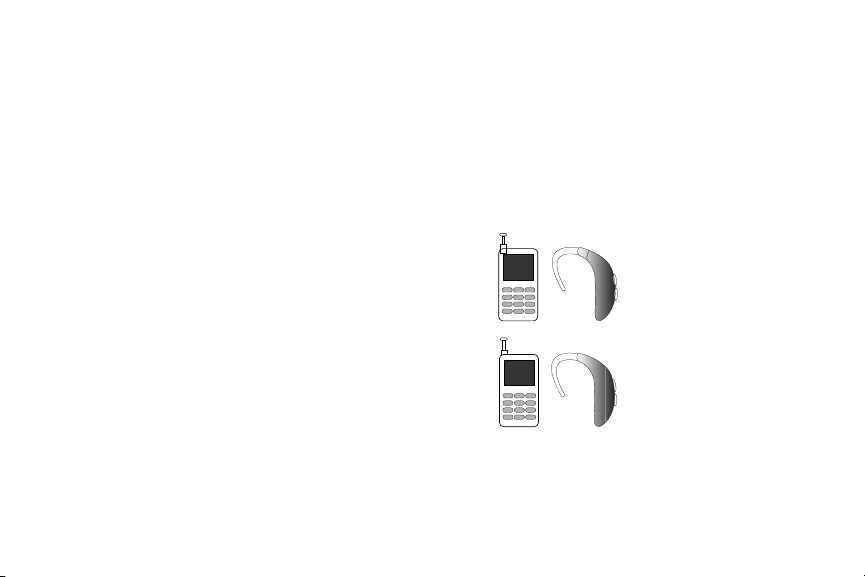
T3 + T2 = 5
be able to use a rated mobile device successfully. Trying out
the mobile device with your hearing device is the best way to
evaluate it for your personal needs.
M-Ratings
: Wireless mobile devices rated M3 or M4 meet
FCC requirements and are likely to generate less interference
to hearing devices than mobile devices that are not labeled.
M4 is the better/higher of the two ratings. M-ratings refer to
enabling acoustic coupling with hearing aids that do not
operate in telecoil mode.
T-Ratings
: Mobile devices rated T3 or T4 meet FCC
requirements and are likely to generate less interference to
hearing devices than mobile devices that are not labeled. T4
is the better/higher of the two ratings. T-ratings refer to
enabling inductive coupling with hearing aids operating in
telecoil mode.
Hearing devices may also be rated. Your hearing aid
manufacturer or hearing health professional may help you
find this rating. Higher ratings mean that the hearing device
is relatively immune to interference noise.
Under the current industry standard, American National
Standards Institute (ANSI) C63.19, the hearing aid and
wireless mobile device rating values are added together to
indicate how usable they are together. For example, if a
hearing aid meets the M2 level rating and the wireless
mobile device meets the M3 level rating, the sum of the two
values equals M5.
Under the standard, this should provide the hearing aid user
with normal use while using the hearing aid with the
particular wireless mobile device. A sum of 6 or more would
indicate excellent performance.
However, these are not guarantees that all users will be
satisfied. T ratings work similarly.
M3 + M2 = 5
The HAC rating and measurement procedure are described in
the American National Standards Institute (ANSI) C63.19
standard.
Health and Safety Information 332

HAC for Newer Technologies
This phone has been tested and rated for use with hearing
aids for some of the wireless technologies that it uses.
However, there may be some newer wireless technologies
used in this phone that have not been tested yet for use with
hearing aids.
It is important to try the different features of this phone
thoroughly and in different locations, using your hearing aid
or cochlear implant, to determine if you hear any interfering
noise. Consult your service provider or the manufacturer of
this phone for information on hearing aid compatibility. If you
have questions about return or exchange policies, consult
your service provider or phone retailer.
Restricting Children's Access to Your
Mobile Device
Your mobile device is not a toy. Do not allow children to play
with it because they could hurt themselves and others,
damage the mobile device, or make calls that increase your
mobile device bill.
Keep the mobile device and all its parts and accessories out
of the reach of small children.
FCC Notice and Cautions
FCC Notice
The mobile device may cause TV or radio interference if used
in close proximity to receiving equipment. The FCC can
require you to stop using the mobile device if such
interference cannot be eliminated.
Cautions
Any changes or modifications to your mobile device not
expressly approved by Samsung could void your warranty for
this equipment and void your authority to operate this
equipment. Only use approved batteries, antennas, and
chargers. The use of any unauthorized accessories may be
dangerous and void the mobile device warranty if said
accessories cause damage or a defect to the mobile device.
Although your mobile device is quite sturdy, it is a complex
piece of equipment and can be broken. Avoid dropping,
hitting, bending, or sitting on it.
Other Important Safety Information
•
Only qualified personnel should service the mobile device or
install the mobile device in a vehicle. Faulty installation or service
may be dangerous and may invalidate any warranty applicable to
the device.
333

•
Ensure that any mobile devices or related equipment installed in
your vehicle are securely mounted.
•
Check regularly that all wireless mobile device equipment in your
vehicle is mounted and operating properly.
•
When using a headset in dry environments, static electricity can
build up in the headset and cause a small quick static electrical
shock. To minimize the risk of electrostatic discharge from the
headset avoid using the headset in extremely dry environments or
touch a grounded unpainted metal object to discharge static
electricity before inserting the headset.
•
Do not store or carry flammable liquids, gases, or explosive
materials in the same compartment as the mobile device, its
parts, or accessories.
•
For vehicles equipped with an air bag, remember that an air bag
inflates with great force. Do not place objects, including installed
or portable wireless equipment near or in the area over the air
bag or in the air bag deployment area. If wireless equipment is
improperly installed and the air bag inflates, serious injury could
result.
•
Switch your mobile device off before boarding an aircraft. The use
of wireless mobile devices in aircraft is illegal and may be
dangerous to the aircraft's operation. Check with appropriate
authorities before using any function of a mobile device while on
an aircraft.
•
Failure to observe these instructions may lead to the suspension
or denial of cell phone services to the offender, or legal action, or
both.
•
While using your device, leave some lights on in the room and do
not hold the screen too close to your eyes.
•
Seizures or blackouts can occur when you are exposed to flashing
lights while watching videos or playing games for extended
periods. If you feel any discomfort, stop using the device
immediately.
•
Reduce risk of repetitive motion injuries. When you repetitively
perform actions, such as pressing keys, drawing characters on a
touch screen with your fingers, or playing games, you may
experience occasional discomfort in your hands, neck, shoulders,
or other parts of your body. When using your device for extended
periods, hold the device with a relaxed grip, press the keys lightly,
and take frequent breaks. If you continue to have discomfort
during or after such use, stop use and see a physician.
Health and Safety Information 334

•
If your device has a camera flash or light, do not use the flash or
light close to the eyes of people or pets. [122011]
335

Section 12: Warranty Information
Standard Limited Warranty
What is covered and for how long?
SAMSUNG TELECOMMUNICATIONS AMERICA, LLC
(“SAMSUNG”) warrants that SAMSUNG’s handsets and
accessories (“Products”) are free from defects in material
and workmanship under normal use and service for the
period commencing upon the date of purchase by the first
consumer purchaser and continuing for the following
specified period of time after that date:
Device 1 Year
Bat
tery(ies)*
Case/Pouch/Holster*
Other Device
Accessories*
1 Y
ear
90 Days
1 Year
*If applicable.
What is not covered?
This Limited Warranty is conditioned upon proper use of the
Product.
This Limited Warranty does not cover: (a) defects or damage
resulting from accident, misuse, abnormal use, abnormal
conditions, improper storage, exposure to liquid, moisture,
dampness, sand or dirt, neglect, or unusual physical,
electrical or electromechanical stress; (b) scratches, dents
and cosmetic damage, unless caused by SAMSUNG;
(c) defects or damage resulting from excessive force or use
of a metallic object when pressing on a touch screen;
(d) equipment that has the serial number or the
enhancement data code removed, defaced, damaged,
altered or made illegible; (e) ordinary wear and tear;
(f) defects or damage resulting from the use of Product in
conjunction or connection with accessories, products, or
ancillary/peripheral equipment not furnished or approved by
SAMSUNG; (g) defects or damage resulting from improper
testing, operation, maintenance, installation, service, or
adjustment not furnished or approved by SAMSUNG;
(h) defects or damage resulting from external causes such as
collision with an object, fire, flooding, dirt, windstorm,
lightning, earthquake, exposure to weather conditions, theft,
blown fuse, or improper use of any electrical source;
(i)
defects or damage resulting from cellular signal reception
Wa
rranty Information
336

or transmission, or viruses or other software problems
introduced into the Product; or (j) Product used or purchased
outside the United States. This Limited Warranty covers
batteries only if battery capacity falls below 80% of rated
capacity or the battery leaks, and this Limited Warranty does
not cover any battery if (i) the battery has been charged by a
battery charger not specified or approved by SAMSUNG for
charging the battery; (ii) any of the seals on the battery are
broken or show evidence of tampering; or (iii) the battery has
been used in equipment other than the SAMSUNG phone for
which it is specified.
What are SAMSUNG’s obligations?
During the applicable warranty period, provided the Product
is returned in accordance with the terms of this Limited
Warranty, SAMSUNG will repair or replace the Product, at
SAMSUNG’s sole option, without charge. SAMSUNG may, at
SAMSUNG’s sole option, use rebuilt, reconditioned, or new
parts or components when repairing any Product, or may
replace the Product with a rebuilt, reconditioned or new
Product.
Repaired/replaced cases, pouches and holsters will be
warranted for a period of ninety (90) days. All other repaired/
replaced Products will be warranted for a period equal to the
remainder of the original Limited Warranty on the original
Product or for ninety (90) days, whichever is longer. All
replaced Products, parts, components, boards and
equipment shall become the property of SAMSUNG. Except to
any extent expressly allowed by applicable law, transfer or
assignment of this Limited Warranty is prohibited.
What must you do to obtain warranty service?
To obtain service under this Limited Warranty, you must
return the Product to an authorized phone service facility in
an adequate container for shipping, accompanied by the
sales receipt or comparable proof of sale showing the
original date of purchase, the serial number of the Product
and the seller’s name and address.
To obtain assistance on where to deliver the Product, please
call SAMSUNG Customer Care at 1-888-987-4357. If
SAMSUNG determines that any Product is not covered by this
Limited Warranty, you must pay all parts, shipping, and labor
charges for the repair or return of such Product.
You should keep a separate backup copy of any contents of
the Product before delivering the Product to SAMSUNG for
warranty service, as some or all of the contents may be
deleted or reformatted during the course of warranty service.
337

What are the limits on SAMSUNG’s liability?
THIS LIMITED WARRANTY SETS OUT THE FULL EXTENT OF
SAMSUNG’S RESPONSIBILITIES, AND THE EXCLUSIVE
REMEDY REGARDING THE PRODUCTS.
ALL IMPLIED WARRANTIES, INCLUDING WITHOUT
LIMITATION, IMPLIED WARRANTIES OF MERCHANTABILITY
AND FITNESS FOR A PARTICULAR PURPOSE, ARE LIMITED TO
THE DURATION OF THIS LIMITED WARRANTY. IN NO EVENT
SHALL SAMSUNG BE LIABLE FOR DAMAGES IN EXCESS OF
THE PURCHASE PRICE OF THE PRODUCT OR FOR, WITHOUT
LIMITATION, COMMERCIAL LOSS OF ANY SORT; LOSS OF
USE, TIME, DATA, REPUTATION, OPPORTUNITY, GOODWILL,
PROFITS OR SAVINGS; INCONVENIENCE; INCIDENTAL,
SPECIAL, CONSEQUENTIAL OR PUNITIVE DAMAGES; OR
DAMAGES ARISING FROM THE USE OR INABILITY TO USE THE
PRODUCT. SOME STATES AND JURISDICTIONS DO NOT
ALLOW LIMITATIONS ON HOW LONG AN IMPLIED WARRANTY
LASTS, OR THE DISCLAIMER OR LIMITATION OF INCIDENTAL
OR CONSEQUENTIAL DAMAGES, SO THE ABOVE LIMITATIONS
AND DISCLAIMERS MAY NOT APPLY TO YOU.
SAMSUNG MAKES NO WARRANTIES OR REPRESENTATIONS,
EXPRESS OR IMPLIED, STATUTORY OR OTHERWISE, AS TO
THE QUALITY, CAPABILITIES, OPERATIONS, PERFORMANCE
OR SUITABILITY OF ANY THIRD-PARTY SOFTWARE OR
EQUIPMENT USED IN CONJUNCTION WITH THE PRODUCT, OR
THE ABILITY TO INTEGRATE ANY SUCH SOFTWARE OR
EQUIPMENT WITH THE PRODUCT, WHETHER SUCH
THIRD-PARTY SOFTWARE OR EQUIPMENT IS INCLUDED WITH
THE PRODUCT DISTRIBUTED BY SAMSUNG OR OTHERWISE.
RESPONSIBILITY FOR THE QUALITY, CAPABILITIES,
OPERATIONS, PERFORMANCE AND SUITABILITY OF ANY
SUCH THIRD-PARTY SOFTWARE OR EQUIPMENT RESTS
SOLELY WITH THE USER AND THE DIRECT VENDOR, OWNER
OR SUPPLIER OF SUCH THIRD-PARTY SOFTWARE OR
EQUIPMENT.
Nothing in the Product instructions or information shall be
construed to create an express warranty of any kind with
respect to the Products. No agent, employee, dealer,
representative or reseller is authorized to modify or extend
this Limited Warranty or to make binding representations or
claims, whether in advertising, presentations or otherwise,
on behalf of SAMSUNG regarding the Products or this Limited
Warranty.
This Limited Warranty gives you specific legal rights, and you
may also have other rights that vary from state to state.
Warranty Information
338

What is the procedure for resolving disputes?
ALL DISPUTES WITH SAMSUNG ARISING IN ANY WAY FROM
THIS LIMITED WARRANTY OR THE SALE, CONDITION OR
PERFORMANCE OF THE PRODUCTS SHALL BE RESOLVED
EXCLUSIVELY THROUGH FINAL AND BINDING ARBITRATION,
AND NOT BY A COURT OR JURY.
Any such dispute shall not be combined or consolidated with
a dispute involving any other person’s or entity’s Product or
claim, and specifically, without limitation of the foregoing,
shall not under any circumstances proceed as part of a class
action. The arbitration shall be conducted before a single
arbitrator, whose award may not exceed, in form or amount,
the relief allowed by the applicable law. The arbitration shall
be conducted according to the American Arbitration
Association (AAA) Commercial Arbitration Rules applicable to
consumer disputes. This arbitration provision is entered
pursuant to the Federal Arbitration Act. The laws of the State
of Texas, without reference to its choice of laws principles,
shall govern the interpretation of the Limited Warranty and all
disputes that are subject to this arbitration provision. The
arbitrator shall decide all issues of interpretation and
application of this arbitration provision and the Limited
Warranty.
For any arbitration in which your total damage claims,
exclusive of attorney fees and expert witness fees, are
$5,000.00 or less (“Small Claim”), the arbitrator may, if you
prevail, award your reasonable attorney fees, expert witness
fees and costs as part of any award, but may not grant
SAMSUNG its attorney fees, expert witness fees or costs
unless it is determined that the claim was brought in bad
faith. In a Small Claim case, you shall be required to pay no
more than half of the total administrative, facility and
arbitrator fees, or $50.00 of such fees, whichever is less, and
SAMSUNG shall pay the remainder of such fees.
Administrative, facility and arbitrator fees for arbitrations in
which your total damage claims, exclusive of attorney fees
and expert witness fees, exceed $
5,000.00
(“Large Claim”)
shall
be determined according to AAA rules. In a Large Claim
case, the arbitrator may grant to the prevailing party, or
apportion among the parties, reasonable attorney fees,
expert witness fees and costs. Judgment may be entered on
the arbitrator’s award in any court of competent jurisdiction.
This arbitration provision also applies to claims against
SAMSUNG’s employees, representatives and affiliates if any
such claim arises from the Product’s sale, condition or
performance.
339

You may opt out of this dispute resolution procedure by
providing notice to SAMSUNG no later than 30 calendar days
from the date of the first consumer purchaser’s purchase of the
Product. To opt out, you must send notice by e-mail to
[email protected], with the subject line: “Arbitration
Opt Out.” You must include in the opt out e-mail (a) your name
and address; (b) the date on which the Product was purchased;
(c) the Product model name or model number; and (d) the IMEI
or MEID or Serial Number, as applicable, if you have it (the IMEI
or MEID or Serial Number can be found (i) on the Product box;
(ii) on the Product information screen, which can be found
under “Settings;” (iii) on a label on the back of the Product
beneath the battery, if the battery is removable; and (iv) on the
outside of the Product if the battery is not removable).
Alternatively, you may opt out by calling 1-888-987-4357 no
later than 30 calendar days from the date of the first consumer
purchaser’s purchase of the Product and providing the same
information. These are the only two forms of notice that will be
effective to opt out of this dispute resolution procedure. Opting
out of this dispute resolution procedure will not affect the
coverage of the Limited Warranty in any way, and you will
continue to enjoy the benefits of the Limited Warranty.
Severability
If any portion of this Limited Warranty is held to be illegal or
unenforceable, such partial illegality or unenforceability shall
not affect the enforceability of the remainder of the Limited
Warranty.
Precautions for Transfer and Disposal
If data stored on this device is deleted or reformatted using
the standard methods, the data only appears to be removed
on a superficial level, and it may be possible for someone to
retrieve and reuse the data by means of special software.
To avoid unintended information leaks and other problems of
this sort, it is recommended that the device be returned to
Samsung’s Customer Care Center for an Extended File
System (EFS) Clear which will eliminate all user memory and
return all settings to default settings. Please contact the
Samsung Customer Care Center
for details.
Important!
Please provide warranty information (proof of
purchase) to Samsung’s Customer Care Center in
order to provide this service at no charge. If the
warranty has expired on the device, charges may
apply.
Warranty Information
340

Samsung T
elecommunications America, LLC
1301 E. Lookout Drive
Richardson, Texas 75082
Phone: 1-800-SAMSUNG
Phone: 1-888-987-HELP (4357)
No reproduction in whole or
in part allowed without prior
written approval. Specifications and availability subject to
change without notice. [111611]
End User License Agreement for
Software
IMPORTANT. READ CAREFULLY: This End User License
Agreement ("EULA") is a legal agreement between you
(either an individual or a single entity) and Samsung
Electronics Co., Ltd. ("Samsung") for software, owned by
Samsung and its affiliated companies and its third party
suppliers and licensors, that accompanies this EULA, which
includes computer software and may include associated
media, printed materials, "online" or electronic
documentation in connection with your use of this device
("Software").
This device requires the use of preloaded software in its
normal operation. BY USING THE DEVICE OR ITS PRELOADED
SOFTWARE, YOU ACCEPT THE TERMS OF THIS EULA. IF YOU
DO NOT ACCEPT THESE TERMS, DO NOT USE THE DEVICE OR
THE SOFTWARE.
1.
GRANT OF LICENSE
. Samsung grants you the following
rights provided that you comply with all terms and conditions
of this EULA: You may install, use, access, display and run
one copy of the Software on the local hard disk(s) or other
permanent storage media of one computer and use the
Software on a single computer or a mobile device at a time,
and you may not make the Software available over a network
where it could be used by multiple computers at the same
time. You may make one copy of the Software in machine
readable form for backup purposes only; provided that the
backup copy must include all copyright or other proprietary
notices contained on the original.
Certain items of the Software may be subject to open source
licenses. The open source license provisions may override
some of the terms of this EULA. We make the applicable
open source licenses available to you on the Legal Notices
section of the Settings menu of your device.
341

2.
RESERVATION OF RIGHTS AND OWNERSHIP
. Samsung
reserves all rights not expressly granted to you in this EULA.
The Software is protected by copyright and other intellectual
property laws and treaties. Samsung or its suppliers own the
title, copyright and other intellectual property rights in the
Software. The Software is licensed, not sold.
3.
LIMITATIONS ON END USER RIGHTS
. You may not reverse
engineer, decompile, disassemble, or otherwise attempt to
discover the source code or algorithms of, the Software
(except and only to the extent that such activity is expressly
permitted by applicable law not withstanding this limitation),
or modify, or disable any features of, the Software, or create
derivative works based on the Software. You may not rent,
lease, lend, sublicense or provide commercial hosting
services with the Software.
4.
CONSENT TO USE OF DATA
. You agree that Samsung and its
affiliates may collect and use technical information gathered
as part of the product support services related to the
Software provided to you, if any, such as IMEI (your device’s
unique identification number), device number, model name,
customer code, access recording, your device’s current SW
version, MCC (Mobile Country Code), MNC (Mobile Network
Code). Samsung and its affiliates may use this information
solely to improve their products or to provide customized
services or technologies to you and will not disclose this
information in a form that personally identifies you. At all
times your information will be treated in accordance with
Samsung’s Privacy Policy, which can be viewed at:
http://account.samsung.com/membership/pp
.
5.
SOFTWARE UPDATES
. Samsung may provide to you or
make available to you updates, upgrades, supplements and
add-on components (if any) of the Software, including bug
fixes, service upgrades (parts or whole), products or devices,
and updates and enhancements to any software previously
installed (including entirely new versions), (collectively
“Update”) after the date you obtain your initial copy of the
Software to improve the Software and ultimately enhance
your user experience with your device. This EULA applies to
all and any component of the Update that Samsung may
provide to you or make available to you after the date you
obtain your initial copy of the Software, unless we provide
other terms along with such Update. To use Software
provided through Update, you must first be licensed for the
Software identified by Samsung as eligible for the Update.
After the Update, you may no longer use the Software that
formed the basis for your Update eligibility. The updated
Software version may add new functions and, in some
limited cases, may delete existing functions.
Warranty Information 342

While the Update will be generally available, in some limited
circumstances, the Software updates will only be offered by
your network carrier, and such Software updates will be
governed by your contractual relationship with your network
carrier.
With the “Automatic Update” function enabled (as in the
default setting in the System Update menu in the Setting),
your device downloads some Updates automatically from
time to time. Your device will, however, ask for your consent
before installing any Update If you choose to disable the
“Automatic Update” function, then you can check the
availability of new Updates by clicking on the “Check
Update” menu in the Setting. We recommend that you check
availability of any new Updates periodically for optimal use of
your device. If you want to avoid any use of network data for
the Update downloads, then you should choose the “Wi-Fi
Only” option in the Setting. (Regardless of the option you
choose, the “Automatic Update” function downloads Updates
only through Wi-Fi connection.)
6. Some features of the Software may require your device to
have access to the internet and may be subject to
restrictions imposed by your network or internet provider.
Unless your device is connected to the internet through Wi-Fi
connection, the Software will access through your mobile
network, which may result in additional charges depending
on your payment plan. In addition, your enjoyment of some
features of the Software may be affected by the suitability
and performance of your device hardware or data access.
7.
SOFTWARE TRANSFER
. You may not transfer this EULA or
the rights to the Software granted herein to any third party
unless it is in connection with the sale of the mobile device
which the Software accompanied. In such event, the transfer
must include all of the Software (including all component
parts, the media and printed materials, any upgrades, this
EULA) and you may not retain any copies of the Software.
The transfer may not be an indirect transfer, such as a
consignment. Prior to the transfer, the end user receiving the
Software must agree to all the EULA terms.
8.
EXPORT RESTRICTIONS
. You acknowledge that the
Software is subject to export restrictions of various countries.
You agree to comply with all applicable international and
national laws that apply to the Software, including all the
applicable export restriction laws and regulations.
9.
TERMINATION
. This EULA is effective until terminated. Your
rights under this License will terminate automatically without
notice from Samsung if you fail to comply with any of the
343

terms and conditions of this EULA. Upon termination of this
EULA, you must cease all use of the Software and destroy all
copies, full or partial, of the Software.
10.
DISCLAIMER OF WARRANTY
. UNLESS SEPARATELY STATED
IN A WRITTEN EXPRESS LIMITED WARRANTY
ACCOMPANYING YOUR DEVICE, ALL SOFTWARE PROVIDED
BY SAMSUNG WITH THIS MOBILE DEVICE (WHETHER
INCLUDED WITH THE DEVICE, DOWNLOADED, OR
OTHERWISE OBTAINED) IS PROVIDED "AS IS" AND ON AN
"AS AVAILABLE" BASIS, WITHOUT WARRANTIES OF ANY KIND
FROM SAMSUNG, EITHER EXPRESS OR IMPLIED. TO THE
FULLEST EXTENT POSSIBLE PURSUANT TO APPLICABLE
LAW, SAMSUNG DISCLAIMS ALL WARRANTIES EXPRESS,
IMPLIED, OR STATUTORY, INCLUDING, BUT NOT LIMITED TO,
IMPLIED WARRANTIES OF MERCHANTABILITY, SATISFACTORY
QUALITY OR WORKMANLIKE EFFORT, FITNESS FOR A
PARTICULAR PURPOSE, RELIABILITY OR AVAILABILITY,
ACCURACY, LACK OF VIRUSES, QUIET ENJOYMENT, NON
INFRINGEMENT OF THIRD PARTY RIGHTS OR OTHER
VIOLATION OF RIGHTS. SOME JURISDICTIONS DO NOT
ALLOW EXCLUSIONS OR LIMITATIONS OF IMPLIED
WARRANTIES, SO THE ABOVE EXCLUSIONS OR LIMITATIONS
MAY NOT APPLY TO YOU. NO ADVICE OR INFORMATION,
WHETHER ORAL OR WRITTEN, OBTAINED BY YOU FROM
SAMSUNG OR ITS AFFILIATES SHALL BE DEEMED TO ALTER
THIS DISCLAIMER BY SAMSUNG OF WARRANTY REGARDING
THE SOFTWARE, OR TO CREATE ANY WARRANTY OF ANY
SORT FROM SAMSUNG.
11.
THIRD-PARTY APPLICATIONS
. Certain third party
applications may be included with, or downloaded to this
mobile device. Samsung makes no representations
whatsoever about any of these applications. Since Samsung
has no control over such applications, you acknowledge and
agree that Samsung is not responsible for the availability of
such applications and is not responsible or liable for any
content, advertising, products, services, or other materials
on or available from such applications. You expressly
acknowledge and agree that use of third party applications is
at your sole risk and that the entire risk of unsatisfactory
quality, performance, accuracy and effort is with you. It is up
to you to take precautions to ensure that whatever you select
to use is free of such items as viruses, worms, Trojan horses,
and other items of a destructive nature. References on this
mobile device to any names, marks, products, or services of
any third-parties are provided solely as a convenience to you,
and do not constitute or imply an endorsement, sponsorship,
or recommendation of, or affiliation with the third party or its
products and services. You agree that Samsung shall not be
Warranty Information
344

responsible or liable, directly or indirectly, for any damage or
loss, including but not limited to any damage to the mobile
device or loss of data, caused or alleged to be caused by, or
in connection with, use of or reliance on any such third party
content, products, or services available on or through any
such application. You acknowledge and agree that the use of
any third-party application is governed by such third party
application provider's Terms of Use, License Agreement,
Privacy Policy, or other such agreement and that any
information or personal data you provide, whether knowingly
or unknowingly, to such third-party application provider, will
be subject to such third party application provider's privacy
policy, if such a policy exists. SAMSUNG DISCLAIMS ANY
RESPONSIBILITY FOR ANY DISCLOSURE OF INFORMATION OR
ANY OTHER PRACTICES OF ANY THIRD PARTY APPLICATION
PROVIDER. SAMSUNG EXPRESSLY DISCLAIMS ANY
WARRANTY REGARDING WHETHER YOUR PERSONAL
INFORMATION IS CAPTURED BY ANY THIRD PARTY
APPLICATION PROVIDER OR THE USE TO WHICH SUCH
PERSONAL INFORMATION MAY BE PUT BY SUCH THIRD
PARTY APPLICATION PROVIDER.
12.
SAMSUNG APPLICATIONS
. Certain Samsung applications
and services may be included with, or downloaded to, this
mobile device. Many of them require Samsung Services
membership registration (“Samsung Account”), and your
rights and obligations will be set forth in separate Samsung
Account terms and conditions and privacy policies. There are
non-Samsung Account applications and services that require
your consent to their separate terms and conditions and
privacy policies. You expressly acknowledge and agree that
your use of such applications and services will be subject to
the applicable terms and conditions and privacy policies.
13.
LIMITATION OF LIABILITY
. SAMSUNG WILL NOT BE LIABLE
FOR ANY DAMAGES OF ANY KIND ARISING OUT OF OR
RELATING TO THE USE OR THE INABILITY TO USE THE
SOFTWARE OR ANY THIRD PARTY APPLICATION, ITS
CONTENT OR FUNCTIONALITY, INCLUDING BUT NOT LIMITED
TO DAMAGES CAUSED BY OR RELATED TO ERRORS,
OMISSIONS, INTERRUPTIONS, DEFECTS, DELAY IN
OPERATION OR TRANSMISSION, COMPUTER VIRUS, FAILURE
TO CONNECT, NETWORK CHARGES, IN-APP PURCHASES,
AND ALL OTHER DIRECT, INDIRECT, SPECIAL, INCIDENTAL,
EXEMPLARY, OR CONSEQUENTIAL DAMAGES EVEN IF
SAMSUNG HAS BEEN ADVISED OF THE POSSIBILITY OF SUCH
DAMAGES. SOME JURISDICTIONS DO NOT ALLOW THE
EXCLUSION OR LIMITATION OF INCIDENTAL OR
CONSEQUENTIAL DAMAGES, SO THE ABOVE EXCLUSIONS OR
LIMITATIONS MAY NOT APPLY TO YOU. NOTWITHSTANDING
345

THE FOREGOING, SAMSUNG ELECTRONIC CO.'S TOTAL
LIABILITY TO YOU FOR ALL LOSSES, DAMAGES, CAUSES OF
ACTION, INCLUDING BUT NOT LIMITED TO THOSE BASED ON
CONTRACT, TORT, OR OTHERWISE, ARISING OUT OF YOUR
USE OF THE SOFTWARE OR THIRD PARTY APPLICATIONS ON
THIS MOBILE DEVICE, OR ANY OTHER PROVISION OF THIS
EULA, SHALL NOT EXCEED THE AMOUNT PURCHASER PAID
SPECIFICALLY FOR THIS MOBILE DEVICE OR ANY SUCH
THIRD PARTY APPLICATION THAT WAS INCLUDED WITH THIS
MOBILE DEVICE. THE FOREGOING LIMITATIONS,
EXCLUSIONS, AND DISCLAIMERS (INCLUDING SECTIONS 10,
11, 12 AND 13) SHALL APPLY TO THE MAXIMUM EXTENT
PERMITTED BY APPLICABLE LAW, EVEN IF ANY REMEDY
FAILS ITS ESSENTIAL PURPOSE.
14.
U.S. GOVERNMENT END USERS RESTRICTED RIGHTS
. The
Software is licensed only with "restricted rights" and as
"commercial items" consisting of "commercial software"
and "commercial software documentation" with only those
rights as are granted to all other end users pursuant to the
terms and conditions herein. All Products are provided only
with "restricted rights" with only those rights as are granted
to all other end users pursuant to the terms and conditions
herein. All Software and Products are provided subject to
Federal Acquisition Regulation (FAR) 52.227.19.
15.
APPLICABLE LAW
. This EULA is governed by the laws of
the jurisdiction where you are a resident or, if a resident of
the United States, by the laws of the state of Texas, without
regard to its conflict of law provisions. This EULA shall not be
governed by the UN Convention on Contracts for the
International Sale of Goods, the application of which is
expressly excluded.
16.
DISPUTE RESOLUTION
.
(a) Non-United States residents. If a dispute, controversy or
difference arising in any way from this EULA or your use of
the Software is not amicably settled, it shall be subject to the
non-exclusive jurisdiction of the courts of the jurisdiction
where you are a resident. Notwithstanding the foregoing,
Samsung may apply for injunctive remedies (or an equivalent
type of urgent legal relief) in any jurisdiction.
(b) United States residents. ALL DISPUTES WITH SAMSUNG
ARISING IN ANY WAY FROM THIS EULA OR YOUR USE OF THE
SOFTWARE SHALL BE RESOLVED EXCLUSIVELY THROUGH
FINAL AND BINDING ARBITRATION, AND NOT BY A COURT OR
JURY. Any such dispute shall not be combined or
consolidated with any other person’s or entity’s claim or
dispute, and specifically, without limitation of the foregoing,
shall not under any circumstances proceed as part of a class
Warranty Information
346

action. The arbitration shall be conducted before a single
arbitrator, whose award may not exceed, in form or amount,
the relief allowed by the applicable law. The arbitration shall
be conducted according to the American Arbitration
Association (AAA) Commercial Arbitration Rules applicable to
consumer disputes. This arbitration provision is entered
pursuant to the Federal Arbitration Act. The laws of the State
of Texas, without reference to its choice of laws principles,
shall govern the interpretation of the EULA and all disputes
that are subject to this arbitration provision. The arbitrator
shall decide all issues of interpretation and application of this
arbitration provision and the EULA. For any arbitration in
which your total damage claims, exclusive of attorney fees
and expert witness fees, are $5,000.00 or less ("Small
Claim"), the arbitrator may, if you prevail, award your
reasonable attorney fees, expert witness fees and costs as
part of any award, but may not grant Samsung its attorney
fees, expert witness fees or costs unless it is determined that
the claim was brought in bad faith. In a Small Claim case,
you shall be required to pay no more than half of the total
administrative, facility and arbitrator fees, or $50.00 of such
fees, whichever is less, and Samsung shall pay the
remainder of such fees. Administrative, facility and arbitrator
fees for arbitrations in which your total damage claims,
exclusive of attorney fees and expert witness fees, exceed
$5,000.00 ("Large Claim") shall be determined according to
AAA rules. In a Large Claim case, the arbitrator may grant to
the prevailing party, or apportion among the parties,
reasonable attorney fees, expert witness fees and costs.
Judgment may be entered on the arbitrator's award in any
court of competent jurisdiction. This arbitration provision also
applies to claims against Samsung’s employees,
representatives and affiliates if any such claim arises from
the licensing or use of the Software. You may opt out of this
dispute resolution procedure by providing notice to Samsung
no later than 30 calendar days from the date of the first
consumer purchaser’s purchase of this device. To opt out,
you must send notice by e-mail to
[email protected], with the subject line: "Arbitration
Opt Out." You must include in the opt out e-mail (a) your
name and address; (b) the date on which the device was
purchased; (c) the device model name or model number; and
(d) the IMEI or MEID or Serial Number, as applicable, if you
have it (the IMEI or MEID or Serial Number can be found (i) on
the device box; (ii) on the device information screen, which
can be found under "Settings;" (iii) on a label on the back of
the device beneath the battery, if the battery is removable;
and (iv) on the outside of the device if the battery is not
347

removable). Alternatively, you may opt out by calling
1-888-987-4357 no later than 30 calendar days from the
date of the first consumer purchaser's purchase of the
device and providing the same information. These are the
only two forms of notice that will be effective to opt out of
this dispute resolution procedure. Opting out of this dispute
resolution procedure will not affect your use of the device or
its preloaded Software, and you will continue to enjoy the
benefits of this license.
17.
ENTIRE AGREEMENT; SEVERABILITY
. This EULA is the
entire agreement between you and Samsung relating to the
Software and supersedes all prior or contemporaneous oral
or written communications, proposals and representations
with respect to the Software or any other subject matter
covered by this EULA. If any provision of this EULA is held to
be void, invalid, unenforceable or illegal, the other provisions
shall continue in full force and effect. [050113]
Warranty Information
348

Index
Numerics
2 Sec Pause
Adding
62
2G Netw
ork
Using Only 252
A
ABC 83
Acces to My Location 191
Accessing
Recently-used applications 163
Voicemail 18
Accessory 280
Audio Output
280
Dock Sound 280
Screen Display 280
Accounts and Sync
Adding Contacts
107
Add 2 Sec Pause 65
, 97
Add to Favorites 112
Adjusting
Call volume 71
Adobe PD
F 208
Air
45
Air View 45
, 292
Airplane Mode 250
Alarm
Deleting an Existing Alarm 171
Setting a New Alarm 170
Turning Off 171
Alerts
Presidential
123
Alerts on Call 270
Allow Diagnostics 17
, 300
AllShare Cast Hub
29
Activation on Device 161
Connecting 161
Set Up Hardware 161
AllShare P
lay
see Samsung Link 214
, 216
AllShareCast Hub
215
AMBER Alerts 123
Disable
124
Andr
oid Beam 256
Answering
Home Key
270
, 272
Answering a call 62
Application cache and data
Clearing 207
Application Menus
Navigating through
57
Applications
Adding a New Page
40
Adding Apps Folders 39
Calculator 164
Camera 167
Creating Folders 39
Email 176
Google Mail 177
Goog
le Maps
191
Hide 163
KNOX 190
Messaging 192
Sharing with Others 37
Show Hidden 163
349

Shutting Down 163
Storage Used 307
Using the Camcorder 149
Using the Camera
141
Video Player 221
Voice Recorder 223
YouTube 225
Applications and Development 162
Apps
Adding
34
Reset Preferences 307
Apps Screen
Custom
izing 162
Area Code
Auto
Assign
274
Audio
Output Mode
280
Audio Outpu
t 269
Auto Redial 274
, 275
Auto Reject
Configuration
63
Auto Reject List 270
Auto Reject Mode 270
Auto Sync App Data 98
Automatic Answering 271
Automatic Restore 296
B
Back up
My Account
296
My Data 296
Backup and Restore 296
Battery
Charging
13
Display Percentage 15
Extending Life 15
Installing 12
Low Battery Indicator 15
Removal 13
Show Percentage 265
Wall Charger 13
Battery Cover
Removal
9
Replace 13
Battery Life
Ext
ending
15
Battery Usage 307
Battery Us
e & Safety 320
Bigger Font
Setting
281
Bing
Set Search Engine
189
Blocking Mode 278
On 278
Bluetooth 247
About 227
Change Name 228
Changing Name 247
Configure Device Settings 230
Deleting a Paired Device 230
Device Name 17
Disconnecting a Paired Devic
e
230
Media Audio
230
Microhone Function 230
Off 227
, 247
On
227
, 247
Outgoing Headset Condition
271
,
273
Paring Devices
229
350

Review Downloaded Files 229
Scan for Devices 228
Scanning for other Devices 248
Sending Contact Information 231
Sending Contacts Via 231
Sending Nam
ecard
104
Set Visibility 228
Settings 228
Status indicators 227
Switching to Headset during call
73
Turning on and off
227
, 247
Visibility
248
Visible Time-Out 228
Bookmarks
Backing Up
298
Browser
Adding bookmarks
186
Deleting bookmarks 187
Easier to Read Pages 189
Emptying cookies 187
Entering a URL 184
Inverted Displa
y
189
Navigation 182
Options 183
Quick Controls 190
Resetting Default Actions 307
Search Engine 189
Settings 188
Bubble
Options
120
C
Calculator
Scientific Functions
165
Calendar
Cr
eating an event 166
Settings 166
Sync 165
Sync Calendars 165
Writing On 166
Call
Accessories
270
Settings 62
, 63, 270
Call Alert
Call Vibrations
270
, 273
Call Alerts 270
Call Answering/Ending 270
Call Barring 274
, 275
Call Duration 80
Resetting Time
s
80
Call Forwarding 271
Configuring
274
Call Functions 59
Answering 62
Background Calling 60
Ending 60
Ending a Call 60
Ending via Status Bar 60
Making a Multi-Party Call 74
Pause Dialing 65
Redialing the last number 66
Vibrate 271
Wait dialing 65
Call Rejection 63
, 270
Call Settings
270
Additional Settings 274
General 270
Call Sound
Adding More Volume
71
351

Personalize 71
, 72
Call Status Tones 270
Call Vibration 270
, 273
Call Volume
Adjusting
71
Call Waiting 76
, 274, 275
Caller ID
274
Calling
Using Wi-Fi
68
Calls
Auto Reject
270
Making a 59
Multi-Party 74
Muting 73
Camcorder 149
Options
150
Shooting Video 149
Taking Pictures During Video 152
Camera 140
Camera Options 142
Default Storage Location 146
Enabling Share Shot 154
Taking Pictures 141
Care an
d Maintenance 326
Certificates
Install 244
Charg
ing battery 13
ChatON
167
Adding a Buddy 168
Adding New Buddy 168
Buddy photo share 147
Chatting On 169
Deleting Bubble 169
Register Service 168
Children and Cell Phones 316
Clearing
Application cache and data
207
Cloud 295
CMAS 123
, 124
Commercial Mobile Alerting System
(CMAS)
319
Configuration
Initial
16
Conne
ctions
Accessing the Internet 182
Conta
ct
Copying to microSD Card
105
Copying to SIM Card 104
Creating a New 92
Linking 100
New From Keypad 95
Photo 159
Unlinking 102
Contact Entry
Options
100
Contact
List
Options 98
Contact
Menus
Options
99
Contacts
Adding a Number to Existing
97
Adding a Pause or Wait 97
Adding Your Facebook Friends
107
Additional Options
108
Deleting 98
Display Options 106
, 109
Displaying Contacts by Name
109
Export List to microSD 296
First Name First 109
Groups 110
352

Import from microSD 297
Last Name First 109
Merge with Samsung Account 98
Sending All 103
Setting Default Location 99
Settings 109
Sharing Settings 109
Sh
aring/Sen
ding 103
Contacts List 59
Context Menus 96
, 99
Navigation 58
Using 58
Cookies
Emptying 187
Co
py to Dialing Screen 79
Copying Contact 104
Create Folder
Group Apps
163
Creating a Playlist 195
Creating and sending
Messages 114
Customizing
Home screens 36
D
Data
Auto Sync Data 249
Restrict Background Data 249
Data Limit
Setting 249
Data R
oaming 251
Activate/Deactivate 249
, 251
Data Usage
Cycle 249
Limiting 249
Dat
e
Selecting For
mat 309
Date and Time 309
Default Storage
Assigning
140
Camcorder 140
, 152
Camera 140
Camera Storage 146
Deleting
Multiple Messages 12
0
Single Bubble 121
Single Message 120
Deleting a contact 98
Deregister
Web Stora
ge 21
7
Desk Clock 170
Configuring 173
De
vice
Reset 300
De
vice Name
Edit 310
Device Options
Screen 26
6
Disp
lay
Icons 25
Settings 25
Status Bar 25
Using Negative Colors 281
D
isplay / Touch-Screen 324
Displaying your phone number 59
DivX
Locating V
OD Number 222
Overview 222
Registration Code 310
D
o cell phones pose a health hazard?
312
353

Dock
Sound
280
Downloading
New application
205
Downloads 174
Draft Messages 115
Drive
176
Dropbox 217
Uploading Picture
175
E
Easy Clip 47
Easy Mode 269
EDGE Network 252
Edit Page 36
Email 127
Changing Signat
ure
131
, 136
Composing
129
Configuring Settings 130
Creating a Spam List 130
, 136
Creating an Internet Account 127
Handwr
itten Signature
131
, 136
Internet Email
127
Opening 129
Refreshing Messages 129
Sending 108
Wi-Fi Do
wnload of Attachments
132
, 137
Emergency
Alert Preview
123
Alerts 123
Emergency Aler
t
Configuration
124
Emergency Alerts 123
AMBER
123
Imminent Extreme 123
Message Settings 123
Severe 123
Emergency C
alls 325
Making 61
With SIM 61
Withou
t SIM
61
Emoticons 116
Ending
A call
60
Entering Text 81
Using SWYPE
82
Erasing File
s
Memory Card 309
Exchange Email 132
Account Setup
132
Composing 135
Conf
iguring Settings
135
Deleting Message 135
Opening 135
Refreshing Messages 135
Expo
sure to Radio Frequency (RF)
Signals 312
Extra Volume 71
Extr
eme Alert
Disable 124
F
Face Unlock 260, 261
Facebook
Personalize
285
Predictive Text 285
Facial Recognition 260
Factor
y Data Reset 300
Prior To 296
Fast Mo
tion
Video
150
Favorites Tab 112
354

FCC Hearing Aid Compatibility (HAC)
Regulations for Wireless Devices 331
FCC Notice and Cautions
333
Fixed Dialing Numbers 275
Flipboard
176
Folder
Create
34
Font
Size
265
Style 265
Font
Size
Caption
225
Changing 281
Minimum Setting 189
Forgot Pattern? 262
G
G+ Photos 176
Galaxy Gear 20
Gallery
Folder Options 157
Opening 160
Picture-In-Picture 221
Games
Volume
267
Gestures
Advanced Settings
50
, 291
Browse Image
50
Overview 49
Quick Glance 50
Screen Capture 51
Sensitivit
y Settings
50
, 291
Shake to Update
50
Tilt to Zoom 50
Getting Started 7
Battery 12
Battery Cover 9
Locking/Unlocking the Device 17
microSD card 11
SIM Card 10
Switching Device On/Off 16
Voicemail 18
Gmail 138
, 177
Composing a Message
138
Creating a
n Additional Account
139
Opening
138
, 178
Other Options
138
Personalize 285
Refreshing 138
Si
gning In
138
Viewing 139
Google
Backing Up Settings 299
S
et Searc
h Engine 189
Settings 179
S
igning into
Your Account 177
Voice Typing 81
Google Books 200
Google Drive 103
, 176
Google Mail
see also Gmail 138
Google Maps
Enabling a locat
ion source 191
Opening a map 192
Google Music 202
Google Now 224
Adjust Settings 178
Set Up 178
Google Talk
see Hangouts 181
Google Voice Typing
Configuring 287
355

Using 91
GPS
Tagging Images
145
, 152
GPS & AGPS
324
GPS Tag 144
, 151
Group
Joining
181
Group Play 180
Creating a Group
180
Joining a Group 181
Share Music 194
Sharing Pictures 180
Grou
ps
Adding an Member to an Existing
Group
110
Creating a new caller group 110
Deleting 111
Deleting a Caller Group 111
Editing a Caller Group 111
Removing an Entry 111
Settings 111
H
Hands-Free Mode
On
279
Handwriting 87
Handwriting Mode 89
Haptic Feedb
ack
Turn On/Off 280
Vibrate 268
Vi
b
ration Setting 267
HDR 143
Health and Safety Information 312
Help
In-Device 182
Hidd
en Applictions
Show 163
Hold
Plac
ing a Call on Hold 72
Home 31
Home Key 33
Home Screen
Assigning a New 37
Chang
ing Wallp
aper 42
Menu Settings 34
Overview 31
Home Screen Mode 269
Home screens
Customizing 36
Homepage
Setting New 186
I
Icons
Descriptio
n 25
Indicator 25
Status 25
Imag
es
Assigning as a Contact icon 159
Assigning as wallpaper 159
Transferring 297
Verifying 297
Importing and Exporting
To micro SIM card 10
9
In Call
Options 71
In call
Options 73
Incognito 185
Create Windo
w 185
Exit Window 185
Incoming Call
Vibration Setting 267
356

Indicator icons 25
International Call 64
International Calls
Making 64
INtern
et
Set New Homepage
186
Internet 182
Brightness Setting 183
Browser Navi
gation
182
Clear Cookies 188
Search 184
Set Home Page 188
Internet Email 127
IP Address 310
L
Language
Select
283
LDAP 98
Linking
Contact Information
100
Live Shooting 152
Live Wallpaper
Selecting
42
Location Alar
m 170
Location and Google Services 301
Lock Pattern
Changing
262
Deleting 262
If I Forgot My Pattern 262
Setting 261
Lock Scre
en 259
Changing Wallpaper 43
Customizing Shortcuts 264
Say Wake-Up Command 260
Shortcuts 260
Using Shortcuts 264
Vi
ewing Missed Calls
80
Logs 77
Accessing 77
Accessing fr
om Notifications
78
Altering Numbers 79
Erasing 79
Lo
w battery indicator 15
LTE
Network Mode
251
Selecting 252
LTE N
etwork 252
M
Making
Emergency Calls 61
Inter
natio
nal Calls 64
New call 59
Managing Applications
Clearing Application Cache 305
Uninstalling Third-party
Applications 305
Mar
ket
see Play Store 205
M
arking contact
As a default 102
Media
Backing Up to mic
roSD Card 298
Backing Up to PC 297
Memory Card
Erasing Fil
es 309
Merge Calls 74
Merge with Google 98
Message
Option
s 115
Read 118
357

Register a Number as Spam 119
Reply 119
, 169
Thread Options 119
Threads 119
Message Search 121
Message threads 119
Messaging
Adding a Signature 123
Adding Attachments 117
Additional Text 118
Block Unknown Senders 124
,
126
Composing Options
116
Creating and sending 114
Creating and Sending Text
Messages
114
Deleting a message 120
Draft 115
Google Mail 138
Icon
s on the Status Bar
113
Insert Smiley 116
Locked 115
Menu Options 115
Options 115
Scheduled Messages
115
Settings 121
Signing into Google Mail
138
Spam 115
Split View 122
Text Templates 126
Types of Messages 113
Viewing new 118
micro SIM Card 10
Changing Existing PIN 302
Importing and Exporting 109
Insertion 10
Lock 302
Removal 11
Setting Up Lock 302
microSD Card
Insertion 11
Removal 12
Micro
soft Exchange 93
, 127
Missed Call
Viewing from Lock Screen
80
Mobile Data
Activate/Deactivate
248
Set Data Limit 249
Usage 250
Mobile HotSpot 237
, 254
Activating
237
Allowed Devices 239
Changing Password 238
Connecting 238
MAC FIltering 239
Mobile HotSpots
Detect and Connect
249
Mobile Networks 250
Data Roaming 251
Mobile Data 250
Mobile Web 182
Entering Text in the Mobile Web
Browser
184
Naviga
ting with the Mobile Web
182
Using Bookmarks
185
Mono
Audio Setup
282
Motion
Function Activation
290
On 49
, 158, 289
Overview 49
358

Motion Settings 289
Mounting the SD card 308
Multi Window
Activate/Deactivate 52
, 264
Close App 57
Customizing 54
Increase App Window Size 56
Maximize App 57
Panel Relocation 54
Rearrange Apps 54
Removing Apps 54
Restoring Apps 55
Running Multiple Apps 55
Switch Arrangement 56
Tab Repositioning 53
Using 52
Multi-Party Call 74
Drop
ping One Partici
pant 75
Private conversation 75
Setting Up 74
Multi-Party calls 74
Multi-Tasking
Backgr
ound Calli
ng 60
Watching Videos 221
Music 193
Adding Music 196
Creating a Playlist 195
Editing a Playlist 196
Making a Song a Ringtone 194
Options 194
Playing Music 193
Re
moving Musi
c 196
, 197
Using Pl
aylists 195
Volume 267
Music App
Music Application 202
No
w Pla
ying Screen 204
Playing 203
Sear
ching fo
r Music 202
Tab Options 202
Music File Extensions
3GP 193
AAC 193
AAC+ 193
eA
AC
+ 193
M4A 193
MP3 193
MP4 193
WMA
193
Music Files
Removing 197
Transferring 197
N
Namecard
Sending 103
Sending All 103
Share Via 103
Navig
ating
Application Menus 57
Sub-Menus 57
Through Screens 43
N
eed for Speed Most Wanted 199
Negative Colors 281
Network connection
Adding a new
234
Network Mode
2G N
etwork 252
LTE 252
WCDMA/GSM 252
New applications
Downloading 205
359

NFC (Near Field Communication) 256
Noise Reduction 72
Non-Market Applications 207
N
otification
Vibration Settin
g 26
7
Notification Bar 34
Using 34
N
otification Panel
Customize 264
Notifications
Volume 267
O
On/Off Switch 16
One Handed Operation
On/Off 62
One-handed Operation 282
Operating Environment 329
Organizer
Calculator 164
World Clock 172
Ot
her Important Safety Information
Outlook 127
Overview
Home Screen 31
P
Passwords
Make Visible 303
Pause
Adding to a Contact 97
Pause Dialing 65
PEN.UP 47
Personal Localized Alerting Network
(PLAN) 319
Personalize
Call Sound
71
Phone
Icons 25
Switching on/off 16
Phon
e number
Finding 59
Phone Ringtone 267
Phone Vibration 267
Photos
Change Player 147
Options 147
, 148
Sharing 147
, 148
Taking Using Voice 146
Pictur
e
Set As 159
Str
eaming from G
allery 158
Picture-In-Picture 221
Pictures
Inst
ant Shari
ng 154
Sharing 153
, 156
Play Books
200
Play
Magazines 201
Play Store 205
Quick Access 162
Point
er Speed
Configuration 289
Popup
Note
Open 292
Power
Auto Adjust Screen Tone 265
Power Sav
ing
CPU Power 279
Haptic Feedback 280
LCD Adjustment 265
Learning About 280
360
333

Screen Power 279
Power Saving Mode 279
Predictive Text
Acti
vation 285
Prepend
Area Code
275
Primary Shortcuts 32
Adding and Deleting
39
Customizing 39
Replacing 39
Q
Quick Dialing 60
Quick Glance
Options
50
, 291
Quick Messaging 115
R
Recently-used Applications
Accessing
163
Redialing the last number 66
Reducing
Exposure
Hands-Free Kits and Other
Accesso
ries
315
Reject Call
Rejection Messages
270
Reject Calls
Managing
63
Reject List
Add To
64
Add to 78
, 79
Auto Reject 64
Rejection List
Assi
gning Multiple Numbers 64
Assigning Single Numbers 64
Rejection Messages
Set Up
270
Reset 300
Reset App Pref
erences 307
Reset Device 300
Responsible Listening 327
Restarting
Device
17
Restore 296
Restrict
Background Data
249
Restricting Children's Access to Your
Mobile device
333
Ringtone
Assigning
271
Assigning Voicemail 278
Device 267
Volume 267
S
S Beam 257
On
156
, 257
Sharing Multiple Pictures
157
Sharing Pictures 156
S Note 209
Creating During a Call 74
S No
te Lite
Launching from S Pen 48
S Pen
Back Button Function
46
Functionality 45
Kepper Notification 292
Menu Button Function 48
Overview 45
Quick Command Settings 293
Removing 46
S Note Light Launching 48
Settings 292
Taking Screen Shots 47
Using 46
361

S Voice 210
Set Wa
ke-Up Command 260
Using 210
Samsung Account
Backing
Up Bookmarks 298
Creating 29
4
Merge Contacts 98
Samsun
g Hub
Creatin
g a New Account 21
2
Using 212
Samsun
g Keyboard 86
ABC Mode 88
Changing the Input Type 87
Enabling 86
Handwr
iting Mod
e 89
Keyboard Swipe 284
Predictive Text Settings 285
Reset Settings 284
Settings 283
Sounds 269
Symbol/Numeric Mode 89
Samsung Keypad
Entering Symbols 89
Samsung Link
Configuring Setting
s 216
Deregister Storage 217
Sharing Media 217
Web Storage Setup 216
Samsung
Mobile Products and
Recycling 322
Save a Number
From Keypad
95
Scrapbook 47
Screen
Home
31
Navigation 43
Sc
reen Capture 51
Taking a Screen Shot 158
Screen Lock
Set Up 261
Sounds 268
Screen Lock Pattern
Changing 262
Creating 261
Deleting 262
Forgot My Pattern 26
2
Screen Mirroring
Activate on Device 161
Activation 258
On 161
, 258
Using AllShare Cast Hub 161
Scr
een Rotation
Auto-Rotate 265
Scr
een Shots
Selective 47
Screen Timeout 265
Screen Unlock
Face and Voi
ce Unlock 261
Face Unlock 260
Swipe 259
Scr
eens
Adding and Deleting 36
Customizing 36
Rearranging 37
SD card
Mounting the 308
Unmounting 308
Search Engine 189
Security
Auto Update 304
362

Sending a Namecard 103
Setting an Alarm
Alarm Setting
170
Setting Up
Voicemail
18
Settings 240
Accessing
240
Browser 188
Call 62
Contact list 109
Display 25
Enabling the GPS Satellites 301
Enabling Wireless Locations 301
Messaging 121
Tab Overview 240
Wallpaper 42
, 43
Setup
Initial
16
Severe Alert
Disable
124
Share Applications 37
Share Shot 143
, 154
Configuring
155
Enabling 155
Share With 144
Shooting Mode 144
Stop Sharing 155
Taking Images 155
Shortcuts
Ad
ding from Application Screen
38
Adding from Home Screen
38
Deleti
ng from a Screen
38
Managing 38
Primary 32
SIM
Micro
7
, 10
see also micro SIM
10
SkyDrive 217
Slow Motion
Video
150
Smart A
larm 171
Smart Practices While Driving 319
Smart Switch
20
Snooze 171
Repeat 170
SNS 107
Social Network
Adding Facebook Contacts
107
Resync 108
Social Networking
Adding Contacts From
107
Softw
are Update 310
, 311
Wi-Fi
311
Song
Set As
194
Sounds
Turn Off All
282
Spam 126
Accessin
g You
r Spam Folder 126
Add a Phrase 123
, 125
Add Number
116
, 117, 119
Assigning Manually 125
Assigning Phone Numbers 125
Block Unknown Numbers 126
Block Unknown Senders 124
,
126
Email Addresses 130
, 136
Manually Add a Number 123
, 125
Match Criteria 125
363

Registering a Phrase as Spam 125
Settings 123
, 125
Spam Messages 115
Assigning
115
Speakerphone
Turning on and off
73
Sp
ecific Absorption Rate (SAR)
Certification Information 317
Speed
Dial
Changing an entry
67
Making a call 67
Re
moving an entry
67
Setting 98
Setting up entries 66
Split View 122
Standard Limited War
ranty 336
Standard Mode 269
Status Bar 25
Sub-Menus
Nav
igation 57
Suga
rSync 217
SwiftKeyFlow
Samsung Keyboard 284
Switching to a Bluetooth
During a call
73
Swype
123ABC Mode 84
ABC Mode 83
Cellular Data 287
Entering Numbers 85
Entering Symbols 85
Entering Text 82
Keyboard Mode 83
Select Text Input Mode 83
Settings 286
SYM mode 83
System
Volume 267
Syste
m Manager 17
, 300
System Tone
Settings 268
T
Task Manger
Overvie
w 164
Tethe
ring
254
Active Icon 236
Disconnecting 236
see USB Tethering 236
Text
Adjusting Size 18
9
Minimum Font Size 18
9
Soom Amount on Double Tap 189
Tex
t Input
Methods 81
Text Input Method
Selecting
81
Text Templates 12
6
Create Your Own 126
Text To Spe
ech 288
Text-to-speech
Configuration 28
8
Third-Party Applications 305
Uninstalling 207
Time Zone
Selecting
309
Timer
Automatic Answering 271
, 273
Tools
Camera 14
1
TrackPad
Configure 289
364

Transferring Large Files 156
, 257
Transferring Music Files
197
TTS 288
Twitter
Predictive Text
285
U
UL Certified Travel Charger 323
Understanding Your Device 20
Back View
24
Display 25
Features 20
Front View 22
Home 31
S Pen 45
Side Views 24
Uninstalling
Third-party applications
207
Unknow
n Numbers
Blocking Messages 126
Unknow
n Sources 207
Unlock
Using Face 260
Using Voice 261
Unmoun
ting
SD card 308
Usage
Battery 307
USB Con
nections
As Storage Device 232
USB Sett
ings
As Storage D
evice 232
USB Tethering 236
Activating 236
, 254
Use GPS Satellites 191
, 301
Use Wireless Networks 191
, 301
Using Favorites
Adding Favorites 186
Editing Favorites 187
V
Vibrate 271
Activate/Deactivate for Voicemail
278
Vibration
Create 277
Device 267
Intensity Setup 267
Video
Picture-I
n-Picture 221
Volume 267
Video Player
Sharing Videos 221
Videos
Defa
ult Storage Location 152
Options 148
Voice Actions 32
Voice I
nput
Recognition 288
Voice mail
Access
ing from another phone 19
Voice Sear
ch 224
, 288
Voice Typing 8
1
Configuring 287
Using 91
Voicemail 277
Accessing 18
Setting Up 18
Volume Settings
Adjusting 267
VPN
Adding 254
365

Settings 254
VPN Client 225
W
Wait 65, 97
Adding to a Contact
97
Wait dialing 65
Wallpaper
Assign Home
34
Home and Lock Screens 42
Wallpapers
Assigning from Gallery
148
Changing Home Screen 42
Changing Lock Screen 43
Changing via Settings Menu 42
Managing 42
Warranty Information 336
Web
182
History 187
Saved Pages 188
Web applications
en
able downloading
231
Widget
Adding Widgets
34
Widgets
Adding and Removing
41
Moving to a Different Screen 41
Settings 218
Stopwatch 172
Wi-Fi
About
233
Activating 68
, 233, 241
Advanced settings
235
Calling 68
Connecting to 233
Deactivating 235
Direct Connection 246
During Sleep 243
MAC Address 244
Manually Adding Network 244
Manually scan for network 235
Off 235
On 154
, 233, 235, 241
Settings
241
Show Usage 249
Status icons 234
Wi-Fi Calling 10
Activating 69
, 255
Conne
ction Preferences 69
, 256
Icons 70
La
u
nching 70
On 255
Settings 69
, 256
Wi-Fi Direct 246
Activate and Connect 246
Device Name 17
On 154
, 246
World Clock
DST Setti
ngs 172
WPA2 PSK 237
, 238
WPS PIN
Pairing 245
WPS Push Button 245
Connect 245
Pairing 245
Y
Yahoo! 189
YouTube
High Quality 226
Settings 225
366