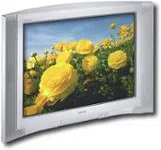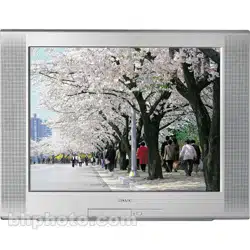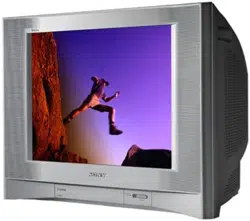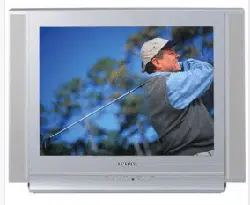

KV-32FV16 KV-36FS12 KV-36FV16
KV-32FV26 KV-36FS16 KV-36FV26
© 2000 by Sony Corporation
4-075-587-22
Operating Instructions
TM
WARNING
To reduce the risk of fire or shock hazard, do not expose the TV to
rain or moisture.
This symbol is intended to alert the user to the
presence of uninsulated “dangerous voltage”
within the product’s enclosure that may be of
sufficient magnitude to constitute a risk of
electric shock to persons.
This symbol is intended to alert the user to the
presence of important operating and maintenance
(servicing) instructions in the literature
accompanying the appliance.
CAUTION
TO PREVENT ELECTRIC SHOCK, MATCH WIDE BLADE OF
PLUG TO WIDE SLOT, FULLY INSERT.
CAUTION
When using TV games, computers, and similar products with your
TV, keep the brightness and contrast functions at low settings. If a
fixed (non-moving) pattern is left on the screen for long periods of
time at a high brightness or contrast setting, the image can be
permanently imprinted onto the screen. Continuously watching
the same program can cause the imprint of station logos onto the
TV screen. These types of imprints are not covered by your
warranty because they are the result of misuse.
Note on Caption Vision
This television receiver provides display of television closed
captioning in accordance with §15.119 of the FCC rules.
Note on Cleaning the TV
Clean the TV with a soft dry cloth. Never use strong solvents such
as thinner or benzine, which might damage the finish of the
cabinet.
Note to CATV System Installer
This reminder is provided to call the CATV system installer’s
attention to Article 820-40 of the NEC that provides guidelines for
proper grounding and, in particular, specifies that the cable ground
shall be connected to the grounding system of the building, as close
to the point of cable entry as practical.
Use of this television receiver for other than private viewing of
programs broadcast on UHF or VHF or transmitted by cable
companies for the use of the general public may require
authorization from the broadcaster/cable company and/or
program owner.
NOTIFICATION
This equipment has been tested and found to comply with the
limits for a Class B digital device pursuant to Part 15 of the FCC
Rules. These limits are designed to provide reasonable protection
against harmful interference in a residential installation. This
equipment generates, uses, and can radiate radio frequency energy
and, if not installed and used in accordance with the instructions,
may cause harmful interference with radio communications.
However, there is no guarantee that interference will not occur in a
particular installation. If this equipment does cause harmful
interference to radio or television reception, which can be
determined by turning the equipment off and on, the user is
encouraged to try to correct the interference by one or more of the
following measures:
❑ Reorient or relocate the receiving antennas.
❑ Increase the separation between the equipment and receiver.
❑ Connect the equipment into an outlet on a circuit different
from that to which the receiver is connected.
❑ Consult the dealer or an experienced radio/TV technician for
help.
You are cautioned that any changes or modifications not
expressly approved in this manual could void your authority
to operate this equipment.
Safety
❑ Operate the TV only on 120 V AC.
❑ The plug is designed, for safety purposes, to fit into the wall
outlet only one way. If you are unable to insert the plug fully
into the outlet, contact your dealer.
❑ If any liquid or solid object should fall inside the cabinet,
unplug the TV immediately and have it checked by qualified
service personnel before operating it further.
Installing
❑ To prevent internal heat buildup, do not block the ventilation
openings.
❑ Do not install the TV in a hot or humid place, or in a place
subject to excessive dust or mechanical vibration.
❑ The AC power cord is attached to the rear of the TV with
hooks. Do not attempt to remove the cord from these hooks.
Doing so could cause damage to the TV
(z)
®
SRS Sound Retrieval System
The (z) SRS (SOUND RETRIEVAL SYSTEM) is manufactured by
Sony Corporation under license from SRS Labs, Inc. It is covered by
U.S. Patent No. 4,748,669. Other U.S. and foreign patents pending.
The word “SRS” and the SRS symbol (z) are registered trademarks
of SRS Labs, Inc. Licensed by BBE Sound, Inc. under USP
4638258.4482866. BBE and BBE symbol are trademarks of BBE
Sound, Inc.
FD Trinitron and the Wega logo are trademarks of Sony
Corporation.
Owner’s Record
The model and serial numbers are provided on the front of this
instruction manual and at the rear of the TV. Refer to them
whenever you call upon your Sony dealer regarding this product.
About this Manual
This manual is for models KV-32FV16, KV-32FV26, KV-36FS12, KV-
36FS16, KV-36FV16, and KV-36FV26. The menu and illustrations
shown are for model KV-36FV26 to show the maximum features
available. Differences in operation will be indicated in the text, for
example, “For KV-36FV26 only.”
RISK OF ELECTRIC SHOCK
DO NOT OPEN
RISQUE DE CHOC ELECTRIQUE,
NE PAS OUVRIR
ATTENTION
CAUTION
PRECAUCION
RIESGO DE CHOQUE ELECTRICO
NO ABRIR
CAUTION: TO REDUCE THE RISK OF ELECTRIC SHOCK,
DO NOT REMOVE COVER (OR BACK).
NO USER-SERVICEABLE PARTS INSIDE.
REFER SERVICING TO QUALIFIED SERVICE PERSONNEL.
As an ENERGY STAR Partner,
Sony has determined that this
product or product models meets
the E
NERGY STAR guidelines
for energy efficiency.
®
®
ENERGY STAR is a U.S. registered mark.
®
Important Safeguards
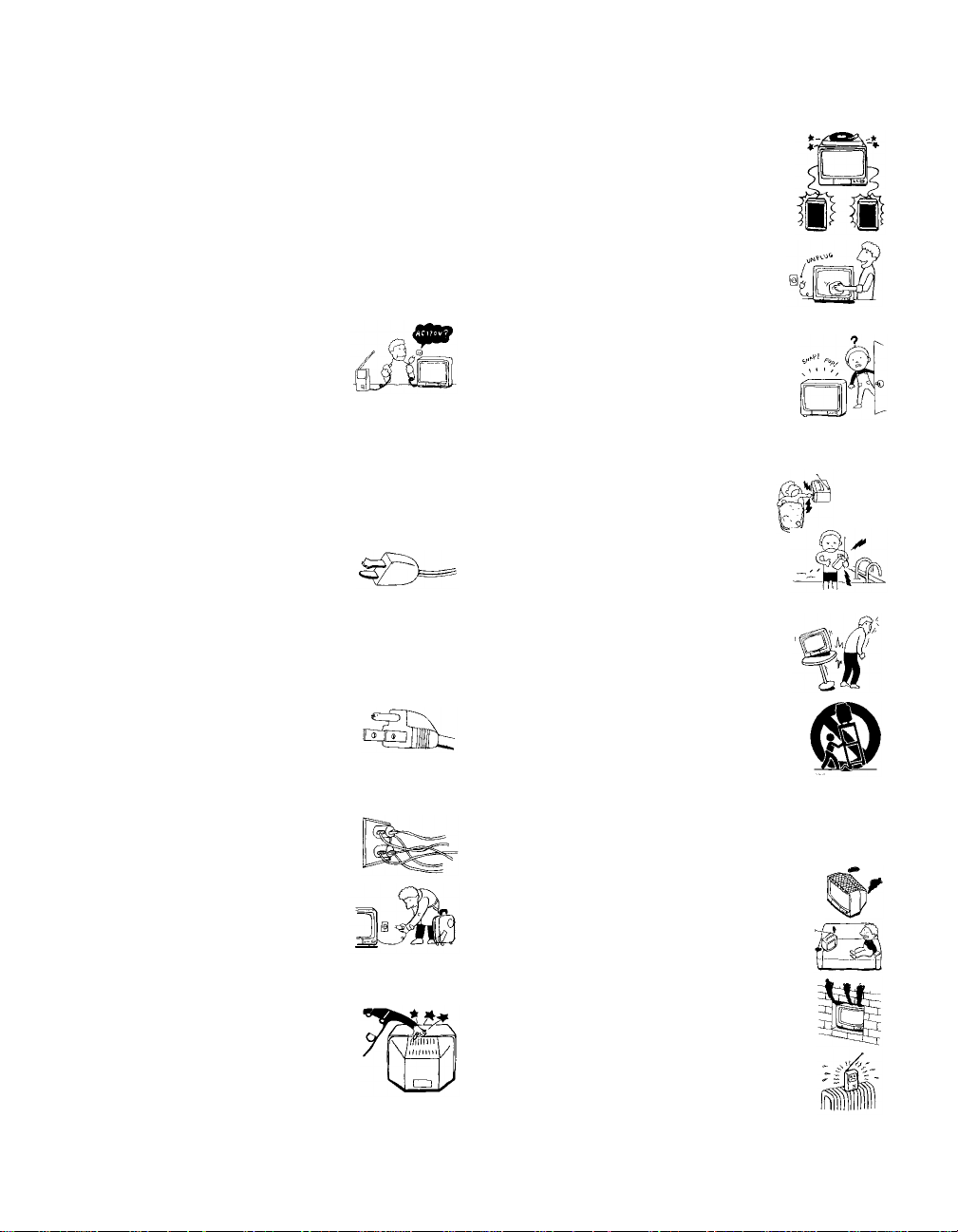
For your protection, please read these instructions completely, and
keep this manual for future reference.
Carefully observe and comply with all warnings, cautions and
instructions placed on the set, or described in the operating
instructions or service manual.
WARNING
To guard against injury, the following basic safety precautions
should be observed in the installation, use, and servicing of the set.
Use
Power Sources
This set should be operated only from the type
of power source indicated on the serial/model
plate. If you are not sure of the type of electrical
power supplied to your home, consult your
dealer or local power company. For those sets
designed to operate from battery power, refer
to the operating instructions.
Grounding or Polarization
This set is equipped with a polarized AC power cord plug (a plug
having one blade wider than the other), or with a three-wire
grounding type plug (a plug having a third pin for
grounding).Follow the instructions below:
For the set with a polarized AC power cord plug
This plug will fit into the power outlet only one
way. This is a safety feature. If you are unable to
insert the plug fully into the outlet, try reversing
the plug. If the plug should still fail to fit, contact your electrician to
have a suitable outlet installed. Do not defeat the safety purpose of
the polarized plug by forcing it in.
Alternate Warning
For the set with a three-wire grounding type AC plug
This plug will only fit into a grounding-type
power outlet. This is a safety feature. If you are
unable to insert the plug into the outlet, contact
your electrician to have a suitable outlet installed.
Do not defeat the safety purpose of the grounding plug.
Overloading
Do not overload wall outlets, extension cords or
convenience receptacles beyond their capacity,
since this can result in fire or electric shock.
Always turn the set off when it is not to be
used. When the set is left unattended and
unused for long periods of time, unplug it
from the wall outlet as a precaution against
the possibility of an internal malfunction that
could create a fire hazard.
Object and Liquid Entry
Never push objects of any kind into the set
through the cabinet slots as they may touch
dangerous voltage points or short out parts that
could result in a fire or electric shock. Never spill
liquid of any kind on the set.
Attachments
Do not use attachments not recommended by the
manufacturer, as they may cause hazards.
Cleaning
Unplug the set from the wall outlet before
cleaning or polishing it. Do not use liquid
cleaners or aerosol cleaners.
Use a cloth lightly dampened with water for
cleaning the exterior of the set. If a snapping or
popping sound from a TV set is continuous or
frequent while the TV is operating, unplug the TV
and consult your dealer or service technician. It is
normal for some TV sets to make occasional
snapping or popping sounds, particularly when
being turned on or off.
Installation
Water and Moisture
Do not use power-line operated sets near
water — for example, near a bathtub,
washbowl, kitchen sink, or laundry tub, in a
wet basement, or near a swimming pool, etc.
Accessories
Do not place the set on an unstable cart, stand,
table or shelf. The set may fall, causing serious
injury to a child or an adult, and serious damage
to the set. Use only a cart or stand recommended
by the manufacturer for the specific model of TV.
An appliance and cart combination should be
moved with care. Quick stops, excessive force,
and uneven surfaces may cause the appliance and
cart combination to overturn.
Ventilation
The slots and openings in the cabinet and in the
back or bottom are provided for necessary
ventilation. To ensure reliable operation of the set, and to protect it
from overheating, these slots and openings must never be blocked
or covered.
❑ Never cover the slots and openings with a
cloth or other materials.
❑ Never block the slots and openings by
placing the set on a bed, sofa, rug or other
similar surface.
❑ Never place the set in a confined space, such
as a bookcase, or built-in cabinet, unless
proper ventilation is provided.
❑ Do not place the set near or over a radiator
or heat register, or where it is exposed to
direct sunlight.
Power-Cord Protection
Do not allow anything to rest on or roll over the
power cord, and do not place the set where the
power cord is subject to wear or abuse.
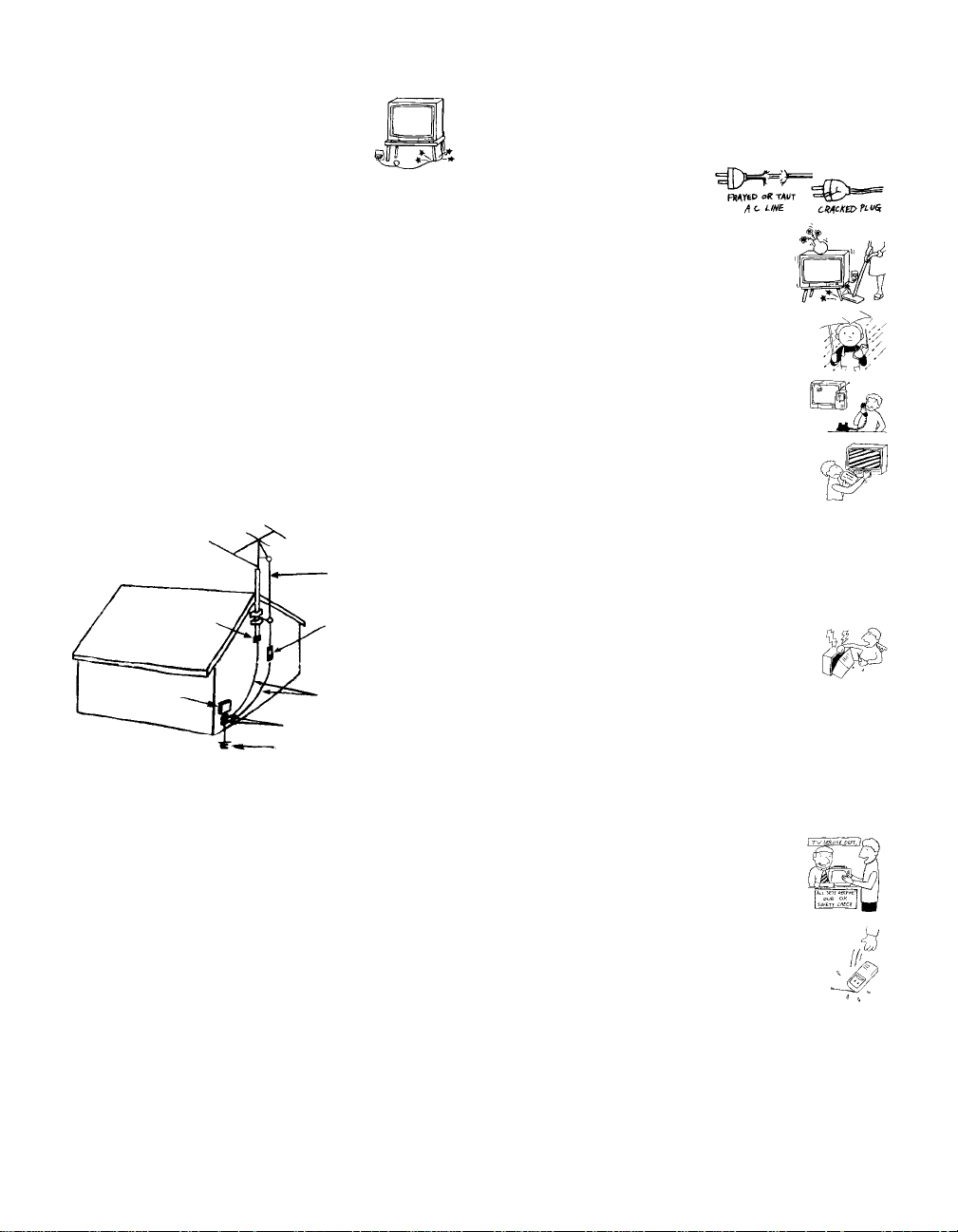
Antennas
Outdoor Antenna Grounding
If an outdoor antenna is installed, follow the precautions below. An
outdoor antenna system should not be located in the vicinity of
overhead power lines or other electric light or power circuits, or
where it can come in contact with such power lines or circuits.
WHEN INSTALLING AN OUTDOOR ANTENNA SYSTEM,
EXTREME CARE SHOULD BE TAKEN TO KEEP FROM
CONTACTING SUCH POWER LINES OR CIRCUITS AS
CONTACT WITH THEM IS ALMOST INVARIABLY FATAL.Be
sure the antenna system is grounded so as to provide some
protection against voltage surges and built-up static charges.
Section 810 of the National Electrical Code (NEC) in USA and
Section 54 of the Canadian Electrical Code in Canada provides
information with respect to proper grounding of the mast and
supporting structure, grounding of the lead-in wire to an antenna
discharge unit, size of grounding conductors, location of antenna
discharge unit, connection to grounding electrodes, and
requirements for the grounding electrode.
Antenna Grounding According to the NEC
Refer to section 54-300 of Canadian Electrical Code for Antenna
Grounding.
Lightning
For added protection for this television receiver during a lightning
storm, or when it is left unattended and unused for long periods of
time, unplug it from the wall outlet and disconnect the antenna.
This will prevent damage to the receiver due to lightning and
power-line surges.
Service
Damage Requiring Service
Unplug the set from the wall outlet and refer servicing to qualified
service personnel under the following conditions:
❑ When the power cord or plug
is damaged or frayed.
❑ If liquid has been spilled into
the set.
❑ If the set has been exposed to
rain or water.
❑ If the set has been subject to
excessive shock by being
dropped, or the cabinet has
been damaged.
❑ If the set does not operate
normally when following the
operating instructions. Adjust
only those controls that are
specified in the operating
instructions. Improper
adjustment of other controls
may result in damage and
will often require extensive
work by a qualified technician
to restore the set to normal operation.
❑ When the set exhibits a distinct change in performance — this
indicates a need for service.
Servicing
Do not attempt to service the set yourself since
opening the cabinet may expose you to dangerous
voltage or other hazards. Refer all servicing to
qualified service personnel.
Replacement Parts
When replacement parts are required, be sure the service
technician certifies in writing that he has used replacement parts
specified by the manufacturer that have the same characteristics as
the original parts.
Unauthorized substitutions may result in fire, electric shock, or
other hazards.
Safety Check
Upon completion of any service or repairs to the
set, ask the service technician to perform routine
safety checks (as specified by the manufacturer) to
determine that the set is in safe operating
condition, and to so certify. When the set reaches
the end of its useful life, improper disposal could
result in a picture tube implosion. Ask a qualified
service technician to dispose of the set.
Ground clamp
Antenna lead-in wire
Antenna discharge unit
Ground clamps
Antenna lead-in wire
Power service grounding electrode
NEC: National Electrical Code
Electrical wire
(NEC Section 810-20)
system (NEC Art 250 Part H)
equipment

v
Contents
Introducing the FD Trinitron Wega
Overview................................................................1
Presenting the FD Trinitron Wega......................2
Using the Remote Control...................................3
Installing the TV
Overview................................................................5
Connecting a Cable or Antenna..........................6
Connecting a VCR and Cable..............................9
Connecting a VCR and Cable Box....................10
Connecting Two VCRs for Tape Editing.........11
Connecting a Satellite Receiver.........................12
Connecting a Satellite Receiver with a VCR ...13
Connecting an Audio Receiver.........................14
Connecting a DVD Player with Component
Video Connectors........................................15
Connecting a DVD Player with
A/V Connectors..........................................16
Connecting a Camcorder ...................................17
Using the CONTROL S Feature........................18
Setting Up the TV Automatically .....................18
Using the Features
Overview..............................................................19
Using Favorite Channels....................................20
Using Picture in Picture (PIP) ...........................21
Using Wireless Headphones.............................22
Using the Menus
Overview..............................................................25
Using the Video Menu.......................................26
Using the Audio Menu ......................................27
Using the Channel Menu...................................29
Using the Parent Menu ......................................30
Using the Timer Menu.......................................33
Using the Setup Menu........................................34
Using the Basic Menu.........................................36
Other Information
Overview..............................................................37
TV Controls and Connectors.............................38
Using the Remote Control.................................40
Troubleshooting..................................................46
Specifications.......................................................48
Index.....................................................................51



Introducing the FD Trinitron Wega
2
Presenting the FD Trinitron
Wega
The FD Trinitron Wega (pronounced VAY-GAH) is characterized by
outstanding contrast, uncompromising accuracy, and corner-to-
corner detail.
You’ll recognize the superiority of Wega technology almost
immediately. The first thing you’ll notice is minimal glare from the
flat picture tube. This flat-screen technology improves picture detail
without distortion, unlike conventional curved screens. The FD
Trinitron delivers outstanding image detail not only at the screen
center, but also at the corners — so you can enjoy a bright, clear
picture from any location in a room.
Features Some of the features that you will enjoy with your new TV include:
❑ 16:9 Enhancement: Vertical Compression technology that
maximizes picture resolution on “anamorphic” or “enhanced for
widescreen” sources, including selected DVDs.
❑ Velocity Modulation: Vertical line enhancement that sharpens
picture definition.
❑ Steady Sound: Equalizes volume levels so there is consistent
output between programs and commercials.
❑ Parental Control: V-Chip technology allows parents to block
unsuitable programming for younger viewers.
❑ Component Video Inputs: Offers the best video quality for DVD
player connections.
❑ S-VIDEO Inputs: Provides a high-quality image for connected
equipment.
❑ Dual Tuner Picture in Picture (PIP): Allows you to watch two
programs at once, (except model KV-36FS12).
❑ Favorite Channel Preview: Preview up to eight favorite channels
without leaving the current channel (except model KV-36FS12).
❑ Wireless Infrared Headphones: Enjoy listening to programs
without disturbing anyone else, (models KV-32FV26, 36FV26
only).
Introducing the FD Trinitron Wega
3
Using the Remote Control
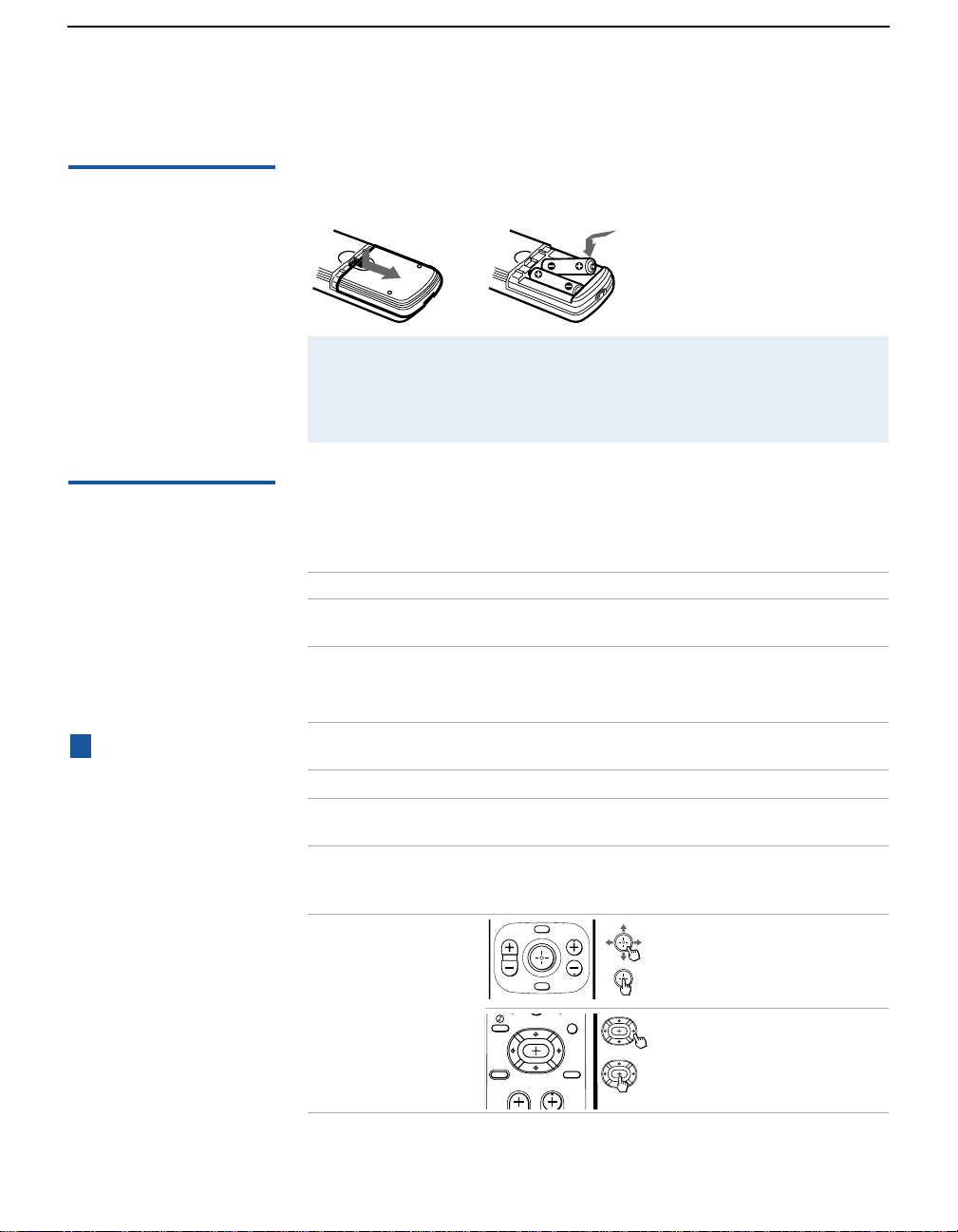
Inserting Batteries Insert two size AA (R6) batteries (supplied) by matching the + and –
on the batteries to the diagram inside the battery compartment.
Remote Control
Overview
Here’s an overview of the buttons on the remote control you will
probably use most often. For a complete description of the remote
control, see “Using the Remote Control” on page 40.
✍ Remove the batteries to avoid damage from possible battery leakage whenever you
anticipate that the remote control will not be used for an extended period.
Handle the remote control with care. Avoid dropping it, getting it wet, or placing it in
direct sunlight, near a heater, or where the humidity is high.
To Do This ... Use This Button
Turn the TV
on and off
TV (POWER)
Select channels
directly
0 - 9 and ENTER
Press 0 - 9 to select a channel, the channel changes
after 2 seconds. Press
ENTER for immediate selection.
Scan through
channels
CH +/-
Adjust the volume
VOL +/-
Switch video inputs
(such as a VCR)
TV/VIDEO
Press repeatedly to toggle through all video inputs.
Display the Menu to
make changes to the
TV
MENU
For details, see “Using the Menus” on page 25.
Using the on-screen
functions
To scan rapidly through the
channels, press and hold down
the CH+ or CH- button.
z
MENU
VOL
RESET
CH
VTR1 23 DVD/MDP
Move
Select
J
oyst
i
c
k
:
(models KV-32FV26,
36FV26 only)
Move
Select
Arrow buttons:
(all models except
KV-32FV26, 36FV26)
CHVOL
RESET MENU
GUIDE
TV/SAT


5
Installing the TV
Overview
This chapter includes illustrated instructions for setting up your TV:
Note About the AC
Power Cord
The AC power cord is attached to the rear of the TV with hooks. Use
caution when removing the AC plug from its holder. Gently slide the
cord in the upward direction, without removing the cord from the
two lower hooks.
Topic Page
Connecting a Cable or Antenna 6
Connecting a VCR and Cable 9
Connecting a VCR and Cable Box 10
Connecting Two VCRs for Tape Editing 11
Connecting a Satellite Receiver 12
Connecting a Satellite Receiver with a VCR 13
Connecting an Audio Receiver 14
Connecting a DVD Player with Component Video
Connectors
15
Connecting a DVD Player with A/V Connectors 16
Connecting a Camcorder 17
Using the CONTROL S Feature 18
Setting Up the TV Automatically 18
You can detach
the cord from this
hook
Do not remove the cord from
these hooks
AC Power cord
Installing the TV
6
Connecting a Cable or Antenna
Connecting Directly
to Cable or an
Antenna
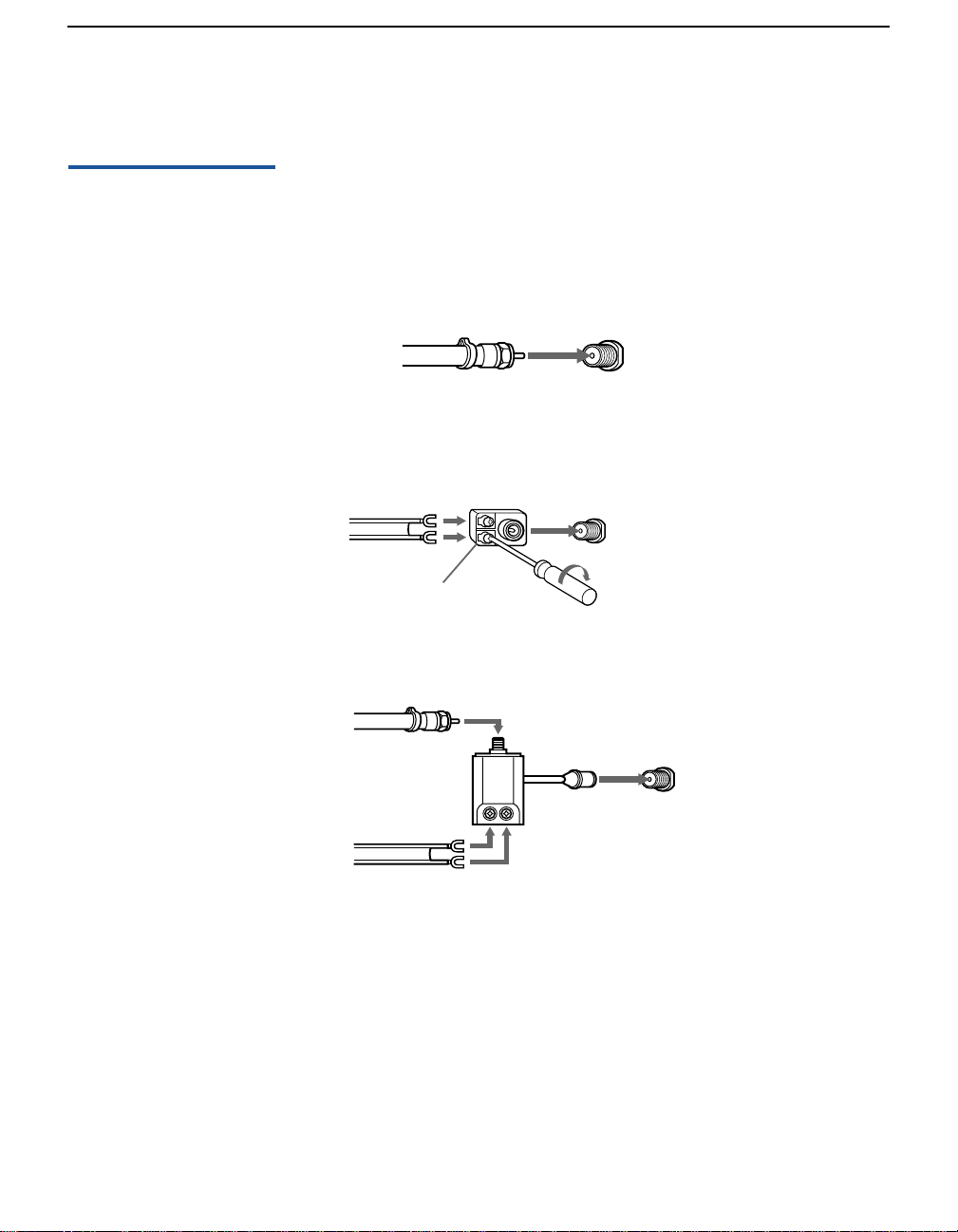
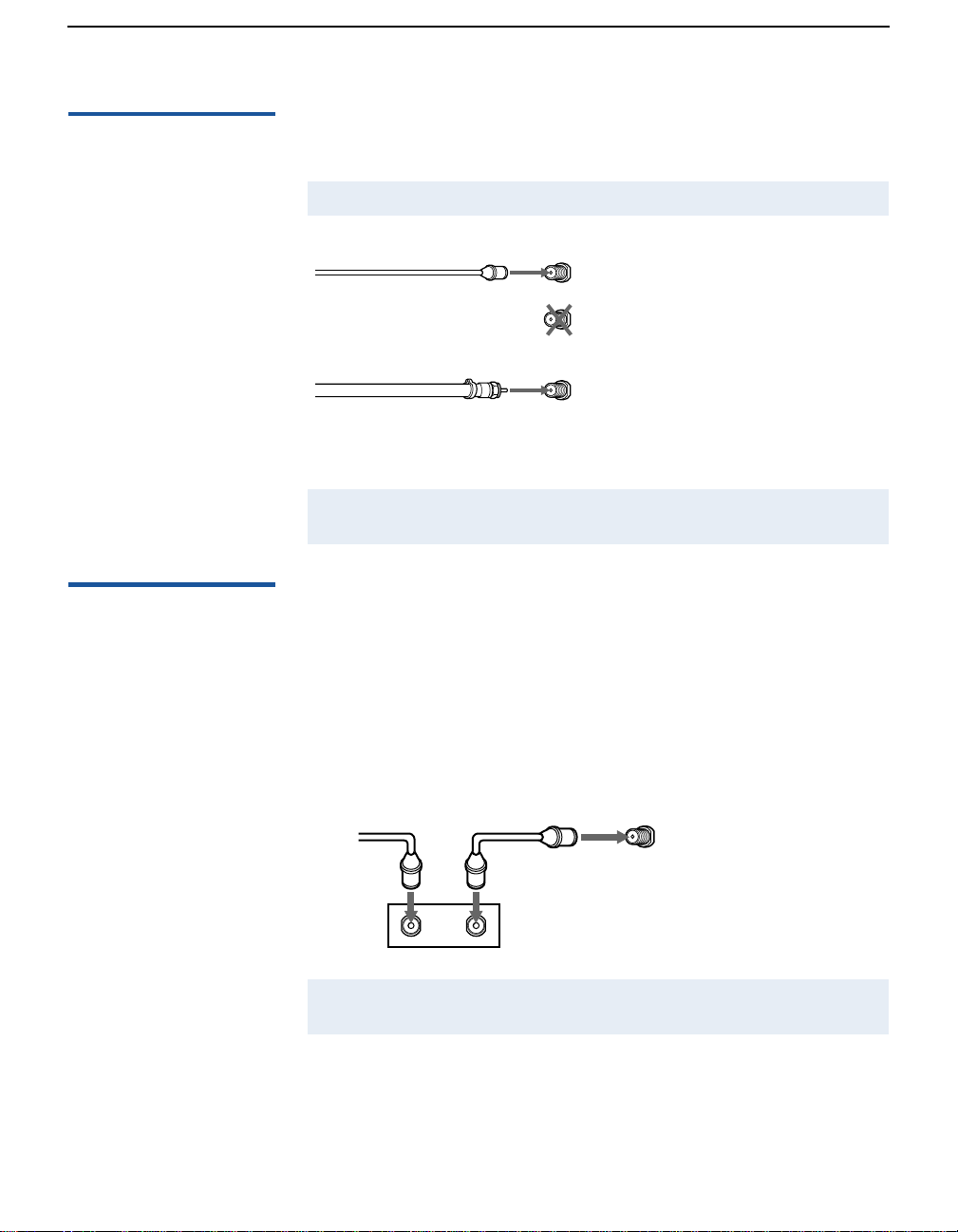
The connection you choose depends on the cable found in your
home. Newer homes are equipped with standard coaxial cable (see
A); older homes probably have 300-ohm twin lead cable (see B); still
other homes may contain both (see
C).
A VHF Only or VHF/UHF or Cable
B VHF Only or UHF Only or VHF/UHF
C VHF and UHF
75-ohm
Rear of TV
VHF/UHF
coaxial
cable
300-ohm twin
Rear of TV
VHF/UHF
lead cable
Antenna connector
75-ohm
Rear of TV
VHF/UHF
coaxial cable
300-ohm twin
lead cable
U/V Mixer
(not supplied)
Installing the TV
7
Cable and Antenna If your cable provider does not feature local channels, you may find
this set up convenient.
Select CABLE or antenna (ANT) mode by pressing
ANT on the remote
control.
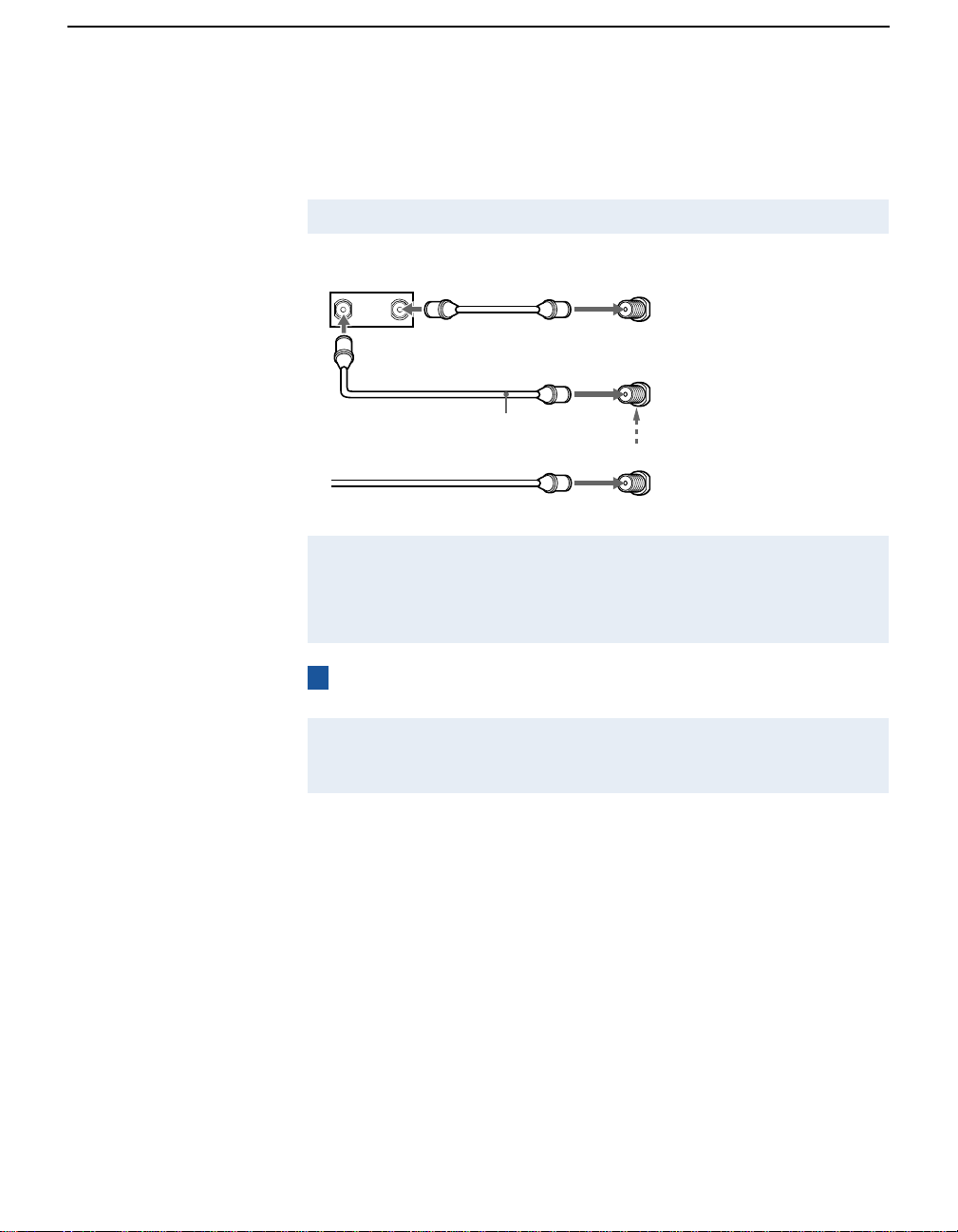
Cable Box
Connections
Some pay cable TV systems use scrambled or encoded signals that
require a cable box to view all channels.
Cable Box
1 Connect the coaxial connector from your cable service to the
cable box’s IN jack.
2 Using a coaxial cable, connect the cable box’s OUT jack to the
TV’s VHF/UHF jack.
✍ This connection applies to all models except KV-36FS12.
✍ In order to receive channels with an antenna, you need to turn your Cable to OFF and
perform the Auto Program function (see page 29).
Rear of TV
AUX
TO CONVERTER
VHF/UHF
Antenna cable
(No connection to
CATV cable
TO CONVERTER)
✍ If you will be controlling all channel selection through your cable box, you should
consider using the Channel Fix feature (see page 29).
Rear of TV
OUT
Cable box
IN
Cable
VHF/UHF
Installing the TV
8
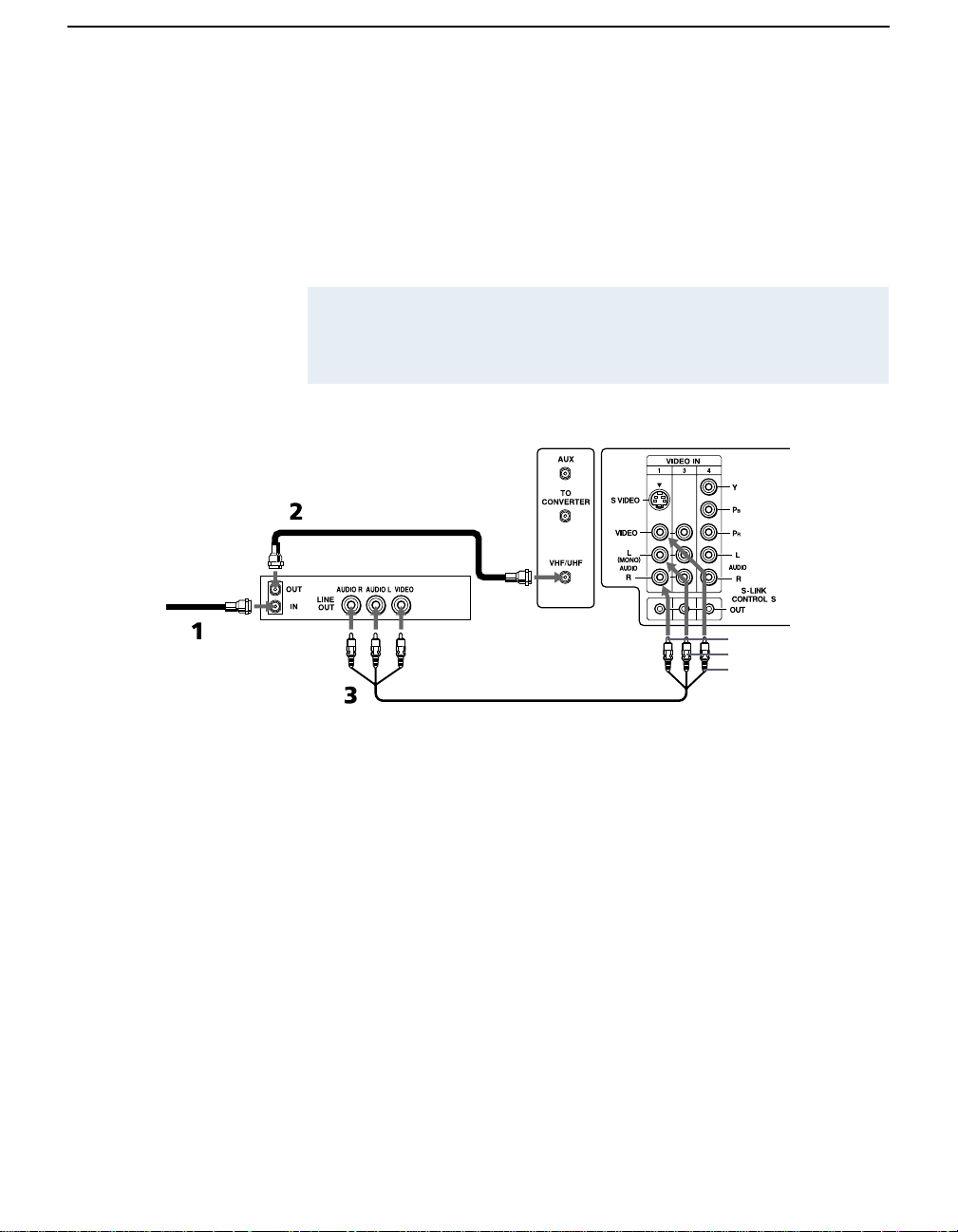
Cable Box and Cable
For this set up, you can switch between scrambled channels (through
your cable box), and normal (CATV) channels by pressing
ANT on the
remote control.
✍ This connection applies to all models except KV-36FS12.
✍ Your Sony remote control can be programmed to operate your cable box (see
“Programming the Remote Control” on page 42).
When using Favorite Channel or PIP, you cannot view the AUX input in the window
picture.
Pressing ANT switches between these inputs.
✍ If you are connecting a cable box through the AUX input and would like to switch
between the AUX and normal (CATV) input you should consider using the Channel Fix
feature (see page 29).
Rear of TV
OUT
75-ohm coaxial cable (not supplied)
IN
AUX
TO CONVERTER
VHF/UHF
CATV cable (unscrambled channels)
Cable box
Signal
z
Installing the TV
9
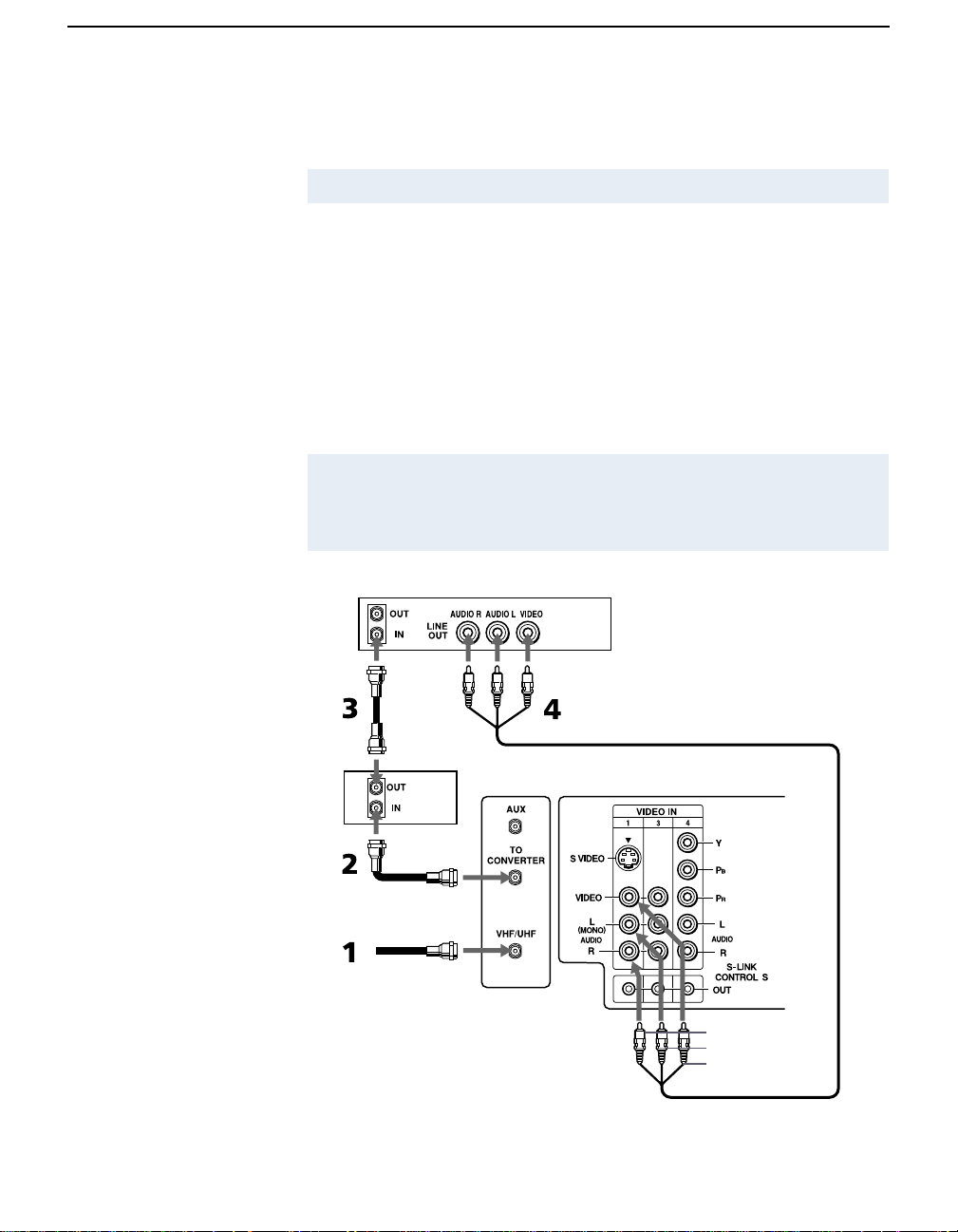
Connecting a VCR and Cable
1 Connect the cable TV cable to the VCR’s IN jack.
2 Using a coaxial cable, connect the VCR’s OUT jack to the TV’s
VHF/UHF jack.
3 Using an A/V cable, connect the VCR’s A/V OUT jacks to the
TV’s A/V IN jacks.
✍ If your VCR has an S VIDEO jack: For best picture quality, use an S VIDEO connection
instead of the yellow video cable on your combined A/V cable. Using an S VIDEO cable,
connect the VCR’s S VIDEO OUT jack to the TV’s S VIDEO IN jack. S VIDEO does not
provide audio, so audio cables must still be connected to provide sound.
VCR
TV
AUDIO-R (red)
AUDIO-L (white)
VIDEO (yellow)
Cable
Coaxial cable
A/V cable
Installing the TV
10
Connecting a VCR and Cable Box
1 Connect your incoming cable connection to the TV’s VHF/UHF
jack.
2 Using a coaxial cable, connect the cable box’s IN jack to the TV’s
TO CONVERTER jack.
3 Using a coaxial cable, connect the cable box’s OUT jack to the
VCR’s VHF/UHF IN jack.
4 Using an A/V cable, connect the VCR’s A/V OUT jacks to the
TV’s A/V IN jacks.
✍ This connection applies to all models except KV-36FS12.
✍ If your VCR has an S VIDEO jack: For best picture quality, use an S VIDEO connection
instead of the yellow video cable on your combined A/V cable. Using an S VIDEO cable,
connect the VCR’s S VIDEO OUT jack to the TV’s S VIDEO IN jack. S VIDEO does not
provide audio, so audio cables must still be connected to provide sound.
AUDIO-R (red)
AUDIO-L (white)
VIDEO (yellow)
VCR
Cable box
Cable
Coaxial
cable
A/V cable
TV
Coaxial
cable
Installing the TV
11
Connecting Two VCRs for Tape Editing
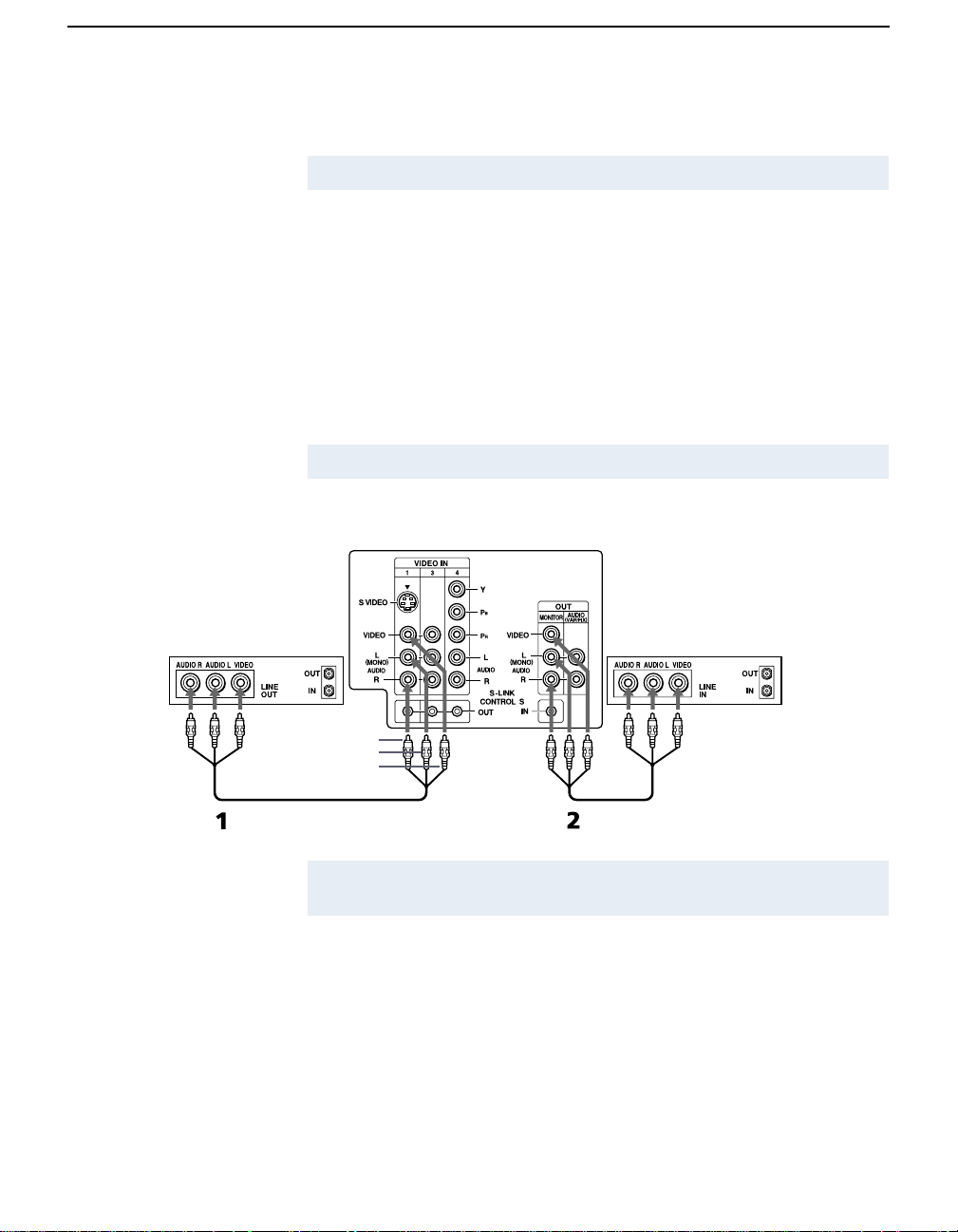
If you connect two VCRs, you can use the TV’s MONITOR OUT
feature to perform tape-to-tape editing. In the connection shown
below, the TV functions as a monitor and sends the program being
played by the playback VCR to the recording VCR.
1 Connect the VCR intended for playback using the connection
instructions on page 10 of this manual.
2 Using A/V connectors, connect AUDIO and VIDEO IN on the
VCR intended for recording to MONITOR AUDIO and VIDEO
OUT on your TV.
✍ This connection applies to all models except KV-36FS12 and 36FS16.
✍ You cannot record signals from equipment connected to the Y, PB, PR input.
AUDIO-R (red)
AUDIO-L (white)
VIDEO (yellow)
VCR (recording)
VCR (playback)
TV
A/V cable
A/V cable
✍ To perform tape editing, set the TV to the video input intended for playback by pressing
the TV/VIDEO button on the remote control.
Installing the TV
12
Connecting a Satellite Receiver
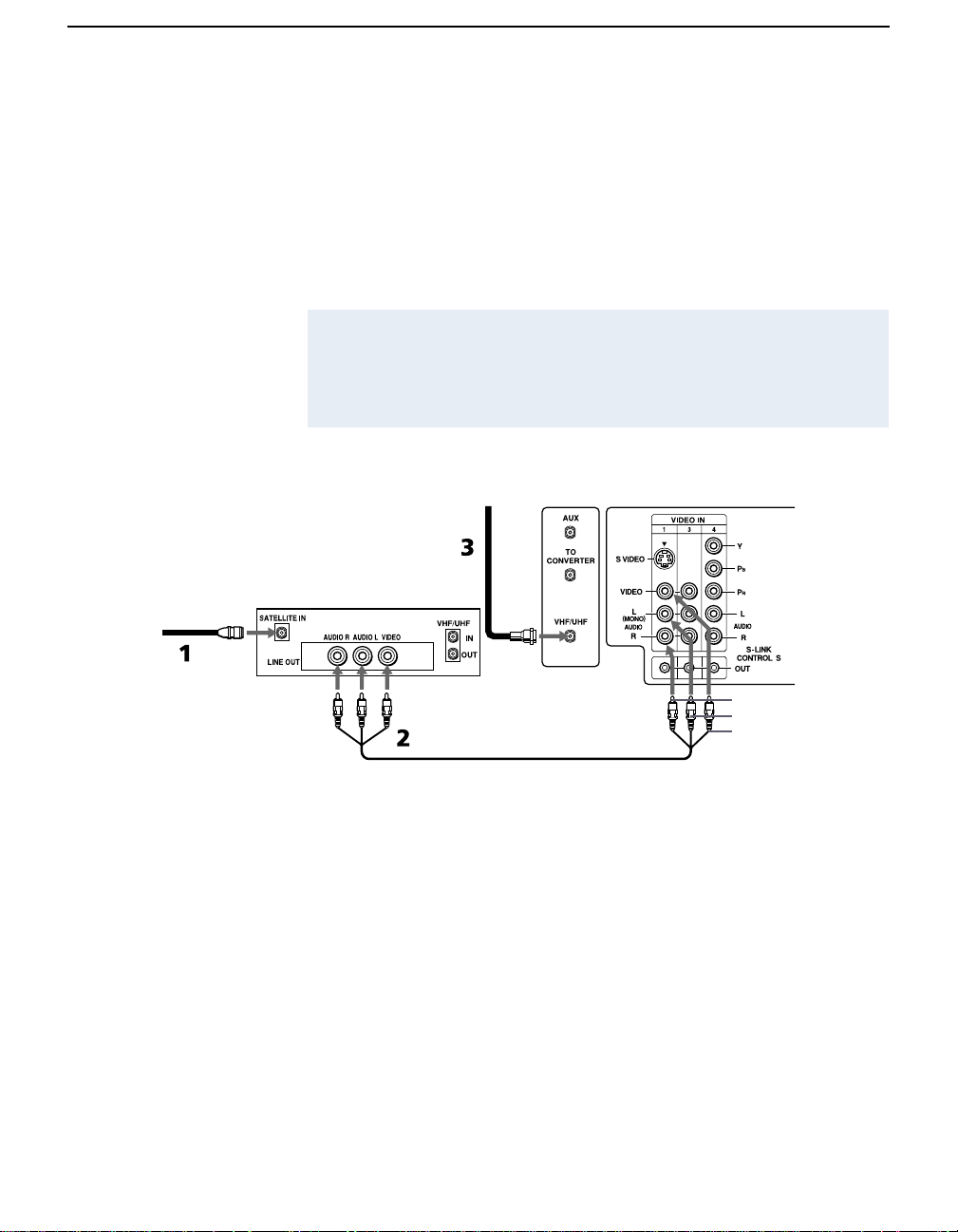
1 Connect the satellite antenna cable to the satellite receiver’s
SATELLITE IN jack.
2 Using an A/V cable, connect the satellite receiver’s A/V OUT
jacks to the TV’s A/V IN jacks.
3 Connect a coaxial cable from your cable or antenna to TV’s
VHF/UHF jack.
✍ If your satellite receiver has an S VIDEO jack: For best picture quality, use an S VIDEO
connection instead of the yellow video cable on your combined A/V cable. Using an S
VIDEO cable, connect the satellite receiver’s VIDEO OUT jack to the TV’s S VIDEO IN
jack. S VIDEO does not provide audio, so audio cables must still be connected to provide
sound.
AUDIO-R (red)
AUDIO-L (white)
VIDEO (yellow)
TV
Satellite receiver
Satellite antenna
cable
A/V cable
Coaxial
cable
Installing the TV
13
Connecting a Satellite Receiver with a VCR
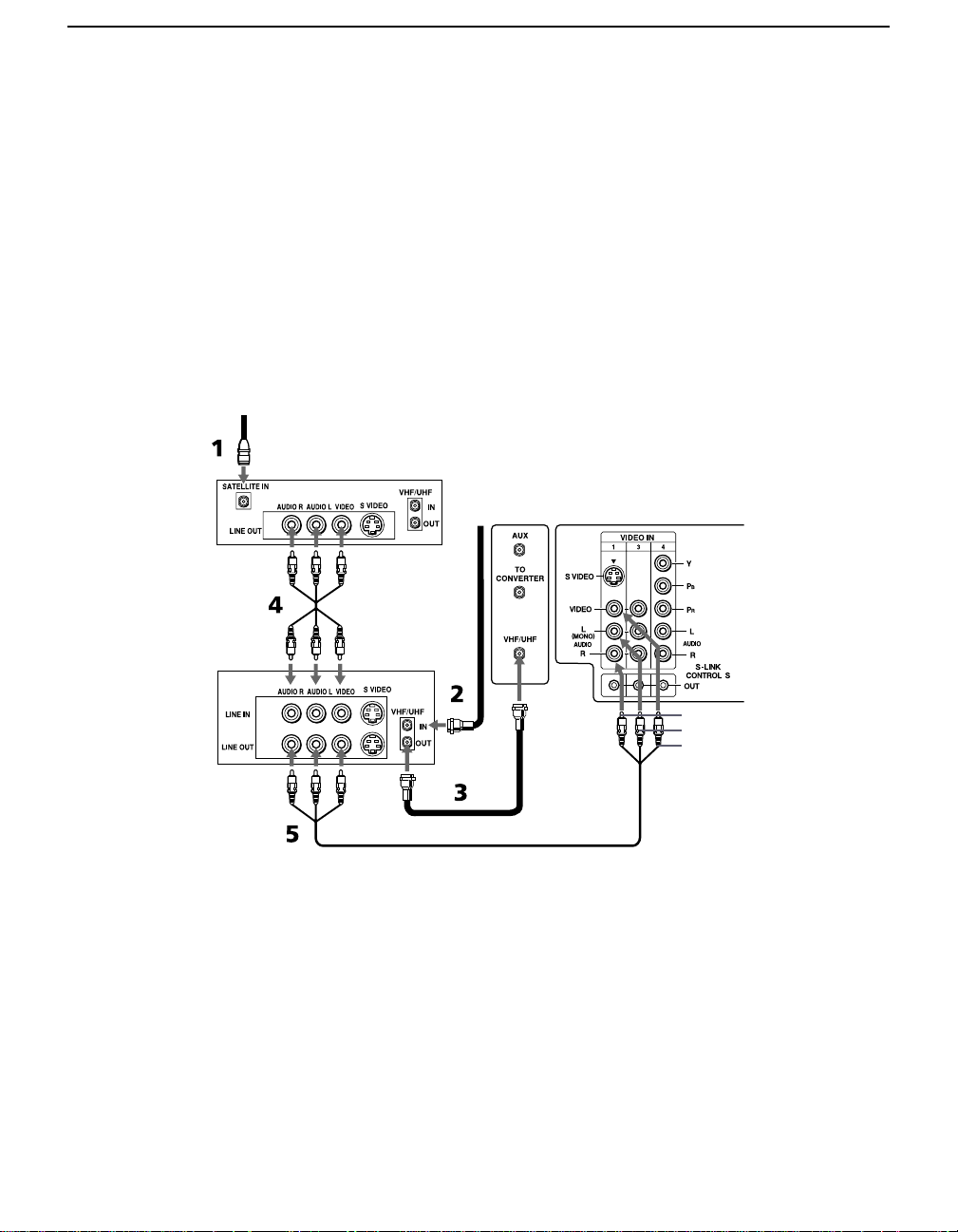
1 Connect the satellite antenna cable to the satellite receiver’s
SATELLITE IN jack.
2 Connect the CATV cable to the VCR’s VHF/UHF IN jack.
3 Using a coaxial cable, connect the VCR’s OUT jack to the TV’s
VHF/UHF jack.
4 Using an A/V cable, connect the satellite receiver’s A/V OUT
jacks to the VCR’s A/V IN jacks.
5 Using an A/V cable, connect the VCR’s A/V OUT jacks to the
TV’s A/V IN jacks.
AUDIO-R (red)
AUDIO-L (white)
VIDEO (yellow)
TV
Satellite receiver
VCR
A/V cable
Coaxial
cable
Coaxial
cable

Installing the TV
14
Connecting an Audio Receiver
1 Using audio cables, connect the TV’s AUDIO OUT jacks to the
audio receiver’s audio LINE IN jacks.
AUDIO-R
AUDIO-L
Line input
(red)
(white)
Installing the TV
15
Connecting a DVD Player with Component
Video Connectors
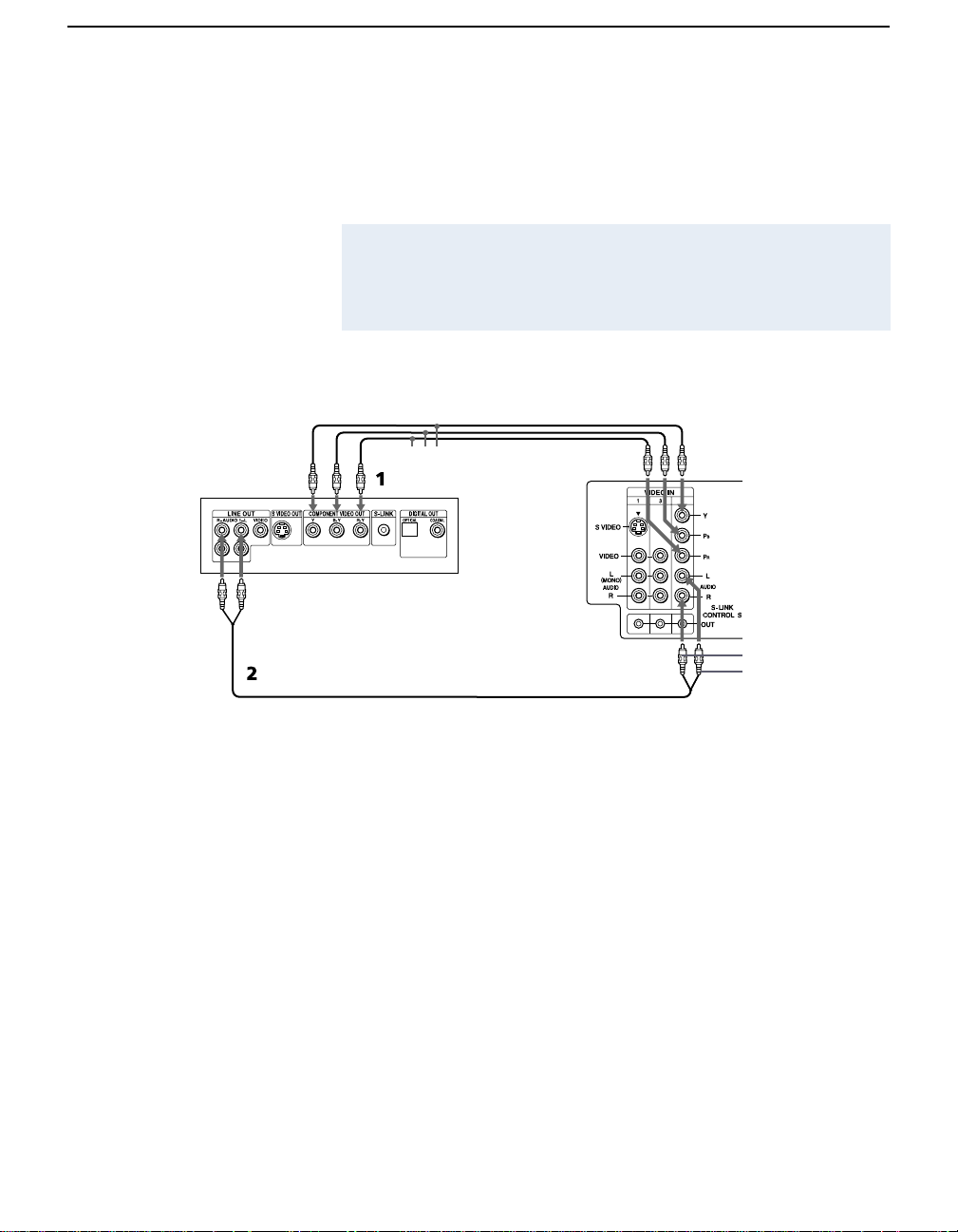
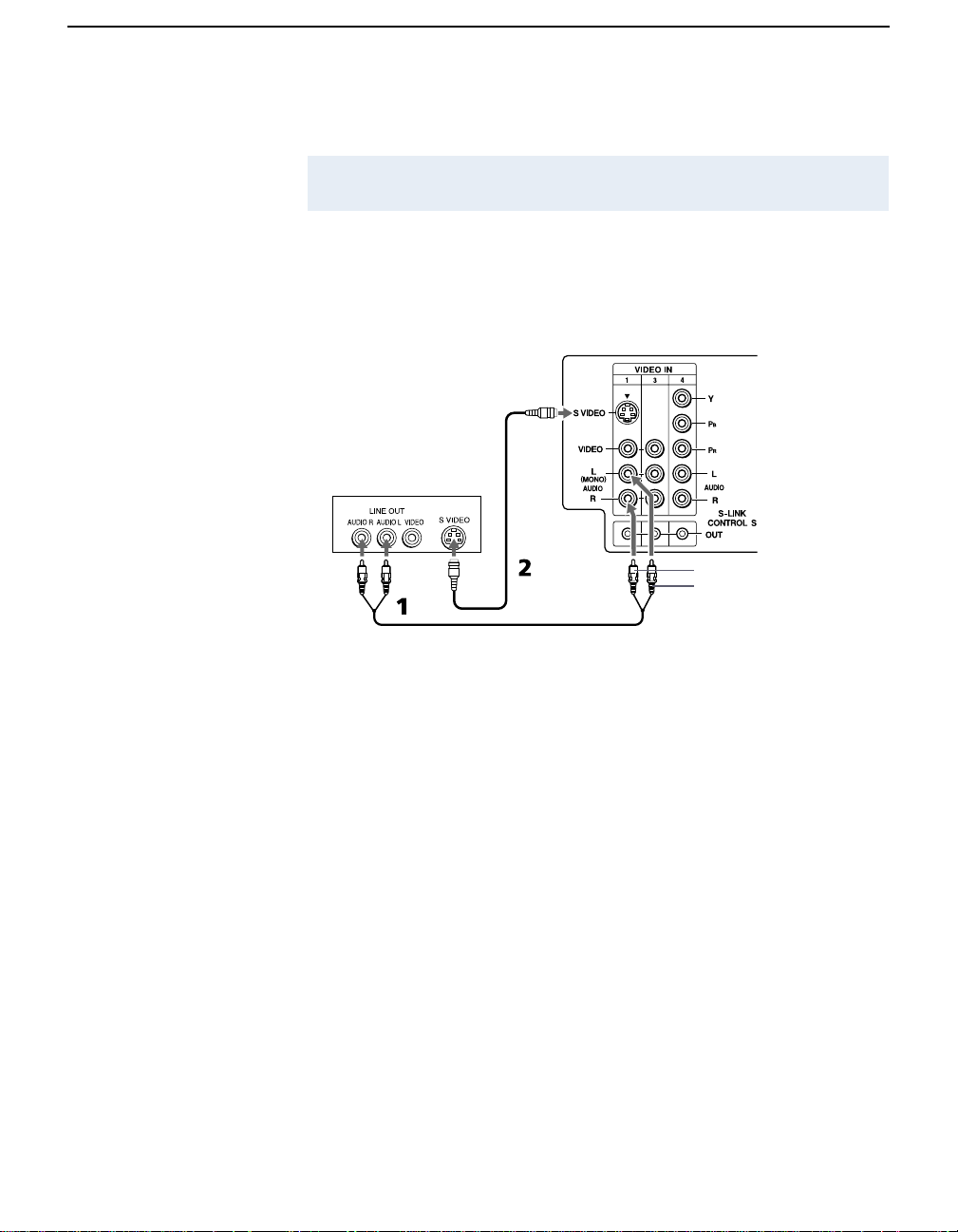
1 Using three separate component video cables, connect the DVD
player’s Y, P
B, and PR jacks to the Y, PB, and PR jacks on the TV.
2 Using an audio cable, connect the DVD player’s audio OUT jacks
to the TV’s audio IN jacks.
✍ The Y, PB, and PR jacks on your DVD player are sometimes labeled Y, CB, and CR, or
Y, B-Y, and R-Y. If so, connect the cables to like colors.
The Y, PB, and PR jacks do not provide audio, so audio cables must be connected to
provide sound.
Component video cables
DVD player
TV
AUDIO-R (red)
AUDIO-L (white)
Audio cable
Installing the TV
16
Connecting a DVD Player with A/V Connectors
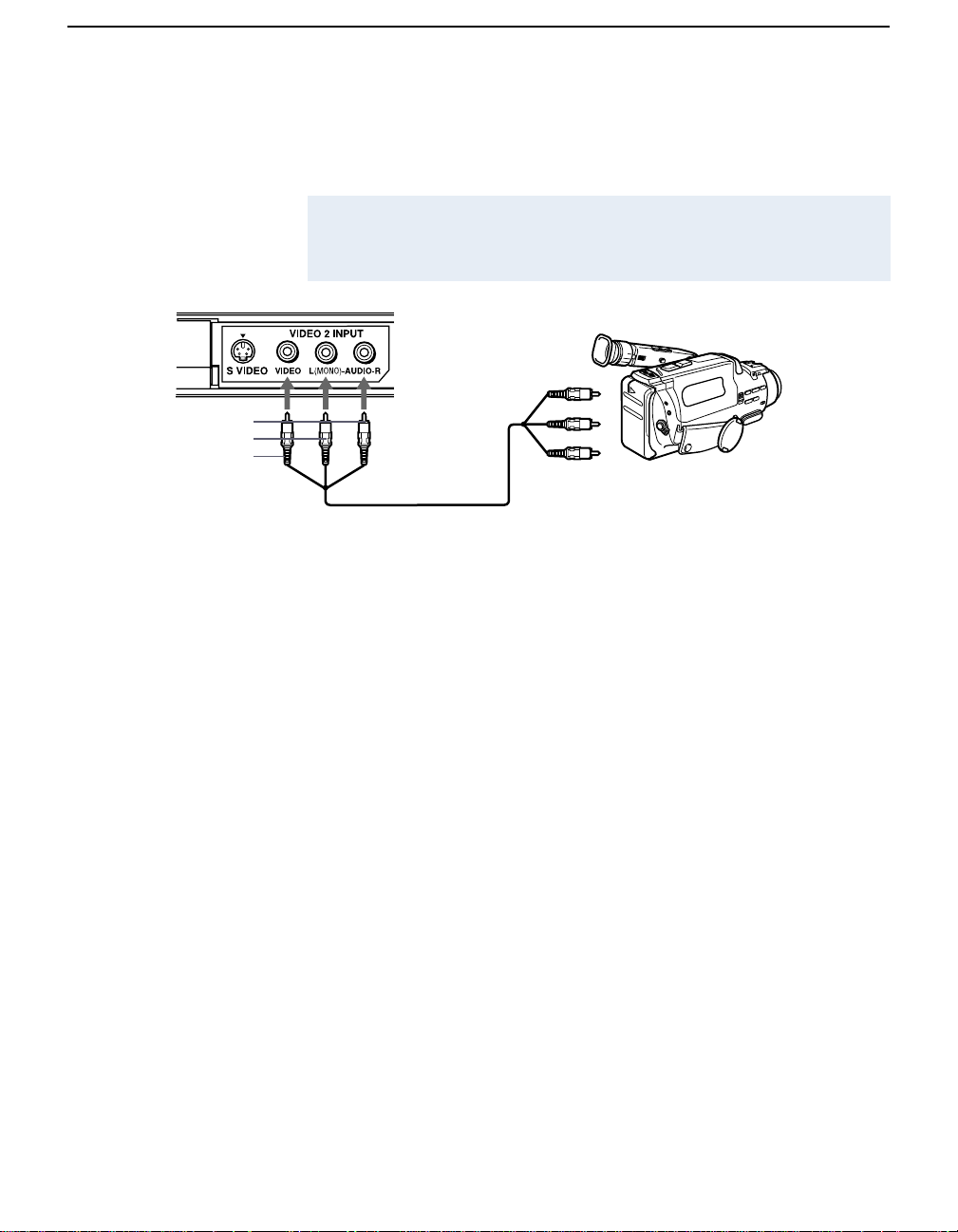
1 Using audio cables, connect the DVD player’s audio OUT jacks to
the TV’s audio IN jacks.
2 Using an S-VIDEO cable, connect the DVD player’s S-VIDEO
jack to the TV’s S-VIDEO jack.
✍ If your DVD player has video component output connectors: for best picture quality use
the connection described on page 15.
Audio cable
DVD player
S-VIDEO
cable
AUDIO-R (red)
AUDIO-L (white)
TV
Installing the TV
17
Connecting a Camcorder
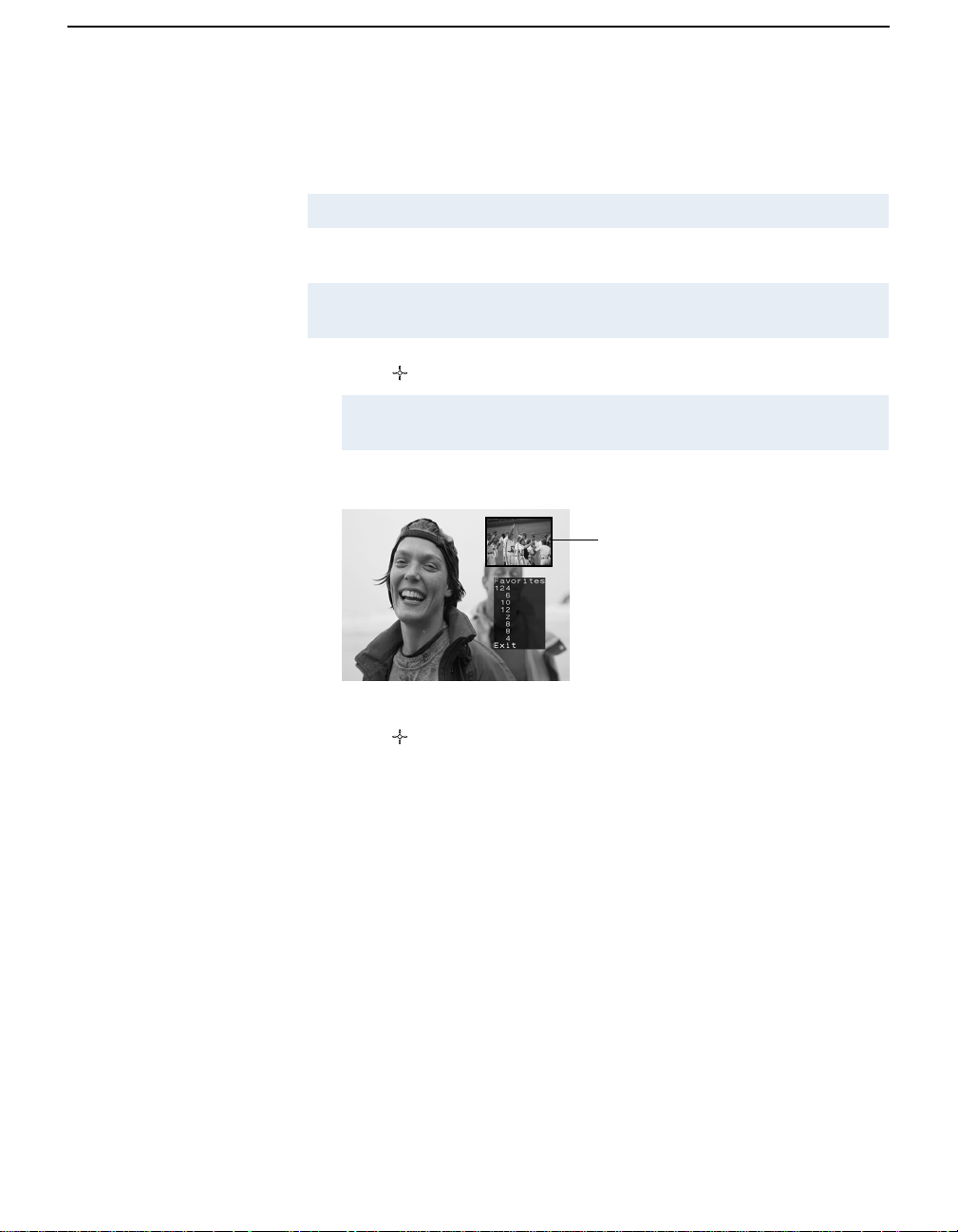
1 Using A/V cables, connect the camcorder’s A/V OUT jacks to
the TV’s A/V IN jacks.
✍ If you have a mono camcorder, connect its left audio output to the TV’s AUDIO L jack.
For easy connection of the camcorder, the TV has front A/V inputs (shown below).
However, if you prefer, you can also connect the camcorder to the TV’s rear A/V IN jacks.
AUDIO-R (red)
AUDIO-L (white)
VIDEO (yellow)
A/V output

Installing the TV
18
Using the CONTROL S Feature
CONTROL S allows you to control your TV system and other Sony
equipment with one remote control.
To control your other Sony equipment with your TV’s remote control,
use a CONTROL S cable (not supplied) to connect the equipment’s
CONTROL S IN jack to the TV’s CONTROL S OUT jack.
Setting Up the TV Automatically
After you finish connecting your TV, you need to run Auto Setup to
set up your channels.
Using Auto Setup 1 Press POWER to turn on the TV.
The first time you turn on the TV, the Auto Setup screen appears.
2 Press CH+ to run Auto Setup or press CH– to exit.
✍ This CONTROL S feature applies to all models except KV-36FS12 and 36FS16.
TV
✍ The Auto Setup feature does not apply for installations that use a cable box for all
channel selection.
✍ You can run Auto Program again by selecting it in the Channel menu, as described on
page 29.
To reset your TV to factory settings, turn the TV on. Then, while pressing the RESET
button on the remote control, press the POWER button on the TV. The TV will turn itself
off, then back on.
z

Using the Features
20
Using Favorite Channels
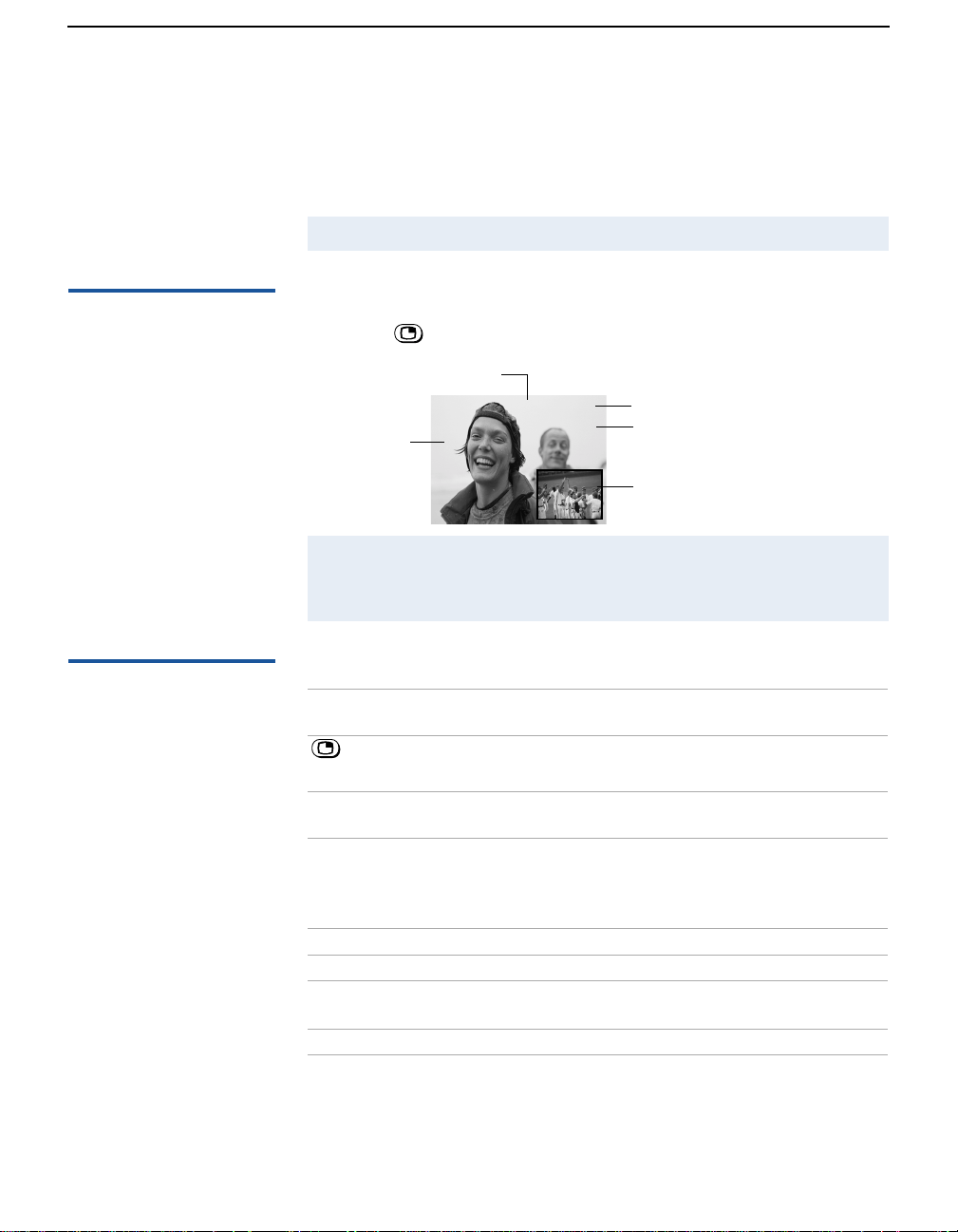
The Favorite Channel feature lets you select programs from a list of
favorite channels that you specify.
To display a list of your favorite channels:
1 Press .
The Favorite Channel options appear.
2 Press V or v to access the channel you want to watch, and
press .
✍ The Favorite Channel feature with preview is not included in model KV-36FS12.
✍ You must specify your favorite channels before you can display them. See the Favorite
Channel description under “Selecting Channel Options” on page 29.
✍ You must exit all menus (by pressing the MENU button) before you can display the
Favorite Channel screen.
Preview appears on all models
except KV-36FS12
Using the Features
21
Using Picture in Picture (PIP)
Picture in Picture (PIP) allows you to watch two channels
simultaneously — one in the large main window and another in a
small window picture.
Displaying Picture in
Picture
To display PIP:
❑
Press (or the button labeled PIP):
Other PIP Functions
✍ The Picture in Picture feature is not included in model KV-36FS12.
✍ You must press TV (FUNCTION) before you can control PIP with the yellow labeled
buttons.
The AUX input cannot be viewed in the window picture.
6
Indicates which picture is
2
Main picture channel number
Window picture channel number
Window picture
Main
picture
currently receiving sound
9
Yellow Labeled
Button
Description
or PIP
Turns on/off PIP. Press repeatedly to change the
window picture size (1/9, 1/16, OFF).
* TV/VIDEO Cycles through available video inputs: TV, VIDEO 1,
VIDEO 2, VIDEO 3, VIDEO 4
* AUDIO Alternates sound between the main picture and the
window picture. The sound symbol (
9) appears, which
indicates whether the main or window picture is
receiving sound.
* CH +/- Changes the channel in the window picture.
* POSITION Moves the location of the window picture.
* FREEZE Freezes the window picture. Press again to restore the
picture.
SWAP Switches the main picture with the window picture.
On models KV-32FV26 and
36FV26, buttons with asterisks
(*) are located on the inside
panel of the remote.
Using the Features
22
Using Wireless Headphones
Installing the
Batteries
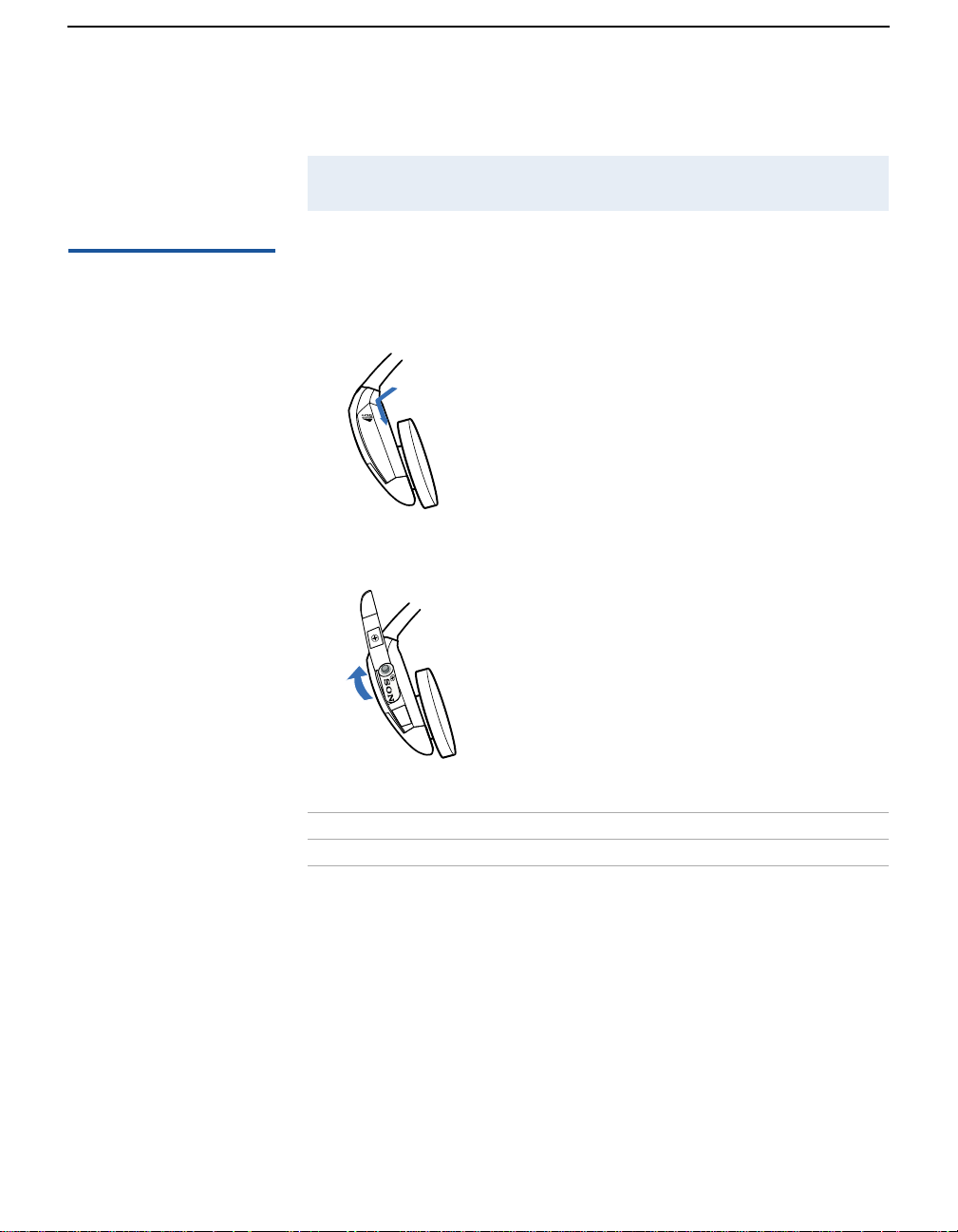
Install the supplied size AA (R6) battery into the headphones.
1 Open the battery compartment lid by pressing and sliding the lid
as illustrated.
2 Insert the battery into the compartment with the positive side up
and then close the lid.
When used continuously, the battery lasts:
Replace the battery with a new one when the sound becomes weak.
✍ Wireless headphones are included and can only be used with models KV-32FV26 and
36FV26 only.
up to 40 hours with an alkaline battery
up to 20 hours with a manganese battery
Using the Features
23
Using the
Headphones
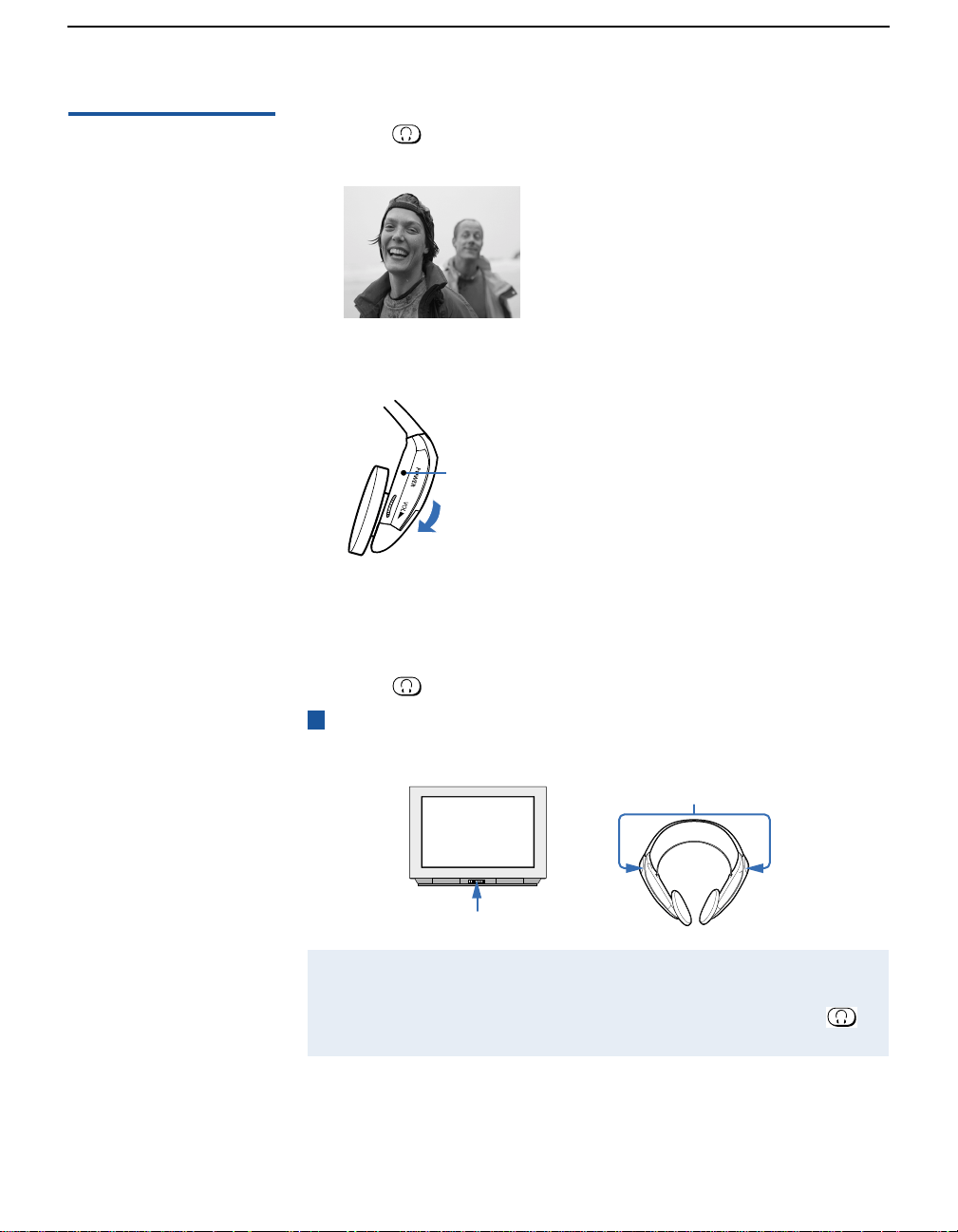
1 Press .
The i icon and channel number are displayed.
2 Turn on the power by placing the headphones securely on your
head.
If you want to listen to the sound from only the wireless
headphones, turn down the TV speaker volume, or press
MUTING
on the remote control.
3 To turn off the headphones, remove them from your head and
press .
For optimal sound reception, do not cover the infrared transmitter on the TV or the
infrared sensors on the headphones.
✍ To help prevent possible hearing damage due to sudden or prolonged excessive volume,
do not set the headphone volume too high while using them.
To prevent possible damage to the infrared transmitter in the television, press to
turn off the headphone feature when the headphones are not in use.
i
6
Power indicator
Volume control
z
Infrared sensors
Infrared transmitter
Using the Features
24
Listening to Sound
from Main and
Window Pictures
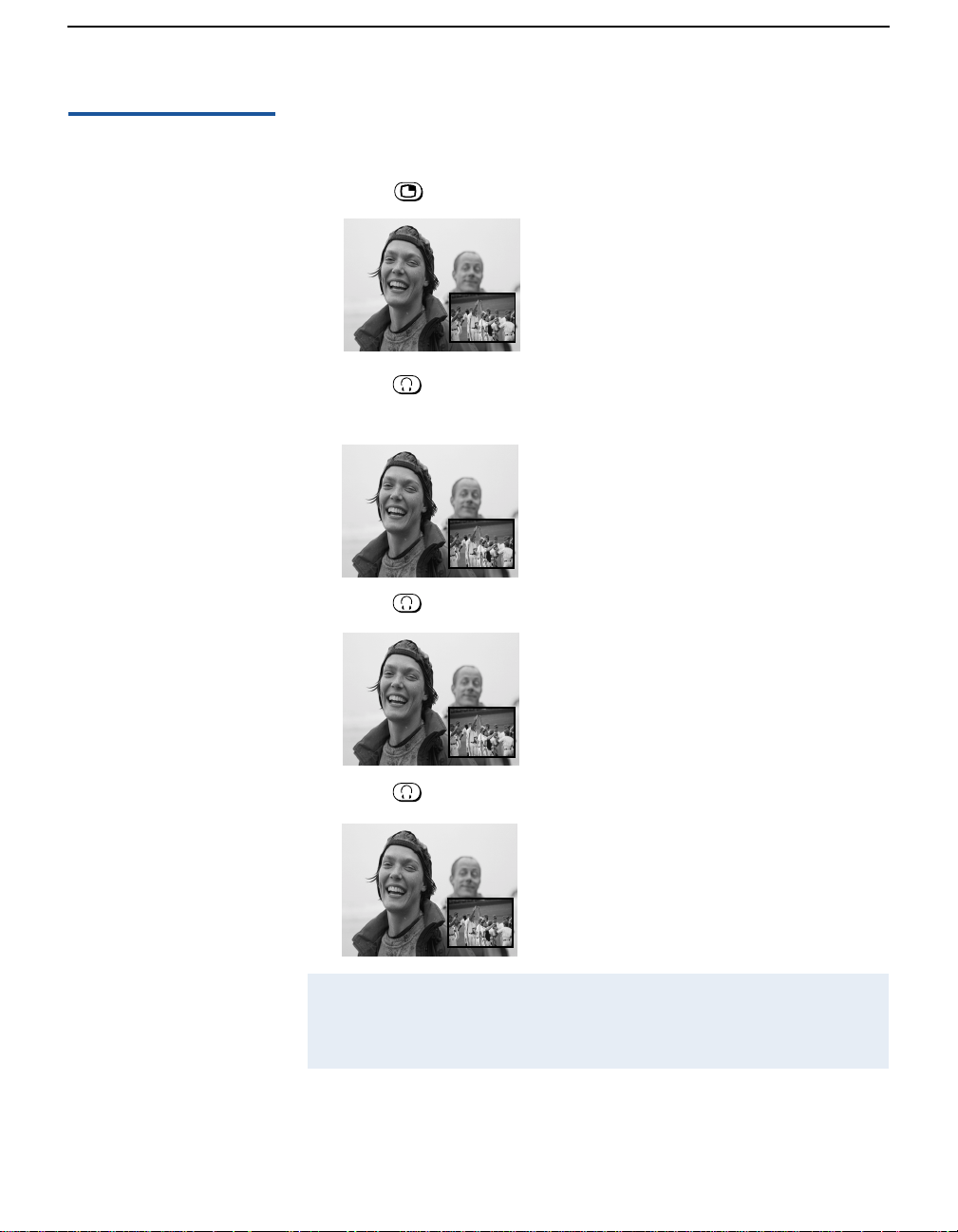
If you want to listen to the sound from the main or window picture
through your headphones, select the audio source.
1 Press to display a window picture.
2 Press .
The
i icon and channel number appear for about three seconds.
Press
again to switch the audio to the window picture.
3 Press to turn off the headphones.
✍ Exiting from PIP returns the sound to the main picture.
The audio to the headphones automatically turns off when the TV is powered off.
SAP (Second Audio Programs) are not available in the window picture.
6
2
Main picture audio
6
2
i
Window picture audio
6
2
i
Headphones off
i
OFF
2
25
Using the Menus
Overview
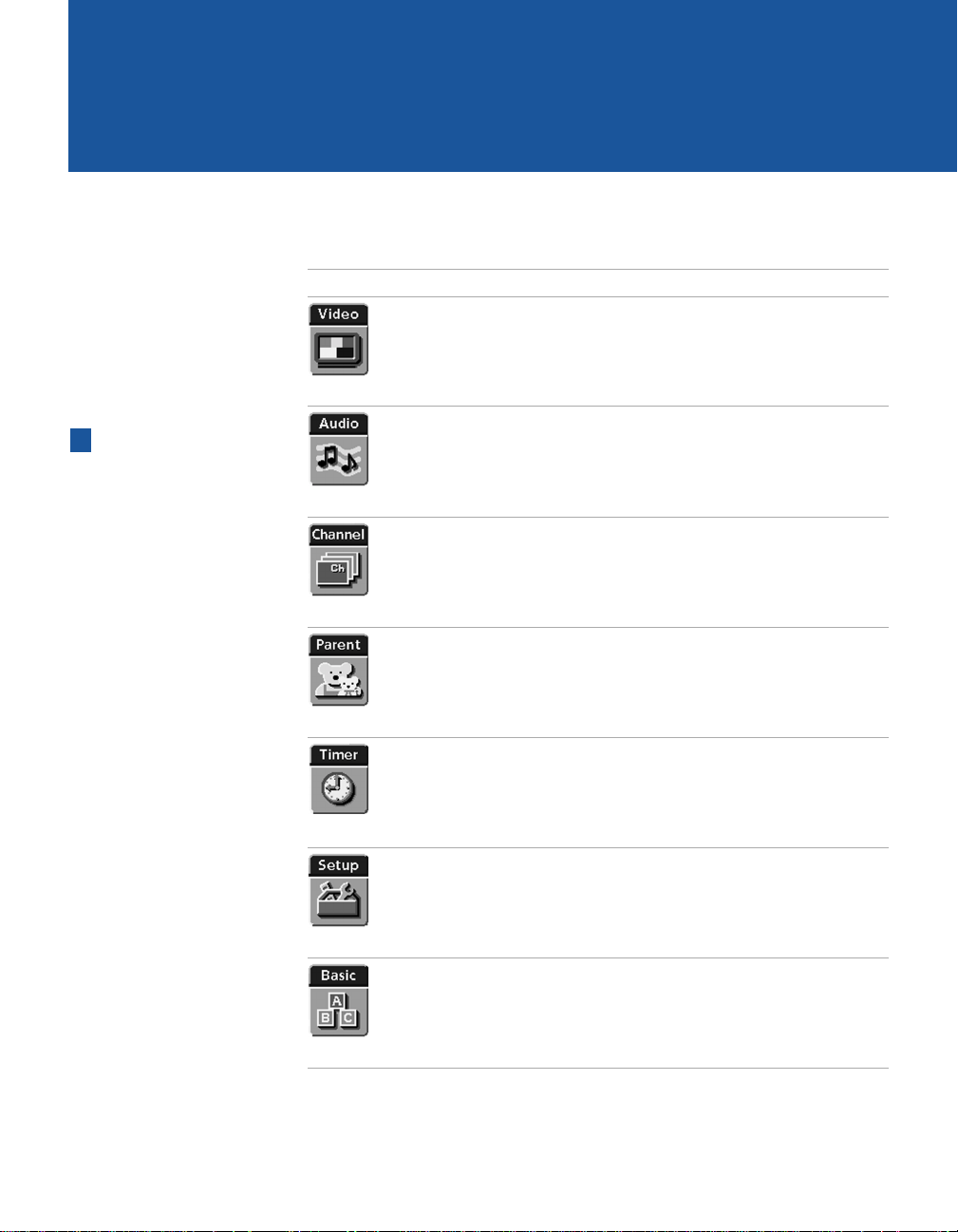
The Menu gives you access to the following features:
Menu Icon Description Page
Allows you to make adjustments to your
picture settings. It also allows you to
customize the Mode based on the type of
program you are viewing.
26
Offers enhanced audio options such as
listening to second audio programming
(SAP), or customizing the Effect of the sound
on your TV.
27
Allows you to set up a Favorite Channel list, run
the Auto Program function, and more.
29
Lets you control the viewing of programs
based on their ratings.
30
Lets you set the clock on your TV and allows
you to program your TV for scheduled
viewing using the Timers.
33
Provides several options for setting up your
channels, labeling your TV/VIDEO inputs,
and selecting the language of the on-screen
menus.
34
Provides quick access to frequently used
settings.
36
To display the menu or
clear it at any time, press
MENU.
z
Using the Menus
26
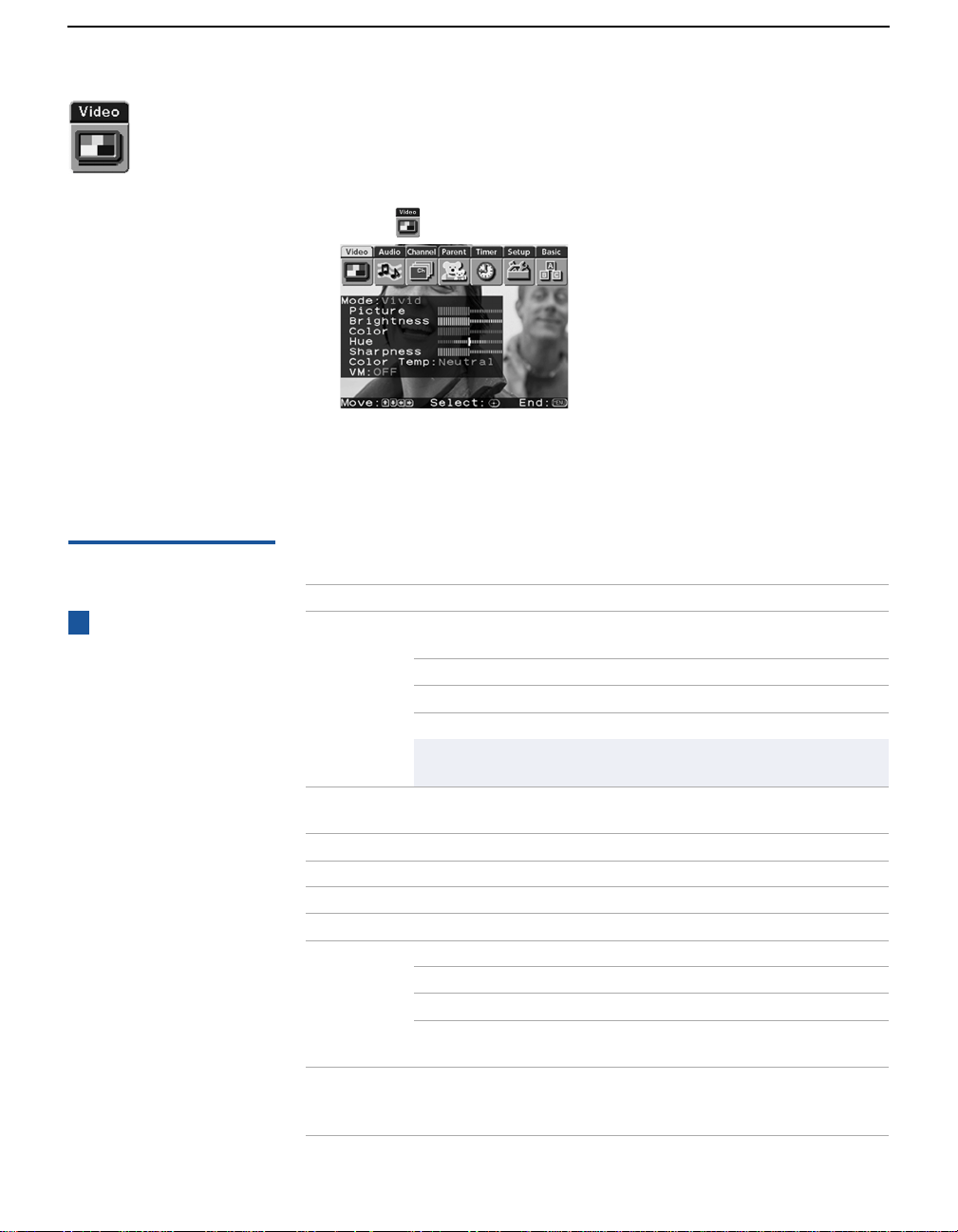
Using the Video Menu
To select the Video Menu
1 Press MENU.
2 Select .
To restore the factory default settings for Picture, Brightness, Color, Hue, and
Sharpness
❑ Press RESET on the remote control when in the Video menu.
Selecting Video
Options
The Video Menu includes the following options.
As a shortcut to using the
menus, use the PICTURE MODE
button on the remote control to
select video modes.
z
Option Description
Mode
Customized
picture
viewing
Vivid Select for enhanced picture contrast and
sharpness.
Standard Select for standard picture settings.
Movie Select to display a softer picture.
Sports Select to display a vivid, bright picture.
✍ You can alter the Video Menu settings (Picture, Brightness, Color,
etc.) for each Mode.
Picture Adjust to increase picture contrast and deepen the color or
decrease picture contrast and soften the color.
Brightness Adjust to brighten or darken the picture.
Color Adjust to increase or decrease color intensity.
Hue Adjust to increase or decrease the green tones.
Sharpness Adjust to sharpen or soften the picture.
Color Temp
White
intensity
adjustment
Choose from three color temperatures:
Cool Select to give the white colors a blue tint.
Neutral Select to give the white colors a neutral tint.
Warm Select to give the white colors a red tint
(NTSC-Standard).
VM
Velo city
Modulation
Sharpens picture definition to give every object a sharp, clean
edge. Select from High, Low, OFF.
Using the Menus
27
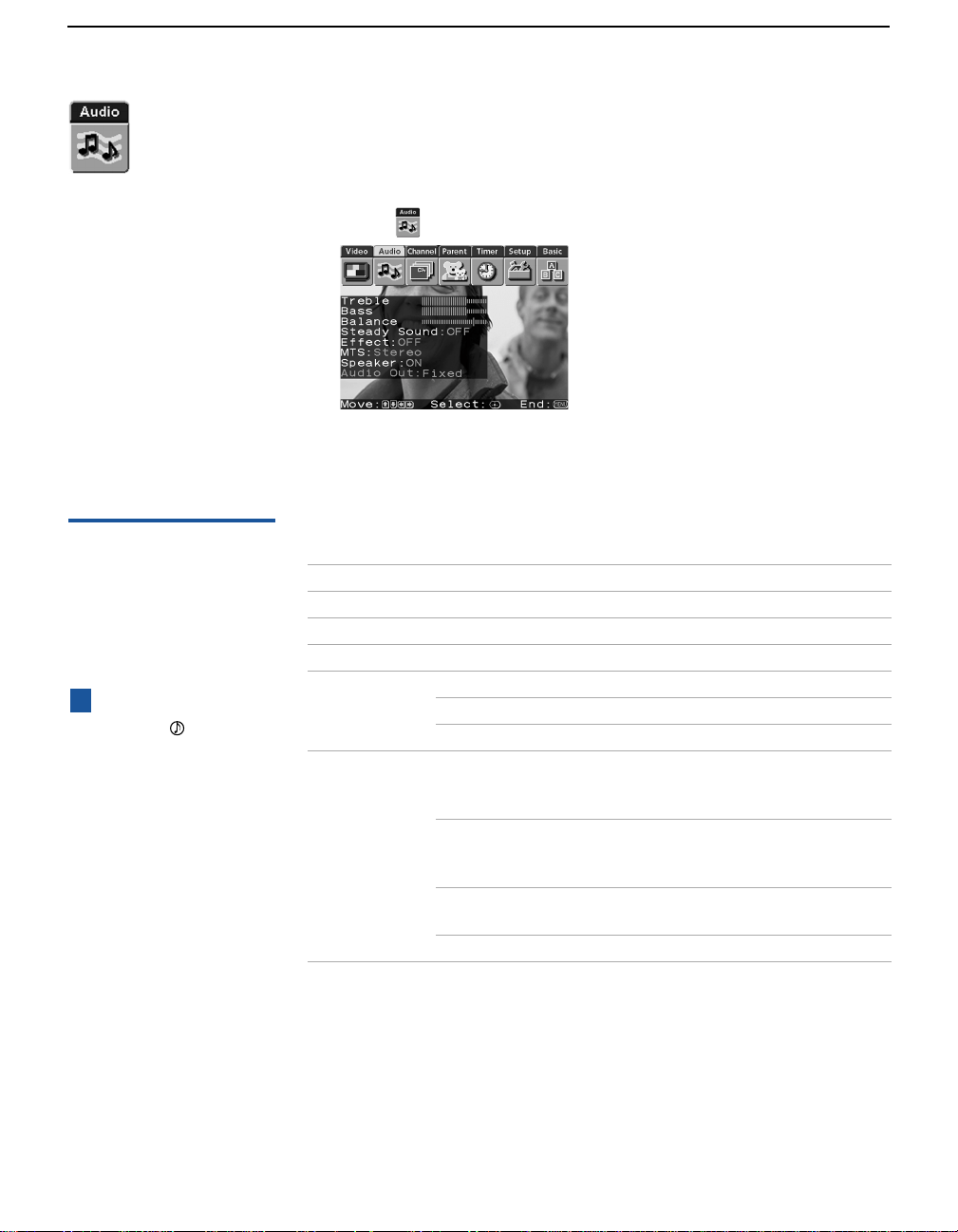
Using the Audio Menu
To select the Audio Menu
1 Press MENU.
2 Select .
To restore the factory default settings for Treble, Bass, and Balance
❑
Press RESET on the remote control when in the Audio menu.
Selecting Audio
Options
The Audio Menu includes the following options:
Option Description
Treble Adjust to decrease or increase higher-pitched sounds.
Bass Adjust to decrease or increase lower-pitched sounds.
Balance Adjust to emphasize left or right speaker balance.
Steady Sound (All models except KV-36FS12 and 36FS16.)
ON Select to stabilize the volume.
OFF Select to turn off Steady Sound.
Effect Simulated Adds a surround-like effect to mono programs
(models KV-32FV16, 32FV26, 36FV16, and
36FV26 only).
SRS Produces a dynamic three-dimensional sound
for stereo signals (models KV-32FV16, 32FV26,
36FV16, and 36FV26 only).
Surround Select for Surround sound (models KV-32FS12
and 36FS16 only).
OFF Normal stereo or mono reception.
As a shortcut to using the
menus, use the button on
the remote control to cycle
through available audio
settings.
z

Using the Menus
28
MTS
Enjoy stereo,
bilingual and
mono programs
Stereo Select for stereo reception when viewing a
program broadcast in stereo.
Auto-SAP Select to automatically switch the TV to second
audio programs when a signal is received. (If
no SAP signal is present, the TV remains in
Stereo mode.)
Mono Select for mono reception. (Use to reduce noise
during stereo broadcasts.)
Speaker ON Select to turn on the TV speakers.
OFF Select to turn off the TV speakers and listen to
the TV's sound only through your external
audio system speakers.
Audio Out
Easy control of
volume
adjustments
This option can be set only when the Speaker option is set
to OFF.
Variable Sound output varies according to the TV
settings. Useful when you want to use the TV’s
remote control to adjust the output through a
separate audio system.
Fixed Sound output is held at a fixed level. Use your
audio receiver’s remote control to adjust the
volume.
Option Description
Using the Menus
29
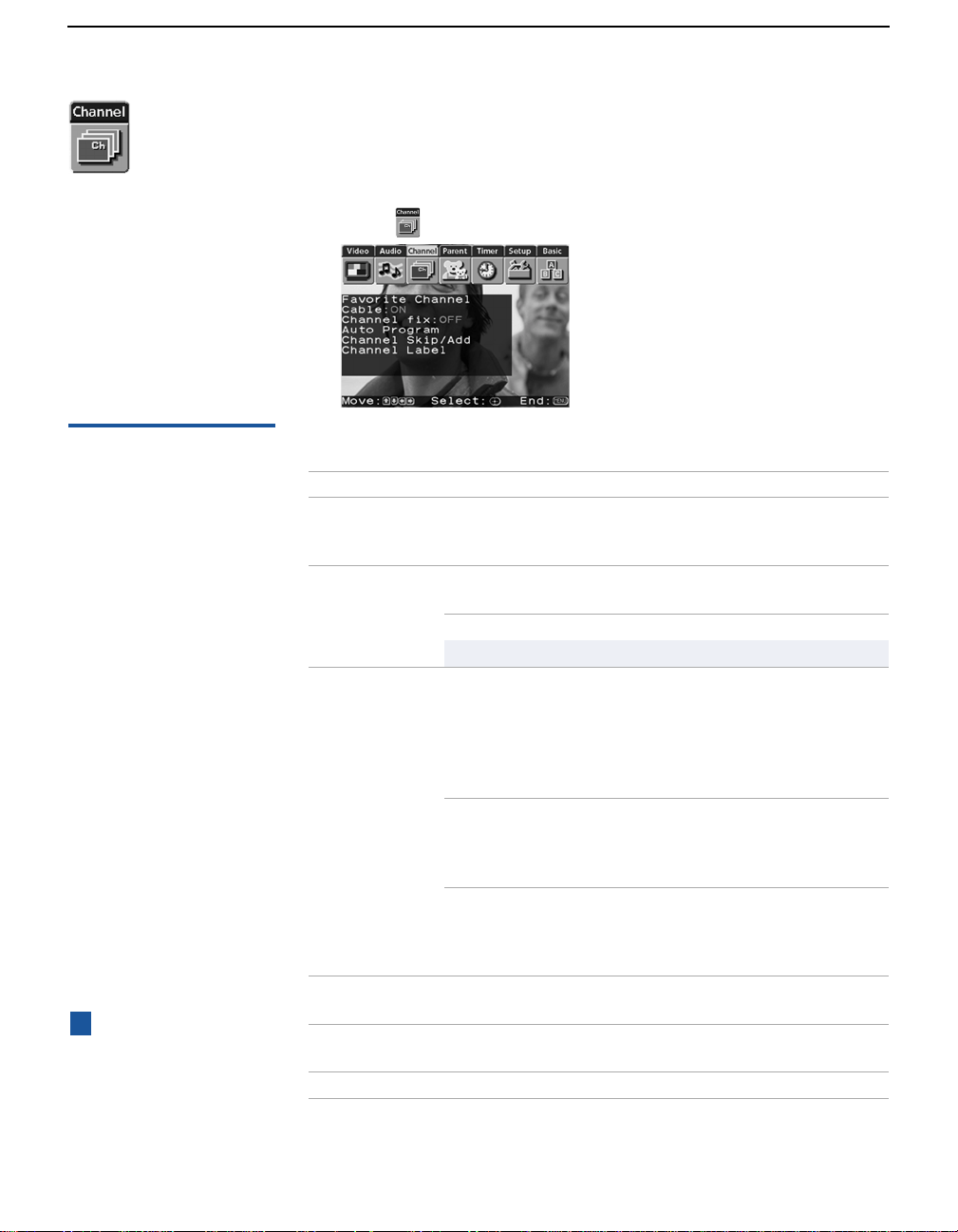
Using the Channel Menu
To select the Channel Menu
1 Press MENU.
2 Select .
Selecting Channel
Options
The Channel Menu includes the following options:
Option Description
Favorite Channel Program up to eight of your favorite channels to appear in
your Favorite Channel list. To use Favorite Channel, see
page 20.
Cable ON Select if you are receiving cable channels
with a CATV cable.
OFF Select if you are using an antenna.
✍ You should run Auto Program after changing the Cable setting.
Channel Fix
Useful when you
have a cable box or
satellite receiver
connected
2-6 Select to control all channel selection
through a cable box or satellite receiver.
Select the appropriate channel number
(usually 3 or 4) and use the cable box or
satellite receiver’s remote control for
channel selection.
AUX 2-6 (All models except KV-36FS12.) Select
when a cable box or satellite receiver is
connected to the AUX input (see page 8).
Press the ANT button to alternate between.
VIDEO Select from available video inputs when
you have video equipment connected (e.g.
satellite receiver) and you want your TV
fixed to it.
Auto Program Automatically programs the TV for all receivable
channels.
Channel
Skip/Add
Select to remove or add channels from the channel list
when using the CH+/- buttons.
Channel Label Label up to 40 channels with their station call letters.
Channels that you set to
be skipped can be accessed
only with the 0-9 buttons.
z

Using the Menus
30
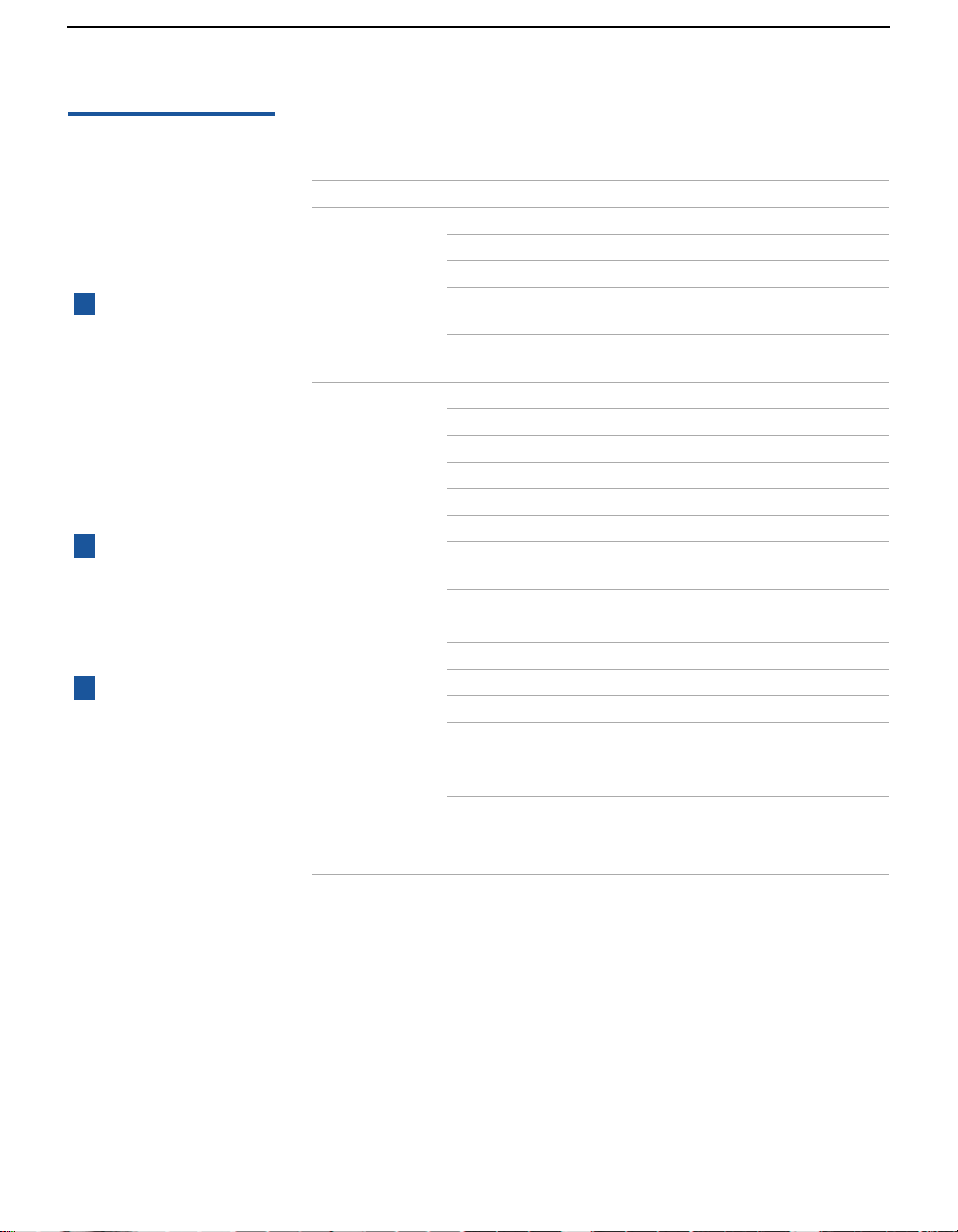
Using the Parent Menu
The Parent Menu allows you to set up the TV to block programs
according to their content and rating levels.
To select the Parent Menu
1 Press MENU.
2 Select .
3 When prompted, use the 0-9 buttons on the remote control to
enter a four-digit password.
4 Confirm your password by entering it again.
Using the Parent
Menu
The Parent Menu includes the following options.
✍ You need this password for any future access into the Parental Control Menu. If
you lose your password, see “Lost password” on page 47.
If you are not familiar with
the Parental Guideline rating
system, you should select Child,
Youth, or Young Adult to help
simplify the rating selection. To
set more restrictive ratings,
select Custom.
z
Option Description
Parental Lock
Turn ratings on/
off and select a
rating system
OFF Parental lock is off. No programs are
blocked from viewing.
Child Maximum ratings permitted are:
❏ US: TV-Y, TV-G, G
❏ Canada: C, G
Youth Maximum ratings permitted are:
❏ US: TV-PG, PG
❏ Canada: 8 ans+
Young Adult Maximum ratings permitted are:
❏ US: TV-14, PG-13
❏ Canada: 14+, 13 ans+
Custom Select to set ratings manually.
❏ US: See page 31 for details.
❏ Canada: See page 32 for details.
Change Password For changing your password.
For descriptions of Child,
Youth, and Young Adult
ratings, see page 31.
z
Using the Menus
31
US Models:
Selecting Custom
Rating Options
For US models, the Custom Rating Menu includes the following
options. For Canadian models, see page 32.
Option Description
Movie Rating G All children and General Audience.
PG Parental Guidance suggested.
PG-13 Parental Guidance for children under 13.
R Restricted viewing, parental guidance is
suggested for children under 17.
NC-17
and X
No one 17 and under allowed.
TV Rating
Block programs
by their rating,
content or both
Age-Based Options
TV-Y All children.
TV-Y7 Directed to older children.
TV-G General Audience.
TV-PG Parental Guidance suggested.
TV-14 Parents Strongly cautioned.
TV-MA Mature Audience only.
Content-Based Options
FV Fantasy Violence.
D Suggestive Dialogue.
L Strong Language.
S Sexual situations.
V Violence.
Unrated
Block programs
or movies that
are broadcast
without a rating
Block Blocks all programs and movies that are
broadcast without a rating.
Allow Allows programs and movies that are
broadcast without a rating.
The content ratings will
increase depending on the level
of the age-based rating. For
example, a program with a TV-
PG V (Violence) rating may
contain moderate violence,
while a TV-14 V (Violence)
rating may contain more intense
violence.
To ensure maximum
blocking capability, the age-
based ratings should be
blocked.
If you choose to block
unrated TV programs, please be
aware that the following
programs may be blocked:
emergency broadcasts, political
programs, sports, news, public
service announcements,
religious programs and weather.
z
z
z
Using the Menus
32
Canadian Models:
Selecting Custom
Rating Options
For Canadian models, the Custom Rating Menu includes the
following options. For US models, see page 31
.
Viewing Blocked
Programs
You can view a blocked program by entering the password. Press the
ENTER button when tuned to a blocked program. This temporarily
switches off the Parental Lock. To reactivate the Parental Lock
settings, turn off the TV. When the TV is turned on again, your
Parental Controls settings are reactivated.
Option Description
English Rating C All children.
C8 Children 8 years and older.
G General programming.
PG Parental Guidance.
14+ Viewers 14 and older.
18+ Adult programming.
French Rating G General programming.
8 ans+ Not recommended for young children.
13 ans+ Not recommended for ages under 13.
16 ans+ Not recommended for ages under 16.
18 ans+ Programming restricted to adults.
USA Rating See “TV Rating” on page 31 for details.
Using the Menus
33
Using the Timer Menu
To select the Timer Menu
1 Press MENU.
2 Select .
To reset the Clock or Timers
❑
Press RESET on the remote control when in the adjustment menu.
Selecting Timer
Options
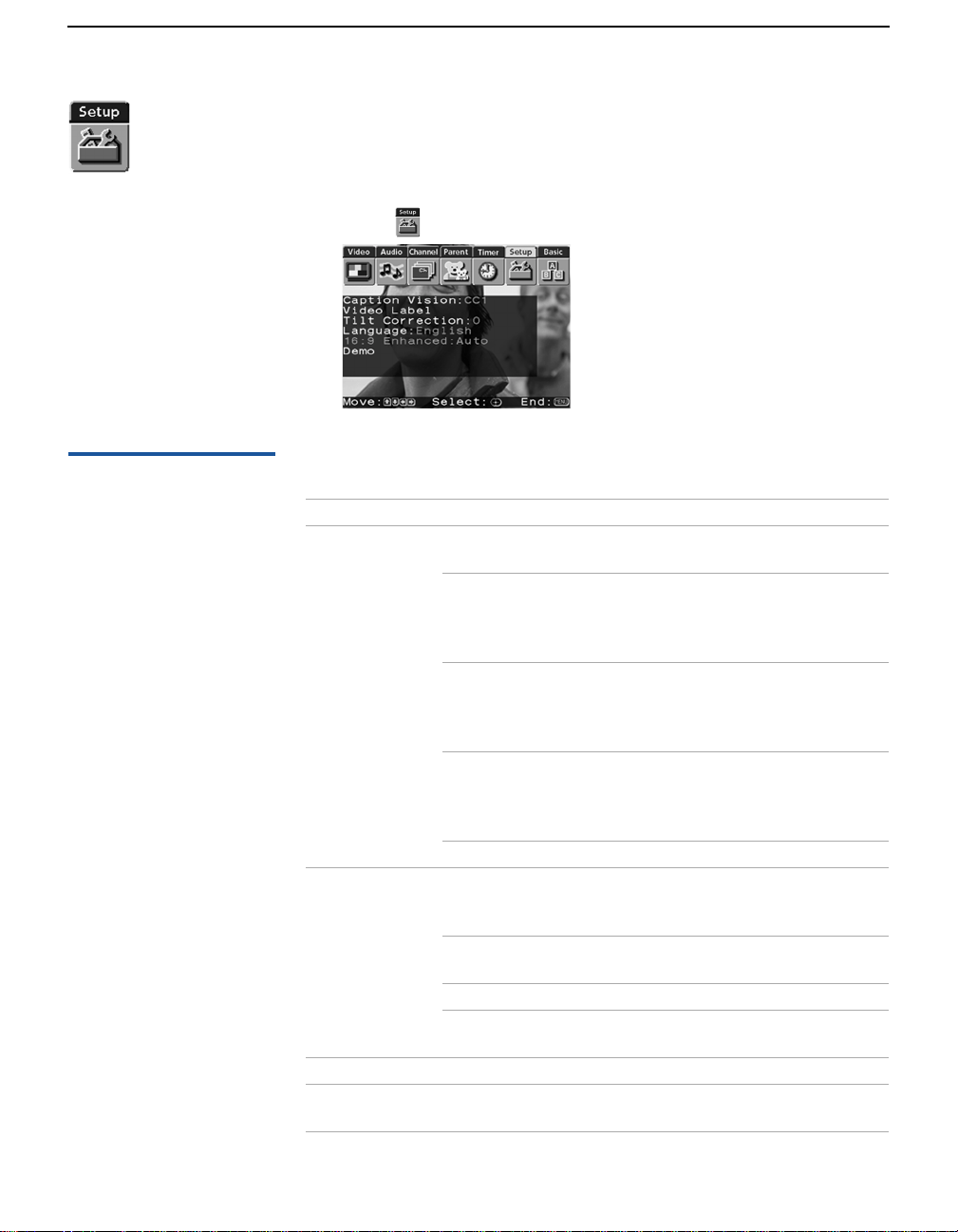
The Timer Menu includes the following options:
Option Description
Timer 1
Timer 2
Program Select to set the Timer by day, time,
duration, and channel.
OFF Select to turn off the Timer. (Your previous
settings will be saved.)
Current Time Set the current time.
Daylight Savings ON Select in the spring to adjust the time
during Daylight Saving Time.
OFF Select in the fall to adjust the time at the
end of Daylight Saving Time.
Using the Menus
34
Using the Setup Menu
To select the Setup Menu
1 Press MENU.
2 Select .
Selecting
Setup Options
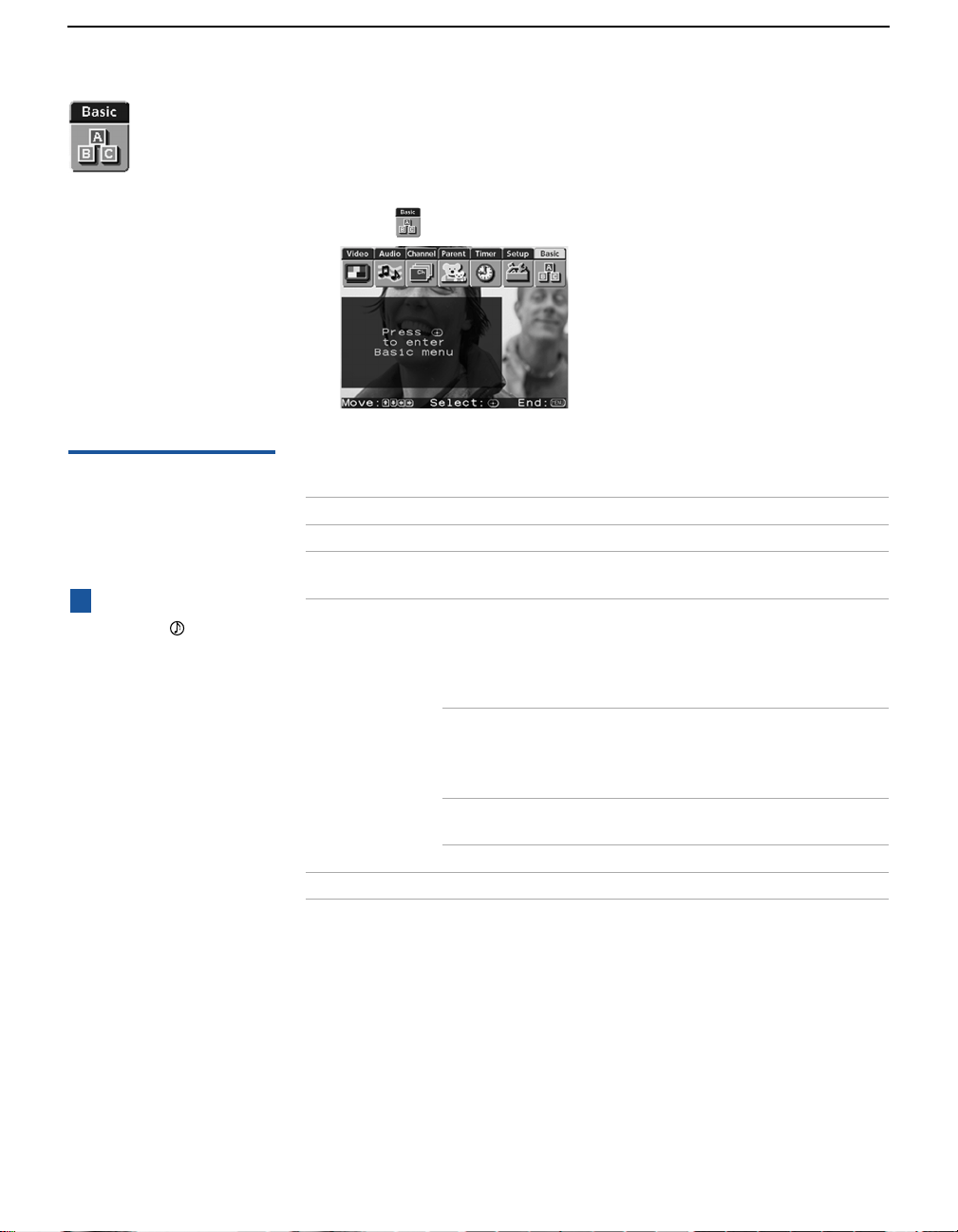
The Setup Menu includes the following options:
Option Description
Caption Vision Allows you to select from three closed caption modes (for
programs that are broadcast with closed caption).
CC1, CC2,
CC3, CC4
Displays a printed version of the
dialog or sound effects of a
program. (Should be set to CC1 for
most programs.)
TEXT1, TEXT2,
TEXT3, TEXT4
Displays network/station
information presented using either
half or the whole screen (if
available).
XDS
(Extended Data
Service)
Displays a network name,
program name, program length,
and time of the show if the
broadcaster offers this service.
OFF Turns off Caption Vision.
Video Label Allows you to label your inputs so that you can identify
connected equipment. Press TV/VIDEO to cycle through the
inputs.
VIDEO 1/2/3 VHS, 8mm, Beta, LD, Game, SAT,
DVD, Web, Receiver, DTV, Skip
VIDEO 4 DVD, DTV, Skip
If you select Skip, your TV skips this connection when you
press the TV/VIDEO button.
Tilt Correction Allows you to correct any tilt of the picture.
Language Select from available languages to display all menus in
your language of choice.

Using the Menus
35
16:9 Enhanced Provides enhanced picture resolution for widescreen
sources, such as DVD (only available when the TV is in
VIDEO mode). Press TV/VIDEO and select from one of the
following options:
AUTO To activate automatically when a
16:9 signal is received (models
KV-32FV26 and 36FV26 only).
ON To activate manually.
OFF To turn off 16:9.
Demo Runs a demonstration of on-screen menus.
Option Description
To use this feature with
widescreen DVDs, set your
DVD player to 16:9 aspect
ratio.
z
Using the Menus
36
Using the Basic Menu
To select the Basic Menu
1 Press MENU.
2 Select .
Selecting
Basic Options
The Basic Menu includes the following options:
Option Description
Picture Adjust the picture contrast.
Caption Vision Displays your current advanced menu setting:
(CC1–4, TEXT 1–4, or XDS) and OFF.
Effect SRS Produces a dynamic three-
dimensional sound for stereo
signals (models KV-32FV16,
32FV26, 36FV16, and 36FV26
only).
Simulated Adds a surround-like effect to
mono programs (models
KV-32FV16, 32FV26, 36FV16, and
36FV26 only).
Surround Select for Surround sound (models
KV-36FS12 and 36FS16 only).
OFF Normal stereo or mono reception.
Advanced Menu Select to return to the advanced menus.
As a shortcut to using the
menus, use the button on
the remote control to cycle
through available audio
settings.
z

Other Information
38
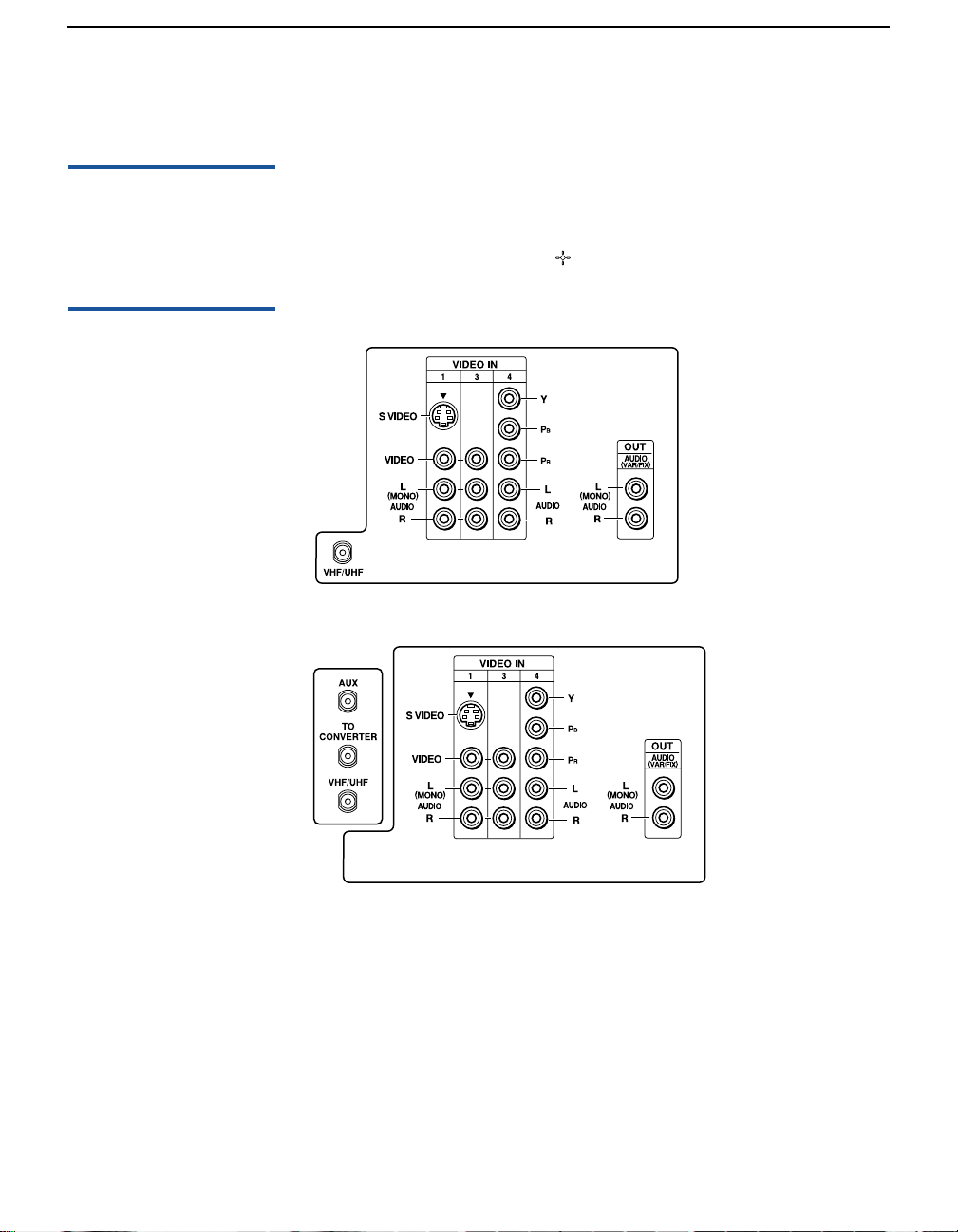
TV Controls and Connectors
Front Panel Menu
Controls
The front panel menu controls allow access to the on-screen menus
without the use of a remote control. Pressing the
MENU button brings
up the on-screen menus. The arrow buttons (Vv) move the on-screen
cursor in the menus and the ( ) button selects the menu item.
TV Rear Panel Model KV-36FS12
Model KV-36FS16
Other Information
39
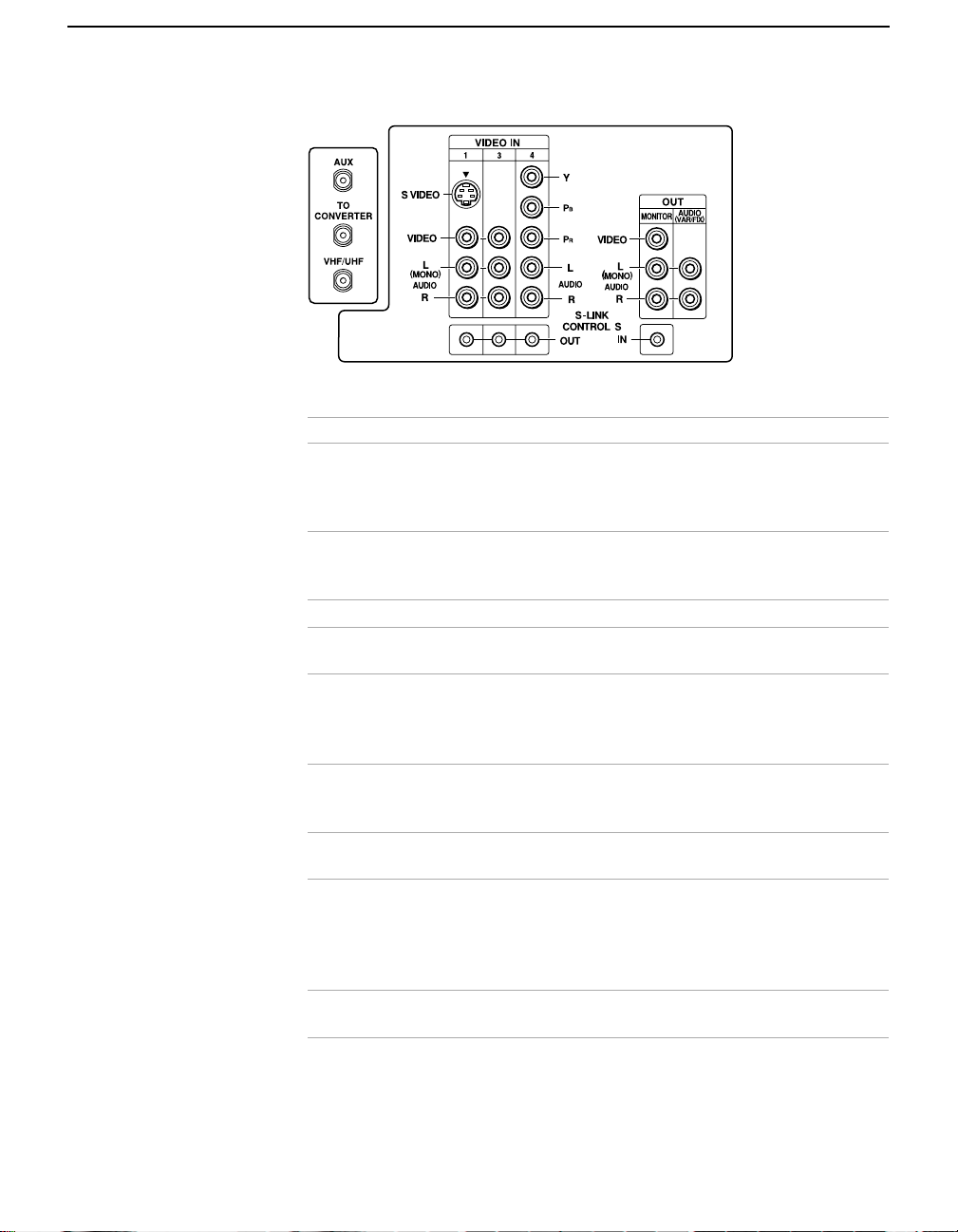
Models KV-32FV16, 32FV26, 36FV16 and 36FV26
Back Panel Descriptions
Connection Description
AUX
(except
KV-36FS12)
Allows you to view local (terrestrial) and cable channels
if your cable provider does not feature local channels.
You can switch between local and cable channels easily
by pressing ANT on the remote control.
TO CONVERTER
(except
KV-36FS12)
Lets you set up your TV to switch between scrambled
channels (through a cable box), and normal cable
channels (CATV).
VHF/UHF Connects to your VHF/UHF antenna or cable.
S VIDEO Connects to the S VIDEO OUT jack of your VCR or other
S VIDEO equipped video component.
MONITOR OUT
(except models
KV-36FS12 and
36FS16)
Lets you record the program you're watching to a VCR.
When two VCRs are connected, (see page 11), you can
use your TV as a monitor for tape to tape editing.
AUDIO
(L/R)/VIDEO
Connects to the audio and video OUT jacks on your VCR
or other video component. A third video input (VIDEO
2) is located on the front panel of the TV.
AUDIO OUT (VAR/FIX)
L (MONO)/R
Connects to the right and left audio inputs of your audio
or video component.
S-LINK
CONTROL-S IN/OUT
(except models
KV-36FS12 and
36FS16)
Allows the TV to receive (IN) and send (OUT) remote
control signals to other Sony infrared-controlled audio
or video components.
Y, P
B, PR, L, R Connects to your DVD player’s component video (Y, PB,
P
R) and audio (L, R) jacks.
Other Information
40
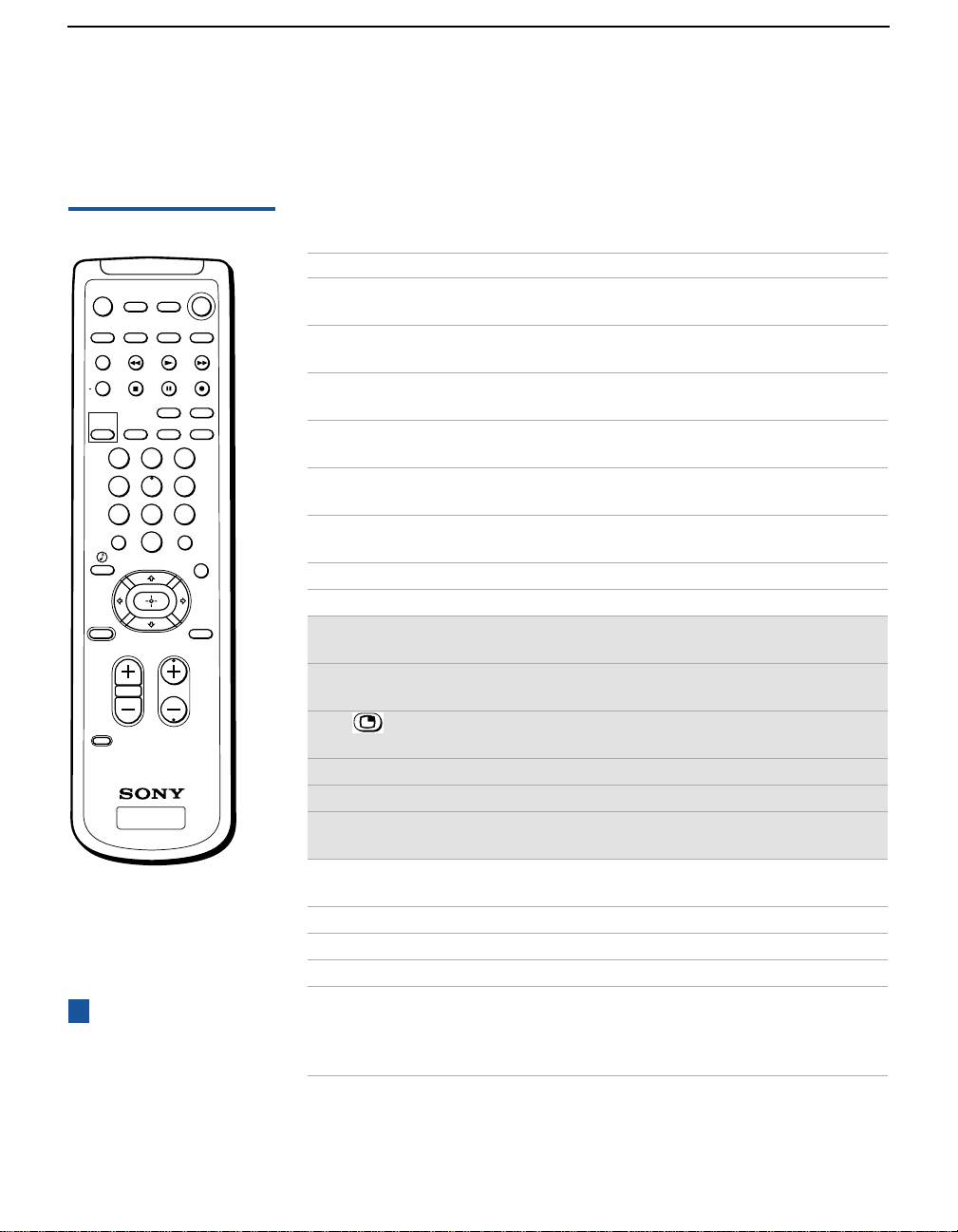
Using the Remote Control
The following table describes the buttons on the remote control that
are for more advanced functions.
Button Descriptions
Button Description
MUTING Press to mute the sound. Press again or press VOL + to
restore the sound.
VTR/DVD
(POWER)
Turns the DVD player, MDP player, or VTR (VCR) on
and off.
SAT/CABLE
(POWER)
Turns the satellite receiver or cable box on and off.
SYSTEM OFF Powers off all Sony equipment at once. (This feature
may not work with older Sony equipment.)
VTR/DVD
(FUNCTION)
Activates the remote control for use with a DVD player,
MDP, or VTR (VCR).
SAT/CABLE
(FUNCTION)
Activates the remote control for use with a satellite
receiver or cable box.
TV (FUNCTION) Activates the remote control for use with the TV.
* TV/VTR Changes the VHF/UHF output of the VCR.
* FREEZE Freezes the window picture. Press again to restore the
picture.
SWAP Switches the position of the main picture with the
window picture.
PIP or Turns on/off PIP. For details, see “Using Picture in
Picture (PIP)” on page 21.
* CH+/- Changes the channel in the window picture.
* POSITION Moves the location of the window picture.
* AUDIO Alternates sound between the main picture and the
window picture.
* TV/VIDEO Cycles through available video inputs: TV, VIDEO 1, VIDEO 2,
VIDEO 3, VIDEO 4.
* DVD MENU Displays the DVD menu.
* TITLE Displays the DVD’s Title menu.
ANT Changes the VHF/UHF input to the AUX input.
PICTURE MODE Press repeatedly to step through the available video
picture modes: Vivid, Standard, Movie, Sports. Also
available in the Video menu. For details, see “Selecting
Video Options” on page 26.
+
ENTER
SLEEP MTS/SAP
1 2 3
4 5 6
7 8
0
9
CHVOL
CODE SET
RESET MENU
GUIDE
JUMP
PICTURE
MODE
CH
TV/SAT
TV/VTR
POSITION
FREEZE
AUDIO
SWAP
TV/VIDEO
PIP
DISPLAY
VTR/DVD
SYSTEM
OFF
VTR/DVD
POWER
SAT/CABLE
TV
MUTING
TV
SAT/CABLE
TV
RM-Y169
ANT TV/VIDEO
Picture-in-Picture buttons
(highlighted here) are not available
on model KV-36FS12.
On models KV-32FV26 and
36FV26, buttons with asterisks (*)
are located on the inside panel of
the remote.
z
RM-Y168 is for model KV-32FS12
only. RM-Y169 is for model KV-
36FS16 only. RM-Y171 is for models
KV-32FV16 and 36FV16 only.
Other Information
41
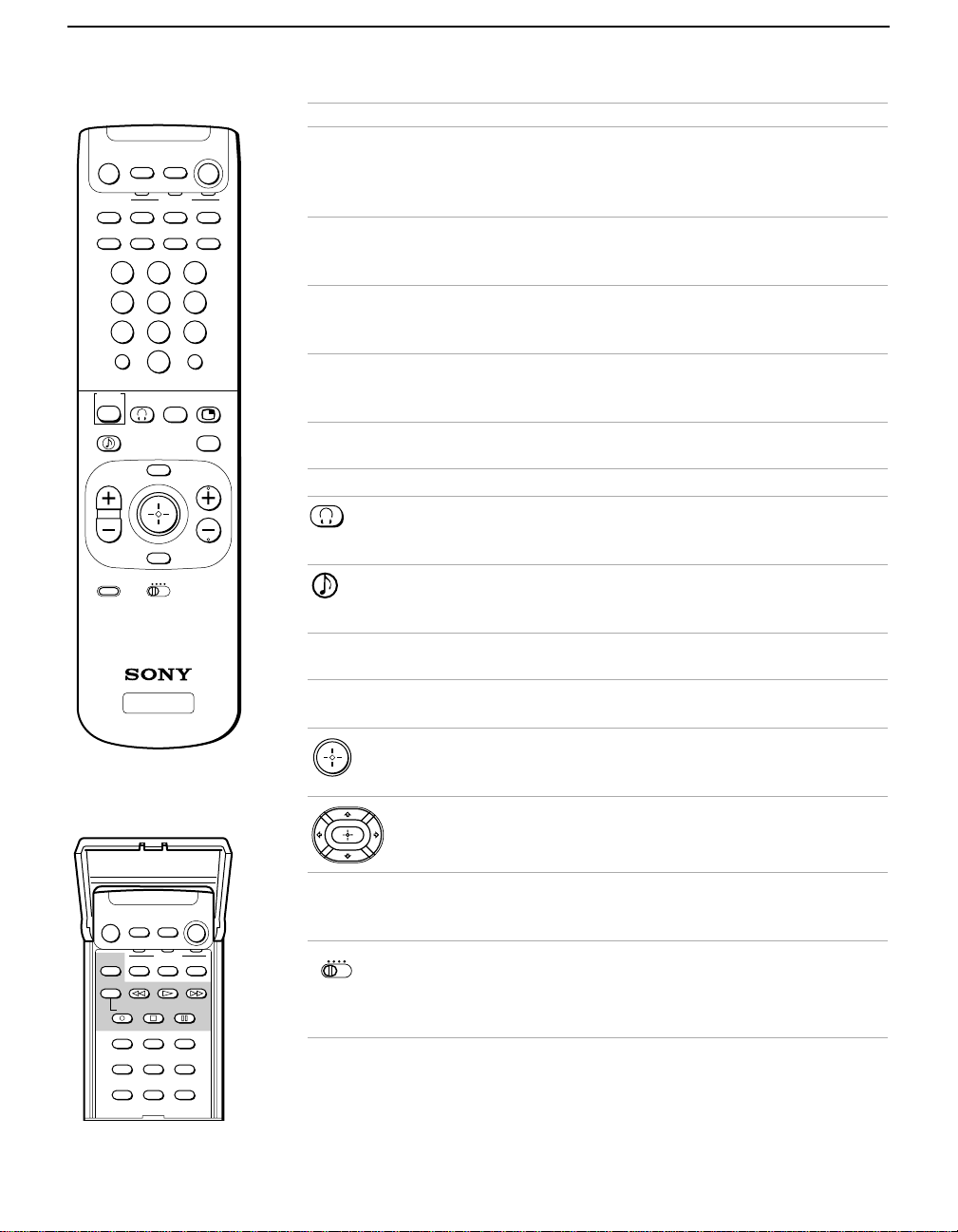
SLEEP Press repeatedly until the TV displays the time in
minutes (15, 30, 45, 60, or 90) that you want the TV to
remain on before shutting off automatically. Cancel by
pressing until SLEEP OFF appears.
* MTS/SAP Cycles through the Multi-channel TV Sound (MTS)
options: Stereo, Auto-SAP (Second Audio Program), and
Mono (see page 28 for details).
DISPLAY Press once to display the current time and channel label
(if set) and channel number. Press again to turn Display
off. See page 33 for details on setting the time.
JUMP Press to jump back and forth between two channels. The
TV alternates between the current channel and the last
channel that was selected.
TV/SAT Switches between the TV and SAT (satellite) inputs
when in SAT FUNCTION mode.
GUIDE Displays the program guide of your satellite antenna.
(Models KV-32FV26, 36FV26 only.) Turns on/off the
headphones. For details, see “Using Wireless
Headphones” on page 22.
Provides quick access to for changing available audio
settings. For details, see “Selecting Audio Options” on
page 27.
RESET Resets the TV to the factory default settings for the
Video and Audio menus.
MENU Press to display the TV menu. Press again to exit from
the menus.
Joystick (models KV-32FV26, 36FV26 only). Allows for
movement of the on-screen cursor. Pressing down on
the center of the joystick selects the item.
Arrows and Select (all models except KV-32FV26 and
36FV26). Pressing down on the center button selects the
item.
CODE SET Used for programming the remote control to operate
non-Sony video equipment. For details, see
“Programming the Remote Control” on page 42.
(Models KV-32FV26, 36FV26 only). Use to switch
control for connected video equipment. You can
program one video source for each switch position (see
page 42).
Button Description
TV
213
546
879
0
TV
MUTING
VTR/DVD SAT/CABLE
POWER
VTR/DVD SAT/CABLE
FUNCTION
TVOFF
SYSTEM
SLEEP DISPLAY ANT TV/VIDEO
MENU
GUIDE
VOL
TV/SAT
RESET
CH
VTR 1 2 3 DVD/MDP
CODE SET
JUMP ENTER
RM -Y170
SWAP
MODE
PICTURE
TV
MUTING
VTR/DVD SAT/CABLE
POWER
VTR/DVD SAT/CABLE
FUNCTION
TV
TITLE DVD MENU MTS/SAP
AUDIO FREEZE CH
+
POSITION TV/VIDEO CH
-
TV/VTR
REC
MODE
PICTURE
RM-Y170 is for models KV-32FV26
and 36FV26 only.
VTR 1 2 3 DVD/MDP
Other Information
42
Programming the
Remote Control
The remote control is preset to operate Sony brand video equipment.
If you have video equipment other than Sony brand that you want to
control with the TV’s remote control, use the following procedures to
program the remote control.
1 Turn to “Programmable Codes” on page 43, and find the three-
digit code number for your equipment. If more than one code
number is listed, use the number listed first to complete the
following procedures.
2 Press CODE SET.
3 Press VTR/DVD or SAT/CABLE. (For models KV-32FV26 and 36FV26,
move the slide switch to the desired input).
4 Enter the three-digit code number.
5 Press ENTER.
Tips
❑
If more than one code number is listed, try entering them one by
one until you come to the correct code for your equipment.
❑ If you enter a new code number, the code number you previously
entered at that setting is erased.
❑ In some rare cases, you may not be able to operate your
equipment with the supplied remote control. In this case, use the
equipment’s own remote control unit.
❑ Whenever you remove the batteries to replace them, the code
numbers may revert to the factory setting and must be reset.
Sony
Equipment
Switch Position
on Remote Control
Programmable
Code Number
Beta, ED Beta VCRs VTR1 303
8 mm VCR VTR2 302
VHS VCR VTR3 301
DVD Player DVD/MDP 751
✍ The equipment must have infrared (IR) remote capability in order to be used with the
remote control.
✍ You must perform step 3 within 10 seconds of step 2, or you must start again from
step 2.
To check if the code number
works, after step 5 aim the TV’s
remote control at the component
and press the POWER button that
corresponds with that component. If
it responds, you’re done. If not, try
using the other codes listed for your
component.
z

Other Information
43
Programmable Codes
VCRs
Laserdisc Players
DVD Players
Cable Boxes
Satellite Receivers
Manufacturer Code
Sony 301
Admiral
(M. Ward)
327
Aiwa 338, 344
Audio
Dynamic
314, 337
Broksonic 319, 317
Canon 309, 308
Citizen 332
Craig 302, 332
Criterion 315
Curtis Mathes 304, 338, 309
Daewoo 341, 312, 309
DBX 314, 336, 337
Dimensia 304
Emerson 319, 320, 316,
317, 318, 341
Fisher 330, 335
Funai 338
General
Electric
329, 304, 309
Go Video 322, 339, 340
Goldstar 332
Hitachi 306, 304,
305,338
Instant Replay 309, 308
JC Penney 309, 305, 304,
330, 314, 336,
337
JVC 314, 336, 337,
345, 346, 347
Kenwood 314, 336, 332,
337
LXI (Sears) 332, 305, 330,
335, 338
Magnavox 308, 309, 310
Marantz 314, 336, 337
Marta 332
Memorex 309, 335
Minolta 305, 304
Mitsubishi/
MGA
323, 324, 325,
326
Multitech 325, 338, 321
NEC 314, 336, 337
Olympic 309, 308
Optimus 327
Panasonic 308, 309, 306,
307
Pentax 305, 304
Philco 308, 309
Philips 308, 309, 310
Pioneer 308
Quasar 308, 309, 306
RCA/
PROSCAN
304, 305, 308,
309, 311, 312,
313, 310, 329
Realistic 309, 330, 328,
335, 324, 338
Sansui 314
Samsung 322, 313, 321
Sanyo 330, 335
Scott 312, 313, 321,
335, 323, 324,
325, 326
Sharp 327, 328
Shintom 315
Signature 2000
(M. Ward)
338, 327
SV2000 338
Sylvania 308, 309, 338,
310
Symphonic 338
Tashiro 332
Tatung 314, 336, 337
Teac 314. 336, 338,
337
Technics 309, 308
Toshiba 312, 311
Manufacturer Code
Wards 327, 328, 335,
331, 332
Yamaha 314, 330, 336,
337
Zenith 331
Manufacturer Code
Panasonic 704, 710
Pioneer 702
Manufacturer Code
Sony 751
Panasonic 753
Pioneer 752
RCA 755
Toshiba 754
Manufacturer Code
Hamlin/Regal 222, 223, 224,
225, 226
Jerrold/G. I. 201, 202, 203,
204, 205, 206,
207, 208, 218
Oak 227, 228, 229
Panasonic 219, 220, 221
Pioneer 214, 215
Scientific
Atlanta
209, 210, 211
Tocom 216, 217
Zenith 212, 213
Manufacturer Code
Sony 801
General
Electric
802
Hitachi 805
Hughes 804
Panasonic 803
RCA/
PROSCAN
802, 808
Toshiba 806, 807
Manufacturer Code
Other Information
44
Operating a VCR
Operating an MDP
(Laserdisc Player)
To Do This ... Press
Turn on/off VTR/DVD (POWER)
Change channels CH +/-
Record Except models KV-32FV26 and 36FV26:
N and z simultaneously.
Models KV-32FV26 and 36FV26:
z and (upper left) simultaneously.
Play N
Stop x
Fast forward M
Rewind the tape m
Pause X (press again to resume normal playback)
Search the picture forward
or backward
M or m during playback
(release to resume normal playback)
Change input mode TV/VTR
To Do This ... Press
Turn on/off VTR/DVD (POWER)
Play N
Stop x
Pause X (press again to resume normal playback)
Search the picture forward
or backward
M or m during playback
(release to resume normal playback)
Search a chapter forward or
backward
CH +/-

Other Information
45
Operating a Satellite
Receiver
Operating a DVD
Player
Operating a Cable
Box
To Do This ... Press
Turn on/off SAT/CABLE (POWER)
Select a channel 0-9 buttons, ENTER
Change channels CH +/-
Back to previous channel JUMP
Change input mode TV/SAT
Display channel number DISPLAY
Display DBS guide GUIDE
Display DBS menu MENU
Move highlight (cursor) Joystick or arrows
Select item button
To Do This ... Press
Turn on/off VTR/DVD (POWER)
Play N
Stop x
Pause X (press again to resume normal playback)
Step through different tracks
of an audio disc
M to step forward or m to step backward
Step through different
chapters of a video disc
CH+ to step forward or CH- to step backward
Display the Title menu TITLE (models KV-32FV26, 36FV26 only)
Display the DVD menu DVD MENU (models KV-32FV26, 36FV26 only)
Select tracks directly 0-9 buttons
Display the menu
(Setup)
MENU
To Do This ... Press
Turn on/off SAT/CABLE (POWER)
Select a channel 0-9 buttons, ENTER
Change channels CH +/-
Back to previous channel JUMP

Other Information
46
Troubleshooting
Problem Possible Remedies
No picture
(screen not lit), no sound
❏ If your TV does not turn on, and a red light keeps flashing, your TV may
need service. Call your local Sony Service Center.
❏ Make sure the power cord is plugged in.
❏ Push the power button on the front of the TV.
❏ Check to see if the TV/VIDEO setting is correct: when watching TV, set to
TV, and when watching connected equipment, set to VIDEO 1, 2, 3, or 4.
❏ Try another channel. It could be station trouble.
Remote control
does not operate
❏ Batteries could be weak. Replace the batteries.
❏ Press TV (FUNCTION) when operating your TV.
❏ Make sure the TV’s power cord is connected securely to the wall outlet.
❏ Locate the TV at least 3-4 feet away from fluorescent lights.
❏ Check the orientation of the batteries.
Dark, poor or no
picture (screen lit),
good sound
❏ Adjust the Picture setting in the Video menu (see page 26).
❏ Adjust the Brightness setting in the Video menu (see page 26).
❏ Check antenna/cable connections.
Good picture,
no sound
❏ Press MUTING so that “MUTING” disappears from the screen (see page 40).
❏ Make sure Speaker is set to ON in the Audio menu (see page 27).
Cannot receive upper
channels (UHF) when using
an antenna
❏ Change Cable to OFF (see page 29).
❏ Use Auto Program in the Channel menu to add receivable channels that are
not presently in TV memory (see page 29).
No color ❏ Adjust the Color settings in the Video menu (see page 26).
Only snow and noise appear
on the screen
❏ Check the antenna/cable connections.
❏ Make sure the channel is broadcasting programs.
❏ Press ANT to change the input mode (see page 40).
Dotted lines
or stripes
❏ Adjust the antenna.
❏ Move the TV away from noise sources such as cars, neon signs, or hair-
dryers.
TV is fixed to one channel ❏ Use Auto Program in the Channel menu to add receivable channels that are
not presently in TV memory (see page 29).
❏ Check your Channel Fix settings (see page 29).
Double images or ghosts ❏ Use a highly directional outdoor antenna or a cable (when the problem is
caused by reflections from nearby mountains or tall buildings).
Cannot operate menu ❏ If the item you want to choose appears in gray, you cannot select it.
Cannot receive any channels
when using cable TV
❏ Use Auto Program in the Channel menu to add receivable channels that are
not presently in TV memory (see page 29).
❏ Check your cable settings.
❏ Make sure Cable is set to ON in the Channel menu (see page 29).

Other Information
47
If, after reading these operating instructions, you have additional questions related to the use of your Sony
television, please call our Direct Response Center at 1-800-222-SONY (7669) (U.S. residents only) or (416) 499-
SONY (7669) (Canadian residents only).
Cannot gain enough volume
when using a cable box
❏ Increase the volume of the cable box using the cable box’s remote control.
Then press TV (FUNCTION) and adjust the TV’s volume.
Cannot receive channels ❏ Use Auto Program in the Channel menu to add receivable TV channels that
are not presently in TV memory (see page 29).
Unable to select a channel ❏ Use Auto Program in the Channel menu to add receivable TV channels that
are not presently in TV memory (see page 29).
Lost password ❏ In the password screen (see page 30), enter the following master password:
4357. The master password clears your previous password; it cannot be
used to temporarily unblock channels.
Problem Possible Remedies

Other Information
48
Specifications
All Models (General)
Picture Tube FD Trinitron
®
tube
Antenna 75 ohm external terminal for VHF/UHF
Television System NTSC, American TV Standard
Channel Coverage
VHF 2-13
UHF 14-69
CATV 1-125
Power Requirements 120V, 60 Hz
Number of Inputs/Outputs
Video (IN) 3 1 Vp-p, 75 ohms unbalanced, sync negative
S Video (IN) 1 (KV-36FS12, 36FS16 only)
2 (except KV-36FS12, 36FS16)
Y: 1 Vp-p, 75 ohms unbalanced, sync negative
C: 0.286 Vp-p (Burst signal), 75 ohms
Audio (IN) 4 500 mVrms (100% modulation)
Impedance: 47 kilohm
Variable/Fixed Audio (OUT) 1 More than 408 mVrms at the maximum
volume setting (Variable)
More than 408 mVrms (Fixed)
Impedance (output): 2 kilohms
Monitor Out 1 (except KV-36FS12, 36FS16) 1 Vp-p, 75 ohms unbalanced, sync negative
CONTROL-S (IN/OUT) 1 (except KV-36FS12, 36FS16)
S Link (OUT) 3 (except KV-36FS12, 36FS16)
Component Video Input 1 (Y, P
B
, P
R
) Y: 1.0 Vp-p, 75 ohms unbalanced, sync
negative; P
B
: 0.7 Vp-p, 75 ohms
P
R
: 0.7 Vp-p, 75 ohms
KV-32FV16, 32FV26
Supplied Accessories
Remote Control
KV-32FV16 RM-Y171
KV-32FV26 RM-Y170
AA (R6) Batteries
KV-32FV16 2 supplied for remote control
KV-32FV26 2 supplied for remote control, 1 supplied for wireless headphones
Wireless Stereo Headphones MDR-IF0230 (KV-32FV26 only)
Optional Accessories
AV Cable VMC-810/820/830 HG
Audio Cable RKC-515HG
S-LINK Cable RK-G69HG
Component Video Cable VMC-10/30 HG
TV Stand SU-32FD3
Visible Screen Size 32 in (812.8 mm) picture measured diagonally
Actual CRT Size 34 in (863.6 mm) picture measured diagonally
Speaker Output 15 W x 2
Dimensions (W x H x D) 882 x 687 x 592 mm (34 3/4 x 27 x 23 1/4 in)
Mass 80 kg (176 lbs)
Power Consumption
In Use 200 W
In Standby 2 W

Other Information
49
Design and specifications are subject to change without notice.
KV-36FS12, 36FS16
Supplied Accessories
Remote Control
KV-36FS12 RM-Y168
KV-36FS16 RM-Y169
AA (R6) Batteries 2 supplied for remote control
Optional Accessories
AV Cable VMC-810/820/830 HG
Audio Cable RKC-515HG
Component Video Cable VMC-10/30 HG
TV Stand SU-36FD3
Visible Screen Size 36 in (914.4 mm) picture measured diagonally
Actual CRT Size 38 in (965.2 mm) picture measured diagonally
Speaker Output 5 W x 2
Dimensions (W x H x D) 910 x 791 x 650 mm (35 7/8 x 31 1/8 x 25 5/8 in)
Mass 100 kg (220 lbs)
Power Consumption
In Use 190 W
In Standby 2 W
KV-36FV16, 36FV26
Supplied Accessories
Remote Control
KV-36FV16 RM-Y171
KV-36FV26 RM-Y170
AA (R6) Batteries
KV-36FV16 2 supplied for remote control
KV-36FV26 2 supplied for remote control, 1 supplied for wireless headphones
Wireless Stereo Headphones MDR-IF0230 (KV-36FV26 only)
Optional Accessories
AV Cable VMC-810/820/830 HG
Audio Cable RKC-515HG
S-LINK Cable RK-G69HG
Component Video Cable VMC-10/30 HG
TV Stand SU-36FD3
Visible Screen Size 36 in (914.4 mm) picture measured diagonally
Actual CRT Size 38 in (965.2 mm) picture measured diagonally
Speaker Output 15 W x 2
Dimensions (W x H x D) 975 x 757 x 633 mm (33 3/8 x 29 3/4 x 24 7/8 in)
Mass 107 kg (236 lbs)
Power Consumption
In Use 200 W
In Standby 2 W


51
Index
16:9 (widescreen) 2, 35
3-D sound, adjusting 27, 36
A
antenna, connecting
Audio menu
25, 27
audio receiver, connecting 14
Auto Program (channel setup) 18, 29
B
balance, adjusting 27
Basic menu 25, 36
bass, adjusting 27
batteries
inserting in remote 3
inserting in wireless headphones
22
bilingual audio 28
blocking programs. See ratings.
brightness, adjusting
26
C
cable
box, connecting 7
box, connecting with VCR
10
connecting
setting ON/OFF 29
with VCR, connecting
9
cable box, using with TV remote control 45
camcorder, connecting 17
Caption Vision 34, 36
CATV. see cable
Channel menu
25
Channel Setup menu 29
channels
creating labels 29
setting up
18
closed caption modes 34
color temperature, adjusting 26
color, adjusting 26
CONTROL S 18
D
Demo, menus 35
DVD player
using with TV remote control 45
with A/V connectors, connecting
16
with component video connectors, connecting
15
E
Extended Data Service 34
F
Favorite Channel
setting up 29
using
20
features 2
H
headphones, see wireless headphones
hue, adjusting
26
I
inputs, labeling 34
L
label
channels 29
video inputs
34
languages, setting for menus 34
M
MDP, using with TV remote control 44
menus
Audio 25, 27
Basic
25, 36
Channel
25
Channel Setup
29
Parent
25
Parental Control
30
Setup
25, 34
Timer
25, 33
Video
25, 26

Index
52
P
Parent menu 25, 30
parental control, described 2
password
changing 30
setting
30
picture contrast, adjusting 26
picture definition, adjusting 26
Picture in Picture (PIP), using 21
picture, adjusting 36
power cord, removing from holder 5
presetting channels 29
problems, troubleshooting 46-47
R
ratings, setting 30-32
ratings, viewing blocked programs 32
remote control
described 40-41
inserting batteries
3
overview
3
programming
42-43
resetting
Audio options 27
Timer options
33
Video options
26
S
satellite receiver, using with TV remote control
45
setting up channels 18
Setup menu 25, 34
sharpness, adjusting 26
sound effect (3-D), adjusting 27, 36
speakers
turning on/off 28
using external speakers
28
specifications 48-49
Steady Sound, described 2
surround sound 27, 36
T
tape-to-tape editing 11
tilt, correcting 34
Timer menu 25, 33
treble, adjusting 27
troubleshooting 46-47
V
VCR
connecting two, for tape editing 11
using with TV remote control
44
with cable box, connecting
10
with cable, connecting
9
with satellite receiver, connecting
13
Velocity Modulation 2, 26
video inputs, labeling 34
Video menu 25, 26
Video Modes, selecting 26
W
Wega, described 2
widescreen 35
widescreen, described 2
wireless headphones 22-24


Printed in U.S.A.