
PLASMA
MONITOR
OWNER'S
MANUAL
Please
read
this
owner's
manual
carefully
before
operating
the
Monitor.
Retain
it
for
future
reference.
Record
model
number
and
serial
number
of
the
Monitor.
See
the
label
attached
on
the
back
of
the
Monitor
and
quote
this
information
to
your
dealer
when
you
require
service.
Model
number
:
Serial
number
:
MODELS
:
MU-42PZ44/44M/44V
MU-42PZ44A/44MA/44VA
MU-42PZ44B/44MB/44VB
MU-42PZ44K/44MK/44VK
MU-42PZ44R/44MR/44VR
MU-42PZ44S/44MS/44VS
MU-42PZ90/90M/90V
MU-42PZ90A/90MA/90VA
MU-42PZ90B/90MB/90VB
MU-42PZ90K/90MK/90VK
MU-42PZ90R/90MR/90VR
MU-42PZ90S/90MS/90VS
MU-42PZ90C
P/NO
:
3828VA0361H
(RF03GA)
d
LG
Electronics
U.S.A.,
Inc.

2
Plasma
Display
Warning
WARNING:
TO
REDUCE
THE
RISK
OF
ELECTRIC
SHOCK
DO
NOT
REMOVE
COVER
(OR
BACK).
NO
USER
SERVICEABLE
PARTS
INSIDE.
REFER
TO
QUALIFIED
SERVICE
PERSONNEL.
The
lightning
flash
with
arrowhead
symbol,
within
an
equilateral
triangle,
is
intended
to
alert
the
user
to
the
presence
of
uninsulated
"dangerous
voltage"
within
the
product's
enclosure
that
may
be
of
suffi-
cient
magnitude
to
constitute
a
risk
of
electric
shock
to
persons.
The
exclamation
point
within
an
equilateral
triangle
is
intended
to
alert
the
user
to
the
presence
of
important operating
and
maintenance
(servicing)
instructions
in
the
literature
accompanying
the
appli-
ance.
WARNING:
TO PREVENT
FIRE
OR
SHOCK
HAZARDS,
DO
NOT
EXPOSE
THIS
PRODUCT
TO
RAIN
OR
MOISTURE.
FCC
NOTICE
?
A
Class
B
digital
device
This
equipment
has
been
tested
and
found
to
comply
with
the
limits
for
a
Class
B
digital
device,
pursuant
to
Part
15
of
the
FCC
Rules.
These
limits
are
designed
to
provide
reasonable
protection
against
harmful
interference
in
a
residential
installation.
This
equipment
generates,
uses
and
can
radiate
radio
frequency
energy
and,
if
not
installed
and
used
in
accordance
with
the
instructions,
may
cause
harmful
interference
to
radio
communications.
However,
there
is
no
guarantee
that
interference
will
not
occur
in
a
particular
installation.
If
this
equipment
does
cause
harmful
interference
to
radio
or
television
reception,
which
can
be
determined
by
turning
the
equipment
off
and
on,
the
user
is
encouraged
to
try
to
correct
the
interference
by
one
or
more
of
the
following
measures:
-
Reorient
or
relocate
the
receiving
antenna.
-
Increase
the
separation
between
the
equipment
and
receiver.
-
Connect
the
equipment
into
an
outlet
on
a
circuit
different
from
that
to
which
the
receiver
is
connected.
-
Consult
the
dealer
or
an
experienced
radio/TV
technician
for
help.
Any
changes
or
modifications
not
expressly
approved
by
the
party responsible
for
compliance
could
void
the
user's
authority
to
operate
the
equipment.
CAUTION:
Do
not
attempt
to
modify
this
product
in
any
way
without
written
authorization
from
LG
Electronics.
Unauthorized
mod-
ification
could
void the
user's
authority
to
operate
this
product.
COMPLIANCE:
The
responsible
party
for
this
product's
compliance
is:
LG
Electronics
U.S.A.,
Inc
1000
Sylvan
Avenue,
Englewood
Cliffs,
NJ
07632
1-201-816-2000
http://www.lgusa.com
WARNING
RISK
OF
ELECTRIC
SHOCK
DO
NOT
OPEN
WARNING
TO
REDUCE
THE
RISK
OF
FIRE
AND
ELECTRIC
SHOCK,
DO
NOT
EXPOSE
THIS
PRODUCT
TO
RAIN
OR
MOISTURE.
W
Warning
arning

Owner's
Manual
3
Safety
Instructions
Important
safeguards
for
you
and
your
new
product
Your
product
has
been
manufactured
and
tested
with
your
safety
in
mind.
However,
improper
use
can
result
in
potential
elec-
trical
shock
or
fire
hazards.
To
avoid
defeating
the
safeguards
that
have
been
built
into
your
new
product,
please
read
and
observe
the
following
safety
points
when
installing
and
using
your
new
product,
and
save
them
for
future
reference.
Observing
the
simple
precautions
discussed
in
this
booklet
can
help
you
get
many
years
of
enjoyment
and
safe
operation
that
are
built
into
your
new
product.
This
product
complies
with
all
applicable
U.S.
Federal
safety
requirements,
and
those
of
the
Canadian
Standards
Association.
1.
Read
Instructions
All
the
safety
and
operating
instructions
should
be
read
before
the
product
is
operated.
2.
Follow
Instructions
All
operating
and
use
instructions
should
be
followed.
3.
Retain
Instructions
The
safety
and
operating
instructions
should
be
retained
for
future
reference.
4.
Heed
Warnings
All
warnings
on
the
product
and
in
the
operating
instructions
should
be
adhered
to.
5.
Cleaning
Unplug
this
product
from
the
wall
outlet
before
cleaning.
Do
not
use
liquid
cleaners
or
aerosol
cleaners.
Use
a
damp
cloth
for
cleaning.
6.
Water
and
Moisture
Do
not
use
this
product
near
water,
for
example,
near
a
bath
tub,
wash
bowl,
kitchen
sink,
or
laundry
tub,
in
a
wet
base-
ment,
or
near
a
swimming
pool.
7.
Accessories,
Carts,
and
Stands
Do
not
place
this
product
on
a
slippery
or
tilted
surface,
or
on
an
unstable
cart,
stand,
tripod,
bracket,
or
table.
The
product
may
slide
or
fall,
causing
serious
injury
to
a
child
or
adult,
and
serious
damage
to
the
product.
Use
only
with
a
cart,
stand,
tripod,
bracket,
or
table
recommended
by
the
manu-
facturer,
or
sold
with
the
product.
Any
mounting
of
the
prod-
uct
should
follow
the
manufacturer's
instructions,
and
should
use
a
mounting
accessory
recommended
by
the
manufac-
turer.
8.
Transporting
Product
A
product
and
cart
combination
should
be
moved
with
care.
Quick
stops,
excessive
force,
and
uneven
surfaces
may
cause
the
product
and
cart
combination
to
overturn.
9.
Attachments
Do
not
use
attachments
not
recommended
by
the
product
manufacturer
as
they
may
cause
hazards.
10.
Ventilation
Slots
and
openings
in
the
cabinet
are
provided
for
ventilation
and
to
ensure
reliable
operation
of
the
product
and
to
protect
it
from
overheating,
and
these
openings
must
not
be
blocked
or
covered.
The
openings
should
never
be
blocked
by
plac-
ing
the
product
on
a
bed,
sofa,
rug,
or
other
similar
surface.
This
product
should
not
be
placed
in
a
built-in
installation
such
as a
bookcase
or
rack
unless
proper
ventilation
is
pro-
vided
or
the
manufacturer's
instructions
have
been
adhered
to.
11.
Power
Sources
This
product
should
be
operated
only
from
the
type
of
power
source
indicated
on
the
marking
label.
If
you
are
not
sure
of
the
type
of
power
supply
to
your
home,
consult
your
product
dealer
or
local
power
company.
For
products
intended
to
operate
from
battery
power,
or
other
sources,
refer
to
the
operating
instructions.
12.
Power-Cord
Polarization
This
product
is
equipped
with
a
three-wire
grounding
type
plug,
a
plug
having
a
third
(grounding)
pin.
This
plug
will
only
fit
into
the
grounding-type
power
outlet.
This
is
a
safety
fea-
ture.
If
you
are
unable
to
insert
the
plug
into
the
outlet,
con-
tact
your
electrician
to
replace
your
obsolete
outlet.
Do
not
defeat
the
safety
purpose
of
the
grounding-type
plug.
13.
Power-Cord
Protection
Power-supply
cords
should
be
routed
so
that
they
are
not
likely
to
be
walked
on
or
pinched
by
items
placed
upon
or
against
them,
paying
particular
attention
to
cords
at
plugs,
convenience
receptacles,
and
the
point
where
they
exit
from
the
product.
PORTABLE
CART
WARNING
Safety
Instructions
Safety
Instructions

4
Plasma
Display
Safety
Instructions
Antenna
Lead
in
Wire
Antenna
Discharge
Unit
(NEC
Section
810-20)
Grounding
Conductor
(NEC
Section
810-21)
Ground
Clamps
Power
Service
Grounding
Electrode
System
(NEC
Art
250,
Part
H)
Ground
Clamp
Electric
Service
Equipment
Example
of
Grounding
According
to
National
Electrical
Code
Instructions
NEC
-
National
Electrical
Code
14.
Outdoor
Antenna
Grounding
If
an
outside
antenna
or
cable
system
is
connected
to
the
product,
be
sure
the
antenna
or
cable
system
is
grounded
so
as
to
provide
some
protection
against
voltage
surges
and
built-up
static
charges.
Article
810
of
the
National
Electrical
Code
(U.S.A.),
ANSI/
NFPA
70
provides
information
with
regard
to
proper
grounding
of
the
mast
and
supporting
struc-
ture,
grounding
of
the
lead-in
wire
to
an
antenna
discharge
unit,
size
of
grounding
conductors,
location
of
antenna-dis-
charge
unit,
connection
to
grounding
electrodes,
and
requirements
for
the
grounding
electrode.
15.
Lightning
For
added
protection
for
this
product
(receiver)
during
a
light-
ning
storm,
or
when
it
is
left
unattended
and
unused
for
long
periods
of
time,
unplug
it
from
the
wall
outlet
and
disconnect
the
antenna
or
cable
system.
This
will
prevent
damage
to
the
product
due
to
lightning
and
power-line
surges.
16.
Power
Lines
An
outside
antenna
system
should
not
be
located
in
the
vicinity
of
overhead
power
lines
or
other
electric
light
or
power
circuits,
or
where
it
can
fall
into
such
power
lines
or
circuits.
When
installing
an
outside
antenna
system,
extreme
care
should
be
taken
to
keep
from
touching
such
power
lines
or
circuits
as
contact
with
them
might
be
fatal.
17.
Overloading
Do
not
overload
wall
outlets
and
extension
cords
as
this
can
result
in
a
risk
of
fire
or
electric
shock.
18.
Object
and
Liquid
Entry
Never
push
objects
of
any
kind
into
this
product
through
openings
as
they
may
touch
dangerous
voltage
points
or
short-out
parts
that
could
result
in
a
fire
or
electric
shock.
Never
spill
liquid
of
any
kind
on
the
product.
19.
Servicing
Do
not
attempt
to
service
this
product
yourself
as
opening
or
removing
covers
may
expose
you
to
dangerous
voltage
or
other
hazards.
Refer
all
servicing
to
qualified
service
per-
sonnel.
20.
Damage
Requiring
Service
Unplug
this
product
from
the
wall
outlet
and
refer
servicing
to
qualified
service
personnel
under
the
following
conditions:
a.
If
the
power-supply
cord
or
plug
is
damaged.
b.
If
liquid
has
been
spilled,
or
objects
have
fallen
into
the
product.
c.
If
the
product
has
been
exposed
to
rain
or
water.
d.
If
the
product
does
not
operate
normally
by
following
the
operating
instructions.
Adjust
only
those
controls
that
are
covered
by
the
operating
instructions
as
an
improper
adjustment
of
other
controls
may
result
in
damage
and
will
often
require
extensive
work
by
a
qualified
technician
to
restore
the
product
to
its
normal
operation.
e.
If
the
product
has
been
dropped
or
the
cabinet
has
been
damaged.
f.
If
the
product
exhibits
a
distinct
change
in
performance.
21.
Replacement
Parts
When
replacement
parts
are
required,
be
sure
the
service
technician
has
used
replacement
parts
specified
by
the
man-
ufacturer
or
have
the
same
characteristics
as
the
original
part.
Unauthorized
substitutions
may
result
in
fire,
electric
shock,
or
other
hazards.
22.
Safety
Check
Upon
completion
of
any
service
or
repairs
to
this
product,
ask
the
service
technician
to
perform
safety
checks
to
deter-
mine
that
the
product
is
in
proper
operating
condition.
23.
Wall
or
Ceiling
Mounting
The
product
should
be
mounted
to
a
wall
or
ceiling
only
as
recommended
by
the
manufacturer.
The
product
may
slide
or
fall,
causing
serious
injury
to
a
child
or
adult,
and
serious
damage
to
the
product.
24.
Heat
The
product
should
be
situated
away
from
heat
sources
such
as
radiators,
heat
registers,
stoves,
or
other
products
(including
amplifiers)
that
produce
heat.
Safety
Instructions
continued
Safety
Instructions
continued

Owner's
Manual
5
Contents
After
reading
this
manual,
keep
it
handy
for
future
reference.
Warnings.....................................2
SafetyInstructions.............................3~4
Introduction
ControlsandConnectionOptions
. . . . . . . . . . .
.7
RemoteControlKeyFunctions.
. . . . . . . . . . . .
.8
Installation
InstallationInstruction....................9~10
External
Equipment
Connections
. . . . . . . . .
.11~14
VCRSetup............................11
CableTVSetup........................11
ExternalA/VSourceSetup................12
DVDSetup............................12
DTVSetup............................12
PCSetup..........................13~14
Operation
TurningontheMonitor.....................15
MenuLanguageSelection..................15
Picture
Menu
Options
APC(AutoPictureControl)................16
ManualPictureControl...................16
AutoColorTemperatureControl
. . . . . . . . . . .
.16
Manual
Color
Temperature
Control
. . . . . . . . .
.16
Sound
Menu
Options
DASP
(Digital
Auto
Sound
Processing)
. . . . . .
.17
ManualSoundControl...................17
AVL(AutoVolumeLeveler)................17
Timer
Menu
Options
ClockSetup...........................18
On/OffTimersSetup.....................18
AutoOff..............................18
SleepTimer...........................18
Special
Menu
Options
KeyLock.............................19
ISM
(Image
Sticking
Minimization)
Method
. . .
.19
Lowpower............................19
MenuRotationForVerticalViewing.
. . . . . . . .
.20
Screen
Menu
Options
AutoAdjustment........................21
SettingPictureFormat...................21
PictureSizeZoom......................21
Adjusting
Horizontal/Vertical
Position
. . . . . . .
.22
ManualConfigure.......................22
ScreenAdjustments.....................22
Initializing.............................22
LuminanceNoiseReduction...............23
SelectingWideVGAmode................23
SplitZoom............................23
PIP
(Picture
In
Picture)
Feature
WatchingPIP..........................24
SwappingPIP..........................24
MovingPIP............................24
Selecting
a
Input
Signal
Source
for
PIP
. . . . . .
.24
PIPAspectRatio........................24
Double
Window
Setup
Options
WatchingDoubleWindow.................25
SubPictureSizeAdjustment...............25
SwappingtheDoubleWindow.............25
Selecting
a
Source
for
the
Double
Window
. . .
.25
ExternalControlDeviceSetup.
. . . . . . . . . . . . . .
.26~31
IRCode.................................32~33
TroubleshootingChecklist......................34
Maintenance.................................35
Specifications................................36
Contents
Contents

6
Plasma
Display
Introduction
Introduction
Introduction
What
is
a
Plasma
Display
Panel
(PDP)?
If
voltage
is
applied
to
gas
within
glass
panels,
ultraviolet
rays
are
produced
and
fused
with
a
fluorescent
substance.
At
that
instant,
light
is
emitted.
A
Plasma
Display
is
a
next
generation
flat
Display
using
this
phenomenon.
160°
-
Wide
angle
range
of
vision
Your
flat
panel
plasma
screen
offers
an
exceptionally
broad
viewing
angle
--
over
160
degrees.
This
means
that
the
display
is
clear
and
visible
to
viewers
anywhere
in
the
room.
Wide
Screen
The
screen
of
the
Plasma
Display
is
42"
so
wide
that
your
viewing
experience
is
as
if
you
are
in
a
theater.
Multimedia
Connect
your
plasma
display
to
a
PC
and
you
can
use
it
for
conferencing,
games,
and
internet
browsing.
The
Picture-in-Picture
feature
allows
you
to
view
your
PC
and
video
images
simultaneously.
Versatile
The
light
weight
and
thin
size
makes
it
easy
to
install
your
plasma
display
in
a
variety
of
locations
where
conventional
TVs
would
not
fit.
The
PDP
Manufacturing
Process:
Why
minute
colored
dots
may
be
present
on
the
PDP
screen
The
PDP
(Plasma
Display
Panel)
which
is
the
display
device
of
this
product
is
composed
of
0.9
to
2.2
million
cells.
A
few
cell
defects
will
normally
occur
in
the
PDP
manufacturing
process.
Several
minute
colored
dots
visible
on
the
screen
should
be
accept-
able.
This
also
occurs
in
other
PDP
manufacturers'
products
and
the
tiny
dots
appearing
does
not
mean
that
this
PDP
is
defective.
Thus
a
few
cell
defects
are
not
sufficient
cause
for
the
PDP
to
be
exchanged
or
returned.
Our
production
technology
is
designed
to
minimize
cell
defects
during
the
manufacture
and
operation
of
this
product.
Cooling
Fan
Noise
In
the
same
way
that
a
fan
is
used
in
a
PC
computer
to
keep
the
CPU
(Central
Processing
Unit)
cool,
the
PDP
is
equipped
with
cooling
fans
to
cool
the
Monitor
and
improve
its
reliability.
Therefore,
a
certain
level
of
noise
could
occur
while
the
fans
are
operat-
ing
and
cooling
the
PDP.
The
fan
noise doesn't
have
any
negative
effect
on
the
PDP's
efficiency
or
reliability.
The
noise
from
these
fans
is
normal
during
the
operation
of
this
product.
We
hope
you
understand
that
a
certain
level
of
noise
from
the
cooling
fans
is
acceptable
and
is
not
suffi-
cient
cause
for
the
PDP
to
be
exchanged
or
returned.
WARNING
TO
REDUCE
THE
RISK
OF
FIRE
AND
ELECTRIC
SHOCK,
DO
NOT
EXPOSE
THIS
PRODUCT
TO
RAIN
OR
MOISTURE.

Owner's
Manual
7
Introduction
Controls
Controls
Connection
Options
Connection
Options
R
()
()
()()
L
VIDEO
INPUT
RS-232C
INPUT
(CONTROL/SERVICE)
EXTERNAL
SPEAKER
YP
BPR
(MONO)
R
AUDIO
L
R
AUDIO
L
S-VIDEO
AC
INPUT
AUDIO
INPUT
AUDIO
INPUT
AUDIO
INPUT
REMOTE
CONTROL
COMPONENT
INPUT
DVI
INPUT
RGB
INPUT
RGB
OUTPUT
1
1.
EXTERNAL
SPEAKER
(8
ohm
output)
Connect
to
optional
external
speaker(s).
*
For
further
information,
refer
to
'Speaker
&
Speaker
Stand'
manual.
2.
RS-232C
INPUT
(CONTROL/SERVICE)
PORT
Connect
to
the
RS-232C
port
on
a
PC.
3.
DVI
(Digital
Visual
Interface)
INPUT/
RGB
INPUT/AUDIO
INPUT
JACKS
Connect
the
monitor
output
connector
of
a
PC
to
the
appro-
priate
input
port.
4.
RGB
OUTPUT
JACKS
You
can
watch
the
RGB
signal
on
another
monitor,
connect
RGB
OUTPUT
to
another
monitor's
PC
input
port.
5.
EXPANDED
INPUT
6.
COMPONENT
INPUT/AUDIO
INPUT
JACKS
Connect
a
component
video/audio
device
to
these
jacks.
7.
REMOTE
CONTROL
Connect
your
wired
remote
control
to
the
remote
control
port
on
the
Monitor.
8.
S-VIDEO
INPUT
Connect
S-Video
out
from
an
S-VIDEO
VCR
to
the
S-VIDEO
input.
AUDIO/VIDEO
INPUT
JACKS
Connect
audio/video
out
from
external
equipment
to
these
jacks.
9.
POWER
CORD
SOCKET
This
Monitor
operates
on
an
AC
power.
The
voltage
is
indi-
cated
on
the
Specifications
page.
Never
attempt
to
operate
the
Monitor
on
DC
power.
Back
Connection
Panel
Back
Connection
Panel
Front
Panel
Controls
Front
Panel
Controls
2
4
5 73
8
9
6
VOL.
MENU
ON/OFF
INPUT
SELECT
Main
Power
Button
INPUT
SELECT
Button
VOLUME
(
,
)
Buttons
Power
Standby
Indicator
Illuminates
red
in
standby
mode,
Illuminates
green
when
the
Monitor
is
turned
on
Remote
Control
Sensor
MENU
Button
,
Buttons
-
This
is
a
simplified
representation
of
front
panel.
Here
shown
may
be
somewhat
different
from
your
monitor.
-
Connection
panels
shown
may
be
somewhat
different
from
your
monitor.

8
Plasma
Display
Introduction
Remote
Control
Key
Functions
Remote
Control
Key
Functions
-
When
using
the
remote
control,
aim
it
at
the
remote
control
sensor
on
the
monitor.
-
Under
certain
conditions
such
as
if
the
remote
IR
signal
is
interrupted,
the
remote
control
may
not
function.
Press
the
key
again
as
necessary.
?
Open
the
battery
compartment
cover
on
the
back
side
and
insert
the
batteries
with
correct
polarity.
?
Install
two
1.5V
batteries
of
AAA
type.
Don't
mix
used
batteries
with
new
batteries.
Installing
Batteries
Installing
Batteries
123
456
78
0
9
POWER
MULTIMEDIA
INPUT
SELECT
APC
DASP
ARC
SLEEP
PIP
DW
SWAP
MENU
MUTE
ENTER
VOL
POWER
STOP
FF
REC
PLAY
REW
P/STILL
WIN.SIZE
WIN.POSITION
FAV
CH
CAPTION
A.PROG
PIP
CH
PIP
CH
ZOOM
+
MTS
ZOOM
-
SPLIT
ZOOM
MEMORY/ERASE
VOL
CH
CH
PIP
INPUT
POWER
Switches
the
monitor
between
ON
and
STANDBY.
MULTIMEDIA
Selects:
Component,
RGB,
or
DVI
mode.
APC
Adjusts
the
factory
preset
picture
according
to
the
room.
ARC
Changes
the
picture
format.
PIP
Switches
the
sub
picture
on
and
off.
SWAP
Exchanges
main
and
sub
picture
images.
MENU
Displays
on
screen
menus.
Exits
the
current
menu.
ENTER
CH
D
/
E
(Channel
button)
Selects
menu
options.
VOL
F
/
G
(Volume
button)
Increases/decreases
sound
level.
Adjusts
menu
settings.
INPUT
SELECT
Selects
source:
Video,
S-Video,
Component,
RGB,
or
DVI
mode.
DASP
Selects
the
sound
appropriate
to
your
viewing
program
character:
Flat,
Music,
Movie,
Sports,
or
User.
SLEEP
Sets
the
sleep
timer.
PIP
INPUT
Selects
the
input
mode
for
the
sub
picture.
MUTE
Switches
the
sound
on
or
off.
ZOOM-/ZOOM+
Enlarges
or
reduces
the
main
picture
size.
DW
(Double
Window)
Selects
Double
Window
mode.
WIN.
SIZE
Adjusts
the
sub
picture
size.
WIN.POSITION
Moves
the
sub
picture.
NUMBER
buttons
Not
functional
VCR
BUTTONS
Control
some
LG
video
cassette
recorders.
SPLIT
ZOOM
Enlarge
the
screen
with
regular
ration.

Owner's
Manual
9
Installation
Installation
Installation
D-sub
15
pin
Cable
Owner's
Manual
1.5V
1.5V
Batteries
BNC-RCA
Adapter
Power
Cord
123
456
78
0
9
POWER
SLEEP
INPUT
SELECT
APC DASP
ARC
PIPARC
PIP
TWIN
PICTURE
SWAP
MENU MUTE
OK
VOL
POWER
STOP
PLAY FF
REC
REW
P/STILL
WIN.SIZE
WIN.POSITON
ZOOM
+
ZOOM
-
SPLIT
ZOOM
VOL
SUB
INPUT
Remote
Control
DVI-D
Cable
Ensure
that
the
following
accessories
are
included
with
your
plasma
display.
If
an
accessory
is
missing,
please
contact
the
dealer
where
you
purchased
the
product.
Installation
Instructions
Installation
Instructions
?
The
Monitor
can
be
installed
in
various
ways
such
as
on
a
wall,
or
on
a
desktop
etc.
?
The
plasma
display
is
designed
to
be
mounted
horizontally
or
vertically.
The
speakers
depicted
are
optional.
GROUNDING
Ensure
that
you
connect
the
grounding
/
earth
wire
to
prevent
possible
electric
shock.
If
grounding
methods
are
not
possible,
have
a
qualified
electrician
install
a
separate
circuit
breaker.
Do
not
try
to
ground
the
unit
by
connecting
it
to
telephone
wires,
lightening
rods,
or
gas
pipes.
Power
Supply
Short-circuit
Breaker
W
Wall
Mount:
Horizontal
installation
all
Mount:
Horizontal
installation
For
proper
ventilation,
allow
a
clearance
of
4"
on
each
side
and
2"
from
the
wall.
Detailed
installation
instruc-
tions
are
included
from
your
dealer
in
the
optional
Wall
Mounting
Bracket
Installation
and
Setup
Guide.
yy
yy
yyyyyy
yyyyyy
yyyyyy
yyyyyy
4
inches
4
inches
4
inches
4
inches
2
inches

10
Plasma
Display
Installation
W
Wall
Mount:
V
all
Mount:
Vertical
installation
(MU-42PZ44M/44V/90C/90M/90V
series
models
only)
ertical
installation
(MU-42PZ44M/44V/90C/90M/90V
series
models
only)
Detailed
installation
instructions
are
included
in
the
optional
Vertical
Wall
Mounting
Bracket
Installation
and
Setup
Guide,
see
your
dealer.
NOTE:
When
installing
the
monitor
vertically,
the
front
panel
controls
must
be
in
the
left
side
position.
When
installing
the
monitor
vertically,
you
have
to
change
the
OSD
(On
Screen
Display)
display
mode
so
that
the
menus
will
appear
correctly
and
also
to
protect
the
monitor
from
overheating
(Refer
to
P.
20).
Desktop
Pedestal
Installation
Desktop
Pedestal
Installation
For
proper
ventilation,
allow
a
clearance
of
4"
on
each
side
and
the
top,
2.36"
on
the
bottom,
and
2"
from
the
wall.
Detailed
installation
instructions
are
included
in
the
optional
Desktop
Stand
Installation
and
Setup
Guide,
see
your
dealer.
Installation
Instructions
continued
Installation
Instructions
continued
2
inches
4
inches
2.36
inches
4
inches
4
inches

Owner's
Manual
11
Installation
External
Equipment
Connections
External
Equipment
Connections
NOTE:
All
cables
shown
are
not
included
with
the
plasma
display.
-
To
avoid
picture
noise
(interference),
leave
an
adequate
distance
between
the
VCR
and
Monitor
-
Use
the
ISM
Method
feature
to
avoid
having
a
fixed
image
remain
on
the
screen
for
a
long
period
of
time.
Typically
a
frozen
still
picture
from
a
VCR.
If
the
4:3
picture
format
is
used;
the
fixed
image
may
remain
visible
on
the
screen.
How
to
connect
1.
Connect
the
provided
BNC-RCA
adapter
to
the monitor's
VIDEO
INPUT.
2.
Connect
the
audio
and
video
cables
from
the
VCR's
output
jacks
to
the
monitor
input
jacks,
as
shown
in
the
figure.
When
connecting
the
monitor
to
a
VCR,
match
the
jack
colors:
(Video
=
yellow,
Audio
Left
=
white,
and
Audio
Right
=
red).
VCR:
Connect
the
video
output
cable
from
the
VCR
to
the
VIDEO
input
on
the
monitor.
S-VIDEO
VCR:
Connect
the
S-Video
output
cable
from
the
VCR
to
the
S-VIDEO
input.
(Note
that
S-Video
yields
higher
quality
video).
How
to
use
1.
Insert
a
video
tape
into
the
VCR
and
press
PLAY
on
the
VCR.
(Refer
to
the
VCR
owner's
manual.)
2.
Use
the
INPUT
SELECT
button
on
the
remote
control
to
select
Video.
(If
connected
to
S-VIDEO,
select
the
S-Video
external
input
source.)
VCR
Setup
VCR
Setup
-
After
subscribing
to
a
cable
TV
service
from
a
local
provider
and
installing
a
converter,
you
can
watch
cable
TV
programming.
The
monitor
cannot
display
TV
programming
unless
a
TV
tuner
device
or
cable
TV
converter
box
is
connected
to
the
Monitor.
-
For
further
information
regarding
cable
TV
service,
contact
your
local
cable
TV
service
provider(s).
How
to
connect
1.
Connect
the
provided
BNC-RCA
adapter
to
the monitor's
VIDEO
INPUT.
2.
Connect
the
audio
and
video
cables
from
the
cable
box's
out-
put
jacks
to
the
monitor
input
jacks,
as
shown
in
the
figure.
When
connecting
the
monitor
to
a
cable
TV,
match
the
jack
colors
(Video
=
yellow,
Audio
Left
=
white,
and
Audio
Right
=
red).
How
to
use
1.
Use
the
INPUT
SELECT
button
on
the
remote
control
to
select
Video.
2.
Select
your
desired
channel
with
the
cable
box
remote
control.
Cable
Cable
TV
Setup
TV
Setup
S-VIDEO
OUT
IN
(R)
AUDIO
(L)
VIDEO
VIDEO
INPUT
YP
BPR
(MONO)
R
AUDIO
L
R
AUDIO
L
S-VIDEO
AUDIO
INPUT
AUDIO
INPUT
REMOTE
CONTROL
COMPONENT
INPUT
VCR
TV
VCR
RF
Cable
(R)
AUDIO
(L)
VIDEO
VIDEO
INPUT
YP
BPR
(MONO)
R
AUDIO
L
R
AUDIO
L
S-VIDEO
AUDIO INPUT
AUDIO
INPUT
REMOTE
CONTROL
COMPONENT
INPUT
Cable
Box

12
Plasma
Display
Installation
?
Component
Input
ports
To
get
better
picture
quality,
connect
a
DVD
player
to
the
compo-
nent
input
ports
as
shown
below.
-
To watch
digitally
broadcast
programs,
purchase
and
connect
a
digital
set-top
box.
-
This
monitor
supports
HDCP
(High-bandwidth
Digital
Contents
Protection)
protocol
for
DTV
(480p,720p,1080i)
modes.
How
to
connect
1.
Use
the
monitor's
COMPONENT
(Y,
PB,
PR)
INPUT,
RGB
or
DVI
jack
for
video
connections,
depending
on
your
set-top
box
connector.
Then,
make
the
corre-
sponding
audio
connections.
How
to
use
1.
Turn
on
the
digital
set-top
box.
(Refer
to
the
owner's
manual
for
the
digital
set-top
box.)
2.
Use
INPUT
SELECT
on
the
remote
control
to
select
Component,
RGB
or
DVI.
DTV
Setup
DTV
Setup
How
to
connect
1.
Connect
the
provided
BNC-RCA
adapter
to
the
monitor's
VIDEO
INPUT.
2.
Connect
the
audio
and
video
cables
from
the
external
equipment's
output
jacks
to
the
monitor
input
jacks,
as
shown
in
the
figure.
When
connecting
the
monitor
to
exter-
nal
equipment,
match
the
jack
colors
(Video
=
yellow,
Audio
Left
=
white,
and
Audio
Right
=
red).
How
to
use
1.
Use
the
INPUT
SELECT
button
on
the
remote
control
to
select
Video.
2.
Operate
the
corresponding
external
equipment.
Refer
to
external
equipment
operating
guide.
Component
ports
of
the
Monitor
YPBPR
Video
output
ports
of
DVD
player
Y
Y
Y
Y
Pb
B-Y
Cb
PB
Pr
R-Y
Cr
PR
How
to
connect
1.
Connect
the
DVD
video
outputs
to
the
COMPONENT
(Y,
PB,
PR)
INPUT
jacks
and
connect
the
DVD
audio
outputs
to
the
AUDIO
INPUT
jacks
on
the
monitor,
as
shown
in
the
figure.
2.
If
your
DVD
only
has
an
S-Video
output
jack,
connect
this
to
the
S-VIDEO
input
on
the
monitor
and
connect
the
DVD
audio
outputs
to
the
AUDIO
INPUT
jacks,
as
shown
in
the
figure.
How
to
use
1.
Turn
on
the
DVD
player,
insert
a
DVD.
2.
Use
the
INPUT
SELECT
button
on
the
remote
control
to
select
Component.
(If
connected
to
S-VIDEO,
select
the
S-Video
exter-
nal
input
source.)
3.
Refer
to
the
DVD
player's
manual
for
operating
instructions.
External
External
A/V
Source
Setup
A/V
Source
Setup
DVD
Setup
DVD
Setup
RL
AUDIO VIDEO
Video
game
set
Camcorder
VIDEO
INPUT
YP
BPR
(MONO)
R
AUDIO L
R
AUDIO L
S-VIDEO
AUDIO
INPUT
AUDIO
INPUT
REMOTE
CONTROL
COMPONENT
INPUT
B R
(R)
AUDIO
(L)
(R)
AUDIO
(L)
S-VIDEO
VIDEO
INPUT
YP
BPR
(MONO)
R
AUDIO L
R
AUDIO L
S-VIDEO
AUDIO
INPUT
AUDIO
INPUT
REMOTE
CONTROL
COMPONENT
INPUT
DVD
or
VIDEO
INPUT
YP
BPR
(MONO)
R
AUDIO L
R
AUDIO L
S-VIDEO
AUDIO
INPUT
AUDIO
INPUT
REMOTE
CONTROL
COMPONENT
INPUT
B R
(R)
AUDIO
(L)
AUDIO
INPUT
DVI
INPUT
RGB
INPUT
RGB OUTPUT
RGB-DTV
OUTPUT
(R)
AUDIO
(L)
DVI-DTV
OUTPUT
Digital
Set-top
Box
or or

Owner's
Manual
13
Installation
How
to
connect
1.
To
get
the
best
picture
quality,
adjust
the
PC
graphics
card
to
800x600,
60Hz.
2.
Use
the monitor's
RGB
INPUT
or
DVI
(Digital
Visual
Interface)
INPUT
port
for
video
connections,
depending
on
your
PC
connector.
If
the
graphic
card
on
the
PC
does
not
output
ana-
log
and
digital
RGB
simultaneously,
connect
only
one
of
both
RGB
INPUT
or
DVI
INPUT
to
display
the
PC
image
on
the
monitor.
If
the
graphic
card
on
the
PC
does
output
analog
and
digital
RGB
simultaneously,
set
the
monitor
to
either
RGB
or
DVI;
(the
other
mode
is
set
to
Plug
and
Play
automatically
by
the
monitor.)
3.
Then,
make
the
corresponding
audio
connections.
If
using
a
sound
card,
adjust
the
PC
sound
as
required.
How
to
use
1.
Turn
on
the
PC
and
the
monitor.
2.
Turn
on
the
display
by
pressing
the
POWER
button
on
the
monitor's
remote
control.
3.
Use
the
INPUT
SELECT
button
on
the
remote
control
to
select
RGB
or
DVI.
4.
Check
the
image
on
your
monitor.
There
may
be
noise
associated
with
the
resolution,
vertical
pattern,
contrast
or
brightness
in
PC
mode.
If
noise
is
present,
change
the
PC
mode
to
another
resolution,
change
the
refresh
rate
to
another
rate
or
adjust
the
brightness
and
contrast
on
the
menu
until
the
picture
is
clear.
If
the
refresh
rate
of
the
PC
graphic
card
can
not
be
changed,
change
the
PC
graphic
card
or
consult
the
manufacturer
of
the
PC
graphic
card.
NOTES
?
Depending
on
the
graphics
card,
DOS
mode
may
not
work
if
you
use
a
DVI-I
cable.
?
Avoid
keeping
a
fixed
image
on
the
monitor's
screen
for
a
long
period
of
time.
The
fixed
image
may
become
perma-
nently
imprinted
on
the
screen.
Use
the
Orbiter
screen
saver
when
possible.
?
The
synchronization
input
form
for
Horizontal
and
Vertical
frequencies
is
separate.
PC
Setup
PC
Setup
-
This
Plasma
display
provides Plug
and
Play
capability,
meaning
that
the
PC
adjusts
automatically
to
its
settings.
The
monitor
sends
configuration
information
(EDID)
to
the
PC
using
the
Video
Electronics
Standard
Association
(VESA)
Display
Data
Channel
(DDC)
protocol.
R
()()()()
L
RS-232C
INPUT
(CONTROL/SERVICE)
EXTERNAL
SPEAKER
AUDIO
INPUT
DVI
INPUT
RGB
INPUT
RGB
OUTPUT
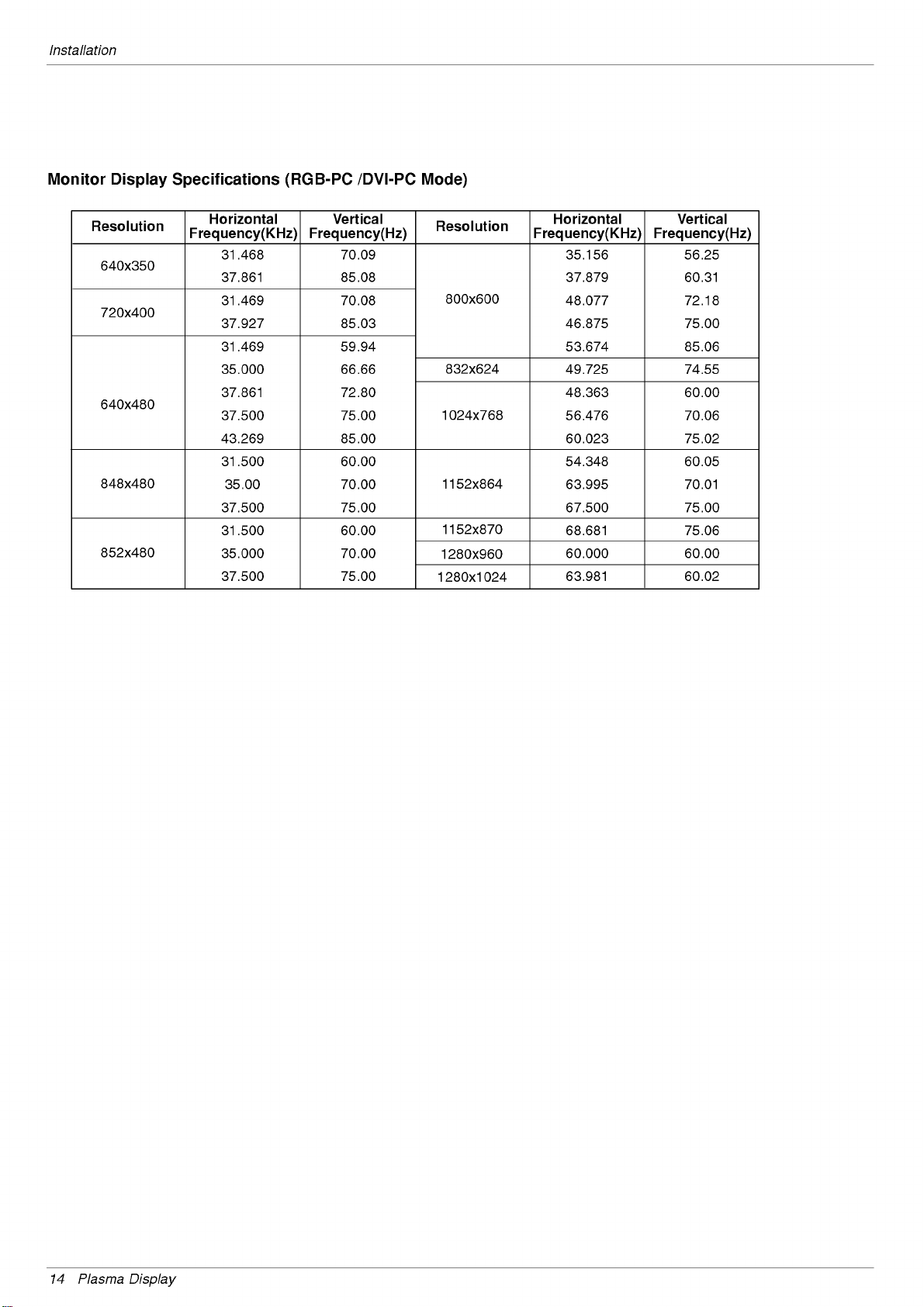
14
Plasma
Display
Installation
Resolution
640x350
720x400
640x480
848x480
852x480
Horizontal
Frequency(KHz)
31.468
37.861
31.469
37.927
31.469
35.000
37.861
37.500
43.269
31.500
35.00
37.500
31.500
35.000
37.500
70.09
85.08
70.08
85.03
59.94
66.66
72.80
75.00
85.00
60.00
70.00
75.00
60.00
70.00
75.00
35.156
37.879
48.077
46.875
53.674
49.725
48.363
56.476
60.023
54.348
63.995
67.500
68.681
60.000
63.981
56.25
60.31
72.18
75.00
85.06
74.55
60.00
70.06
75.02
60.05
70.01
75.00
75.06
60.00
60.02
Vertical
Frequency(Hz)
Resolution
800x600
832x624
1024x768
1152x864
1152x870
1280x1024
Horizontal
Frequency(KHz)
Vertical
Frequency(Hz)
1280x960
Monitor
Display
Specifications
(RGB-PC
/DVI-PC
Mode)

Owner's
Manual
15
Operation
Turning
on
the
Monitor
just
after
installation
Turning
on
the
Monitor
(power
cord
is
still
connected)
1.
Connect
power
cord
correctly.
2.
Press
the
ON/OFF
button
on
the
Monitor.
At
this
moment,
the
Monitor
is
switched
to
standby
mode.
Press
the
INPUT
SELECT
button
on
the
Monitor
or
press
the
POWER,
INPUT
SELECT,
MULTIMEDIA
button
on
the
remote
control
to
switch
the
Monitor
on.
?
Press
the
ON/OFF
button
on
the
Monitor
to
turn
the
Monitor
on.
1.
If
the
Monitor
was
turned
off
with
the
ON/OFF
button
on
the
Monitor
2.
If
the
Monitor
was
turned
off
with
the
remote
control
and
the
ON/OFF
button
on
the
Monitor
?
Press
the
ON/OFF
button
on
the
Monitor
and
then
press
the
INPUT
SELECT
button
on
the
Monitor.
Or,
on
the
remote
control,
press
POWER,
INPUT
SELECT,
or
MULTIMEDIA
to
turn
the
Monitor
on.
-
The
menus
can
be
shown
on
the
screen
in
the
selected
language.
First
select
your
language.
1.
Press
the
MENU
button
and
then
use
/
button
to
select the
SPECIAL
menu.
2.
Press
the
button
and
then
use
/
button
to
select
Language.
3.
Press
the
button
and
then
use
/
button
to
select
your
desired
language.
From
this
point
on,
the
on-screen
menus
will
be
shown
in
the
language
of
your
choice.
4.
Press
the
ENTER
button
to
save.
SPECIAL
Prev.
Language
G
Key
lock
ISM
Method
Low
power
Set
ID
Caption
/
Text
Captions
OSD
Rotate
English
Espanol
Francais
SPECIAL
MENU
Operation
Operation
Menu
Language
Selection
Menu
Language
Selection
T
Turning
on
the
Monitor
urning
on
the
Monitor

16
Plasma
Display
Operation
-
Each
adjustment
for
the
Picture
menu
options
doesn't
effect
other
input
sources.
Readjust
Picture
menu
options
for
each
of
the
following
sources.
?
RGB
(PC)
/
DVI
(PC),
?
RGB
(DTV)
/
DVI
(DTV)
/
Component
(480p,
720p,
1080i)
?
Video
/
S-Video
/
Component
(480i)
Picture
Menu
Options
Picture
Menu
Options
-
You
can
adjust
picture
contrast,
brightness,
color,
sharpness,
and
tint
to
the
levels
you
prefer.
1.
Press
the
MENU
button
and
then
use
/
button
to
select
the
PICTURE
menu.
2.
Press
the button
and
then
use
/
button
to
select
the
desired
picture
option
(Contrast,
Brightness,
Color,
Sharpness,
Tint).
3.
Press
the
button
and
then
use
/
button
to
make
appropriate
adjustments.
4.
Press
the
ENTER
button
to
save.
Manual
Picture
Control
(
Manual
Picture
Control
(User
option)
option)
1.
Press
the
APC
button
repeatedly
to
select
the
picture
appearance
setup
option
as
shown
below.
APC
(Auto
Picture
Control)
APC
(Auto
Picture
Control)
?
You
can
also
adjust
APC
in
the
PICTURE
menu.
?
Clear,
Optimum,
and
Soft
are
preset
for
good
picture
quality
at
the
factory
and
cannot
be
changed.
Optimum
Soft
User
Clear
-
APC
adjusts
the
Monitor
for
the
best
picture
appearance.
-
When
adjusting
picture
options
(contrast,
brightness,
color,
sharpness
and
tint)
manually,
APC
automatically
changes
to
User.
-
To
initialize
values
(reset
to
default
settings),
select
the
Normal
option.
-
When
adjusting
color
temperature
options
(red,
green,
or
blue)
manually,
ACC
automatically
changes
to
User.
1.
Press
the
MENU
button
and
then
use
/
button
to
select
the
PICTURE
menu.
2.
Press
the
button
and
then
use
/
button
to
select
ACC
.
3.
Press
the
button
and
then
use
/
button
to
select
either
Normal
(Default),
Cool
(Preset),
Warm
(Preset)
or
User
(Manual
Adjustment).
4.
Press
the
ENTER
button
to
save.
Auto
Color
Auto
Color
T
Temperature
Control
emperature
Control
-
You
can
adjust
red,
green,
or
blue
to
any
color
temperature
you
prefer.
1.
Press
the
MENU
button
and
then
use
/
button
to
select
the
PICTURE
menu.
2.
Press
the
button
and
then
use
/
button
to
select
Color
temp
.
3.
Press
the
button
and
then
use
/
button
to
select
Red,
Green
or
Blue.
4.
Use
the
/
button
to
make
appropriate
adjustments.
?
The
adjustment
range
of
Red,
Green,
and
Blue
is
-20
~
+20.
5.
Press
the
ENTER
button
to
save.
Manual
Color
Manual
Color
T
Temperature
Control
(
emperature
Control
(User
option)
option)
PICTURE
Prev.
APC
ACC
G
Color
temp.
Contrast
80
Brightness
60
Color
50
Sharpness
50
Tint
0
PICTURE
MENU
Normal
Cool
Warm
User
PICTURE
Prev.
APC
ACC
Color
temp.
G
Contrast
80
Brightness
60
Color
50
Sharpness
50
Tint
0
PICTURE
MENU
Red
0
Green
0
Blue
0
PICTURE
Prev.
APC
ACC
Color
temp.
Contrast
80
G
Brightness
60
Color
50
Sharpness
50
Tint
0
PICTURE
MENU

Owner's
Manual
17
Operation
1.
Press
the
DASP
button
repeatedly
to
select
the
appropriate
sound
setup
as
shown
below.
DASP
DASP
(Digital
(Digital
Auto
Sound
Processing)
Auto
Sound
Processing)
1.
Press
the
MENU
button
and
then
use
/
button
to
select
the
SOUND
menu.
2.
Press
the
button
and
then
use
/
button
to
select
the
desired
sound
option
(Balance,
Treble,
Bass).
3.
Press
the
button
and
then
use
/
button
to
make
appropriate
adjustments.
4.
Press
the
ENTER
button
to
save.
Manual
Sound
Control
(
Manual
Sound
Control
(User
option)
option)
?
You
can
also
adjust
DASP
in
the
SOUND
menu.
?
Flat,
Music,
Movie
and
Sports
are
preset
for
good
sound
quality
at
the
factory
and
cannot
be
changed.
Flat
Music
Movie
Sports
User
-
This
function
lets
you
enjoy
the
best
sound
without
any
special
adjustment
because
the
Monitor
has
the
appropriate
sound
option
based
on
the
program
content.
-
When
adjusting
sound
options
(treble,
bass,
and
balance)
manually,
DASP
automatically
changes
to
User.
-
AVL
maintains
an
equal
sound
level;
even
if
you
change
channels.
1.
Press
the
MENU
button
and
then
use
/
button
to
select
the
SOUND
menu.
2.
Press
the
button
and
then
use
/
button
to
select
AVL.
3.
Press
the
button
and
then
use
/
button
to
select
On
or
Off.
4.
Press
the
ENTER
button
to
save.
A
AVL
VL
(Auto
V
(Auto
Volume
Leveler)
olume
Leveler)
-
You
can
adjust
sound
treble,
bass,
and
balance
to
the
levels
you
prefer.
SOUND
Prev.
DASP
AVL
G
Balance
0
Treble
50
Bass
50
SOUND
MENU
On
Off
SOUND
Prev.
DASP
AVL
Balance
0
Treble
50
G
Bass
50
SOUND
MENU
Sound
Menu
Options
Sound
Menu
Options

18
Plasma
Display
Operation
-
Timer
functions
operate
only
if
current
time
has
been
set.
-
Off-Timer
function
overrides
On-Timer
function
if
they
are
set
to
the
same
time.
-
The
monitor
must
be
in
standby
mode
for
the
On-Timer
to
work.
On/Of
On/Offf
T
Timers
Setup
imers
Setup
1.
Press
the
MENU
button
and
then
use
/
button
to
select
the
TIMER
menu.
2.
Press
the
button
and
then
use
/
button
to
select
Off
timer
or
On
timer.
3.
Press
the
button
and
then
use
/
button
to
select
On.
?
To
cancel
On/Off
timer
function,
select
Off.
4.
Press
the
button
and
then
use
/
button
to
set
the
hour.
5.
Press
the
button
and
then
use
/
button
to
set
the
minutes.
6.
For
only
On
timer
function;
Press
the button
and
then
use
/
button
to
set
sound
level.
7.
Press
the
ENTER
button
to
save.
Clock
Setup
Clock
Setup
1.
Press
the
MENU
button
and
then
use
/
button
to
select the
TIMER
menu.
2.
Press
the button
and
then
use
/
button
to
select
Clock.
3.
Press
the button
and
then
use
/
button
to
set
the
hour.
4.
Press
the button
and
then
use
/
button
to
set
the
minutes.
5.
Press
the
ENTER
button
to
save.
T
T
imer
Menu
Options
imer
Menu
Options
TIMER
Prev.
Clock
G
Off
timer
On
timer
Auto
off
TIMER
MENU
--:--
Sleep
Sleep
T
Timer
imer
-
The
Sleep
Timer
turns
the
Monitor
off
at
the
preset
time.
Note
that
this
setting
is
cleared
when
the
monitor
is
turned
off.
1.
Press
the
SLEEP
button
repeatedly
to
select the
number
of
minutes.
First
the
---
Min
option
appears
on
the
screen,
followed
by
the
following
sleep
timer
options:
10,
20,
30,
60,
90,
120,
180,
and
240
minutes.
2.
When
the
number
of
minutes
you
want
is
displayed
on
the
screen,
press
the
ENTER
button.
The
timer
begins
to
count
down
from
the
number
of
minutes
selected.
3.
To
check
the
remaining
minutes
before
the
monitor
turns
off,
press
the
SLEEP
or
ENTER
button
once.
4.
To
cancel
the
Sleep
Timer,
press
the
SLEEP
button
repeatedly
until
---
Min
appears.
Auto
Of
Auto
Offf
-
If
there
is
no
input
signal,
the
Monitor
will
turn
off
automatically
after
10
minutes.
1.
Press
the
MENU
button
and
then
use
/
button
to
select
the
TIMER
menu.
2.
Press
the button
and
then
use
/
button
to
select
Auto
off.
3.
Press
the button
and
then
use
/
button
to
select
On
or
Off.
4.
Press
the
ENTER
button
to
save.
zz
zz
TIMER
Prev.
Clock
Off
timer
On
timer
Auto
off
G
TIMER
MENU
On
Off
TIMER
Prev.
Clock
Off
timer
On
timer
G
Auto
off
TIMER
MENU
10:30
Vol.
30
Ch.TV2
On
Off
-
If
current
time
setting
is
erased
by
a
power
failure,
if
TV
is
unplugged
or
if
the
monitor
is
turned
off
with
the
ON/OFF
button
on
the
monitor,
reset
the
clock.

Owner's
Manual
19
Key
Lock
Key
Lock
-
The
monitor
can
be
set
up
so
that
it
can
only
be
used
with
the
remote
control.
-
This
feature
can
be
used
to
prevent
unauthorized
viewing
by
disabling
the
front
panel
controls.
-
This
Monitor
is
programmed
to
remember
which
option
it
was
last
set
to
even
if
you
turn
the
monitor
off.
-
A
frozen
still
picture
from
a
PC/video
game
displayed
on
the
screen
for
prolonged
periods
will
result
in
a
ghost
image
remaining
even
when
you
change
the
image.
Avoid
allowing
a
fixed
image
to
remain
on
the
Monitor's
screen
for
a
long
period
of
time.
Special
Menu
Options
Special
Menu
Options
SPECIAL
Prev.
Language
Key
lock
G
ISM
Method
Low
power
Set
ID
Caption
/
Text
Captions
OSD
Rotate
On
Off
SPECIAL
MENU
1.
Press
the
MENU
button
and
then
use
/
button
to
select
the
SPECIAL
menu.
2.
Press
the
button
and
then
use
/
button
to
select
Key
lock.
3.
Press
the
button
and
then
use
/
button
to
select
On
or
Off.
4.
Press
the
ENTER
button
to
save.
?
With
the
KEY
LOCK
ON,
the
display
'
Key
lock'
appears
on
the
screen
if
any
button
on
the
front
panel
is
pressed.
ISM
(Image
Sticking
Minimization)
Method
ISM
(Image
Sticking
Minimization)
Method
SPECIAL
Prev.
Language
Key
lock
ISM
Method
G
Low
power
Set
ID
Caption
/
Text
Captions
OSD
Rotate
Normal
White
wash
Orbiter
Inversion
SPECIAL
MENU
1.
Press
the
MENU
button
and
then
use
/
button
to
select
the
SPECIAL
menu.
2.
Press
the
button
and
then
use
/
button
to
select
ISM
Method.
3.
Press
the
button
and
then
use
/
button
to
select
either
Normal,
White
wash,
Orbiter,
or
Inversion.
?
Normal:
If
image
sticking
is
never
a
problem,
ISM
is
not
necessary
-
set
to
Normal.
?
White
wash
White
Wash
removes
permanent
images
from
the
screen.
Note:
An
excessive
per-
manent
image
may
be
impossible
to
clear
entirely
with
White
Wash.
To
return
to
normal
viewing,
press
the
any
button.
?
Orbiter
Orbiter
may
help
prevent
ghost images.
However,
it
is
best
not
to
allow
any
fixed
image
to
remain
on
the
screen.
To
avoid
a
permanent
image
on
the
screen,
the
screen
will
move
every
1
minutes:
Right
→
Right
→
Downside
→
Downside
→
Left
→
Left
→
Upside
→
Upside.
?
Inversion
Inversion
will
automatically
invert
the
plasma
display
panel
color
every
30
minutes.
4.
Press
the
ENTER
button
to
save.
Low
Power
Low
Power
-
Low
power
reduces
the
plasma
display
power
consumption.
SPECIAL
Prev.
Language
Key
lock
ISM
Method
Low
power
G
Set
ID
Caption
/
Text
Captions
OSD
Rotate
On
Off
SPECIAL
MENU
1.
Press
the
MENU
button
and
then
use
/
button
to
select
the
SPECIAL
menu.
2.
Press
the button
and
then
use
/
button
to
select
Low
power.
3.
Press
the button
and
then
use
/
button
to
select
On
or
Off.
?
When
you
select
On,
the
screen
darkens.
4.
Press
the
ENTER
button
to
save.

20
Plasma
Display
Special
Menu
Options
continued
Special
Menu
Options
continued
SPECIAL
Prev.
Language
Key
lock
ISM
Method
Low
power
Set
ID
Caption
/
Text
Captions
OSD
Rotate
G
Normal
Rotate
SPECIAL
MENU
1.
Press
the
MENU
button
and
then
use
/
button
to
select
the
SPECIAL
menu.
2.
Press
the
button
and
then
use
/
button
to
select
OSD
(On
Screen
Display)
Rotate.
3.
Press
the
button
and
then
use
/
button
to
select
Normal
or
Rotate.
?
Select
Normal,
if
the
monitor
was
installed
horizontally.
?
Select
Rotate,
if
the
monitor
was
installed
vertically.
4.
Press
the
ENTER
button
to
save.
Menu
Rotation
for
V
Menu
Rotation
for
Vertical
V
ertical
Viewing
(MU-42PZ44M/44V/90C/90M/90V
series
models
only)
iewing
(MU-42PZ44M/44V/90C/90M/90V
series
models
only)
Operation

Owner's
Manual
21
Operation
Auto
Auto
Adjustment
Adjustment
-
RGB
(PC)
mode
only;
This
function
doesn't
work
for
RGB-DTV
mode.
-
Automatically
adjusts
picture
position
and
minimizes
image
shaking.
-
After
adjustment,
if
the
image
is
still
not
correct,
your
Monitor
is
functioning
properly
but
needs
further
adjustment.
-
The
Auto
config.
and
Manual
config.
are
not
active
in
DVI
mode.
1.
Press
the
MENU
button
and
then
use
/
button
to
select
the
SCREEN
menu.
2.
Press
the
button
and
then
use
/
button
to
select
Auto
config.
.
3.
Press
the
button
to
run
Auto
configure.
?
When
Auto
config.
has
finished,
OK
will
be
shown
on
screen.
?
If
the
position
of
the
image
is
still
not
correct,
try
Auto
adjustment
again.
4.
In
RGB
(PC)
mode,
if
the
image
needs
to
be
adjusted
more
after
using
Auto
con-
fig.,
you
can
make
further
adjustments
with
the
Manual
config.
option.
Screen
Menu
Options
Screen
Menu
Options
SCREEN
Prev.
Auto
config.
G
ARC
Zoom
in/out
Position
Manual
config.
Screen
adj.
Reset
VGA
Mode
To
set
SCREEN
MENU
Setting
Picture
Format
Setting
Picture
Format
-
Caution:
If
a
4:3
fixed
image
is
on
the
screen
for
a
long
time,
it
may
remain
visible.
-
Set
every
aspect
ratio
for
RGB
480p,
DVI
480p,
Component
480i/480p,
Video,
and
S-Video
sources.
-
Use
4:3,
or
16:9
for
other
input
sources.
1.
Use
the
ARC
button
repeatedly
to
select
the
desired
picture
format.
You
can
also
adjust
ARC
in
the
SCREEN
menu.
?
4:3
-
Choose
4:3
when
you
want
to
view
a
picture
with
an
original
4:3
aspect
ratio,
with
gray
bars
appearing
at
both
the
left
and
right
sides.
?
16:9
-
Choose
16:9
when
you
want
to
adjust
the
picture
horizontally,
in
a
linear
proportion
to
fill
the
entire
screen.
?
Horizon
-
Choose
Horizon
when
you
want
to
adjust
the
picture
in
a
non-linear
proportion,
that
is,
more
enlarged
at
both
sides,
to
create
a
spectacular
view.
?
Zoom
-
Choose
Zoom
when
you
want
to
view
the
picture
without
any
alteration.
However,
the
top
and
bottom
portions
of
the
picture
will
be
cropped.
1.
Use
ZOOM+/ZOOM-
button
to
enlarge
or
reduce
the
picture
size.
?
Zoom
adjustment
range
is
100~300.
2.
Adjust
the
main
picture
position
using
the
/
/ /
buttons
while
in
the
enlarged
picture
mode.
Picture
Size
Zoom
Picture
Size
Zoom
-
When
enlarging
or
reducing
the
picture,
the
image
may
become
distorted.
Zoom
out
100%
D
F
G
E

22
Plasma
Display
Adjusting
Horizontal/
V
Adjusting
Horizontal/
Vertical
Position
ertical
Position
1.
Press
the
MENU
button
and
then
use
/
button
to
select
the
SCREEN
menu.
2.
Press
the
button
and
then
use
/
button
to
select
Position.
3.
Press
the
button
and
then
use
/ /
/
button
to
adjust
the
position.
4.
Press
the
ENTER
button
to
save.
SCREEN
Prev.
Auto
config.
ARC
Zoom
in/out
Position
G
Manual
config.
Screen
adj.
Reset
VGA
Mode
SCREEN
MENU
SCREEN
Prev.
Auto
config.
ARC
Zoom
in/out
Position
Manual
config.
G
Screen
adj.
Reset
VGA
Mode
SCREEN
MENU
Manual
Configure
(RGB-PC
mode
only)
Manual
Configure
(RGB-PC
mode
only)
-
If
the
image
still
isn't
clear
after
auto
adjustment
and
especially
if
characters
are
still
jittery,
adjust
the
picture
Phase
manually.
-
To
correct
the
screen
size,
adjust
Clock.
-
This
function
works
in
the
following
modes:
RGB-PC,
RGB-DTV
(480p,720p,1080i),
COMPONENT
(480p,720p,1080i).
1.
Press
the
MENU
button
and
then
use
/
button
to
select
the
SCREEN
menu.
2.
Press
the button
and
then
use
/
button
to
select
Manual
config..
3.
Press
the
button
and
then
use
/
button
to to
select
Phase
or
Clock.
4.
Use
the
/
button
to
make
appropriate
adjustments.
?
The
Phase
adjustment
range
is
0
~
31.
?
The
Clock
adjustment
range
is
-50
~
+50.
5.
Press
the
ENTER
button
to
save.
Phase
0
Clock
0
SCREEN
Prev.
Auto
config.
ARC
Zoom
in/out
Position
Manual
config.
Screen
adj.
G
Reset
YNR
SCREEN
MENU
Screen
Screen
Adjustments
(V
Adjustments
(Video,
S-V
ideo,
S-Video
and
Component
480i
mode
only)
ideo
and
Component
480i
mode
only)
-
Use
this
function
to
correct
jittering
or
picture
instability
while
viewing
a
video
tape.
1.
Press
the
MENU
button
and
then
use
/
button
to
select
the
SCREEN
menu.
2.
Press
the button
and
then
use
/
button
to
select
Screen
adj..
3.
Press
the
button
and
then
use
/
button
to
select
TV
or
VCR.
?
Select
the
VCR
option
if
watching
a
VCR.
?
Select
the
TV
option
for
other
equipment.
(Except
VCR)
4.
Press
the
ENTER
button
to
save.
TV
VCR
1.
Press
the
MENU
button
and
then
use
/
button
to
select
the
SCREEN
menu.
2.
Press
the
button
and
then
use
/
button
to
select
Reset.
3.
Press
the
button.
?
You
can
initialize
Zoom
In/Out,
Manual
config.,
Position,
Split
zoom,
PIP
size,
PIP
position
and
sub
picture
size
for
double
window.
Initializing
(Reset
to
original
factory
value)
Initializing
(Reset
to
original
factory
value)
-
This
function
operates
in
every
mode.
-
Use
the
Reset
option
to
initialize
the
adjusted
settings.
SCREEN
Prev.
Auto
config.
ARC
Zoom
in/out
Position
Manual
config.
Screen
adj.
Reset
G
YNR
To
set
SCREEN
MENU
D
F
G
E
Operation
Screen
Menu
Options
continued
Screen
Menu
Options
continued

Owner's
Manual
23
Operation
Split
Zoom
Split
Zoom
-
Enlarges
the
picture
in
correct
proportions.
-
Split
Zoom
can
be
used
for
all
input
sources.
-
In
2-Split
Zoom
mode,
you
can
only
move
the
image
up
or
down.
-
If
an
image
is
enlarged,
a
section
can
be
viewed
without
using
Split
Zoom.
-
Split
Zoom
is
not
available
if
OSD
rotate
is
rotate.
1.
Press
the
SPLIT
ZOOM
button
repeatedly
to
select
either
2, 4,
or
9
Split
Zoom.
2.
Press
the
number
button
corresponding
to
the
section
you
wish
to
enlarge.
you
can
move
the
enlarged
screen
with
using
the
/
/ /
button.
SCREEN
Prev.
Auto
config.
ARC
Zoom
in/out
Position
Manual
config.
Screen
adj.
Reset
VGA
Mode
G
640x480
848x480
852x480
SCREEN
MENU
SCREEN
Prev.
Auto
config.
ARC
Zoom
in/out
Position
Manual
config.
Screen
adj.
Reset
YNR
G
On
Off
SCREEN
MENU
Selecting
W
Selecting
Wide
VGA
ide
VGA
mode
(RGB-PC,
DVI-PC
mode
only)
mode
(RGB-PC,
DVI-PC
mode
only)
-
To
see
a
normal
picture,
match
the
resolution
of
RGB
mode
and
selection
of
VGA
mode.
1.
Press
the
MENU
button
and
then
use
/
button
to
select
the
SCREEN
menu.
2.
Press
the button
and
then
use
/
button
to
select
VGA
Mode.
3.
Press
the
button
and
then
use
/
button
to
select
the
desired
VGA
resolution.
4.
Press
the
ENTER
button
to
save.
1
4
▲
▼
◀▶
2-Split
zoom
▲
▼
◀▶
12
54
4-Split
zoom
▲
▼
◀▶
123
456
789
9-Split
zoom
Example
of
choosing
5.
Section
5
is
enlarged
to
fill
the
screen.
▲
▼
◀▶
123
456
789
9-Split
zoom
-
Use
YNR
to
reduce
the
picture
noise
that
may
appear
on
the
screen.
Luminance
Noise
Reduction
(V
Luminance
Noise
Reduction
(Video,
S-V
ideo,
S-Video
and
Component
480i
modes
only)
ideo
and
Component
480i
modes
only)
1.
Press
the
MENU
button
and
then
use
/
button
to
select
the
SCREEN
menu.
2.
Press
the button
and
then
use
/
button
to
select
YNR.
3.
Press
the
button
and
then
use
/
button
to
select
On
or
Off.
4.
Press
the
ENTER
button
to
save.

24
Plasma
Display
-
PIP
lets
you
view
2
different
inputs
pictures
(sources)
on
your
monitor
screen
at
the
same
time.
One
source
will
be
large,
and
the
other
source
will
show
a
smaller
inset
image.
-
You
can
also
adjust
the
PIP
features
in
the
PIP/DW
menu
(Except
Swap
function).
PIP
PIP
(Picture-In-Picture)
Feature
(Picture-In-Picture)
Feature
PIP/DW
Prev.
Input
DW
PIP
PIP
Input
Win.
size
Win.
position
PIP
ARC
G
4:3
16:9
PIP/DW
MENU
Operation
W
Watching
PIP
atching
PIP
Press
the
PIP
button
repeatedly
to
turn
PIP
on
or
off.
-
Press
the
WIN.SIZE
button
and
then
use
/
button
to
change
the
sub
picture
size.
-
To
watch
4:
3
or
16:9
aspect
ratio
for
sub
picture
PIP
PIP
Aspect
Ratio
Aspect
Ratio
Moving
the
PIP
Moving
the
PIP
Press
the
WIN.POSITION
button.
Press
the
/
/ /
button
repeatedly
until
desired
position
is
achieved.
The
sub
picture
moves
up/down/left/right.
You
can
also
move
the
PIP
position
with
Win.position
in
the
PIP/DW
menu.
Swapping
the
PIP
Swapping
the
PIP
Press
the
SWAP
button
to
exchange
the
main
and
sub
pic-
tures.
Selecting
an
Input
Signal
Source
for
the
PIP
Selecting
an
Input
Signal
Source
for
the
PIP
Use
the
PIP
INPUT
button
to
select
the
input
source
for
the
sub
picture.
Main
Picture
Sub
Picture
10:30
◀▶
▲
▼
10:30 10:30
Win.position
Component
Video
Component
Video
Video
Component
1.
Press
the
MENU
button
and
then
use
/
button
to
select the
PIP/DW
menu.
2.
Press
the
button
and
then
use
/
button
to
select
PIP
ARC.
3.
Press
the
button
and
then
use
/
button
to
select
4:3
or
16:9.
4.
Press
the
ENTER
button
to
save.
Win.size
FG
Main
Picture
Source
Available
Sub
Picture
Sources
Video
S-Video
Component
480i
Component
480p/720p/1080i
RGB
and
DVI
S-Video,
Component
480i/480p/720p/1080i,
RGB
and
DVI
Video,
Component
480i/480p/720p/1080i,
RGB,
and
DVI
Video,S-Video,
RGB,
and
DVI
Video
and
S-Video
Video,
S-Video,
and
Component
480i,

Owner's
Manual
25
Operation
-
As
the
name
suggests,
this
mode
splits
the
screen
into
2,
allowing
2
picture
sources
to
be
shown
on
the
monitor
screen
at
the
same
time.
Each
source
is
given
half
the
screen.
Double
W
Double
Window
Setup
Options
indow
Setup
Options
Selecting
a
Source
for
the
Double
W
Selecting
a
Source
for
the
Double
Window
indow
W
Watching
Double
W
atching
Double
Window
indow
Press
the
DW
button
repeatedly
to
select
one
of
the
Double
Window
options.
Sub
Picture
Size
Sub
Picture
Size
Adjustment
Adjustment
Press
the
WIN.SIZE
button.
?
Use
the
/
button
to
change
the
sub
picture
size.
?
Using
the
Win.size
function
in
Double
Window
mode,
main
and
sub
picture
sizes
are
changed
simultaneously.
Using
the
Win.size
function
in
PIP
mode,
sub
picture
size
is
changed.
?
Win.position
is
not
functional
in
Double
Window
mode.
Swapping
the
Double
W
Swapping
the
Double
Window
indow
Use
the
SWAP
button
to
switch
the
main
and
sub
pictures
in
Double
Window
mode.
DW1
DW2
10:30
10:30
Component
Video
Video
Component
Win.size
FG
Main
Picture
Sub
Picture
Use
the
PIP
INPUT
button
to
select
the
input
source
for
the
sub
picture.
You
can
also
select
PIP
Input
in
the
PIP/DW
menu.
Main
Picture
Source
Available
Sub
Picture
Sources
Video
S-Video
Component
480i
Component
480p/720p/1080i
RGB
and
DVI
S-Video,
Component
480i/480p/720p/1080i,
RGB
and
DVI
Video,
Component
480i/480p/720p/1080i,
RGB,
and
DVI
Video,S-Video,
RGB,
and
DVI
Video
and
S-Video
Video,
S-Video,
and
Component
480i,

26
Plasma
Display
No.
Pin
name
1
No
connection
2
RXD
(Receive
data)
3
TXD
(Transmit
data)
4
DTR
(DTE
side
ready)
5
GND
6
DSR
(DCE
side
ready)
7
RTS
(Ready
to
send)
8
CTS
(Clear
to
send)
9
No
Connection
1
5
6
9
2
3
5
4
6
7
8
RXD
TXD
GND
DTR
DSR
RTS
CTS
TXD
RXD
GND
DSR
DTR
CTS
RTS
PC
7-Wire
Configurations
(Standard
RS-232C
cable)
D-Sub
9
3
2
5
6
4
8
7
PDP
D-Sub
9
2
3
5
4
6
7
8
RXD
TXD
GND
DTR
DSR
RTS
CTS
TXD
RXD
GND
DTR
DSR
RTS
CTS
PC
3-Wire
Configurations
(Not
standard)
D-Sub
9
3
2
5
4
6
7
8
PDP
D-Sub
9
-
Connect
the
RS-232C
input
jack
to
an
external
control
device
(such
as a
computer
or
an
A/V
control
system)
and
control
the
Monitor's
functions
externally.
-
Connect
the
serial
port
of
the
control
device
to
the
RS-232C
jack
on
the
Monitor
back
panel.
-
RS-232C
connection
cables
are
not
supplied
with
the
Monitor.
T
Type
of
Connector;
D-Sub
9-Pin
Male
ype
of
Connector;
D-Sub
9-Pin
Male
RS-232C
Configurations
RS-232C
Configurations
External
Control
Device
Setup
External
Control
Device
Setup
RS-232C
Setup
RS-232C
Setup
R
()()()
()
L
VIDEO
INPUT
RS-232C
INPUT
(CONTROL/SERVICE)
EXTERNAL
SPEAKER
YP
BPR
(MONO)
R
AUDIO L
R
AUDIO L
S-VIDEO
AC
INPUT
AUDIO
INPUT
AUDIO
INPUT
AUDIO
INPUT
REMOTE
CONTROL
COMPONENT
INPUT
DVI
INPUT
RGB
INPUT
RGB OUTPUT
PC
External
Control
Device
Setup

Owner's
Manual
27
External
Control
Device
Setup
Set
ID
Set
ID
Use
this
function
to
specify
a
monitor
ID
number.
Refer
to
'Real
Data
Mapping
1'.
See
page
28.
?
Baud
rate
:
115200
bps
(UART)
?
Data
length
:
8
bits
?
Parity
:
None
*
Use
a
crossed
(reverse)
cable.
?Stopbit:1bit
?
Communication
code
:
ASCII
code
Communication
Parameters
Communication
Parameters
1.
Press
the
MENU
button
and
then
use
/
button
to
select
the
SPECIAL
menu.
2.
Press
the
button
and
then
use
/
button
to
select
Set
ID.
3.
Press
the
button
and
then
use
F
/
G
button
to
adjust
Set
ID
to
choose
the
desired
monitor
ID
number.
The
adjustment
range
of
Set
ID
is
1
~
99.
4.
Press
the
ENTER
button
to
save.
SPECIAL
Prev.
Language
Key
lock
ISM
Method
Low
power
Set
ID
G
Caption
/
Text
Captions
OSD
Rotate
SPECIAL
MENU
1
Transmission
*
[Command
1]:
First
command
to
control
PDP
set.
(j
or
k)
*
[Command
2]:
Second
command
to
control
PDP
set.
*
[Set
ID]:
You
can
adjust
the
set
ID
to
choose
desired
monitor
ID
number
in
Special
menu.
Adjustment
range
is
1
~
99.
When
selecting
Set
ID
'0',
every
connected
PDP
set
is
controlled.
Set
ID
is
indicated
as
deci-
mal
(1~99)
on
menu
and
as
Hexa
decimal
(0x0~0x63)
on
transmission/receiving
protocol.
*
[DATA]:
To
transmit
command
data.
Transmit
'FF'
data
to
read
status
of
command.
*
[Cr]:
Carriage
Return
ASCII
code
'0x0D'
*
[
]:
ASCII
code
'space
(0x20)'
[Command1][Command2][
][Set
ID][
][Data][Cr]
T
Transmission
/
Receiving
Protocol
ransmission
/
Receiving
Protocol
OK
Acknowledgement
*
The
Monitor
transmits
ACK
(acknowledgement)
based
on
this
format
when
receiving
normal
data.
At
this
time,
if
the
data
is
data
read
mode,
it
indicates
present
status
data.
If
the
data
is
data
write
mode,
it
returns
the
data
of
the
PC
computer.
[Command2][
][Set
ID][
][OK][Data][x]
Error
Acknowledgement
*
The
Monitor
transmits
ACK
(acknowledgement)
based
on
this
format
when
receiving
abnormal
data
from
non-viable
functions
or
communication
errors.
[Command2][
][Set
ID][
][NG][Data][x]
Data
1:
Illegal
Code
2:
Not
supported
function
3:
Wait
more
time
01.
Power
k
a
0~1
02.
Input
Select
k
b
0~4
03.
Aspect
Ratio
k
c
0~3
04.
Screen
Mute
k
d
0~1
05.
Volume
Mute
k
e
0~1
06.
Volume
Control k
f
0~64
07.
Contrast
k
g
0~64
08.
Brightness
k
h
0~64
09.
Color
k
i
0~64
10.
Tint
k
j
0~64
11.
Sharpness
k k
0~64
12.
OSD
Select
k
l
0~1
13.
Remote
Control
Lock
Mode
k
m
0~1
14.
PIP/Twin
k
n
0~3
15.
PIP
Aspect
Ratio k
o
0~1
16.
Split
Zoom
k
p
21
~99
17.
PIP
Position
k
q
0~3
18.
Treble
k
r
0~64
19.
Bass
k
s
0~64
20.
Balance
k
t
0~64
21.
Color
Temperature
k
u
0~3
22.
Red
Adjustment
k
v
0~C8
23.
Green
Adjustment
k
w
0~C8
24.
Blue
Adjustment
k
$
0~C8
25.
PIP
Input
Source
k
y
0~4
26.
Abnormal
State k
z
0~a
27.
ISM
Method
j
p
0~3
28.
Low
Power
j
q
0~1
29.
Orbiter
Time
Setting
j
r
1~FE
30.
Orbiter
Pixel
Setting
j
s
0~9
31.
Picture
Size
Setting
j
t
0
~64
for
Double
Window
mode
32.
Auto
Config
j
u
1
COMMAND
1
COMMAND
2
DATA
(Hexadecimal)
?
Menu
doesn't
display
on screen
when
setting
the
4,
12,13,and26~32.
Command
Reference
List
Command
Reference
List
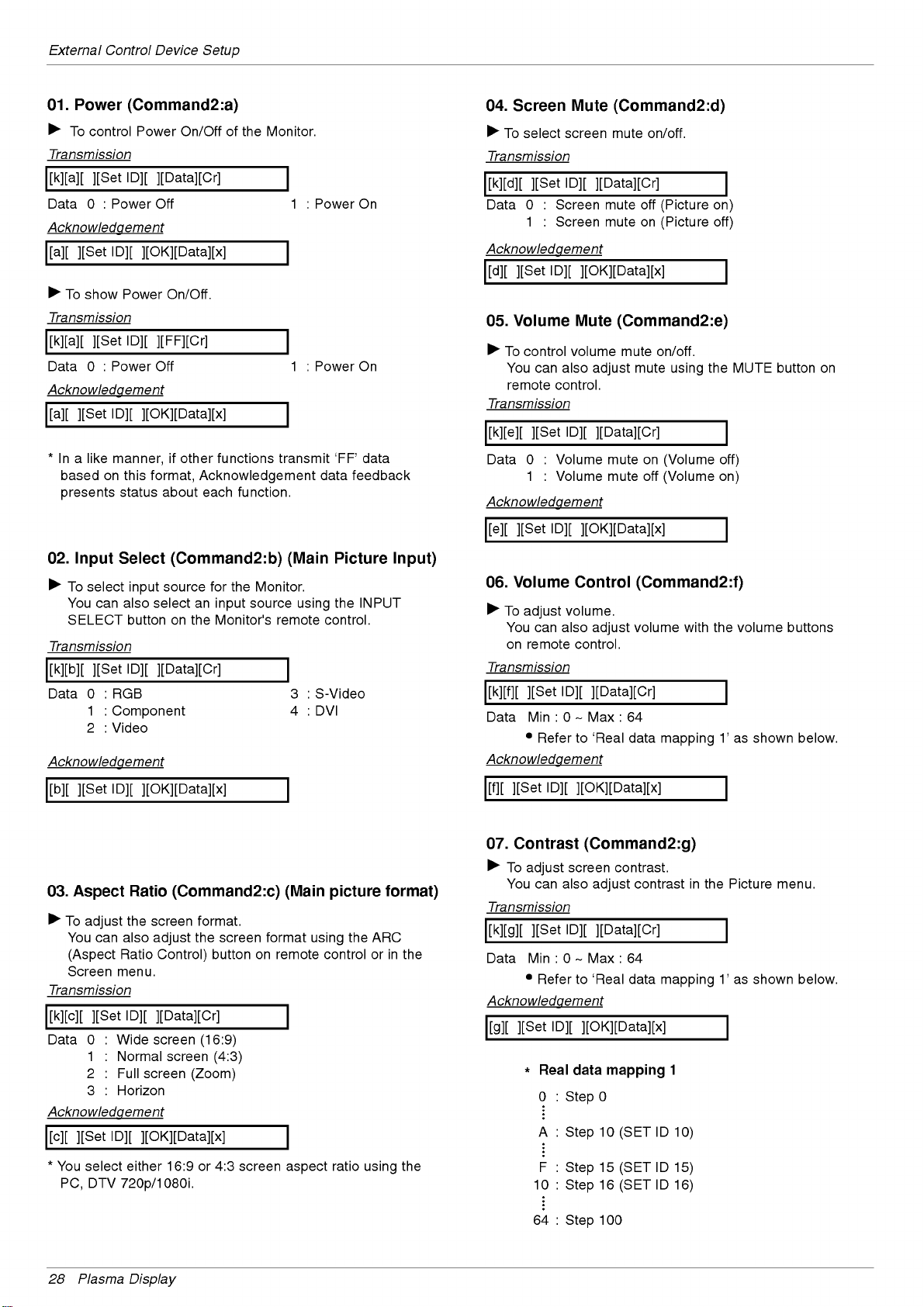
28
Plasma
Display
External
Control
Device
Setup
02.
Input
Select
(Command2:b)
(Main
Picture
Input)
G
To
select
input
source
for
the
Monitor.
You
can
also
select
an
input
source
using
the
INPUT
SELECT
button
on
the
Monitor's
remote
control.
Transmission
Data
0:RGB
1
:
Component
2
:
Video
3
:
S-Video
4
:DVI
[k][b][
][Set
ID][
][Data][Cr]
Acknowledgement
[b][
][Set
ID][
][OK][Data][x]
01.
Power
(Command2:a)
G
To
control
Power
On/Off
of
the
Monitor.
Transmission
Data
0
:
Power
Off
1:PowerOn
[k][a][
][Set
ID][
][Data][Cr]
Acknowledgement
[a][
][Set
ID][
][OK][Data][x]
G
To
show
Power
On/Off.
Transmission
[k][a][
][Set
ID][
][FF][Cr]
Acknowledgement
Data
0
:
Power
Off
1:PowerOn
*
In
a
like
manner,
if
other
functions
transmit
'FF'
data
based
on
this
format,
Acknowledgement
data
feedback
presents
status
about
each
function.
[a][
][Set
ID][
][OK][Data][x]
*
Real
data
mapping
1
0
:Step0
A
:Step10(SETID10)
F
:Step15(SETID15)
10:Step16(SETID16)
64
:
Step
100
05.
Volume
Mute
(Command2:e)
G
To
control
volume
mute
on/off.
You
can
also
adjust
mute
using
the
MUTE
button
on
remote
control.
Transmission
Data
0
:
Volume
mute
on
(Volume
off)
1
:
Volume
mute
off
(Volume
on)
[k][e][
][Set
ID][
][Data][Cr]
Acknowledgement
[e][
][Set
ID][
][OK][Data][x]
03.
Aspect
Ratio
(Command2:c)
(Main
picture
format)
G
To
adjust
the
screen
format.
You
can
also
adjust
the
screen
format
using
the
ARC
(Aspect
Ratio
Control)
button
on
remote
control
or
in
the
Screen
menu.
Transmission
Data
0
:
Wide
screen
(16:9)
1
:
Normal
screen
(4:3)
2
:
Full
screen
(Zoom)
3
:
Horizon
[k][c][
][Set
ID][
][Data][Cr]
Acknowledgement
*
You
select
either
16:9
or
4:3
screen
aspect
ratio
using
the
PC,
DTV
720p/1080i.
[c][
][Set
ID][
][OK][Data][x]
04.
Screen
Mute
(Command2:d)
G
To
select
screen
mute
on/off.
Transmission
Data
0
:
Screen
mute
off
(Picture
on)
1
:
Screen
mute
on
(Picture
off)
[k][d][
][Set
ID][
][Data][Cr]
Acknowledgement
[d][
][Set
ID][
][OK][Data][x]
06.
Volume
Control
(Command2:f)
G
To
adjust
volume.
You
can
also
adjust
volume
with
the
volume
buttons
on
remote
control.
Transmission
Data
Min:0~Max:64
?
Refer
to
'Real
data
mapping
1'
as
shown
below.
[k][f][
][Set
ID][
][Data][Cr]
Acknowledgement
[f][
][Set
ID][
][OK][Data][x]
07.
Contrast
(Command2:g)
G
To
adjust
screen
contrast.
You
can
also
adjust
contrast
in
the
Picture
menu.
Transmission
Data
Min:0~Max:64
?
Refer
to
'Real
data
mapping
1'
as
shown
below.
[k][g][
][Set
ID][
][Data][Cr]
Acknowledgement
[g][
][Set
ID][
][OK][Data][x]
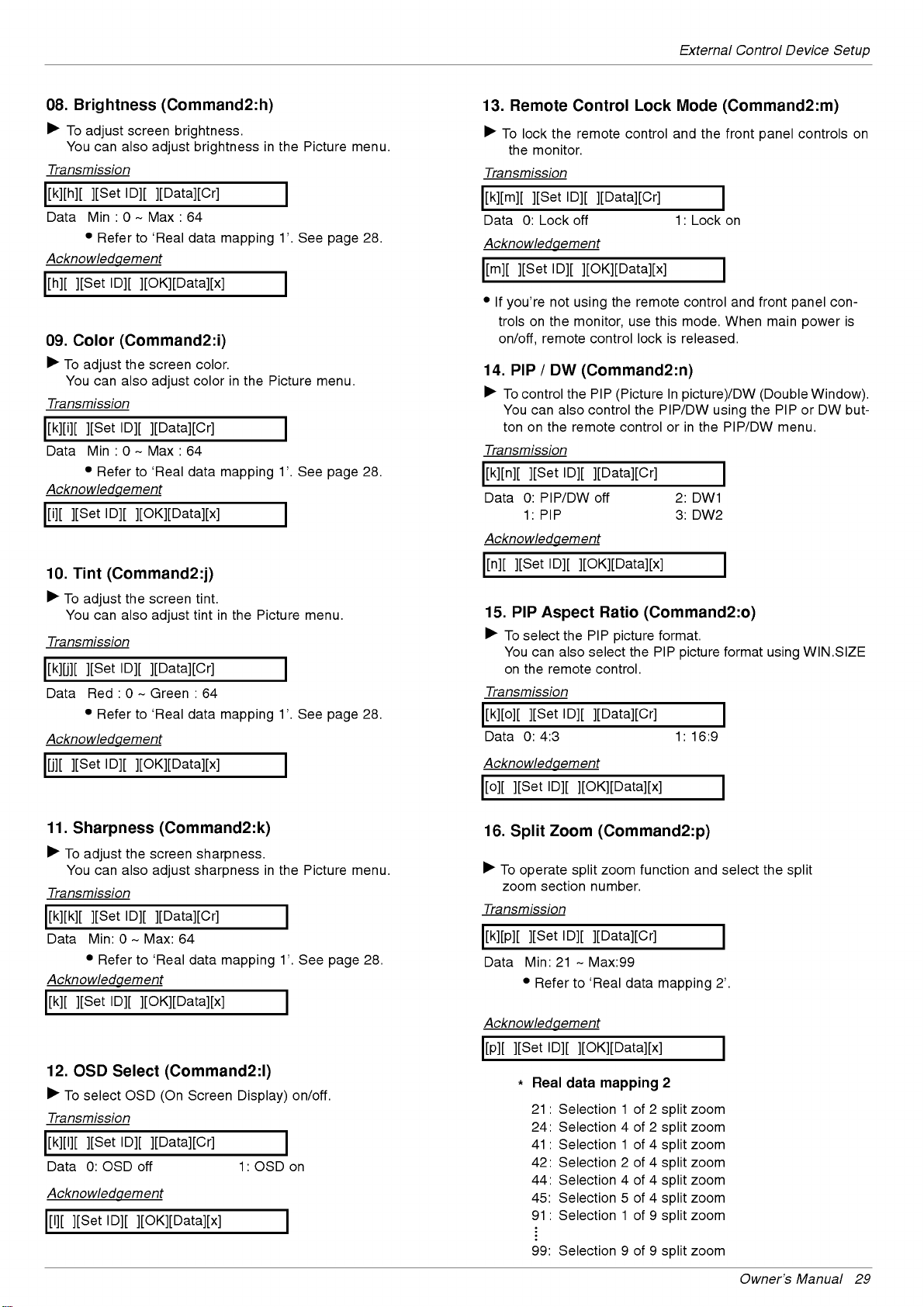
Owner's
Manual
29
External
Control
Device
Setup
09.
Color
(Command2:i)
G
To
adjust
the
screen
color.
You
can
also
adjust
color
in
the
Picture
menu.
Transmission
Data
Min:0~Max:64
?
Refer
to
'Real
data
mapping
1'.
See
page
28.
[k][i][
][Set
ID][
][Data][Cr]
Acknowledgement
[i][
][Set
ID][
][OK][Data][x]
10.
Tint
(Command2:j)
G
To
adjust
the
screen
tint.
You
can
also
adjust
tint
in
the
Picture
menu.
Transmission
Data
Red:0~Green:64
?
Refer
to
'Real
data
mapping
1'.
See
page
28.
[k][j][
][Set
ID][
][Data][Cr]
Acknowledgement
[j][
][Set
ID][
][OK][Data][x]
08.
Brightness
(Command2:h)
G
To
adjust
screen
brightness.
You
can
also
adjust
brightness
in
the
Picture
menu.
Transmission
Data
Min:0~Max:64
?
Refer
to
'Real
data
mapping
1'.
See
page
28.
[k][h][
][Set
ID][
][Data][Cr]
Acknowledgement
[h][
][Set
ID][
][OK][Data][x]
13.
Remote
Control
Lock
Mode
(Command2:m)
G
To
lock
the
remote
control
and
the
front
panel
controls
on
the
monitor.
Transmission
[k][m][
][Set
ID][
][Data][Cr]
Acknowledgement
Data
0:
Lock
off
1:
Lock
on
?
If
you're
not
using
the
remote
control
and
front
panel
con-
trols
on
the
monitor,
use
this
mode.
When
main
power
is
on/off,
remote
control
lock
is
released.
[m][
][Set
ID][
][OK][Data][x]
14.
PIP
/
DW
(Command2:n)
G
To
control
the
PIP
(Picture
In
picture)/DW
(Double
Window).
You
can
also
control
the
PIP/DW
using
the
PIP
or
DW
but-
ton
on
the
remote
control
or
in
the
PIP/DW
menu.
Transmission
Data
0:
PIP/DW
off
1:
PIP
2:
DW1
3:
DW2
[k][n][
][Set
ID][
][Data][Cr]
Acknowledgement
[n][
][Set
ID][
][OK][Data][x]
G
To
adjust
the
screen
sharpness.
You
can
also
adjust
sharpness
in
the
Picture
menu.
Transmission
11.
Sharpness
(Command2:k)
Data
Min:
0
~
Max:
64
?
Refer
to
'Real
data
mapping
1'.
See
page
28.
[k][k][
][Set
ID][
][Data][Cr]
Acknowledgement
[k][
][Set
ID][
][OK][Data][x]
12.
OSD
Select
(Command2:l)
G
To
select
OSD
(On
Screen
Display)
on/off.
Transmission
[k][l][
][Set
ID][
][Data][Cr]
Acknowledgement
Data
0:
OSD
off
1:
OSD
on
[l][
][Set
ID][
][OK][Data][x]
15.
PIP
Aspect
Ratio
(Command2:o)
G
To
select
the
PIP
picture
format.
You
can
also
select
the
PIP
picture
format
using
WIN.SIZE
on
the
remote
control.
Transmission
[k][o][
][Set
ID][
][Data][Cr]
Acknowledgement
Data
0:
4:3
1:
16:9
[o][
][Set
ID][
][OK][Data][x]
16.
Split
Zoom
(Command2:p)
G
To
operate
split
zoom
function
and
select
the
split
zoom
section
number.
Transmission
Data
Min:
21
~
Max:99
?
Refer
to
'Real
data
mapping
2'.
[k][p][
][Set
ID][
][Data][Cr]
Acknowledgement
[p][
][Set
ID][
][OK][Data][x]
*
Real
data
mapping
2
21
:
Selection
1
of
2
split
zoom
24
:
Selection
4
of
2
split
zoom
41
:
Selection
1
of
4
split
zoom
42
:
Selection
2
of
4
split
zoom
44
:
Selection
4
of
4
split
zoom
45:
Selection
5
of
4
split
zoom
91
:
Selection
1
of
9
split
zoom
99:
Selection
9
of
9
split
zoom
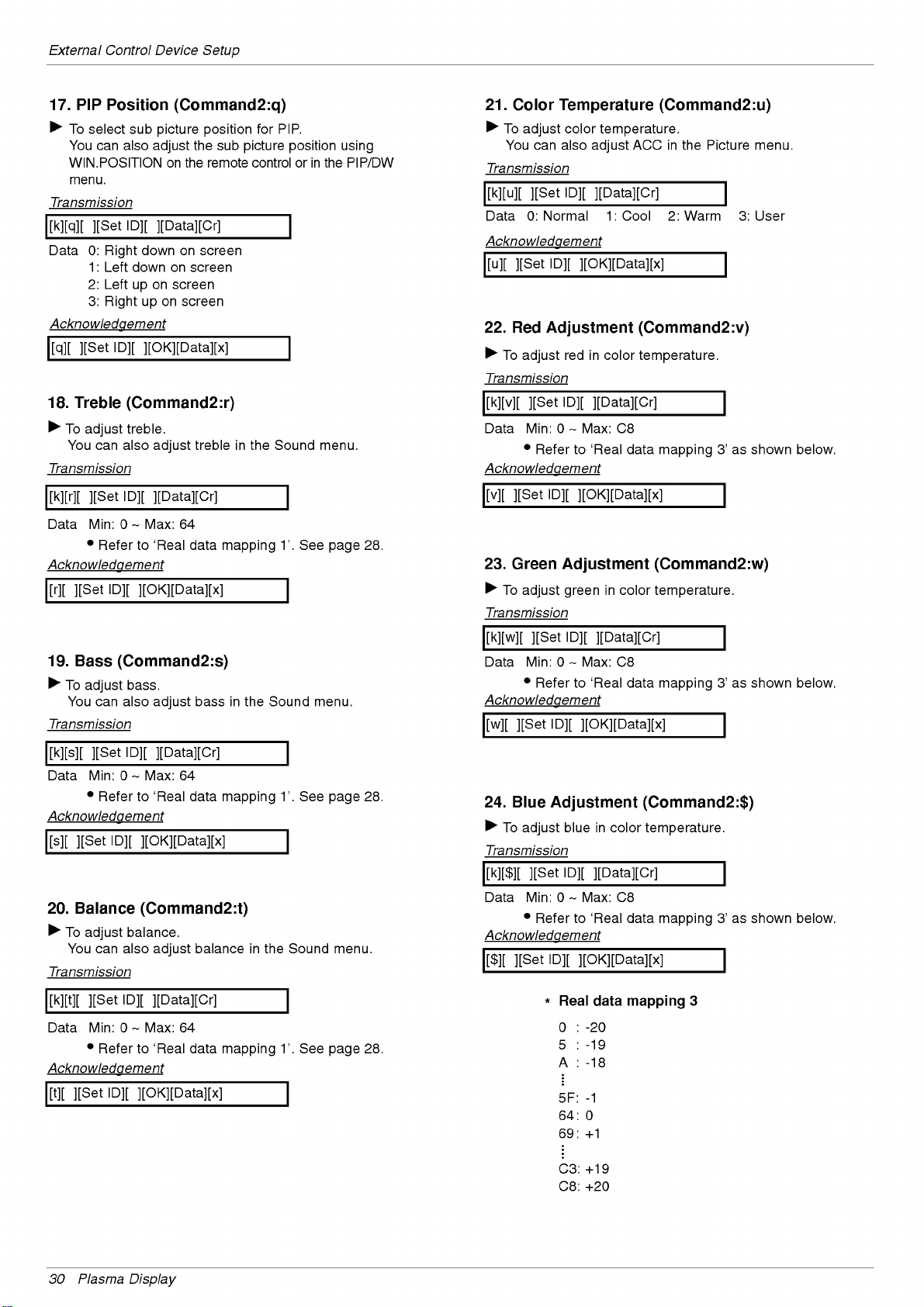
30
Plasma
Display
External
Control
Device
Setup
22.
Red
Adjustment
(Command2:v)
G
To
adjust
red
in
color
temperature.
Transmission
Data
Min:
0
~
Max:
C8
?
Refer
to
'Real
data
mapping
3'
as
shown
below.
[k][v][
][Set
ID][
][Data][Cr]
Acknowledgement
[v][
][Set
ID][
][OK][Data][x]
23.
Green
Adjustment
(Command2:w)
G
To
adjust
green
in
color
temperature.
Transmission
Data
Min:
0
~
Max:
C8
?
Refer
to
'Real
data
mapping
3'
as
shown
below.
[k][w][
][Set
ID][
][Data][Cr]
Acknowledgement
[w][
][Set
ID][
][OK][Data][x]
24.
Blue
Adjustment
(Command2:$)
G
To
adjust
blue
in
color
temperature.
Transmission
Data
Min:
0
~
Max:
C8
?
Refer
to
'Real
data
mapping
3'
as
shown
below.
[k][$][
][Set
ID][
][Data][Cr]
Acknowledgement
[$][
][Set
ID][
][OK][Data][x]
21.
Color
Temperature
(Command2:u)
G
To
adjust
color
temperature.
You
can
also
adjust
ACC
in
the
Picture
menu.
Transmission
Data
0:
Normal
1:
Cool
2:
Warm
3:
User
[k][u][
][Set
ID][
][Data][Cr]
Acknowledgement
[u][
][Set
ID][
][OK][Data][x]
20.
Balance
(Command2:t)
G
To
adjust
balance.
You
can
also
adjust
balance
in
the
Sound
menu.
Transmission
Data
Min:
0
~
Max:
64
?
Refer
to
'Real
data
mapping
1'.
See
page
28.
[k][t][
][Set
ID][
][Data][Cr]
Acknowledgement
[t][
][Set
ID][
][OK][Data][x]
18.
Treble
(Command2:r)
G
To
adjust
treble.
You
can
also
adjust
treble
in
the
Sound
menu.
Transmission
Data
Min:
0
~
Max:
64
?
Refer
to
'Real
data
mapping
1'.
See
page
28.
[k][r][
][Set
ID][
][Data][Cr]
Acknowledgement
[r][
][Set
ID][
][OK][Data][x]
19.
Bass
(Command2:s)
G
To
adjust
bass.
You
can
also
adjust
bass
in
the
Sound
menu.
Transmission
Data
Min:
0
~
Max:
64
?
Refer
to
'Real
data
mapping
1'.
See
page
28.
[k][s][
][Set
ID][
][Data][Cr]
Acknowledgement
[s][
][Set
ID][
][OK][Data][x]
17.
PIP
Position
(Command2:q)
G
To
select
sub
picture
position
for
PIP.
You
can
also
adjust
the
sub
picture
position
using
WIN.POSITION
on
the
remote
control
or
in
the
PIP/DW
menu.
Transmission
Data
0:
Right
down
on
screen
1:
Left
down
on
screen
2:
Left
up
on
screen
3:
Right
up
on
screen
[k][q][
][Set
ID][
][Data][Cr]
Acknowledgement
[q][
][Set
ID][
][OK][Data][x]
*
Real
data
mapping
3
0:-20
5:-19
A:-18
5F:
-1
64:
0
69:
+1
C3:
+19
C8:
+20
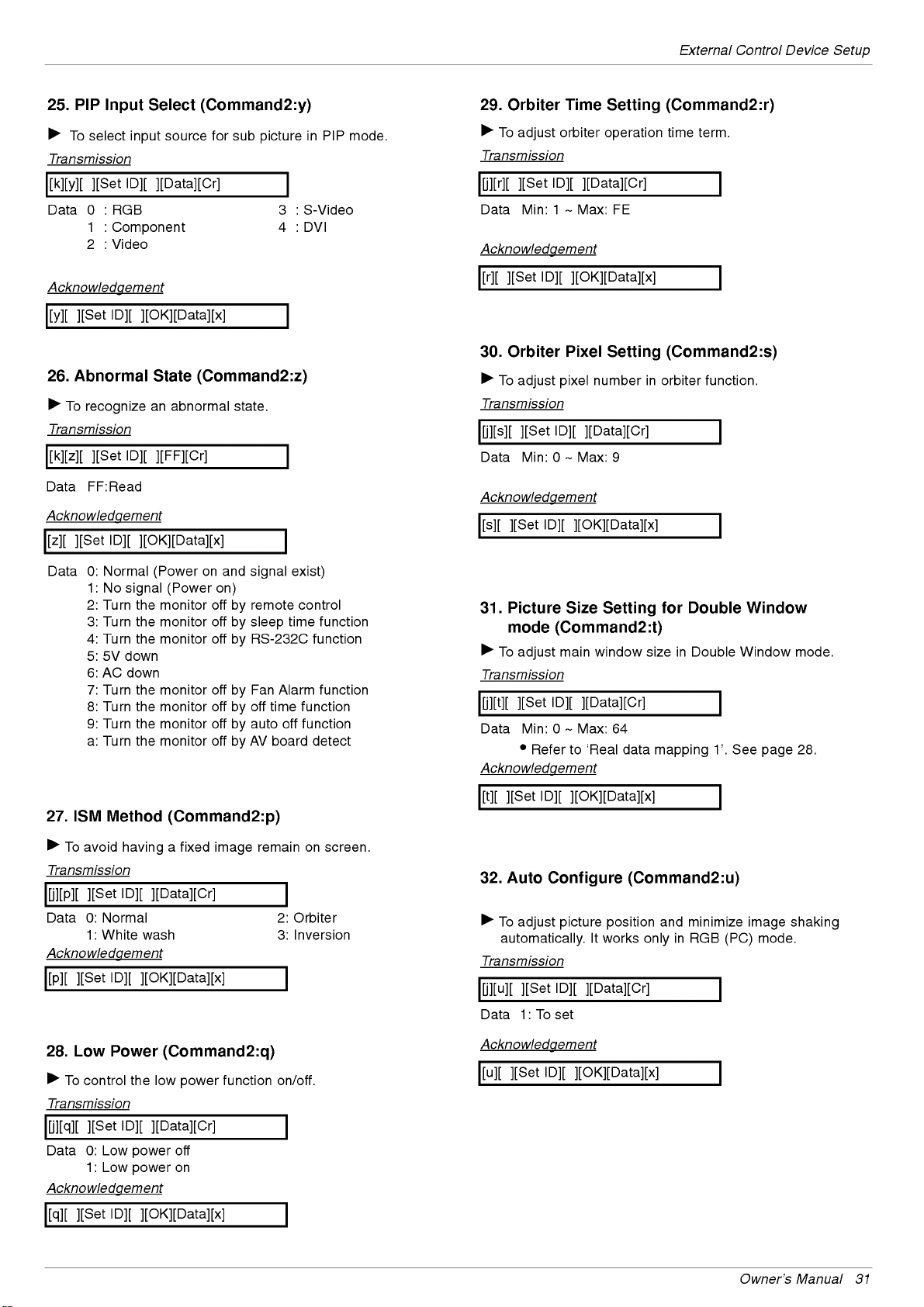
Owner's
Manual
31
External
Control
Device
Setup
27.
ISM
Method
(Command2:p)
G
To
avoid
having
a
fixed
image
remain
on
screen.
Transmission
Data
0:
Normal
1:
White
wash
2:
Orbiter
3:
Inversion
[j][p][
][Set
ID][
][Data][Cr]
Acknowledgement
[p][
][Set
ID][
][OK][Data][x]
28.
Low
Power
(Command2:q)
G
To
control
the
low
power
function
on/off.
Transmission
Data
0:
Low
power
off
1:
Low
power
on
[j][q][
][Set
ID][
][Data][Cr]
Acknowledgement
[q][
][Set
ID][
][OK][Data][x]
29.
Orbiter
Time
Setting
(Command2:r)
G
To
adjust
orbiter
operation
time
term.
Transmission
Data
Min:
1
~
Max:
FE
[j][r][
][Set
ID][
][Data][Cr]
Acknowledgement
[r][
][Set
ID][
][OK][Data][x]
30.
Orbiter
Pixel
Setting
(Command2:s)
G
To
adjust
pixel
number
in
orbiter
function.
Transmission
Data
Min:0~Max:9
[j][s][
][Set
ID][
][Data][Cr]
Acknowledgement
[s][
][Set
ID][
][OK][Data][x]
31.
Picture
Size
Setting
for
Double
Window
mode
(Command2:t)
G
To
adjust
main
window
size
in
Double
Window
mode.
Transmission
Data
Min:
0
~
Max:
64
?
Refer
to
'Real
data
mapping
1'.
See
page
28.
[j][t][
][Set
ID][
][Data][Cr]
Acknowledgement
[t][
][Set
ID][
][OK][Data][x]
32.
Auto
Configure
(Command2:u)
G
To
adjust
picture
position
and
minimize
image
shaking
automatically.
It
works
only
in
RGB
(PC)
mode.
Transmission
Data
1:
To
set
[j][u][
][Set
ID][
][Data][Cr]
Acknowledgement
[u][
][Set
ID][
][OK][Data][x]
25.
PIP
Input
Select
(Command2:y)
G
To
select
input
source
for
sub
picture
in
PIP
mode.
Transmission
Data
0
:RGB
1
:
Component
2
:
Video
3
:
S-Video
4
:DVI
[k][y][
][Set
ID][
][Data][Cr]
Acknowledgement
[y][
][Set
ID][
][OK][Data][x]
26.
Abnormal
State
(Command2:z)
G
To
recognize
an
abnormal
state.
Transmission
Data
0:
Normal
(Power
on
and
signal
exist)
1:
No
signal
(Power
on)
2:
Turn
the
monitor
off
by
remote
control
3:
Turn
the
monitor
off
by
sleep
time
function
4:
Turn
the
monitor
off
by
RS-232C
function
5:
5V
down
6:
AC
down
7:
Turn
the
monitor
off
by
Fan
Alarm
function
8:
Turn
the
monitor
off
by
off
time
function
9:
Turn
the
monitor
off
by
auto
off
function
a:
Turn
the
monitor
off
by
AV
board
detect
Data
FF:Read
[k][z][
][Set
ID][
][FF][Cr]
Acknowledgement
[z][
][Set
ID][
][OK][Data][x]

32
Plasma
Display
G
Connect
your
wired
remote
control
to
the
Remote
Control
port
on
the
Monitor.
G
Output
waveform
Single
pulse,
modulated
with
37.917KHz
signal
at
455KHz
G
Configuration
of
frame
G
Repeat
code
G
Lead
code
?
1st
frame
Low
custom
code
Lead
code
High
custom
code
Data
code
Data
code
TC
Tf
T1
C0
Carrier
frequency
FCAR
=
1/TC
=
fOSC/12
Duty
ratio
=
T1/TC
=
1/3
?
Repeat
frame
C1C2C3C4C5C6C7C0C1C2C3C4C5C6C7D0D1D2D3D4D5D6D7D0D1D2D3D4D5D6D7
Repeat
code
9ms
4.5
ms
0.55
ms
9ms
2.25
ms
G
Bit
description
G
Frame
interval
:
Tf
The
waveform
is
transmitted
as
long
as
a
key
is
depressed.
?
Bit
"0"
Tf
Tf
Tf=108ms
@455KHz
0.56
ms
0.56
ms
1.12
ms
?
Bit
"1"
2.24
ms
How
to
Connect
How
to
Connect
Remote
Control
IR
Code
Remote
Control
IR
Code
IR
Code
IR
Code
IR
Code

Owner's
Manual
33
IR
Code
00H
01H
02H
03H
08H
C4H
C5H
09H
10H
11H
12H
13H
14H
15H
16H
17H
18H
19H
0BH
98H
D5H
C6H
BFH
5AH
D8H
0EH
44H
43H
52H
4DH
60H
61H
63H
64H
6BH
40H
41H
69H
6AH
7BH
79H
76H
77H
AFH
99H
R/C
Button
R/C
Button
R/C
Button
R/C
Button
R/C
Button
(Power
On/Off)
Discrete
IR
Code
(Only
Power
On)
Discrete
IR
Code
(Only
Power
Off)
R/C
Button
R/C
Button
R/C
Button
R/C
Button
R/C
Button
R/C
Button
R/C
Button
R/C
Button
R/C
Button
R/C
Button
R/C
Button
R/C
Button
(Video/S-Video/Component/RGB/DVI)
R/C
Button
(Component/RGB/DVI)
Discrete
IR
Code
(Input
RGB
Selection)
Discrete
IR
Code
(Input
DVI
Selection)
Discrete
IR
Code
(Input
Component
Selection)
Discrete
IR
Code
(Input
Video
Selection)
Discrete
IR
Code
(Input
S-video
Selection)
R/C
Button
R/C
Button
R/C
Button
R/C
Button
R/C
Button
R/C
Button
R/C
Button
R/C
Button
(PIP/Double
window
Exchange)
R/C
Button
(4:3/16:9)
R/C
Button
R/C
Button
R/C
Button
R/C
Button
R/C
Button
R/C
Button
R/C
Button
(4:3/16:9/Zoom
mode
Selection)
Discrete
(Only
4:3
mode)
Discrete
(Only
16:9
mode)
Discrete
(Only
Zoom
mode)
Discrete
IR
Code
Code
(Hexa)
Function
Note
UP
(D)
DOWN
(E)
VOL+
(G)
VOL-
(F)
POWER
ON/OFF
POWER
ON
POWER
OFF
MUTE
Number
Key
0
Number
Key
1
Number
Key
2
Number
Key
3
Number
Key
4
Number
Key
5
Number
Key
6
Number
Key
7
Number
Key
8
Number
Key
9
INPUT
SELECT
MULTIMEDIA
RGB
DVI
Component
Video
S-video
SLEEP
ENTER
(A)
MENU
DASP
APC
PIP
PIP
INPUT
SWAP
PIP
ARC
DW
ZOOM
+
ZOOM
-
Window
Size
Window
Position
Split
Zoom
ARC
ARC
(4:3)
ARC
(16:9)
ARC
(Zoom)
AUTO
CONFIG

34
Plasma
Display
Troubleshooting
Checklist
No
output
from
one
of
the
speakers
?
Adjust
Balance
in
the
SOUND
menu.
(Refer
to
p.17)
Unusual
sound
from
inside
the
monitor
?
A
change
in
ambient
humidity
or
temperature
may
result
in
an
unusual
noise
when
the
plasma
display
is
turned
on
or
off
and
does
not
indicate
a
fault
with
the
monitor.
No
picture
&
No
sound
?
Check
whether
the
Monitor
is
turned
on.
?
Power
cord
inserted
into
wall
outlet?
?
Test
the
wall
power
outlet,
plug
other
product's
power
cord
into
the
wall
outlet
where
the
Monitor's
power
cord
was
plugged
in.
No
or
Poor
color
or
Poor
picture
?
Select
Color
in
the
PICTURE
menu
and
press
the
VOLUME
(G)
button.
(Refer
to
p.16)
?
Keep
a
sufficient
distance
between
the
Monitor
and
the
VCR.
?
Activate
any
function
to
restore
the
brightness
of
the
picture.
(If
still
picture
is
on
the
screen
for
more
than
5
minutes,
the
screen
gets
dark.)
The
remote
control
doesn't
work
?
Check
to
see
if
there
is
any
object
between
the
Plasma
Display
and
the
remote
control
causing
obstruction.
?
Are
batteries
installed
with
correct
polarity
(+
to
+,
-
to
-)?
(Refer
to
p.8)
?
Install
new
batteries.
(Refer
to
p.8)
Picture
OK
&
No
sound
?
Press
the
VOLUME
(G)
button.
?
Sound
muted?
Press
MUTE
button.
Picture
appears
slowly
after
switching
on
?
This
is
normal
as
the
image
is
muted
during
the
startup
process
of
the
moni-
tor.
Please
contact
your
service
centre,
if
the
picture
has
not
appeared
after
five
minutes.
Horizontal/vertical
bars
or
picture
shaking
?
Check
for
local
interference
such
as
an
electrical
appliance
or
power
tool.
T
Troubleshooting
Checklist
roubleshooting
Checklist

Owner's
Manual
35
Maintenance
&
Specification
1.
Here's
a
great
way
to
keep
the
dust
off
your
screen
for
a
while.
Wet
a
soft
cloth
in
a
mixture
of
lukewarm
water
and
a
little
fabric
softener
or
dish
washing
detergent.
Wring
the
cloth
until
it's
almost
dry,
and
then
use
it
to
wipe
the
screen.
2.
Make
sure
the
excess
water
is
off
the
screen,
and
then
let
it
air-dry
before
you
turn
on
your
Monitor.
To
remove
dirt
or
dust,
wipe
the
cabinet
with
a
soft,
dry,
lint-free
cloth.
Please
be
sure
not
to
use
a
wet
cloth.
If
you
expect
to
leave
your
Monitor
dormant
for
a
long
time
(such
as a
vacation),
it's
a
good
idea
to
unplug
the
power
cord
to
protect
against
possible
damage
from
lightning
or
power
surges.
-
Early
malfunctions
can
be
prevented.
Careful
and
regular
cleaning
can
extend
the
amount
of
time
you
will
have
your
new
Monitor.
Be
sure
to
turn
the
power
off
and
unplug
the
power
cord
before
you
begin
any
cleaning.
Cleaning
the
Screen
Cleaning
the
Screen
Cleaning
the
Cabinet
Cleaning
the
Cabinet
Extended
Extended
Absence
Absence
Maintenance
Maintenance

36
Plasma
Display
Specification
?
The
specifications
shown
above
may
be
changed
without
notice
for
quality
improvement.
Product
Specifications
Product
Specifications
MODELS
Width
(inches
/
mm)
Height
(inches
/
mm)
Depth
(inches
/
mm)
Weight
(pounds
/
kg)
Power
requirement
Resolution
Color
Operating
Temperature
Range
Operating
Humidity
Range
Maximum
Elevation
MU-42PZ44/44A/44B/44K/44R/44S
MU-42PZ44M/44MA/44MB/44MK/44MR/44MS
MU-42PZ44V/44VA/44VB/44VK/44VR/44VS
MU-42PZ90/90A/90B/90K/90R/90S
MU-42PZ90M/90MA/90MB/90MK/90MR/90MS
MU-42PZ90V/90VA/90VB/90VK/90VR/90VS
MU-42PZ90C
40.7
/
1033
24.5
/
622
3.2/81
75/34
AC100-240V
~
50/60Hz
852
x
480
(Dot)
16,770,000
(256
steps
of
each
R,
G
and
B)
32
~
104°F
(0
~
40°C)
Less
than
80%
6561
feet
(2000m)

Owner's
Manual
37
Notes
Notes
Notes

38
Plasma
Display
Notes
Notes
Notes

Owner's
Manual
39
Notes
Notes
Notes
