
En
En
Printed in Japan
S2BB000201(11)
6MAA1511-02
DIGITAL CAMERA
The Guide to Digital Photography
with the

Shoot, View, and Enjoy
A Flowchart Guide to Using Your Camera
STEP 1—Ready the camera
Getting ready First Steps 16
Camera setup
First Steps
Camera Setup
16
69
STEP 2—Take pictures
Tutorial: Taking PicturesSnapshots (auto mode) 24
Getting Creative
Creative photography
(scene mode)
36
Taking Pictures: The DetailsCustom shots and movies 51
STEP 3—Play them back…
Review and Deletion…while shooting… 31
Basic Playback…after shooting… 78
STEP 4—Install camera software
Quick Start Guide (provided)Install software
Nikon View 5 Reference
Manual (provided on CD)
Get to know Nikon View 5 —
Keep or Delete…immediately 58
Review and Deletion…while shooting 31
Basic Playback…during playback 78
Deleting PicturesDelete multiple pictures 86
…and delete unwanted pictures…
—
STEP 5—Copy pictures to your computer
ConnectionsTransfer pictures 41
i
Product Documentation
The documentation for this product
includes the manuals listed below.
Please be sure to read all instructions
thoroughly to get the most from your
camera.
Quick-Start Guide
The Quick-Start Guide takes you
through the process of unpacking
and setting up your Nikon digital
camera, taking your first pictures, in-
stalling software, and transferring
pictures to your computer.
Guide to Digital Photography
The Guide to Digital Photography
(this manual) provides complete op-
erating instructions for your camera.
Nikon View 5 Reference Manual
The Nikon View 5 Reference Manual
can be found in electronic format
on the reference CD provided with
your camera. For information on
viewing the Reference Manual, see
“Connections” in this manual.
Getting to Know the COOLPIX 2500
Overview
First Steps
Taking Pictures
Review and Deletion
Getting Creative
Connections
Beyond Point-and-Shoot
Fine-Tuning Camera Settings
Camera Setup
Basic Playback
The Playback Menu
Technical Notes
Index
Menu Guide
ii
To prevent damage to your Nikon product or injury to yourself or to others,
read the following safety precautions in their entirety before using this equip-
ment. Keep these safety instructions where all those who use the product
will read them.
The consequences that could result from failure to observe the precautions
listed in this section are indicated by the following symbol:
WARNINGS
Turn off immediately in the event
of malfunction
Should you notice smoke or an un-
usual smell coming from the equip-
ment or from the AC adapter (avail-
able separately), unplug the AC
adapter or remove the battery imme-
diately, taking care to avoid burns.
Continued operation could result in
injury. After removing the battery,
take the equipment to a Nikon-autho-
rized service center for inspection.
Do not use in the presence of flam-
mable gas
Do not use electronic equipment in
the presence of flammable gas, as this
could result in explosion or fire.
Observe caution when using the
camera strap
Caution should be exercised to pre-
vent strangulation when wearing the
camera strap around your neck. Never
place the strap around the neck of an
infant or child.
Do not disassemble
Touching the product’s internal parts
could result in injury. In the event of
a malfunction, the product should be
repaired only by a qualified technician.
Should the product break open as the
result of a fall or other accident, re-
move the battery or AC adapter and
then take the product to a Nikon-au-
thorized service center for inspection.
Observe proper precautions when
handling batteries
Batteries may leak or explode if im-
properly handled. Observe the follow-
ing precautions when handling bat-
teries for use in this product:
• Be sure the product is off before re-
placing the battery. If you are using
an AC adapter, be sure it is un-
plugged.
• Use only a rechargeable Nikon EN-EL2
lithium-ion battery (supplied).
• When inserting the battery, do not at-
tempt to insert it upside down or
backwards.
• Do not short or disassemble the bat-
tery.
• Do not expose the battery to flame
or to excessive heat.
• Do not immerse in or expose to water.
• Do not transport or store with metal
objects such as necklaces or hairpins.
For Your Safety
This icon marks warnings, information that should be read before us-
ing your Nikon product to prevent possible injury.
iii
• Batteries are prone to leakage when
fully discharged. To avoid damage to
the product, be sure to remove the
battery when no charge remains.
• When the battery is not in use, attach
the terminal cover and store in a cool
place.
• Immediately after use, or when the
product is used on battery power for
an extended period, the battery may
become hot. Before removing the
battery, turn the camera off and al-
low the battery to cool.
• Discontinue use immediately should
you notice any changes in the battery,
such as discoloration or deformation.
Use appropriate cables
When connecting cables to the input
and output jacks, use only the cables
provided or sold by Nikon for the pur-
pose, to maintain compliance with
product regulations.
The lens section
• Do not insert your fingers in the gap
between the rotating lens section and
the camera body. Your fingers could
be pinched between the body and the
lens section, resulting in injury. Par-
ticular care should be observed in the
case of small children.
• To prevent your fingers, flesh, or other
objects from being pinched in the gap
between the rotating lens section and
the camera body, return the lens sec-
tion to its housing in the camera body
before transporting the camera.
Keep out of reach of children
Particular care should be taken to pre-
vent infants from putting the battery
or other small parts into their mouths.
Removing memory cards
Memory cards may become hot dur-
ing use. Observe due caution when
removing memory cards from the
camera.
CD-ROMs
The CD-ROMs on which the software
and manuals are distributed should
not be played back on audio CD
equipment. Playing CD-ROMs on an
audio CD player could cause hearing
loss or damage the equipment.
Observe caution when operating
the flash
Using the flash close to your subject’s
eyes could cause temporary visual im-
pairment. Particular care should be
observed if photographing infants,
when the flash should be no less than
one meter (39˝) from the subject.
Avoid contact with liquid crystal
Should the monitor break, care should
be taken to avoid injury due to bro-
ken glass and to prevent liquid crystal
from the monitor touching the skin
or entering the eyes or mouth.

iv
Keep dry
This product is not waterproof, and may
malfunction if immersed in water or ex-
posed to high levels of humidity. Rusting
of the internal mechanism can cause irrepa-
rable damage.
Keep free of salt, sand, and dust
After using your camera at the beach or
seaside, wipe off any sand or salt with a
lightly dampened cloth and then dry your
camera thoroughly.
Do not touch the lens with your fingers
The proper procedure for cleaning the lens
is described in “Technical Notes: Caring for
Your Camera.”
Handle the lens and all moving parts
with care
Do not apply force to the lens or to the
battery, card, and connector covers. These
parts are especially susceptible to damage.
Turn the product off before removing
the battery or unplugging the AC
adapter
Do not unplug the product or remove the
battery while the product is on, or while
images are being recorded or deleted.
Forcibly cutting power to the product in
these circumstances could result in loss of
data or in damage to product memory or
internal circuitry. To prevent an accidental
interruption of power, avoid carrying the
product from one location to another while
the AC adapter is connected.
Do not drop
The product may malfunction if subjected
to strong shocks or vibration.
Keep away from strong magnetic fields
Do not use or store this device in the vicin-
ity of equipment that generates strong
electromagnetic radiation or magnetic
fields. Strong static charges or the mag-
netic fields produced by equipment such
as radio transmitters could interfere with
the monitor, damage data stored on the
memory card, or affect the product’s inter-
nal circuitry.
Avoid sudden changes in temperature
Sudden changes in temperature, such as
occur when entering or leaving a heated
building on a cold day, can cause conden-
sation inside the device. To prevent con-
densation, place the device in a carrying
case or a plastic bag before exposing it to
sudden changes in temperature.
Notes on the monitor
• The monitor may contain a few pixels that
are always lit or that do not light. This is
a characteristic common to all TFT LCD
monitors and does not indicate a mal-
function. Images recorded with the prod-
uct will not be affected.
• Images in the monitor may be difficult to
see in a bright light.
• The monitor is lit by an LED backlight.
Should the monitor begin to dim or
flicker, contact your Nikon service repre-
sentative.
• Do not apply pressure to the monitor, as
this could cause damage or malfunction.
Dust or lint adhering to the monitor can
be removed with a blower brush. Stains
can be removed by rubbing the surface
lightly with a soft cloth or chamois
leather.
• Should the monitor break, care should
be taken to avoid injury due to broken
glass and to prevent the liquid crystal
from the monitor touching the skin or
entering the eyes or mouth.
Caring for the Camera and Battery
v
Smear
When you frame bright subjects, vertical
comet-like streaks that whiten toward ei-
ther end may appear in the monitor. This
phenomenon, known as “smear,” does not
appear in the final photograph and does
not indicate a malfunction. Some smear-
ing may appear in movies.
Batteries
• When you turn the device on, check the
battery-level displayed in the monitor to
determine whether the battery needs to
be replaced. The battery needs to be re-
placed when the battery-level indicator
is flashing.
• Ready a spare battery and keep it fully
charged when taking pictures on impor-
tant occasions. Depending on your lo-
cation, you may find it difficult to pur-
chase replacement batteries on short
notice.
• On cold days, the capacity of batteries
tends to decrease. Be sure the battery is
fully charged before taking pictures out-
side in cold weather. Keep a spare bat-
tery in a warm place and exchange the
two as necessary. Once warmed, a cold
battery may recover some of its charge.
• Should the battery terminals become
dirty, wipe them off with a clean, dry cloth
before use.
Memory cards
• Turn the power off before inserting or re-
moving memory cards. Inserting or re-
moving cards with the power on could
render them unusable.
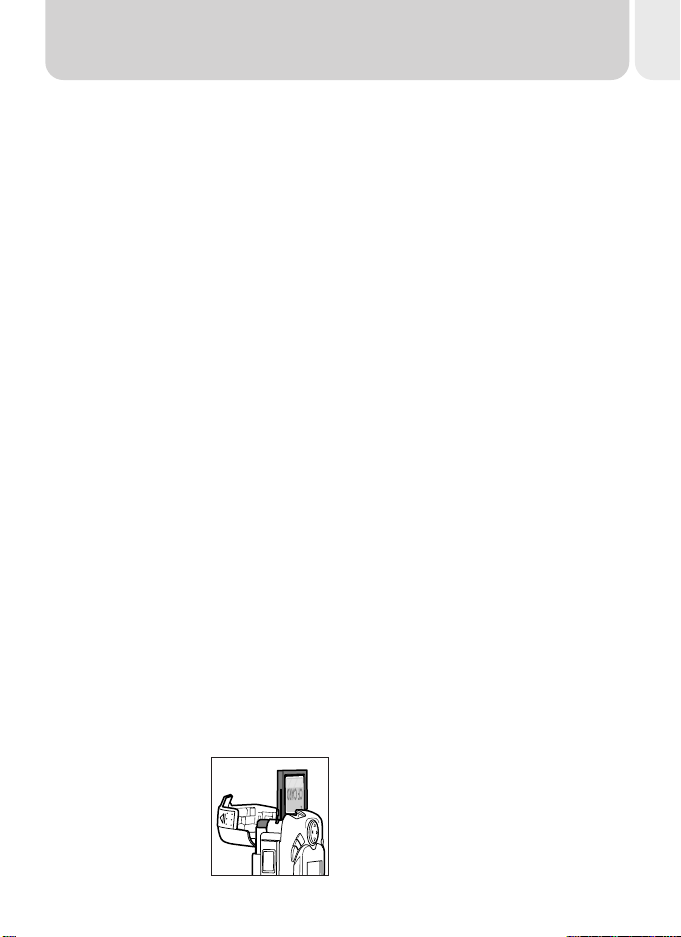
• Insert memory cards
as shown in the illus-
tration at right. In-
serting cards upside
down or backwards
could damage the
camera or the card.
Storage
• To prevent mold or mildew, store the
camera in a dry, well-ventilated area. If
you will not be using the product for long
periods, remove the battery to prevent
leakage and store the camera in a plastic
bag containing a desiccant. Do not, how-
ever, store the camera case in a plastic
bag, as this may cause the material to
deteriorate. Note that desiccant gradu-
ally loses its capacity to absorb moisture
and should be replaced at regular inter-
vals.
• Do not store the camera with naphtha
or camphor moth balls, close to equip-
ment that produces strong magnetic
fields, or in areas subject to extremes of
temperature, for example near a space
heater or in a closed vehicle on a hot day.
• To prevent mold or mildew, take the cam-
era out of storage at least once a month.
Turn the camera on and release the shut-
ter a few times before putting the cam-
era away again.
• Store the battery in a cool, dry place.

vi
• No part of the manuals included with this product may be reproduced,
transmitted, transcribed, stored in a retrieval system, or translated into any
language in any form, by any means, without Nikon’s prior written permis-
sion.
• Nikon reserves the right to change the specifications of the hardware and
software described in these manuals at any time and without prior notice.
• Nikon will not be held liable for any damages resulting from the use of this
product.
• While every effort has been made to ensure that the information in these
manuals is accurate and complete, we would appreciate it were you to
bring any errors or omissions to the attention of the Nikon representative
in your area (address provided separately).
Notice for customers in Canada
CAUTION
This class B digital apparatus meets all requirements of the Canadian Interfer-
ence Causing Equipment Regulations.
ATTENTION
Cet appareil numérique de la classe B respecte toutes les exigences du Règle-
ment sur le matériel brouilleur du Canada.
Notices
A Note on Electronically-Controlled Cameras
In extremely rare instances, unusual characters may appear in the monitor and the
camera may stop functioning. In most cases, this phenomenon is caused by a strong
external static charge. Turn the camera off, remove and replace the battery, and turn
the camera on again, or, if you are using an AC adapter (available separately), discon-
nect and reconnect the adapter and turn the camera on again. In the event of contin-
ued malfunction, contact your retailer or Nikon representative. Note that disconnect-
ing the power source as described above may result in loss of any data not recorded to
the memory card at the time the problem occurred. Data already recorded to the
memory card will not be affected.

vii
Notice for customers in the U.S.A.
Federal Communications Commission (FCC) Radio Frequency Interfer-
ence Statement
This equipment has been tested and
found to comply with the limits for a
Class B digital device, pursuant to Part
15 of the FCC rules. These limits are
designed to provide reasonable pro-
tection against harmful interference in a residential installation. This equip-
ment generates, uses, and can radiate radio frequency energy and, if not
installed and used in accordance with the instructions, may cause harmful
interference to radio communications. However, there is no guarantee that
interference will not occur in a particular installation. If this equipment does
cause harmful interference to radio or television reception, which can be de-
termined by turning the equipment off and on, the user is encouraged to try
to correct the interference by one or more of the following measures:
• Reorient or relocate the receiving antenna.
• Increase the separation between the equipment and receiver.
• Connect the equipment into an outlet on a circuit different from that to
which the receiver is connected.
• Consult the dealer or an experienced radio/television technician for help.
CAUTIONS
Modifications
The FCC requires the user to be notified that any changes or modifications
made to this device that are not expressly approved by Nikon Corporation
may void the user’s authority to operate the equipment.
Interface Cables
Use the interface cables sold or provided by Nikon for your equipment. Using
other interface cables may exceed the limits of Class B Part 15 of the FCC
rules.
Nikon Inc.,
1300 Walt Whitman Road, Melville, New York
11747-3064, U.S.A.
Tel.: 631-547-4200
E2500
FOR HOME OR OFFICE USE
Tested To Comply
With FCC Standards

viii
Notice Concerning Prohibition of Copying or Reproduction
Note that simply being in possession of material that has been digitally copied or repro-
duced by means of a scanner, digital camera or other device may be punishable by law.
• Items prohibited by law from being
copied or reproduced
Do not copy or reproduce paper money,
coins, securities, government bonds, or
local government bonds, even if such cop-
ies or reproductions are stamped
“Sample.”
The copying or reproduction of paper
money, coins, or securities which are cir-
culated in a foreign country is prohibited.
Unless the prior permission of the gov-
ernment has been obtained, the copying
or reproduction of unused postage
stamps or post cards issued by the gov-
ernment is prohibited.
The copying or reproduction of stamps
issued by the government and of certi-
fied documents stipulated by law is pro-
hibited.
• Cautions on certain copies and repro-
ductions
The government has issued cautions on
copies or reproductions of securities is-
sued by private companies (shares, bills,
checks, gift certificates, etc.), commuter
passes, or coupon tickets, except when a
minimum of necessary copies are to be
provided for business use by a company.
Also, do not copy or reproduce passports
issued by the government, licenses issued
by public agencies and private groups, ID
cards, and tickets, such as passes and meal
coupons.
• Comply with copyright notices
The copying or reproduction of copy-
righted creative works such as books, mu-
sic, paintings, woodcut prints, maps,
drawings, movies, and photographs is
prohibited except when it is done for per-
sonal use at home or for similar restricted
and non-commercial use.
Trademark Information
Apple, the Apple logo, Macintosh, Mac OS, Power Macintosh, PowerBook, and QuickTime are regis-
tered trademarks of Apple Computer, Inc. Finder, Power Mac, iMac, and iBook are trademarks of Apple
Computer, Inc. IBM is a registered trademark of International Business Machines Corporation. Microsoft,
Windows, and Outlook are registered trademarks of Microsoft Corporation. Internet Explorer is a
product of Microsoft Corporation. Pentium is a trademark of Intel Corporation. Internet is a trademark
of Digital Equipment Corporation. Netscape and Netscape Navigator are registered trademarks of
Netscape Communications Corporation. CompactFlash is a trademark of SanDisk Corporation. Lexar
Media is a trademark of Lexar Media Corporation. Adobe and Acrobat are registered trademarks of
Adobe Systems Inc. Zip is a registered trademark of Iomega Corporation in the U.S. and other coun-
tries. Eudora is a registered trademark of the University of Illinois Board of Trustees, licensed to
QUALCOMM Incorporated. PRINT Image Matching is a trademark of Seiko Epson Corporation. All
other trade names mentioned in this manual or the other documentation provided with your Nikon
product are trademarks or registered trademarks of their respective holders.

ix
Table of Contents
Product Documentation .................................................................................. i
For Your Safety ............................................................................................... ii
Caring for the Camera and Battery ................................................................. iv
Notices ........................................................................................................... vi
Introduction: Before You Begin ...................................................................... 1
Overview: About This Manual ....................................................................... 2
Getting to Know the COOLPIX 2500: The Parts of the Camera and Their
Functions ......................................................................................................... 4
Where to Find It—Parts of the COOLPIX 2500 ................................................ 4
How to Use It—Camera Controls and Displays ................................................ 6
Menu Guide: Index to Menu Options ........................................................... 9
Tutorial: Getting Started ................................................................................. 15
First Steps: Getting Ready to Use Your Camera ............................................ 16
Step 1—Attach the Camera Strap ................................................................... 16
Step 2—Insert the Battery and Memory Card .................................................. 16
Step 3—Check the Battery Level ..................................................................... 18
Step 4—Choose a Language .......................................................................... 20
Step 5—Set the Time and Date ....................................................................... 22
Taking Pictures: The Basics ............................................................................. 24
Step 1—Ready the Camera ............................................................................. 24
Step 2—Choose Mode .......................................................................... 25
Step 3—Adjust Camera Settings (Optional) ..................................................... 26
Step 4—Frame the Picture .............................................................................. 26
Step 5—Focus and Shoot ............................................................................... 28
Step 6—Put the Camera Away ....................................................................... 30
Review and Deletion: Quick Review ............................................................. 31
Quick Review .................................................................................................. 32
Full-Screen Review .......................................................................................... 32
Thumbnail Review .......................................................................................... 34
Getting Creative: Scene Selection ................................................................. 36
Connections: Your Camera and Your Computer ............................................ 41
Before You Begin: Installing Nikon View 5 ....................................................... 42
Making the Connection: Connecting to Your Computer ................................. 44

x
Taking Pictures: The Details ............................................................................ 51
Beyond Point-and-Shoot: Camera Controls .................................................. 52
, , or Movie: Choosing a Shooting Mode ......................................... 52
Flash Photography: The Button .................................................................. 53
Delaying Shutter Release: Choosing a Self-Timer Mode ................................... 55
Framing Pictures: Optical and Digital Zoom ..................................................... 57
Keep or Delete: Picture Review ....................................................................... 58
Fine-Tuning Camera Settings: The -Mode Menu ..................................... 59
Making Effective Use of Memory: Image Quality and Size ............................... 60
Adjusting Exposure: Exp. +/–........................................................................... 63
Keeping Colors True: White Balance ............................................................... 64
Taking Pictures in a Sequence: Continuous ...................................................... 66
Getting Sharper Pictures: BSS (Best Shot Selector) ........................................... 67
Making Edges More Distinct: Image Sharpening ............................................. 68
Camera Setup: The SET-UP Menu ................................................................... 69
Adjusting Monitor Brightness: Brightness ........................................................ 72
Formatting Memory Cards: CF Card Format .................................................... 73
Setting the Time and Date: Date ..................................................................... 74
Conserving Battery Power: Auto Off ............................................................... 74
Choosing a Language: Language .................................................................... 75
Choosing a USB Protocol: USB ........................................................................ 75
Restoring Default Settings: Reset All ( Mode Only) .................................. 76
Playing Pictures Back: Playback Mode ........................................................... 77
Basic Playback: Full-Frame and Thumbnail Playback ................................... 78
The Playback Menu: Managing Pictures ....................................................... 85
Deleting Pictures: Delete ................................................................................. 86
Ordering Prints: Print Set ................................................................................. 88
Safeguarding Valuable Pictures: Protect .......................................................... 90
Marking All Pictures for Transfer: Auto Transfer............................................... 91
Technical Notes: Camera Care, Options, and Resources ............................... 93
Caring for Your Camera .................................................................................. 94
Optional Accessories ....................................................................................... 95
Web Resources ............................................................................................... 96
Troubleshooting.............................................................................................. 96
Specifications ................................................................................................. 103
Index ................................................................................................................. 106
1
Overview
2–3
Getting to Know the
COOLPIX 2500
4–8
This chapter is divided into the following sections:
Overview
Read this section for a description of how this
manual is organized and for an explanation of the
symbols and conventions used.
Getting to Know the COOLPIX 2500
Bookmark this section and refer to it as you read
through the manual for information on the names
and functions of camera parts.
Menu Guide
Refer to this section for instructions on using the
menus that control some aspects of camera opera-
tion. This section also contains an index of menu
options.
Introduction
Before You Begin
Menu Guide
9–14
2
Introduction—Overview
Overview
About This Manual
Thank you for your purchase of a COOLPIX 2500 digital camera. This manual
has been written to help you enjoy taking digital pictures with your COOLPIX
2500. Read this manual thoroughly before use, and keep it handy when
using the product.
Use Only Nikon Brand Electronic Accessories
Your Nikon COOLPIX digital camera is designed to the highest standards and
includes complex electronic circuitry. Only Nikon brand electronic accessories
(including battery chargers, batteries, and AC adapters) certified by Nikon
specifically for use with your Nikon digital camera are engineered and proven
to operate within the operational and safety requirements of this electronic
circuitry.
THE USE OF NON-NIKON ELECTRONIC ACCESSORIES COULD DAMAGE YOUR CAMERA AND MAY VOID
YOUR
NIKON WARRANTY.
For more information about Nikon brand accessories, contact your local au-
thorized Nikon dealer.
3
Introduction—Overview
To make it easier to find the information you need, the following symbols and
conventions are used:
Life-Long Learning
As part of Nikon’s “Life-Long Learning” commitment to ongoing product sup-
port and education, continually-updated information is available on-line at
the following sites:
•For users in the U.S.A.: http://www.nikonusa.com/
•For users in Europe: http://www.nikon-euro.com/
•For users in Asia, Oceania, the Middle East, and Africa:
http://www.nikon-asia.com/
Visit these sites to keep up-to-date with the latest product information, tips,
answers to frequently-asked questions (FAQs), and general advice on digital
imaging and photography. Additional information may be available from the
Nikon representative in your area. See the URL below for contact information:
http://www.nikon-image.com/eng/
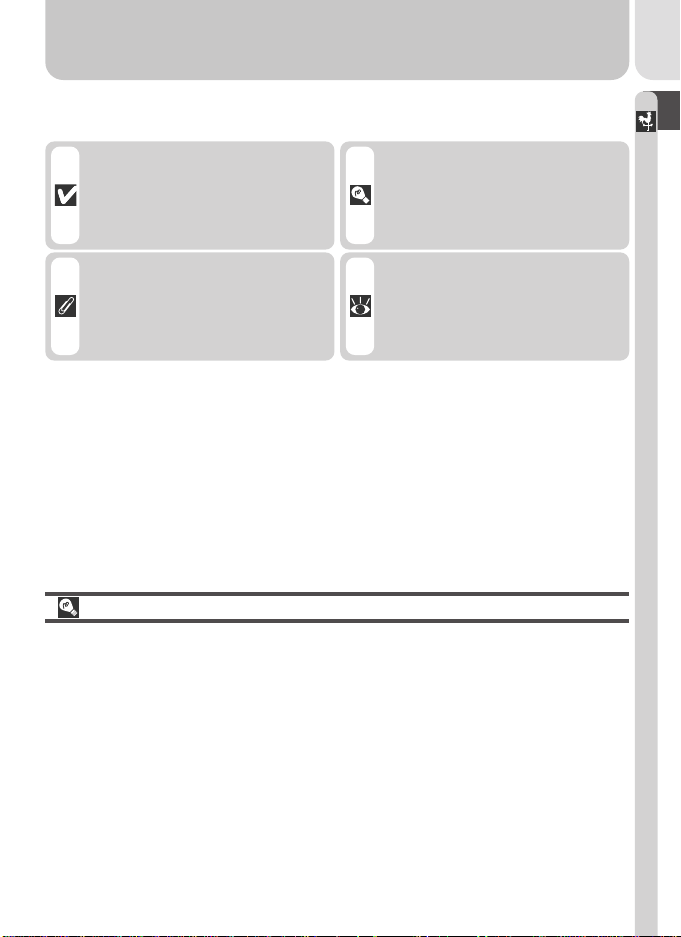
This icon marks cautions, infor-
mation that you should read be-
fore use to prevent damage to
your camera.
This icon marks tips, additional
information you may find help-
ful when using your camera.
This icon marks notes, informa-
tion that you should read before
using your camera.
This icon indicates that more in-
formation is available elsewhere
in this manual.
4
Introduction—Getting to Know the COOLPIX 2500
Getting to Know the COOLPIX 2500
The Parts of the Camera and Their Functions
Take a few moments to familiarize yourself with camera controls and displays.
You may find it helpful to bookmark this section and refer to it as you read
through the rest of the manual.
Where to Find It—Parts of the COOLPIX 2500
The parts of the camera are identified below. For more information on the
function of each part, refer to the page numbers listed.
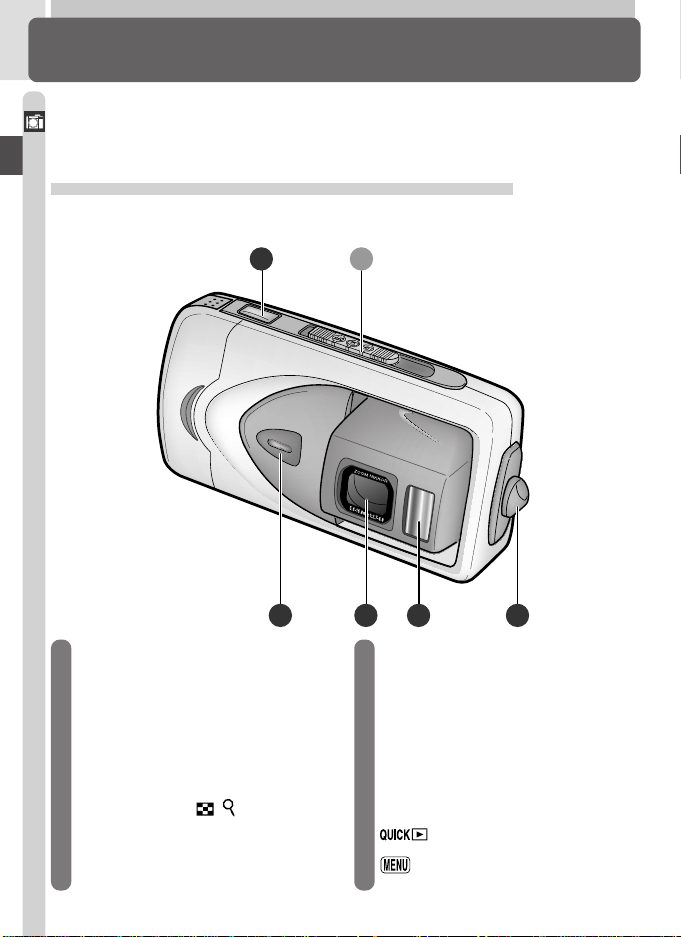
1 Shutter-release button ..... 28, 29
2 Eyelet for camera strap .......... 16
3 Built-in Speedlight ................. 53
4 Lens ........................ 18, 26, 103
5 Self-timer lamp...................... 55
6 Zoom buttons (
/ )
........................... 27, 57, 80, 81
7 Cover latch............................ 17
8 Battery-chamber/memory card
slot cover .............................. 17
9 Cover release (for use when
connecting optional EH-60 AC
adapter) .......................... 19, 95
10 USB connector
(under cover) ......................... 45
11
/SMALL PIC. button...
31, 82
12 button ............... 59, 70, 85
A1
45 3 2

5
Introduction—Getting to Know the COOLPIX 2500
B
6
C
15 13 12 1116
8
9
1014
7
17
13 / button .. 36, 46, 79, 80
14 Tripod socket
15
/ button ..... 33-34, 53, 78, 80
16 Flash-ready lamp ................... 28
17 Non-slip grip
A Mode selector ......................... 6
B Monitor................................... 6
C Multi selector .......................... 8
6
Introduction—Getting to Know the COOLPIX 2500
How to Use It—Camera Controls and Displays
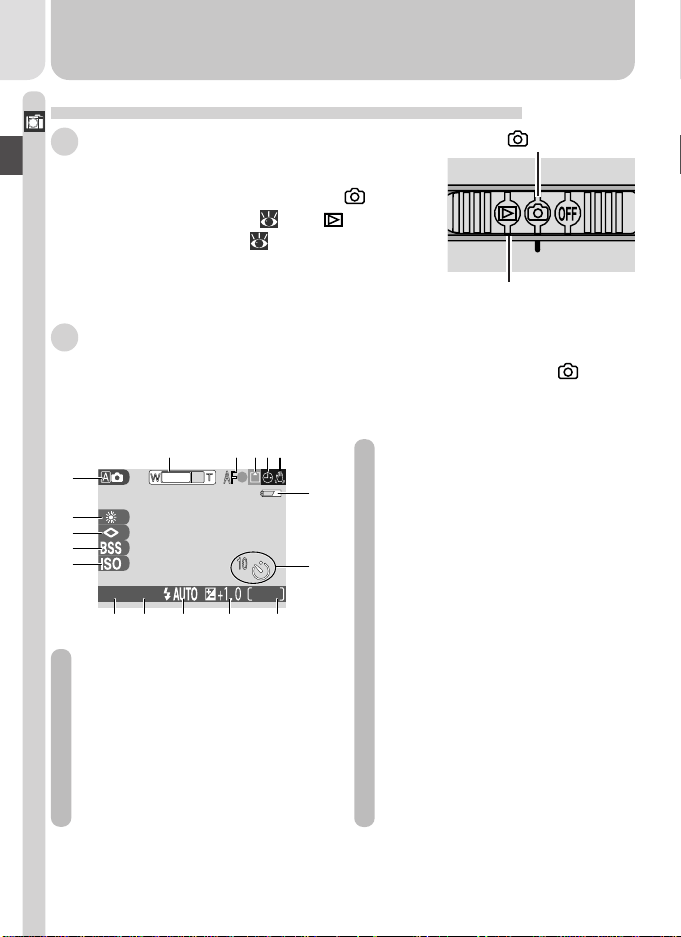
A The Mode Selector
The mode selector selects the operating mode and
turns the camera on and off. Choose to take
still pictures and movies ( 52), (playback
mode) to play them back ( 78). Slide the mode
selector to OFF when you have finished using the
camera.
B The Monitor
The monitor is where you compose pictures before shooting. In mode,
the monitor shows the view through the camera lens, together with icons
indicating the status of camera settings.
1 Zoom indicator ...................... 57
2
Focus indicator
1
..................... 28
3 Recording indicator ............... 29
4 “Date not set” icon
2
............. 23
5 Camera shake icon
3
.............. 54
6 Battery level indicator
4
.......... 19
7 Self-timer indicator ................ 55
8 Number of exposures remaining
............................................. 25
9 Exposure compensation ......... 63
10 Flash mode ............................ 53
11 Image quality ........................ 61
12 Image size ............................. 62
13 Sensitivity gain indicator ........ 54
14 Best shot selector (BSS)/continu-
ous shooting mode .......... 67/66
15 Image sharpening .................. 68
16 White balance ....................... 64
17 Shooting mode ............... 25, 36
1600
15
NORMAL
13245
6
7
89101112
13
14
15
16
17
1 Displayed only when shutter-release button is
pressed halfway.
2 Appears when clock-calendar has not been set.
3 Appears only at slow shutter speeds.
4 Appears only when battery is running low.
mode
Playback mode
7
Introduction—Getting to Know the COOLPIX 2500
1600
15
NORMAL
The monitor is also used to play pictures back. When a picture is played back
full screen, information about the image is shown superimposed on the photo.
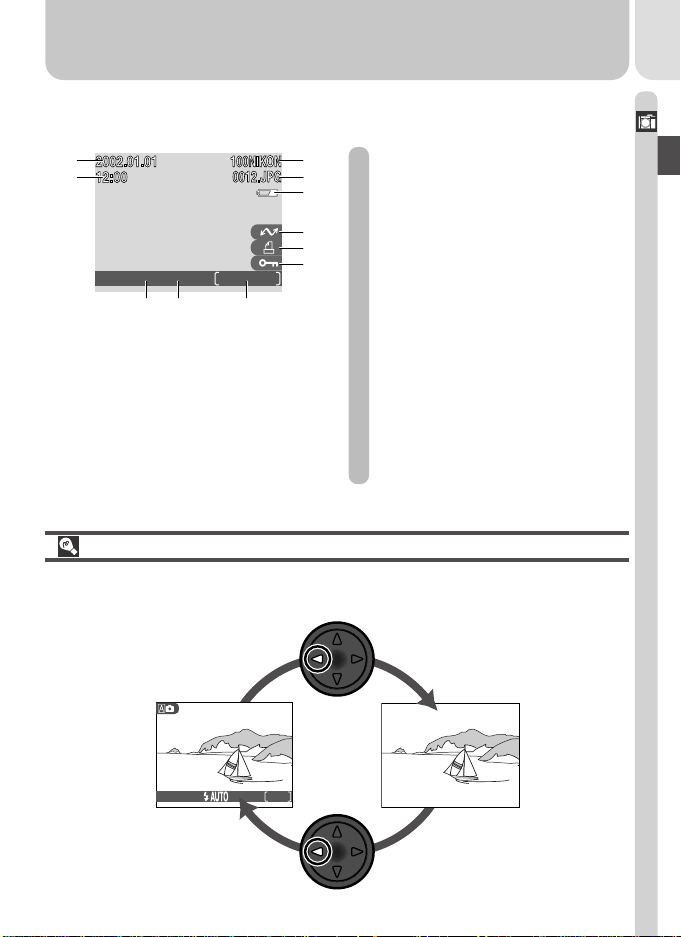
Controlling the Monitor
To hide camera settings or photo info, press the multi selector to the left.
Press the multi selector to the left a second time to view indicators again.
Indicators
hidden
Indicators
displayed
1 Current folder ....................... 49
2 File number and type ............. 49
3 Battery level indicator
*
........... 19
4 Transfer icon........ 33, 34, 44, 79
5 Print-order icon ..................... 88
6 Protect icon ........................... 90
7 Current frame number/
total number of frames
8 Image quality ........................ 61
9 Image size ............................. 62
10 Time of recording .................. 22
11 Date of recording .................. 22
0012/0015
1
3
4
5
6
789
10
11
NORMAL
1600
2
* Appears only when battery is running low.
8
Introduction—Getting to Know the COOLPIX 2500
C The Multi Selector
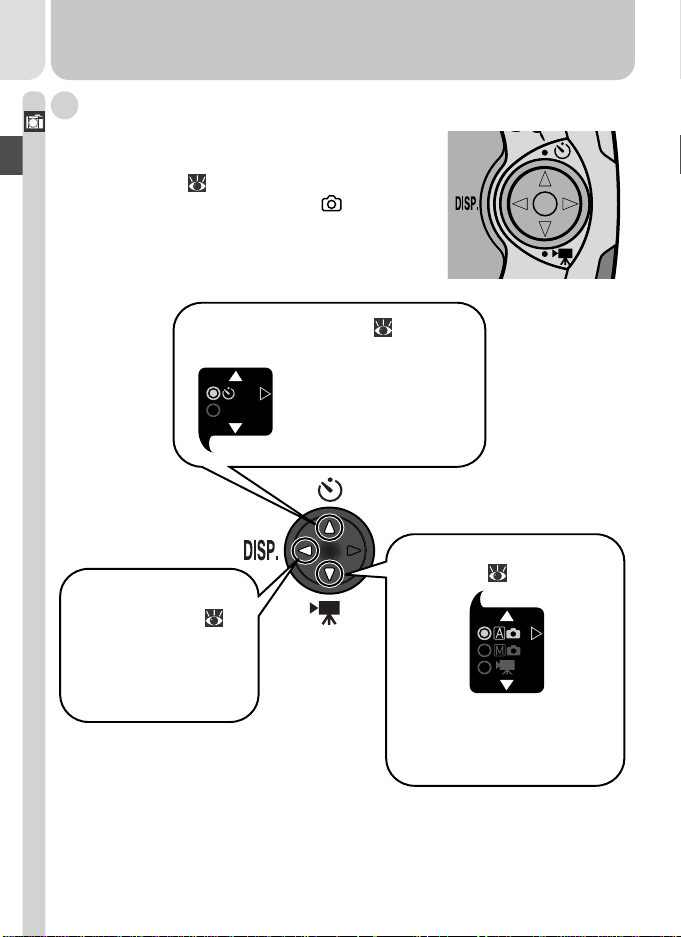
The multi selector is used to navigate through cam-
era menus, to page through or select pictures
during playback ( 78), and to control the dis-
play of indicators in the monitor. In mode, the
multi selector is also used to select the shooting
mode and to turn the self-timer on and off.
ONON
OFFOFF
Press up to display
self-timer menu, press
up or down to highlight
option. Press right to
exit menu.
Self-timer on/off ( 55)
Press to left to hide or
display indicators in
monitor.
Indicators on/off ( 7)
Press down to display shoot-
ing-mode menu, press up or
down to highlight option.
Press right to exit menu.
Shooting mode selection
( 52)
9
Introduction—Menu Guide
Menu Guide
Index to Menu Options
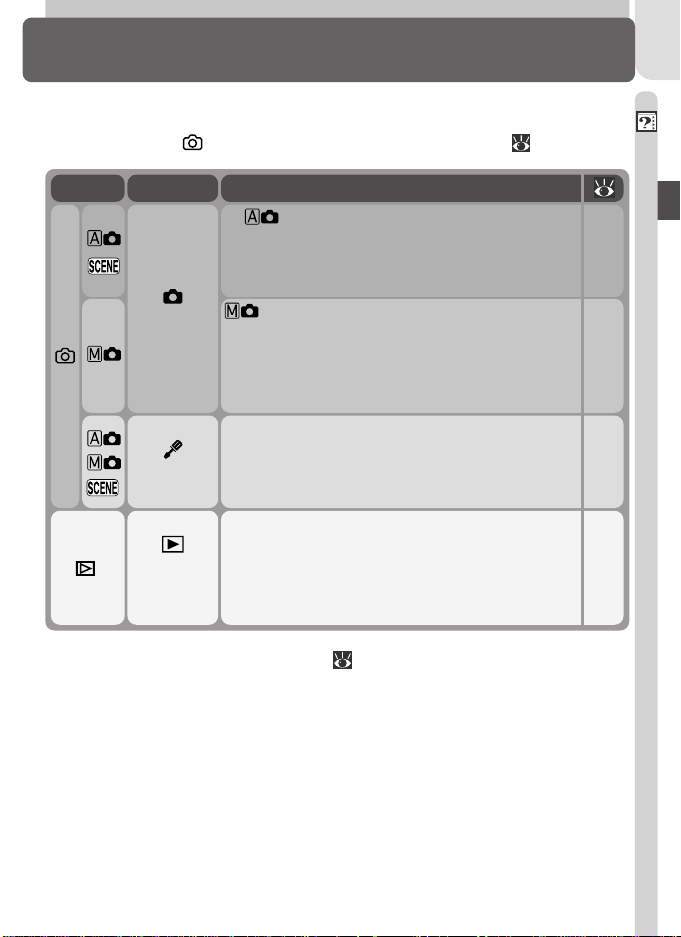
Changes to some camera settings are made with the help of menus that
appear in the camera monitor. The options available depend on the operat-
ing mode and, in mode, on the shooting mode selected ( 52).
No menu is available in movie mode ( 52, 98).
13,
72–
73,
85–
91
The PLAY BACK menu contains options for
managing the pictures stored on the memory
card by, for example, deleting selected images
or selecting pictures for printing or for transfer
to your computer.
In (auto) and scene modes, the SHOOT-
ING menu is used to set image quality and size,
and to adjust exposure for very bright, very dark,
or high-contrast subjects.
10,
59–
63
SHOOTING
(manual) mode gives you full control over
camera settings. In addition to the settings avail-
able in auto and scene modes, the manual-
mode SHOOTING menu contains four advanced
shooting options.
11,
59–
68
12,
70–
76
The SET-UP menu, which is accessed from the
SHOOTING menu, contains options for basic
camera setup (e.g., setting the time and date,
choosing a language).
SET-UP
PLAY
BACK
Menu DescriptionMode
10
Introduction—Menu Guide
SHOOTING MENU
MENU
SELECT
SET
OFF
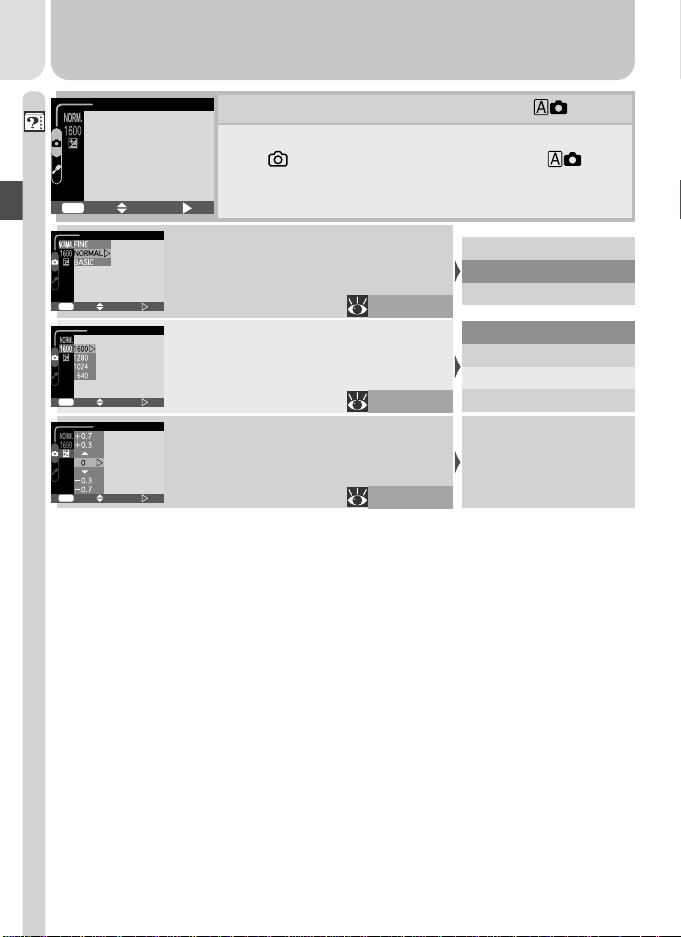
IMAGE QUALITY
Choose FINE for printing and enlarg-
ing, BASIC to reduce file size.
IMAGE SIZE
Choose small sizes for e-mail or the
web, large sizes for printing.
EXP. +/–
Adjust exposure for bright, dark, or
high contrast subjects.
IMAGE SIZE
MENU
SELECT
SET
OFF
EXP.
+
/
–
MENU
SELECT
SET
OFF
61
62
63
Choose from settings
between –2.0 and
+2.0 EV
FINE
NORMAL
BASIC
1600
1280
1024
640
IMAGE QUALITY
MENU
SELECT
SET
OFF
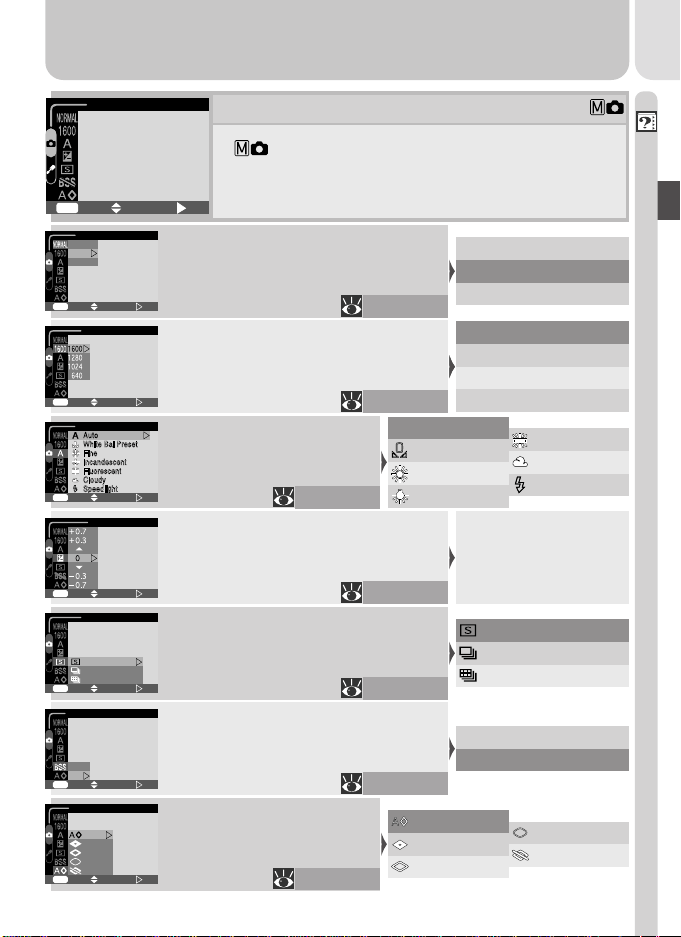
The Shooting Menu / Scene
Pressing the MENU button when the mode selector is
set to displays the SHOOTING menu. In (auto)
and scene modes, this menu contains three basic shoot-
ing options.
11
Introduction—Menu Guide
Off
SHOOTING MENU
MENU
SELECT
SET
OFF
IMAGE QUALITY
Choose FINE for printing and enlarg-
ing, BASIC to reduce file size.
IMAGE SIZE
Choose small sizes for e-mail or the
web, large sizes for printing.
WHITE BALANCE
Match to lighting to ensure
that colors are reproduced
accurately.
EXP. +/–
Adjust exposure for bright, dark, or
high contrast subjects.
CONTINUOUS
Take pictures in sequence or create
collages of sixteen consecutive pho-
tographs.
BEST SHOT SELECTOR
Use when photos could be blurred by
inadvertent camera movement.
IMAGE QUALITY
FINE
NORMAL
BASIC
MENU
SELECT
SET
OFF
IMAGE SIZE
MENU
SELECT
SET
OFF
WHITE BALANCE
MENU
SELECT
SET
OFF
EXP.
+
/
–
MENU
SELECT
SET
OFF
CONTINUOUS
Continuous
Multi-Shot 16
Single
MENU
SELECT
SET
OFF
BEST SHOT SELECTOR
On
Off
MENU
SELECT
SET
OFF
61
62
64
63
66
67
IMAGE SHARPENING
Heighten or reduce the
sharpness of outlines in your
photographs.
IMAGE SHARPENING
A
u
to
High
No
r
m
al
Lo
w
O
ff
MENU
SELECT
SET
OFF
FINE
NORMAL
BASIC
1600
1280
1024
640
68
Choose from settings
between –2.0 and
+2.0 EV
Single
Continuous
Multi-Shot 16
Auto
White Bal Preset
A
Fine
Incandescent
Fluorescent
Cloudy
Speedlight
Auto
High
Normal
Low
Off
On
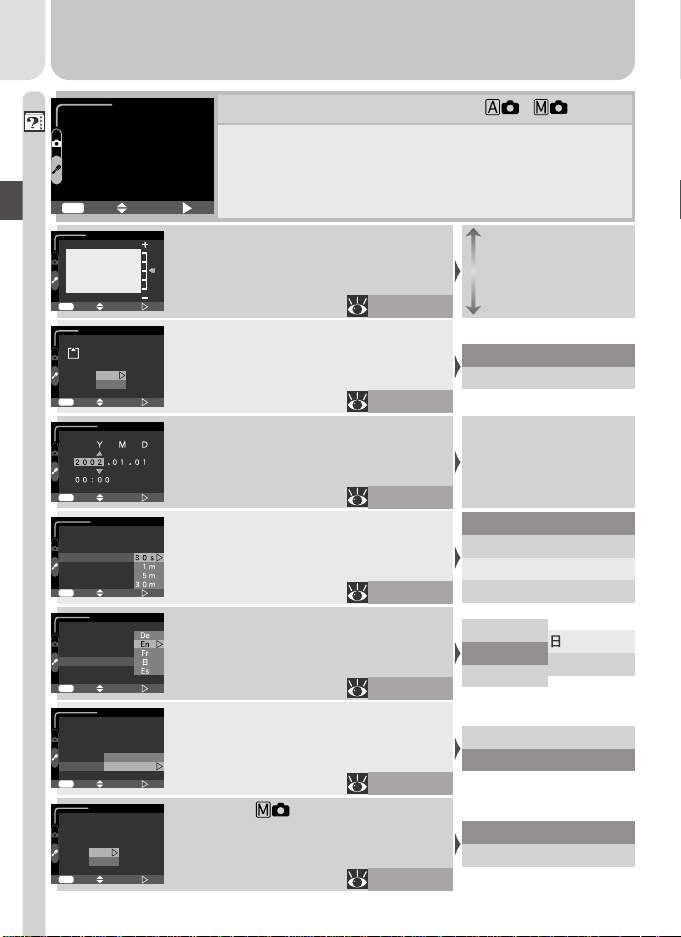
The Shooting Menu
In (manual) mode, the SHOOTING menu contains
four advanced shooting options in addition to the three
basic options available in auto and scene modes.
12
Introduction—Menu Guide
(Five levels)
Maximum
Minimum
No
Format
30 s
1m
5m
30 m
De (German)
En (English)
Fr (French)
PTP
Mass Storage
Year, Month, Day, hour,
minute, order of dis-
play for year, month,
and day
Brightness
CF Card Format
Date
Auto Off
Language
USB
Reset All
SET-UP
MENU
SELECT
SET
OFF
Brightness
Adjust monitor brightness.
CF Card Format
Format memory cards for use in your
camera.
Date
Set the time and date.
Auto Off
Specify how long the monitor will re-
main on before turning off automat-
ically to save power.
Language
Choose the language in which cam-
era messages and menus are dis-
played.
USB
Choose a transfer protocol for use
when your camera is connected to a
computer.
BRIGHTNESS
MENU
SELECT
SET
OFF
MENU
SELECT
SET
OFF
WARNING !
All images will
be deleted !
No
Format
CF CARD FORMAT
DATE
MENU
SELECT
SET
OFF
Brightness
CF Card Format
Date
Auto Off
Language
USB
Reset All
AUTO OFF
MENU
SELECT
SET
OFF
Brightness
CF Card Format
Date
Auto Off
Language
USB
Reset All
LANGUAGE
MENU
SELECT
SET
OFF
Brightness
CF Card Format
Date
Auto Off
Language
USB
Reset All
USB
PTP
Mass Storage
MENU
SELECT
SET
OFF
72
73
22–23
74
20–21
75
(Japanese)
Es (Spanish)
Reset All ( mode only)
Reset camera settings to their default
values.
RESET ALL
Reset all settings
to default values
No
Reset
MENU
SELECT
SET
OFF
76
No
Yes
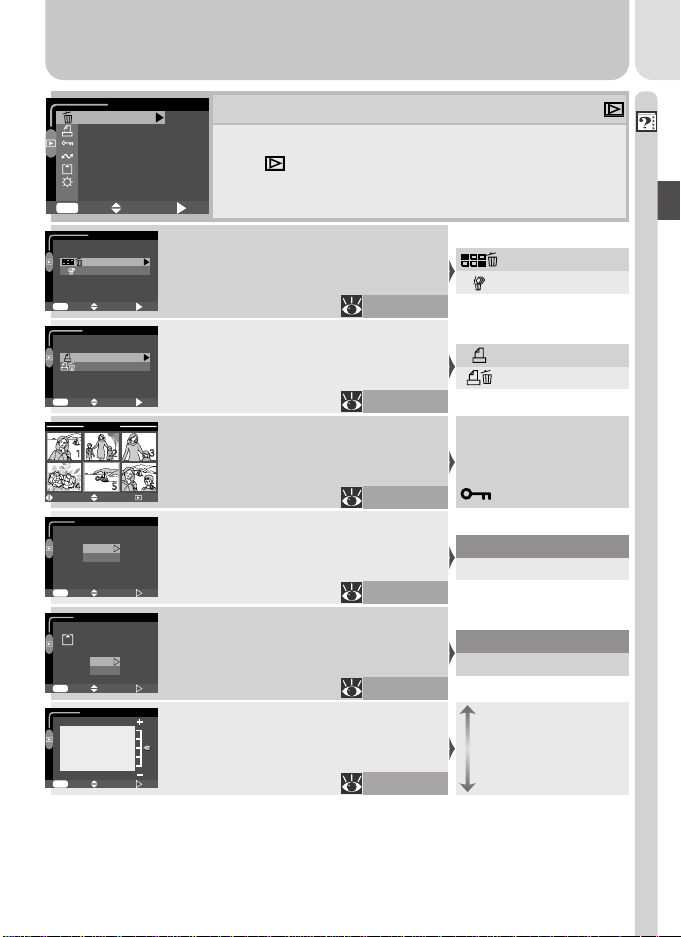
The Setup Menu / / Scene
The SET-UP menu, which can be accessed from the
SHOOTING menu, contains options for camera setup.
13
Introduction—Menu Guide
Auto Transfer
Mark all pictures for transfer to a com-
puter, or remove transfer marking
from all pictures.
AUTO TRANSFER
All ON
All OFF
MENU
SELECT
SET
OFF
Brightness
Adjust monitor brightness.
BRIGHTNESS
MENU
SELECT
SET
OFF
CF Card Format
This option is used to format memory
cards for use in your camera.
WARNING !
All images will
be deleted !
CF CARD FORMAT
MENU
SELECT
SET
OFF
No
Format
Delete
Print Set
Protect
Auto Transfer
CF Card Format
Brightness
DELETE
MENU
SELECT
SET
OFF
Delete
Delete all or selected pictures.
Print Set
Select pictures for printing on a DPOF-
compatible device.
Protect
Protect selected pictures from acci-
dental deletion.
Selected Images
All Images
DELETE
MENU
SELECT
SET
OFF
PRINT SET
Print set
Delete print set
MENU
SELECT
SET
OFF
PROTECT
QUICK
SELECT SET
DONE
86–87
88–89
90
91
73
72
No
Format
All ON
All OFF
Select pictures for pro-
tection. Protected pic-
tures are marked by a
icon.
Print set
Delete print set
Selected Images
All Images
(Five levels)
Maximum
Minimum
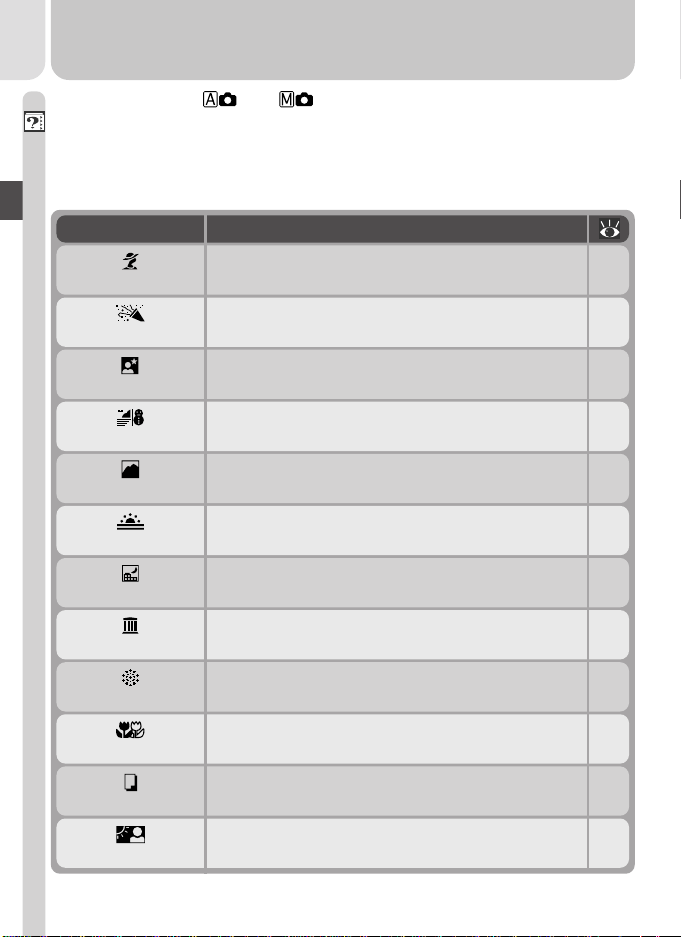
The Playback Menu
Pressing the MENU button when the mode selector is
set to displays the PLAY BACK menu, which con-
tains options for managing the pictures on the memory
card.
14
Introduction—Menu Guide
The Scene Menu ( and Modes)
Your Nikon digital camera offers a choice of twelve “scene” modes for com-
mon compositions. When a scene is selected from the SCENE menu, camera
settings are automatically adjusted to produce optimal results for the selected
scene, sparing you the necessity of adjusting camera settings one-by-one.
40
Back Light
Use when light is coming from behind your sub-
ject, throwing their features into shadow.
40
Copy
Use to copy text and line drawings from a white
board or from a book or other printed matter.
40
Close Up
Use to capture vivid colors in close-up shots of
flowers, insects, and other small objects.
39
Fireworks Show
Use to capture the expanding burst of light from
a firework.
39
Museum
Use where a flash is prohibited.
39
Night Landscape
Use when taking landscape shots a night.
39
Sunset
Use to preserve the deep hues seen in sunsets and
sunrises.
38
Landscape
Use to enhance outlines, colors, and contrast in
skyscapes, forests, and other landscape shots.
38
Beach/Snow
Use for bright subjects such as snowfields, beach-
es, and sunlight expanses of water.
38
Night Portrait
Use when shooting portraits against a backdrop
of night scenery.
37
Party/Indoor
Use to capture background details or the effects
of candlelight and other indoor lighting.
37
Portrait
Use for portraits.
Mode Description
15
Taking Pictures
24–30
Review and Deletion
31–35
Getting Creative
36–40
First Steps
16–23
Tutorial
Getting Started
This chapter is divided into the following four sec-
tions:
First Steps
This section details the steps you will take before
using your camera for the first time.
Taking Pictures
Read this section for a step-by-step guide to the
basics of taking pictures with the COOLPIX 2500.
Review and Deletion
Learn how to review and delete pictures while set-
ting up your next shot.
Getting Creative
Explore the creative possibilities of scene mode.
Tutorial—First Steps
16
Step 2—Insert the Battery and Memory Card
Your camera is powered by a rechargeable Nikon EN-EL2 lithium-ion battery,
which can be charged using the MH-60 battery charger provided with the
camera. To store pictures, your camera uses CompactFlash
™
memory cards.
2
.1 Charge the battery
The EN-EL2 lithium-ion battery supplied with your camera is not fully
charged at shipment. We recommend that you charge the battery be-
fore use. Instructions for charging the battery may be found in the
instruction manual included with the battery charger.
2
.2 Turn the camera off
Before inserting or removing the battery or
memory card, be sure the mode selector is
in the “OFF” position.
First Steps
Getting Ready to Use Your Camera
Before using your camera for the first time, you will need to complete the
steps shown below.
Attach the Camera Strap 16STEP 1
Insert the Battery and Memory Card 16–17STEP 2
Check the Battery Level 18–19STEP 3
Choose a Language 20–21STEP 4
Set the Time and Date 22–23STEP 5
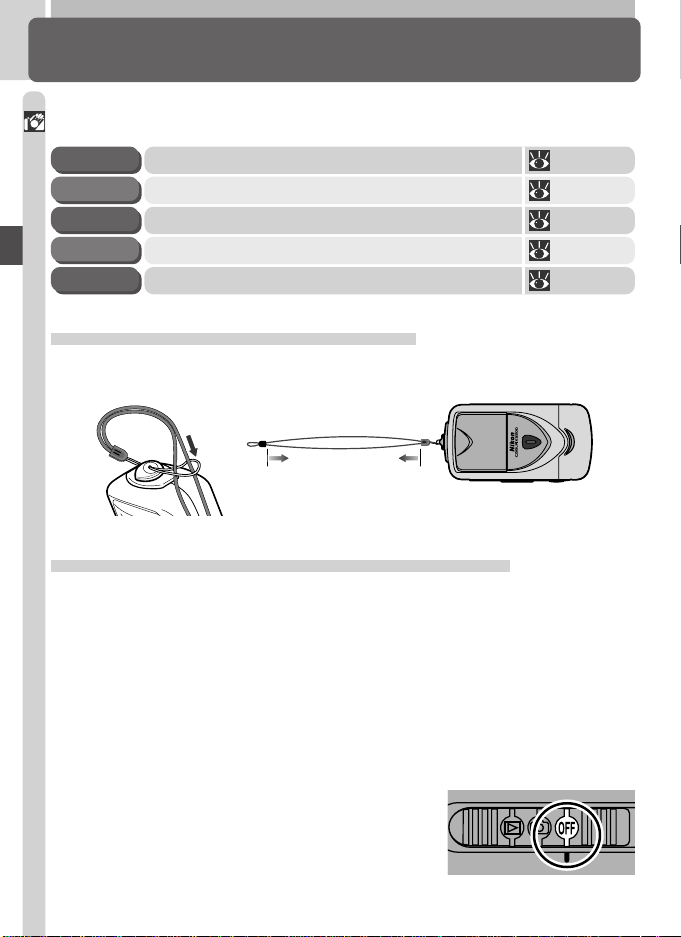
Step 1—Attach the Camera Strap
To ensure that the camera is not dropped and damaged, attach the strap as
shown and wear it around your neck while using or carrying the camera.
Adjust to length shown if
wearing around neck
Tutorial—First Steps
17
2
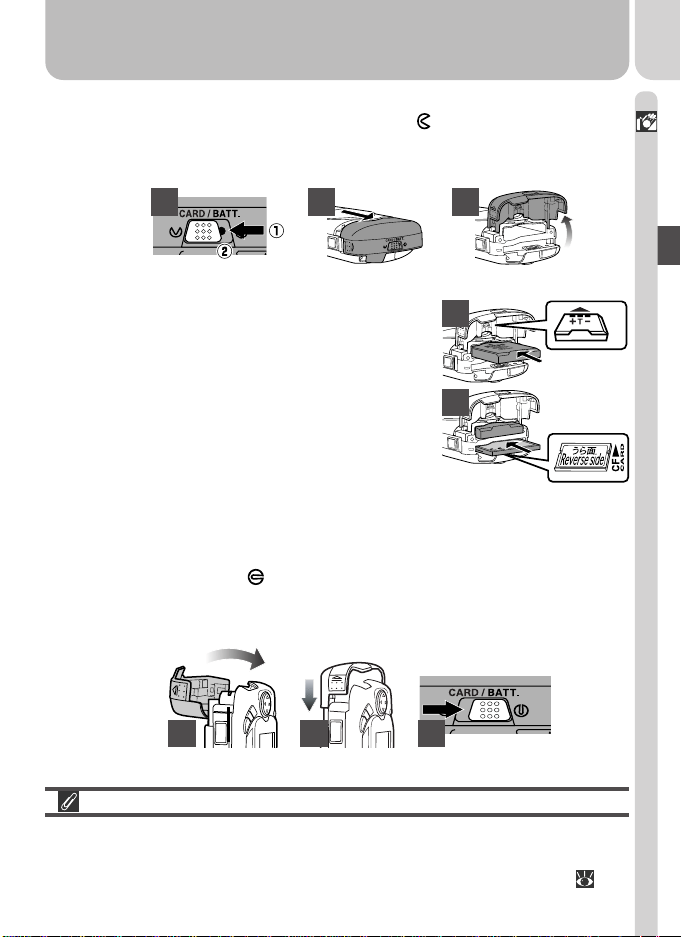
.3 Open the battery-chamber/card slot cover
Slide the cover latch in the direction of the icon (A1) until the red dot
is visible (A2), indicating that the cover is unlatched. Slide the cover out
(B) and flip it open (C).
Formatting Memory Cards
The memory card supplied with your camera is formatted at shipment. Other
memory cards, however, must be formatted before first use. For information
on formatting memory cards, see “Camera Setup: CF Card Format” ( 73).
2
.4 Insert the battery and memory card
Insert a fully-charged EN-EL2 battery with
the “+” and “–” contacts oriented as shown
in the label on the underside of the battery-
chamber/card slot cover (A). Insert the
memory card as shown in the label at the
entrance to the memory card slot (B), slid-
ing it in until it is firmly in place and the
eject button pops up (the card is fully in-
serted when the top of the card is level with
the top of the eject button).
2
.5 Close the battery-chamber/card slot cover
Close the battery chamber/card slot cover (A, B) and slide the latch in
the direction of the icon until the red dot is hidden, indicating that
the cover is latched (C). To prevent the battery or memory card being
dislodged during operation, be sure that the cover is securely latched.
E
N
E
L
2
-
EN
EL 2
-
E
N
E
L
2
-
A
B
A B
E
N
E
L
2
-
C
A
B
C
Tutorial—First Steps
18
Step 3—Check the Battery Level
Before using the camera, check the battery level in the monitor to make sure
that the battery is charged.
3
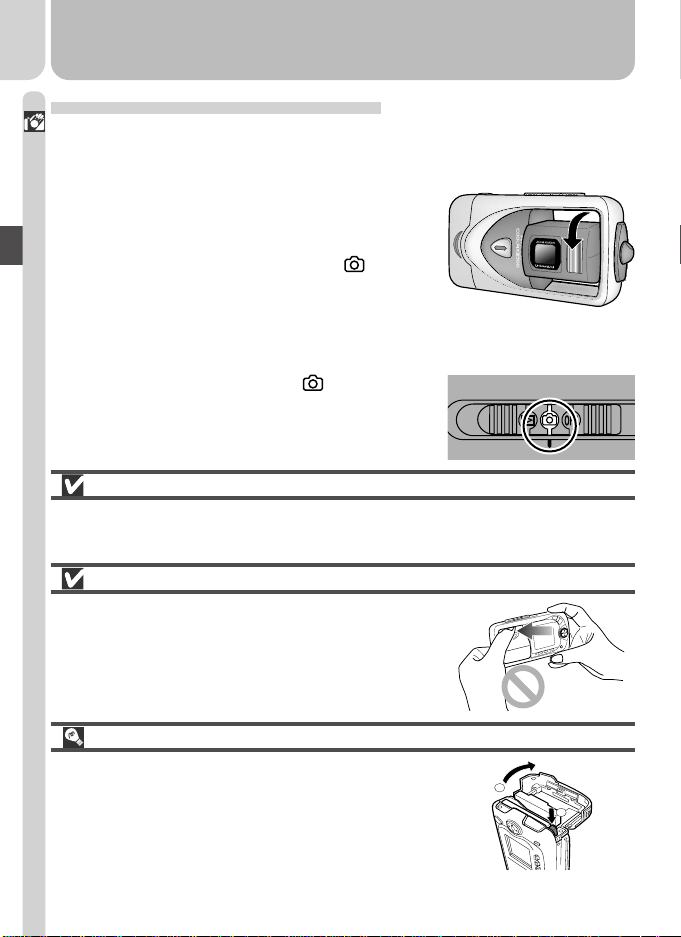
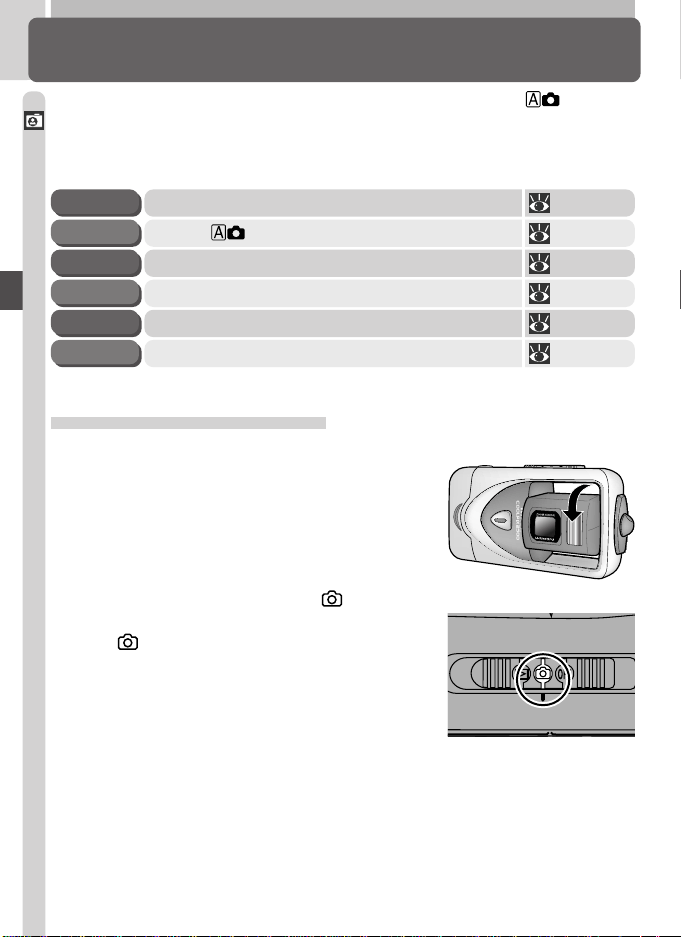
.1 Turn the lens section to shooting position
Before taking pictures, rotate the lens sec-
tion to bring the lens into shooting position,
as shown at right. If you omit this step be-
fore sliding the mode selector to , a mes-
sage will be displayed in the monitor. To
clear the message from the screen, rotate
the lens section to shooting position.
3
.2 Turn the camera on
Slide the mode selector to .
Read Battery Warnings
Read and follow all warnings and instructions supplied by the battery
manufacturer.
The Lens Section
When adjusting the angle of the lens, rotate the
lens section slowly; do not use excessive force.
Care should be taken to avoid catching fingers,
hair, or clothing between the lens section and the
camera body.
Removing the Memory Card
Memory cards can be removed without loss of data
when the camera is off. When removing memory
cards, turn the camera off and open the battery
chamber/card slot cover (1). Press the eject but-
ton to partially eject the card (2), and then remove
the card by hand.
1
2
Tutorial—First Steps
19
1600
15
NORMAL
3
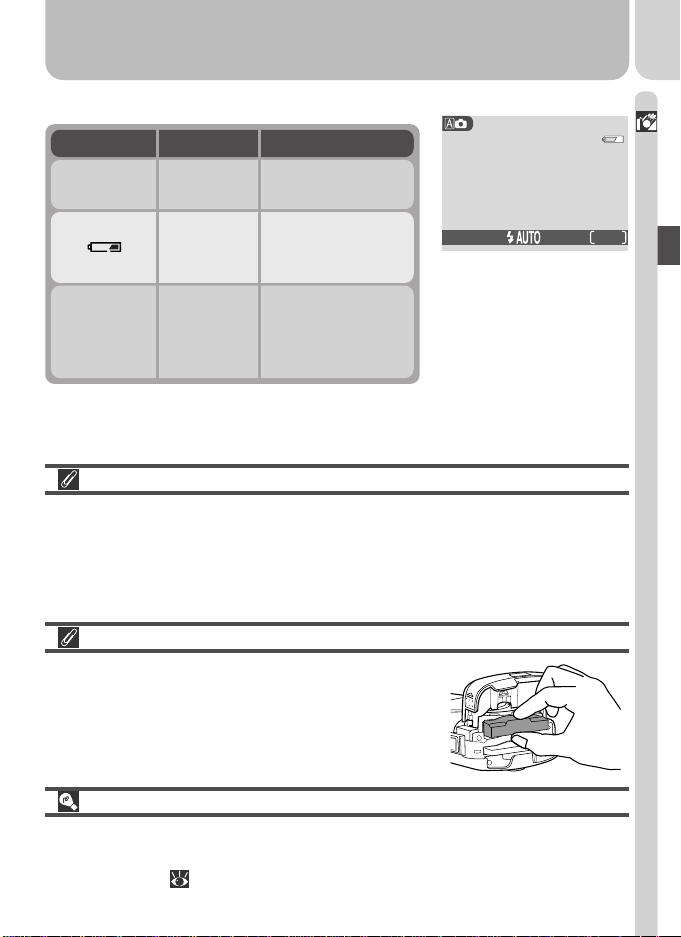
.3 Check the battery level in the monitor
The Clock Battery
The camera’s internal clock-calendar is powered by a separate, rechargeable
power source, which is charged as necessary when the main battery is in-
stalled. If the camera has been stored for an extended period with the main
battery removed, the clock may need to be reset. The clock power source can
provide several days of back-up power after charging for about ten hours.
Removing the Battery
The battery can be removed without affecting pic-
tures on the memory card. Before removing the
battery, turn the camera off. Remove the battery
by hand, holding it between your finger and thumb
as shown at right. Do not use your fingernails.
Display Meaning Camera status
NO ICON
Battery fully
charged
Camera functions
normally.
Low battery
Recharge or replace
battery without de-
lay.
WARNING ! !
BATTERY
EXHAUSTED
Battery
exhausted
No pictures can be
taken until battery
has been recharged
or replaced.
E
N
E
L
2
-
Alternative Power Sources
To power your camera continuously for extended playback or while the cam-
era is connected to a computer, we recommend the EH-60 AC adapter (avail-
able separately; 95).
Tutorial—First Steps
20
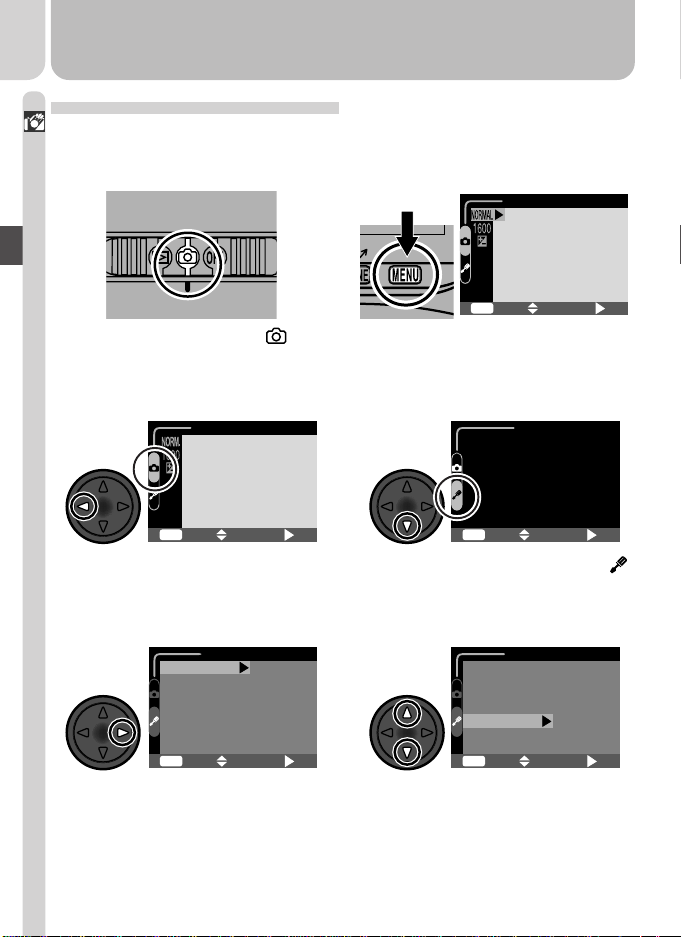
Highlight SET-UP menu page tab ( )
Step 4—Choose a Language
Camera menus and messages can be displayed in your choice of German,
English, French, Japanese, and Spanish.
Press MENU button to display menu
for current shooting mode
IMAGE QUALITY
MENU
SELECT
SET
OFF
Slide mode selector to
Highlight page tab
Position cursor in SET-UP menu Highlight Language
4
.1
4
.2
4
.3
4
.4
4
.5
4
.6
SHOOTING MENU
MENU
SELECT
SET
OFF
BRIGHTNESS
Brightness
CF Card Format
Date
Auto Off
Language
USB
MENU
SELECT
SET
OFF
Brightness
CF Card Format
Date
Auto Off
Language
USB
SET-UP
MENU
SELECT
SET
OFF
Brightness
CF Card Format
Date
Auto Off
Language
USB
LANGUAGE
MENU
SELECT
SET
OFF
Tutorial—First Steps
21
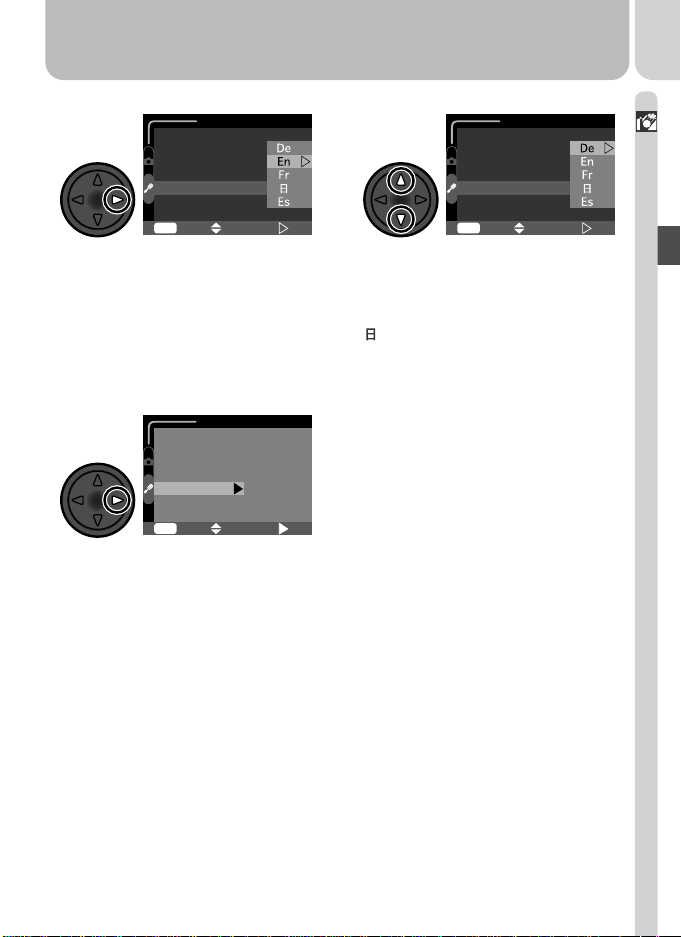
Choose a language from:
De Deutsch (German)
En English
Fr Français (French)
Japanese
Es Español (Spanish)
Display options
LANGUAGE
Brightness
CF Card Format
Date
Auto Off
Language
USB
MENU
SELECT
SET
OFF
Return to SET-UP menu. If you have
yet to set the time and date, proceed
to Step 5.6 on the following page to
set the time and date.
4
.7
4
.8
4
.9
Brightness
CF Card Format
Date
Auto Off
Language
USB
LANGUAGE
MENU
SELECT
SET
OFF
Brightness
CF Card Format
Date
Auto Off
Language
USB
LANGUAGE
MENU
SELECT
SET
OFF
Tutorial—First Steps
22
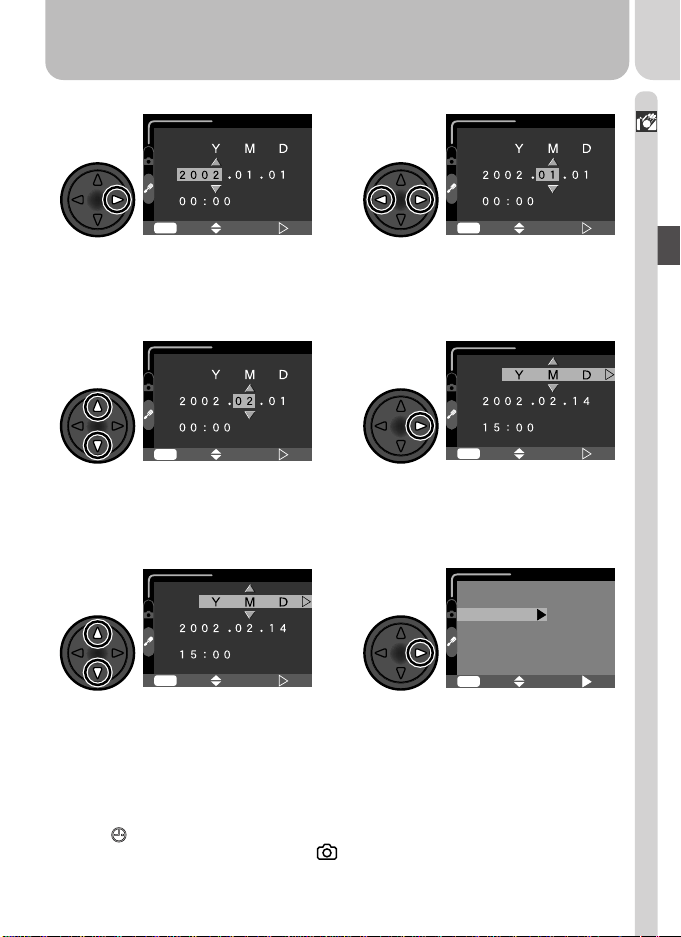
Step 5—Set the Time and Date
Information on the time and date of recording is included with all pictures
taken with your Nikon digital camera. To set the camera’s internal clock to
the correct time and date:
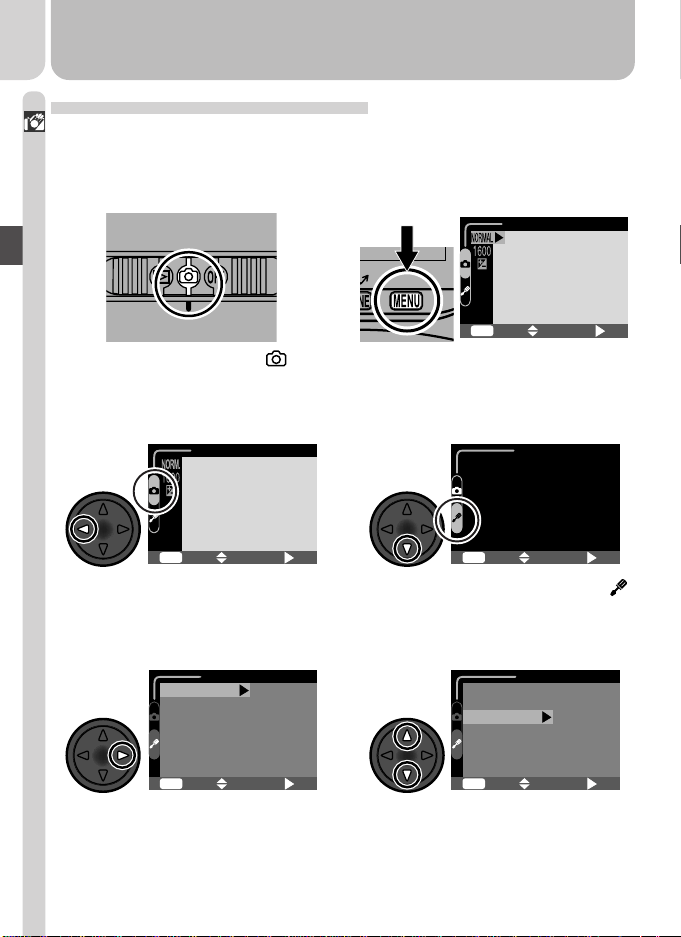
Slide mode selector to
5
.1
5
.2
Highlight SET-UP menu page tab ( )Highlight page tab
5
.3
5
.4
Position cursor in SET-UP menu Highlight Date
5
.5
5
.6
Press MENU button to display menu
for current shooting mode
IMAGE QUALITY
MENU
SELECT
SET
OFF
SHOOTING MENU
MENU
SELECT
SET
OFF
BRIGHTNESS
Brightness
CF Card Format
Date
Auto Off
Language
USB
MENU
SELECT
SET
OFF
Brightness
CF Card Format
Date
Auto Off
Language
USB
SET-UP
MENU
SELECT
SET
OFF
Brightness
CF Card Format
Date
Auto Off
Language
USB
DATE
MENU
SELECT
SET
OFF
Tutorial—First Steps
23
Brightness
CF Card Format
Date
Auto Off
Language
USB
DATE
MENU
SELECT
SET
OFF
DATE
MENU
SELECT
SET
OFF
DATE
MENU
SELECT
SET
OFF
DATE
MENU
SELECT
SET
OFF
Highlight Y M DEdit selected item. Repeat steps 5.8–
5.9 until all items have been set.
5
.9
5
.10
Choose order in which year, month,
and day will be displayed
Save changes to settings and
return SET-UP menu
5
.11
5
.12
Any pictures taken before the time and date have been set will have a time
stamp of “0000.00.00 00:00.” If the time and date have not been set, a
flashing
(“Date not set”) icon will be displayed in the top right corner of
the monitor when the camera is in mode.
Highlight Year, Month, Day, hour, or
minute (selected item blinks on and
off in green)
Display DATE menu
5
.7
5
.8
DATE
MENU
SELECT
SET
OFF
DATE
MENU
SELECT
SET
OFF
24
Tutorial—Taking Pictures
Taking Pictures
The Basics
This section details the basic steps involved in taking pictures in mode. In
this automatic, “point-and-shoot” mode, the majority of camera settings are
controlled by the camera in response to shooting conditions, producing the
best possible results in most situations.
Ready the Camera 24–25STEP 1
Choose Mode 25STEP 2
Frame the Picture 26–27STEP 4
Focus and Shoot 28–29STEP 5
Put the Camera Away 30STEP 6
Adjust Settings (Optional) 26STEP 3
1
.2 Slide the mode selector to
When you slide the mode selector from OFF
to , the flash-ready lamp under the moni-
tor will light and the monitor will display a
welcome message.
Step 1—Ready the Camera
1
.1 Turn the lens section to shooting position
Rotate the lens as shown.
25
Tutorial—Taking Pictures
1600
15
NORMAL
1
.3 Check indicators in the monitor
If the low-battery icon ( ; 19) is dis-
played (A), recharge the battery or use an
AC adapter (available separately).
The monitor also shows the number of pic-
tures that can be taken at current settings
(B). If the message “OUT OF MEMORY”
appears in monitor, the memory card is full.
Delete pictures ( 33–34), use a new
memory card, or choose a lower quality or
image size ( 60).
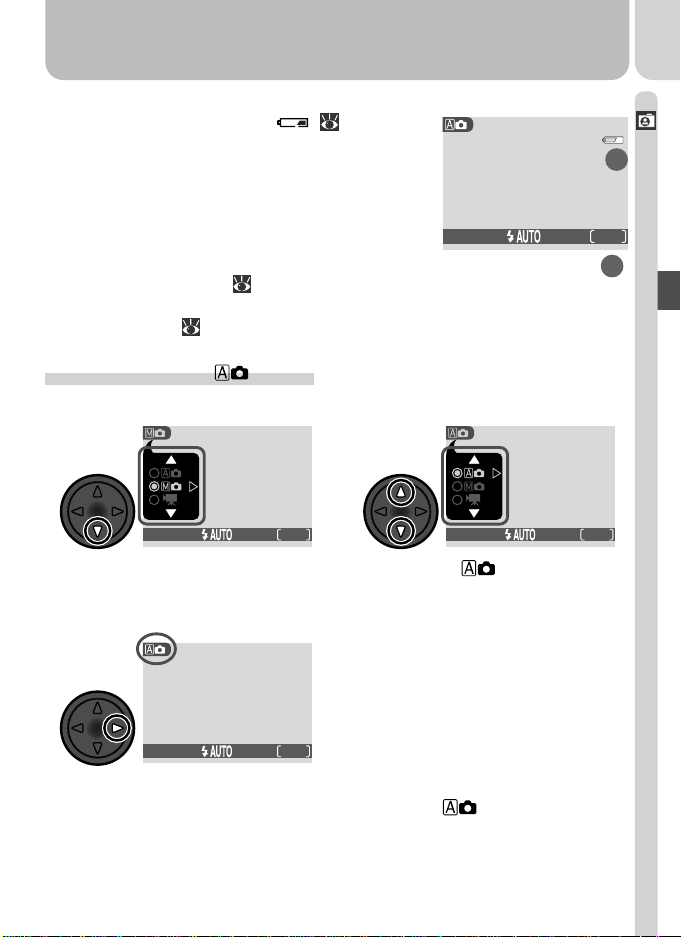
Step 2—Choose Mode
1600
15
NORMAL
Press multi selector down to display
shooting-mode menu
*
2
.1
Press multi selector to right to exit menu
(shooting-mode menu will also close if no
operation is performed for about two sec-
onds). Current shooting mode is shown by
icon at top left corner of monitor.
2
.3
1600
15
NORMAL
Select (selected
option is highlighted in green)
2
.2
1600
15
NORMAL
*When you press the multi selector down to display the shooting-mode menu,
the current shooting mode will be highlighted. If mode is already se-
lected, press the multi selector to the right to exit the menu.
B
A
26
Tutorial—Taking Pictures
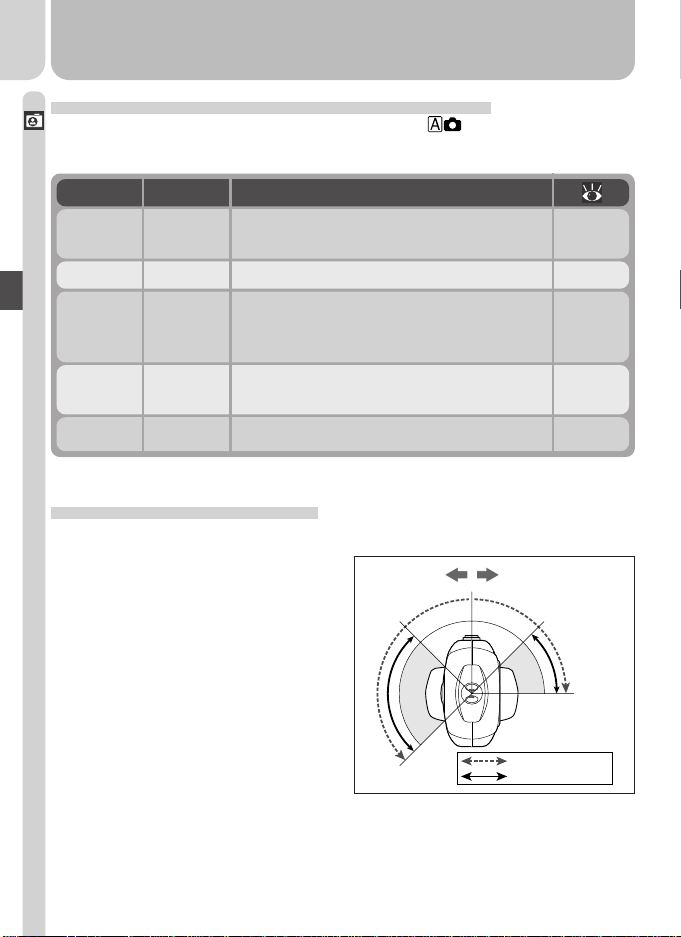
Step 4—Frame the Picture
4
.1 Adjust the lens angle
The lens section can be rotated
130° forward from its housing in
the camera body, and 90° back
toward the monitor. To frame a
quick arms-length self-portrait,
rotate the lens to point in the
same direction as the monitor.
When the lens is obscured by
the camera body, a warning will
be displayed in the monitor and
pictures can not be taken. To
clear the message from the monitor, rotate the lens section to shooting
position.
Step 3—Adjust Camera Settings (Optional)
The following table shows the default settings for mode. For more infor-
mation, refer to the page numbers in the rightmost column.
Flash
mode
Auto
Flash fires automatically when lighting is
poor.
53
Image
quality
NORMAL
Pictures compressed for balance between
quality and file size that is ideal for snap-
shots.
61
Image
size
1600 Pictures are 1,600 × 1,200 pixels in size. 62
Exp. +/– ±0 No exposure compensation performed. 63
Setting Default Description
Self timer Off Self-timer off. 55–56
Range of rotation
Shooting position
Forward Back (toward monitor)
0°
50°50°
130°
90°
27
Tutorial—Taking Pictures
4
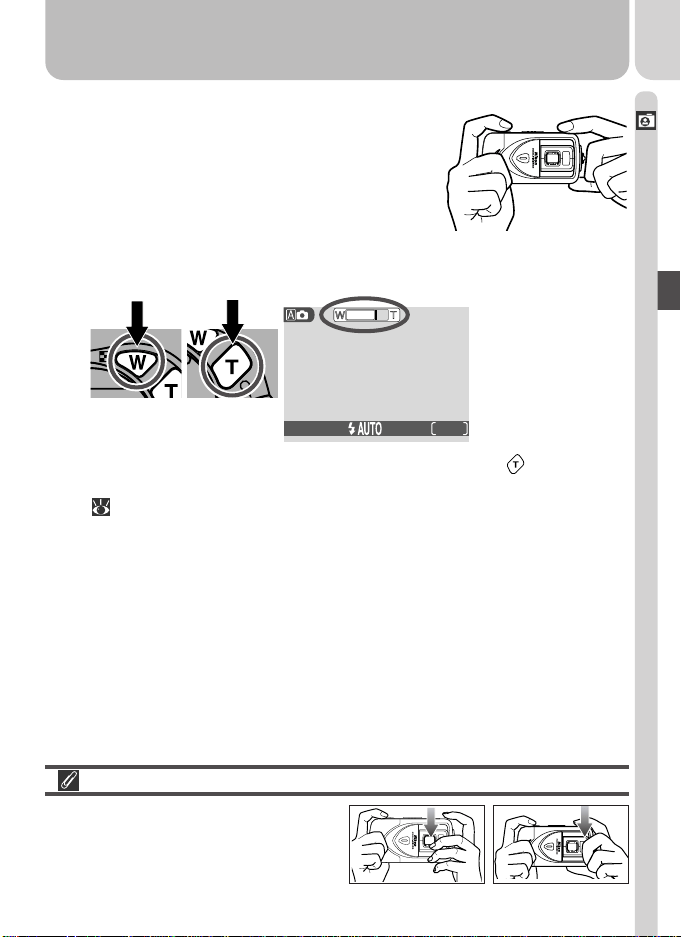
.2 Ready the camera
Hold the camera steadily in both hands.
4
.3 Frame your subject
Use the zoom buttons to frame your subject against the background.
Don’t Block the Shot
To avoid dark or partially obscured pic-
tures, keep your fingers and other ob-
jects away from the lens and flash
window.
Indicator in monitor
shows amount of
zoom while either
button is pressed
1600
15
NORMAL
When the camera is zoomed all the way in, holding the button down
for about two seconds extends the zoom range digitally (digital zoom;
57). The zoom indicator turns yellow when digital zoom is in effect.
Zoom out Zoom in
28
Tutorial—Taking Pictures
Step 5—Focus and Shoot
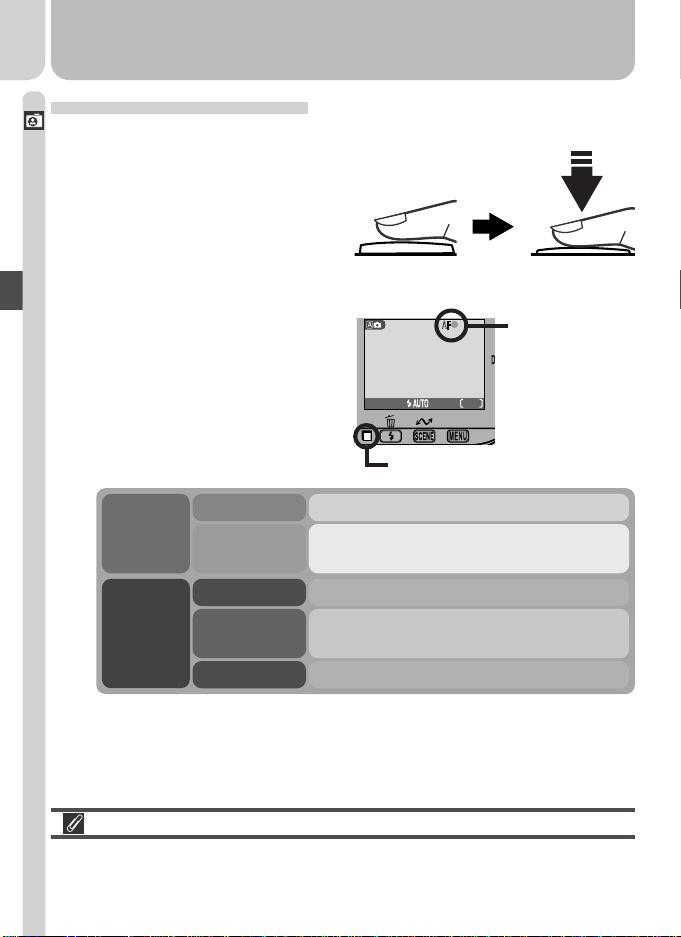
5
.1 Focus
Press the shutter-release button
halfway to set focus and expo-
sure. The camera will focus on
the subject closest to the cam-
era, and lock focus at this dis-
tance while the shutter-release
button is pressed halfway.
With the shutter-release button
pressed halfway, check the fo-
cus indicator and flash-ready
lamp.
Focus
indicator
Flash-
ready
lamp
Camera unable to focus. Change your
composition and try again.
Flash charging. Remove finger briefly from
shutter-release button, then try again.
Subject in focus.
Flash will fire when picture is taken.
Flash off or not required.
Flashes red
Flickers
Green
On
Off
When Lighting Is Poor
If lighting is poor, the view through the camera lens may appear slightly
“grainy” when viewed in the monitor.
1600
15
NORMAL
Focus indicator
lights when
shutter-release
button is pressed
halfway
Flash-ready lamp

29
Tutorial—Taking Pictures
5
.2 Take the picture
Smoothly press the shutter-release button
the rest of the way down to take a picture.
After each shot, the picture you have just
taken will be displayed briefly in the moni-
tor before being recorded to the memory
card. If you are not satisfied with the re-
sults, you can delete the picture instantly by
pressing the ( ) button. If you need more
time to study the picture, you can pause the
display for up to ten seconds by pressing
the ( ) button. For more information,
see “Keep or Delete” ( 58).
Getting Good Results with Autofocus
Autofocus performs best when there is contrast between the subject and
background and the subject is evenly lit. It does not perform well if the sub-
ject is very dark or moving rapidly, if there are objects of sharply differing
brightness in the scene (e.g., the sun is behind your subjects and their fea-
tures are in deep shadow), or if the subject contains objects at different dis-
tances from the camera (e.g., the subject is inside a cage).
During Recording
While pictures are being recorded to the memory card, a icon will be dis-
played in the monitor.
Pictures taken while earlier images are being recorded are stored in a tempo-
rary memory buffer. When the buffer is full, an hourglass ( ) icon will be
displayed and the shutter release will be disabled.
Do not turn the camera off, remove the memory card, or remove or discon-
nect the power source while or is displayed.
30
Tutorial—Taking Pictures
Step 6—Put the Camera Away
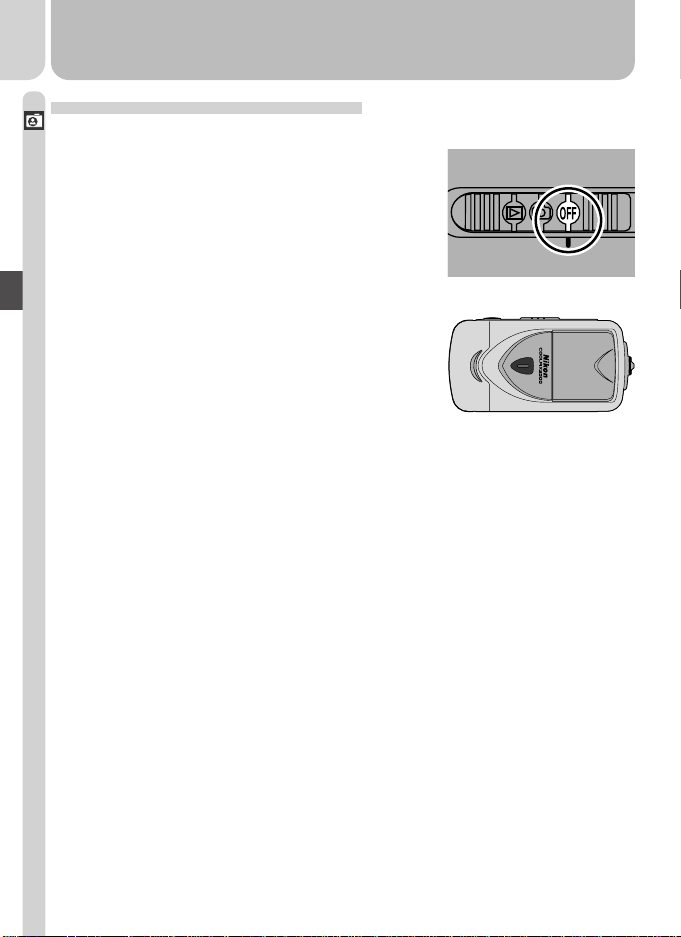
6
.1 Turn the camera off
Turn the camera off to save battery power.
6
.2 Return the lens section to the closed position
To protect the lens, return the lens section
to its housing in the camera body.
31
Tutorial—Review and Deletion
Review and Deletion
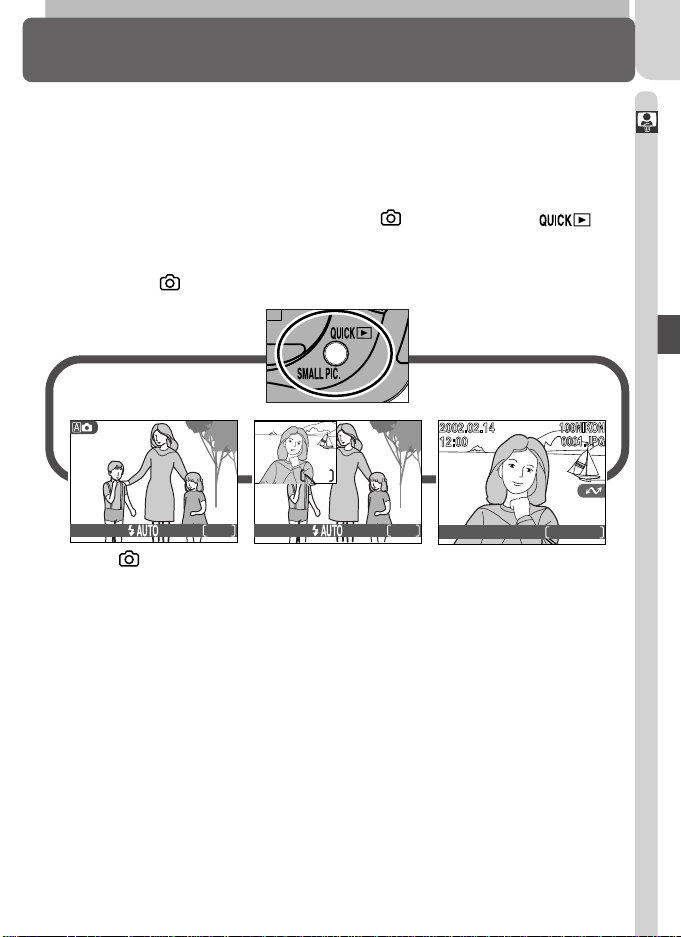
Quick Review
Using the quick review function on your Nikon digital camera, you can view
the results of earlier attempts while setting up the next shot, and use what
you see to change camera settings or to choose a better angle. Once you
have the shot you want, you can delete your failures instantly to make room
for more shots on the memory card.
To use quick review, the camera must be in mode. Press the but-
ton once to display the most recent picture at the top left corner of the moni-
tor, twice to display pictures full screen. Pressing the button a third time
returns you to mode.
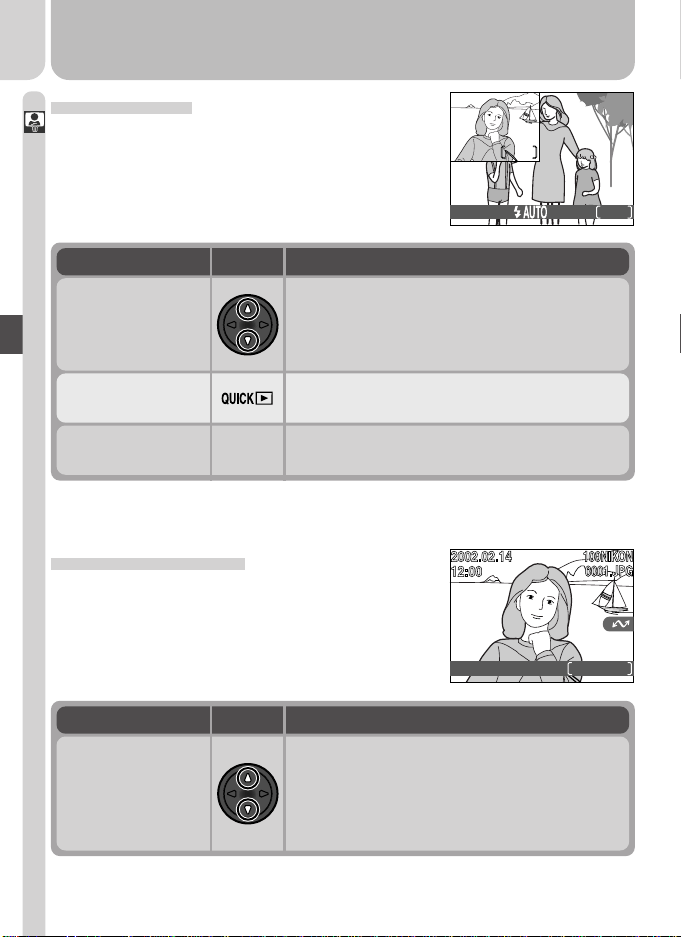
Mode Quick Review
Pictures are displayed
in the top left corner of
the monitor, allowing
you to view the results
of previous attempts
while setting up your
next shot.
Full-Screen Review
Pictures are displayed
full screen or in menus
of four or nine “thumb-
nail” images. You can
zoom in on and delete
individual pictures.
1600
14
1
NORMAL
1600
14
NORMAL
1/0011
1600
NORMAL
32
Tutorial—Review and Deletion
Press the multi selector up to view pictures
recorded before the current photo, down to
view pictures recorded after the current pho-
to. Keep multi selector pressed to scroll rap-
idly to the desired frame number.
View other
pictures
1/0011
1600
NORMAL
Quick Review
The following operations can be performed in
quick review:
1600
14
1
NORMAL
All other camera controls function as they do in shooting mode.
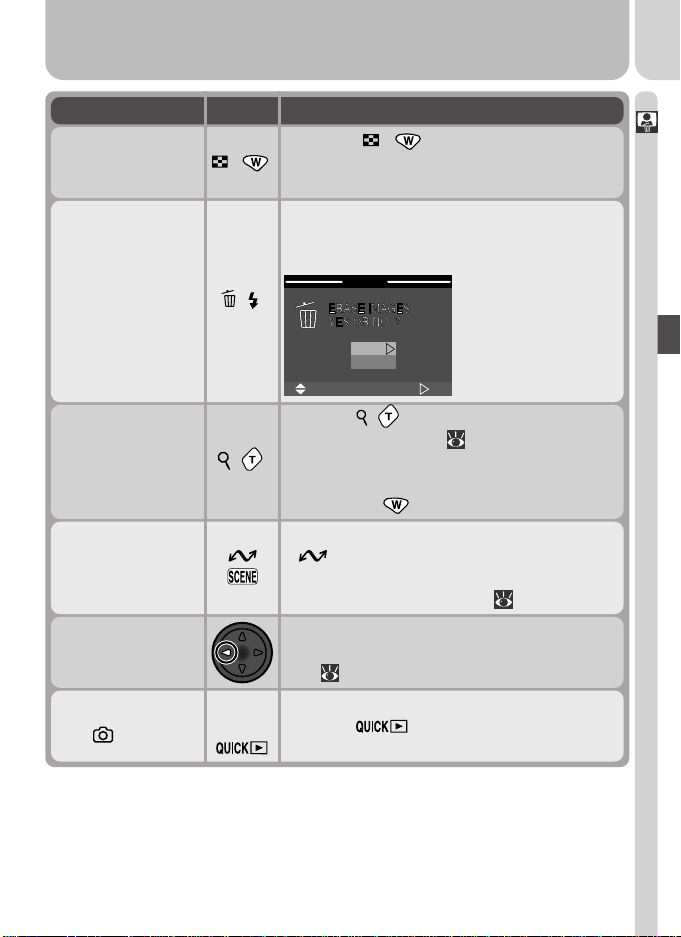
Full-Screen Review
The following operations can be performed in full-
screen review:
Press DescriptionTo
Shutter
release
To return to shooting mode, press the shut-
ter-release button halfway.
Return to
shooting mode
Enter full-screen review (see opposite) with
the current picture displayed full screen.
View current
picture full screen
Press the multi selector up to view pictures
recorded before the current photo, down to
view pictures recorded after the current
photo.
View other
pictures
Press DescriptionTo
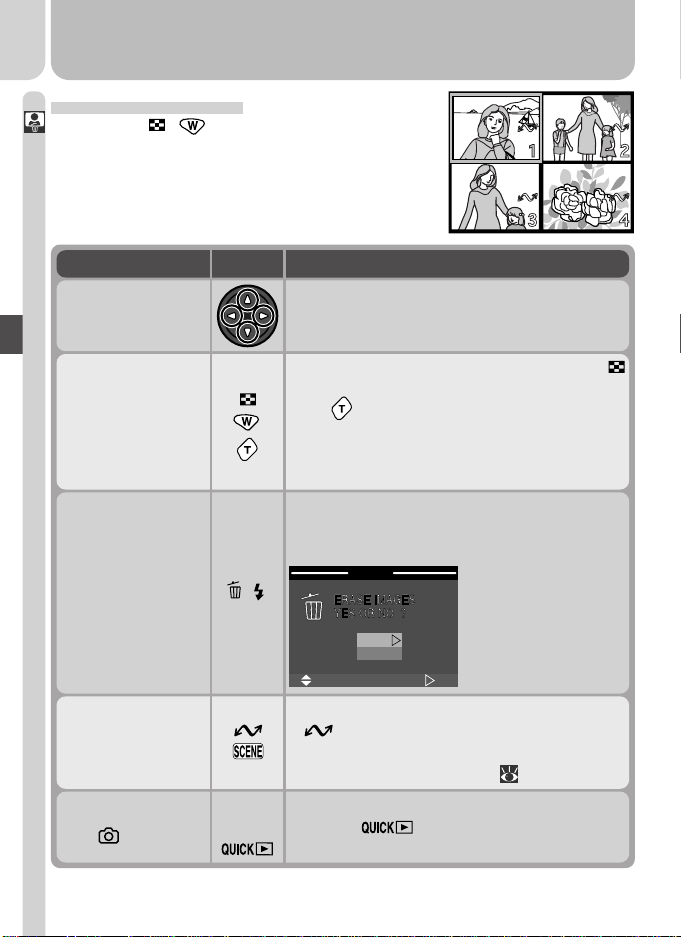
33
Tutorial—Review and Deletion
( )
Press the ( ) button for an enlarged view
of the current photo ( 81). While the pho-
to is zoomed in, use the multi selector to view
areas not visible in the monitor. To cancel
zoom, press .
Zoom photo in
( )
Press the ( ) button to display up to
nine pictures at a time as small thumbnail pre-
views (see following page).
View multiple
pictures
( )
A confirmation dialog will be displayed. Press
multi selector up or down to highlight op-
tion, press to right to select.
•Select No to exit
without deleting
picture
•Select Yes to de-
lete picture
DELETE
No
Yes
SELECT
SET
Delete current
picture
Press DescriptionTo
( )
Pictures selected for transfer are marked with
a icon. Turn this marking on or off to
select the pictures that will be transferred to
a computer at a later date ( 44).
Select current
picture for transfer
to a computer
Press multi selector to left to hide or display
photo info superimposed on picture in mon-
itor ( 7).
Hide or display
photo info
Shutter
release/
To end review and return to shooting mode,
press the button or press the shutter-
release button halfway.
Return to
mode
34
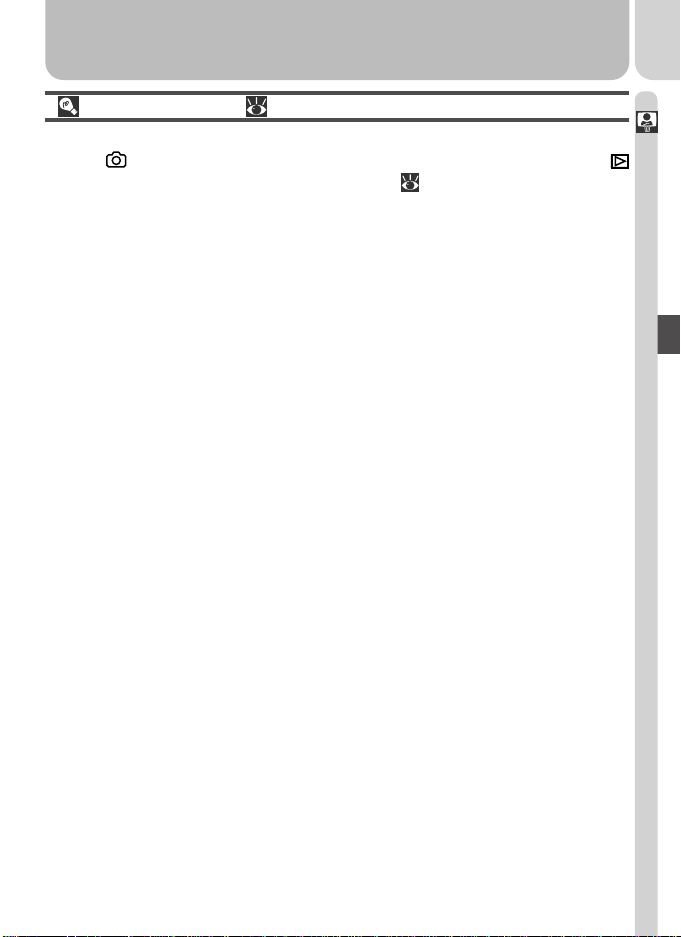
Tutorial—Review and Deletion
Press DescriptionTo
Shutter
release/
To end review and return to shooting mode,
press the button or press the shutter-
release button halfway.
Return to
mode
Press the multi selector up, down, left, or right
to highlight thumbnails.
Highlight pictures
Thumbnail Review
Pressing the ( ) button in full-screen review
displays a menu of four thumbnail images. The
following operations can be performed while
thumbnails are displayed:
( )/
With four thumbnails displayed, press the
button once to view nine thumbnail images.
Press to “zoom in” from nine thumbnails
to a four-thumbnail view or, when four
thumbnails are displayed, to view highlight-
ed picture full size.
Change number of
pictures displayed
( )
A confirmation dialog will be displayed. Press
multi selector up or down to highlight op-
tion, press to right to select.
•Select No to exit
without deleting
picture
•Select Yes to de-
lete picture
Delete highlighted
picture
DELETE
No
Yes
SELECT
SET
( )
Pictures selected for transfer are marked with
a icon. Turn this marking on or off to
select the pictures that will be transferred to
a computer at a later date ( 44).
Select highlighted
picture for transfer
to a computer
35
Tutorial—Review and Deletion
Playback Mode ( 77)
This section describes quick review, which allows you to view pictures without
leaving mode. To learn about additional playback options available in
(playback) mode, see “Playing Pictures Back” ( 77).
36
Tutorial—Getting Creative
Getting Creative
Scene Selection
SELECT SET
1600
15
NORMAL
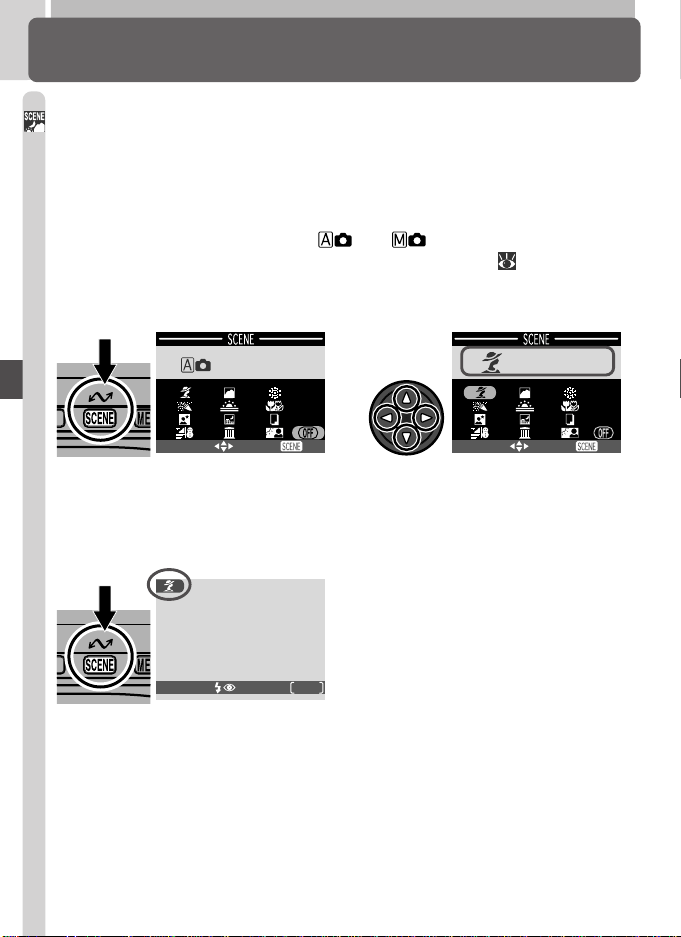
Your Nikon digital camera offers a choice of “scene” modes for common
compositions, such as portraits, landscapes, and close-ups, which require special
combinations of settings that apply to any scene of the same type. When a
scene is selected from the SCENE menu, camera settings are automatically
adjusted to produce optimal results for the selected composition, sparing you
the necessity of adjusting camera settings one-by-one.
Scene selection is only available in and modes (for information on
choosing a shooting mode, see “Tutorial: Taking Pictures”; 25). To choose
a scene:
Portrait
SELECT SET
Press SCENE button to display menu
of scene choices
1
Make selection (chosen scene takes
effect when option is highlighted;
highlighted scene shown by icon and
caption in monitor)
2
Press SCENE button to return to shooting
mode (selected scene shown by icon in
monitor)
3
37
Tutorial—Getting Creative
In scene mode, you can adjust flash ( 53) and self-timer ( 55) settings
(restrictions may apply depending on the scene selected). Pressing the MENU
button will display the SHOOTING menu ( 59). To return to or
mode, select OFF in the SCENE menu.
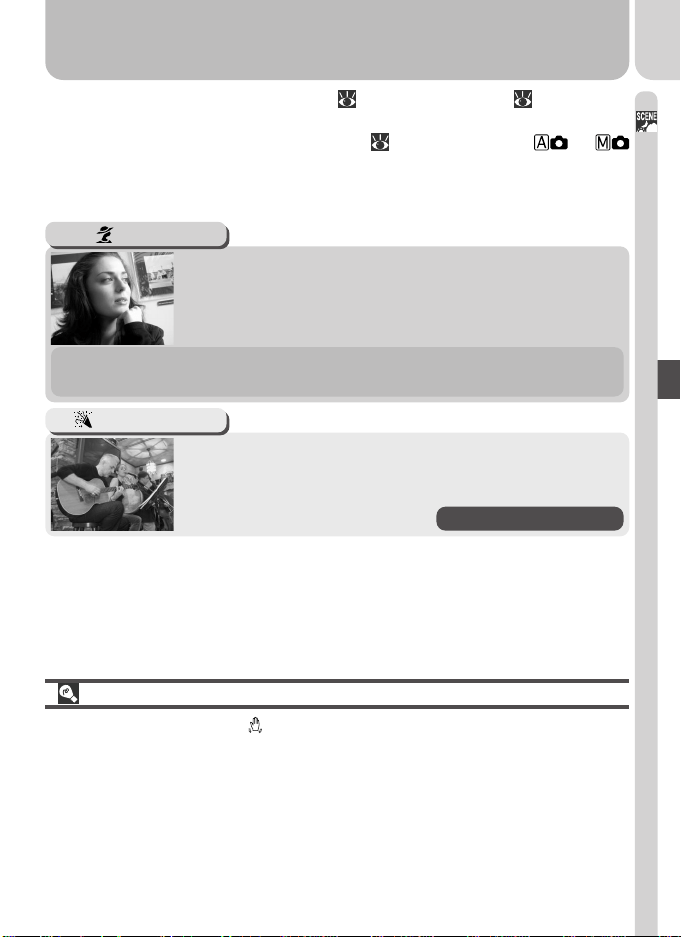
The following pages describe when to use each scene mode.
Use for portraits. Main subject stands out clearly while back-
ground details are softened, lending the composition a sense
of depth.
Portrait
•Degree to which background details are softened depends on the amount
of light available
Camera Shake
At slow shutter speeds, a icon appears in the monitor. Pictures taken at
these speeds may be blurred by inadvertent camera movement (“camera
shake”). While use of a tripod is recommended when this icon is displayed,
other methods that may be successful in preventing blurring at a given setting
are indicated by the number of stars in the “Camera Shake” rating:
✯ Support the camera steadily in both hands with your elbows against
your torso.
✯✯ Place the camera on a flat, level surface such as a wall or table.
Use for shots that include details of the background be-
hind the main subject, or to capture the effects of candle-
light and other indoor background lighting.
Party/Indoor
Camera Shake: ✯
38
Tutorial—Getting Creative
Noise Reduction
“Noise” in the form of randomly-spaced, brightly-colored pixels tends to ap-
pear in pictures taken at slow shutter speeds. This effect is particularly notice-
able in dark areas of the picture. At settings of Night Portrait and Night
Landscape, pictures taken at slow shutter speeds are processed to reduce
noise before being saved to the memory card. As result, more time is required
to save pictures to the memory card.
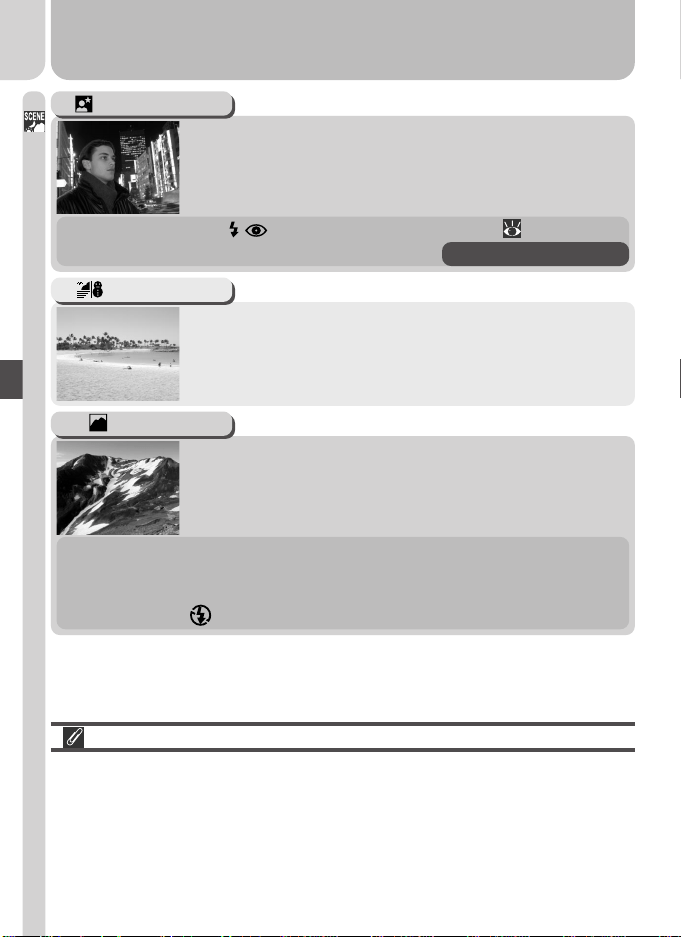
Vividly captures the brightness of such subjects as snow-
fields, beaches, or sunlight expanses of water.
Beach/Snow
Use for vivid landscape shots that enhance outlines, colors,
and contrast in such subjects as skyscapes and forests.
Landscape
•Focus is fixed at infinity, allowing the camera to focus on distant scenes
through foreground objects such as a window or a screen of branches.
The focus indicator (AF●) is not displayed.
•Flash turns off ( ) automatically.
Use for shots that provide a natural balance between the
main subject and the background when shooting portraits
against a backdrop of night scenery.
Night Portrait
•Flash mode is set to (auto with red-eye reduction; 53).
Camera Shake: ✯
39
Tutorial—Getting Creative
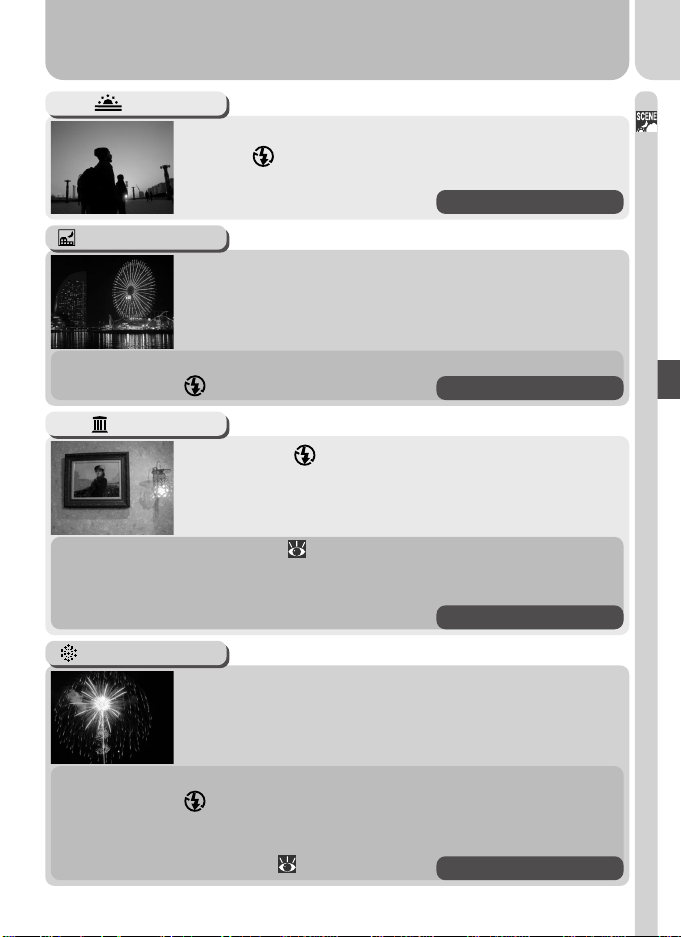
Flash turns off ( ) automatically. Use indoors where flash
photography is prohibited (for example in museums and
art galleries) or in other settings in which you do not want
to use the flash.
Museum
•The Best Shot Selector (BSS; 67) turns on automatically, reducing the
effects of inadvertent camera movement.
•Photography may be prohibited altogether in some settings. Be sure to
obtain permission first.
Camera Shake: ✯
Preserves the deep hues seen in sunsets and sunrises. Flash
turns off ( ) automatically.
Sunset
Camera Shake: ✯
A slow shutter speed is used to produce stunning night
landscapes.
Night Landscape
•Focus is fixed at infinity; the focus indicator (AF●) is not displayed.
•Flash turns off ( ) automatically.
Camera Shake: ✯✯
Slow shutter speeds are used to capture the expanding burst
of light from a firework. The camera responds more rapid-
ly to the shutter-release button, ensuring that you can cap-
ture the start of the burst.
Fireworks Show
•Focus is fixed at infinity; the focus indicator (AF●) is not displayed.
•Flash turns off ( ) automatically.
•Follow the firework as it ascends and press the shutter-release button all
the way down at the start of the burst.
•Self-timer can not be used ( 56).
Camera Shake: ✯✯
40
Tutorial—Getting Creative
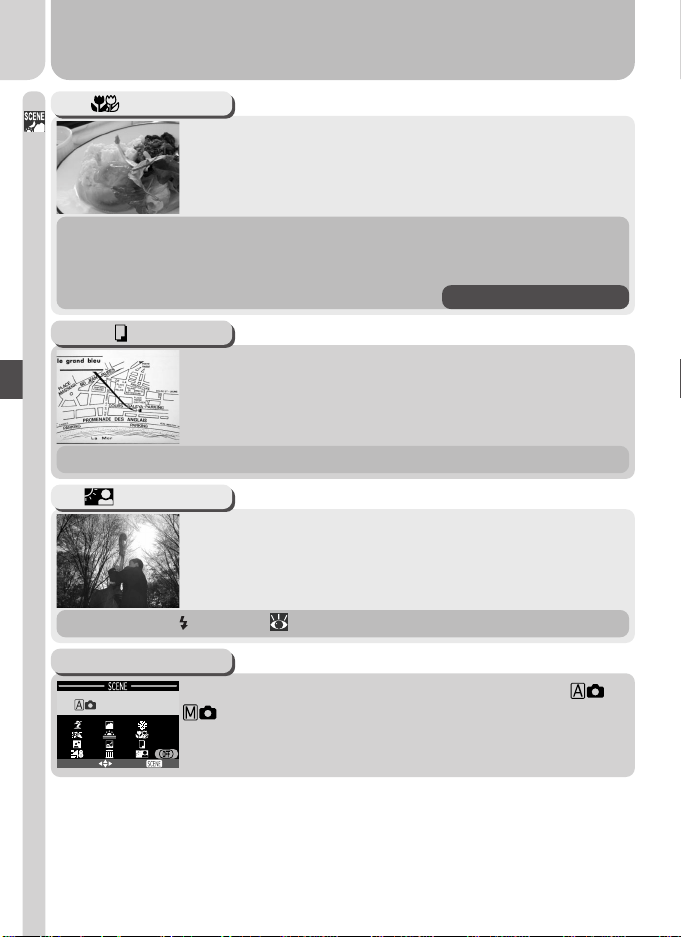
Use when light is coming from behind your subject, throw-
ing their features into shadow, or when your subject is in
the shade but the background is brightly lit. The flash will
fire automatically to “fill in” (illuminate) shadows.
Back Light
•Flash is set to (fill flash; 53).
Provides clear pictures of text or drawings on a white board,
business card, or in other printed matter.
Copy
•Colored text and drawings may not show up well in the final picture.
Camera is set to focus on objects as close as 4 cm (1.6˝)
from the lens, making it possible to capture vivid colors in
close-up shots of flowers, insects, and other small objects,
with the background artistically blurred.
Close Up
•When this option is selected, the camera will automatically adjust zoom
to focus at very short distances. If you change the zoom position, the
camera may be unable to focus.
•Camera focuses on subject at center of frame.
Camera Shake: ✯
Select this item to return to the shooting mode ( or
) in effect when scene mode was selected. The mode
last in effect will be displayed in the monitor when this
option is highlighted.
OFF
SELECT SET

41
Connections
Your Camera and Your Computer
Your Nikon digital camera stores pictures as digital
data. Instead of making the trip to a developer and
getting negatives, you can simply copy your pictures
to a computer for long-term storage using the Nikon
View 5 software provided with your camera. Once
transferred to your computer, your pictures can be
viewed, printed, sent to your acquaintances via e-
mail, or saved to a Zip disk or other removable me-
dia for delivery to a photofinisher. Any copies stored
on the memory card after transfer can be deleted
to make way for new pictures, which you can then
add to the growing digital photo album on your
computer.
42
Connections
Before You Begin: Installing Nikon View 5
Before copying pictures to your computer, you will need to install Nikon View 5,
an application that allows you to transfer pictures from the camera memory
card to a computer hard disk and view them on the computer monitor. To
install Nikon View 5, you must have a computer running one of the following
operating systems:
Pre-installed versions of Windows XP Home Edition, or Win-
dows XP Professional, Windows 2000 Professional, Windows
Millennium Edition (Me), Windows 98 Second Edition (SE).
Windows
Mac OS 9.0, 9.1, 9.2, Mac OS X (10.1.2 or later). Only models
with built-in USB ports supported.
Macintosh
Nikon View 5
Reference Manual
En
De Fr
Es Nl It
Jp
Macintosh and Windows
The first step to installing Nikon View 5 is to read
the installation instructions. These are included on
the reference CD provided with your camera.
Already Have Nikon View?
In order to transfer pictures to your computer using the UC-E3 USB cable, the
COOLPIX 2500 requires the version of Nikon View 5 provided with the cam-
era. If you have a version of Nikon View that was included with another
Nikon digital camera, you will need to upgrade to the version provided with
the COOLPIX 2500.
1
Insert the reference CD
After turning on your computer and waiting
for the operating system to start up, place the
reference CD in a CD-ROM drive.
If you are using a Macintosh computer, the reference CD window will open
automatically on the desktop. Windows users will need first to double-
click the My Computer icon and then the Nikon icon to open the refer-
ence CD window.
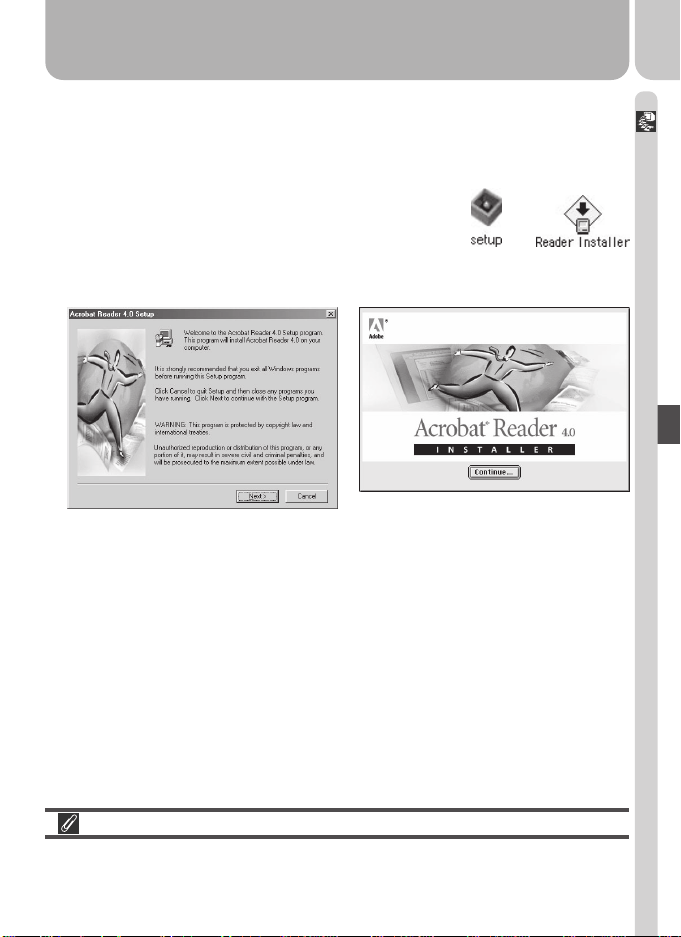
43
Connections
2
Install Adobe Acrobat Reader
The installation instructions are in Portable Document Format (PDF). To
view the instructions, you will need Adobe Acrobat Reader 4.0 or later. If
you have already installed this version of Acrobat, proceed to Step 3.
To install Adobe Acrobat Reader, open the
folder for the language of your choice and
double-click the installer icon. The installer
start-up screen will be displayed; follow the on-
screen instructions to complete installation.
Before Installing Nikon View 5
Before installing Nikon View 5, be sure to exit all other programs, including
Adobe Acrobat Reader and any virus-checking software.
Start-up screen (Windows)
Installer icon
(Windows)
Installer icon
(Macintosh)
Start-up screen (Macintosh)
3
Read installation instructions for Nikon View 5
Once you have installed Adobe Acrobat Reader, double-click the INDEX.pdf
icon in the root directory of the reference CD to view a clickable index of
the documentation available for Nikon View 5. Follow the links to view
the installation instructions for your computer system. If desired, you can
print the installation instructions using the Print… command in the Acro-
bat File menu, and follow along during installation of Nikon View 5.
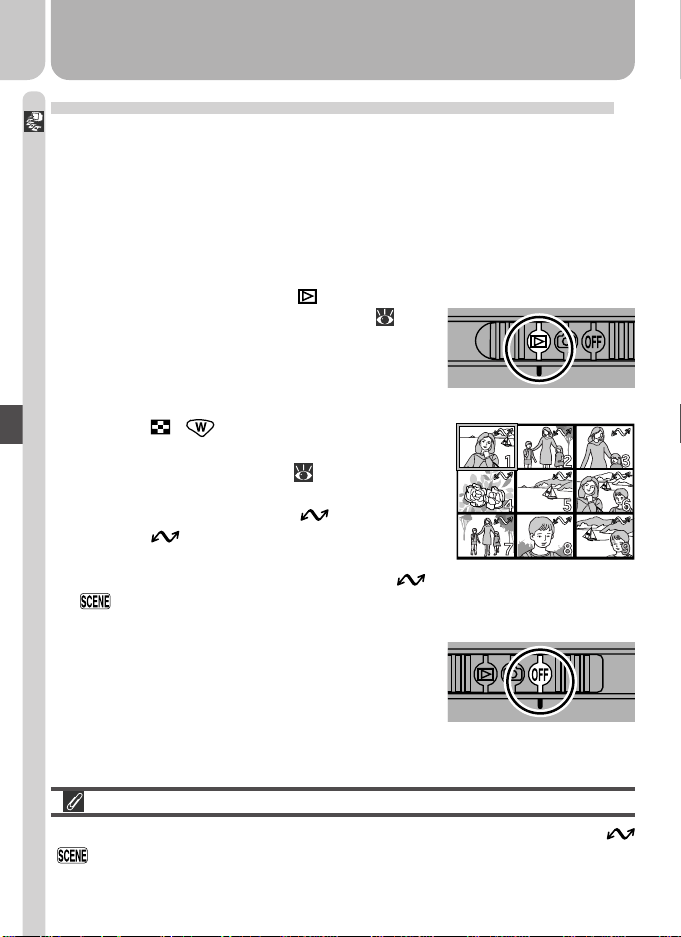
44
Connections
Making the Connection: Connecting to Your Computer
Once you have installed Nikon View 5, you are ready to transfer photographs
and movies to your computer. Pictures can be transferred via a direct USB
connection between the camera and computer, or by removing the memory
card from the camera and inserting it in a card reader or PC card slot.
Direct Connection: Connecting Your Camera by Cable
If your computer has a built-in USB interface, you can connect it to your cam-
era using the UC-E3 cable provided.
1
Slide the mode selector to
The camera will enter playback mode ( 78)
with your most recent picture displayed full
frame in the monitor.
2
Select the pictures to be transferred
Press the ( ) button to display the pic-
tures on the memory card in “contact sheets”
of four or nine thumbnails ( 80). Confirm
that only the pictures you want to copy to the
computer are marked with a icon. To re-
move the icon from a picture, or to select
an unmarked picture for transfer, highlight the
image with the multi selector and press the
( ) button.
3
Turn the camera off
Turn the camera off before connecting it to a
computer.
Transferring More than 999 Pictures
No more than 999 pictures can be transferred at one time using the
( ) button. To copy more pictures, use Nikon View 5. See the Nikon View
5 Reference Manual (on CD) for details.
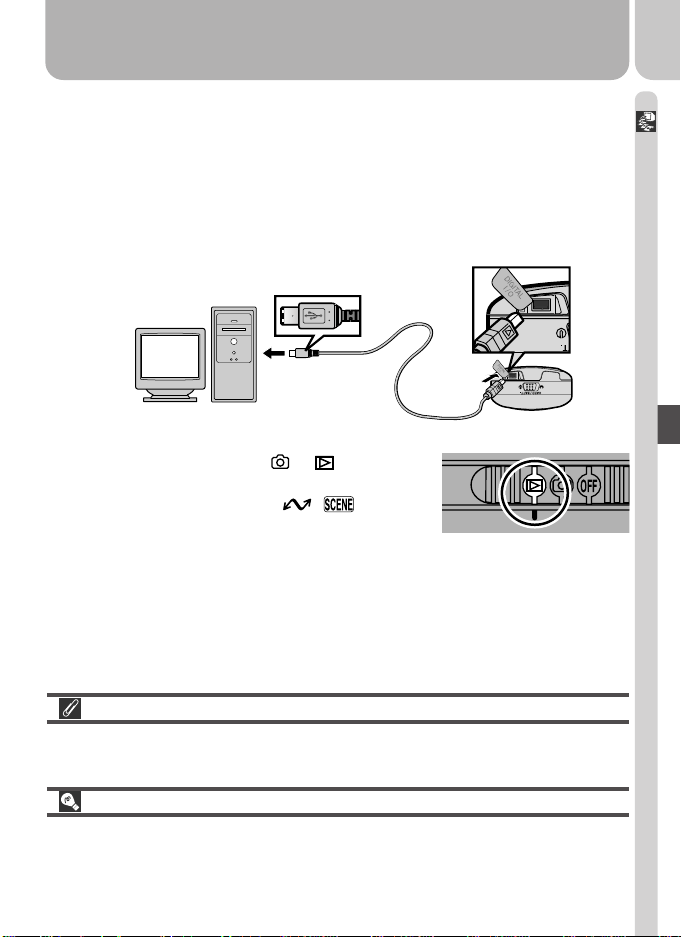
45
Connections
Before Connecting the Camera
Before connecting your camera to a computer, make sure that Nikon View 5
is installed.
Use a Reliable Power Source
When transferring data between the camera and the computer, be sure that
the battery is fully charged. If in doubt, recharge the battery before begin-
ning transfer or use the optional EH-60 AC adapter.
4
Turn the computer on
Turn the computer on and wait for the operating system to start up.
5
Connect the camera and computer
Connect the UC-E3 USB cable as shown below. Use the flat connector for
connection to the computer, and connect the other end of the cable to the
camera’s USB connector. Do not connect the camera via a USB hub or
keyboard.
6
Turn the camera on
Slide the mode selector to or . If the UC-
E3 is connected, the monitor will remain off,
and all controls except the ( ) button
and power switch will be inactive.
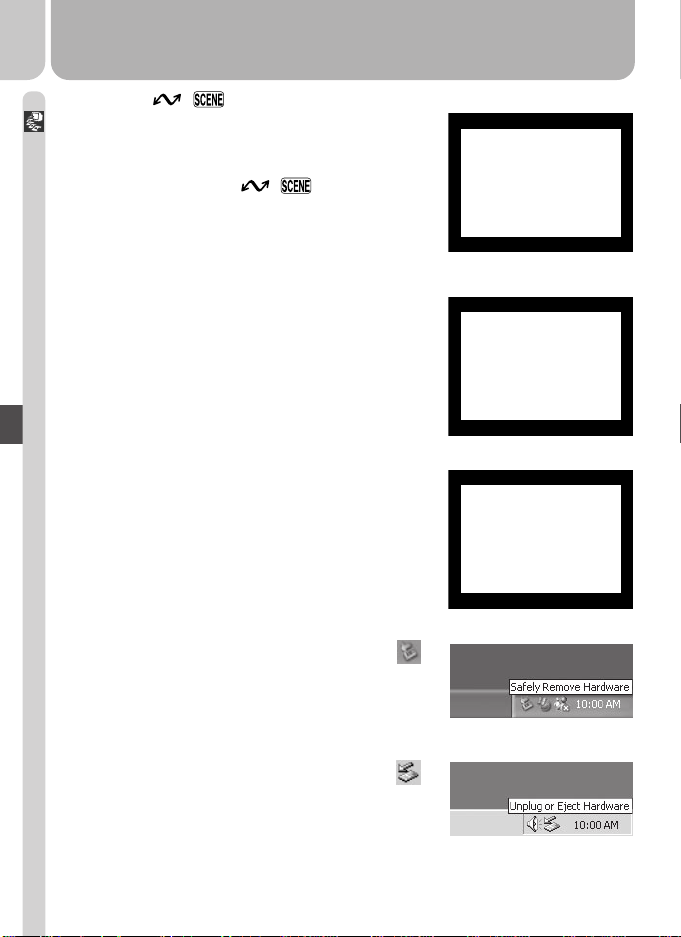
46
Connections
9
Remove the camera from the system
When all marked pictures have been trans-
ferred, the message “TRANSFER COMPLETED”
will be displayed in the camera monitor. Be-
fore disconnecting the cable or turning the cam-
era off, you must remove the camera from the
system as follows:
TRANSFER COMPLETED
7
Press the ( ) button
When the camera is connected and turned on,
Nikon View 5 will start automatically (see the
reference CD for details). Once Nikon View 5
has started, press the ( ) button to be-
gin copying the pictures selected in Step 2 to
the computer. The message “PREPARING TO
TRANSFER” will appear in the camera monitor.
8
Wait for the pictures to be transferred to the computer
While pictures being copied to the computer,
the camera monitor will show “TRANSFERRING
IMAGE TO COMPUTER.” Do not turn the cam-
era off, remove the memory card, or discon-
nect the cable while transfer is in progress.
PREPARING
TO TRANSFER
TRANSFERRING
IMAGE TO
COMPUTER
Windows XP
Click the “Safely Remove Hardware” icon ( )
in the taskbar and select Safely remove USB
Mass Storage Device from the menu that ap-
pears.
Windows 2000 Professional
Click the “Unplug or Eject Hardware” icon ( )
in the taskbar and select Stop USB Mass Stor-
age Device from the menu that appears.
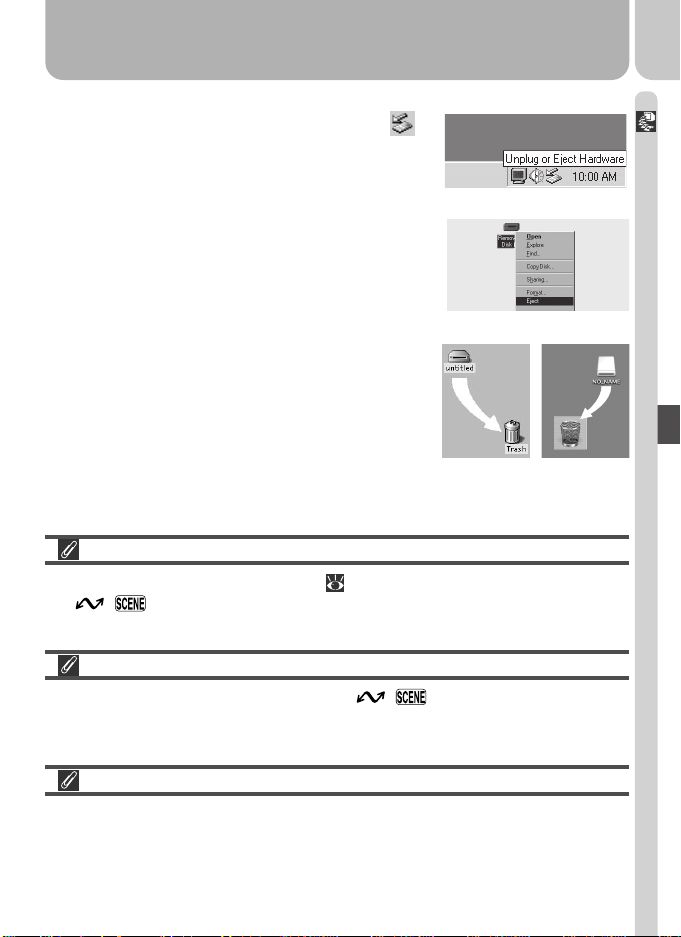
47
Connections
Once you have removed the camera from the system, you can disconnect
the interface cable or turn the camera off.
Windows XP
If PTP is selected in the USB menu ( 75), an error will be displayed when
the ( ) button is pressed to begin transfer. Disconnect the camera as
instructed in Step 9 and select Mass Storage, then try again.
Mac OS X
Pictures can not be transferred using the ( ) button in Mac OS X. Use
Nikon View 5 to transfer pictures. See the Nikon View 5 Reference Manual
(on CD) for details.
Disconnecting the Camera
Before turning the camera off or disconnecting the interface cable, be sure
that transfer is complete and that the camera displays the message “TRANS-
FER COMPLETED.” While transfer is in progress, do not disconnect the USB
cable, turn the camera off, or remove the memory card from the camera
Macintosh
Drag the “untitled” (“NO_NAME”) camera vol-
ume into the Trash.
Windows Me
Click the “Unplug or Eject Hardware” icon (
)
in the taskbar and select Stop USB Disk from
the menu that appears.
Windows 98 SE
In My Computer, click with the right mouse but-
ton on the removable disk corresponding to
the camera and select Eject from the menu that
appears.
Mac OS 9 Mac OS X
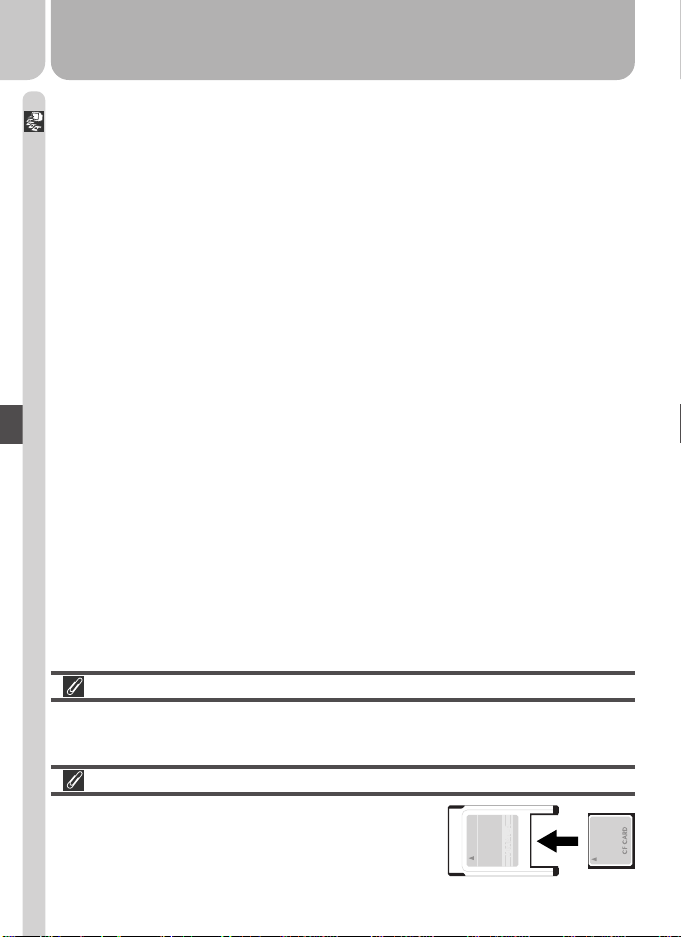
48
Connections
Reading Pictures from Memory Cards
If you have a CompactFlash
™
card reader or your computer is equipped with a
PC card slot, you can transfer pictures directly from the memory card. Before
inserting the memory card in a card reader or card slot, turn the camera off
and remove the card from the camera.
1
Turn the computer on
Turn the computer on and wait for the operating system to start up.
2
Insert the memory card
If you are using a PC card slot, insert the memory card into a PC card
adapter (see note below), and then insert the adapter into the PC card slot.
If you are using a card reader, insert the memory card directly into the card
reader. If installed, Nikon View 5 will detect cards from Nikon digital cam-
eras and start automatically. See the Nikon View 5 Reference Manual (on
CD) for information on transferring pictures to your computer.
CompactFlash
™
Card Readers
Before using a card reader, be sure to read all documentation provided by the
manufacturer.
PC Card Adapter
To read CompactFlash
™
memory cards using a PC
card slot, you will require an EC-AD1 PC-card
adapter (shown at right), available separately from
Nikon.
49
Connections
Removing the Memory Card
Be sure that transfer is complete before removing memory cards from the
card reader or PC card slot.
Before removing the memory card from a PC card slot or card reader, you will
need to remove the card from the system:
Windows XP
Click the “Safely Remove Hardware” icon ( ) in the taskbar and remove the
memory card from the system.
Windows 2000 Professional/Windows Me
Click the “Unplug or Eject Hardware” icon (
) in the taskbar and remove
the memory card from the system.
Windows 98 SE
In My Computer, right click on the removable disk corresponding to the memory
card and select Eject from the menu that appears.
Macintosh
Drag the “untitled” (“NO_NAME”) volume that represents the memory card
into the Trash.
File and Folder Names
Pictures taken with the COOLPIX 2500 are identified by file names that begin
with “DSCN” or, in the case of images created with the small picture function
( 82), “SSCN,” followed by a four-digit file number assigned automatically
by the camera (e.g., “DSCN0001”). Each file name ends in a three-letter
“extension” that identifies the type of picture: “.JPG” for photographs and
“.MOV” for movies. Picture files are stored in folders created automatically
by the camera and named with a three-digit folder number followed by
“NIKON” (e.g., “100NIKON”). The folder name and file number can be viewed
in full-screen review and full-frame playback, when they are displayed in the
top right corner of the monitor ( 7).

50
51
Fine-Tuning Camera
Settings
59–68
Beyond Point-and-
Shoot
52–58
In “Tutorial: Taking Pictures,” you learned the basic
order of operations for taking pictures in mode.
This chapter details the options available for taking
pictures in all shooting modes. It is divided into the
following sections:
Beyond Point-and-Shoot
Read this section for advice on the most frequently-
used camera controls, including shooting-mode and
scene selection, flash mode, the self-timer, and
zoom, as well as for information on the operations
that can be performed while pictures are displayed
in the monitor after shooting.
Fine-Tuning Camera Settings
This section details the options available in the
SHOOTING menu.
Taking
Pictures
The Details
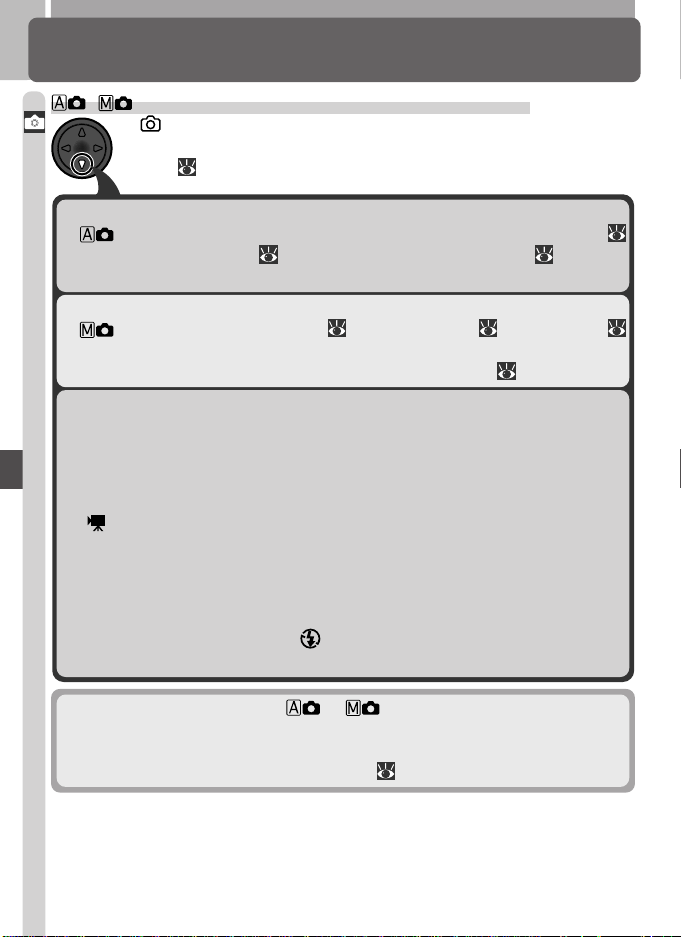
52
Taking Pictures—Beyond Point-and-Shoot
, , or Movie: Choosing a Shooting Mode
Beyond Point-and-Shoot
Camera Controls
In
mode, you have a choice of four basic shooting modes (for
information on choosing a shooting mode, see “Tutorial: Taking Pic-
tures”; 24):
Pressing the SCENE button in or mode displays a menu of twelve
“scenes,” where you can choose an option suited to your subject and com-
position and let the camera adjust settings for best results. For more infor-
mation, see “Tutorial: Getting Creative” ( 36).
Auto
Auto produces good results in a wide range of situations. Use
for snapshots or when you want control over image quality (
61), image size ( 62), and exposure compensation ( 63) while
leaving the camera in charge of other settings.
Manual
Choose this mode for complete control over all camera settings,
including white balance ( 64), sharpening ( 68), and BSS (
67). You can also choose to take pictures in continuous sequence
while the shutter-release button is held down ( 66).
Movie
This mode is used to record NORMAL-quality silent movies
320 × 240 pixels in size (QVGA) at a rate of about fifteen frames
per second. Recording begins when the shutter-release button is
pressed all the way down and ends when the shutter-release but-
ton is fully pressed a second time.
•In place of the number of exposures remaining, the exposure-
count display in monitor shows the length of the movie that
can be recorded.
•Movie ends automatically after fifteen seconds or when no more
space is available on the memory card.
•Movies are stored as QuickTime movie files ending in “.MOV”.
•The flash turns off (
) automatically.
•Menus and scene-selection are disabled in movie mode.
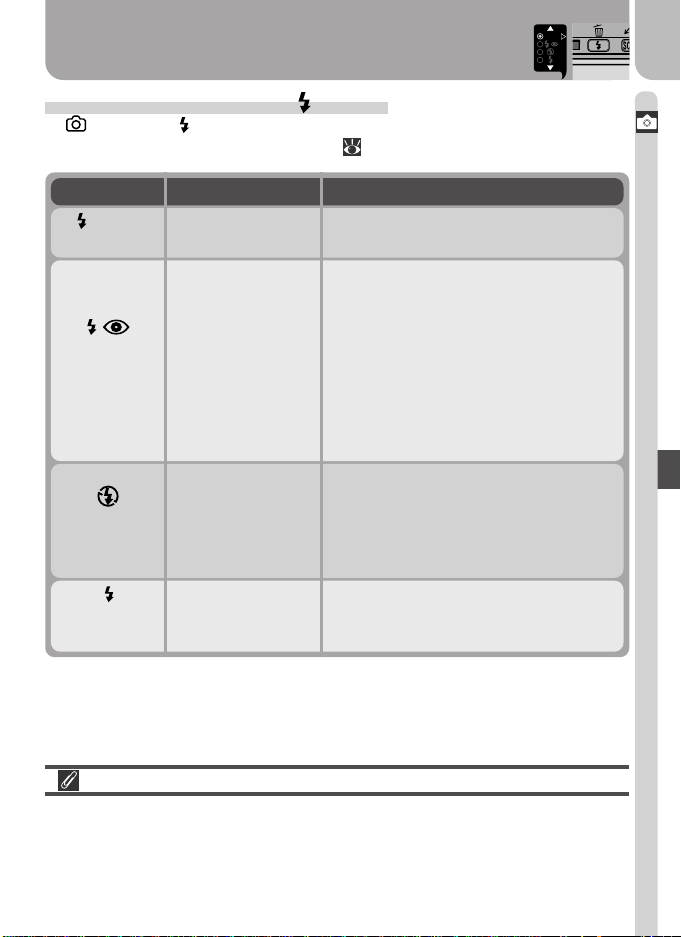
53
Taking Pictures—Beyond Point-and-Shoot
Flash Photography: The Button
In mode, the button controls the flash. Four flash modes are available
(restrictions may apply in scene mode; 36):
AUTO
Auto
Flash fires when
lighting is poor.
Best choice in most circumstances.
Auto with
red-eye
reduction
Pre-flash fires be-
fore main flash.
This causes sub-
jects’ pupils to con-
tract before photo
is taken, minimizing
“red-eye” effect
caused by flash re-
flecting from retina.
Use for portraits (works best when sub-
jects are well within range of flash and
looking at pre-flash). Because a slight
delay occurs after the shutter-release
button is fully pressed to allow the pre-
flash to take effect, this setting is not
recommended with erratically-moving
subjects or in other situations in which
you want the camera to react quickly.
Anytime Flash
(fill flash)
Flash fires whenev-
er picture is taken.
Use to “fill-in” (illuminate) shadows and
back-lit subjects.
Flash Cancel
(off)
Flash will not fire
even when lighting
is poor.
Use when subject is outside range of
flash, to capture natural lighting under
dim light, or where use of a flash is pro-
hibited. Use of a tripod is recommend-
ed to prevent blurring.
Mode How it works When to use it
AUTO
The Flash-Ready Light
A short pause is required between exposures for the flash system to charge. If
the shutter-release button is pressed halfway while the flash is charging, the
flash-ready light under the monitor will flicker. Remove your finger briefly
from the shutter-release button and try again.
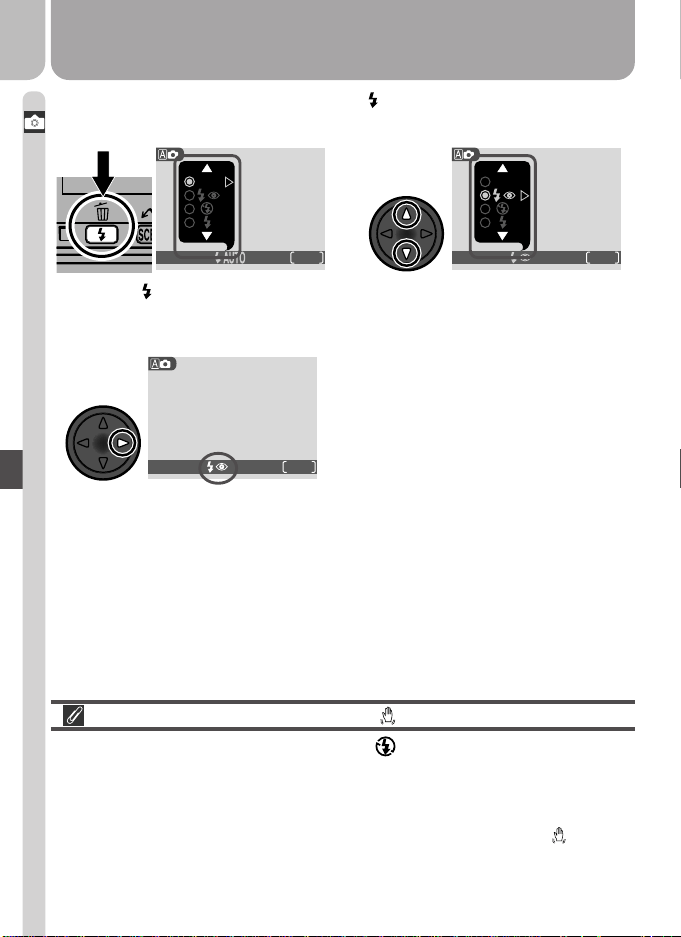
54
Taking Pictures—Beyond Point-and-Shoot
1600
15
NORMAL
The flash mode can be selected with the button:
AUTO
1600
15
NORMAL
Press button to display
flash-mode menu
1
Press multi selector to right to exit menu
(flash-mode menu will also close if no op-
eration is performed for about two sec-
onds). Current flash mode is shown by icon
at bottom of monitor.
3
AUTO
1600
15
NORMAL
Press multi selector up or down until
desired mode is highlighted
2
The ISO (Sensitivity Gain) and (Camera Shake) Icons
When lighting is poor and the flash is off ( ), the camera will automatically
raise its sensitivity to light for faster exposures, minimizing blur caused by
camera shake. When sensitivity is raised above the default value, an ISO icon
will appear in the monitor to warn that “noise” may appear in the final pic-
ture. If the shutter speed required for exposure is very slow, a (camera
shake) icon will appear in the monitor. Use of a tripod or support is recom-
mended.
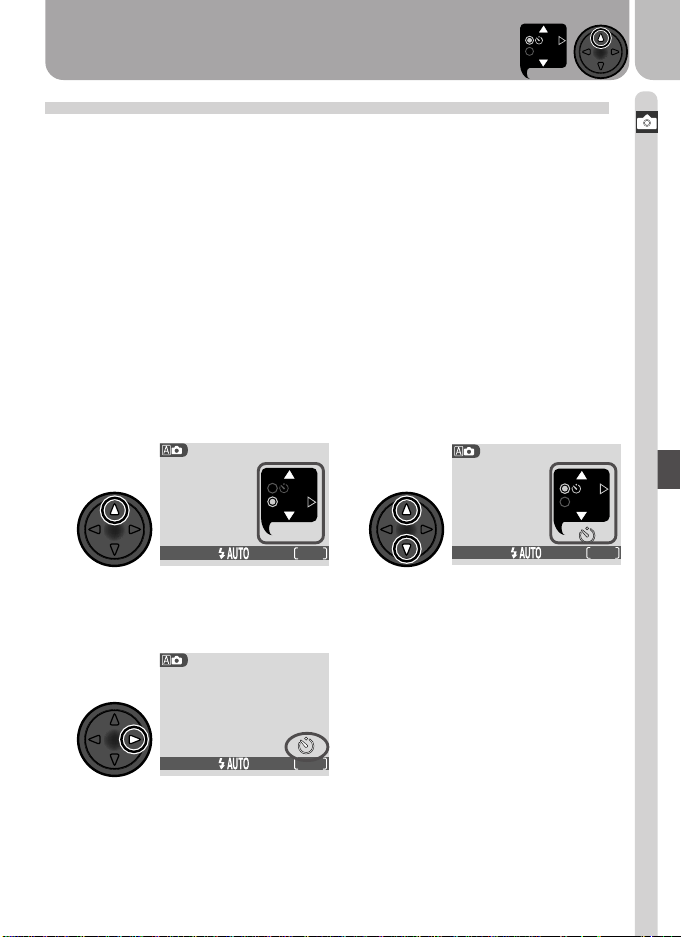
55
Taking Pictures—Beyond Point-and-Shoot
1600
15
NORMAL
Delaying Shutter Release: Choosing a Self-Timer Mode
When the self-timer is on, pictures will not be taken until ten seconds after
the shutter-release button is pressed all the way down, giving you time to
position yourself in front of the camera when taking pictures in which you
want to appear yourself. When taking low-light or close-up shots with the
flash off, the self-timer can be used to prevent pictures from being blurred
by
camera movement that occurs when the shutter-release button is pressed.
To use the self-timer:
1
Position the camera
Mount the camera on a tripod (recommended) or rest it on a flat, stable
surface.
2
Turn the self-timer on
The self-timer setting is controlled with the multi selector.
Press multi selector up to
display self-timer menu
ONON
OFFOFF
1600
15
NORMAL
Press multi selector up or
down to highlight ON
ONON
OFFOFF
1600
15
NORMAL
Press multi selector right to exit menu
(self-timer menu will also close if no op-
eration is performed for about two sec-
onds). When timer is on, self-timer icon
is displayed in monitor.
2
.1
2
.2
2
.3
ONON
OFFOFF
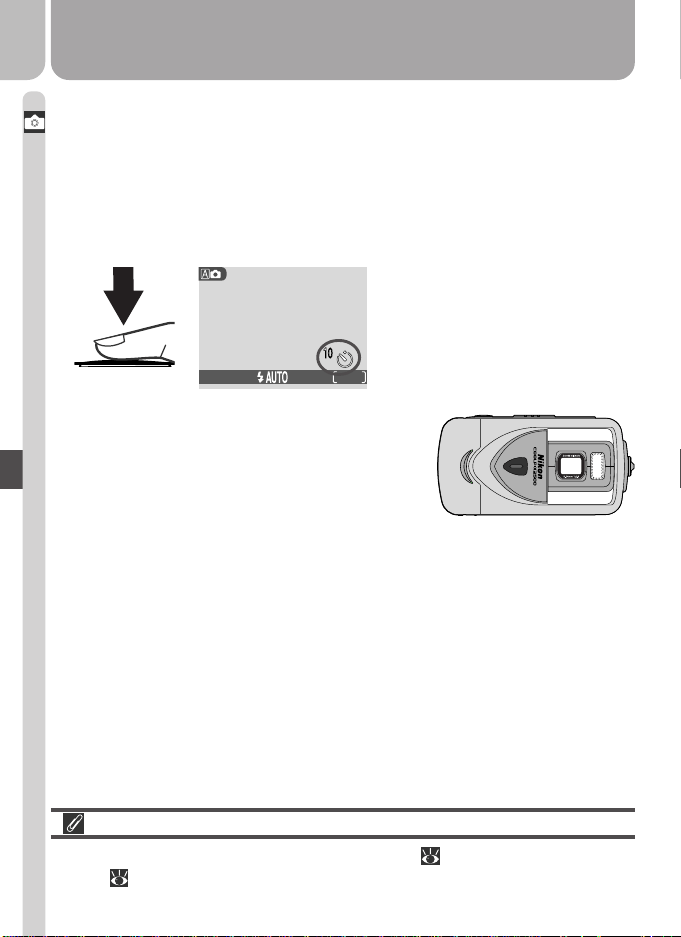
56
Taking Pictures—Beyond Point-and-Shoot
3
Compose the picture
Adjust camera settings and frame the picture. Remember that the camera
will focus on the closest object; compose your picture with no other ob-
jects between your subject and the camera.
4
Start the timer
Press the shutter-release button all the way down to lock focus and acti-
vate the timer.
The self-timer lamp on the front of the camera
will start to blink when the shutter-release but-
ton is pressed, and continue to blink until one
second before the photo is taken. The self-
timer lamp will stay lit during the final second
to warn that the shutter is about to be released.
To stop the timer before a picture is taken, press
the shutter-release button.
Restrictions on the Self-Timer
The self-timer is not available in movie mode ( 52) or when Fireworks
Show ( 39) is selected in scene mode.
Full press
Count-down timer in monitor shows
number of seconds remaining until
picture is taken
1600
15
NORMAL
I
I
I
I
I
I
I
I
I
I
I
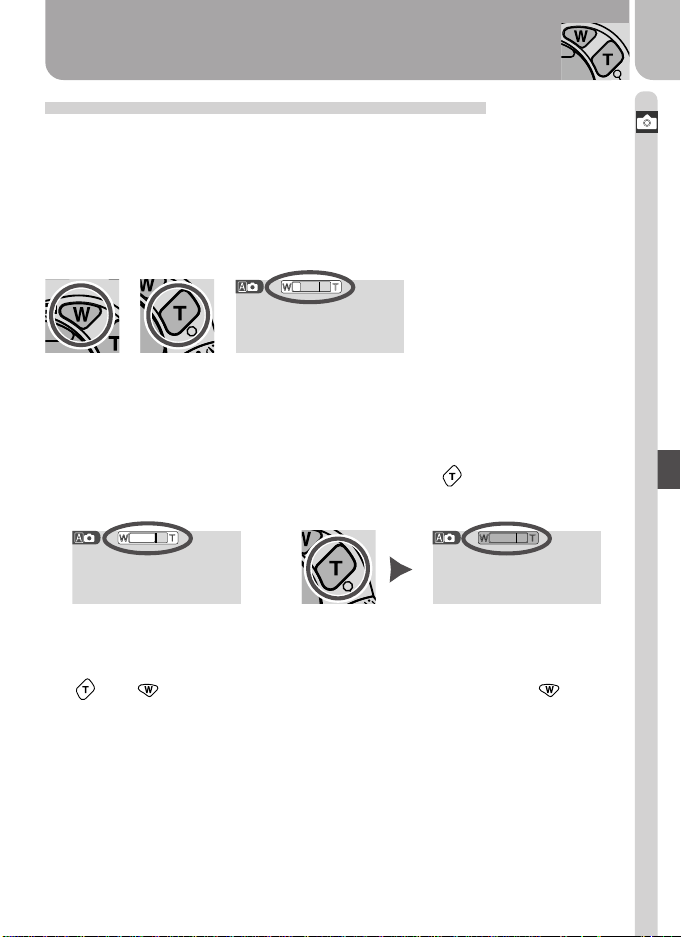
57
Taking Pictures—Beyond Point-and-Shoot
Framing Pictures: Optical and Digital Zoom
Your Nikon digital camera offers two kinds of zoom: optical zoom, in which
the camera’s telescoping lens can be used to magnify the subject up to 3 ×,
and digital zoom, in which digital processing is used to further magnify the
image up to 4 ×.
Optical Zoom
Photos can be framed in the monitor using the zoom buttons.
Optical zoom is not available in movie mode, although digital zoom can be
used to magnify the subject up to about 3 ×.
Digital Zoom
At the maximum optical zoom position, holding the button down for two
seconds triggers digital zoom.
The camera can be zoomed in and out in the digital zoom range by pressing
the
and buttons. To restore ordinary optical zoom, press until the
zoom indicator turns white.
In digital zoom, data from the camera’s image sensor are processed digitally,
enlarging the center portion of the picture to fill the frame. Unlike optical
zoom, digital zoom does not increase the amount of detail visible in the pic-
ture. Instead, details visible at maximum optical zoom are enlarged, produc-
ing a slightly “grainy” image. While digital zoom is in effect, the camera
focuses on the subject in the center of the frame, even if objects in other
areas of the frame are closer to the camera.
Zoom out Zoom in
Indicator in monitor displays
amount of zoom while either
button is pressed
Maximum optical zoom
position
Zoom indicator turns yellow
in digital zoom range
Hold for 2 s
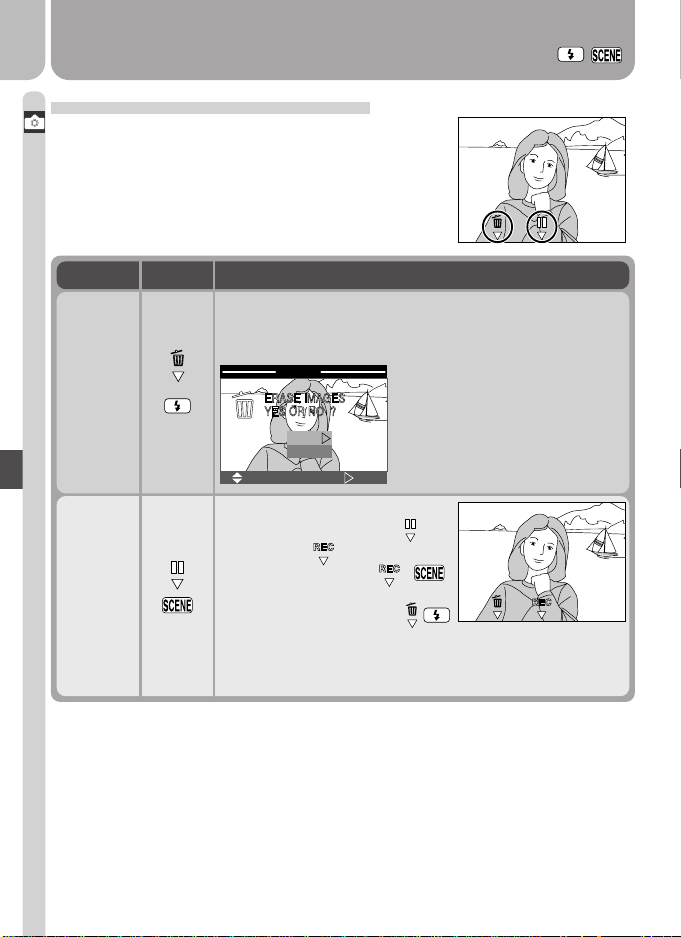
58
Taking Pictures—Beyond Point-and-Shoot
Keep or Delete: Picture Review
After each shot, the picture you have just taken
will be displayed briefly in the monitor until being
recorded to the memory card. The following op-
erations can be performed while the picture is dis-
played:
To Press Description
Delete
picture
A confirmation dialog will be displayed. Press multi
selector up or down to highlight option, press to right
to select.
•Select No to save picture and
return to shooting mode
•Select Yes to delete picture
DELETE
No
Yes
SELECT SET
Pause
display
Display will be paused for ten
seconds and pause icon ( ) will
change to . During this
time, you can press ( )
to record picture and return to
shooting mode, or press
to delete photo as described above. Picture will be
recorded automatically if no operations are performed
for ten seconds.
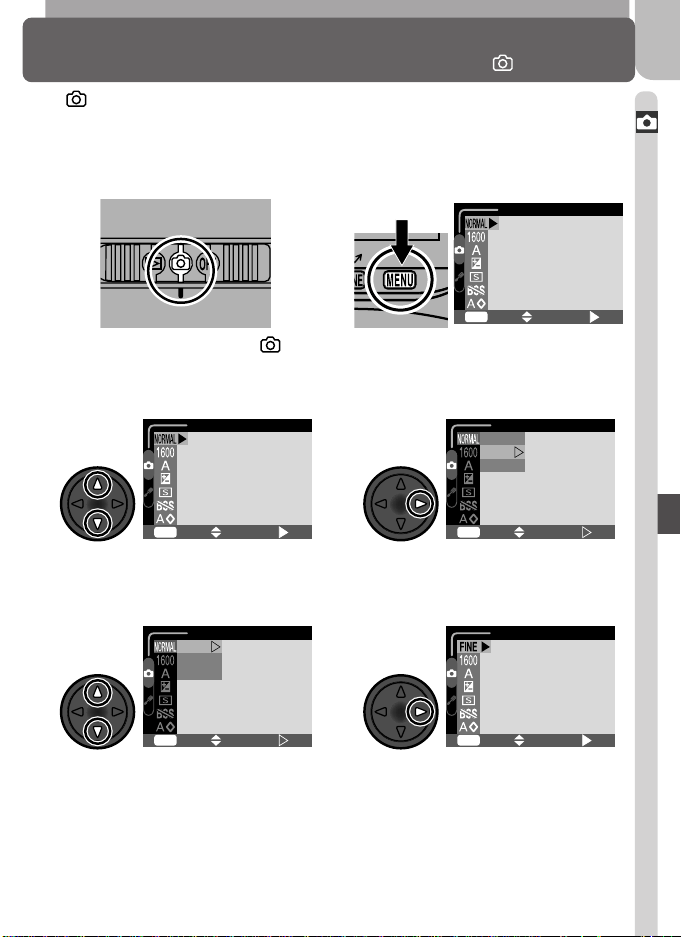
59
Taking Pictures—Fine-Tuning Camera Settings
Fine-Tuning Camera Settings
The -Mode Menu
In mode, changes to some settings are made with the help of a SHOOT-
ING menu that appears when the MENU button is pressed.
To make selections from the SHOOTING menu:
Slide mode selector to
1
Press MENU button to display
menu for current mode
2
IMAGE QUALITY
MENU
SELECT
SET
OFF
To exit the menu and return to shooting mode, press the MENU button.
Make selection
Highlight menu item
3
6
Highlight option
(to return to previous menu, press
multi selector to left)
5
IMAGE QUALITY
MENU
SELECT
SET
OFF
IMAGE QUALITY
MENU
SELECT
SET
OFF
MENU
SELECT
SET
OFF
IMAGE QUALITY
FINE
NORMAL
BASIC
Display options
4
IMAGE QUALITY
FINE
NORMAL
BASIC
MENU
SELECT
SET
OFF
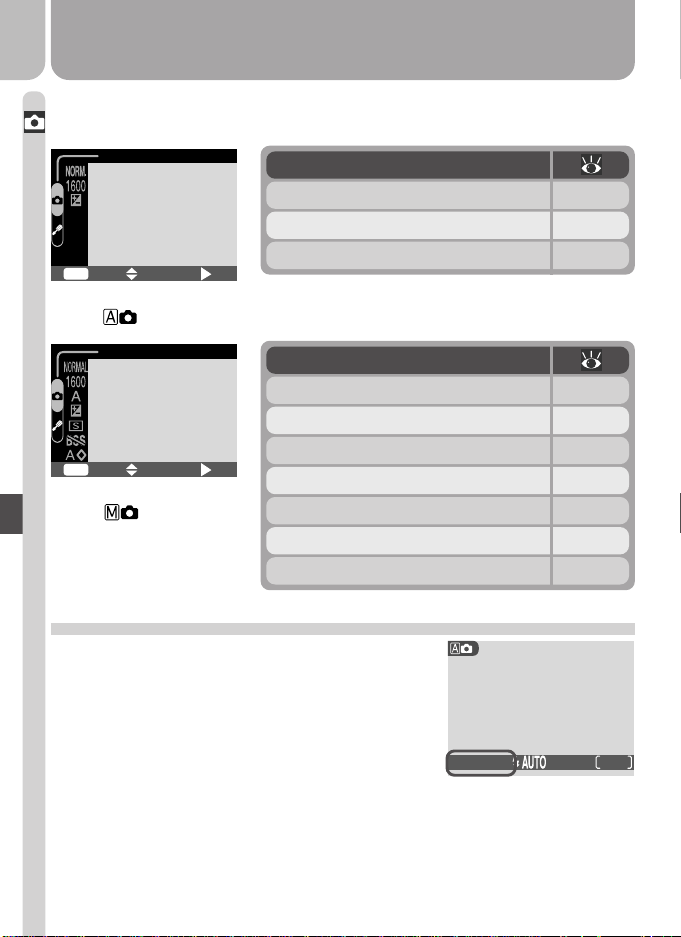
60
Taking Pictures—Fine-Tuning Camera Settings
Making Effective Use of Memory: Image Quality and Size
Together, image quality and size determine how
much space each picture occupies on the memory
card, which in turn determines the total number
of pictures that can be stored. The current image
size and quality are shown in the monitor.
The options available in the SHOOTING menu depend on the shooting mode
selected. No menu is available in movie mode.
Shooting menu
( , scene)
Shooting menu
( mode)
SHOOTING MENU
MENU
SELECT
SET
OFF
Option
IMAGE QUALITY 61
IMAGE SIZE 62
WHITE BALANCE 64–65
EXP. +/– 63
CONTINUOUS 66
BEST SHOT SELECTOR 67
IMAGE SHARPENING 68
SHOOTING MENU
MENU
SELECT
SET
OFF
Option
IMAGE QUALITY
IMAGE SIZE
EXP. +/–
61
62
63
1600
15
NORMAL
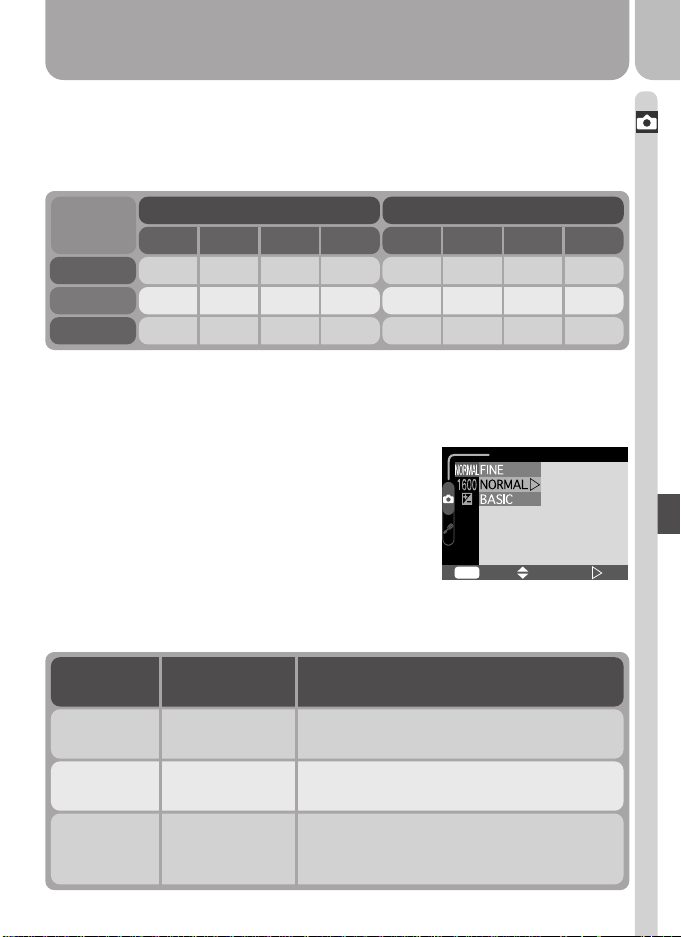
61
Taking Pictures—Fine-Tuning Camera Settings
IMAGE QUALITY
MENU
SELECT
SET
OFF
Option Description
FINE
Fine image quality, suitable for enlarge-
ments or high-quality prints.
BASIC
Basic image quality, suitable for pictures
that will be distributed by e-mail or used in
web pages.
NORMAL
Normal image quality, suited to most ap-
plications.
FINE
NORMAL
BASIC
8
15
29
1600
12
23
43
1280
18
34
60
1024
43
71
113
640
16
31
59
1600
24
47
86
1280
37
69
121
1024
86
144
229
640
8-MB memory card 16-MB memory card
*Figures are approximate. File size of JPEG images depends on scene record-
ed, producing wide variations in number of images that can be stored.
Image Quality
To reduce the amount of memory that each shot
occupies, pictures are compressed as they are saved
to the memory card. Compression selectively re-
duces the quality of the image; the more the pic-
ture is compressed, the more noticeable this loss
of quality is likely to be (the actual effect depends
on the size of the picture when printed or dis-
played and on the type of subject). The image-quality menu allows you to
choose the amount of compression performed.
To get an idea of how different settings for image quality and size affect the
number of pictures that can be stored, view the table below, which shows the
approximate number of pictures that can be stored on eight- and sixteen-
megabyte memory cards at different combinations of image quality and size.
Compression
ratio (approx.)
1:4
1:16
1:8
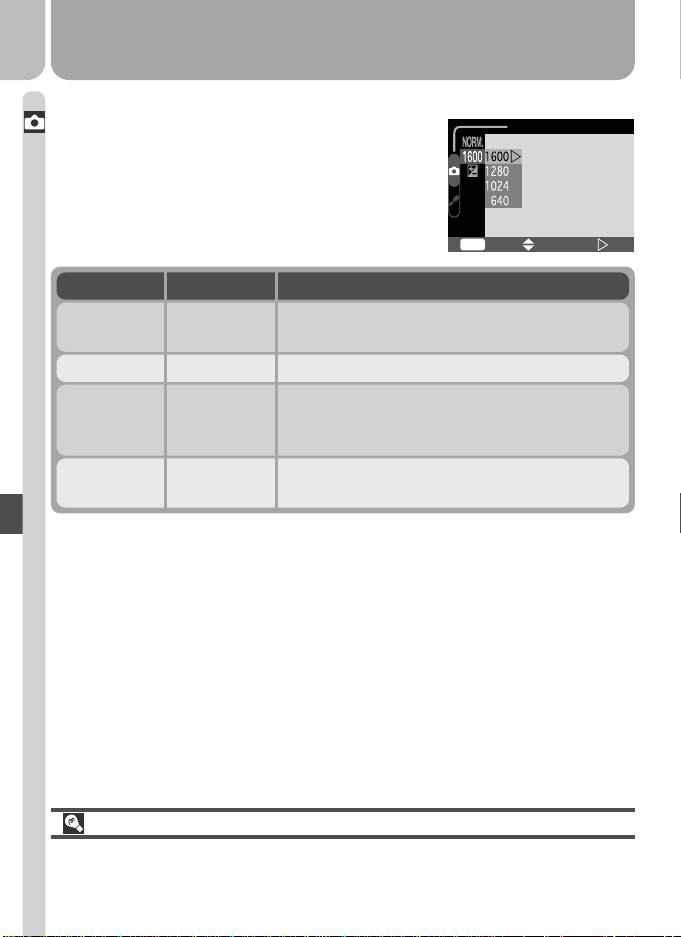
62
Taking Pictures—Fine-Tuning Camera Settings
1280 Suited to postcard-size prints.1,280 × 960
Option DescriptionSize (pixels)
1600
Suited to print sizes ranging from large photo
album through to A5 (roughly 8˝ × 6˝).
1,600 ×1,200
1024
Suited to printing at smaller sizes (for exam-
ple, as an illustration in a letter or report), or
to display on monitors 17˝ or larger.
1,024 × 768
640
Can be displayed full screen on 13˝ monitors.
Suited to distribution by e-mail or the web.
640 × 480
IMAGE SIZE
MENU
SELECT
SET
OFF
Image Size
Image size refers to the physical dimensions of the
image, measured in pixels. Choose an image size
according to the space available on the memory
card and the task at hand.
Print Size
The size of pictures when printed depends on the resolution of the printer
(the higher the resolution, the smaller the final print size).
Print sizes assume a printer resolution of approximately 200 dpi.
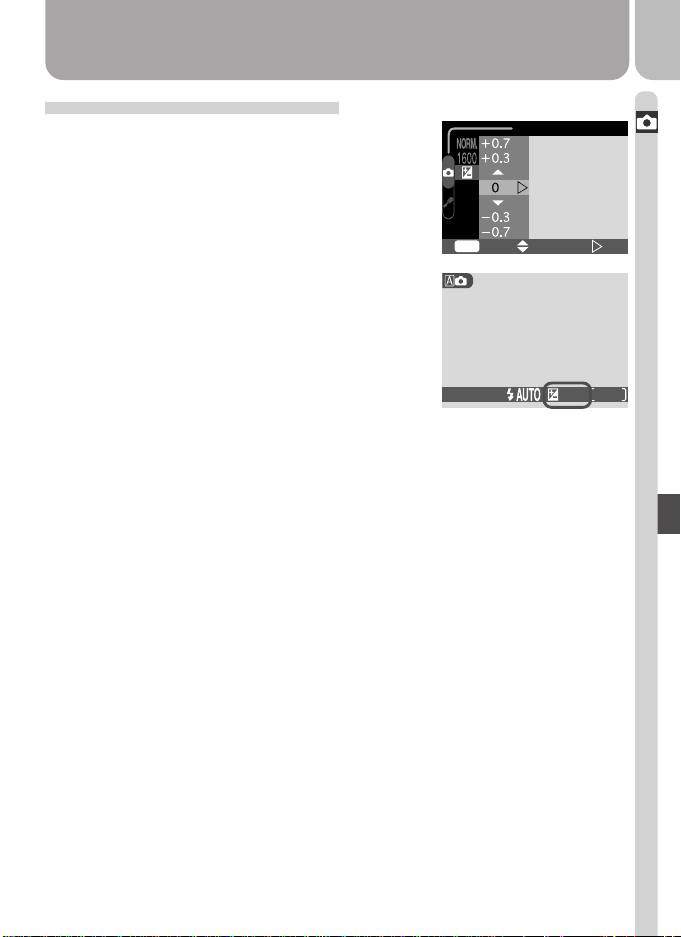
63
Taking Pictures—Fine-Tuning Camera Settings
Adjusting Exposure: Exp. +/–
The Exp. +/– (exposure compensation) menu al-
lows you to alter exposure from the value sug-
gested by the camera, making pictures brighter
or darker.
EXP.
+
/
–
MENU
SELECT
SET
OFF
1600
15
NORMAL
+0.3
At values other than ±0, exposure compensation
is shown in the monitor.
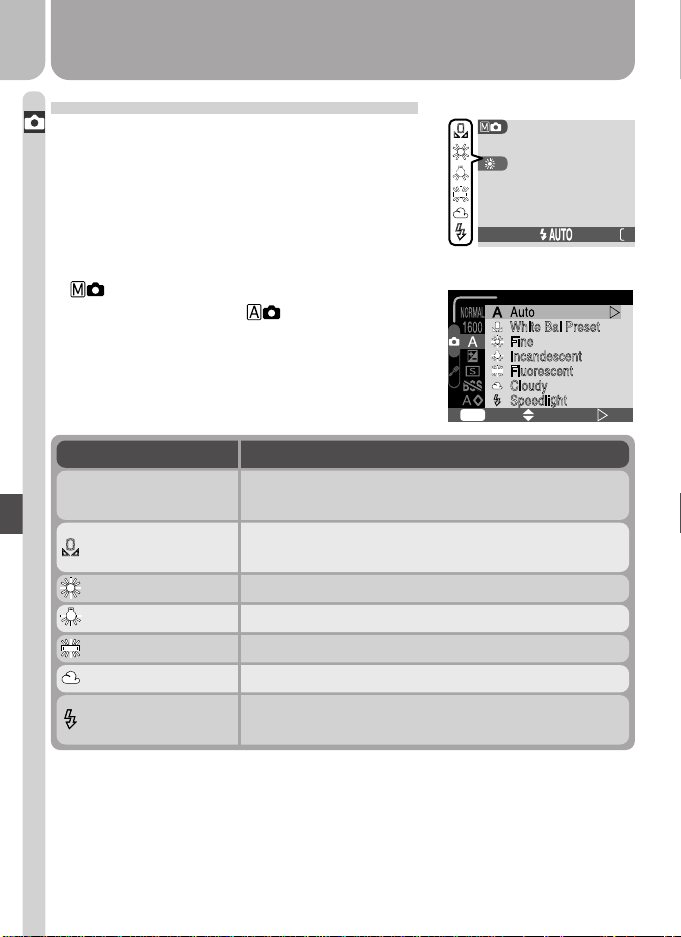
64
Taking Pictures—Fine-Tuning Camera Settings
1600
NORMAL
Keeping Colors True: White Balance
White balance is used to preserve natural colors
under different types of lighting. At settings other
than Auto, the current white balance setting is
shown in the monitor.
WHITE BALANCE
MENU
SELECT
SET
OFF
Option Description
AutoA
White balance automatically adjusted to suit light-
ing conditions. Best choice in most circumstances.
White Bal Preset
White object used as reference to set white bal-
ance under unusual lighting conditions.
Fine White balance adjusted for direct sunlight.
Incandescent For use with incandescent lighting.
Fluorescent For use with most types of fluorescent lighting.
Cloudy Use for pictures taken under cloudy skies.
Speedlight
White balance adjusted to match light produced
by flash.
Choosing a White Balance Setting
In mode, white balance can be chosen from
the following options (in and scene modes,
white balance is adjusted automatically):
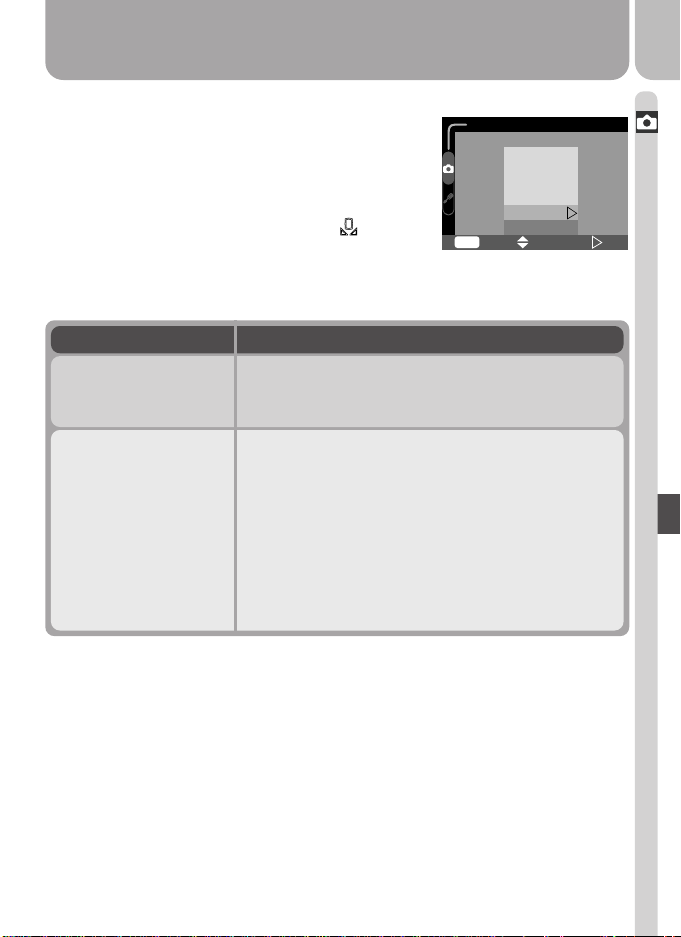
65
Taking Pictures—Fine-Tuning Camera Settings
Preset White Balance
Preset white balance is used to adjust white bal-
ance when shooting under mixed lighting or to
compensate for light sources with a strong color
cast (for example, to make pictures taken under a
lamp with a red shade look as though they had
been taken under white light). When (White
Bal Preset) is selected from the white-balance
menu, the camera will zoom in and the menu
shown at right will be displayed in the monitor.
Option Description
Cancel
Recalls the most recent setting for preset white
balance from memory and sets white balance to
this value.
Measure
To measure a new value for white balance, place a
white object, such as a piece of paper, under the
lighting that will be used in the final photograph.
Frame this object so that it fills the square in the
center of the menu shown above. Highlight Mea-
sure and press the multi selector to the right to
measure a new value for white balance (shutter will
be released and camera will return to original zoom
position, but no picture will be recorded).
Cancel
Measure
WHITE BALANCE PRESET
MENU
SELECT
SET
OFF
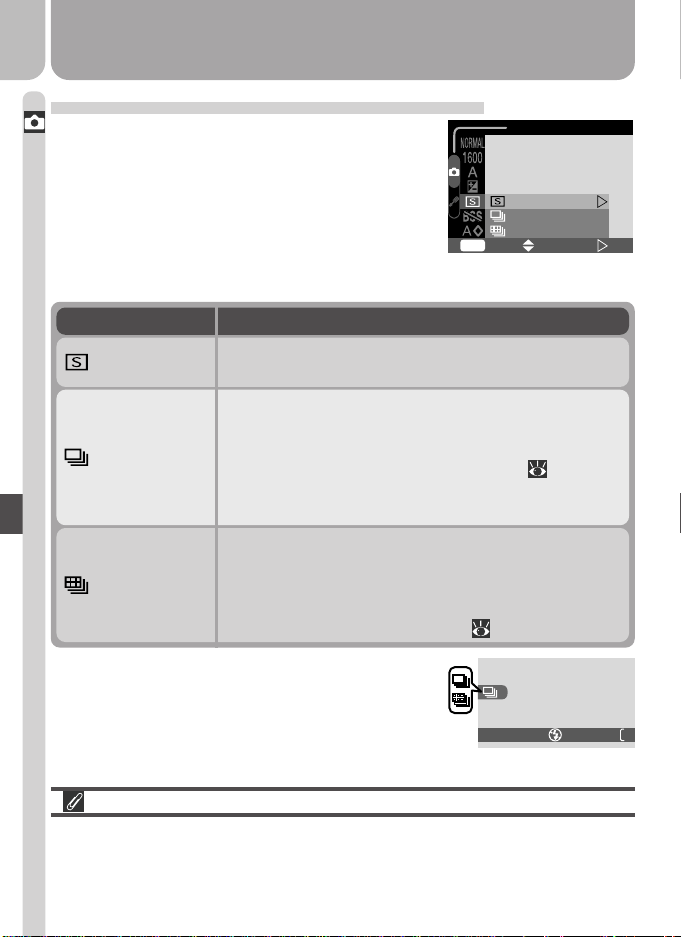
66
Taking Pictures—Fine-Tuning Camera Settings
Taking Pictures in a Sequence: Continuous
The options in the “continuous” menu are used
to take pictures in a continuous sequence. This
can be useful when, for example, you are trying
to capture a fleeting expression on a portrait sub-
ject, or photograph a subject that is moving un-
predictably. With the Multi-Shot 16 option, you
can record movement in a single picture consist-
ing of sixteen consecutive frames.
CONTINUOUS
Continuous
Multi-Shot 16
Single
MENU
SELECT
SET
OFF
Flash, Focus Exposure, and White Balance
At settings of Continuous and Multi-Shot 16, the flash turns off, and focus
distance, exposure, and auto white balance are determined by the first pic-
ture in each series.
Option Description
Camera takes one picture each time the shutter-re-
lease button is pressed all the way down.
Single
While the shutter-release button is held down, pic-
tures are recorded at a rate of about three frames ev-
ery two seconds. The camera will continue to take
pictures even when the memory buffer ( 29) is full,
although the rate at which pictures are recorded will
drop.
Continuous
Each time the shutter-release button is pressed, the
camera takes sixteen consecutive “thumbnail” imag-
es 400 × 300 pixels in size and combines them into a
collage measuring 1,600 × 1,200 pixels. This option
is only available when image size ( 62) is set to 1600.
Multi-Shot 16
At settings other than Single, the current “con-
tinuous” setting is indicated by an icon in the moni-
tor.
1600
NORMAL
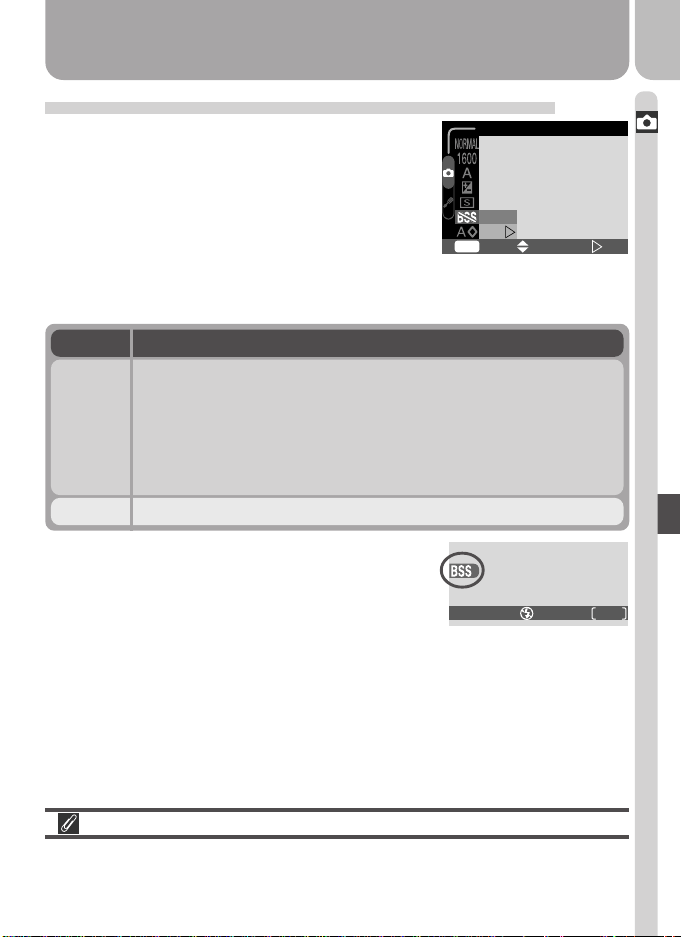
67
Taking Pictures—Fine-Tuning Camera Settings
Getting Sharper Pictures: BSS (Best Shot Selector)
The “Best Shot Selector” (BSS) is recommended for
situations in which inadvertent camera movement
can produce blurred pictures, for example when:
• the camera is zoomed in
• the flash can not be used although lighting is
poor
BEST SHOT SELECTOR
On
Off
MENU
SELECT
SET
OFF
Option Description
Off BSS off; camera functions normally.
On
Camera takes photos as long as the shutter-release button is
held down, to a maximum of ten. These images are then com-
pared and the sharpest photo (the image with the highest level
of detail) saved to the memory card. The flash turns off, and
focus distance, exposure, and auto white balance are determined
by the first photograph in the series.
Restrictions on BSS
BSS is not available at CONTINUOUS settings other than Single. Selecting
Continuous or Multi-Shot 16 automatically cancels BSS.
When BSS is on, a BSS icon appears in the monitor.
BSS may not produce the desired results with a moving subject or if you change
the composition while the shutter-release button is pressed all the way down.
1600
15
NORMAL
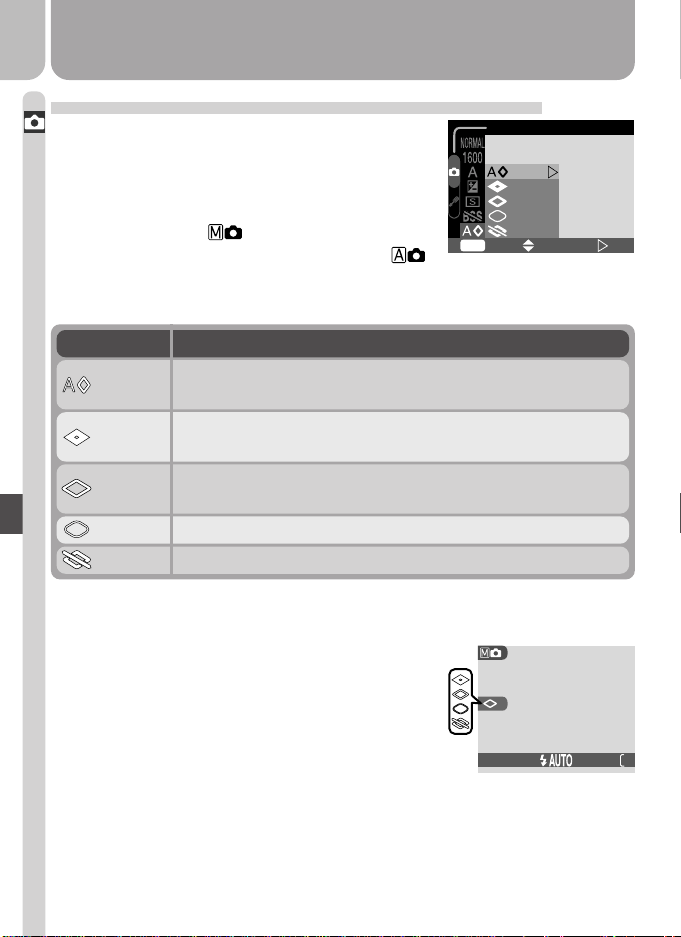
68
Taking Pictures—Fine-Tuning Camera Settings
Option Description
Making Edges More Distinct: Image Sharpening
The camera automatically emphasizes the borders
between light and dark areas of each picture, mak-
ing the image seem sharper. The effects are too
subtle to be seen in the camera monitor, but are
visible when the picture is viewed on a computer
monitor or printed. mode gives you control
over the amount of sharpening performed (in
and scene modes, the camera adjusts sharpening
according to the subject).
Auto
Camera sharpens edges for optimal results; adjustment per-
formed differs from image to image.
High
Image processed to increase sharpness, making edges more
distinct.
Normal
Camera performs same standard level of sharpening on all
images.
Low Amount of sharpening reduced below normal level.
Off No sharpening performed.
IMAGE SHARPENING
A
u
to
High
No
r
m
al
Lo
w
O
ff
MENU
SELECT
SET
OFF
1600
NORMAL
When taking pictures that will later be retouched, choose settings of Normal
or Low.
At settings other than Auto, an image-sharpening
icon appears in the monitor.

69
Camera
Setup
The SET-UP Menu
This chapter details the options available in the SET-
UP menu, where you can adjust basic camera set-
tings and perform such tasks as formatting memory
cards and restoring settings to their default values.
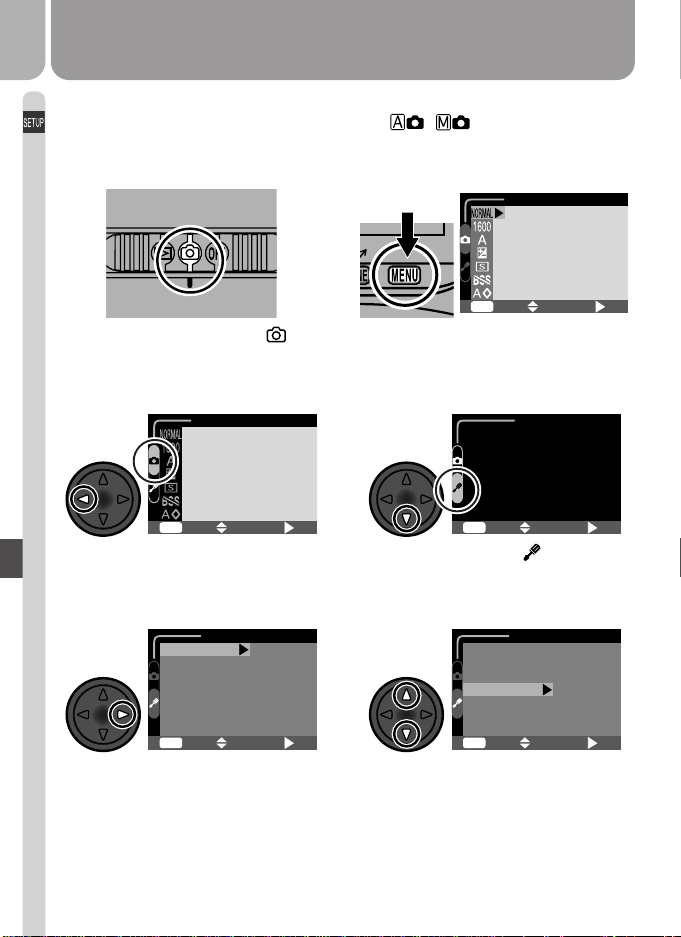
70
Camera Setup
IMAGE QUALITY
MENU
SELECT
SET
OFF
Slide mode selector to
12
Press MENU button to display menu
for current shooting mode
The SET-UP menu contains options for basic camera setup. The SET-UP menu
is accessed from the SHOOTING menu for , , or scene mode (no
menu is available in movie mode). To make a selection from the SET-UP menu:
Highlight page tab (selected page
tab highlighted in green)
3
Highlight
4
SHOOTING MENU
MENU
SELECT
SET
OFF
Brightness
CF Card Format
Date
Auto Off
Language
USB
Reset All
SET-UP
MENU
SELECT
SET
OFF
Display SET-UP menu
5
BRIGHTNESS
Brightness
CF Card Format
Date
Auto Off
Language
USB
Reset All
MENU
SELECT
SET
OFF
Highlight menu item
6
Brightness
CF Card Format
Date
Auto Off
Language
USB
Reset All
AUTO OFF
MENU
SELECT
SET
OFF
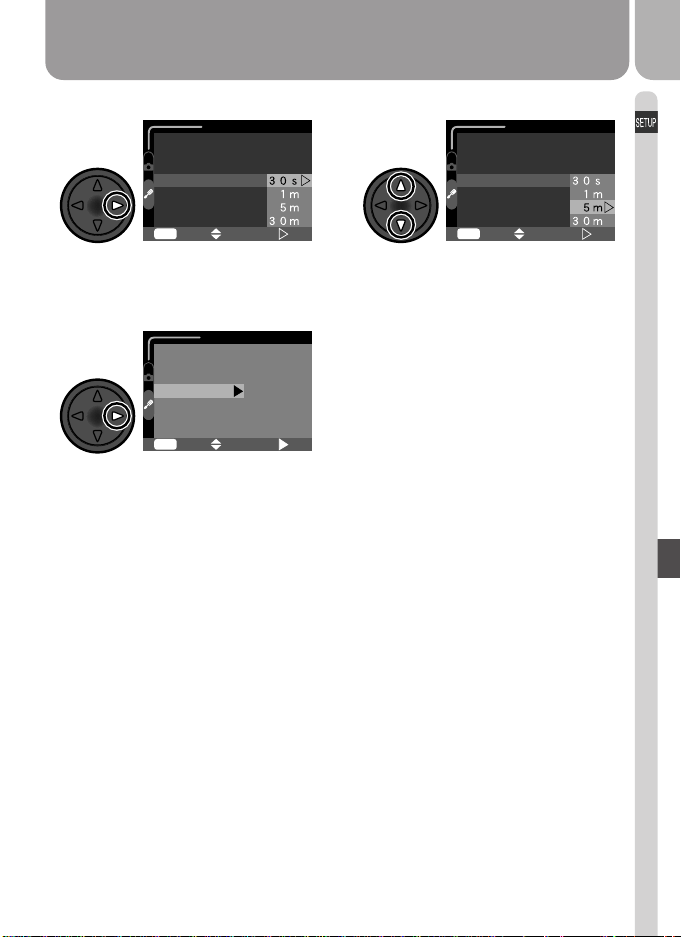
71
Camera Setup
Display options
7
Highlight option
(to return to previous menu, press
multi selector to left)
8
Brightness
CF Card Format
Date
Auto Off
Language
USB
Reset All
AUTO OFF
MENU
SELECT
SET
OFF
Brightness
CF Card Format
Date
Auto Off
Language
USB
Reset All
AUTO OFF
MENU
SELECT
SET
OFF
Make selection
9
Brightness
CF Card Format
Date
Auto Off
Language
USB
Reset All
AUTO OFF
MENU
SELECT
SET
OFF
To exit the menu and return to shoot-
ing mode, press the MENU button.
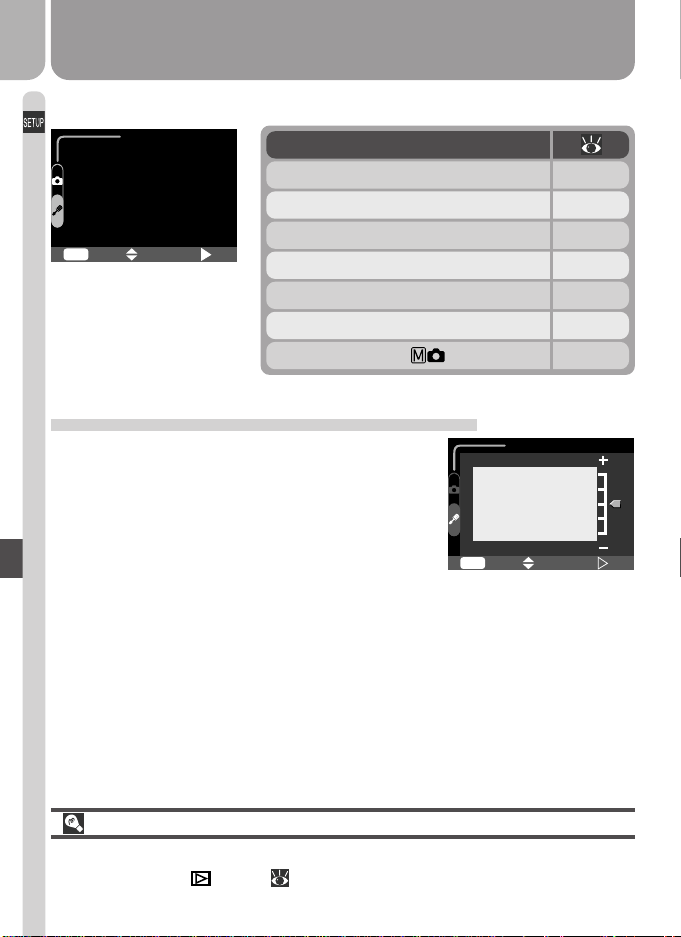
72
Camera Setup
SET-UP Menu Options
The Brightness and CF Card Format options can also be accessed from the
playback menu in mode ( 85).
Adjusting Monitor Brightness: Brightness
This option controls monitor brightness. Press the
multi selector up or down to increase or decrease
the brightness of the monitor by moving the ar-
row to the right of the display up or down.
BRIGHTNESS
MENU
SELECT
SET
OFF
The SET-UP menu contains the following options:
Brightness
CF Card Format
Date
Auto Off
Language
USB
Reset All
SET-UP
MENU
SELECT
SET
OFF
Option
Brightness 72
CF Card Format 73
Date 74
Auto Off 74
Language 75
USB 75
Reset All ( only) 76
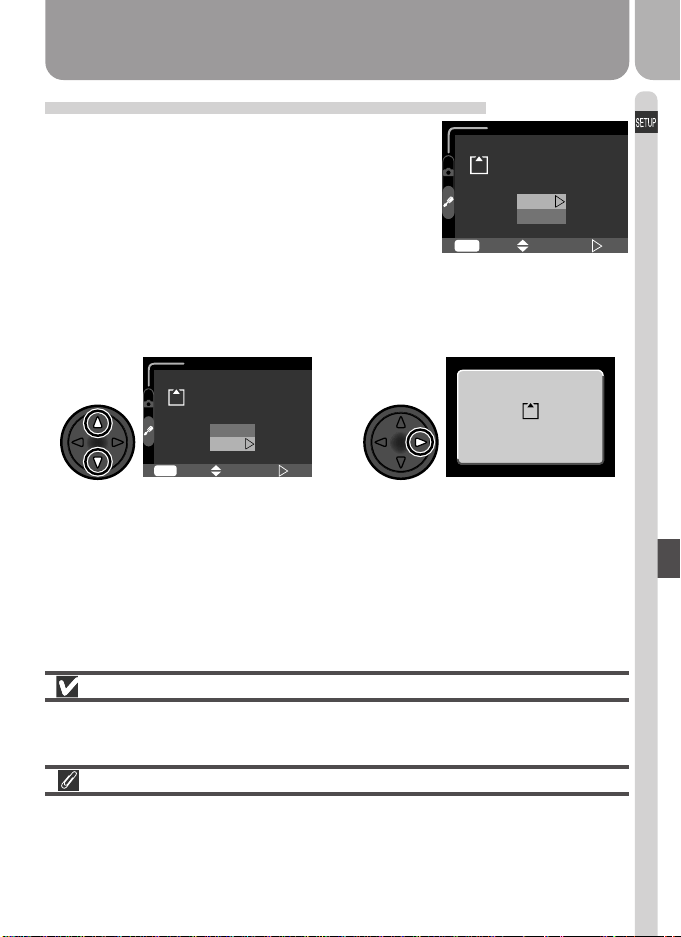
73
Camera Setup
Formatting Memory Cards: CF Card Format
The memory card provided with your camera is
formatted at shipment. If you purchase additional
memory cards for added storage, you will how-
ever need to format the cards before first use to
ensure that they work properly in your camera.
Formatting memory cards is also an effective way
of deleting all pictures on the card.
Selecting CF Card Format from the setup or playback menus displays the
confirmation dialog shown above. To format the memory card:
MENU
SELECT
SET
OFF
WARNING !
All images will
be deleted !
No
Format
CF CARD FORMAT
Highlight Format (to exit without
formatting card, highlight No and
press multi selector to right)
WARNING !
All images will
be deleted !
No
Format
CF CARD FORMAT
MENU
SELECT
SET
OFF
1
Press multi selector to right to start
formatting. Formatting begins
immediately. While formatting is in
progress, the message shown above
will be displayed.
FORMATTING
2
During Formatting
Do not remove the memory card, remove the battery, or unplug the
AC adapter (available separately) while formatting is in progress.
Before Formatting
Formatting memory cards permanently deletes all data they contain, includ-
ing protected pictures and any other data that may be on the card. Before
formatting, be sure to transfer to a computer any pictures you would like to
keep.
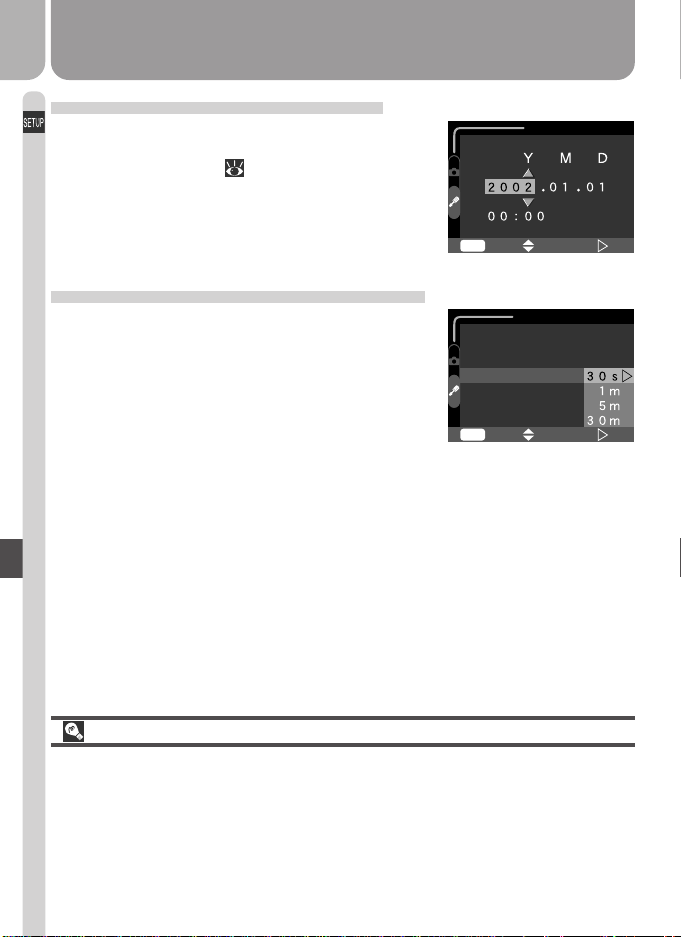
74
Camera Setup
Setting the Time and Date: Date
This option is used to set the camera to the cur-
rent date and time. For more information, see
“Tutorial: First Steps” ( 22).
DATE
MENU
SELECT
SET
OFF
Conserving Battery Power: Auto Off
When operated on battery power, the camera will
enter sleep mode if no operations are performed
for thirty seconds (or three minutes when menus
are displayed). The time limit for sleep mode can
be chosen from thirty seconds (30 s), one minute
(1m), five minutes (5m), and thirty minutes (30 m)
using Auto Off.
Sleep Mode (Auto Off)
In sleep mode, the camera itself is effectively off, consuming almost no power.
The camera can be reactivated by pressing the shutter-release button or slid-
ing the mode selector to a new position.
When powered by the EH-60 AC adapter (available separately), the camera
will remain on for thirty minutes if no operations are performed, regardless of
the setting in the Auto Off menu.
Brightness
CF Card Format
Date
Auto Off
Language
USB
Reset All
AUTO OFF
MENU
SELECT
SET
OFF
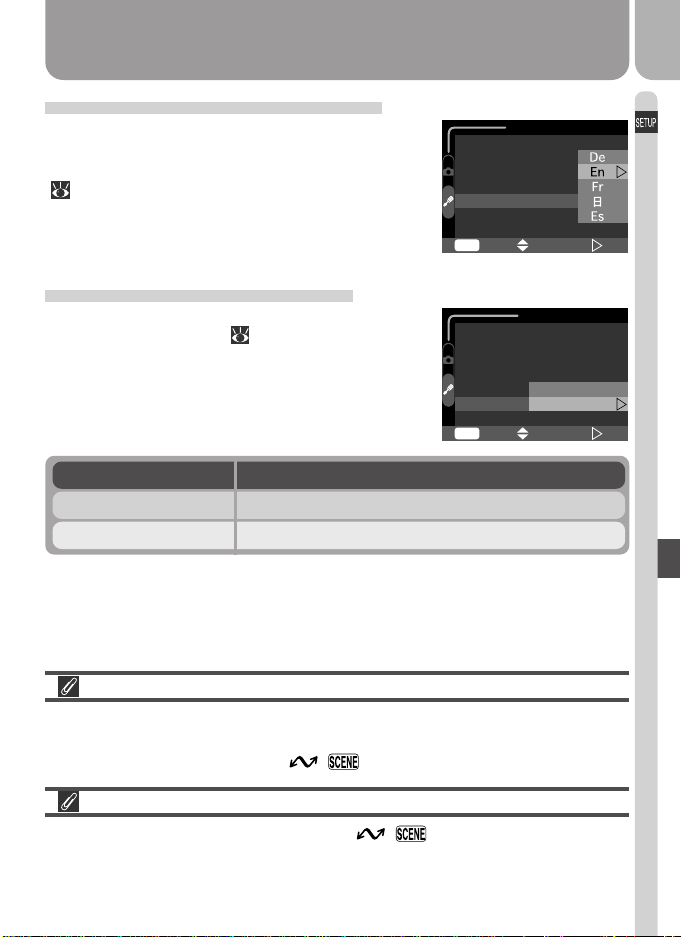
75
Camera Setup
Brightness
CF Card Format
Date
Auto Off
Language
USB
Reset All
LANGUAGE
MENU
SELECT
SET
OFF
Choosing a Language: Language
This option is used to choose the language in which
camera menus and messages are displayed. For
more information, see “Tutorial: First Steps”
( 20).
Brightness
CF Card Format
Date
Auto Off
Language
USB
Reset All
USB
PTP
Mass Storage
MENU
SELECT
SET
OFF
Choosing a USB Protocol: USB
Before pictures can be copied to a computer via
direct USB connection ( 44), you will need to
select a USB transfer protocol that matches that
used by your computer’s operating system. Your
camera supports two protocols: PTP (Picture Trans-
fer Protocol) and Mass Storage.
Protocol Description
PTP Choose Picture Transfer Protocol.
Mass Storage Choose the Mass Storage transfer protocol.
Windows XP
If PTP is selected in the USB menu when the camera is connected to a com-
puter running Windows XP Home Edition or Windows XP Professional, an
error will be displayed when the ( ) button is pressed to begin transfer.
Mac OS X
Pictures can not be transferred using the ( ) button in Mac OS X. Use
Nikon View 5 to transfer pictures. See the Nikon View 5 Reference Manual
(on CD) for details.
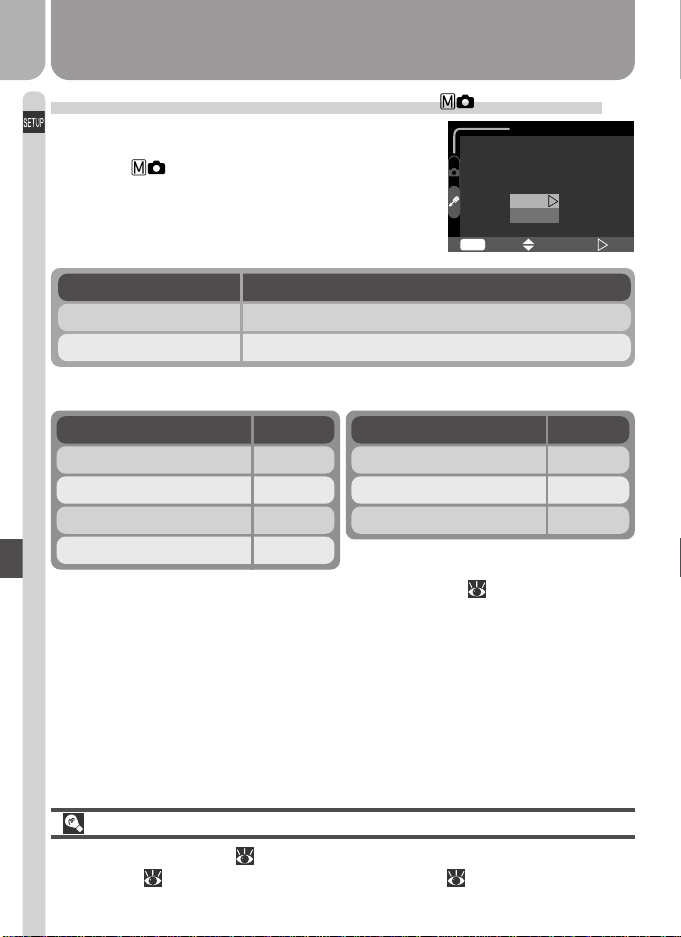
76
Camera Setup
Restoring Default Settings: Reset All ( Mode Only)
Reset All is used to reset settings to their default
values. This option is only available in the SET-UP
menu for mode, but resets settings for all
modes.
Choosing Reset restores the settings listed below to their default values.
RESET ALL
Reset all settings
to default values
No
Reset
MENU
SELECT
SET
OFF
Resetting File Numbering to 0001
To reset file numbering ( 49) to 0001, select Reset All after either deleting
all pictures ( 87) or formatting the memory card ( 73).
Choosing Reset also clears the current file number ( 49) from memory.
Numbering will continue from the lowest number available on the memory
card. All other settings are unaffected.
DefaultSetting DefaultSetting
±0Exposure compensation
SingleContinuous
OffBest Shot Selector
AutoImage sharpeningAutoWhite balance
3Monitor brightness
30 sAuto off
Option Description
No Exit menu, leaving settings unchanged.
Reset Restore settings to default values.
77
The Playback Menu
85–91
Basic Playback
78–84
Playing
Pictures Back
Playback Mode
This section details the operations that can be per-
formed when the mode selector is set to . It is
divided into the following two sections:
Basic Playback
This section covers playback operations that can be
performed using the buttons on the back of the
camera and the multi selector.
The Playback Menu
Read this section for a description of the operations
that can be performed in the playback menu.
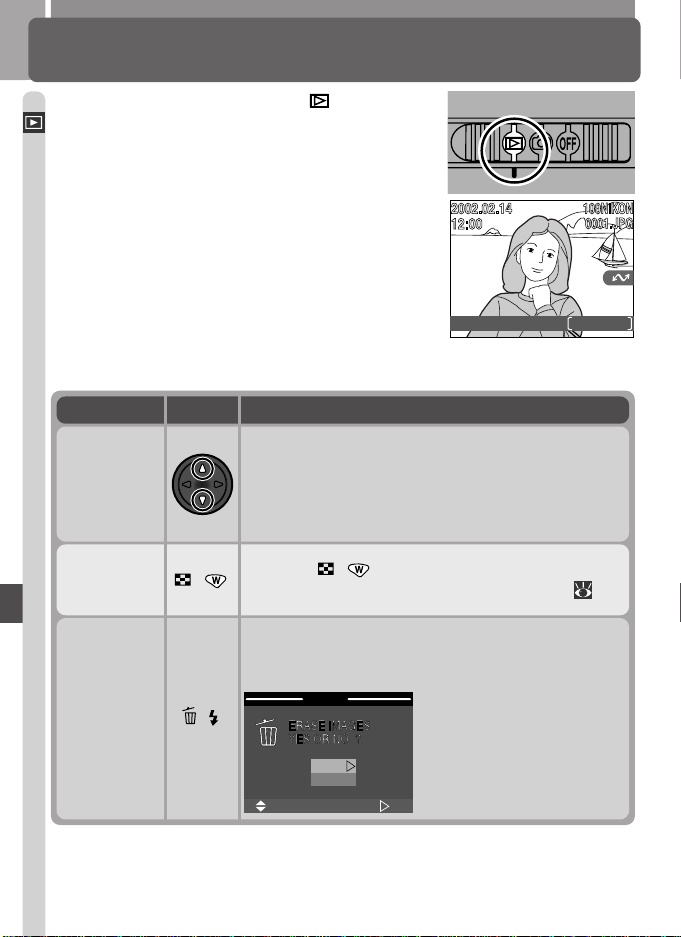
78
Playing Pictures Back—Basic Playback
When the mode selector is set to , the camera
enters playback mode with the most recent pic-
ture displayed in the monitor.
Basic Playback
Full-Frame and Thumbnail Playback
1/0011
1600
NORMAL
Press the multi selector up to view pictures record-
ed before the current photo, down to view pictures
recorded after the current photo. Keep multi se-
lector pressed to scroll rapidly to the desired frame
number.
View other
pictures
View
multiple
pictures
( )
Press the ( ) button to display up to nine pic-
tures at a time as small thumbnail previews ( 80).
Press DescriptionTo
The following operations can be performed in playback mode:
( )
A confirmation dialog will be displayed. Press multi
selector up or down to highlight option, press to
right to select.
•Select No to exit without
deleting picture
•Select Yes to delete
picture
Delete
current
picture
DELETE
No
Yes
SELECT
SET
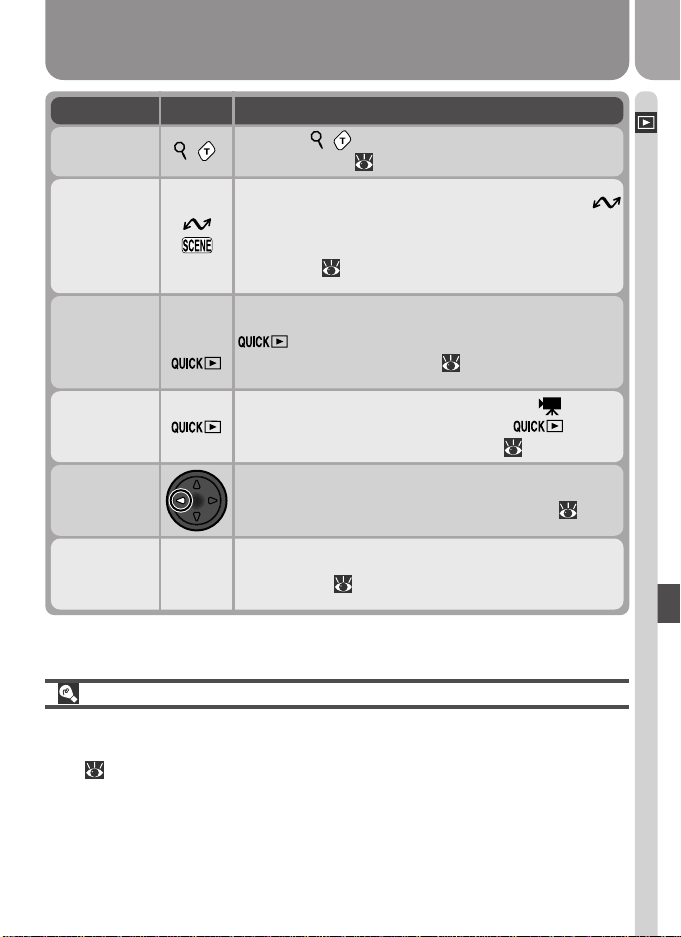
79
Playing Pictures Back—Basic Playback
Press multi selector to left to hide or display photo
info superimposed on picture in monitor ( 7).
Hide or
display
photo info
MENU
Press the MENU button to display or hide the play-
back menu ( 85).
Display
playback
menu
Press DescriptionTo
( )
Press the ( ) button for an enlarged view of the
current photo ( 81).
Zoom
photo in
( )
Pictures selected for transfer are marked with a
icon. Turn this marking on or off to select the pic-
tures that will be transferred to a computer at a
later date ( 44).
Select
current
picture for
transfer to a
computer
SMALL
PIC.
( )
If the current picture is a photograph, pressing the
button will create a small copy (320 × 240)
for electronic distribution ( 82).
Create small
copy of
current
picture
If the current picture is marked with a icon to
show that it is a movie, pressing the button
starts and pauses movie playback ( 84).
Play movie
back
Image File and Folder Names
Pictures taken with the COOLPIX 2500 are identified by file names that begin
with “DSCN” or, in the case of pictures created with the small picture func-
tion ( 82), “SSCN,” followed by a four-digit file number assigned automati-
cally by the camera. Each file name ends in a three-letter “extension” that
identifies the type of picture: “.JPG” for photographs and “.MOV” for mov-
ies. Picture files are stored in folders created automatically by the camera and
named with a three digit folder number followed by “NIKON” (e.g.,
“100NIKON”).
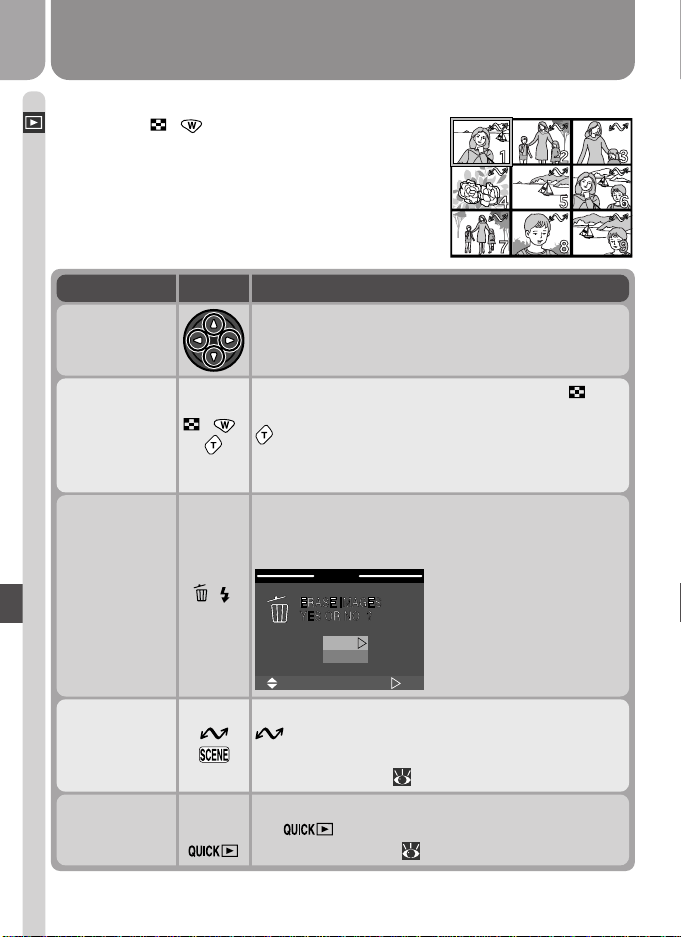
80
Playing Pictures Back—Basic Playback
Press the multi selector up, down, left, or right to
highlight thumbnails.
Highlight
pictures
Thumbnail Review
Pressing the ( ) button in full-screen review
displays a menu of four thumbnail images. The
following operations can be performed while
thumbnails are displayed:
( )/
With four thumbnails displayed, press the but-
ton once to view nine thumbnail images. Press
to “zoom in” from nine thumbnails to a four-
thumbnail view or, when four thumbnails are dis-
played, to view highlighted picture full size.
Change
number of
pictures
displayed
Press DescriptionTo
( )
Pictures selected for transfer are marked with a
icon. Turn this marking on or off to select
the pictures that will be transferred to a comput-
er at a later date ( 44).
Select high-
lighted picture
for transfer to
a computer
( )
A confirmation dialog will be displayed. Press multi
selector up or down to highlight option, press to
right to select.
•Select No to exit with-
out deleting picture
•Select Yes to delete
picture
Delete
highlighted
picture
DELETE
No
Yes
SELECT
SET
SMALL
PIC.
( )
If the current picture is a photograph, pressing
the button will create a small copy for elec-
tronic distribution ( 82).
Create small
copy of high-
lighted picture
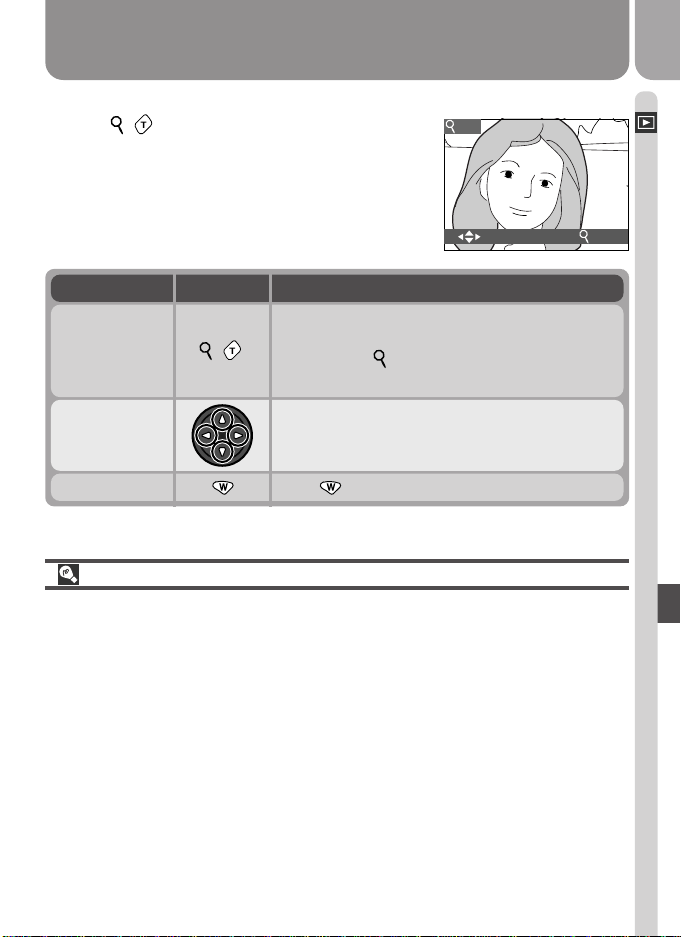
81
Playing Pictures Back—Basic Playback
Press the multi selector to scroll to areas of the
image not visible in the monitor.
View other
areas of image
Playback Tips
In single-image playback, pictures are displayed briefly at low resolution while
being read from the memory card. This makes it possible to scroll rapidly
through the pictures in memory without waiting for each image to be dis-
played at full resolution.
To scroll quickly to a particular frame number without viewing the intervening
pictures, press and hold the multi selector. The picture displayed will not
change, but the frame number displayed at the bottom right corner of the
monitor will increase or decrease rapidly. Release the multi selector when the
desired frame number is reached.
The first and last pictures in memory are linked. Pressing the multi selector up
when the first picture in memory is displayed will take you to the last picture.
Pressing the multi selector down when the last picture is displayed takes you
to the first picture.
Press to cancel zoom.Cancel zoom
Taking a Closer Look: Playback Zoom
Use the ( ) button to zoom in on photos dis-
played in single-image playback (playback zoom
can not be used with movies or copies created
with the small picture function).
DescriptionTo Press
Zoom increases each time button is pressed,
to a maximum of 6.0 ×. While image is
zoomed in, icon and zoom ratio are dis-
played in upper left corner of monitor.
Zoom photo in ( )
X2.0
SCROLL ZOOM
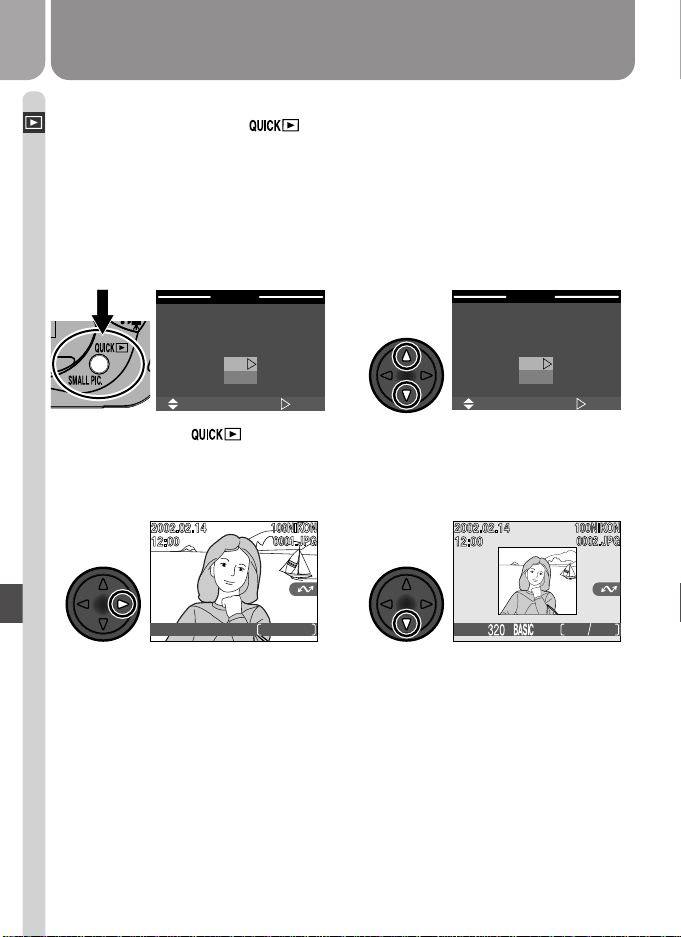
82
Playing Pictures Back—Basic Playback
Creating a Small Copy of a Picture: Small Picture
Pressing the SMALL PIC. ( ) button in full-frame or thumbnail playback
creates a small copy of the current picture. Copies are 320 × 240 pixels in size
and have an image quality of BASIC, making them ideal for distribution by e-
mail or for use in web pages.
To create a small copy of the picture currently displayed in full-frame play-
back, or the picture highlighted in thumbnail playback:
Small Pic
Creating small
Picture file ?
SELECT SET
Yes
No
Press SMALL PIC. ( ) button to
display confirmation dialog
Small Pic
Creating small
Picture file ?
SELECT SET
Yes
No
1
Highlight Yes (to exit without creat-
ing copy, highlight No and press
multi selector to right)
2
Create small copy and return to
playback mode with original picture
displayed
3
To view copy, press multi selector
down. Copy will have same time and
date of creation as original.
4
1/0011
1600
NORMAL
2/0012
83
Playing Pictures Back—Basic Playback
Once created, copies are independent of the original: deleting a copy has no
effect on the original, deleting the original no effect on the copy. Copies are
stored on the memory card as independent files with names of the form
“SSCNnnnn.JPG,” where “nnnn” is a four-digit number assigned automati-
cally by the camera. Copies will have the same transfer marking as the origi-
nals; print and protect attributes, however, must be set separately.
When displayed in full-frame playback and full-screen review, copies will oc-
cupy roughly one-quarter of the monitor and are surrounded by a gray frame.
In thumbnail playback and review, copies are indicated by a gray border. Copies
can not be viewed using playback zoom ( 81); pressing the ( ) button
when a copy is displayed has no effect.
Restrictions on Small Picture
The small picture function described in this section can not be used in quick
review.
Copies can not be created from movies. Additional copies of an image can
not be created from a small picture file; pressing the SMALL PIC. ( )
button when a copy is displayed will have no effect. Pressing the SMALL PIC.
button will also have no effect if there is not enough space for the copy on
the memory card.
The COOLPIX 2500 may not be able to create small copies from images taken
with another make of camera.
Viewing Small Picture Files on Other Cameras
Copies created with the small picture function may not display correctly when
viewed on other models of Nikon digital camera. You may also not be able to
transfer copies from other models of Nikon digital camera to a computer.
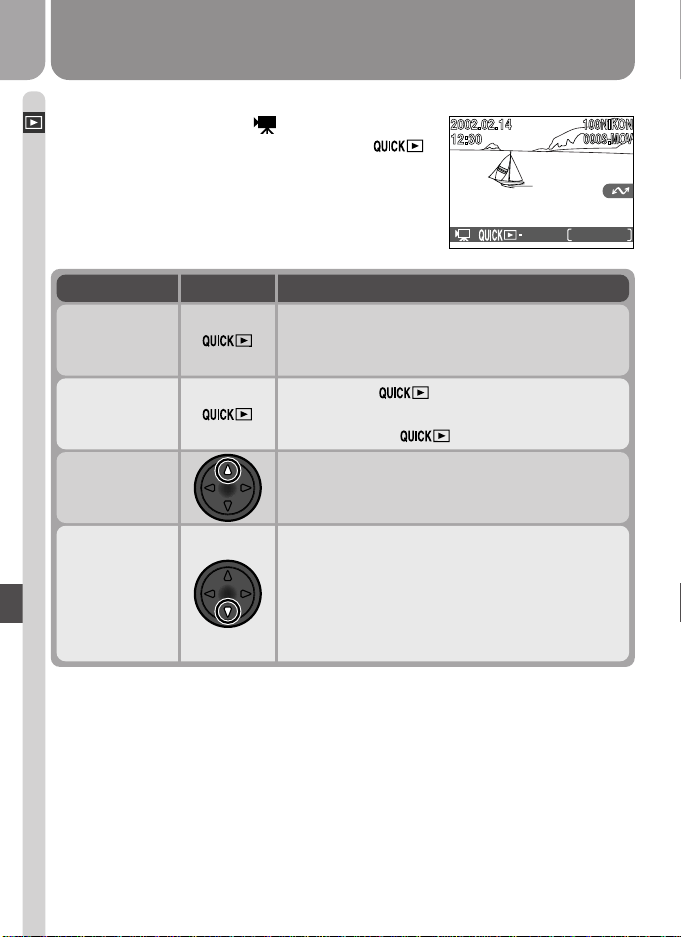
84
Playing Pictures Back—Basic Playback
Movie Playback
Movies are indicated by a icon. In full-frame
playback, movies can be viewed using the
button. Movies can not be played back when
thumbnails are displayed.
DescriptionTo Press
Pressing the button while playback is
in progress pauses display. To resume play-
back, press the button again.
Pause/resume
playback
When movie ends, final frame is displayed for
one second, followed by a still image of the
first frame.
Start playback
When movie is paused, pressing the multi se-
lector down advances the movie one frame.
If the last frame of the movie is displayed,
pressing the multi selector down ends movie
playback and displays the first frame of the
movie.
Advance
movie one
frame
When movie is paused, pressing the multi se-
lector up rewinds the movie one frame.
Rewind movie
one frame
9/0019
START
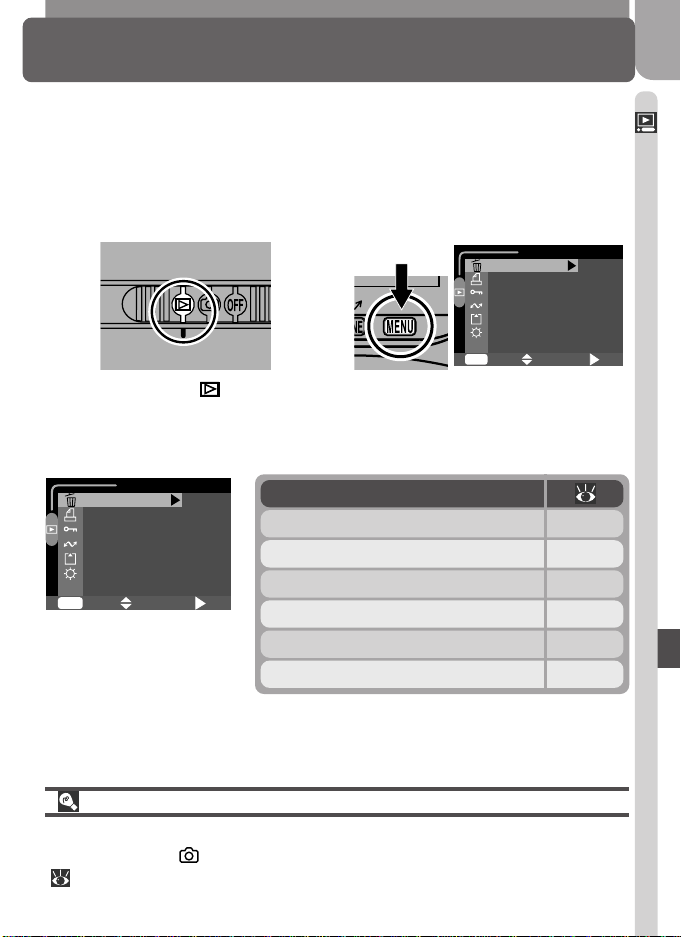
85
Playing Pictures Back—The Playback Menu
The Playback Menu
Managing Pictures
The playback menu contains options for deleting pictures and protecting im-
ages from deletion. You can also create a digital “print order” for printing
photographs on any device compatible with the Digital Print Order Format
(DPOF), and select images for transfer to a computer.
To view the playback menu:
Press MENU button to display
playback menu
Select
Delete
Print Set
Protect
Auto Transfer
CF Card Format
Brightness
DELETE
MENU
SELECT
SET
OFF
12
The playback menu contains the following options:
Delete
Print Set
Protect
Auto Transfer
CF Card Format
Brightness
DELETE
MENU
SELECT
SET
OFF
Option
Delete 86–87
Print Set 88–89
Protect 90
Auto Transfer 91
CF Card Format 73
Brightness 72
Memory Card Format/Brightness
The CF Card Format and Brightness options can also be accessed from the
SET-UP menu for mode. These options are described in “Camera Setup”
( 69).
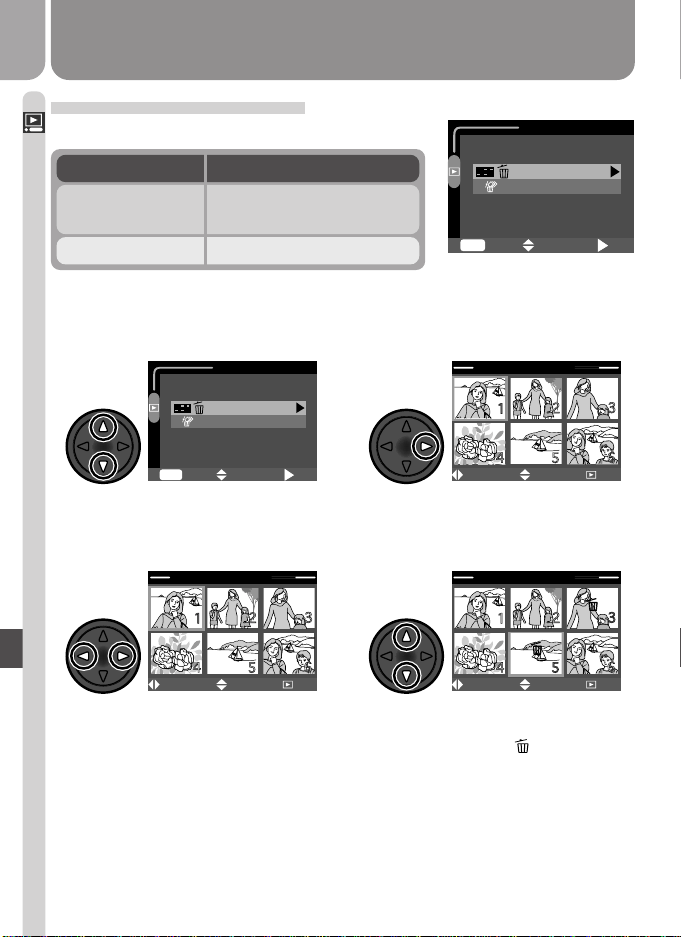
86
Playing Pictures Back—The Playback Menu
Deleting Selected Photographs and Movies
To delete selected photographs and movies:
Highlight Selected Images Display menu of thumbnail images
Highlight picture Press multi selector up or down to se-
lect picture for deletion. Selected pic-
tures are marked by icon. Repeat
steps 3 and 4 to select additional pic-
tures for deletion. To deselect picture,
highlight and press multi selector up
or down. To exit without deleting pic-
tures, press MENU button.
2
34
Deleting Pictures: Delete
The Delete menu contains the following options:
Selected Images
All Images
DELETE
MENU
SELECT
SET
OFF
ERASE SELECTED IMAGES
QUICK
SELECT SET
DONE
ERASE SELECTED IMAGES
QUICK
SELECT SET
DONE
ERASE SELECTED IMAGES
QUICK
SELECT SET
DONE
1
Selected Images
All Images
DELETE
MENU
SELECT
SET
OFF
DescriptionOption
Delete selected photo-
graphs and movies.
Selected Images
Delete all pictures.All Images
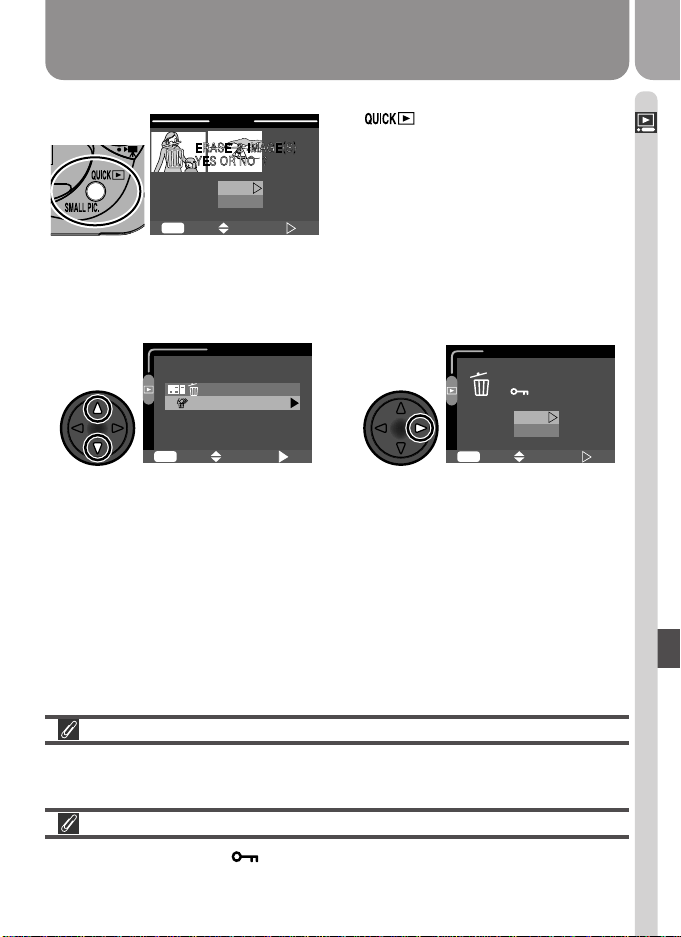
87
Playing Pictures Back—The Playback Menu
Press to display a confirmation dia-
log. Press multi selector up or down to
highlight option, press to right to put
choice into effect:
• Select No to return to playback menu
without deleting pictures
• Select Yes to delete all selected pictures
DELETE
No
Yes
MENU
SELECT
SET
OFF
5
Before Deletion
Once deleted, pictures can not be recovered. Be sure that any pictures you
would like to keep have been transferred to your computer.
Protected Pictures
Pictures marked with a icon are protected and can not be selected for
deletion.
Deleting All Photographs and Movies
To delete all pictures on the memory card:
Highlight All Images Confirmation dialog displayed. Press
multi selector up or down to highlight
option, press to right to put choice into
effect:
• Select No to return to playback menu
without deleting pictures
• Select Yes to delete all pictures on
memory card (protected pictures will
not be deleted)
12
Selected Images
All Images
DELETE
MENU
SELECT
SET
OFF
Exclude
ERASE ALL IMAGES
Erasing All Images
Yes
No
( )
MENU
SELECT
SET
OFF
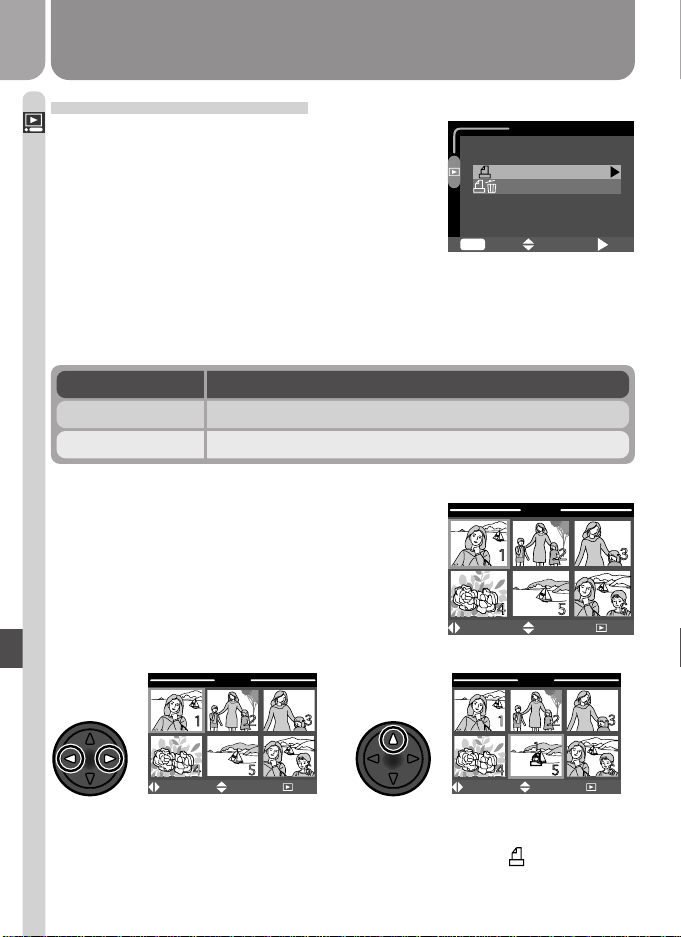
88
Playing Pictures Back—The Playback Menu
Ordering Prints: Print Set
Selecting Print Set from the playback menu dis-
plays the menu shown at right. Using the Print
set option, you can specify the pictures to be
printed, the number of prints, and the informa-
tion to be included on each print. This informa-
tion is stored on the memory card in Digital Print
Order Format (DPOF). Once a print order has been
created, the memory card can be removed from
the camera and inserted in any DPOF-compatible device—be it your personal
photo printer or a photofinisher’s print system—and pictures printed directly
from the card.
Highlight pictures Press multi selector up to select
picture. Selected pictures are
marked by icon.
12
PRINT
QUICK
SELECT SET
DONE
QUICK
PRINT
SELECT SET
DONE
PRINT SET
Print set
Delete print set
MENU
SELECT
SET
OFF
PRINT
QUICK
SELECT SET
DONE
DescriptionOption
Create or modify print order.Print set
Cancel the current print order.Delete print set
Selecting Pictures for Printing
To create a print order, or to modify the existing
print order, highlight Print set in the print set
menu and press the multi selector to the right.
The menu shown at right will be displayed. To
select pictures for printing:
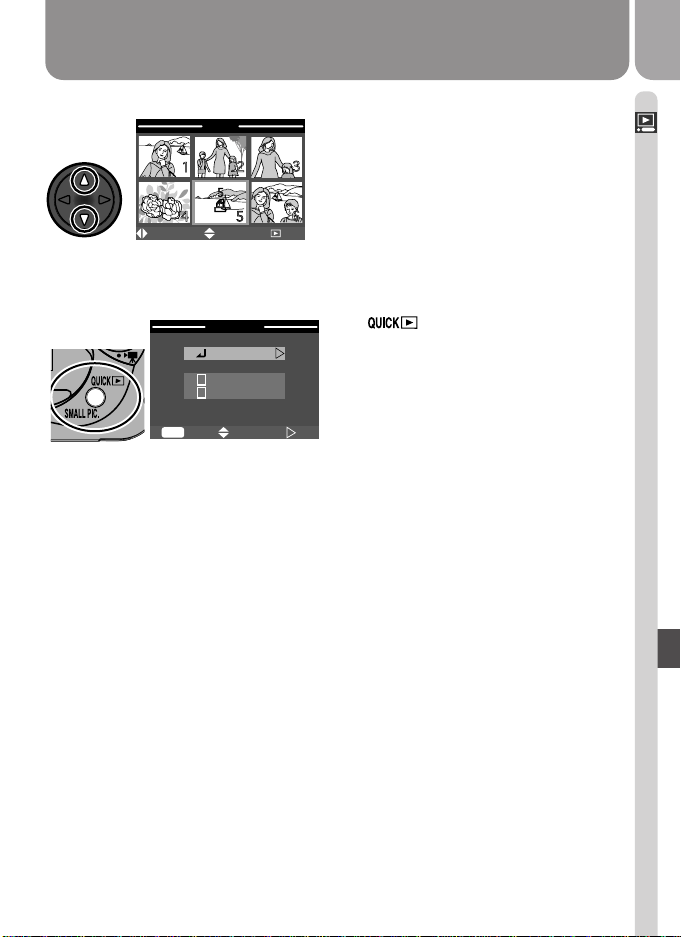
89
Playing Pictures Back—The Playback Menu
Use multi selector to specify number of
prints. Press up to increase (maximum 9),
down to decrease. To deselect picture,
press multi selector down when number
of prints is 1. Repeat steps 1–3 to select
additional pictures. To exit without alter-
ing print order, press MENU button.
Press to complete operation and
display menu of print options. To high-
light option, press multi selector up or
down.
• To print shutter speed and aperture on
all selected photographs, highlight Info
and press multi selector to right. Check
will appear in box next to item.
• To print date of recording on all selected
photographs, highlight Date and press
multi selector to right. Check will ap-
pear in box next to item.
• To deselect a checked item, highlight
and press multi selector to right.
• To complete print order and return to
playback, highlight Done and press multi
selector to right. To exit without alter-
ing print order, press MENU button.
3
4
QUICK
PRINT
SELECT SET
DONE
Done
Info
Date
PRINT SET
MENU
SELECT
SET
OFF
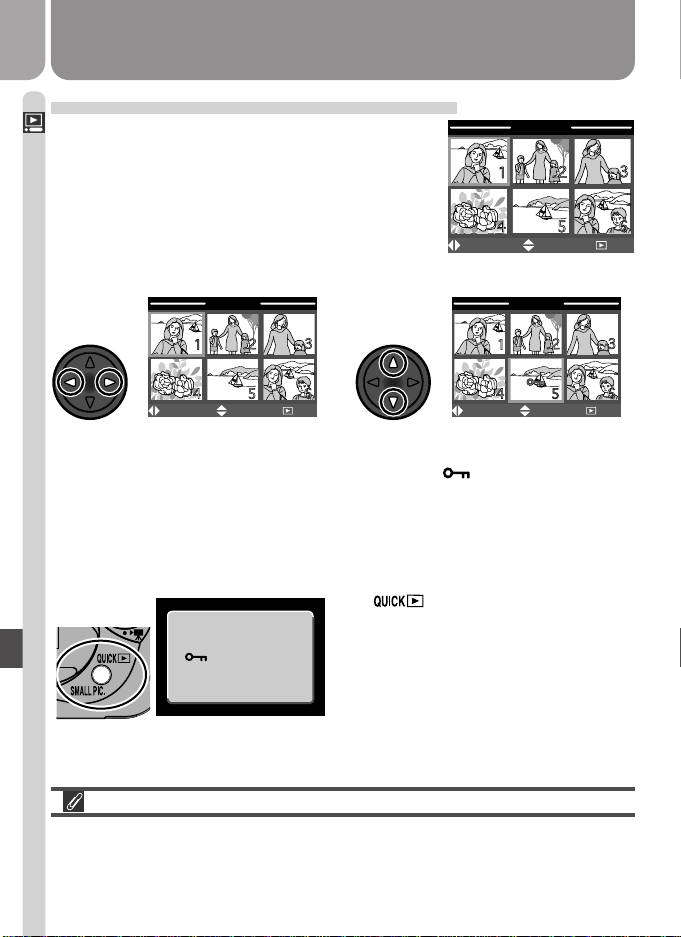
90
Playing Pictures Back—The Playback Menu
DONE
Safeguarding Valuable Pictures: Protect
Selecting Protect from the playback menu displays
the menu shown at right, where you can select
pictures to protect from accidental deletion.
Highlight picture Press multi selector up or down to se-
lect picture. Selected pictures are
marked by icon. Repeat steps 1
and 2 to select additional pictures. To
deselect picture, highlight and press
multi selector up or down.
Press to complete operation. To
exit Protect menu without changing pro-
tected status of pictures, press MENU but-
ton.
12
3
PROTECT
QUICK
SELECT SET
DONE
PROTECT
QUICK
SELECT SET
DONE
PROTECT
QUICK
SELECT SET
DONE
Protected Pictures
Protected files can not be deleted in review, single-image playback, or from
the Delete sub-menu. Note, however, that protected pictures will be deleted
when the memory card is formatted.
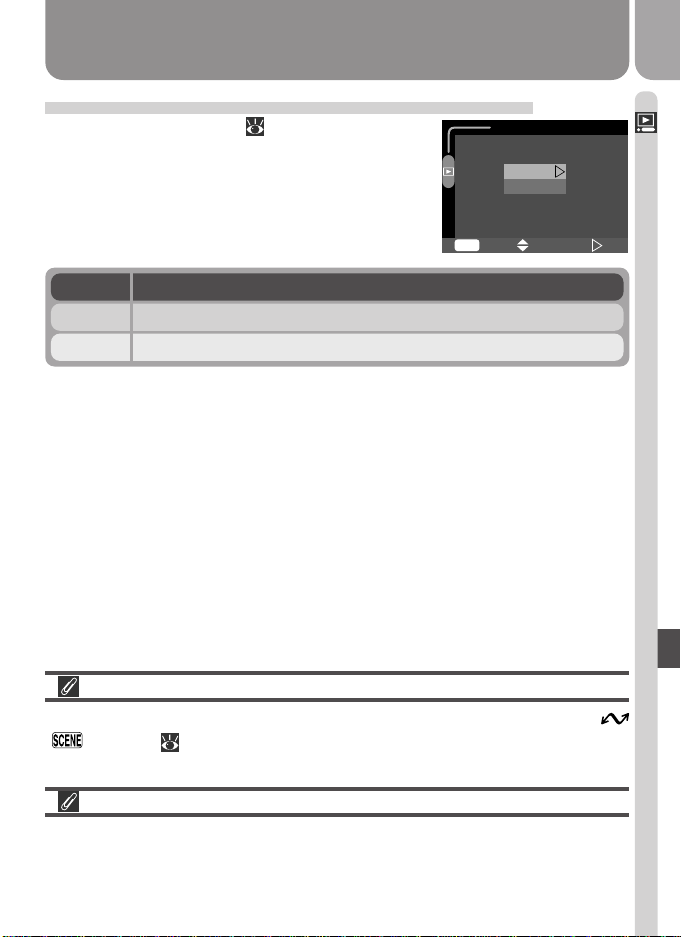
91
Playing Pictures Back—The Playback Menu
AUTO TRANSFER
All ON
All OFF
MENU
SELECT
SET
OFF
Marking All Pictures for Transfer: Auto Transfer
To turn transfer marking ( 44) on or off for all
pictures simultaneously, select Auto Transfer from
the playback menu. The following options will be
displayed:
Transferring More than 999 Pictures
No more than 999 pictures can be transferred at one time using the
( ) button ( 44). To copy more pictures, use Nikon View 5. See the
Nikon View 5 Reference Manual (on CD) for details.
Marking Pictures for Transfer with Other Cameras
Pictures selected for transfer with another model of Nikon digital camera can
not be transferred when the memory card is inserted in the COOLPIX 2500.
Use the COOLPIX 2500 to reselect the images.
DescriptionOption
Mark all pictures on the memory card for transfer to a computer.All ON
Remove transfer marking from all pictures on the memory card.All OFF

92

93
Technical
Notes
Camera Care, Options, and Resources
This chapter provides tips on cleaning and storing
your camera, a list of optional accessories available
for the COOLPIX 2500, information on where to
get help on line, troubleshooting advice, and cam-
era specifications.
94
Technical Notes
Caring for Your Camera
Cleaning
Lens
One key to cleaning the lens is to not touch it with your fingers. Use a blower
(typically a small device with a rubber bulb attached to one end that you
pump to produce a stream of air out the other) to remove dust or lint. To
remove fingerprints or other stains that can not be removed with a blower,
wipe the lens with a soft cloth, using a spiral motion that starts in the center
of the lens and works out to the edges.
Monitor
Remove dust or lint with a blower. To remove fingerprints and other stains,
clean the monitor with a soft, dry cloth, being careful not to apply pressure.
Body
Use a blower to remove dust and lint, then wipe gently with a soft, dry cloth.
After using the camera at the beach or seaside, wipe off any sand or salt with
a cloth lightly dampened with fresh water, then dry thoroughly.
Do not use alcohol, thinner, or other volatile chemicals
Storage
When the camera will not be used for an extended period, remove the bat-
tery after checking to make sure that the camera is off and the lens housed
inside the camera body. Do not store your camera in locations that:
• are poorly ventilated or damp
• are next to equipment that produces strong electromagnetic fields, such as
televisions or radios
• are exposed to temperatures above 50 °C (122 °F) or below –10 °C (14 °F)
• are subject to humidities of over 60%
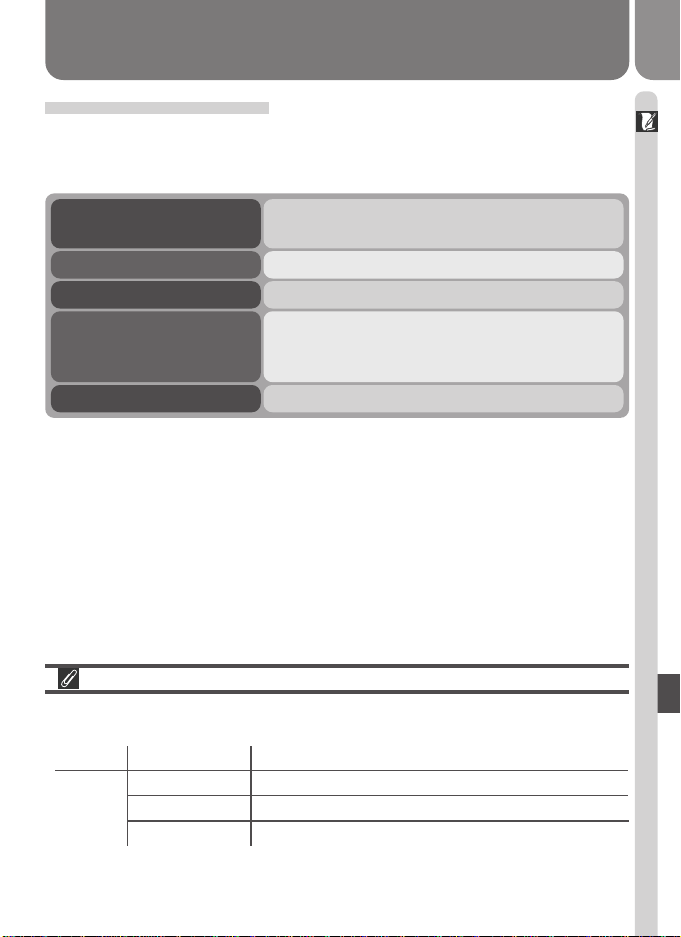
95
Technical Notes
Optional Accessories
At the time of writing, the following optional accessories were available for
the COOLPIX 2500. Contact your retailer or local Nikon representative for
details.
Additional EN-EL2 Li-ion batteries are available
from your retailer or local Nikon representative
Rechargeable battery
CS-E2500 soft caseCarrying case
•EC-CF series CompactFlash
™
memory cards
(available in a variety of capacities)
•EC-AD1 PC-card adapter
CompactFlash
™
memory
cards and adapters
HL-E2500 monitor hoodMonitor hood
Approved Memory Cards
In addition to the cards listed above, the following memory cards have been
tested and approved for use in the COOLPIX 2500:
4× USB series 8 MB, 16 MB, 32 MB, 48 MB, 64 MB, 80 MB
Lexar
Media
SDCFB series 16 MB, 32 MB, 48 MB, 64 MB, 96 MB, 128 MBSanDisk
8× USB series 8 MB, 16 MB, 32 MB, 48 MB, 64 MB, 80 MB
10× USB series 128 MB, 160 MB
Operation is not guaranteed with other makes of memory card. For more
details on the above cards, please contact the manufacturer.
EH-60 AC adapterAC adapter
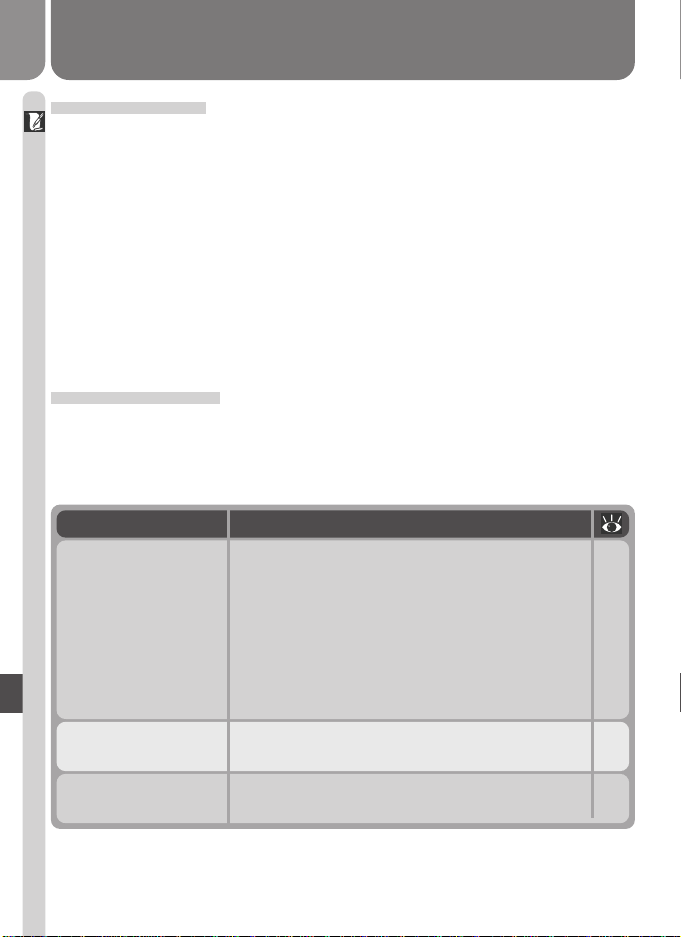
96
Technical Notes
Web Resources
At the time of writing, the following on-line resources were available for users
of Nikon digital imaging equipment:
For Product Information and Tips
• For users in the USA: http://www.nikonusa.com/
• For users in Europe: http://www.nikon-euro.com/
• For users in Asia, Oceania, the Middle East, and Africa:
http://www.nikon-asia.com/
For Contact Information
Contact information for the Nikon representative in your area may be found at:
http://www.nikon-image.com/eng/
Troubleshooting
If your camera fails to function as expected, check the list of common prob-
lems below before consulting your retailer or Nikon representative. Refer to
the page numbers listed in the rightmost column for information on solving
the problems listed here.
Monitor is blank
•Camera is off.
•Battery is not correctly inserted.
•Battery is exhausted.
•EH-60 AC adapter (available separately) is not
properly connected.
•Camera is in sleep mode. Press shutter-release
button halfway.
•USB cable is connected.
6
17
19
—
74
45
No indicators appear
in monitor
•Indicators are hidden. Press multi selector to
left until indicators are displayed.
7
Camera turns off
immediately
•Battery is low.
•Battery is cold.
19
v
Problem Possible cause
97
Technical Notes
Monitor is hard
to read
•Ambient lighting is too bright: move to a dark-
er location or use HL-E2500 monitor hood
(available separately).
•Monitor is dirty.
•Monitor brightness requires adjustment.
95
94
72
Photos are too bright
(overexposed)
•Exposure compensation is too high. 63
Photos are too dark
(underexposed)
•Flash is off.
•Flash window is blocked.
•Subject is outside range of flash.
•Exposure compensation is too low.
53
27
104
63
Photos are out of
focus
•
Focus indicator flashes red: camera unable to
focus.
28
Problem Possible cause
No photo is taken
when shutter-release
button is fully
pressed
•Camera is in playback mode.
•Battery is exhausted.
•Message “Please turn the lens to the shoot-
ing position” appears in monitor: lens is
blocked by camera body. Rotate lens section
until message is no longer displayed.
• Message “OUT OF MEMORY” appears in mon-
itor: insufficient memory to record pictures at
current settings.
•Focus indicator flashes red: camera unable to
focus.
•Flash-ready lamp flickers: flash is charging.
•Message “CARD IS NOT FORMATTED” ap-
pears in monitor: memory card is not format-
ted for use in COOLPIX 2500.
•Message “NO CARD PRESENT” appears in
monitor: no memory card in camera.
6
19
26
101
28
28
101
16
98
Technical Notes
Colors are unnatural • White balance does not match light source. 64
No menu is displayed
when MENU button
is pressed
•Camera is in movie mode. 52
Photos are blurred
•Camera shook during shot. Blurring caused
by camera shake can be reduced by:
–Using the flash
–Using the Best-Shot Selector (BSS)
–Using the self-timer
–Using a tripod
53
67
55
—
Randomly-spaced
bright pixels
(“noise”) appear in
image
•Shutter speed too slow. Use the flash.
•Noise reduction, which helps reduce noise at
slow shutter speeds, is available in the follow-
ing scenes: Night Portrait and Night Land-
scape. Using these scenes when appropriate
can reduce noise.
53
38,
39
Flash does not fire
•Flash is off. Note that flash turns off auto-
matically when:
–Landscape, Sunset, Night Landscape,
Museum, or Fireworks Show is selected
in scene mode
–Camera is in movie mode
–Continuous or Multi-Shot 16 is selected in
the CONTINUOUS menu ( mode only)
–BSS is on ( mode only)
•Battery level is low.
53
38,
39
52
66
67
19
Problem Possible cause
99
Technical Notes
Can not zoom in on
picture during play-
back or review
•Picture is a movie.
•Picture was created using small picture option.
81
Picture can not be
played back
•Picture has been overwritten or renamed by a
computer or other make of camera.
—
Pressing
button when picture
is displayed full
screen does not
create small picture
•Picture is displayed in full-screen review. Small
pictures can only be created in playback mode.
•Picture is a movie. Small pictures can only be
created from photos.
•Picture is already a small picture.
•There is not enough free space on the memo-
ry card for a small picture.
82
82
83
83
Nikon View 5 does
not start when cam-
era connected or
memory card insert-
ed in card reader or
card slot
•Camera is off.
•EH-60 AC adapter (available separately) is not
properly connected, or battery is dead.
•USB cable not correctly connected, or card not
properly inserted in card reader, card adapter,
or card slot.
•Camera is not registered in Device Manager
(Windows only).
See Nikon View 5 Reference Manual (on CD)
for further information on troubleshooting
Nikon View 5.
6
—
45,
48
—
Problem Possible cause
100
Technical Notes
Camera turned off or
playback mode se-
lected while pictures
are being saved.
Message clears from dis-
play automatically when
recording is complete.
29
WARNING ! !
Please wait for camera
to finish recording
Lens is blocked by
camera body.
Rotate lens until message
is no longer displayed.
26
Please turn the lens to
the shooting position
Problem SolutionDisplay
Clock calendar not
set.
Set clock calendar to cur-
rent date and time.(Flashes)
22–
23
Battery exhausted.
Turn camera off and re-
place battery.
WARNING ! !
BATTERY
EXHAUSTED
19
Camera cannot focus.
Use focus lock to focus on
another subject at same
distance, then recompose
photograph.
AF●
(● flashes red)
28
Slow shutter speed.
Photos may be blurred.
Use the flash, or steady the
camera by mounting it on
a tripod, placing it on a lev-
el surface, or holding it in
both hands with your el-
bows against your torso.
37,
53
Error Messages
The following table lists the error messages and other warnings that appear
in the monitor and how to deal with them.
Camera can not de-
tect memory card.
Turn camera off and con-
firm that memory card is
correctly inserted.
NO CARD PRESENT
16
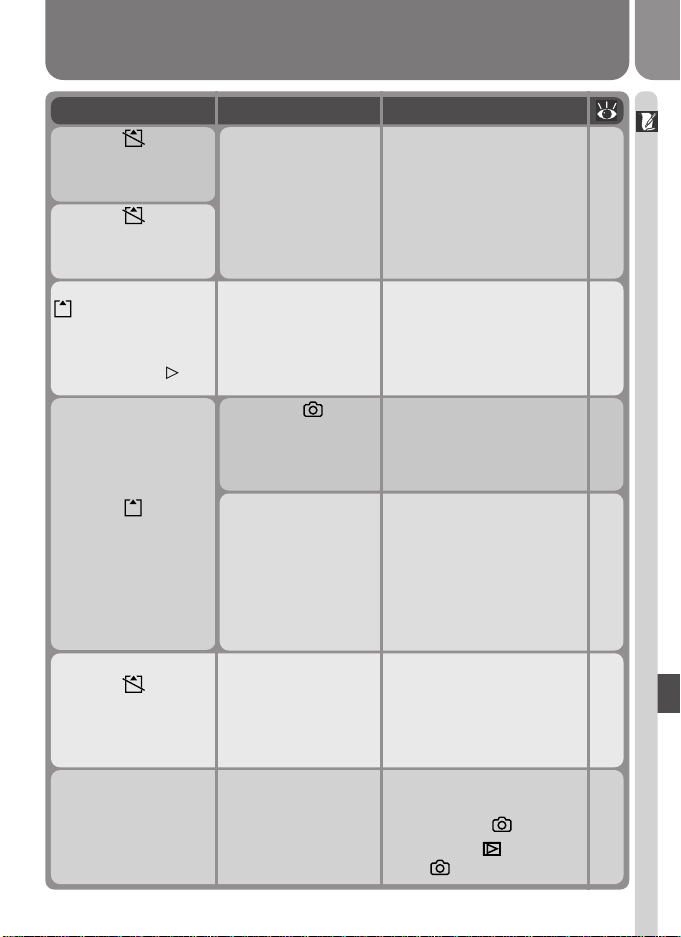
101
Technical Notes
Memory card has not
been formatted for
use in COOLPIX 2500.
Press multi selector up to
highlight FORMAT and
press to right to format
card, or turn camera off
and replace card.
CARD IS NOT
FORMATTED
FORMAT
NO
73
Camera in mode:
Insufficient memory
to record pictures at
current settings.
Error occurs when
you try to transfer
images to computer:
Not enough space
on memory card to
record information
needed for transfer.
•Reduce image quality or
size.
•Delete photographs.
•Insert new memory card.
Disconnect camera, delete
unwanted photographs
and try again.
OUT OF MEMORY
61,
62
86
16
86
•Memory card has
not been formatted
for use in camera.
•Error encountered
while saving photo.
Reformat memory card or
insert new memory card.
IMAGE CANNOT
BE SAVED
73
16
Problem SolutionDisplay
CARD CONTAINS
NO IMAGES
33
6
No pictures on mem-
ory card.
•Camera in review mode:
half-press shutter button
to return to
mode.
•Camera in mode: se-
lect mode.
THIS CARD IS
INCOMPATIBLE
THIS CARD
CANNOT BE USED
Error accessing
memory card.
•Use approved card.
•Check that connectors
are clean. If card is dam-
aged, contact retailer or
Nikon representative.
95
—
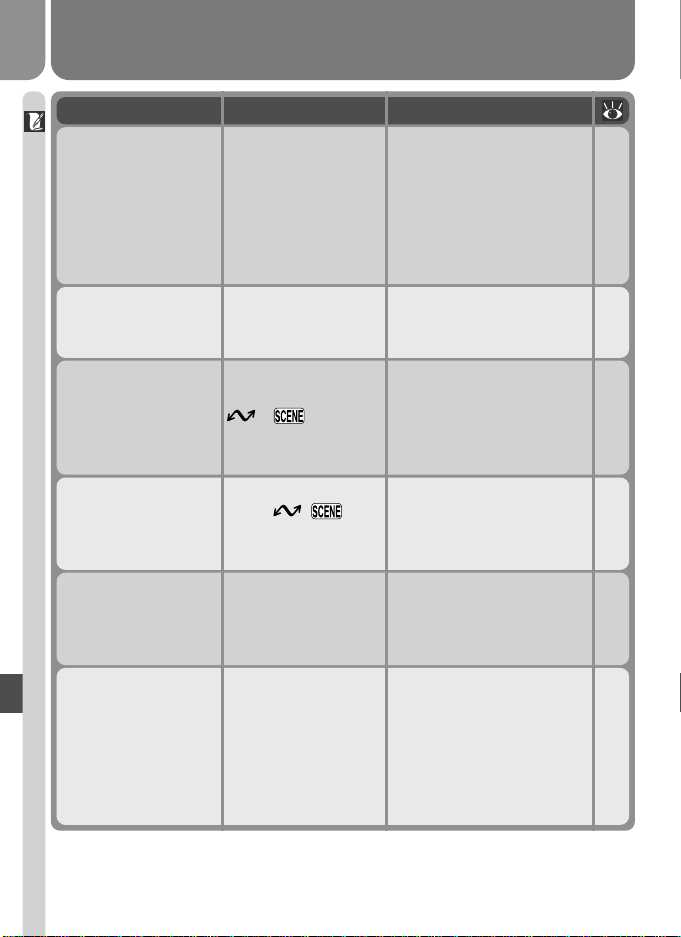
102
Technical Notes
COMMUNICATIONS
ERROR
16,
44,
47
USB cable discon-
nected or memory
card removed while
pictures are being
transferred to a com-
puter.
If error message is dis-
played in computer moni-
tor, click OK to exit Nikon
View 5. Turn camera off
and reconnect cable or re-
place memory card, then
turn camera on.
NO IMAGES ARE
MARKED FOR
TRANSFER
33,
44,
79,
91
No pictures marked
for transfer when
( ) button
pressed to copy pic-
tures to computer.
Disconnect camera and
mark at least one picture
for transfer before con-
necting camera again.
TRANSFER
ERROR
44,
19
Error occurred while
pictures were being
transferred to a com-
puter.
Check that the camera is
properly connected and
that the battery is fully
charged.
SYSTEM ERROR
16
Error has occurred in
camera’s internal cir-
cuitry.
Turn camera off, unplug
optional AC adapter (if us-
ing) or remove and re-in-
sert battery, and turn cam-
era on. If error persists,
contact retailer or Nikon
representative.
Display Problem Solution
FILE CONTAINS
NO IMAGE DATA
86
73
File created by com-
puter or different
make of camera.
Delete file or reformat
memory card.
Please change to
Mass Storage mode
in USB menu
75
PTP selected for USB
when
( ) but-
ton pressed to copy
pictures to computer.
Disconnect camera and se-
lect Mass Storage in USB
menu before connecting
camera again.
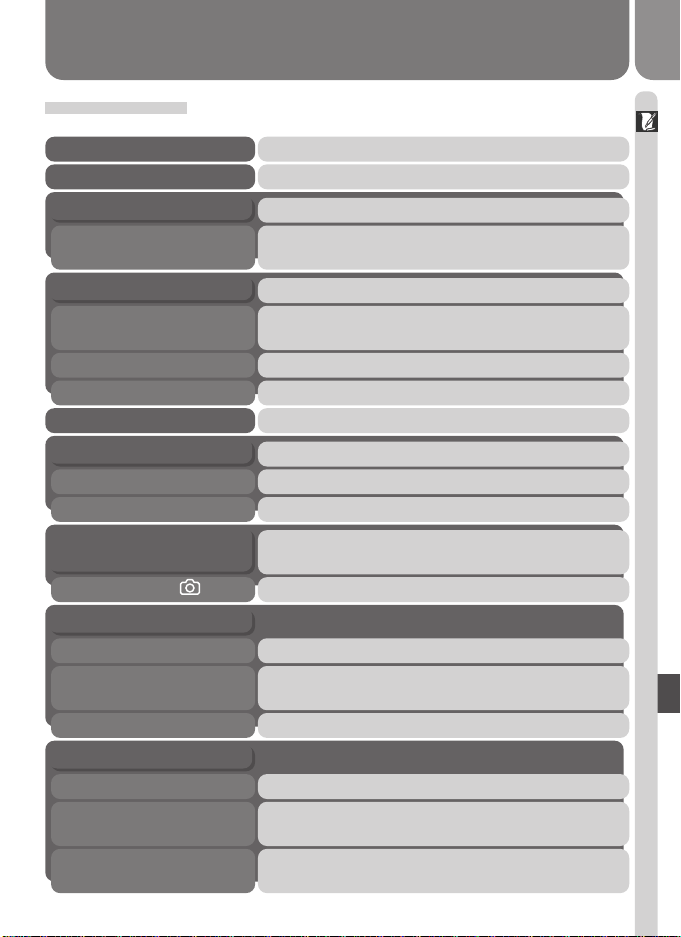
103
Technical Notes
Specifications
Type E2500 digital camera
Digital zoom 4.0 ×
Effective pixels 2.0 million
1
/
2.7
˝ high-density CCD; total pixels: 2.11 millionCCD
Image size (pixels) • 1600 × 1200 (1600)
• 1280 × 960 (1280)
• 1024 × 768 (1024)
• 640 × 480 (640)
3 × Zoom NikkorLens
Focal length F = 5.6 – 16.8 mm (35-mm [135] camera format equiv-
alent: 37 – 111 mm)
f/-number f/2.7 – f/4.8
Construction Seven elements in six groups
Contrast-detect through-the-lens (TTL) AFAutofocus (AF)
Focus range 30 cm (1´) – ∞; 4 cm (1.6˝) – ∞ in Close Up mode
Focus-area selection Five-area multi AF with auto AF-area selection
Storage
Media Type I CompactFlash
™
(CF) cards
File system Compliant with Design rule for Camera File systems
(DCF) and Digital Print Order Format (DPOF)
Compression JPEG-baseline-compliant
1.5˝, 110,000-dot, low temperature polysilicon TFT LCD
with brightness adjustment
Monitor
Frame coverage ( mode) Approximately 97% vertical and 97% horizontal
Exposure
Metering 256-segment matrix metering
Exposure control Programmed auto exposure with exposure compensa-
tion (–2.0 – +2.0 EV in steps of
1
/
3
EV)
Range (ISO 100 equivalent) W: 1.9 – 15.9 EV
T: 3.5 – 17.6 EV

104
Technical Notes
Sensitivity Approximately equivalent to ISO 100 (auto gain to ISO
400 equivalent)
Self-timer Ten-second duration
Interface USB
Power sources
• One rechargeable Nikon EN-EL2 lithium-ion battery
(supplied)
• EH-60 AC adapter (available separately)
Battery life (EN-EL2) Approximately 80 minutes (measured at room temper-
ature [20 °C/68 °F] under standard Nikon test condi-
tions: zoom adjusted with each shot, flash used in ap-
proximately one third of photographs, image quality
set to NORMAL)
Dimensions (W × H × D) 114 × 59.5 × 31.5 mm (4.5˝ × 2.3˝ × 1.2˝)
Weight Approximately 165 g (5.9 oz) without battery or mem-
ory card
Electronically-controlled preset apertureAperture
Range Two steps (f/2.7 and f/4.5 [W])
Mechanical and charge-coupled electronic shutterShutter
Speed 2–
1
/
3000
s
Built-in Speedlight
Range 0.4 – 3.0 m (1´4˝ – 9´10˝) (W)
0.4 – 1.7 m (1´4˝ – 5´7˝) (T)
Flash control Sensor flash system
Operating Environment
Temperature 0–40°C (32 – 104 °F)
Humidity Less than 85% (no condensation)
Design Rule for Camera File Systems (DCF)
Your camera names pictures according to the Design Rule for Camera File
Systems (DCF), a standard widely used in the digital camera industry to ensure
compatibility among different makes of camera.
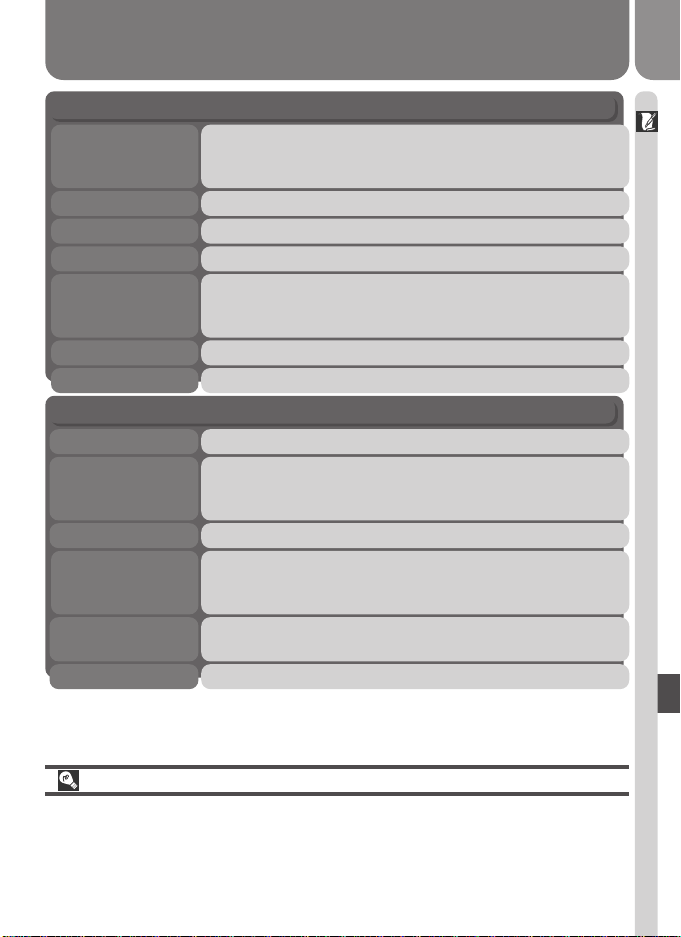
105
Technical Notes
PRINT Image Matching
The COOLPIX 2500 supports “PRINT Image Matching” (PIM) technology de-
veloped by Epson. Photographs taken with the COOLPIX 2500 include addi-
tional information which ensures that the colors recorded by the camera will
be reproduced with vivid, photo-quality results on PIM-compliant printers.
Pre-installed versions of Windows XP Home Edition, Windows
XP Professional, Windows 2000 Professional, Windows Me,
Windows 98 SE
OS
System requirements (Nikon View 5): Windows
Models Only models with built-in USB ports supported
CPU 300 MHz Pentium or better
RAM 64 MB or more recommended
Hard-disk space 25 MB required for installation, with additional free disk space
of 10 MB plus double the capacity of camera memory card avail-
able on system disk when Nikon View 5 is running.
Video resolution
800 × 600 or better with High Color (True Color recommended)
Miscellaneous CD-ROM drive required for installation
OS
Mac OS 9.0, Mac OS 9.1, Mac OS 9.2, Mac OS X (10.1.2 or later)
Models
iMac, iMac DV, Power Mac G3 (Blue & White), Power Mac G4
or later, iBook, PowerBook G3 or later; only models with built-
in USB ports supported
RAM 64 MB or more recommended
Hard-disk space
25 MB required for installation, with additional free disk space
of 10 MB plus double the capacity of camera memory card avail-
able on start-up disk when Nikon View 5 is running.
Video resolution 800 × 600 or better with thousands of colors (millions of colors
recommended)
Miscellaneous CD-ROM drive required for installation
System requirements (Nikon View 5): Macintosh
106
Index
Index
Symbols
1600, 1280, 1024, 640, 62
(shooting) mode, 6
(playback) mode, 6
button, 4, 33, 34, 78, 80
button, 4, 33, 79, 81
button, 5, 53
button, 5, 33, 34, 78, 80
button, 5, 33, 34, 79, 80
. See shooting mode; mov-
ies
, See self timer
, 6, 19
, 6, 23
, 6, 37, 54
, , , , , , ,
, , , , , 37–
40
AUTO, , , , 53
, 6, 63
A, , , , , , , 64
, , , 66
, , , , , 68
, , , 88, 90, 91
A
. See shooting mode,
auto
Accessories. See optional ac-
cessories
AF●. See focus indicator
Autofocus, 28
Auto Off, 74
Auto Transfer, 91
B
Back Light, 40
BASIC, 61
Battery, 16–17, 19
life, 104
storing, v
Beach/Snow, 38
BEST SHOT SELECTOR, 67
Brightness, 72
BSS. See BEST SHOT SELECTOR
C
Camera strap, 16
CF card. See memory card
CF Card Format, 73
Clock-calendar, 19
Close Up, 40
CompactFlash
™
card. See
memory card
Compression. See image qual-
ity
Computer. See Nikon View 5;
transfer
CONTINUOUS, 66
Copy, 40
Copying images. See transfer
D
Date, 22–23
DCF. See Design rule for Cam-
era File systems
Delete, 86–87
Deleting images
from playback menu, 86–87
in full-frame playback, 78
in quick review, 33
in thumbnail review, 34, 80
Design rule for Camera File sys-
tems, 49
Digital Print Order Format, 88
DISP. See monitor, indicators;
photo information
DPOF. See digital Print Order
Format
E
Error messages, 100–102
EXP +/–, 63
Exposure compensation, 6, 63
F
FINE, 61
Fireworks Show, 39
Flash, 53
Flash mode, 53
Flash-ready lamp, 28, 53
Focus. See autofocus
Focus indicator, 6, 28
Formatting. See memory card
I
Image quality, 6, 61
Image size, 6, 62
IMAGE SHARPENING, 68
ISO. See sensitivity
J
JPEG. See image quality
L
Landscape, 38
Language, 20–21, 75
M
. See shooting mode,
manual
Mass storage. See USB.
Memory card, v
approved cards, 95
capacity of, 61
formatting, 73
insertion and removal of, 16–
17
reading pictures from, 48–49
MENU button, 4, 59, 70, 85
Menus, 9–14
Mode selector, 5, 6
Monitor, 5, 6–7
brightness, 72
indicators, 6–7
framing photographs in, 27
MOV. See movies
Movies, 52
playing back, 84
recording, 52
Multi-selector, 5, 8
Museum, 39
N
Night Landscape, 39
Night Portrait, 38
Nikon View 5, i, 42
system requirements for, 105
Noise, 38, 54
107
Index
Noise reduction, 38
NORMAL, 61
Number of exposures remain-
ing, 6, 25
O
On/off. See mode selector
Optional accessories, 95
P
Party/Indoor, 37
Photo information, 7, 33, 79
Picture Transfer Protocol. See
USB.
PIM. See PRINT Image Match-
ing
Playback, 78. See also quick re-
view
full frame, 78
movie, 84
thumbnail, 80
zoom, 81
PLAY BACK menu, 85
Portrait, 37
PRINT Image Matching, 105
Print Set, 88–89
Protect, 90
PTP. See USB.
Q
Quality. See image quality
button, 5, 31
Quick review, 32
full screen, 32
thumbnail, 34
QuickTime. See movies
QVGA. See movies
R
Red-eye reduction. See flash
mode
Reset All, 76
S
Scene, 36
mode, 37–40
selection, 36
SCENE button, 5
Self-portrait. See monitor; self-
timer
Self-timer, 55
Sensitivity, 6, 54
SET-UP menu, 69
Sharpening. See IMAGE
SHARPENING
Shooting mode, 6, 52
(auto), 52
(manual), 52
movie, 52
Shutter-release button, 28–29
Shutter release delay. See self-
timer
Size. See image size
SMALL PIC. button, 4, 82
Small picture, 82
Specifications, 103
Speedlight. See flash
Strap. See camera strap
Sunset, 39
T
T. See zoom, indicator
. See zoom, buttons
Telephoto. See zoom
Thumbnail display, 34, 80
Time and date. See Date
Timer. See self-timer
Transfer, 42–49
marking images for, 33, 34,
79, 80, 91
Troubleshooting, 96–102
U
USB, 46, 75. See also transfer
W
W. See zoom, indicator
. See zoom, buttons
Web resources, 96
White balance, 64
preset, 65
Wide angle. See zoom
Z
Zoom
buttons, 4, 27, 57
digital, 57
indicator, 27, 57
optical, 57

En
En
Printed in Japan
S2BB000201(11)
6MAA1511-02
DIGITAL CAMERA
The Guide to Digital Photography
with the