EN
ZH
TH
VI
MS
KO

1
1. Juicer safety instructions
• Children should be supervised to ensure that they do
not play with the appliance.
• This appliance shall not be used by children.
• Keep the appliance and its cord out of reach of
children.
• Do not use the appliance if the rotating sieve or the
protecting cover is damaged or has visible cracks.
• Always disconnect the appliance from the supply
if it is left unattended and before assembling,
disassembling or cleaning.
• If the supply cord is damaged, it must be replaced
by the manufacturer, its service agent or similarly
qualified persons in order to avoid a hazard.
• This appliance is intended to be used in household
only. It is not intended to be used in the following
applications, and the guarantee will not apply for :
– staff kitchen areas in shops, offices and other
working environments;
– farm houses;
– by clients in hotels, motels and other residential
type environments;
– bed and breakfast type environments.
• Appliances can be used by persons with reduced
physical, sensory or mental capabilities or lack of
experience and knowledge if they have been given
supervision or instruction concerning use of the
appliance in a safe way and if they understand the
hazards involved.
• Children shall not play with the appliance.
• Make sure you wash with warm soapy water using
a sponge, all the attachments which have come into
EN

2
contact with food, immediately after use. The filter
can be cleaned using the brush.
• Switch off the appliance and disconnect from supply
before changing accessories or approaching parts
that move in use.
• Improper use of the appliance and its accessories
may damage the appliance and cause injury.
• The sieve have sharp blades, take care when handling
and during cleaning.
• To avoid all accidents and damage the appliance,
follow operating times and speed settings for
accessories specified in the manual.
• This appliance is not intended for use by persons with
reduced physical, sensory or mental capabilities, or
lack of experience and knowledge, unless they have
been given supervision or instruction concerning use
of the appliance by a person responsible for their
safety.
• Children should be supervised to ensure that they do
not play with the appliance.
• With citrus-press accessories: This appliance can
be used by children aged from 8 years and above
if they have been given supervision or instruction
concerning use of the appliance in a safe way and
if they understand the hazards involved. Cleaning
and user maintenance shall not be made by children
unless they are aged from 8 years and above and
supervised. Keep the appliance and its cord out of
reach of children aged less than 8 years.
• Always check the sieve before use.
• Please read these instructions carefully before first use. The appliance is designed
for domestic use only. The manufacturer shall not accept any liability and reserves
the right to cancel the guarantee in the event of commercial or inappropriate use or
failure to follow the instructions.

3
• Never use the juice extractor if the sieve is broken or damaged, or if there is visible
cracking or crazing or if the sieve is torn. If there is any evident damage to the sieve,
contact an approved Service centre. The sieve has sharp edges: handle it with care.
• For your safety, this appliance is compliant with applicable standards and regulations:
– Low Voltage Directive
– Electromagnetic compatibility directive
– Regulations governing materials in contact with food.
• Check that the supply voltage shown on the rating plate of the appliance matches
that of your electrical system. Any connection error will invalidate the guarantee.
• Do not place or use this appliance on a hotplate or close to an open flame (gas
cooker).
• Do not immerse the motor unit or put it under running water.
• Use this appliance on a solid, stable worktop, away from water splashes. Do not turn it over.
• Any intervention other than normal cleaning and maintenance by the customer must
be carried out by an approved service centre.
• Never unplug the appliance by pulling on the cord.
• Do not use an extension lead. If you accept liability for doing so, only use an
extension lead which is in good condition, has a plug with an earth connection and
is suited to the power rating of the appliance.
• A domestic appliance must not be used:
– if it has fallen on the floor
– if it is damaged or incomplete.
• Do not use your appliance if it does not operate correctly, if it has been damaged or if
the power cord or plug is damaged. To maintain safety, these parts must be replaced
by an Approved Service Centre.
• In such cases, or for any other repair, you must contact an Approved Service Centre.
• This product has been designed for domestic use only. The manufacturer accepts
no responsibility, and the guarantee will not apply, for any commercial use,
inappropriate use or failure to comply with the instructions.
• Only use original accessories and components. We cannot accept any responsibility
if this is not the case.
• Never put your fingers or any other object in the filler tube while the appliance is in
operation. Always use the pusher provided for this purpose.
• Never open the cover before the sieve has come to a complete stop.
• Do not remove the pulp collector while the appliance is in use.
• Always unplug the appliance from the mains after use.
• Do not leave the power cord close to or in contact with sources of heat or sharp
edges.
• Do not allow long hair, scarves, ties etc. to hang over the appliance or attachments
when in use.
• Wait for all moving parts to stop before opening the appliance.
• Do not exceed the maximum quantities or operating periods indicated.

4
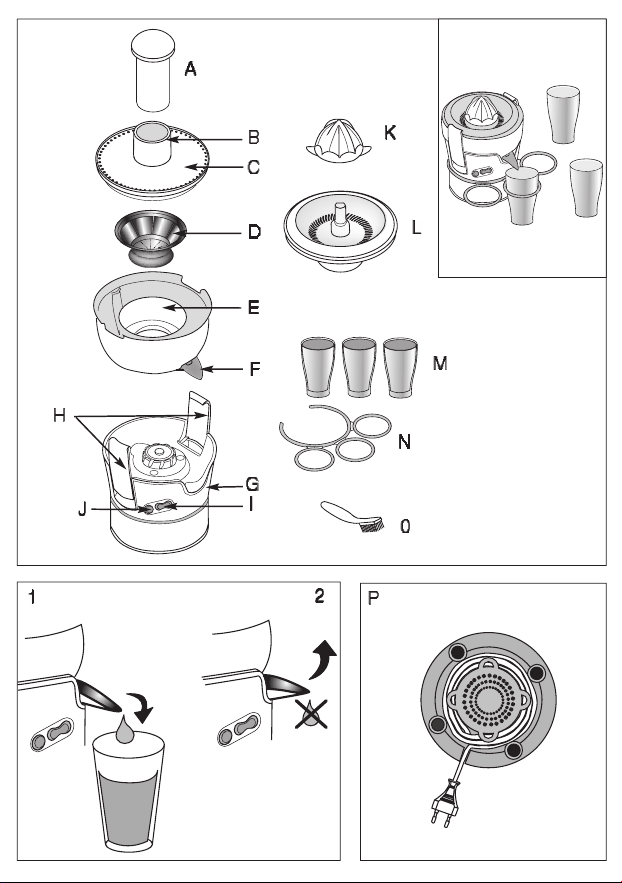
2. Appliance description
3. Before first use
Read these instructions carefully before using your appliance for the first time
and keep to hand for future reference: failure to comply with the instructions will
release the manufacturer from all responsibility.
• Completely release the side safety lock clips (H). Remove the pusher (A), lid (C),
filter (D), pulp container (E), glass-holder accessory (N) and glasses (M).
• Clean all the accessories in warm water with washing-up liquid, dry and then re-
assemble the appliance.
4. Using the Juicer
You can use the juicer to get juice from practically all fruits and vegetables, whether
they are hard or soft. However, you will not manage to extract juice from bananas,
coconuts, avocado pears, blackberries, figs and aubergines.
Do not use the juicer to blend fruit or vegetables that are too hard and fibrous,
such as ginger, celeriac, sugar cane, etc.
4 A - STARTING UP THE JUICER
1. Lock the side safety clips (H) and lid (C) securely.
2. Cut the fruit or vegetables into pieces and remove stones. See section below
“P4 - Practical hints on using your Juicer” for more details on preparation.
3. Place a glass under the spout to collect the juice.
4. Make certain that the spout is in the low position (fig 1).
5. Plug in the appliance.
6. Start up the juicer by pressing the switch (I).
7. Select the speed to correspond to the fruit (see table below) using button (J).
8. Remove the pusher and insert the fruit or vegetables in pieces through the funnel.
You must insert fruit and vegetables with the motor running.
9. Use the pusher to push the food down but do not force it. Do not use any
other utensil. Above all, DO NOT USE YOUR FINGERS to push the food. The
Pusher
Funnel
Lid
Filter
Pulp container
Anti-drip spout
Body of appliance
Side safety lock clips
A
B
C
D
E
F
G
H
ON/OFF switch
Speed selector
Cone (according to model)
Citrus press sieve (according to model)
3 glasses (according to model)
Glass holder accessory (according to model)
Cleaning brush
Cord storage
I
J
K
L
M
N
O
P

5
3. Before first use
Read these instructions carefully before using your appliance for the first time
and keep to hand for future reference: failure to comply with the instructions will
release the manufacturer from all responsibility.
• Completely release the side safety lock clips (H). Remove the pusher (A), lid (C),
filter (D), pulp container (E), glass-holder accessory (N) and glasses (M).
• Clean all the accessories in warm water with washing-up liquid, dry and then re-
assemble the appliance.
Ingredients
Recommended
speed :
I : low,
II : fast,
Max. 1 minutes
50s
Approximate
number of fruits
before you need
to empty the
pulp container
Approximate
weight
Quantity of
juice obtained
(*)
(1 glass =
about 250ml)
Carrots
Cucumbers
Apples
Pears
Melons
Pineapples
Grapes
Lettuce
Tomatoes
II
II
II
II
I
II
I
II
I
10
2
5
5
1 - 2
2
2 - 3
7
750 g
1 kg
1,2 kg
1,2 kg
1,5 kg
2 kg
2 kg
0,5 kg
1,5 kg
500ml
600ml
700ml
750ml
900ml
1000ml
1200ml
250ml
900ml
It is advisable not to use the appliance for more than 1 minute 50 seconds
at a time.
(*) The quality and quantity of the juice obtained will vary considerably according to
the date of harvest and the variety of each vegetable or fruit. The quantities of
juice shown above therefore provide only a rough guide.
juice will flow into the glass through the spout while the pulp will collect in the
pulp container.
10. Once your glass is full, stop the appliance and push the spout up into the
raised position again (fig 2).
11. Once the pulp container looks full or the flow of juice slows down, empty the
pulp container using the handle of the brush (O) and clean the filter with the
brush, if necessary.
12. When you have finished using the appliance, you are advised to clean the
accessories straight away using the brush (O) so that food does not dry onto
them. Apart from the body of the appliance, you can put all these accessories
in the dishwasher (top basket).
Cleaning – Foods which stain plastics : Over time the strong coloured natural
juices from food such as carrots and beetroot may stain the plastic parts of
your appliance - this is normal. These parts may be cleaned by soaking them in
mild bleach (non abrasive) straight after use.
13. Some hints :
4 B - PRACTICAL HINTS ON USING YOUR JUICER
1. Choose fresh, ripe fruit and vegetables.
2. Carefully wash the fruit and vegetables before cutting them and removing the
stones.

6
6. Cleaning and maintenance
• All the removable juicer parts (A, B, C, D, E, M, N) can be cleaned in the
dishwasher.
• The citrus-press accessory parts (K, L) cannot be washed in the dishwasher. Wash
them under running water.
• This appliance is easier to clean if you do it immediately after use.
• Do not use scouring pads, acetone, alcohol (white spirit) etc. to clean your
appliance.
• The filter must be handled with care. Avoid any improper handling which may
cause damage. The filter can be cleaned with the brush (O).
Replace the filter as soon as it shows signs of wear or tear.
• Wipe the motor unit down with a damp cloth. Dry it carefully.
• Never place the motor unit under a running tap.
5. Using the Citrus-Press Accessory (accor-
ding to model)
1. Release the side safety lock clips (H).
2. Remove the lid (C) and filter (D).
3. Position the citrus press sieve (L) on the pulp container (E) with the cone (K).
4. Secure the citrus press sieve (L) to the pulp container (E) using the safety lock clips (H).
5. Plug in the appliance.
6. Make certain that the spout is in the low position (fig 1)
7. Select the slowest speed I (J) and set the switch (I) to “On”.
8. Press the citrus fruit.
3. Peel fruits with thick skin, such as lemons, oranges, grapefruits and pineapples
(remove the core).
4. The juicier the fruit (as with tomatoes) the slower the speed you should use (see
table above for information).
5. If you prepare juice from grapes, quinces, blueberries or blackcurrant, you should
clean the filter every time you press 1/2 kg.
6. If you juice over-ripe fruit, you will obtain a fairly thick liquid, the filter will tend
to get clogged up and you should then clean it more regularly. You will also have
to empty the pulp container more or less often according to the quality of the
fruit or vegetables processed.
7. Important: all juices should be drunk immediately. When they come into
contact with the air, they oxidise very quickly and this may impair their taste
and colour. Apple and pear juice quickly takes on a brown colour. Add a few
drops of lemon to prevent the juice going brown too quickly.
7
Environment protection first!
Your appliance contains valuable materials which can be recovered
or recycled.
Leave it at a local civic waste collection point.
5. Using the Citrus-Press Accessory (accor-
ding to model)
1. Release the side safety lock clips (H).
2. Remove the lid (C) and filter (D).
3. Position the citrus press sieve (L) on the pulp container (E) with the cone (K).
4. Secure the citrus press sieve (L) to the pulp container (E) using the safety lock clips (H).
5. Plug in the appliance.
6. Make certain that the spout is in the low position (fig 1)
7. Select the slowest speed I (J) and set the switch (I) to “On”.
8. Press the citrus fruit.
7. Electrical or electronic product at end of
service life

8
1. 安全指示
• 請確保兒童不會將本產品用作戲耍。
• 兒童不得使用本產品。
• 如果保護蓋損毀、本產品操作不正常或您察覺本產
品有裂痕或裂紋,切勿使用。
• 將本產品閒置時以及組裝、拆散或清潔之前一定要
拔掉電源線。
• 若電源線損毀,必須只交由製造商、製造商的售後
服務中心或合資格人士更換,以免發生危險。
• 本產品只供家居用途,並非設計作以下用途。若在
下述情況使用,保用條款將不適用:
– 商舖、寫字樓和其他工作環境的職工廚房;
– 農舍;
– 客人在酒店、汽車旅館及其他住宅式環境使用;
– 床上或用早餐環境。
• 本產品可供缺乏有關經驗和知識的人、或身體、感
官或智力殘缺者使用,惟他們必需受過訓練,懂得
完全安全使用榨汁機及知道本產品會涉及的危險。
• 兒童不得將本產品用作戲耍
• 使用後必須立刻用溫暖的肥皂水和海綿清洗所有跟
食物接觸的組件,濾隔可以用刷清潔。
• 若要更換配件或在本產品操作期間要接觸活動部
分,請先關機及拔掉電源線。
• 不當使用電器及其配件可能會損壞電器及導致受
傷。
• 濾隔有鋒利刀片,處理及清潔時請小心。

9
1. 安全指示
• 請確保兒童不會將本產品用作戲耍。
• 兒童不得使用本產品。
• 如果保護蓋損毀、本產品操作不正常或您察覺本產
品有裂痕或裂紋,切勿使用。
• 將本產品閒置時以及組裝、拆散或清潔之前一定要
拔掉電源線。
• 若電源線損毀,必須只交由製造商、製造商的售後
服務中心或合資格人士更換,以免發生危險。
• 本產品只供家居用途,並非設計作以下用途。若在
下述情況使用,保用條款將不適用:
– 商舖、寫字樓和其他工作環境的職工廚房;
– 農舍;
– 客人在酒店、汽車旅館及其他住宅式環境使用;
– 床上或用早餐環境。
• 本產品可供缺乏有關經驗和知識的人、或身體、感
官或智力殘缺者使用,惟他們必需受過訓練,懂得
完全安全使用榨汁機及知道本產品會涉及的危險。
• 兒童不得將本產品用作戲耍
• 使用後必須立刻用溫暖的肥皂水和海綿清洗所有跟
食物接觸的組件,濾隔可以用刷清潔。
• 若要更換配件或在本產品操作期間要接觸活動部
分,請先關機及拔掉電源線。
• 不當使用電器及其配件可能會損壞電器及導致受
傷。
• 濾隔有鋒利刀片,處理及清潔時請小心。
• 為免發生意外及損壞電器,操作配件時,請按照使
用說明書上的操作次數及速度設定。
• 此電器並非為身體、感官或心理上有缺憾,或缺乏
相關經驗或知識的人士而設計,除非他們在能夠負
責其安全的人監督,或已接受其操作指示的情況下
使用。
• 必須監管兒童,以免他們將電器當作玩具。
• 榨汁機配件:在有人從旁監督或適當指示如何安全使
用本電器,以及瞭解潛在危險的狀況下,此電器可
供 8 歲及以上兒童使用。在無人監督下,不得讓8歲
以下兒童清潔及維護此電器。請勿讓8歲以下兒童接
觸此電器及電線。
• 每次使用前必須先檢查濾隔。
• 初次使用前請仔細閱讀此指引。此電器僅供家居使用。倘作商業用途
或使用不當,或未有遵從指引,製造商概不承擔任何責任,並保留取
消保用之權利。
• 濾網若有破裂或損壞、可看到裂縫或裂紋或是有破洞,切勿使用本榨
汁機。濾網若有 任何明顯損壞,請洽詢經許可的服務中心。濾網的邊
緣很鋒利:請小心拿取。
• 為保閣下安全,本電器符合相關標準和規定
– 低電壓指令
– 電磁兼容性
– 與食物接觸之物料。
• 請檢查電器標貼所示的電源電壓是否與閣下的電力系統相符。任何錯
誤連接將導致保用失效。
• 請勿將電器放置在加熱板上使用,或靠近明火(煤氣爐)。
• 請勿將摩打浸於水中或以水沖洗。
• 請將電器放在紮實穩固的檯面上使用,避免水濺。請勿將其倒轉。
• 除顧客進行正常清潔及保養以外,任何檢修工作均須由認可的維修中
心進行。
• 請勿拉扯電線來拔除電器插頭。
• 請勿連接電源拖板。如閣下承擔有關責任,請確保電源拖板運作良
好,有接地的插頭,而且適用於該電器的功率。
ZH

10
2. 產品說明
A
B
C
D
E
F
G
H
推管
漏斗
蓋
濾隔
渣滓容器
防滴倒嘴
機座
側面安全鎖夾
I
J
K
L
M
N
O
P
開關掣
選速掣
榨汁錐體 (視乎型號)
橘類水果榨汁隔篩 (視乎型號)
三隻水杯 (視乎型號)
水杯固定架 (視乎型號)
清潔刷
捲線存放裝置
3. 首次使用之前
• 將側面安全鎖夾(H)完全釋放,摘掉推管(A)、蓋(C)、濾隔(D)、果漿容
器(E)、水杯固定架(N)和水杯(M)。
• 用暖水加洗清液清洗所有配件,乾透後重新組裝在榨汁機上。
4. 使用榨汁機
您可以用本榨汁機榨任何硬質和軟質水果和蔬菜的汁,但以下水果是無
法榨汁的:香蕉、椰子、牛油果、黑莓、無花果和茄子。
切勿用本機攪拌過硬和高纖維蔬果,例如薑、芹菜頭和甘蔗等。
4 A - 開始使用榨汁機
1. 將側面安全鎖夾(H)和蓋(C)鎖緊。
2. 將水果和蔬菜切成塊,去掉大粒果核。有關準備使用的詳情請參閱
第4頁「榨汁機實用提示」。
3. 將水杯放在倒嘴下收集果汁。
4. 必須將倒嘴調較至向下狀態(圖 1)。
5. 插上電源線。
6. 按下開關掣(I)啟動榨汁機
7. 根據水果的種類(見下表),利用按選速掣(J)選擇速度
8. 摘掉推管,將水果和蔬菜塊通過漏斗放入。必須在馬達運行期間
放入水果和蔬菜。
9. 用推管推下食材,但切勿用力推壓。除推管以外切勿使用其他器
皿,而且切勿用手指推入食材。蔬果汁會通過倒嘴流入水杯,而
果渣會收集在渣滓容器。
10. 水杯裝滿後,請停機,並將倒嘴再次推向上(圖 2)。
11. 當渣滓容器裝滿或者汁液開始慢流,請用刷(O)柄清理渣滓容器,
若有需要請用刷清潔濾隔。
12. 使用後應該立刻用刷(O)清潔各配件,以免食材乾後黏在配件上。
請將機座以外的所有配件放在洗碗碟機(最上一層)清洗。
清潔須知 — 會令塑膠染色的食材:甘筍和甜菜根一類蔬果的汁含
強力天然色素,日久會將榨汁機的塑膠部分染色,這是正常情況。
使用後請立刻將塑膠部分浸入溫和的不磨蝕的漂潔液中。
13. 提示 :
• 請勿在以下情況下使用家用電器:
– 如電器曾跌在地上,
– 如電器損壞或不完整。
• 如閣下的電器無法如常運作、曾受損或電線/插頭損壞,請勿使用該電
器。
• 為保安全,這些零件須由認可的維修中心替換。
• 在此情況下或產品需要進行其他維修,閣下須聯絡認可的維修中心。
• 本產品只供家居使用。倘作商業用途或使用不當,或未有遵從指引,
生產商概不承擔任何責任,而保用將不適用。
• 只可使用原裝配件及零件。否則我們不會承擔任何責任。
• 電器運作期間,閣下請勿將手指或任何其他物件放入漏斗。請使用隨
機附上的推管。
• 濾隔完全停止運轉前,請勿將蓋打開。
• 使用電器期間請勿移除渣滓容器。
• 每次使用完電器後,請從電源插座拔下插頭。
• 請勿將電線靠近或接觸熱源或尖銳邊緣。
• 使用電器時,請勿讓長髮、頸巾和領帶等繫於電器或附件上。
• 請待所有活動配件停下才打開電器。
• 請勿超出註明的最大用量或運作時間。

1111
3. 首次使用之前
• 將側面安全鎖夾(H)完全釋放,摘掉推管(A)、蓋(C)、濾隔(D)、果漿容
器(E)、水杯固定架(N)和水杯(M)。
• 用暖水加洗清液清洗所有配件,乾透後重新組裝在榨汁機上。
4. 使用榨汁機
您可以用本榨汁機榨任何硬質和軟質水果和蔬菜的汁,但以下水果是無
法榨汁的:香蕉、椰子、牛油果、黑莓、無花果和茄子。
切勿用本機攪拌過硬和高纖維蔬果,例如薑、芹菜頭和甘蔗等。
4 A - 開始使用榨汁機
1. 將側面安全鎖夾(H)和蓋(C)鎖緊。
2. 將水果和蔬菜切成塊,去掉大粒果核。有關準備使用的詳情請參閱
第4頁「榨汁機實用提示」。
3. 將水杯放在倒嘴下收集果汁。
4. 必須將倒嘴調較至向下狀態(圖 1)。
5. 插上電源線。
6. 按下開關掣(I)啟動榨汁機
7. 根據水果的種類(見下表),利用按選速掣(J)選擇速度
8. 摘掉推管,將水果和蔬菜塊通過漏斗放入。必須在馬達運行期間
放入水果和蔬菜。
9. 用推管推下食材,但切勿用力推壓。除推管以外切勿使用其他器
皿,而且切勿用手指推入食材。蔬果汁會通過倒嘴流入水杯,而
果渣會收集在渣滓容器。
10. 水杯裝滿後,請停機,並將倒嘴再次推向上(圖 2)。
11. 當渣滓容器裝滿或者汁液開始慢流,請用刷(O)柄清理渣滓容器,
若有需要請用刷清潔濾隔。
12. 使用後應該立刻用刷(O)清潔各配件,以免食材乾後黏在配件上。
請將機座以外的所有配件放在洗碗碟機(最上一層)清洗。
清潔須知 — 會令塑膠染色的食材:甘筍和甜菜根一類蔬果的汁含
強力天然色素,日久會將榨汁機的塑膠部分染色,這是正常情況。
使用後請立刻將塑膠部分浸入溫和的不磨蝕的漂潔液中。
13. 提示 :

12
食材
建議速度:
I:慢速
II: 快速,最多
1分鐘50秒
榨了以下數
目的水果後
必須清倒渣
滓容器
大約重量
收集的蔬果汁
份量 (*)
(1杯 = 約250毫升)
甘筍
黃瓜
蘋果
洋梨
甜瓜
鳳梨
提子
生菜
蕃茄
II
II
II
II
I
II
I
II
I
10
2
5
5
1 - 2
2
2 - 3
7
0,75 公斤
1 公斤
1,2 公斤
1,2 公斤
1,5 公斤
2 公斤
2 公斤
0,5 公斤
1,5 公斤
500 毫升
600 毫升
700 毫升
750 毫升
900 毫升
1000 毫升
1200 毫升
250 毫升
900 毫升
每次請勿連續操作超過1分50秒。
(*) 收集得的蔬果汁的質和量會因應收成期和蔬果種類而大幅不同,因此,上表列
出的蔬果汁份量只是一個粗略指引。
4 B - 榨汁機實用提示
1. 請選用新鮮成熟的蔬果。
2. 切塊和去核之前必須仔細清洗蔬果。
3. 厚皮水果去皮,例如檸檬、橙、西柚和菠蘿(去核)。
4. 要榨的水果所含的汁愈多(例如蕃茄),便需要選愈低的速度(請參閱
上表)。
5. 若榨提子、榲桲、藍莓或黑加侖子的汁,便要每榨半公斤的份量
清潔濾隔一次。
6. 若榨的水果過熟,榨出的汁會頗濃稠,可能會堵塞濾隔,故此需
要更頻密清潔濾隔。此外,您需要根據榨汁的蔬果的特質以決定
應該較頻密還是隔久一點才清倒渣滓容器。
7. 重要事項:榨出的蔬果汁必須立刻飲用。蔬果汁接觸空氣後會迅
速氧化,可能會影響味道和顏色。蘋果汁和洋梨汁會迅速變成棕
色,放入數滴檸檬汁可以防止這些果汁太快變成棕色。
6. 清潔與保養
• 將榨汁機的可移除部份(A、B、C、D、E、M、N)放入洗碗碟機清洗。
• 水果榨汁隔篩配件(K、L)不可以用洗碗碟機清洗,請在水龍頭下清洗。
• 本榨汁機在使用完後立刻清洗會更容易洗淨。
• 切勿使用百清刷布、丙酮或酒精(例如白酒) 來清潔榨汁機
• 必須小心處理濾隔,處理不當會損毀濾隔,應該避免。濾隔必須用清
潔刷(O)清潔。濾隔一旦出現磨損跡象必須盡快更換。
• 馬達應該用濕布抹淨,再小心抹乾。
• 切勿將馬達放在水龍頭下清洗。
7. 電動或電子產品報銷
13
6. 清潔與保養
• 將榨汁機的可移除部份(A、B、C、D、E、M、N)放入洗碗碟機清洗。
• 水果榨汁隔篩配件(K、L)不可以用洗碗碟機清洗,請在水龍頭下清洗。
• 本榨汁機在使用完後立刻清洗會更容易洗淨。
• 切勿使用百清刷布、丙酮或酒精(例如白酒) 來清潔榨汁機
• 必須小心處理濾隔,處理不當會損毀濾隔,應該避免。濾隔必須用清
潔刷(O)清潔。濾隔一旦出現磨損跡象必須盡快更換。
• 馬達應該用濕布抹淨,再小心抹乾。
• 切勿將馬達放在水龍頭下清洗。
7. 電動或電子產品報銷
保護環境為上﹗
本產品有可以回收或循環再造的物料。
請將之送往當地的廢物收集站。
5. 使用橘類水果榨汁隔篩 (視乎型號)
1. 將側面安全鎖夾(H)釋放。
2. 摘掉蓋(C)和濾隔(D)。
3. 將橘類水果榨汁隔篩(L)放在已裝上榨汁錐體(K)的渣滓容器(E)上。
4. 用側面安全鎖夾(H)將橘類水果榨汁隔篩(L)穩妥裝在渣滓容器(E)上
5. 插上電源線。
6. 必須將倒嘴調較至向下狀態(圖 1)。
7. 選用最慢速 I (J),並將按鈕設定至“On” (開動)。
8. 將橘類水果榨汁。

14
1.
•
•
•
•
•
•
•
–
–
–
•
•
•
•
•

15
•
•
•
•
•
•
•
•
•
–
–
–
•
TH

16
4.
1.
2.
3.
4.
5.
6.
7.
8.
9.
10.
11.
12.
13.
2.
B
C
D
E
F
G
H
I
J
K
L
M
N
O
P
•
•
•
•
•
•
•
–
–
•
•
•
•
•
•
•
•

17
3.
4.
1.
2.
3.
4.
5.
6.
7.
8.
9.
10.
11.
12.
13.

18
6.
•
7.
5
5
7
(*)
4 B -
1.
2.
3.
4.
5.
6.
7.
19
6.
•
7.
5.

20
1. Hưng dn an ton
• Hy bo đm tr em không đa nghch vi thit b.
• Tr em không đưc s dng thit b ny.
• Gi thit b v dây đin ngoi tm vi ca tr em.
• Không đưc s dng thit b nu b lc hoc np bo
v b v, nu thit b c li hoc nu bn thy c vt nt
hoc gy v.
• Luôn rt thit b ra khi ngun đin khi không c ngưi
gim st v trưc khi lp, tho hoc lm sch thit b.
• Nu dây đin b hư hng th n phi đưc thay th bi
nh sn xut, dch v sau bn hng hoc ngưi đ tiêu
chun tương t đ trnh mi nguy him.
• Thit b ca bn đưc thit k đ ch s dng trong
gia đnh. N không đưc thit k đ dng trong nhng
trưng hp sau đây v nhng trưng hp đ s không
đưc bo hnh:
- Trong bp ăn dnh cho nhân viên ti ca hng, văn
phng hoc nơi lm vic khc,
- Trong trang tri,
- S dng bi khch hng khch sn, nh ngh v
trong cc môi trưng lưu tr tương t,
- Trong cc nh ngh đêm c cung cp ba sng.
• Thit b ny c th đưc s dng bi nhng ngưi không
c kinh nghim hoc kin thc v thit b hoc b suy
gim kh năng v th cht, gic quan hoc tinh thn,
nhưng ch khi h đ đưc hun luyn hoc đưc gim
st, đ h c th s dng thit b mt cch an ton v h
nhn bit đưc cc mi nguy him c liên quan.
• Tr em không đưc đa nghch vi thit b.
• Hy bo đm ngay sau mi ln s dng, bn dng nưc
x phng m v ming xp ra ngay tt c nhng b
phn tip xc vi thc phm. C th dng bn chi đ
lm sch b lc.

21
• Tt my v rt phích đin trưc khi thay đổi ph kin
hay tip cn cc b phn chuyn đng khi my đang
hot đng.
• Vic s dng thit b v cc ph kin ca n không
đng cch c th lm hng thit b v lm b thương
cho ngưi.
• Thit b lc ny c cc lưi sc, hy cn thn khi x lý
v trong khi v sinh.
• Đ trnh tai nn v lm hng thit b, hy tuân th cc
thit lp thi gian v tc đ vn hnh đi vi cc ph
kin đưc cho bit trong ti liu hưng dẫn.
• Thit b ny không đưc thit k đ s dng bi cc c
nhân c khuyt tt v th cht, cm gic hoc thn kinh,
hoc thiu kinh nghim v kin thc, trừ phi h đưc
gim st hoc ch dẫn s dng thit b bi mt ngưi
chu trch nhim v s an ton ca h.
• Tr em phi đưc gim st đ đm bo chng không
nghch ph thit b ny.
• Vi cc ph kin ép cam chanh: Thit b ny c th đưc
s dng bi tr em từ 8 tuổi tr lên nu h đ đưc gim
st hoc hưng dẫn v cch s dng thit b mt cch an
ton v hiu đưc nhng nguy him liên quan. Tr em
không đưc thc hin công vic v sinh hay bo dưng
trừ phi cc em đưc 8 tuổi tr lên v c s gim st. Đ
thit b ny v dây đin ca n xa tm vi ca tr em
dưi 8 tuổi.
• Luôn kim tra thit b lc trưc khi s dng.
• Vui lng đc kỹ cc hưng dẫn ny trưc khi s dng ln đu. Thit b ny ch đưc
thit k cho mc đích gia dng. Hng sn xut s không chu bt kỳ trch nhim php lý
no v c quyn hy bo hnh trong trưng hp s dng v mc đích thương mi hoc
s dng không đng cch hoc không tuân th cc hưng dẫn.
• Không bao gi s dng my ép tri cây nu ci rây b gy hay hng, hoc nu nhn thy
vt nt hay rn hoc nu ci rây b rch. Nu ci rây c bt kỳ hng hc no, hy liên
h vi mt trung tâm Dch v đưc phê chun. Ci rây c cc g sc nhn: v vy hy
thao tc cn thn.
VI
1. Hưng dn an ton
• Hy bo đm tr em không đa nghch vi thit b.
• Tr em không đưc s dng thit b ny.
• Gi thit b v dây đin ngoi tm vi ca tr em.
• Không đưc s dng thit b nu b lc hoc np bo
v b v, nu thit b c li hoc nu bn thy c vt nt
hoc gy v.
• Luôn rt thit b ra khi ngun đin khi không c ngưi
gim st v trưc khi lp, tho hoc lm sch thit b.
• Nu dây đin b hư hng th n phi đưc thay th bi
nh sn xut, dch v sau bn hng hoc ngưi đ tiêu
chun tương t đ trnh mi nguy him.
• Thit b ca bn đưc thit k đ ch s dng trong
gia đnh. N không đưc thit k đ dng trong nhng
trưng hp sau đây v nhng trưng hp đ s không
đưc bo hnh:
- Trong bp ăn dnh cho nhân viên ti ca hng, văn
phng hoc nơi lm vic khc,
- Trong trang tri,
- S dng bi khch hng khch sn, nh ngh v
trong cc môi trưng lưu tr tương t,
- Trong cc nh ngh đêm c cung cp ba sng.
• Thit b ny c th đưc s dng bi nhng ngưi không
c kinh nghim hoc kin thc v thit b hoc b suy
gim kh năng v th cht, gic quan hoc tinh thn,
nhưng ch khi h đ đưc hun luyn hoc đưc gim
st, đ h c th s dng thit b mt cch an ton v h
nhn bit đưc cc mi nguy him c liên quan.
• Tr em không đưc đa nghch vi thit b.
• Hy bo đm ngay sau mi ln s dng, bn dng nưc
x phng m v ming xp ra ngay tt c nhng b
phn tip xc vi thc phm. C th dng bn chi đ
lm sch b lc.

22
2. Các bộ phận
4. S dng Máy p trái cây
Bn c th s dng my ép tri cây đ ép nưc từ tt c cc loi tri cây v rau c thông
thưng, cho d l cng hay mm. Tuy nhiên, bn s không ép đưc nưc từ chui, dừa,
tri bơ, qu mâm xôi, qu v v qu c tím.
Không s dng máy p trái cây để xay các loại rau quả quá cứng hoặc nhiều chất
xơ như gừng, cần tây, mía v.v.
4 A - KHI ĐNG MY P TRI CÂY
1. Kha cht cht an ton bên (H) v np (C) .
2. Ct tri cây hoc rau c thnh nhng mnh nh v b ht. Hy xem phn bên dưi “P4
- Nhng mo thc hnh khi dng My ép tri cây” đ bit chi tit v vic chun b.
3. Đt cc bên dưi vi chng nh git đ hng nưc ép.
4. Bo đm rng vi v trí thp (hnh 1).
5. Cm đin my ép tri cây.
6. Khi đng my ép tri cây bng cch n công tc (I).
7. Chn tc đ ph hp vi tri cây (xem bng dưi đây) bng nt (J).
8. Nhc tr đy ra v đưa từng ming tri cây hoc rau c vo qua phu. Bn phi đưa
tri cây hoc rau c vo trong khi mô tơ đang chy.
9. Dng tr đy đ n nh tri cây hoc rau c xung nhưng không c sc ép mnh.
• V s an ton ca bn, thit b ny tuân th cc tiêu chun v quy đnh hin hnh:
– Ch Th V H Th
– Ch th v tính tương thích đin từ
– Cc quy đnh điu chnh cc vt liu c tip xc vi thc phm.
• Đm bo rng đin p ngun đưc cho bit trên bng thông s ca thit b khp vi h
thng đin ca bn. Bt kỳ li kt ni no cũng s lm vô hiu bo hnh.
• Không đưc đt hay s dng thit b ny trên đĩa hâm hay gn ngn la m (bp ga).
• Không đưc nhng môtơ vo nưc hoc đt môtơ dưi nưc my.
• S dng thit b ny trên mt b mt rn chc, ổn đnh, cch xa nưc bn te. Không
đưc lt ngưc thit b.
• Bt kỳ s can thip no ngoi vic v sinh v bo dưng bnh thưng ca khch hng
cũng phi đưc tin hnh bi mt trung tâm bo tr đưc chp thun.
• Không bao gi đưc rt phích ca thit b bng cch kéo dây ngun.
• Không đưc s dng đu dây ni di. Nu bn chp nhn trch nhim php lý khi lm
như th, ch s dng đu dây ni di điu kin tt, c phích cm c đu ni đt v thích
hp vi công sut danh đnh ca thit b.
• Không đưc s dng thit b gia dng:
– nu n đ b rơi xung sn nh
– nu n đ b hng hoc không hon chnh.
• Không s dng thit b ca bn nu n hot đng không đng cch, nu n b hư hoc
nu dây ngun hay phích cm b hư.
• Đ đm bo s an ton, nhng b phn ny phi đưc thay bi Trung Tâm Bo Tr
Đưc Chp Thun.
• Trong nhng trưng hp như th, hoc đ tin hnh sa cha khc, bn phi liên h vi
Trung Tâm Bo Tr Đưc Chp Thun.
• Sn phm ny đưc thit k ch đ s dng gia dng. Hng sn xut không nhn trch
nhim, v bo hnh s không p dng cho bt kỳ trưng hp s dng thương mi, s
dng không đng cch hoc không tuân th hưng dẫn.
• Ch s dng cc ph kin v b phn gc. Chng tôi không nhn bt kỳ trch nhim no
nu không phi trưng hp ny.
• Không bao gi đưc cho ngn tay ca bn hoc bt kỳ vt g khc vo ng np khi thit
b đang hot đng. Luôn s dng b đy v mc đích ny.
• Không bao gi m np trưc khi thit b lc đ dừng hẳn.
• Không đưc tho đu ni xay trong khi thit b đang đưc s dng.
• Luôn rt phích cm ca thit b ra khi lưi đin sau khi s dng.
• Không đưc đ dây ngun gn hoc tip xc vi cc ngun nhit hoc cc cnh sc.
• Không đ tc di, khăn qung, dây buc, v.v. treo bên trên thit b hoc ph kin khi
hot đng.

23
2. Các bộ phận
A
B
C
D
E
F
G
H
Tr đy
Phu
Np
B lc
Khoang đng ba
Vi chng nh gt
Thân my
Cht an ton bên
I
J
K
L
M
N
O
P
Công tc BT/TT
Nt chn tc đ
Nn vt cam (tùy theo model)
Sng vt cam (tùy theo model)
3 cc (tùy theo model)
Dng c gi cc (tùy theo model)
Bn chi
Ch cun dây
3. Trưc khi s dng lần đầu
• Nh ht cht an ton bên (H). Tho tr đy (A), np (C), b lc (D), khoang đng b
(E), dng c gi cc (N) v cc (M).
• Ra sch cc b phn bng nưc m v nưc ra chén, lau khô v lp li vo my.
4. S dng Máy p trái cây
Bn c th s dng my ép tri cây đ ép nưc từ tt c cc loi tri cây v rau c thông
thưng, cho d l cng hay mm. Tuy nhiên, bn s không ép đưc nưc từ chui, dừa,
tri bơ, qu mâm xôi, qu v v qu c tím.
Không s dng máy p trái cây để xay các loại rau quả quá cứng hoặc nhiều chất
xơ như gừng, cần tây, mía v.v.
4 A - KHI ĐNG MY P TRI CÂY
1. Kha cht cht an ton bên (H) v np (C) .
2. Ct tri cây hoc rau c thnh nhng mnh nh v b ht. Hy xem phn bên dưi “P4
- Nhng mo thc hnh khi dng My ép tri cây” đ bit chi tit v vic chun b.
3. Đt cc bên dưi vi chng nh git đ hng nưc ép.
4. Bo đm rng vi v trí thp (hnh 1).
5. Cm đin my ép tri cây.
6. Khi đng my ép tri cây bng cch n công tc (I).
7. Chn tc đ ph hp vi tri cây (xem bng dưi đây) bng nt (J).
8. Nhc tr đy ra v đưa từng ming tri cây hoc rau c vo qua phu. Bn phi đưa
tri cây hoc rau c vo trong khi mô tơ đang chy.
9. Dng tr đy đ n nh tri cây hoc rau c xung nhưng không c sc ép mnh.
• Ch đn khi cc b phn chuyn đng dừng li trưc khi m thit b.
• Không đưc vưt qu s lưng hay thi gian vn hnh ti đa đ cho bit.

24
6. Lm sạch v bảo dưng
• Tt c cc b phn c th tho ri ca my ép (A, B, C, D, E, M, N) c th đưc ra
bng my ra bt.
• Không đưc ra cc b phn vt cam (K, L) bng my ra bt. Hy ra dưi vi nưc
chy.
• S d dng ra sch dng c ny nht nu bn ra ngay sau khi dng.
• Không đưc dng ming bi nhi, acetone, cn (rưu trng) v.v. đ lm sch my ép.
• Phi cn thn khi cm b lc. Trnh mi thao tc c th gây ra hng hc. C th dng
bn chi (O) đ ra sch b lc. Thay th b lc ngay khi c du hiu mn hoc rch.
• Lau mô-tơ bng khăn m. Lau khô cn thn.
• Không bao gi đ mô-tơ dưi vi nưc chy.
Nguyên liu
Tc độ
khuyn cáo:
I: chậm, II:
nhanh, Ti đa
1 phút 50 giây
Lưng trái cây
xấp x khi bạn
cần đ b trong
khoang đng b
Trng lưng
xấp x
Lưng nưc p
lấy đưc (*)
(1 cc = khoảng
250ml)
C rt
Dưa chut
To
Lê
Dưa gang
Da
Nho
Rau dip
C chua
II
II
II
II
I
II
I
II
I
10
2
5
5
1 - 2
2
2 - 3
7
750 g
1 kg
1,2 kg
1,2 kg
1,5 kg
2 kg
2 kg
0,5 kg
1,5 kg
500ml
600ml
700ml
750ml
900ml
1000ml
1200ml
250ml
900ml
Bạn không nên s dng thit bị quá 1 phút 50 giây mỗi lần.
(*) S lưng v cht lưng nưc ép thu đưc s khc nhau đng k ty theo ngy thu
hoch v chng loi tri cây hoc rau c. V vy, lưng nưc ép nêu trên đây ch
mang tính hưng dẫn sơ b.
4 B - NHNG MO THC HNH KHI DNG MY P TRI
CÂY
1. Chn nhng loi tri cây v rau c tươi v chín
2. Ra cn thn tri cây v rau c trưc khi ct v b ht.
3. Gt v cc loi qu c v dy như chanh, cam, bưi v da (nh b lõi).
4. Tri cây cng mng nưc (như c chua) th bn nên dng tc đ chm hơn (xem
bng trên đây đ bit thông tin).
Không đưc dng bt kỳ dng c no khc. Trên ht, KHÔNG ĐƯC DNG
NGN TAY đ n tri cây hoc rau c. Nưc ép s chy vo cc qua vi, b s
đưc thu v khoang đng b.
10. Khi cc đ đy, hy ngừng my v đy vi tr v v trí cao (hnh 2).
11. Khi khoang cha b nhn c v đy hoc nưc ép chy chm, hy vét ht b trong
khoang cha bng cn bn chi (O) v dng bn chi c sch b lc nu cn.
12. Khi đ dng xong my ép, bn nên dng bn chi (O) c sch cc thit b ngay đ
thc phm không b khô li trong my. Ngoi trừ phn thân my, bn c th ra tt
c cc b phn ny bng my ra bt ( khoang trên). Lm sch – Thc phm s
lm hoen phn nha: Theo thi gian, nhng nưc ép c mu mnh như c rt v
c ci đưng c th lm hoen phn nha ca my - điu ny l bnh thưng. C
th lm sch nhng phn ny bng cch ngâm trong dung dch ty nh (không ăn
mn) ngay sau khi dng.
13. Mt s mo :

25
5. Nu bn ép nưc nho, qu vit qut hoc ph bn đen, bn nên ra sch b lc sau
khi ép đưc 1/2 kg.
6. Nu bn ép nhng tri cây chín qu, bn s c đưc nưc ép hơi snh đc, b lc
s d b tc v bn phi ra b lc thưng xuyên hơn. Bn cũng s phi đổ b trong
khoang đng b thưng xuyên hơn hoc ít thưng xuyên hơn ty theo cht lưng
ca tri cây hoc rau c đưc ép.
7. Quan trng: nên ung tt c cc loi nưc ép ngay sau khi ép. Khi nưc ép tip
xc vi không khí, chng s b ô-xy ha rt nhanh v qu trnh ny c th nh
hưng đn mi v v. Nưc to v nưc lê nhanh chng chuyn sang mu nâu. Hy
thêm vi git chanh vo đ trnh nưc ép b chuyn sang mu nâu qu nhanh.
5. S dng Dng c Vt cam (tùy theo
model)
1. Nh cht an ton bên (H).
2. Tho np (C) v b lc (D).
3. Đt sng vt cam (L) lên trên khoang cha b (E) cng vi nn vt cam (K).
4. Cht cht sng vt cam (L) vo khoang cha b (E) bng cht an ton (H).
5. Cm đin my ép tri cây.
6. Bo đm vi hng nưc v trí thp (hnh1)
7. Chn tc đ thp nht I (J) v đt công tc (I) v ch đ “On”.
8. Nhn tri cam/quýt.
6. Lm sạch v bảo dưng
• Tt c cc b phn c th tho ri ca my ép (A, B, C, D, E, M, N) c th đưc ra
bng my ra bt.
• Không đưc ra cc b phn vt cam (K, L) bng my ra bt. Hy ra dưi vi nưc
chy.
• S d dng ra sch dng c ny nht nu bn ra ngay sau khi dng.
• Không đưc dng ming bi nhi, acetone, cn (rưu trng) v.v. đ lm sch my ép.
• Phi cn thn khi cm b lc. Trnh mi thao tc c th gây ra hng hc. C th dng
bn chi (O) đ ra sch b lc. Thay th b lc ngay khi c du hiu mn hoc rch.
• Lau mô-tơ bng khăn m. Lau khô cn thn.
• Không bao gi đ mô-tơ dưi vi nưc chy.
26
Bảo v môi trưng l trên ht!
Thit b ca bn cha nhng nguyên liu quý c th đưc khôi phc
hoc ti ch.
Hy b n đim thu gom rc thi sinh hot đa phương.
7. X l sản phm đin hoặc đin t khi kt
thúc vng đi s dng

27
1. Arahan keselamatan
• Pastikan kanak-kanak tidak bermain dengan
peralatan.
• Peralatan mestilah tidak digunakan oleh kanak-kanak.
• Pastikan peralatan dan wayar kuasa jauh daripada
capaian kanak-kanak.
• Jangan gunakan peralatan jika penapis atau penutup
perlindungan telah pecah, jika peralatan rosak atau
jika anda mendapati rekahan atau retakan.
• Sentiasa tanggalkan palam peralatan daripada
bekalan kuasa utama apabila ia tidak digunakan
dan sebelum memasang, menanggalkan atau
membasuhnya.
• Jika wayar kuasa telah rosak, ia mestilah digantikan
oleh pengilang, khidmat selepas jualannya atau
orang lain yang memiliki kelayakan yang serupa bagi
mengelakkan sebarang bahaya.
• Peralatan anda direka untuk kegunaan rumah sahaja.
Ia bukan direka untuk digunakan dalam kes-kes
berikut, yang tidak akan dilindungi oleh jaminan:
- Di dapur sudut yang dikhususkan untuk staf di kedai,
pejabat dan di tempat-tempat kerja yang lain,
- Di ladang,
- Oleh pelanggan di hotel, motel dan lain-lain
persekitaran kediaman,
- Di kediaman Penginapan dan Sarapan.
• Peralatan ini boleh digunakan oleh orang yang
tidak mempunyai pengalaman atau pengetahuan
mengenai peralatan atau yang mempunyai
keupayaan fizikal, deria atau mental yang sempurna,
tetapi hanya jika mereka telah diberikan latihan
atau diawasi supaya mereka boleh menggunakan
peralatan dengan selamat dan mereka sedar
MS
7. X l sản phm đin hoặc đin t khi kt
thúc vng đi s dng

28
mengenai bahaya yang ada.
• Kanak-kanak tidak patut bermain dengan peralatan.
• Pastikan anda membasuh semua penyambung
yang telah tersentuh makanan dengan air suam
bersabun menggunakan span, sebaik sahaja
selesai penggunaan. Penapis boleh dibersihkan
menggunakan berus.
• Padamkan peralatan dan cabut palamnya daripada
bekalan kuasa sebelum menukar aksesori atau
mencapai bahagian-bahagian yang bergerak
sewaktu ia sedang beroperasi.
• Penggunaan peralatan dan aksesori yang tidak
bersesuaian mungkin akan merosakkan peralatan
dan menyebabkan kecederaan.
• Penapis tersebut mempunyai bilahan yang tajam,
berhati-hati apabila mengendalikannya ketika
dibersihkan.
• Untuk mengelak sebarang kemalangan dan
keroasakan terhadap peralatan tersebut, patuhi
waktu operasi dan tetapan kelajuan untuk aksesori
yang dikhaskan dalam manual.
• Peralatan ini bukan bertujuan untuk digunakan
oleh seseorang yang kurang upaya secara fizikal,
sensori atau keupayaan mental, atau kekurangan
pengalaman dan pengetahuan, kecuali mereka
telah diberikan penyeliaan atau arahan berkenaan
kegunaan peralatan oleh seseorang yang
bertanggungjawab terhadap keselamatan mereka.
• Kanak-kanak patut diperhatikan untuk memastikan
mereka tidak bermain dengan peralatan tersebut.
• Dengan aksesori tekan-sitrus: Peralatan ini boleh
digunakan oleh kanak-kanak yang berumur 8 tahun
ke atas jika mereka diberikan penyeliaan atau

29
arahan berkenaan kegunaan peralatan dengan cara
yang selamat dan jika mereka faham bahaya yang
mungkin berlaku. Pembersihan dan penyelenggaraan
oleh pengguna tidak boleh dilakukan oleh kanak-
kanak kecuali mereka berumur 8 tahun ke atas dan
diselia. Simpan peralatan dan kord jauh daripada
kanak-kanak yang berumur 8 tahun ke bawah.
• Selalu semak penapis sebelum digunakan.
• Sila baca arahan dengan teliti sebelum digunakan. Peralatan ini direka untuk
penggunaan domestik sahaja. Pengilang tidak akan bertanggungjawab dan berhak
untuk membatalkan jaminan ini jika berlakunya penyalahgunaan penggunaan
secara komersil atau kagagalan untuk mematuhi arahan-arahan berikut.
• Jangan gunakan mesin jus jika penapis pecah atau rosak, atau jika terdapat retak
atau rekah kelihatan atau jika penapis koyak. Jika terdapat apa-apa bukti kerosakan
kepada penapis, hubungi pusat Perkhidmatan yang diluluskan. Penapis mempunyai
sisi yang tajam: kendalikannya dengan berhati-hati.
• Untuk keselamatan anda, peralatan ini mematuhi piawaian dan peraturan yang
berikut:
– Arahan Voltan Rendah
– Arahan kesesuaian elektromagnetik
– Peraturan berkenaan bahan yang bersentuhan dengan makanan.
• Pastikan sumber voltan yang ditunjukkan pada plat pengkadaran peralatan
adalah sama dengan sistem elektrik anda. Sebarang kesilapan sambungan akan
membatalkan jaminan.
• Jangan letakkan atau menggunakan peralatan ini di atas plat panas atau berdekatan
dengan api yang terbuka (dapur gas).
• Jangan rendamkan unit motor atau letakkannya di bawah air yang mengalir.
• Gunakan peralatan ini di atas meja yang tegap, stabil, jauh daripada percikan air.
Jangan terbalikkannya.
• Sebarang intervensi selain daripada membersih dan menyelenggara oleh pelanggan
haruslah dijalankan oleh pusat servis yang diluluskan.
• Jangan menutup peralatan dengan mencabut kord.
• Jangan gunakan sambungan plumbum. Jika anda menerima tanggungjawab
tersebut, hanya gunakan sambungan plumbum yang berkeadaan baik, mempunyai
plag dengan sambungan bumi dan sesuai dengan kadar kuasa peralatan tersebut.
• Peralatan domestik tidak patut digunakan:
–jika ia telah jatuh ke atas lantai
– jika ia telah rosak atau tidak lengkap.

30
3. Sebelum penggunaan kali pertama
• Buka klip kunci keselamatan sisi sepenuhnya (H). Tanggalkan penolak (A), penutup
(C), penapis (D), bekas pulpa (E), aksesori pemegang gelas (N) dan gelas (M).
• Cuci semua aksesori dengan cecair pencuci dalam air suam, keringkan dan pasang
semula peralatan.
4. Menggunakan Pemerah
Anda boleh menggunakan pemerah untuk mendapatkan jus daripada hampir semua
buah-buahan dan sayur-sayuran, sama ada ianya keras atau lembut. Walau bagai-
manapun, anda tidak boleh mengekstrak jus daripada pisangh, kelapa, avocado,
pear, beri hitam, buah tin dan terung ungu.
Jangan guna alat pemerah jus untuk mengisar buah-buahan atau sayur-sayuran
yang terlalu keras dan berserat, seperti halia, seleri, tebu, dsb.
4 A - MENGGUNAKAN PEMERAH
1. Kunci klip keselamatan sisi (H) dan penutup (C) dengan ketat.
2. Potong buah atau sayur kepada bahagian-bahagian kecil dan keluarkan
bijinya. Lihat bahagian di bawah “P4 – Tip-tip praktikal menggunakan
Pemerah anda” untuk maklumat terperinci mengenai penyediaan.
3. Letakkan gelas di bawah pancutan untuk menadah jus.
4. Pastikan bahawa pancutan berada dalam kedudukan rendah (gambar rajah1).
5. Pasangkan palam peralatan.
6. Hidupkan pemerah dengan menekan suis (I).
7. Pilih kelajuan yang sepadan dengan buah (lihat jadual di bawah)
menggunakan butang (J).
8. Tanggalkan penolak dan masukkan buah atau sayur yang dipotong-potong
kecil melalui corong. Anda mesti memasukkan buah dan sayur semasa motor
peralatan berjalan.
9. Gunakan penolak untuk menolak makanan ke bawah tetapi jangan terlampau
menekannya. Jangan menggunakan sebarang perkakas lain. Paling penting,
JANGAN MENGGUNAKAN JARI ANDA untuk menolak makanan masuk.
Jus akan mengalir ke dalam gelas melalui pancutan sementara pulpa akan
terkumpul dalam bekas pulpa.
10. Sebaik sahaja gelas anda penuh, hentikan peralatan dan tolak pancutan ke
atas ke dalam kedudukan menegak semula (gambar rajah 2).
11. Sebaik sahaja bekas pulpa kelihatan penuh atau aliran jus semakin perlahan,
kosongkan bekas pulpa menggunakan tangkai berus (O) dan bersihkan
penapis dengan berus, jika perlu.
12. Apabila anda telah selesai menggunakan peralatan, anda dinasihatkan untuk
membersihkan aksesori dengan segera dengan menggunakan berus (O) supaya
makanan tidak mengering di atasnya. Selain daripada badan peralatan,
anda boleh memasukkan semua aksesori ini ke dalam mesin basuh pinggan
mangkuk (bakul atas). Mencuci – Makanan yang meninggalkan kesan pada
plastik: Setelah beberapa ketika jus semulajadi yang berwarna terang daripada
makanan seperti lobak merah dan ubi bit mungkin akan meninggalkan kesan
pada bahagian-bahagian plastik peralatan anda – ini adalah biasa. Bahagian-
• Jangan gunakan peralatan anda sekiranya ia tidak beroperasi dengan betul, ianya
telah rosak atau jika kord kuasa atau plag rosak. Untuk mengekalkan keselamatan,
bahagian-bahagian berikut harus diganti oleh Pusat Servis yang Diluluskan.
• Dalam sesetengah kes, atau untuk pembaikan yang lain, anda harus menghubungi
Pusat Servis yang Diluluskan.
• Produk ini telah direka untuk kegunaan domestik sahaja. Pengilang tidak
bertangungjawab untuk sebarang penggunaan komersil, dan jaminan tidak akan
digunakai, untuk penyalahgunaan atau kegagalan untuk mematuhi arahan.
• Hanya gunakan aksesori dan komponen asli sahaja. Kami tidak akan
bertanggungjawab jika ini tidak dipatuhi.
• Jangan letakkan jari anda atau sebarang objek ke dalam tiub pengisi ketika peralatan
sedang beroperasi. Sentiasa gunakan penolak yang dibekalkan untuk tujuan ini.
• Jangan sekali-kali membuka penutup sebelum bilahan sehingga ianya telah betul-
betul berhenti.
• Jangan keluarkan pengumpul pulpa ketika peralatan sedang digunakan.
• Selalu menutup peralatan daripada suis utama selepas digunakan.
• Jangan biarkan kord kuasa terlalu dekat atau bersentuhan dengan sumber-sumber
haba atau bucu yang tajam.
• Jangan biarkan rambut yang panjang, tudung, tali leher, dll berada di atas peralatan
atau sambungan ketika sedang digunakan.
• Tunggu sehingga semua bahagian yang masih bergerak telah berhenti sebelum
membuka peralatan.
• Jangan melebihi kuantiti maksimum atau jangka masa operasi yang telah
dinyatakan.
2. Perihalan peralatan
A
B
C
D
E
F
G
H
Penolak
Corong
Penutup
Penapis
Bekas pulpa
Pancutan anti-titisan
Badan peralatan
Klip kunci keselamatan sisi
I
J
K
L
M
N
O
P
Suis ON/OFF
Pemilih kelajuan
Kon (mengikut model)
Penyaring pemerah buah sitrus (mengikut model)
3 gelas (mengikut model)
Aksesori pemegang gelas (mengikut model)
Berus pencuci
Storan kord

31
3. Sebelum penggunaan kali pertama
• Buka klip kunci keselamatan sisi sepenuhnya (H). Tanggalkan penolak (A), penutup
(C), penapis (D), bekas pulpa (E), aksesori pemegang gelas (N) dan gelas (M).
• Cuci semua aksesori dengan cecair pencuci dalam air suam, keringkan dan pasang
semula peralatan.
4. Menggunakan Pemerah
Anda boleh menggunakan pemerah untuk mendapatkan jus daripada hampir semua
buah-buahan dan sayur-sayuran, sama ada ianya keras atau lembut. Walau bagai-
manapun, anda tidak boleh mengekstrak jus daripada pisangh, kelapa, avocado,
pear, beri hitam, buah tin dan terung ungu.
Jangan guna alat pemerah jus untuk mengisar buah-buahan atau sayur-sayuran
yang terlalu keras dan berserat, seperti halia, seleri, tebu, dsb.
4 A - MENGGUNAKAN PEMERAH
1. Kunci klip keselamatan sisi (H) dan penutup (C) dengan ketat.
2. Potong buah atau sayur kepada bahagian-bahagian kecil dan keluarkan
bijinya. Lihat bahagian di bawah “P4 – Tip-tip praktikal menggunakan
Pemerah anda” untuk maklumat terperinci mengenai penyediaan.
3. Letakkan gelas di bawah pancutan untuk menadah jus.
4. Pastikan bahawa pancutan berada dalam kedudukan rendah (gambar rajah1).
5. Pasangkan palam peralatan.
6. Hidupkan pemerah dengan menekan suis (I).
7. Pilih kelajuan yang sepadan dengan buah (lihat jadual di bawah)
menggunakan butang (J).
8. Tanggalkan penolak dan masukkan buah atau sayur yang dipotong-potong
kecil melalui corong. Anda mesti memasukkan buah dan sayur semasa motor
peralatan berjalan.
9. Gunakan penolak untuk menolak makanan ke bawah tetapi jangan terlampau
menekannya. Jangan menggunakan sebarang perkakas lain. Paling penting,
JANGAN MENGGUNAKAN JARI ANDA untuk menolak makanan masuk.
Jus akan mengalir ke dalam gelas melalui pancutan sementara pulpa akan
terkumpul dalam bekas pulpa.
10. Sebaik sahaja gelas anda penuh, hentikan peralatan dan tolak pancutan ke
atas ke dalam kedudukan menegak semula (gambar rajah 2).
11. Sebaik sahaja bekas pulpa kelihatan penuh atau aliran jus semakin perlahan,
kosongkan bekas pulpa menggunakan tangkai berus (O) dan bersihkan
penapis dengan berus, jika perlu.
12. Apabila anda telah selesai menggunakan peralatan, anda dinasihatkan untuk
membersihkan aksesori dengan segera dengan menggunakan berus (O) supaya
makanan tidak mengering di atasnya. Selain daripada badan peralatan,
anda boleh memasukkan semua aksesori ini ke dalam mesin basuh pinggan
mangkuk (bakul atas). Mencuci – Makanan yang meninggalkan kesan pada
plastik: Setelah beberapa ketika jus semulajadi yang berwarna terang daripada
makanan seperti lobak merah dan ubi bit mungkin akan meninggalkan kesan
pada bahagian-bahagian plastik peralatan anda – ini adalah biasa. Bahagian-

32
6. Mencuci dan menyenggara
• Semua bahagian pemerah yang boleh ditanggalkan (A, B, C, D, E, M, N) boleh
dicuci dalam mesin basuh pinggan mangkuk.
• Bahagian aksesori pemerah sitrus (K,L) tidak boleh dicuci dalam mesin basuh
pinggan mangkuk. Cucinya di bawah air yang mengalir.
• Peralatan ini lebih mudah dicuci jika anda mencuci dengan segera selepas
menggunakannya.
• Jangan menggunakan pad penyental, aseton, alkohol (spirit putih) dsb. untuk
mencuci peralatan anda.
• Penapis mestilah dikendalikan dengan berhati-hati. Elakkan sebarang
pengendalian salah yang mungkin boleh menyebabkan kerosakan. Penapis boleh
dicuci dengan berus (O). Gantikan penapis sebaik sahaja ia menunjukkan tanda-
tanda haus atau lusuh.
• Lap unit motor dengan kain lembap. Keringkannya dengan teliti.
• Jangan sesekali meletakkan unit motor di bawah air yang mengalir.
Ramuan
Kelajuan yang
disyorkan:
I: rendah,
II: Laju,
Maks. 1min
50s dalam
Anggaran
bilangan
buah sebelum
anda perlu
mengosongkan
bekas pulpa
Anggaran
berat
Kuantiti jus yang
diperoleh (*)
(1 gelas = lebih
kurang 250ml)
Lobak merah
Timun
Epal
Pear
Tembikai
Nenas
Anggur
Salad
Tomato
II
II
II
II
I
II
I
II
I
10
2
5
5
1 - 2
2
2 - 3
7
750 g
1 kg
1,2 kg
1,2 kg
1,5 kg
2 kg
2 kg
0,5 kg
1,5 kg
500 ml
600 ml
700 ml
750 ml
900 ml
1000 ml
1200 ml
250 ml
900 ml
Anda dinasihatkan untuk tidak menggunakan alat perkakas lebih dari 1 minit 50
saat pada setiap kali
(*) Kualiti dan kuantiti jus yang diperoleh adalah sangat berbeza mengikut
tarikh penuaian dan jenis setiap sayur atau buah. Oleh itu, kuantiti jus yang
ditunjukkan di atas hanya memberikan panduan kasar.
4 B - TIP-TIP PRAKTIKAL MENGGUNAKAN PEMERAH ANDA
1. Pilih buah dan sayur yang segar serta masak.
2. Basuh buah dan sayur dengan teliti sebelum memotong dan membuang bijinya.
3. Kupas kulit buah yang keras, seperti limau, oren, limau gedang dan nenas
(keluarkan terasnya).
4. Lebih berair sesuatu buah itu (seperti tomato) lebih perlahan kelajuan yang
anda patut gunakan (lihat jadual di atas untuk maklumat).
5. Jika anda menyediakan jus daripada anggur, kuins, beri hitam atau blackcurrant,
anda patut membersihkan penapis setiap kali anda memerah 1/2 kg.
6. Jika anda memerah buah yang terlebih ranum, anda akan mendapat cecair
yang agak pekat, penapis cenderung untuk tersumbat dan anda patut
membersihkannya dengan lebih kerap. Anda juga mungkin perlu mengosongkan
bekas pulpa dengan lebih kerap bergantung kepada kualiti buah atau sayuran
yang diproses.
bahagian ini boleh dibersihkan dengan merendamkannya dalam peluntur
lembut (tidak melelas) sebaik sehaja selepas penggunaan.
13. Sedikit tip:

33
7. Penting: semua jus hendaklah diminum dengan segera. Apabila ia terdedah
kepada udara, ia mengoksida dengan amat pantas dan ini mungkin merosakkan
rasa dan warnanya. Jus epal dan pear bertukar ke warna kecoklatan dengan
cepat. Tambahkan beberapa titis lemon untuk mengelakkan jus terlalu cepat
menjadi kecoklatan
5. Menggunakan Aksesori Pemerah Buah
Sitrus (mengikut model)
1. Buka klip kunci keselamatan sisi (H).
2. Tanggalkan penutup (C) dan penapis (D).
3. Letakkan penyaring pemerah buah sitrus (L) di atas bekas pulpa (E) dengan kon (K).
4. Pasangkan penyaring pemerah buah sitrus (L) kepada bekas pulpa (E)
menggunakan klip kunci keselamatan (H).
5. Pasangkan palam peralatan.
6. Pastikan bahawa pancutan berada dalam kedudukan rendah (gambar rajah1).
7. Pilih kelajuan paling perlahan I (J) dan tetapkan suis (I) pada “On”.
8. Perah buah sitrus.
6. Mencuci dan menyenggara
• Semua bahagian pemerah yang boleh ditanggalkan (A, B, C, D, E, M, N) boleh
dicuci dalam mesin basuh pinggan mangkuk.
• Bahagian aksesori pemerah sitrus (K,L) tidak boleh dicuci dalam mesin basuh
pinggan mangkuk. Cucinya di bawah air yang mengalir.
• Peralatan ini lebih mudah dicuci jika anda mencuci dengan segera selepas
menggunakannya.
• Jangan menggunakan pad penyental, aseton, alkohol (spirit putih) dsb. untuk
mencuci peralatan anda.
• Penapis mestilah dikendalikan dengan berhati-hati. Elakkan sebarang
pengendalian salah yang mungkin boleh menyebabkan kerosakan. Penapis boleh
dicuci dengan berus (O). Gantikan penapis sebaik sahaja ia menunjukkan tanda-
tanda haus atau lusuh.
• Lap unit motor dengan kain lembap. Keringkannya dengan teliti.
• Jangan sesekali meletakkan unit motor di bawah air yang mengalir.
34
Utamakan perlindungan alam sekitar!
Peralatan anda mengandungi bahan berharga yang boleh ditebus
guna atau dikitar semula.
Tinggalkannya di tempat pengumpulan bahan terbuang sivik
tempatan.
7. Produk elektrik atau elektronik di akhir
tempoh guna

35
1. 안전 주의 사항
• 본 제품은 (어린이를 포함해) 신체적, 감각적, 정신적
장애가 있거나, 필요한 사용 경험 또는 사용 방법
관련 지식을 갖고 있지 않은 사람이 사용하도록
만들어진 제품이 아닙니다. 단, 사용자의 안전을
책임질 수 있는 사람이 도움을 주거나, 제품 사용 시
감독을 하거나, 제품 사용과 관련해 사용 전에 사용
방법을 설명해 주는 경우는 예외입니다.
• 어린이가 제품을 가지고 장난하지 않도록 하십시오.
• 어린이는 절대 제품을 사용해서는 안 됩니다.
• 제품과 제품의 전원 코드를 어린이 손에 닿지 않는
곳에 보관하십시오.
• 필터나 보호 뚜껑이 파손된 경우, 제품에 결함이
있거나, 균열 또는 파열된 부분이 있는 경우 제품을
사용하지 마십시오.
• 제품을 두고 나갈 때, 제품을 조립하거나, 분해하거나
청소하기 전에는 항상 제품의 전원 코드를 뽑도록
하십시오.
•전원 플러그가 손상된 경우 일체의 위험을
방지하려면 반드시 제조사, 제조사의 A/S 서비스
담당자, 또는 그와 유사한 자격을 갖춘 전문가가
교체해야 합니다.
- 본 제품은 가정용으로만 사용하도록 설계된
제품입니다. 본 제품은 다음 용도로 설계된 제품이
아니며, 다음 용도로 사용할 경우 품질 보증이
적용되지 않습니다.
KO
7. Produk elektrik atau elektronik di akhir
tempoh guna

36
- 매장, 사무실 및 기타 직장 환경 내 직원용으로
마련되어 있는 구석 미니 주방.
- 농장
- 호텔, 모텔 및 기타 숙박 시설 고객의 사용.
• 민박집(베드 & 브렉퍼스트).
• 본 제품은 제품에 대한 사용 경험이나 사용 방법
관련 지식이 없는 사용자 또는 신체적, 감각적 또는
정신적 장애가 있는 사용자가 사용할 수 있으나, 단
그 사용자가 사용 방법을 훈련 받았거나 감독자가
있어서 제품을 안전하게 사용할 수 있고 발생할
수 있는 위험 상황에 대해 인지하고 있는 경우에
한합니다.
• 어린이가 제품을 가지고 장난해서는 안 됩니다.
• 사용 후에는 즉시 식품과 접촉했던 부속품들은
빠짐없이 스펀지와 따뜻한 비눗물을 사용해
세척하도록 하십시오. 필터는 브러시를 사용해 세척
가능합니다.
• 제품 및 액세서리를 잘못된 방법으로 사용할 경우
제품에 손상이 가거나 부상을 입을 수 있습니다.
• 거름채에는 날카로운 칼날이 포함되어 있습니다.
거름채를 다루거나 세척할 때 조심하시기
바랍니다.
• 모든 종류의 부상과 제품 손상을 방지하기 위해
사용 설명서에 명시된 액세서리 속도 설정 및 작동
시간을 준수하시기 바랍니다.
• 신체적, 감각적, 정신적 능력이 제한되었거나 경험
및 지식이 부족한 사람이 본 제품을 사용할 때는

37
안전에 대한 책임을 질 수 있는 사람이 제품 사용을
감독하거나 사용 지침을 안내해 주시기 바랍니다.
• 어린이가 제품을 가지고 장난을 치지 않도록
지도해 주십시오.
• 주서기 액세서리:본 제품은 8세 이상의 어린이가
사용할 수 있습니다. 단, 이 경우에는 제품 사용을
감독하거나 제품을 안전하게 사용할 수 있도록
지침을 안내하고 위험 요소에 대해 충분히 설명해
주십시오. 세척 및 유지관리는 주위에 감독하는
사람이 있는 경우에 한하여 8세 이상의 어린이가
행할 수 있습니다. 제품과 전선은 8세 미만
어린이의 손이 닿지 않는 곳에 보관하십시오.
• 제품 사용 전에 항상 거름채를 점검하십시오.
• 제품을 처음 사용하기 전에 본 사용 설명서를 주의 깊게 읽으시기 바랍니다. 본
제품은 가정용으로 제작되었습니다. 제조사는 제품을 상업적 용도 또는 잘못된
방법으로 사용하거나 사용 설명서를 따르지 않아 발생한 문제에 대해서는 그
어떤 책임도 지지 않으며 품질 보증 혜택을 제공하지 않을 권리를 보유합니다.
• 거름채가 고장났거나 손상된 경우, 눈에 띄는 균열이나 흠집이 생긴 경우, 또는
찢어진 경우에는 절대 주스 추출기를 사용하지 마십시오. 거름채에 확연한
손상이 생긴 경우, 공인 서비스 센터에 의뢰하시기 바랍니다. 거름채에는
날카로운 모서리가 포함되어 있으므로 조심하여 다루시기 바랍니다.
• 사용자의 안전을 보장하기 위해 본 제품은 적용 규격 및 규정을 준수합니다:
– 저전압 지침
– 전자파 적합성 지침
– 식품 접촉 물질에 관한 규정.
• 제품의 정격 표기 부분에 기재된 공급 전압이 가정 내 전압 시스템과 일치하는지
확인하십시오. 전압이 맞지 않아 발생한 문제에 대해서는 품질 보증 혜택이
적용되지 않습니다.
• 본 제품을 열판 위 또는 불꽃(가스 조리기) 근처에 두거나 사용하지 마십시오.
• 모터 장치를 액체 속에 담그거나 흐르는 물에 방치하지 마십시오.

38
• 본 제품은 물이 튈 수 있는 곳에서 멀리 떨어진 단단하고 안정된 작업대 위에
올려놓고 사용하십시오. 제품을 뒤집지 마십시오.
• 사용자가 할 수 있는 일반적인 세척 및 유지관리를 제외한 모든 관리는 반드시
공인 서비스 센터에서 수행되어야 합니다.
• 제품의 전원 코드를 뽑을 때 전선을 절대 잡아당기지 마십시오.
• 연장선을 사용하지 마십시오. 연장선 사용에 뒤따르는 모든 문제에 대한 책임을
사용자가 부담한다면, 접지 플러그가 포함되어 있고 본 제품의 정격 출력에
적합하며 아무런 이상이나 손상이 없는 연장선만을 사용하시기 바랍니다.
• 가정용 제품은 다음과 같은 경우 절대 사용하지 마십시오:
– 바닥에 떨어뜨린 경우
– 손상되었거나 불완전한 경우.
• 제품이 정상적으로 작동하지 않거나 제품, 전원 코드 또는 플러그가 손상되었을
경우에는 제품을 사용하지 마십시오. 사용자의 안전을 위해 손상된 부품은
반드시 공인 서비스 센터를 통해 교체해야 합니다.
• 부품 교체가 필요하거나 기타 수리가 필요한 경우, 반드시 공인 서비스 센터로
연락하시기 바랍니다.
• 본 제품은 가정용으로 제작되었습니다. 제조사는 제품을 상업적 용도 또는
잘못된 방법으로 사용하거나 사용 설명서를 따르지 않아 발생한 문제에
대해서는 그 어떤 책임도 지지 않으며 품질 보증 혜택이 적용되지 않습니다.
• 오직 정품 액세서리 및 부품만을 사용하십시오. 비정품 액세서리나 부품을
사용한 경우, 제조사는 그 어떤 문제에 대해서도 책임을 지지 않습니다.
• 제품이 작동 중일 때는 재료 투입구에 손가락이나 기타 물체를 절대 넣지
마십시오. 필요한 경우 제품과 함께 제공되는 누름봉만을 사용하십시오.
• 반드시 거름채의 작동이 완전히 멈춘 후에 뚜껑을 여십시오.
• 제품이 작동 중일 때는 찌꺼기 받이를 제거하지 마십시오.
• 사용 후에는 항상 전원 코드를 뽑으십시오.
• 전원 코드는 열원이나 날카로운 물체 가까이에 두거나 접촉시키지 마십시오.
• 제품 사용 시 긴 머리카락, 스카프, 넥타이 등이 제품 또는 부속품 근처에
늘어지지 않도록 하십시오.
• 제품을 열기 전에 움직이는 모든 부품의 작동이 완전히 멈출 때까지
기다리십시오.
• 명시된 최대 용량 이상으로 내용물을 넣거나 작동 시간을 초과하여 제품을
사용하지 마십시오.
2. 각 부 명칭
4. 주서기 사용하기

39
• 측면에 있는 안전잠금 클립(H)을 풀어주십시오. 누름봉(A)과 뚜껑(C),
과즙필터(D), 찌꺼기 받이(E)를 차례로 빼십시오.
• 분리된 모든 악세서리들을 온수나 식기 세정제로 세척하신 후 물기를 잘 말려
다시 제 위치에 끼우십시오.
본 제품을 사용하여 딱딱하거나 무른 대부분의 과일, 야채를 갈아 주스로 만드실
수 있습니다.
그러나 바나나, 코코넛, 아보카도, 블랙베리, 무화과, 가지 등은 주서기로 갈 수
없습니다.
주서기에 생강, 큰 뿌리 셀러리, 사탕수수 등과 같은 단단하고 섬유질이 많은 과일
또는 채소를 넣지 사용하지 마십시오.
2. 각 부 명칭
4. 주서기 사용하기
3. 처음 사용하기 전에
A 누름봉
B 재료 투입구
C 뚜껑
D 과즙 필터
E 찌꺼기 받이
F 주스 배출구
G 제품 본체
H 안전잠금 클립
I 전원 스위치(On/Off)
J 속도조절 버튼
H 원뿔형주서기꼭지 (국내모델은
해당하지 않음)
L 과일 껍질 거름채 (국내모델은
해당하지 않음)
M 컵 3개 (국내모델은 해당하지
않음)
N 컵 홀더 (국내모델은 해당하지
않음)
O 세척용 브러시
P 코드 보관장치
4A – 주서기 작동법
1. 측면의 안전잠금 클립(H)과 뚜껑(C)을 확실히 잠가 주십시오.
2. 과일 또는 야채를 적당하게 썰고, 씨가 있으면 제거하여 주십시오.
3. 배출구에 컵을 놓으십시오.
4. 배출구가 아래로 향해 있는지 확인하십시오.(그림 1.)
5. 제품 전원을 연결하십시오.
6. 전원스위치(I)를 눌러 주서기를 작동시키십시오.

40
재료
권장속도
I: 저속
II: 고속
최대 1분 50초
찌꺼기 받이를
비우기 전에
넣을 수 있는
과일의 수량
재료의 중량
만들어지는
주스의 양
(1컵 = 약
250ml)
당근
오이
사과
배
메론
파인애플
포도
샐러드
토마토
II
II
II
II
I
II
I
II
I
10
2
5
5
1 또는 2
2
2 또는 3
7
750 g
1 kg
1.2 kg
1.2 kg
1.5 kg
2 kg
2 kg
0.5 kg
1.5 kg
500 ml
600 ml
700 mi
750 ml
900 ml
1000 ml
1200 ml
250 ml
900 ml
7. 속도조절 버튼(J)을 이용하여 재료의 종류에 따라 적당한 속도로
조절하십시오. (아래 사용 기준 참고표 참조)
8. 누름봉을 빼시고 썬 과일 혹은 야채를 재료 투입구 안에 넣어주십시오.
반드시 모터가 작동할 때에 과일 및 야채 등을 넣어야 합니다.
9. 누름봉을 이용하여 부드럽게 재료를 아래로 밀어 넣으십시오. 누름봉 이외의
다른 어떤 도구도 사용하지 마시고 절대로 손가락을 이용하여 음식물을
밀어 넣지 마십시오. 용기에 만들어진 주스가 모이게 되면 주스 배출구를
통하여 주스가 컵으로 나오게 됩니다.
10. 컵이 가득 차면 제품 작동을 멈추고, 주스 배출구를 위로 향하게 밀어
주십시오. (그림 2.)
11. 제품 내부가 가득 차 보이거나, 주스가 천천히 나올 경우, 세척용 브러시(O)
를 이용하여 찌꺼기 받이를 비워주시고, 필요 시 세척용 브러시를 이용하여
과즙필터를 세척하여 주십시오.
12. 제품 사용이 끝났을 때에는 재료의 찌꺼기가 말라 붙는 것을 막기 위하여
세척용 브러시(O)를 사용하여 모든 악세서리들을 바로 깨끗이 청소하는
것이 좋습니다. 제품의 본체를 제외한 모든 악세서리들은 식기세척기로
세척이 가능합니다.
세척 – 플라스틱에 착색될 수 있는 음식 재료: 당근과 같이 색이 짙은 재료는
제품의 플라스틱 부분에 착색이 될 수 있습니다. 이것은 정상적인 현상으로
사용 후 바로 순한 표백제에 담가 세척하시면 짙은 착색을 막을 수 있습니다.
13. 사용 기준 참고표:

41
제품을 한 번에 1분 50초 이상 작동시키지 말 것을 권장합니다.
(*)주스의 질과 양은 과일 또는 야채의 신선도에 따라 차이가 있을 수 있습니다.
4B – 주서기 사용 요령
1. 신선하고 잘 익은 과일과 야채를 선택하십시오.
2. 과일 및 야채를 자르거나 씨를 제거하기 전에 재료를 깨끗이 씻어 주십시오.
3. 레몬, 오렌지, 자몽, 파인애플처럼 껍질이 두꺼운 과일은 미리 껍질을 벗기고
파인애플은 심지도 함께 제거하시기 바랍니다.
4. 수분이 많은 과일 혹은 채소(토마토와 같이)는 낮은 속도로 사용하십시오.
(위 기준표 참조)
5. 포도나 모과로 주스를 만들 경우, 매 1/2kg을 갈은 후 과즙필터를 세척하는
것이 좋습니다.
6. 너무 많이 익은 과일을 주스로 만들 경우, 주스가 상당히 걸쭉하게 나오며,
과즙필터가 막힐 수 있으므로 정기적으로 필터를 세척해 주십시오. 또한
재료에 따라 찌꺼기 받이를 수시로 비워 주십시오.
7. 중요사항: 모든 종류의 주스는 만드신 후 바로 드시는 것이 좋습니다.
주스가 공기와 접촉 시간이 길어질수록 산화가 매우 빨리 진행되어 주스의
맛과 색을 변질시킵니다. 특히, 사과와 배로 만든 주스의 경우 빠르게
갈색으로 변색됩니다. 빠르게 변색되는 것을 방지하려면 주스에 레몬 몇
방울을 떨어뜨려 주시면 좋습니다.
42
1. 측면의 안전잠금 클립(H)을 개방하십시오.
2. 뚜껑(C)과 과즙필터(D)를 제거하여 주십시오.
3. 과일껍질 거름채(L)를 원뿔형 주서꼭지(K)와 함께 찌꺼기 받이(E) 위에
올려 놓습니다.
4. 측면의 안전잠금 클립(H)을 이용하여 과일껍질 거름채(L)를 찌꺼기 받이
(E)에 잘 연결하여 주십시오.
5. 전원을 연결하십시오.
6. 주스배출구(K)가 아래를 향하도록 하여 주십시오. (그림 1.)
7. 속도조절 버튼(J)에서 저속 버튼을 선택한 후 전원스위치를 “ON” (I)으로
위치합니다.
8. 귤, 오렌지류의 과일을 누르십시오.
• 모터가 포함된 제품 본체를 제외한 분리 가능한 모든 부품(A,B,C,D,E)은
식기세척기에 세척이 가능합니다.
• 사용 후 즉시 세척을 하시면 세척을 더욱 쉽게 할 수 있습니다.
• 제품을 세척할 때 수세미, 아세톤, 알콜 등을 사용하지 마십시오.
• 필터는 세척 시 주의하여야 합니다. 필터에 손상을 줄 수 있는 강한 세척을
피하십시오. 필터는 세척용 브러시(O)를 사용하여 세척할 수 있습니다.
• 제품의 모터 본체 부분은 젖은 걸레로 닦은 후 주의하여 건조시키십시오.
• 제품의 모터 본체 부분을 절대로 수돗물에 담가 세척하지 마십시오.
만약 제품에 이상이 있거나 문의가 있으시면 대우 일렉 서비스 센터(1588-1588)
로 연락하십시오.
5. 원뿔형 주서기 악세서리 사용하기 (국
내모델은 해당하지 않음)
7. 재활용을 위한 분리수거
6. 세척 및 보관/관리
환경을 우선 생각합니다.
본 제품의 부품은 재활용이 가능합니다.
분리 수거를 하여 주시기 바랍니다.

Ref. NC00139984
EN
ZH
TH
VI
MS
KO
p. 1 - 7
p. 8 - 13
p. 14 - 19
p. 20 - 26
p. 27 - 34
p. 35 - 42