User Manual
Important Safeguards
Product Specications
Initial Setup
Product, Parts and Accessories
Smart Program Settings
Cleaning Before First Use
Overview of Pressure Control
Features
Initial Test Run (Water Test)
Cooking with the Duo
Pressure Cooking Timetable
Grain-to-Water Ratios
Care and Cleaning
Troubleshooting
Warranty
Contact Information
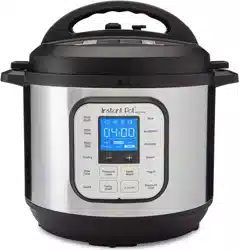
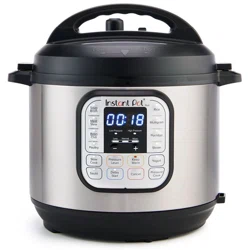
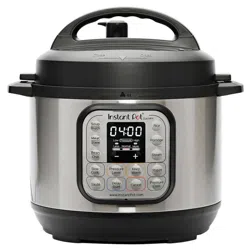
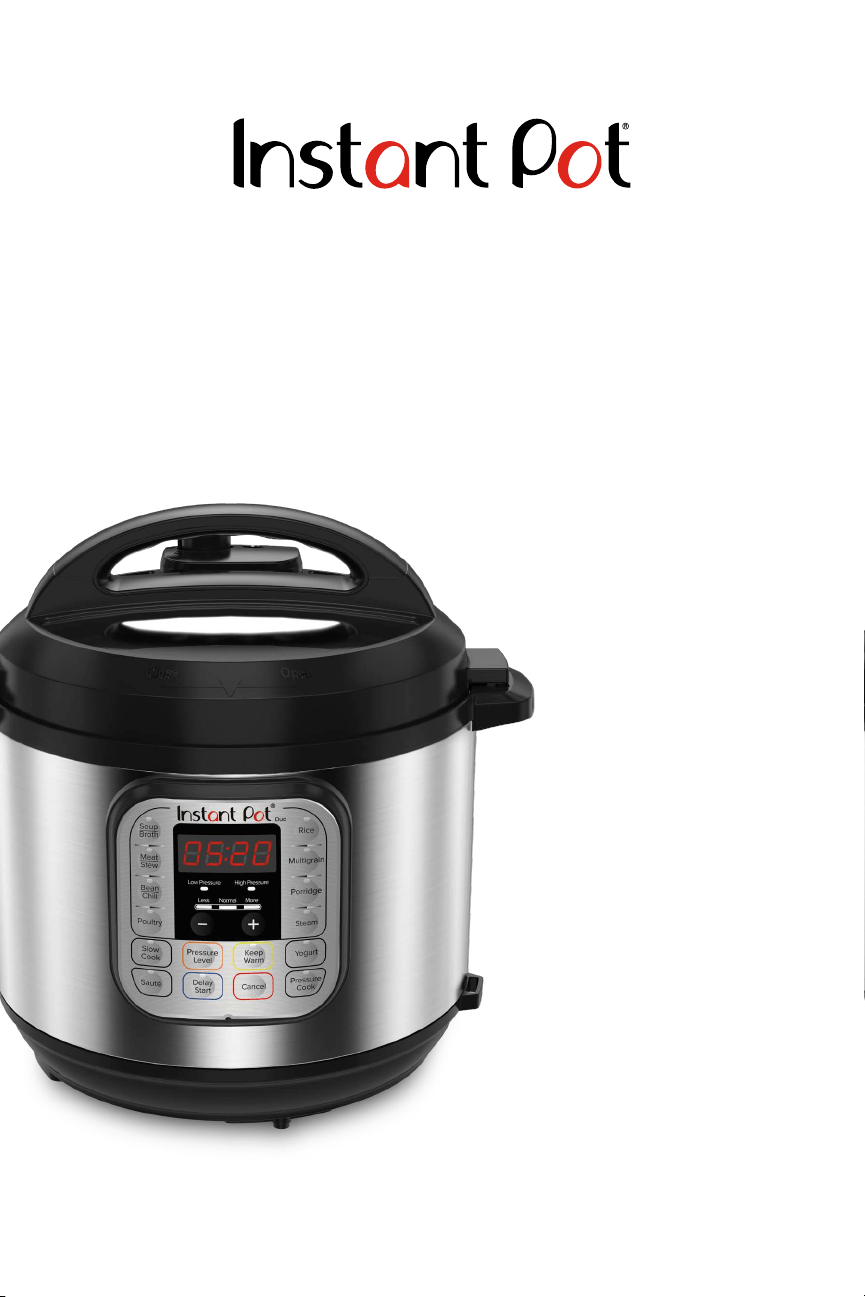
DUO
TM
Mini, 6 and 8 Quart
Multi-Use Pressure Cookers

Welcome to the world of Instant cooking.
Thank you for welcoming us into your kitchen.
Having families ourselves, we developed the Instant Pot
®
Duo
™
pressure cookers
to allow busy families and professionals alike to cook healthy, delicious meals
more easily and in less time.
We have partnered with chefs, authors and bloggers to compile a collection of
recipes that we hope you enjoy!
Happy cooking,
Robert J. Wang
Founder and Chief Innovation Ofcer
Find helpful how-to videos, download the app, or visit our recipe site.
Download the Instant Pot App
• Original Recipes
• New User Tips
• Getting Started Videos

3
Table of Contents
IMPORTANT SAFEGUARDS ..............................................................................5–10
Special Cord Set Instructions ............................................................................10
Product Specications ........................................................................................10
Initial Setup .............................................................................................................11
Product, Parts and Accessories .....................................................................12–14
Control Panel ....................................................................................................15 –16
Smart Program Settings .................................................................................. 17–19
Adjust and Save Pressure Cooking Temperature ..........................................17
Adjust and Save Pressure Cooking Time.........................................................17
Adjust and Save Non-Pressure Cooking Temperatures ...............................17
Adjust and Save Non-Pressure Cooking Time ...............................................17
Cancel and Standby Mode ................................................................................18
Turn Sound On/Off .............................................................................................18
Set a Delay Start Timer .......................................................................................18
Automatically Keep Food Warm for Long Periods ........................................19
Reheat Food or Keep Warm for Long Periods ................................................19
Reset Smart Programs to Factory Default Settings .......................................19
Status Messages .................................................................................................... 20
Cleaning Before First Use .................................................................................... 21
Overview of Pressure Control Features ...................................................... 22–29
Pressure Cooking Lid ..........................................................................................22
Steam Release Handle ..................................................................................2 3 –24
Anti-Block Shield .................................................................................................25
Sealing Ring .......................................................................................................... 26
Float Valve .......................................................................................................27–28
Condensation Collector .....................................................................................29

4
Table of Contents
Introduction to Pressure Cooking ...................................................................... 30
Cooking with the Duo .................................................................................. 30–31
Depressurizing the Cooker (Venting Methods) .......................................... 32–34
Initial Test Run (Water Test) ................................................................................. 35
Using Pressure Cooking Smart Programs ................................................... 36– 42
Pressure Cooking Settings .......................................................................... 39–40
Pressure Cooking Tips .................................................................................. 41–42
Pressure Cooking Timetable and Grain-to-Water Ratios .........................43–44
Using Non-Pressure Cooking Smart Programs .......................................... 45 – 49
Slow Cook .............................................................................................................46
Sauté ...................................................................................................................... 47
Yogur t ............................................................................................................. 48– 49
Care and Cleaning .......................................................................................... 5 0 –51
Troubleshooting .............................................................................................. 52–54
Warranty ........................................................................................................... 55–56
Contact Information ............................................................................................. 57

5
IMPORTANT SAFEGUARDS
When using electrical appliances, basic safety precautions should always be
followed:
1. READ THE GETTING STARTED GUIDE AND ALL INSTRUCTIONS,
SAFEGUARDS, AND WARNINGS BEFORE OPERATING THE APPLIANCE.
FAILURE TO FOLLOW THESE SAFEGUARDS AND INSTRUCTIONS MAY
RESULT IN INJURY AND/OR PROPERTY DAMAGE.
2. Use only the Instant Pot Duo lid with the Instant Pot Duo pressure cooker base.
Using any other pressure cooker lids may cause injury and/or damage.
3. To reduce the risk of pressure leakage, cook only in an authorized stainless
steel Instant Pot inner pot. DO NOT use the appliance without the removable
inner pot installed.
4. Always operate the appliance on a stable, non-combustible, level surface.
5. Do not use the appliance for anything other than its intended use. Failure to
follow these instructions may result in injury or property damage.
6. For household use only. Do not use outdoors. Not for commercial use.
7.
CAUTION
Do not place the appliance on or in close proximity to a hot
gas or electric burner, or a heated oven. Heat from an external source will
damage the appliance. Failure to follow these instructions may result in injury
or property damage.
8.
CAUTION
Do not use the appliance near water or ame. Keep out of
direct sunlight. Failure to follow these instructions may result in injury or
property damage.
9.
CAUTION
Do not touch hot surfaces. Only use side handles for carrying
or moving. Extreme caution must be used when moving the appliance
containing hot liquids. Do not move the appliance when it is under pressure.
10. The cooker base contains electrical components. To avoid electrical shock, do
not put liquid of any kind into cooker base, and do not immerse power cord,
plug, or the appliance in water or other liquid. Do not rinse the appliance
under tap.
11.
CAUTION
Do not ll over PC MAX — 2/3 as indicated on the inner pot.
When cooking foods that expand during cooking such as rice or dried
vegetables, do not ll the inner pot over —1/2 line. Overlling may cause a risk
of clogging the steam release pipe and developing excess pressure.

6
IMPORTANT SAFEGUARDS
12.
WARNING
This appliance cooks under pressure. Inappropriate use may
result in burns, injury and/or property damage. Make certain the appliance is
properly closed before operating. Refer to
Pressure Control Features—
Pressure Cooking Lid
.
13. When cooking meat with skin (e.g. sausage with casing), the skin can swell
when heated. Do not pierce the skin while it is swollen; this could result in
scalding injury.
14.
CAUTION
When pressure cooking food with a doughy or thick texture, or
a high fat/oil content, contents may splatter when opening the lid. Please
follow recipe instructions for pressure release method. Refer to
Depressurizing
the Cooker (Venting Methods)
.
15.
CAUTION
Before each use, check the steam release valve/handle, steam
release pipe, anti-block shield and oat valve for clogging. Failure to do so
may result in injury or property damage.
16.
DANGER
Do not open the appliance until it has depressurized and all
internal pressure has been released. If the oat valve is still up and/or the lid is
difcult to open, this indicates that the appliance is still pressurized — do not
force it open. Any pressure in the appliance can be hazardous. Refer to
Depressurizing the Cooker (Venting Methods) for information on releasing
pressure. Opening appliance while it is still pressurized may lead to sudden
release of hot contents and may cause burns or other injuries.
17. Do not use this appliance for deep frying or pressure frying with oil.
18. Do not lean over or place your hands or face over the steam release valve/
handle or oat valve when the appliance is in operation or has residual
pressure. Do not touch the metal portion of the lid when the appliance is in
operation; this could result in injury.
19. Do not cover or obstruct the steam release valve/handle and/or oat valve
with cloth or other objects. Obstructing the steam release valve/handle and/or
oat valve can create a safety issue and may cause injury.
20. Turn the appliance off if steam escapes from the steam release valve/handle
and/or oat valve in a steady stream for longer than 3 minutes. There may
be residual pressure in the appliance. Allow the appliance to depressurize
naturally or release all excess pressure before opening. For more information
on how to release pressure, refer to
Depressurizing the Cooker (Venting
Methods)
.
Read this manual carefully and completely, and retain for future reference.
Failure to adhere to safety instructions may result in serious injury.
WARNING

7
IMPORTANT SAFEGUARDS
21. Turn the appliance off if steam escapes from the sides of the lid and ensure
sealing ring is properly installed.
Overview of Pressure Control Features—
Sealing Ring
for more information.
22. To disconnect, select Cancel, then remove plug from power source.
23. Unplug from the outlet when not in use, as well as before adding or removing
parts or accessories, and before cleaning. To unplug, grasp the plug and pull
from the outlet. Never pull from the power cord.
24. Regularly inspect the appliance and power cord. Do not operate the appliance
if the power cord or plug is damaged, or after the appliance malfunctions or is
dropped or damaged in any manner. For assistance, contact Customer Care at
25.
CAUTION
Do not let the power cord hang over edges of tables or
counters, or touch hot surfaces or open ame, including the stovetop.
26.
CAUTION
Spilled food can cause serious burns. A short power-supply
cord is provided to reduce the hazards resulting from grabbing, entanglement
and tripping.
• Keep the appliance and cord away from children.
• Never drape the power cord over edges of tables or counters.
• Never use below-counter power outlets, and never use with an
extension cord.
27. Intended for countertop use only. Keep the appliance on a stable, heat-
resistant platform. Do not place on anything that may block the vents on the
bottom of the appliance. Do not place on a hot stove.
28.
CAUTION
Do not use any accessories or attachments not authorized by
Instant Brands™ Inc. The use of attachments not recommended by the
manufacturer, may cause a risk of injury, re or electric shock.
29.
CAUTION
Before inserting the inner pot into the appliance, clean the
outer surface of the inner pot and the heating element located on the inner
surface of the outer pot with a clean, dry cloth. Ensure they are dry and free of
food debris.
30. Do not attempt to repair, replace, or modify components of the appliance, as
this may cause electric shock, re or injury, and will void the warranty.
Read this manual carefully and completely, and retain for future reference.
Failure to adhere to safety instructions may result in serious injury.
WARNING

8
IMPORTANT SAFEGUARDS
31. Do not tamper with any of the safety mechanisms, as this may result in injury
or property damage.
32. Do not use the appliance in electrical systems other than 120 V/60 Hz for
North America. Do not use with power converters or adapters.
33. This appliance is NOT to be used by children or by persons with reduced
physical, sensory, or mental capabilities. Close supervision is necessary when
any appliance is used near children and these individuals. Children should not
play with this appliance.
34. To prevent personal injury and damage to the appliance, only replace the
sealing ring with an authorized Instant Pot sealing ring.
35. The use of accessory attachments not recommended by the appliance
manufacturer may cause injuries.
36. Proper maintenance is recommended after each use. Refer to
Care and Cleaning.
Let the appliance cool to room temperature before cleaning or storage.
37. Never connect this appliance to an external timer switch or separate remote-
control system.
38.
CAUTION
DO NOT touch accessories during or immediately after
cooking. To avoid personal injury,
• Always use oven mitts when removing accessories, and to handle
the inner pot.
• Always place hot accessories on a heat resistant surface or cooking plate.
• Use extreme caution when disposing of hot grease.
Failure to follow these instructions may result in serious injury or property damage.
39. Do not leave the appliance unattended while in use.
40.
CAUTION
Extreme caution must be used when the inner pot contains hot
oil, hot food, or hot liquids. Improper use, including moving the cooker base,
may result in personal injury. Do not move the appliance while it is in use.
41. Oversized foods and/or metal utensils must not be inserted into the inner pot
as they may cause risk of re and/or personal injury.
42. Do not store any materials in the cooker base or inner pot when not in use.
Read this manual carefully and completely, and retain for future reference.
Failure to adhere to safety instructions may result in serious injury.
WARNING

9
IMPORTANT SAFEGUARDS
43. Do not place any combustible materials in the cooker base or inner pot,
such as paper, cardboard, plastic, Styrofoam or wood.
44. Do not use the included accessories in a microwave, toaster oven, convection
or conventional oven, or on a ceramic cooktop, electric coil, gas range, or
outdoor grill.
45. The removable inner pot can be extremely heavy when full of ingredients.
Care should be taken when lifting the inner pot from the cooker base to avoid
burn injury.
46. Use caution when removing the lid. Heat and steam escapes as soon as the lid
is removed. Never place your face, hands or exposed skin over the appliance
opening where heat and steam escapes when removing the lid.
SAVE THESE INSTRUCTIONS
Read this manual carefully and completely, and retain for future reference.
Failure to adhere to safety instructions may result in serious injury.
WARNING
10
IMPORTANT SAFEGUARDS
Special Cord Set Instructions
As per safety requirements, a short power supply cord (0.6 m to 0.9 m /
24" to 35") is provided to reduce the hazards resulting from grabbing,
entanglement and tripping.
This appliance has a 3-prong grounding plug. To reduce the risk of electric
shock, plug the power cord into a grounded (earthed) electrical outlet that
is easily accessible.
Product Specications
Duo Mini
3 Quart
2.8 Litres
700 watts 120 V / 60 Hz
3.9 kg
8.6 lbs.
in: 11.4 L × 10 W × 11.2 H
cm: 29 L × 25.5 W × 28.5 H
Duo 60 V3
6 Quart
5.7 Litres
1000 watts 120 V / 60 Hz
5.35 kg
11.80 lbs.
in: 13.4 L × 12.2 W × 12.5 H
cm: 34 L × 31 W × 31.7 H
Duo 80 V2
8 Quart
7.6 Litres
1200 watts 120 V / 60 Hz
7.16 kg
15.79 lbs.
in: 14.8 L × 13.3 W × 14.2 H
cm: 37.6 L × 33.8 W × 36.1 H
WARNING
THE FAILURE TO FOLLOW ANY OF THE IMPORTANT SAFEGUARDS AND THE IMPORTANT
INSTRUCTIONS FOR SAFE USE IS A MISUSE OF YOUR APPLIANCE THAT CAN VOID YOUR
WARRANTY AND CREATE THE RISK OF SERIOUS INJURY.
WARNING
Electrical shock hazard. Use grounded outlet only. DO NOT remove ground. DO NOT use an adapter. DO
NOT use an extension cord. Failure to follow instructions can cause electric shock or death.
WARNING
To avoid injury, read and understand instruction manual before using this appliance. Failure to do so
may result in injury.
Read this manual carefully and completely, and retain for future reference.
Failure to adhere to safety instructions may result in serious injury.
WARNING

11
Initial Setup
• Read all the Important Safeguards before using the appliance. Failure to
read and follow the Important Safeguards may result in damage to the
appliance, property damage or personal injury.
• Use only the Instant Pot Duo lid with the Instant Pot Duo
pressure cooker
base. Using any other pressure cooker lids may cause injury and/or damage.
• Remove all packaging material and accessories from within and around
the appliance.
• Place the appliance on a stable, level surface, away from combustible
material and external heat sources.
• Do not remove safety warning stickers from the lid or rating label from
back of the cooker base.
• Follow
Cleaning Before First Use instructions to clean the appliance
before rst use.
CAUTION
Do not place the appliance on a stovetop. Heat from an external
source will damage the appliance.
Do not place anything on top of the appliance, and do not cover
or block the steam release valve or anti-block shield located on
the appliance lid.
12
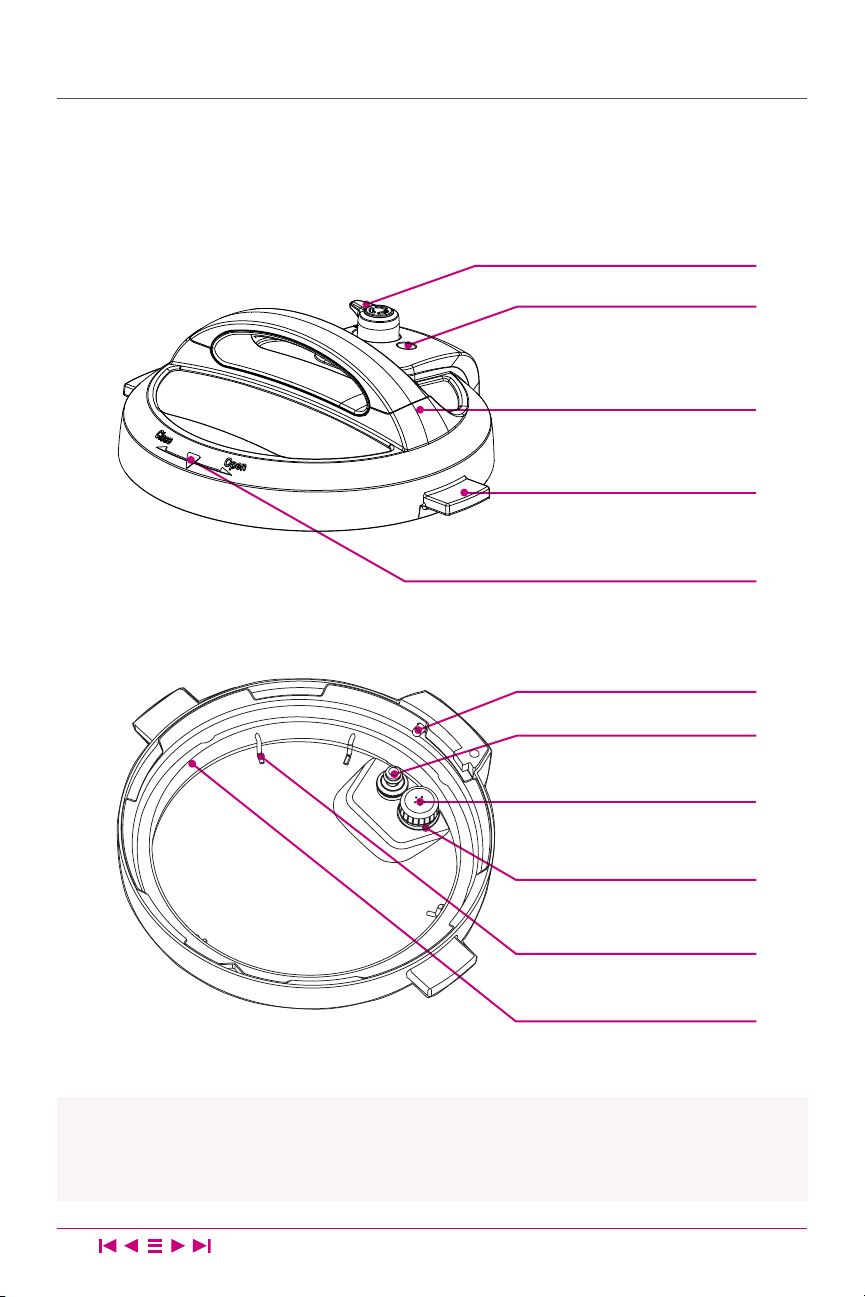
Product, Parts and Accessories
Duo Mini, 6 and 8 Quart Pressure Cookers
Before using the Instant Pot Duo, verify that all parts are accounted for.
Top of Lid
Bottom of Lid
Illustrations are for reference only and may differ from the actual product.
Instant Tip: The lid has been designed with lid ns that t perfectly inside
the handles on the left and right sides of the cooker base to help keep your
countertop dry!
Lid Position Marker
Handle
Lid Fins
Steam Release Handle
Float Valve
Steam Release Pipe
Sealing Ring Rack
Sealing Ring
Anti-Block Shield
Locking Pin
Silicone Cap
(bottom of oat valve)
(beneath anti-block shield)
13
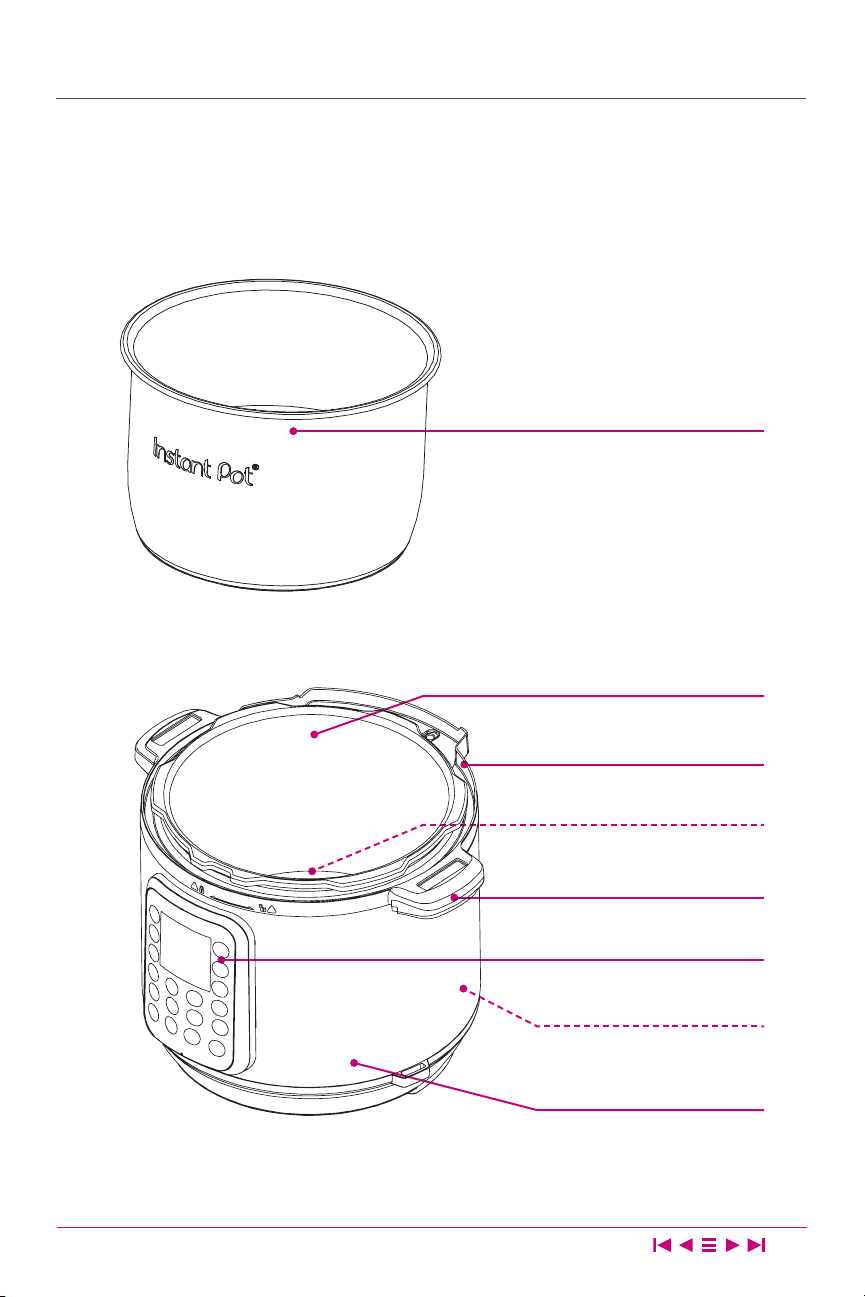
Product, Parts and Accessories
(rear, 8 quart is hardwired)
(interior)
Base Power Socket
Stainless Steel Exterior
Condensation Rim
Cooker Handles
Control Panel
Outer Pot
Heating Element
Inner Pot
Cooker Base
Illustrations are for reference only and may differ from the actual product.
Stainless Steel Inner Pot
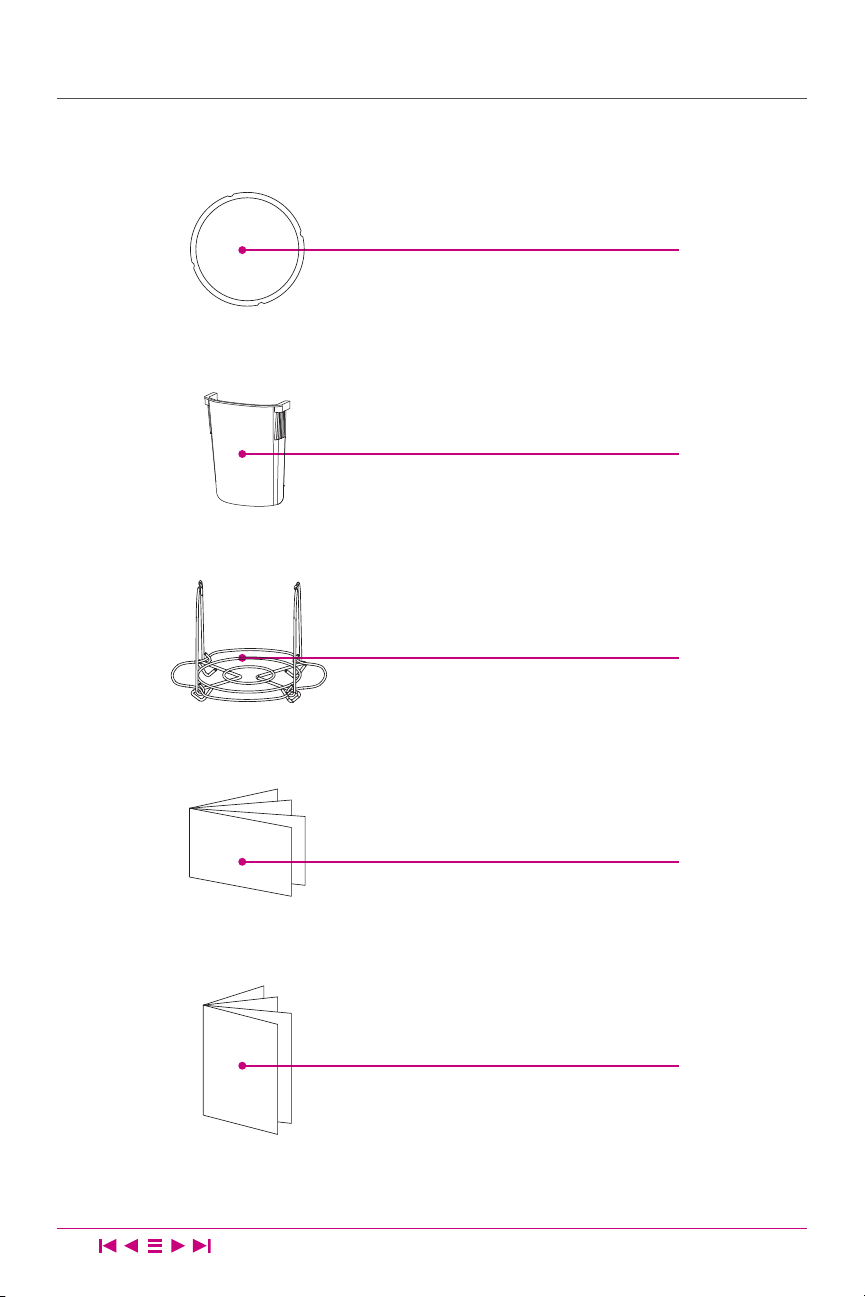
15
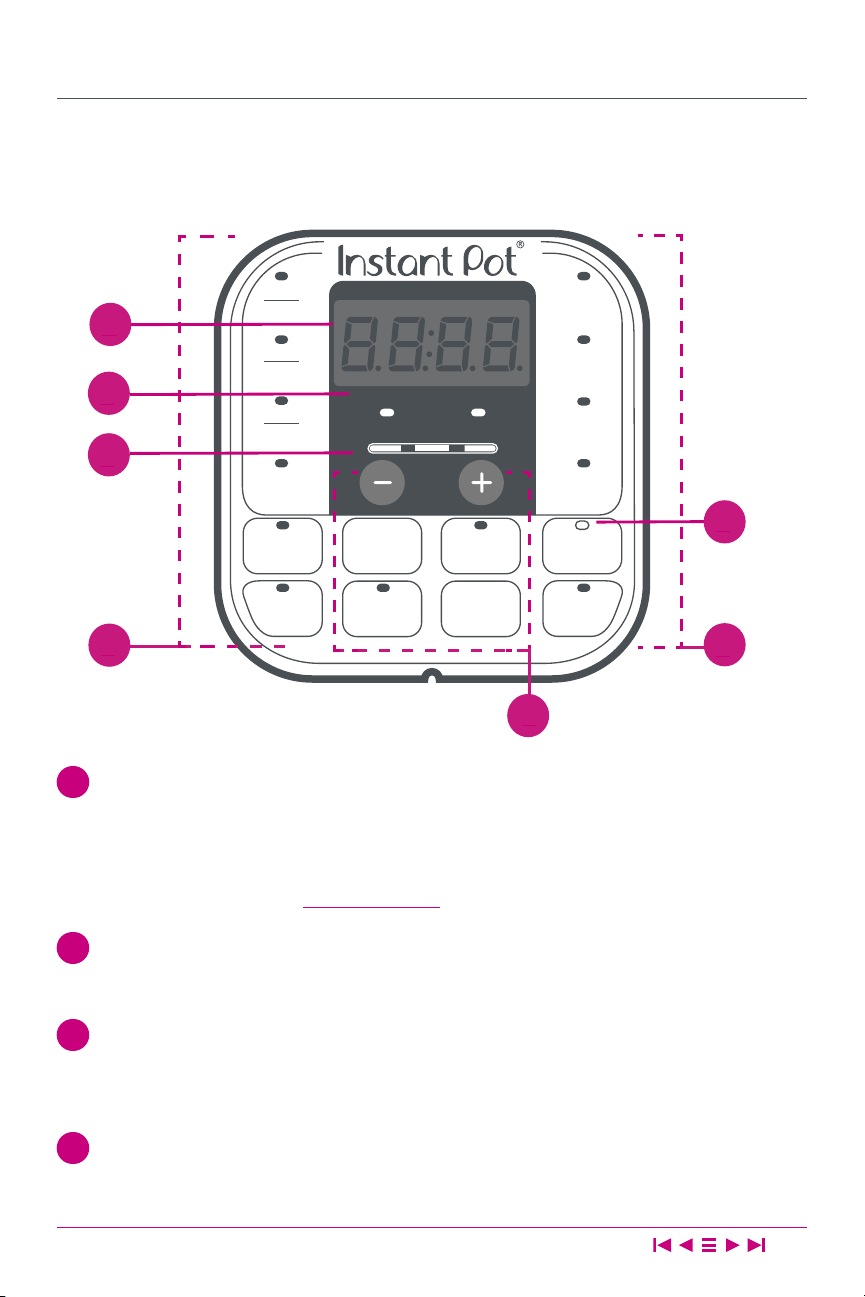
Control Panel
The Instant Pot Duo multi-use pressure cooker features an intuitive control panel
to help make cooking fast and easy.
Duo
Meat
Stew
Poultry
Pressure
Level
Soup
Broth
Rice
Multigrain
Porridge
Steam
Bean
Chili
Less
Low Pressure High Pressure
Normal More
Delay
Start
Keep
Warm
Slow
Cook
Sauté
Pressure
Cook
Yogurt
Cancel
1 Time Display
• Countdown timer indicates cooking and Delay Start time
in hour format: 05:20 is 5 hours, 20 minutes.
• Keep Warm timer counts up.
• Display also shows
Status Messages as described below.
2 Pressure Field
• LED indicators illuminate to indicate Low or High pressure level.
3 Less – Normal – More
• Pressure cooking: 3 preset time options.
• Non-Pressure cooking: 3 temperature levels.
4 LED Indicators
• Illuminate to indicate the active Smart Program and settings selected.
1
2
3
6
4
5
6

16
Control Panel
5 Smart Program Settings
• Pressure Level
• Keep Warm
• − / + buttons
• Delay Start
• Cancel
See
Smart Program Settings for more information.
6 Smart Programs
Pressure Cooking:
• Pressure Cook
• Soup/Broth
• Meat/Stew
• Bean/Chili
• Poultry (Not available on Duo Mini)
• Rice
• Multigrain (Not available on Duo Mini)
• Porridge
• Steam
Non-Pressure Cooking:
• Slow Cook
• Sauté
• Yogurt
• Keep Warm

17
Smart Program Settings
Adjust and Save Pressure Cooking Temperature
Select a pressure cooking Smart Program, then press Pressure Level to toggle
between High (10.2–11.6 psi) and Low (5.8–7.2 psi) pressure levels.
Note: A higher pressure results in higher cooking temperature.
When cooking begins, the pressure level you selected is saved and remembered
the next time the Smart Program is selected.
The cooking temperature may be adjusted at any time during pressure cooking
by pressing Pressure Level, but adjustments made after cooking has begun will
not be saved.
Adjust and Save Pressure Cooking Time
Select a pressure cooking Smart Program, then press the Smart Program button
again to cycle through the Less, Normal and More cooking time options.
If desired, use the − / + buttons to further customize the time.
When cooking begins, your customizations are saved and remembered the next
time the Smart Program is selected.
The cooking time may be adjusted at any time during pressure cooking, but
adjustments made after cooking has begun will not be saved.
Adjust and Save Non-Pressure Cooking Temperatures
Select a non-pressure cooking Smart Program, then press the Smart Program button
again to cycle through the Less, Normal and More cooking temperature levels.
When cooking begins, the temperature level is saved and remembered the next
time the Smart Program is selected.
The cooking temperature may be adjusted at any time during non-pressure
cooking by pressing the Smart Program button, but adjustments made after
cooking has begun will not be saved.
Adjust and Save Non-Pressure Cooking Time
Select a non-pressure cooking Smart Program, then use the − / + buttons to adjust
the cooking time.
The cooking time may be adjusted at any time during non-pressure cooking, but
adjustments made after cooking has begun will not be saved.

18
Smart Program Settings
Cancel and Standby Mode
When the cooker is plugged in but not in operation, the display reads OFF to
indicate Standby mode.
Press Cancel to stop a Smart Program at any time. The cooker returns to
Standby mode.
Turn Sound On/Off
Sound On: When in Standby, press and hold + button until display indicates S On.
Sound Off: When in Standby, press and hold − button until display indicates SOFF.
Note: Audible safety alerts (beeps) cannot be turned off.
Set a Delay Start Timer
Delay Start can be set to a minimum of 10 minutes or a maximum of 24 hours.
1. Select a Smart Program and adjust the settings as you desire, then press Delay Start.
Note: Once Delay Start has been selected, there is no way to return to the cooking
settings. To adjust Smart Program settings, press Cancel and enter new selections.
2. When the hours eld ashes, use the − / + buttons to adjust the delay time.
E.g., 02:00 indicates that cooking will start after 2 hours.
3. Press Delay Start again to toggle to the minutes eld and follow the same
process as the previous step.
4. Delay Start begins automatically after 10 seconds and the timer counts down.
5. When Delay Start ends, the Smart Program begins, and the display indicates On.
Delay Start is not available with the Sauté or Yogurt Smart Programs.

19
Smart Program Settings
Automatically Keep Food Warm After Cooking
The Keep Warm setting turns on automatically after cooking on all Smart
Programs except Sauté and Yogurt.
When automatic warming begins, the timer begins counting from 00:00 to
indicate the time passed, up to 10 hours.
To turn automatic warming off, press Keep Warm. The LED above the button dims
to indicate that it is off and will not turn on after cooking completes.
Reheat Food or Keep Warm for Long Periods
When in Standby, select Keep Warm. Press Keep Warm again to cycle through
Less, Normal and More warming temperature levels.
Use the − / + buttons to set a warming timer up to 99 hours and 50 minutes.
Reset Smart Programs to Factory Default Settings
Reset Individual Smart Programs
With the cooker in Standby mode, press and hold one Smart Program button until
the cooker returns to Standby and displays OFF.
The Smart Program’s pressure level, cooking time and temperature are restored to
the factory default setting.
Reset All Smart Programs
With the cooker in Standby mode, press and hold Cancel until the cooker beeps.
All Smart Program pressure levels, cooking times and temperatures are restored
to the factory default setting.

20
Status Messages
Indicates that the cooker is in Standby mode.
Indicates that the pressure cooker lid is not properly
secured or missing.
Indicates that the cooker is in Preheat mode.
Display timer indicates one of the following:
• When a Smart Program is running, the display timer
counts down to indicate the cooking time remaining
in the Smart Program.
• When Delay Start is running, the display timer counts
down until the Smart Program begins.
• When Keep Warm is running, the display timer counts
up to indicate how long food has been warming.
Indicates that the Rice Smart Program is running.
Indicates that the Yogurt Smart Program is in the pasteurizing
cycle (i.e., the Yogurt Smart Program is set to More).
Indicates that the Sauté Smart Program has reached cooking
temperature and food may be added to the inner pot.
Indicates that a Smart Program has ended and Keep Warm is off.
Indicates overheating in the cooking chamber. Refer to
Troubleshooting.
Indicates that an error has occurred. Refer to
Troubleshooting.
21
Cleaning Before First Use
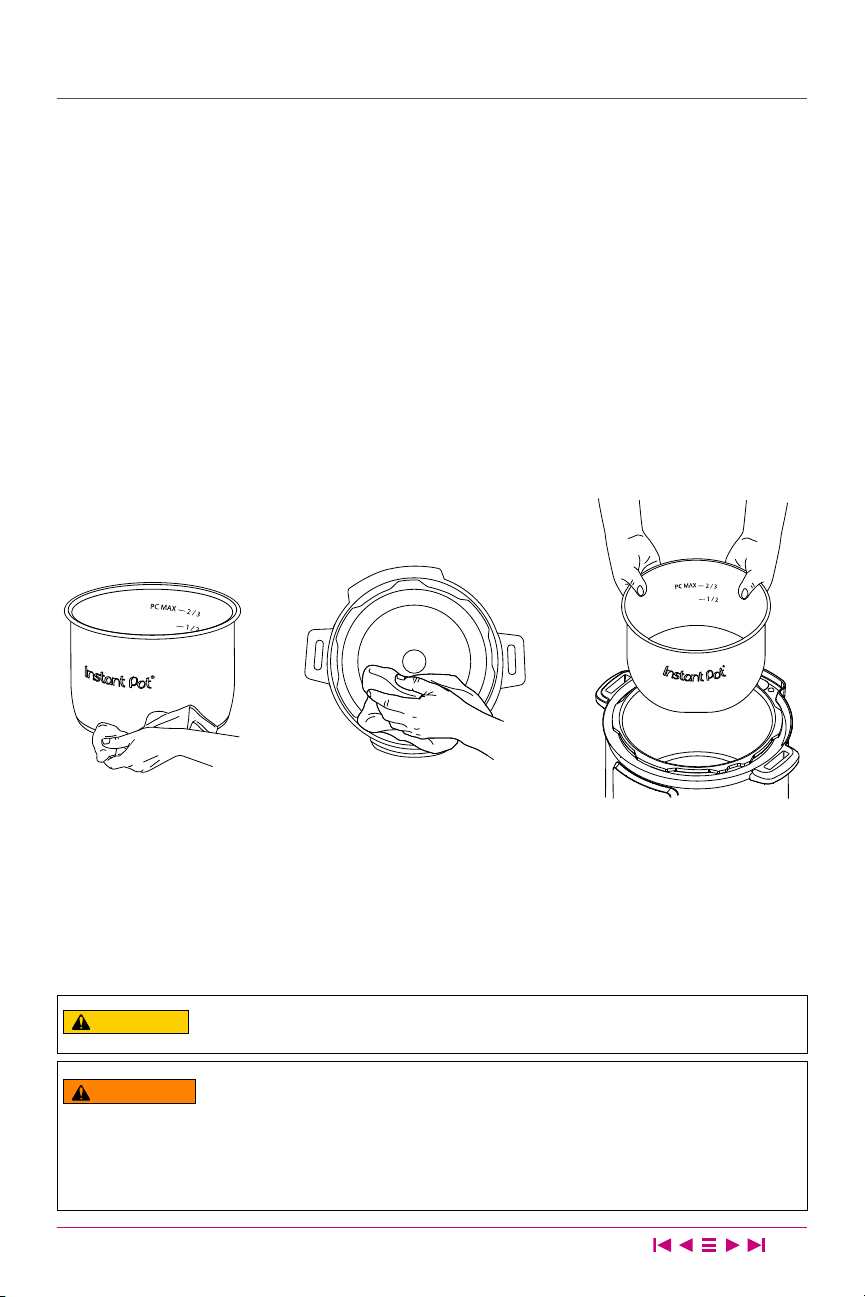
Remove the inner pot from the cooker base and wash it with hot water and dish soap.
Rinse with warm, clear water and use a soft cloth to dry the outside of the inner pot.
Note: The inner pot is dishwasher safe.
Wipe the heating element to ensure it is free of stray packaging particles
before returning the inner pot to the cooker base. Failure to do so may
damage the cooker.
The inner pot is an integral part of product safety. Food must be placed in
the inner pot, and never directly in the cooker base.
To avoid personal injury or damage to the appliance, replace a deformed or
damaged inner pot. Use only authorized Instant Pot inner pots made for this
model when cooking.
Illustrations are for reference only and may differ from the actual product.
CAUTION
To avoid risk of personal injury and/or property damage, do not pour food or liquid
into cooker base.
WARNING
Do not ll the inner pot higher than the PC MAX —2/3 line (Pressure Cooking Maximum), as
indicated on the inner pot.
Exercise extreme caution when cooking and venting food such as applesauce, cranberries,
pearl barley, oatmeal, split peas, noodles, etc., as these foods may foam, froth, or spatter, and
may clog the steam release pipe and/or steam release valve. Do not ll the inner pot higher
than the — 1/2 line when cooking these foods, as indicated on the inner pot.
22
Overview of Pressure Control Features
Pressure Cooking Lid
The stainless steel lid included is necessary for most cooking processes, and is
essential for pressure cooking. Always ensure to use the Duo pressure cooking
lid with the Duo cooker base.
For replacement parts and accessories, visit
our store.
When plugged in, the cooker plays a jingle when the lid is opened and closed.
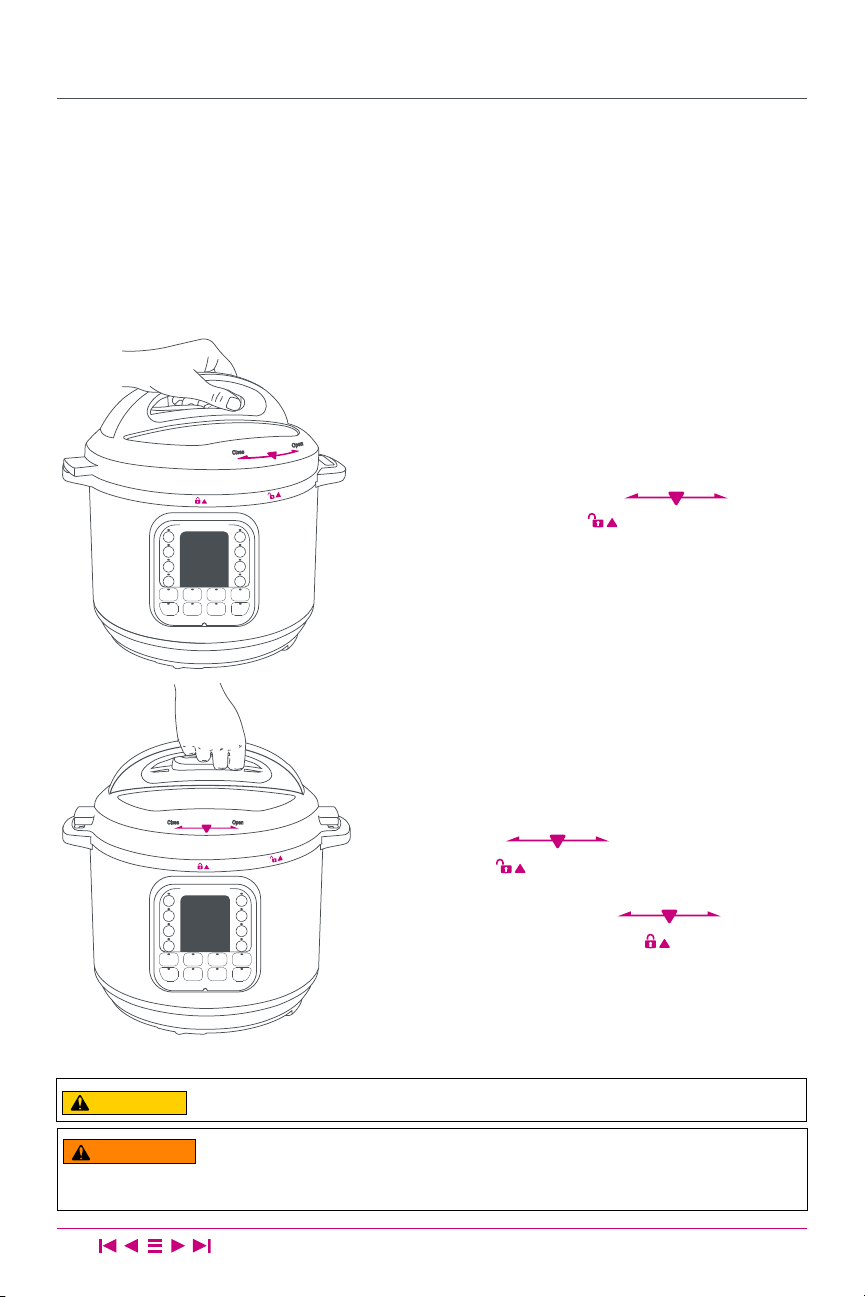
Open and Remove the Lid
Grip the lid handle and turn it counter-
clockwise to align the
symbol
on the lid with the
symbol on the rim
of the cooker base, then lift the lid up and
off the cooker base.
Close the Lid
Align the
symbol on the lid
with the
symbol on the cooker base
and lower the lid onto the track. Turn the
lid clockwise until the
symbol
on the lid aligns with the
symbol on the
cooker base.
CAUTION
Always check the lid for damage and excessive wear prior to cooking.
WARNING
The Duo pressure cooking lid is not compatible with all Instant Pot pressure cookers. Always
ensure to use an authorized Instant Pot pressure cooking lid compatible with Duo pressure
cookers when pressure cooking. Using any other pressure cooker lid may cause injury and/or
property damage.
Illustrations are for reference only and may differ from the actual product.
23
Overview of Pressure Control Features
Steam Release Handle
Turning the handle from Sealing to Venting and vice versa manually opens and
closes the steam release valve, sealing and venting the cooker as you desire. When
the cooker releases pressure, steam ejects from the top of the steam release handle.
Refer to
Depressurizing the Cooker (Venting Methods) for details on
safe depressurization.
The steam release handle is integral to product safety and necessary for pressure
cooking. It should be installed before use and cleaned regularly.
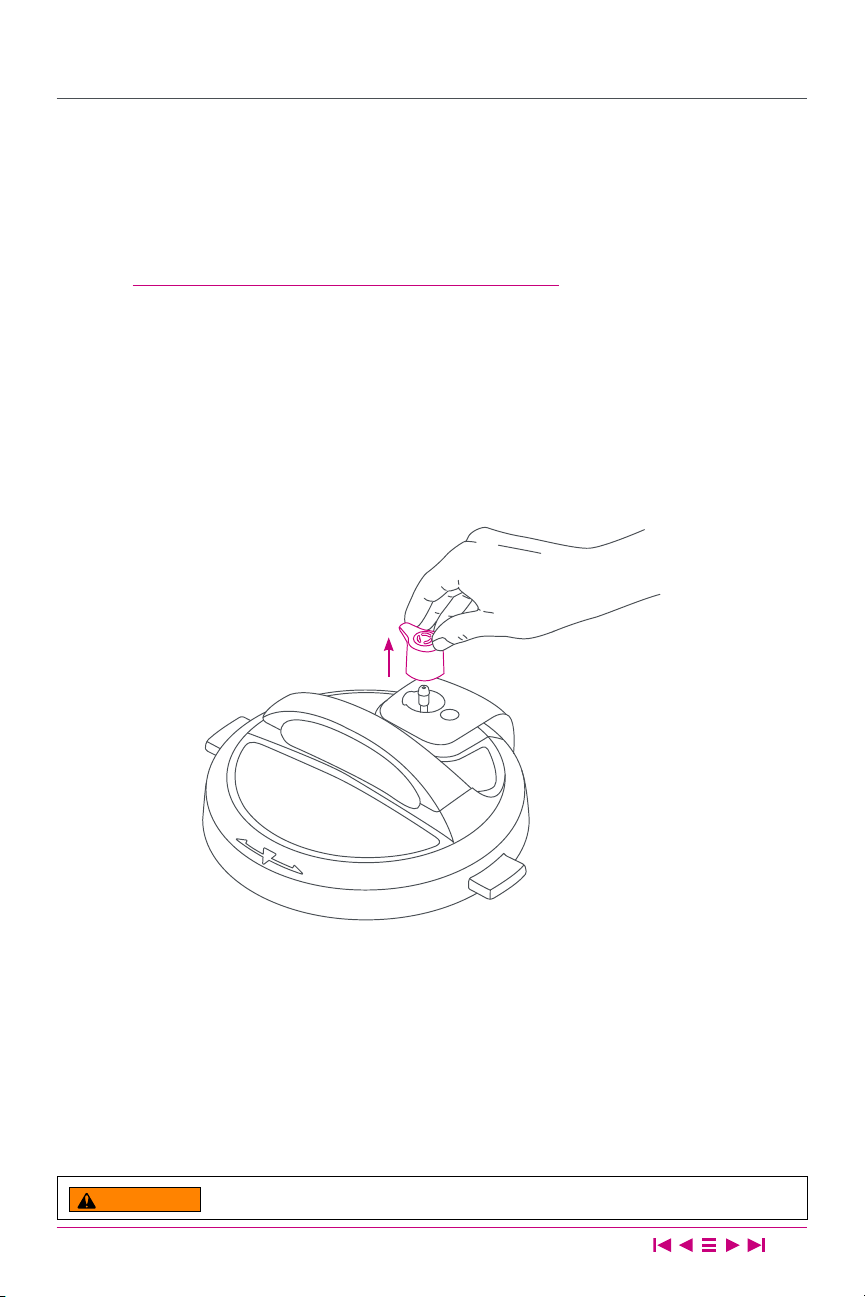
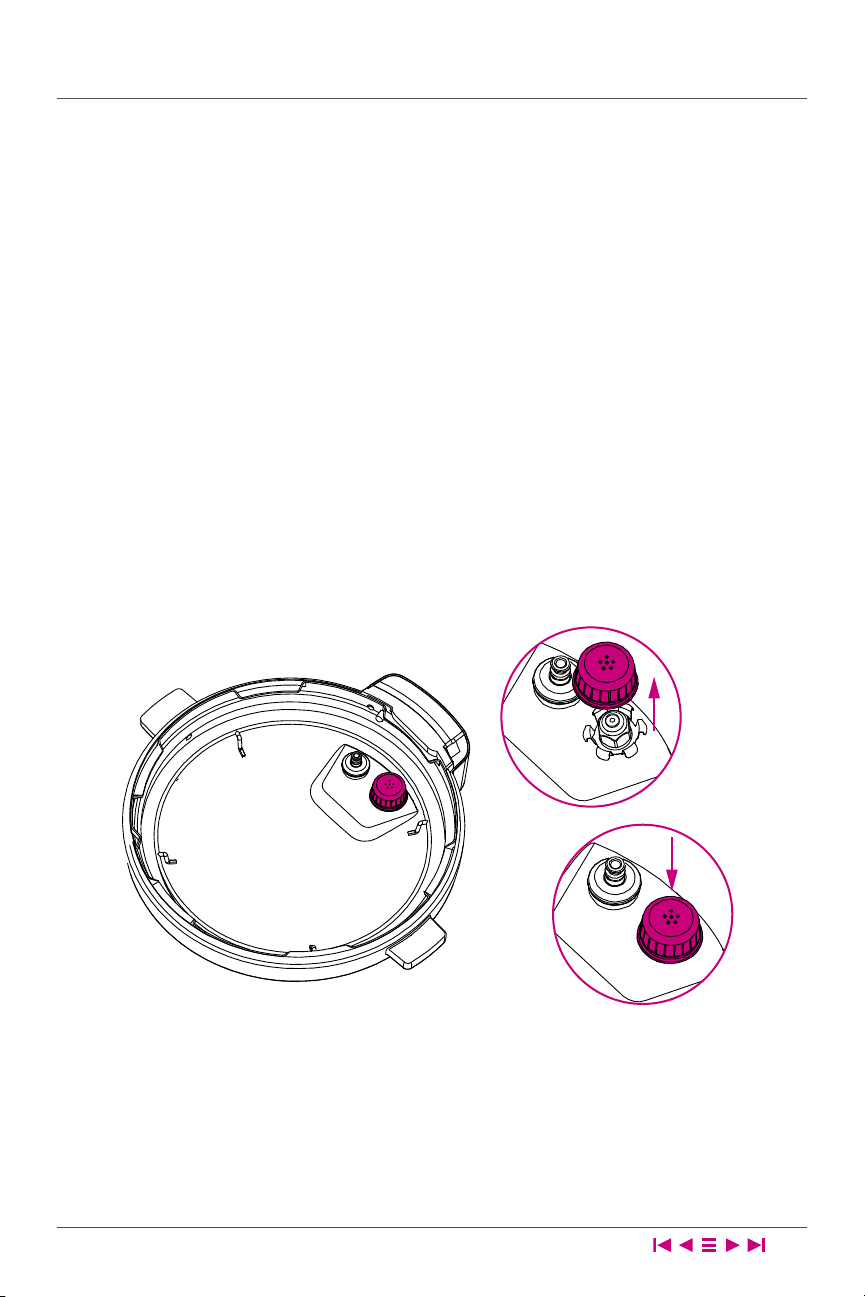
Remove the Steam Release Handle
Pull steam release handle up and off steam release pipe.
Steam release handle must be installed before use and cleaned frequently.
Illustrations are for reference only and may differ from the actual product.
WARNING
Do not cover or block the steam release handle.
24
Overview of Pressure Control Features
Install the Steam Release Handle
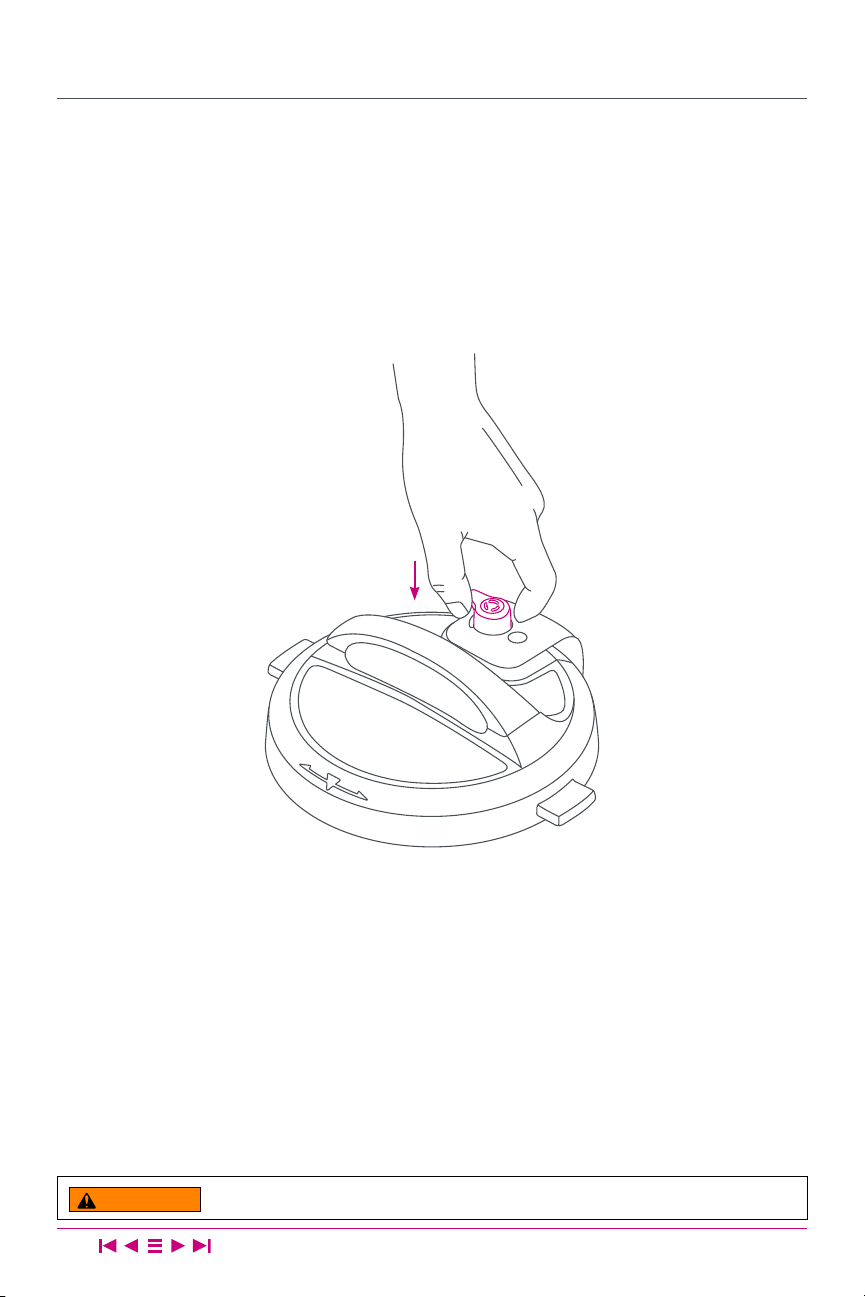
Place the steam release handle on the steam release pipe and press down rmly.
The steam release handle sits loosely on the steam release pipe in order to
pivot easily while the cooker is pressurized. It should remain in place when the
lid is turned over.
Illustrations are for reference only and may differ from the actual product.
WARNING
Do not cover or block the steam release handle.
25
Overview of Pressure Control Features
Anti-Block Shield
The anti-block shield prevents food particles from coming up through the steam
release pipe, assisting with pressure regulation.
As an integral part of product safety, the anti-block shield must be installed before
use and cleaned frequently.
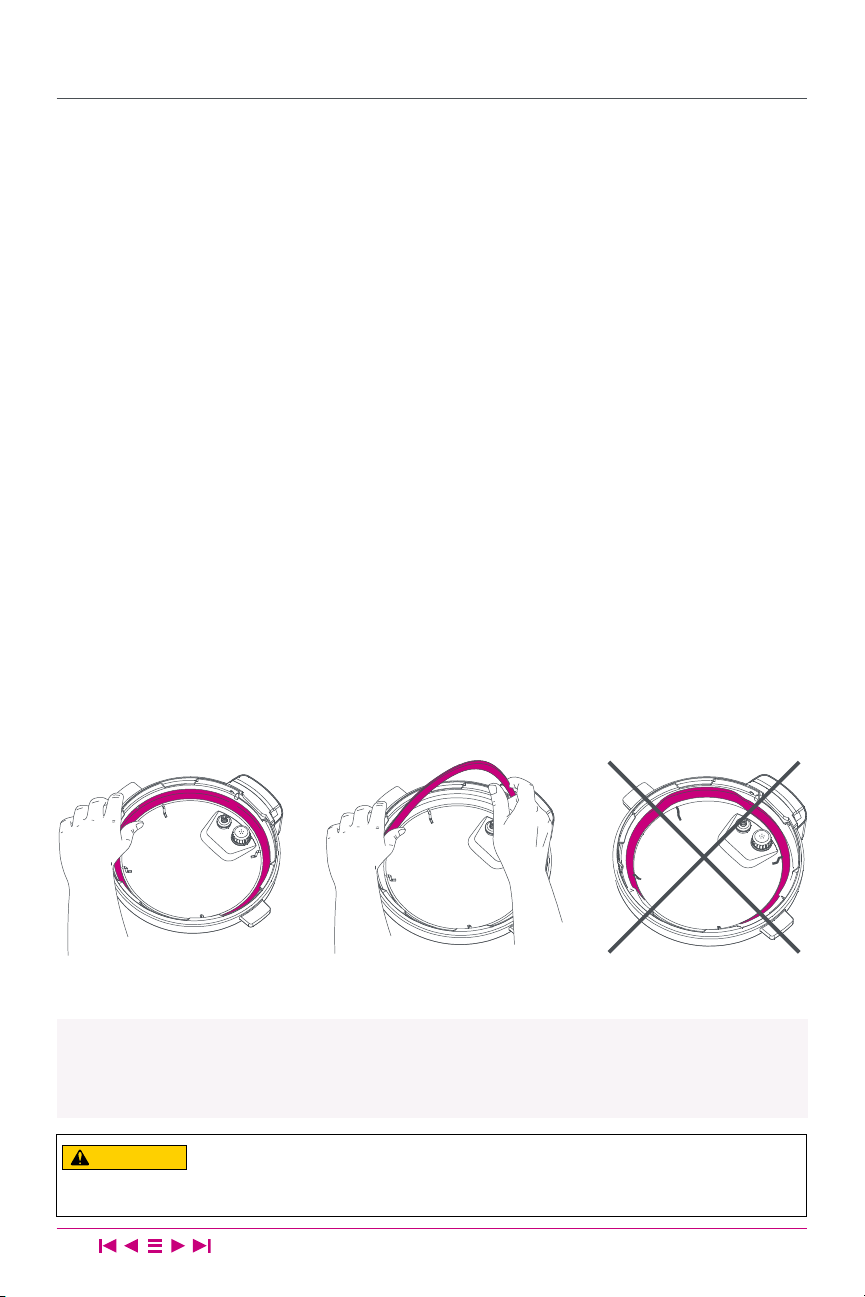
Remove the Anti-Block Shield
Grip the lid like a steering wheel and use your thumbs to press rmly against the
side of the anti-block shield (pressing towards the side of the lid and up) until it
pops off the prongs underneath.
Install the Anti-Block Shield
Place anti-block shield over prongs and press down until it snaps into position.
Do not attempt to operate the pressure cooker without the anti-block shield installed.
Illustrations are for reference only and may differ from the actual product.
26
Overview of Pressure Control Features
Sealing Ring
When the pressure cooking lid is closed, the sealing ring installed on the
underside of the lid creates an air-tight seal between the lid and the cooker base.
The sealing ring must be installed before using the cooker and should be cleaned
after each use. Only 1 sealing ring should be installed in the lid when using the cooker.
Sealing rings stretch over time with normal use. As an integral part of product
safety, the sealing ring should be replaced every 12–18 months or sooner if
stretching, deformation, or damage is noticed.
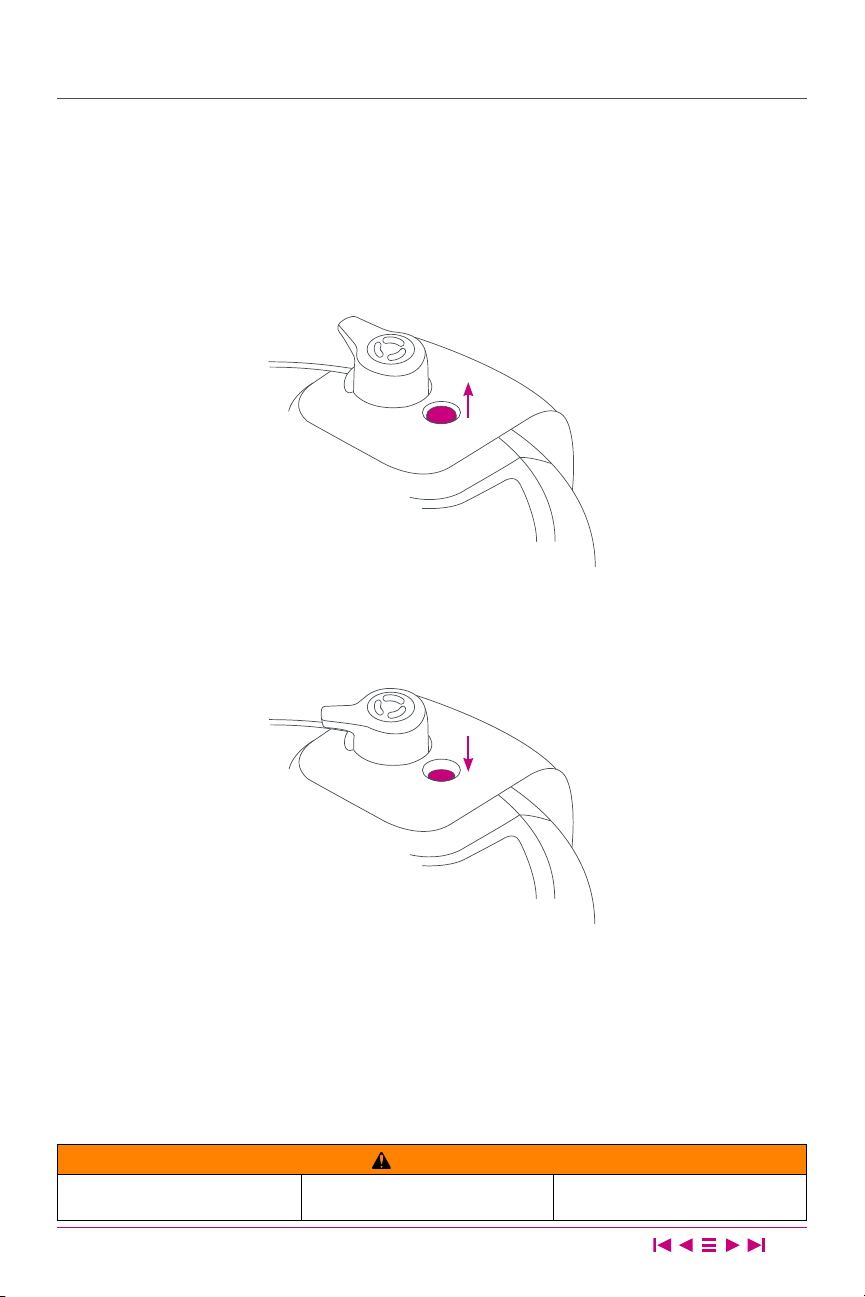
Remove the Sealing Ring
Grip the edge of the silicone rubber and pull the sealing ring out from behind the
circular stainless steel sealing ring rack.
With the sealing ring removed, inspect the rack to ensure it is secured, centered,
and an even height all the way around the lid. Do not attempt to repair a deformed
sealing ring rack.
Install the Sealing Ring
Place the sealing ring over the sealing ring rack and press it into place. Press down
rmly to ensure there is no puckering.
When installed properly, the sealing ring is snug behind sealing ring rack and
should not fall out when the lid is turned over.
Illustrations are for reference only and may differ from the actual product.
Instant Tip: Silicone is porous, so it may absorb strong aromas and certain
avors. Keep extra sealing rings on hand to limit the transfer of those aromas
and avors between dishes. Visit our
store to color code your cooking.
CAUTION
Always check for cuts, deformation, and correct installation of the sealing ring prior to
cooking. Do not use a stretched or damaged sealing ring. Only use authorized
Instant Pot sealing rings. Failure to follow these instructions may cause food to
discharge, which may lead to personal injury or property damage.
27
Overview of Pressure Control Features
Float Valve
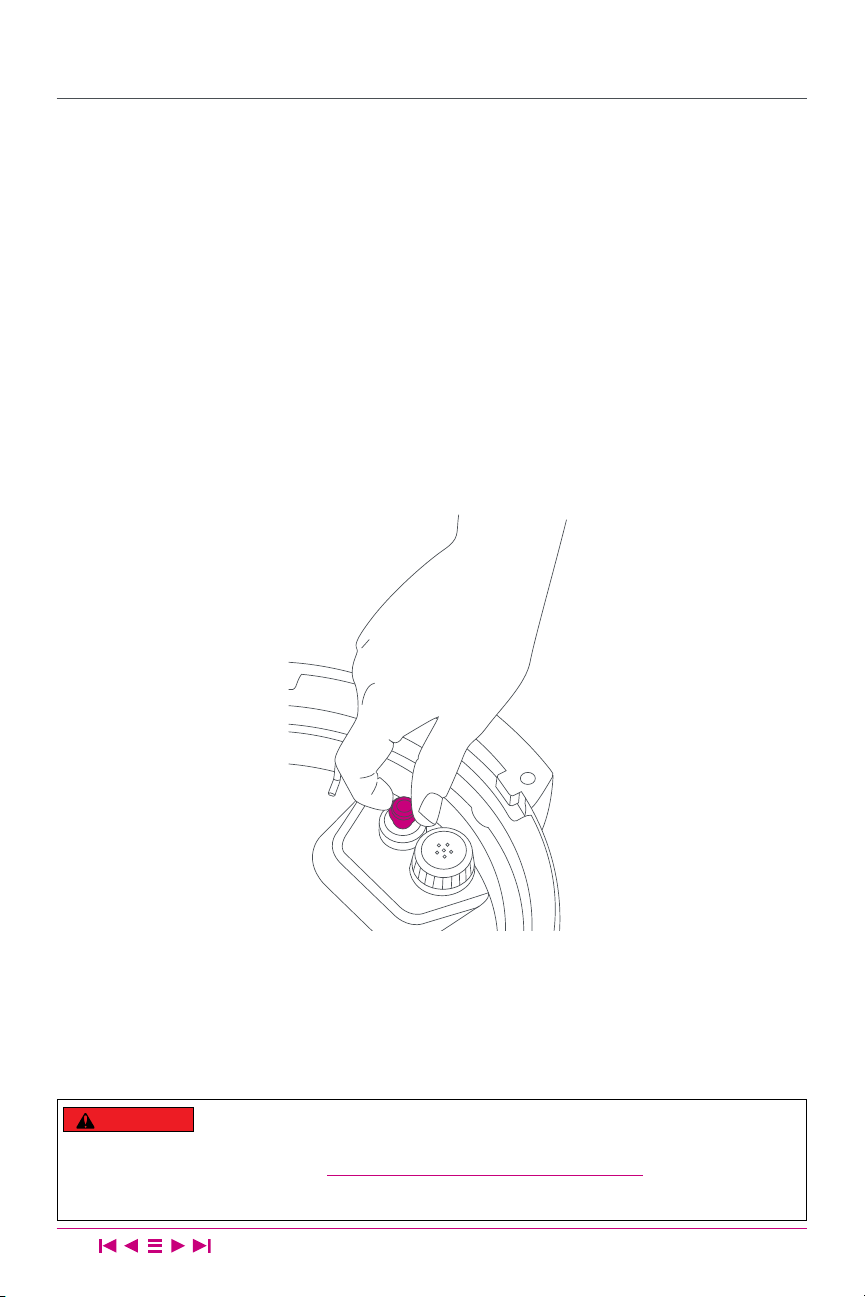
The oat valve provides a visual indication of pressure within the cooker and
appears in 2 positions.
Pressurized
The oat valve is visible and ush with the lid.
Depressurized
The oat valve is sunken into the lid.
The oat valve and silicone cap work together to seal in pressurized steam.
These parts must be installed before use and should be cleaned after each use.
Illustrations are for reference only and may differ from the actual product.
WARNING
Do not lean over or touch the steam
release assembly.
Do not place unprotected skin over the
steam release assembly.
Do not cover or obstruct the steam
release valve or cover.
28
Overview of Pressure Control Features
Remove the Float Valve from the Lid
Place one nger on the at top of the oat valve, then turn the lid over. Detach
the silicone cap from the bottom side of the oat valve.
Remove the oat valve from the top of the lid. Do not discard the oat valve or
silicone cap.
Install the Float Valve
Drop the narrow end of the oat valve into the oat valve hole on the top of the
lid. Place one nger on the at top of the oat valve, then turn the lid over. Firmly
attach the silicone cap to the bottom of the oat valve.
Do not attempt to operate the pressure cooker without the oat valve and/or
silicone cap properly installed in the pressure cooking lid.
Illustrations are for reference only and may differ from the actual product.
DANGER
While the oat valve is up, contents of cooker are under extreme pressure.
Do not attempt to remove the lid. All pressure must be released, and oat valve must
be down. Refer to Depressurizing the Cooker (Venting Methods) for information on
releasing pressure. Failure to follow these instructions may result in property damage
and/or personal injury.
29
Overview of Pressure Control Features
Condensation Collector
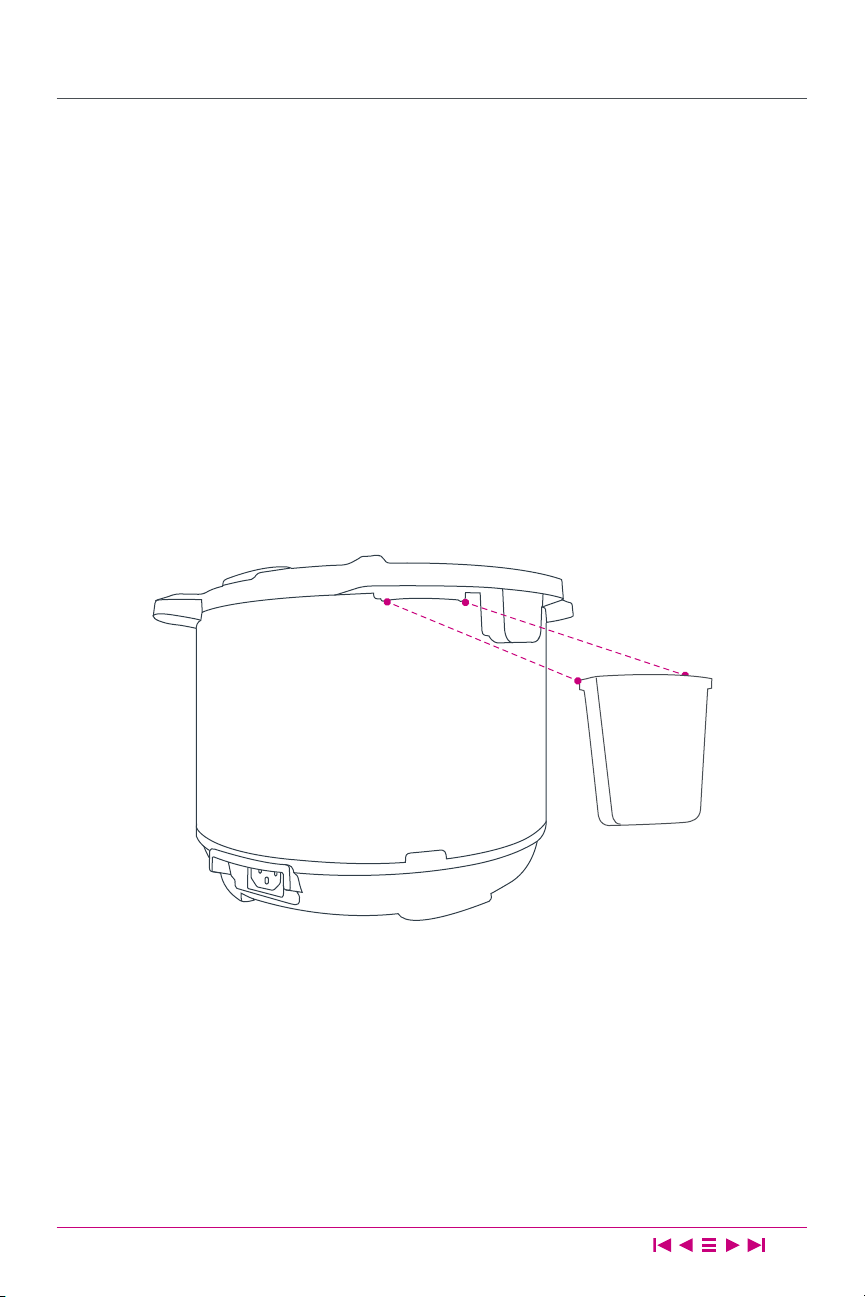
The condensation collector sits at the back of the cooker base and accumulates
overow moisture from the condensation rim. It should be installed before
cooking, then emptied and rinsed out after each use.
Remove the Condensation Collector
Pull the condensation collector away from the cooker base; do not pull down.
Note the tabs on the cooker base and the grooves on the condensation collector.
Install the Condensation Collector
Align the grooves on the condensation collector over the tabs on the back of the
cooker base and slide the condensation collector into place.
Illustrations are for reference only and may differ from the actual product.

30
Introduction to Pressure Cooking
Cooking with the Duo
Pressure cooking uses steam pressure to raise the boiling point of water above
100ºC / 212°F. This energy-efcient cooking method is the fastest way to
thoroughly cook a variety of your favorite meals.
Pressure cookers go through 3 stages when pressure cooking:
1. Pre-Heating and Pressurization
The cooker waits 10 seconds to ensure you have nished inputting your selections,
then displays On to indicate it has begun pre-heating. While the cooker pre-heats,
it vaporizes liquid in the inner pot to create steam. Once enough steam has built
up inside the inner pot, the oat valve pops up and locks the lid of the cooker in
place for safe pressure cooking.
When the oat valve pops up, the silicone cap attached to the bottom of the oat
valve (on the underside of the lid) seals the steam inside the cooking chamber (the
inner pot) and allows the pressure to rise even higher. A higher pressure means a
higher cooking temperature.
While it is normal to see some steam escaping through the oat valve during
pre-heating, if you see steam escaping from around the sides of the lid, press
Cancel and refer to
Troubleshooting.
Note: The time it takes your cooker to pressurize is determined by a variety of factors,
including food and liquid volume.
2. Cooking
After the oat valve pops up, the cooker needs a few minutes to nish building
pressure. When the required pressure level is reached, cooking begins. The
display switches from On to the cooking countdown timer, and is displayed in
HH:MM (hours : minutes) format.
Smart Program settings (e.g., cooking time, temperature and/or pressure level,
and whether Keep Warm will come on automatically or not) can be adjusted at any
time during cooking. Refer to
Smart Program Settings for details.

31
Introduction to Pressure Cooking
3. Depressurization
After pressure cooking completes, follow your recipe instructions for
depressurizing the cooker.
If automatic Keep Warm is on after cooking completes, the timer counts up
from 00:00 to indicate the elapsed time up to 10 hours. If not, the cooker returns
to Standby and displays End.
Note: The cooker cools and depressurizes faster if automatic Keep Warm is off.
See Depressurizing the Cooker (Venting Methods) for information on
releasing pressure after cooking.
DANGER
While the oat valve is up, contents of cooker are under extreme pressure.
Do not attempt to remove the lid while the oat valve is still up. All pressure must
be released, and oat valve must be down before attempting to remove the lid. Never
attempt to force the lid open. Failure to follow the instructions may result in property
damage and/or personal injury.
32
Depressurizing the Cooker (Venting Methods)
Always follow recipe instructions for depressurizing the cooker.
Natural Release (NR)
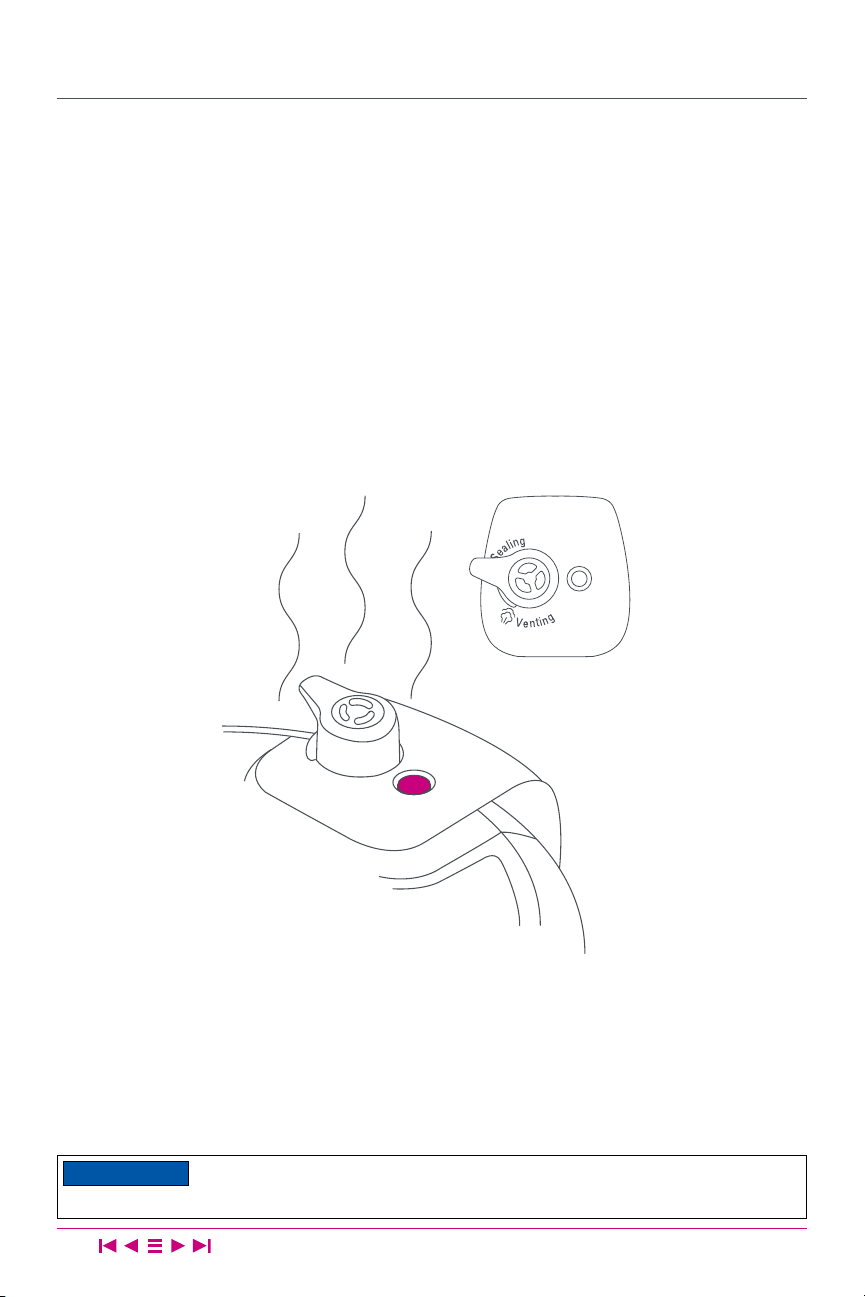
Leave the steam release handle in the Sealing position. As the temperature within
the cooker drops, the cooker depressurizes naturally over time.
Depressurization time varies based upon the volume and type of food and liquid.
When the cooker has completely depressurized, the oat valve drops into the lid.
NOTICE
Use NR to depressurize the cooker after cooking high-starch foods (e.g., soups,
stews, chilis, pasta, oatmeal and congee) or when cooking foods that expand when
cooked (e.g., beans and grains).
Illustrations are for reference only and may differ from the actual product.
33
Depressurizing the Cooker (Venting Methods)
Quick Release (QR)
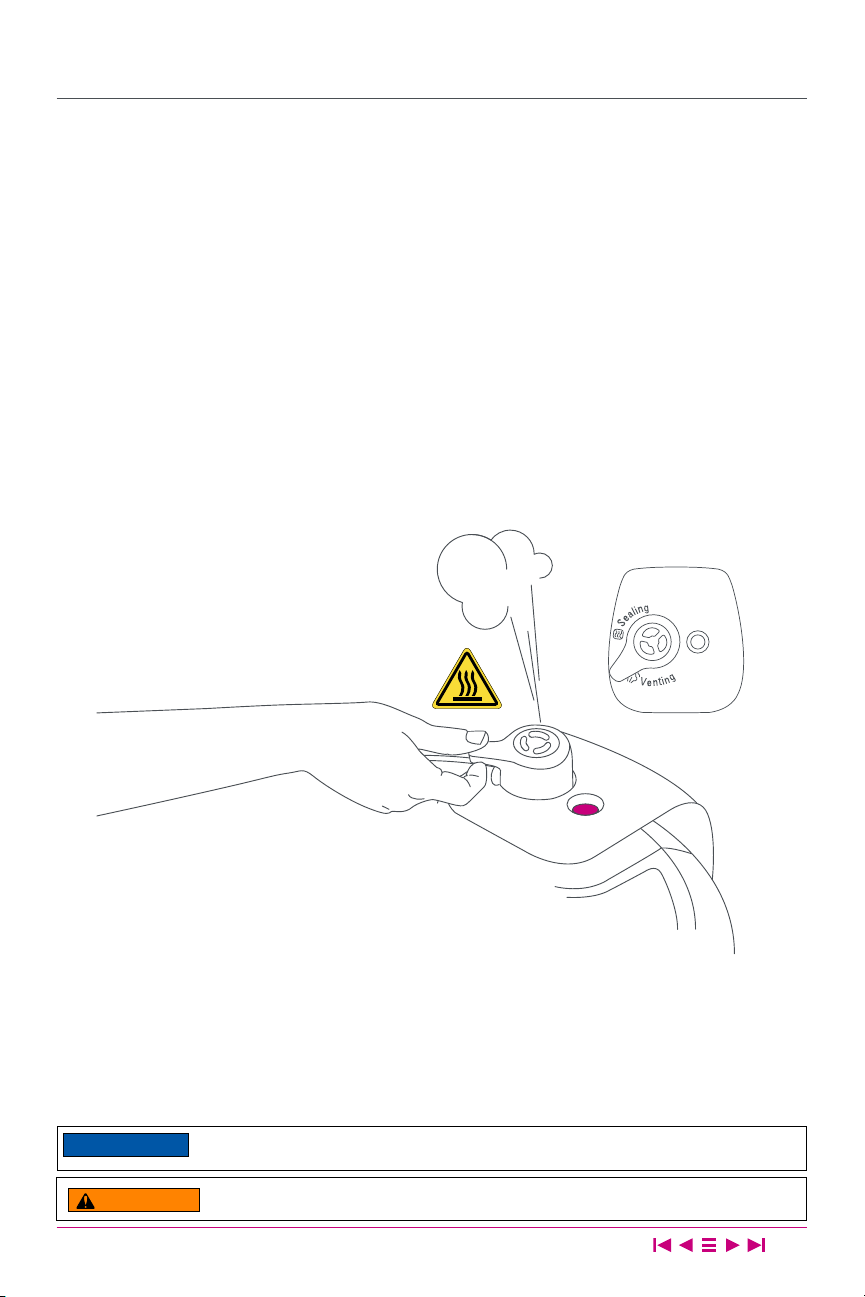
Quickly and carefully turn the steam release handle from the Sealing position to
the Venting position.
A stream of steam releases through the top of the steam release handle.
Note: Steam may range in opacity but is always loud!
If continuous spatter occurs while venting, turn the steam release handle back to
the Sealing position and try again after a few minutes.
If spatter continues, use NR to vent the remaining pressure.
NOTICE
Do not use QR when cooking high-starch foods (e.g., stews, chilis, pasta and
congee) or when cooking foods that expand when cooked (e.g., beans and grains).
Illustrations are for reference only and may differ from the actual product.
WARNING
Steam is hot. Do not place hands or face over steam release handle when venting.

34
Depressurizing the Cooker (Venting Methods)
DANGER
While the oat valve is up, contents of cooker are under extreme pressure. Do not attempt to
remove the lid while the oat valve is still up. All pressure must be released, and oat valve
must be down before attempting to remove the lid. Never attempt to force the lid open.
Failure to follow the instructions may result in property damage and/or personal injury.
10-Minute NR
Leave the steam release handle in the Sealing position for 10 minutes after cooking
has completed, then turn the steam release handle to the Venting position.
A stream of steam releases through the top of the steam release handle.
If continuous spatter occurs while venting, turn the steam release handle back
to the Sealing position and try again after a few minutes.
If spatter continues, use NR to vent the remaining pressure.
WARNING
Do not lean over or touch the steam
release assembly.
Do not place unprotected skin over the
steam release assembly.
Do not cover or obstruct the steam
release valve or cover.

35
Initial Test Run (Water Test)
Follow these steps to familiarize yourself with your Instant Pot Duo.
Total test time: Approximately 20 minutes.
1. Remove the inner pot from the cooker base.
2. Add 3 cups (24 oz / 750 mL) of water to the inner pot.
3. Insert the inner pot into the cooker base.
4. Mini and 6 Quart only: Secure the power cord to the base power socket
at the back of the cooker base. Ensure the connection is tight.
All: Connect the power cord to a 120 V power source.
The display indicates OFF.
5. Place and close the lid as described in
Pressure Control Features—
Pressure Cooking Lid
.
6. Turn the steam release handle to the Sealing position.
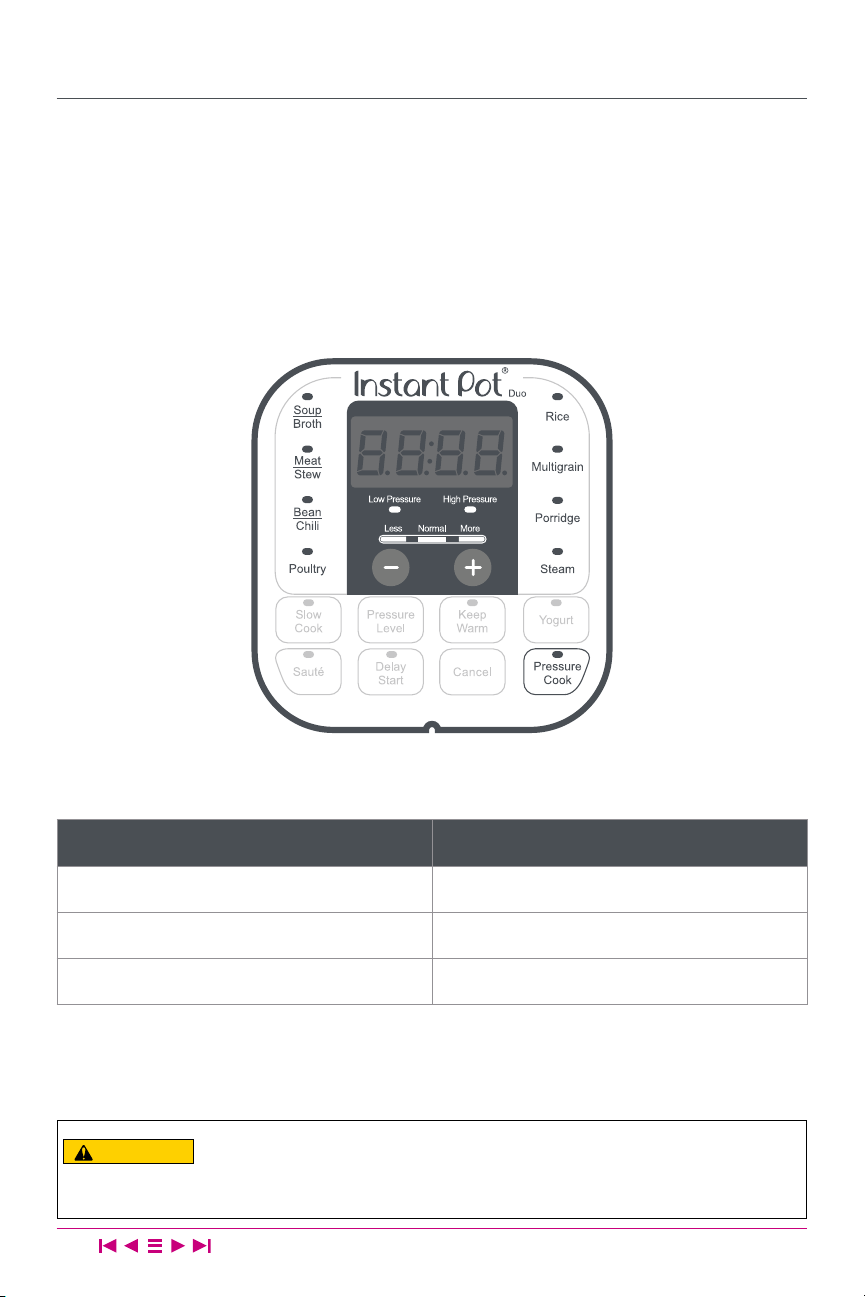
7. Press Pressure Cook to select the Pressure Cook Smart Program.
8. Use the − / + buttons to adjust the cooking time to 00:05 minutes.
Note: Cooking time adjustments are saved to the Smart Program when cooking begins.
9. Press Keep Warm to deactivate the automatic Keep Warm setting.
After 10 seconds, the display reads On to indicate that Preheating has begun.
10. The oat valve rises when the cooker pressurizes.
After a few minutes the cooker reaches the target pressure level and
Cooking begins.
The display changes from On to the cooking time countdown.
11. When the Smart Program is complete, the display indicates End.
12. Turn the steam release handle to Venting. Pressurized steam releases through
the top of the steam release valve.
13. The oat valve drops when the pressure has been fully released.
14. Open and remove the lid as described in
Pressure Control Features— Pressure
Cooking Lid
.
15. Carefully remove the inner pot from the cooker base, discard the water and
thoroughly dry the inner pot.
You’re ready to start cooking!
CAUTION
The inner pot will be hot after cooking. Always use appropriate heat protection when
handling a hot inner pot.
36
Using Pressure Cooking Smart Programs
Whether you are a novice cook or a culinary expert, the Duo provides Smart
Programs to get you cooking with the touch of a button.
The steps below follow the safest procedure for using the cooker and can be
applied to the following Smart Programs: Soup/Broth, Meat/Stew, Bean/Chili,
Poultry*, Rice, Multigrain*, Porridge, Steam (pressure and non-pressure) and
Pressure Cook.
*Not available on Duo Mini. Use Pressure Cook instead.
Always inspect your Instant Pot pressure cooking lid, inner pot and cooker base
carefully to ensure they are clean and in good working condition before use.
Instant Pot Size Minimum Liquid for Pressure Cooking*
3 Quarts / 2.8 Litres 1 cup (8 oz / 250 mL)
6 Quarts / 5.7 Litres 1 ½ cups (12 oz / 375 mL)
8 Quarts / 7.6 Litres 2 cups (16 oz / 500 mL)
*Unless otherwise specied in recipe.
Pressure cooking liquids should be water-based, such as broth, stock, soup or juice.
If using canned, condensed, or cream-based soup, add water as directed above.
CAUTION
To avoid scorching or scalding injury, be cautious when cooking with more than 1/4 cup
(2 oz / 60 mL) oil, oil-based sauces, condensed cream-based soups, and thick sauces.
Add suitable liquid to thin sauces. Avoid recipes that call for more than 1/4 cup (2 oz /
60 mL) of oil or fat content.

37
Using The Pressure Cooking Smart Programs
1. Open and remove the lid as described in Pressure Control Features—
Pressure Cooking Lid
.
2. Add food and liquid ingredients to the inner pot.
Note: Cold or frozen food items take longer to generate steam and slow down
pressurization. For the fastest results, thaw frozen ingredients before cooking.
3. Insert the inner pot into the cooker base.
4. Mini and 6 Quart: Secure the power cord to the base power socket at the back
of the cooker base. Ensure the connection is tight.
All: Connect the power cord to a 120 V power source. The cooker goes to
Standby mode and the display indicates OFF.
5. Place and close the lid as described in
Pressure Control Features—
Pressure Cooking Lid
.
6. Turn the steam release handle to the Sealing position.
7. Select your desired pressure cooking Smart Program.
8. Press the same Smart Program button again to cycle through Less, Normal
and More time options.
9. For custom cooking, use the − / + buttons to adjust the cooking time.
10. Press Pressure Level to toggle between Low and High pressure.
Note: When pressure cooking, the pressure level controls the temperature. A higher
pressure results in a higher cooking temperature.
Note: Cooking time and pressure level adjustments are saved to the Smart Program
when cooking begins.

38
Using The Pressure Cooking Smart Programs
11. Press Keep Warm to toggle the automatic Keep Warm setting off and on.
12. After 10 seconds, the display reads On and indicates that Pre-heating has begun.
13. When cooking completes, follow recipe directions to select the appropriate
venting method. Refer to
Depressurizing the Cooker (Venting Methods).
Instant Tip: Use the steam rack to lift foods out of the cooking liquid. This
ensures even heat distribution, prevent nutrients from leeching into the cooking
liquid, and stop food items from scorching on the bottom of the inner pot.
DANGER
While the oat valve is up, contents of cooker are under extreme pressure.
Do not attempt to remove the lid while the oat valve is still up. All pressure must
be released, and oat valve must be down before attempting to remove the lid. Never
attempt to force the lid open. Failure to follow the instructions may result in property
damage and/or personal injury.
WARNING
Do not ll inner pot higher than the PC MAX — 2/3 line as
indicated on the inner pot.
When cooking foods that expand (e.g.; rice, beans, pasta)
do not ll the inner pot higher than the — 1/2 line as
indicated on the inner pot.
Always cook with the inner pot in place. Do not pour
food or liquid into the cooker base.
To avoid risk of personal injury and/or property damage,
place food and liquid ingredients in the inner pot, then
insert the inner pot into the cooker base.
39
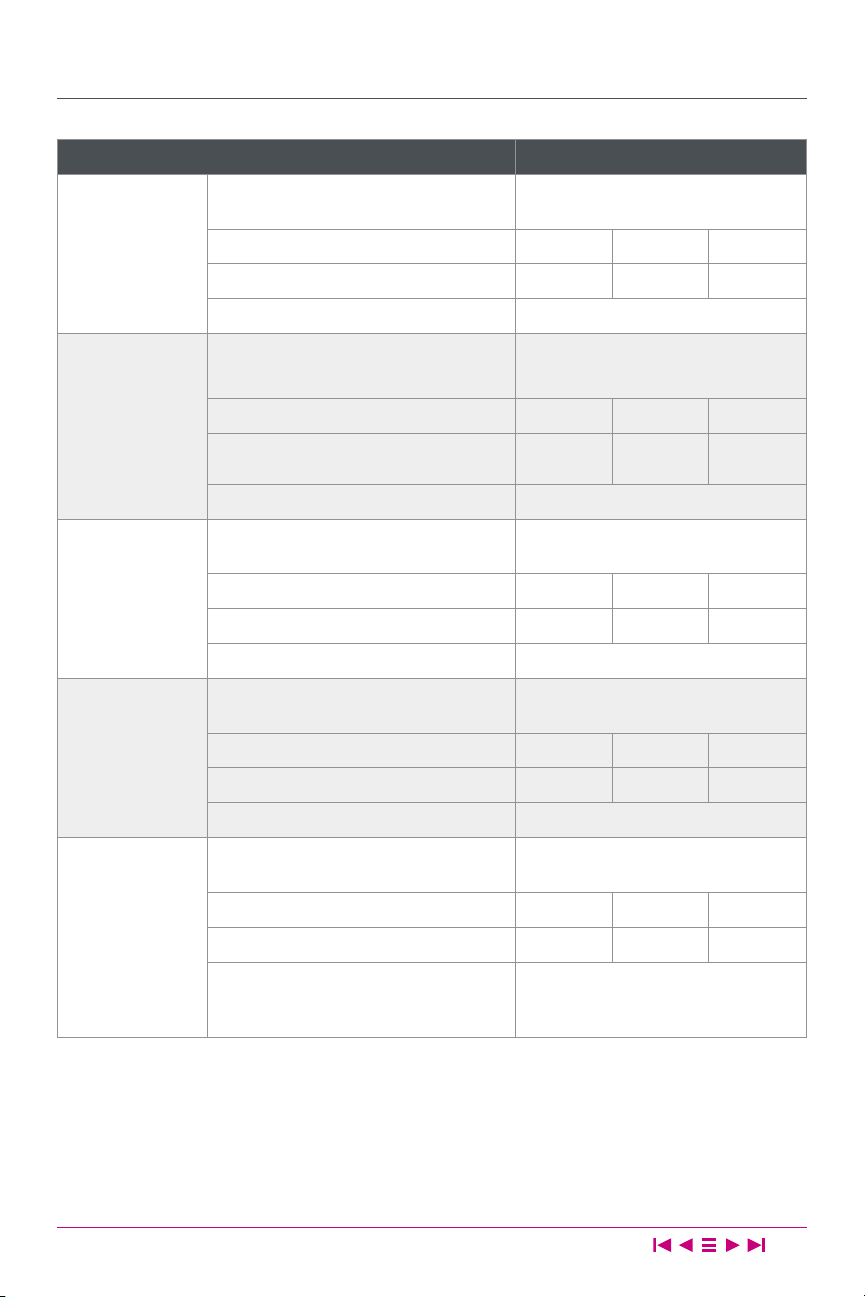
Pressure Cooking Settings
Smart Program Settings
Soup/Broth
Pressure
Low (35–55 kPa / 5.8–7.2 psi)
High (65–85 kPa / 10.2–11.6 psi)
Time Setting Less Normal More
Default Cooking Time (adjustable) 00:20 00:30 04:00
Cooking Time Range 00:01–04:00
Meat/Stew
Pressure
Low (35–55 kPa / 5.8–7.2 psi)
High (65–85 kPa / 10.2–11.6 psi)
Time Setting Less Normal More
Default Cooking Time (adjustable) 00:20 00:35 00:45
Cooking Time Range 00:01–04:00
Bean/Chili
Pressure
Low (35–55 kPa / 5.8–7.2 psi)
High (65–85 kPa / 10.2–11.6 psi)
Time Setting Less Normal More
Default Cooking Time (adjustable) 00:25 00:30 00:40
Cooking Time Range 00:01–04:00
Poultry*
Pressure
Low (35–55 kPa / 5.8–7.2 psi)
High (65–85 kPa / 10.2–11.6 psi)
Time Setting Less Normal More
Default Cooking Time (adjustable) 00:05 00:15 00:30
Cooking Time Range 00:01–04:00
Rice
Pressure
Low (35–55 kPa / 5.8–7.2 psi)
High (65–85 kPa / 10.2–11.6 psi)
Time Setting Less Normal More
Default Cooking Time (not adjustable) 00:08 00:12 00:15
Cooking Time Range
Cook time adjusts automatically
depending on the volume of rice:
8–15 minutes. Display indicates Auto.
*Not available on Duo Mini. Use Pressure Cook instead.
40
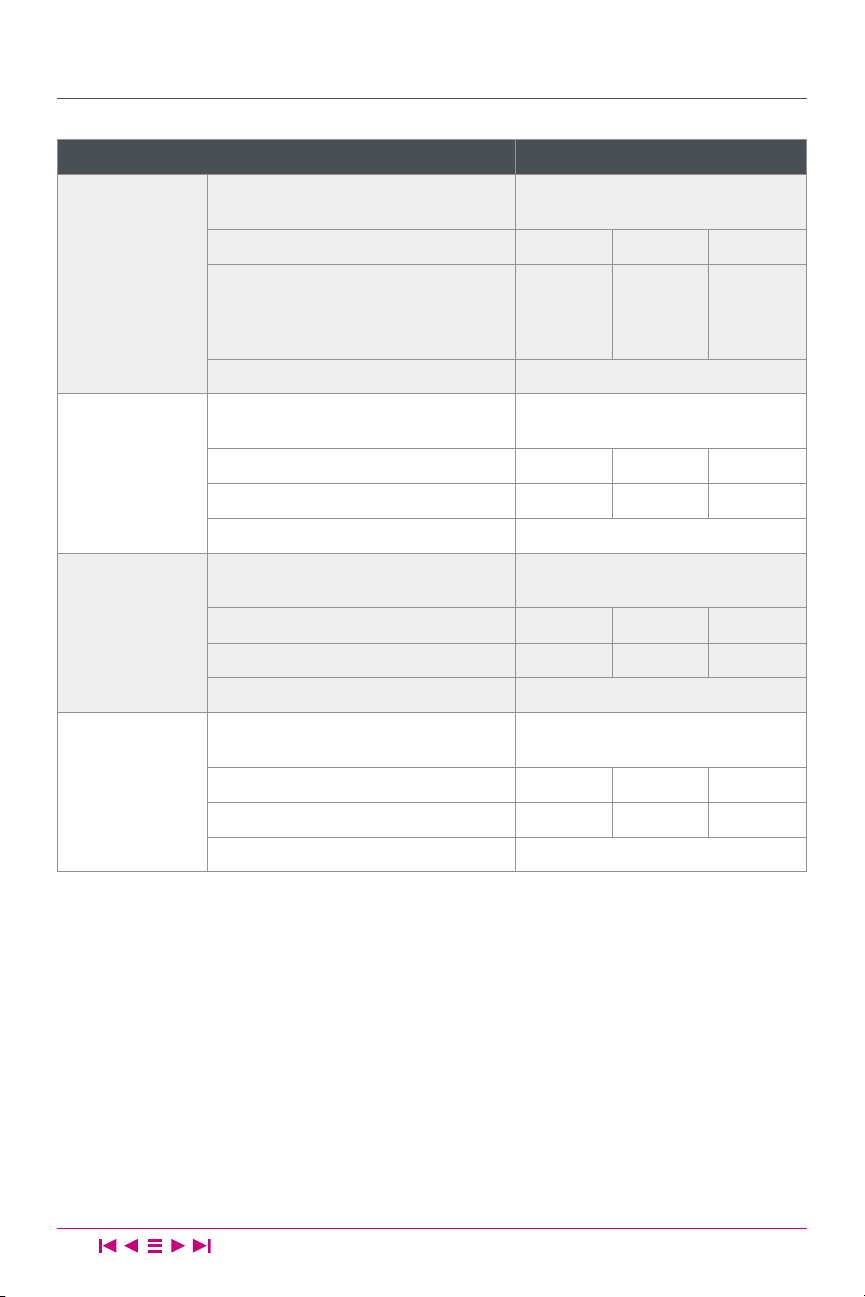
Pressure Cooking Settings
Smart Program Settings
Multigrain*
Pressure
Low (35–55 kPa / 5.8–7.2 psi)
High (65–85 kPa / 10.2–11.6 psi)
Time Setting Less Normal More
Default Cooking Time (adjustable) 00:20 00:40
01:00 (+
00:45
soaking
time)
Cooking Time Range 00:01–04:00
Porridge
Pressure
Low (35–55 kPa / 5.8–7.2 psi)
High (65–85 kPa / 10.2–11.6 psi)
Time Setting Less Normal More
Default Cooking Time (adjustable) 00:05 00:20 00:30
Cooking Time Range 00:01–04:00
Steam
Pressure
Low (35–55 kPa / 5.8–7.2 psi)
High (65–85 kPa / 10.2–11.6 psi)
Time Setting Less Normal More
Default Cooking Time (adjustable) 00:03 00:10 00:15
Cooking Time Range 00:01–04:00
Pressure Cook
Pressure
Low (35–55 kPa / 5.8–7.2 psi)
High (65–85 kPa / 10.2–11.6 psi)
Time Setting Less Normal More
Default Cooking Time (adjustable) 00:20 00:35 00:45
Cooking Time Range 00:01–04:00
*Not available on Duo Mini. Use Pressure Cook instead.

41
Pressure Cooking Tips
Smart Program Setting Suggested Use Notes
Soup/Broth
Less Soup without meat
Liquid remains clear due to lack of boiling
motion.
Always use NR to release pressure when
cooking soup with a high starch content.
Normal Soup with meat
More Rich bone broth
Meat/Stew
Less Soft texture Choose setting based on meat texture
desired, or adjust cook time manually.
Allow meat to “rest” for 5–30 minutes,
depending on size. It will retain cooking
juices for tender, succulent meat.
Normal Very soft texture
More Fall-off-the-bone
Bean/Chili
Less Firmer texture Choose setting based on bean texture
desired, or adjust cook time manually.
When cooking beans or legumes, always
use NR to release pressure.
Ensure dry beans are completely
submerged in water.
Normal Soft texture
More Very soft texture
Poultry*
Less Soft texture Choose setting based on meat texture
desired, or adjust cook time manually.
Allow poultry to “rest” for 5–10 minutes,
depending on size. It will retain cooking
juices for tender, succulent meat.
Normal Very soft texture
More Fall-off-the-bone texture
Rice
Less Tender but rm to bite Automated cooking Smart Program.
Displays Auto before cook time
countdown.
Depending on the volume of rice, cook
time may range from 8 to 15 minutes.
After cooking, wait 10 minutes, then
use QR to release pressure, or allow to
depressurize with NR.
Normal
Normal texture white
rice
More Softer texture white rice
Multigrain*
Less
Brown rice, wild rice,
black beans, chickpeas,
etc.
Select Less or Normal based on type of
grain and desired texture.
Normal
Brown rice, wild rice,
mung beans, etc.
More
Tough grains or a
mixture of grains and
beans
Begins with 45 minutes of warm water
soaking time prior to 60 minutes of
pressure cooking.
*Not available on Duo Mini. Use Pressure Cook instead.

42
Pressure Cooking Tips
Smart Program Setting Suggested Use Notes
Porridge
Less
Oatmeal, steel cut or
rolled
Adjust time as directed in recipe.
Always use NR to release pressure when
cooking foods that expand.
Normal
White rice, porridge/
congee
More
Rice porridge/congee
with a mixture of various
grains
Steam
Less Vegetables
Use steam rack provided to elevate food
from cooking liquid.
Use QR to prevent food from
overcooking.
Normal Fish and Seafood
More Meat
Pressure Cook
Less
Manual Programming
Press Pressure Level to toggle between
High and Low pressure.
Use − / + buttons to adjust cook time.
Adjust according to recipe or desired
results.
Normal
More

43
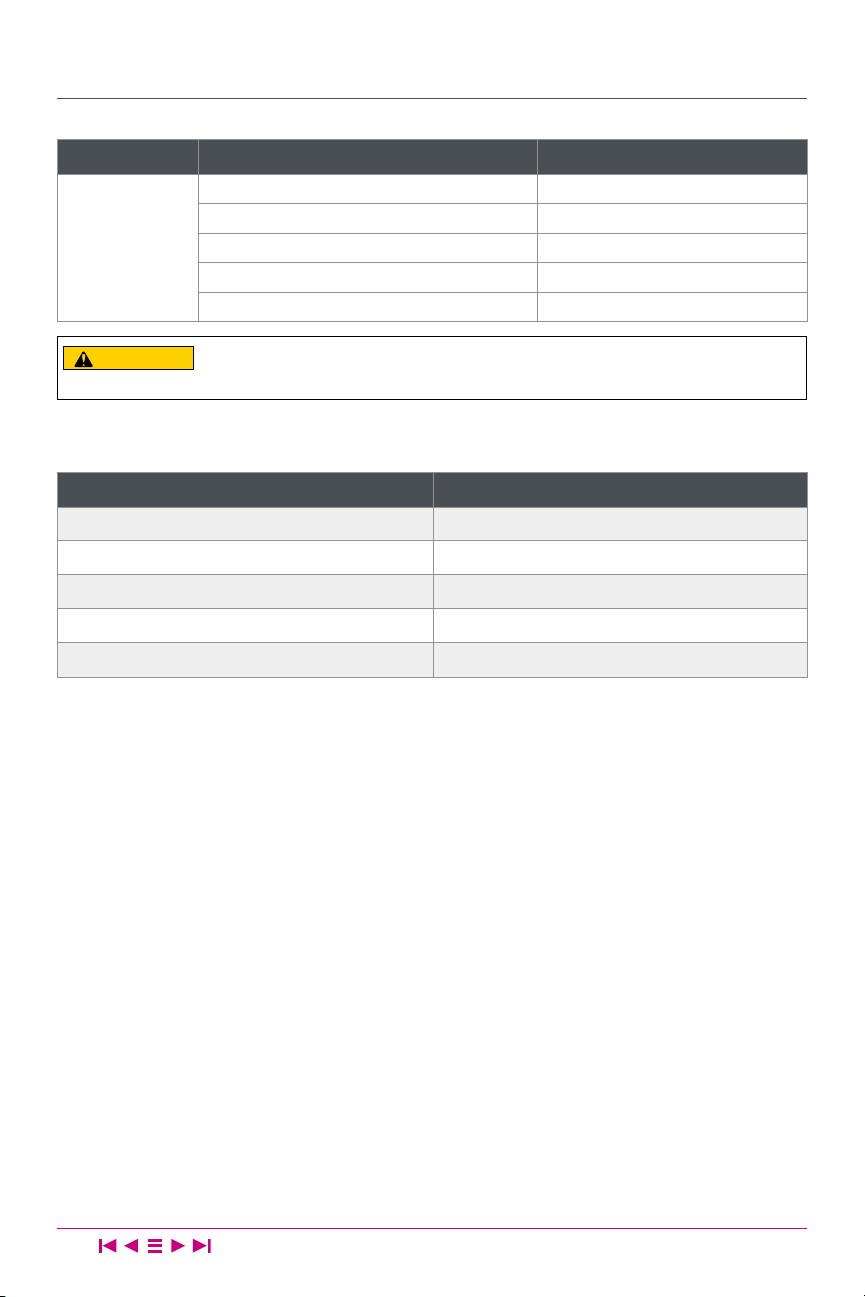
Pressure Cooking Timetable
The following cooking times are recommendations only. Always follow a
trusted recipe.
Food Time
Vegetables
Asparagus, Beans (Yellow and Green), Broccoli 1–2 minutes
Brussels Sprouts, Cabbage (Whole or Wedges),
Cauliower (Florets)
2–3 minutes
Butternut Squash 4–6 minutes
Carrots (Whole or Chunks) 6–8 minutes
Corn (on the Cob) 3–5 minutes
Potatoes (Large, Whole) 12–15 minutes
Potatoes (Small, Whole) 8–10 minutes
Potatoes (Cubed) 3–4 minutes
Sweet Potatoes (Whole) 12–15 minutes
Sweet Potatoes (Cubed) 2–4 minutes
Meat & Eggs
Beef (Stew) 20 minutes (per 450 g / 1 lb)
Beef (Large Pieces), Beef (Ribs) 20–25 minutes (per 450 g / 1 lb)
Chicken (Breasts) 6–8 minutes (per 450 g / 1 lb)
Chicken (Whole) 8 minutes (per 450 g / 1 lb)
Chicken (Bone Stock) 40–50 minutes
Lamb (Leg), Pork (Butt Roast) 15 minutes (per 450 g / 1 lb)
Pork (Baby Back Ribs) 15–20 minutes (per 450 g / 1 lb)
Eggs Hard: 5 mins
Beans & Lentils
(Dry & Soaked)
Black Beans D: 20–25 mins / S: 6–8 mins
Black-Eyed Peas D: 14–18 mins / S: 4–5 mins
Chickpeas D: 35–40 mins / S: 10–15 mins
Kidney Beans (Red), Navy Beans D: 20–25 mins / S: 7–8 mins
Kidney Beans (White), Pinto Beans D: 25–30 mins / S: 6–9 mins
Lentils (Green) D: 8–10 mins / S: N/A
Lentils (Yellow) D: 1–2 mins / S: N/A
Lima Beans D: 12–14 mins / S: 6–10 mins
Soybeans D: 35–45 mins / S: 18–20 mins
44
Pressure Cooking Timetable
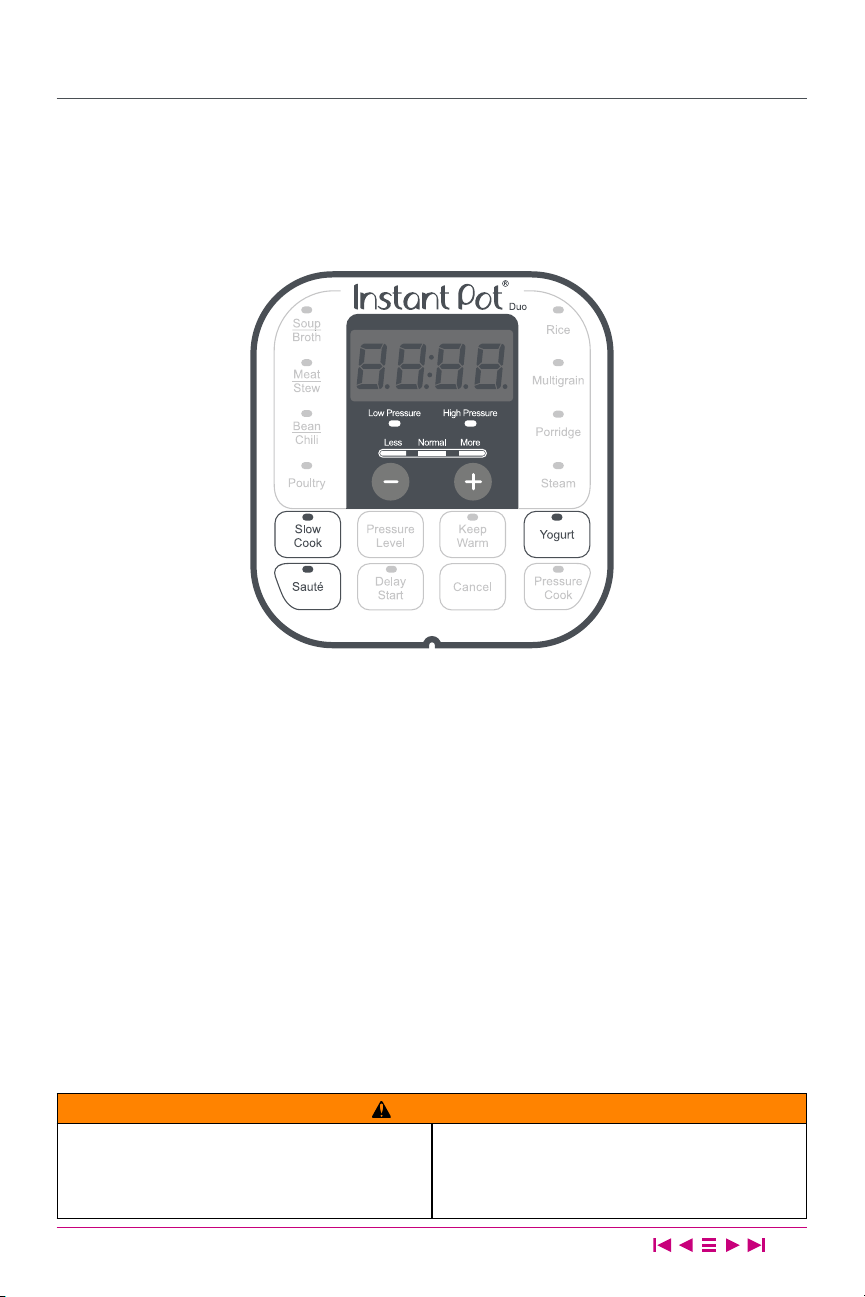
Grain-to-Water Ratios
Rice and Grain Grain : Water Ratio
White or Brown Rice 1:1 cup
Quinoa 1:3/4 cup
Oatmeal 1:3 cups
Risotto 1:2 cups—add additional wine to taste
Porridge 1:10 cups
Visit our website for a complete list of cooking timetables.
CAUTION
Always use a meat thermometer to ensure the internal temperature reaches a safe
minimum temperature. Refer to the USDA’s Safe
Minimum Internal Temperature Chart
for more information.
Food Time
Seafood
Fish (Whole) 4–5 minutes
Fish (Fillet), Lobster 2–3 minutes
Mussels 1–2 minutes
Shrimp (Or Prawn) 1–3 minutes
Seafood Stock 7–8 minutes
45
Using Non-Pressure Cooking Smart Programs
The Duo is much more than a pressure cooker. These non-pressure cooking
Smart Programs get you cooking quickly and easily. Always ensure the lid is set
to Venting when using non-pressure cooking programs.
The following sections provide the safest steps for using the cooker.
Always inspect your Instant Pot pressure cooking lid, inner pot and cooker base
carefully to ensure they are clean and in good working condition before use.
WARNING
Do not ll inner pot higher than the PC MAX — 2/3 line as
indicated on the inner pot.
When cooking foods that expand (e.g.; rice, beans, pasta)
do not ll the inner pot higher than the — 1/2 line as
indicated on the inner pot.
Always cook with the inner pot in place. Do not pour
food or liquid into the cooker base.
To avoid risk of personal injury and/or property damage,
place food and liquid ingredients in the inner pot, then
insert the inner pot into the cooker base.

46
Using Non-Pressure Cooking Smart Programs
Slow Cook
Slow Cook is a non-pressure cooking program that is compatible for use with any
common slow cooker recipe.
Setting Suggested Use Notes
Less
Low setting on common
slow cookers
Follow recipe directions for
slow cooking.
Less is commonly used for low and slow,
all-day cooking, and should be set for a
minimum of 10:00 hours for best results.
Normal
Medium setting on common
slow cookers
More
High setting on common
slow cookers
1. Remove inner pot from cooker base.
2. Add food and liquid ingredients to the inner pot.
3. Insert the inner pot into the cooker base.
4. Mini and 6 Quart: Secure the power cord to the base power socket at the back
of the cooker base. Ensure the connection is tight.
All: Connect the power cord to a 120 V power source. The cooker goes to
Standby mode and the display indicates OFF.
5. Place and close the lid as described in
Pressure Control Features–Pressure
Cooking Lid
, or use a glass lid with a venting hole.
6. Turn the steam release handle to the Venting position.
7. Press Slow Cook to select the Slow Cook Smart Program.
8. Press Slow Cook again to cycle through the Less, Normal and More
temperature options.
9. Use the − / + buttons to adjust the cooking time.
Note: Cooking time and temperature level adjustments are saved to the
Smart Program when cooking begins.
10. Press Keep Warm to toggle the automatic Keep Warm setting off or on.
11. After 10 seconds, cooking begins and the display timer counts down.
12. When cooking completes, the display indicates End if Keep Warm is turned
off. If not, the timer begins counting from 00:00 up to 10 hours.
Note: The oat valve should not rise during Slow Cook. The lid is removable throughout the
cooking process for easy access. If the oat valve rises, ensure the steam release handle is
set to the Venting position. Refer to
Depressurizing Your Cooker (Venting Methods).

47
Using Non-Pressure Cooking Smart Programs
Sauté
Sauté is a non-pressure cooking program that can be used in place of a frying pan
or at-top grill.
Setting Suggested Use Notes
Less
Simmering, thickening and
reducing liquids
The display switching from Hot to On indicates
the cooker is maintaining the cooking
temperature.
As a safety precaution, 30 minutes is the
maximum cooking time and cannot be
adjusted.
Normal Pan searing or sautéing
More Stir-frying or browning meat
1. Insert the inner pot into the cooker base. Do not use a lid.
2. Mini and 6 Quart: Secure the power cord to the base power socket at the back
of the cooker base. Ensure the connection is tight.
All: Connect the power cord to a 120 V power source. The cooker goes to
Standby mode and the display indicates OFF.
3. Press Sauté to select the Sauté Smart Program.
4. Press Sauté again to cycle through the Less, Normal and More temperature options.
Note: Cooking temperature adjustments are saved to the Smart Program when cooking begins.
5. After 10 seconds, the cooker displays On to indicate that it has begun heating.
6. When display switches from On to Hot, add recipe ingredients.
Note: If recipe ingredients are added before the Hot message appears, it may not
appear at all. This is normal.
7. When cooking completes, the display indicates End.
Note: Automatic Keep Warm cannot be turned on for the Sauté Smart Program.
Deglazing the Inner Pot (Pressure Cooking After Sauté)
Sautéing meat and vegetables before pressure cooking is the perfect way to boost
avors, as sugars caramelize from the high heat of the Sauté Smart Program.
To pressure cook after using Sauté, deglaze the inner pot to ensure food items do
not scorch. To deglaze, remove food items from the inner pot and add a thin liquid
(e.g., water, broth, wine) to the hot surface. Use a wooden or silicone scraper to
loosen anything that may be stuck to the bottom of the inner pot.
WARNING
The Sauté Smart Program reaches high temperatures. If unmonitored, food may burn on this setting. Do not use the
lid and do not leave your cooker unattended while using Sauté.

48
Cooking Tips
Yogurt
Yogurt is a non-pressure cooking Smart Program made for easy fermented dairy
and non-dairy recipes.
Instant Pot Size Minimum Milk Volume Maximum Milk Volume
3 Quarts / 2.8 Litres 2 cups (16 oz / 500 mL) 2 quarts (64 oz / 1.9 L)
6 Quarts / 5.7 Litres 4 cups (32 oz / 1000 mL) 4 quarts (128 oz / 3.8 L)
8 Quarts / 7.6 Litres 6 cups (48 oz / 1500 mL) 6 quarts (192 oz / 5.7 L)
Pasteurize Milk
1. Add unpasteurized milk to the inner pot then insert the inner pot into the
cooker base.
2. Mini and 6 Quart: Secure the power cord to the base power socket at the back
of the cooker base. Ensure the connection is tight.
All: Connect the power cord to a 120 V power source. The cooker goes to
Standby mode and the display indicates OFF.
3. Place and close the lid as described in
Pressure Control Features—
Pressure Cooking Lid
.
4. Press Yogur t to select the Yogurt Smart Program.
5. Press Yogur t again to cycle to the More option. The display indicates boiL.
6. After 10 seconds the cooker begins heating.
7. When pasteurization completes, the display indicates End.
8. Remove the lid and use a thermometer to check the temperature.
Note: Milk must reach a minimum of 72°C (161°F) for pasteurization to occur.
Add Starter Culture
1. Allow pasteurized milk to cool to just below 43°C (110°F).
2. Add a starter culture to the milk according to package instructions.
Note: If using plain yogurt as a starter, ensure that it contains an active culture.
Mix in 2 tbsp of yogurt per gallon of milk, or follow a trusted recipe.
3. Place and close the lid as described in Pressure Control Features—
Pressure Cooking Lid.

49
Recommended Cooking Times
Ferment Yogurt
Setting Suggested Use Notes
Less
For lower temperature
fermentation (e.g.,
Jiu Niang, a sweet
fermented glutinous
rice dessert)
Default fermentation time is 24 hours.
Adjust fermentation time based on recipe.
Normal
Fermenting milk after
culture has been added
A longer fermentation will result in tangier yogurt.
Adjust as desired up to 99 hours and 30 minutes..
More Pasteurizing milk
Pasteurization time is preset and cannot be adjusted.
Display indicates boiL while program is running.
For extra thick yogurt, pasteurize milk twice.
1. Press Yogur t to select the Yogurt Smart Program.
2. Press Yogur t again to cycle to the Normal option.
The display indicates 08:00.
3. Use the − / + buttons to adjust the fermentation time if desired.
4. After 10 seconds the cooker begins heating. The display timer counts up to
the set time from 00:00.
5. When fermentation completes, the cooker beeps and displays End.
Yogurt Cups
Yogurt cups are a convenient way to portion out your yogurt for serving.
1. After adding the starter culture to the pasteurized milk, carefully pour the milk
into your yogurt cups and seal them tightly.
2. Clean the inner pot thoroughly and place the steam rack on the bottom of the
inner pot.
3. Place the sealed yogurt cups on the steam rack and add water to the inner pot
until the cups are submerged halfway.
4. Follow steps in “Ferment Yogurt” above.

50
Care and Cleaning
Clean your Duo after each use.
Always unplug your Duo and let it cool to room temperature before cleaning.
Let all surfaces dry thoroughly before use, and before storage.
Part Instruction
Cleaning
Method
Accessories
• Steam Rack
• Condensation
Collector
• Wash after each use.
• Never use harsh chemical detergents, powders or
scouring pads on accessories.
• For dishwasher, place on top rack.
• Empty and rinse condensation collector after each use.
Dishwasher
Safe* and Hand
Washable
Lid and Parts
• Anti-Block Shield
• Sealing Ring
• Steam Release Valve
• Float Valve
• Silicone Cap
• Wash after each use with hot water and mild dish soap
and allow to air dry, or place in top rack of dishwasher.
• Remove all small parts from lid before washing.
• With steam release valve and anti-block shield removed,
clean interior of steam release pipe to prevent clogging.
• To drain water from the lid after dishwashing, grasp the
lid handle and hold the lid vertically over a sink, then turn
it 360°—such as turning a steering wheel.
• After cleaning, store the lid upside down on the
cooker base.
• Store sealing rings in a well-ventilated area to decrease
residual odor of avorful meals. To eliminate odors, add 1
cup (8 oz / 250 mL) water and 1 cup (8 oz / 250 mL) white
vinegar to inner pot, and run Pressure Cook for 5–10
minutes, then QR pressure.
Inner Pot
• More acute hard water staining may require a vinegar-
dampened sponge and some scrubbing to remove.
• If there is tough or burned food residue at the bottom,
soak in hot water for a few hours for easy cleaning.
• Wash after each use.
• Ensure all exterior surfaces are dry before placing in
cooker base.
*Some discoloration may occur after machine washing, but this will not affect the cooker’s
safety or performance.

51
Care and Cleaning
Part Instruction
Cleaning
Method
Detachable Power
Cord
(3 and 6 Quart Only)
• Use a barely-damp cloth to wipe any particles off power
cord.
Damp Cloth
Only
Cooker Base
• Wipe the inside of the outer pot as well as the
condensation rim with a barely-damp cloth, and allow to
air dry.
• Clean cooker base and control panel with a soft, barely-
damp cloth or sponge.
WARNING
Ensure heating element
remains dry at all times.
Do not immerse cooker
base in water or attempt to
cycle through dishwasher.
Do not submerge power
cord at any time.
Do not wet prongs of power
cord.

52
Troubleshooting
Register your product today.
Contact Customer Care:
1-800-828-7280
support@instantapot.com
instantpot.com/#Chat
Problem Possible Reason Solution
Difculty
closing lid
Sealing ring not properly installed
Reposition sealing ring, ensure it is snug
behind sealing ring rack.
Float valve in the popped-up position
Gently press the oat valve downward with
a long utensil.
Contents in cooker are still hot
Turn steam release handle to Venting
position, then lower lid onto cooker base
slowly, allowing heat to dissipate.
Difculty
opening lid
Pressure inside the cooker
Release pressure according to recipe;
only open lid after oat valve has dropped
down.
Float valve stuck at the popped-up
position due to food debris or residue
Ensure steam is completely released by
quick releasing pressure, then press oat
valve gently with a long utensil.
Open lid cautiously and thoroughly clean
oat valve, surrounding area, and lid before
next use.
WARNING
Contents may be under pressure; to avoid scalding injury, do not
attempt to force lid open.
Inner pot is
stuck to lid
when cooker is
opened
Cooling of inner pot may create
suction, causing inner pot to adhere to
the lid
To release the vacuum, turn steam release
handle to Venting position.
Steam leaks
from side of lid
No sealing ring in lid Install sealing ring.
Sealing ring damaged or not properly
installed
Replace sealing ring.
Food debris attached to sealing ring Remove sealing ring and clean thoroughly.
Lid not closed properly Open, then close lid.
Sealing ring rack is warped or off-
centre
Remove sealing ring from lid, check sealing
ring rack for bends or warps. Contact
Customer Care.
Inner pot rim may be misshapen
Check for deformation and contact
Customer Care.

53
Troubleshooting
Problem Possible Reason Solution
Float valve
does not rise
Food debris on oat valve or oat valve
silicone cap
Remove oat valve from lid and clean
thoroughly; perform
Initial Test Run to
check for function and record ndings.
Contact
Customer Care.
Too little liquid in the inner pot
Check for scorching on bottom of inner
pot. Add thin, water-based liquid to the
inner pot according to its size:
3 Quart: 1 cup / 250 mL
6 Quart: 1 1/2 cups / 375 mL
8 Quart: 2 cups / 500 mL
Silicone cap damaged or missing Install or replace oat valve.
Float valve obstructed by lid-locking
mechanism
Tap oat valve with a long utensil. If the
oat valve does not drop, turn the cooker
off. Contact
Customer Care.
No heat in the inner pot
Perform Initial Test Run to check for
function and record ndings. Contact
Customer Care.
Inner pot base may be damaged
Perform Initial Test Run to check for
function and record ndings. Contact
Customer Care.
Minor steam
leaking/hissing
from steam
release during
cook cycle
Steam release handle not in
Sealing position
Turn steam release handle to
Sealing position.
Cooker is regulating excess pressure This is normal; no action required.
Steam gushes
from steam
release when
steam release
handle is in
Sealing position
Not enough liquid in the inner pot
Add thin, water-based liquid to the inner
pot according to its size:
3 Quart: 1 cup / 250 mL
6 Quart: 1 1/2 cups / 375 mL
8 Quart: 2 cups / 500 mL
Pressure sensor control failure
Contact Customer Care.
Steam release valve not seated
properly
Turn steam release handle and ensure it is
in Sealing position.
Display remains
blank after
connecting the
power cord
Bad power connection or no power
Inspect power cord for damage. If damage
is noticed, contact
Customer Care.
Check outlet to ensure it is powered.
Cooker’s electrical fuse has blown
Contact Customer Care.

54
Troubleshooting
Problem Possible Reason Solution
Error code
appears on
display and
cooker beeps
continuously
C1
C2
C6
C6H
C6L
Faulty sensor
Contact Customer Care:
1-800-828-7280
instantpot.com/#Chat
C5
Temperature is too high
because inner pot is not
placed in the cooker base
Press Cancel and wait for heating element
to cool; ensure there are no foreign
objects in cooker base; insert or reposition
inner pot in cooker base and re-enter
commands.
Temperature is too high
because there is no water in
inner pot
Check for scorching on bottom of inner
pot. Add thin, water-based liquid to the
inner pot according to its size:
3 Quart: 1 cup / 250 mL
6 Quart: 1 1/2 cups / 375 mL
8 Quart: 2 cups / 500 mL
C7 or
NoPr
Heat element has failed
Contact Customer Care
Not enough liquid
Add thin, water-based liquid to the inner
pot according to its size:
3 Quart: 1 cup / 250 mL
6 Quart: 1 1/2 cups / 375 mL
8 Quart: 2 cups / 500 mL
Steam release handle is in the
Venting position
Turn steam release handle to
Sealing position.
Lid
Lid is not in the correct
position for the selected
program
Open and close the lid.
Do not use a lid when using Sauté.
OvHt /
Burn /
Food
burn
High temperature detected
at bottom of inner pot;
cooker automatically reduces
temperature to avoid
overheating
Starch deposits at the bottom of the inner
pot may have blocked heat dissipation.
Turn the cooker off, release pressure
according to the recipe, and inspect the
bottom of the inner pot.
PrSE
Pressure has accumulated
during a non-pressure
cooking program
Turn steam release handle to
Venting position.
Occasional
clicking or light
cracking sound
The sound of power switching and
expanding pressure board when
changing temperatures
This is normal; no action needed.
Bottom of the inner pot is wet
Wipe exterior surfaces of inner pot. Ensure
heating element is dry before inserting
inner pot into cooker base.

55
Warranty
Limited Warranty
This Limited Warranty is effective for one year from the date of original consumer purchase. Proof of original purchase
date and, if requested by an authorized representative of Instant Brands Inc. (“Instant Brands”), return of your appliance,
is required to obtain service under this Limited Warranty. Provided that this appliance is operated and maintained in
accordance with written instructions attached to or furnished with the appliance, Instant Brands will, in its sole and
exclusive discretion, either: (i) repair defects in materials or workmanship; or (ii) replace the appliance. In the event that
your appliance is replaced, the Limited Warranty on the replacement appliance will expire 12 months from the date of
original consumer purchase.
This Limited Warranty extends only to the original purchaser and use of the appliance in
the United States of America and Canada. This warranty does not cover units that are used
outside of the United States of America and Canada.
Any modication or attempted modication to your appliance may interfere with the safe operation of the appliance and
will void this Limited Warranty. This Limited Warranty does not apply in respect of any appliance or any part thereof that
has been altered or modied unless such alterations or modications were expressly authorized by an Instant Brands
representative.
Limitation and Exclusions
The liability of Instant Brands, if any, for any allegedly defective appliance or part shall in no circumstances exceed the
purchase price of a comparable replacement appliance.
This Limited Warranty does not cover:
1. Damage resulting from accident, alteration, misuse, abuse, neglect, unreasonable use, use contrary to the operating
instructions, normal wear and tear, commercial use, improper assembly, disassembly, failure to provide reasonable
and necessary maintenance, re, ood, acts of God or repair by anyone unless directed by an Instant Brands
Representative;
2. Repairs where your appliance is used for other than normal, personal use or when it is used in a manner that is
contrary to published user or operator instructions; or
3. Use of unauthorized parts and accessories, or repairs to parts and systems resulting from unauthorized repairs or
modications made to this appliance.
The cost of repair or replacement under these excluded circumstances shall be paid by you.

56
Warranty
Disclaimer of Implied Warranties
EXCEPT AS EXPRESSLY PROVIDED HEREIN AND TO THE EXTENT PERMITTED BY LAW, INSTANT BRANDS MAKES NO
WARRANTIES, CONDITIONS OR REPRESENTATIONS, EXPRESS OR IMPLIED, BY STATUTE, USAGE, CUSTOM OF TRADE OR
OTHERWISE WITH RESPECT TO THE APPLIANCES OR PARTS COVERED BY THIS WARRANTY, INCLUDING BUT NOT LIMITED
TO, WARRANTIES, CONDITIONS, OR REPRESENTATIONS OF WORKMANSHIP, MERCHANTABILITY, MERCHANTABLE QUALITY,
FITNESS FOR A PARTICULAR PURPOSE OR DURABILITY.
Some states or provinces do not allow for the exclusion of implied warranties of merchantability or tness, so this
limitation may not apply to you. In these states and provinces, you have only the implied warranties that are expressly
required to be provided in accordance with applicable law.
Limitation of Remedies; Exclusion of Incidental and Consequential Damage
YOUR SOLE AND EXCLUSIVE REMEDY UNDER THIS LIMITED WARRANTY SHALL BE APPLIANCE REPAIR OR REPLACEMENT AS
PROVIDED HEREIN. INSTANT BRANDS SHALL NOT BE LIABLE FOR INDIRECT, INCIDENTAL OR CONSEQUENTIAL DAMAGES
ARISING OUT OF OR IN CONNECTION WITH THE USE OR PERFORMANCE OF THE APPLIANCE OR DAMAGES WITH RESPECT
TO ANY ECONOMIC LOSS, PERSONAL INJURY, LOSS OF PROPERTY, LOSS OF REVENUES OR PROFITS, LOSS OF ENJOYMENT
OR USE, COSTS OF REMOVAL, INSTALLATION OR OTHER INDIRECT, INCIDENTAL OR CONSEQUENTIAL DAMAGES OF ANY
NATURE OR KIND.
Warranty Registration
Please visit
www.instantpot.com/support/register to register your new Instant Brands™ appliance
and validate your warranty within thirty (30) days of purchase. You will be asked to provide the store name, date of
purchase, model number (found on the back of your appliance) and serial number (found on the bottom of your
appliance) along with your name and email address. The registration will enable us to keep you up to date with product
developments, recipes and contact you in the unlikely event of a product safety notication. By registering, you
acknowledge that you have read and understand the instructions for use, and warnings set forth in the accompanying
instructions.
Warranty Service
To obtain service under this warranty, please contact our Customer Service Department
by phone at 1-800-828-7280 or by email to
support@instantpot.com. You can also create a
support ticket online at
www.instantpot.com/support. If we are unable to resolve the problem,
you may be asked to send your appliance to the Service Department for quality inspection.
Instant Brands is not responsible for shipping costs related to warranty service, save and except
for shipping costs associated with the return of your appliance from Canada or within the 48
contiguous states and the District of Columbia of the United States of America, as provided
herein. When returning your appliance, please include your name, mailing address, email
address, phone number, and proof of the original purchase date as well as a description of the
problem you are encountering with the appliance.