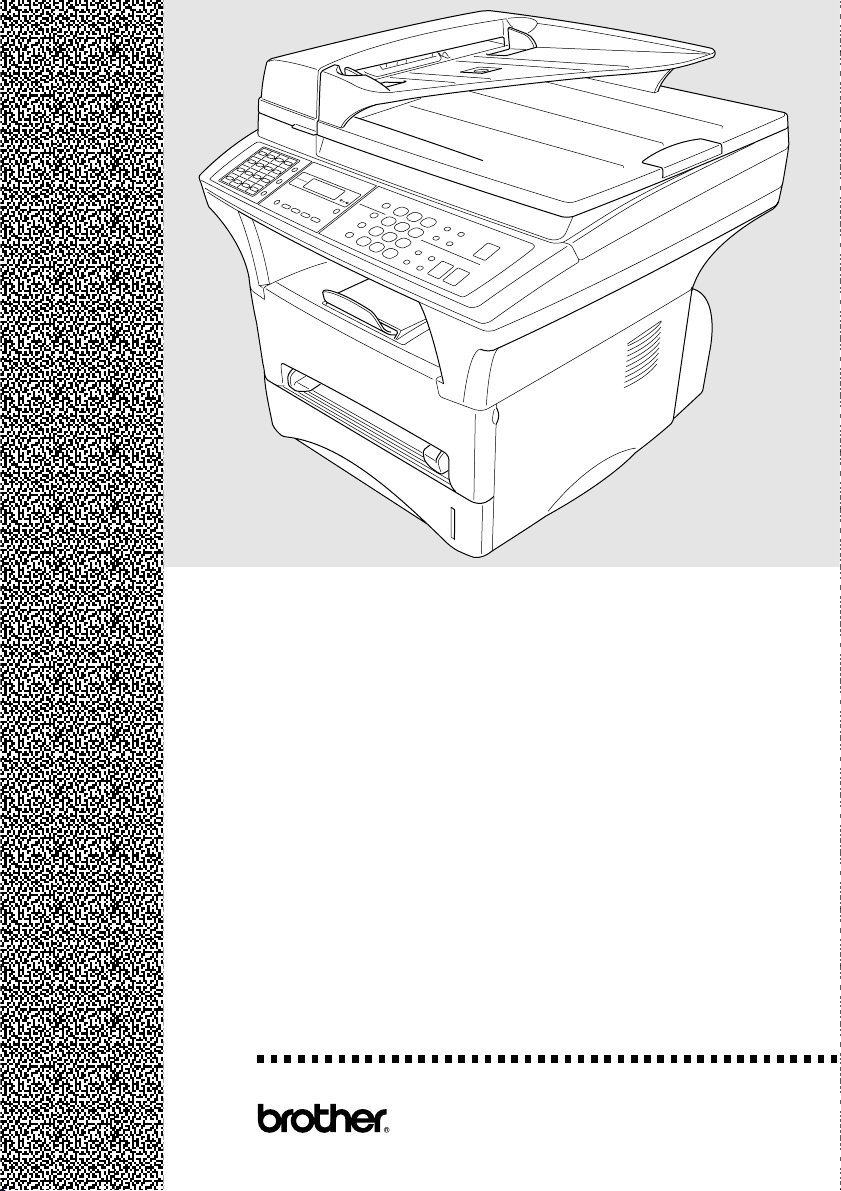
MFC-9800
OWNER’S MANUAL
version C
If You Need to Call Customer Service
Please complete the following information for future
reference:
Model Number: MFC-9800
Serial Number*:
Date of Purchase:
Place of Purchase:
* The serial number is on the back of the unit. Retain
this manual with your sales receipt as a permanent
record of your purchase, in the event of theft, fire or
warranty service.
©1996-2001 Brother Industries, Ltd.
i
Brother Numbers
Brother fax-back system
Brother Customer Service has installed an easy-to-use fax-back system, so you can get instant
answers to common technical questions and product information for all Brother products.
This system is available 24 hours a day, 7 days a week. You can use the system to send faxes
to any MFC, not just the one from which you are calling. Call and follow the voice prompts
to receive faxed instructions on how to use the system and your index of fax-back subjects.
If you can’t resolve a difficulty with your Brother MFC using this manual, call
our fax-back system, and follow the voice prompts to receive faxed instructions
about using the system and an index of fax-back subjects.
The Brother fax-back system number (USA only) has been preprogrammed on
One Touch key
01
.
Frequently Asked Questions (FAQs)
The Brother Solutions Center is our one-step resource for all your
Fax Machine/Multifunction Center needs. You can download the latest software
and utilities, read FAQs and troubleshooting tips, and go to the ‘Solutions’
section to learn how to get the most from your Brother product.
For Customer Service
Dealers/Service Centers (USA Only)
For the name of a Brother authorized dealer or service center, call 1-800-284-4357.
Service Centers (Canada Only)
For service center address in Canada, call 1-877-BROTHER.
IMPORTANT
For technical and operational assistance, you must call the country where you
purchased the MFC. Calls must be made
from within
that country.
In USA:
1-800-521-2846
You can check here for Brother Printer Driver updates.
In USA:
1-800-284-4329 (voice)
1-908-575-8790 (fax)
1-800-284-3238 (TTY service for the hearing-impaired)
In Canada:
1-877-BROTHER (voice)
1-514-685-4898 (fax)
1-514-685-6464 (voice)
In Montreal
http://solutions.brother.com
BROTHER NUMBERS
ii
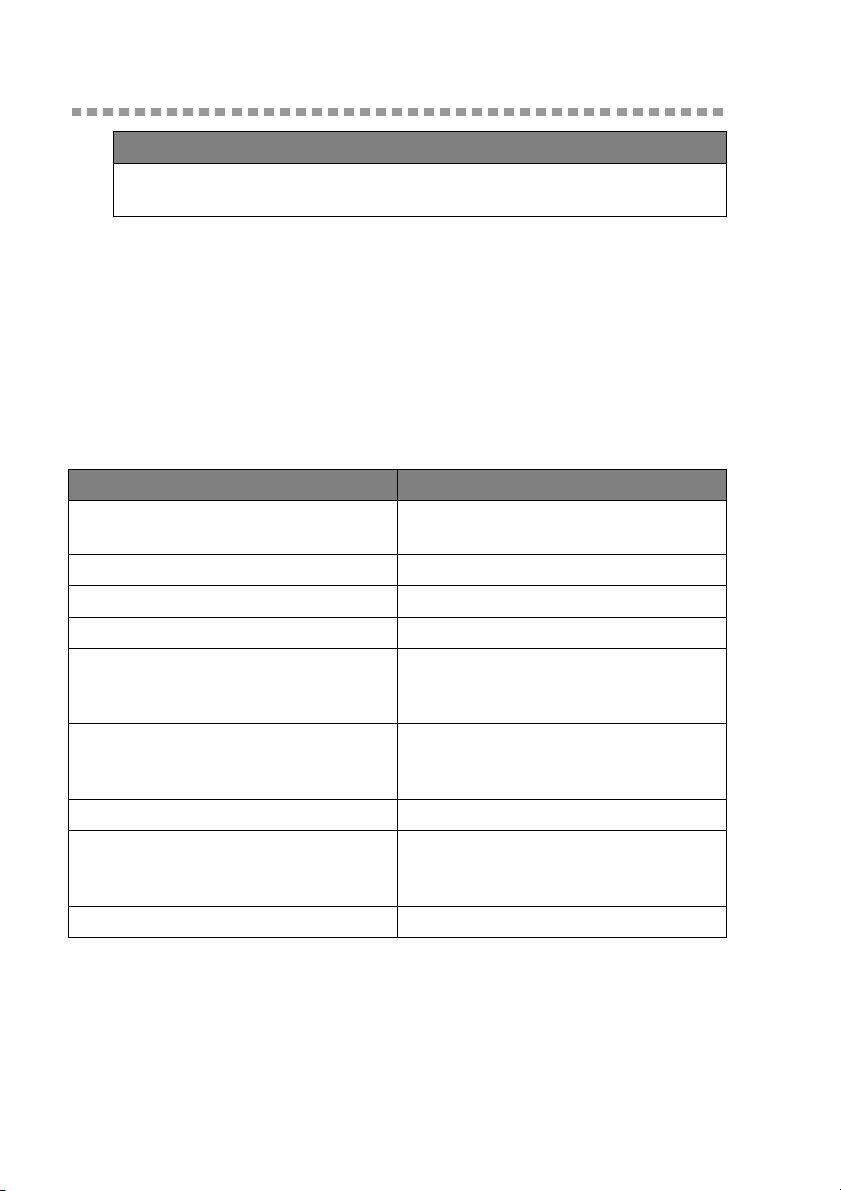
Ordering Accessories and Supplies
For best quality results use only genuine Brother accessories, available at most
Brother retailers. If you cannot find the accessory you need and you have a Visa,
MasterCard, Discover or American Express credit card, you can order
accessories directly from Brother. (In the USA, you can visit us online for a
complete selection of Brother accessories and supplies available for purchase.)
IMPORTANT
For technical and operational assistance, you must call the country where you
purchased the MFC. Calls must be made
from within
that country.
In USA:
1-888-879-3232 (voice)
1-800-947-1445 (fax)
http://www.brothermall.com
In Canada:
1-877-BROTHER (voice)
Description Item
Laser Fax Toner TN-430 (Able to print 3000 pages)
TN-460 (Able to print 6000 pages)
Laser Fax Drum DR-400
Telephone Line Cord LG3077001
IEEE-1284 Bi-directional Cable F2A046-10
Power Protector for A/C Power, Phone
Line Surges and Voltage Spikes (2
outlets)
QPD120
Power Protector for A/C Power, Phone
Line Surges and Voltage Spikes (8
outlets)
FX120
Paper Cassette #2 (Option)
LT-400
Network (LAN) Board (Option)
Brother Print/Fax Server (10/100 Base-
TX Ethernet Network)
NC-8100h
Owner’s Manual LE7057001
ORDERING ACCESSORIES AND SUPPLIES

iii
Notice – Disclaimer of Warranties
(For USA and Canada)
BROTHER’S LICENSOR(S), AND THEIR DIRECTORS, OFFICERS, EMPLOYEES OR AGENTS
(COLLECTIVELY BROTHER’S LICENSOR) MAKE NO WARRANTIES, EXPRESS OR IMPLIED,
INCLUDING WITHOUT LIMITATION THE IMPLIED WARRANTIES OF MERCHANTABILITY AND
FITNESS FOR A PARTICULAR PURPOSE, REGARDING THE SOFTWARE. BROTHER’S
LICENSOR(S) DOES NOT WARRANT, GUARANTEE OR MAKE ANY REPRESENTATIONS
REGARDING THE USE OR THE RESULTS OF THE USE OF THE SOFTWARE IN TERMS OF ITS
CORRECTNESS, ACCURACY, RELIABILITY, CURRENTNESS OR OTHERWISE. THE ENTIRE RISK
AS TO THE RESULTS AND PERFORMANCE OF THE SOFTWARE IS ASSUMED BY YOU. THE
EXCLUSION OF IMPLIED WARRANTIES IS NOT PERMITTED BY SOME STATES IN THE USA AND
SOME PROVINCES IN CANADA. THE ABOVE EXCLUSION MAY NOT APPLY TO YOU.
IN NO EVENT WILL BROTHER’S LICENSOR(S) BE LIABLE TO YOU FOR ANY CONSEQUENTIAL,
INCIDENTAL OR INDIRECT DAMAGES (INCLUDING DAMAGES FOR LOSS OF BUSINESS
PROFITS, BUSINESS INTERRUPTION, LOSS OF BUSINESS INFORMATION, AND THE LIKE)
ARISING OUT OF THE USE OR INABILITY TO USE THE SOFTWARE EVEN IF BROTHER’S
LICENSOR HAS BEEN ADVISED OF THE POSSIBILITY OF SUCH DAMAGES. BECAUSE SOME
STATES IN THE USA AND SOME PROVINCES IN CANADA DO NOT ALLOW THE EXCLUSION OR
LIMITATION OF LIABILITY FOR CONSEQUENTIAL OR INCIDENTAL DAMAGES, THE ABOVE
LIMITATIONS MAY NOT APPLY TO YOU. IN ANY EVENT BROTHER’S LICENSOR’S LIABILITY
TO YOU FOR ACTUAL DAMAGES FROM ANY CAUSE WHATSOEVER, AND REGARDLESS OF
THE FORM OF THE ACTION (WHETHER IN CONTRACT, TORT (INCLUDING NEGLIGENCE),
PRODUCT LIABILITY OR OTHERWISE), WILL BE LIMITED TO $50.
Compilation and Publication Notice
Under the supervision of Brother Industries Ltd., this manual has been compiled
and published, covering the latest product descriptions and specifications.
The contents of this manual and the specifications of this product are subject to
change without notice.
Brother reserves the right to make changes without notice in the specifications and
materials contained herein and shall not be responsible for any damages (including
consequential) caused by reliance on the materials presented, including but not
limited to typographical and other errors relating to the publication.
Disclaimer–User Installation of
Memory Board(s)
In some cases, product may be modified by adding and/or replacing the memory board(s) with
approved replacements. Any damage to the product, the memory board(s) to be inserted therein
or otherwise, caused as a result of improper installation (including installation of other than
approved memory boards(s)) is not covered
by the Limited Warranty. If you do not feel
comfortable with the installation of approved memory board(s), contact a Brother Authorized
Service Center to perform the installation of the memory board(s) for you. If you elect to use a
Brother Authorized Service Center, you will be responsible for a moderate service charge. For
the name and location of a convenient Authorized Service Center, please call 1-800-521-2846.
NOTICE – DISCLAIMER OF WARRANTIES

iv
BROTHER ONE YEAR LIMITED WARRANTY and EXCHANGE SERVICE
(USA Only)
This warranty gives you certain rights and
you may also have other rights that may vary
from state to state.
This warranty is given only to the first end-
use purchaser of the accompanying product
(referred to in this warranty as “this Product”).
What is covered:
Brother warrants to you for
the Warranty Period that there are no defects
in the materials, workmanship or Year 2000
compliance of this Product. The “Warranty
Period” is 1 year from the date you
purchased this product. The “Warranty
Period” for consumable items, such as Print
Heads, Toner, Drums, Ink Cartridges, Print
Cartridges, Refill Ribbons, Therma PLUS
Paper and Thermal Paper, etc. is 90 days
from the date of purchase, or the rated life of
the Consumable item, whichever is shorter.
What is NOT covered:
Warranty WILL BE
VOID by Brother for repairs or replacements
made necessary due to the following: (1) If
the Product was not purchased from an
authorized Brother reseller within the United
States, (2) The Product has been serviced or
modified by anyone other than an Authorized
Service Representative of Brother, (3) The
serial number has been modified, defaced or
removed from this Product, (4) Non-
Brother®-brand or non-Brother approved
parts, supplies, power supplies or other
accessories have been used with this
Product, (5) Any damage caused by
accident, neglect, abuse or misuse or, the
recommended monthly volume has been
exceeded, (6) Damages caused as a result
of modification, alteration or repairs
performed by anyone other than a Brother
Authorized Service Representative. (7) NOT
COVERED UNDER WARRANTY ARE:
Consumable items, for example (including,
but not limited to): ribbons, ink or toner
cartridges, toner drum units, print heads,
cleaning and/or instances where no defects
in material or workmanship are found in the
Product, etc. (8) Damage caused by
improper connection and/or disconnection of
the Product; failure of the operator to follow
operational instructions, improper set up of
the Product.
What to do if you think your Product is
defective:
Call our Customer Service
Hotline at 1-800-284-4329, or if you suspect
a defect in materials or workmanship in this
Product, you can report it to a Brother
Authorized Service Center. During the
Warranty Period, supply Brother’s
representative with a copy of your dated bill
of sale showing that this Product was
purchased within the United States. For the
name of your Brother Authorized Service
Center, call 1-800-521-2846. After contacting
the Brother Authorized Service Center, you
may be required to deliver or send the
Product properly packaged, freight prepaid,
to the Authorized Service Center together
with a photocopy of your bill of sale.
What Brother will do:
Brother (or its
Authorized Service Center) will evaluate your
report of a possible defect to determine
whether a defect exists, and if it does exist,
Brother (or its Authorized Service Center) will
repair or (at Brother’s option) replace the
Product with a product that performs the
same functions and performs as well as the
original Product. Brother reserves the right to
supply refurbished or remanufactured
replacement parts provided that the
replacement parts conform to the
manufacturer’s specifications for new
products. The repaired or replacement
product will be returned to you at no cost.
Exchange Service:
When an exchange is
authorized, Brother will exchange your non-
working product with a refurbished or
remanufactured product that conforms to the
manufacturer’s specifications for new
products. The refurbished or
remanufactured Product you receive will be
covered by the balance of the limited
warranty period remaining on the original
Product, plus an additional thirty (30) days.
You will keep the replacement Product that is
sent to you and must return (or be billed up to
the cost of a new product) your original non-
working product, which shall become the
property of Brother. You must call Brother
Customer Service and if the representative
cannot correct the product’s malfunction over
the telephone and you elect the exchange
service, you must provide information
pertaining to this Product and you must also
provide a valid major credit card number.
Your credit card will be charged up to the cost
of a new Product if: (i) you do not return your
original Product to Brother within five (5)
business days; (ii) the malfunctions of your
original Product are not covered by the
limited warranty; (iii) the proper packaging
instructions are not followed and has caused
damage to the product; or (iv) the warranty
period on your original Product has expired
or has not been sufficiently validated with a
copy of the proof of purchase (bill of sale).
MFC LIMITED WARRANTY (USA)

v
BROTHER ONE YEAR LIMITED WARRANTY and EXCHANGE SERVICE
(USA Only)
The Brother Customer Service Representative
will ship the exchange Product via next
business day delivery courier service, with
return instructions and prepaid return air bill.
Follow the return instructions. You must return
the original Product in the same shipping
carton in which the exchanged Product was
received and include a copy of proof of
purchase (bill of sale). Retain your original
accessory items and a copy of the return air
bill, signed by the courier.
Limitations:
Repair or replacement as
described above is your sole and exclusive
(that is, your only) remedy if this Product is
defective. Brother is not responsible for
damage to or loss of any equipment,
media, programs or data related to the use
of this Product. Except for that repair or
replacement,
Brother shall not be liable for
any direct, indirect, incidental or
consequential damages or specific relief.
Because some states do not allow the
exclusion or limitation of consequential or
incidental damages, the above limitation
may not apply to you.
THIS WARRANTY IS GIVEN IN LIEU OF
ALL OTHER WARRANTIES, WRITTEN
OR ORAL, WHETHER EXPRESSED BY
AFFIRMATION, PROMISE,
DESCRIPTION, DRAWING, MODEL OR
SAMPLE. ANY AND ALL WARRANTIES
OTHER THAN THIS ONE, WHETHER
EXPRESS OR IMPLIED, INCLUDING
IMPLIED WARRANTIES OF
MERCHANTABILITY AND FITNESS
FOR A PARTICULAR PURPOSE, ARE
HEREBY DISCLAIMED.
This Limited Warranty is the only warranty
that Brother is giving for this Product. It is
the
final expression and the exclusive and
only statement
of Brother’s obligations to
you. It replaces all other agreements and
under-standings that you may have with
Brother or its representatives.
This Limited Warranty (and Brother’s
obligation to you) may not be changed in
any way unless you and Brother sign the
same piece of paper in which we (1) refer to
this Product and your bill of sale date, (2)
describe the change to this warranty and
(3) agree to make that change.
Product Support:
Toll-free Customer
Service and technical support is available
for hardware operational assistance at 1-
800-284-4329. At any time, free technical
support in the form of Frequently Asked
Questions, troubleshooting tips and service
center locator is available through our fax-
back system at 1-800-521-2846 or
Brother’s Internet Web Site
(www.brother.com). Now you can visit us
on-line at (www.brothermall.com), your
complete source for genuine Brother
Accessories and Supplies.
B
ROTHER
I
NTERNATIONAL
C
ORPORATION
100 S
OMERSET
C
ORPORATE
B
LVD.
B
RIDGEWATER,
N
EW
J
ERSEY
08807-0911
Please record your model and serial
numbers and your date and location of
Purchase below for your records. Keep this
information with your proof of purchase (bill
of sale) in case your Product is lost, stolen
or requires service.
Model # ___________________________
Serial # ___________________________
Date of purchase: ___________________
Store where purchased: ______________
Location of store:____________________
Important:
We recommend that you keep
all original packing materials, in the event
that you ship this product.
MFC LIMITED WARRANTY (USA)

vi
BROTHER MULTIFUNCTION CENTER/FACSIMILE MACHINE
LIMITED WARRANTY
(For Canada Only)
Pursuant to this limited warranty of 1 year from the date of purchase for labour and parts,
Brother International Corporation (Canada) Ltd. (“Brother”), or its Authorized Service
Centers, will repair this MFC/Facsimile machine free of charge if defective in material or
workmanship. This Limited Warranty does not include cleaning, consumables
(including, without limitation, print cartridges, print head, toner and drum) or damage
caused by accident, neglect, misuse or improper installation or operation, any damage
caused from service, maintenance, modifications, or tampering by anyone other than a
Brother Authorized Service Representative, or from the use of supplies or consumable
items that are non-Brother products. Operation of the MFC/Facsimile machine in excess
of the specifications or with the Serial Number or Rating Label removed shall be deemed
abuse and all repairs thereafter shall be the sole liability of the end-user/purchaser. In
order to obtain warranty service, the MFC/Facsimile machine must be delivered or
shipped freight prepaid by the end user/purchaser to a “Brother” Authorized Service
Center, together with your Proof of Purchase in the form of a Sales Receipt.
For laser products: Failure to remove the Toner Cartridge (and Toner Drum Unit on
applicable models) during shipping will cause severe damage to the MFC/Facsimile and
will VOID the Warranty. (Refer to your Operation Manual for proper packaging.)
For ink-jet products: Do not remove the ink cartridges during shipping. Damage to your
print head resulting from packing without the ink cartridges will VOID your warranty.
(Refer to your Operation Manual for proper packaging.)
BROTHER DISCLAIMS ALL OTHER WARRANTIES EXPRESSED OR IMPLIED
INCLUDING, WITHOUT LIMITATION, ANY IMPLIED WARRANTIES OF
MERCHANTABILITY OR FITNESS FOR A PARTICULAR PURPOSE, EXCEPT TO
THE EXTENT THAT ANY WARRANTIES IMPLIED BY LAW CANNOT BE VALIDLY
WAIVED.
No oral or written information, advice or representation provided by Brother, its
Authorized Service Centers, Distributors, Dealers, Agents or employees, shall create
another warranty or modify this warranty. This warranty states Brother’s entire liability
and your exclusive remedy against Brother for any failure of the MFC/Facsimile machine
to operate properly.
Neither Brother nor anyone else involved in the development, production, or delivery of
this MFC/Facsimile machine shall be liable for any indirect, incidental, special,
consequential, exemplary, or punitive damages, including lost profits, arising from the
use of or inability to use the product, even if advised by the end user/purchaser of the
possibility of such damages. Since some Provinces do not allow the above limitation of
liability, such limitation may not apply to you.
This Limited Warranty gives you specific legal rights and you may also have other rights
which vary from Providence to Providence.
Warranty Service is available at Brother Authorized Service Centers throughout
Canada. For Technical Support or for the name and location of your nearest
Authorized Service Center call 1-877-BROTHER. Within Montreal, please call (514)
685-6464. Internet support: [email protected] or browse
Brother’s Web Site: www.brother.com
Brother International Corporation (Canada) Ltd.
1 Rue Hôtel de Ville
Dollard-Des-Ormeaux, QC H9B 3H6
LIMITED WARRANTY (CANADA)
vii
Quick Reference Guide
Sending Faxes
Automatic Transmission
1
Place the original face up in the
ADF, or face down on the scanner
glass.
2
Enter the fax number using One
Touch, Speed Dial, Search or the
dial pad.
3
Press
Fax Start
.
Sending a Cover Page
1
Place the original face up in the
ADF, or face down on the scanner
glass.
2
Press
Menu
,
2
,
2
,
8
.
3
When
NEXT FAX ONLY
appears, press
Set
.
4
Press or to select
ON
(or
OFF
), and then press
Set
.
5
Press or to select a
comment, and then press
Set
.
6
Enter two digits to indicate the
number of pages being sent, and
then press
Set
.
7
Press
1
to select additional settings
—
OR
—Press
2
if you are ready to
fax.
8
Enter the fax number.
9
Press Fax Start.
Real Time Transmission
You can send faxes in real time.
1
Place the original face up in the ADF,
or face down on the scanner glass.
2
Press Menu, 2, 2, 6.
3
Press or to select ON (or
OFF), and then press Set—OR—
For the next transmission only,
press or to select NEXT
FAX ONLY, and then press Set.
4
For the next fax only, press
or to select
ON
(or
OFF
),
and then press Set.
5
Press 1 to select additional settings
—OR—Press 2 to fax.
6
Enter the fax number.
7
Press Fax Start.
Receiving Faxes
Select Receive Mode
There are four Receive modes:
FAX ONLY
,
MANUAL,
FAX/TEL
and
TAD: ANSWER
MACH
. Press Receive Mode
until the LCD shows your
selection. After two seconds the
LCD returns to the Data and Time
prompt and shows the new Receive
mode.
Brother fax-back system :
In USA: 1-800-521-2846
Brother Global Web Site :
http://www.brother.com
Frequently Asked Questions (FAQs)
and Product Support:
http://solutions.brother.com
Brother
Accessories & Supplies
:
In USA: 1-888-879-3232 (voice)
1-800-947-1445 (fax)
http://www.brothermall.com
In
Canada:
1-877-BROTHER (voice)
QUICK REFERENCE GUIDE
viii
Storing Numbers
Storing One Touch Dial
Numbers
1
Press Menu, 2, 3, 1.
2
Press the One Touch key where
you want to store the number.
3
Enter a number (up to 20 digits),
and then press Set.
4
Enter a name (or leave it blank),
and then press Set.
5
Press Stop/Exit.
Storing Speed Dial Numbers
1
Press Menu, 2, 3, 2.
2
Enter a two-digit Speed Dial number,
and then press Set.
3
Enter a number (up to 20 digits), and
then press Set.
4
Enter a name (or leave it blank) , and
then press Set.
5
Press Stop/Exit.
Dialing Operations
One Touch Dialing / Speed
Dialing
1
Place the original face up in the
ADF, or face down on the scanner
glass.
2
Press the One Touch key of the
number you want to call—OR—
Press Search/Speed Dial, press
#, and then press the two-digit
Speed Dial number.
3
Press Fax Start.
Search/Speed Dial
1
Place the original face up in the
ADF, or face down on the scanner
glass.
2
Press Search/Speed Dial, and
then enter the first letter of the
name you’re looking for.
3
Press or to search the
memory.
4
Press Fax Start, when the LCD
shows the name you want to call.
Making Copies
Single Copy
1
Place the original face up in the
ADF, or face down on the scanner
glass.
2
Press Copy.
Sorting Multiple Copies
(Using the ADF)
1
Place the original face up in the
ADF.
2
Use the dial pad to enter the
number of copies you want (up to
99).
3
Press Options, press or
to select OPT: STACK/SORT,
and then press Set.
4
Press or to select SORT,
and then press Set.
5
Press Copy.
QUICK REFERENCE GUIDE

TABLE OF CONTENTS
ix
Table of Contents
1
Introduction..................................................................................... 1-1
Using This Manual..................................................................... 1-1
Finding Information............................................................. 1-1
Conventions Used in this Manual........................................ 1-1
Test Sheet Procedure and Product Registration (For USA Only)
. 1-2
To Complete Your MFC-9800 Registration On-Line
(For USA Only) .............................................................. 1-2
MFC-9800 Control Panel Overview .......................................... 1-3
About Your Machines ................................................................ 1-5
Custom Features .................................................................. 1-5
Do You Have Voice Mail on the Phone Line? ............... 1-5
Why Should There Be Trouble? ..................................... 1-5
How Can You Avoid Possible Problems? ...................... 1-5
Fax Tones and Handshake................................................... 1-5
ECM (Error Correction Mode)............................................ 1-6
2
Assembly and Connections............................................................. 2-1
Packing List................................................................................ 2-1
Choosing a Location................................................................... 2-2
Important Safety Instructions .............................................. 2-3
Release the Scanner Lock.................................................... 2-3
Assembly.................................................................................... 2-4
Installing the Drum Unit Assembly
(with Toner Cartridge) .................................................... 2-4
Paper........................................................................................... 2-5
Acceptable Paper ................................................................ 2-5
Paper Capacity of Paper Cassette........................................ 2-5
Paper Specification for the Cassette.................................... 2-5
Manual Feed Slot................................................................. 2-6
Loading Paper in the Paper Cassette ................................... 2-6
Manual Feed Slot................................................................. 2-7
Connecting the MFC .................................................................. 2-8
Connections................................................................................ 2-9
Connecting an External Telephone ..................................... 2-9
Connecting an External TAD
(Telephone Answering Device) ...................................... 2-9
Sequence ......................................................................... 2-9
Connections..................................................................... 2-9

x
Recording Outgoing Message (OGM) on External TAD
.. 2-10
Special Line Considerations.............................................. 2-11
Roll Over Phone Lines.................................................. 2-11
Two-Line Phone System............................................... 2-11
Converting Telephone Wall Outlets ............................. 2-11
Installing MFC, External Two-Line TAD, and
Two-Line Telephone ................................................ 2-12
Multi-Line Connections (PBX) ......................................... 2-13
If You are Installing the MFC to Work with a PBX:.... 2-13
Custom Features on Your Phone Line............................... 2-13
3
On-Screen Programming................................................................ 3-1
User-Friendly Programming....................................................... 3-1
Menu Mode ......................................................................... 3-1
Menu Selection Table.......................................................... 3-2
4
Initial Setup...................................................................................... 4-1
Getting Started............................................................................ 4-1
Setting Paper Size ............................................................... 4-1
Turning on Cassette #2 (Option) ......................................... 4-1
Setting Cassette Usage ........................................................ 4-2
Setting Date and Time......................................................... 4-2
Setting Station ID ................................................................ 4-3
Entering Text................................................................... 4-4
Inserting Spaces .............................................................. 4-4
Making Corrections......................................................... 4-4
Repeating Letters ............................................................ 4-4
Special Characters and Symbols ................................... 4-4
Setting the Ring Volume ..................................................... 4-5
Setting the Beeper Volume.................................................. 4-5
Setting the Speaker Volume ................................................ 4-5
Memory Storage .................................................................. 4-5
Turning On Automatic Daylight Savings Time .................. 4-5
Toner Save........................................................................... 4-6
Sleep Mode.......................................................................... 4-6
Setting Tone/Pulse Dialing Mode (For Canada Only) ........ 4-6
5
Setup Receive................................................................................... 5-1
Receive Mode Settings............................................................... 5-1
Select Your Receive Mode.................................................. 5-1
To Select or Change Your Receive Mode ...................... 5-2

TABLE OF CONTENTS
xi
Setting Ring Delay .............................................................. 5-2
Setting F/T Ring Time (For FAX/TEL Mode Only)........... 5-3
Easy Receive ....................................................................... 5-3
Printing a Reduced Incoming Document (Auto Reduction)
.. 5-4
Setting the Print Density...................................................... 5-4
Advanced Receiving Operations................................................ 5-5
Operation from Extension Telephone ................................. 5-5
For FAX/TEL Mode Only .............................................. 5-5
Changing the Fax Receive Code..................................... 5-5
Printing a Fax in Memory.................................................... 5-6
Polling.................................................................................. 5-6
Setting Up Polling Receive............................................. 5-6
Setting Up Sequential Polling Receive........................... 5-7
Canceling a Scheduled Job.................................................. 5-7
PC-FAX Receive Mode....................................................... 5-7
6
Setup Send ....................................................................................... 6-1
Before You Begin....................................................................... 6-1
Sending Faxes Using Multiple Settings .............................. 6-1
Faxing from the ADF (Automatic Document Feeder) ........ 6-1
Faxing from the Scanner Glass............................................ 6-3
Manual Transmission .......................................................... 6-4
Automatic Transmission...................................................... 6-4
Manual and Automatic Fax Redial...................................... 6-4
Dual Access......................................................................... 6-4
Real Time Transmission...................................................... 6-5
Checking the Jobs Status..................................................... 6-5
Canceling a Job While Scanning the Original..................... 6-5
Canceling a Job in Memory................................................. 6-6
Basic Sending Operations .......................................................... 6-6
Contrast................................................................................ 6-6
Fax Resolution..................................................................... 6-7
Composing Electronic Cover Page...................................... 6-7
Composing Your Own Comments.................................. 6-8
Cover Page for the Next Fax Only.................................. 6-8
Always Send Cover Page................................................ 6-9
Using a Printed Cover Page ............................................ 6-9
Advanced Sending Operations................................................. 6-10
Overseas Mode .................................................................. 6-10
Delayed Timer................................................................... 6-10
Delayed Fax....................................................................... 6-10

xii
Delayed Batch Transmission ........................................ 6-11
Setting Up for Polling Transmit ........................................ 6-11
7
Auto Dial Numbers and Dialing Options ...................................... 7-1
Storing Numbers for Easy Dialing ............................................. 7-1
Storing One Touch Dial Numbers....................................... 7-1
Storing Speed Dial Numbers............................................... 7-2
Changing One Touch and Speed Dial Numbers.................. 7-2
Setting Up Groups for Broadcasting ................................... 7-2
Dialing Options .......................................................................... 7-3
Search .................................................................................. 7-3
Speed Dialing ...................................................................... 7-4
One Touch Dialing .............................................................. 7-4
Access Codes and Credit Card Numbers............................. 7-4
Broadcasting........................................................................ 7-5
Pause.................................................................................... 7-6
Fax Redial............................................................................ 7-6
Tone/Pulse (For Canada Only)............................................ 7-6
8
Telephone Services .......................................................................... 8-1
Custom Feature........................................................................... 8-1
Distinctive Ring................................................................... 8-1
What Does Your Telephone Company’s
“Distinctive Ring” Do?............................................... 8-1
What Does Brother’s “Distinctive Ring” Do? ................ 8-1
Do You Have Voice Mail?.............................................. 8-2
Before You Choose the Ring Pattern to Register ........... 8-2
Very Important .................................................................... 8-3
Registering the Distinctive Ring Pattern......................... 8-3
Caller ID .............................................................................. 8-3
Viewing Caller ID List.................................................... 8-4
Clearing a Caller ID Stored in Memory.......................... 8-4
Printing Caller ID List..................................................... 8-4
9
Remote Fax Options........................................................................ 9-1
Fax Forwarding/Paging .............................................................. 9-1
Programming a Fax Forwarding Number............................ 9-1
Programming Your Pager Number...................................... 9-1
Setting Fax Storage .................................................................... 9-2
Backup Print ........................................................................ 9-2
Changing Remote Retrieval Access Code.................................. 9-3

TABLE OF CONTENTS
xiii
Remote Retrieval................................................................. 9-3
Using Remote Retrieval Access Code................................. 9-3
Remote Commands ............................................................. 9-4
Retrieving Fax Messages..................................................... 9-5
Changing Fax Forwarding Number..................................... 9-5
10
Printing Reports............................................................................ 10-1
MFC Settings and Activity....................................................... 10-1
Customizing the Transmission Verification Report.......... 10-1
Setting the Fax Activity Report Interval ........................... 10-1
Using the Reports Key....................................................... 10-2
11
Making Copies............................................................................... 11-1
Basic Copy Operations............................................................. 11-1
Making a Single Copy (Using the ADF)........................... 11-1
Making Multiple Copies (Using the ADF)........................ 11-1
Single or Multiple Copies (Using the Scanner Glass)....... 11-2
Out of Memory Message................................................... 11-2
Temporary Copy Settings......................................................... 11-3
Copying Using Multiple Settings ...................................... 11-3
Using Enlarge/Reduce Key ............................................... 11-3
Copy Contrast.................................................................... 11-4
Using the Options Key ...................................................... 11-5
Copy Mode (Type of Original).......................................... 11-5
Sorting Multiple Copies (Using the ADF) ........................ 11-5
Special Copy Options (Using the ADF)............................ 11-6
Special Copy Options (Using the Scanner Glass) ............. 11-6
2 in 1 ............................................................................. 11-6
4 in 1 ............................................................................ 11-6
Poster............................................................................. 11-7
Paper Type......................................................................... 11-8
Changing Default Copy Settings.............................................. 11-8
Copy Mode (Type of Original).......................................... 11-9
Copy Contrast.................................................................... 11-9
Paper Type......................................................................... 11-9
12
For DOS Users............................................................................... 12-1
How to Use the Brother MFC with Your DOS
Application Software .................................................... 12-1
What Does the Remote Printer Console Do? .................... 12-1

xiv
Remote Printer Console Main Program........................ 12-1
Installing the Remote Printer Console............................... 12-2
Using the Remote Printer Console Main Program ............ 12-3
Remote Printer Console..................................................... 12-4
Current Printer Status Information................................ 12-4
Printer Setup Category ...................................................... 12-4
Print Setup Section........................................................ 12-4
Page Setup Section........................................................ 12-5
Font Configuration........................................................ 12-5
Other Configuration ...................................................... 12-6
Console Configuration Category .................................. 12-6
13
Using the Brother MFC as a Printer ........................................... 13-1
Special Printing Features.......................................................... 13-1
Windows
®
Printing............................................................ 13-1
Popular Printer Emulation Support ................................... 13-1
Remote Printer Console Program for DOS ....................... 13-1
Bi-directional Parallel Interface......................................... 13-1
Enhanced Memory Management....................................... 13-1
Printing From Your PC ............................................................ 13-2
Multi-purpose Paper Cassette............................................ 13-2
Two-Sided Printing (Manual Duplexing).......................... 13-2
Front Output Bin................................................................ 13-3
Manual Feed Slot............................................................... 13-3
Loading One Sheet of Paper ......................................... 13-4
Loading More than One Sheet of Paper........................ 13-4
Printing on Thicker Paper and Card Stock.................... 13-5
Simultaneous Printing/Faxing .................................................. 13-6
Choosing Acceptable Paper...................................................... 13-6
Printer Operation Key .............................................................. 13-7
Reset Key........................................................................... 13-7
Printing the Internal Font List ........................................... 13-7
Printing the Print Configuration List................................. 13-7
Restoring Factory Default Settings ................................... 13-7
14
Printer Driver Settings (For Windows
®
Only) ........................... 14-1
Using the Brother MFC-9800 Printer Driver ........................... 14-1
Features in the Printer Driver
(For Windows
®
95/98/Me and Windows
®
NT 4.0 Users).... 14-1
Basic Tab.................................................................................. 14-2
Paper Size .......................................................................... 14-3

TABLE OF CONTENTS
xv
Multiple Page..................................................................... 14-3
Border Line........................................................................ 14-3
Orientation......................................................................... 14-3
Copies................................................................................ 14-3
Collate................................................................................ 14-4
Media Type........................................................................ 14-4
Advanced Tab .......................................................................... 14-5
Print Quality (*1)............................................................... 14-5
Resolution ..................................................................... 14-5
Toner Save .................................................................... 14-5
Print Setting
(For Windows
®
95/98/98SE/Me Users Only).......... 14-6
Duplex Printing (*2).......................................................... 14-6
Manual Duplex.............................................................. 14-6
Binding Offset............................................................... 14-6
Watermark (*3) ................................................................. 14-7
Print Watermark............................................................ 14-7
In background ............................................................... 14-7
Watermark Text ............................................................ 14-8
Watermark Bitmap........................................................ 14-8
Position ......................................................................... 14-8
Page Setting (*4) ............................................................... 14-9
Device Options (*5) ........................................................ 14-10
Quick Print Setup ............................................................ 14-11
Administrator
(For Windows
®
95/98/98SE/Me Users Only) ............ 14-11
Print Date & Time ........................................................... 14-12
Accessories Tab...................................................................... 14-13
Paper Source Setting........................................................ 14-13
Default Source................................................................. 14-13
Available Options............................................................ 14-13
Support ................................................................................... 14-14
Brother Solutions Center ................................................. 14-14
Web Update..................................................................... 14-14
Check Setting................................................................... 14-14
Features in the Printer Driver (For Windows
®
2000) ............ 14-15
General Tab ..................................................................... 14-15
Printing Preferences.................................................... 14-15
Layout Tab....................................................................... 14-16
*1 Orientation ............................................................. 14-16
*2 Pages Per Sheet...................................................... 14-17

xvi
Paper/Quality Tab............................................................ 14-17
*1 Paper Source .......................................................... 14-17
*2 Media ..................................................................... 14-18
Advanced Options....................................................... 14-18
*1 Paper /Output ......................................................... 14-18
*2 Graphic................................................................... 14-19
*3 Document Options ................................................. 14-19
Device Settings Tab......................................................... 14-20
Installable Options ...................................................... 14-20
15
Using the Windows
®
-Based Brother MFL-Pro Control Center
.. 15-1
Brother Control Center............................................................. 15-1
AutoLoad the Brother Control Center............................... 15-1
How to Turn Off AutoLoad............................................... 15-2
Using the Scan Keys................................................................. 15-2
Using the Control Panel Keys .................................................. 15-2
Scan Image ........................................................................ 15-3
Scan/OCR.......................................................................... 15-3
Scan to E-mail ................................................................... 15-3
Brother Control Center Features .............................................. 15-4
Auto Configuration............................................................ 15-4
Scanning Operations.......................................................... 15-4
Copy Operations................................................................ 15-5
PC Fax Operation .............................................................. 15-5
Scanner Settings for Scan, Copy and PC Fax Buttons ...... 15-5
Global Settings .................................................................. 15-5
Setting Up the Scanner Configurations ............................. 15-6
To Access the Scanner Configuration Screen: .................. 15-6
Perform an Operation from the Control Center Screen..... 15-6
Scan to File............................................................................... 15-7
Scanner Settings ................................................................ 15-7
Destination Folder ............................................................. 15-8
Scan to E-mail .......................................................................... 15-8
Scanner Settings ................................................................ 15-9
E-mail Application ............................................................ 15-9
File Attachments................................................................ 15-9
Conversion Options......................................................... 15-10
Format ......................................................................... 15-10
Show QuickSend Menu .............................................. 15-10
QuickSend List............................................................ 15-10
Scan to Word Processor ......................................................... 15-11

TABLE OF CONTENTS
xvii
Scanner Settings .............................................................. 15-11
Word Processor ............................................................... 15-12
User-Defined Button .............................................................. 15-13
Scanner Settings .............................................................. 15-13
Target Application........................................................... 15-13
Copy ....................................................................................... 15-14
Scanner Settings .............................................................. 15-14
Copy Settings................................................................... 15-14
Send a Fax .............................................................................. 15-15
Scanner Settings .............................................................. 15-15
Fax Settings ..................................................................... 15-15
16
Using ScanSoft™ PaperPort
®
for Brother and ScanSoft™
TextBridge
®
(For Windows
®
Only)............................................. 16-1
Using ScanSoft™ PaperPort
®
and TextBridge
®
...................... 16-1
Viewing Items in ScanSoft™ PaperPort
®
for Brother ...... 16-2
Organizing Your Items in Folders..................................... 16-2
Links to Many Other Applications.................................... 16-3
Using ScanSoft™ TextBridge
®
OCR
(Converting Image Text to Text You Can Edit) ........... 16-3
Importing Items from Other Applications......................... 16-3
Exporting Items in Other Formats..................................... 16-4
Exporting an Image File................................................ 16-4
Accessing the Scanner....................................................... 16-4
Scanning an Image into Your PC ...................................... 16-5
Settings in the Scanner Window........................................ 16-5
Image............................................................................. 16-5
Contrast......................................................................... 16-6
Custom .......................................................................... 16-6
PreScanning an Image ....................................................... 16-7
17
Setting Up and Using PC-FAX (For Windows
®
Only) .............. 17-1
Introduction .............................................................................. 17-1
Brother Resource Manager................................................ 17-1
MFC Remote Setup.................................................................. 17-2
PC FAX Sending (For Windows
®
Only) ................................. 17-3
Setting Up User Information ............................................. 17-3
Setting Up Sending............................................................ 17-4
Outside Line Access.......................................................... 17-4
Include Header................................................................... 17-4

xviii
Address Book File ............................................................. 17-4
Internet PC-FAX ............................................................... 17-4
User interface..................................................................... 17-5
Simple Style .................................................................. 17-5
Facsimile Style.............................................................. 17-5
Setting Up Speed Dial .............................................................. 17-6
The Address Book ............................................................. 17-7
Setting Up a Member in the Address Book....................... 17-8
Setting Up a Group for Broadcasting ................................ 17-9
Editing Member Information............................................. 17-9
Deleting a Member or Group .......................................... 17-10
Exporting the Address Book ........................................... 17-10
Importing to the Address Book ....................................... 17-11
Setting Up Cover Page .................................................... 17-12
To ................................................................................ 17-13
From............................................................................ 17-13
Comment..................................................................... 17-13
Select Cover Page Form.............................................. 17-13
Import BMP file.......................................................... 17-13
Count Cover Page ....................................................... 17-13
Sending a File as a PC-FAX Using the Simple Style...... 17-14
Sending a File as a PC-FAX Using the Facsimile Style
... 17-15
Redial .......................................................................... 17-16
Setting Up PC-FAX Receiving (For Windows
®
Only).......... 17-16
Setting Up Your MFC ..................................................... 17-16
Running PC-FAX Receiving........................................... 17-16
Setting Up Your PC......................................................... 17-17
Viewing New PC-FAX Messages................................... 17-17
18
Using Automatic E-Mail Printing................................................ 18-1
For Windows
®
95, 98, 98SE, Me Only.................................... 18-1
Main Features .................................................................... 18-1
To Access the On-Line Documentation........................ 18-1
To Install Automatic E-mail Printing
(Optional Application): ............................................ 18-1
19
Using the Brother MFC with a New Power Macintosh
®
G3, G4 or iMac™/iBook ............................................................... 19-1
Set up Your USB Equipped Apple
®
Macintosh
®
G3,G4,
iMac™ or iBook with Mac OS 8.5/8.51/8.6/9.0/9.0.4/9.1 ... 19-1
Using Brother Printer Driver with Your Apple
®
Macintosh
®
.. 19-1

TABLE OF CONTENTS
xix
Sending a Fax from Your Macintosh
®
Application ................. 19-3
Setting Up Your Address Book......................................... 19-5
Adding a New Member................................................. 19-5
Adding a New Group.................................................... 19-6
Using Brother TWAIN Scanner Driver with Your
Apple
®
Macintosh
®
............................................................... 19-7
Accessing the Scanner....................................................... 19-8
Scanning a Document into Your Macintosh G3,
G4 or iMac .................................................................... 19-8
Settings in the Scanner Window........................................ 19-9
Image............................................................................. 19-9
Scanning Area............................................................... 19-9
Business Card Size...................................................... 19-10
Miscellaneous ............................................................. 19-10
Contrast....................................................................... 19-10
PreScanning an Image ..................................................... 19-11
20
Optional Accessories ..................................................................... 20-1
Memory Board ......................................................................... 20-1
Installing the Optional Memory Board.............................. 20-1
Paper Cassette #2 (Option)....................................................... 20-4
Network (LAN) Board (Option) .............................................. 20-4
21
Troubleshooting and Routine Maintenance ............................... 21-1
Troubleshooting ....................................................................... 21-1
Error Messages .................................................................. 21-1
Original Jams and Paper Jams.................................................. 21-3
Original is Jammed in the top of the ADF Unit ................ 21-3
Original is Jammed inside the ADF Unit .......................... 21-3
Paper Jam........................................................................... 21-4
Paper is Jammed in the Paper Cassette......................... 21-4
Paper is Jammed near the Drum Unit ........................... 21-5
Paper is Jammed in the Fuser Unit ............................... 21-5
If You Are Having Difficulty with Your MFC ................. 21-6
Packing and Shipping the MFC ............................................. 21-13
Lock the Scanner Lock.................................................... 21-13
Routine Maintenance.............................................................. 21-16
Cleaning the Scanner....................................................... 21-16
Cleaning the Printer......................................................... 21-17
Cleaning the Drum Unit .................................................. 21-18
Replacing the Toner Cartridge ........................................ 21-18

xx
How to Replace the Toner Cartridge............................... 21-19
Replacing the Drum Unit................................................. 21-21
Checking the Drum Life.................................................. 21-22
22
Important Information ................................................................. 22-1
Standard Telephone and FCC Notices ..................................... 22-1
Laser Safety....................................................................... 22-2
FDA Regulations........................................................... 22-2
Federal Communications Commission (FCC)
Declaration of Conformity (For USA Only)................. 22-3
Important....................................................................... 22-4
Industry Canada Compliance Statement
(For Canada Only) ........................................................ 22-4
Important – About the Interface Cable.............................. 22-4
Warranty............................................................................ 22-4
International ENERGY STAR
®
Compliance Statement... 22-4
Important Safety Instructions ................................................... 22-5
Trademarks............................................................................... 22-7
23
Glossary........................................................................................... G-1
24
Specifications ................................................................................... S-1
Product Description.................................................................... S-1
Fax.............................................................................................. S-1
Printer ......................................................................................... S-2
Computer Requirements...................................................... S-3
Parallel Interface.................................................................. S-4
USB (Universal Serial Bus) Interface ................................. S-4
Resident Fonts .....................................................................S-5
Symbol Sets/Character Sets ............................................ S-5
25
Index ..................................................................................................I-1
26
Remote Retrieval Access Card...................................................... R-1
INTRODUCTION
1 - 1
1
1
Introduction
Using This Manual
Thank you for purchasing a Brother Multi-Function Center (MFC). This MFC
has been designed to be simple to use, with LCD screen prompts to guide you
through programming your MFC. However, you can use your MFC to its fullest
potential by taking a few minutes to read this manual.
Finding Information
All chapter headings and subheadings are listed in the Table of Contents. You
will be able to find information about a specific feature or operation by checking
the Index in the back of this manual.
Conventions Used in this Manual
Throughout this manual you’ll see special symbols alerting you to important
information, warnings, and actions to perform. For clarification, and to help you
choose the correct key presses, we’ve added illustrations of some of the LCD
messages.
boldface Bold typeface identifies a specific key on the MFC control panel.
italics Italics typeface emphasize an important point, or refer you to related
topic.
bubble dot Bubble Dot typeface identifies the messages on the LCD of the
MFC.
Additionally, your MFC has a Reports key. Press Reports, 1 to print a list
of basic step instructions and explanations.
Warnings detail precautions you must take to avoid possible
personal injury.
Cautions specify procedures you must follow or avoid to prevent
possible damage to the MFC.
Note
Notes tell you the proper response for a situation that may
occur.
FYI tips provide details about how the current operation
interacts with other features.
Improper Setup alerts you to devices and procedures that are
not compatible with the
MFC.

1 - 2
INTRODUCTION
Test Sheet Procedure and Product Registration
(For USA Only)
After programming your Station ID, please fill out the TEST SHEET included
with your MFC, and then fax it to Brother’s Automated Fax Response System
as your first transmission. This will verify that your MFC is properly installed.
To receive a response, you must set up your Station ID. (See
Setting Station ID,
page 4-3.)
When this document is received, a confirmation sheet and Product Registration
form will be sent back to your MFC. Please fill out the form and return to
complete your registration.
To Complete Your MFC-9800 Registration On-Line
(For USA Only)
1
Insert the MFL Pro CD-ROM into your CD-ROM drive.
2
Click On-Line Registration to register your product on-line from the main
menu.
In USA: 1-877-268-9575 (fax)
INTRODUCTION
1 - 3
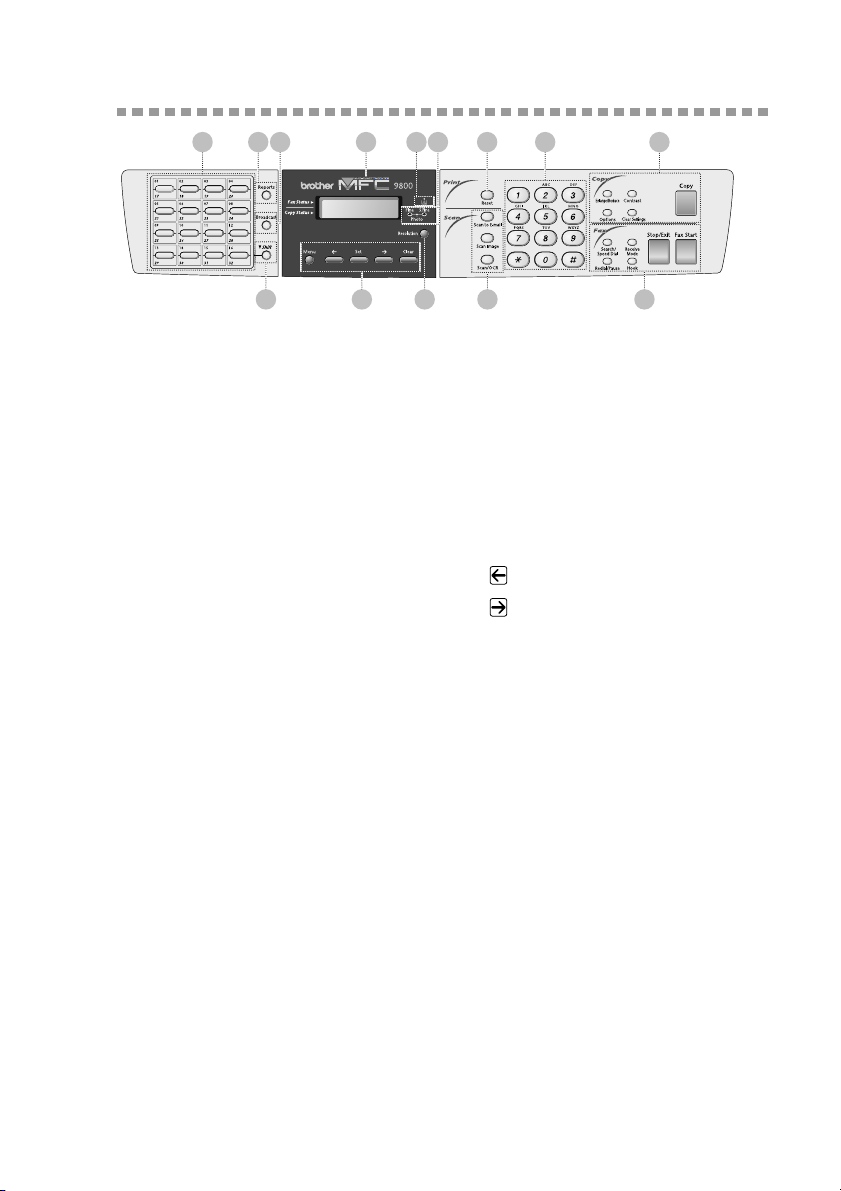
MFC-9800 Control Panel Overview
1One Touch Keys
These 16 keys give you instant access to
previously stored phone numbers.
2Reports
Access the Reports menu so you can
select reports to print:
Help List, Auto Dial, Fax Activity,
Transmission Verification and User
Settings.
3Broadcast
Use this key when you want to send the
same fax to many different locations
(maximum of 182 locations at once).
4Shift
To access memory locations 17 through
32 in the One Touch keys hold down the
Shift key.
5LCD (Liquid Crystal Display)
LCD displays messages to help you set
up and operate your MFC.
6Toner Empty Icon
The Toner icon flashes on and off when
toner is low, so you’ll know to order
another toner cartridge. You will be able
to print until the indicator stays on.
7Resolution Indicator Lights
These LEDs show the resolution mode
you selected.
8Resolution
Sets the resolution when you send a fax.
9Programming Keys:
Menu
Lets you access the menu and
programing mode.
(Left Arrow)
(Right Arrow)
Moves the LCD cursor through text and
options.
Set
Stores a menu setting in the MFC. Also
used for sending one fax to multiple
numbers.
Clear
Deletes entered data or backs up one
step in function procedure.
0Printer Key:
Reset
Clears data from the printer memory.
12 13
9 8 11 144
6 751 2 103

1 - 4
INTRODUCTION
AScanner Keys:
Scan to E-mail
Press this key to start scanning an
original into your E-mail application,
setting it up automatically as an
attachment.
Scan Image
Press this key to scan a color picture into
your graphics application for viewing
and editing.
Scan/OCR
Press this key to start scanning a text
document. ScanSoft™ TextBridge
®
will convert it to editable text and
display it in your word processor
application for further editing.
BDial Pad
Dials phone and fax numbers, and can
be used as a keyboard for entering
information into the MFC.
(For Canada only): The # key lets you
switch the dialing type during a
telephone call from PULSE to TONE.
CCopy Keys
(Temporary Settings):
Enlarge/Reduce
Lets you reduce or enlarge copies
depending upon the ratio you select.
Contrast
Lets you make a copy that is lighter or
darker than the original.
Options
You can quickly and easily change your
temporary settings for each copy.
Clear Settings
Resets your temporary copy settings
back to the factory default settings. Use
this key when you do not want to wait
45 seconds for the temporary settings to
clear automatically.
Copy
Makes a copy.
DFacsimile Keys:
Search/Speed Dial
Lets you look up numbers stored in the
dialing memory. Also lets you dial
stored phone numbers by pressing a #
plus a two-digit number.
Receive Mode
Use to select how the MFC will handle
incoming calls.
Redial/Pause
Redials the last number that was called.
Also inserts a pause in autodial
numbers.
Hook
Lets you dial fax numbers.
Stop/Exit
Stops a fax, cancels an operation, or
exits from menu mode.
Fax Start
Starts an oeration, such as sending a fax.

INTRODUCTION
1 - 5
About Your Machines
If you’re a first-time MFC user, fax operation might seem a little mysterious.
Soon, you’ll recognize the unusual fax tones on your phone line, and be able to
send and receive faxes easily.
Custom Features
Do You Have Voice Mail on the Phone Line?
If you have Voice Mail on the phone line on which you will install your new
MFC, there is a strong possibility that Voice Mail and the MFC will conflict
with each other while receiving incoming calls.
Why Should There Be Trouble?
Since both machines and Voice Mail pick up the line at the number of rings you
have set, each of them has the ability to keep the other from receiving calls. For
example, if your Voice Mail is set to answer after two rings and your MFC is set
to answer after four, your Voice Mail will keep your MFC from receiving faxes.
If you set Voice Mail and the Brother MFC to answer at the same number of
rings, there is no way of knowing which one will answer first. It is important to
remember that neither Voice Mail nor the MFC can pass the call back to the
other after the call has been answered.
How Can You Avoid Possible Problems?
A very good way to avoid problems like the one mentioned previously is to get
a second phone number on your present phone line. Many people with Voice
Mail opt for this choice, which is called “Distinctive Ring”, and they are very
satisfied with it. For details about this type of custom service, please See
Distinctive Ring, page 8-1.
Another way to avoid possible problem is to replace your Voice Mail with an
answering MFC. Your Brother MFC is designed to work in tandem with an
answering MFC or TAD (telephone answering device). (See
Connecting an
External TAD (Telephone Answering Device)
, page 2-9.)
Fax Tones and Handshake
When someone is sending a fax, the MFC sends fax calling tones (CNG
tones)—soft, intermittent beeps at 4-second intervals. You’ll hear them after
you dial and press Fax Start; they continue for about 60 seconds after dialing.
During that time, the sending MFC must begin the “handshake” with the
receiving machine. Each time you use automatic procedures to send a fax, you
are sending CNG tones over the phone line. You’ll soon learn to listen for these
soft beeps each time you answer a phone on your fax line, so you will know if
you are receiving a fax message.

1 - 6
INTRODUCTION
The receiving fax responds with fax receiving tones—loud, chirping sounds. A
receiving fax chirps for about 60 seconds over the phone line, and the LCD
shows RECEIVING. If your MFC is set to the FAX mode, it will answer every
call automatically with fax receiving tones. Even if the other party hangs up,
your MFC continues to send the “chirps” for about 60 seconds, and the screen
continues to show RECEIVING.
The fax “handshake” is the time in which the sending machine’s CNG tones and
the receiving machines “chirps” overlap. This must be for at least 2 to 4 seconds,
so the fax machines can understand how each is sending and receiving the fax.
The handshake cannot begin until the call is answered, and the CNG tones last
for only about 60 seconds after the number is dialed. Therefore, it’s important
for the receiving MFC to answer the call in as few rings as possible.
ECM (Error Correction Mode)
ECM is a way for the MFC to check the integrity of a fax transmission while it
is in progress. ECM transmissions are possible only between machines that both
have the ECM feature. If they do, you may send and receive fax messages that
are continuously checked for their integrity. Sufficient memory must be
available in your MFC for this feature to work.
When you have an external telephone answering device (TAD) on your fax
line, your TAD will determine the number of rings before the call is
answered. Pay special attention to the directions for connecting a TAD to your
MFC in Chapter 2,
Assembly and Connections.
ASSEMBLY AND CONNECTIONS
2 - 1
2
2
Assembly and Connections
Packing List
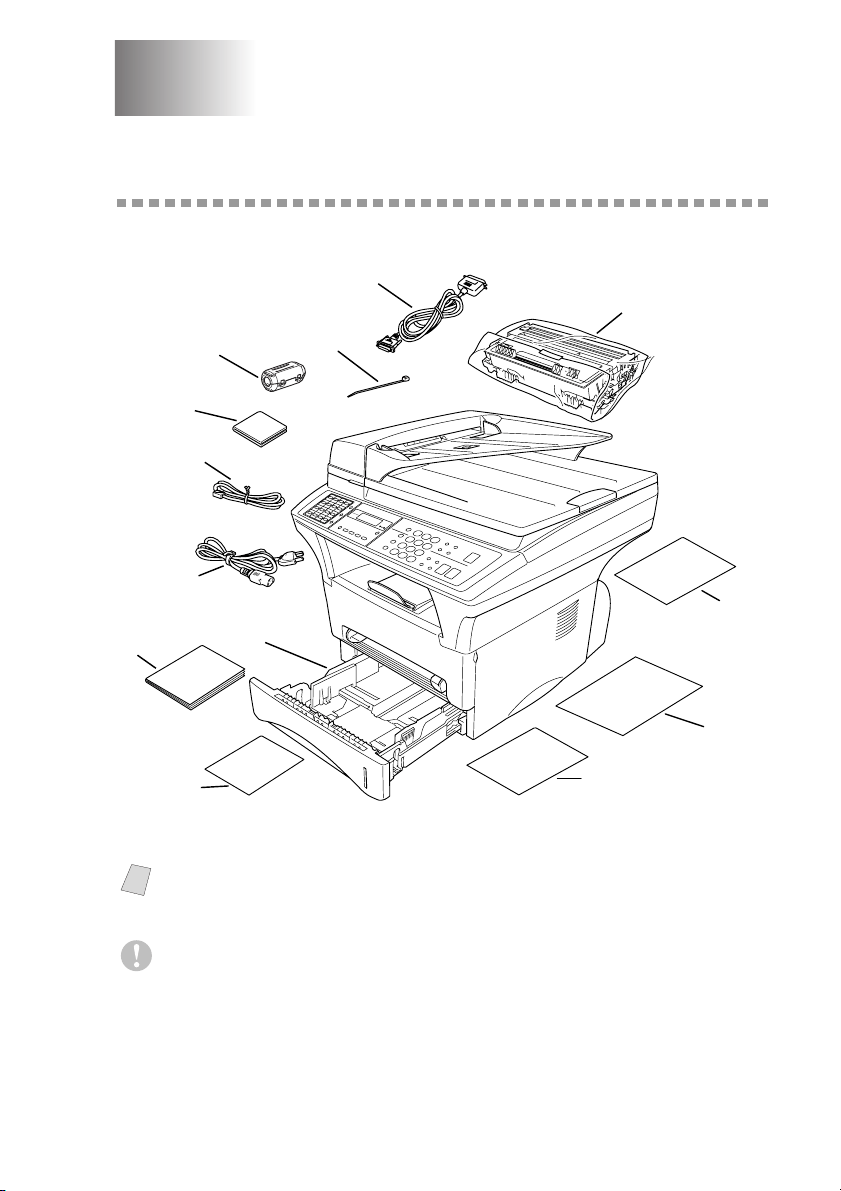
Make sure you have the following items:
Note
If an item is missing, call Brother Customer Service at 1-800-284-4329 (in
USA), 1-877-BROTHER (in Canada) or 1-514-685-6464 (in Montreal).
See
Ordering Accessories and Supplies, page ii for the correct item numbers.
Whenever you transport the MFC, use the packing materials that came with
your MFC. If you do not pack the MFC correctly, you may void
your warranty.
Paper Cassette
Owner’s
Manual
Test Sheet
(For USA Only)
CD-ROM
Bi-directional
Parallel Cable
Telephone
Line Cord
Drum Unit Assembly
(With free
Standard
Toner Cartridge – up
to 3,000 pages)
Power Cord
Software
License
Agreement
Quick Setup
Guide
Accessory
Order Form
Cable Tie
Filter Core
For USB Cable
2 - 2
ASSEMBLY AND CONNECTIONS
Choosing a Location
Place your MFC on a flat stable surface, such as a desk. Select a place that is
free of vibration and shocks. Place the MFC near a telephone jack and a
standard, grounded power outlet. Choose a location where the temperature
remains between 50°F and 90.5°F (10°–32.5°C).
WARNING
■ Use caution when installing or modifying telephone lines. Never touch telephone
wires or terminals that are not insulated unless the telephone line has been
disconnected at the wall jack. Never install telephone wiring during a lightning storm.
Never install a telephone jack in a wet location unless the jack is specifically designed
for a wet location.
■ Lightning and power surges can damage this product! We recommend that you use a
quality surge protection device on the AC power line and on the telephone line, or
unplug the lines during a lightning storm.
■ For PLUG CABLE EQUIPMENT, the socket-outlet should be installed near the
equipment and should be easily accessible.
■ To reduce the risk of shock or fire, use only a No. 26 AWG or larger
telecommunication line cord.
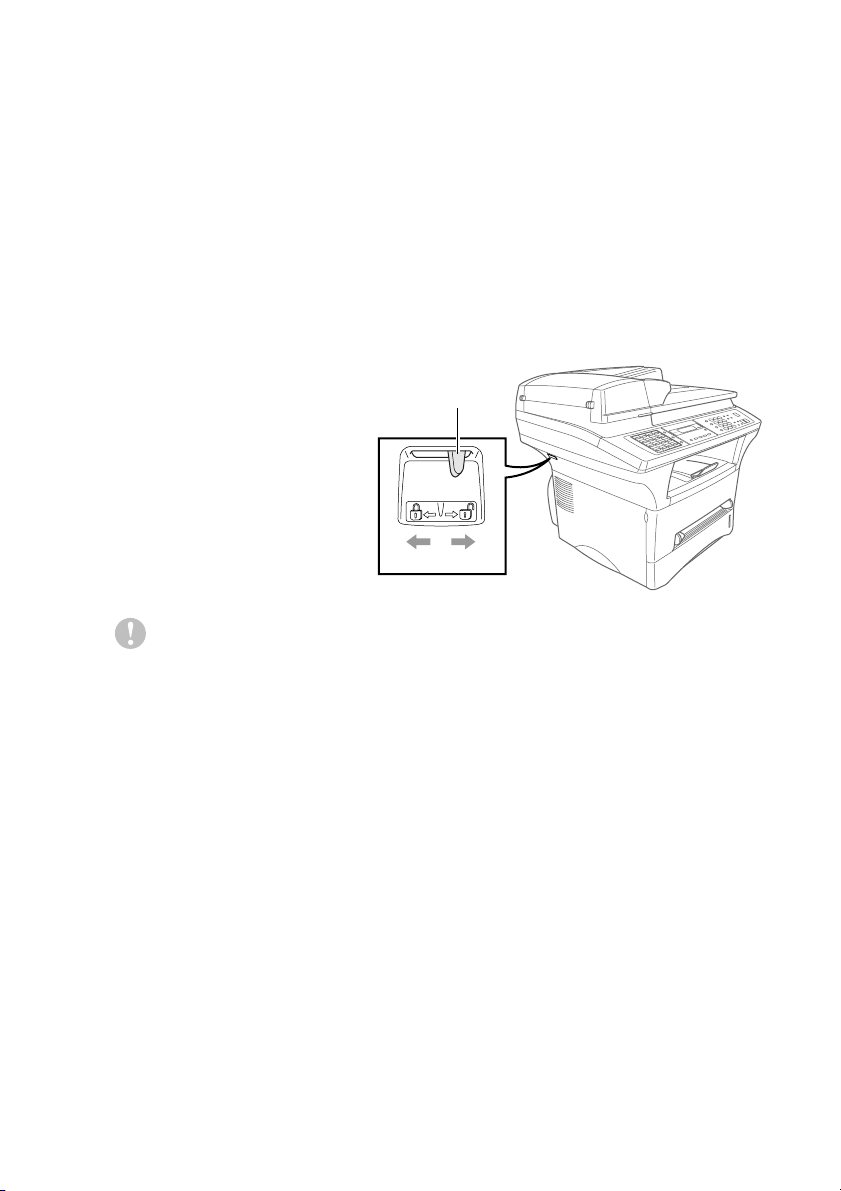
Avoid placing your MFC in a high-traffic area. Do not place near heaters, air
conditioners, water, chemicals, or refrigerators. Do not expose the MFC to
direct sunlight, excessive heat, moisture, or dust. Do not connect your MFC to
electrical outlets controlled by wall switches or automatic timers. Disruption of
power can wipe out information in the MFC’s memory. Do not connect your
MFC to electrical outlets on the same circuit as large appliances or other
equipment that might disrupt the power supply. Avoid interference sources,
such as speakers or the base units of cordless phones.
NO !
NO ! NO !
ASSEMBLY AND CONNECTIONS
2 - 3
Important Safety Instructions
When using your telephone equipment, basic safety precautions should always
be followed to reduce the risk of fire, electric shock and injury to persons,
including the following:
1
Do not use this product near appliances that use water, in a wet basement or near
a swimming pool.
2
Avoid using a telephone during an electrical storm. There may be a remote risk
of electric shock from lightning.
Release the Scanner Lock
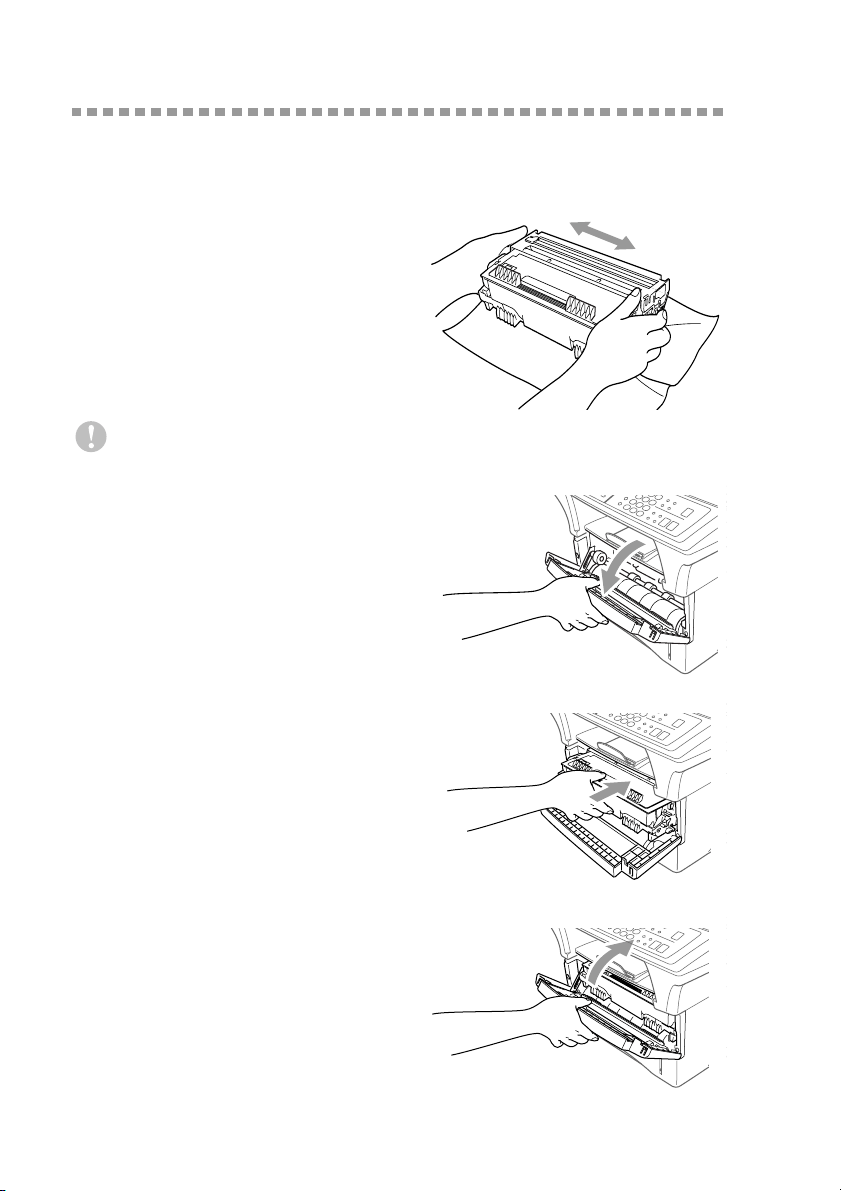
Push the blue Scanner
Lock Lever up to
unlock the scanner.
This lever is located
on the rear left
underside of the
scanner cover.
Caution
If the message CHECK SCAN LOCK appears on the LCD, unlock the scanner
immediately, and then press Stop/Exit.
Lock Unlock
Scanner Lock Lever
2 - 4
ASSEMBLY AND CONNECTIONS
Assembly
Installing the Drum Unit Assembly
(with Toner Cartridge)
1
Unpack the drum unit assembly
including the toner cartridge, and
gently rock it from side to side five or
six times to distribute the toner evenly
inside the cartridge.
2
Open the front cover of the MFC.
3
Insert the drum unit assembly into the
MFC.
4
Close the front cover.
To prevent damage to the drum, do not expose it to light for longer
than a few minutes.
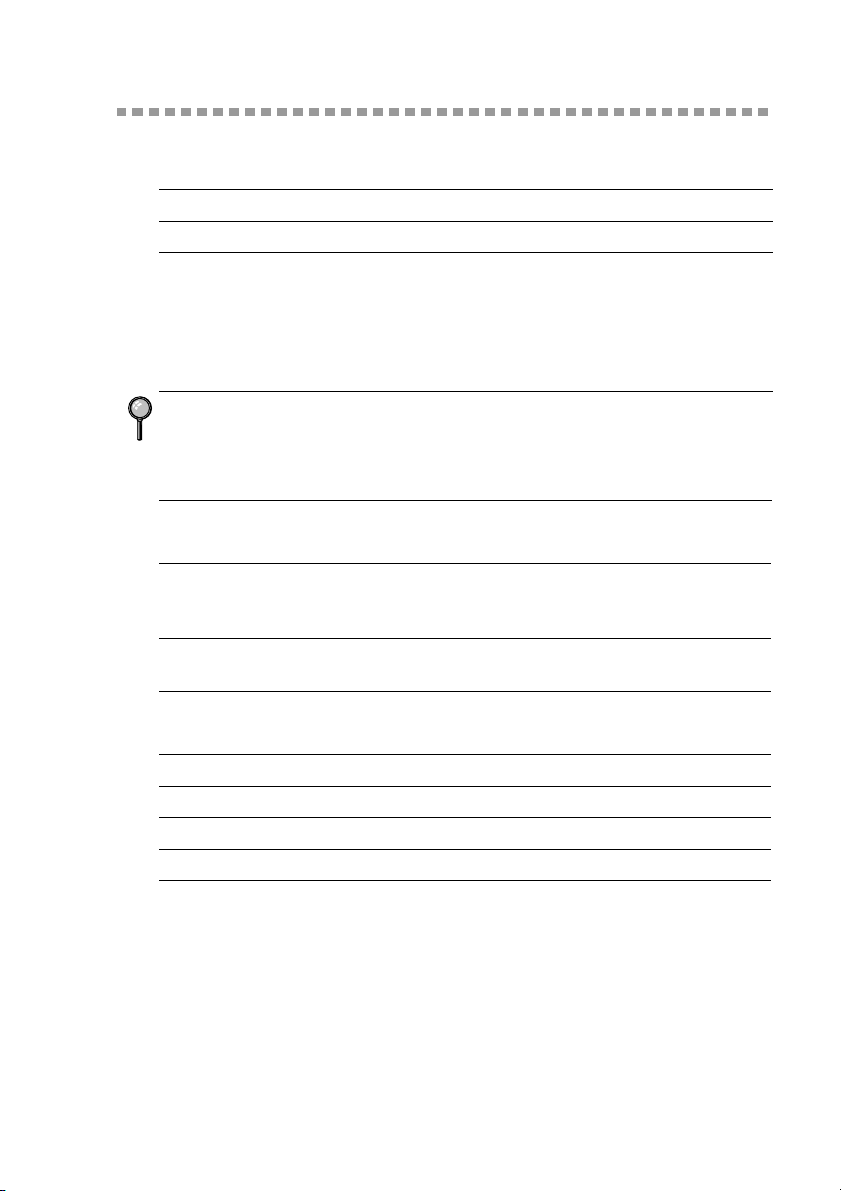
ASSEMBLY AND CONNECTIONS
2 - 5
Paper
Acceptable Paper
Paper Capacity of Paper Cassette
Paper Specification for the Cassette
Paper Type Paper Size
Paper Cassette #1:
cut sheet
Letter, Legal, A4, A5, ISO B5, Executive, A6
Manual Feed
Slot:
cut sheet
envelopes
post cards
labels and
transparencies
Letter, Legal, A4, A5, B5 (JIS/ISO), Executive, A6,
2.75–8.5 × 4.57–14 inches (70–216 × 116–356 mm)
COM-10, Monarch, C5, DL
—
Letter, A4
We Recommend:
Cut sheet:
Labels:
Transparencies:
Xerox 4200DP 20 lb, Champion Paper One 20
lb, Hammermill Laser Paper 24 lb
Avery laser label #5160
3M CG3300 for laser printers or equivalent
Paper Cassette #1:
Max. paper height is 1.06 inches (27 mm) (use the
guides) or approx. 250 sheets of 20 lb. (75 g/m
2
)
Letter/A4 paper, 10 transparencies.
Front Output Bin: Approx. 150 sheets of 20 lb. (75 g/m
2
)
Letter/A4 paper
Cut Sheet
Basis Weight: 16 to 28 lb. (60 to 105 g/m
2
)
Caliper: 0.003 to 0.005 inches. (0.08 to 0.13 mm)
Moisture Content: 4% to 6% by weight
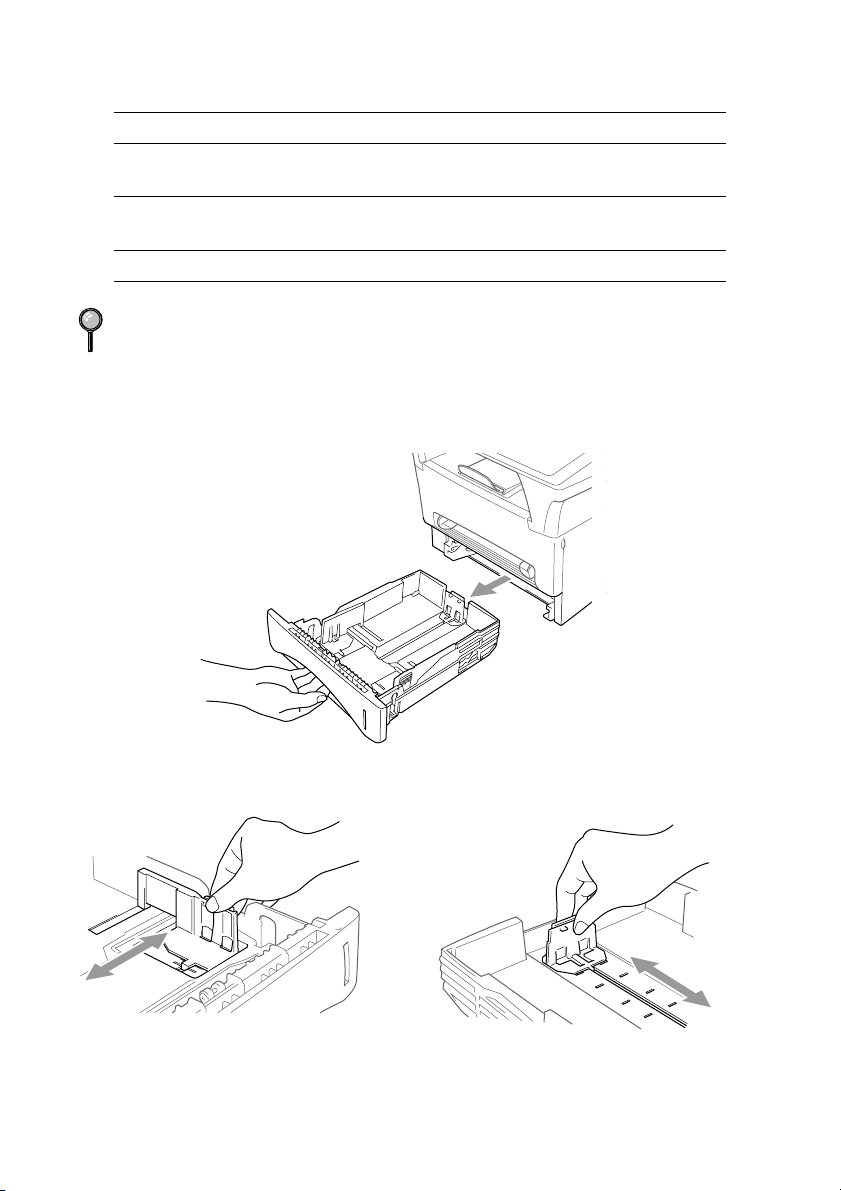
2 - 6
ASSEMBLY AND CONNECTIONS
Manual Feed Slot
Loading Paper in the Paper Cassette
1
Pull the paper cassette completely out of the MFC.
2
Slide the paper width and length adjusters to the position for the paper size you
are using.
Cut Sheet Envelopes
Basis Weight: 16 to 43 lb.
(60 to 161 g/m
2
)
20 to 24 lb.
(75 to 90 g/m
2
)
Caliper: 0.003 to 0.008 inches.
(0.08 to 0.2 mm)
0.003 to 0.005 inches.
(0.084 to 0.14 mm)
Moisture Content: 4% to 6% by weight 4% to 6% by weight
Fax messages can be received on Letter, Legal and A4 size paper.
If you use legal or A4, change the Paper Size setting: (Menu, 1, 1)
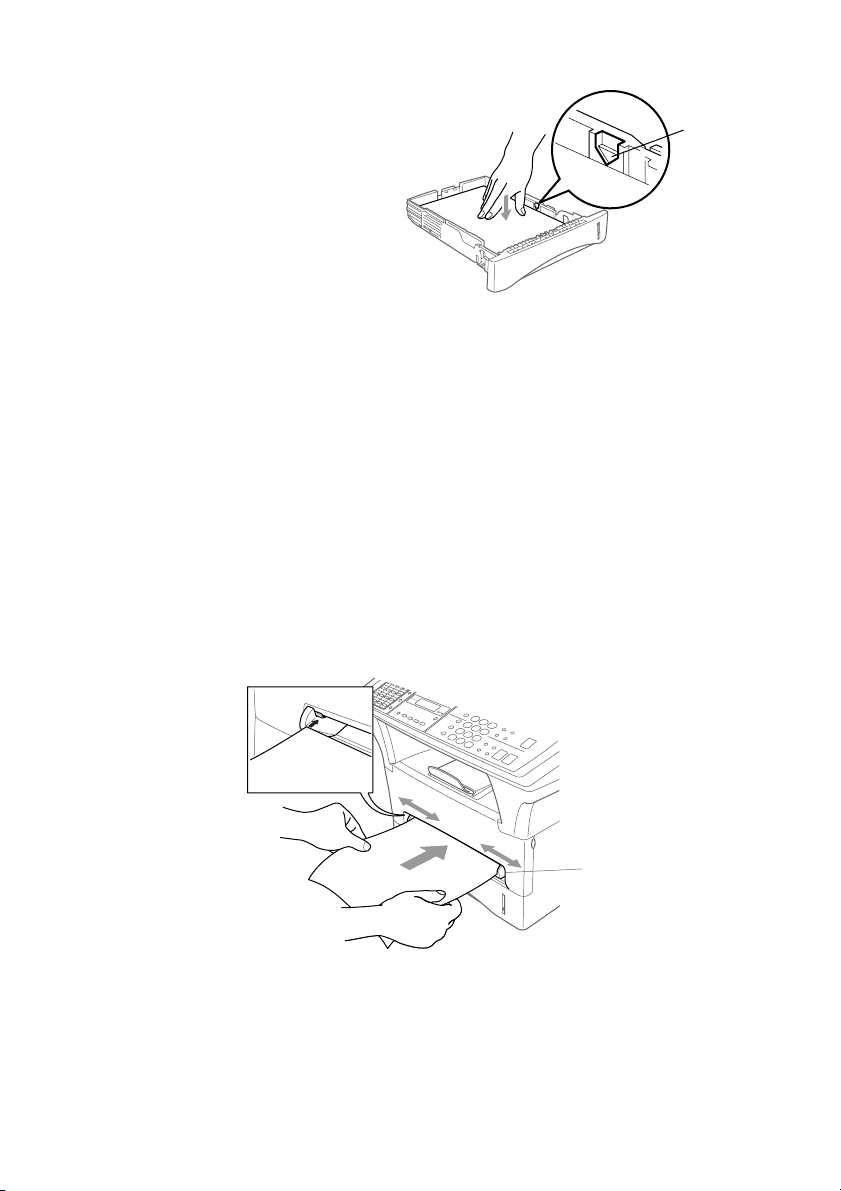
ASSEMBLY AND CONNECTIONS
2 - 7
3
Fan the paper well. Load
paper in the paper cassette.
Press down on the paper to
flatten it in all four corners,
keeping the paper level
below the guide. The
cassette can hold up to 250
sheets of 20 lb (75g/m
2
)
paper.
4
Slide the paper cassette into the MFC until it locks into place.
Manual Feed Slot
Use the manual feed slot to print or copy on envelopes, labels,
transparencies, card stock or thicker paper:
The manual feed slot is above the paper cassette. Load paper or envelopes one
at a time. You do not have to remove paper from the paper cassette.
You do not have to choose Manual Feed in the Setup dialog box of your printer
driver. Insert the sheet of paper for Portrait (vertical) or Landscape (horizontal),
with the side you wish to print on face up in the manual feed slot.
1
Align the paper at the center of the manual feed slot and insert the paper into the
manual feed slot until the front edge of the paper touches the paper feed roller.
2
Adjust the paper guides to the width of the paper.
Maximum
Paper
Height
Guide
Manual
Feed
Slot
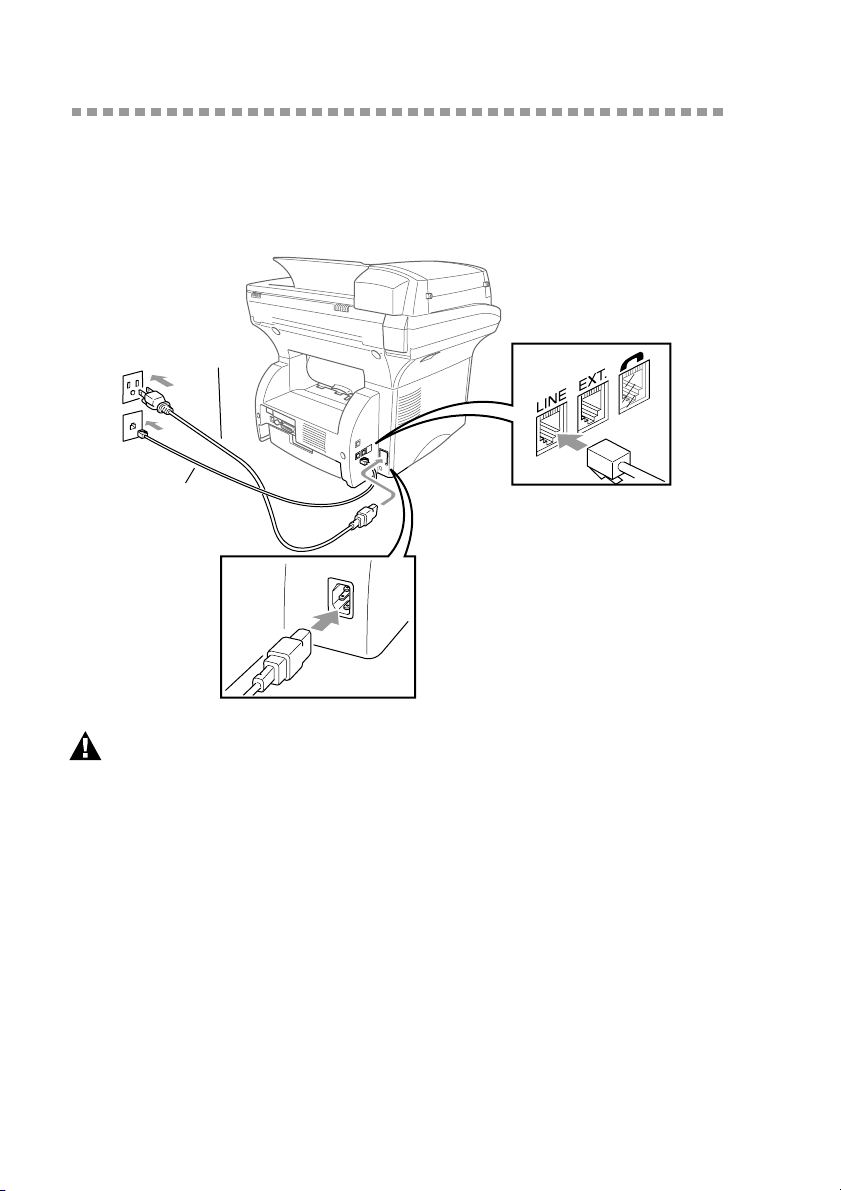
2 - 8
ASSEMBLY AND CONNECTIONS
Connecting the MFC
1
Connect the power cord.
2
Connect the telephone line cord.
Connect one end of the telephone line cord to the line jack on the MFC and the
other end to a modular wall jack.
WARNING
=
■ The MFC must be grounded using a 3-prong plug.
■ Since the MFC is grounded through the power outlet, protect yourself from
potentially hazardous electrical conditions on the telephone line by keeping the
power to your MFC on when you connect it to a telephone line. When you want
to move your MFC, protect yourself by disconnecting the telephone line first,
and then the power cord.
■ Lightning and power surges can damage this product! We recommend that you
use a quality surge protection device on the AC power line as well as on the
telephone line, or unplug the lines during a lightning storm.
■ Do not touch the rollers at the paper exit.
Telephone
Line Cord
Power Cord

ASSEMBLY AND CONNECTIONS
2 - 9
Connections
Connecting an External Telephone
Although your MFC does not have a handset, you can connect a separate
telephone (or telephone answering device) directly to the MFC.
Connect the modular plug on the telephone’s line cord to the jack labeled EXT.
on the left side of the MFC.
Whenever this phone (or TAD) is in use, the LCD shows TELEPHONE.
Connecting an External TAD
(Telephone Answering Device)
Sequence
You might choose to connect an answering system. However, when you have an
external TAD on the same telephone line as the MFC, the TAD answers all calls. The
MFC “listens” for fax calling (CNG) tones. If it hears them, the MFC takes over the
call and receives the fax. If it doesn’t hear CNG tones, the MFC lets the TAD continue
playing your outgoing message so your caller can leave you a voice message.
The TAD must answer within five rings (the recommended setting is two rings).
The MFC cannot hear CNG tones until the TAD has answered the call, and with
five rings there are only 8–10 seconds of CNG tones left for the fax
“handshake.” Make sure you carefully follow the instructions in this manual for
recording your outgoing message. We do not recommend using the toll saver
feature on your external answering machine if it exceeds five rings.
Connections
The external TAD must be plugged into the left side of the MFC in the jack labeled
EXT. Your MFC cannot work properly if you plug the TAD into a wall jack.
If you do not receive all your faxes, you must reset your external TAD to four
rings.
If You Subscribe to your Telephone Company’s Distinctive Ring Service:
You may connect an external TAD to a separate wall jack only if you subscribe
to your telephone company’s Distinctive Ring service, have registered the
distinctive ring pattern on your MFC, use that number as a fax number and have
set your MFC’s Receive mode to MANUAL. The recommended setting is
three or four rings on the external TAD when you have the telephone
company’s Distinctive Ring service.
If You Do NOT Subscribe to Distinctive Ring Service:
You must plug your TAD into the EXT. jack of your MFC. If your TAD is
plugged into a wall jack, both your MFC and the TAD will try to control the
phone line. (See
illustration on page 2-10.)
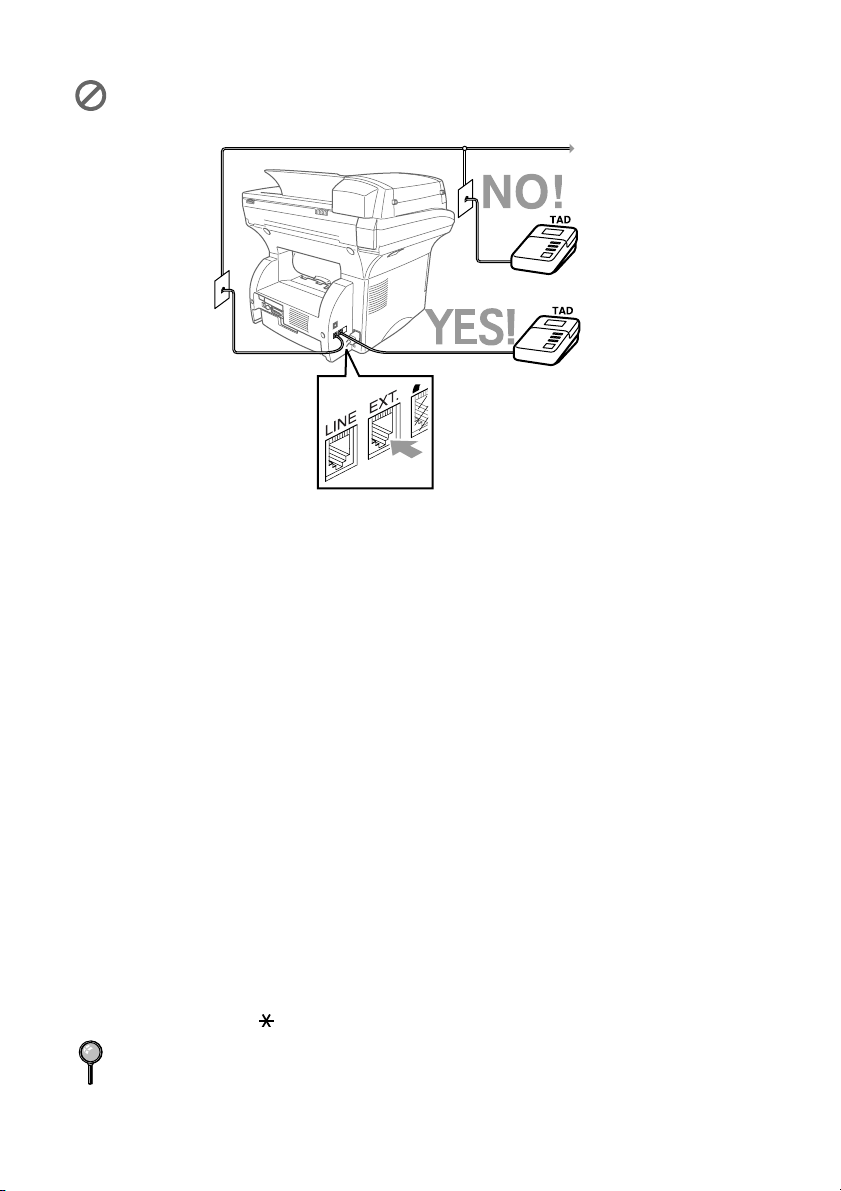
2 - 10
ASSEMBLY AND CONNECTIONS
illustration
1
Plug the telephone line cord from the wall jack into the left side of the MFC, in
the jack labeled LINE.
2
Plug the telephone line cord from your TAD into the left side of the MFC, in the
jack labeled EXT. (Make sure this cord is connected to the TAD at the TAD’s
telephone line jack, and not its telephone set jack.)
3
Set your external TAD to four rings or less. (The MFC’s Ring Delay setting does
not apply).
4
Record the outgoing message. (See below.)
5
Set the Receive mode to TAD:ANSWER MACH.
Recording Outgoing Message (OGM) on External TAD
Timing is important in recording this message. The message sets up the ways to
handle both manual and automatic fax reception.
1
Record 5 seconds of silence at the beginning of your message. (This allows your
MFC time to listen for the fax CNG tones of automatic transmissions before
they stop.)
2
Limit your speaking to 20 seconds. (See Easy Receive, page 5-3.)
3
End your 20-second message by giving your Fax Receive Code for people
sending manual faxes. For example: “After the beep, leave a message or send
a fax by pressing 5 1 and Start.”
Do not connect a TAD elsewhere on the same phone line.
We recommend beginning your OGM with an initial 5-second silence because
the MFC cannot hear fax tones over a resonant or loud voice. You may try
omitting this pause, but if your MFC has trouble receiving, then you must
rerecord the OGM to include it.

ASSEMBLY AND CONNECTIONS
2 - 11
Special Line Considerations
Roll Over Phone Lines
A roll over phone system is a group of two or more separate telephone lines that
pass incoming calls to each other if they are busy. The calls are usually passed
down or “rolled over” to the next available phone line in a preset order.
Your MFC can work in a roll over system as long as it is the last number in the
sequence, so the call cannot roll away. Do not put the MFC on any of the other
numbers; when the other lines are busy and a second fax call is received, the fax
call would be transferred to a line that does not have a fax machine. Your MFC
will work best on a dedicated line.
Two-Line Phone System
A two-line phone system is nothing more than two separate phone numbers on
the same wall outlet. The two phone numbers can be on separate jacks (RJ11)
or combined into one jack (RJ14). Your MFC must be plugged into an RJ11
jack. RJ11 and RJ14 jacks may be equal in size and appearance and both may
contain four wires (black, red, green, yellow). To test the type of jack, plug in a
two-line phone and see if it can access both lines. If it can, you must separate the
line for your MFC.
Converting Telephone Wall Outlets
There are three ways to convert to an RJ11 receptacle. The first two ways may
require assistance from the telephone company. You can change the wall
outlets from one RJ14 jack to two RJ11 jacks. Or, you can have an RJ11 wall
outlet installed and slave or jump one of the phone numbers to it.
The third way is the easiest: Buy a triplex adapter. You can plug a triplex adapter
into an RJ14 outlet. It separates the wires into two separate RJ11 jacks (Line 1,
Line 2) and a third RJ14 jack (Lines 1 and 2). If your MFC is on Line 1, plug
the MFC into L1 of the triplex adapter. If your MFC is on Line 2, plug it into L2
of the triplex adapter.
RJ14
RJ11
Triplex Adapter
RJ14
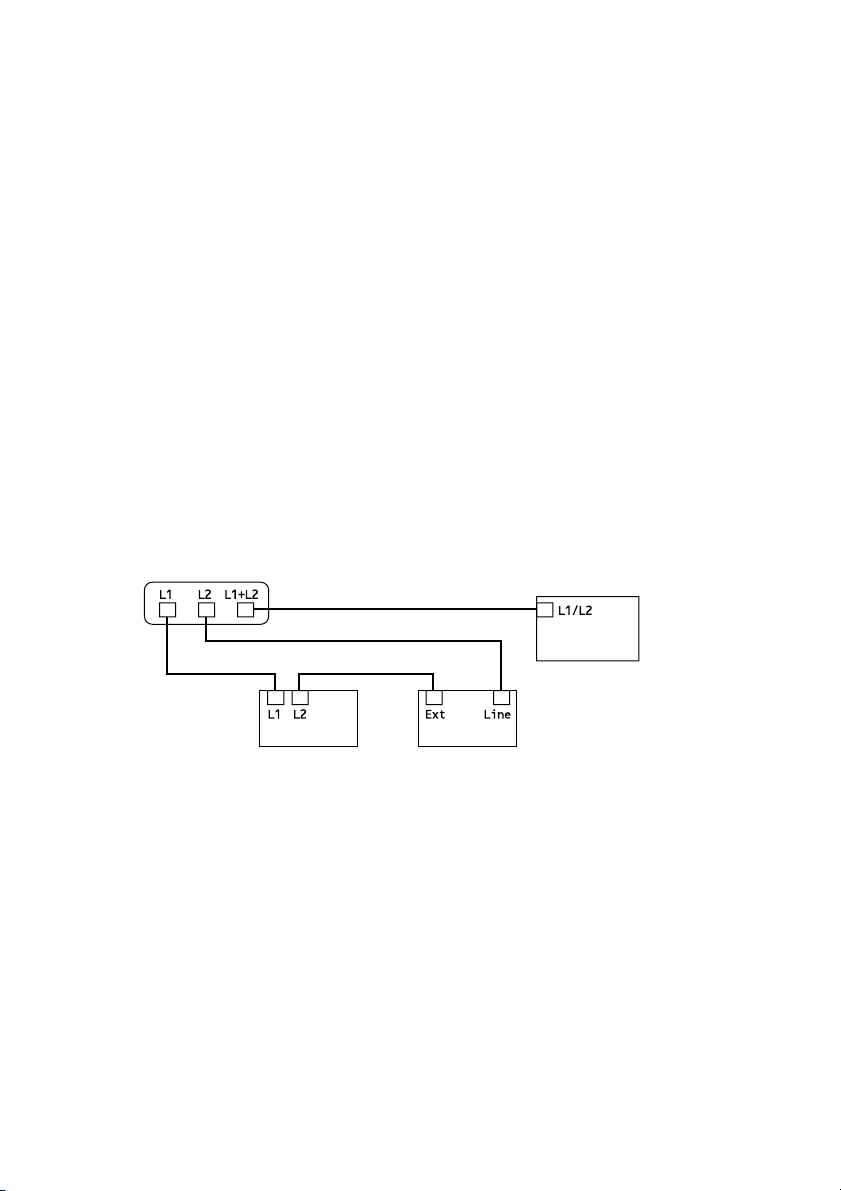
2 - 12
ASSEMBLY AND CONNECTIONS
Installing MFC, External Two-Line TAD, and Two-Line Telephone
When you are installing an external two-line telephone answering device
(TAD) and a two-line telephone, your MFC must be isolated on one line at both
the wall jack and at the TAD. The most common connection is to put the MFC
on Line 2, which is our assumption in the following steps. The back of the two-
line TAD must have two telephone jacks: one labeled L1 or L1/L2, and the other
labeled L2. You will need at least three telephone line cords, the one that came
with your MFC and two for your external two-line TAD. You will need a fourth
line cord if you add a two-line telephone.
1
Place the two-line TAD and the two-line telephone next to your MFC.
2
Plug one end of the telephone line cord for your MFC into the L2 jack of the
triplex adapter. Plug the other end into the LINE jack on the left side of the
MFC.
3
Plug one end of the first telephone line cord for your TAD into the L1 jack of
the triplex adapter. Plug the other end into the L1 or L1/L2 jack of the two-line
TAD.
4
Plug one end of the second telephone line cord for your TAD into the L2 jack
of the two-line TAD. Plug the other end into the EXT. jack on the left side of
the MFC.
You can keep two-line telephones on other wall outlets as always. There are two
ways to add a two-line telephone to the MFC’s wall outlet. You can plug the
telephone line cord from the two-line telephone into the L1+L2 jack of the
triplex adapter. Or, you can plug the two-line telephone into the TEL jack of the
two-line TAD.
Triplex Adapter
Two Line Phone
Two Line
External TAD
MFC

ASSEMBLY AND CONNECTIONS
2 - 13
Multi-Line Connections (PBX)
Most offices use a central telephone system. While it is often relatively simple
to connect the MFC to a key system or a PBX (Private Branch Exchange), we
suggest that you contact the company that installed your telephone system and
ask them to connect the MFC for you. It is advisable to have a separate line for
the MFC. You can then leave the MFC in FAX mode to receive faxes any time
of day or night.
If the MFC is to be connected to a multi-line system, ask your installer to
connect the unit to the last line on the system. This prevents the unit from being
activated each time a telephone call is received.
If You are Installing the MFC to Work with a PBX:
1
It is not guaranteed that the unit will operate correctly under all circumstances
with a PBX. Any cases of difficulty should be reported first to the company that
handles your PBX.
2
If all incoming calls will be answered by a switchboard operator, it is
recommended that the Receive mode be set to MANUAL. All incoming calls
should initially be regarded as telephone calls.
3
The MFC may be used with either pulse or tone dialing telephone service.
Custom Features on Your Phone Line
If you have Voice Mail, Call Waiting, Call Waiting/Caller ID, RingMaster, an
answering service, an alarm system, or other custom feature on one phone line,
it may create a problem with the operation of your MFC. (See
I have difficulty
with custom features on a single line
, page 21-7.)
As with all fax units, this MFC must be connected to a two wire system.
If your line has more than two wires, proper connection of the MFC cannot be
made.
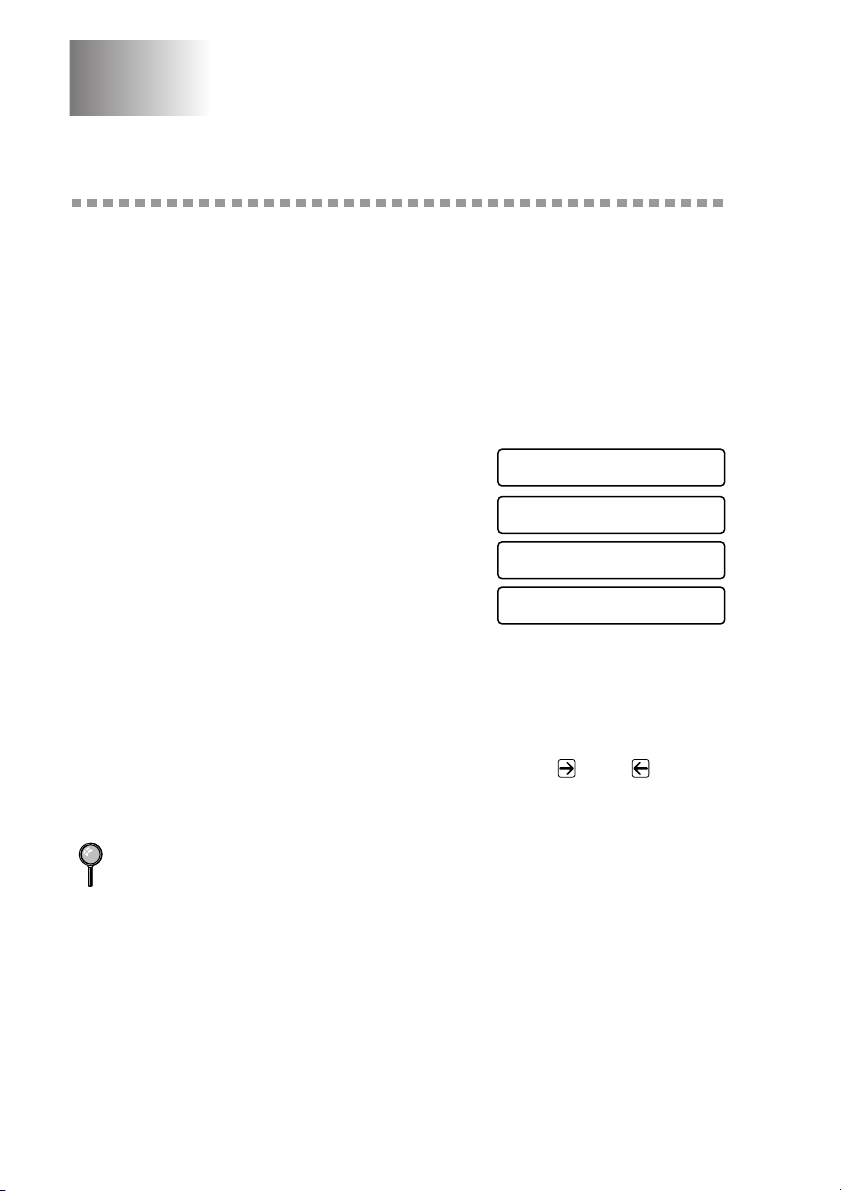
3 - 1
ON-SCREEN PROGRAMMING
3
3
On-Screen Programming
User-Friendly Programming
We have designed your Multi-Function Center with on-screen programming
and a Reports key. User-friendly programming helps you take full advantage of
all the menu selections your MFC has to offer.
Since your programming is done on the LCD, we created step-by-step on-screen
prompts to help you program your MFC. All you need to do is follow the
prompts as they guide you through the menu selections and programming
options.
Menu Mode
You can access the Menu mode by pressing Menu. The LCD shows:
Then
Press 1 for General Setup—OR—
Press 2 for Fax Operations—OR—
Press 3 for Copy Operations—OR—
Press 4 for Print Operations—OR—
When you enter Menu mode, your MFC scrolls a list of Main menu options from
which you can choose. These menu options appear one after the other on the
LCD. Select a menu by pressing Set when that option appears on the LCD. The
LCD will scroll the options within that next menu.
You can scroll more quickly through options by pressing . Use to scroll
backward if you passed your choice or to see options in the opposite order.
When the LCD shows your selection, press Set.
When you finish a setting, the LCD shows ACCEPTED.
If you want to exit the Menu mode, press Stop/Exit.
1.GENERAL SETUP
2.FAX
3.COPY
4.PRINTER

ON-SCREEN PROGRAMMING
3 - 2
Menu Selection Table
You can probably perform most of these programming settings without the
Owner’s Manual. To help you understand the menu selections, options and
settings that are found in the MFC programs, use the Menu Selection Table
below.
Main Menu Submenu
Menu
Selections
Options Descriptions Page
1. GENERAL
SETUP
1. PAPER SIZE
—
LETTER
LEGAL
A4
Selects size of
paper for received
faxes.
4-1
2. DATE/TIME
——
Enter date and time
for the LCD display
and heading on fax
transmissions.
4-2
3. STATION ID
——
Program your
name, fax number
and telephone
number to appear
on each transmitted
page.
4-3
4. VOLUME 1. RING OFF
LOW
MED
HIGH
Adjusts ring
volume.
4-5
2. BEEPER OFF
LOW
HIGH
Adjusts beeper
volume.
4-5
3. SPEAKER OFF
LOW
MED
HIGH
Adjusts speaker
volume.
4-5
Note
The factory setting (option) is shown in bold.
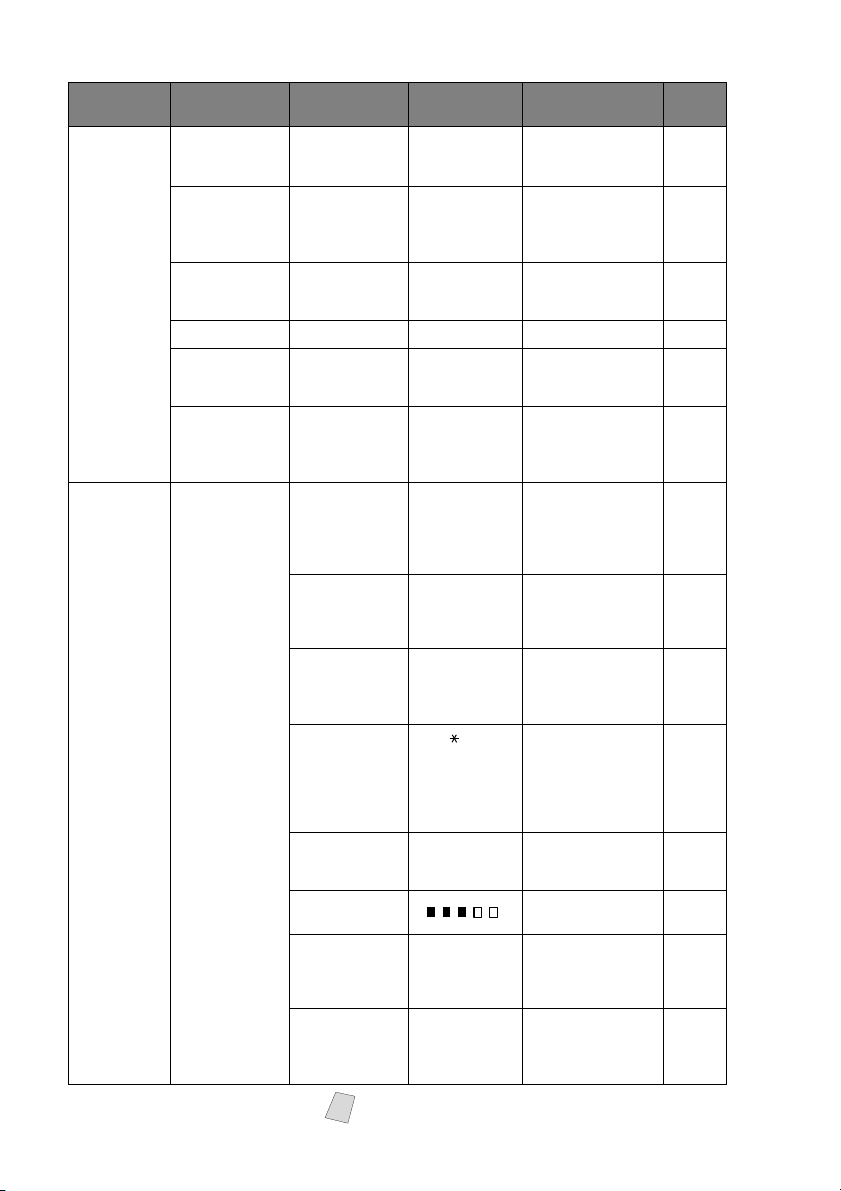
3 - 3
ON-SCREEN PROGRAMMING
Main Menu Submenu
Menu
Selections
Options Descriptions Page
1. GENERAL
SETUP
(continued)
5. CASSETTE
#2
—
ON
OFF
Turn CASSETTE #2
ON if you purchased the
optional Cassette #2.
4-1
6. AUTO
DAYLIGHT
—
ON
OFF
Changes for
Daylight Savings
Time
automatically.
4-5
7. TONER
SAVE —
ON
OFF
Increases life of
toner cartridge.
4-6
8. SLEEP MODE
——
Conserves power
4-6
9. TONE/
PULSE
(Canada Only)
—
TONE
PULSE
Selects dialing
mode.
4-6
0. LOCAL
LANGUAGE
(Canada Only)
—
ENGLISH
FRENCH
Allows you to
change the LCD
Language to
French.
See
French
Manual
2. FAX 1. SETUP
RECEIVE
1. RING DELAY
00
01
02
03
04
Number of rings
before the MFC
answers in FAX/TEL,
FAX, MANUAL, or
TAD mode.
5-2
2. F/T
RING TIME
20
30
40
70
Sets the time for
“double-ring” in
FAX/TEL mode.
5-3
3. EASY
RECEIVE
ON
OFF
Receive fax
messages without
pressing the
Fax Start key.
5-3
4. REMOTE
CODE
ON ( 51, #51)
OFF
Activate or
Deactivate the
MFC from a remote
location. You can
also personalize
these codes.
5-5
5. AUTO
REDUCTION
ON
OFF
Reduces size of
image.
5-4
6. PRINT
DENSITY
-+
Makes prints
darker or lighter.
5-4
7. POLLING RX ON
OFF
Sets up your MFC
to poll another
fax machine.
5-6
8. PC FAX
RECEIVE
ON
OFF
Turn ON if PC is
connected to MFC
for PC receiving of
messages.
5-7
Note
The factory setting (option) is shown in bold.

ON-SCREEN PROGRAMMING
3 - 4
Main Menu Submenu
Menu
Selections
Options Descriptions Page
2. FAX
(continued)
2. SETUP
SEND
1. CONTRAST AUTO
S.LIGHT
S.DARK
Changes lightness
or darkness of a fax
you are sending.
6-6
2. FAX
RESOLUTION
STANDARD
FINE
S.FINE
PHOTO
Changes the default
setting of fax
resolution.
6-7
3. DELAYED
TIMER
00:00
Sets the time of day
that delayed faxes
will be sent.
6-10
4. DELAYED
FAX
—
Sends documents
later.
6-10
5. BATCH TX
ON
OFF
Sends all delayed
faxes that are to the
same fax number
and at the same
time as one
transmission.
6-11
6. REAL TIME
TX
NEXT FAX ONLY
ON
OFF
You can send a fax
without using
memory.
6-5
7. POLLED TX
ON
OFF
Sets up your
MFC with a
document to be
retrieved by
another
fax machine.
6-11
8. COVERPG
SETUP
NEXT FAX ONLY
ON
OFF
PRINT SAMPLE
Automatically
sends a cover page
you program.
6-8, 6-9
9. COVERPAGE
MSG
—
Programs
customized
message for fax
cover page.
6-8
0. OVERSEAS
MODE
ON
OFF
Adjusts for
sometimes difficult
overseas
transmissions.
6-10
Note
The factory setting (option) is shown in bold.
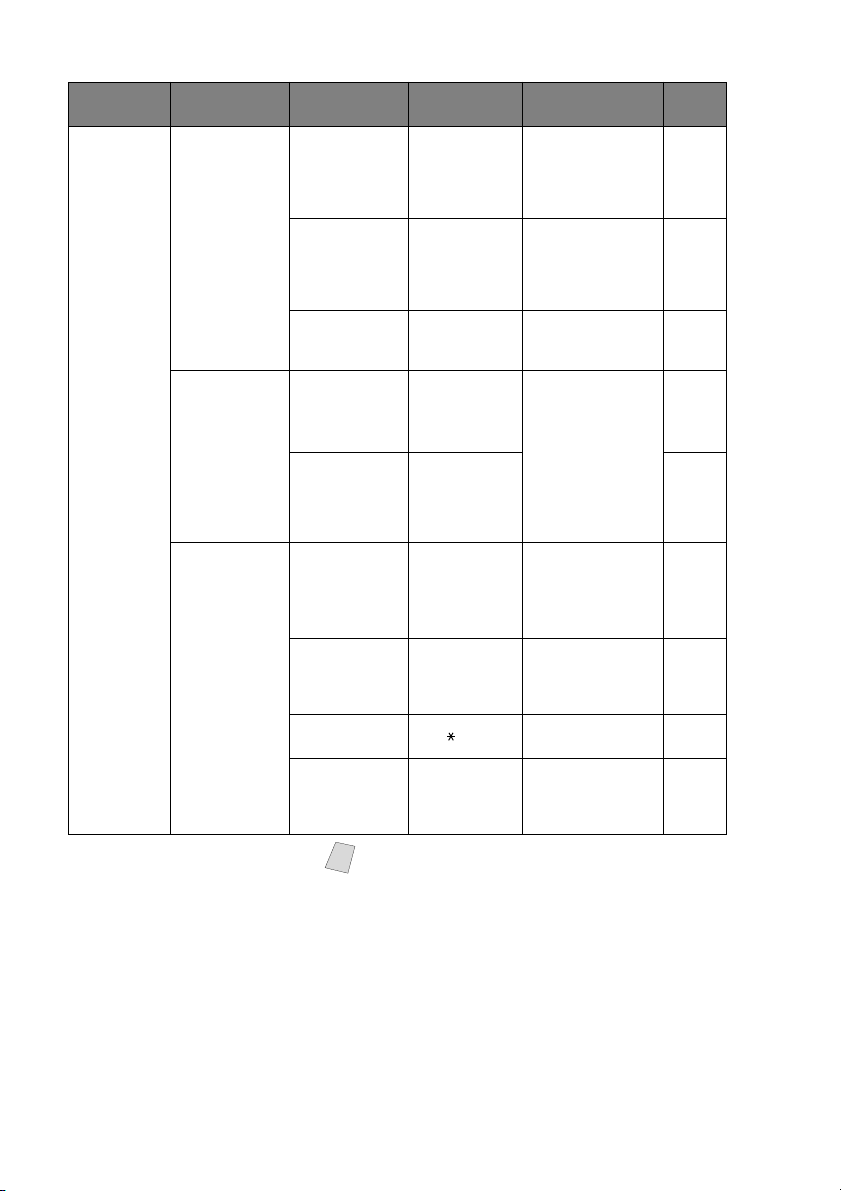
3 - 5
ON-SCREEN PROGRAMMING
Main Menu Submenu
Menu
Selections
Options Descriptions Page
2. FAX
(continued)
3. SET
AUTO DIAL
1. ONE-TOUCH
DIAL
—
Store One-Touch
numbers so you can
dial by pressing
only one key (and
Fax Start).
7-1
2. SPEED-DIAL
—
Store Speed Dial
numbers so you can
dial by pressing
only four keys (and
Fax Start).
7-2
3. SETUP
GROUPS
—
Sets up a Group
number for
broadcasting.
7-3
4. SETUP
REPORTS
1. TRANSMISSION
ON
ON+IMAGE
OFF
OFF+IMAGE
Initial setup for
Transmission
Verification Report
and Fax Activity
Report.
10-1
2. ACT.
INTERVAL
6/12/24 Hours
2/4/7 Days
OFF
10-1
5. REMOTE
FAX OPT
1. FAX FWD/
PAGING
OFF
FAX
FORWARD
PAGING
Sets the MFC to
forward fax
messages–OR–to
call your pager.
9-1
2. FAX
STORAGE
ON
OFF
Stores incoming
faxes in memory
for remote
retrieval.
9-2
3. REMOTE
ACCESS
159
Personalizes code
for retrieving faxes.
9-3
4. PRINT FAX
—
Prints backup copy
of incoming faxes
stored in the
memory.
5-6
Note
The factory setting (option) is shown in bold.
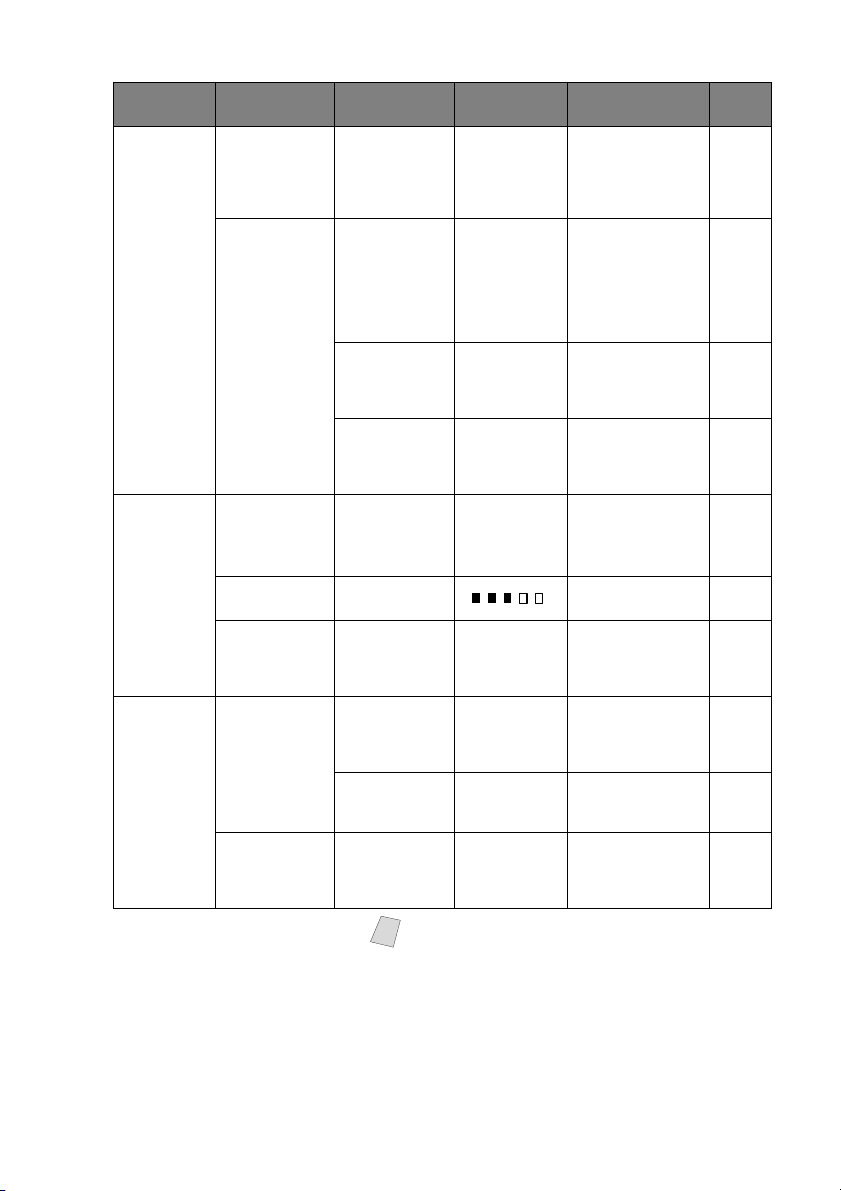
ON-SCREEN PROGRAMMING
3 - 6
Main Menu Submenu
Menu
Selections
Options Descriptions Page
2. FAX
(continued)
6. REMAINING
JOBS
——
Check which jobs
are in memory
—OR—cancel a
delayed fax or
polling job.
5-7,
6-5,
6-6
0. MISCELLA-
NEOUS
1. DISTINCTIVE
ON
OFF
SET
Uses the telephone
company
Distinctive Ring
subscriber service
to register the ring
pattern with the
MFC.
8-3
2. CALLER ID
DISPLAY #
PRINT REPORT
View or print a list
of the last 30 Caller
IDs stored in
memory.
8-4
3. DRUM LIFE
—
You can check the
percentage of drum
life that remains
available.
21-22
3. COPY 1. COPY MODE
—
AUTO
TEXT
PHOTO
Selects the Copy
resolution for your
type of original.
11-9
2. CONTRAST
—- +
Adjusts the
contrast.
11-9
3. PAPER
TYPE
—
THIN
PLAIN
THICK
THICKER
Identify the type of
paper in the multi-
purpose sheet
feeder.
11-9
4. PRINTER
1. PRINT
OPTIONS
1. INTERNAL
FONT
—
You can print
resident fonts to
check and confirm
font types.
13-7
2. CONFIGU-
RATION
—
Printer settings and
status are listed
here.
13-7
2. RESET
PRINTER
1. FACTORY
SET
—
You can restore the
printer back to the
factory default
settings.
13-7
Note
The factory setting (option) is shown in bold.
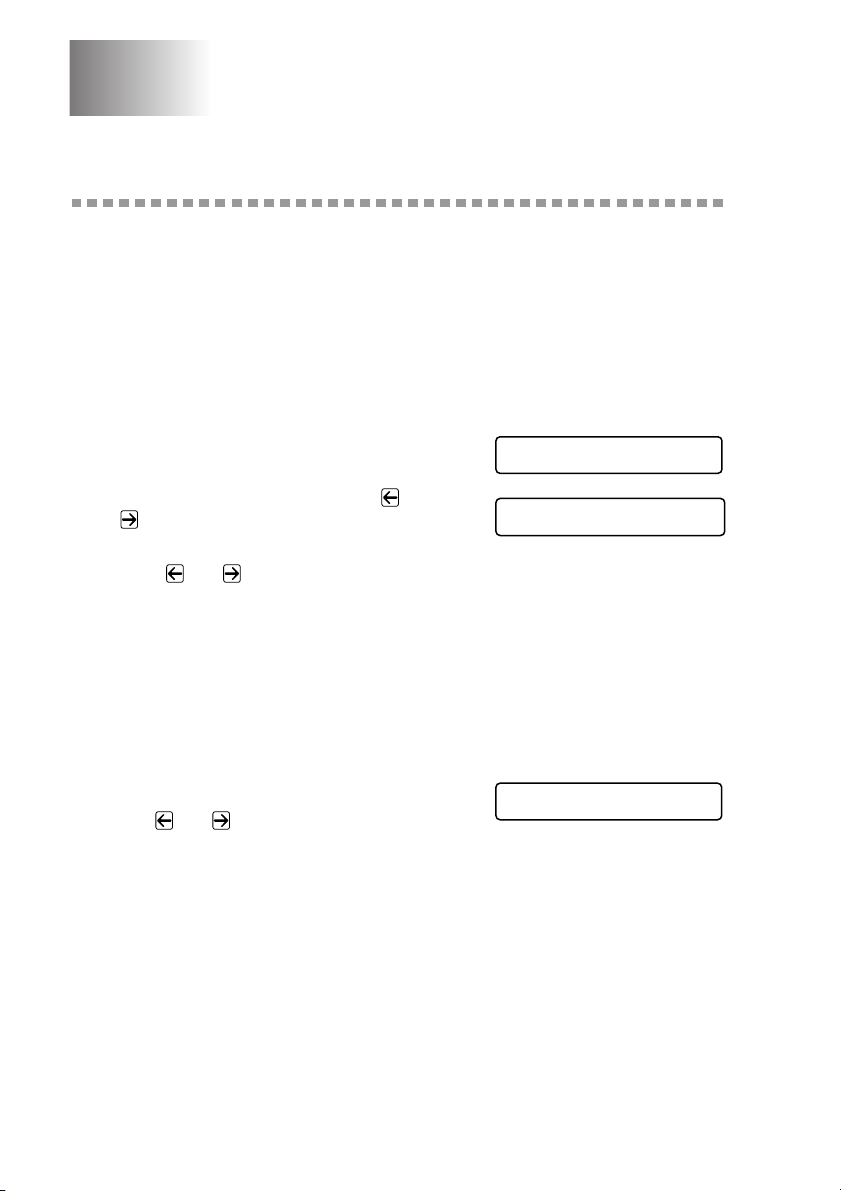
4 - 1
INITIAL SETUP
4
4
Initial Setup
Getting Started
Setting Paper Size
You can use three sizes of paper for printing your faxes: letter, legal and A4.
When you change the size of paper you have loaded in the MFC, you will need
to change the setting for the paper size, so your MFC will know how to fit the
incoming fax on the page.
After you connect the optional Cassette #2, you can select the paper size for each
cassette. (See Turning on Cassette #2)
1
Press Menu, 1, 1.
2
If you have the Cassette #2, press or
to select CASSETTE #1 or
CASSETTE #2, and then press Set.
3
Press or to select LETTER, LEGAL or A4 (for the cassette you
selected in Step 2), and then press Set.
4
Press Stop/Exit.
Turning on Cassette #2 (Option)
When the optional CASSETTE #2 is set to ON, you can set paper size and the
cassette usage. (See
Printing a Reduced Incoming Document (Auto Reduction), page
5-4 and
Setting Paper Size, above.)
1
Press Menu, 1, 5.
2
Use or to select ON (or OFF),
and then press Set.
3
Press Stop/Exit.
1.PAPER SIZE
2.CASSETTE #2
5.CASSETTE #2
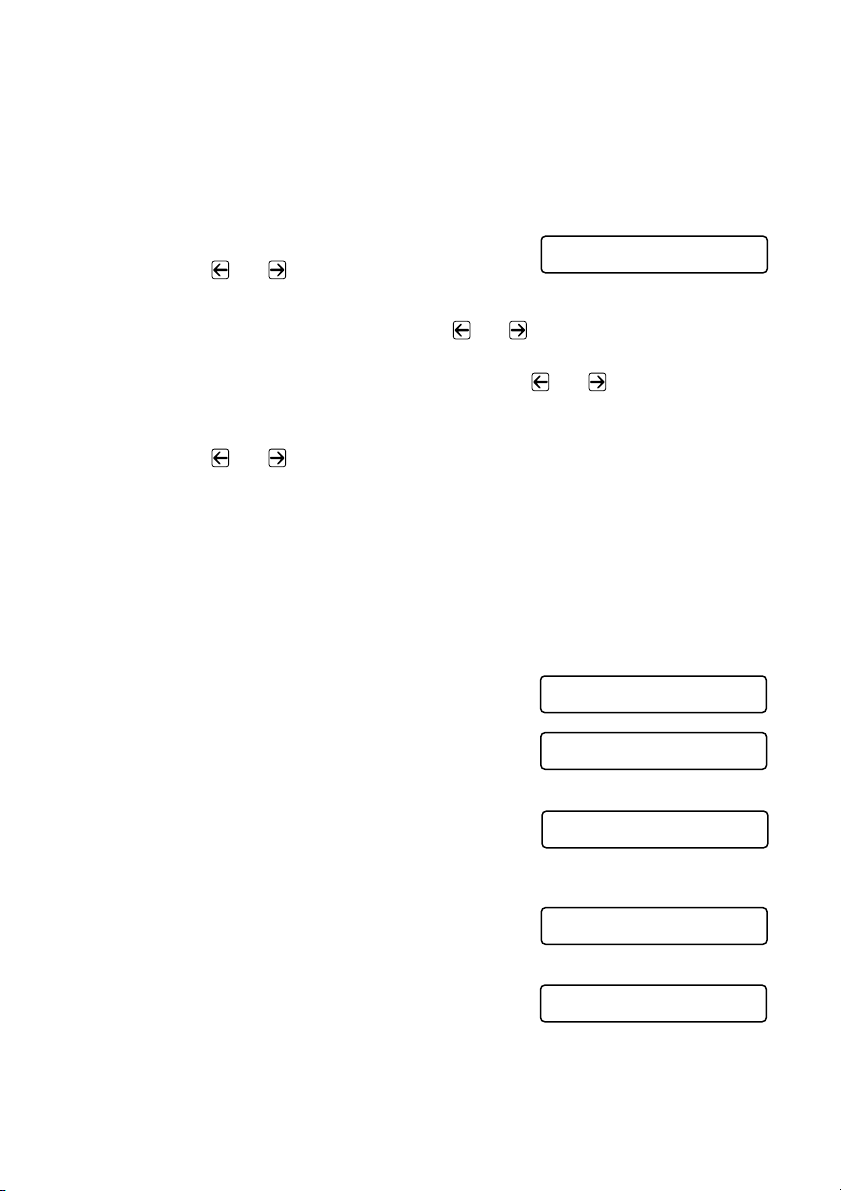
INITIAL SETUP
4 - 2
Setting Cassette Usage
The default setting of AUTO allows your MFC to choose the optional Cassette
#2 if paper is out in Cassette #1 or if incoming faxes will fit best on the paper in
Cassette #2. Choose CASSETTE#1 ONLY, CASSETTE#2 ONLY or
CASSETTE USAGE if you want to keep special paper in the other cassette and
control when it is used.
1
Press Menu, 1, 1.
2
Press or to select CASSETTE
USAGE, and then press Set.
3
To set cassette usage for faxes, press or to select FOR FAX, and then
press Set.
—OR—To set cassette usage for copies, press or to select FOR
COPY, and then press Set.
—OR—If you are finished, go to Step 5.
4
Press or to select AUTO, CASSETTE#1 ONLY or CASSETTE#2
ONLY, and then press Set.
5
Press Stop/Exit.
Setting Date and Time
Your MFC displays the date and time, and prints it on every fax you send.
In the event of a power failure, you may have to reset the date and time. All other
settings remain unaffected.
1
Press Menu, 1, 2.
2
Enter the last two digits of the year, and then
press Set.
For example, enter 02 for the year 2002.
3
Enter two digits for the month, and then press
Set.
For example, enter 09 for September,
or 10 for October.
4
Enter two digits for the day, and then press
Set.
For example, 06
5
Enter the time in 24-hour format, and then
press Set.
For example, enter 15:25 for 3:25 PM.
6
Press Stop/Exit.
The LCD now shows the date and time you set whenever the MFC is standing
by.
1.PAPER SIZE
2.DATE/TIME
YEAR:XX
ENTER & SET KEY
MONTH:XX
ENTER & SET KEY
DAY:XX
ENTER & SET KEY
TIME:XX:XX
ENTER & SET KEY
4 - 3
INITIAL SETUP
Setting Station ID
You should store your name or (company name) and fax number to be printed
on all fax pages you send. The telephone number you enter will be printed only
on your cover pages and call back messages. (See
Composing Electronic Cover
Page
, page 6-7.)
1
Press Menu, 1, 3.
2
Enter your fax number (up to 20 digits), and
then press Set.
(You must enter a fax number to proceed.)
3
Enter your telephone number (up to 20
digits), and then press Set. If your telephone
number and fax number are the same, enter
the same number again.
(This number appears on Cover pages.)
4
Use the dial pad to enter your name or your
company name (up to 20 characters), and
then press Set.
(See
Entering Text, page 4-4.)
5
Press Stop/Exit.
The LCD returns to the date and time.
If your Station ID has already been programmed, the LCD prompts “1” to make a
change, or “2” to exit without changing.
3.STATION ID
FAX:
ENTER & SET KEY
TEL:
ENTER & SET KEY
NAME:
ENTER & SET KEY
NOTICE
The Telephone Consumer Protection Act of 1991 makes it unlawful
for any person to use a computer or electronic device to send any
message via a telephone machine unless such messages clearly
contain, in a margin at the top or bottom of each transmitted page,
or on the first page of the transmission, the date and time it is sent
and an identification of the business or other entity or other
individual sending the message and the telephone number of the
sending machines or such business, other entity, or individual.
In order to program this information into your MFC, you should
complete the steps described on pages 4-2 and 4-3.

INITIAL SETUP
4 - 4
Entering Text
When you are setting certain menu selections, such as the Station ID, you may
need to type text into the MFC. Most number keys have three or four letters
printed above them. The keys for 0, #, and don’t have printed letters because
they are used for special characters.
By pressing the appropriate number key repeatedly, you can access the character
you want.
Inserting Spaces
If you want to enter a blank space, press twice.
Making Corrections
If you entered a letter incorrectly and want to change it, press to move the
cursor after the last correct letter. Then press Clear; all letters above and to the
right of the cursor will be deleted. Re-enter the correct characters. You can also
back up and type over incorrect letters.
Repeating Letters
If you need to enter a character that is assigned to the same key as the previous
character, press to move the cursor to the right.
Special Characters and Symbols
Key once twice three times four times
2 ABC
3 DEF
4 GH I
5 JKL
6 MNO
7 PQRS
8 TUV
9 WXY Z
Press for (space) ! “ # $ % & ’ ( ) + , - . /
Press # for : ; < = > ? @ [ ] ^ _
Press 0 for É À È Ê Î Ç Ë Ö 0
4 - 5
INITIAL SETUP
Setting the Ring Volume
1
Press Menu, 1, 4, 1.
2
Press or to select OFF, LOW,
MED, or HIGH, and then press Set.
3
Press Stop/Exit.
Setting the Beeper Volume
You can set the beeper to LOW, HIGH or OFF. The default setting is LOW.
When the beeper is set to LOW or HIGH, the MFC beeps every time you press
a key or make an error and when fax sending or receiving has finished.
1
Press Menu, 1, 4, 2.
2
Press or to select your option.
3
When the LCD shows the option you want, press Set.
4
Press Stop/Exit.
Setting the Speaker Volume
You can set the volume of the MFC’s one-way speaker.
1
Press Menu, 1, 4, 3.
2
Press or to select OFF, LOW,
MED, or HIGH, and then press Set.
3
Press Stop/Exit.
Memory Storage
In the event of a power failure, all menu settings are stored permanently:
GENERAL SETUP, SETUP RECEIVE, SET AUTO DIAL, REMOTE
FAX OPT plus the COVERPG SETUP and COVERPAGE MSG (from
SETUP SEND). You may have to reset the date and time.
Turning On Automatic Daylight Savings Time
You can set the MFC to change automatically for Daylight Savings Time.
It will reset itself forward one hour in the Spring and back one hour in the Fall.
1
Press Menu, 1, 6.
2
Press or to select ON (or OFF), and
then press Set.
3
Press Stop/Exit.
1.RING
2.BEEPER
3.SPEAKER
6.AUTO DAYLIGHT
INITIAL SETUP
4 - 6
Toner Save
You can conserve toner using this feature. When you set Toner Save to ON print
appears somewhat lighter. The default setting is OFF.
1
Press Menu, 1, 7.
2
Press or to select
ON (or OFF) and then press Set.
3
Press Stop/Exit.
Sleep Mode
Setting the Sleep Mode reduces power consumption while the MFC is idle. You
can choose how long the MFC is idle (from 00 to 99 minutes) before it drops
into sleep mode. The timer automatically resets itself after the MFC receives a
fax or PC data, or makes a copy. The default setting is 5 minutes.
1
Press Menu, 1, 8.
2
Use the Dial pad to enter the length of
time the MFC is idle before it drops into
sleep mode (00 to 99 minutes), and then press Set.
3
Press Stop/Exit.
Setting Tone/Pulse Dialing Mode (For Canada Only)
Your MFC comes set to accommodate tone (multi-frequency) dialing service. If
you have pulse (rotary) dialing service, you need to change the dialing mode.
1
Press Menu, 1, 9.
2
Press or to select TONE or
PULSE dialing mode, and then press
Set.
3
Press Stop/Exit.
If you make copies frequently, make the idle time long enough so you won’t always
be waiting for the MFC to warm up.
7.TONER SAVE
8.SLEEP MODE
9.TONE/PULSE
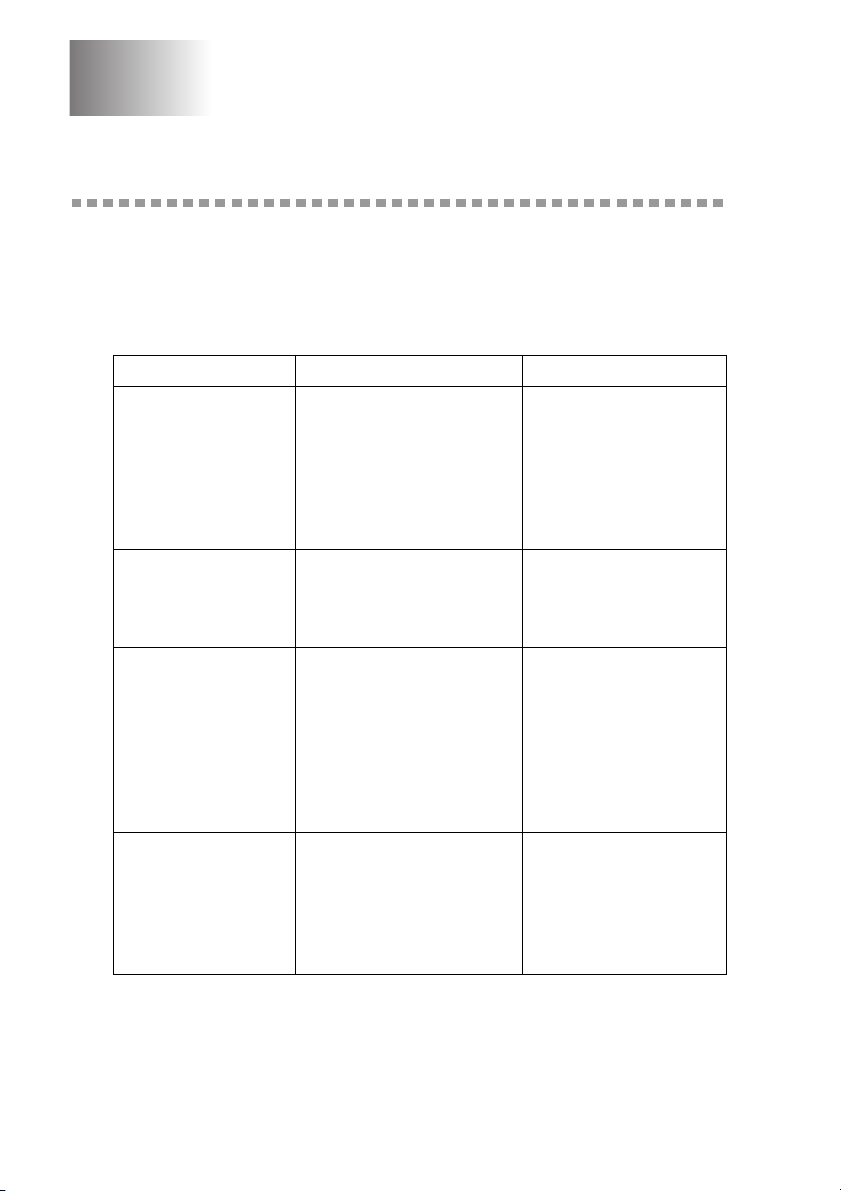
5 - 1
SETUP RECEIVE
5
5
Setup Receive
Receive Mode Settings
Select Your Receive Mode
There are three different receive modes for your MFC. You may choose the
mode that best suits your needs by pressing Receive Mode repeatedly until the
LCD shows the setting you want to use.
*In FAX/TEL mode you must set the Ring Delay and F/T Ring Time. If you
have extension phones on the line, set the Ring Delay to 4 rings.
LCD How it works When to use it
MANUAL
(manual receive)
You control the phone line
and must answer every call
yourself.
Use this mode when you
are using a computer
modem on the same line
or if you receive very
few fax messages. You
can also use this mode
with Distinctive Ring.
FAX ONLY
(automatic receive)
The MFC automatically
answers every call as a fax.
For dedicated fax lines.
You cannot receive a
voice call but you can
call out.
FAX/TEL*
(fax and telephone)
The MFC controls the line
and automatically answers
every call. If the call is a
fax it will receive the fax.
If the call is not a fax it will
ring (double ring) for you
to pick up the call.
You cannot have an
answering machine on
the same line, even if it
is on a separate jack on
the same line. You
cannot use the telephone
company’s Voice Mail
in this mode.
TAD:ANSWER
MACH.
(External Telephone
Answering Device)
The external TAD
automatically answers
every call. Voice messages
are stored on the external
TAD. Fax messages are
printed.
Use this mode if you
have an answering
machine on your phone
line.
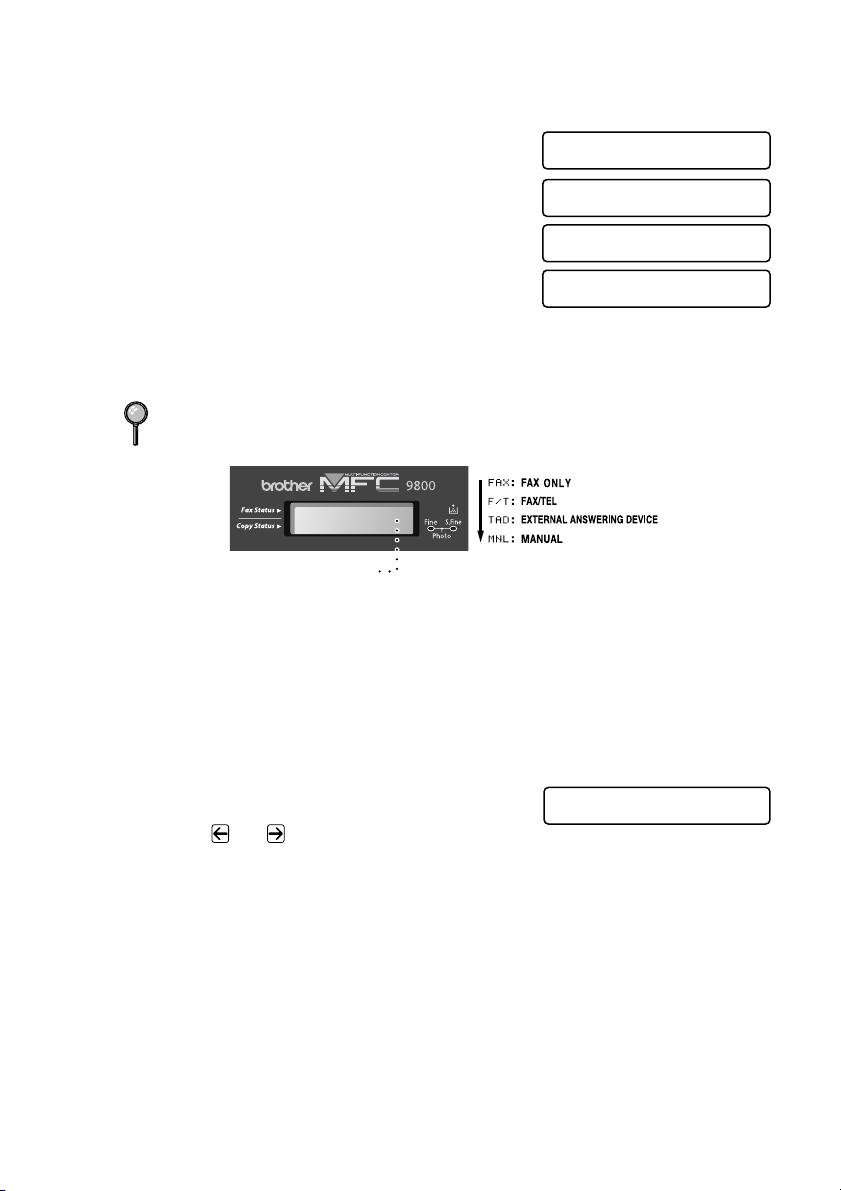
SETUP RECEIVE
5 - 2
To Select or Change Your Receive Mode
1
Press Receive Mode. The LCD shows your current selection.
2
Continue to press Receive Mode until your new selection appears. After two
seconds, the LCD returns to the date and time display, along with your new
Receive Mode setting.
Setting Ring Delay
The Ring Delay setting determines the number of times the MFC rings before it
answers. If you have extension phones on the same line as the MFC or are using
the telephone company’s Distinctive Ring service, keep the Ring Delay default
setting of 4. You can try increasing the Ring Delay to 4 rings; however, if you
do not receive all your faxes, you must reset it to 4 rings.
1
Press Menu, 2, 1, 1.
2
Press or to select how many times
the line rings before the MFC answers
(00–04) , and then press Set. If you select 00,
the line doesn’t ring at all.
3
Press Stop/Exit.
If you are changing the Receive Mode while in another operation, the LCD
returns to that operation.
FAX ONLY
FAX/TEL
TAD:ANSWER MACH.
MANUAL
09/06 15:25 FAX
Current Receive Mode
1.RING DELAY
5 - 3
SETUP RECEIVE
Setting F/T Ring Time (For FAX/TEL Mode Only)
If you set the receive mode to FAX/TEL, you’ll need to determine how long the
machine will send you its special double-ring when you have a voice call. This
ringing happens after the initial ringing from the phone company. Only the
machine rings, for 20, 30, 40 or 70 seconds; no other phones on the same line
ring the special double-ring. However, you can answer the call on any extension
phone (in a separate wall jack) on the same line as the machine. (See Operation
from Extension Telephone, page 5-5.)
1
Press Menu, 2, 1, 2.
2
Press or to select how long the
machine will ring to alert you that you have a voice call, and then press Set.
3
Press Stop/Exit.
Now, when a call comes in and the
machine is set to FAX/TEL mode, all
phones on this line will ring the number of times you selected in Ring Delay.
You can let the machine pick up and detect if it’s a fax or voice call. If it’s a fax
call, the machine prints the fax. If it’s a voice call, the machine signals you with
a double-ring for the length of time you selected in F/T Ring Time.
Easy Receive
When you use this feature, you don’t have to press
Fax Start
when you answer a
fax call. Selecting
ON
allows the MFC to receive fax calls automatically, even if
you lift the handset of an extension or external phone. When you see
RECEIVING
on the LCD or when you hear “chirps” through the handset of an extension phone,
just replace the handset and let your MFC do the rest. Selecting
OFF
means you’ll
have to activate the MFC yourself, by lifting the handset of an external or extension
phone, and then pressing
Fax Start
on the MFC or by pressing
5
1
if you are
not at your MFC. (See
Operation from Extension Telephone
, page 5-5.)
Even if the caller hangs up during the double-ringing, the machine continues
for the set time.
If Easy Receive is OFF and an original is in the ADF, lift the handset of an
external or extension phone, press Fax Start and 2 to activate the MFC.
If you’ve set the feature to ON, but your MFC doesn’t automatically connect a
fax call when you lift a handset, press the Fax Receive code 5 1 on the
external or extension phone.
If you send faxes from a computer on the same phone line and the MFC
intercepts them, set Easy Receive to OFF.
2.F/T RING TIME
RING TIME:20 SEC
SELECT <- -> & SET
SETUP RECEIVE
5 - 4
1
Press Menu, 2, 1, 3.
2
Use or to select ON (or OFF), and
then press Set.
3
Press Stop/Exit.
Printing a Reduced Incoming Document
(Auto Reduction)
Your MFC can reduce the size of an incoming fax to fit the size of the paper you
loaded.
Select ON to turn on this feature.
After you connect Cassette #2, you can turn on Automatic Reduction for each
cassette. (See Turning on Cassette #2 (Option), page 4-1).
1
Press Menu, 2, 1, 5.
2
If you have the optional Cassette #2 press
or to select CASSETTE #1 or CASSETTE #2, and then press Set.
3
Use or to select ON (or OFF), and then press Set.
4
Press Stop/Exit.
Setting the Print Density
You can adjust print density, making your printed pages darker or lighter than
the original.
1
Press Menu, 2, 1, 6.
2
Press to make print lighter, or to
make print darker.
3
Press Stop/Exit .
3.EASY RECEIVE
5.AUTO REDUCTION
6.PRINT DENSITY
5 - 5
SETUP RECEIVE
Advanced Receiving Operations
Operation from Extension Telephone
If you answer a fax call on an extension phone (or on an external phone in the
EXT. jack), you can make your MFC take over by using the Fax Receive Code.
When you press the Fax Receive Code 5 1, the MFC starts to receive a fax.
(See Easy Receive, page 5-3.)
If the machine answers a voice call and double-rings for you to take over, use
the Telephone Answer Code # 5 1 to take the call at an extension phone.
If you answer a call at an extension or external phone, and no one is on the line,
assume you’re receiving a fax. At an extension phone, press 5 1, wait for fax
receiving tones (chirps), then hang up. At an external phone, press 5 1 and
wait for the phone to be disconnected (the LCD shows RECEIVING) before
you hang up. (Your caller will have to press Fax Start to send the fax.)
For FAX/TEL Mode Only
When the machine is in FAX/TEL mode, it will use the F/T Ring Time (double-
ringing) to alert you to pick up a voice call. If you’re at the machine, you can lift
the handset to answer.
If you’re at an extension phone, you’ll need to lift the handset during the F/T
Ring Time and then press # 5 1 between the double rings. If no one is on the
line, or if someone wants to send you a fax, send the call back to the machine by
pressing 5 1.
Changing the Fax Receive Code
The preset Fax Receive Code ( 5 1) may not work with some telephone
systems.
If you are always disconnected when accessing your external TAD remotely, try
changing the Fax Receive Code from 5 1 to # # #.
1
Press Menu, 2, 1, 4.
2
Press or to select ON (or OFF),
and then press Set.
3
If you want to, enter a new Fax Receive
Code, and then press Set.
4
Press Stop/Exit.
4.REMOTE CODE
FAX RECEIVE:
*
51
ENTER & SET KEY
TEL ANSWER:#51
ENTER & SET KEY
SETUP RECEIVE
5 - 6
Printing a Fax in Memory
If you have Fax Storage ON for remote retrieval, you can still print a fax from
memory when you are at your MFC. (See Setting Fax Storage, page 9-2.)
1
Press Menu, 2, 5, 4.
2
Press Fax Start.
3
After printing is finished, and then press
Stop/Exit.
Polling
Polling is the process of retrieving faxes from another fax machine. You can use
your MFC to “poll” other machines, or you can have someone poll your MFC.
All parties involved in polling must set up their fax machines to accommodate
polling. When someone polls your MFC to receive a fax, they pay for the call;
if you poll someone’s fax machine to receive a fax, you pay for the call.
Setting Up Polling Receive
Polling Receive is when you call another fax machine to receive a fax from it.
1
Press Menu, 2, 1, 7.
2
Press or to choose ON, and then
press Set.
3
Enter the fax number you’re polling.
4
Press Fax Start.
The LCD shows DIALING.
Some fax machines do not respond to the polling feature.
4.PRINT FAX
7.POLLING RX
5 - 7
SETUP RECEIVE
Setting Up Sequential Polling Receive
Your MFC can request documents from several fax units in a single operation.
Afterward, a Sequential Polling Report will be printed.
1
Press Menu, 2, 1, 7.
2
Press or to select Polling ON (or
OFF), and then press Set.
3
Specify the destination fax machines you
wish to poll using One Touch, Speed
Dial, Groups or the dial pad. You must
press Set between each location.
4
Press Fax Start.
The LCD shows DIALING.
Your MFC will poll each number or Group member in turn for a document.
Canceling a Scheduled Job
You can cancel tasks you’ve scheduled, such as Delayed Fax, Polling Receive,
Polling Transmit or faxes in memory waiting to be sent.
(See Checking the Jobs Status, page 6-5.)
1
Press Menu, 2, 6.
Jobs waiting to be sent from memory
appear on the display. If there are no jobs,
the LCD shows NO JOB WAITING.
2
If you have more than two jobs waiting, press or to select the job you
want to cancel, and then press Set.
3
Press 1 to cancel—OR—Press 2 to exit without canceling.
To cancel another job, return to Step 2.
4
Press Stop/Exit.
PC-FAX Receive Mode
You can switch PC-FAX Receive Mode on and off as needed. If you want your
fax messages to go directly into your PC, make sure the MFL Link Pro suite
setting is ON. If you want faxes to print on your MFC when they arrive, you can
switch MFL Link Pro suite mode to OFF. (See On-Line Documentation on the
Brother CD-ROM.)
1
Press Menu, 2, 1, 8.
2
Pres or to select ON (or OFF),
and then press Set.
3
Press Stop/Exit.
7.POLLING RX
POLLING RX:OFF?
SELECT <- -> & SET
ENTER FAX NO.
PRESS FAX START
6.REMAINING JOBS
8.PC FAX RECEIVE
SETUP SEND
6 - 1
6
6
Setup Send
Before You Begin
You can send a fax from the ADF (Automatic Document Feeder) or from the
scanner glass.
Sending Faxes Using Multiple Settings
When you send a fax you can choose any combination of the available settings:
add a cover page and select a comment; set the contrast or resolution; send using
overseas mode, or delayed fax timer, polling transmission or real time
transmission. After each menu selection is accepted, the LCD will ask if you
want to enter other settings:
Press 1 if you want to select additional settings. The LCD returns to the SETUP
SEND menu—OR—Press 2 if you are finished choosing settings, and go to the
next step.
Faxing from the ADF (Automatic Document Feeder)
The ADF can hold up to 50 pages, feeding each one individually through the
MFC. Use standard (20 lb/75g/m
2
) paper when using the ADF. Always fan the
pages well before placing them in the ADF.
■ Make sure originals written with ink are completely dry.
■ Before you send a fax, press Resolution to select the resolution for the type of
original you are sending. (See
Fax Resolution, page 6-7.)
DO NOT use curled, wrinkled, folded, ripped paper, or paper with staples,
paper clips, paste or tape attached. DO NOT use cardboard, newspaper, or
fabric. (To fax this kind of original, see
Faxing from the Scanner Glass, page 6-3.)
ACCEPTED
OTHER SETTINGS?
1.YES 2.NO
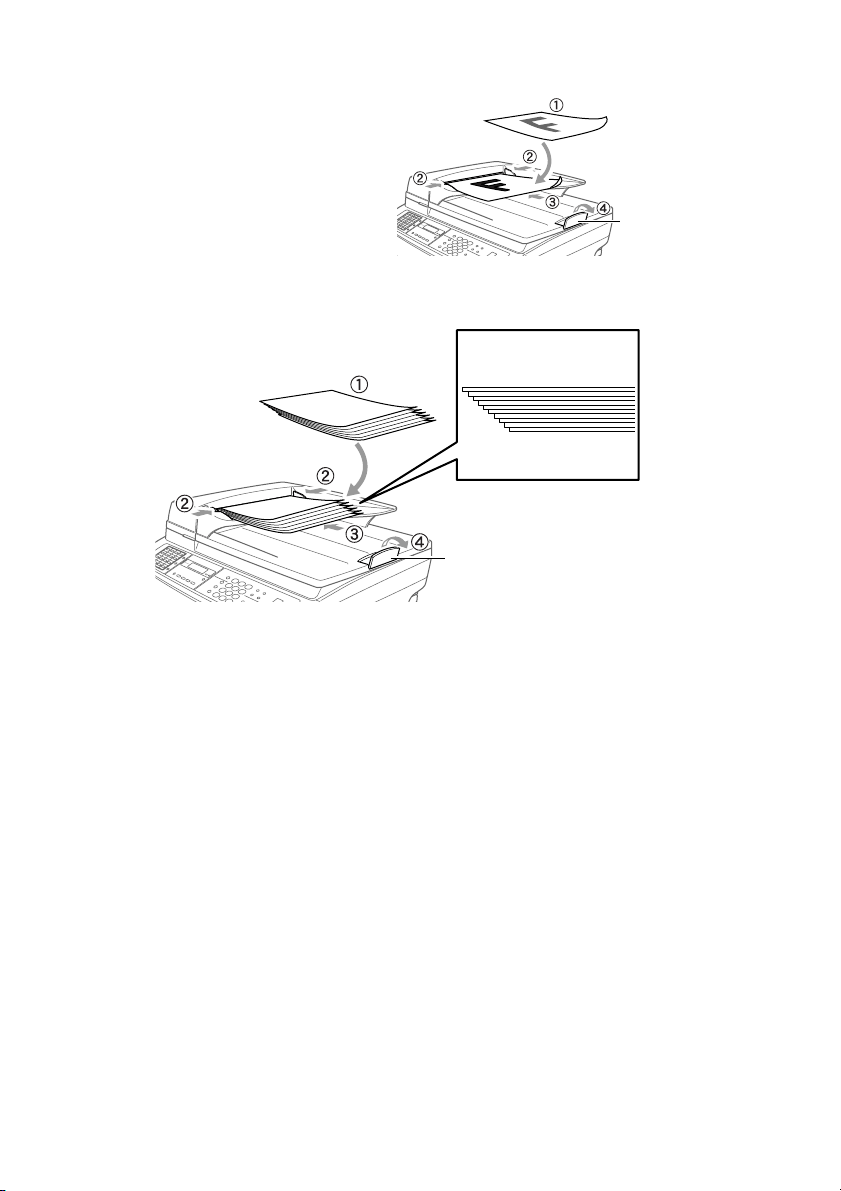
6 - 2
SETUP SEND
■ Originals to be faxed must be
from 5.8 to 8.5 inches wide and
between 5 to 14 inches long.
1
Insert originals face up, top edge
first.
2
Adjust the paper guides to fit the
width of your original.
3
Stagger the pages. Then place
them in the ADF until you feel
the first page lightly touch the feed roller.
4
Pull up the document stopper.
Originals are
Face Up
in the ADF
Document
Stopper
Document
Stopper
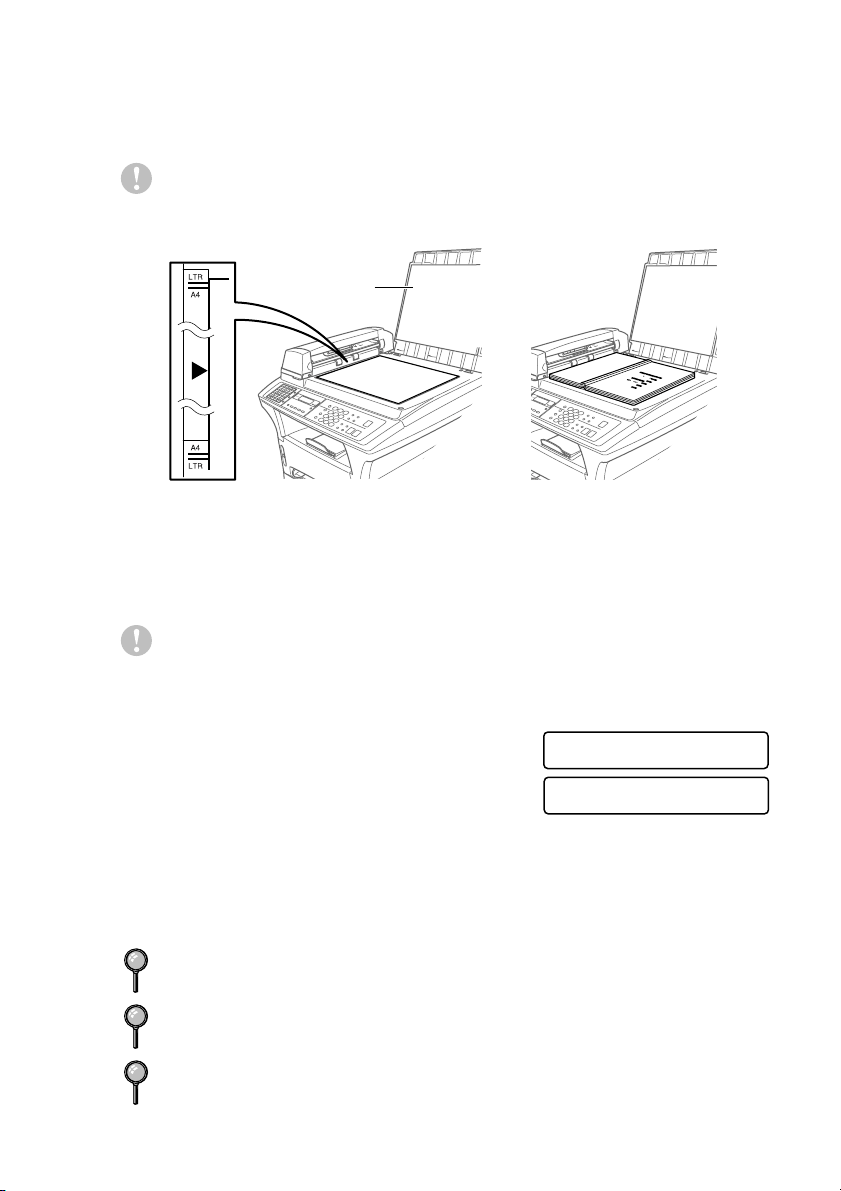
SETUP SEND
6 - 3
Faxing from the Scanner Glass
You can use the scanner glass to fax one page at a time or pages of a book.
Originals can be Letter or A4 size (8.5 inches to 11.7 inches).
1
Lift the document cover.
2
Using the document guidelines on the left, center the original face down on the
scanner glass.
3
Close the document cover.
4
Dial the fax number, then press Fax Start. The MFC starts scanning the first
page.
5
To send a single page, go to Step 7
—OR—
To send multiple pages, go to Step 6.
6
Place the next page on the scanner glass, and then press Set. The MFC starts
scanning. (Repeat Step 6 for each additional page.)
7
Press Fax Start to begin dialing.
To use the scanner glass, the ADF must be empty.
If the original is a book or is thick, do not slam down the cover or press on it.
Press Stop/Exit to cancel. If the original was scanned into memory, press 1 to
CLEAR it—OR—2 to EXIT.
If memory is full, and you are faxing a single page, it will be sent in real time.
You cannot fax from the scanner glass when the MFC is sending, receiving or
printing a fax.
Document
Cover
Originals are
Face Down
on the Scanner
Glass
MEMORY #001 99%
NEXT:PRESS SET
DIAL:PRESS START

6 - 4
SETUP SEND
Manual Transmission
Manual transmission lets you hear the dial tone, ringing and fax receiving tones
while sending a fax.
1
Place the original face up in the ADF, or face down on the scanner glass.
2
Press Hook for a dial tone.
3
Dial the number you want to call (you can enter the digits using the dial pad, or
you can enter a One Touch or Speed Dial number).
4
When you hear the fax tone, press Fax Start—OR—If you are using the
scanner glass, go to Step 5.
5
Press 1.
Automatic Transmission
This is the easiest way to send a fax.
1
Place the original face up in the ADF, or face down on the scanner glass.
2
Enter the fax number using One Touch, Speed Dial, Search or the dial pad. (See
Speed Dialing, page 7-4.)
3
Press Fax Start.
Manual and Automatic Fax Redial
If you’re sending a fax manually and the line is busy, press Redial/Pause to
retry the number.
If you’re sending a fax automatically and the line is busy, the MFC will
automatically redial (up to three times at 5 minute intervals).
Dual Access
If the ADF is empty, you can place an original in the ADF and set temporary
settings, dial a number, and begin scanning the fax into memory—even when
the MFC is receiving a fax, sending a fax, or printing a fax from memory. The
LCD shows the new job number and available memory.
If you get an
OUT OF MEMORY
message while scanning the first page of a fax,
press
Stop/Exit
to cancel the scan. If you get an
OUT OF MEMORY
message
while scanning a subsequent page, you’ll have the option to press
Fax Start
to
transmit the pages scanned so far, or to press
Stop/Exit
to cancel the operation.
Note
Do not press Hook.
You cannot fax from the scanner glass while the MFC is sending, receiving or
printing a fax.
The number of pages you can scan into memory varies with the data they contain.
SETUP SEND
6 - 5
Real Time Transmission
When you are sending a fax, the MFC will scan originals into memory before sending.
Then, as soon as the phone line is free, the MFC will start dialing and sending the fax.
If memory becomes full, the MFC will send the document in real time (even if REAL
TIME TX is set to OFF).
Sometimes you may want to send an important document immediately, without
waiting for memory transmission. You can set REAL TIME TX to ON.
1
Place the original face up in the ADF, or face down on the scanner glass.
2
Press Menu, 2, 2, 6.
3
To change the default setting,
press or to select ON (or OFF),
and then press Set. Go to Step 5
—OR—For the next fax transmission only, press or to select NEXT
FAX ONLY, and then press Set.
4
For the next fax only, press or to select ON (or OFF), and then press
Set.
5
Press 1 if you want to select additional settings. The LCD returns to the SETUP
SEND menu—OR—Press 2 if you are finished choosing settings, and then go
to Step 6.
6
Enter fax number.
7
Press Fax Start.
Checking the Jobs Status
Check memory for unsent jobs. (If no memory is clear, the LCD shows NO JOB
WAITING.) (See
Canceling a Job in Memory, page 6-6.)
1
If the MFC is idle, press Menu, 2, 6.
—OR—
If the MFC is busy, press Stop/Exit.
2
If you have multiple jobs waiting, use or to scroll through the list.
3
Press Stop/Exit.
Canceling a Job While Scanning the Original
You can cancel a job while you are scanning it into memory by pressing
Stop/Exit. Eject the document by pressing Stop/Exit again.
6.REAL TIME TX
6.REMAINING JOBS
6 - 6
SETUP SEND
Canceling a Job in Memory
You can cancel tasks you’ve scheduled, such as Delayed Fax, Polling Receive,
Polling Transmit or faxes in memory waiting to be sent. If jobs are waiting, they
will appear on the LCD; otherwise, the LCD will show NO JOB WAITING.
1
Press Menu, 2, 6.
2
If you have more than two jobs waiting, use or to select the job you
want to cancel, and then press Set.
—OR—
If you have only one job waiting, go to Step 3.
3
Press 1 to cancel—OR—Press 2 to exit without canceling.
To cancel another job, return to Step 2.
4
Press Stop/Exit.
Basic Sending Operations
Contrast
If your document is very light or very dark, you might want to set the contrast.
Use S.LIGHT to send a very light document. Use S.DARK, to send a very dark
document.
1
Place the original face up in the ADF, or
face down on the scanner glass.
2
Press Menu, 2, 2, 1.
3
Use or to select AUTO, S.LIGHT or S.DARK, and then press Set.
4
Press 1 if you want to select additional settings. The LCD returns to the SETUP
SEND menu—OR—Press 2 if you are finished choosing settings, and go to
Step 5.
5
Enter a fax number, and then press Fax Start to send a fax.
6.REMAINING JOBS
1.CONTRAST
SETUP SEND
6 - 7
Fax Resolution
When you have an original in the ADF or on the scanner glass, you can use the
Resolution key to temporarily change the setting. Press Resolution
repeatedly until the LCD shows the setting you want.
—OR—
You can change the default setting for all faxes.
1
Press Menu, 2, 2, 2.
2
Press or to select the resolution
you want, and then press Set.
3
Press Stop/Exit.
STANDARD - Suitable for most typed documents.
FINE - Good for small print; transmits a little slower than Standard resolution.
SUPER FINE - Good for small print or artwork; transmits slower than Fine
resolution.
PHOTO - Use when original has varying shades of gray; slowest transmission
time.
Composing Electronic Cover Page
The cover page is generated at the receiving party’s MFC. Your cover page
includes the name stored in the One Touch or Speed Dial memory. If you are
dialing manually, the name is left blank. (See
One Touch Dialing and Speed
Dialing
, page 7-4.)
The cover page indicates your Station ID and the number of pages you’re
sending. If you have Coverpage Setup set to ON (Menu, 2, 2, 8), the number
of pages remains blank. (See
Setting Station ID, page 4-3.)
You can include a comment on your cover page.
Instead of using one of the pre-programmed comments above, you can enter one
of two customized messages. (Up to 27 characters long) Use the chart on page
4-4 to help enter characters. (See
Composing Your Own Comments, page 6-8.)
2.FAX RESOLUTION
1.COMMENT OFF
2.PLEASE CALL
3.URGENT
4.CONFIDENTIAL
5.(USER DEFINED)
6.(USER DEFINED)
6 - 8
SETUP SEND
Most of the SETUP SEND menu selections are temporary settings that allow
you to make adjustments for each fax you send. However, you can set up your
cover page and cover page comments in advance. The Cover Page Setup and
Cover Page Message menu selections change the default settings.
Composing Your Own Comments
You can set up two custom comments.
1
Press Menu, 2, 2, 9.
2
Press or to choose position 5 or
6 for your customized comment, and then
press Set.
3
Use the dial pad to enter your customized comment, and then press Set.
(See
Entering Text, page 4-4.)
4
Press 1 if you want to select additional settings. The LCD returns to the SETUP
SEND menu—OR—Press 2 if you are finished choosing settings.
Cover Page for the Next Fax Only
Make sure the Station ID is set up. (see page 4-3.) This feature does not work
without the Station ID.
You can set the fax to send a cover page with a particular fax. This cover page
will include the number of pages in your original.
1
Place the original face up in the ADF, or face down on the scanner glass.
2
Press Menu, 2, 2, 8.
3
When the LCD shows NEXT FAX
ONLY, press Set.
4
Press or to select ON (or OFF), and then press Set.
5
Press or to select one of the standard or custom comments, and then
press Set.
6
Enter two digits to indicate the number of pages you are sending, and then press
Set. (For example, press 0 2 for 2.) (Enter 0 0 to leave the number of pages
blank.) If you make a mistake, press to back up and reenter the number of
pages.
7
Press 1 if you want to select additional settings. The LCD returns to the SETUP
SEND menu—OR—Press 2 if you are finished choosing settings.
8
Enter the fax number you’re calling.
9
Press Fax Start.
9.COVERPAGE MSG
8.COVERPG SETUP
SETUP SEND
6 - 9
Always Send Cover Page
Make sure the Station ID is set up. This feature does not work without the
Station ID. (See
Setting Station ID, page 4-3.)
You can set the MFC to send a cover page whenever you send a fax. The number
of fax pages is not included when you use this setting.
1
Press Menu, 2, 2, 8.
2
Press or to select
COVERPAGE: ON, and then press
Set.
3
If you selected ON, press or to select one of the standard or custom
comments, and then press Set.
4
Press 1 if you want to select additional settings. The LCD returns to the SETUP
SEND menu—OR—Press 2 if you are finished choosing settings.
Using a Printed Cover Page
If you prefer using a printed cover page that you can write on, you can print the
sample page and attach it to your fax.
1
Press Menu, 2, 2, 8.
2
Press or to select PRINT
SAMPLE, and then press Set.
3
Press Fax Start. Your MFC prints a copy of your cover page.
8.COVERPG SETUP
8.COVERPG SETUP
- - -
- - -
- - -
- - -
TO:
FROM:
COMMENT:
FAX:
TEL:
COVER PAGE
PAGE[S] TO FOLLOW
6 - 10
SETUP SEND
Advanced Sending Operations
Overseas Mode
After you send a fax using this feature, the feature turns itself off.
1
Place the original face up in the ADF, or face down on the scanner glass.
2
Press Menu, 2, 2, 0.
3
Press or to select ON (or OFF),
and then press Set.
4
Press 1 if you want to select additional settings. The LCD returns to the SETUP
SEND menu—OR—Press 2 if you are finished choosing settings.
5
Enter the fax number you’re calling.
6
Press Fax Start.
Delayed Timer
You can set up the time of day that delayed faxes will be sent. This time will be
displayed for acceptance or you can override it in Delayed Fax.
(See
Advanced Sending Operations, page above.)
1
Press Menu, 2, 2, 3.
2
Enter the time (in 24-hour format) that
you want delayed faxes to be sent,
and then press Set.
3
Press Stop/Exit.
Delayed Fax
During the day you can store up to 50 faxes in memory for delayed sending.
Transmission of these messages will begin at the time of day you enter in Step 3.
If you have set up a time of day in
Delayed Timer
on page 6-10 , you can accept it
or enter another time for this fax.
1
Place the original face up in the ADF, or face down on the scanner glass.
2
Press Menu, 2, 2, 4.
3
Accept the displayed time or enter another
time for this fax, and then press Set.
(For example, enter 19:45 for 7:45 PM.)
4
Press 1 if you want to select additional settings. The LCD returns to the SETUP
SEND menu—OR—Press 2 if you are finished choosing settings.
5
Enter the fax number.
0.OVERSEAS MODE
3.DELAYED TIMER
SET TIME=00:00
ENTER & SET KEY
4.DELAYED FAX
SETUP SEND
6 - 11
6
Press Fax Start.
The MFC starts scanning the original into memory. It will wait until the time
you have entered to send the fax.
Delayed Batch Transmission
Before sending the delayed faxes, your Brother MFC will economize by sorting
all the messages in memory by destination and scheduled time. All delayed
faxes scheduled at the same time to the same fax number will be sent as one
transmission.
1
Press Menu, 2, 2, 5.
2
Press or to select ON (or OFF),
and then press Set.
3
Press Stop/Exit to exit.
Setting Up for Polling Transmit
Polling Transmit is when you set up your MFC to wait with an original in the
ADF so another fax machine can retrieve it.
1
Place the original face up in the ADF, or face down on the scanner glass.
2
Press Menu, 2, 2, 7.
3
Press or to choose
ON (or OFF), and then press Set.
4
Press 1 if you want to select additional settings. The LCD returns to the SETUP
SEND menu—OR—Press 2 if you are finished choosing settings.
5
Press Fax Start and wait for the fax to be polled.
The number of pages you can scan into memory varies with the data they
contain.
Note
If you pressed 1 in Step 4, the original remains in the ADF until your MFC is
polled. If you must use your MFC before the polled transmit occurs, you must
cancel this job.
5.BATCH TX
7.POLLED TX
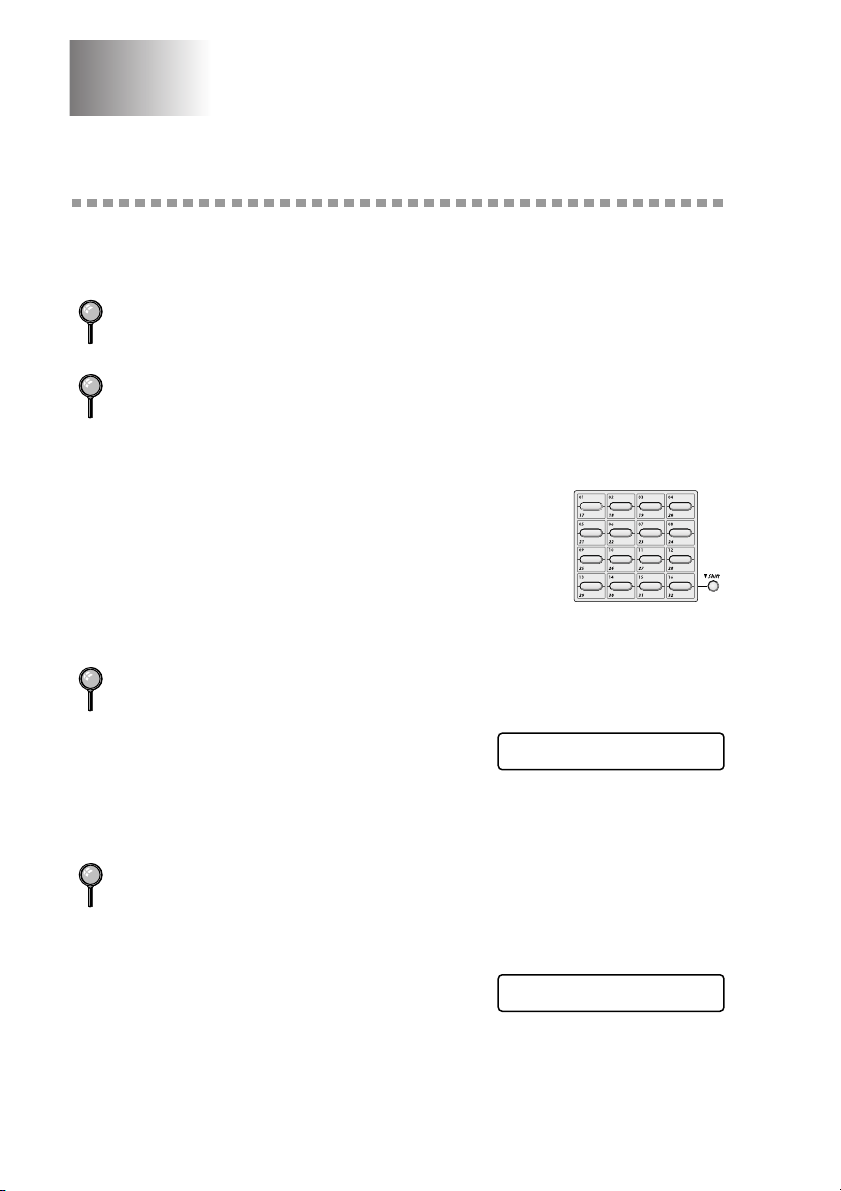
7 - 1
AUTO DIAL NUMBERS AND DIALING OPTIONS
7
7
Auto Dial Numbers
and Dialing Options
Storing Numbers for Easy Dialing
You can set up your MFC to do three types of easy dialing: One Touch, Speed
Dial, and Groups for Broadcasting of faxes. You can store names with these
numbers for easy identification.
Storing One Touch Dial Numbers
You can store 32 fax/phone numbers that you can dial by
pressing one key (and Fax Start). To access numbers 17
to 32, hold down the Shift key. When you press a One
Touch dial location, the LCD shows the name or number
as the call is dialed. (See
One Touch Dialing, page 7-4.)
One Touch keys are the 16 keys (numbers 01–32) located on the left side of the control
panel.
1
Press Menu, 2, 3, 1.
2
Press the One Touch key where you want
to store a number.
3
Enter a number (up to 20 digits), and then press Set.
(See
Changing One Touch and Speed Dial Numbers, page 7-2.)
4
Use the dial pad to enter the name (up to
15 characters), and then press Set
—OR—Press Set to store the number
without a name. (See
Entering Text, page 4-4.)
5
Return to Step 2 to store another number—OR—Press Stop/Exit.
When you dial an auto dial number, the LCD shows the name you’ve stored, or,
if you haven’t stored a name, the nember you’ve stored.
If you must wait for another dial tone at any point in the dialing sequence, store
a pause at that point in the number by pressing Redial/Pause. Each key press
adds a 3.5 second delay.
If you lose electrical power, auto dial numbers stored in memory will not be
lost.
(For USA only) One-Touch key 1 has been pre-programmed for the Brother
fax-back system.
If you want to enter a pause in the dialing sequence (for example, to access an
outside line), press Redial/Pause as you’re entering digits.
Each key press of Redial/Pause enters a 3.5 second pause when the number
is dialed, and a dash appears on the screen.
1.ONE-TOUCH DIAL
NAME:
ENTER & SET KEY
AUTO DIAL NUMBERS AND DIALING OPTIONS
7 - 2
Storing Speed Dial Numbers
You can store Speed Dial numbers, so you can dial by pressing only four keys
(Search/Speed Dial, #, the two digit location, and Fax Start). The MFC has
100 Speed Dial locations. (See
Speed Dialing, page 7-4.)
1
Press Menu, 2, 3, 2.
2
Use the dial pad to enter a two-digit
location (00–99), and then press Set.
3
Enter the number (up to 20 digits), and
then press Set.
4
Use the dial pad to enter the name (up to
15 characters), and then press Set.
You can use the chart on page 4-4 to help
you enter letters—OR—Press Set to store the number without a name.
5
Return to Step 2 to store another Speed Dial number—OR—Press Stop/Exit.
Changing One Touch and Speed Dial Numbers
If you try to store a One Touch or Speed Dial number in a location where a
number is already stored, the LCD shows the current name stored there, then
prompts you to either
1
Press 1 to change the number, or press 2 to exit without changing it.
2
Enter a new number, and then press Set.
• If you want to erase the number, press Clear when the cursor is to the left
of the digits.
• If you want to change a digit, use
or to position the cursor under
the digit you want to change, then type over it.
3
Follow the directions from Step 4 for Storing One Touch Numbers or Storing
Speed Dial Numbers.
Setting Up Groups for Broadcasting
Groups allow you to send the same fax message to many fax numbers by
pressing only one One Touch Group key (and Fax Start). First, you’ll need to
store each fax number as a One Touch or Speed Dial number. Then, you can
combine them into a Group. Each Group uses up a One Touch key or a Speed
Dial location. Finally, you can have up to six small Groups, or you can assign
up to 131 numbers to one large Group. (See
Broadcasting, page 7-5.)
2.SPEED DIAL
SPEED-DIAL? #
ENTER & SET KEY
#05:
ENTER & SET KEY
NAME:
ENTER & SET KEY
*O1: BROTHER
1.CHANGE 2.EXIT
7 - 3
AUTO DIAL NUMBERS AND DIALING OPTIONS
1
Press Menu, 2, 3, 3.
2
Select a One Touch key where you wish
to store the Group number.
For example, press One Touch key 02 for
Group 1.
3
Use the dial pad to enter the Group
number, and then press Set.
For example, press 1 for Group 1.
4
To include One Touch or Speed Dial
numbers in the Group, enter them as if
you were dialing. For example, for One
Touch key 05, and then press One Touch
key 05. For Speed Dial location 09, press
Search/Speed Dial, and then press
0, 9 on the dial pad. The LCD shows
05, #09.
5
When you’re finished adding numbers, press Set.
6
Use the dial pad and the chart on
page 4-4 to enter a name for the Group,
and then press Set.
For example, NEW CLIENTS.
7
Press Stop/Exit.
Dialing Options
Search
You can search for names you have stored in One Touch and Speed Dial
memories. Names are stored alphabetically. (See
Storing One Touch Dial
Numbers
, page 7-1 and Storing Speed Dial Numbers, page 7-2.)
1
Place the original face up in the ADF, or face down on the scanner glass.
2
Press Search/Speed Dial, and then enter the first letter of the name you’re
looking for.
3
Press or to search the name that are stored alphabetically.
You can print a list of all One Touch and Speed Dial numbers.
(See
Chapter 10, Printing Reports.)
When you dial an auto dial number, the LCD shows the name you’ve stored, or
if you haven’t stored a name, the fax number you’ve stored.
3.SETUP GROUPS
PRESS SPEED DIAL
OR ONE-TOUCH KEY
SETUP GROUP:GO
ENTER & SET KEY
G01:*O5#O9
ENTER & SET KEY
NAME:
ENTER & SET KEY

AUTO DIAL NUMBERS AND DIALING OPTIONS
7 - 4
4
When the LCD shows the name you want to call, press Fax Start to begin
dialing.
If you use the scanner glass, press Fax Start again.
Speed Dialing
1
Place the original face up in the ADF, or face down on the scanner glass.
2
Press Search/Speed Dial, #, and then press the two-digit Speed Dial number.
3
Press Fax Start.
One Touch Dialing
1
Place the original face up in the ADF, or face down on the scanner glass.
2
Press the One Touch key of the location you want to call.
3
Press Fax Start.
Access Codes and Credit Card Numbers
Sometimes you may want to choose from among several long distance carriers
when you make a call. Rates may vary depending upon the time and destination.
To take advantage of low rates, you can store the access codes or long-distance
carriers as One Touch and Speed Dial numbers. You can store these long dialing
sequences by dividing them and setting them up separately in any combination.
You can even include manual dialing using the dial pad. The combined number
will be dialed in the order you entered it, as soon as you press Fax Start. (See
Storing One Touch Dial Numbers, page 7-1.)
You store “555” on One Touch key 03 and “7000” on One Touch key 02. If
you press One Touch 03, 02 and Fax Start you will dial “555-7000”. To
temporarily change a number, you can substitute part of the number with manual
dialing using the dial pad. For example, to change the number to 555-7001 you
can press One Touch 03, and then press 7, 0, 0, 1 using the dial pad.
If you try to use a One Touch or Speed Dial location with no number stored in
it, you hear a warning sound, and LCD shows NOT REGISTERED. The LCD
returns to normal after 2 seconds.
Note
If you must wait for another dial tone at any point in the dialing sequence, store
a pause at that point in the number by pressing Redial/Pause. Each key press
adds a 3.5 second delay.

7 - 5
AUTO DIAL NUMBERS AND DIALING OPTIONS
Broadcasting
Broadcasting is automatically sending the same fax message to multiple fax
numbers. Using the Broadcast key, you can include Groups, One Touch
locations, Speed Dial locations, plus up to 50 manually dialed numbers.
However, available memory will vary with the types of jobs in memory and the
number of locations used for broadcasting. If you broadcast to more than the
maximum locations available, you will not be able to set up transmissions using
dual access and the timer. (See
Setting Up Groups for Broadcasting, page 7-2.)
The easiest way to broadcast is to press Group keys, you can include One Touch,
Speed Dial, and manually, dialed numbers in the same broadcast. You must
press Broadcast between each of these locations. Use the Telephone Index to
help you choose the numbers easily.
After the broadcast is completed, a Broadcast Report will be printed
automatically to let you know the results.
■ To stop the broadcasting in progress, press Stop/Exit. The LCD asks if you
want to cancel all locations or only the location that is being sent.
■ Enter the long dialing sequence numbers as you normally would. Keep in mind
that each key counts as one location, so the number of locations you can call
becomes limited.
■ If the line is busy or for other reasons a connection could not be made while
broadcasting, the MFC will redial the number automatically.
■ If the memory is full, press Stop/Exit to abort the job; or, if more than one page
has been scanned, press Fax Start to send the portion that is in the memory.
1
Place the original face up in the ADF, or face down on the scanner glass.
2
Enter a number using One Touch, Speed Dial, Group number, Search or the dial
pad.
Example: Group number
3
Press Broadcast. You will be prompted to press the next number.
4
Enter the next number.
Example: Speed Dial number
5
Press Broadcast.
6
Enter the fax number.
Example: Manual dialing using the dial pad.
7
Press Fax Start.
Your MFC will read the original into memory and then start sending faxes to the
numbers you entered.

AUTO DIAL NUMBERS AND DIALING OPTIONS
7 - 6
Pause
Press Redial/Pause to insert a 3.5 second pause between numbers. If you are
dialing overseas, you can press Redial/Pause as many times as needed to
increase the length of the pause.
Fax Redial
If you’re sending a fax manually and the line is busy, press Redial/Pause to
try again. Anytime you want to make a second call to the last number dialed,
press Redial/Pause to save time.
Tone/Pulse (For Canada Only)
If you have pulse dialing service, but need to send tone signals
(for example, telephone banking), follow the directions below. If you have
touch tone service, you do not need this feature to send tone signals.
1
Lift the handset of an external phone.
2
Press #. Digits dialed after # will send tone signals.
3
When you hang up, the MFC returns to pulse dialing service.

8 - 1
TELEPHONE SERVICES
8
8
Telephone Services
Custom Feature
Your MFC supports the Distinctive Ring and Caller ID telephone services
offered by some telephone companies.
Distinctive Ring
The term “Distinctive Ring” is used by Brother to identify a phone company
service that is given many names, depending on the telephone company you are
using. For example, this service may be called SmartRing, RingMaster, Teen-
Ring, Indent-a-Call or Indent-a-Ring.
What Does Your Telephone Company’s “Distinctive Ring” Do?
Your telephone company’s Distinctive Ring service allows more than one
number to be on the same phone line. If you need more than one phone
number, it is an inexpensive alternative to paying for an additional line.
Each phone number has its own distinctive ring pattern, so you will know which
phone number is ringing. This is one way you can have a separate phone number
for your MFC.
What Does Brother’s “Distinctive Ring” Do?
The Brother MFC has a Distinctive Ring feature that allows you to use your
MFC to take full advantage of the telephone company’s Distinctive Ring
service. You can dedicate the new phone number on your line to receiving only
faxes.
If you have Voice Mail, Call Waiting, Call Waiting/Caller ID, RingMaster, an
answering service, or on alarm system custom feature on your telephone line,
it may create a problem in the operation of your MFC.
If you have Voice Mail on you phone line, please read the following carefully.
Note
Please consult your telephone company for availability and rates.
Note
You must purchase your telephone company’s Distinctive Ring service before
you program the Brother MFC to work with it.
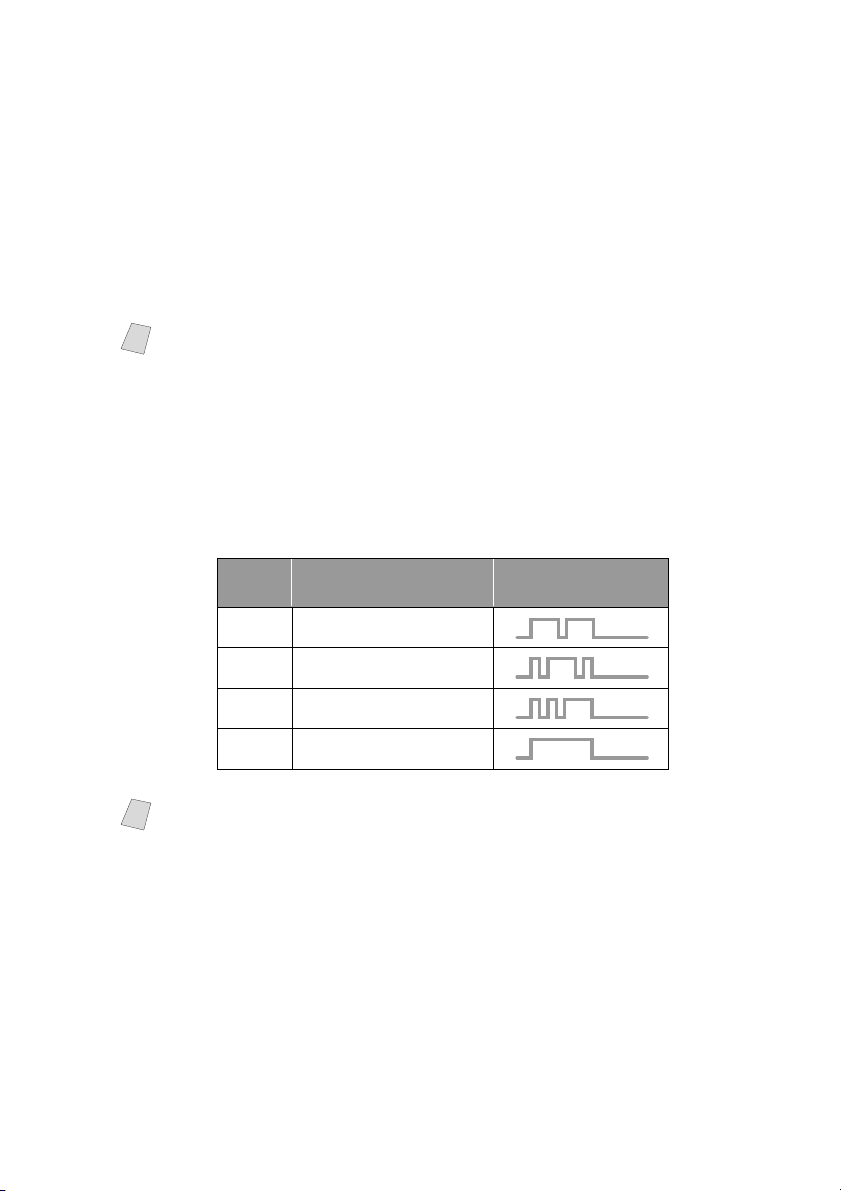
TELEPHONE SERVICES
8 - 2
Do You Have Voice Mail?
If you have Voice Mail on the phone line you on which will install your new
MFC on, there is a strong possibility that Voice Mail and the MFC will conflict
with each other while receiving incoming calls. However, this Distinctive Ring
feature allows the use of more than one number on your line, so both Voice
Mail and the MFC can coexist peacefully. If each one has a separate phone
number, neither will interfere with the other’s work.
If you decide to get the Distinctive Ring Service from the telephone company,
you will need to follow the directions below to “register” the new Distinctive
Ring pattern they provided, so your MFC can recognize its incoming calls.
Before You Choose the Ring Pattern to Register
You can register only one Distinctive Ring pattern with the MFC. Some ring
patterns cannot be registered. Please refer to some popular ring pattern examples
that will be provided from the phone company in the USA and Canada that are
shown in the Brother compatibility table below.
■ The MFC will answer only calls to its registered number.
■ The first two rings are silent on the MFC. This is because the fax must «listen»
to the ring pattern (compare it to the pattern that was “registered”).
■ If you program the MFC correctly, it will recognize the registered ring pattern
of the “fax number” within 2 ring patterns and then automatically answer with
a fax tone. When the “voice number” is called, the MFC will not interrupt the
call.
Note
You can change or cancel the Distinctive Ring pattern at any time. You can
switch it off temporarily, and later turn it back on. When you get a new fax
number, make sure you reset this setting.
Note
If the ring pattern the phone company provided cannot be registered by the fax,
please check for other available ring pattern choices from the phone
company.
Ring
Pattern
1
2
3
4
Rings
long - long
short - long - short
short - short - long
very long (normal pattern)
8 - 3
TELEPHONE SERVICES
Very Important
If you have Voice Mail, or a TAD (Telephone Answering Device) and want to
keep one of your phone numbers dedicated only to fax calls, you must leave the
MFC in MANUAL mode at all times while using the Distinctive Ring Feature.
Here’s why: Manual mode will never pick up a call by itself, since it is
«Neutral». When the MFC is in this «neutral» mode, the Distinctive Ring
Feature can be activated. The Distinctive Ring Feature is actually an answering
mode. So, do not activate FAX ONLY mode while using distinctive ring;
otherwise, the MFC will answer calls for all the numbers.
Registering the Distinctive Ring Pattern
1
Set the MFC to MANUAL mode.
2
Press Menu, 2, 0, 1.
3
Press or to select DISTINCTIVE:SET and then press Set.
4
Press or to select the prestored ring pattern you want to assign, and then
press Set. (You will hear each pattern as you scoll through the four patterns.)
Be sure to choose the pattern assigned by the Telephone Company.
5
Press Stop/Exit.
Caller ID
The Caller ID feature of this MFC lets you use the Caller ID subscriber service
offered by many local phone companies. This service provides the LCD, the
name or telephone number of your caller on the LCD as the line rings. (See
Printing Caller ID List, page 8-4.)
After a few rings, the LCD shows the telephone number of your caller (or name,
if available). Once you pick up the handset, the Caller ID information disappears
from the LCD, but the call information remains stored in the Caller ID memory.
■ You will see the first 16 characters of the number or name.
■ OUT OF AREA means call originates outside your Caller ID service area.
■ PRIVATE CALL means the caller has intentionally blocked transmission of
information.
If both the name and number are received, the LCD shows only the name. You
can print a list of Caller ID information received by your MFC.
1.DISTINCTIVE
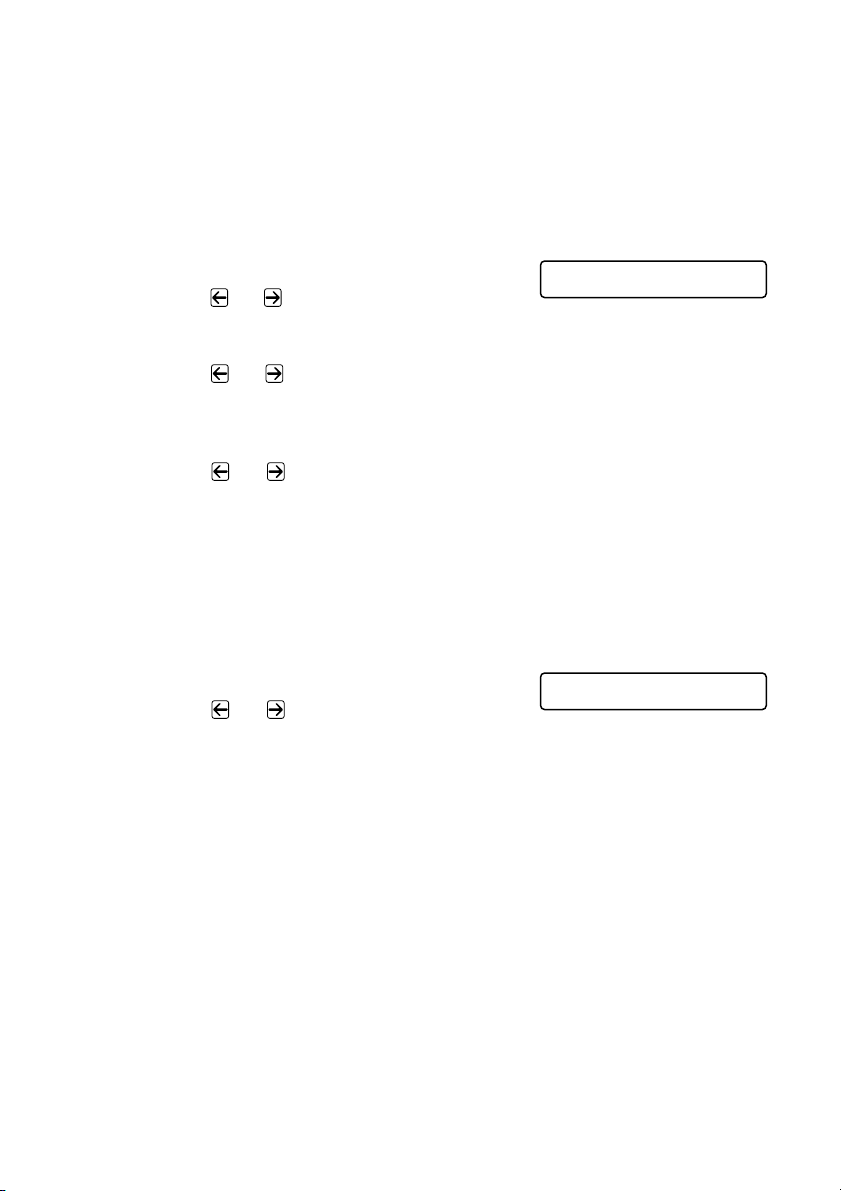
TELEPHONE SERVICES
8 - 4
Caller ID service varies with different carriers. Call your local telephone
company to determine the kind of service available in your area.
Viewing Caller ID List
Caller ID memory stores information for up to thirty calls; when the thirty-first
call comes in, information about the first call is erased. You can scroll through
Caller ID information to review those calls made to your MFC.
1
Press Menu, 2, 0, 2.
2
Press or to select DISPLAY # and
then press Set.
If the name was not received, it will not be displayed.
3
Press or to scroll through the Caller ID memory to select the Caller ID
you want to view and then press Set.
The next LCD shows the caller’s telephone number and the date and time of the
call.
4
Press or to return to the Caller ID listing—OR—Press Stop/Exit.
Clearing a Caller ID Stored in Memory
For effective use of the memory, we recommend that you clear the Caller IDs
stored in memory by pressing Clear when the LCD shows each caller ID
number or name.
Printing Caller ID List
1
Press Menu, 2, 0, 2.
2
Press or to select
PRINT REPORT, and then press Set.
3
Press Fax Start to exit.
2.CALLER ID
2.CALLER ID
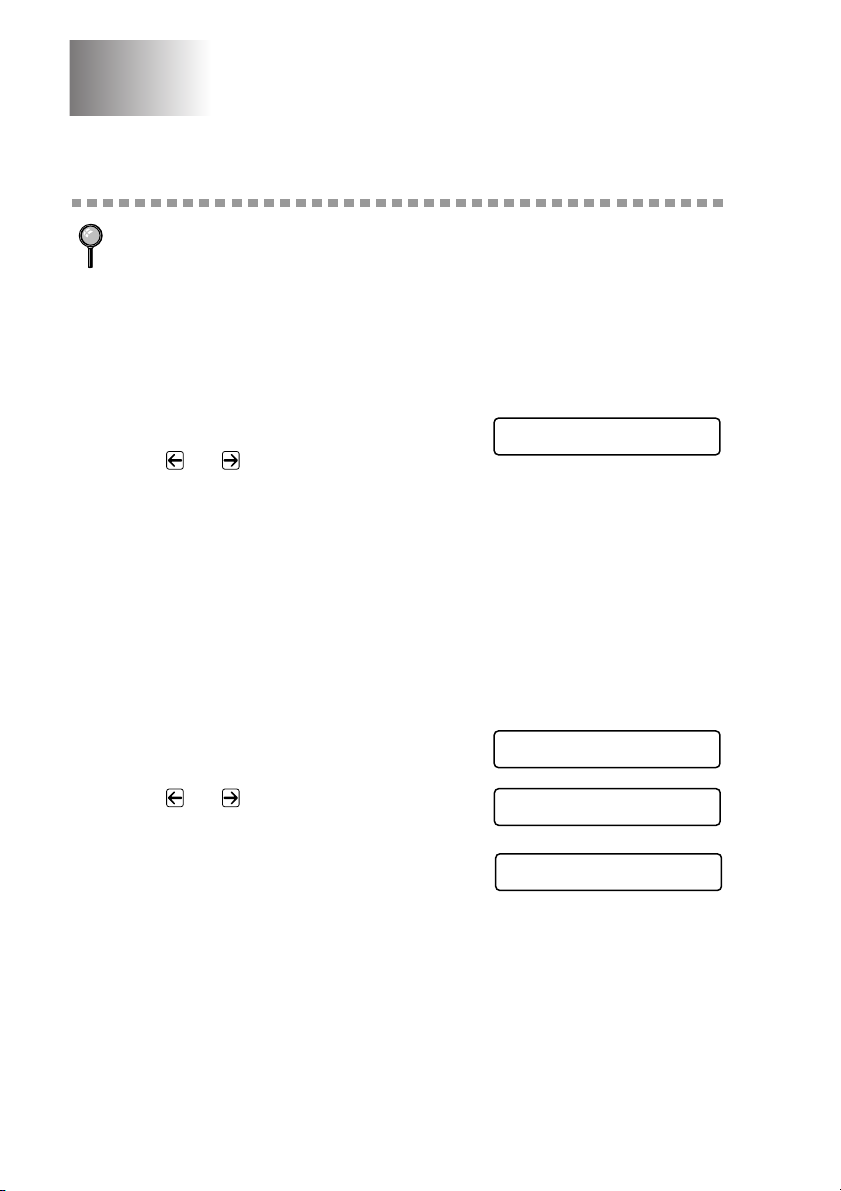
9 - 1
REMOTE FAX OPTIONS
9
9
Remote Fax Options
Fax Forwarding/Paging
Programming a Fax Forwarding Number
When Fax Forwarding is set to ON, your MFC stores the received fax in
memory. Then it dials the fax number you’ve programmed and forwards the fax
message.
1
Press Menu, 2, 5, 1.
2
Press or until the LCD shows
FAX FORWARD, and then press Set.
3
The LCD prompts you to enter the number of the fax machine where faxes will
be forwarded. Enter the forwarding number (up to 20 digits), and then press Set.
4
Press Stop/Exit.
Programming Your Pager Number
When Paging is selected, your MFC dials the pager number you’ve
programmed, and dials your Personal Identification Number (PIN); this
activates your pager so you know you have a fax message in the memory.
1
Press Menu, 2, 5, 1.
2
Press or until the LCD shows
PAGING, and then press Set.
3
Enter your pager phone number (up to 20
digits) followed by # #, and then press
Set. Do not include the area code if it is
the same as that of your MFC.
For example,
1 8 0 0 5 5 5 1 2 3 4 # #.
You cannot use Paging and Fax Forwarding at the same time.
To use Paging or Fax Forwarding you must set Fax Storage to ON.
1.FAX FWD/PAGING
1.FAX FWD/PAGING
PAGING?
SELECT <- -> & SET
PAG#:
ENTER & SET KEY
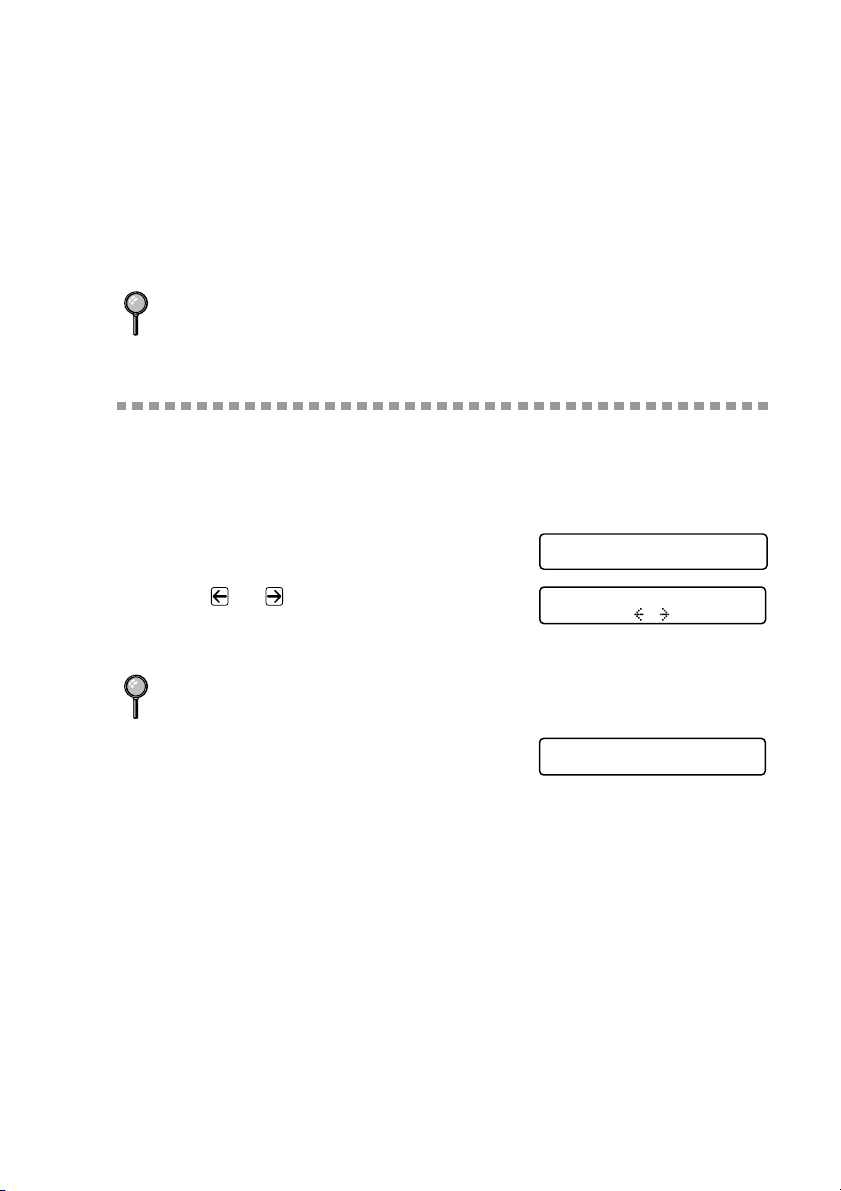
REMOTE FAX OPTIONS
9 - 2
4
If your pager requires a PIN, enter the PIN, and then press #, press
Redial/Pause, enter your fax number followed by # #, and then press Set.
For example, 1 2 3 4 5 # Redial/Pause 1 8 0 0 5 2 1 2 8 4 6 # #.
—OR—
If you do not need a PIN, press Redial/Pause, enter your fax number followed
by # #, and then press Set.
For example,
Redial/Pause 1 8 0 0 5 2 1 2 8 4 6 # #.
5
Press Stop/Exit.
Setting Fax Storage
If you set Fax Storage to ON, you will be able to retrieve fax messages from
another location using Fax Forwarding, Paging or Remote Retrieval operations.
The LCD will indicate when you have a fax stored in memory. The LCD
prompts you to choose a fax setting.
1
Press Menu, 2, 5, 2.
2
Press or to select ON (or OFF),
and then press Set.
3
Press Stop/Exit.
4
Press 1 to erase faxes from memory and to
turn off Fax Storage.
—OR—
Press 2 to exit without deleting faxes or
changing this setting.
(See
Printing a Fax in Memory, page 5-6.)
Backup Print
If you have set FAX STORAGE to ON, your MFC automatically prints faxes
as they are received into memory. This is a safety feature in case the power goes
out so you won’t lose your message.
You cannot change a Paging number or PIN remotely.
Press Redial/Pause for each 3.5 second delay, as needed.
If there are faxes in memory when you turn Fax Storage OFF, you must choose
to delete them or exit without turning Fax Storage on.
2.FAX STORAGE
FAX STORAGE:OFF?
SELECT & SET
ERASE ALL FAX?
1.YES 2.NO

9 - 3
REMOTE FAX OPTIONS
Changing Remote Retrieval Access Code
Enter your Remote Retrieval Access Code when the MFC picks up your call, so
you can access features remotely. The access code is preset to 1 5 9 , however,
you can change your access code. (See
Operation from Extension Telephone, page
5-5.)
1
Press Menu, 2, 5, 3.
2
Enter a three-digit number from 000 to
999, and then press Set.
The “” cannot be changed. Do not use the same digits that appear in your Fax
Receive Code or Telephone Answer Code.
3
Press Stop/Exit.
Remote Retrieval
You can call your MFC from any fax machine using touch tone, then use the
Remote Retrieval Access Code and other button presses to retrieve fax
messages. Cut out the Remote Retrieval Access Card on the last page and keep
it in your wallet as an aid.
Using Remote Retrieval Access Code
1
Dial your MFC phone number from a fax machine using touch tone.
2
When your MFC answers, immediately enter your Remote Retrieval Access
Code (1 5 9 ).
3
The MFC signals the kinds of messages received:
1 long beep — Fax message(s)
No beeps — No messages
4
The MFC then prompts you with two short beeps to enter a command. If you
wait longer than 30 seconds to enter a command, the MFC hangs up. If you
enter an invalid command, the MFC beeps three times.
5
Press 9 0 to reset the MFC when you’re finished.
6
Hang up.
If your MFC is set to MANUAL mode, you can access it by waiting about 2
minutes, and then entering the Remote Retrieval Access Code within 30
seconds.
3.REMOTE ACCESS
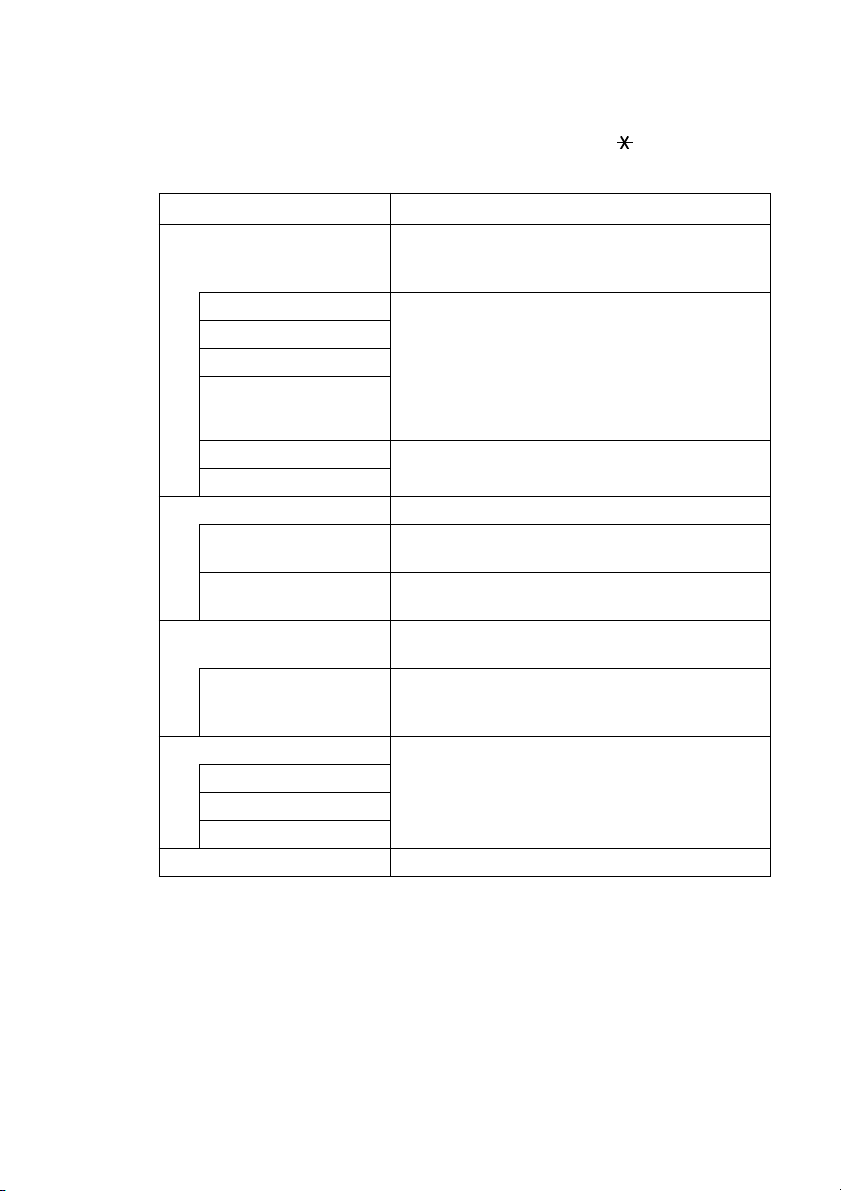
REMOTE FAX OPTIONS
9 - 4
Remote Commands
Follow the commands below to access features remotely. When you call the
MFC and enter your Remote Retrieval Access Code (1 5 9 ), the system will
signal you with two short beeps to enter a remote command.
Remote Commands Operation Details
95 Changing Fax
Forwarding/
Paging setting
1 OFF If you hear one long beep, the change is accepted. If you
hear three short beeps, you cannot change it because the
conditions have not been met. (Example: registering
paging number.) You can register your fax forwarding
number by using 4. FAX FWD NO. (See page 9-5.) Once
you have registered the number, your MFC will change
automatically to FAX FWD:ON mode.
2 Fax Forwarding
3 Paging
4 FAX FWD No.
6 Fax Storage ON You can turn FAX STORAGE to ON or OFF.
7 Fax Storage OFF
96 Retrieve a fax
2 Retrieve all faxes Enter the number of a remote fax machine to receive
stored fax message(s). (See page 9-5.)
3 Erase fax from the
memory
If you hear one long beep, you can erase fax message(s)
from the memory.
97 Check the Receiving
Status
1 Fax You can check whether your MFC has received any fax
message(s). If yes, you will hear one long beep. If no,
you will hear three short beeps.
98 Change Receive Mode If you hear one long beep, you can change the Receive
Mode. If you hear three short beeps, you cannot change
it.
1 TAD:ANSWER MACH.
2 FAX/TEL
3 FAX ONLY
90 Exit After a long beep, you can exit remote control.

9 - 5
REMOTE FAX OPTIONS
Retrieving Fax Messages
1
Dial your fax number.
2
When your MFC answers, immediately enter your Remote Retrieval Access
Code (1 5 9 ).
3
As soon as you hear two short beeps, use the dial pad to press 9 6 2.
4
Using the dial pad, enter the number (up to 20 digits) of the remote fax machine
where you want your fax messages forwarded, followed by # #.
5
After you hear your MFC beep, hang up and wait.
Your MFC calls the remote fax machine. The remote fax machine prints your
fax messages.
Changing Fax Forwarding Number
You can change the default setting of your fax forwarding number from a
remote fax machine.
1
Dial your fax number.
2
When your MFC answers, immediately enter your Remote Retrieval Access
Code (1 5 9 ).
3
When you hear two short beeps, use the dial pad to press 9 5 4.
4
Enter the new number (up to 20 digits) of the remote fax machine where you
want your fax messages forwarded, followed by # #.
5
After you hear your MFC beep, hang up.
You cannot use and # as dial numbers. However, if you want to store a
pause, press #.
You cannot use and # as dial numbers. However, if you want to store a
pause, press #.
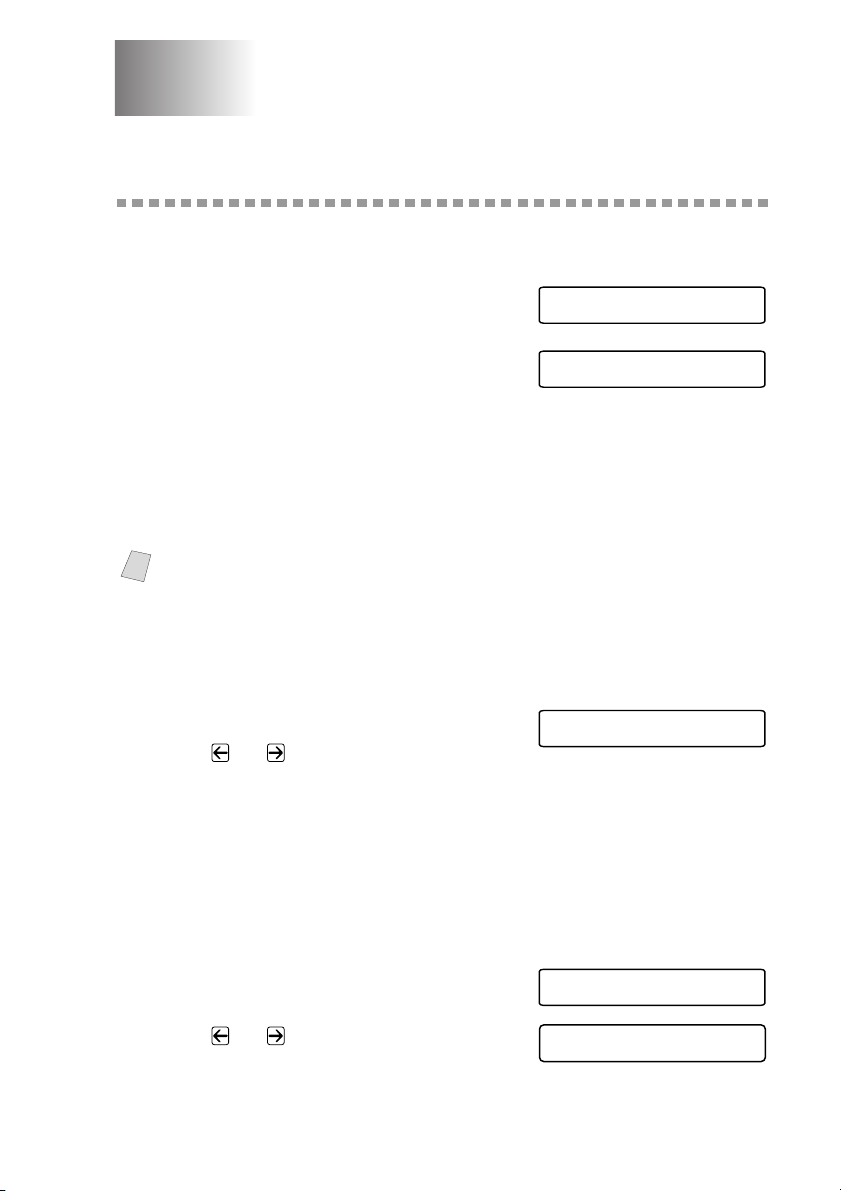
PRINTING REPORTS
10 - 1
10
10
Printing Reports
MFC Settings and Activity
Two reports require initial setup in the Menu: Transmission Verification Report
and Fax Activity Report Interval. For initial setup:
Press Menu, 2, 4, 1 .
—OR—
Press Menu, 2, 4, 2.
Customizing the
Transmission Verification Report
You can use the Transmission Report as proof that you sent a fax. This report
lists the job number, time and date of transmission and whether the transmission
was successful (OK). If you select ON or ON+IMAGE, the report will print for
every fax you send.
If you typically send multiple faxes to the same destinations, you may need
more than the job numbers to know the faxes you must send again. Selecting
OFF+IMAGE will print a portion of the fax’s first page on the report to help
you remember.
1
Press Menu, 2, 4, 1.
2
Press or to select OFF,
OFF+IMAGE, ON or ON+IMAGE, and then press Set.
3
Press Stop/Exit.
Setting the Fax Activity Report Interval
You can set the MFC to print activity reports at specific interval (6, 12, 24 hours,
2, 4, or 7 days). If you set the interval to OFF, you can print the report by
following the Steps on the next page.
1
Press Menu, 2, 4, 2.
2
Press or to choose an interval,
and then press Set.
(If you choose 7 days, the LCD prompts you to choose a day on which to begin
the 7-day countdown.)
Note
When the feature is OFF, the report prints only if a transmission error
prevented delivery (NG).
1.TRANSMISSION
2.ACT.INTERVAL
1.TRANSMISSION
2.ACT.INTERVAL
INTERVAL: OFF
SELECT <- -> & SET
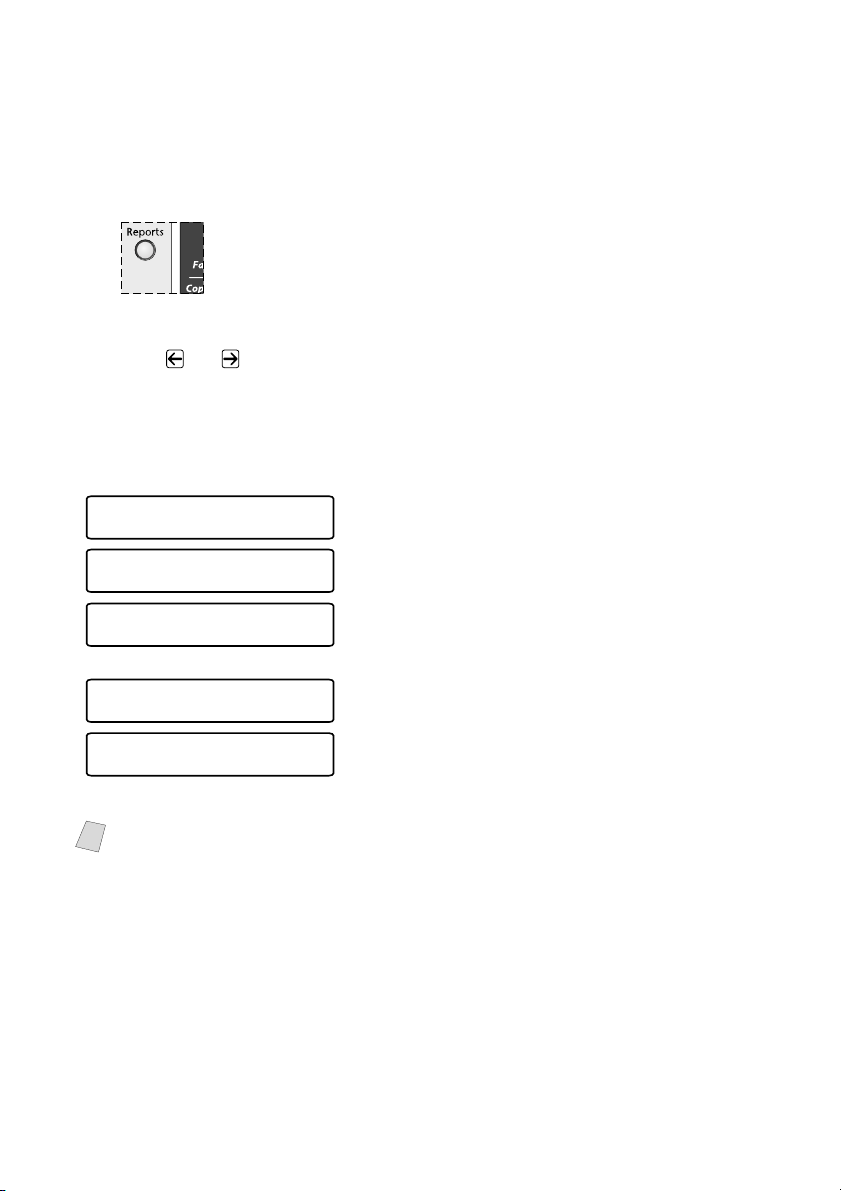
10 - 2
PRINTING REPORTS
3
Enter the time to begin printing, in 24-hour format, and then press Set.
(For example: enter 19:45 for 7:45 PM.)
4
Press Stop/Exit.
Using the Reports Key
1
Press Reports.
2
Press or to select the report you want, and then press Set.
—OR—
Enter the number of the report you want to print. For example, press 1 to print
the Help List.
Five reports are available:
Prints the Help List so you can see at a glance
how to quickly program every menu selection.
Lists names and numbers stored in One Touch
and Speed Dial memory, in numerical order.
Lists information about the last 200 incoming
and outgoing faxes. TX means Transmit; RX
means Receive.
Prints a transmission Verification Report for
your last transmission.
Lists settings for GENERAL SETUP,
SETUP RECEIVE, SETUP SEND,
SETUP REPORTS, REMOTE FAX OPT
and MISCELLANEOUS.
Note
Don’t forget to set up the Fax Activity Report and Transmission Verification
Report as explained on page 10-1.
1.HELP LIST
2.AUTO DIAL
3.FAX ACTIVITY
4.TRANSMISSION
5.USER SETTINGS
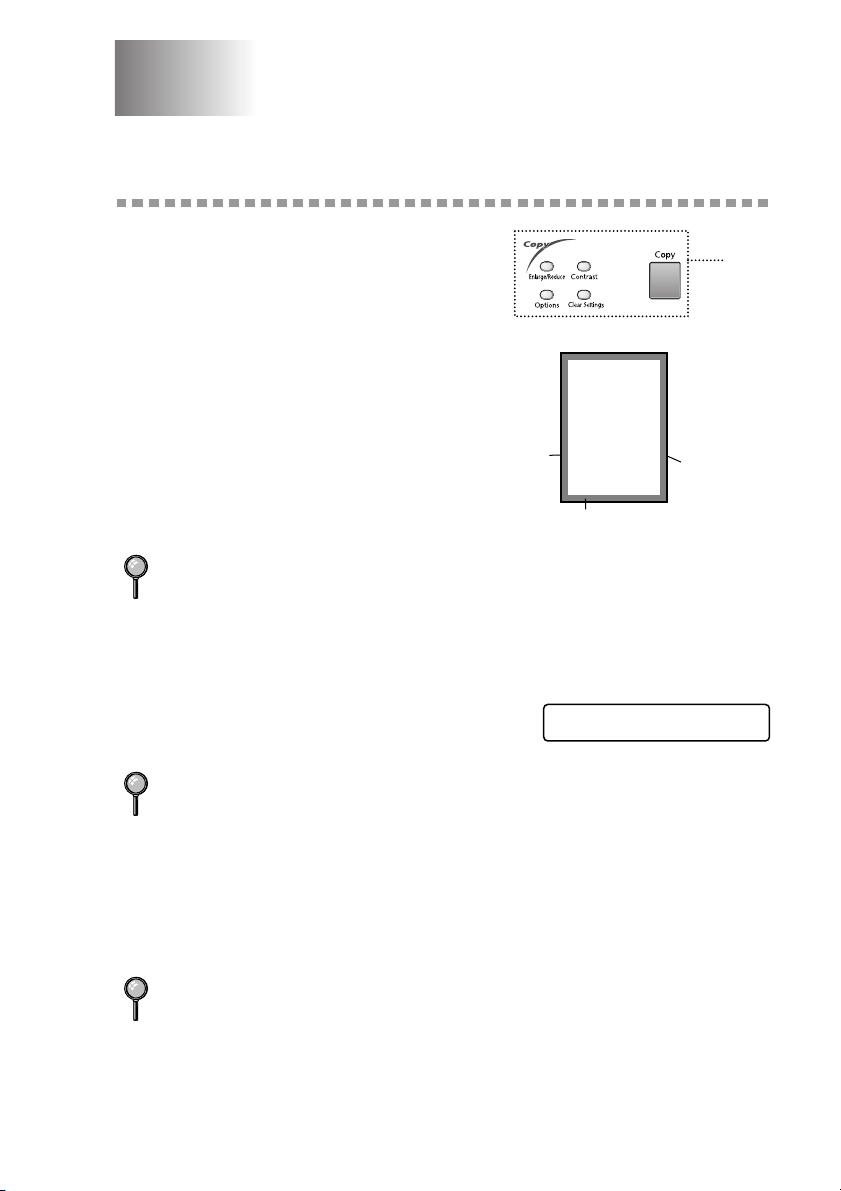
MAKING COPIES
11 - 1
11
11
Making Copies
Basic Copy Operations
You can use your MFC as a copier,
making up to 99 copies at a time.
The MFC can stack the copies or
collate (sort) them.
The scannable area of your MFC
begins at approximately one-sixth
inch (4mm) from the edge of the
paper.
Making a Single Copy (Using the ADF)
1
Place the original face up in the ADF.
2
Press Copy.
Do NOT pull on the paper while copying
is in progress.
Making Multiple Copies (Using the ADF)
1
Insert the original face up in the ADF.
2
Use the dial pad to enter the number of copies you want (up to 99).
3
Press Copy.
Incoming faxes cannot be received on paper or into memory while the MFC is
copying.
To stop copying and eject the original, press Stop/Exit.
To release the original document, press Stop/Exit.
To sort the copies, use the Options key.
(See
Using the Options Key, page 11-5.)
Copy
Keys
Not
Scannable
area
1/6" (4mm)
1/6" (4mm)
COPYING P.01
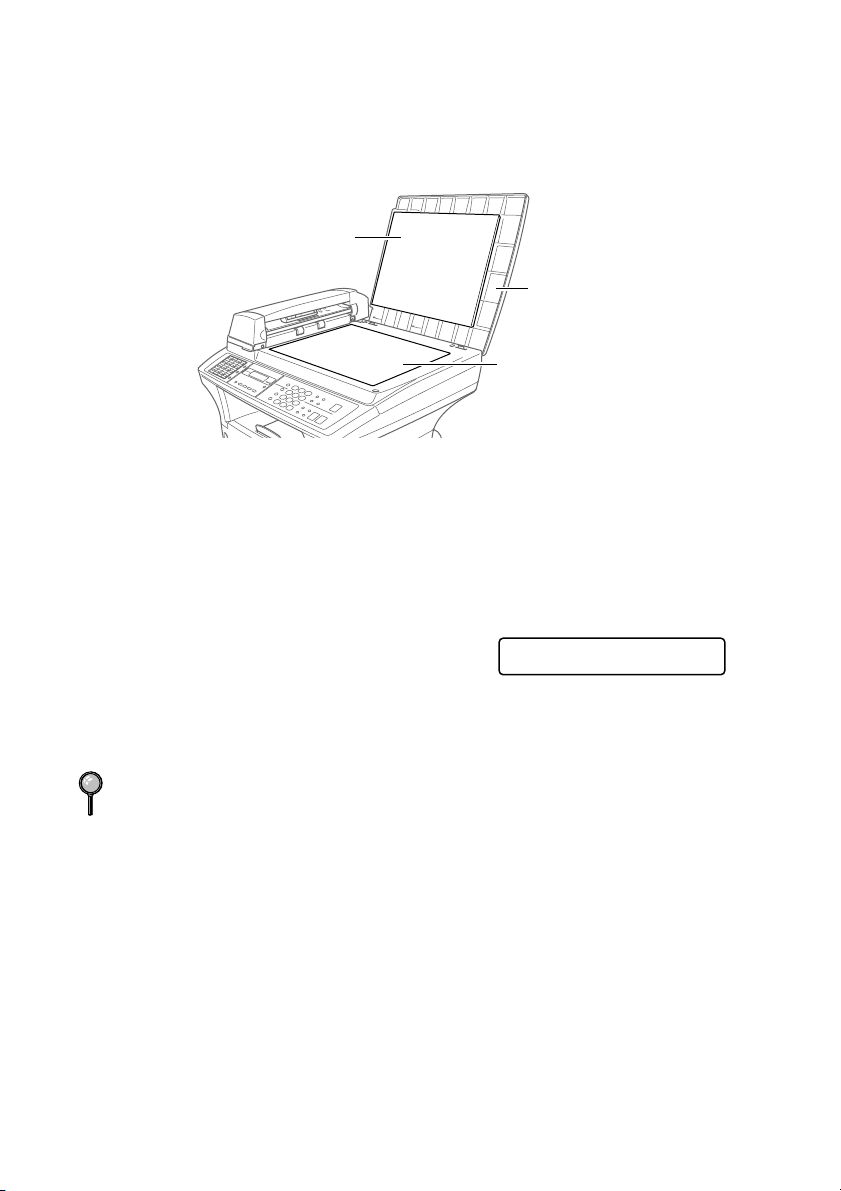
11 - 2
MAKING COPIES
Single or Multiple Copies (Using the Scanner Glass)
If you want to sort multiple copies, use the ADF. (See Sorting Multiple Copies
(Using the ADF)
, page 11-5.)
1
Lift the Document Cover.
2
Using the document guide on the left, center the original face down on the
scanner glass and close the Document cover.
3
Using the dial pad, enter the number of copies you want (up to 99).
4
Press Copy .
Out of Memory Message
If the memory becomes full while you are
making copies, the LCD shows a message:
If the OUT OF MEMORY message appears while you are scanning the first
page of your original, press Stop/Exit to cancel. You will need to clear some
faxes from memory before you can continue.
To gain extra memory, you can turn off Fax Storage (see page 9-2).
—OR—Print fax messages in memory (see page 5-6).
Document
Cover
White Film
Scanner
Glass
OUT OF MEMORY
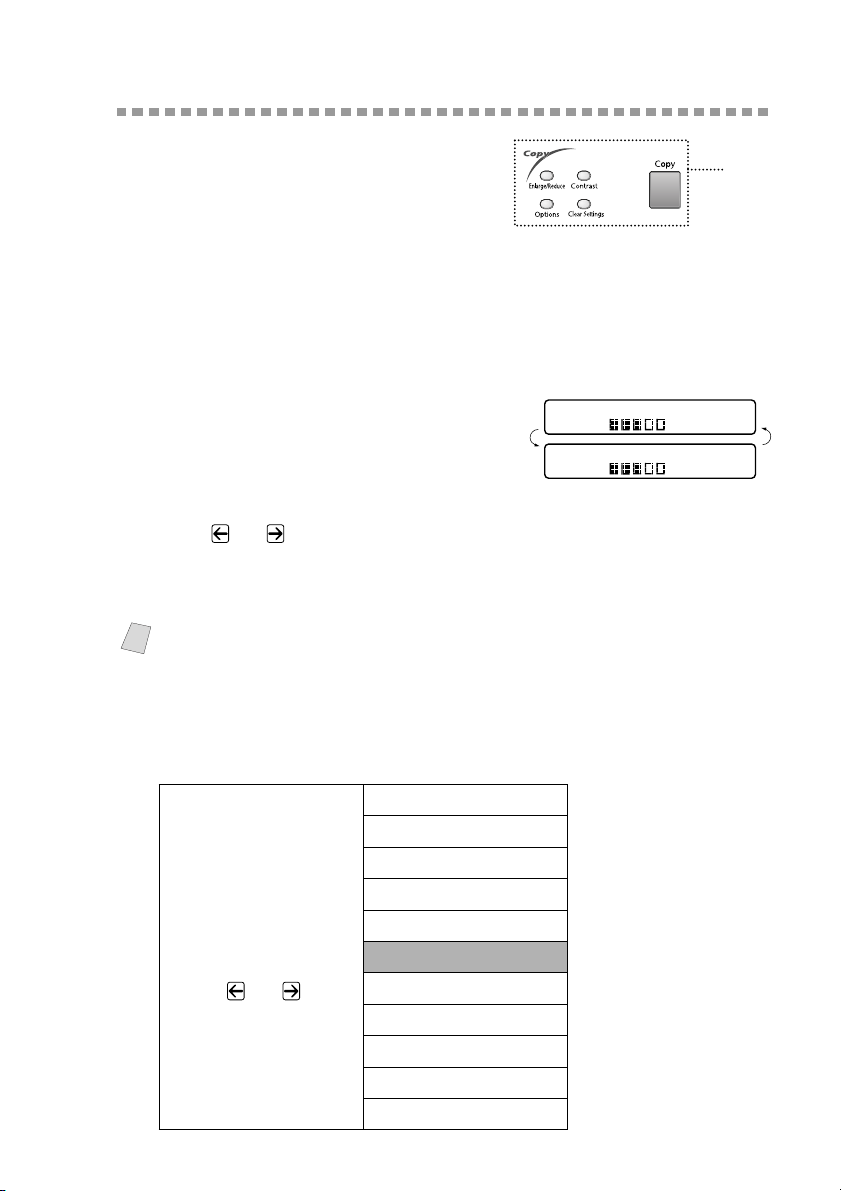
MAKING COPIES
11 - 3
Temporary Copy Settings
You can improve your copies by
using the Copy keys: Enlarge/
Reduce, Contrast, Options
and Clear Settings. These
settings are temporary, and the
MFC returns to its default settings
45 seconds after it finishes
copying. If you want to use these temporary settings again, place the next
original in the ADF or on the scanner glass before the 45 seconds expire.
Copying Using Multiple Settings
You can try different combinations of
settings for the best results. After you
finish your settings using the
Enlarge/Reduce or Options keys, the
LCD shows:
■ Press
or if you want to select additional settings.
—OR—
Press Copy if you are finished choosing settings.
Using Enlarge/Reduce Key
AUTO sets the MFC to calculate the ratio that fits the size of your paper.
ZOOM allows you to enter a ratio from 25% to 400% in 1% increments.
Note
To clear your settings and start over, press Clear Settings.
Press
Enlarge/Reduce
and
or
25%
50%
78% LGL>LTR
94% A4>LTR
AUTO
100%
104% EXE>LTR
150%
200%
400%
ZOOM
Copy
Keys
PRESS COPY OR
100% AUTO
<- -> FOR NEXT OPT.
100% AUTO
11 - 4
MAKING COPIES
1
Place the original face up in the ADF, or face down on the scanner glass.
2
Use the dial pad to enter the number of copies you want (up to 99).
3
Press Enlarge/Reduce. (Enlargement or reduction ratios appear.)
4
Press or to select 25%, 50%, 78%, 94%, AUTO, 100%, 104%,
150%, 200% 400%, or ZOOM, and then press Set. (Enlargement or reduction
ratios appear.)
—OR—
For more choices select ZOOM, and the press Set. Use the dial pad to enter
any percentage between 25% and 400%.
5
Press Copy—OR—Press or for additional settings.
When selecting an enlargement or reduction ratio, you will need to know the
size of the paper you registered in Menu 1-1.
Selecting a Fixed Ratio:
Copy Contrast
You can adjust copy contrast to make copies darker or lighter.
1
Place the original face up in the ADF, or face down on the scanner glass.
2
Use the dial pad to enter the number of copies you want (up to 99).
3
Press Contrast.
4
Press to make a copy lighter, or to make a copy darker, and then press
Set.
5
Press Copy—OR—Press or for additional settings.
Note
Special Copy Options (2 in 1, 4 in 1, Poster or OFF) are not available with
Enlarge/Reduce.
Poster copies require using the scanner glass.
Original is
the size of…
Paper
size is…
Recommended
ratio is…
LETTER LEGAL 100%
A4 LETTER 94%
LEGAL LETTER 78%
MAKING COPIES
11 - 5
Using the Options Key
Use the Options key to temporarily change the copy mode (resolution),
contrast and special copy options. See the explanations below the table.
Copy Mode (Type of Original)
You can select the Copy Mode for your type of original. The default setting is
AUTO, which is used for originals that contain both text and photographs.
TEXT is used for originals containing only text. PHOTO is used for copying
photographs.
1
Place the original face up in the ADF, or face down on the scanner glass.
2
Use the dial pad to enter the number of copies you want (up to 99).
3
Press Options and or to select OPT:COPY MODE, and then press
Set.
4
Press or to choose the type of original (AUTO, TEXT or PHOTO),
and then press Set.
5
Press Copy—OR—Press or for additional settings.
Sorting Multiple Copies (Using the ADF)
1
Place the original face up in the ADF.
2
Use the dial pad to enter the number of copies you want (up to 99).
3
Press Options and or to select OPT:STACK/SORT, and then press
Set.
4
Press or to select SORT, and then press Set.
5
Press Copy—OR—Press or for additional settings.
Press
Options
Menu Selections Options Factory Setting
OPT:# OF COPIES NO. OF COPIES:XX
01
OPT:COPY MODE
AUTO/TEXT/PHOTO
AUTO
OPT:STACK/SORT
STACK/SORT STACK
OPT:SPECIAL
2 IN 1/4 IN 1/POSTER/OFF
OFF
OPT:PAPER TYPE
THIN/PLAIN/THICK/
THICKER/TRANSPARENCY
PLAIN
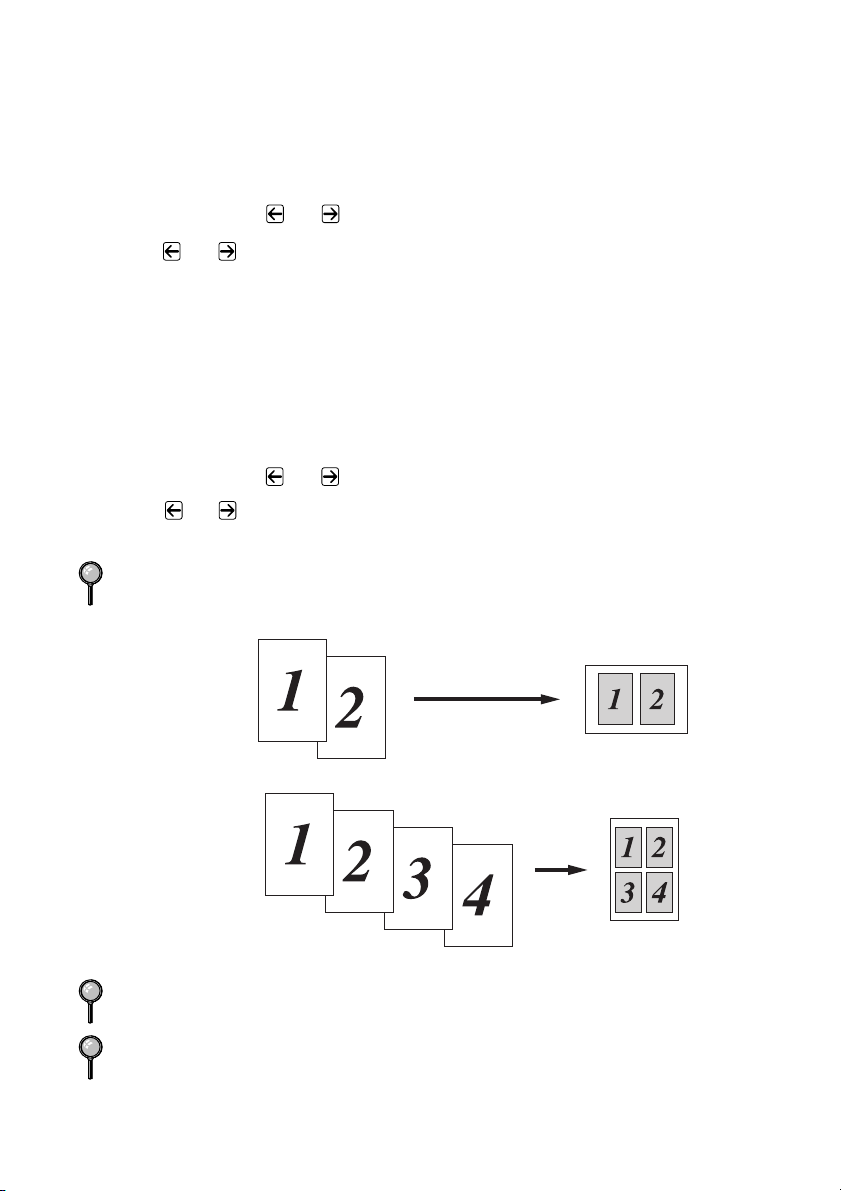
11 - 6
MAKING COPIES
Special Copy Options (Using the ADF)
You can save paper by copying either two or four pages onto one page.
1
Place the originals, face up in the ADF.
2
Use the dial pad to enter the number of copies you want (up to 99).
3
Press Options and or to select OPT:SPECIAL, and then press Set.
4
Press or to select 2 IN 1, 4 IN 1 or OFF, and then press Set.
5
Press Copy.
Special Copy Options (Using the Scanner Glass)
You can save paper by copying either two or four pages onto one page, or you
can create poster size copy.
1
Place the original face down on the scanner glass.
2
Use the dial pad to enter the number of copies you want.
3
Press Options and or to select OPT:SPECIAL, and then press Set.
4
Press or to select 2 IN 1, 4 IN 1, POSTER or OFF, and then press Set.
5
Press Copy.
2 in 1
4 in 1
If you selected 2 IN 1 or 4 IN 1 in step 4, place the next original on the scanner
glass, and then press Set. After all originals have been scanned, press Copy.
Special Copy Options (2 in 1, 4 in 1 or Poster) are not available with
Enlarge/Reduce.
Incoming faxes cannot be received on paper or into memory while the MFC is
making 2 IN 1 or 4 IN 1 copies.
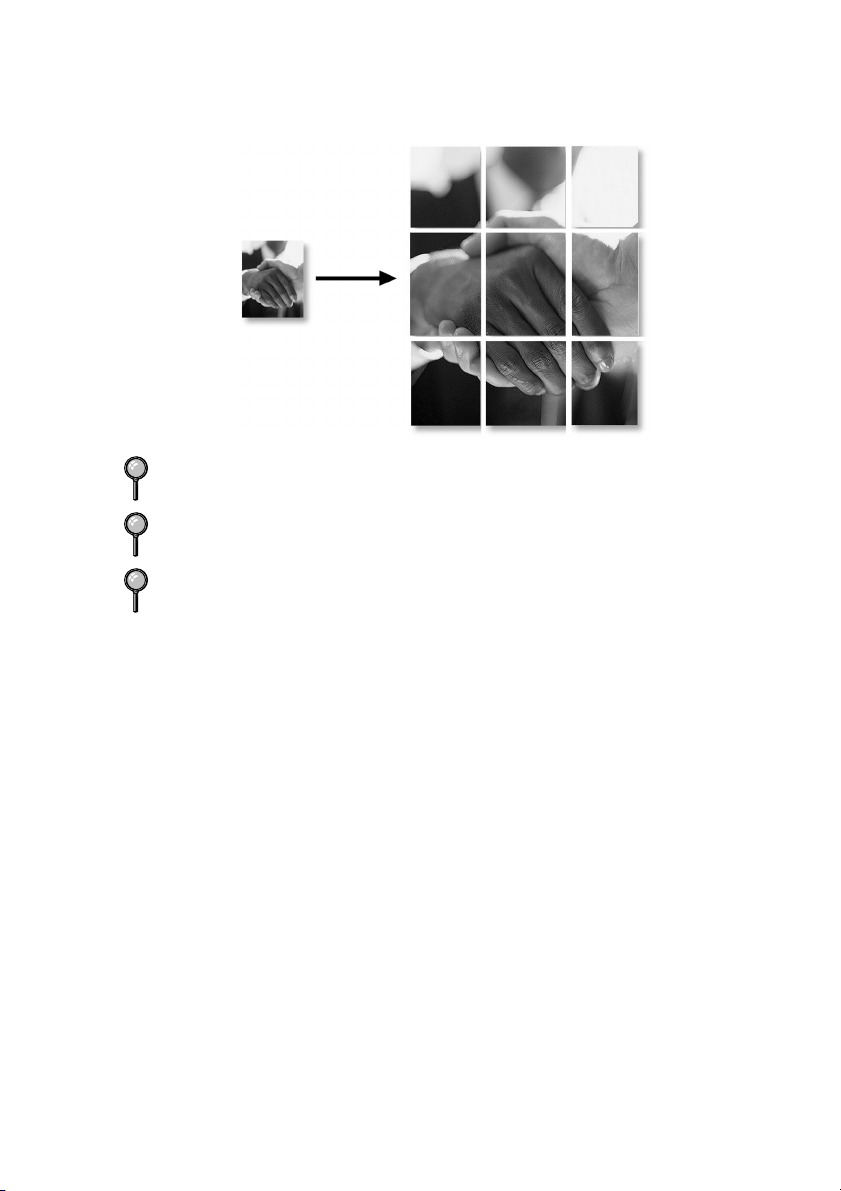
MAKING COPIES
11 - 7
Poster
You can create a poster size copy of a photograph.
Special Copy Options (2 in 1, 4 in 1 or Poster) are not available with
Enlarge/Reduce.
Poster is not available for multiple copies.
Poster copies require using the scanner glass.
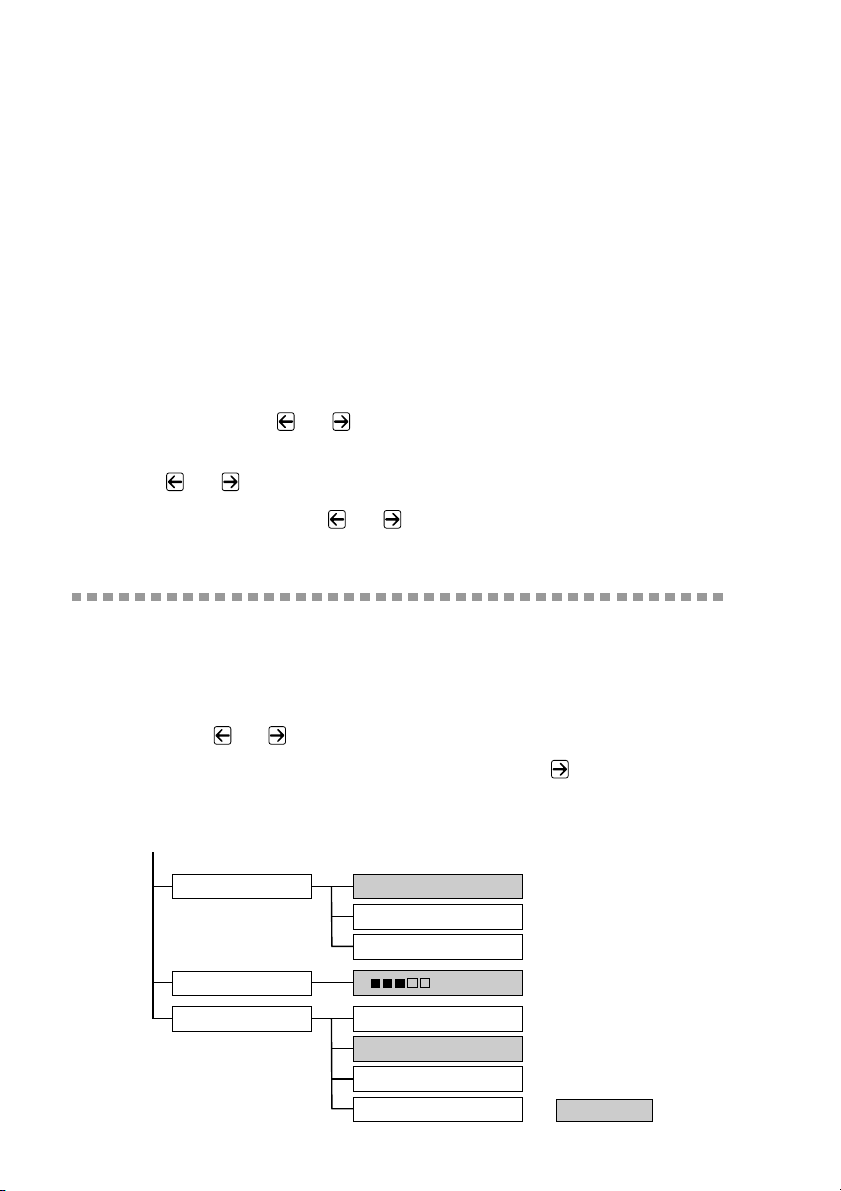
11 - 8
MAKING COPIES
Paper Type
You can use the following types of paper for copying. For the best print quality,
select the type of media that you are using.
THIN (16lb - 18.4lb) - For thin paper or transparency
PLAIN (18.7lb - 25.3lb) - For ordinary plain paper
THICK (25.6lb - 32lb) - For heavy weight paper or rough paper
THICKER (32.3lb - 43lb) - For heavier weight paper, rough paper or bond
paper.
TRANSPARENCY - For transparency (OHP)
1
Press Options and or to select OPT:PAPER TYPE, and then press
Set.
2
Press or to select your type of paper, and then press Set.
3
Press Copy—OR—Press or for additional settings.
Changing Default Copy Settings
Press Menu, 3 to change default settings for Copy mode. These settings will
remain until you change them again by pressing Menu. Adjust the Copy Mode
and Contrast settings.
By pressing a number, you can adjust copy settings as shown in the following
chart. Press
or to scroll through the options for each setting. Press Set
to save your selection. Press Stop/Exit. —OR—Press
to select the next
setting you want to change.
Press Menu, and 3.
TEXT
1.COPY MODE
2.CONTRAST
- +
is defaul
t
AUTO
PHOTO
PLAIN
THICK
THICKER
3.PAPER TYPE
THIN
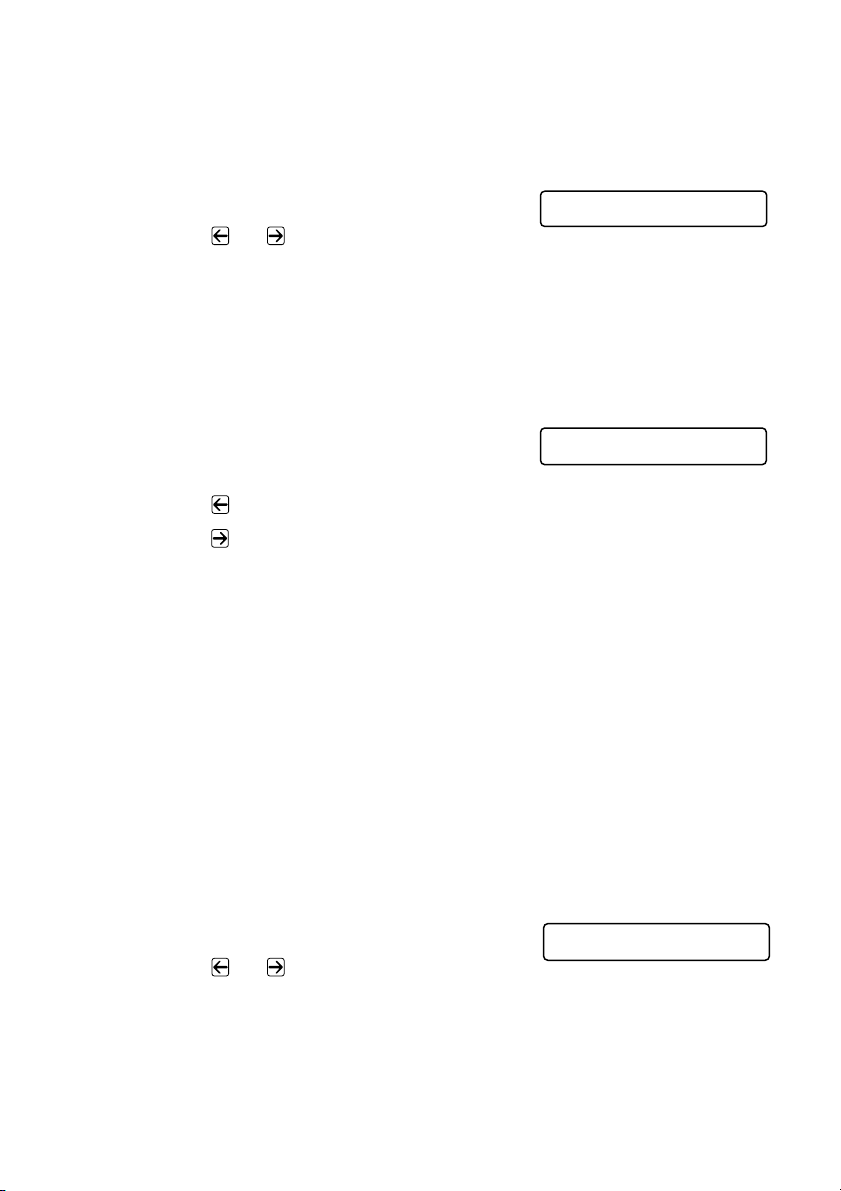
MAKING COPIES
11 - 9
Copy Mode (Type of Original)
You can select the Copy Mode for your type of original. The default setting is
AUTO
, which is used for originals that contain both text and photographs.
TEXT
is used for originals containing only text.
PHOTO
is used for copying photographs.
1
Press Menu, 3, 1.
2
Press or to choose the type of
original (AUTO, TEXT or PHOTO), and
then press Set.
3
Press Stop/Exit.
Copy Contrast
You can adjust copy contrast to make copies darker or lighter.
1
Press Menu, 3, 2.
2
Press to make a copy lighter—OR—
Press
to make a copy darker, and then press Set.
3
Press Stop/Exit.
Paper Type
You can use the following types of paper for copying. For the best print quality,
select the type of media that you are most often.
THIN (16lb - 18.4lb) - For thin paper
PLAIN (18.7lb - 25.3lb) - For ordinary plain paper
THICK (25.6lb - 32lb) - For heavy weight paper or rough paper
THICKER (32.3lb - 43lb) - For heavier weight paper, rough paper or bond
paper.
1
Press Menu, 3, 3.
2
Press or to select your type of
paper, and then press Set.
3
Press Stop/Exit.
After you connect the optional Cassette #2, you can select the paper size for each
cassette. (See page 4-1.)
1.COPY MODE
2.CONTRAST
3.PAPER TYPE

12 - 1
FOR DOS USERS
12
12
For DOS Users
How to Use the Brother MFC with Your DOS
Application Software
Before working with your application software that runs on DOS, check that the
Brother MFC’s name appears in the printer selection of your application
software. If the MFC is not listed, you must install the printer driver that
corresponds to HP LaserJet’s emulations.
The following table shows combinations of printer drivers and emulation mode.
To get the most out of this MFC, you should install an HP printer driver in your
application software.
■ The best or recommended printer driver is indicated in bold.
■ Be sure to choose the proper printer driver in your application software.
■ Be sure the printing resolution is set to 600 dpi in your DOS application
software.
What Does the Remote Printer Console Do?
The Remote Printer Console (RPC) is a utility program that can run in the DOS
environment and comprises the following program:
Remote Printer Console Main Program
This program allows you to change various printer settings such as emulation,
print quality, fonts and page setup from your computer screen. Since most DOS
applications have a Printer Settings menu that overrides the settings made by the
RPC, you may not have to use this utility program. This utility program is useful
for application software that does not control the printer’s settings and features.
Printer driver supported in
your application software
Emulation mode to be selected with the remote
printer console program
HP LaserJet
™
HP LaserJet emulation mode

FOR DOS USERS
12 - 2
Installing the Remote Printer Console
Before you install the program, make sure you have the following hardware and
software to install the program:
Follow these steps to install the remote printer console program:
1
Make sure your Brother MFC is connected to your computer and is set to
Online.
2
Start your computer and go to the DOS prompt. If you are in Windows
®
, exit
and return to the DOS prompt.
3
Insert the Brother CD-ROM into your CD-ROM drive.
4
At the DOS prompt (C:\>) type x: (Substitute the drive letter of your CD-ROM
drive for “x”), and then press Enter.
5
Type CD RPCX, and then press Enter.
6
Type RPCSETUP, and then press Enter.
7
Follow the instructions in the installer.
DOS Version 3.3 or later
Monitor EGA/VGA or compatible
Option Mouse; the mouse driver must be installed.
(You can also operate the program with the keyboard.)
C:\>x:
x:\>CD RPCX5
x:\RPCX5>RPCSETUP
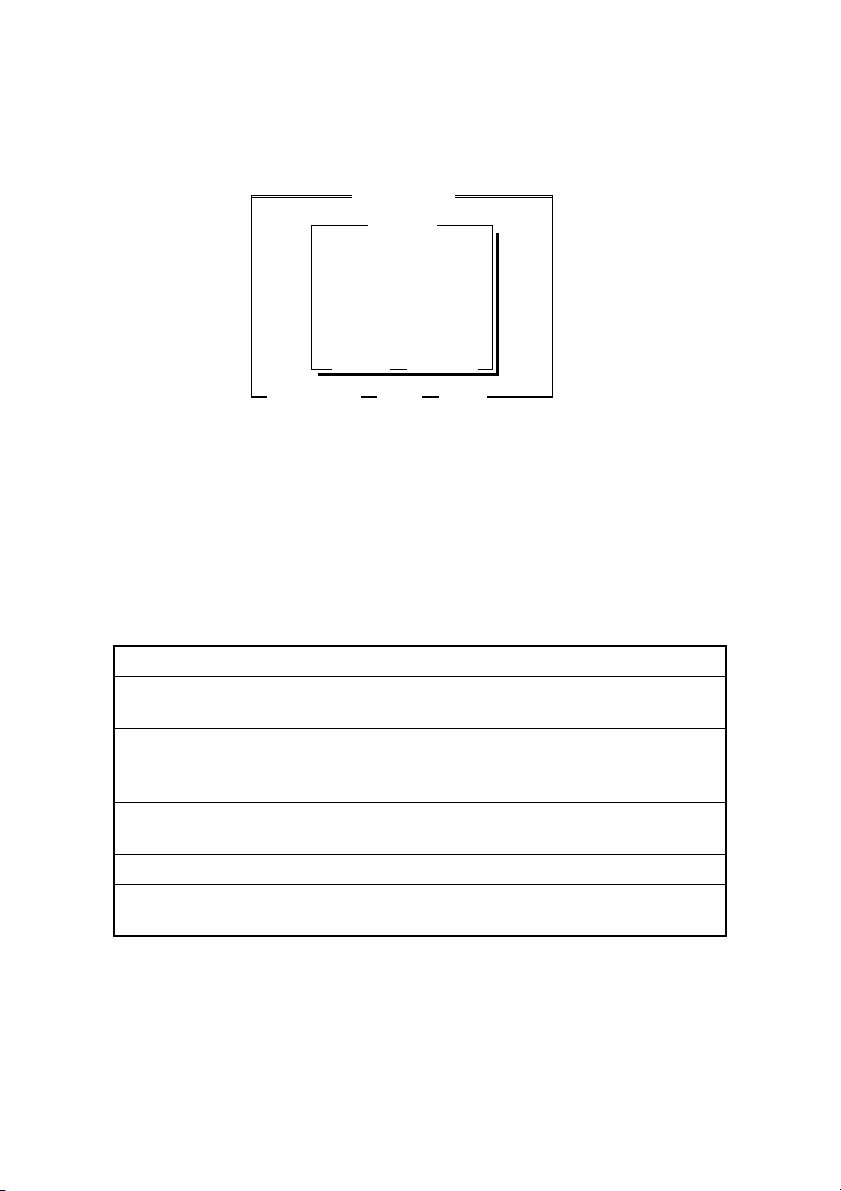
12 - 3
FOR DOS USERS
Using the Remote Printer Console Main Program
Type C:\RPCX>RPCX, and then press the Enter key to start the Remote
Printer Console main program.
The Main Screen will appear on your computer screen as shown below.
If bi-directional communication is enabled between your computer and MFC
when it starts, the RPC gets the current settings information from your MFC.
Otherwise, RPC shows its default settings. If you want to change settings, move
the cursor to the item you want and select it using the Enter and Cursor keys.
Then, press the Enter key to make the selected settings valid.
There are four sub menus. (See table below.) Select the sub menu you want by
clicking on it with the mouse, using the cursor keys and the Enter key, or by
pressing the hot key commands for that sub menu.
Menu Press the keys Functions
Direct
Access
Alt + D You can directly control the Brother MFC, with
Print Form.
Printer
Setup
Alt + P You can enter the setting mode to change other
printer settings, such as, margin settings, continue
mode, font and sleep mode.
Console
Config
Alt + C You can change the environment settings for the
RPC program: color, etc.
Guide Alt + G You can go to the Guide mode.
Help F1 You can get Online Help: If you press F1, you can
get information on a highlighted item.
Direct_Access Printer_Setup Console_Config Guide
Remote Printer Console
Current Status
Status
Media Type
Paper feed
Emulation
Paper Size
Orientation
Quality
Copies
Memory size
Ready
Regular
Paper Cassette
Laser Jet 5P
Letter
Portrait
Normal
1
2138112 Byte
[Enter] Setting[↑/¬] Select
[ESC] Exit[F1] Help[Alt+Character] Menu
FOR DOS USERS
12 - 4
Remote Printer Console
Current Printer Status Information
*1 The items can be set in the current printer status information dialog box.
Printer Setup Category
Print Setup Section
Item Default What This Item Does
Media Type Regular Selects the media type “Regular,” “Thin Paper,”
“Thick Paper,” “Thicker Paper,” “Bond Paper”
or “Transparency.”
Paper Feed Dual
Upper Paper
Cassette
Lower Paper
Cassette
Selects the paper feed mode, either “Paper
Cassette” or “Manual.”
Emulation*1 Laser Jet Selects “Laser Jet.”
Paper Size*1 Letter Selects the paper size, either “Letter,” “Legal,”
“A4,” “Executive,’’ “Monarch,” “COM10,”
“DL,” “C5,” “B5,” “A5,” “A6,” or “JIS B5.”
Orientation*1 Portrait Selects the paper direction, either “Portrait” or
“Landscape.”
Quality*1 Normal Selects the print quality, either “Normal” or
“Economy.”
Copies*1 1 Sets the number of print copies from 1 to 999
pages.
Item Default What This Item Does
Copies 1 Sets the number of print copies from 1 to 999
pages.
Quality Normal Selects the print quality to either “Normal” and
“Economy.”
Emulation Laser Jet Selects “Laser Jet”

12 - 5
FOR DOS USERS
Page Setup Section
*1 These values (except Yoffset and Xoffset) are overidden by settings within
your application software.
*2 These values depend on the paper size settings.
Font Configuration
Item Default What This Item Does
Left Margin *2 Sets the Left Margin value (0-145) columns.
Right Margin *2 Sets the Right Margin value (10-155) columns.
Top Margin 0.5" Sets the Top Margin 0", 0.33", 0.5", 1", 1.5” or
2".
Bottom Margin 0.5" Sets the Bottom Margin 0", 0.33", 0.5", 1", 1.5"
or 2".
Line / Page *2 Sets the lines/pages (5-128).
Xoffset 0 Sets the Xoffset (vertical) value from 0 to 500
dots.
Yoffset 0 Sets the Yoffset (horizontal) value from 0 to 500
dots.
Item Default What This Item Does
Font Source Internal “Internal”
Font name Brogham Reg
Selects a font from any of the printer’s internal
fonts.
Pitch 10 Selects the font size of the selected font.
Symbol Set PC8 Selects the symbol set.
FOR DOS USERS
12 - 6
Other Configuration
Console Configuration Category
For more information on RPC, see the Help Information in the program.
Item Default What This Item Does
Auto LF Off Selects Auto LF “On or Off”
Auto CR Off Selects Auto CR “On or Off”
Auto Wrap Off Selects Auto Wrap “On or Off”
Auto Skip On Selects Auto Skip “On or Off”
File Function
Environment Sets the Buzzer on/off, Color for Remote Print Console

13 - 1
USING THE BROTHER MFC AS A PRINTER
13
13
Using the Brother MFC as a
Printer
Special Printing Features
Windows
®
Printing
The dedicated printer driver and TrueType™ compatible fonts for Microsoft
®
Windows
®
95/98/98SE and NT4.0/2000 Professional are available on the CD-
ROM supplied with your MFC. You can install them easily into your Windows
®
system using our installer program. The driver supports our unique
compression mode to enhance printing speed in Windows
®
applications, and
allows you to set various printer settings, including economy printing mode and
custom paper size.
Popular Printer Emulation Support
The MFC supports HP LaserJet IIP printer emulation mode. If you use DOS
application software, you can use HP LaserJet IIP emulation mode for printer
operations. (Use the Remote Printer Console program to set the printer
emulation.)
Remote Printer Console Program for DOS
The MFL Pro Suite CD-ROM supplied with your MFC includes the utility
program Remote Printer Console (RPC). When you operate your computer in
the Disk Operating System (DOS) environment, RPC lets you easily change the
Brother MFC’s default settings (such as fonts, page setup, emulations, etc.).
RPC also provides a status monitor Terminate-and-Stay Resident (TSR)
program. It runs in the background and monitors the printer status as it reports
the current status or errors on your PC screen.
Bi-directional Parallel Interface
The Brother MFC’s parallel interface enables it to send memory and printer
setup information to the computer.
Enhanced Memory Management
The Brother MFC has its own Data Compression Technology, which
automatically compresses graphic data and downloads font data efficiently into
the MFC’s memory. With the MFC’s standard memory, you can avoid memory
errors and print most full-page, 600 dpi graphic and text data, including larger
fonts.
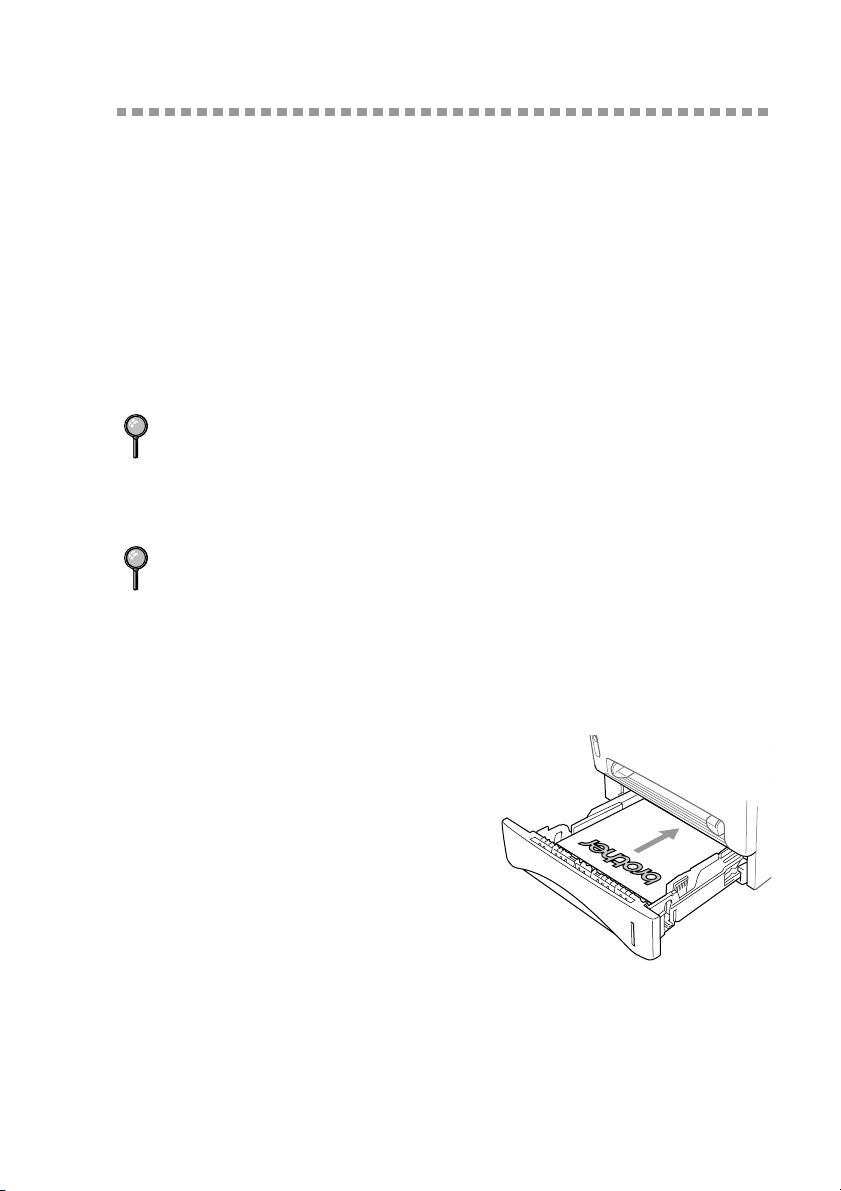
USING THE BROTHER MFC AS A PRINTER
13 - 2
Printing From Your PC
Multi-purpose Paper Cassette
The MFC’s multi-purpose paper cassette can be adjusted to feed many sizes of
paper: letter, legal, A4, B5 and A5 plain paper. When the MFC receives print
data from your computer, it loads paper from the paper cassette. Insert the sheet
of paper with the side you wish to print on face down in the paper cassette.
■ Select the print command from your PC.
Your PC sends a print command and data to the MFC. The MFC displays the
date and time and RECEIVING DATA. If there are more pages, the MFC
begins to print the next page automatically. When printing is finished, it returns
to online status.
If your application software does not support your custom paper size, select the
next larger paper size. Then adjust the print area by changing the right and left
margins in your application software. (See
Acceptable Paper, page 2-5.)
Two-Sided Printing (Manual Duplexing)
The supplied printer drivers for Windows
®
95/98/Me and Windows NT
®
Workstation Version 4.0 enable manual duplex printing. (For more
information, see the Help screen for the printer driver.)
The MFC prints all the even-
numbered pages on one side of the
paper first.
Then, the Windows
®
driver
instructs you (with a pop-up
message) to reinsert the paper.
Before reinserting the paper,
straighten it well, or you may get a
paper jam. Very thin or very thick
paper is not recommended.
You may select the proper paper source, paper size, and page orientation in
your application software.
Use the manual feed slot for envelopes, labels, transparencies, card stock or
thicker paper.
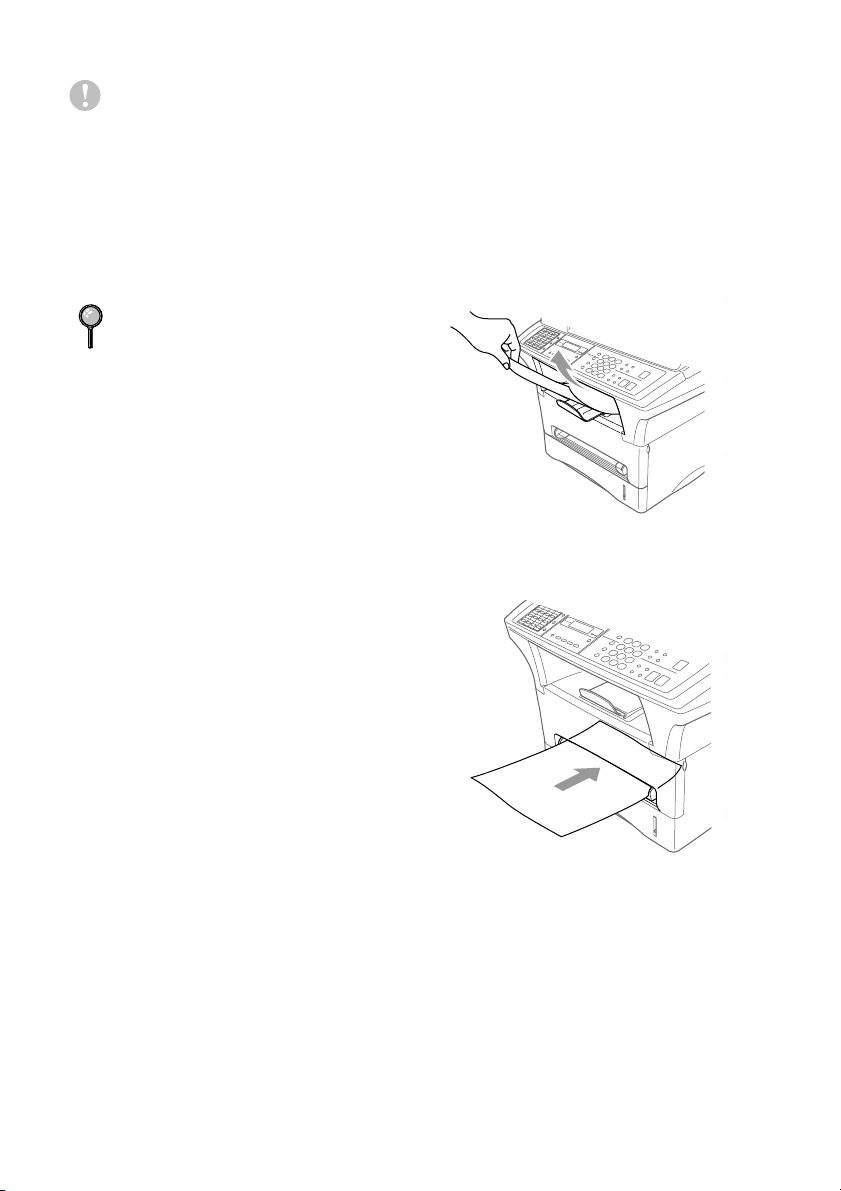
13 - 3
USING THE BROTHER MFC AS A PRINTER
Caution
When you use manual duplexing, it is possible that a paper jam may occur or the
print quality might not be satisfactory. (See
Paper is Jammed in the Paper
Cassette
, page 21-4.)
Front Output Bin
The MFC ejects paper with printed surfaces face down into the output bin in the
front of the MFC. Unfold the output bin extension to support the printed pages.
Manual Feed Slot
Your MFC has a manual feed slot above the
paper cassette. You can load envelopes and
special print media one at a time into this
slot. You do not have to remove paper from
the paper cassette.
(For information about
Acceptable Paper, see
page 2-5.) Insert the sheet of paper with the
side you wish to print on face up in the
manual feed slot.
Use the manual feed slot to print or copy on
envelopes, labels, card stock or thicker
paper.
To prevent the possibility of
transparencies smudging as they stack
in the output bin, remove each
transparency after it exits.
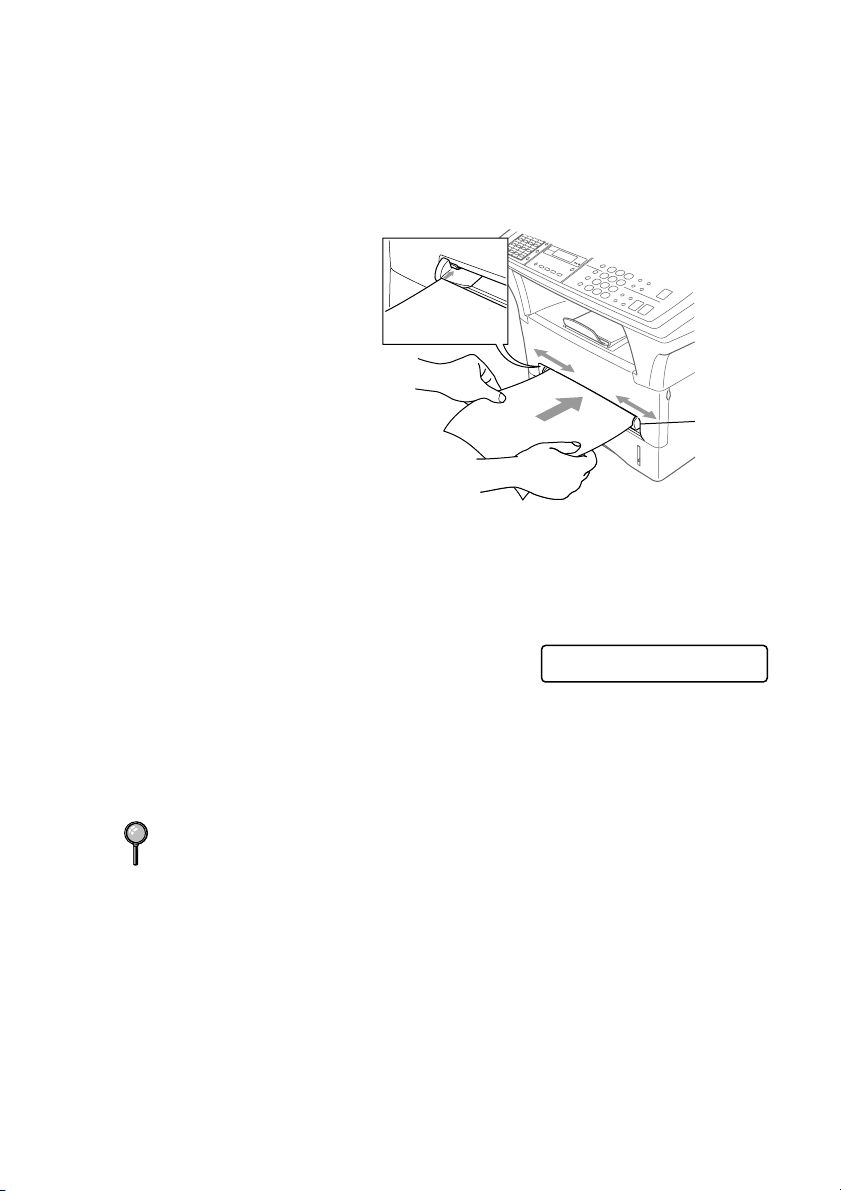
USING THE BROTHER MFC AS A PRINTER
13 - 4
Loading One Sheet of Paper
You do not have to choose Manual Feed in the Setup dialog box of your printer
driver. Insert the sheet of paper for Portrait (vertical) or Landscape (horizontal),
with the side you wish to print on face up in the manual feed slot.
1
Align the paper at the center of the manual feed slot and insert it all the way.
2
Adjust the paper guides
to the width of the
paper.
Loading More than One Sheet of Paper
1
Open the Setup dialog box of the Windows
®
printer driver and select Manual
Feed in the Paper Source section. Follow Steps 1 and 2 above to load the first
page. The MFC starts printing automatically.
2
After the first page is printed, the LCD
displays:
Insert the next sheet of paper to resume
printing.
3
Repeat Steps 1 and 2 until you have finished printing.
■ To stop or clear the manual feed, turn the MFC offline by pressing the Reset
key,—OR—Stop it with a PC command.
If you do not select Manual Feed, and insert a page in the manual feed slot, the
MFC will load the first page from the manual feed slot and subsequent pages
from the paper cassette.
Manual
Feed
Slot
MANUAL FEED
INSERT PAPER
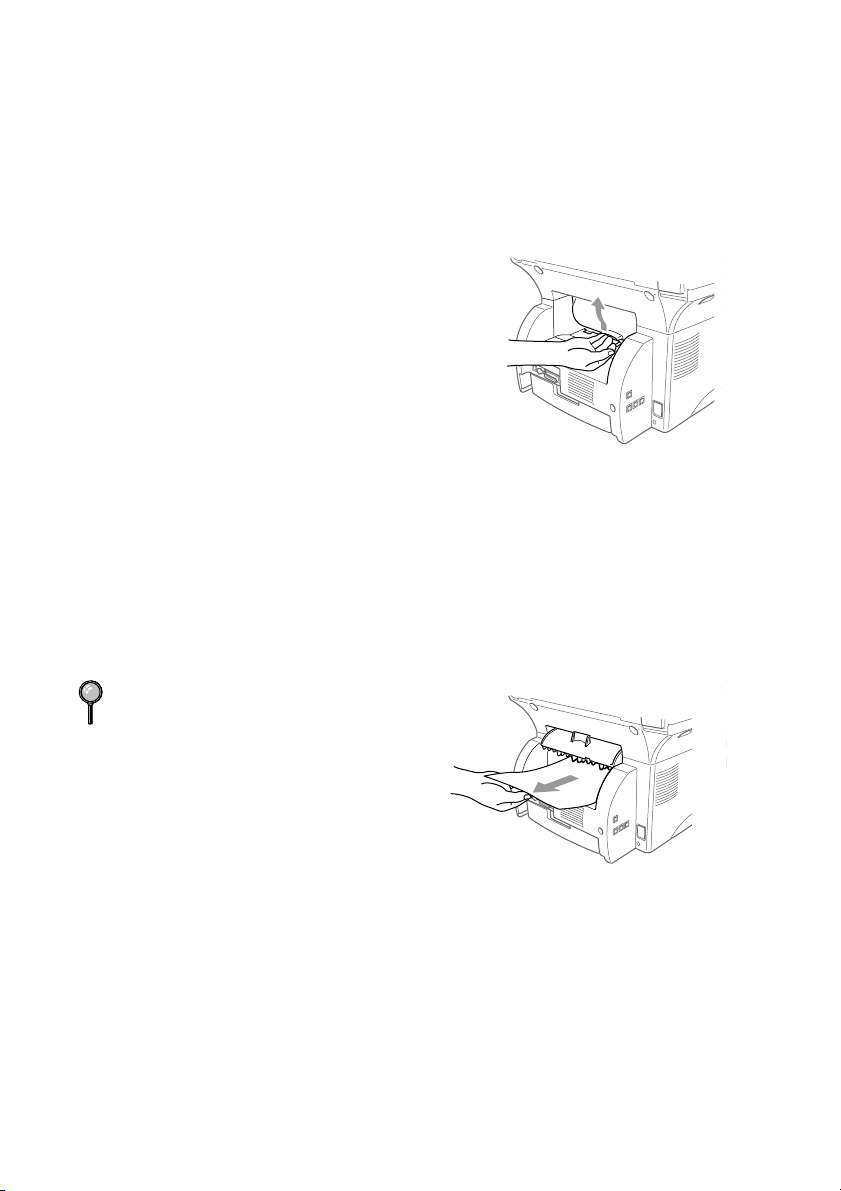
13 - 5
USING THE BROTHER MFC AS A PRINTER
Printing on Thicker Paper and Card Stock
When the rear cover is lifted up, the MFC has a straight paper path from the
manual feed slot to the rear of the printer. Use this paper feed and output method
when you want to print on envelope, thicker paper or card stock.
1
Select manual feed mode in the printer driver.
2
Send the print data as usual.
3
Lift up the rear cover at the rear of the MFC.
4
Adjust the manual feed paper guides to the
width of the paper you are using.
5
Insert a single sheet of paper into the manual feed slot until the front edge
touches the paper feed rollers. Let go of the paper as the MFC pulls it into
position.
6
After the MFC ejects the printed page, return to Step 5 to insert the next sheet
of paper. The MFC will wait until you insert the next sheet of paper. Repeat
Steps 5 and 6 for each page to be printed.
7
When you have finished printing, close the rear cover of the MFC.
To prevent the possibility of
transparencies smudging as
they stack in the output bin,
remove each transparency after
it exits.

USING THE BROTHER MFC AS A PRINTER
13 - 6
Simultaneous Printing/Faxing
Your MFC can print data from your computer while sending or receiving a fax,
or while scanning information into the computer. However, when the MFC is
copying or receiving a fax on paper, it pauses the PC printing operation, and
resumes when copying or fax receiving is complete. Fax sending and receiving
continues during PC printing/copying. (See
Acceptable Paper, page 2-5.)
Choosing Acceptable Paper
We recommend that you test paper (especially special sizes and types of paper)
on the MFC before purchasing large quantities.
■ Avoid feeding labels with carrier sheets exposed, or your MFC will be damaged.
■ Avoid using coated paper, such as vinyl coated paper.
■ Avoid using preprinted or highly textured paper.
For optimum printing, use a recommend type of paper, especially plain paper
and transparencies. For more information on paper specifications, consult your
nearest authorized sales representative or the place where you purchased your
MFC.
■ Use label or transparencies that are designed for use in laser printers.
■ For the best print quality, we recommend using long-grained paper.
■ If you are using special paper, and the paper has problems feeding from the
paper cassette, try again using the manual feed slot.
■ You can use recycled paper in this MFC.
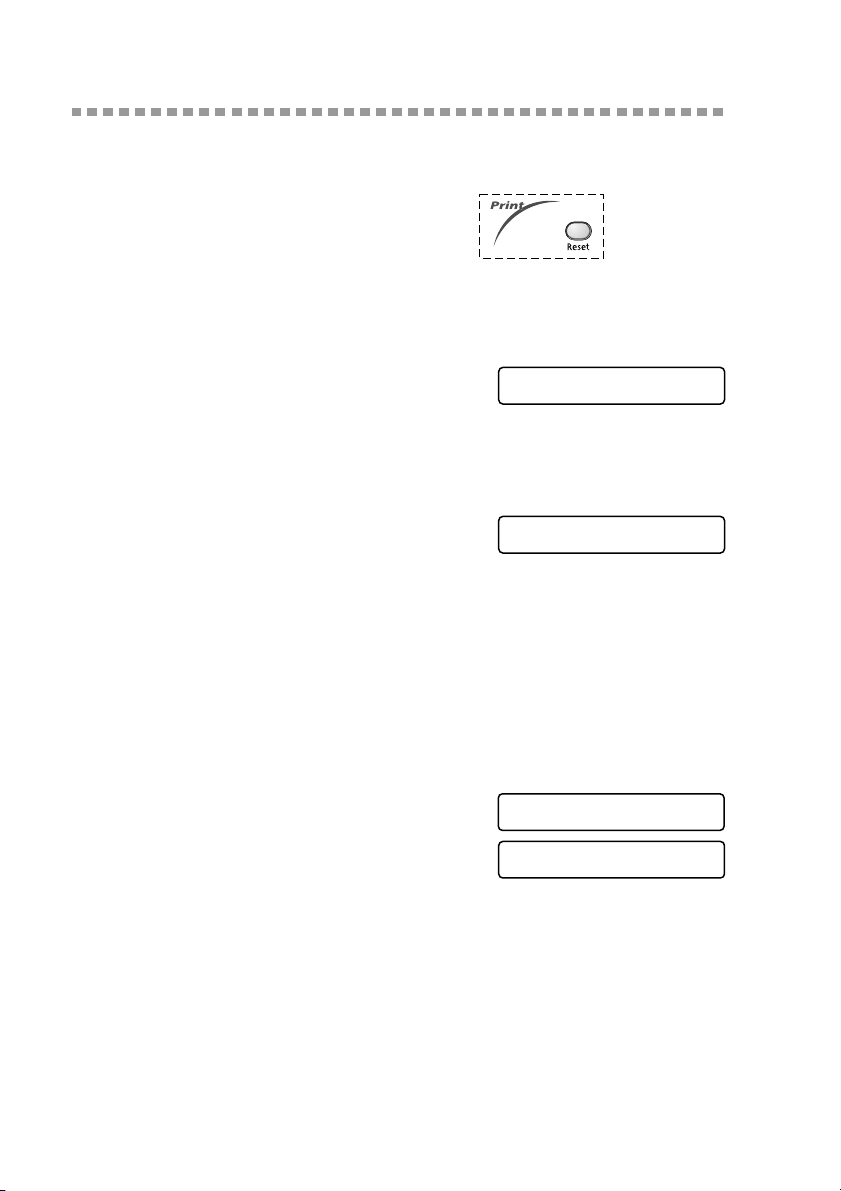
13 - 7
USING THE BROTHER MFC AS A PRINTER
Printer Operation Key
Reset Key
You can clear data from the memory.
Printing the Internal Font List
You can print a list of the MFC’s internal (or resident) fonts to see how each font
looks before you select it.
1
Press Menu, 4, 1, 1.
2
Press Fax Start. The MFC prints the list.
3
Press Stop/Exit.
Printing the Print Configuration List
You can print a list of current printer
settings.
1
Press Menu, 4, 1, 2.
2
Press Fax Start. The MFC prints the settings.
3
Press Stop/Exit.
Restoring Factory Default Settings
You can return the MFC to original factory settings. Permanent fonts are
restored, macros in the temporary settings are cleared. You can change user
settings using the Remote Printer Console program. (See page 12-1.)
1
Press Menu, 4, 2, 1.
2
Press 1 to restore the factory settings
—OR—Press 2 to exit without making a
change.
3
Press Stop/Exit.
1.INTERNAL FONT
2.CONFIGURATION
1.RESET 2.EXIT
1.FACTORY SET
PRINTER DRIVER SETTINGS (FOR WINDOWS
®
ONLY)
14 - 1
14
14
Printer Driver Settings
(For Windows
®
Only)
Using the Brother MFC-9800 Printer Driver
A Printer Driver is software that translates data from the format used by a
computer into the format required by a particular printer, using a printer
command language or page description language.
The printer drivers are on the supplied CD-ROM. The latest printer driver can
also be downloaded from the Brother Solutions Center at
Features in the Printer Driver
(For Windows
®
95/98/Me and Windows
®
NT 4.0 Users)
For more detailed information, please see the on-line Help in the printer driver.
You can also change settings by clicking the illustration on the left side of the
tab screen.
Note
The screens shown in this section are from Windows
®
98. The screens on your
PC may vary depending on your Windows
®
Operating System.
http://solutions.brother.com
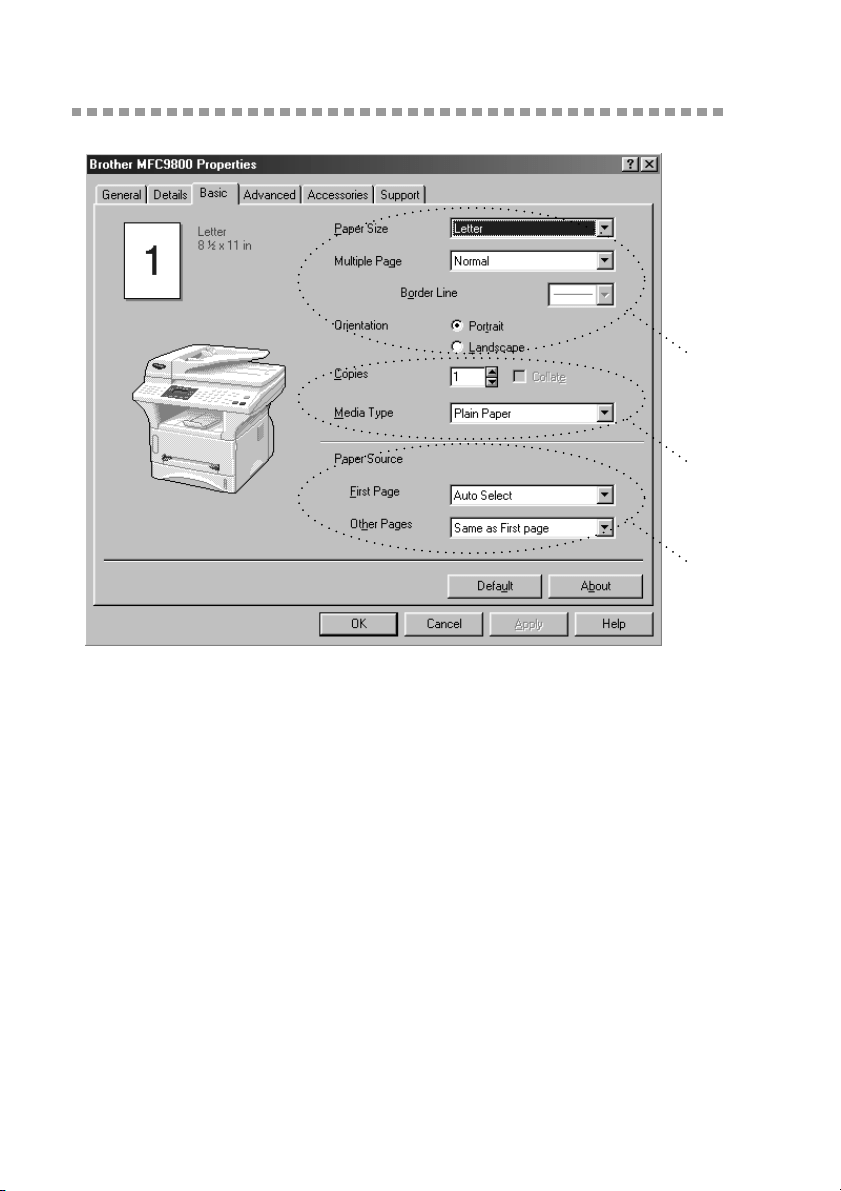
14 - 2
PRINTER DRIVER SETTINGS (FOR WINDOWS
®
ONLY)
Basic Tab
*1 Select the Paper size, Multiple Page and Orientation.
*2 Select number of Copies and Media Type.
*3 Select Paper Source, First Page and Other Pages.
*1
*2
*3
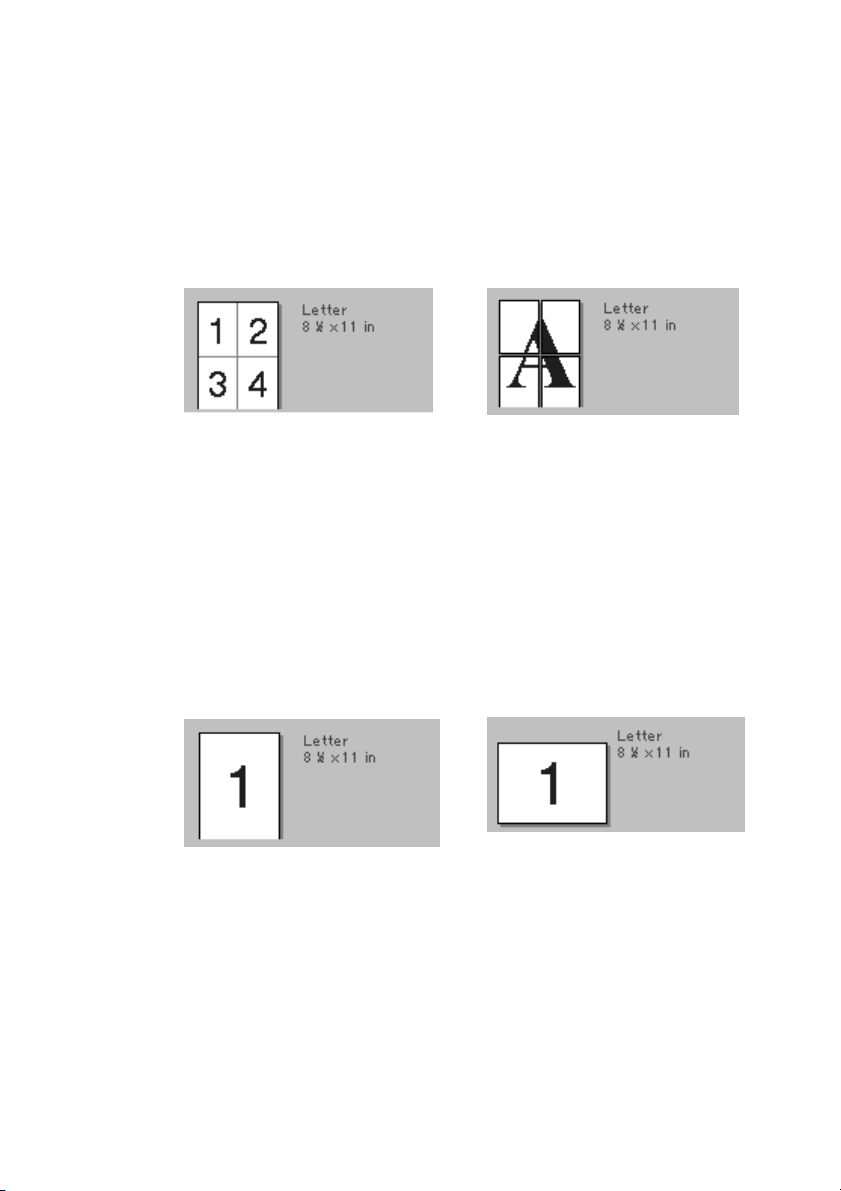
PRINTER DRIVER SETTINGS (FOR WINDOWS
®
ONLY)
14 - 3
Paper Size
From the drop-down box select the Paper Size you are using.
Multiple Page
The Multiple Page selection can reduce the image size of a page allowing
multiple pages to be printed on one sheet of paper or enlarging the image size
for printing on page on multiple sheets of paper.
Border Line
When printing multiple pages on one sheet with the Multiple Page feature you
can select to have a solid border, dash border or no border around each page on
the sheet.
Orientation
Orientation selects the position of how your document will be printed (Portrait
or Landscape).
Copies
The copies selection sets the number of copies that will be printed.
Ex. 4 in 1
Ex. 1 in 2 × 2 pages
Portrait
Landscape
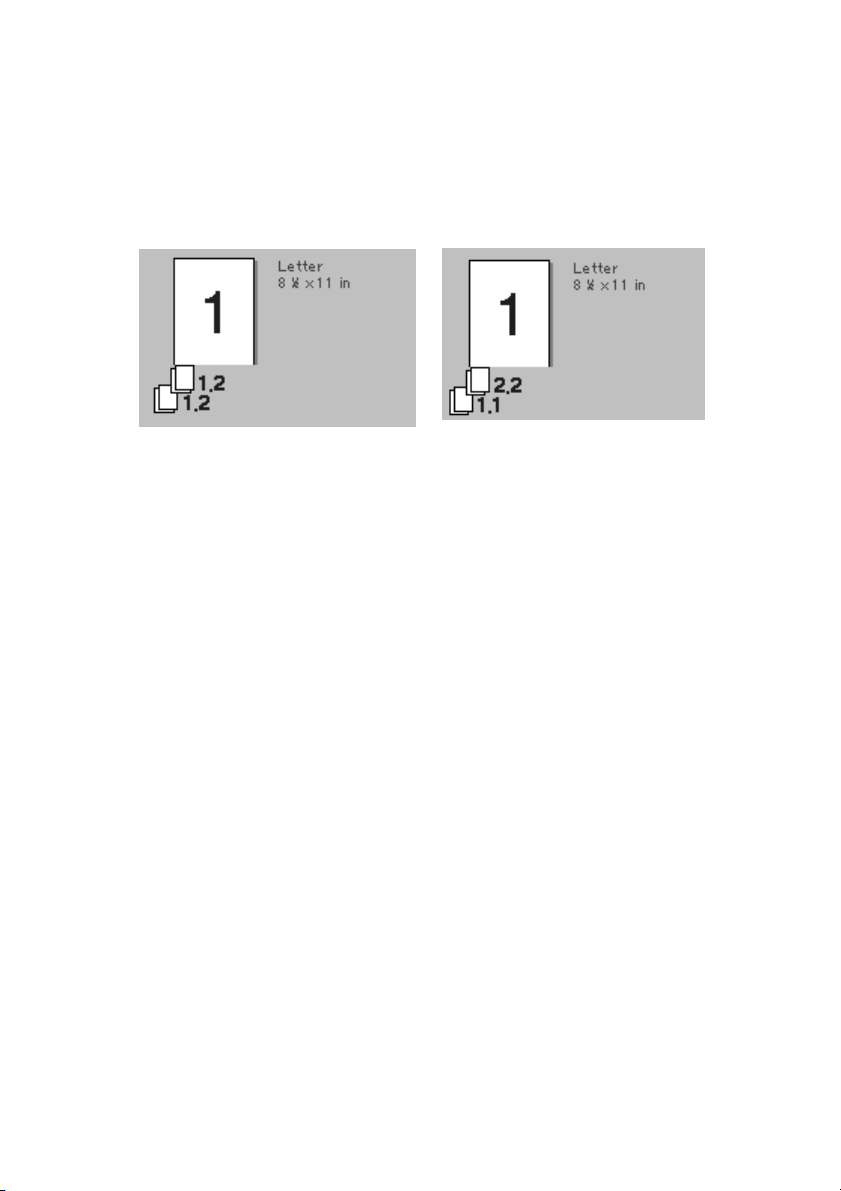
14 - 4
PRINTER DRIVER SETTINGS (FOR WINDOWS
®
ONLY)
Collate
The collate selection is active if more than one copy is selected. With the collate
check box selected, one complete copy of your document will be printed and
then repeated for the number of copies you selected. If the collate check box is
not selected then each page will be printed for all the copies selected before the
next page in the document is printed.
Media Type
You can use the following types of media in your printer. For the best print
quality, select the type of media that you wish to use.
Plain Paper
Thin Paper
Thick Paper
Thicker Paper
Bond Paper
Transparencies
When using ordinary plain paper, select Plain Paper. When using heavier
weight paper, envelopes or rough paper select Thick Paper or Thicker Paper.
For bond paper, select Bond Paper and for OHP transparencies, select
Transparencies.
Collate box checked
Collate box not checked
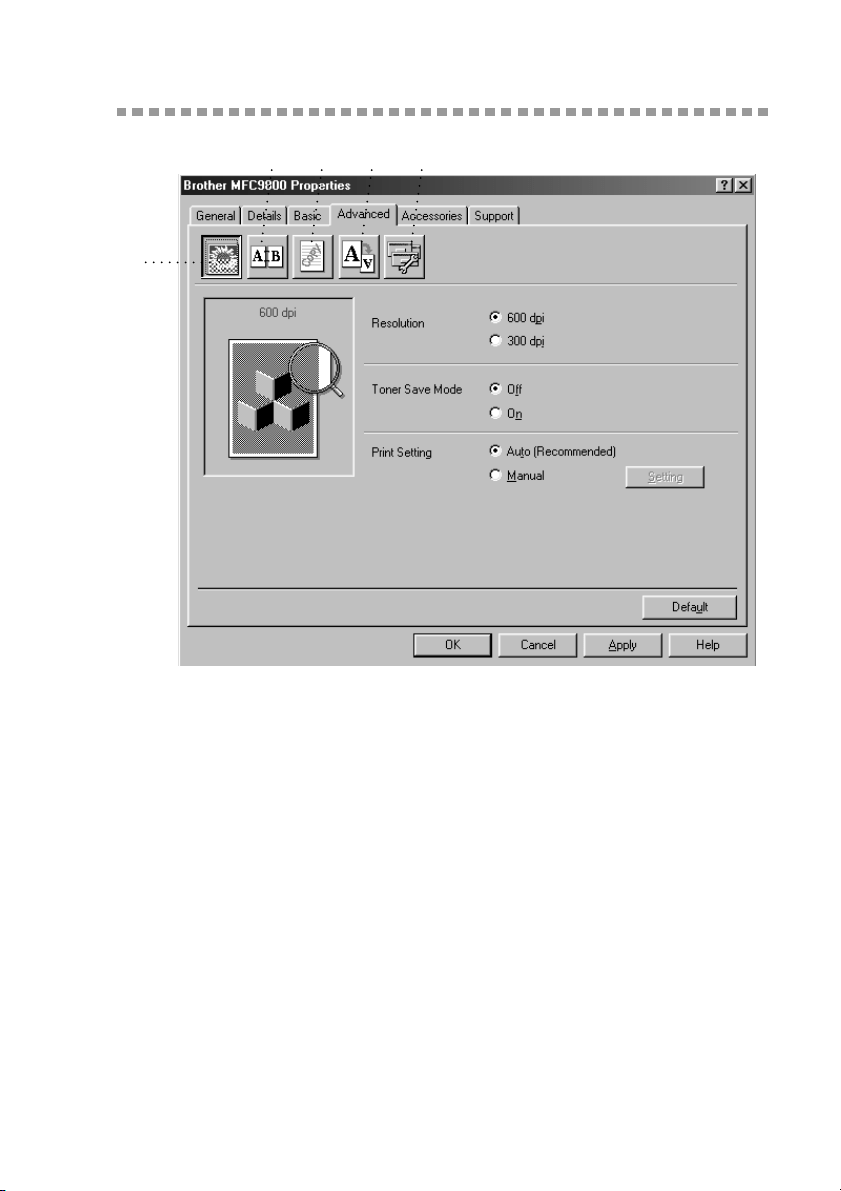
PRINTER DRIVER SETTINGS (FOR WINDOWS
®
ONLY)
14 - 5
Advanced Tab
Change the tab settings by selecting one of the following icons:
*1 Print Quality
*2 Duplex Printing
*3 Watermark
*4 Page Setting
*5 Device Option
Print Quality (*1)
Resolution
You can change the resolution as follows:
• 300 dpi
• 600 dpi
Toner Save
You can save running costs by turning on the Toner Save Mode, which reduces
the print density.
*1
*2 *3 *4 *5
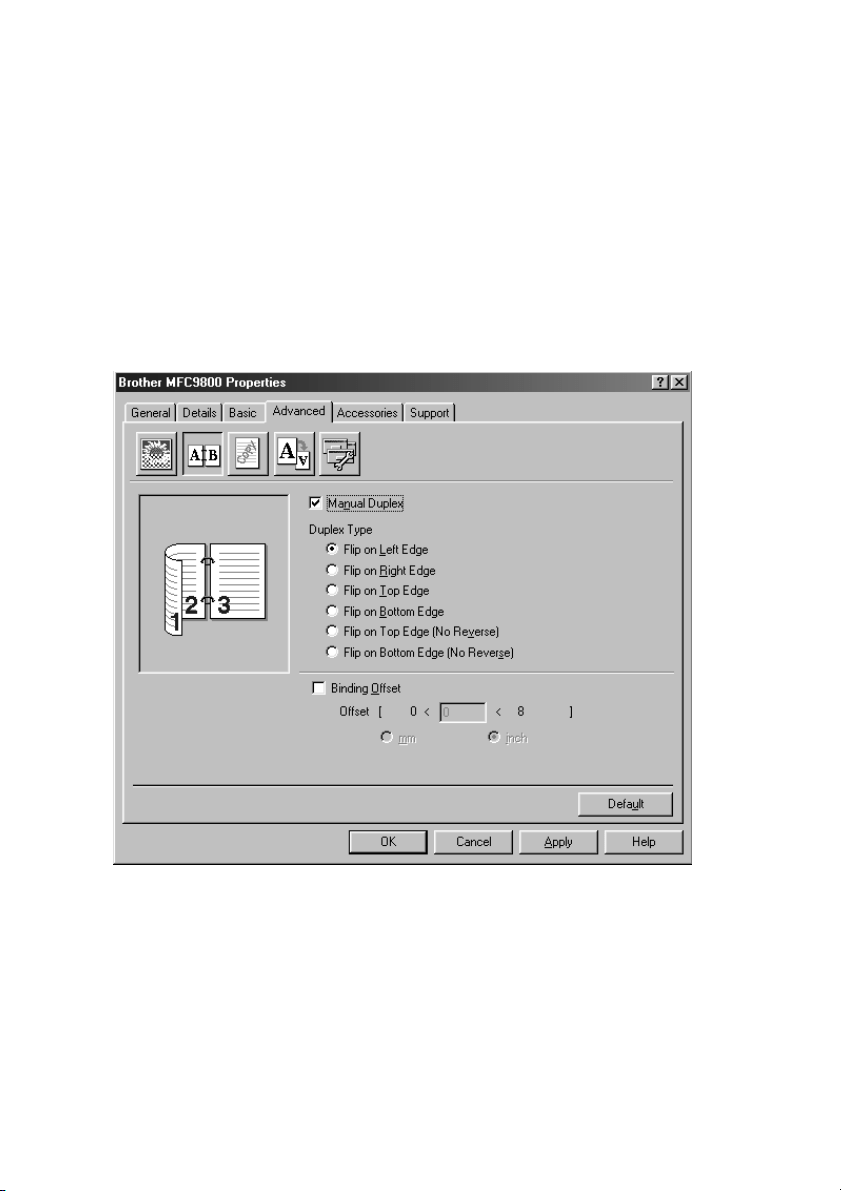
14 - 6
PRINTER DRIVER SETTINGS (FOR WINDOWS
®
ONLY)
Print Setting (For Windows
®
95/98/98SE/Me Users Only)
Print Setting is used for optimizing your print quality for the type of document
being printed (Photos, Graphics or Scanned Images). When you choose Auto
(Recommended), the printer automatically prints with the most suitable print
settings.
With the Print Setting set to Manual, you can change the Brightness, Contrast
and Graphics Quality options manually.
Duplex Printing (*2)
Choosing the Duplex Printing icon displays the Manual Duplex features
available.
Manual Duplex
Check the Manual Duplex box and there are six types of duplex directions
available for each orientation. In this mode, the MFC prints all the even numbered
pages first. Then the printer driver stops and shows the instructions required to re-
install the paper. When you click OK the odd numbered pages are printed.
Binding Offset
Check the Binding Offset option, you can specify the offset value of the binding
side in inches or millimeters (0 - 8 inches) [0 - 203.2 mm].
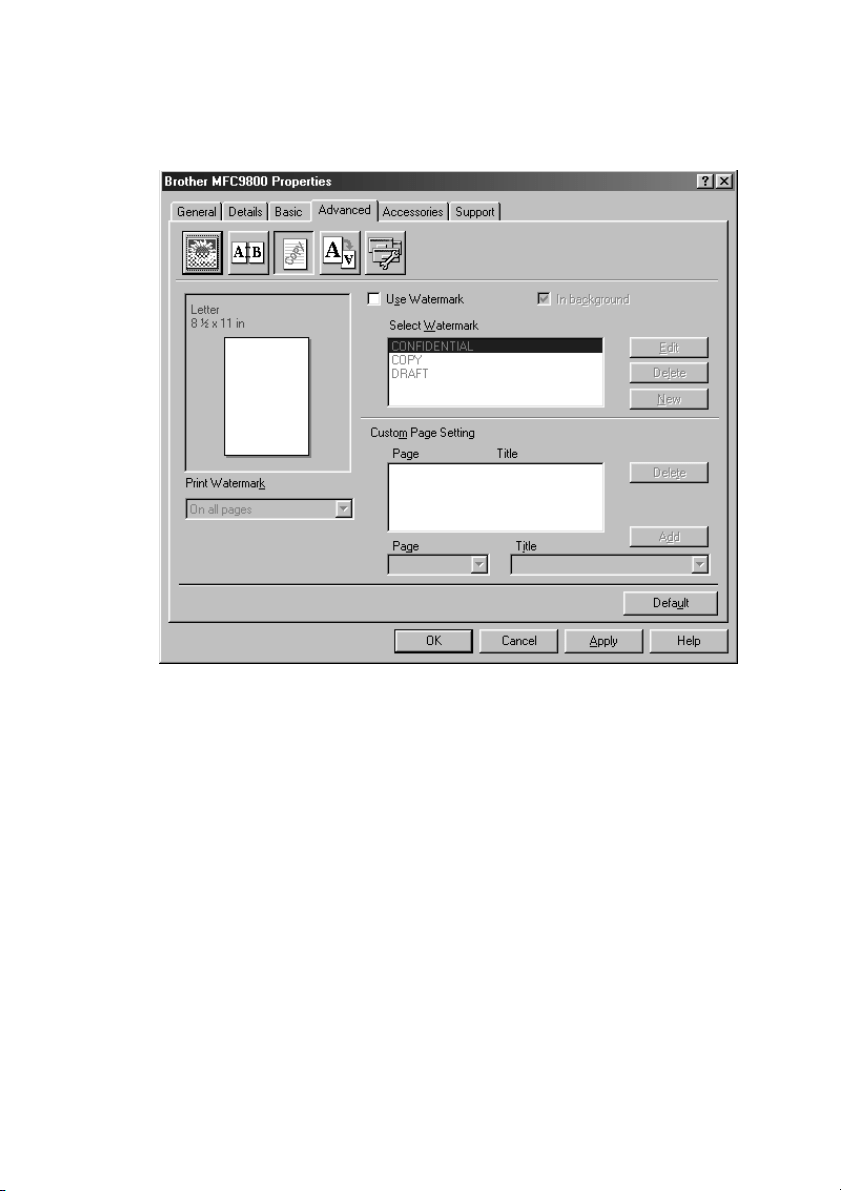
PRINTER DRIVER SETTINGS (FOR WINDOWS
®
ONLY)
14 - 7
Watermark (*3)
You can place a logo or text into your document as a Watermark by using a
bitmap file as your source file or select one of the preset Watermarks.
Print Watermark
The Print Watermark feature offers printing choices of:
On all pages
On first page only
From second page
Custom
In background
With the In background feature checked the Watermark will print behind your
document on the page. If this feature is not checked then the Watermark will
print on top of your document.
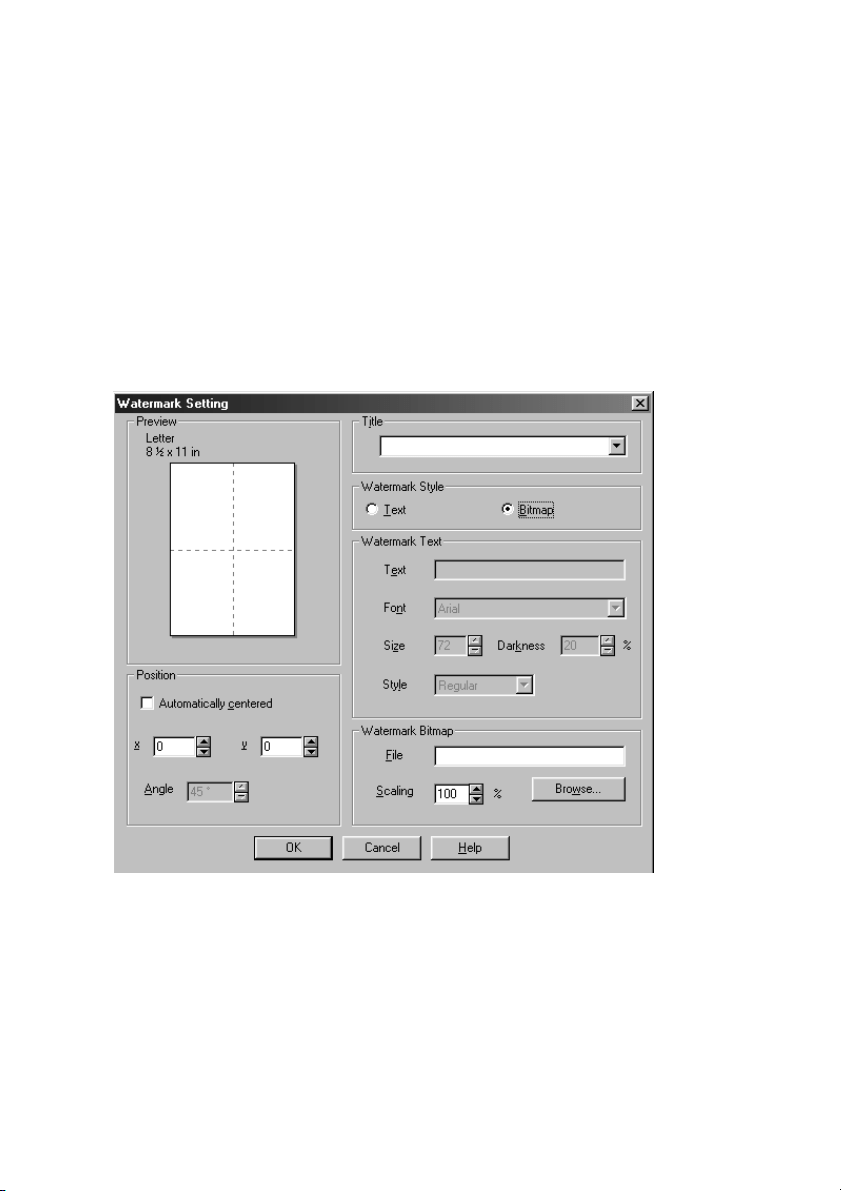
14 - 8
PRINTER DRIVER SETTINGS (FOR WINDOWS
®
ONLY)
You can change the size and the position of the Watermark on the page by
selecting the Watermark and clicking the Edit button. If you want to add a new
Watermark, click the New button and select Text or Bitmap from the Watermark
Style.
Watermark Text
Enter your Watermark text into the Text Box and select the Font, Size, Darkness
and Style.
Watermark Bitmap
Enter the file name and location of your bitmap image in the File box or Browse
for the file location. You can also set the scaling size of the image.
Position
The position settings offer controls on where the Watermark can be positioned
on the page.
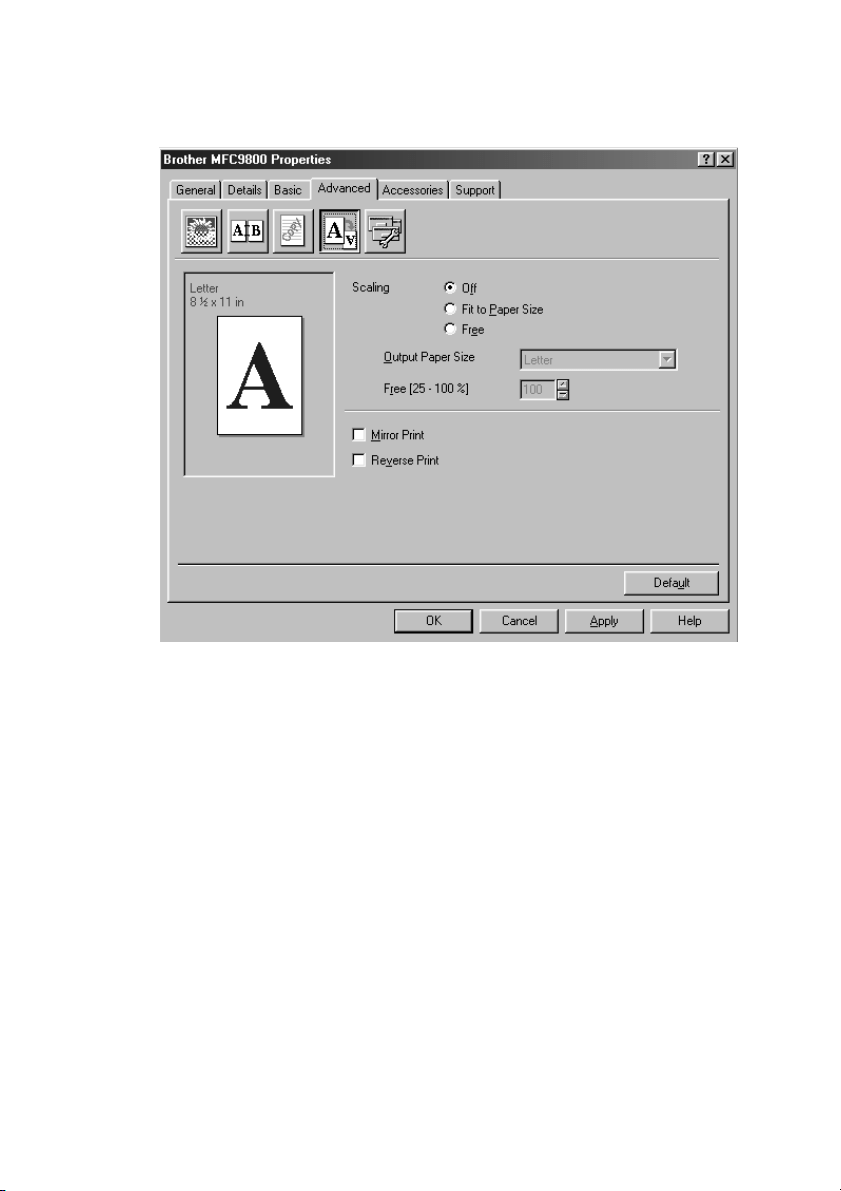
PRINTER DRIVER SETTINGS (FOR WINDOWS
®
ONLY)
14 - 9
Page Setting (*4)
You can change the print size of your document with the Scaling feature.
1
Check Off if you want to print the document as it appears on your screen.
2
Check Fit to Paper Size, if your document has an unusual size, or if you have
only the standard size paper.
3
Check the Free box if you want to reduce or enlarge the output.
You can also use the Mirror or Reverse Print feature for your page setting.
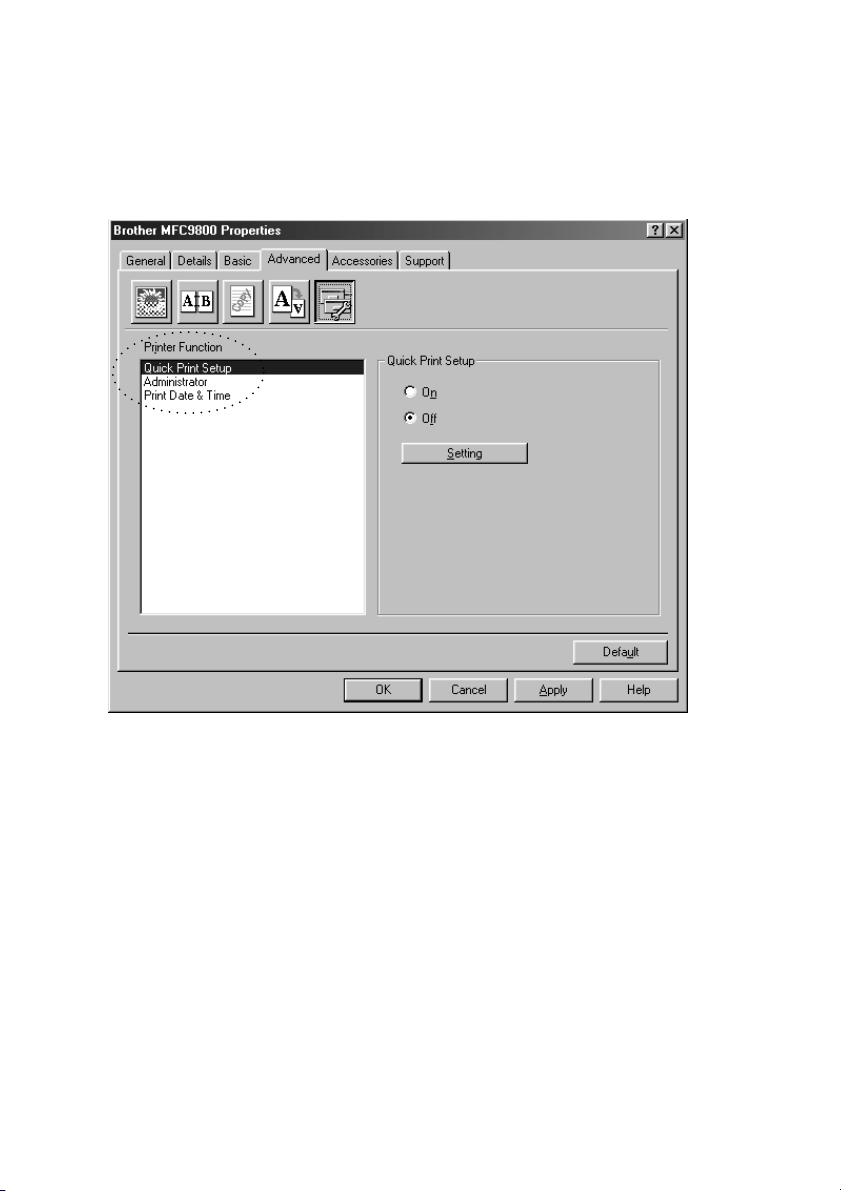
14 - 10
PRINTER DRIVER SETTINGS (FOR WINDOWS
®
ONLY)
Device Options (*5)
Set one of the following Printer Functions:
■ Quick Print Setup
■ Administrator (For Windows
®
95/98/98SE/Me Users Only)
■ Print Date & Time
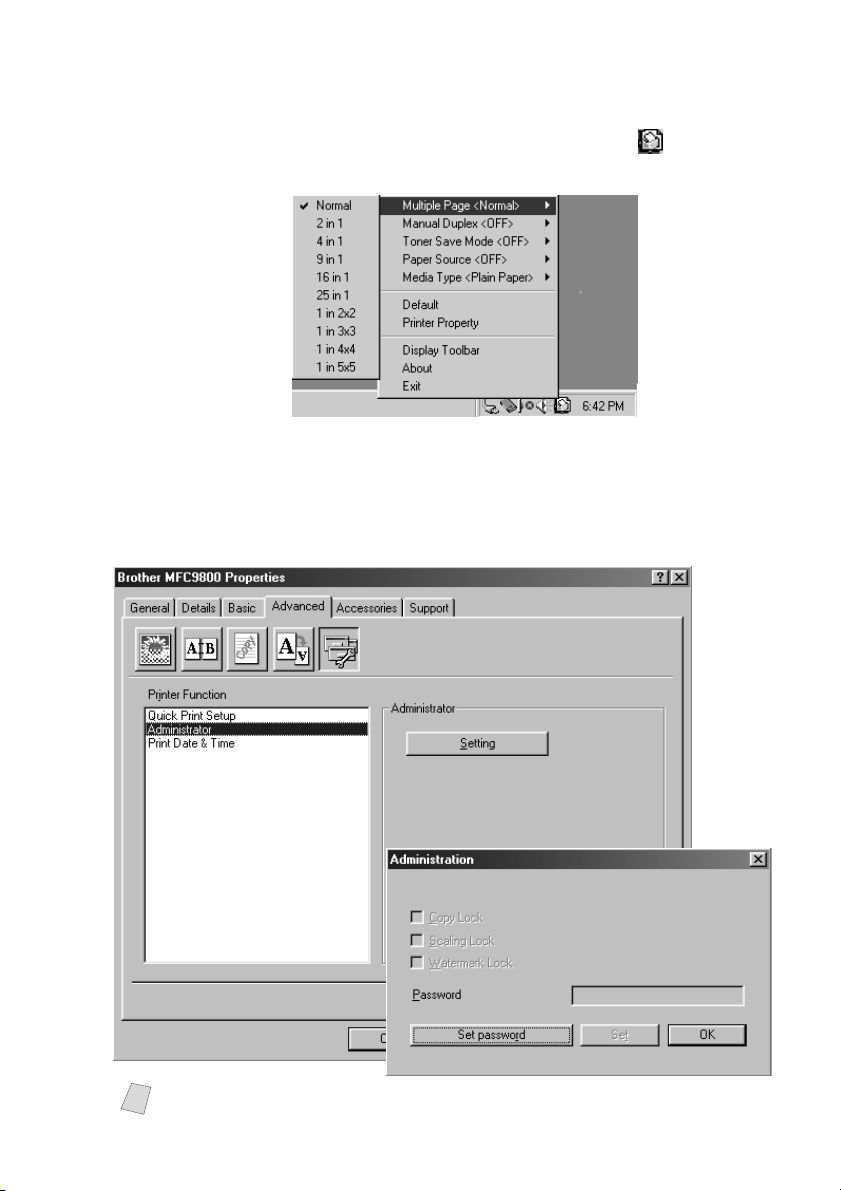
PRINTER DRIVER SETTINGS (FOR WINDOWS
®
ONLY)
14 - 11
Quick Print Setup
The Quick Print Setup feature allows you to quickly select driver settings. To
view setting, simply click your mouse button on the task tray icon. This
feature can be set to ON or OFF from the Device Options section.
Administrator (For Windows
®
95/98/98SE/Me Users
Only)
The administrator selection permits the Copy, Scaling and Watermark features
to be locked and password protected.
Note
Record your password and keep it in a safe place for future reference. If you
forget your password these settings can not be accessed.
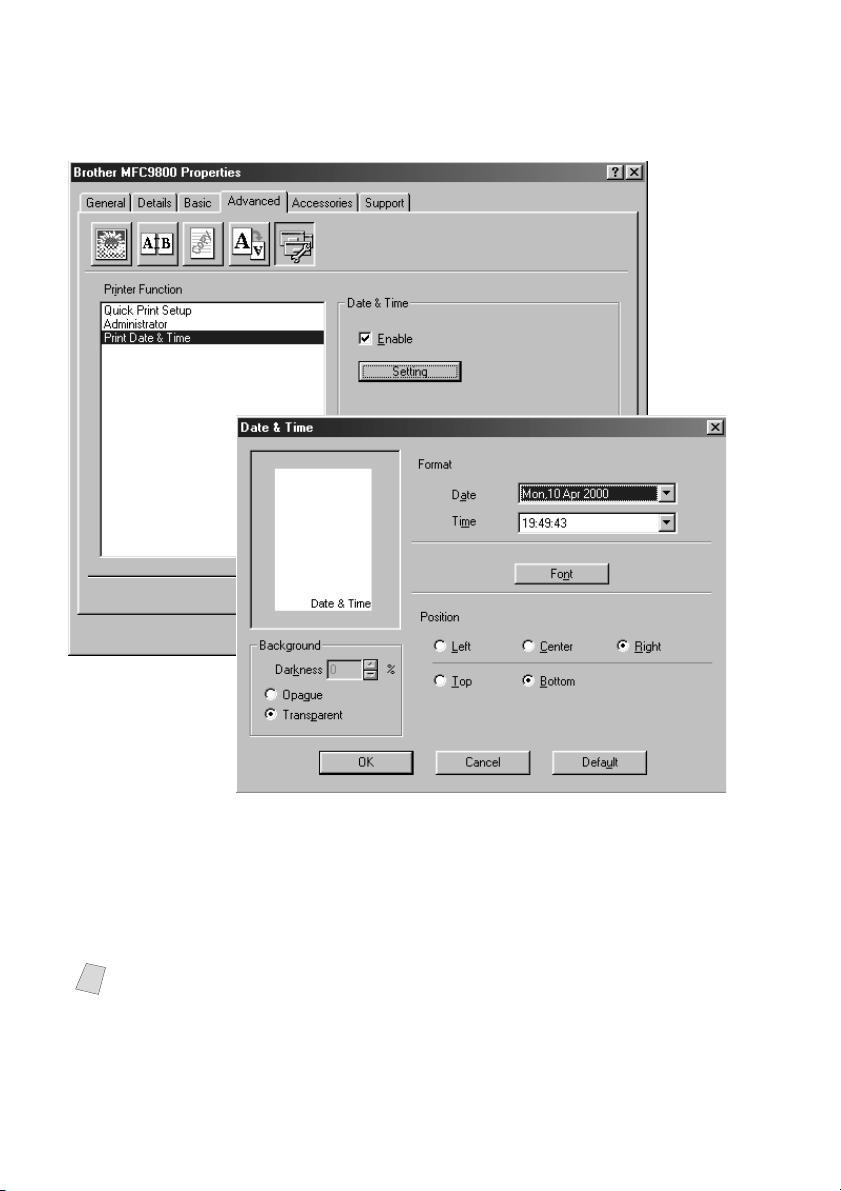
14 - 12
PRINTER DRIVER SETTINGS (FOR WINDOWS
®
ONLY)
Print Date & Time
When enabled the Print Date and Time feature will automatically print the date
and time from your computers system clock on your document.
Click the Setting button to change the Date and Time Format, Position and Font.
To include a background with the Date and Time select Opaque. When Opaque
is selected you can set the Darkness of the Date and Time background by
changing the percentage.
Note
The Date and Time indicated in the selection box represents the format the will
be printed. The actual Date and Time printed on your document is
automatically retrieved from the settings of your computer.
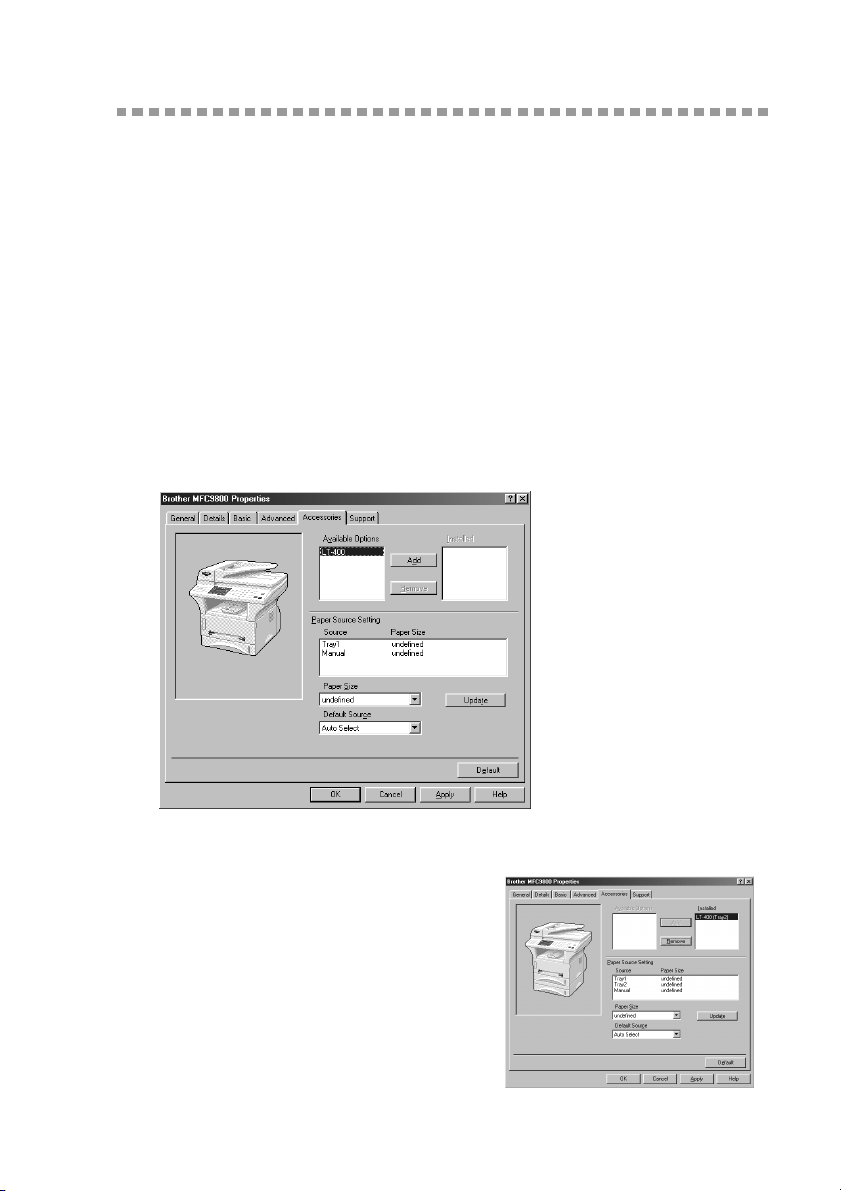
PRINTER DRIVER SETTINGS (FOR WINDOWS
®
ONLY)
14 - 13
Accessories Tab
The Accessories Tab includes the settings for configuring the printer driver for
the size of paper loaded in each paper source. This tab also installs any
additional options into the driver settings.
Paper Source Setting
To configure the paper size for each paper source, highlight the source from the
Paper Source Setting list. Select the Paper Size from the pull-down box and
click Update. (The Paper Source Setting is used when selecting Auto Select in
the Basic Tab.)
Default Source
The Default Source allows you to choose the paper source that will be used
when the paper size of the document being sent does not match the Paper Source
settings.
Available Options
In order to access the optional 2nd paper
tray the option must be installed in the
driver. Highlight the model number from
the Available Options list and click
Add. The optional tray will then be listed
in the Installed box, Paper Source Setting
list and the screen illustration will display
the 2nd tray.
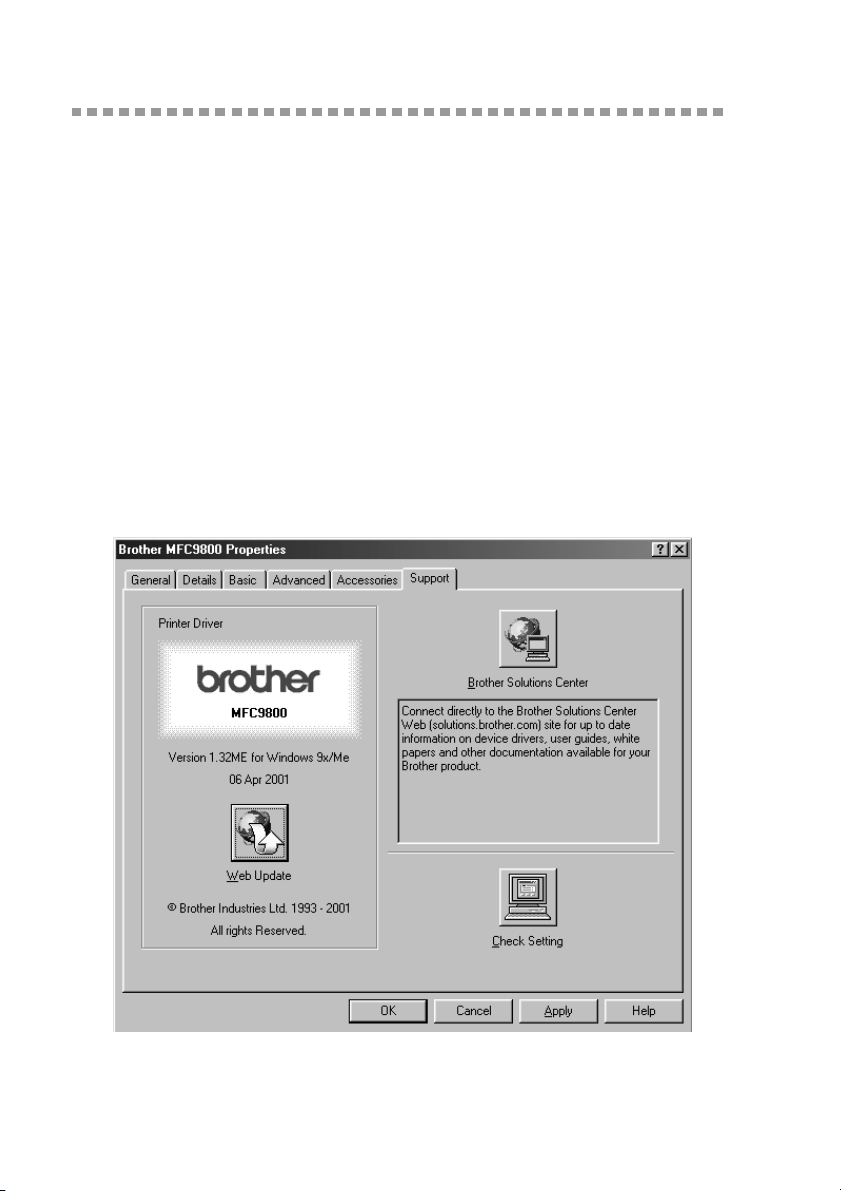
14 - 14
PRINTER DRIVER SETTINGS (FOR WINDOWS
®
ONLY)
Support
The Support Tab provides driver version information and setting information.
In addition there are links to the Brother Solution Center and Driver Update
Web sites.
Brother Solutions Center
The Brother Solutions Center is a Web site offering information about your
Brother product including FAQ’s , User Guides, Driver updates and Tips for
using your machine.
Web Update
Web Update checks the brother web site for updated drivers and automatically
downloads and updates the driver on your computer.
Check Setting
The Check Setting selection displays a list of your current drivers settings.
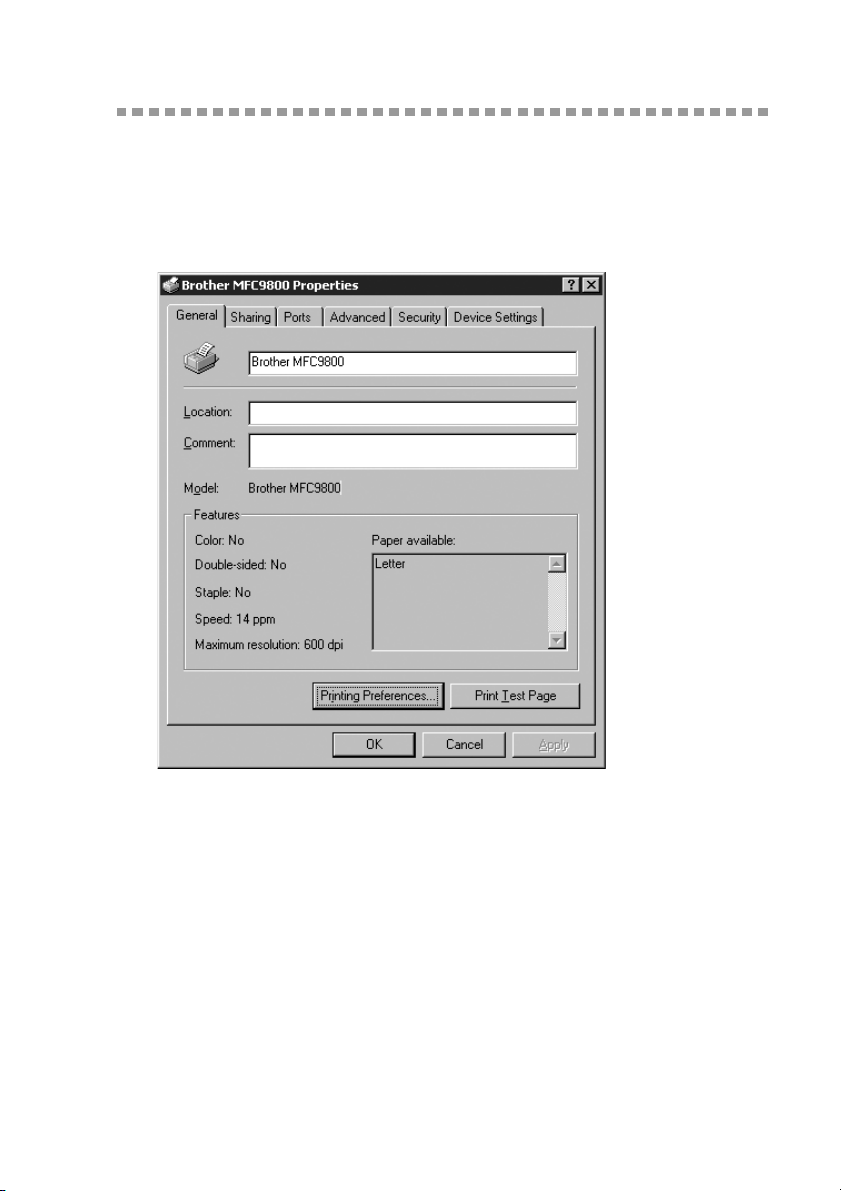
PRINTER DRIVER SETTINGS (FOR WINDOWS
®
ONLY)
14 - 15
Features in the Printer Driver (For Windows
®
2000)
The Windows
®
2000 printer driver utilizes Microsoft’s uni-driver architecture.
The following section describes the driver features and selections available for
Windows
®
2000.
General Tab
Printing Preferences
In the General tab, click the Printing Preferences... button to access the Layout
tab.
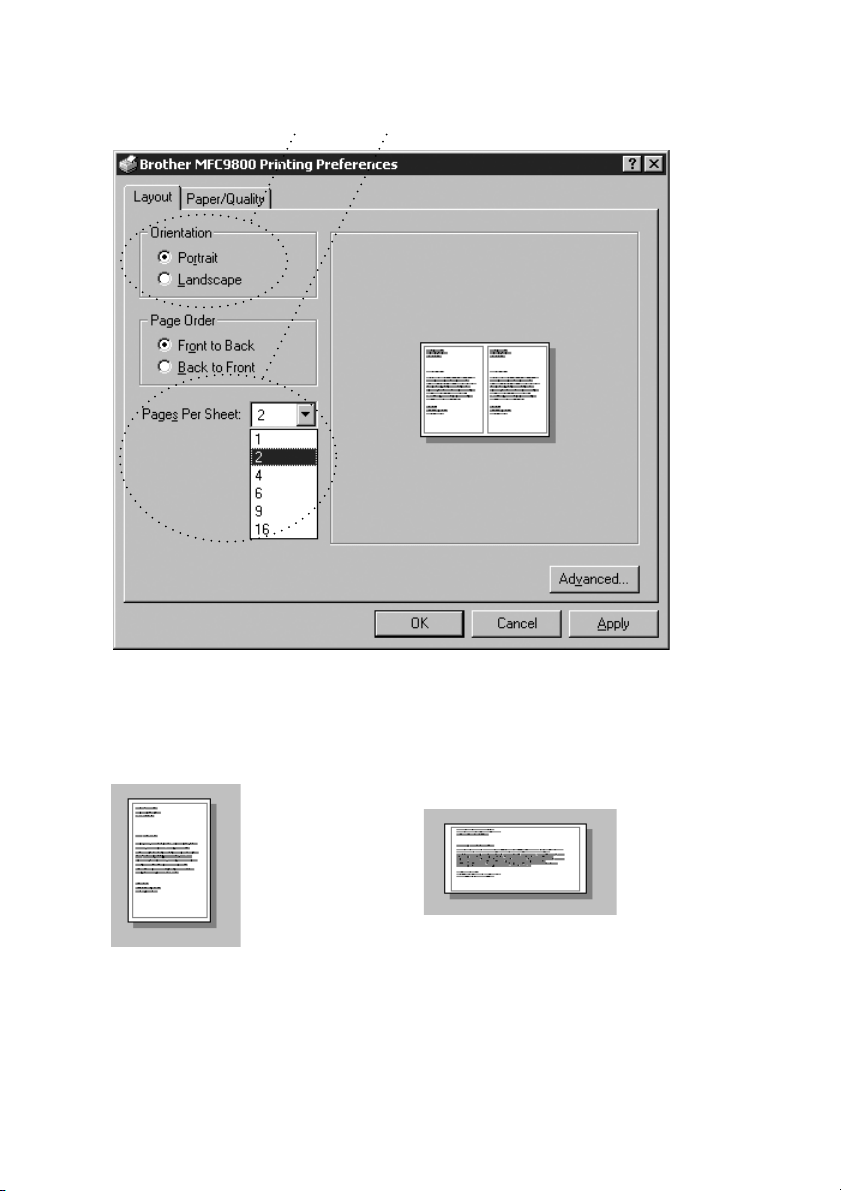
14 - 16
PRINTER DRIVER SETTINGS (FOR WINDOWS
®
ONLY)
Layout Tab
*1 Orientation
Select the Orientation, which is how your document will be positioned on the
paper (Portrait or Landscape).
Portrait Landscape
*1 *2
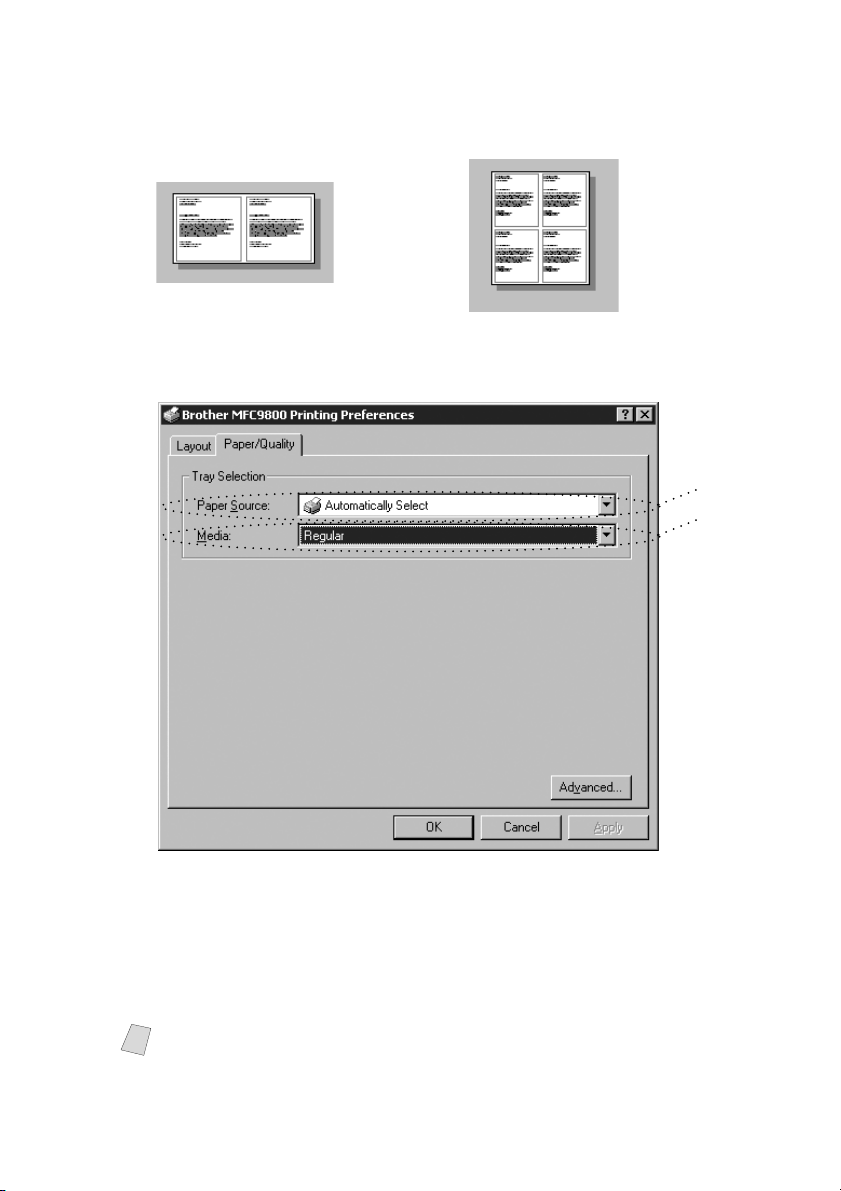
PRINTER DRIVER SETTINGS (FOR WINDOWS
®
ONLY)
14 - 17
*2 Pages Per Sheet
You can select 1, 2, 4, 6, 9 or 16 pages to be printed on one sheet of paper. The
image of each page will be reduced as needed to fit on the paper.
2 in 1 4 in 1
Paper/Quality Tab
*1 Paper Source
Possible paper sources are: Automatically Select, Auto, Upper Paper Tray,
Lower Paper Tray (optional cassette #2) and Manual Feed Slot.
When “Automatically Select” is chosen the MFC automatically will choose the
cassette with the appropriate size of paper.
Note
The paper size for each paper source must be set in the Device Settings tab for
the Automatically Select feature to work properly.
The “Auto” option is for machines that can automatically detect the size of paper
that is loaded in the paper source; Auto is not active for your MFC.
*1
*2
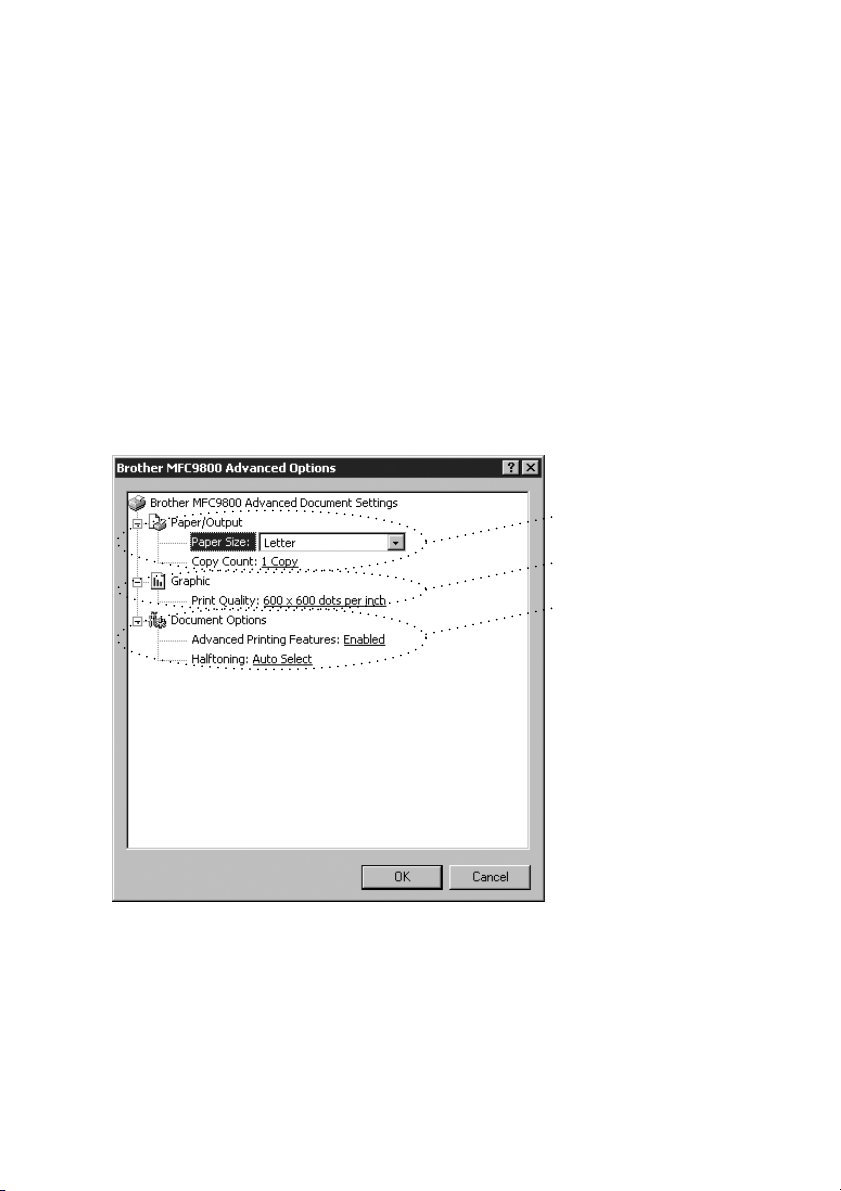
14 - 18
PRINTER DRIVER SETTINGS (FOR WINDOWS
®
ONLY)
*2 Media
For the best print quality, select the type of media you are using:
Regular
Thick Paper
Thicker Paper
Transparency
When using ordinary plain paper, select Regular. When using heavier weight
paper, envelopes, or rough paper, select Thick Paper or Thicker Paper. For OHP
transparencies, select Transparency.
Advanced Options
Click the Advanced... button in the Paper/Quality tab to access the screen
below:
*1 Paper /Output
Paper Size – Select the paper size of the document you are printing. This size
should be the same as the paper size that is set in your application software.
Copy Count – Type the number of copies you want.
*1
*2
*3

PRINTER DRIVER SETTINGS (FOR WINDOWS
®
ONLY)
14 - 19
*2 Graphic
Print Quality – You can change the resolution as follows:
600 × 600 dots per inch
300 × 300 dots per inch
*3 Document Options
Advanced Printing Features – You can Enable or Disable Advanced Printing
Features from this selection. If you disable it, Page Order, Pages Per Sheet,
Copy and Collate will be disabled.
Halftoning – This selection is for changing the dither pattern to achieve the best
print results when printing graphics. The choices are as follows:
Auto Select
Super Cell
Dither 6 × 6
Dither 8 × 8
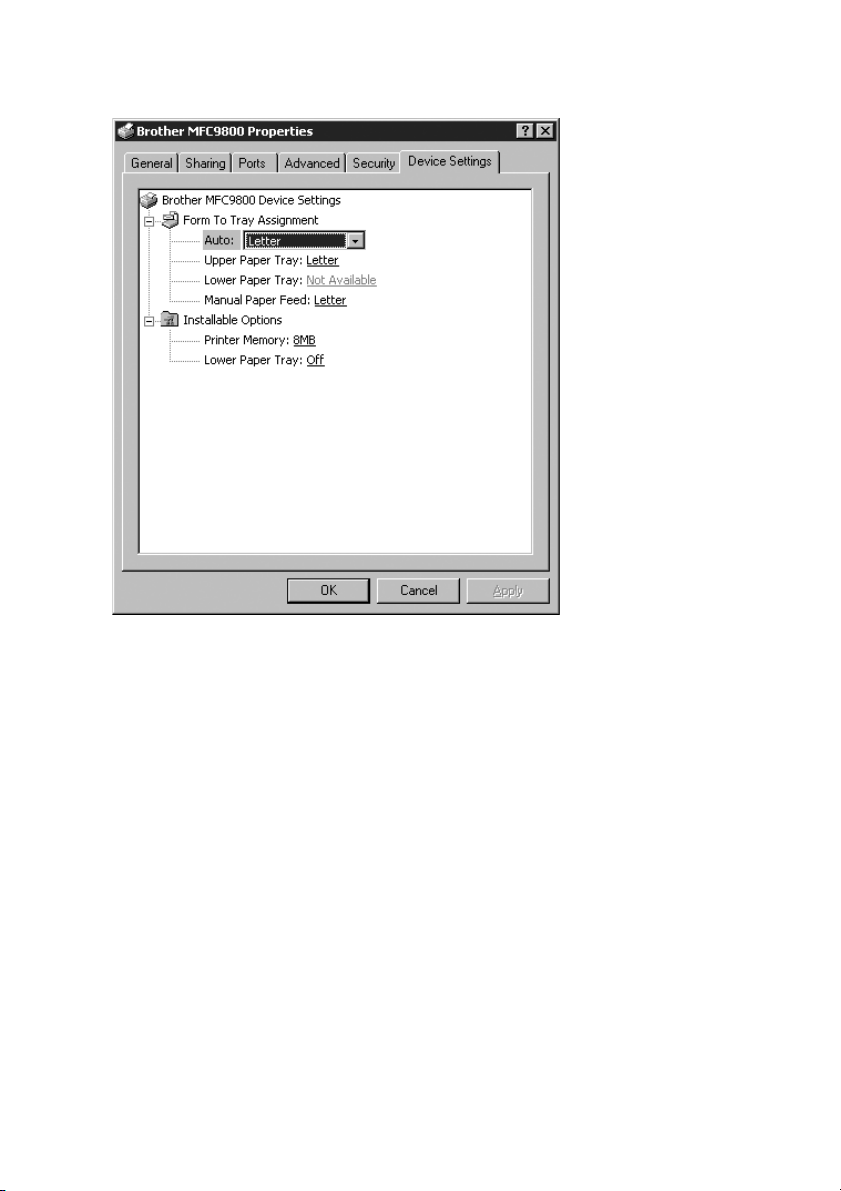
14 - 20
PRINTER DRIVER SETTINGS (FOR WINDOWS
®
ONLY)
Device Settings Tab
Form To Tray Assignment – This selection assigns the paper size to each paper
source. For auto paper selection (Automatically Select) to work properly, the
paper size set for each source must match the actual size of paper loaded.
The available options are:
A4
A5
B5 (JIS)
Executive
Legal
Letter
Installable Options
Printer Memory – If you installed optional memory into your MFC, you must
select the correct size of total memory in the MFC for the driver to access the
additional memory.
Lower Tray – If an optional lower tray is installed, this selection must be set to
ON to enable access to the lower tray.
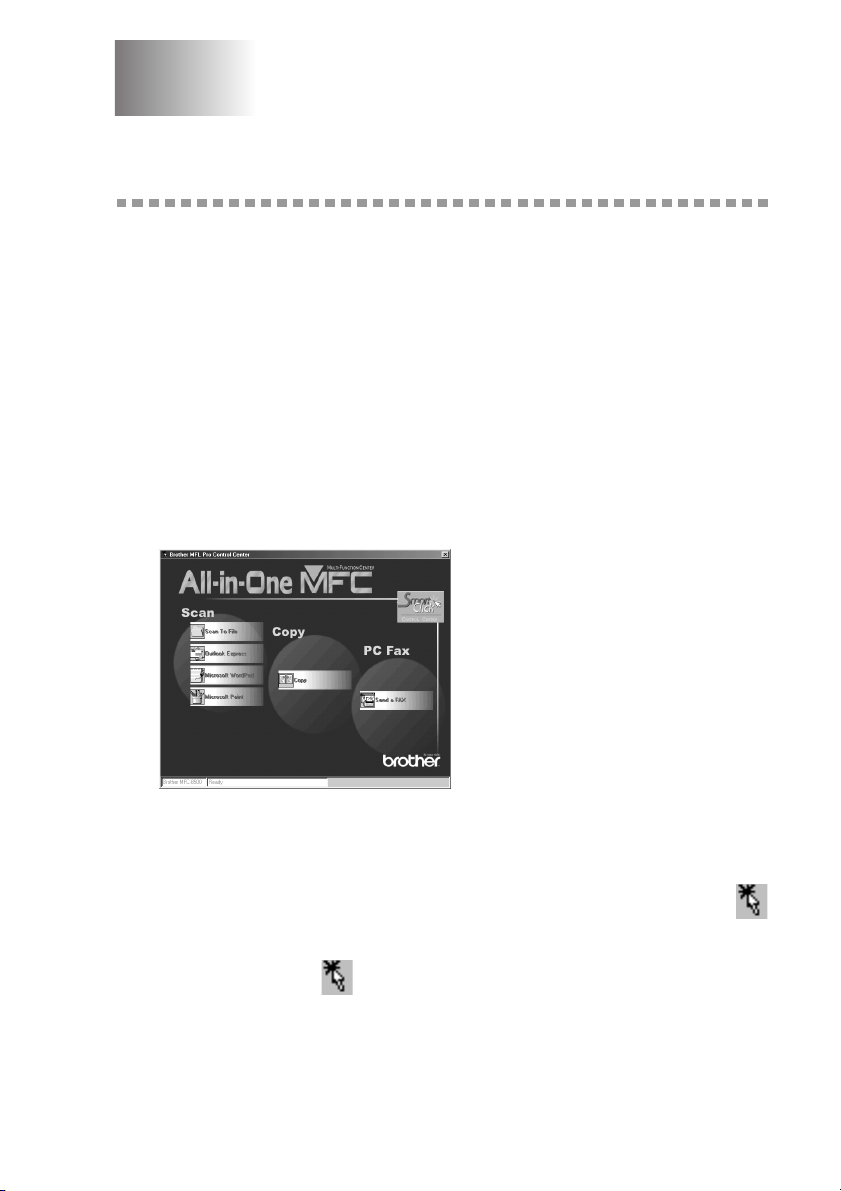
USING THE WINDOWS
®
-BASED BROTHER MFL-PRO CONTROL CENTER
15 - 1
15
15
Using the Windows
®
-Based
Brother MFL-Pro Control Center
Brother Control Center
The Brother Control Center is a software utility that pops up on the PC screen
whenever paper is placed in the automatic document feeder (ADF). This allows
you to quite easily, with very few mouse clicks, access the most frequently used
scanning applications. Using the Control Center eliminates the need to manually
launch the specific applications.
The Brother Control Center provides three categories of functions:
1
Scanning directly to a file, E-mail, word processor or graphic application of
choice
2
Copy operations
3
PC Faxing using the Brother PC Fax software
MFC-9800:
AutoLoad the Brother Control Center
The Control Center is initially configured to automatically load each time
Windows
®
is started. When the Control Center is loaded, the Control Center
icon will appear in the task bar. If you don’t want the Control Center to load
automatically, you can turn off AutoLoad.
If the Control Center icon does not appear in your task bar, you will have to
install this software.
From the Start menu select Programs, Paper Port, and then double-click
Brother SmartUI PopUp.
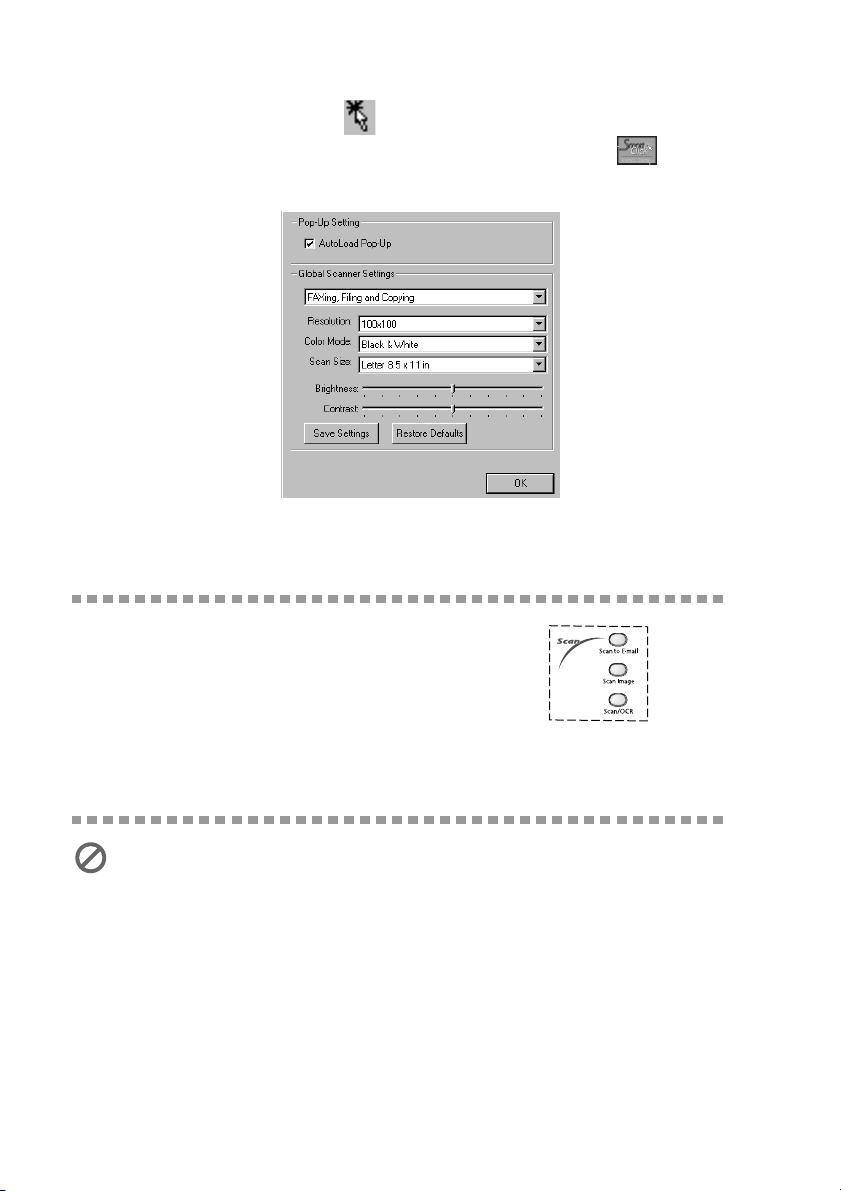
15 - 2
USING THE WINDOWS
®
-BASED BROTHER MFL-PRO CONTROL CENTER
How to Turn Off AutoLoad
1
Left-click the Control Center icon, and then click Show.
2
When the Control Center icon appears, left-click the Smart Click Control
Center button. A dialogue box with a check box labeled “AutoLoad Pop-up”
will appear:
3
Uncheck the AutoLoad Pop-Up option.
Using the Scan Keys
You can use the Scan keys on the control
panel to scan originals into your word
processing, graphics or E-mail applications.
The advantage of using the Scan keys is that
you avoid the mouse clicks required to scan
from your PC.
Using the Control Panel Keys
Before you can use the Scan keys on the control panel, you must have connected
the MFC to your Windows
®
-based PC and loaded the appropriate Brother
Drivers for your version of Windows
®
. When you are ready to use the Scan
keys, make sure the Brother Control Center application is running on your PC.
(For details about how to configure the Brother Control Center buttons to launch
the application of your choice using the Scan keys, see
Brother Control Center
Features
, Page 15-4 to15-6.)
If you have connected a Macintosh, the control panel keys will not work with
your computer.

USING THE WINDOWS
®
-BASED BROTHER MFL-PRO CONTROL CENTER
15 - 3
Scan Image
You can scan a picture into your graphics application for viewing and editing.
1
Place your original face up in the ADF, or face down on the scanner glass.
2
Press Scan Image.
The MFC will scan the original and send a color image to your graphics
application.
Scan/OCR
If your original is text, you can have it automatically converted by ScanSoft™
TextBridge
®
to an editable text file and then displayed in your word processing
application for further editing.
1
Place your original face up in the ADF, or face down on the scanner glass.
2
Press Scan/OCR.
3
The MFC will scan the original perform OCR in ScanSoft™ TextBridge
®
and
then display the result in your word processing application for viewing and
editing.
Scan to E-mail
You can scan an original into your E-mail application as a file attachment.
Although the Brother Control Center can be configured to send only black and
white or color file attachments at one time, you can easily change this setting.
(For details see
Scan to E-mail, Page 15-8 to 15-10.)
1
Place the original face up in the ADF, or face down on the scanner glass.
2
Press Scan to E-mail.
3
The MFC will scan the original, create a file attachment, and launch your E-mail
application, displaying the new message waiting to be addressed.
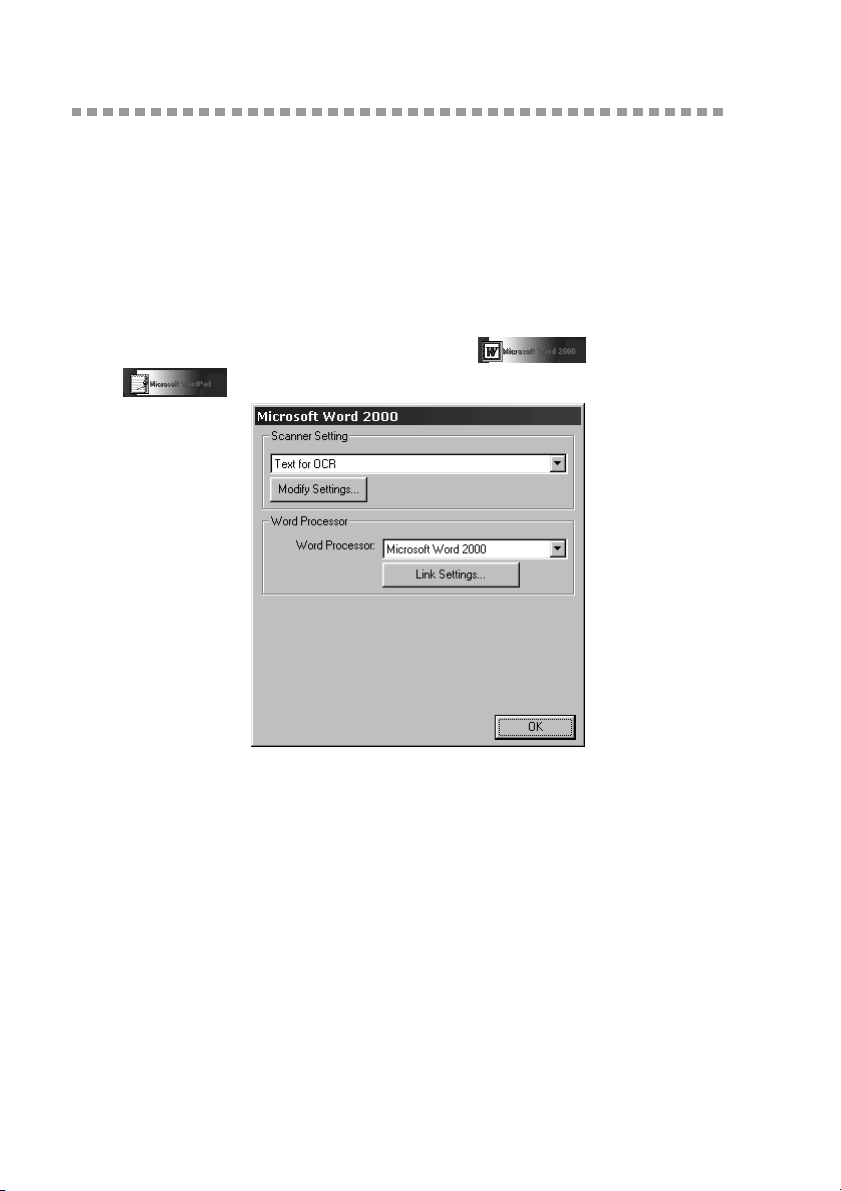
15 - 4
USING THE WINDOWS
®
-BASED BROTHER MFL-PRO CONTROL CENTER
Brother Control Center Features
Auto Configuration
During the installation process the Control Center checks your system to
determine the default applications for E-mail, word processing and graphics
viewer/editor. For example, if you are using Outlook as your default E-mail
application, the Control Center automatically will create a link and a scanning
application button for Outlook.
You can change a default application by right-clicking any of the scan buttons
in the Control Center and selecting a different application. For example,
you can change a scan button from MS Word to MS Word Pad
by changing the application that is listed for the Word Processor.
Scanning Operations
Scan to File—allows you to scan directly to a disk file with two mouse clicks.
You can change the file type, destination directory and file name, as needed.
Scan to E-mail—enables you, with just two mouse clicks, to scan a picture or
text document directly into an E-mail application as a standard attachment. You
have the option of selecting the file type and resolution for the attachment.
Scan to Word Processor—enables you to scan a text document, run ScanSoft
TextBridge OCR and insert the text original (not graphic image) into a word
processing file with just two mouse clicks. You have the option of selecting the
destination word processing program, such as Word Pad, MS Word, Word
Perfect, etc.
Scan to Graphic Application—allows you to scan an image directly into any
graphic viewer/editor application. You can select the destination application,
such as MS Paint or Corel PhotoPaint.
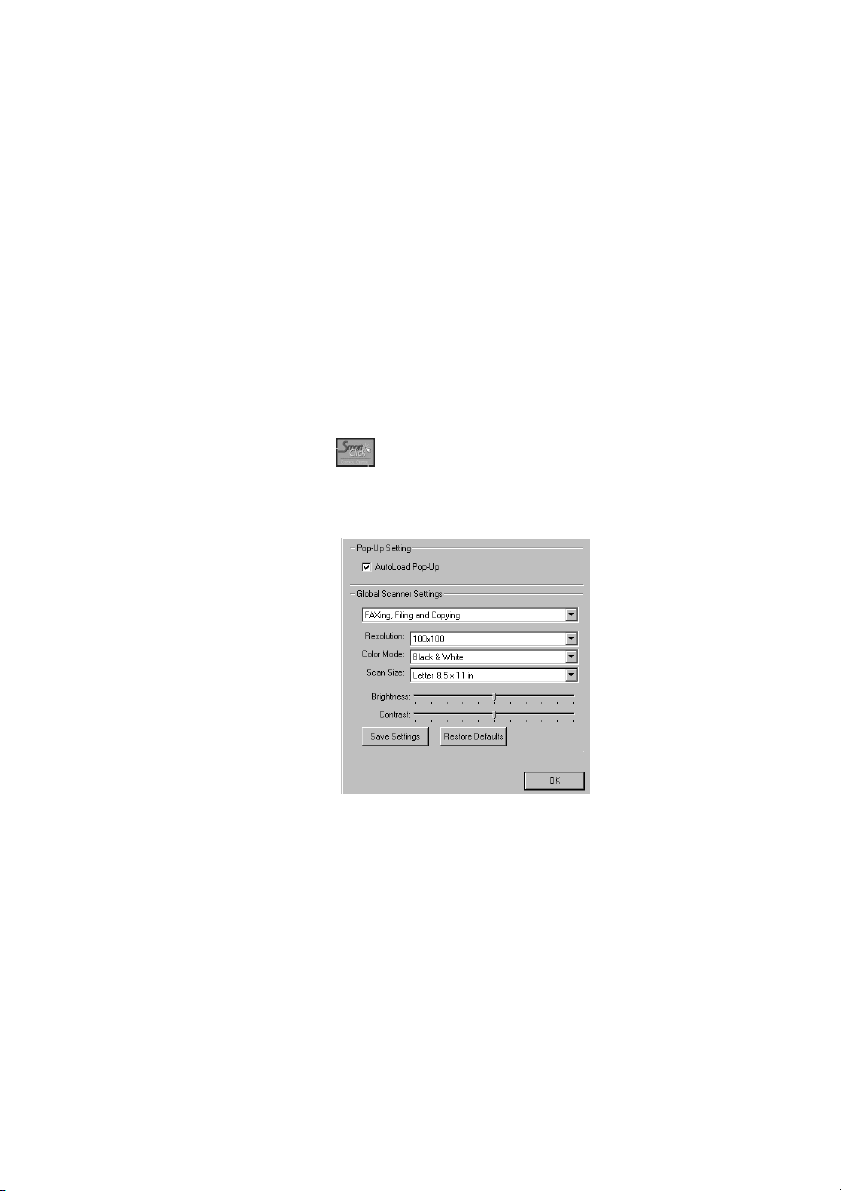
USING THE WINDOWS
®
-BASED BROTHER MFL-PRO CONTROL CENTER
15 - 5
Copy Operations
Copy—allows you to use the PC and any Windows
®
printer driver for enhanced
copy functions. You can scan the page on the Brother MFC and print the copies
using any of the features of the Brother MFC printer driver—OR—you can
direct the copy output to any standard Windows
®
printer driver installed on the
PC.
PC Fax Operation
Send a Fax—allows you to scan a picture or text original and automatically send
the image as a fax from the PC using the Brother MFL Pro fax software.
Scanner Settings for Scan, Copy and PC Fax Buttons
When the Pop-Up screen is displayed, you can access the Scanner Settings
window.
Click the Smart Click icon at the top right of the Brother Control
Center screen—OR—Click the Modify Settings… button on any of the
Configuration screens.
Global Settings
AutoLoad Pop-Up—Click this checkbox if you want Brother MFL Control
Center to load when you boot your computer.

15 - 6
USING THE WINDOWS
®
-BASED BROTHER MFL-PRO CONTROL CENTER
Setting Up the Scanner Configurations
The Pop-Up application stores eight different scanning modes. Each time you
scan an original, you will choose the most appropriate scanning mode from the
following:
Faxing, Filing and Copying
Text for OCR
Photos
Photos (High Quality)
Photos (Quick Scan)
Custom
Draft Copy
Fine Copy
Each mode has its own set of stored settings. You can keep the factory default
settings or change them at any time:
Resolution—Select the scanning resolution you most frequently use.
Color Mode—From the pull-down list, select
Scan Size—From the pull-down list, select
Brightness—Slide the adjuster from 0% to 100%
Contrast—Slide the adjuster from 0% to 100%
Click OK to save your changes. If you make a mistake or later decide to return
to the original default setting, just click the Restore Defaults button when the
scanning mode is displayed.
To Access the Scanner Configuration Screen:
1
Place the original in the ADF.
2
Right-click the appropriate Control Center button to display Configurations…,
then click it. The configuration screen for that Control Center button will
appear.
3
To save your settings, press the OK button—OR—To return to the factory
default settings, press the Restore Defaults button.
Perform an Operation from the Control Center Screen
If you see this screen it means you left-clicked a button in the Control Center
window without first placing an original in the ADF.
Place the original in the Brother machine’s ADF, and then click OK to return to
the Control Center screen.
Note
If you want to scan the document from the scanner glass, please use Scan keys
on the control panel.
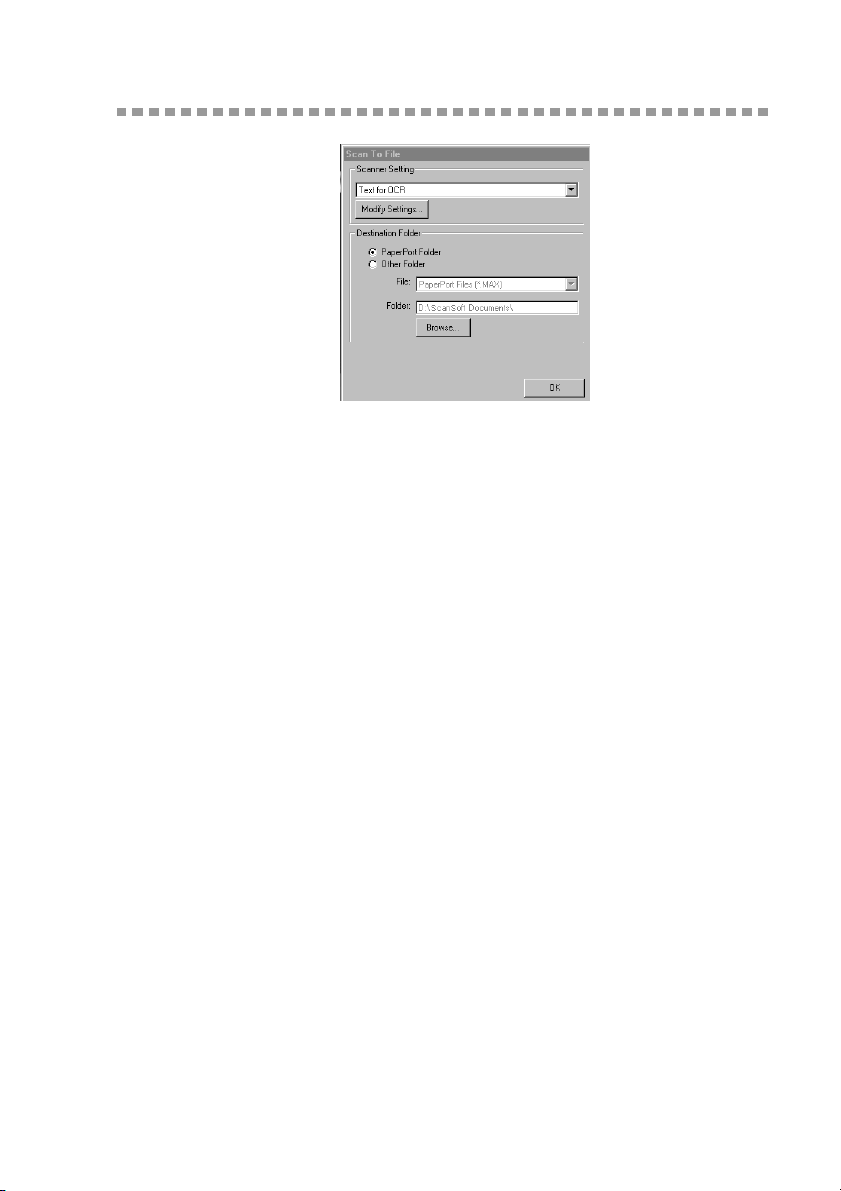
USING THE WINDOWS
®
-BASED BROTHER MFL-PRO CONTROL CENTER
15 - 7
Scan to File
Scanner Settings
From the pull-down list, select the scanning mode that is appropriate for the type
of file: Faxing, Filing and Copying; Text for OCR; Photos; Photos (High
Quality); Photos (Quick Scan); Custom; Draft Copy or Fine Copy.
To change any of the settings for that mode, click the Modify Settings… button.
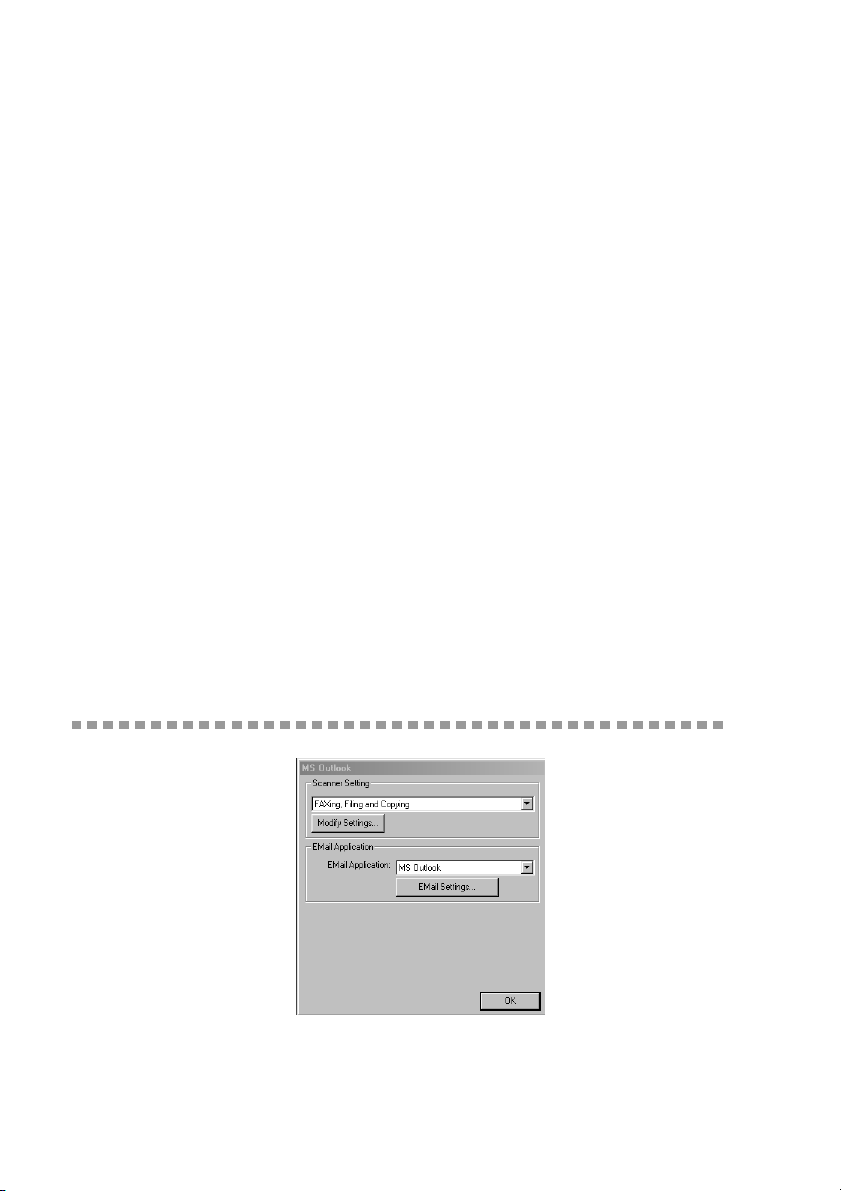
15 - 8
USING THE WINDOWS
®
-BASED BROTHER MFL-PRO CONTROL CENTER
Destination Folder
PaperPort Folder—Select this checkbox to scan the original into your
PaperPort folder.
Other Folder—Select this checkbox, to scan the original as another file type
and/or into another directory/folder.
File—If you selected Other Folder, from the pull-down list select the type of
file:
PaperPort Files (*.MAX)
Self Viewing Files (*.EXE)
PaperPort 5.0 Files (*.MAX)
PaperPort 4.0 Files (*.MAX)
PaperPort 3.0 Files (*.MAX)
Windows Bitmap (*.BMP)
PC Paintbrush (*.PCX)
Multi-page PCX (*.DCX)
JPEG Image Files (*.JPG)
TIFF-Uncompressed (*.TIF)
TIFF Group 4 (*.TIF)
TIFF Class F (*.TIF)
Multi-Page TIFF-Uncompressed (*.TIF)
Multi-Page TIFF Group 4 (*.TIF)
Multi-Page TIFF Class F (*.TIF)
PDF Files (*.PDF)
Portable Network Graphics (*.PNG)
FlashPix (*.FPX)
HFX Fax Files (*.HFX)
To Search your system for the directory and folder you want, click the
Browse… button. Click OK to save your settings.
Scan to E-mail
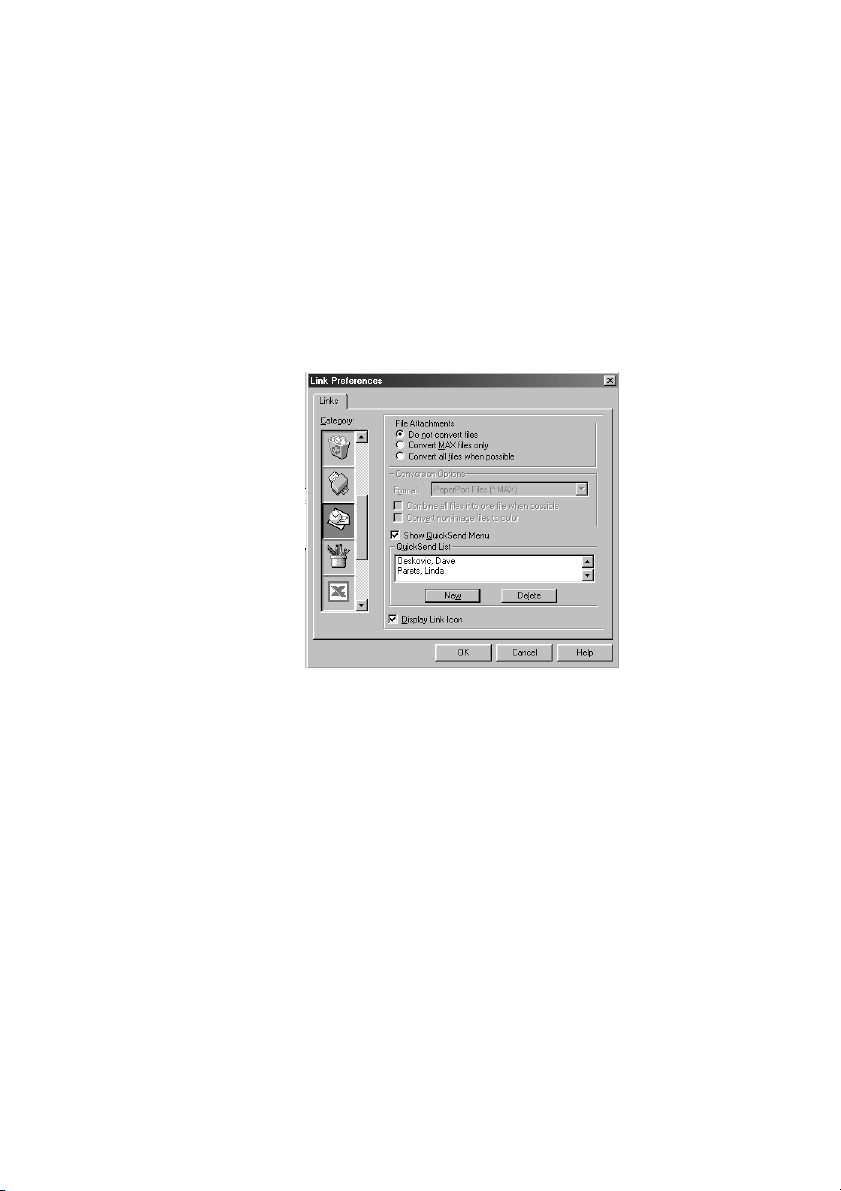
USING THE WINDOWS
®
-BASED BROTHER MFL-PRO CONTROL CENTER
15 - 9
Scanner Settings
From the pull-down list, select the scanning mode that is appropriate for the type
of file: Faxing, Filing and Copying; Text for OCR; Photos; Photos (High
Quality); Photos (Quick Scan); Custom; Draft Copy or Fine Copy.
To change any of the settings for that mode, click the Modify Settings… button.
E-mail Application
E-mail Package—From the pull-down list, select your E-mail application.
E-mail Settings—Click the EMail Settings… button to set up links.
The Links Preferences window will appear:
File Attachments
Do not convert files—Click this checkbox if you do not want to change the file
type of attachments. The Conversion Options will not be available (grayed).
Convert MAX files only—Click this checkbox if you want to convert only
attachments that are PaperPort files.
Convert all files when possible—Click this checkbox if you want to change the
file type of all attachments.
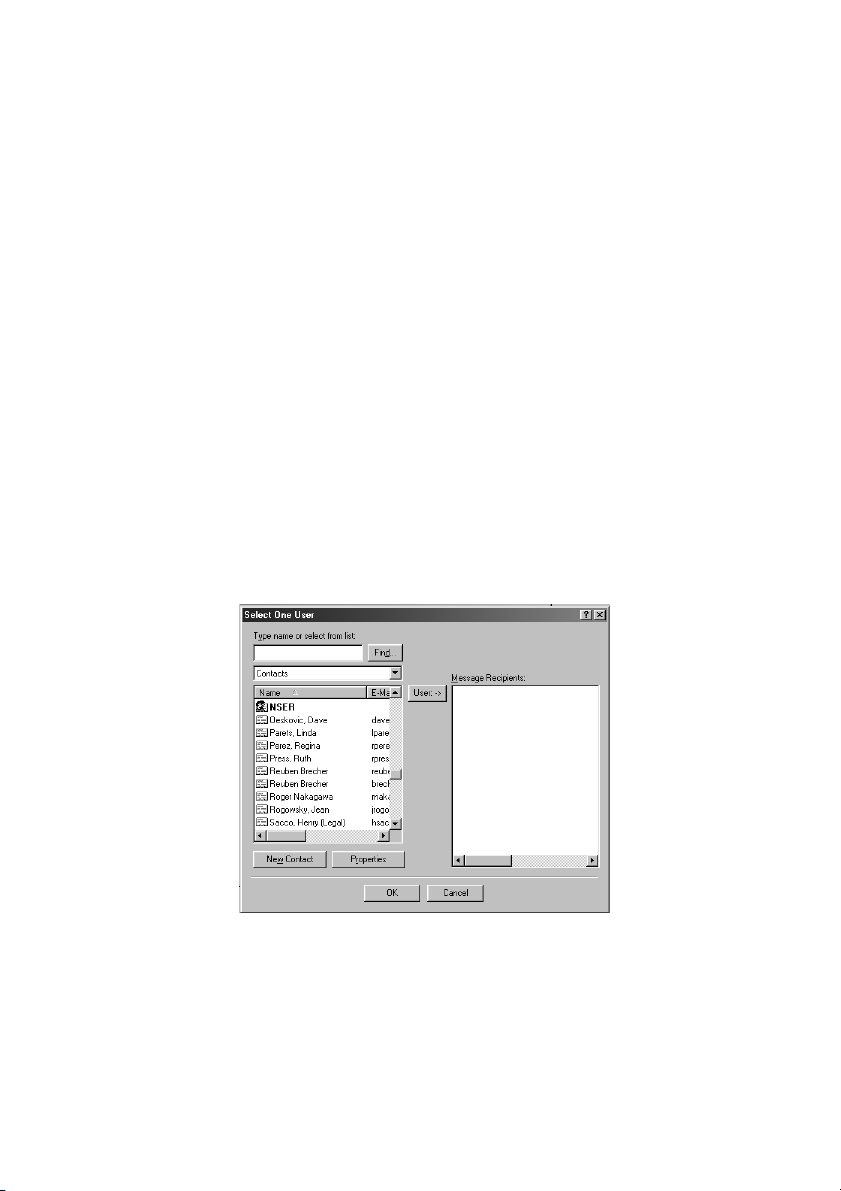
15 - 10
USING THE WINDOWS
®
-BASED BROTHER MFL-PRO CONTROL CENTER
Conversion Options
Format
Combine all files into one file when possible—Click this checkbox to combine
all files of the same type into one file.
(For Brother Color Models Only)
Convert non-image files to color—Click this checkbox to convert all files that
have been processed through OCR to color.
Show QuickSend Menu
Click this checkbox if you want the Select QuickSend Recipient window to be
displayed when you choose Scan to E-mail. This feature works only with MAPI
type E-mail applications, such as Microsoft Exchange, Microsoft Outlook and
Eudora.
QuickSend List
You can create a list of Email names and addresses for quick selection.
To add a name(s) to your QuickSend list, click the New button. Your Email
phone book listing will be displayed, so you can select stored names or create
new ones:
Highlight the name(s) you want to add to your list, and then click the User
button. Click OK to return to the Link Preference window.
To remove a name from the QuickSend list, in the Link Preference window
highlight the name and click the Delete button.
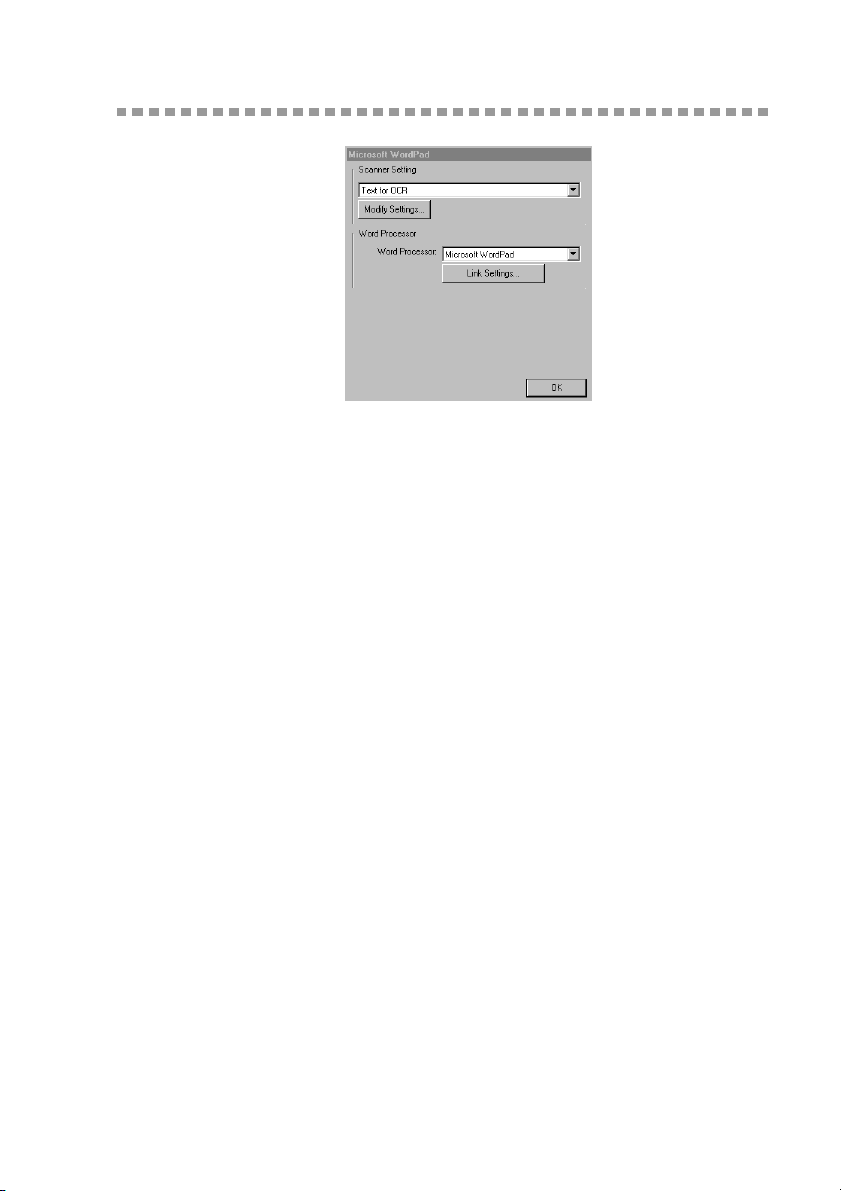
USING THE WINDOWS
®
-BASED BROTHER MFL-PRO CONTROL CENTER
15 - 11
Scan to Word Processor
Scanner Settings
From the pull-down list, select the scanning mode that is appropriate for the type
of file: Faxing, Filing and Copying; Text for OCR; Photos; Photos (High
Quality); Photos (Quick Scan); Custom; Draft Copy or Fine Copy.
To change any of the settings for that mode, click the Modify Settings… button.
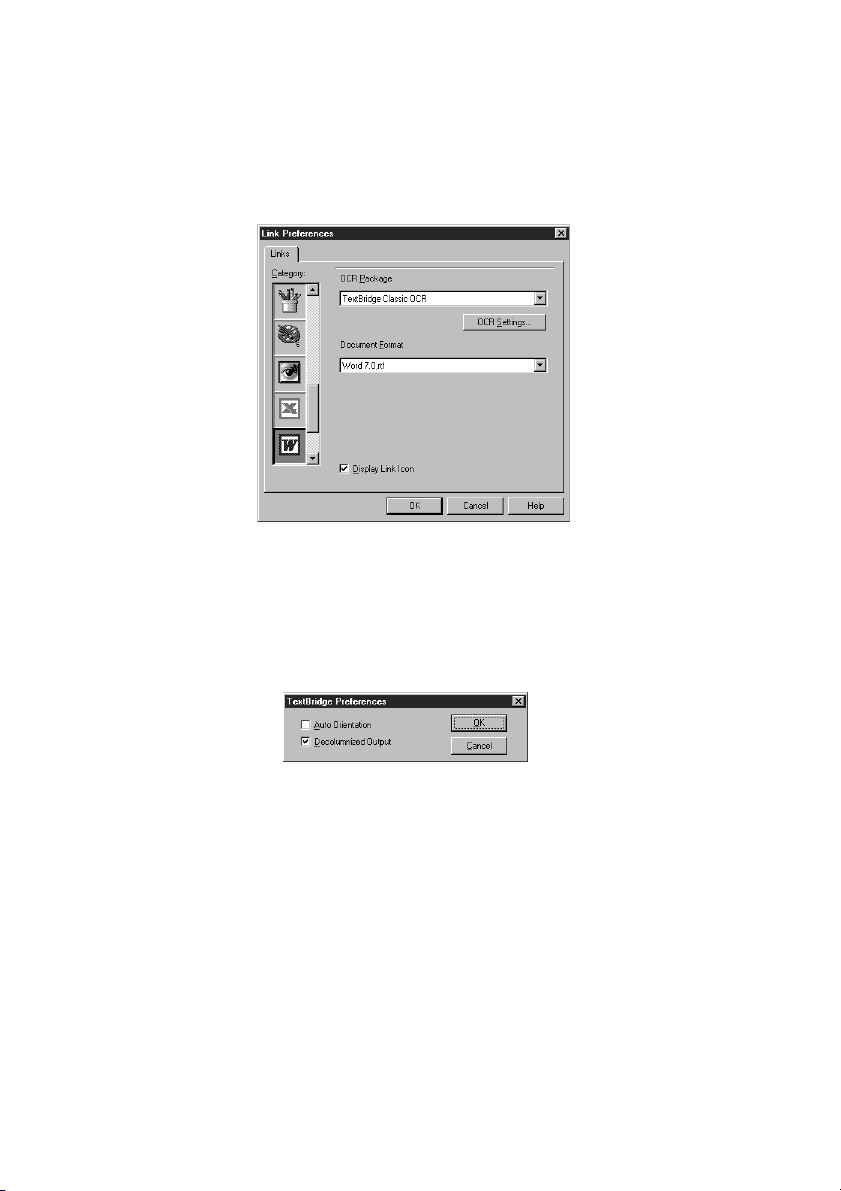
15 - 12
USING THE WINDOWS
®
-BASED BROTHER MFL-PRO CONTROL CENTER
Word Processor
Word Processor—From the pull-down list, select the word processor you want
to use.
Click the Link Settings… button to display a screen to set up a link to the
version of OCR and document format that you want to use:
OCR Package—From the pull-down list, select TextBridge Classic OCR if you
want to use the OCR package that was installed with the Brother software.
Click the OCR Settings… button to choose how the OCR application will read
the pages you scan into your word processor application.
The Preferences window will appear:
Select your setting and click OK.
• Auto Orientation—Check this checkbox if you want your word processor
application to read the page as it is set up.
• Decolumnized Output—Check this checkbox if you want your word
processor application to read across the entire page from left to right.
• Document Format—From the pull-down list, select the file format you
want to use for your word processor or text documents.
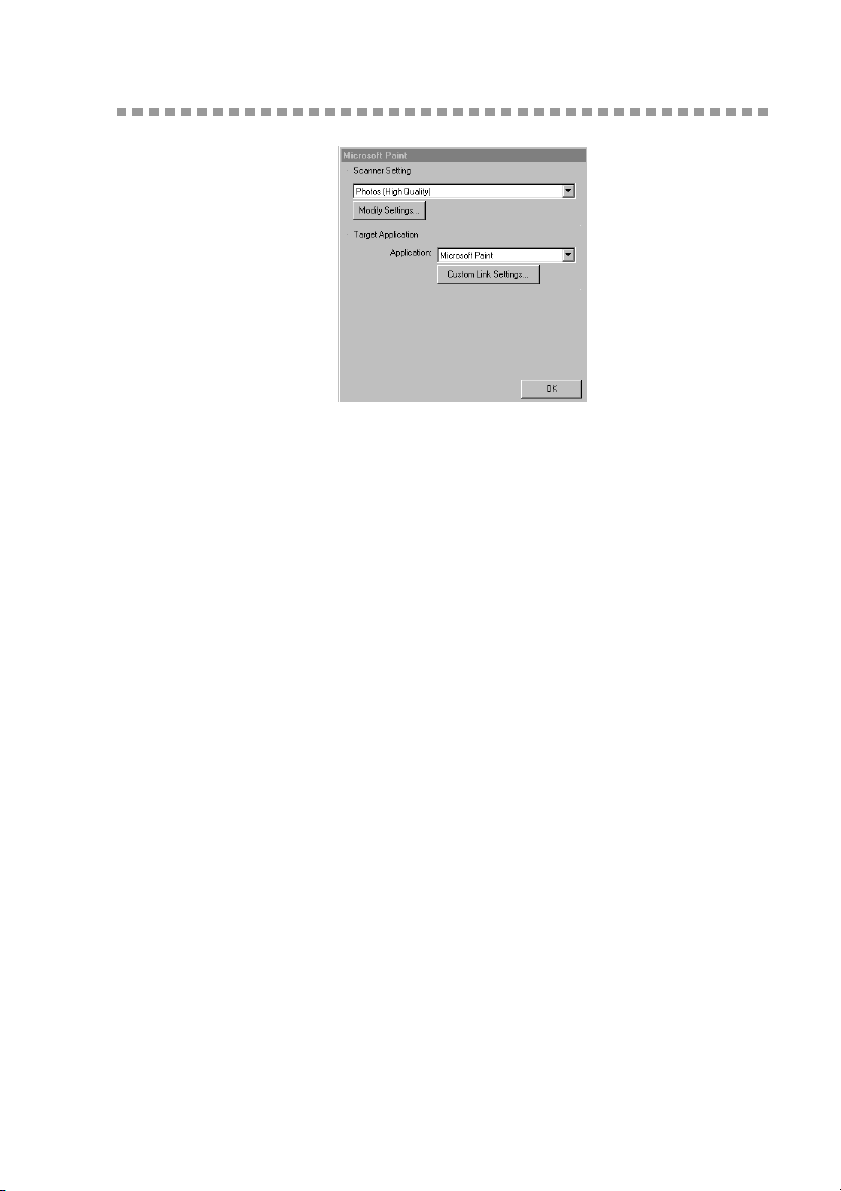
USING THE WINDOWS
®
-BASED BROTHER MFL-PRO CONTROL CENTER
15 - 13
User-Defined Button
Scanner Settings
From the pull-down list, select the scanning mode that is appropriate for the type
of file: Faxing, Filing and Copying; Text for OCR; Photos; Photos (High
Quality); Photos (Quick Scan); Custom; Draft Copy or Fine Copy.
To change any of the settings for that mode, click the Modify Settings… button.
Target Application
Application—From the pull-down list, select the application you want to add to
this Pop-Up screen.
Click the Custom Link Settings… button to set up links for your user-defined
application.
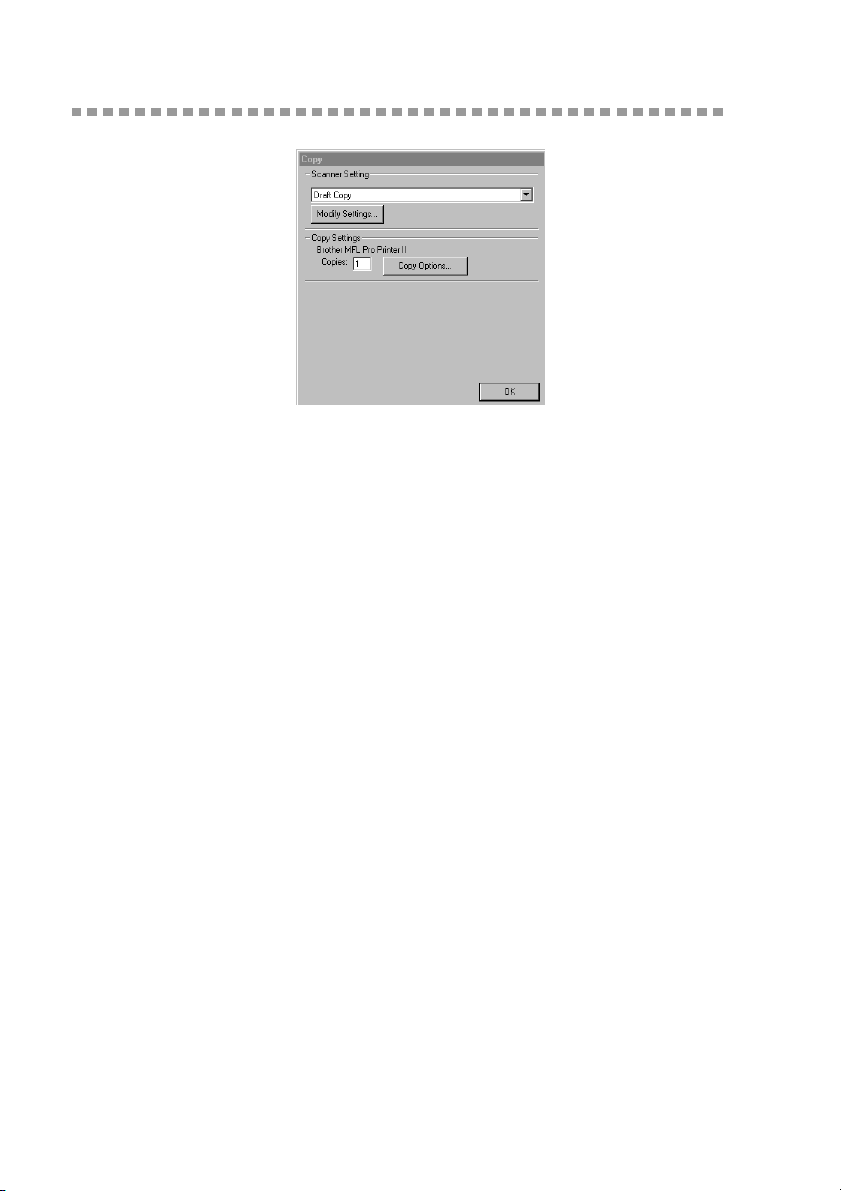
15 - 14
USING THE WINDOWS
®
-BASED BROTHER MFL-PRO CONTROL CENTER
Copy
Scanner Settings
From the pull-down list, select the scanning mode that is appropriate for the type
of file: Faxing, Filing and Copying; Text for OCR; Photos; Photos (High
Quality); Photos (Quick Scan); Custom; Draft Copy or Fine Copy.
To change any of the settings for that mode, click the Modify Settings... button.
Copy Settings
Brother MFC-9800
Copies—Enter the number of copies you want to print.
To change the copy options, click the Copy Options... button.
Click the OK button to save your Copy settings.
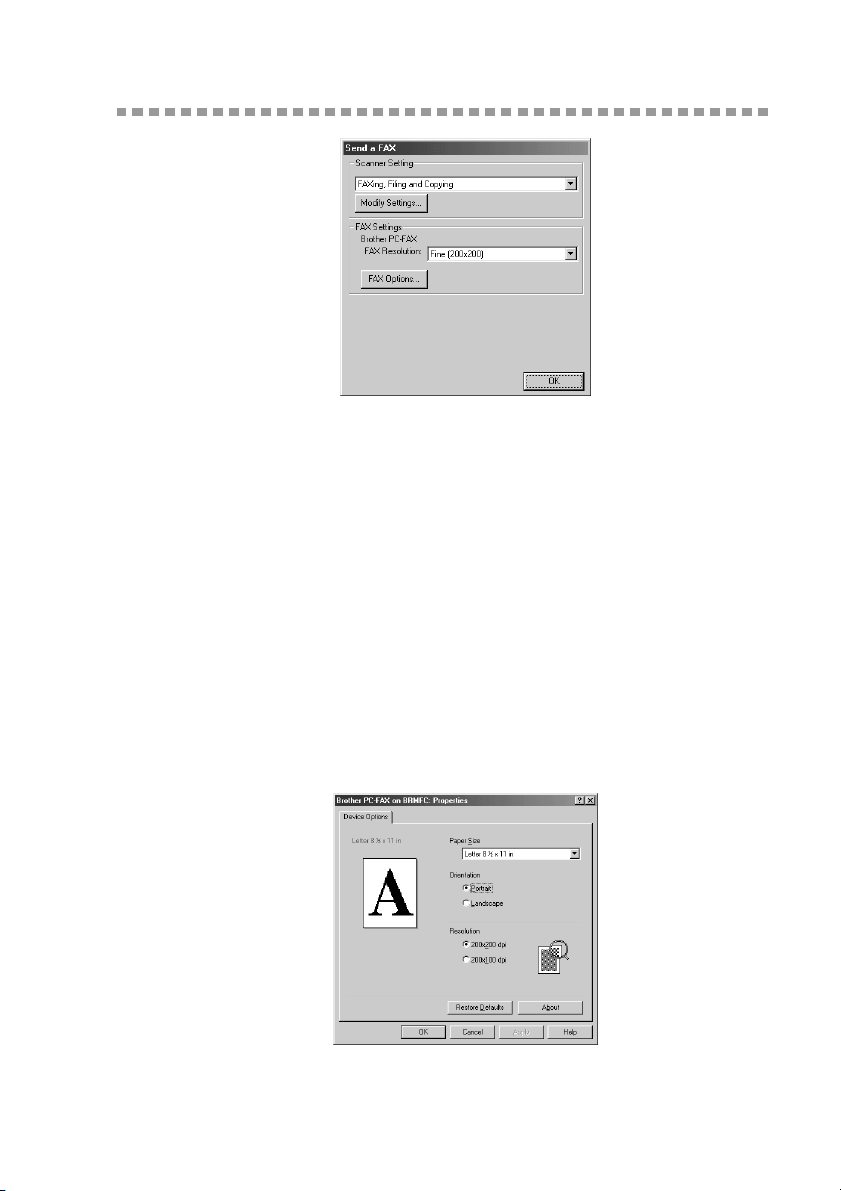
USING THE WINDOWS
®
-BASED BROTHER MFL-PRO CONTROL CENTER
15 - 15
Send a Fax
Scanner Settings
From the pull-down list, select the scanning mode that is appropriate for the type
of file: Faxing, Filing and Copying; Text for OCR; Photos; Photos (High
Quality); Photos (Quick Scan); Custom; Draft Copy or Fine Copy.
To change any of the settings for that mode, click the Modify Settings… button.
Fax Settings
Brother MFL Pro Fax
FAX Resolution—Fine (200 × 200).
To change the fax options, click the FAX Options… button.
Click the OK button when you are ready to save your FAX settings.
The Brother PC-FAX Properties screen appears:
Select the Paper Size and Orientation (Portrait or Landscape) and click OK.
To return to the factory default settings, click the Restore Defaults button.
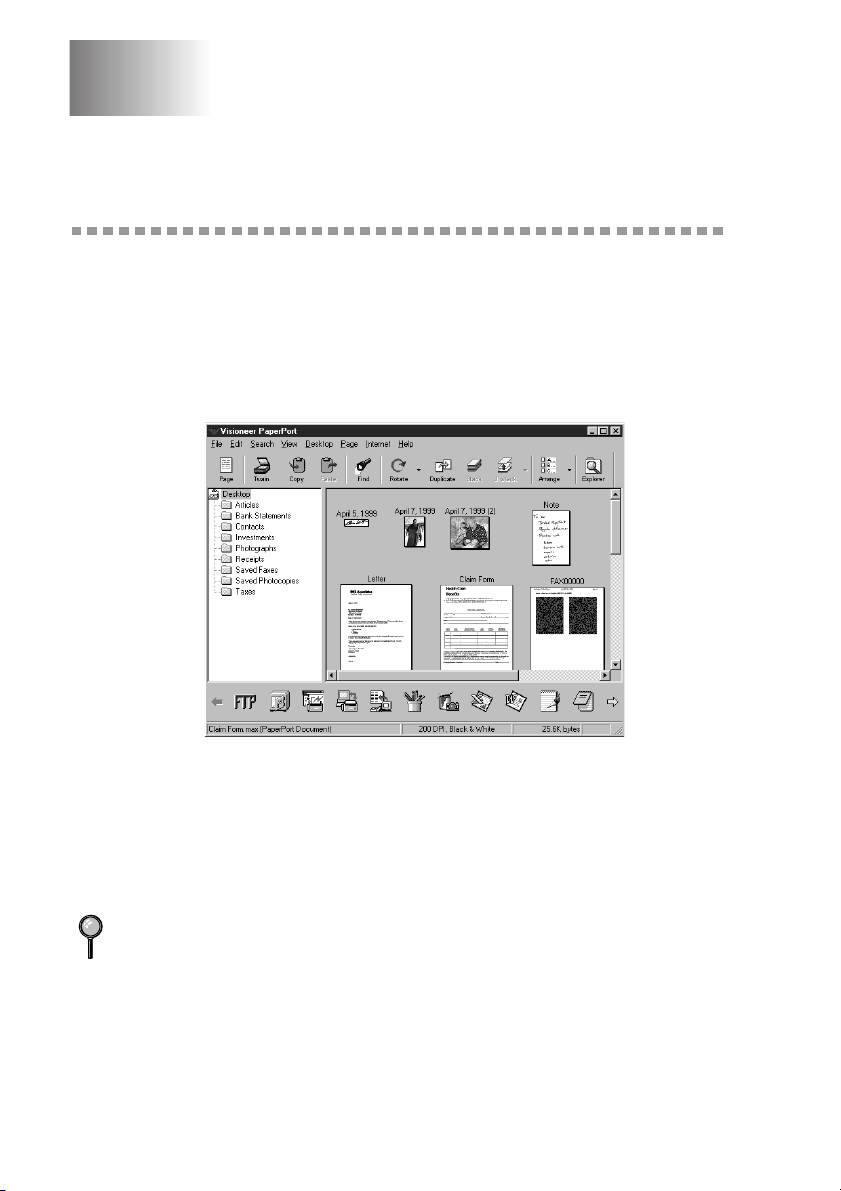
16 - 1
USING SCANSOFT™ PAPERPORT
®
FOR BROTHER AND SCANSOFT™ TEXTBRIDGE
®
(FOR WINDOWS
®
ONLY)
16
16
Using ScanSoft™ PaperPort
®
for Brother and ScanSoft™
TextBridge
®
(For Windows
®
Only)
Using ScanSoft™ PaperPort
®
and TextBridge
®
ScanSoft™ Paper Port
®
for Brother is a document management application.
You will use PaperPort
®
to view incoming faxes and scanned documents.
PaperPort
®
has a sophisticated, yet easy-to-use, filing system that will help you
organize your documents. It allows you to combine or “stack” documents of
different formats for printing, faxing or filing. PaperPort
®
can be accessed
through the PaperPort
®
program group. See On-Line Documentation for Multi-
Function Link
®
Pro on the CD-ROM.
The complete ScanSoft™ PaperPort
®
Owner’s Manual, including ScanSoft™
TextBridge
®
OCR, is in the On-Line Documentation on the CD-ROM. This
chapter is only an introduction to the basic operations.
When you install Multi-Function Link
®
Pro, ScanSoft™ PaperPort
®
for Brother
and ScanSoft™ TextBridge
®
OCR are installed with it automatically.
For Windows
®
95/98/98SE, and Windows NT
®
Workstation 4.0, Windows
®
ME
and Windows
®
2000 Professional:
Select Start, Settings, Control Panel, Add/Remove Programs and the Install/
Uninstall tab. Select PaperPort
®
from the list and click the Add/Remove button.
To Uninstall PaperPort
®
and ScanSoft™ TextBridge
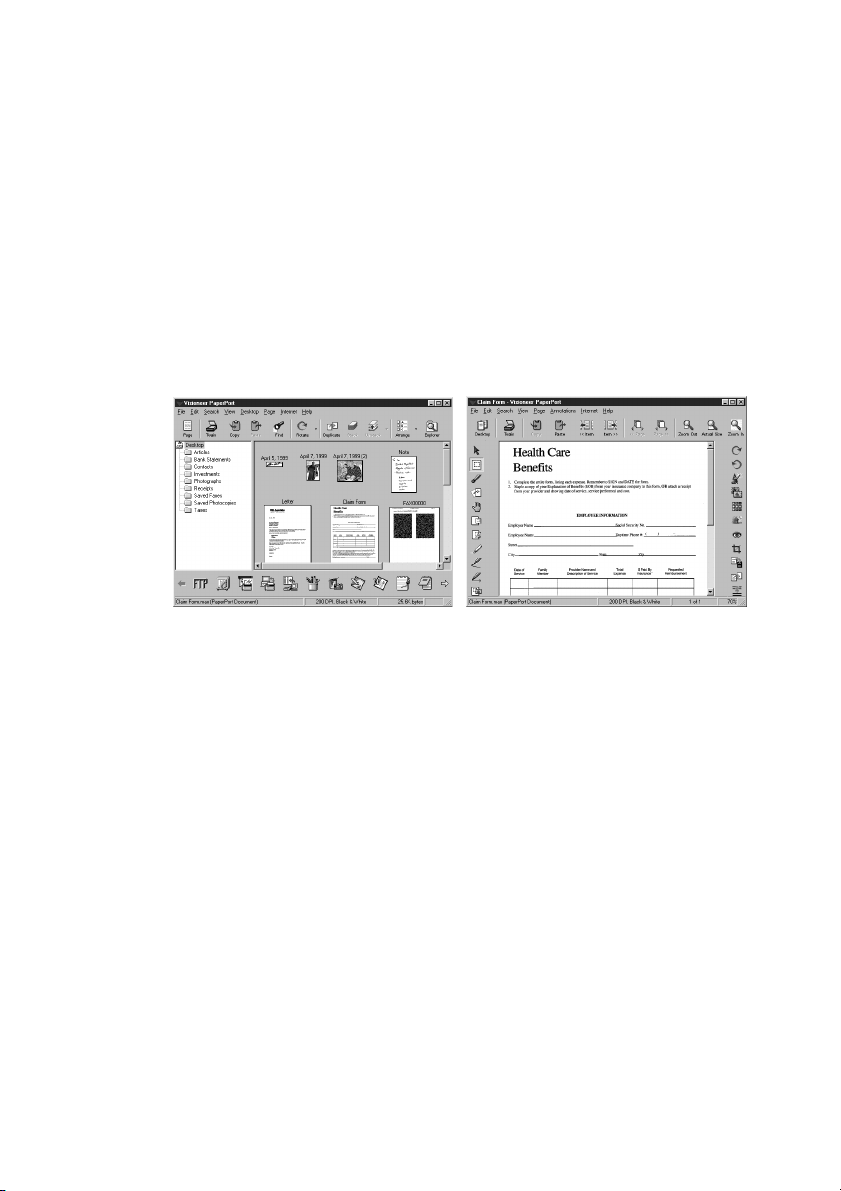
USING SCANSOFT™ PAPERPORT
®
FOR BROTHER AND SCANSOFT™ TEXTBRIDGE
®
(FOR WINDOWS
®
ONLY)
16 - 2
Viewing Items in ScanSoft™ PaperPort
®
for Brother
PaperPort
®
provides several ways to view items: Desktop View displays a
thumbnail, a small graphic that represents each item in a Desktop or folder.
Items in the selected folder appear on the PaperPort
®
Desktop. You can see
PaperPort
®
items (MAX files) and non-PaperPort
®
items (files created using
other applications).
Non-PaperPort
®
items include an icon that indicates the application that was
used to create the item; a non-PaperPort
®
item is represented by a small
rectangular thumbnail and not an actual image.
Page View displays a close-up of a single page and you can open a PaperPort
®
item by double-clicking on it. As long as you have the appropriate application
on your computer to display it, you can also double-click a non-PaperPort
®
item
to open it.
Organizing Your Items in Folders
PaperPort
®
has an easy-to-use filing system for organizing your items. The
filing system consists of folders and items that you select to view in Desktop
View. An item can be a PaperPort
®
item or a non-PaperPort
®
item:
• Folders are arranged in a “tree” structure in the Folder View. You use this pane
to select folders and view their items in Desktop View.
• You can simply drag and drop an item onto a folder. When the folder is
highlighted, release the mouse button and the item is stored in that folder.
• Folders can be “nested”—that is, stored in other folders.
• When you double-click a folder, its items (both PaperPort
®
MAX files and other
files) appear on the Desktop.
• You can also use Windows
®
Explorer to manage the folders and items shown in
Desktop View.
Destop View displays items
as thumbnails
Page View displays each item
as a full page
16 - 3
USING SCANSOFT™ PAPERPORT
®
FOR BROTHER AND SCANSOFT™ TEXTBRIDGE
®
(FOR WINDOWS
®
ONLY)
Links to Many Other Applications
PaperPort
®
automatically recognizes many other applications on your computer
and creates a “working link” to them. The Link Bar at the bottom of Desktop
view shows icons of those linked applications. To use a link, drag an item onto
one of the icons to start the application represented by the icon. A typical use of
the Link Bar is to select an item and then fax it.
This sample Link Bar shows several applications with links to PaperPort
®
.
If PaperPort
®
does not automatically recognize one of the applications on your
computer, you can manually create a link using the Create New Link
command. (See PaperPort
®
Help for more information about creating new
links.)
Using ScanSoft™ TextBridge
®
OCR (Converting
Image Text to Text You Can Edit)
Software by:
ScanSoft™ TextBridge
®
OCR is automatically installed with PaperPort
®
when
you install Multi-Function Link
®
Pro on your computer.
PaperPort
®
can quickly convert the text on a PaperPort
®
item (which is really
just a picture of the text) into text that you can edit with a word processing
application. PaperPort
®
uses the optical character recognition application
ScanSoft™ TextBridge, which comes with PaperPort
®
—OR—PaperPort
®
uses
your application if it is already on your computer. You can convert the entire
item, or by using the Copy As Text command, you can select only a portion of
the text to convert.
Dragging an item onto a word-processing link icon starts PaperPort
®
’s built-in
OCR application, or you can use your own OCR application.
Importing Items from Other Applications
In addition to scanning items, you can bring items into PaperPort
®
in a variety
of ways and convert them to PaperPort
®
(MAX) files in several different ways:
• Print to the Desktop View from another application, such as Microsoft Excel.
• Import files saved in other file formats, such as Windows
®
Bitmap (BMP) or
Tag Image File Format (TIFF).
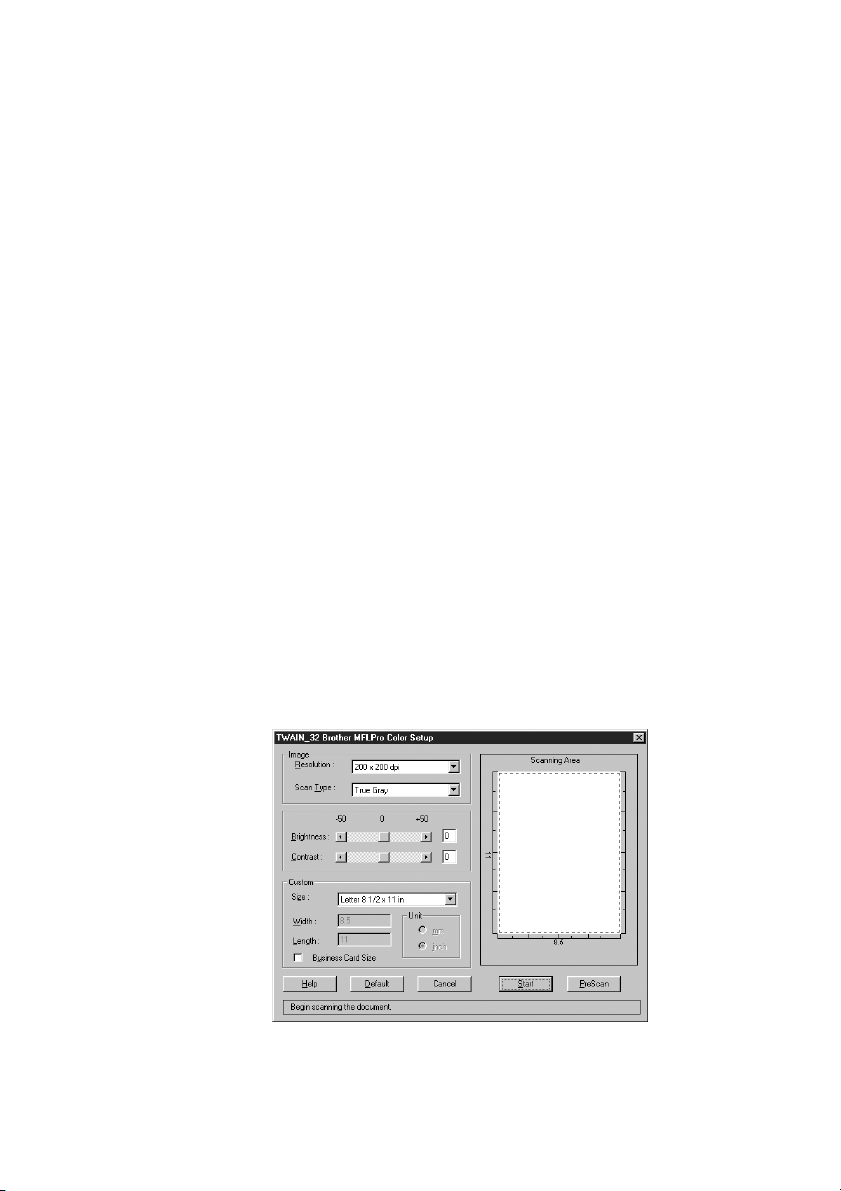
USING SCANSOFT™ PAPERPORT
®
FOR BROTHER AND SCANSOFT™ TEXTBRIDGE
®
(FOR WINDOWS
®
ONLY)
16 - 4
Exporting Items in Other Formats
You can export or save PaperPort
®
items in several popular file formats. For
Windows
®
95/98/98SE, and Windows NT
®
Workstation Version 4.0,
Windows
®
2000 Professional and Windows
®
ME, you can export formats BMP,
PCX, DCX, JPG, TIF, PDF, PNG, FPX, HFX, or self-viewing. For Windows
®
3.1x, you can export file formats BMP, PCX, DCX, JPG, TIF, PDF, HFX and
GIF. For example, you could create a file for an Internet Web site and export it
as a JPEG file. Web pages often use JPEG files for displaying images.
Exporting an Image File
1
Select the Export command from the File pull-down menu in the PaperPort
®
window. The Export ‘XXXXX’ As dialog box will be displayed.
2
Select the drive and directory where you want to store the file.
3
Enter the new file name and choose the file type or select a name from the File
Name text box. (You can scroll through the Directories and File Name listing
for prompting.)
4
Select the OK button to save your file, or Cancel to return to the PaperPort
®
without saving it.
Accessing the Scanner
To choose the Brother MFL Pro
®
Color as your scanner driver, select it under
the “Select scanner”—OR—“Select source” option in your software.
From the PaperPort
®
window, select Acquire from the File drop-down menu or
select the TWAIN or Scan button. The Multi-Function Link
®
Pro Scanner
Setup dialog box will appear:

16 - 5
USING SCANSOFT™ PAPERPORT
®
FOR BROTHER AND SCANSOFT™ TEXTBRIDGE
®
(FOR WINDOWS
®
ONLY)
Scanning an Image into Your PC
1
Insert document(s) face up in the ADF, or face down on the scanner glass.
2
Adjust the following settings, if needed, in the Scanner Setup window:
• Resolution
• Scan Type (Black & White, Gray [Error Diffusion], True Gray, 256 color, 24 bit
color, 24 bit color (Fast))
• Brightness
• Contrast
• Size
3
Select the Start button from the Scanner window.
When scanning is completed, close the scanner window. The PaperPort
®
screen
will appear showing the image you scanned highlighted in red.
Settings in the Scanner Window
Image
Resolution
Resolution: Select the scanning resolution from the Resolution drop down list.
Higher resolutions take more memory and transfer time, but can achieve a finer
scanned image.
Scan Type
Black & White: Set the image Type to Black & White for text or line art. For
photographic images, set the image type to Gray (Error Diffusion) or True Gray.
Gray (Error Diffusion) is used for documents that contain photographic images
or graphics. (Error Diffusion is a method for creating simulated gray images by
placing black dots in a specific matrix instead of true gray dots.)
Colors: Choose either 256 Color, which scans up to 256 colors, 24-bit color,
which scans up to 16.8 million colors. Although using 24-bit color creates an
image with the most accurate colors, the image file will be approximately three
times larger than a file created with 256 Color.
Brightness
Brightness: Adjusting the brightness settings to obtain the best image. The
Brother Multi-Function Link
®
Pro offers 100 brightness settings (-50 to 50).
The default value is 0, representing an “average” setting.
You can set the brightness level by dragging the slidebar to the right to lighten
the image or to the left to darken the image. You can also type a value in the
box to set the settings.
When the setting is True Gray, 200 × 100 dpi and 200 × 400 dpi is not available.

USING SCANSOFT™ PAPERPORT
®
FOR BROTHER AND SCANSOFT™ TEXTBRIDGE
®
(FOR WINDOWS
®
ONLY)
16 - 6
If the scanned image is too light, set a lower brightness value and scan the
document again.
If the image is too dark, set a higher brightness value and scan the document
again.
Contrast
The contrast setting is adjustable only when you have selected one of the gray
scale settings, but it is not available when Black & White is selected as the gray
Scale.
Increasing the contrast level (by dragging the slidebar to the right) emphasizes
dark and light areas of the Image, while decreasing the contrast level (by
dragging the slidebar to the left) ravels more detail in gray areas. Instead of
using the slidebar, you can type a value in the box to set the contrast.
Custom
Size
Set the Size to one of the following:
• Letter (8 1/2 × 11 in.)
• A4 (210 × 297 mm.)
• Legal (8 1/2 × 14 in.)
• A5 (148 × 210 mm.)
• B5 (182 × 257 mm.)
• Executive (7 1/4 × 10 1/2 in.)
• Business Card (60 × 90 mm.)
• Custom (User adjustable from 0.35 × 0.35 in. to 8.5 × 14 in.)
After you select a custom size, you can adjust the scanning area further by using
the left mouse button to drag the dotted outline of the scanning area. This is
required when you want to crop an image when scanning.
Business Card Size
To scan business cards, select the Business Card (60 × 90 mm.) size setting and
place the business card at the top center of a carrier sheet.
When scanning photographs or other images for use in a word processor or other
graphics application, you should try different settings for the contrast, mode and
resolution to see which settings best suit your needs.
Carrier sheets are available from your Dealer.
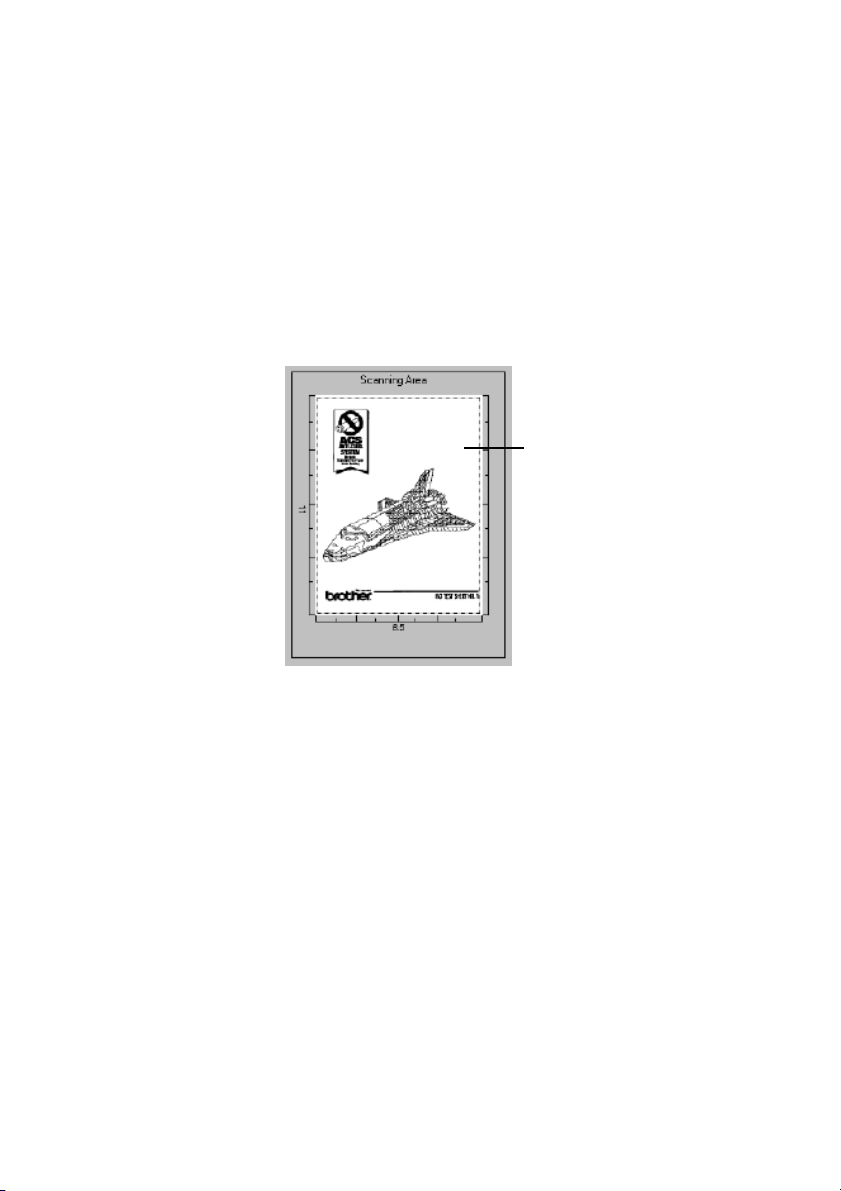
16 - 7
USING SCANSOFT™ PAPERPORT
®
FOR BROTHER AND SCANSOFT™ TEXTBRIDGE
®
(FOR WINDOWS
®
ONLY)
PreScanning an Image
PreScanning allows you to scan an image quickly at a low resolution. A
thumbnail version of the image will appear in the Scanning Area. This is only
a preview of the image so you can see how it will look. The PreScan button is
used to preview an image for cropping any unwanted portions from the image.
When you are satisfied with the preview, select the Start button to scan the
image.
1
Insert document face up in the ADF, or face down on the scanner glass.
2
Click the PreScan button:
The entire document will be scanned into the PC and will appear in the Scanning
Area of the Scanner window.
3
To crop a portion of the document to be scanned, drag any side or corner of the
dotted outline in the Scanning Area with the left mouse button. Adjust the dotted
outline until it surrounds only the portion of the document you wish to scan.
4
Place the original face up in the ADF again, if you used the ADF in Step 1.
5
Adjust the settings for Resolution, Color Type (Scan Type), Brightness,
Contrast, and Size in the Scanner Setup window, as needed.
6
Select the Start button.
This time only the selected area of the document will appear in the PaperPort
®
window.
7
In the PaperPort
®
window, use the options available in the Markups pull-down
menu and the Crop option in the Options pull-down menu to refine the image.
You can crop
the prescanned
image
SETTING UP AND USING PC-FAX (FOR WINDOWS
®
ONLY)
17 - 1
17
17
Setting Up and Using PC-FAX
(For Windows
®
Only)
Introduction
This chapter outlines the basics of the Brother software, so you can get started
using the Multi-Function Link
®
Pro software. Detailed installation and setup
instructions are in the On-Line Documentation section of the Brother CD-ROM
that is included with your MFC.
Multi-Function Link
®
Pro software for your MFC includes ScanSoft™
PaperPort
®
for Brother and ScanSoft™ TextBridge
®
. (See Chapter 16,
Using
ScanSoft™ PaperPort® for Brother and ScanSoft™ TextBridge® (For Windows®
Only)
.)
Brother Resource Manager
The Brother Resource Manager application must be running for you to use your
MFC with your Windows
®
computer. Multi-Function Link
®
Pro Suite software
and the MFL Pro Printer Driver automatically load the Resource Manager, as
needed. The Resource Manager allows the single bi-directional Parallel port on
the MFC to simulate a Communications port for faxing and scanning and to
simulate a Parallel port for Windows
®
GDI printing.
Check the online README.WRI file in the root directory of the
CD-ROM for last-minute important information and
troubleshooting tips that were not included in the On-Line
Documentation.
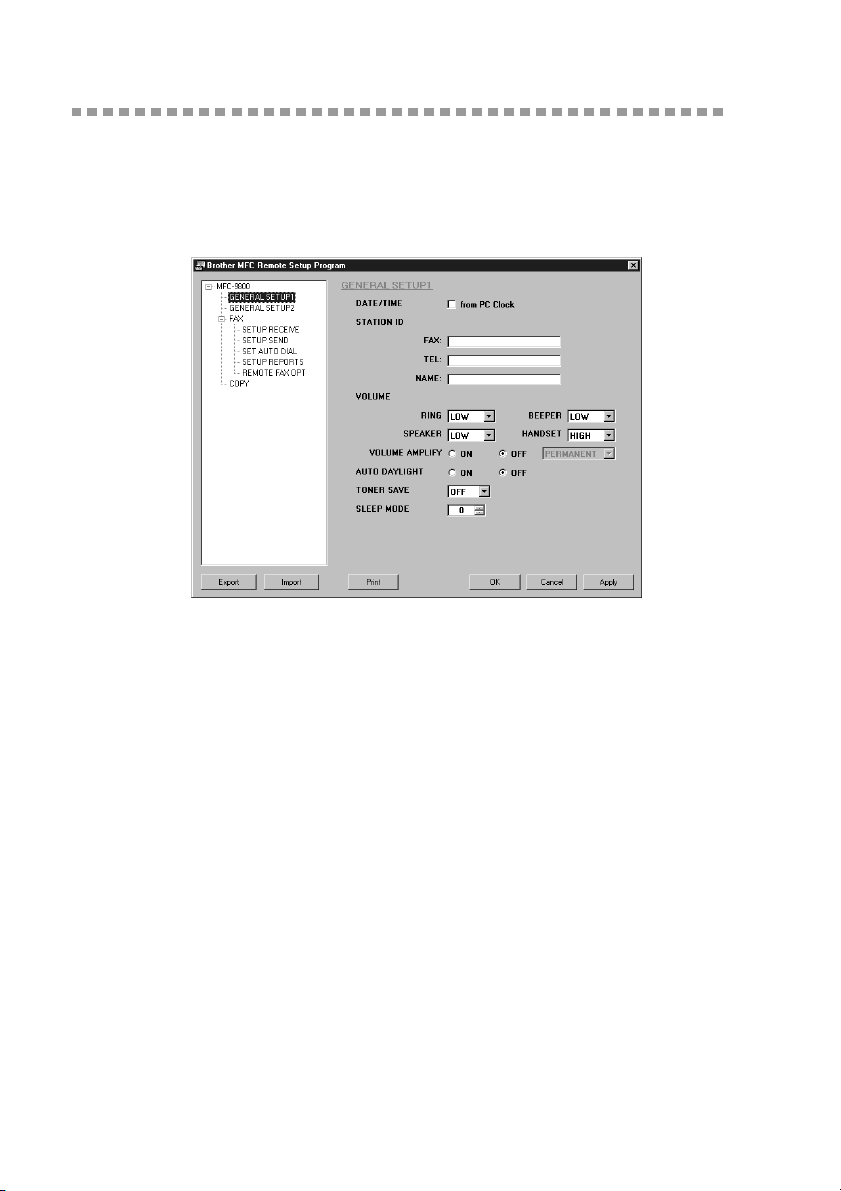
17 - 2
SETTING UP AND USING PC-FAX (FOR WINDOWS
®
ONLY)
MFC Remote Setup
The MFC Remote Setup application allows you to quickly set up your machine
by taking advantage of the ease and speed of programming on your PC. When
you access this application, the settings on your machine will be downloaded
automatically to your PC and displayed on your computer screen. If you change
the settings, you can upload them directly to the machine.
OK
This starts the process of uploading the data to the machine and exiting the
remote setup program. If an error message is displayed enter the correct data
again, then click OK.
Cancel
This exits the remote setup application without uploading the data to the
machine.
Apply
This uploads the data to the machine, but does not exit the remote setup
application.
Print
This command prints the selected items on the machine. You can not print the
data until it is uploaded to the machine. Click Apply to upload the new data to
the machine and click Print.
Export
This command saves the current configuration settings to a file.
Import
This command reads the settings from a file.
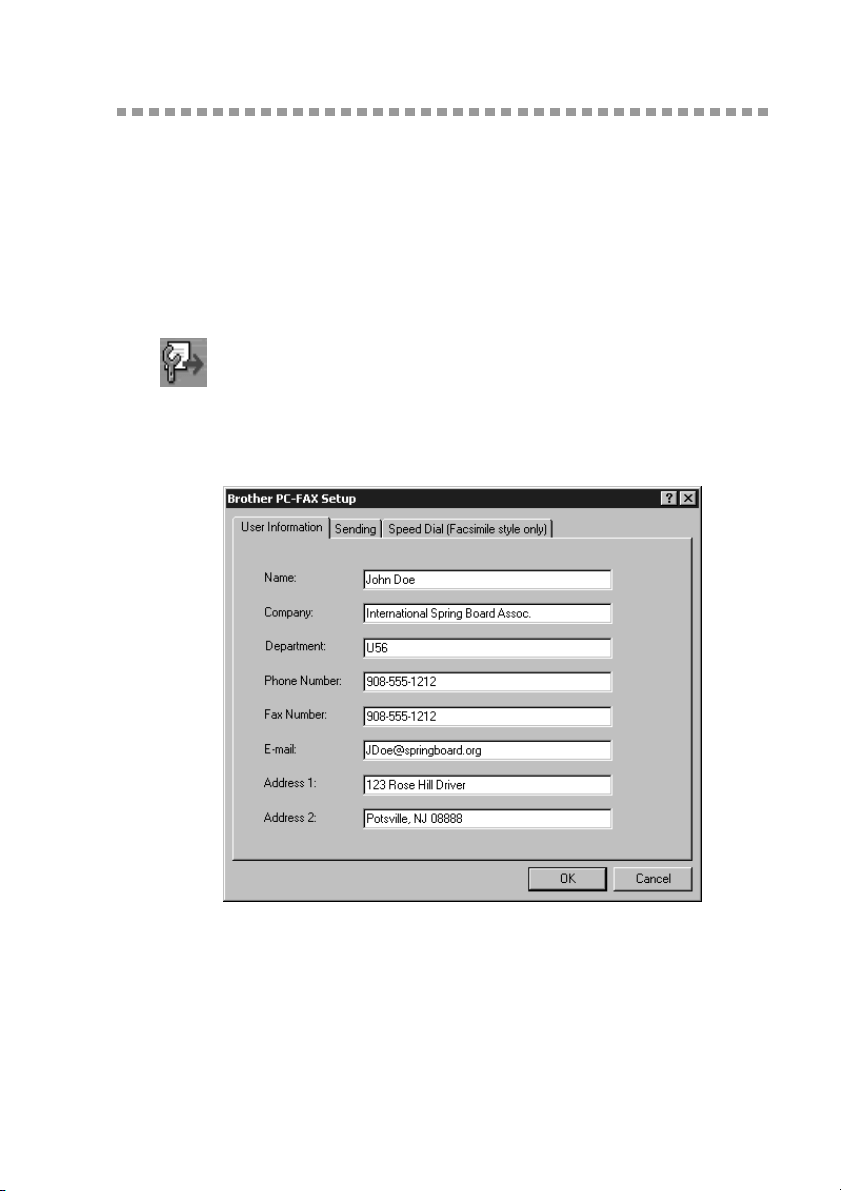
SETTING UP AND USING PC-FAX (FOR WINDOWS
®
ONLY)
17 - 3
PC FAX Sending (For Windows
®
Only)
The Brother PC FAX feature allows you to use your PC to send a file. You can
create a file in any application on your PC, and then send it as a PC FAX. You
can even attach a cover page note. All you have to do is set up the receiving
parties as Members or Groups in your PC FAX Address Book. Then you can use
the Address Book Search feature to quickly find them to address your fax.
Setting Up User Information
1
Access the User Information from the FAX Sending dialog box by clicking
—OR—
From the Start menu, select Programs, Brother, Brother MFL Pro Suite, and
then select PC-FAX Setting.
The Brother PC-FAX Setup dialog box will appear:
2
Enter the required User information. This information is required to create the
Fax Header and Cover Page.
3
To save the User Information, click OK.
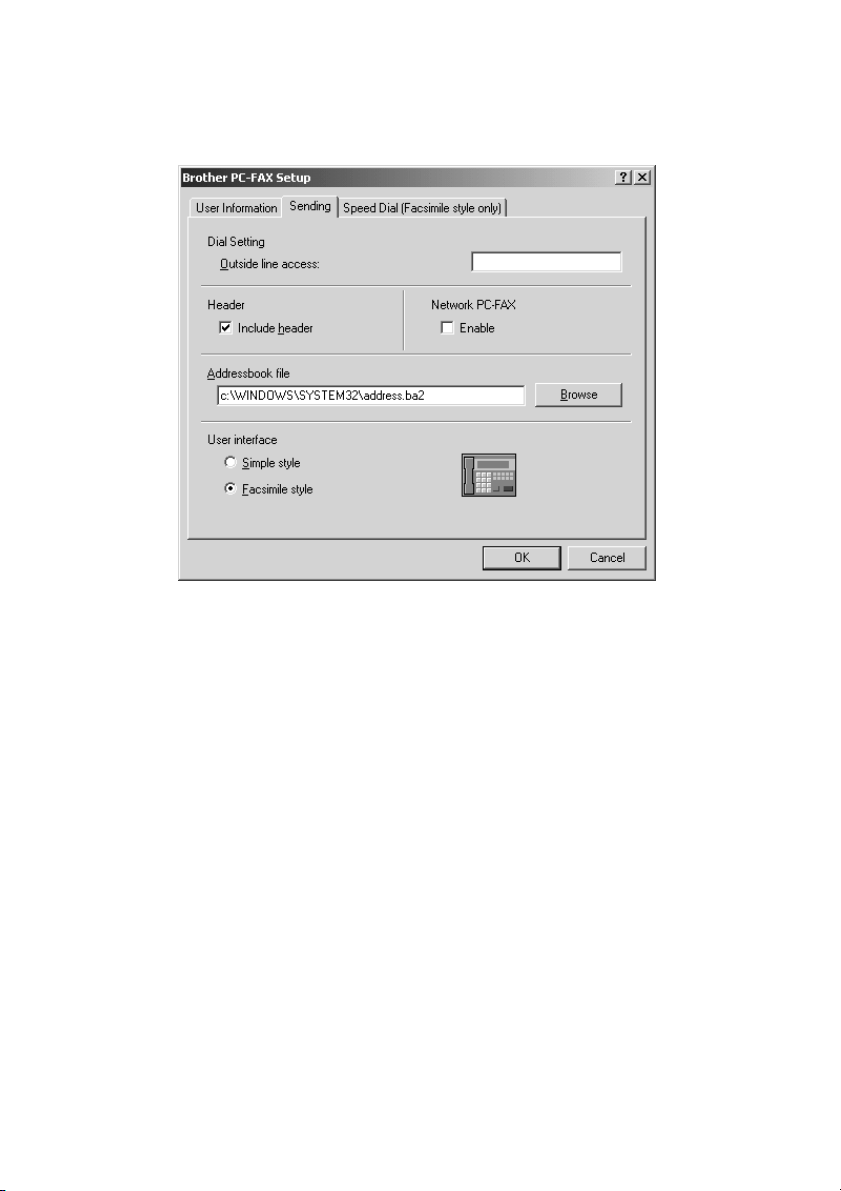
17 - 4
SETTING UP AND USING PC-FAX (FOR WINDOWS
®
ONLY)
Setting Up Sending
To access the Sending tab from the Brother PC-FAX Setup dialog box by
clicking the Sending tab.
Outside Line Access
Enter the number needed to access an outside line. This is sometimes required
by the local PBX telephone system.
Include Header
To add header information to the top of the fax pages being sent, check the
Header box.
Address Book File
You can select different database files for use with the Address Book. You must
enter the path and file name of the database file or use the Browse button to view
the file system to select the file.
Internet PC-FAX
You can use the Internet PC-FAX if you have the optional NC-8100h network
board. When you use it, check the Enable box. (See Chapter 14 in NC-8100h
User’s Guide.)
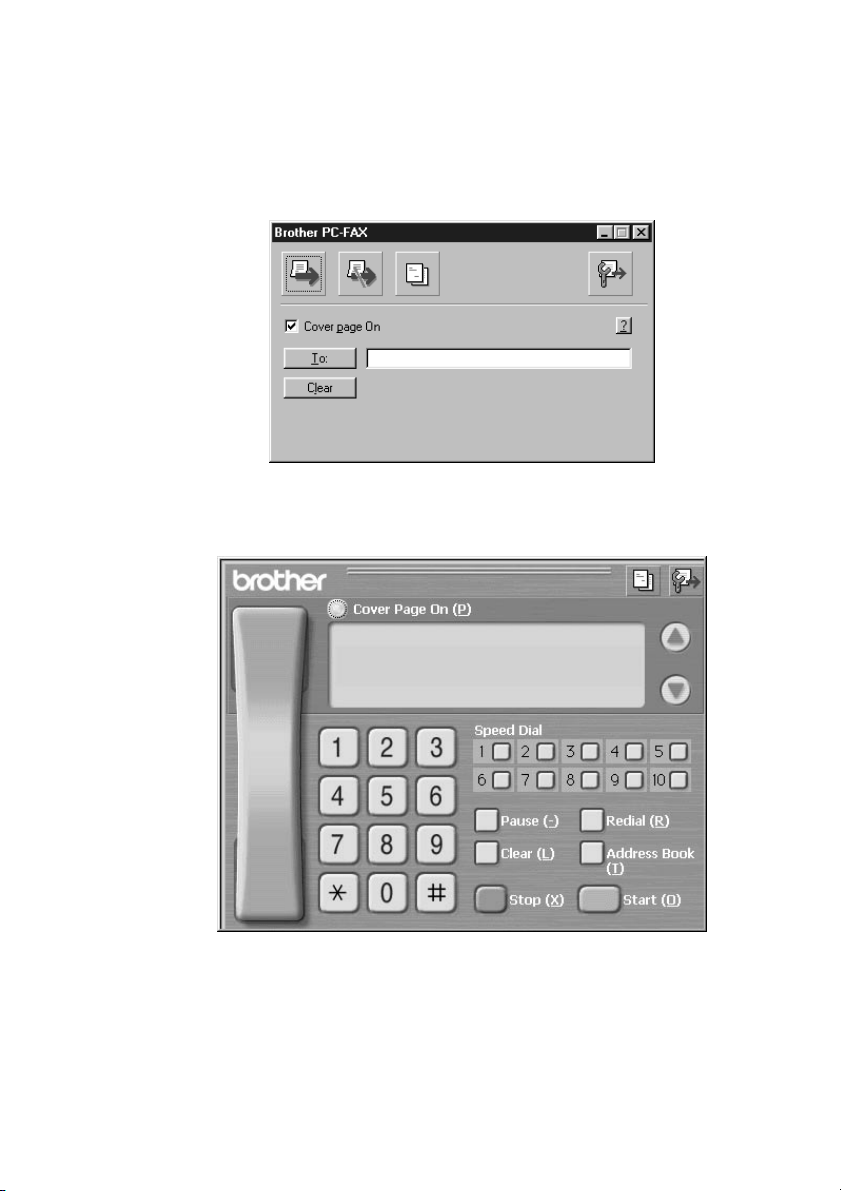
SETTING UP AND USING PC-FAX (FOR WINDOWS
®
ONLY)
17 - 5
User interface
To select User Interface for the sending dialog box. You have a choice of the
Simple Style or the Facsimile Style.
Simple Style
Facsimile Style
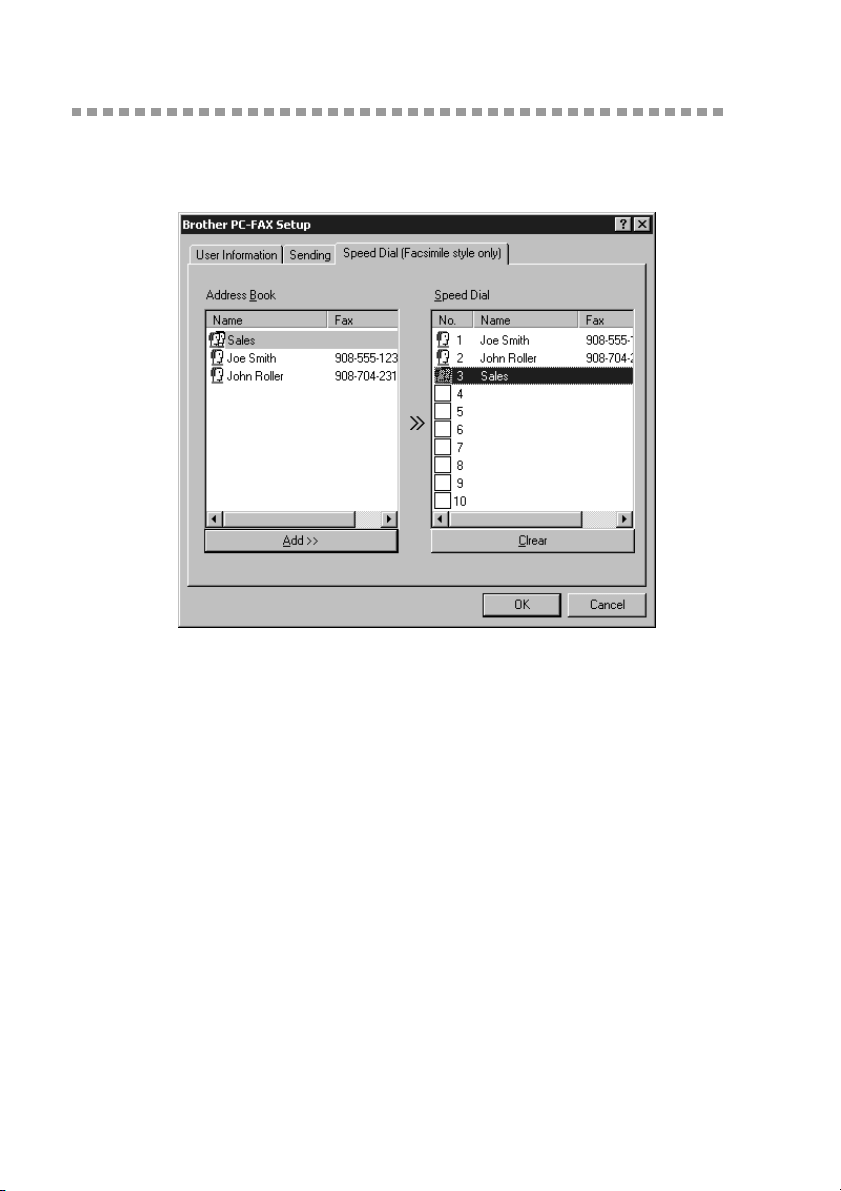
17 - 6
SETTING UP AND USING PC-FAX (FOR WINDOWS
®
ONLY)
Setting Up Speed Dial
Access the Speed Dial tab from the Brother PC-Fax Setup dialog box by
clicking the Speed Dial tab. (To use the feature you must select the Facsimile
Style user interface.)
You can register any address or group on one of the ten Speed Dial buttons.
To register an address on a Speed Dial location:
1
Click the Speed Dial location you want to program.
2
Click the address or group you wish to assign to the Speed Dial location.
3
Click the Add >> button to program the Speed Dial location.
To clear a Speed Dial location:
1
Click the Speed Dial location you want to clear.
2
Click the Clear button.
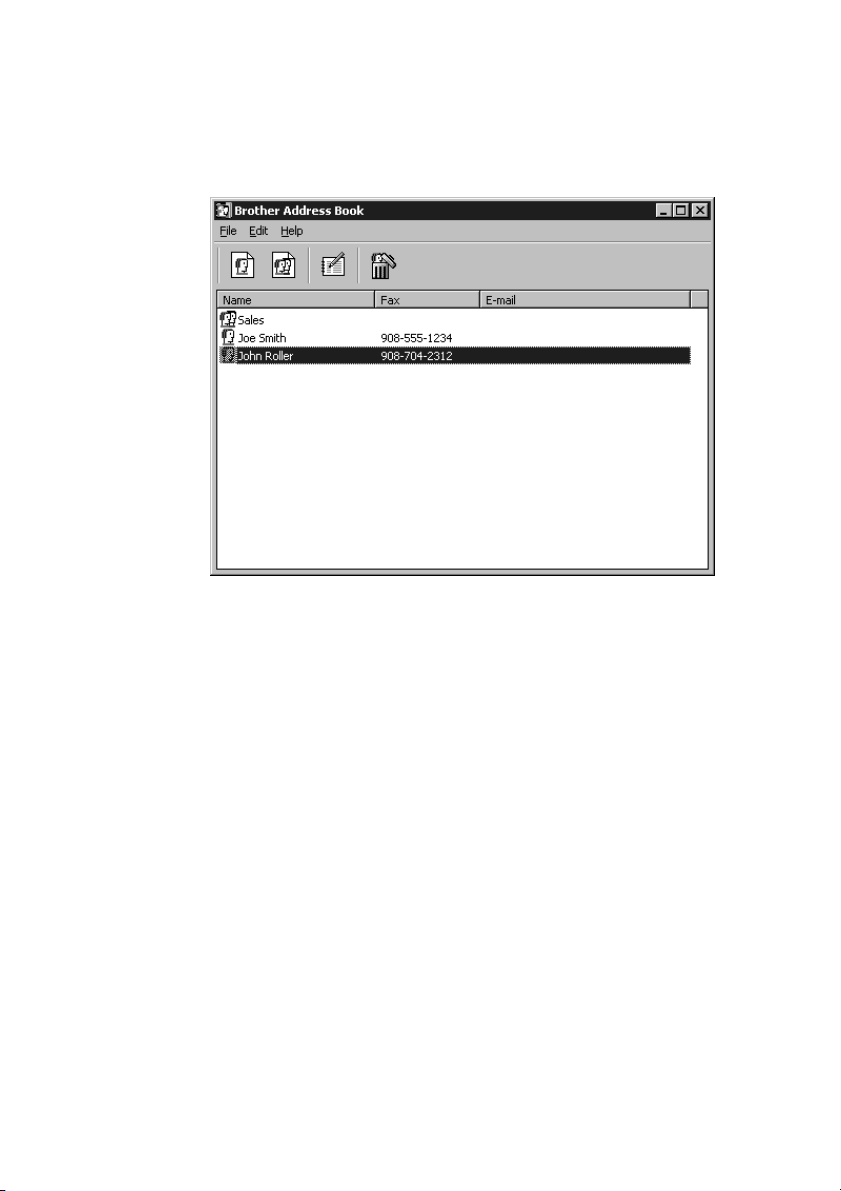
SETTING UP AND USING PC-FAX (FOR WINDOWS
®
ONLY)
17 - 7
The Address Book
From the Start menu, select Programs, Brother, Brother MFL Pro Suite, and
then click Address Book.
The Brother Address Book dialog box will appear:
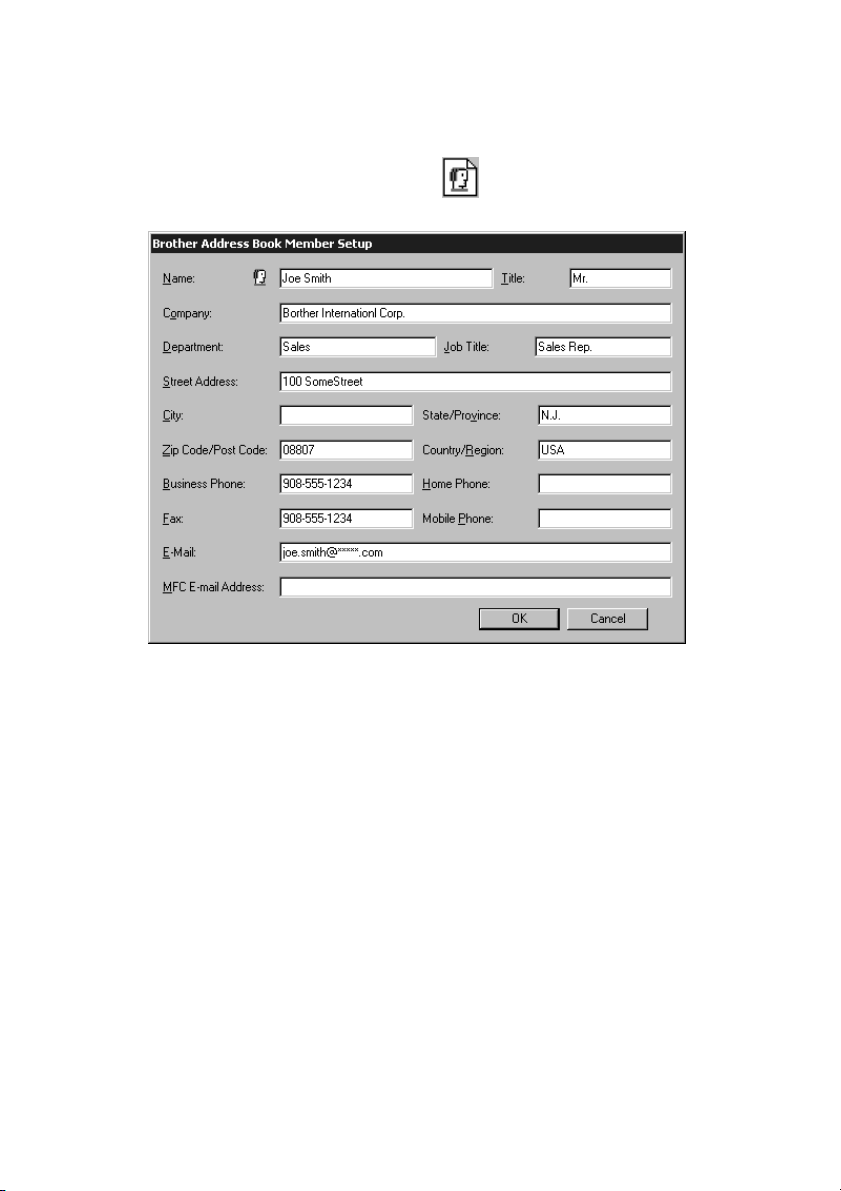
17 - 8
SETTING UP AND USING PC-FAX (FOR WINDOWS
®
ONLY)
Setting Up a Member in the Address Book
In the Brother Address Book dialog box you can add, edit and delete stored
information for members and groups.
1
In the Address Book dialog box, click the icon to add a member.
The Brother Address Book Member Setup dialog box will appear:
If you use the optional NC-8100h network board, see Chapter 14 in NC-8100h
User’s Guide.
2
In the Brother Address Book Member Setup dialog box, type the member’s
information. Name and Fax are required fields. Click the OK button to save the
member’s information.
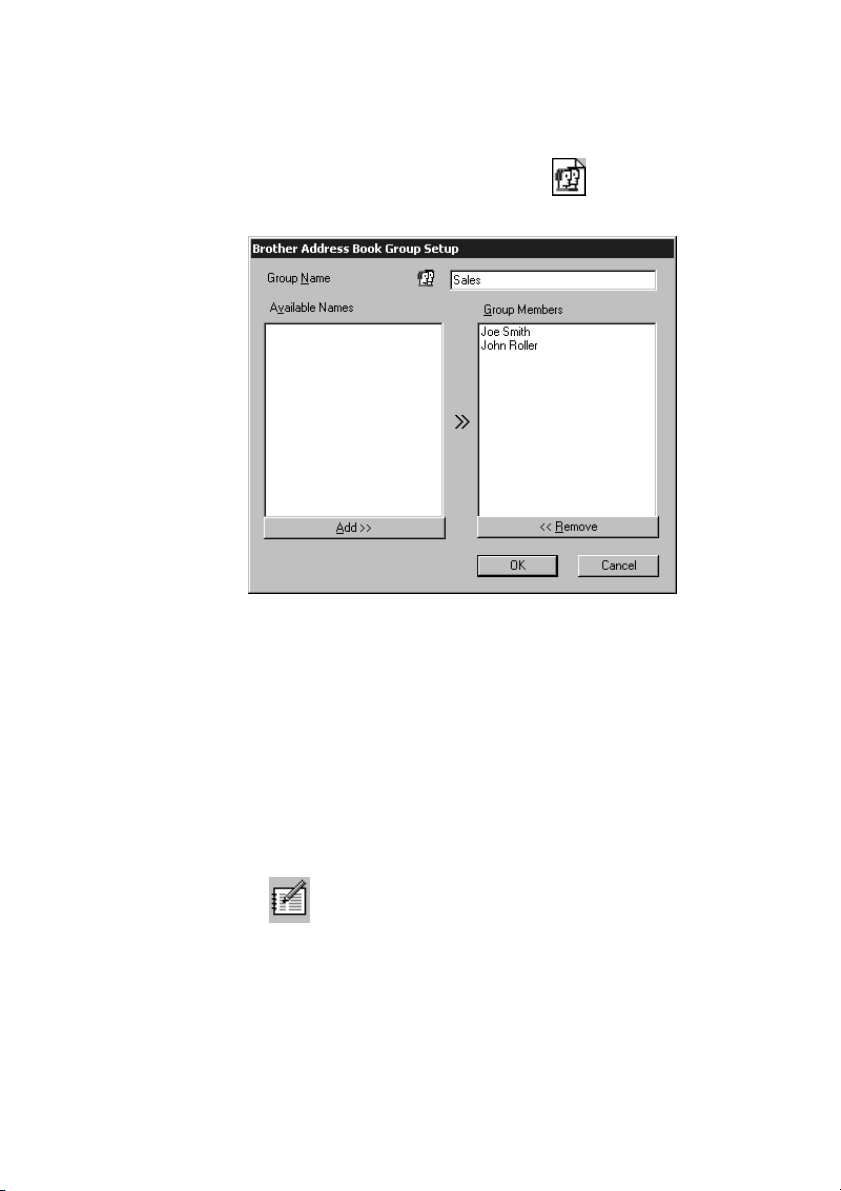
SETTING UP AND USING PC-FAX (FOR WINDOWS
®
ONLY)
17 - 9
Setting Up a Group for Broadcasting
If you repeatedly send the same PC-FAX to multiple recipients, you can
combine members into a Group.
1
In the Brother Address Book dialog box, click the icon to create a group.
The Brother Address Book Group Setup dialog box appears:
2
Type the name of the new group in the Group Name field.
3
In the Available Names box, select each member to be included in the Group,
and then click Add >>.
Members you add to the group will be listed in the Group Members box.
4
After all the members have been added, click OK.
Editing Member Information
To edit a Member or Group:
1
Select the Member or Group you want to edit .
2
Click the edit icon.
3
Edit the Member or Group information.
4
Click OK to save your changes.
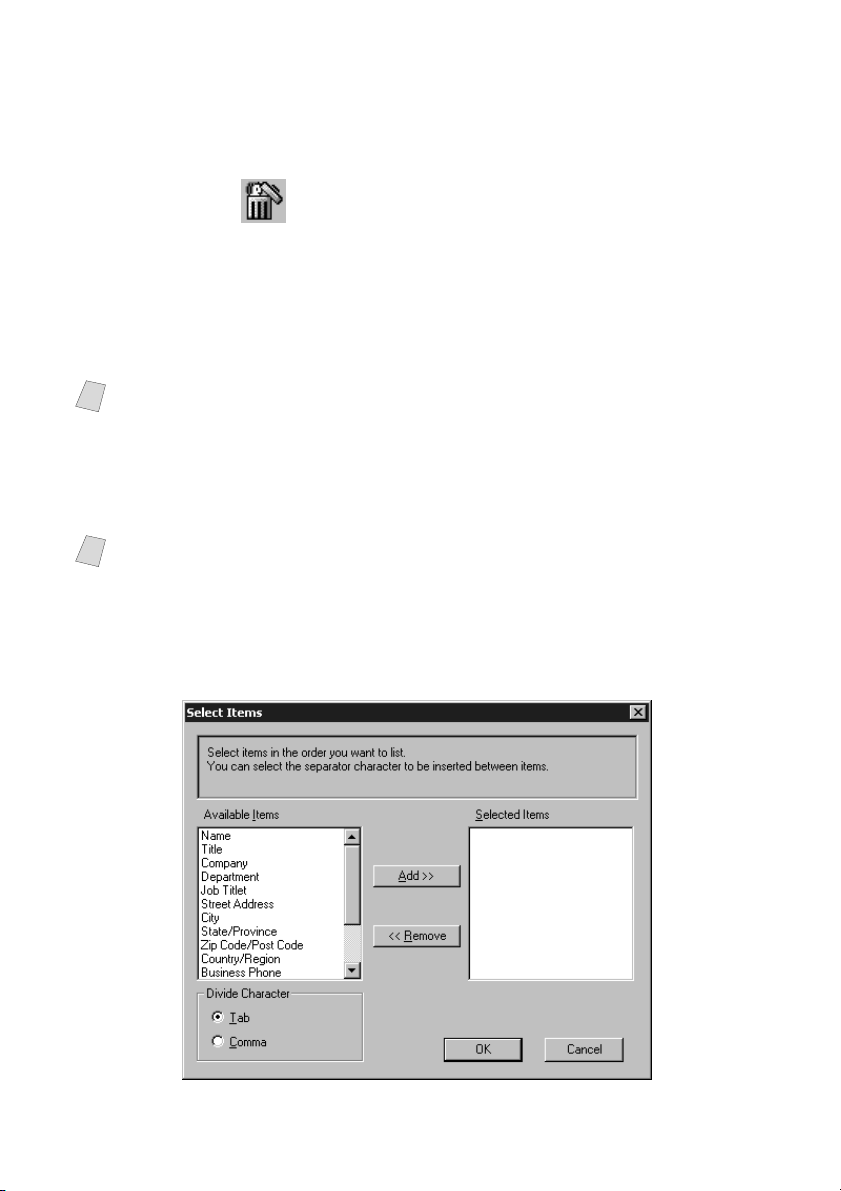
17 - 10
SETTING UP AND USING PC-FAX (FOR WINDOWS
®
ONLY)
Deleting a Member or Group
To delete a Member or Group:
1
Select the Member of Group you want to delete.
2
Click the delete icon.
3
Click OK when the Delete OK? Dialog appears.
Exporting the Address Book
You can export the address book to an ASCII text file (*.csv).
To export the current telephone book:
1
From the Address Book select File, point to Export, and then click Text
—OR—Click Vcard and go to Step 5.
2
Select the data fields you wish to Export from the Available Items column, and
then click Add >>.
3
If you are exporting to an ASCII file, select Divide Character - Tab or
Comma. This selection inserts a Tab or Comma between each data field when
it is Exported.
4
Select the OK button to save the data.
Note
If you are creating a Vcard, you must first select the member.
Note
Select items in the order you want them listed.
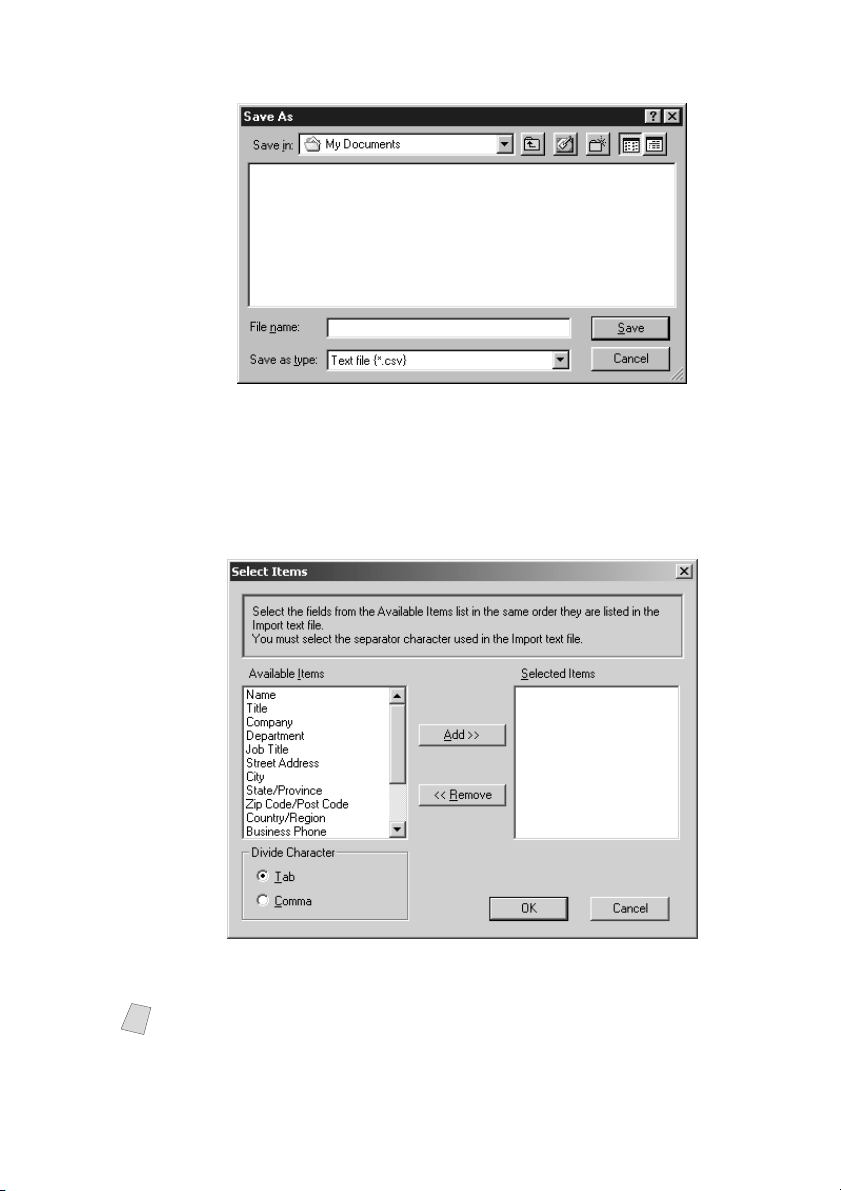
SETTING UP AND USING PC-FAX (FOR WINDOWS
®
ONLY)
17 - 11
5
Type the name of the file, and then select Save.
Importing to the Address Book
You can import ASCII text files (*.csv) or Vcards into your Address Book.
To import an ASCII text file:
1
From the Address Book select File, point to Import, and then click Text
—OR—Click Vcard and go to Step 5.
2
Select the data fields you wish to Import from the Available Items column, and
then click Add >>.
3
Select Divide Character - Tab or Comma based on what file format you are
importing.
4
Select the OK button to import the data.
Note
Select the fields from the Available Items list in the same order they are listed
in the Import text file.
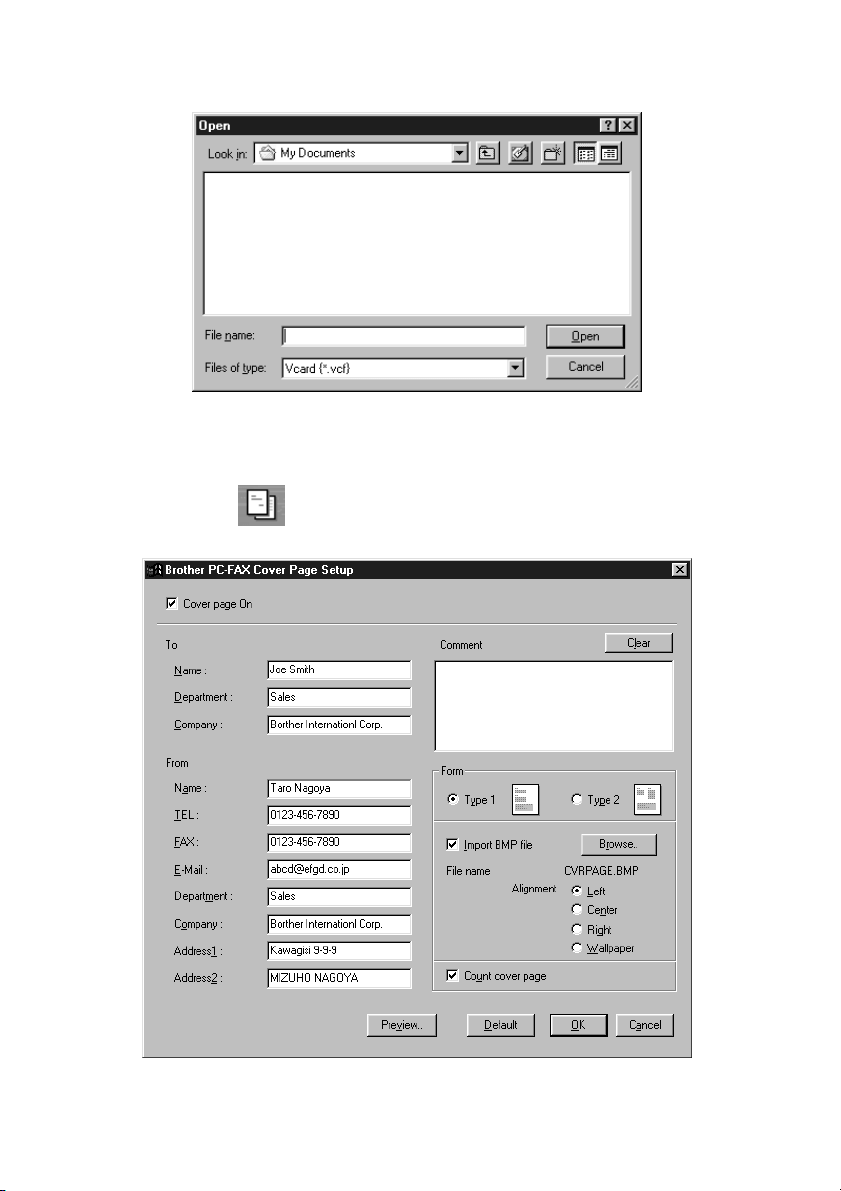
17 - 12
SETTING UP AND USING PC-FAX (FOR WINDOWS
®
ONLY)
5
Type the name of the file, and then select Open.
Setting Up Cover Page
Access the Brother PC-FAX Cover Page Setting from the FAX Sending dialog
box by clicking . The Brother PC-FAX Cover Page Setup dialog box will
appear:

SETTING UP AND USING PC-FAX (FOR WINDOWS
®
ONLY)
17 - 13
To
You can enter information in each box.
From
You can enter information in each box.
Comment
Type the comment you want to add to the cover page.
Select Cover Page Form
Select the cover page form you want.
Import BMP file
You can insert a bitmap file, such as your company logo, in the cover page.
Select the BMP file by using the browse button, and then select the alignment
style.
Count Cover Page
When this box is checked, the Cover Page will be included in the page
numbering. When this box is not checked, the Cover Page will not be included.
Note
If you are sending a fax to multiple recipients, the recipient information will not
be printed on the Cover Page.
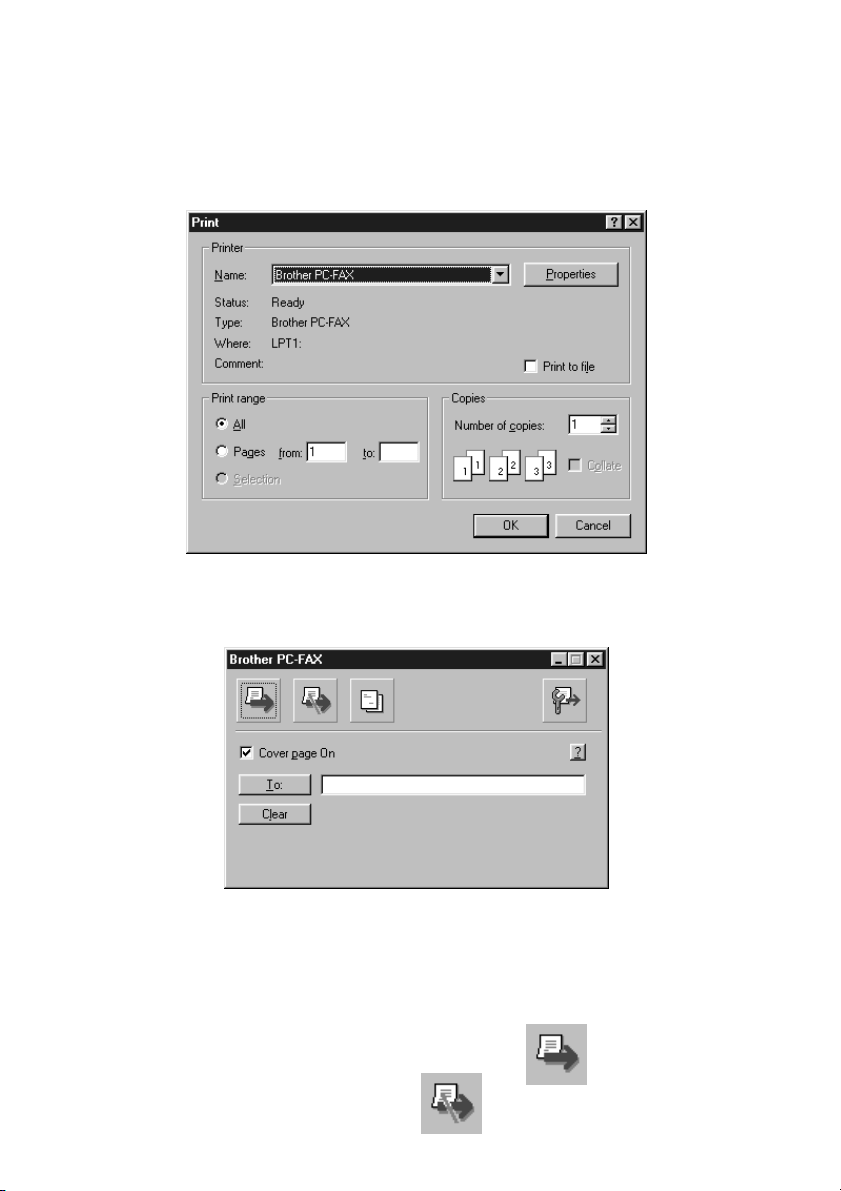
17 - 14
SETTING UP AND USING PC-FAX (FOR WINDOWS
®
ONLY)
Sending a File as a PC-FAX Using the Simple Style
1
Create a file in Word, Excel, Paint, Draw, or any other application on your PC.
2
From the File menu, select Print.
The Print dialog box will appear:
3
Select Brother PC-FAX as your printer, and then click OK.
The FAX Sending dialog box will appear:
4
In the To: field, type the fax number of the receiving party. You can also use
the Address Book to select destination fax numbers. If you made a mistake
entering a number, click the Clear button to clear all entries.
5
To send a Cover Page and note, click the Cover Page check box.
6
When you are ready to send your fax, click the Send icon.
7
If you wish to cancel the fax, click the icon.
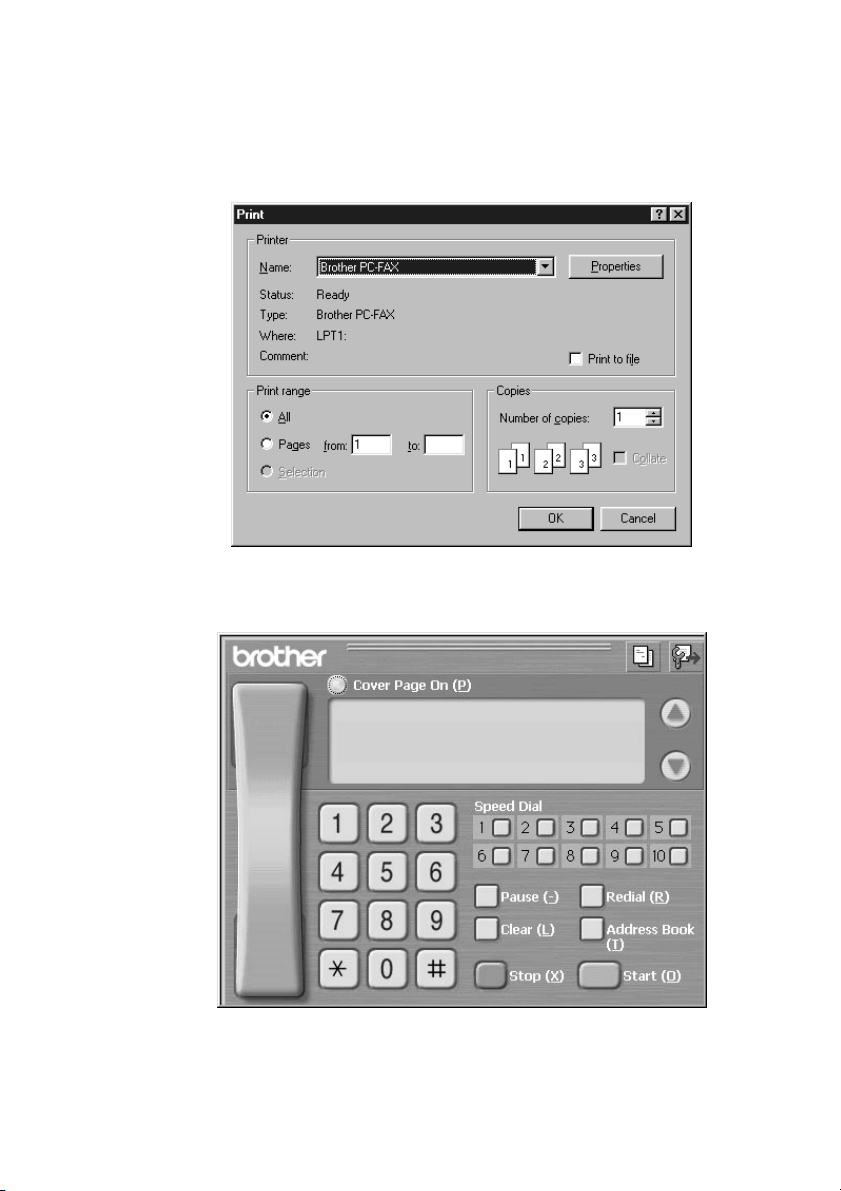
SETTING UP AND USING PC-FAX (FOR WINDOWS
®
ONLY)
17 - 15
Sending a File as a PC-FAX Using the Facsimile Style
1
Create a file in Word, Excel, Paint, Draw, or any other application on your PC.
2
From the File menu, select Print.
The Print dialog box will appear:
3
Select Brother PC-FAX as your printer, and then click OK.
The FAX Sending dialog box will appear:
17 - 16
SETTING UP AND USING PC-FAX (FOR WINDOWS
®
ONLY)
4
Enter the fax number using any of the following methods:
a. Enter the number using the dial pad.
b. Click any of the 10 Speed Dial buttons.
c. Click the Address Book button, and then select a Member or Group from
the Address Book.
5
To include a cover page, check the Cover Page option. You can also click the
Cover Page button to create or edit an existing cover page.
6
Click Start to send the fax.
Redial
If you want to redial a number, click Redial button to scroll through the last five
fax numbers, and then click Start.
Setting Up PC-FAX Receiving (For Windows
®
Only)
You can set up your PC to receive incoming faxes into your PC.
Setting Up Your MFC
1
Press Menu, 2, 1, 8.
2
Press or to select ON (or OFF), and then press Set.
3
Press Stop/Exit.
Running PC-FAX Receiving
Form the Start menu, select Program File, Brother, Brother MFL Pro Suite
and then select “PC-FAX Receiving”.
The PC FAX icon will appear on your PC Task tray for
this Windows
®
session.
Note
If you make a mistake you can use the click the Clear button to clear all the
entries.
If you wish to cancel the fax, click Stop.
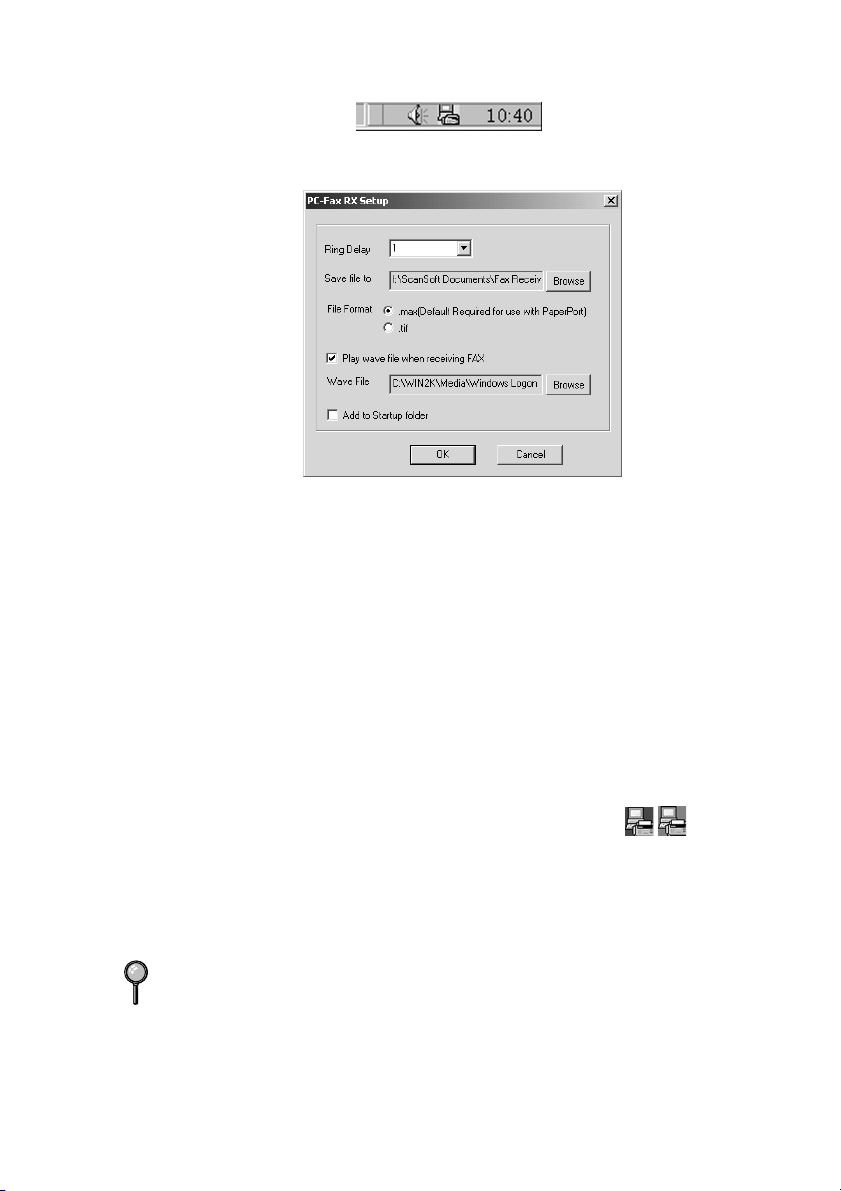
SETTING UP AND USING PC-FAX (FOR WINDOWS
®
ONLY)
17 - 17
Setting Up Your PC
1
Right-click the PC-FAX icon on your PC Task Bar,
and then click PC-Fax RX Setup.
2
The PC-Fax RX Setup dialog box will appear:
3
In Ring Delay, select the number of rings before your PC answers incoming
calls.
4
In Save file to, use the Browse button if you want to change the path where PC-
FAX files will be saved.
5
Make sure File Format is checked for .max (Default Required to use with
PaperPort).
6
If you want to, you can check the Play wave file when receiving FAX check
box, and then enter the path.
7
To load PC FAX receiving automatically when you statup Windows
®
, select the
Add to Startup folder check box.
Viewing New PC-FAX Messages
Each time you start to receive a PC-FAX, the Blue and Red icons will
blink on the PC Task Bar. The Red icon will remain.
1
Run PaperPort.
2
Open the Fax Received folder.
3
Double-click any of the new faxes to open and view them.
The title example of your unread PC message.
“Fax 2-20-2002 16:40:21 max”
18 - 1
USING AUTOMATIC E-MAIL PRINTING
18
18
Using Automatic E-Mail
Printing
For Windows
®
95, 98, 98SE, Me Only
Main Features
■ You can use Automatic E-Mail Printing with other E-mail software:
Brother Automatic E-Mail Printing has some extra functions that other E-mail
software, such as Netscape Navigator
™ or MS Internet Mail, do not support.
■ Automatic E-Mail Printing can be configured for a multiple user account:
In Brother Automatic E-Mail Printing you can set up more than one e-mail
account on a single PC so you can print e-mail in each account automatically.
■ Automatic access to your specifed POP3 server at the specifed time:
You can specify the time when the Brother Automatic E-Mail Printing
automatically accesses the server to check for new mail.
■ Provides an “In Memory” printer driver:
You can receive and print e-mail data at the same time, by searching for a
specified character string in the mail header. It allows you to see the sender,
subject and relevant part of the mail content.
To Access the On-Line Documentation
To Install Automatic E-mail Printing (Optional Application):
1
Insert MFL Pro CD-ROM into your CD-ROM drive.
2
Click on Install Software from the main CD-ROM screen.
3
Click Automatic E-mail Printing.
The “Automatic E-mail Print” option is NOT available for Windows NT
®
4.0
and Windows
®
2000 Professional.
Note
After you have installed the Brother driver(s) for your model and operating
system, click View On-Line Documentation for operating instructions.
This is optional software and will not be required for printing, faxing and
scanning operations.
Before You Use this Software
Please read in the On-Line
Documentation on the CD-ROM. Check the online
README.WRI file in the root directory of the CD-ROM for last-
minute important information and troubleshooting tips not
included in the On-Line Documentation.
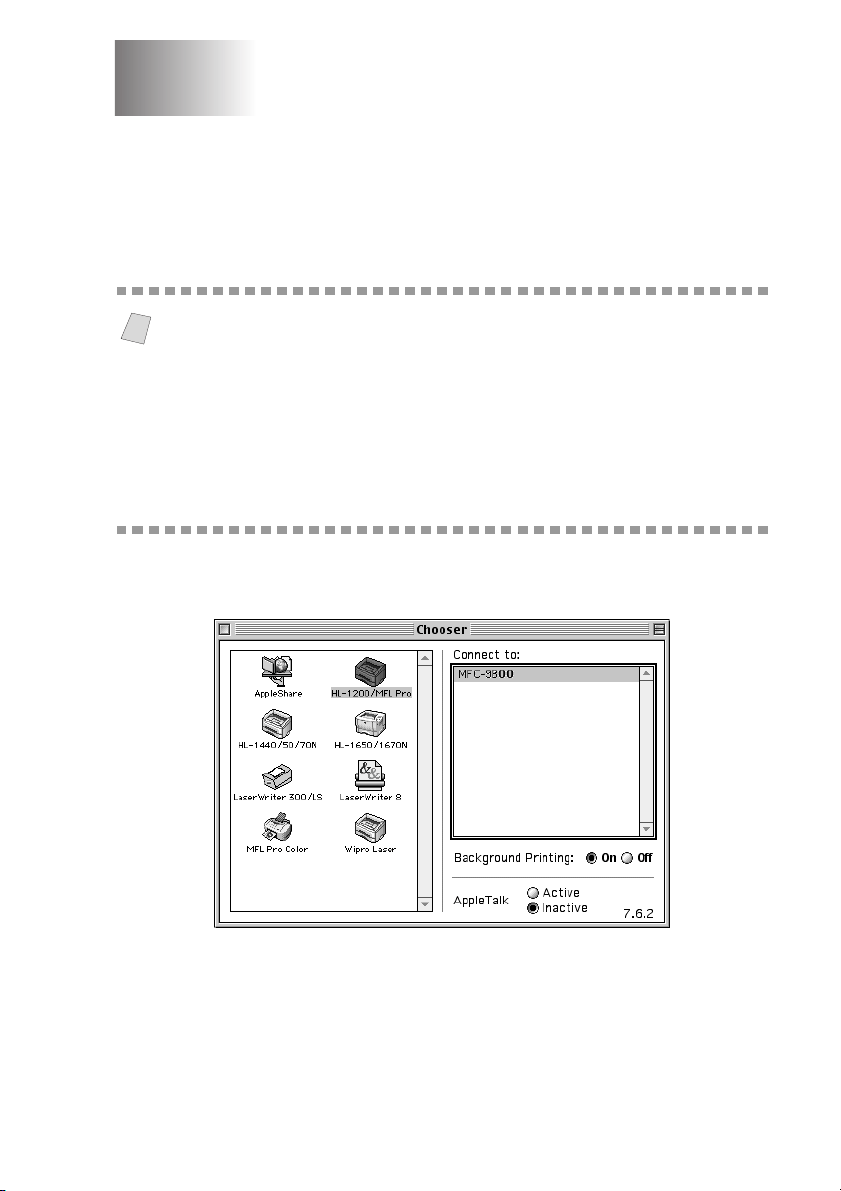
USING THE BROTHER MFC WITH A NEW POWER MACINTOSH
®
G3, G4 OR IMAC™ /IBOOK
19 - 1
19
19
Using the Brother MFC with
a New Power Macintosh
®
G3, G4 or iMac™/iBook
Set up Your USB Equipped Apple
®
Macintosh
®
G3,G4, iMac™ or iBook with
Mac OS 8.5/8.51/8.6/9.0/9.0.4/9.1
To work with your MFC your USB Equipped Apple
®
Macintosh
®
must be set
up with Mac OS 8.5/8.51/8.6/9.0/9.0.4/9.1 (The Brother Scanner Driver works
only with Mac OS 8.6/9.0/9.0.4/9.1)
Using Brother Printer Driver with Your Apple
®
Macintosh
®
To select the Printer:
1
From the Apple menu, open the Chooser.
2
Click HL-1200/MFL Pro icon. On the right side of the Chooser, click the printer
to which you want to print. Close the Chooser.
Note
Before you can connect the MFC to your Machintosh
®
, you must purchase a
USB cable that is no longer than 6 feet (1.8 meters).
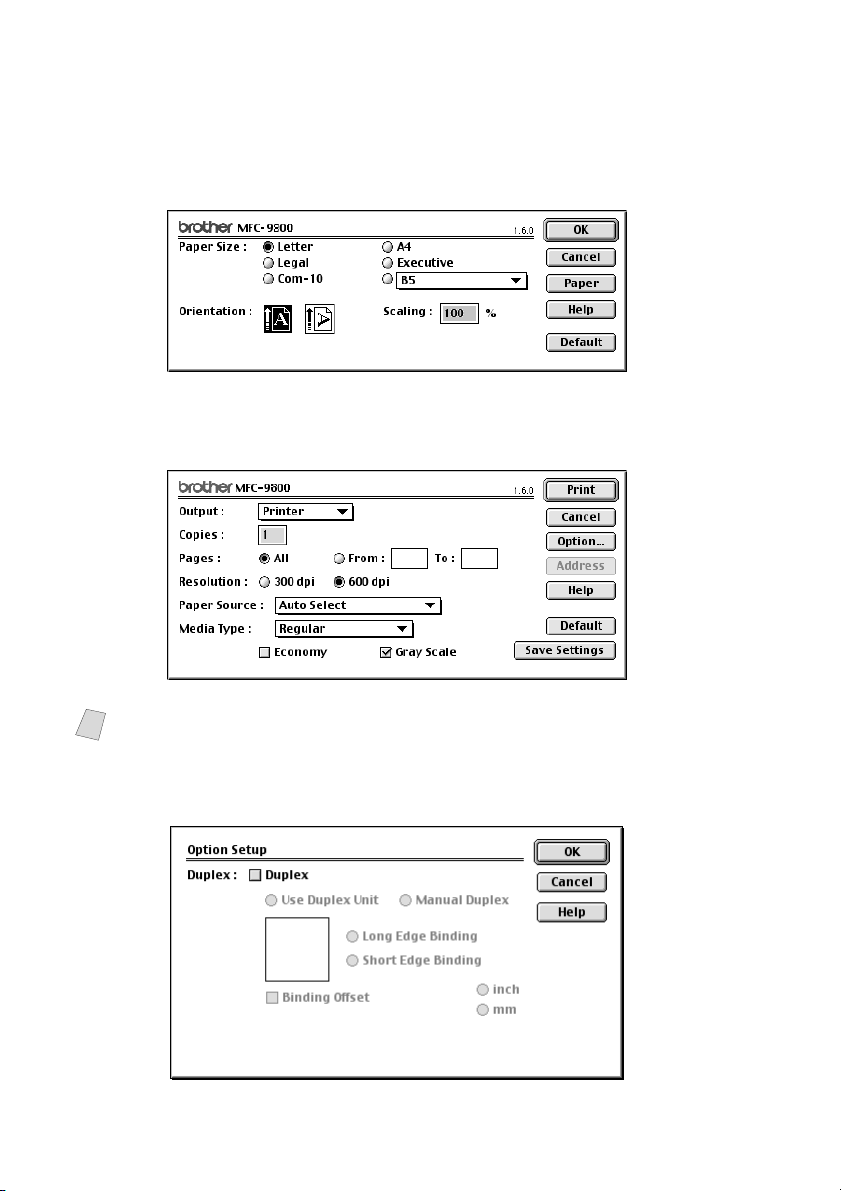
19 - 2
USING THE BROTHER MFC WITH A NEW POWER MACINTOSH
®
G3, G4 OR IMAC™ /IBOOK
To print the document:
3
From your Macintosh scanning application software such as Simple Text, click
File menu and select Page Setup. You can change the settings for Paper Size,
Orientation and Scaling, and then click OK.
4
From your Macintosh scanning application software such as Simple Text, click
File menu and select Print. Click Print to start printing.
Note
If you want to change Copies, Pages, Resolution, Paper Source and Media
Type, select your settings before clicking Print.
Option Setup allows you to select Duplex.
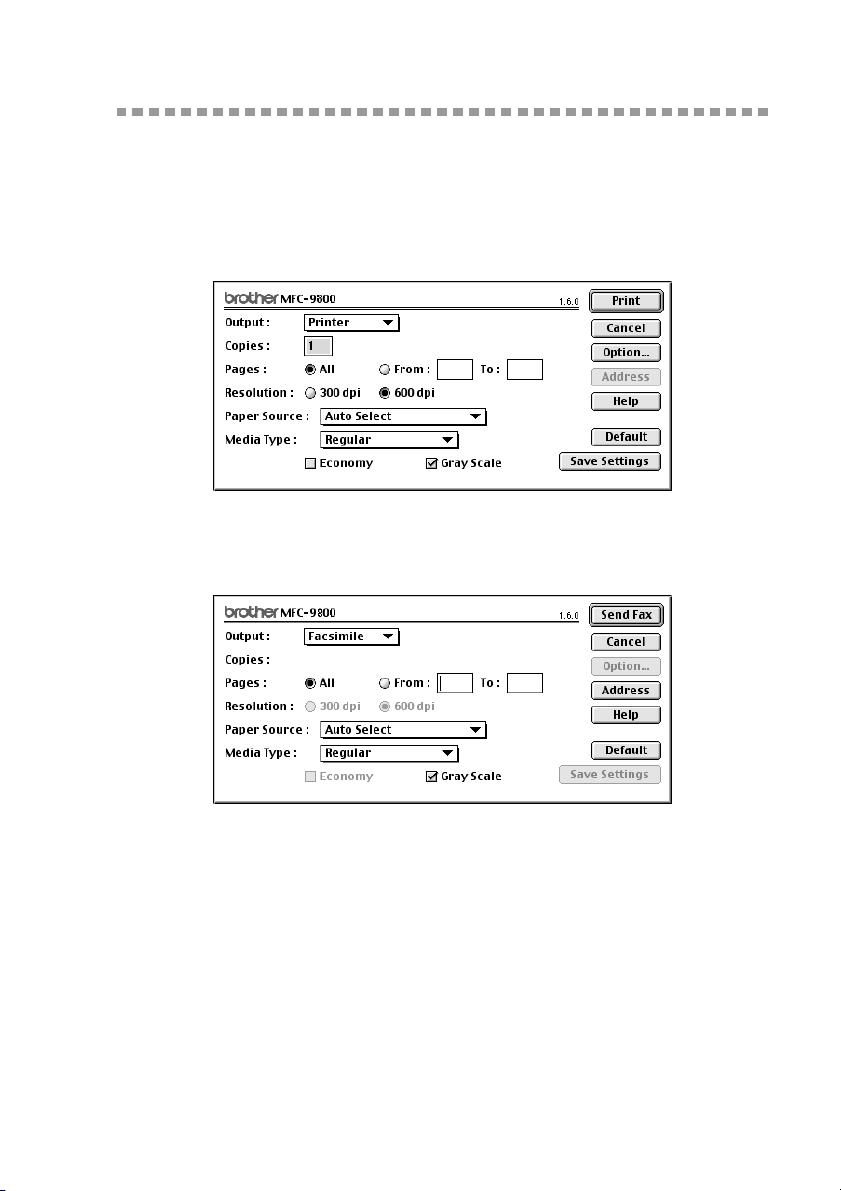
USING THE BROTHER MFC WITH A NEW POWER MACINTOSH
®
G3, G4 OR IMAC™ /IBOOK
19 - 3
Sending a Fax from Your Macintosh
®
Application
You can send a fax directly from your Macintosh
®
application using the
following steps:
1
Create a document in a Macintosh application.
2
To begin the fax transmission, select Print from the File menu.
The Printer dialog box appears:
When Printer is selected, the top button shows Print and the Address button is
grayed.
3
From the Output pop-up menu, select Facsimile.
When Facsimile is selected, the top button shows Send Fax and the Address
button is available.
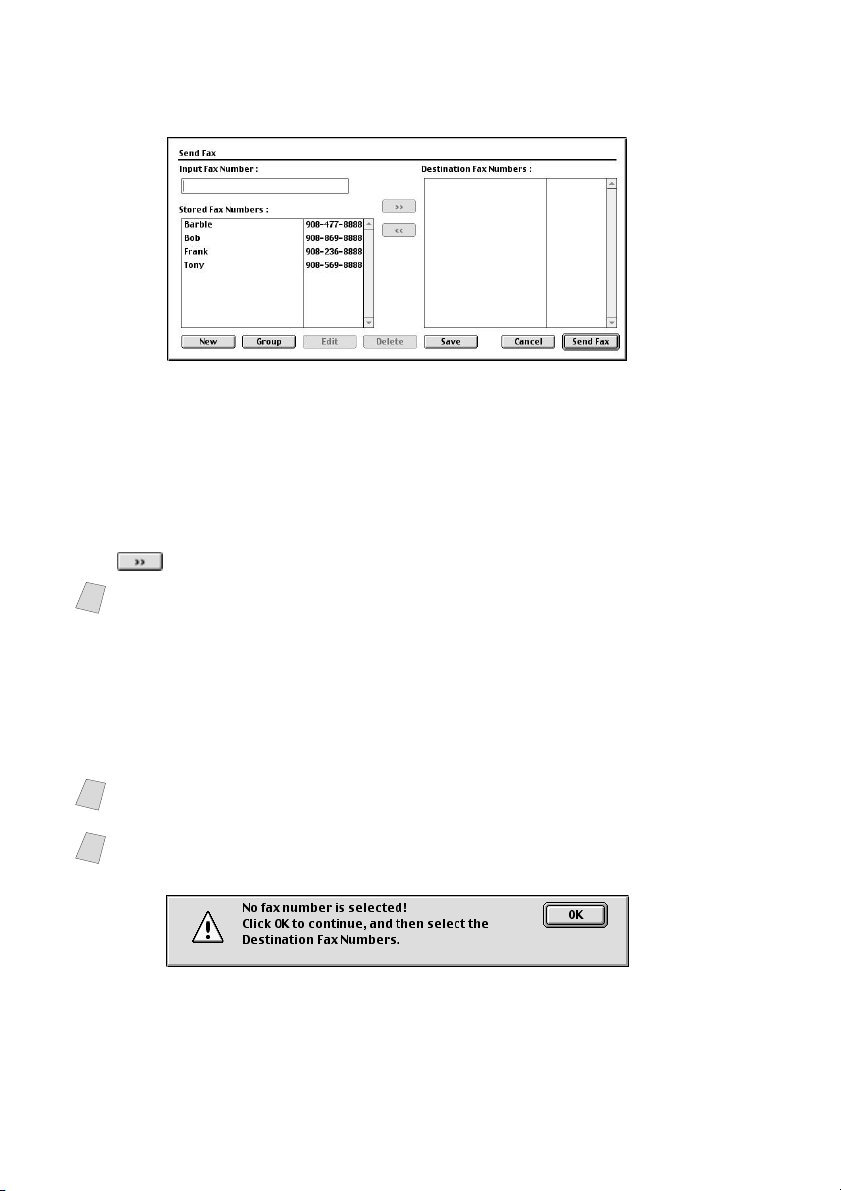
19 - 4
USING THE BROTHER MFC WITH A NEW POWER MACINTOSH
®
G3, G4 OR IMAC™ /IBOOK
4
Click Send Fax.
The Send Fax dialog box appears:
The Send Fax dialog box has two list boxes. The left box shows all the
previously Stored Fax Numbers; the right box will show the Destination Fax
Numbers as you select them.
5
To address the fax, type a fax number in the Input Fax Number box.
—OR—
Select a name/number from the Stored Fax Numbers box, and then click
. Your recipient will appear in the Destination Fax Numbers box.
6
If you want to, you can add your new recipients to the Stored Fax Number at this
time by clicking New. (See
Adding a New Member, page 19-5.)
—OR—
You can add a new group by clicking
Group
. (See
Adding a New Group
, page 19-6.)
7
If you are finished addressing your fax, click Send Fax.
Click OK to return to the Send Fax dialog box.
Note
You can select several stored numbers at once by using the Shift and Ctrl keys.
Note
To select and send only certain pages of the document, enter the page numbers
in the From and To : boxes in the Facsimile dialog box.
Note
If you click Send Fax without addressing your fax, the following error message
appears:
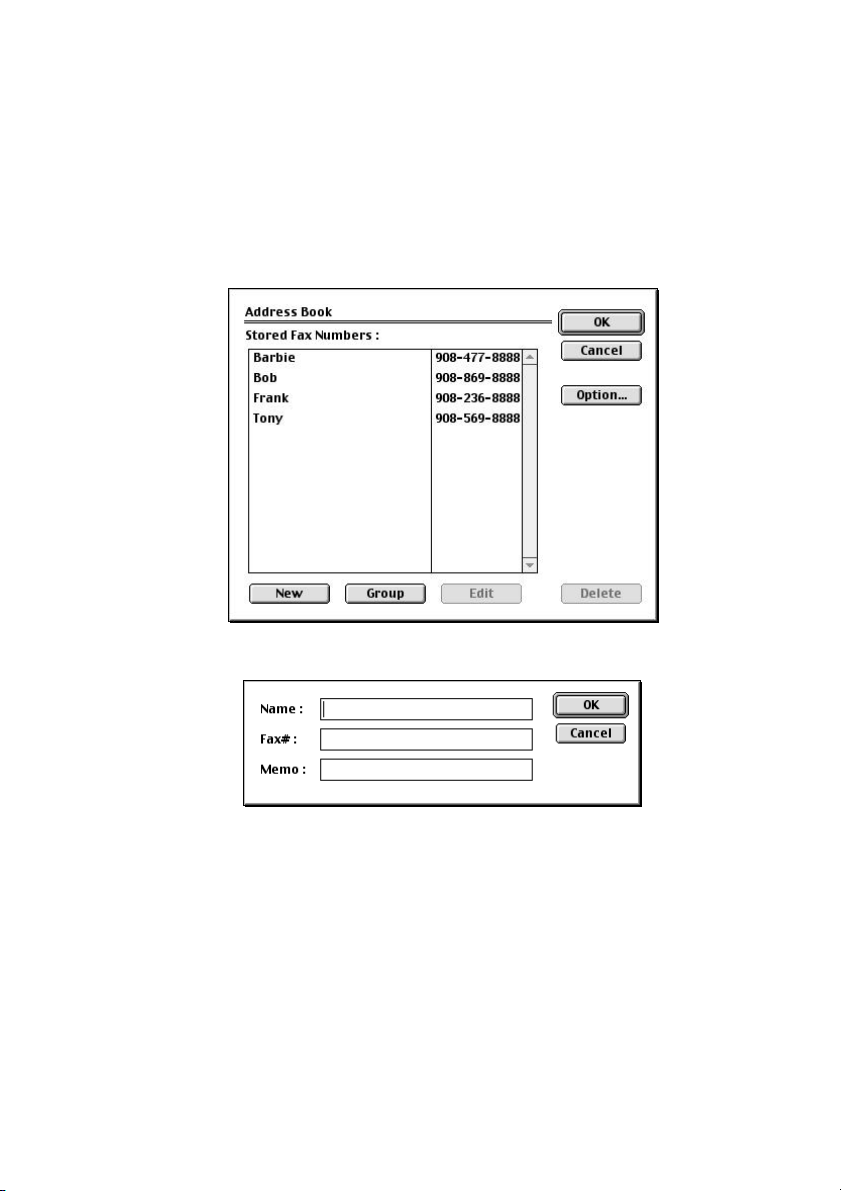
USING THE BROTHER MFC WITH A NEW POWER MACINTOSH
®
G3, G4 OR IMAC™ /IBOOK
19 - 5
Setting Up Your Address Book
You can add new members and groups to your Address Book, even while you
are addressing a fax.
Adding a New Member
1
To add a new member to the Address Book, in the Facsimile dialog box click
Address.
The Address Book dialog box appears:
2
Click New. The following dialog box appears:
3
Type the name and fax number.
4
If you want to, you can store a comment in the Memo field if you wish (up to 15
characters).
5
Click OK to return to the Address Book dialog box.
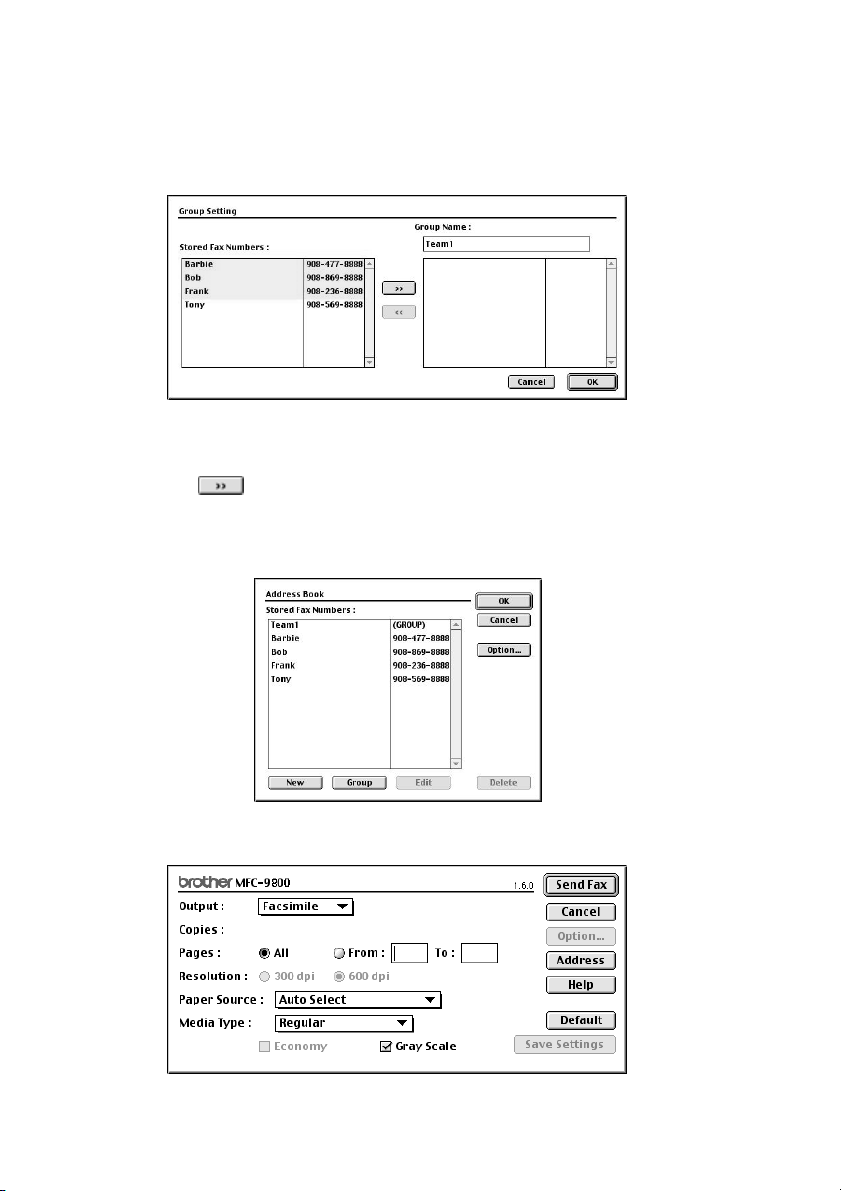
19 - 6
USING THE BROTHER MFC WITH A NEW POWER MACINTOSH
®
G3, G4 OR IMAC™ /IBOOK
Adding a New Group
You can set up a group of multiple recipients.
1
Click Group.
The Group Setting dialog box appears.
2
In the Group Name field, type a name for your Group.
3
From the Stored Fax Numbers box select the recipients for your Group, and
then click .
Your selection will appear in the box under the Group Name field.
4
Click OK.
The Address Book dialog box reappears:
5
Click OK.
The Print/Facsimile dialog box reappears:
6
If you are ready to send your fax, click Send Fax.
(Follow the steps on page 19-3 for sending a fax.)
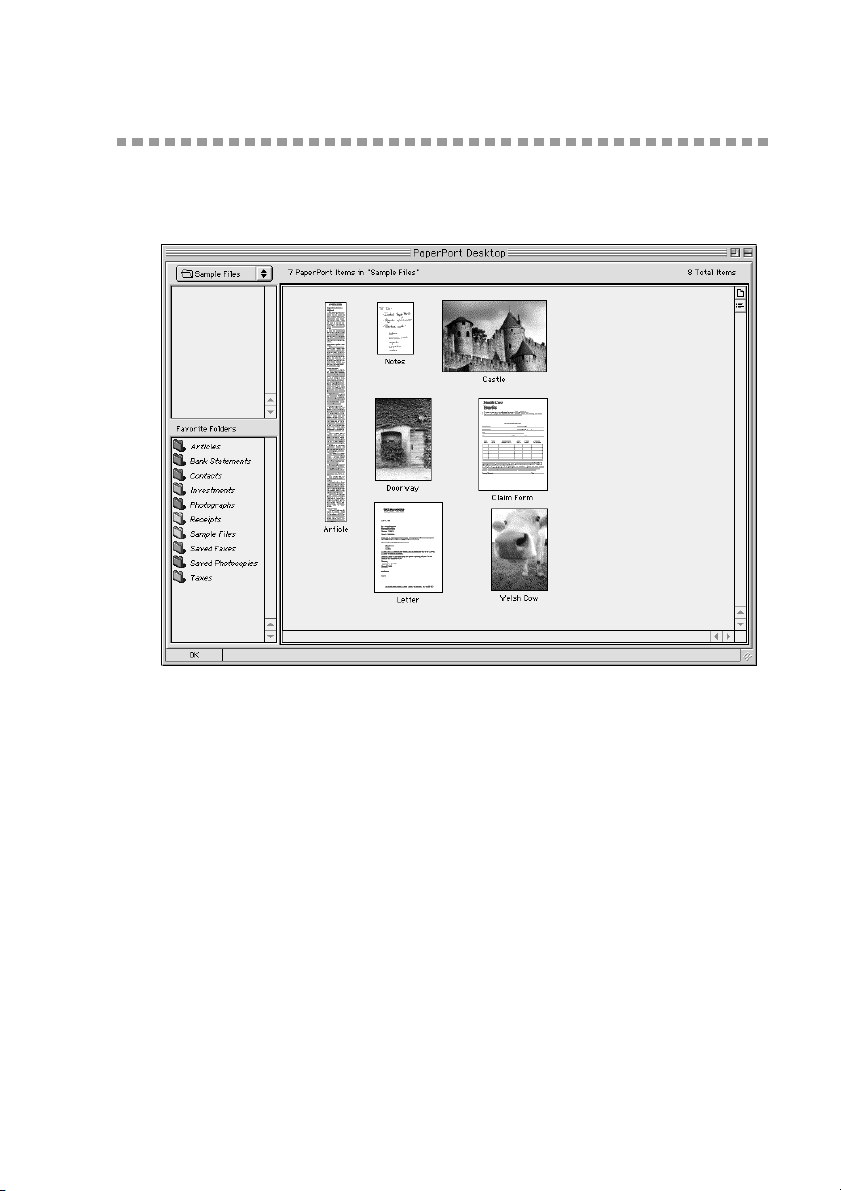
USING THE BROTHER MFC WITH A NEW POWER MACINTOSH
®
G3, G4 OR IMAC™ /IBOOK
19 - 7
Using Brother TWAIN Scanner Driver with
Your Apple
®
Macintosh
®
The Brother MFC software includes a TWAIN Scanner driver for Macintosh
®
.
This Macintosh
®
TWAIN Scanner driver can be used with application that
supports the TWAIN specification. You can use PaperPort
®
for scanning.
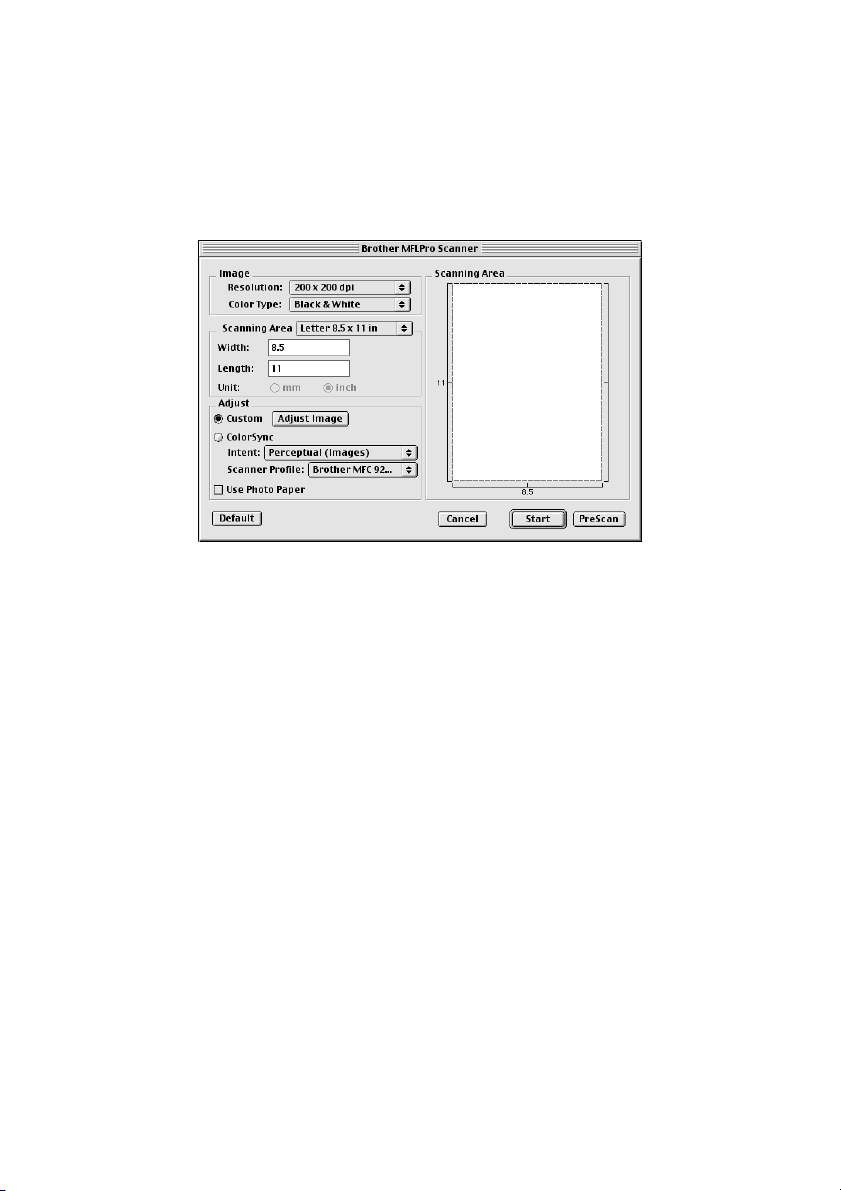
19 - 8
USING THE BROTHER MFC WITH A NEW POWER MACINTOSH
®
G3, G4 OR IMAC™ /IBOOK
Accessing the Scanner
Run your PaperPort
®
software. You will see the PaperPort
®
icon in the upper
right corner of your screen. The first time you use the Brother TWAIN driver,
set it as the default by choosing the Select Source, and then click the PaperPort
®
icon. Afterward, for each original you scan, choose Acquire Image by clicking
the PaperPort
®
icon. The Scanner setup dialog box will appear.
Scanning a Document into Your Macintosh G3, G4 or
iMac
1
Place the original in the ADF.
2
Adjust the following settings, if needed, in the scanner setup dialog box:
Resolution
Color Type
Brightness
Contrast
Scanning Area
3
Click Start.
When scanning is finished, the image will appear in your graphics application.
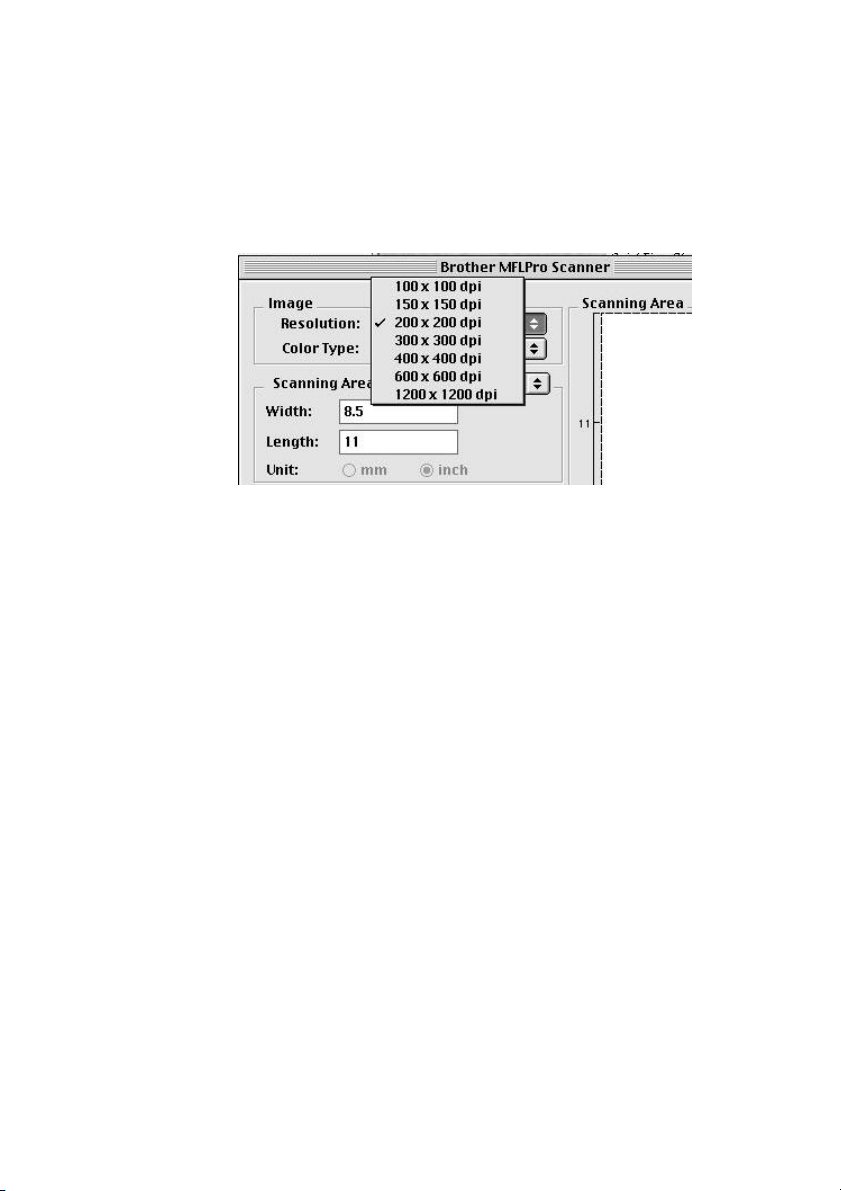
USING THE BROTHER MFC WITH A NEW POWER MACINTOSH
®
G3, G4 OR IMAC™ /IBOOK
19 - 9
Settings in the Scanner Window
Image
Resolution
Choose the scanning resolution from the Resolution pop-up menu. Higher
resolutions take more memory and transfer time, but can achieve a finer scanned
image. (Each model has different resolutions. See Specification.)
Scanning Area
Set the Size to one of the following:
• Letter (8.5 × 11 inches)
• A4 (210 × 297 mm)
• Legal (8.5 × 14 inches)
• A5 (148 × 210 mm)
• B5 (182 × 257 mm)
• Executive (7.25 × 10.5 inches)
• Business Card (90 × 60 mm)
• Custom (User adjustable from 0.35 × 0.35 inches to 8.5 × 14 inches)
After you choose a custom size, you can adjust the scanning area. Click and hold
the mouse button as you drag the mouse to crop the image.
Width: Enter the width of the custom size.
Length: Enter the length of the custom size.
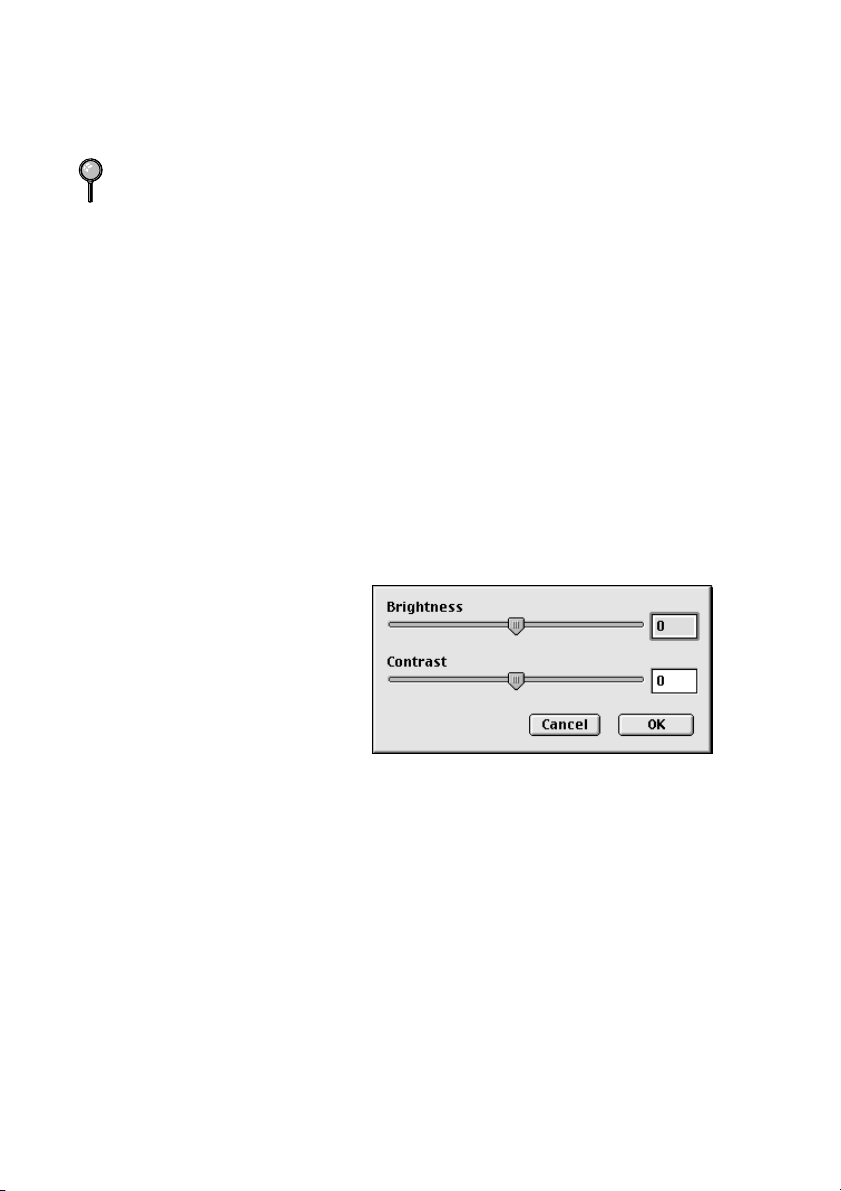
19 - 10
USING THE BROTHER MFC WITH A NEW POWER MACINTOSH
®
G3, G4 OR IMAC™ /IBOOK
Business Card Size
To scan business cards, select the Business Card size setting (90 × 60 mm) and
place the business card at the top center of a carrier sheet.
When scanning photographs or other images for use in a word processor or other
graphics application, it is a good idea to try different settings for the contrast,
mode and resolution to determine which settings look best.
Miscellaneous
Brightness
Adjust the brightness settings to obtain the best image. The Brother TWAIN
Scanner driver offers 100 brightness settings (-50 to 50). The default value is 0,
representing an “average” setting.
You can set the brightness level by dragging the slidebar to the right to lighten
the image or to the left to darken the image. You can also type a value in the box
to set the setting. Click OK.
If the scanned image is too light, set a lower brightness value and scan the
document again.
If the image is too dark, set a
higher brightness value and
scan the document again.
Contrast
The contrast setting is adjustable only when you have selected one of the gray
scale settings, but it is not available when Black & White is selected as the Gray
Scale.
Increasing the contrast level (by dragging the slidebar to the right) emphasizes
dark and light areas of the Image, while decreasing the contrast level (by
dragging the slidebar to the left) reveals more detail in gray areas. Instead of
using the slidebar, you can type a value in the box to set the contrast. Click OK.
Carrier sheets are available from your Dealer.
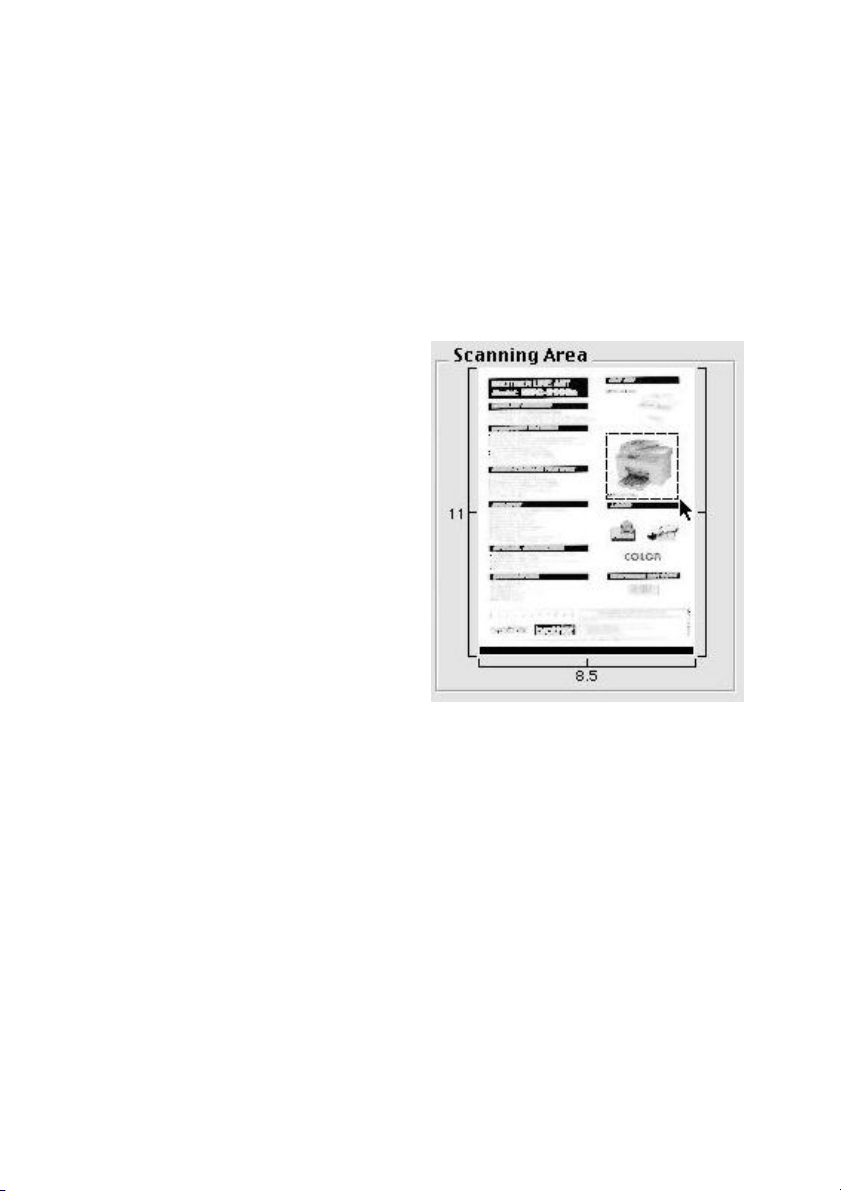
USING THE BROTHER MFC WITH A NEW POWER MACINTOSH
®
G3, G4 OR IMAC™ /IBOOK
19 - 11
PreScanning an Image
PreScanning allows you to scan an image quickly at a low resolution. A
thumbnail version will appear in the Scanning Area. This is only a preview of
the image, so you can see how it will look. The PreScan button is used to
preview an image for cropping any unwanted portions from the image. When
you are satisfied with the preview, click Start to scan the image.
1
Insert the original face up in the ADF.
2
Click PreScan.
The entire original will be scanned into your Macintosh G3 or iMac and will
appear in the Scanning Area of the Scanner dialog box:
3
To scan a portion of the
prescanned image, click and
drag the mouse to crop it.
4
Insert original in the ADF of the Brother MFC again.
5
Adjust the settings for Resolution, Color Type (Gray Scale), Brightness,
Contrast, and Size in the Scanner Setup dialog box, as needed.
6
Click Start.
This time only the selected area of the original will appear in the Scanning Area.
7
Use your application software for editing and refining the image as usual.
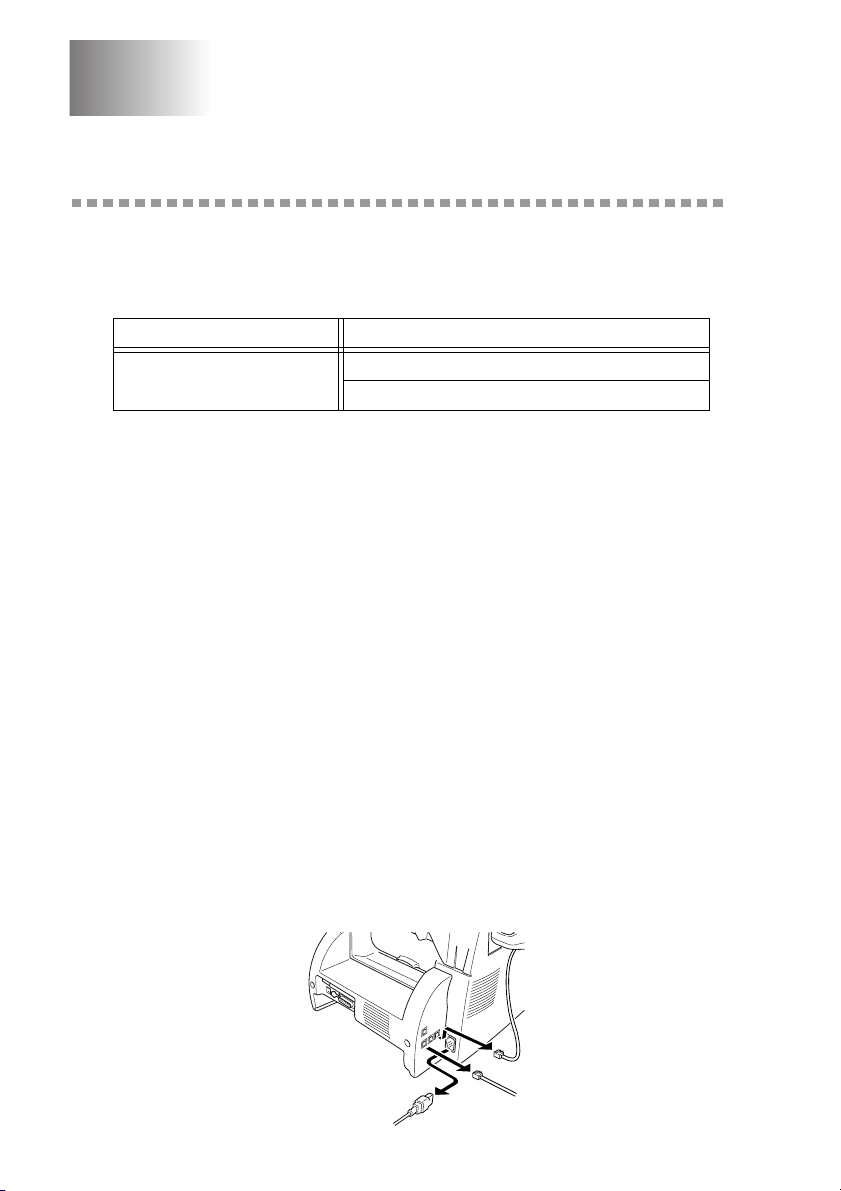
20 - 1
OPTIONAL ACCESSORIES
20
20
Optional Accessories
Memory Board
The memory board is installed on the main controller board inside the machine.
When you add the optional memory board, it increases the performance for both
fax and printer operations.
In general, the DIMM must have the following specifications:
Type: 100 pin and 32 bit output
CAS Lantency: 2 or 3
Clock Frequency: 66MHz or more
Capacity: 16 or 32MB
Height: 46mm (1.8 inches) or less
Parity: NONE
DRAM Type: SDRAM 4 Bank
Some DIMMs might not work with this MFC. For the latest information from
Brother visit:
http://solutions.brother.com
Installing the Optional Memory Board
Caution: DO NOT touch the surface of the main board within 15 minutes
after turning off the power.
1
Disconnect the telephone line cord, unplug the machine power cord from the AC
outlet, and then disconnect the interface cable.
Warning: Unplug the power cord before installing (or removing) the memory
board.
Model Name Optional Memory
MFC-9800 with Standard
Memory: 8MB
16MB TECHWORKS 12456-0001
32MB TECHWORKS 12457-0001
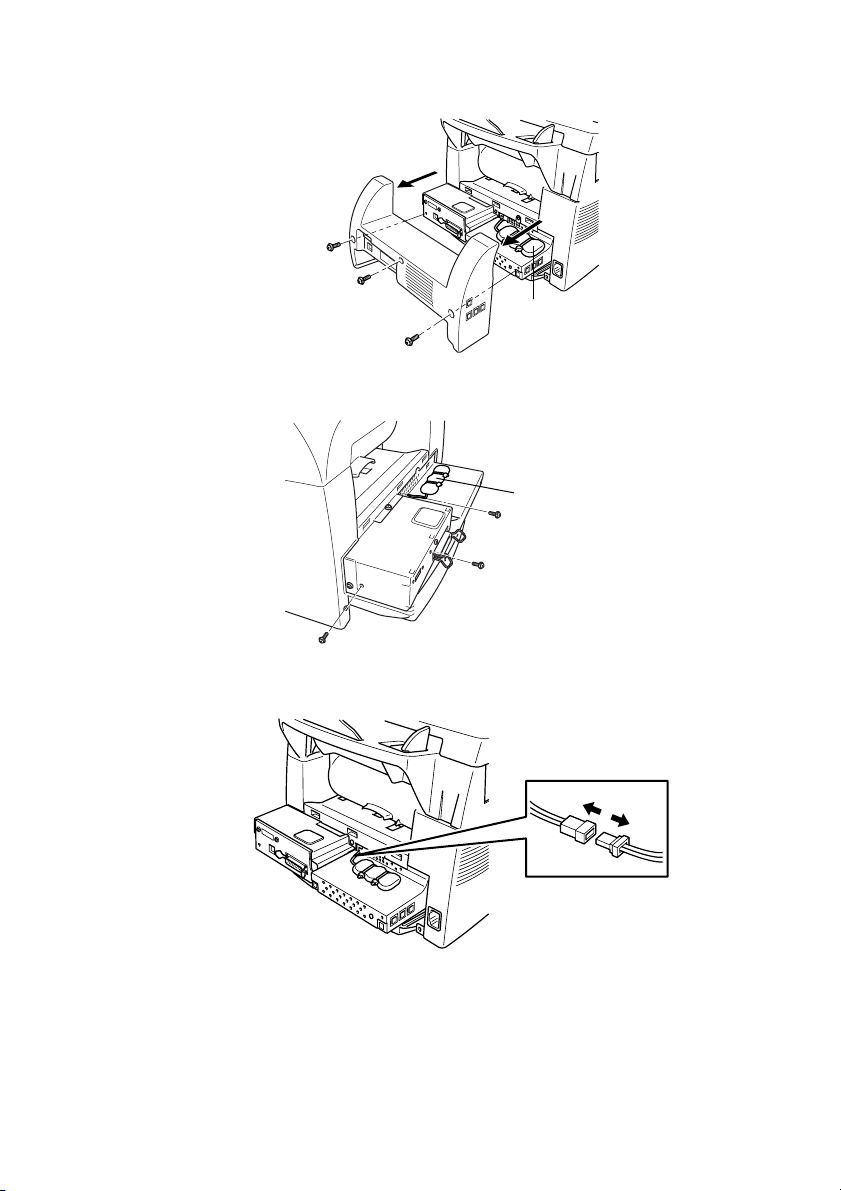
OPTIONAL ACCESSORIES
20 - 2
2
Remove the screws securing the rear cover and remove the cover.
3
Remove the screws securing the access plate and remove the plate.
4
Disconnect the connector from the back up battery.
Back Up
Battery
Back Up Battery
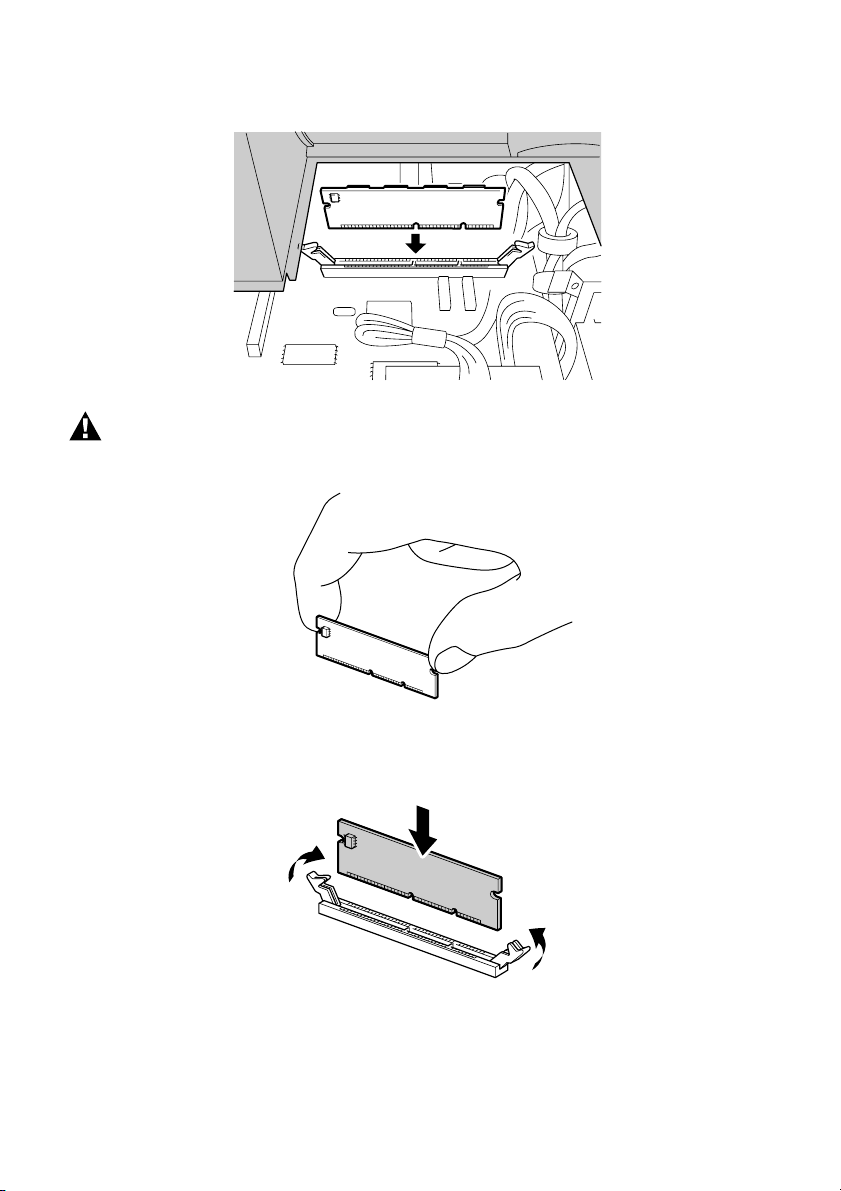
20 - 3
OPTIONAL ACCESSORIES
5
To install the memory board onto the main controller board, plug the attached
spacer into the connectors of the main controller board.
WARNING
■ Hold the memory board by its edges. Do not touch the surface of the board.
■ Make sure the memory board is securely seated on the main controller board.
6
Reconnect the connector to the back up battery.
7
Reinstall the access plate and the rear cover.
8
Reconnect the interface cable, and then plug the power cord into the AC outlet.

OPTIONAL ACCESSORIES
20 - 4
Paper Cassette #2 (Option)
You can purchase the Paper Cassette #2 accessory (LT400) to use as a third
paper source. Cassette #2 holds up to 250 sheets of 20 lb. (75 g/m
2
) paper.
Network (LAN) Board (Option)
When you add the optional Network (LAN) Board (NC-8100h), you can
connect your MFC into the network to use the Internet FAX, Network Scanner,
Network Printer and Network Management operations.
Paper Cassette #2: Holds approx. 250 sheets of 20 lb. (75 g/m
2
) Letter/A4
paper
Basis Weight: 16 to 28 lb. (60 to 105 g/m
2
)
Caliper: 0.003 to 0.005 inches. (0.08 to 0.13 mm)
Moisture Content: 4% to 6% by weight
Smoothness: 100 to 250 (Sheffield)
We Recommend:
Cut sheet:
Xerox 4200DP 20 lb, Champion Paper One 20 lb,
Hammermill Laser Paper 24 lb
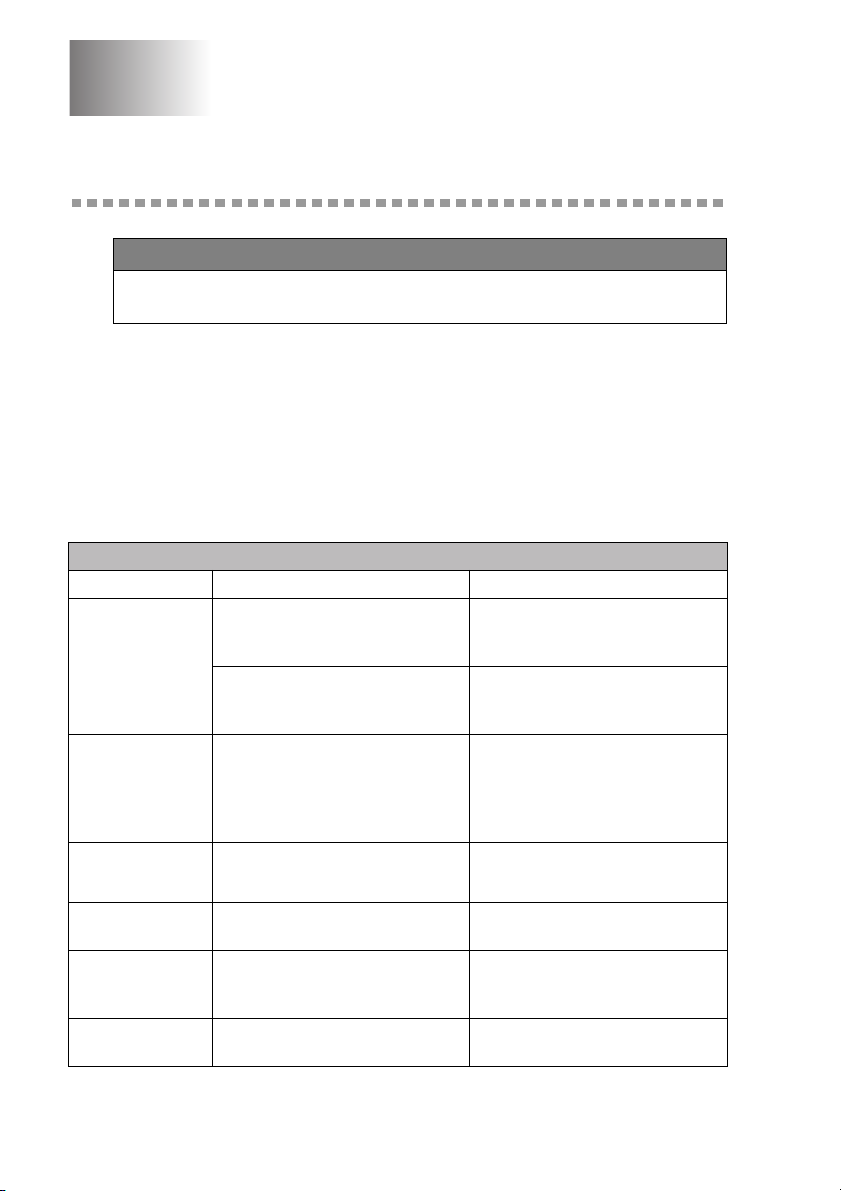
21 - 1
TROUBLESHOOTING AND ROUTINE MAINTENANCE
21
21
Troubleshooting and
Routine Maintenance
Troubleshooting
Error Messages
As with any sophisticated office product, errors may sometimes occur. If this
happens, your MFC often identifies the problem and displays an error message.
The table below explains the most common error messages.
You can correct most problems by yourself. If you need additional help, call the
Brother fax-back system.
In USA: 1-800-521-2846
IMPORTANT
For technical and operational assistance, you must call the country where you
purchased the printer. Calls must be made from within that country.
Error Messages
Error Message Cause Action
CHANGE DRUM
SOON
The drum unit is near the end of its
life.
Use the drum unit until you have a
print quality problem; then replace the
drum unit with a new one.
The drum counter was not reset. 1. Open the front cover, and then
press Clear.
2. Press 1 to reset.
CHECK PAPER
CHECK PAPER
#1
CHECK PAPER
#2
The MFC is out of paper or paper is
not properly loaded in the paper
cassette.
Refill the cassette or remove the paper
and load it again.
CHECK PAPER
SIZE
When you see this error,
the paper in
the cassette does not match the paper
size you set in Menu, 1, 1.
Either load the appropriate size paper
or change the default setting.
(See
page 4-1).
CHECK SCAN
LOCK
The scanner lock is locked. Release the scanner lock lever, and
then press Stop/Exit.
COMM. ERROR Poor phone line quality caused
communication error.
Try the call again. If problem
continues, call Telephone Company
to check your phone line.
CONNECTION
FAIL
You tried to poll a MFC that is not in
Polled Waiting mode.
Verify the other party’s polling setup.
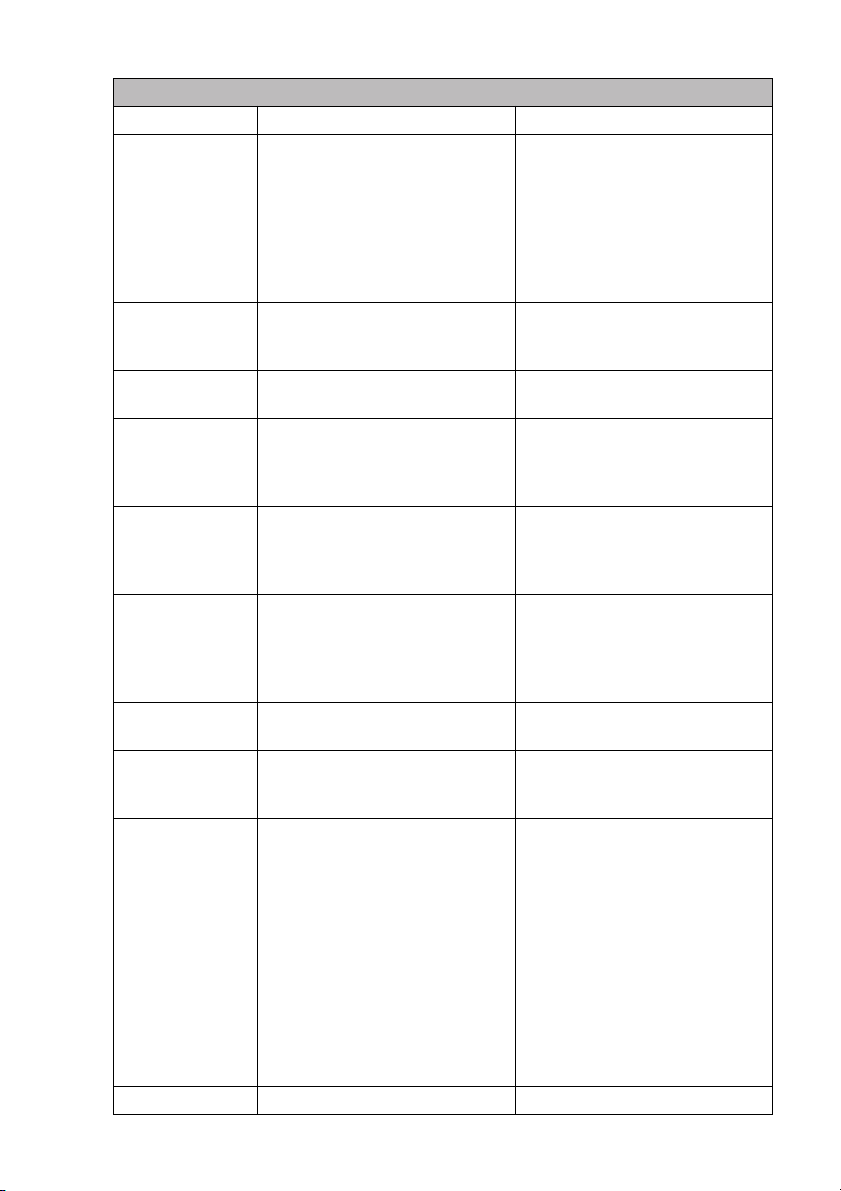
TROUBLESHOOTING AND ROUTINE MAINTENANCE
21 - 2
COOLING
DOWN
WAIT FOR A
WHILE
The temperature of the drum unit or
toner cartridge is too hot. The MFC
will pause its current print job and go
into cooling down mode. During the
cooling down mode, you will hear the
cooling fan running while the display
on the MFC shows COOLING
DOWN, and WAIT FOR A WHILE.
You must wait 20 minutes for it to
cool.
COVER OPEN
PLS CLOSE
COVER
The front cover was not completely
closed.
Close the front cover for the drum
unit.
DISCONNECTED
The other party or other party’s fax
machine terminated the call.
Try to transmit or receive again.
CHECK
ORIGINAL
Originals were not inserted or fed
properly, or original scanned from
ADF was longer than about 40 inches
(90cm).
See Original Jams and Paper Jams,
page 21-3.
MACHINE
ERROR XX
MFC has a mechanical problem. Call Brother Customer Service.
In USA: 1-800-284-4329
In Canada: 1-877-BROTHER
In Montreal: 1-514-685-6464
OUT OF
MEMORY
(May occur when
the MFC is used as
a printer)
You can’t store data in the memory. See page 11-2.
NO RESPONSE/
BUSY
The number you dialed does not
answer or is busy.
Verify the number and try again.
NOT
REGISTERED
You tried to access a One Touch or
Speed Dial number that is not
programmed.
Set up the One Touch or Speed Dial
number. (See pages 7-1, 7-2.)
PLS OPEN
COVER
A page, piece of paper or paper clip,
etc. may be jammed inside the MFC.
Open the front cover. If you see any
jammed paper or other item, gently
pull it out, then close the front cover. If
the error message remains, open and
close the front cover again. If the MFC
cannot reset itself and return to the date
and time prompt, it will display
MACHINE ERROR XX. Please call
Brother Customer Service and tell
them the MFC Error number at:
In USA: 1-800-284-4329
In Canada: 1-877-BROTHER
In Montreal: 1-514-685-6464
PAPER JAM The paper is jammed in the MFC. See page 21-4.
Error Messages
Error Message Cause Action
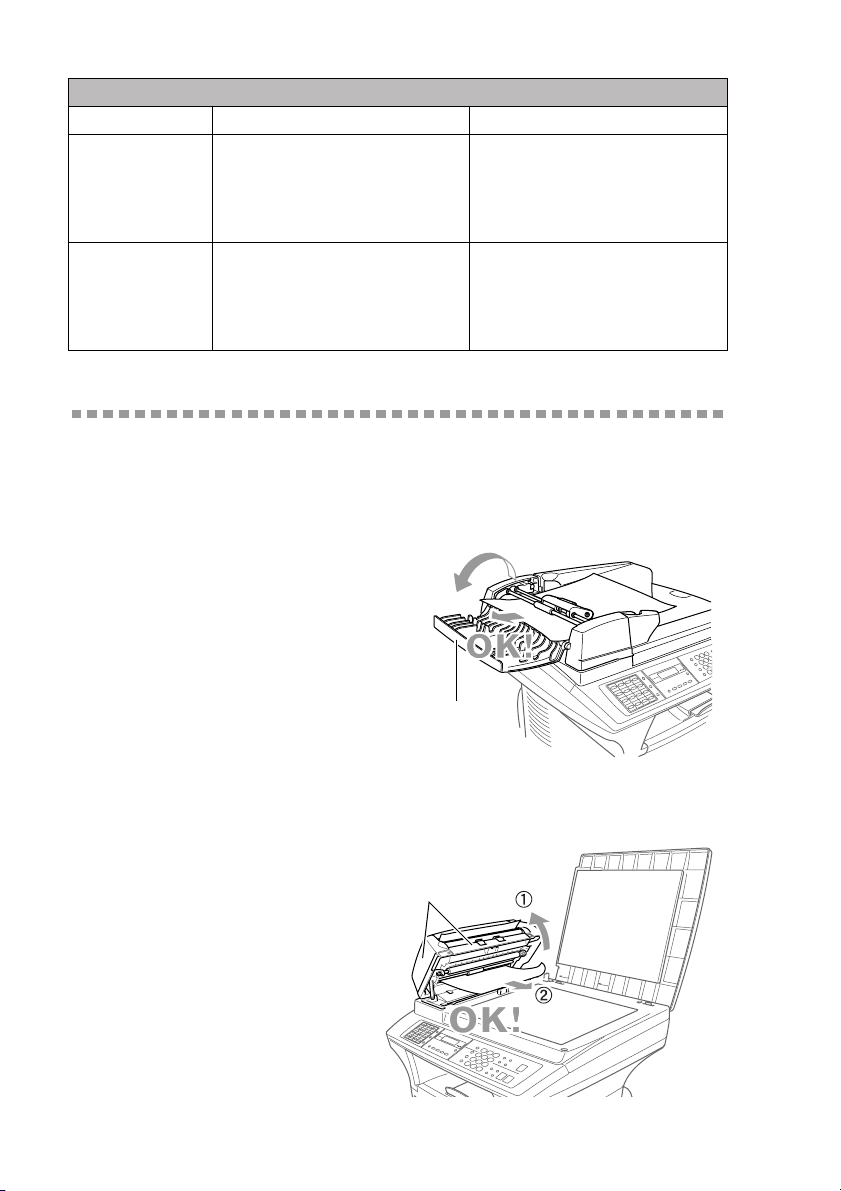
21 - 3
TROUBLESHOOTING AND ROUTINE MAINTENANCE
Original Jams and Paper Jams
Based upon where the original or printed sheet is jammed, follow the
appropriate set of instructions to remove it.
Original is Jammed in the top of the ADF Unit
1
Remove any paper from the ADF
that is not jammed.
2
Lift the ADF cover.
3
Pull the jammed original out to the
left.
4
Close the ADF cover.
5
Press Stop/Exit.
Original is Jammed inside the ADF Unit
1
Lift the document cover.
2
Remove any paper from the
ADF that is not jammed.
3
Lift the ADF unit.
4
Pull the jammed original out
to the right.
5
Close the ADF unit.
6
Press Stop/Exit.
TONER EMPTY Toner cartridge is not installed.
—OR—
Toner is used up and printing is not
possible.
Reinstall the toner cartridge.
—OR—
Replace the toner cartridge with a new
one.
(See page 21-19.)
TONER LOW If the LCD shows TONER LOW,
you can still print.
But the toner is depleted and the MFC
is telling you that the toner will soon
run out.
Order a new toner cartridge now.
Error Messages
Error Message Cause Action
ADF Cover
ADF Unit
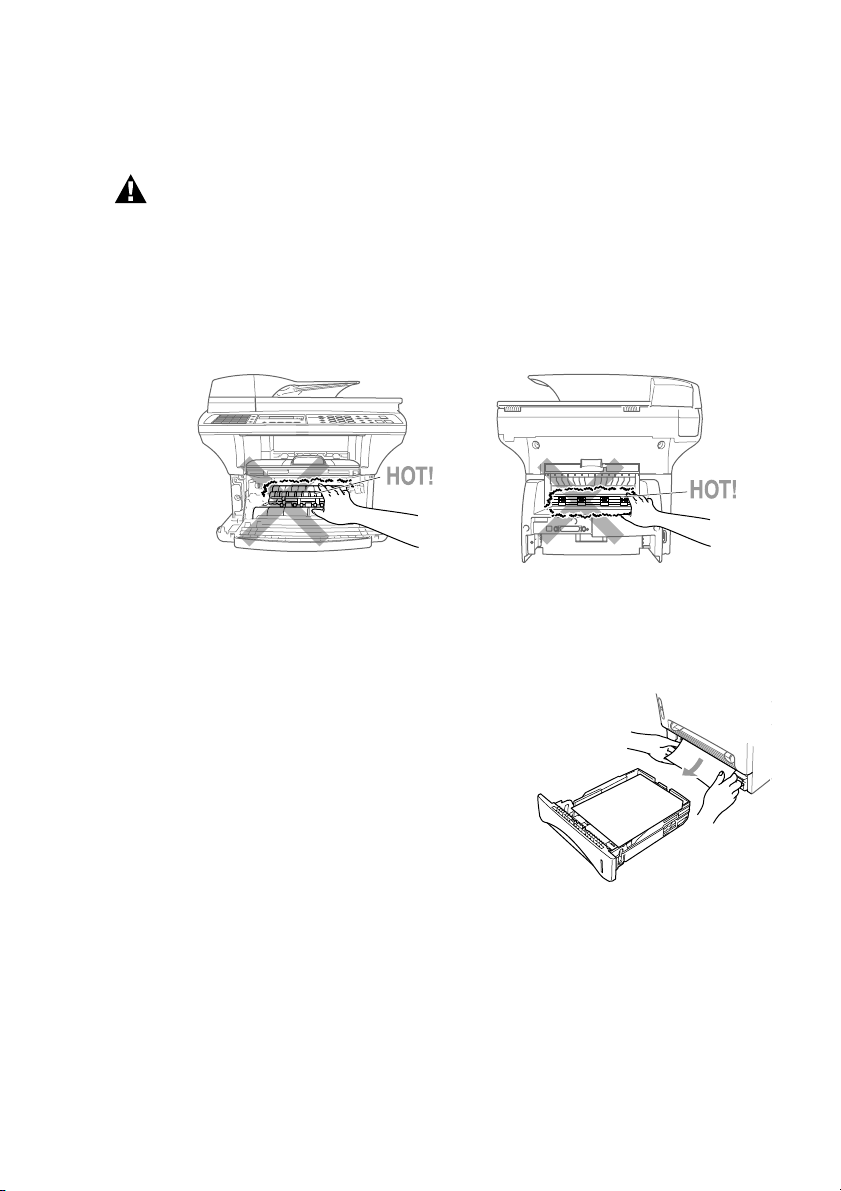
TROUBLESHOOTING AND ROUTINE MAINTENANCE
21 - 4
Paper Jam
Before you can clear a paper jam error, you must find out where the paper is
stuck. See the following three types of paper jams.
WARNING
Do not use force to pull the jammed paper from the paper tray because you may
damage the MFC and cause toner to scatter on the next printed pages.
After you use the MFC, some internal parts are extremely HOT! When you open
the front, never touch the shaded parts shown in the following diagram.
Paper is Jammed in the Paper Cassette
1
Pull the paper cassette out of the MFC.
2
Remove any crinkled sheets.
3
Adjust the guides to fit.
4
Press down the paper to flatten it in the paper cassette.
5
Reinstall the paper cassette.
Front view
Rear view
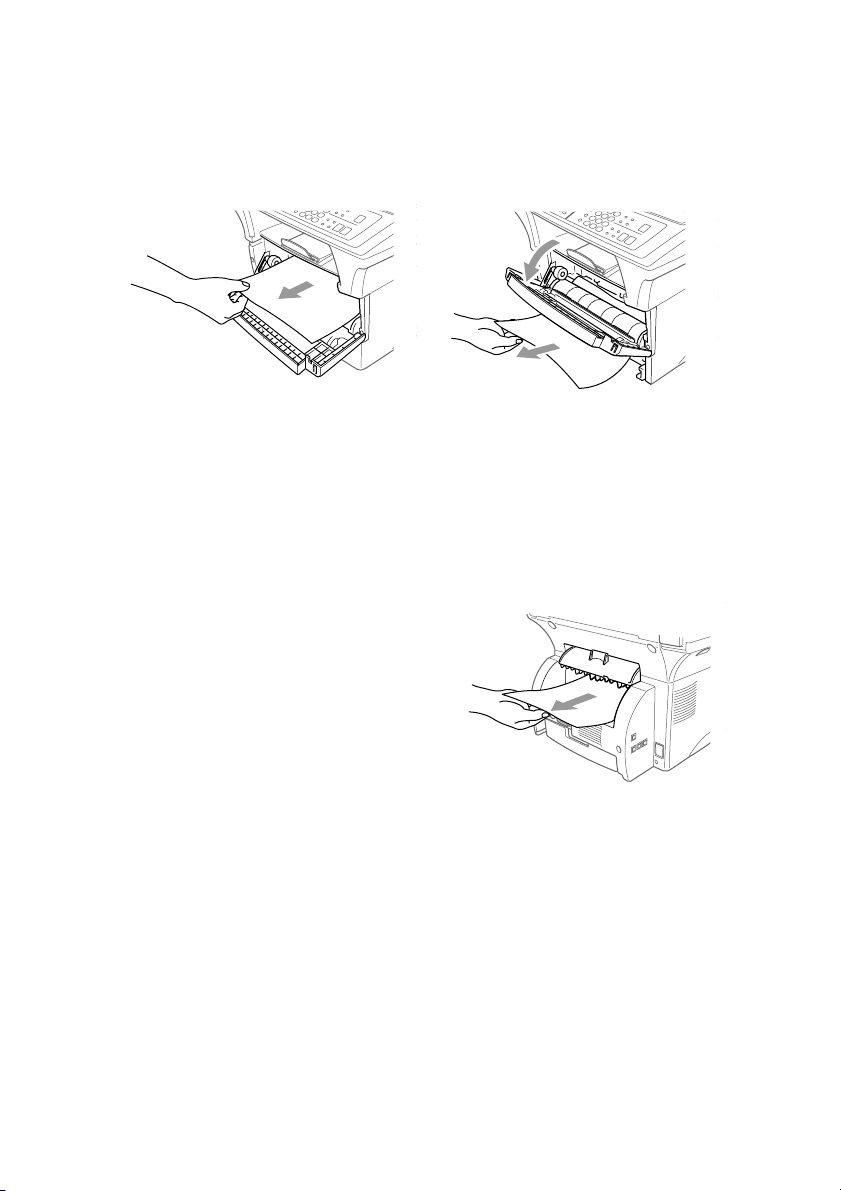
21 - 5
TROUBLESHOOTING AND ROUTINE MAINTENANCE
Paper is Jammed near the Drum Unit
1
Open the front cover.
2
Remove the drum unit but do not force it if it cannot be removed easily.
Instead, pull the edge of the jammed paper from the paper cassette.
3
Gently pull out the jammed paper.
4
Reinstall the drum unit.
5
Close the front cover.
Paper is Jammed in the Fuser Unit
1
Open the rear cover.
2
Pull out jammed paper. When you have to
pull paper out the back of the MFC, the
fuser may get dirty with toner powder
causing the next few printed page(s) to
look messy. Print a few copies of the test
page until the pages print clearly.
3
Close the rear cover.
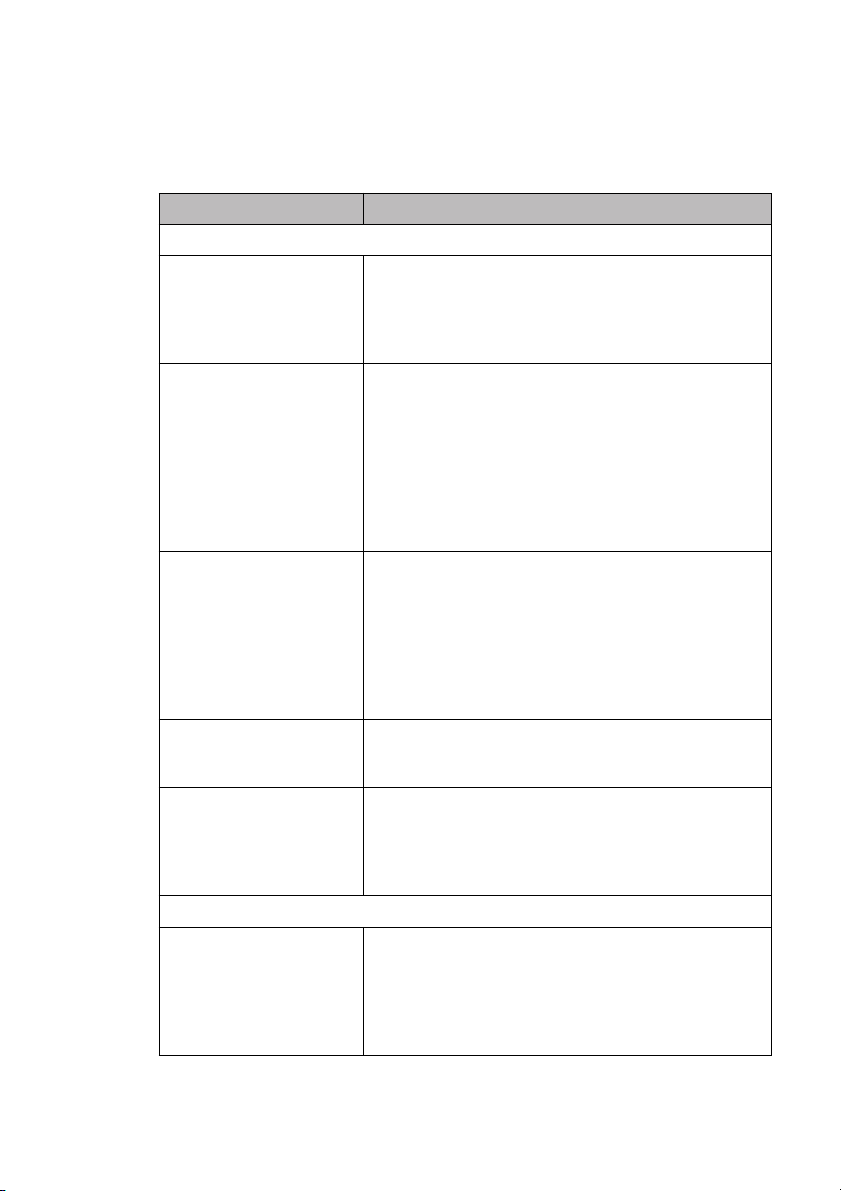
TROUBLESHOOTING AND ROUTINE MAINTENANCE
21 - 6
If You Are Having Difficulty with Your MFC
If you think there is a problem with your MFC, make a copy first. If the copy
looks good, the problem is probably not your MFC. Check the chart below and
follow the troubleshooting tips.
DIFFICULTY SUGGESTIONS
Printing or Receiving Faxes
Condensed Print and
Horizontal Streaks / Top and
Bottom of Sentences Are Cut
Off
If your copy looks good, you probably had a bad connection,
with static or interference on the phone line. If the copy looks
bad, call Brother Customer Service at 1-800-284-4329 (
In
USA
), 1-877-BROTHER (
In Canada
) or 1-514-685-6464 (
In
Montreal
).
Vertical Black Lines When
Receiving
Sometimes you may see vertical streaks/black lines on the
faxes you receive. Either your MFC’s primary corona wire for
printing may be dirty, or the sending party’s fax scanner may
be dirty. Clean your primary corona wire (see page 21-18), or
ask the sender to make a copy to see if the problem is with the
sending machine. Try receiving from another fax machine. If
the problem continues, call Brother Customer Service at
1-800-284-4329 (In USA), 1-877-BROTHER (In Canada)
or 1-514-685-6464 (In Montreal).
Fax Machine “Hears” Voice
as CNG Tone
If your fax machine is set to Easy Receive ON, it is more
sensitive to sounds. Your fax machine may mistakenly
interpret certain voices or music on the line as a calling fax
machine and respond with fax receiving tones. Deactivate the
fax by pressing #51 if you are at an extension phone or press
Stop if you are at the fax machine or an external phone. Try
avoiding this problem by turning Easy Receive to OFF. (See
Easy Receive, page 5-3.)
Horizontal streaks; lines are
missing.
You may get a fax with horizontal streaks or with missing
lines. Usually this is caused by a poor telephone connection.
Ask the other party to send the fax again.
Received faxes appear as
split or blank pages.
If the received data is divided and printed on two pages or if
you get an additional blank page, your Paper Size setting may
not be correct for the paper you are using (see pages 4-1). If
you are using the fixed reduction feature, check to see if the
reduction ratio is suitable for the real paper.
(See page 11-4).
Phone Line or Connections
Dialing does not work Check for a dial tone. Change TONE/PULSE setting. (See
Page 4-6.) Check all line cord connections, and make sure the
curled handset cord is NOT plugged into the EXT jack.
Check power cord connection. Send a manual fax by pressing
Hook, or by lifting the handset and dialing the number. Wait
to hear fax receiving tones before pressing Fax Start.
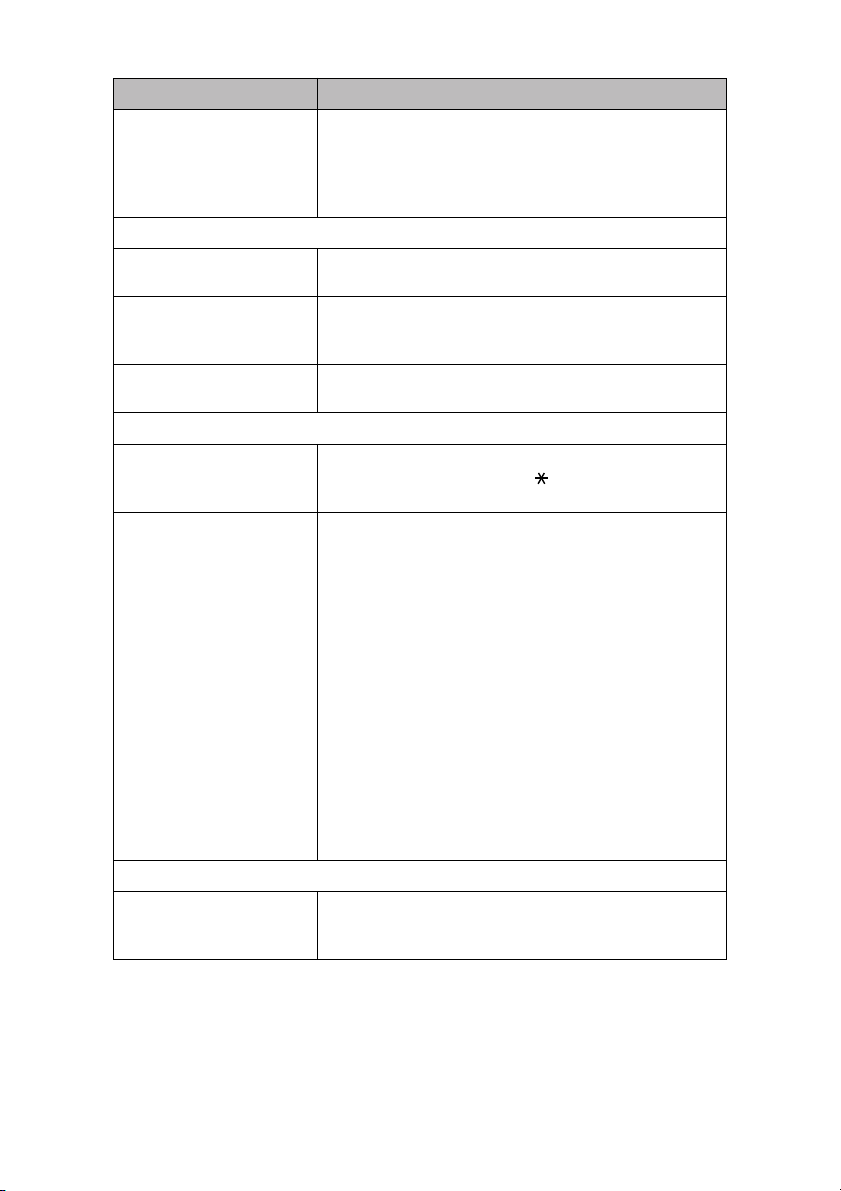
21 - 7
TROUBLESHOOTING AND ROUTINE MAINTENANCE
MFC Does Not Answer
When Called
Make sure the MFC is not in MANUAL mode. Check for dial
tone. If possible, call your MFC to hear it answer. If there is
still no answer, check the telephone line cord connection. If
there is no ringing when you call your MFC, call your
Telephone Company to check the line.
Sending Faxes
Poor Transmitting Quality Try changing your resolution to FINE or S.FINE. Make a
copy to verify your MFC’s scanner operation.
Transmission Verification
Report says “Result:NG”
There is probably temporary noise or static on the line. Try
sending the fax again. If the problem continues, call the
Telephone Company to check your phone line.
Vertical Black Lines When
Sending
If the copy you made shows the same problem, your scanner
is dirty. (See Cleaning the Scanner, page 21-16.)
Handling Incoming Calls
Transferring a Fax Call to the
MFC
If you answered at an extension phone, press your Fax
Receive Code (default setting is 51). When your MFC
answers, hang up.
I have difficulty with custom
features on a single line
If you have Call Waiting, Call Waiting/Caller ID,
RingMaster, Voice Mail, an answering machine, an alarm
system or other custom feature on a single phone line with
your MFC, it may create a problem sending or receiving fax
data.
For Example: Your Brother machine handles the Caller ID
subscriber services. However, if you subscribe to Call
Waiting or some other custom service and its signal comes
through the line while your machine is sending or receiving a
fax, the signal can temporarily interrupt or disrupt the fax
data. Brother’s ECM feature should help overcome this
problem. This condition is related to the telephone system
industry and is common to all devices that send and receive
information on a single, shared line with custom features. If
avoiding a slight interruption is crucial to your business, a
separate line with no custom features is recommended.
Copy Quality Difficulties
Vertical streaks appear in
copies.
Sometimes you may see vertical streaks on your copies. Either
the scanner or the primary corona wire for printing is dirty.
Clean them both. (See pages 21-16 and 21-18.)
DIFFICULTY SUGGESTIONS
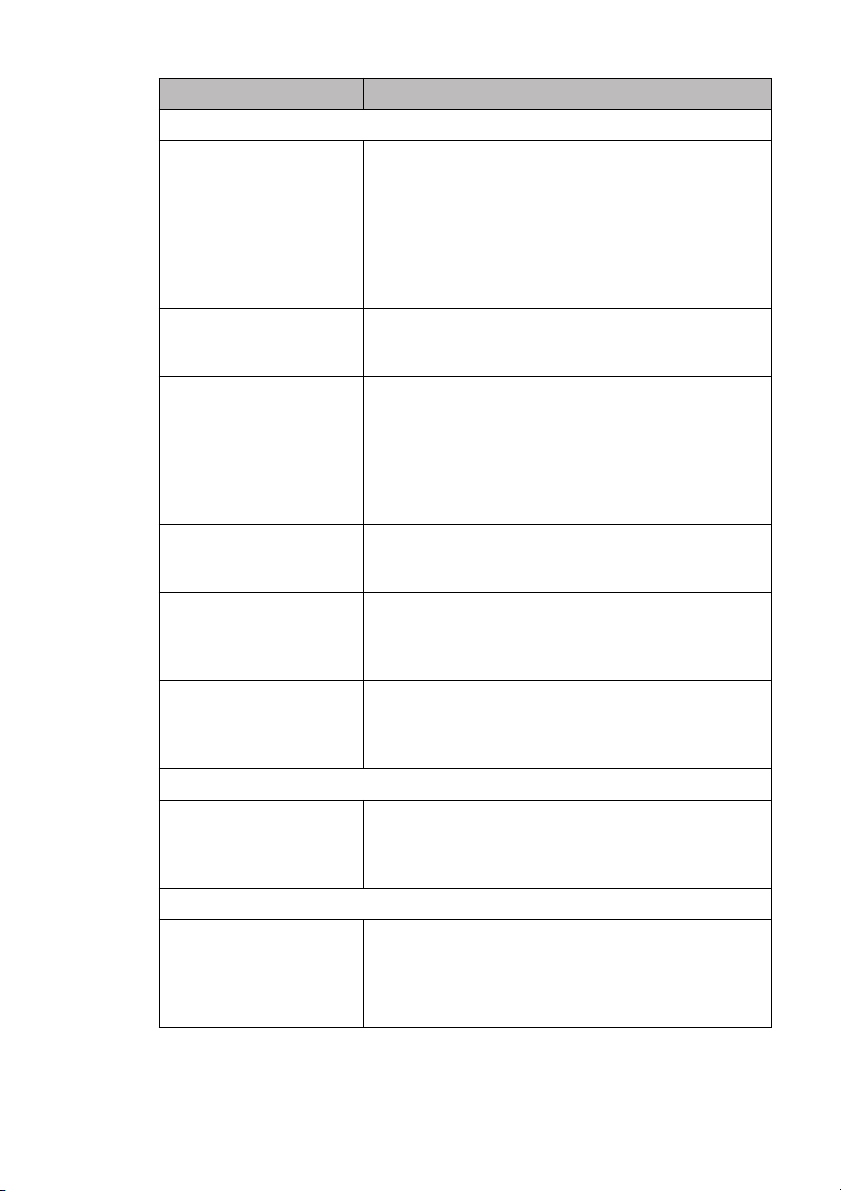
TROUBLESHOOTING AND ROUTINE MAINTENANCE
21 - 8
General Printing Difficulties
The MFC does not print. Check the following:
• The MFC is plugged in. (See page 2-8.)
• The toner cartridge and drum unit are installed properly.
(See page 2-4.)
• The interface cable is securely connected between the MFC
and computer. (See Quick Setup Guide.)
• Check to see if LCD is showing an error message. (See page
21-1 to 21-3.)
The MFC prints
unexpectedely or it prints
garbage.
Reset the MFC or unplug the electrical cord and plug it back
in. Check the primary settings in your application software to
make sure it is set up to work with your MFC.
The MFC cannot print full
pages of a document.
The MFC received a very complex print job and could not
process part of the page. This print. may be solved in several
ways. If you are using Windows
®
95/98/98SE/Me/2000
Professional or Windows NT
®
Workstation Version 4.0 with
the supplied printer driver, see the “Windows
®
Setup Printing
Difficulties” section. Try to reduce the complexity of your
document or reduce print resolution.
The MFC prints first couple
of pages correctly, then some
pages have text missing.
Your computer is not recognizing the printer’s input buffer
full signal. Please make sure to connect the printer cable
correctly.
The MFC cannot print full
pages of a document.
OUT OF MEMORY
message occurs.
Reduce the printer resolution. Reduce the complexity of your
document and try again. Reduce the graphic quality or the
number of font sizes within your application software.
My headers or footers appear
when I view my document on
the screen but do not up when
I print them.
Most laser printers have a restricted area that will not accept
print. Usually these are the first two lines and last two lines,
leaves 62 printable lines. Adjust the top and bottom margins
in your document to allow for this.
Scanning Difficulties
TWAIN Errors appear while
scanning.
Make sure the Brother TWAIN Driver is selected as the
primary source. In PaperPort
®
, from the File menu select File,
select source, and then highlight the Brother TWAIN Driver
and click Select.
Software Difficulties
You see the “New Hardware
Found” message on your PC
screen (although you have
already installed the drivers
in Windows 95).
Click on ‘Do not install a driver. (Windows will not prompt
you again)’ and click ‘OK’.
DIFFICULTY SUGGESTIONS

21 - 9
TROUBLESHOOTING AND ROUTINE MAINTENANCE
You see the “Update Device
Driver Wizard” or “Add New
Hardware Wizard” message
on your PC screen
(although you have already
installed the drivers in
Windows 95 or 98).
Follow the instructions from the installer, then click Next.
Click Finish when it appears on the screen.
“Unable to write to LPT1” or
“LPT1 already in use” Error
Message appears.
1.Make sure the MFC is on (plugged into the AC outlet) and
that it is connected directly to the computer using the
bundled IEEE-1284 bi-directional parallel cable. The cable
must not go through another peripheral device (such as a Zip
Drive, External CD-ROM Drive, or Switch box).
2.Make sure the MFC is not displaying an error message on
the LCD Display.
3.Make sure no other device drivers, which also communicate
through the parallel port, are running automatically when
you boot up the computer (such as, drivers for Zip Drives,
External CD-ROM Drive, etc.) Suggested areas to check:
(Load=, Run=command lines in the win.ini file or the Statup
Group)
4.
Check with you computer manufacturer to confirm that the
computer’s parallel port settings in the BIOS are set to support
a bi-directional machine; i.e. (Parallel Port Mode – ECP)
“MFC is Busy” or “MFC
Connect Failure” Error
Message appears.
“MFC Connect Failure” If the MFC is not connected to your PC and you have loaded
the Brother software, the PC will show “MFC Connect
Failure” each time you restart Windows®. You can ignore
this message or you can turn it off by deselecting the
AutoLoad PopUp check box in the Brother Control Center.
(See How to Turn Off AutoLoad, page 15-2 in On-Line
Documentation on the CD-ROM.)
DOS Setup Printing Difficulties
I cannot print from my
application software.
Check that the DOS application software interface settings
match those of your printer: for example, if you are using a
parallel printer cable, you would probably set your DOS
software printer port to LPT1. Check for an error message on
the LCD.
The MFC prints, but it prints
incorrect information.
Sometimes it prints a couple
of characters and then ejects
the pages, etc.
This is an indication that your application printer emulation
Prints setting and the MFC’s printer emulation do not match.
Check your application software to make sure you selected
the correct printer driver. The MFC emulates HP LaserJet IIP.
Try setting the MFC to HP emulation in Remote Printer
Console and then select the HP LaserJet IIP printer in your
application software.
DIFFICULTY SUGGESTIONS
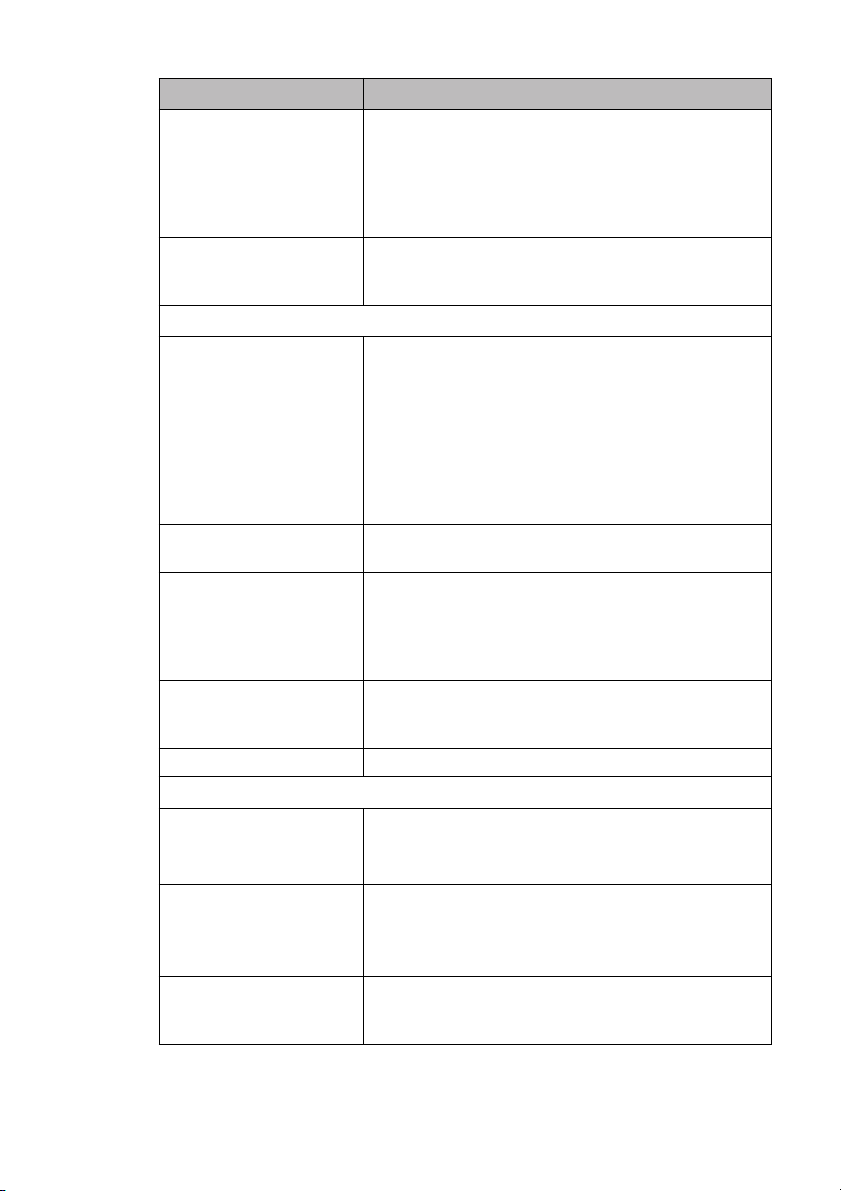
TROUBLESHOOTING AND ROUTINE MAINTENANCE
21 - 10
The MFC prints the part of
my document but does not
print the last page (The LCD
shows REMAINED
DATA).
This is common problem first with database software and part
of spreadsheet software when they are not correctly set up.
The data has been sent to the printer but the printer did not
receive the Page Eject command. Press Reset to eject the
page. Then ask your software supplier how to add a Page Eject
(or Form Feed) command to the end of your print job.
How can I change the user
settings or default settings on
the MFC?
Use the Remote Printer Console (RPC) program.
Paper Handling Difficulties
The MFC does not load
paper. The LCD shows
CHECK PAPER or PAPER
JAM.
Check to see if the CHECK PAPER or PAPER JAM
message appears on the LCD. If it is empty, load a new stack
of paper into the paper cassette. If there is paper in the paper
cassette, make sure it is straight. If the paper is curled, you
should straighten it. Sometimes it is helpful to remove the
paper, turn the stack over and put it back into the paper
cassette. Reduce the amount of paper in the paper cassette,
then try again. Check the manual feed mode is not selected in
the printer driver.
The MFC does not feed paper
from the manual feed slot.
Reinsert the paper firmly, load one sheet at a time. Make sure
that manual feed mode is selected in the printer driver.
How can I load envelopes? You can load envelopes from the manual feed slot. Your
application software must be set up to print the envelope size
you are using. This is usually done in the Page Setup or
Document Setup menu of your software. Refer to your
software application manual.
What paper can I use? You can use plain paper, envelopes, transparencies and labels
that are made for laser machines. (For information on paper
you can use, see Acceptable Paper, page 2-5.)
How can I clear paper jams? See Paper Jam, page 21-4.
Print Quality Difficulties
Printed pages are curled. Thin Paper (17lb-18.4lb) can cause this problem. Make sure
you select the Paper Type that suits the paper in your multi-
purpose sheet feeder. (See Paper Type, page 11-8 and 11-9
and Media Type, page 14-4.)
Printed pages are smeared. Rough surfaces or thick media can cause “smeared pages”
—OR—“the toner to smear”. Make sure you select the correct
Paper Type that suits the paper in your multi-purpose sheet
feeder. (See Paper Type, page 11-8 and 11-9 and Media Type,
page 14-4.)
Printouts are too dark or light. Adjust the print conditions in the Print Density setting. It has
been factory set to the middle position. (See Setting the Print
Density, page 5-4.)
DIFFICULTY SUGGESTIONS
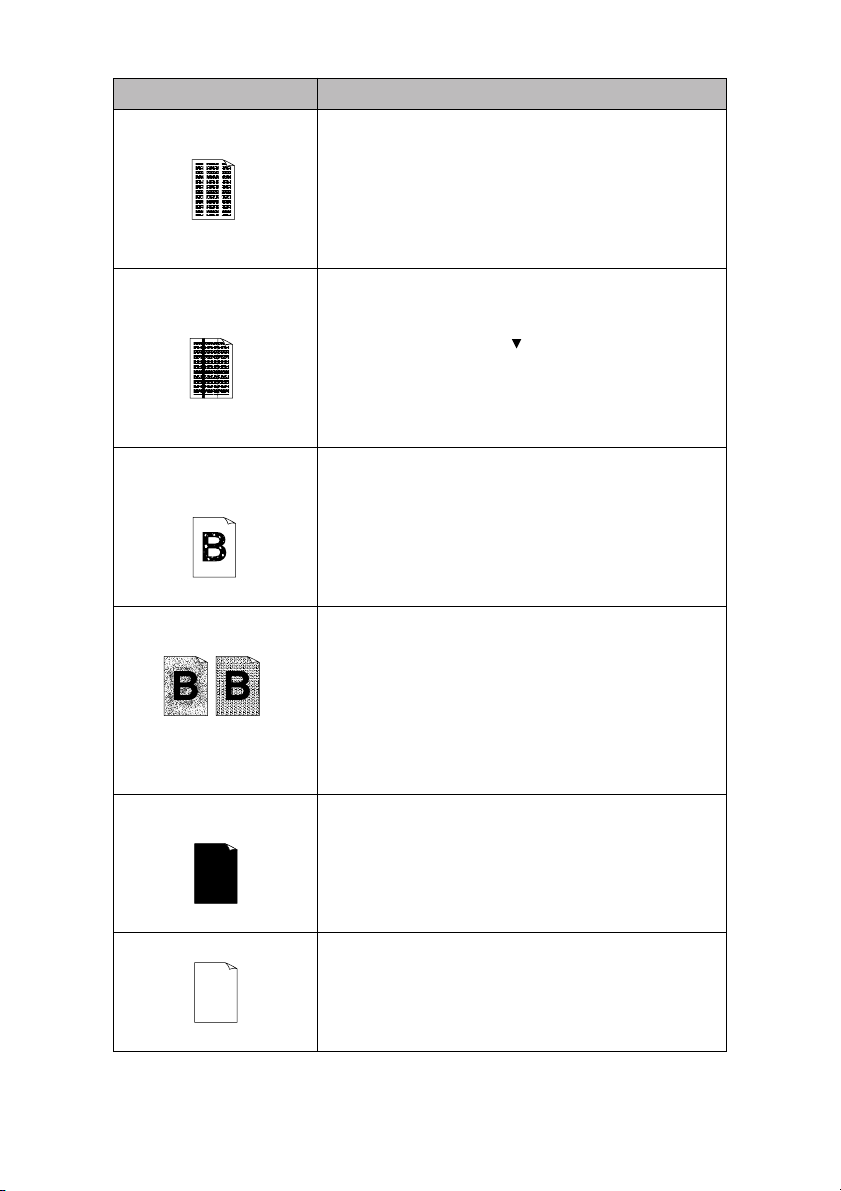
21 - 11
TROUBLESHOOTING AND ROUTINE MAINTENANCE
Printed pages contain white
stripes.
White Stripes or Faint
lmages
You may fix this by wiping the scanner windows with a clean
soft cloth. (See Routine Maintenance and Cleaning the Drum
Unit, on pages 21-16 and 21-18.) If you still see white stripes
or faint images and the LCD shows CHANGE DRUM
SOON, replace the drum unit with a new one. Check the
MFC’s environment. Conditions such as humidity, high
temperatures, etc. may cause this print defect to occur.
Printed pages are stained
corona with toner or have
vertical stripes.
Dark Stripes or Toner
Stains
Clean the MFC’s interior and the primary wire of the drum
unit. (See Routine Maintenance and Cleaning the Drum Unit,
on pages 21-16 and 21-18.) Make sure that the tab of the
corona wire is at the Home ( ) position.
If after cleaning, you still see dark stripes or toner stains and
the LCD shows CHANGE DRUM SOON, replace the drum
unit with a new one.
Printed pages have white
spots in black text and
graphic areas.
White Spots
Make sure that you use paper that meets the specifications.
Rough surface or thick media can cause the problem. If you
still see white spots and the LCD shows CHANGE DRUM
SOON, replace the drum unit with a new one. Check the
MFC’s environment; conditions such as high humidity may
cause this situation to occur.
Toner scatters and stains the
printed page.
Scattering Toner
Adjust the print conditions in the Print Density setting.
Remove the drum unit and clean the MFC’s interior. (See
Routine Maintenance and Cleaning the Drum Unit, on pages
21-16 and 21-18.) Make sure that you use paper that meets
specifications. (See page 2-5.) If you still have scattered toner
and the LCD shows CHANGE DRUM SOON, replace the
drum unit with a new one. Check the MFC’s environment;
high temperature and high humidity may cause this condition
to occur.
The whole page is printed
black.
Black Page
Clean the MFC’s interior and the primary corona wire of the
drum unit. (See page 21-18.) Also, do not use heat sensitive
paper as it will cause this problem. After cleaning, if the
printed pages are still black or the LCD shows CHANGE
DRUM SOON, replace the drum unit with a new one. The
drum unit may be damaged.
Nothing printed on the page.
White Page
Make sure that the toner cartridge is not empty. Wipe electric
terminals referring to Routine Maintenance and Cleaning the
Drum Unit, on pages 21-16 and 21-18. Make sure that a torn
piece of paper does not remain on the scanner window.
DIFFICULTY SUGGESTIONS
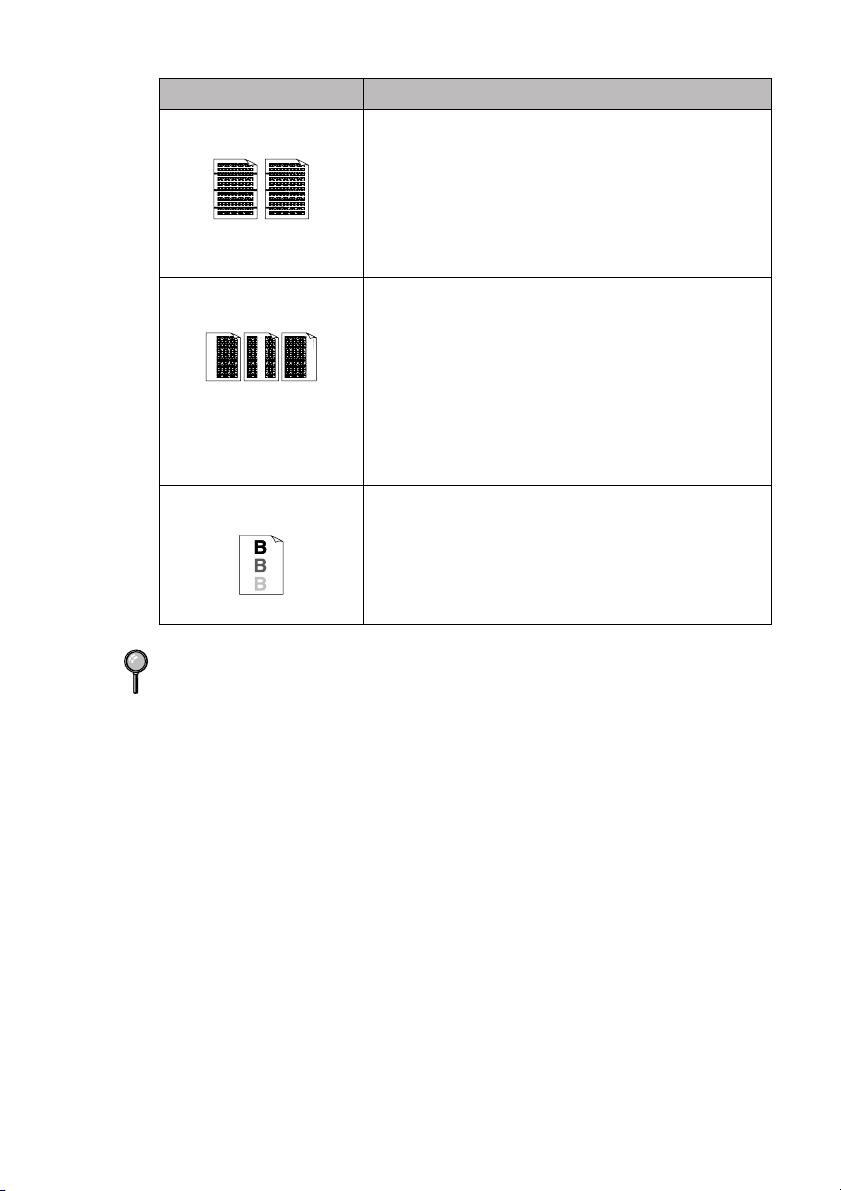
TROUBLESHOOTING AND ROUTINE MAINTENANCE
21 - 12
Printed pages are marked at
regular intervals.
Example of Regular
Marking
Markings may disappear by themselves. Try copying multiple
pages to clear this problem. Markings may occur if the MFC
has not been used for a long time. A possible cause is that the
surface of the drum is scratched. You must then replace the
drum unit with a new one. If the markings do not disappear, it
may be that the drum was marked or damaged by excessive
exposure to light. In this case, replace the drum unit with a
new one.
Printed pages are blurred at
the center or at either edge.
Blurred Page
Certain environmental conditions such as humidity, high
temperatures, etc. may cause this condition to occur. Make
sure the MFC is placed on a flat, horizontal surface. Remove
the drum unit with the toner cartridge installed. Try rocking
them from side to side. You may clear a blurred page by
wiping the scanner windows with a clean soft cloth. (See
Routine Maintenance and Cleaning the Drum Unit, on pages
21-16 and 21-18.) If a blurred page occurs after cleaning and
the LCD shows CHANGE DRUM SOON, replace the drum
unit with a new one.
Ghost images appear on
printed pages.
Ghost Images
Adjust the print conditions by changing the Print Density
setting, page 5-4.—OR—
Rough surfaces or thick media can cause a ghost image. Make
sure you select the Paper Type that suits the paper in your
multi-purpose sheet feeder. (See Paper Type, page 11-8 and
11-9 and Media Type, page 14-4.)
The drum unit is a consumable item and it is necessary to replace it periodically.
DIFFICULTY SUGGESTIONS
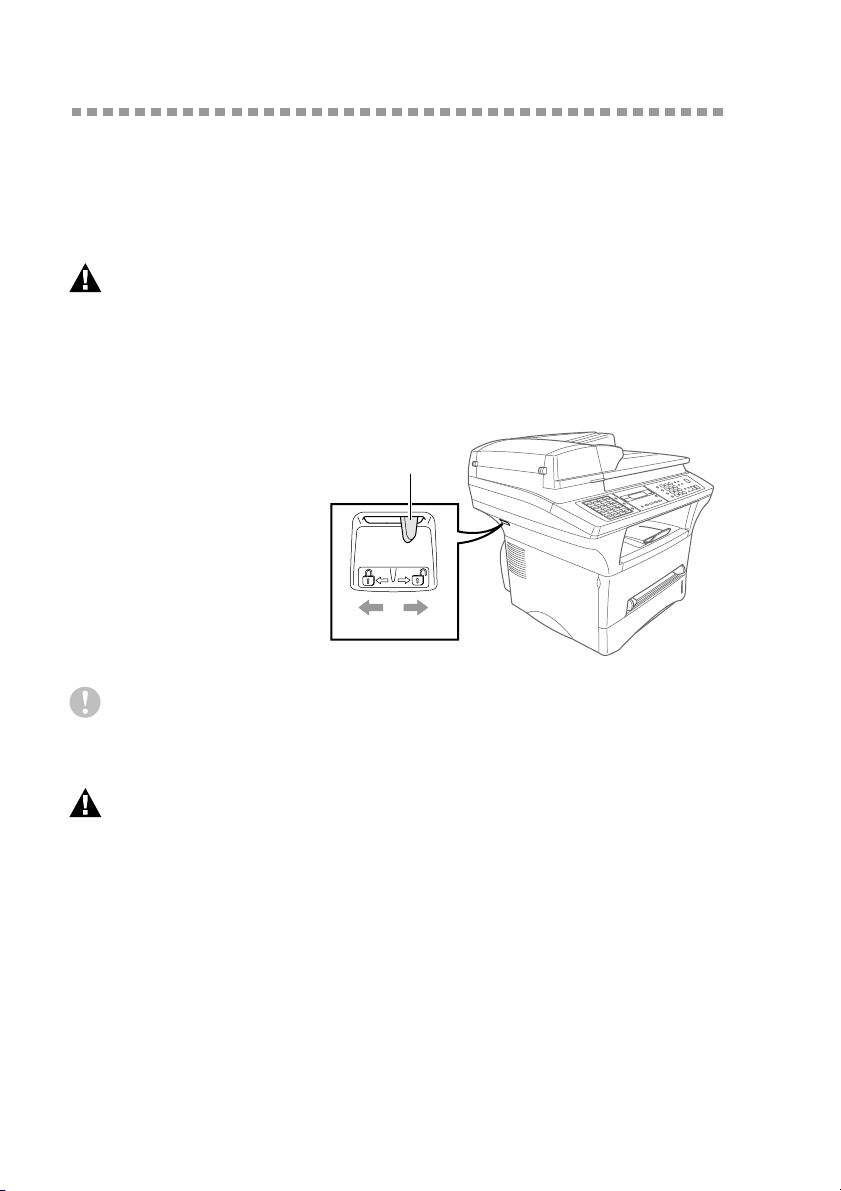
21 - 13
TROUBLESHOOTING AND ROUTINE MAINTENANCE
Packing and Shipping the MFC
Whenever you transport the MFC, use the packing materials that came with your
MFC. If you do not pack the MFC correctly, you could void your warranty.
1
Unplug the MFC from the telephone wall jack.
2
Unplug the MFC from the AC outlet.
WARNING
Do not unplug the MFC after a print job until you hear the final click.
3
Plug the MFC into the AC outlet again. And leave it for 5 seconds.
Lock the Scanner Lock
4
Push the blue
Scanner Lock Lever
up to lock the
scanner. This lever is
located on the rear
left underside of the
scanner cover.
Caution
If the message CHECK SCAN LOCK appears on the LCD, unlock the
scanner immediately, and then press Stop/Exit.
WARNING
Damage caused to your MFC by failure to lock the scanner before moving and
shipping will void your warranty.
Lock Unlock
Scanner Lock Lever
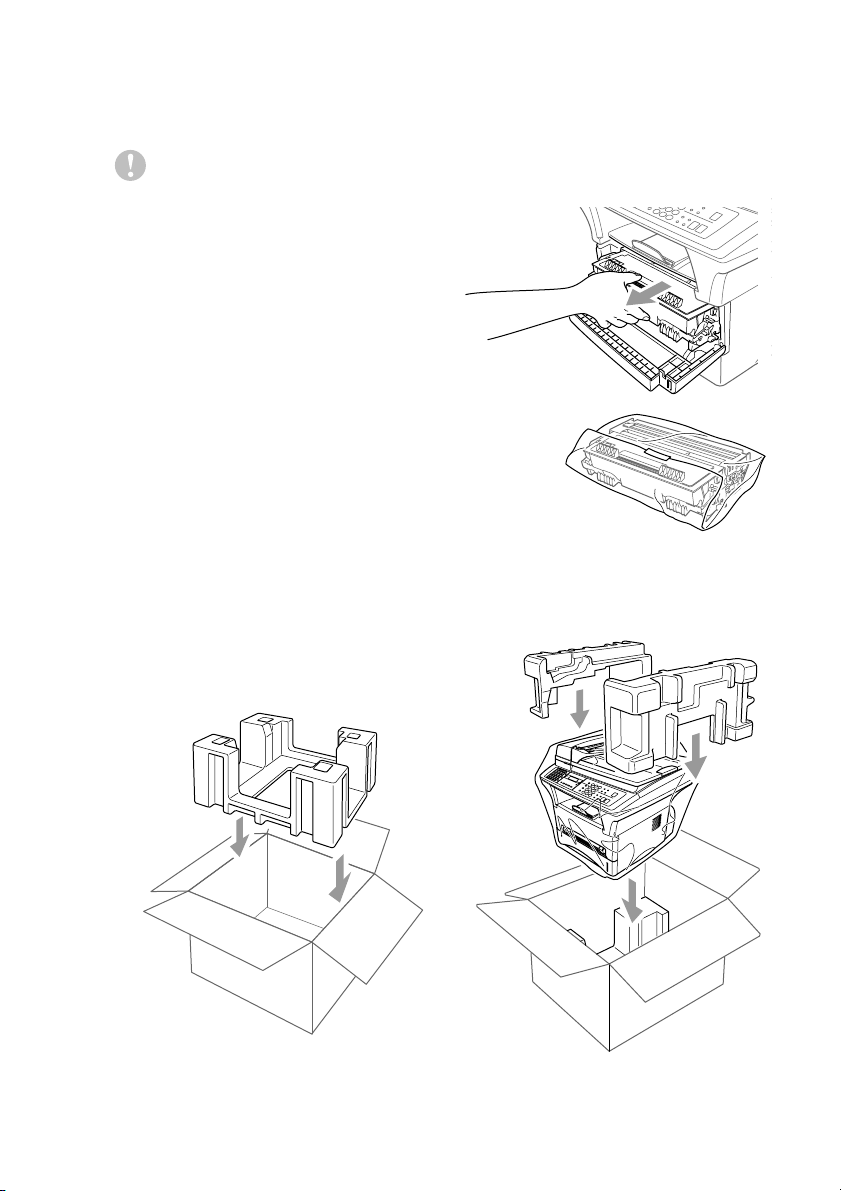
TROUBLESHOOTING AND ROUTINE MAINTENANCE
21 - 14
5
Open the front cover.
6
Remove the drum unit.
Caution
Remove the drum unit and toner
cartridge assembly. Leave the toner
cartridge installed in the drum unit.
7
Place the drum unit and toner
cartridge assembly into the plastic bag and seal
the bag.
8
Close the front cover. Fold down the front output bin extension. Remove the
telephone line cord.
9
Wrap the MFC in the plastic bag and
place it in the original carton box with
the original packing material.
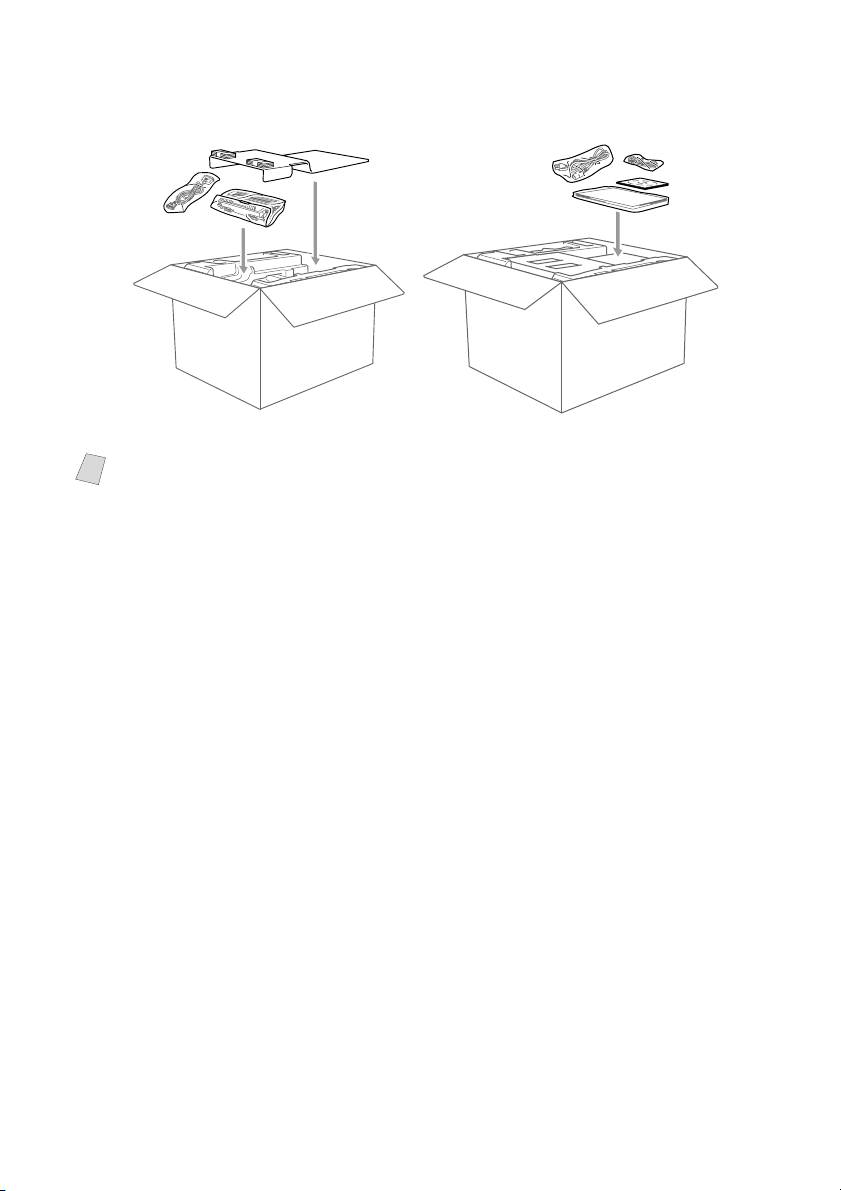
21 - 15
TROUBLESHOOTING AND ROUTINE MAINTENANCE
10
Pack the drum unit, toner cartridge assembly parallel cable, telephone line cord,
AC cord and printed materials in the original carton as shown below:
11
Close the carton and tape it shut.
Note
If you are returning the MFC to Brother as part of the Exchange Service, pack
only the MFC. Keep all separate parts to use with your “Exchange” machine.
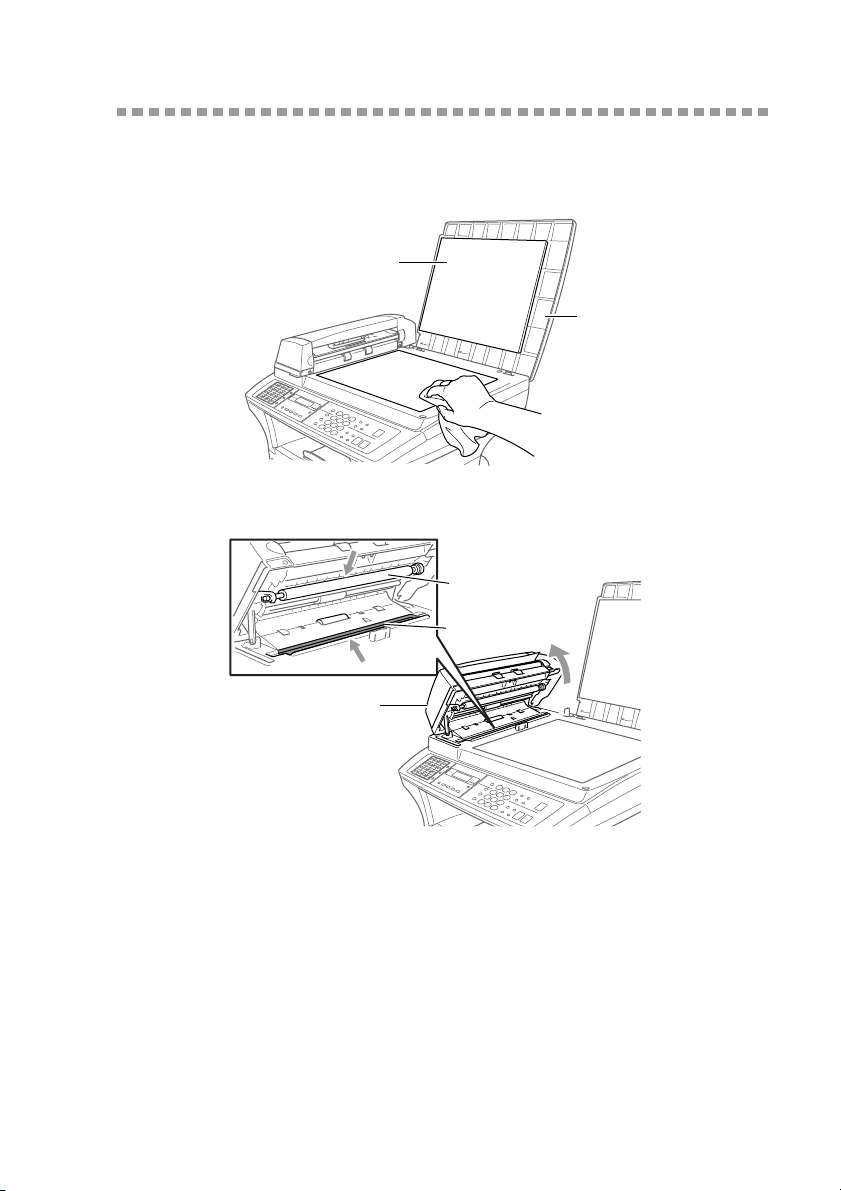
TROUBLESHOOTING AND ROUTINE MAINTENANCE
21 - 16
Routine Maintenance
Cleaning the Scanner
Unplug the MFC and lift the document cover. Clean the scanner glass and the
white film with isopropyl alcohol on a lint free cloth.
Lift the ADF unit. Clean the white roller and the glass strip under the roller with
isopropyl alcohol on a lint-free cloth.
If the screen still displays a scanner error, call Brother Customer Service for
assistance at 1-800-284-4329 (in USA), 1-877-BROTHER (in Canada), or
1-514-685-6464 (in Montreal).
Document
Cover
White Film
White Roller
Glass Strip
ADF Unit
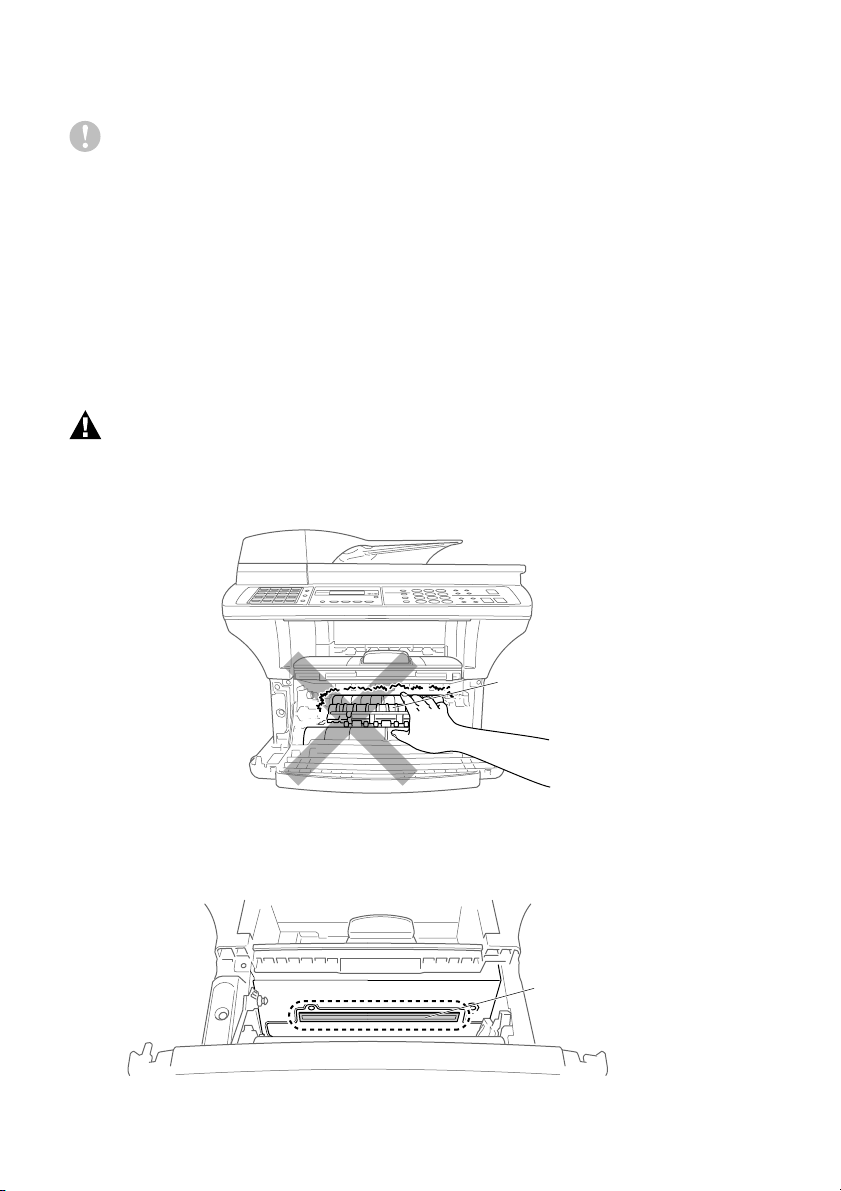
21 - 17
TROUBLESHOOTING AND ROUTINE MAINTENANCE
Cleaning the Printer
Caution
■ Do not use isopropyl alcohol to remove dirt from the control panel. It may crack
the panel.
■ Do not use isopropyl alcohol to clean the scanner window or toner sensor.
■ Do not touch the scanner window with your finger.
■ The drum unit contains toner, so handle it carefully. If toner scatters and your
hands or clothes get dirty, immediately wipe or wash it off with cold water.
1
Open the front cover.
2
Remove the drum unit assembly.
WARNING
Just after you have used the MFC, some internal parts of the MFC are extremely
HOT! When you open the front cover of the MFC, never touch the shaded parts
as shown in the diagram below.
3
Gently clean the scanner window by wiping with a clean soft dry cloth. Do not
use isoproply alcohol.
Front view
HOT!
Scanner Window
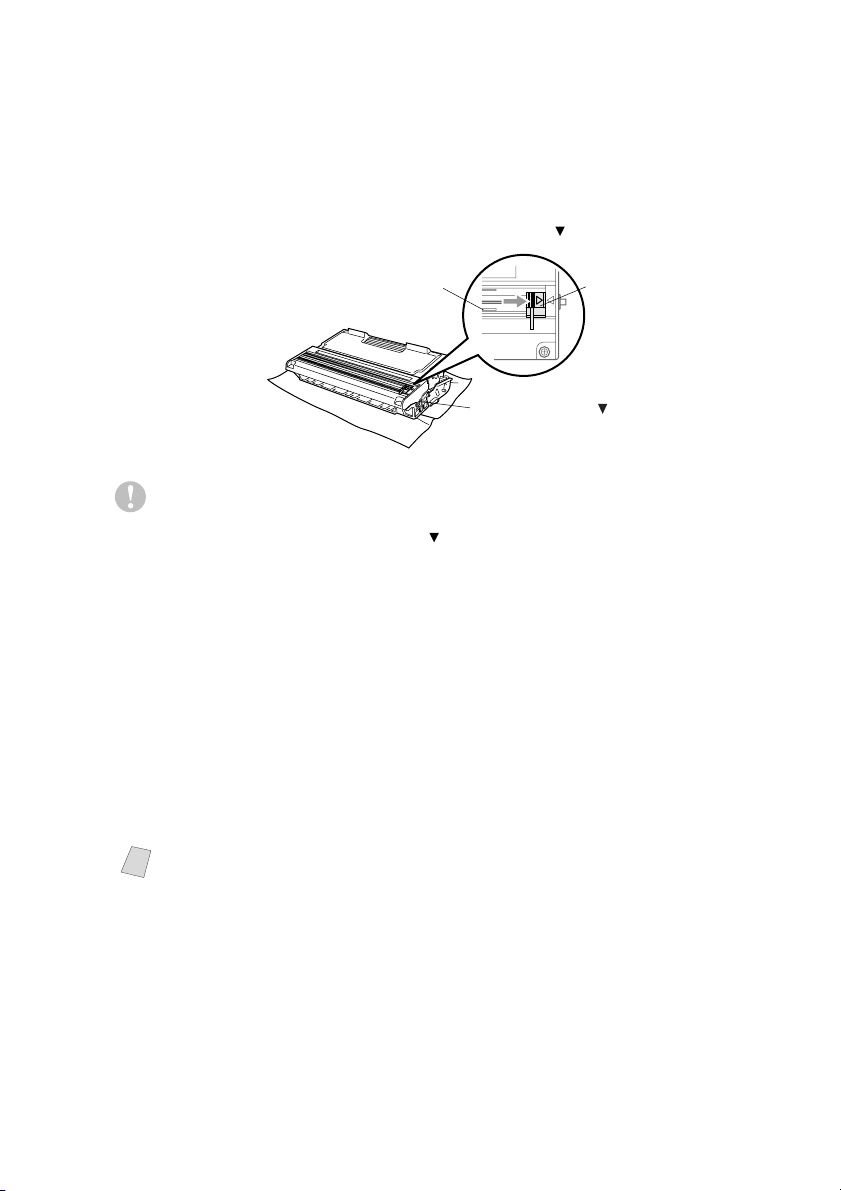
TROUBLESHOOTING AND ROUTINE MAINTENANCE
21 - 18
Cleaning the Drum Unit
We recommend placing the drum unit on a drop cloth or large disposable paper
to avoid spilling and scattering toner.
1
Clean the primary corona wire inside the drum unit by gently sliding the tab
from right to left several times.
2
Return the tab and snap it into the Home position ( ).
Caution
If the tab is not at Home position ( ), printed pages may have vertical stripes.
3
Reinstall the drum unit into the MFC.
(See Replacing the Drum Unit, page 21-21.)
4
Close the front cover.
5
Plug in the power cord first, then the telephone cord.
Replacing the Toner Cartridge
The MFC can print up to 6,000 pages using a high yield toner cartridge. When
the toner cartridge is running low, the LCD shows TONER LOW. The MFC is
supplied with a standard toner cartridge that must be replaced after
approximately 3,000 pages. Actual page count will vary depending on your
average document type (i.e., standard letter, detailed graphics).
Discard the used toner cartridge according to local regulations. If you are not
sure of them, your local Sanitation Department. Be sure to seal the toner
cartridge tightly so toner powder does not spill out of the cartridge. When
discarding used toner cartridges, keep them separate from domestic garbage.
We recommend that you clean the MFC when you replace the toner cartridge.
Note
It is a good idea to keep a new toner cartridge ready for use when you see the
TONER LOW warning.
Home Position ( )
Tab
Corona Wire
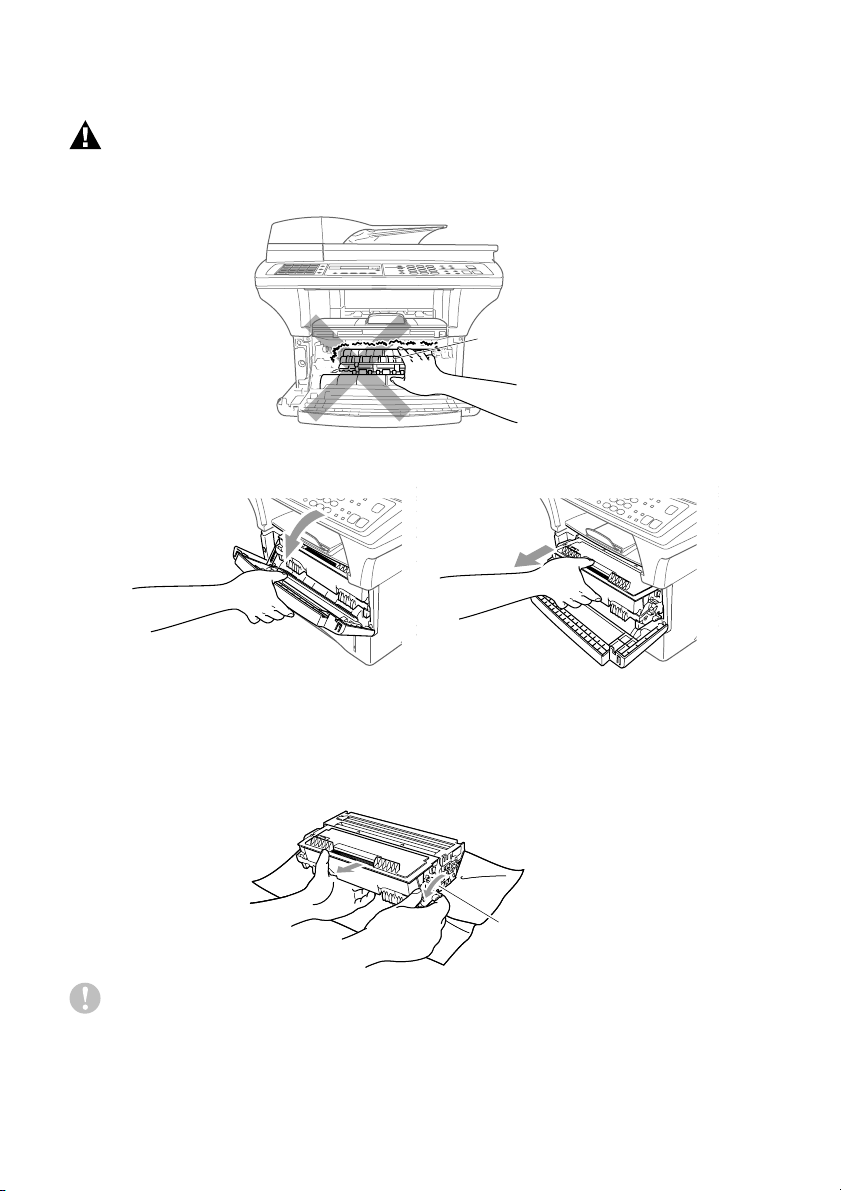
21 - 19
TROUBLESHOOTING AND ROUTINE MAINTENANCE
How to Replace the Toner Cartridge
WARNING
Just after you use the MFC, some internal parts of the MFC will be extremely
HOT! So, never touch the shaded parts shown in the illustration.
1
Open the front cover and pull out the drum unit.
Place the drum unit on a drop cloth or large piece of disposable paper to avoid
spilling and scattering the toner.
2
Hold down the lock lever on the right and pull the toner cartridge out of the drum
unit assembly.
Caution
Handle the toner cartridge carefully. If toner scatters on your hands or clothes,
immediately wipe it off or wash it with cold water.
3
Unpack the new toner cartridge. Place the used toner cartridge into the
aluminum bag and discard it according to local regulations.
HOT!
Lock
Lever
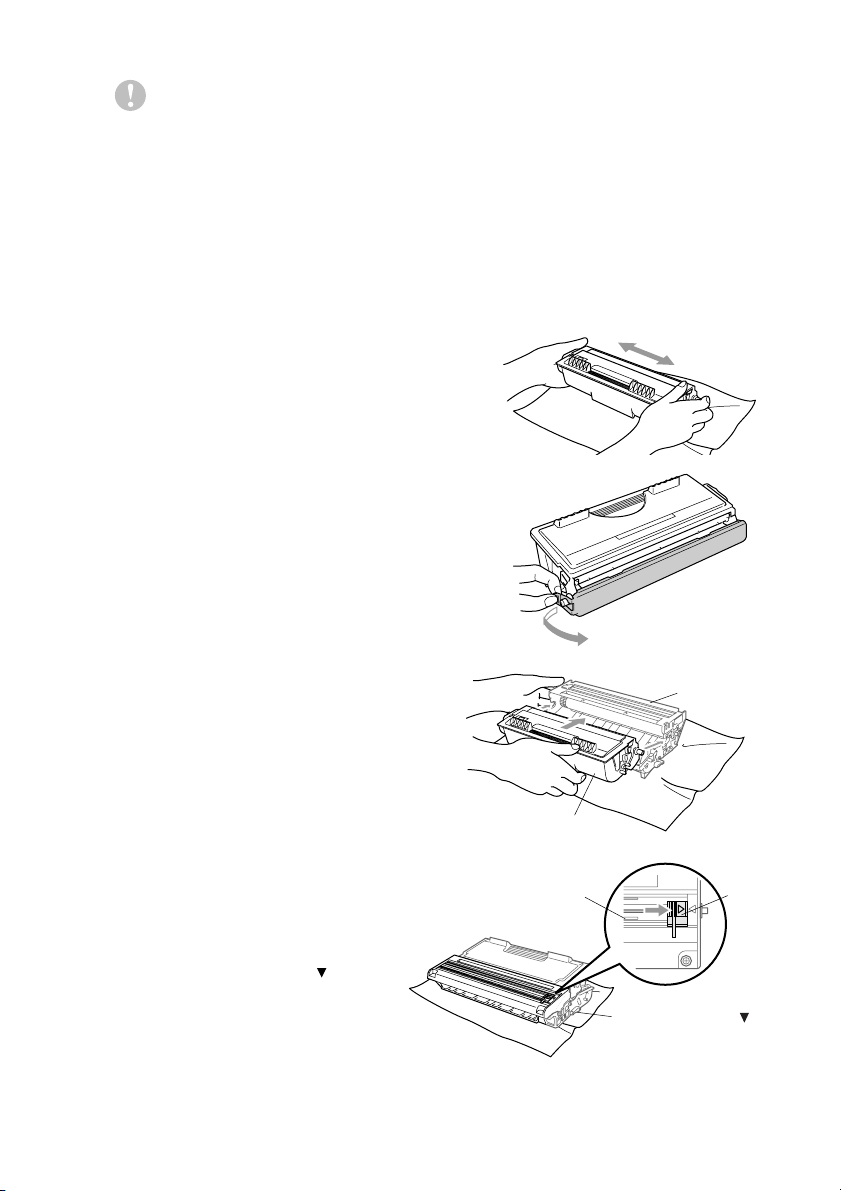
TROUBLESHOOTING AND ROUTINE MAINTENANCE
21 - 20
Caution
■ Wait to unpack the toner cartridge until immediately before you install it in the
MFC. If a toner cartridge is left unpacked for a long period of time, the toner life
is shortened.
■ You can use only a genuine Brother toner cartridge (TN-430 or TN-460), which
is specially formulated to ensure top print quality. Using another brand of toner
cartridge may void your MFC’s warranty. Warranty coverage does not apply to
problems caused by the use of 3rd party Toner, 3rd party Toner Cartridge or 3rd
party Drum unit.
4
Gently rock the toner cartidge from side
to side five or six times to distribute the
toner evenly inside the cartridge.
5
Remove the protective cover.
6
Insert the new toner cartridge in the
drum unit until it clicks into place.
7
Clean the primary corona
wire inside the drum unit by
gently sliding the blue tab
from right to left several
times. Return the blue tab to
the Home position ( )
before reinstalling the drum
unit assembly.
Drum Unit
Toner Cartridge
Home Position ( )
Tab
Corona Wire
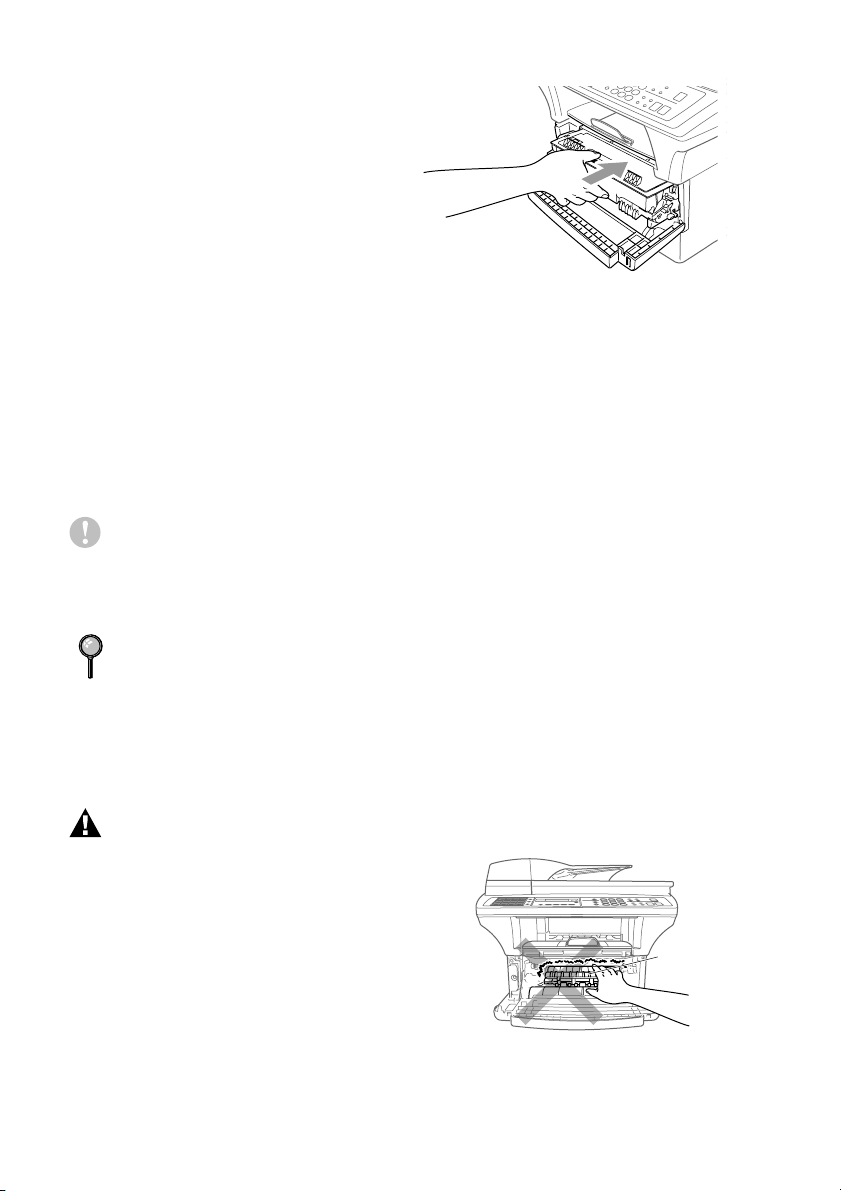
21 - 21
TROUBLESHOOTING AND ROUTINE MAINTENANCE
8
Reinstall the drum unit and close the
front cover.
Replacing the Drum Unit
The MFC uses a drum unit to create print images on paper. If the LCD shows
CHANGE DRUM SOON, the drum unit is near the end of its life and it is time
to purchase a new one.
Even if the LCD shows CHANGE DRUM SOON, you may be able to continue
printing without having to replace the drum unit for a while. However, if there
is a noticeable deterioration in the output print quality (even before CHANGE
DRUM SOON appears), then the drum unit should be replaced. You should
clean the MFC when you replace the drum unit. (See page 21-18.)
Caution
When removing the drum unit, handle it carefully because it contains toner. If
toner scatters and your hands or clothes get dirty, immediately wipe or wash
with cold water.
WARNING
Just after you have used the MFC, some
internal parts of the MFC are extremely
HOT! So please be careful.
The drum unit is a consumable item, and it is necessary to replace it periodically.
There are many factors that determine the actual drum life, such as temperature,
humidity, type of paper and how much toner you use for the number of pages per print
job. The estimated drum life is up to 20,000 pages. The actual number of pages your
drum will print may be significantly less than these estimates. Because we have no
control over the many factors that determine the actual drum life, we cannot
guarantee a minimum number of pages that will be printed by your drum.
HOT!
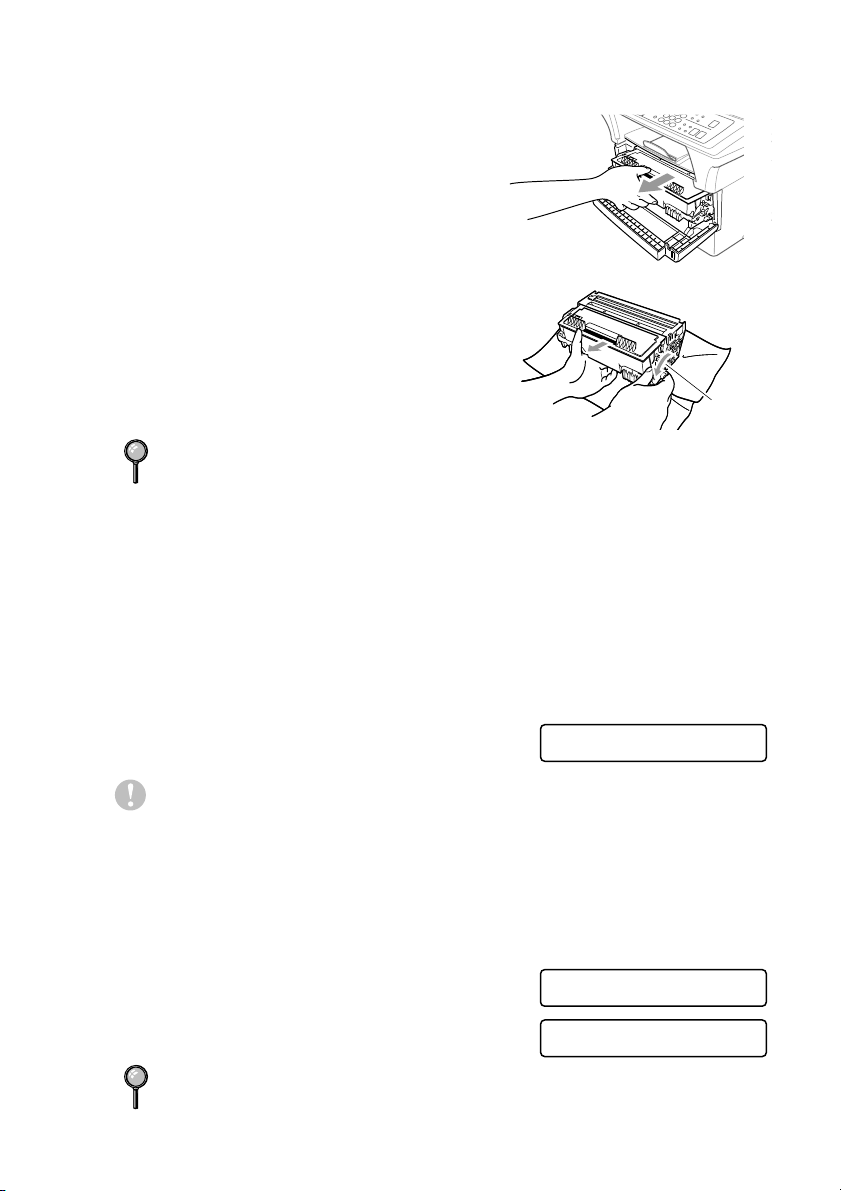
TROUBLESHOOTING AND ROUTINE MAINTENANCE
21 - 22
Follow these steps to replace the drum unit:
1
Open the front cover.
2
Remove the old drum unit. Place the drum
unit on a drop cloth or disposable paper to
avoid scattering toner.
3
Hold down the lock lever on the right and
pull the toner cartridge out of the drum unit
assembly. (See Replacing the Toner
Cartridge, page 21-18.)
4
Wait to unpack the new drum unit until immediately before installing it. Place the
old drum unit into the aluminium bag and discard it according to local regulations.
5
Reinstall the toner cartridge into the new drum unit. (See Replacing the Toner
Cartridge, page 21-18.)
6
Reinstall the new drum unit, keeping the front cover open.
7
Press Clear.
8
Press 1 and when the LCD shows
ACCEPTED, and close the front cover.
Caution
If toner scatters and your hands or clothes get dirty, immediately wipe off or
wash with cold water.
Checking the Drum Life
You can see the percentage of the drum’s life that remains available.
1
Press Menu, 2, 0, 3.
2
For five seconds, the LCD shows the available
percentage of drum life.
Discard the used drum unit according to local regulations. If you are not sure of
them, call your local Sanitation Department. Be sure to seal the drum unit
tightly so toner powder does not spill out of the unit. When discarding used
drum units, keep them separate from domestic garbage.
Even if the remaining drum life is 0%, you may continue to use the drum unit
until you have a print quality problem.
Lock
Lever
REPLACE DRUM?
1.YES 2.NO
3.DRUM LIFE
DRUM LIFE
REMAINING:70%

22 - 1
IMPORTANT INFORMATION
22
22
Important Information
Standard Telephone and FCC Notices
These notices are in effect on models sold and
used in the United States only.
When programming emergency numbers and/or making test calls to
emergency numbers:
■ Remain on the line and briefly explain to the dispatcher the reason for the call
before hanging up.
■ Perform these activities in the off-peak hours, such as early morning or late
evening.
This equipment complies with Part 68 of FCC Rules. On the rear panel of this
equipment is a label that contains, among other information, the FCC
Registration Number and Ringer Equivalence Number (REN) for this
equipment. You must, upon request, provide this information to your telephone
company.
You may safely connect this equipment to the telephone line by means of a
standard modular jack, USOC RJ11C.
An FCC compliant telephone cord with a modular plug is provided with this
equipment. This equipment is designed to be connected to the telephone line or
premise’s wiring using a compatible modular jack that is Part 68 compliant. See
the Installation section of this manual for details.
The REN is useful in determining the quantity of devices you may connect to
your telephone line and still have those devices ring when your telephone
number is called. In most, but not all areas, the sum of the RENs of all devices
connected to one line should not exceed five (5).
To be certain of the number of devices you may connect to your line, as
determined by the REN, you should contact your local telephone company to
determine the maximum REN for your calling area. If MFC-9800 damages the
telephone line, the telephone company may discontinue your service
temporarily. If possible, they will notify you in advance. If advanced notice is
not practical, you will be notified as soon as possible. You will be informed of
your right to file a complaint with the FCC.

IMPORTANT INFORMATION
22 - 2
Your telephone company may make changes to its facilities, equipment,
operations or procedures that could affect the proper functioning of your
equipment. If they do, you will be notified in advance to give you an opportunity
to maintain uninterrupted telephone service.
If you experience trouble with MFC-9800, please contact a Brother Authorized
Service Center for information on service or repair. The telephone company
may ask that you disconnect this equipment from the line until the problem has
been corrected or until you are sure that the equipment is not malfunctioning.
If you are not able to solve a problem with your multi-function center, contact
Brother Customer Service. (See
Brother Numbers, page i.)
WARNING
For protection against the risk of electrical shock, always disconnect all cables
from the wall outlet before servicing, modifying or installing the equipment.
This equipment may not be used on coin service lines provided by the
telephone company or connected to party lines.
Brother cannot accept any financial or other responsibilities that may be the
result of your use of this information, including direct, special or consequential
damages. There are no warranties extended or granted by this document.
Laser Safety
This equipment is certified as a Class I laser product under the U.S. Department
of Health and Human Services (DHHS) Radiation Performance Standard
according to the Radiation Control for Health and Safety Act of 1968. This
means that the equipment does not produce hazardous laser radiation.
Since radiation emitted inside the equipment is completely confined within
protective housings and external covers, the laser beam cannot escape from the
machine during any phase of user operation.
FDA Regulations
U.S. Food and Drug Administration (FDA) has implemented regulations for
laser products manufactured on and after August 2, 1976. Compliance is
mandatory for products marketed in the United States. The following label on
the back of the machine indicates compliance with the FDA regulations and
must be attached to laser products marketed in the United States.
Manufactured:
BROTHER CORP. (ASIA) LTD.
BROTHER BUJI NAN LING FACTORY
Gold Garden Industry, Nan Ling Village, Buji, Rong Gang, Shenzhen, China.
This product complies with FDA radiation performance standards,
21 CFR Subchapter J.

22 - 3
IMPORTANT INFORMATION
WARNING
Use of controls, adjustments or performance of procedures other than those
specified in this maanual may result in hazardous invisible radiation exposure.
Caution
Changes or modifications not expressly approved by Brother Industries, Ltd.
may void the user’s authority to operate the equipment.
Federal Communications Commission (FCC)
Declaration of Conformity (For USA Only)
comply with Part 15 of the FCC Rules. Operation is subject to the following two
conditions: (1) This device may not cause harmful interference, and (2) this
device must accept any interference received, including interference that may
cause undesired operation.
This equipment has been tested and found to comply with the limits for a Class B
digital device, pursuant to Part 15 of the FCC Rules. These limits are designed to
provide reasonable protection against harmful interference in a residential
installation. This equipment generates, uses, and can radiate radio frequency
energy and, if not installed and used in accordance with the instructions, may
cause harmful interference to radio communications. However, there is no
guarantee that interference will not occur in a particular installation. If this
equipment does cause harmful interference to radio or television reception, which
can be determined by turning the equipment off and on, the user is encouraged to
try to correct the interference by one or more of the following measures:
■ Reorient or relocate the receiving antenna.
■ Increase the separation between the equipment and receiver.
• Connect the equipment into an outlet on a circuit different from that to
which the receiver is connected.
• Consult the dealer or an experienced radio/TV technician for help.
Internal laser radiation
Max. Radiation Power
Wave Length
Laser Class
5 mW
760 - 810 nm
Class IIIb (Accordance with 21 CFR Part 1040.10)
Responsible Party: Brother International Corporation
100 Somerset Corporate Boulevard
Bridgewater, NJ 08807-0911 USA
TEL: (908) 704-1700
declares, that the products
Product Name: MFC-9800

IMPORTANT INFORMATION
22 - 4
Important
Changes or modifications not expressly approved by Brother Industries, Ltd.
could void the user’s authority to operate the equipment.
Industry Canada Compliance Statement
(For Canada Only)
This Class B digital apparatus complies with Canadian ICES-003.
Cet appareil numérique de la classe B est conforme à la norme NMB-003 du
Canada.
Important – About the Interface Cable
A shielded interface cable should be used to ensure compliance with the limits
for a Class B digital device.
Warranty
You must use the IEEE-1284 shielded parallel cable provided by Brother
Industries, Ltd. (See
Ordering Accessories and Supplies, page ii)
International ENERGY STAR
®
Compliance Statement
As an ENERGY STAR
®
Partner, Brother Industries,
Ltd. has determined that product meets the
E
NERGY STAR
®
guidelines for energy efficiency.

22 - 5
IMPORTANT INFORMATION
Important Safety Instructions
1
Read all of these instructions.
2
Save them for later reference.
3
Follow all warnings and instructions marked on the product.
4
Unplug this product from the wall outlet before cleaning. Do not use liquid or
aerosol cleaners. Use a damp cloth for cleaning.
5
Do not place this product on an unstable cart, stand, or table. The product may
fall, causing serious damage to the product.
6
Slots and openings in the cabinet and the back or bottom are provided for
ventilation. To ensure reliable operation of the product and to protect it from
overheating, these openings must not be blocked or covered. The openings
should never be blocked by placing the product on a bed, sofa, rug, or other
similar surface; near or over a radiator or heater; or in a built-in wall unit or
cabinet without ventilation.
7
This product should be operated from the type of power source indicated on the
label. If you are not sure of the type of power available, consult your dealer or
local power company.
8
Use only the power cord supplied with this machine.
9
This product is equipped with a 3-wire grounding type plug, a plug having a
third (grounding) pin. This plug will fit into only a grounding-type power outlet.
This is a safety feature. If you are unable to insert the plug into the outlet, contact
your electrician to replace your obsolete outlet. Do not defeat the purpose of the
grounding-type plug, by using an adapter.
10
Do not allow anything to rest on the power cord. Do not place this product where
people can walk on the cord.
11
If an extension cord is used with this product, make sure that the total ampere
ratings on the products plugged into the extension cord do not exceed the
extension cord ampere rating. The total of all products plugged into the wall
outlet must not exceed 15 amperes (USA only).
12
Never push objects of any kind into this product through cabinet slots, since they
may touch dangerous voltage points or short out parts resulting in the risk of fire
or electric shock. Never spill liquid of any kind on the product.
13
This product has no ON/OFF switch. In case the main power to the machine
must be disconnected quickly, it is very important that you have easy access to
the main plug and the main socket where the plug is connected.

IMPORTANT INFORMATION
22 - 6
14
Unplug this product from the wall outlet and refer servicing to a Brother
Authorized Service Center under the following conditions:
15
Do not attempt to service this product yourself, as opening or removing covers
may expose you to dangerous voltage points and/or other risks, and may void
your warranty. Refer all servicing to a Brother Authorized Service Center. A list
of Brother Authorized Service Centers has been included for your convenience,
or you may contact Brother Customer Service numbers for your nearest Brother
Authorized Service Center. (See
Brother Numbers, page i.)
16
To protect your product against power surges, we recommend the use of a power
protection device (Surge Protector).
17
When using your telephone equipment, basic safety precautions should always
be followed to reduce the risk of fire, electric shock and injury to persons,
including the following:
• Do not use this product near appliances that use water, a swimming pool
or in a wet basement.
• Do not use the machine’s telephone during an electrical storm (there is the
remote possibility of an electrical shock) or to report a gas leak in the
vicinity of the leak.
• Use only the power cord indicated in this manual.
A When the power cord is damaged or frayed.
B If liquid has been spilled into the product.
C If the product has been exposed to rain or water.
D
If the product does not operate normally when the operating instructions are
followed. Adjust only those controls that are covered by the operating instructions.
Improper adjustment of other controls may result in damage and will often require
extensive work by a qualified technician to restore the product to normal operation.
E If the product has been dropped or the cabinet has been damaged.
F If the product exhibits a distinct change in performance, indicating a need for
service.

22 - 7
IMPORTANT INFORMATION
Trademarks
Brother is a registered trademark of Brother Industries, Ltd.
The Brother logo is a registered trademark of Brother Industries, Ltd.
Multi-Function Link is a registered trademark of Brother Industries, Ltd.
© Copyright 1996–2001 Brother Industries, Ltd. All rights reserved.
TextBridge and PaperPort are registered trademarks of ScanSoft, Inc.
Windows and Windows NT, Microsoft, MS-DOS, Excel and Word are
registered trademarks of Microsoft in the U.S. and other countries.
NT is a trademark of Northern Telecom Limited.
Macintosh and Quick Draw are registered trademarks and iMac, iBook and
TrueType are trademarks of Apple Computer, Inc.
Centronics is a trademark of Genicom Corporation.
Epson is a registered trademark and FX-80 and FX-850 are trademarks of Seiko
Epson Corporation.
Hewlett Packard is a registered trademark and HP LaserJet II, IIP, and IID are
trademarks of Hewlett-Packard Company.
IBM, IBM PC, and Proprinter are registered trademarks of International
Business Machines Corporation.
Hammermill copyplus white is a registered trademark of International Paper.
All other terms and brand and product names mentioned in this manual
are registered trademarks of their respective companies.

GLOSSARY
G - 1
G
Glossary
ADF (Automatic Document Feeder) Originals can be placed in the ADF and scanned one
at a time automatically.
Auto Dial List A listing of names and numbers stored in One Touch and Speed Dial memory,
in numerical order.
Automatic E-Mail Printing Software application that automatically prints incoming e-mail
messages on the MFC (Instructions are on CD-ROM 1).
Automatic Redial If the fax did not go through because the line was busy or there was no
answer, the MFC redials the number.
auto reduction Reduces the size of incoming faxes.
Backup Print Sets your MFC to print a copy of faxes that are received and stored in memory.
Batch Transmission As a cost savings feature, all delayed faxes to the same fax number will
be sent as one transmission.
Beeper The sound the keys make when they are pressed, an error occurs or a document has been
received or transmitted.
beeper volume Volume setting for the beep when you press a key or make an error.
Broadcasting The ability to send the same fax message to more than one location.
Brother Control Center A window that enables you to click on a button to choose the type of
scanning operation you want to perform. If you set up the Control Center window to load each
time you boot your PC, this window will appear each time you place a original in the ADF.
Caller ID A service purchased from the Telephone Company that lets you see the number (or
name) of the party calling you. Your MFC stores the latest callers so you can print a Log, view
caller information, register selected callers as auto dial numbers.
Cancel Job Cancels a programmed job, like Delayed Fax or Polling.
CNG tones The special tones (beeps) sent by fax machines during automatic transmission to
tell the receiving MFC that a MFC is calling.
communication error (or Comm. Error) An error during fax sending or receiving, usually
caused by line noise or static.
coding method Method of coding the information contained in an original. All fax machines
must use a minimum standard of Modified Huffman (MH). Your MFC is capable of greater
compression methods, Modified Read (MR) Modified Modified Read (MMR) and Joint Bi-
level Image export working Group (JBIG) if the receiving MFC has the same capability.
compatibility group The ability of one fax unit to communicate with another. Compatibilty is
assured between ITU-T Groups.
Contrast A setting that compensates for dark or light originals, by lightening dark documents
or darkening light originals.

G - 2
GLOSSARY
Cover Page Prints a page at the other party’s MFC that contains the sender and recipient’s
name and fax number, number of pages and comment. You can generate an electronic cover
page at the other end with pre-programmed information from memory or you can print a
sample cover page to fax with your original.
Cover Page Message The comment that is on the Cover Page. This is a programmable
feature.
Delayed Fax Sends your fax at a later time that day.
Delayed Timer You can program a certain time each day that all delayed faxes will be sent on
a first come/first served basis.
Distinctive Ring A service purchased from your telephone company that provides another
phone number on an existing phone line. The Brother MFC uses the new number to simulate
a dedicated fax line.
Dual Access Your MFC can scan outgoing faxes or scheduled jobs into memory at the same
time it is sending a fax or receiving or printing an incoming fax.
Easy Receive Enables your MFC to respond to CNG tones if you interrupt a fax call by
answering it.
ECM (Error Correction Mode) Detects errors during fax transmission and automatically
resends the page(s) that had an error.
Electronic Cover Page A preprogrammed cover page that is transmitted from the MFC’s
memory, eliminating the need for making up cover pages manually.
extension phone A telephone on the fax number that is plugged into a separate wall jack.
external phone A TAD (telephone answering device) or telephone that is plugged into the
EXT jack of your MFC.
Fax Activity Report Lists information about the last 200 incoming and outgoing faxes. TX
means Transmit. RX means Receive.
Fax Forwarding Sends a fax received in memory to another preprogrammed fax number.
Fax Storage You can print stored faxes later, or retrieve them from another location using Fax
Forwarding, Paging, or Remote Retrieval commands.
fax tones The signals sent by sending and receiving fax machines while communicating
information.
Fine Mode Resolution is 203
× 196 dpi. It is used for small print and graphs.
gray scale The shades of gray available for copying and faxing photographs.
Group number A combination of One Touch and Speed Dial numbers that are stored on a One
Touch key for Broadcasting.
Help List By pressing the Reports key and 1, you can get a printout of the complete Menu so
you can use it to program your MFC when you do not have the Owner’s Manual with you.
interval The preprogrammed time period between automatically printed Fax Activity Reports.
You can print Activity Reports on demand without interrupting this cycle.
LCD (liquid crystal display) The display screen on the MFC that shows interactive messages
during On-Screen Programming and defaults to the date and time when the MFC is idle.
Menu mode Programming mode for changing the settings of your MFC.

GLOSSARY
G - 3
Multi-Function Link
®
Pro Suite software Turns your MFC into a printer and a scanner and
enables PC faxing using the MFC.
OCR (optical character recognition) The bundled ScanSoft
®
TextBridge
®
software
application converts an image of text to text that you can edit.
One Touch Keys on the MFC control panel where you can store numbers for easy dialing. You
must use a separate key for each number.
Out of Paper Reception Receives faxes into the MFC’s memory when the MFC is out of
paper.
Overseas mode Makes temporary changes to the fax tones to accommodate noise and static
on overseas phone lines.
Paging Feature enables your fax unit to call your pager when a fax message is received into its
memory.
Pause Allows you to place a 3.5 second delay in the dialing sequence stored on One Touch and
Speed Dial numbers.
Photo mode A resolution setting that uses varying shades of gray for the best representation of
photographs.
Polling The process of a fax machine calling another fax machine to retrieve waiting fax
messages.
Pulse (for Canada only) A form of dialing on a telephone line.
Real Time Transmission When memory is full, send documents in real time.
Remaining Jobs You can check which jobs are waiting in memory and cancel jobs
individually.
Remote Retrieval Access The ability to access your MFC remotely from a touch tone phone.
Remote Retrieval Access Code The four-digit code (159 ) that allows you to call your
MFC to retrieve fax messages or change fax storage settings.
Remote Activation Allows you to transfer a fax call, answered at an external or extension
phone, to the MFC.
Resolution The number of vertical and horizontal lines per inch. See: Standard, Super Fine and
Photo.
Ring Delay The number of rings before the MFC answers in FAX mode.
Ring Volume Volume setting for the MFC’s ring.
scanning The process of sending an electronic image of an original paper document into your
computer.
ScanSoft
®
PaperPort
®
for Brother Document management application where you can view
received faxes and scanned originals.
ScanSoft
®
TextBridge
®
Optional Character Recognition (OCR) software that converts a
scanned image of text into text you can edit in your word processing application.
Search You can scroll through an alphabetical listing on the LCD of the One Touch and Speed
Dial numbers you stored.
Speed Dial A preprogrammed number for easy dialing. You must press the Speed dial button
and then two digit code to start the dialing process.

G - 4
GLOSSARY
Standard resolution 203 × 98 dpi. It is used for regular size text and quickest transmission.
Station ID The stored information that appears on the top of faxed pages. It includes the
sender’s name and fax number.
Super Fine resolution 203
× 392 dpi. Best for very small print and line art.
TAD (telephone answering device) You can connect an external TAD to the EXT. jack for
EXT. TEL/TAD mode.
temporary settings You can select certain options for each fax transmission or copy you
make without changing the default settings.
Tone A form of dialing on the telephone line used for Touch Tone telephones.
transmission The process of sending documents over the phone lines from your MFC to the
receiving MFC.
Transmission Verification Report A listing of each transmission, showing caller ID, date,
time, and number of pages.
True Type fonts The fonts that are used in the Windows
®
operating systems. If you install the
Brother True Type fonts, more types of fonts will be available for Windows
®
applications.
User Settings List Printed report of your MFC’s settings.

SPECIFICATIONS
S - 1
S
S
Specifications
Product Description
Six performance modes are available for the 5in1 model MFC-9800:
Fax, Printer, Copier, Scanner and PC Fax.
Fax
* “pages” refers to the “Brother Standard Chart No.1” (a typical business letter,
Standard resolution). Specifications and printed materials are subject to
change without prior notice.
Compatibility ITU-T Group 3
Coding System MH/MR/MMR/JBIG
Modem Speed 33600/31200/28800/26400/24000/19200/
16800/14400/12000/9600/7200/4800/2400
Automatic Fallback
Document Size ADF Width: 5.8" to 8.5" (148 mm to 216 mm)
ADF Length: 5.0" to 14.0" (127 mm to 356 mm)
Scanner Width: Max. 8.5" (216 mm)
Scanner Length: Max. 11.7" (297 mm)
Automatic Document
Feader (ADF)
Up to 50 pages*
Scanning/Printing Width 8.2 inches (208 mm)
Paper Cassette 250 Sheets (20 lbs.)
Gray Scale 64 levels
Display LCD, 16 characters × 2
Polling Types Standard, Sequential
Contrast Control Automatic/Super Light/Super Dark
(manual setting)
Resolution • Horizontal 203 dot/inch (8 dot/mm)
• Vertical Standard—98 line/inch
(3.85 line/mm)
Fine, Photo—196 line/inch
(7.7 line/mm)
Superfine, Photo—392 line/inch
(15.4 line/mm)
Memory Capacity 8 MB (up to 600 pages)*
One Touch Dial 16 × 2
Speed Dial 100 stations
Automatic Redial 3 times at 5 minute intervals
Auto Answer 0, 1, 2, 3 or 4 rings

S - 2
SPECIFICATIONS
Fax (Continued)
Printer
Communication Source Public switched telephone network.
Temperature (Allowable) 50 - 90.5° F (10 - 32.5° C)
(Storage) 32 - 104° F (0 - 40° C)
Warm-Up Max. 37 seconds at 73.4° F (23° C)
First Print Up to 15 seconds (using Letter size paper in
paper cassette)
Power Source 120V AC 50/60Hz (Canadian Version Only)
Power Consumption Average Operating (Copying): 350 W (25° C)
Peak: 940 W
Sleep: 15 W or less
Standby: 75 W or less (25° C)
Noise Operating: 53 dB A or less
Stand by: 30 dB A or less
Humidity Operating: 20 to 80% (without condensation)
Storage: 20 to 80% (without condensation)
Dimensions 19.4 × 18.0 × 16.8 inches/(492 × 456 × 429 mm)
Weight 35.2 lbs/(17 kg)
Emulation Brother Printing System for Windows
®
and
emulation mode of HP LaserJet IIP
(PCL level 5e)
Printer Driver Windows
®
95/98/98SE/Me/2000 and Windows
NT
®
Workstation Version 4.0 driver supporting
Brother Native Compression mode and bi-
directional capability
Apple
®
Macintosh
®
QuickDraw
®
Driver for
OS 8.5/8.51/8.6/9.0/9.0.4/9.1
Interface Bi-directional parallel (IEEE-1284);
USB (Universal Serial Bus) 1.1
Memory Capacity 8 MB
Print Method Electrophotography by semiconductor laser
beam scanning
Resolution 600 dots/inch
SPECIFICATIONS
S - 3
Computer Requirements
Print Quality Normal printing mode
Economy printing mode (saves up to 50% of the
normal toner usage)
Print Speed Up to 15 pages/minute (when loading letter size
paper from paper cassette)
Consumable Items Toner cartridge Life Expectancy:
Up to 6,000 pages/high yield toner cartridges
Up to 3,000 pages/standard toner cartridges
(when printing letter size or A4 paper at 5%
print coverage)
Toner life expectancy will vary depending upon the type of average print job.
Drum Unit Life Expectancy:up to 20,000 pages
There are many factors that determine the actual drum life, such as temperature,
humidity, type of paper, toner you use and number of pages per print job.
True Type Fonts on CD-
ROM
35 TrueType compatible soft-fonts for
Windows
®
on the bundled CD-ROM
CPU
(Pentium)
75MHz
75MHz
133MHz
150MHz
For Windows
®
Operating System
95, 98, 98SE
NT Workstation4.0
2000 Professional
Me
RAM
24MB (32MB recommended)
32MB (64MB recommended)
64MB (128MB recommended)
32MB (64MB recommended)
Hard Disk
Space
50MB
All base models meet minimum
requirements.
CPU
For Macintosh
®
Operating System
Apple
®
Macintosh
®
QuickDraw
®
G3, G4, iMac or
iBook with
OS8.5, 8.5.1
(Only Printer)
OS8.6/9.0/9.0.4/9.1
(Printer & Scanner)
RAM
Hard Disk
Space
50MB

S - 4
SPECIFICATIONS
Parallel Interface
Pin Assignment
USB (Universal Serial Bus) Interface
Pin Assignment
Interface Connector Printer Side: Amphenol FCN-685J036-L/X or equivalent
A shielded cable should be used.
Pin No. Signal Direction Pin No. Signal Direction
1
DATA STROBE
Input 19 0V(S.G.) -
2 DATA 1 Input 20 0V(S.G.) -
3 DATA 2 Input 21 0V(S.G.) -
4 DATA 3 Input 22 0V(S.G.) -
5 DATA 4 Input 23 0V(S.G.) -
6 DATA 5 Input 24 0V(S.G.) -
7 DATA 6 Input 25 0V(S.G.) -
8 DATA 7 Input 26 0V(S.G.) -
9 DATA 8 Input 27 0V(S.G.) -
10
ACKNLG
Output 28 0V(S.G.) -
11 BUSY Output 29 0V(S.G.) -
12 PE Output 30 0V(S.G.) -
13 SLCT Output 31
INPUT PRIME
Input
14
AUTO FEED
Input 32
FAULT
Output
15 N.C. - 33 N.C. -
16 0V (S.G.) - 34 N.C. -
17 0V (S.G.) - 35 N.C. -
18 +5V - 36
SLCT IN
Input
Pin No. Signal
1 Vol (+5V)
2 - Data Serial Data -
3 + Data Serial Data +
4 Ground

SPECIFICATIONS
S - 5
Resident Fonts
The following bitmapped fonts are resident in the MFC.
Brougham 10 (12 point) upright/normal
Brougham 12 (10 point) upright/normal
Letter Gothic 16.66 (8.5 point) upright/normal
(Portrait and Landscape are available for the above.)
Symbol Sets/Character Sets
*HP mode
• ISO14 JIS ASCII
• ISO57 Chinese
• ISO11 Swedish
• HP Spanish
• ISO17 Spanish
• ISO10 Swedish
• ISO16 Portuguese
• ISO84 Portuguese
• ISO85 Spanish
• PC-8
• PC-8 D/N
• PC-8 Turkish
• PC-850
• PC-852
• PC-860
• PC-865
• Roman 8
• ISO Latin 1
• (ECMA-94)
• ISO60 Norwegian 1
• ISO61 Norwegian 2
• ISO4 UK
• ISO25 French
• ISO69 French
• HP German
• ISO21 German
• ISO15 Italian
• ISO6 ASCII
• Legal
• ISO2 IRV
• PC-863
If you want to know which characters are in each symbol/character set, print the
CHARSETS.PRN file from “The Print Form” option in the Direct Access
Menu of the Remote Printer Console Program.
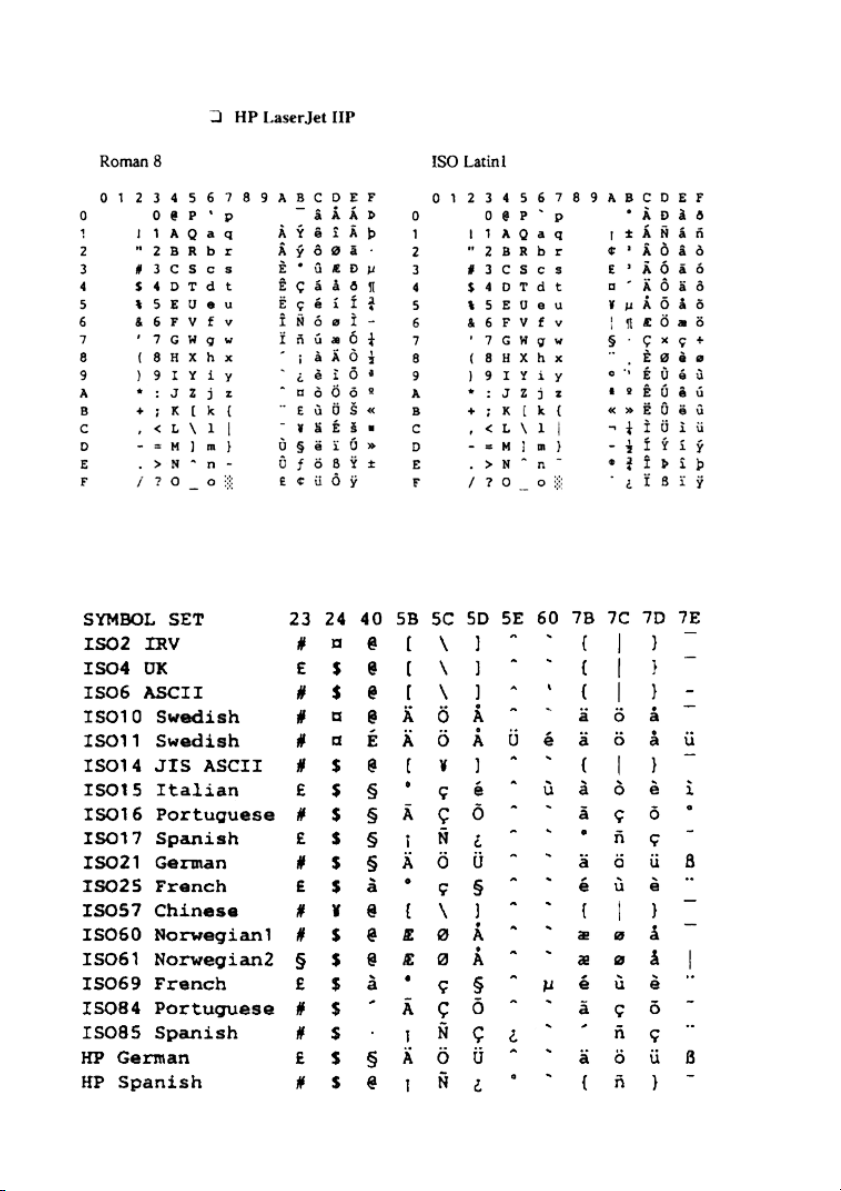
S - 6
SPECIFICATIONS
The following table shows characters available only in the corresponding
character set. The numbers at the top of the table are code values with which
characters are to be replaced in the Roman 8 character set. For other characters,
see character set of Roman 8.

INDEX
I - 1
Index
A
access codes, storing and dialing 7-4
accessories and Supplies ii
ADF (Automatic Document Feeder)
size of original 6-1
assembly and connections 2-4
drum unit 2-4
grounded 3-prong plug 2-8
loading paper 2-6
telephone line cord 2-8
toner cartridge 2-4
automatic
dialing 7-3
fax redial 6-4
transmission 6-4
automatic fax receive 5-1
B
Broadcasting 7-5
setting up Groups for 7-2
Brother
accessories and Supplies ii
Customer Service i
fax-back system i
Frequently Asked Questions (FAQs) i
product support i
test sheet, sending 1-2
warranties
Canada vi
Notice-Disclaimer of Warranties iii
USA iv
Brother Control Center
using and configurating 15-1 to 15-15
C
canceling
fax forwarding 9-4
fax jobs in memory 5-7, 6-6
jobs awaiting redial 6-6
paging 9-4
cleaning (routine maintenance)
drum unit 21-18
printer 21-17
scanner 21-16
copy 11-1
contrast 11-4
enlarging 11-3
photographs 11-9
quality 21-7
scannable area 11-1
single 11-1
using ADF 11-1
using scanner glass 11-2
cover page
composing 6-7
custom comments 6-8
for all faxes 6-9
for next fax only 6-8
printed form 6-9
credit card numbers, storing 7-4
custom telephone features 2-13, 21-7
Customer Service i
D
Date and Time 4-2
dialing
a pause 7-6
access codes 7-4
automatic fax redial 6-4
credit card numbers 7-4
fax redial 7-6
Groups 7-5
One Touch numbers 7-4
search 7-3
Speed Dial numbers 7-4
drivers
Macintosh
®
printer 19-1
scanner 19-1, 19-8
Windows
®
PC-FAX 17-15

I - 2
INDEX
printer 13-1, 14-1
scanner 16-4
drum unit
checking remaining life 21-22
installing 2-4
replacing 21-21
dual access 6-4
E
Easy Receive 5-3
ECM (Error Correction Mode) 1-6
emergency numbers 22-1
envelopes, sizes 2-5
error messages on LCD 21-1
CHECK PAPER 21-1
NOT REGISTERED 21-2
OUT OF MEMORY 11-2
extension telephone, using 5-5
external telephone 2-9
F
fax
Telephone Answer Code 5-5
fax codes
changing 5-5
Fax Receive Code 5-5
Remote Retrieval Access Code 9-3
Telephone Answer Code 5-5
Fax Forwarding
changing remotely 9-4, 9-5
programming a number 9-1
setting up at machine 9-1
Fax Storage
printing from 5-6
setting 9-2
fax, stand-alone
receiving 5-1
difficulties 21-6
erasing from memory 9-4
forwarding 9-1, 9-4
polling 5-6
printing from memory 5-6
reducing to fit on paper 5-4
retrieving from a remote site 9-5
sending
automatic fax redial 6-4
automatic transmission 6-4
Broadcasting 7-5
canceling from memory 6-6
contrast 6-6
delayed 6-10
from memory (dual access) 6-4
in real time 6-5
manual transmission 6-4
overseas 6-10
polling 6-11
resolution 6-7
timer for delayed sending 6-10
using multiple settings 6-1
using scanner glass 6-3
FAX/TEL mode 5-3
double-ringing (voice calls) 5-3
receiving faxes 5-5
FCC notices 22-1
G
Groups
dialing 7-5
J
jacks
converting telephone wall outlets 2-11
EXT. jack on MFC
TAD (answering machine) 2-9
EXT. jack on MFC external telephone
2-9
triplex adapter 2-11
jams 21-3
original 21-3
paper 21-3, 21-5
L
LCD (Liquid Crystal Display) 3-1

INDEX
I - 3
M
Macintosh
®
G3, G4 or iMac
™
19-1
maintenance, routine 21-1
manual
mode 5-1
transmission 6-4
manual feed slot 2-5, 2-7
multi-purpose sheet feeder 2-5, 2-6
O
OCR (ScanSoft
™
TextBridge
®
) 16-1
One Touch numbers
accessing with Shift key 7-1
changing 7-2
dialing 7-4
listing 10-2
storing 7-1
P
packing list 2-1
Paging, programming your pager number
9-1
paper
jams 21-4
loading 2-6
size 2-5, 4-1
specifications S-1
phone line
connection 2-8
difficulties 21-6, 21-7
multi-line (PBX) 2-13
roll-over lines 2-11
two-line system 2-11, 2-12
Polling 5-6
receiving 5-6
sending 6-11
sequential receiving 5-7
power
cord 2-8
electrical outlet 2-8
failure 4-5
print 13-1
density 5-4
difficulties 21-6
driver 13-1
emulation
Macintosh
®
19-1
Windows
®
13-1
Reset key (clear printer memory) 13-7
resolution 6-7, S-2
speed S-3
two-sided (manual duplexing) 13-2
programming at-a-glance 3-2
R
Real Time Transmission 6-5
Receive mode
FAX ONLY 5-1
FAX/TEL 5-1
(double-ring) 5-3
MANUAL 5-1
TAD, external 5-1
redial 6-4
remote printer console 13-1
Remote Retrieval 9-3
access code, using 9-3
commands 9-4
getting your faxes 9-5
reports 10-1
HELP (programming at-a-glance) 10-2
how to print 10-2
list of your stored numbers 10-2
Transmission Verification 10-2
resolution
fax (Standard, Fine, Superfine, Photo)
6-7, S-1
print S-2
scan 16-5
Ring Delay, setting 5-2
S
Safety Instructions 22-5
scan
Macintosh
®
19-7
Windows
®
16-1
Scanner Lock 2-3, 21-13

I - 4
INDEX
Setup
Date and Time 4-2
Station ID (fax header) 4-3
shipping the machine 21-13
simultaneous printing/faxing 13-6
software (Macintosh
®
)
faxing 19-3
scanner setting 19-9
Prescanning into Macintosh 19-11
printing with Brother driver 19-1
scanning with Brother TWAIN driver
19-7
software (Windows
®
)
Brother Control Center 15-1
for DOS users 12-1
PaperPort
®
for Brother 16-1
exporting an image file 16-4
PC-FAX 17-3
prescanning an image 16-7
scanning into PC 16-4, 16-5
uninstall 16-1
viewing faxes and files 16-2
ScanSoft
™
TextBridge
®
OCR 16-1
Speed Dial
changing 7-2
dialing 7-4
listing 10-2
storing 7-2
T
TAD (telephone answering device) 5-1
connecting 2-8
recording outgoing message 2-10
telephone external 2-9
text, entering 4-4
corrections 4-4
special characters 4-4
toner cartridge
installing 2-4
replacing 21-18, 21-19
toner saver 4-6
transparencies 2-7
troubleshooting 21-1
error messages on LCD 21-1
if you are having difficulty 21-6
copy quality 21-7
DOS setup 21-9
incoming calls 21-7
paper handling 21-10
phone line or connection 21-6
printer 21-8
printing or receiving faxes 21-6
scanning 21-8
sending faxes 21-7
software 21-8
two-line phone system 2-11, 2-12
U
User Settings 10-2
V
volume, setting
beeper 4-5
ring 4-5
speaker 4-5
W
warranties
Canada vi
Notice of Disclaimer iii
USA iv
World Wide Web i
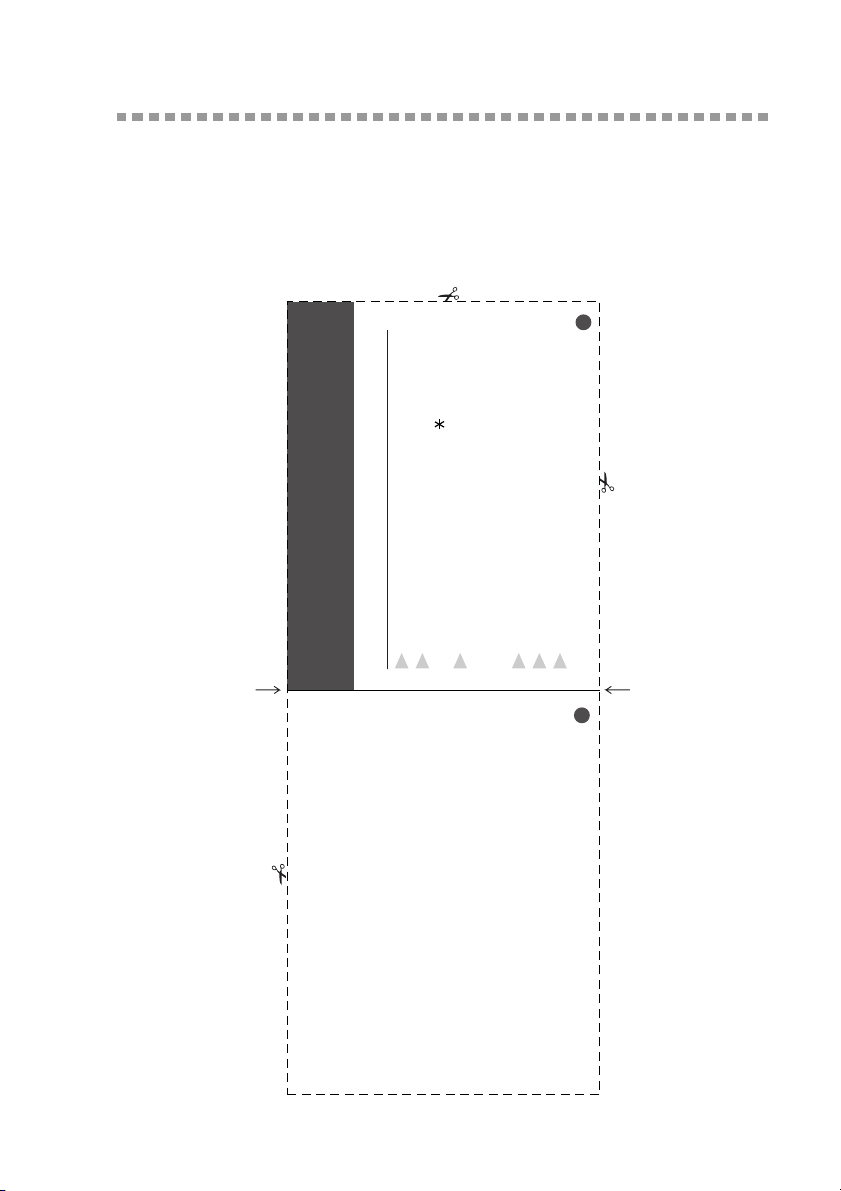
REMOTE RETRIEVAL ACCESS CARD
R - 1
Remote Retrieval Access Card
If you plan to receive fax messages while away from your machine, carrying the
Remote Retrieval Access Card printed below will serve as a convenient
reminder of the retrieval procedures. Simply cut out the card and fold it to fit
your wallet or organizer. Keeping it handy will help you derive the full benefit
of your machine’s forwarding, paging and remote retrieval features.
Using Remote Retrieval Access Code
1
Dial your fax number from a fax machine using touch tone.
2
When your MFC answers and beeps, immediately enter
your Remote Retrieval Access Code (159 ).
3
The MFC signals the kinds of messages received:
1 long beep — Fax message(s)
No beeps — No messages.
4
After 2 short beeps, enter a command.
5
Press 9 0 to reset the MFC when you’re finished.
6
Hang up.
1
4
Press 9 7 1
1 long beep — Fax message(s)
3 short beeps — No messages
CHANGE Receive MODE
Press 9 8
then for TAD:ANSWER MACH, press 1
.
FAX/TEL, press 2.
FAX, press 3.
EXIT REMOTE OPERATION
Press 9 0.
C
HECK
R
ECEIVING
S
TATUS
R
EMOTE
R
ETRIEVAL
A
CCESS
C
ARD
Fold Fold
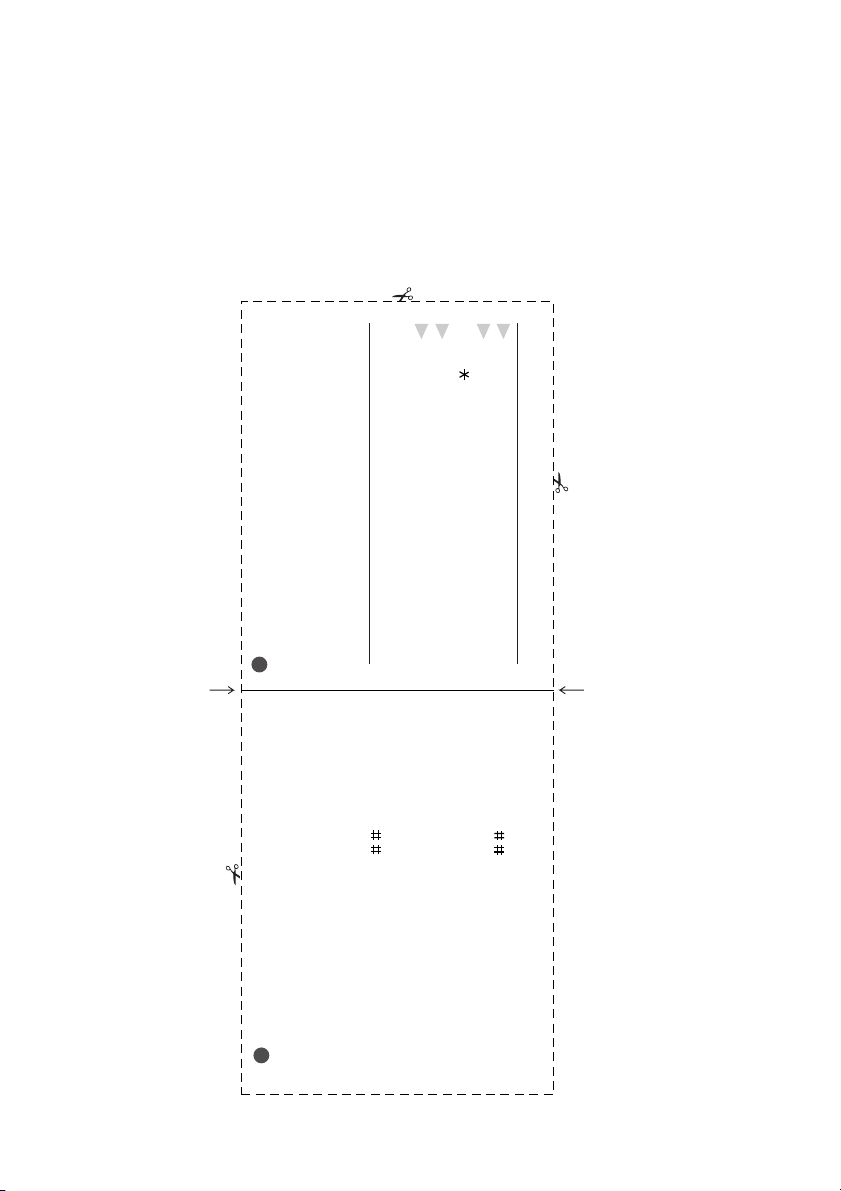
R - 2
REMOTE RETRIEVAL ACCESS CARD
Press Menu, 2, 5 , 3 .
fax number where you want your fax messages forwarded
followed by .
Program Fax Forwarding Number press 4. Enter the new
Turn Fax Storage on, press 6.
Turn Fax Storage off, press
7.
RETRIEVE A FAX
Press 9 6
then to Retrieve all faxes, press 2,
and then enter the number of the remote fax machine
followed by . After the beep, hang up and wait.
Erase all fax messages, press 3.
Changing Remote Retrieval Access Code
1
2
Enter a three-digit number from 000 to 999.
The cannot be changed.
3
Press Set.
4
Press Stop/Exit.
Remote Commands
CHANGE PAGING/FAX FORWARDING SETTING
Press 9, 5
then to Turn feature off, press
1.
Select Fax Forwarding, press
2.
Select Paging, press
3.
3
2
Fold Fold

EQUIPMENT ATTACHMENT LIMITATIONS
(For Canada Only)
NOTICE
:
The industry Canada label identifies certified equipment. This certification
means that the equipment meets telecommunications network protective,
operational and safety requirements as prescribed in the
appropriate Terminal Equipment Technical Requirements document(s). The
Department does not guarantee the equipment will operate to the user’s
satisfaction.
Before installing this equipment, users should ensure that it is permissible to
be connected to the facilities of the local telecommunications company.
The equipment must also be installed using an acceptable method of
connection. The customer should be aware that compliance with the above
conditions may not prevent degradation of service in some situations.
Repairs to certified equipment should be coordinated by a representative
designated by the supplier. Any repairs or alterations made by the user to
this equipment, or equipment malfunctions, may give the telecommunications
company cause to request the user to disconnect the equipment.
Users should ensure for their own protection that the electrical ground
connections of the power utility, telephone lines and internal metallic water
pipe system, if present, are connected together. This precaution may be
particularly important in rural areas.
Caution
:
Users should not attempt to make such connections themselves,
but should contact the appropriate electric inspection authority, or electrician,
as appropriate.
NOTICE
:
The Ringer Equivalence Number (REN) assigned to each terminal device
provides an indication of the maximum number of terminals allowed
to be connected to a telephone interface. The termination on an interface
may consist of any combination of devices subject only to the requirement
that the sum of the Ringer Equivalence Numbers of all the devices does not
exceed 5 REN=0.2B

These machines are made for use in the USA and CANADA only. We
cannot recommend using them overseas because it may violate the
Telecommunications Regulations of that country and the power requirements of
your multi-function center may not be compatible with the power available in
foreign countries. Using USA or CANADA models overseas is at your own
risk and will void your warranty.
Brother International Corporation
100 Somerset Corporate Boulevard
P.O. Box 6911
Bridgewater, NJ 08807–0911 USA
Brother International Corporation (Canada) Ltd.
1 rue Hôtel de Ville,
Dollard-des-Ormeaux, QC, CANADA H9B 3H6
Visit us on the World Wide Web
http://www.brother.com