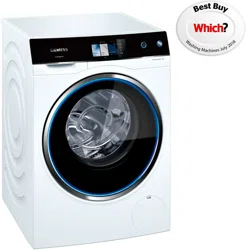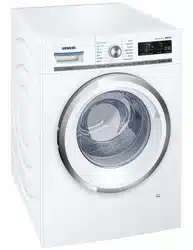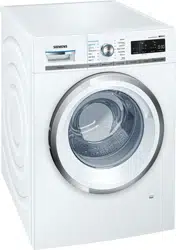
Washing machine
WM16XFH4GB
en
User manual and assembly instructions
Register your product on My Siemens and discover
exclusive services and offers.
siemens-home.bsh-group.com/welcome
The future moving in.
Siemens Home Appliances

en
2
Table of contents
Safety...............................................4
General information..........................4
Intended use.....................................4
Restriction on user group.................5
Safe installation ................................5
Safe use ...........................................7
Safe cleaning and maintenance.....10
Preventing material damage ........11
Environmental protection and
saving energy................................12
Disposing of packaging .................12
Save energy and conserve re-
sources...........................................12
Energy saving mode ......................13
Installation and connection..........13
Unpacking the appliance ...............13
Contents of package......................14
Requirements for the installation
location ...........................................14
Removing the transit bolts .............15
Removing the transport struts........16
Connecting the appliance ..............17
Aligning the appliance....................18
Familiarising yourself with
your appliance...............................20
Appliance .......................................20
Detergent drawer............................21
Controls ..........................................21
Operating logic...............................22
Display ...........................................23
Buttons ..........................................26
Programmes ..................................29
Accessories...................................38
Before using for the first time ......38
Starting an empty washing cycle ...38
Laundry..........................................39
Preparing the laundry.....................39
Sorting laundry ...............................40
Freshening up laundry ...................40
Degrees of soiling ..........................40
Care symbols on the care labels ...40
Detergents and care products......41
Detergent recommendation ...........41
Detergent dosage ..........................42
Basic operation .............................43
Switching on the appliance ............43
Setting a programme .....................43
Adjusting the programme set-
tings................................................43
Saving the programme settings .....44
Loading laundry..............................44
Using a measuring aid for liquid
detergent ........................................44
Use the measuring aid for liquid
detergent ........................................45
Adding detergent and care
product ...........................................45
Starting the programme .................46
Adding laundry ...............................46
Cancelling the programme ............46
Resuming the programme when
the programme status is Rinse
Hold ................................................46
Unloading the laundry ....................46
Switching off the appliance ............47
Childproof lock..............................47
Activating the childproof lock.........47
Deactivating the childproof lock.....47
HomeConnect ..............................47
HomeConnect settings..................48
Connecting the appliance to a
WLAN home network (Wi-Fi)
with WPS function ..........................48

en
3
Connecting the appliance to a
WLAN home network (Wi-Fi)
without WPS function .....................49
Connecting your appliance to
the Home Connect app..................49
Connecting the appliance to the
energy manager .............................50
Activating Wi-Fi on the appliance...51
Deactivating Wi-Fi on the appli-
ance................................................51
Software update .............................51
Resetting the appliance network
settings ...........................................51
Remote diagnostics .......................51
Data protection...............................51
Declaration of Conformity...............52
Basic settings................................52
Overview of the basic settings .......52
Changing the basic settings ..........53
Cleaning and servicing.................53
Tips on appliance care...................53
Cleaning the drum..........................54
Cleaning the detergent drawer ......54
Descaling........................................55
Cleaning the drain pump................55
Cleaning the water outlet hose
at the siphon...................................58
Cleaning the water inlet filter..........58
Troubleshooting............................60
Error code / Fault display / Sig-
nal...................................................60
Malfunctions ...................................61
Noise ..............................................65
Problem with results.......................66
Home Connect problem.................67
Leakage..........................................67
Odours............................................68
Emergency release ........................69
Transportation, storage and
disposal .........................................69
Removing the appliance ................69
Inserting the transit bolts................69
Using the appliance again .............70
Disposing of old appliance ............70
Customer Service..........................71
Product number (E-Nr.) and pro-
duction number (FD) ......................71
AQUA-STOP guarantee ..................71
Consumption values.....................73
Technical specifications...............73
en Safety
4
Safety
Please read the safety information to ensure that you use the ap-
pliance safely.
General information
You can find general information about this instruction manual
here.
¡ Read this instruction manual carefully. Only this will ensure you
use the appliance safely and efficiently.
¡ This manual is intended for the installer and the user of the ap-
pliance.
¡ Follow the safety instructions and warnings.
¡ Keep the instruction manual and the product information safe
for future reference or for the next owner.
¡ Check the appliance after unpacking it. Do not connect the ap-
pliance if it has been damaged in transit.
Intended use
Read the information on intended use to ensure that you use the
appliance correctly and safely.
Only use this appliance:
¡ According to this installation and instruction manual.
¡ For washing machine-washable fabrics and hand-washable wool
in accordance with the care label.
¡ With tap water and commercially available detergents and care
products suitable for washing machines.
¡ In private households and in enclosed spaces in a domestic en-
vironment.
¡ Up to an altitude of max. 4000m above sea level.
Safety en
5
Restriction on user group
Avoid risks to children and vulnerable persons.
This appliance may be used by children aged 8 or over and by
people who have reduced physical, sensory or mental abilities or
inadequate experience and/or knowledge, provided that they are
supervised or have been instructed on how to use the appliance
safely and have understood the resulting dangers.
Children must not play with the appliance.
Cleaning and user maintenance must not be performed by chil-
dren unless they are being supervised.
Keep children under the age of 3 years and pets away from the
appliance.
Safe installation
Take note of the safety instructions when installing the appliance.
WARNING‒Risk of electric shock!
¡ Improper installation is dangerous.
▶
Connect and operate the appliance only in accordance with
the specifications on the rating plate.
▶
Connect the appliance to a power supply with alternating
current only via a properly installed socket with earthing.
▶
The protective conductor system of the domestic electrical
installation must be properly installed. The installation must
have a sufficiently large cross section.
▶
When using a residual current circuit breaker, only use a
type with the mark.
▶
Never equip the appliance with an external switching
device, e.g. a timer or remote control.
▶
When the appliance is installed, the mains plug of the
power cord must be freely accessible. If free access is not
possible, an all-pole isolating switch must be installed in the
permanent electrical installation according to the installation
regulations.
▶
When installing the appliance, check that the power cable is
not trapped or damaged.

en Safety
6
¡ If the insulation of the power cord is damaged, this is danger-
ous.
▶
Never let the power cord come into contact with hot appli-
ance parts or heat sources.
▶
Never let the power cord come into contact with sharp
points or edges.
▶
Never kink, crush or modify the power cord.
WARNING‒Risk of fire!
It is dangerous to use an extended power cord and non-ap-
proved adapters.
▶
Do not use extension cables or multiple socket strips.
▶
If the power cord is too short, contact Customer Service.
▶
Only use adapters approved by the manufacturer.
WARNING‒Risk of injury!
¡ The high weight of the appliance may result in injury when lif-
ted.
▶
Do not lift the appliance on your own.
¡ If this appliance is not correctly installed in a washer-dryer
stack, the installed appliance may fall.
▶
Only stack the dryer on a washing machine using the con-
nection kit from the dryer manufacturer . No other installa-
tion method is permitted.
▶
Do not install the appliance in a washer-dryer stack if the
dryer manufacturer does not offer a suitable connection kit.
▶
Do not install appliances from different manufacturers and
with varying depths and widths in a washer-dryer stack.
▶
Do not install a washer-dryer stack on a platform; the appli-
ances may tip over.
WARNING‒Risk of suffocation!
Children may put packaging material over their heads or wrap
themselves up in it and suffocate.
▶
Keep packaging material away from children.
▶
Do not let children play with packaging material.

Safety en
7
CAUTION‒Risk of injury!
¡ The appliance may vibrate or move when in use.
▶
Place the appliance on a clean, even, solid surface.
▶
Align the appliance using the appliance feet and a spirit
level.
¡ If hoses and power cords have been laid incorrectly, this
causes a tripping hazard.
▶
Lay hoses and power cords in such a way that there is no
risk of tripping.
¡ If the appliance is moved by holding onto protruding compon-
ents, such as the appliance door, the parts may break off.
▶
Do not move the appliance by holding onto protruding
parts.
CAUTION‒Risk of cutting!
Touching sharp edges on the appliance may lead to cuts.
▶
Do not touch the sharp edges on the appliance.
▶
Wear protective gloves when installing and transporting the
appliance.
Safe use
Follow these safety instructions when using the appliance.
WARNING‒Risk of electric shock!
¡ If the appliance or the power cord is damaged, this is danger-
ous.
▶
Never operate a damaged appliance.
▶
Never pull on the power cord to unplug the appliance. Al-
ways unplug the appliance at the mains.
▶
If the appliance or the power cord is damaged, immediately
unplug the power cord or switch off the fuse in the fuse box
and turn off the water tap.
▶
"Call Customer Service." →Page71
▶
Repairs to the appliance should only be carried out by
trained specialist staff.
¡ An ingress of moisture can cause an electric shock.
▶
Only use the appliance in enclosed spaces.
en Safety
8
▶
Never expose the appliance to intense heat or humidity.
▶
Do not use steam- or high-pressure cleaners, hoses or
sprays to clean the appliance.
WARNING‒Risk of harm to health!
Children can lock themselves in the appliance, thereby putting
their lives at risk.
▶
Do not install the appliance behind a door as this may ob-
struct the appliance door or prevent it from opening.
▶
With redundant appliances, unplug the power cord. Then
cut through the cord and damage the lock on the appliance
door beyond repair so that the appliance door will no longer
close.
WARNING‒Risk of suffocation!
Children may breathe in or swallow small parts, causing them
to suffocate.
▶
Keep small parts away from children.
▶
Do not let children play with small parts.
WARNING‒Risk of poisoning!
Detergents and care products may result in poisoning if con-
sumed.
▶
If accidentally swallowed, seek medical advice.
▶
Keep detergents and care products out of the reach of chil-
dren.
WARNING‒Risk of explosion!
Laundry that has been pretreated with cleaning agents that
contain solvents may cause an explosion in the appliance.
▶
Rinse pretreated laundry thoroughly with water before wash-
ing.
CAUTION‒Risk of injury!
¡ The covering plate may break if you stand on or climb onto
the appliance.
▶
Do not stand on or climb onto the appliance.
Safety en
9
¡ The appliance may tip over if you sit on or lean against the
open door.
▶
Do not sit on or lean against the appliance door.
▶
Do not place any objects on the appliance door.
¡ Reaching into the drum while it is still turning may cause hand
injuries.
▶
Wait for the drum to come to a complete stop before reach-
ing inside.
CAUTION‒Risk of burns!
When washing at high temperatures, the glass in the appli-
ance door becomes hot.
▶
Do not touch the appliance door when it is hot.
▶
Keep children away from the appliance door when it is hot.
CAUTION‒Risk of scalding!
When you wash at high temperatures, the detergent solution
gets hot.
▶
Do not touch the hot detergent solution.
CAUTION‒Risk of injury!
This appliance runs programmes that use active oxygen. Act-
ive oxygen can cause eyes to water and irritate the mucosa.
▶
Do not open the appliance door using the emergency re-
lease if a programme is running with active oxygen.
▶
Wait for the appliance door to be released.
CAUTION‒Risk of chemical burns!
If the detergent drawer is opened, detergent and care
products may spray out from the appliance. Contact with eyes
or skin may cause irritation.
▶
Rinse eyes and/or skin thoroughly with clean water if they
come into contact with detergents or care products.
▶
If accidentally swallowed, seek medical advice.
▶
Keep detergents and care products out of the reach of chil-
dren.
en Safety
10
Safe cleaning and maintenance
Take note of the safety instructions when cleaning and performing
maintenance work on the appliance.
WARNING‒Risk of electric shock!
¡ Improper repairs are dangerous.
▶
Repairs to the appliance should only be carried out by
trained specialist staff.
▶
Only use genuine spare parts when repairing the appliance.
▶
If the power cord of this appliance is damaged, it must be
replaced by the manufacturer, the manufacturer's Customer
Service or a similarly qualified person in order to prevent
any risk.
¡ An ingress of moisture can cause an electric shock.
▶
Do not use steam- or high-pressure cleaners, hoses or
sprays to clean the appliance.
WARNING‒Risk of injury!
The use of non-original spare parts and non-original accessor-
ies is dangerous.
▶
Only use the manufacturer's original spare parts and ori-
ginal accessories.
WARNING‒Risk of poisoning!
Poisonous fumes may be given off if you use cleaning agents
that contain solvents.
▶
Do not use cleaning agents that contain solvents.

Preventing material damage en
11
Preventing material damage
Preventing material dam-
age
Preventing material damage
Follow these instructions to avoid ma-
terial damage and damage to the ap-
pliance.
ATTENTION!
¡ The functionality of the appliance
may be impaired if you use the
wrong quantity of fabric softener,
detergent, care product or clean-
ing agent.
▶
Follow the dosage recommend-
ations from the manufacturer.
¡ Exceeding the maximum load ca-
pacity impairs the function of the
appliance.
▶
Observe the "maximum load ca-
pacity" →Page29 for each
programme and do not exceed
it.
¡ The appliance is secured for trans-
portation using transit bolts. Transit
bolts which have not been re-
moved may result in material dam-
age and damage to the appliance.
▶
Before starting up the appliance,
remove the transit bolts com-
pletely and keep them in a safe
place.
▶
Before transport, fit the transit
bolts fully in order to prevent
damage in transit.
¡ Material damage may be caused if
the water inlet hose is connected
incorrectly.
▶
Tighten the screw connections
on the water inlet until they are
hand-tight.
▶
Ideally, connect the water inlet
hose directly to the water tap,
without any additional connect-
ing elements such as adapters,
extensions, valves or similar.
▶
Make sure that the valve hous-
ing for the water inlet hose does
not come into contact with its
surroundings and is not subjec-
ted to any external forces.
▶
Ensure that the inner diameter
of the water tap is at least 17
mm.
▶
Make sure that the length of the
thread on the connection to the
water tap is at least 10 mm.
¡ If the water pressure is too high or
too low, the appliance may not be
able to operate properly.
▶
Make sure that the water pres-
sure in the water supply system
is min. 100kPa (1bar) and
max. 1000kPa (10bar).
▶
If the water pressure exceeds
the maximum value specified, a
pressure-reducing valve must be
installed between the drinking
water connection and the hose
set of the appliance.
▶
Do not connect the appliance to
the mixer tap of an unpressur-
ised hot-water boiler.
¡ Modified or damaged water hoses
may result in material damage and
damage to the appliance.
▶
Never kink, crush, modify or cut
through water hoses.
▶
Only use the water hoses sup-
plied with the appliance or genu-
ine spare hoses.
▶
Never re-use water hoses that
have been used before.
¡ Operating the appliance using wa-
ter that is dirty or too hot may
cause material damage.
▶
Only operate the appliance with
cold mains water.
¡ Unsuitable cleaning products may
damage the surfaces of the appli-
ance.
▶
Do not use harsh or abrasive
detergents.
en Environmental protection and saving energy
12
▶
Do not use cleaning products
with a high alcohol content.
▶
Do not use hard scouring pads
or cleaning sponges.
▶
Clean the appliance with nothing
but water and a soft, damp
cloth.
▶
Remove all detergent residue,
spray residue or other residues
immediately if they come into
contact with the appliance.
Environmental protection and saving energy
Environmental protection
and saving energy
Environmental protection and saving energy
Help protect the environment by us-
ing your appliance in a way that con-
serves resources and by disposing of
reusable materials properly.
Disposing of packaging
The packaging materials are environ-
mentally compatible and can be re-
cycled.
▶
Sort the individual components by
type and dispose of them separ-
ately.
Information about current disposal
methods are available from your
specialist dealer or local authority.
Save energy and conserve re-
sources
If you follow these instructions, your
appliance will use less electricity and
less water.
Choose programmes with low tem-
peratures and longer wash times and
use "maximum load capacity"
→Page29.
Energy consumption and water
consumption is most efficient.
Use the economy programme set-
tings.
If you adjust the programme set-
tings for a programme, the display
shows the expected consumption.
"Add " →Page42 detergent based
on the laundry's degree of soiling.
For light to normal soiling, a smal-
ler amount of detergent is suffi-
cient. Observe the dosage recom-
mendation from the detergent
manufacturer.
Reduce the washing temperature for
lightly and normally soiled laundry.
At low temperatures, the appliance
consumes less energy. For light to
normal soiling, lower temperatures
than indicated on the care label
are also sufficient.
Set the maximum spin speed if you
want to dry the laundry in a tumble
dryer afterwards.
The drier the laundry, the shorter
the programme duration when dry-
ing which, in turn, reduces energy
consumption. A higher spin speed
reduces the residual moisture in
the laundry and increases the
volume of the spin noise.
Wash the laundry without prewash.
Washing with prewash increases
the programme duration and in-
creases energy and water con-
sumption.
The appliance has a continuous
automatic load adjustment function.
Depending on the type of fabric
and load capacity, the continuous
automatic load adjustment func-
tion optimally adjusts the water
consumption and programme dur-
ation.

Installation and connection en
13
Energy saving mode
If you do not use the appliance for an
extended period, it automatically
switches to energy-saving mode. All
displays go out and Start/Reload
flashes.
Energy-saving mode ends when you
use the appliance again, e.g. if you
open or close the door.
If you do not use the appliance for an
extended period, the appliance
switches off automatically.
Installation and connection
Installation and connec-
tion
Installation and connection
You can find out where and how best
to install your appliance here. You
will also learn how to connect the ap-
pliance to the water and power sup-
ply.
Unpacking the appliance
Note:Please read the information in
the "Safety" →Page4 and "Prevent-
ing material damage" →Page11 sec-
tions to ensure that you use the appli-
ance safely.
ATTENTION!
Objects remaining in the drum that
are not designed for operation with
the appliance may cause material
damage and damage to the appli-
ance.
▶
Remove these objects, along with
all supplied accessories, from the
drum before starting the appliance.
1. Remove any packaging and pro-
tective covers completely from the
appliance.
For the environmentally friendly
disposal of the packaging materi-
als, observe the information on the
topic of
→"Disposing of packaging",
Page12.
2. Check the appliance for visible
damage.
3. Open the door.
→"Basic operation", Page43
4. Remove the accessory from the
drum.
5. Close the door.
en Installation and connection
14
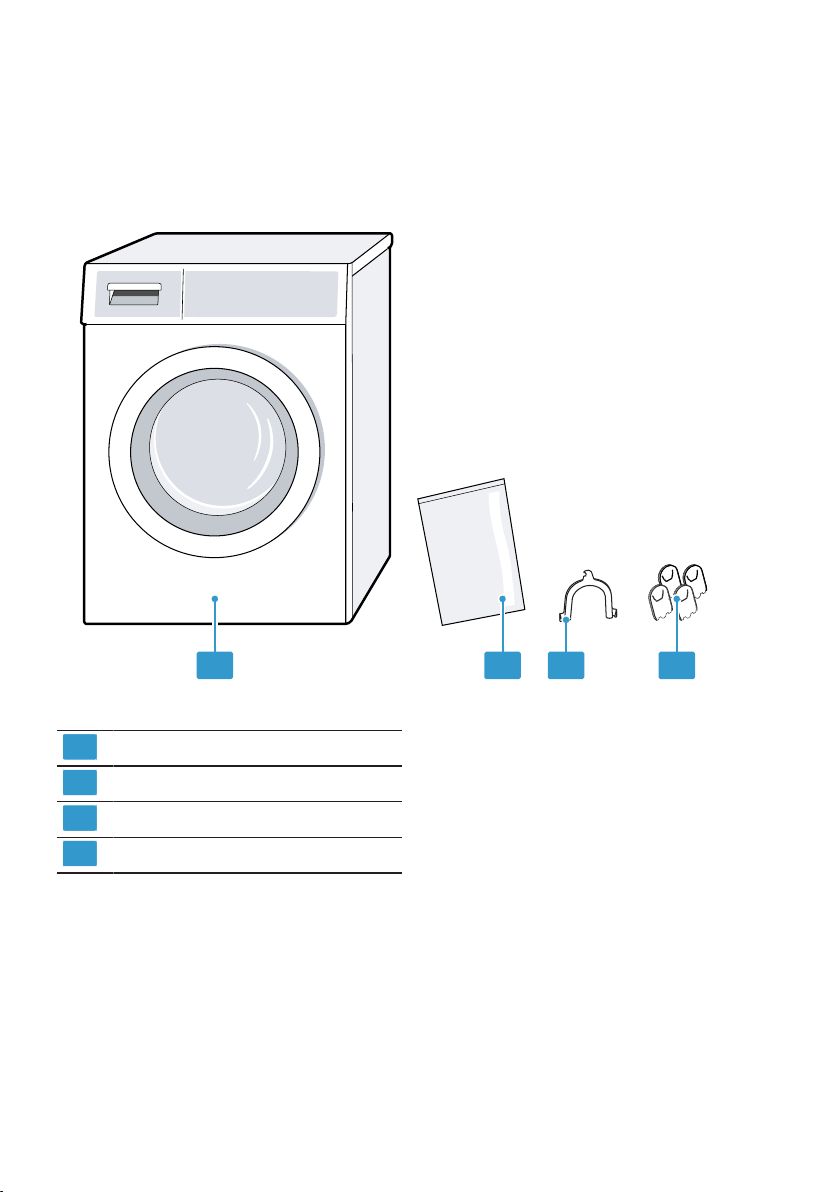
Contents of package
After unpacking all parts, check for any damage in transit and completeness of
the delivery.
1 2 3 4
1
Washing machine
2
Accompanying documents
3
Elbow for fixing the water outlet hose
4
Cover caps
Requirements for the installa-
tion location
The appliance may "wander" when it
spins. Observe the instructions for
the installation location.
Note:Please read the information in
the "Safety" →Page4 and "Prevent-
ing material damage" →Page11 sec-
tions to ensure that you use the appli-
ance safely.
Installation and connection en
15
WARNING
Risk of electric shock!
The appliance contains live parts.
Touching live parts is dangerous.
▶
Do not operate the appliance
without a cover cap.
WARNING
Risk of injury!
When using the appliance on a base,
the appliance may tip over.
▶
Always secure the feet of the appli-
ance to a base using the manufac-
turer's "fixing brackets"
→Page38 before using the ap-
pliance for the first time.
ATTENTION!
¡ If the appliance is installed in
areas exposed to frost or out-
doors, frozen residual water may
damage the appliance and frozen
hoses may crack or split.
▶
Do not install or operate this ap-
pliance anywhere that is liable to
experience frost and/or out-
doors.
¡ The appliance underwent a func-
tion test before leaving the factory
and may, therefore, contain resid-
ual water. This residual water may
leak out if the appliance is tilted at
an angle greater than 40°.
▶
Tilt the appliance carefully.
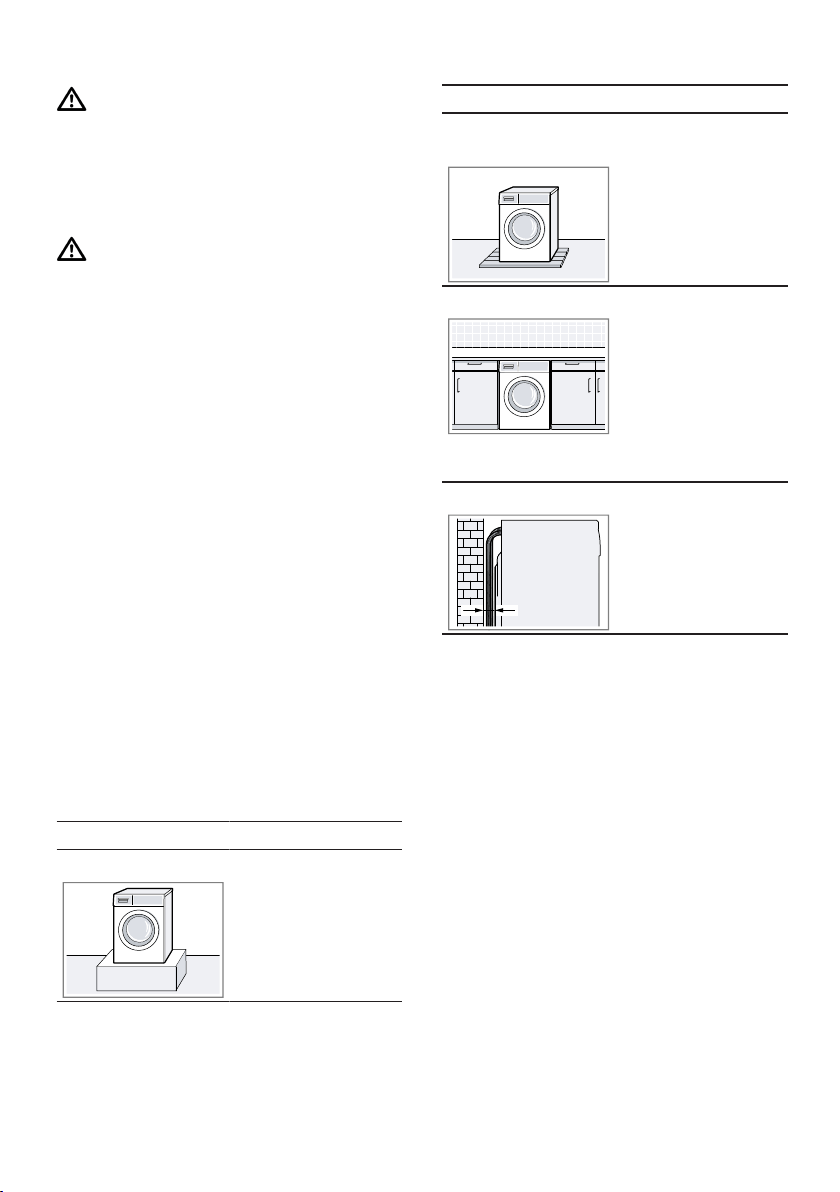
Installation location Requirements
On a base Secure the appliance
with "fixing brackets"
→Page38.
Installation location Requirements
On a wooden joist
floor
Place the appliance
on a water-resistant
wooden board which
is screwed tightly to
the floor. The wooden
board should be at
least 30mm thick.
In a kitchen unit ¡ A niche width of
60cm is required.
¡ Only install the ap-
pliance under-
neath a continuous
worktop that is se-
curely connected
to adjacent cabin-
ets.
On a wall Do not trap the hoses
between the wall and
the appliance.
Removing the transit bolts
The appliance is secured for trans-
portation using transit bolts on the
rear of the appliance.
Notes
¡ Please read the information in the
"Safety" →Page4 and "Preventing
material damage" →Page11 sec-
tions to ensure that you use the
appliance safely.
¡ Keep the transit bolts, screws and
sleeves in a safe place for future
"transport" →Page69.
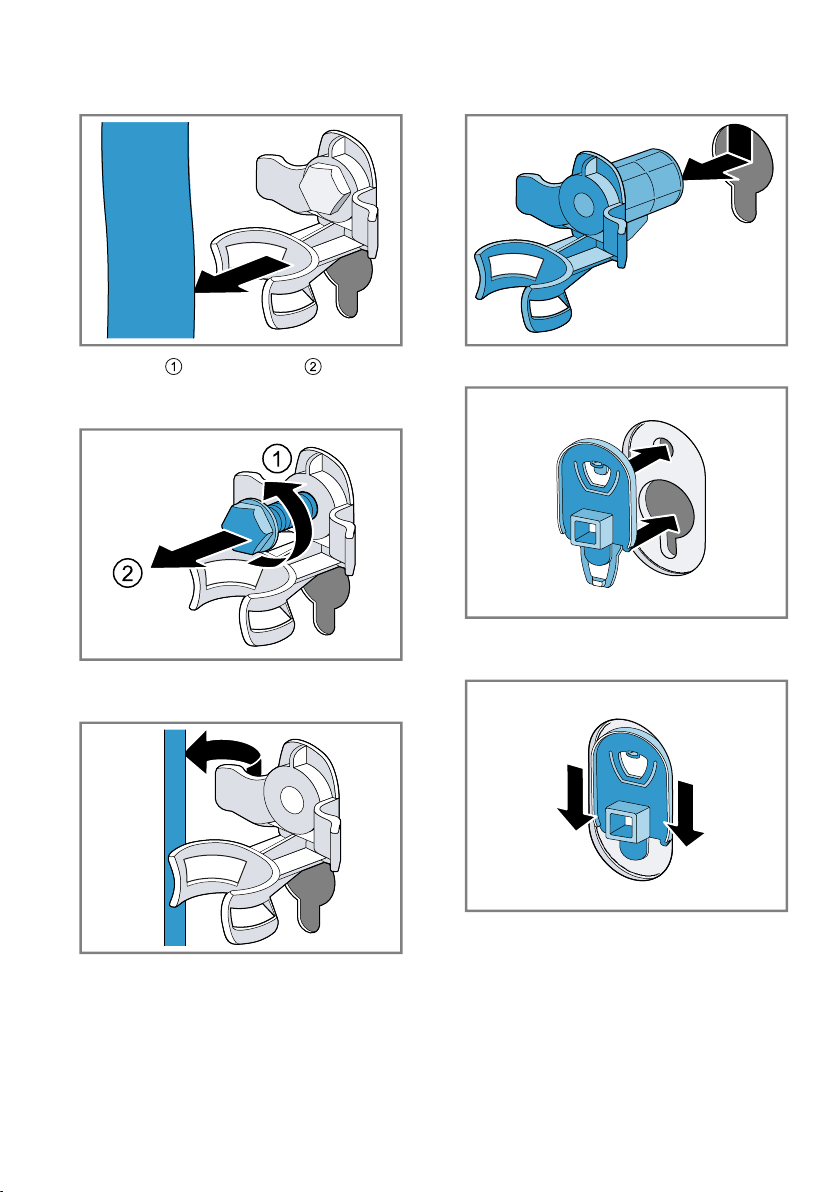
en Installation and connection
16
1. Pull the hoses out of the holders.
2. Unscrew and remove all four
screws for the transit bolts with a
WAF 13 wrench.
3. Pull the power cord out of the
holder.
4. Remove the four sleeves.
5. Put on the four cover caps.
6. Press down on the four cover
caps.
Removing the transport struts
Note:Please read the information in
the "Safety" →Page4 and "Prevent-
ing material damage" →Page11 sec-
tions to ensure that you use the appli-
ance safely.
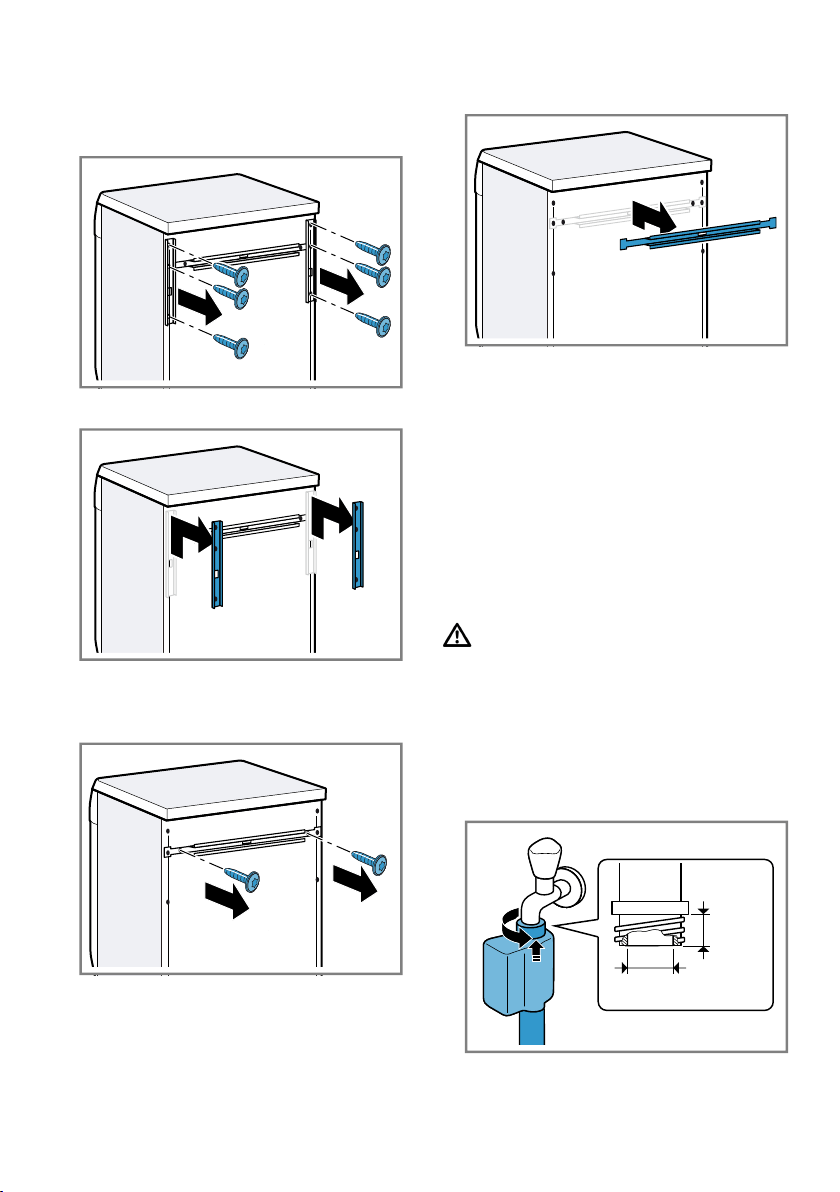
Installation and connection en
17
1. Unscrew and remove the screws in
the vertical transport struts using a
T20 screwdriver.
2. Remove the transport struts.
3. Undo and remove the screws in
the horizontal transport strut using
a T20 screwdriver.
4. Remove the transport strut.
Connecting the appliance
Connect your appliance to the power
supply, water inlet and water outlet.
Connecting the water inlet hose
Note:Please read the information in
the "Safety" →Page4 and "Prevent-
ing material damage" →Page11 sec-
tions to ensure that you use the appli-
ance safely.
WARNING
Risk of electric shock!
The appliance contains live parts.
Touching live parts is dangerous.
▶
Do not immerse the electrical
AquaStop valve in water.
1. Connect the water inlet hose to a
tap (26.4mm=3/4").
¾˝
min.
min.
10 mm
17 mm
¾˝
min.
10 mm
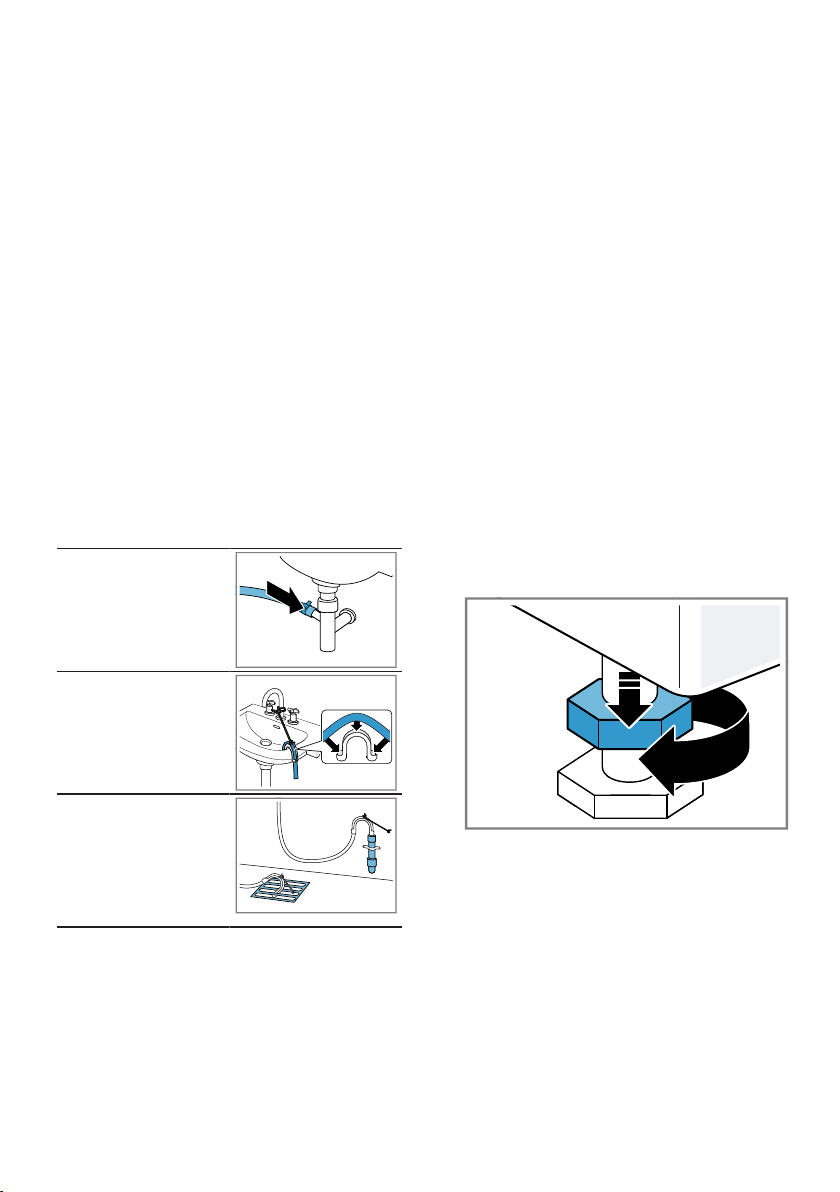
en Installation and connection
18
2. Open the water tap carefully and
check that the connection points
are tight.
Water outlet connection types
This information is intended to help
you to connect this appliance to the
water outlet.
Note:Please read the information in
the "Safety" →Page4 and "Prevent-
ing material damage" →Page11 sec-
tions to ensure that you use the appli-
ance safely.
ATTENTION!
When draining, the water outlet hose
is subject to water pressure and may
come loose from the installed con-
nection point.
▶
Secure the water outlet hose
against unintentional loosening.
Drainage into a si-
phon.
Secure the connec-
tion point with a (24–
40 mm) hose clamp.
Drainage into a wash
basin.
Fix and secure the wa-
ter outlet hose with an
elbow.
Drainage into a plastic
pipe with rubber
sleeve or into a gully.
Fix and secure the wa-
ter outlet hose with an
elbow.
Connecting the appliance to the
electricity supply
Note:Please read the information in
the "Safety" →Page4 and "Prevent-
ing material damage" →Page11 sec-
tions to ensure that you use the appli-
ance safely.
1. Insert the mains plug of the appli-
ance's power cable in a socket
nearby.
The connection details of the appli-
ance can be found under "Tech-
nical data" →Page73.
2. Check the mains plug is inserted
properly.
Aligning the appliance
In order to reduce noise and vibra-
tion and to prevent the appliance
from moving, align the appliance cor-
rectly.
Note:Please read the information in
the "Safety" →Page4 and "Prevent-
ing material damage" →Page11 sec-
tions to ensure that you use the appli-
ance safely.
1. Loosen the lock nuts using a WAF
17 wrench by turning it in a clock-
wise direction.
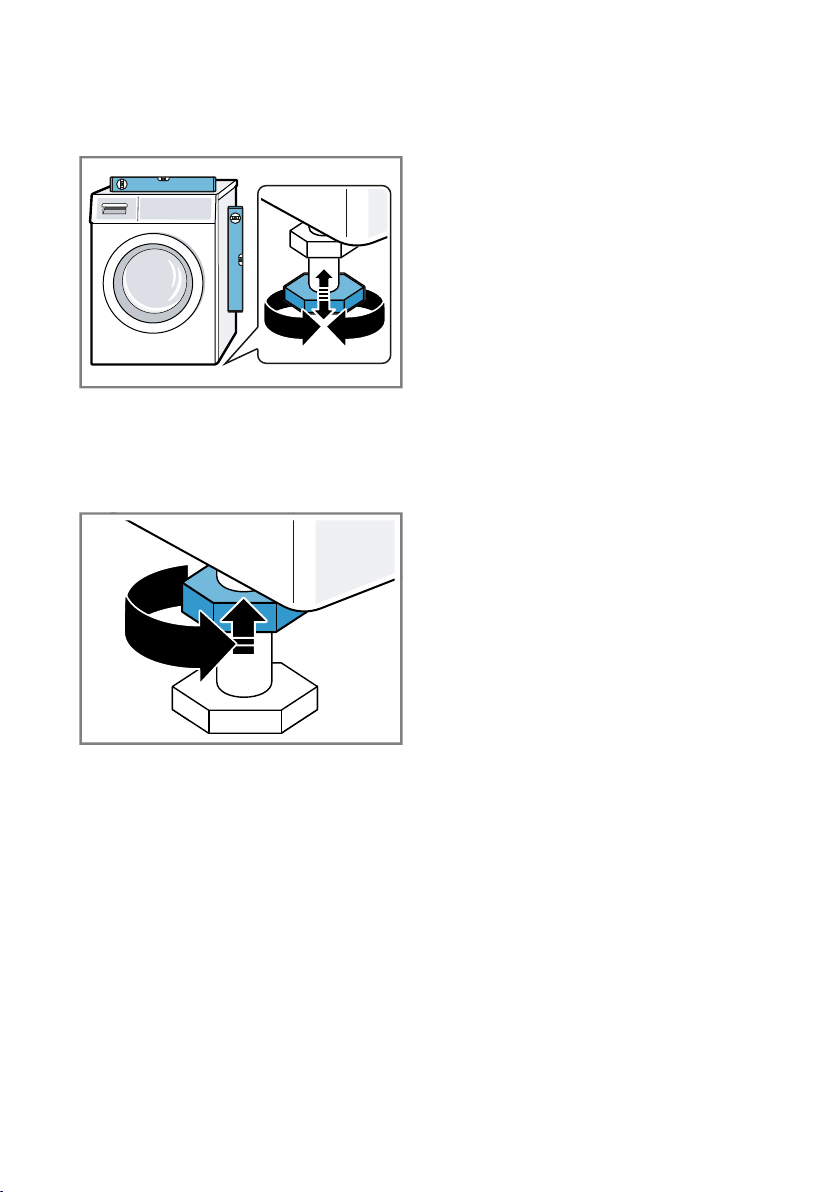
Installation and connection en
19
2. To align the appliance, turn the ap-
pliance feet. Check that the appli-
ance is level using a spirit level.
All appliance feet must stand firmly
on the ground.
3. Screw the lock nuts tightly against
the housing using a WAF 17
wrench.
In doing so, hold the foot tight and
do not adjust its height.
en Familiarising yourself with your appliance
20
Familiarising yourself with your appliance
Familiarising yourself with your appliance
Familiarising yourself with your appliance
Familiarise yourself with the parts of your appliance.
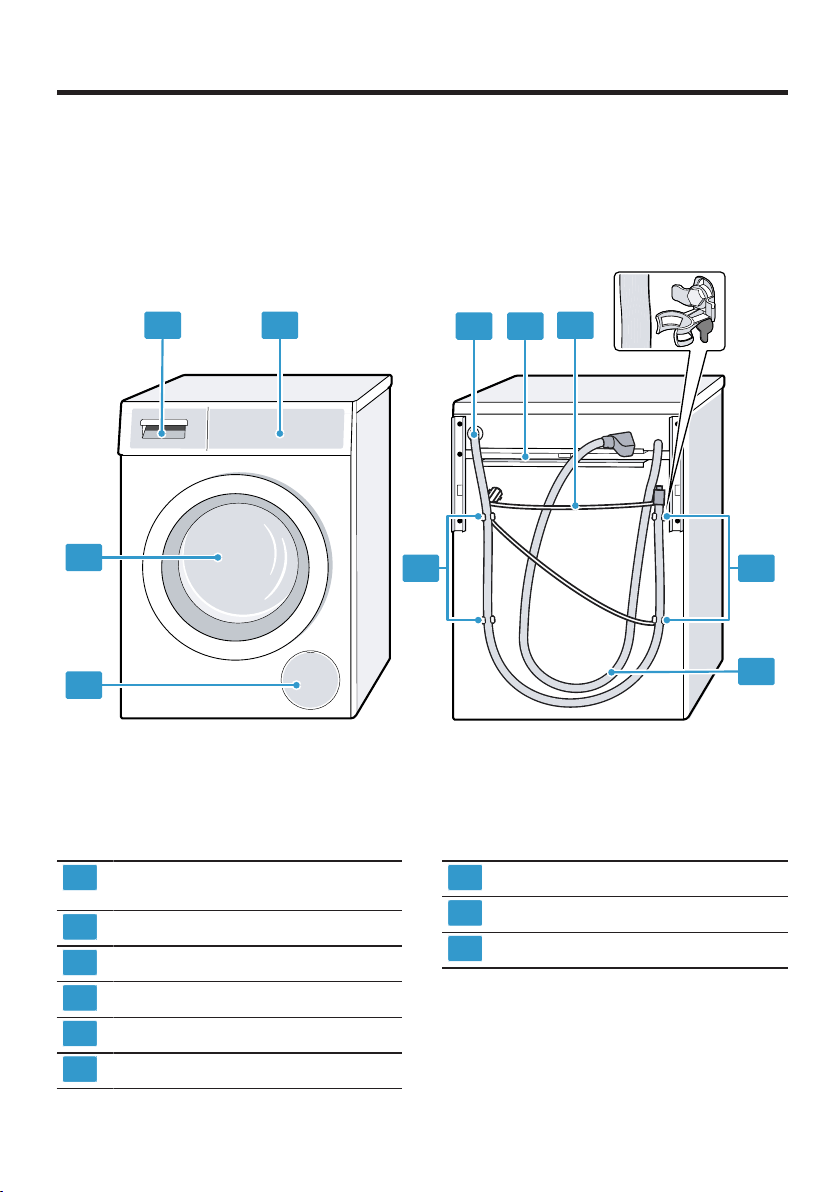
Appliance
You can find an overview of the parts of your appliance here.
1
2
4 73
5
9
8
8
6
On certain models, specific details such as the colour and shape may differ
from those pictured.
1
"Maintenance flap for the drain pump"
→Page55
2
Door
3
"Detergent drawer" →Page21
4
"Controls" →Page21
5
"Water outlet hose" →Page18
6
"Transport struts" →Page16
7
"Power cord" →Page18
8
"Transit bolts" →Page15
9
"Water inlet hose" →Page17
Familiarising yourself with your appliance en
21
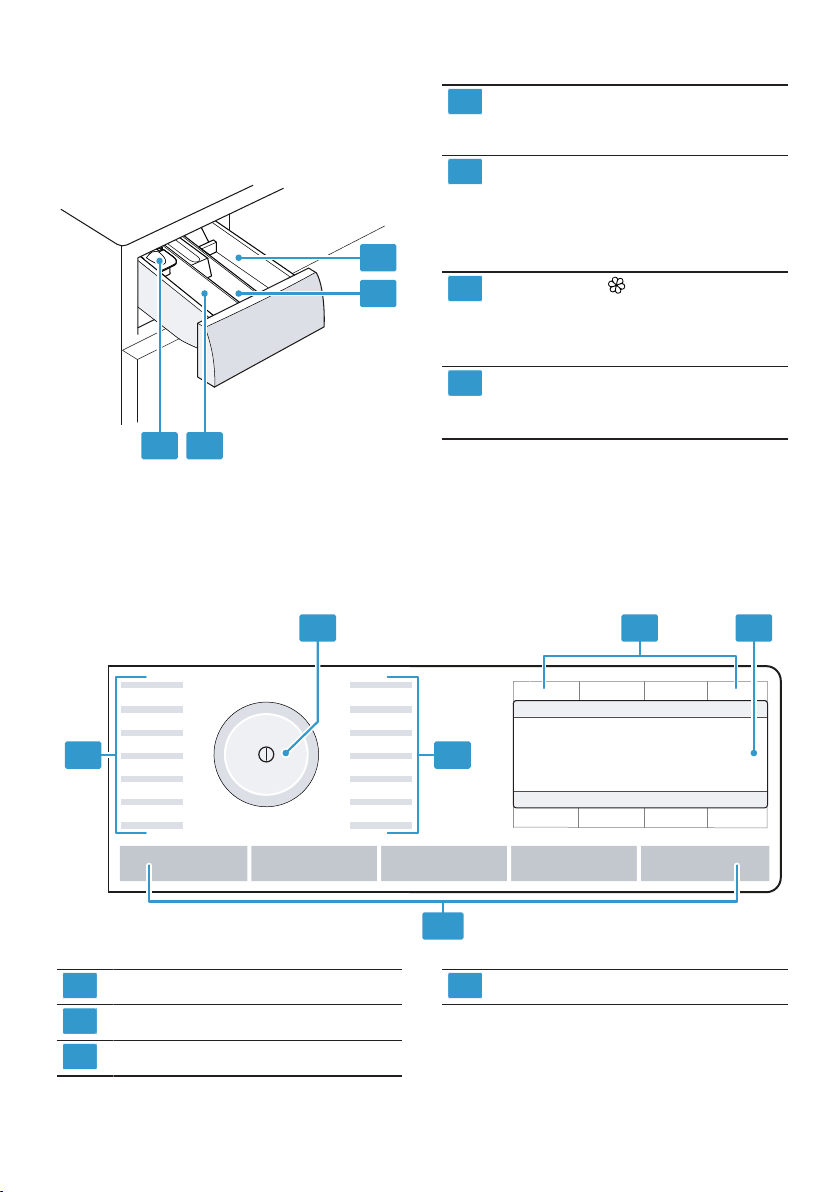
Detergent drawer
Below is an overview of the structure
of the detergent drawer.
2
3
1
4
1
Measuring aid for liquid detergent
→"Using a measuring aid for liquid
detergent", Page44
2
Compartment II:
¡ Detergent for main wash
¡ Water softener
¡ Bleach
¡ Stain remover
3
Compartment :
¡ Fabric softener
¡ Liquid starch
¡ Waterproofing agent
4
Compartment I:
¡ Detergent for prewash
¡ Hygiene detergent
Controls
The controls are used to configure all functions of your appliance and to obtain
information about the operating status.
3
32 4
1 1
1
"Programmes" →Page29
2
"Programme selector" →Page43
3
"Buttons" →Page26
4
"Display" →Page23

en Familiarising yourself with your appliance
22
Operating logic
In addition to the actual functions of
the buttons on the display, you can
also use these buttons to select pro-
gramme settings in the main menu
and settings in the sub-menus. The
buttons are then marked by symbols
in the display.
Main menu
To select programme settings, press
the buttons above or below the sym-
bols.
The selected programme setting is
shown in the middle of the display.
Sub-menu
To select the settings you require,
press the buttons below the symbols
until the required setting is selected
in the display.
To select the settings you require,
press the buttons below the symbols
until the required setting is selected
in the display.
If a setting is activated, the display
shows . The selection does not
need to be confirmed again.
The sub-menu closes automatically
after a few seconds.
Display en
23
Display
Display
Display
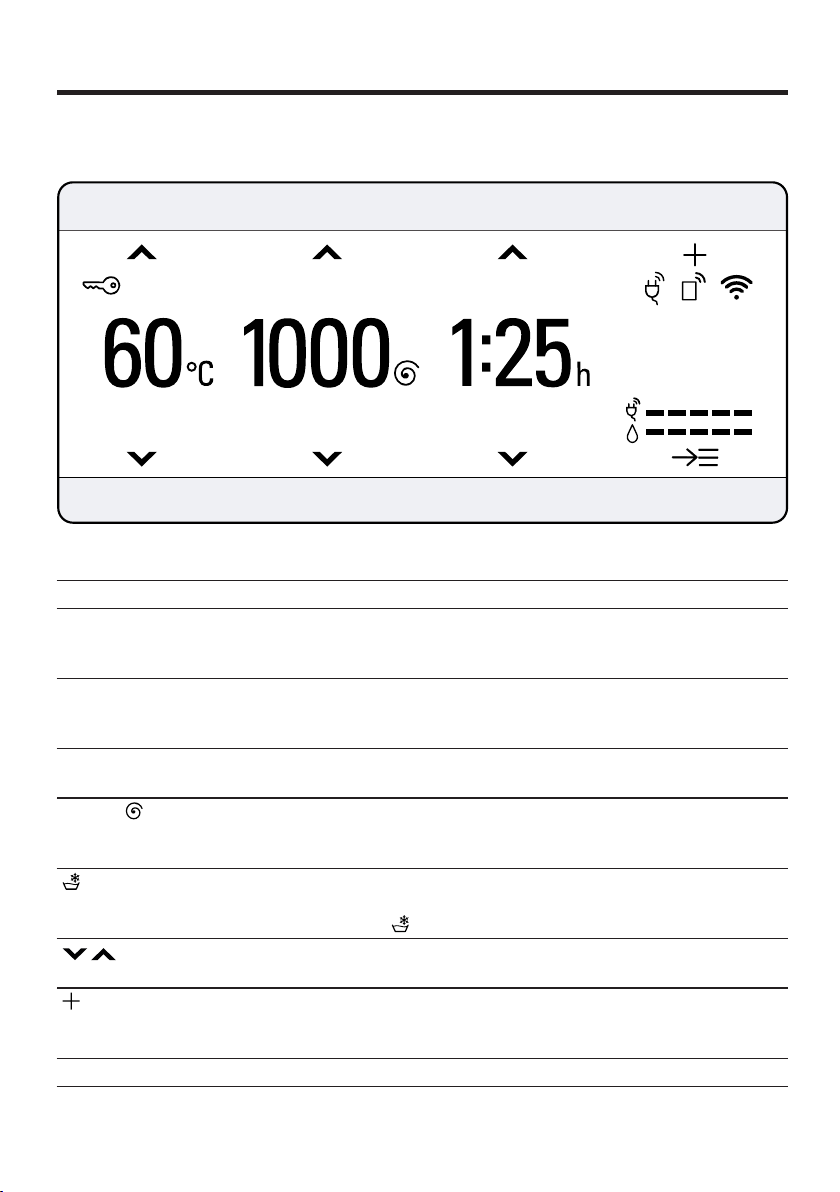
The display shows the current settings, options or relevant information.
Example: Display
Display Designation Description
0:40 h
1
Programme duration/
programme time re-
maining
Approximate expected programme duration or pro-
gramme time remaining.
10 h
1
"Ready in" time The programme end has been set and the remaining
number of hours is displayed.
→"Buttons", Page26
10 kg
1
Recommended load The maximum load capacity for the selected pro-
gramme in kg.
0 - 1600 Spin speed Set spin speed in rpm.
→"Buttons", Page26
0: No spin cycle, draining only
– 90 °C Temperature Set temperature in °C.
→"Buttons", Page26
(cold)
Navigation Selecting settings.
→"Operating logic", Page22
Other programme set-
tings
Activate, deactivate or adjust other programme set-
tings.
→"Buttons", Page27
1
Example
en Display
24
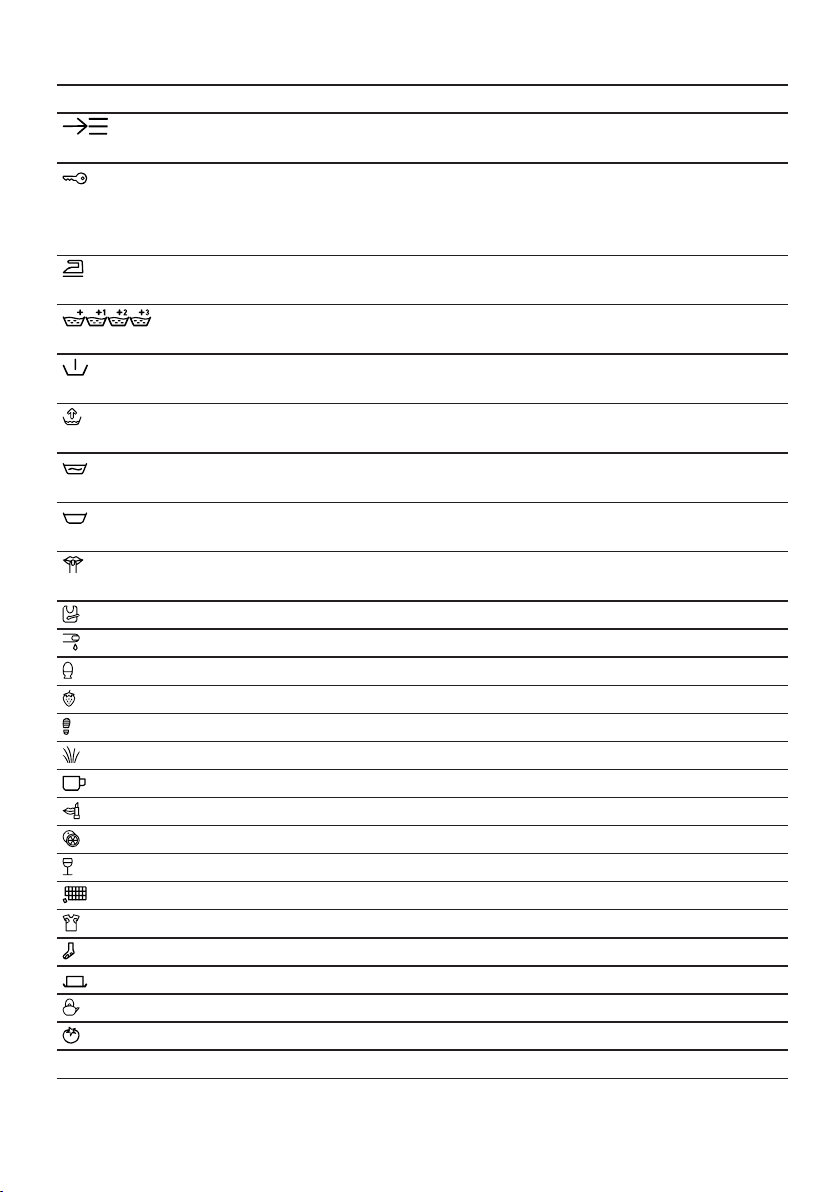
Display Designation Description
Saving the programme
Other programmes
"Save a programme" →Page44.
Set "other programmes" →Page43.
Childproof lock ¡ Lights up: The childproof lock is activated.
¡ Flashes: The childproof lock is active and the pro-
gramme selector has been adjusted.
→"Deactivating the childproof lock", Page47
Less Ironing The reduced creasing function is activated.
→"Buttons", Page28
Extra Rinse Additional rinse cycles are activated.
→"Buttons", Page27
Prewash Prewash is activated.
→"Buttons", Page27
Water Plus Wash with more water is activated.
→"Buttons", Page28
Soaking Soaking is activated.
→"Buttons", Page28
Rinse Hold Rinse Hold is activated.
→"Buttons", Page27
Silent Wash Silent Wash is activated.
→"Buttons", Page28
Baby food The stain type is activated.
Blood The stain type is activated.
Egg The stain type is activated.
Strawberry The stain type is activated.
Soil and sand The stain type is activated.
Grass The stain type is activated.
Coffee The stain type is activated.
Cosmetics The stain type is activated.
Orange The stain type is activated.
Red Wine The stain type is activated.
Chocolate The stain type is activated.
Sweat The stain type is activated.
Dirty socks The stain type is activated.
Grease and oil The stain type is activated.
Tea The stain type is activated.
Tomato The stain type is activated.
1
Example
Display en
25
Display Designation Description
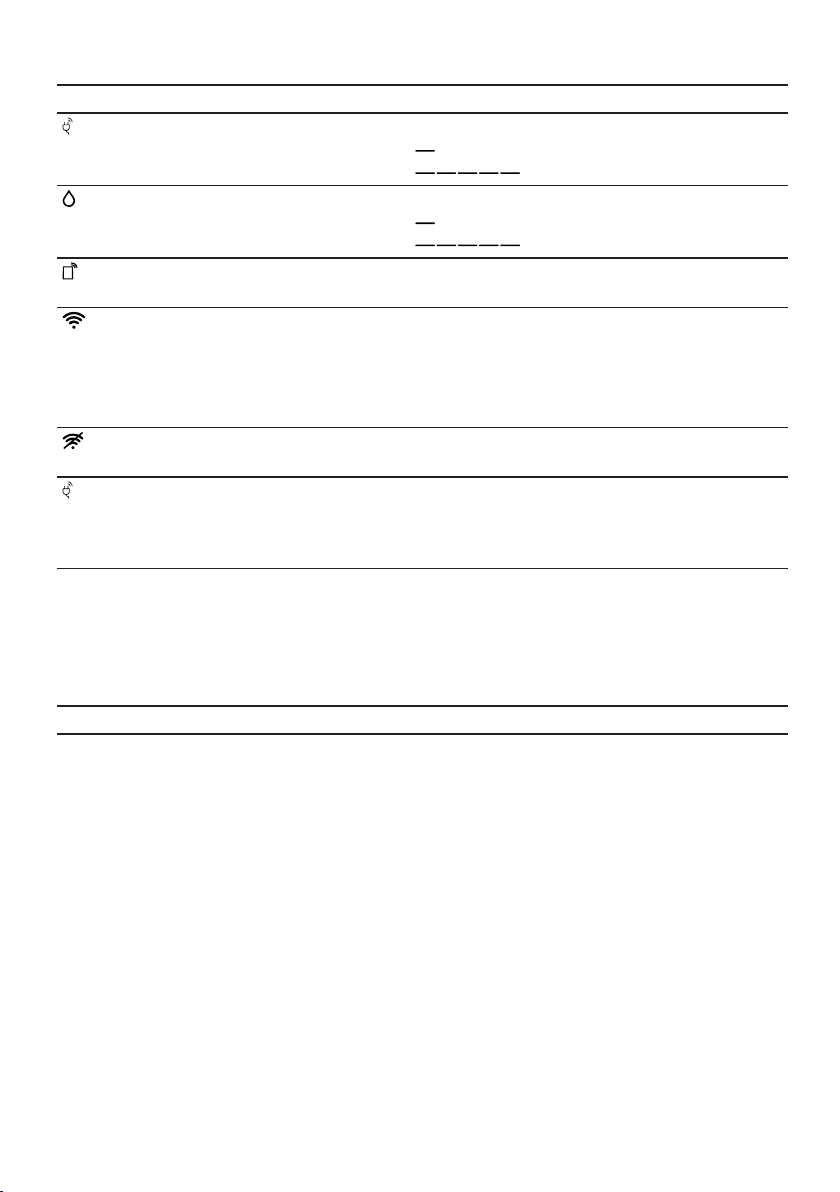
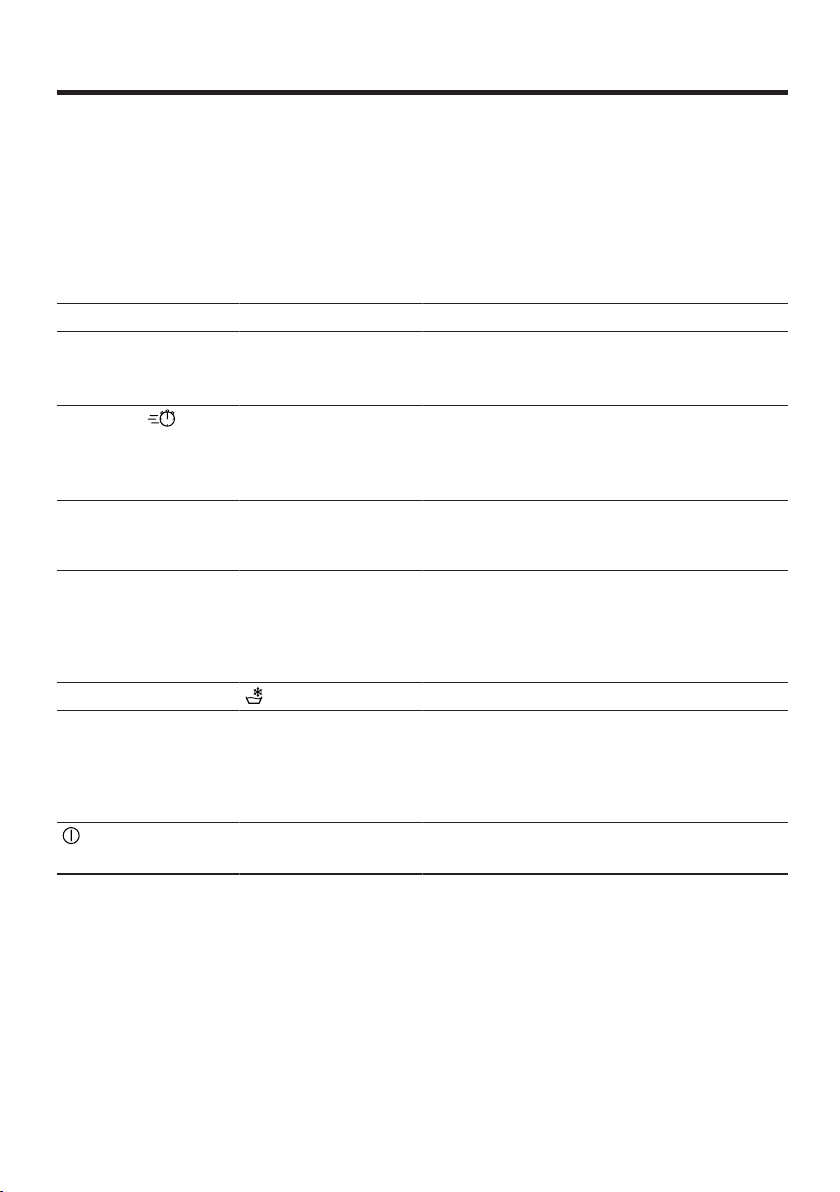
Energy consumption Energy consumption for the selected programme.
¡ : Low energy consumption
¡ : High energy consumption
Water consumption Water consumption for the selected programme.
¡ : Low water consumption
¡ : High water consumption
Remote start Remote start is activated.
→"Buttons", Page27
Wi-Fi ¡ Lights up: The appliance is connected to your
home network.
¡ Flashes: The appliance is trying to connect to your
home network.
→"HomeConnect ", Page47
Wi-Fi The appliance is not connected to your home network.
→"HomeConnect ", Page47
Energy manager The appliance is connected to the smart energy sys-
tem (energy manager).
→"Connecting the appliance to the energy manager",
Page50
Dosage: 50%
1
Dosing recommenda-
tion
The recommended dosage for detergent.
→"Detergent dosage", Page42
Note:The dosing recommendation indicates the load
capacity that should be used for the relevant deter-
gent dosage. The percentage refers to the maximum
load capacity for the programme.
1
Example
en Buttons
26
Buttons
Buttons
Buttons
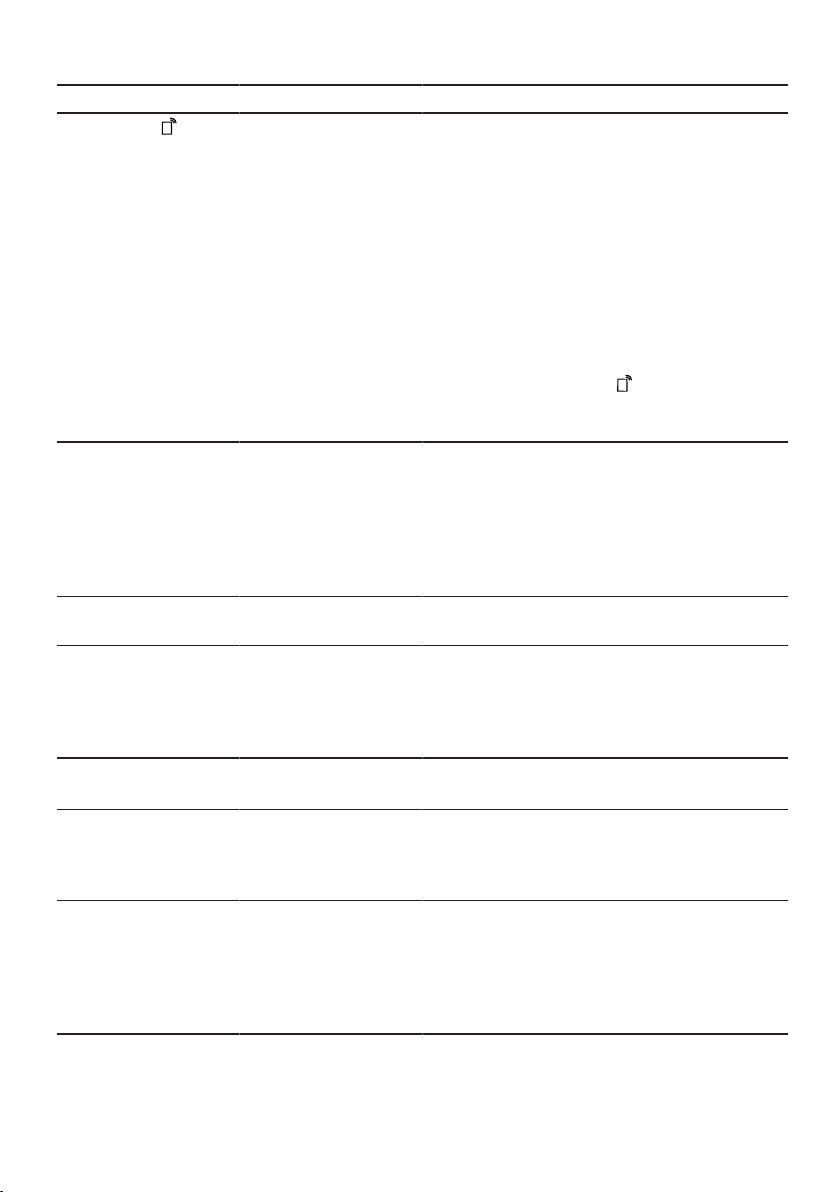
Below is an overview of the buttons
and their setting options.
With the Options button, you can
open the sub-menu for additional pro-
gramme settings. The additional pro-
gramme settings are listed in the
overview for the buttons.
The selection of programme settings
depends on the selected pro-
gramme. You can see the selection
options for each programme in the
overview for
→"Programmes", Page29.
Button Selection Description
Start/Reload ¡ Start
¡ Cancel
¡ Pause
Start, cancel or pause the programme.
varioSpeed ¡ Activate
¡ Deactivate
Activate or deactivate a short washing pro-
gramme.
Note:Energy consumption increases.
The washing result is not affected by this.
stainRemoval System Multiple selection Select the type of stain.
The temperature, drum movement and soaking
time are all adjusted to suit the type of stain.
Ready In 1–24 hours Set the programme end.
The programme duration is already included in
the set number of hours.
Once the programme has started, the pro-
gramme duration is displayed.
Temperature – 90 °C Adjust the temperature in °C.
Spin Speed 0 – 1600 rpm Adjust the spin speed or deactivate the spin
cycle.
If 0 is selected, the water is drained and the spin
cycle is deactivated at the end of the washing
cycle. The laundry stays wet inside the drum.
(mains switch) ¡ Switch on
¡ Switch off
Switch the appliance on or off.
Buttons en
27
Button Selection Description
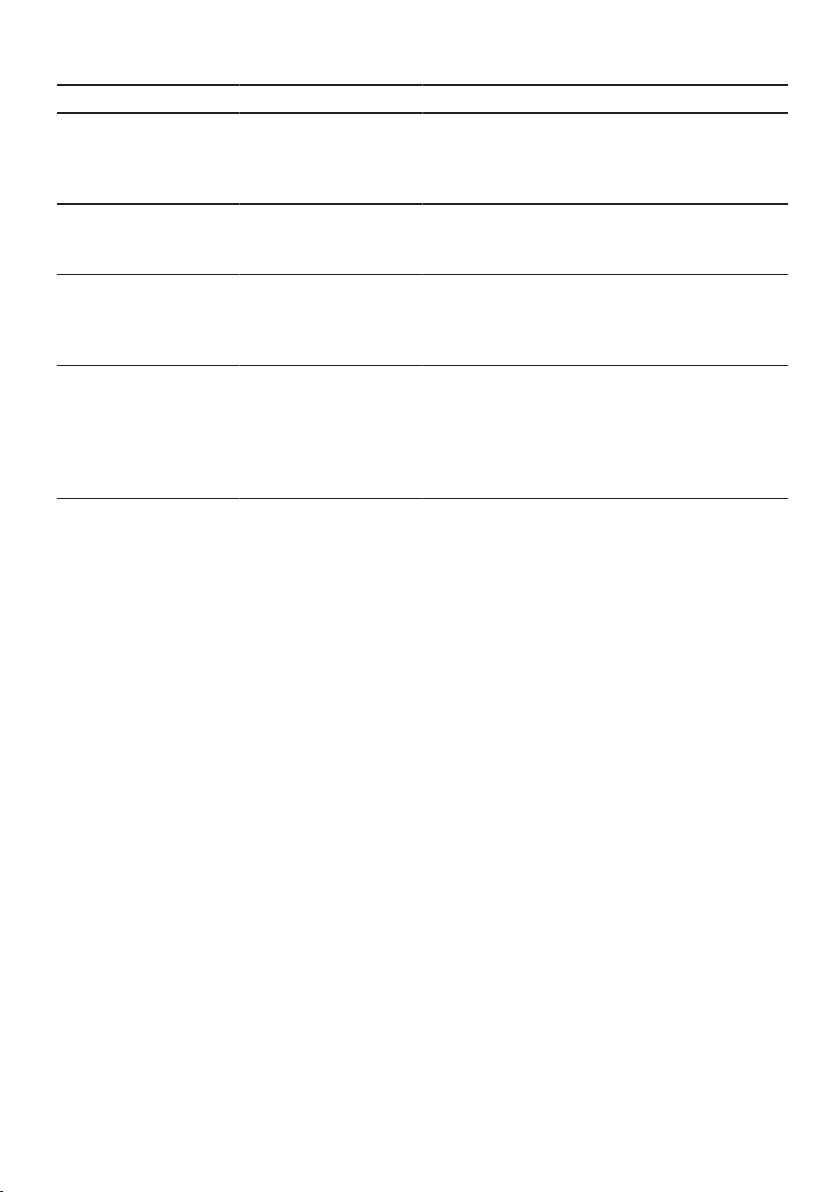
Remote Start ¡ Activate
¡ Deactivate
¡ Open the
HomeConnect
menu
If you briefly press the button, the appliance will
be enabled for remote start via the HomeCon-
nect app
If you press the button for approx. 3 seconds, the
HomeConnect menu opens.
Notes
¡
For safety reasons, remote start cannot be ac-
tivated if the door is open.
¡
Remote start is deactivated for safety reasons
in the following circumstances:
– Open the door.
– Press Start/Reload.
– Press Remote Start .
– Switch off the appliance.
– Following a power cut.
ChildLock 3sec. ¡ Activate
¡ Deactivate
Activate or deactivate the childproof lock.
Disable the control panel to prevent unwanted or
accidental operation.
If the childproof lock is activated and the appli-
ance has been switched off, the childproof lock
remains activated.
→"Childproof lock", Page47
Basic Settings 3sec. "Basic settings"
→Page52
Change the basic settings for the appliance.
→"Changing the basic settings", Page53
Options Multiple selection Activate additional programme settings.
→"Adjusting additional programme settings",
Page43
The additional programme settings can be found
in this overview.
Prewash ¡ Activate
¡ Deactivate
Activate or deactivate prewash, e.g. for washing
heavily soiled laundry.
Extra rinse ¡ Activate
¡ Deactivate
Activate or deactivate up to three additional rinse
cycles.
Recommended for particularly sensitive skin or
in regions with very soft water.
Rinse Hold ¡ Activate
¡ Deactivate
Activate or deactivate spinning and draining at
the end of the washing cycle.
The laundry remains in the water after the last
rinse cycle.
→"Resuming the programme when the pro-
gramme status is Rinse Hold", Page46
en Buttons
28
Button Selection Description
Silent Wash ¡ Activate
¡ Deactivate
Activate or deactivate Silent Wash, e.g. for wash-
ing during the night.
The audible signal at the end of programme is
deactivated and the final spin speed is reduced.
Water Plus ¡ Activate
¡ Deactivate
Wash with more water.
Recommended for particularly sensitive skin and
for treating laundry more gently.
Soak ¡ Activate
¡ Deactivate
Activate or deactivate soaking.
Before the main wash cycle starts, the laundry re-
mains in the water for longer.
For laundry with particularly stubborn soiling.
Less Ironing ¡ Activate
¡ Deactivate
Activate or deactivate the reduced creasing pro-
gramme.
In order to reduce creasing in the laundry, the
spin cycle and the spin speed are adapted.
The laundry is damp enough after washing that it
needs to be hung out on a washing line.
Programmes en
29
Programmes
Programmes
Programmes
Below is an overview of the programmes. You can find information on the load and on the adjustable pro-
gramme options.
Tip:The laundry's care labels provide you with additional information on programme selection.
→"Care symbols on the care labels", Page40
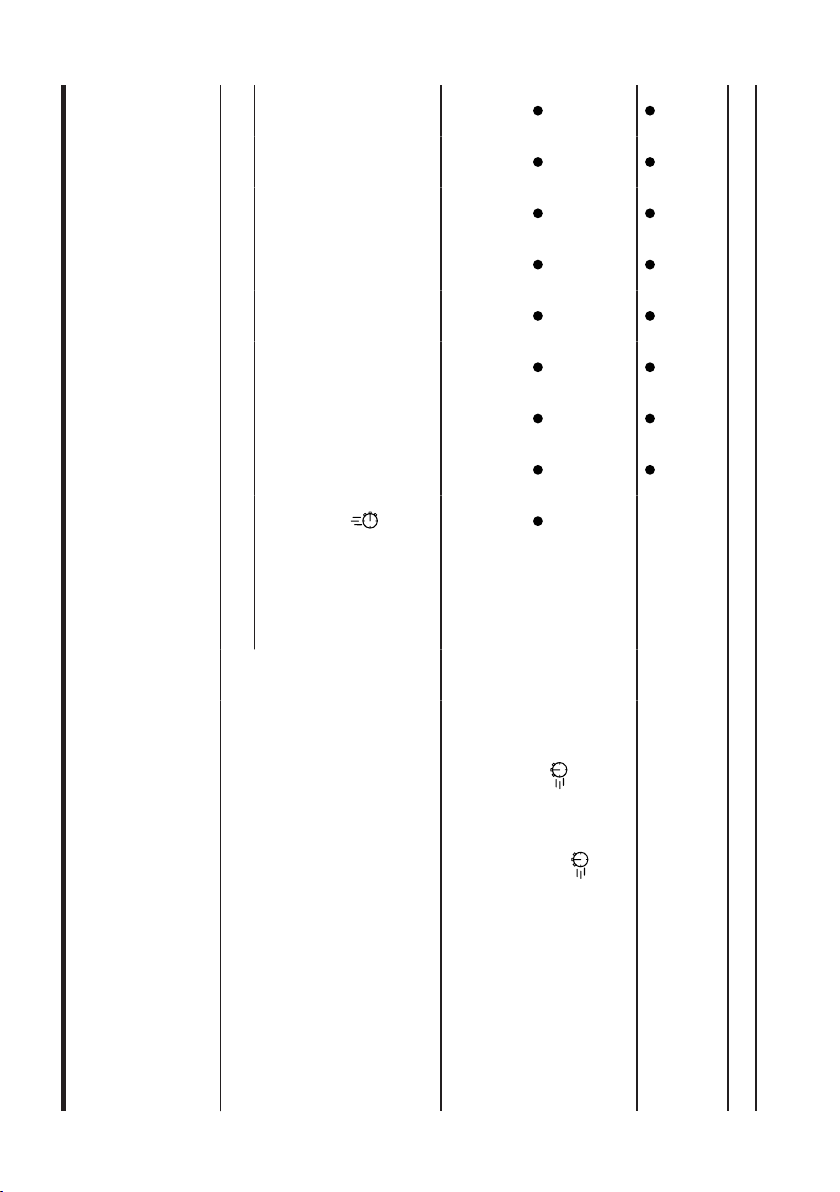
Programme Description
Max. load (kg)
Program settings
Max. temperature (°C)
1
Max. spin speed (rpm)
1
varioSpeed
stainRemoval System
Extra rinse
Rinse Hold
Prewash
Silent Wash
Soak
Water Plus
Less Ironing
Cottons Wash hard-wearing items made
from cotton, linen or blended fab-
rics.
Also suitable as a short programme
for normally soiled laundry when
you activate varioSpeed . If
varioSpeed is activated, the
maximum load capacity is reduced
to 5kg.
10 90 1600
CottonColour Wash hard-wearing items made
from cotton, linen or blended fab-
rics.
Energy-saving programme.
10 90 1600
–
1
Programme setting
en Programmes
30
Programme Description
Max. load (kg)
Program settings
Max. temperature (°C)
1
Max. spin speed (rpm)
1
varioSpeed
stainRemoval System
Extra rinse
Rinse Hold
Prewash
Silent Wash
Soak
Water Plus
Less Ironing
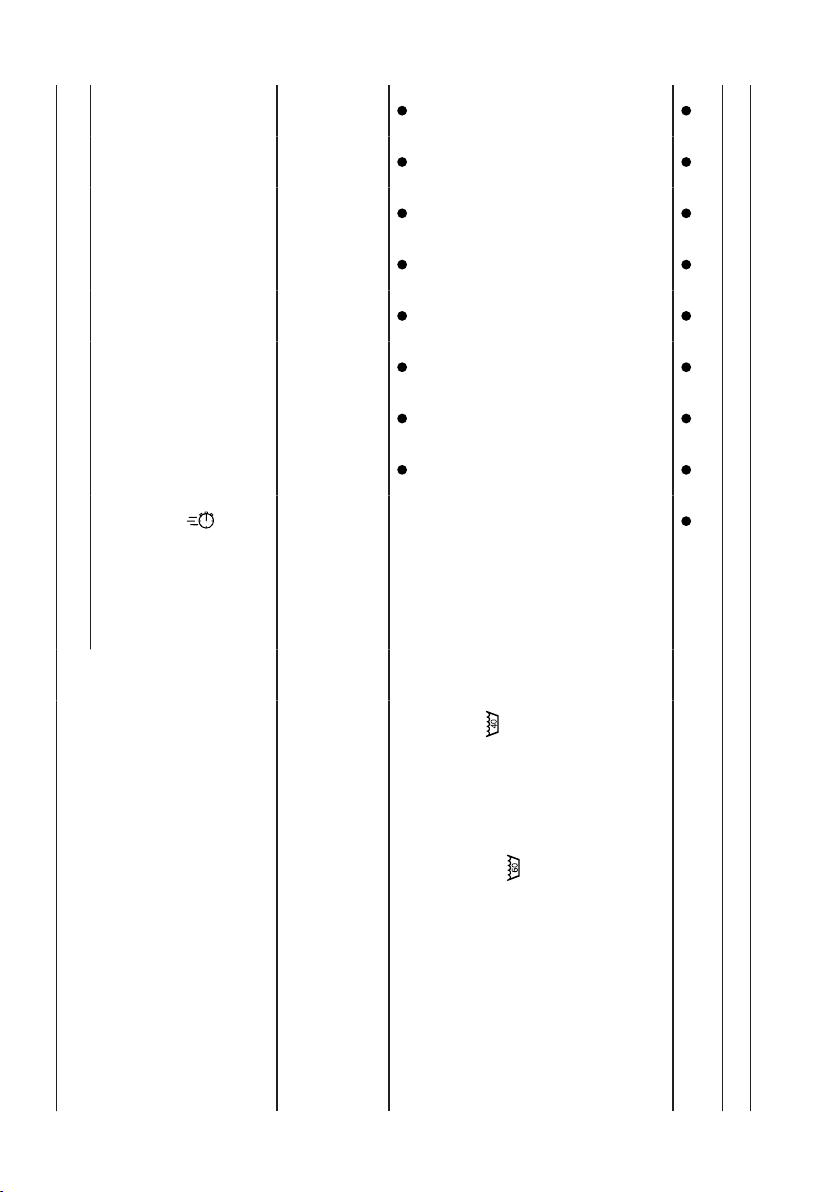
Note:To save energy, the actual
washing temperature may deviate
from the set washing temperature.
The washing performance meets
legal requirements.
Eco40-60 Wash items made from cotton,
linen or blended fabrics.
Suitable for normally soiled items.
Note:Textiles which can be
washed as per the care symbol
at 40 °C or at 60 °C can be
washed together. In order to
achieve the best possible energy ef-
ficiency, the optimum washing tem-
perature for this programme was
saved.
The washing temperature is activ-
ated and cannot be changed.
10 – 1600
–
EasyCare Wash items made from synthetic or
blended fabrics.
4 60 1200
1
Programme setting
Programmes en
31
Programme Description
Max. load (kg)
Program settings
Max. temperature (°C)
1
Max. spin speed (rpm)
1
varioSpeed
stainRemoval System
Extra rinse
Rinse Hold
Prewash
Silent Wash
Soak
Water Plus
Less Ironing
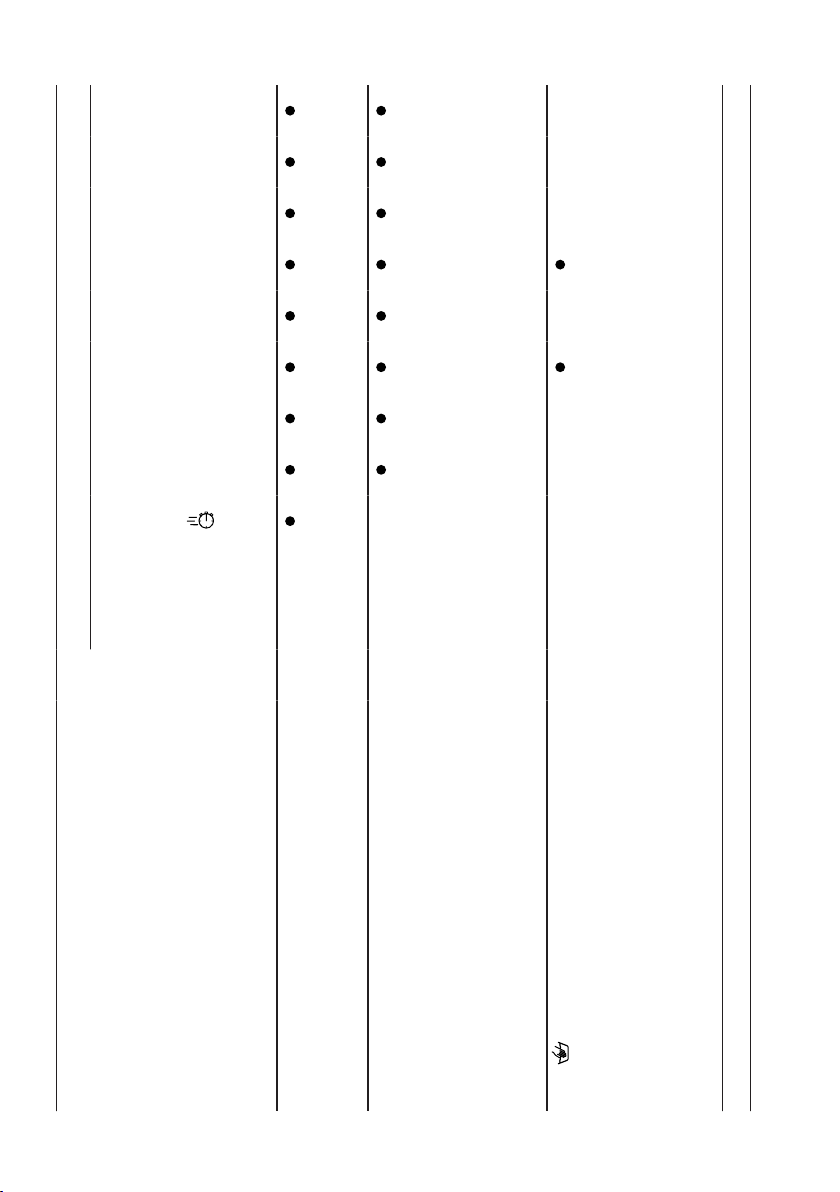
MixedFabrics Wash items made from cotton,
linen, or synthetic or blended fab-
rics.
Suitable for lightly soiled laundry.
4 60 1600
Delicate/Silk Wash delicate, washable items
made from silk, viscose and syn-
thetics.
Use a detergent that is suitable for
delicates or silk.
Note:Wash especially delicate
items or items with hooks, eyelets
or clips in a mesh laundry bag.
2 40 800
–
Wool Hand- or machine-washable items
that are made from wool or contain
wool.
To prevent the laundry from shrink-
ing, the drum moves the items very
gently with long pauses.
Use a detergent that is suitable for
wool.
2 40 800
– – – – – – –
1
Programme setting
en Programmes
32
Programme Description
Max. load (kg)
Program settings
Max. temperature (°C)
1
Max. spin speed (rpm)
1
varioSpeed
stainRemoval System
Extra rinse
Rinse Hold
Prewash
Silent Wash
Soak
Water Plus
Less Ironing
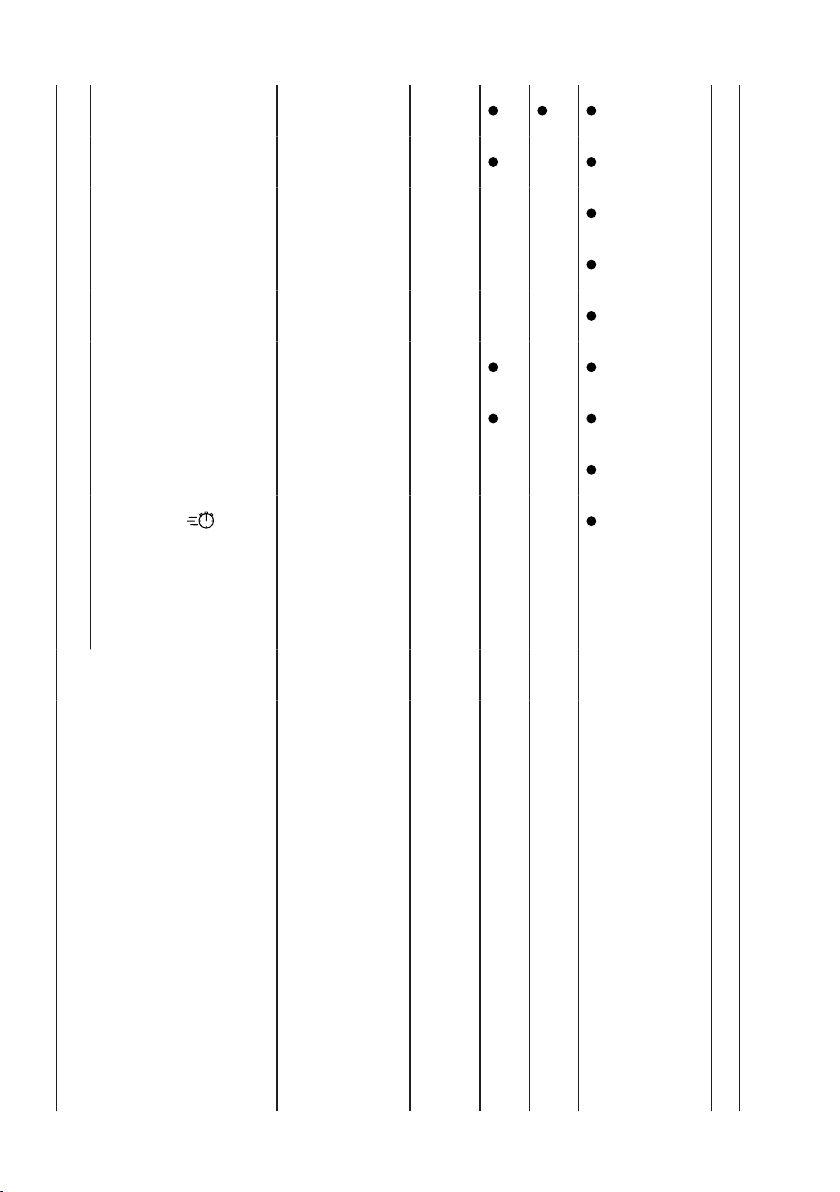
Others Set additional programmes.
The additional programmes can be
found in this programme overview.
The selectable programme settings
depend on the selected pro-
gramme.
– – – – – – – – – – – –
Drain Drains the water, e.g. when a pro-
gramme is cancelled.
Do not use fabric softener.
– – 1600
– – – – – – – – –
Rinse/Freshen
Up
Rinses and then spins the laundry,
and then drains the water.
– – 1600
– – – – –
Spin Spins and drains the water.
Do not use fabric softener.
– – 1600
– – – –
–
– – –
Dark Wash Wash dark-coloured and colour-in-
tense items made from cotton or
easy-care fabric, e.g. jeans.
Turn laundry inside-out before
washing.
Use liquid detergent.
4 40 1200
1
Programme setting
Programmes en
33
Programme Description
Max. load (kg)
Program settings
Max. temperature (°C)
1
Max. spin speed (rpm)
1
varioSpeed
stainRemoval System
Extra rinse
Rinse Hold
Prewash
Silent Wash
Soak
Water Plus
Less Ironing
Drum clean Cleaning and caring for the drum.
Use this programme in the follow-
ing cases:
¡ Before using the appliance for
the first time
¡ If you regularly wash at temper-
atures of 40°C or lower
¡ After a prolonged period of non-
use
Use washing powder or a detergent
containing bleach.
Halve the amount of detergent to
avoid foaming.
Do not use fabric softener.
Do not use liquid detergent or de-
tergent that is intended for wool-
lens or delicates.
Note:The drum cleaning indicator
will flash to remind you if you have
not used a programme at 60 °C or
higher for a long time.
– – 1200
– – – – – – – –
1
Programme setting
en Programmes
34
Programme Description
Max. load (kg)
Program settings
Max. temperature (°C)
1
Max. spin speed (rpm)
1
varioSpeed
stainRemoval System
Extra rinse
Rinse Hold
Prewash
Silent Wash
Soak
Water Plus
Less Ironing
sensoFresh For all washable items and for
items that are suitable for profes-
sional cleaning only.
Programme for freshening up dry
laundry or removing odours, e.g. ci-
garette or kitchen odours.
Dry the drum with a cloth before
loading the laundry.
Tip:The programme does not re-
move stains or sweat odours.
1 – –
– – – – – – – –
Memory Save the programme you require
and the customised programme
settings.
The selectable programme settings
depend on the selected pro-
gramme.
– – – – – – – – – – – –
Outdoor Wash all-weather and outdoor
clothing with membrane technology
and water-resistant equipment.
Use a detergent for outdoor fabrics.
Do not use fabric softener.
2 40 800
– – – –
1
Programme setting
Programmes en
35
Programme Description
Max. load (kg)
Program settings
Max. temperature (°C)
1
Max. spin speed (rpm)
1
varioSpeed
stainRemoval System
Extra rinse
Rinse Hold
Prewash
Silent Wash
Soak
Water Plus
Less Ironing
powerSpeed59' Wash items made from cotton,
linen, or synthetic or blended fab-
rics.
Suitable for lightly and normally
soiled laundry.
Optimum washing results in under
an hour.
5 40 1400
–
Hygiene Wash hard-wearing items made
from cotton, linen or blended fab-
rics.
Suitable for allergy sufferers and for
strict hygiene requirements.
Note:Once the set temperature
has been reached, it remains con-
stant throughout the washing pro-
cess.
6,5 60 1600
1
Programme setting
en Programmes
36
Programme Description
Max. load (kg)
Program settings
Max. temperature (°C)
1
Max. spin speed (rpm)
1
varioSpeed
stainRemoval System
Extra rinse
Rinse Hold
Prewash
Silent Wash
Soak
Water Plus
Less Ironing
Shirts Wash non-iron shirts and blouses
made from cotton, linen, synthetic
fibres or blended fabrics.
Tip:In order to avoid creasing in
your laundry, you can activate Less
Ironing. The laundry is only given a
short spin and can be removed
while still dripping wet. Hang out
shirts and blouses while they are
still dripping wet so that they drip
dry.
Use the Delicate/Silk programme to
wash shirts and blouses made from
silk or delicate fabrics.
2 60 800
–
Rapid15'/30' Wash items made from cotton, syn-
thetic or blended fabrics.
Short programme for small items of
lightly soiled laundry.
The programme duration is approx.
30 minutes.
4 40 1200
–
–
– – –
1
Programme setting
Programmes en
37
Programme Description
Max. load (kg)
Program settings
Max. temperature (°C)
1
Max. spin speed (rpm)
1
varioSpeed
stainRemoval System
Extra rinse
Rinse Hold
Prewash
Silent Wash
Soak
Water Plus
Less Ironing
If you wish to reduce the pro-
gramme duration to 15 minutes, ac-
tivate varioSpeed . The max-
imum load is reduced to 2kg.
1
Programme setting
en Accessories
38
Accessories
Accessories
Accessories
Only use original accessories. These have been made especially for your appli-
ance. Here you can find an overview of your appliance's accessories and how
to use them.
Use Order number
Water inlet hose extension Extend the water inlet hose for
cold water or AquaStop (approx.
2.50 m).
WZ10131
Fixing brackets Improves the stability of the ap-
pliance.
WX975600
Liquid detergent insert Measure liquid detergent. 00605740
Before using for the first time
Before using for the
first time
Before using for the first time
Prepare the appliance for use.
Starting an empty washing
cycle
Your appliance was inspected thor-
oughly before leaving the factory. To
remove any residual water, run the
first wash cycle without any laundry.
Note:Please read the information in
the "Safety" →Page4 and "Prevent-
ing material damage" →Page11 sec-
tions to ensure that you use the appli-
ance safely.
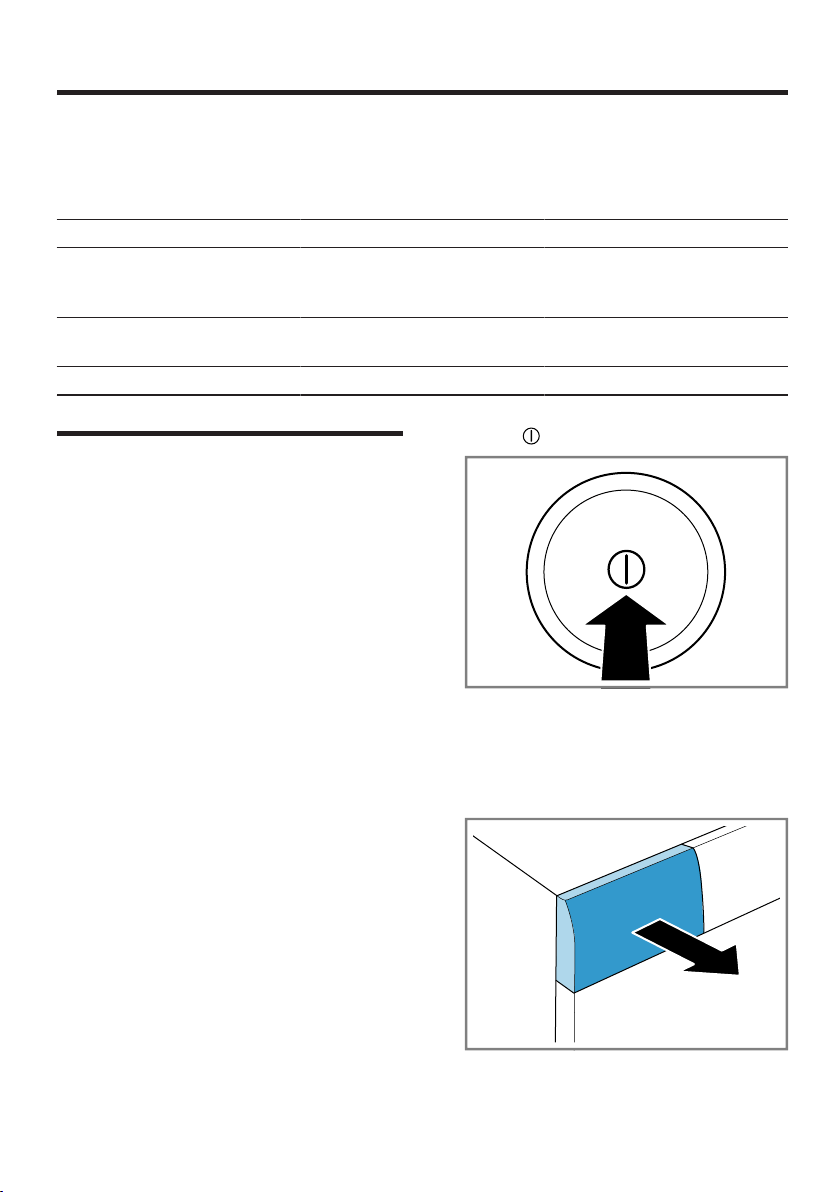
1. Press .
It may take a few seconds for the
appliance to switch on.
2. Set the Drum clean programme.
3. Close the door.
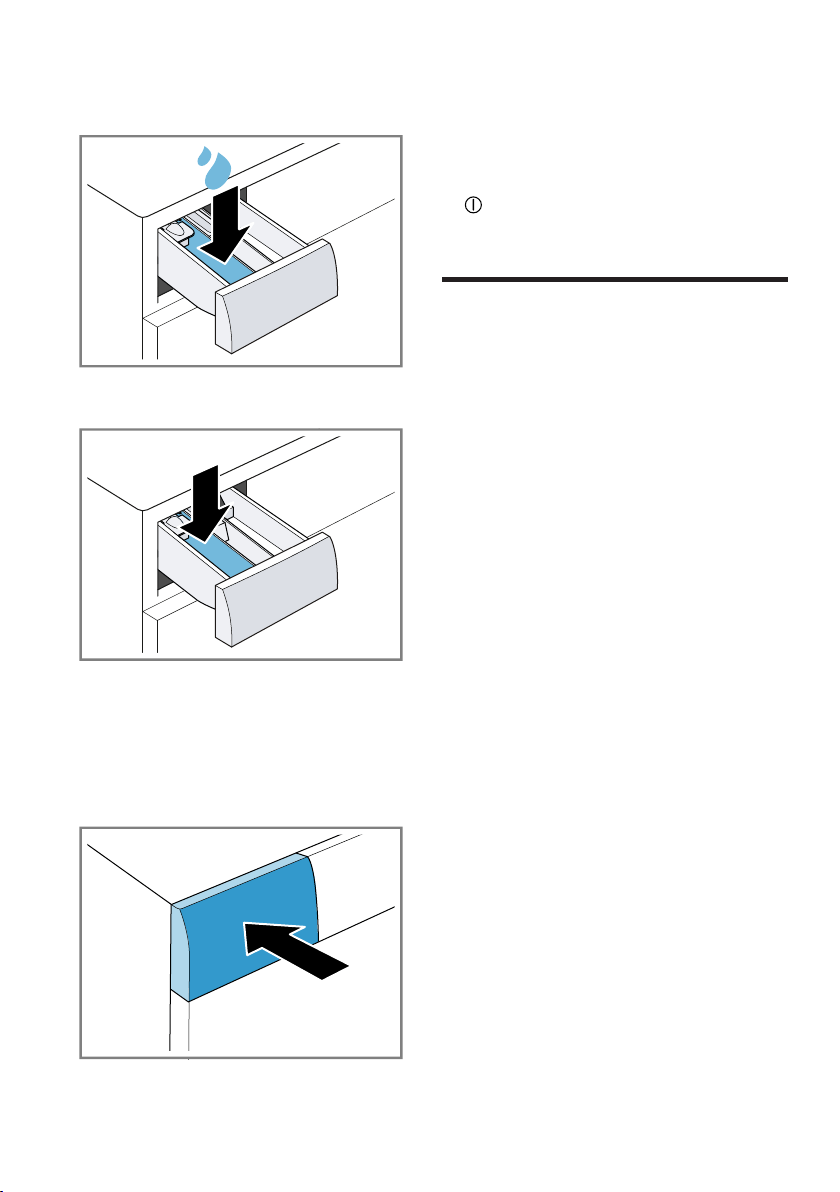
4. Pull out the detergent drawer.
Laundry en
39
5. Pour approx. 1 litre of tap water
into compartment II.
6. Pour washing powder into com-
partmentII.
To prevent foaming, use only half
of the amount of detergent recom-
mended by the detergent manufac-
turer for light soiling. Do not use
detergent suitable for woollens or
delicates.
7. Push in the detergent drawer.
8. Press Start/Reload to start the pro-
gramme.
a The display shows the remaining
programme duration.
9. Start the first wash cycle or press
to switch off the appliance.
→"Basic operation", Page43
Laundry
Laundry
Laundry
You can wash all items that the man-
ufacturer has marked as machine-
washable on the care label and fab-
rics made from hand-washable wool
using your appliance.
To remove odours, you can also
simply freshen up fabrics using act-
ive oxygen.
Preparing the laundry
ATTENTION!
Objects remaining in the laundry may
damage the laundry and the drum.
▶
Remove all items from any pock-
ets in your laundry before using
the appliance.
▶
To protect your appliance and the
laundry, prepare the laundry be-
forehand.
– Empty all pockets
– Brush sand out of all collars and
pockets
– Close bed covers and cushion
covers
– Close all zips, Velcro fasteners,
hooks and eyes
– Tie cloth belts and apron strings
together or use a mesh laundry
bag
– Remove curtain hooks and lead
strips or use a mesh laundry
bag
– Use a mesh laundry bag for
small items of laundry such as
children's socks
en Laundry
40
– Separate items of laundry and
shake them out
– Wash large and small items of
laundry together
– Dab fresh stains with soapy wa-
ter (do not rub them)
– Some stubborn or dried-in stains
can be removed by washing
several times
Sorting laundry
Note:Please read the information in
the "Safety" →Page4 and "Prevent-
ing material damage" →Page11 sec-
tions to ensure that you use the appli-
ance safely.
▶
To improve washing results and
prevent discolouration, sort the
laundry according to the following
criteria before washing.
– Type of fabric and fibre type
– Whites
– Colours
Wash new coloured items
separately the first time you
wash them.
– "Soiling" →Page40
– "Care symbols on the care la-
bels" →Page40
Freshening up laundry
Note
Observe the following information to
freshen up the laundry:
¡ Suitable for all items, including
items marked by the manufacturer
on the care label as suitable for
dry cleaning, such as suits, jackets
and trousers
¡ Not suitable for removing stains,
sweat and sweat odours
These items of laundry need to be
washed.
¡ Only freshen up dry laundry
¡ After freshening up the laundry,
shake it out briefly
Degrees of soiling
Degree of soiling Soiling Examples
Light ¡ No dirt or stains are visible
¡ Laundry has absorbed odours
Light summer clothing or sports
clothing that has been worn for a
just a few hours
Normal Dirt or light stains are visible ¡ T-shirts, shirts or blouses are
sweat-soaked or have been
worn a few times
¡ Towels or bedding that has
been used for up to one week
Heavy Dirt or stains are clearly visible Tea towels, baby items or work
clothing
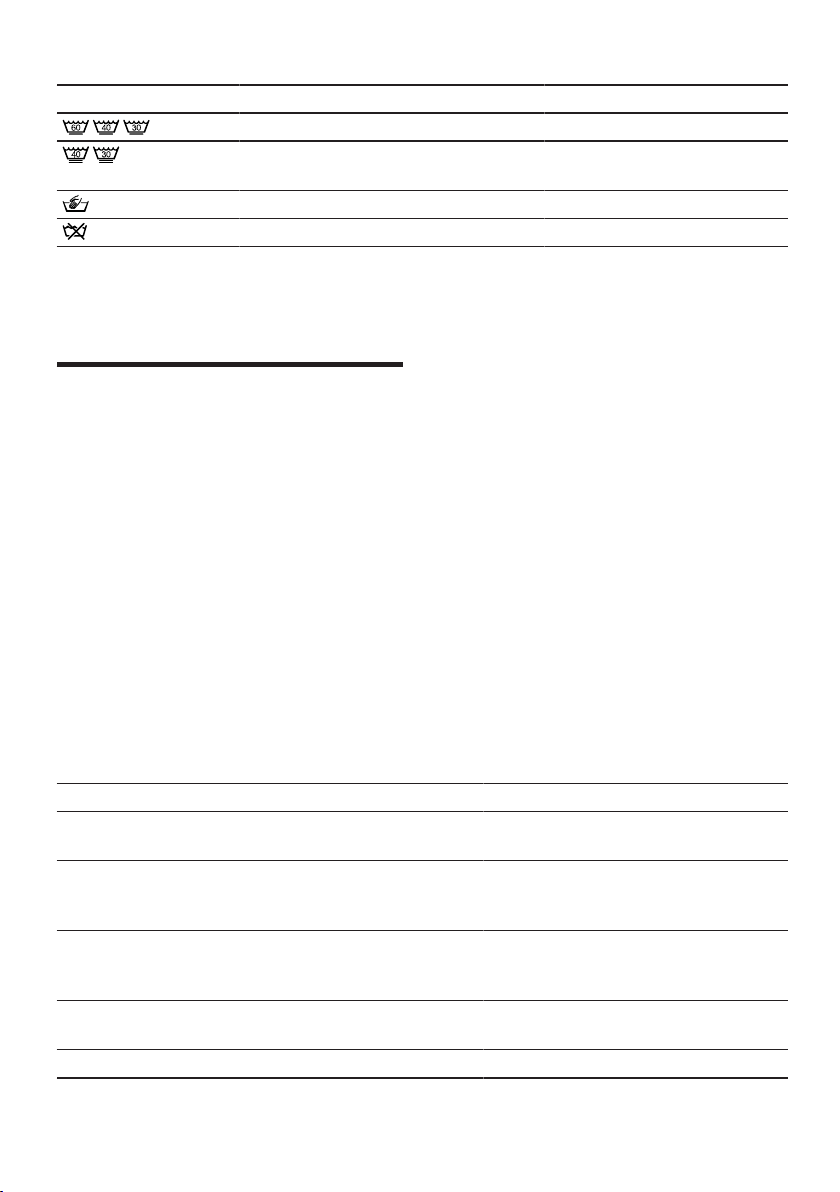
Care symbols on the care labels
The symbols indicate the recommended programme and the numbers in the
symbols indicate the maximum recommended washing temperature.
Symbol Washing process Recommended programme
Normal Cottons
Detergents and care products en
41
Symbol Washing process Recommended programme
Gentle Easy Care
Particularly gentle Delicates/Silk for washing by
hand
Hand wash Wool
Not suitable for machine-washing –
Tip:You can find more information
about care symbols at www.gine-
tex.ch.
Detergents and care products
Detergents and care
products
Detergents and care products
You can protect your appliance and
your laundry by selecting and using
the correct detergents and care
products. You can use all detergents
and care products which are suitable
for domestic washing machines.
Note:Please read the information in
the "Safety" →Page4 and "Prevent-
ing material damage" →Page11 sec-
tions to ensure that you use the appli-
ance safely.
The manufacturer's instructions for
use and dosage can be found on the
packaging.
Notes
¡ Only use liquid detergents that are
self-flowing
¡ Do not mix different liquid deter-
gents
¡ Do not mix detergent and fabric
softener
¡ Do not use products which have
developed a top layer or are highly
congealed
¡ Do not use products containing
solvents, caustic agents or volatile
substances (e.g. bleach)
¡ Use dyes sparingly as salt may
damage stainless steel
¡ Do not use bleaching agents in the
appliance
Detergent recommendation
This information helps you to choose the right detergent for your fabrics.
Detergent Fabrics Programme Temperature
Standard detergent with op-
tical brighteners
Heat-resistant white fabrics
made from cotton or linen
Cottons From cold up to 90°C
Detergent for colours
without bleach or optical
brighteners
Coloured fabrics made from
linen or cotton
Cottons From cold up to 60°C
Detergent for colours/delic-
ates without optical bright-
eners
Coloured fabrics made from
easy-care fibres or synthetic
materials
Easy Care From cold up to 60°C
Detergent for delicates Delicate fabrics made from
silk or viscose
Delicates/Silk From cold up to 40°C
Detergent for woollens Wool Wool From cold up to 40°C

en Detergents and care products
42
Tip:Visit www.cleanright.eu to find
further information on detergents,
care products and cleaning agents
for domestic use.
Detergent dosage
Use the correct detergent dosage to
achieve optimal washing results and
save resources.
The detergent dosage depends on:
¡ The amount of laundry
¡ Degree of soiling
¡ Water hardness
You can find out how hard your
water is from your local water com-
pany or measure it yourself using
a water hardness tester.
Water hardness
Hardness range Total hardness in mmol/l German degrees in °dH
soft (I) 0–1.5 0–8.4
medium (II) 1.5– 2.5 8.4–14
hard (III) over 2.5 over 14
Example of a manufacturer's
instructions for detergent
These example values refer to a
standard load of 4–5 kg.
Soiling Light Normal Heavy
Water hardness: Soft/medium 40ml 55ml 80ml
Water hardness: Hard/very hard 55ml 80ml 105ml
The dosages can be found on the
manufacturer's packaging.
¡ Adjust the dosage to the actual
load.
Basic operation en
43
Basic operation
Basic operation
Basic operation
You can find out everything you need
to know about operating your appli-
ance here.
Switching on the appliance
▶
Press .
It may take a few seconds for the
appliance to switch on.
Note:The drum is lit up after the
door is opened and closed and once
the programme has started. The light
goes out automatically.
Setting a programme
1. Set the programme selector to the
required "programme" →Page29.
2. If necessary, "adjust the pro-
gramme settings" →Page43.
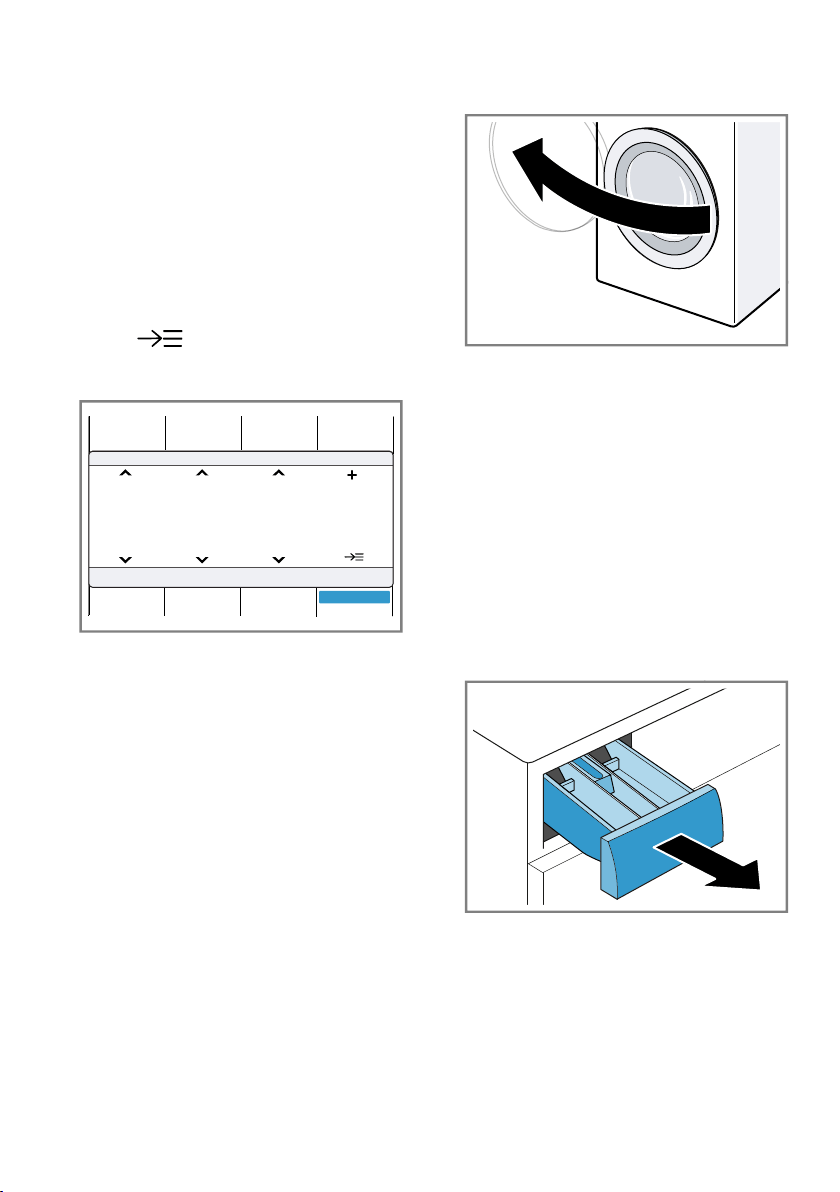
Setting additional programmes
1. Set the Others programme.
2. Press to call up the sub-
menu for additional programmes.
3. Select a programme.
4. Press Main menu to call up the
main menu.
5. Adjust the programme settings if
required.
6. Start the programme.
Adjusting the programme set-
tings
Depending on the programme and
programme progress, you can adjust
or activate/deactivate the settings.
Note:Overview of all programme set-
tings:
→"Buttons", Page26
Requirement:A programme has
been set.
▶
Adjust the programme settings.
→"Operating logic", Page22
The programme settings are not
saved permanently for the pro-
gramme.
Adjusting additional programme
settings
1. Press Options to call up the sub-
menu for the additional pro-
gramme settings.
en Basic operation
44
2. Select the programme settings.
The programme settings are not
saved permanently for the pro-
gramme.
3. Press Options to call up the main
menu.
Saving the programme set-
tings
1. Set the Memory programme.
2. Press to call up the sub-
menu for the memory pro-
grammes.
3. Select a programme.
4. Press Main menu to call up the
main menu.
5. Adjust the programme settings if
required.
a The programme is saved.
Loading laundry
Notes
¡ Please read the information in the
"Safety" →Page4 and "Preventing
material damage" →Page11 sec-
tions to ensure that you use the
appliance safely.
¡ To prevent creasing, take note of
the maximum load for the relevant
"programme" →Page29.
Requirement:Prepare and sort the
laundry.
→"Laundry", Page39
1. Open the door.
2. Ensure that the drum is empty.
3. Separate the laundry and place it
in the drum.
4. Note:Ensure that there is no laun-
dry trapped in the door.
Close the door.
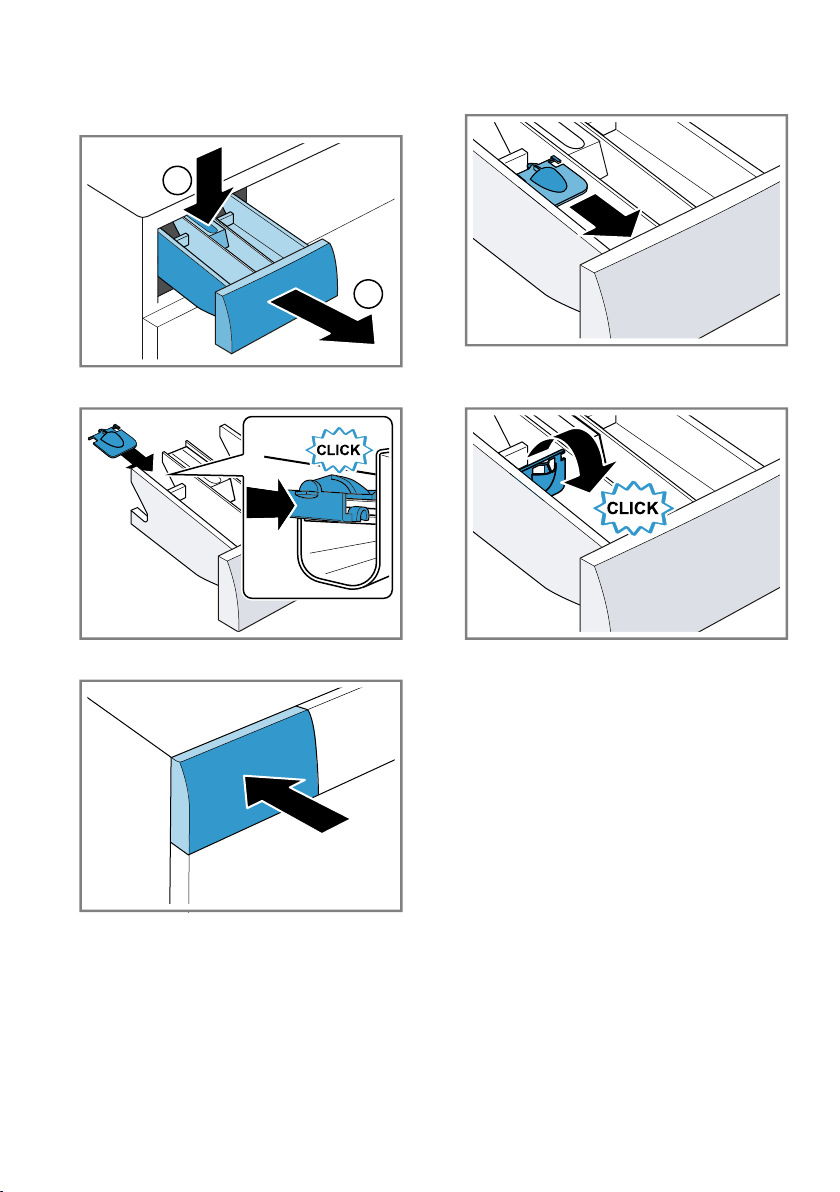
Using a measuring aid for li-
quid detergent
If you order the measuring aid as an
accessory, you must use the measur-
ing aid.
1. Pull out the detergent drawer.
Basic operation en
45
2. Press down on the insert and re-
move the detergent drawer.
1
2
3. Insert the measuring aid.
4. Insert the detergent drawer.
Use the measuring aid for li-
quid detergent
To add liquid detergent, you can use
a measuring aid in the detergent
drawer.
1. Pull out the detergent drawer.
2. Slide the measuring aid forwards.
3. Fold the measuring aid down and
click it into place.
4. Push in the detergent drawer.
Adding detergent and care
product
Notes
¡ Please read the information in the
"Safety" →Page4 and "Preventing
material damage" →Page11 sec-
tions to ensure that you use the
appliance safely.
¡ Do not use the measuring aid for
liquid detergent for gel detergents,
washing powder, or if Prewash or
"Ready in" time are activated.
Requirement:Find out the optimum
dosage for "detergent and care
product." →Page41
1. Pull out the detergent drawer.

en Basic operation
46
2. Pour in detergent.
→"Detergent drawer", Page21
3. If required, add the care product.
4. Push in the detergent drawer.
Starting the programme
Note:If you want to change the time
until the programme ends, set the
"Ready in" time first.
▶
Press Start/Reload.
a The drum rotates and load detec-
tion takes place. This can take up
to 2 minutes, after which water
enters the drum.
a The display shows either the pro-
gramme duration or the "Ready in"
time.
a If you start a programme with act-
ive oxygen, the drum lights up
after the programme starts and the
mist that is created can be seen.
Adding laundry
Notes
¡ Please read the information in the
"Safety" →Page4 and "Preventing
material damage" →Page11 sec-
tions to ensure that you use the
appliance safely.
¡ If you a start a programme with
active oxygen, you cannot add any
laundry after the programme has
started.
1. Press Start/Reload.
The appliance is paused and
checks whether it is possible to
add or remove laundry.
2. Add or remove laundry.
3. Close the door.
4. Press Start/Reload.
Cancelling the programme
Once the programme has started,
you can cancel it at any time.
Note:Please read the information in
the "Safety" →Page4 and "Prevent-
ing material damage" →Page11 sec-
tions to ensure that you use the appli-
ance safely.
1. Press Start/Reload.
2. Open the door.
The appliance door remains
locked for safety reasons if the
temperature and water levels are
high.
– If the temperature is high, start
the Rinse/Freshen Up pro-
gramme.
– If the water level is high: Start
the Spin or Drain programme.
3. Remove the laundry.
Resuming the programme
when the programme status
is Rinse Hold
1. Set the Spin or Drain programme.
2. Press Start/Reload.
Unloading the laundry
Note:Please read the information in
the "Safety" →Page4 and "Prevent-
ing material damage" →Page11 sec-
tions to ensure that you use the appli-
ance safely.
1. Open the door.
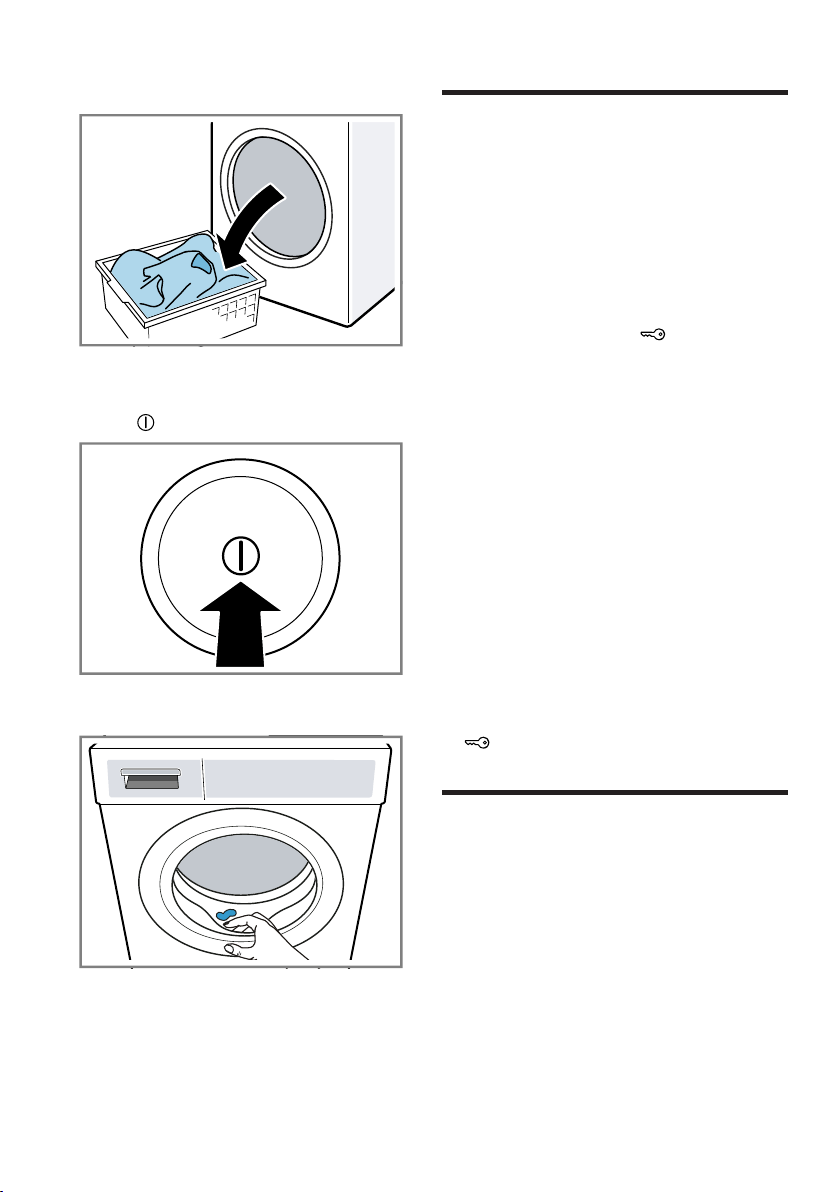
Childproof lock en
47
2. Remove the laundry.
Switching off the appliance
1. Press .
2. Wipe the rubber gasket dry and re-
move any foreign objects.
3. Leave the door and detergent
drawer open so that residual water
can evaporate.
Childproof lock
Childproof lock
Childproof lock
Secure your appliance against being
operated unintentionally using the
controls.
Activating the childproof lock
▶
Press and hold the two ChildLock
3sec. buttons for approx.
3seconds.
a The display shows .
a The controls are locked.
a The childproof lock remains active
even after the appliance has been
switched off.
Deactivating the childproof
lock
Requirement:To deactivate the
childproof lock, the appliance must
be switched on.
▶
Press and hold the two ChildLock
3sec. buttons for approx.
3seconds.
So that the programme currently
running is not cancelled, the pro-
gramme selector must be set to
the initial programme.
a goes out in the display.
HomeConnect
HomeConnect
HomeConnect
This appliance is network-capable.
Connecting your appliance to a mo-
bile device lets you control its func-
tions via the HomeConnect app, ad-
just its basic settings and monitor its
operating status.
The HomeConnect services are not
available in every country. The avail-
ability of the HomeConnect function
depends on the availability of
en HomeConnect
48
HomeConnect services in your coun-
try. You can find information about
this at: www.home-connect.com.
¡ →"Connecting the appliance to a
WLAN home network (Wi-Fi) with
WPS function", Page48
¡ →"Connecting the appliance to a
WLAN home network (Wi-Fi)
without WPS function", Page49
The HomeConnect app guides you
through the entire login process. Fol-
low the instructions in the HomeCon-
nect app to configure the settings.
Tips
¡ Please consult the documents sup-
plied by HomeConnect.
¡ Please also follow the instructions
in the HomeConnect app.
Notes
¡ Please note the safety precautions
in this instruction manual and
make sure that they are also ob-
served when operating the appli-
ance via the HomeConnect app.
→"Safety", Page4
¡ Operating the appliance on the ap-
pliance itself always takes priority.
During this time it is not possible
to operate the appliance using the
HomeConnect app.
HomeConnect settings
Adapt HomeConnect to your needs.
You can find the HomeConnect set-
tings in the basic settings for your ap-
pliance. Which settings the display
shows will depend on whether
HomeConnect has been set up and
whether the appliance is connected
to your home network.
Connecting the appliance to a
WLAN home network (Wi-Fi)
with WPS function
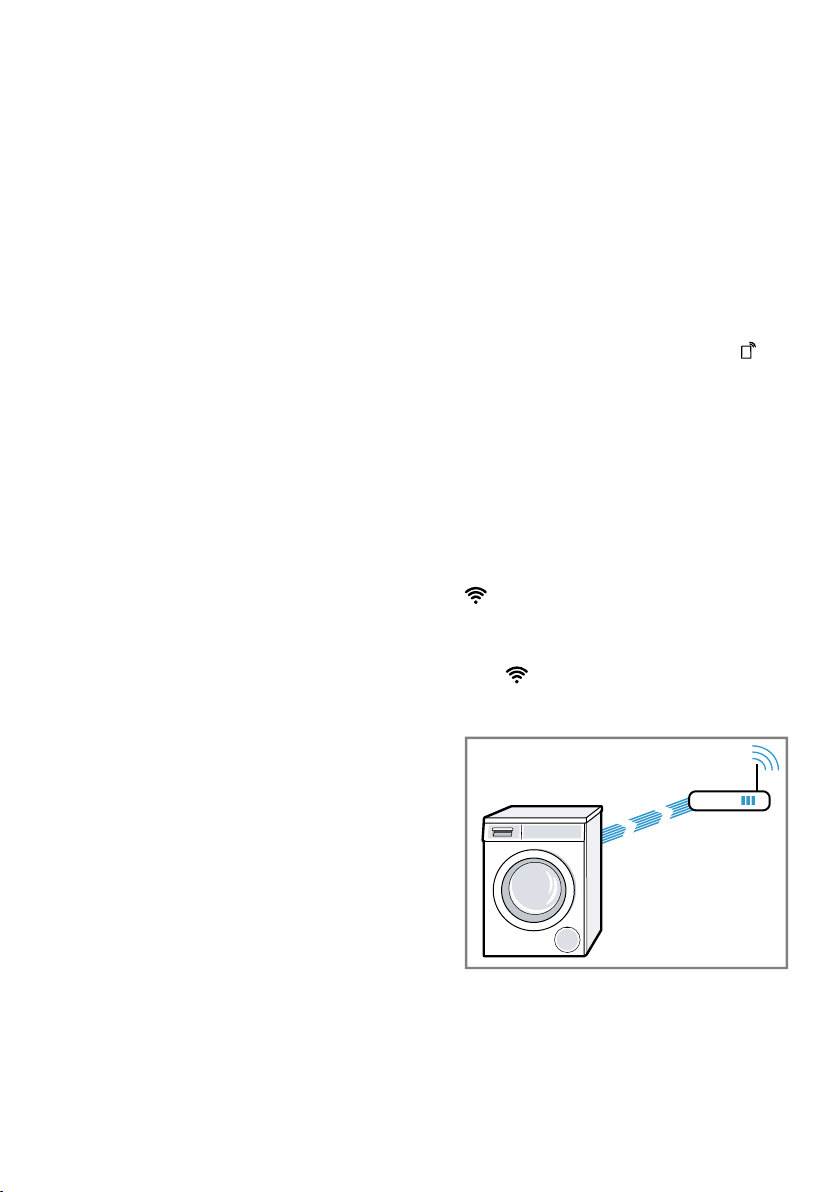
Using your router's WPS function is
the simplest way to connect the ap-
pliance to your home network.
Requirement:If your router has a
WPS function, you can connect the
appliance to your WLAN home net-
work (Wi-Fi) automatically.
1. Press and hold Remote Start for
approx. 3 seconds.
a You are now in the Home Connect
menu.
2. Select Connect.
3. Confirm the message in the dis-
play.
4. Press the WPS button on the
router within the next 2minutes.
Take note of the information in the
documents for your router.
a flashes in the display.
a The appliance attempts to connect
to your WLAN home network.
a If the display shows Connected
and lights up permanently, the
appliance is connected to the
home network.
5. "Connect your appliance to the
Home Connect app." →Page49
HomeConnect en
49
Connecting the appliance to a
WLAN home network (Wi-Fi)
without WPS function
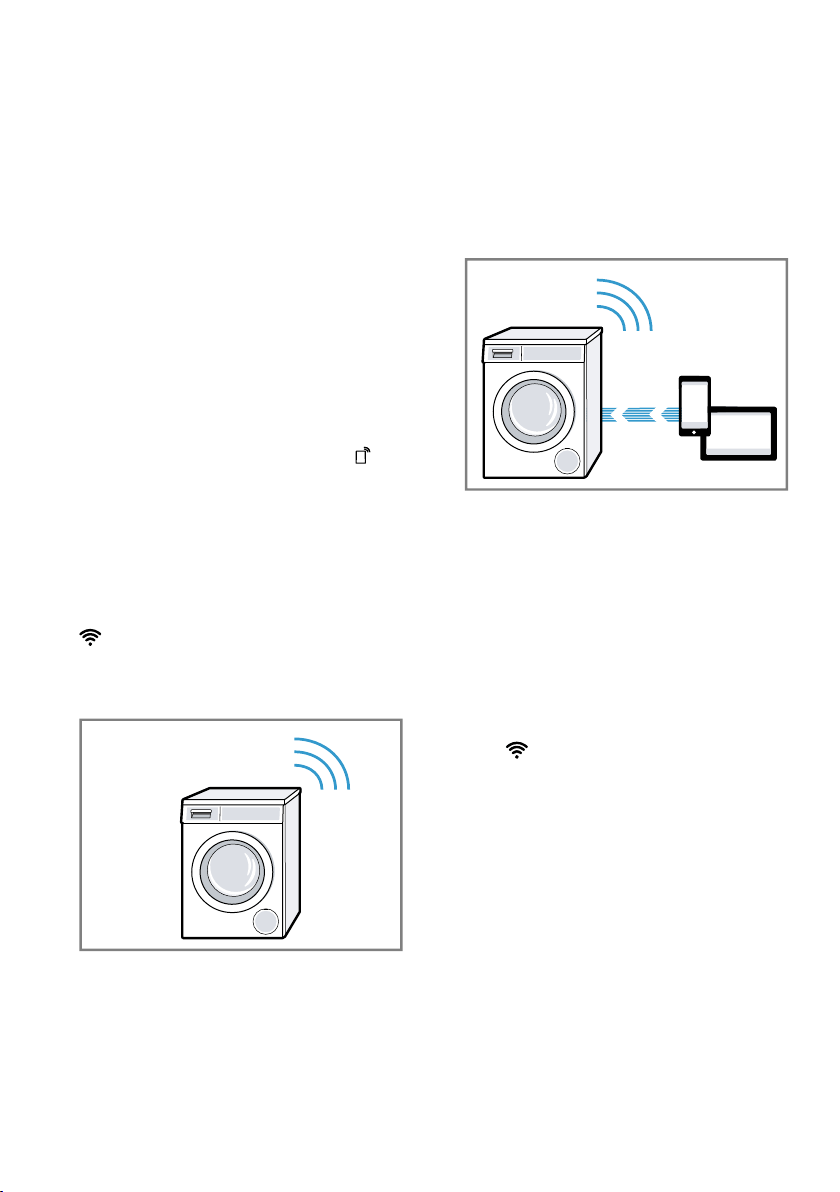
If your router does not have a WPS
function, you can connect the appli-
ance to your WLAN home network
(Wi-Fi) manually. The appliance
quickly sets up its own Wi-Fi network.
You can connect a mobile device to
the WLAN network and transfer the
network information for the WLAN
home network (Wi-Fi) to your appli-
ance.
Requirement:The HomeConnect
app is open and you have logged on.
1. Press and hold Remote Start for
at least 3seconds.
a You are now in the Home Connect
menu.
2. Select Man. network log-in.
3. Select Connect
4. Confirm the message in the dis-
play.
a flashes in the display.
a The appliance now sets up its own
Wi-Fi network with the name (SSID)
HomeConnect.
5. Call up the Wi-Fi settings on the
mobile device.
Connect the mobile device to the
Home Connect Wi-Fi network and
enter the password (key) Home-
Connect.
a Your mobile device now connects
to the appliance. The connection
process may take up to
60seconds.
6. Open the HomeConnect app on
your mobile device and carry out
the steps in the app.
7. In the HomeConnect app, enter
the network name (SSID) and
password (key) for your home net-
work.
8. Carry out the steps in the
HomeConnect app to connect the
appliance.
a If the display shows Connected
and lights up permanently, the
appliance is connected to the
home network.
9. "Connect your appliance to the
Home Connect app" →Page49.
Connecting your appliance to
the Home Connect app
Requirements
¡ The appliance is connected to the
WLAN home network (Wi-Fi).
¡ The HomeConnect app is open
and you have logged on.
1. Select Connect app.
2. Select Connect to the app.

en HomeConnect
50
3. Confirm the message in the dis-
play.
a The appliance connects to the
HomeConnect app.
4. Once your appliance is displayed
in the HomeConnect app, carry
out the last steps in the
HomeConnect app.
a If the display shows Connected,
the appliance is connected to the
HomeConnect app.
Connecting the appliance to
the energy manager
If you connect the appliance to the
smart energy system (energy man-
ager), you will optimise your energy
consumption. The appliance starts
only when your home photovoltaic
system can provide sufficient energy
or the energy tariff is good.
Requirements
¡ The smart energy system (energy
manager) must use the EEBus Initi-
ative communications standard.
¡ You have read about how to con-
nect your appliance to the smart
energy system (energy manager)
in the instruction manual for the
smart energy system (energy man-
ager).
1. Press and hold Remote Start for
approx. 3 seconds.
2. Select energy mngmt..
3. Select Connect.
4. Confirm the message in the dis-
play.
a The appliance is connected to the
smart energy system (energy man-
ager)
a If the appliance has connected to
the energy manager successfully,
the display shows .
5. Activate Flex Start if you want the
smart energy system (energy man-
ager) to start up your appliance.
→"Activate Flex Start", Page50
Activate Flex Start
Activate Flex Start to allow your smart
energy system (energy manager) to
start your appliance once your home
photovoltaic system is able to
provide sufficient energy or the en-
ergy tariff is good.
Requirement:The smart energy sys-
tem (energy manager) cannot start
your appliance until it is connected to
the appliance.
1. Set the programme you require.
2. Press Ready In to set the required
time.
3. Press Start/Reload.
a The display shows Delayed start.
4. Press Remote Start .
a If the display shows Flex Start,
Flex Start is activated and the ap-
pliance waits to be started by the
smart energy system (energy man-
ager).
a If the display changes to : Ready
in approx., the smart energy sys-
tem (energy manager) has estab-
lished a time at which your appli-
ance can start.
a If the smart energy system (energy
manager) does not start the appli-
ance within the set time, the appli-
ance will start the programme itself
before the set time period ends.
The programme ends when the
time period ends.
Note
Flex Start is deactivated for safety
reasons in the following circumstances:
¡ Press Start/Reload.
¡ Open the door.
¡ Switch off the appliance.
¡ Power failure.

HomeConnect en
51
Activating Wi-Fi on the appli-
ance
Note:When Wi-Fi is activated, the en-
ergy consumption increases in com-
parison to the values specified in the
consumption value table.
1. Press and hold Remote Start for
approx. 3 seconds.
2. Select Wi-Fi on/off.
3. Select on.
a Wi-Fi is activated.
Note:If Wi-Fi is activated, the appli-
ance will not switch itself off automat-
ically.
Deactivating Wi-Fi on the ap-
pliance
1. Press and hold Remote Start for
at least 3seconds.
2. Select Wi-Fi on/off.
3. Select off.
a Wi-Fi is deactivated
Note:If Wi-Fi is switched off and your
appliance was previously connected
to your home network, this connec-
tion will be re-established automatic-
ally when Wi-Fi is switched back on.
Software update
Requirement:The display shows A
new software version is available.
Do you want to update the software
now? This may take several
minutes..
1. Press and hold Remote Start for
approx. 3 seconds.
2. Select Softwareupdate.
3. Select Install now.
a The software update starts.
Note:The software update may take
several minutes. Do not switch off the
appliance while the software update
is in progress.
Resetting the appliance net-
work settings
1. Press and hold Remote Start for
at least 3seconds.
2. Select Network settings.
3. Select Reset.
a The network settings are reset.
Tip:If you wish to operate your appli-
ance again via the HomeConnect
app, you will need to reconnect it to
the Wi-Fi and to the HomeConnect
app.
Remote diagnostics
Customer Service can use Remote
Diagnostics to access your appliance
if you contact them, have your appli-
ance connected to the HomeCon-
nect server and if Remote Dia-
gnostics is available in the country in
which you are using the appliance.
Tip:For further information and de-
tails about the availability of Remote
Diagnostics in your country, please
visit the service/support section of
your local website: www.home-con-
nect.com
Data protection
Please see the information on data
protection.
The first time your appliance is
registered on a home network
connected to the Internet, your
en Basic settings
52
appliance will transmit the following
types of data to the HomeConnect
server (initial registration):
¡ Unique appliance identification
(consisting of appliance codes as
well as the MAC address of the
Wi-Fi communication module in-
stalled).
¡ Security certificate of the Wi-Fi
communication module (to ensure
a secure data connection).
¡ The current software and hardware
version of your appliance.
¡ Status of any previous reset to
factory settings.
This initial registration prepares the
HomeConnect functions for use and
is only required when you want to
use the HomeConnect functions for
the first time.
Note:Please note that the
HomeConnect functions can only be
utilised with the HomeConnect app.
Information on data protection can be
retrieved in the HomeConnect app.
Declaration of Conformity
BSH Hausgeräte GmbH hereby de-
clares that the appliance with Home
Connect functionality meets the es-
sential requirements and other relev-
ant provisions of the Directive
2014/53/EU.
A detailed RED Declaration of Con-
formity can be found online at
www.siemens-home.bsh-group.com
among the additional documents on
the product page for your appliance.
2.4GHz band: 100mW max.
5GHz band: 100mW max.
BE BG CZ DK DE EE IE EL
ES FR HR IT CY LV LT LU
HU MT NL AT PL PT RO SI
SK FI SE UK NO CH TR
5GHz WLAN (Wi-Fi): For indoor use only.
Basic settings
Basic settings
Basic settings
You can configure the appliance to
meet your needs.
Overview of the basic settings
Below is an overview of the basic set-
tings on the appliance.
Basic setting Description
end signal Set the volume of the
signal at the end of
the programme.
Basic setting Description
button signal The volume of the
audible signal emitted
when the buttons are
pressed.
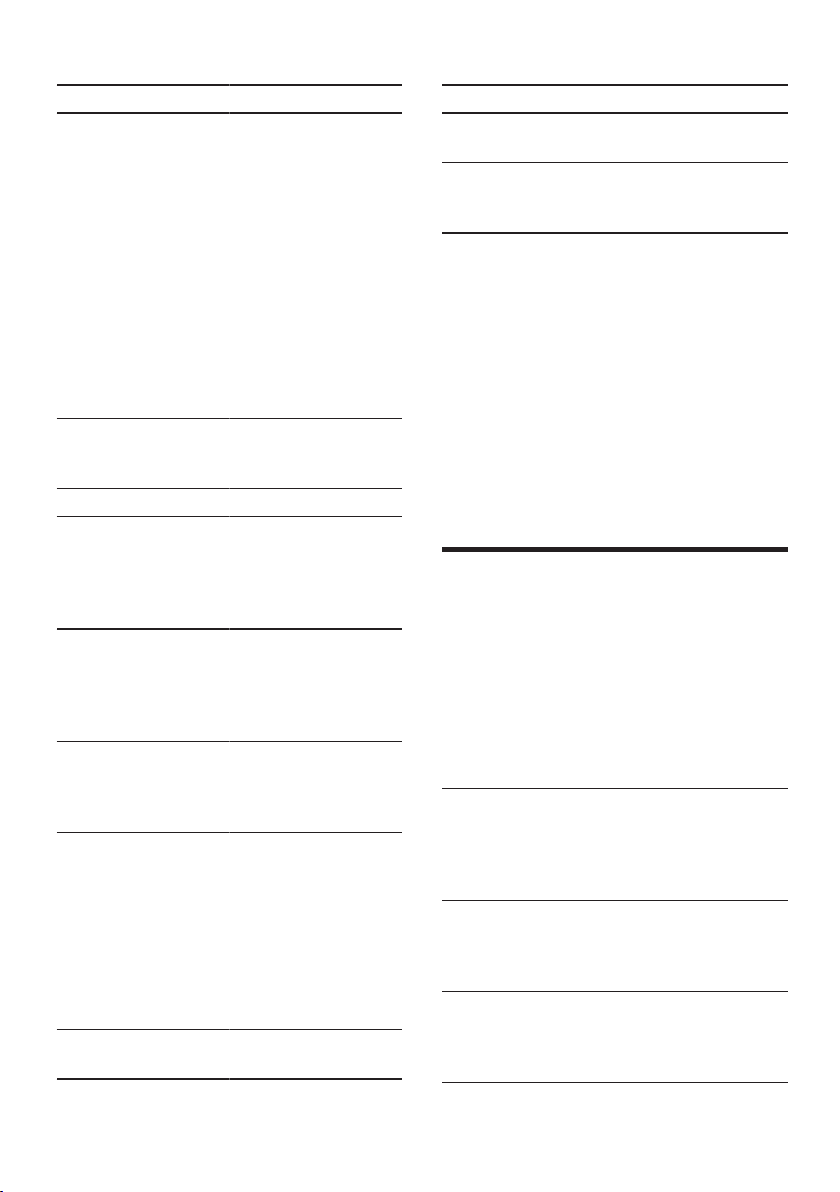
Cleaning and servicing en
53
Basic setting Description
auto power-off Activate or deactivate
the "Automatic switch-
off" function for the
appliance or set the
time after which the
appliance automatic-
ally switches itself off.
→"Save energy and
conserve resources",
Page12
Note:If Wi-Fi is activ-
ated, the appliance
will not switch itself
off automatically.
Drum clean advice Activate or deactivate
the reminder to clean
the drum.
Language Set the language.
Aut. network log-in "Connect the appli-
ance to a WLAN home
network (Wi-Fi) with
WPS function"
→Page48
Man. network log-in "Connect the appli-
ance to a WLAN home
network (Wi-Fi)
without WPS func-
tion." →Page49
Connect app "Connect your appli-
ance to the Home
Connect app"
→Page49.
Wi-Fi on/off Activate or deactivate
Wi-Fi.
→"Activating Wi-Fi on
the appliance",
Page51
→"Deactivating Wi-Fi
on the appliance",
Page51
Softwareupdate "Install the software
update." →Page51
Basic setting Description
Network settings "Reset the network
settings." →Page51
energy mngmt. "Connect the appli-
ance to the energy
manager." →Page50
Changing the basic settings
1. To call up the basic settings for
the sub-menu, press and hold both
buttons Basic Settings 3sec. for
approx. 3 seconds.
2. Select the required basic setting.
→"Overview of the basic settings",
Page52
3. Adjust the basic setting.
4. Press Basic Settings 3sec. to call
up the main menu.
Cleaning and servicing
Cleaning and servicing
Cleaning and servicing
To keep your appliance working effi-
ciently for a long time, it is important
to clean and maintain it carefully.
Tips on appliance care
Follow the tips for appliance care to
ensure your appliance works cor-
rectly in the long term.
Wipe down the hous-
ing and the control
panel with nothing but
water and a damp
cloth.
The appliance parts
remain clean and hy-
gienic.
Remove all detergent
residue, spray residue
or other residues im-
mediately.
Fresh deposits are
easier to remove
without leaving any
residue.
Keep the appliance
door and detergent
drawer open after
use.
This allows the resid-
ual water to dry, redu-
cing odours in the ap-
pliance.
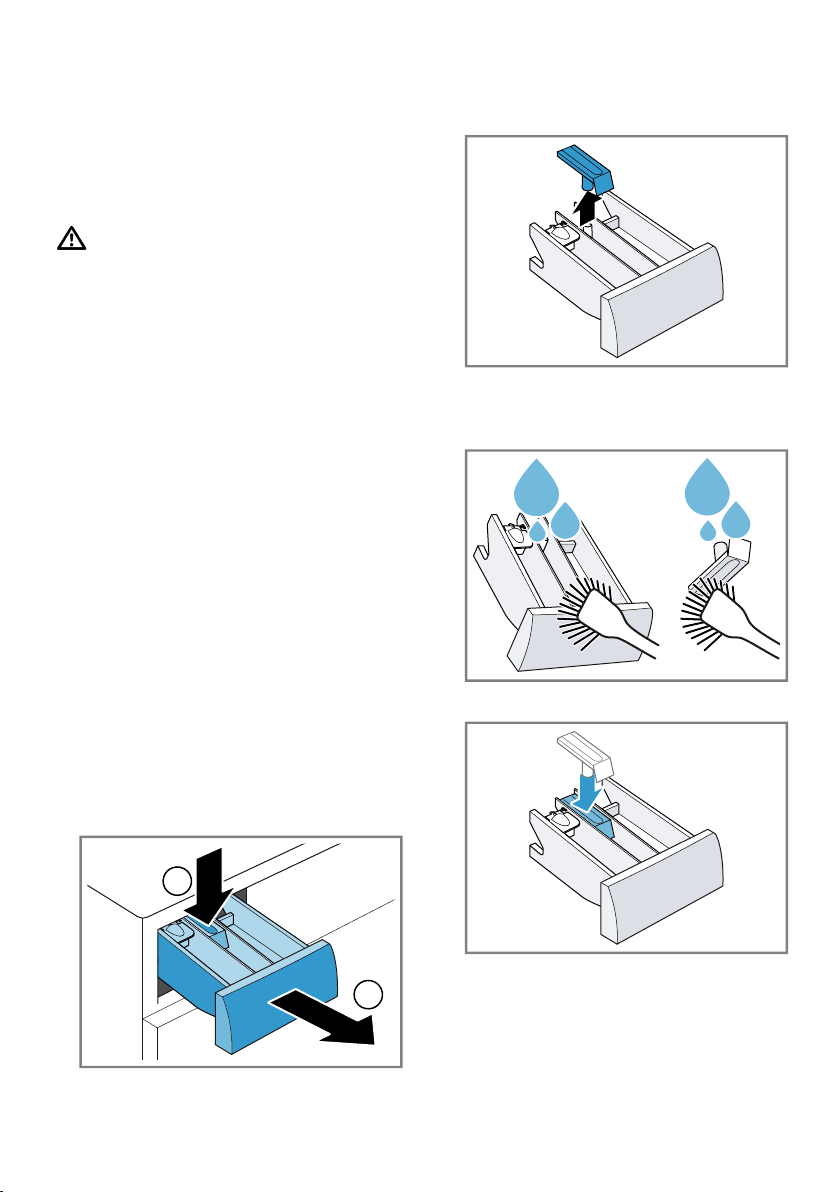
en Cleaning and servicing
54
Cleaning the drum
If you often wash at a washing tem-
perature of 40°C and lower or the
appliance has not been used for a
long period, clean the drum.
CAUTION
Risk of injury!
Permanently washing at low temper-
atures and a lack of ventilation for
the appliance may damage the drum
and cause injury.
▶
Regularly run a programme for
cleaning the drum or wash at tem-
peratures of at least 60°C.
▶
Leave the appliance to dry after
every operation with the door
open, and leave the detergent
drawer to dry.
▶
Run the Drum clean programme
without laundry.
Add washing powder.
Cleaning the detergent drawer
Note:Please read the information in
the "Safety" →Page4 and "Prevent-
ing material damage" →Page11 sec-
tions to ensure that you use the appli-
ance safely.
1. Pull out the detergent drawer.
2. Press down on the insert and re-
move the detergent drawer.
1
2
3. Press out the insert upwards from
below.
4. Clean the detergent drawer and in-
sert with water and a brush, and
then dry them.
5. Fit the insert and lock it into place.
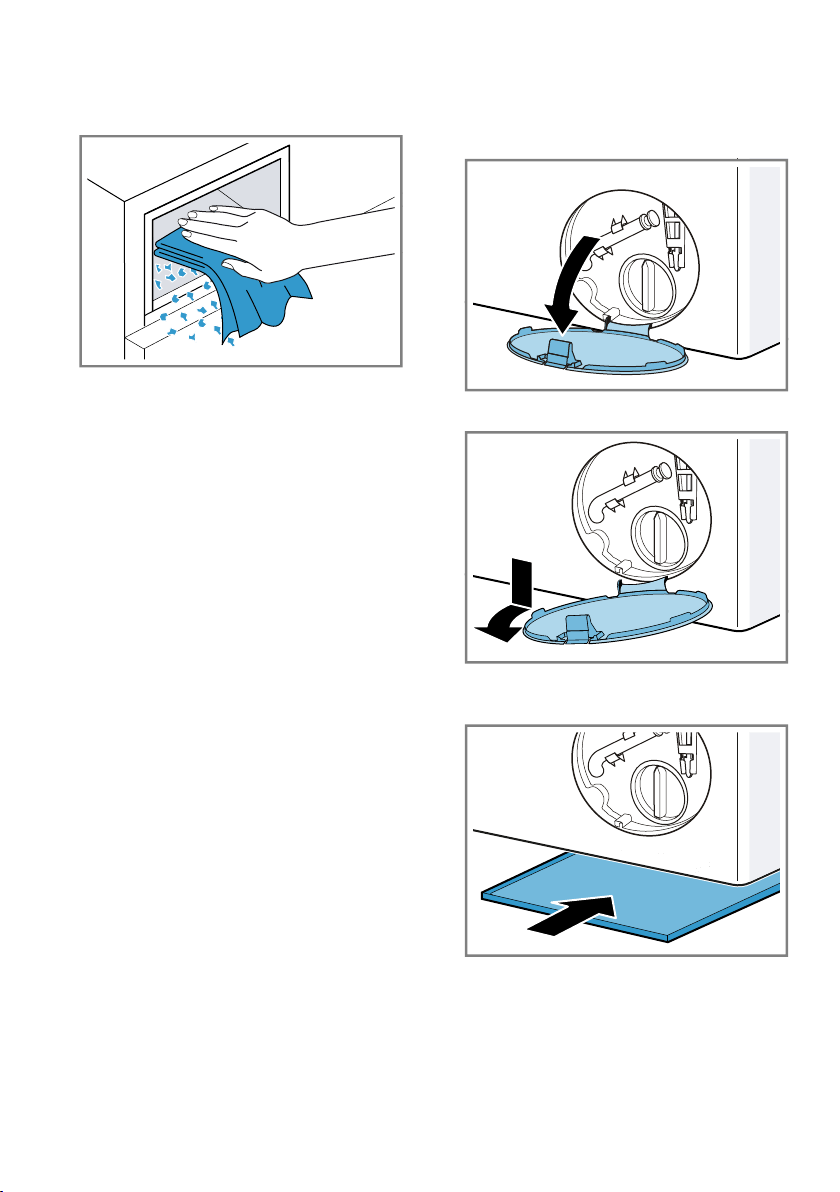
Cleaning and servicing en
55
6. Cleaning the opening for the deter-
gent drawer.
7. Push in the detergent drawer.
Descaling
If you add detergent correctly, you do
not need to descale your appliance.
If you still wish to use descaler, follow
the manufacturer's instructions for
use.
ATTENTION!
The use of unsuitable descaling
agents, e.g. for coffee machines, may
damage the appliance.
▶
For this appliance, only use de-
scaling agents that are available
from the manufacturer's website or
our after-sales service.
Cleaning the drain pump
Clean the drain pump in the event of
faults, e.g. blockages or rattling
noises.
Emptying the drain pump
Note:Please read the information in
the "Safety" →Page4 and "Prevent-
ing material damage" →Page11 sec-
tions to ensure that you use the appli-
ance safely.
1. Turn off the water tap.
2. Switch off the device.
3. Disconnect the appliance's mains
plug from the power supply.
4. Open the maintenance flap.
5. Remove the maintenance flap.
6. Slide a receptacle under the open-
ing.
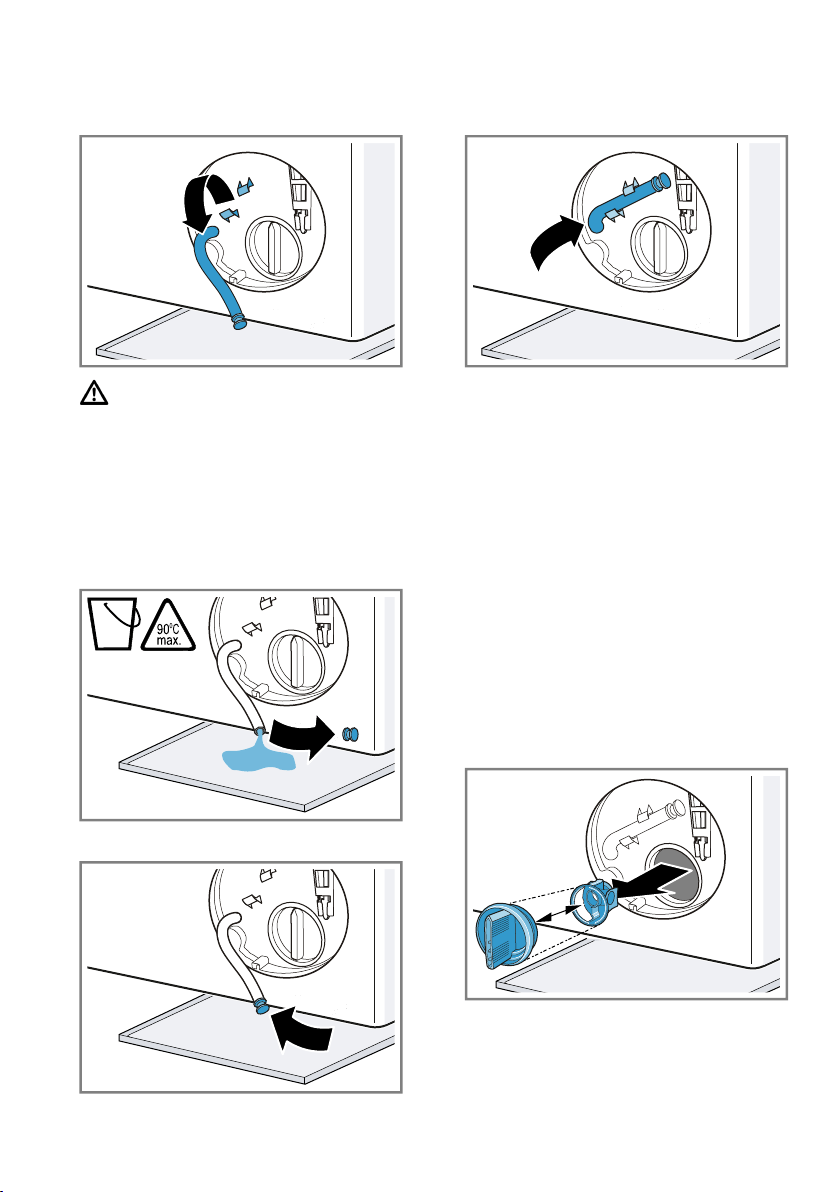
en Cleaning and servicing
56
7. Take the drain hose out of the
holder.
8.
CAUTION-Risk of scalding!
When you wash at high temperat-
ures, the detergent solution gets
hot.
▶
Do not touch the hot detergent
solution.
To allow the detergent solution to
flow out into the container, remove
the sealing cap.
9. Firmly press on the sealing cap.
10.Insert the drain hose into the
holder.
Cleaning the drain pump
Note:Please read the information in
the "Safety" →Page4 and "Prevent-
ing material damage" →Page11 sec-
tions to ensure that you use the appli-
ance safely.
Requirement:"The drain pump is
empty." →Page55
1. Since water may remain in the
drain pump, remove the pump cap
carefully.
‒ The filter insert in the pump
housing may become stuck due
to coarse particles of dirt.
Loosen the dirt and remove the
filter insert.
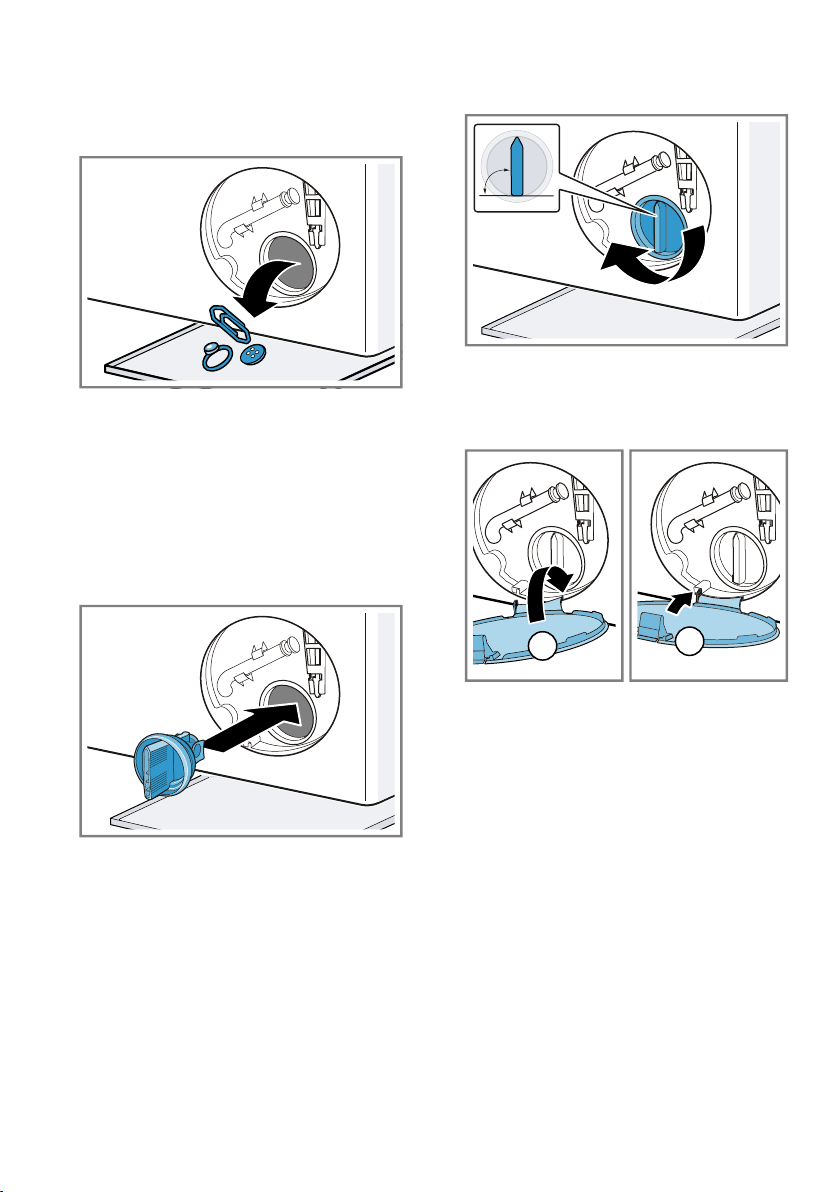
Cleaning and servicing en
57
2. Clean the interior, the thread on
the pump cap and the pump hous-
ing.
The pump cap is comprised of two
parts which can be taken apart for
cleaning.
3. Make sure that the impeller in the
drain pump can be rotated.
4. Insert the pump cap.
‒ Ensure that the parts of the
pump cap are correctly as-
sembled.
5. Screw on the pump cap.
90°
The handle on the pump cap must
be in a vertical position.
6. Insert the maintenance flap and
lock it into place.
1
2
7. Close the maintenance flap.
Before the next wash
To prevent unused detergent from
flowing straight into the outlet in the
next wash, run the Drain programme
after you have emptied the drain
pump.
1. Turn on the tap.
2. Insert the mains plug.
3. Switch on the appliance.
4. Pour 1litre of water into compart-
ment II.
5. Start the Drain programme.
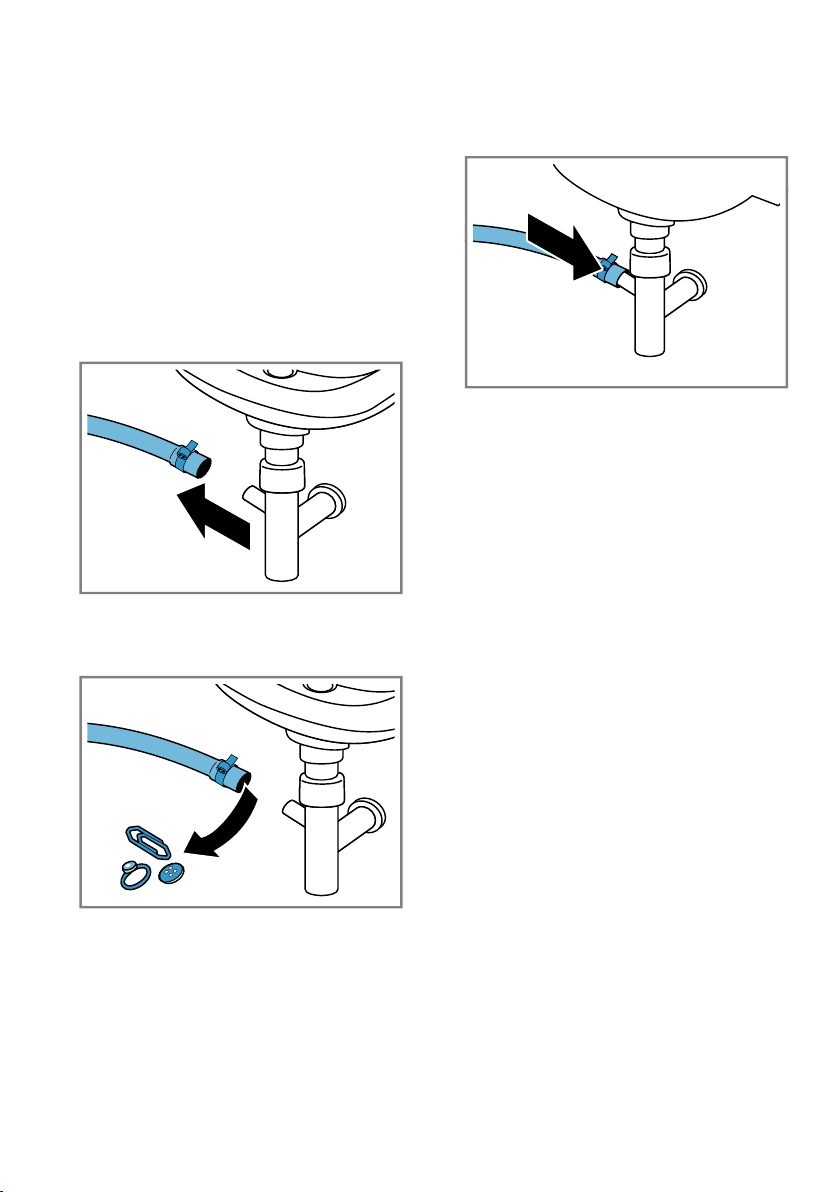
en Cleaning and servicing
58
Cleaning the water outlet
hose at the siphon
If the water outlet hose at the siphon
is dirty or the detergent solution is
not being pumped out, you must
clean these.
1. Switch off the appliance.
2. Disconnect the appliance's mains
plug from the power supply.
3. Loosen the hose clamp and care-
fully remove the water outlet hose.
Residual water may leak out.
4. Clean the water outlet hose and si-
phon connecting piece.
5. Reattach the water outlet hose and
secure the connection point using
the hose clamp.
Cleaning the water inlet filter
Clean the filter in the water inlet in
the event of blockages or if the water
pressure is too low.
Emptying the water inlet hose
In order to clean the filter, first empty
the water inlet hose.
1. Turn off the tap.
2. Set a programme, except for
Rinse/Freshen Up, Spin or Drain.
3. Start the programme and leave it
to run for approx. 40seconds.
4. Switch off the appliance.
5. Disconnect the appliance's mains
plug from the power supply.
Cleaning the filter on the tap
Note:Please read the information in
the "Safety" →Page4 and "Prevent-
ing material damage" →Page11 sec-
tions to ensure that you use the appli-
ance safely.
Requirement:The water inlet hose is
empty.

Cleaning and servicing en
59
1. Remove the water inlet hose from
the tap.
2. Clean the filter with a small brush.
3. Connect the water inlet hose and
check for leaks.
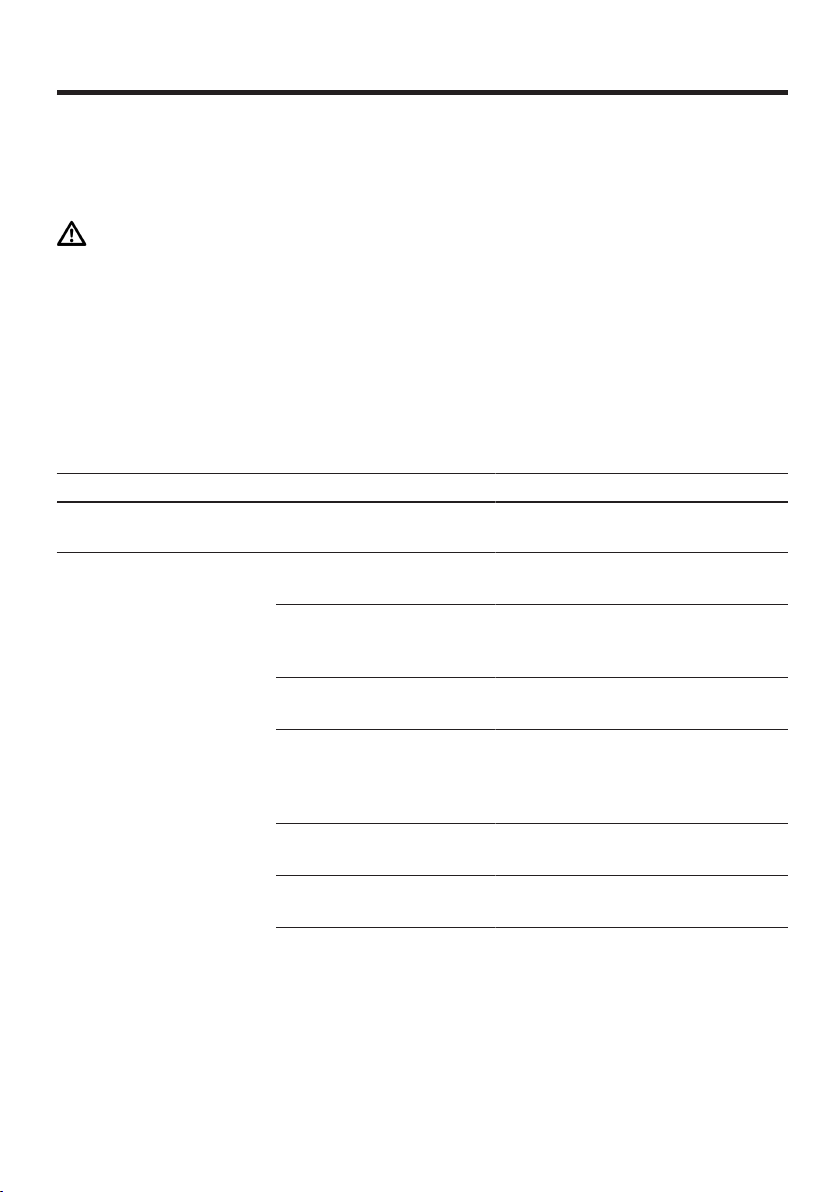
en Troubleshooting
60
Troubleshooting
Troubleshooting
Troubleshooting
You can rectify minor faults on your appliance yourself. Read the troubleshoot-
ing information before contacting after-sales service. This will avoid unneces-
sary costs.
WARNING
Risk of electric shock!
Incorrect repairs are dangerous.
▶
Repairs to the appliance should only be carried out by trained specialist
staff.
▶
Only use genuine spare parts when repairing the appliance.
▶
If the power cord of this appliance is damaged, it must be replaced by the
manufacturer, the manufacturer's Customer Service or a similarly qualified
person in order to prevent any risk.
Error code / Fault display / Signal
Fault Cause troubleshooting
The display goes out and
Start/Reload flashes.
Energy-saving mode is act-
ive
▶
Press any button.
a The symbol lights up again.
"E:30 / -80" Drain pipe or water outlet
hose is blocked.
▶
Clean the drain pipe and the water
outlet hose.
Drain pipe or water drain
hose is caught or jammed.
▶
Ensure that the drain pipe and wa-
ter drain hose are not kinked or
trapped.
Drain pump is blocked.
▶
→"Cleaning the drain pump",
Page55
The water outlet hose is con-
nected too high.
▶
Install the water outlet hose at a
maximum height of 1 metre.
→"Technical specifications",
Page74
Pump cover is not correctly
assembled.
▶
Correctly assemble the pump
cover.
Pump cover is not correctly
assembled.
▶
Correctly assemble the pump
cover.
Detergent dosage is too
high.
▶
Immediate measure: Mix one table-
spoon of fabric softener with 0.5
litres of water and pour the mixture
into the left-hand compartment (not
for outdoor clothing, sportswear or
items stuffed with down).
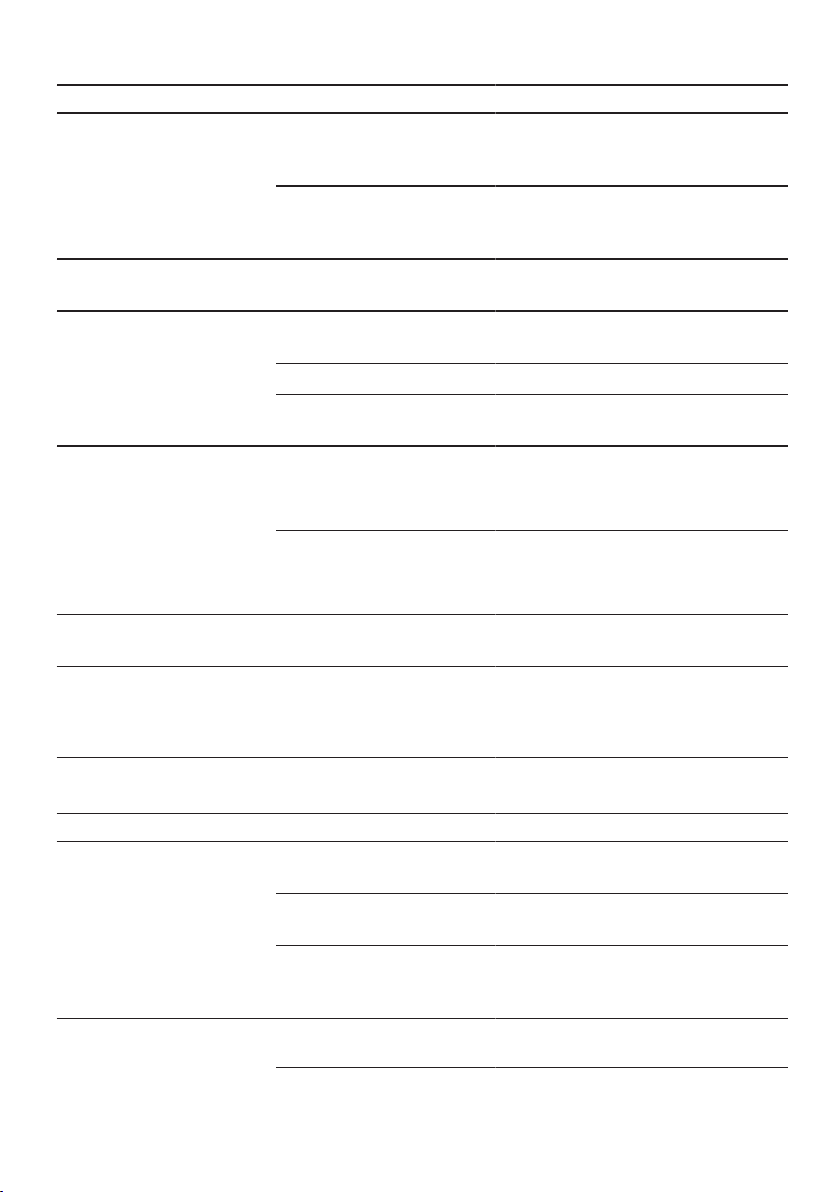
Troubleshooting en
61
Fault Cause troubleshooting
"E:30 / -80"
▶
Reduce the amount of detergent for
the next washing cycle with the
same load.
Unapproved extension in-
stalled on the water drain
hose.
▶
Remove any unapproved exten-
sions from the water hose. Connect-
ing the appliance
"E:36 / -25 / -26" Drain pump is blocked.
▶
→"Cleaning the drain pump",
Page55
"E:10 / -10" The filter in the water inflow
is blocked.
▶
"Clean the water inflow filter"
→Page58.
The tap is turned off.
▶
Turn on the tap.
The water inlet hose is
kinked or jammed.
▶
Ensure that the water inlet hose is
not kinked or jammed.
"E:35 / -10" There is water in the base
trough.
▶
Turn off the water tap.
▶
Call the after-sales service.
→"Customer Service", Page71
The appliance is leaking.
▶
Turn off the water tap.
▶
Call the after-sales service.
→"Customer Service", Page71
All other error codes. Malfunction
▶
Call the after-sales service.
→"Customer Service", Page71
Water cooling To protect the wastewater
pipes, the hot detergent
solution is cooled before be-
ing drained.
▶
Wait until the detergent solution
has cooled down.
Malfunctions
Fault Cause troubleshooting
The appliance is not work-
ing.
The mains plug of the power
cord is not plugged in.
▶
Connect the appliance to the power
supply.
The circuit breaker is faulty.
▶
Check the circuit breaker in the
fuse box.
There has been a power cut.
▶
Check whether the lighting in your
kitchen or other appliances are
working.
The programme does not
start.
You have not pressedStart/
Reload.
▶
Press Start/Reload.
Door is not closed. 1. Close the door.
en Troubleshooting
62
Fault Cause troubleshooting
The programme does not
start.
2. Press Start/Reload to start the pro-
gramme.
Childproof lock is activated.
▶
→"Deactivating the childproof
lock", Page47
Ready In is activated.
▶
Check whether Ready In is activ-
ated.
→"Buttons", Page26
Laundry is caught in the
door.
1. Open the door again.
2. Remove any trapped laundry.
3. Close the door.
4. Press Start/Reload to start the pro-
gramme.
The door cannot beopened. Rinse Hold is activated.
▶
Continue the programme by select-
ing Spin or Drain and pressing
Start/Reload.
→"Resuming the programme when
the programme status is Rinse
Hold", Page46
The temperature is too high.
▶
Wait until the temperature has
dropped.
▶
→"Cancelling the programme",
Page46
Water level is too high.
▶
Start the Drainprogramme.
Programme with active oxy-
gen has been stopped; the
active oxygen is removed.
▶
Wait until there is no active oxygen
in the drum.
Power failure.
▶
Open the door using the emergency
release.
→"Emergency release", Page69
The water is not draining. Drain pipe or water outlet
hose is blocked.
▶
Clean the drain pipe and the water
outlet hose.
Drain pipe or water drain
hose is caught or jammed.
▶
Ensure that the drain pipe and wa-
ter drain hose are not kinked or
trapped.
Drain pump is blocked.
▶
→"Cleaning the drain pump",
Page55
Rinse Hold is activated.
▶
Continue the programme by select-
ing Spin or Drain and pressing
Start/Reload.
Troubleshooting en
63
Fault Cause troubleshooting
The water is not draining. →"Resuming the programme when
the programme status is Rinse
Hold", Page46
The water outlet hose is con-
nected too high.
▶
Install the water outlet hose at a
maximum height of 1 metre.
→"Technical specifications",
Page74
Pump cover is not correctly
assembled.
▶
Correctly assemble the pump
cover.
Pump cover is not correctly
assembled.
▶
Correctly assemble the pump
cover.
Detergent dosage is too
high.
▶
Immediate measure: Mix one table-
spoon of fabric softener with 0.5
litres of water and pour the mixture
into the left-hand compartment (not
for outdoor clothing, sportswear or
items stuffed with down).
▶
Reduce the amount of detergent for
the next washing cycle with the
same load.
Unapproved extension in-
stalled on the water drain
hose.
▶
Remove any unapproved exten-
sions from the water hose. Connect-
ing the appliance
Water is not flowing in. De-
tergent is not being dis-
pensed.
You have not pressedStart/
Reload.
▶
Press Start/Reload.
The filter in the water inflow
is blocked.
▶
"Clean the water inflow filter"
→Page58.
The tap is turned off.
▶
Turn on the tap.
The water inlet hose is
kinked or jammed.
▶
Ensure that the water inlet hose is
not kinked or jammed.
The spin cycle runs several
times.
The unbalanced load detec-
tion system eliminates an im-
balance by repeatedly redis-
tributing the laundry.
▶
Not a fault – no action required.
Note:When loading, where possible,
place large and small items of laundry
together in the drum. Different sized
items of laundry distribute themselves
better during the spin cycle.
The programme duration
changes during the wash
cycle.
The programme operation is
optimised electronically.
This may change the pro-
gramme duration.
▶
Not a fault – no action required.
en Troubleshooting
64
Fault Cause troubleshooting
The programme duration
changes during the wash
cycle.
The unbalanced load detec-
tion system eliminates an im-
balance by repeatedly redis-
tributing the laundry.
▶
Not a fault – no action required.
Note:When loading, where possible,
place large and small items of laundry
together in the drum. Different sized
items of laundry distribute themselves
better during the spin cycle.
Foam detection system
switches on a rinse cycle if
foam build-up is too high.
▶
Not a fault – no action required.
No water is visible in the
drum.
Water is below the visible
area.
▶
Not a fault – no action required.
Drum jerks after the pro-
gramme starts.
This is caused by an internal
motor test.
▶
Not a fault – no action required.
Residual water is present in
the compartment .
Insert in compartment is
blocked.
▶
→"Cleaning the detergent drawer",
Page54
Vibrations and movement of
the appliance whilst spin-
ning.
Appliance is not correctly
aligned.
▶
Aligning the appliance
The appliance feet are not
fixed.
▶
Secure the appliance feet. Aligning
the appliance
Transit bolts have not been
removed.
▶
Removing the transit bolts
Drum does not turn, water
does not flow in.
Load detection is active.
▶
Not a fault – no action required.
Note:The load detection can take up
to two minutes.
Heavy foam build-up Detergent dosage is too
high.
▶
Immediate measure: Mix one table-
spoon of fabric softener with 0.5
litres of water and pour the mixture
into the left-hand compartment (not
for outdoor clothing, sportswear or
items stuffed with down).
▶
Reduce the amount of detergent for
the next washing cycle with the
same load.
High spin speed not
reached.
A low spin speed is selected.
▶
The next time you run a wash cycle,
set a higher spin speed.
Less Ironing is activated.
▶
Select the programmes that are
suitable for the type of fabric.
→"Programmes", Page29
Troubleshooting en
65
Fault Cause troubleshooting
High spin speed not
reached.
Unbalance load detection
system is using a reduced
spin speed to eliminate an
unbalance.
▶
Redistribute the laundry in the
drum.
Note:Where possible, mix large and
small items in the drum. Different sized
items of laundry distribute themselves
better during the spin cycle.
▶
Start the Spinprogramme.
The spin programme does
not start.
Drain pipe or water outlet
hose is blocked.
▶
Clean the drain pipe and the water
outlet hose.
Drain pipe or water drain
hose is caught or jammed.
▶
Ensure that the drain pipe and wa-
ter drain hose are not kinked or
trapped.
The unbalanced load detec-
tion system has interrupted
the spin cycle because the
laundry is unevenly distrib-
uted.
▶
Redistribute the laundry in the
drum.
Note:Where possible, mix large and
small items in the drum. Different sized
items of laundry distribute themselves
better during the spin cycle.
▶
Start the Spinprogramme.
Noise
Fault Cause troubleshooting
Rushing, hissing noise. Water is flushed under pres-
sure into the detergent
drawer.
▶
Not a fault – normal operating
noise.
Loud noises during the spin
cycle.
Appliance is not correctly
aligned.
▶
Aligning the appliance
The appliance feet are not
fixed.
▶
Secure the appliance feet. Aligning
the appliance
Transit bolts have not been
removed.
▶
Removing the transit bolts
Persistent, quiet whirring fan
noise.
Active oxygen treatment is
active.
▶
Not a fault – normal operating
noise.
Banging noises, rattling in
the drain pump.
Foreign bodies have got into
the drain pump.
▶
→"Cleaning the drain pump",
Page55
Slurping, rhythmical suction
noise.
The drain pump is active, the
detergent solution is
pumped out.
▶
Not a fault – normal operating
noise.

en Troubleshooting
66
Problem with results
Fault Cause troubleshooting
Creasing. The spin speed is too high.
▶
The next time you run a wash cycle,
set a lower spin speed.
The load is too large.
▶
The next time you run a wash cycle,
reduce the amount of laundry being
loaded.
The wrong programme is se-
lected for the type of fabric.
▶
Select the programmes that are
suitable for the type of fabric.
→"Programmes", Page29
Detergent or fabric softener
drips off the seal and col-
lects on the door or in the
seal fold.
Too much detergent/fabric
softener in the detergent
drawer.
▶
When dosing liquid detergent and
fabric softener, observe the mark-
ing in the detergent drawer and do
not dose above this.
The spin result is not satis-
factory. The laundry is too
wet/too damp.
A low spin speed is selected.
▶
The next time you run a wash cycle,
set a higher spin speed.
▶
Start the Spinprogramme.
Less Ironing is activated.
▶
Select the programmes that are
suitable for the type of fabric.
→"Programmes", Page29
Drain pipe or water outlet
hose is blocked.
▶
Clean the drain pipe and the water
outlet hose.
Drain pipe or water drain
hose is caught or jammed.
▶
Ensure that the drain pipe and wa-
ter drain hose are not kinked or
trapped.
The unbalanced load detec-
tion system has interrupted
the spin cycle because the
laundry is unevenly distrib-
uted.
▶
Redistribute the laundry in the
drum.
Note:Where possible, mix large and
small items in the drum. Different sized
items of laundry distribute themselves
better during the spin cycle.
▶
Start the Spinprogramme.
Unbalance load detection
system is using a reduced
spin speed to eliminate an
unbalance.
▶
Redistribute the laundry in the
drum.
Note:Where possible, mix large and
small items in the drum. Different sized
items of laundry distribute themselves
better during the spin cycle.
▶
Start the Spinprogramme.
Troubleshooting en
67
Fault Cause troubleshooting
Detergent residue on the
damp washing.
Detergents may contain wa-
ter-insoluble substances that
deposit on the laundry.
▶
Start the Rinse/Freshen Uppro-
gramme.
Detergent residue on the dry
laundry.
Detergents may contain wa-
ter-insoluble substances that
deposit on the laundry.
▶
Brush out the laundry after washing
and drying.
Home Connect problem
Fault Cause troubleshooting
HomeConnect is not work-
ing correctly.
Different causes are pos-
sible.
▶
Go to www.home-connect.com.
No connection to the home
network.
Wi-Fi is switched off.
▶
→"Activating Wi-Fi on the appli-
ance", Page51
Wi-Fi is activated but a con-
nection to your home net-
work cannot be established.
1. Ensure that the home network is
available.
2. Reconnect the appliance to the
home network.
→"Connecting the appliance to a
WLAN home network (Wi-Fi) with
WPS function", Page48
→"Connecting the appliance to a
WLAN home network (Wi-Fi)
without WPS function", Page49
Leakage
Fault Cause troubleshooting
Water is leaking out at the
water inlet hose.
Water inlet hose is not cor-
rectly/securely connected.
1. Connect the water supply hose cor-
rectly. Connecting the water inlet
hose
2. Tighten the screw connection.
Water is leaking out at the
water outlet hose.
The water outlet hose is
damaged.
▶
Replace the damaged water outlet
hose.
Water outlet hose is not con-
nected correctly.
▶
Connect the water outlet hose cor-
rectly. Water outlet connection
types

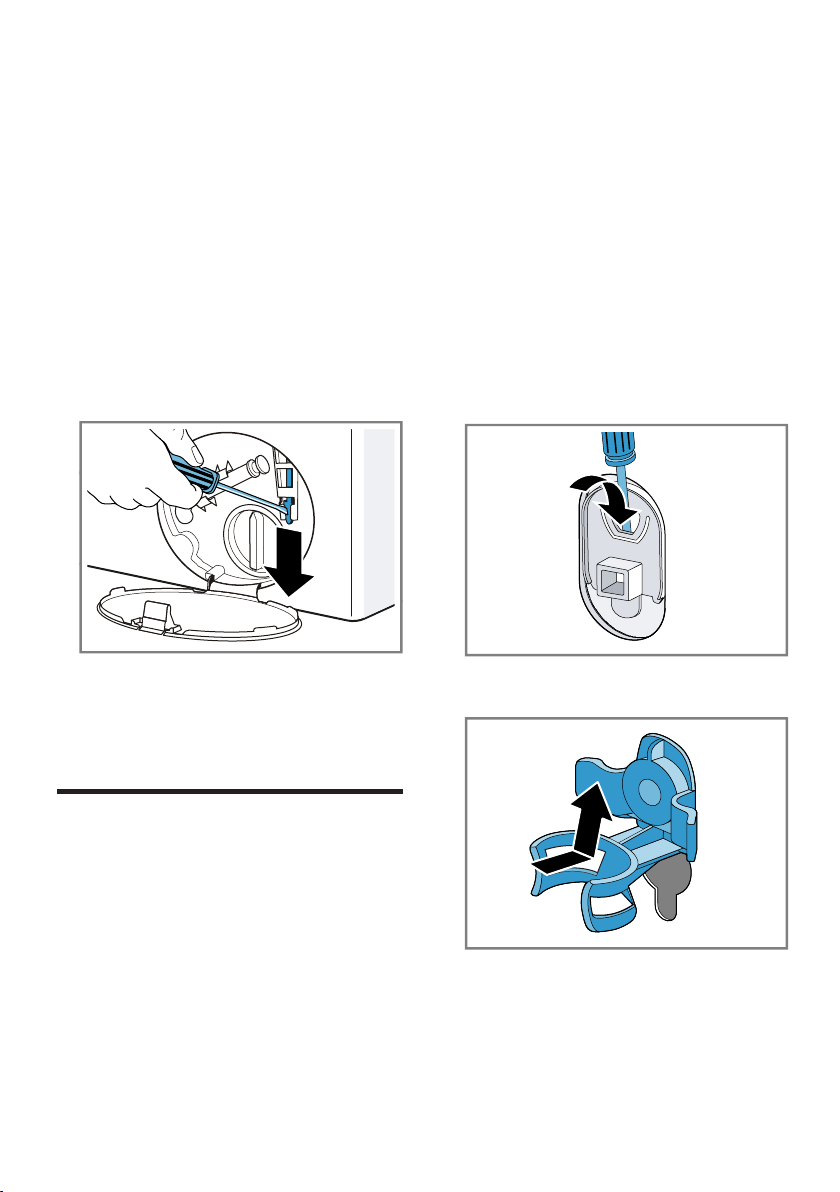
Transportation, storage and disposal en
69
Emergency release
To remove the laundry in the event of
a power failure, for example, you can
manually release the door.
Releasing the door
Requirement:"The drain pump is
empty." →Page55
1. ATTENTION! Escaping water may
cause material damage.
▶
Do not open the door if you can
see water through the glass.
Pull the emergency release down-
wards with a tool and release.
a The door lock is released.
2. Insert the maintenance flap and
lock it into place.
3. Close the maintenance flap.
Transportation, storage and disposal
Transportation, storage
and disposal
Transportation, storage and disposal
You can find out here how to prepare
your appliance for transportation and
storage. You will also find out how to
dispose of old appliances.
Removing the appliance
1. Turn off the tap.
2.
→"Emptying the water inlet hose",
Page58.
3. Switch off the appliance.
4. Unplug the appliance's mains plug.
5. Drain the remaining detergent
solution.
→"Cleaning the drain pump",
Page55
6. Detach the hoses.
Inserting the transit bolts
Secure the appliance for transporta-
tion using transit bolts in order to pre-
vent damage.
1. Remove the four cover caps.
‒ If necessary, use a screwdriver
to remove the cover caps.
Keep the cover caps.
2. Insert the four sleeves.
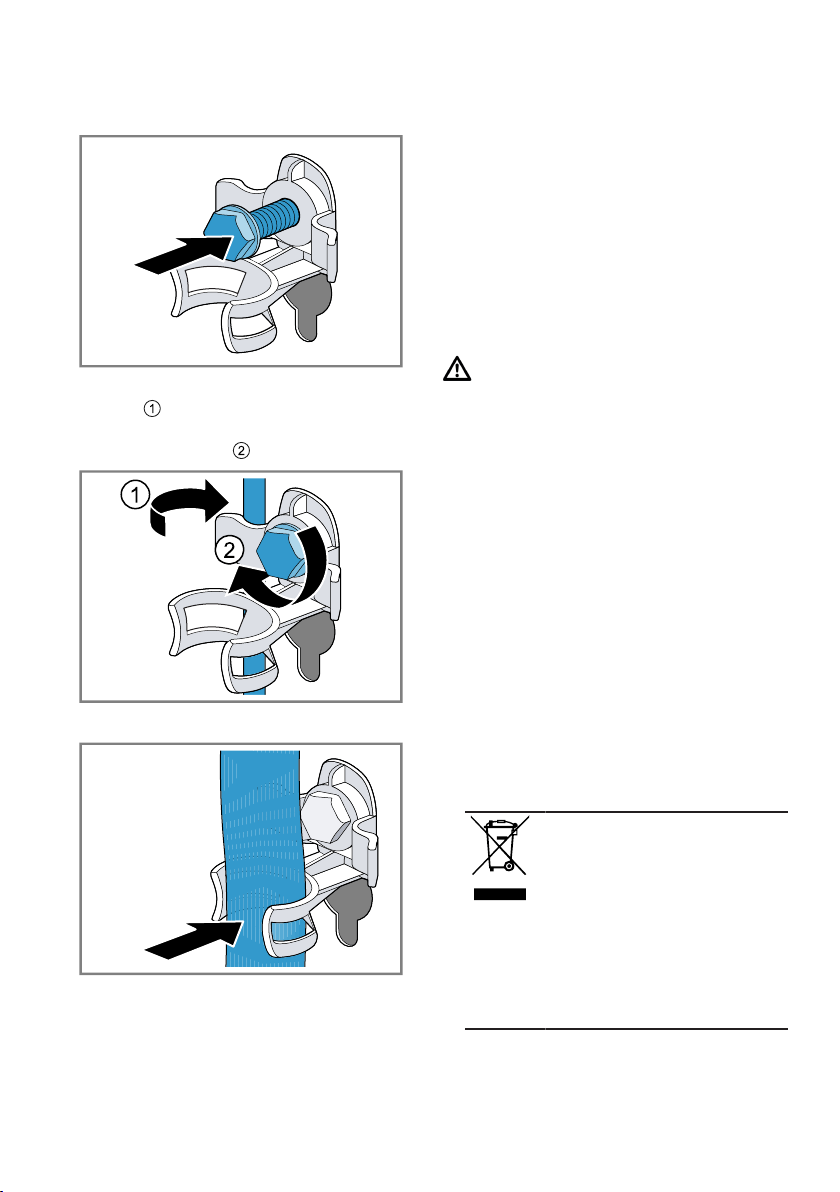
en Transportation, storage and disposal
70
3. Insert all screws into the four
transit bolts and tighten slightly.
4. Insert the power cord into the
holder and tighten all four
screws for the transit bolts with a
WAF 13 wrench .
5. Insert the hose into holder.
Using the appliance again
1. Remove the transit bolts.
2. Pour approx. 1 litre of water into
compartment II in the detergent
drawer.
3. Start the Drain programme.
a The unused detergent cannot flow
straight into the outlet during the
next wash.
Disposing of old appliance
Valuable raw materials can be re-
used by recycling.
WARNING
Risk of harm to health!
Children can lock themselves in the
appliance, thereby putting their lives
at risk.
▶
Do not install the appliance behind
a door as this may obstruct the ap-
pliance door or prevent it from
opening.
▶
With redundant appliances, unplug
the power cord. Then cut through
the cord and damage the lock on
the appliance door beyond repair
so that the appliance door will no
longer close.
1. Unplug the appliance from the
mains.
2. Cut through the power cord.
3. Dispose of the appliance in an en-
vironmentally friendly manner.
This appliance is labelled in ac-
cordance with European Direct-
ive 2012/19/EU concerning
used electrical and electronic
appliances (waste electrical and
electronic equipment - WEEE).
The guideline determines the
framework for the return and re-
cycling of used appliances as
applicable throughout the EU.

Customer Service en
71
Customer Service
Customer Service
Customer Service
If you have any queries on use, are
unable to rectify faults on the appli-
ance yourself or if your appliance
needs to be repaired, contact Cus-
tomer Service.
You can solve many problems your-
self by consulting the information on
troubleshooting in these instructions
or on our website. If this is not the
case, contact our after-sales service.
We will always find an appropriate
solution and try to avoid unnecessary
visits being made by a Customer Ser-
vice technician.
With any warranty claims, we will
make sure that your appliance is re-
paired by trained after-sales techni-
cians using genuine spare parts, in-
cluding after the manufacturer's war-
ranty has expired.
For safety reasons repairs to the ap-
pliance should only be carried out by
trained specialist staff. The warranty
claim becomes void if repairs or in-
terventions have been carried out by
persons not authorised by us for that
purpose or if our appliances have
been fitted with spare, supplementary
or accessory parts that were not
genuine parts and then resulted in a
defect.
Function-relevant genuine spare parts
according to the corresponding Eco-
design Order can be obtained from
Customer Service for a period of at
least 10 years from the date on
which your appliance was placed on
the market within the European Eco-
nomic Area.
Note:Under the terms of the manu-
facturer's warranty the use of Cus-
tomer Service is free of charge.
Detailed information on the warranty
period and terms of warranty in your
country is available from our after-
sales service, your retailer or on our
website.
If you contact Customer Service, you
will require the product number (E-
Nr.) and the production number (FD)
of your appliance.
The contact details for Customer Ser-
vice can be found in the enclosed
Customer Service directory or on our
website.
Product number (E-Nr.) and
production number (FD)
You can find the product number (E-
Nr.) and the production number (FD)
on the appliance's rating plate.
Depending on the model, the rating
plate is located:
¡ On the inside of the door.
¡ On the inside of the maintenance
flap.
¡ On the rear of the appliance.
Make a note of your appliance's de-
tails and the Customer Service tele-
phone number to find them again
quickly.
AQUA-STOP guarantee
In addition to warranty claims against
the seller under the purchase agree-
ment and in addition to our manufac-
turer's warranty, we offer compensa-
tion under the following conditions.
¡ If our Aqua-Stop system is defect-
ive and causes water damage, we
will make good the damage for
private users. To ensure protection
from water damage, the appliance
must be connected to the power
supply.
¡ The liability guarantee is valid for
the service life of the appliance.

en Customer Service
72
¡ A claim can only be made under
the guarantee if the appliance has
been correctly installed and con-
nected with Aqua-Stop according
to our instructions; this also in-
cludes correctly fitting the Aqua-
Stop extension (genuine access-
ory). Our guarantee does not cover
defective supply lines or fittings up
to the Aqua-Stop connection on
the tap.
¡ If your appliance is fitted with
Aqua-Stop, you can in principle
leave your appliance unattended
during operation and the tap
turned on afterwards. The tap only
needs to be turned off if you are
away from home for a long period,
e.g. on holiday for several weeks.
Consumption values en
73
Consumption values
Consumption values
Consumption values
The following information is provided in accordance with the EU Ecodesign
Regulation. The values given for programs other than the Eco40-60 are indicat-
ive only and were determined in accordance with the applicable standard
EN60456.
Programme Load
(kg)
Pro-
gramme
duration
(hr:min)
1
Energy
con-
sump-
tion
(kWh/
cycle)
1
Water
con-
sump-
tion (l/
cycle)
1
Max-
imum
temper-
ature
(°C) 5
mins
1
Spin
speed
(rpm)
1
Resid-
ual
mois-
ture (%)
1
Eco40-60
2
10,0 3:55 1,200 70,0 40 1600 44
Eco40-60
2
5,0 2:55 0,650 48,0 33 1600 44
Eco40-60
2
2,5 2:45 0,330 36,0 25 1600 44
Cottons20°C 10,0 3:15 0,500 95,0 24 1600 46
Cottons40°C 10,0 3:36 1,400 95,0 42 1600 46
Cottons60°C 10,0 3:32 2,150 95,0 60 1600 46
Cottons40°C +
Prewash
10,0 4:14 1,450 105,0 42 1600 46
EasyCare40°C 4,0 2:29 0,780 58,0 43 1200 30
MixedFab-
rics40°C
4,0 1:00 0,650 44,0 41 1600 52
Wool 30°C 2,0 0:41 0,200 40,0 25 800 25
1
Due to the influence of water pressure, hardness and inlet temperature, ambient temperature,
type, amount and soiling of laundry, detergent used, fluctuations in the power supply and the se-
lected additional functions, the actual values may deviate from the stated values.
2
Test programme in accordance with the EU Ecodesign Directive and the EU Energy Labelling Reg-
ulation with cold water (15°C).
Technical specifications
Technical specifications
Technical specifications
Facts and figures for your appliance
can be found here.
Appliance height 85,0cm
Appliance width 60,0cm
Appliance depth 64,0cm
Weight 73kg
1
1
Depending on the appliance specifications
Maximum load capa-
city
10kg
Mains voltage 220 - 240V, 50Hz
Minimum installa-
tion protection
10A
Rated power 2300W
1
Depending on the appliance specifications
en Technical specifications
74
Power consumption ¡ Off mode: 0,10 W
¡ Left-on mode:
0,50W
¡ Time in networked
standby mode (Wi-
Fi): 5 min(s)
¡ Networked
standby mode (Wi-
Fi): 1,50W
Water pressure ¡ Minimum: 100kPa
(1bar)
¡ Maximum:
1000kPa (10bar)
Length of the water in-
let hose
150cm
Length of the water
outlet hose
150cm
Length of the power
cord
210cm
Max. draining height 100cm
1
Depending on the appliance specifications
This product contains light sources
from energy efficiency class F. These
light sources are available as a spare
part and must only be replaced by
trained specialist staff.
More information about your model
can be found online at https://en-
ergylabel.bsh-group.com
1
. This web
address is linked to the official EU
EPREL product database. At the time
of printing its web address had not
yet been published. Please then fol-
low the instructions on searching for
models. The model identifier is made
up of the characters before the slash
in the product number (E-Nr.) on the
rating plate. Alternatively you can
also find the model identifier in the
first line of the EU energy label.
1
Only applies to countries in the European Economic Area

*9001577343*
9001577343 (000805)
en
BSH Hausgeräte GmbH
Carl-Wery-Straße 34
81739 München
GERMANY
www.siemens-home.bsh-group.com
Manufactured by BSH Hausgeräte GmbH under Trademark License of Siemens AG