COPIER
PRINTER
FACSIMILE
SCANNER / INTERNET FAX
TROUBLESHOOTING
BEFORE USING THE MACHINE
SYSTEM SETTINGS
About Operation Guide
MAKE A COPY PRINT A DOCUMENT SEND A FAX
SCAN AN IMAGE /
SEND AN INTERNET FAX
SAVE A JOB AND
REUSE IT LATER
Search based on
what you want to do
Search based on
what you want to do
Search using the
table of contents
Search using the
table of contents
OPERATION GUIDE
Other convenient functions
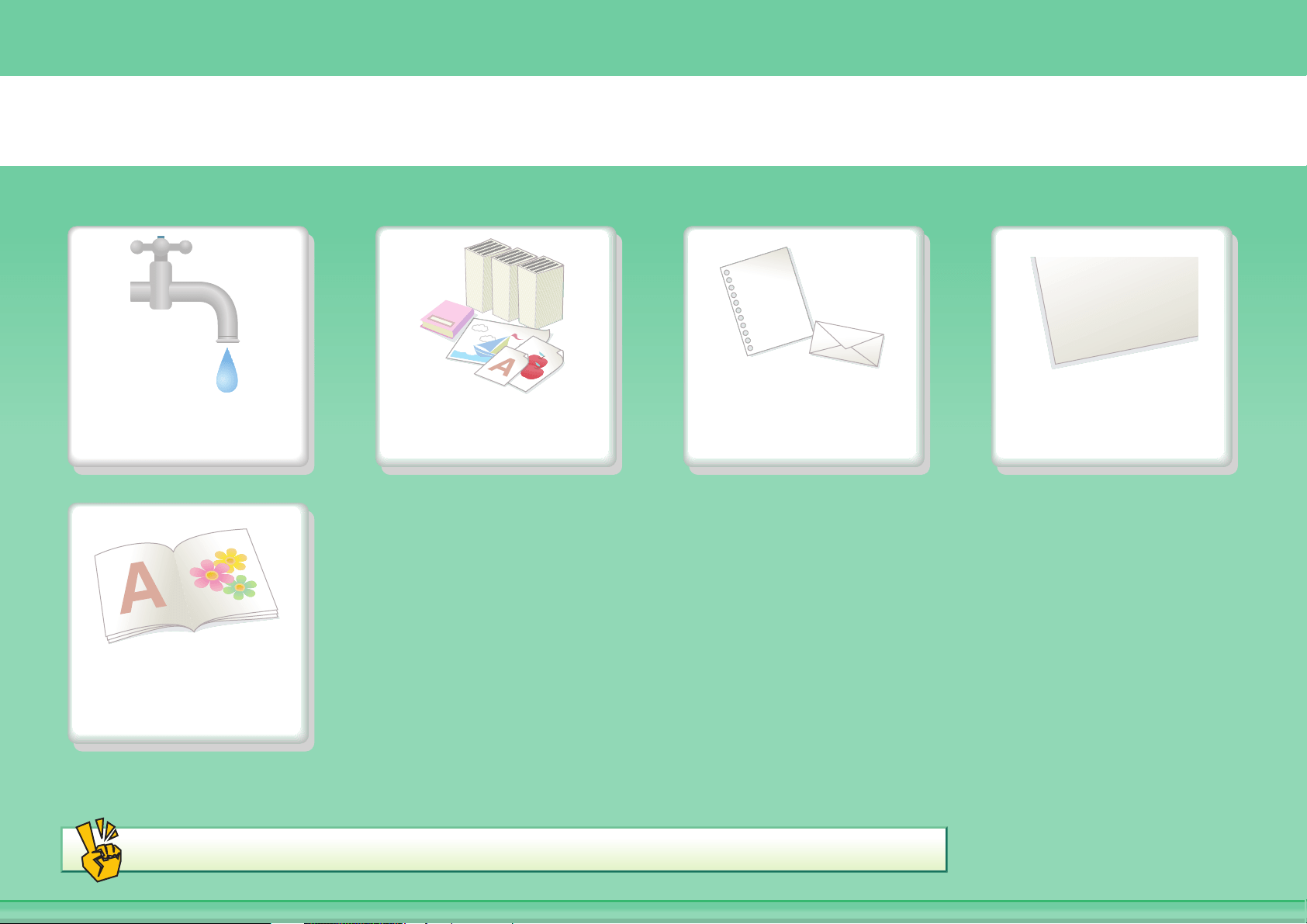
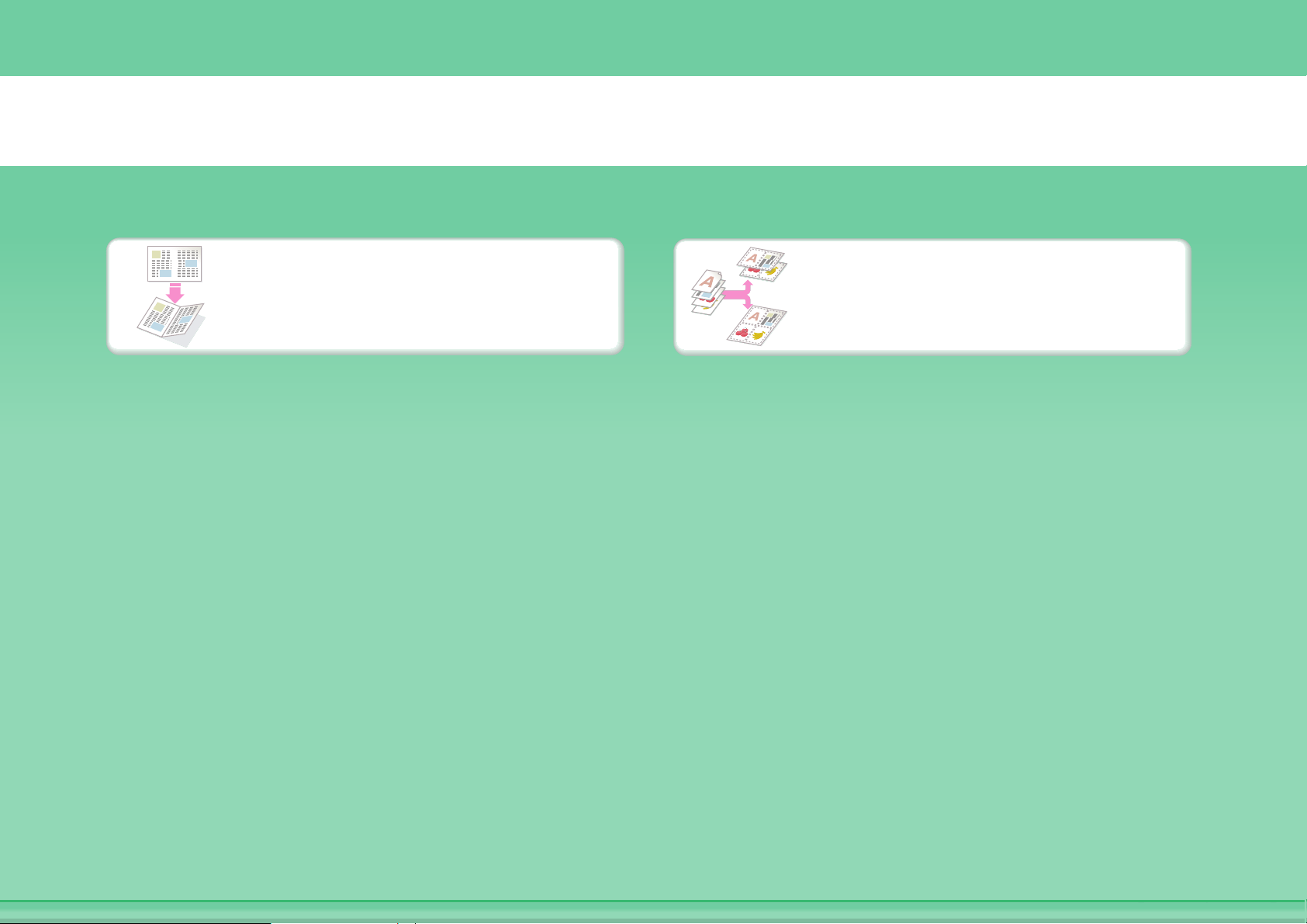
Functions used for specific purposes
z Make a copy of arranged photos
z Make a mirror-image copy
z Copy onto the center of the paper
z Make a negative copy
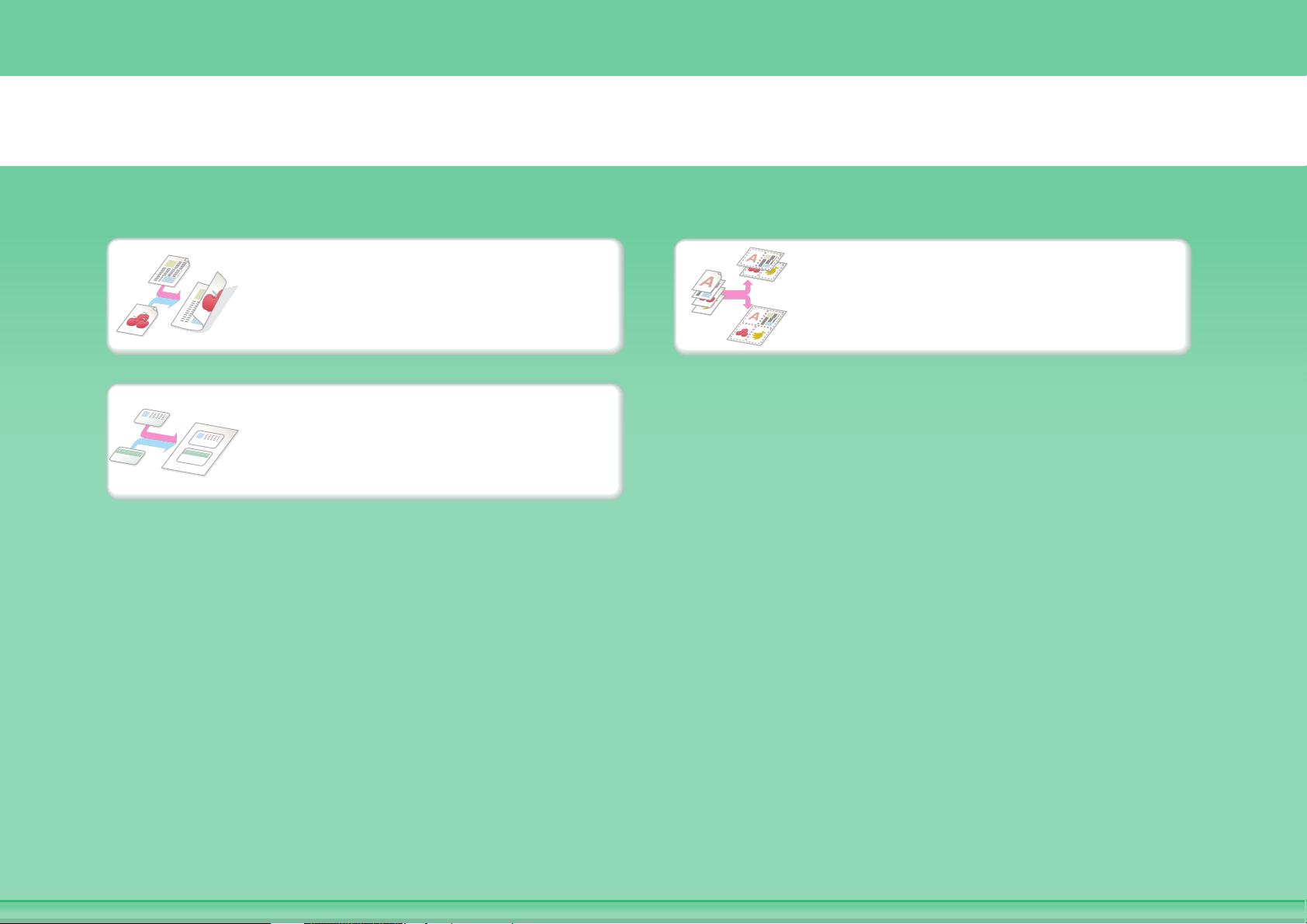
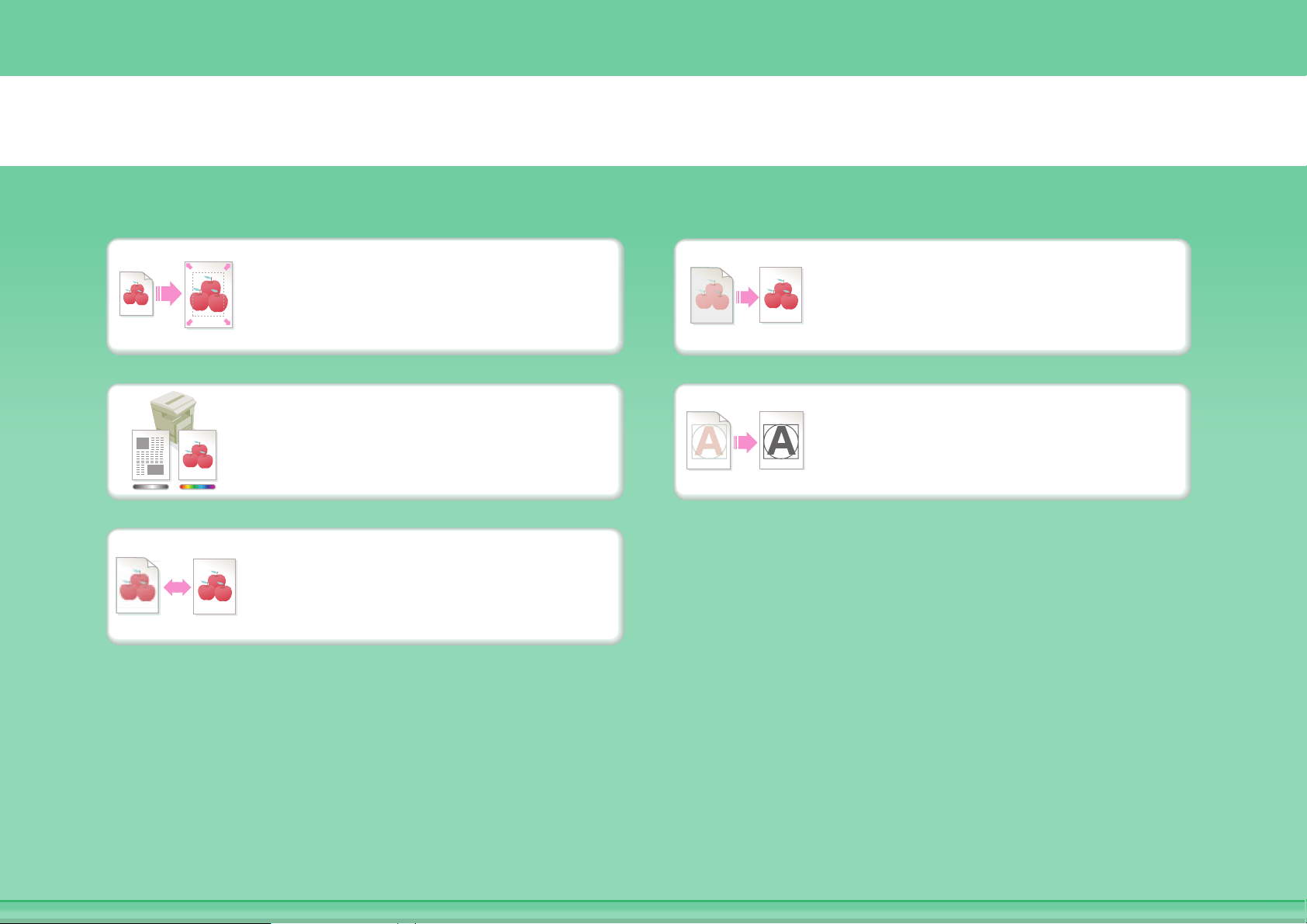
Convenient functions
z Give priority to a copy job
z Check the status of a reserved job
z Copy a thin original
z Adjust the color


Other convenient functions
Correct the size or orientation of the print data
z Enlarge or reduce the print image
z Print a mirror-image
Security is important
z Print confidentially
z Print an encrypted PDF file
Functions used for specific purposes
z Print an "invoice copy"
z Create a large poster
Convenient functions
z Give priority to a print job
z Store frequently used print settings
z Store a print job


Other convenient functions
Convenient management functions
z Forward a received fax to a network address
z Print a list of transmission destinations
Convenient functions
z Scan a thin original
z Select a transmission destination from a global address book
z Send at a specified time
z Give priority to a transmission
z Send in USB memory mode

i
ABOUT OPERATION GUIDE
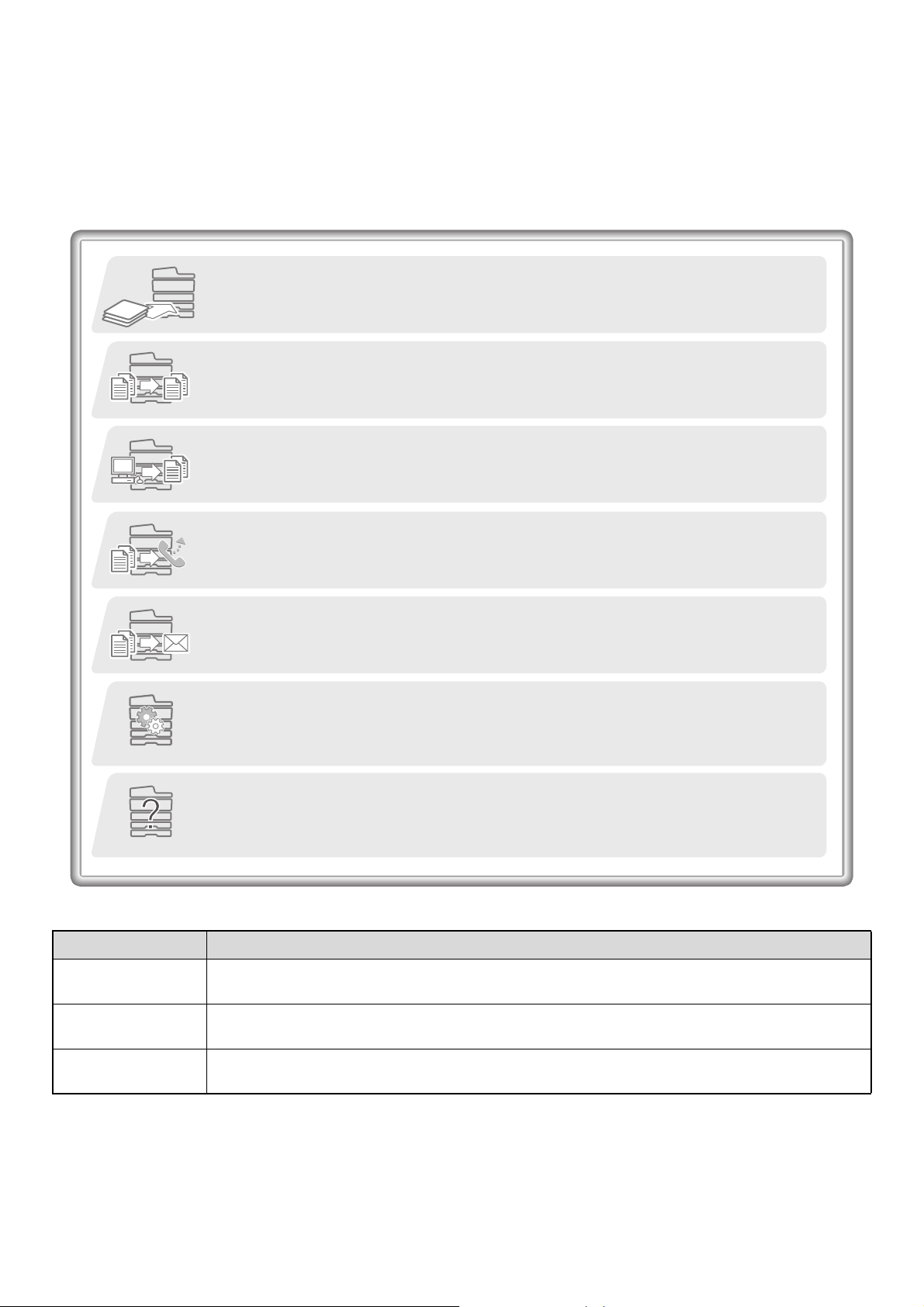
There are two ways to search for a topic in this guide: you can use an "I want to..." menu, or you can use a regular table
of contents.
The following explanation assumes that Adobe Reader 8.0 is being used (Some buttons do not appear in the default
state.).
Return to top page ( )
Return to previously displayed page ( )
Menu page Table of
contents page
Body page
Search based on what you
want to do
Search using the table of
contents
ii
HOW TO USE THIS MANUAL
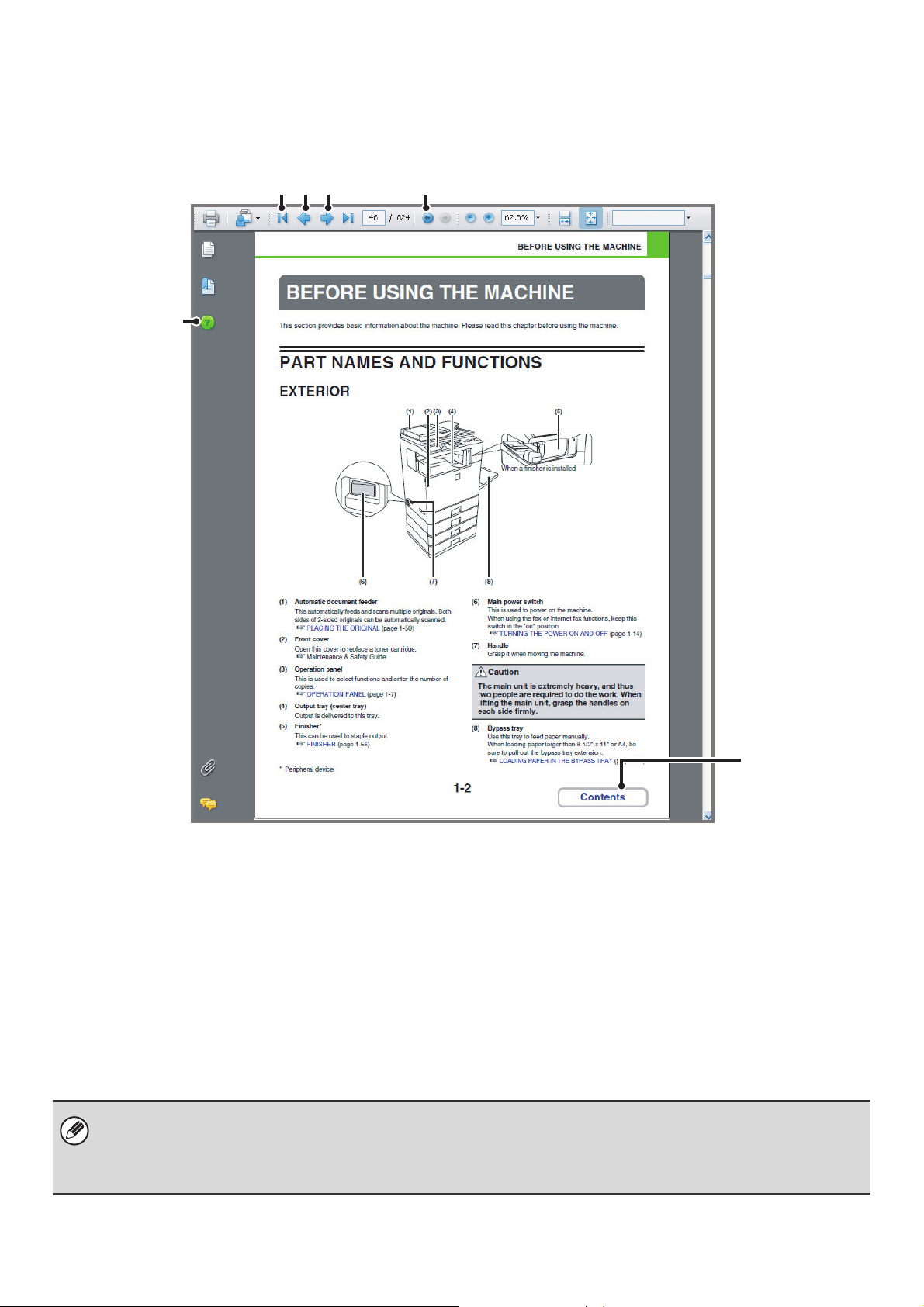
Click a button below to move to the page that you wish to view.
(1) Return to top page button
If an operation does not proceed as expected, click this
button to start over again.
(2) Back one page button
Displays the previous page.
(3) Forward one page button
Displays the next page.
(4) Return to previously displayed page button
Displays the page that was displayed before the current
page.
(5) Adobe Reader Help button
Opens Adobe Reader Help.
(6) Contents button
Displays the contents of each chapter.
For example, if the current page is a page in the body of
the printer chapter, this button shows the contents of the
printer chapter.
(1) (2) (3) (4)
(5)
(6)
• If a button does not appear, refer to Adobe Reader Help to display the button.
• Caution when printing
If all pages are printed, the menu pages of the "I want to..." menu will also be printed. To print only the pages that contain
the explanation of a function, specify a page range.
iii
MANUALS PROVIDED WITH THE MACHINE
Operation manuals in PDF format (this manual)
The manuals in PDF format provide detailed explanations of the procedures for using the machine in each mode. To
view the PDF manuals, download them from the hard drive in the machine. The procedure for downloading the manuals
is explained in "Downloading the Operation Guide" in the Quick Start Guide.
Printed manuals
Manual name Contents
Maintenance &
Safety Guide
This manual contains instructions for using the machine safely and lists the specifications of the machine
and its peripheral devices.
Installation Guide
This manual explains how to set up your machine so that it is ready for use, including the procedures for
installation of the machine, options, and software.
Quick Start Guide
This manual provides easy-to-understand explanations of all the functions of the machine in a single
volume. Detailed explanations of each of the functions can be found in the manuals in PDF format.
1. BEFORE USING THE MACHINE
This chapter provides information, such as basic operation procedures and how to load paper.
2. COPIER
This chapter provides detailed explanations of the procedures for using the copy function.
3. PRINTER
This chapter provides detailed explanations of the procedures for using the print function.
4. FACSIMILE
This chapter provides detailed explanations of the procedures for using the fax function.
5. SCANNER / INTERNET FAX
This chapter provides detailed explanations of the procedures for using the scanner function and
the Internet fax function.
6. SYSTEM SETTINGS
This chapter explains the "System Settings", which are used to configure a variety of parameters
to suit the aims and the needs of your workplace. Current settings can be displayed or printed out
from the "System Settings".
7. TROUBLESHOOTING
This chapter explains how to remove paper misfeeds and provides answers to frequently asked
questions regarding the operation of the machine in each mode. Refer to this manual when you
have difficulty using the machine.
iv
ABOUT OPERATION MANUAL
This manual explains how to use the DX-C310/DX-C400 digital full color multifunctional system.
Please note
• For information on installing the drivers and software cited in this manual, please refer to the Software Setup Guide.
• For information on your operating system, please refer to your operating system manual or the online Help function.
• The explanations of screens and procedures in a Windows environment are primarily for Windows
Vista
®
. The screens may
vary depending on the version of the operating system or the software application.
• The explanations of screens and procedures in a Macintosh environment are based on Mac OS X v10.4 in the case of Mac OS
X. The screens may vary depending on the version of the operating system or the software application.
• Wherever "DX-xxxx" appears in this manual, please substitute your model name for "xxxx".
• This manual contains references to the fax function. However, please note that the fax function is not available in some
countries and regions.
• Considerable care has been taken in preparing this manual. If you have any comments or concerns about the manual, please
contact your dealer or nearest authorized service representative.
• This product has undergone strict quality control and inspection procedures. In the unlikely event that a defect or other problem
is discovered, please contact your dealer or nearest authorized service representative.
• Aside from instances provided for by law, SHARP is not responsible for failures occurring during the use of the product or its
options, or failures due to incorrect operation of the product and its options, or other failures, or for any damage that occurs due
to use of the product.
Warning
• Reproduction, adaptation or translation of the contents of the manual without prior written permission is prohibited, except as
allowed under copyright laws.
• All information in this manual is subject to change without notice.
Illustrations and the operation panel and display shown in this manual
The peripheral devices are generally optional, however, some models include certain peripheral devices as standard equipment.
The explanations in this manual assume that 500-sheet paper feed units (total of four trays) are installed on the DX-C400.
For some functions and procedures, the explanations assume that devices other than the above are installed.
Icons used in the manuals
The icons in the manuals indicate the following types of information:
The display screens, messages, and key names shown in the manual may differ from those on the actual machine
due to product improvements and modifications.
This alerts you to a situation where
there is a risk of machine damage or
failure.
This indicates the name of a system setting and provides a brief
explanation of the setting.
When "System Settings:" appears:
A general setting is explained.
When "System Settings (Administrator):" appears:
A setting that can only be configured by an administrator is
explained.
This provides a supplemental
explanation of a function or procedure.
This explains how to cancel or correct
an operation.
Warning
This alerts you to a situation where there is a risk of human death or injury.
Caution
This alerts you to a situation where there is a risk of human injury or property damage.

1-1
This chapter provides information on basic operation procedures, how to load paper and machine maintenance.
BEFORE USING THE MACHINE
PART NAMES AND FUNCTIONS . . . . . . . . . . . . . . 1-2
• EXTERIOR . . . . . . . . . . . . . . . . . . . . . . . . . . . . . 1-2
• INTERIOR . . . . . . . . . . . . . . . . . . . . . . . . . . . . . 1-4
• AUTOMATIC DOCUMENT FEEDER AND
DOCUMENT GLASS . . . . . . . . . . . . . . . . . . . . . 1-5
• SIDE AND BACK . . . . . . . . . . . . . . . . . . . . . . . . 1-6
• OPERATION PANEL . . . . . . . . . . . . . . . . . . . . . 1-7
USING THE OPERATION PANEL . . . . . . . . . . . . . . 1-9
• USING THE DISPLAY . . . . . . . . . . . . . . . . . . . . 1-9
USING THE WEB PAGE . . . . . . . . . . . . . . . . . . . . 1-13
TURNING THE POWER ON AND OFF . . . . . . . . . 1-14
• ENERGY SAVE FUNCTIONS . . . . . . . . . . . . . 1-15
• [POWER SAVE] KEY . . . . . . . . . . . . . . . . . . . . 1-15
USEFUL INFORMATION ABOUT THE
MACHINE . . . . . . . . . . . . . . . . . . . . . . . . . . . . . . . . 1-16
• INFORMATION ON SUPPLY ITEMS. . . . . . . . 1-16
• WHEN AN ERROR CODE APPEARS . . . . . . . 1-16
• OTHER INFORMATION. . . . . . . . . . . . . . . . . . 1-16
USER AUTHENTICATION . . . . . . . . . . . . . . . . . . . 1-17
• AUTHENTICATION BY USER NUMBER. . . . . 1-17
• AUTHENTICATION BY LOGIN NAME /
PASSWORD. . . . . . . . . . . . . . . . . . . . . . . . . . . 1-19
• ACCESSING THE WEB PAGE . . . . . . . . . . . . 1-22
USER CONTROL . . . . . . . . . . . . . . . . . . . . . . . . . . 1-23
• USER LIST . . . . . . . . . . . . . . . . . . . . . . . . . . . . 1-23
• DEFAULT SETTING. . . . . . . . . . . . . . . . . . . . . 1-26
• PAGE LIMIT GROUP LIST. . . . . . . . . . . . . . . . 1-28
• AUTHORITY GROUP LIST . . . . . . . . . . . . . . . 1-29
• FAVORITE OPERATION GROUP LIST. . . . . . 1-32
• VIEW USER COUNT . . . . . . . . . . . . . . . . . . . . 1-33
REMOTE OPERATION OF THE MACHINE. . . . . . 1-34
JOB LOG . . . . . . . . . . . . . . . . . . . . . . . . . . . . . . . . 1-35
• SAVE / DELETE JOB LOG . . . . . . . . . . . . . . . 1-35
• VIEW JOB LOG . . . . . . . . . . . . . . . . . . . . . . . . 1-35
ITEMS RECORDED IN THE JOB LOG . . . . . . . . . 1-36
STORAGE BACKUP . . . . . . . . . . . . . . . . . . . . . . . 1-39
• EXPORT SETTINGS . . . . . . . . . . . . . . . . . . . . 1-39
• IMPORT SETTINGS. . . . . . . . . . . . . . . . . . . . . 1-39
DEVICE CLONING . . . . . . . . . . . . . . . . . . . . . . . . . 1-40
• EXPORT SETTINGS . . . . . . . . . . . . . . . . . . . . 1-40
• IMPORT SETTINGS. . . . . . . . . . . . . . . . . . . . . 1-40
UPDATE OF FIRMWARE. . . . . . . . . . . . . . . . . . . . 1-41
LOADING PAPER
IMPORTANT POINTS ABOUT PAPER . . . . . . . . . 1-42
• NAMES AND LOCATIONS OF TRAYS . . . . . . 1-42
• USEABLE PAPER . . . . . . . . . . . . . . . . . . . . . . 1-42
TRAY SETTINGS FOR TRAYS 1 TO 4 . . . . . . . . . 1-45
• LOADING PAPER AND CHANGING THE
PAPER SIZE . . . . . . . . . . . . . . . . . . . . . . . . . . 1-45
LOADING PAPER IN THE BYPASS TRAY . . . . . . 1-47
• IMPORTANT POINTS WHEN USING THE
BYPASS TRAY. . . . . . . . . . . . . . . . . . . . . . . . . 1-48
ORIGINALS
PLACING THE ORIGINAL . . . . . . . . . . . . . . . . . . . 1-50
• PLACING ORIGINALS IN THE
AUTOMATIC DOCUMENT FEEDER . . . . . . . . 1-50
• PLACING THE ORIGINAL ON THE
DOCUMENT GLASS . . . . . . . . . . . . . . . . . . . . 1-52
PERIPHERAL DEVICES
PERIPHERAL DEVICES . . . . . . . . . . . . . . . . . . . . 1-54
FINISHER . . . . . . . . . . . . . . . . . . . . . . . . . . . . . . . . 1-56
• PART NAMES . . . . . . . . . . . . . . . . . . . . . . . . . 1-56
• SUPPLIES . . . . . . . . . . . . . . . . . . . . . . . . . . . . 1-56
BUSINESS CARD FEEDER . . . . . . . . . . . . . . . . . . 1-57
SHARP OSA . . . . . . . . . . . . . . . . . . . . . . . . . . . . . . 1-58
• APPLICATION COMMUNICATION
MODULE (MX-AMX2) . . . . . . . . . . . . . . . . . . . 1-58
• EXTERNAL ACCOUNT MODULE
(MX-AMX3). . . . . . . . . . . . . . . . . . . . . . . . . . . . 1-59
ENTERING TEXT
FUNCTIONS OF THE MAIN KEYS . . . . . . . . . . . . 1-61
CHAPTER 1
BEFORE USING THE MACHINE
1-2
BEFORE USING THE MACHINE
Contents
This section provides basic information about the machine. Please read this chapter before using the machine.
PART NAMES AND FUNCTIONS
EXTERIOR
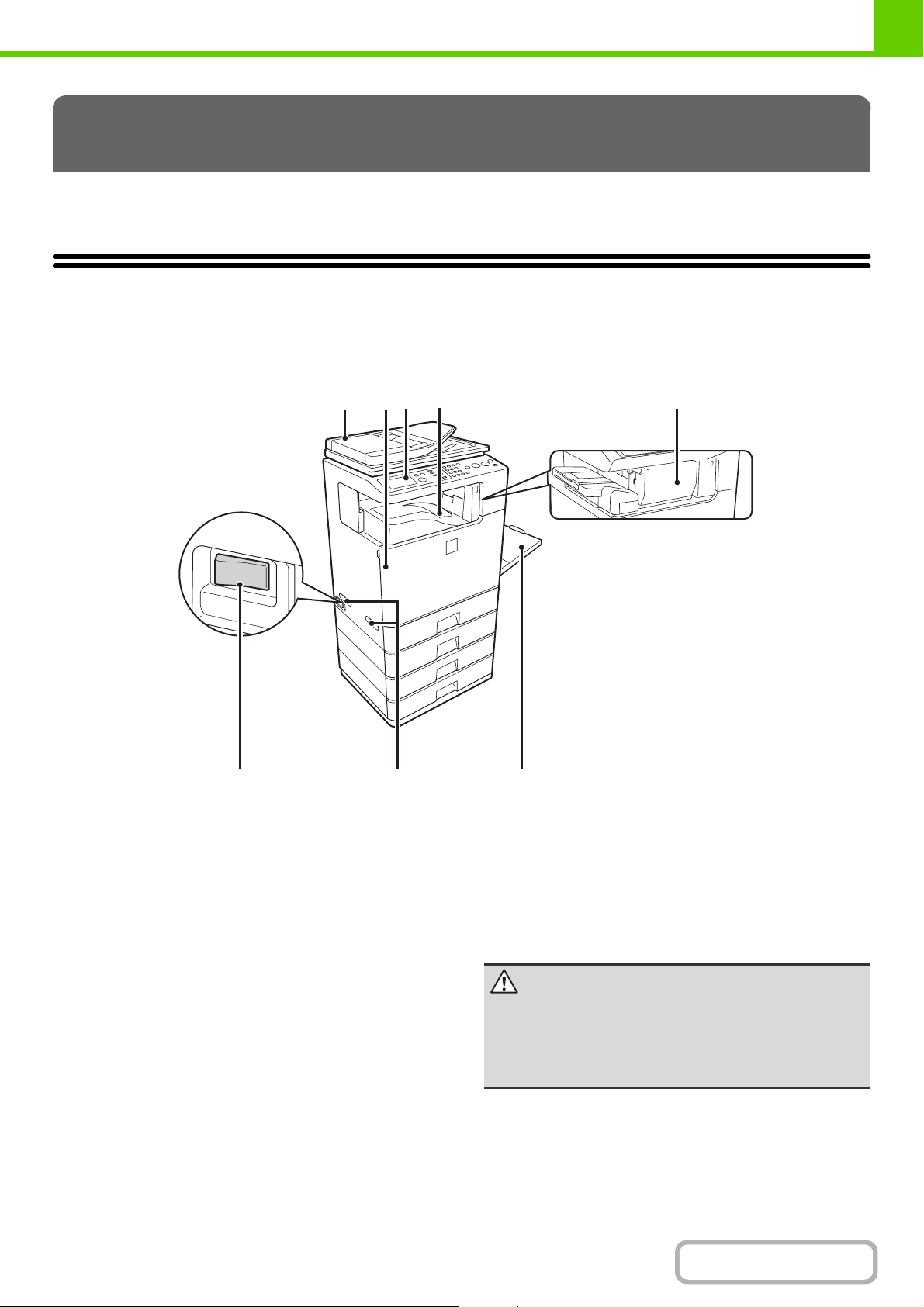
(1) Automatic document feeder
This automatically feeds and scans multiple originals. Both
sides of 2-sided originals can be automatically scanned.
☞ PLACING THE ORIGINAL (page 1-50)
(2) Front cover
Open this cover to replace a toner cartridge.
☞ Maintenance & Safety Guide
(3) Operation panel
This is used to select functions and enter the number of
copies.
☞ OPERATION PANEL (page 1-7)
(4) Output tray (center tray)
Output is delivered to this tray.
(5) Finisher*
This can be used to staple output.
☞ FINISHER (page 1-56)
(6) Main power switch
This is used to power on the machine.
When using the fax or Internet fax functions, keep this
switch in the "on" position.
☞ TURNING THE POWER ON AND OFF (page 1-14)
(7) Handle
Grasp it when moving the machine.
(8) Bypass tray
Use this tray to feed paper manually.
When loading paper larger than 8-1/2" x 11" or A4, be
sure to pull out the bypass tray extension.
☞
LOADING PAPER IN THE BYPASS TRAY (page 1-47)
* Peripheral device.
BEFORE USING THE MACHINE
(1)
(2)
(4)
(3) (5)
(6) (7) (8)
When a finisher is installed
Caution
The main unit is extremely heavy, and thus
two people are required to do the work. When
lifting the main unit, grasp the handles on
each side firmly.

1-3
BEFORE USING THE MACHINE
Contents
(9) Tray 1
This holds paper.
☞ TRAY SETTINGS FOR TRAYS 1 TO 4 (page 1-45)
(10) Tray 2/Tray 3/Tray 4
(when 500-sheet paper feed units are installed)*
These hold paper.
☞ TRAY SETTINGS FOR TRAYS 1 TO 4 (page 1-45)
(11) USB connector (A type)
Supports USB 2.0 (Hi-Speed).
This is used to connect a USB device such as USB
memory to the machine.
For the USB cable, use a shielded cable.
* Peripheral device.
(9) (11)(10)
1-4
BEFORE USING THE MACHINE
Contents
INTERIOR
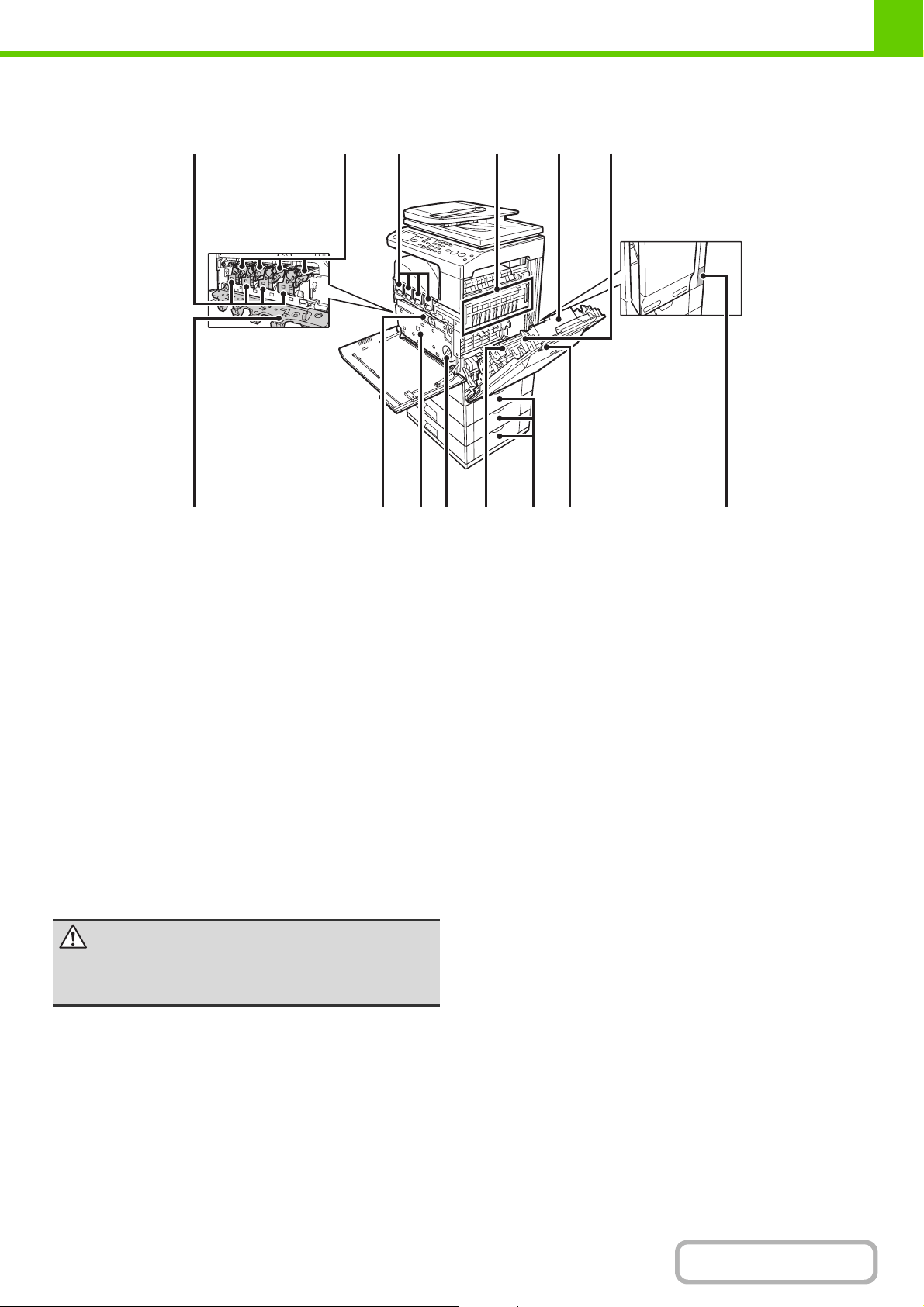
(12) Developer cartridges
This contains the developer that is necessary to transfer
the toner to the paper.
When replacing the drum cartridge, the developer cartridge
must be removed before the drum cartridge is replaced.
☞
Maintenance & Safety Guide
(13) \Drum cartridges
This contains the photosensitive drum that is used to
create images for copying and printing.
☞
Maintenance & Safety Guide
(14) Toner cartridges
These contain toner for printing. When the toner runs out
in a cartridge, the cartridge of the color that ran out must
be replaced.
☞
Maintenance & Safety Guide
(15) Fusing unit
Heat is applied here to fuse the transferred image onto
the paper.
(16) Right side cover
Open this cover to remove a misfeed.
☞ 7. TROUBLESHOOTING "REMOVING MISFEEDS"
(page 7-2)
(17) Paper reversing section
This is used when 2-sided printing is performed. Open
this part to remove a paper misfeed.
☞ 7. TROUBLESHOOTING "REMOVING MISFEEDS"
(page 7-2)
(18) Main charger cover
Open this cover to clean the main charger.
☞
Maintenance & Safety Guide
(19) Primary transfer belt unit
The images created on the drum cartridges are
combined into a single image and transferred to the
secondary transfer roller unit.
☞
Maintenance & Safety Guide
(20) Toner collection container
This collects excess toner that remains after printing.
☞
Maintenance & Safety Guide
(21) Toner collection container release lever
Turn this lever when you need to release the toner
collection container lock to replace the toner collection
container or clean the laser unit.
☞
Maintenance & Safety Guide
(22) Secondary taransfer roller unit
The image that was transferred from the primary transfer
belt unit is transferred to the paper.
☞
Maintenance & Safety Guide
(23) Paper tray right side cover
Open this to remove a paper misfeed in trays.
☞ 7. TROUBLESHOOTING "REMOVING MISFEEDS"
(page 7-2)
(24) Right side cover release lever
To remove a paper misfeed, pull and hold this lever up to
open the right side cover.
☞ 7. TROUBLESHOOTING "REMOVING MISFEEDS"
(page 7-2)
(25) Remove this cover to replace the ozone filter
(14)(13) (15) (17)(16)
(21)(20)(18) (23) (24)(19) (22) (25)
(12)
Toner collection
container removed
and main charger
cover open
Caution
The fusing unit is hot. Take care not to burn
yourself when removing a paper misfeed.
1-5
BEFORE USING THE MACHINE
Contents
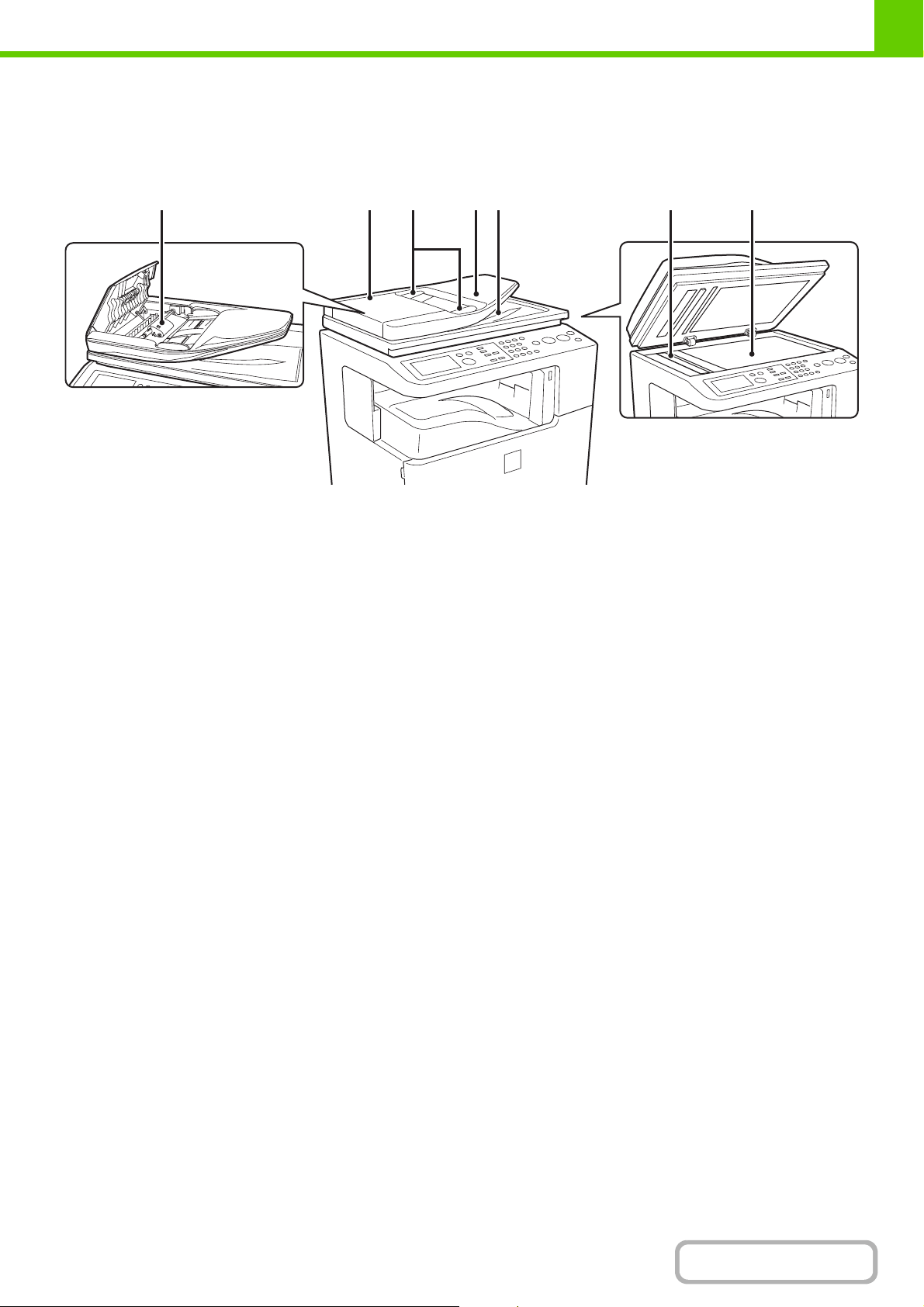
AUTOMATIC DOCUMENT FEEDER AND DOCUMENT
GLASS
(1) Paper feed roller
This roller rotates to automatically feed the original.
(2) Document feeding area cover
Open this cover to remove an original misfeed or clean
the paper feed roller.
☞ 7. TROUBLESHOOTING "REMOVING MISFEEDS"
(page 7-2)
☞ Maintenance & Safety Guide
(3) Original guides
These help ensure that the original is scanned correctly.
Adjust the guides to the width of the original.
☞ PLACING THE ORIGINAL (page 1-50)
(4) Document feeder tray
Place originals in this tray. 1-sided originals must be
placed face up.
☞ PLACING THE ORIGINAL (page 1-50)
(5) Original exit tray
Originals are delivered to this tray after scanning.
(6) Scanning area
Originals placed in the document feeder tray are scanned
here.
☞
Maintenance & Safety Guide
(7) Document glass
Use this to scan a book or other thick original that cannot
be fed through the automatic document feeder.
☞ PLACING THE ORIGINAL ON THE DOCUMENT
GLASS (page 1-52)
(2)(1) (3) (4) (5) (6) (7)

1-6
BEFORE USING THE MACHINE
Contents
SIDE AND BACK
(1) USB connector (A type)
Supports USB 2.0 (Hi-Speed).
This is used to connect a USB device such as USB
memory to the machine.
This connector is not initially available for use. If you wish
to use the connector, contact your service assistance.
(2) LAN connector
Connect the LAN cable to this connector when the
machine is used on a network.
For the LAN cable, use a shielded type cable.
(3) USB connector (B type )
Supports USB 2.0 (Hi-Speed).
A computer can be connected to this connector to use
the machine as a printer.
For the USB cable, use a shielded cable.
(4) Service-only connector
(5) Power plug
(1)
(2)
(3)
(4)
(5)
Caution
This connector is for use only by service
technicians.
Connecting a cable to this connector may
cause the machine to malfunction. Do not
use this connector.

1-7
BEFORE USING THE MACHINE
Contents
OPERATION PANEL
(1) Display
Messages and keys appear in the display.
Use the arrow keys and the [OK] key to select displayed
items and perform various operations.
☞ USING THE OPERATION PANEL (page 1-9)
(2) [BACK] key
Press this key to return to the previous screen without
discarding your settings.
(3) [OK] key
Press this key to enter a selected setting.
(4) Arrow keys
Press these keys to move the selection frame that is
used to select setting keys and items in the display.
(5) Mode select keys and indicators
Use these keys to select the display mode.
The indicator of a key lights when the key is selected.
[PRINT] key
When you wish to print a print hold job, press this key to
switch to print mode.
[IMAGE SEND] key
Press this key to select network scanner / fax mode to
use the scanner function or fax function.
[COPY] key
Press this key to select copy mode. Hold the [COPY] key
down to view the machine's total page use count and
amount of toner remaining.
(6) PRINT mode indicators
• READY indicator
Print jobs can be received when this indicator is lit.
• DATA indicator
This blinks while print data is being received and lights
steadily while printing is taking place.
(7) IMAGE SEND mode indicators
• LINE indicator
This lights up during transmission or reception of a fax
or Internet fax. This also lights during transmission of
an image in scan mode.
• DATA indicator
This blinks when a received fax or Internet fax cannot
be printed because of a problem such as out of paper.
This lights up when there is a transmission job that has
not been sent.
(8) Numeric keys
These are used to enter the number of copies, fax
numbers, and other numerical values. These keys are
also used to enter numeric value settings.
(9) [JOB STATUS] key
Press this key to display the job status screen. The job
status screen is used to check information on jobs and to
cancel jobs.
For details, see the chapters for each of the functions in
this manual.
(10) [SYSTEM SETTINGS] key
Press this key to display the system settings menu
screen. The system settings are used to configure paper
tray settings, and adjust parameters to make the
machine easier to use.
(11) Sharp OSA shortcut key
Press this key to display a shortcut key to Sharp OSA
mode (when the application communication module is
installed). Custom keys also appear in this screen.
Shortcuts to frequently used special modes and other
settings can be stored in the custom keys.
LOGOUT
COPY
PRINT
OKBACK
JOB STATUS
SYSTEM
SETTINGS
IMAGE SEND
READY
DATA
DATA
LINE
(8)(5) (6) (7)(2) (3) (4)(1)
(9) (10) (11)
1-8
BEFORE USING THE MACHINE
Contents
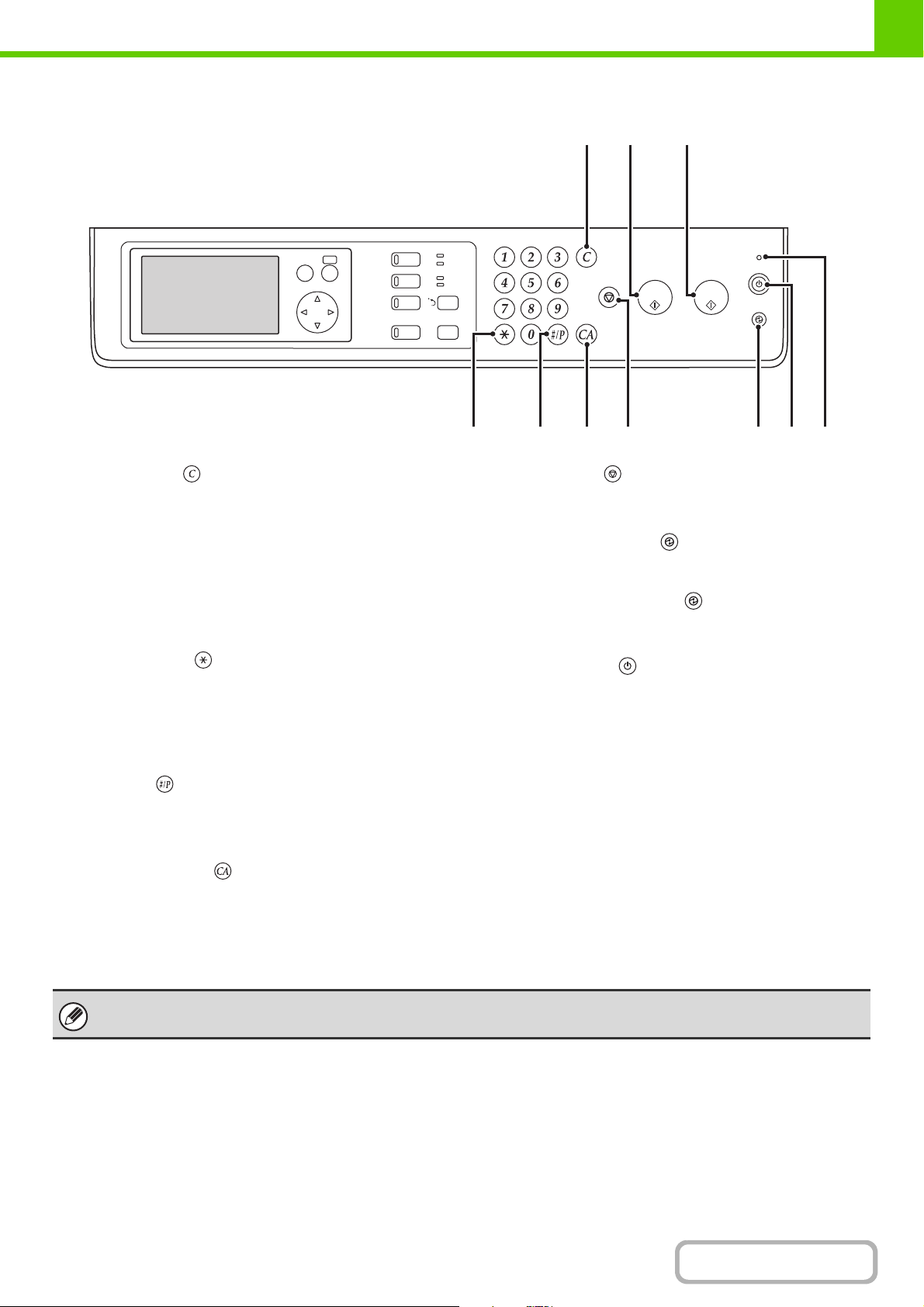
(12) [CLEAR] key ( )
Press this key to return the number of copies to "0".
(13) [BLACK & WHITE START] key
Press this key to copy or scan an original in black and
white. This key is also used to send a fax in fax mode.
(14) [COLOR START] key
Press this key to copy or scan an original in color.
This key cannot be used for fax or Internet fax.
(15) [LOGOUT] key ( )
Press this key to log out after you have logged in and
used the machine. When using the fax function, this key
can also be pressed to send tone signals on a pulse dial
line.
☞ USER AUTHENTICATION (page 1-17)
(16) [#/P] key ( )
When using the copy function, press this key to use a job
program. When using the fax function, this key can be
used when dialing.
(17) [CLEAR ALL] key ( )
Press this key to return to the initial operation state.
Use this key when you wish to cancel all settings that
have been selected and start operation from the initial
state.
(18) [STOP] key ( )
Press this key to stop a copy job or scanning of an
original.
(19) [POWER SAVE] key ( ) / indicator
Use this key to put the machine into auto power shut-off
mode to save energy.
The [POWER SAVE] key ( ) blinks when the machine
is in auto power shut-off mode.
☞ [POWER SAVE] KEY (page 1-15)
(20) [POWER] key ( )
Use this key to turn the machine power on and off.
☞ TURNING THE POWER ON AND OFF (page 1-14)
(21) Main power indicator
This lights up when the machine's main power switch is
in the "on" position.
☞ TURNING THE POWER ON AND OFF (page 1-14)
LOGOUT
COPY
PRINT
OKBACK
JOB STATUS
SYSTEM
SETTINGS
IMAGE SEND
READY
DATA
DATA
LINE
(12) (13) (14)
(17)(15) (16) (18) (20) (21)(19)
The indicators of the operation panel may differ depending on the country and region.
1-9
BEFORE USING THE MACHINE
Contents
USING THE OPERATION PANEL
This section explains how to use the operation panel.
• To enter text, see "ENTERING TEXT" (page 1-61).
• For information on the screens and procedures for using the system settings, see "Common Operation Methods"
(page 6-5) in "6. SYSTEM SETTINGS".
USING THE DISPLAY
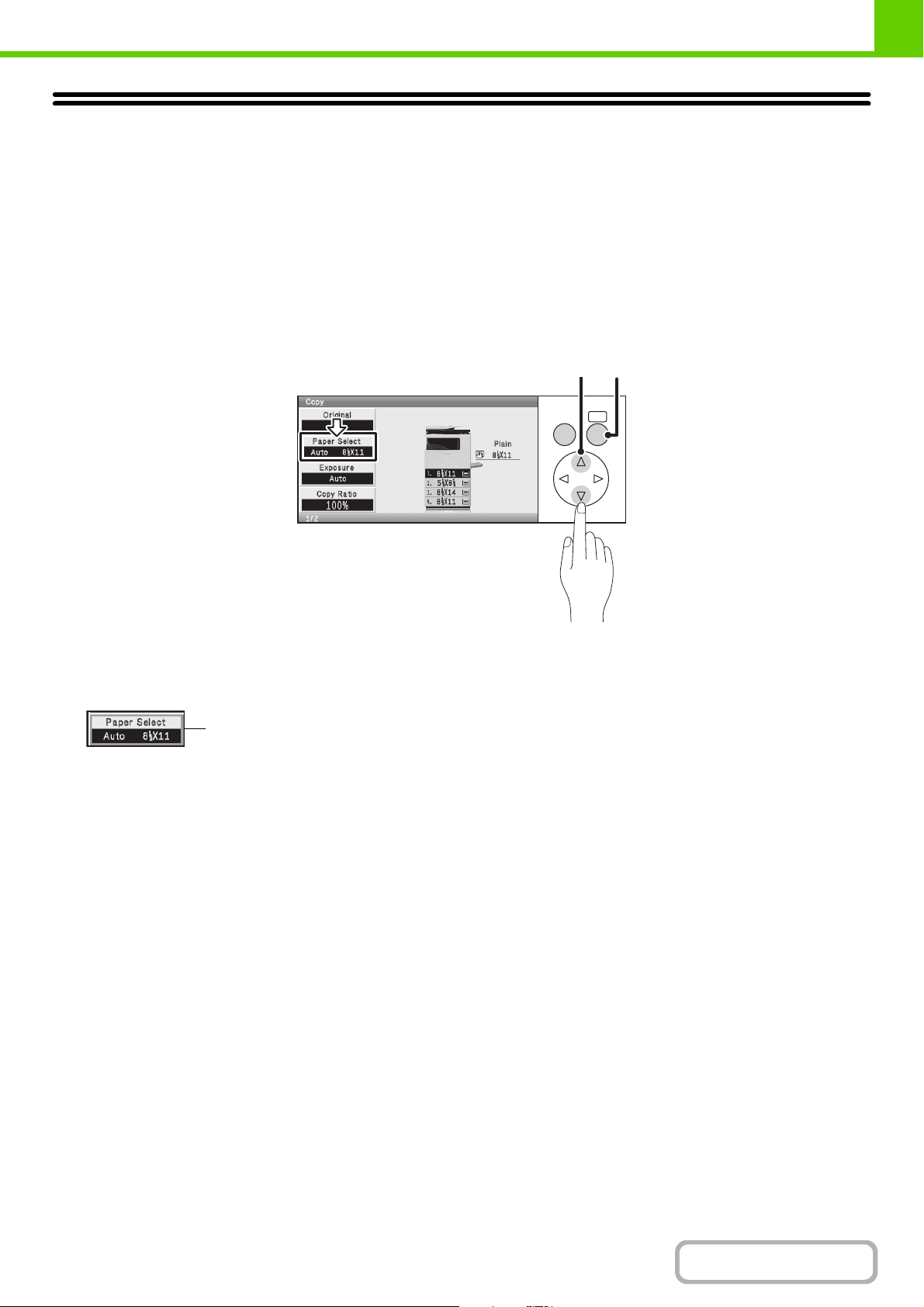
Base screen
(1) Move the selection frame with the arrow keys
Use the arrow keys to move the selection frame in the display to the desired setting key (such as [Original] or [Paper Select]).
(2) [OK] key
When the selection frame is on the desired setting, press the [OK] key to enter your selection. The setting screen will appear.
OK
BACK
(1) (2)
Selection frame
1-10
BEFORE USING THE MACHINE
Contents
Selecting items in lists and returning to the previous screen
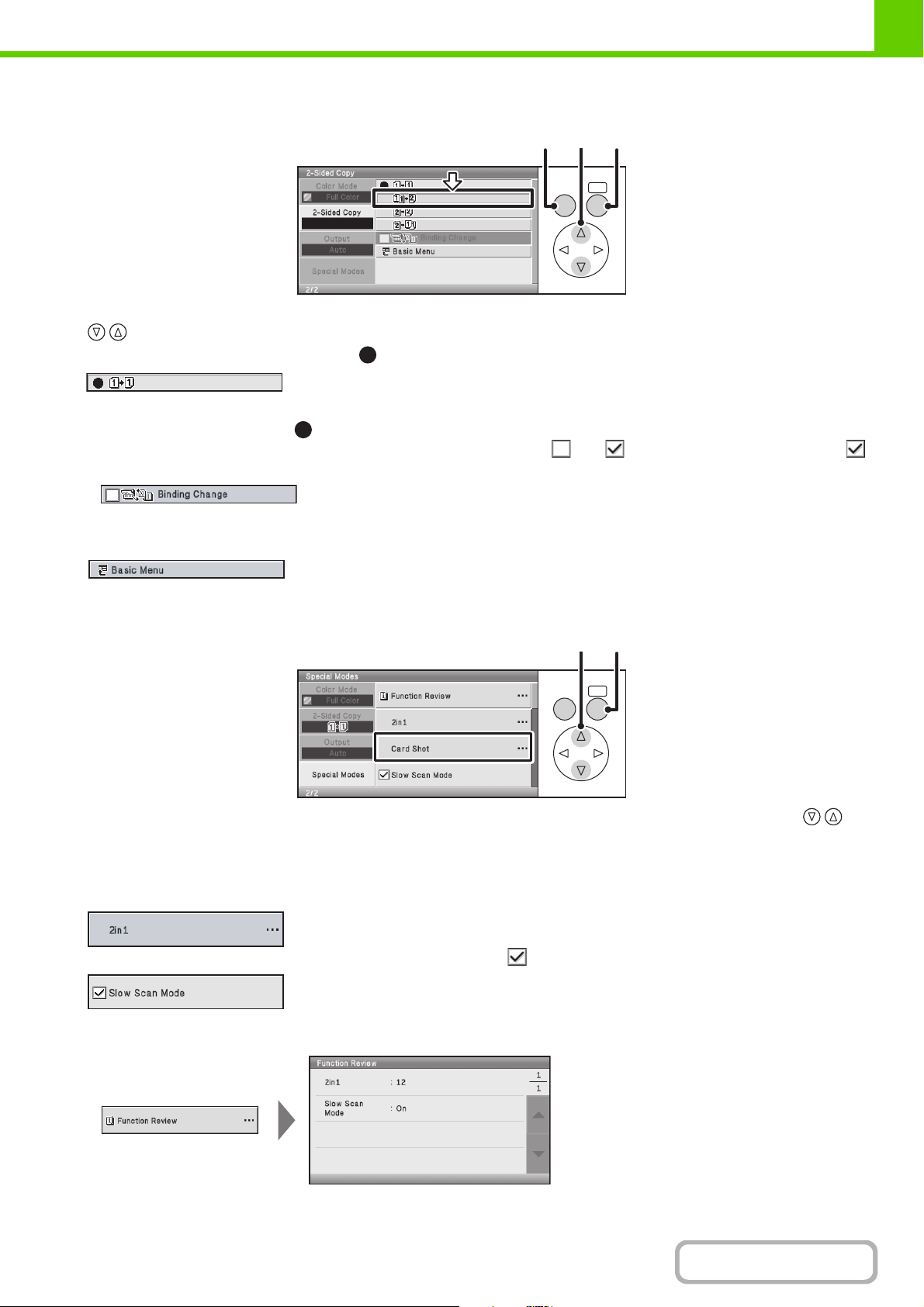
(1) When selections appear as a list in a setting screen, select the desired item in the list with the
keys.
Items that are currently set are indicated by .
(2) Press the [OK] key to enter your selection.
• When the [OK] key is pressed, appears next to the selected item.
• For a selected item that has a checkbox, the checkbox changes between and each time the [OK] key is pressed.
indicates that the setting is selected.
(3) To return to the previous screen, press the [BACK] key.
To return to the base screen, select the [Basic Menu] key.
Checking special mode settings
(1) Select [Special Modes] in the base screen to display a list of the special modes. Use the
keys to move the selection frame to the desired special mode.
(2) If "…" appears to the right of the selected item, the [OK] key can be pressed to open a detailed
setting screen.
• If the item has a checkbox, pressing the [OK] key sets the item to ; a detailed setting screen does not open.
• When special modes are set, the [Function Review] key can be selected at the top of the list. Selecting the [Function Review]
key displays a list of the special mode settings.
OK
BACK
(1) (2)(3)
OK
BACK
(1) (2)
1-11
BEFORE USING THE MACHINE
Contents
Entering numbers in special mode settings
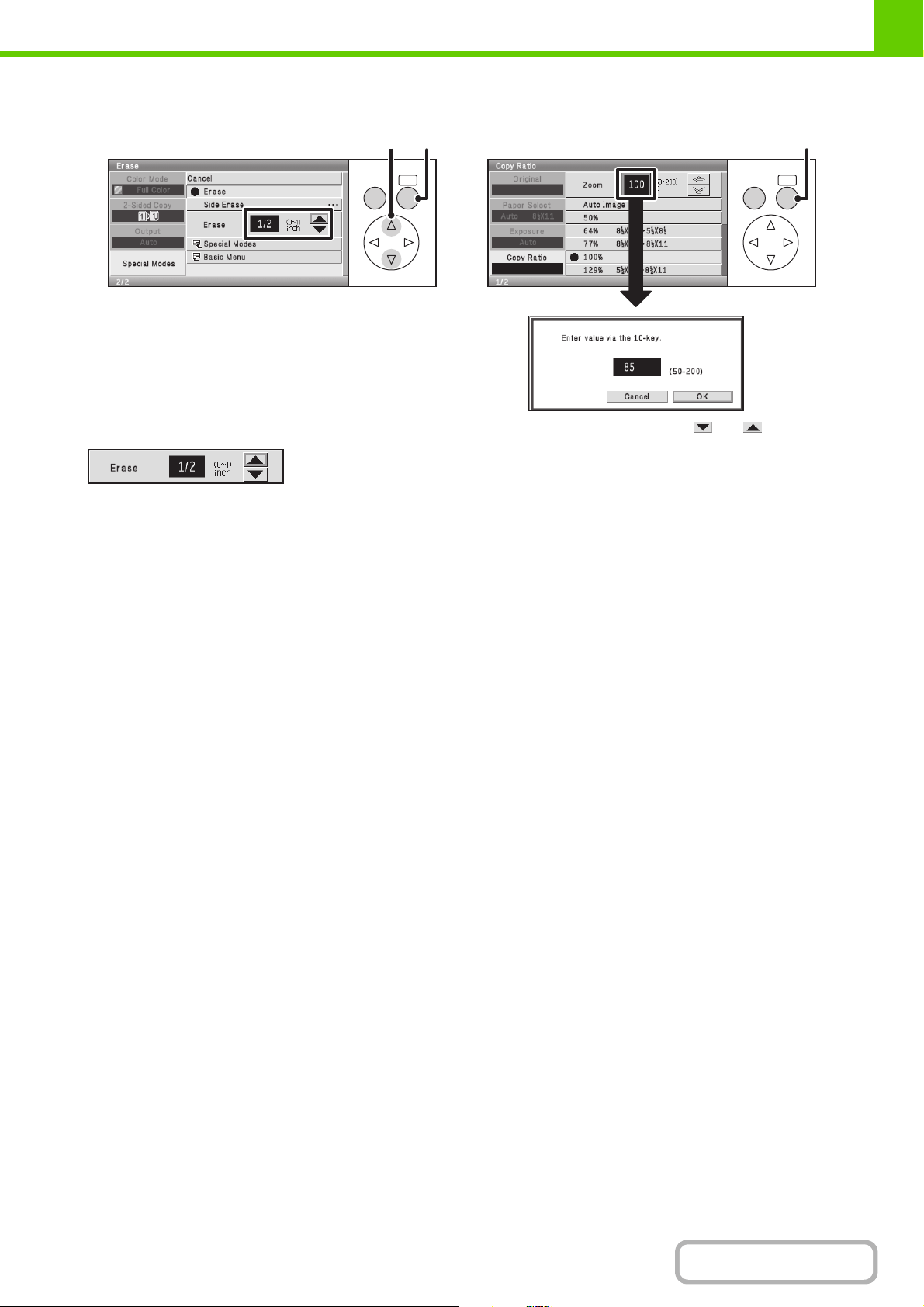
(1) If a setting requires that a number be entered, move the selection frame to or .
(2) The number increases or decreases each time the [OK] key is pressed. To make the number
change quickly, hold down the [OK] key.
(3) You can also select the number display and directly enter a number with the numeric keys.
Move the selection frame to the number display and press the [OK] key. A number entry screen will appear. Press the numeric
keys to enter a number and select the [OK] key.
OK
BACK
OK
BACK
(2)
(1)
(3)
1-12
BEFORE USING THE MACHINE
Contents
Items that appear in the display
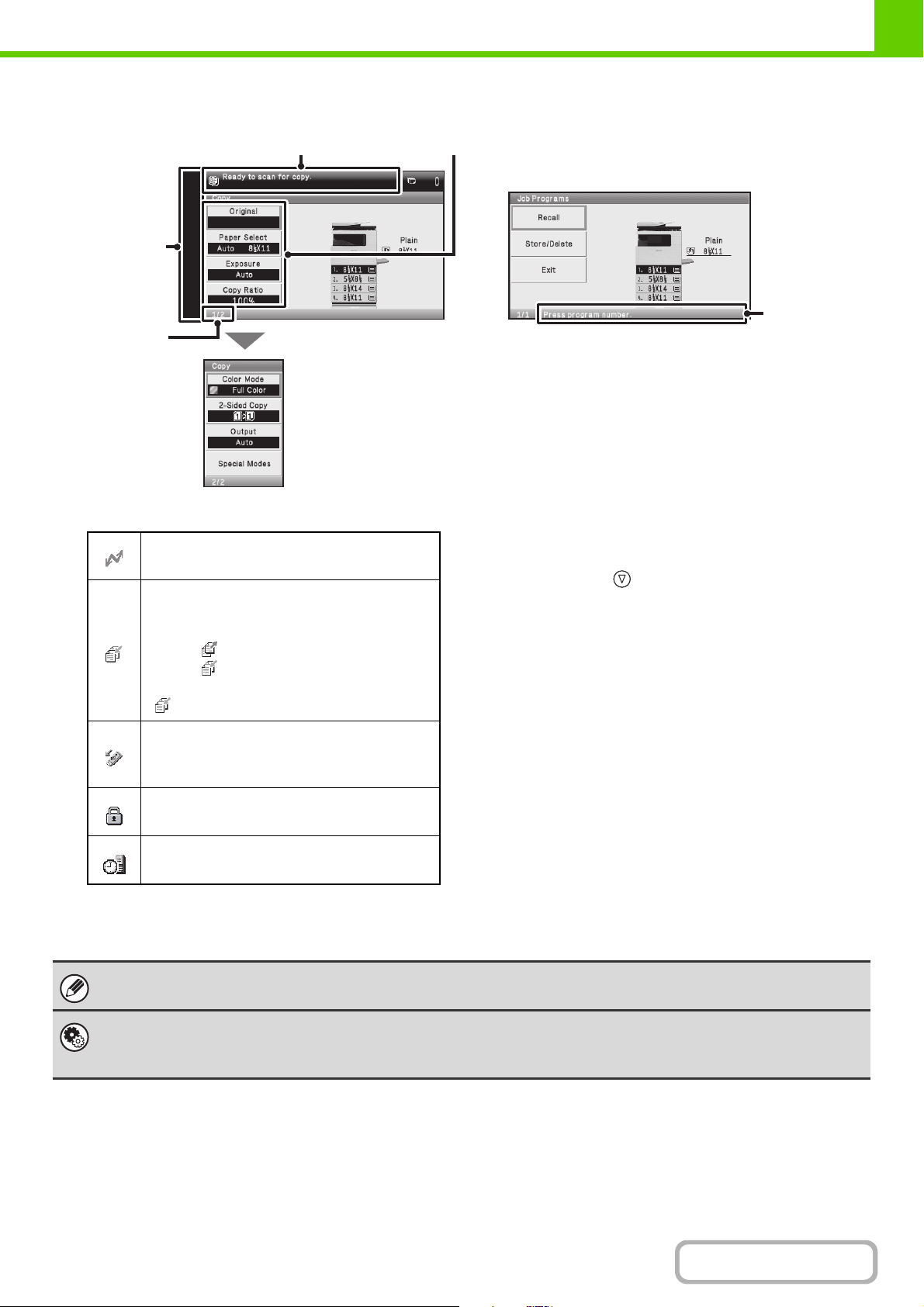
(1) Icon display (2) This shows messages.
(3) Settings appear here.
If you move the selection frame to the bottom setting and
then press the key, the next screen appears.
(4) This shows the current page / total pages.
(5) This shows an operation hint.
(1)
(4)
(5)
(2) (3)
This icon appears when data is being sent or
received.
This icon appears when fax, scan, or
Internet fax data is stored in the machine's
memory. When data to be transmitted is
stored, appears. When received data is
stored, appears. When both data to be
transmitted and received data are stored,
appears.
This icon appears when a USB memory or
other USB device is connected to the
machine.
This icon appears when the data security kit
is being used.
This icon appears when the machine is
communicating with an external application.
The display illustrations shown in this manual are only images, and may differ from the actual screens.
System Settings (Administrator): Keys Touch Sound
This is used to adjust the volume of the beep that sounds when keys are touched. The key touch sound can also be turned
off.
1-13
BEFORE USING THE MACHINE
Contents
USING THE WEB PAGE
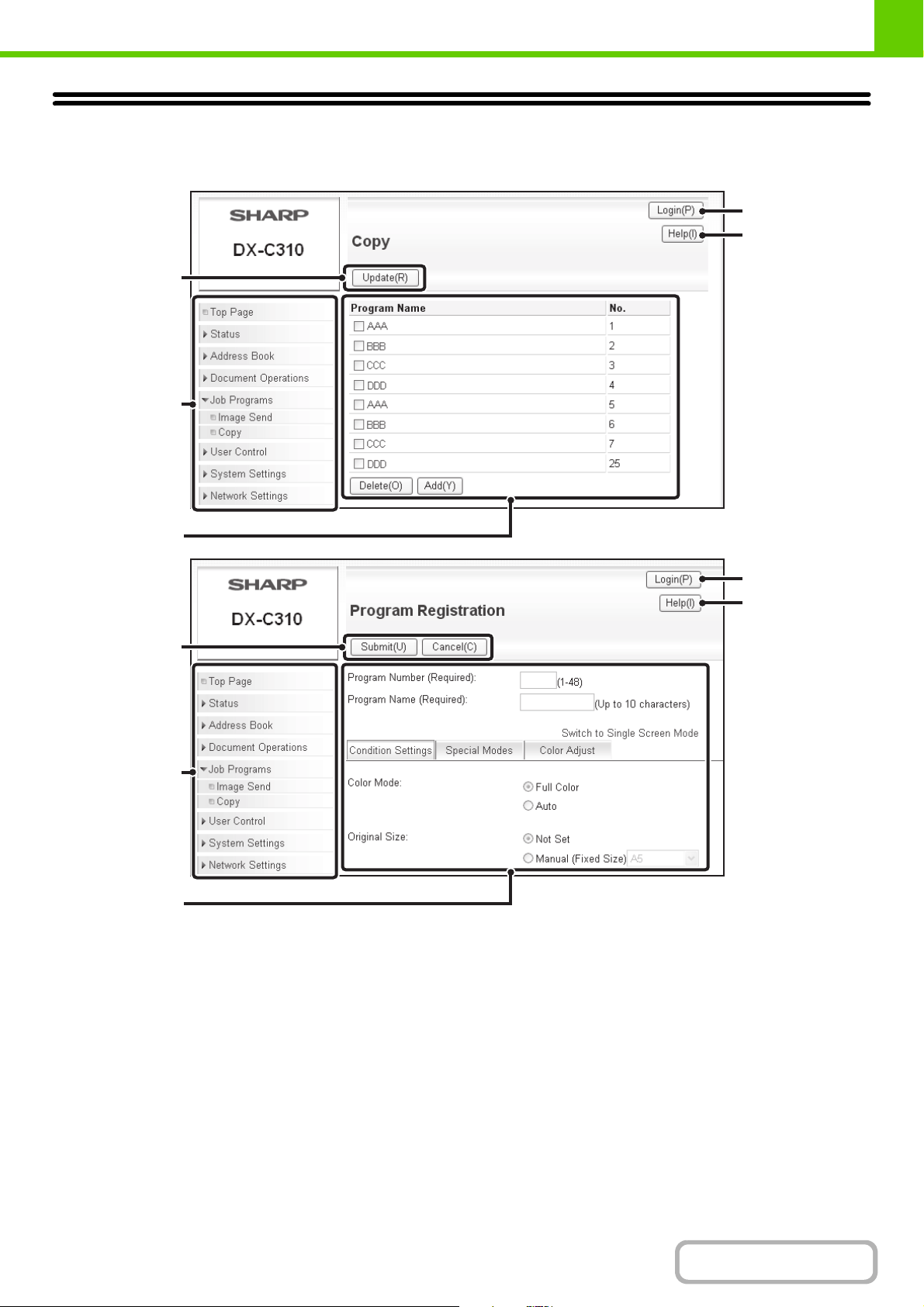
The procedures for using the Web page are explained below.
(1) Common buttons
The [Submit] button used to store settings, the [Update]
button used to update settings, and the [Cancel] button
used to cancel a setting and return to the previous screen
appear here.
After changing a setting, be sure to click the [Submit]
button.
(2) Web page menu
The items that can be set in the Web page appear here.
Click an item to display the settings of that item.
(3) Settings appear here.
The settings of an item selected from the Web page
menu appear here.
(4) [Logout] button
When user authentication is enabled, click this button to
log out from the Web server. When you are not logged in,
this button is the [Login] button.
(5) [Help] button
This shows Help for each item.
(2)
(3)
(1)
(5)
(4)
(2)
(3)
(1)
(5)
(4)
1-14
BEFORE USING THE MACHINE
Contents
TURNING THE POWER ON AND OFF
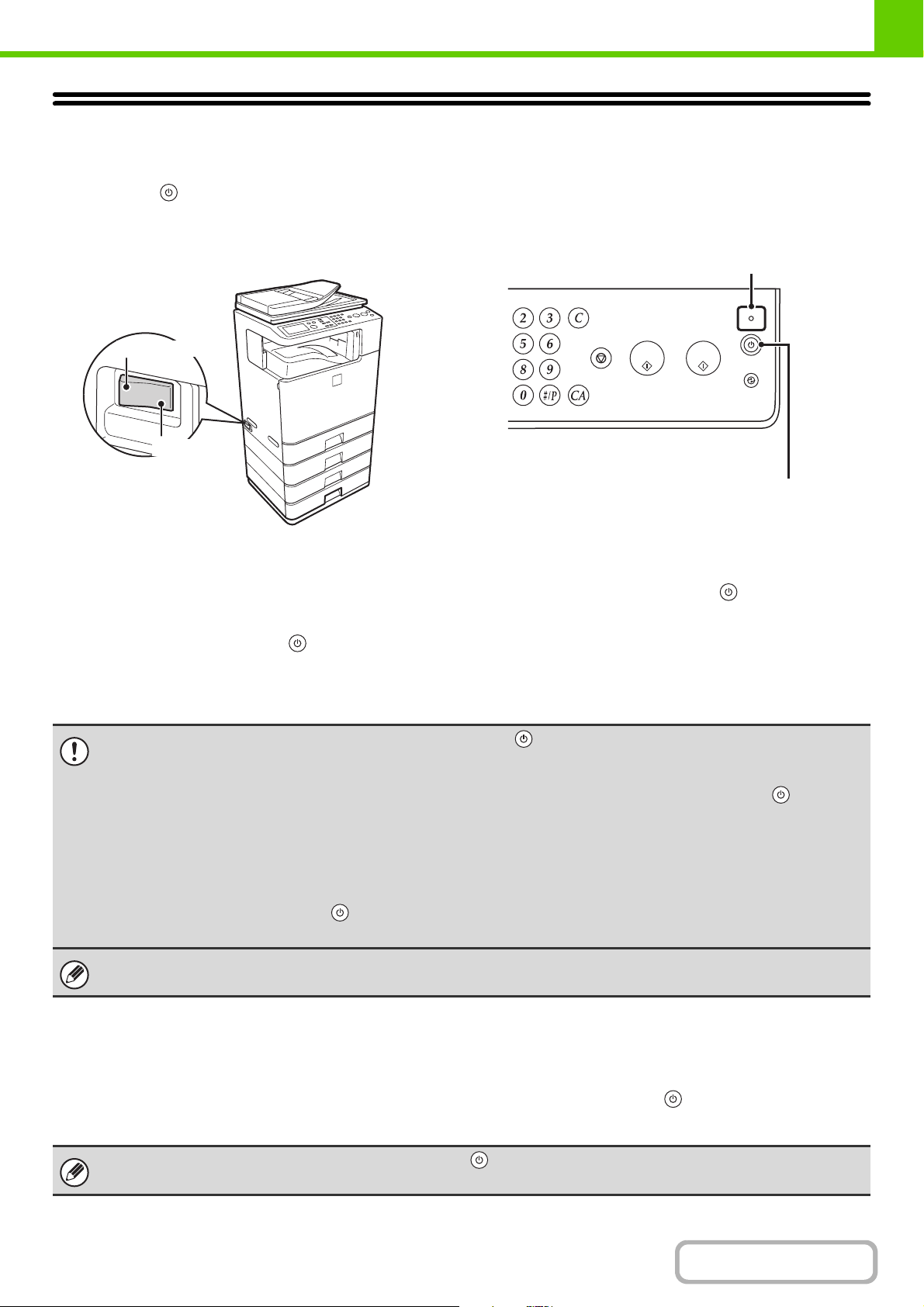
The machine has two power switches. One is the main power switch on the left side of the machine, and the other is the
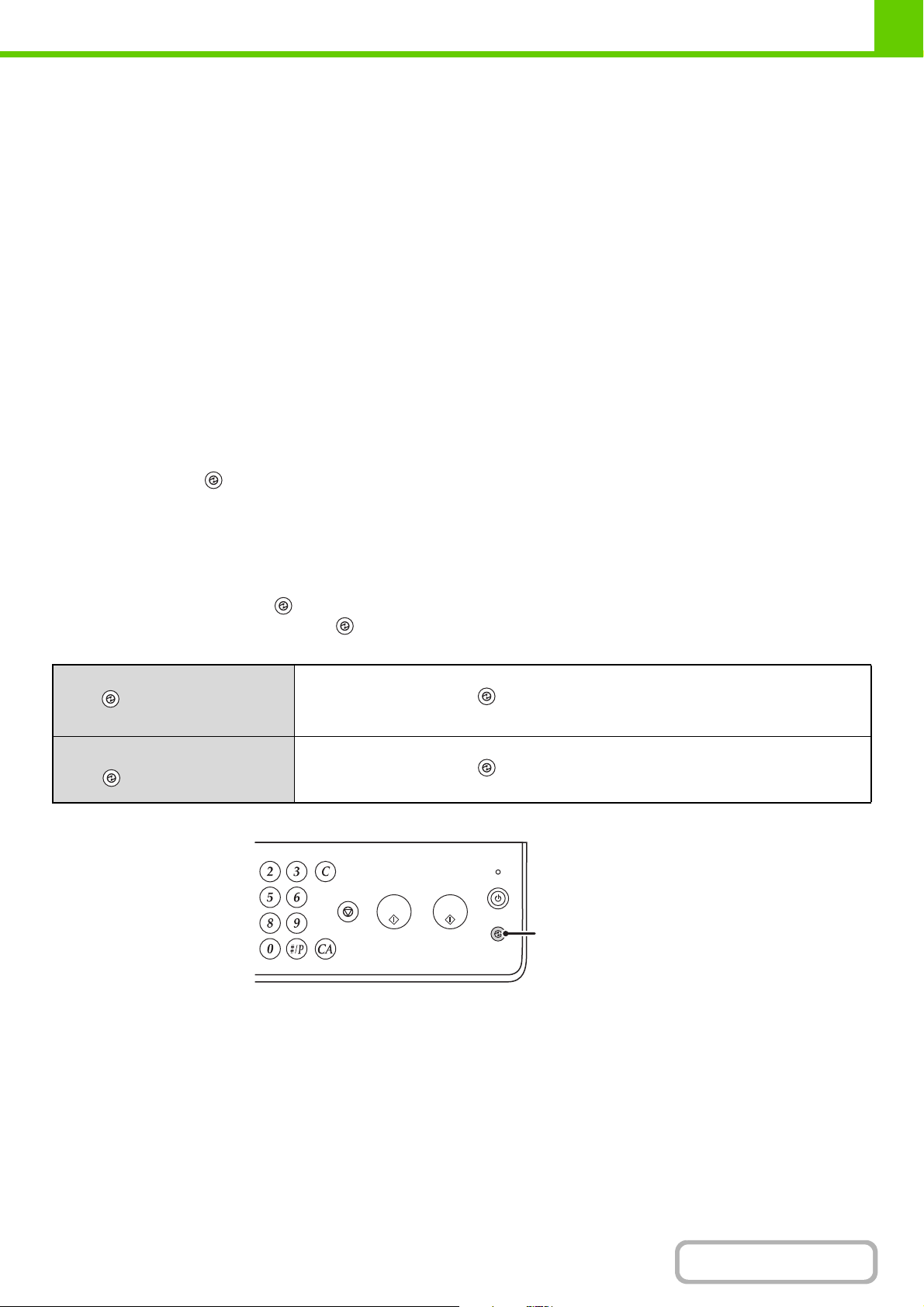
[POWER] key ( ) on the upper right side of the operation panel.
Main power switch
When the main power switch is switched on, the main
power indicator on the operation panel lights up.
[POWER] key
Turning on the power
(1) Switch the main power switch to the "on"
position.
(2) Press the [POWER] key ( ) to turn on the
power.
Turning off the power
(1) Press the [POWER] key ( ) to turn off the
power.
(2) Make sure that the display is off.
(3) Switch the main power switch to the "off"
position.
Restarting the machine
In order for some settings to take effect, the machine must be restarted.
If a message in the display prompts you to restart the machine, press the [POWER] key ( ) to turn off the power and
then press the key again to turn the power back on.
"On" position
"Off" position
T
Main power indicator
[POWER] key
• When turning off the power, be sure to press the [POWER] key ( ) on the operation panel, then wait 20 seconds and
switch off the main power switch. In the event that the main power is suddenly interrupted due to a power failure or other
reason, turn the machine power back on and then turn it off in the correct order.
If the machine is left for a long time with the main power having been turned off prior to the [POWER] key ( ), abnormal
noises, degraded image quality, and other problems may result.
• Before switching off the main power switch, make sure that the display is off and the DATA indicator for printing and the
DATA and LINE indicators for image send are not lit or blinking on the operation panel.
Switching off the main power switch or removing the power cord from the outlet while any of the indicators are lit or blinking
may cause failure, such as damage to the hard drive or loss of data.
• Switch off both the [POWER] key ( ) and the main power switch and unplug the power cord if you suspect a machine
failure, if there is a bad thunderstorm nearby, or when you are moving the machine.
When using the fax or Internet fax function, always keep the main power switch in the "on" position.
In some states of the machine, pressing the [POWER] key ( ) to restart will not make the settings take effect. In this case,
use the main power switch to switch the power off and then on.
1-15
BEFORE USING THE MACHINE
Contents
ENERGY SAVE FUNCTIONS
This product has the following two energy save functions that conform to the Energy Star guidelines to help conserve
natural resources and reduce environmental pollution.
Preheat Mode (Low power mode)
Preheat mode automatically lowers the temperature of the fusing unit and thereby reduces power consumption if the
machine remains in the standby state for the interval of time set in "Preheat Mode Setting" in the system settings
(administrator).
The machine automatically wakes up and returns to normal operation when a print job is received, a key is pressed on
the operation panel, or an original is placed.
Auto power shut-off mode (Sleep mode)
Auto power shut-off mode automatically shuts off power to the display and the fusing unit if the machine remains in the
standby state for the interval of time set in "Auto Power Shut-Off Timer" in the system settings (administrator). This
mode provides the lowest level of power consumption. Considerably more power is saved than in preheat mode,
however, the wakeup time is longer. This mode can be disabled in the system settings (administrator).
The machine automatically wakes up and resumes normal operation when a print job is received or when the blinking
[POWER SAVE] key
() is pressed.
[POWER SAVE] KEY
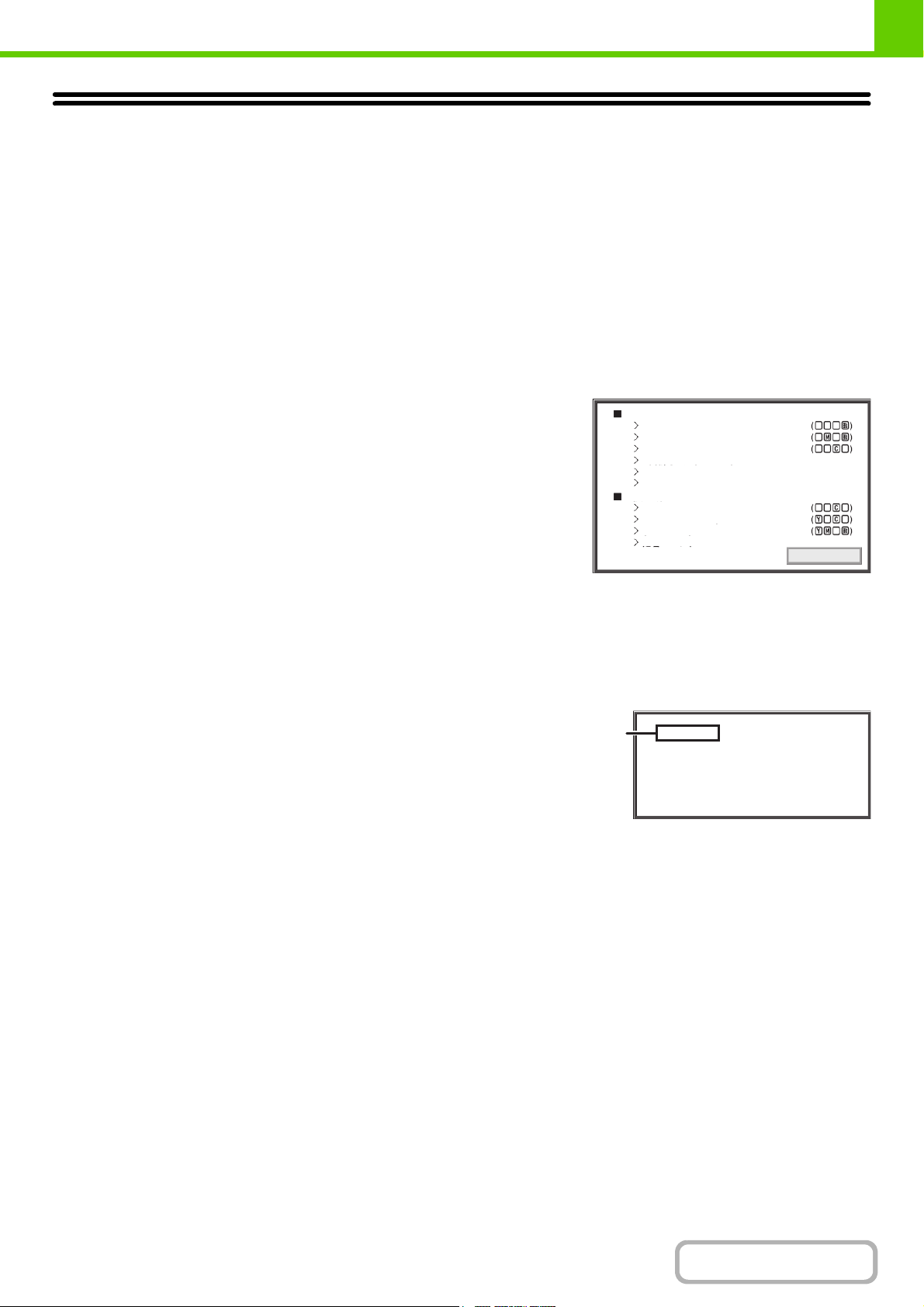
Press the [POWER SAVE] key () to put the machine in auto power shut-off mode or wake it up from auto power
shut-off mode. The [POWER SAVE] key
() has an indicator that indicates whether or not the machine is in auto power
shut-off mode.
When the [POWER SAVE]
key ( ) indicator is off in the
standby state
The machine is ready to be used.
If the [POWER SAVE] key ( ) is pressed when the indicator is off, the indicator will blink
and the machine will enter auto power shut-off mode after a brief interval.
When the [POWER SAVE]
key ( ) indicator is blinking
The machine is in auto power shut-off mode.
If the [POWER SAVE] key ( ) is pressed when the indicator is blinking, the indicator will
turn off and the machine will return to the ready state after a brief interval.
T
[POWER SAVE]
key / indicator
1-16
BEFORE USING THE MACHINE
Contents
USEFUL INFORMATION ABOUT THE MACHINE
This page explains where to find information on supplies that will require replacement as you continue using the
machine, and what to do if an error occurs.
INFORMATION ON SUPPLY ITEMS
Names of supply items and model name list
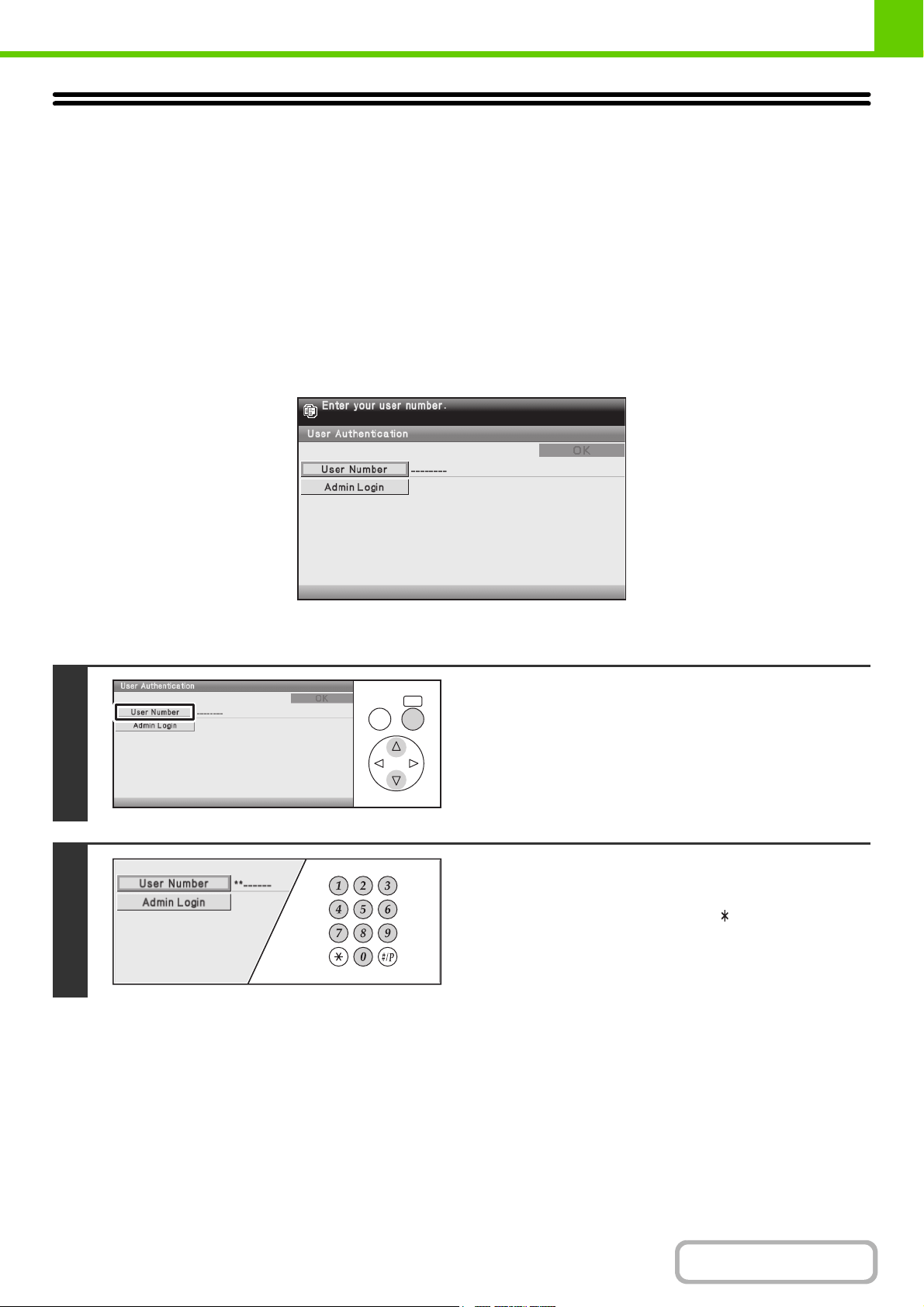
As the machine is used, it will become necessary to replace the toner cartridge, developer cartridge, and other supplies.
Each supply item has a model name.
☞ "REPLACING SUPPLIES AND MAINTENANCE" in Maintenance & Safety Guide
When to replace supplies
When it is time to replace a supply item, a message will appear in the display.
You can also check supply replacement times in the Web page.
☞ "REPLACING SUPPLIES AND MAINTENANCE" in Maintenance &
Safety Guide
Supply replacement procedures
Replacement procedures and points requiring caution vary by supply item.
When replacing an item, be sure to carefully follow the procedure for that item
and note all precautions.
☞ "REPLACING SUPPLIES AND MAINTENANCE" in Maintenance &
Safety Guide
WHEN AN ERROR CODE APPEARS
How to clear an error code
If a problem occurs in the machine, an error code may appear in the
display. The action to be taken varies depending on the code that
appears.
☞ "TROUBLESHOOTING" in Maintenance & Safety Guide
How to print the machine information list
Basic machine information can be printed. This information can be used to help solve machine problems.
☞ "TROUBLESHOOTING" in Maintenance & Safety Guide
How to print an image quality check chart
The machine's image quality check chart can be printed. Testing using this chart can help identify the cause of a
machine problem.
☞ "TROUBLESHOOTING" in Maintenance & Safety Guide
OTHER INFORMATION
How to execute fusing cleaning mode
When the fusing unit becomes dirty, dirt will appear at fixed intervals on the output. Fusing cleaning mode can be used
to clean the fusing unit.
☞ "TROUBLESHOOTING" in Maintenance & Safety Guide
Update of firmware
The firmware (the program that is embedded in the machine) can be updated from the Web page in the machine.
☞ "UPDATE OF FIRMWARE" (page 1-41)
Change the supplies.
The supplies will be needed soon.
Toner Cartridge
Toner Cartridge
Developer Cartridge
Primary Transfer Belt Unit
Secondary Transfer Roller Unit
Developer Cartridge
Drum Cartridge
Toner Collection Container
Drum Cartridge
Fusing Unit
OK
Error code
Code:xx-xx.
Please refer to operation manual.
1-17
BEFORE USING THE MACHINE
Contents
USER AUTHENTICATION
User authentication restricts the use of the machine to users that have been registered. The functions that each user is
allowed to use can be specified, allowing the machine to be customized to meet the needs of your workplace.
When the administrator of the machine has enabled user authentication, each user must log in to use the machine.
There are different types of user authentication, and each type has a different login method.
For more information, see the explanations of the login methods.
☞ AUTHENTICATION BY USER NUMBER (see below)
☞ AUTHENTICATION BY LOGIN NAME / PASSWORD (page 1-19)
AUTHENTICATION BY USER NUMBER
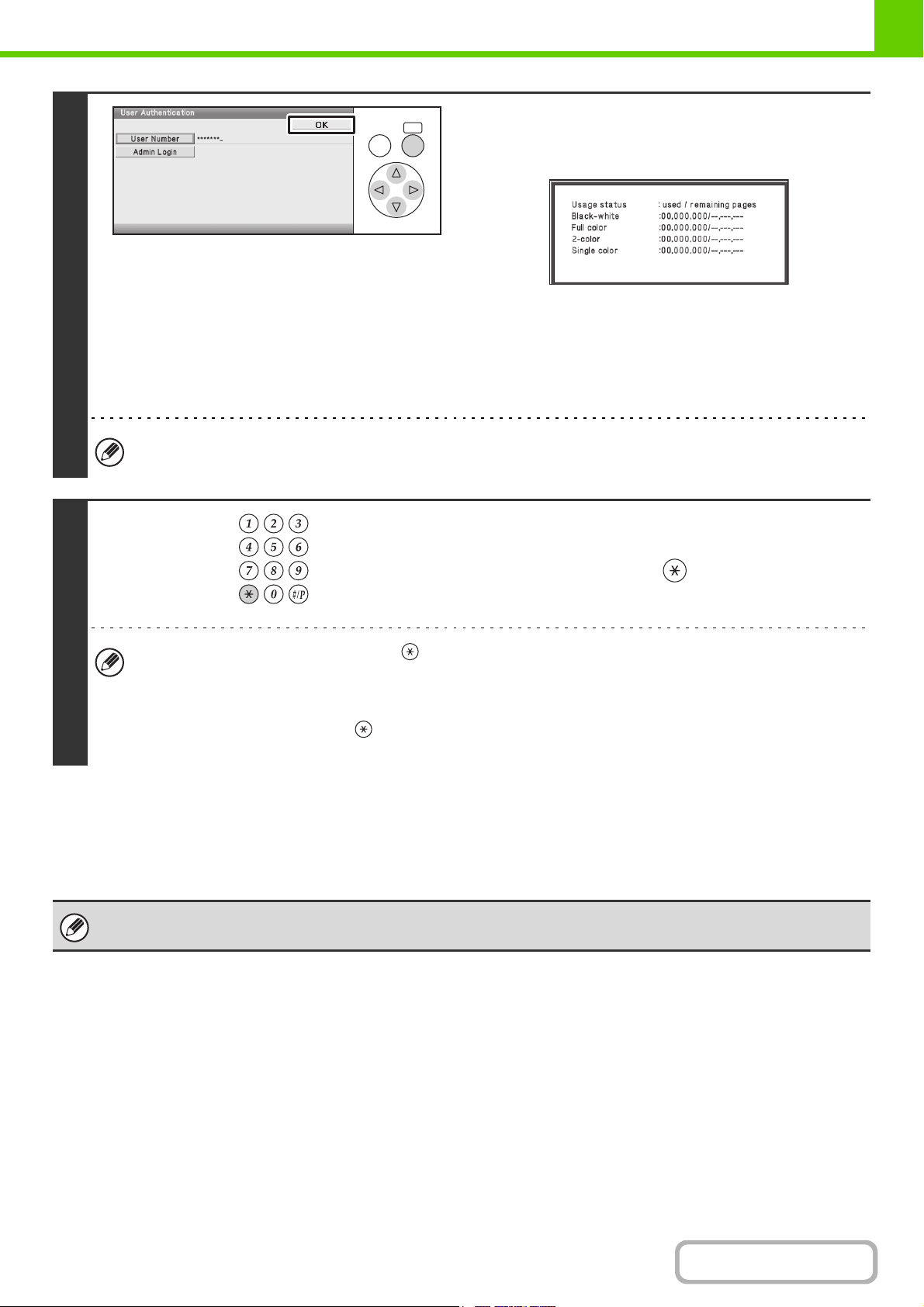
The following procedure is used to log in using a user number received from the administrator of the machine.
When controlled by user number
Keys in the display can be selected with the arrow keys and the [OK] key.
1
Select [User Number] key.
2
Enter your user number (5 to 8 digits)
with the numeric keys.
Each entered digit will be displayed as " ".
OK
BACK
1-18
BEFORE USING THE MACHINE
Contents
If an incorrect user number is entered 3 times in a row...
If "A Warning when Login Fails" is enabled in the Web page, the machine will lock for 5 minutes if an incorrect user
number is entered 3 times in a row.
Verify the user number that you should use with the administrator of the machine.
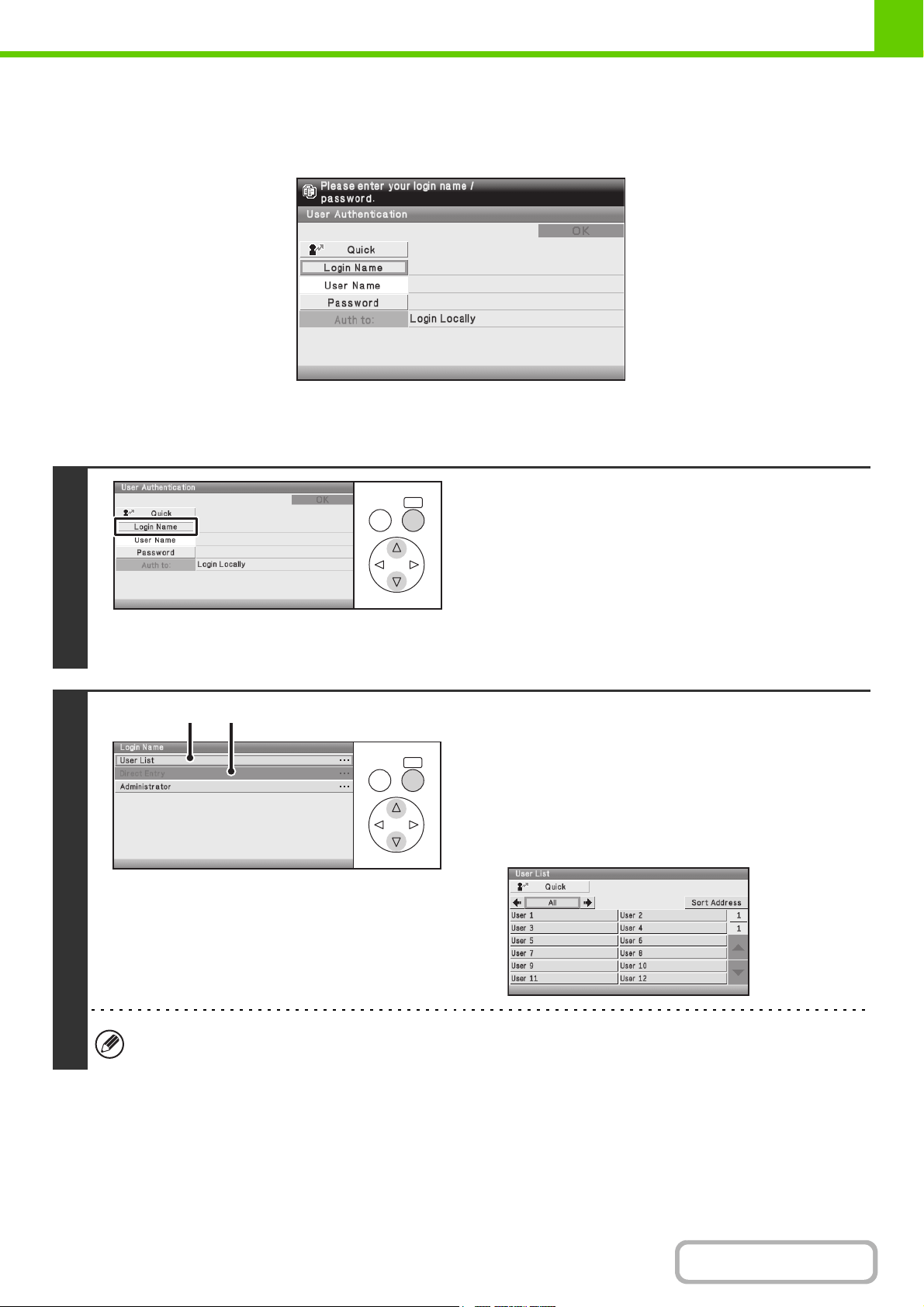
3
Select the [OK] key.
After the entered user number is authenticated, the user count
screen will appear briefly.
When page limits have been set in "Pages Limit Group List" in
the Web page, the number of pages remaining will appear.
(The remaining number of pages that the user can use in each
mode (copy, scan, etc.) appears.) The amount of time that this
screen appears can be changed using "Message Time Setting"
in the system settings (administrator).
When the user number is an 8-digit number, this step is not necessary. (Login takes place automatically after the user
number is entered.)
4
When you have finished using the
machine and are ready to log out, press
the [LOGOUT] key ( ).
• However, note that the [LOGOUT] key ( ) cannot be used to log out when a fax number is being entered in fax
mode, as the key is used for fax number entry.
• If a preset duration of time elapses after the machine is last used, the Auto Clear function will activate. When Auto
Clear activates, logout takes place automatically. However, when PC Scan mode is used, logout does not take
place when the [LOGOUT] key ( ) is pressed and Auto Clear does not operate. Change to a different mode on
the machine and then log out.
The administrator can clear the locked state.
This is done from [User Control] and then [Default Settings] in the Web page menu.
OK
BACK
LOGOUT
1-19
BEFORE USING THE MACHINE
Contents
AUTHENTICATION BY LOGIN NAME / PASSWORD
The following procedure is used to log in using a login name and password received from the administrator of the
machine or the administrator of the LDAP server.
When controlled by login name and password
(Different items will appear in the screen when LDAP authentication is used.)
Keys in the display can be selected with the arrow keys and the [OK] key.
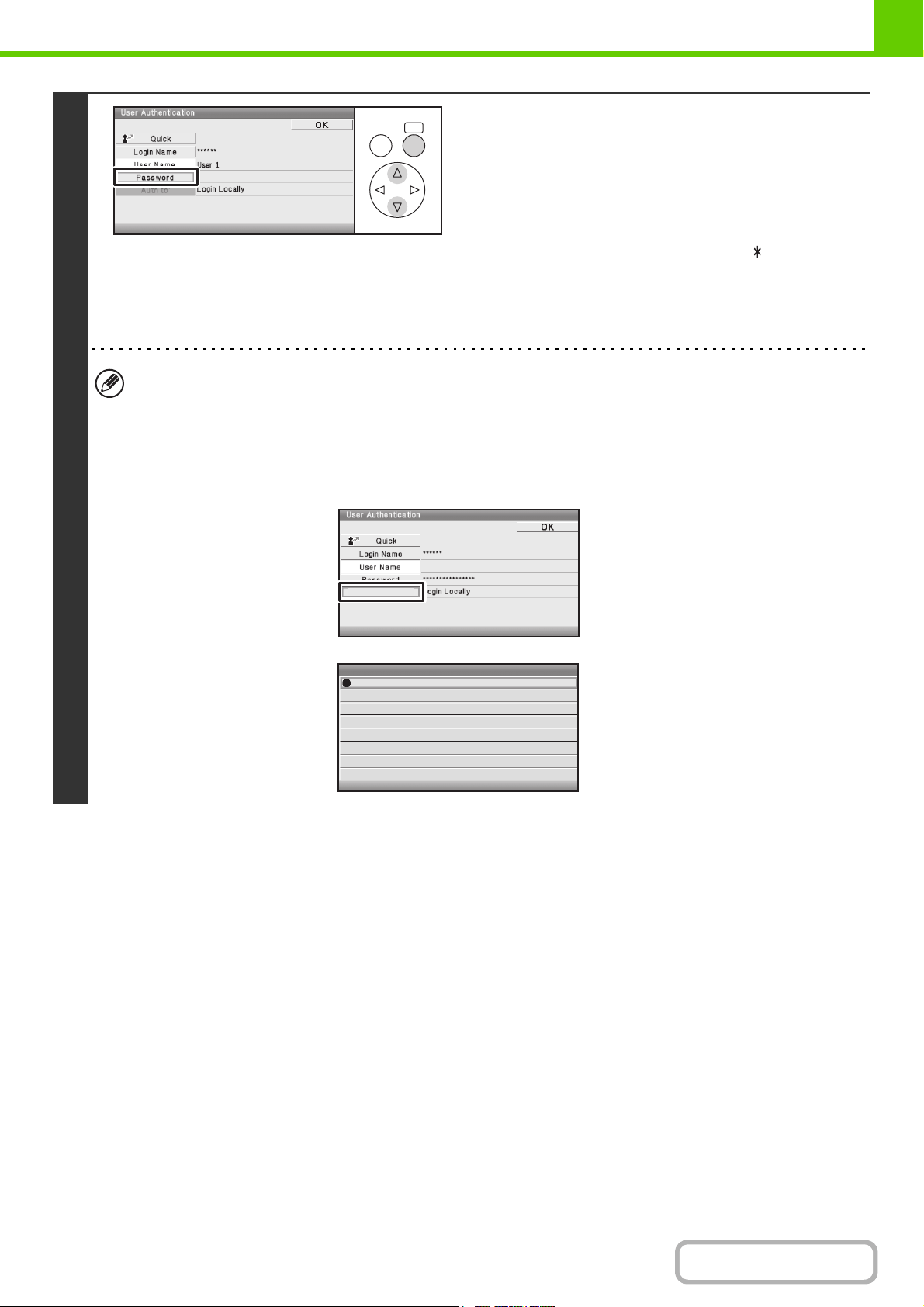
1
Select the [Login Name] key or the
[Quick] key.
If the [Login Name] key is selected, a screen for selecting the
user name appears. Go to the next step.
If the [Quick] key is selected, an area for entering a
"Registration No." appears [---].
Use the numeric keys to enter your registration number that
has been stored in "User List" in the Web page. After entering
the registration number, go to step 3.
2
Select the user name.
(A) [Direct Entry] key
Users who are not registered users and are only using
LDAP authentication use this key.
A text entry screen will appear. Enter your login name.
(B) [User List] key
Select your user name that has been stored in "User List"
in the Web page.
LDAP authentication can be used when the administrator of the server provides LDAP service on the LAN (local area
network).
OK
BACK
OK
BACK
A B
1-20
BEFORE USING THE MACHINE
Contents
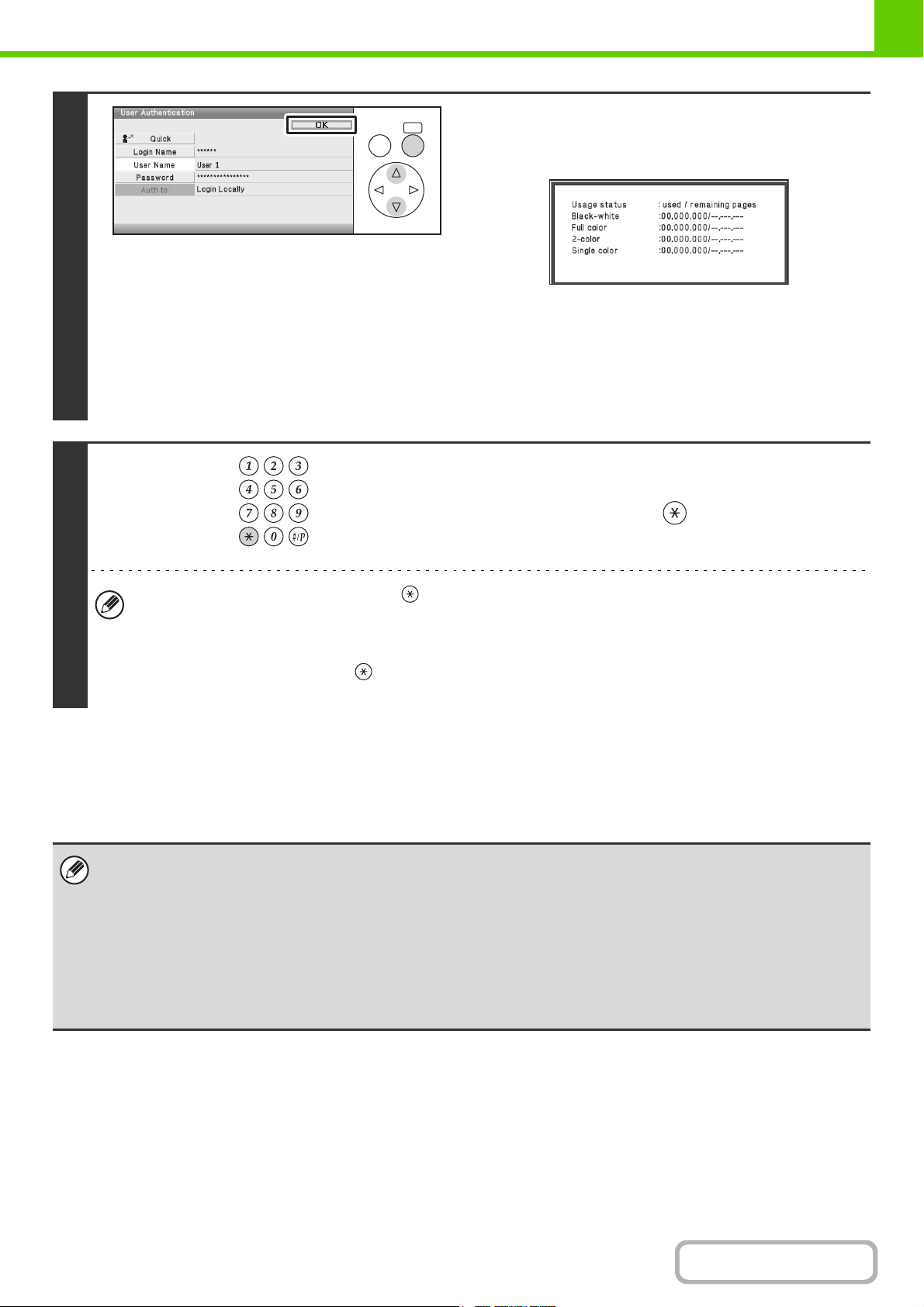
3
Select the [Password] key.
A text entry screen for entering the password will appear.
Enter your password that is stored in "User List" in the Web
page.
If you are logging in to an LDAP server, enter the password that
is stored with your LDAP server login name.
Each entered character will be displayed as " ". When you
have finished entering the password, select the [OK] key.
When authentication is by LDAP server and you have different
passwords stored in "User List" in the Web page and in the
LDAP server, use the password stored in the LDAP server.
• When an LDAP server has been stored, [Auth to:] can be changed.
• If you selected a login user name from the user list…
The LDAP server was stored when your user information was stored, and thus the LDAP server will appear as the
authentication server when you select your login name. Go to step 4.
• When logging in using the [Direct Entry] key...
Select the [Auth to:] key.
Select the LDAP server.
OK
BACK
Direct Entry
Auth to:
Authenticate to:
Login Locally
Server 1
Server 2
Server 3
Server 4
Server 5
Server 6
Server 7
1-21
BEFORE USING THE MACHINE
Contents
If an incorrect login name or password is entered 3 times in a row...
If "A Warning when Login Fails" is enabled in the Web page, the machine will lock for 5 minutes if an incorrect login
name or password is entered 3 times in a row.
Verify the login name and password that you should use with the administrator of the machine.
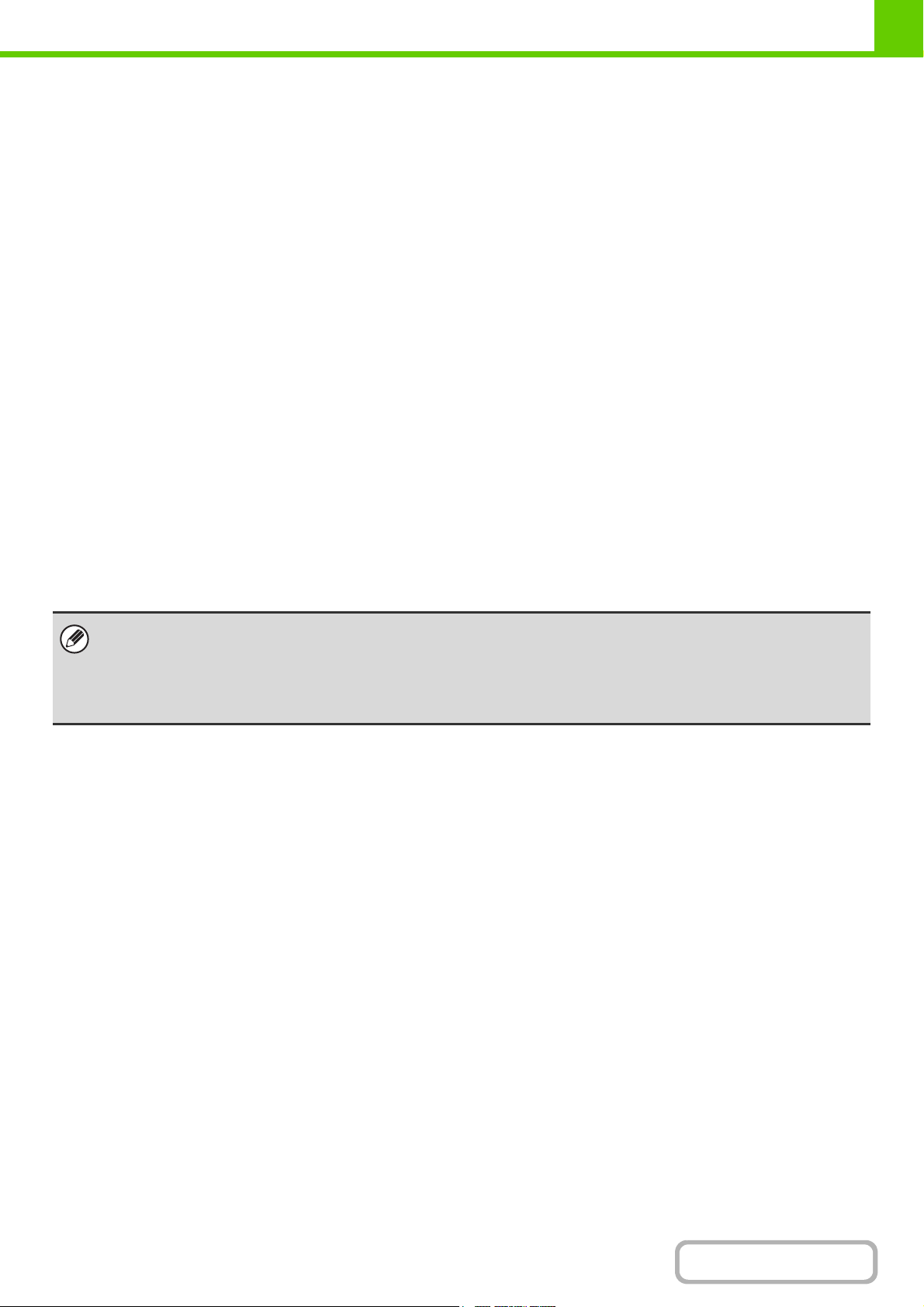
4
(Different items will appear in the screen when LDAP
authentication is used.)
Select the [OK] key.
After the entered login name and password are authenticated,
the user count screen will appear briefly.
When page limits have been set in "Pages Limit Group List" in
the Web page, the number of pages remaining will appear.
(The remaining number of pages that the user can use in each
mode (copy, scan, etc.) appears.) The amount of time that this
screen appears can be changed using "Message Time Setting"
(Web page only) in the system settings (administrator).
5
When you have finished using the
machine and are ready to log out, press
the [LOGOUT] key ( ).
• However, note that the [LOGOUT] key ( ) cannot be used to log out when a fax number is being entered in fax
mode, as the key is used for fax number entry.
• If a preset duration of time elapses after the machine is last used, the Auto Clear function will activate. When Auto
Clear activates, logout takes place automatically. However, when PC Scan mode is used, logout does not take
place when the [LOGOUT] key ( ) is pressed and Auto Clear does not operate. Change to a different mode on
the machine and then log out.
• The administrator can clear the locked state.
This is done from [User Control] and then [Default Settings] in the Web page menu.
• When LDAP authentication is used, the [E-mail Address] key may appear, depending on the authentication method. If the
[E-mail Address] key appears in step 3, select the key.
A text entry screen will appear. Enter your e-mail address.
• USER LIST (page 1-23)
This is used to store names of users of the machine. Detailed information such as the login name, user number, and password
are also stored. Ask the administrator of the machine for the information that you need to use the machine.
Registration is performed in [User List] in [User Control] in the Web page menu.
OK
BACK
LOGOUT
1-22
BEFORE USING THE MACHINE
Contents
ACCESSING THE WEB PAGE
The login method for accessing the Web server in the machine varies depending on whether or not user authentication
is enabled.
For information on accessing the Web server in the machine, see "ACCESSING THE WEB SERVER IN THE
MACHINE" in the Quick Start Guide.
When user authentication is not enabled
If you click a setting that requires administrator authority after accessing the Web page, a login screen will appear. Enter
your password.
When user authentication is enabled
Use the procedure below to log in. Note that when auto login user is enabled, the authentication screen will not appear.
When the login method is login name / password ( / e-mail address)
To access the Web page, enter a login name and password in the login screen that appears. If the login method is set to
login name / password / e-mail address, a text box will appear for entry of your [E-mail Address]. If this box appears,
enter your e-mail address.
When the authentication method is user number
To access the Web page, enter a user number in the login screen that appears.
In user number mode, you can also login from [Admin Login] in the login screen.
• User authentication is initially disabled (factory default setting).
• To prevent passwords from being leaked onto the network during login, it is recommended that the SSL function be
enabled in the Web browser.
• To log out…
Click the [Logout] key at the upper right of the Web page, or close the Web browser.
1-23
BEFORE USING THE MACHINE
Contents
USER CONTROL
User Control is used to configure settings for user authentication in the Web page. Select the [User Control] key in the
Web page menu to configure the settings.
USER LIST
This is used to store, edit, and delete users when user authentication is enabled.
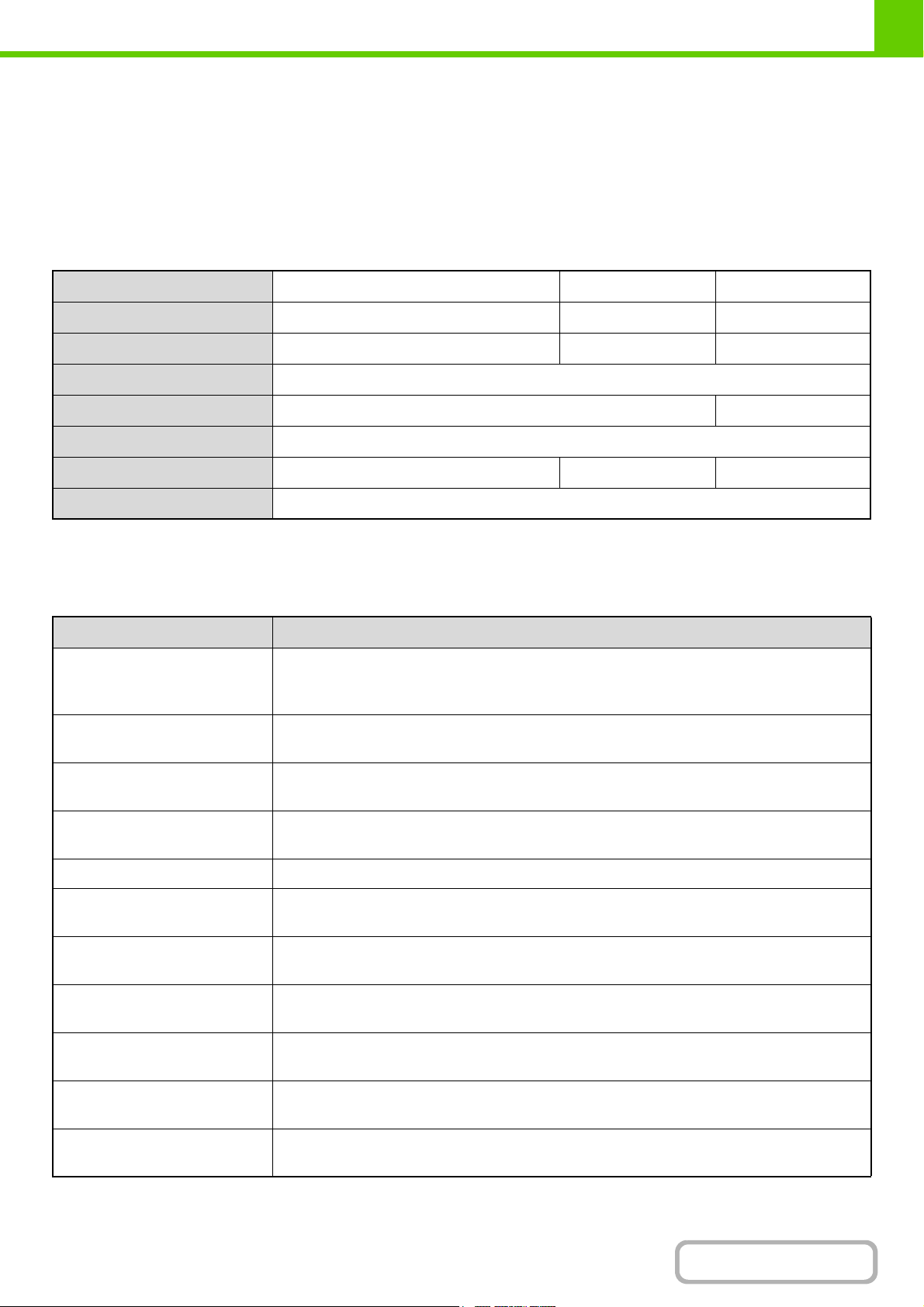
When the [User List] key is selected, the following screen appears.
(1) User List
This shows the factory-stored users and the currently
stored users.
(2) [Delete] key
Use this to delete a registered user.
(3) [Delete All Users] key
Use this to delete all stored users. (Excluding factory
stored users.) This operation can only be performed by
an administrator.
(4) [Add] key
Use this to add a new user.
Storing a user
Select the [Add] key in the above screen to open a registration screen. Up to 1000 users can be stored.
For more information, see "Settings" (page 1-24).
Editing/deleting a user
To open an edit screen for a user, select the user from the list in the above screen. To open a delete screen for a user,
select the checkbox next to the user ( ) and then select [Delete].
For more information, see "Settings" (page 1-24).
(2)
(1)
(4)
(3)
• When auto login is enabled, "Delete All Users" cannot be used.
• The factory-stored users cannot be deleted.
1-24
BEFORE USING THE MACHINE
Contents
Factory-stored users
The following users are stored in the machine at the factory.
• Administrator: Factory-stored account for the administrator of the machine.
• User: This is used when network authentication is used and a login name not stored in the machine is directly
entered. (This cannot be selected in the login user screen.)
• Other User: This is used when a print job is executed using invalid user information. (This cannot be selected in the
login user screen.)
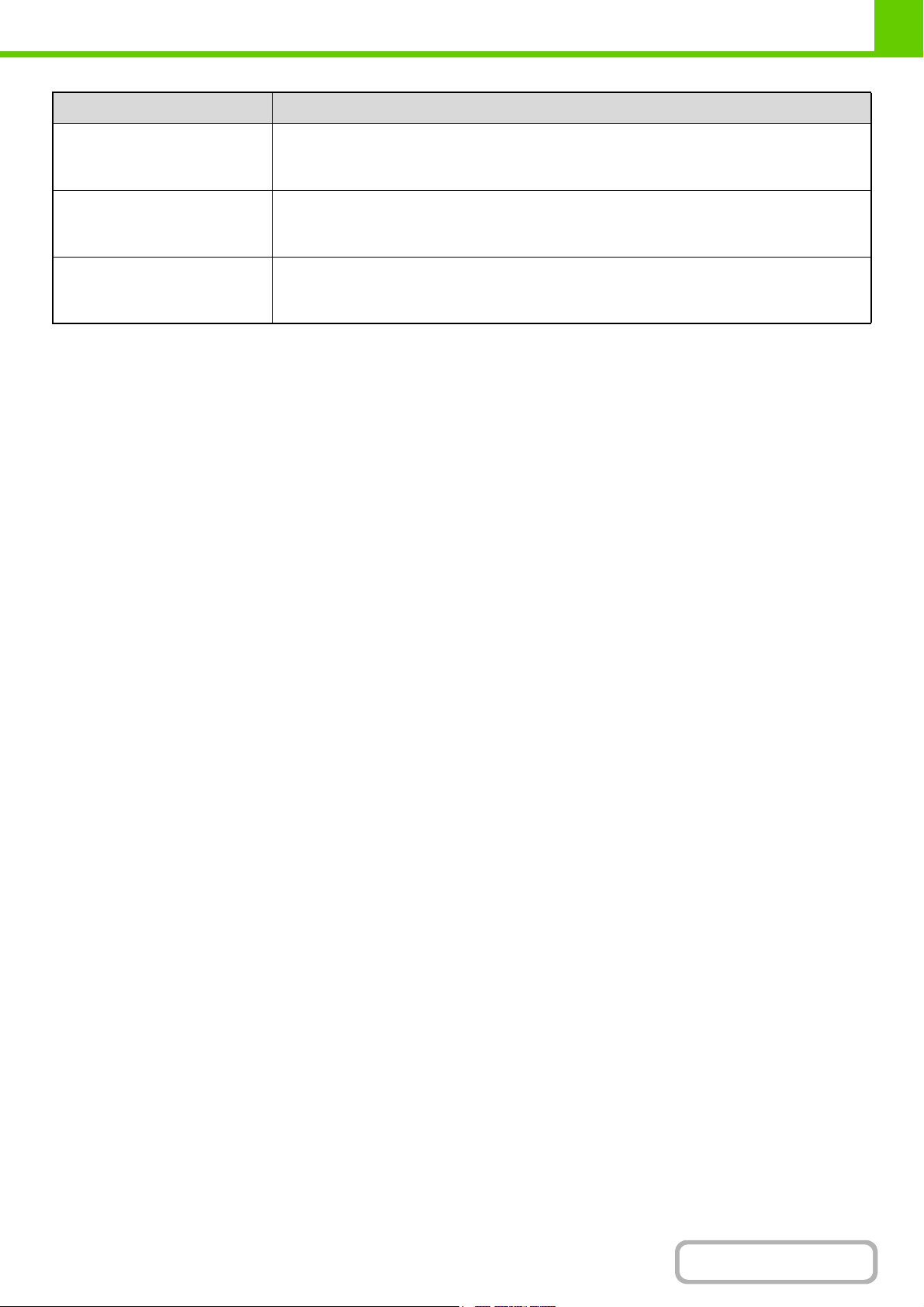
For settings related to each of the users, see the following table.
*1 Items that can be changed.
*2 For detailed information of each of the settings, see "List of settings and factory default settings of template groups" (page 1-30).
Settings
User Name
Administrator User Other User
Login Name
admin users Other
Password
(See the Maintenance & Safety Guide.)*
1
users*
1
–
My Folder
Main Folder
Authentication Settings
Login Locally –
Pages Limit Group
Unlimited*
1
Authority Group*
2
Admin User*
1
Guest*
1
Favorite Operation Group
Following the System Settings*
1
Item Description
User Name
Store the name of the user (max. 32 characters). This user name is used as the key name in
the login screen, the document filing user name, and the sender name. (The user name must
be unique.)
Apply User Name to Log-in
Name*
1
Select this key to enter the entered user name in the login name.
Initial
This determines where the user name will appear in the user list. Up to 10 characters can be
entered.
Index
Select the desired custom index. The custom index names are the same as those in the
address book.
User Number*
2
Enter a user number (5 to 8 digits).
Login Name*
1
Enter the login name used when authentication by login name/password is enabled
(maximum of 255 characters). (The login name must be unique.)
Password*
1, 3
Enter the password used when authentication by login name/password is enabled (1 to 32
characters). (The password can be omitted.)
E-mail Address
Enter the e-mail address used in the sender list and for LDAP authentication (maximum of 64
characters).
My Folder
A folder ("My Folder") can be specified as the folder used by the user for document filing. A
previously created folder can be selected or you can create and select a new folder.
Authentication Settings*
1
Select [Login Locally] or [Network Authentication] (when LDAP is enabled) for "Authenticate
to:".
Authentication Server
When [Network Authentication] is selected, select the server to be used for user
authentication from the list of LDAP servers stored in the Web pages.
1-25
BEFORE USING THE MACHINE
Contents
*1 Does not appear when "User Number" is selected for the authentication method.
*2 Only appears when "User Number" is selected for the authentication method.
*3 Not required when network authentication is used, as the password stored in the LDAP server is used.
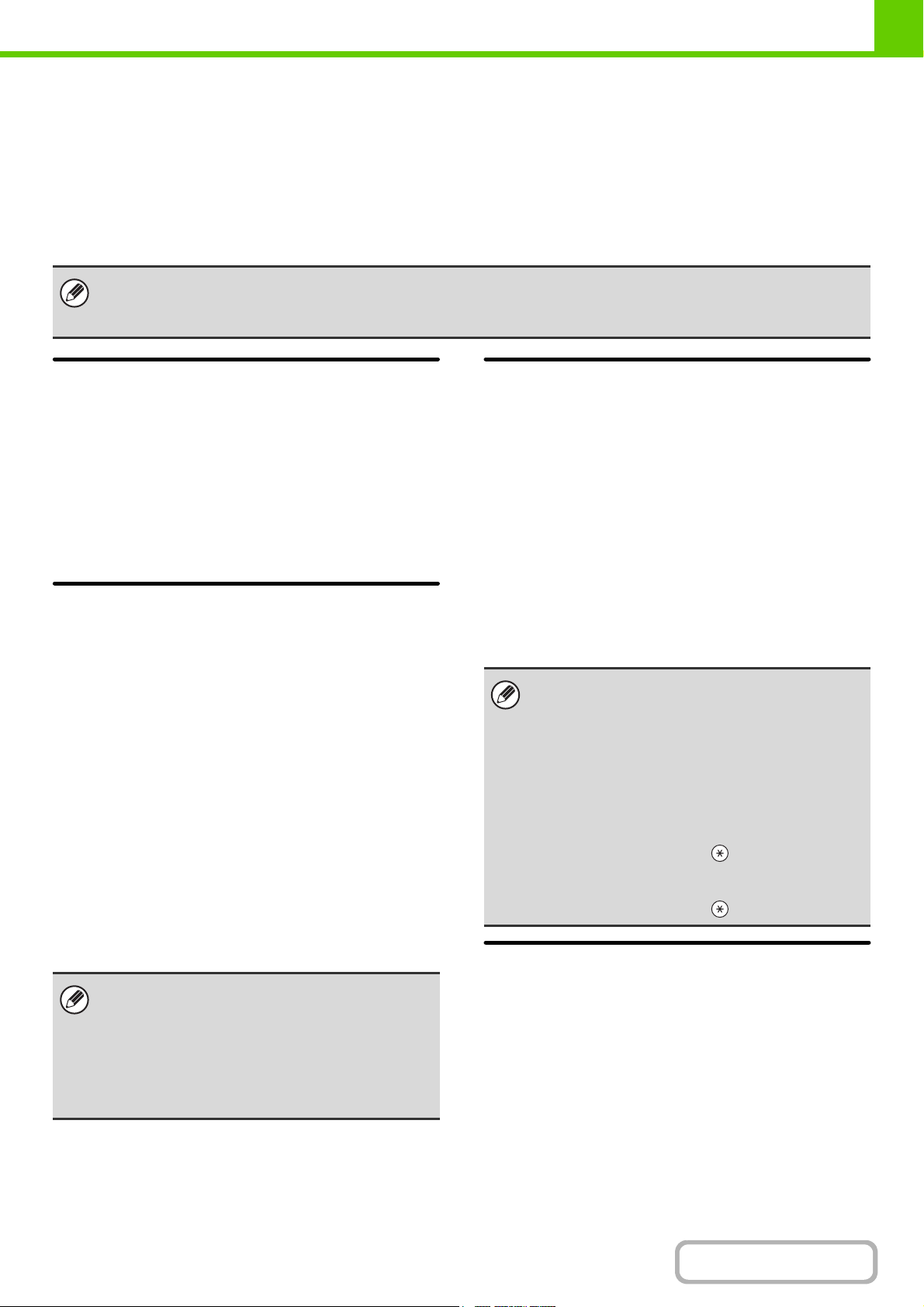
Pages Limit Group
Specify page limits for the user by selecting one of the stored page limit groups. The factory
default setting is [Unlimited].
For more information, see "PAGE LIMIT GROUP LIST" (page 1-28).
Authority Group
Specify the authority of the user by selecting one of the stored authority groups. The factory
default setting is [User].
For more information, see "AUTHORITY GROUP LIST" (page 1-29).
Favorite Operation Group
The favorite operation group that will be applied at login appears. The factory default setting is
[Following the System Settings].
The setting can be changed in the [User Control] menu in the Web pages.
Item Description
1-26
BEFORE USING THE MACHINE
Contents
DEFAULT SETTING
These settings enable or disable user authentication and specify the authentication method.
When user authentication is enabled, each user of the machine is registered. When a user logs in, settings for that user
are applied. This function allows greater control of security and cost management.
In addition, even if the user information is not stored in the machine, it is possible to log in by directly entering user
information stored on an LDAP server. In this case, the login user will be the factory-stored "User". For more information,
see "Factory-stored users" (page 1-24).
User Authentication
When [User Authentication] is enabled, the login screen
appears before an operation is begun in any mode
except the job status screen*. You must log in as one of
the stored users. (After logging in, you can move freely
through the modes.)
* Except when a print hold (retention) file is used or a
broadcast transmission is reattempted in the job status
screen.
Authentication Method Setting
This selects the authentication method. When using user
authentication, be sure to configure this setting first. The
items configured for users stored after the user
authentication method is set vary depending on the
selected authentication method.
Authenticate a User by Login Name and Password
Standard authentication method using a login name and
password.
Authenticate a User by Login Name, Password and
E-mail Address
In addition to a login name and password, this
authentication method also requires the entry of an
e-mail address.
Authenticate a User by User Number Only
This can be used as a simple authentication method
when network authentication is not used.
Device Account Mode Setting
A specific user can be stored as an auto login user.
When this setting is enabled, login can be performed
automatically.
This function eliminates the bother of logging in but still
allows the settings of the selected user (network
settings, favorite operations, etc.) to be applied.
You can also allow users other than the auto login user
to temporarily log in and work using their own authority
and settings. To allow other users to log in temporarily
when [Device Account Mode] is enabled, select [Allow
Login by Different User].
As an example, this enables uses such as
"authentication for color copying only".
Actions when the Limit of Pages
for Output Jobs
This setting determines whether or not a job will be
completed if the page limit is reached while the job is in
progress.
The following selections are available.
• Job is Stopped when the Limit of Pages is Reached
• Job is Completed even when the Limit of Pages is
Reached
• For the procedure for storing users, see "USER LIST" (page 1-23).
• For more information on login procedures when user authentication is enabled, see "USER AUTHENTICATION" (page
1-17).
• The login screen will vary depending on the
authentication method that is selected. For more
information, see "USER AUTHENTICATION" (page
1-17).
• When "Authenticate a User by User Number Only"
is selected for the authentication method, network
authentication cannot be used.
• If auto login fails for some reason when auto login is
enabled, or the login user does not have
administrator rights, all system settings or the
system settings (administrator) will lock. In this
event, the administrator should select the [Admin
Password] key in the system settings screen and
log in again.
• To log in as a user other than the auto login user
when [Allow Login by Different User] is enabled,
press the [LOGOUT] key ( ) to cancel the auto
user login state. The user authentication screen will
appear to let you log in. After using the machine,
press the [LOGOUT] key ( ) to log out.
1-27
BEFORE USING THE MACHINE
Contents
The Number of User Name
Displayed Setting on Operation
Panel
The number of users that are displayed in the user
selection screen can be selected (6, 12, or 18 users).
A Warning when Login Fails
This setting is used to display a warning and prohibit
login for five minutes if login fails three times in a row.
This prevents an unauthorized person from attempting to
guess a password. (The number of failed login attempts
is retained even if the power is turned off.)
Disabling of Printing by Invalid
User
Printing by users whose information is not stored in the
machine, such as printing without entering valid user
information in the printer driver or printing of a file on an
FTP server from the Web pages, can be prohibited.
Automatically print stored jobs
after login
When retention is enabled in the printer driver and print
data has been spooled to the machine, you can have the
spooled print data automatically print out when the user
who enabled retention logs in.
Default Network Authentication
Server Setting
Use this to set the default network authentication server.
When a user logs in from the Web page or sends a print
job to the machine using user information that is not
stored on the machine, the authentication server is not
known. This setting is used to specify one of the LDAP
servers stored on the machine as the authentication
server.
Display Usage Status after Login
When user authentication is enabled, this setting
specifies whether or not the page counts of a user
appear when the user logs in.
User Information Print
The following lists can be printed.
•User List
• List of Number of Pages Used
• Page Limit Group List*
• Authority Group List
• Favorite Operation Group List*
• All User Information Print
Select the key of the desired list to begin printing.
* Cannot be printed when no groups are stored.
Release the Lock on Machine
Operation Panel
If the operation panel of the machine is locked due to
login failure, release the lock by logging in as an
administrator.
This setting also applies to the user selection screen
of print hold and the sender selection screen.
Locking of the operation panel for 5 minutes can be
canceled.
When a print job is executed by a user that is not
stored in the machine, the factory-stored "Other User"
is used as the login user. For more information, see
"Factory-stored users" (page 1-24).
When login is performed by network authentication
using user information that is not stored in the
machine, the login user will be the factory-stored
"User". For more information, see "Factory-stored
users" (page 1-24).
1-28
BEFORE USING THE MACHINE
Contents
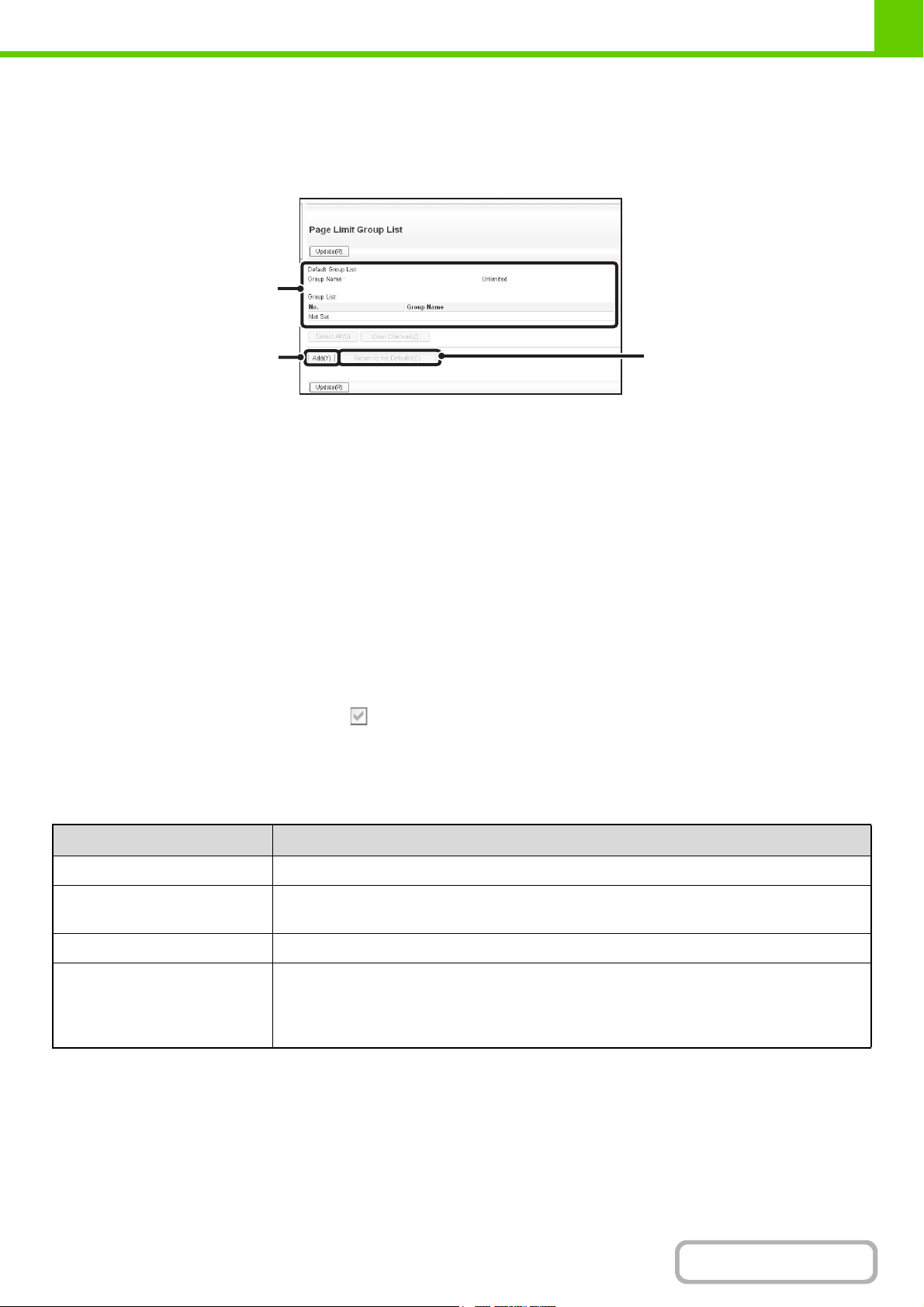
PAGE LIMIT GROUP LIST
This is used to store groups of Account Limit Settings. The page limits for each user are specified by selecting one of
these stored groups when the user is stored.
When the [Page Limit Group List] key is selected, the following screen appears.
(1) List display
This shows the currently stored groups. A group name
can be selected to open an edit/delete screen for that
group.
(2) [Add] key
Use this to add a new group.
(3) [Return to the Defaults] key
Use this to return the group settings to the factory default
settings and delete the groups from the list.
Storing a page limit group
Select the [Add] key in the above screen to open a registration screen. Up to 20 groups can be stored.
For more information, see "Settings".
Editing a page limit group
To open an edit screen for a group, select the group name from the list in the above screen. To delete a group from the
list, select the checkbox next to the group ( ) and then select [Return to the Defaults]. A confirmation prompt will
appear. Select [OK] to delete the group.
For more information, see "Settings".
Settings
(2)
(1)
(3)
Item Description
Group Name Store the name of the group (max. 32 characters).
Select the Group Name to be
the Registration Model
Select one of the previously stored groups for use as a template for the new group. When
selected, the group's settings are applied.
Function names The names of the functions that can be configured are displayed. Set a limit for each function.
Page Limit
When [Prohibited] is selected for a mode, input and output from the mode are prohibited.
When [Unlimited] is selected for a mode, there is no limit to the number of pages that can be
input/output in that mode.
When [Limited] is selected, enter a limit (1 to 99,999,999 pages).
1-29
BEFORE USING THE MACHINE
Contents
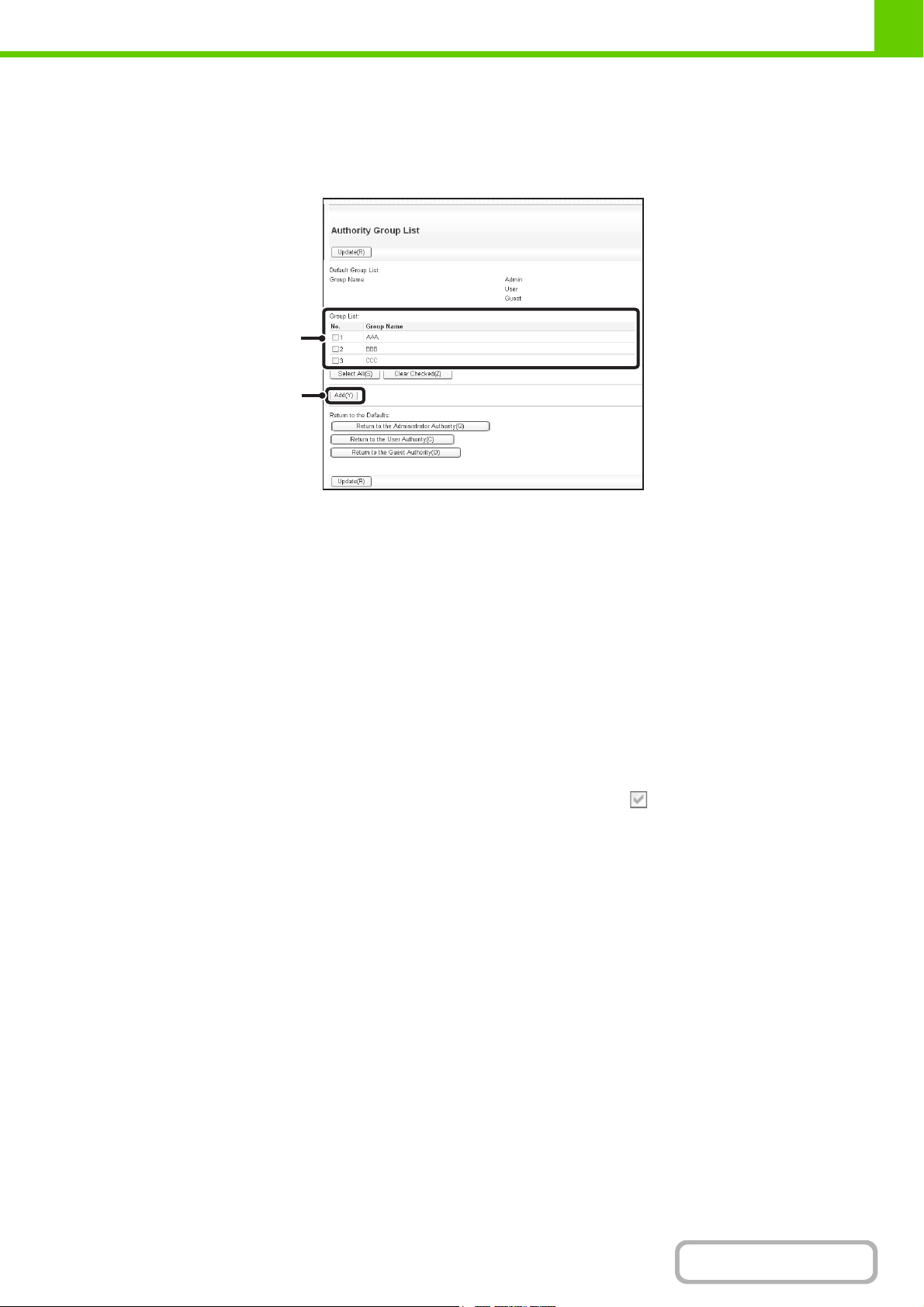
AUTHORITY GROUP LIST
Use this to store groups of user authority settings. The authority of each user is specified by selecting one of these
stored groups when the user is stored.
When the [Authority Group List] key is selected, the following screen appears.
(1) List display
This shows the currently stored groups. A group name
can be selected to open an edit/delete screen for that
group.
(2) [Add] key
Use this to add a new group.
Storing an authority group
Select the [Add] key in the above screen to open a registration screen. Up to 20 groups can be stored.
For information on the settings, see "List of settings and factory default settings of template groups" (page 1-30).
Editing an authority group
A group can be selected from the list in the above screen to open an edit/delete screen for the group. For information on
the settings, see "List of settings and factory default settings of template groups" (page 1-30).
To return a group to the factory default state, select the checkbox next to the group ( ), and then select [Return to the
Administrator Authority], or [Return to the User Authority], or [Return to the Guest Authority]. The selected authority will
be given to the users in that group and the group will be deleted from the list.
(1)
(2)
1-30
BEFORE USING THE MACHINE
Contents
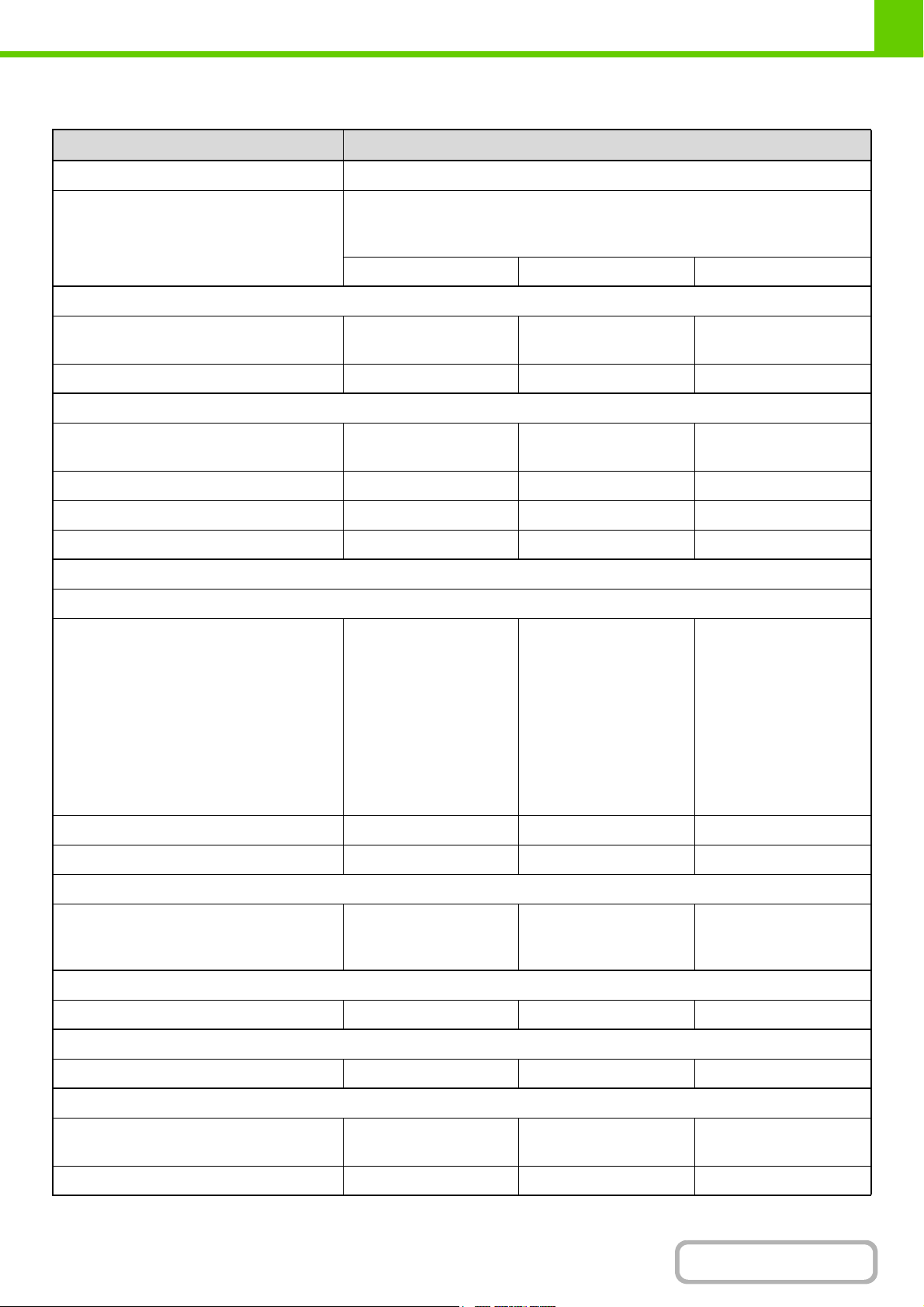
List of settings and factory default settings of template groups
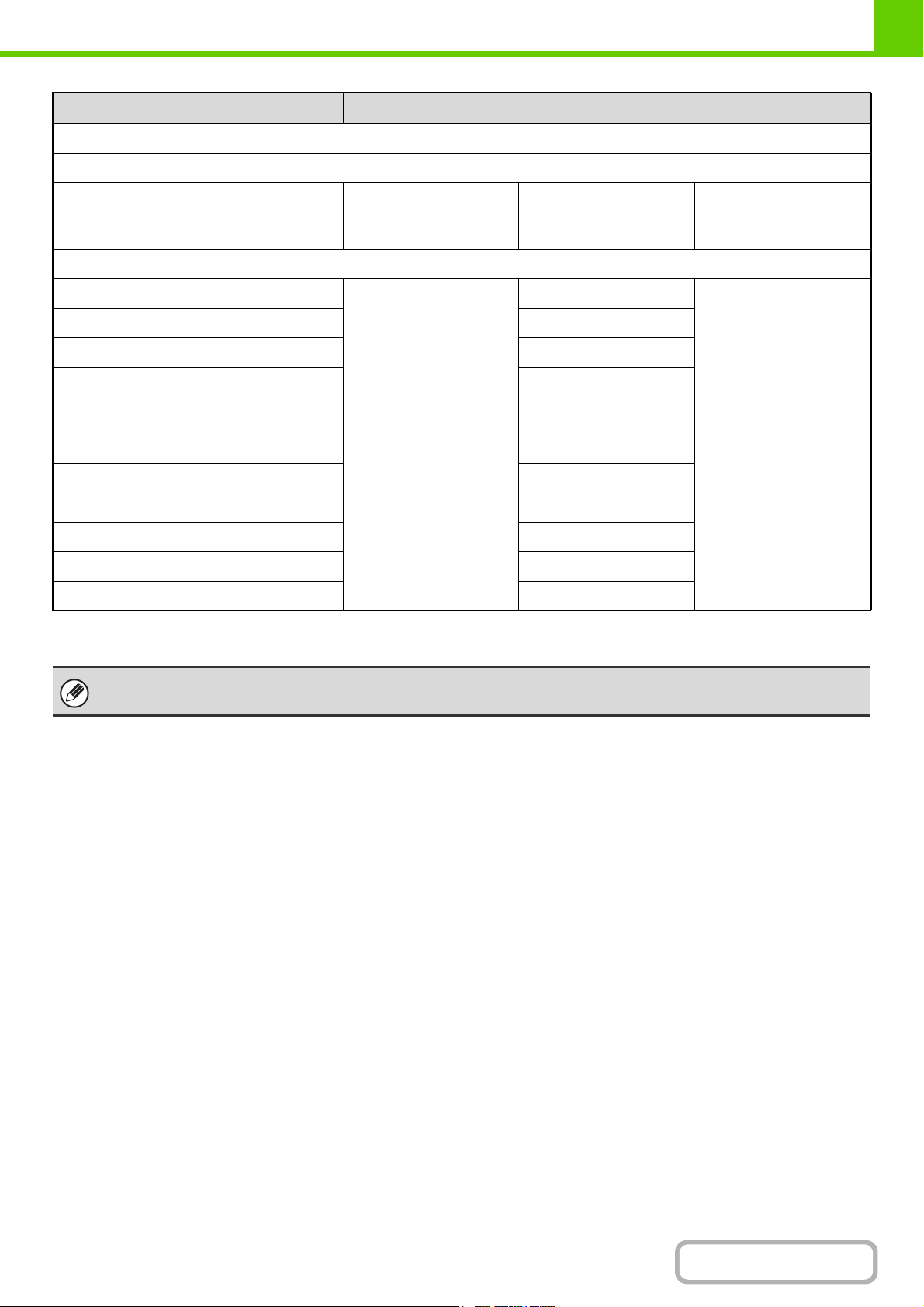
Item Description
Group Name Store the name of the group (max. 32 characters).
Select the Group Name to be the
Registration Model
Select one of the previously stored groups for use as a template for the new
group. When selected, the group's settings are applied.
The factory default groups and their settings are shown below.
Admin User Guest
Copy
Color Mode Approval Setting All allowed All allowed
Only Black & White
Allowed
Special Modes Usage Allowed Allowed Prohibited
Printer
Color Mode Approval Setting Allowed Allowed
Only Black & White
Allowed
USB Memory Direct Print Allowed Allowed Prohibited
FTP Pull Print Allowed Allowed Prohibited
Network Folder Pull Print Allowed Allowed Prohibited
Image Send
Approval Settings for Each Mode
• E-mail
•FTP
• Desktop
• Network Folder
• USB Memory
•PC Scan
• Internet Fax Send
• PC-I-Fax Send
•Fax Send
•PC-Fax Send
All allowed All allowed All allowed
Color Scan Allowed Allowed Prohibited
Special Modes Usage Allowed Allowed Prohibited
Approval Setting for Addressing
•
Approval Setting for Direct Entry
•
Approval Setting to Use a Local Address Book
•
Approval Settings to Use a Global Address Book
All allowed All allowed All allowed
Print hold
Print Hold Image Check Allowed Allowed Prohibited
Sharp OSA
Approval Settings to Use a Sharp OSA Allowed Allowed Allowed
Common Functions
Approval Settings for 2-Sided Print
[1-Sided/2-Sided
Approved]
[1-Sided/2-Sided
Approved]
[1-Sided/2-Sided
Approved]
Output Approval Settings Allowed Allowed Prohibited
1-31
BEFORE USING THE MACHINE
Contents
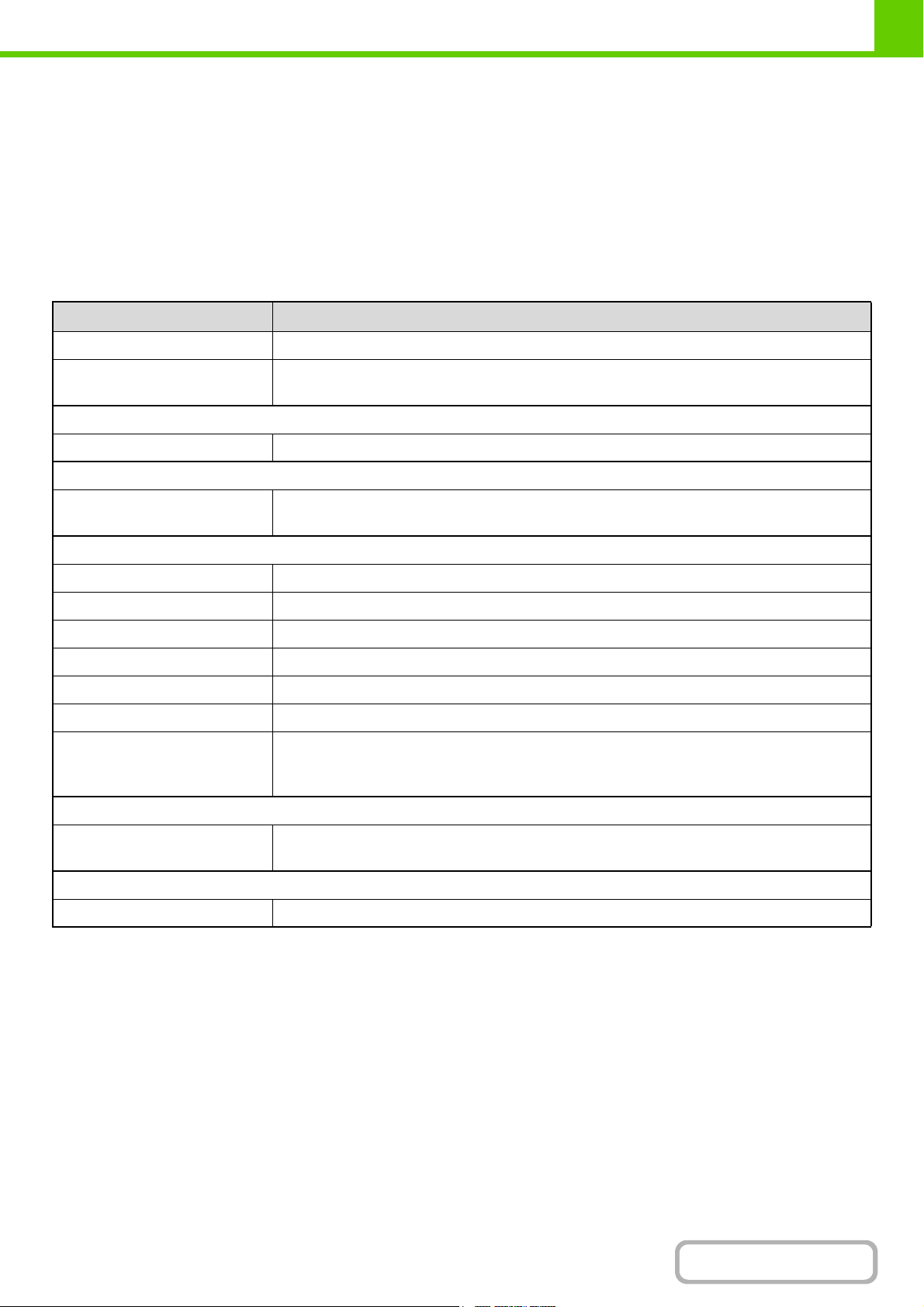
*1 For information on each setting, see the system settings (general/administrator) lists.
*2 All allowed except "Change Administrator Password".
MFP Settings
System Settings Operational Authority
System Settings*
1
Allowed*
2
Only user authority
settings
are allowed
All settings prohibited
Web Settings Operational Authority
Display of Device/Network Status
Allowed
Allowed
Prohibited
Power Reset Prohibited
Machine Identification Prohibited
Application Settings (Excluding
Registration of Pre-set Text/Forward
Table)
Prohibited
Registration of Pre-set Text/Forward Table Allowed
E-mail Alert and Status Prohibited
Job Log Setting Prohibited
Port Control/ Filter Settings Prohibited
Custom Link Setting Prohibited
Operation Manual Download Allowed
Depending on the machine specifications and peripheral devices installed, it may not be possible to use some settings.
Item Description
1-32
BEFORE USING THE MACHINE
Contents
FAVORITE OPERATION GROUP LIST
This is used to store favorite operation groups.
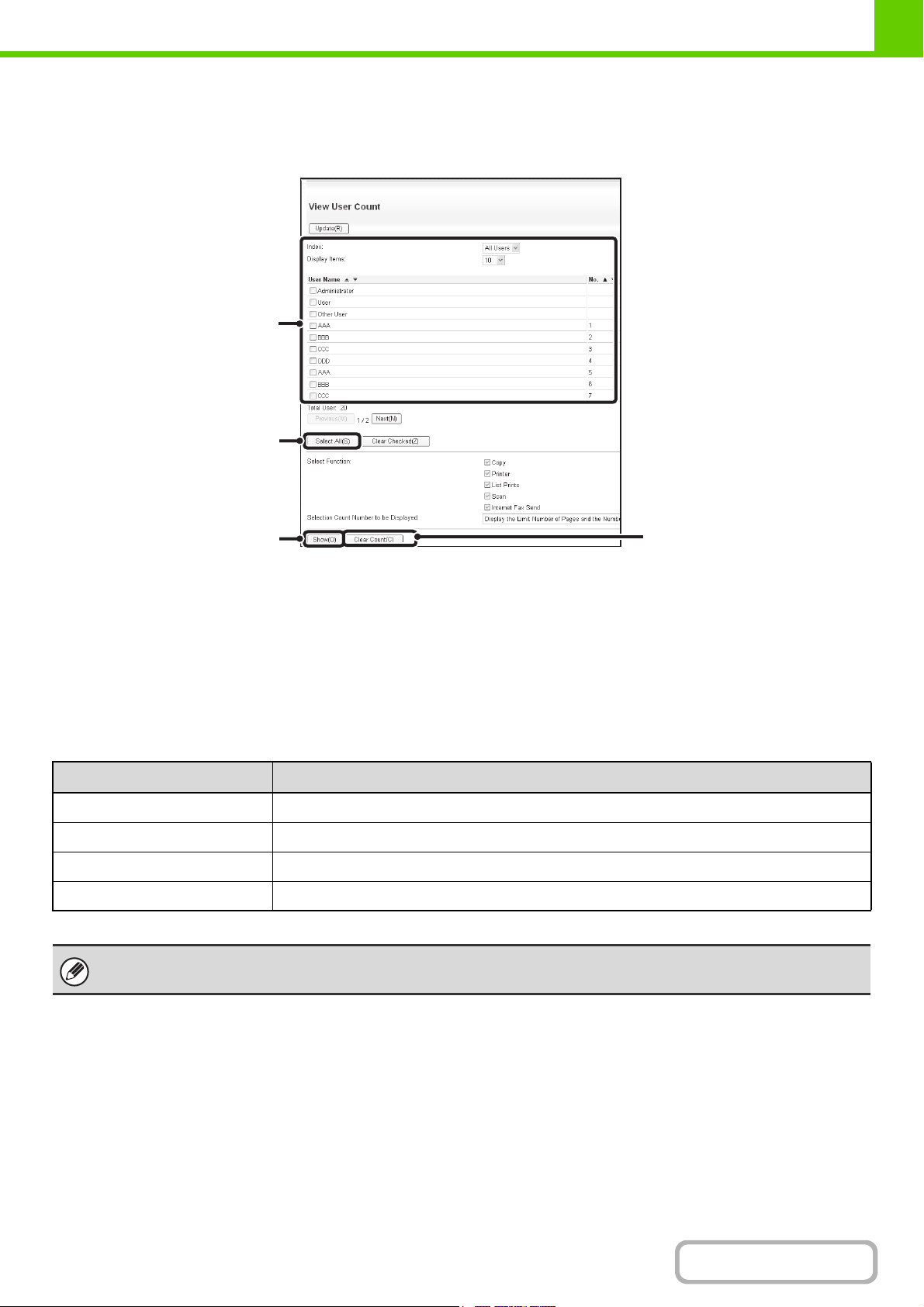
Favorite Operation Group Registration
Groups of preferred settings can be stored as "favorite operation groups". For example, a user who speaks a different
language would normally have to change the display language each time he or she uses the machine; however, by
storing the language in a favorite operation group, the language is automatically selected when the user logs in.
Settings
Item Description
Group Name Store the name of the group (max. 32 characters).
Select the Group Name to be
the Registration Model
Select one of the previously stored groups for use as a template for the new group. When
selected, the group's settings are applied.
Copy
Initial Status Settings Select settings for Color Mode, Paper Tray, Exposure Type, Copy Ratio, Duplex, and Output.
Image Send
Initial Status Settings Select settings for Resolution, Exposure, Color Mode, File Format, and Original Image Type.
Store the default fax sender name and number.
System Settings
Original Size Detector Setting
Select whether original sizes are automatically detected as inch sizes or AB sizes.
Display Language Setting Select the display language.
Key Operation Setting Set the key input time and Auto Key Repeat setting.
Keys Touch Sound Set the sound made when keys are selected.
Keyboard Select Set the language that appears on the keyboard.
MFP Display Pattern Setting Select the color pattern used in the display.
Automatically print stored jobs
after login
When retention is enabled in the printer driver and print data has been spooled to the
machine, you can have the spooled print data automatically print out when the user who
enabled retention logs in.
Preview Setting
Default Preview Display Image Send: Select the zoom ratio of the preview that can be displayed when an image
is received and in the memory box.
Customize Key Setting
Customize Key Setting Set customized keys for each mode.
1-33
BEFORE USING THE MACHINE
Contents
VIEW USER COUNT
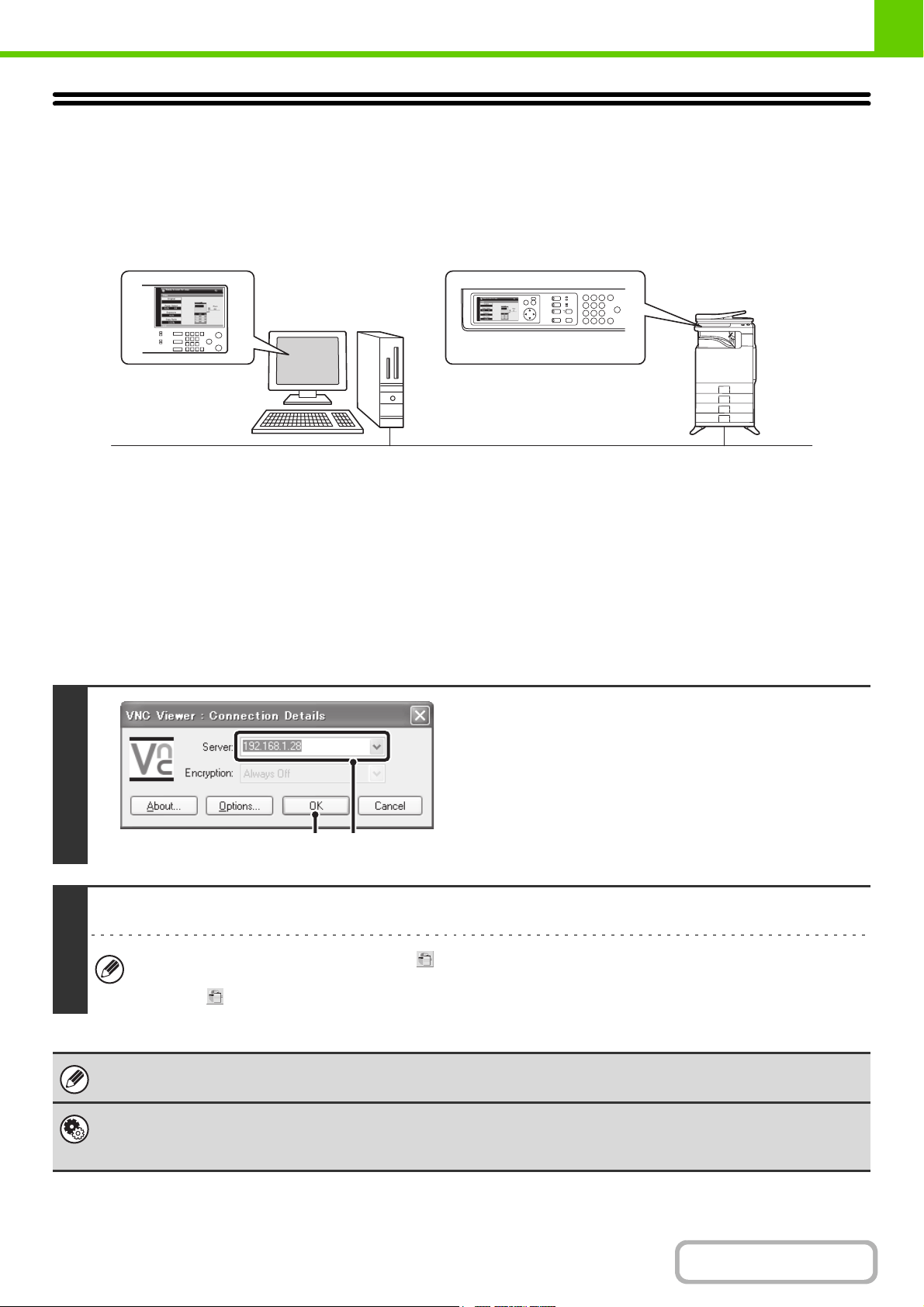
This displays the total number of pages printed by each user.
When the [View User Count] key is selected, the following screen appears.
(1) User List
This shows the factory-stored users and the currently
stored users. To select a user, select the user name.
(2) [Select All] key
This selects all users.
(3) [Show] key
This shows the counts of the selected user.
(4) [Clear Count] key
Use this to reset the counts of the selected user.
Showing user count
Select a user in the above screen and select the [Show] key. The counts of that user will appear.
Resetting user counts
To clear the count of a user, select the user from the list and then select [Clear Count]. A confirmation prompt will
appear. Select [OK] to clear the count of that user.
(1)
(3)
(4)
(2)
Item Settings
Next This shows the next user (in the order of the registration numbers).
Previous This shows the previous user (in the order of the registration numbers).
Pages used The counts and the number of pages remaining of the selected user are shown by function.
Page Limit The page limit set for the user appears in parentheses below the count.
Counts of devices that are not installed do not appear.
1-34
BEFORE USING THE MACHINE
Contents
REMOTE OPERATION OF THE MACHINE
The remote operation function allows you to operate the machine from your computer.
When this function is added, the same screen as the operation panel screen appears on your computer. This allows you
to operate the machine from your computer in the same way as if you were standing in front of the machine.
The remote operation function can only be used on one computer at a time.
How to use the remote operation function
Before using this function, set "Operational Authority" to "Allowed" in "Remote Software Operation" of "Remote
Operation Settings" (Web page only) in the system settings (administrator).
☞ 6. SYSTEM SETTINGS "Remote Operation Settings" (page 6-70)
To use the remote operation function, the machine must be connected to a network and a VNC application must be
installed on your computer (recommended VNC software: RealVNC).
The procedure for using this function is as follows:
Example: RealVNC
1
Connect from the computer to the
machine.
(1) Start the VNC viewer
(2) Enter the IP address of the machine in the
"Server" entry box.
(3) Click the [OK] button.
2
Follow the prompts on the operation panel of the machine to permit the connection.
During remote software communication, the key appears in the system settings of the machine. If you wish to
break the connection, exit the remote software or press the [SYSTEM SETTINGS] key on the operation panel and
select the key in the screen that appears.
Use the operation panel in the same way as you would on the machine. Note that a key cannot be held down to continuously
change a value being entered. For detailed procedures, see the chapters for each of the functions in this manual.
System Settings (Administrator): Remote Operation Settings (Web page only)
Set the operation authority for the remote operation function.
Registration is performed in [System Settings] - [Operation Settings] - "Remote Operation Settings" in the Web page menu.
Operate the
machine using
your computer
screen.
Your computer
Network
Operation panel
The machine
(2)(3)
1-35
BEFORE USING THE MACHINE
Contents
JOB LOG
The machine retains a log of the jobs that are performed. Settings for the job log stored in the machine are configured on
the Web page. Select [Job Log] on the Web page to configure the settings.
SAVE / DELETE JOB LOG
The log of jobs executed on the machine can be stored or deleted.
VIEW JOB LOG
The log of jobs executed on the machine can be displayed.
The items to be displayed and the applicable period can be selected.
Item Settings
Job Log The total number of stored job logs appears.
Save Job Log
Save and Delete the Data Deletes the job log after saved if checked.
[Save] button Saves the job log.
The Number of Job Log to Notify by
E-mail
Select the number of jobs that triggers e-mail notification.
Informs the address configured in E-mail alert when the designated number is
reached.
Delete Job Log
[Delete] button Deletes the job log.
Item Settings
Select Item Select the item to be displayed.
[Show] button Displays the job log.
1-36
BEFORE USING THE MACHINE
Contents
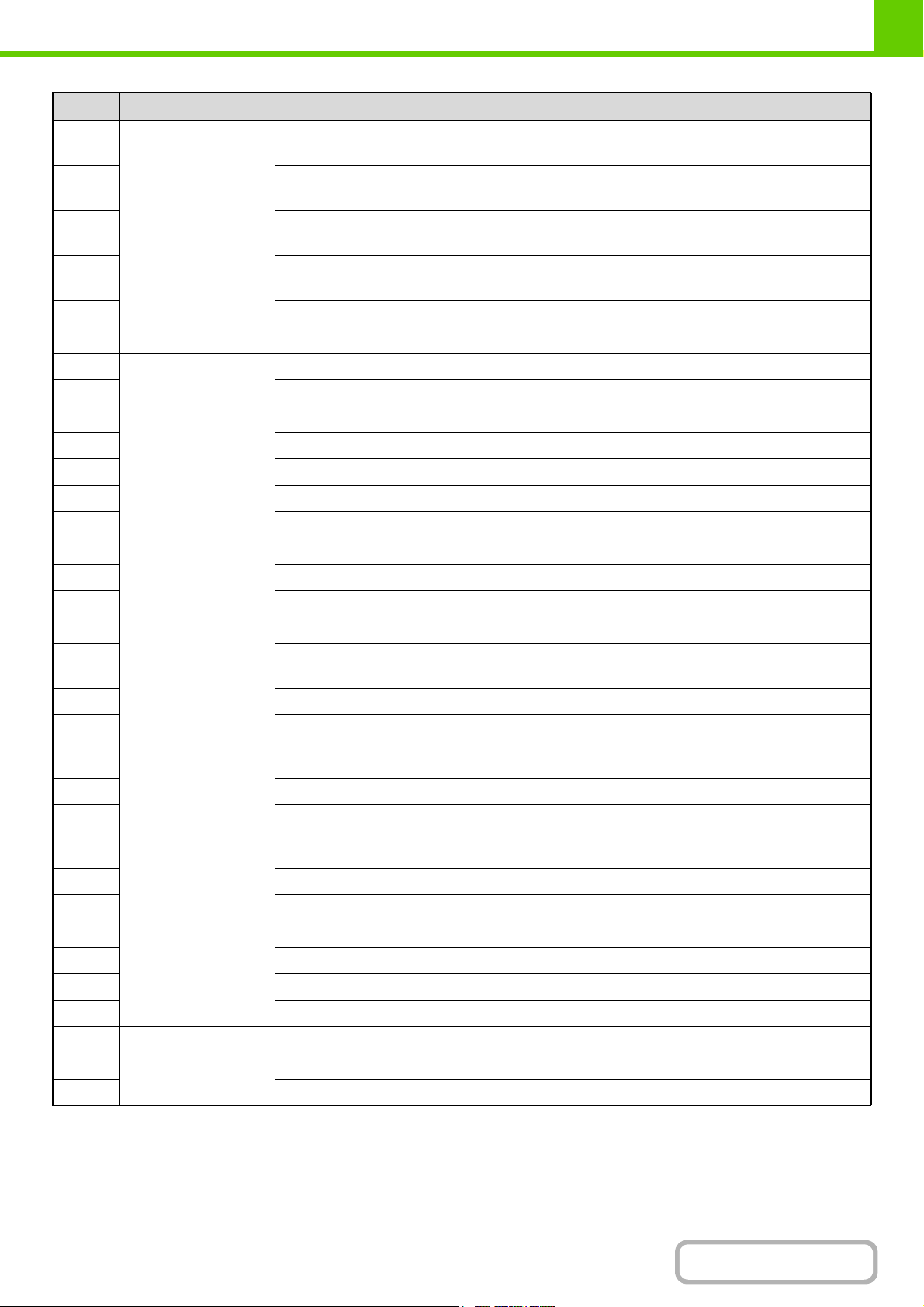
ITEMS RECORDED IN THE JOB LOG
The machine records the jobs that are performed in the job log.
The main information that is recorded in the job log is described below.
• To make it easy to total the usage counts of differently configured machines, the items recorded in the job log are fixed,
regardless of what peripheral devices are installed or the objective of the recording. For this reason, items may appear in
the log for functions that are not available on the machine.
• In some cases, job information may not be correctly recorded, such as when a power failure occurs during a job.
• JOB LOG (page 1-35)
The job log can be stored, deleted, or checked.
Registration is performed in [Job Log] in the Web page menu.
No. Item name Description
1 Main items Job ID The job ID is recorded.
Job IDs appear in the log as consecutive numbers up to a maximum
of 999999, after which the count resets to 1.
2 Job Mode
The job mode, such as copy or print.
3 Computer Name
The name of the computer that sent a print job.*
4 User Name The user name when the user authentication function is used.
5 Login Name The login name when the user authentication function is used.
6 Starting Date & Time The date and time the job was started.
7 Completing Date &
Time
The date and time the job was completed.
8 Black & White Total
Count
For a print job, the total count is recorded.
For a send job, the number of transmitted black & white pages is
recorded.
When a broadcast transmission is summarized, the total
number of pages is recorded.
For a scan to HDD job, the number of stored black & white pages is
recorded.
9
Full Color Total Count
For a print job, the total count is recorded.
For a send job, the total number of transmitted full color pages is
recorded.
When a broadcast transmission is summarized, the total
number of pages is recorded.
For a scan to HDD job, the number of stored full color pages is
recorded.
10
2-Color Total Count
Indicates
the total 2-color count.
11
Single Color Total
Count
Indicates
the total single color count.
12
Count according to size
Counts by original/paper size in color mode and black & white mode.
13
Number of sheets
according to size
Indicates the sheet count by paper type.
14 Invalid Paper
Count(Black & White)
Indicates the black & white invalid sheet count.
15 Invalid Paper
Count(Color)
Indicates the color invalid sheet count.
1-37
BEFORE USING THE MACHINE
Contents
16 Main items Number of Reserved
Sets
Number of specified sets or reserved destinations.
17 Number of Completed
Sets
Number of completed sets or number of destinations to which
transmission was successfully completed.
18 Number of Reserved
Pages
Number of reserved original pages of a copy, print, scan job, or other
job.
19 Number of Completed
Pages
Number of completed pages of a set.
20 Result The result of a job.
21 Error Cause
When an error occurs during a job, the cause of the error.
22
Print Job Related Item
Output The output mode of a printed job.
23 Staple The status of stapling.
24
Staple Count
The staple count.
25 Punch Count The punch count. Always "0" when the machine is used.
26 Fold The status of foldling. Always "No Fold" when the machine is used.
27 Fold Count The fold count. Always "0" when the machine is used.
28 Printer Tone The tone used for a print job.
29 Image Send Related
Item
Direct Address Address of an image send job.
30 Sender Name Sender name of an image send job.
31 Sender Address Sender address of an image send job.
32 Transmission Type Transmission type of an image send job.
33 Administrative Serial
Number
Administrative serial number of an image send job.
34 Broadcast number Broadcast number of an image send job.
35 Entry Order Reservation order for broadcast transmission of an image send job.
For a serial polling job, this is used to correlate communication with
printing.
36 File Type File format of an image send job.
37 Compression
Mode/Compression
Ratio
Compression mode and compression ratio of the file of an image
send job.
38 Communication Time Indicates the communication time of image send jobs.
39 Fax No. Indicates the stored sender's number.
40 Print Hold Related
Item
Print Hold Print hold status.
41 Storing Mode Print hold store mode.
42 File Name Name of file stored by retention print.*
43 Data Size [KB] File size.
44 Common Functionality Color Setting Color mode selected by user.
45 Special Modes Special modes selected when the job was executed.
46 File Name 2 Records the file names of print jobs.*
No. Item name Description
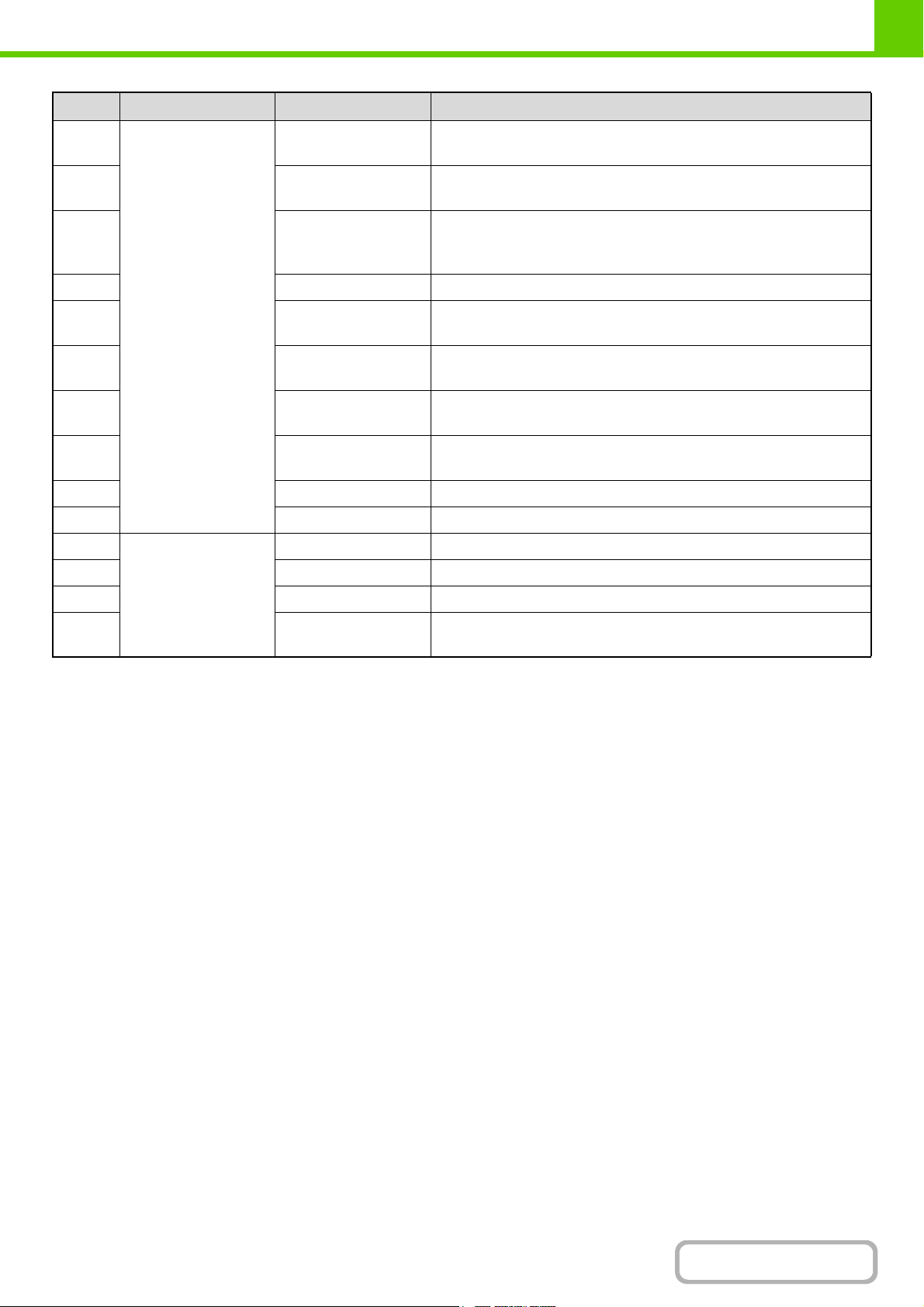
1-38
BEFORE USING THE MACHINE
Contents
*In some environments this is not recorded.
47 Detailed Items Original Size Size of scanned original.
Paper size of the file of a print hold print job.
48 Original Type Original type (text, printed photo, etc.) set in the exposure settings
screen.
49 Paper Size For a print job, the paper size.
For a send job, the transmitted paper size.
For a Scan to HDD job, the paper size of the stored file.
50 Paper Type The paper type used for printing.
51 Paper Property:
Disable Duplex
Indicates that duplex was disabled in "Paper Type".
52 Paper Property: Fixed
Paper Side
Indicates that fixed side was specified in "Paper Type".
53 Paper Property:
Disable Staple
Indicates that stapling was disabled in "Paper Type".
54 Paper Property:
Disable Punch
Indicates that punching was disabled in "Paper Type".
55 Duplex Setup Indicates the duplex setting.
56 Resolution Indicates the scanning resolution.
57 Machine Item Model Name Indicates the model name of the machine.
58 Unit Serial Number Indicates the serial number of the machine.
59 Name Indicates the name of the machine that is set in the Web pages.
60 Machine Location Indicates the installation location of the machine that is set in the Web
pages.
No. Item name Description
1-39
BEFORE USING THE MACHINE
Contents
STORAGE BACKUP
Address book information and user information stored in the machine can be backed up to your computer or restored
from your computer via the Web page.
Settings and information stored in the machine can be backed up to your computer.
Settings can be exported or imported in XML format using the Web page. Select [Storage Backup] in the Web page
menu and configure the settings.
EXPORT SETTINGS
Use these settings to back up data to your computer.
IMPORT SETTINGS
Use these settings to restore data that was previously backed up to your computer to the machine.
• The data is saved to the computer that is accessing the Web page.
• This function cannot be used while the system settings are in use, while a job is being executed, or when there is a
reserved job.
Item Settings
Export Settings Type Select the type of settings that you want to export.
Password Enter the password that will be required to import settings (maximum of 16
characters).
Item Settings
Import settings from file Enter the name of the file to be imported (maximum of 200 characters). Click
[Browse] to select the file from the file selection dialog box.
Password If a password has been set for the file to be imported, enter the password (maximum
of 16 characters).
1-40
BEFORE USING THE MACHINE
Contents
DEVICE CLONING
Device cloning is used to save the machine's setting information in XML format and copy the information to another
machine.
This function saves you the trouble of repeatedly configuring the same settings in multiple machines. Select [Device
Cloning] in the Web page menu and configure the settings.
EXPORT SETTINGS
Use these settings to back up data to your computer.
IMPORT SETTINGS
Use these settings to restore data that was previously backed up to your computer to the machine.
• The data is saved to the computer that is accessing the Web page.
• This function cannot be used while the system settings are in use, while a job is being executed, or when there is a
reserved job.
• The following data is not copied when device cloning is performed:
- List print and fax forwarding items.
- Count and device status display items.
- IP address of the machine, device name, administrator password, sender names for image send, and other information
that is specific to the machine.
- Screen contrast, color adjustment, and other adjusted values particular to each hardware device.
Item Settings
Export Settings Type Select the type of settings that you want to export.
Password Enter the password that will be required to import settings (maximum of 16
characters).
Item Settings
Import settings from file Enter the name of the file to be imported (maximum of 200 characters). Click
[Browse] to select the file from the file selection dialog box.
Password If a password has been set for the file to be imported, enter the password (maximum
of 16 characters).
1-41
BEFORE USING THE MACHINE
Contents
UPDATE OF FIRMWARE
The program (firmware) embedded in the machine can be updated from the Web page.
To update the firmware, follow the steps below.
• The customer is responsible for updating the firmware.
• Never turn off the power of the machine while the firmware is being updated.
• While the firmware is being updated, do not attempt to operate the machine from the operation panel, or from a computer
by remote operation using the Web page or other means.
• Once the firmware is updated, it will not be possible to restore the system to the state prior to the update.
1
Select [Update of Firmware] in the Web page menu.
2
A confirmation prompt will appear. Select [OK] to execute the update.
A form will appear to let you specify the file to be used for the firmware update.
3
Specify the file to be used and select [Execute].
The current version of the firmware and the version of the update file will appear.
4
Check the version of the firmware and click [OK].
The update will begin.
5
When the update is finished, you will be prompted to restart the machine. Select
[Reboot].
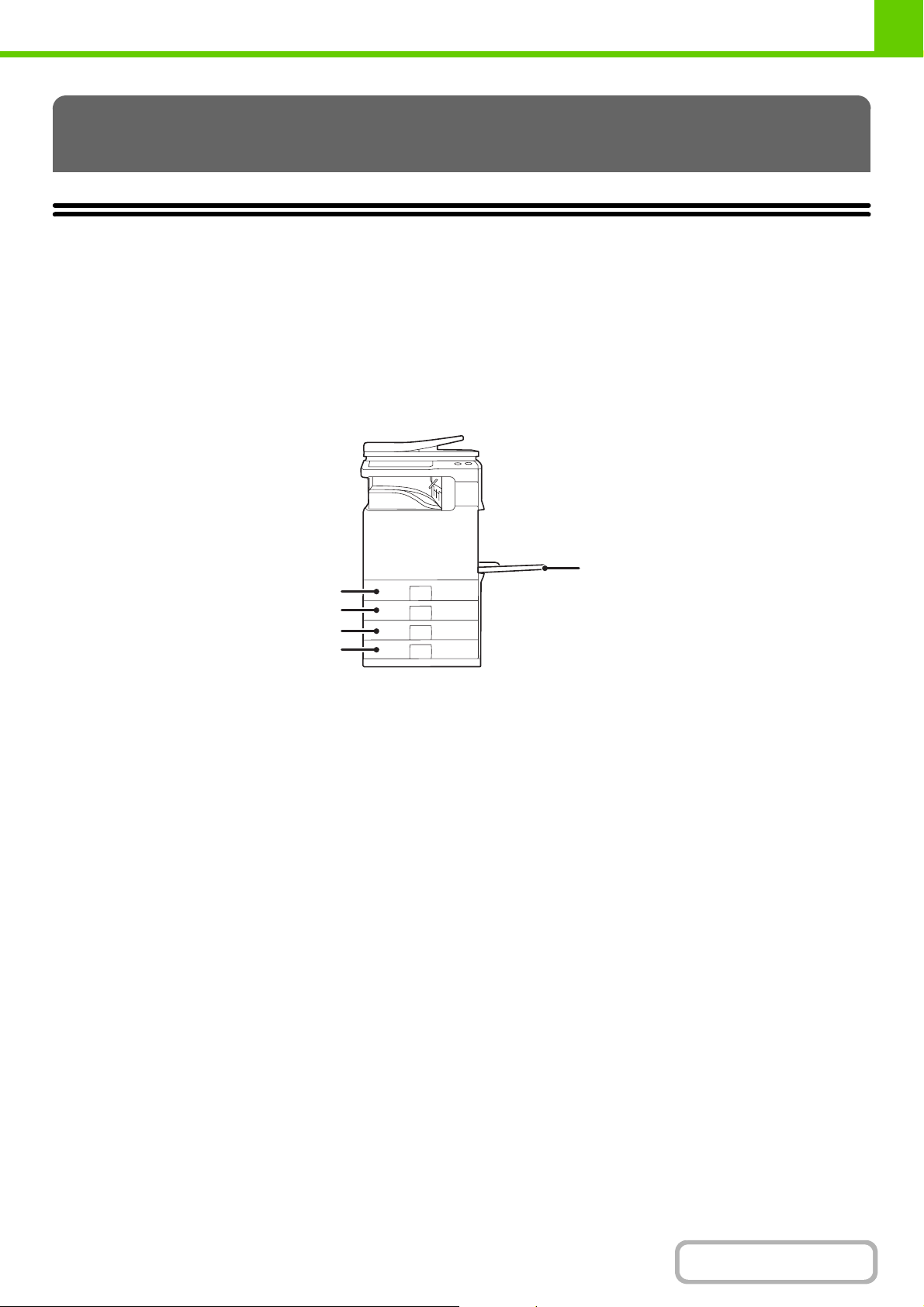
1-42
BEFORE USING THE MACHINE
Contents
IMPORTANT POINTS ABOUT PAPER
This section provides information that you should know before loading paper in the paper trays.
Be sure to read this section before loading paper.
NAMES AND LOCATIONS OF TRAYS
The names of the trays are as follows.
USEABLE PAPER
Various types of paper are sold. This section explains what plain paper and what special media can be used with the
machine. For detailed information on the sizes and types of paper that can be loaded in each tray of the machine, see
the specifications in the Maintenance & Safety Guide and "Paper Tray Settings" (page 6-48) in "6. SYSTEM
SETTINGS".
Plain paper, special media
Plain paper that can be used
• SHARP standard plain paper (21 lbs. (80 g/m
2
)). For paper specifications, see the specifications in the Maintenance &
Safety Guide.
• Plain paper other than SHARP standard paper (16 lbs. to 28 lbs. (60 g/m
2
to 105 g/m
2
))
Recycled paper, colored paper and pre-punched paper must meet the same specifications as plain paper.
* The "lbs." (g/m
2
) units used in these explanations indicate the weight of the paper.
LOADING PAPER
Bypass tray
Tray 1
Tray 2
Tray 3
Tray 4
1-43
BEFORE USING THE MACHINE
Contents
Types of paper that can be used in each tray
The following types of paper can be loaded in each tray.
"
–" in the table indicates "cannot be used".
*1 "Heavy paper" is heavy paper up to 110 lbs. index (209
g
/m
2
).
Printer drivers that allow the use of glossy paper are PCL6, PCL5-c, and PS printer drivers in a Windows environment.
*3 Thin paper from 15 lbs. to 16 lbs. (55 g/m
2
to 59 g/m
2
) can be used.
Print side face up or face down
Paper is loaded with the print side face up or face down depending on the paper type and tray.
The loading orientation of punched paper, letterhead paper, and pre-printed paper differs from that of other paper.
For details, see "Example: Placement orientations of punched paper, letter head paper, and pre-printed paper" (page
1-44).
Trays 1 to 4
Load the paper with the print side face up.
However, if the paper type is "Pre-Punched", "Letter Head" or "Pre-Printed", load the paper with the print side face
down*.
Bypass tray
Load the paper with the print side face down.
However, if the paper type is "Pre-Punched", "Letter Head" or "Pre-Printed", load the paper with the print side face up*.
* If "Disabling of Duplex" (Web page only) is enabled in the system settings (administrator), load the paper in the normal
way (face up in trays 1 to 4; face down in the bypass tray).
Tray 1/Tray 2/Tray 3/Tray 4 Bypass tray
Plain paper Permitted Permitted
Pre-printed Permitted Permitted
Recycle Paper Permitted Permitted
Letter head Permitted Permitted
Pre-punched Permitted Permitted
Color Permitted Permitted
Heavy paper*
1
– Permitted
Labels – Permitted
Glossy paper*
2
– Permitted
Transparency film – Permitted
Envelopes – Permitted
Thin paper*
3
– Permitted
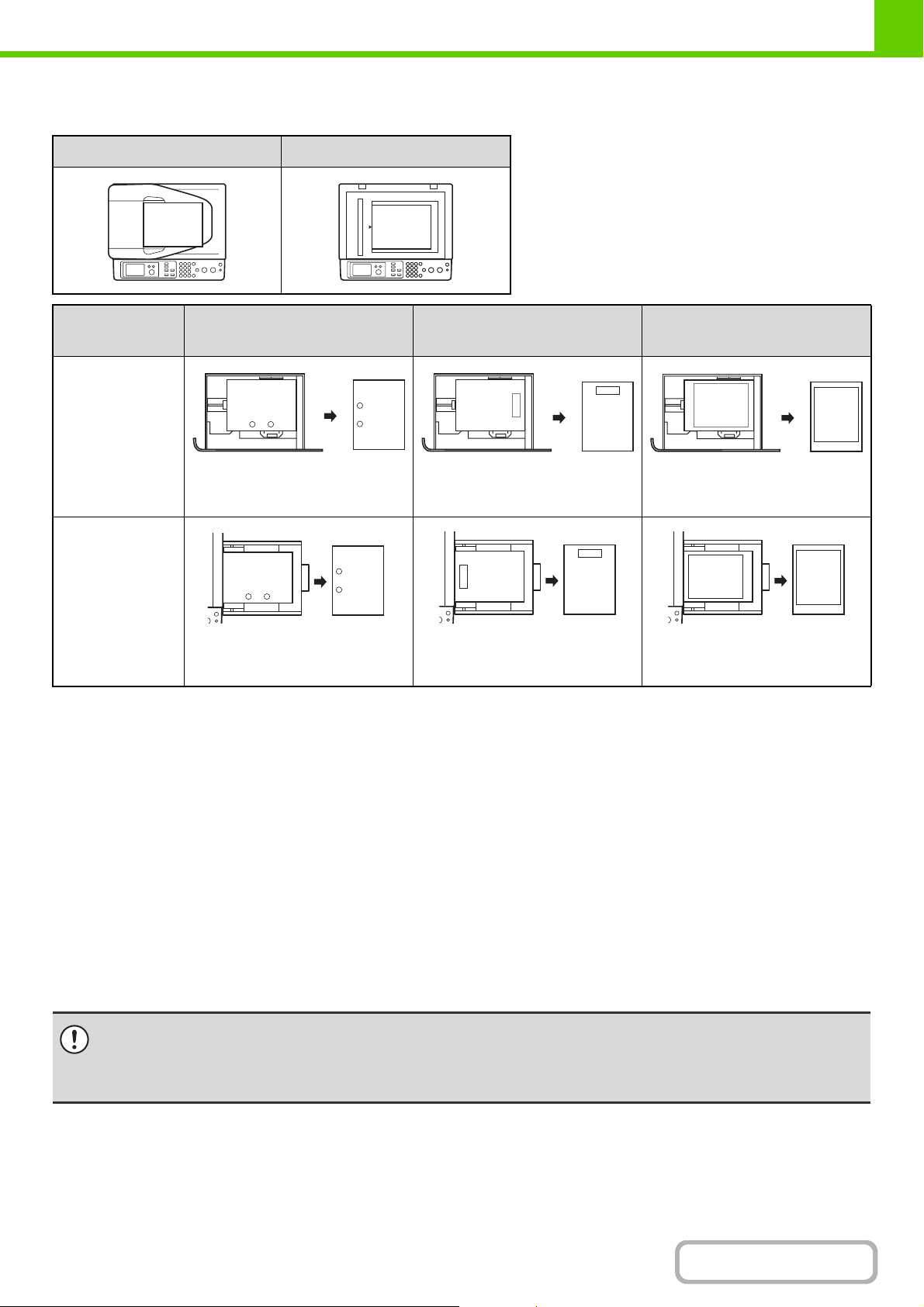
1-44
BEFORE USING THE MACHINE
Contents
Example: Placement orientations of punched paper, letter head paper, and pre-printed paper
This explanation assumes that "Disabling of Duplex" (Web page only) is not enabled in the system settings (administrator).
Paper that cannot be used
• Special media for inkjet printers
(fine paper, glossy paper, glossy film, etc.)
• Carbon paper or thermal paper
• Pasted paper
• Paper with clips
• Paper with fold marks
• Torn paper
• Oil-feed transparency film
• Thin paper less than 15 lbs. (55 g/m
2
)
• Paper that is 110 lbs. index (210 g/m
2
) or heavier
• Irregularly shaped paper
• Stapled paper
• Damp paper
• Curled paper
• Paper on which either the print side or the reverse side
has been printed on by another printer or multifunction
device.
• Paper with a wave-like pattern due to moisture
absorption
Non-recommended paper
• Iron-on transfer paper
• Japanese paper
• Perforated paper
Document feeder tray Original glass
Pre-punched
(Left binding)
Letter head Pre-printed
Tray 1 to 4
Load the paper print side down
with the punch holes to the front
and the top edge to the right.
Load the paper print side down
with the letter head (top edge) to
the right.
Load the paper print side
(pre-printed side) down with the
top edge to the right.
Bypass tray
Load the paper print side up with
the punch holes to the front and
the top edge to the left.
Load the paper print side up with
the letter head (top edge) to the
left.
Load the paper print side
(pre-printed side) up with the top
edge to the left.
A
A
A
ABC
ABC
A
-1-
A
-1-
A
ABC
ABC
A
A
-1-
A
-1-
• The use of non-recommended or prohibited paper may result in skewed feeding, misfeeds, poor toner fusing (the toner
does not adhere to the paper well and can be rubbed off), or machine failure.
• The use of non-recommended paper may result in misfeeds or poor image quality. Before using non-recommended paper,
check if printing can be performed properly.
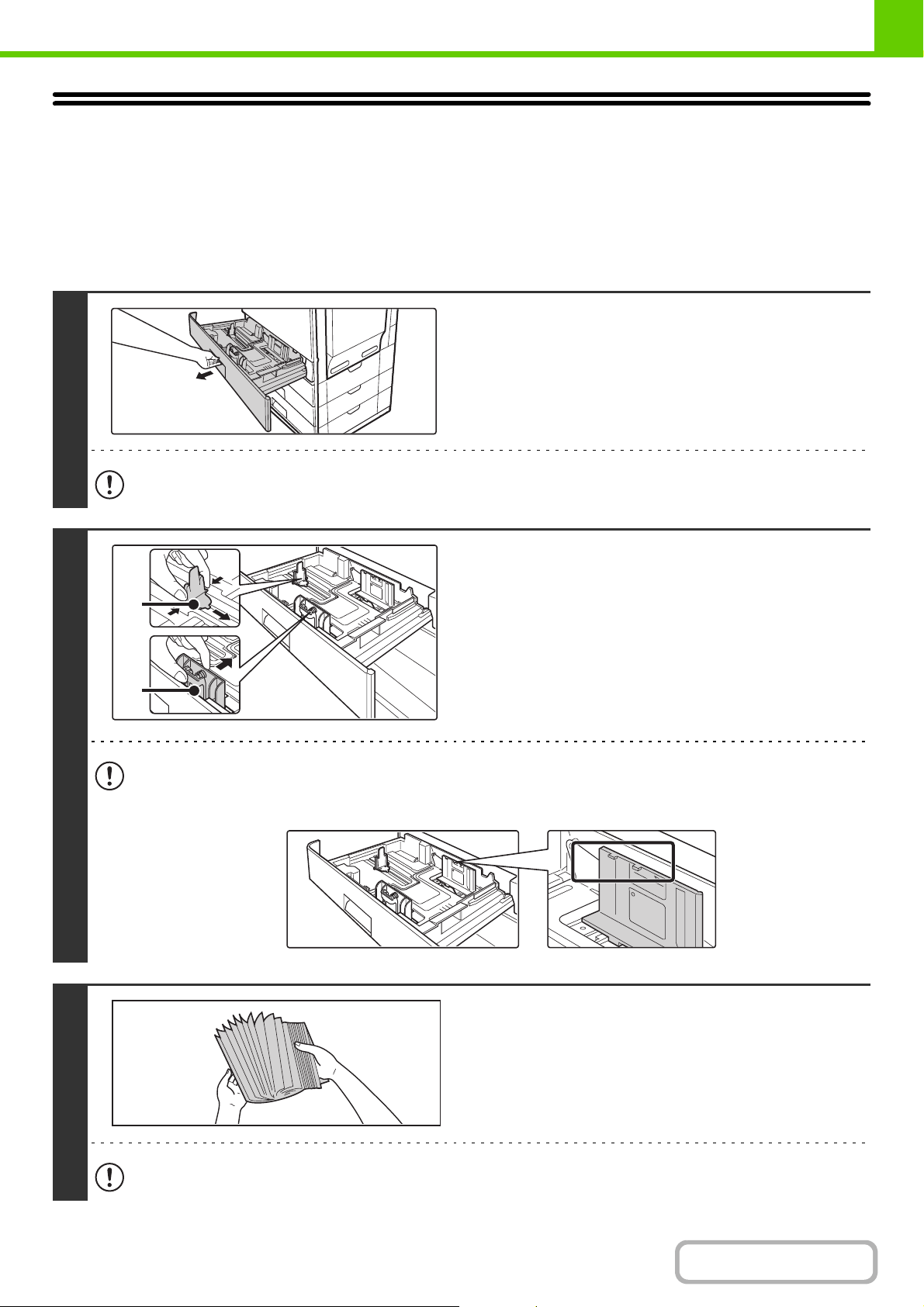
1-45
BEFORE USING THE MACHINE
Contents
TRAY SETTINGS FOR TRAYS 1 TO 4
LOADING PAPER AND CHANGING THE PAPER SIZE
A maximum of 500 sheets of paper from size 5-1/2" x 8-1/2" to size 8-1/2" x 14" (A5 to A4) can be loaded in trays 1 and 2.
A maximum of 500 sheets of paper from size 7-1/4" x 10-1/2" to size 8-1/2" x 14" (B5 to A4) can be loaded in trays 3 and 4.
1
Pull out the paper tray.
Gently pull the tray out until it stops.
To load paper, go to step 3. To load a different size of paper, go
to the next step.
Do not pull hard on the tray. This may cause failure.
2
Adjust the guide plates A and B by
squeezing their lock levers and sliding
them to match the vertical and
horizontal dimensions of the paper to be
loaded.
The guide plates A and B are slidable. Slide each guide plate
while squeezing its lock lever.
• Be sure to place the guide to match the size of the paper. If the guide is not placed correctly, paper skewing or
misfeeds may occur.
• The loaded paper should not go higher than these protrusions.
3
Fan the paper.
Fan the paper well before loading it. If the paper is not fanned,
multiple sheets may feed at once and cause a misfeed.
When handling paper, take care not to cut yourself on the edges of the paper.
A
B
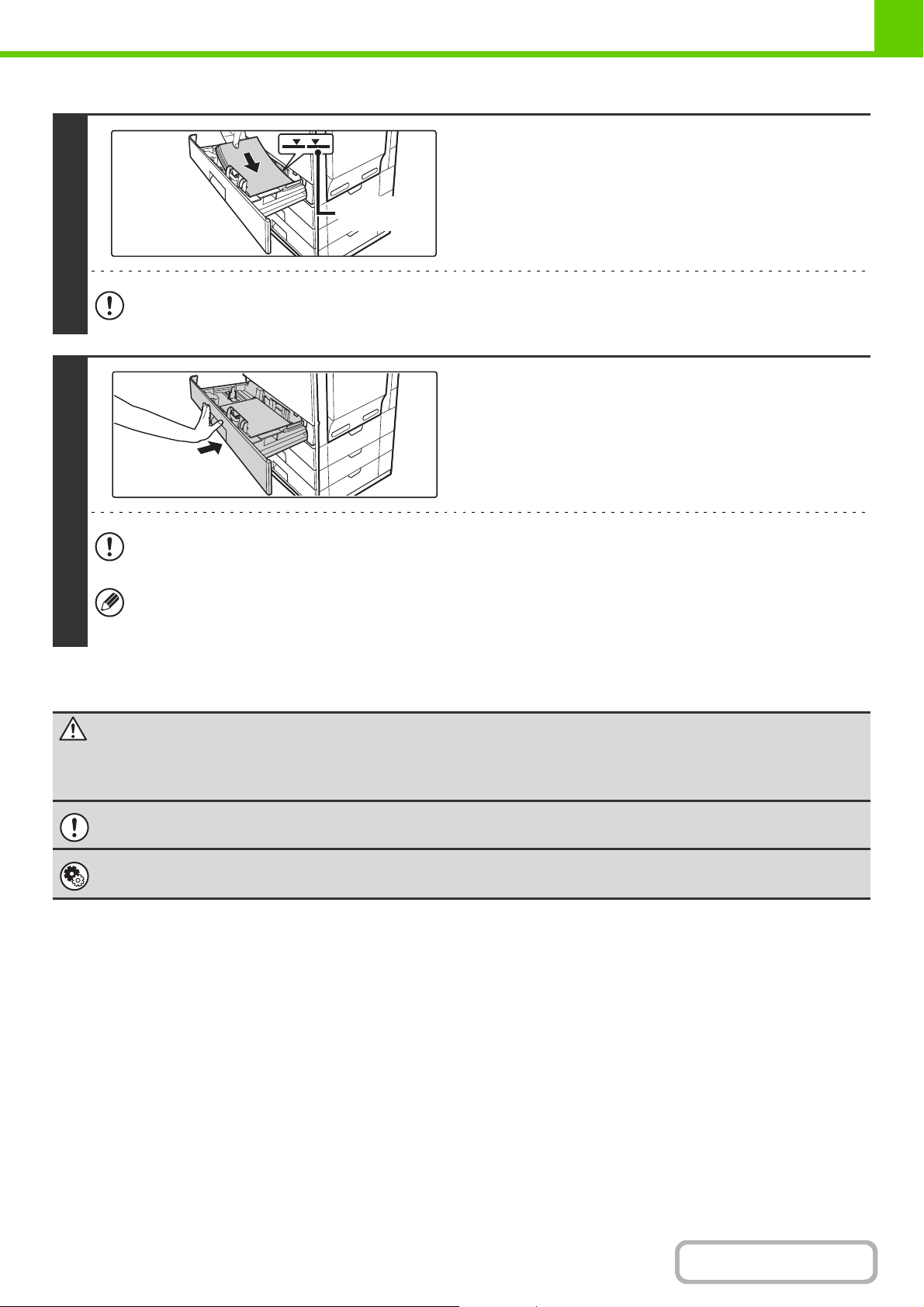
1-46
BEFORE USING THE MACHINE
Contents
4
Insert the paper into the tray.
Load the paper with the print side face up. The stack must not
be higher than the indicator line (maximum of 500 sheets).
• If paper is loaded higher than the line, paper misfeeds may occur.
• When pushing in a tray, take care that your fingers do not become pinched in the tray.
5
Gently push the paper tray into the
machine.
Push the tray firmly all the way into the machine.
When pulling out a tray after paper is loaded, do not pull hard. The tray may be damaged, the machine may topple,
and injury may result.
If you loaded a different type or size of paper than was loaded previously, be sure to change the "Paper Tray Settings"
in the system settings. If these settings are not configured correctly, automatic paper selection will not operate
correctly and printing may take place on the wrong size or type of paper, or a misfeed may occur.
Caution
If children are present, ensure that the children do not sit or play on a tray that has been pulled out.
Sitting on a tray may damage the tray and cause the machine to topple, resulting in injury.
Do not place heavy objects on the tray or press down on the tray.
System Settings: Paper Tray Settings (page 6-48)
Change these settings when you change the size or type of paper loaded in a tray.
Indicator
line
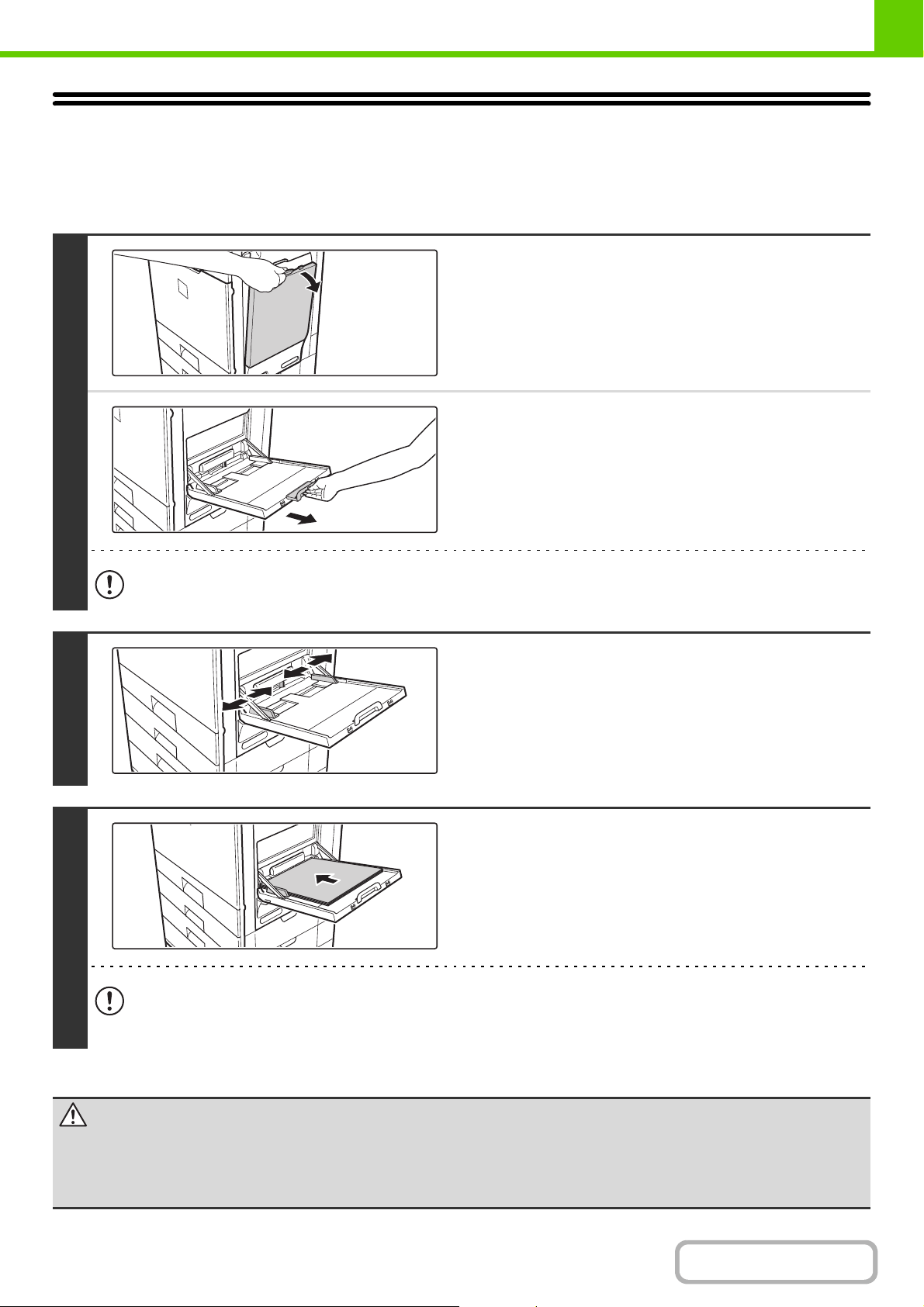
1-47
BEFORE USING THE MACHINE
Contents
LOADING PAPER IN THE BYPASS TRAY
The bypass tray can be used to print on plain paper, envelopes, label sheets, and other special media. Up to 100 sheets
of paper can be loaded (up to 40 sheets of heavy paper) for continuous printing similar to the other trays.
1
Open the bypass tray.
When loading paper larger than 8-1/2" x 11" or A4, be sure to
pull the bypass tray extension all the way out. If the bypass tray
extension is not pulled all the way out, the size of the loaded
paper will not be correctly displayed.
Do not place heavy objects on the bypass tray or press down on the tray. The bypass tray may be damaged, the
machine may topple, and injury may result.
2
Set the bypass tray guides to the width
of the paper.
3
Insert the paper along the bypass tray
guides all the way into the bypass tray
until it stops.
Load the paper with the print side face down.
• Do not force the paper in.
• If the bypass tray guides are set wider than the paper, move the bypass tray guides in until they correctly fit the
width of the paper. If the bypass guides are set too wide, the paper may skew or be creased.
Caution
If children are present, ensure that the children do not sit or play on a bypass tray that has been
pulled out. Sitting on a tray may damage the tray and cause the machine to topple, resulting in
injury.
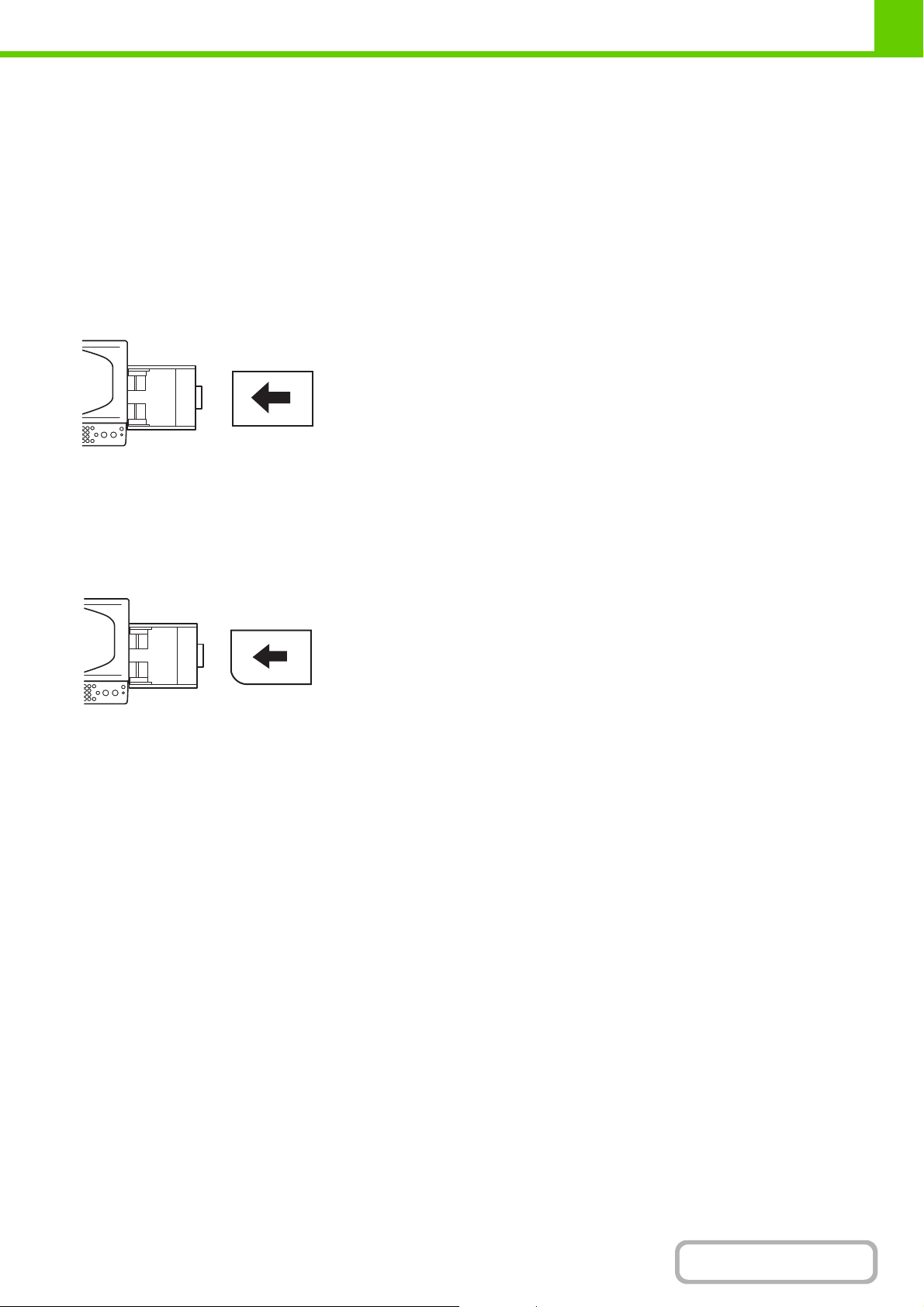
1-48
BEFORE USING THE MACHINE
Contents
IMPORTANT POINTS WHEN USING THE BYPASS TRAY
• When using plain paper other than SHARP standard paper or special media other than SHARP-recommended
transparency film, or when printing on the reverse side of previously used paper, the paper must be loaded one sheet
at a time. Loading more than one sheet at a time will cause misfeeds.
• Before loading paper, straighten any curling in the paper. If curled paper is not straightened, a misfeed may occur.
• When adding paper, remove any paper remaining in the bypass tray, combine it with the paper to be added, and
reload as a single stack. If paper is added without removing the remaining paper, a misfeed may result.
Inserting paper
Inserting transparency film
Place paper in the horizontal orientation.
• Use SHARP-recommended transparency film. When using
transparency film, place the film on the bypass tray with the rounded
corner at the left front. This ensures that the print side faces in the
correct direction.
• Do not touch the print side of transparency film.
• When loading multiple sheets of transparency film in the bypass tray,
be sure to fan the sheets several times before loading.
• When printing on transparency film, be sure to remove each sheet as it
exits the machine. Allowing sheets to stack in the output tray may result
in curling.
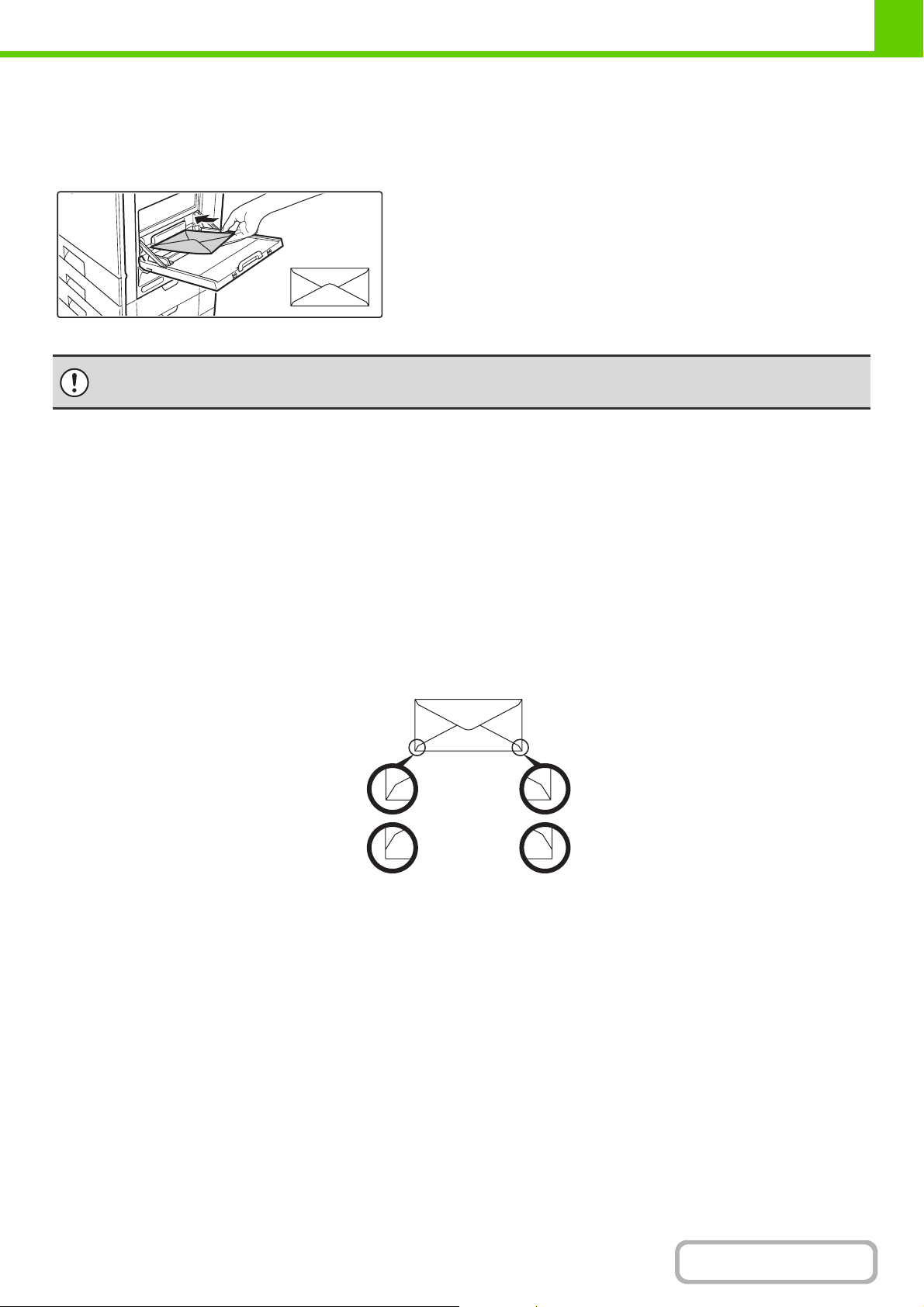
1-49
BEFORE USING THE MACHINE
Contents
Loading envelopes
When inserting envelopes in the bypass tray, place them aligned to the left side in the orientation shown below.
Only the front side of envelopes can be printed on. Be sure to place the front side face down.
When loading envelopes, load one envelope at a time.
Important points when using envelopes
Envelopes that cannot be used
Do not use the following envelopes. Envelopes misfeed, and smudges may result.
• Envelopes with metal clasps, plastic hooks, or ribbon hooks
• Envelopes closed with string
• Envelopes with windows or backing
• Envelopes with an uneven front surface due to embossing
• Double-layer envelopes
• Envelopes with an adhesive for sealing
• Hand-made envelopes
• Envelopes with air inside
• Envelopes with creases, fold marks, torn or damaged envelopes
• Envelopes with an incorrectly aligned corner gluing position on the back cannot be used as creasing may result.
Print quality on envelopes
• Print quality is not guaranteed in the area 13/32" (10 mm) around the edges of the envelope.
• Print quality is not guaranteed on parts of envelopes where there is a large step-like change of thickness, such as on
four-layer parts or parts less than three layers.
• Print quality is not guaranteed on envelopes witn adhesive for sealing.
• Do not print on both sides of an envelope. This may result in misfeeds or poor print quality.
• Some operating environments may cause creasing, smudging, misfeeds, poor toner fusing, or machine failure.
Can be used
Cannot be
used
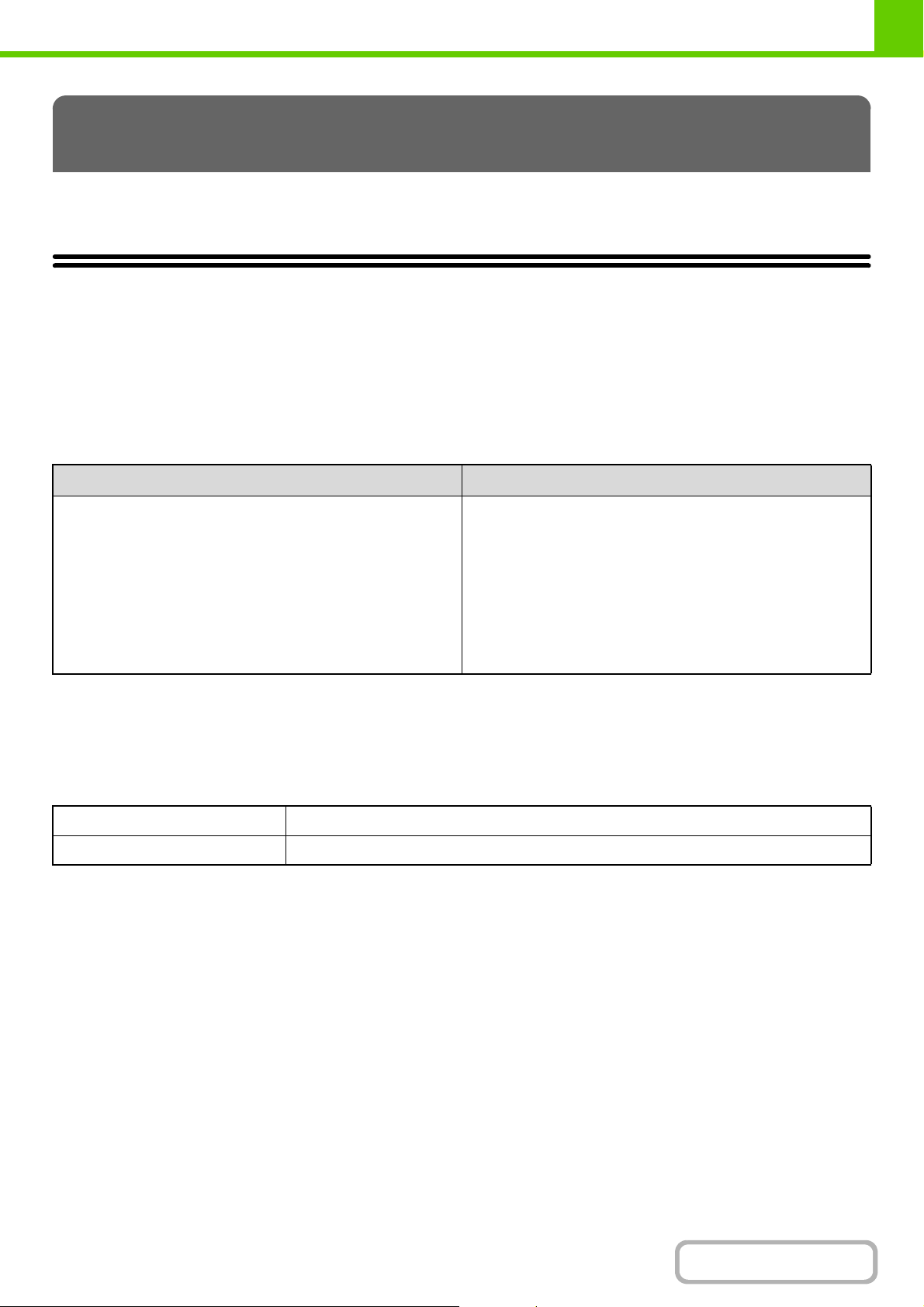
1-50
BEFORE USING THE MACHINE
Contents
This section explains how to place originals in the automatic document feeder and on the document glass.
PLACING THE ORIGINAL
PLACING ORIGINALS IN THE AUTOMATIC DOCUMENT
FEEDER
This section explains how to place originals in the automatic document feeder.
Allowed original sizes
When the original is a non-standard size, see the appropriate explanation below for the mode you are using.
☞ 2. COPIER "SPECIFYING THE ORIGINAL SIZE" (page 2-28)
☞ 4. FACSIMILE "IMAGE SETTINGS" (page 4-47)
☞ 5. SCANNER / INTERNET FAX "IMAGE SETTINGS" (page 5-58)
Allowed original weights
To scan originals from 9 lbs. to 14 lbs. (35 g/m
2
to 49 g/m
2
), use "Slow Scan Mode" in the special modes. Scanning
without using "Slow Scan Mode" may result in original misfeeds.
When "Slow Scan Mode" is selected, automatic 2-sided scanning is not possible.
Originals that cannot be fed through the automatic document feeder
Do not use the following originals. Original misfeeds, and smudges may result.
• Transparency film
• Tracing paper
• Carbon paper
• Thermal paper or originals printed with thermal transfer ink ribbon
• Originals to be fed through the feeder should not be damaged, crumpled, folded, loosely pasted together, or have
cut-out holes
• Originals with multiple punched holes other than two-hole or three-hole punched paper
• Originals that have been scanned multiple times in the automatic document feeder and have become creased or
folded.
• Originals that have absorbed moisture and become soft.
ORIGINALS
Minimum original size Maximum original size
Standard sizes
5-1/2" (height) x 8-1/2" (width)
A5: 148 mm (height) x 210 mm (width)
Non-standard sizes
(Minimum size that can be specified manually)
1-sided scanning : 4" (height) x 3-1/2" (width)
(100 mm (height) x 89 mm (width))
2-sided scanning : 4" (height) x 5-33/64" (width)
(100 mm (height) x 140 mm (width))
Standard sizes
8-1/2" (height) x 14" (width)
A4: 210 mm (height) x 297 mm (width)
Non-standard sizes
(Maximum size that can be specified manually)
Copy mode: 8-1/2" (height) x 14" (width)
216 mm (height) x 356 mm (width)
Image send mode: 8-1/2" (height) x 19-5/8" (width)
216 mm (height) x 500 mm (width)
1-sided scanning 9 lbs. to 32 lbs. (35 g/m
2
to 128 g/m
2
)
2-sided scanning 13 lbs. to 28 lbs. (50 g/m
2
to 105 g/m
2
)
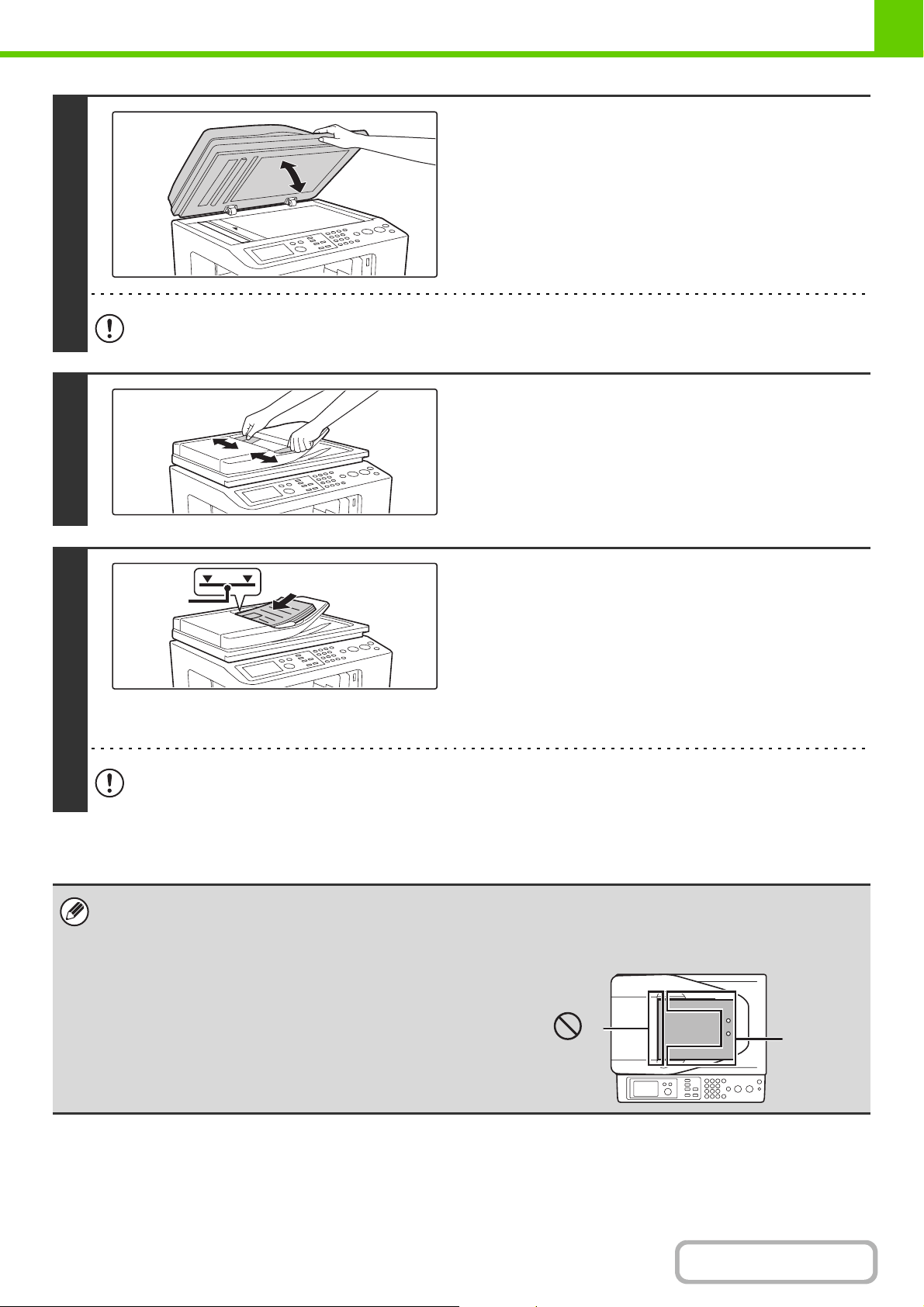
1-51
BEFORE USING THE MACHINE
Contents
1
Make sure an original does not remain
on the document glass.
Open the automatic document feeder, make sure that an
original is not on the document glass, and then gently close the
automatic document feeder.
When closing the automatic document feeder, take care that your fingers do not become pinched.
2
Adjust the original guides to the size of
the originals.
3
Place the originals.
Make sure the edges of the originals are even.
Insert the originals face up all the way into the document feeder
tray.
Insert a number of originals that does not exceed the indicator
line on the document feeder tray.
Up to 50 sheets can be inserted.
Be sure to remove originals that have been finished scanning
from the original exit tray.
• Do not insert your hand into the document insertion opening in the automatic document feeder.
• If originals are placed higher than the line, misfeeds may occur.
• Before inserting originals into the document feeder tray, be sure to remove any staples or paper clips.
• If originals have damp spots due to correction fluid, ink or pasteup glue, wait until the originals are dry before making
copies. Otherwise the interior of the document feeder or the document glass may be soiled.
• When using originals with two or three holes, place them so that
the punched edge is at a position away from the feed slot of the
document feeder tray.
Indicator
line
Hole
positions
Feed slot
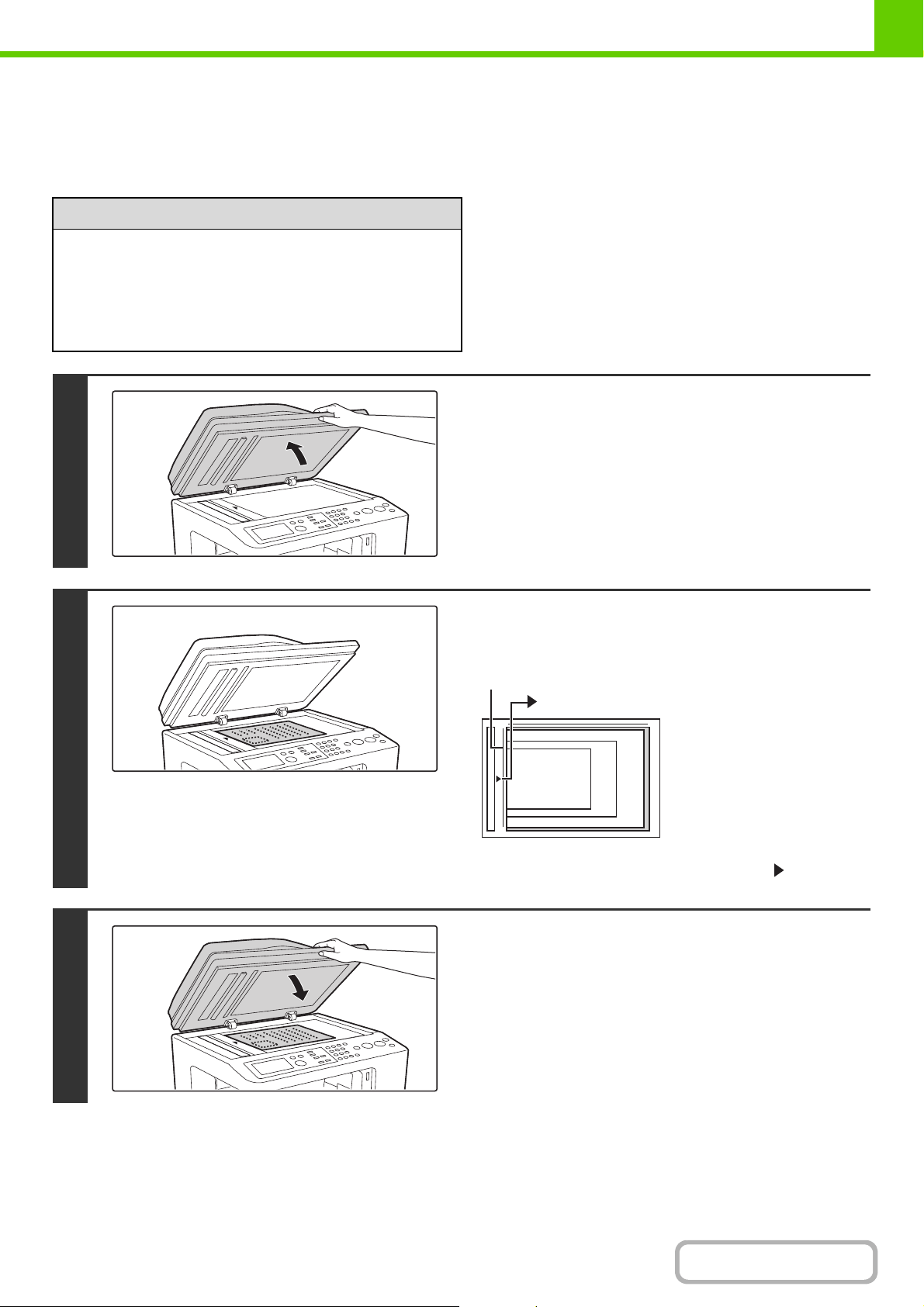
1-52
BEFORE USING THE MACHINE
Contents
PLACING THE ORIGINAL ON THE DOCUMENT GLASS
This section explains how to place the original on the document glass.
Allowed original sizes
When the original is a non-standard size, see the
appropriate explanation below for the mode you are
using.
☞ 2. COPIER "SPECIFYING THE ORIGINAL SIZE"
(page 2-28)
☞ 4. FACSIMILE "IMAGE SETTINGS" (page 4-47)
☞ 5. SCANNER / INTERNET FAX "IMAGE
SETTINGS" (page 5-58)
Maximum original size
Standard sizes
8-1/2" (height) x 11" (width)
A4: 210 mm (height) x 297 mm (width)
Non-standard sizes
8-1/2" (height) x 11-11/16" (width)
216 mm (height) x 297 mm (width)
1
Open the automatic document feeder.
2
Place the original.
Place the original face down in the left center position of the
document glass.
All originals should be placed in the left center position.
Align the middle of the original with the tip of the mark.
3
Close the automatic document feeder.
After placing the original, be sure to close the automatic
document feeder. If left open, parts outside of the original will
be copied black, causing excessive use of toner.
5-1/2" x 8-1/2"
(A5)
8-1/2" x 11" (A4)
B5
mark
Document glass scale
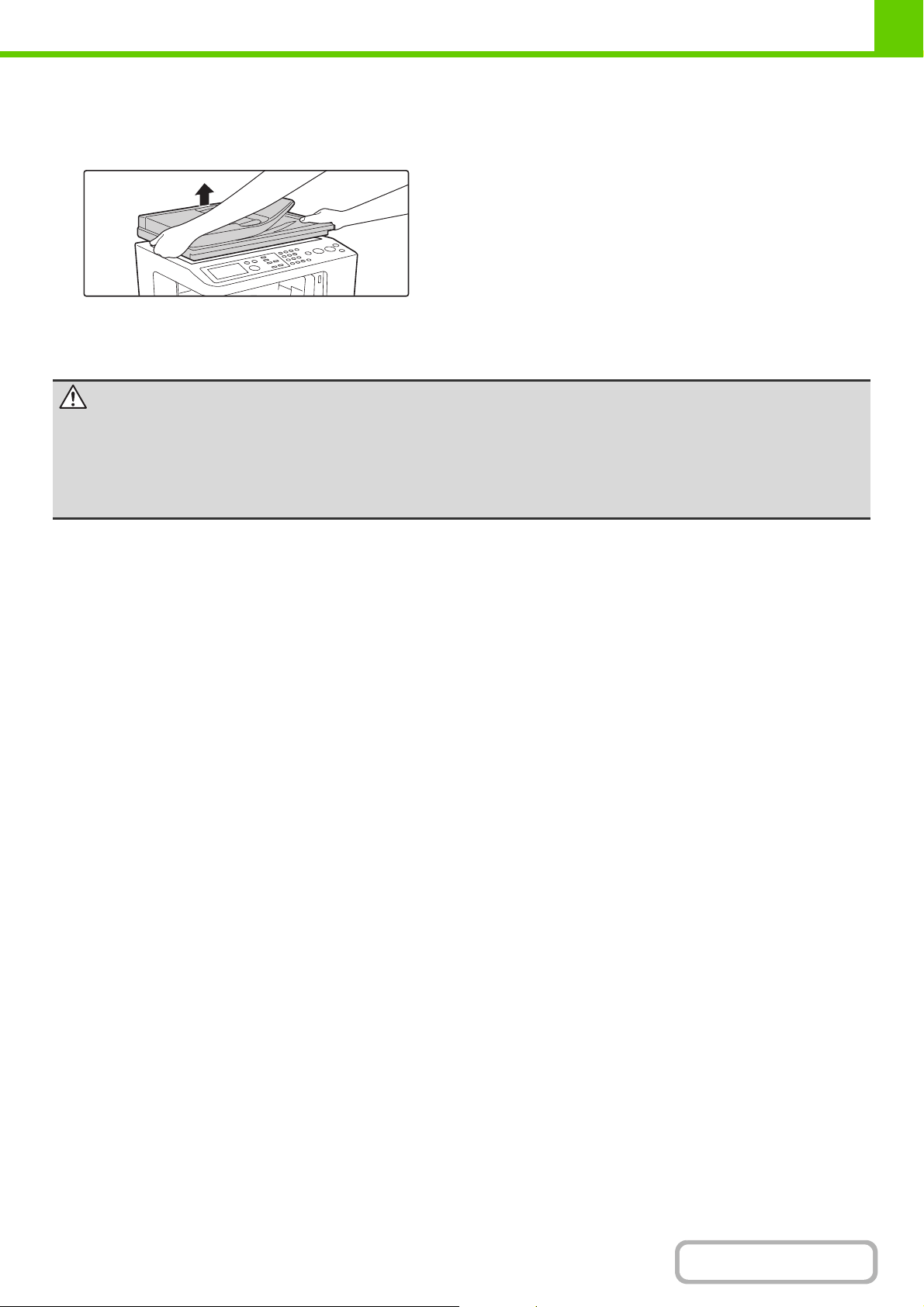
1-53
BEFORE USING THE MACHINE
Contents
Placing a thick book
When scanning a thick book or other thick original, follow the steps below to press the book down.
(1) Slightly lift the left and right sides of the
automatic document feeder.
The automatic document feeder will rise.
(2) Slowly close the automatic document
feeder.
Caution
• Close the automatic document feeder slowly. Abruptly closing the automatic document feeder
may damage it.
• Take care that your fingers are not pinched when closing the automatic document feeder.
• Do not press hard on the automatic document feeder. This may cause failure.
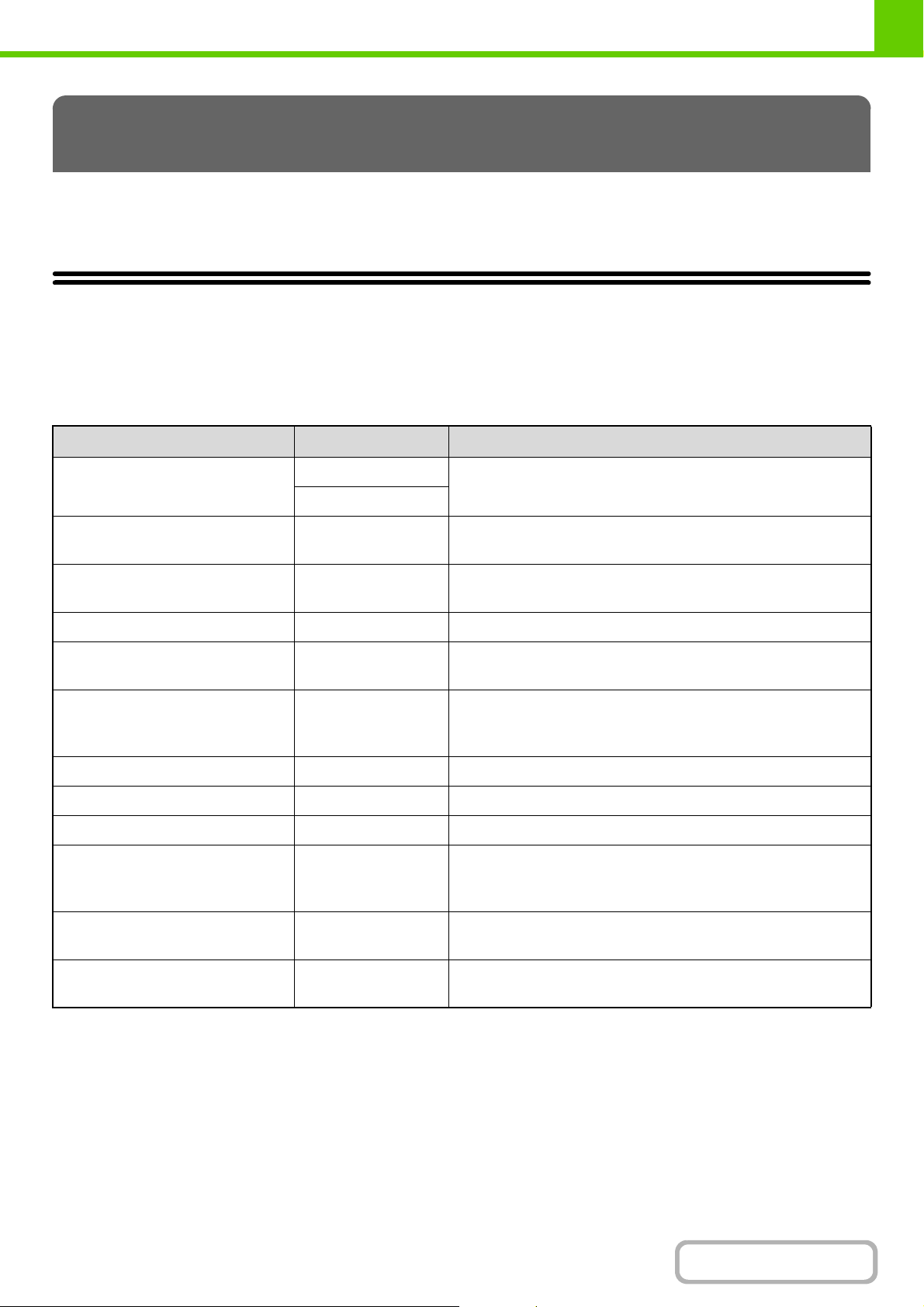
1-54
BEFORE USING THE MACHINE
Contents
This section describes the peripheral devices that can be used with the machine and explains how to use the finisher, as
well as Sharp OSA (application communication module and external account module).
PERIPHERAL DEVICES
Peripheral devices can be installed on the machine to increase its range of functionality.
The peripheral devices are generally optional, however, some models include certain peripheral devices as standard
equipment.
(As of October, 2008)
PERIPHERAL DEVICES
Product name Product number Description
500-sheet paper feed unit
MX-CSX1
Additional tray. A maximum 500 sheets of paper can be loaded
in each tray.
MX-CSX2
Business card feeder MX-BTX1
This feeder attaches to the automatic document feeder and is
used to automatically scan business cards.
Finisher MX-FN12
Output device that enables the use of the staple function and
offset function.
Barcode font kit AR-PF1 Adds barcode fonts to the machine.
PS3 expansion kit MX-PKX5
Enables the machine to be used as a Postscript compatible
printer.
XPS expansion kit MX-PUX1
The machine can be used as an XPS compatible printer.
To install this kit, a 1 GB expansion memory board (MX-SMX3)
is required.
Expansion memory board MX-SMX3 This expands the memory that can be used on the machine.
Internet fax expansion kit MX-FWX1 Enables Internet Fax.
Facsimile expansion kit MX-FXX3 Adds a fax function.
Application integration module MX-AMX1
The application integration module can be combined with the
network scanner function to append a metadata file to a scanned
image file.
Application communication module MX-AMX2
This allows the machine to be linked over a network to an
external software application.
External account module MX-AMX3
This is required to use an external account application on the
machine.
1-55
BEFORE USING THE MACHINE
Contents
Sharpdesk 1 license kit MX-USX1 This software enables integrated management of documents
and computer files.
Sharpdesk 5 license kit MX-USX5
Sharpdesk 10 license kit MX-US10
Sharpdesk 50 license kit MX-US50
Sharpdesk 100 license kit MX-USA0
Product name Product number Description
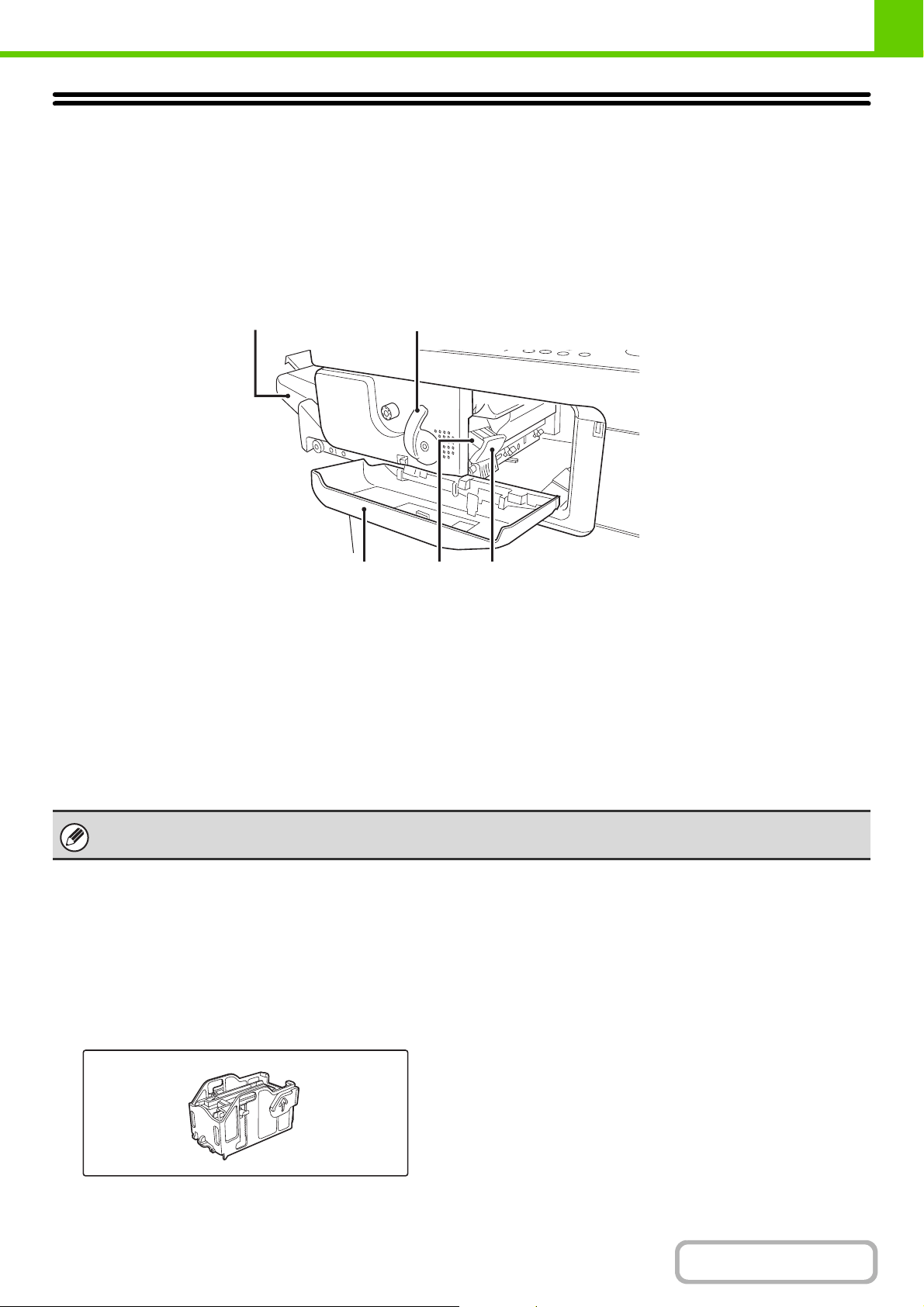
1-56
BEFORE USING THE MACHINE
Contents
FINISHER
The finisher is equipped with the offset function, which offsets each set of output from the previous set.
In addition, each set of sorted output can be stapled.
PART NAMES
The following parts can be accessed when the finisher is open.
(1) Output tray
Stapled and offset output is delivered to this tray.
The tray is slidable. Extend the tray for large output
(8-1/2" x 14", 8-1/2" x 13", 8-1/2" x 13-1/2", and
8-1/2" x 13-2/5" sizes).
(2) Lever
Use this to move the finisher in order to remove a paper
misfeed, replace staples, or remove a staple jam.
(3) Front cover
Open this cover to remove a paper misfeed, replace
staples, or remove a staple jam.
(4) Staple case
This holds the staple cartridge. Pull the case out to
replace the staple cartridge or remove a staple jam.
(5) Staple case release lever
Use this to remove the staple case.
SUPPLIES
The finisher requires the following staple cartridge:
Staple cartridge
(approx. 5000 staples per cartridge x 3 cartridges)
MX-SCX1
(1)
(5)(4)
(2)
(3)
Use caution when you turn on the power and when printing is taking place, as the tray may move up and down.
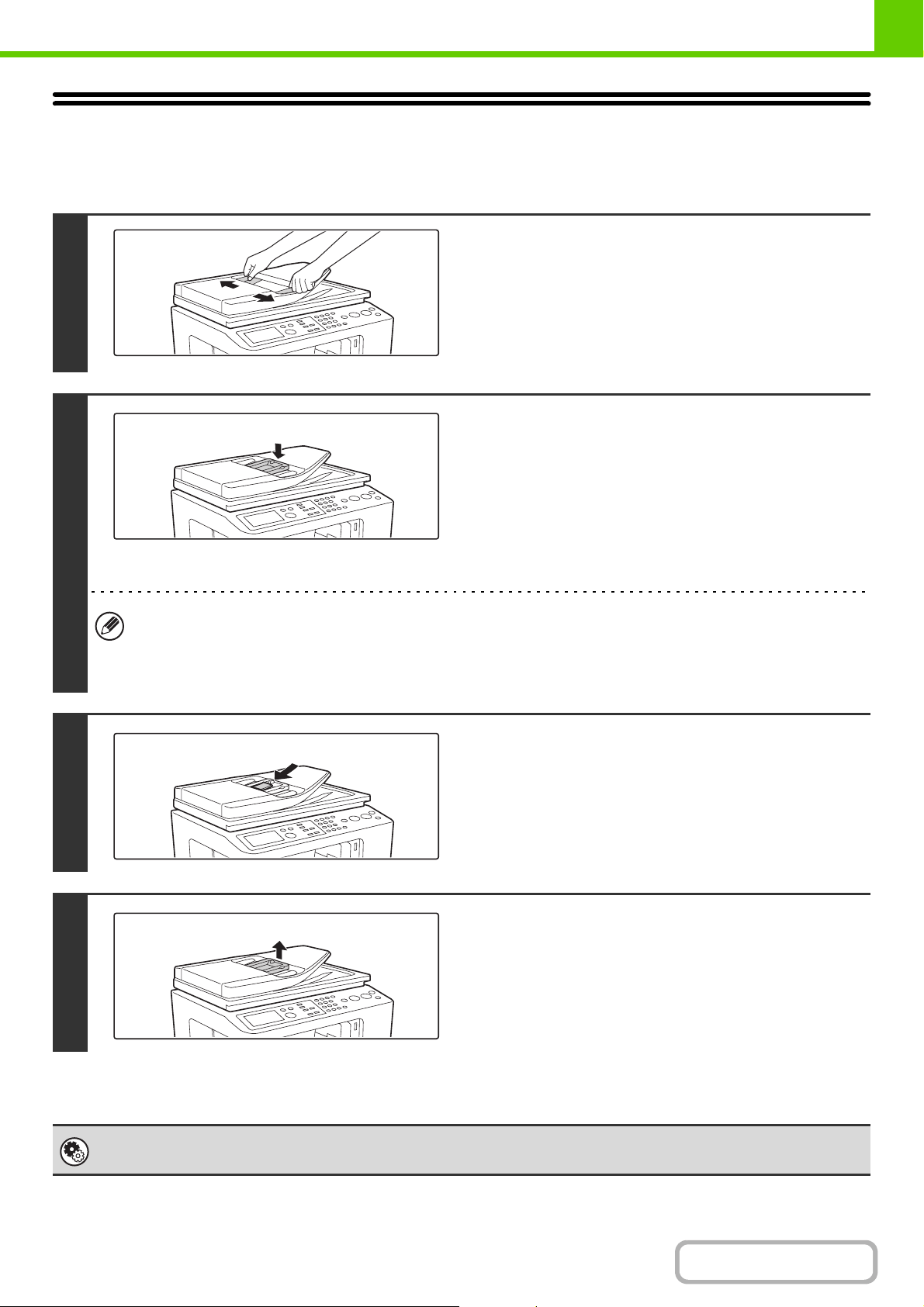
1-57
BEFORE USING THE MACHINE
Contents
BUSINESS CARD FEEDER
This feeder attaches to the automatic document feeder and is used to automatically scan business cards.
1
Open the original guide to the maximum
width.
2
Place the business card feeder on the
document feeder tray.
(1) Place the business card feeder in the center
of the document feeder tray.
(2) Gently press down on the business card
feeder.
You will hear the feeder click into place.
• When you have attached the business card feeder, enable "Business Card Scan Option" in the system settings
(administrator).
• When scanning business cards, it is convenient to use "Business Card Scan" in the special modes for copying and
scanning.
3
Load the business cards.
Make sure the edges of the cards are aligned evenly.
Insert the cards face up all the way into the business card
feeder.
4
After using the business card feeder, lift
the feeder to remove it.
You will hear a click sound as the feeder is released. Store the
feeder in its storage pocket.
System Settings (Administrator): Business Card Scan Option (Web page only)
Specify whether or not the Business Card Scan function is used.
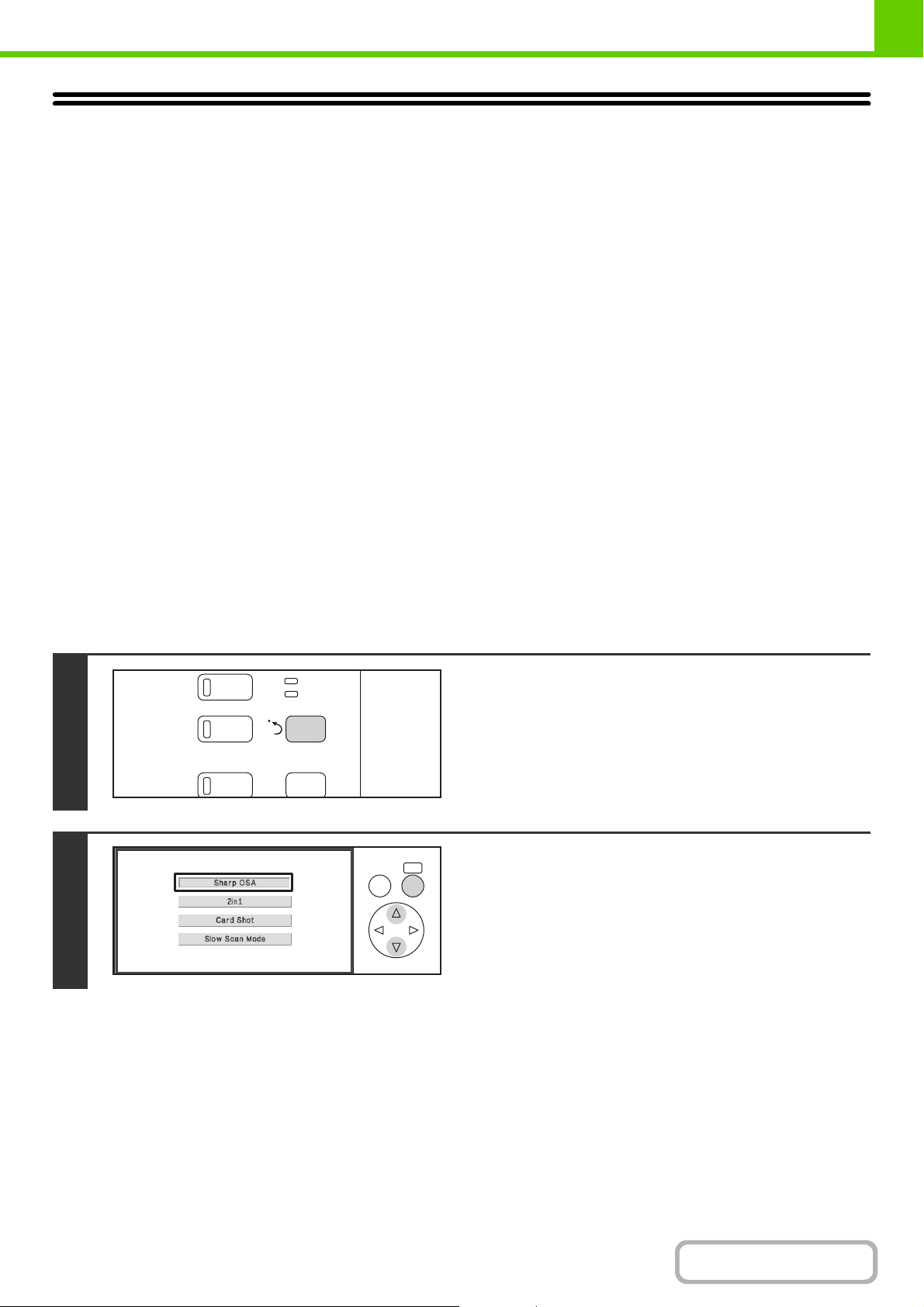
1-58
BEFORE USING THE MACHINE
Contents
SHARP OSA
Sharp OSA (Open Systems Architecture) is an architecture that enables external applications to be directly connected to
a digital multifunction machine over a network.
When a digital multifunction machine that supports Sharp OSA is used, the keys that are displayed on the operation
panel and functions such as scan send can be linked to an external application.
There are two types of external applications: "standard application" and "external account application". An "external
account application" is used for centralized account management of a multifunction machine on a network. A "standard
application" refers to all other applications.
APPLICATION COMMUNICATION MODULE (MX-AMX2)
The application communication module is required to use a "standard application" on the machine.
When a previously registered standard application is selected in the Web pages of the machine, the machine retrieves
the operation screen from the registered URL. Control of the operation screen is performed by the standard application,
and Scan to FTP, Scan to Network Folder, and HTTPS transmission can be executed.
Standard application setup
To enable a general application in the Web pages of the machine, click [Application Settings] in the administrator menu
frame, and then [External Applications Settings] and [Standard Applications]. Configure settings for the standard
application in the screen that appears.
Selecting a standard application
The procedure for selecting a general application that has been enabled in the Web pages of the machine is explained
below.
Keys in the display can be selected with the arrow keys and the [OK] key.
1
Press the Sharp OSA shortcut key.
2
Select the [Sharp OSA] key.
When no standard applications are stored in the Web page, the
[Sharp OSA] key does not appear.
COPY
JOB STATUS
SYSTEM
SETTINGS
IMAGE SEND
DATA
LINE
OK
BACK
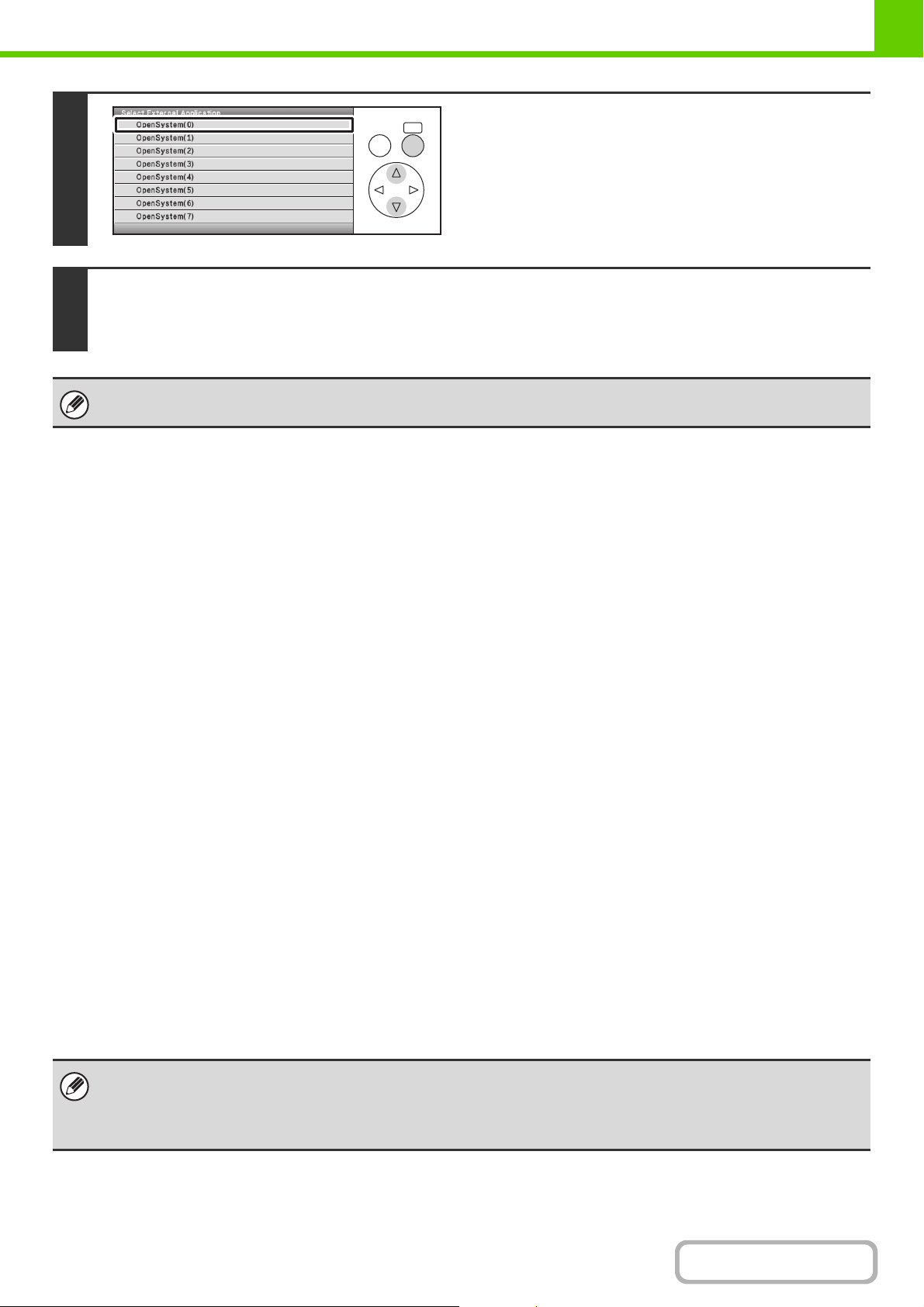
1-59
BEFORE USING THE MACHINE
Contents
EXTERNAL ACCOUNT MODULE (MX-AMX3)
The external account module is required to use an "external account application" on the machine.
An external account application can be used in "external authentication mode" or "external count mode". When external
authentication mode is used, the login screen is retrieved from the application when the machine is started. When a job
ends, a job notification screen is sent to the application to enable counts to be kept for each authenticated user.
When "external count mode" is used, the login screen is not displayed when the machine is started. Only a job result
notification is sent to the application. User authentication by the external account application cannot be used, however,
the external account application can be used in combination with the internal account function.
External account application setup
To enable an external account application in the Web pages of the machine, click [Application Settings] in the
administrator menu frame, and then [External Applications Settings] and [External Accounting Application Settings].
Configure settings for the external account application in the screen that appears. The setting change will take effect
after the machine is restarted. To restart the machine, see "TURNING THE POWER ON AND OFF" (page 1-14).
Operation in external account mode
The two modes for using an external account application operate as explained below.
External authentication mode
When the "Enable Authentication by External Server" checkbox is selected in "External Application Setting" in the Web
page, the machine enters external authentication mode. When the machine is powered on in external authentication
mode, the machine accesses the external account application and displays the login screen. The login screen also
appears when the [Call] key is selected to run a job in the job status complete screen. (The login screen does not appear
if the user has already logged in by the normal method.)
The [JOB STATUS] key can be pressed while the login screen appears to show the job status screen. To return to the
previous state, press the mode select key.
3
Select the standard application.
If two or more standard applications have been stored in the
Web pages, the screen to select the standard application will
appear. Select the standard application that you wish to use.
If only one standard application has been stored in the Web
pages, connection to the standard application will begin.
4
The machine connects to the standard application.
The message "Connecting to the external application." appears while the machine communicates with the standard
application.
The mode select key cannot be used during scanning.
• The user control function of the machine cannot be used in external authentication mode.
However, "User Registration", "User Count Display", "User Count Reset", "User Information Print", and "The Number of
User Name Displayed Setting" can be used.
• The mode select key cannot be used while the login screen appears.
OK
BACK

1-60
BEFORE USING THE MACHINE
Contents
If login fails
If the login screen fails to appear or the application does not operate correctly, the machine may also stop operating
correctly. In this event, it is recommended that you quit external account mode from the Web pages of the machine. For
more information, see [Help] in the Web pages.
To forcibly exit external account mode from the machine's operation panel, follow these steps:
Change "External Application Setting" in the Web page. Restart the machine to make the change take effect. To restart
the machine, see "TURNING THE POWER ON AND OFF" (page 1-14).
External count mode
When only the "External Account Control" setting is enabled in "External Application Setting" in the Web page, the
machine enters external count mode.
Unlike external authentication mode, when the machine is started in "external count mode", the login screen of the
external account application is not displayed. Only the job result is sent to the external account application. External
count mode can be used together with the user control function of the machine. (External count mode can also be used
when the user control function is disabled.)
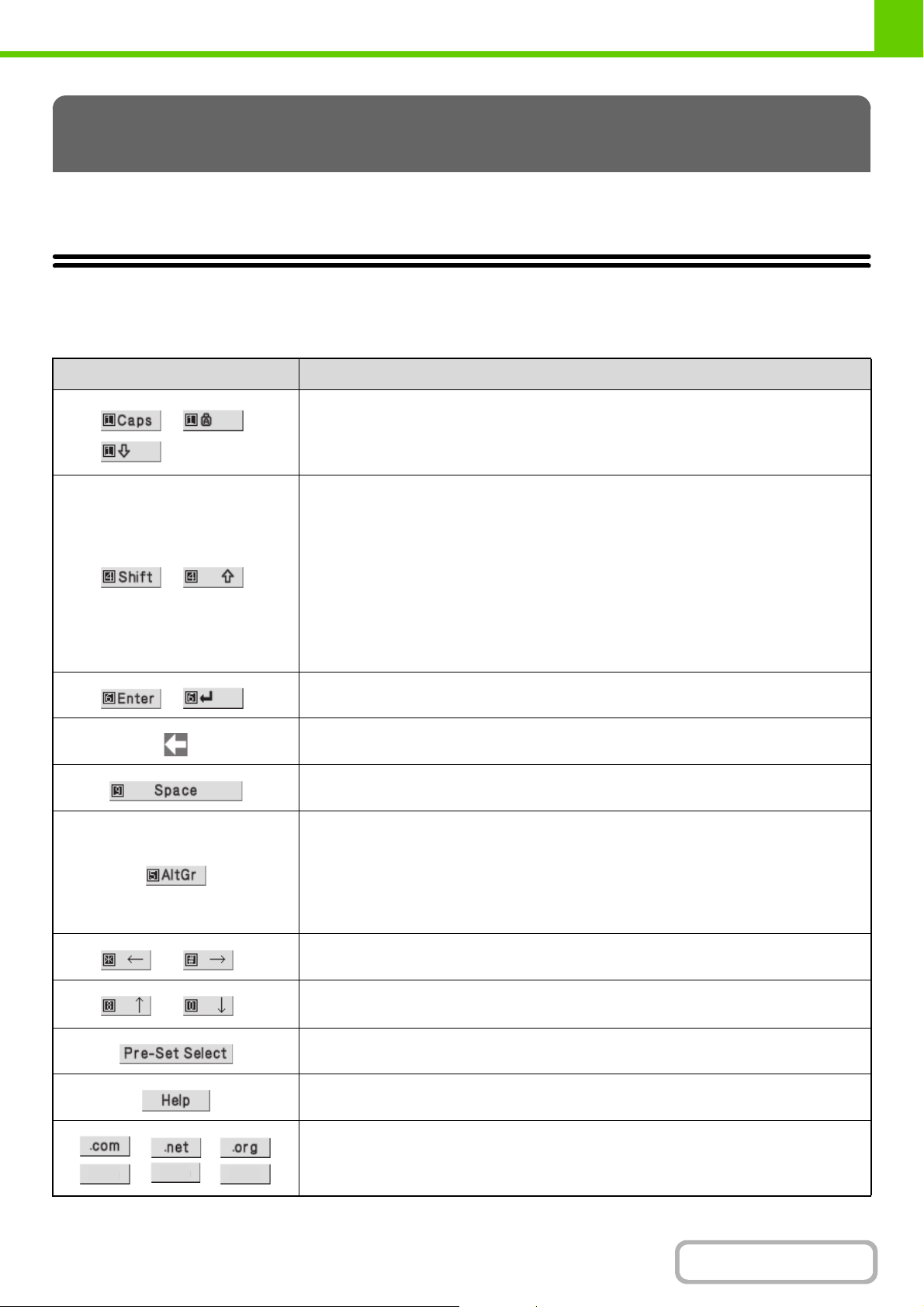
1-61
BEFORE USING THE MACHINE
Contents
This section explains the text entry screen.
FUNCTIONS OF THE MAIN KEYS
ENTERING TEXT
Key Description
This key changes the text entry screen from the lower case screen to the upper case
screen. The upper case screen will continue to appear until the [Caps] key is selected
again so that it is no longer highlighted. The [Caps] key is convenient when you wish to
enter all capital letters.
This key temporarily changes the keys in the text entry screen to upper case when lower
case letters appear, or to lower case when upper case letters appear.
Select a letter key after selecting the [Shift] key to enter that letter. After the letter is
entered, the [Shift] key will no longer be highlighted and the original text entry screen will
appear.
The [Shift] key is convenient when you only need to enter one upper case letter or one
lower case letter, or when you need to enter one of the symbols assigned to the numeric
keys.
To cancel selection of the [Shift] key, select the [Shift] key again. The [Shift] key will no
longer be highlighted.
Select this key to enter a line break when entering the body text of an e-mail message.
Select this key to delete the characters to the left of the cursor one character at a time.
Select this key to enter a space between letters.
This key temporarily changes the entry screen to the accented letter and symbol entry
screen. Select a letter key after selecting the [AltGr] key to enter that letter. After the letter
is entered, the [AltGr] key will no longer be highlighted and the original text entry screen
will appear.
To cancel selection of the [AltGr] key, select the [AltGr] key again. The [AltGr] key will no
longer be highlighted.
These keys move the cursor left and right.
These keys move the cursor to the line above or below the current line during entry of the
body text of an e-mail message.
Use this key to retrieve a previously stored subject for e-mail or other pre-set text.
Shows explanations of each key.
Use this key to enter a previously stored text string such as ".com".
Text strings are stored in "Soft Keyboard Template Setting" in "Operation Setting" in the
"System Settings" on the Web page.
.biz
.info
http:
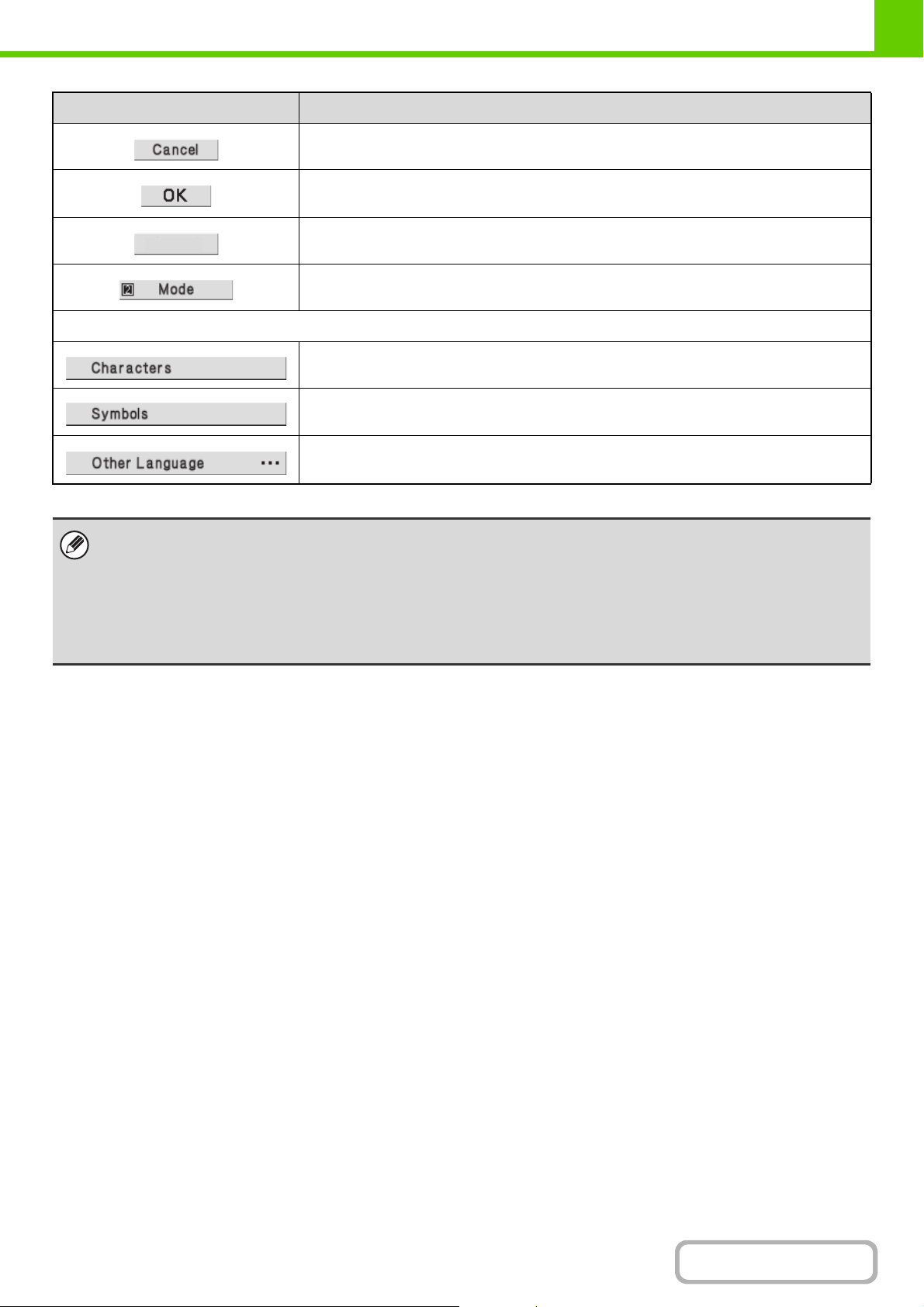
1-62
BEFORE USING THE MACHINE
Contents
Select this key to return to the previous setting screen without entering text.
Select this key to enter the text that currently appears and return to the previous setting
screen.
Select this key and search results will appear based on the entered characters.
When this key is selected, the "Input Mode" screen appears.
Input mode screen
Select this key to select character entry mode.
Select this key to select symbol entry mode. Symbol mode is used to enter symbols and
accented letters.
Select this key to temporarily change the key layout of character entry mode to a different
language. Select the key layout that you wish to use.
• The key layouts that can be selected vary depending on the language selected in "Display Language Setting" in the
system settings (administrator).
• The following symbols cannot be used when entering a file name or folder name.
\ ? / " ; : , < > ! * | & #
Some computer environments may not allow the use of spaces and the symbols indicated below. For example, hyperlinks
will not operate correctly or nonsense characters may appear.
$ % ' ( ) + - . = @ [ ] ^ ` { } _ ~
Key Description
Search

2-1
This chapter provides detailed explanations of the procedures for using the copy function.
For the procedures for using the display, see "USING THE OPERATION PANEL" (page 1-9) in "1. BEFORE USING
THE MACHINE".
BEFORE USING THE MACHINE AS A
COPIER
BASE SCREEN OF COPY MODE . . . . . . . . . . . . . . 2-3
COPYING SEQUENCE . . . . . . . . . . . . . . . . . . . . . . 2-6
ORIGINALS . . . . . . . . . . . . . . . . . . . . . . . . . . . . . . . 2-8
• STANDARD ORIGINAL PLACEMENT
ORIENTATIONS. . . . . . . . . . . . . . . . . . . . . . . . . 2-8
PAPER TRAYS. . . . . . . . . . . . . . . . . . . . . . . . . . . . . 2-9
BASIC PROCEDURE FOR MAKING
COPIES
MAKING COPIES . . . . . . . . . . . . . . . . . . . . . . . . . . 2-10
• USING THE AUTOMATIC DOCUMENT
FEEDER TO MAKE COPIES (1-sided
copies of 1-sided originals). . . . . . . . . . . . . . . . 2-10
•
USING THE DOCUMENT GLASS TO MAKE
COPIES (1-sided copy of a 1-sided original).
. . . 2-12
AUTOMATIC 2-SIDED COPYING . . . . . . . . . . . . . 2-15
• USING THE AUTOMATIC DOCUMENT
FEEDER TO MAKE 2-SIDED COPIES . . . . . . 2-15
• USING THE DOCUMENT GLASS TO
MAKE 2-SIDED COPIES . . . . . . . . . . . . . . . . . 2-18
COLOR COPY MODES . . . . . . . . . . . . . . . . . . . . . 2-21
CHANGING THE EXPOSURE AND
ORIGINAL IMAGE TYPE . . . . . . . . . . . . . . . . . . . . 2-23
• AUTOMATIC ADJUSTMENT OF THE
EXPOSURE AND ORIGINAL TYPE . . . . . . . . 2-23
• MANUAL ADJUSTMENT OF THE
EXPOSURE AND ORIGINAL TYPE . . . . . . . . 2-23
REDUCTION/ENLARGEMENT/ZOOM . . . . . . . . . 2-25
•
AUTOMATIC RATIO SELECTION (Auto Image)
. . . 2-25
• MANUAL RATIO SELECTION (Preset
ratios/Zoom) . . . . . . . . . . . . . . . . . . . . . . . . . . . 2-26
• ENLARGING/REDUCING THE LENGTH
AND WIDTH SEPARATELY (XY Zoom) . . . . . 2-27
ORIGINAL SIZES . . . . . . . . . . . . . . . . . . . . . . . . . . 2-28
• SPECIFYING THE ORIGINAL SIZE . . . . . . . . 2-28
• STORING FREQUENTLY USED
ORIGINAL SIZES . . . . . . . . . . . . . . . . . . . . . . . 2-30
OUTPUT . . . . . . . . . . . . . . . . . . . . . . . . . . . . . . . . . 2-33
• OUTPUT MODES. . . . . . . . . . . . . . . . . . . . . . . 2-34
MAKING COPIES USING THE BYPASS
TRAY . . . . . . . . . . . . . . . . . . . . . . . . . . . . . . . . . . . 2-36
SPECIAL MODES
SPECIAL MODES . . . . . . . . . . . . . . . . . . . . . . . . . 2-39
COPYING TWO ORIGINAL PAGES ONTO
ONE SHEET (2in1). . . . . . . . . . . . . . . . . . . . . . . . . 2-41
COPYING BOTH SIDES OF A CARD ON ONE
SHEET OF PAPER (Card Shot) . . . . . . . . . . . . . . 2-43
COPYING MULTIPLE BUSINESS CARDS
(Business Card Scan) . . . . . . . . . . . . . . . . . . . . . . 2-46
COPYING THIN ORIGINALS (Slow Scan
Mode) . . . . . . . . . . . . . . . . . . . . . . . . . . . . . . . . . . . 2-48
ADDING MARGINS (Margin Shift) . . . . . . . . . . . . 2-50
ERASING PERIPHERAL SHADOWS (Erase)
. . . . . 2-52
PRINTING THE DATE AND A STAMP ON
COPIES (Stamp) . . . . . . . . . . . . . . . . . . . . . . . . . . 2-55
• GENERAL PROCEDURE FOR USING
STAMP . . . . . . . . . . . . . . . . . . . . . . . . . . . . . . . 2-56
• ADDING THE DATE TO COPIES (Date) . . . . . 2-58
• STAMPING COPIES (Stamp) . . . . . . . . . . . . . 2-60
• PRINTING PAGE NUMBERS ON COPIES
(Page Numbering) . . . . . . . . . . . . . . . . . . . . . . 2-62
• PRINTING TEXT ON COPIES (Text). . . . . . . . 2-66
• CHECKING THE STAMP LAYOUT
(Layout) . . . . . . . . . . . . . . . . . . . . . . . . . . . . . . 2-69
ADDING INSERTS WHEN COPYING ON
TRANSPARENCY FILM (Transparency Inserts)
. . . 2-71
COPYING A LARGE NUMBER OF
ORIGINALS AT ONCE (Job Build) . . . . . . . . . . . . 2-73
MAKING COPIES IN PAMPHLET FORMAT
(Pamphlet Copy) . . . . . . . . . . . . . . . . . . . . . . . . . . 2-75
COPYING ORIGINALS OF DIFFERENT
SIZES (Mixed Size Original) . . . . . . . . . . . . . . . . . 2-78
CHAPTER 2
COPIER

2-2
COPIER
[Image Edit] KEY . . . . . . . . . . . . . . . . . . . . . . . . . . 2-80
• REPEATING PHOTOS ON A COPY
(Photo Repeat) . . . . . . . . . . . . . . . . . . . . . . . . . 2-81
• REVERSING THE IMAGE (Mirror Image) . . . . 2-83
• COPYING IN THE CENTER OF THE
PAPER (Centering) . . . . . . . . . . . . . . . . . . . . . 2-84
• REVERSING BLACK AND WHITE IN A
COPY (B/W Reverse). . . . . . . . . . . . . . . . . . . . 2-86
[Color Adjustments] KEY . . . . . . . . . . . . . . . . . . . 2-88
• ADJUSTING RED/GREEN/BLUE IN
COPIES (RGB Adjust) . . . . . . . . . . . . . . . . . . . 2-89
• ADJUSTING THE SHARPNESS OF AN
IMAGE (Sharpness) . . . . . . . . . . . . . . . . . . . . . 2-90
• WHITENING FAINT COLORS IN COPIES
(Suppress Background) . . . . . . . . . . . . . . . . . . 2-91
• ADJUSTING THE COLOR (Color Balance) . . . 2-93
• ADJUSTING THE BRIGHTNESS OF A
COPY (Brightness) . . . . . . . . . . . . . . . . . . . . . . 2-96
• ADJUSTING THE INTENSITY OF A COPY
(Intensity) . . . . . . . . . . . . . . . . . . . . . . . . . . . . . 2-97
CONVENIENT COPY FUNCTIONS
INTERRUPTING A COPY RUN (Interrupt
copy). . . . . . . . . . . . . . . . . . . . . . . . . . . . . . . . . . . . 2-98
JOB STATUS SCREEN . . . . . . . . . . . . . . . . . . . . 2-100
• JOB QUEUE SCREEN AND COMPLETED
JOB SCREEN. . . . . . . . . . . . . . . . . . . . . . . . . 2-101
• CANCELING A JOB THAT IS WAITING IN
THE QUEUE. . . . . . . . . . . . . . . . . . . . . . . . . . 2-103
• GIVING PRIORITY TO A JOB IN THE
QUEUE. . . . . . . . . . . . . . . . . . . . . . . . . . . . . . 2-104
• CHECKING INFORMATION ON A COPY
JOB WAITING IN THE QUEUE . . . . . . . . . . . 2-105
STORING COPY OPERATIONS (Job
Programs) . . . . . . . . . . . . . . . . . . . . . . . . . . . . . . 2-106
• STORING (EDITING/DELETING) A JOB
PROGRAM . . . . . . . . . . . . . . . . . . . . . . . . . . . 2-107
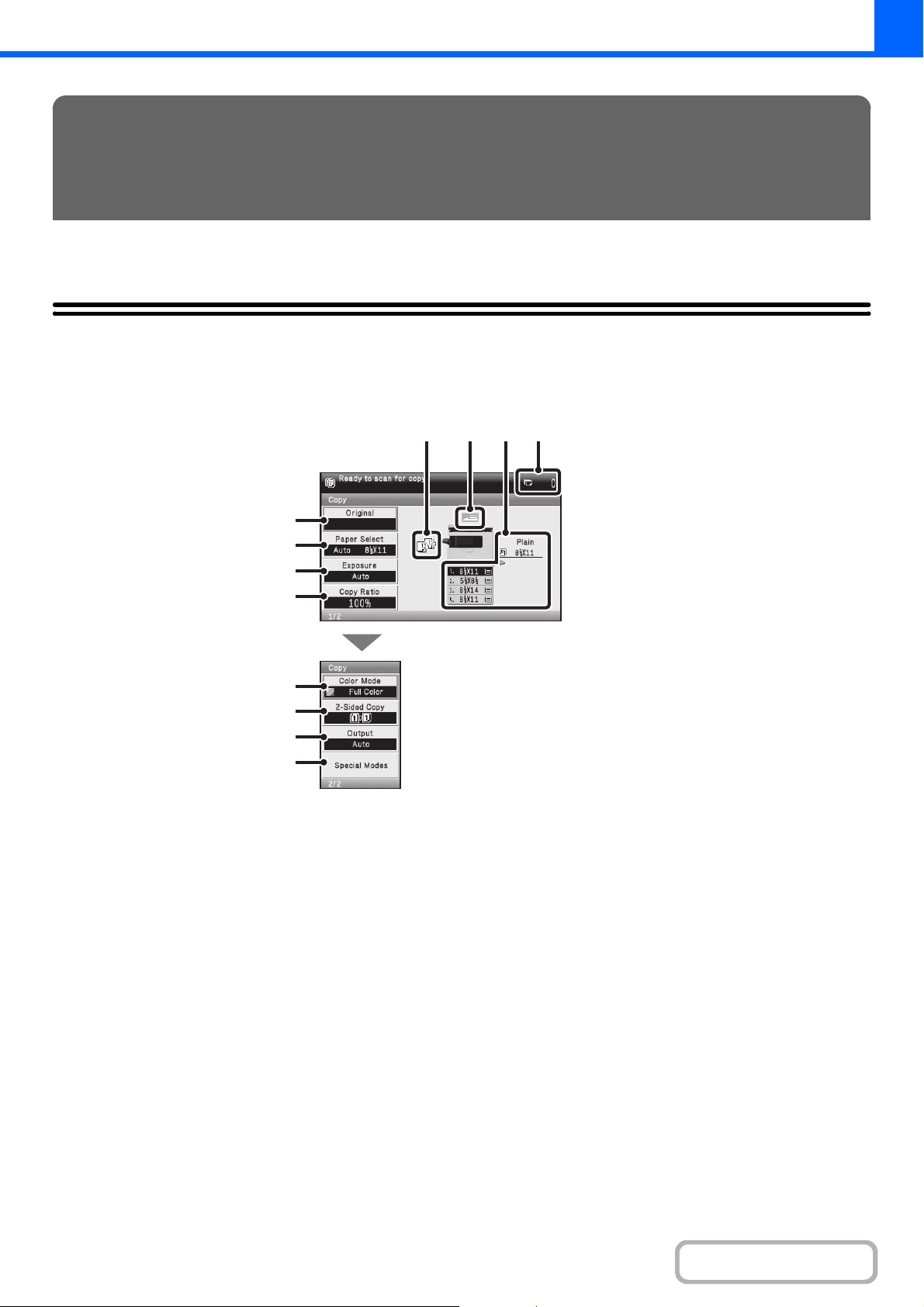
2-3
COPIER
Contents
This section provides information that you should know before using the machine as a copier.
BASE SCREEN OF COPY MODE
Press the [COPY] key on the operation panel to open the base screen of copy mode.
The base screen shows messages and keys necessary for copying, and settings that have been selected.
(1) [Original] key
Select this key to specify the original size.
If the original size displayed in this key is different from
the size of the original you placed, or if the original size is
not displayed, be sure to select this key and specify the
correct size.
☞ ORIGINAL SIZES (page 2-28)
(2) [Paper Select] key
Select this key to change the paper (tray) that is used.
The tray, paper size, and paper type will appear.
☞ PAPER TRAYS (page 2-9)
(3) [Exposure] key
This shows the current copy exposure and original type
settings. Select this key to change the exposure or
original type setting.
☞ CHANGING THE EXPOSURE AND ORIGINAL
IMAGE TYPE (page 2-23)
(4) [Copy Ratio] key
This shows the current copy ratio. Select this key to
adjust the copy ratio.
☞ REDUCTION/ENLARGEMENT/ZOOM (page 2-25)
(5) [Color Mode] key
Select this key to change the color mode.
☞ COLOR COPY MODES (page 2-21)
(6) [2-Sided Copy] key
Select this key to select the 2-sided copying function.
☞ AUTOMATIC 2-SIDED COPYING (page 2-15)
(7) [Output] key
Select this key to select an output function such as sort,
group, offset, or staple sort.
☞ OUTPUT (page 2-33)
(8) [Special Modes] key
Select this key to select special modes such as Margin
Shift and Edge Erase.
☞ SPECIAL MODES (page 2-39)
BEFORE USING THE MACHINE AS A
COPIER
(1)
(2)
(3)
(4)
(5)
(6)
(7)
(8)
(11)(10) (12)(9)
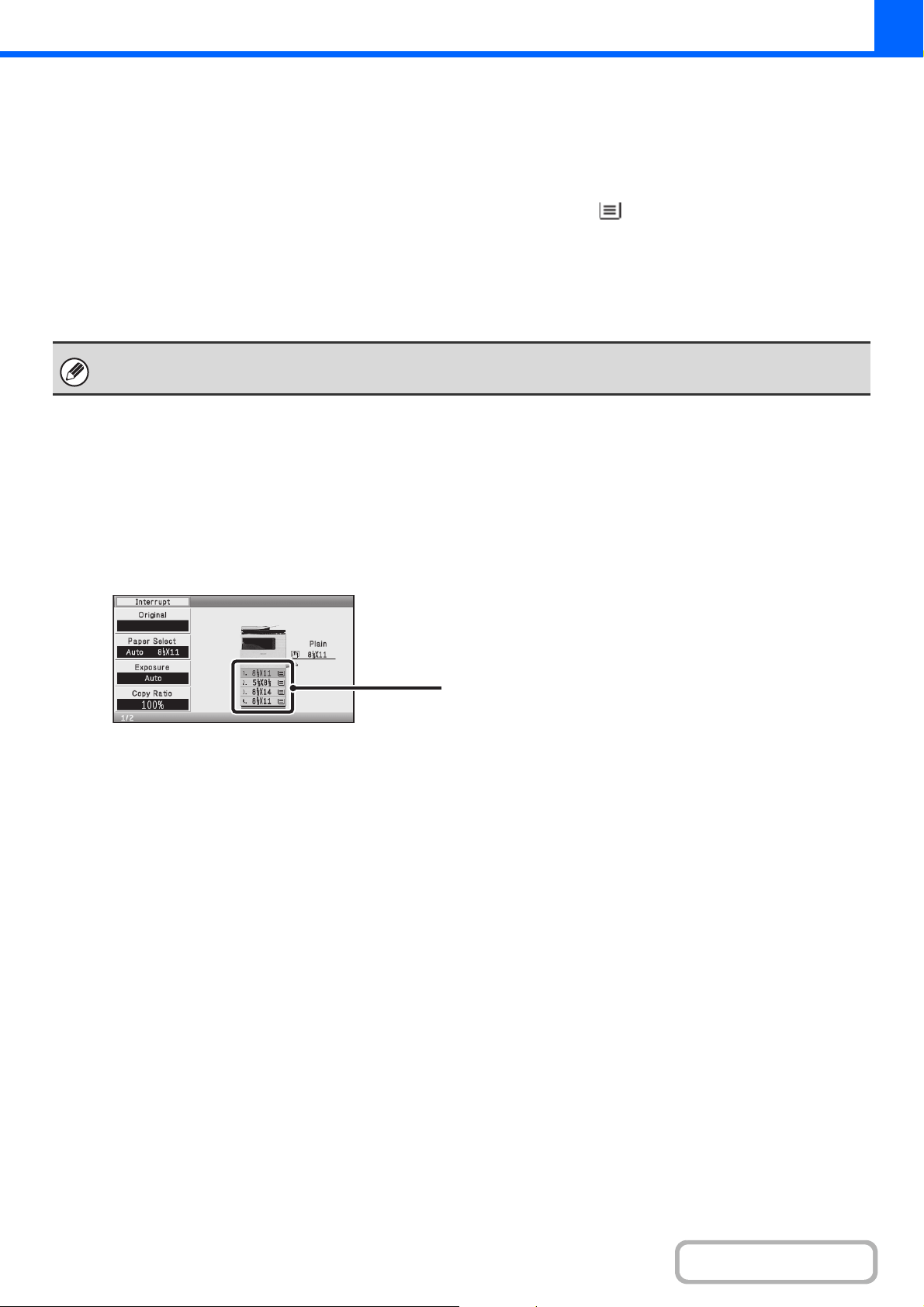
2-4
COPIER
Contents
(9) Output display
When one or more output functions such as sort, group,
or staple sort have been selected, this shows the icons of
the selected functions.
☞ OUTPUT (page 2-33)
(10) Original feed display
This appears when an original is inserted in the
automatic document feeder.
(11) Paper size display
This shows the size of paper loaded in each tray.
For the bypass tray, the paper type appears above the
paper size.
The selected tray is highlighted.
The approximate amount of paper in each tray is
indicated by .
☞ PAPER TRAYS (page 2-9)
(12) Number of copies display
This shows the number of copies set.
Tray during paper feeding
Do not pull out a tray while paper is being fed from the tray. This will cause a paper misfeed.
Identifying the tray that is being used to feed paper
The tray being used to feed paper also appears in green in the paper size display in the base screen on the display.
The screen explained in this section appears when 500-sheet paper feed units and finisher are installed. The image will vary
depending on the equipment installed.
Paper size display
Shows the tray being used to feed paper in green.
Base screen
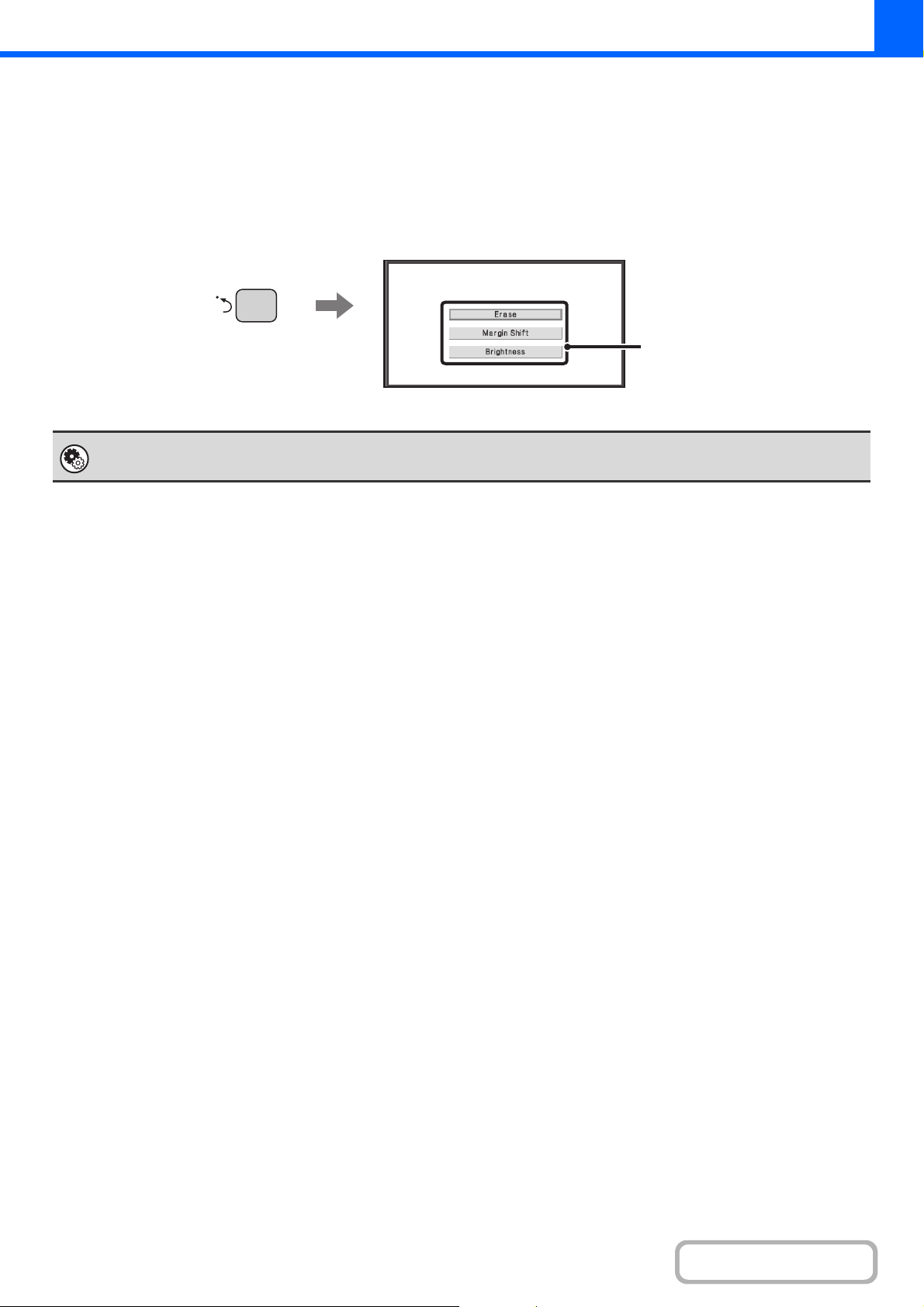
2-5
COPIER
Contents
Customizing displayed keys
Keys for special modes and other settings can be stored as shortcut keys. By assigning frequently used functions to
these keys, you can access the functions with a single touch. To change the function that is assigned to a key, use
"Customize Key Setting" in the Web pages.
When "Erase", "Margin Shift", and "Brightness" are assigned to the customized keys
System Settings (Administrator): Customize Key Setting (Web page only)
Registration is performed in [System Settings] - [Operation Settings] - "Customize Key Setting" in the Web page menu.
These 3 keys can be changed
as desired.
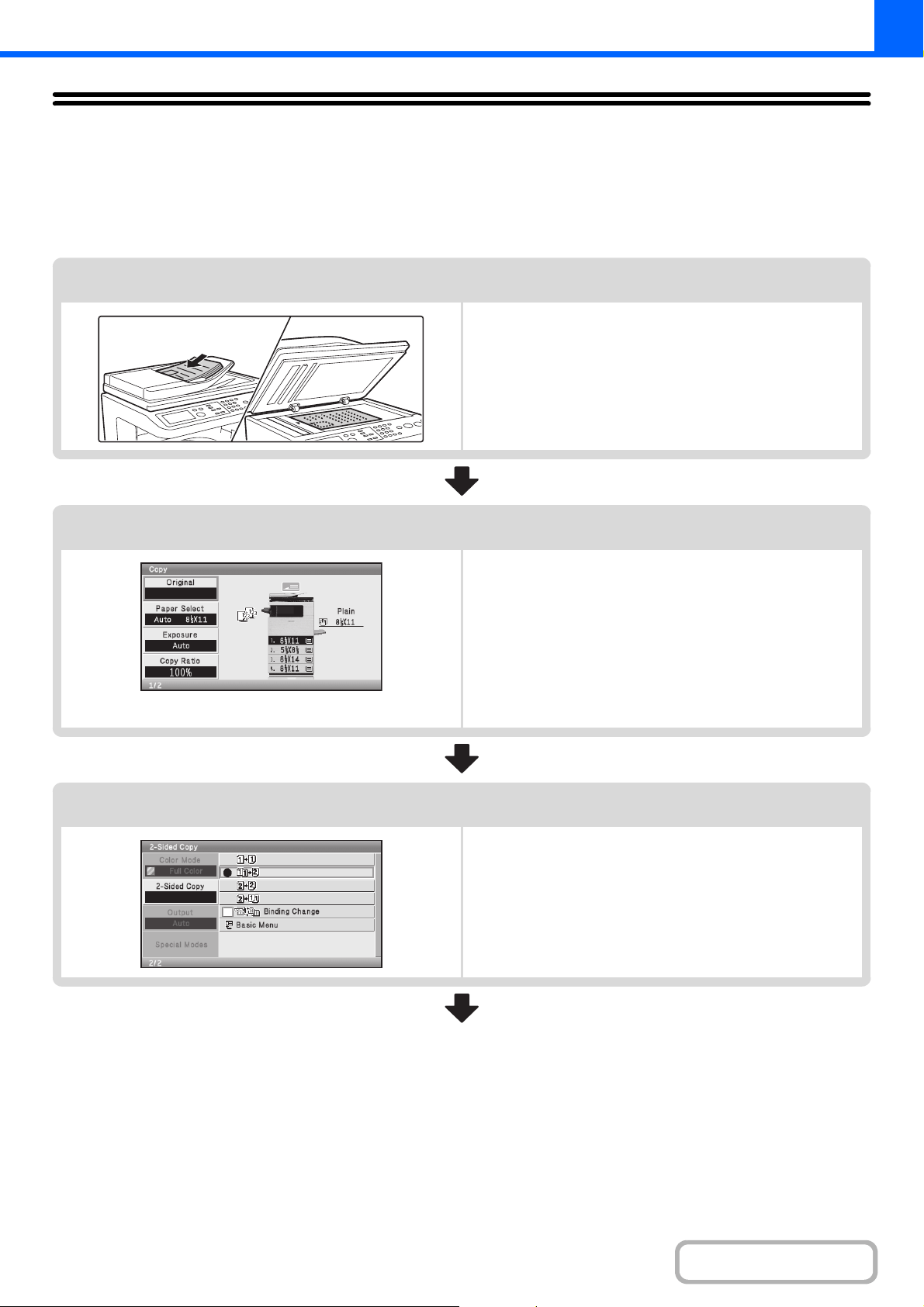
2-6
COPIER
Contents
COPYING SEQUENCE
This section explains the basic procedure for copying. Select settings in the order shown below to ensure that the copy
operation takes place smoothly.
For detailed procedures for selecting the settings, see the explanation of each setting in this chapter.
Place the original.
Place the original in the automatic document feeder tray, or on
the document glass.
* Depending on the copy functions used, there are also cases
where functions are selected before the original is placed.
Basic copy settings
Select the basic copy settings.
The main settings are as follows:
• Original size
☞ORIGINAL SIZES (page 2-28)
• Paper Settings
☞PAPER TRAYS (page 2-9)
• Exposure and original type
☞CHANGING THE
EXPOSURE AND ORIGINAL IMAGE TYPE (page 2-23)
• Copy ratio
☞REDUCTION/ENLARGEMENT/ZOOM (page
2-25)
• Color mode
☞
COLOR COPY MODES
(page 2-21)
2-sided copy settings
Select settings as needed for 2-sided copying and 2-sided
scanning of the original.
☞ AUTOMATIC 2-SIDED COPYING (page 2-15)
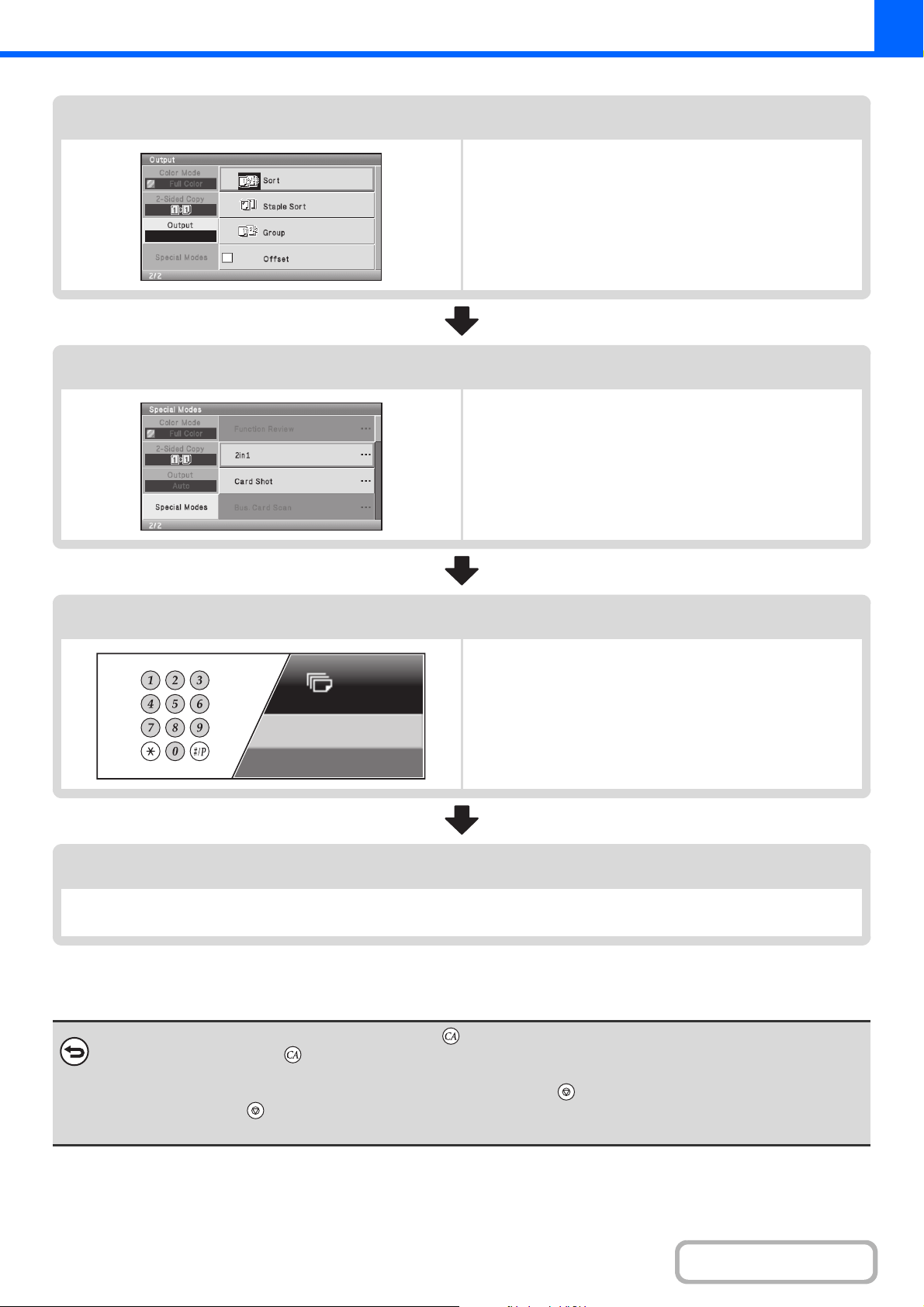
2-7
COPIER
Contents
Output settings
Select copy output settings.
The main settings are as follows:
•Sort mode
☞Sort mode (page 2-34)
• Group mode
☞Group mode (page 2-34)
• Offset mode
☞Offset function (page 2-34)
• Staple sort mode
☞Staple sort function (page 2-35)
Special mode settings
Select special modes such as "Margin Shift" and "Erase".
☞ SPECIAL MODES (page 2-39)
Number of copies (sets) setting
Set the number of copies (number of sets).
Start copying.
Start scanning the original(s) and making copies.
Press the [COLOR START] key or the [BLACK & WHITE START] key.
To cancel all settings, press the [CLEAR ALL] key ( ).
When the [CLEAR ALL] key ( ) is pressed, all settings selected to that point are cleared and you will return to the base
screen.
To stop scanning of the original and copying, press the [STOP] key ( ).
When the [STOP] key ( ) is pressed, a message will appear asking you if you want to cancel the job. Select the [Yes] key
in the message screen and press the [OK] key.
7
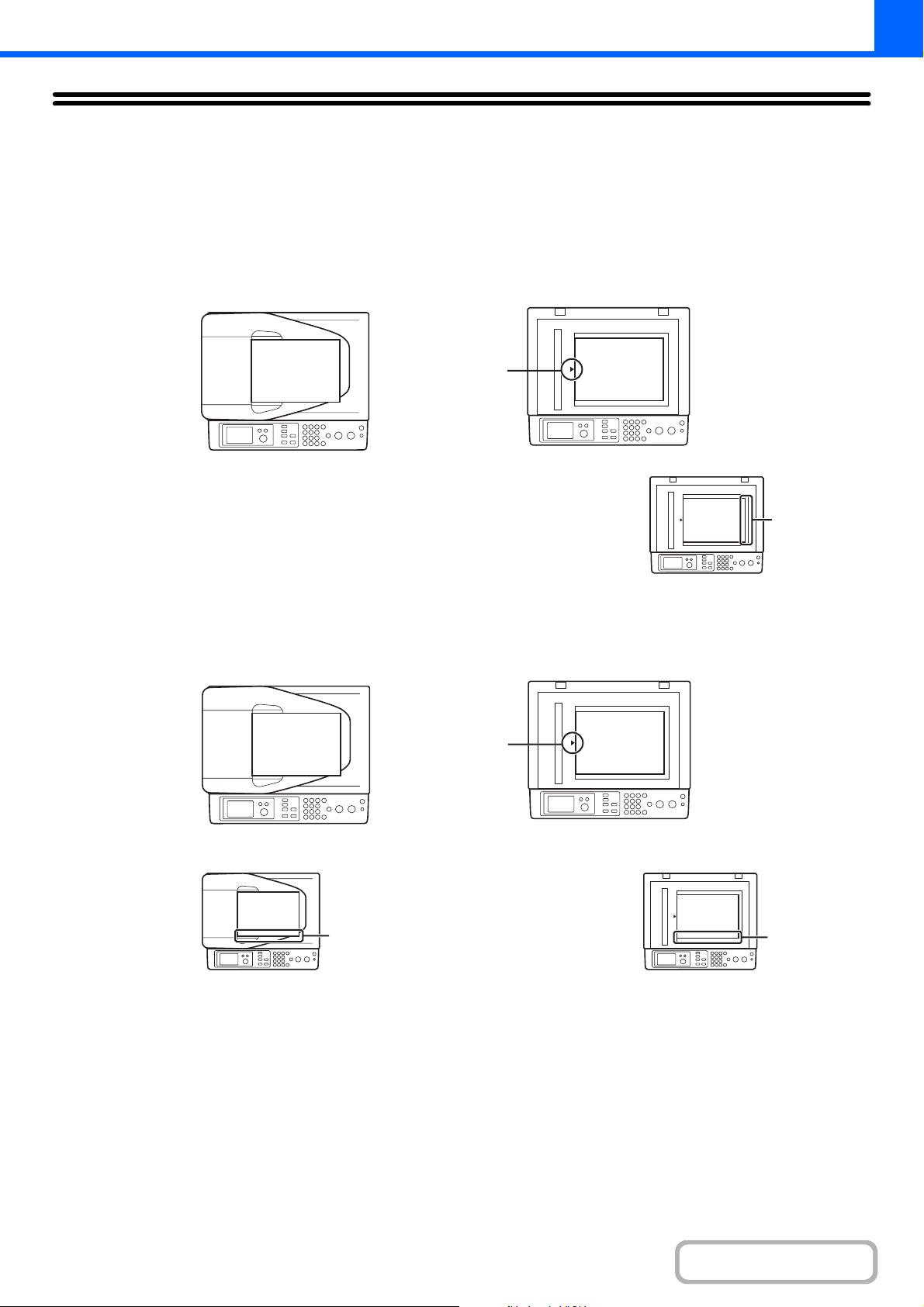
2-8
COPIER
Contents
ORIGINALS
STANDARD ORIGINAL PLACEMENT ORIENTATIONS
Place the original so that the top and bottom edges are oriented as shown below. For more information on placing the
original, see "ORIGINALS" (page 1-50) in "1. BEFORE USING THE MACHINE".
A
A
Document glassDocument feeder tray
Place the original
face down in the
left center position
of the document
glass.
Portrait original
A
When using the below functions in copy
mode, place the original so that the top
of the image is to the right.
•Staple sort
• Pamphlet copy
•2in1
•Stamp
Top of image to
the right
A
A
Document glassDocument feeder tray
Place the original
face down in the
left center position
of the document
glass.
Landscape original
A
When using the staple sort function,
place the original so that the top of the
image is toward you.
Top of image
toward you
A
Top of image
toward you
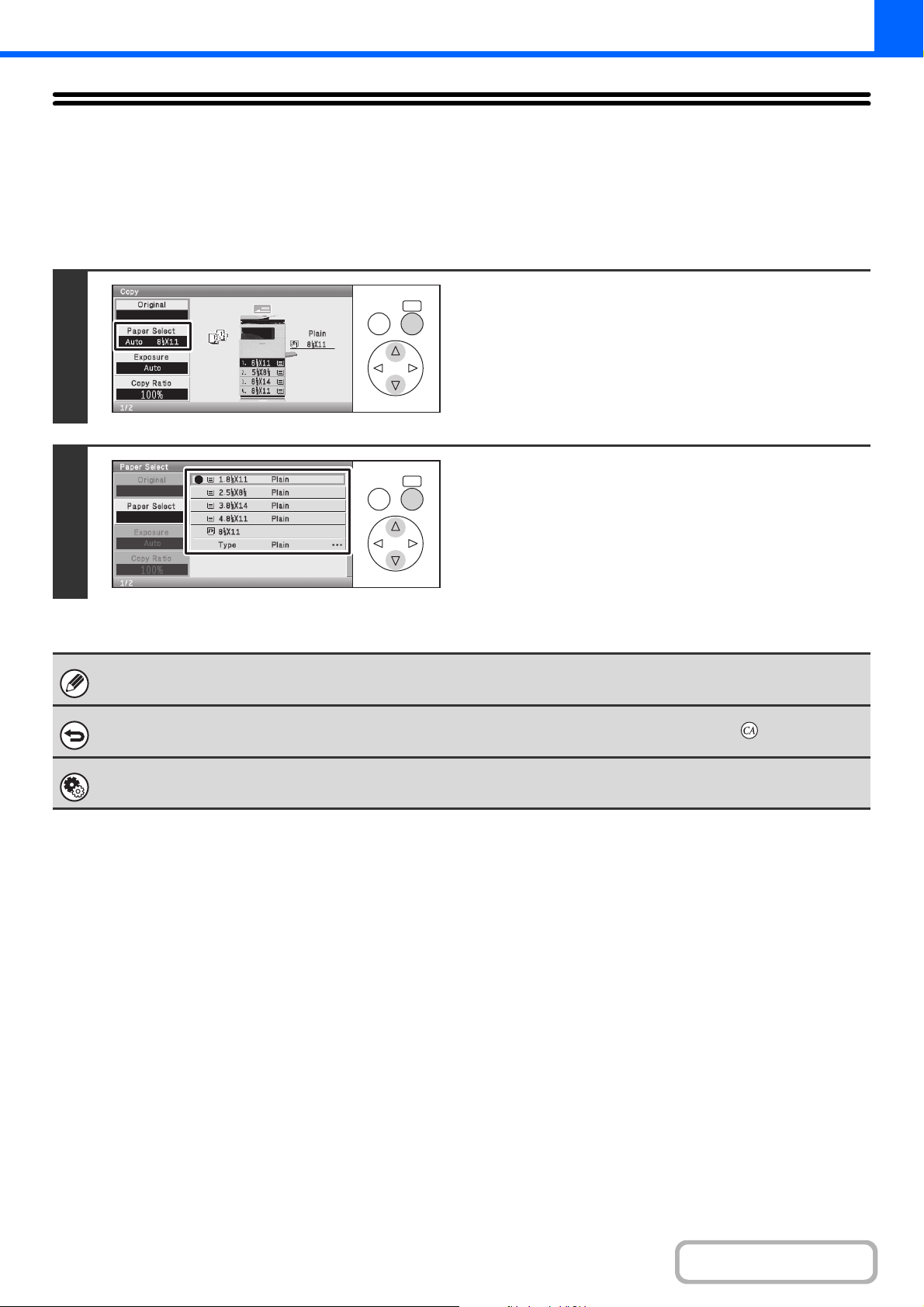
2-9
COPIER
Contents
PAPER TRAYS
The machine is set to automatically select a tray that has the same size of paper as the size of the placed original
(automatic paper tray selection).
If the correct paper size is not selected or you wish to change the paper size, you can select the paper tray manually.
Keys in the display can be selected with the arrow keys and the [OK] key.
1
Select the [Paper Select] key.
2
Select the tray that you want to use.
You will return to the base screen and the selected tray will be
highlighted.
If the selected tray runs out of paper during a copy job and there is another tray that has the same size and type of paper,
that tray will be automatically selected and the copy job will continue.
To return to automatic paper tray selection after selecting a tray manually, press the [CLEAR ALL] key ( ).
System Settings (Administrator): Initial Status Settings (Paper Tray)
Use this setting to change the tray that is selected by default.
OKBACK
OKBACK
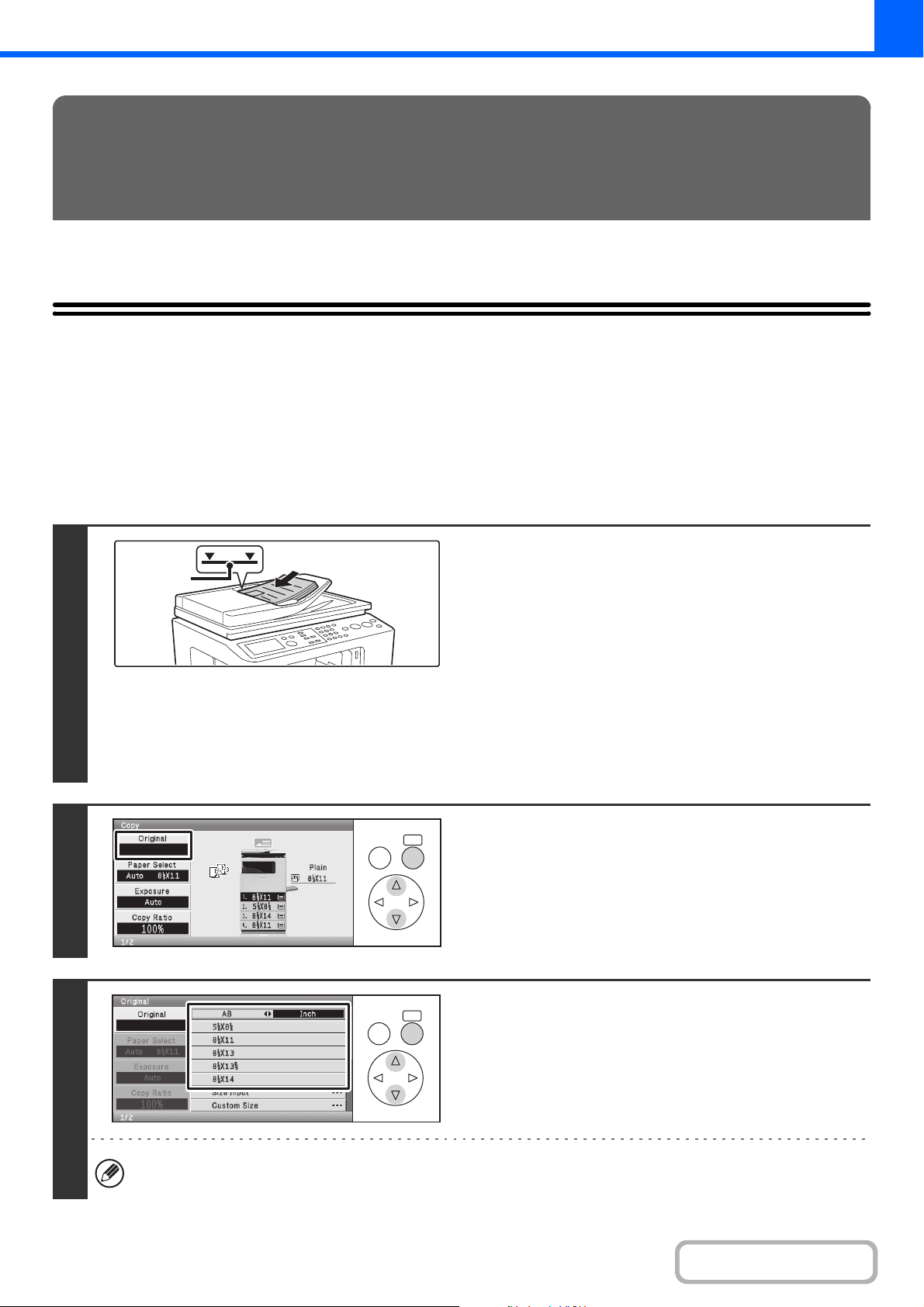
2-10
COPIER
Contents
This section explains the basic procedures for making copies, including selection of the copy ratio and other copy settings.
MAKING COPIES
USING THE AUTOMATIC DOCUMENT FEEDER TO
MAKE COPIES (1-sided copies of 1-sided originals)
This section explains how to make copies (1-sided copies of 1-sided originals) using the automatic document feeder.
Keys in the display can be selected with the arrow keys and the [OK] key.
BASIC PROCEDURE FOR MAKING
COPIES
1
Place the originals face up in the document
feeder tray with the edges aligned evenly.
Insert the originals all the way into the document feeder tray.
Multiple originals can be placed in the document feeder tray.
Place portrait originals so that the top edge enters the feeder
first. Place landscape originals so that the left edge enters first.
The stack of originals must not be higher than the indicator line
on the tray.
Up to 50 sheets can be inserted.
The stack of originals must not exceed the indicator line. Do not
press down on the originals or otherwise load more originals than
can fit under the indicator line. This will cause original misfeeds.
2
Select the [Original] key.
3
Specify the original size.
When placing an AB size or non-standard size original, specify the original size as explained in "ORIGINAL SIZES"
(page 2-28).
Indicator
line
OKBACK
OKBACK
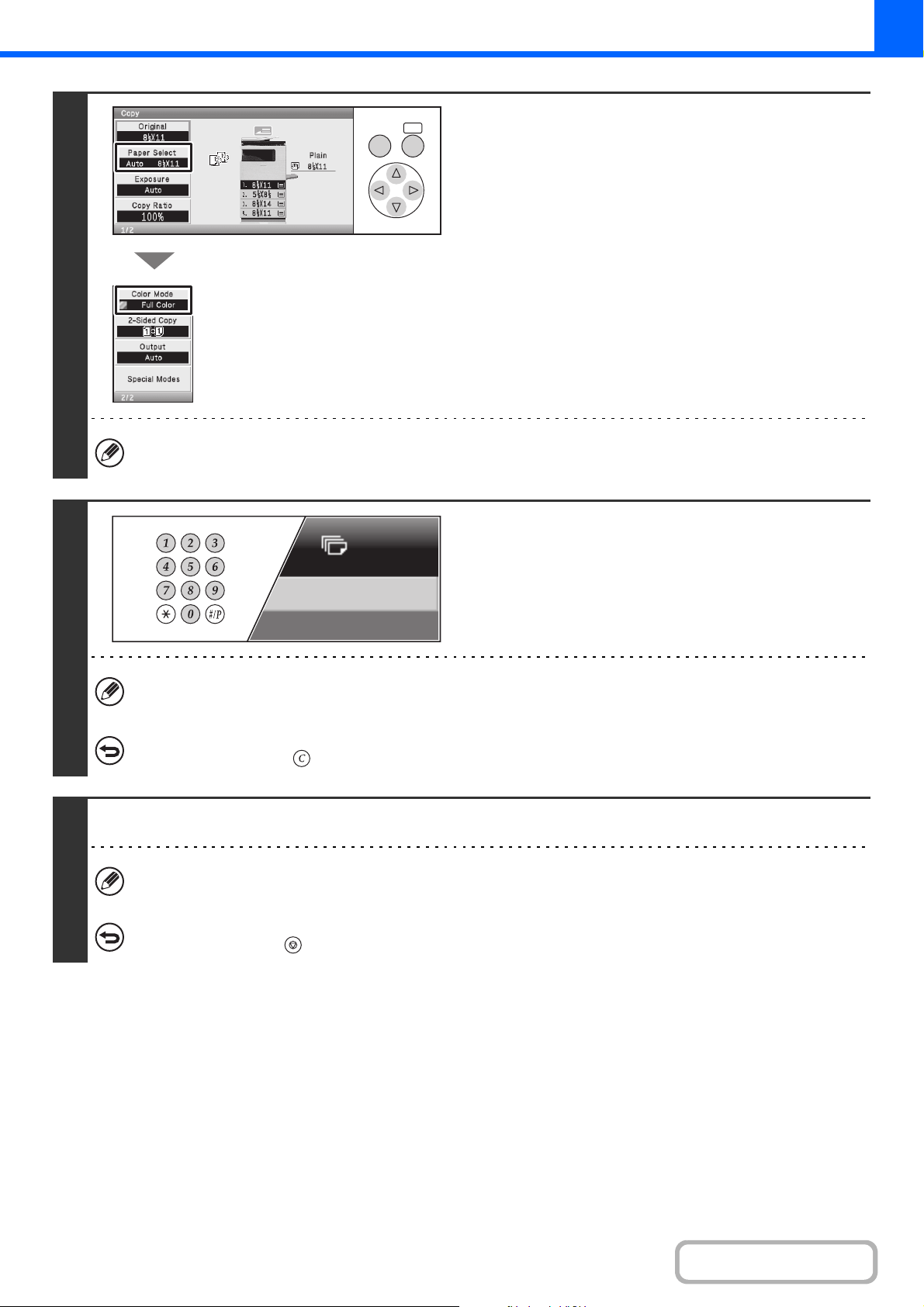
2-11
COPIER
Contents
4
Check the paper to be used and the
color mode.
Make sure that the desired paper (tray) and color mode are
selected.
• To change the paper (tray), select the [Paper Select] key and
press the [OK] key.
☞ PAPER TRAYS (page 2-9)
• To change the color mode, select the [Color Mode] key and
press the [OK] key.
☞ COLOR COPY MODES (page 2-21)
For some original size settings, the same size of paper as the original may not be automatically selected. In this case,
manually change the paper size.
5
Set the number of copies (number of
sets) with the numeric keys.
• Up to 999 copies (sets) can be set.
• A single copy can be made even if "0" appears for the number of copies.
If an incorrect number of copies is set...
Press the [CLEAR] key ( ) and then enter the correct number.
6
Press the [COLOR START] key or the [BLACK & WHITE START] key.
Even if a color mode is selected, copying will take place in black and white if the [BLACK & WHITE START] key is
pressed.
To cancel scanning of the original and copying...
Press the [STOP] key ( ).
OKBACK
7
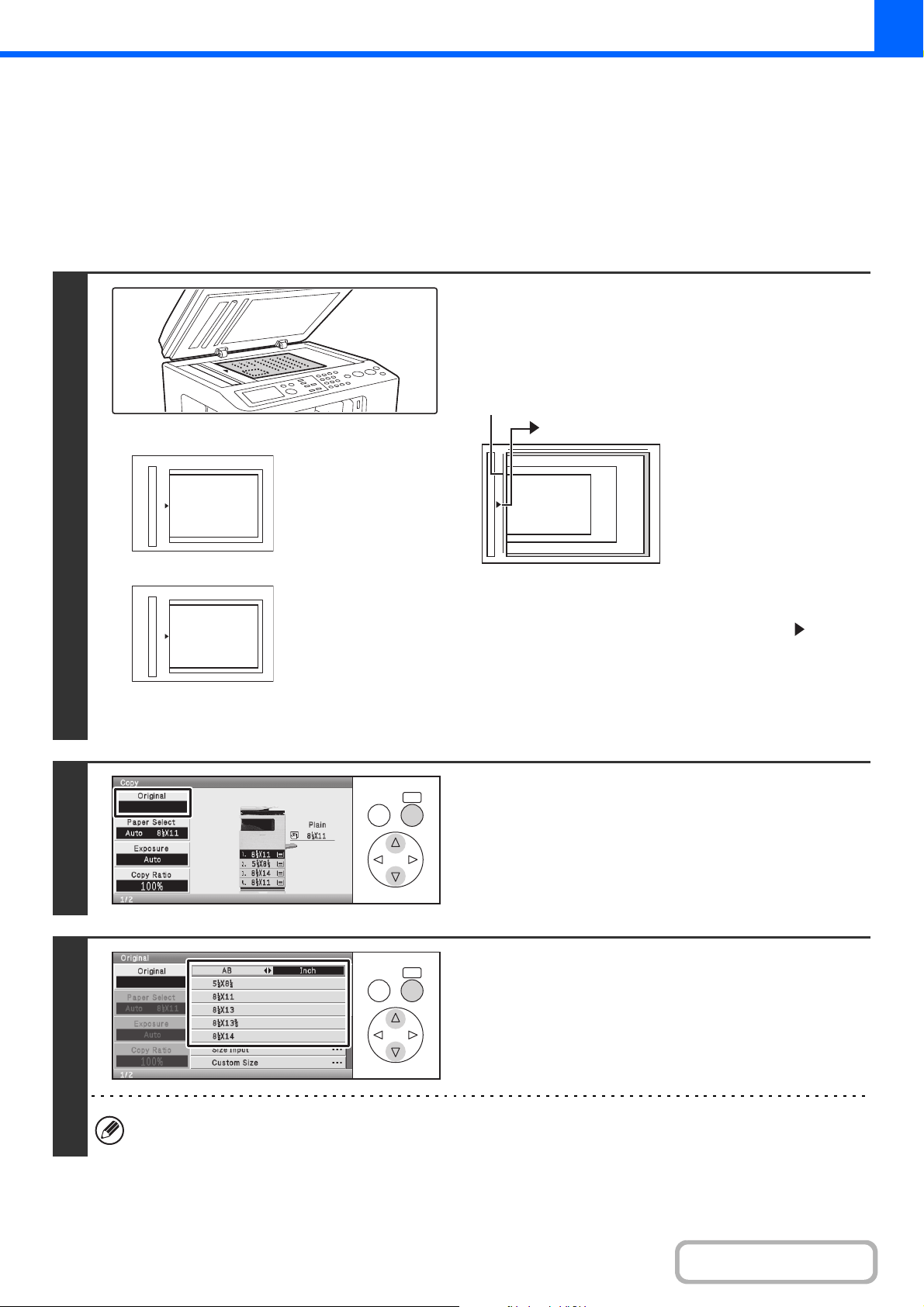
2-12
COPIER
Contents
USING THE DOCUMENT GLASS TO MAKE COPIES
(1-sided copy of a 1-sided original)
To make a copy of a book or other thick original that cannot be scanned with the automatic document feeder, open the
automatic document feeder and place the original on the document glass. This section explains how to make a copy
(1-sided copy of a 1-sided original) using the document glass.
Keys in the display can be selected with the arrow keys and the [OK] key.
1
Open the automatic document feeder,
place the original face down on the
document glass, and then gently close
the automatic document feeder.
• The maximum original size that can be placed on the
document glass is 8-1/2" x 11" (A4).
• Align the middle of the original with the tip of the mark.
• Place the original in the appropriate position for its size as
shown above.
• After placing the original, be sure to close the automatic
document feeder. If left open, parts outside of the original will
be copied black, causing excessive use of toner.
2
Select the [Original] key.
3
Specify the original size.
When placing an AB size or non-standard size original, specify the original size as explained in "ORIGINAL SIZES"
(page 2-28).
A
A
Portrait original
Landscape original
Align the top edge of the
original against the side of
the document glass with
the scale.
Align the right side of the
original against the side of
the document glass with
the scale.
5-1/2" x 8-1/2"
(A5)
8-1/2" x 11" (A4)
B5
mark
Document glass scale
OKBACK
OKBACK

2-13
COPIER
Contents
4
Check the paper to be used and the
color mode.
Make sure that the desired paper (tray) and color mode are
selected.
• To change the paper (tray), select the [Paper Select] key and
press the [OK] key.
☞ PAPER TRAYS (page 2-9)
• To change the color mode, select the [Color Mode] key and
press the [OK] key.
☞ COLOR COPY MODES (page 2-21)
For some original size settings, the same size of paper as the original may not be automatically selected. In this case,
manually change the paper size.
5
Set the number of copies (number of
sets) with the numeric keys.
• Up to 999 copies (sets) can be set.
• A single copy can be made even if "0" appears for the number of copies.
If an incorrect number of copies is set...
Press the [CLEAR] key ( ) and then enter the correct number.
6
Press the [COLOR START] key or the [BLACK & WHITE START] key.
Normally copying will start.
Depending on the copy settings, copying may not begin until multiple originals have been scanned. In this case, go to the
next step.
Even if a color mode is selected, copying will take place in black and white if the [BLACK & WHITE START] key is
pressed.
7
Remove the original and place the next original, and then press the [COLOR
START] key or the [BLACK & WHITE START] key.
Repeat this step until all originals have been scanned.
For the second original and following originals, use the same [START] key as you did for the first original.
OKBACK
7
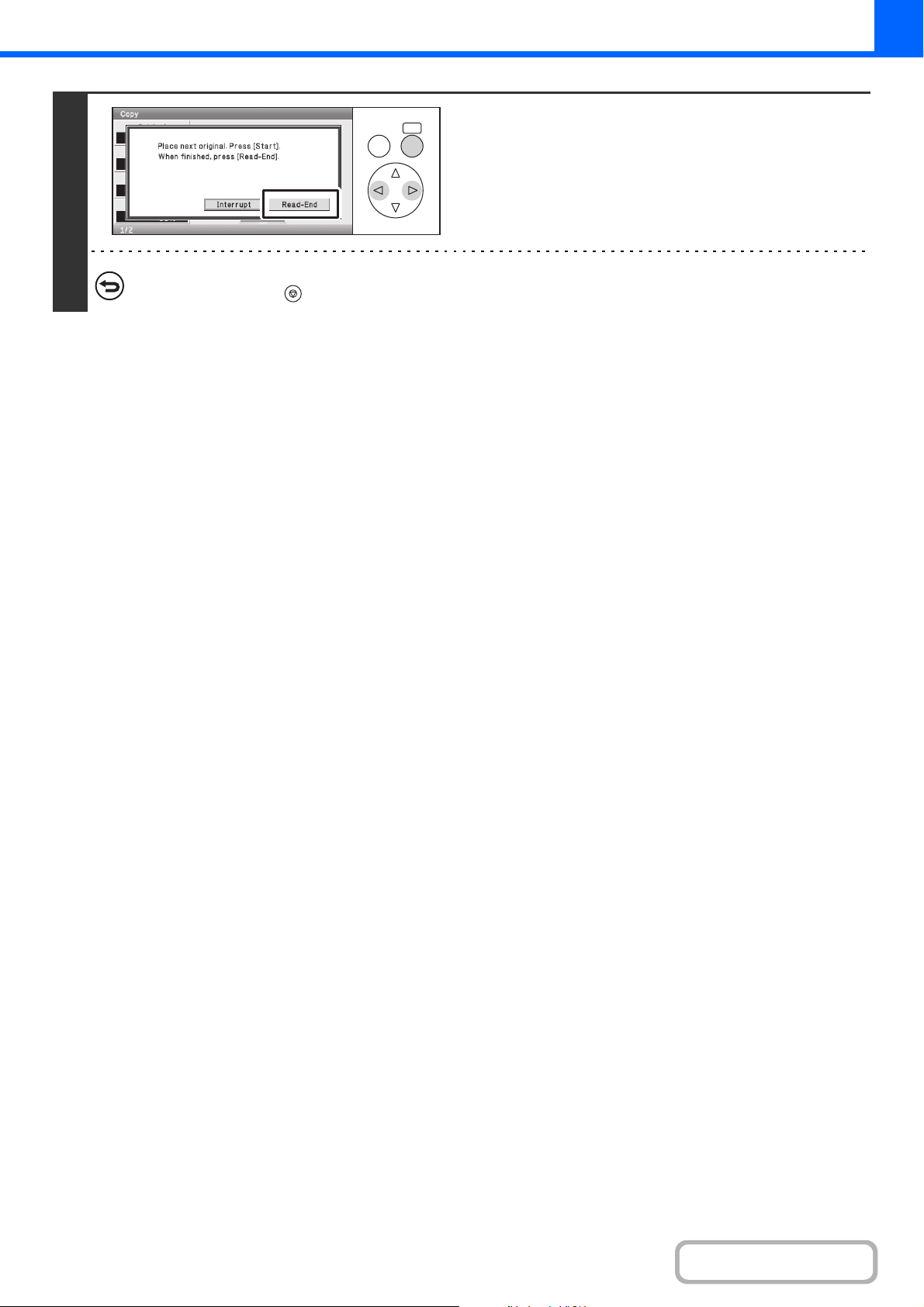
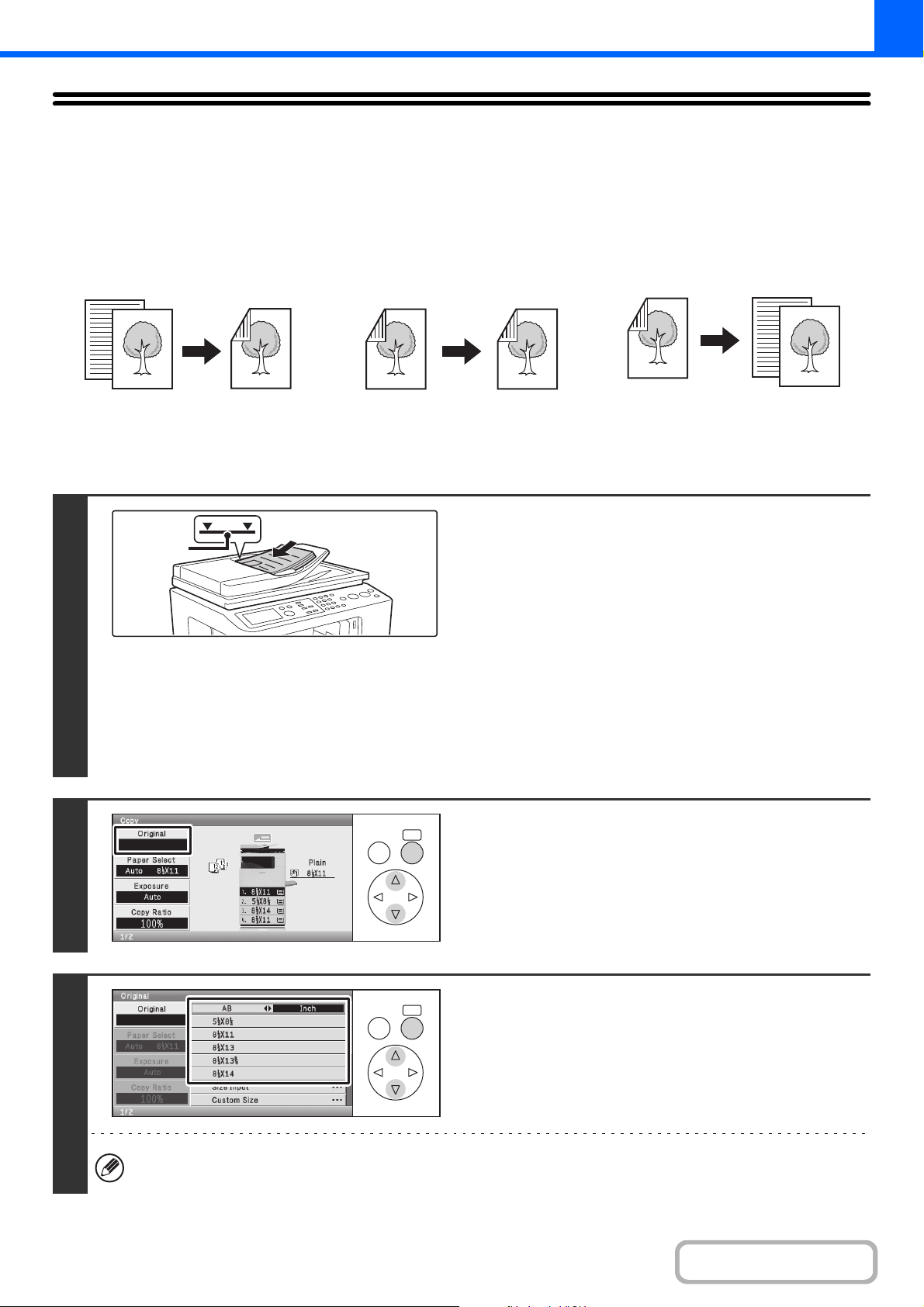
2-15
COPIER
Contents
AUTOMATIC 2-SIDED COPYING
USING THE AUTOMATIC DOCUMENT FEEDER TO
MAKE 2-SIDED COPIES
Keys in the display can be selected with the arrow keys and the [OK] key.
Automatic 2-sided copying of 1-sided
originals
Automatic 2-sided copying of 2-sided
originals
1-sided copying of 2-sided originals
1
Place the originals face up in the
document feeder tray with the edges
aligned evenly.
Insert the originals all the way into the document feeder tray.
Multiple originals can be placed in the document feeder tray.
Place portrait originals so that the top edge enters the feeder
first. Place landscape originals so that the left edge enters first.
The stack of originals must not be higher than the indicator line
on the tray.
Up to 50 sheets can be inserted.
The stack of originals must not exceed the indicator line. Do not
press down on the originals or otherwise load more originals than
can fit under the indicator line. This will cause original misfeeds.
2
Select the [Original] key.
3
Specify the original size.
When placing an AB size or non-standard size original, specify the original size as explained in "ORIGINAL SIZES"
(page 2-28).
Originals
Copies
Originals
Copies
Originals
Copies
Indicator
line
OKBACK
OKBACK
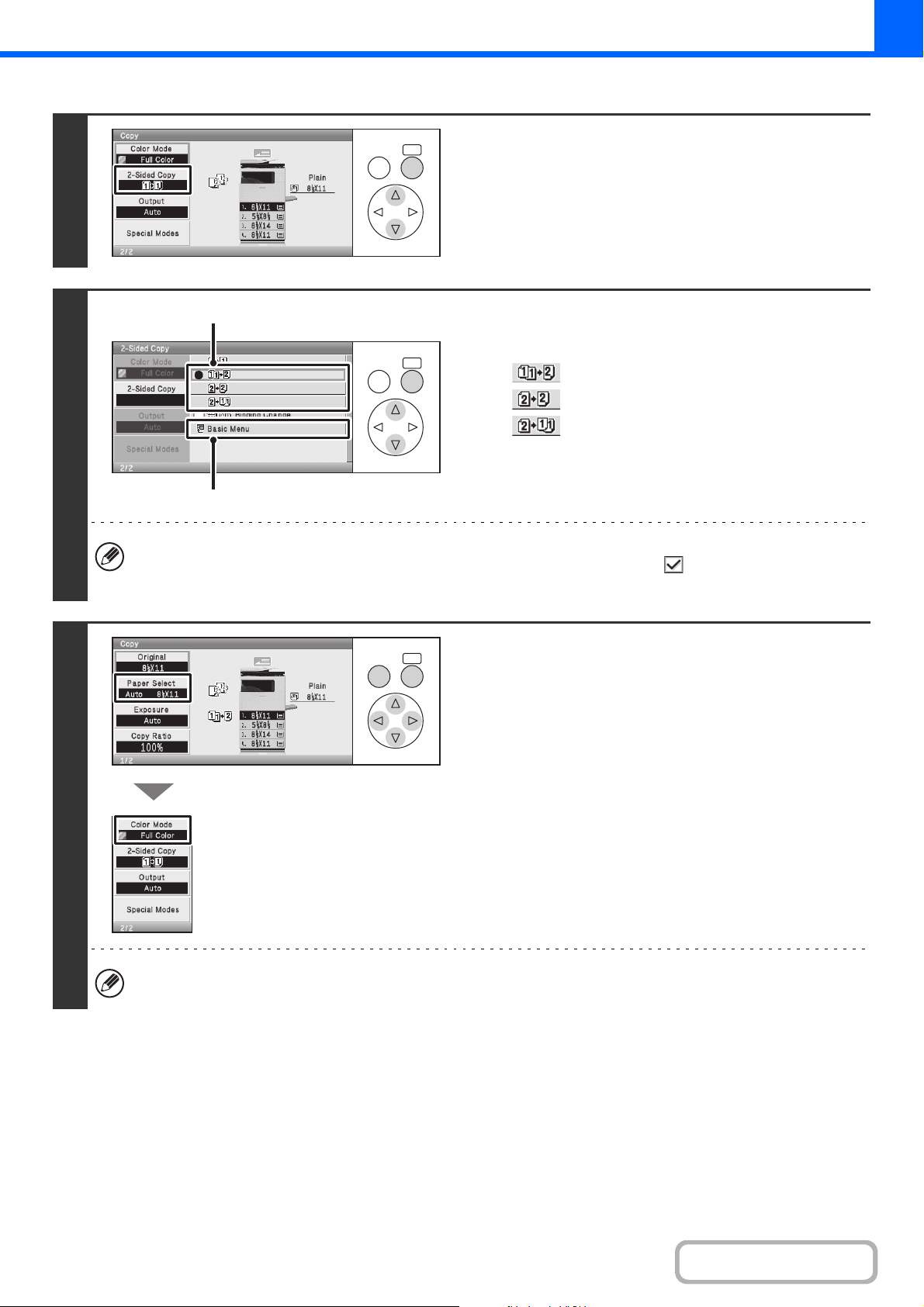
2-16
COPIER
Contents
4
Select the [2-Sided Copy] key.
5
Select the 2-sided copy mode.
(1) Select the key of the desired mode.
:Automatic 2-sided copying of 1-sided originals
:Automatic 2-sided copying of 2-sided originals
:1-sided copying of 2-sided originals
(2) Select the [Basic Menu] key.
To make 2-sided copies of a 1-sided portrait original placed horizontally, or to invert the reverse side with respect to
the front side when copying a 2-sided original, set the [Binding Change] checkbox to .
☞ Using the [Binding Change] checkbox (page 2-17)
6
Check the paper to be used and the
color mode.
Make sure that the desired paper (tray) and color mode are
selected.
• To change the paper (tray), select the [Paper Select] key and
press the [OK] key.
☞ PAPER TRAYS (page 2-9)
• To change the color mode, select the [Color Mode] key and
press the [OK] key.
☞ COLOR COPY MODES (page 2-21)
For some original size settings, the same size of paper as the original may not be automatically selected. In this case,
manually change the paper size.
OKBACK
OKBACK
(1)
(2)
OKBACK
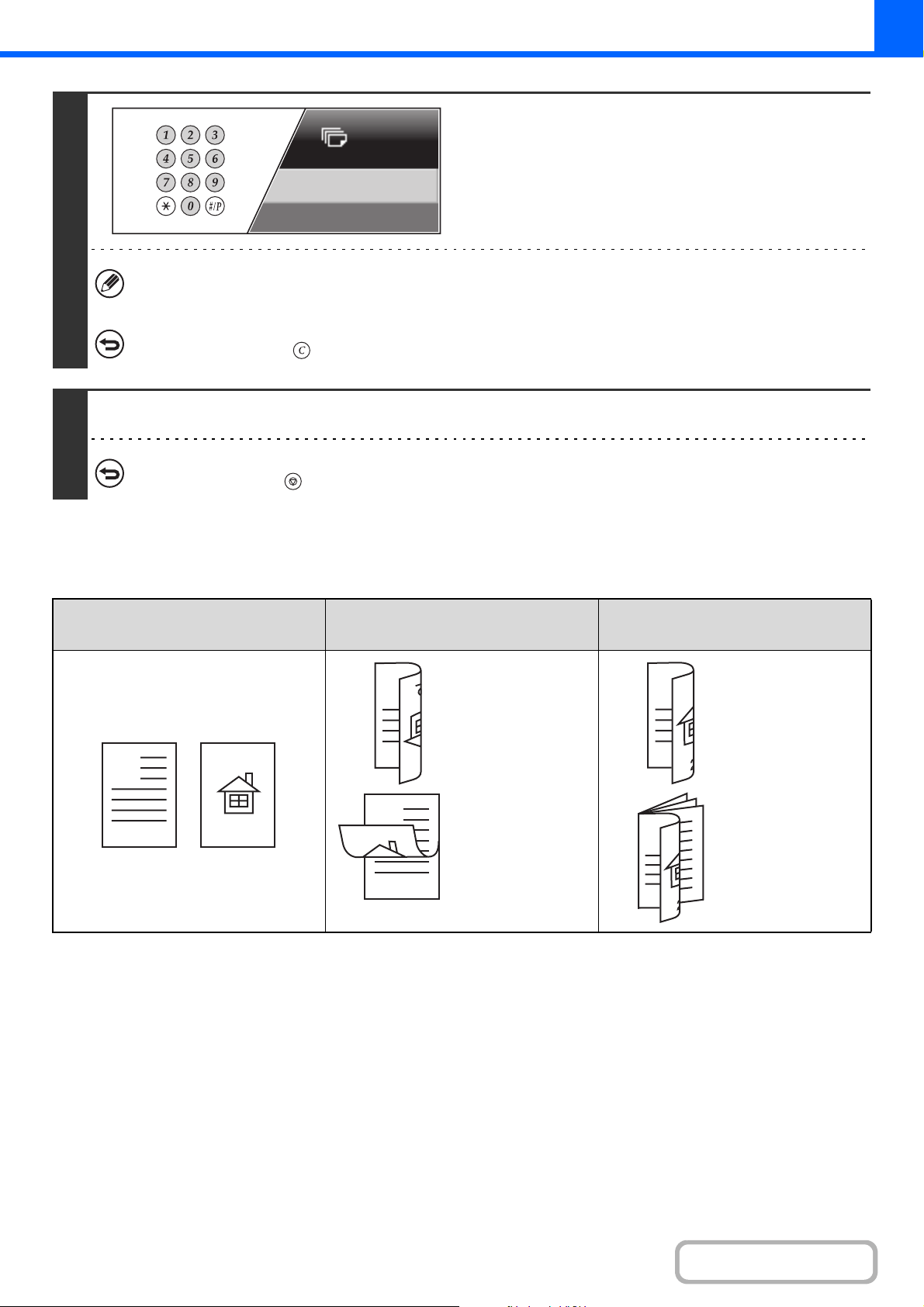
2-17
COPIER
Contents
Using the [Binding Change] checkbox
7
Set the number of copies (number of
sets) with the numeric keys.
• Up to 999 copies (sets) can be set.
• If you are only making a single copy, the copy can be made with the copy number display showing "0".
If an incorrect number of copies is set...
Press the [CLEAR] key ( ) and then enter the correct number.
8
Press the [COLOR START] key or the [BLACK & WHITE START] key.
To cancel scanning of the original and copying...
Press the [STOP] key ( ).
Originals
Binding Change is used
(For a tablet binding)
Binding Change is not used
(For a booklet binding)
The reverse side
is upside down.
The reverse side
is not upside
down.
Select this when
the pages will be
bound into a
tablet.
Select this when
the pages will be
bound into a
booklet.
7
A
12
A
A
A
3
A
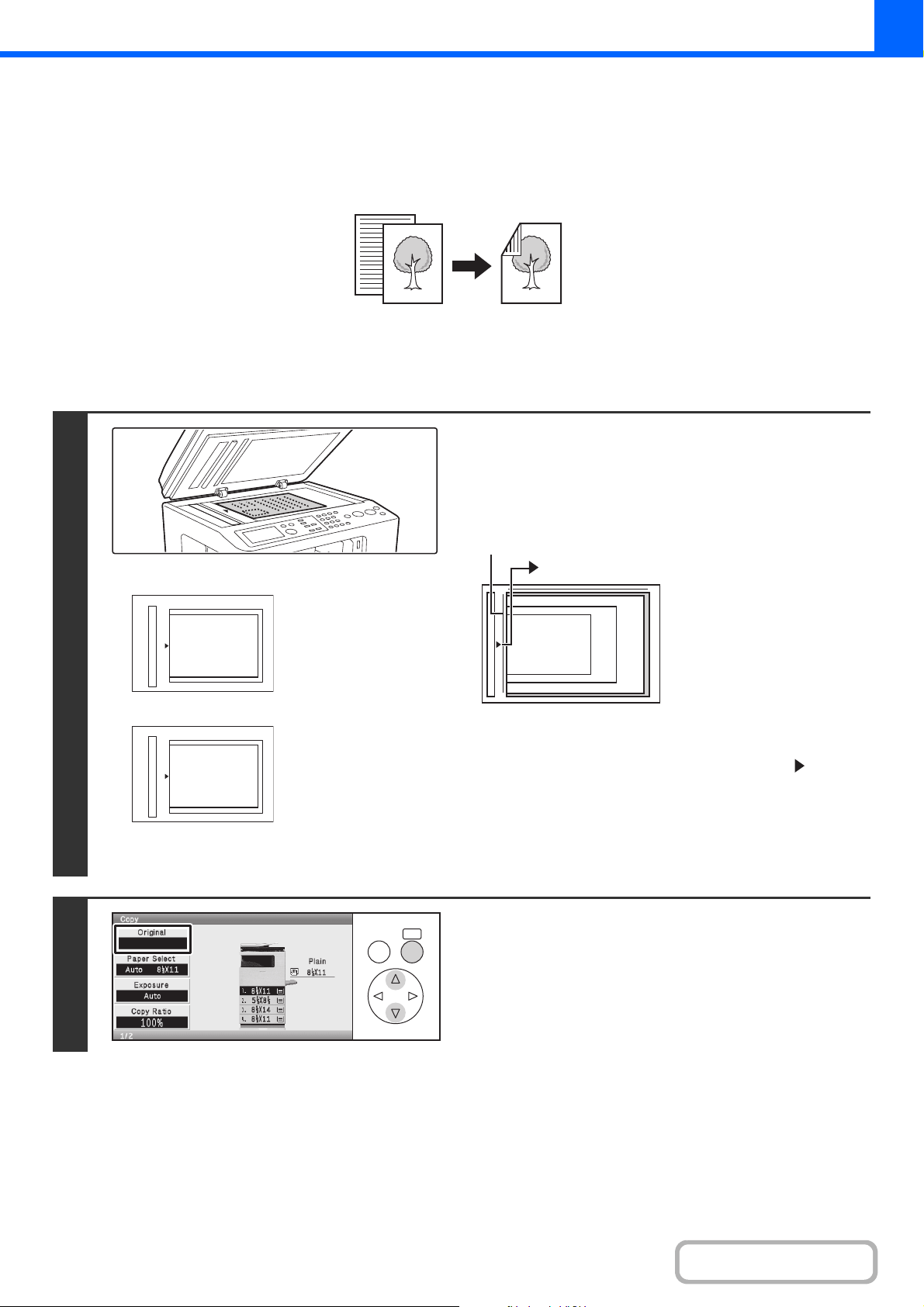
2-18
COPIER
Contents
USING THE DOCUMENT GLASS TO MAKE 2-SIDED
COPIES
Keys in the display can be selected with the arrow keys and the [OK] key.
Automatic 2-sided copying of 1-sided
originals
1
Open the automatic document feeder,
place the original face down on the
document glass, and then gently close
the automatic document feeder.
• The maximum original size that can be placed on the
document glass is 8-1/2" x 11" (A4).
• Align the middle of the original with the tip of the mark.
• Place the original in the appropriate position for its size as
shown above.
• After placing the original, be sure to close the automatic
document feeder. If left open, parts outside of the original will
be copied black, causing excessive use of toner.
2
Select the [Original] key.
Originals
Copies
A
A
Portrait original
Landscape original
Align the top edge of the
original against the side of
the document glass with
the scale.
Align the right side of the
original against the side of
the document glass with
the scale.
5-1/2" x 8-1/2"
(A5)
8-1/2" x 11" (A4)
B5
mark
Document glass scale
OKBACK
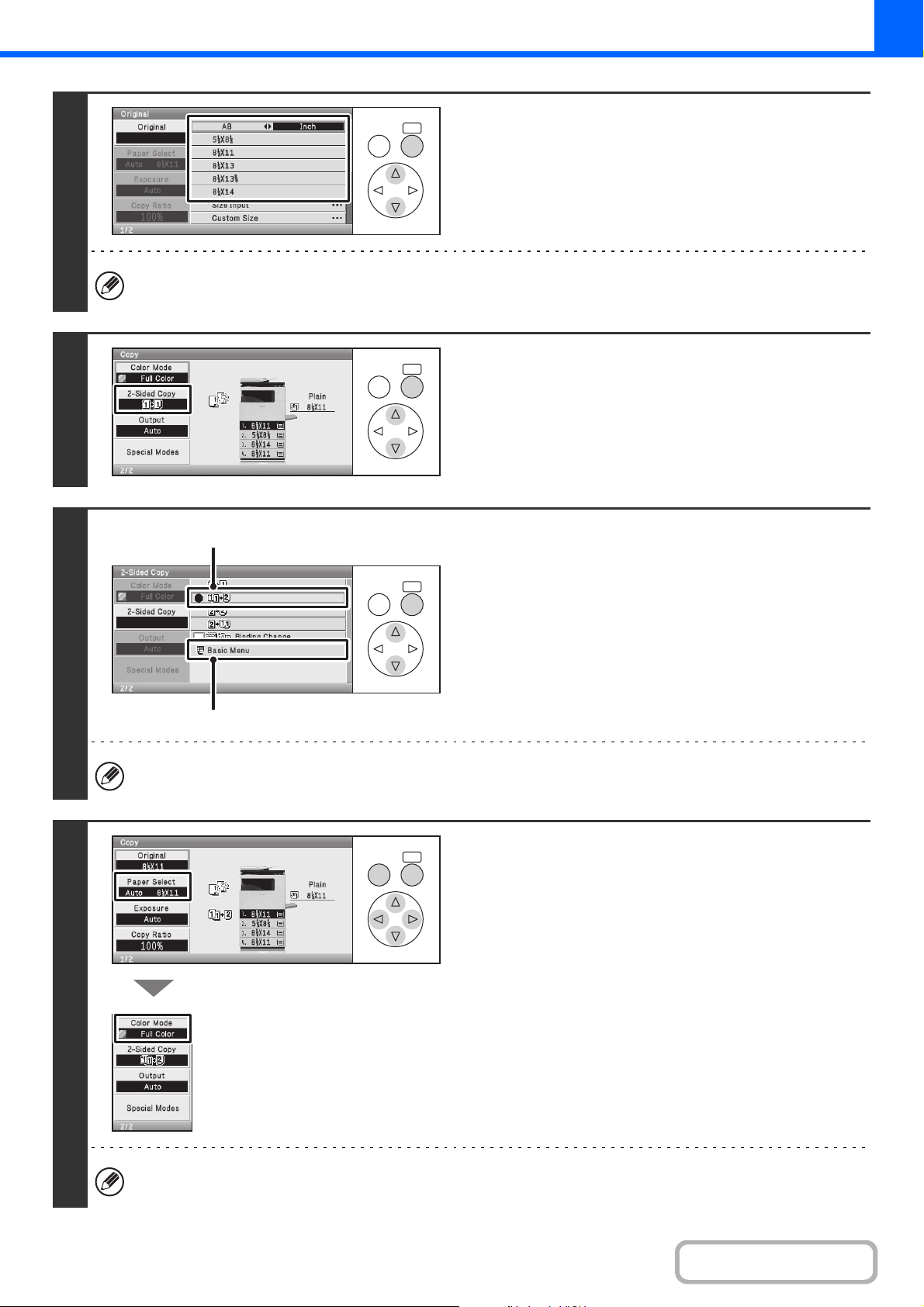
2-19
COPIER
Contents
3
Specify the original size.
When placing an AB size or non-standard size original, specify the original size as explained in "ORIGINAL SIZES"
(page 2-28).
4
Select the [2-Sided Copy] key.
5
Select the 2-sided copy mode.
(1) Select the [1-Sided to 2-Sided] key.
(2) Select the [Basic Menu] key.
The [2-Sided to 2-Sided] key and [2-Sided to 1-Sided] key cannot be used when copying from the document glass.
6
Check the paper to be used and the
color mode.
Make sure that the desired paper (tray) and color mode are
selected.
• To change the paper (tray), select the [Paper Select] key and
press the [OK] key.
☞PAPER TRAYS (page 2-9)
• To change the color mode, select the [Color Mode] key and
press the [OK] key.
☞ COLOR COPY MODES (page 2-21)
For some original size settings, the same size of paper as the original may not be automatically selected. In this case,
manually change the paper size.
OKBACK
OKBACK
OKBACK
(1)
(2)
OKBACK
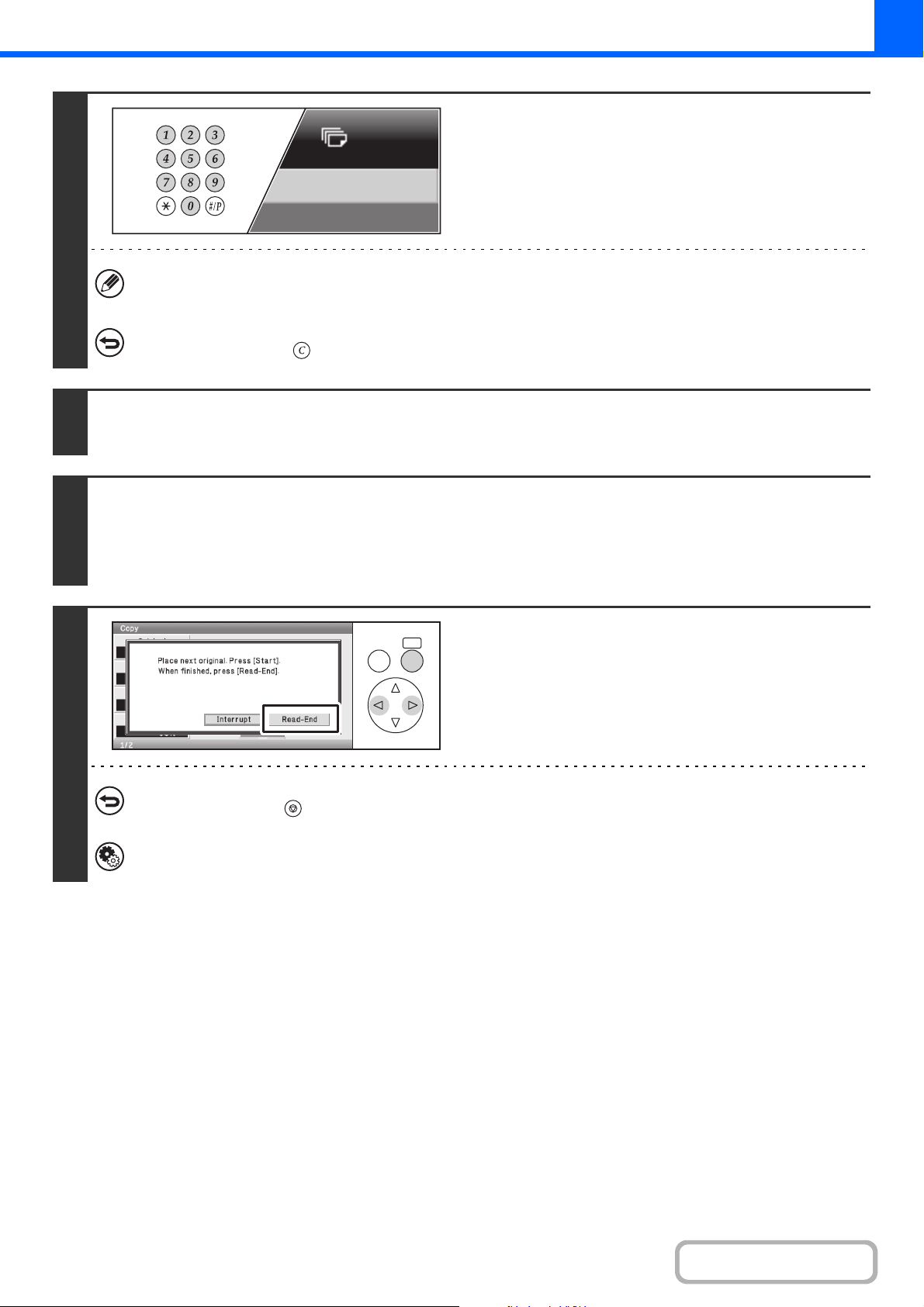
2-20
COPIER
Contents
7
Set the number of copies (number of
sets) with the numeric keys.
• Up to 999 copies (sets) can be set.
• A single copy can be made even if "0" appears for the number of copies.
If an incorrect number of copies is set...
Press the [CLEAR] key ( ) and then enter the correct number.
8
Press the [COLOR START] key or the [BLACK & WHITE START] key.
Scanning begins.
9
Remove the original and place the next original, and then press the [COLOR
START] key or the [BLACK & WHITE START] key.
Repeat this step until all originals have been scanned.
For the second original and following originals, use the same [START] key as you did for the first original.
10
Select the [Read-End] key.
To cancel scanning of the original and copying...
Press the [STOP] key ( ).
System Settings (Administrator): Initial Status Settings (2-Sided Copy)
The default 2-sided copy mode can be changed.
7
OKBACK
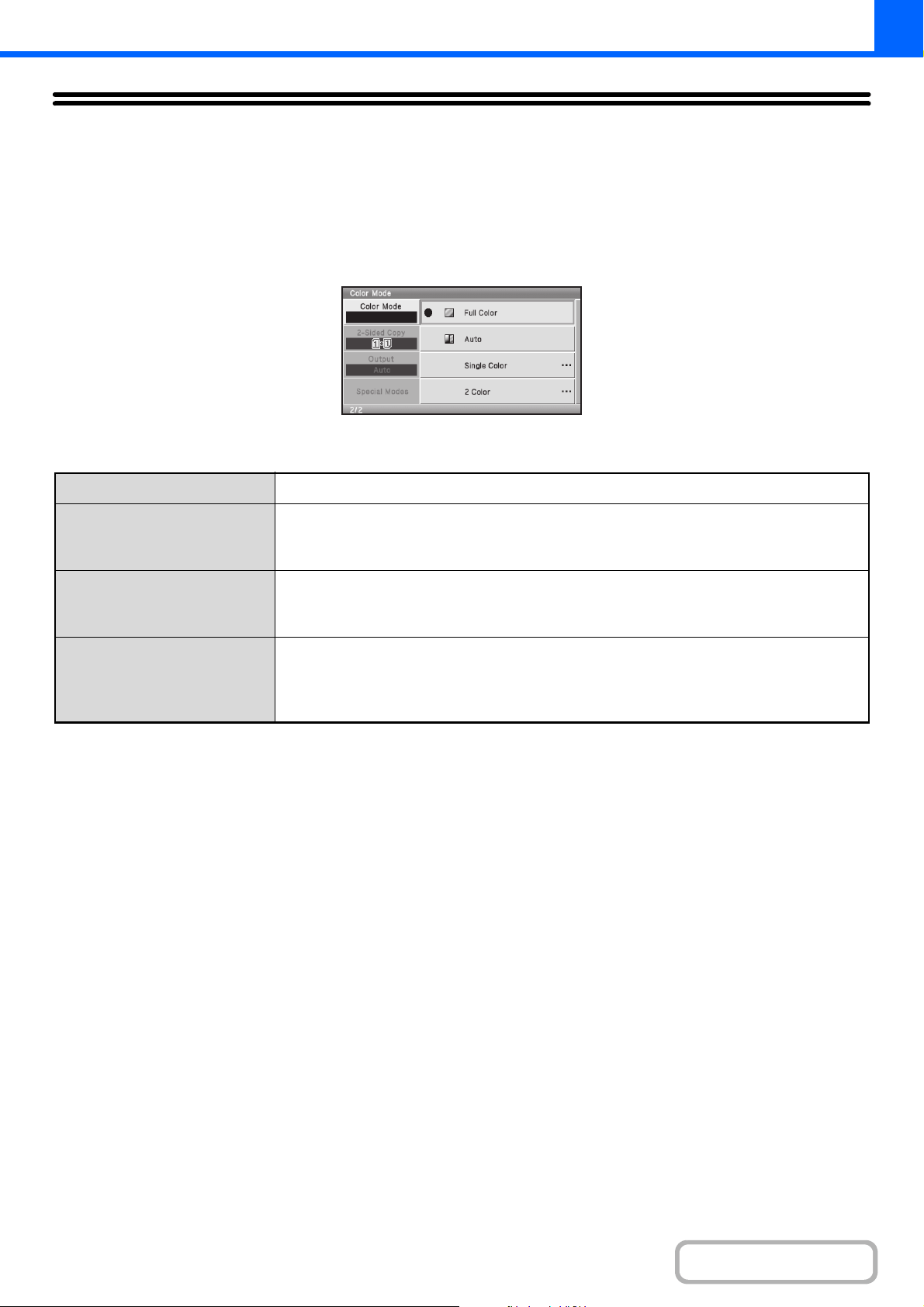
2-21
COPIER
Contents
COLOR COPY MODES
The color mode of the [COLOR START] key is normally set to [Full Color] so that copying takes place in full color mode
when the [COLOR START] key is pressed. If color originals are mixed together with black & white originals, set the color
mode to [Auto] to have the color mode change appropriately for each original.
Select the [Color Mode] key in the base screen to open the following screen.
Select the key of the desired color mode.
Full Color
The original is copied in full color.
Auto
The machine automatically detects whether each original is color or black & white and
switches the mode appropriately (full color for a color original or black & white for a black &
white original).
Single Color
The original is copied in the selected color only.
All colors in the original are changed to the selected color, which can be selected from red,
green, blue, cyan, magenta, or yellow.
2 Color
Only the red areas of the original are changed to the selected color; colors other than red are
copied in black. This lets you make copies that are more expressive than black and white
copies.
Red, green, blue, cyan, magenta, or yellow can be selected.
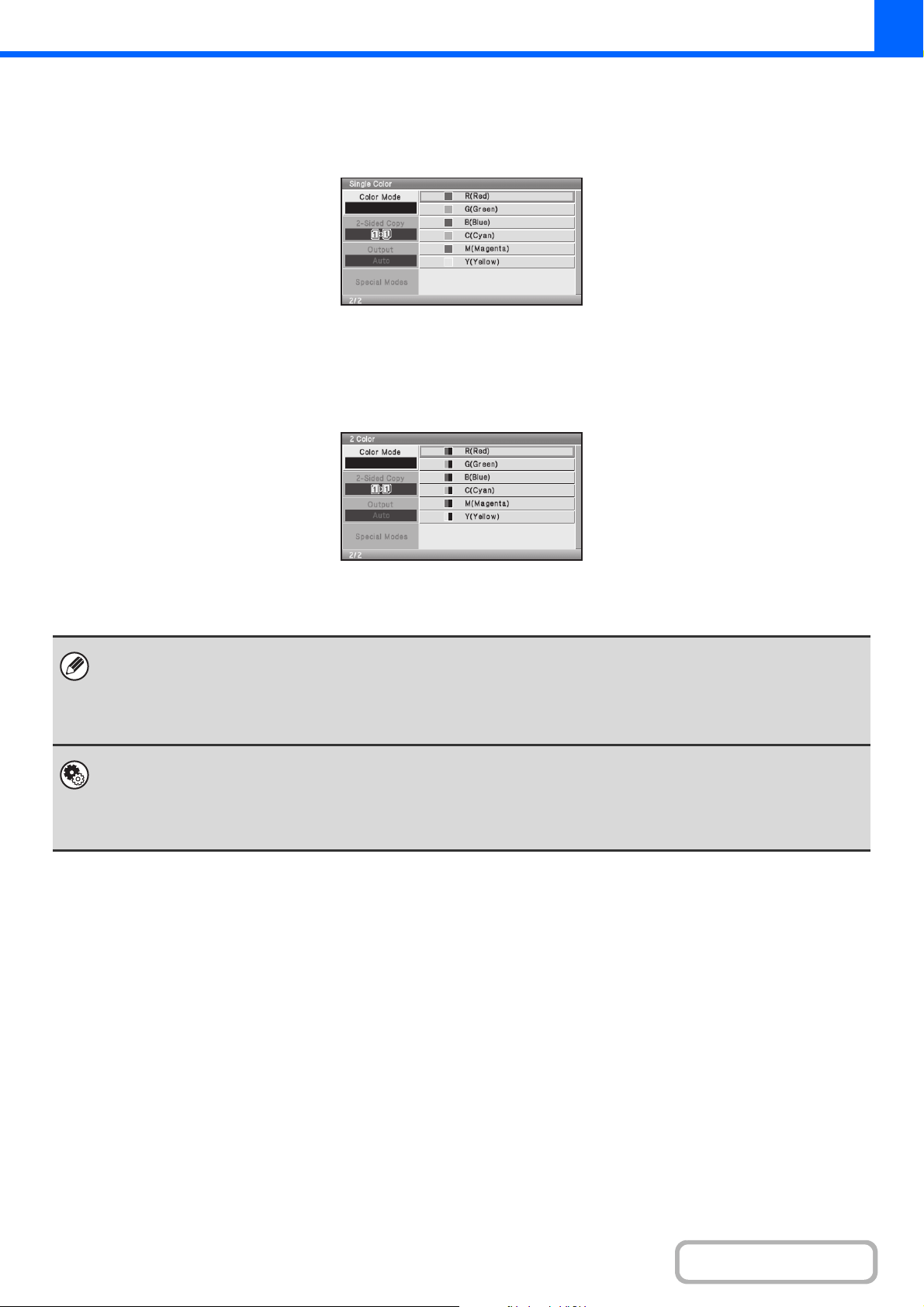
2-22
COPIER
Contents
Selecting single color copying
When [Single Color] is selected for the color mode, the following screen appears. Select the desired color.
Selecting 2 color copying
When [2 Color] is selected for the color mode, the following screen appears. Select the desired color.
• When auto mode is used, there may be some originals for which switching between color and black & white does not take
place correctly. In this event, press the [COLOR START] key or the [BLACK & WHITE START] key as appropriate to
manually switch between color and black & white.
• Copying takes place in black & white when the [BLACK & WHITE START] key is pressed, regardless of the color mode
setting.
System Settings (Administrator): Initial Status Settings (Color Mode)
This is used to change the default color mode setting.
System Settings (Administrator): Detect Standard in Auto Color Mode (Web page only)
When the color mode is set to auto, the discrimination point for detecting whether originals are color or black and white can
be set to one of 5 levels.
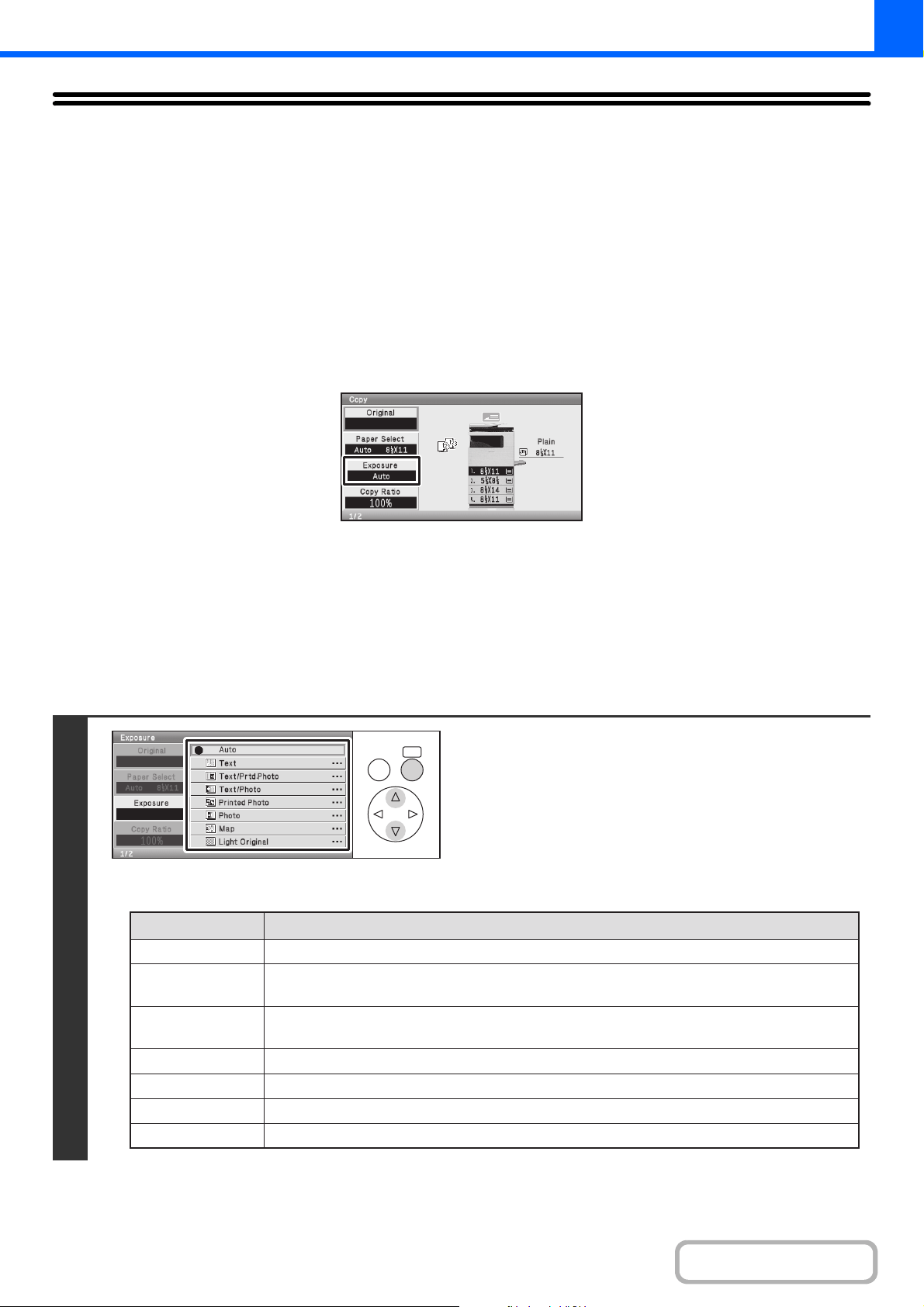
2-23
COPIER
Contents
CHANGING THE EXPOSURE AND ORIGINAL
IMAGE TYPE
The exposure and original image type can be selected to obtain a clear copy.
AUTOMATIC ADJUSTMENT OF THE EXPOSURE AND
ORIGINAL TYPE
Automatic exposure adjustment operates by default to automatically adjust the exposure level and original type as
appropriate for the original being copied. ("Auto" is displayed.)
This function automatically adjusts the image during black & white copying and full color copying to obtain the most suitable copy.
MANUAL ADJUSTMENT OF THE EXPOSURE AND
ORIGINAL TYPE
If you wish to select the original type or manually adjust the exposure, select the [Exposure] key in the base screen of
copy mode and follow the steps below.
Keys in the display can be selected with the arrow keys and the [OK] key.
1
Select the original image type.
The image will be adjusted appropriately for the original type.
Select the image type that best matches your original.
● Original image type select keys
OKBACK
Mode Description
Tex t
Text/Prtd. Photo
Printed photo
Text/Photo
Map
Photo
Light Original
Use this mode for regular text documents.
This mode provides the best balance for copying an original which contains both text and
printed photographs, such as a magazine or catalogue.
This mode is best for copying printed photographs, such as photos in a magazine or catalogue.
This mode provides the best balance for copying an original which contains both text and
photographs, such as a text document with a photo pasted on.
This mode is best for copying the light color shading and fine text found on most maps.
Use this mode for originals with light pencil writing.
Use this mode to copy photos.
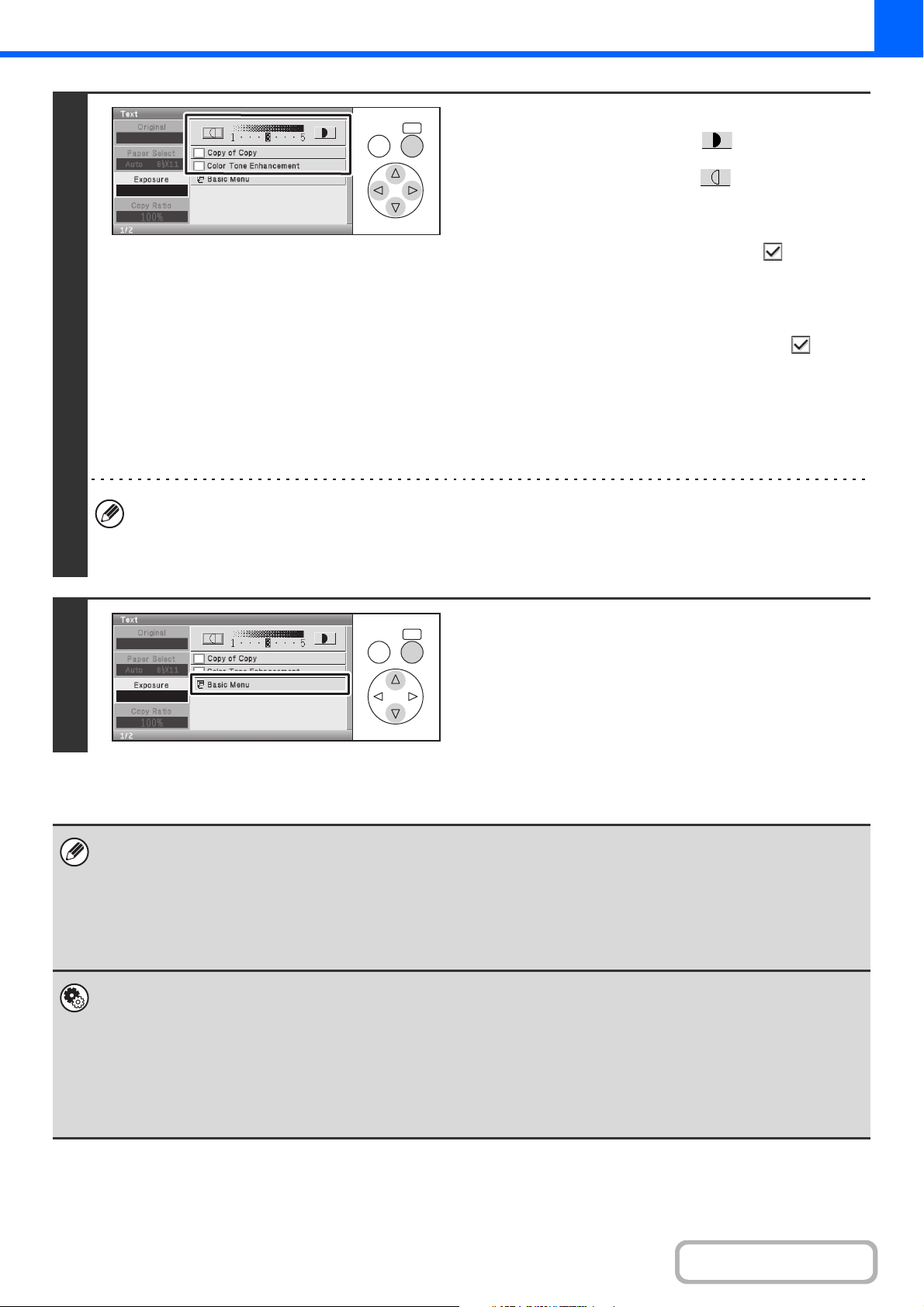
2-24
COPIER
Contents
2
Adjust the exposure level.
To make the copy darker, select the key and press the
[OK] key.
To make the copy lighter, select the key and press the
[OK] key.
• Using a copy or printed page as an original
When using a copy or printed page from the machine as an
original, set the [Copy of Copy] checkbox to .
When [Copy of Copy] is selected, only the [Text],
[Text/Printed Photo], and [Printed Photo] original image type
keys can be selected.
• To enhance the color of a color copy...
Set the [Color Tone Enhancement] checkbox to .
When "Color Tone Enhancement" is selected, the following
functions cannot be used:
- [Copy of Copy]
- [Auto] and [Light Original] cannot be selected for the
original image type.
- [Intensity] (in the special modes)
Guidelines for the exposure level when [Text] is selected:
1 to 2: Dark originals such as a newspaper
3: Normal density originals
4 to 5: Originals written in pencil or light colored text
3
Select the [Basic Menu] key.
• If [Auto] is selected but the darkness or lightness of the image does not seem quite right...
If the image seems too light or too dark when [Auto] is selected, the exposure level can be adjusted using "Copy Exposure
Adjustment" in the system settings (administrator).
• To change the resolution...
When making a full-size copy, you can select the [Scan Resolution] key to select the scanning resolution. The numbers
that allow selection of the document glass are different from the numbers that allow selection of the automatic document
feeder.
• System Settings (Administrator): Initial Status Settings (Exposure Type)
This is used to change the default original image type.
• System Settings (Administrator): Copy Exposure Adjustment
The exposure level used for automatic exposure adjustment can be adjusted.
• System Settings (Administrator): Color 600dpi x 600dpi Scanning Mode for Document Feeder / Color Quick Scan
from Document Glass / B/W 600dpi x 600dpi Scanning Mode for Document Feeder / B/W Quick Scan from
Document Glass
The default resolution setting can be changed.
OKBACK
OKBACK
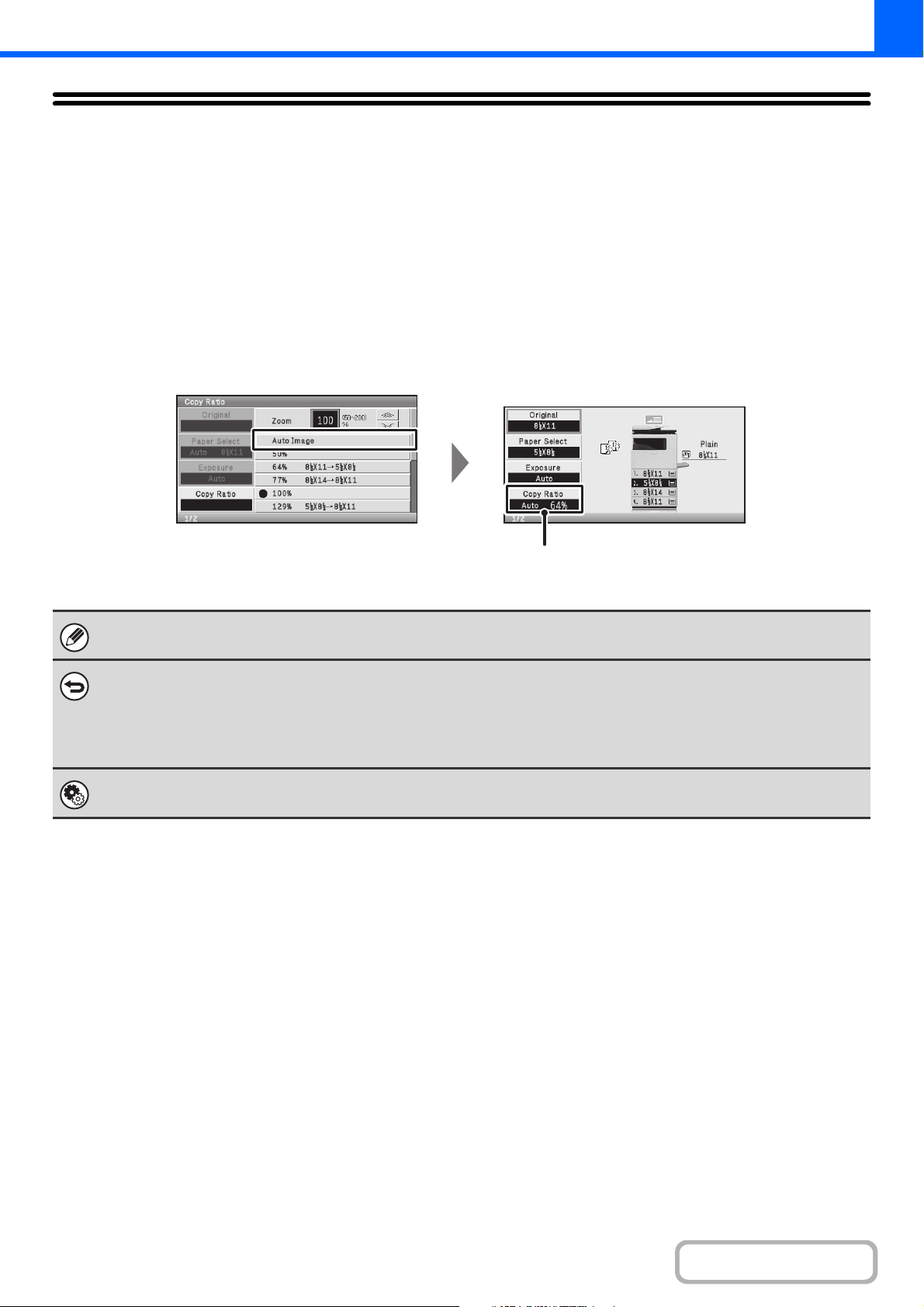
2-25
COPIER
Contents
REDUCTION/ENLARGEMENT/ZOOM
AUTOMATIC RATIO SELECTION (Auto Image)
This section explains the automatic ratio selection function (Auto Image), which automatically selects the ratio to match
the paper size.
To have the appropriate enlargement/reduction ratio for the original size and selected paper size automatically selected,
select the [Copy Ratio] key in the base screen of copy mode, and then select the [Auto Image] key.
Select the [Auto Image] key after you have selected the original size and the desired paper size. Press the [BACK] key
to return to the base screen.
For a non-standard size original, the size must be entered in order to use Auto Image.
• To cancel automatic ratio selection...
To cancel automatic ratio selection, select the [Copy Ratio] key to display the ratio menu and then select the [Auto Image]
key.
• To return the ratio to 100%...
To return the ratio setting to 100%, select the [Copy Ratio] key to display the ratio menu and then select the [100%] key.
System Settings (Administrator): Initial Status Settings (Copy Ratio)
This is used to change the default copy ratio.
The selected ratio will appear in the ratio display.
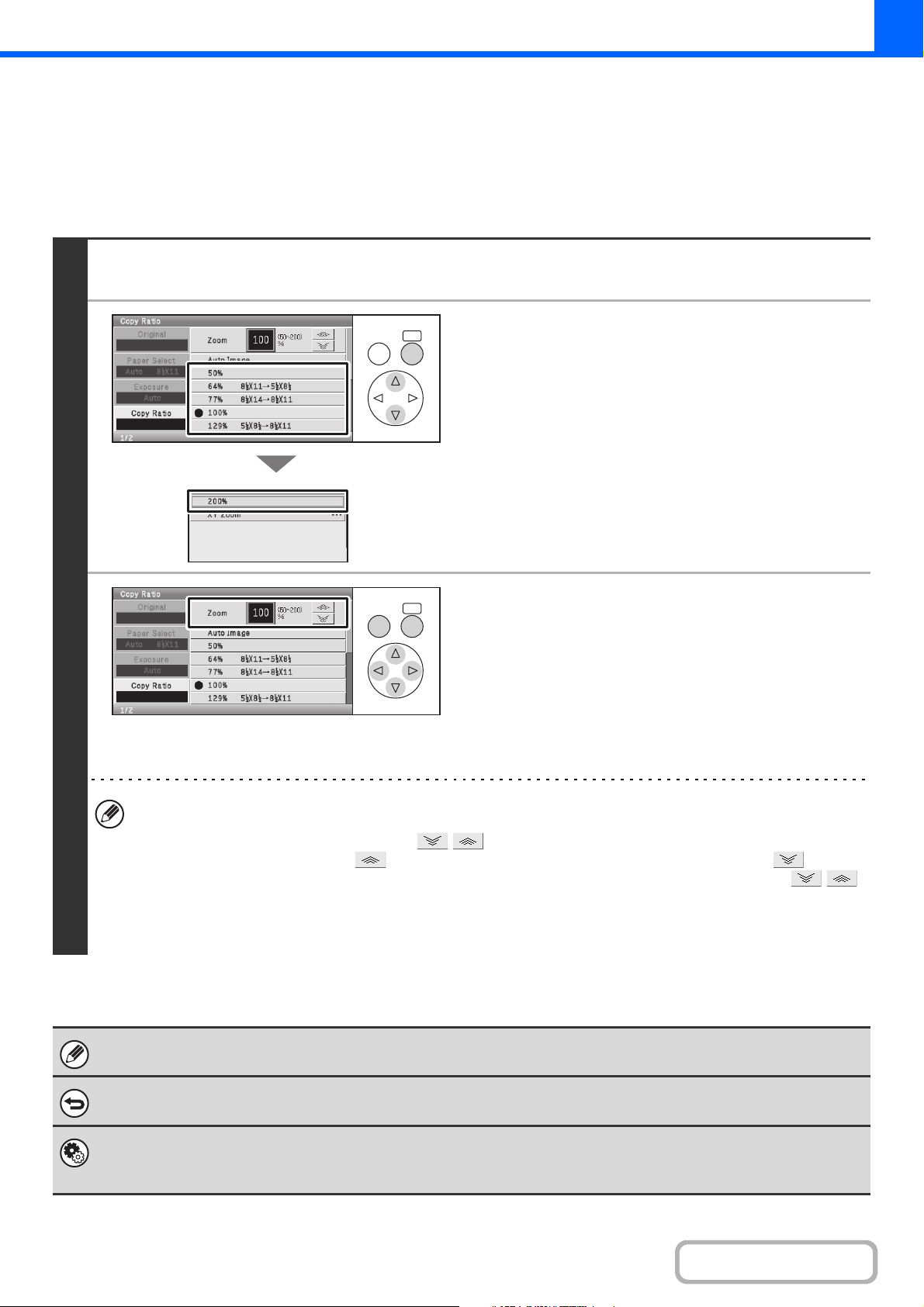
2-26
COPIER
Contents
MANUAL RATIO SELECTION (Preset ratios/Zoom)
Select the [Copy Ratio] key in the base screen of copy mode to select one of two preset enlargement ratios or three
preset reduction ratios (maximum 200%, minimum 50%).
In addition, the zoom keys can be used to select any ratio from 50% to 200% in increments of 1%.
Keys in the display can be selected with the arrow keys and the [OK] key.
Set the ratio.
Select a preset ratio key and/or the zoom keys to set the ratio.
● Setting a preset ratio
• Enlargement keys (2 ratios):
129% and 200%.
• Reduction keys (3 ratios):
50%, 64% and 77%.
• [100%] key
Select the desired preset ratio.
You will return to the base screen.
Make sure that a paper size suitable for the ratio is selected.
● Setting any ratio
Select the zoom key number display and press the [OK] key. A
number entry screen will appear.
Enter the desired number with the numeric keys and select the
[OK] key in the number entry screen. A ratio from 50% to 200%
can be selected in increments of 1%.
Press the [BACK] key.
You will return to the base screen.
Make sure that a paper size suitable for the ratio is selected.
• Preset ratios (two enlargement ratios and two reduction ratios) can be set in "Add or Change Extra Preset Ratios" in
the system settings (administrator).
• You can also change the number with the keys.
To increase the ratio, select the key and press the [OK] key. To decrease the ratio, select the key and
press the [OK] key. (To make the ratio change continuously, hold down the [OK] key after selecting the
key. If you continue to hold down the [OK] key for more than 3 seconds, the ratio will start changing quickly.)
• If the message "Image is larger than the copy paper." appears when an enlargement ratio is selected, the image
may not fit on the paper.
When the automatic document feeder is used, the vertical and horizontal ratio selection ranges are both 50% to 200%.
To return the ratio to 100%...
To return the ratio setting to 100%, select the [Copy Ratio] key to display the ratio menu and then select the [100%] key.
System Settings (Administrator): Add or Change Extra Preset Ratios
Two enlargement preset ratios (101% to 200%) and two reduction preset ratios (50% to 99%) can be added. An added
preset ratio can also be changed.
OKBACK
OKBACK

2-27
COPIER
Contents
ENLARGING/REDUCING THE LENGTH AND WIDTH
SEPARATELY (XY Zoom)
The XY Zoom feature allows the horizontal and vertical copy ratios to be changed separately.
Both the horizontal and vertical ratios can be set from 50% to 200% in increments of 1%.
Select the [Copy Ratio] key in the base screen of copy mode and then follow the steps below.
When 50% is selected for the horizontal ratio and 70% is selected for the vertical ratio
Keys in the display can be selected with the arrow keys and the [OK] key.
1
Select the [XY Zoom] key.
2
Set the horizontal and vertical ratios.
(1)
Set the X (horizontal) ratio.
Select the number display of the X (horizontal) ratio and
press the [OK] key. A number entry screen will appear.
Enter the desired number with the numeric keys and
select the [OK] key in the number entry screen.
A ratio from 50% to 200% can be selected in increments of 1%.
(2)
Set the Y (vertical) ratio.
Set the Y (vertical) ratio in the same way as the X
(horizontal) ratio.
(3) Select the [Basic Menu] key.
You will return to the base screen.
Make sure that a paper size suitable for the ratio is selected.
You can also change the number with the keys. Select the key of the direction you wish to
change and press the [OK] key.
To increase the ratio, select the key and press the [OK] key. To decrease the ratio, select the key and
press the [OK] key. (To make the ratio change continuously, hold down the [OK] key after selecting the
key. If you continue to hold down the [OK] key for more than 3 seconds, the ratio will start changing quickly.)
When the automatic document feeder is used, the vertical and horizontal ratio selection ranges are both 50% to 200%.
To return the ratio to 100%...
To return the ratio setting to 100%, select the [Copy Ratio] key to display the ratio menu and then select the [100%] key.
Original
Copy
OK
BACK
OKBACK
(1), (2)
(3)
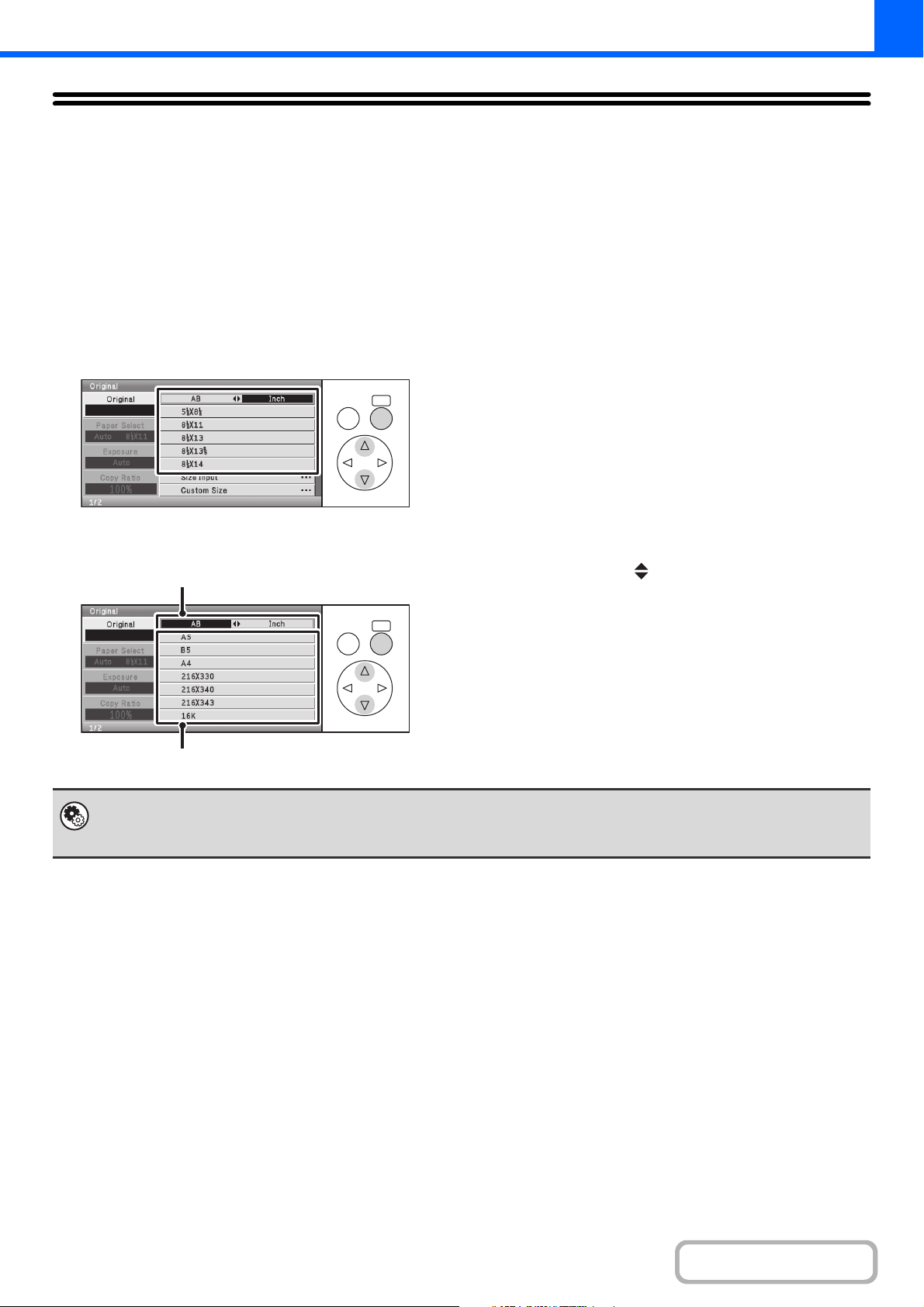
2-28
COPIER
Contents
ORIGINAL SIZES
SPECIFYING THE ORIGINAL SIZE
The original size is set in "Default original size setting" in the system settings (administrator), and the setting appears in
the [Original] key. This section explains the procedure for specifying the setting when the original size is different from
size shown in the [Original] key.
Select the [Original] key and perform the following.
Specifying an inch original size
Select the appropriate original size key.
Specifying an AB original size
(1) Select the [AB Inch] key.
(2) Select the appropriate original size key.
OKBACK
OKBACK
(1)
(2)
System Settings (Administrator): Default original size setting (Web page only)
Set this if you frequently use a particular original size. The set size will appear in the [Original] key.
When this setting is configured, changing the original size can be omitted.
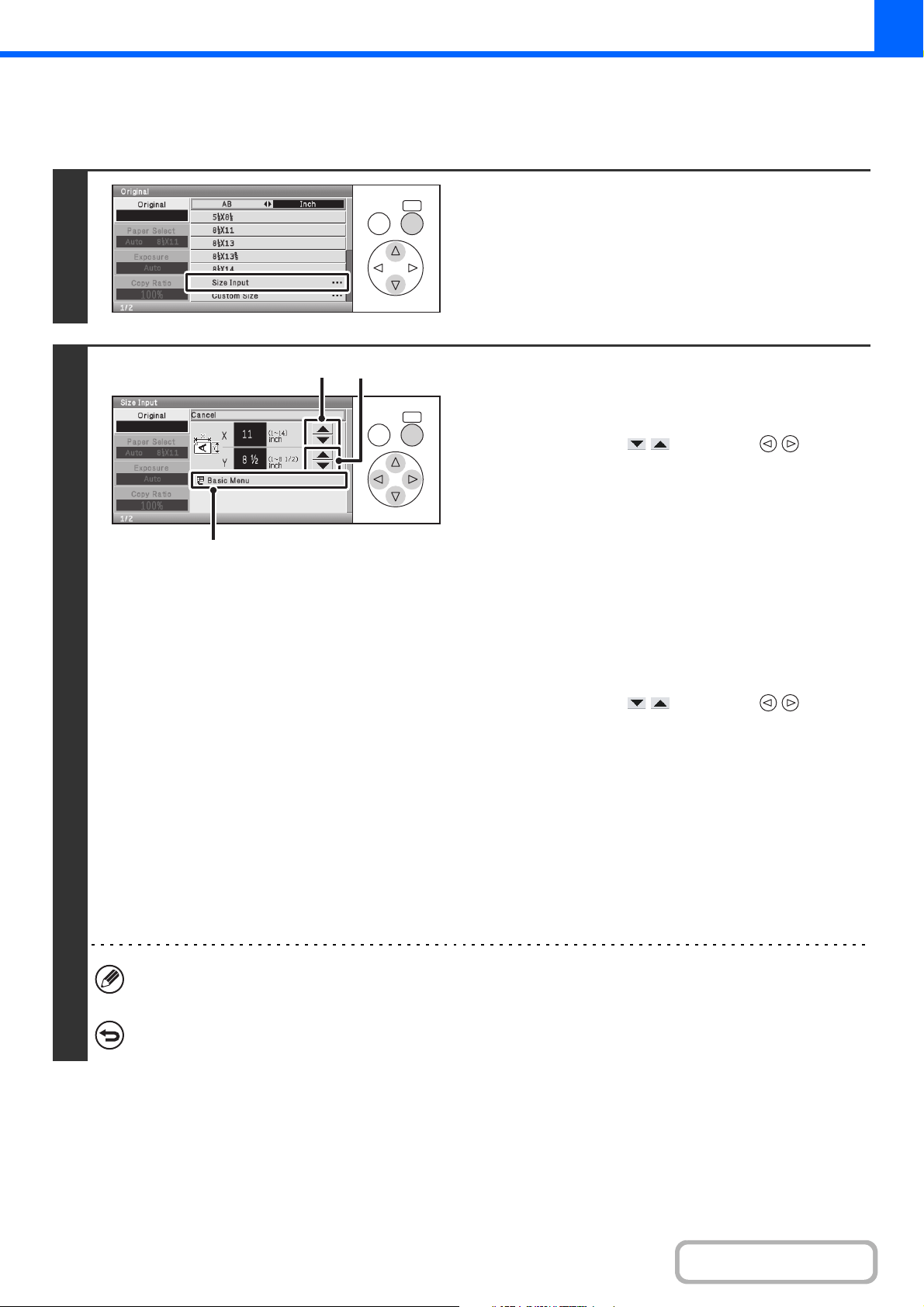
2-29
COPIER
Contents
Specifying a non-standard original size
Keys in the display can be selected with the arrow keys and the [OK] key.
1
Select the [Size Input] key.
2
Enter the original size.
(1) Enter the X (horizontal) dimension of the
original.
Select either of the keys with the keys and
press the [OK] key repeatedly to change the number.
• When the document glass is used, enter a number from
1" to 11-5/8" (25 mm to 297 mm).
• When the automatic document feeder is used, enter a
number from 3-1/2" to 14" (89 mm to 356 mm).
• When a number which is from 5-3/8" (139 mm) and less
is entered in 2-Sided copy mode, an original cannot be
scanned.
• If the horizontal dimension of the original is less than
3-1/2" (89 mm), use the document glass.
(2) Enter the Y (vertical) dimension of the
original.
Select either of the keys with the keys and
press the [OK] key repeatedly to change the number.
• When the document glass is used, enter a number from
1" to 8-1/2" (25 mm to 216 mm).
• When the automatic document feeder is used, enter a
number from 4" to 8-1/2" (100 mm to 216 mm).
• If the vertical dimension of the original is less than 4"
(100 mm), use the document glass.
(3) Select the [Basic Menu] key.
You will return to the base screen.
Make sure that the entered dimensions appear in the
[Original] key.
When a number from 11-3/4" to 14" (298 mm to 356 mm) to the X (horizontal) dimension and a number from 1" to
3-7/8" (25 mm to 99 mm) to the Y (vertical) dimension are entered at the same time, an original cannot be scanned.
To cancel the size input...
To cancel the size input, select the [Cancel] key.
OKBACK
OKBACK
(3)
(1) (2)
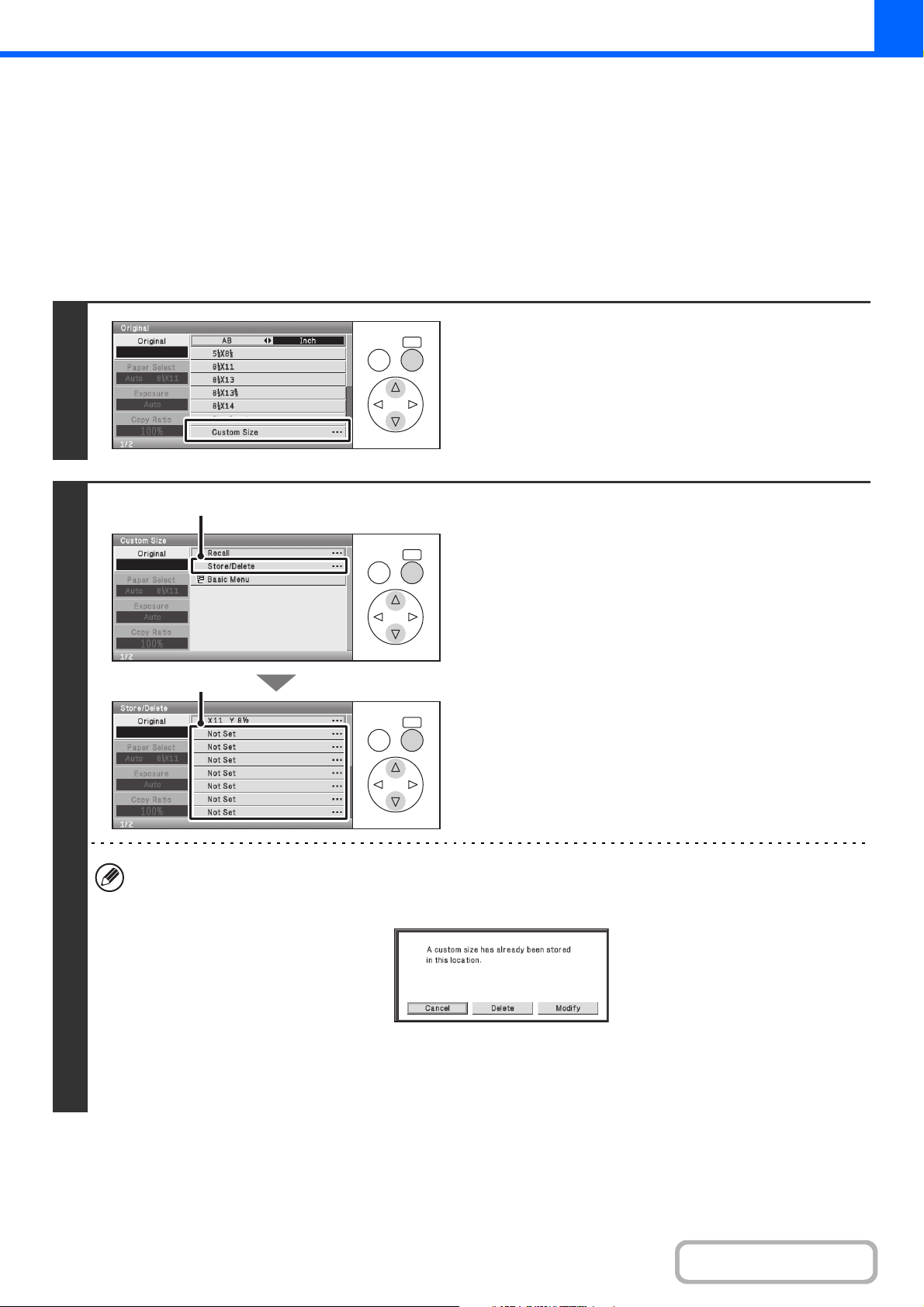
2-30
COPIER
Contents
STORING FREQUENTLY USED ORIGINAL SIZES
You can save special original sizes that you frequently use. This section explains how to store, retrieve, change, and
delete special original sizes.
Storing original sizes (editing/clearing)
Up to 12 special original sizes can be stored.
Select the [Original] key in the base screen of copy mode and then follow the steps below.
Keys in the display can be selected with the arrow keys and the [OK] key.
1
Select the [Custom Size] key.
2
Store the original size.
(1) Select the [Store/Delete] key.
(2) Select the [Not Set] key.
If you wish to edit or clear a previously stored key...
Select the key that you want to edit or clear. The following screen will appear.
• To edit the key, select the [Modify] key and go to the next step.
• To clear the key, select the [Delete] key. Make sure that the original size has been cleared and press the [BACK]
key.
OKBACK
OKBACK
OKBACK
(1)
(2)
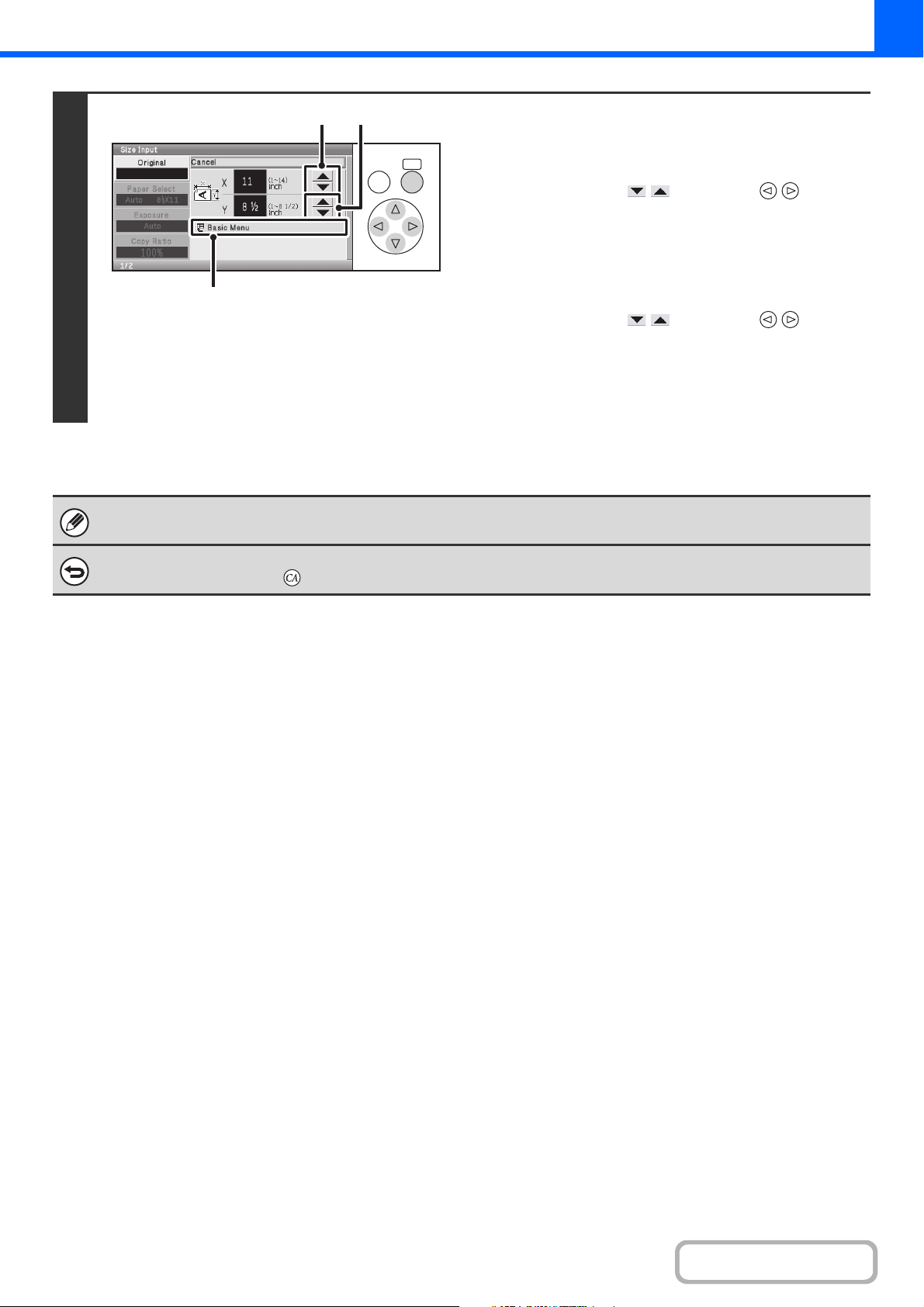
2-31
COPIER
Contents
3
Enter the original size.
(1) Enter the X (horizontal) dimension of the
original.
Select either of the keys with the keys and
press the [OK] key repeatedly to change the number.
A dimension from 1" to 14" (25 mm to 356 mm) can be
entered.
(2) Enter the Y (vertical) dimension of the
original.
Select either of the keys with the keys and
press the [OK] key repeatedly to change the number.
A dimension from 1" to 8-1/2" (25 mm to 216 mm) can be
entered.
(3) Select the [Basic Menu] key.
The stored original size will be retained even if the main power is turned off.
To cancel the operation...
Press the [CLEAR ALL] key ( ).
OKBACK
(3)
(1) (2)
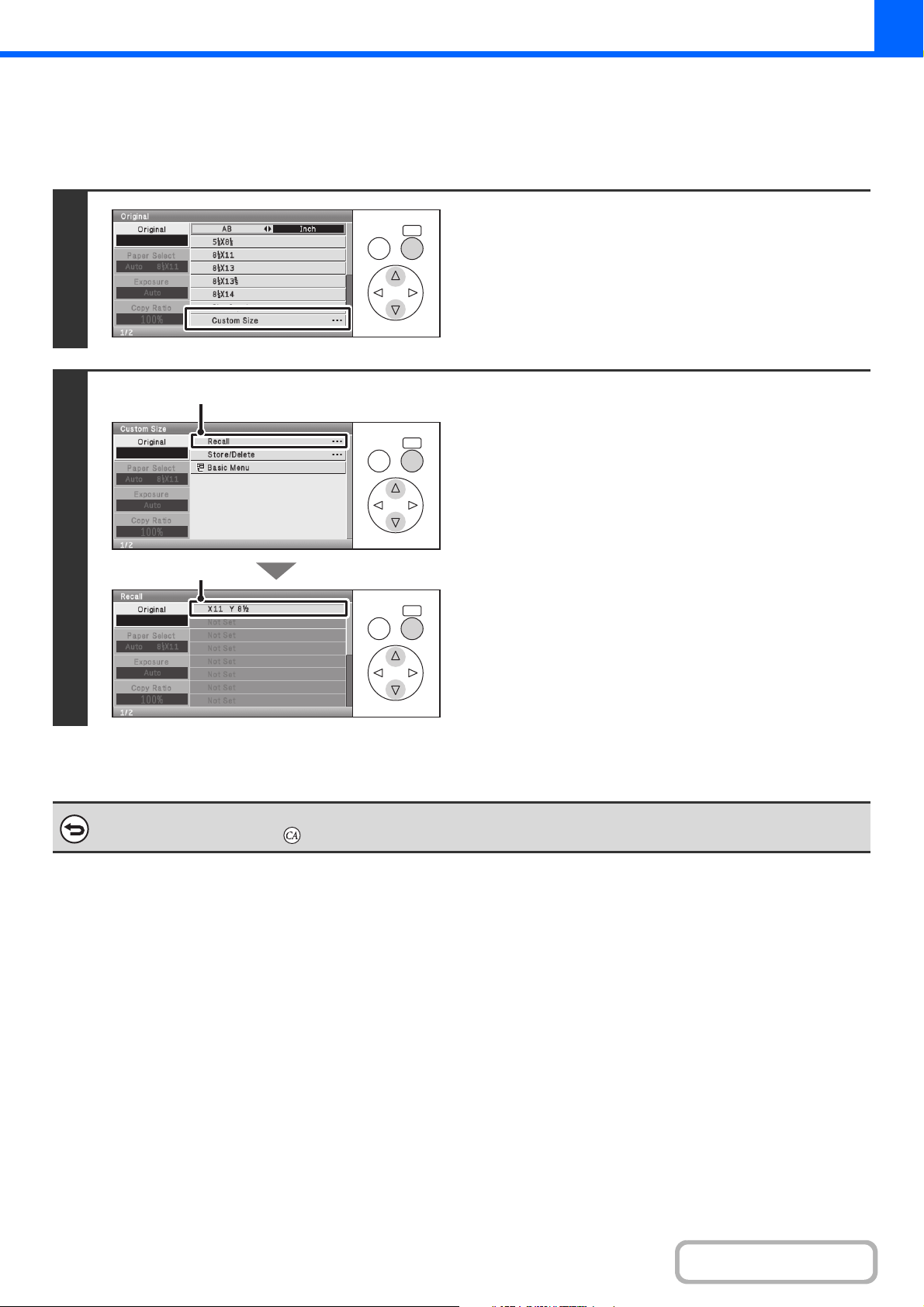
2-32
COPIER
Contents
Retrieving a stored original size
To retrieve a stored original size, select the [Original] key in the base screen of copy mode and perform the steps below.
Keys in the display can be selected with the arrow keys and the [OK] key.
1
Select the [Custom Size] key.
2
Retrieve the desired stored original size.
(1) Select the [Recall] key.
(2) Select the key of the original size that you
wish to retrieve.
To cancel the operation...
Press the [CLEAR ALL] key ( ).
OKBACK
OKBACK
OKBACK
(1)
(2)
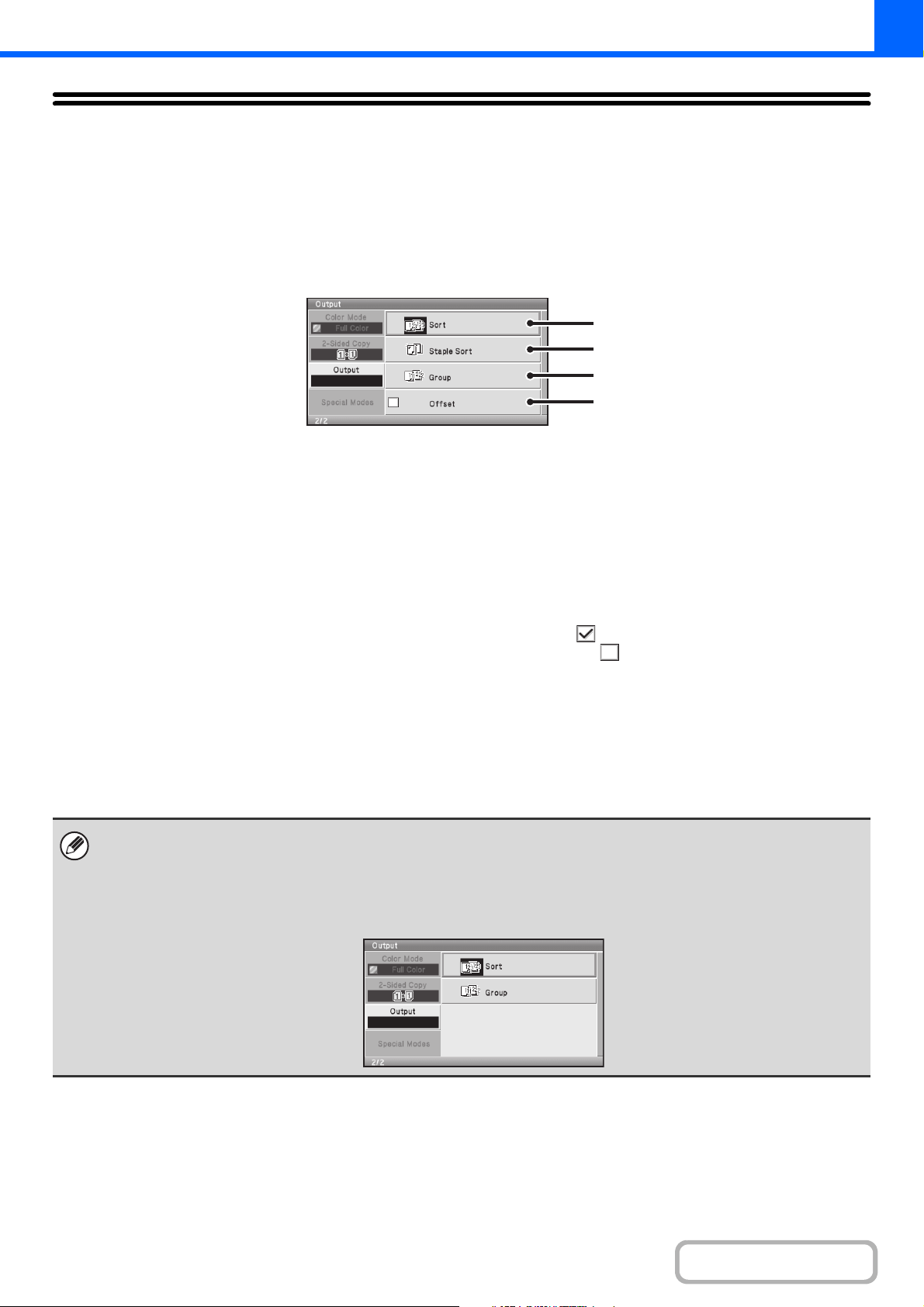
2-33
COPIER
Contents
OUTPUT
To select output functions and the output tray, select the [Output] key in the base screen of copy mode. Output functions
that can be selected are sort, group, offset, and staple sort. All explanations of the settings below assume that a finisher
is installed. When an output function is selected, an icon that shows the output status will appear in the output display
(page
2-4) of the base screen.
(1) [Sort] key
This is used to sort (collate) output into sets.
☞ Sort mode (page 2-34)
(2) [Staple Sort] key
This is used to sort output into sets, staple each set, and
deliver the sets to the tray. (Note that the sets will not be
offset in the output tray.)
☞ Staple sort function (page 2-35)
(3) [Group] key
This is used to group copies by page.
☞ Group mode (page 2-34)
(4) [Offset] checkbox
This is used to offset each set of output from the previous
set.
The offset function operates when the checkbox is
selected and does not operate when the checkbox is
not selected . (The offset checkmark is automatically
cleared when the staple sort function is selected.)
☞ Offset function (page 2-34)
(1)
(2)
(3)
(4)
The above screen shows the keys that appear when a finisher is installed.
In addition, it may not be possible to select some keys depending what peripheral devices are installed. If different from the
above screen, refer to the screen below.
Example
The screen when a finisher is not installed.
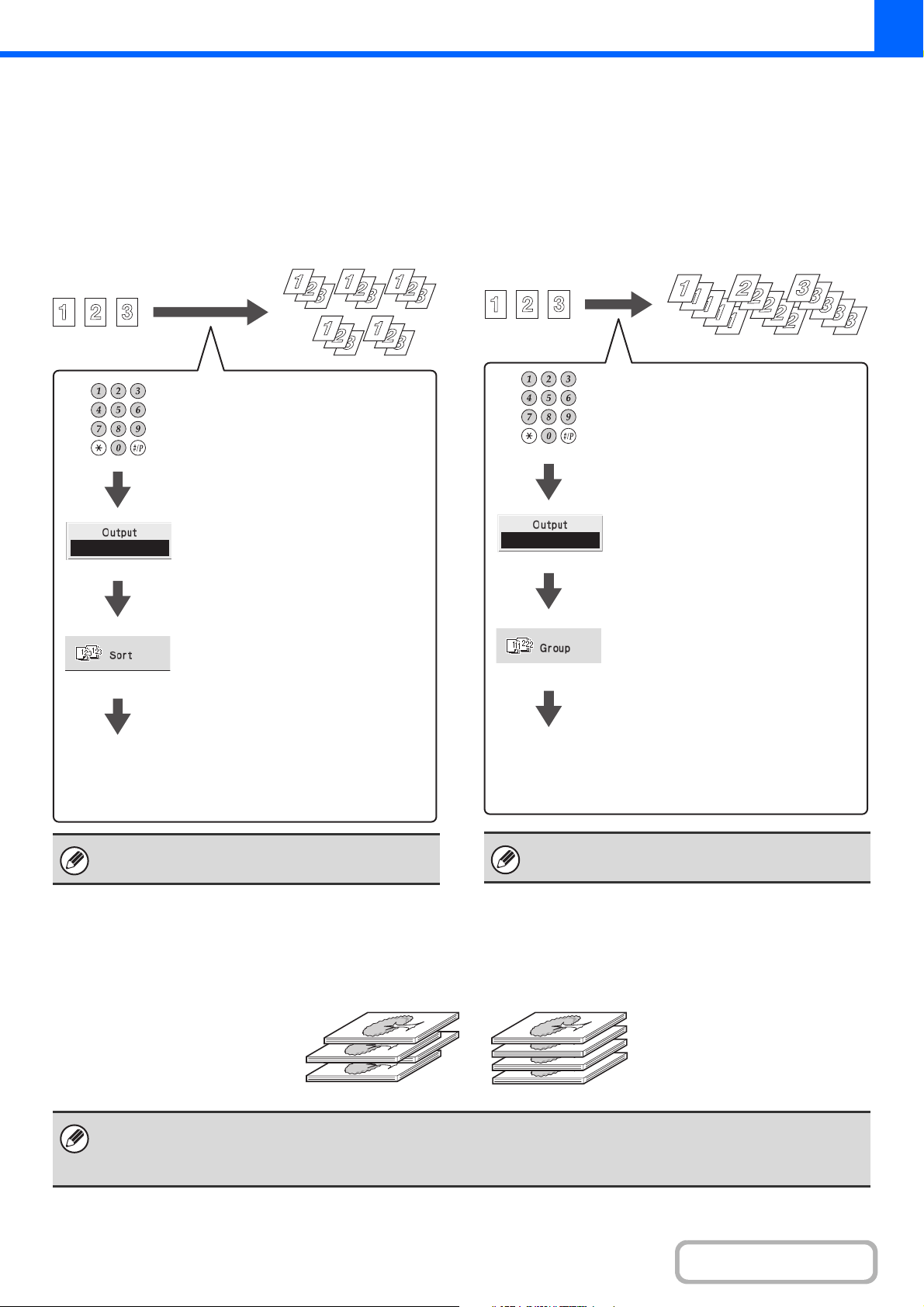
2-34
COPIER
Contents
OUTPUT MODES
This section explains the output modes.
Sort mode
This is used to sort (collate) output into sets.
Example: Sorting the output into 5 sets
Group mode
This function groups copies by page.
Example: Groups of 5 copies of each page
Offset function
This function offsets each set of copies from the previous set in the output tray, making it easy to separate sets of copies.
The sort function is automatically selected when
originals are placed in the automatic document feeder.
Originals Output
Set the number of copies (5).
Select the [Output] key.
Select the [Sort] key.
Press the [COLOR START] key or the [BLACK &
WHITE START] key.
The group function is automatically selected when an
original is placed on the document glass.
Originals Output
Set the number of copies (5).
Select the [Output] key.
Select the [Group] key.
Press the [COLOR START] key or the [BLACK &
WHITE START] key.
In the following cases, the offset function cannot be selected:
• When 5-1/2" x 8-1/2" (A5) size paper is selected.
• When the staple sort function is selected.
Offset function "ON" Offset function "OFF"
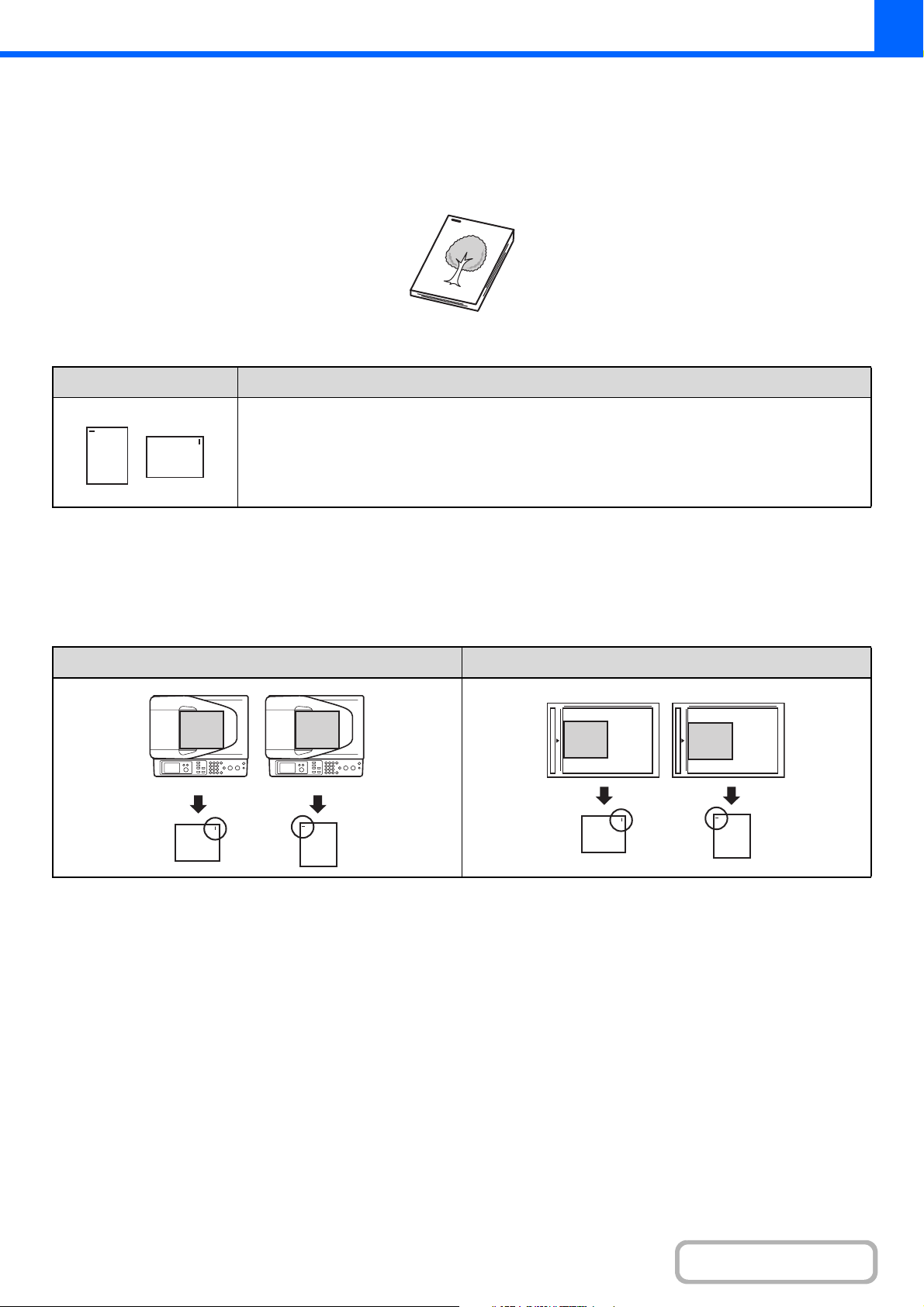
2-35
COPIER
Contents
Staple sort function
The staple sort function sorts output into sets, staples each set, and delivers the sets to the tray.
The relations between the stapling positions, paper orientation, permitted paper sizes for stapling, and number of sheets
that can be stapled are shown below.
For original placement orientations, see "Original placement orientation" (page 2-35).
Original placement orientation
When using the staple sort function, the original must be placed as shown below to enable stapling in the desired
position on the paper.
Stapling positions Paper
Applicable paper sizes
8-1/2" x 14", 8-1/2" x 13-1/2", 8-1/2" x 13-2/5", 8-1/2" x 13", 8-1/2" x 11", 7-1/4" x 10-1/2", A4, B5,
16K
Number of sheets that can be stapled
Max. 30 sheets
Document feeder tray Document glass
Staple sort
A
A
A
A
A
A
A
A
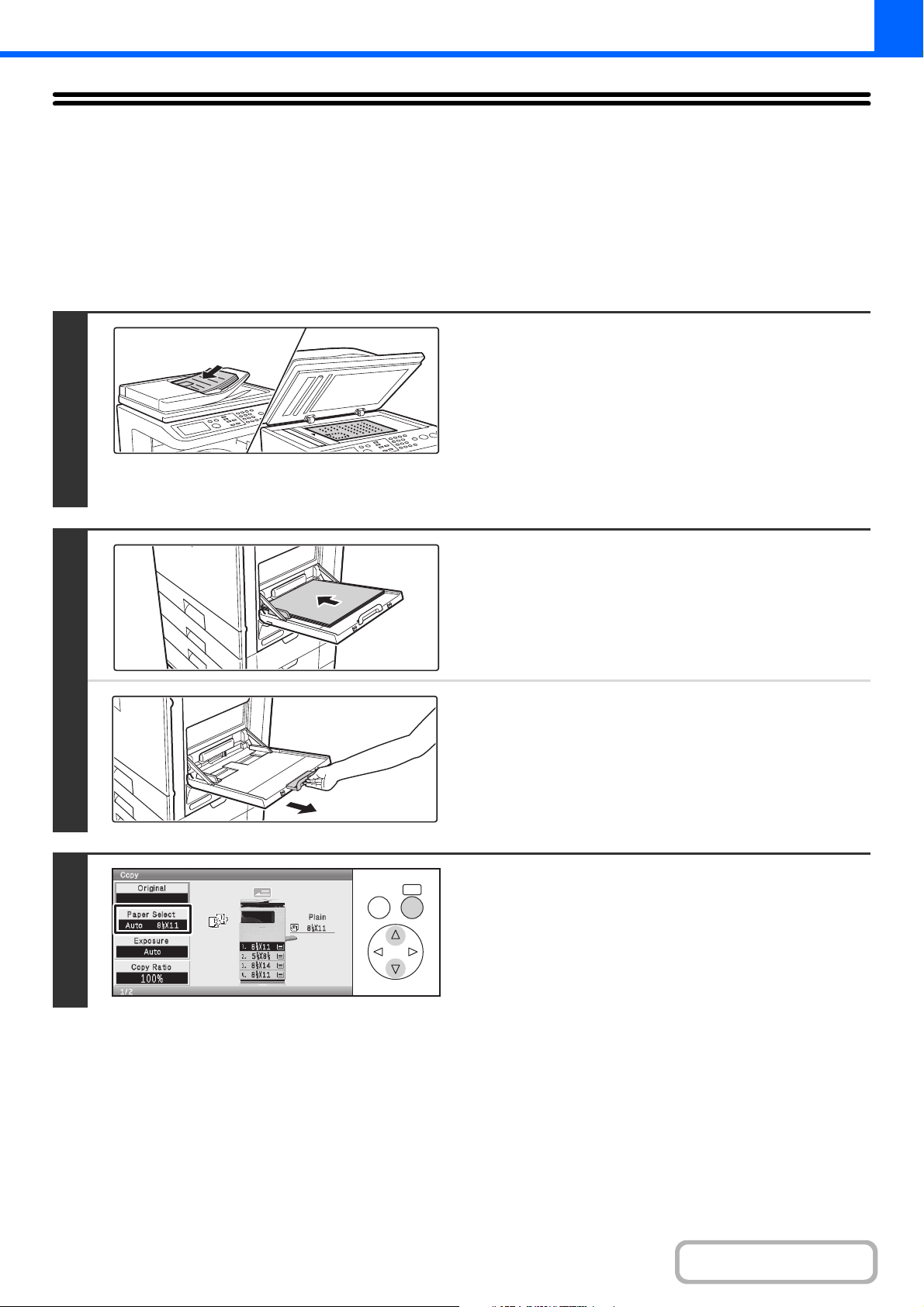
2-36
COPIER
Contents
MAKING COPIES USING THE BYPASS TRAY
In addition to plain paper, the bypass tray allows you to make copies on transparency film, envelopes, and other special
media.
For detailed information on paper that can be loaded in the bypass tray, see "IMPORTANT POINTS ABOUT PAPER"
(page 1-42) in "1. BEFORE USING THE MACHINE". For precautions when loading paper in the bypass tray, see
"LOADING PAPER IN THE BYPASS TRAY" (page 1-47) in "1. BEFORE USING THE MACHINE".
Keys in the display can be selected with the arrow keys and the [OK] key.
1
Place the original.
Place the original face up in the document feeder tray, or face
down on the document glass.
After placing the original, specify the original size.
☞ ORIGINAL SIZES (page 2-28)
When placing the originals on the document glass...
After placing the original, be sure to close the automatic
document feeder. If left open, parts outside of the original will
be copied black, causing excessive use of toner.
2
Place paper in the bypass tray.
Insert the paper with print side face down.
When loading paper larger than 8-1/2" x 11" or A4, be sure to
pull out the bypass tray extension. Pull the bypass tray
extension all the way out. If the bypass tray extension is not
pulled all the way out, the size of the loaded paper will not be
correctly displayed.
3
Select the [Paper Select] key.
OKBACK
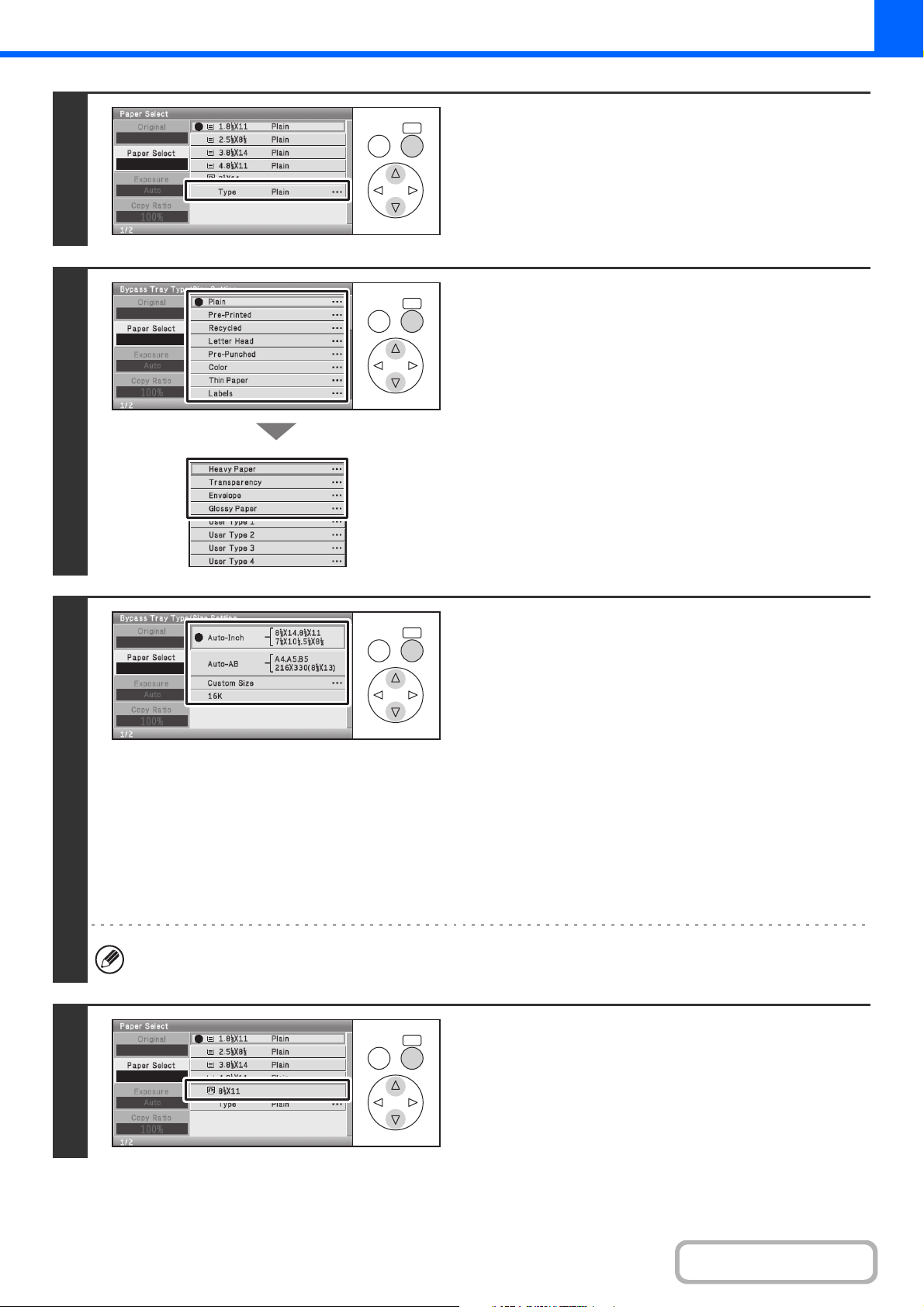
2-37
COPIER
Contents
4
Check the paper type setting for the
bypass tray. If you need to change the
setting, select the paper type key.
If you do not need to change the paper size and type, go to
step 7.
5
Select the type of paper used in the
bypass tray.
Select the paper type that you will use.
6
Select the paper size.
[Auto-Inch] key
When the paper placed in the bypass tray is an inch size
(8-1/2" x 11", etc.), the paper size will be detected automatically
and an appropriate size set.
[Auto-AB] key
When the paper inserted in the bypass tray is an AB size (A4,
etc.), the paper size will be detected automatically and an
appropriate size set.
[Custom Size] key
Select this key if you wish to enter numeric values for the size
of the loaded paper.
☞ Enter the paper size of the bypass tray (page 2-38)
[16K] key
Select when the size of the paper placed in the bypass tray is
16K.
When [Envelope] is selected, specify the size of the envelope.
7
Select the bypass tray.
OKBACK
OKBACK
OKBACK
OKBACK
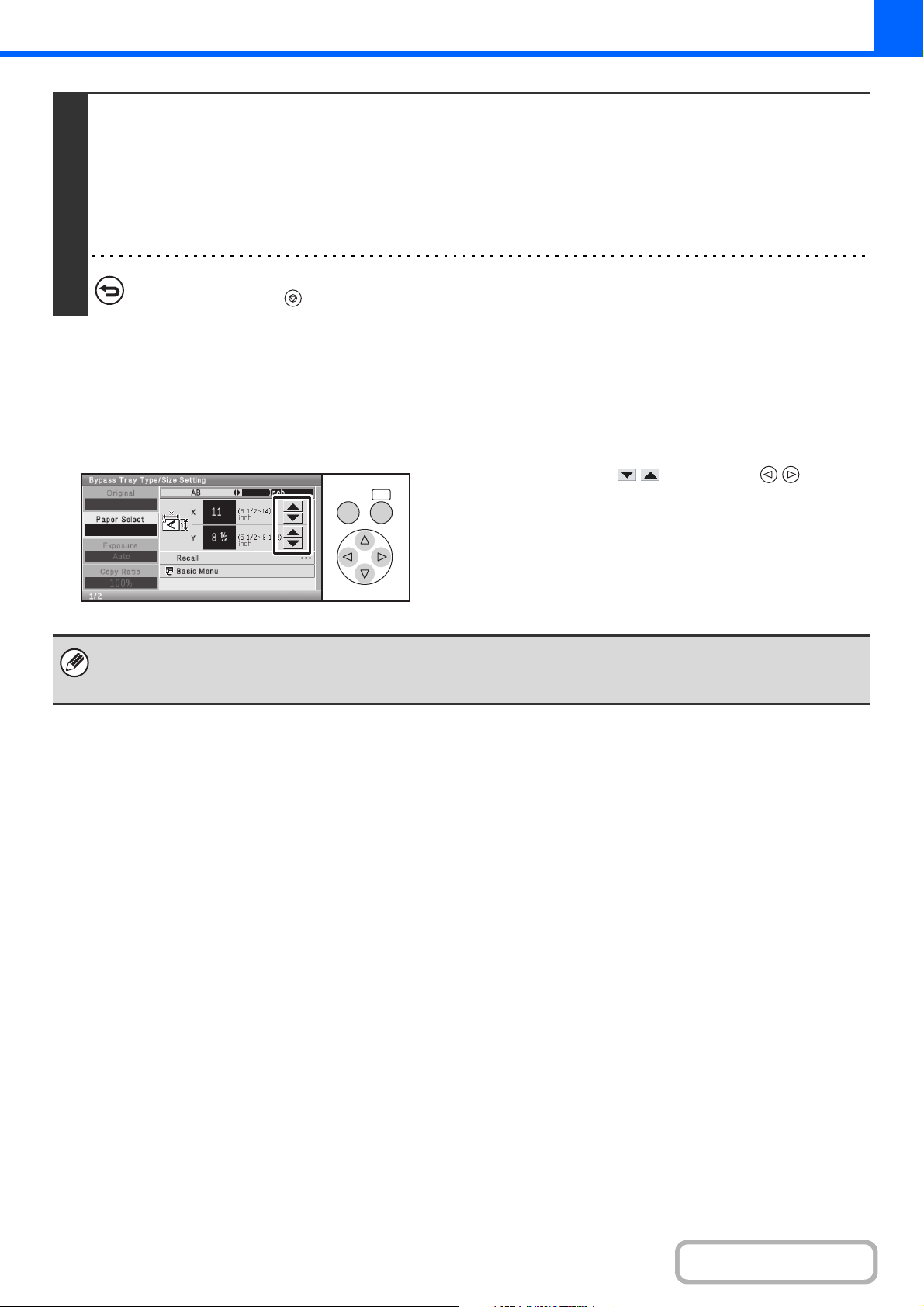
2-38
COPIER
Contents
Enter the paper size of the bypass tray
When the [Custom Size] key is selected, the paper size entry screen appears.
Select either of the keys with the keys and
press the [OK] key repeatedly to change the number.
8
Press the [COLOR START] key or the [BLACK & WHITE START] key.
Scanning begins.
• If the originals were placed in the document feeder tray, the originals are copied.
• If you placed the originals on the document glass, scan each page one page at a time.
When using sort mode, change originals and press the [START] key. Repeat until all pages have been scanned and then
select the [Read-End] key. (For the second original and following originals, use the same [START] key as you did for
the first original.)
To cancel scanning of the original and copying...
Press the [STOP] key ( ).
OKBACK
A stored custom paper size can be selected. Custom paper sizes are stored in the system settings. For details, see "Paper
Tray Settings" (page 6-13) in "6. SYSTEM SETTINGS". To display the custom paper sizes that have been stored, select the
[Recall] key in the paper size entry screen. If the key for the size that you wish to enter appears, select that key.
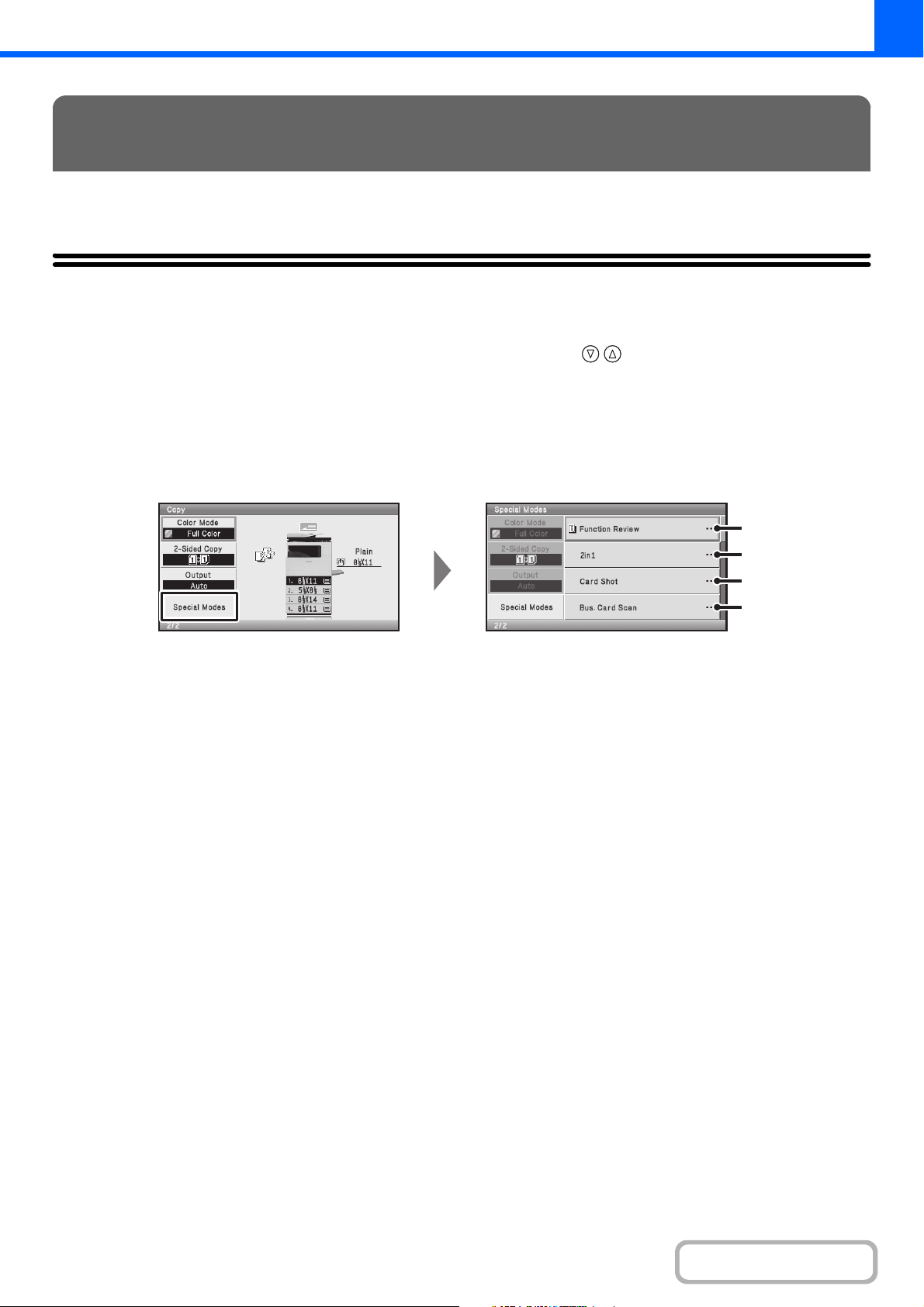
2-39
COPIER
Contents
This section explains Margin Shift, Erase, and other special modes.
SPECIAL MODES
When the [Special Modes] key in the base screen is selected and the [OK] key is pressed, the special modes menu
screen appears. The special modes menu consists of four screens. Press the keys to move between the screens.
After selecting special mode settings, press the [BACK] key in the special modes menu screen to complete the settings
and return to the base screen of copy mode.
Special modes menu (1st screen)
(1) [Function Review] key*
1
Select this to check the special mode settings.
(2) [2in1] key
☞ COPYING TWO ORIGINAL PAGES ONTO ONE
SHEET (2in1) (page 2-55)
(3) [Card Shot] key
☞ COPYING BOTH SIDES OF A CARD ON ONE
SHEET OF PAPER (Card Shot) (page 2-43)
(4) [Bus. Card Scan] key*
2
☞ COPYING MULTIPLE BUSINESS CARDS
(Business Card Scan) (page 2-46)
*1 This cannot be selected when a special mode has not been enabled.
*2 To use this function, the business card feeder must be attached to the automatic document feeder and "Business Card Scan
Option" must be enabled in the system settings (administrator). For the attachment procedure, see "BUSINESS CARD FEEDER"
in "1. BEFORE USING THE MACHINE" (page 1-57).
SPECIAL MODES
(1)
(2)
(3)
(4)
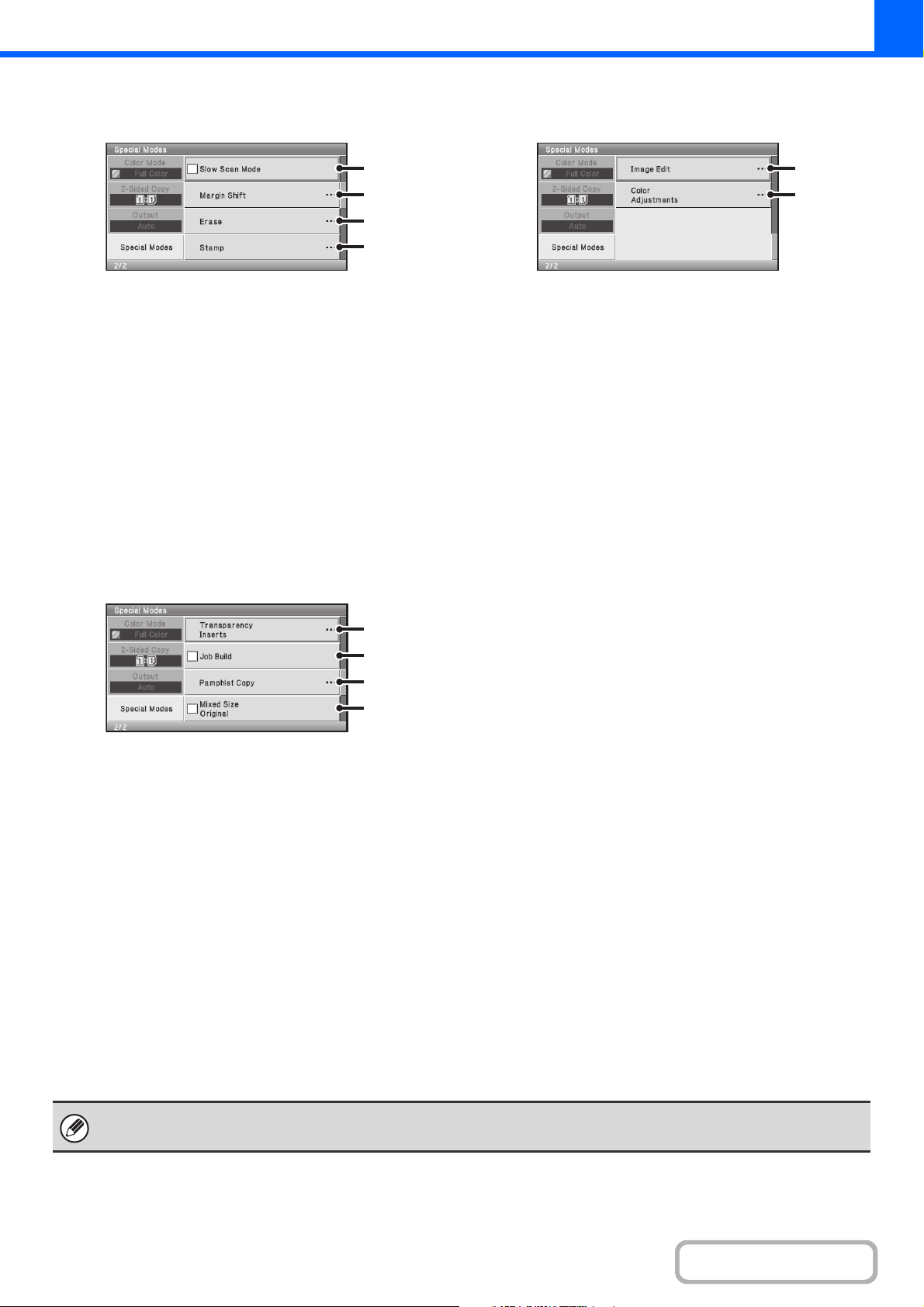
2-40
COPIER
Contents
Special modes menu (2nd screen)
(1) [Slow Scan Mode] checkbox
☞ COPYING THIN ORIGINALS (Slow Scan Mode)
(page 2-48)
(2) [Margin Shift] key
☞ ADDING MARGINS (Margin Shift) (page 2-50)
(3) [Erase] key
☞ ERASING PERIPHERAL SHADOWS (Erase) (page
2-52)
(4) [Stamp] key
☞ PRINTING THE DATE AND A STAMP ON COPIES
(Stamp) (page 2-55)
Special modes menu (3rd screen)
(1) [Transparency Inserts] key
☞ ADDING INSERTS WHEN COPYING ON
TRANSPARENCY FILM (Transparency Inserts)
(page 2-71)
(2) [Job Build] checkbox
☞ COPYING A LARGE NUMBER OF ORIGINALS AT
ONCE (Job Build) (page 2-73)
(3) [Pamphlet Copy] key
☞ MAKING COPIES IN PAMPHLET FORMAT
(Pamphlet Copy) (page 2-75)
(4) [Mixed Size Original] checkbox
☞ COPYING ORIGINALS OF DIFFERENT SIZES
(Mixed Size Original) (page 2-78)
Special modes menu (4th screen)
(1) [Image Edit] key
☞ [Image Edit] KEY (page 2-80)
(2) [Color Adjustments] key
☞ [Color Adjustments] KEY (page 2-88)
(1)
(2)
(3)
(4)
(1)
(2)
(3)
(4)
(1)
(2)
Special modes can generally be combined with other special modes, however, there are some combinations that are not
possible. In this case, a message indicating that the combination is not possible will be displayed.
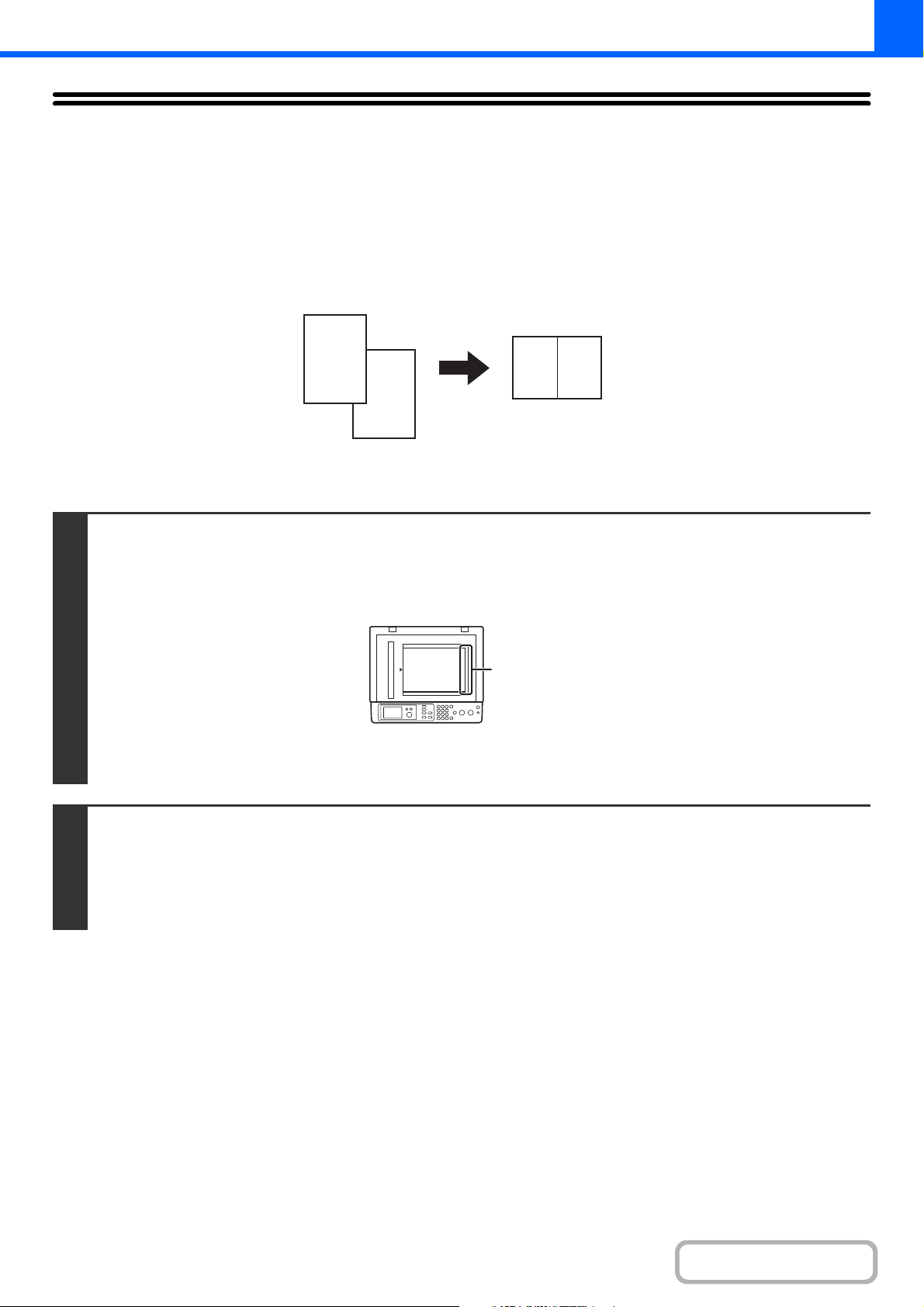
2-41
COPIER
Contents
COPYING TWO ORIGINAL PAGES ONTO
ONE SHEET (2in1)
Two original pages can be copied onto one sheet of paper. This function is convenient when you wish to present
multiple pages in a compact format, or show a view of all pages in a document.
By copying two originals onto one sheet, the amount of paper used can be cut in half.
Keys in the display can be selected with the arrow keys and the [OK] key.
B
A
A B
1
Place the original.
Place the original face up in the document feeder tray, or face down on the document glass.
When using this function with a portrait original on the document glass, place the original so that the top of the image is to the
right.
After placing the original, specify the original size.
☞ ORIGINAL SIZES (page 2-28)
2
Select the special modes.
(1) Select the [Special Modes] key.
(2) Select the [2in1] key.
☞ Special modes menu (1st screen) (page 2-39)
A
Top of image to
the right
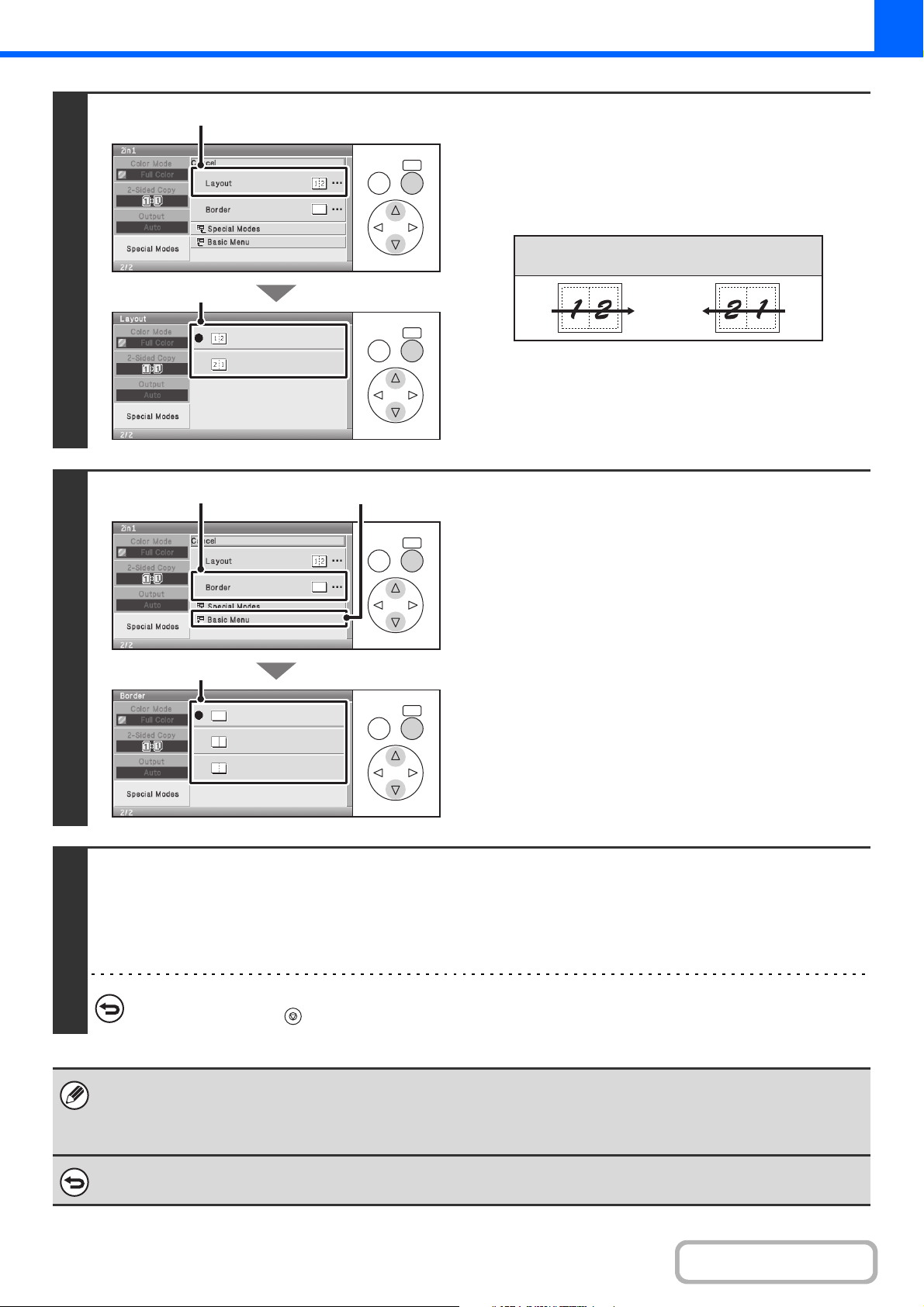
2-42
COPIER
Contents
3
Select the layout.
(1) Select the [Layout] key.
(2) Select the layout.
Select the order in which the originals will be arranged on
the copy.
The arrows in the above diagram indicate how the images
are arranged.
4
Select the border.
(1) Select the [Border] key.
(2) Select the border.
No lines, solid lines, or broken lines can be selected.
(3) Select the [Basic Menu] key.
You will return to the base screen of copy mode.
5
Press the [COLOR START] key or the [BLACK & WHITE START] key.
Copying will begin.
If you are using the document glass, change originals and press the [START] key. Repeat until all pages have been scanned
and then select the [Read-End] key. (For the second original and following originals, use the same [START] key as you
did for the first original.)
To cancel scanning and copying...
Press the [STOP] key ( ).
When using the 2in1 function, the appropriate copy ratio will be automatically set based on the original size, paper size, and
the number of originals to be copied onto one sheet. The minimum possible reduction ratio is 50%. The original size, paper
size, and selected number of original pages may require that the ratio be less than 50%. As copying will take place at 50% in
this case, part of the original images may be cut off.
To cancel a 2in1 setting...
Select the [Cancel] key in the screen of step 3.
OKBACK
OKBACK
(1)
(2)
Layout
OKBACK
OKBACK
(1)
(2)
(3)
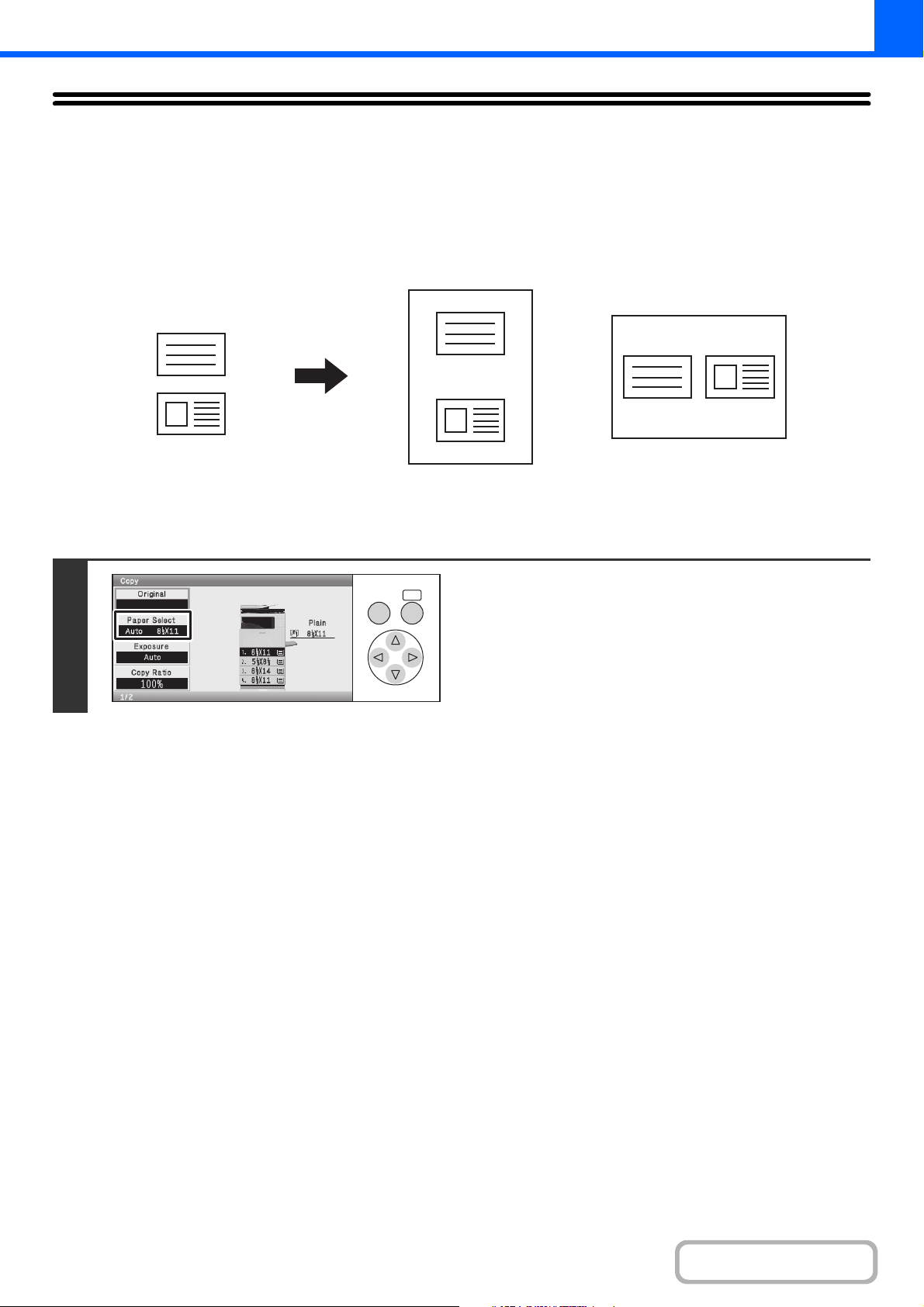
2-43
COPIER
Contents
COPYING BOTH SIDES OF A CARD ON ONE
SHEET OF PAPER (Card Shot)
When copying a card, this function allows you to copy the front and reverse sides together onto a single sheet of paper.
This function is convenient for making copies for identification purposes and helps save paper.
Keys in the display can be selected with the arrow keys and the [OK] key.
1
Select the paper to be used for card
shot.
Select the paper as explained in "PAPER TRAYS" (page 2-9).
Front
Back
Originals
Copies
Example of an 8-1/2" x 11"
(A4) size portrait copy
Example of an 8-1/2" x 11" (A4)
size landscape copy
OKBACK
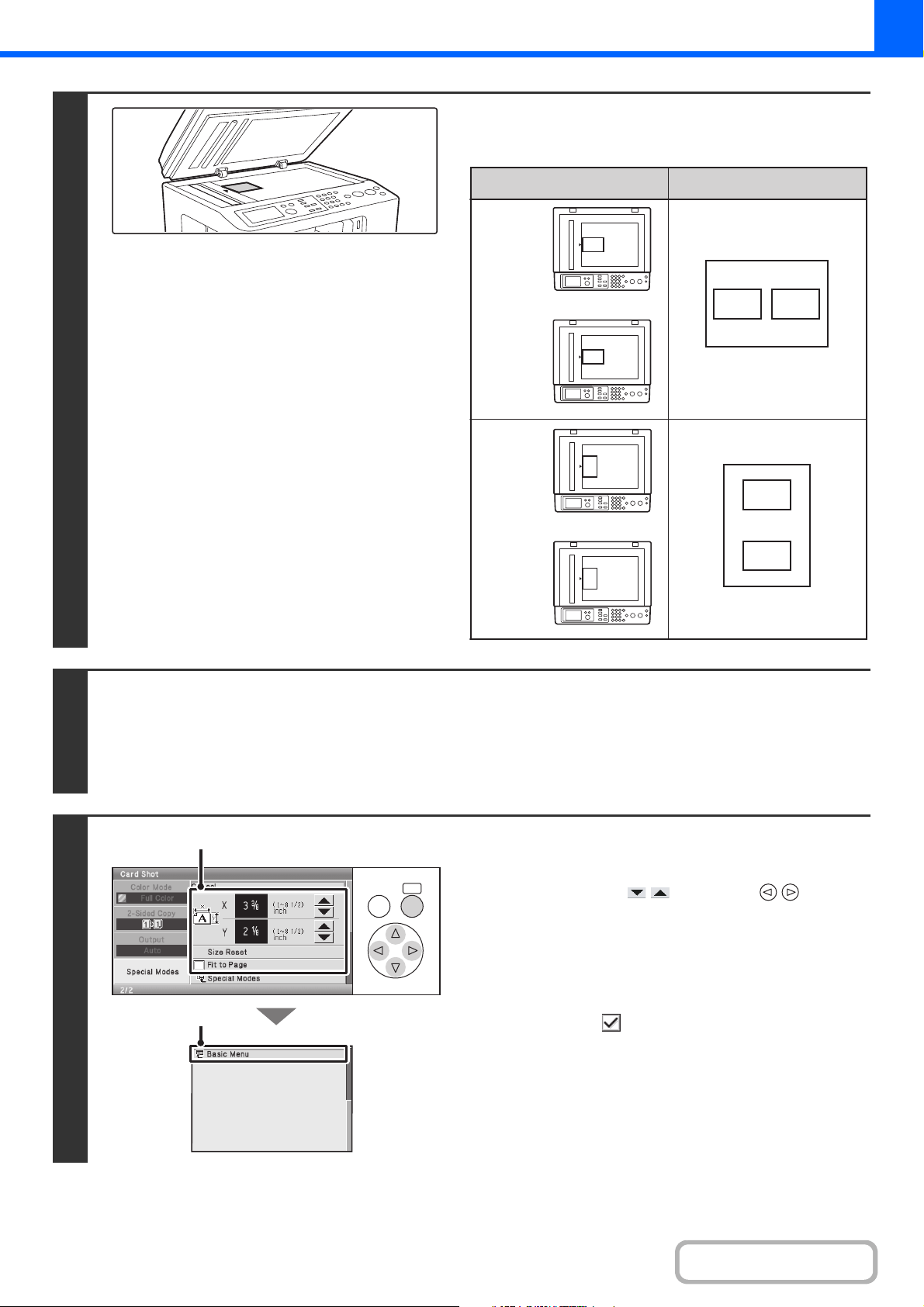
2-44
COPIER
Contents
2
Place the original face down on the
document glass.
3
Select the special modes.
(1) Select the [Special Modes] key.
(2) Select the [Card Shot] key.
☞ Special modes menu (1st screen) (page 2-39)
4
Select card shot settings.
(1) Enter the original size.
Select either of the keys with the keys and
press the [OK] key repeatedly to change the number.
•
The [Size Reset] key can be pressed to return the
horizontal and vertical dimensions to the values set in
"Card Shot Settings" in the system settings (administrator).
• To enlarge or reduce the image to fit the paper based
on the entered original size, set the [Fit to Page]
checkbox to .
(2) Select the [Basic Menu] key.
You will return to the base screen of copy mode. Make sure
that the entered dimensions appear in the [Original] key.
B
A
A
B
A
B
B A
Results
Originals
Front page
Back page
Front page
Back page
OKBACK
(1)
(2)
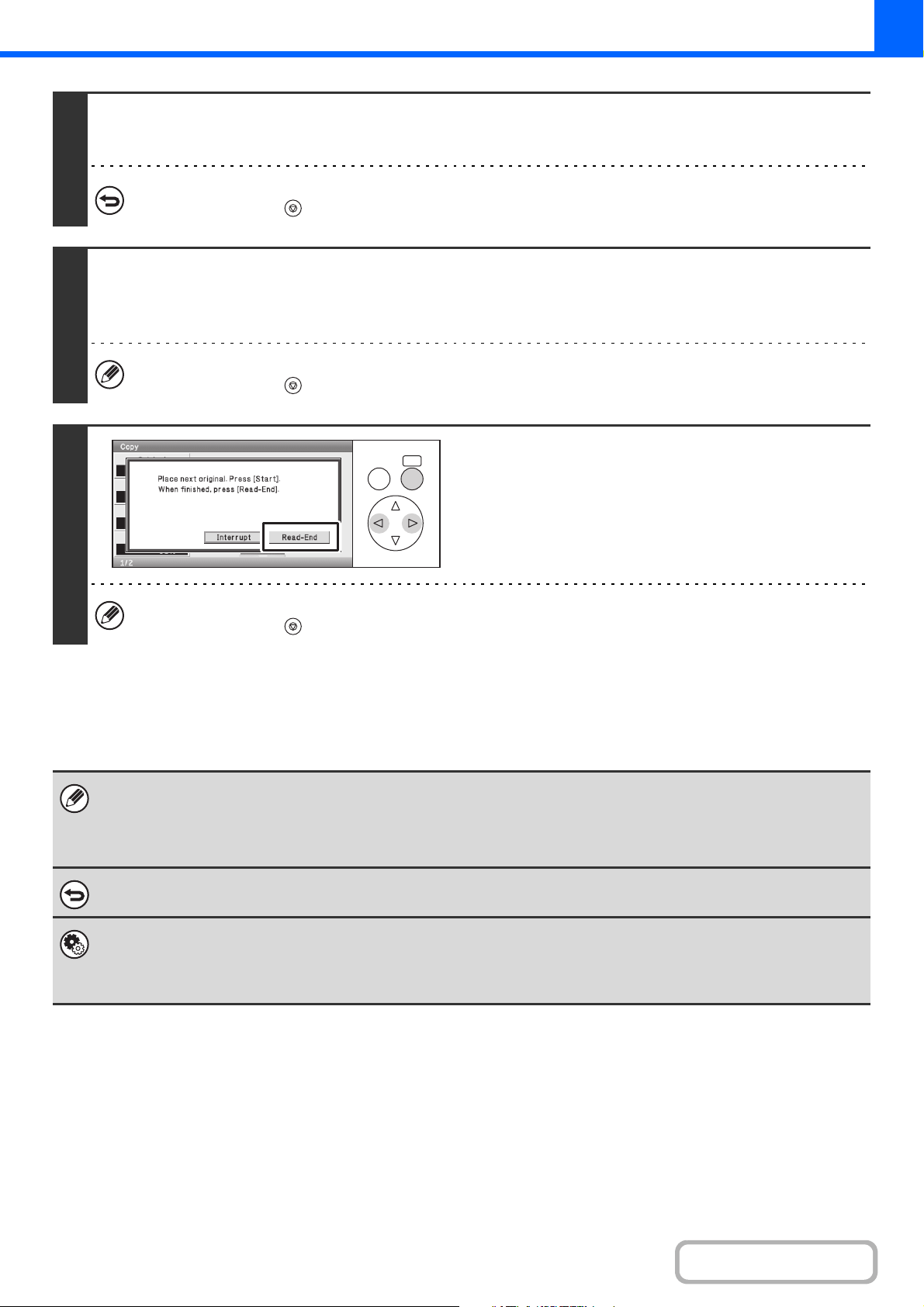
2-45
COPIER
Contents
5
Press the [COLOR START] key or the [BLACK & WHITE START] key to scan the
front side of the card.
To cancel scanning...
Press the [STOP] key ( ).
6
Turn the card over and press the [COLOR START] key or the [BLACK & WHITE
START] key to scan the reverse side of the card.
Use the same [START] key that you used for the front side of the card.
To cancel scanning...
Press the [STOP] key ( ).
7
Select the [Read-End] key.
Copying will begin.
To cancel copying...
Press the [STOP] key ( ).
• The original must be placed on the document glass.
• Copying is only possible on standard size paper.
• XY Zoom cannot be used when using this function.
• The image cannot be rotated when using this function.
To cancel card shot...
Select the [Cancel] key in the screen of step 4.
System Settings (Administrator): Card Shot Settings
This is used to set the values to which the size returns when the [Size Reset] key is selected. 1" to 8-1/2" (25 mm to 210 mm)
can be entered for both the horizontal and vertical dimensions.
The factory default settings are 3-3/8" (86 mm) for X (the width) and 2-1/8" (54 mm) for Y (the height).
OKBACK
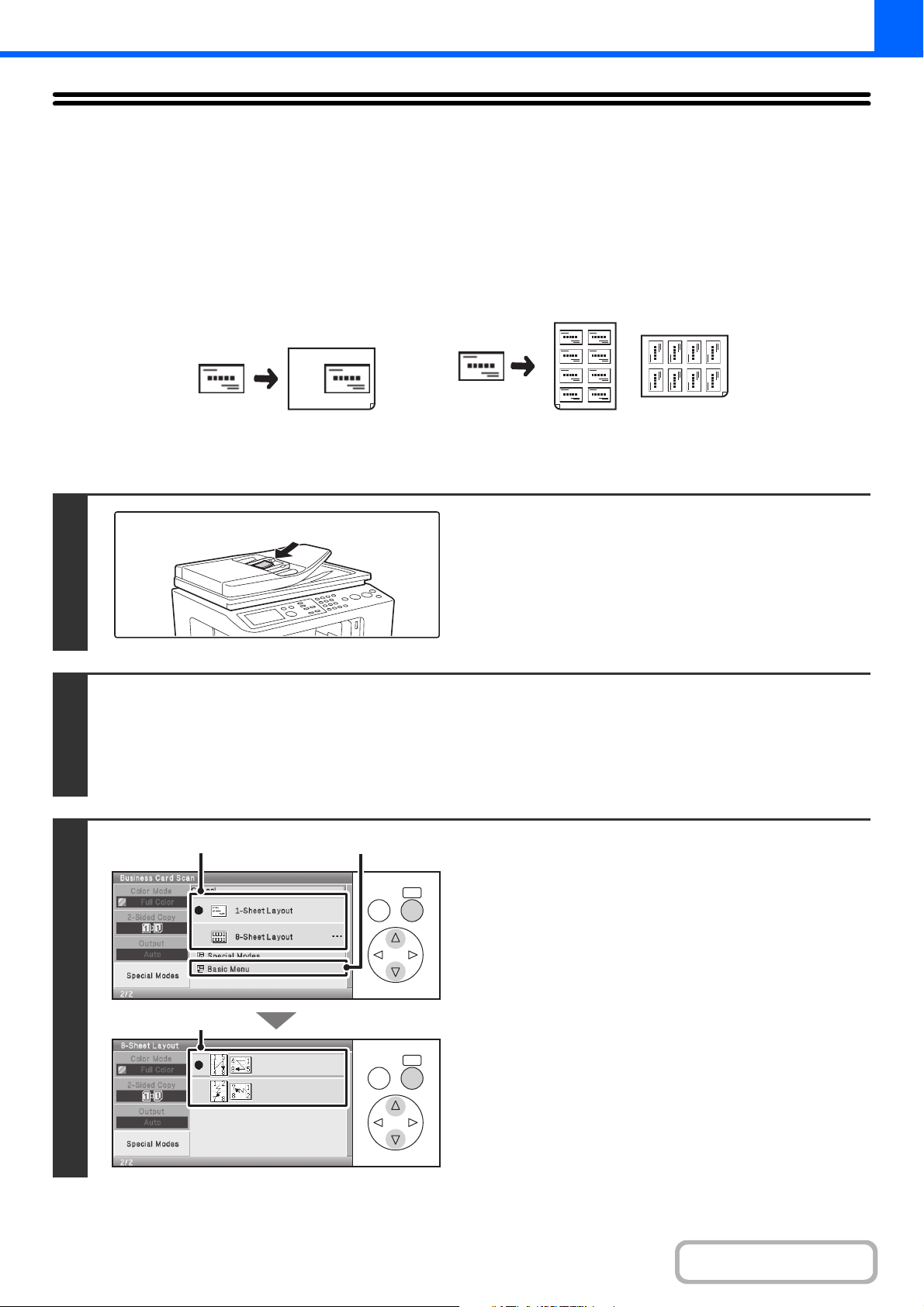
2-46
COPIER
Contents
COPYING MULTIPLE BUSINESS CARDS
(Business Card Scan)
Business Card Scan can be used to copy up to 8 business cards on one sheet of paper.
To use this function, the business card feeder must be attached to the automatic document feeder and "Business Card
Scan Option" must be enabled in the system settings (administrator).
For the attachment procedure, see "BUSINESS CARD FEEDER" in "1. BEFORE USING THE MACHINE" (page 1-57).
Use this function to create a list of business cards or to file business cards as a group.
Keys in the display can be selected with the arrow keys and the [OK] key.
1
Load the business cards.
For original placement orientations and copy results, see "Copy
results of 8-Sheet Layouts" (page 2-47.)
2
Select Business Card Scan.
(1) Select the [Special Modes] key.
☞ SPECIAL MODES (page 2-39)
(2) Select the [Bus. Card Scan] key.
3
Specify settings for Business Card Scan.
(1) Specify the number of business cards to be
copied and select the [1-Sheet Layout] key
or the [8-Sheet Layout] key.
When the [1-Sheet Layout] key is selected, the smallest
size of paper loaded in the paper trays will be
automatically selected. When the [8-Sheet Layout] key is
selected, 8-1/2" x 11" (A4) size paper will be automatically
selected.
(2) When [8-Sheet Layout] is selected, select
the desired layout.
Select one of the 2 layouts.
(3) Select the [Basic Menu] key.
You will return to the base screen of copy mode.
1-Sheet Layout 8-Sheet Layout
OKBACK
OKBACK
(1)
(2)
(3)
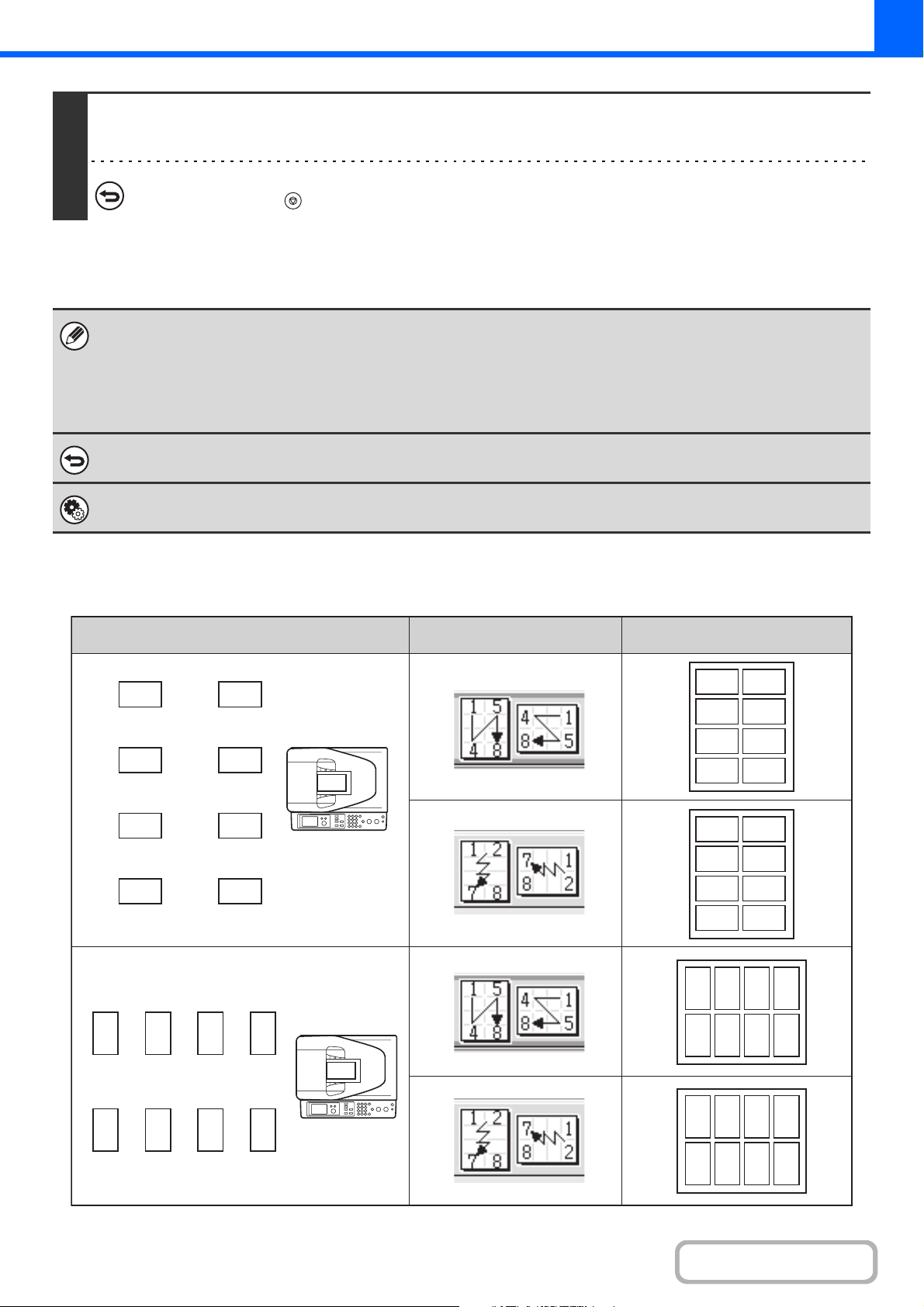
2-47
COPIER
Contents
Copy results of 8-Sheet Layouts
4
Press the [COLOR START] key or the [BLACK & WHITE START] key.
Copying will begin.
To cancel scanning and copying...
Press the [STOP] key ( ).
The "2-Sided to 2-Sided" and "2-Sided to 1-Sided" modes of automatic 2-sided copying cannot be used.
When the [1-Sheet Layout] key is selected, [XY Zoom] cannot be used.
When the [8-Sheet Layout] key is selected, the following functions and paper cannot be used.
• Zoom function
• Auto Image
• Label
To cancel the business card scan setting...
Select the [Cancel] key in the screen of step 3.
System Settings (Administrator): Business Card Scan Option (Web page only)
Specify whether or not the Business Card Scan function is used.
A
A DB C
E HF G
A
C
B
D
E
G
F
H
A
C
E
G
B
D
F
H
A
B
C
D
E
F
G
H
A
ABCD
HGFE
ACEG
HFDB
Originals (Original orientation) Settings Results
1st
page
4th
page
2nd
page
3rd
page
5th
page
8th
page
6th
page
7th
page
1st
page
4th
page
2nd
page
3rd
page
5th
page
8th
page
6th
page
7th
page
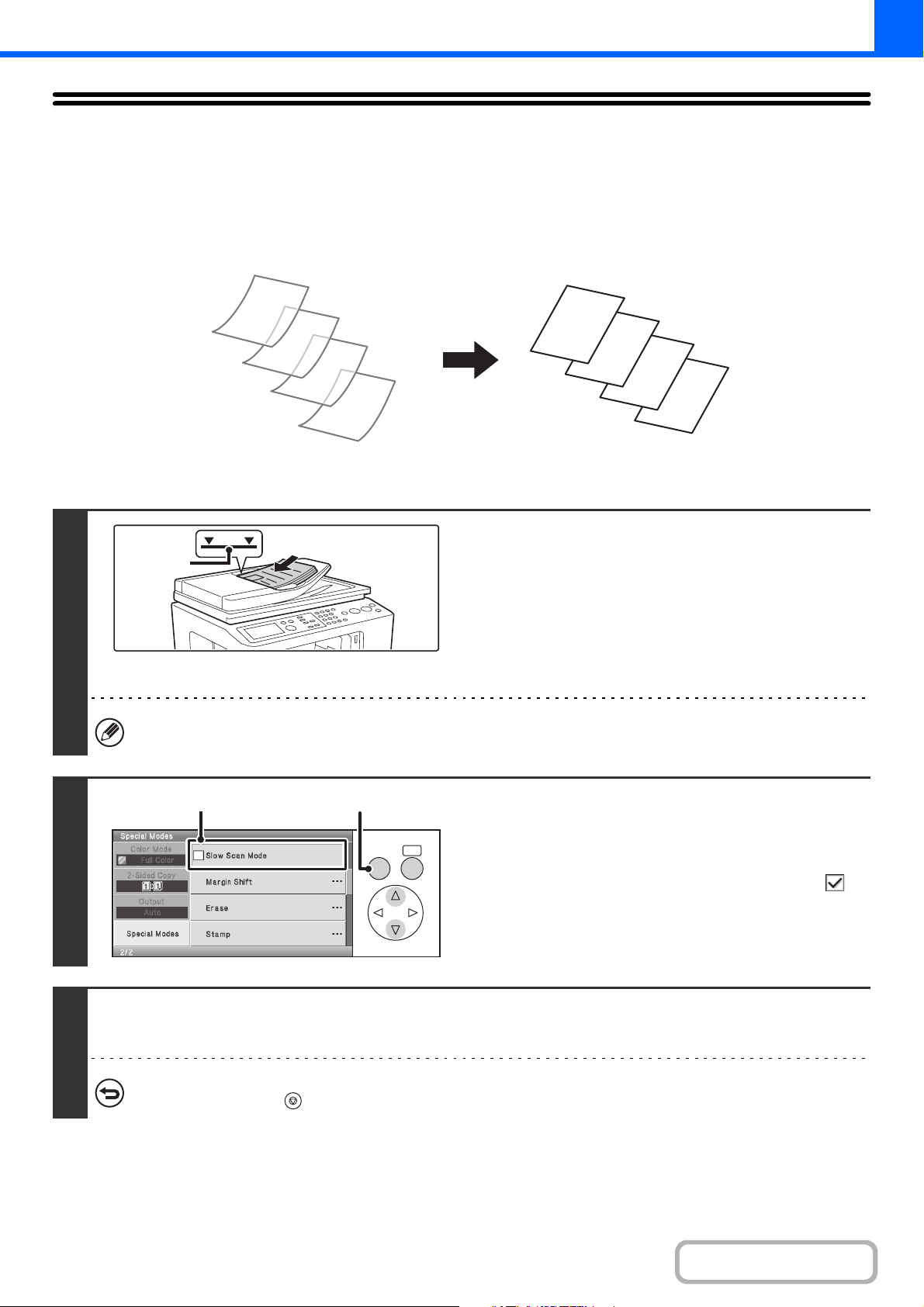
2-48
COPIER
Contents
COPYING THIN ORIGINALS (Slow Scan
Mode)
Use this function when you wish to scan thin originals using the automatic document feeder. This function helps prevent
thin originals from misfeeding.
Keys in the display can be selected with the arrow keys and the [OK] key.
1
Insert the originals face up in the
document feeder tray.
Insert the originals all the way into the document feeder tray.
Multiple originals can be placed in the document feeder tray.
The stack of originals must not be higher than the indicator line
on the tray.
After placing the original, specify the original size.
☞ ORIGINAL SIZES (page 2-28)
If the originals are inserted with too much force, they may crumple and misfeed.
2
Select Slow Scan Mode.
(1) Select the [Special Modes] key.
☞ Special modes menu (2nd screen) (page 2-40)
(2) Set the [Slow Scan Mode] checkbox to .
(3) Press the [BACK] key.
You will return to the base screen of copy mode.
3
Press the [COLOR START] key or the [BLACK & WHITE START] key.
Copying will begin.
To cancel scanning and copying...
Press the [STOP] key ( ).
D
C
B
A
D
C
B
A
Indicator
line
OKBACK
(3)(2)
2-49
COPIER
Contents
The "2-Sided to 2-Sided" and "2-Sided to 1-Sided" modes of automatic 2-sided copying cannot be used.
To cancel the slow scan mode setting...
Set the [Slow Scan Mode] checkbox to in the screen of step 2.
System Settings (Administrator): Original Feeding Mode
This is used to have scanning always take place in slow scan mode.
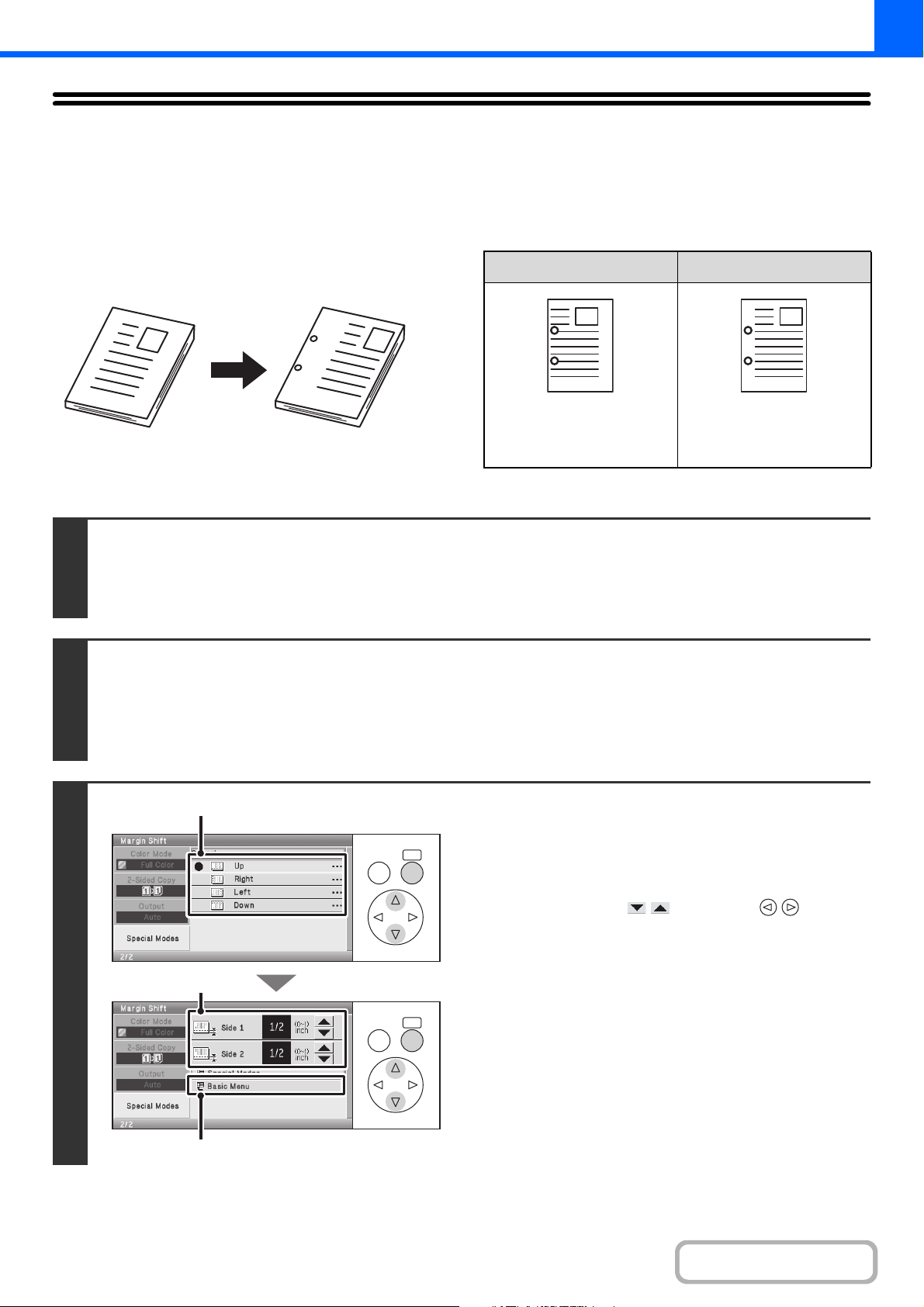
2-50
COPIER
Contents
ADDING MARGINS (Margin Shift)
This function is used to shift the copy image right, left, up or down to adjust the margin.
This is convenient when you wish to hole punch the copies.
Shifting the image to the right so the copies can be bound at the left edge with a string
Keys in the display can be selected with the arrow keys and the [OK] key.
1
1
Not using margin shift Using margin shift
The punch holes cut off
part of the image
The image is moved to
allow space for the holes
so the image is not cut off.
1
1
1
Place the original.
Place the original face up in the document feeder tray, or face down on the document glass.
After placing the original, specify the original size.
☞ ORIGINAL SIZES (page 2-28)
2
Select the special modes.
(1) Select the [Special Modes] key.
(2) Select the [Margin Shift] key.
☞ Special modes menu (1st screen) (page 2-39)
3
Set the margin shift.
(1) Select the margin shift position.
Select one of the 4 positions.
(2) Set the amount of the margin shift.
Select either of the keys with the keys and
press the [OK] key repeatedly to change the number.
0" to 1" (0 mm to 20 mm) can be entered.
(3) Select the [Basic Menu] key.
You will return to the base screen of copy mode.
OKBACK
OKBACK
(3)
(1)
(2)
2-51
COPIER
Contents
4
Press the [COLOR START] key or the [BLACK & WHITE START] key.
Copying will begin.
If you are using the document glass to copy multiple original pages, copying will take place as you scan each original. If you
have selected sort mode, change originals and press the [START] key. Repeat until all pages have been scanned and then
select the [Read-End] key. (For the second original and following originals, use the same [START] key as you did for
the first original.)
To cancel scanning of the original and copying...
Press the [STOP] key ( ).
Rotation copy cannot be used in combination with margin shift.
To cancel the margin shift setting...
Select the [Cancel] key in the screen of step 3.
System Settings (Administrator): Initial Margin Shift Setting
The default margin shift setting can be set from 0" to 1" (0 mm to 20 mm). The factory default setting is 1/2" (10 mm).
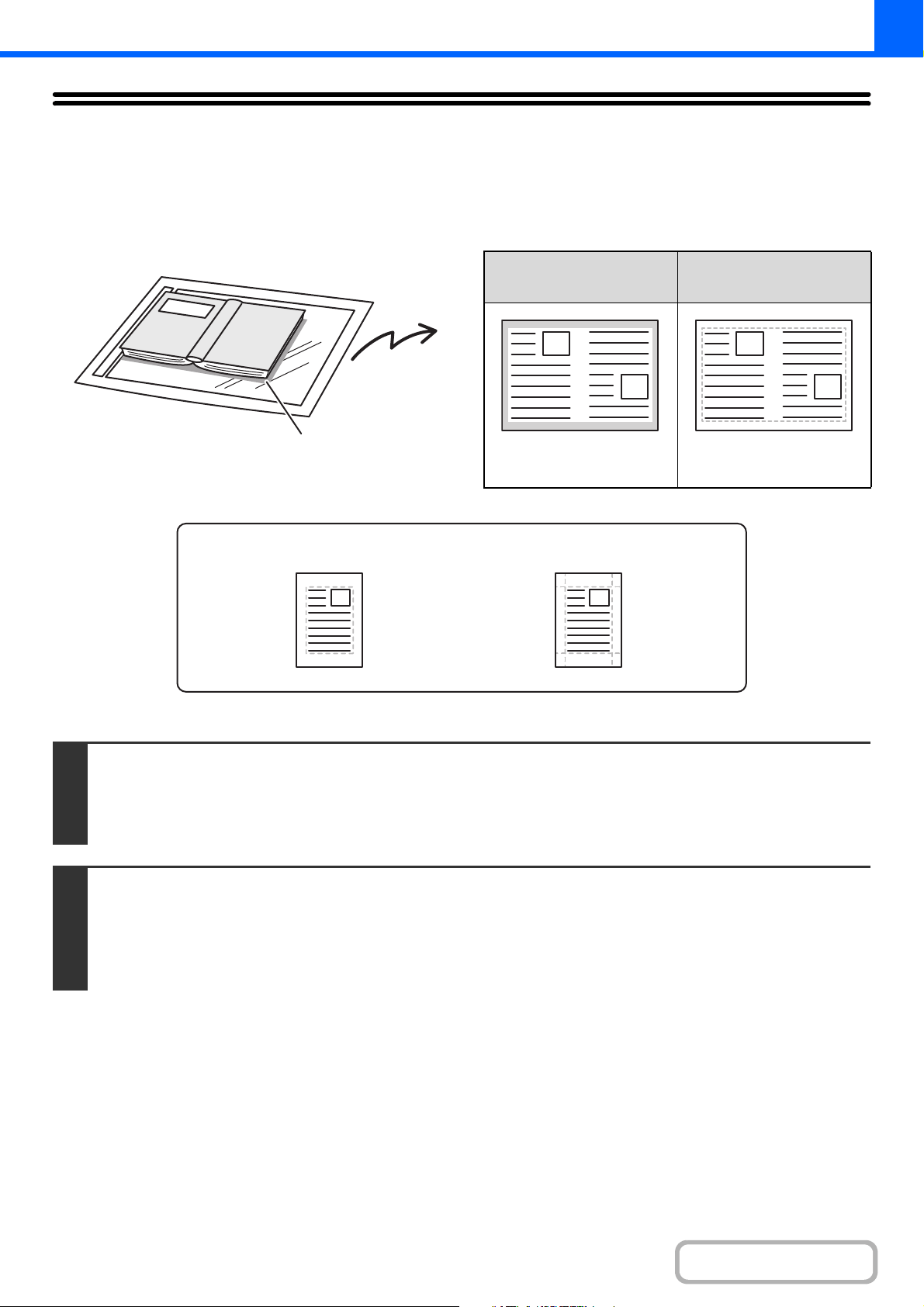
2-52
COPIER
Contents
ERASING PERIPHERAL SHADOWS (Erase)
The erase function is used to erase shadows around the edges of copies that occur when copying thick originals or
books.
When a thick book is copied
Erase modes
Keys in the display can be selected with the arrow keys and the [OK] key.
Shadows appear here
Not using the erase
function
Using the erase
function
Shadows appear on the
copy.
Shadows do not appear on
the copy.
1
Place the original.
Place the original face up in the document feeder tray, or face down on the document glass.
After placing the original, specify the original size.
☞ ORIGINAL SIZES (page 2-28)
2
Select the special modes.
(1) Select the [Special Modes] key.
(2) Select the [Erase] key.
☞ Special modes menu (2nd screen) (page 2-40)
Edge Erase Side Erase
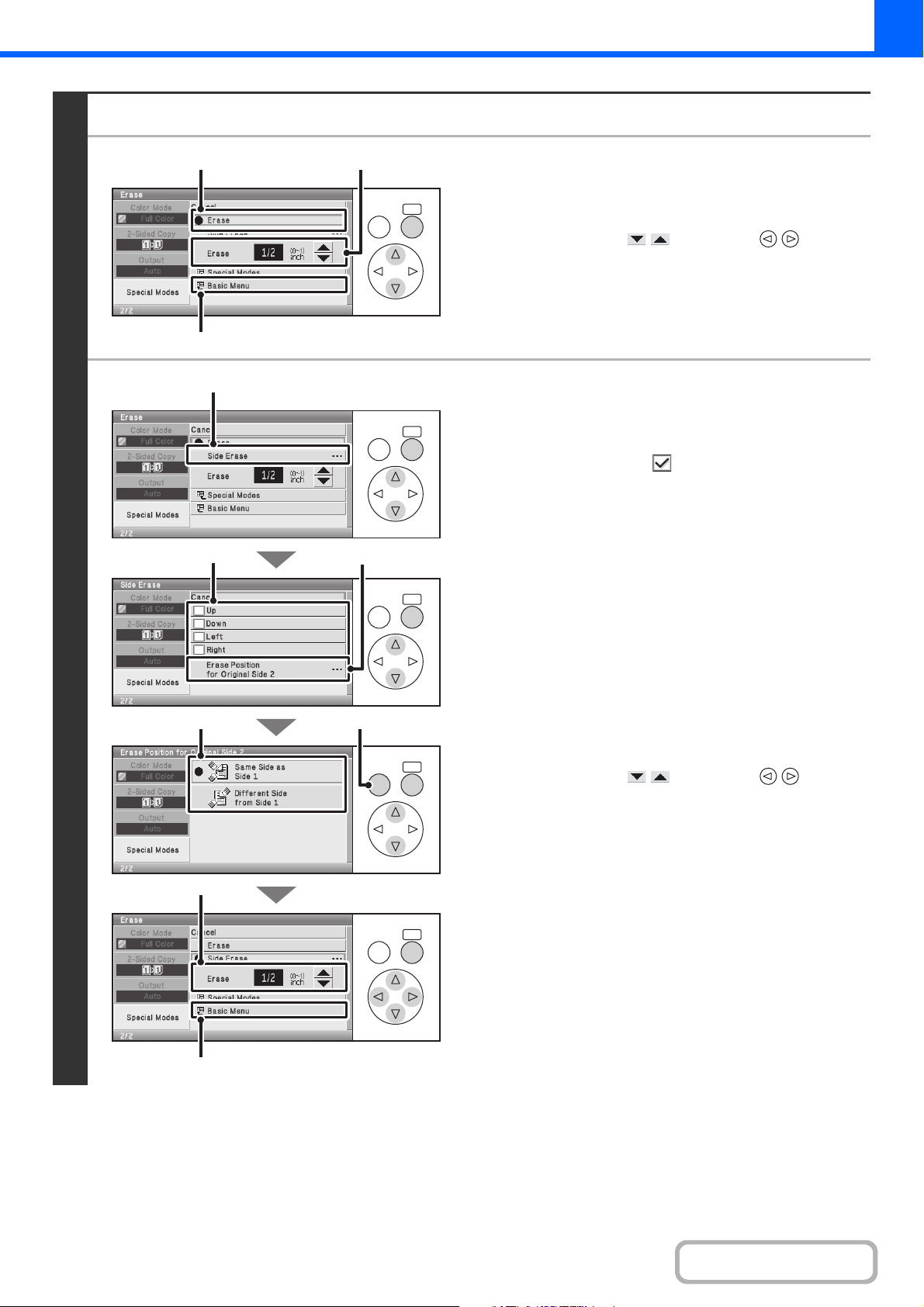
2-53
COPIER
Contents
3
Select the erase settings.
● When [Erase] is selected
(1) Select the [Erase] key.
(2) Set the erasure width.
Select either of the keys with the keys and
press the [OK] key repeatedly to change the number.
0" to 1" (0 mm to 20 mm) can be entered.
(3) Select the [Basic Menu] key.
You will return to the base screen of copy mode.
● When [Side Erase] is selected
(1) Select the [Side Erase] key.
(2) Set the sides to be erased
Select the checkboxes of the sides that you wish to
erase.
(3)
Select the [Erase Position for Original Side 2]
key.
(4) Set the erase edge on the reverse side.
When performing 1-sided to 2-sided copying or 2-sided to
2-sided copying, set the erase edge on the reverse side.
• If you select the [Same Side as Side 1] key, the edge in
the same position as on the front side will be erased.
• If you select the [Different Side from Side 1], the edge in
the position opposite to the erased edge on the front
side will be erased.
(5) Press the [BACK] key.
(6) Set the erasure width.
Select either of the keys with the keys and
press the [OK] key repeatedly to change the number.
0" to 1" (0 mm to 20 mm) can be entered.
(7) Select the [Basic Menu] key.
You will return to the base screen of copy mode.
OKBACK
(1) (2)
(3)
OKBACK
OKBACK
OKBACK
OKBACK
(5)
(6)
(7)
(4)
(2)
(3)
(1)
2-54
COPIER
Contents
4
Press the [COLOR START] key or the [BLACK & WHITE START] key.
Copying will begin.
If you are using the document glass to copy multiple original pages, copying will take place as you scan each original. If you
have selected sort mode, change originals and press the [START] key. Repeat until all pages have been scanned and then
select the [Read-End] key. (For the second original and following originals, use the same [START] key as you did for
the first original.)
To cancel scanning of the original and copying...
Press the [STOP] key ( ).
If a ratio setting is used in combination with an erase setting, the erase width will change according to the selected ratio.
For example, if the erase width setting is 1" (20 mm) and the image is reduced to 50%, the erase width will be 1/2" (10 mm).
To cancel the erase setting...
Select the [Cancel] key in the screen of step 3.
System Settings (Administrator): Erase Width Adjustment
The default erase width can be set from 0" to 1" (0 mm to 20 mm). The factory default setting is 1/2" (10 mm).
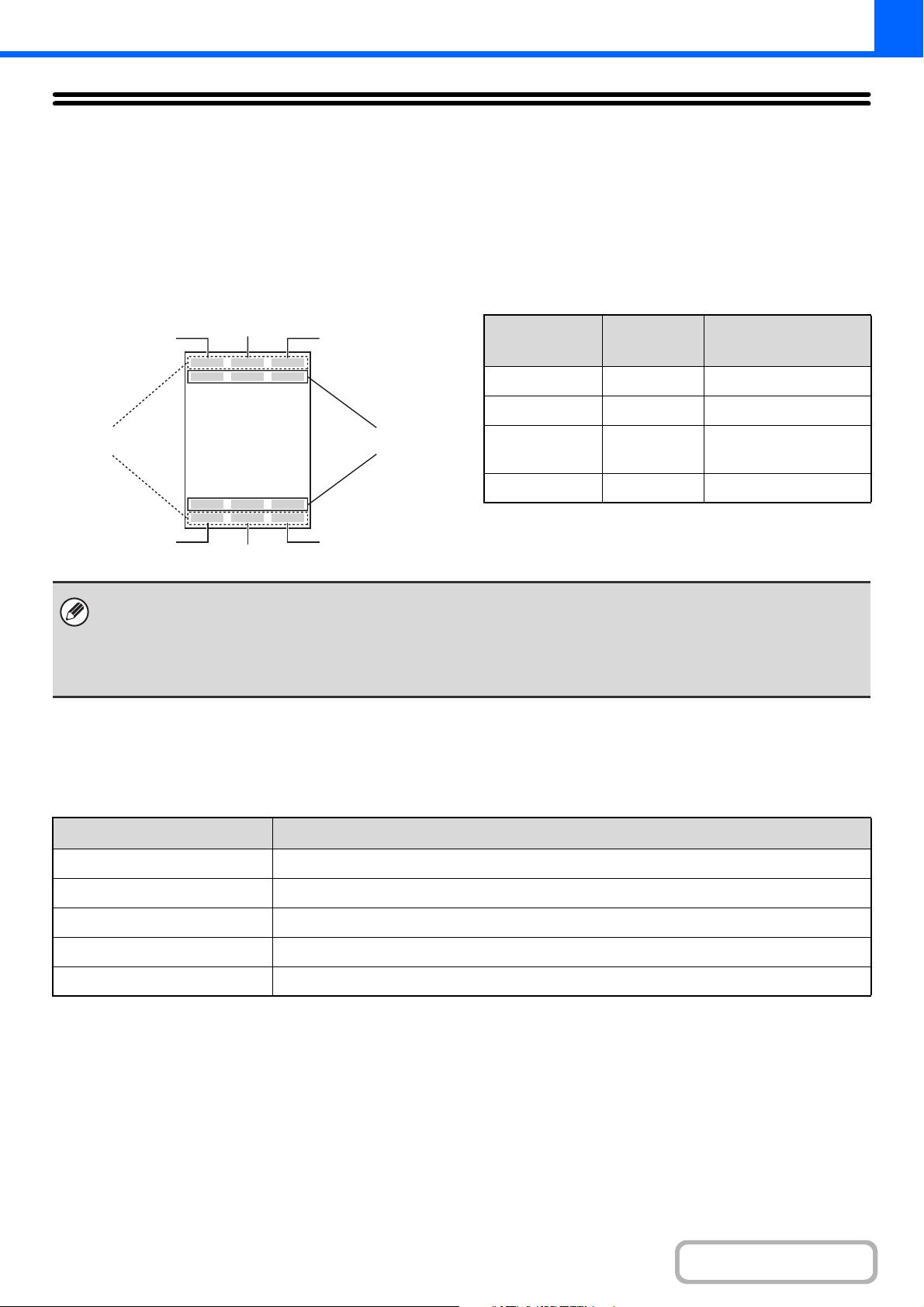
2-55
COPIER
Contents
PRINTING THE DATE AND A STAMP ON
COPIES (Stamp)
Use this function to print the date, a stamp, the page number, and text on copies.
Six printing positions are available: top left, top center, top right, bottom left, bottom center, and bottom right.
The printing positions are separated into areas that are used for the date, page number and text (A below), and areas
that are used for a stamp (B below).
When used in combination with other special modes
When Stamp is used in combination with the following special modes, the special modes are reflected in the stamp
content.
B
A
Top center
Top right
Top left
Bottom left Bottom right
Bottom center
Stamp Print area
Maximum number
of positions
Date A 1 position only
Stamp B 6 positions
Page
Numbering
A 1 position only
Text A 6 positions
• If the selected stamp content of one position overlaps the stamp content of another position, priority will be given in the
following order: right side, left side, center. Content that is hidden due to overlapping will not be printed.
• Text will be printed at the preset size regardless of the copy ratio or paper size setting.
• Text will be printed at the preset exposure regardless of the exposure setting.
• Depending on the size of the paper, some printed content may be cut off or shifted out of position.
Special Modes Printing
Margin Shift Together with the image, the stamp content is shifted the amount of the margin width.
Centering Unlike a copy image that moves, the image will be printed in the position set in the stamp.
Card Shot The stamp is printed on each copy sheet.
2in1 The print content is printed on each original page.
Pamphlet Copy The stamp is printed on each page of the resulting pamphlet.

2-56
COPIER
Contents
GENERAL PROCEDURE FOR USING STAMP
To select stamp settings, follow the steps below.
Keys in the display can be selected with the arrow keys and the [OK] key.
1
Place the original.
Place the original face up in the document feeder tray, or face down on the document glass.
When using this function with a portrait original on the document glass, place the original so that the top of the image is to the
right.
After placing the original, specify the original size.
☞ ORIGINAL SIZES (page 2-28)
2
Select the special modes.
(1) Select the [Special Modes] key.
(2) Select the [Stamp] key.
☞ Special modes menu (2nd screen) (page 2-40)
3
Select Stamp.
For detailed information on each of the stamp items, see the
following sections:
Date: ADDING THE DATE TO COPIES (Date)
(page 2-58)
Stamp: STAMPING COPIES (Stamp) (page 2-60)
Page numbering: PRINTING PAGE NUMBERS ON COPIES
(Page Numbering) (page 2-62)
Text: PRINTING TEXT ON COPIES (Text) (page
2-66)
"Date" and "Page Numbering" cannot be selected in multiple positions.
4
Select the print position.
Select from 6 positions: top left, top center, top right, bottom
left, bottom center, bottom right.
By default, the following print position is selected:
Date: 3.Upper Right Stamp: 1.Upper Left
Page Numbering: 5.Lower Center Text: 1.Upper Left
It is not possible to set "Date", "Text", or "Page Numbering" in a print position in which "Date", "Text", or "Page
Numbering" is already set.
A
Top of image to
the right
OKBACK
OKBACK
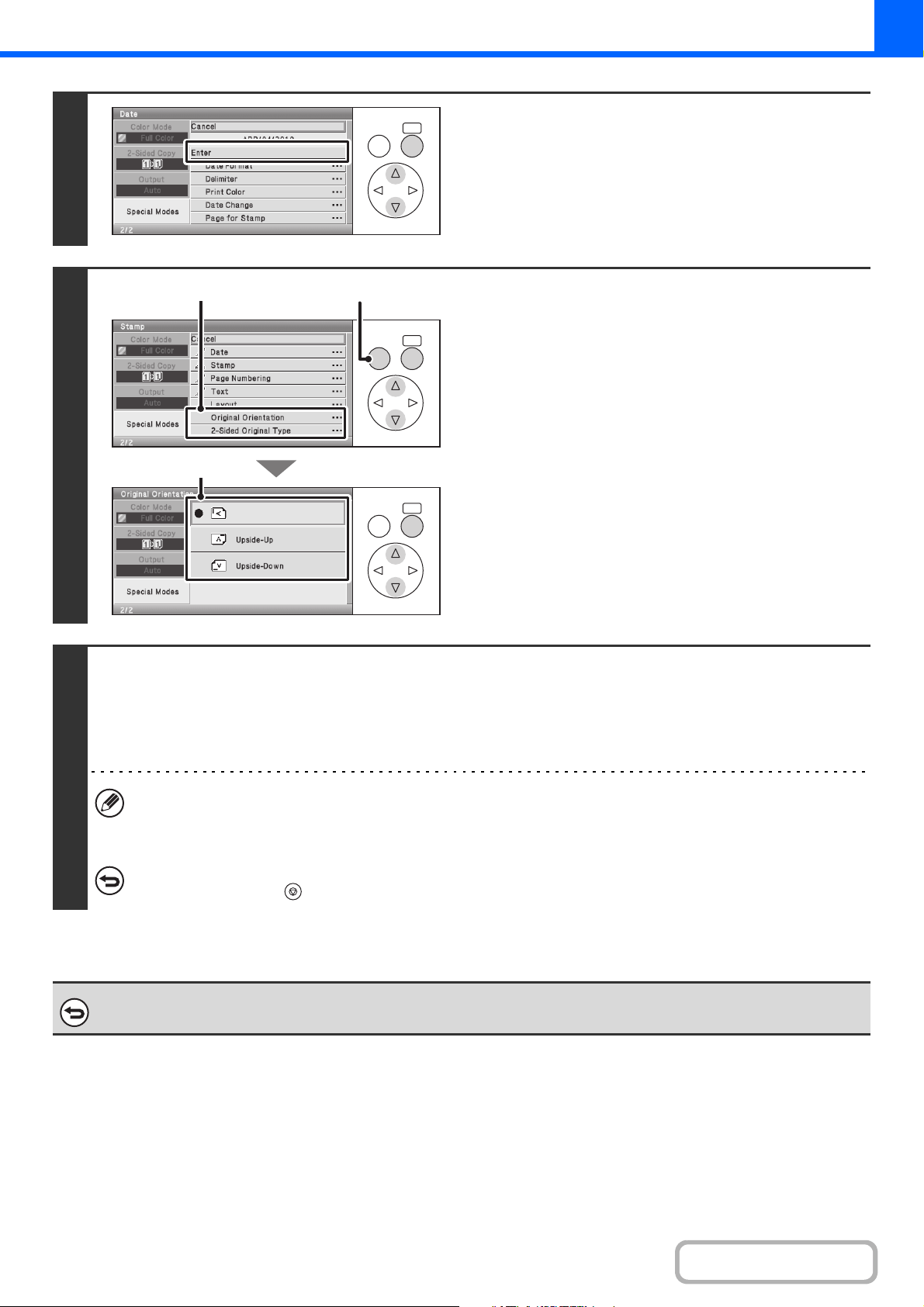
2-57
COPIER
Contents
5
When you have finished selecting stamp
settings, select the [Enter] key.
6
Select settings for the original.
(1) Select the [Original Orientation] key and
specify the orientation of the placed
original.
If 2-sided originals have been placed, select the [2-Sided
Original Type] key and specify the binding position
(booklet binding or tablet binding) of the originals.
(2) Press the [BACK] key twice.
You will return to the base screen of copy mode.
To edit a stamp position or delete a stamp item, select the
[Layout] key.
☞CHECKING THE STAMP LAYOUT (Layout) (page
2-69)
7
Press the [COLOR START] key or the [BLACK & WHITE START] key.
Copying will begin.
If you are using the document glass to copy multiple original pages, copying will take place as you scan each original. If you have
selected sort mode, change originals and press the [START] key. Repeat until all pages have been scanned and then select the
[Read-End] key.
(For the second original and following originals, use the same [START] key as you did for the first original.)
• If you selected printing in color, press the [COLOR START] key. Even if a color is selected, pressing the [BLACK &
WHITE START] key will print the stamp items in black and white.
• If a color print setting is selected, the copy will be counted as a full color copy even if it is black & white.
To cancel scanning and copying...
Press the [STOP] key ( ).
To cancel Stamp...
Select the [Cancel] key in the screen of step 3.
OKBACK
OKBACK
OKBACK
(2)(1)
(1)
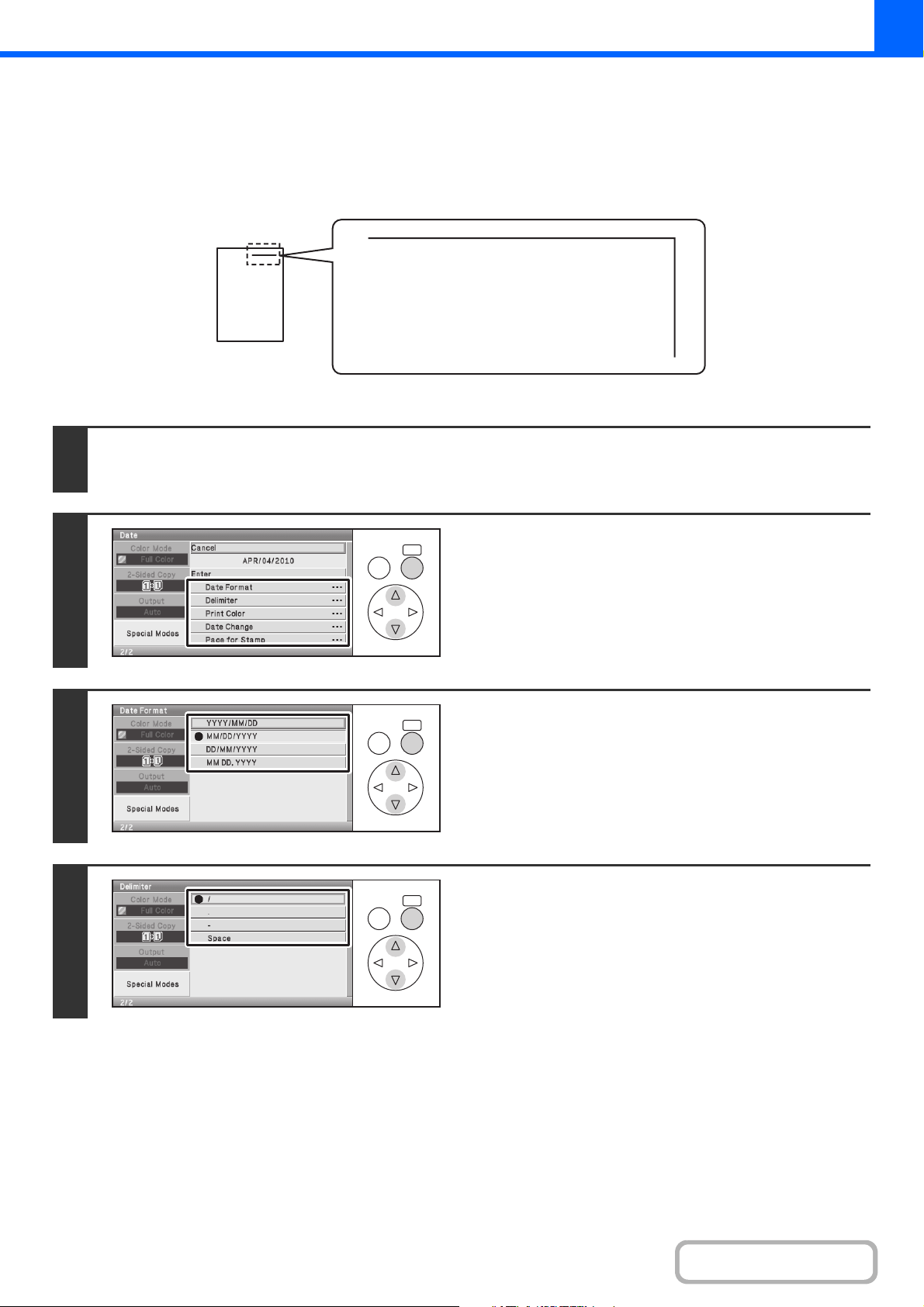
2-58
COPIER
Contents
ADDING THE DATE TO COPIES (Date)
The date can be printed on copies. The position of the date, color, format, and page (first page only or all pages) can be
selected.
Example: Printing APRIL 4, 2010 in the top right corner of the paper.
Keys in the display can be selected with the arrow keys and the [OK] key.
1
Select the [Date] key in the stamp selection screen.
See steps 1 to 4 of "GENERAL PROCEDURE FOR USING STAMP" (page 2-56).
2
Select Date.
Set date items details in steps 3 to 7.
3
Select the [Date Format] key and select
the key that shows the desired date
format.
4
Select the [Delimiter] key and select the
key that shows the desired delimiter.
If you selected [YYYY/MM/DD], [MM/DD/YYYY], or
[DD/MM/YYYY] in step 3, select the delimiter.
APR/04/2010
OKBACK
OKBACK
OKBACK
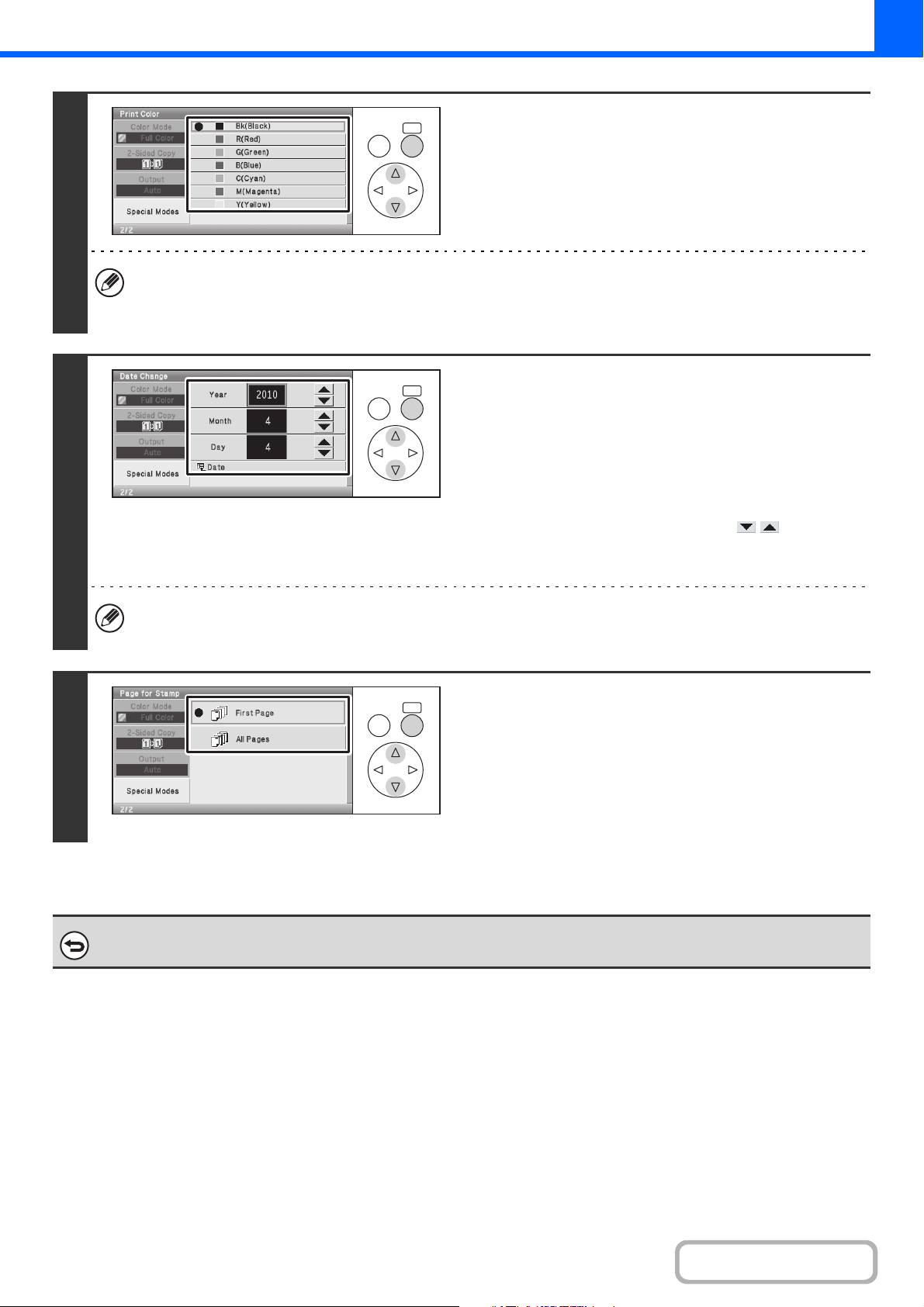
2-59
COPIER
Contents
5
Select the [Print Color] key and select
the print color.
Select the color that you wish to use.
• If you selected a color other than [Bk (Black)], press the [COLOR START] key. Pressing the [BLACK & WHITE
START] key will print the date in black and white.
• If the date is printed in color on a black and white copy, the copy will be included in the full color count.
6
Check the displayed date. If you need to
change the date, select the [Date
Change] key.
Select the number display and press the [OK] key. A number
entry screen will appear. Enter the desired number with the
numeric keys and select the [OK] key in the number entry
screen.
You can also change the number with the keys.
When you have finished selecting the settings, select the [Date]
key.
• If you select a date that does not exist (such as Feb. 30), the [Date] key will be grayed out to prevent entry.
• Changing the date here will not change the date that is set in the machine using "Clock" in the system settings.
7
Select the [Page for Stamp] key and
select the pages that the date will be
printed on.
Select printing on the first page only, or printing on all pages.
When you have finished selecting the settings, continue from
step 5 of "GENERAL PROCEDURE FOR USING STAMP"
(page 2-56) to complete the copy procedure.
To cancel the date print setting...
Select the [Cancel] key in the screen of step 2.
OKBACK
OKBACK
OKBACK
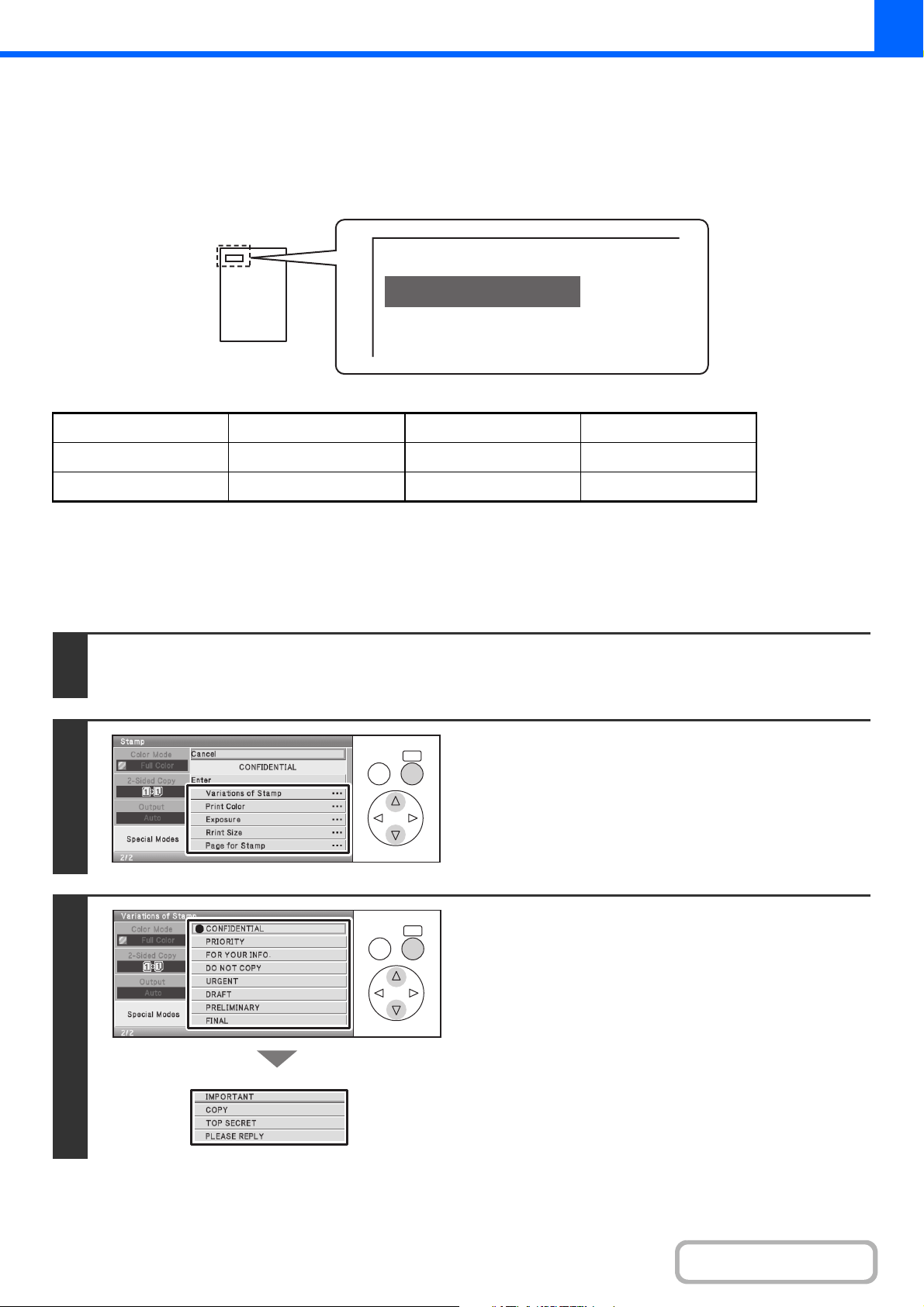
2-60
COPIER
Contents
STAMPING COPIES (Stamp)
Text such as "CONFIDENTIAL" can be printed in white on a dark background as a "stamp" on copies.
The position, color, size, density, and pages (first page only or all pages) can be selected for a stamp.
Printing "CONFIDENTIAL" in the top left corner of a copy
The following 12 selections are available for the stamp text.
Three levels can be selected for the density of the stamp background.
Seven colors can be selected for the stamp color.
Two stamp sizes can be selected.
Keys in the display can be selected with the arrow keys and the [OK] key.
CONFIDENTIAL PRIORITY PRELIMINARY FINAL
FOR YOUR INFO. DO NOT COPY IMPORTANT COPY
URGENT DRAFT TOP SECRET PLEASE REPLY
1
Select the [Stamp] key in the stamp selection screen.
See steps 1 to 4 of "GENERAL PROCEDURE FOR USING STAMP" (page 2-56).
2
Select Stamp.
Set stamp items details in steps 3 to 7.
3
Select the [Variations of Stamp] key and
select the key of the stamp that you wish
to use.
CONFIDENTIAL
OKBACK
OKBACK
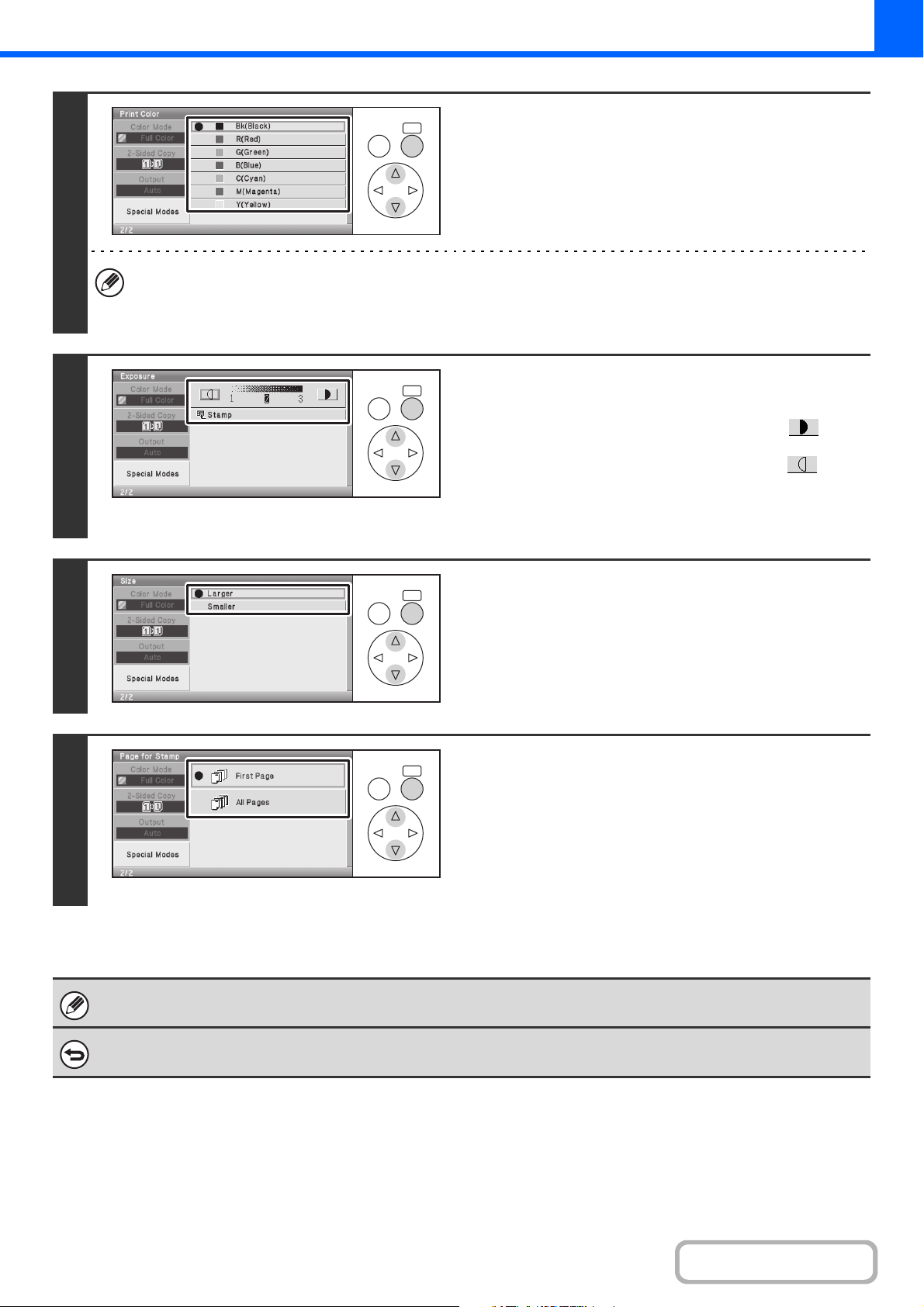
2-61
COPIER
Contents
4
Select the [Print Color] key and set the
color.
Select the color that you wish to use.
• If you selected a color other than [Bk (Black)], press the [COLOR START] key. Pressing the [BLACK & WHITE
START] key will print the stamp in black and white.
• If the stamp is printed in color on a black and white copy, the copy will be included in the full color count.
5
Select the [Exposure] key and set the
exposure.
If you wish to darken the selected color, select the key
and press the [OK] key.
If you wish to lighten the selected color, select the key
and press the [OK] key.
When you have finished selecting the settings, select the
[Stamp] key.
6
Select the [Print Size] key and select the
size of the stamp.
7
Select the [Page for Stamp] key and
select the pages that the stamp will be
printed on.
Select printing on the first page only, or printing on all pages.
When you have finished selecting the settings, continue from
step 5 of "GENERAL PROCEDURE FOR USING STAMP"
(page 2-56) to complete the copy procedure.
The stamp text cannot be edited.
To cancel a stamp setting...
Select the [Cancel] key in the screen of step 2.
OKBACK
OKBACK
OKBACK
OKBACK
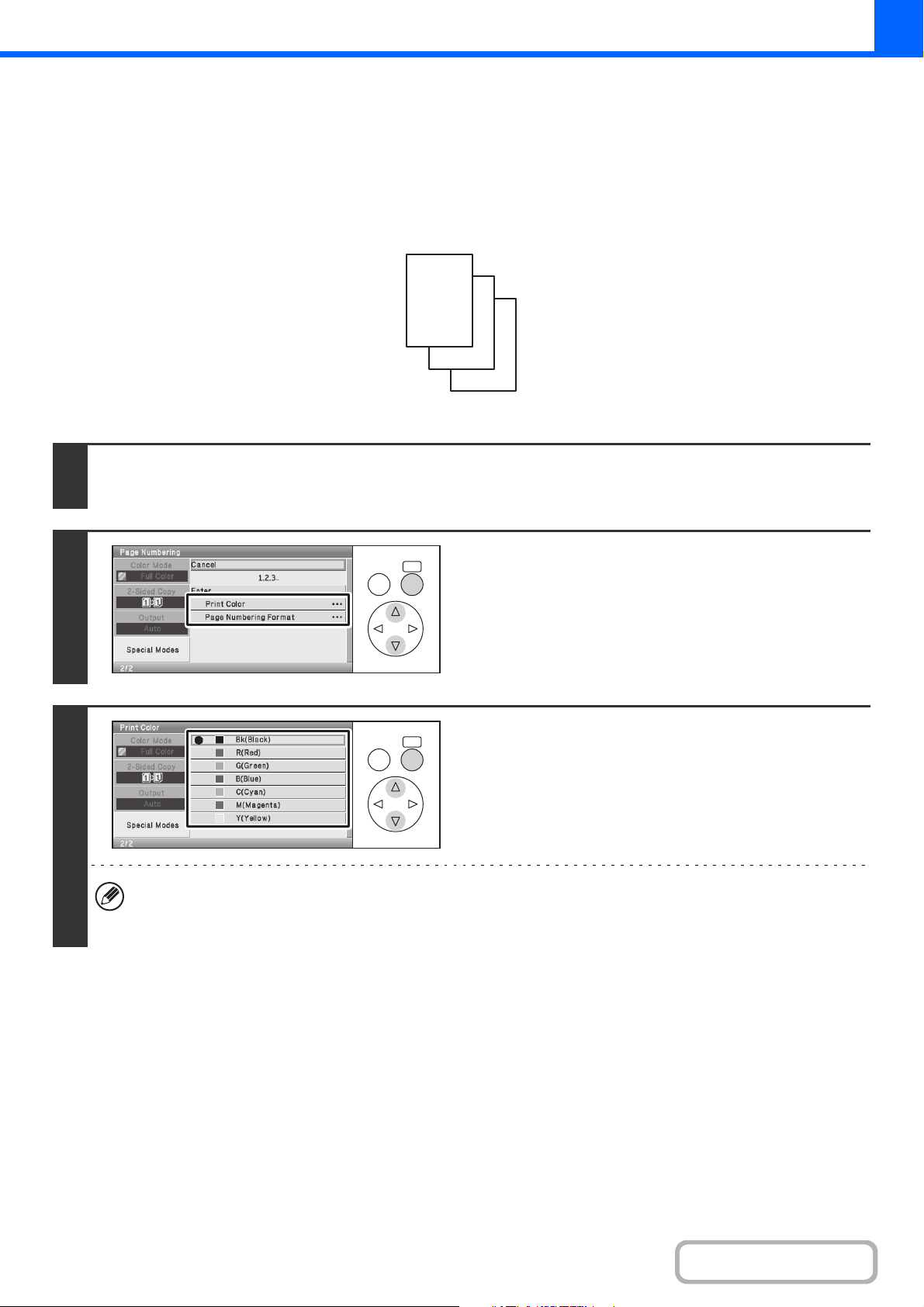
2-62
COPIER
Contents
PRINTING PAGE NUMBERS ON COPIES
(Page Numbering)
Page numbers can be printed on copies.
The position, color, format, and page number can be selected for page numbering.
Printing the page number at the bottom center of the paper.
Keys in the display can be selected with the arrow keys and the [OK] key.
1
Select the [Page Numbering] key in the stamp selection screen.
See steps 1 to 4 of "GENERAL PROCEDURE FOR USING STAMP" (page 2-56).
2
Select Page Numbering.
Set page numbering items details in steps 3 to 7.
3
Select the [Print Color] key and set the
color.
Select the color that you wish to use.
• If you selected a color other than [Bk (Black)], press the [COLOR START] key. Pressing the [BLACK & WHITE
START] key will print the page numbers in black and white.
• If page numbers are printed in color on black and white copies, the copies will be included in the full color count.
1
2
3
OKBACK
OKBACK
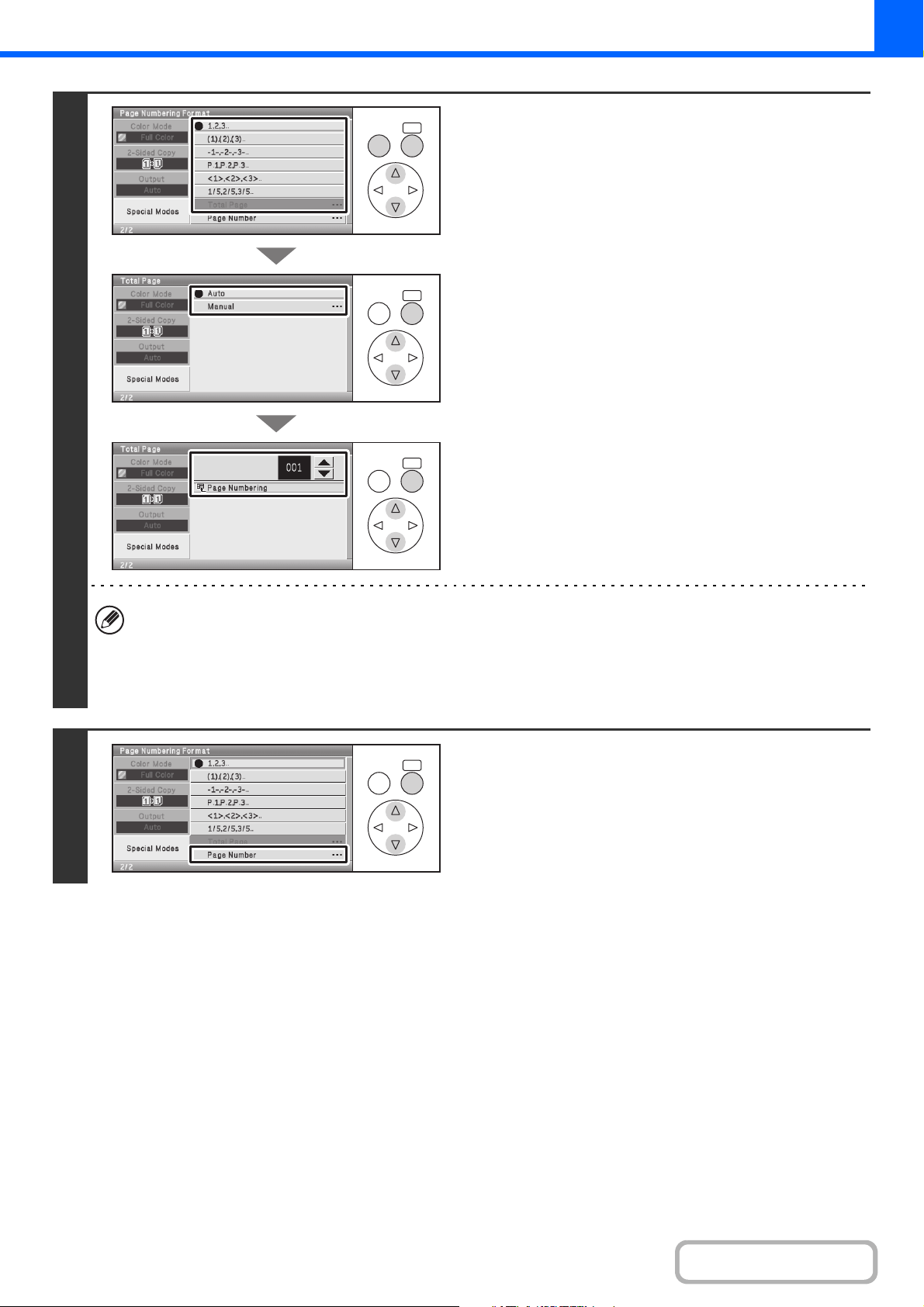
2-63
COPIER
Contents
4
Select the [Page Numbering Format] key
and select a format for the page number.
If the [1/5, 2/5, 3/5] key is selected,
"Page number / total pages" will be printed. "Auto" is initially
selected for the total pages, which means that the number of
scanned original pages is automatically set as the total pages.
If you need to set the total pages manually, such as when a
large number of originals are divided into sets for scanning,
select the [Manual] key to display the total pages screen.
Select the number display and press the [OK] key. A number
entry screen will appear. Enter the total pages (1 to 999) with
the numeric keys and select the [OK] key in the number entry
screen.
When you have finished selecting the settings, select the [Page
Numbering] key.
• When 2-sided copying is performed, the total pages is the total number of sides of the paper. If the final page is
blank, it is not counted.
• When used in combination with "2in1" or "Card Shot", the number of sides of the paper copied on is the total pages.
• When used in combination with "Pamphlet Copy", the total number of pages in the resulting pamphlet or booklet is
the total pages.
5
To configure page number settings,
select the [Page Number] key.
If you do not need to configure page number settings, go to
step 7.
OKBACK
OKBACK
OKBACK
OKBACK

2-64
COPIER
Contents
6
Select page number settings.
(1) Select the [Manual] key.
(2) Set the [Auto] checkbox to .
(3) Set the first number, the last number, and
the "Printing Starts from Page" number.
Select each number display and press the [OK] key. A
number entry screen will appear. Enter a number (1 to
999) with the numeric keys and select the [OK] key in the
number entry screen.
You can also change the number with the keys.
• A "Last Number" smaller than the "First Number" cannot be set.
• The "Last Number" is initially set to "Auto", which means that page numbers are automatically printed through the
last page based on the "First Number" and "Printing Start from Page" settings.
• If the "Last Number" is set to a number smaller than the "Total Pages", page numbers are not printed on pages after
the page set as the "Last Number".
• "Printing Starts from Page" is used to set the page number from which you want to begin printing page numbers.
For example, if "3" is set and 1-sided copying is being performed, page numbers will be printed beginning from the
3rd copy sheet (the 3rd original page). If 2-sided copying is being performed, page numbers will be printed
beginning from the front side of the 2nd copy sheet (the 3rd original page).
7
Select the [Page Numbering] key.
When you have finished selecting the settings, continue from
step 5 of "GENERAL PROCEDURE FOR USING STAMP"
(page 2-56) to complete the copy procedure.
OKBACK
OKBACK
(1)
(3)
(2) (3)
OKBACK
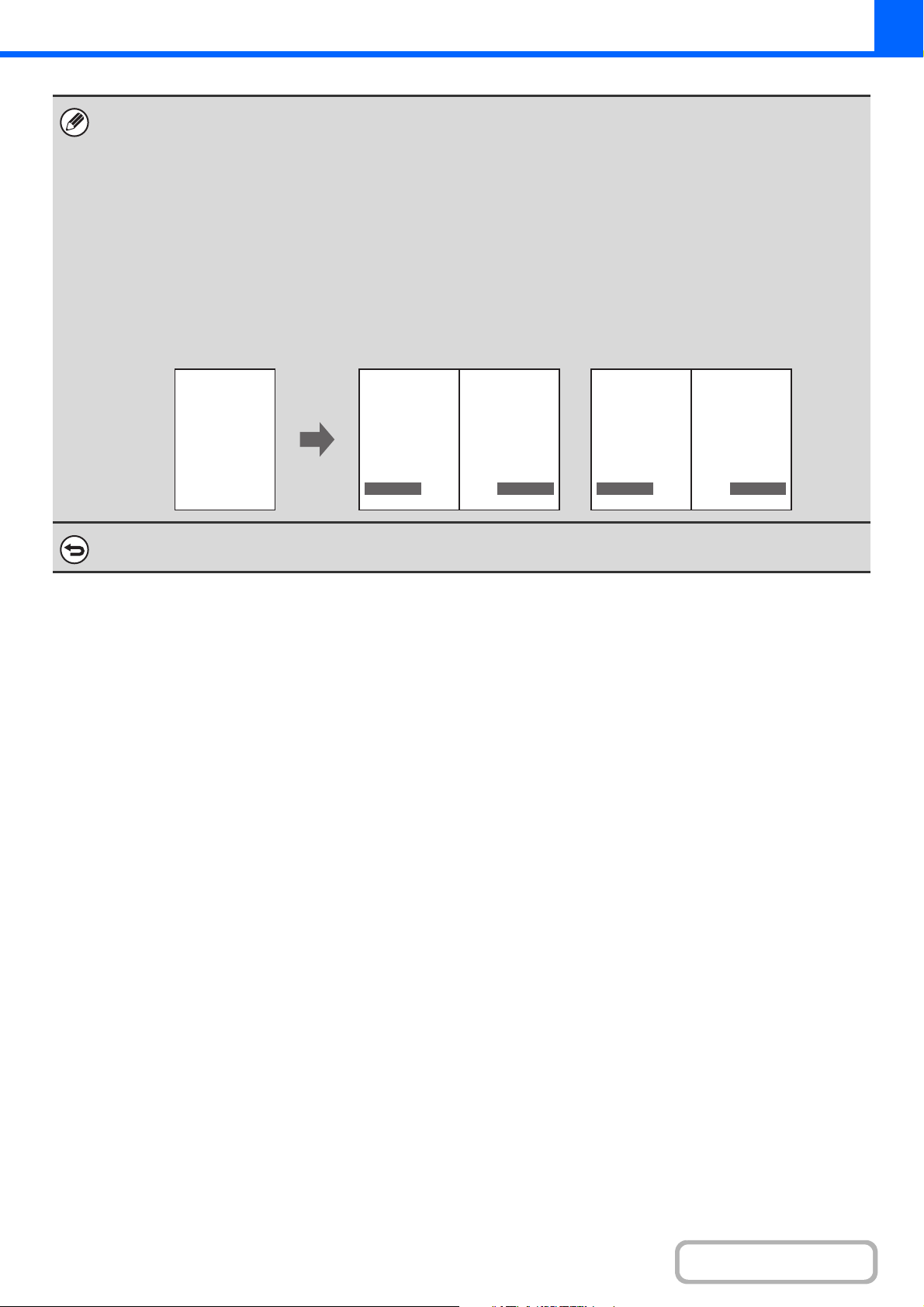
2-65
COPIER
Contents
• When Page Numbering is selected, copying in group mode is not possible. The mode automatically changes to sort mode.
• When the page number printing position is set to the right side or left side and pamphlet copy is used, the print position is
changed so that the page numbers always appear on the outer side of each opened page (the left and right sides of the
opened pages). If a stamp is set in the area where page numbering is set, the position of the stamp changes in the same
way as the page number.
If another stamp item is set in this changing position, the page numbers will alternate sides with this stamp item.
A stamp item that is in a position not affected by the changing page number position will be printed in its original set
position.
Example: When four pages are copied using pamphlet copy and the page number format is "1, 2, 3...", the result is as
follows:
In this example, the page number is set at the bottom of the page and the date is set at the top, and thus the
date does not move.
To cancel the page numbering setting...
Select the [Cancel] key in the screen of step 2.
Date
Text
Stamp
4
AAA AAA
12
AAA AAA
3No.
APR/04/2010 APR/04/2010 APR/04/2010 APR/04/2010
CONFIDENTIAL CONFIDENTIAL CONFIDENTIALCONFIDENTIAL
Print settings Side 1 Side 2
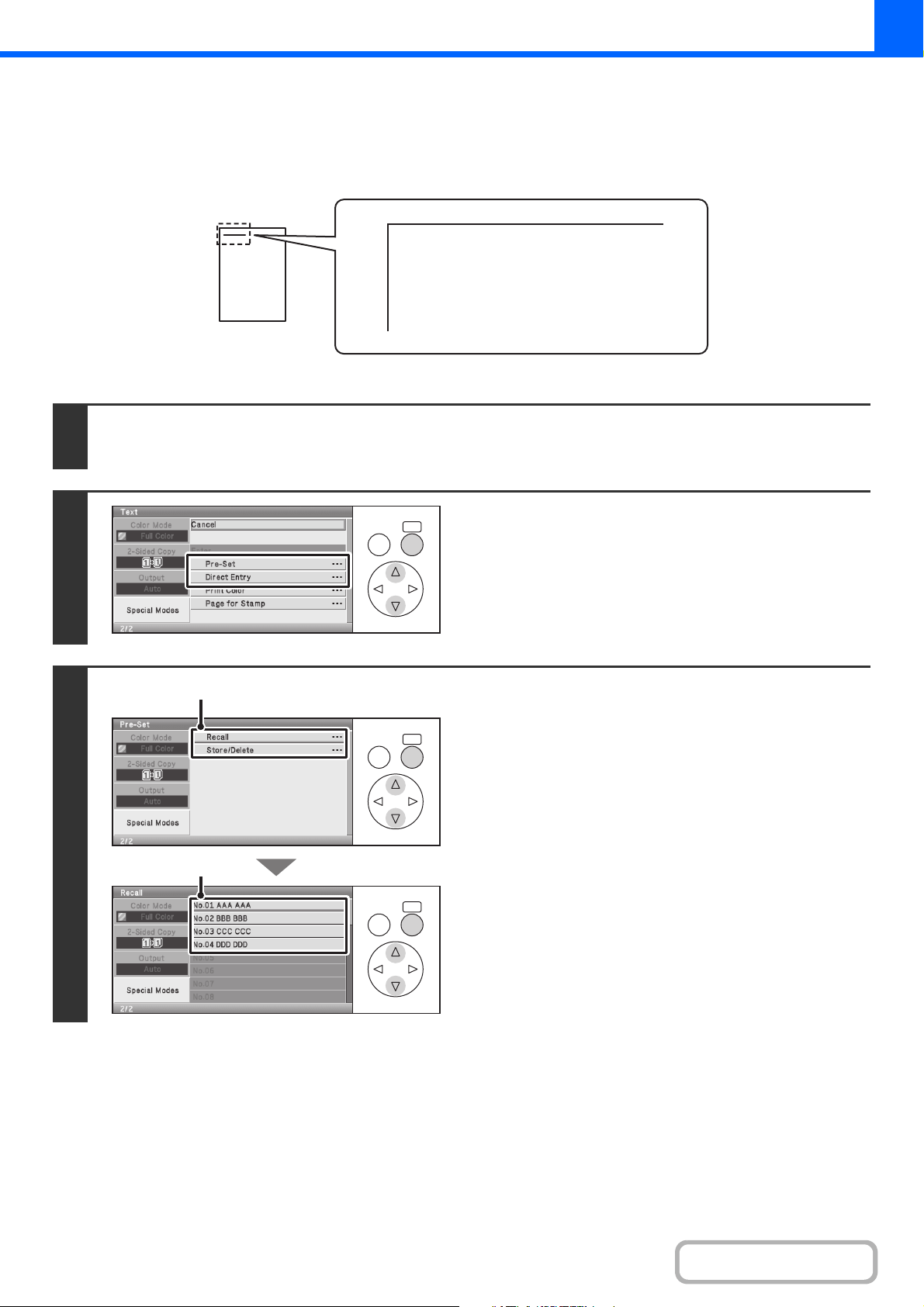
2-66
COPIER
Contents
PRINTING TEXT ON COPIES (Text)
Entered text can be printed on copies. Up to 30 frequently used text strings can be stored.
Example: Printing "April 2010 Planning Meeting" in the top left corner of the paper
Keys in the display can be selected with the arrow keys and the [OK] key.
1
Select the [Text] key in the stamp selection screen.
See steps 1 to 4 of "GENERAL PROCEDURE FOR USING STAMP" (page 2-56).
2
Select the [Pre-Set] key.
The [Direct Entry] key can be selected to display the text entry
screen. When all characters have been entered, select the [OK]
key.
3
Specify the text to be printed.
(1) Select the [Recall] key.
To store or delete a text string, select the [Store/Delete]
key.
☞Storing, editing, and deleting text strings (page 2-68)
(2) Select the text string that you wish to
select.
April 2010 Planning Meeting
OKBACK
OKBACK
OKBACK
(1)
(2)
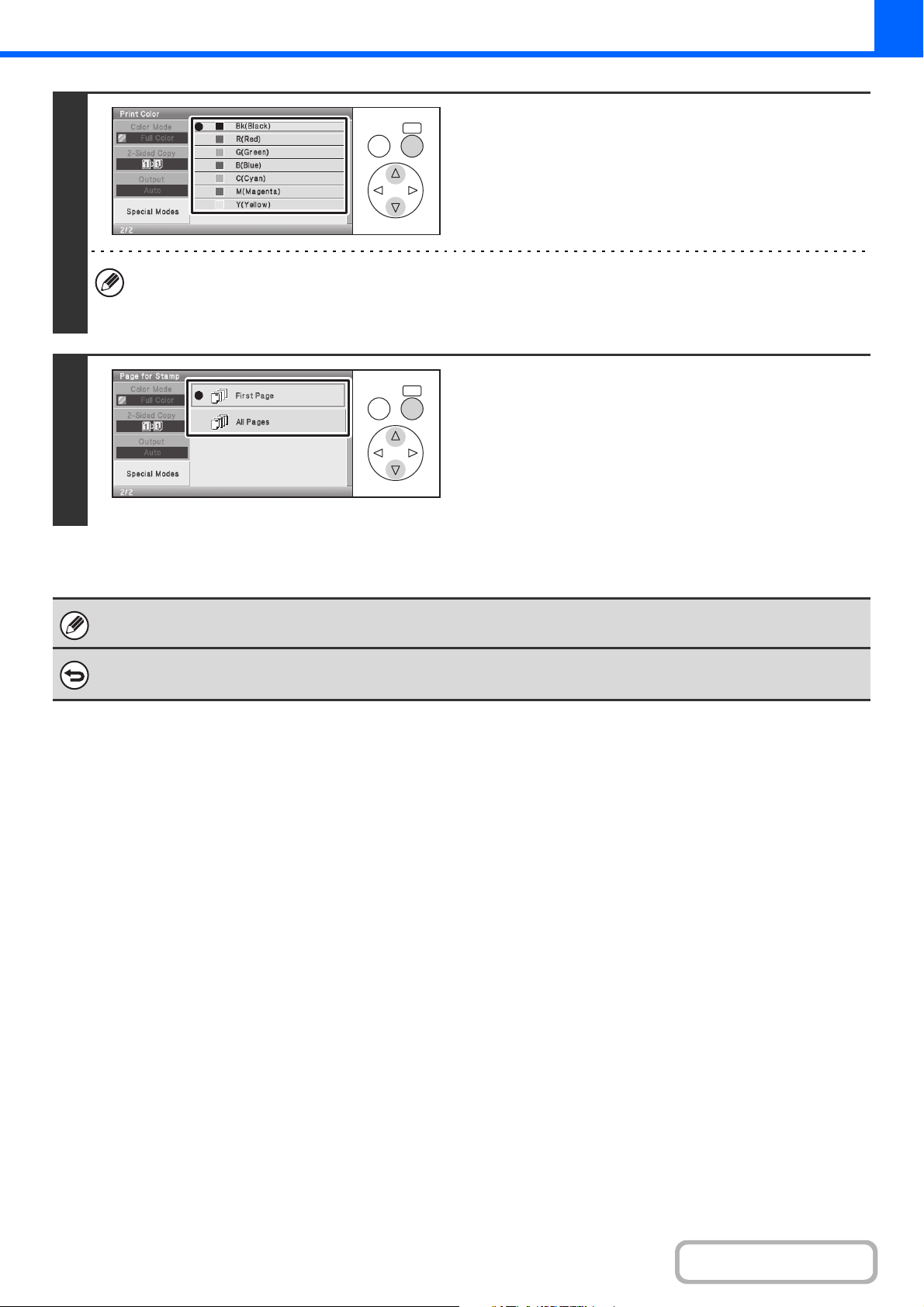
2-67
COPIER
Contents
4
Select the [Print Color] key and set the
color.
Select the color that you wish to use.
• If you selected a color other than [Bk (Black)], press the [COLOR START] key. Pressing the [BLACK & WHITE
START] key will print the page numbers in black and white.
• If the text is printed in color on a black and white copies, the copies will be included in the full color count.
5
Select the [Page for Stamp] key and
select the pages that the text will be
printed on.
Select printing on the first page only, or printing on all pages.
When you have finished selecting the settings, continue from
step 5 of "GENERAL PROCEDURE FOR USING STAMP"
(page 2-56) to complete the copy procedure.
Text settings can also be configured in the Web pages. Click [Application Settings], [Copy settings] and then [Text Settings
(Stamp)] in the Web page menu.
To cancel a text setting...
Select the [Cancel] key in the screen of step 2.
OKBACK
OKBACK
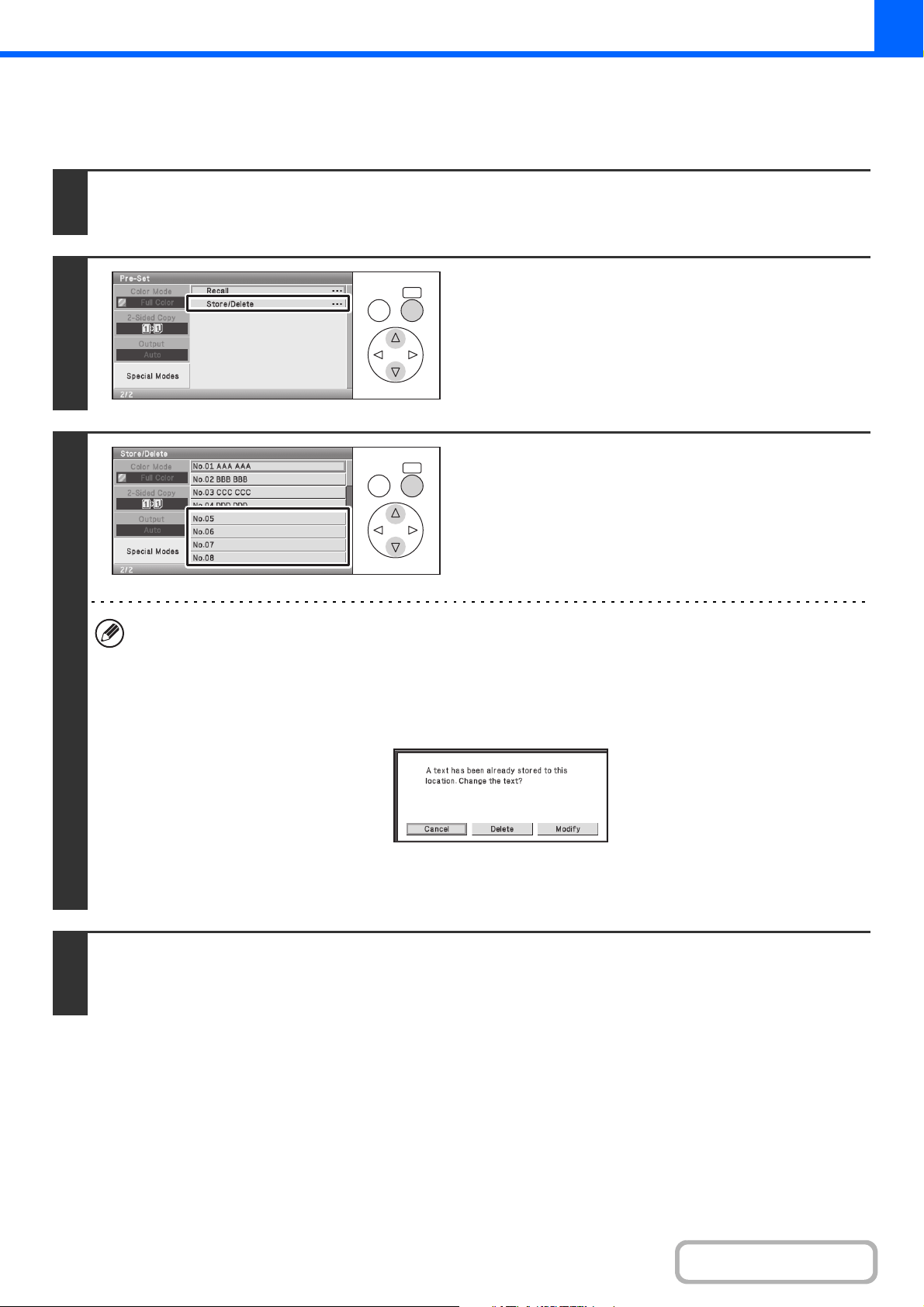
2-68
COPIER
Contents
Storing, editing, and deleting text strings
Keys in the display can be selected with the arrow keys and the [OK] key.
1
Select the [Text] key in the stamp selection screen.
See steps 1 to 4 of "GENERAL PROCEDURE FOR USING STAMP" (page 2-56).
2
Select the [Pre-Set] key and select the
[Store/Delete] key.
3
Store a text string, or edit/delete a stored
text string.
• To store a text string, select a key with no text stored.
A text entry screen will appear. A maximum of 50 characters
can be entered. When you have finished entering the text,
select the [OK] key. The text entry screen will close.
• To edit or delete a text string, follow the instructions below.
To edit or delete a text string...
• When the key with the text string is selected, the following screen appears.
When the [Modify] key is selected, a text entry screen appears. The stored text string appears in the text entry
screen. Edit the text. When you have finished entering the text, select the [OK] key. The text entry screen will close.
• When the [Delete] key is selected, the stored text is deleted.
• Text settings can also be configured in the Web pages. Click [Application Settings], [Copy settings] and then [Text
Settings (Stamp)] in the Web page menu.
4
Press the [BACK] key.
You will return to the screen of step 2.
To copy using a stored text string, continue from step 2 of "PRINTING TEXT ON COPIES (Text)" (page 2-66).
OKBACK
OKBACK
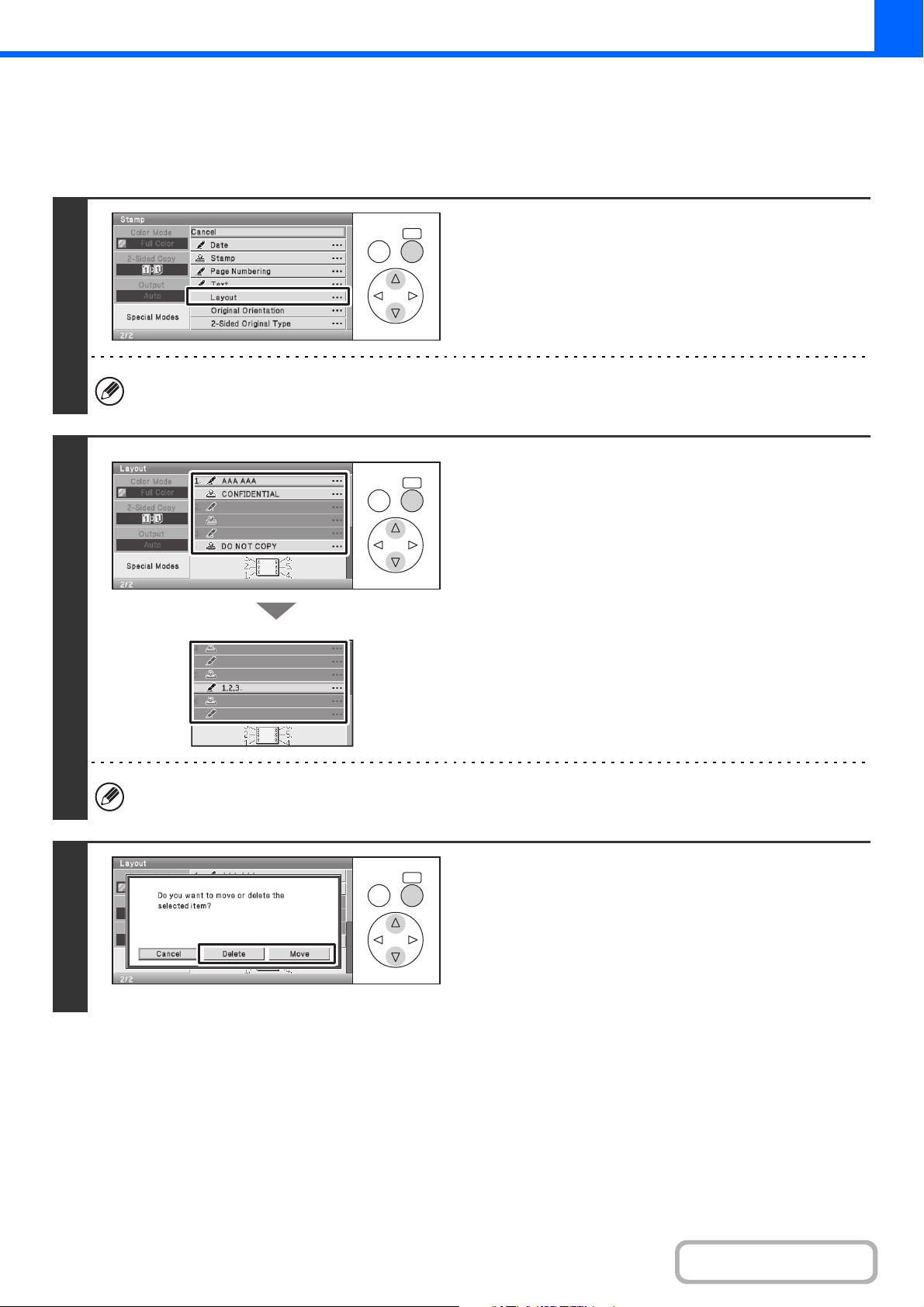
2-69
COPIER
Contents
CHECKING THE STAMP LAYOUT (Layout)
After stamp items have been selected, you can check the print layout, change the print position, and delete stamp items.
Keys in the display can be selected with the arrow keys and the [OK] key.
1
Select the [Layout] key.
The [Layout] key can only be selected when stamp items have been selected.
2
Check the layout.
(Example: When "Text" and "Stamp" at 1.Upper Left,
"Stamp" at 3.Upper Right, and "Page Numbering" at
5.Lower Center are set.)
If the layout is correct, go to step 5.
Select the key of the stamp item that you want to delete or
whose position you want to change.
A maximum of 14 characters appear in each key.
3
To change the position of the item,
select the [Move] key. To delete the item,
select the [Delete] key.
• If the [Move] key is selected, a screen for selecting the
destination position appears.
• If the [Delete] key is selected, the item is deleted. (Go to step
5.)
OKBACK
OKBACK
OKBACK
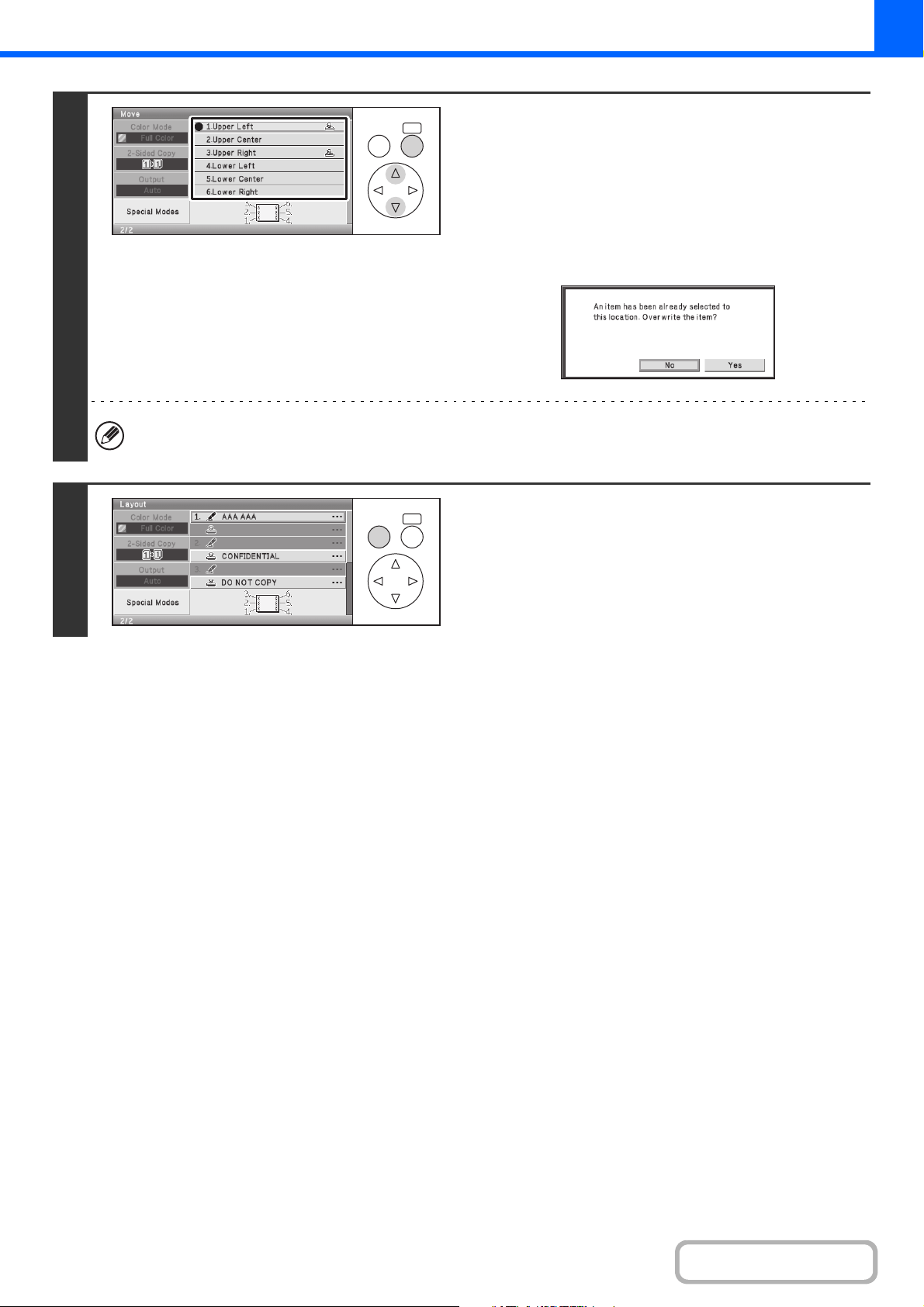
2-70
COPIER
Contents
4
Select the key of the desired destination
position.
The print position is changed.
If you attempt to move the stamp item to a position that is
already occupied by another stamp item, a message will
appear asking you if you wish to overwrite the other stamp
item. To overwrite the other stamp item, select the [Yes] key.
To cancel the move, select the [No] key.
If you wish to swap the position of the selected stamp item with the position of another stamp item, temporarily move
either one of the items to an unoccupied position and then switch the print positions.
5
Press the [BACK] key.
OKBACK
OKBACK
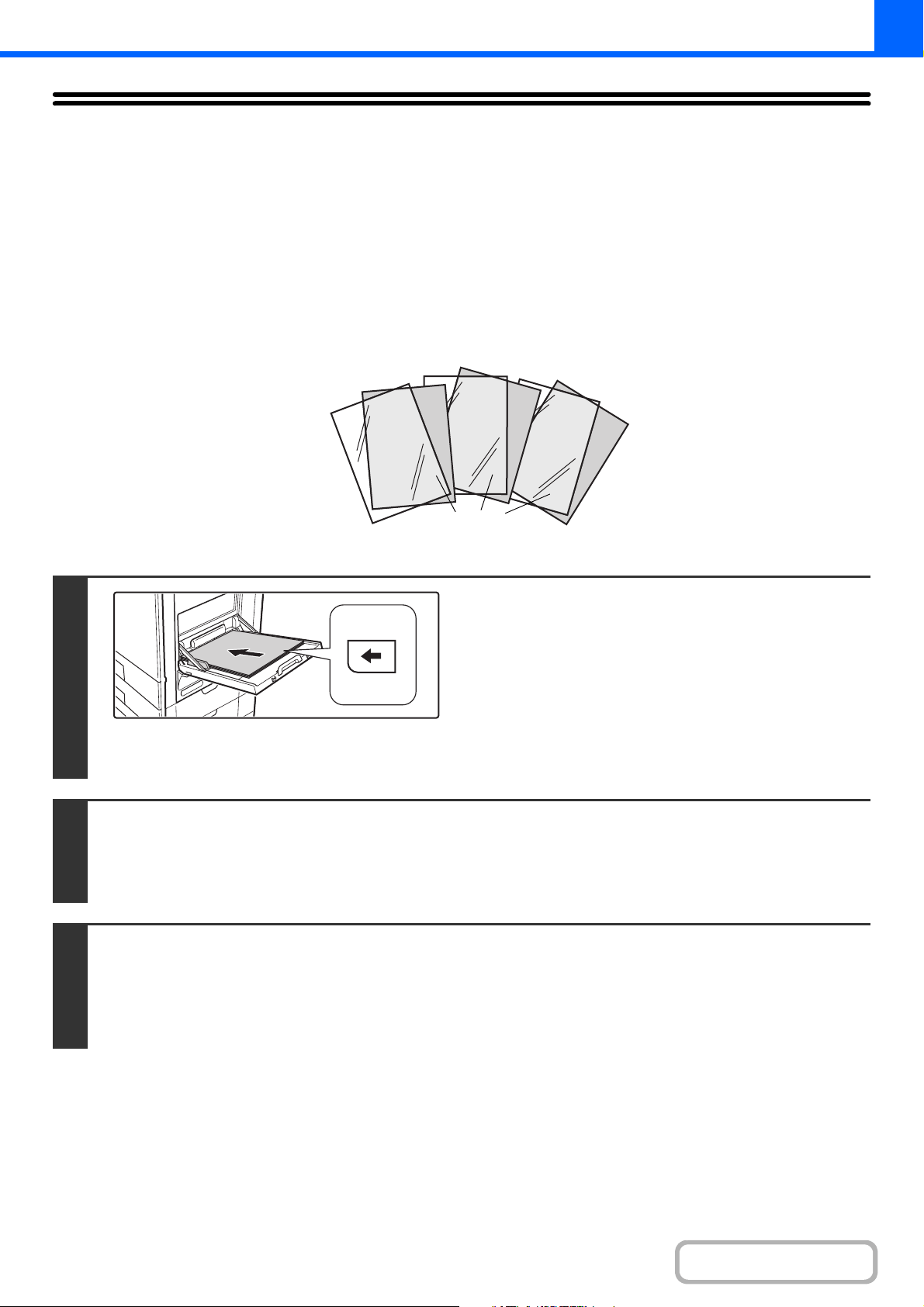
2-71
COPIER
Contents
ADDING INSERTS WHEN COPYING ON
TRANSPARENCY FILM
(Transparency Inserts)
When copying on transparency film, the sheets may stick together due to static electricity. The transparency inserts
function can be used to automatically insert a sheet of paper between each sheet of transparency film, making the
sheets easy to handle.
It is also possible to copy on the inserts.
Keys in the display can be selected with the arrow keys and the [OK] key.
1
Place the transparency film in the
bypass tray.
• Transparency film can only be placed in the bypass tray.
• Place the transparency film face down on the bypass tray.
When placing transparency film, place so that the rounded
corner of the film is to the front and left.
• After loading the transparency film, configure the bypass tray
settings as explained in "MAKING COPIES USING THE
BYPASS TRAY" (page 2-36).
2
Place the original.
Place the original face up in the document feeder tray, or face down on the document glass.
After placing the original, specify the original size.
☞ ORIGINAL SIZES (page 2-28)
3
Select the special modes.
(1) Select the [Special Modes] key.
(2) Select the [Transparency Inserts] key.
☞ Special modes menu (3rd screen) (page 2-40)
C
B
A
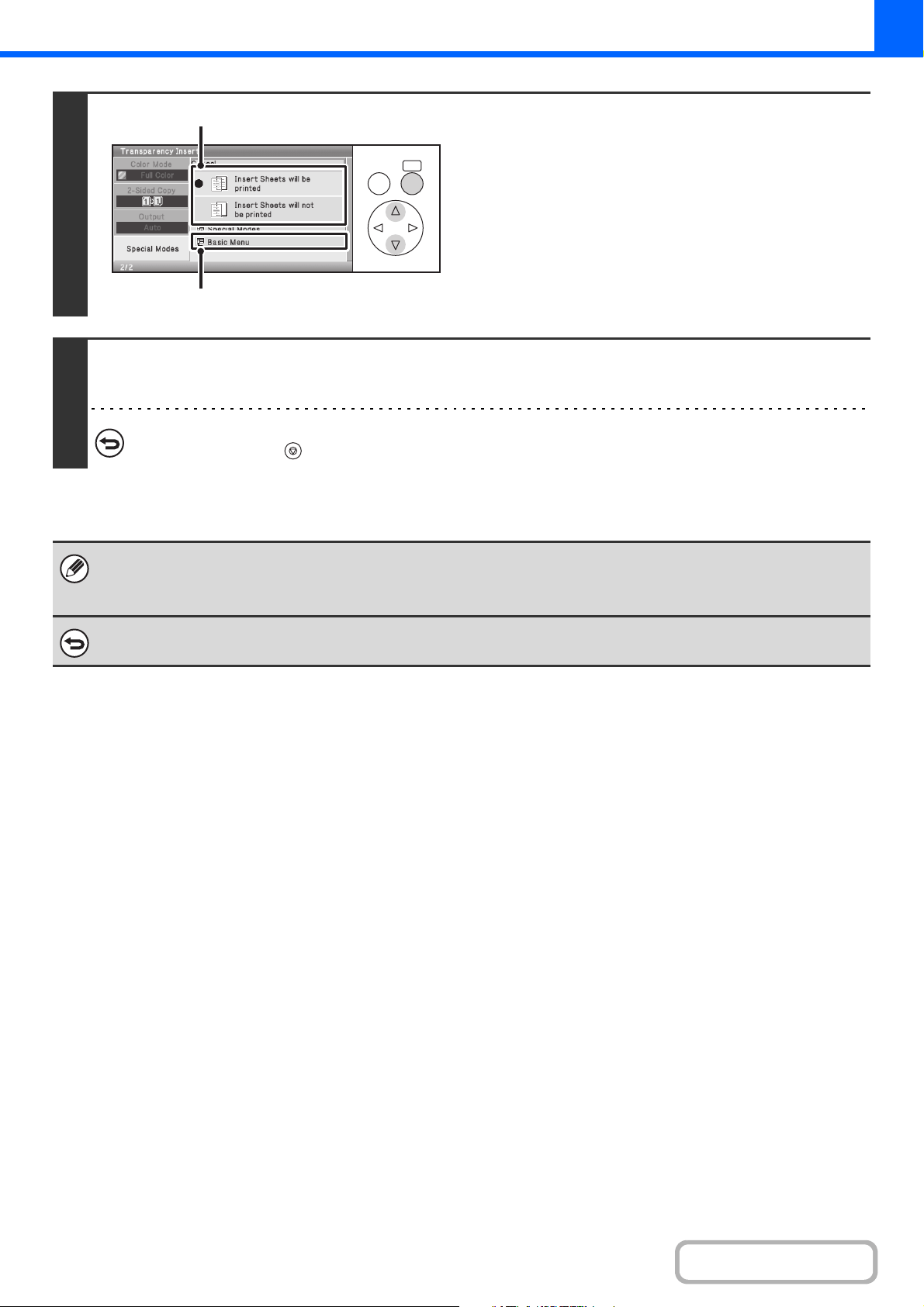
2-72
COPIER
Contents
4
Select insert settings.
(1) Select whether or not the insert paper will
be copied on.
Insert Sheets will be printed or Insert Sheets will not be
printed can be selected.
(2) Select the [Basic Menu] key.
You will return to the base screen of copy mode.
5
Press the [COLOR START] key or the [BLACK & WHITE START] key.
Copying will begin.
To cancel scanning and copying...
Press the [STOP] key ( ).
• When transparency inserts is selected, paper suitable for the inserts is automatically selected.
• The number of copies cannot be selected in this mode.
• When performing 2-sided copying, only "2-sided to 1-sided" mode can be used.
To cancel the transparency inserts setting...
Select the [Cancel] key in the screen of step 4.
OK
BACK
(1)
(2)
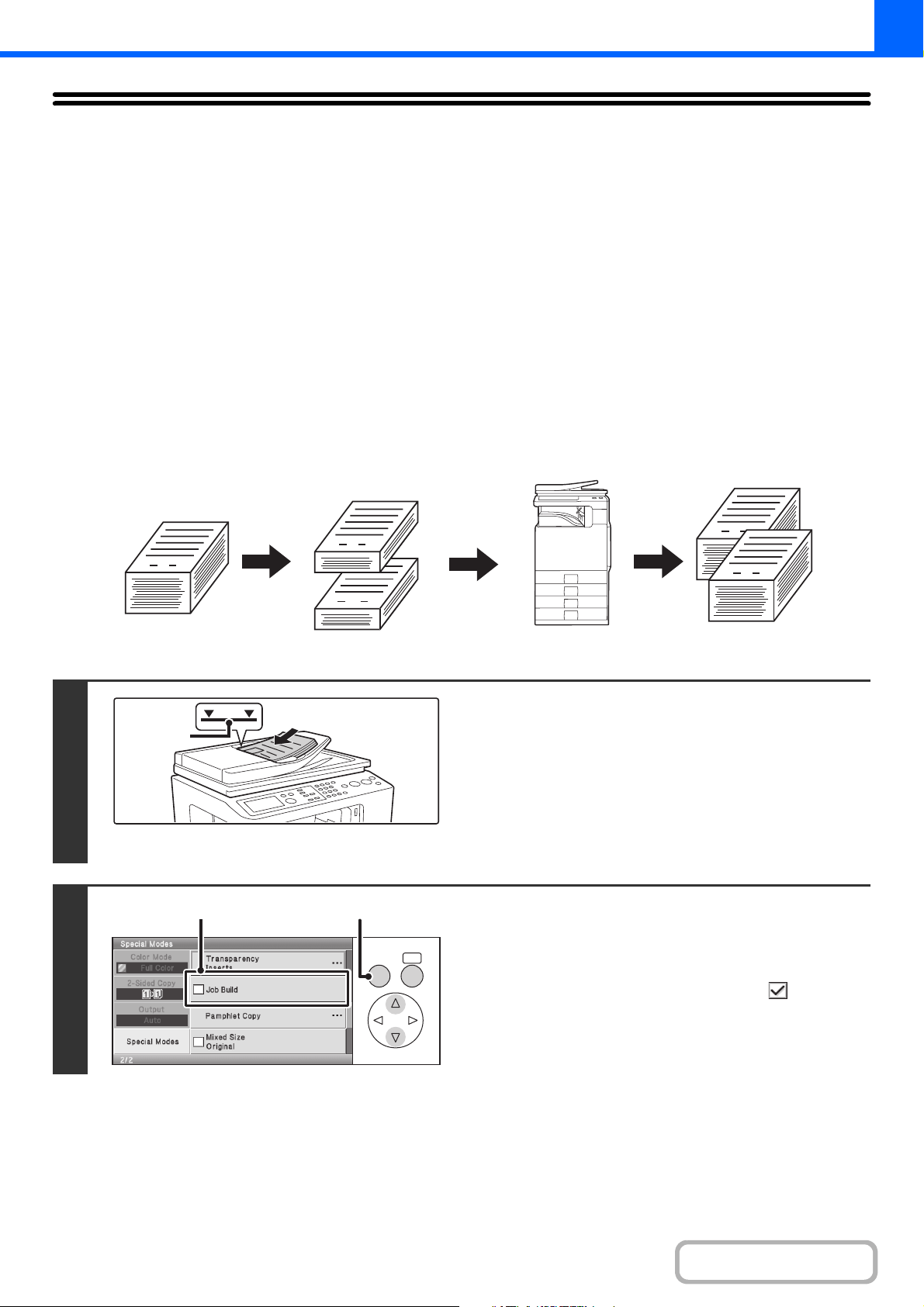
2-73
COPIER
Contents
COPYING A LARGE NUMBER OF
ORIGINALS AT ONCE (Job Build)
When copying a very large number of originals, this function allows you to divide the originals into sets and feed each
set through the automatic document feeder one set at a time.
Use this function when you wish to copy all of the originals as a single job but the number of originals exceeds the
maximum number that can be inserted.
This function is convenient when you wish to sort copies of a large number of originals into multiple sets. Because all
originals are copied as a single job, you are saved the trouble of sorting the copies that would be required if the originals
were divided into separate copy jobs.
When scanning originals in sets, divide the sheets so that no set has more than the number of paper that can be loaded,
and then scan from the set with the first page. The settings that you select for the first set can be used for all remaining
sets.
Sorting the copies of a large number of originals into 2 sets
Keys in the display can be selected with the arrow keys and the [OK] key.
1
Insert the originals face up in the
document feeder tray.
Insert the originals all the way into the document feeder tray.
Multiple originals can be placed in the document feeder tray.
The stack of originals must not be higher than the indicator line
on the tray.
After placing the original, specify the original size.
☞ ORIGINAL SIZES (page 2-28)
2
Select the special modes.
(1) Select the [Special Modes] key.
☞ Special modes menu (3rd screen) (page 2-40)
(2) Set the [Job Build] checkbox to .
(3) Press the [BACK] key.
You will return to the base screen of copy mode.
1
1
1
51
1
Originals
Originals are
scanned in
separate sets
Indicator
line
OKBACK
(3)(3)(2)
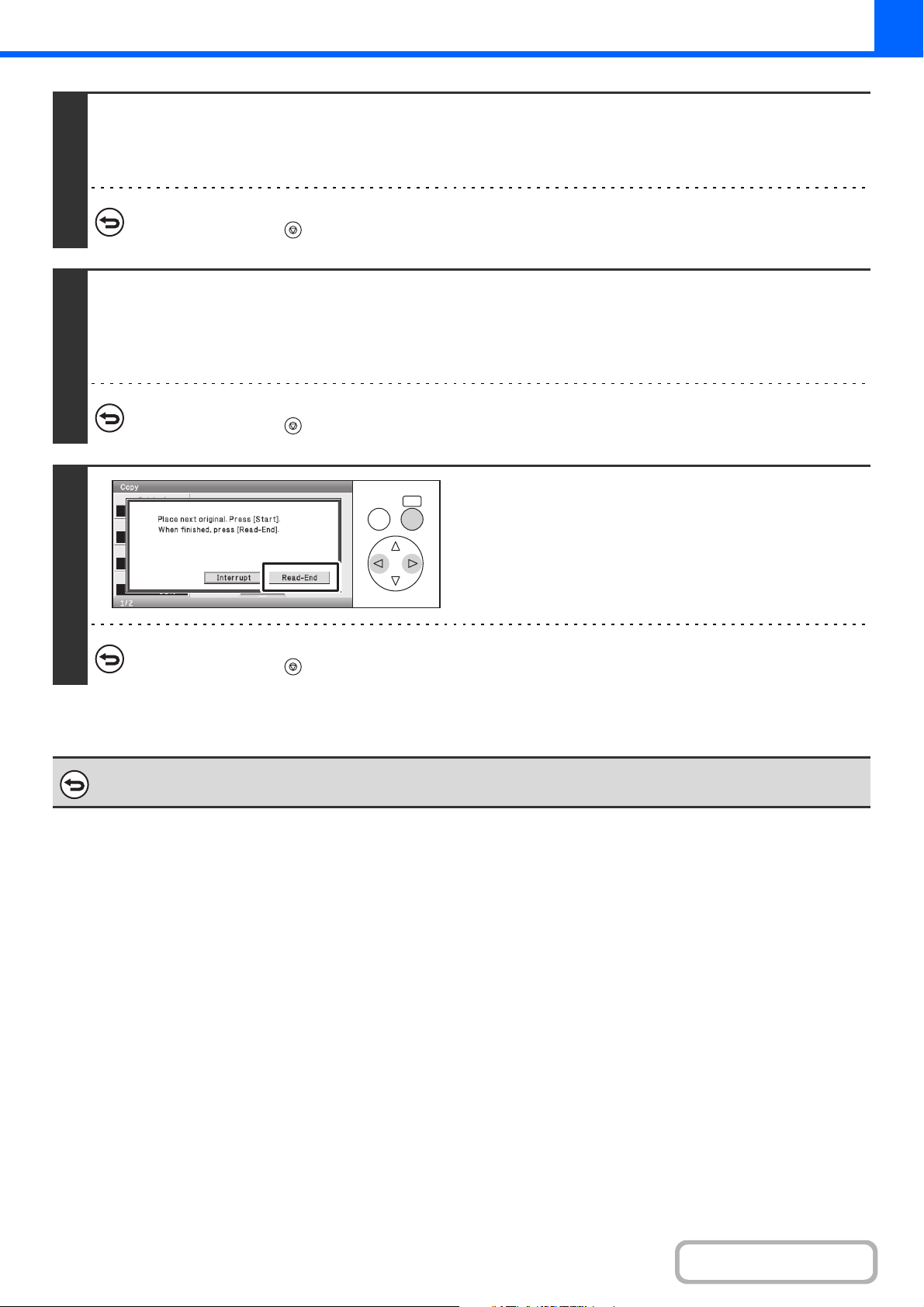
2-74
COPIER
Contents
3
Press the [COLOR START] key or the [BLACK & WHITE START] key to scan the
first set of originals.
Scanning begins.
To cancel scanning...
Press the [STOP] key ( ).
4
Insert the next set of originals and press the [COLOR START] key or the [BLACK
& WHITE START] key.
Repeat this step until all originals have been scanned.
For the second set and following sets, use the same [START] key as you did for the first set.
To cancel scanning...
Press the [STOP] key ( ). All scanned data will be cleared.
5
Select the [Read-End] key.
To cancel copying...
Press the [STOP] key ( ).
To cancel job build mode....
Select the [Job Build] key in the screen of step 2 so that it is not highlighted.
OKBACK
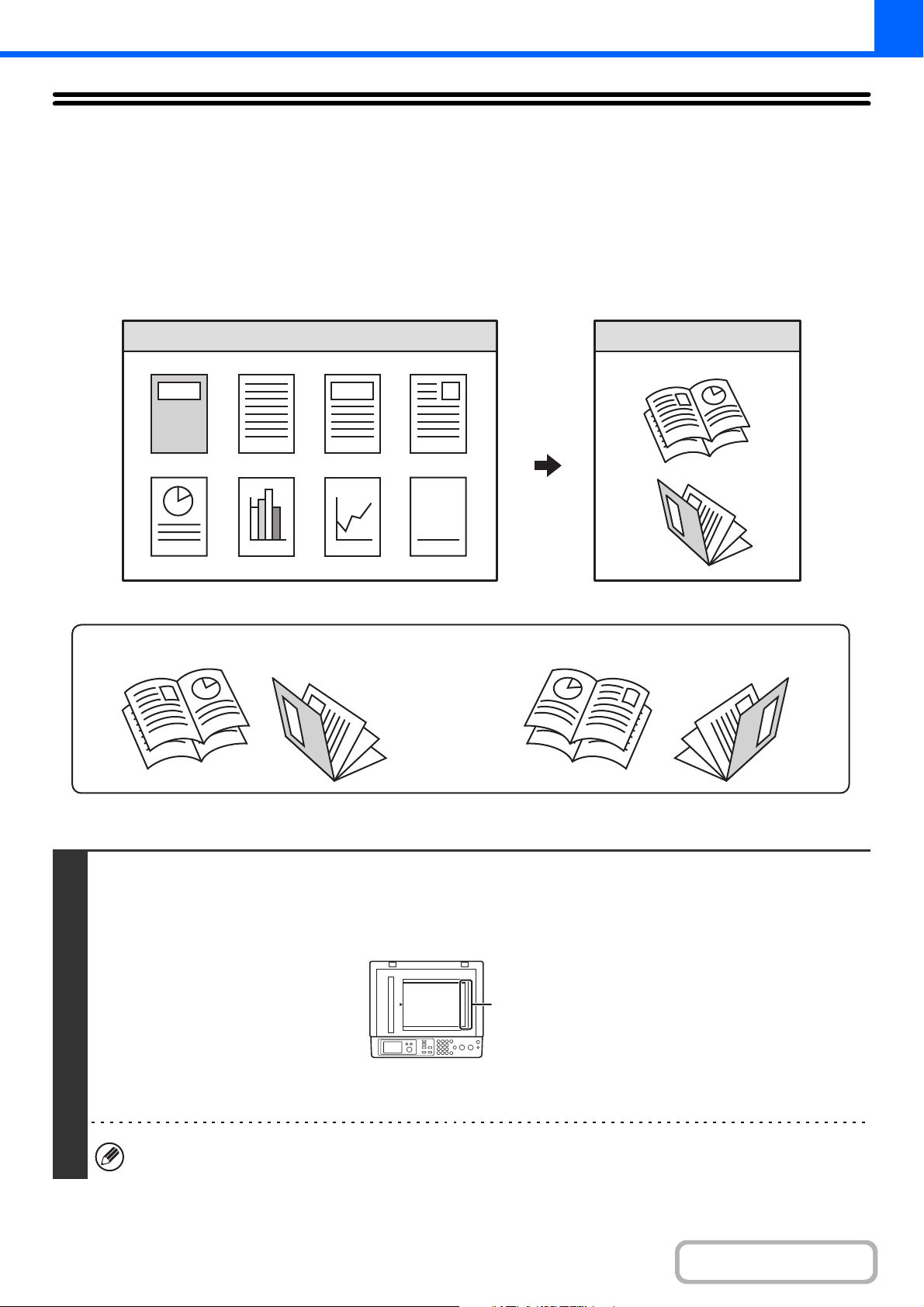
2-75
COPIER
Contents
MAKING COPIES IN PAMPHLET FORMAT
(Pamphlet Copy)
This function copies 2 original pages onto the front side and 2 original pages onto the reverse side of each sheet of
paper so that the copies can be folded at the centerline to form a pamphlet.
This function is convenient for arranging copies into an attractive booklet or pamphlet.
Pamphlet copy using 8 original pages
Keys in the display can be selected with the arrow keys and the [OK] key.
1
Place the original.
Place the original face up in the document feeder tray, or face down on the document glass.
When using this function with a portrait original on the document glass, place the original so that the top of the image is to the
right.
After placing the original, specify the original size.
☞ ORIGINAL SIZES (page 2-28)
If the originals are 2-sided, place them in the document feeder tray.
7
2
2 3 4
5 6 7
5
3
7
5
4
Originals
7
2
7
5
3
5
4
7
2
7
5
3
4
5
Left binding Right binding
In pamphlet form
1st page 2nd page 3rd page 4th page
5th page 6th page 7th page 8th page
Binding side
A
Top of image to
the right
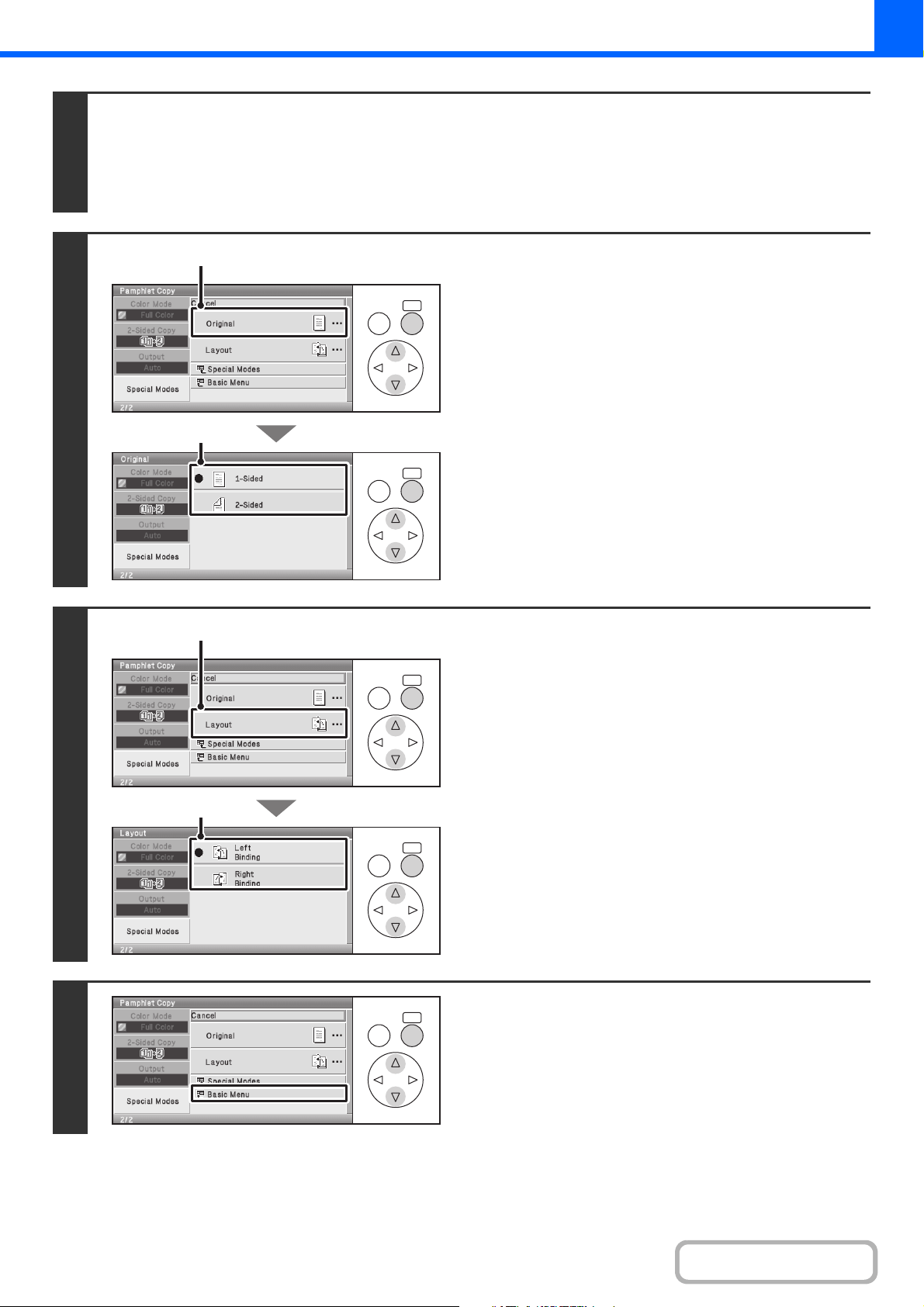
2-76
COPIER
Contents
2
Select the special modes.
(1) Select the [Special Modes] key.
(2) Select the [Pamphlet Copy] key.
☞ Special modes menu (3rd screen) (page 2-40)
3
Select pamphlet copy original settings.
(1) Select the [Original] key.
(2) If the original is 1-sided, select the [1-Sided]
key. If the original is 2-sided, select the
[2-Sided] key.
4
Select pamphlet copy layout settings.
(1) Select the [Layout] key.
(2) Select the binding edge.
Left Binding or Right Binding can be selected.
5
Select the [Basic Menu] key.
You will return to the base screen of copy mode.
OKBACK
OKBACK
(1)
(2)
OKBACK
OKBACK
(1)
(2)
OKBACK

2-77
COPIER
Contents
6
Press the [COLOR START] key or the [BLACK & WHITE START] key.
Copying will begin.
If you are using the document glass, change originals and press the [START] key. Repeat until all pages have been scanned
and then select the [Read-End] key. (For the second original and following originals, use the same [START] key as you
did for the first original.)
To cancel scanning of the original and copying...
Press the [STOP] key ( ).
• When the pamphlet copy function is selected, copying in group mode and staple sort mode is not possible.
• When the pamphlet copy function is selected, 2-sided copying mode is automatically selected. When settings are selected
that prevent 2-sided copying, the pamphlet copy function cannot be used.
• Scan the originals in order from the first page to the last page. The order of copying will be automatically adjusted by the
machine. Four original pages will be copied onto each sheet of paper. Blank pages will be automatically produced at the
end if the number of original pages is not a multiple of four.
• To make landscape originals into a pamphlet with a tablet binding ...
Place the originals in the indicated orientation and select [Right Binding] in (2) of step 4.
To cancel pamphlet copy...
Select the [Cancel] key in the screen of step 3.
abc
abc
jkl
ghi
def
abc
def
ghi
Originals
Document
feeder tray
Document glass
Result
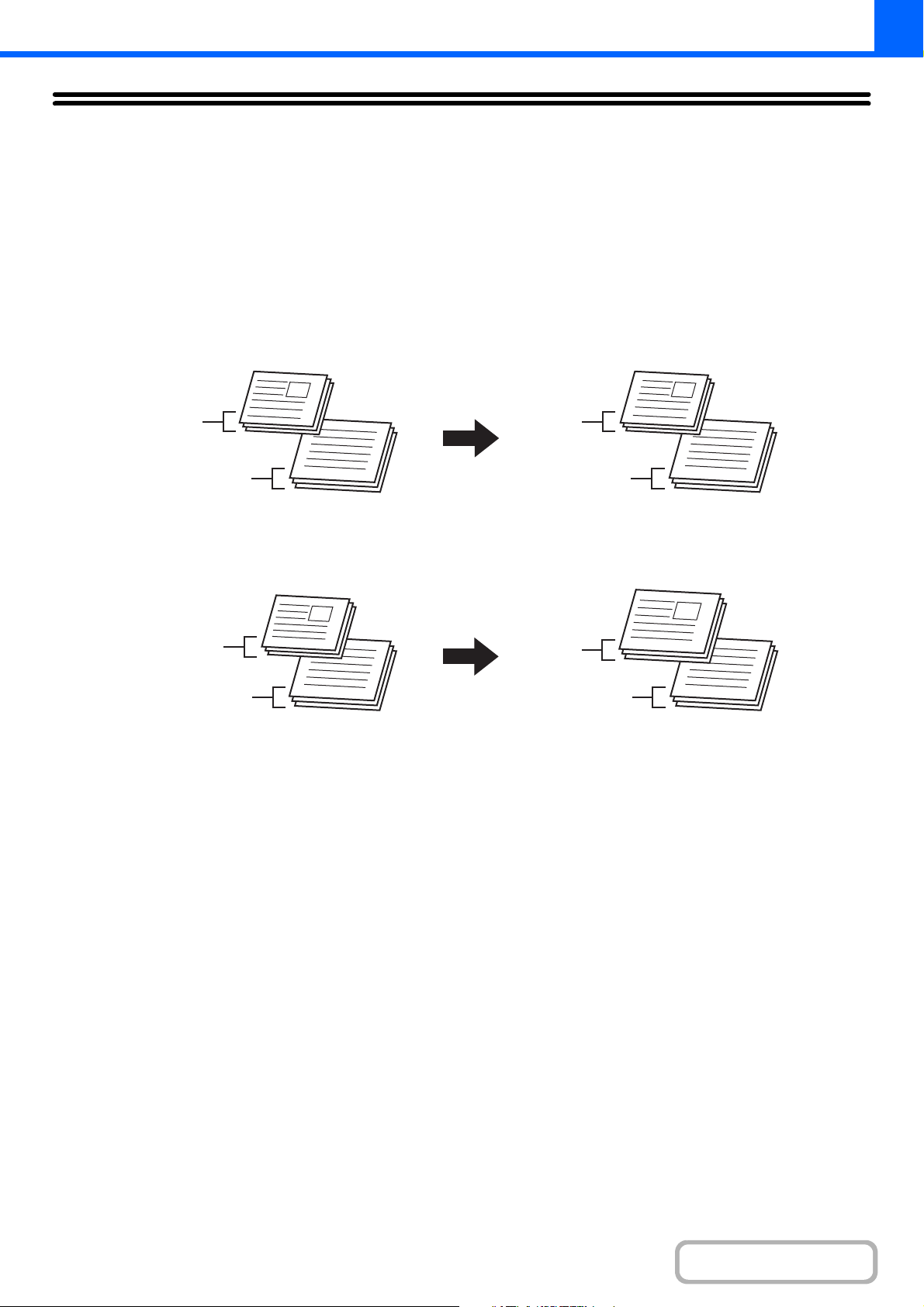
2-78
COPIER
Contents
COPYING ORIGINALS OF DIFFERENT SIZES
(Mixed Size Original)
Originals that are 8-1/2" x 14" size and 8-1/2" x 11" size, 8-1/2" x 11" size and 5-1/2" x 8-1/2" size (A4 size and A5 size)
can be placed together in the automatic document feeder and copied. When scanning the originals, the machine
automatically detects the size of each original and uses paper appropriate for that size.
When mixed size original is combined with auto ratio selection, the ratio is adjusted individually for each original according
to the selected paper size, enabling output on a uniform paper size.
For mixed originals, the only combination of sizes that can be used is 8-1/2" x 11" and 8-1/2" x 14", or 5-1/2" x 8-1/2" and
8-1/2" x 11" (A5 and A4).
When mixed size original is combined with auto ratio selection
(Auto ratio selection and 8-1/2" x 14", 8-1/2" x 11" (A4) are selected)
Originals
Copies
8-1/2" x 14"
8-1/2" x 11"
8-1/2" x 11"
8-1/2" x 14"
Originals
Copies
An 8-1/2" x 11", 5-1/2" x 8-1/2" (
A
5) size
original will be enlarged to 8-1/2" x 14",
8-1/2" x 11" (A4) size.
8-1/2" x 14"
8-1/2" x 11"
8-1/2" x 14"
8-1/2" x 14"
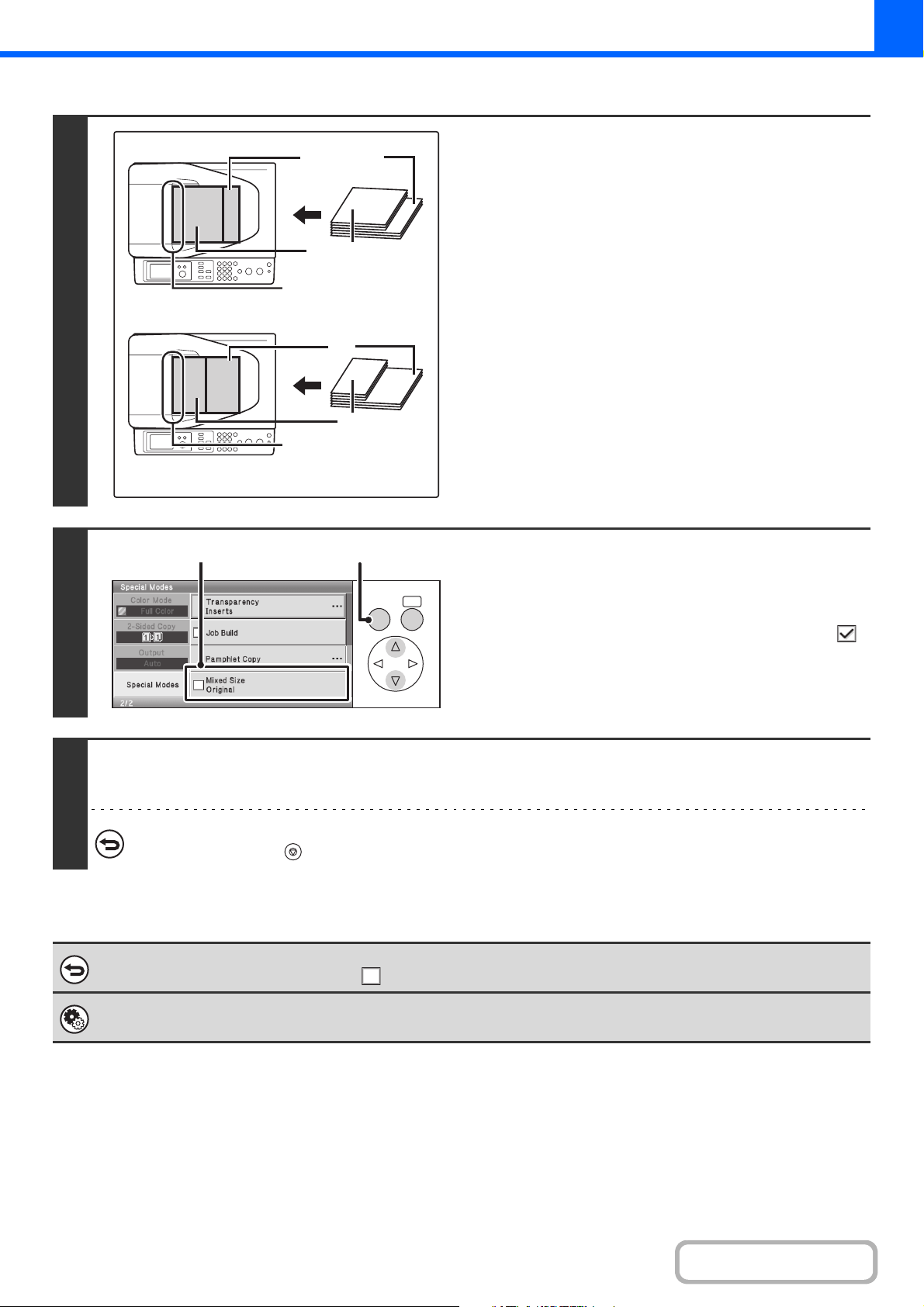
2-79
COPIER
Contents
Keys in the display can be selected with the arrow keys and the [OK] key.
1
Insert the originals face up in the
document feeder tray.
Place the originals with the sides that are the same length
aligned on the left.
2
Select the special modes.
(1) Select the [Special Modes] key.
☞ Special modes menu (3rd screen) (page 2-40)
(2)
Set the [Mixed Size Original] checkbox to .
(3) Press the [BACK] key.
You will return to the base screen of copy mode.
3
Press the [COLOR START] key or the [BLACK & WHITE START] key.
Copying will begin.
To cancel scanning and copying...
Press the [STOP] key ( ).
To cancel the mixed size original setting...
Set the [Mixed Size Original] checkbox to in the screen of step 2.
System Settings (Administrator): Original Feeding Mode (Web page only)
The original feeding mode can be set to always scan mixed size originals.
8-1/2" x 14"
(8-1/2" x 11")
8-1/2" x 11"
(5-1/2" x 8-1/2")
A4
A5
Place with the sides that
are the same length
aligned on the left.
Place with the sides that
are the same length
aligned on the left.
Inch
AB
OKBACK
(3)(3)(2)
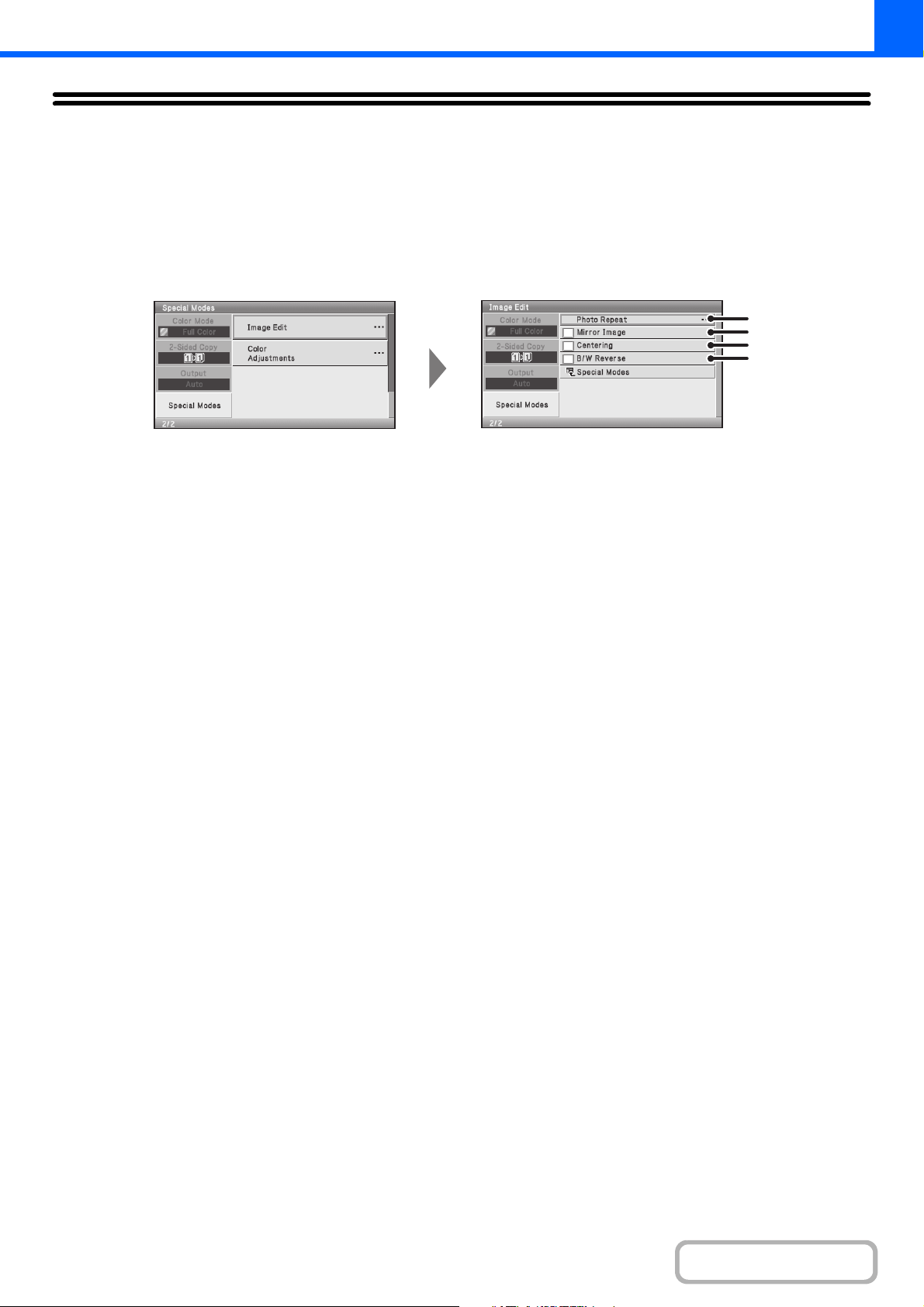
2-80
COPIER
Contents
[Image Edit] KEY
When the [Image Edit] key is selected in the 4th special modes menu screen, the image edit menu screen opens.
Image edit menu screen
(1) [Photo Repeat] key
☞ REPEATING PHOTOS ON A COPY (Photo Repeat)
(page 2-81)
(2) [Mirror Image] checkbox
☞ REVERSING THE IMAGE (Mirror Image) (page
2-83)
(3) [Centering] checkbox
☞ COPYING IN THE CENTER OF THE PAPER
(Centering) (page 2-84)
(4) [B/W Reverse] checkbox
☞ REVERSING BLACK AND WHITE IN A COPY (B/W
Reverse) (page 2-86)
(1)
(2)
(3)
(4)
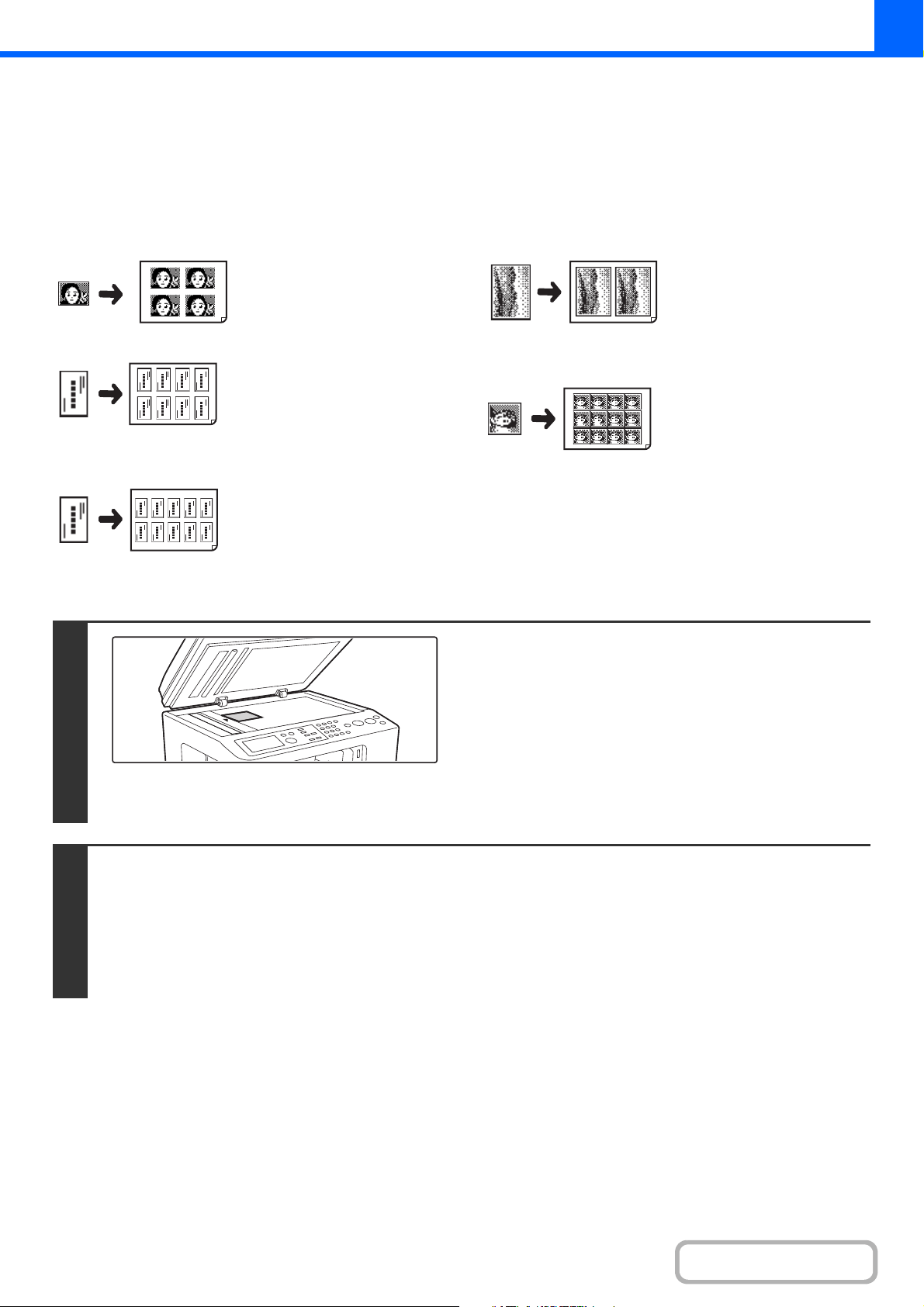
2-81
COPIER
Contents
REPEATING PHOTOS ON A COPY (Photo Repeat)
Photo Repeat is used to create repeated images of a photo-size original (3" x 5" size, 5" x 7" size, 2-1/2" x 4" size,
2-1/2" x 2-1/2" size or 2-1/8" x 2-5/8" size (130 mm x 90 mm size, 100 mm x 150 mm size, 70 mm x 100 mm size,
65 mm x 70 mm size or 57 mm x 100 mm size)) on a single sheet of copy paper as shown below. Up to 12 images
(when the image is 2-1/2" x 2-1/2" size (65 mm x 70 mm size)) can be repeated on a single sheet of paper.
• Original sizes up to 3" x 5" (130 mm x 90 mm)
• Original sizes up to 2-1/2" x 4" (70 mm x 100 mm)
• Original sizes up to 2-1/8" x 2-5/8"
(57mmx100mm)
• Original sizes up to 5" x 7" (100 mm x 150 mm)
• Original sizes up to 2-1/2" x 2-1/2"
(65 mm x 70 mm)
Keys in the display can be selected with the arrow keys and the [OK] key.
Copying on 8-1/2" x 11" (A4)
size paper
4 copies are made.
Copying on 8-1/2" x 11" (A4)
size paper
8 copies are made.
Copying on 8-1/2" x 11" (A4)
size paper (Ratio 95%)
10 copies are made.
Copying on 8-1/2" x 11" (A4)
size paper
2 copies are made.
Copying on 8-1/2" x 11" (A4)
size paper
12 copies are made.
1
Place the original face down on the
document glass.
• When placing a 3" x 5" or 2-1/2" x 2-1/2" (130 mm x 90 mm
or 65 mm x 70 mm) photo size original, place the original
with the short side aligned against the left side of the
document glass.
• When placing a 5" x 7" (100 mm x 150 mm) or business card
size original, place with the longest side aligned against the
left side of the document glass.
2
Select the special modes.
(1) Select the [Special Modes] key.
(2) Select the [Image Edit] key.
(3) Select the [Photo Repeat] key.
☞ [Image Edit] KEY (page 2-80)
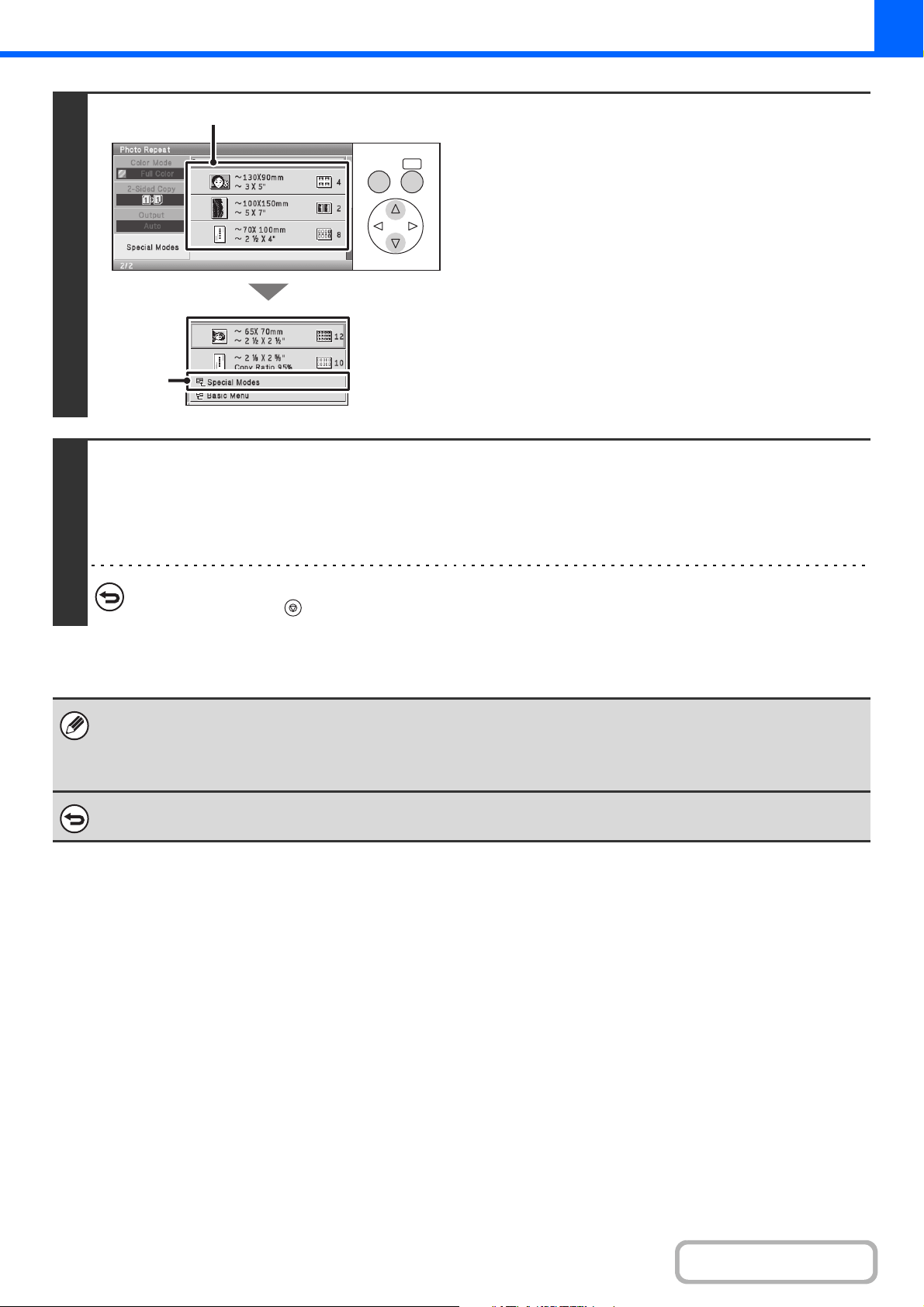
2-82
COPIER
Contents
3
Select Photo Repeat settings.
(1) Select the key showing the original type.
Select the desired repeat type key.
(2) Select the [Special Modes] key.
You will return to the special modes screen. Press the
[BACK] key to return to the base screen of copy mode.
4
Press the [COLOR START] key or the [BLACK & WHITE START] key.
Copying will begin.
If you have selected sort mode, change originals and press the [START] key. Repeat until all pages have been scanned and
then select the [Read-End] key. (For the second original and following originals, use the same [START] key as you did
for the first original.)
To cancel scanning and copying...
Press the [STOP] key ( ).
• The original must be placed on the document glass.
• Only 8-1/2" x 11" (A4) size paper can be used.
• The copy ratio is 100% when this function is used. (The ratio cannot be changed.) However, for a business card size
original (up to 2-1/8" x 2-5/8" (57 mm x100 mm)), the images are reduced to 95%.
To cancel the photo repeat setting...
Select the [Cancel] key in the screen of step 3.
OKBACK
(2)
(1)
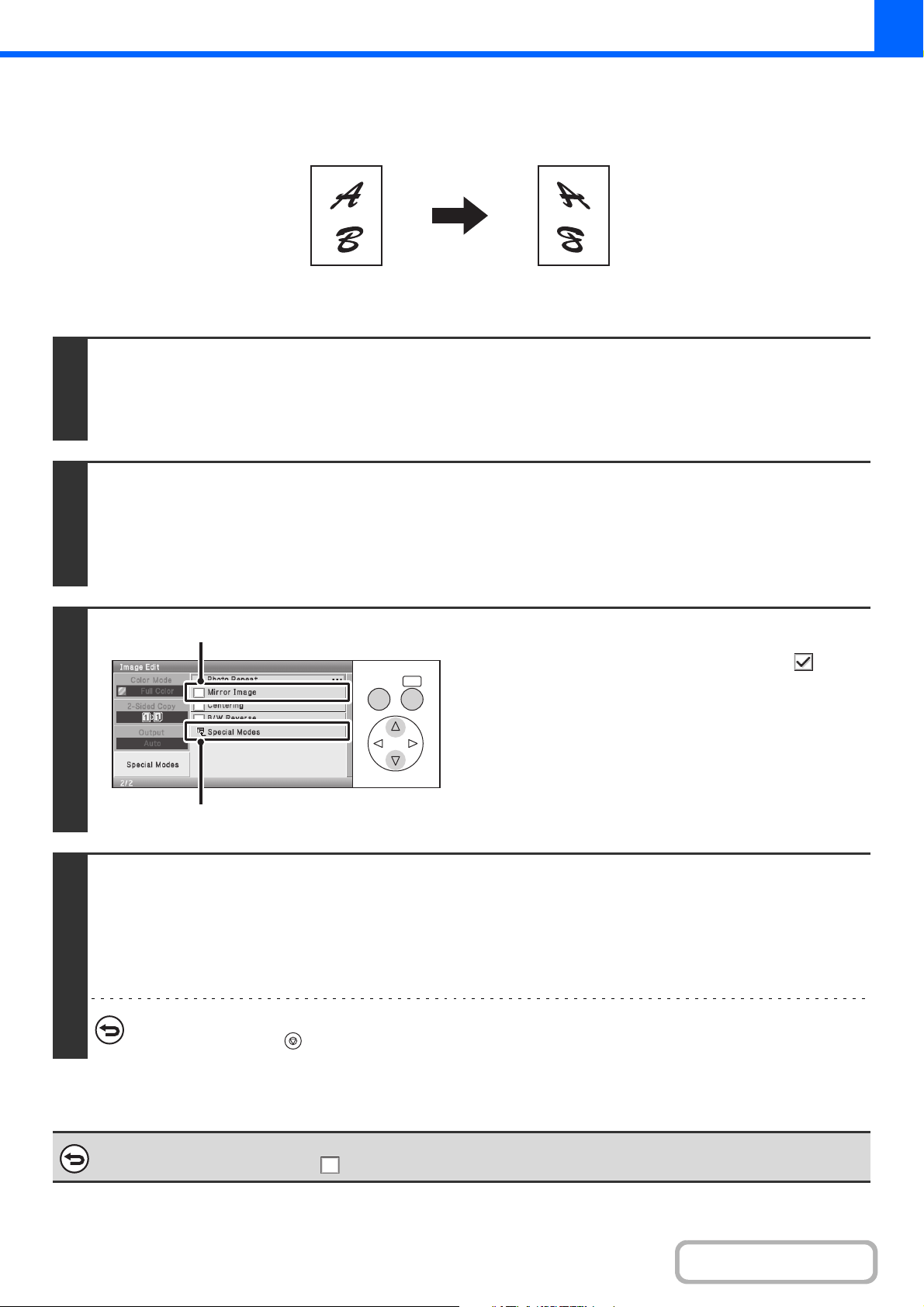
2-83
COPIER
Contents
REVERSING THE IMAGE (Mirror Image)
This feature is used to make a copy that is a mirror image of the original.
Keys in the display can be selected with the arrow keys and the [OK] key.
1
Place the original.
Place the original face up in the document feeder tray, or face down on the document glass.
After placing the original, specify the original size.
☞ ORIGINAL SIZES (page 2-28)
2
Select the special modes.
(1) Select the [Special Modes] key.
(2) Select the [Image Edit] key.
☞ [Image Edit] KEY (page 2-80)
3
Select Mirror Image.
(1) Set the [Mirror Image] checkbox to .
(2) Select the [Special Modes] key.
You will return to the special modes screen. Press the
[BACK] key to return to the base screen of copy mode.
4
Press the [COLOR START] key or the [BLACK & WHITE START] key.
Copying will begin.
If you are using the document glass to copy multiple original pages, copying will take place as you scan each original. If you
have selected sort mode, change originals and press the [START] key. Repeat until all pages have been scanned and then
select the [Read-End] key. (For the second original and following originals, use the same [START] key as you did for
the first original.)
To cancel scanning and copying...
Press the [STOP] key ( ).
To cancel a mirror image setting...
Set the [Mirror Image] checkbox to in the screen of step 3.
Original Mirror image copy
OKBACK
(1)
(2)
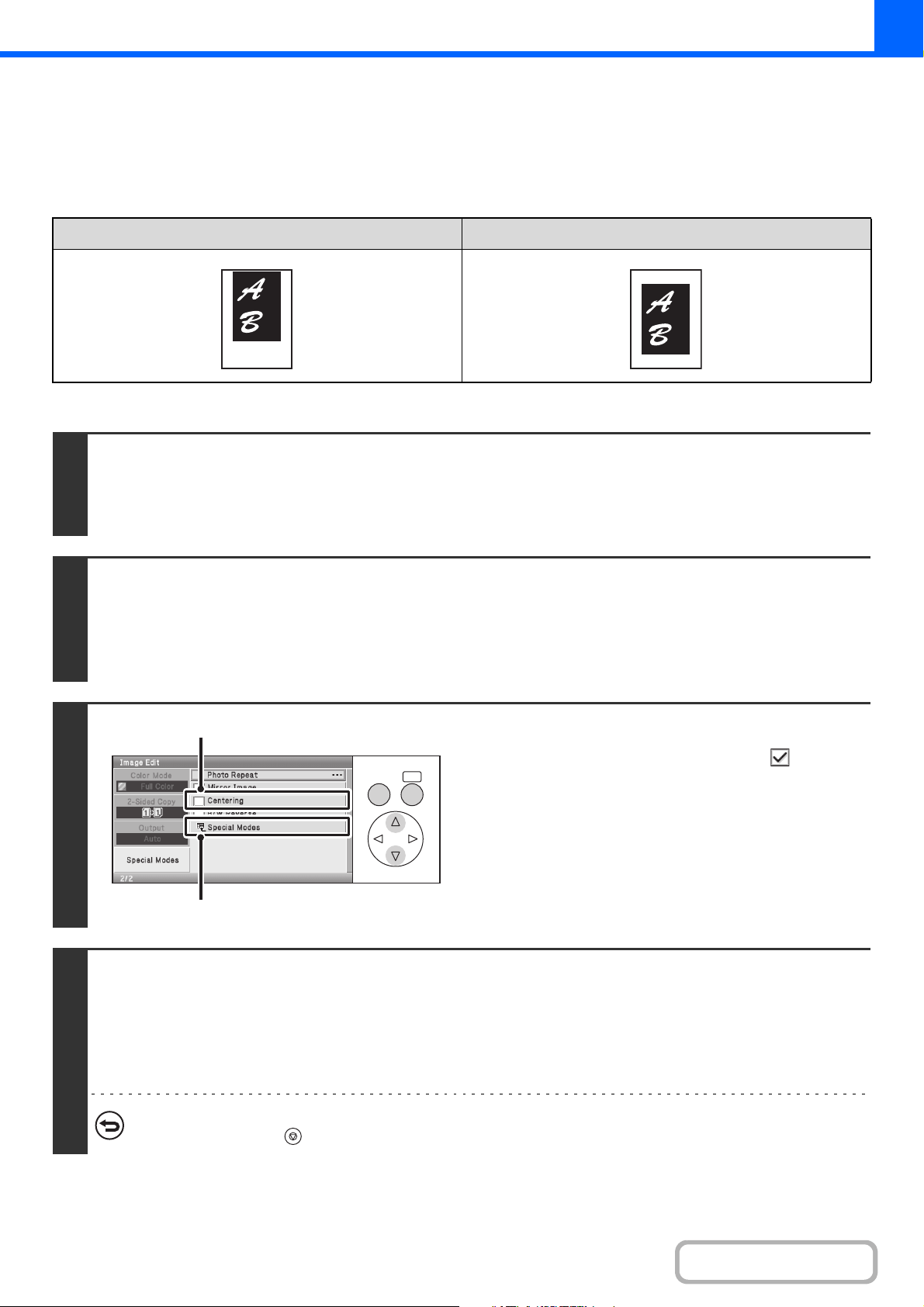
2-84
COPIER
Contents
COPYING IN THE CENTER OF THE PAPER (Centering)
This is used to center the copied image on the paper.
This lets you place the image in the center of the paper when the original size is smaller than the paper size or when the
image is reduced.
Keys in the display can be selected with the arrow keys and the [OK] key.
Not using the centering function Using the centering function
1
Place the original.
Place the original face up in the document feeder tray, or face down on the document glass.
After placing the original, specify the original size.
☞ ORIGINAL SIZES (page 2-28)
2
Select the special modes.
(1) Select the [Special Modes] key.
(2) Select the [Image Edit] key.
☞ [Image Edit] KEY (page 2-80)
3
Select Centering.
(1) Set the [Centering] checkbox to .
(2) Select the [Special Modes] key.
You will return to the special modes screen. Press the
[BACK] key to return to the base screen of copy mode.
4
Press the [COLOR START] key or the [BLACK & WHITE START] key.
Copying will begin.
If you are using the document glass to copy multiple original pages, copying will take place as you scan each original. If you
have selected sort mode, change originals and press the [START] key. Repeat until all pages have been scanned and then
select the [Read-End] key. (For the second original and following originals, use the same [START] key as you did for
the first original.)
To cancel scanning and copying...
Press the [STOP] key ( ).
OKBACK
(1)
(2)
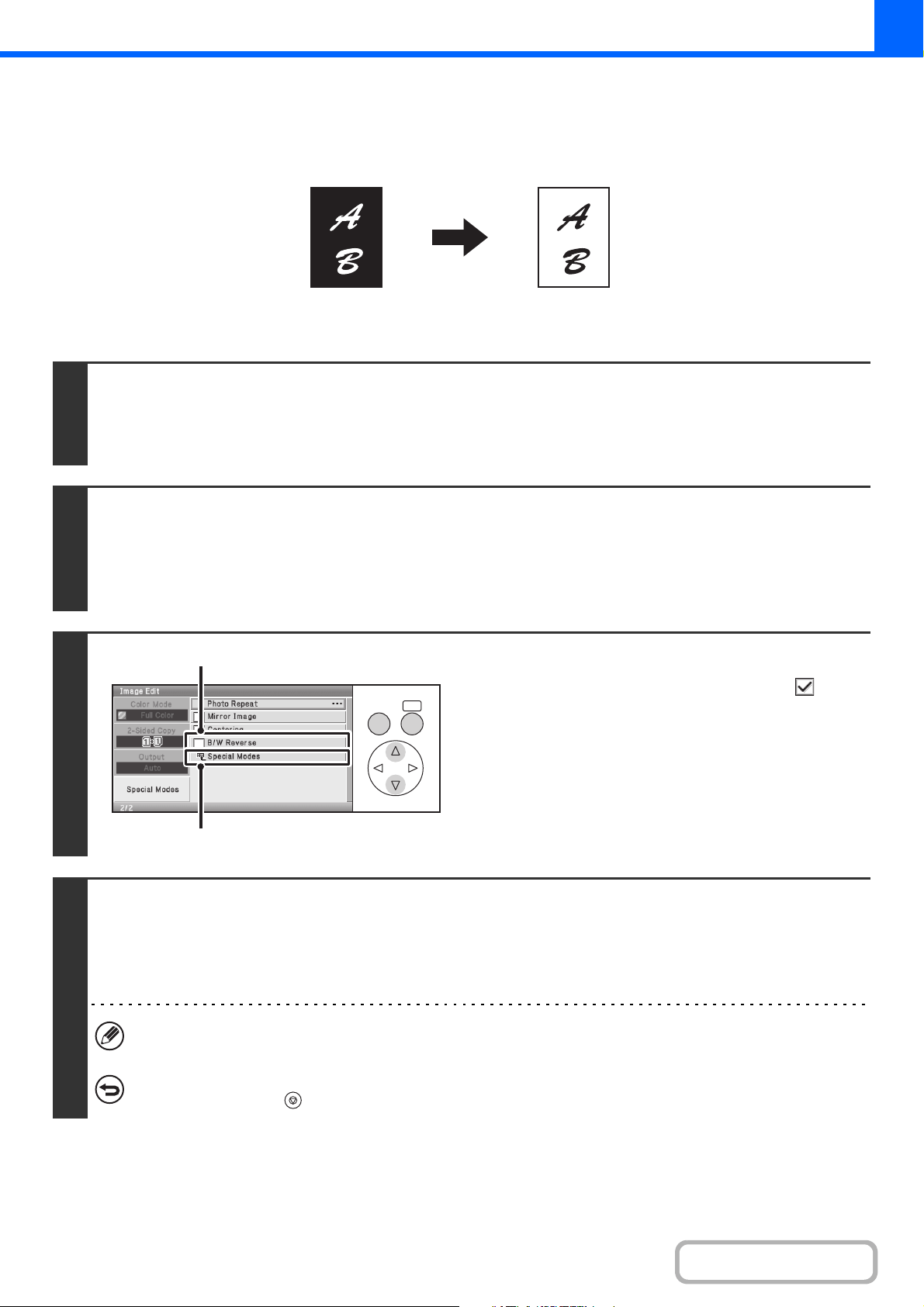
2-86
COPIER
Contents
REVERSING BLACK AND WHITE IN A COPY (B/W Reverse)
This is used to reverse black and white in a copy to create a negative image. This function can only be used for black and white copying.
Originals with large black areas (which use a large amount of toner) can be copied using Black/White Reverse to reduce toner consumption.
Keys in the display can be selected with the arrow keys and the [OK] key.
1
Place the original.
Place the original face up in the document feeder tray, or face down on the document glass.
After placing the original, specify the original size.
☞ ORIGINAL SIZES (page 2-28)
2
Select the special modes.
(1) Select the [Special Modes] key.
(2) Select the [Image Edit] key.
☞ [Image Edit] KEY (page 2-80)
3
Select B/W Reverse.
(1) Set the [B/W Reverse] checkbox to .
(2) Select the [Special Modes] key.
You will return to the special modes screen. Press the
[BACK] key to return to the base screen of copy mode.
4
Press the [BLACK & WHITE START] key.
Copying will begin.
If you are using the document glass to copy multiple original pages, copying will take place as you scan each original. If you
have selected sort mode, change originals and press the [BLACK & WHITE START] key. Repeat until all pages have been
scanned and then select the [Read-End] key.
When using this function, the [COLOR START] key cannot be used.
To cancel scanning and copying...
Press the [STOP] key ( ).
Originals B/W Reverse copy
OKBACK
(1)
(2)
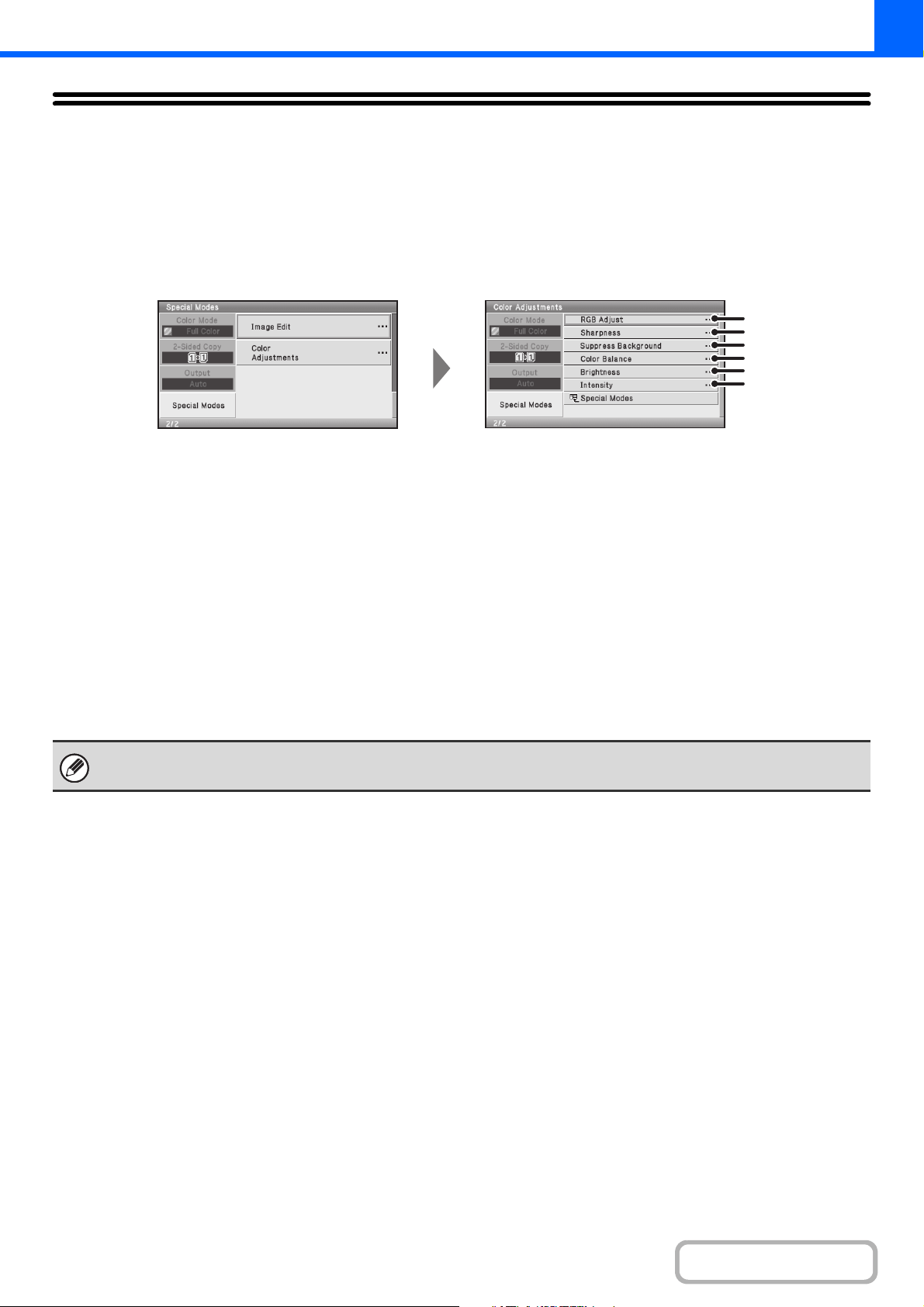
2-88
COPIER
Contents
[Color Adjustments] KEY
When the [Color Adjustments] key is selected in the 1st special modes menu screen, the color adjustments menu
screen opens.
Color adjustments menu screen
(1) [RGB Adjust] key
☞ ADJUSTING RED/GREEN/BLUE IN COPIES (RGB
Adjust) (page 2-89)
(2) [Sharpness] key
☞ ADJUSTING THE SHARPNESS OF AN IMAGE
(Sharpness) (page 2-90)
(3) [Suppress background] key
☞ WHITENING FAINT COLORS IN COPIES
(Suppress Background) (page 2-91)
(4) [Color Balance] key
☞ ADJUSTING THE COLOR (Color Balance) (page
2-93)
(5) [Brightness] key
☞ ADJUSTING THE BRIGHTNESS OF A COPY
(Brightness) (page 2-96)
(6) [Intensity] key
☞ ADJUSTING THE INTENSITY OF A COPY
(Intensity) (page 2-97)
(1)
(2)
(3)
(4)
(5)
(6)
When any of the functions on the color adjustments menu is selected, the "Original Image Type" setting for exposure
adjustment automatically changes to "Text/Prtd.Photo".
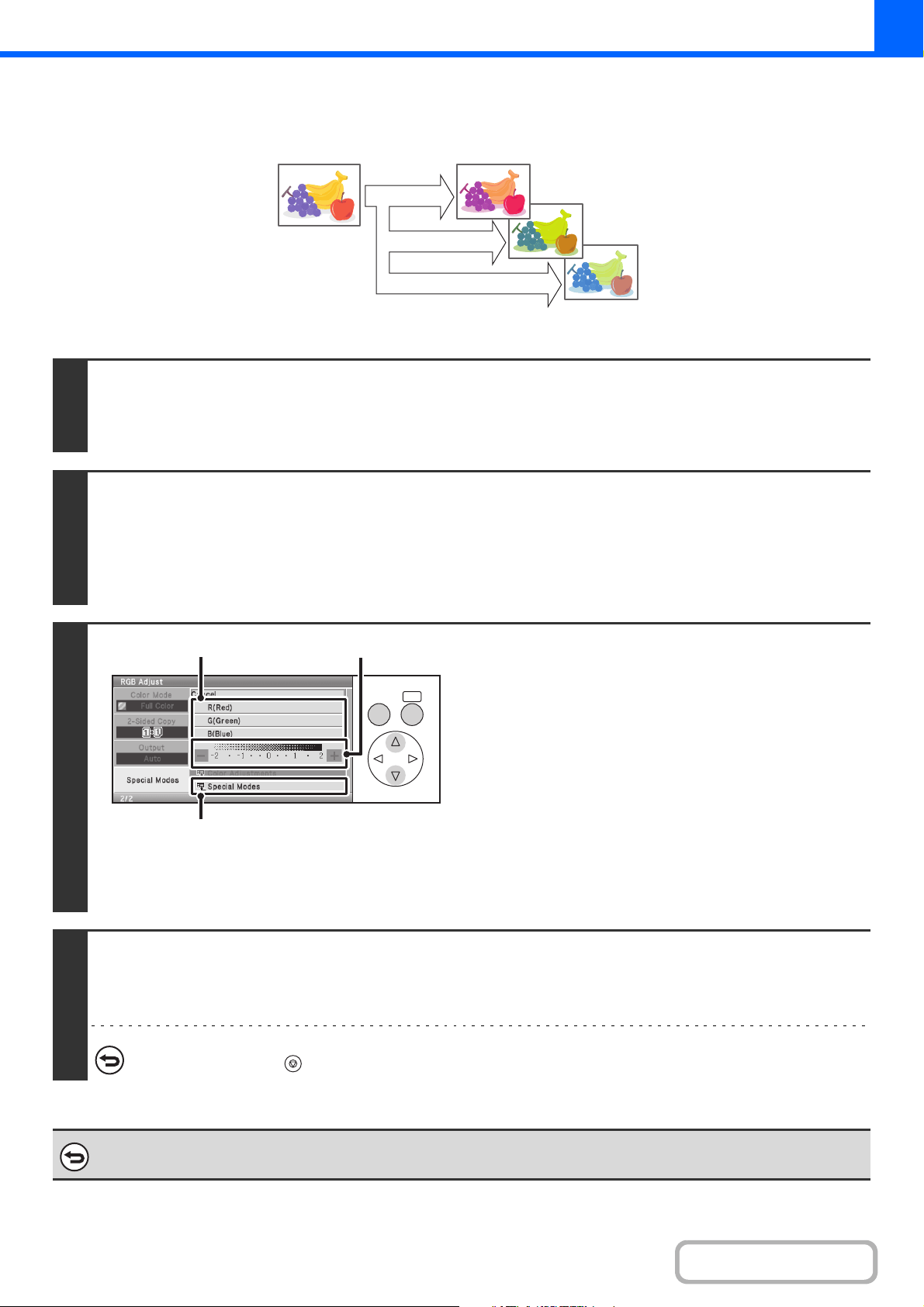
2-89
COPIER
Contents
ADJUSTING RED/GREEN/BLUE IN COPIES (RGB Adjust)
This feature is used to strengthen or weaken any one of the three color components R (red), G (green), or B (blue).
Keys in the display can be selected with the arrow keys and the [OK] key.
1
Place the original.
Place the original face up in the document feeder tray, or face down on the document glass.
After placing the original, specify the original size.
☞ ORIGINAL SIZES (page 2-28)
2
Select the special modes.
(1) Select the [Special Modes] key.
(2) Select the [Color Adjustments] key.
(3) Select the [RGB Adjust] key.
☞ [Color Adjustments] KEY (page 2-88)
3
Adjust red, green, or blue.
(1) Select the key of the color that you wish to
adjust: [R (Red)], [G (Green)], or [B (Blue)].
Only one color can be adjusted. (If you adjust one color and then
adjust another color, the adjustment of the first color is canceled.)
(2) Adjust the selected color.
To strengthen the selected color, select the [+] key and
press the [OK] key.
To weaken the selected color, select the [-] key and press
the [OK] key.
(3) Select the [Special Modes] key.
You will return to the special modes screen. Press the
[BACK] key to return to the base screen of copy mode.
4
Press the [COLOR START] key.
Copying will begin.
If you are using the document glass to copy multiple original pages, copying will take place as you scan each original. If you have selected sort
mode, change originals and press the [COLOR START] key. Repeat until all pages have been scanned and then select the [Read-End] key.
To cancel scanning and copying...
Press the [STOP] key ( ).
To cancel an RGB adjust setting...
Select the [Cancel] key in the screen of step 3.
R(Red)+
G(Green)+
B(Blue)+
OKBACK
(1) (2)
(3)
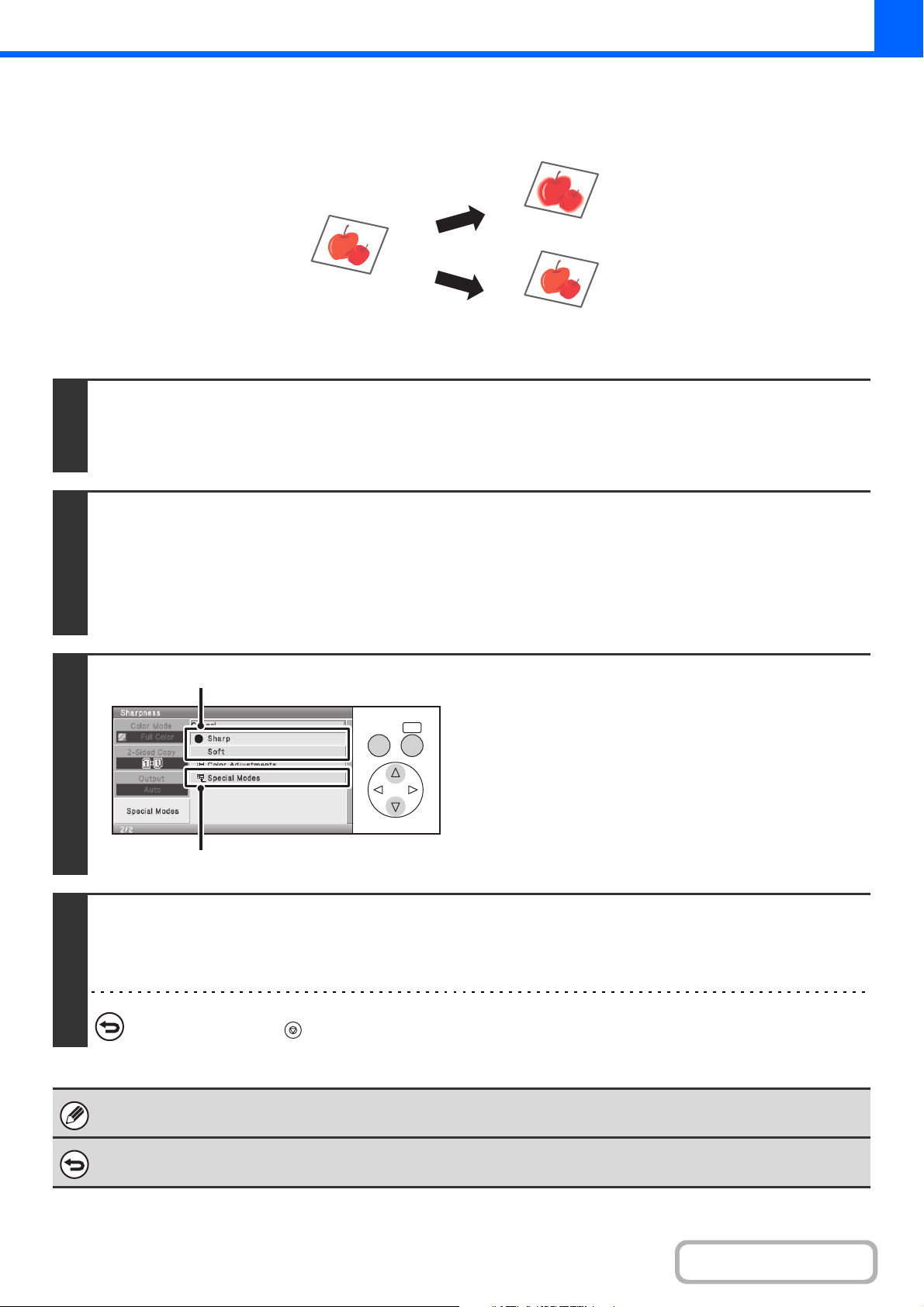
2-90
COPIER
Contents
ADJUSTING THE SHARPNESS OF AN IMAGE (Sharpness)
This is used to sharpen an image or make it softer.
Keys in the display can be selected with the arrow keys and the [OK] key.
1
Place the original.
Place the original face up in the document feeder tray, or face down on the document glass.
After placing the original, specify the original size.
☞ ORIGINAL SIZES (page 2-28)
2
Select the special modes.
(1) Select the [Special Modes] key.
(2) Select the [Color Adjustments] key.
(3) Select the [Sharpness] key.
☞ [Color Adjustments] KEY (page 2-88)
3
Adjust the image.
(1) Select the [Soft] key or the [Sharp] key.
(2) Select the [Special Modes] key.
You will return to the special modes screen. Press the
[BACK] key to return to the base screen of copy mode.
4
Press the [COLOR START] key.
Copying will begin.
If you are using the document glass to copy multiple original pages, copying will take place as you scan each original. If you have selected sort
mode, change originals and press the [COLOR START] key. Repeat until all pages have been scanned and then select the [Read-End] key.
To cancel scanning and copying...
Press the [STOP] key ( ).
The sharpness setting is also applied when black & white copies are made.
To cancel the sharpness setting...
Select the [Cancel] key in the screen of step 3.
Soft
Sharp
OKBACK
(1)
(2)
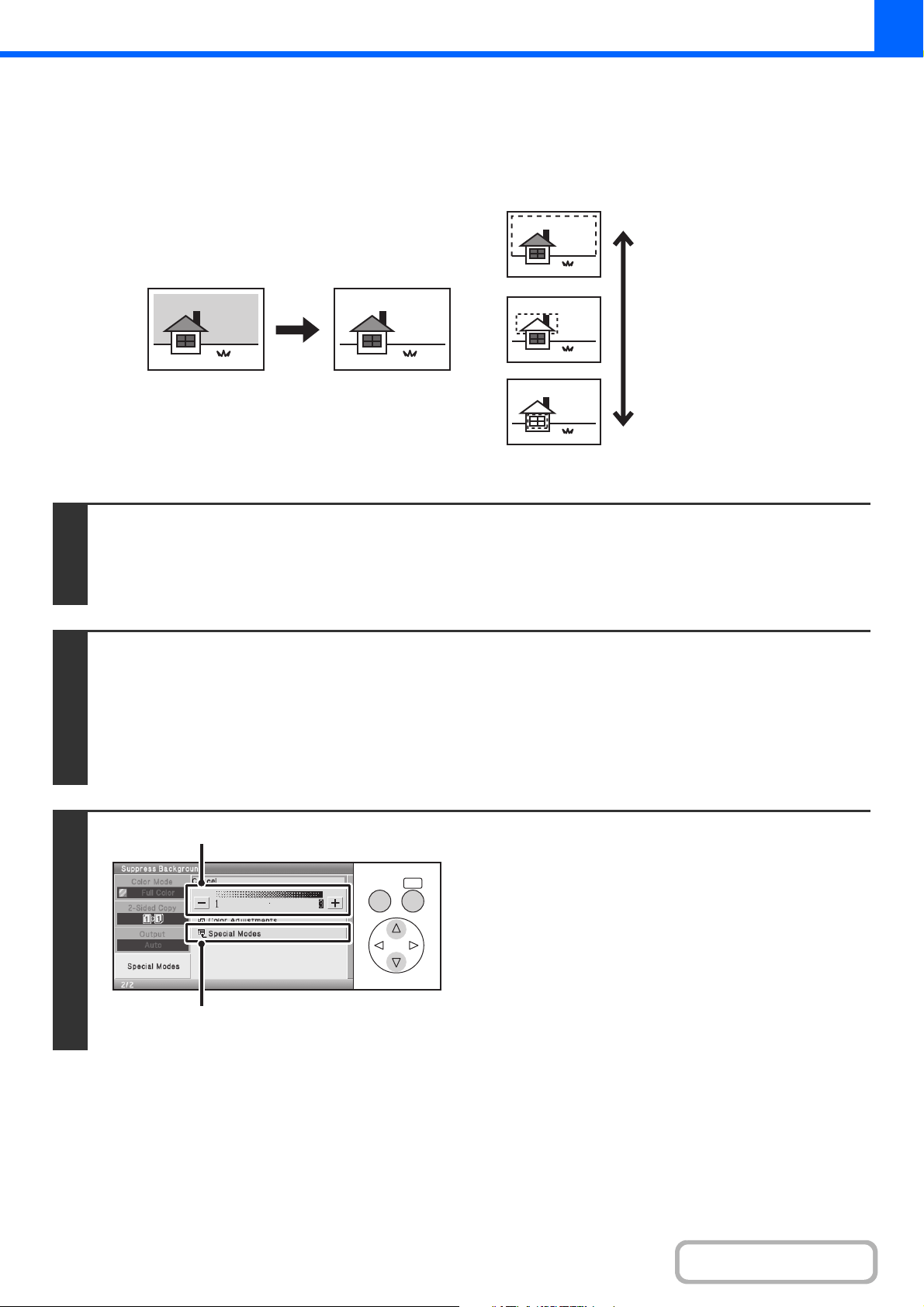
2-91
COPIER
Contents
WHITENING FAINT COLORS IN COPIES
(Suppress Background)
This feature is used to suppress light background areas.
Keys in the display can be selected with the arrow keys and the [OK] key.
1
Place the original.
Place the original face up in the document feeder tray, or face down on the document glass.
After placing the original, specify the original size.
☞ ORIGINAL SIZES (page 2-28)
2
Select the special modes.
Select the [Special Modes] key.
Select the [Color Adjustments] key.
Select the [Suppress Background] key.
☞
[Color Adjustments] KEY (page 2-88)
3
Select the suppress background setting.
(1) Adjust the background suppression level.
To suppress only faint background, select the [+] key and
press the [OK] key.
To suppress faint to dark background, select the [-] key
and press the [OK] key.
(2) Select the [Special Modes] key.
You will return to the special modes screen. Press the
[BACK] key to return to the base screen of copy mode.
Light areas are
suppressed.
Level [+]
Level [-]
The lightness level at which
suppression takes place
can be adjusted.
OKBACK
(1)
(2)
2-92
COPIER
Contents
4
Press the [COLOR START] key.
Copying will begin.
If you are using the document glass to copy multiple original pages, copying will take place as you scan each original. If you
have selected sort mode, change originals and press the [COLOR START] key. Repeat until all pages have been scanned
and then select the [Read-End] key.
To cancel scanning and copying...
Press the [STOP] key ( ).
To cancel a suppress background setting...
Select the [Cancel] key in the screen of step 3.
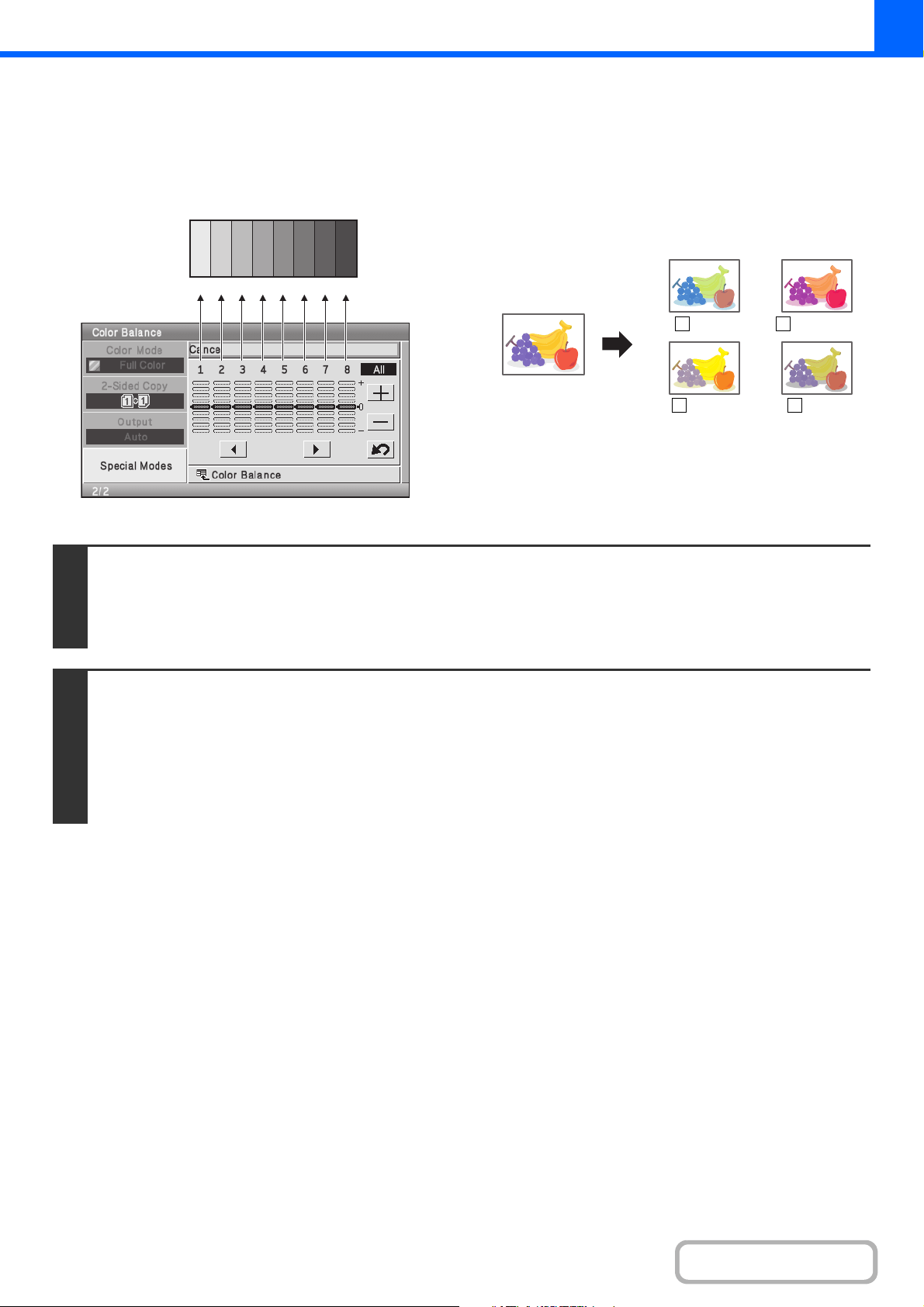
2-93
COPIER
Contents
ADJUSTING THE COLOR (Color Balance)
The color, tone, and density of color copies can be adjusted.
Each of the colors yellow, cyan, magenta, and black are
divided into 8 gradations from light to dark, and the
average density of each gradation can be adjusted,
or all eight gradations can be adjusted at once.
Keys in the display can be selected with the arrow keys and the [OK] key.
12345678
Dark
Light
C Cyan+ M Magenta+
Y Yellow+ B Black+
1
Place the original.
Place the original face up in the document feeder tray, or face down on the document glass.
After placing the original, specify the original size.
☞ ORIGINAL SIZES (page 2-28)
2
Select the special modes.
(1) Select the [Special Modes] key.
(2) Select the [Color Adjustments] key.
(3) Select the [Color Balance] key.
☞ [Color Adjustments] KEY (page 2-88)
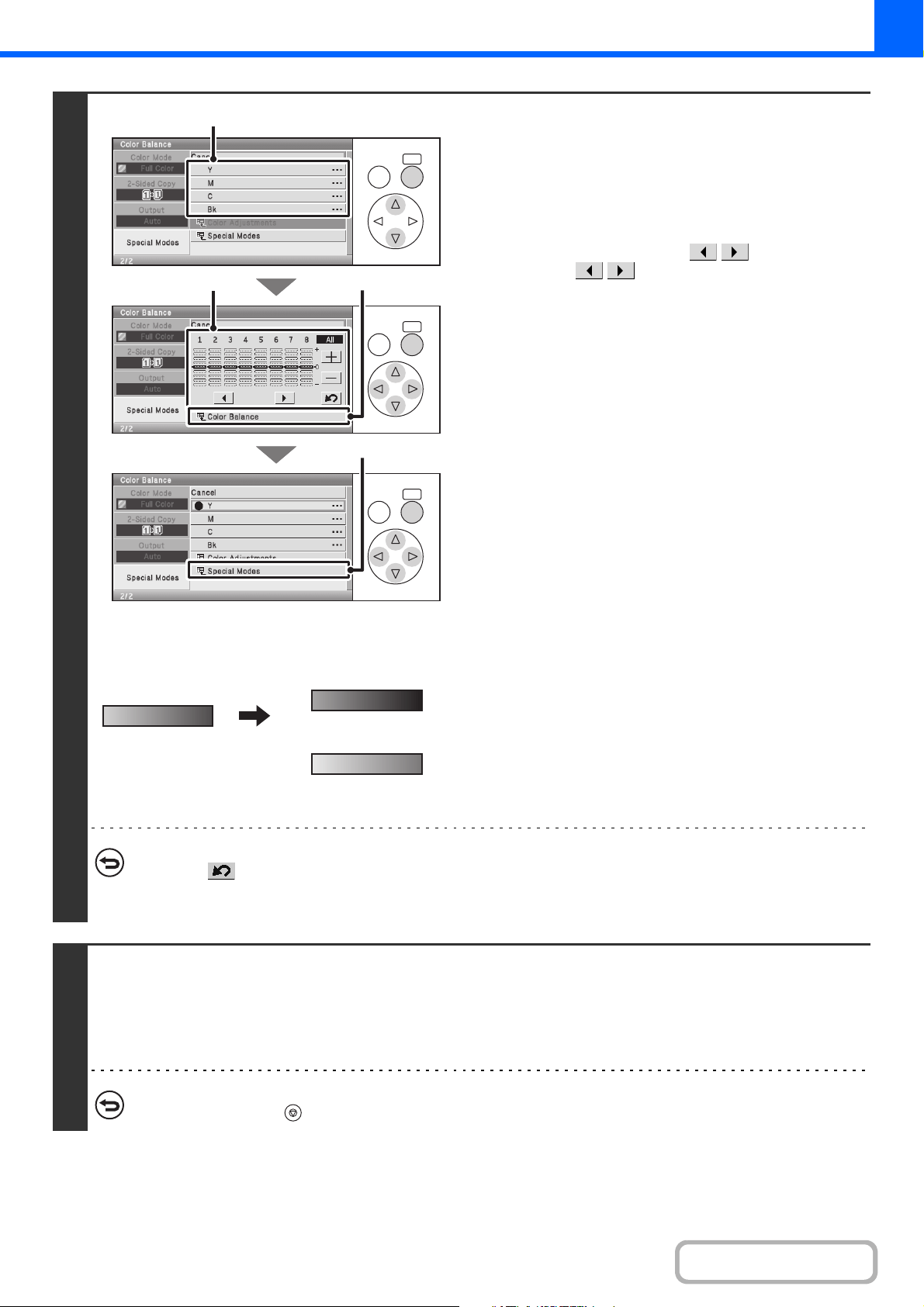
2-94
COPIER
Contents
3
Examples of color balance adjustment
Adjust the color balance.
(1) Select the color to be adjusted.
Select [Y] (yellow), [M] (magenta), [C] (cyan), or [Bk] (black).
An icon in front of a number indicates that the adjustment
value has been changed.
(2) Select the gradation to be adjusted.
Select the gradation with the keys.
Select the keys and press the [OK] key to
move the highlighting to one of gradations "1" to "8" or
"All".
To adjust all eight gradations at once, move the
highlighting to "All".
(3) Adjust the density.
To darken the density of the selected gradation, select the
[+] key and press the [OK] key. To lighten the density,
select the [-] key and press the [OK] key. Each time you
press the [OK] key, the indicator frame moves up or down
one level.
(4) Select the [Color Balance] key.
To adjust other colors, repeat steps (1) to (4).
(5) Select the [Special Modes] key.
You will return to the special modes screen. Press the
[BACK] key to return to the base screen of copy mode.
To return the color balance values to the default settings...
Select the key and press the [OK] key. The values of all eight gradations will return to the default color balance
values.
The default color balance values are set in "Initial Color Balance Setting" in the system settings (administrator).
4
Press the [COLOR START] key.
Copying will begin.
If you are using the document glass to copy multiple original pages, copying will take place as you scan each original. If you
have selected sort mode, change originals and press the [COLOR START] key. Repeat until all pages have been scanned
and then select the [Read-End] key.
To cancel scanning and copying...
Press the [STOP] key ( ).
OKBACK
OKBACK
OKBACK
(5)
(2), (3)
(1)
(4)
The settings of all gradations
are moved toward +
The settings of all gradations
are moved toward -
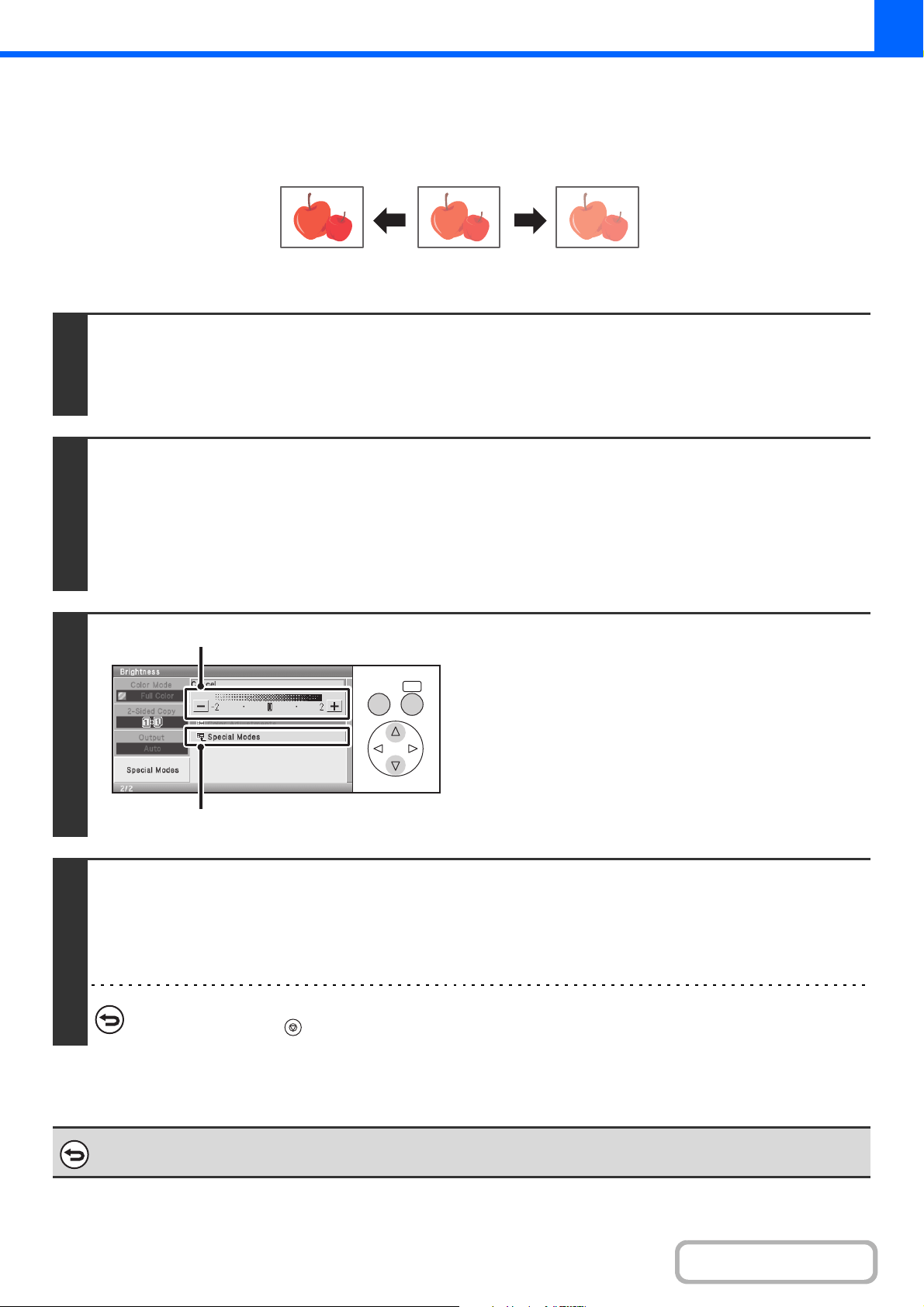
2-96
COPIER
Contents
ADJUSTING THE BRIGHTNESS OF A COPY (Brightness)
The brightness of color images can be adjusted.
Keys in the display can be selected with the arrow keys and the [OK] key.
1
Place the original.
Place the original face up in the document feeder tray, or face down on the document glass.
After placing the original, specify the original size.
☞ ORIGINAL SIZES (page 2-28)
2
Select the special modes.
(1) Select the [Special Modes] key.
(2) Select the [Color Adjustments] key.
(3) Select the [Brightness] key.
☞ [Color Adjustments] KEY (page 2-88)
3
Adjust the brightness.
(1) Adjust the brightness.
To make the image brighter, select the [+] key and press
the [OK] key.
To make the image darker, select the [-] key and press
the [OK] key.
(2) Select the [Special Modes] key.
You will return to the special modes screen. Press the
[BACK] key to return to the base screen of copy mode.
4
Press the [COLOR START] key.
Copying will begin.
If you are using the document glass to copy multiple original pages, copying will take place as you scan each original. If you
have selected sort mode, change originals and press the [COLOR START] key. Repeat until all pages have been scanned
and then select the [Read-End] key.
To cancel scanning and copying...
Press the [STOP] key ( ).
To cancel a brightness setting...
Select the [Cancel] key in the screen of step 3.
Darker Original Brighter
OKBACK
(1)
(2)
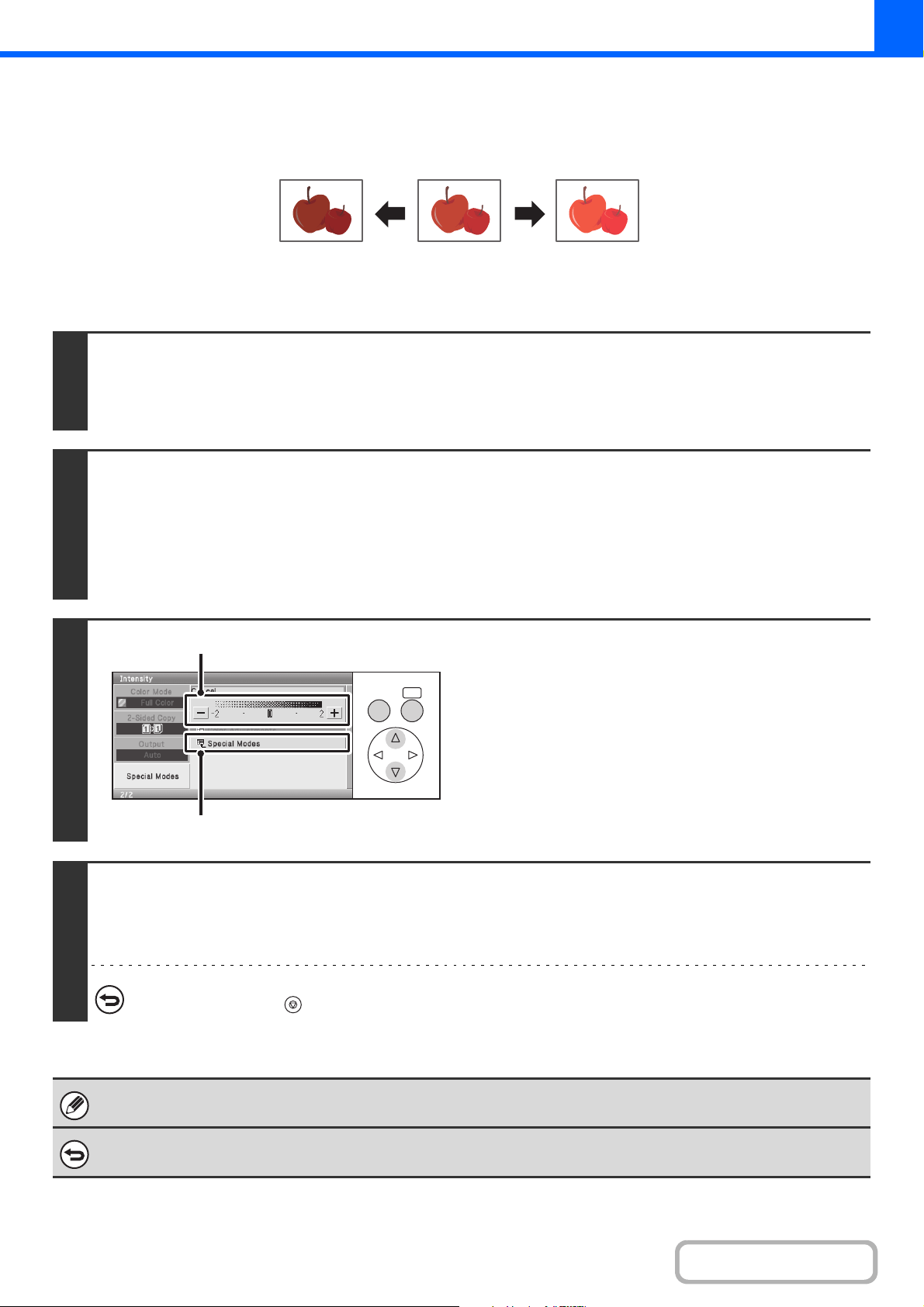
2-97
COPIER
Contents
ADJUSTING THE INTENSITY OF A COPY (Intensity)
This is used to adjust the intensity (saturation) of color images.
Keys in the display can be selected with the arrow keys and the [OK] key.
1
Place the original.
Place the original face up in the document feeder tray, or face down on the document glass.
After placing the original, specify the original size.
☞ ORIGINAL SIZES (page 2-28)
2
Select the special modes.
(1) Select the [Special Modes] key.
(2) Select the [Color Adjustments] key.
(3) Select the [Intensity] key.
☞ [Color Adjustments] KEY (page 2-88)
3
Adjust the intensity.
(1) Adjust the intensity setting.
To strengthen the intensity, select the [+] key and press
the [OK] key.
To weaken the intensity, select the [-] key and press the
[OK] key.
(2) Select the [Special Modes] key.
You will return to the special modes screen. Press the
[BACK] key to return to the base screen of copy mode.
4
Press the [COLOR START] key.
Copying will begin.
If you are using the document glass to copy multiple original pages, copying will take place as you scan each original. If you have selected sort
mode, change originals and press the [COLOR START] key. Repeat until all pages have been scanned and then select the [Read-End] key.
To cancel scanning and copying...
Press the [STOP] key ( ).
This function cannot be used in combination with "Color Tone Enhancement" in the copy exposure settings.
To cancel an intensity setting...
Select the [Cancel] key in the screen of step 3.
Weakening the
intensity
Original Strengthening
the intensity
OKBACK
(1)
(2)
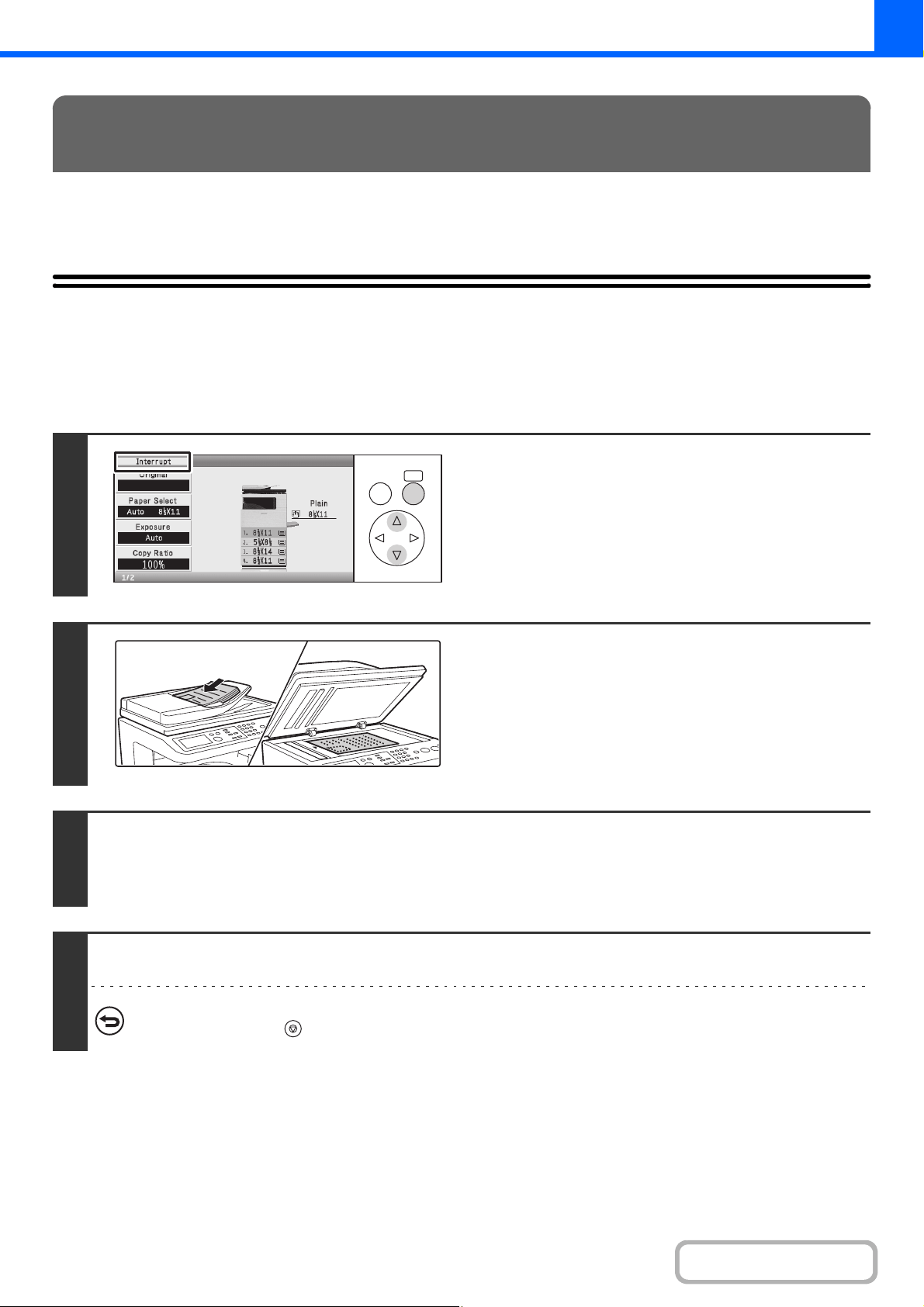
2-98
COPIER
Contents
This section explains convenient copy functions such as interrupting a copy run, changing the order of reserved copy
jobs, and storing copy settings in a program.
INTERRUPTING A COPY RUN (Interrupt copy)
When you need to make an urgent copy and the machine is busy with a long copy run or other job, use interrupt copy.
Interrupt copy temporarily stops the job in progress and lets you perform the interrupt copy job first.
Keys in the display can be selected with the arrow keys and the [OK] key.
CONVENIENT COPY FUNCTIONS
1
Select the [Interrupt] key.
The [Interrupt] key does not appear while an original is being
scanned.
2
Place the original.
Place the original face up in the document feeder tray, or face
down on the document glass.
After placing the original, specify the original size.
☞ ORIGINAL SIZES (page 2-28)
3
Select copy settings and press the [COLOR START] key or the [BLACK & WHITE
START] key.
The interrupt copy job begins.
4
When the interrupt copy job is completed, the interrupted job resumes.
To cancel scanning and copying...
Press the [STOP] key ( ).
OKBACK
2-99
COPIER
Contents
• If user authentication is enabled, the login screen will appear when the [Interrupt] key is selected. Enter your user name
and password to log in. The number of copies made will be added to the count of the user that logged in.
• Depending on the settings of the job in progress, the [Interrupt] key may not appear.
• Depending on the settings of the job in progress, the [Reserve] key may appear instead of the [Interrupt] key. Unlike
interrupt copy, reserve copy does not temporarily stop the job in progress. Instead, the reserve copy job begins when the
job in progress is finished.
• Interrupt copy cannot be used in combination with the following special modes:
Job Build, Card Shot
• If the document glass is used for an interrupt copy job, 2-sided copying, sort copying, and staple sort copying cannot be
selected. If any of these functions are necessary, use the automatic document feeder.
• If the [Interrupt] key is selected in the read-end confirmation screen, scanning temporarily stops and interrupt originals can
be scanned. After the interrupt scanning is completed, the stopped scanning restarts. The interrupt copy job outputs after
the interrupted copy job.
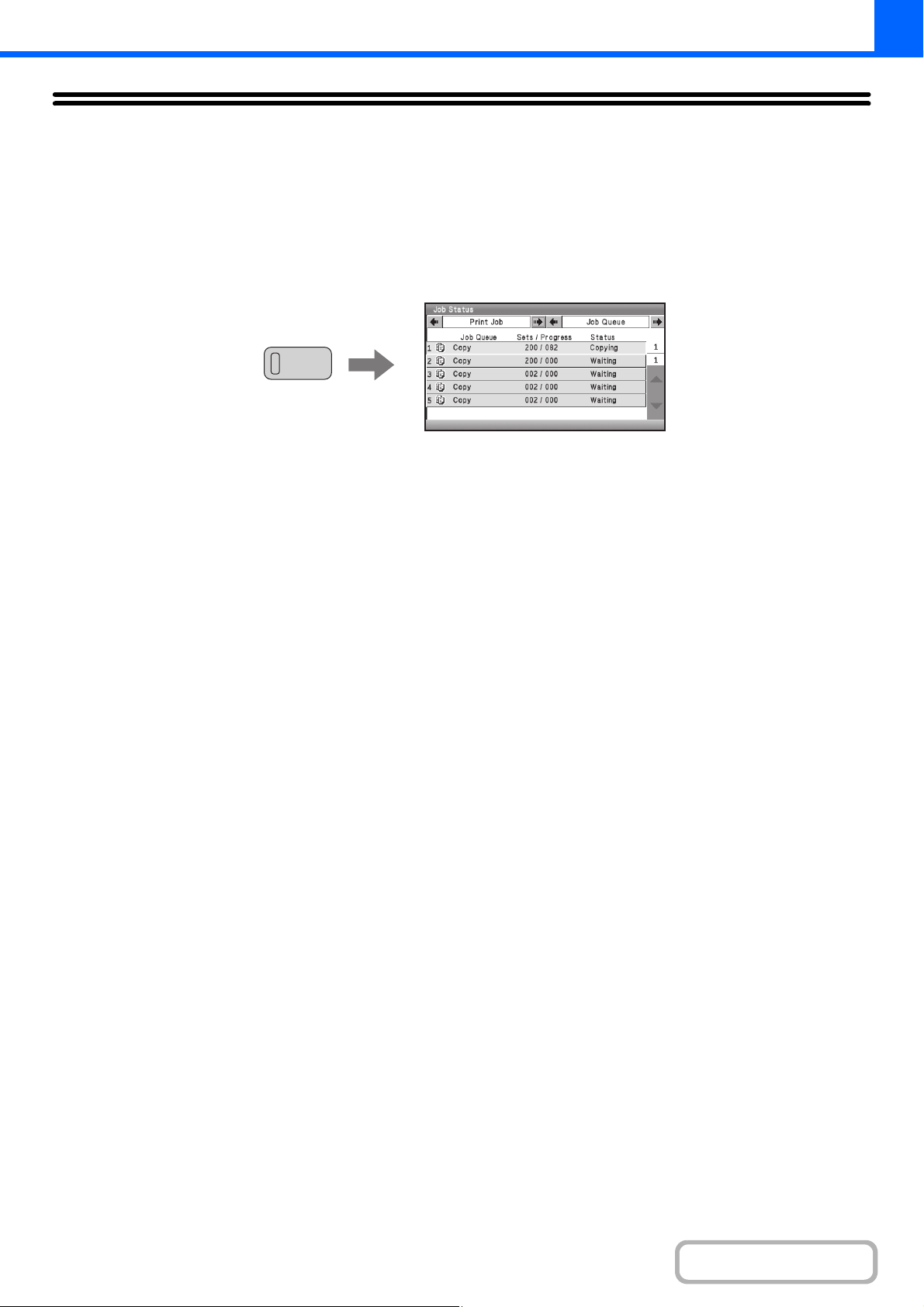
2-100
COPIER
Contents
JOB STATUS SCREEN
The job status screen is displayed when the [JOB STATUS] key on the operation panel is pressed. The job status
screen shows the status of jobs by mode. When the [JOB STATUS] key is pressed, the job status screen of the mode
that was being used before the key was pressed appears.
Example: Pressing the key in copy mode
JOB STATUS
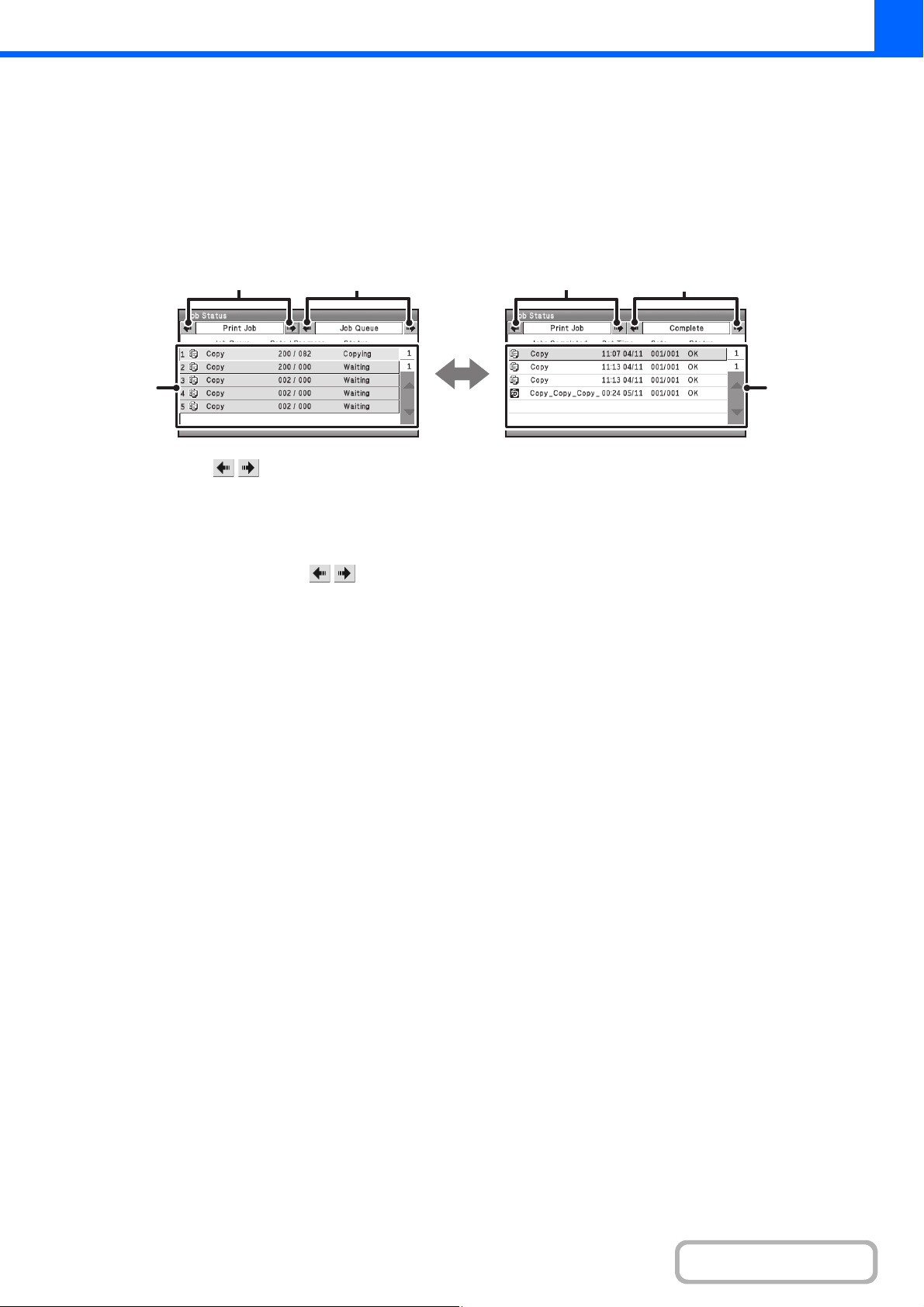
2-101
COPIER
Contents
JOB QUEUE SCREEN AND COMPLETED JOB SCREEN
The job status screen consists of the job queue screen that shows copy and print jobs waiting to be printed and the job
currently in progress, the completed job screen that shows jobs that have been completed, and the spool screen that
shows print jobs that have been spooled and encrypted PDF jobs that are waiting for a password to be entered. This
section explains the job queue screen and the completed jobs screen, which are related to copy mode. The job status
screen switches between the job queue screen and the completed jobs screen each time the job status screen selector
key is selected.
(1) Mode select keys ( )
Select these keys to select the mode that is shown in the
job status screen.
The status of copy jobs can be checked by selecting the
[Print Job].
(2) Job status screen selector keys ( )
Select these keys to switch through the job queue
screen, the completed jobs screen, and the spool screen.
(3) Job list (job queue screen)
Jobs waiting to be printed appear in the job queue as
keys. The jobs are printed in order from the top of the
queue. Each job key shows information on the job and
the current status of the job.
(4) Job list (completed jobs screen)
This shows up to 99 completed jobs. The result (status)
of each completed job is shown.
(1)
(3)
(2)
(1)
(2)
(4)
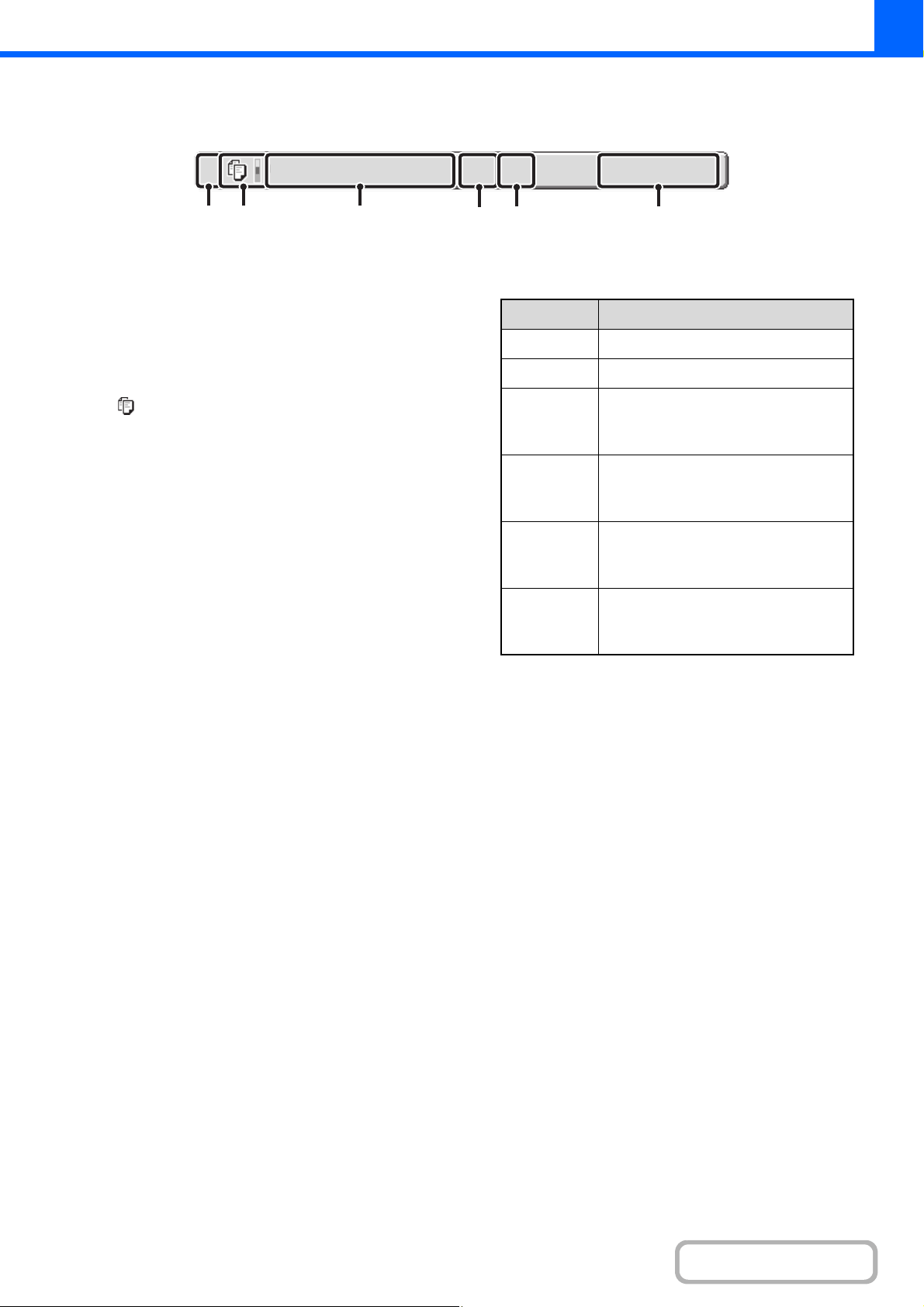
2-102
COPIER
Contents
Job key display
Each job key shows the position of the job in the job queue and the current status of the job.
(1) Indicates the number (position) of the job in the job
queue.
When the job currently being printed is finished, the job
moves up one position in the job queue.
This number does not appear in keys in the completed
jobs screen.
(2) Mode icon
The icon appears when the job is a copy job. In the
completed jobs screen, a color bar appears next to the
icon to indicate whether the job was executed in color or
black & white.
(3) Job name
"Copy" appears for a copy job.
When user authentication is enabled, the name of the
user that performed the job appears.
(4) Number of copies (sets) entered
This shows the number of copies (sets) specified.
(5) Number of completed copies
This shows the number of copies (sets) completed. "000"
appears while the job is waiting in the job queue.
(6) Status
Shows the job status.
Copy2 002/000 Waiting
(1) (2) (3)
(4)
(5) (6)
Message Status
"Copying" Copying is in progress.
"Waiting" Scanning the original.
"Toner
Empty"
The toner cartridge is out of toner.
Replace the toner cartridge with a
new cartridge.
"Paper
Empty"
The paper used for the job has run
out. Add paper or change to a
different paper tray.
"Limit" The copy page limit has been
exceeded. Check with the
administrator of the machine.
"Error" An error occurred while the job was
being executed. Clear the error
condition.

2-103
COPIER
Contents
CANCELING A JOB THAT IS WAITING IN THE QUEUE
A copy job that is waiting to be printed can be canceled.
Keys in the display can be selected with the arrow keys and the [OK] key.
1
Press the [JOB STATUS] key.
2
Cancel the job.
(1) Change the job status mode to [Print Job].
Select either of the keys with the keys
and press the [OK] key. The mode changes each time the
[OK] key is pressed.
(2) Change the print job status mode to [Job
Queue].
Select either of the keys with the keys
and press the [OK] key. The mode changes each time the
[OK] key is pressed.
(3) Select the key of the copy job that you wish
to cancel.
(4) Select the [Stop/Delete] key.
(5) A message appears to confirm the
cancelation. Select the [Yes] key.
The selected job key is deleted and printing is canceled.
If the job in progress is a copy job, you can also press the [STOP] key ( ) to display the above screen.
To cancel, select the [Yes] key.
If you do not want to cancel the selected print job...
Select the [No] key in step (5).
JOB STATU
S
OKBACK
OKBACK
OKBACK
(1) (2) (3)
(4)
(5)
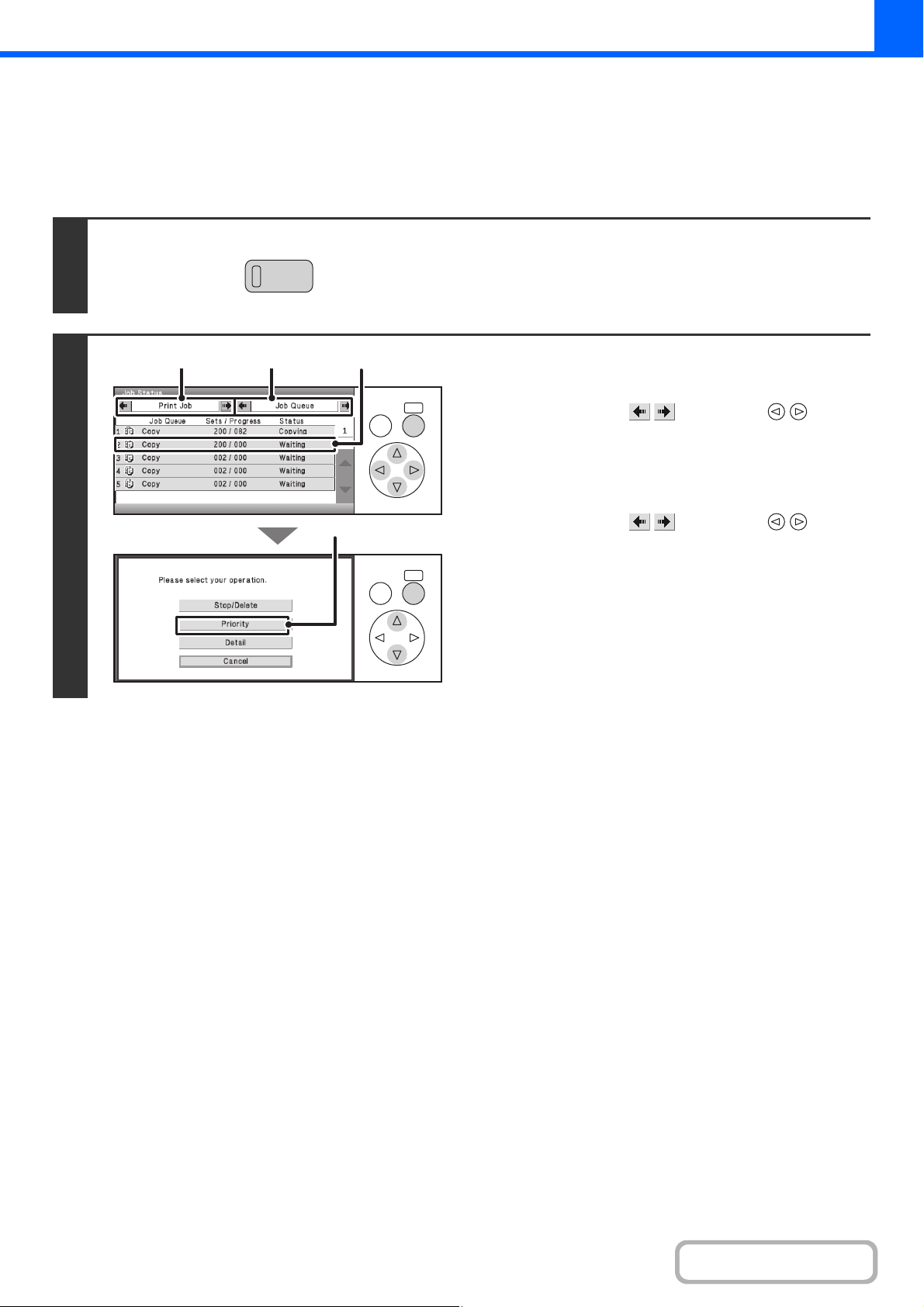
2-104
COPIER
Contents
GIVING PRIORITY TO A JOB IN THE QUEUE
If a copy job is begun when there are already multiple jobs in the queue, the copy job will appear at the end of the queue.
However, if you have an urgent copy job, you can give priority to the job and have it executed first.
Keys in the display can be selected with the arrow keys and the [OK] key.
1
Press the [JOB STATUS] key.
2
Give the desired job priority.
(1) Change the job status mode to [Print Job].
Select either of the keys with the keys
and press the [OK] key. The mode changes each time the
[OK] key is pressed.
(2) Change the print job status mode to [Job
Queue].
Select either of the keys with the keys
and press the [OK] key. The mode changes each time the
[OK] key is pressed.
(3) Select the key of the copy job to which you
want to give priority.
(4) Select the [Priority] key.
The job being printed stops and the job selected in (3) is
printed.
JOB STATU
S
OKBACK
OKBACK
(1) (2) (3)
(4)
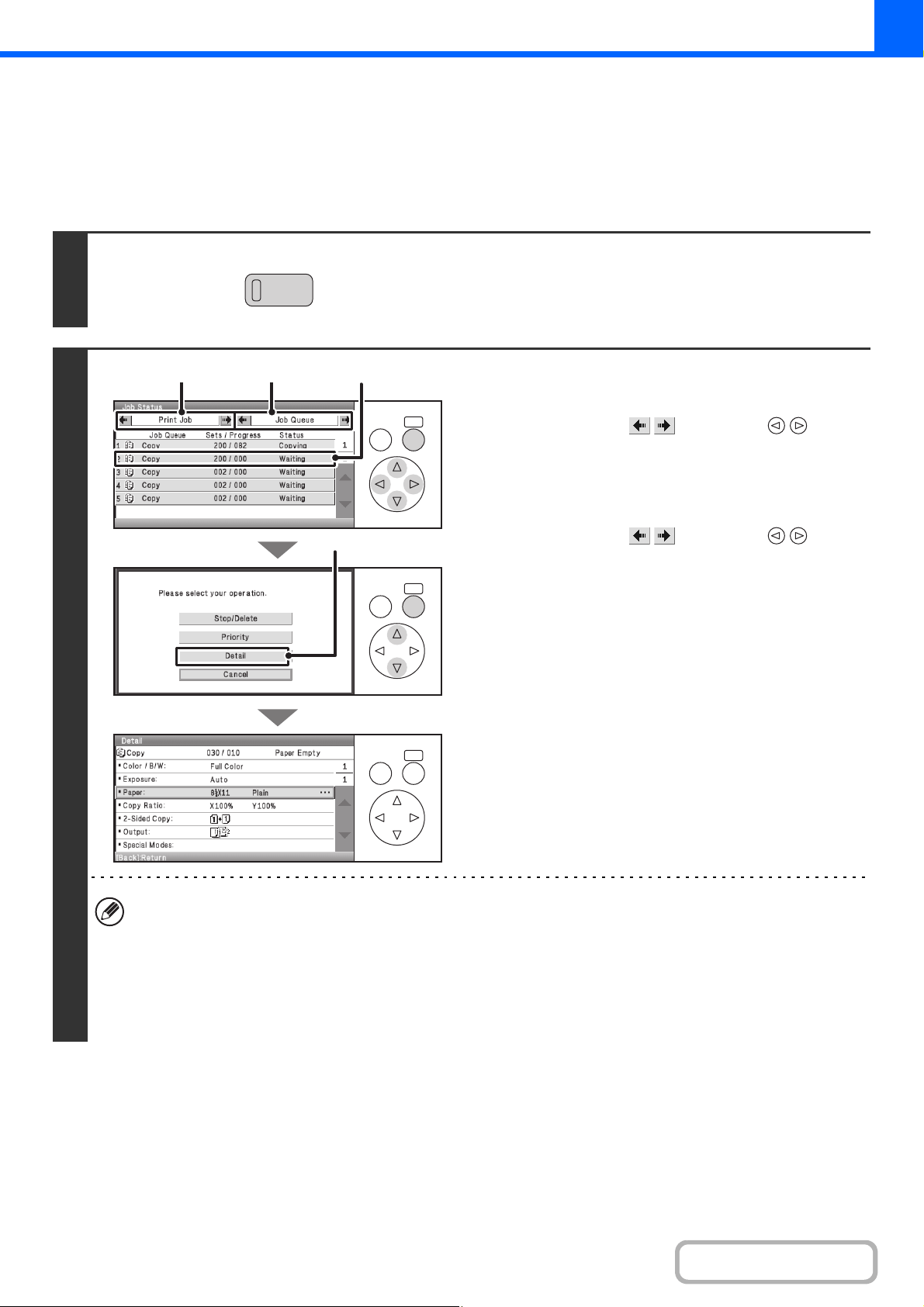
2-105
COPIER
Contents
CHECKING INFORMATION ON A COPY JOB WAITING
IN THE QUEUE
Detailed information can be displayed on a copy job waiting in the queue.
Keys in the display can be selected with the arrow keys and the [OK] key.
1
Press the [JOB STATUS] key.
2
Checking job details
(1) Change the job status mode to [Print Job].
Select either of the keys with the keys
and press the [OK] key. The mode changes each time the
[OK] key is pressed.
(2) Change the print job status mode to [Job
Queue].
Select either of the keys with the keys
and press the [OK] key. The mode changes each time the
[OK] key is pressed.
(3) Select the key of the job that you wish to
check.
(4) Select the [Detail] key.
The job check screen of the job selected in (3) appears.
[Paper:] key
If a copy job is stopped because the paper ran out, the [Paper:] key can be selected to change to a
different paper tray.
When the [Paper:] key is selected, the paper tray selection screen appears.
☞ PAPER TRAYS (page 2-9)
Select the key of the tray that has the size of paper that you wish to use and then press the [OK] key. The
stopped copy job will resume.
JOB STATU
S
OKBACK
OKBACK
OKBACK
(1) (2) (3)
(4)
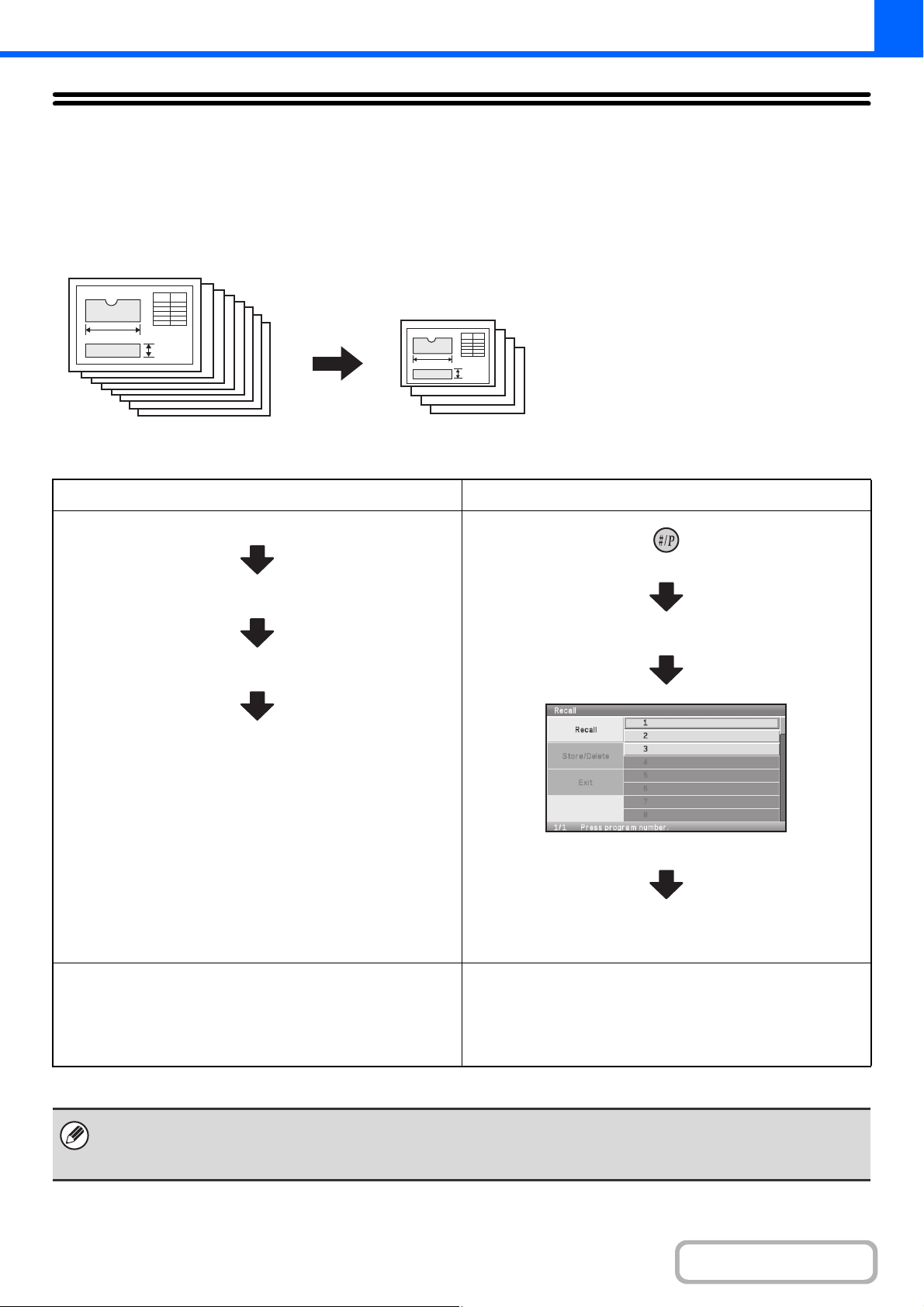
2-106
COPIER
Contents
STORING COPY OPERATIONS (Job Programs)
A job program is a group of copy settings stored together. When copy settings are stored in a job program, the settings
can be retrieved and used for a copy job by means of a simple operation.
For example, suppose 8-1/2" x 11" (A4) size CAD drawings are copied once a month for archive purposes using the
following settings:
(1) The 8-1/2" x 11" (A4) size CAD drawings
are reduced to 5-1/2" x 8-1/2" (A5) size.
(2) The drawings have fine lines that do not
show clearly, and thus a dark exposure
setting (level 4) is used.
(3) To reduce paper use by half, 2-sided
copying is used.
When a job program is not stored When a job program is stored
Set 8-1/2" x 11" (A4) to 5-1/2" x 8-1/2" (A5) reduction
Change the exposure setting
Select 2-sided copying
Press the [COLOR START] key or
the [BLACK & WHITE START] key.
Press the [#/P] key.
Select the [Recall] key and press the [OK] key
Select the stored program key and press the [OK] key.
Press the [COLOR START] key or
the [BLACK & WHITE START] key.
Considerable time is required to copy the drawings each
month because the above settings must be selected.
In addition, mistakes are occasionally made when selecting
the settings, so some copies must be redone.
The settings are stored in a job program, so they can be
selected by selecting a key. This is simple and takes no time.
In addition, the settings are all stored so there are no chances
for mistakes, and thus no need to redo copies due to setting
mistakes.
• Up to 48 job programs can be stored. The job programs are retained even if an interruption occurs in the power supply.
• Job programs can also be stored in the Web pages. Click [Job program] and then [Copy] in the Web page menu to store a
job program.
8-1/2" x 11" (A4) size CAD drawings
Copies
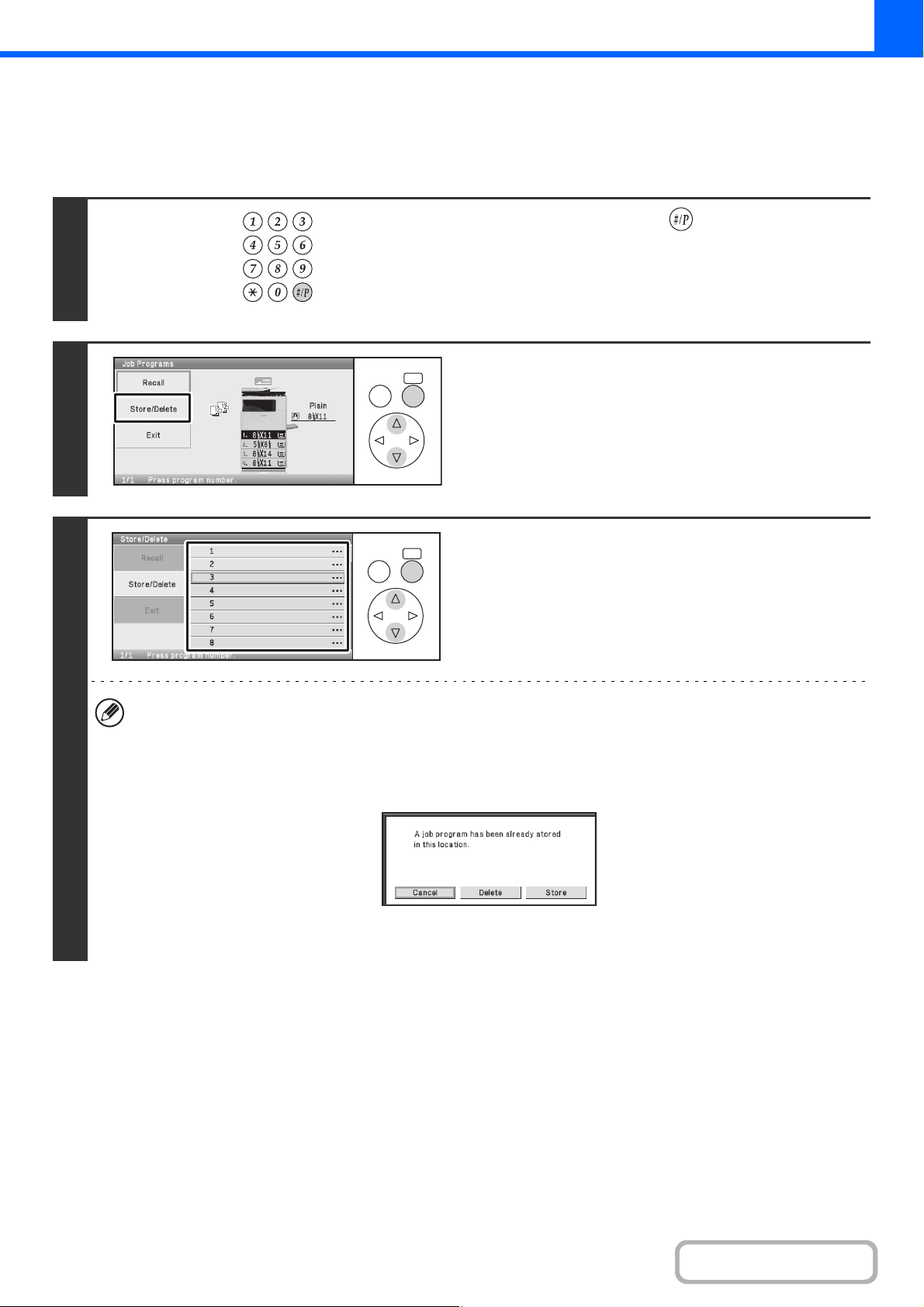
2-107
COPIER
Contents
STORING (EDITING/DELETING) A JOB PROGRAM
The procedures for storing copy settings in a job program and deleting a job program are explained below.
Keys in the display can be selected with the arrow keys and the [OK] key.
1
Press the [#/P] key ( ).
2
Select the [Store/Delete] key.
3
Select a numeric key.
Numeric keys in which job programs are already stored are
highlighted.
• To store a job program, select a numeric key that is not
highlighted.
• To edit or delete a job program, select the key in which the
job program is stored (highlighted key).
Editing or deleting a job program...
When a highlighted numeric key is selected, the following screen appears.
The [Store] key can be selected to delete the stored settings and store new settings. Go to the next step.
When the [Delete] key is selected, the stored settings are deleted. After the deletion is finished, select the [Exit] key to
return to the base screen.
When "Disabling Deletion of Job Programs" is enabled in the system settings, a stored job program cannot be edited
or deleted.
LOGOUT
OKBACK
OKBACK
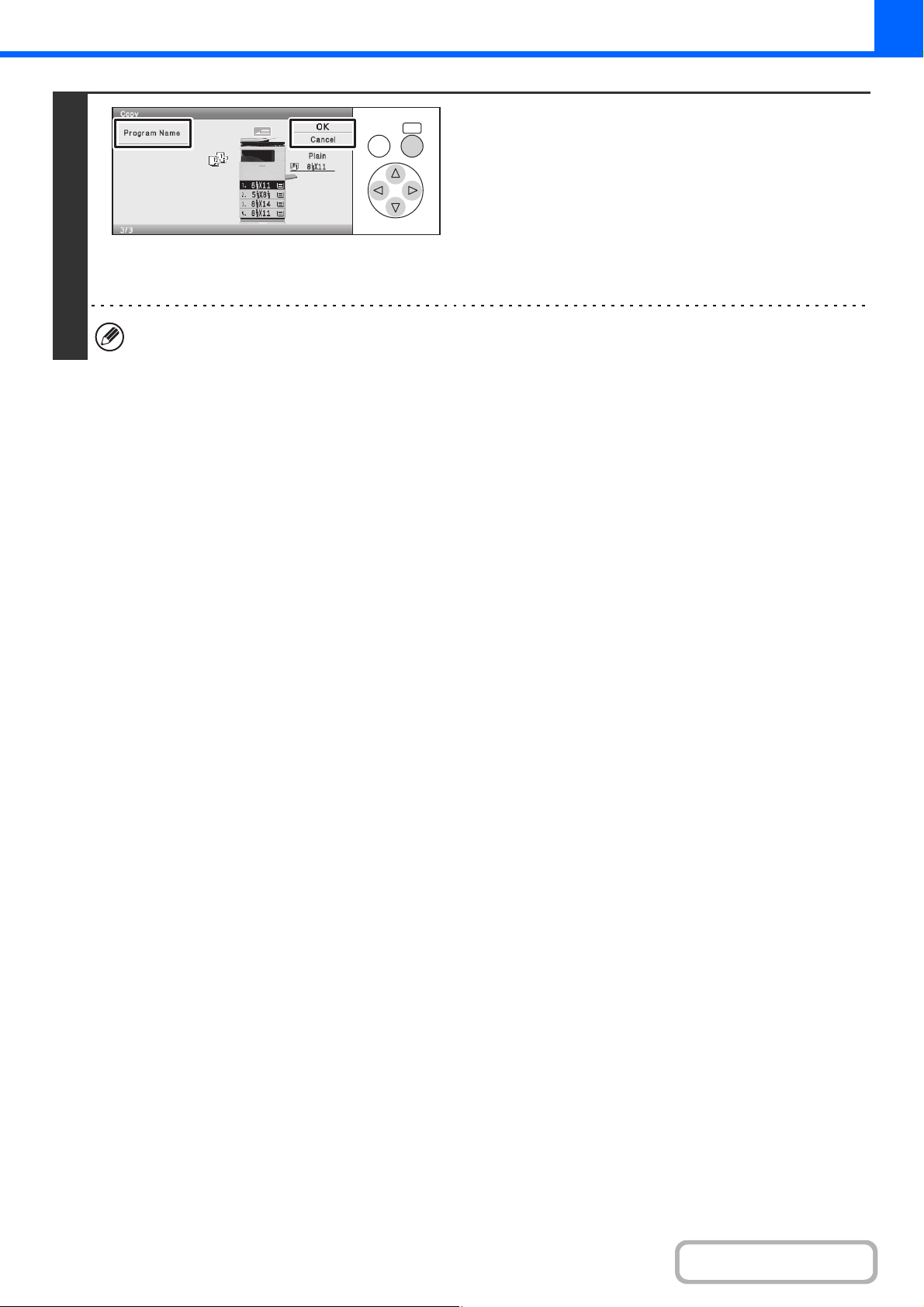
2-108
COPIER
Contents
4
Select the copy settings that you wish to
store in the job program and press the
[OK] key.
To assign a name to the program, select the [Program Name]
key and press the [OK] key. A text entry screen will appear.
Up to 10 characters can be entered for the name.
When you have finished, select the [OK] key.
You will return to the base screen with the stored information
reflected in the screen.
The number of copies cannot be stored.
OKBACK

3-1
This chapter provides detailed explanations of the procedures for using the printer function.
For the procedures for using the display of the machine, see "USING THE OPERATION PANEL" (page 1-9) in "1.
BEFORE USING THE MACHINE".
For the procedure for accessing the Web pages, see the Quick Start Guide.
For the procedures for using the Web page, see "USING THE WEB PAGE" (page 1-13) in "1. BEFORE USING THE
MACHINE".
PRINTER FUNCTION OF THE MACHINE . . . . . . . . 3-3
PRINTING FROM WINDOWS
BASIC PRINTING PROCEDURE . . . . . . . . . . . . . . . 3-4
• SELECTING THE PAPER . . . . . . . . . . . . . . . . . 3-6
• PRINTING ON ENVELOPES . . . . . . . . . . . . . . . 3-7
PRINTING WHEN THE USER
AUTHENTICATION FUNCTION IS ENABLED . . . . 3-8
VIEWING PRINTER DRIVER HELP. . . . . . . . . . . . 3-10
SAVING FREQUENTLY USED PRINT
SETTINGS . . . . . . . . . . . . . . . . . . . . . . . . . . . . . . . 3-11
• SAVING SETTINGS AT THE TIME OF
PRINTING . . . . . . . . . . . . . . . . . . . . . . . . . . . . 3-11
• USING SAVED SETTINGS . . . . . . . . . . . . . . . 3-13
CHANGING THE PRINTER DRIVER
DEFAULT SETTINGS . . . . . . . . . . . . . . . . . . . . . . 3-14
PRINTING FROM A MACINTOSH
BASIC PRINTING PROCEDURE . . . . . . . . . . . . . . 3-16
• SELECTING PAPER SETTINGS . . . . . . . . . . . 3-16
• PRINTING . . . . . . . . . . . . . . . . . . . . . . . . . . . . 3-17
• SELECTING THE PAPER . . . . . . . . . . . . . . . . 3-19
• PRINTING ON ENVELOPES . . . . . . . . . . . . . . 3-20
PRINTING WHEN THE USER
AUTHENTICATION FUNCTION IS ENABLED . . . 3-21
FREQUENTLY USED FUNCTIONS
SELECTING THE COLOR MODE . . . . . . . . . . . . . 3-23
SELECTING A PRINT MODE SETTING . . . . . . . . 3-25
TWO-SIDED PRINTING . . . . . . . . . . . . . . . . . . . . . 3-26
FITTING THE PRINT IMAGE TO THE PAPER . . . 3-28
PRINTING MULTIPLE PAGES ON ONE
PAGE . . . . . . . . . . . . . . . . . . . . . . . . . . . . . . . . . . . 3-29
STAPLING OUTPUT . . . . . . . . . . . . . . . . . . . . . . . 3-31
CONVENIENT PRINTING FUNCTIONS
CONVENIENT FUNCTIONS FOR CREATING
PAMPHLETS AND POSTERS . . . . . . . . . . . . . . . . 3-33
• CREATING A PAMPHLET (Pamphlet). . . . . . . 3-33
• INCREASING THE MARGIN (Margin Shift) . . . 3-35
• CREATING A LARGE POSTER (Poster
Printing) . . . . . . . . . . . . . . . . . . . . . . . . . . . . . . 3-36
FUNCTIONS TO ADJUST THE SIZE AND
ORIENTATION OF THE IMAGE. . . . . . . . . . . . . . . 3-37
• ROTATING THE PRINT IMAGE 180
DEGREES (Rotate 180 degrees) . . . . . . . . . . . 3-37
• ENLARGING/REDUCING THE PRINT
IMAGE (Zoom/XY-Zoom) . . . . . . . . . . . . . . . . . 3-38
• ADJUSTING LINE WIDTHS WHEN
PRINTING (Line Width Settings) . . . . . . . . . . . 3-39
• REVERSING THE IMAGE (Mirror Image) . . . . 3-40
COLOR MODE ADJUSTMENT FUNCTION . . . . . 3-41
• ADJUSTING THE BRIGHTNESS AND
CONTRAST OF THE IMAGE (Color
Adjustment) . . . . . . . . . . . . . . . . . . . . . . . . . . . 3-41
• PRINTING FAINT TEXT AND LINES IN
BLACK (Text To Black/Vector To Black) . . . . . 3-42
• SELECTING COLOR SETTINGS TO
MATCH THE IMAGE TYPE (Advanced
Color) . . . . . . . . . . . . . . . . . . . . . . . . . . . . . . . . 3-43
FUNCTIONS THAT COMBINE TEXT AND
IMAGES . . . . . . . . . . . . . . . . . . . . . . . . . . . . . . . . . 3-45
• ADDING A WATERMARK TO PRINTED
PAGES (Watermark) . . . . . . . . . . . . . . . . . . . . 3-45
• PRINTING AN IMAGE OVER THE PRINT
DATA (Image Stamp) . . . . . . . . . . . . . . . . . . . . 3-46
• CREATING OVERLAYS FOR PRINT
DATA (Overlays) . . . . . . . . . . . . . . . . . . . . . . . 3-47
CHAPTER 3
PRINTER
3-2
PRINTER
PRINT FUNCTIONS FOR SPECIAL
PURPOSES . . . . . . . . . . . . . . . . . . . . . . . . . . . . . . 3-48
• PRINTING SPECIFIED PAGES ON
DIFFERENT PAPER (Different Paper). . . . . . . 3-48
• ADDING INSERTS WHEN PRINTING ON
TRANSPARENCY FILM (Transparency
Inserts) . . . . . . . . . . . . . . . . . . . . . . . . . . . . . . . 3-50
• PRINTING A CARBON COPY (Carbon
Copy) . . . . . . . . . . . . . . . . . . . . . . . . . . . . . . . . 3-51
• TWO-SIDED PRINTING WITH SPECIFIC
PAGES PRINTED ON THE FRONT SIDE
(Chapter Inserts). . . . . . . . . . . . . . . . . . . . . . . . 3-52
RETENTION (PRINT HOLD) FUNCTION
SAVING PRINT FILES (Retention) . . . . . . . . . . . . 3-54
PRINTING A STORED FILE. . . . . . . . . . . . . . . . . . 3-56
• PRINT SETTINGS SCREEN . . . . . . . . . . . . . . 3-58
• MULTI-FILE PRINTING . . . . . . . . . . . . . . . . . . 3-59
DELETING A STORED FILE . . . . . . . . . . . . . . . . . 3-63
SEARCHING FOR A STORED FILE . . . . . . . . . . . 3-64
PRINTING WITHOUT THE PRINTER
DRIVER
DIRECTLY PRINTING FROM THE MACHINE. . . . 3-66
• DIRECTLY PRINTING A FILE ON AN FTP
SERVER. . . . . . . . . . . . . . . . . . . . . . . . . . . . . . 3-67
•
DIRECTLY PRINTING A FILE IN USB
MEMORY
. . . . . . . . . . . . . . . . . . . . . . . . . . . . . 3-69
•
DIRECTLY PRINTING A FILE IN A
NETWORK FOLDER
. . . . . . . . . . . . . . . . . . . . . 3-71
DIRECTLY PRINTING FROM A COMPUTER . . . . 3-74
• SUBMIT PRINT JOB . . . . . . . . . . . . . . . . . . . . 3-74
• FTP PRINT . . . . . . . . . . . . . . . . . . . . . . . . . . . . 3-74
• E-MAIL PRINT . . . . . . . . . . . . . . . . . . . . . . . . . 3-75
CHECKING THE PRINT STATUS
JOB STATUS SCREEN . . . . . . . . . . . . . . . . . . . . . 3-76
• SPOOL SCREEN/JOB QUEUE
SCREEN/COMPLETED JOB SCREEN . . . . . . 3-76
PRINTING AN ENCRYPTED PDF FILE. . . . . . . . . 3-78
GIVING A PRINT JOB
PRIORITY/CANCELING A PRINT JOB . . . . . . . . . 3-79
• GIVING A PRINT JOB PRIORITY . . . . . . . . . . 3-79
• CANCELING A PRINT JOB . . . . . . . . . . . . . . . 3-80
CHANGING TO ANOTHER PAPER SIZE AND
PRINTING WHEN PAPER RUNS OUT . . . . . . . . . 3-81
RETRIEVING AND USING A FILE FROM THE
JOB STATUS SCREEN . . . . . . . . . . . . . . . . . . . . . 3-83
APPENDIX
PRINTER DRIVER SPECIFICATION LIST . . . . . . 3-84
3-3
PRINTER
Contents
PRINTER FUNCTION OF THE MACHINE
The machine is equipped standard with a full color printing function. To enable printing from your computer, a printer
driver must be installed.
See the table below to determine which printer driver to use in your environment.
Installing the printer driver in a Windows environment
To install the printer driver and configure settings in a Windows environment, see "Chapter 2 - SETUP IN A WINDOWS
ENVIRONMENT" in "PART 2 SOFTWARE INSTALLATION" in the Installation Guide.
Installing the printer driver in a Macintosh environment
In a Macintosh environment, the PS3 expansion kit must be installed to use the machine as a network printer.
To install the printer driver and configure settings in a Macintosh environment, see "Chapter 3 - SETUP IN A
MACINTOSH ENVIRONMENT" in "PART 2 SOFTWARE INSTALLATION" in the Installation Guide.
Environment Printer driver type Remarks
Windows
PCL6, PCL5c
The machine supports the Hewlett-Packard PCL6 and PCL5c printer
control languages. It is recommended that you use the PCL6 printer
driver. If you have a problem printing from older software using the PCL6
printer driver, use the PCL5c printer driver.
Can be used in the
standard machine
configuration.
PS
This printer driver supports the PostScript 3 page description language
developed by Adobe Systems Incorporated, and enables the machine to
be used as a PostScript 3 compatible printer.
(A PPD file is available if it is desired to use the Windows standard PS
printer driver.)
The PS3 expansion kit
must be installed.
Macintosh
The explanations in this manual of printing in a Windows environment generally use the screens of the PCL6 printer driver.
The printer driver screens may differ slightly depending on the printer driver that you are using.
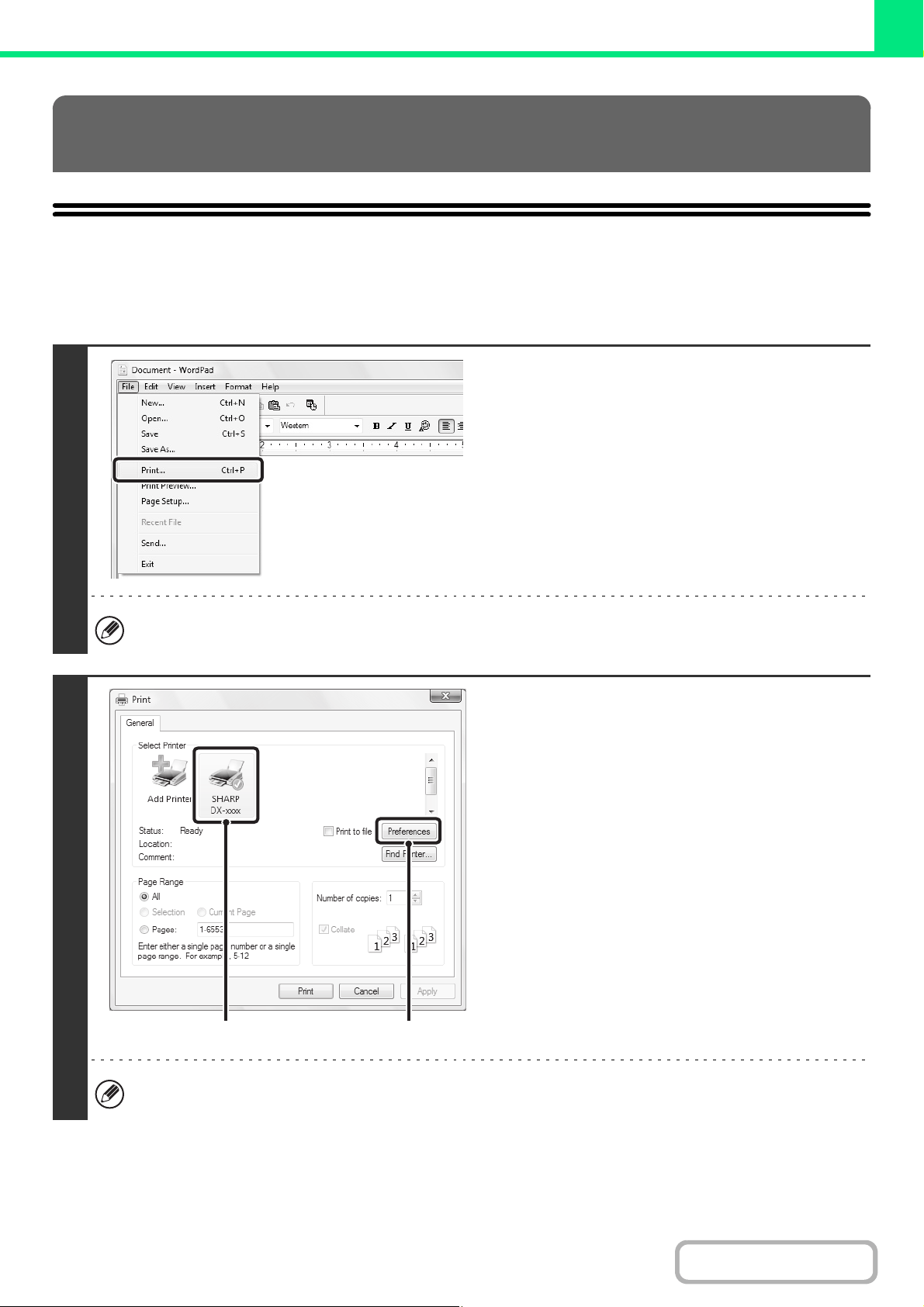
3-4
PRINTER
Contents
BASIC PRINTING PROCEDURE
The following example explains how to print a document from "WordPad", which is a standard accessory program in
Windows.
PRINTING FROM WINDOWS
1
Select [Print] from the [File] menu of
WordPad.
The menu used to execute printing may vary depending on the software application.
2
Open the printer driver properties
window.
(1) Select the printer driver of the machine.
• If the printer drivers appear as icons, click the icon
of the printer driver to be used.
• If the printer drivers appear as a list, select the
name of the printer driver to be used from the list.
(2) Click the [Preferences] button.
• If you are using Windows 2000, the [Preferences]
button does not appear. Click a tab on the "Print"
dialog box to adjust the settings on that tab.
• In Windows 98/Me/NT 4.0, click the [Properties]
button.
The button that is used to open the printer driver properties window (usually [Properties] or [Printing Preferences])
may vary depending on the software application.
(1)
(2)
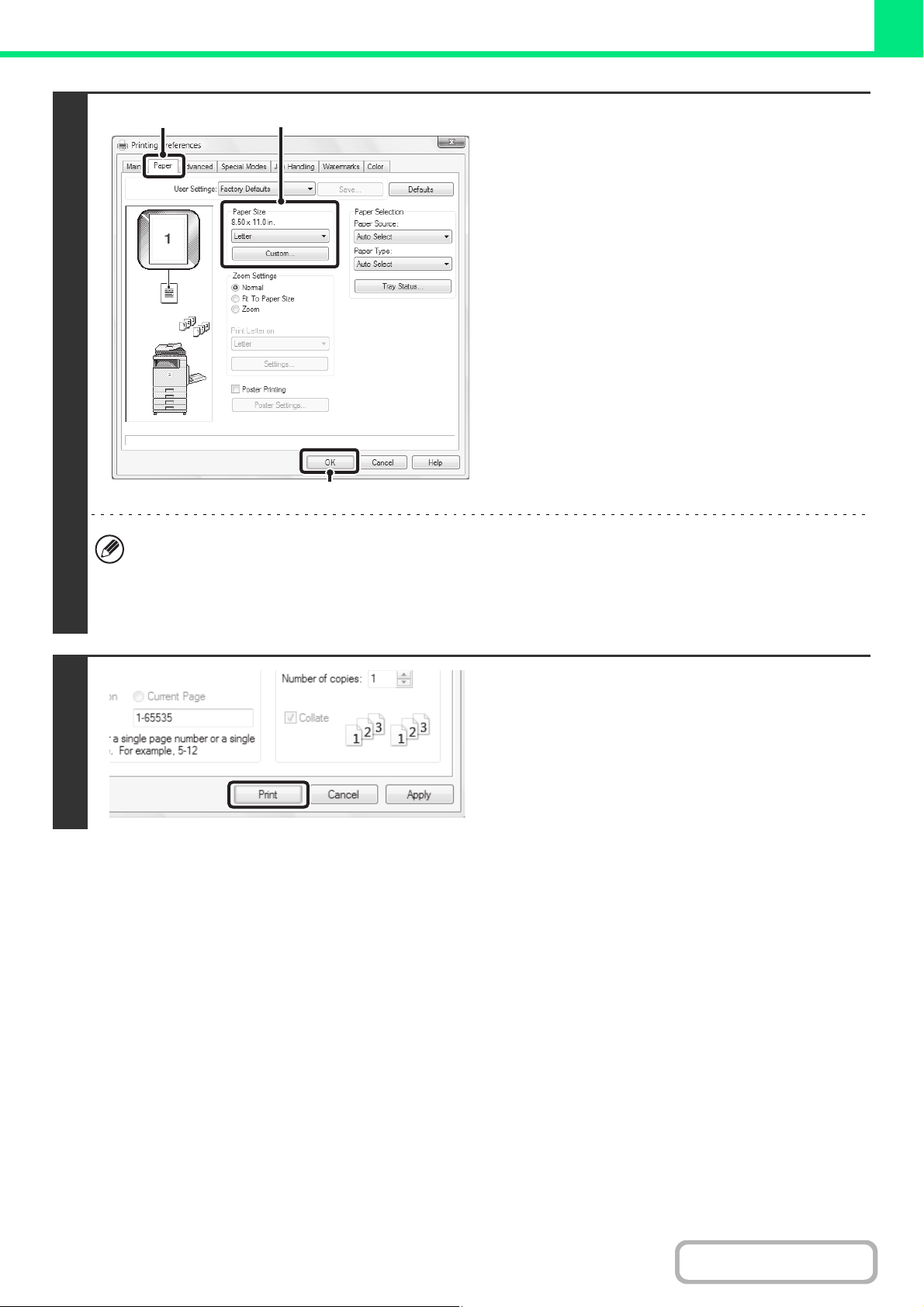
3-5
PRINTER
Contents
3
Select print settings.
(1) Click the [Paper] tab.
(2) Select the paper size.
To select settings on other tabs, click the desired tab
and then select the settings.
(3) Click the [OK] button.
• Make sure the paper size is the same as the paper size set in the software application.
• Up to eight custom paper sizes can be stored. Storing a custom paper size makes it easy to specify that size each
time you need to use it.
To store a paper size, select [Custom Paper] or one of [User1] to [User7] from the pull-down menu and click the
[Custom] button.
4
Click the [Print] button.
Printing begins.
In Windows 98/Me/NT 4.0, click the [OK] button.
(1)
(2)
(3)
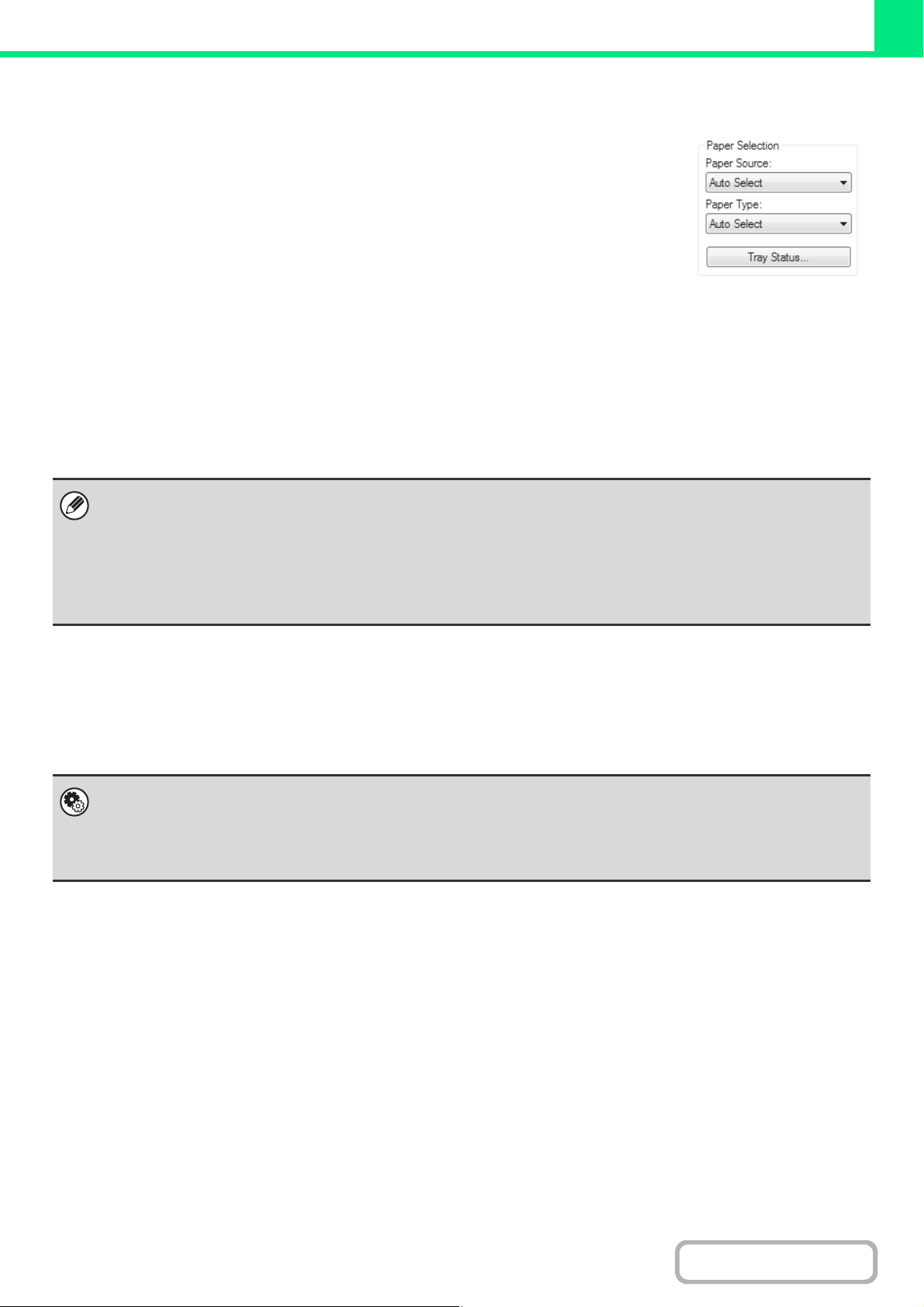
3-6
PRINTER
Contents
SELECTING THE PAPER
This section explains how to configure the "Paper Selection" setting on the [Paper] tab of
the printer driver properties window.
Before printing, check the paper sizes, paper types, and paper remaining in the machine's
trays. To view the most recent tray information, click the [Tray Status] button.
• When [Auto Select] is selected in "Paper Source"
The tray that has the size and type of paper selected in "Paper Size" and "Paper Type" on the [Paper] tab is
automatically selected.
• When other than [Auto Select] is selected in "Paper Source"
The specified tray is used for printing regardless of the "Paper Size" setting.
When [Bypass Tray] is selected
The "Paper Type" must also be selected. Check the bypass tray and make sure that the desired type of paper is
loaded, and then select the appropriate "Paper Type" setting.
• When [Auto Select] is selected in "Paper Type"
A tray with plain paper or recycled paper of the size specified in "Paper Size" is automatically selected. (The factory
default setting is plain paper only.)
• When other than [Auto Select] is selected in "Paper Type"
A tray with the specified type of paper and the size specified in "Paper Size" is used for printing.
• Special media such as envelopes can also be placed in the bypass tray. For the procedure for loading paper and other
media in the bypass tray, see "LOADING PAPER IN THE BYPASS TRAY" (page 1-47) in "1. BEFORE USING THE
MACHINE".
• When "Enable Detected Paper Size in Bypass Tray" (Web page only : disabled by factory default) or "Enable Selected
Paper Type in Bypass Tray" (Web page only : enabled by factory default) is enabled in the system settings (administrator),
printing will not take place if the paper size or paper type specified in the printer driver is different from the paper size or
paper type specified in the settings of the bypass tray.
System Settings (Administrator): Exclude Bypass-Tray from Auto Paper Select (Web page only)
When [Auto Select] is selected in "Paper Selection", specify whether or not the paper in the bypass tray will be excluded from
the paper that can be selected. This setting is disabled by factory default, and thus paper in the bypass tray is included in the
paper that can be automatically selected. If special media are frequently loaded in the bypass tray, it is recommended that
this setting be enabled.
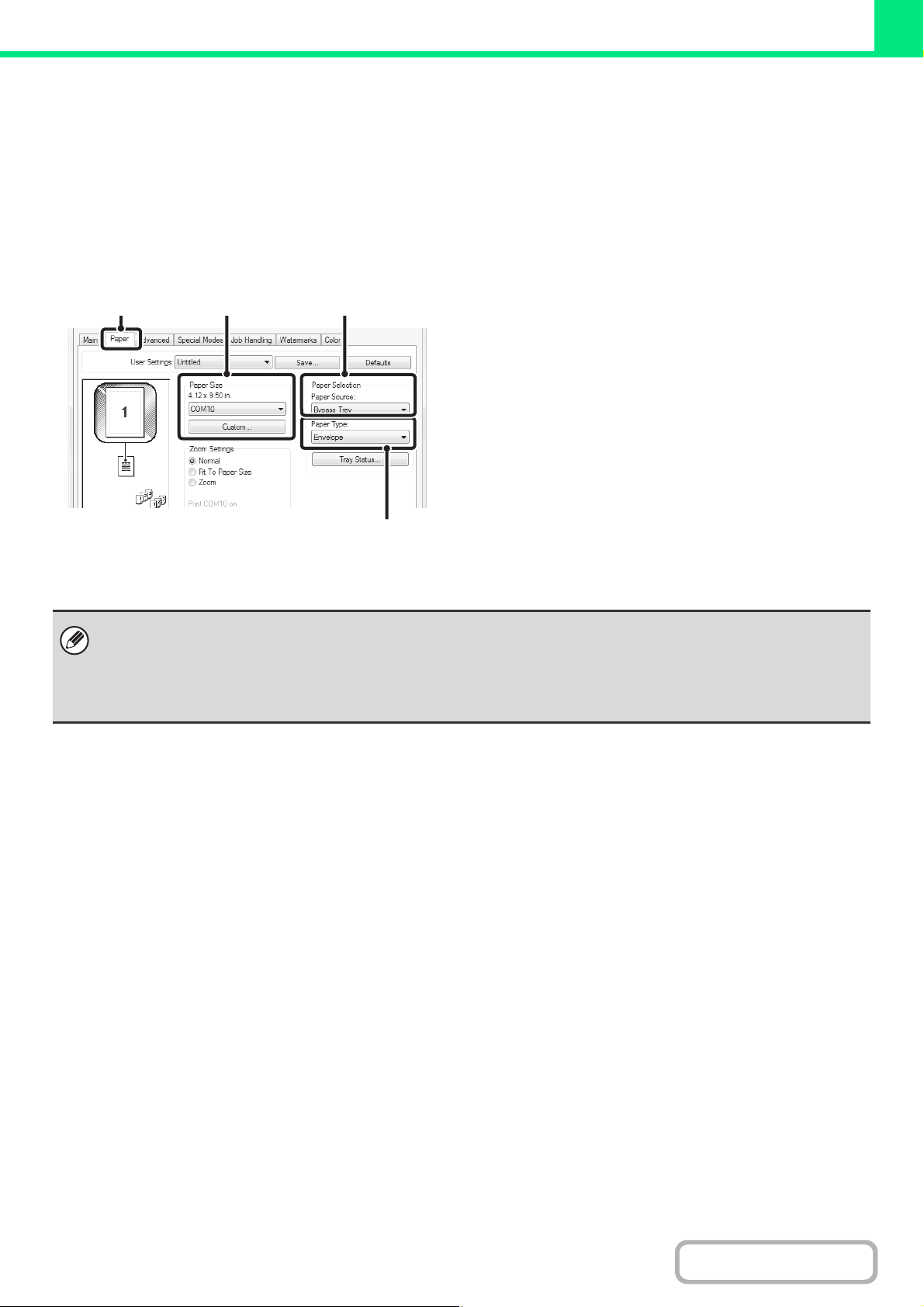
3-7
PRINTER
Contents
PRINTING ON ENVELOPES
The bypass tray can be used to print on special media such as envelopes. The procedure for printing on an envelope
from the printer driver properties screen is described below.
For the types of paper that can be used in the bypass tray, see "IMPORTANT POINTS ABOUT PAPER" (page 1-42) in
"BEFORE USING THE MACHINE". For the procedure for loading paper in the bypass tray, see "LOADING PAPER IN
THE BYPASS TRAY" (page 1-47) in "1. BEFORE USING THE MACHINE".
Select the envelope size in the appropriate settings of the application ("Page Settings" in many applications) and then
perform the following steps.
(1) Click the [Paper] tab.
(2) Select the envelope size from the "Paper
Size" menu.
(3) Select [Bypass Tray] from the "Paper
Source" menu of "Paper Selection".
(4) Select [Envelope] from the "Paper Type"
menu.
Set the paper type of the bypass tray to [Envelope] and
make sure the envelope is loaded in the bypass tray.
(4)
(2)(1) (3)
• It is recommended that you do a test print to check the print result before using an envelope.
• In the case of media that can only be loaded in a certain orientation such as an envelope, you can rotate the image 180
degrees if needed. For more information, see "ROTATING THE PRINT IMAGE 180 DEGREES (Rotate 180 degrees)"
(page 3-37).
• For more information on "Paper Selection", see "SELECTING THE PAPER" (page 3-6).
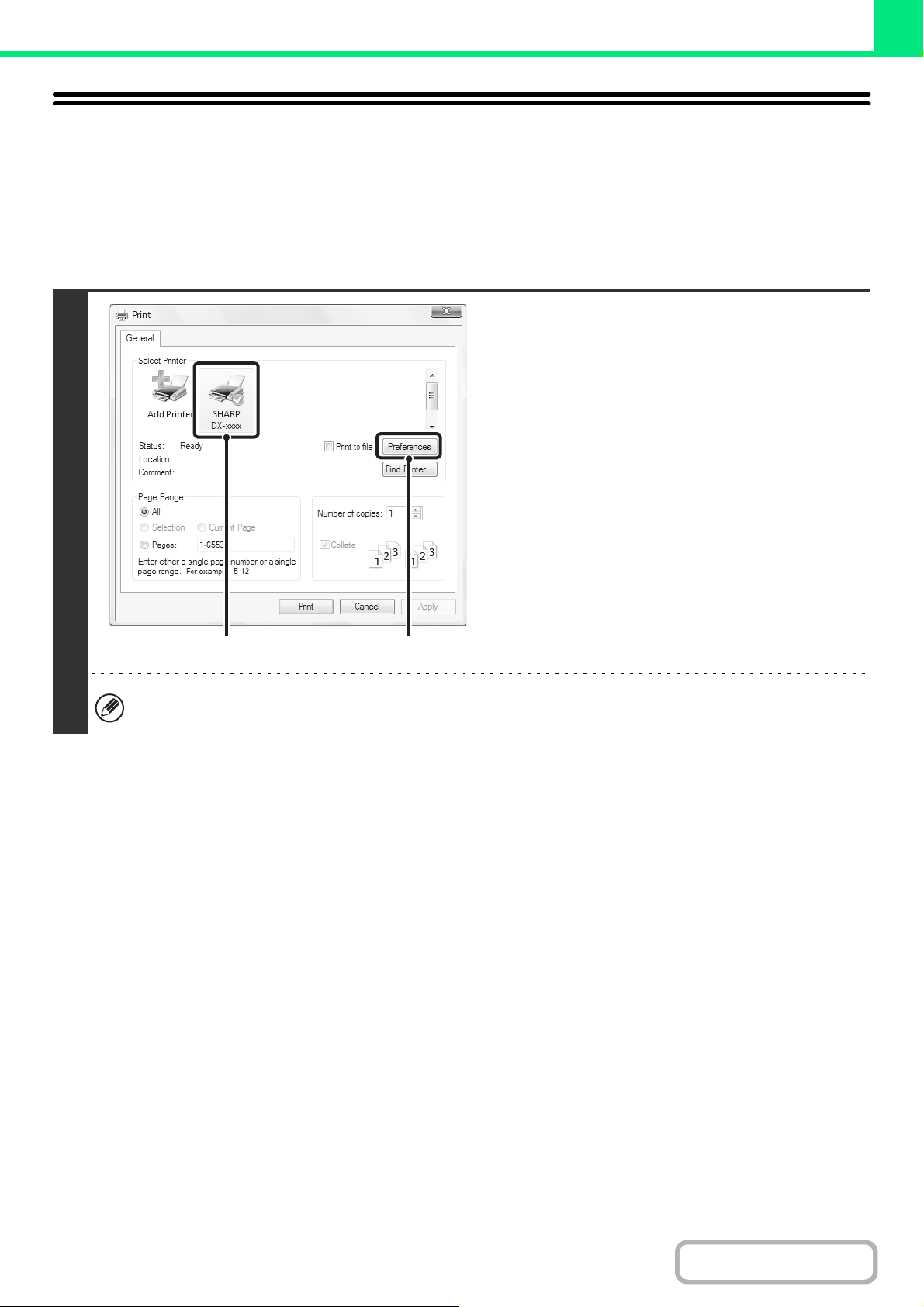
3-8
PRINTER
Contents
PRINTING WHEN THE USER
AUTHENTICATION FUNCTION IS ENABLED
When the user authentication function is enabled, your user information (login name, password, etc.) must be entered in
the printer driver properties window before you can print. The information that must be entered varies depending on the
authentication method being used, so check with the administrator of the machine before printing.
1
Open the printer driver properties
window from the print window of the
software application.
(1) Select the printer driver of the machine.
(2) Click the [Preferences] button.
The button that is used to open the printer driver properties window (usually [Properties] or [Printing Preferences])
may vary depending on the software application.
(1)
(2)
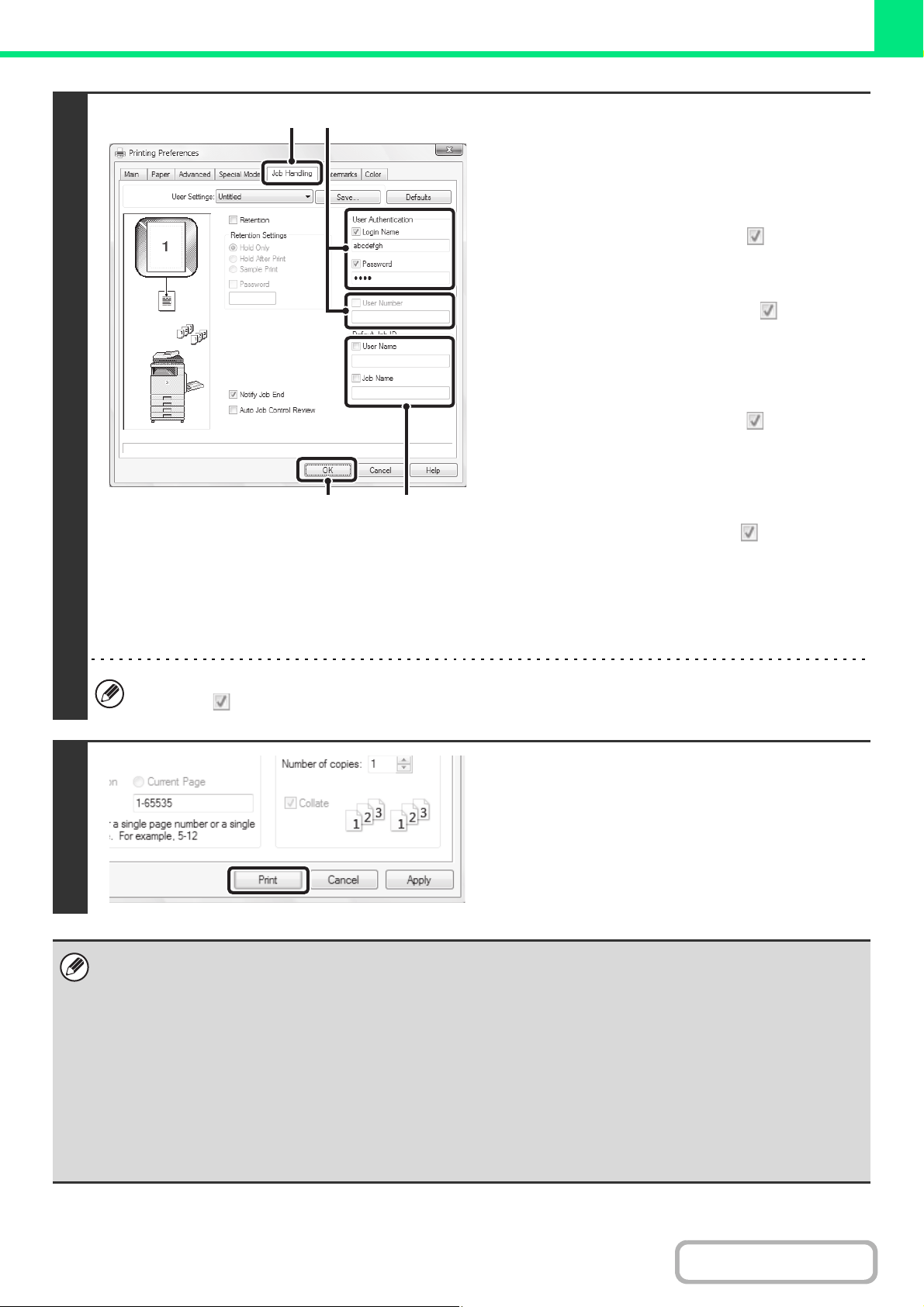
3-9
PRINTER
Contents
2
Enter your login name and password.
(1) Click the [Job Handling] tab.
(2) Enter your user information.
• When authentication is by login name/password
Select the [Login Name] and [Password]
checkboxes so that checkmarks appear, and
enter your login name and password. Enter 1 to 32
characters for the password.
• When authentication is by user number
Click the [User Number] checkbox and enter a
user number (5 to 8 digits).
(3) Enter the user name and job name as
necessary.
• User Name
Click the [User Name] checkbox and enter your
user name (maximum of 32 characters). Your
entered user name will appear at the top of the
operation panel. If you do not enter a user name,
your computer login name will appear.
• Job Name
Click the [Job Name] checkbox and enter a job
name (maximum of 30 characters). The entered job
name will appear at the top of the operation panel
as a file name. If you do not enter a job name, the
file name set in the software application will appear.
(4) Click the [OK] button.
To have a confirmation window appear before printing starts, select the [Auto Job Control Review] checkbox so that a
checkmark appears.
3
Start printing.
• When user authentication is enabled, printing is possible without entering user information if black and white printing is set
in the printer driver. For black and white print settings, see "BLACK AND WHITE PRINTING" (page 3-24). The number of
pages printed is added to the "Other User" count. In this case, other print functions may be restricted. For more
information, ask your administrator.
• The machine's user authentication function cannot be used when the PPD file* is installed and the Windows standard PS
printer driver is used. For this reason, printing will not be possible if printing by invalid users is prohibited.
* The PPD file enables the machine to print using the standard PS printer driver of the operating system.
• Disabling of Printing by Invalid User
This is used to prohibit printing of print jobs by users whose user information is not stored in the machine. When this
function is enabled, printing is not allowed when user information is not entered or incorrect information is entered.
This setting can be configured in [User Control] - [Default Settings] - [Disabling of Printing by Invalid User] in the Web page
menu. (Administrator rights are required.)
(4)
(1) (2)
(3)
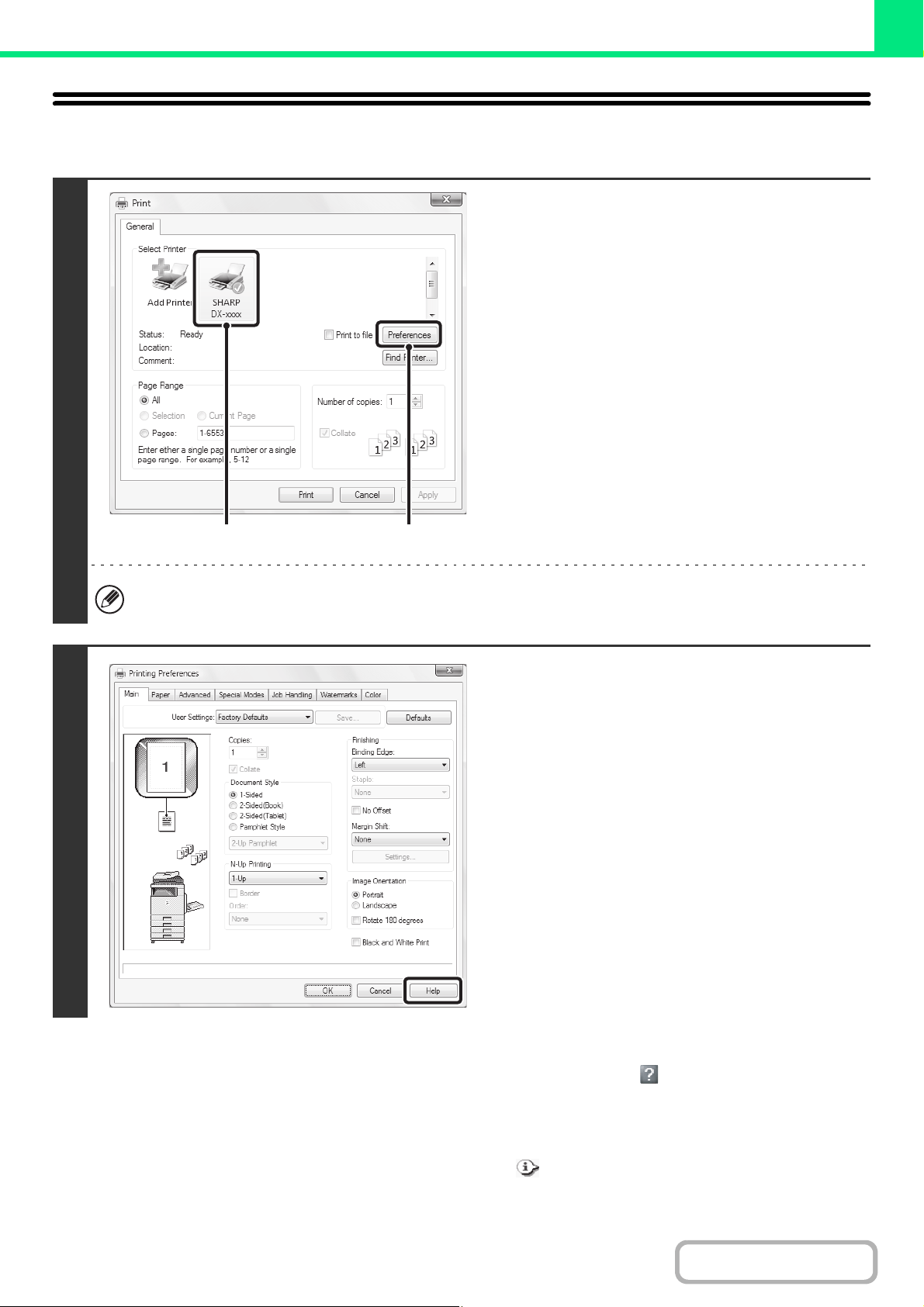
3-10
PRINTER
Contents
VIEWING PRINTER DRIVER HELP
When selecting settings in the printer driver, you can display Help to view explanations of the settings.
Pop-up help
Help can be displayed for a setting by clicking the setting and pressing the [F1] key.
* To view Help for a setting in Windows 98/Me/NT 4.0/2000/XP/Server 2003, click the button in the upper right-hand
corner of the printer driver properties window and then click the setting.
You can also view the same Help by right-clicking the setting and clicking the [Help] box that appears.
Information icon
Some restrictions exist on the combinations of settings that can be selected in the printer driver properties window.
When a restriction exists on a selected setting, an information icon ( ) will appear next to the setting. Click the icon to
view an explanation of the restriction.
1
Open the printer driver properties
window from the print window of the
software application.
(1) Select the printer driver of the machine.
(2) Click the [Preferences] button.
The button that is used to open the printer driver properties window (usually [Properties] or [Printing Preferences])
may vary depending on the software application.
2
Click the [Help] button.
The Help window will open to let you view explanations of
the settings on the tab.
To view Help for settings in a dialog box, click the
underlined text at the top of the Help window.
(1)
(2)
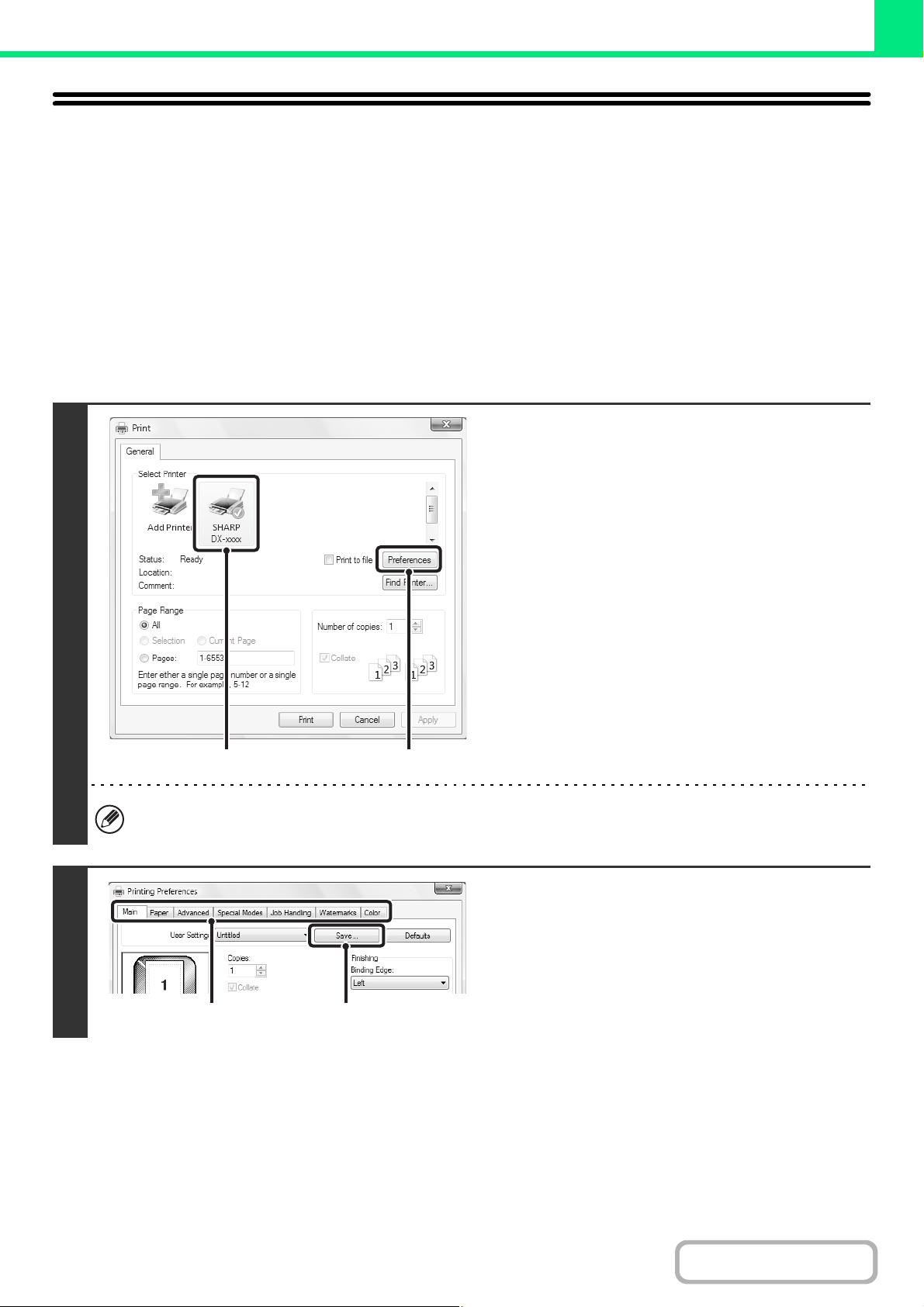
3-11
PRINTER
Contents
SAVING FREQUENTLY USED PRINT
SETTINGS
Settings configured on each of the tabs at the time of printing can be saved as user settings. Saving frequently used
settings or complex color settings under an assigned name makes it easy to select those settings the next time you need
to use them.
SAVING SETTINGS AT THE TIME OF PRINTING
Settings can be saved from any tab of the printer driver properties window. Settings configured on each tab are listed at
the time of saving, allowing you to check the settings as you save them.
1
Open the printer driver properties
window from the print window of the
software application.
(1) Select the printer driver of the machine.
(2) Click the [Preferences] button.
The button that is used to open the printer driver properties window (usually [Properties] or [Printing Preferences])
may vary depending on the software application.
2
Save the print settings.
(1) Configure print settings on each tab.
(2) Click the [Save] button.
(1)
(2)
(2)(1)
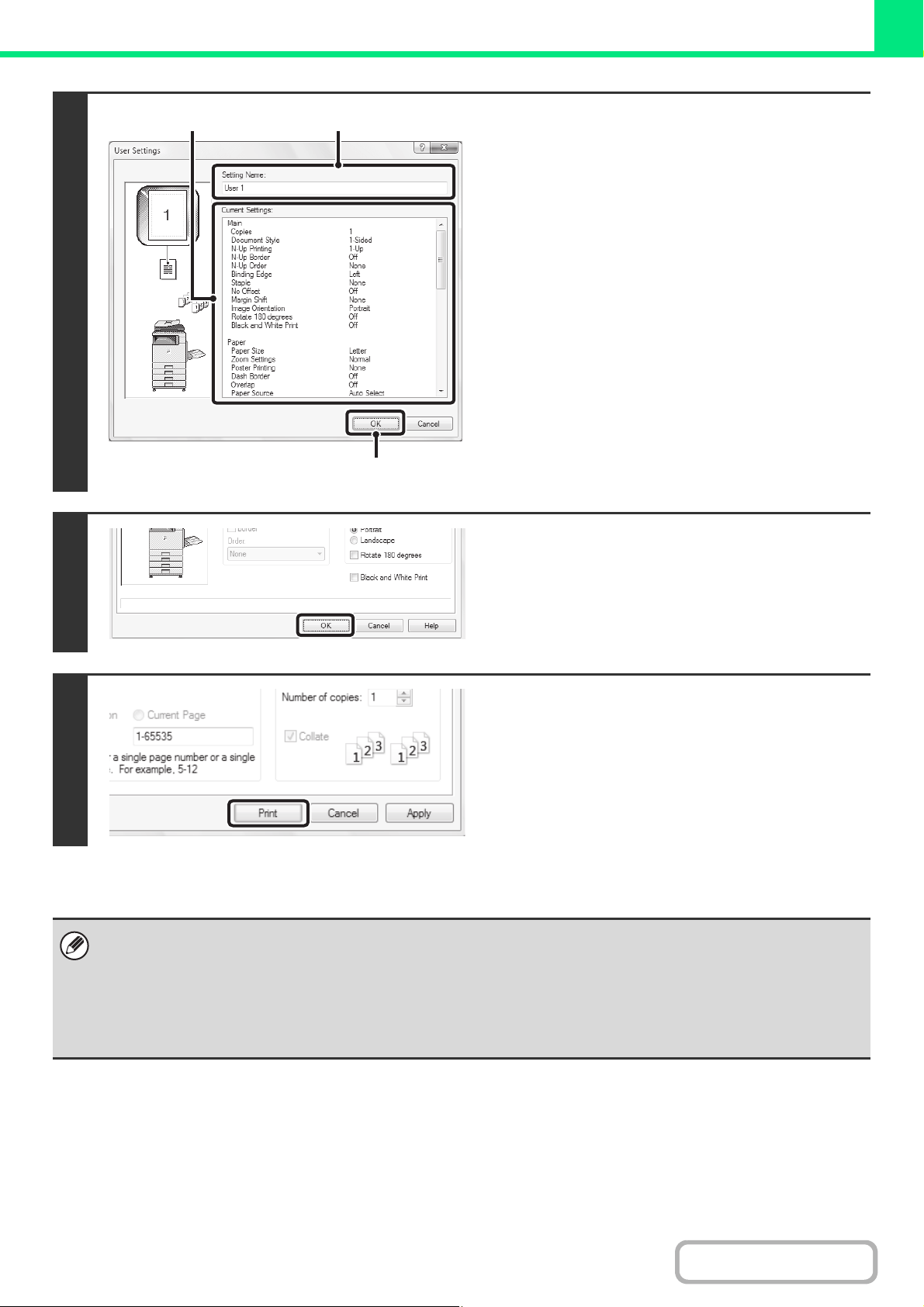
3-12
PRINTER
Contents
3
Check and save the settings.
(1) Check the displayed settings.
(2) Enter a name for the settings (maximum
of 20 characters).
(3) Click the [OK] button.
4
Click the [OK] button.
5
Start printing.
• Up to 30 sets of user settings can be saved.
• The following items cannot be saved in user settings.
- A watermark that you created
- Paper insertion settings
-Overlay file
- The login name, password, user name, and job name entered in the [Job Handling] tab
(3)
(2)(1)
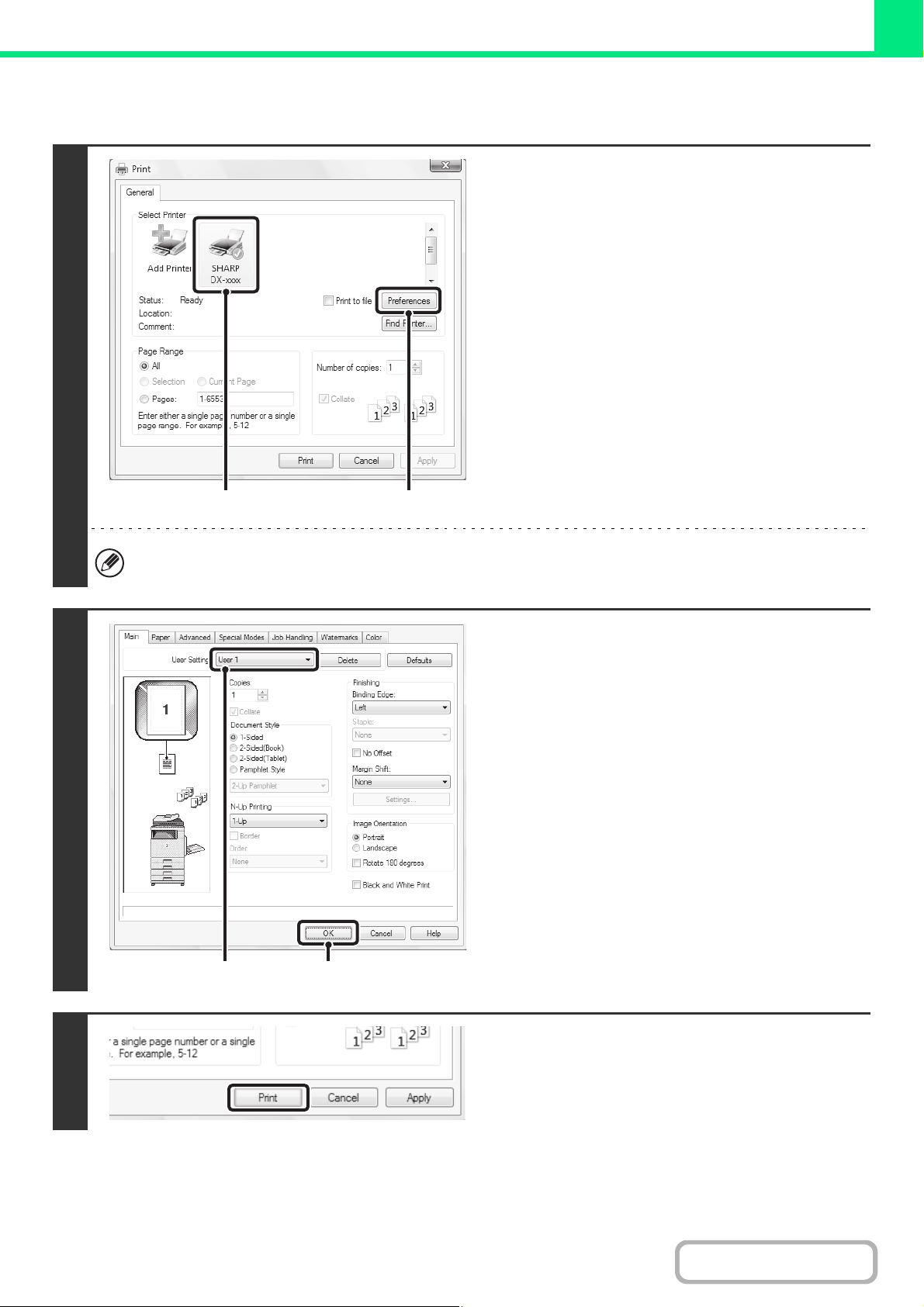
3-13
PRINTER
Contents
USING SAVED SETTINGS
Deleting saved settings
Select the user settings that you want to delete in (1) of step 2 above, and click the [Delete] button.
1
Open the printer driver properties
window from the print window of the
software application.
(1) Select the printer driver of the machine.
(2) Click the [Preferences] button.
The button that is used to open the printer driver properties window (usually [Properties] or [Printing Preferences])
may vary depending on the software application.
2
Select the print settings.
(1) Select the user settings that you wish to
use.
(2) Click the [OK] button.
3
Start printing.
(1)
(2)
(1)
(2)
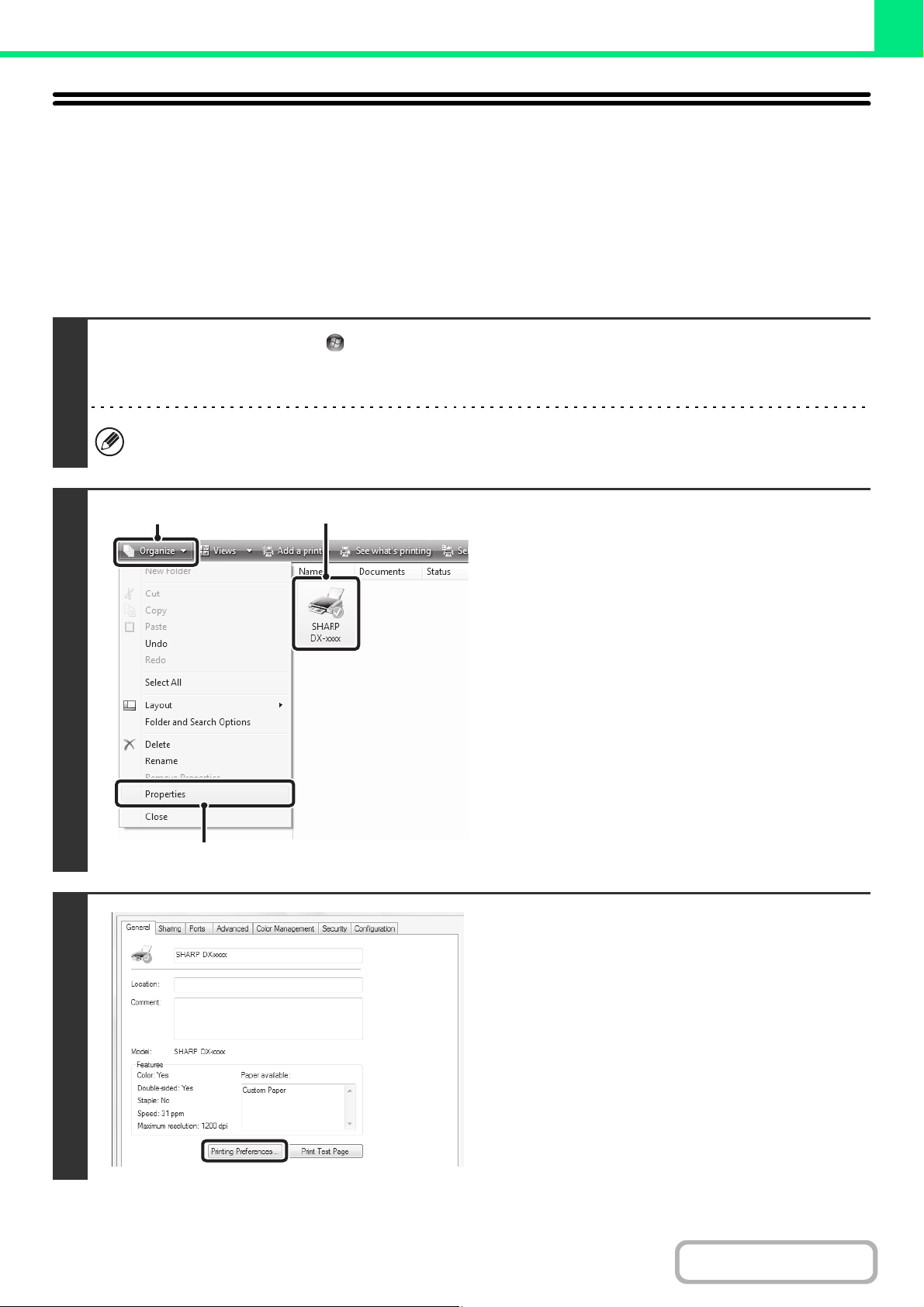
3-14
PRINTER
Contents
CHANGING THE PRINTER DRIVER
DEFAULT SETTINGS
The default settings of the printer driver can be changed using the procedure below. The settings selected using this
procedure are saved and become the default settings when printing from a software application. (Settings selected in
the printer driver properties window when printing from an application remain in effect only while the application is in
use.)
1
Click the [Start] button ( ) and select [Control Panel] and then [Printer].
• In Windows XP/Server 2003, click the [start] button and then click [Printers and Faxes].
• In Windows 98/Me/NT 4.0/2000, click the [Start] button, point to [Settings], and then select [Printers].
In Windows XP, if [Printers and Faxes] does not appear in the [start] menu, select [Control Panel], select [Printers and
Other Hardware], and then select [Printers and Faxes].
2
Open the printer properties window.
(1) Click the icon of the printer driver of the
machine.
(2) Click the [Organize] menu.
In Windows 98/Me/NT 4.0/2000/XP/Server 2003, click
the [File] menu.
(3) Select [Properties].
In Windows NT 4.0, select [Document Defaults] from
the [File] menu to open the printer driver properties
window. Go to step 4.
3
Click the [Printing Preferences] button
on the [General] tab.
In Windows 98/Me, click the [Setup] tab.
(1)
(3)
(2)
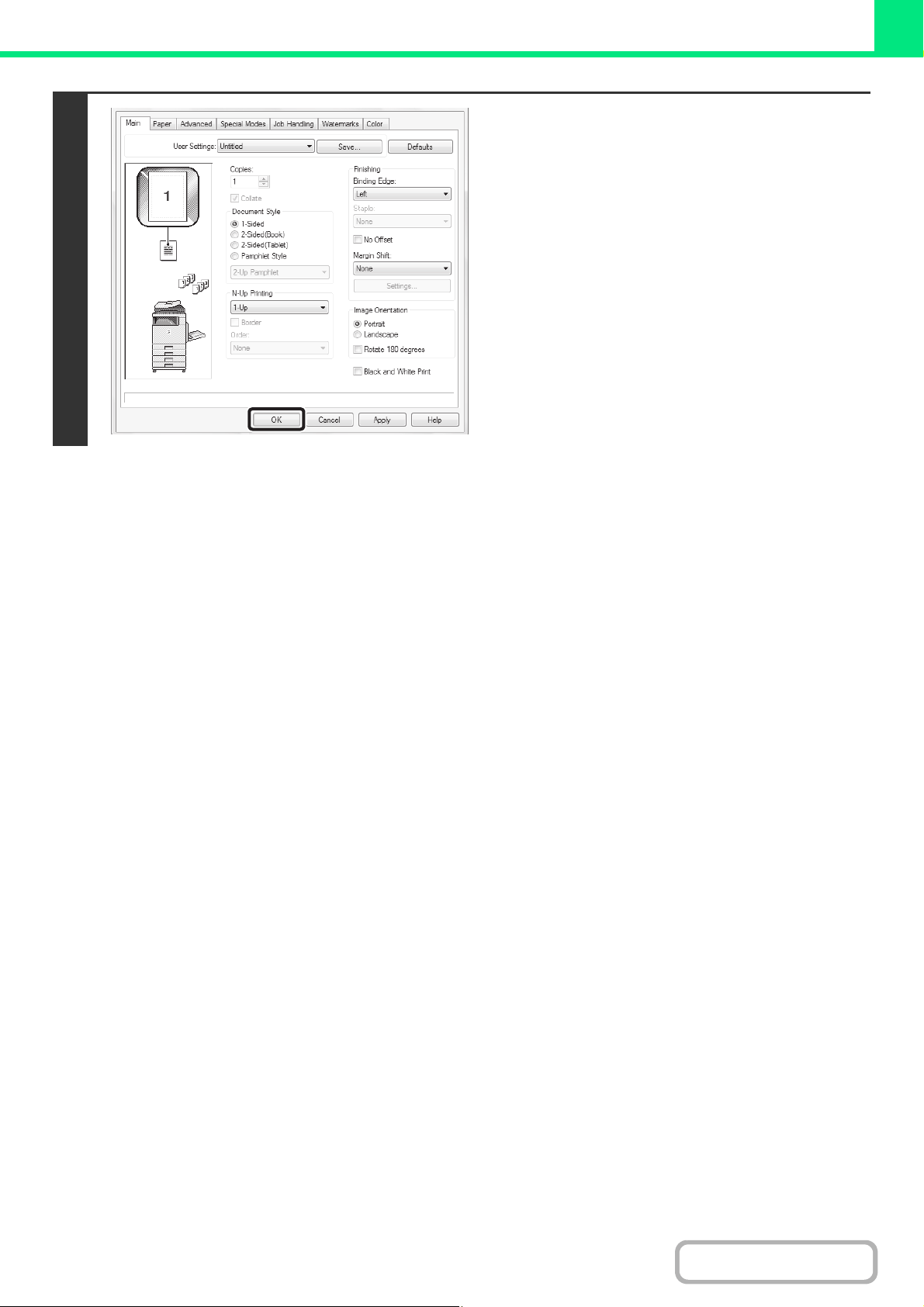
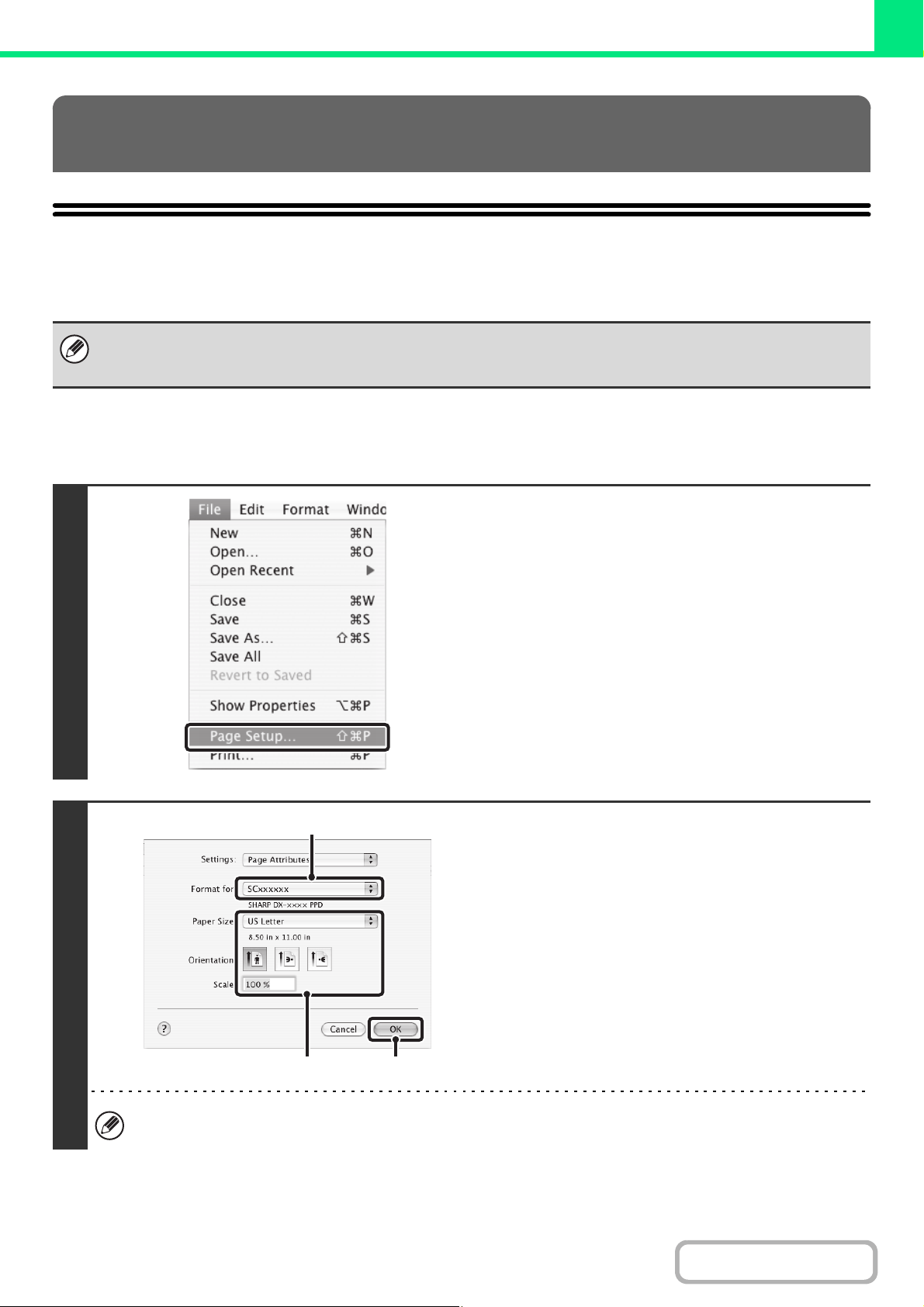
3-16
PRINTER
Contents
BASIC PRINTING PROCEDURE
The following example explains how to print a document from the standard accessory program "TextEdit" in Mac OS X
("SimpleText" in Mac OS 9).
SELECTING PAPER SETTINGS
Select paper settings in the printer driver before selecting the print command.
PRINTING FROM A MACINTOSH
To use the machine as a printer for the Macintosh, the PS3 expansion kit must be installed in the machine and the machine
must be connected to a network. To install the PPD file and configure printer driver settings, see "Chapter 3 - SETUP IN A
MACINTOSH ENVIRONMENT" in "PART 2 SOFTWARE INSTALLATION" in the Installation Guide.
1
Select [Page Setup] from the [File]
menu of TextEdit.
In Mac OS 9, select [Page Setup] from the [File] menu of
SimpleText.
2
Select paper settings.
(1) Make sure that the correct printer is
selected.
(2) Select paper settings.
The paper size, paper orientation, and enlarge/reduce
can be selected.
(3) Click the [OK] button.
The machine name that appears in the "Format for" menu is normally [SCxxxxxx]. ("xxxxxx" is a sequence of
characters that varies depending on your machine model.)
(1)
(2)
(3)
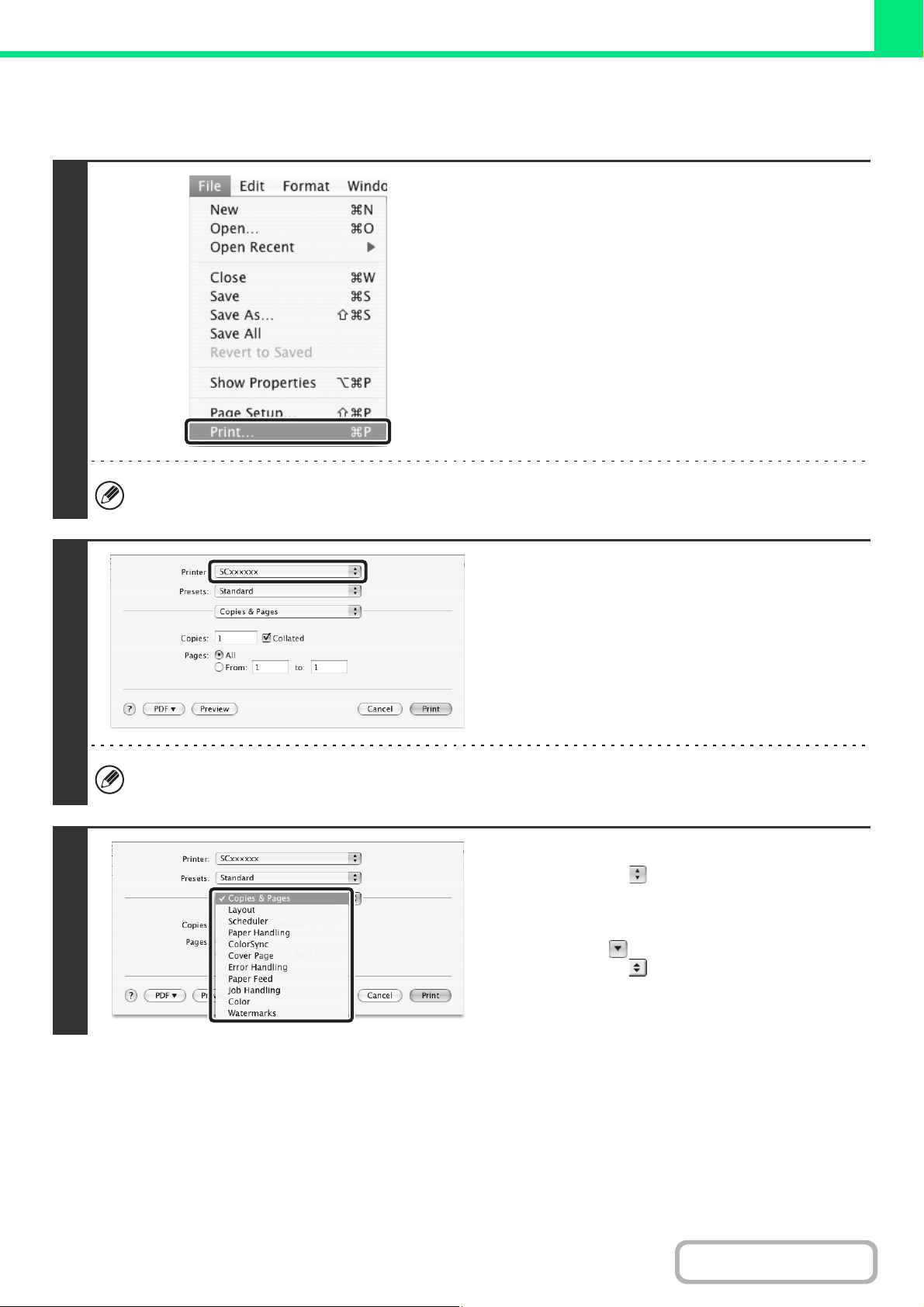
3-17
PRINTER
Contents
PRINTING
1
Select [Print] from the [File] menu of
TextEdit.
In Mac OS 9, select [Print] from the [File] menu of
SimpleText.
The menu used to execute printing may vary depending on the software application.
2
Make sure that the correct printer is
selected.
The machine name that appears in the "Printer" menu is normally [SCxxxxxx]. ("xxxxxx" is a sequence of characters
that varies depending on the machine model.)
3
Select print settings.
• In Mac OS X, click next to [Copies & Pages] and
select the settings that you wish to configure from the
pull-down menu. The corresponding setting screen will
appear. If the settings do not appear in Mac OS X v10.5
to 10.5.1, click " " next to the printer name.
• In Mac OS 9, click next to [General] and select the
settings that you wish to configure from the pull-down
menu. The corresponding setting screen will appear.
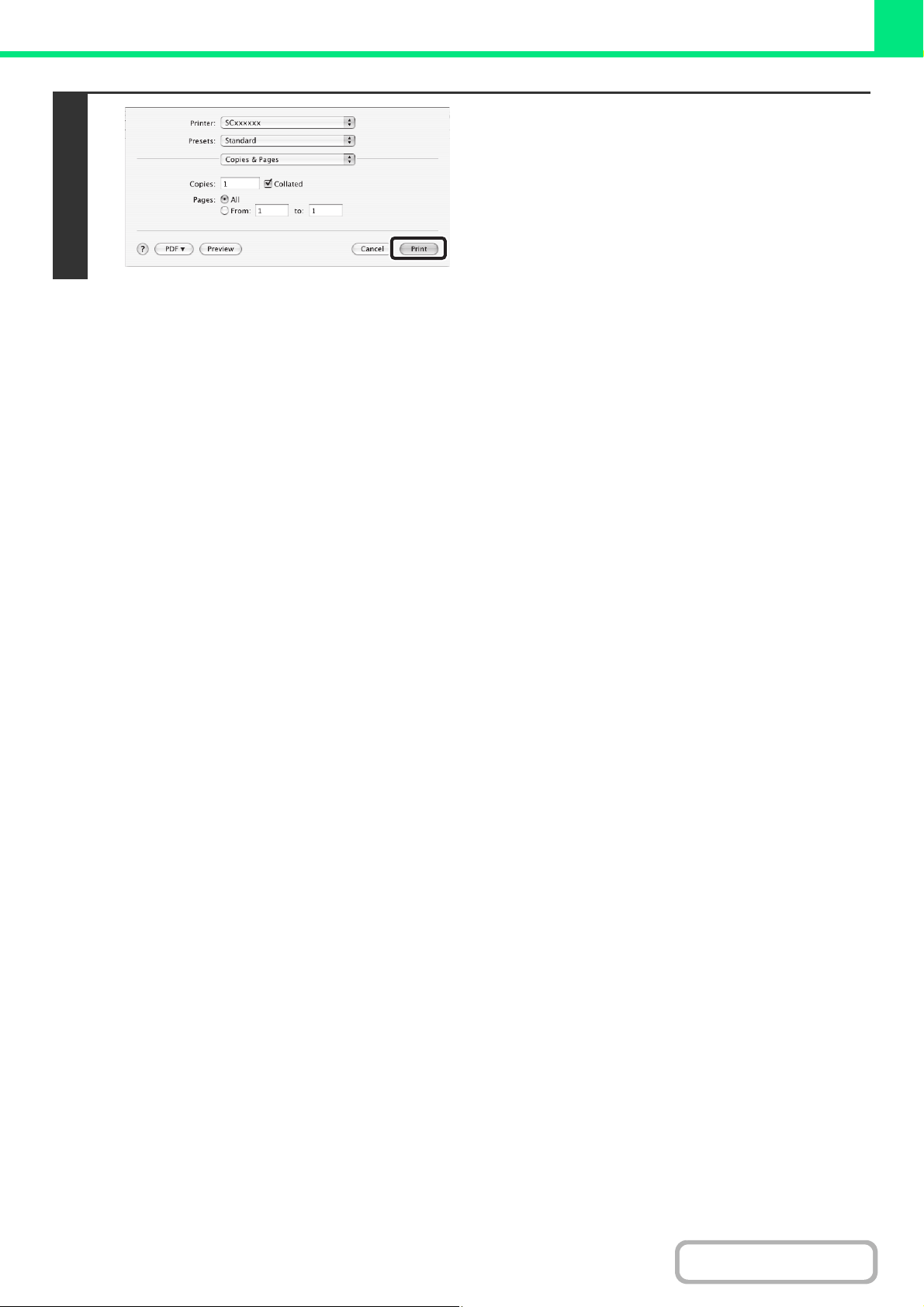
3-19
PRINTER
Contents
SELECTING THE PAPER
This section explains the [Paper Feed] settings ("Paper Source" setting in [General] in Mac OS 9) in the print settings
window.
• When [Auto Select] is selected
A tray with plain paper or recycled paper (the factory default setting is plain paper only) of the size specified in "Paper
Size" in the page settings window is automatically selected.
• When a paper tray is selected
The specified tray is used for printing regardless of the "Paper Size" setting in the page settings window.
For the bypass tray, a paper type can also be specified. Make sure that the paper type setting for the bypass tray is
correct and that the set type of paper is actually loaded in the bypass tray, and then select the appropriate bypass tray
(paper type).
• When a paper type is selected
A tray with the specified type of paper and the size specified in "Paper Size" in the page settings window is used for
printing.
• Special media such as envelopes can also be placed in the bypass tray. For the procedure for loading paper and other
media in the bypass tray, see "LOADING PAPER IN THE BYPASS TRAY" (page 1-47) in "1. BEFORE USING THE
MACHINE".
• When "Enable Detected Paper Size in Bypass Tray" (Web page only : disabled by factory default) or "Enable Selected
Paper Type in Bypass Tray" (Web page only : enabled by factory default) is enabled in the system settings (administrator),
printing will not take place if the paper size or paper type specified in the printer driver is different from the paper size or
paper type specified in the settings of the bypass tray.
System Settings (Administrator): Exclude Bypass-Tray from Auto Paper Select (Web page only)
When [Auto Select] is used for printing, this setting determines whether or not the paper in the bypass tray will be excluded
from the paper that can be selected. This setting is disabled by factory default, and thus paper in the bypass tray is included
in the paper that can be automatically selected. If special media are frequently loaded in the bypass tray, it is recommended
that this setting be enabled.
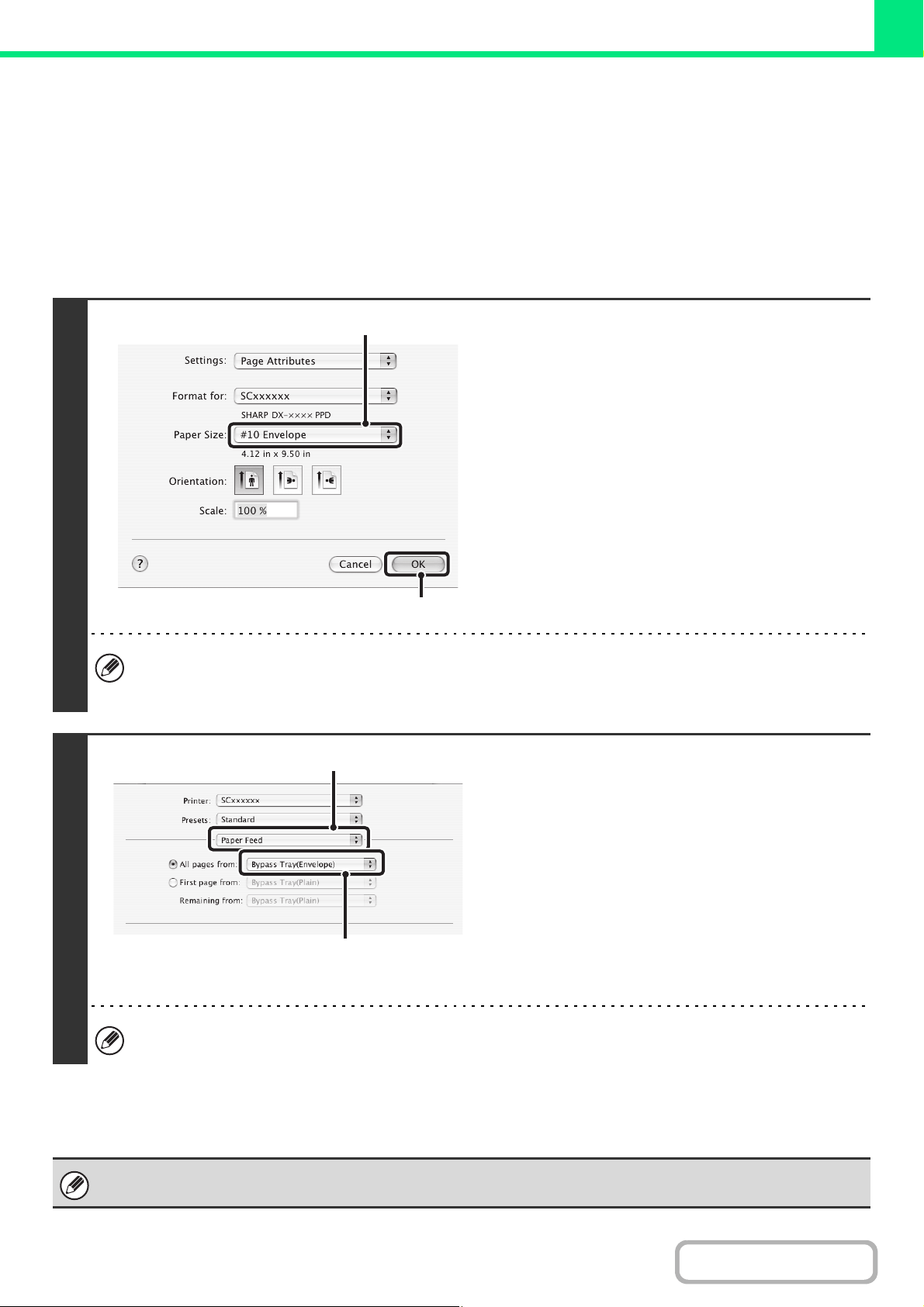
3-20
PRINTER
Contents
PRINTING ON ENVELOPES
The bypass tray can be used to print on special media such as envelopes. The procedure for printing on an envelope
from the printer driver properties screen is described below.
For the types of paper that can be used in the bypass tray, see "IMPORTANT POINTS ABOUT PAPER" (page 1-42) in
"BEFORE USING THE MACHINE". For the procedure for loading paper in the bypass tray, see "LOADING PAPER IN
THE BYPASS TRAY" (page 1-47) in "1. BEFORE USING THE MACHINE".
Select the envelope size in the appropriate settings of the application ("Page Settings" in many applications) and then
perform the following steps.
1
Select the paper size.
(1) Select the envelope size from the "Paper
Size" menu on the page setup screen.
In Mac OS 9, select the envelope size from the
"Paper" menu on the page setup screen.
(2) Click the [OK] button.
In the case of media that can only be loaded in a certain orientation such as an envelope, you can rotate the image
180 degrees if needed. For more information, see "ROTATING THE PRINT IMAGE 180 DEGREES (Rotate 180
degrees)" (page 3-37).
2
Select the bypass tray.
(1) Select [Paper Feed] on the print screen.
In Mac OS 9, select [General].
(2) Select [Bypass Tray(Envelope)] from the
"All pages from" menu.
• In Mac OS 9, select [Bypass Tray(Envelope)] from
the "All pages from" menu of "Paper Source".
• Set the paper type of the bypass tray to [Envelope]
and make sure the envelope is loaded in the bypass
tray.
For more information on "Paper Feed", see "SELECTING THE PAPER" (page 3-19).
It is recommended that you do a test print to check the print result before using an envelope.
(1)
(2)
(1)
(2)
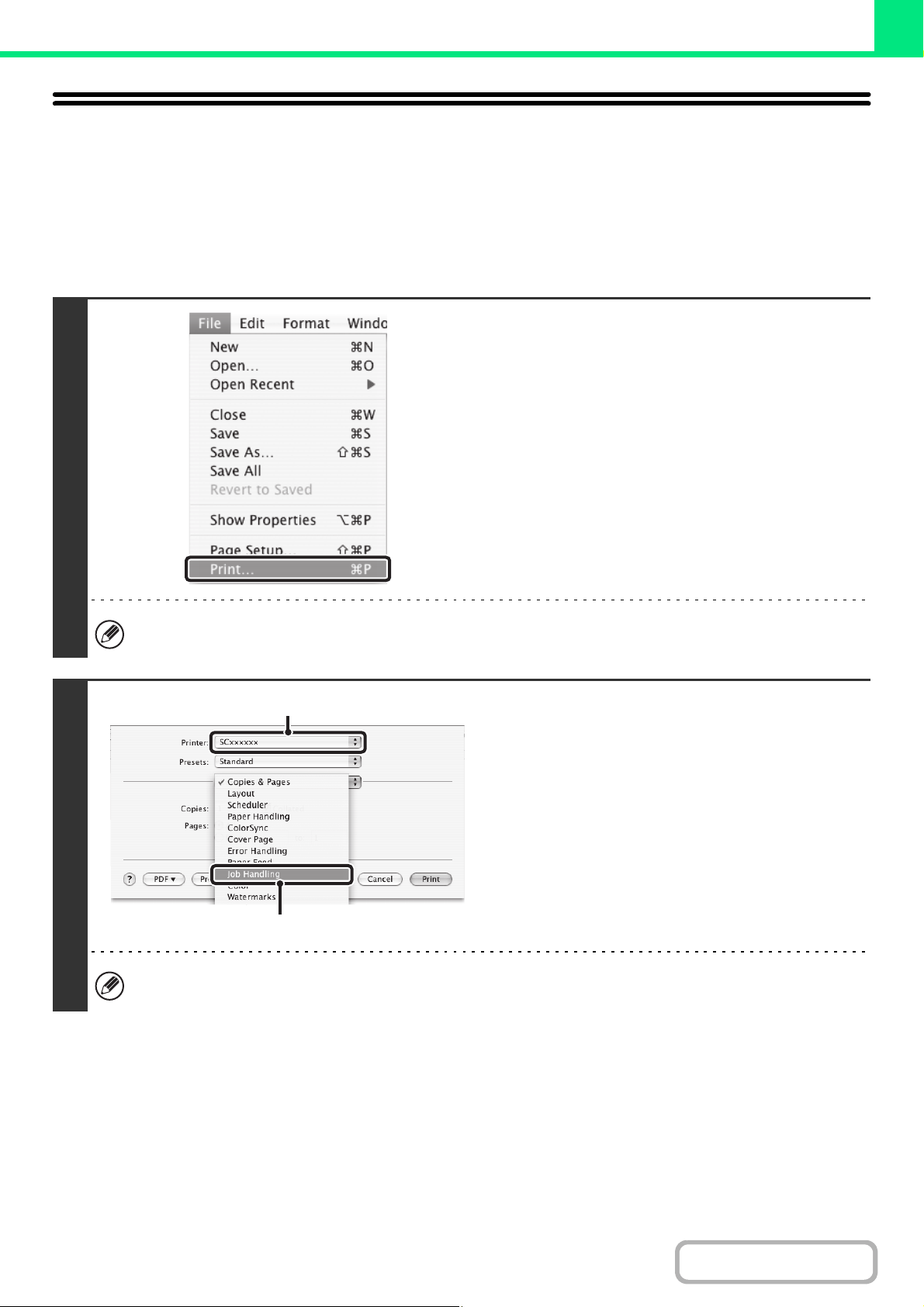
3-21
PRINTER
Contents
PRINTING WHEN THE USER
AUTHENTICATION FUNCTION IS ENABLED
When the user authentication function is enabled, you must enter your user information (login name, password, etc.) in
order to print. The information that must be entered varies depending on the authentication method being used, so
check with the administrator of the machine before printing.
1
Select [Print] from the application's
[File] menu.
The menu used to execute printing may vary depending on the software application.
2
Display the job handling screen.
(1) Make sure that the machine's printer
name is selected.
(2) Select [Job Handling].
• In Mac OS X v10.5 to 10.5.1, select [Job Handling]
and then click the [Authentication] tab in the screen
that appears.
• In Mac OS 9, select [User Authentication].
The machine name that appears in the "Printer" menu is normally [SCxxxxxx]. ("xxxxxx" is a sequence of characters
that varies depending on the machine model.)
(1)
(2)
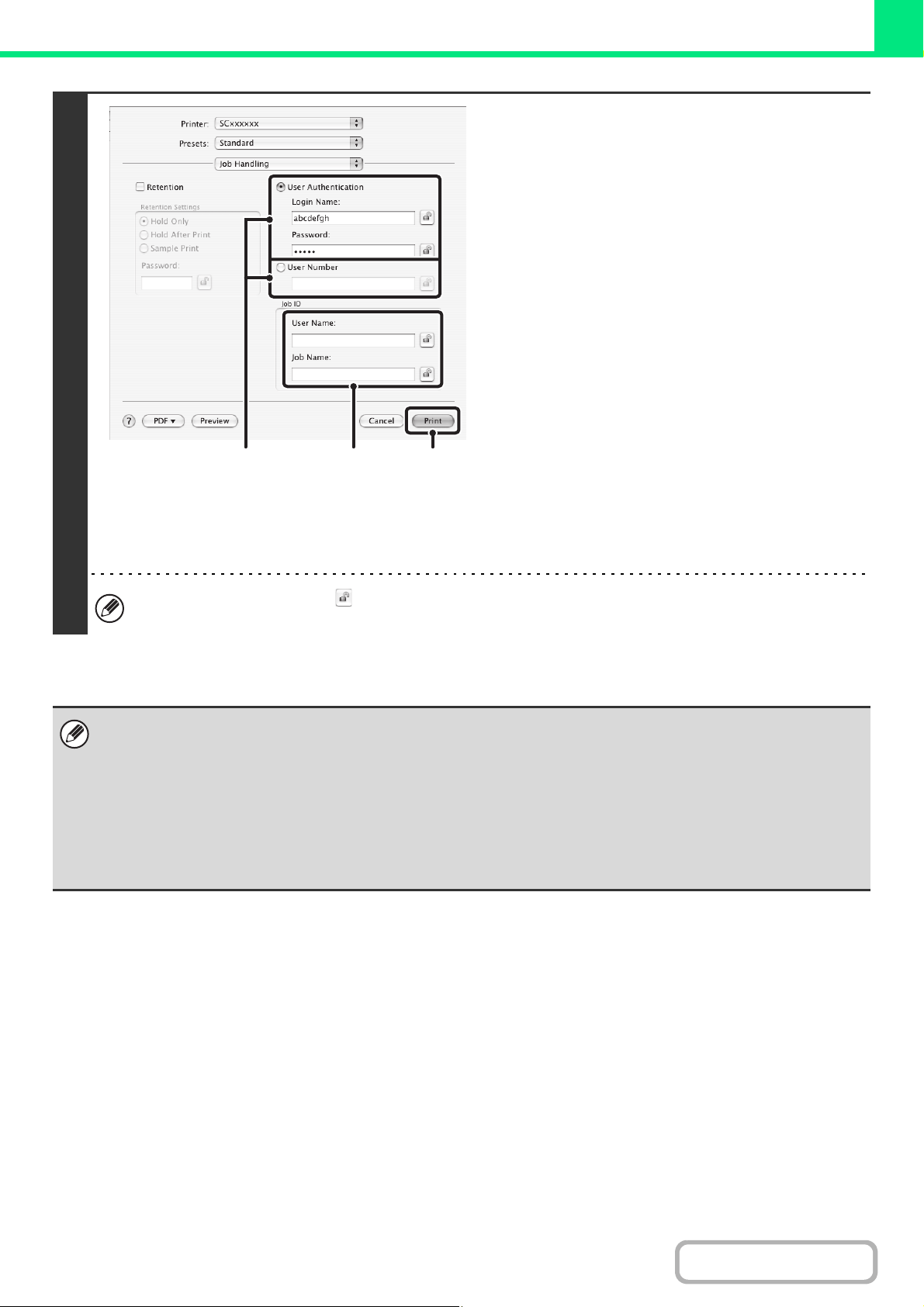
3-22
PRINTER
Contents
3
Start printing.
(1) Enter your user information.
• When authentication is by login name/password
Enter your login name in "Login Name" and your
password in "Password" (1 to 32 characters).
• When authentication is by user number
Enter your user number (5 to 8 digits) in "User
Number".
(2) Enter the user name and job name as
necessary.
• User Name
Enter your user name (maximum of 32 characters).
Your entered user name will appear at the top of the
operation panel. If you do not enter a user name,
your computer login name will appear.
• Job Name
Enter a job name (maximum of 30 characters). The
entered job name will appear at the top of the
operation panel as a file name. If you do not enter a
job name, the file name set in the software
application will appear.
(3) Click the [Print] button.
In Mac OS X, you can click the (lock) button after entering your login name and password, or user number, to
simplify operation the next time you wish to print based on the same user authentication.
• When user authentication is enabled, printing is possible without entering user information if black and white printing is set
in the printer driver. For black and white print settings, see "BLACK AND WHITE PRINTING" (page 3-24). The number of
pages printed is added to the "Other User" count. In this case, other print functions may be restricted. For more
information, ask your administrator.
• Disabling of Printing by Invalid User
This is used to prohibit printing of print jobs by users whose user information is not stored in the machine. When this
function is enabled, printing is not allowed when user information is not entered or incorrect information is entered.
This setting can be configured in [User Control] - [Default Settings] - [Disabling of Printing by Invalid User] in the Web page
menu. (Administrator rights are required.)
(3)(2)(1)
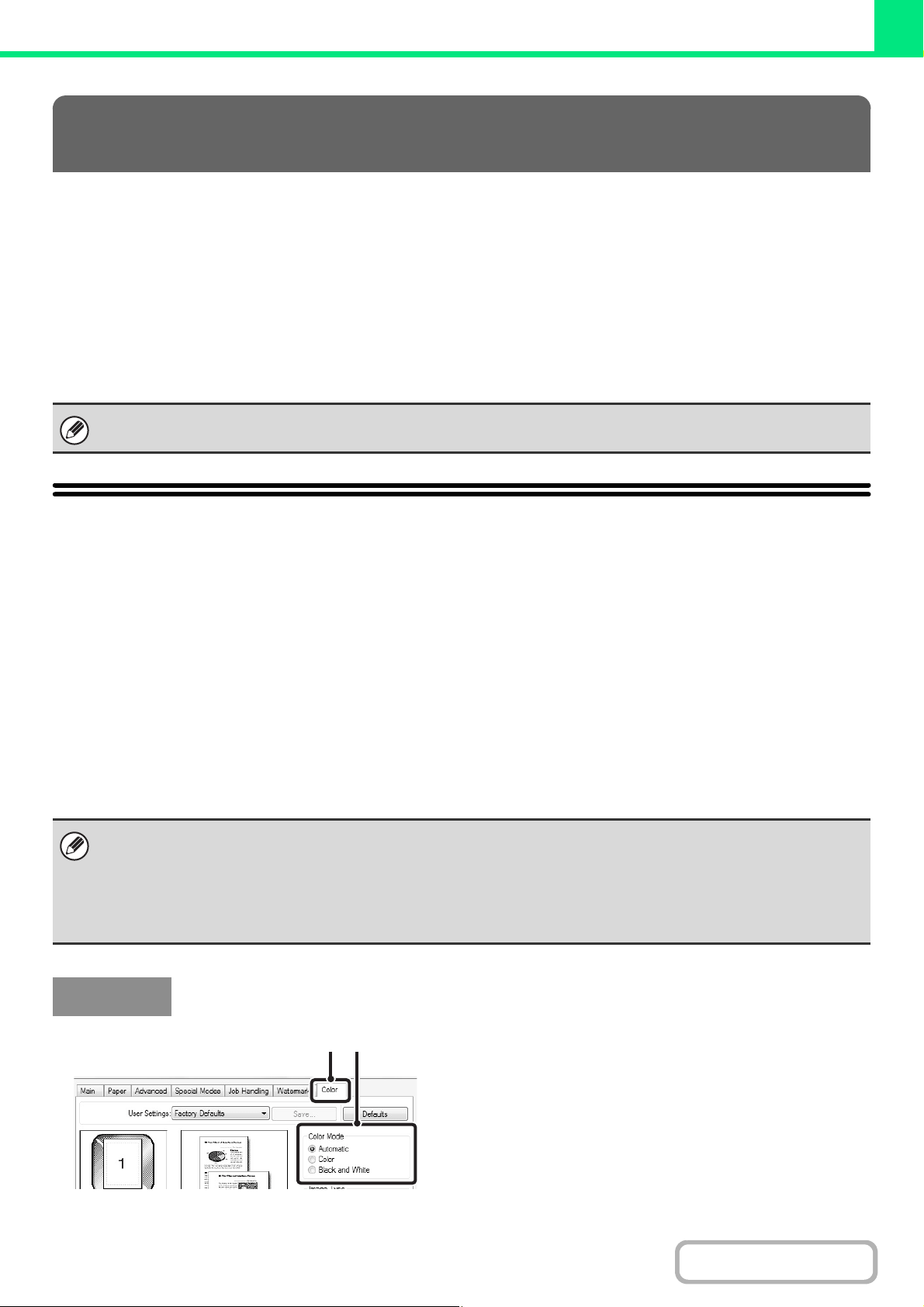
3-23
PRINTER
Contents
This section explains frequently used functions.
• SELECTING THE COLOR MODE
• TWO-SIDED PRINTING (page 3-26)
•
FITTING THE PRINT IMAGE TO THE PAPER (page
3-28)
•
PRINTING MULTIPLE PAGES ON ONE PAGE (page
3-29)
• STAPLING OUTPUT (page 3-31)
The explanations assume that the paper size and other basic settings have already been selected. For the basic
procedure for printing and the steps for opening the printer driver properties window, see the following section:
☞ Windows: BASIC PRINTING PROCEDURE (page 3-4)
☞ Macintosh: BASIC PRINTING PROCEDURE (page 3-16)
SELECTING THE COLOR MODE
This section explains how to select the color mode in the printer driver properties window. The following three selections
are available for the color mode:
Automatic: The machine automatically determines whether each page is color or black and white and prints the
page accordingly. Pages with colors other than black and white are printed using Y (Yellow), M
(Magenta), C (Cyan) and Bk (Black) toner. Pages that are only black and white are printed using Bk
(Black) toner only. This is convenient when printing a document that has both color and black and
white pages, however, the printing speed is slower.
Color: All pages are printed in color. Both color data and black and white data are printed using Y (Yellow), M
(Magenta), C (Cyan) and Bk (Black) toner.
Black and White: All pages are printed in black and white. Color data such as images or materials for a presentation are
printed using black toner only. This mode helps conserve color toner when you do not need to print in
color, such as when proofreading or checking the layout of a document.
(1) Click the [Color] tab.
(2) Select the "Color Mode" that you wish to
use.
FREQUENTLY USED FUNCTIONS
In Windows, view printer driver Help for details on printer driver settings for each printing function.
When "Color Mode" is set to [Automatic]
Even if the print result is black and white, the following types of print jobs will be counted as 4-color (Y (Yellow), M (Magenta),
C (Cyan), and Bk (Black)) print jobs. To be always counted as a black and white job, select [Black and White].
• When the data is created as color data.
• When the application treats the data as color data even though the data is black and white.
• When an image is hidden under a black and white image.
Windows
(1) (2)
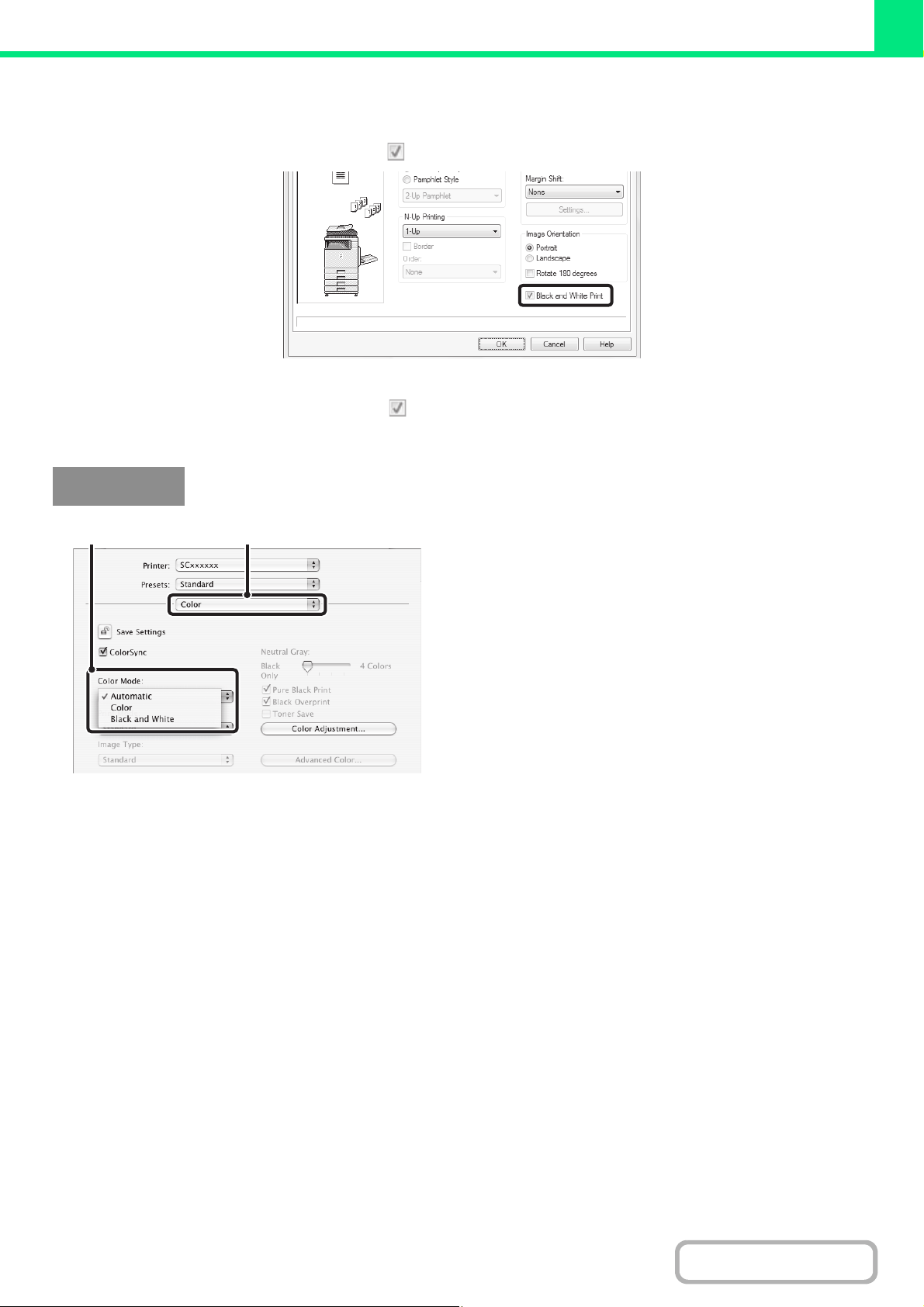
3-24
PRINTER
Contents
BLACK AND WHITE PRINTING
[Black and White] can be selected on the [Main] tab as well as on the [Color] tab. Click the [Black and White Print]
checkbox on the [Main] tab so that a checkmark appears.
The [Black and White Print] checkbox on the [Main] tab and the "Color Mode" setting on the [Color] tab are linked. When
the [Black and White Print] checkbox is selected on the [Main] tab, [Black and White] is also selected on the [Color]
tab.
(1) Select [Color].
(2) Select the "Color Mode" that you wish to
use.
Macintosh
(1)
(2)
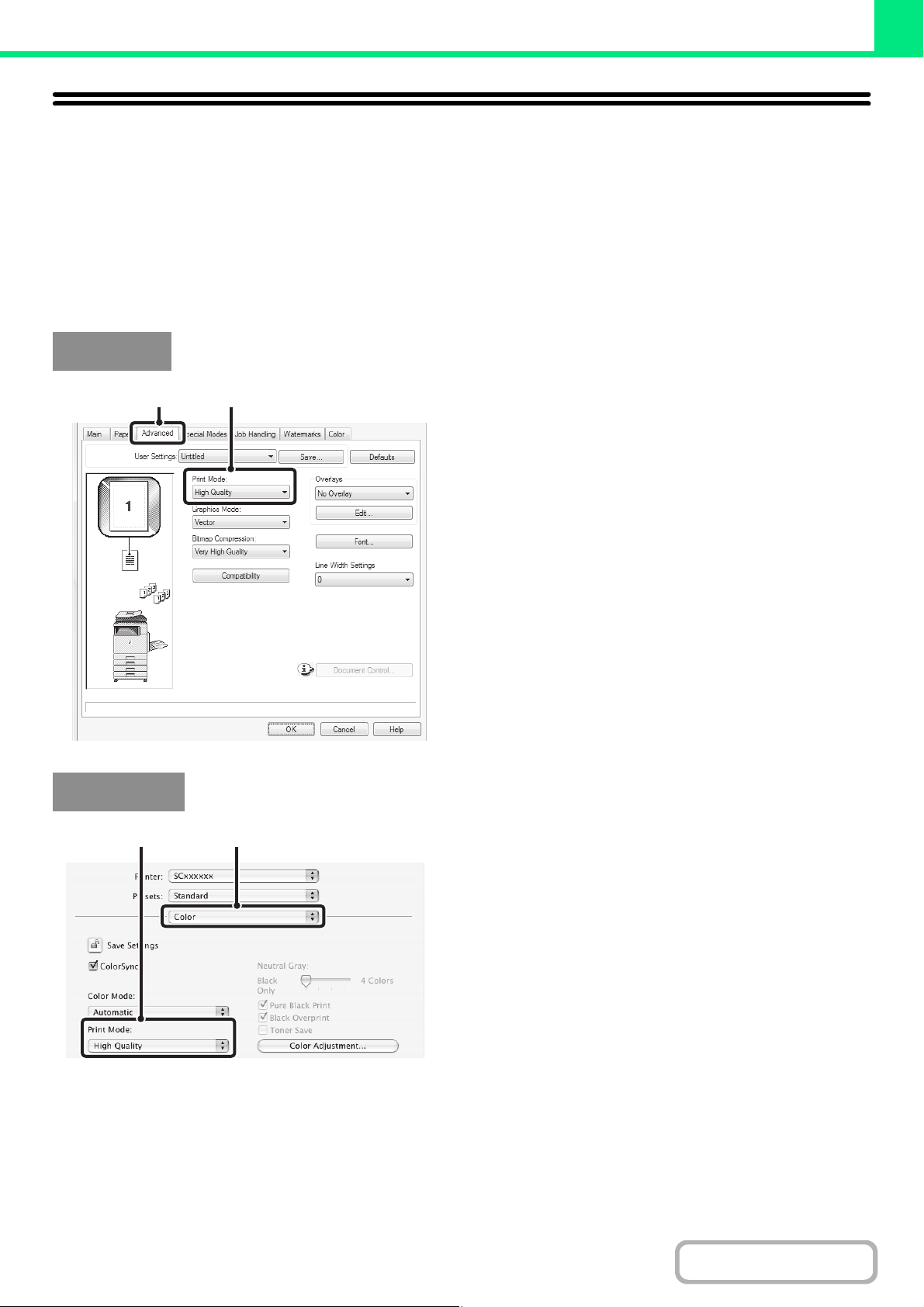
3-25
PRINTER
Contents
SELECTING A PRINT MODE SETTING
This section explains the procedure for selecting a print mode setting. The "Print Mode Settings" consist of the following
three items:
Normal: This mode is suitable for printing data such as regular text or a table.
High Quality: The print quality of color photos and text is high.
Fine: Select this when you want to a print color photo with greater clarity or print graphics with gradations, etc.
(This mode cannot be selected when using the PCL5c printer driver.)
(1) Click the [Advanced] tab.
(2) Select the "Print Mode".
(1) Select [Color].
(2) Select the "Print Mode".
Windows
(1) (2)
Macintosh
(1)(2)
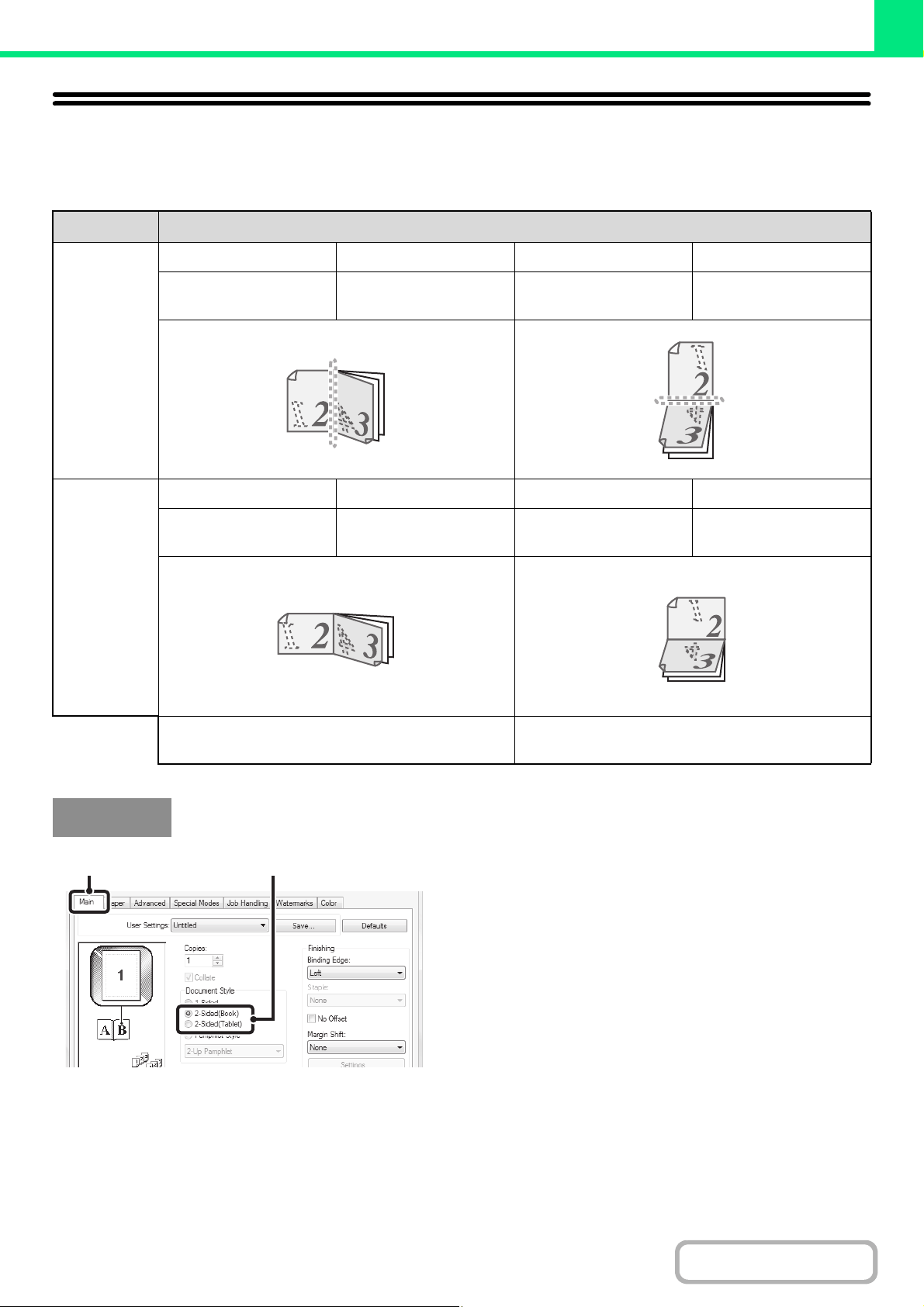
3-26
PRINTER
Contents
TWO-SIDED PRINTING
The machine can print on both sides of the paper. This function is useful for many purposes, and is particularly
convenient when you want to create a simple pamphlet. Two-sided printing also helps conserve paper.
(1) Configure the settings on the [Main] tab.
(2) Select [2-Sided(Book)] or [2-Sided(Tablet)].
Orientation
Print results
Vertical
Windows Macintosh Windows Macintosh
2-Sided(Book)
Long-edged binding
(Flip on long edge)
2-Sided(Tablet)
Short-edged binding
(Flip on short edge)
Horizontal
Windows Macintosh Windows Macintosh
2-Sided(Book)
Short-edged binding
(Flip on short edge)
2-Sided(Tablet)
Long-edged binding
(Flip on long edge)
The pages are printed so that they can be bound at
the side.
The pages are printed so that they can be bound at
the top.
Windows
(1) (2)
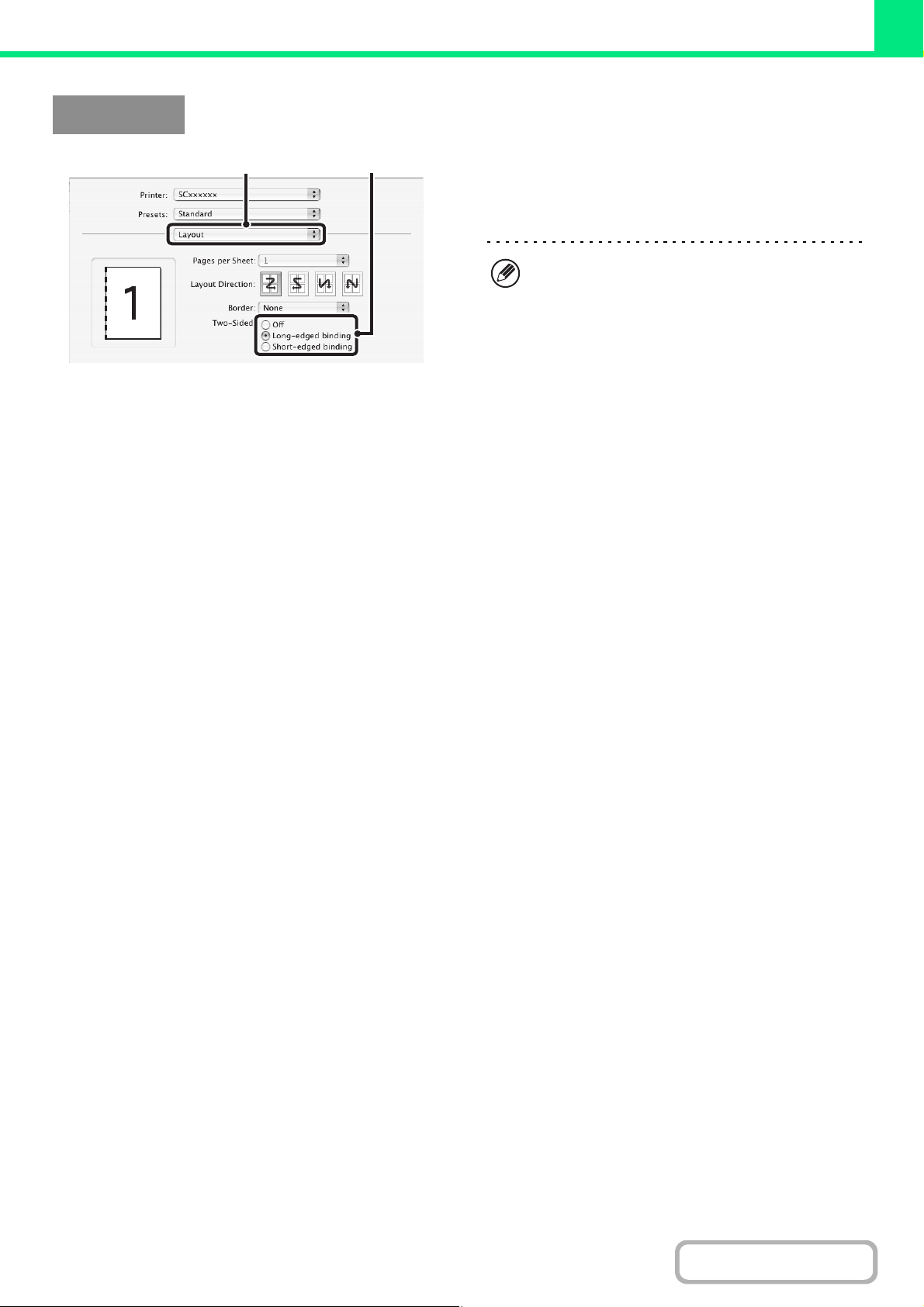
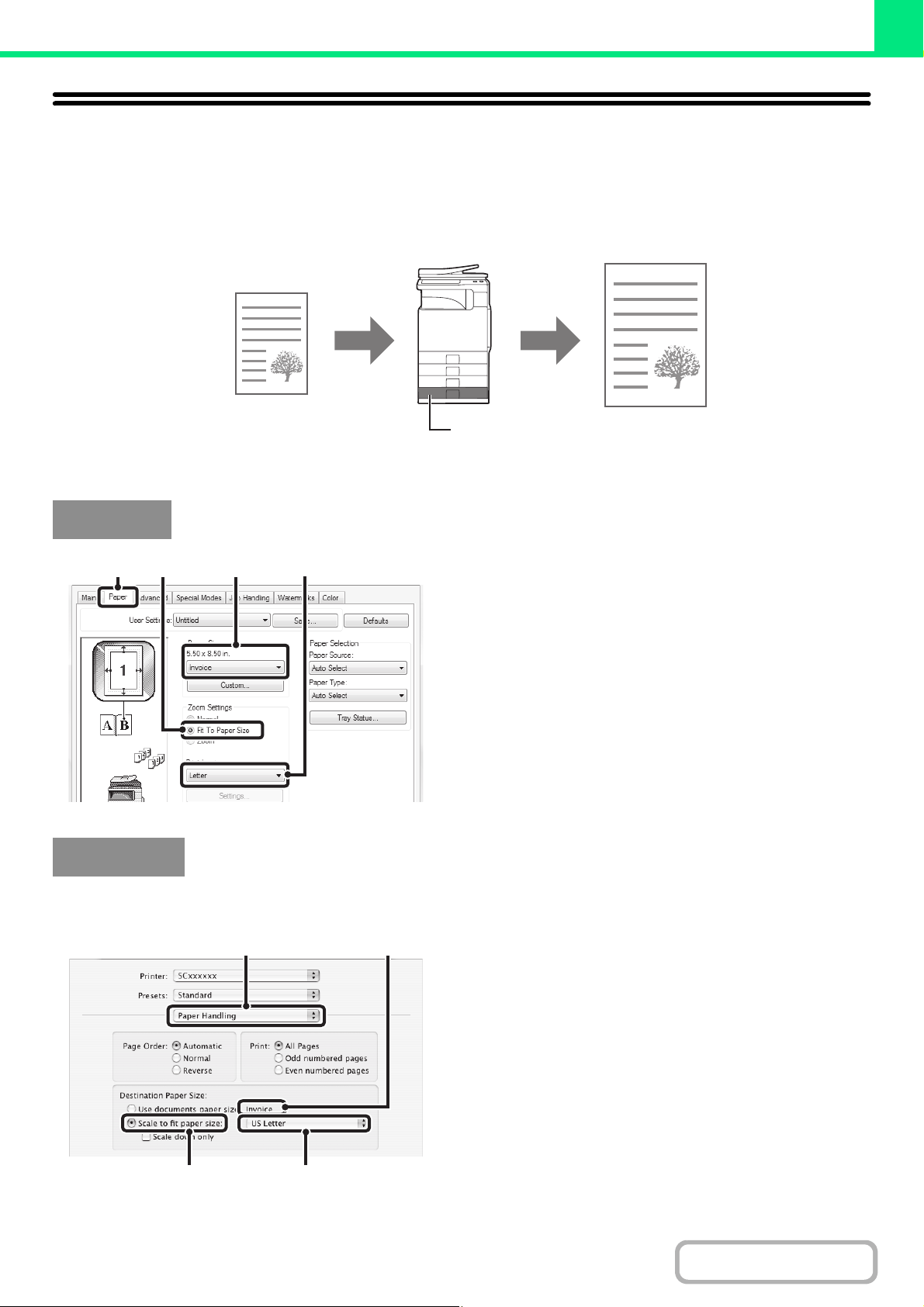
3-28
PRINTER
Contents
FITTING THE PRINT IMAGE TO THE PAPER
This function is used to automatically enlarge or reduce the printed image to match the size of the paper loaded in the
machine.
This is convenient for such purposes as enlarging an invoice or A5 size document to letter or A4 size to make it easier to
view, and to print when the same size of paper as the document image is not loaded in the machine.
The following example explains how to print an invoice size document on letter size paper.
(1) Click the [Paper] tab.
(2) Select the size of the print image (for
example: Invoice).
(3) Select [Fit To Paper Size].
(4) Select the actual paper size to be used for
printing (for example: Letter).
(This function can only be used in Mac OS X v10.4.11 and v10.5 to 10.5.1.)
(1) Select [Paper Handling].
(2) Check the size of the print image (for
example: Invoice).
To change the print image size, use the "Paper Size"
menu that appears when [Page Setup] is selected.
(3) Select [Scale to fit paper size].
(4) Select the actual paper size to be used for
printing (for example: Letter).
Windows
Invoice or A5 Letter or A4
(1)
(2)
(3)
(4)
Macintosh
(1)
(2)
(3) (4)
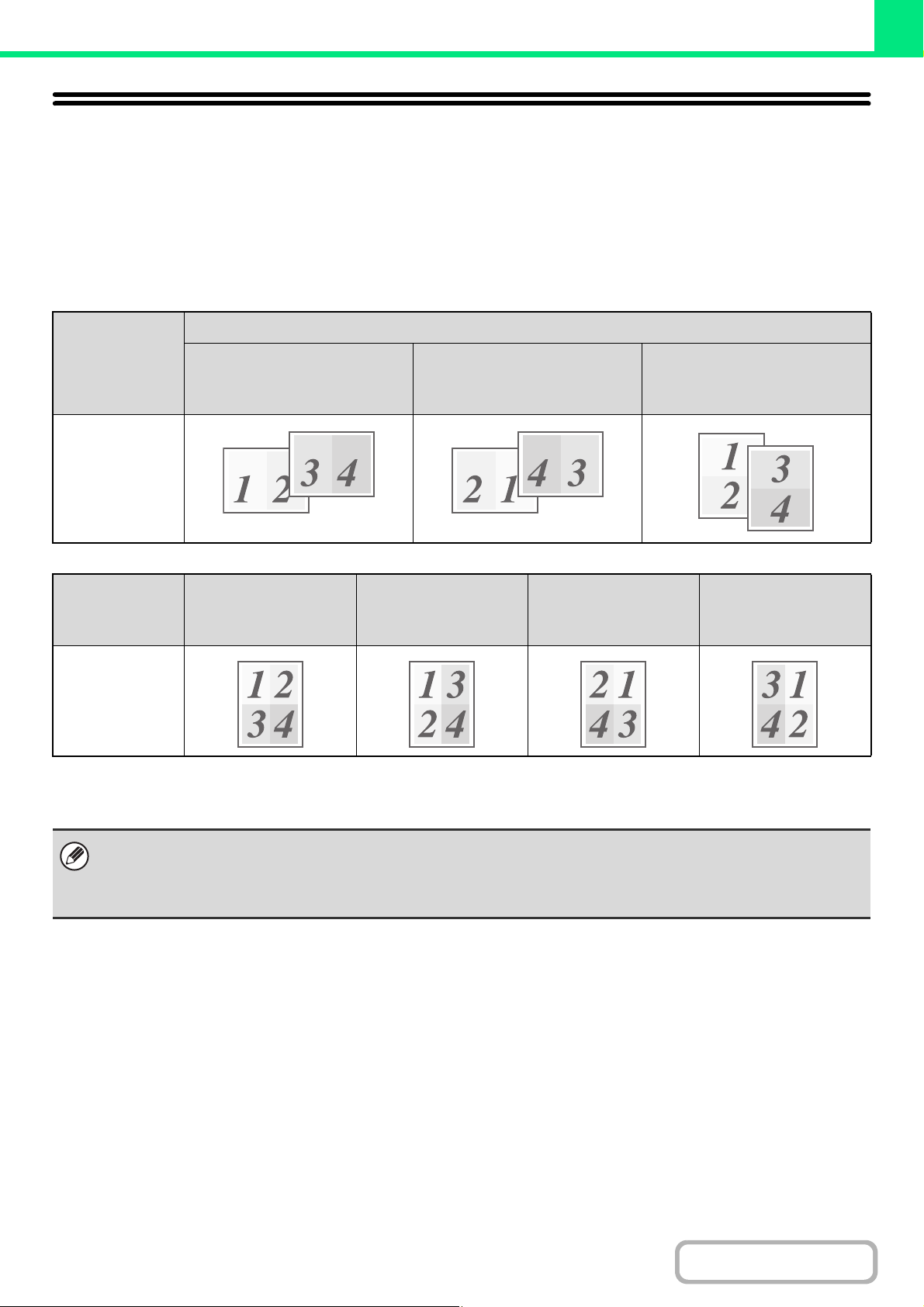
3-29
PRINTER
Contents
PRINTING MULTIPLE PAGES ON ONE PAGE
This function can be used to reduce the print image and print multiple pages on a single sheet of paper.
This is convenient when you want to print multiple images such as photos on a single sheet of paper, and when you
want to conserve paper. This function can also be used in combination with two-sided printing for maximum
conservation of paper.
For example, when [2-Up] (2 pages per sheet) and [4-Up] (4 pages per sheet) are selected, the following print results will
be obtained, depending on the order selected.
N-Up
(Pages per
sheet)
Print results
Left To Right Right To Left
Top To Bottom
(When the print orientation
is landscape)
2-Up
(2 pages per
sheet)
N-Up
(Pages per
sheet)
Right, and Down Down, and Right Left, and Down Down, and Left
4-Up
(4 pages per
sheet)
• The page orders for 6-Up, 8-Up, 9-Up, and 16-Up are the same as for 4-Up.
• In a Windows environment, the page order can be viewed in the print image in the printer driver properties window.
In a Macintosh environment, the page orders are displayed as selections.
• In a Macintosh environment, the number of pages that can be printed on a single sheet is 2, 4, 6, 9, or 16.
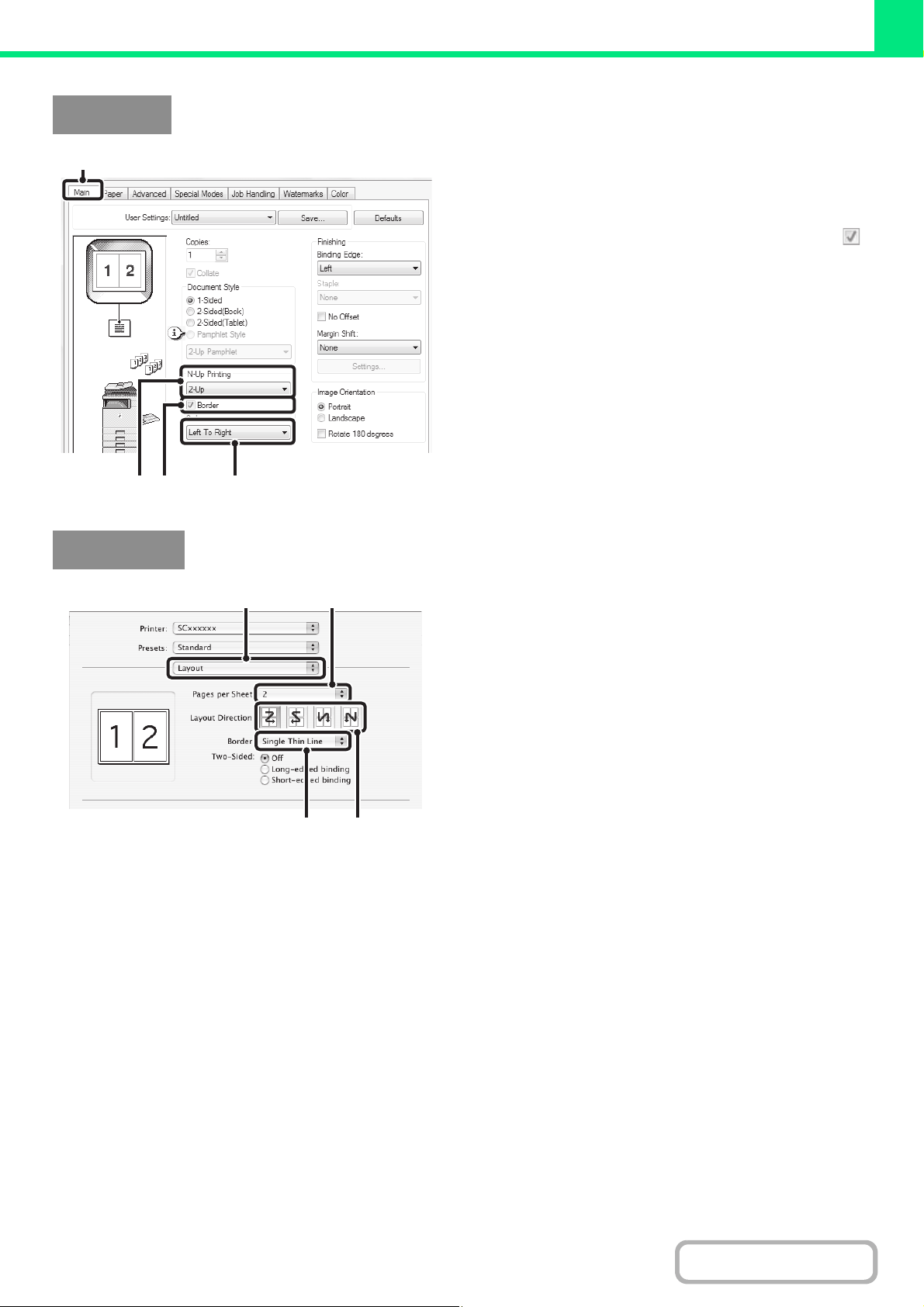
3-30
PRINTER
Contents
(1) Configure the settings on the [Main] tab.
(2) Select the number of pages per sheet.
(3) If you wish to print borderlines, click the
[Border] checkbox so that a checkmark
appears.
(4) Select the order of the pages.
(1) Select [Layout].
(2) Select the number of pages per sheet.
(3) Select the order of the pages.
(4) If you wish to print borderlines, select the
desired type of borderline.
Windows
(2)
(3)
(4)
(1)
Macintosh
(1) (2)
(3)(4)
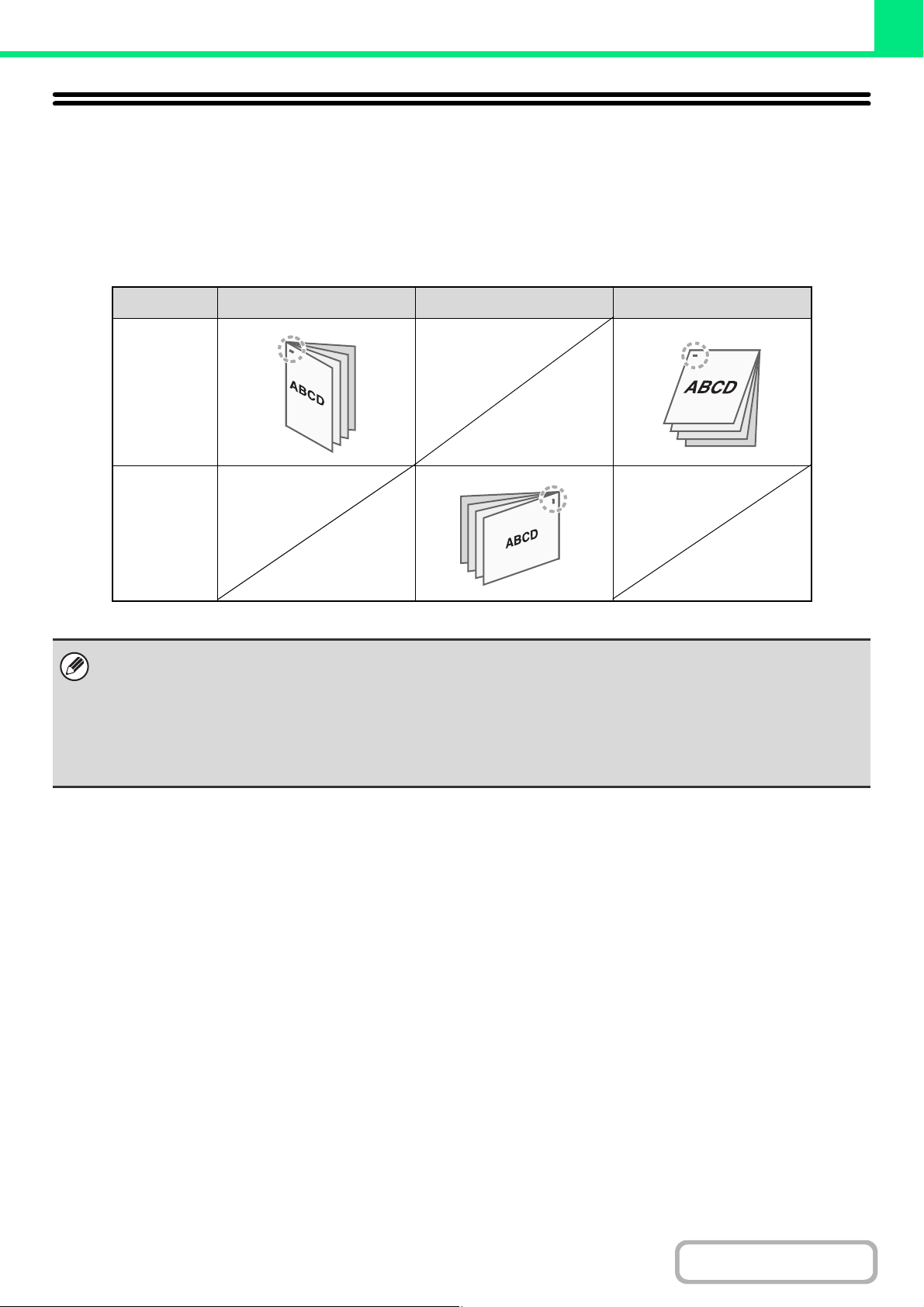
3-31
PRINTER
Contents
STAPLING OUTPUT
The staple function can be used to staple output.
This function saves considerable time when preparing handouts for a meeting or other stapled materials. The staple
function can also be used in combination with two-sided printing to create materials with a more sophisticated
appearance.
Stapling positions can be selected to obtain the following stapling results.
* Stapling takes place in one location only.
Orientation
Left Right Top
Vertical
Horizontal
• To use the staple function, a finisher is required.
• For the maximum number of sheets that can be stapled, see "SPECIFICATIONS" in the Maintenance & Safety Guide.
The maximum number of sheets that can be stapled at once includes any covers and/or inserts that are inserted.
• The staple function cannot be used in combination with the offset function, which offsets the position of each output job
from the previous job.
• When the staple function is disabled in "Device Control" (Web page only) in the machine's system settings (administrator),
stapling is not possible.
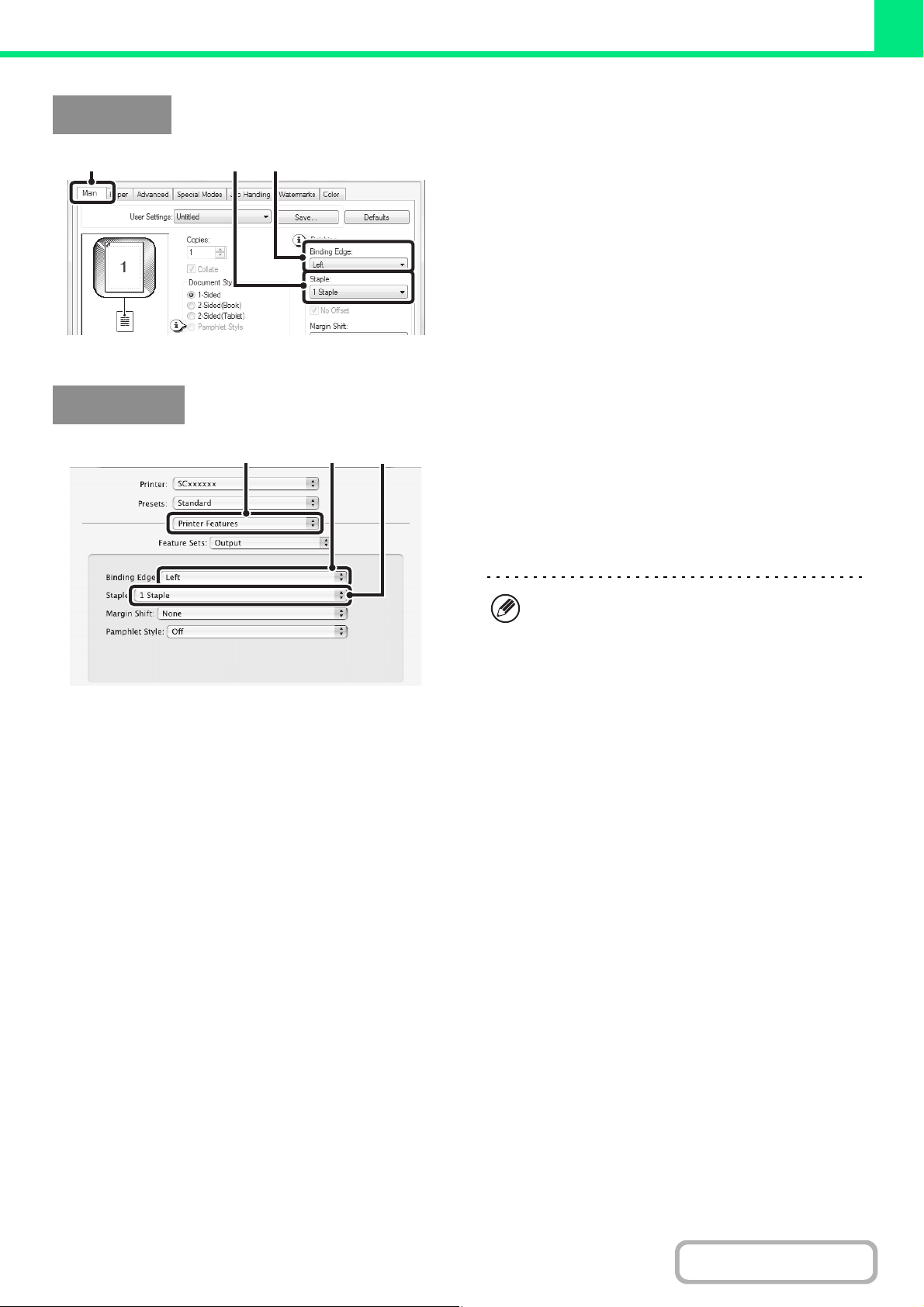
3-32
PRINTER
Contents
(1) Configure the settings on the [Main] tab.
(2) Select the "Binding Edge".
(3) Select the staple function.
For the staple function, select the number of staples in
the "Staple" menu.
(1) Select [Printer Features].
(2) Select the "Binding Edge".
(3) Select the staple function.
For the staple function, select the number of staples in
the "Staple" menu.
Windows
(3)
(2)
(1)
Macintosh
(1) (2)
(3)
• In Mac OS X v10.2.8, select the settings in
[Advanced].
• In Mac OS 9, select the settings in
[Output/Document Style].
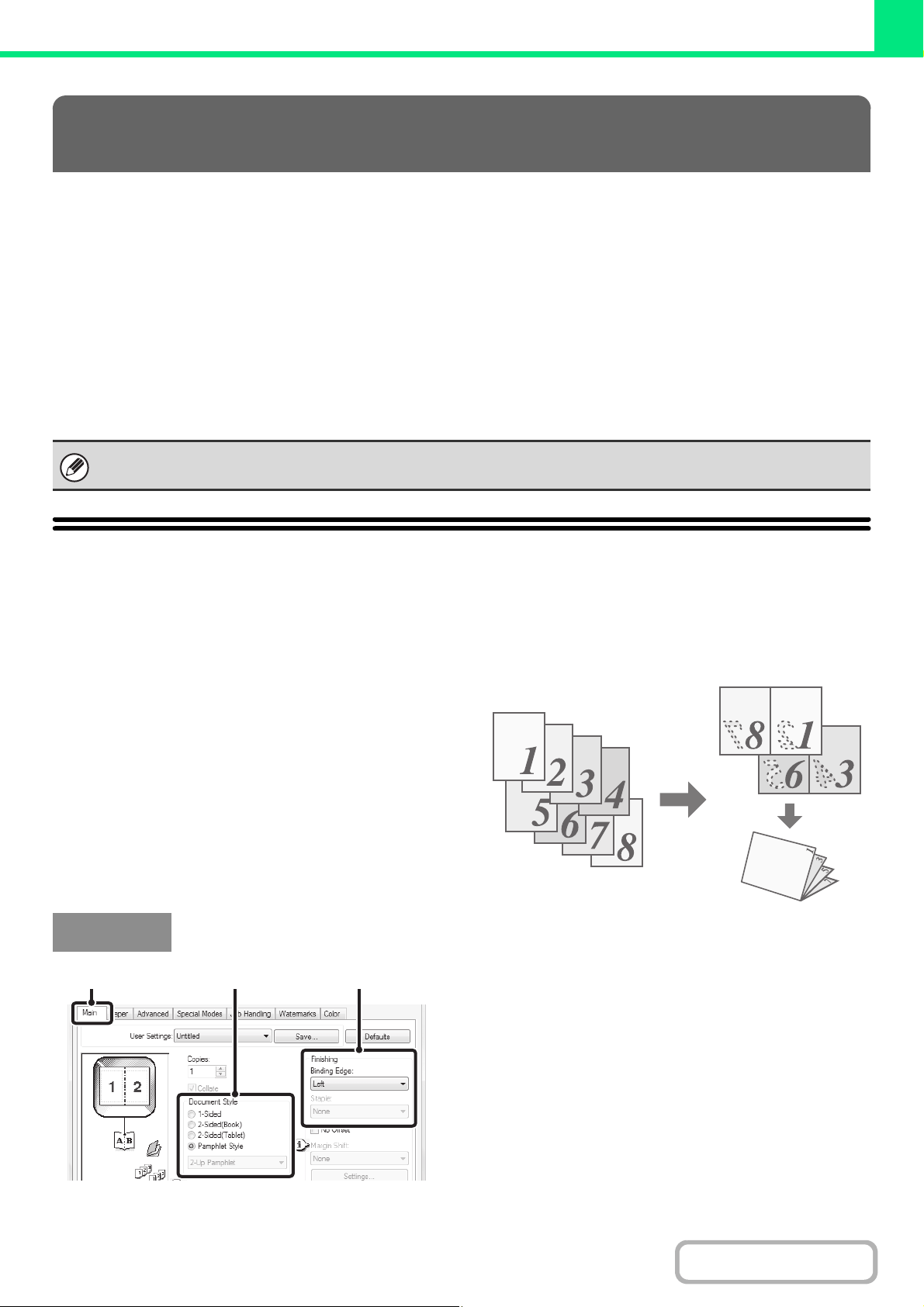
3-33
PRINTER
Contents
This section explains convenient functions for specific printing objectives.
• CONVENIENT FUNCTIONS FOR CREATING
PAMPHLETS AND POSTERS
• FUNCTIONS TO ADJUST THE SIZE AND
ORIENTATION OF THE IMAGE (page 3-37)
• COLOR MODE ADJUSTMENT FUNCTION (page
3-41)
• FUNCTIONS THAT COMBINE TEXT AND IMAGES
(page 3-45)
• PRINT FUNCTIONS FOR SPECIAL PURPOSES
(page 3-48)
The explanations assume that the paper size and other basic settings have already been selected. For the basic
procedure for printing and the steps for opening the printer driver properties window, see the following section:
☞ Windows: BASIC PRINTING PROCEDURE (page 3-4)
☞ Macintosh: BASIC PRINTING PROCEDURE (page 3-16)
CONVENIENT FUNCTIONS FOR CREATING
PAMPHLETS AND POSTERS
CREATING A PAMPHLET (Pamphlet)
The pamphlet function prints on the front and back of
each sheet of paper so that the sheets can be folded and
bound to create a pamphlet. This is convenient when
you wish to compile printed output into a pamphlet.
(1) Configure the settings on the [Main] tab.
(2) Select [Pamphlet Style].
(3) Select the "Binding Edge".
CONVENIENT PRINTING FUNCTIONS
In Windows, view printer driver Help for details on printer driver settings for each printing function.
Windows
(1) (2) (3)
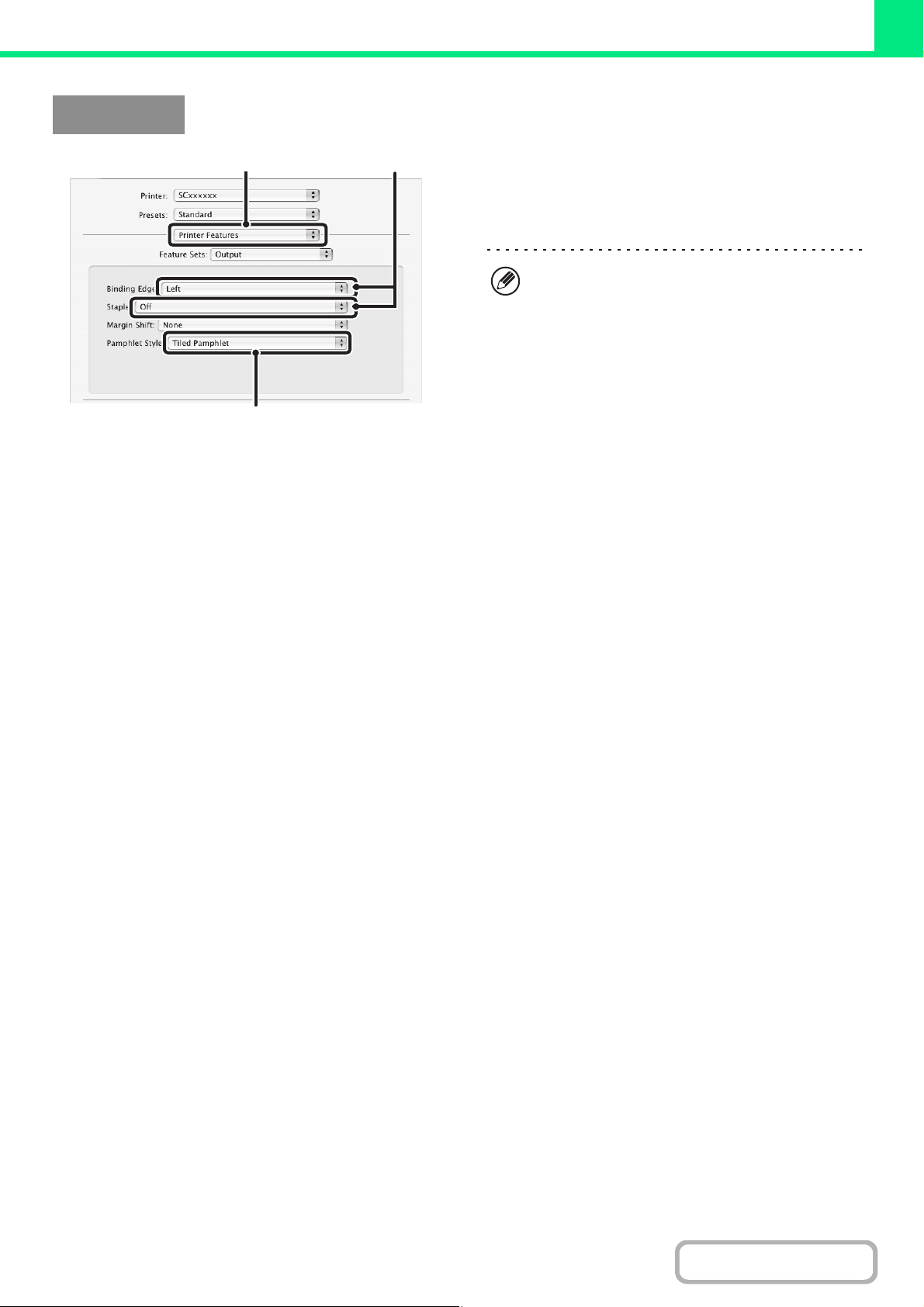
3-34
PRINTER
Contents
(1) Select [Printer Features].
(2) Select the "Binding Edge".
(3) Select [Tiled Pamphlet] or [2-Up Pamphlet].
Macintosh
(3)
(1) (2)
• In Mac OS X v10.2.8, select from the "2-Side
Printing" and "Binding Edge" menus in [Advanced].
• In Mac OS 9, select the settings in
[Output/Document Style].

3-35
PRINTER
Contents
INCREASING THE MARGIN (Margin Shift)
This function is used to shift the print image to increase
the margin at the left, right, or top of the paper. This is
convenient when you wish to staple or punch the output
but the binding area overlaps the text. When a finisher is
installed, the staple function can be used with this
function.
(1) Configure the settings on the [Main] tab.
(2) Select the "Binding Edge".
(3) Select the "Margin Shift".
Select from the "Margin Shift" menu. If you wish to
configure another numeric setting, select the setting from
the pull-down menu and click the [Settings] button. Click
the button or directly enter the number.
(1) Select [Printer Features].
(2) Select the "Binding Edge".
(3) Select the "Margin Shift".
Windows
(3)
(2)
(1)
Macintosh
(3)
(1) (2)
• In Mac OS X v10.2.8, select from the "Binding
Edge" and "Margin Shift" menus in [Advanced].
• In Mac OS 9, select [Advanced] and then select the
binding edge and margin shift from the margin shift
menu.
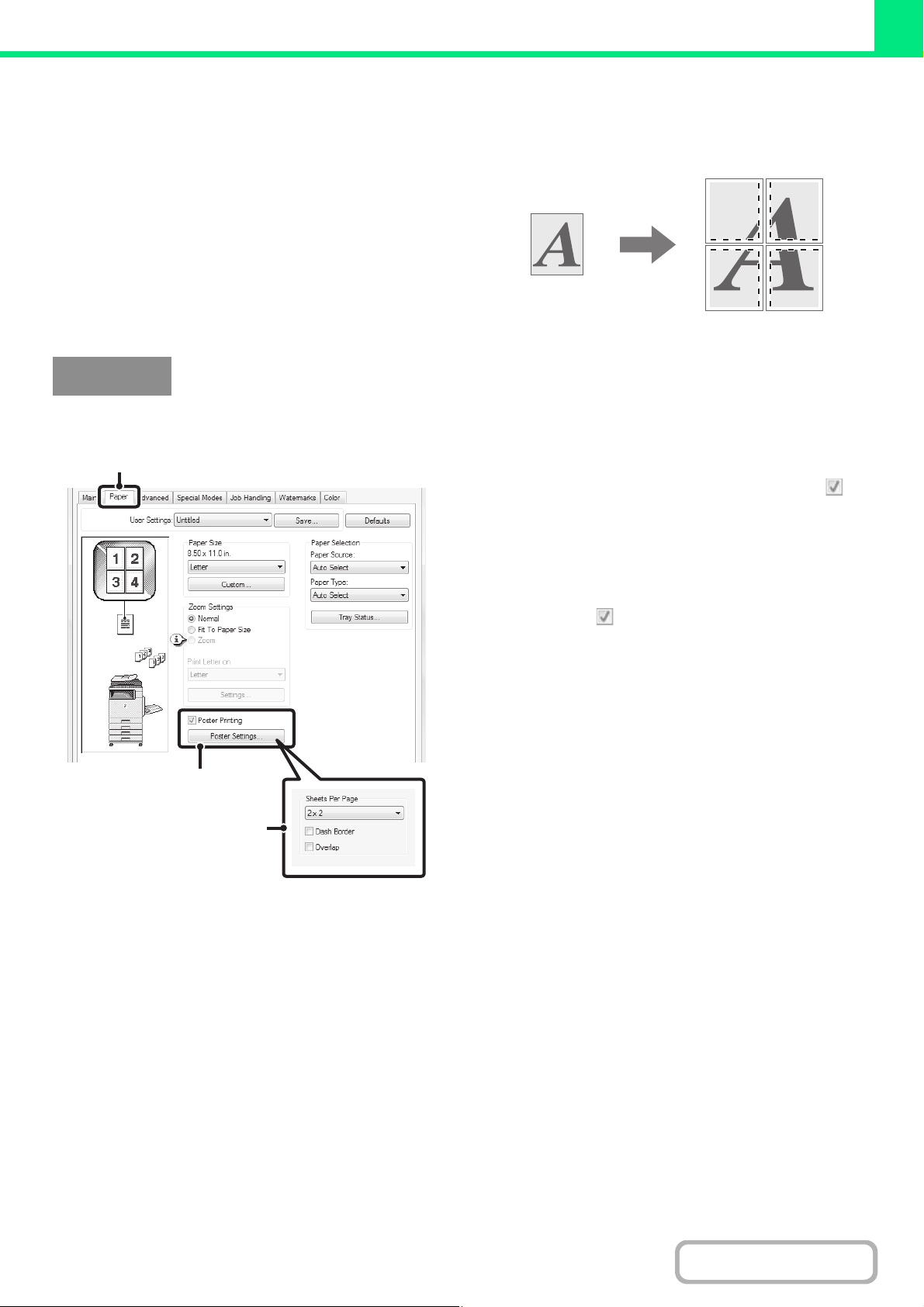
3-36
PRINTER
Contents
CREATING A LARGE POSTER (Poster Printing)
(This function is only available in Windows.)
One page of print data can be enlarged and printed
using multiple sheets of paper (4 sheets (2 x 2), 9 sheets
(3 x 3) or 16 sheets (4 x 4)). The sheets can then be
attached together to create a large poster. To enable
precise alignment of the edges of the sheets during
attachment, borderlines can be printed and overlapping
edges can be created (overlap function).
(This function can be used when the PCL6 or PS printer driver is used.)
(1) Click the [Paper] tab.
(2) Select the [Poster Printing] checkbox
and click the [Poster Settings] button.
(3) Select poster settings.
Select the number of sheets of paper to be used from the
pull-down menu. If you wish to print borderlines and/or
use the overlap function, select the corresponding
checkboxes .
Windows
(1)
(2)
(3)
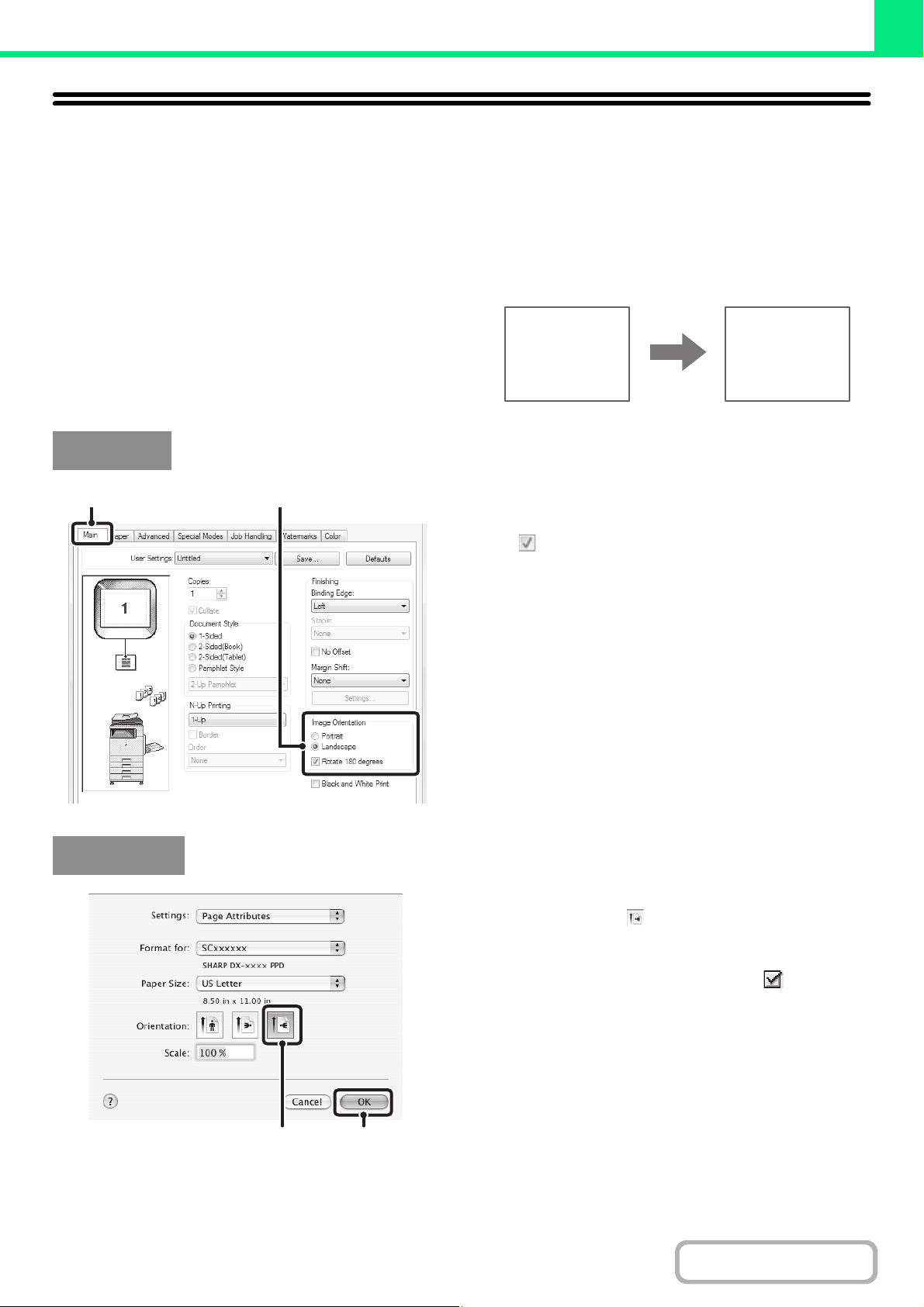
3-37
PRINTER
Contents
FUNCTIONS TO ADJUST THE SIZE AND
ORIENTATION OF THE IMAGE
ROTATING THE PRINT IMAGE 180 DEGREES
(Rotate 180 degrees)
This feature rotates the image 180 degrees so that it can
be printed correctly on paper that can only be loaded in
one orientation (such as envelopes or paper with punch
holes). (In Mac OS X, a portrait image cannot be rotated
180 degrees.)
(1) Select the setting on the [Main] tab.
(2) Select the [Rotate 180 degrees] checkbox
.
(1) Select [Page Setup] from the [File] menu
and click the button.
In Mac OS 9, select [Page Setup] from the [File] menu
and select [PostScript Options]. Then select the [Flip
Horizontal] and [Flip Vertical] checkbox .
(2) Click the [OK] button.
ABCD
ABCD
Windows
(1)
(2)
Macintosh
(1)
(2)
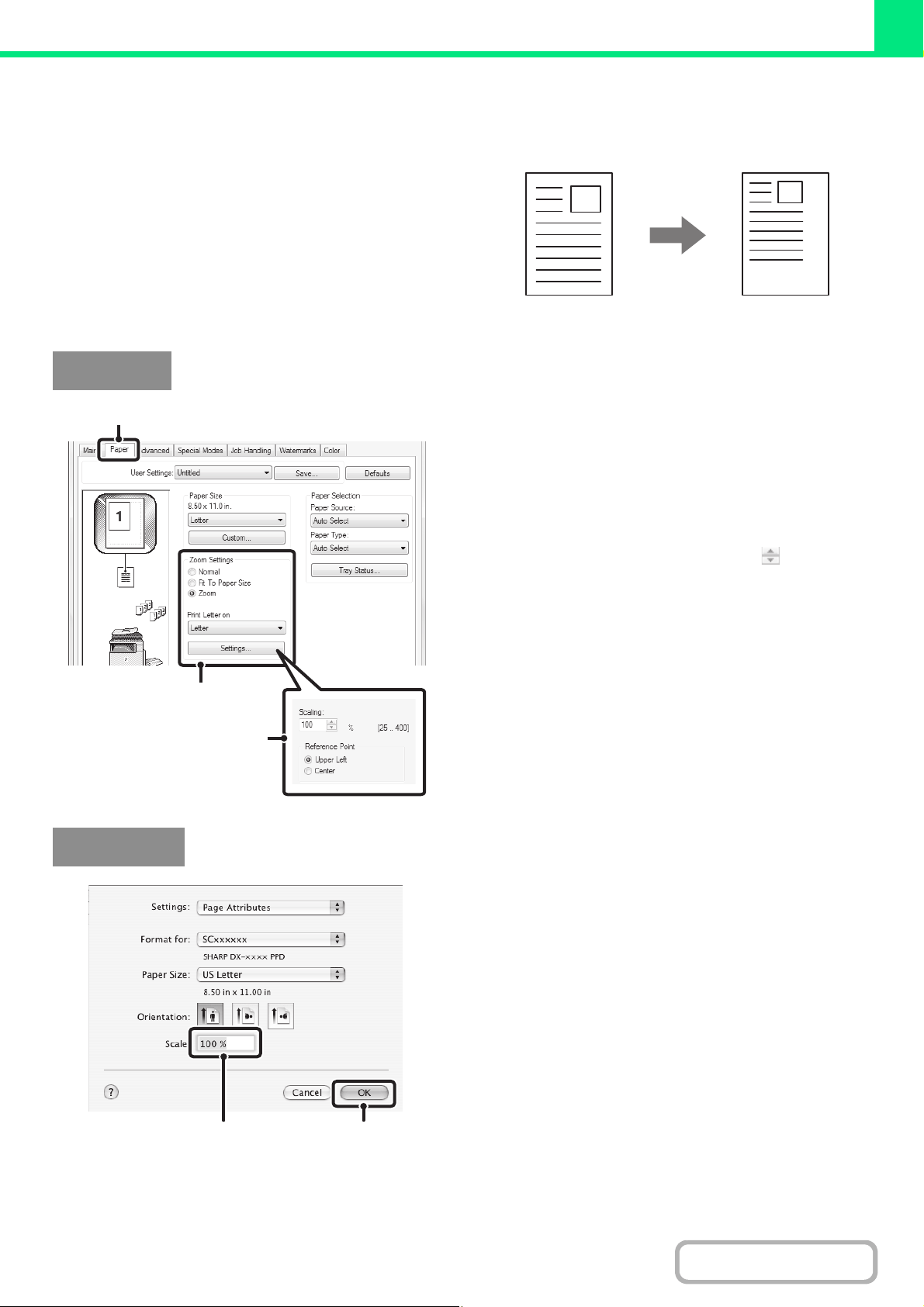
3-38
PRINTER
Contents
ENLARGING/REDUCING THE PRINT IMAGE
(Zoom/XY-Zoom)
This function is used to enlarge or reduce the image to a
selected percentage. This allows you to enlarge a small
image or add margins to the paper by slightly reducing
an image.
When using the PS printer driver (Windows), you can set
the width and length percentages separately to change
the proportions of the image. (XY-Zoom)
(1) Click the [Paper] tab.
(2) Select [Zoom] and click the [Settings]
button.
The actual paper size to be used for printing can be
selected from the pull-down menu.
(3) Select the zoom ratio.
Directly enter a number (%) or click the button to
change the ratio in increments of 1%. You can also select
[Upper Left] or [Center] for the base point on the paper.
(1) Select [Page Setup] from the [File] menu
and enter the ratio (%).
In Mac OS 9, select [Page Setup] from the [File] menu
and enter the ratio (%).
(2) Click the [OK] button.
Windows
(1)
(2)
(3)
Macintosh
(1)
(2)
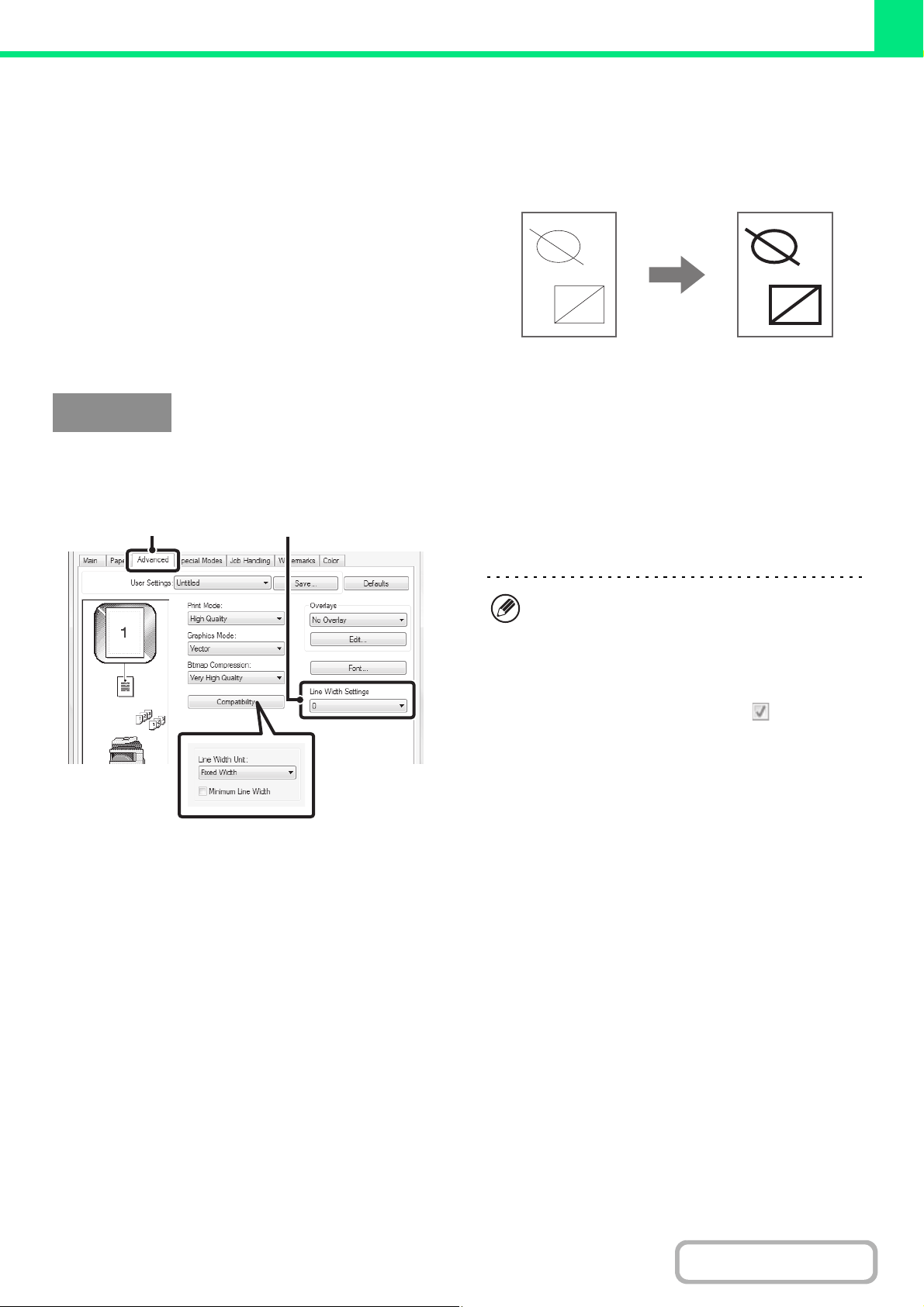
3-39
PRINTER
Contents
ADJUSTING LINE WIDTHS WHEN PRINTING
(Line Width Settings)
(This function is only available in Windows.)
When lines in special applications such as CAD cannot
be printed correctly, this setting can be used to adjust
line widths, such as making overall line widths wider.
(This setting is only effective for vector data; raster data
such as bitmap images cannot be adjusted.) When the
data includes lines of varying widths, you can also print
all lines at the minimum width. (Only for black and white
printing.)
(This function can be used when the PCL6 printer driver is used.)
(1) Click the [Advanced] tab.
(2) Adjust the line width.
Select a number from the pull-down menu.
Windows
(2)
(1)
• The units of line-width adjustment can be set to
"Fixed Width" or "Ratio". Click the [Compatibility]
button and select the units from the "Line Width
Unit" menu.
• To print all lines in the data at the minimum line
width, click the [Compatibility] button and select the
[Minimum Line Width] checkbox ( ).
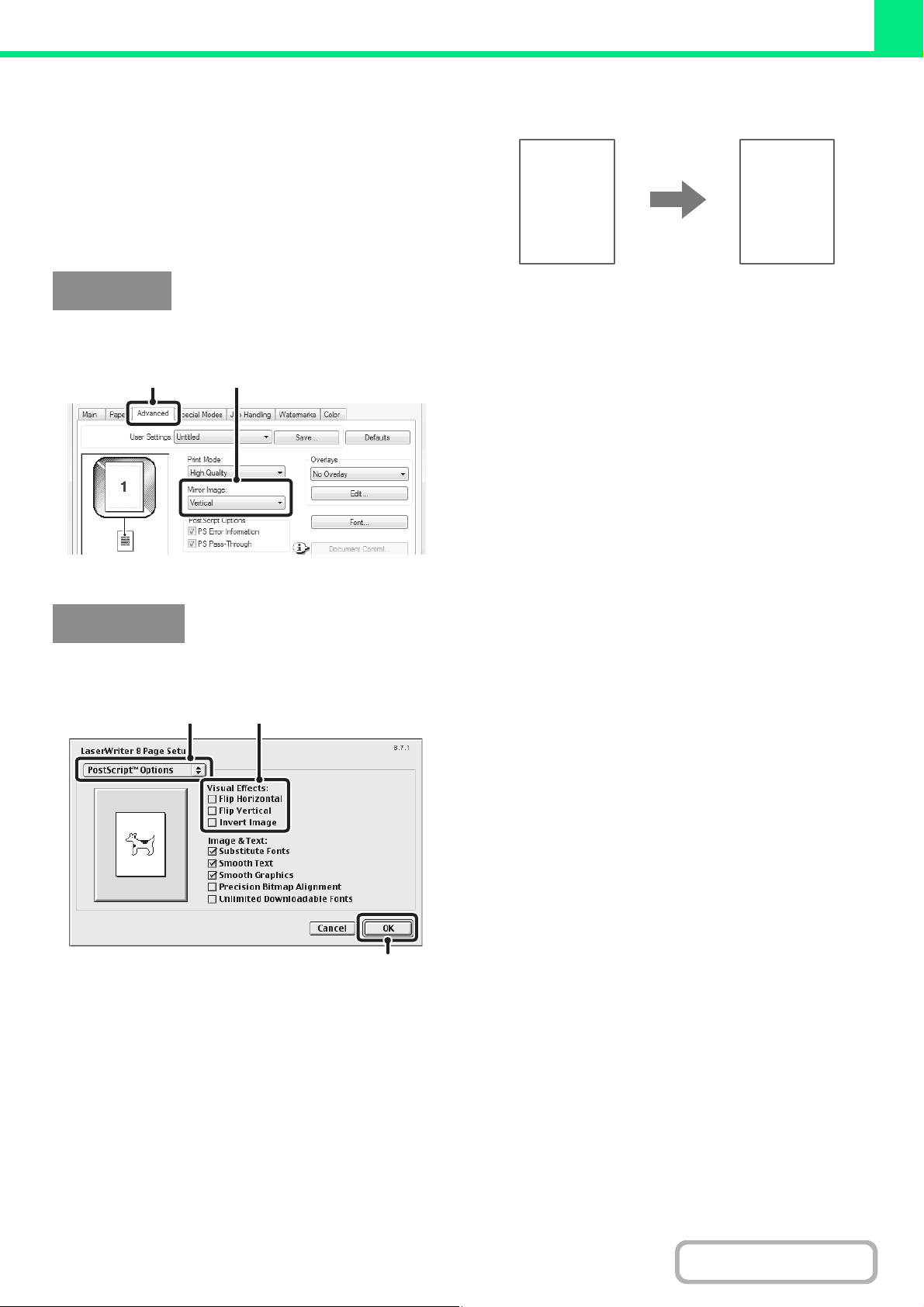
3-40
PRINTER
Contents
REVERSING THE IMAGE (Mirror Image)
The image can be reversed to create a mirror image.
This function can be used to conveniently print a design
for a woodblock print or other printing medium.
(This function can be used when the PS printer driver is used.)
(1) Click the [Advanced] tab.
(2) Select a mirror image setting.
If you wish to reverse the image horizontally, select
[Horizontal]. If you wish to reverse the image vertically,
select [Vertical].
(This function can only be used in Mac OS 9.)
(1) Select [Page Setup] from the [File] menu
and select [PostScript Options].
(2) Select "Visual Effects".
To reverse the image horizontally, select [Flip Horizontal].
To reverse the image vertically, select [Flip Vertical].
(3) Click the [OK] button.
B
B
Windows
(1) (2)
Macintosh
(1) (2)
(3)
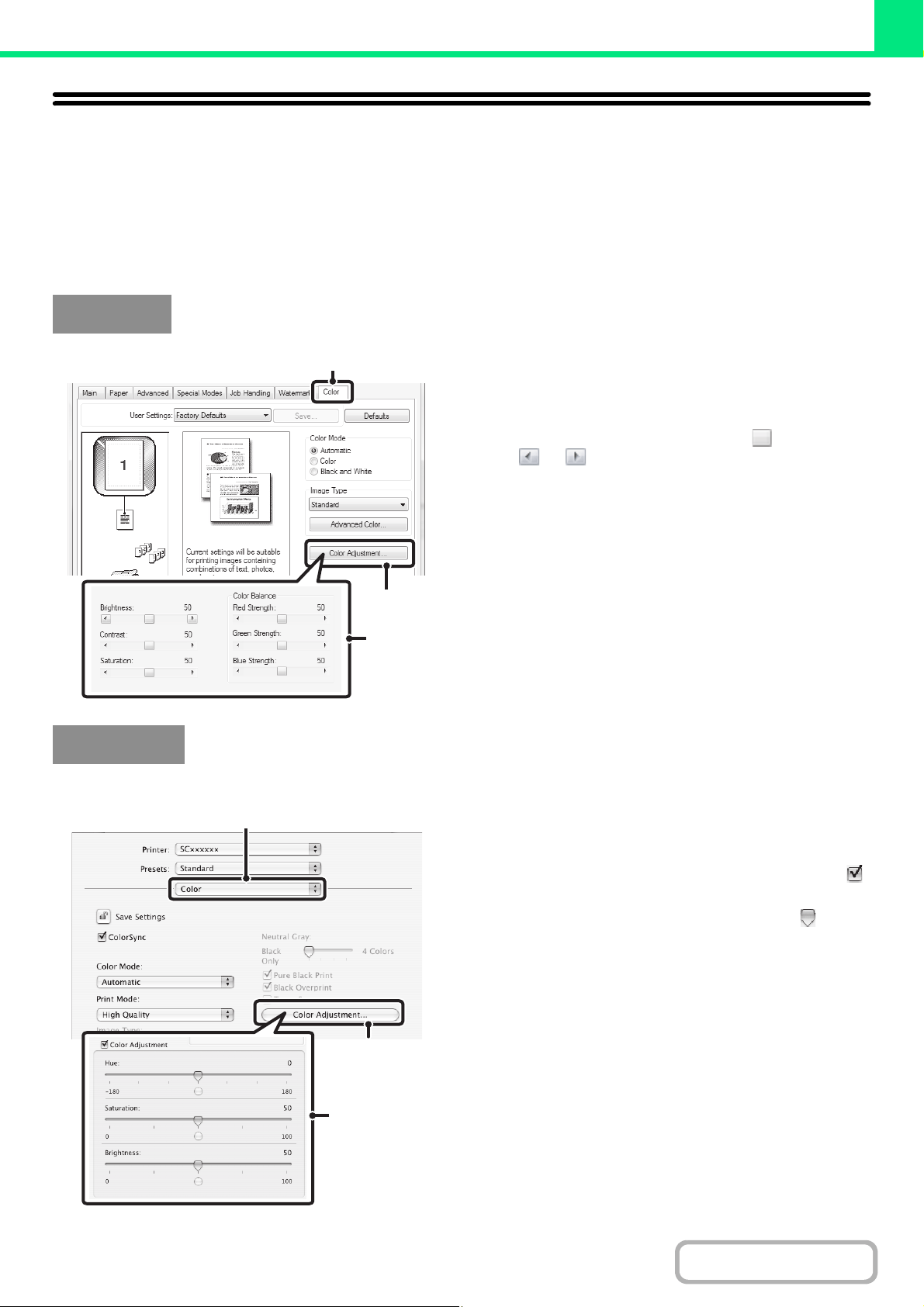
3-41
PRINTER
Contents
COLOR MODE ADJUSTMENT FUNCTION
ADJUSTING THE BRIGHTNESS AND CONTRAST OF
THE IMAGE (Color Adjustment)
The brightness and contrast can be adjusted in the print settings when printing a photo or other image. These settings
can be used for simple corrections when you do not have image editing software installed on your computer.
(1) Click the [Color] tab.
(2) Click the [Color Adjustment] button.
(3) Adjust the color settings.
To adjust a setting, drag the slide bar or click the
or button.
(This function can only be used in Mac OS X v10.3.9 and v10.4.11.)
(1) Select [Color].
(2) Click the [Color Adjustment] button.
(3) Select the [Color Adjustment] checkbox
and adjust the color.
Adjust the settings by dragging the slide bars .
Windows
(1)
(2)
(3)
Macintosh
(2)
(1)
(3)
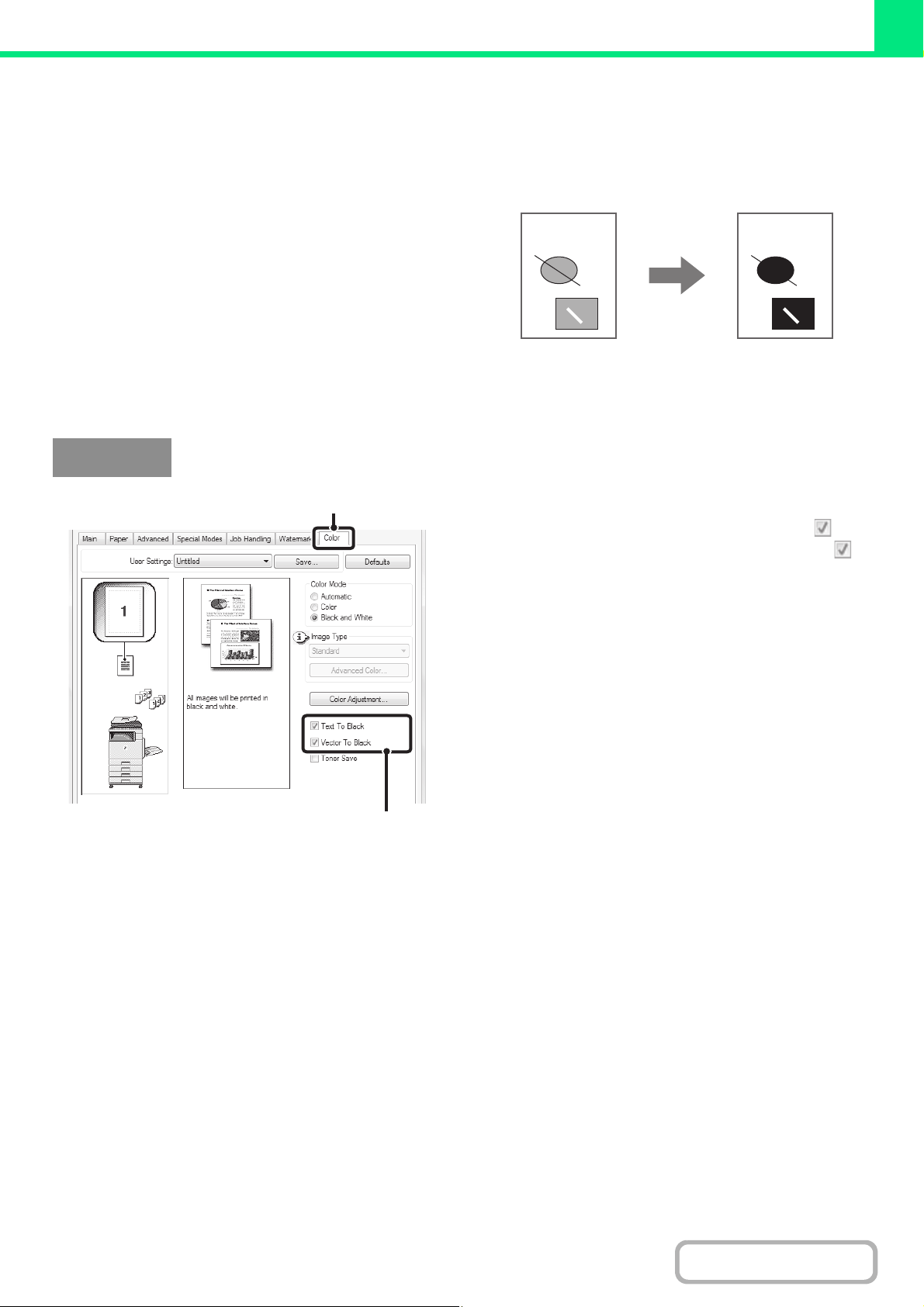
3-42
PRINTER
Contents
PRINTING FAINT TEXT AND LINES IN BLACK
(Text To Black/Vector To Black)
(This function is only available in Windows.)
When printing a color image in grayscale, color text and
lines that are faint can be printed in black. (Raster data
such as bitmap images cannot be adjusted.) This allows
you to bring out color text and lines that are faint and
difficult to see when printed in grayscale.
• [Text To Black] can be selected to print all text other
than white text in black.
• [Vector To Black] can be selected to print all vector
graphics other than white lines and areas in black.
(1) Click the [Color] tab.
(2) Select the [Text To Black] checkbox
and/or the [Vector To Black] checkbox .
ABCD ABCD
Windows
(1)
(2)
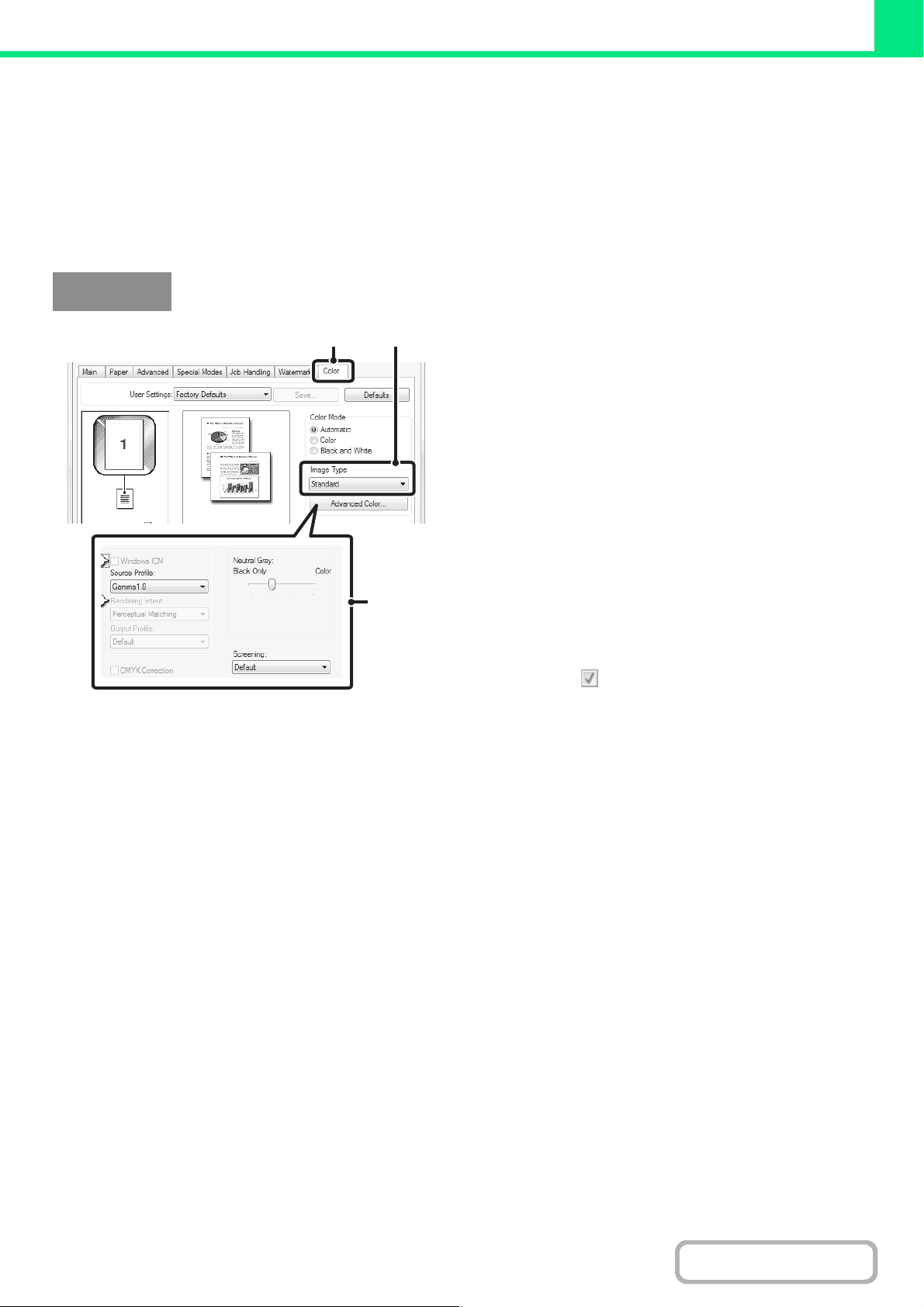
3-43
PRINTER
Contents
SELECTING COLOR SETTINGS TO MATCH THE IMAGE
TYPE (Advanced Color)
Preset color settings are available in the machine's printer driver for various uses. These enable printing using the most
suitable color settings for the color image type.
Advanced color settings can also be configured to match the objective of the color image, such as color management
settings and the screening setting for adjustment of color tone expression.
(1) Click the [Color] tab.
(2) Select the "Image Type".
A document type to match the data to be printed can be
selected from the pull-down menu.
• Standard (for data that includes text, photos, graphs,
etc.)
• Graphics (for data with many drawings or illustrations)
• Photo (for photo data or data that uses photos)
• CAD (for engineering drawing data)
• Scan (for data scanned by a scanner)
• Custom (for data to be printed with special settings)
(3) Select advanced color settings.
If you wish to select advanced settings, click the
[Advanced Color] button.
If you wish to perform color management using Windows
ICM* in your operating system, select [Custom] for the
image type at step (2) and then select the [Windows ICM]
checkbox . To configure advanced color management
settings such as "Source Profile", select the desired
settings from the menus.
*Cannot be selected when using the PS printer driver on
Windows Vista/Server 2008.
Windows
(2)(1)
(3)
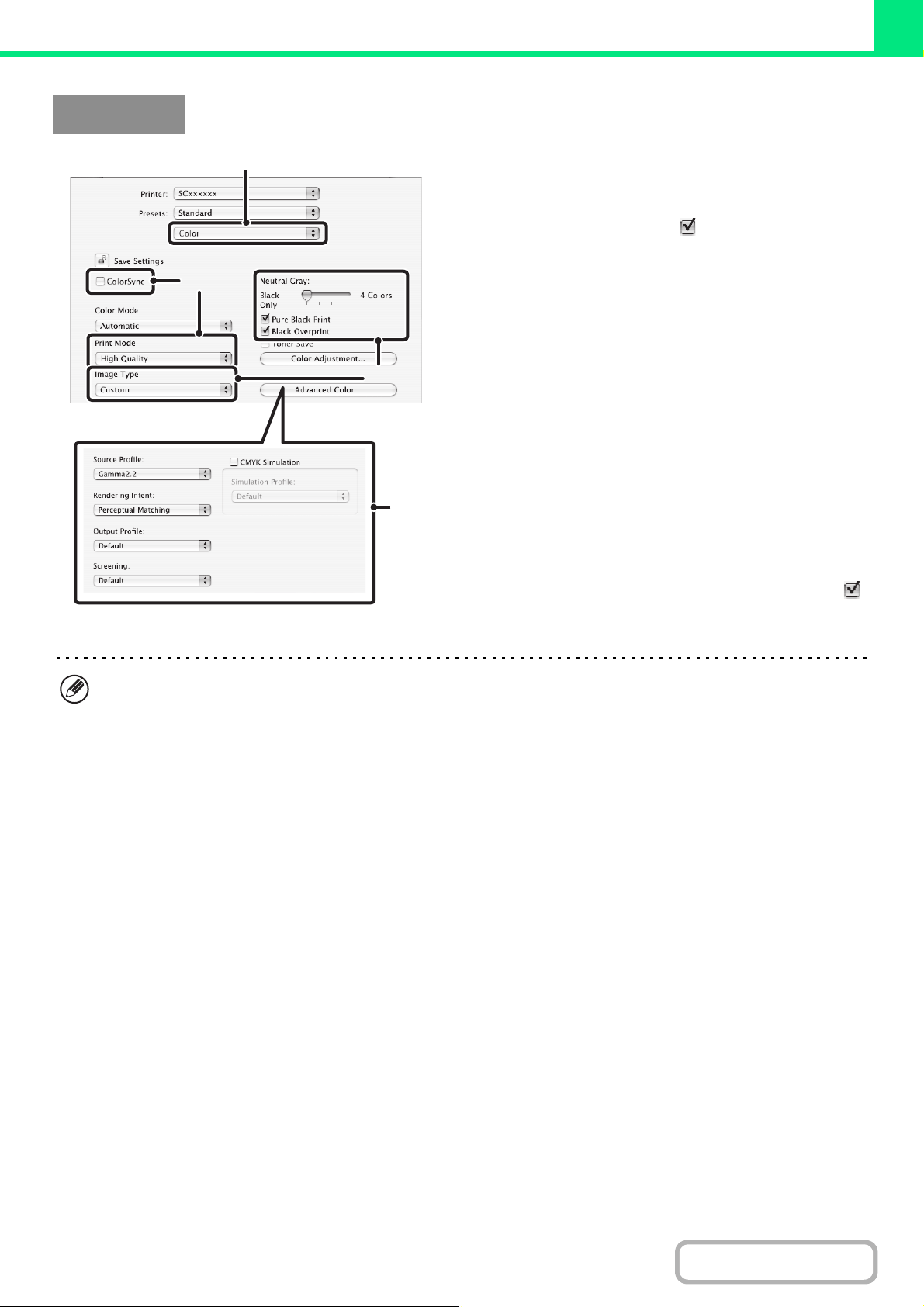
3-44
PRINTER
Contents
(1) Select [Color].
(2) Select color print settings.
To use the Mac OS Color Management function, select
the [ColorSync] checkbox . When this is done, "Image
Type" cannot be selected.
(3) Select the color image type.
An image type to match the data to be printed can be
selected from the pull-down menu.
• Standard (for data that includes text, photos, graphs,
etc.)
• Graphics (for data with many drawings or illustrations)
• Photo (for photo data or data that uses photos)
• CAD (for engineering drawing data)
• Scan (for data scanned by a scanner)
• Custom (for data to be printed with special settings)
[Neutral Gray] can be used when [Custom] is selected.
(4) Select advanced color settings.
If you wish to select detailed settings, click the [Advanced
Color] button.
To configure color management settings, select the
desired settings from the menus. To use "CMYK
Simulation", select the [CMYK Simulation] checkbox
and then select the desired setting.
The following color management settings are available.
• Windows ICM*
1
checkbox: Color management method in a Windows environment
• ColorSync checkbox*
2
: Color management method in a Macintosh environment
• Source Profile: Select the color profile used to display the image on the computer screen.
• Rendering Intent: Standard value used when converting the color balance of the image displayed on the
computer screen to a color balance that can be printed by the machine.
• Output Profile: Selecting a color profile for the image to be printed
• CMYK Correction*
3
: When printing a CMYK image, you can correct the image to obtain the optimum result.
• Screening: Select the most suitable image processing method for the image being printed.
• Neutral Gray: Select the toner color used to print gray areas.
• Pure Black Print*
4
: Black text and vector graphics can be printed using black toner only.
• Black Overprint*
4
: Prevents whitening of the outline of black text.
• CMYK Simulation*
4
: The color can be adjusted to simulate printing using the process colors used by printing
presses.
• Simulation Profile*
4
: Selecting a process color
*1 Cannot be selected when using the PS printer driver on Windows Vista/Server 2008.
*2 Cannot be selected in Mac OS X v10.2.8.
In Mac OS 9, can be selected in the "Color Matching" menu.
*3 Can only be used when using the PCL6 printer driver.
*4 Can only be used when using the PS printer driver (Windows/Macintosh).
Macintosh
(3)
(2)
(1)
(4)
• In Mac OS X v10.5 to 10.5.1, click the [Advanced] tab to configure advanced color settings.
• In Mac OS X v10.2.8, select the color image type from the "Image Type" menu.
• In Mac OS 9, select [Color], [Color2], and [Color3] to configure color print settings.
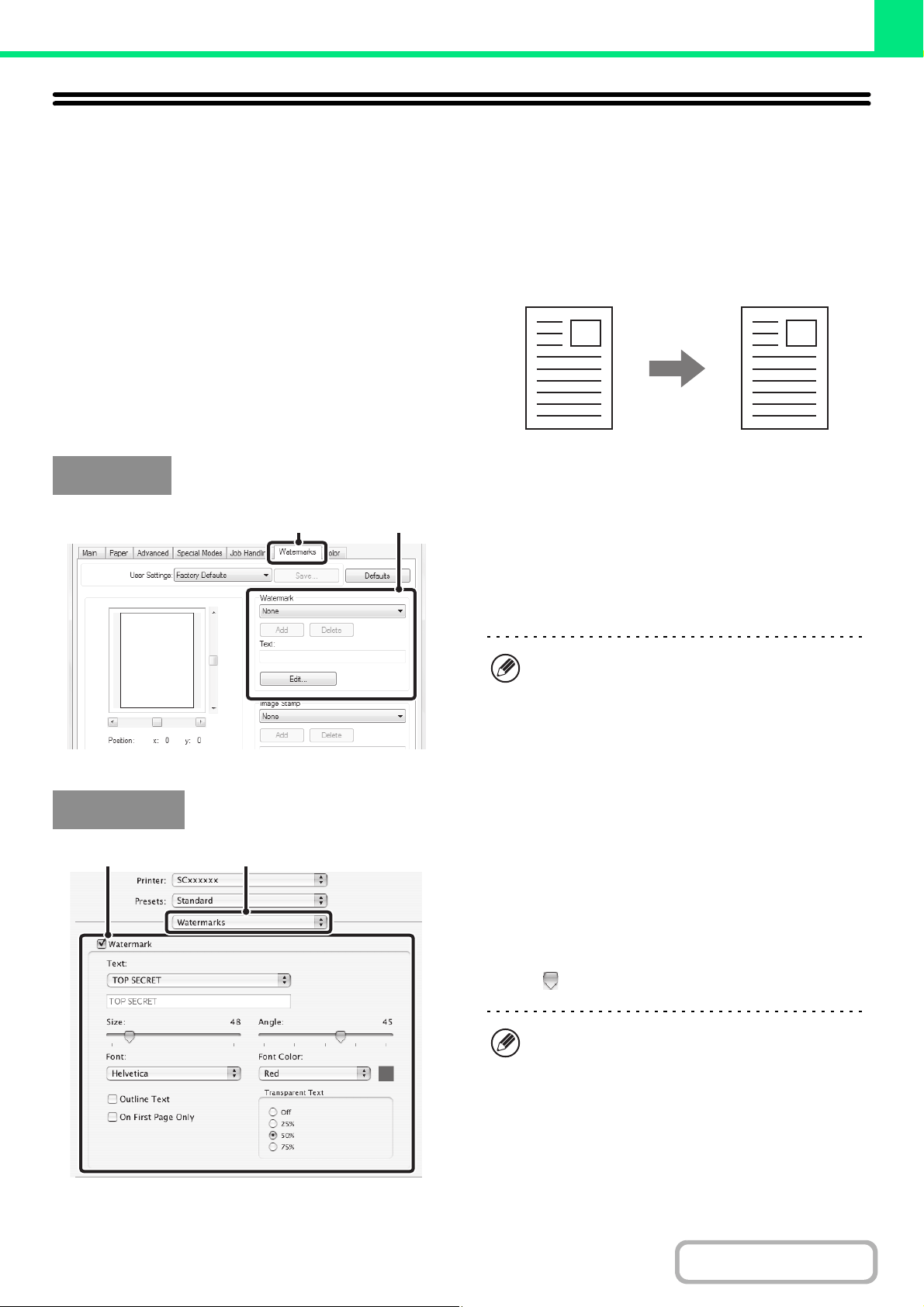
3-45
PRINTER
Contents
FUNCTIONS THAT COMBINE TEXT AND
IMAGES
ADDING A WATERMARK TO PRINTED PAGES
(Watermark)
Faint shadow-like text can be added to the background
of the printed image as a watermark. The size, color,
density, angle, and print position of the watermark text
can be adjusted. The text can be selected from a
pre-stored list, or entered to create an original
watermark.
(1) Click the [Watermarks] tab.
(2) Select the watermark settings.
Select a stored water mark from the pull-down menu. You
can click the [Edit] button to edit the font color and select
other detailed settings.
(1) Select [Watermarks].
(2) Click the [Watermark] checkbox and
configure watermark settings.
Detailed watermark settings can be configured such as
selection of the text and editing of the font and color.
Adjust the size and angle of the text by dragging the slide
bar .
CONFIDENTIAL
Windows
(1) (2)
If you wish to create a new watermark...
Enter the text of the watermark in the "Text" box and
click the [Add] button.
Macintosh
(1)(2)
In Mac OS 9, select [Watermark] and configure the
settings.
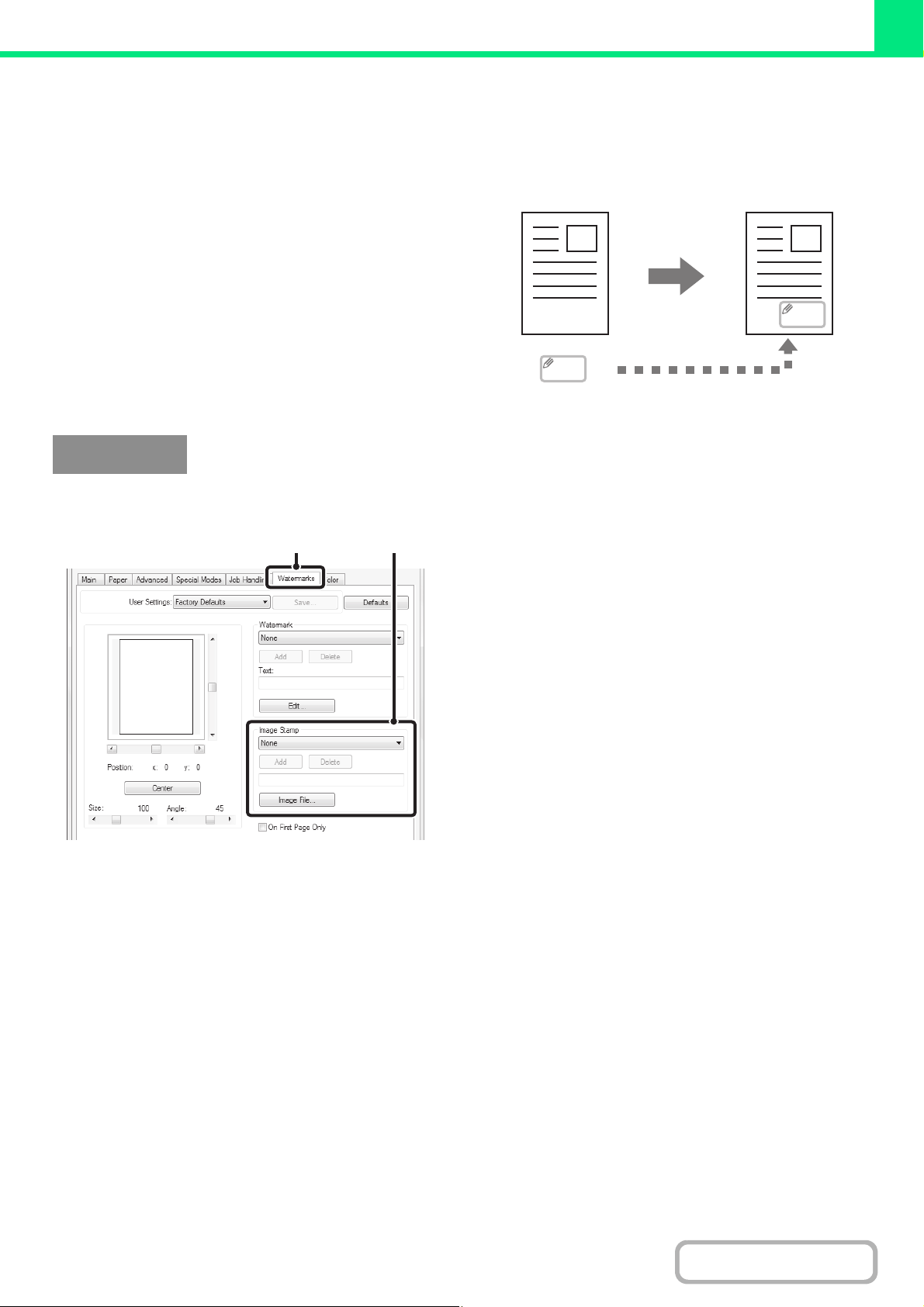
3-46
PRINTER
Contents
PRINTING AN IMAGE OVER THE PRINT DATA
(Image Stamp)
(This function is only available in Windows.)
A bitmap or JPEG image stored on your computer can
be printed over the print data. The size, position, and
angle of the image can be adjusted. This feature can be
used to "stamp" the print data with a frequently used
image or an icon of your own creation.
(This function can be used when the PCL6 or PS printer driver is used.)
(1) Click the [Watermarks] tab.
(2) Select the image stamp setting.
If an image stamp has already been stored, it can be
selected from the pull-down menu.
If you have not stored an image stamp, click the [Image
File], select the file you wish to use for the image stamp,
and click the [Add] button.
MEMO
MEMO
Windows
(1) (2)

3-47
PRINTER
Contents
CREATING OVERLAYS FOR PRINT DATA (Overlays)
(This function is only available in Windows.)
The print data can be printed in a previously created
overlay. By creating table rulings or a decorative frame
in an application different from that of the text file and
registering the data as an overlay file, an attractive print
result can be easily obtained without the need for
complex manipulations.
Create an overlay file.
(1) Click the [Advanced] tab.
Configure the printer driver settings from the software
application that you wish to use to create the overlay file.
(2) Click the [Edit] button.
(3) Create an overlay file.
Click the [Create Overlay] button and specify the name
and folder to be used for the overlay file that you wish to
create. The file will be created when the settings are
completed and printing is started.
Printing with an overlay file
(1) Click the [Advanced] tab.
Configure the printer driver settings from the application
from which you wish to print using the overlay file.
(2) Select the overlay file.
A previously created or stored overlay file can be selected
from the pull-down menu.
XXXX
XXX 1 100
XXXX 10 150
XXX 0 120
XXXX 10 250
XXXX
XXX 1 100
XXXX 10 150
XXX 0 120
XXXX 10 250
Overlay file
Windows
(1) (2)
(3)
• When printing is started, a confirmation message
will appear. The overlay file will not be created until
the [Yes] button is clicked.
• To register a previously existing overlay file, click
the [Load Overlay] button.
(1) (2)
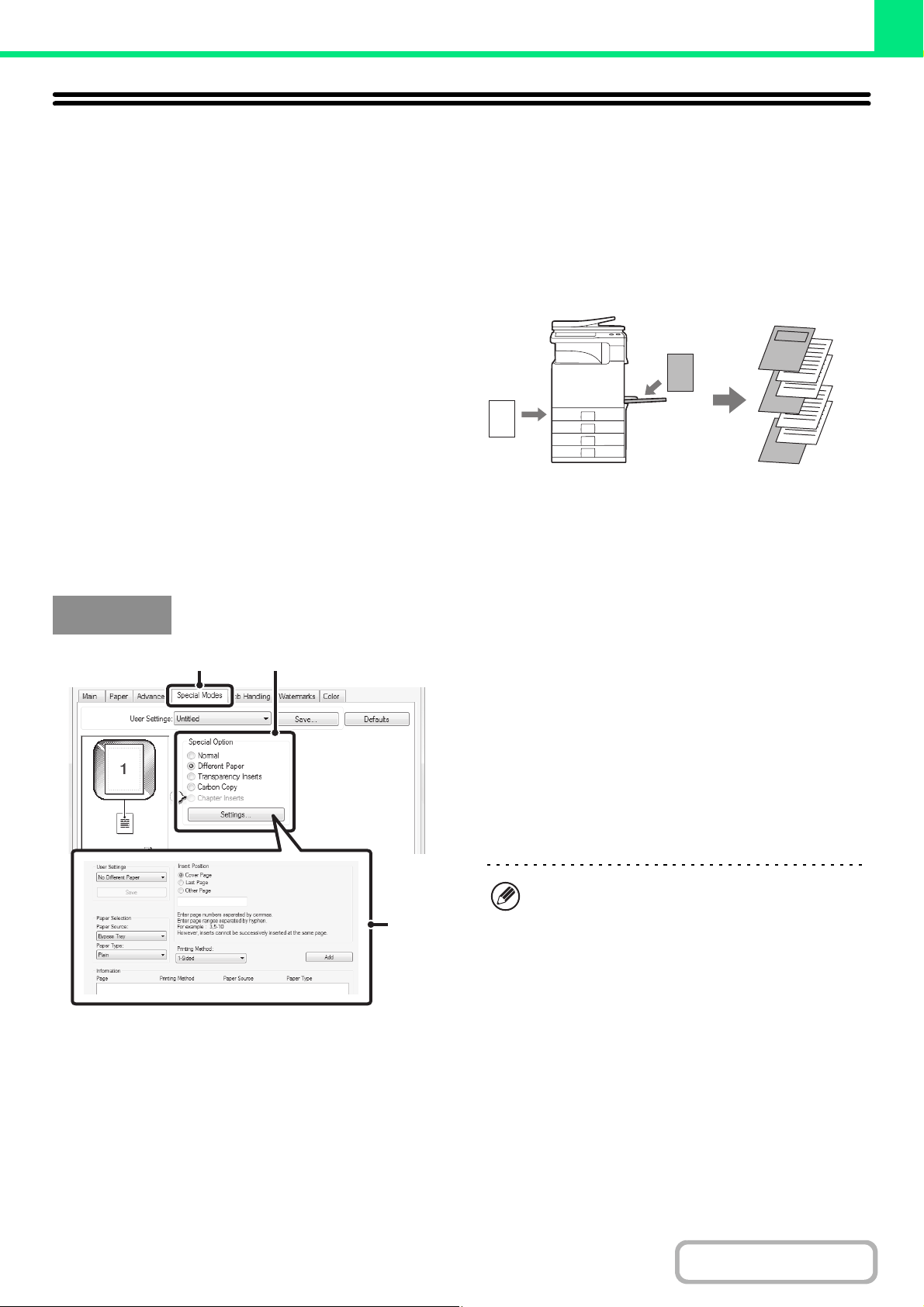
3-48
PRINTER
Contents
PRINT FUNCTIONS FOR SPECIAL
PURPOSES
PRINTING SPECIFIED PAGES ON DIFFERENT PAPER
(Different Paper)
• Using this function in a Windows environment
The front and back cover and specified pages of a
document can be printed on paper that is different
from the other pages. Use this function when you wish
to print the front and back cover on heavy paper, or
insert colored paper or a different paper type at
specified pages. You can also insert paper as an
insert without printing on it.
• Using this function in a Macintosh environment
The front cover and last page can be printed using
paper that is different from the other pages. This
function can be used, for example, when you want to
print only the front cover and last page on thick paper.
(1) Click the [Special Modes] tab.
(2) Select [Different Paper] and click the
[Settings] button.
(3) Select paper insertion settings.
Select the insertion position, paper source, and printing
method from the corresponding menus. Click the [Add]
button to show the selected settings in "Information".
When you have completed the settings, click the [Save]
button in "User Settings" to save the settings.
5
4
3
2
1
Windows
(1) (2)
(3)
• When [Bypass Tray] is selected in "Paper Source",
be sure to select the "Paper Type" and load that
type of paper in the bypass tray.
• About paper insertion settings
When [Other Page] is selected for "Insert Position",
the insert position can be specified by directly
entering a page number. However, inserts cannot
be successively inserted at the same page. When
"Printing Method" is set to [2-Sided], the specified
page and the next page after it will be printed on the
front and reverse side of the paper, and thus an
insert setting at a page printed on the reverse side
will not be effective.
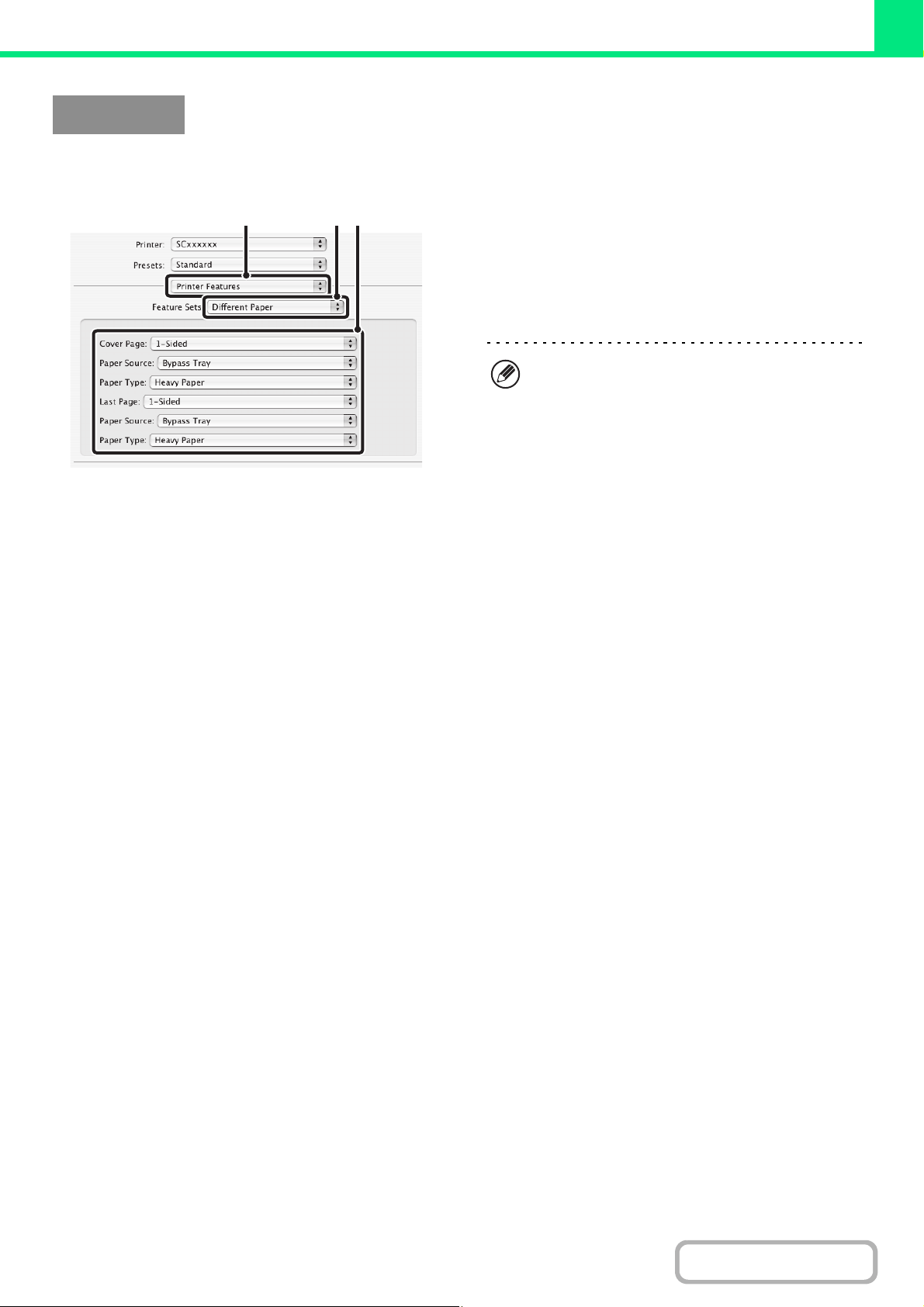
3-49
PRINTER
Contents
(This function can only be used in Mac OS 9, Mac OS X v10.4.11 and v10.5 to 10.5.1.)
(1) Select [Printer Features].
(2) Select [Different Paper].
(3) Select cover insertion settings.
Select the print setting, paper tray, and paper type for the
cover page and last page.
Macintosh
(1) (3)
(2)
In Mac OS 9, select [Different Paper] and then select
the settings for the cover page and last page.
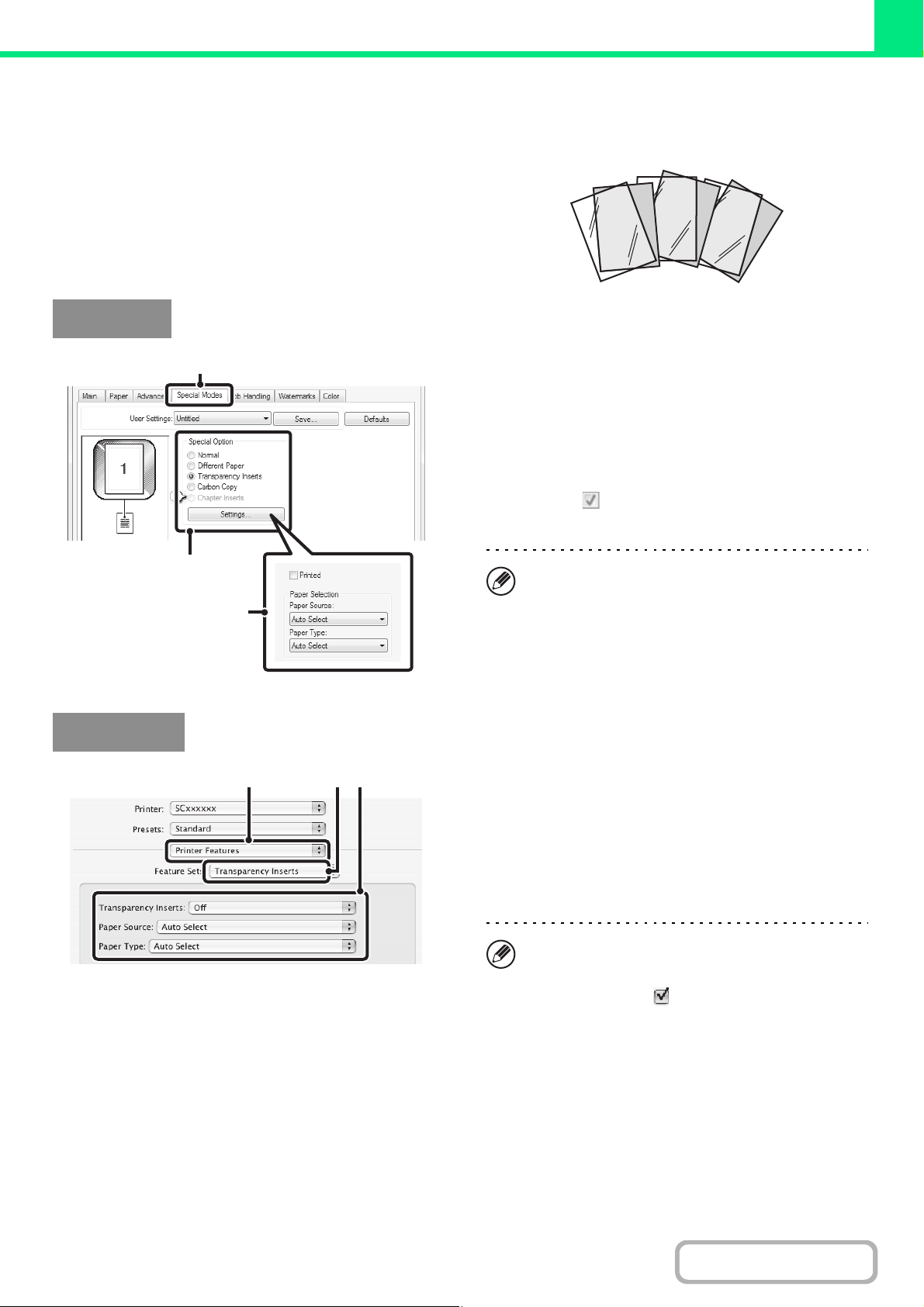
3-50
PRINTER
Contents
ADDING INSERTS WHEN PRINTING ON
TRANSPARENCY FILM (Transparency Inserts)
When printing on transparency film, this function helps
prevent the sheets of transparency film from sticking
together by inserting a sheet of paper between each
sheet of film. It is also possible to print the same content
on each inserted sheet of paper as is printed on the
corresponding sheet of transparency film.
(1) Click the [Special Modes] tab.
(2) Select [Transparency Inserts] and click the
[Settings] button.
(3) Select transparency insert settings.
To print the same content on the insert as is printed on
the sheet of transparency film, select the [Printed]
checkbox . Select the paper source and type if
needed.
(1) Select [Printer Features].
(2) Select [Transparency Inserts].
(3) Select transparency insert settings.
To print the same content on the insert as is printed on the
sheet of transparency film, select [Print] in "Transparency
Inserts". Select the paper source and type if needed.
C
B
A
Windows
(1)
(2)
(3)
Set [Transparency] for the "Paper Type" of the bypass
tray.
Macintosh
(3)(1) (2)
• Set [Transparency] for the "Paper Type" of the
bypass tray.
• In Mac OS X v10.2.8, select the [Transparency
Inserts] checkbox in [Advanced].
• In Mac OS 9, select [Transparency Inserts] and
select from the "Transparency Inserts" menu. Select
the paper source and type if needed.
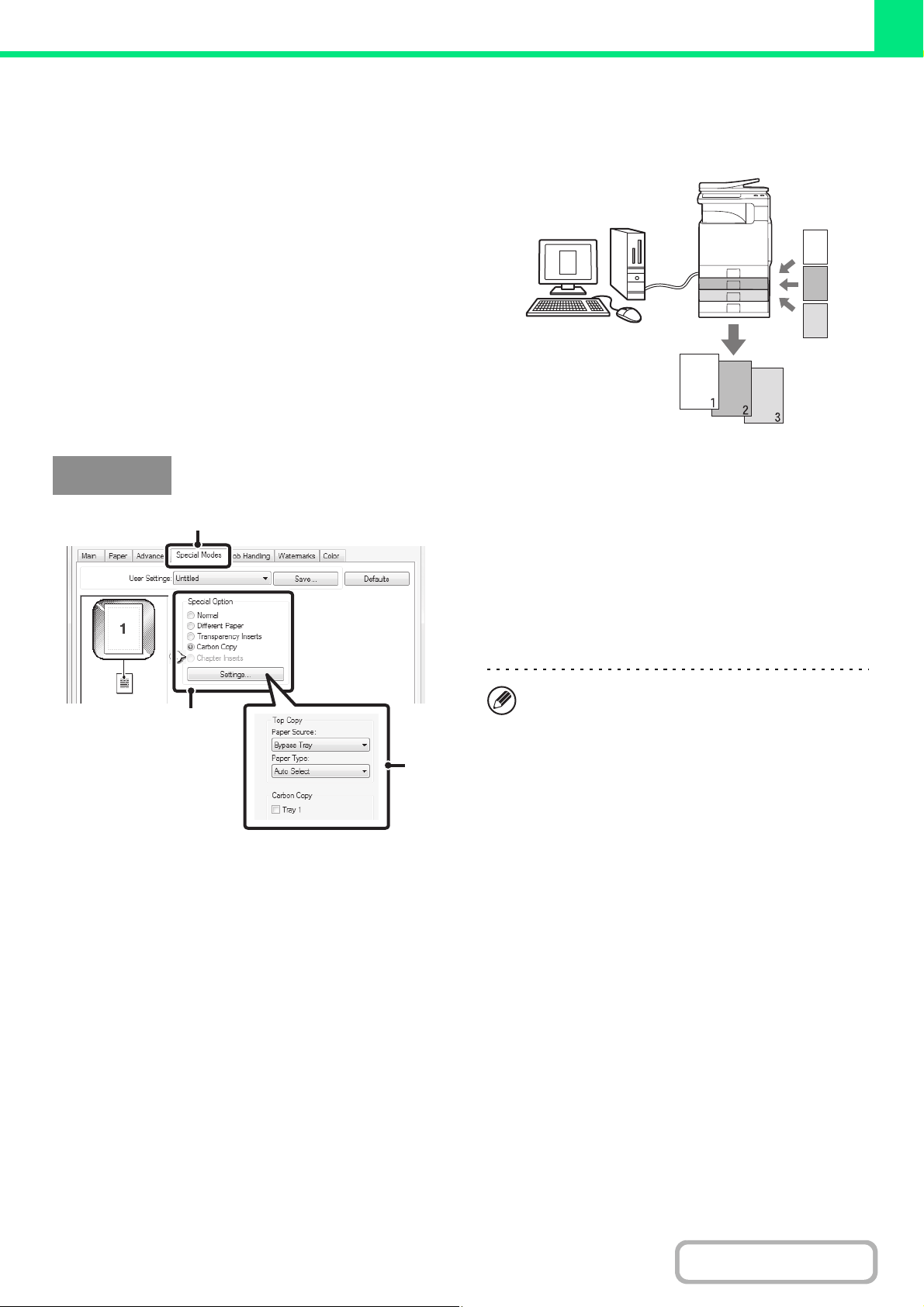
3-51
PRINTER
Contents
PRINTING A CARBON COPY (Carbon Copy)
(This function is only available in Windows.)
This function is used to print an additional copy of the
print image on paper that is the same size but from a
different paper tray.
For example, if carbon copy print is selected when
standard paper is loaded in tray 1 and colored paper is
loaded in tray 2, a print result similar to a carbon copy
slip can be obtained with a single selection of the print
command. As another example, if standard paper is
loaded in tray 1 and recycled paper is loaded in tray 2,
Carbon Copy can simultaneously print one copy for
presentation and one copy as a duplicate.
(1) Click the [Special Modes] tab.
(2) Select [Carbon Copy] and click the
[Settings] button.
(3) Select the carbon copy settings.
Select the tray for the "Top Copy" and then select the tray
for the carbon copy (or copies) in "Carbon Copy".
A
A
A
A
Windows
(1)
(2)
(3)
When the bypass tray is selected, be sure to select
the "Paper Type".
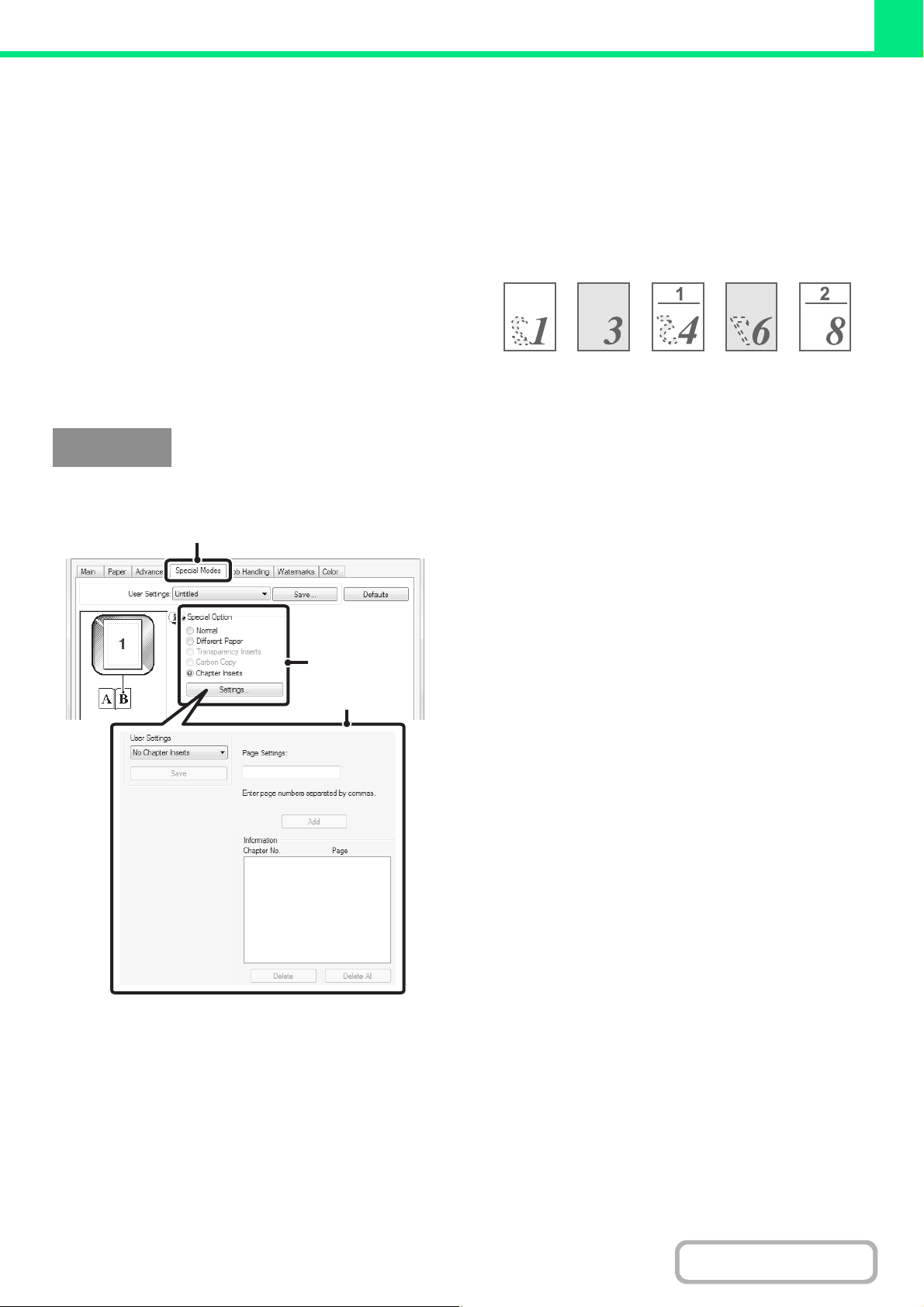
3-52
PRINTER
Contents
TWO-SIDED PRINTING WITH SPECIFIC PAGES PRINTED
ON THE FRONT SIDE (Chapter Inserts)
(This function is only available in Windows.)
You can have specific pages printed on the front side of
the paper.
When a page (such as the first page of a chapter) is
specified as a front side page, the page will be printed on
the front side of the paper even if would normally be
printed on the reverse side (the reverse side will be left
blank and the page will be printed on the front side of the
next sheet of paper).
(This function can be used when the PCL6 printer driver is used.)
(1) Click the [Special Modes] tab.
(2) Select [Chapter Inserts] and click the
[Settings] button.
(3) Select the chapter settings.
Enter the page numbers that are to begin chapters in
"Page Settings". Click the [Add] button and your settings
will appear in "Information". When you have finished
selecting settings, click the [Save] button in "User
Settings" to save the settings.
Example:
When pages 4 and 8 are specified as page settings.
Back is blank
Windows
(1)
(2)
(3)
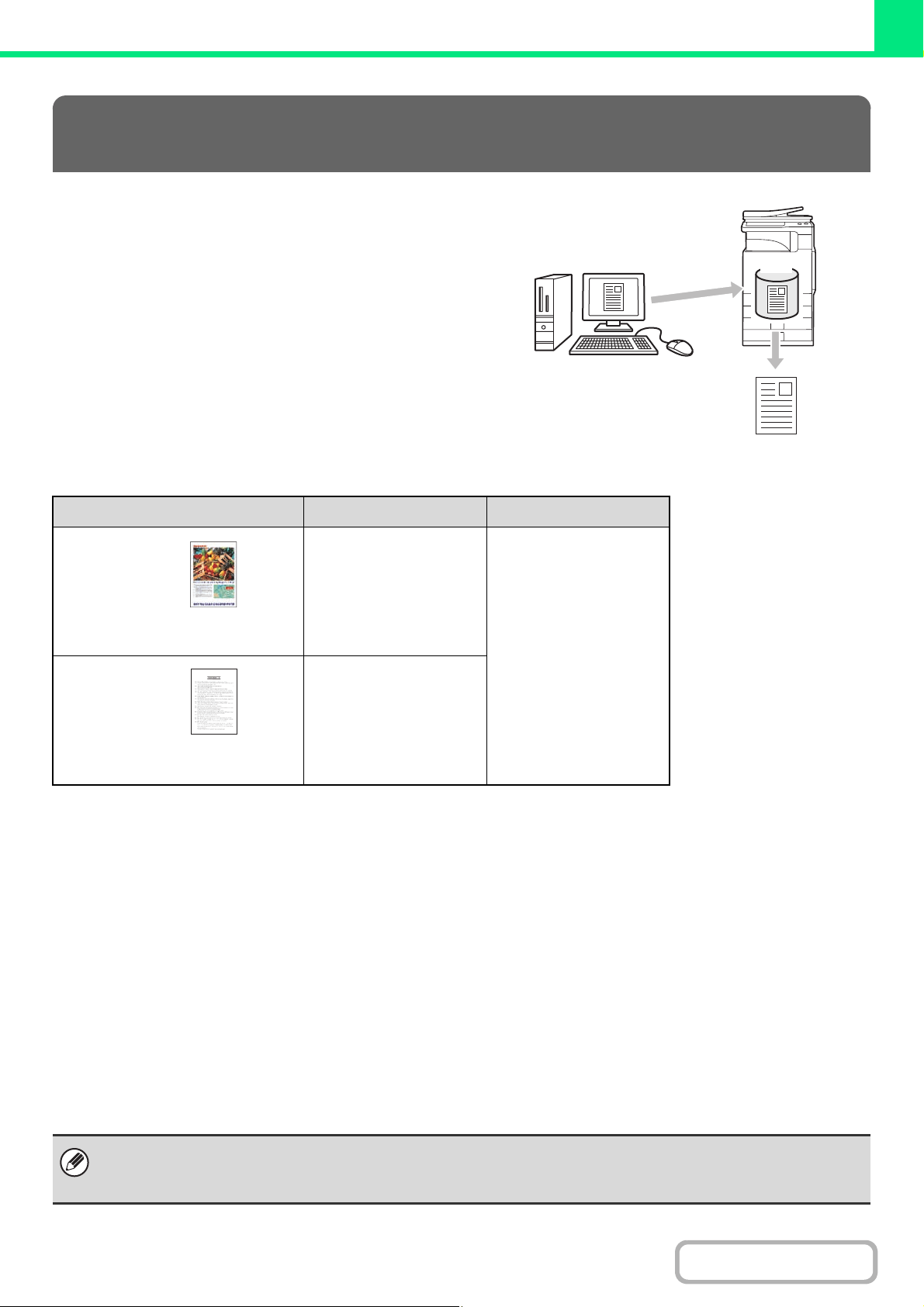
3-53
PRINTER
Contents
This function is used to store a print job as a file on the
machine's hard drive, allowing the job to be printed from
the operation panel when needed.
When printing from a computer, a password (5 to 8
digits) can be set to maintain the secrecy of information
in a stored file.
When a password is set, the password must be entered
to print a stored file from the machine.
Approximate number of pages and files that can be stored by retention function
*1 The data types above are examples to make the explanation easier to understand. The actual number of pages and
number of files that can be stored will vary depending on the contents of the print images and the settings when the
files are stored.
*2 The indicated numbers are guidelines for the number of pages that can be stored when all pages are full color, and
when all pages are black & white.
Important points when using retention function
Note the following when using retention function:
• Files are assigned the "Sharing" property. "Sharing" files can be retrieved and printed by anyone, and thus a
password should be set for sensitive or confidential files that you do not wish others to use.
• A file with a password is saved as a "Confidential" file. Be sure to keep the password secret.
• Even if a file has a password, the property can be changed to "Sharing" in the Web page. Do not store sensitive
documents or documents that you do not want to be used by others.
• Except in cases provided for by law, SHARP Corporation bears no responsibility for any damages that result from the
leaking of sensitive information due to manipulation by a third party of any data saved using the retention function, or
incorrect operation of the retention function by the operator that saves the data.
RETENTION (PRINT HOLD) FUNCTION
HDD
Examples of data types*
1
Number of pages*
2
Number of files
Full color data
(Text and photo
example)
Size:
8-1/2" x 11" (A4)
Max. 2500
Max. 3000
Black & white
data
(Text)
Size:
8-1/2" x 11" (A4)
Max. 5500
Print hold files can also be printed from the Web page. To print a file, select [Document Operations] - [Print Hold] in the Web
page menu and then select the desired file. You can also view a preview of a stored file and change the property of a stored
file in the Web page.
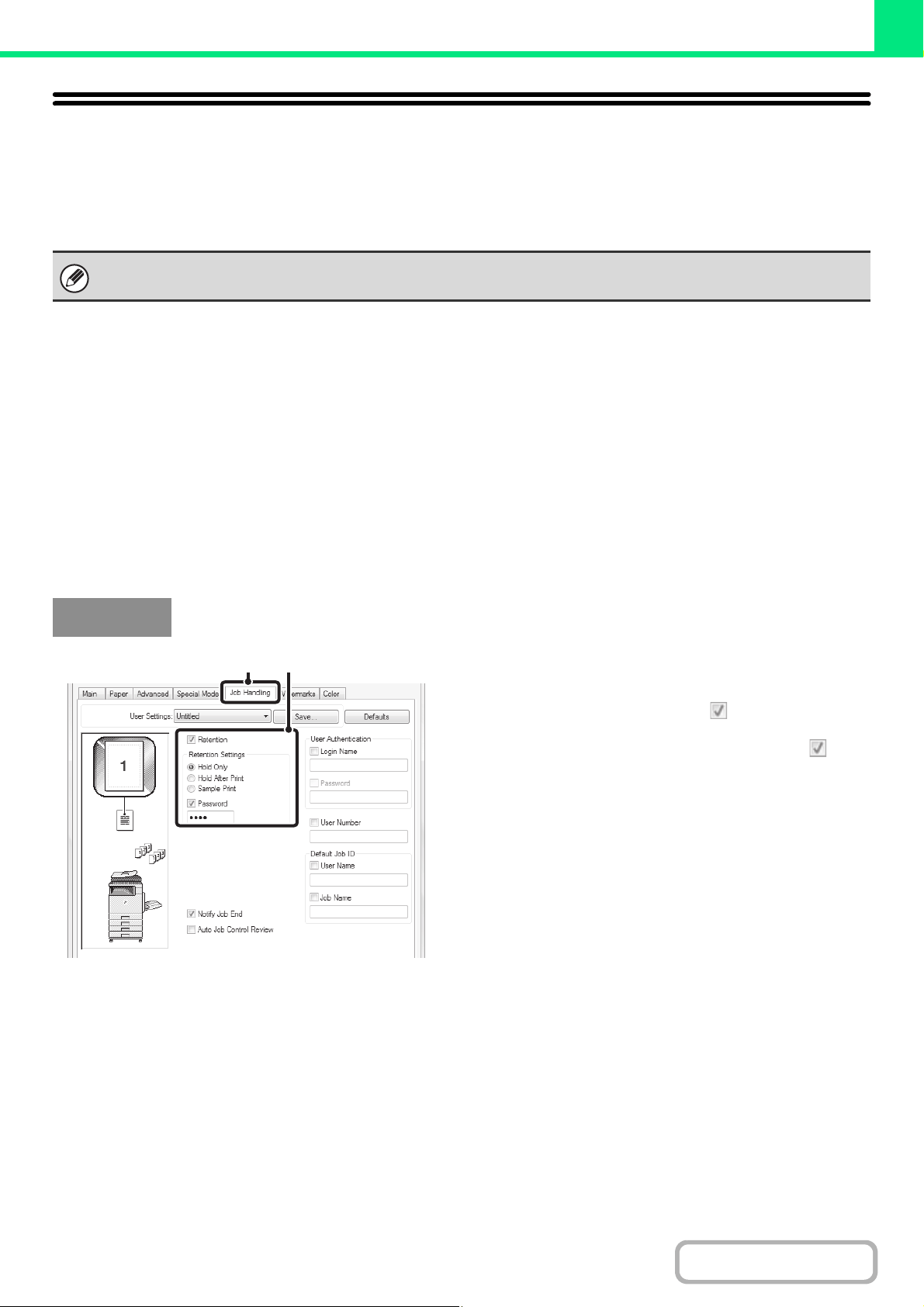
3-54
PRINTER
Contents
SAVING PRINT FILES (Retention)
The explanations assume that the paper size and other basic settings have already been selected. For the basic
procedure for printing and the steps for opening the printer driver properties window, see the following section:
☞ Windows: BASIC PRINTING PROCEDURE (page 3-4)
☞ Macintosh: BASIC PRINTING PROCEDURE (page 3-16)
[Retention] menu
Hold Only
This setting is used to hold a print job on the machine's hard drive without printing it.
Hold After Print
This setting is used to hold a print job on the machine's hard drive after it is printed.
Sample Print
When a print job is sent to the machine, only the first set of copies is printed. After checking the contents of the first set
of copies, you can print the remaining sets from the operation panel of the machine. This prevents the occurrence of
excessive misprints.
To print files stored on the machine's hard drive, see "PRINTING A STORED FILE" (page 3-56).
(1) Click the [Job Handling] tab.
(2) Select the retention setting.
Click the [Retention] checkbox . Select the retention
method in "Retention Settings". To enter a password (5 to
8 digit number), click the [Password] checkbox .
In Windows, view printer driver Help for details on printer driver settings for each printing function.
Windows
(1) (2)
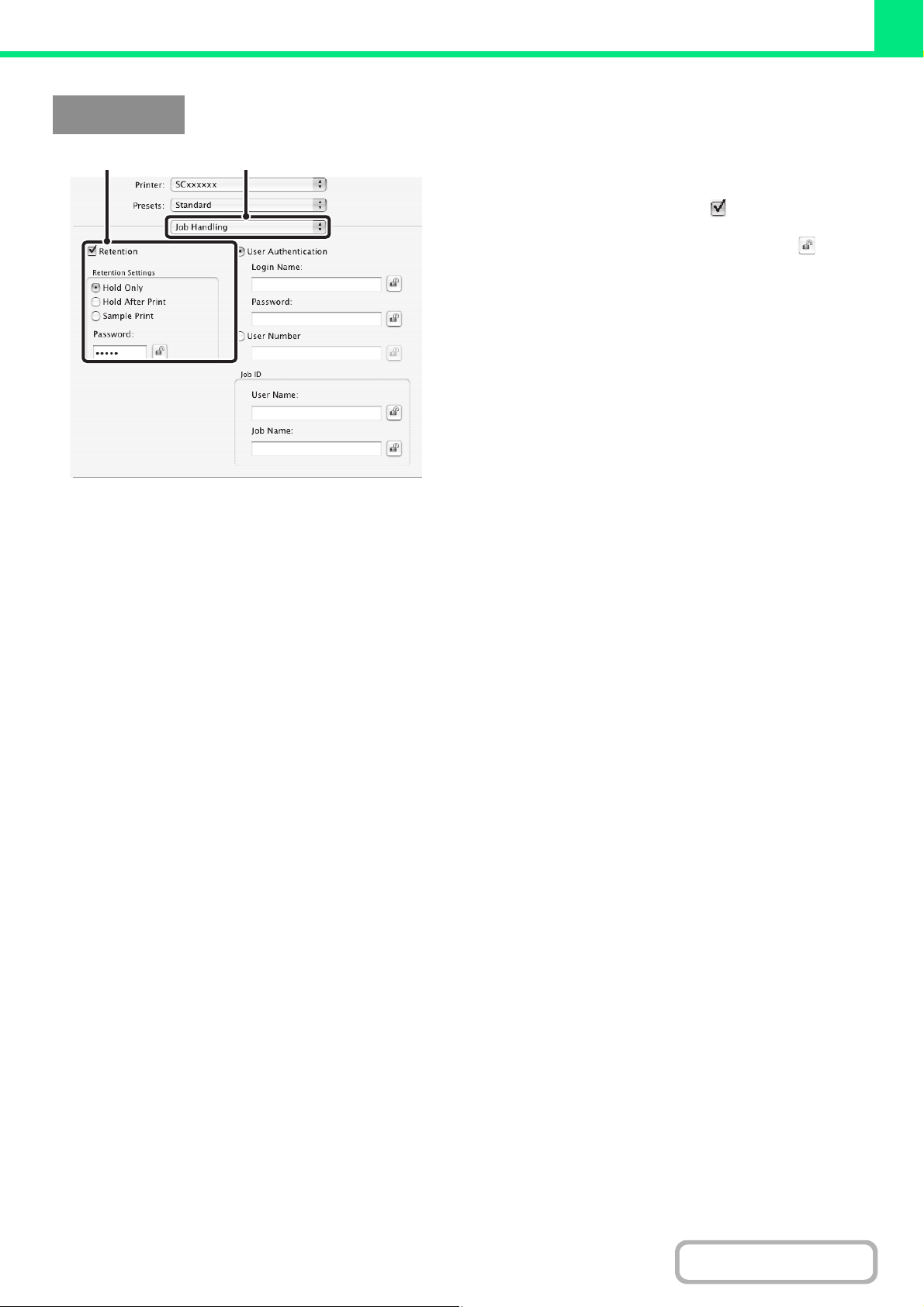
3-55
PRINTER
Contents
(1) Select [Job Handling].
(2) Select the retention setting.
Click the [Retention] checkbox . Select the retention
method in "Retention Settings". To simplify operation the
next time the same password is set, click the (lock)
button after entering the password (5 to 8 digit number).
Macintosh
(1)(2)
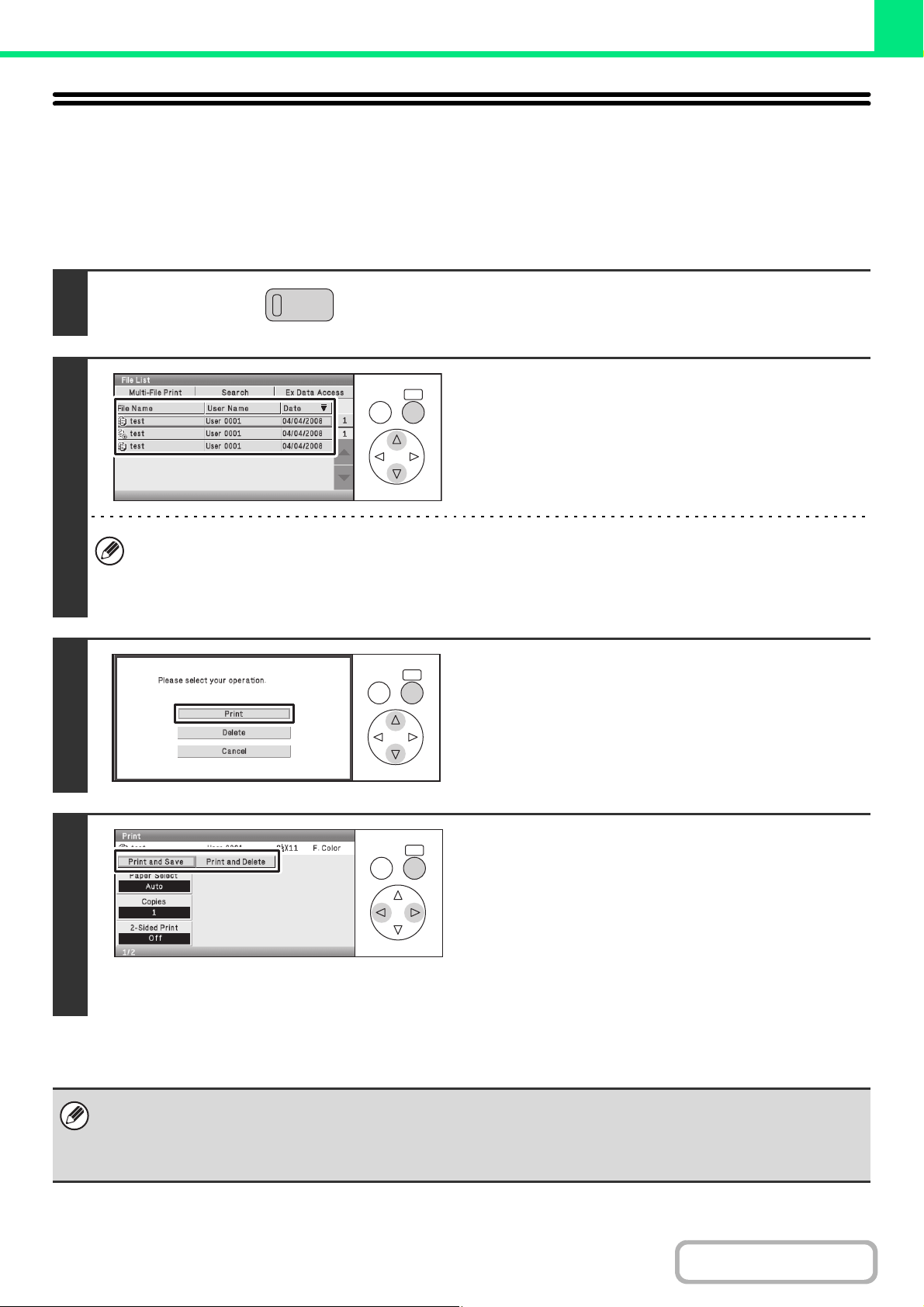
3-56
PRINTER
Contents
PRINTING A STORED FILE
A file stored using retention function can be retrieved and printed when needed. The settings used when the file was
stored are also stored, and thus the file can be printed again using those settings. Output settings, 2-sided printing,
paper size, the number of copies, and other settings can be selected.
Keys in the display can be selected with the arrow keys and the [OK] key.
1
Press the [PRINT] key.
2
Select the key of the desired file.
If a password is set for the selected file, a password entry
screen will appear.
Enter the password with the numeric keys (5 to 8 digits) and
select the [OK] key.
• You can select the [File Name] key, the [User Name] key, or the [Date] key to change the order of display of the
files.
• The [Multi-File Print] key can be selected to select multiple files for printing.
☞ MULTI-FILE PRINTING (page 3-59)
3
Select the [Print] key.
4
Select the [Print and Delete] key or the
[Print and Save] key.
• If the [Print and Delete] key is selected, the files will be
automatically deleted after printing.
• If the [Print and Save] key is selected, the files will be saved
after printing.
• Output settings, 2-sided printing, paper size, the number of
copies, and other settings can be selected. For more
information, see "PRINT SETTINGS SCREEN" (page 3-58).
• A file saved in black and white or grayscale cannot be printed in color.
• If print settings are changed when a stored file is printed, the only changed setting that can be stored is the number of
copies.
• The printing speed may be somewhat slow depending on the resolution and exposure mode settings of the stored file.
PRINT
OKBACK
OKBACK
OKBACK
3-57
PRINTER
Contents
Automatically print all stored data
When user authentication is enabled, all retained (stored) print jobs of a user who logs in can be printed automatically
after log in.
After all jobs are printed, the files are deleted.
To use the print all function, the following steps are necessary:
• "Automatically print stored jobs after login" must be enabled in [User Control] - [Default Settings] in the Web page
menu. (Administrator rights are required.)
• At the time of retention print, in addition to user authentication information, the user name stored in the machine
must be entered in "User Name" of the job ID in the printer driver.
☞ Windows: PRINTING WHEN THE USER AUTHENTICATION FUNCTION IS ENABLED (page 3-8)
☞ Macintosh: PRINTING WHEN THE USER AUTHENTICATION FUNCTION IS ENABLED (page 3-21)
(1) Log into the machine.
Enter your user number or login name and password in the user authentication screen of the machine.
(2) Perform print all.
A confirmation prompt will appear. Select the [OK] key. The print files stored in the machine will be printed automatically and
then deleted.
Files with a password and files that are protected by the print hold function of the machine will not be printed.
If you do not wish to "print all"...
Select the [Cancel] key in step (2).
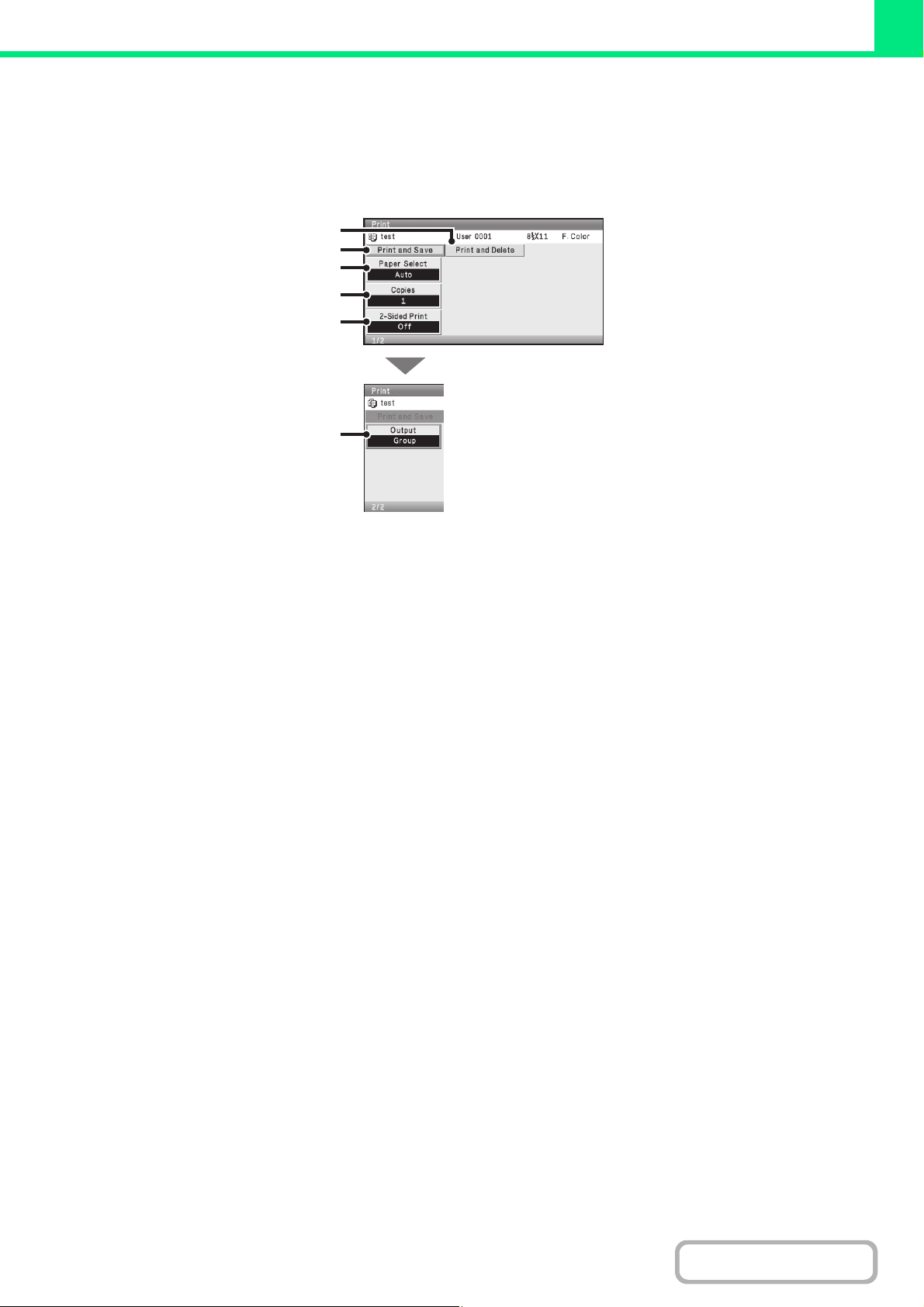
3-58
PRINTER
Contents
PRINT SETTINGS SCREEN
When a file is stored in the machine, the print settings that were in effect when the file was printed from the printer driver
are also stored. However, the settings below can be changed when you print a stored file.
For the procedures for operating the settings screen, see "USING THE OPERATION PANEL" (page 1-9) in "1. BEFORE
USING THE MACHINE".
(1) [Print and Delete] key
Printing begins when this key is selected. When printing
is finished, the file will be automatically deleted.
(2) [Print and Save] key
Printing begins when this key is selected. The file will not
be deleted after printing.
(3) [Paper Select] key
Use this key to select the paper tray from which paper is
fed.
(4) [Copies] key
Use this key to set the number of copies.
(5) [2-Sided Print] key
Use this key to select the orientation of the image on the
reverse side of the paper for 2-sided printing. To have the
front and back images oriented in the same direction,
select the [2-Sided Booklet] key. To have the front and
back images oriented opposite to each other, select the
[2-Sided Tablet] key. Note that the size and orientation of
the saved image may cause these keys to have the
opposite effect.
Select the [Off] key when you only wish to print on one
side of the paper.
(6) [Output] key
Use this key to select Sort, Group, Staple Sort* or Offset*.
* When a finisher is installed.
(2)
(3)
(4)
(5)
(6)
(1)
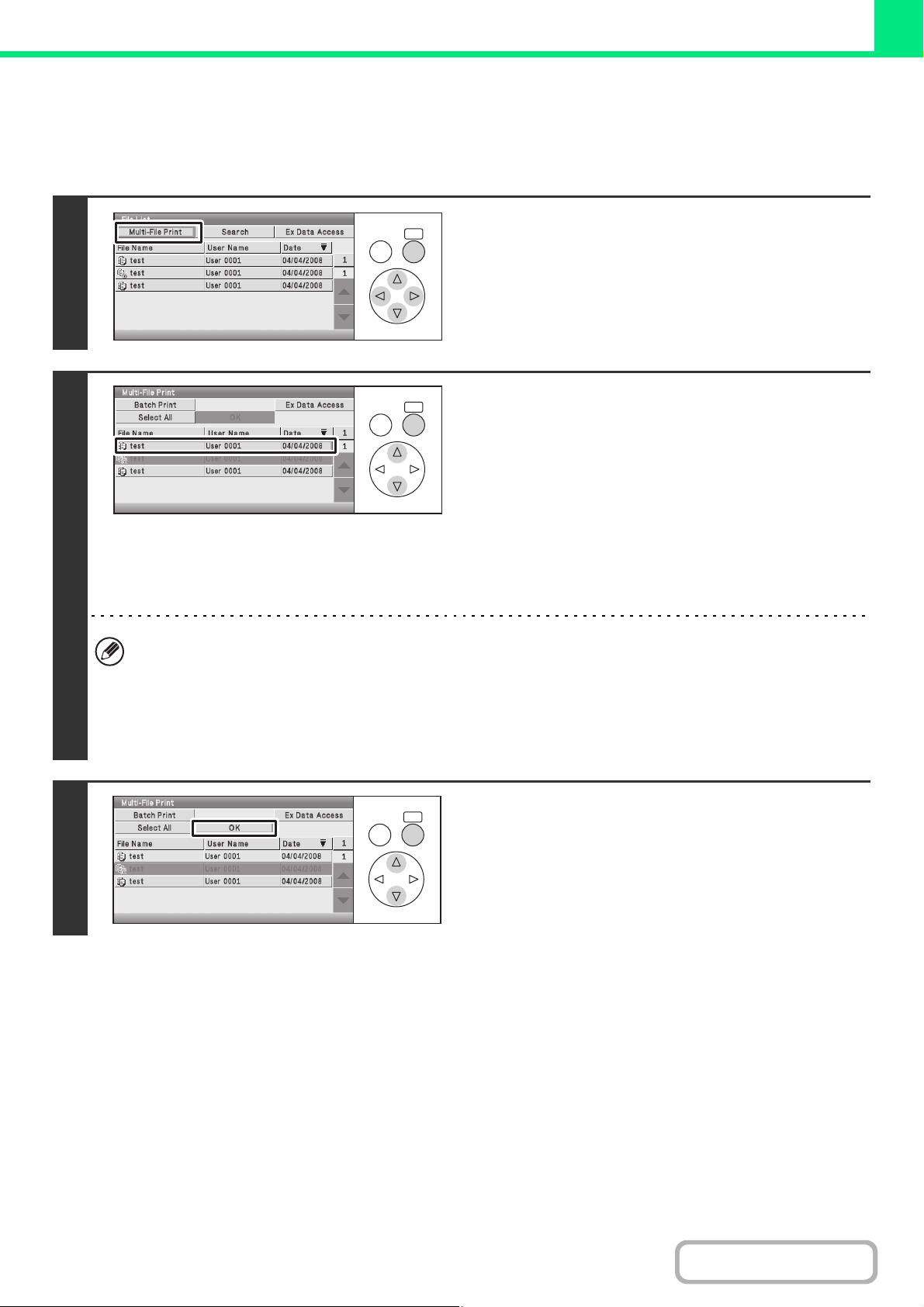
3-59
PRINTER
Contents
MULTI-FILE PRINTING
Multiple files in a folder can be selected for printing.
Keys in the display can be selected with the arrow keys and the [OK] key.
1
Select the [Multi-File Print] key.
2
Select the keys of the files that you wish
to print.
• Selected file keys will be highlighted to indicate that they
have been selected.
• To cancel the selection of a file, select the highlighted file key
so that it is no longer highlighted.
• To select all displayed file keys except those of confidential
files, select the [Select All] key.
• The [Batch Print] key can be used to print all files of a
particular user or all files that have the same password. For
more information, see "Batch printing" (page 3-61).
• Multi-file printing of confidential files is not possible.
• If the screen is changed with the [BACK] key while a file is selected, the selection of the file will be canceled.
• When the [Select All] key is selected, it will change into the [Cancel All] key. To cancel the selection of all files that
was made with the [Select All] key, select the [Cancel All] key.
• If all files are selected without using the [Select All] key, the key will not change into the [Cancel All] key. If selection
of all files is canceled without using the [Cancel All] key, the key will remain the [Cancel All] key.
3
Select the [OK] key
The selected file is entered and the screen changes to the print
screen.
OKBACK
OKBACK
OKBACK
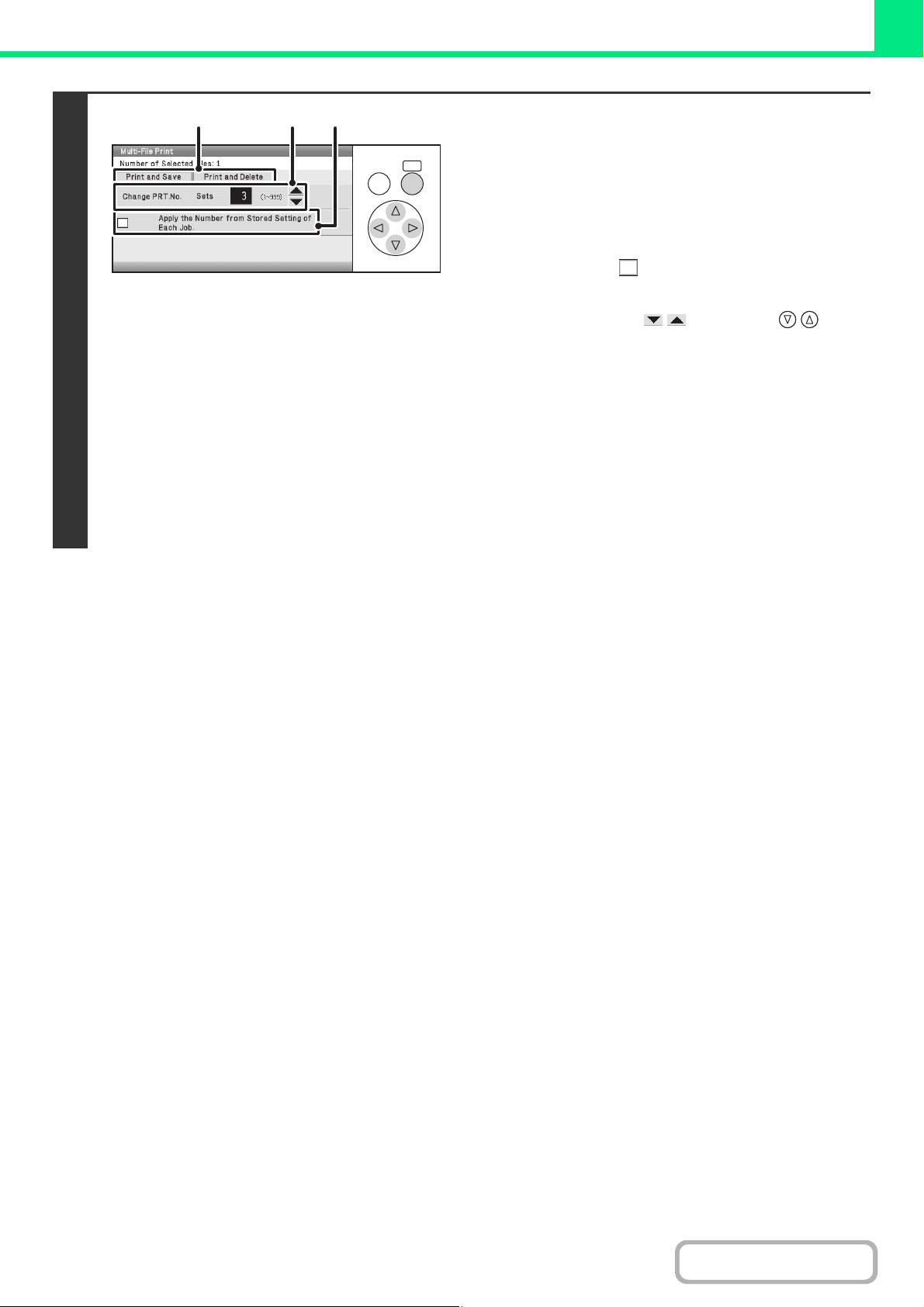
3-60
PRINTER
Contents
4
Printing a selected file.
The number of selected files appears in the number of selected
files display.
If you wish to use the number of copies that was stored with the
file, go to step (3).
(1) Select the [Apply the Number from Stored
Setting of Each Job] checkbox so that it is
not selected ( ).
(2) Set the number of copies.
• Select either of the keys with the keys
and press the [OK] key repeatedly to change the
number.
• You can also enter the number of copies with the
numeric keys without moving the selection frame.
(3) Select the [Print and Delete] key or the
[Print and Save] key.
• If the [Print and Delete] key is selected, the files will be
automatically deleted after printing.
• If the [Print and Save] key is selected, the files will be
saved after printing.
OKBACK
(1)(2)(3)
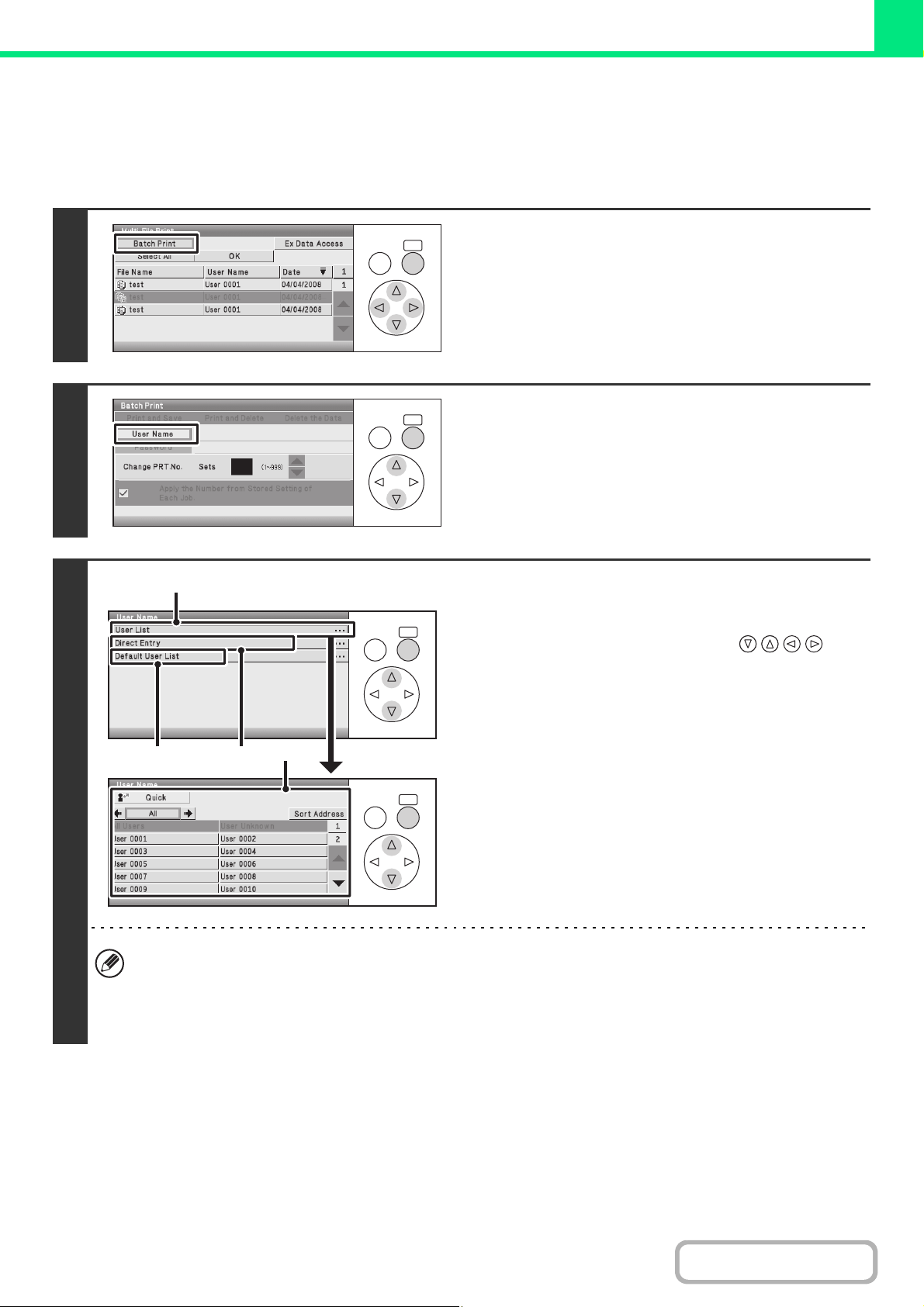
3-61
PRINTER
Contents
Batch printing
All files that have the same user name and password can be printed at once. When the [Multi-File Print] key is selected,
it changes into the [Batch Print] key.
Keys in the display can be selected with the arrow keys and the [OK] key.
1
Select the [Batch Print] key.
2
Select the [User Name] key.
When user authentication is used, the user name that was used
for login is automatically selected.
3
Select the user name.
There are three ways to select the user name:
(A) Select the [User List] key and press the [OK] key.
A user list (D) appears. Select with the keys
and press the [OK] key.
If you accidentally select the wrong user name, select the
key of the correct name.
If the [Quick] key is selected, an area for entering the
"Registration No." [----] appears in the message display.
Use the numeric keys to enter the "Registration No." that
has been set in [User Control] - [User List] in the Web page
(administrator). This will allow you to select the user name.
(B) Select the [Direct Entry] key and press the [OK] key.
A text entry screen appears. Directly enter the user name.
(C) Select the [Default User List] key and press the [OK]
key.
The user name can be selected from the factory stored
users.
When [Selection of [All Users] is not allowed] checkbox and [Selection of [User Unknown] is not allowed] checkbox are
disabled in "Print Hold Setting" (Web page only) in the system settings (administrator), the [All Users] key and [User
Unknown] key can be selected.
The [All Users] key can be selected to select all files in the folder (the files of all users).
The [User Unknown] key can be selected to select all files in the folder that do not have a user name.
OKBACK
OKBACK
OKBACK
OKBACK
(A)
(D)
(C)
(B)
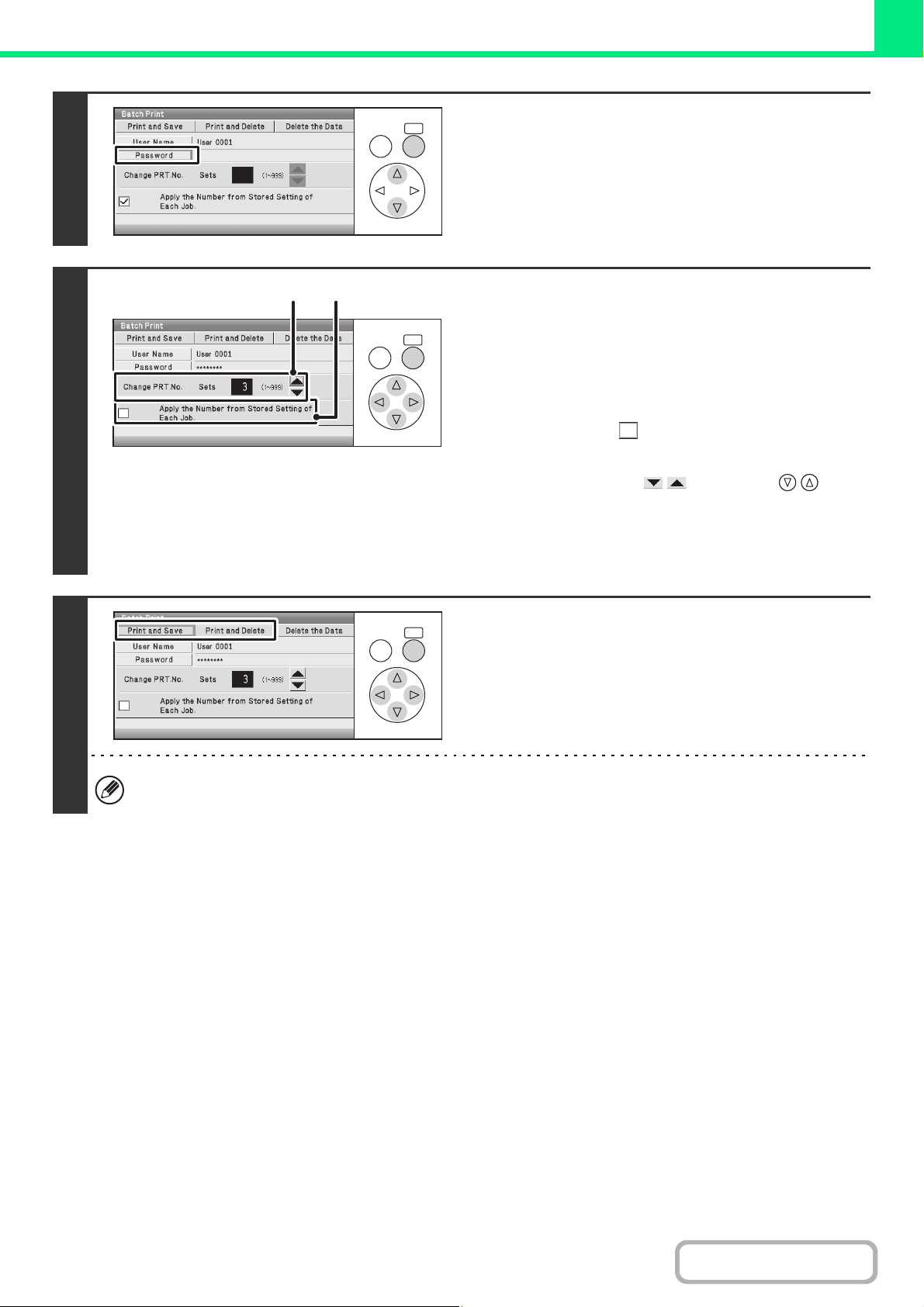
3-62
PRINTER
Contents
4
If a password has been established,
select the [Password] key.
Enter the password with the numeric keys (5 to 8 digits) and
select the [OK] key. Only files that have the same password will
be selected.
If you do not wish to enter a password, go to the next step.
5
To change the number of copies,
configure the settings.
If you wish to use the number of copies stored with each file, go
to step 6.
(1) Select the [Apply the Number from Stored
Setting of Each Job] checkbox so that it is
not selected ( ).
(2) Set the number of copies.
• Select either of the keys with the keys
and press the [OK] key repeatedly to change the
number.
• You can also enter the number of copies with the
numeric keys without moving the selection frame.
6
Select the [Print and Delete] key or the
[Print and Save] key.
• If the [Print and Delete] key is selected, the files will be
automatically deleted after printing.
• If the [Print and Save] key is selected, the files will be saved
after printing.
All files that match the current search conditions can be deleted by selecting the [Delete the Data] key.
OKBACK
OKBACK
(1)(2)
OKBACK
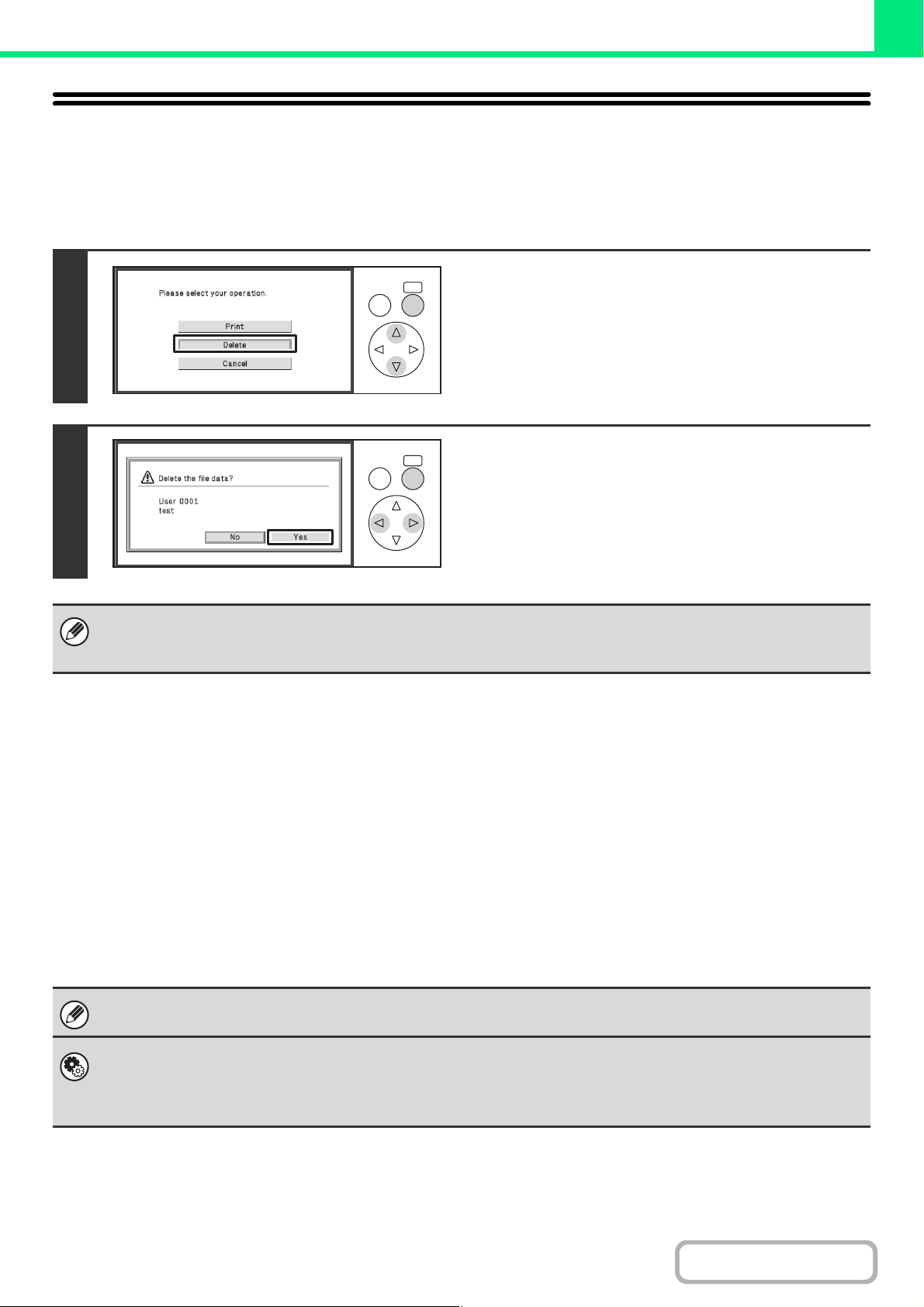
3-63
PRINTER
Contents
DELETING A STORED FILE
Stored files that are no longer needed can be deleted.
☞ PRINTING A STORED FILE (page 3-56)
Keys in the display can be selected with the arrow keys and the [OK] key.
Automatic deletion of files
You can have stored data automatically deleted at regular intervals by specifying a periodic deletion time. Periodic
deletion of files stored in the machine helps to prevent the leaking of sensitive information and frees space on the hard
drive.
Every day, every week, or every month can be selected for the deletion cycle, and a time can be set for each selection.
For example, you can set file deletion to take place every week on Friday at 6:00 PM.
Automatic file deletion settings are configured in "Automatic Deletion of File Settings" (Web page only) in the system
settings (administrator).
To check the settings, print the following list in the system settings.
To check information on the deletion cycle: Print "Print Hold" of the "Administrator Settings List" (Web page only) in the
system settings (administrator).
1
Select the [Delete] key.
2
Check the file and then select the [Yes]
key.
A file whose property is "Protect" cannot be deleted. To delete a protected file, change its property to "Sharing" or
"Confidential".
This setting can be configured in [Print Hold] in [Document Operations] in the Web page menu.
When "Automatic Deletion of File Settings" (Web page only) is enabled in the system settings (administrator), all files will be
deleted when the set time arrives.
• System Settings (Administrator): Automatic Deletion of File Settings (Web page only)
Configure settings for automatic deletion at regular intervals of files stored using the print hold function.
• System Settings (Administrator): Administrator Settings List (Web page only)
Use this to print a list of the administrator settings, including print hold settings.
OKBACK
OKBACK
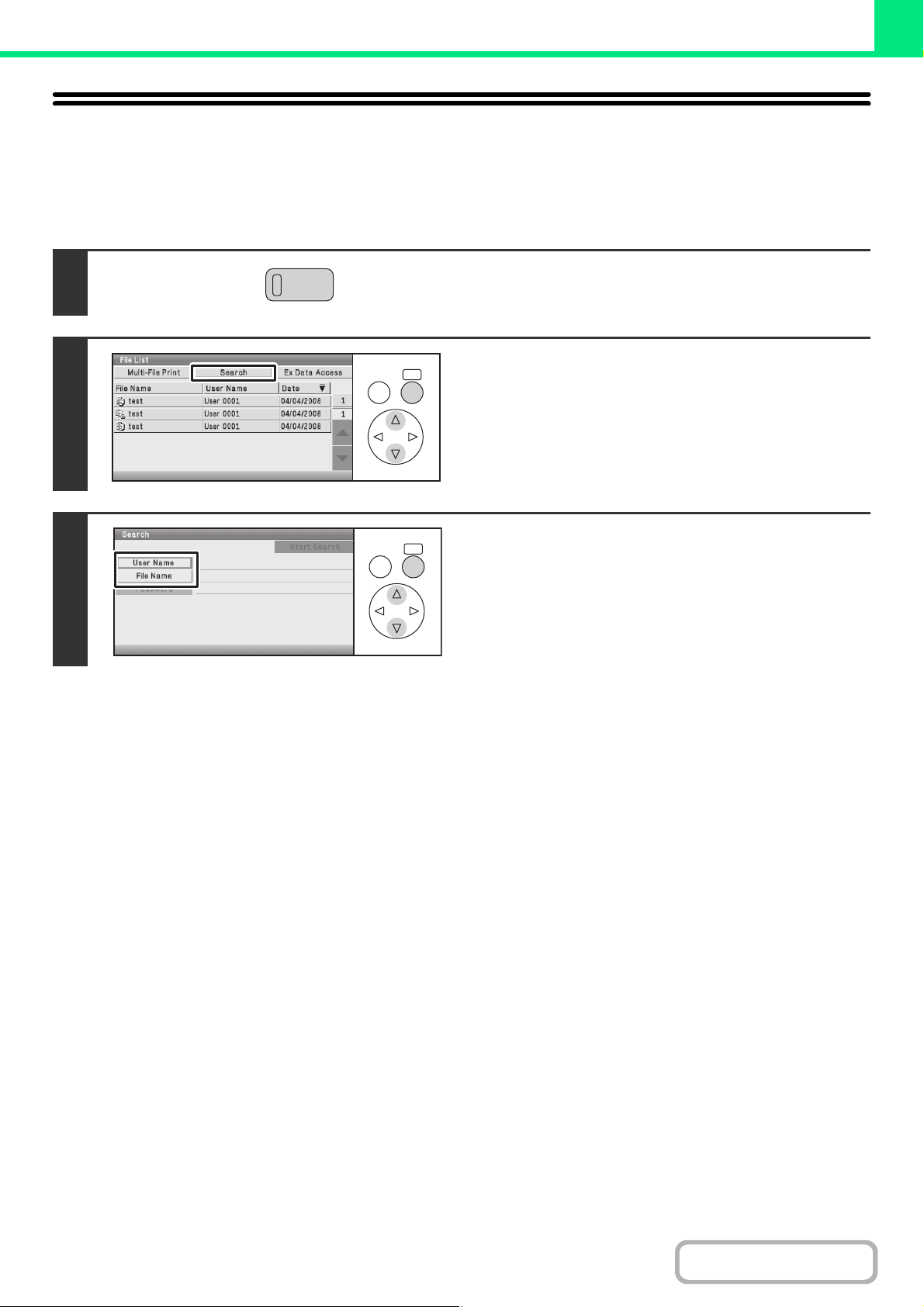
3-64
PRINTER
Contents
SEARCHING FOR A STORED FILE
When there are many stored files, it may take time to find a file. The search function can be used to find a file quickly.
Searching is possible even when you only know part of the file name.
Keys in the display can be selected with the arrow keys and the [OK] key.
1
Press the [PRINT] key.
2
Select the [Search] key.
3
Select the [User Name] key or the [File
Name] key.
• If you know the user name, select the [User Name] key and
go to "Using the user name to search" in step 4.
• If you know the file name, select the [File Name] key and go
to "Using the file name to search" in step 4.
PRINT
OKBACK
OKBACK
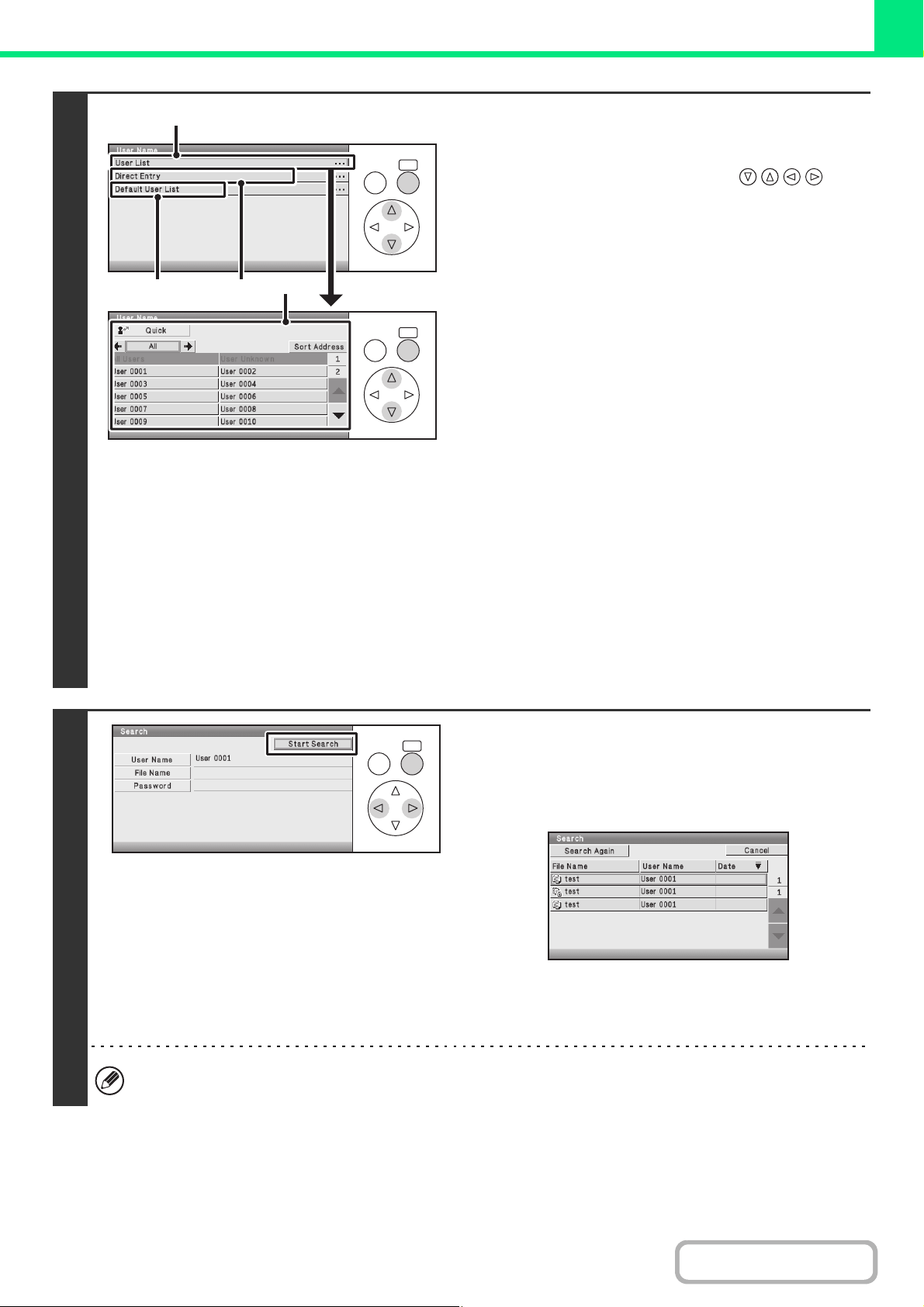
3-65
PRINTER
Contents
4
Using the user name to search
There are three ways to select the user name:
(A) Select the [User List] key and press the [OK] key.
A user list (D) appears. Select with the keys
and press the [OK] key.
If you accidentally select the wrong user name, select the
key of the correct name.
If the [Quick] key is selected, an area for entering the
"Registration No." [----] appears in the message display.
Use the numeric keys to enter the "Registration No." that
has been set in [User Control] - [User List] in the Web page
(administrator). This will allow you to select the user name.
(B) Select the [Direct Entry] key and press the [OK] key.
A text entry screen appears. Directly enter the user name.
Searching is possible even if you only enter the first several
letters of the user name.
(C) Select the [Default User List] key and press the [OK]
key.
The user name can be selected from the factory stored
users.
After the user name is selected, the [Password] key can be
selected. To search for files of the selected user name that
have a certain password, select the [Password] key and enter
the password.
(It is not possible to search using a password only.)
Using the file name to search
Enter the file name in the text entry screen that appears and
select the [OK] key.
5
Select the [Start Search] key.
The search results will appear in a screen similar to the
following screen. A list of the files that match your search
criteria will appear. Select the desired file from the list.
The job settings screen will appear.
To return to the list screen of print hold data, select the
[Cancel] key.
To return to the file search screen, select the [Search
Again] key.
You can also use the Web pages to search for a file. Click [Document Operations], [Print Hold], and then [Search] in
the Web page menu.
OKBACK
OKBACK
(A)
(D)
(C)
(B)
OKBACK
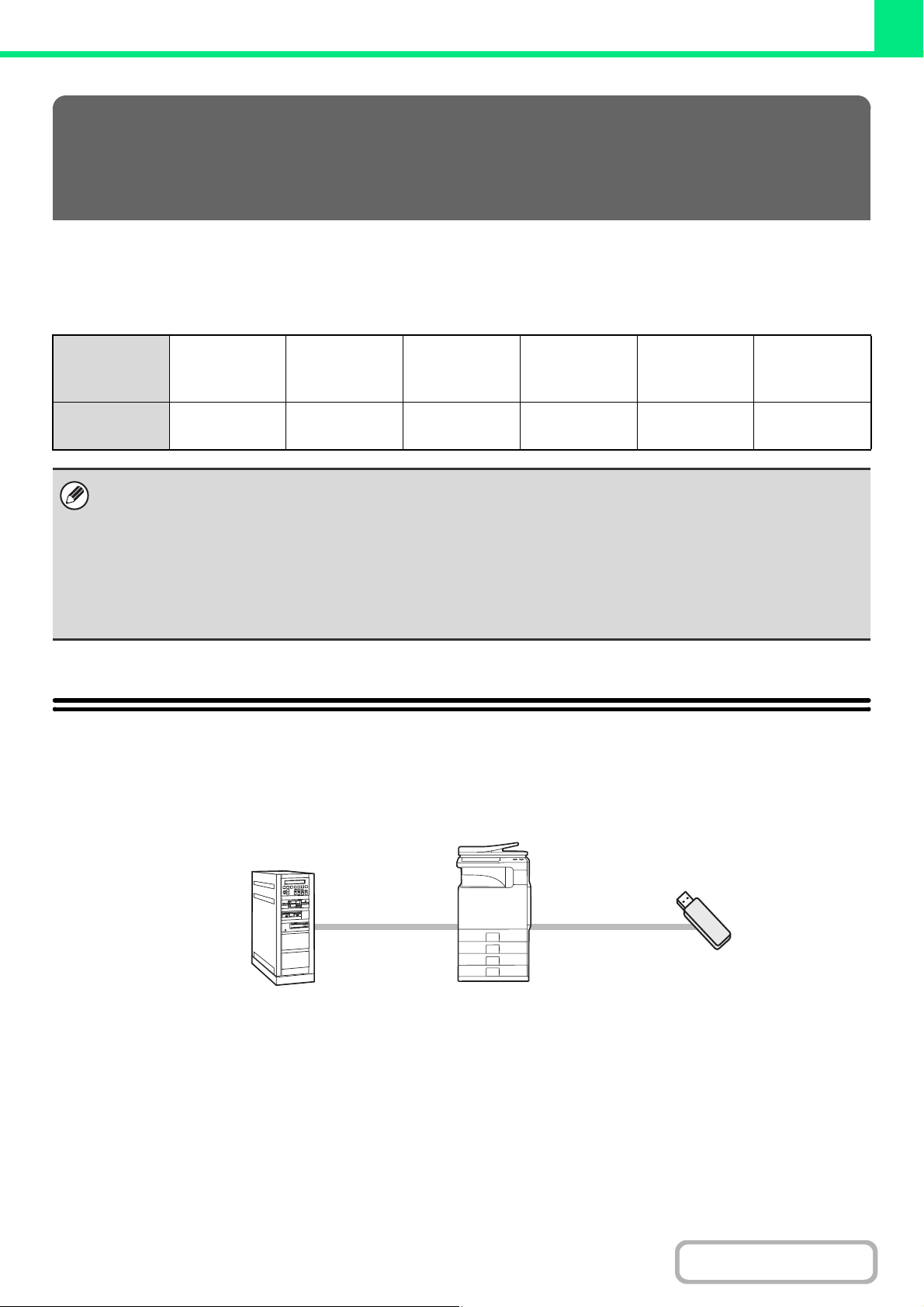
3-66
PRINTER
Contents
When you do not have the printer driver installed on your computer, or when the software application used to open a file
that you wish to print is not available, you can print directly to the machine without using the printer driver.
The file types (and corresponding extensions) that can be printed directly are shown below.
DIRECTLY PRINTING FROM THE MACHINE
A file on an FTP server, in a network folder or in a USB memory device connected to the machine can be selected and
printed from the operation panel of the machine without using the printer driver.
PRINTING WITHOUT THE PRINTER
DRIVER
File Type
TIFF JPEG PCL
PDF/
Encrypted
PDF
PS XPS
Extension
tiff, tif
jpeg, jpg,
jpe, jfif
pcl pdf ps xps
•
Even if the print result is black and white, the following types of print jobs will be counted as 4-color (Y (Yellow), M (Magenta), C
(Cyan), and Bk (Black)) print jobs. To be always counted as a black and white job, select black and white printing.
- When the data is created as color data.
- When the application treats the data as color data even though the data is black and white
.
- When an image is hidden under a black and white image.
• To print PDF and PS files, the PS3 expansion kit must be installed.
• To print XPS files, the XPS expansion kit must be installed.
• Depending on the file type, it may not be possible to print some files in the above table.
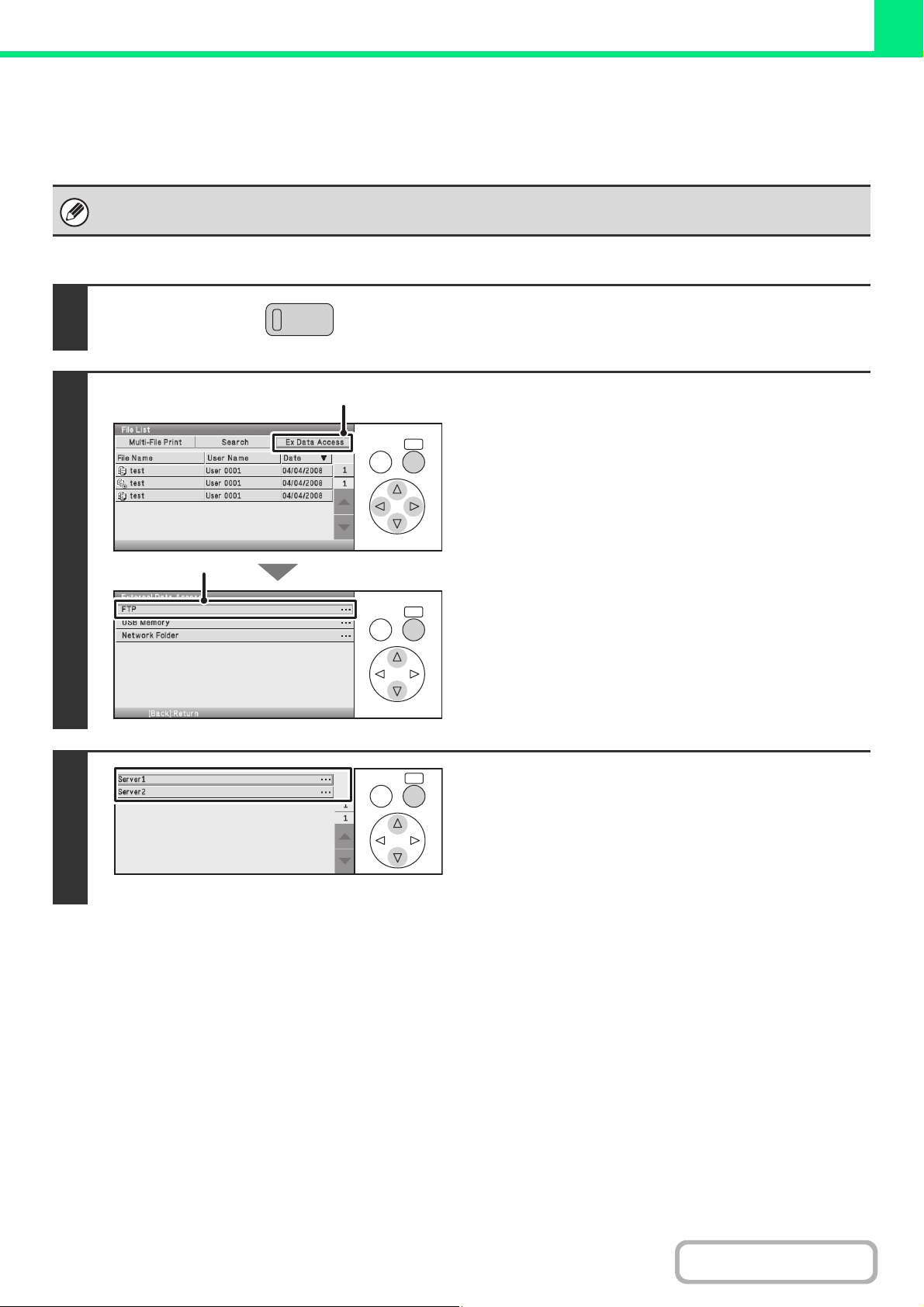
3-67
PRINTER
Contents
DIRECTLY PRINTING A FILE ON AN FTP SERVER
When an FTP server is configured in the machine's Web pages, you can specify and print a file on the FTP server from
the operation panel of the machine. This saves you the trouble of downloading the file and printing it from a computer.
Keys in the display can be selected with the arrow keys and the [OK] key.
To configure FTP server settings, click [Application Settings] and then [Setting for Print from the MFP(FTP)] in the Web page
menu. (Administrator rights are required.) Up to 20 FTP servers can be configured.
1
Press the [PRINT] key.
2
Access the FTP server.
(1) Select the [Ex Data Access] key.
(2) Select the [FTP] key.
The [FTP] key cannot be selected when any FTP server
has not been configured.
3
Select the key of the FTP server that you
wish to access.
PRINT
OKBACK
OKBACK
(1)
(2)
OKBACK
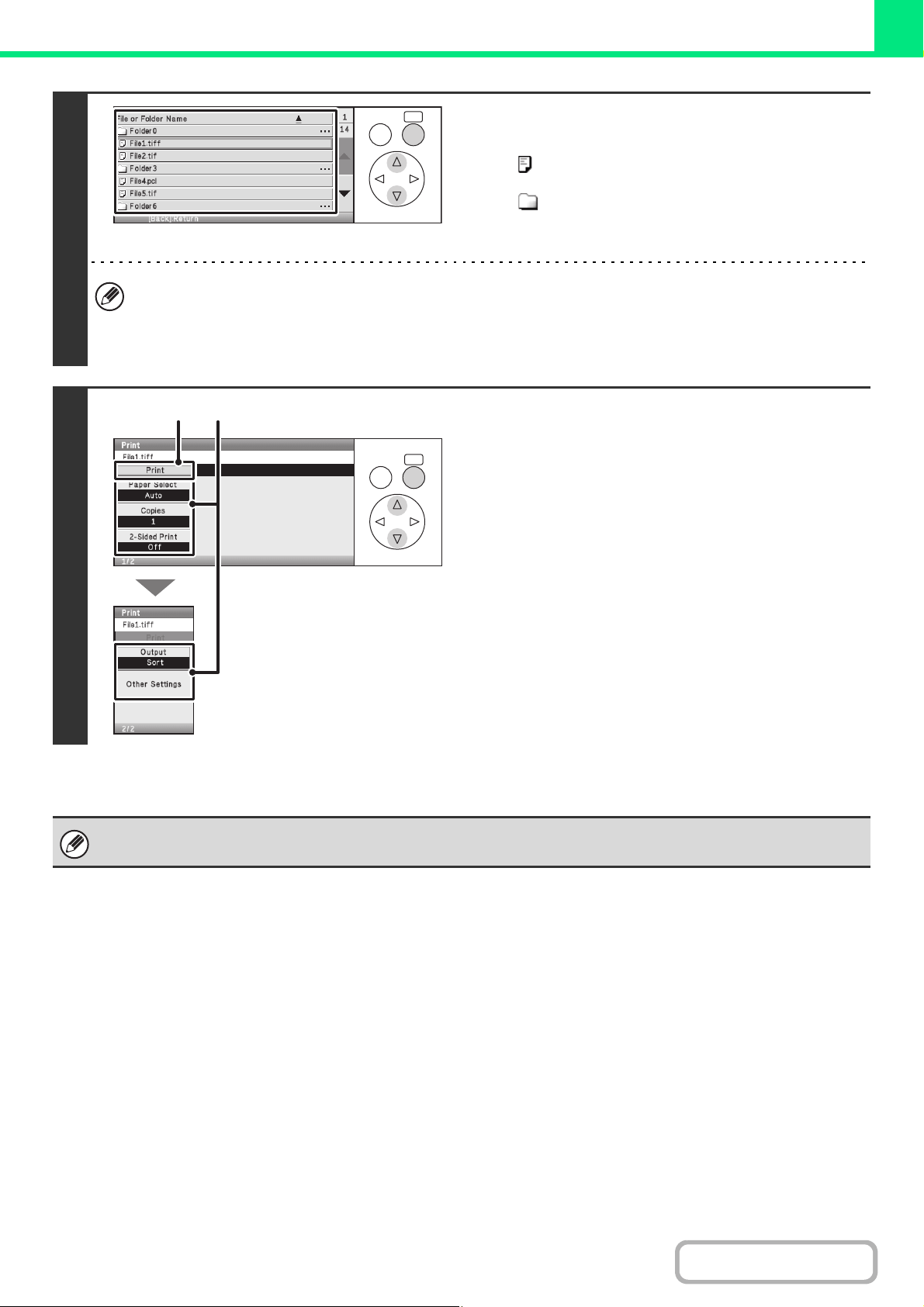
3-68
PRINTER
Contents
4
Select the key of the file that you wish to
print.
• The icon appears to the left of keys of files that can be
printed.
• The icon is displayed to the left of keys of folders on the
FTP server. To display the files and folders in a folder, select
the key of the folder.
• A total of 100 keys of files and folders can be displayed.
• Press the [BACK] key to move up one folder level.
• Select the [File or Folder Name] key and press the [OK] key to change the order of the files and folders displayed on
the screen. The order switches between ascending order and descending order each time you press the [OK] key.
5
Print the selected file.
(1) Select print conditions.
If you selected a file (PCL, PS, or XPS) in step 4 that
includes print settings, the settings will be applied.
(2) Select the [Print] key.
Printing begins. When the message appears in the
display, select the [OK] key.
When you select a PDF file that has a password, you must enter the password in the job status screen to begin printing.
☞ PRINTING AN ENCRYPTED PDF FILE (page 3-78)
OKBACK
OKBACK
(1)(2)
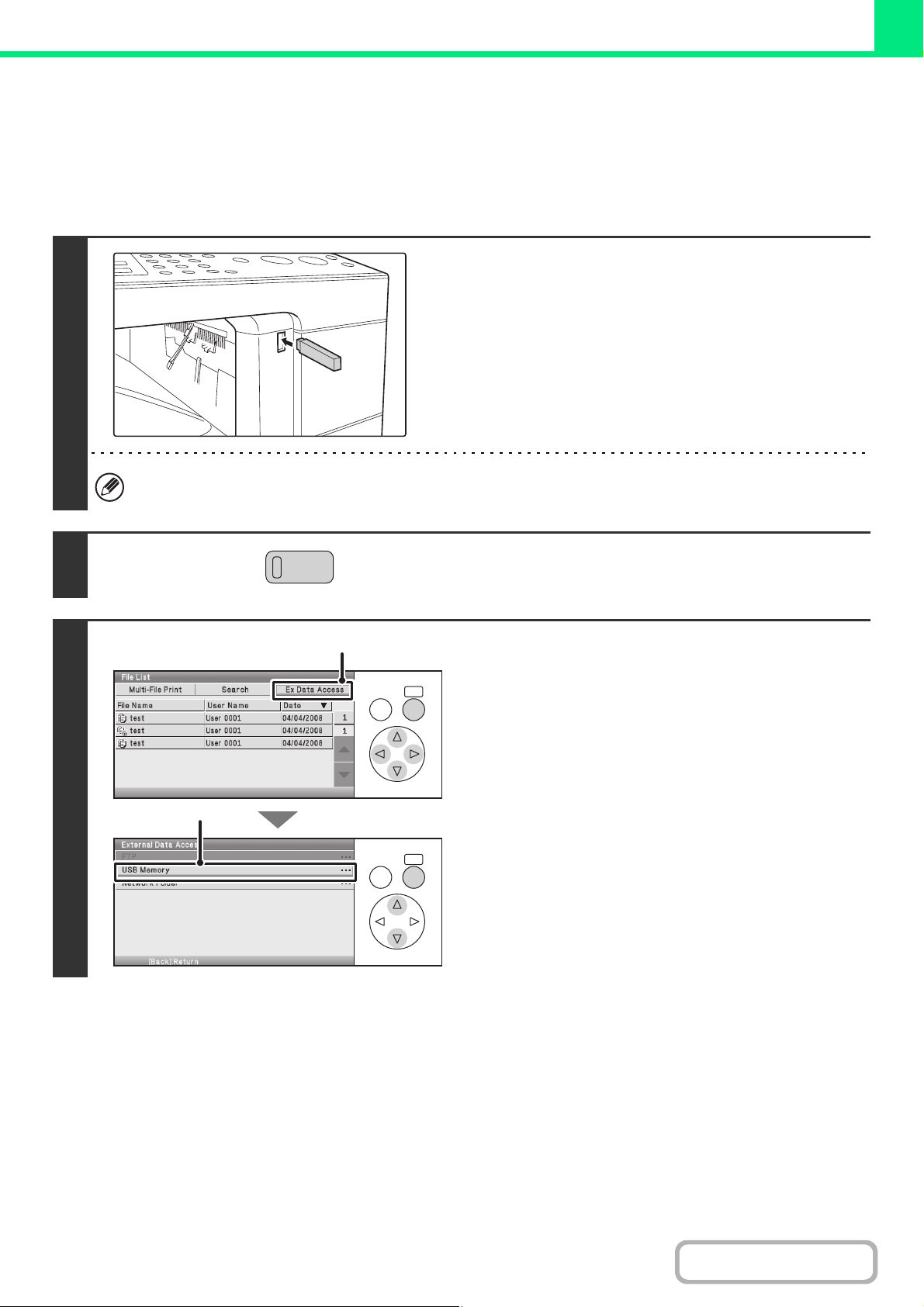
3-69
PRINTER
Contents
DIRECTLY PRINTING A FILE IN USB MEMORY
A file in a USB memory device connected to the machine can be printed from the operation panel of the machine without
using the printer driver. When the printer driver of the machine is not installed on your computer, you can copy a file into
a commercially available USB memory device and connect the device to the machine to print the file directly.
Keys in the display can be selected with the arrow keys and the [OK] key.
1
Connect the USB memory device to the
machine.
Use a FAT32 USB memory with a capacity of no more than 32 GB.
2
Press the [PRINT] key.
3
Access the USB memory device.
(1) Select the [Ex Data Access] key.
(2) Select the [USB Memory] key.
PRINT
OKBACK
OKBACK
(1)
(2)
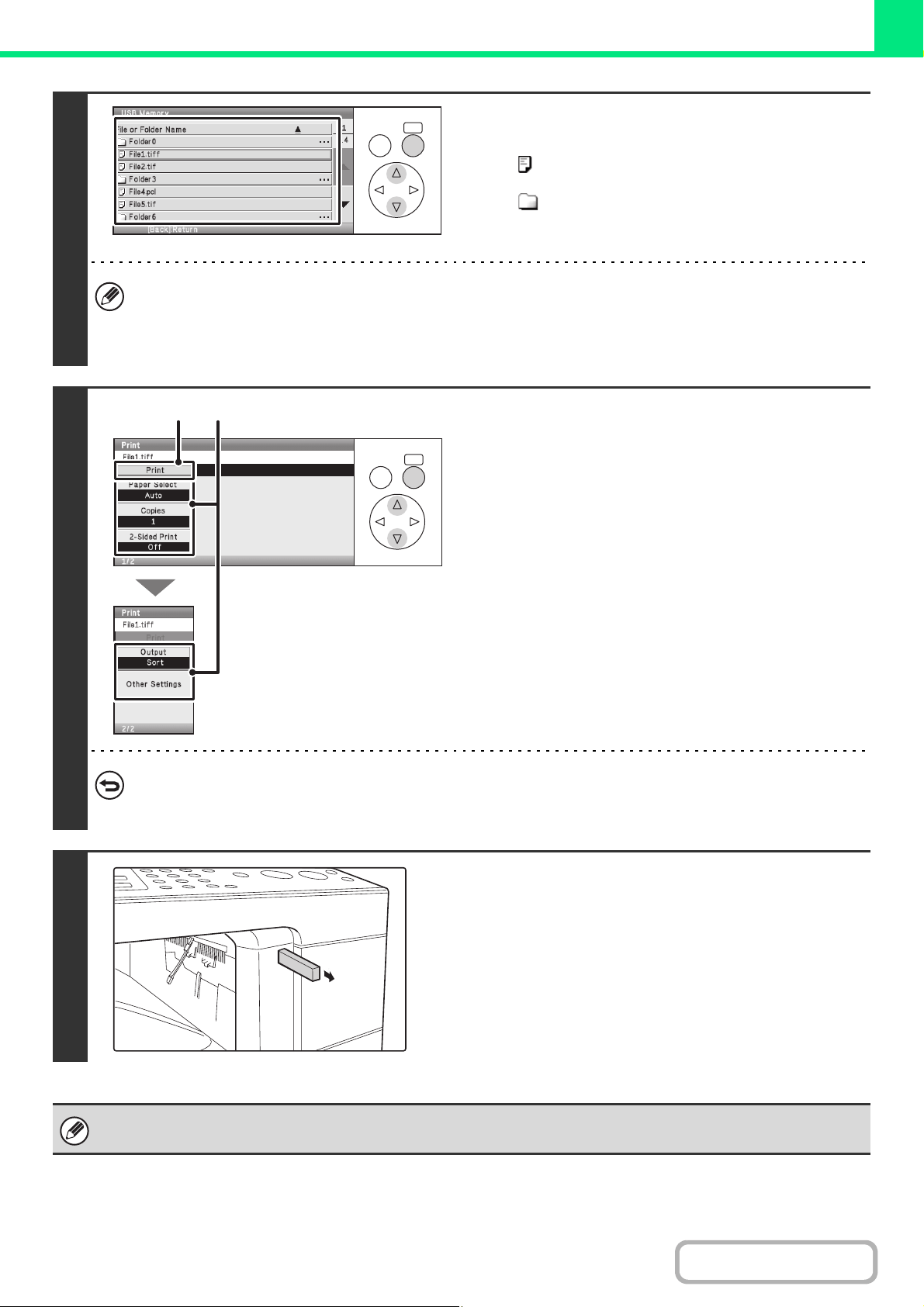
3-70
PRINTER
Contents
4
Select the key of the file that you wish to
print.
• The icon appears to the left of keys of files that can be
printed.
• The icon is displayed to the left of keys of folders in the
USB memory. To display the files and folders in a folder,
select the key of the folder.
• A total of 100 keys of files and folders can be displayed.
• Press the [BACK] key to move up one folder level.
• Select the [File or Folder Name] key and press the [OK] key to change the order of the files and folders displayed on
the screen. The order switches between ascending order and descending order each time you press the [OK] key.
5
Print the selected file.
(1) Select print conditions.
If you selected a file (PCL, PS, or XPS) in step 4 that
includes print settings, the settings will be applied.
(2) Select the [Print] key.
Printing begins after the selected file is transferred. When
the message appears in the display, select the [OK] key.
To cancel printing...
To cancel printing while the file is being transferred, select the [Cancel] key in the message screen that appears in the
display.
6
Remove the USB memory device from
the machine.
When you select a PDF file that has a password, you must enter the password in the job status screen to begin printing.
☞ PRINTING AN ENCRYPTED PDF FILE (page 3-78)
OKBACK
OKBACK
(1)(2)
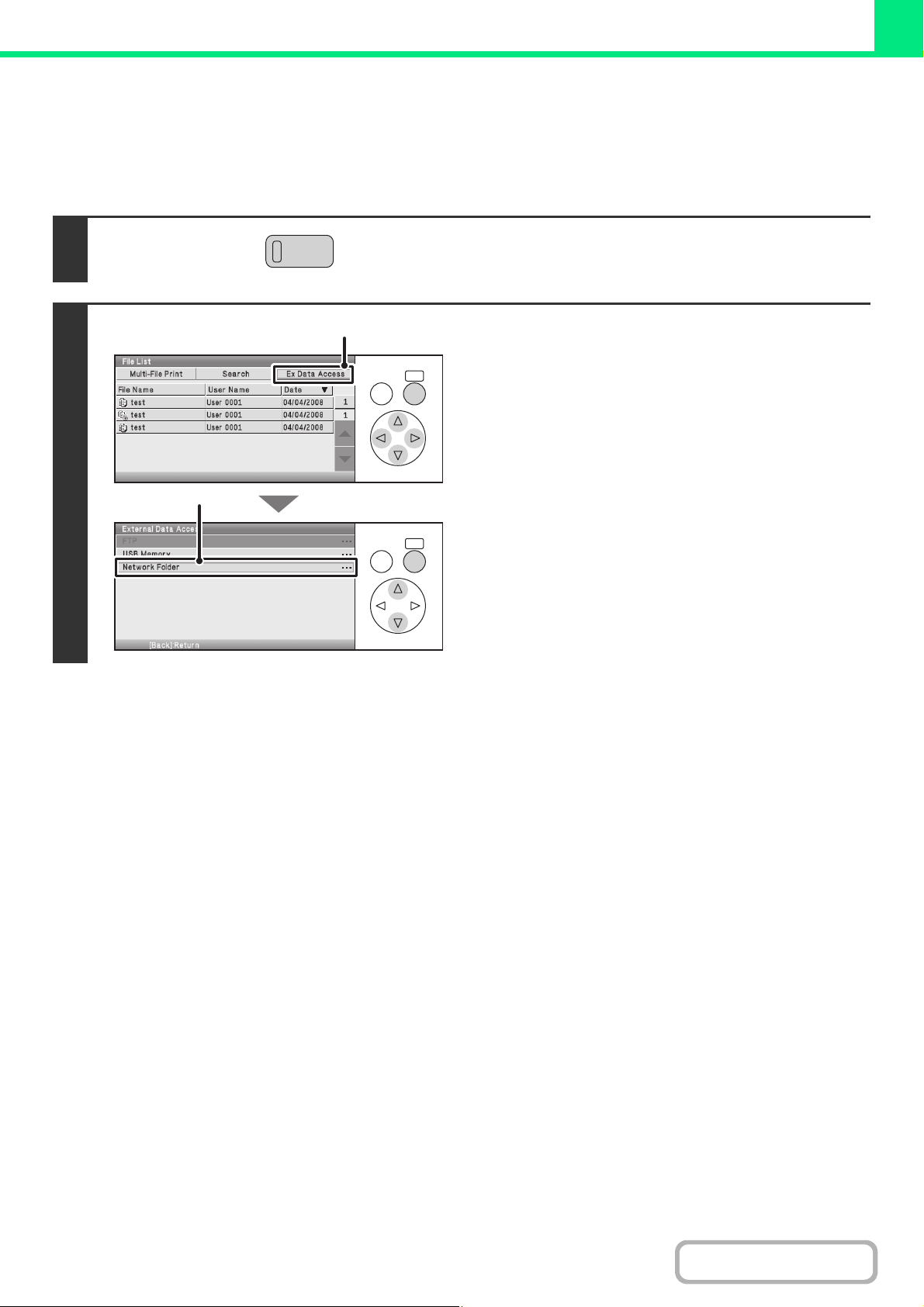
3-71
PRINTER
Contents
DIRECTLY PRINTING A FILE IN A NETWORK FOLDER
You can use the machine's operation panel to select and print a file on a server or in a shared folder of an individual's
computer on the same network as the machine.
Keys in the display can be selected with the arrow keys and the [OK] key.
1
Press the [PRINT] key.
2
Access the network.
(1) Select the [Ex Data Access] key.
(2) Select the [Network Folder] key.
PRINT
OKBACK
OKBACK
(1)
(2)

3-72
PRINTER
Contents
3
Access the network folder.
(1) Select the key of the workgroup that you
wish to access.
(2) Select the key of the server or computer
that you wish to access.
If a screen appears prompting you to enter a user name
and password, check with your server administrator and
enter the appropriate user name and password.
(3) Select the key of the network folder.
• You can select the [Search] key and enter a keyword to search for a workgroup, server, or network folder. For the
procedure for entering text, see "ENTERING TEXT" (page 1-61) in "1. BEFORE USING THE MACHINE".
• Up to 100 workgroups, 100 servers, and 100 network folders can be displayed.
• Press the [BACK] key to move up one folder level.
• To change the sorting order of the displayed keys, select the key that shows or in each screen. The order
switches between ascending order and descending order each time you press the [OK] key.
• To go to a particular page, select the key that shows the current page number and enter the desired page
number.
4
Select the key of the file that you wish to
print.
• The icon appears to the left of keys of files that can be
printed.
• The icon is displayed to the left of keys of folders in the
network folder. To display the files and folders in a folder,
select the key of the folder.
• A total of 100 keys of files and folders can be displayed.
• Press the [BACK] key to move up one folder level.
• Select the [File or Folder Name] key and press the [OK] key to change the order of the files and folders displayed on
the screen. The order switches between ascending order and descending order each time you press the [OK] key.
OKBACK
OKBACK
OKBACK
(1)
(2)
(3)
1
OKBACK
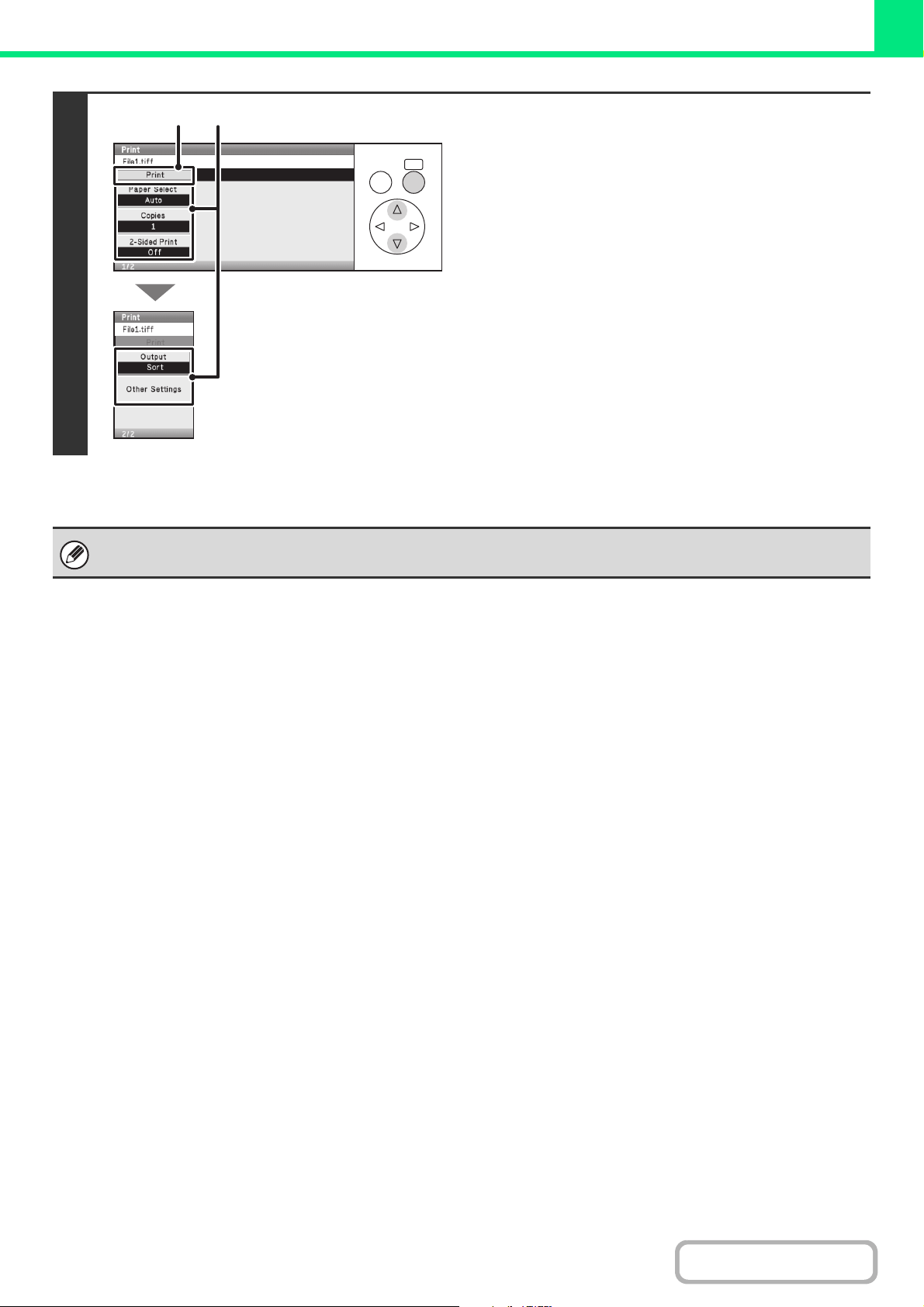
3-73
PRINTER
Contents
5
Print the selected file.
(1) Select print conditions.
If you selected a file (PCL, PS, or XPS) in step 4 that
includes print settings, the settings will be applied.
(2) Select the [Print] key.
Printing begins after the selected file is transferred. When
the message appears in the display, select the [OK] key.
When you select a PDF file that has a password, you must enter the password in the job status screen to begin printing.
☞ PRINTING AN ENCRYPTED PDF FILE (page 3-78)
OKBACK
(1)(2)
3-74
PRINTER
Contents
DIRECTLY PRINTING FROM A COMPUTER
Settings can be configured in the Web pages of the machine to enable direct printing from a computer without using the
printer driver.
SUBMIT PRINT JOB
You can specify a file to be printed directly without using the printer driver.
In addition to a file on your computer, this procedure can be used to print any file that can be accessed from your
computer, such as a file on another computer connected to the same network.
To directly print a file on a computer, click [Document Operations] and then [Submit Print Job] in the Web page menu.
FTP PRINT
You can print a file from your computer by simply dragging and dropping the file onto the FTP server of the machine.
• Configuring settings
To enable FTP Print, click [Application Settings] and then [Setting for Print from the PC] in the Web page menu, and
configure the port number. (Administrator rights are required.)
• Performing FTP Print
Type "ftp://" and then the IP address of the machine in the address bar of your computer's Web browser as shown
below.
(Example)
ftp://192.168.1.28
Drag and drop the file that you wish to print onto the "lp" folder that appears in your Web browser. The file will
automatically begin printing.
• If you printed a file (PCL, PS, or XPS) that includes print settings, the settings will be applied.
• When user authentication is enabled, the print function may be restricted. For more information, ask your administrator.
3-75
PRINTER
Contents
E-MAIL PRINT
An e-mail account can be configured in the machine to have the machine periodically check your mail server and
automatically print received e-mail attachments without using the printer driver.
• Configuring settings
To use E-mail Print, you must first configure an e-mail account in the machine. To configure an account, click
[Application Settings] and then [E-mail Print Settings] in the Web page menu. (Administrator rights are required.)
• Using E-mail Print
To print a file using E-mail Print, use your e-mail program on your computer to send the file as an attachment to the
machine's e-mail address.
Control commands can be entered in the message of the e-mail to specify the number of copies and print format.
Commands are entered in the format "command name=value".
As an example, the control commands include the following:
*1 Only effective when a finisher is installed.
*2 Can be omitted except when authentication is by user number.
Function Command name Values Example
Copies COPIES 1-999
Staples*
1
STAPLEOPTION NONE, ONE
Output COLLATE OFF, ON
2-sided print DUPLEX OFF, TOP, LEFT, RIGHT
Account
number*
2
ACCOUNTNUMBER Number (5 to 8 digits)
File type LANGUAGE PCL, PCLXL, POSTSCRIPT, PDF, TIFF,
JPG, XPS
Paper PAPER Name of available paper (LETTER, A4, etc.)
Print hold FILE OFF, ON
Black & white
printing
B/W PRINT OFF, ON
Fit to page FITIMAGETOPAGE OFF, ON
• Enter the commands in Plain Text format. If entered in Rich Text format (HTML), the commands will have no effect.
• To receive a list of the control commands, enter the command "Config" in the e-mail message.
• If nothing is entered in the body text (message) of the e-mail, printing will take place according to the "Printer Default
Settings" (Web page only) in the system settings. If you printed a file (PCL, PS, or XPS) that includes print settings, the
settings will be applied.
• Only enter a "File type" when you are specifying a page-description language. Normally there is no need to enter a file
type.
COPIES=2
DUPLEX=LEFT
ACCOUNTNUMBER=11111
PAPER=LETTER
B/W PRINT=ON
3-76
PRINTER
Contents
JOB STATUS SCREEN
The job status screen is displayed when the [JOB STATUS] key on the operation panel is pressed. The job status
screen shows the status of jobs by mode. When the [JOB STATUS] key is pressed, the job status screen of the mode
that was being used before the key was pressed appears.
SPOOL SCREEN/JOB QUEUE SCREEN/COMPLETED
JOB SCREEN
The job status screen consists of the job queue screen that shows copy and print jobs waiting to be printed and the job
currently in progress, the completed job screen that shows jobs that have been completed, and the spool screen that
shows print jobs that have been spooled and encrypted PDF jobs that are waiting for a password to be entered.
(1) Mode select keys ( )
Use these keys to select the mode that is shown in the
job status screen.
The status of print jobs can be checked by selecting
[Print Job].
(2) Job status screen selector keys ( )
Select these keys to switch through the job queue
screen, the completed jobs screen, and the spool screen.
(3) Job list (job queue screen)
Jobs waiting to be printed appear in the job queue as
keys. The jobs are printed in order from the top of the
queue. Each job key shows information on the job and
the current status of the job.
(4) Job list (spool screen)
Spooled print jobs and encrypted PDF print jobs that
require a password to be entered are displayed.
(5) Job list (completed jobs screen)
This shows up to 99 completed jobs. The result (status)
of each completed job is shown.
CHECKING THE PRINT STATUS
JOB STATUS
(1)
(3)
(4) (5)
(2)

3-77
PRINTER
Contents
Job key display
Each job key shows the position of the job in the job queue and the current status of the job.
(1) Indicates the number (position) of the job in the job
queue.
When the job currently being printed is finished, the job
moves up one position in the job queue.
This number does not appear in keys in the completed
jobs screen.
(2) Mode icon
The icon appears when the job is a print job. In the
completed jobs screen, a color bar appears next to the
icon to indicate whether the job was executed in color or
black & white. (However, the color bar icon does not
appear in the key of a job that used retention function.)
(3) User name
The computer login name of the user will appear in the
print job.
A "User Name" can be entered in the printer driver to
display the name of the user who executed the job.
(4) Number of sets entered
This shows the number of sets specified.
(5) Number of completed sets
This shows the number of sets completed. "000" appears
while the job is waiting in the job queue.
(6) Status
Shows the job status.
(1) (2) (3)
(4)
(5) (6)
Message Status
"Printing" Printing is in progress.
"Waiting" The job is waiting to be executed.
"Toner
Empty"
The toner cartridge is out of toner.
Replace the toner cartridge with a
new cartridge.
"Paper
Empty"
The paper used for the job has run
out. Add paper or change to a
different paper tray.
"Limit" The printing page limit has been
exceeded. Check with the
administrator of the machine.
"Error" An error occurred while the job was
being executed. Clear the error
condition.
"Rendering" Analyzing print data.
"Spooling" Print data is being received or a job is
waiting for analysis after being
spooled.
"Encrypt
PDF"
Upon analysis, if a spooled job is
found to be an encrypted PDF, it
changes to the password entry wait
state.
3-78
PRINTER
Contents
PRINTING AN ENCRYPTED PDF FILE
Encrypted PDF is used to protect a PDF file by requiring the entry of a password to print or edit the file. To directly print
an encrypted PDF file on an FTP server or in a USB memory device, etc. connected to the machine, follow the steps
below to enter the password and begin printing.
Keys in the display can be selected with the arrow keys and the [OK] key.
The PS3 expansion kit is required to use this function.
1
Press the [JOB STATUS] key.
2
Select the encrypted PDF print job.
(1) Change the job status mode to [Print Job].
Select either of the keys with the keys
and press the [OK] key. The mode changes each time the
[OK] key is pressed.
(2) Change the print job status mode to
[Spool].
Select either of the keys with the keys
and press the [OK] key. The mode changes each time the
[OK] key is pressed.
(3) Select the print job key of the PDF file that
has the password.
3
Select the [Yes] key.
A text entry screen appears. Enter the password (32 characters
or less) and select the [OK] key. The print job is released and
moved to the [Job Queue].
When both a master password and a user password (which is used to open the file) have been set, enter the master
password.
• To print an encrypted PDF file using the printer driver, enter the password when opening the file on your computer.
• Printing is not possible if you do not know the password for an encrypted PDF file. To delete a spooled print job, select the
[No] key in the screen of step 3 and select the [Stop/Delete] key.
• Encrypted PDF versions that can be directly printed are 1.6 (Adobe
®
Acrobat
®
7.0) and earlier.
JOB STATU
S
OKBACK
(1) (2) (3)
OKBACK
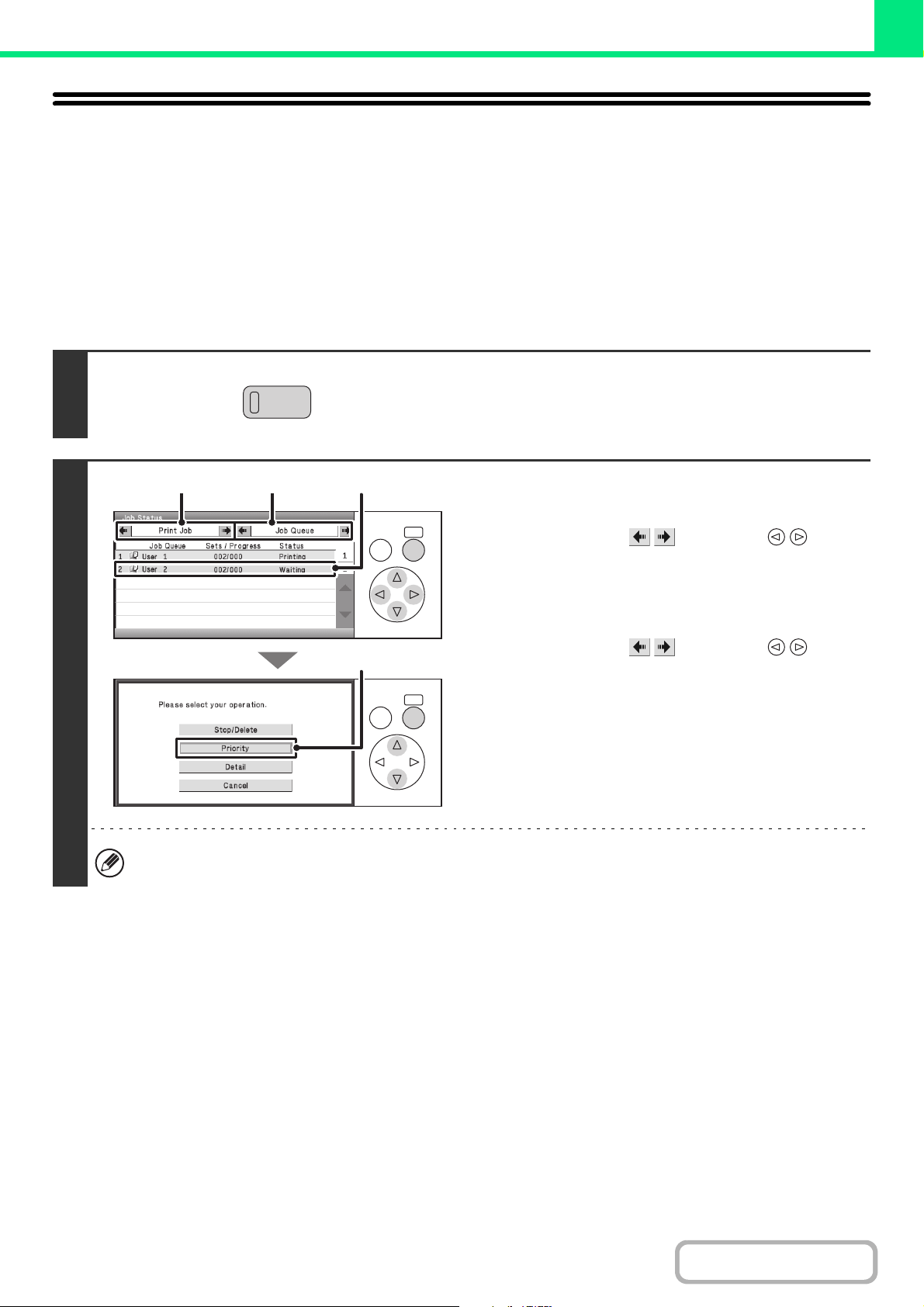
3-79
PRINTER
Contents
GIVING A PRINT JOB
PRIORITY/CANCELING A PRINT JOB
GIVING A PRINT JOB PRIORITY
When the machine is busy copying or printing a received fax or other job, you can give priority to a print job that is
waiting to be printed and print it ahead of the other jobs.
Keys in the display can be selected with the arrow keys and the [OK] key.
1
Press the [JOB STATUS] key.
2
Give the desired job priority.
(1) Change the job status mode to [Print Job].
Select either of the keys with the keys
and press the [OK] key. The mode changes each time the
[OK] key is pressed.
(2) Change the print job status mode to [Job
Queue].
Select either of the keys with the keys
and press the [OK] key. The mode changes each time the
[OK] key is pressed.
(3) Select the key of the print job to which you
want to give priority.
(4) Select the [Priority] key.
The job being printed stops and the job selected in (3) is
printed.
To check print information on the selected job, select the [Detail] key.
JOB STATU
S
OKBACK
OKBACK
(1) (2) (3)
(4)
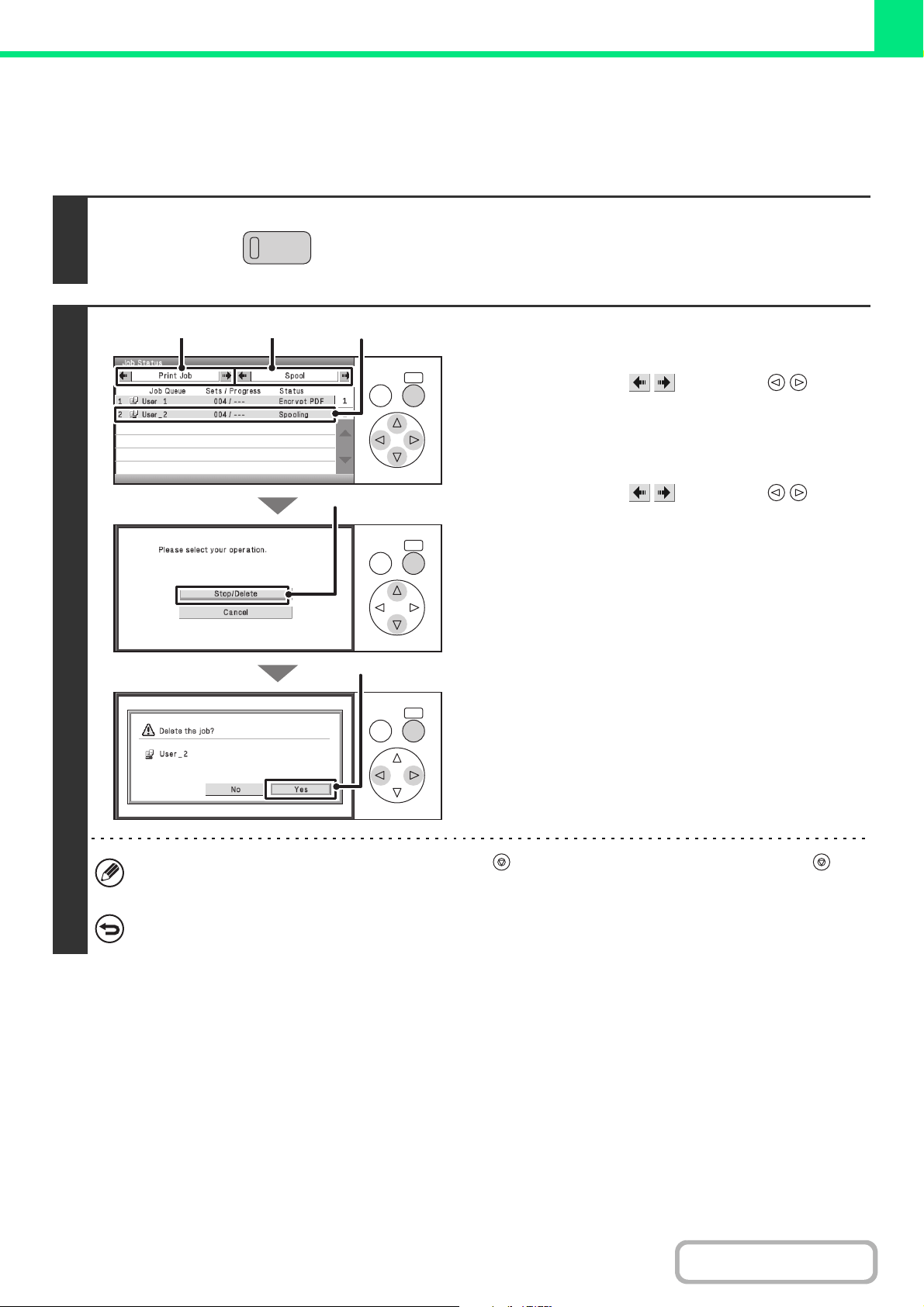
3-80
PRINTER
Contents
CANCELING A PRINT JOB
A job being printed, a job waiting to be printed, or a spooled job can be canceled.
Keys in the display can be selected with the arrow keys and the [OK] key.
1
Press the [JOB STATUS] key.
2
Cancel the job.
(1) Change the job status mode to [Print Job].
Select either of the keys with the keys
and press the [OK] key. The mode changes each time the
[OK] key is pressed.
(2) Change the print job status mode to [Spool]
or [Job Queue].
Select either of the keys with the keys
and press the [OK] key. The mode changes each time the
[OK] key is pressed.
(3) Select the key of the print job that you wish
to cancel.
(4) Select the [Stop/Delete] key.
(5) A message appears to confirm the
cancelation. Select the [Yes] key.
The selected job key is deleted and printing is canceled.
It is also possible to cancel printing with the [STOP] key ( ) on the operation panel. When the [STOP] key ( ) is
pressed, a message will appear asking you if you want to cancel the job.
If you do not want to cancel the selected print job...
Select the [No] key in step (5).
JOB STATU
S
OKBACK
OKBACK
OKBACK
(1) (2) (3)
(4)
(5)
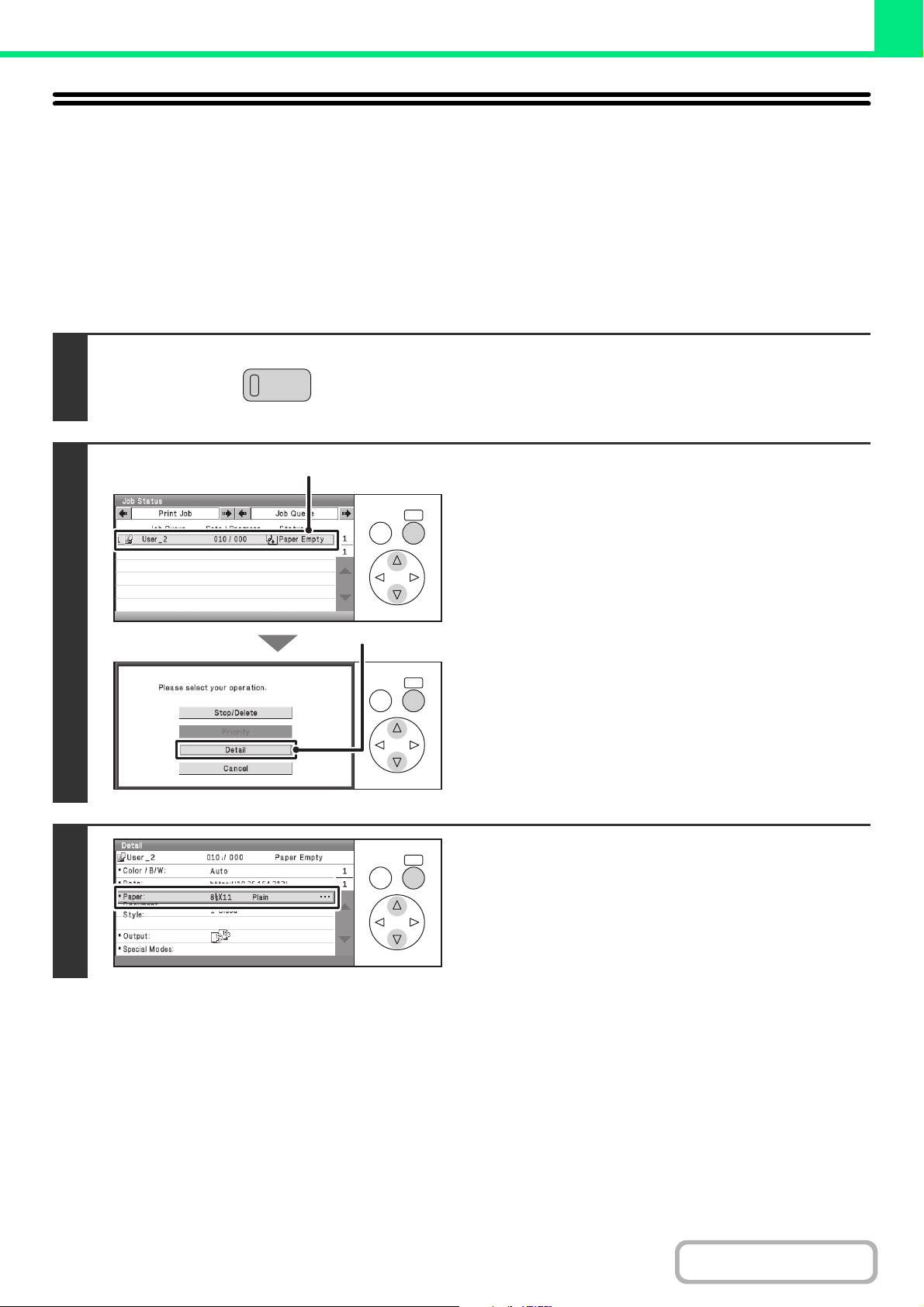
3-81
PRINTER
Contents
CHANGING TO ANOTHER PAPER SIZE AND
PRINTING WHEN PAPER RUNS OUT
If printing stops because the machine ran out of paper, or if the size of paper specified in the printer driver is not loaded
in the machine, a message will appear in the display. Printing will begin automatically when the [OK] key is selected and
paper is loaded in the machine. If you wish to print on paper in another tray because the desired size of paper is not
immediately available, follow the steps below.
Keys in the display can be selected with the arrow keys and the [OK] key.
1
Press the [JOB STATUS] key.
2
Display details on the print job for which
there is no paper.
(1) Select the key of the job for which "Paper
Empty" appeared.
(2) Select the [Detail] key.
3
Select the [Paper] key.
JOB STATU
S
OKBACK
OKBACK
(1)
(2)
OKBACK
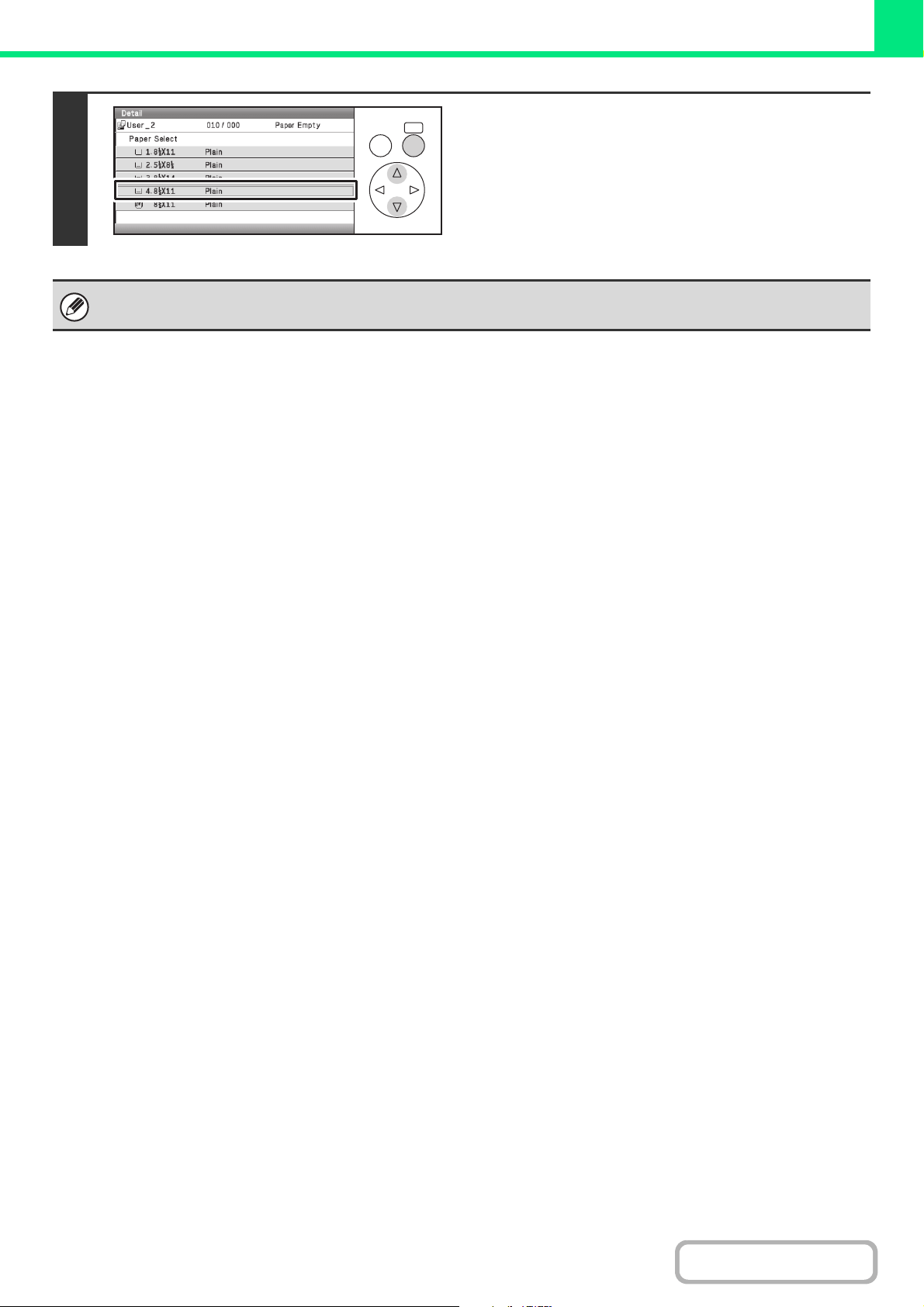
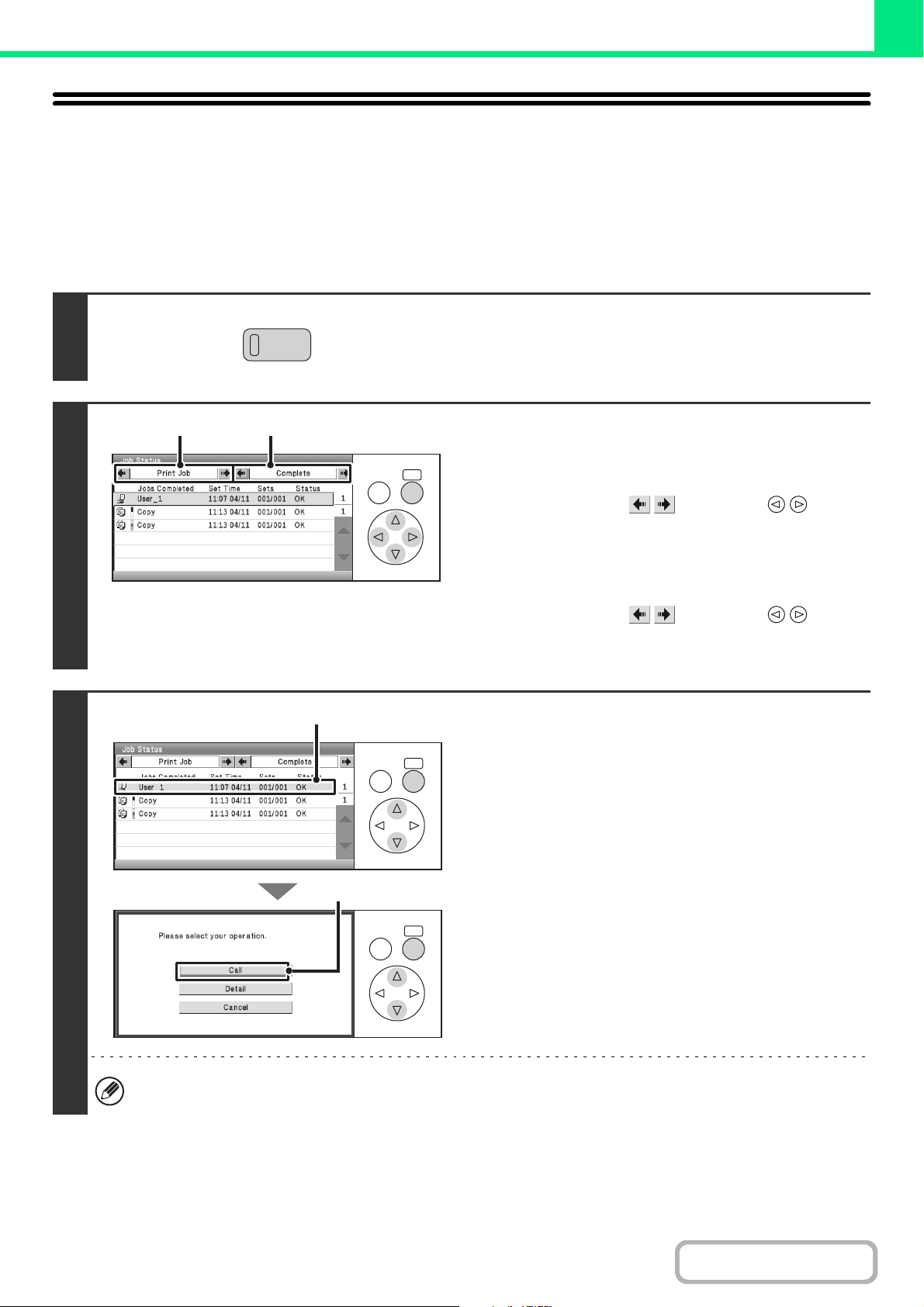
3-83
PRINTER
Contents
RETRIEVING AND USING A FILE FROM THE
JOB STATUS SCREEN
Files stored selecting other than "Hold Only" in "Retention Settings" can be manipulated from the job status complete
screen.
Keys in the display can be selected with the arrow keys and the [OK] key.
1
Press the [JOB STATUS] key.
2
Change the print job status mode to
[Complete].
(1) Change the job status mode to [Print Job].
Select either of the keys with the keys
and press the [OK] key. The mode changes each time the
[OK] key is pressed.
(2) Change the print job status mode to
[Complete].
Select either of the keys with the keys
and press the [OK] key. The mode changes each time the
[OK] key is pressed.
3
Select the desired file in the completed
jobs.
(1) Select the key of the desired file.
(2) Select the [Call] key.
The job settings screen appears.
Select and perform the desired operation.
☞ PRINTING A STORED FILE (page 3-56)
☞ DELETING A STORED FILE (page 3-63)
To view information on a file, select the file and then select the [Detail] key.
JOB STATU
S
OKBACK
(1) (2)
OKBACK
OKBACK
(1)
(2)
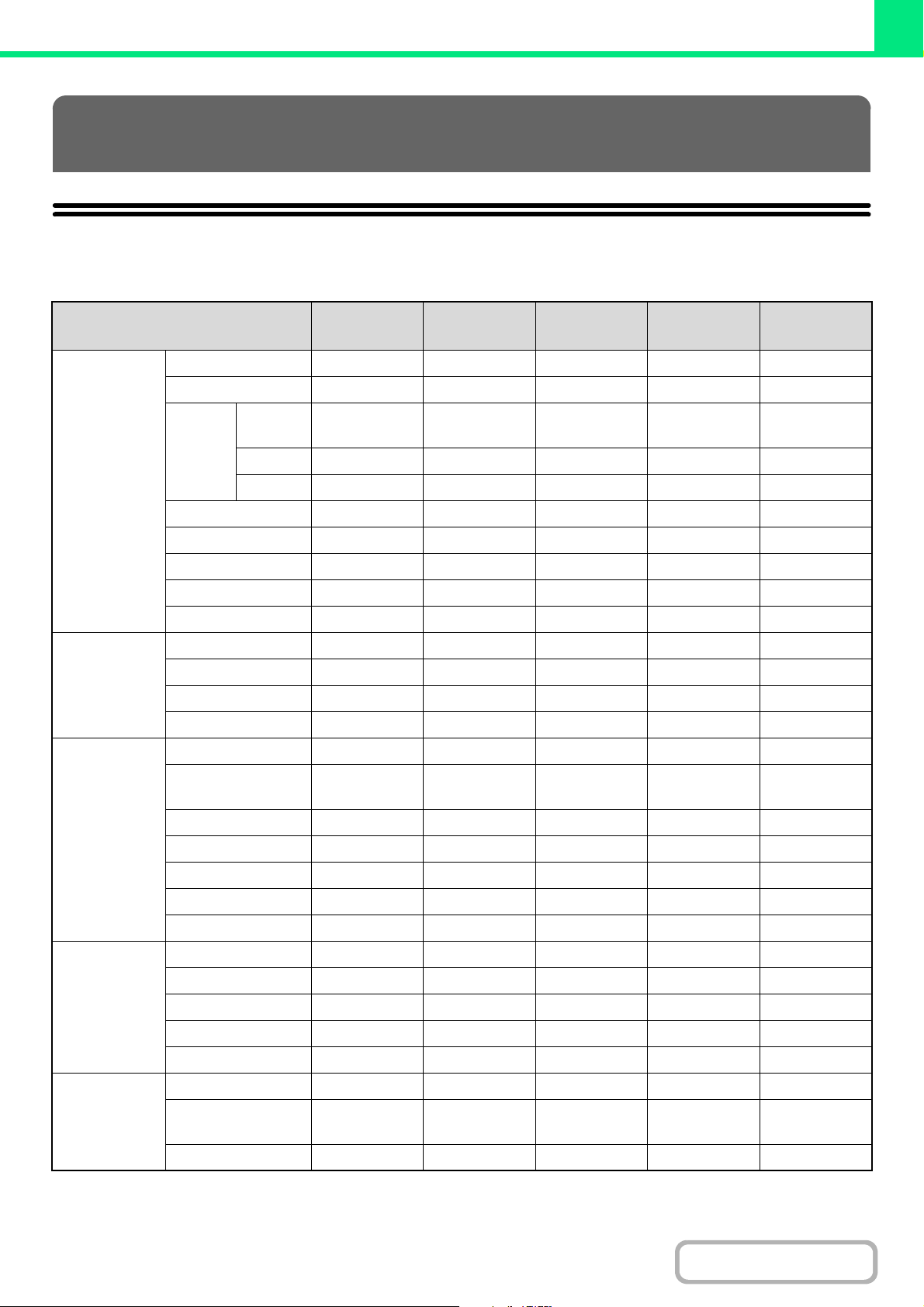
3-84
PRINTER
Contents
PRINTER DRIVER SPECIFICATION LIST
Available functions and output results may vary depending on the type of printer driver being used.
APPENDIX
Function PCL6 PCL5c PS
Windows
PPD
*1
Macintosh
PPD
*1
Frequently used
functions
Copies 1-999 1-999 1-999 1-999 1-999
Orientation Yes Yes Yes Yes Yes
N-Up
Number of
pages
2,4,6,8,9,16 2,4,6,8,9,16 2,4,6,8,9,16 2,4,6,9,16*
2,3
2,4,6,9,16
Order Selectable Selectable Selectable Selectable Selectable
Border On/Off On/Off On/Off Yes Selectable
2-Sided Print Yes Yes Yes Yes Yes
Fit To Page Yes Yes Yes No Yes*
4
Binding Edge Selectable Selectable Selectable No Yes
Black and White Print Yes Yes Yes Yes Yes
Staple*
5
Yes Yes Yes Yes Yes
Paper Paper Size Yes Yes Yes Yes Yes
Custom Paper 8 size 8 size 8 size Yes*
2
Yes
Paper Selection Yes Yes Yes Yes Yes
Output tray Yes Yes Yes Yes Yes
Convenient
printer functions
Pamphlet Yes Yes Yes Yes Yes
Margin Shift 0 inch to
1.2 inch
0 inch to
1.2 inch
0inch to
1.2 inch
Yes Yes
Poster Printing Yes No Yes No No
Rotate 180 degrees Yes Yes Yes Yes Yes
Zoom/XY-Zoom Yes*
6
Yes*
6
Yes Yes*
6
Yes*
6
Line Width Settings Yes No No No No
Mirror Image No No Yes Yes Yes*
7
Special
functions
Different Paper Yes Yes Yes No Yes
*8,9
Transparency Inserts
Yes Yes Yes No Yes
Carbon Copy Yes Yes Yes No No
Chapter Inserts Yes No No No No
Retention Yes Yes Yes No Yes
Color mode
adjusting
function
Color Adjustment Yes Yes Yes No Yes
*10,11,12
Text To Black/
Vector To Black
Yes Yes Yes No No
Advanced Color Yes Yes Yes Yes Yes
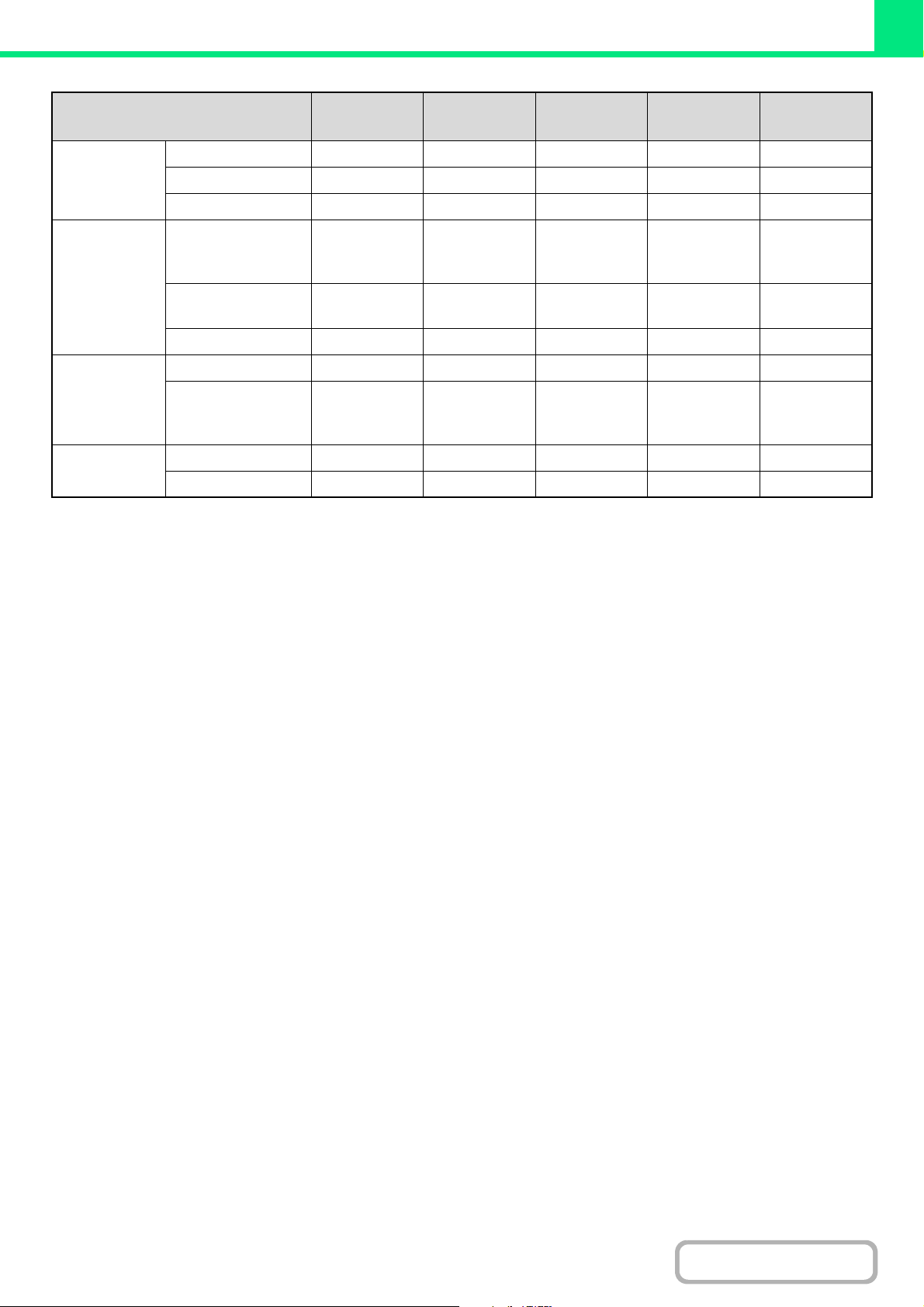
3-85
PRINTER
Contents
*1 The specifications of each function in Windows PPD and Macintosh PPD vary depending on the operating system
version and the software application.
*2 Cannot be used in Windows NT 4.0.
*3 Only 2-Up and 4-Up printing can be used in Windows 98.
*4 Only Mac OS X v10.4.11 and v10.5 to 10.5.1 can be used.
*5 Can be used when a finisher is installed.
*6 The horizontal and vertical proportion cannot be set separately.
*7 Only Mac OS 9.0 to 9.2.2 can be used.
*8 Only covers can be inserted.
*9 Cannot be used in Mac OS X v10.2.8 or v10.3.9.
*10 Cannot be used in Mac OS 9.0 to 9.2.2.
*11 Cannot be used in Mac OS X v10.2.8.
*12 Cannot be used in Mac OS X v10.5 to 10.5.1.
*13 This setting may not operate in some software applications and operating systems.
*14 The number of available resident fonts is 35 in Windows NT 4.0.
*15 True Type and Type1 can be selected in some versions of LaserWriter.
Functions to
combine text
and images
Watermark Yes Yes Yes Yes Yes
Image Stamp Yes No Yes No No
Overlay Yes Yes Yes No No
Image Quality Print Mode Normal/
High Quality/
Fine
Normal/
High Quality
Normal/
High Quality/
Fine
Normal/
High Quality/
Fine
Normal/
High Quality/
Fine
Graphics Mode
Selection
Yes Yes No No No
Toner Save*
13
Yes Yes Yes Yes Yes
Font Resident font 80 fonts 80 fonts 136 fonts 136 fonts*
14
35 fonts
Selectable download
font
bitmap,
TrueType,
Graphics
bitmap,
TrueType,
Graphics
bitmap,
TrueType,
Type1
bitmap,
TrueType,
Type1
No*
15
Other functions
Auto Configuration Yes Yes Yes No Yes
*11
User Authentication
Yes Yes Yes No Yes
Function PCL6 PCL5c PS
Windows
PPD
*1
Macintosh
PPD
*1

4-1
This chapter provides detailed explanations of the procedures for using the fax function.
For the procedures for using the display, see "USING THE OPERATION PANEL" (page 1-9) in "1. BEFORE USING
THE MACHINE".
BEFORE USING THE MACHINE AS A FAX
PREPARATIONS FOR FAX. . . . . . . . . . . . . . . . . . . 4-4
• CONNECTION TO THE TELEPHONE
LINE . . . . . . . . . . . . . . . . . . . . . . . . . . . . . . . . . . 4-4
• SETTING THE TELEPHONE LINE TYPE . . . . . 4-5
• MAKE SURE THE MAIN POWER SWITCH
IS IN THE "ON" POSITION . . . . . . . . . . . . . . . . 4-5
• CHECKING THE DATE AND TIME . . . . . . . . . . 4-6
• STORING THE SENDER FAX NUMBER . . . . . 4-6
BASE SCREEN OF FAX MODE . . . . . . . . . . . . . . . 4-7
• BASE SCREEN OF FAX MODE . . . . . . . . . . . . 4-8
• ADDRESS BOOK SCREEN. . . . . . . . . . . . . . . 4-10
• CHANGING THE DISPLAY OF
ONE-TOUCH KEYS IN THE ADDRESS
BOOK SCREEN . . . . . . . . . . . . . . . . . . . . . . . . 4-11
ADDRESS BOOK. . . . . . . . . . . . . . . . . . . . . . . . . . 4-13
• CUSTOM INDEX . . . . . . . . . . . . . . . . . . . . . . . 4-15
FAX TRANSMISSION SEQUENCE . . . . . . . . . . . . 4-16
ENTERING DESTINATIONS
ENTERING A FAX NUMBER WITH THE
NUMERIC KEYS. . . . . . . . . . . . . . . . . . . . . . . . . . . 4-19
RETRIEVING A FAX NUMBER FROM THE
ADDRESS BOOK. . . . . . . . . . . . . . . . . . . . . . . . . . 4-20
• RETRIEVING A STORED DESTINATION . . . . 4-21
• CHECKING AND DELETING ENTERED
DESTINATIONS . . . . . . . . . . . . . . . . . . . . . . . . 4-22
USING A SEARCH NUMBER TO RETRIEVE
A DESTINATION . . . . . . . . . . . . . . . . . . . . . . . . . . 4-23
RETRIEVING A DESTINATION FROM A
GLOBAL ADDRESS BOOK. . . . . . . . . . . . . . . . . . 4-24
USING THE RESEND FUNCTION . . . . . . . . . . . . . 4-26
CHAIN DIALING . . . . . . . . . . . . . . . . . . . . . . . . . . . 4-27
BASIC TRANSMISSION METHODS
TRANSMISSION METHODS . . . . . . . . . . . . . . . . . 4-28
• PLACEMENT ORIENTATION OF THE
ORIGINAL . . . . . . . . . . . . . . . . . . . . . . . . . . . . 4-30
• WHEN THE LINE IS BUSY . . . . . . . . . . . . . . . 4-30
• WHEN A COMMUNICATION ERROR
OCCURS . . . . . . . . . . . . . . . . . . . . . . . . . . . . . 4-30
• FAX DESTINATION CONFIRMATION
MODE. . . . . . . . . . . . . . . . . . . . . . . . . . . . . . . . 4-31
USING THE AUTOMATIC DOCUMENT
FEEDER FOR TRANSMISSION. . . . . . . . . . . . . . . 4-32
• USING THE AUTOMATIC DOCUMENT
FEEDER TO SEND A FAX IN DIRECT
TRANSMISSION MODE . . . . . . . . . . . . . . . . . 4-33
USING THE DOCUMENT GLASS FOR
TRANSMISSION. . . . . . . . . . . . . . . . . . . . . . . . . . . 4-35
• USING THE DOCUMENT GLASS TO
SEND A FAX IN DIRECT TRANSMISSION
MODE. . . . . . . . . . . . . . . . . . . . . . . . . . . . . . . . 4-37
TRANSMISSION USING THE SPEAKER . . . . . . . 4-39
SENDING THE SAME FAX TO MULTIPLE
DESTINATIONS (Broadcast Transmission) . . . . 4-41
SENDING A FAX DIRECTLY FROM A
COMPUTER (PC-Fax) . . . . . . . . . . . . . . . . . . . . . . 4-46
IMAGE SETTINGS . . . . . . . . . . . . . . . . . . . . . . . . . 4-47
• AUTOMATICALLY SCANNING BOTH
SIDES OF AN ORIGINAL (2-Sided
Original) . . . . . . . . . . . . . . . . . . . . . . . . . . . . . . 4-48
• SPECIFYING THE SCAN SIZE AND
SEND SIZE. . . . . . . . . . . . . . . . . . . . . . . . . . . . 4-50
• CHANGING THE EXPOSURE . . . . . . . . . . . . . 4-56
• CHANGING THE RESOLUTION . . . . . . . . . . . 4-57
CHAPTER 4
FACSIMILE

4-2
FACSIMILE
FAX RECEPTION
RECEIVING FAXES . . . . . . . . . . . . . . . . . . . . . . . . 4-58
• RECEIVING A FAX . . . . . . . . . . . . . . . . . . . . . 4-59
• RECEIVING A FAX MANUALLY . . . . . . . . . . . 4-60
PRINTING A PASSWORD-PROTECTED FAX
(Hold Setting For Received Data Print) . . . . . . . . 4-61
CHECKING THE IMAGE BEFORE PRINTING . . . 4-62
• IMAGE CHECK SCREEN . . . . . . . . . . . . . . . . 4-64
FORWARDING RECEIVED FAXES (Fax Data
Forward). . . . . . . . . . . . . . . . . . . . . . . . . . . . . . . . . 4-65
FORWARDING RECEIVED FAXES TO A
NETWORK ADDRESS (Inbound Routing
Settings). . . . . . . . . . . . . . . . . . . . . . . . . . . . . . . . . 4-66
• CONFIGURING INBOUND ROUTING
SETTINGS . . . . . . . . . . . . . . . . . . . . . . . . . . . . 4-66
SPECIAL MODES
SPECIAL MODES . . . . . . . . . . . . . . . . . . . . . . . . . 4-69
STORING FAX OPERATIONS (Program). . . . . . . 4-71
• JOB PROGRAMS. . . . . . . . . . . . . . . . . . . . . . . 4-71
• USING A PROGRAM TO SEND . . . . . . . . . . . 4-73
SENDING A FAX AT A SPECIFIED TIME
(Timer) . . . . . . . . . . . . . . . . . . . . . . . . . . . . . . . . . . 4-74
SENDING BOTH SIDES OF A CARD AS A
SINGLE PAGE (Card Shot) . . . . . . . . . . . . . . . . . . 4-76
SENDING BUSINESS CARDS (Business
Card Scan) . . . . . . . . . . . . . . . . . . . . . . . . . . . . . . . 4-79
FAXING THIN ORIGINALS (Slow Scan Mode). . . 4-80
ERASING PERIPHERAL SHADOWS ON THE
IMAGE (Erase) . . . . . . . . . . . . . . . . . . . . . . . . . . . . 4-82
SENDING A LARGE NUMBER OF PAGES
(Job Build) . . . . . . . . . . . . . . . . . . . . . . . . . . . . . . . 4-85
CHANGING THE PRINT SETTINGS FOR THE
TRANSACTION REPORT (Transaction
Report) . . . . . . . . . . . . . . . . . . . . . . . . . . . . . . . . . . 4-87
ADDING YOUR SENDER INFORMATION TO
FAXES (Own number sending) . . . . . . . . . . . . . . 4-89
• TEMPORARILY CHANGING THE
SENDER INFORMATION (Own Name
Select) . . . . . . . . . . . . . . . . . . . . . . . . . . . . . . . 4-90
CALLING A FAX MACHINE AND INITIATING
RECEPTION (Polling) . . . . . . . . . . . . . . . . . . . . . . 4-91
• INITIATING POLLING RECEPTION
MANUALLY . . . . . . . . . . . . . . . . . . . . . . . . . . . 4-93
SENDING A FAX WHEN ANOTHER
MACHINE POLLS YOUR MACHINE (Polling
Memory) . . . . . . . . . . . . . . . . . . . . . . . . . . . . . . . . . 4-94
• RESTRICTING POLLING ACCESS
(Polling security) . . . . . . . . . . . . . . . . . . . . . . . . 4-94
• SCANNING A DOCUMENT INTO
POLLING MEMORY. . . . . . . . . . . . . . . . . . . . . 4-95
• CHECKING THE DOCUMENT IN THE
PUBLIC BOX . . . . . . . . . . . . . . . . . . . . . . . . . . 4-97
• DELETING A DOCUMENT FROM THE
PUBLIC BOX . . . . . . . . . . . . . . . . . . . . . . . . . . 4-98
PERFORMING F-CODE COMMUNICATION
F-CODE COMMUNICATION . . . . . . . . . . . . . . . . 4-100
• HOW F-CODES WORK . . . . . . . . . . . . . . . . . 4-100
• CREATING MEMORY BOXES IN THE
MACHINE FOR F-CODE
COMMUNICATION . . . . . . . . . . . . . . . . . . . . 4-101
• F-CODE DIALING . . . . . . . . . . . . . . . . . . . . . 4-101
CONFIDENTIAL COMMUNICATION USING
F-CODES . . . . . . . . . . . . . . . . . . . . . . . . . . . . . . . 4-102
• F-CODE CONFIDENTIAL
TRANSMISSION . . . . . . . . . . . . . . . . . . . . . . 4-103
• CHECKING FAXES RECEIVED BY
F-CODE CONFIDENTIAL RECEPTION . . . . 4-104
POLLING RECEPTION USING F-CODES. . . . . . 4-106
POLLING MEMORY TRANSMISSION USING
F-CODES . . . . . . . . . . . . . . . . . . . . . . . . . . . . . . . 4-108
• SCANNING A DOCUMENT INTO A
MEMORY BOX FOR F-CODE POLLING
TRANSMISSION . . . . . . . . . . . . . . . . . . . . . . 4-108
• CHECKING THE DOCUMENT IN THE
F-CODE MEMORY POLLING BOX . . . . . . . . 4-111
• DELETING A DOCUMENT STORED FOR
F-CODE POLLING TRANSMISSION. . . . . . . 4-112
RELAY REQUEST TRANSMISSION USING
F-CODES . . . . . . . . . . . . . . . . . . . . . . . . . . . . . . . 4-114
RELAY BROADCAST TRANSMISSION
USING F-CODES . . . . . . . . . . . . . . . . . . . . . . . . . 4-116

4-3
FACSIMILE
USING AN EXTENSION PHONE
CONNECTING AND USING AN EXISTING
PHONE (Extension Phone Connection) . . . . . . 4-117
• RECEIVING A FAX AFTER ANSWERING
A CALL ON THE EXTENSION PHONE
(Remote Reception) . . . . . . . . . . . . . . . . . . . . 4-118
• MAKING AND RECEIVING PHONE
CALLS . . . . . . . . . . . . . . . . . . . . . . . . . . . . . . 4-118
CHECKING THE STATUS OF FAX JOBS
JOB STATUS SCREEN . . . . . . . . . . . . . . . . . . . . 4-119
• JOB QUEUE SCREEN AND COMPLETED
JOB SCREEN. . . . . . . . . . . . . . . . . . . . . . . . . 4-120
• OPERATION WHEN A JOB IN THE JOB
QUEUE IS COMPLETED . . . . . . . . . . . . . . . . 4-123
• CHECKING A RESERVED JOB OR THE
JOB IN PROGRESS. . . . . . . . . . . . . . . . . . . . 4-124
• CHECKING COMPLETED JOBS. . . . . . . . . . 4-125
CANCELING A FAX IN PROGRESS OR A
RESERVED FAX . . . . . . . . . . . . . . . . . . . . . . . . . 4-126
GIVING PRIORITY TO A RESERVED FAX
JOB. . . . . . . . . . . . . . . . . . . . . . . . . . . . . . . . . . . . 4-127
CHECKING THE ACTIVITY LOG (Image
Sending Activity Report) . . . . . . . . . . . . . . . . . . 4-128
• IMAGE SENDING ACTIVITY REPORT . . . . . 4-128
• INFORMATION APPEARING IN THE
RESULT COLUMN. . . . . . . . . . . . . . . . . . . . . 4-129
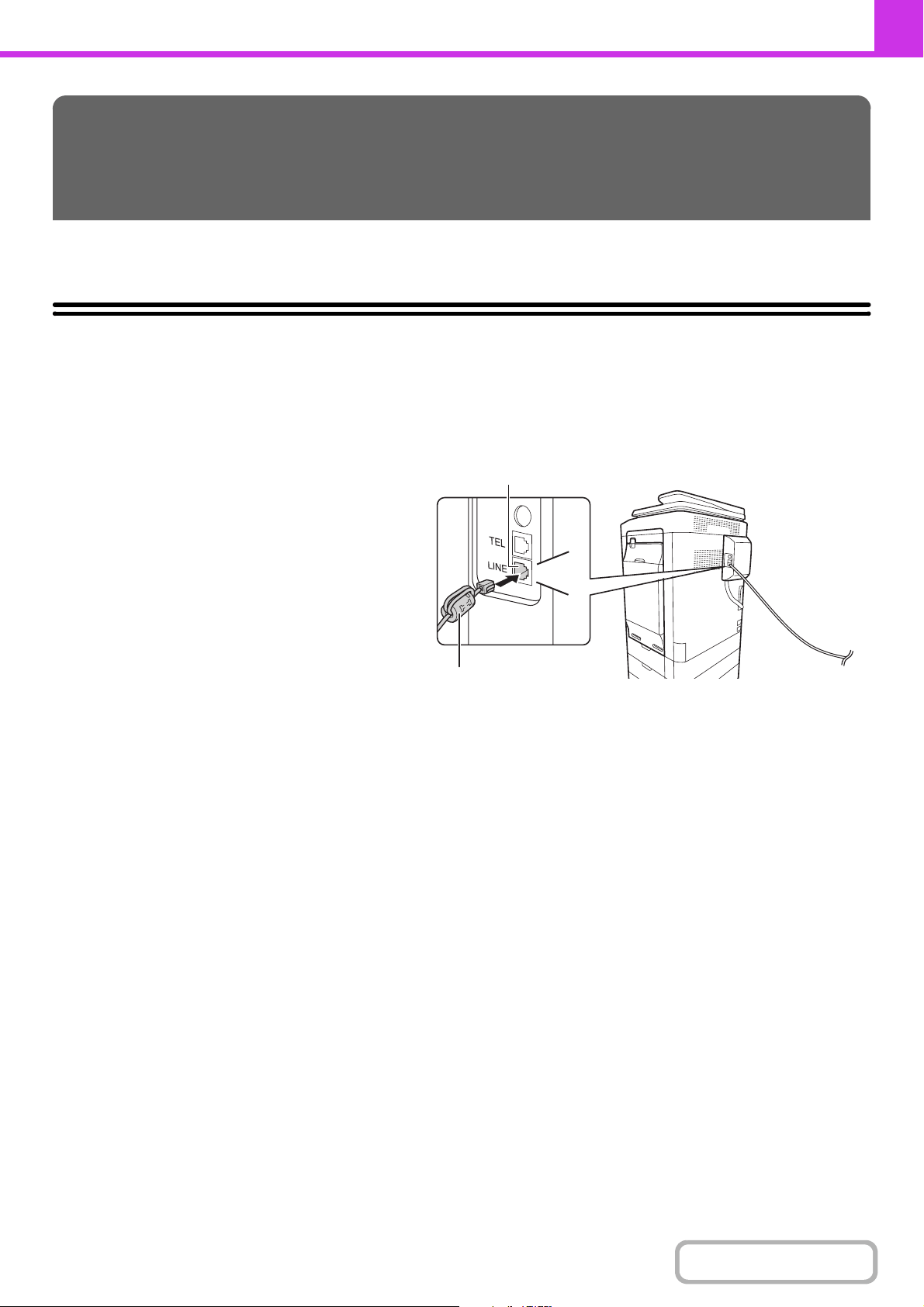
4-4
FACSIMILE
Contents
This section provides information that you should know before using the machine as a fax machine.
PREPARATIONS FOR FAX
To use the machine as a fax, the telephone line must be connected and the type of line must be set.
CONNECTION TO THE TELEPHONE LINE
Be sure to use the provided telephone line cord
to connect the machine to the wall telephone
jack. Connect the end of the line cord that has
the core to the "LINE" jack on the machine.
Insert the other end (the end without the core)
into a telephone line jack.
BEFORE USING THE MACHINE AS A
FAX
Click!
"LINE" jack
Core
Insert the end of the cord with the
core into the "LINE" jack.
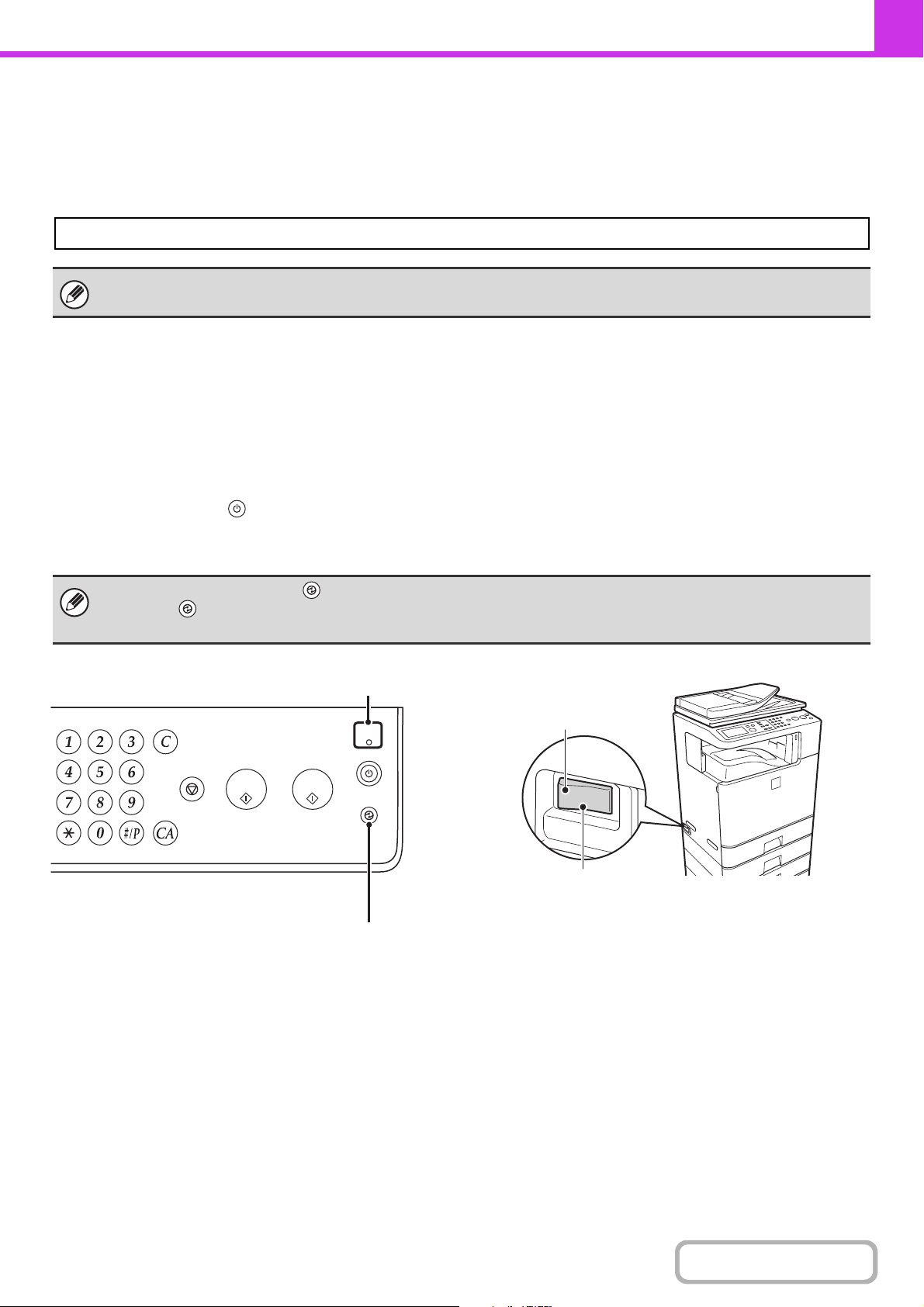
4-5
FACSIMILE
Contents
SETTING THE TELEPHONE LINE TYPE
The machine's dial mode setting must be set to the type of telephone line you are using.
If the setting is not correct, dialing will not be possible.
Select the [Auto Select] key in "Dial Mode Setting" in the system settings (administrator). The machine will automatically
set the dial mode to the type of line you are using.
MAKE SURE THE MAIN POWER SWITCH IS IN THE
"ON" POSITION
When the main power indicator on the operation panel is lit, the main power is on.
If the main power indicator light is not lit, the main power is "off". Switch the main power switch to the "on" position and
press the [POWER] key ( ) on the operation panel.
If the fax function will be used, and in particular if reception or timer transmission will take place at night, always keep the
main power switch in the "on" position.
You can also set the "Dial Mode Setting" manually.
After setting the dial mode, do not change the setting unless you have a specific reason for changing it.
When the [POWER SAVE] key ( ) indicator light is blinking, the machine is in auto power shut-off mode. If the [POWER
SAVE] key ( ) is pressed when the indicator is blinking, the indicator will turn off and the machine will return to the ready
state after a brief interval.
LOGOUT
Main power indicator
[POWER SAVE] key/indicator
Main power switch
"On" position
4-6
FACSIMILE
Contents
CHECKING THE DATE AND TIME
Verify that the correct date and time are set in the machine.
The date and time are set in the system settings of the machine. When the [SYSTEM SETTINGS] key is pressed, the
system settings menu screen appears on the display. Select [Default Settings], [Clock], and [Clock Adjust], and set the
year, month, day, hour, and minute.
STORING THE SENDER FAX NUMBER
Store the user name and fax number in "Sender Data Registration".
Be sure to configure this information, as it is required for communication.
If "Disabling of Clock Adjustment" (Web page only) has been enabled in the system settings (administrator), the date and
time cannot be set.
System Settings (Administrator): Sender Data Registration
Use this setting to program the sender name and sender fax number.
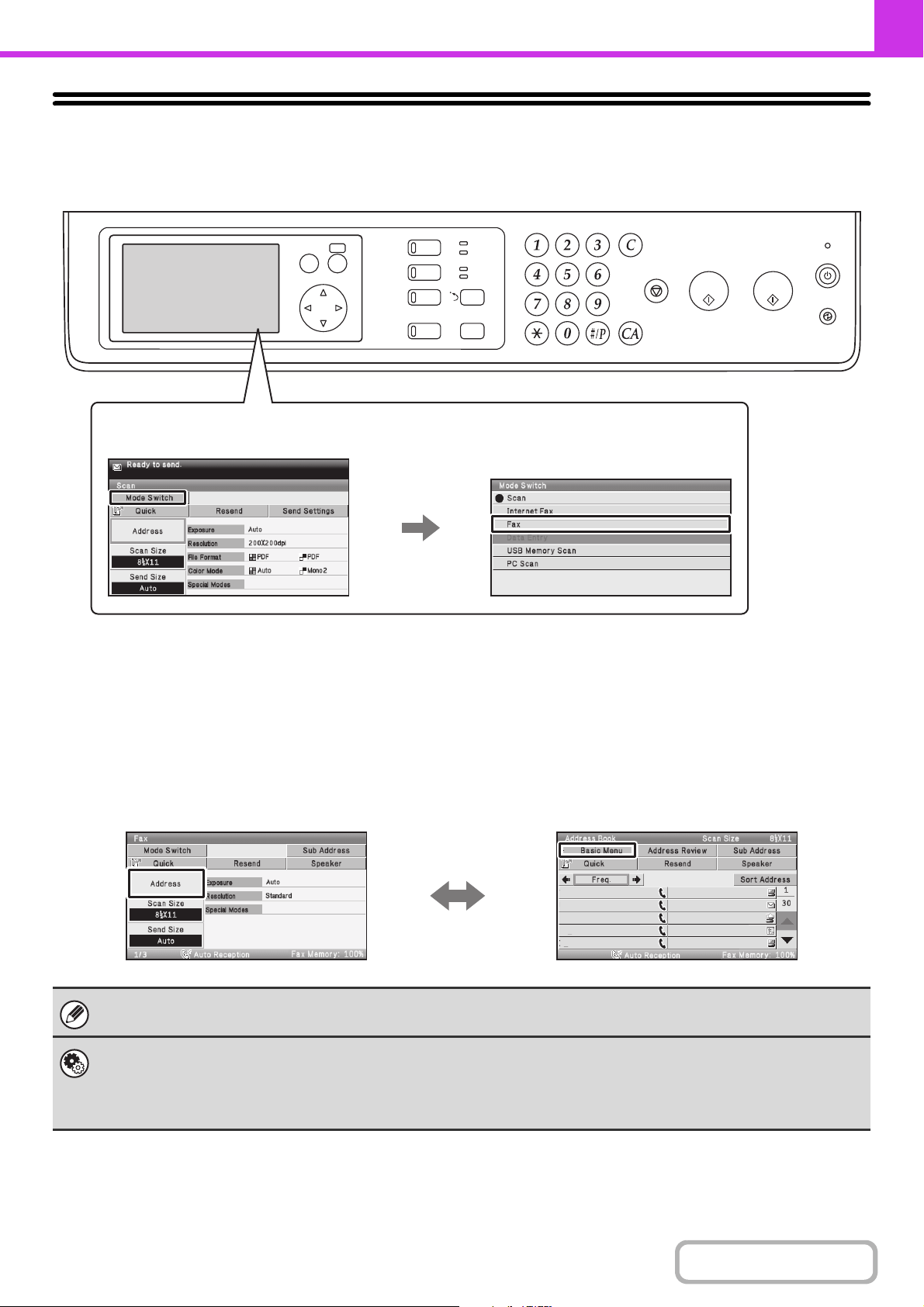
4-7
FACSIMILE
Contents
BASE SCREEN OF FAX MODE
The fax function is used by selecting settings and operations in the base screen of fax mode. To display the base screen
of a mode, press the [IMAGE SEND] key and select the desired mode in [Mode Switch].
Each of the other modes that can be displayed by pressing the [IMAGE SEND] key (scan, Internet fax, USB memory,
PC scan and data entry modes) also have base screens.
Transmission destinations can be stored in one-touch keys in the address book and retrieved from the address book
screen when you need to use them. The address book is shared by fax mode, scan mode, Internet fax mode and data
entry mode.
To switch to the Address Book screen from the base screen, select the [Address] key and then the [Address Book] key
and press the [OK] key. To switch to the base screen from the Address Book screen, select the [Basic Menu] key and
press the [OK] key. This chapter refers to the base screen of fax mode as the "base screen".
The procedures in this chapter begin from the base screen of fax mode.
System Settings (Administrator): Default Display Settings
One of the following screens can be selected for the initial screen that appears when the [IMAGE SEND] key is pressed.
• Base screen of each mode (scan, Internet fax, fax, or data entry mode)
• Address book screen
LOGOUT
COPY
PRINT
OKBACK
JOB STATUS
SYSTEM
SETTINGS
IMAGE SEND
READY
DATA
DATA
LINE
Modes that cannot be used because the
required options are not installed are grayed
out to prevent selection.
Example: switching from scanner mode to fax mode
AAA AAA
BBB BBB
CCC CCC
DDD DDD
EEE EEE
FFF FFF
GGG GGG
HHH HHH
III III
JJJ JJJ
Base screen of fax mode Address book screen
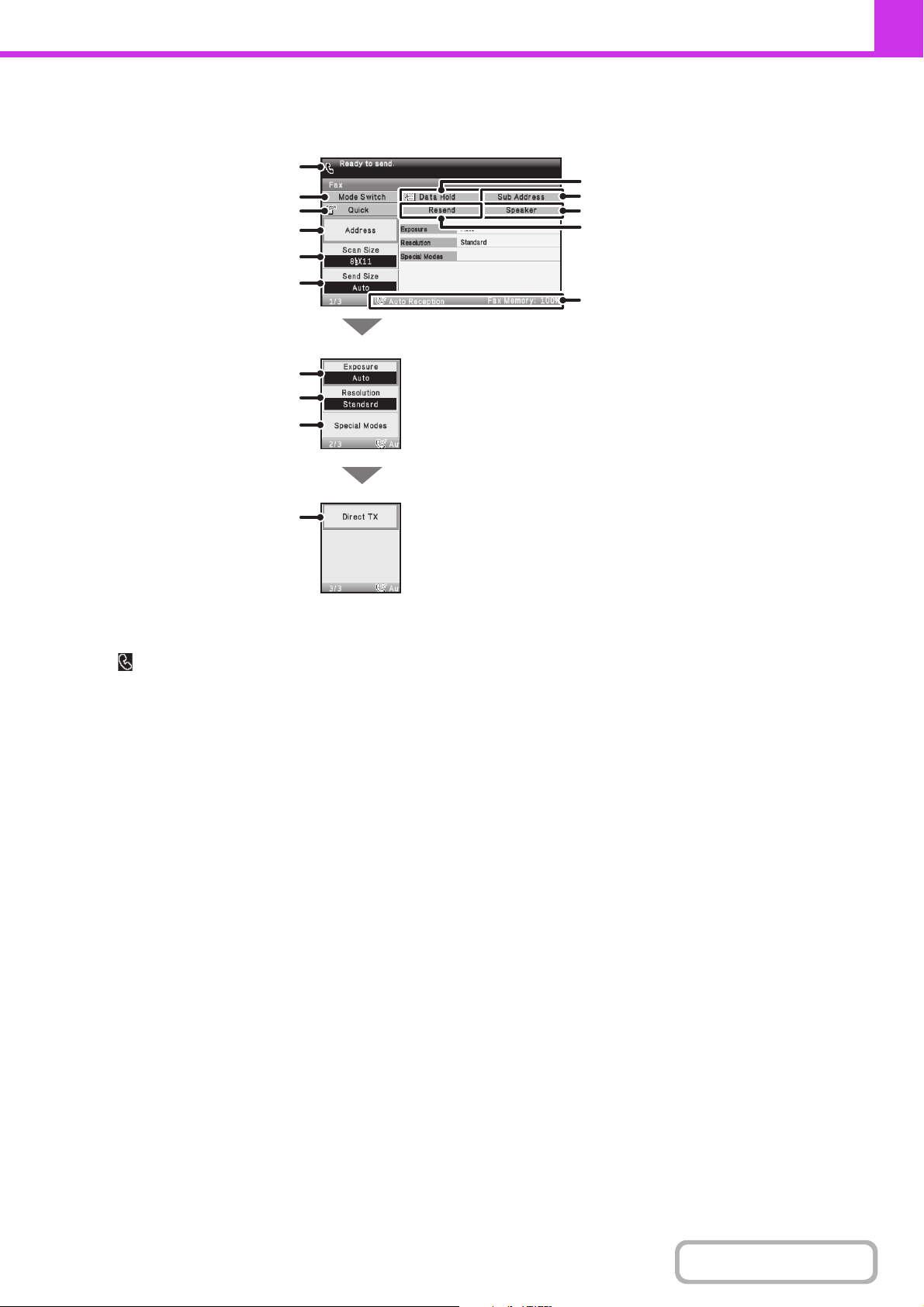
4-8
FACSIMILE
Contents
BASE SCREEN OF FAX MODE
This screen is used to select settings and operations in fax mode.
(1) This shows various messages and the destinations
that have been entered.
The icon on the left indicates fax mode.
(2) [Mode Switch] key
Use these keys to change the mode of the image send
function.
Modes that cannot be used because the appropriate
options are not installed do not appear.
☞ BASE SCREEN OF FAX MODE (page 4-7)
(3) [Quick] key
Select this key to dial a fax destination using a search
number.
☞ USING A SEARCH NUMBER TO RETRIEVE A
DESTINATION (page 4-23)
(4) [Address] key
Select this key to dial using a one-touch key or group
key.
☞ RETRIEVING A FAX NUMBER FROM THE
ADDRESS BOOK (page 4-20)
(5) [Scan Size] key
Select this key to select the image settings (original size,
duplex setup, image orientation).
☞ IMAGE SETTINGS (page 4-47)
(6) [Send Size] key
Select this key to specify the send size of the original.
☞ Specifying the send size of the original (page 4-54)
(7) [Exposure] key
Select this key to select the exposure for scanning.
☞ CHANGING THE EXPOSURE (page 4-56)
(8) [Resolution] key
Select this key to select the scanning resolution.
☞ CHANGING THE RESOLUTION (page 4-57)
(9) [Special Modes] key
Select this key to use a special mode.
☞ SPECIAL MODES (page 4-69)
(1)
(2)
(3)
(4)
(5)
(6)
(7)
(8)
(9)
(10)
(11)
(12)
(13)
(15)
(14)
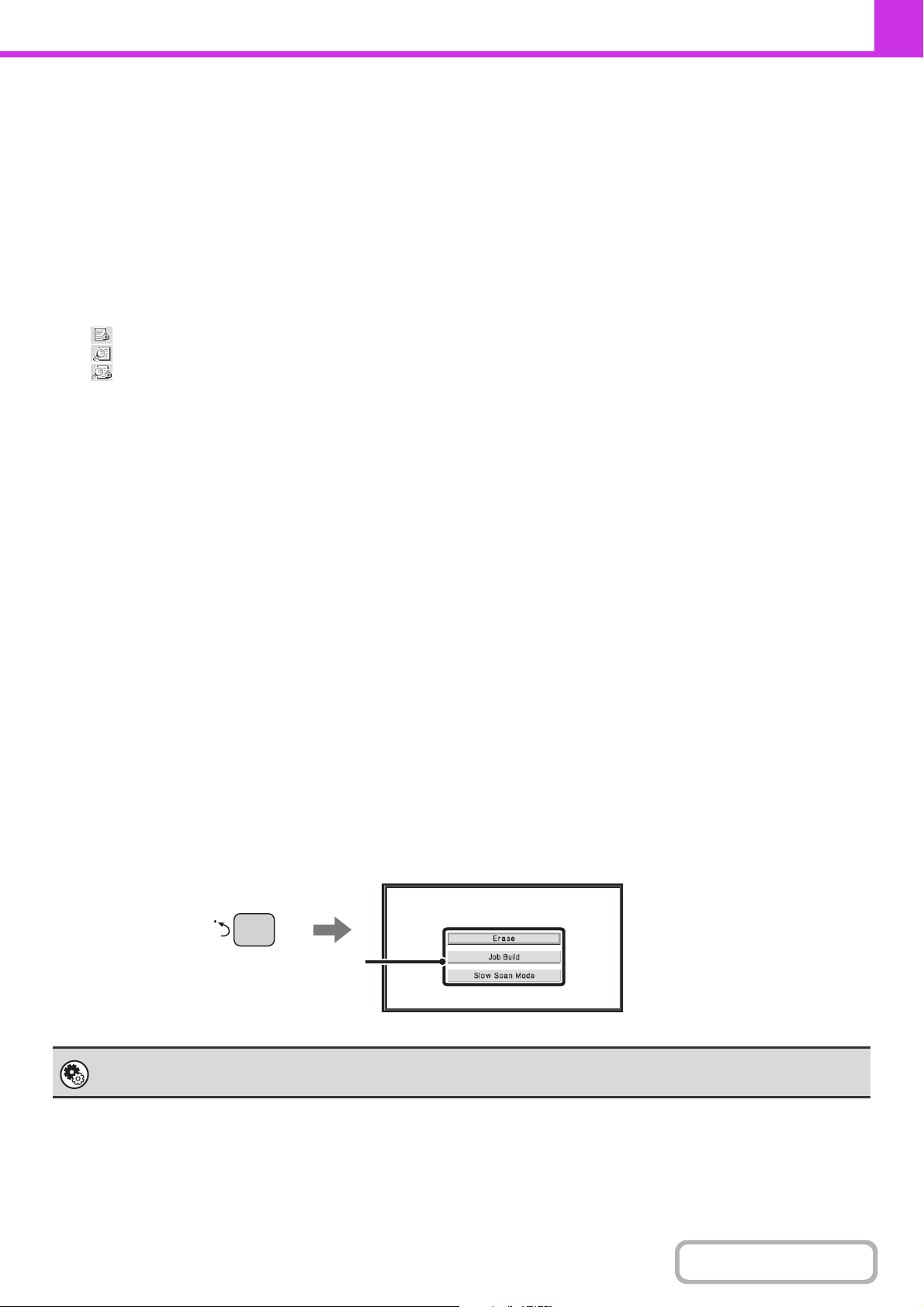
4-9
FACSIMILE
Contents
(10) [Direct TX] key
Select this key to send a fax by direct transmission.
☞ To fax a large number of sheet originals, use the
automatic document feeder. (page 4-28)
☞ If you wish to send a fax ahead of other previously
reserved fax transmissions, use direct transmission
mode. (page 4-29)
(11) [Data Hold] key
When "Hold Setting for Received Data Print" or
"Received Data Image Check Setting" (Web page only) is
enabled in the system settings (administrator), this will
appear when a fax is received.
: Only "Hold Setting for Received Data Print" is enabled
: Only "Received Data Image Check Setting" is enabled
: Both settings are enabled
☞ PRINTING A PASSWORD-PROTECTED FAX (Hold
Setting For Received Data Print) (page 4-61)
(12) [Sub Address] key
Select this key to enter a sub-address and passcode for
F-code transmission.
☞ F-CODE DIALING (page 4-101)
(13) [Speaker] key / [Pause] key / [Space] key
Select this key to dial using the speaker.
When entering a fax number to be dialed, the key
changes to the [Pause] key. When entering a
sub-address, the key changes to the [Space] key.
☞ TRANSMISSION USING THE SPEAKER (page
4-39)
(14) [Resend] key / [Next Address] key
Select this key to redial a fax number. When entering a
fax number to be dialed, this key changes to the [Next
Address] key.
☞ USING THE RESEND FUNCTION (page 4-26)
☞ CHECKING THE IMAGE BEFORE PRINTING (page
4-62)
(15) This shows the currently selected fax reception
mode and the amount of free memory remaining.
☞ RECEIVING FAXES (page 4-58)
Customizing displayed keys
Keys for special modes and other settings can be stored as shortcut keys. You can assign frequently used functions to
these keys to access the functions with a single touch. To change the function that is assigned to a key, use "Customize
Key Setting" in the Web pages. The following keys appear by factory default:
• [Program] key, [Global Address] key
Select to use the Program function or a Global Address book.
☞ STORING FAX OPERATIONS (Program) (page 4-71)
☞ RETRIEVING A DESTINATION FROM A GLOBAL ADDRESS BOOK (page 4-24)
• [Address Review] key
Select this to view a list of the destinations that have been selected in the address book and the numbers that have been
directly entered with the numeric keys.
This is the same key as the [Address Review] key in the address book screen.
Example: When "Erase", "Job Build", and "Slow Scan Mode" are assigned to the customized keys.
System Settings (Administrator): Customize Key Setting (Web page only)
Registration is performed in [System Settings] - [Operation Settings] - "Customize Key Setting" in the Web page menu.
These 3 keys can be changed
as desired.
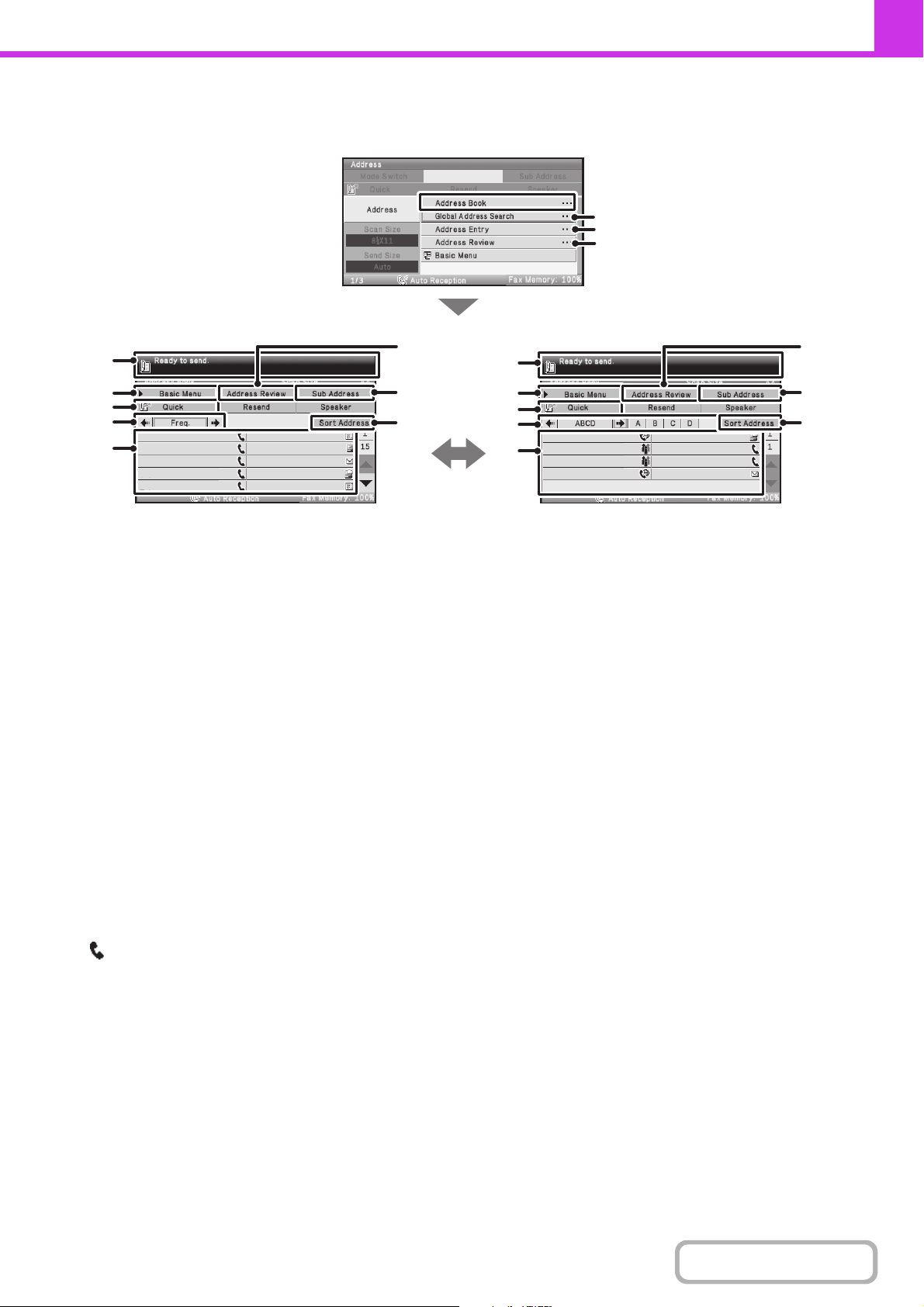
4-10
FACSIMILE
Contents
ADDRESS BOOK SCREEN
This screen is used to select a destination from the list of stored destinations.
(1) This shows the destination that has been selected.
(2) [Basic Menu] key
Select this key to select transmission settings and
operations. When the key is selected, the base screen
appears.
☞ BASE SCREEN OF FAX MODE (page 4-8)
(3) [Quick] key
Select this key to retrieve a destination using a search
number.
☞ USING A SEARCH NUMBER TO RETRIEVE A
DESTINATION (page 4-23)
(4) Index tabs
Select this to change indexes.
☞ RETRIEVING A STORED DESTINATION (page
4-21)
(5) One-touch key display
This shows the one-touch keys of the destinations that
have been stored in the address book. Keys in which
destinations and groups are stored are called one-touch
keys. Keys that have fax numbers stored are indicated by
.
☞ RETRIEVING A STORED DESTINATION (page
4-21)
(6) [Global Address Search] key
When the use of a LDAP server has been enabled in the
machine's Web page, a fax number can be obtained from
a global address book.
☞ RETRIEVING A DESTINATION FROM A GLOBAL
ADDRESS BOOK (page 4-24)
(7) [Address Entry] key
Not used in fax mode.
(8) [Address Review] key
Select this key to view a list of the destinations that have
been selected or to enter a selected destination
(one-touch key).
Destination selections can also be changed.
☞ CHECKING AND DELETING ENTERED
DESTINATIONS (page 4-22)
(9) [Sub Address] key
Select this key to enter a sub-address and passcode for
F-code transmission.
☞ F-CODE DIALING (page 4-101)
(10) [Sort Address] key
Select this to change the index tabs to custom indexes,
to display one-touch keys by send mode, or to change
the number of displayed items.
☞ CHANGING THE DISPLAY OF ONE-TOUCH KEYS
IN THE ADDRESS BOOK SCREEN (page 4-11)
AAA AAA
BBB BBB
CCC CCC
DDD DDD
EEE EEE
FFF FFF
GGG GGG
HHH HHH
III III
JJJ JJJ
AAA AAA
BBB BBB
CCC CCC
DDD DDD
EEE EEE
FFF FFF
GGG GGG
HHH HHH
(1)
(2)
(3)
(4)
(5)
(1)
(2)
(3)
(4)
(5)
(8)
(9)
(10)
(8)
(9)
(10)
(6)
(7)
(8)
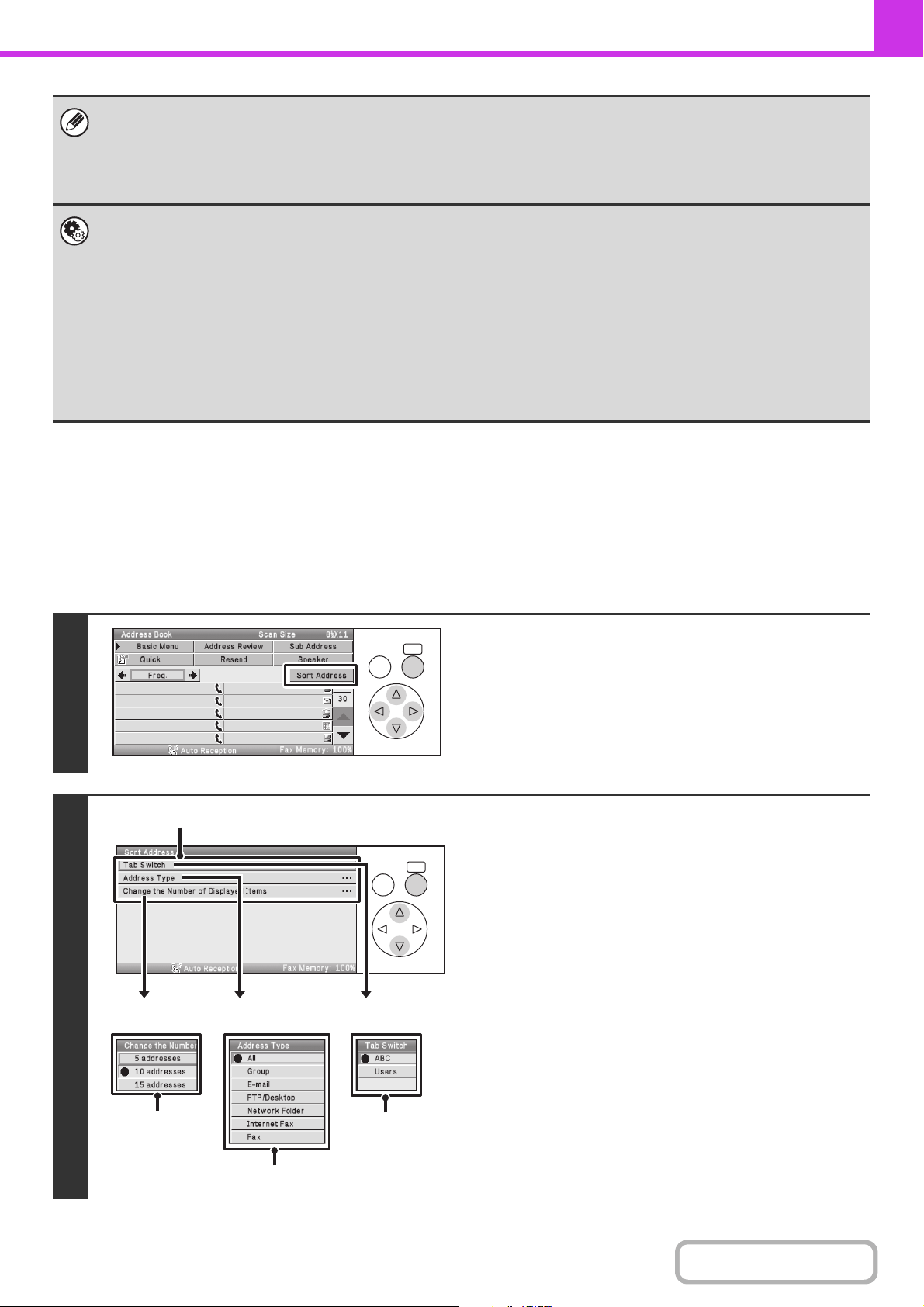
4-11
FACSIMILE
Contents
CHANGING THE DISPLAY OF ONE-TOUCH KEYS IN
THE ADDRESS BOOK SCREEN
You can show only destinations of a specific transmission mode in the address book screen, or change the displayed
index tabs from the alphabetical tabs to the custom tabs. The procedure for selecting destinations does not change.
Keys in the display can be selected with the arrow keys and the [OK] key.
• When using the network scanner function or the Internet fax function, a different icon will appear in the one-touch key
display if a non-fax destination (address) is stored.
☞ RETRIEVING A FAX NUMBER FROM THE ADDRESS BOOK (page 4-20)
• ADDRESS BOOK (page 4-13)
Store in [Address Book] in the Web page menu.
• System Settings (Administrator): The Number of Direct Address Keys Displayed Setting
This is used to change the default setting for the number of one-touch keys displayed in the address book screen.
• System Settings (Administrator): Default Display Settings
One of the following screens can be selected for the initial screen that appears when the [IMAGE SEND] key is selected.
- Base screen of each mode (scan, Internet fax, fax, or data entry mode)
- Address book screen
• System Settings (Administrator): Address Book Default Selection
The following settings are available for the method of sorting the addresses that appear in the address book.
- Index type (alphabetical, custom)
- Address type (all, group, E-mail, FTP/Desktop, Network Folder, Internet fax, fax)
1
Select the [Sort Address] key.
2
Change the display mode.
(1) Select the key of the mode or tab that you
wish to display.
• To change the index tabs, select the [Tab Switch] key.
• To show only the one-touch keys of a particular send
mode, select the desired mode key under "Address
Type".
• To change the number of destinations (one-touch keys)
displayed at once in the address book screen, select
the [Change the Number of Displayed Items] key and
then select 5, 10, or 15 destinations.
(2) Select the display method and press the
[OK] key.
OKBACK
AAA AAA
BBB BBB
CCC CCC
DDD DDD
EEE EEE
FFF FFF
GGG GGG
HHH HHH
III III
JJJ JJJ
OKBACK
(1)
(2)
(2)
(2)
Change the Number
of Displayed Items
Address Type Tab Switch
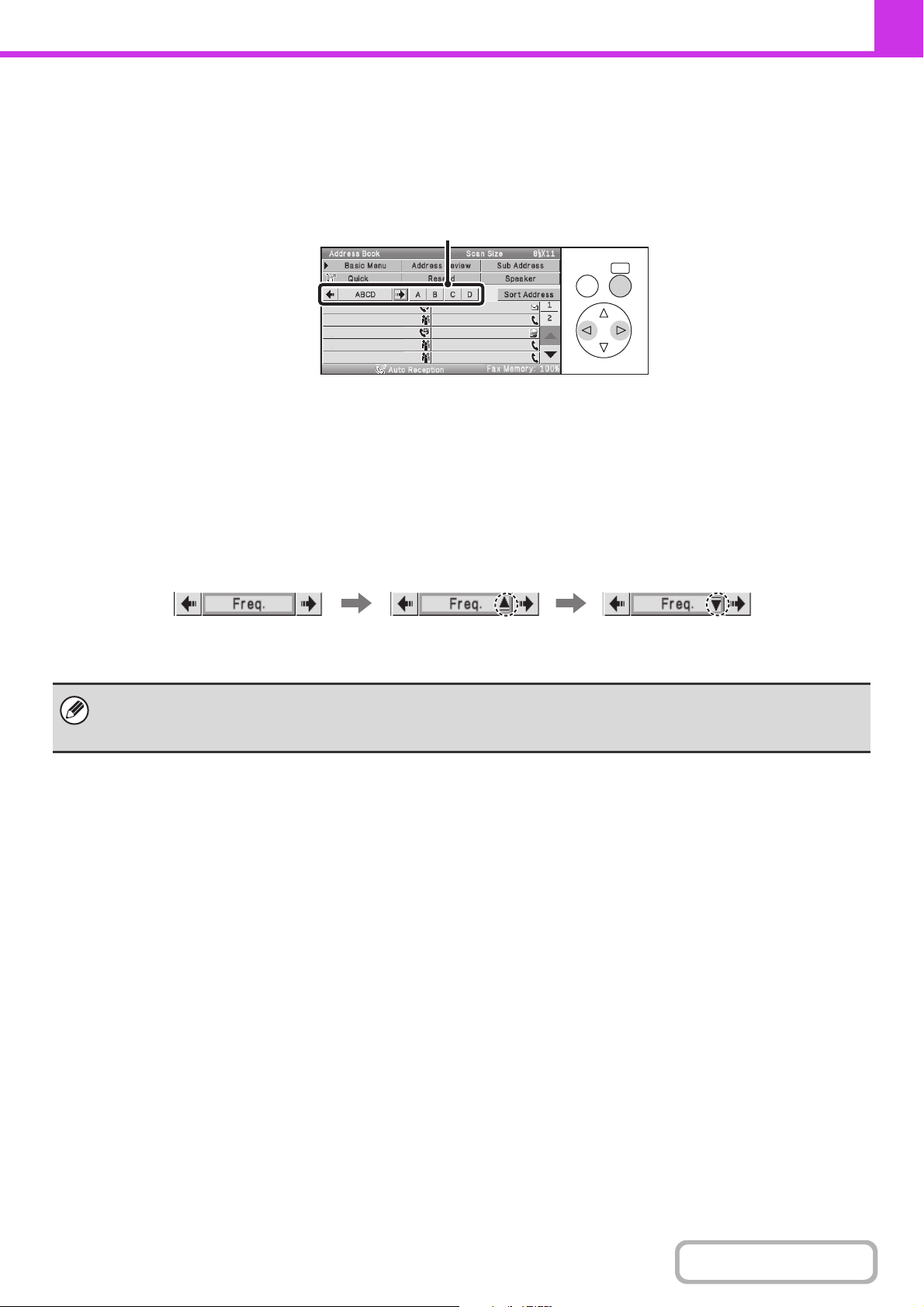
4-12
FACSIMILE
Contents
Index display
Indexes make it easy to search for a destination (one-touch key). The destinations are displayed separately using
alphabetical search characters and index numbers. To display a stored destination, select the appropriate index tab. It is
convenient to store frequently used destinations in the [Freq.] index. Specify that a destination be displayed in the [Freq.]
index when you store the destination.
For example, when keys from "A" to "D" appear, you can select the [B] key to show only destinations starting with the
letter "B". To cancel, select the key again. Note that the search letter range cannot be narrowed on the [Freq.] tab, the
[etc.] tab, or on a user index tab.
The destinations can also be displayed in alphabetical order by initial.
Each time the displayed index tab is selected, the display order changes in the following order: search numbers (page
4-23), ascending names, descending names. When the display order is changed, the display order of the other index
tabs also changes.
Index names can be changed using "Custom Index" in the Web page menu, allowing you to create groups of one-touch
keys that can be easily recognized.
System Settings: CUSTOM INDEX (page 4-15)
This setting is used to store custom index names. The custom index where a one-touch key appears is specified when the
transmission destination is stored in the key. Store in [Address Book] > [Custom Index] in the Web page menu.
OKBACK
AAA AAA
BBB BBB
CCC CCC
DDD DDD
EEE EEE
FFF FFF
GGG GGG
HHH HHH
III III
JJJ JJJ
Index tabs
Ordered by search number (default) Ascending names Descending names
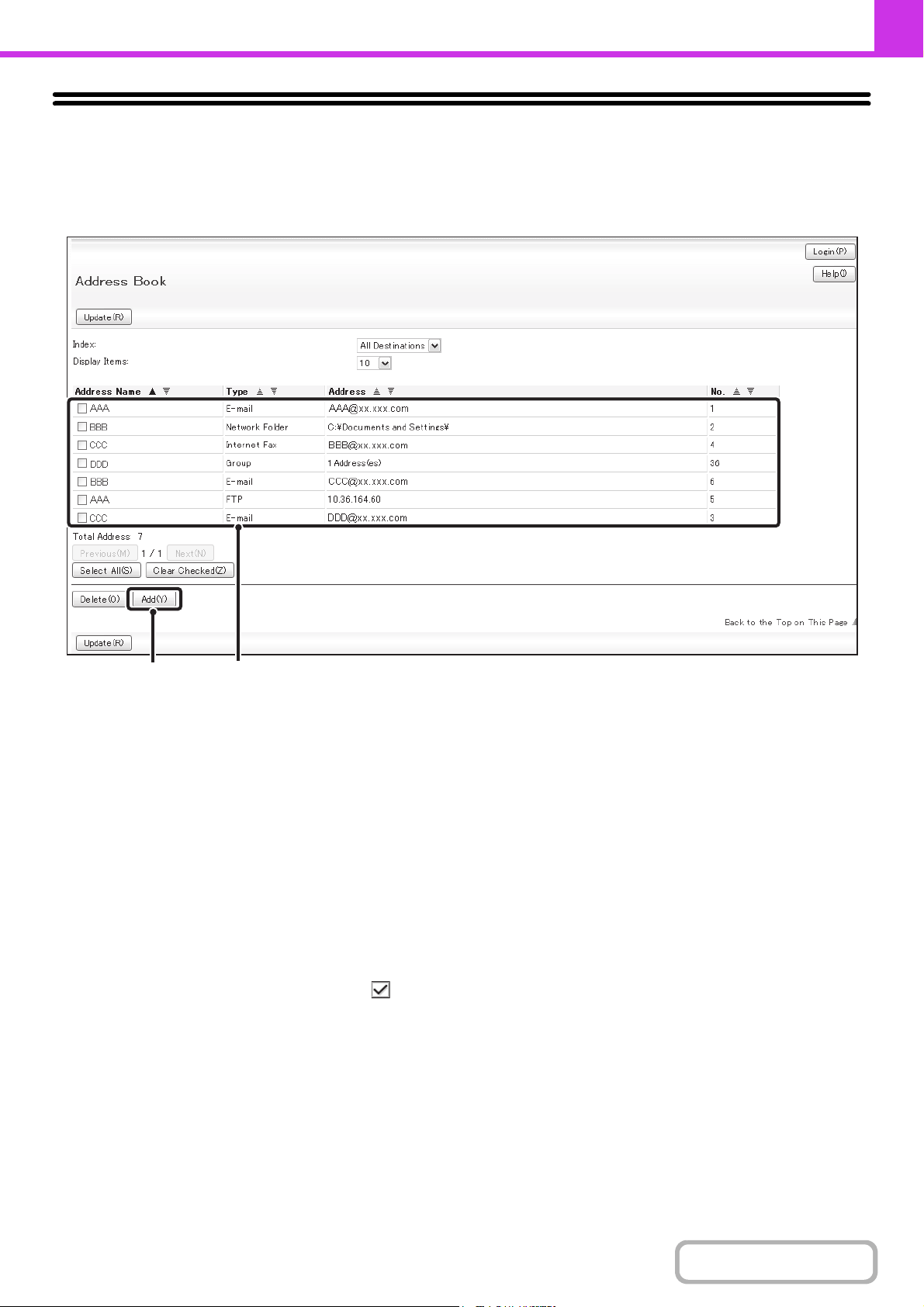
4-13
FACSIMILE
Contents
ADDRESS BOOK
Address Book is used to configure settings for storing addresses in the Web page.
Storing addresses in the address book makes it easy to specify an address for transmission.
When the [Address Book] key is selected, the following screen appears.
(1) [Add] key
Use this to add a new address.
(2) List display
This displays a list of the currently stored addresses.
An address can be selected to open an edit/delete
screen for the address.
Storing addresses
Select the [Add] key in the above screen to open a registration screen. Up to 999 addresses can be stored.
For information on the settings, see "Settings" (page 4-14).
Editing and deleting addresses
An address can be selected from the list in the above screen to open an edit screen for the address.
To open a delete screen, select the checkbox next to the address and then select [Delete].
For information on the settings, see "Settings" (page 4-14).
AAA
(2)
(1)
4-14
FACSIMILE
Contents
Settings
• If you cannot edit or delete a one-touch individual or group key...
Individual keys and group keys cannot be edited or deleted in the following situations:
- The key is used in a reserved transmission or a transmission in progress.
- The key is included in a group key.
- The key is included in a program.
- The key is specified as an end receiving machine in a F-code relay broadcast transmission.
If the key is used in a reserved transmission or a transmission that is in progress, cancel the transmission or wait until it is
completed and then edit or delete the key.
If the key is included in a group, first delete the key from the group and then edit or delete the key.
If the key is specified as a forwarding destination, cancel the forwarding destination setting and then edit or delete the key.
If "Disable Registering Destination on Web Page" has been enabled, clear this function and then edit or delete the key.
Item Description
General items stored
Address Type
Select the type of address to be stored in the address book.
In this case, select [Fax].
Search Number
Set a search number. The lowest available number is automatically entered. To
change the number, enter a number from 001 to 999. A search number that has
already been stored cannot be used.
Address Name Enter a maximum of 36 characters for the address name.
Initial
Enter up to 10 characters for the initials. The initials you enter here determine the
position of the one-touch key in the alphabetical index.
Key Name
Enter the name that you wish to appear in the address book (this is different from
the address name).
Custom Index Select the custom index in which the address will appear.
Register this Address to be added to the
[Frequent Use] index.
Frequently used addresses can be stored in the [Frequent Use] index.
Fax Number
Enter the fax number of the destination (maximum of 64 digits).
To cancel the PBX settings* temporarily when sending a fax...
Select the [R] key before entering a fax number.
* This function is not available in some countries and regions.
Entering a pause between digits of the number
Select the [-] key at the place where you wish to enter a pause.
To enter a F-code (sub-address and passcode)...
(1) Enter the destination fax number.
(2) Select the [/] key.
(3) Enter the sub address (maximum of 20 digits).
(4) Select the [/] key.
(5) Enter the passcode (maximum of 20 digits).
A passcode is not necessary if the destination machine does not use a
passcode.
The destination fax number can be a maximum of 64 digits including all numbers
and characters.
4-15
FACSIMILE
Contents
CUSTOM INDEX
The name of a custom index can be changed for greater ease of use.
Delete the previously entered name and enter a new name (maximum of 6 characters).
The factory default names for the custom indexes are "User 1" to "User 6".
Transmission Mode
Set the transmission speed and the International Correspondence Mode.
Selecting appropriate settings for these items may help eliminate communication
errors.
Transmission Speed
33.6 kbps, 14.4 kbps, 9.6 kbps or 4.8 kbps can be selected for the transmission
speed. Higher numbers are higher transmission speeds.
Set the transmission speed only when you know what speed is most suitable,
such as when you are sending a fax to a foreign country and telephone line
conditions are bad. If you do not know the line conditions, do not change this
setting.
Transmission Mode
No Sound, Mode1, Mode2, or Mode3 can be selected for the International
Correspondence Mode.
When sending a fax to a foreign country, telephone line conditions can sometimes
distort the fax or interrupt the transmission. If errors frequently occur when
sending a fax to a foreign country, try each of the modes 1 to 3 and select the
mode that enables the best transmission.
Item Description
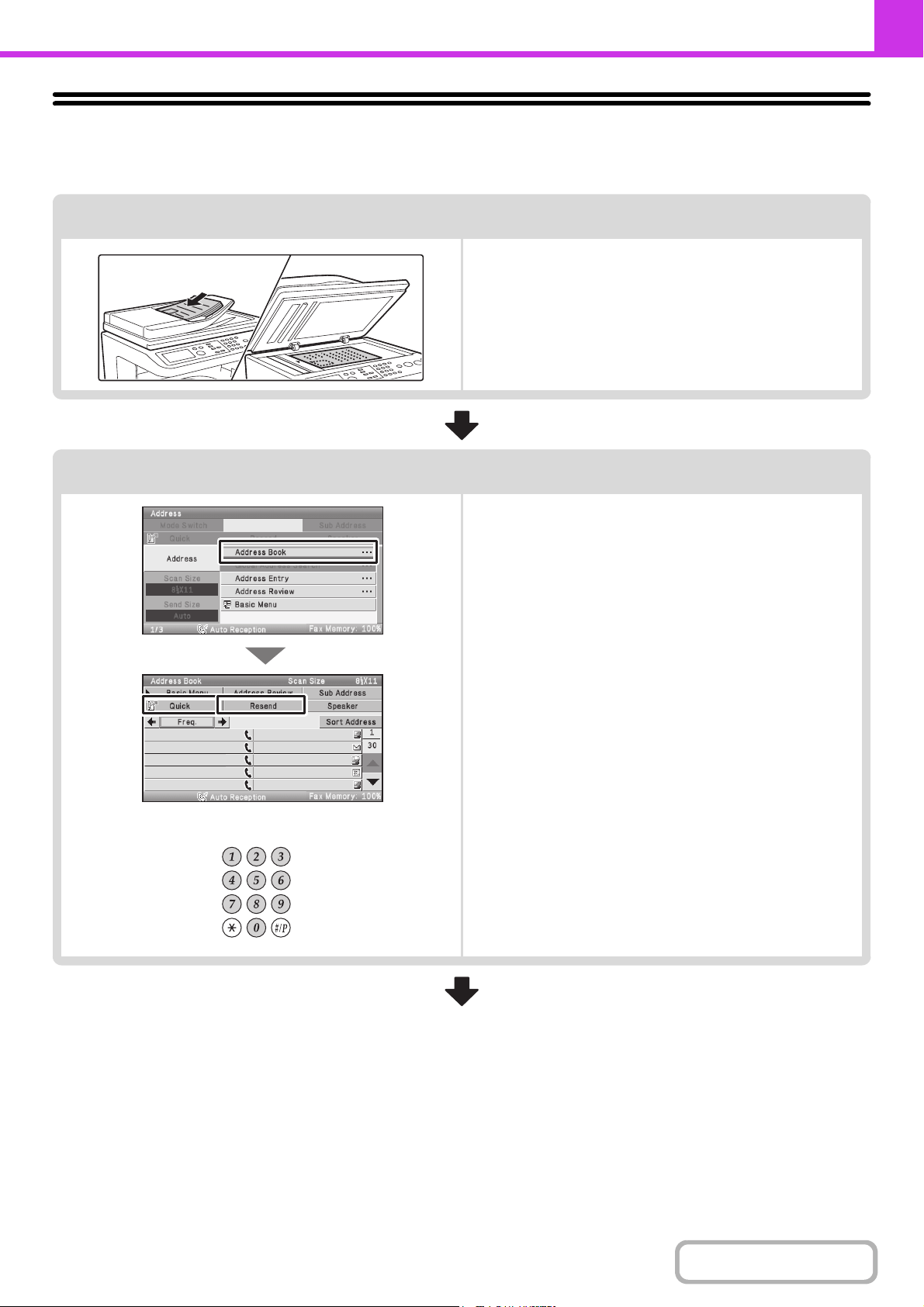
4-16
FACSIMILE
Contents
FAX TRANSMISSION SEQUENCE
This section explains the basic procedure for sending a fax.
Place the original
Place the original in the document feeder tray of the automatic
document feeder, or on the document glass.
Enter the destination fax number
or
• [Address Book] key: Select a destination that is stored in
the address book or look up a
destination in a global address book.
☞ RETRIEVING A FAX NUMBER
FROM THE ADDRESS BOOK
(page 4-20)
• [Quick] key: Use a search number to specify a destination
stored in the address book.
☞ USING A SEARCH NUMBER TO
RETRIEVE A DESTINATION (page 4-23)
• [Resend] key: Select a fax number from the last eight
destinations used for transmission.
☞ USING THE RESEND FUNCTION (page
4-26)
• Numeric keys: Enter a fax number.
☞ ENTERING A FAX NUMBER WITH THE
NUMERIC KEYS (page 4-19)
AAA AAA
BBB BBB
CCC CCC
DDD DDD
EEE EEE
FFF FFF
GGG GGG
HHH HHH
III III
JJJ JJJ
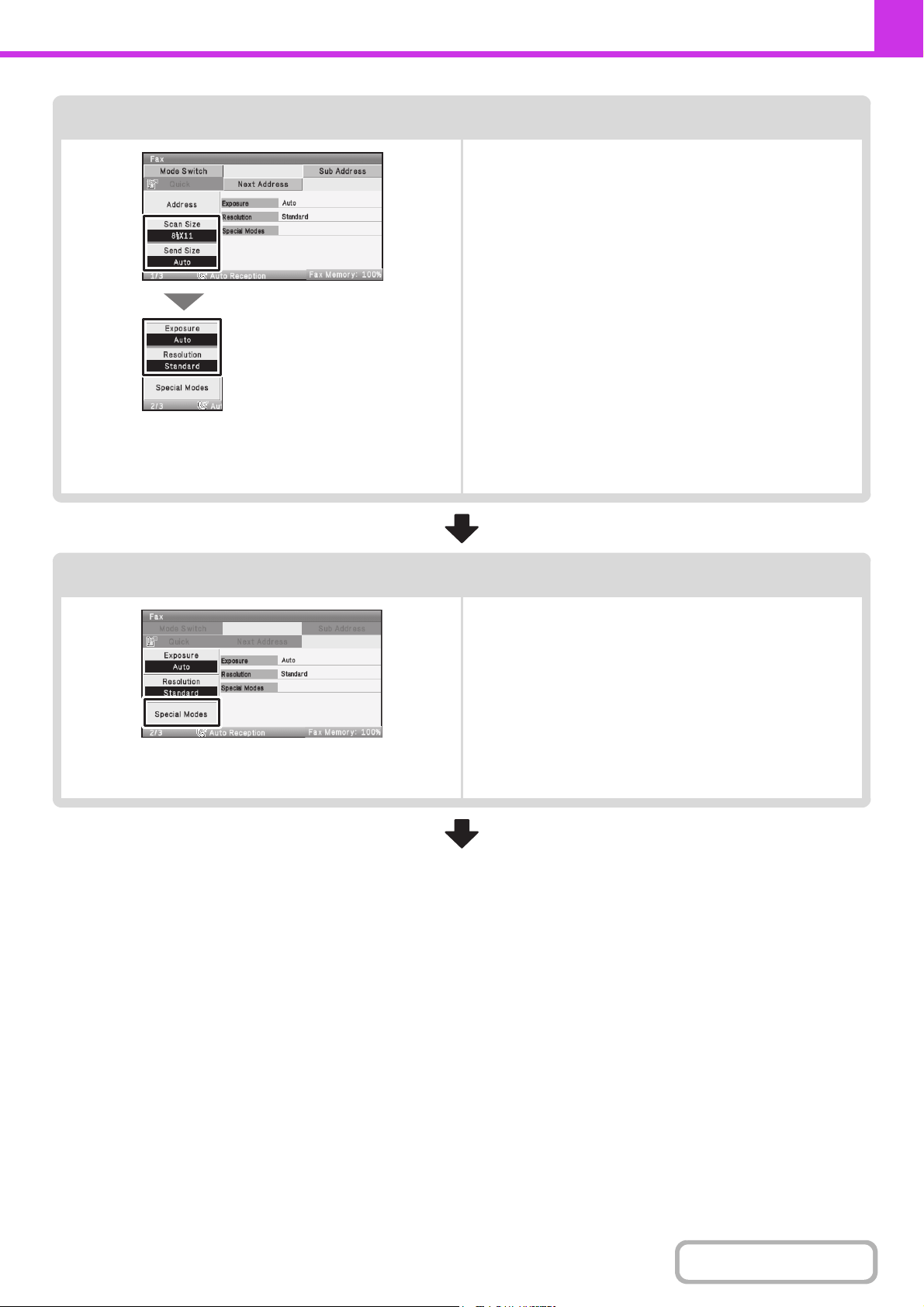
4-17
FACSIMILE
Contents
Select image settings
Select settings for the original to be faxed.
• [Scan Size] key: Use this key to select the original size, and
2-sided original scanning.
☞ SPECIFYING THE SCAN SIZE AND
SEND SIZE (page 4-50),
AUTOMATICALLY SCANNING
BOTH SIDES OF AN ORIGINAL
(2-Sided Original) (page 4-48)
• [Send Size] key: Use this key to select the send size of the
original.
☞
Specifying the send size of the original
(page 4-54)
• [Exposure] key: Use this key to adjust the exposure of the
image.
☞
CHANGING THE EXPOSURE (page
4-56)
• [Resolution] key: Use this key to adjust the resolution of the
image.
☞
CHANGING THE RESOLUTION (page
4-57)
Special mode settings
Select the [Special Modes] key to select special modes such
as timer transmission and the erase function.
4-18
FACSIMILE
Contents
Begin transmission
Scan the original and send the fax.
If the original is placed on the document glass, follow these steps to start scanning and transmit:
When sending a fax normally (memory transmission)
(1) Press the [BLACK & WHITE START] key.
(2) When scanning is finished, replace the original with the next original.
(3) Press the [BLACK & WHITE START] key.
(4) Repeat steps (2) and (3) until all originals have been scanned.
(5) Select the [Read-End] key and press the [OK] key.
When sending a fax in direct transmission mode
Multiple originals cannot be scanned in direct transmission mode.
Press the [BLACK & WHITE START] key to start transmission.
When transmission ends, image settings and convenient special mode settings are cleared.
To cancel scanning...
Press the [STOP] key ( ).
System Settings (Administrator): Default Display Settings
The settings can be kept in effect a fixed period of time after scanning is completed.
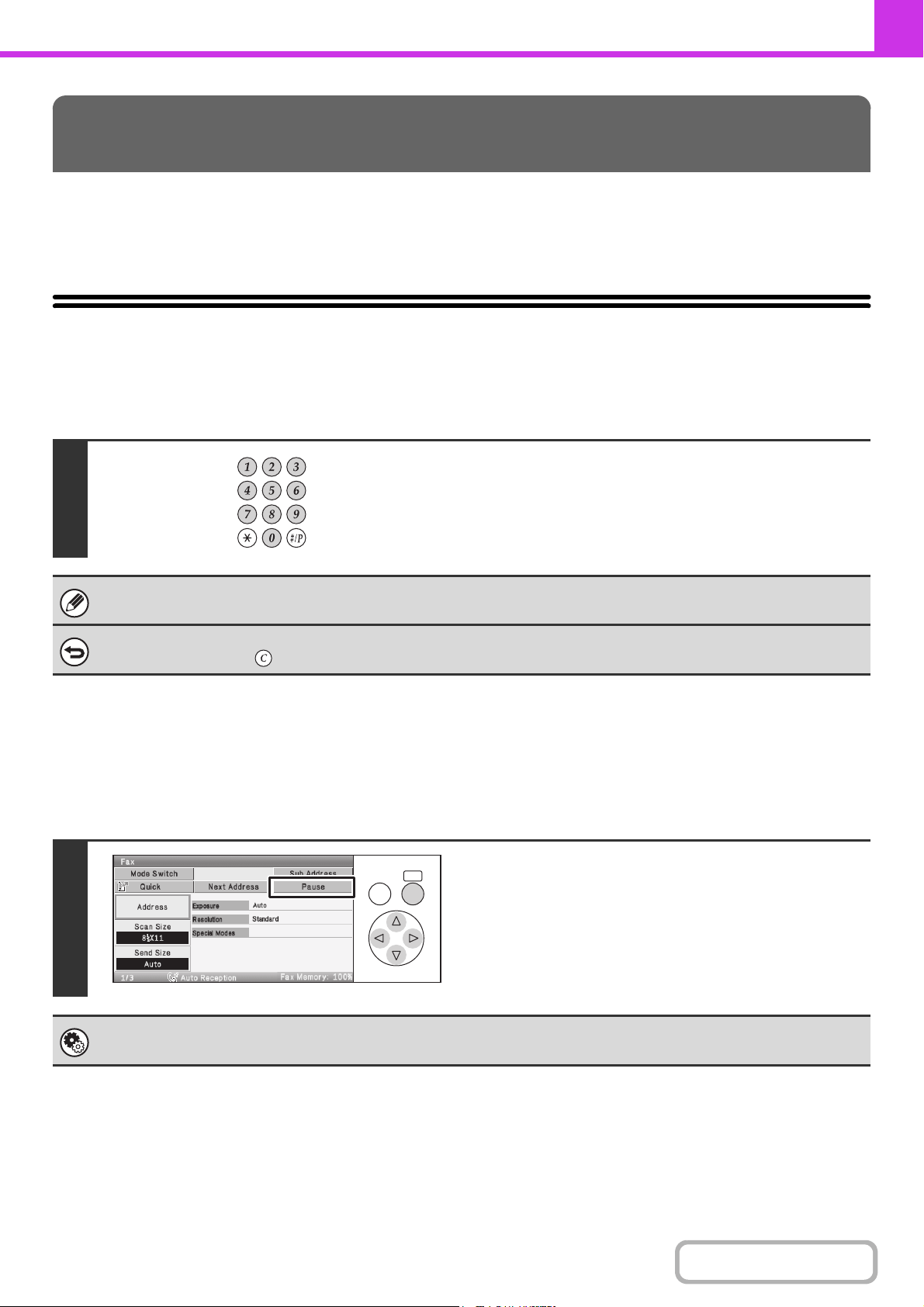
4-19
FACSIMILE
Contents
This section explains how to enter destination fax numbers.
Destination fax numbers can be entered using the numeric keys, or by retrieving a previously stored fax number using
the address book or a search number.
ENTERING A FAX NUMBER WITH THE
NUMERIC KEYS
Entering a pause between digits of the number
Enter a pause after the number used to dial out from a PBX (for example, after "0"), or after the country code when
dialing an international number.
Keys in the display can be selected with the arrow keys and the [OK] key.
ENTERING DESTINATIONS
Enter the destination fax number with
the numeric keys.
Take care to enter the correct number.
If an incorrect number is entered...
Press the [CLEAR] key ( ) to clear the number and then enter the correct number.
Select the [Pause] key.
Select the [Pause] key and press the [OK] key once. A hyphen
(-) will be entered.
System Settings (Administrator): Pause Time Setting
This is used to set the length of pauses. The default setting is 2 seconds.
OKBACK
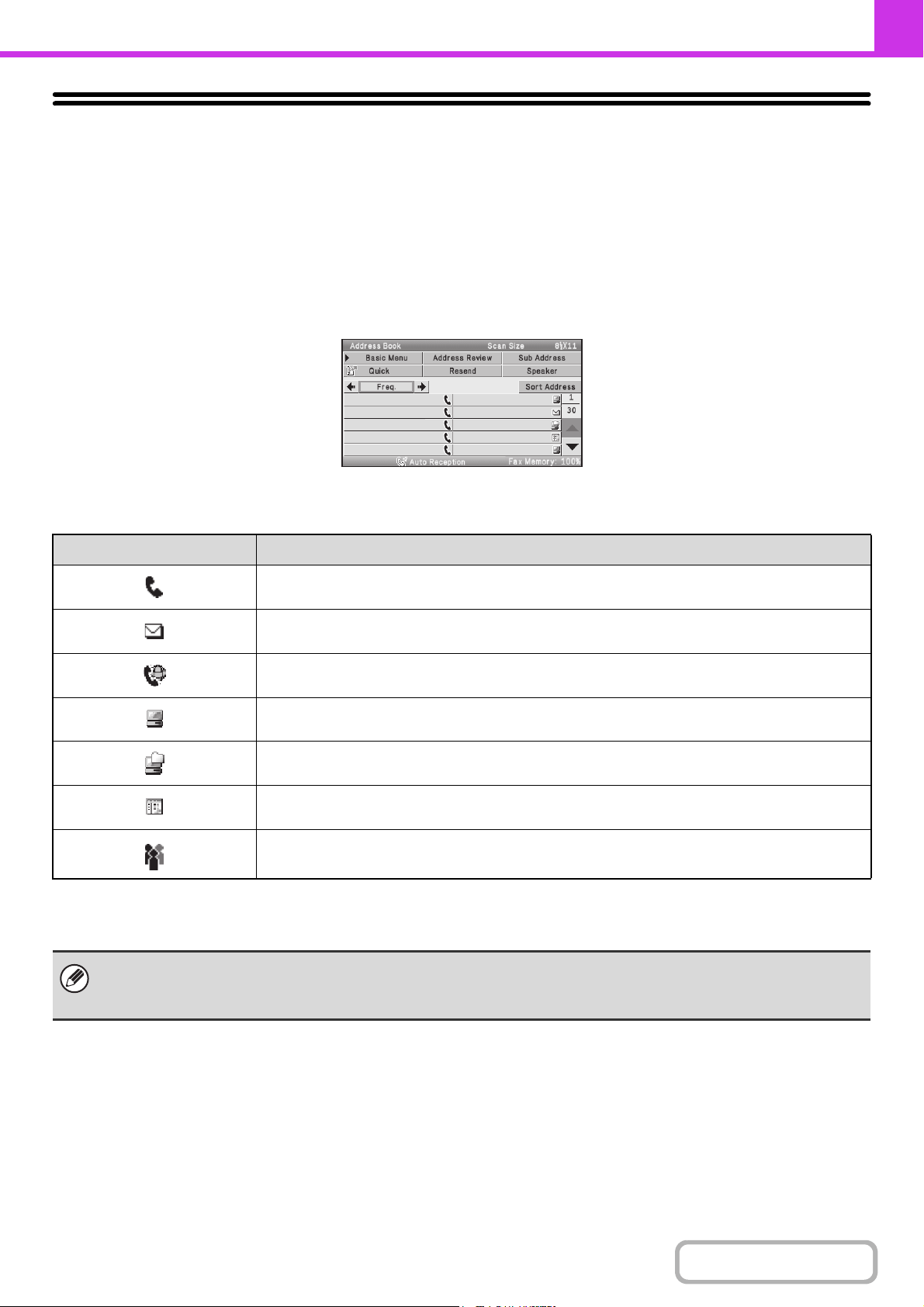
4-20
FACSIMILE
Contents
RETRIEVING A FAX NUMBER FROM THE
ADDRESS BOOK
The address book screen shows stored destinations as one-touch keys.
A destination fax number is retrieved by simply selecting the one-touch key of that destination. This is called "one-touch
dialing". It is also possible to store multiple fax numbers in a one-touch key, allowing you to retrieve all the numbers by
simply selecting the key. This is called "group dialing". This dialing method is convenient when you wish to send a fax to
(or poll) multiple fax destinations.
When destinations of other scan modes are stored in addition to fax destinations, an icon indicating the mode appears
together with the name of the destination in each one-touch key.
Icon Mode
Fax
Scan to E-mail
Internet fax (Direct SMTP)
Scan to FTP
Scan to Network Folder
Scan to Desktop
Group key with multiple destinations
ADDRESS BOOK (page 4-13)
This is used to store destinations (names and fax numbers) in the address book.
Store in [Address Book] in the Web page menu.
AAA AAA
BBB BBB
CCC CCC
DDD DDD
EEE EEE
FFF FFF
GGG GGG
HHH HHH
III III
JJJ JJJ
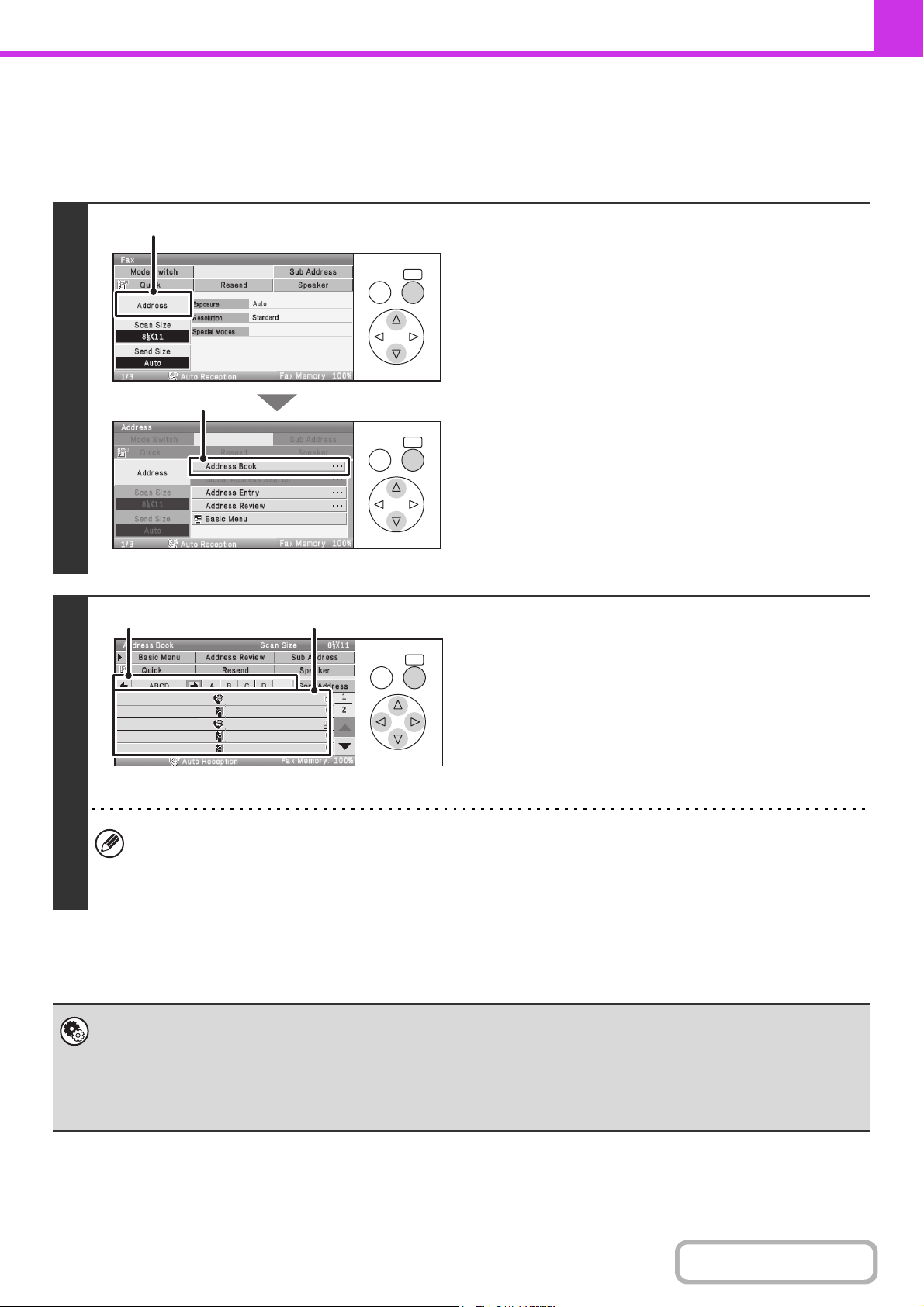
4-21
FACSIMILE
Contents
RETRIEVING A STORED DESTINATION
A destination fax number is retrieved by simply selecting the one-touch key of that destination.
Keys in the display can be selected with the arrow keys and the [OK] key.
1
Display the address book screen.
(1) Select the [Address] key.
(2) Select the [Address Book] key.
2
Select the destination.
(1) Select the index tab where the destination is
stored.
☞ Index display (page 4-12)
(2) Select the one-touch key of the desired
destination.
If you select an incorrect destination, press the [OK] key
again to cancel the selection.
• Frequently used destinations can be displayed in the [Freq.] index. Specify that a destination be displayed in the
[Freq.] index when you store the destination.
• To continue specifying other destinations...
Select the [Next Address] key and press the [OK] key, and then repeat (1) and (2) of this step.
• System Settings (Administrator): Must Input Next Address Key at Broadcast Setting
This setting determines whether or not the [Next Address] key can be omitted before specifying the next destination.
Factory default setting: The [Next Address] key can be omitted.
• System Settings (Administrator): Disable Switching of Display Order
This is used to disable switching of the order of display of the one-touch keys in the address book screen. The currently
selected display order will be the order that is used after this setting is enabled.
OKBACK
OKBACK
(1)
(2)
OKBACK
AAA AAA
BBB BBB
CCC CCC
DDD DDD
EEE EEE
FFF FFF
GGG GGG
HHH HHH
III III
JJJ JJJ
(1) (2)
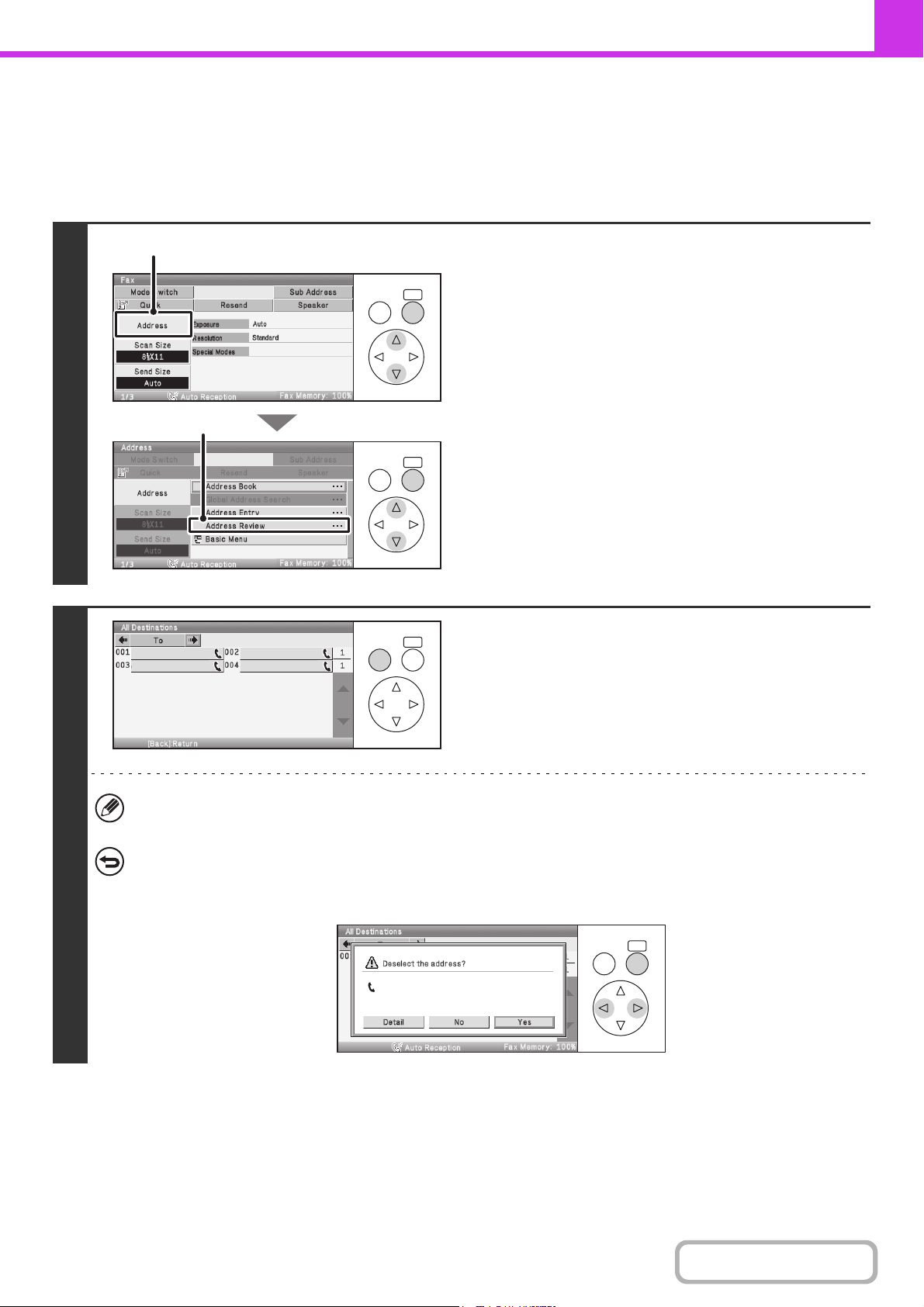
4-22
FACSIMILE
Contents
CHECKING AND DELETING ENTERED DESTINATIONS
When multiple destinations have been entered, you can display and check the destinations. You can also delete a
destination (cancel selection of the destination).
Keys in the display can be selected with the arrow keys and the [OK] key.
1
Display the address review screen.
(1) Select the [Address] key.
(2) Select the [Address Review] key.
2
Check the destinations and then press
the [BACK] key.
Cc destinations are not used in fax mode.
To delete a destination...
Select the one-touch key of the destination that you wish to delete. A confirmation prompt will appear. Select the [Yes]
key and press the [OK] key. To check the type and name of the specified recipient, select the [Detail] key and press
the [OK] key.
OKBACK
OKBACK
(1)
(2)
OKBACK
AAA BBB
AAA DDD
AAA AAA
AAA CCC
OKBACK
AAA AAA
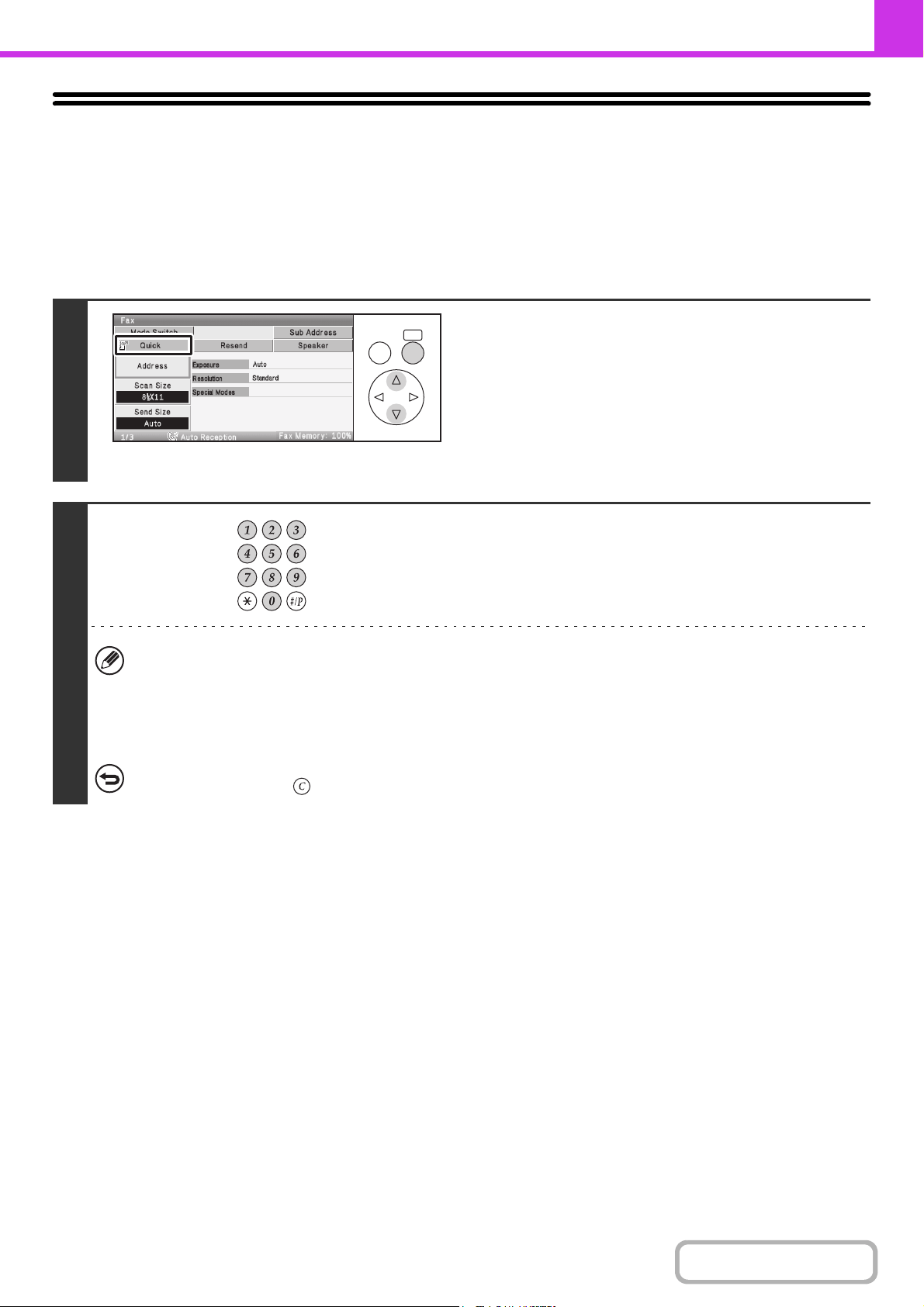
4-23
FACSIMILE
Contents
USING A SEARCH NUMBER TO RETRIEVE
A DESTINATION
A destination stored in the address book can be retrieved using the [Quick] key. This can be done in the base screen of
any of the modes or in the address book screen.
Keys in the display can be selected with the arrow keys and the [OK] key.
1
Select the [Quick] key.
2
Enter the 3-digit search number of the
address with the numeric keys.
When the 3-digit search number is entered, the stored address
is retrieved and specified as a destination.
• The search number is programmed when the destination is stored in the address book.
• If you do not know the search number, print the one-touch address list using "Sending Address List" in the system
settings.
• When entering search numbers such as "001" and "011", "0" can be omitted. For example, to enter "001", enter "1",
select the [Quick] key or the [Next Address] key, and press the [OK] key.
If an incorrect search number is entered...
Press the [CLEAR] key ( ) to clear the number and enter the correct number.
OKBACK
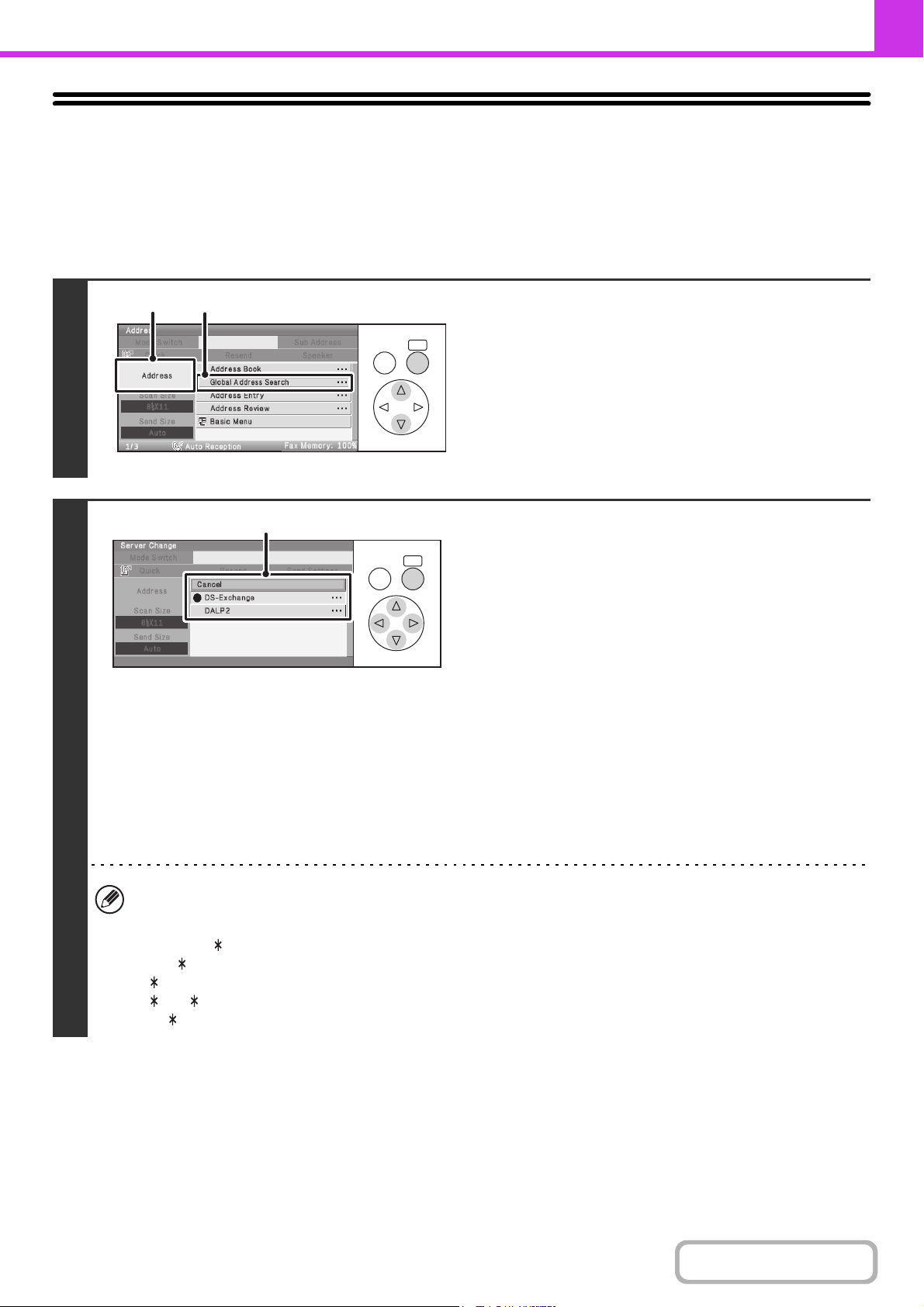
4-24
FACSIMILE
Contents
RETRIEVING A DESTINATION FROM A
GLOBAL ADDRESS BOOK
If a LDAP server is stored in the Web pages, you can look up a destination fax number in a global address book.
Keys in the display can be selected with the arrow keys and the [OK] key.
1
Open the global address search screen.
(1) Select the [Address] key in the base screen.
(2) Select the [Global Address Search] key.
2
Search for the destination.
If only one LDAP server has been stored, (1) is not necessary.
Go directly to (2). If an authentication screen for the LDAP
server appears, enter your user name and password.
(1) Select the key of the LDAP server that you
wish to use.
If an authentication screen for the LDAP server appears,
enter your user name and password.
(2) Search for the destination in the search
screen.
Enter search characters for the recipient. Select the
[Search] key and press the [OK] key. The search results
will appear after a brief interval.
For the procedure for entering text, see "ENTERING
TEXT" (page 1-61) in "1. BEFORE USING THE
MACHINE".
How to search
Enter a maximum of 64 characters for the search characters. The system will look for names starting with the entered
letters.
An asterisk can be used as follows:
XXX : Names beginning with "XXX".
XXX: Names that end with "XXX".
XXX : Names that include "XXX".
AA XX: Names that start with "AA" and end with "XX".
OKBACK
(2)(1)
OKBACK
(1)
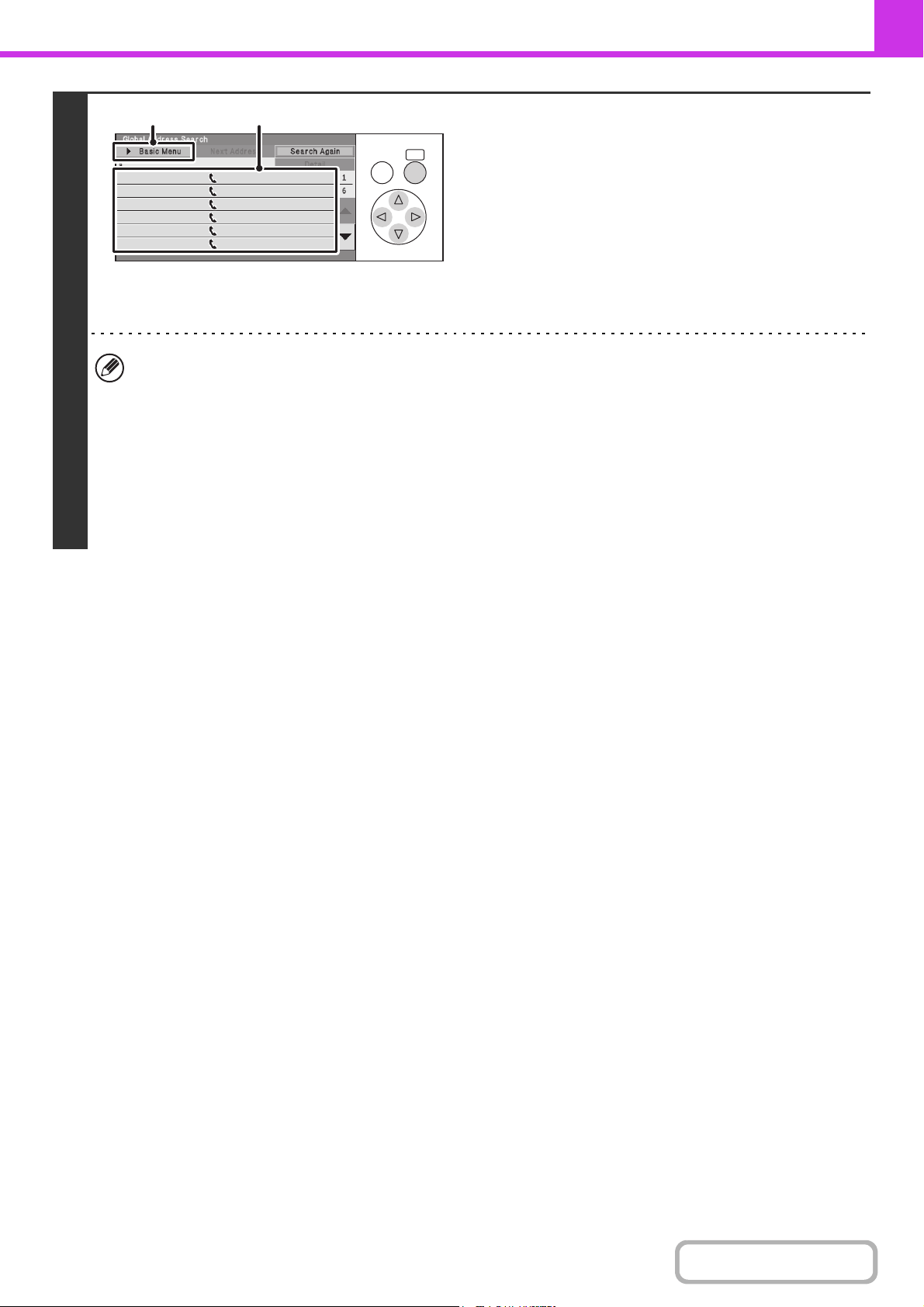
4-25
FACSIMILE
Contents
3
Select the destination.
(1) Select the key of the desired destination.
(2) Select the [Basic Menu] key.
This enters the selected destination.
If you wish to enter another recipient, select the [Next
Address] key and then repeat (1) and (2) of this step.
If no names are found that match the search letters, a
message will appear. Press the [OK] key to close the
message. To search again, select the [Search Again] key
and press the [OK] key.
• If 30 or more matches are found, a message will appear in the screen. Press the [OK] key to close the message. A
maximum of 300 search results are displayed. If no names are found that match the search letters, select the
[Search Again] key and press the [OK] key to search again using additional search letters.
• To check the information stored in a destination...
After selecting the recipient, select the [Detail] key and press the [OK] key. The information stored for the selected
destination will appear. Check the information and then press the [BACK] key to return to the search results screen.
• If a screen for selecting the item to be used appears...
If the selected destination includes an E-mail address or other address in addition to the fax number or telephone
number, you will need to select which item you wish to use. To retrieve the fax number, select the [Fax] key and
press the [OK] key.
OKBACK
0123456789
9876543210
0612345678
0687654321
0676543210
0601234567
XXX AAA
XXX BBB
XXX CCC
XXX DDD
XXX EEE
XXX FFF
(2) (1)
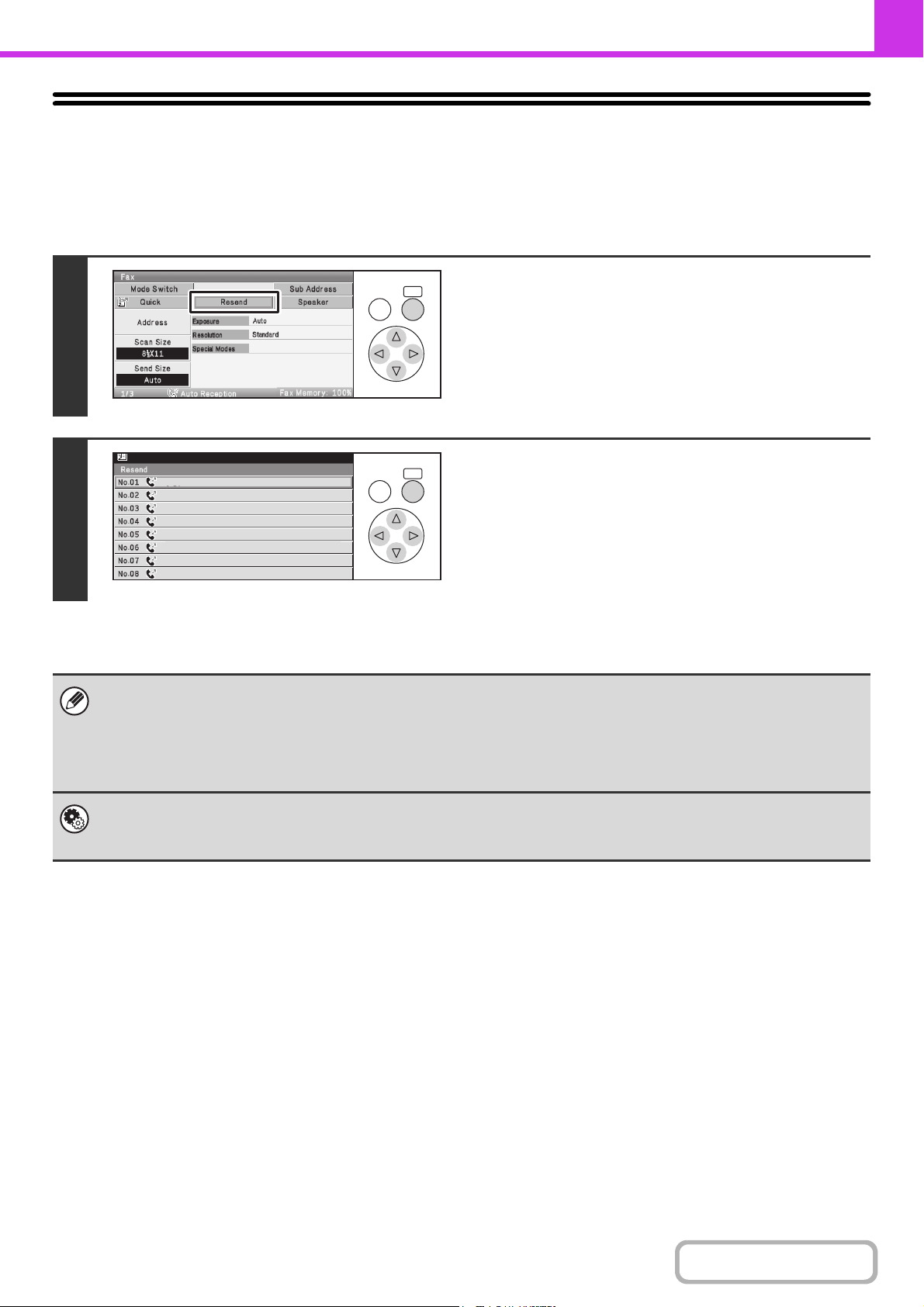
4-26
FACSIMILE
Contents
USING THE RESEND FUNCTION
The destinations of the most recent 8 transmissions by fax, Scan to E-mail, and/or Internet fax are stored. One of these
can be selected to resend to that destination.
Keys in the display can be selected with the arrow keys and the [OK] key.
1
Select the [Resend] key.
2
Select the key of the fax destination that
you wish to redial.
The last 8 transmission destinations appear.
• If numeric keys were pressed during the previous transmission, the [Resend] key may not dial the correct number.
• The fax addresses below are not stored as addresses for which resend is possible.
- A one-touch key in which multiple destinations are stored (group key)
- Broadcast destinations
- Destinations transmitted to using a program
System Settings (Administrator): Disable [Resend] on Fax/Image Send Mode (Web page only)
This prohibits use of the resend function. When this setting is enabled, the [Resend] key cannot be used in the base screen
of image send mode.
OKBACK
OKBACK
AAA AAA
BBB BBB
CCC CCC
DDD DDD
EEE EEE
FFF FFF
GGG GGG
HHH HHH
4-27
FACSIMILE
Contents
CHAIN DIALING
Number sequences entered with the numeric keys and/or one-touch keys can be linked together with pauses and dialed
as a single number.
Use chain dialing to dial a long number (such as an international number) when the country code and/or area code are
stored separately in one-touch keys.
Example: Using chain dialing to dial an international number
System Settings (Administrator): Pause Time Setting
This is used to set the length of pauses. The default setting is 2 seconds.
XXX 010
00 XX XXXX
XXX
010
Number to access
international telephone
service
Country
code
Area code
Number of other
party
Using a one-touch
key
Using the
numeric keys
CCC CCC
Pause
Number to be dialed
Entry
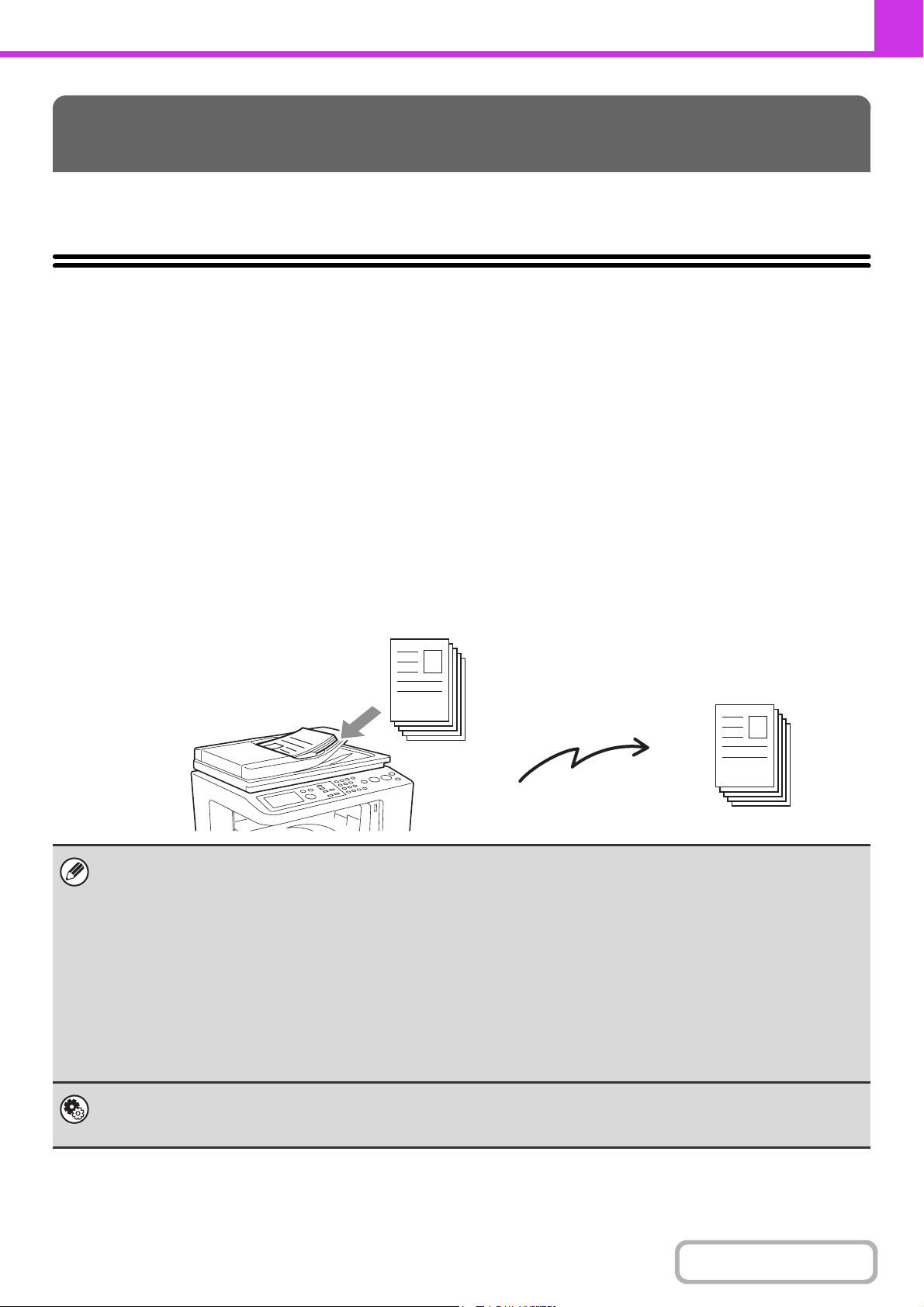
4-28
FACSIMILE
Contents
This section explains the basic procedures for sending a fax.
TRANSMISSION METHODS
The methods that can be used to send a fax from the machine are explained below. Select the method that best suits
your needs.
To fax a large number of sheet originals, use the automatic document feeder.
The originals will be scanned into memory and then transmitted (memory transmission).
When memory transmission is selected and multiple originals are placed in the automatic document feeder (and the line
is free), transmission will begin as soon as the first page is scanned and will take place while the remaining pages are
being scanned (Quick Online transmission).
If transmission cannot begin immediately because the line is in use, all pages will be scanned into memory and the
transmission will be reserved.
☞ USING THE AUTOMATIC DOCUMENT FEEDER FOR TRANSMISSION (page 4-32)
When a fax transmission or reception is already in progress, the following procedure can be performed to reserve a
transmission job. To check reserved transmission jobs, display the job status screen.
☞ CHECKING THE STATUS OF FAX JOBS (page 4-119)
BASIC TRANSMISSION METHODS
• If memory becomes full while the first original page is being scanned, transmission will stop.
• In the following situations, the transmission will be automatically reserved (memory transmission)
- When the line is busy or a communication error occurs and automatic resending is enabled.
☞ WHEN THE LINE IS BUSY (page 4-30), WHEN A COMMUNICATION ERROR OCCURS (page 4-30)
- The machine is already using the line to send or receive a fax.
- Another fax transmission was reserved ahead of your fax.
- One of the following functions is being used for transmission:
Broadcast transmission, F-code transmission, timer transmission, Card Shot, Job Build, Business Card Scan
- The document glass is being used (except when the speaker is being used to dial).
• Up to 94 transmission jobs can be reserved.
• When the transmission is finished, the scanned original pages are cleared from memory.
System Settings (Administrator): Quick On Line Sending
This is used to disable Quick Online transmission. In this case, fax transmissions will be sent by memory transmission
(reserved and then transmitted).
11
11
11
11
11
11
11
11
11
11
11
Transmission
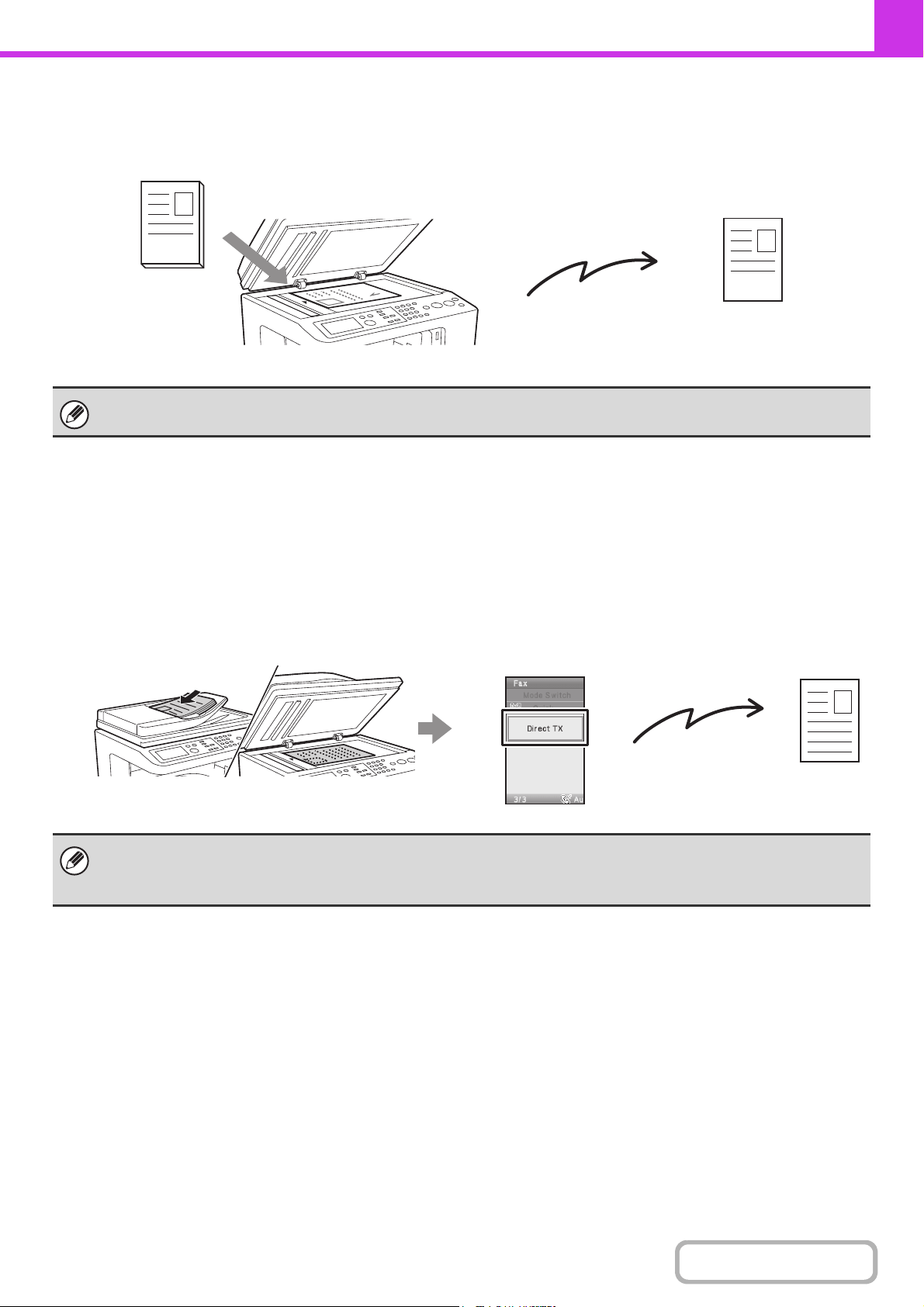
4-29
FACSIMILE
Contents
To fax thick originals or pages of a book, use the document glass.
☞ USING THE DOCUMENT GLASS FOR TRANSMISSION (page 4-35)
If you wish to send a fax ahead of other previously reserved fax
transmissions, use direct transmission mode.
The original is transmitted directly to the receiving fax machine without being scanned into memory.
When direct transmission mode is used, transmission will begin as soon as the transmission in progress is completed
(ahead of any previously reserved transmissions).
To send a fax by direct transmission, select the [Direct TX] key and press the [OK] key in the base screen.
☞
USING THE AUTOMATIC DOCUMENT FEEDER TO SEND A FAX IN DIRECT TRANSMISSION MODE (page 4-33)
☞ USING THE DOCUMENT GLASS TO SEND A FAX IN DIRECT TRANSMISSION MODE (page 4-37)
When the document glass is being used for a transmission, Quick Online transmission will not operate.
• When transmission in direct transmission mode ends, the mode automatically changes back to memory transmission
mode.
• When the document glass is used, multiple original pages cannot be scanned.
11
1
Transmission
Transmission
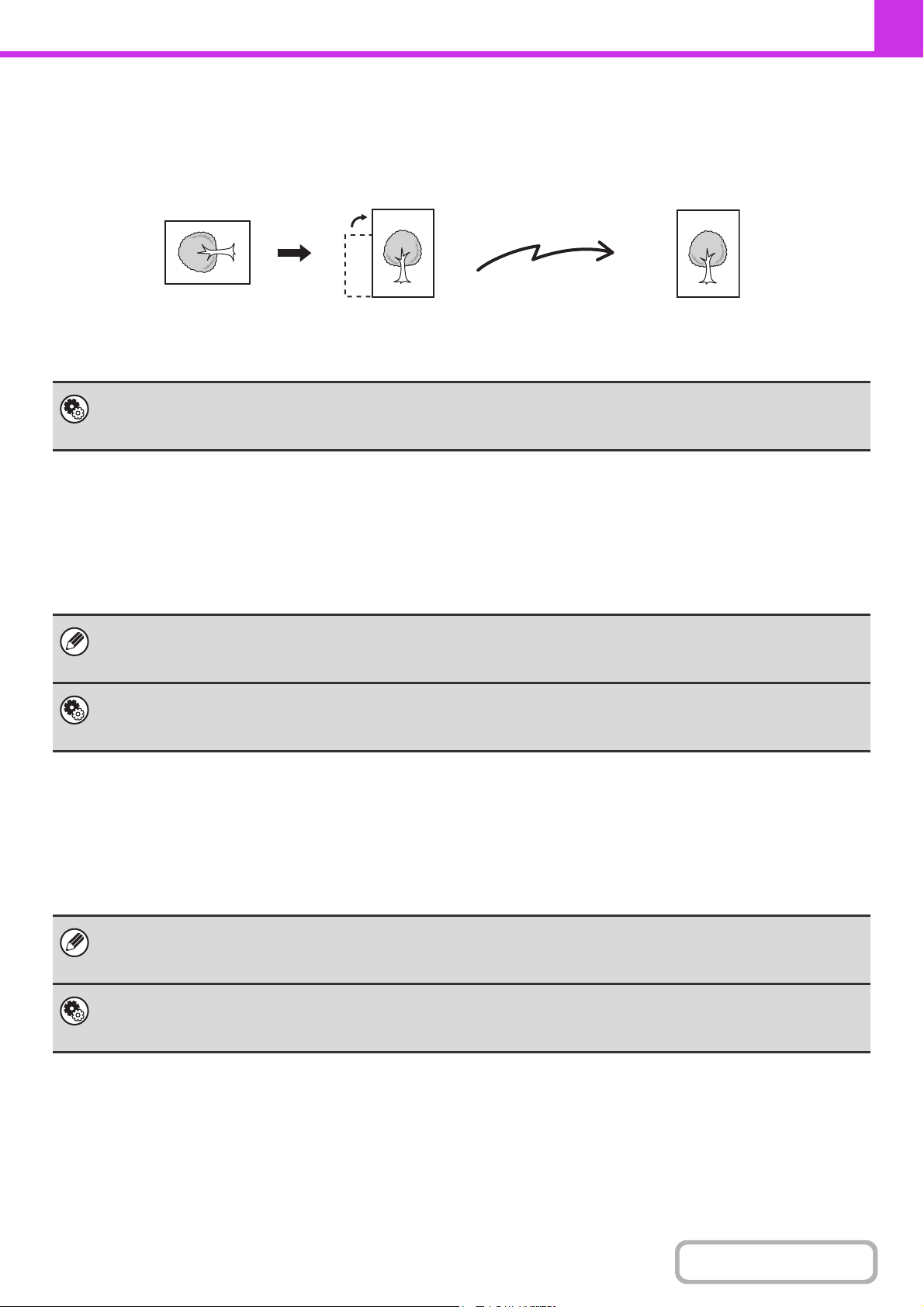
4-30
FACSIMILE
Contents
PLACEMENT ORIENTATION OF THE ORIGINAL
A 5-1/2" x 8-1/2" (A5) or B5 size original in landscape orientation will be rotated 90 degrees and transmitted as a
5-1/2" x 8-1/2" (A5) or B5 image in portrait orientation.
WHEN THE LINE IS BUSY
If the line is busy when you send a fax, transmission will be re-attempted automatically after a preset interval. This
function only operates in memory transmission mode. In direct transmission mode or manual transmission mode, the
transmission will be canceled. Wait briefly and then try sending the fax again.
WHEN A COMMUNICATION ERROR OCCURS
If a communication error occurs or the other fax machine does not answer the call within a preset period of time,
transmission will be re-attempted automatically after a preset interval. This function only operates in memory
transmission mode.
System Settings (Administrator): Rotation Sending Setting
The factory default setting is rotate before transmission. If this setting is disabled, the original will be transmitted in the
orientation in which it is placed.
To cancel transmission...
Cancel the transmission from the job status screen.
☞ CANCELING A FAX IN PROGRESS OR A RESERVED FAX (page 4-126)
System Settings (Administrator): Recall in Case of Line Busy
This is used to set the number of recall attempts and the interval between attempts when the connection cannot be
established because the line is busy. The factory default setting is 2 attempts at an interval of 3 minutes.
To cancel transmission...
Cancel the transmission from the job status screen.
☞ CANCELING A FAX IN PROGRESS OR A RESERVED FAX (page 4-126)
System Settings (Administrator): Recall in Case of Communication Error
This is used to set the number of recall attempts and the interval between attempts when a transmission fails due to an error.
The factory default setting is attempt at an interval of 3 minutes.
Transmission
5-1/2" x 8-1/2" (A5) image in
portrait orientation is transmitted.
Rotated to 5-1/2" x 8-1/2" (A5)
image in portrait orientation
5-1/2" x 8-1/2" (A5)
size original
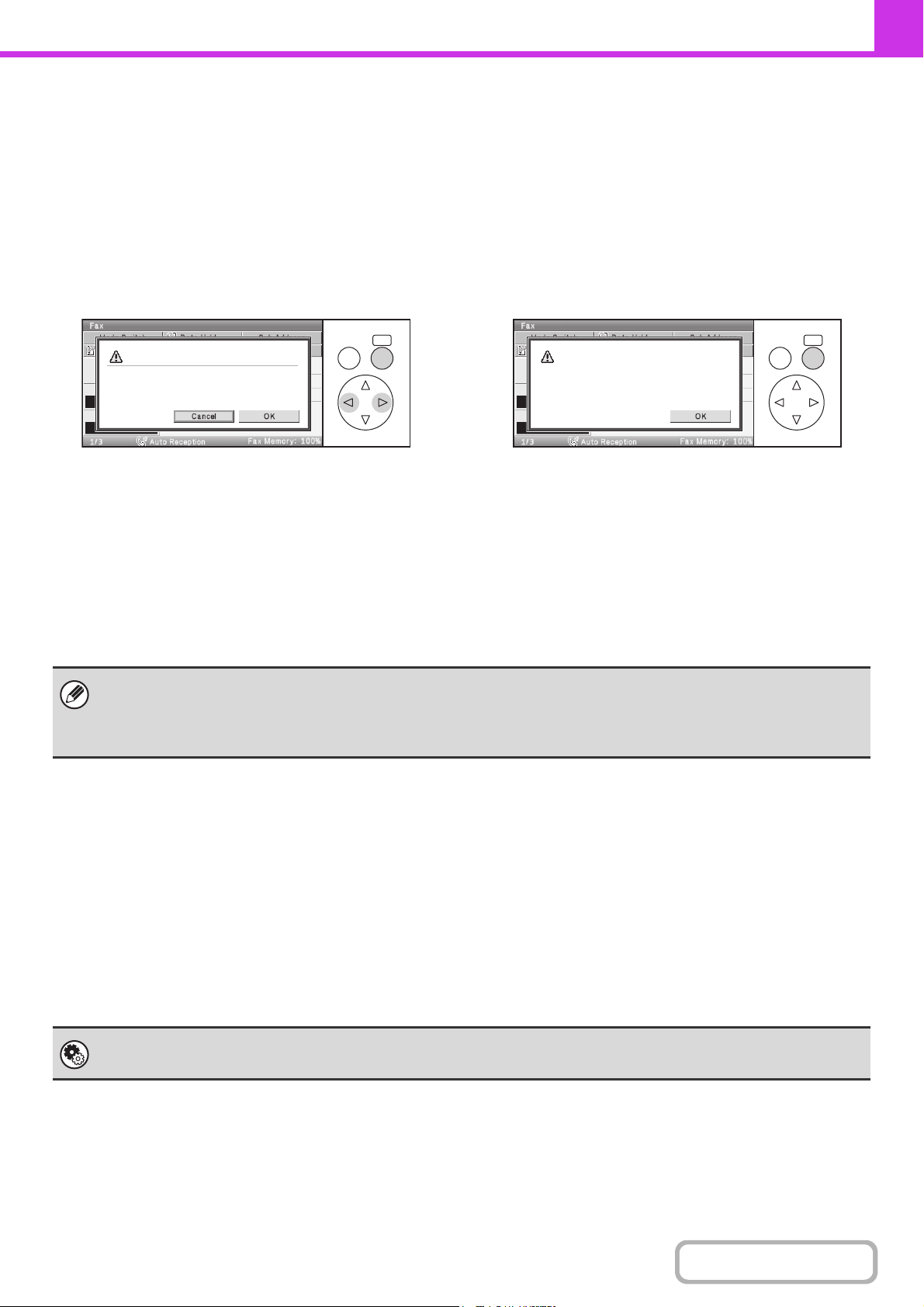
4-31
FACSIMILE
Contents
FAX DESTINATION CONFIRMATION MODE
The fax destination confirmation mode displays a destination confirmation message when a fax transmission is
performed to prevent accidental transmission to the wrong destination. This function is enabled in the system settings
(administrator). When the function is enabled, a message will appear to confirm the destination when the [BLACK &
WHITE START] key is pressed to begin fax transmission.
The message that appears will vary depending on the method used to specify the destination.
Destination specified by one-touch key/search
number
Make sure that the destination indicated in the message
is correct and select the [OK] key and press the [OK]
key. Scanning will begin.
If the destination is not correct, select the [Cancel] key
and select the destination again.
Destination specified by the numeric keys, [Resend]
key, or [Global Address Search] key
Select the [OK] key and press the [OK] key, re-enter the
destination with the numeric keys, and press the [BLACK
& WHITE START] key.
If the re-entered destination is correct, scanning will
begin.
If the re-entered destination is not correct, a message
will appear. Select the [OK] key and press the [OK] key,
and then re-enter the destination. If an incorrect number
is entered for confirmation 3 times in a row, the screen
will revert to the base screen.
Functions that cannot be used
When the fax destination confirmation function is enabled, only one destination is allowed, and thus the following
functions cannot be used.
• Broadcast transmission to multiple destinations including fax destinations
Group keys and program keys that contain multiple fax destinations cannot be used. After one destination is specified,
specification of a destination by search number is no longer possible, and keys such as another one-touch key, the
[Next Address] key, the [Address Entry] key, and the [Global Address Search] key cannot be selected.
• Transmission using the speaker key
A destination cannot be specified after the [Speaker] key is selected.
OKBACK
Number Confirmation
OKBACK
Enter the number again and
press the Start key.
• Even if a one-touch key or search number was used to specify the destination, if the [Sub Address] key is used to enter a
sub-address and passcode, the fax number must be re-entered during confirmation. After re-entering the fax number,
select the [Sub Address] key and press the [OK] key, and enter the sub-address and passcode.
• If chain dialing was used, select the [Pause] key and press the [OK] key to enter "-" during confirmation.
System Settings (Administrator): Fax Dest. Confirmation Mode
This setting is used to have a destination confirmation message appear when a fax is sent.
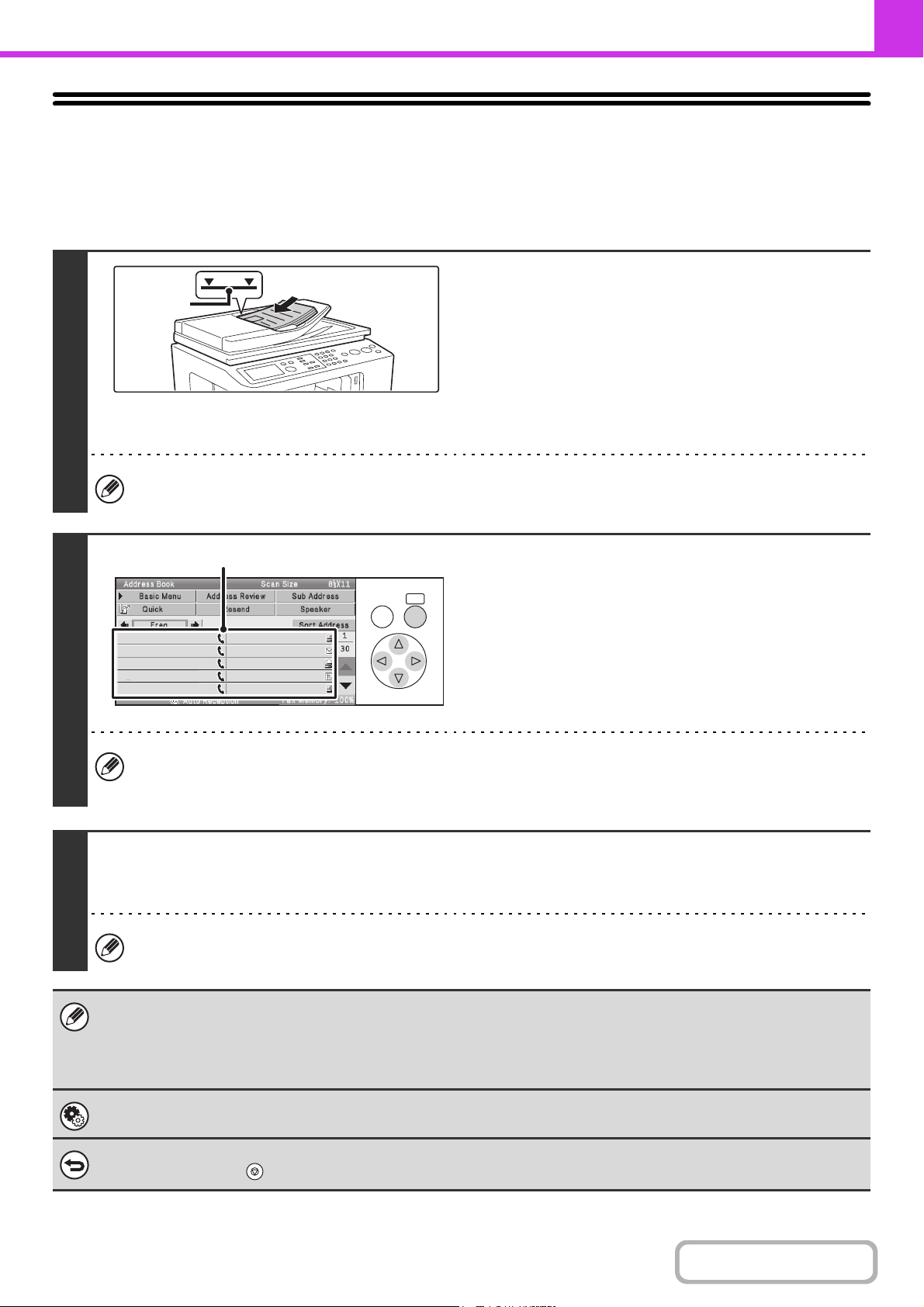
4-32
FACSIMILE
Contents
USING THE AUTOMATIC DOCUMENT
FEEDER FOR TRANSMISSION
This section explains how to use the automatic document feeder to send a fax.
Keys in the display can be selected with the arrow keys and the [OK] key.
1
Place the originals face up in the
document feeder tray with the edges
aligned evenly.
Insert the originals all the way into the document feeder tray.
Multiple originals can be placed in the document feeder tray.
The stack of originals must not be higher than the indicator line
on the tray.
When the original is a different size than the size setting, set
the original size.
☞
SPECIFYING THE SCAN SIZE AND SEND SIZE
(page
4-50
)
When sending a multi-page fax, the automatic document feeder and the document glass cannot both be used to scan
the original pages.
2
Enter the destination fax number.
(1) Select the [Address] key in the base screen.
For the [Address] key, see "BASE SCREEN OF FAX
MODE" (page 4-8).
(2) Select the one-touch key of the desired
destination.
In addition to specification by one-touch key, a destination can also be specified using a search number. You can also
directly enter a fax number with the numeric keys or look up a destination in a global address book. For more
information, see "ENTERING DESTINATIONS" (page 4-19).
3
Press the [BLACK & WHITE START] key.
Scanning begins.
When scanning is completed, the machine sounds a beep.
When scanning is completed, "Job stored." will be displayed together with a job control number. This number can be
used to locate the job in the Transaction Report or in the Image Sending Activity Report.
• If a fax is being received when the transmission operation is performed, the transmission will be reserved and transmitted
after fax reception is completed.
• If the memory becomes full while the originals are being scanned, a message will appear and scanning will stop. If Quick
Online transmission is taking place, the originals that were scanned will be transmitted. If Quick Online is not enabled, the
transmission will be canceled.
System Settings (Administrator): Scan Complete Sound Setting
The scan complete sound can be selected.
To cancel scanning...
Press the [STOP] key ( ) to cancel the operation.
Indicator
line
OKBACK
AAA AAA
BBB BBB
CCC CCC
DDD DDD
EEE EEE
FFF FFF
GGG GGG
HHH HHH
III III
JJJ JJJ
AAA AAA
BBB BBB
CCC CCC
DDD DDD
EEE EEE
FFF FFF
GGG GGG
HHH HHH
III III
JJJ JJJ
(2)
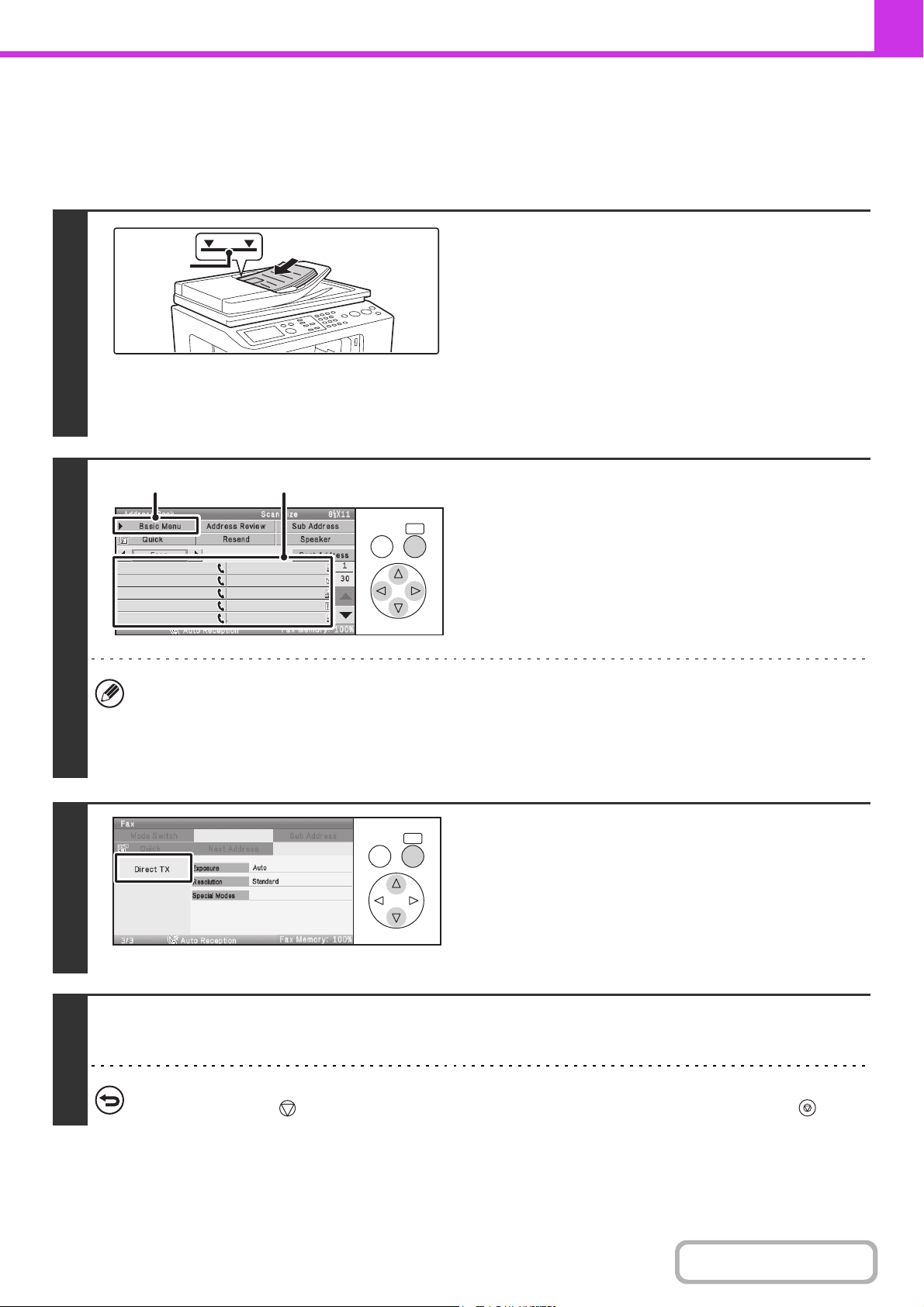
4-33
FACSIMILE
Contents
USING THE AUTOMATIC DOCUMENT FEEDER TO
SEND A FAX IN DIRECT TRANSMISSION MODE
Keys in the display can be selected with the arrow keys and the [OK] key.
1
Place the originals face up in the
document feeder tray with the edges
aligned evenly.
Insert the originals all the way into the document feeder tray.
Multiple originals can be placed in the document feeder tray.
The stack of originals must not be higher than the indicator line
on the tray.
When the original is a different size than the size setting, set
the original size.
☞
SPECIFYING THE SCAN SIZE AND SEND SIZE
(page
4-50
)
2
Enter the destination fax number.
(1) Select the [Address] key in the base screen.
For the [Address] key, see "BASE SCREEN OF FAX
MODE" (page 4-8).
(2) Select the one-touch key of the desired
destination.
(3) Select the [Condition Settings] key.
• Only one destination can be entered. A one-touch key in which multiple destinations are stored (group key) cannot
be used.
• In addition to specification by one-touch key, a destination can also be specified using a search number. You can
also directly enter a fax number with the numeric keys or look up a destination in a global address book. For more
information, see "ENTERING DESTINATIONS" (page 4-19).
3
Select the [Direct TX] key.
4
Press the [BLACK & WHITE START] key.
Transmission begins.
To cancel transmission...
While "Dialing. Press [ ] to cancel." appears or while the fax is being transmitted, press the [STOP] key ( ).
Indicator
line
OKBACK
AAA AAA
BBB BBB
CCC CCC
DDD DDD
EEE EEE
FFF FFF
GGG GGG
HHH HHH
III III
JJJ JJJ
AAA AAA
BBB BBB
CCC CCC
DDD DDD
EEE EEE
FFF FFF
GGG GGG
HHH HHH
III III
JJJ JJJ
(3) (2)
OKBACK
4-34
FACSIMILE
Contents
• The following functions cannot be used with direct transmission:
Program, Timer Transmission, Card Shot, Job Build, Polling Memory, Memory Box, 2-Sided Original Scanning, Global
Address Search
• Resending will not take place when a direct transmission is not successful due to a communication error or other reason.
• If a fax transmission is already in progress when the direct transmission operation is performed, the direct transmission will
wait until the previous transmission is finished. When the previous transmission is completed, the direct transmission will
begin. While the direct transmission is waiting, the [JOB STATUS] key can be pressed to display the job status screen. No
other operations are possible.
☞CHECKING THE STATUS OF FAX JOBS (page 4-119)
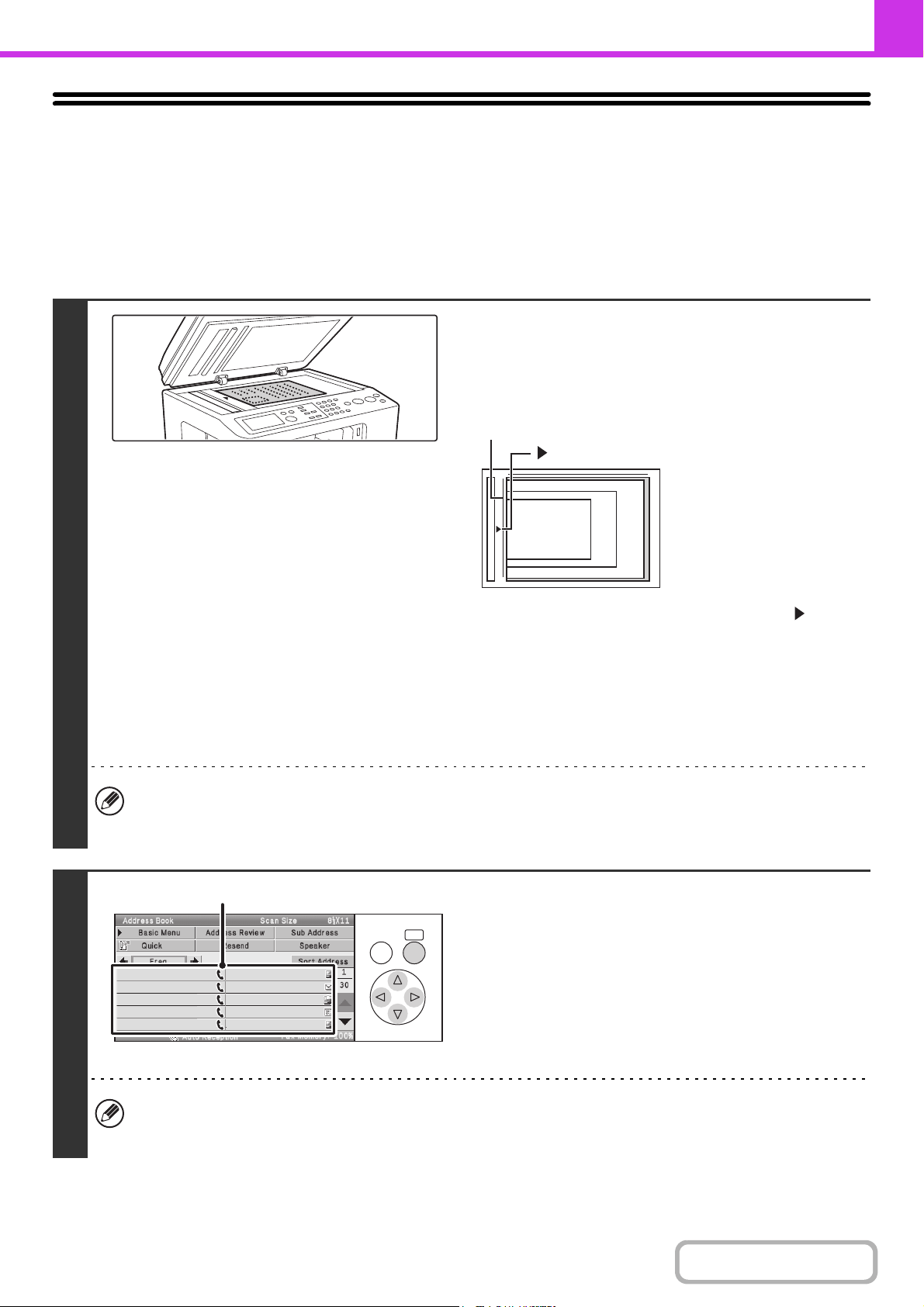
4-35
FACSIMILE
Contents
USING THE DOCUMENT GLASS FOR
TRANSMISSION
To fax a thick original or other original that cannot be fed through the automatic document feeder, open the automatic
document feeder and place the original on the document glass.
Keys in the display can be selected with the arrow keys and the [OK] key.
1
Open the automatic document feeder,
place the original face down on the
document glass, and then gently close
the automatic document feeder.
• Align the middle of the original with the tip of the mark at
the middle of the scale on the left side of the document glass.
• Place the original in the appropriate position for its size as
shown above.
• When the original is a different size than the size setting, set
the original size.
☞ SPECIFYING THE SCAN SIZE AND SEND SIZE (page
4-50)
• When faxing a multi-page original, scan each page in order starting from the first page.
• When sending a multi-page fax, the automatic document feeder and the document glass cannot both be used to
scan the original pages.
2
Enter the destination fax number.
(1) Select the [Address] key in the base screen.
For the [Address] key, see "BASE SCREEN OF FAX
MODE" (page 4-8).
(2) Select the one-touch key of the desired
destination.
In addition to specification by one-touch key, a destination can also be specified using a search number. You can also
directly enter a fax number with the numeric keys or look up a destination in a global address book. For more
information, see "ENTERING DESTINATIONS" (page 4-19).
5-1/2" x 8-1/2"
(A5)
8-1/2" x 11" (A4)
B5
mark
Document glass scale
OKBACK
AAA AAA
BBB BBB
CCC CCC
DDD DDD
EEE EEE
FFF FFF
GGG GGG
HHH HHH
III III
JJJ JJJ
AAA AAA
BBB BBB
CCC CCC
DDD DDD
EEE EEE
FFF FFF
GGG GGG
HHH HHH
III III
JJJ JJJ
(2)
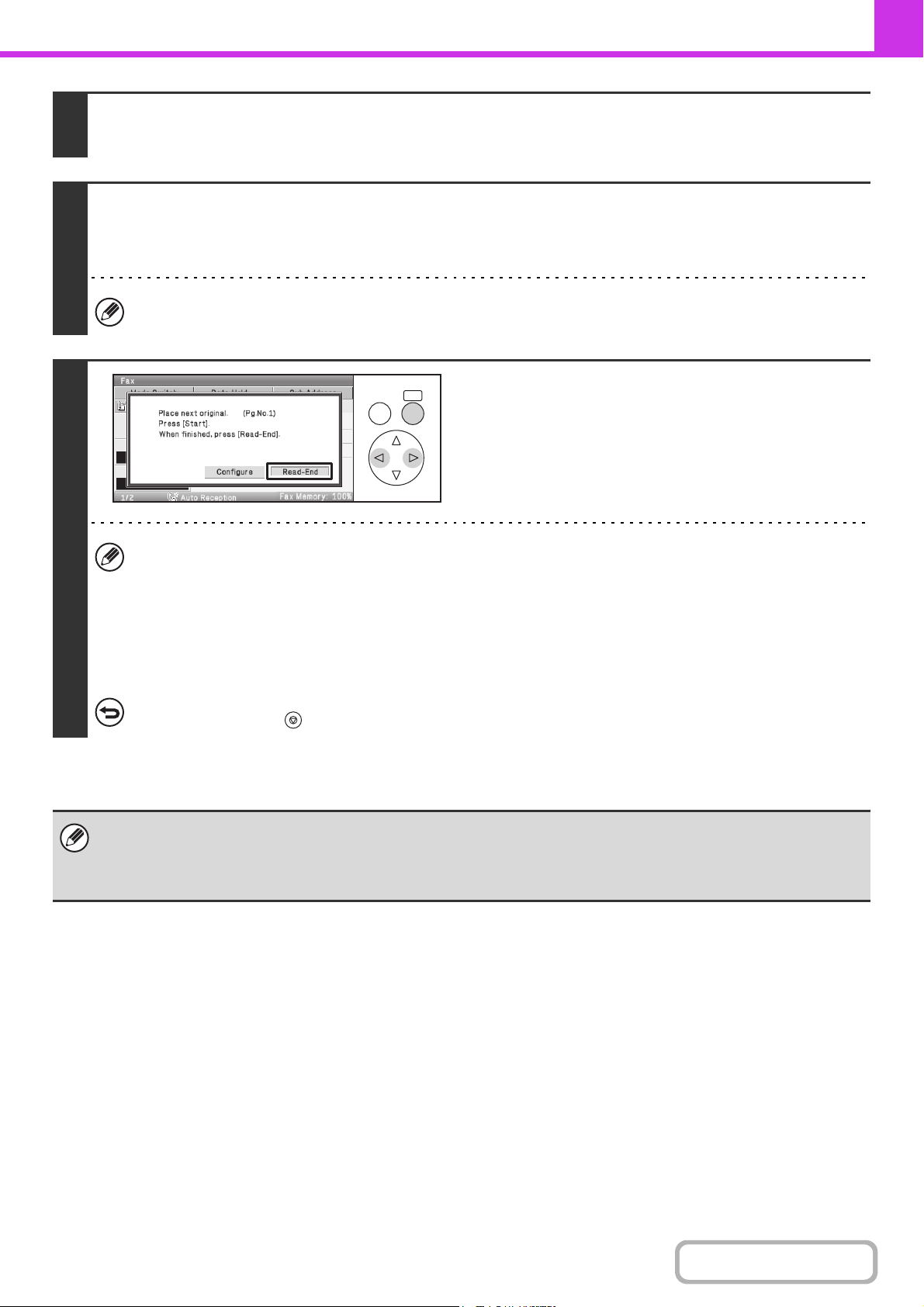
4-36
FACSIMILE
Contents
3
Press the [BLACK & WHITE START] key.
Scanning begins.
4
If you have another page to scan, change pages and then press the [BLACK &
WHITE START] key.
Repeat until all originals have been scanned.
If no action is taken for one minute, scanning automatically ends and the transmission is reserved.
5
Select the [Read-End] key.
A beep sounds.
Open the automatic document feeder and remove the original.
• When scanning is completed, "Job stored." will be displayed together with a job control number.
This number can be used to locate the job in the Transaction Report or in the Image Sending Activity Report.
• If no action is taken for one minute after the confirmation screen appears, scanning automatically ends and the
transmission is reserved.
• To change the exposure, resolution, scan size, and send size for each original page scanned, select the [Configure]
key and press the [OK] key. However, when "Card Shot" is selected in the special modes, only the exposure can be
changed, and this can only be done when scanning each even page number of the original pages.
To cancel transmission...
Press the [STOP] key ( ) before selecting the [Read-End] key and pressing the [OK] key.
• If a fax is being received when the transmission operation is performed, the transmission will be reserved and transmission
will take place after fax reception is completed.
• If the memory becomes full while the originals are being scanned, a message will appear and transmission will be
canceled.
OKBACK
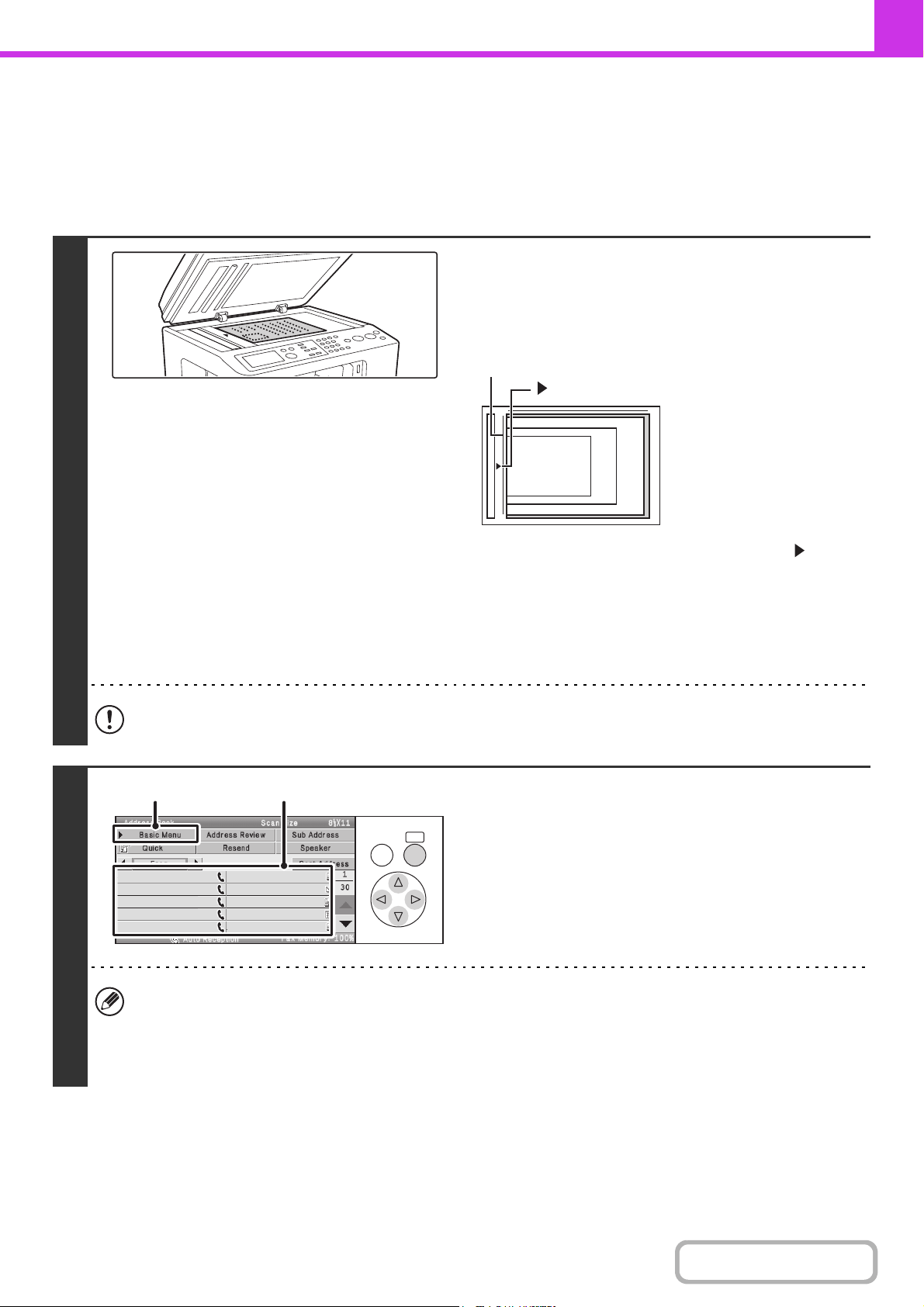
4-37
FACSIMILE
Contents
USING THE DOCUMENT GLASS TO SEND A FAX IN
DIRECT TRANSMISSION MODE
When sending a fax from the document glass in direct transmission mode, only one page can be transmitted.
Keys in the display can be selected with the arrow keys and the [OK] key.
1
Open the automatic document feeder,
place the original face down on the
document glass, and then gently close
the automatic document feeder.
• Align the middle of the original with the tip of the mark at
the middle of the scale on the left side of the document glass.
• Place the original in the appropriate position for its size as
shown above.
• When the original is a different size than the size setting, set
the original size.
☞
SPECIFYING THE SCAN SIZE AND SEND SIZE
(page
4-50
)
Do not place any objects under the original size detector. Closing the automatic document feeder with an object
underneath may damage the original size detector plate and prevent correct detection of the document size.
2
Enter the destination fax number.
(1) Select the [Address] key in the base screen.
For the [Address] key, see "BASE SCREEN OF FAX
MODE" (page 4-8).
(2) Select the one-touch key of the desired
destination.
(3) Select the [Basic Menu] key.
• Only one destination can be entered. A one-touch key in which multiple destinations are stored (group key) cannot
be used.
• In addition to specification by one-touch key, a destination can also be specified using a search number. You can
also directly enter a fax number with the numeric keys or look up a destination in a global address book. For more
information, see "ENTERING DESTINATIONS" (page 4-19).
5-1/2" x 8-1/2"
(A5)
8-1/2" x 11" (A4)
B5
mark
Document glass scale
OKBACK
AAA AAA
BBB BBB
CCC CCC
DDD DDD
EEE EEE
FFF FFF
GGG GGG
HHH HHH
III III
JJJ JJJ
AAA AAA
BBB BBB
CCC CCC
DDD DDD
EEE EEE
FFF FFF
GGG GGG
HHH HHH
III III
JJJ JJJ
(3) (2)
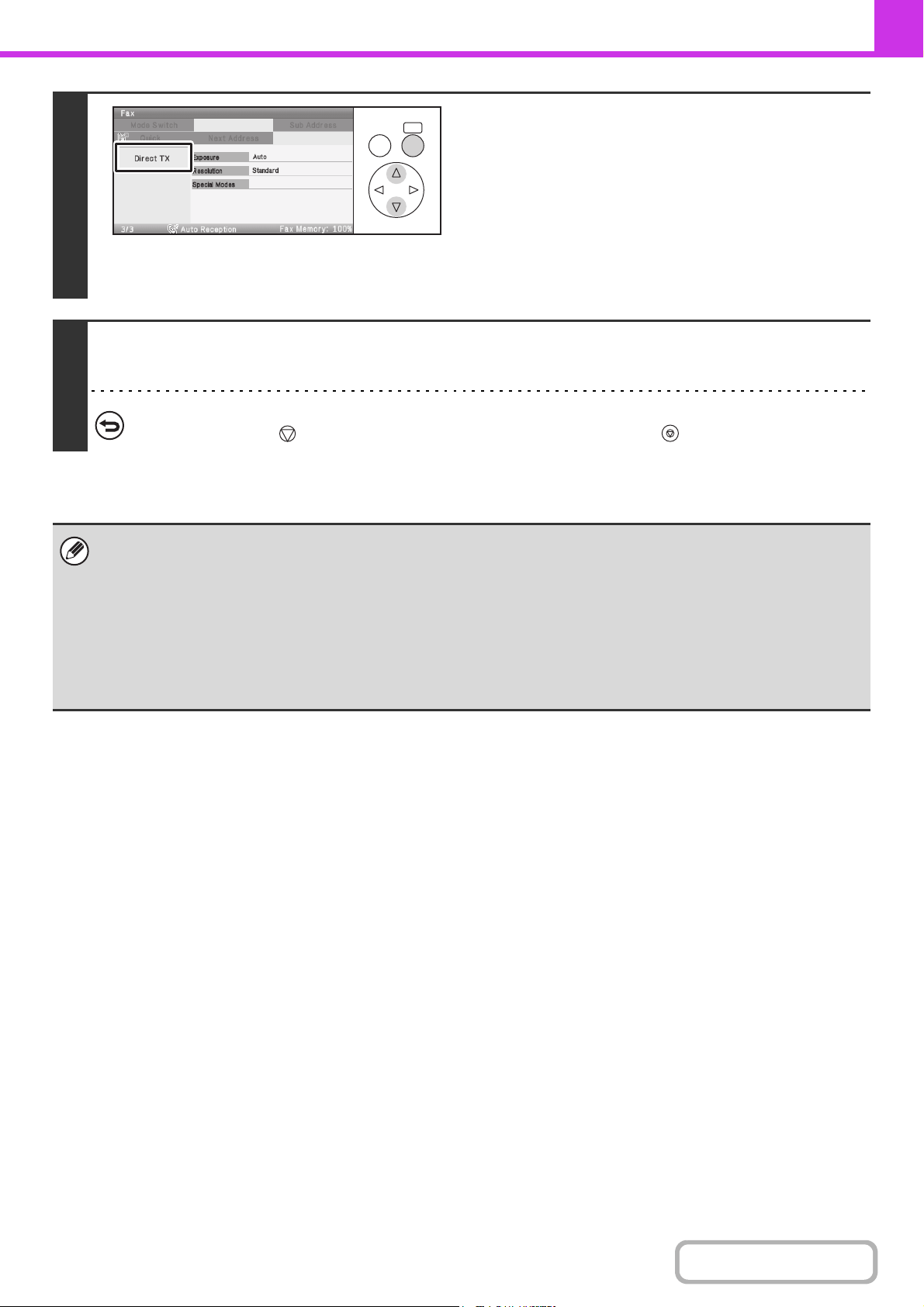
4-38
FACSIMILE
Contents
3
Select the [Direct TX] key.
4
Press the [BLACK & WHITE START] key.
Transmission begins.
To cancel transmission...
While "Dialing. Press [ ] to cancel." appears in the display, press the [STOP] key ( ).
• The following functions cannot be used with direct transmission:
Program, Timer Transmission, Card Shot, Job Build, Polling Memory, Memory Box, 2-Sided Original Scanning, Global
Address Search
• Resending will not take place when a direct transmission is not successful due to a communication error or other reason.
• If a fax transmission is already in progress when the direct transmission operation is performed, the direct transmission will
wait until the previous transmission is finished. When the previous transmission is completed, the direct transmission will
begin. While the direct transmission is waiting, the [JOB STATUS] key can be pressed to display the job status screen. No
other operations are possible.
☞CHECKING THE STATUS OF FAX JOBS (page 4-119)
OKBACK
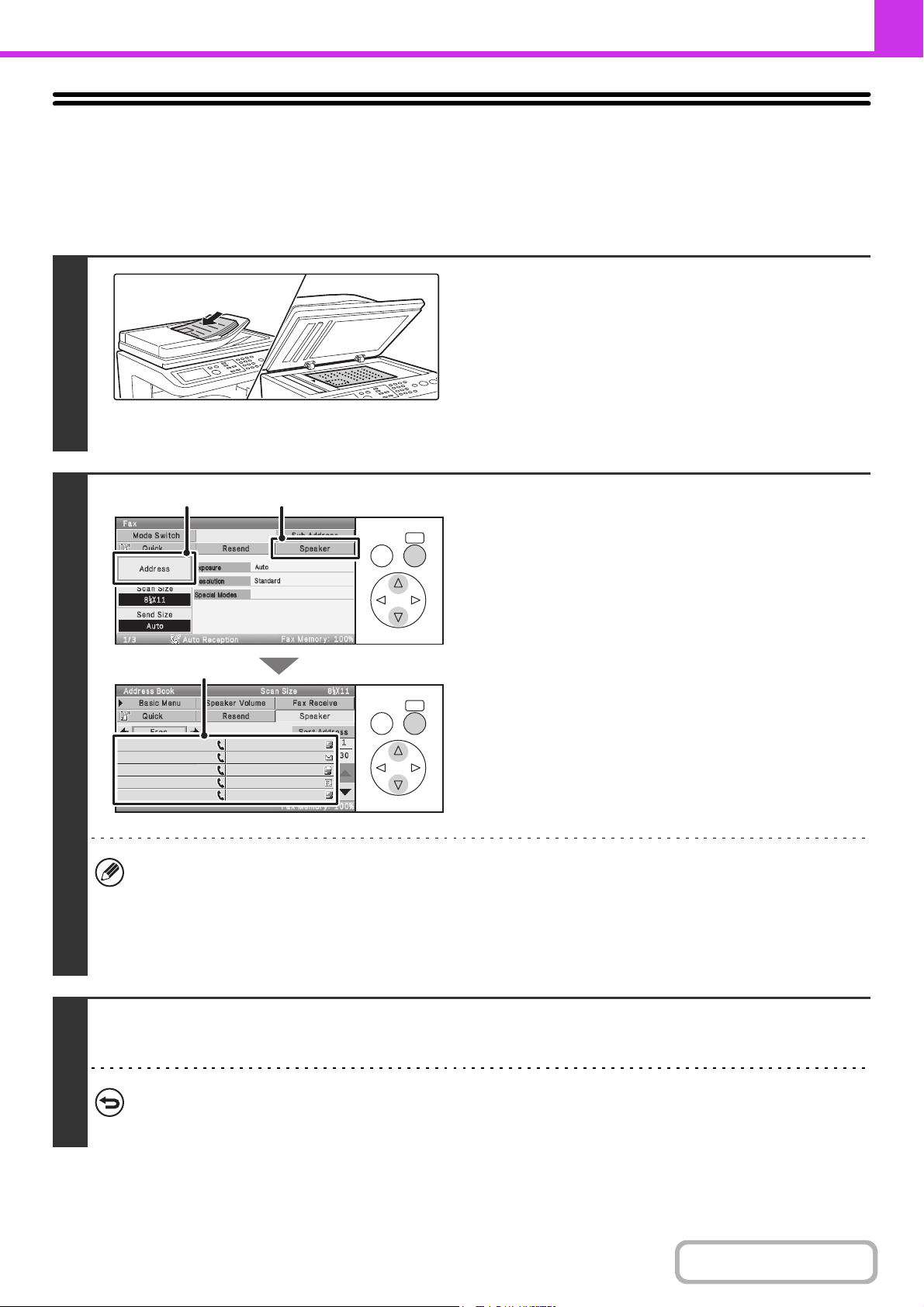
4-39
FACSIMILE
Contents
TRANSMISSION USING THE SPEAKER
When the speaker is used to dial, the fax is sent after the number is dialed and the connection is established. If a person
answers, you will be able to hear his or her voice, but you will not be able to speak.
Keys in the display can be selected with the arrow keys and the [OK] key.
1
Place the original.
Place the original face up in the document feeder tray, or face
down on the document glass.
When the document glass is used, only one page can be
transmitted.
When the original is a different size than the size setting, set
the original size.
☞ SPECIFYING THE SCAN SIZE AND SEND SIZE (page
4-50)
2
Enter the destination fax number.
(1) Select the [Speaker] key.
You will hear the dial tone through the machine's speaker.
(2) Select the [Address] key in the base screen.
(3) Select the one-touch key of the desired
destination.
A group key cannot be used.
• In addition to specification by one-touch key, a destination can also be specified using a search number. You can
also directly enter a fax number with the numeric keys or look up a destination in a global address book. For more
information, see "ENTERING DESTINATIONS" (page 4-19).
• After selecting the [Speaker] key and pressing the [OK] key, you can select the [Speaker Volume] key and press the
[OK] key to adjust the volume of the speaker. The speaker volume changes each time the [OK] key is pressed with
the [Speaker Volume] key selected. Adjust the volume to the desired level.
3
Wait until the connection is made and then press the [BLACK & WHITE START] key.
Transmission begins.
To cancel transmission...
Select the [Speaker] key and press the [OK] key before the [BLACK & WHITE START] key is pressed. The line will be
disconnected and transmission will stop.
OKBACK
OKBACK
AAA AAA
BBB BBB
CCC CCC
DDD DDD
EEE EEE
FFF FFF
GGG GGG
HHH HHH
III III
JJJ JJJ
(2)
(3)
(1)
4-40
FACSIMILE
Contents
• When the speaker is used, transmission takes place without scanning the original into memory.
• A destination that includes an F-code (sub-address and passcode) cannot be used.
• A one-touch key that has multiple destinations or has a non-fax destination cannot be used.
System Settings (Administrator): Speaker Settings
The default volume level of the speaker can be changed in the "Speaker Settings".
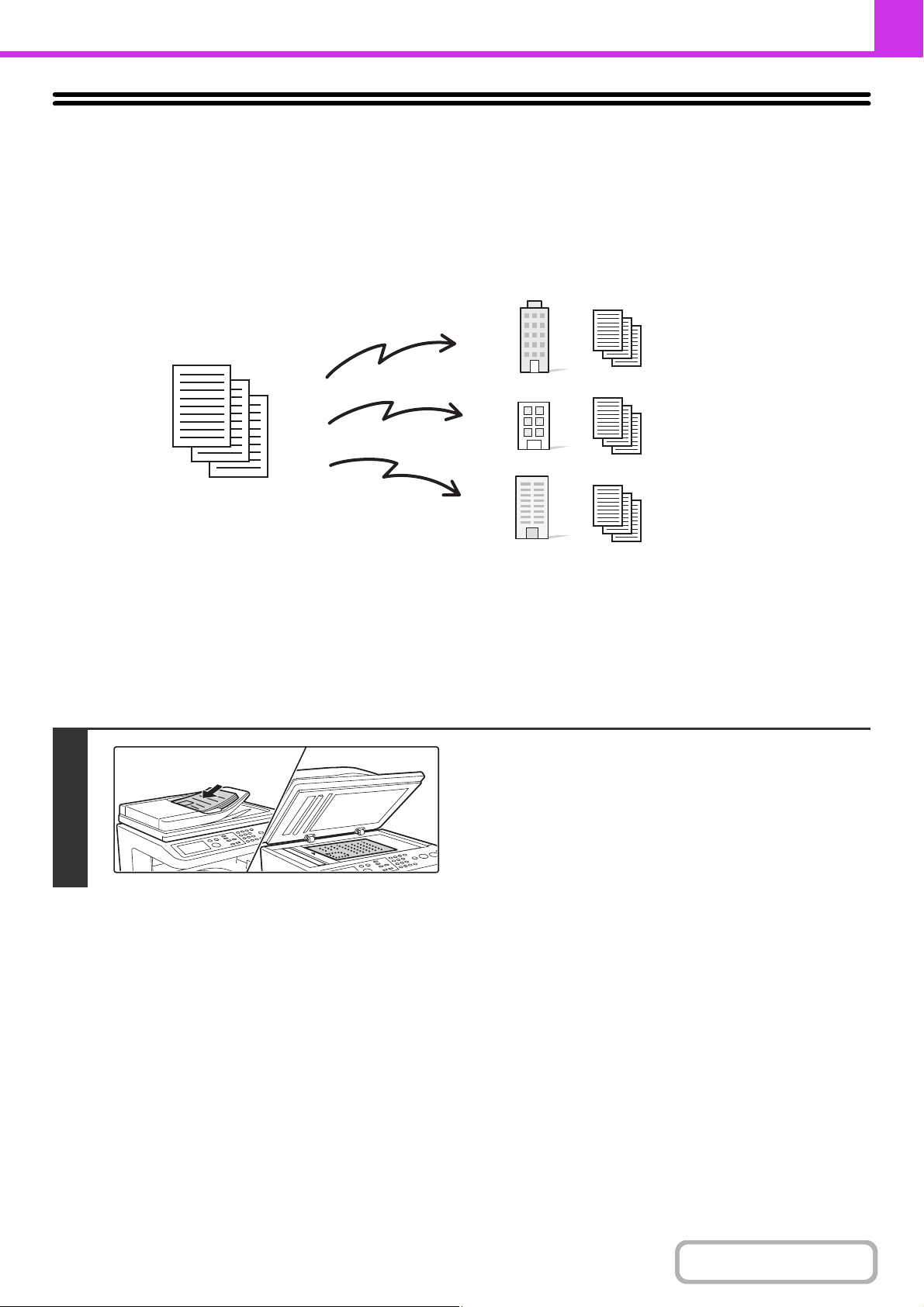
4-41
FACSIMILE
Contents
SENDING THE SAME FAX TO MULTIPLE
DESTINATIONS (Broadcast Transmission)
This function is convenient when you need to send the same fax to multiple destinations, such as sending a report to
branch offices in different regions. You can transmit to as many as 500 destinations in one broadcast operation.
It is convenient to store destinations to which you frequently send faxes by broadcast transmission in group keys. Group
dialing allows you to retrieve multiple fax numbers stored in a one-touch key by simply selecting the one-touch key. To
store group keys, see "ADDRESS BOOK" (page 4-13).
When a group key is used to dial, the number of fax numbers that are dialed is the number of destinations that are
stored in the group key. When a group key that has 10 destinations is used, 10 fax numbers are dialed.
Keys in the display can be selected with the arrow keys and the [OK] key.
1
Place the original.
Place the original face up in the document feeder tray, or face
down on the document glass.
When the original is a different size than the size setting, set
the original size.
☞ SPECIFYING THE SCAN SIZE AND SEND SIZE (page
4-50)
Originals
Transmission
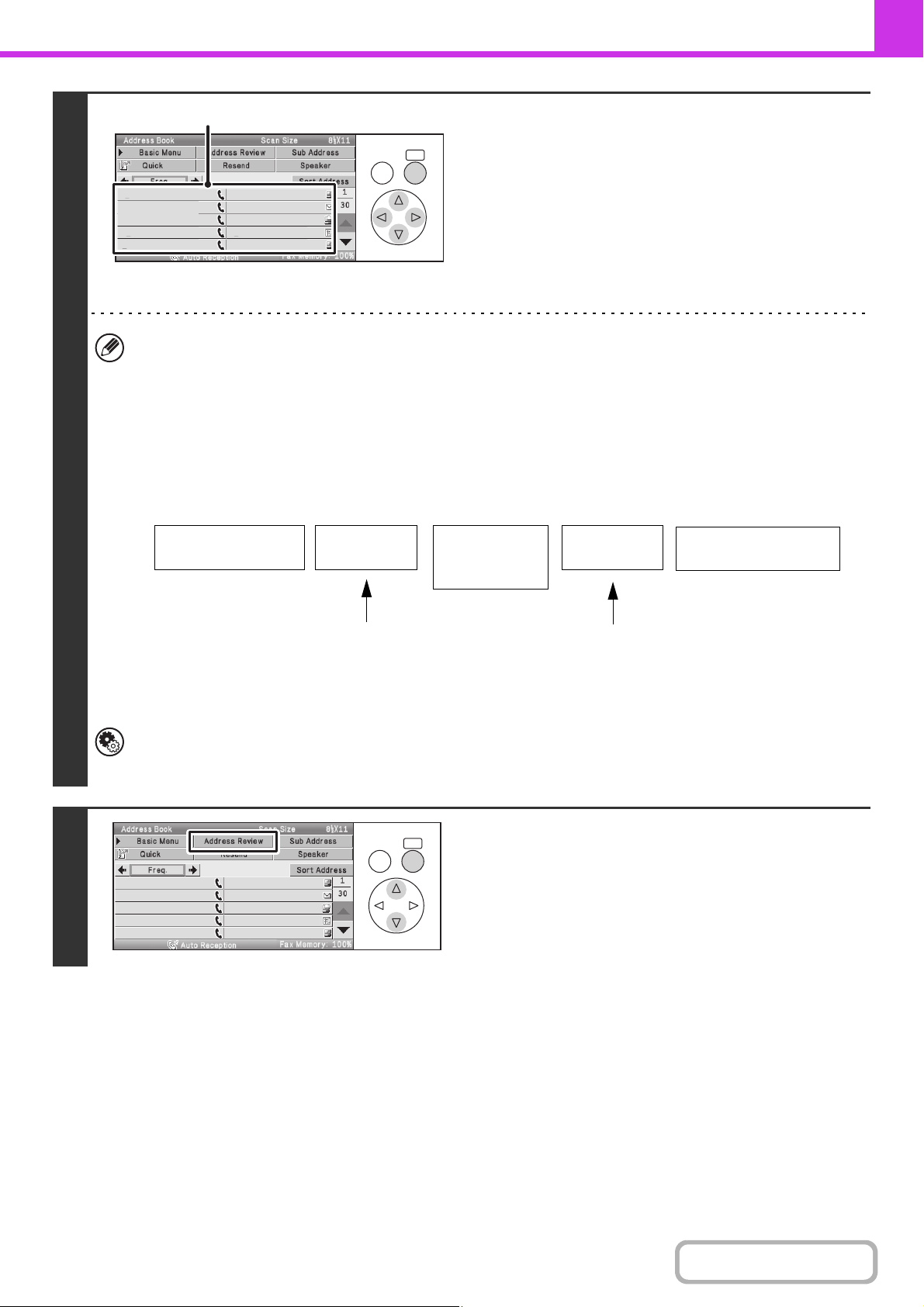
4-42
FACSIMILE
Contents
2
Enter the destination fax number.
(1) Select the [Address] key in the base screen.
For the [Address] key, see "BASE SCREEN OF FAX
MODE" (page 4-8).
(2) Select the one-touch key of the desired
destination.
(3) Repeat step (2) until all destinations are
selected.
• In addition to specification by one-touch key, a destination can also be specified using a search number. You can
also directly enter a fax number with the numeric keys or look up a destination in a global address book. For more
information, see "ENTERING DESTINATIONS" (page 4-19).
• It is convenient to use a group key to enter the destinations.
• After entering a destination with the numeric keys, if you wish to enter another destination with the numeric keys,
select the [Next Address] key before entering the next destination. The [Next Address] key can be omitted before or
after a destination entered using a one-touch key. However, if "Must Input Next Address Key at Broadcast Setting"
is enabled in the system settings (administrator), the [Next Address] key must be selected before entering the next
destination.
System Settings (Administrator): Must Input Next Address Key at Broadcast Setting
This setting is used to prohibit omission of the [Next Address] key when entering destinations for broadcast
transmissions.
3
Select the [Address Review] key.
OKBACK
AAA AAA
BBB BBB
CCC CCC
DDD DDD
EEE EEE
FFF FFF
GGG GGG
HHH HHH
III III
JJJ JJJ
(2)
Fax number entered
with the numeric keys
Fax number
entered with the
numeric keys
Destination entered with
a one-touch key
[Next Address]
key
[Next Address]
key
Cannot be omitted
Can be omitted*
* Cannot be omitted if "Must Input Next
Address Key at Broadcast Setting" is enabled
in the system settings (administrator).
OKBACK
AAA AAA
BBB BBB
CCC CCC
DDD DDD
EEE EEE
FFF FFF
GGG GGG
HHH HHH
III III
JJJ JJJ
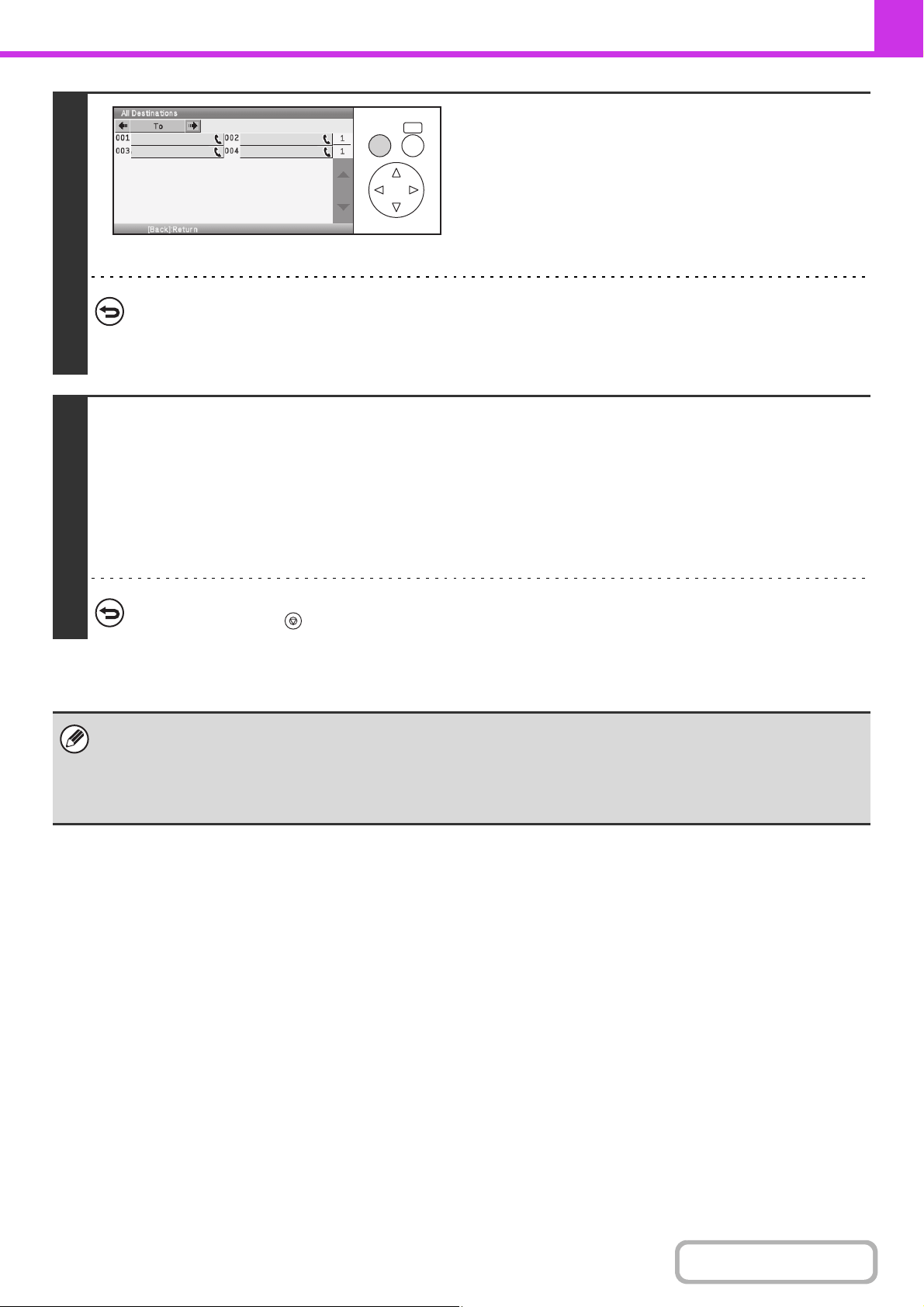
4-43
FACSIMILE
Contents
4
Check the destinations and then press
the [BACK] key.
To cancel a specified destination...
Select the key of the destination that you wish to cancel. A message will appear to confirm the deletion. Select the
[Yes] key.
☞ CHECKING AND DELETING ENTERED DESTINATIONS (page 4-22)
5
Press the [BLACK & WHITE START] key.
Scanning begins.
• If you inserted the original pages in the document feeder tray, all pages are scanned.
A beep will sound to indicate that scanning is finished.
• If you are scanning the original on the document glass, scan each page one page at a time.
When scanning finishes, place the next original and press the [BLACK & WHITE START] key. Repeat until all pages have
been scanned and then select the [Read-End] key.
A beep will sound to indicate that scanning is finished.
To cancel scanning...
Press the [STOP] key ( ).
• A broadcast transmission takes place by memory transmission only.
• A broadcast transmission can be used in combination with the timer transmission function to transmit at night or any other
desired time. A broadcast transmission can also be used in combination with other convenient functions.
• The broadcast transmission can include Scan to E-mail and Internet fax destinations. In this case, the image sent to the
Scan to E-mail and Internet fax destinations will be black and white.
OKBACK
AAA BBB
AAA DDD
AAA AAA
AAA CCC
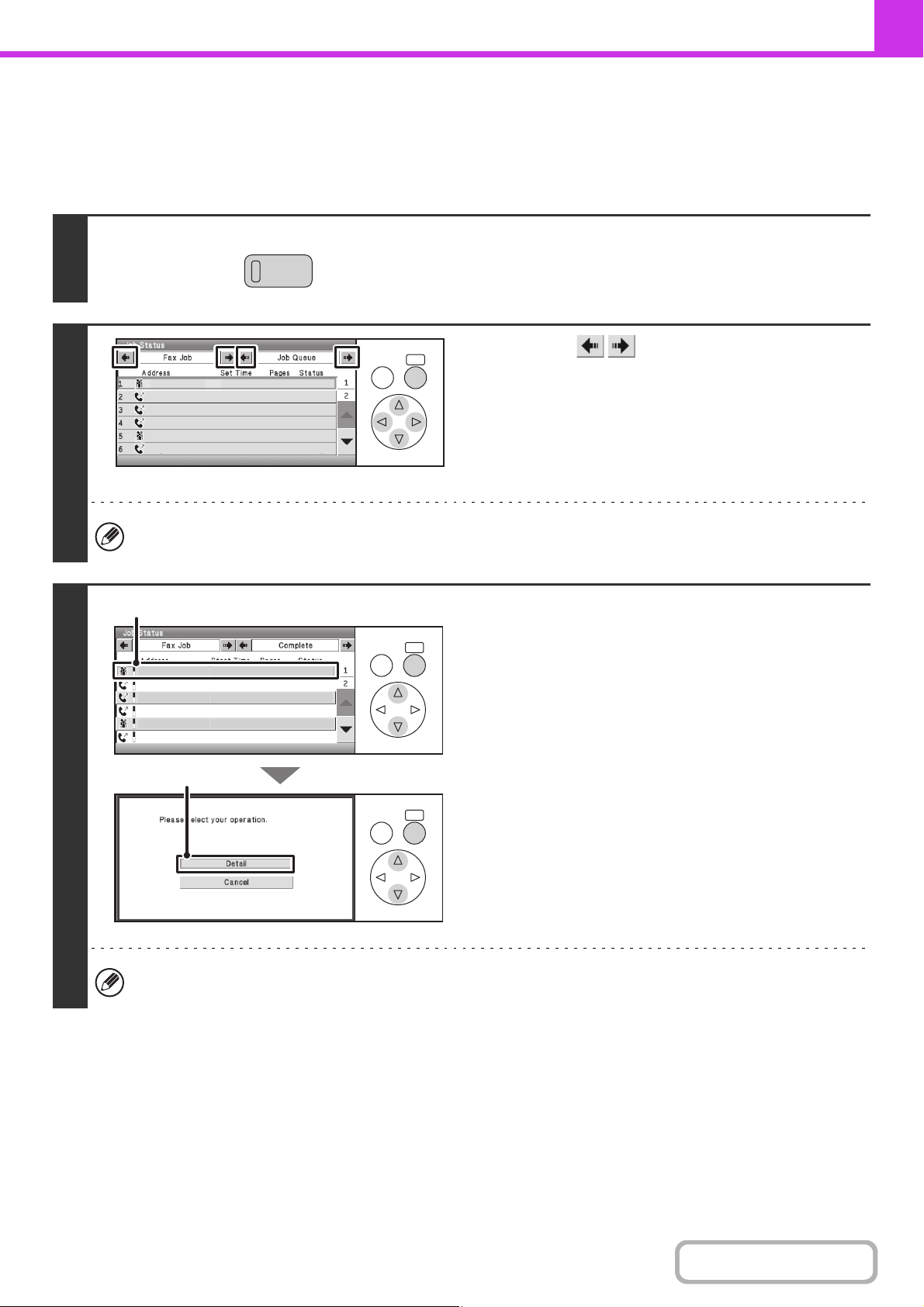
4-44
FACSIMILE
Contents
Resending to unsuccessful broadcast transmission destinations
The results of a completed broadcast transmission can be checked in the job status screen. If transmission to any of the
destinations failed, resend the fax to those destinations.
Keys in the display can be selected with the arrow keys and the [OK] key.
1
Press the [JOB STATUS] key.
2
Select the keys and press the
[OK] key to select the [Complete] key.
If the job status screen of fax mode does not appear, select the
[Fax Job].
If the broadcast transmission included destinations of different modes, the same broadcast transmission key will
appear in each of those modes.
3
Display details on the broadcast
transmission.
(1) Select the completed broadcast
transmission.
(2) Select the [Detail] key.
"Broadcastxxxx" will appear as the destination of the broadcast job key. The job control number that appeared in the
display when scanning ended appears in "xxxx".
JOB STATU
S
OKBACK
0123456789
AAA AAA
BBB BBB
Broadcast
CCC CCC
Broadcast0001
10:05 04/01 000/004 Waiting
10:22 04/01 000/004 Waiting
10:30 04/01 000/010 Waiting
10:33 04/01 000/010 Waiting
10:40 04/01 000/010 Waiting
10:00 04/01 020/003 Connecting
OKBACK
OKBACK
Broadcast0001
CCC CCC
0123456789
DDD DDD
Broadcast0002
EEE EEE
10:05 04/01 001/001 NG000000
10:22 04/01 004/004 Send OK
10:30 04/01 010/010 NG000000
10:33 04/01 010/010 Send OK
10:40 04/01 010/003 NG000000
10:33 04/01 010/010 Send OK
(1)
(2)
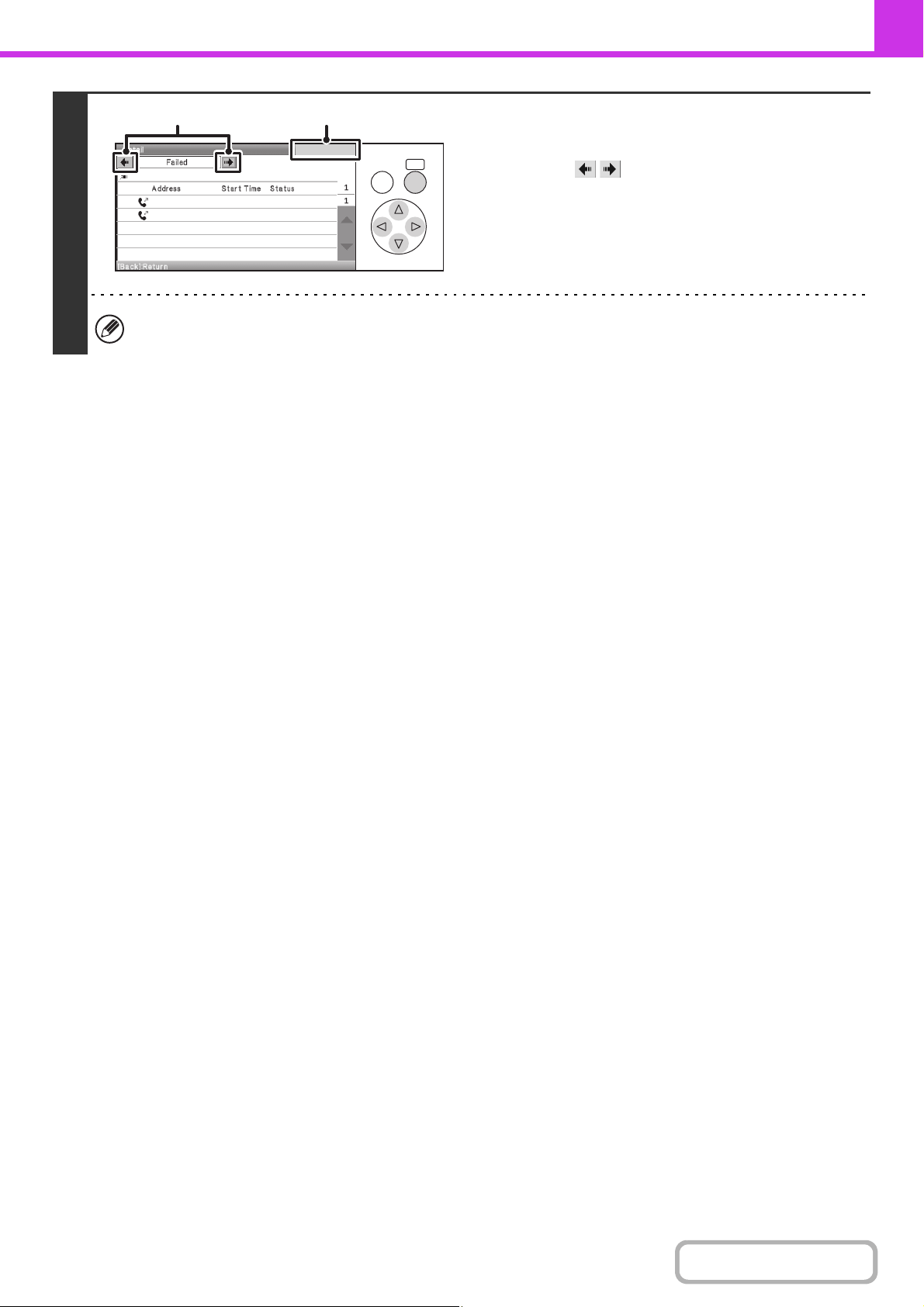
4-45
FACSIMILE
Contents
4
Resend to unsuccessful destinations.
(1) Select the [Failed] tab.
Select the keys and press the [OK] key.
(2) Select the [Retry] key.
After the [Retry] key is selected, you will return to the base screen with the unsuccessful destinations entered. Place
the original and perform the broadcast transmission operation.
OKBACK
Broadcast0001
DDD DDD
EEE EEE
10:01 04/01 NG00000
10:10 04/01 NG00000
002
010
Retry
(1) (2)
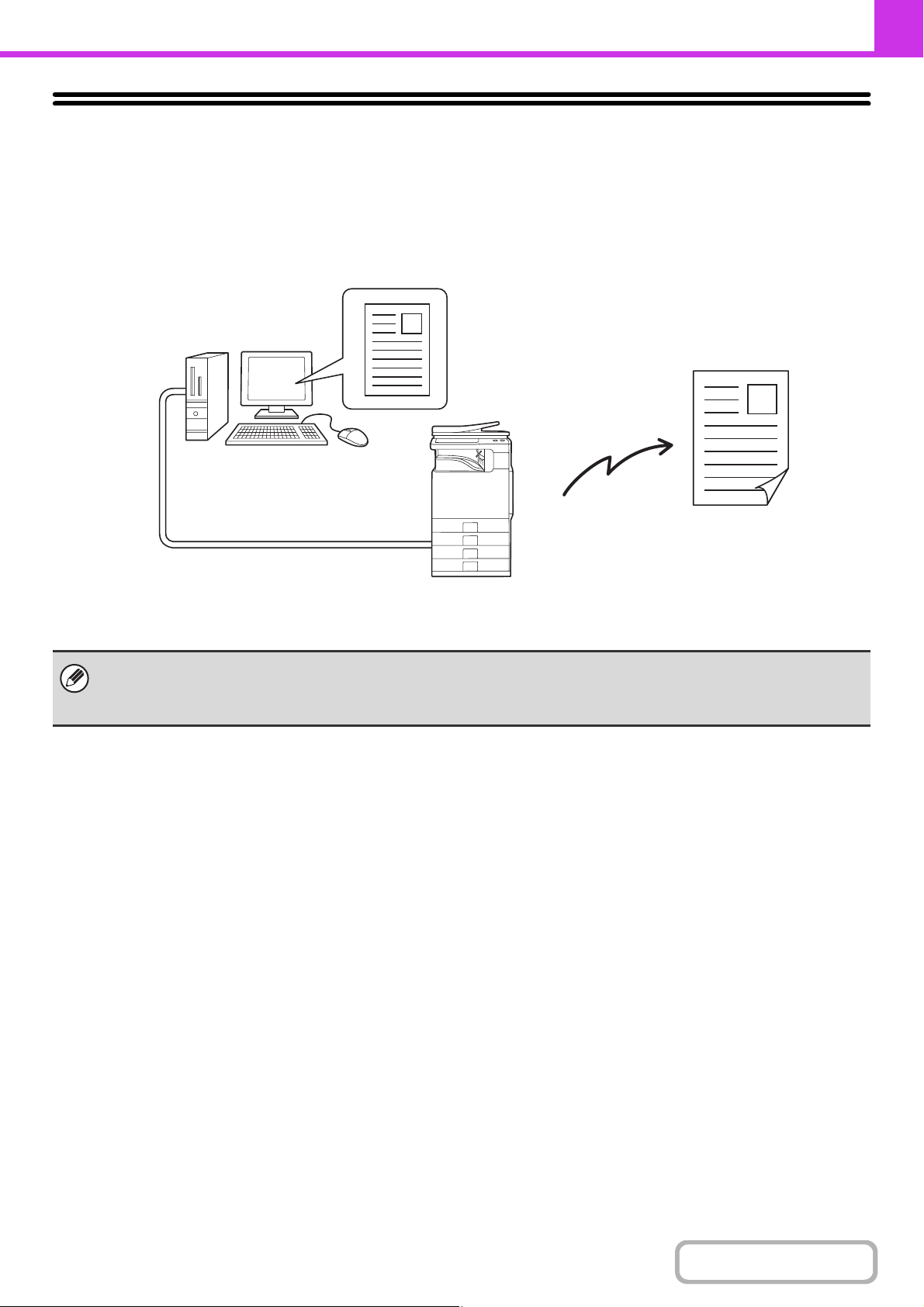
4-46
FACSIMILE
Contents
SENDING A FAX DIRECTLY FROM A
COMPUTER (PC-Fax)
A document in a computer can be transmitted via the machine as a fax. Faxes are sent using the PC-Fax function in the
same way as documents are printed. Select the PC-Fax driver as the printer driver on your computer and then select the
Print command in the software application. Image data for transmission will be created and sent as a fax.
For more information on using PC-Fax, see the Help file for the PC-Fax driver.
• To use the PC-Fax function, the PC-Fax driver must be installed. For more information, see the Installation Guide.
• This function can only be used on a Windows
®
computer.
• This function can only be used for transmission. Faxes cannot be received to your computer.
Fax transmission
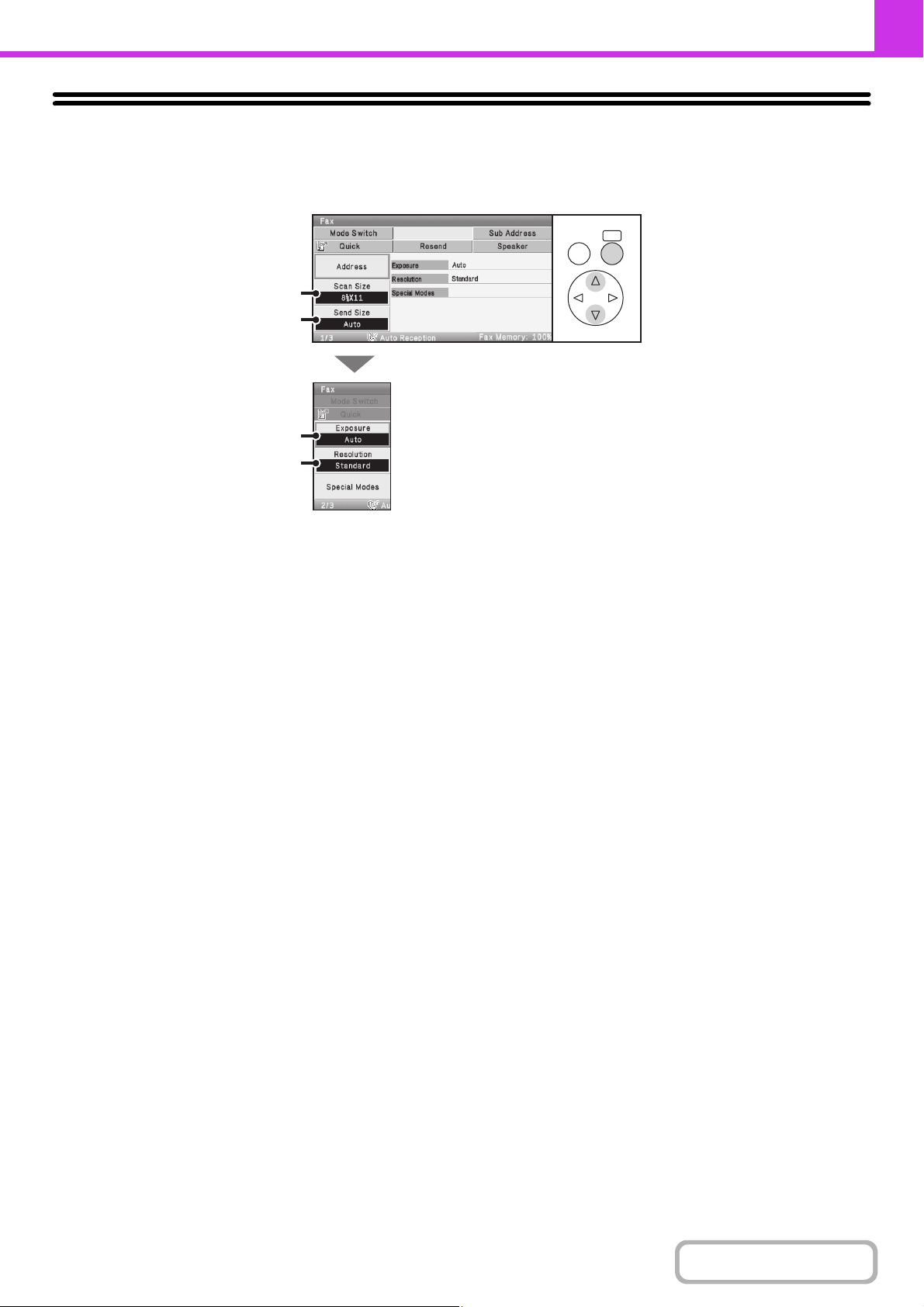
4-47
FACSIMILE
Contents
IMAGE SETTINGS
Settings for scanning the original are selected in the base screen of each mode. The current state of each setting
appears in the key used to select the setting.
(1) [Scan Size] key
Select this key to set the scan size, and orientation of the
original, and select 2-sided scanning settings.
☞ AUTOMATICALLY SCANNING BOTH SIDES OF
AN ORIGINAL (2-Sided Original) (page 4-48),
SPECIFYING THE SCAN SIZE AND SEND SIZE
(page 4-50)
(2) [Send Size] key
Select this key to specify the send size of the original.
(3) [Exposure] key
Select this key to select the exposure for scanning.
☞ CHANGING THE EXPOSURE (page 4-56)
(4) [Resolution] key
Select this key to select the scanning resolution.
☞ CHANGING THE RESOLUTION (page 4-57)
OKBACK
(1)
(2)
(3)
(4)
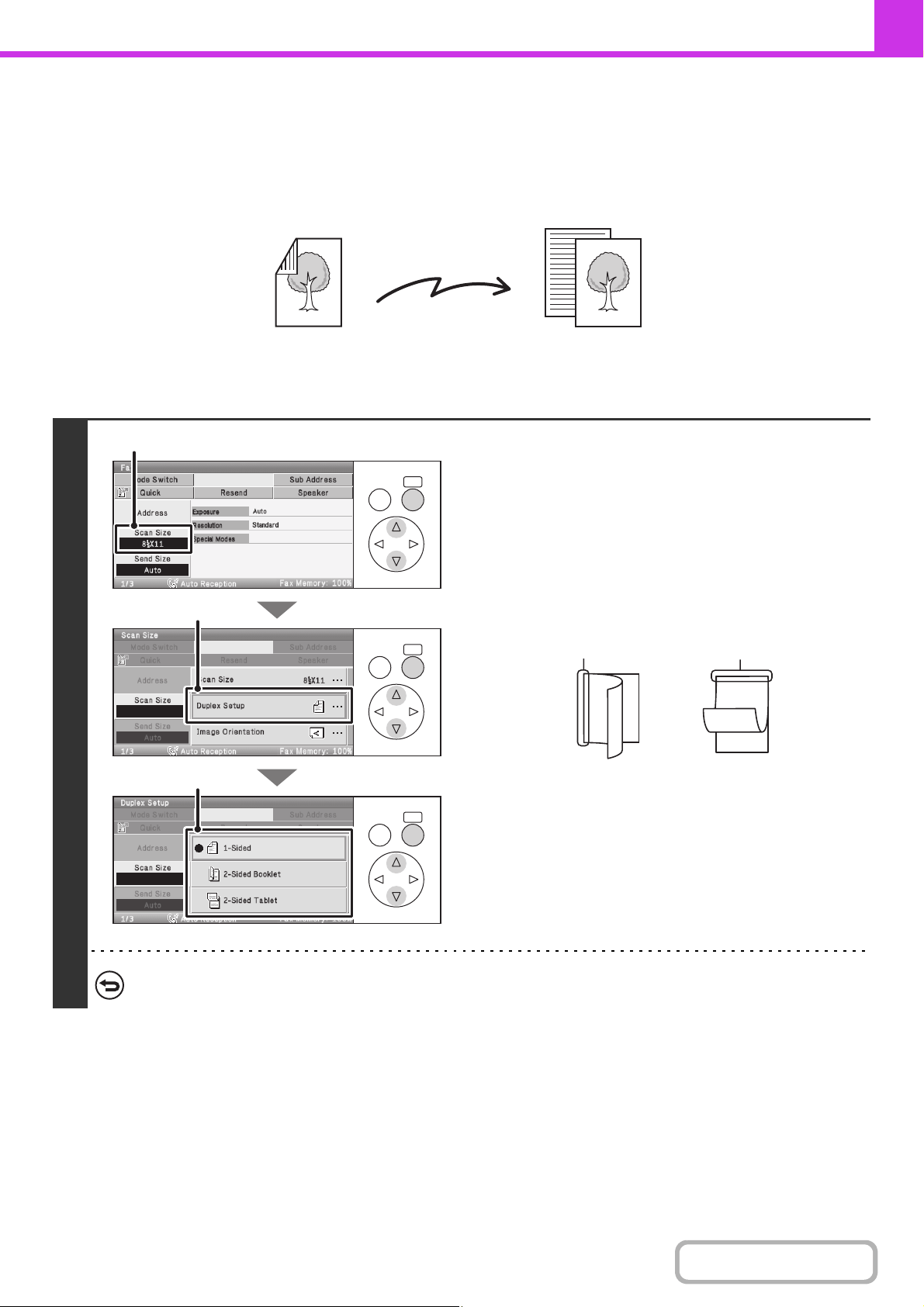
4-48
FACSIMILE
Contents
AUTOMATICALLY SCANNING BOTH SIDES OF AN
ORIGINAL (2-Sided Original)
The automatic document feeder will automatically scan both sides of the document.
Keys in the display can be selected with the arrow keys and the [OK] key.
1
Specify the binding style of the 2-sided
original (book or tablet).
(1) Select the [Scan Size] key.
(2) Select the [Duplex Setup] key.
(3) Select the [2-Sided Booklet] key or the
[2-Sided Tablet] key.
A book and a tablet are bound as shown below.
To cancel 2-sided scanning, select the [1-Sided] key in (3).
2-sided original Front and back are
sent as two pages
Transmission
OKBACK
OKBACK
OKBACK
(1)
(2)
(3)
A
C
E
G
AB
EF
J
L
KL
Booklet Tablet
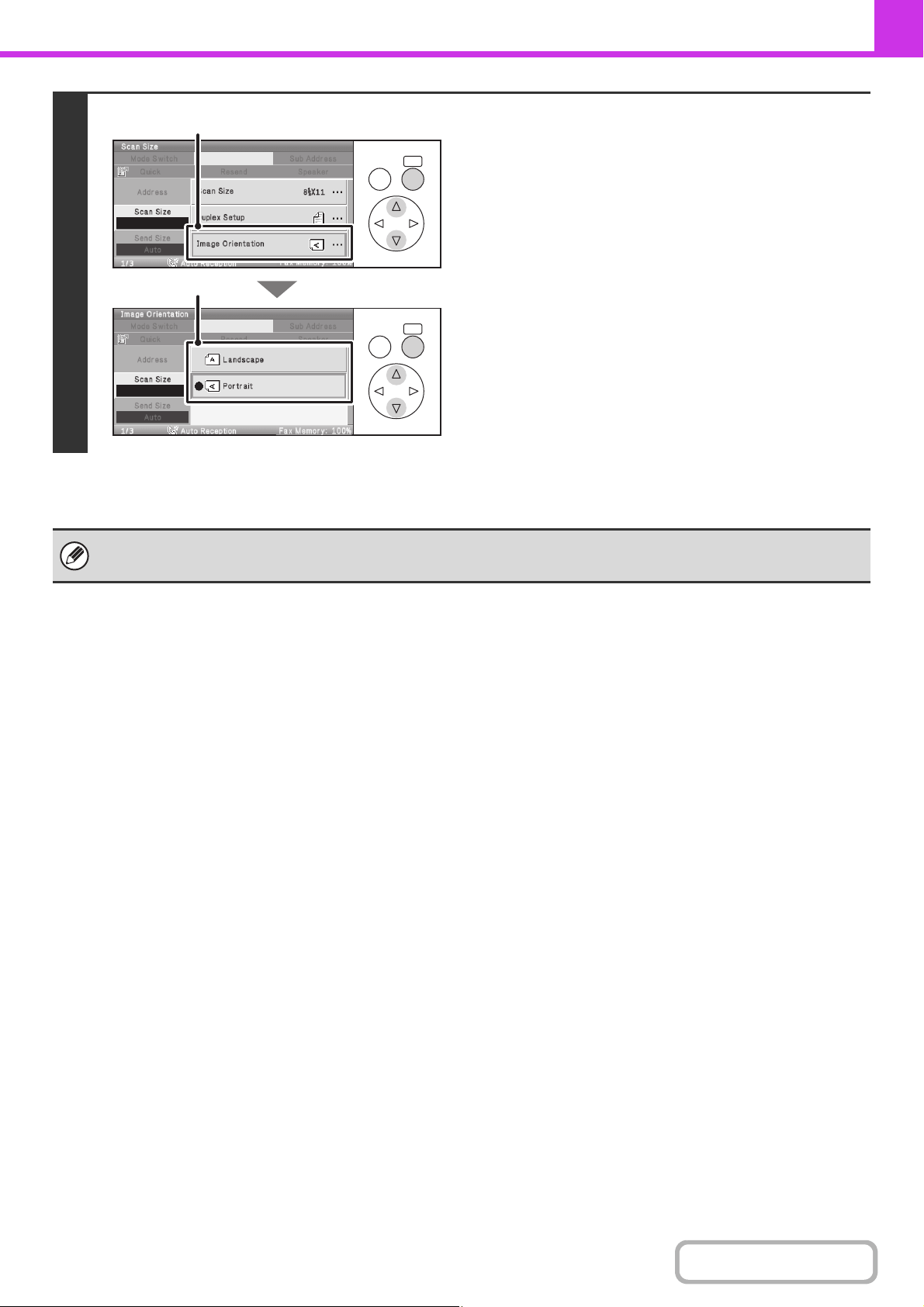
4-49
FACSIMILE
Contents
2
Specify
the orientation in which the
original is placed.
(1) Select the [Image Orientation].
(2) Select the "image placement orientation"
key with the same orientation as the image
of the placed original.
If the wrong orientation is selected here, the image may
not be sent properly.
• 2-sided scanning automatically turns off after the transmission operation is completed.
• 2-sided scanning is not possible when direct transmission or speaker transmission is performed.
OKBACK
OKBACK
(1)
(2)
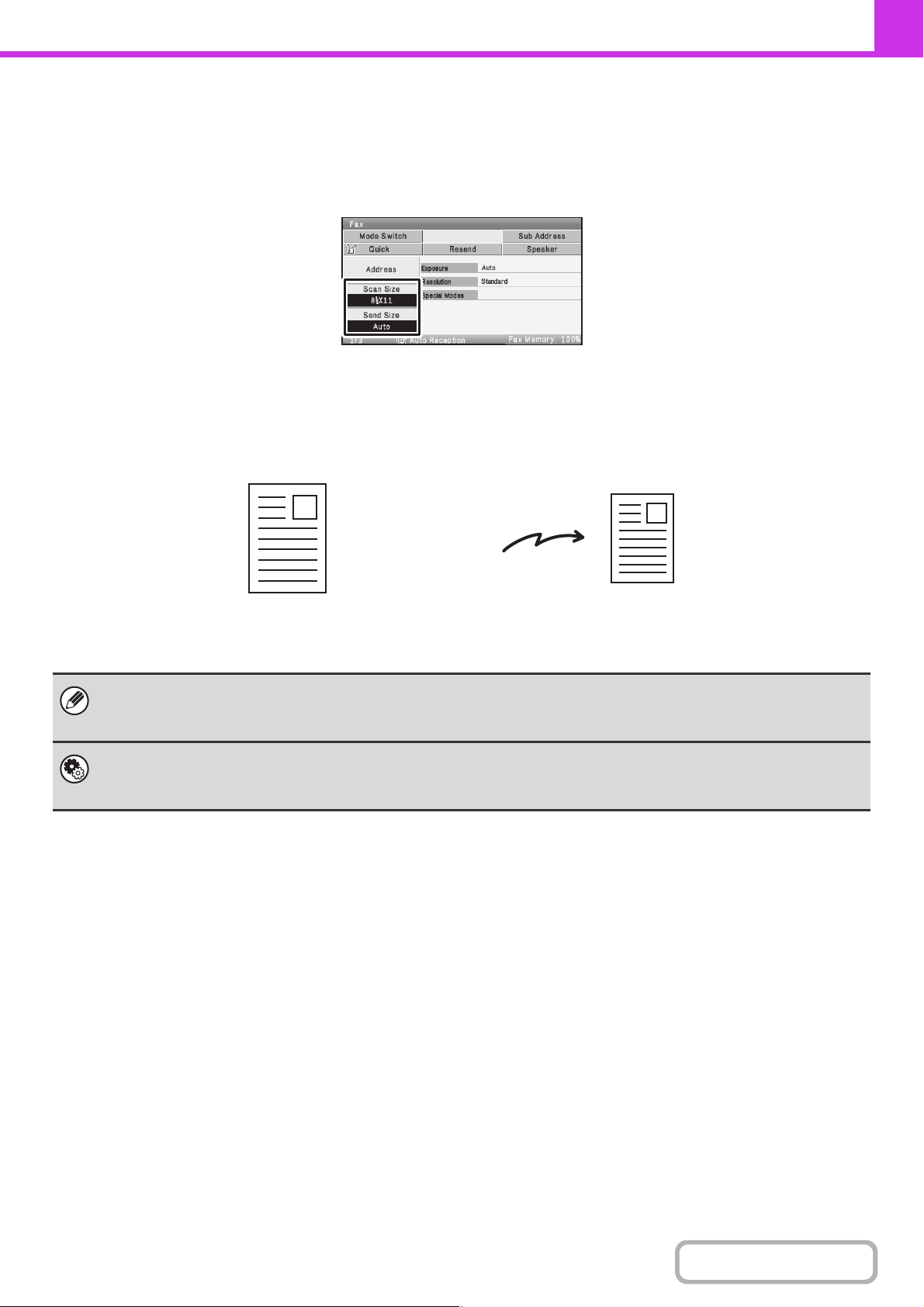
4-50
FACSIMILE
Contents
SPECIFYING THE SCAN SIZE AND SEND SIZE
When the original is placed, the original size and the send size set in the system settings appear in the base screen as
the original size and send size.
In the above screen, the scan size (the original size) is 8-1/2" x 11" (A4) and the send size is auto. If, for example, the
scan size were 8-1/2" x 11" (A4) and the send size were 5-1/2" x 8-1/2" (B5), the image would be reduced before
transmission.
If the size of the placed original is different from the displayed original size, specify the original size.
☞ Specifying the original scan size (by paper size) (page 4-51)
☞ Specifying the original scan size (by numerical values) (page 4-52)
System Settings (Administrator): Default Original Size Settings (Web page only)
Set this if you frequently use a particular original size. The set size will appear in the [Scan Size] key. When this setting is
configured, changing the original size can be omitted.
8-1/2" x 11" (A4)
The image is reduced
to 5-1/2" x 8-1/2" (B5)
before transmission
"Scan Size"
"Send Size" is set to
5-1/2" x 8-1/2" (B5)
Transmission
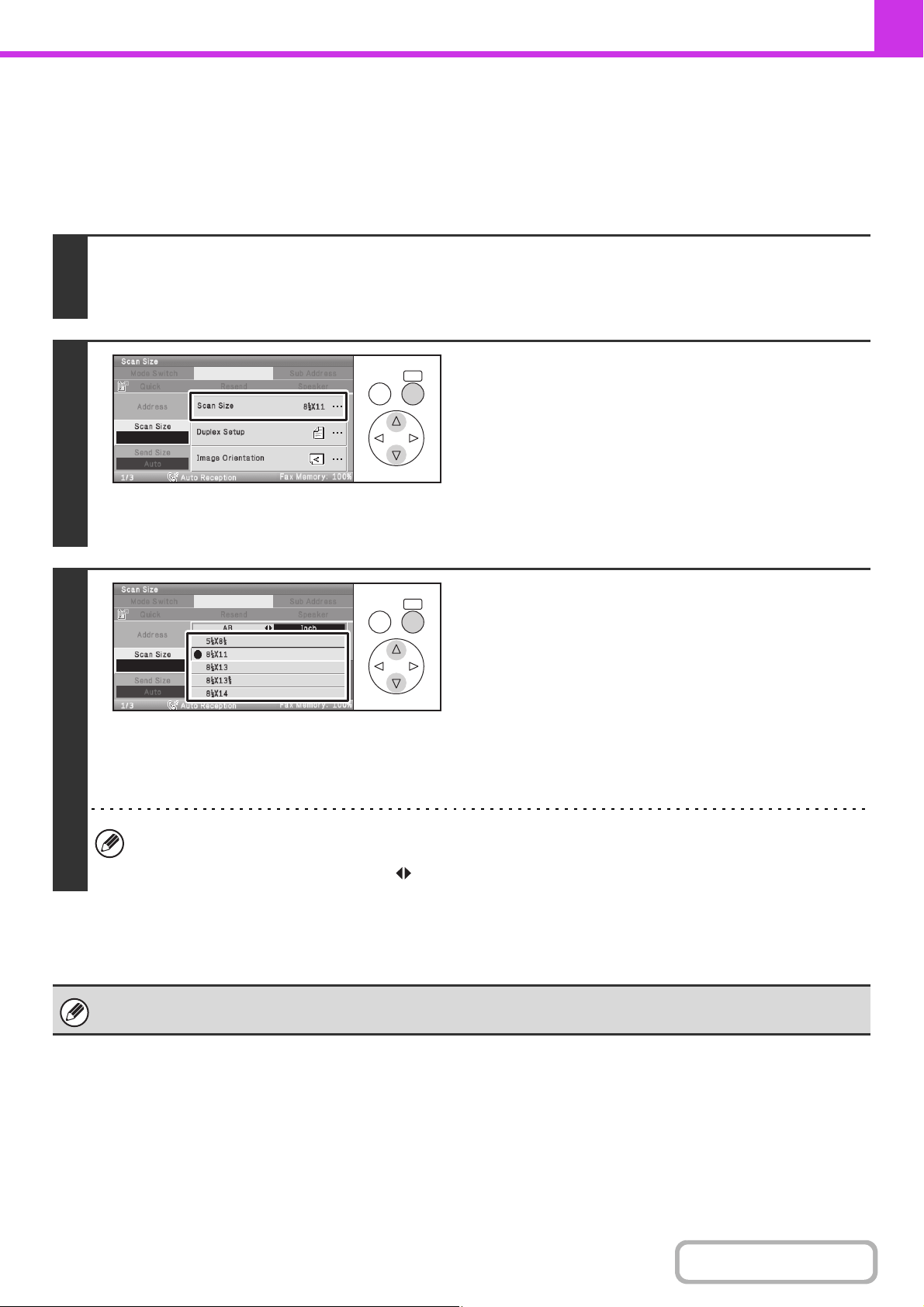
4-51
FACSIMILE
Contents
Specifying the original scan size (by paper size)
If the size of the placed original is different from the displayed original size or you wish to change the original size, you
must specify the scan size. Place the original in the document feeder tray or on the document glass and follow the steps
below.
Keys in the display can be selected with the arrow keys and the [OK] key.
1
Select the [Scan Size] key.
The original size set in the system settings appears to the right of the [Scan Size] key.
☞ IMAGE SETTINGS (page 4-47)
2
Select the [Scan Size] key.
3
Specify the scan size.
Select the appropriate original size.
• If you are sending a long original, select the [Long Size] key. Use the automatic document feeder to scan a long
original. The maximum length that can be scanned is 19-5/8" (500 mm) (the maximum height is 8-1/2" (216 mm)).
• To set an AB scan size, select the [AB Inch] key to show AB sizes.
When [Long Size] is selected, the 2-sided scanning setting and send size cannot be changed.
OKBACK
OKBACK
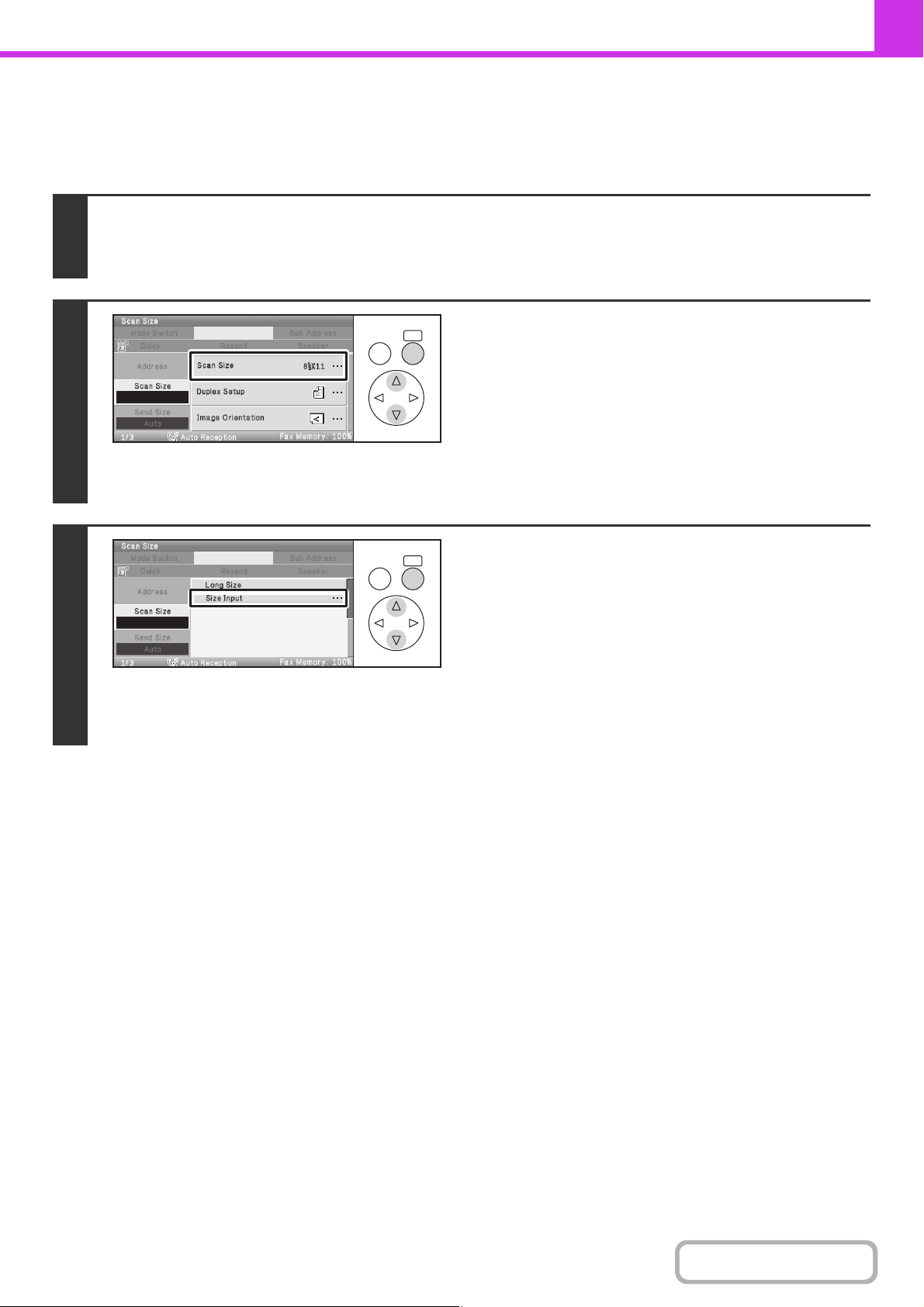
4-52
FACSIMILE
Contents
Specifying the original scan size (by numerical values)
When scanning a non-standard size original such as a postcard or card, follow these steps to specify the original size.
Keys in the display can be selected with the arrow keys and the [OK] key.
1
Select the [Scan Size] key.
The original size set in the system settings appears to the right of the [Scan Size] key.
☞ IMAGE SETTINGS (page 4-47)
2
Select the [Scan Size] key.
3
Select the [Size Input] key.
OKBACK
OKBACK
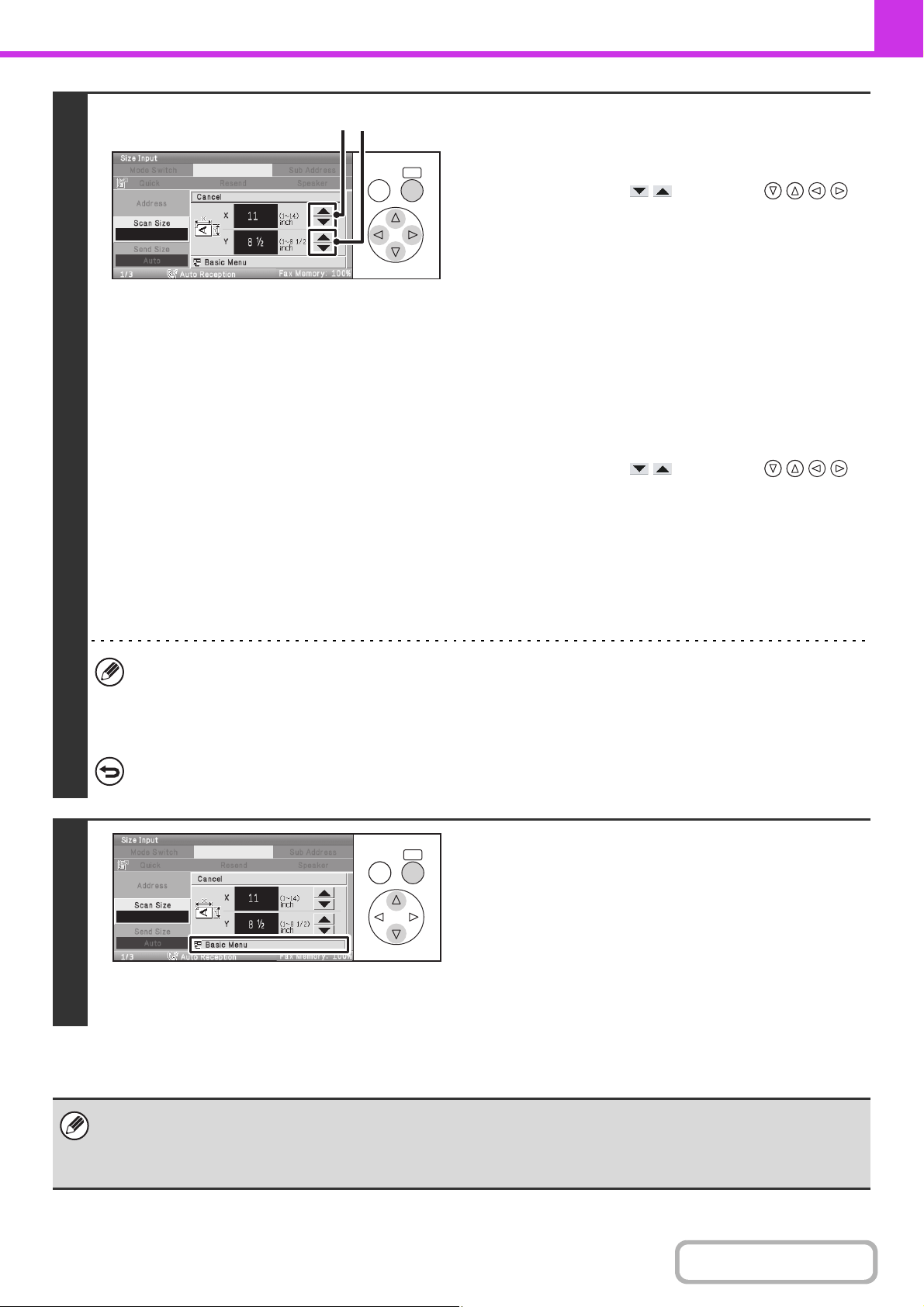
4-53
FACSIMILE
Contents
4
Enter the scan size (original size).
(1) Enter the X (horizontal) dimension of the
original.
Select either of the keys with the
keys and press the [OK] key repeatedly to change the
number.
• When the document glass is used, enter a number from
1" to 11-5/8" (25 mm to 297 mm).
• When the automatic document feeder is used, enter a
number from 3-1/2" to 14" (89 mm to 356 mm).
• When a number which is from 5-3/8" (139 mm) and less
is entered in 2-Sided scanning setting, an original
cannot be scanned.
• If the horizontal dimension of the original is less than
3-1/2" (89 mm), use the document glass.
(2) Enter the Y (vertical) dimension of the
original.
Select either of the keys with the
keys and press the [OK] key repeatedly to change the
number.
• When the document glass is used, enter a number from
1" to 8-1/2" (25 mm to 216 mm).
• When the automatic document feeder is used, enter a
number from 4" to 8-1/2" (100 mm to 216 mm).
• If the vertical dimension of the original is less than 4"
(100 mm), use the document glass.
• When a number from 11-3/4" to 14" (298 mm to 356 mm) to the X (horizontal) dimension and a number from 1" to
3-7/8" (25 mm to 99 mm) to the Y (vertical) dimension are entered at the same time, an original cannot be scanned.
• For the procedure for entering numbers, see "USING THE OPERATION PANEL" (page 1-9) in "1. BEFORE USING
MACHINE".
To cancel the size input...
To cancel the size input, select the [Cancel] key.
5
Select the [Basic Menu] key.
The specified size appears in the [Scan Size] key.
• When the scan size is specified by numerical values, the send size cannot be specified.
• When the automatic document feeder is used, an original longer that 11-5/8" (297 mm) can be scanned (maximum width
19-5/8" (500 mm)). In this case, select the [Long Size] key in the screen of step 3.
☞ Specifying the original scan size (by paper size) (page 4-51)
OKBACK
(1)
(2)
OKBACK
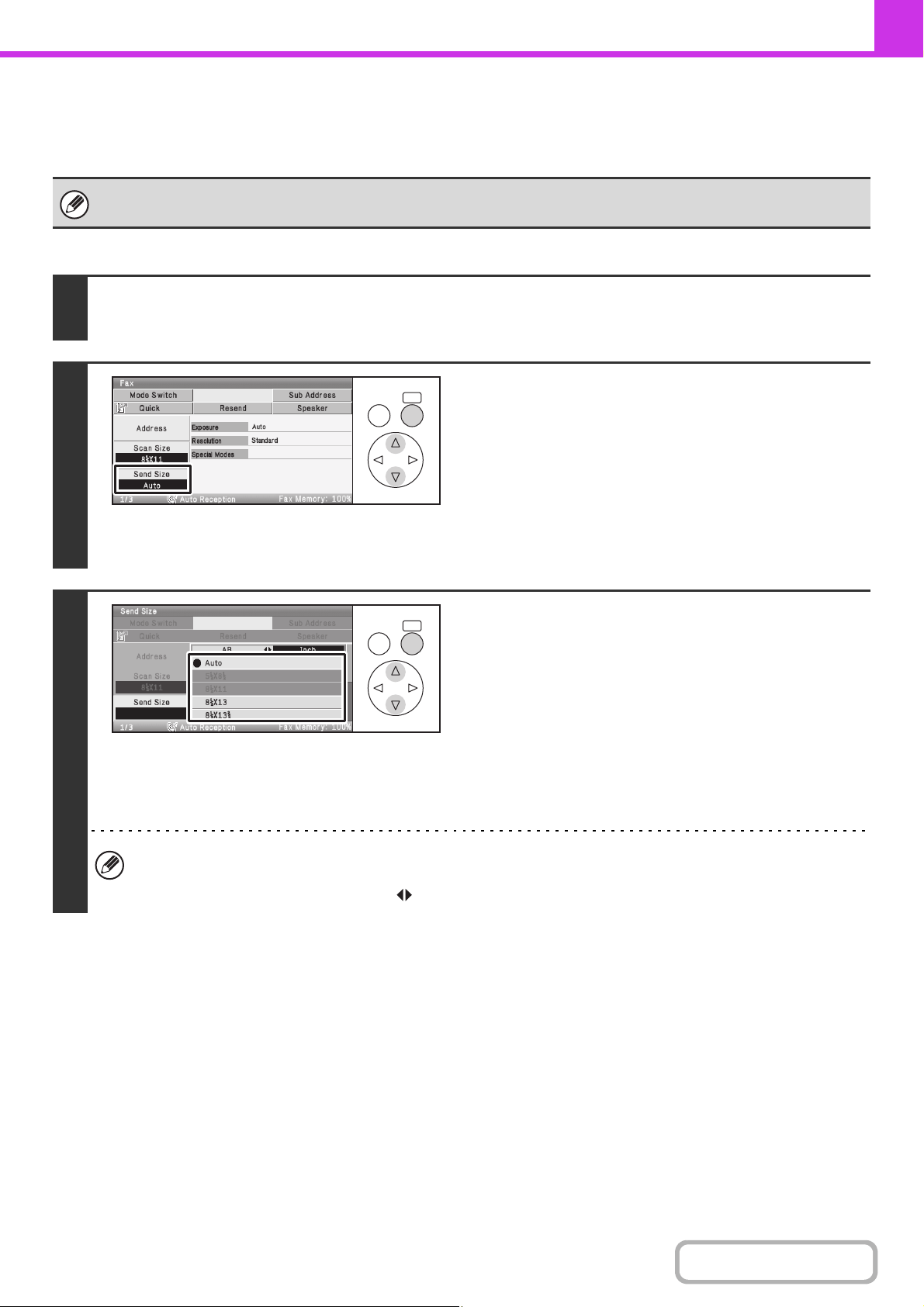
4-54
FACSIMILE
Contents
Specifying the send size of the original
Specify the send size as a paper size. If a send size bigger than the scan size is selected, the image will be enlarged. If
a send size smaller than the scan size is selected, the image will be reduced.
Keys in the display can be selected with the arrow keys and the [OK] key.
The send size cannot be specified when [Long Size] is selected for the scan size, or when the scan size is specified by
numerical values.
1
Select the [Scan Size] key.
☞
IMAGE SETTINGS (page 4-47)
2
Select the [Send Size] key.
3
Specify the send size.
Select the desired send size key.
Select the [OK] key to return to the screen of step 2.
• Depending on the "Scan Size" setting, it may not be possible to select some sizes for the "Send Size". Size keys
that cannot be specified for the "Send Size" are grayed out to prevent selection.
• To set an AB send size, select the [AB Inch] key to show AB sizes.
OKBACK
OKBACK
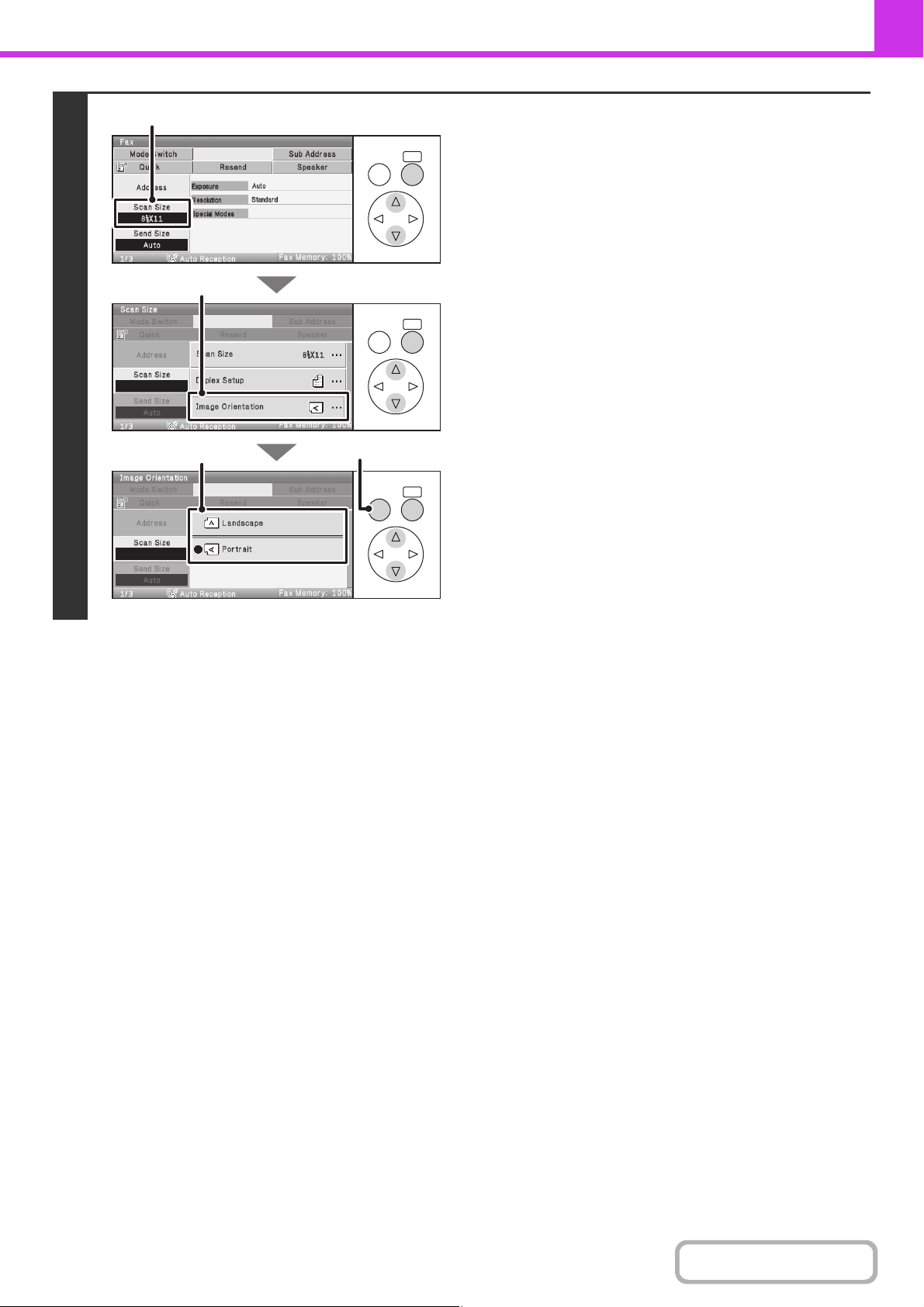
4-55
FACSIMILE
Contents
4
Specify the orientation in which the
original is placed.
(1) Select the [Scan Size] key.
(2) Select the [Image Orientation] key.
(3) Select the "image placement orientation"
key with the same orientation as the image
of the placed original.
If the wrong orientation is selected here, the image may
not be sent properly when using enlargement/reduction.
(4) Press the [BACK] key.
OKBACK
OKBACK
OKBACK
(4)
(1)
(2)
(3)
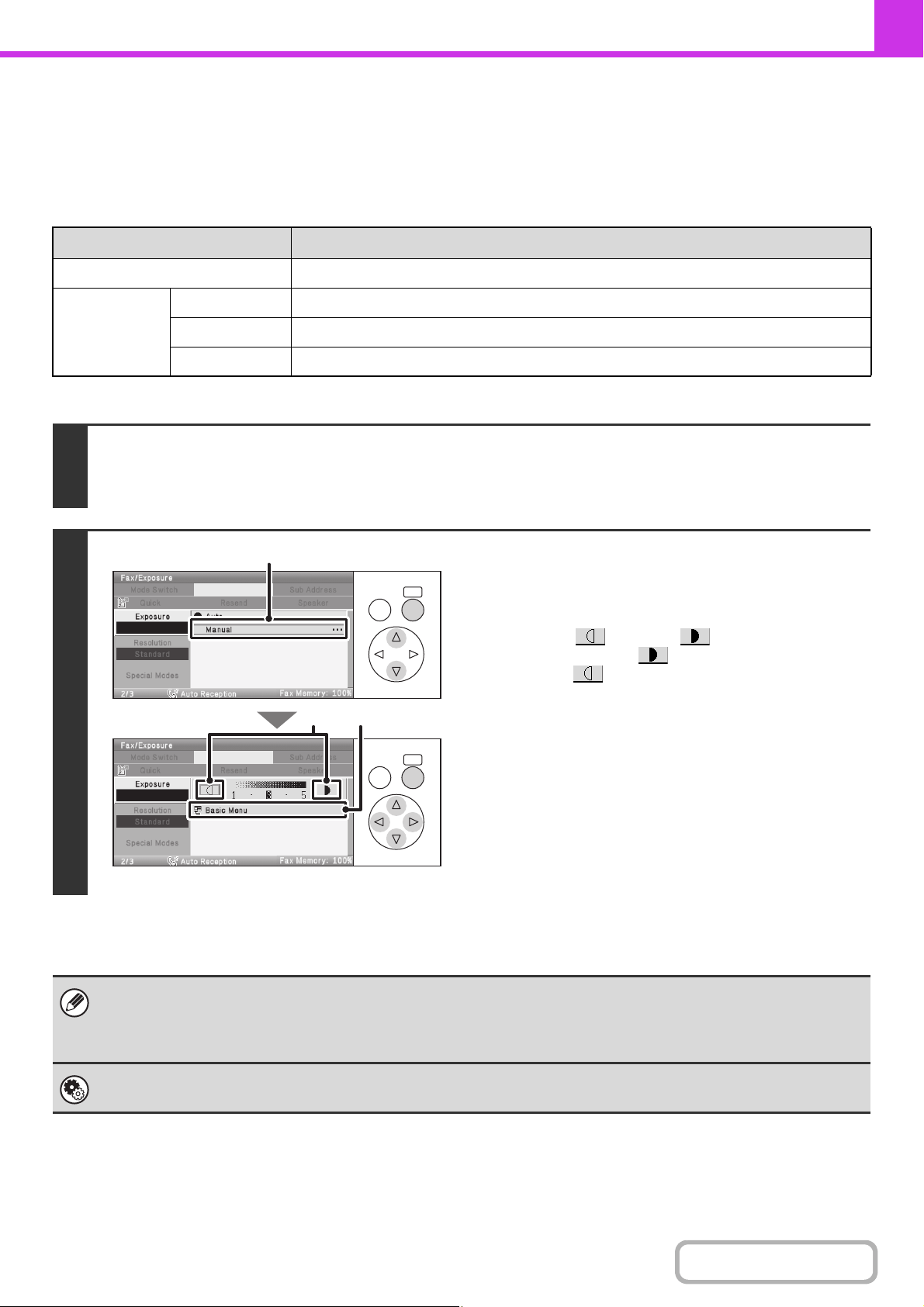
4-56
FACSIMILE
Contents
CHANGING THE EXPOSURE
The exposure can be changed to match the darkness of the original.
Refer to the following tables to select appropriate settings.
Exposure settings
Keys in the display can be selected with the arrow keys and the [OK] key.
Exposure When to select
Auto This setting automatically adjusts the exposure for light and dark parts of the original.
Manual
1-2 Select this setting when the original consists of dark text.
3 Select this setting for a normal original (neither dark nor light).
4-5 Select this setting when the original consists of faint text.
1
Select the [Exposure] key.
The current exposure setting appears in the [Exposure] key.
☞ IMAGE SETTINGS (page 4-47)
2
Select the exposure.
(1) Select the [Manual] key.
(2) Adjust the exposure.
Select the key or the key. To darken the
exposure, select the key. To lighten the exposure,
select the key.
To return to auto exposure adjustment, select the [Auto]
key.
(3) Select the [Basic Menu] key.
When using the document glass to scan multiple original pages, the exposure setting can be changed each time you change
pages. When using the automatic document feeder, the exposure setting cannot be changed once scanning has begun.
(However, when "Job Build" in the special modes is used, the exposure can be changed each time a new set of originals is
inserted.)
System Settings (Administrator): Default Exposure Settings
This is used to change the default exposure setting.
OKBACK
OKBACK
(1)
(2) (3)
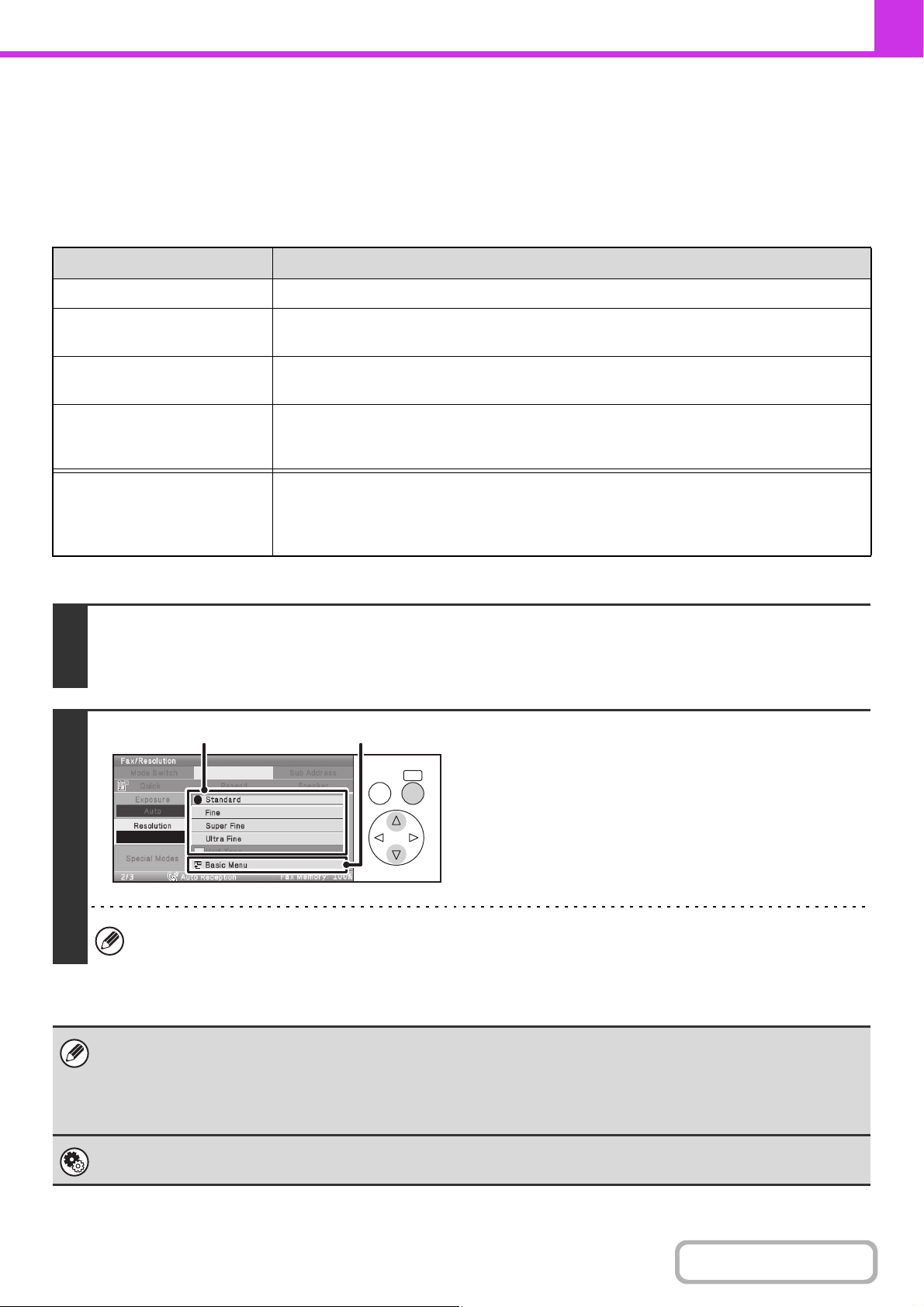
4-57
FACSIMILE
Contents
CHANGING THE RESOLUTION
The resolution can be selected to match the characteristics of the original, such as text or photo, the size of the text, and
the darkness of the image.
Refer to the following tables to select appropriate settings.
Resolution settings
Keys in the display can be selected with the arrow keys and the [OK] key.
Resolution When to select
Standard
Select this setting when your original consists of normal-sized text (like the text in this manual).
Fine Select this setting when your original has small text or diagrams with fine lines.
The original will be scanned at twice the resolution of the [Standard] setting.
Super Fine Select this setting when your original has intricate pictures or diagrams.
A higher-quality image will be produced than with the [Fine] setting.
Ultra Fine Select this setting when your original has intricate pictures or diagrams.
This setting gives the best image quality. However, transmission will take longer than with the
other settings.
Half Tone Select this setting when your original is a photograph or has gradations of color (such as a
color original).
This setting will produce a clearer image than [Fine], [Super Fine], or [Ultra Fine] used alone.
Halftone cannot be selected when [Standard] is used.
1
Select the [Resolution] key.
The current resolution setting appears in the [Resolution] key.
☞ IMAGE SETTINGS (page 4-47)
2
Select the resolution.
(1) Select the key of the desired resolution.
(2) Select the [Basic Menu] key.
When [Fine], [Super Fine], or [Ultra Fine] is selected, the [Half Tone] key can be selected to select halftone.
•
When using the document glass to scan multiple original pages, the resolution setting can be changed each time you change pages.
When using the automatic document feeder, the resolution setting cannot be changed once scanning has begun. (However, when
"Job Build" in the special modes is used, the resolution can be changed each time a new set of originals is inserted.)
• When a fax is sent at [Ultra Fine], [Super Fine], or [Fine] resolution, a lower resolution will be used if the receiving machine
does not have that resolution.
System Settings (Administrator): Initial Resolution Setting
This is used to change the default resolution setting.
OKBACK
(2)(1)
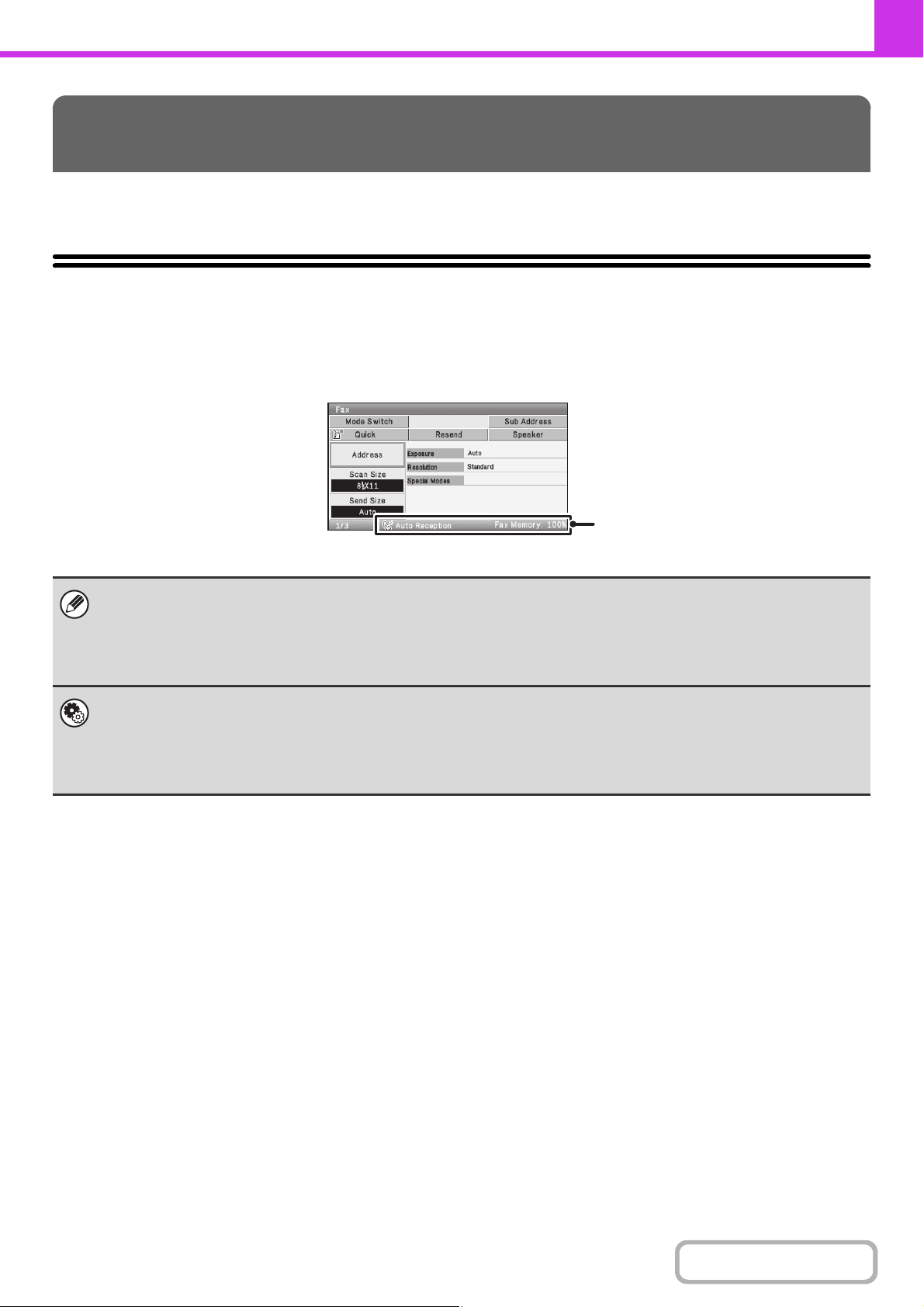
4-58
FACSIMILE
Contents
This section explains the basic procedures for receiving faxes.
RECEIVING FAXES
When the reception mode is set to "Auto Reception", the machine will receive and print faxes automatically. The fax
reception mode is displayed in the base screen.
FAX RECEPTION
• When fax reception is in progress, it is possible to reserve a transmission by performing the transmission in memory
transmission mode.
☞TRANSMISSION METHODS (page 4-28)
• When a fax smaller than 8-1/2" x 11" (A4) size is received, the size of the paper used for printing will vary depending on
the orientation (vertical or horizontal) in which the sender placed the original.
• System Settings: Fax Data Receive/Forward (page 6-98)
This is used to change the fax reception mode. "Auto Reception" should normally be used.
Select "Manual Reception" when an extension phone is connected to the machine.
• System Settings (Administrator): Allow/Reject Number Setting
You can store numbers and specify whether or not reception is allowed from those numbers.
This shows the current fax
reception mode and the amount
of free memory remaining.
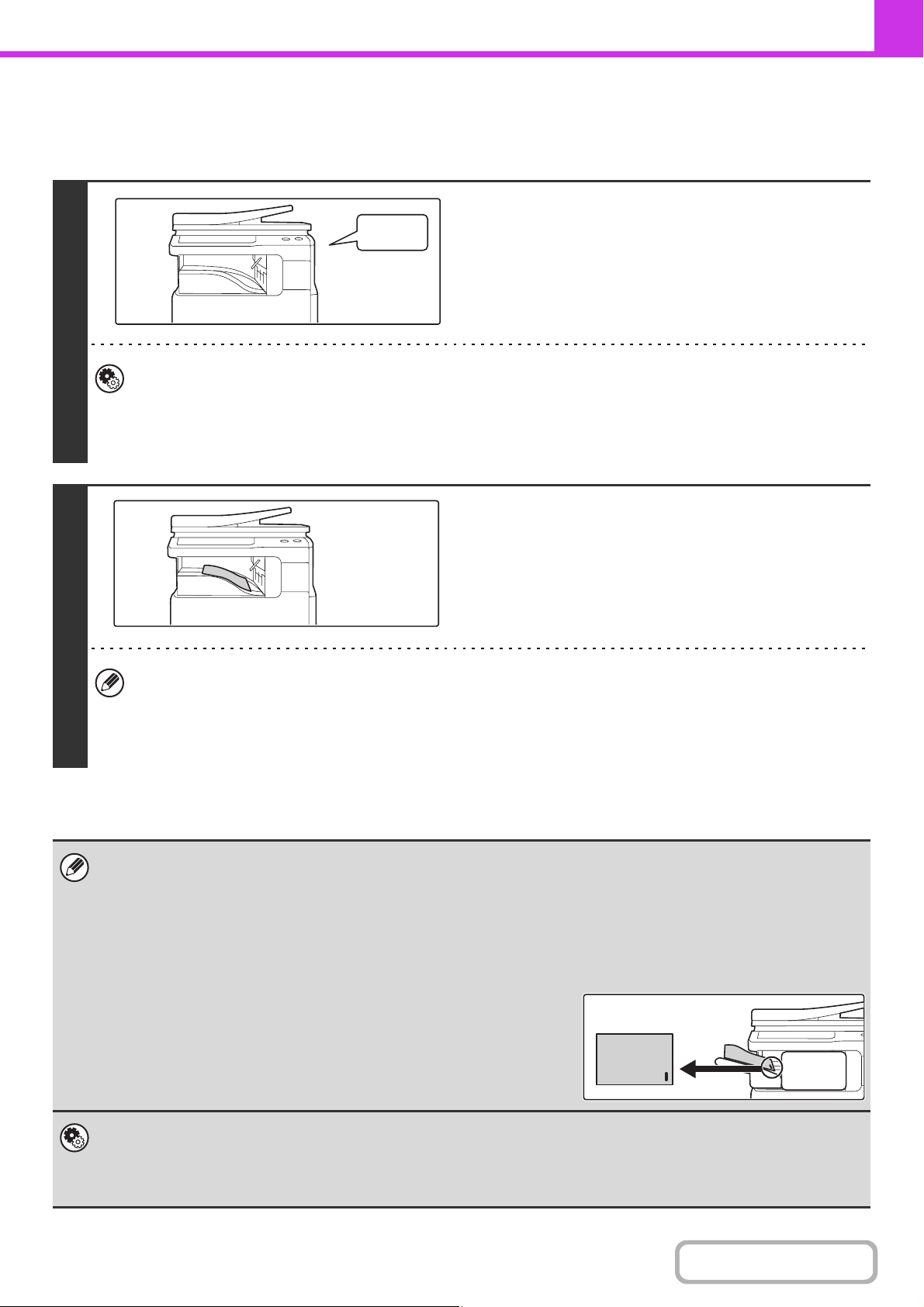
4-59
FACSIMILE
Contents
RECEIVING A FAX
When a fax is transmitted to the machine, the machine automatically receives and prints the fax.
1
The machine rings and fax reception
begins automatically.
A beep sounds when reception ends.
• System Settings (Administrator): Speaker Settings
This is used to change the volume and tone of the reception beep.
• System Settings (Administrator): Number of Calls in Auto Reception
This is used to change the number of rings on which fax reception begins automatically. To receive faxes without
the machine ringing, select "0" rings.
2
The fax is automatically printed.
• If a password entry screen appears...
A password must be entered to print the received fax. When the correct password is entered, the received fax is printed.
☞PRINTING A PASSWORD-PROTECTED FAX (Hold Setting For Received Data Print) (page 4-61)
• Stapling (when a finisher is installed) can be selected.
When printing received data, you can specify the number of copies and staple settings.
• If printing of a copy job or print job is in progress when a fax is received, the fax will not be printed until the previously
reserved job is completed.
• Received faxes will not be printed when the machine cannot print due to an error condition such as out of paper, out of
toner, or a paper misfeed. The faxes will be printed automatically when the error condition is cleared. (If the machine ran
out of paper, select the [OK] key in the display after loading paper.
• When received faxes cannot be printed, the faxes can be forwarded to another fax machine.
☞FORWARDING RECEIVED FAXES (Fax Data Forward) (page 4-65)
• If stapling is enabled when a finisher is installed, stapling will take place at
the position indicated below on the paper.
• System Settings (Administrator): Duplex Reception Setting
This is used to have received faxes printed on both sides of the paper.
• System Settings (Administrator): Receiving Date & Time Print
Use this to select whether or not the date and time of reception is added when a received image is printed.
Beep
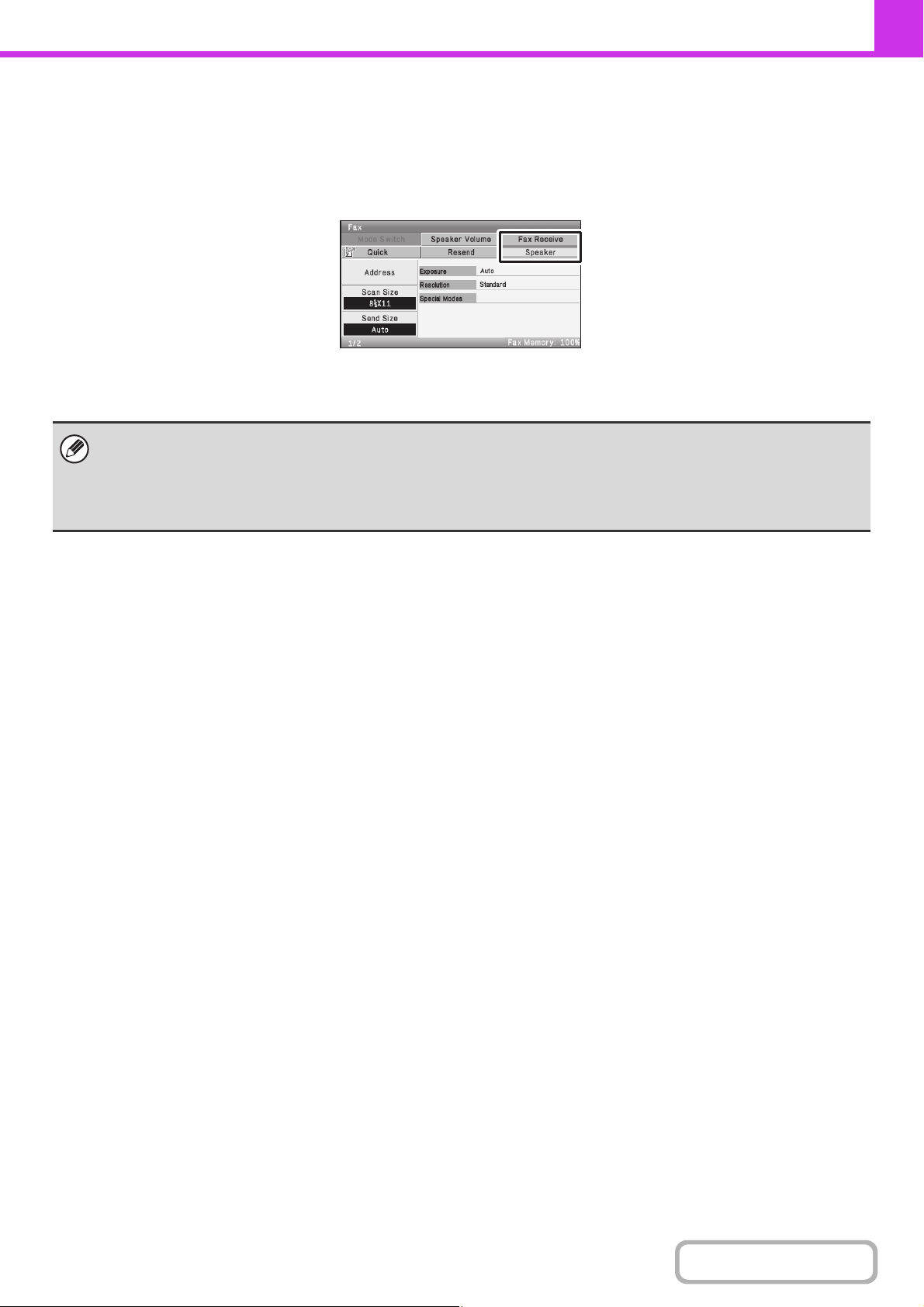
4-60
FACSIMILE
Contents
RECEIVING A FAX MANUALLY
A fax can be received manually using the display. While the machine rings, select the [Speaker] key in the base screen
and then select the [Fax Receive] key that appears.
• When a call is answered by selecting the [Speaker] key, you will be able to hear the other party, however, you will not be
able to speak.
• Even when you use an extension phone to answer a call, you can select the [Fax Receive] key in the display to begin fax
reception. You can also use the extension phone to begin fax reception.
☞RECEIVING A FAX AFTER ANSWERING A CALL ON THE EXTENSION PHONE (Remote Reception) (page 4-118)
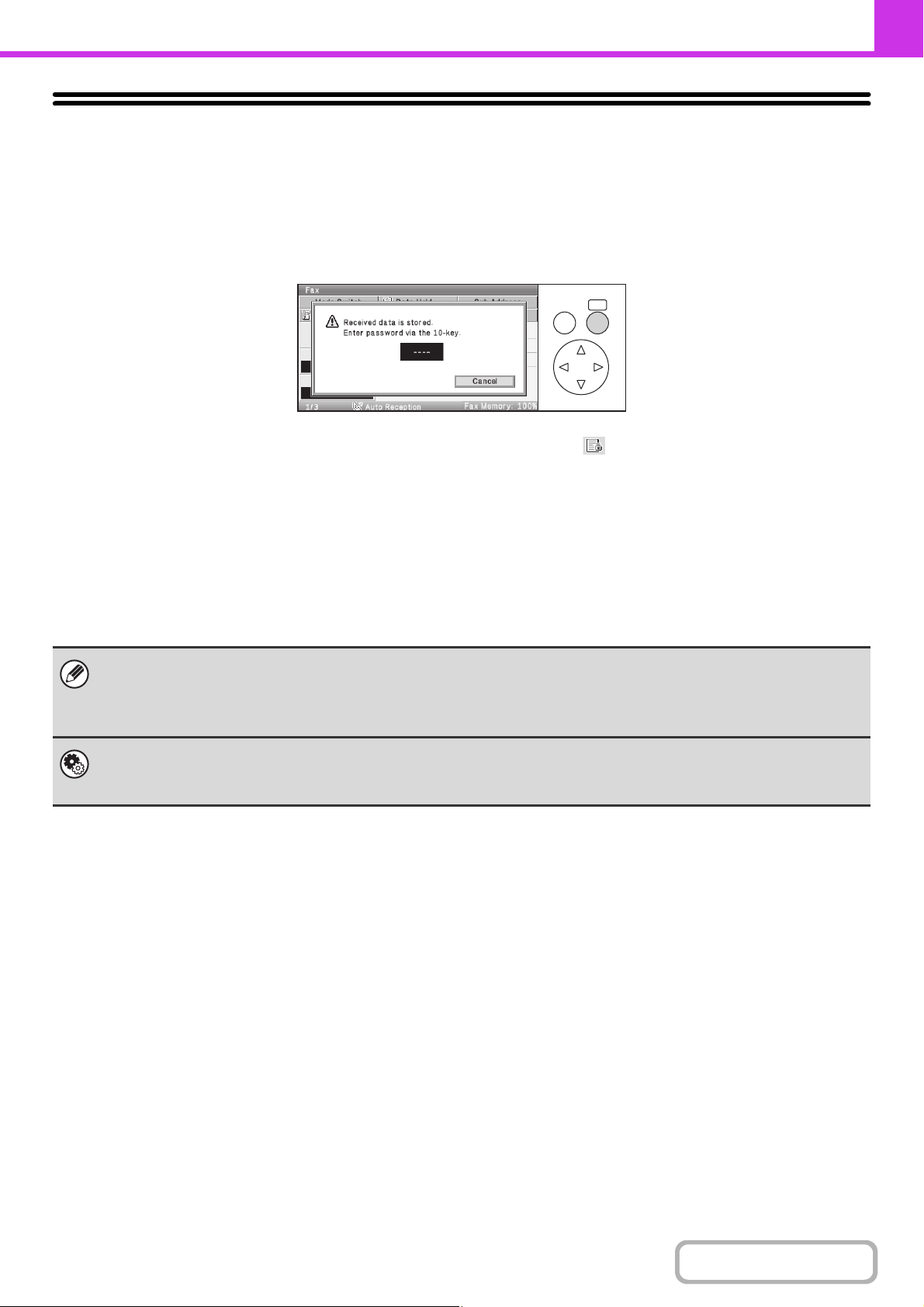
4-61
FACSIMILE
Contents
PRINTING A PASSWORD-PROTECTED FAX
(Hold Setting For Received Data Print)
"Hold Setting for Received Data Print" can be enabled in the system settings (administrator) to have faxes received to
memory without being printed. To print the faxes, a password must be entered. When this function is used, a password
entry screen appears in the display when a fax is received.
When the previously programmed 4-digit password is entered with the numeric keys, printing begins.
If the [Cancel] key is selected, the password entry screen will close; however, will blink in the display to indicate that
there is stored data. To open the password entry screen again, select the [Data Hold] key or change the mode.
When "Received Data Image Check Setting" (Web page only) is enabled in the system settings (administrator), a
password can be entered to display the received data list screen. If you wish to check an image before printing it,
continue from step 2 on the next page.
• The received faxes will be retained in memory regardless of whether they were received automatically or manually.
• If "Fax Data Receive/Forward" is executed in the system settings to forward received faxes to another machine, faxes
retained in memory will also be forwarded. At that time, the same password entry screen as for printing will appear.
Forwarding will not take place unless the password is entered.
System Settings (Administrator): Hold Setting for Received Data Print
Enable this setting to have received faxes retained in memory until a password is entered. This setting is also used to
program the password.
OKBACK
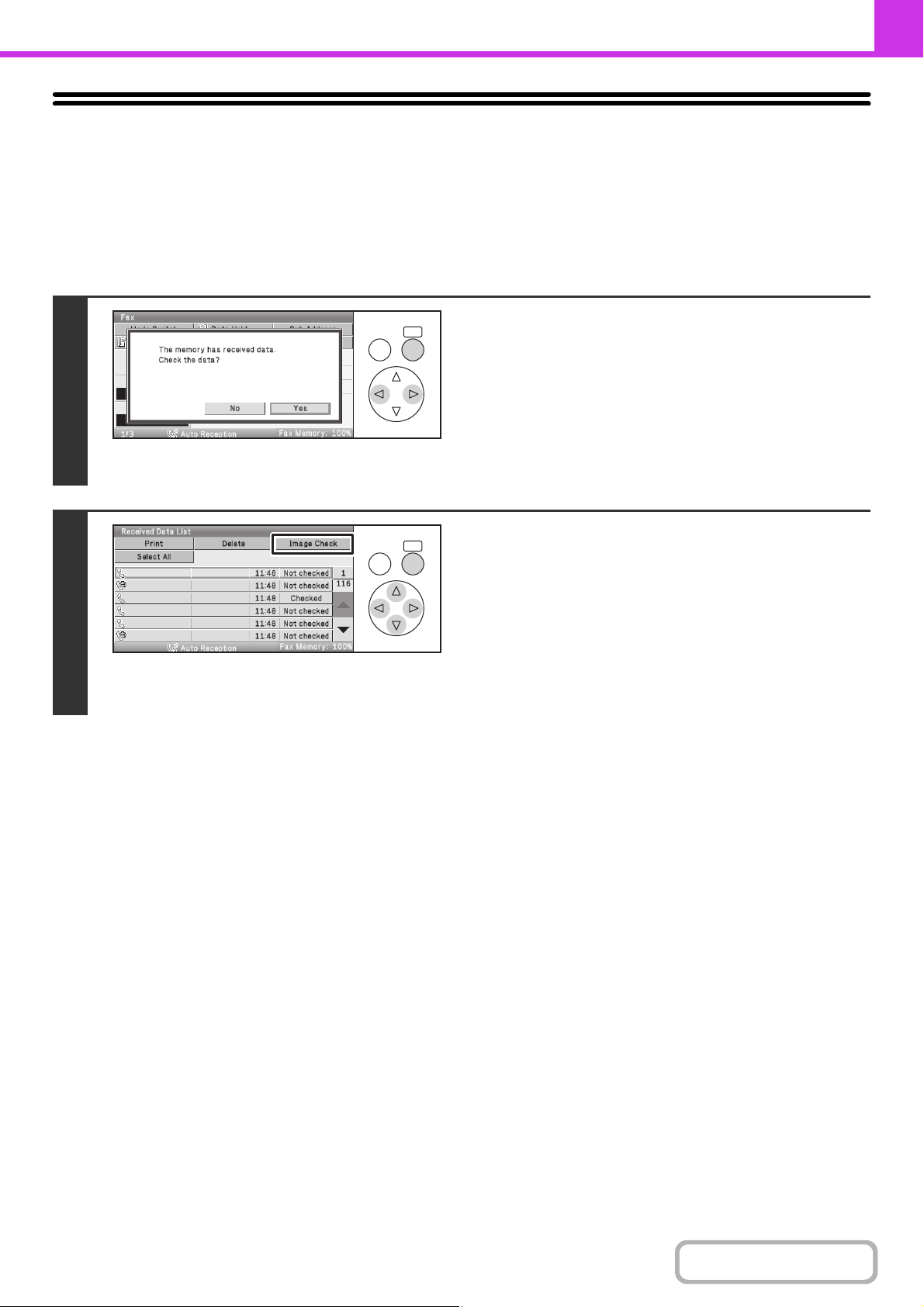
4-62
FACSIMILE
Contents
CHECKING THE IMAGE BEFORE PRINTING
When "Received Data Image Check Setting" (Web page only) is enabled* in the system settings (administrator), you
can check a received image in the display before printing it out. When this function is enabled, follow the steps below to
print a received image.
* The factory default setting is disabled.
Keys in the display can be selected with the arrow keys and the [OK] key.
1
When an image is received, a
confirmation prompt will appear. Select
the [Yes] key.
If this message appears while you are configuring settings of
any type and you select the [Yes] key, the settings that you are
configuring will be canceled. If this message appears in another
mode, you will return to the base screen of image send mode
after checking the image.
2
Select the received image
(1) Select the key of the received image that
you want to check.
Multiple received images can be checked.
(2) Select the [Image Check] key.
To delete an image that has been selected, select the
[Delete] key. To print an image that has been selected,
select the [Print] key.
OKBACK
OKBACK
BBB BBB
9876543210
0612345678
0123456789
CCC CCC
0123456789
04/04/2010
04/04/2010
04/04/2010
04/04/2010
04/04/2010
04/04/2010
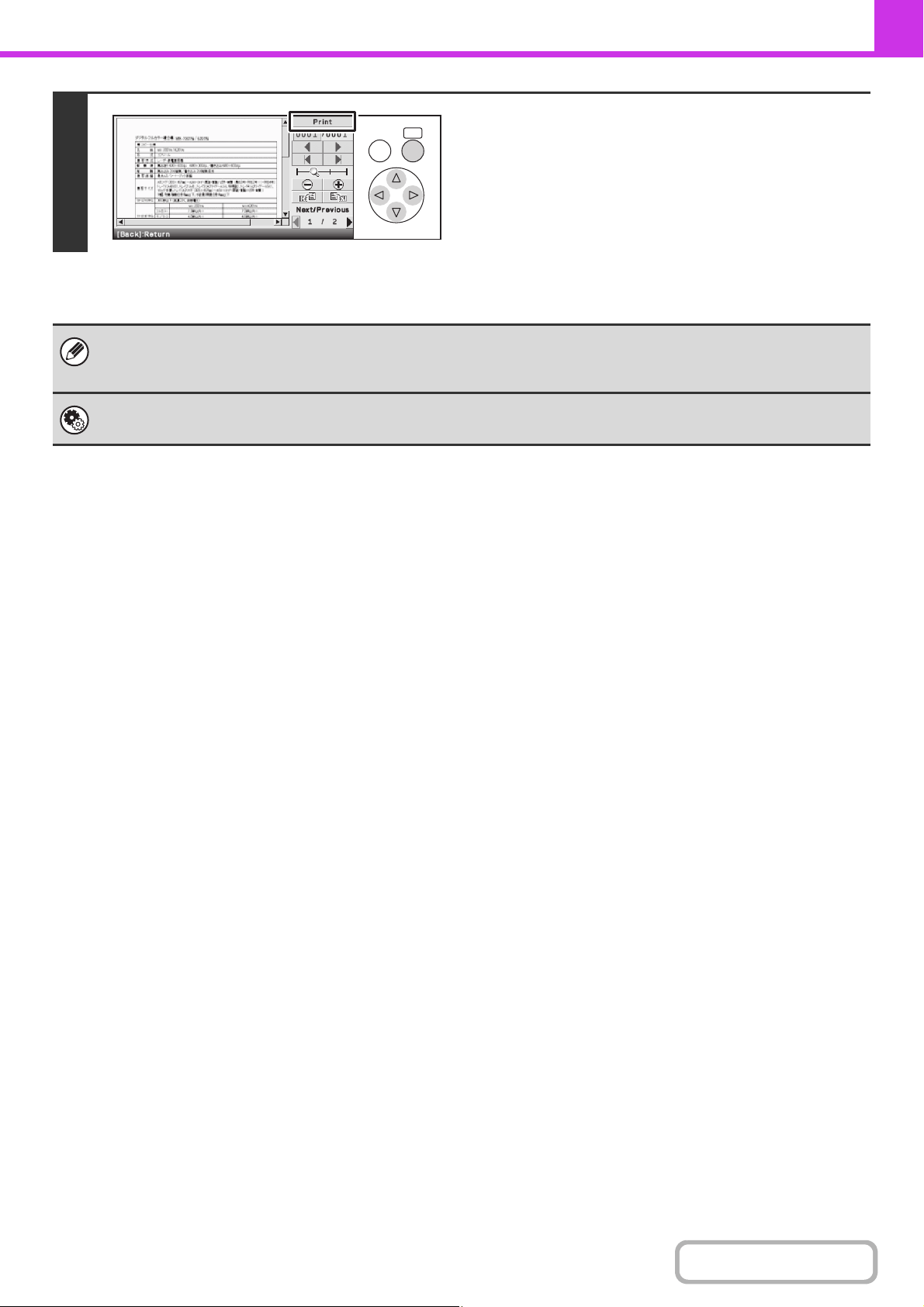
4-63
FACSIMILE
Contents
3
Check the received image and then
select the [Print] key.
Printing begins.
For information on the image check screen, see "IMAGE
CHECK SCREEN" (page 4-64).
If the screen of step 1 appears when you are configuring settings in the setting screens of any of the modes, the configured
settings will be canceled if you view the image. After viewing the image, you will return to the base screen of image send
mode, regardless of which mode you were in previously.
System Settings (Administrator): Received Data Image Check Setting (Web page only)
Use this to specify whether or not a received fax can be viewed before it is printed.
OKBACK

4-64
FACSIMILE
Contents
IMAGE CHECK SCREEN
This section explains the image check screen.
(1) Information display
This shows information on the displayed image.
(2) Preview image
An image of the selected received image appears.
If the image is cut off, select at the right
and bottom of the image to scroll.
(3) [Print] key
Select this key to start printing.
(4) Change page keys
When there are multiple pages, use these keys to
change pages.
• keys: Go to the first or the last page.
• keys: Go to the previous page or the
next page.
• Page number display: This shows the total number of
pages and the current page
number. You can select the
current page number key and
enter a number with the
numeric keys to go to that page
number.
(5) Display zoom key
Use this key to set the zoom ratio of the displayed image.
The setting applies to all pages in the file, not just the
displayed page.
(6) "Display Rotation" key
This key rotates the image right or left by 90 degrees.
The rotation applies to all pages in the file, not just the
displayed page.
(7) Image select key
When multiple images are selected for preview display,
use this key to change the displayed images.
(8) Guidance display
Shows keys that are used when an operation is
performed.
0123456790
(4)
(5)
(6)
(7)
(3)
(8)
(1)
(2)
A preview image is an image for display on the display. It will differ from the actual print result.
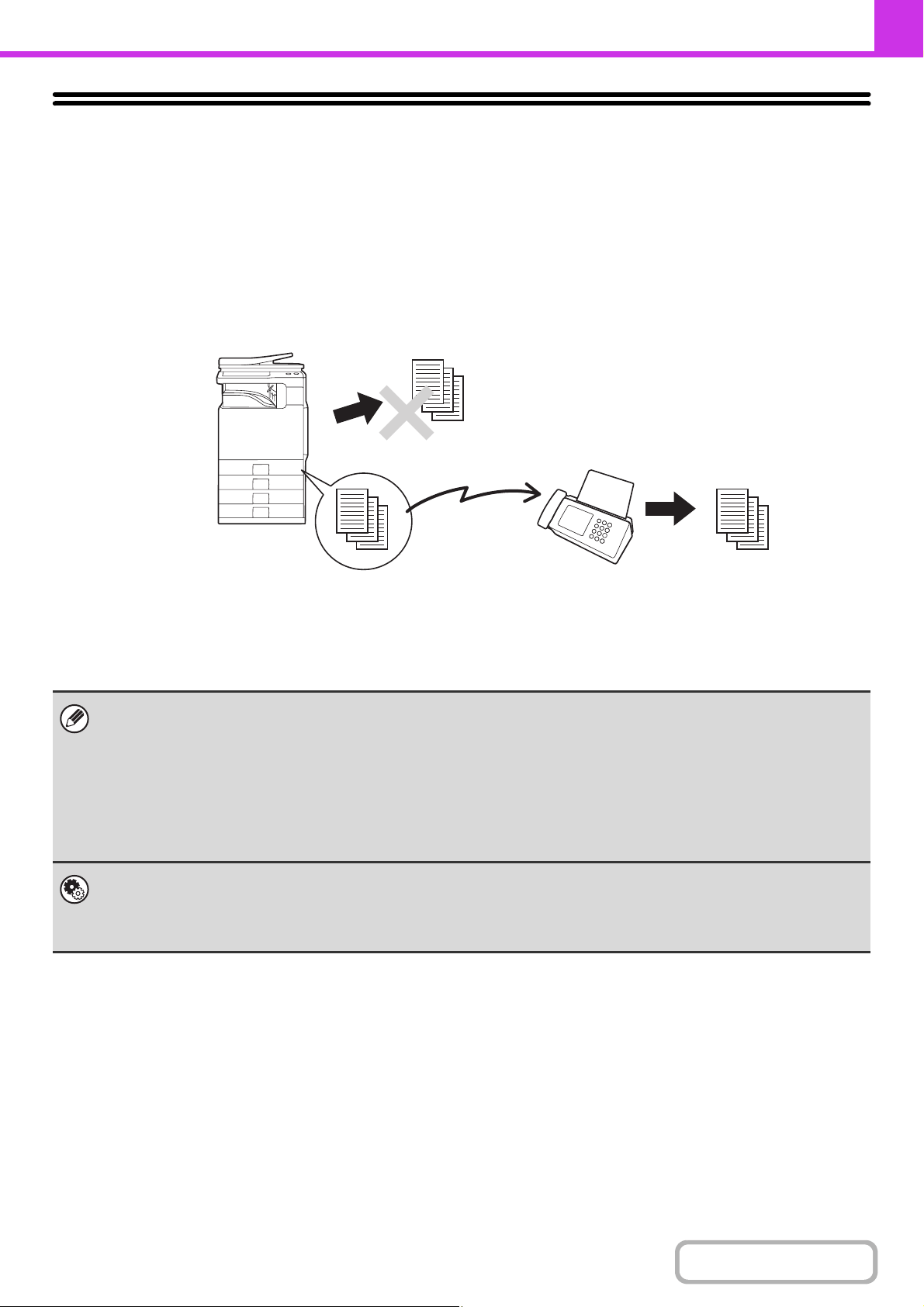
4-65
FACSIMILE
Contents
FORWARDING RECEIVED FAXES
(Fax Data Forward)
When the machine cannot print because it is out of paper or out of toner, received faxes can be forwarded to another
previously programmed fax machine.
This function is convenient in an office or work area that has two or more telephone lines and another fax machine is
connected to a different line than the machine.
Forwarding of received faxes is executed in the system settings of the machine. Press the [SYSTEM SETTINGS] key on
the operation panel to display the system setting menu screen in the display. Select [Fax Data Receive/Forward] - [Fax
Settings], and then select the key that executes received fax forwarding.
• If some pages of a fax that is being forwarded were successfully printed, only those pages that were not printed will be
forwarded.
• A forwarded fax becomes a fax transmission job. If transmission does not take place because the transmission was
canceled or an error occurred, the fax will be held in memory until it can be printed.
• Faxes received to an F-code confidential memory box cannot be forwarded.
• If a password entry screen appears after selecting the [OK] key, "Hold Setting for Received Data Print" has been enabled.
Enter the password with the numeric keys to begin forwarding.
☞PRINTING A PASSWORD-PROTECTED FAX (Hold Setting For Received Data Print) (page 4-61)
• System Settings: Fax Data Receive/Forward (page 6-16)
Use this to forward received faxes when the machine is unable to print.
• System Settings (Administrator): Set the Telephone Number for Data Forwarding
This is used to store the forwarding fax number.
The machine cannot print
Printing
Forwarding
Received fax
The machine
Forwarding
destination
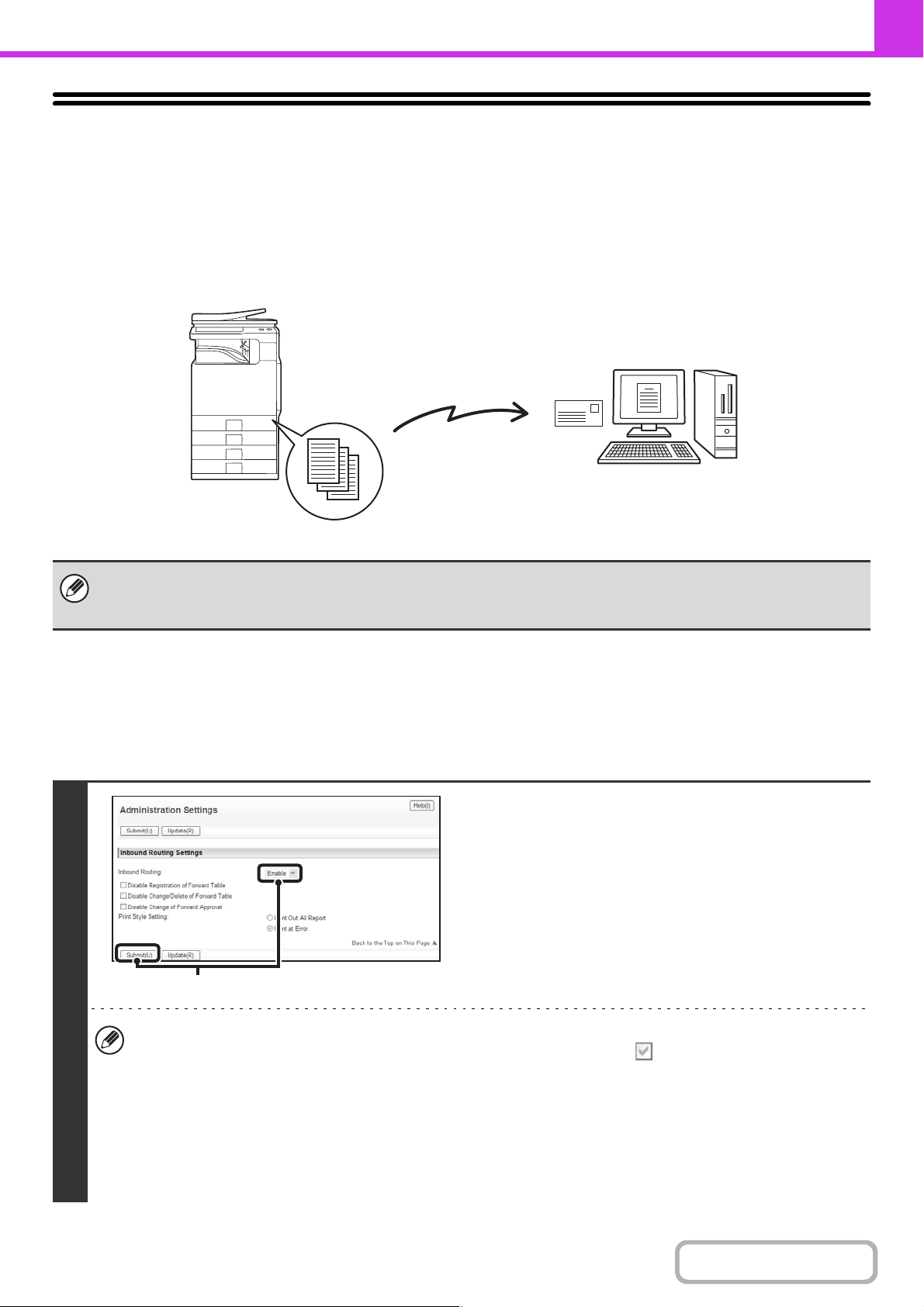
4-66
FACSIMILE
Contents
FORWARDING RECEIVED FAXES TO A
NETWORK ADDRESS
(Inbound Routing Settings)
You can have received faxes automatically forwarded to an e-mail address, file server address, desktop address, or
network folder address. This function can be used to forward received faxes to a specified address without printing them.
CONFIGURING INBOUND ROUTING SETTINGS
All inbound routing settings are configured in the Web pages. For the procedure for accessing the Web pages, see the
Quick Start Guide.
The following explanation assumes that the Web pages have been accessed with administrator rights.
To configure inbound routing settings, follow the steps below.
• This function cannot be used for faxes received by confidential reception.
• When faxes forwarded using this function are printed at the forwarding destination, the date and time of reception cannot
be printed on the faxes. ("Receiving Date & Time Print" is disabled.)
1
Enabling the inbound routing function.
(1) In the Web page menu, click [Application
Settings], [Inbound Routing Settings], and
then [Administration Settings].
(2) Select [Enable] in "Inbound Routing" and
click the [Submit] button.
Users without administrator rights can be prohibited from storing, editing, and deleting forwarding tables in this screen,
and from specifying which table is used. To do so, select the checkboxes below .
• Disable Registration of Forward Table • Disable Change/Delete of Forward Table • Disable Change of Forward
Approval
When inbound routing is enabled, you can also specify whether or not you wish the machine to print the forwarded
faxes.
To have all received faxes printed before being forwarded, select "Print Out All Report" in "Print Style Setting". To
have received faxes printed only when an error prevents forwarding, select "Print at Error".
After configuring the settings, be sure to click the [Submit] button.
Forwarding
Received fax
The machine
(2)
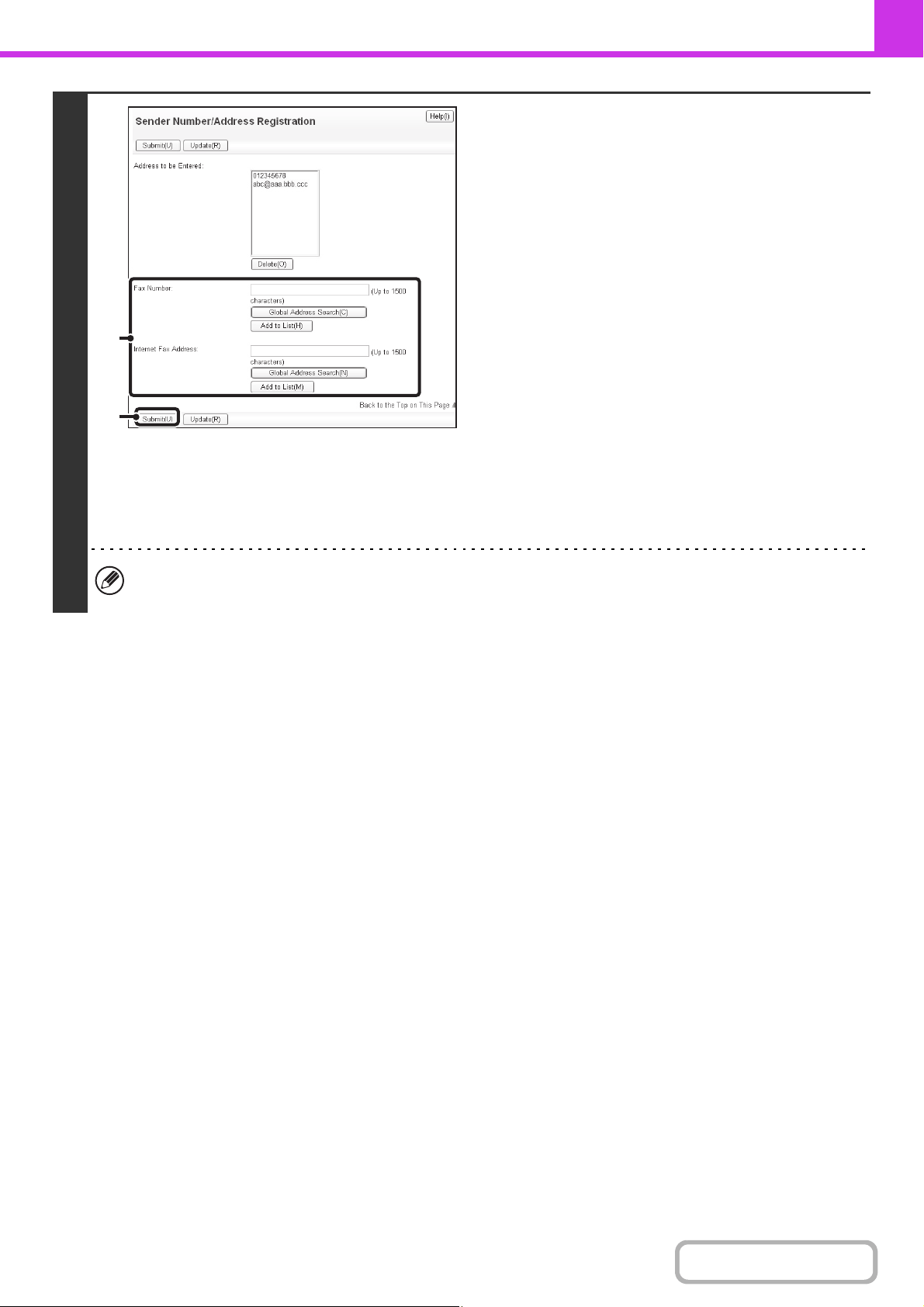
4-67
FACSIMILE
Contents
2
Storing sender addresses.
If you wish to have only faxes from specified addresses
forwarded, store the desired sender addresses. Sender
addresses stored here can be selected from a list when you
store a forwarding table.
(1) Click [Sender Number/Address
Registration] in the [Inbound Routing
Settings] menu in the Web page.
(2) Enter the sender address in "Internet Fax
Address" or "Fax Number" as appropriate,
and click the [Add to List] button.
The entered address will be added to the "Address to be
Entered" list.
• Specify whether the address will be directly entered
(maximum of 1500 characters) or selected from a
global address book by clicking the [Global Address
Search] button.
• To store multiple addresses, repeat this step.
(3) When you have finished adding addresses,
click the [Submit] button.
• A maximum of 500 sender numbers/addresses can be stored.
• To delete an entered address, select the address in "Address to be Entered" and click the [Delete] button.
(2)
(3)
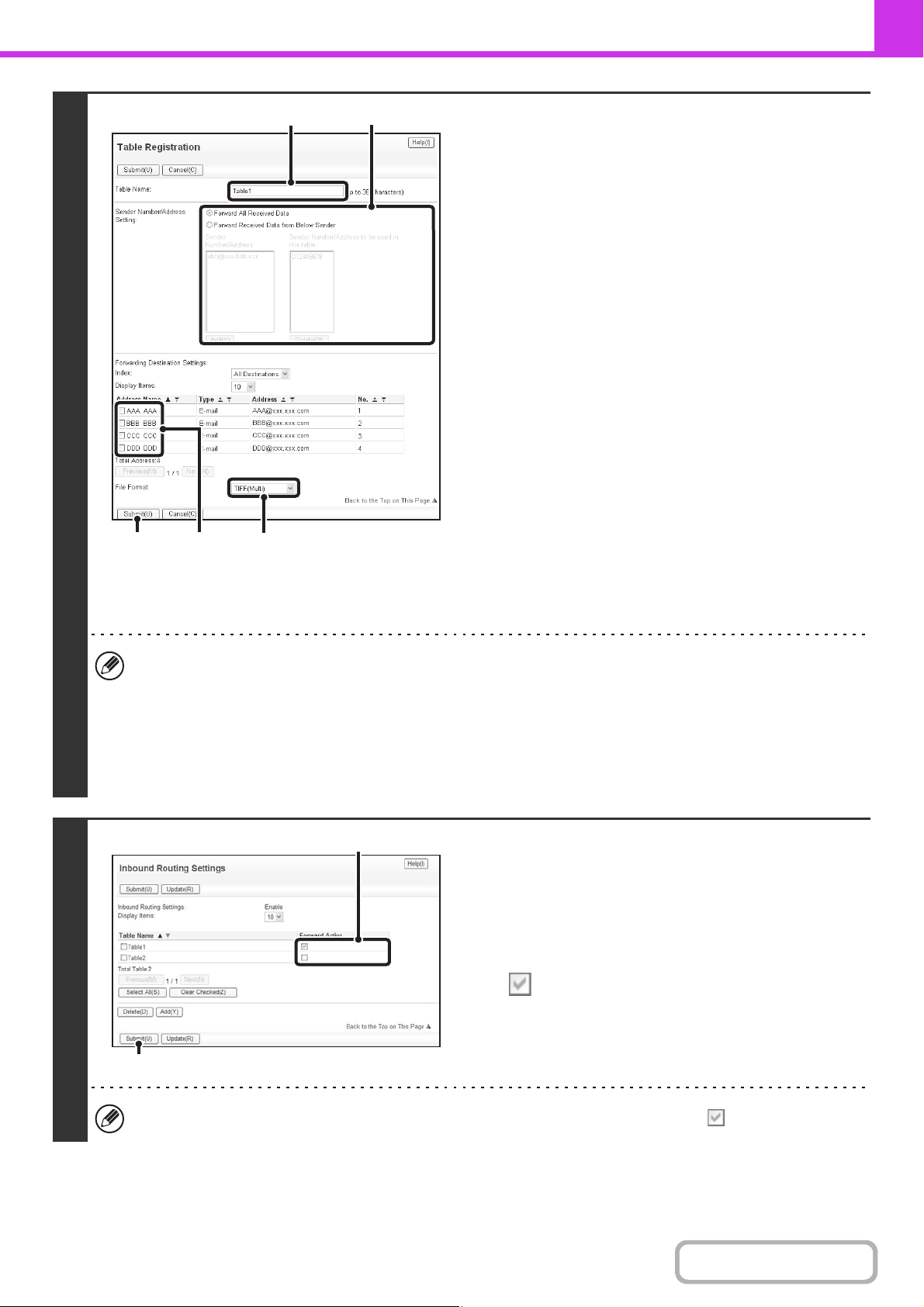
4-68
FACSIMILE
Contents
3
Store a forwarding table.
Follow the steps below to store a forwarding table that
combines a specified sender and forwarding address.
(1) Click [Inbound Routing Settings] in the Web
page menu and click the [Add] button.
(2) Enter a "Table Name".
(3) Select the sender whose faxes will be
forwarded.
• To forward all received faxes, select [Forward All
Received Data].
• To forward faxes received from a specific sender only,
select [Forward Received Data from Below Sender],
select the sender from the list, and then click the [Add]
button.
(4) Select the forwarding address.
Forwarding addresses can be selected from the
machine's address book. (Multiple addresses can be
selected.) A maximum of 1000 forwarding addresses can
be stored (a combined maximum of 100 file server,
desktop, and network folder addresses can be stored).
(5) Select the file format.
A file format can be set for each forwarding table.
(6) Click [Submit].
• When selecting senders from the "Sender Number/Address Setting" list, you can use the [Shift] key or the [Ctrl] key
on your keyboard to select multiple senders.
• A maximum of 50 forwarding tables can be stored.
• If you wish to select a group of addresses for the forwarding destination, you can only select a group that contains
e-mail addresses only.
• Images sent in TIFF format may not display correctly in some recipient environments. In this event, change the file
format to PDF.
4
Specifying forwarding tables to be used.
To use the inbound routing function, enable the forwarding
tables that you wish to use from among the stored tables.
(1) Click [Inbound Routing Settings] in the Web
page menu.
(2) Select the "Forward Activated" checkbox
of each forwarding table that you wish
to use.
(3) Click [Submit].
To delete a forwarding table, click the checkbox next to the table name so that it is selected and click [Delete].
(6) (4)
(3)
(2)
(5)
(2)
(3)
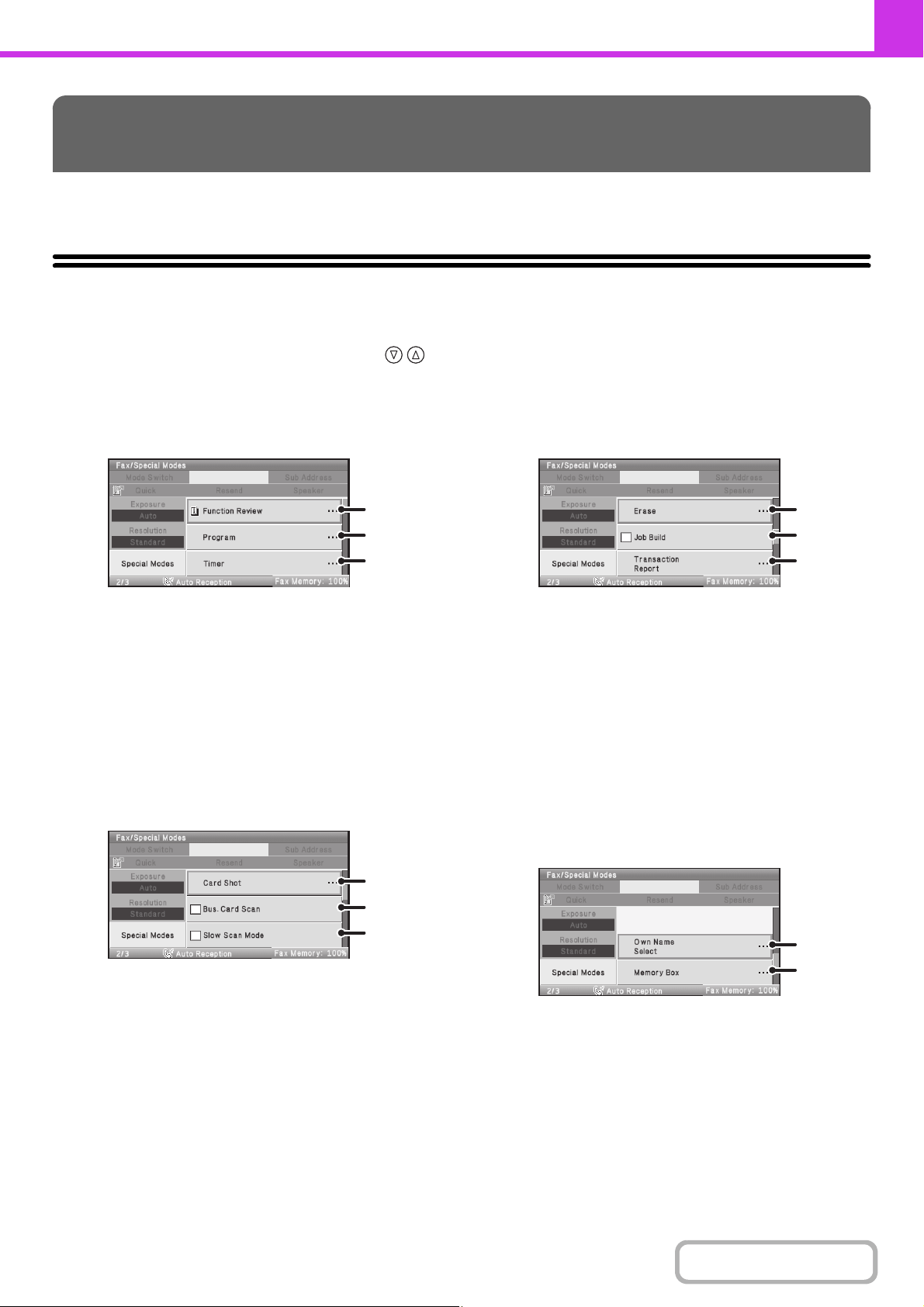
4-69
FACSIMILE
Contents
This section explains special modes that can be used for fax transmission.
SPECIAL MODES
When the [Special Modes] key is selected in the base screen, the special modes menu screen appears. The special
modes menu consists of five screens. Press
the key to switch between the five screens. When the [Basic Menu]
key is selected in the special modes screen, the selected settings are entered and the base screen reappears.
1st screen
(1) [Function Review] key*
1
Select this key to check the special mode settings.
(2) [Program] key
☞ STORING FAX OPERATIONS (Program) (page
4-71)
(3) [Timer] key
☞ SENDING A FAX AT A SPECIFIED TIME (Timer)
(page 4-74)
2nd screen
(1) [Card Shot] key
☞ SENDING BOTH SIDES OF A CARD AS A SINGLE
PAGE (Card Shot) (page 4-76)
(2) [Bus. Card Scan] checkbox*
2
☞ SENDING BUSINESS CARDS (Business Card
Scan) (page 4-79)
(3) [Slow Scan Mode] checkbox
☞ FAXING THIN ORIGINALS (Slow Scan Mode) (page
4-80)
3rd screen
(1) [Erase] key
☞ ERASING PERIPHERAL SHADOWS ON THE
IMAGE (Erase) (page 4-82)
(2) [Job Build] checkbox
☞ SENDING A LARGE NUMBER OF PAGES (Job
Build) (page 4-85)
(3) [Transaction Report] key
☞ CHANGING THE PRINT SETTINGS FOR THE
TRANSACTION REPORT (Transaction Report)
(page 4-87)
4th screen
(1) [Own Name Select] key
☞ TEMPORARILY CHANGING THE SENDER
INFORMATION (Own Name Select) (page 4-90)
(2) [Memory Box] key
☞ SENDING A FAX WHEN ANOTHER MACHINE
POLLS YOUR MACHINE (Polling Memory) (page
4-94)
SPECIAL MODES
(1)
(2)
(3)
(1)
(2)
(3)
(1)
(2)
(3)
(1)
(2)
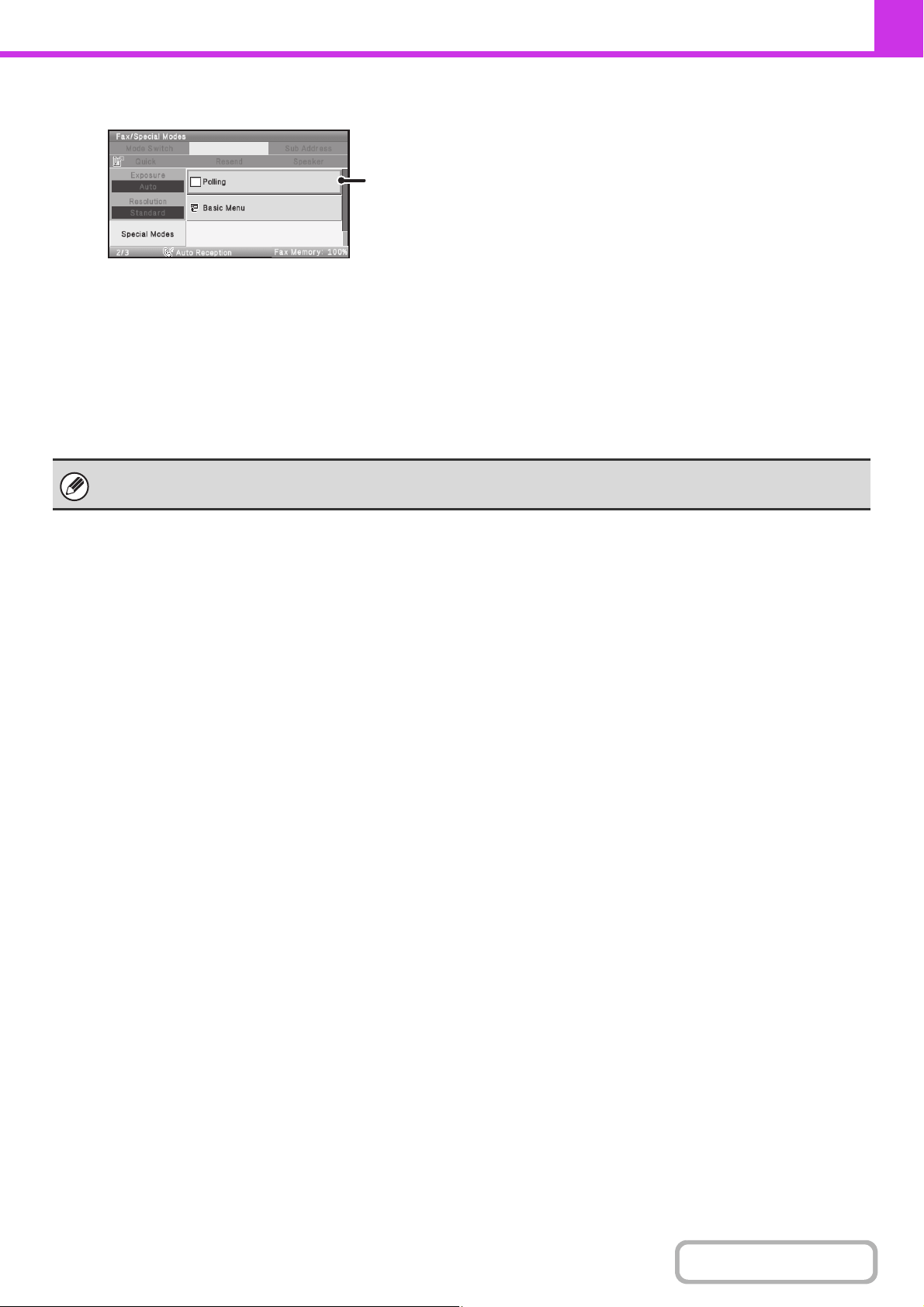
4-70
FACSIMILE
Contents
5th screen
(1) [Polling] checkbox
☞ CALLING A FAX MACHINE AND INITIATING
RECEPTION (Polling) (page 4-91)
*
1
This cannot be selected when a special mode has not been enabled.
*
2
The optional business card feeder must be attached and "Business Card Scan Option" must be enabled in the system
settings (administrator).
(1)
Special modes can generally be combined with other special modes, however, there are some combinations that are not
possible. If a prohibited combination is selected, a message will appear in the display.
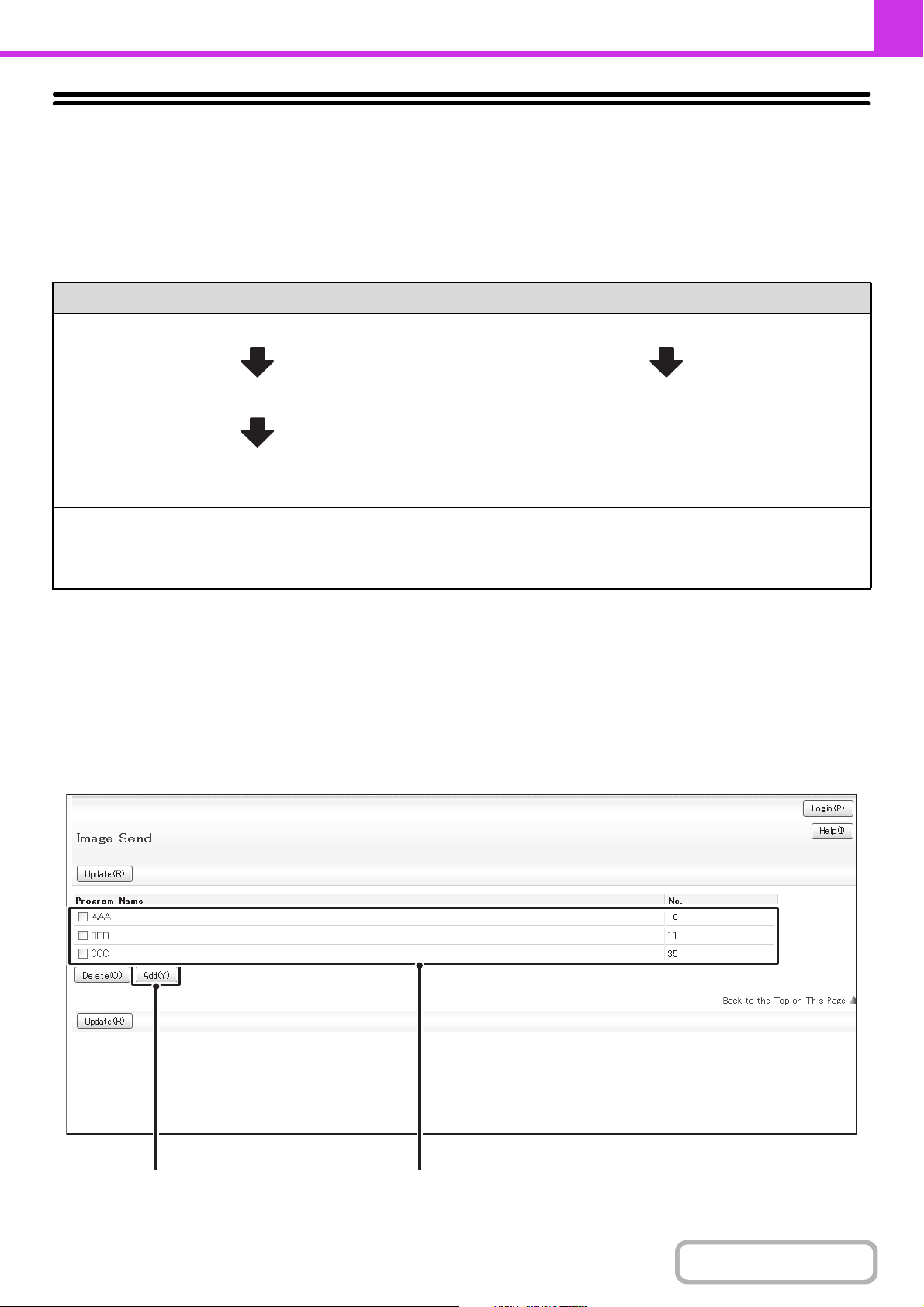
4-71
FACSIMILE
Contents
STORING FAX OPERATIONS (Program)
A program is a group of transmission settings stored together. When transmission settings are stored in a program, the
settings can be retrieved and used for a fax job by means of a simple operation.
For example, suppose that the same 8-1/2" x 11" (A4) size documents are distributed to branch offices in various
regions once a month.
(1) The same documents are faxed to each branch office
(2) Smudges on the edges of the documents are erased before transmission
JOB PROGRAMS
If you frequently use the same settings and/or functions to transmit to the same destination or destinations, the settings
and destinations can be stored in a program. This allows the settings and destinations to be selected by simply selecting
the program.
Storing a program
Programs can be stored, edited, and deleted in [Job Program] > [Image Send] in the Web page menu.
When a job program is not stored When a job program is stored
Enter the fax numbers of the branch offices.
Select erase settings.
Press the [BLACK & WHITE START] key.
The originals are scanned and transmitted.
Retrieve the stored program.
Press the [BLACK & WHITE START] key.
The originals are scanned and transmitted.
Considerable time is required to send the documents each
month because the above settings must be selected.
In addition, mistakes may occasionally be made when
selecting the settings, so incorrect transmissions may occur.
When a program is stored, settings are selected with ease by
simply selecting the program key.
In addition, transmission takes place based on the stored
settings so there are no chances for mistakes.
(1) (2)
4-72
FACSIMILE
Contents
(1) [Add] key
Use this key to add a new program.
(2) List display
This displays a list of the currently stored programs. A
program can be selected to open an edit/delete screen
for the program.
Select the [Add] key in the above screen to open a registration screen. Up to 48 programs can be stored.
For more information, see "Settings" (page 4-72).
Editing and deleting job programs
A program can be selected from the list in the above screen to open an edit screen for the program.
To delete the program, select the checkbox next to the program name and then select [Delete].
For more information, see the following table.
Settings
• A timer setting cannot be included in a program.
• At least one one-touch key must be specified in a program or the program cannot be stored.
•
Programs can also be stored using the Web pages. Click [Job Programs] and then [Image Send] in the Web page menu.
• The settings stored in a program will be retained even after the program is used for transmission. The same settings can
be used repeatedly for transmission.
• The following settings can be stored in programs.
• Destinations: One-touch keys, group keys, search numbers
• Image settings: Original scan size, original orientation, duplex scanning, exposure, resolution
• Special modes: Polling reception, Erase, Job Build, Slow Scan Mode, Business Card Scan
• F-code communication: A destination that includes an F-code can be stored to perform an F-code operation.
• Up to 500 destinations can be stored in each program.
Item Description
Program Number
Set the number to be assigned to the program. The lowest available number is
automatically entered. To change the number, enter a number from 01 to 48. A
number that has already been stored cannot be used.
Program Name Enter a maximum of 36 characters for the program name.
Condition Settings This shows setting screens for each mode.
Mode Switch
Select the mode that you wish to use (Internet Fax, scan, copy, etc.). The display will
change to the base screen of the selected mode.
Mode Settings
Frequently used settings can be stored in the same way as when they are selected
for a mode.
Address Setting
This shows the setting screen for addresses.
Select the address(es) to be used in the program from the address book. Up to 500
destinations can be stored in one program.
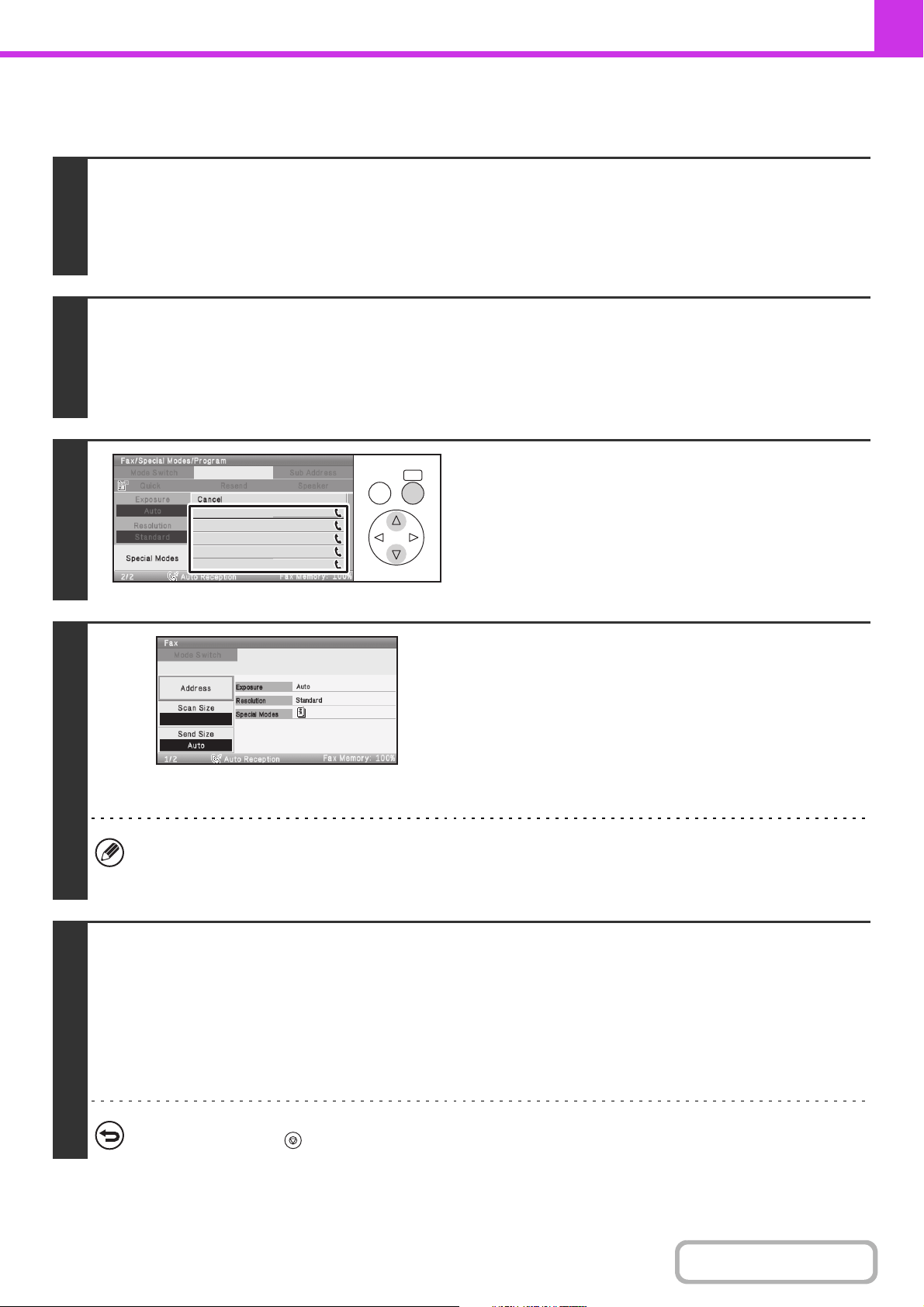
4-73
FACSIMILE
Contents
USING A PROGRAM TO SEND
Keys in the display can be selected with the arrow keys and the [OK] key.
1
Place the original.
Place the original in the document feeder tray or on the document glass as appropriate for the functions stored in the
program.
When the original is a different size than the size setting, set the original size.
☞ SPECIFYING THE SCAN SIZE AND SEND SIZE (page 4-50)
2
Select the special modes.
(1) Select the [Special Modes] key.
(2) Select the [Program] key.
☞ SPECIAL MODES (page 4-69)
3
Retrieve the stored program.
Select the desired program key.
4
Select additional settings.
When a program is used, the following settings can be
additionally specified:
• Image settings: Original scan size*, send size
• Special modes: Timer Transmission, Card Shot, Own Name
Select, Transaction Report
* When stored in the program, this cannot be additionally
specified.
• The screen that appears will vary depending on the destination stored in the program.
• The mode cannot be changed here.
• Functions stored in the program cannot be canceled here.
5
Press the [BLACK & WHITE START] key.
Scanning begins.
• If you inserted the original pages in the document feeder tray, all pages are scanned.
A beep will sound to indicate that scanning is finished.
• If you are scanning the original on the document glass, scan each page one page at a time.
When scanning finishes, place the next original and press the [BLACK & WHITE START] key. Repeat until all pages have
been scanned and then select the [Read-End] key.
A beep will sound to indicate that scanning is finished.
To cancel scanning...
Press the [STOP] key ( ).
OKBACK
Program 1
Program 2
Program 3
Program 4
Program 5
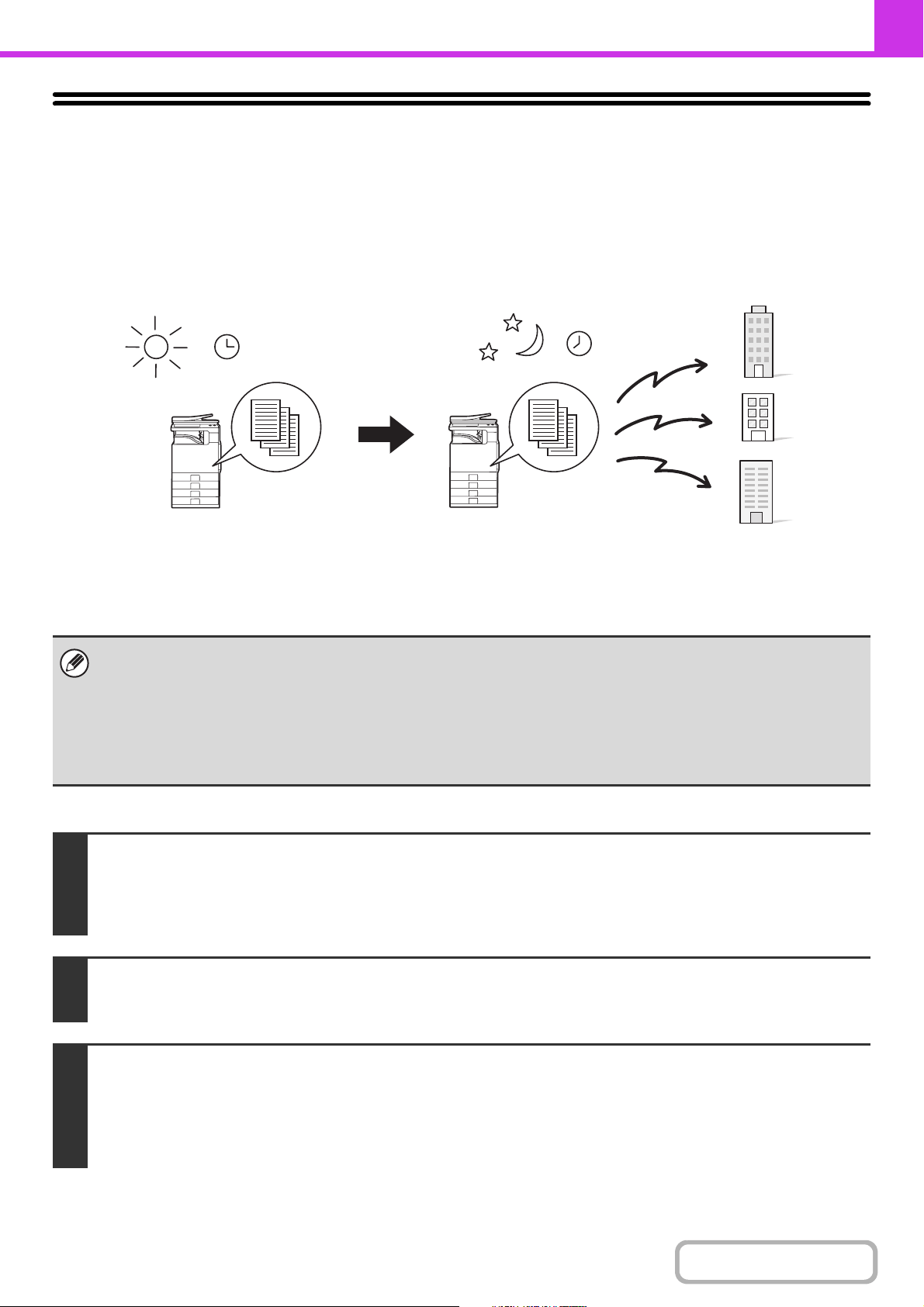
4-74
FACSIMILE
Contents
SENDING A FAX AT A SPECIFIED TIME
(Timer)
When this function is used, transmission takes place automatically at a specified time.
The timer transmission function makes it easy to perform reserved transmissions, broadcast transmissions and other
transmissions at night or other times when phone rates are low.
A timer setting can also be specified for polling reception to receive a fax when you are not present.
Keys in the display can be selected with the arrow keys and the [OK] key.
• When a timer transmission is set, keep the main power switch "on". Transmission will not take place if the main power is
turned off at the specified time.
• When performing a timer transmission, you must scan the original into memory when you set up the transmission. It is not
possible to leave the document in the auto document feeder or on the document glass and have it scanned at the reserved
time of transmission.
• Settings selected for a timer transmission (exposure, resolution, special modes, etc.) are automatically cleared after the
transmission is finished.
1
Place the original.
Place the original face up in the document feeder tray, or face down on the document glass.
When the original is a different size than the size setting, set the original size.
☞ SPECIFYING THE SCAN SIZE AND SEND SIZE (page 4-50)
2
Enter the destination fax number.
☞
ENTERING DESTINATIONS (page 4-19)
3
Select the special modes.
(1) Select the [Special Modes] key.
(2) Select the [Timer] key.
☞ SPECIAL MODES (page 4-69)
During the day, set up a
broadcast transmission to
take place at 20:00
At 20:00, the broadcast
transmission begins automatically
(Transmission to the first destination
takes place)
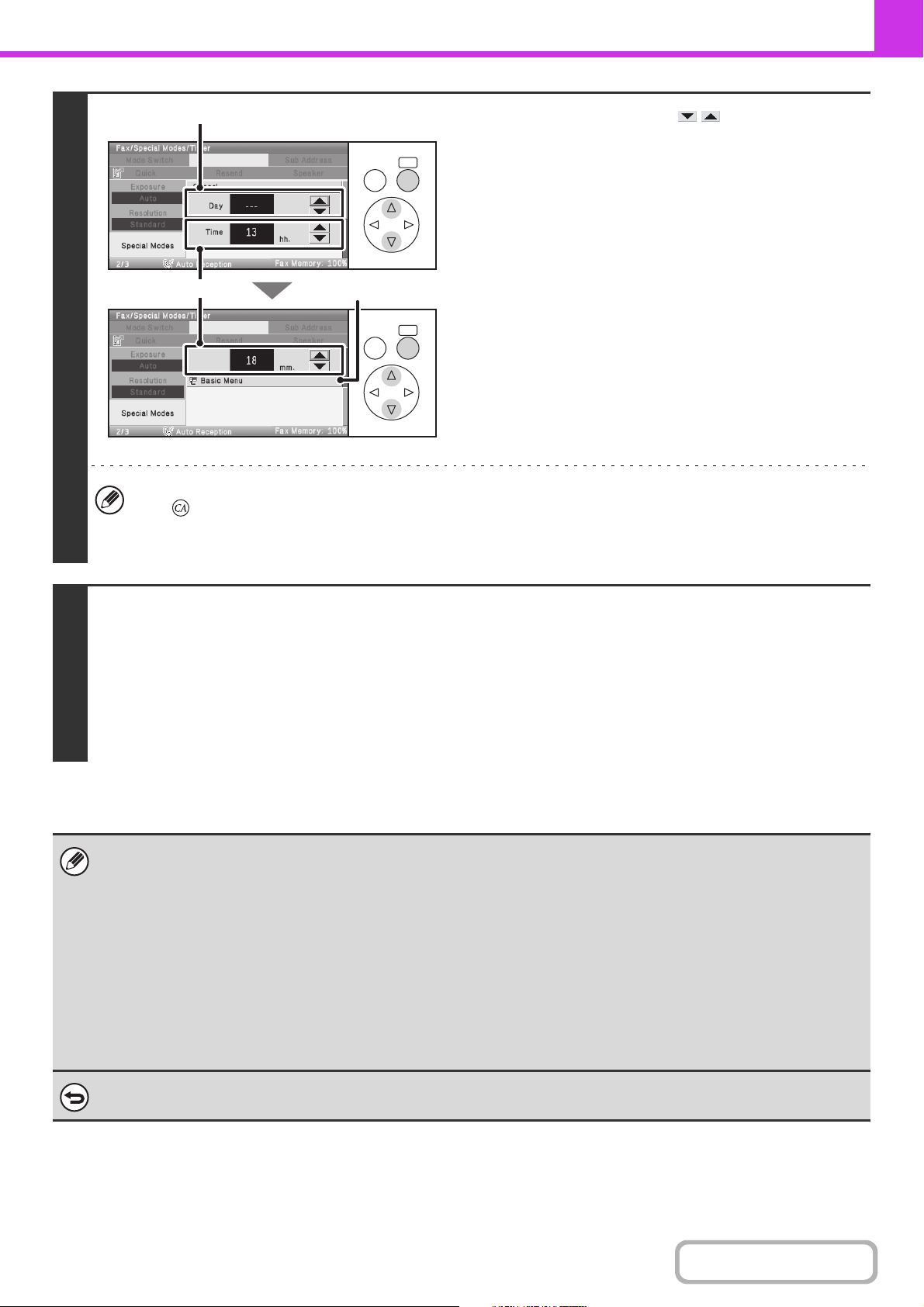
4-75
FACSIMILE
Contents
4
Set the time with the keys.
(1) Specify the day.
If you do not wish to specify a day, select [---]. In this
case, transmission will begin when the time specified in
(2) arrives.
(2) Specify the time (hour, minute)
Select the time in 24-hour format.
You can also select a numeric display key to change the
setting with the numeric keys.
(3) Select the [Basic Menu] key.
When this screen is opened, the setting will show the current time. If the time is not correct, press the [CLEAR ALL]
key ( ) to cancel the operation. Correct the time in the system settings and then perform the timer transmission
procedure.
☞ CHECKING THE DATE AND TIME (page 4-6)
5
Press the [BLACK & WHITE START] key.
Scanning begins.
• If you inserted the original pages in the document feeder tray, all pages are scanned.
A beep will sound to indicate that scanning is finished.
• If you are scanning the original on the document glass, scan each page one page at a time.
When scanning finishes, place the next original and press the [BLACK & WHITE START] key. Repeat until all pages have
been scanned and then select the [Read-End] key.
A beep will sound to indicate that scanning is finished.
• The time can be specified up to a week in advance.
• Up to 94 timer transmissions can be stored at once.
• Only one timer polling operation can be stored at once. If you wish to poll multiple machines, store a serial polling timer
operation.
• If another transmission is in progress when the specified time arrives, the timer operation will begin after that transmission
is finished.
• Other operations can be performed after a timer transmission is set up.
• This function cannot be used in direct transmission mode or when the speaker is used to dial.
• If a timer transmission is given priority in the job status screen, the time specification is canceled. The transmission will
begin as soon as the job in progress is completed.
☞GIVING PRIORITY TO A RESERVED FAX JOB (page 4-127)
To cancel timer transmission...
Select the [Cancel] key in the screen of step 4.
OKBACK
OKBACK
(1)
(2)
(3)
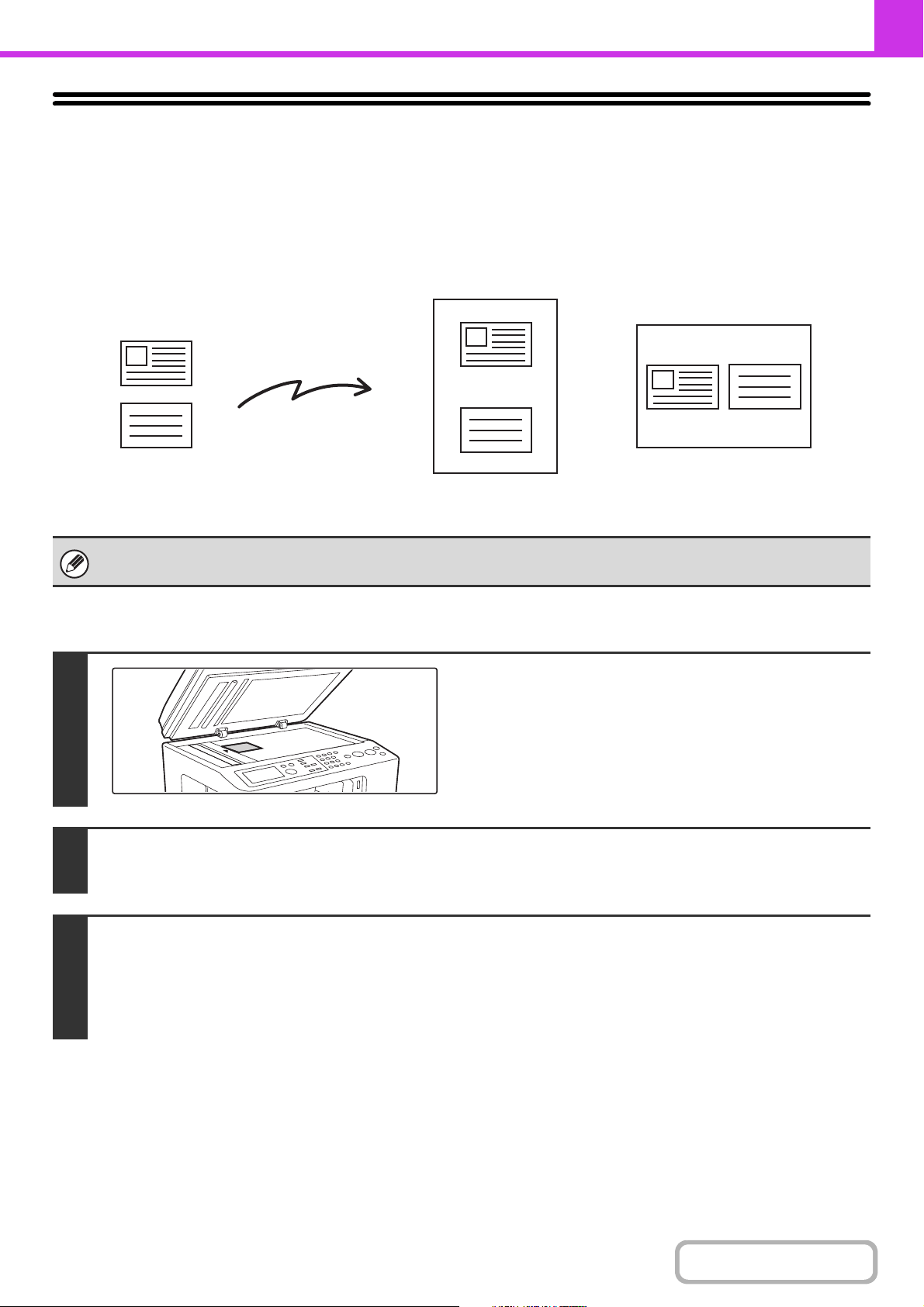
4-76
FACSIMILE
Contents
SENDING BOTH SIDES OF A CARD AS A
SINGLE PAGE (Card Shot)
This function lets you send the front and reverse sides of a card as a single page, without the need to send each side
separately.
Keys in the display can be selected with the arrow keys and the [OK] key.
When using card shot, the original must be scanned on the document glass.
1
Place the original face down on the
document glass.
2
Enter the destination fax number.
☞
ENTERING DESTINATIONS (page 4-19)
3
Select the special modes.
(1) Select the [Special Modes] key.
(2) Select the [Card Shot] key.
☞ SPECIAL MODES (page 4-69)
Transmission
Front
Back
Originals
Transmitted image
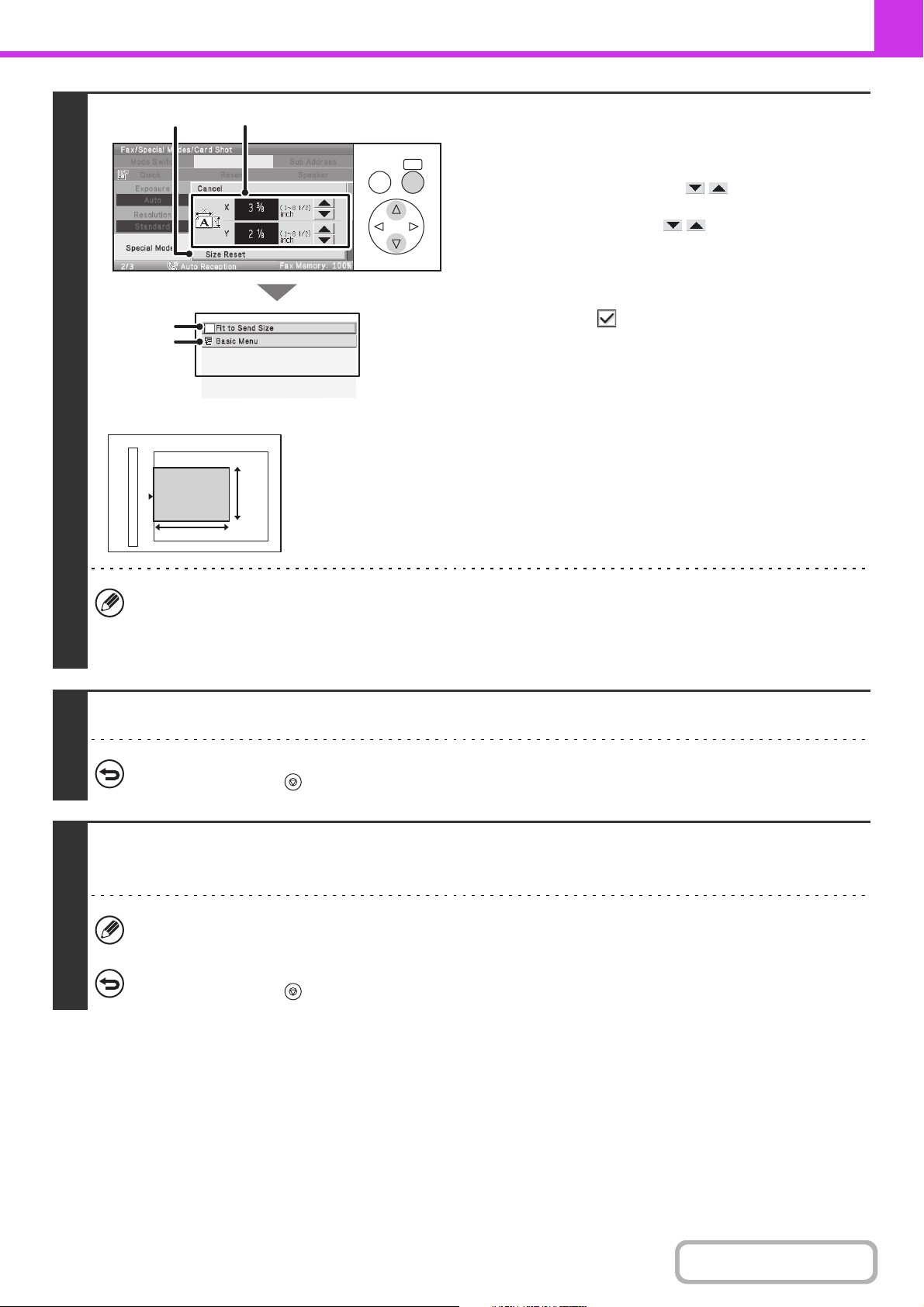
4-77
FACSIMILE
Contents
4
Specify the original size.
(1) Enter the original size.
• Select the [X] key and enter the horizontal dimension
(X) of the original with the keys.
• Select the [Y] key and enter the vertical dimension (Y)
of the original with the keys.
(A) To return the original size to the default size, select
the [Size Reset] key.
(B) To have the image automatically enlarged or reduced
to the send size, select the [Fit to Send Size]
checkbox . The checkbox does not need to be
selected if you wish to scan at the entered original
size.
(2) Select the [Basic Menu] key.
• The send size is automatically selected based on the original size you entered.
• After selecting card scan, you can change the scan size and the send size from the [Scan Size] key and [Send Size]
key in the base screen. In this case, the screen of this step will appear in the scan size setting screen. For the
procedure for setting the send size, see "Specifying the send size of the original" (page 4-54).
5
Press the [BLACK & WHITE START] key to scan the front of the card.
To cancel scanning...
Press the [STOP] key ( ).
6
Turn the card over so that the back is face down, and press the [BLACK &
WHITE START] key to scan the back of the card.
Before scanning the back of the card, you can select the [Configure] key in the display to change the exposure.
To cancel scanning...
Press the [STOP] key ( ).
OKBACK
(1)(A)
(2)
(B)
X
Y
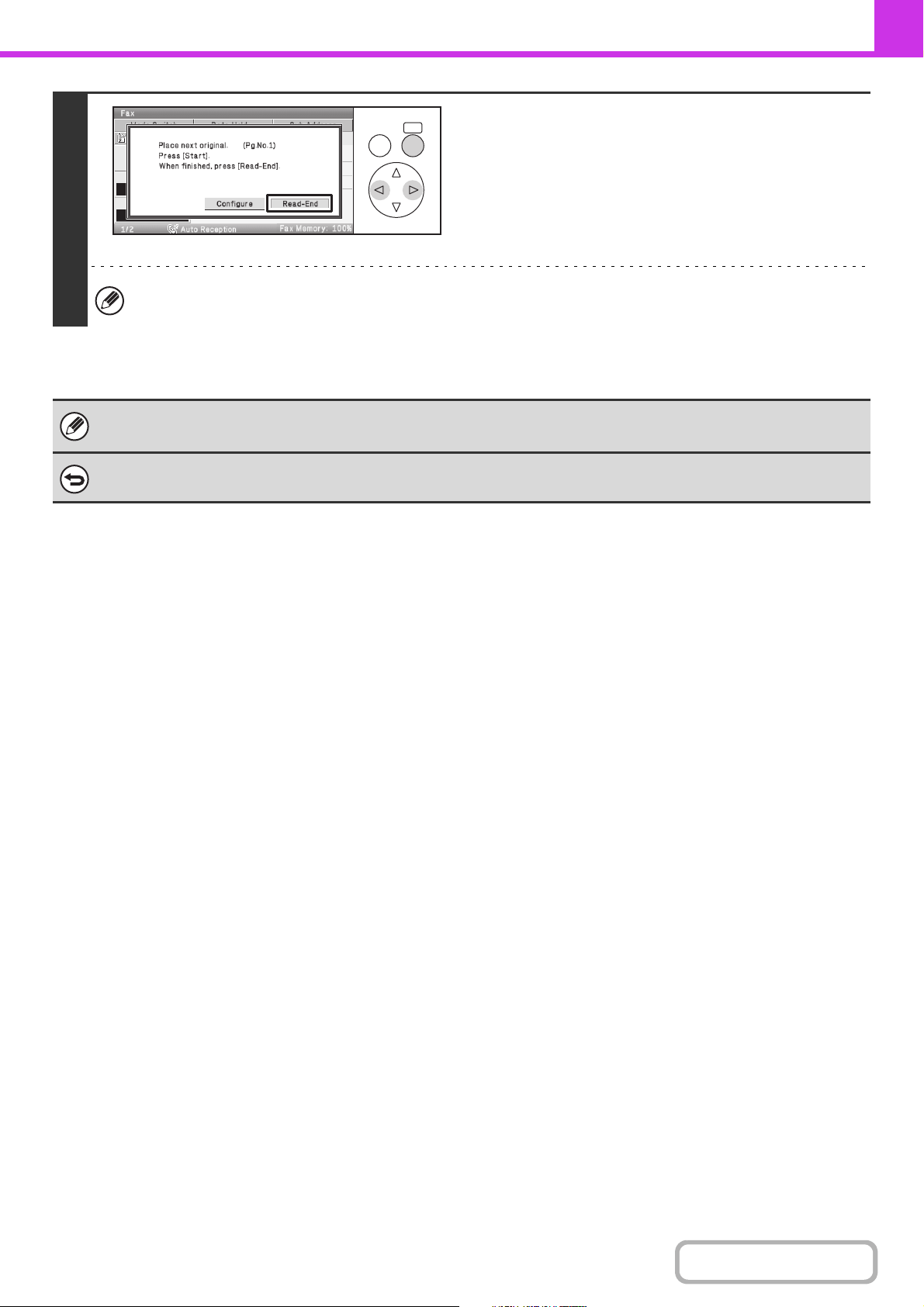
4-78
FACSIMILE
Contents
7
Select the [Read-End] key.
If you will continue scanning additional cards, you can select the [Configure] key to change the exposure, resolution,
scan size, and send size.
• The ratio cannot be specified and "Rotation Sending Setting" cannot be selected.
• This function cannot be used in direct transmission mode or when the speaker is used to dial.
To cancel Card Shot...
Select the [Cancel] key in the screen of step 4.
OKBACK
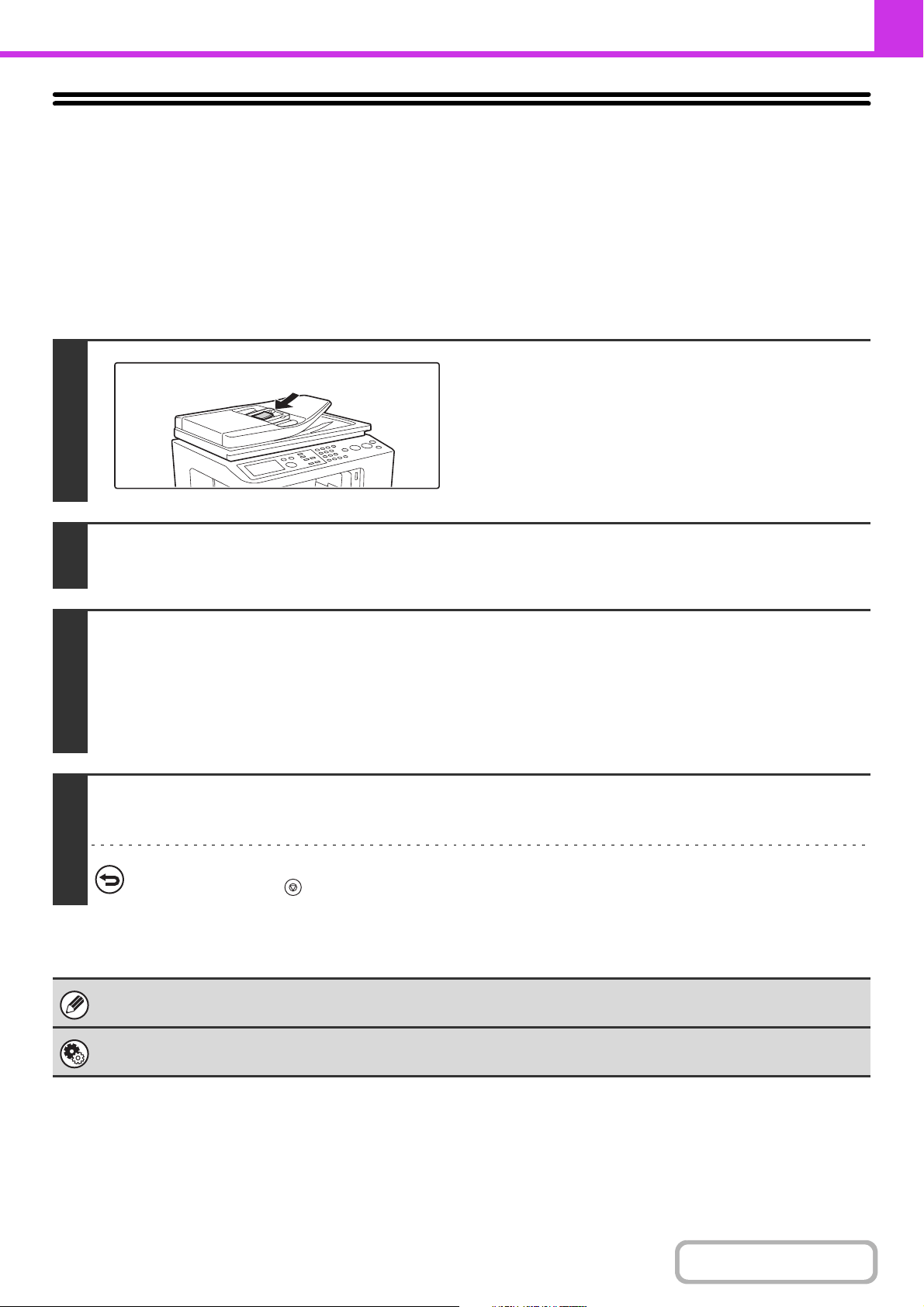
4-79
FACSIMILE
Contents
SENDING BUSINESS CARDS
(Business Card Scan)
Multiple business cards can be scanned and transmitted at once.
To use this function, the business card feeder must be attached to the automatic document feeder and "Business Card
Scan Option" must be enabled in the system settings (administrator). For the attachment procedure, see "BUSINESS
CARD FEEDER" in "BEFORE USING THE MACHINE" (page 1-57).
Keys in the display can be selected with the arrow keys and the [OK] key.
1
Load the business cards.
2
Enter the destination fax number.
☞
ENTERING DESTINATIONS (page 4-19)
3
Select the special modes.
(1) Select the [Special Modes] key.
(2) Select the [Bus. Card Scan] key.
Read the message that appears and then press the [OK] key.
☞ SPECIAL MODES (page 4-69)
4
Press the [BLACK & WHITE START] key.
Scanning begins. A beep will sound to indicate that scanning is finished.
To cancel scanning...
Press the [STOP] key ( ).
This function cannot be used when the scan size is specified by numerical values.
System Settings (Administrator): Business Card Scan Option (Web page only)
Specify whether or not the business card scan function is used.
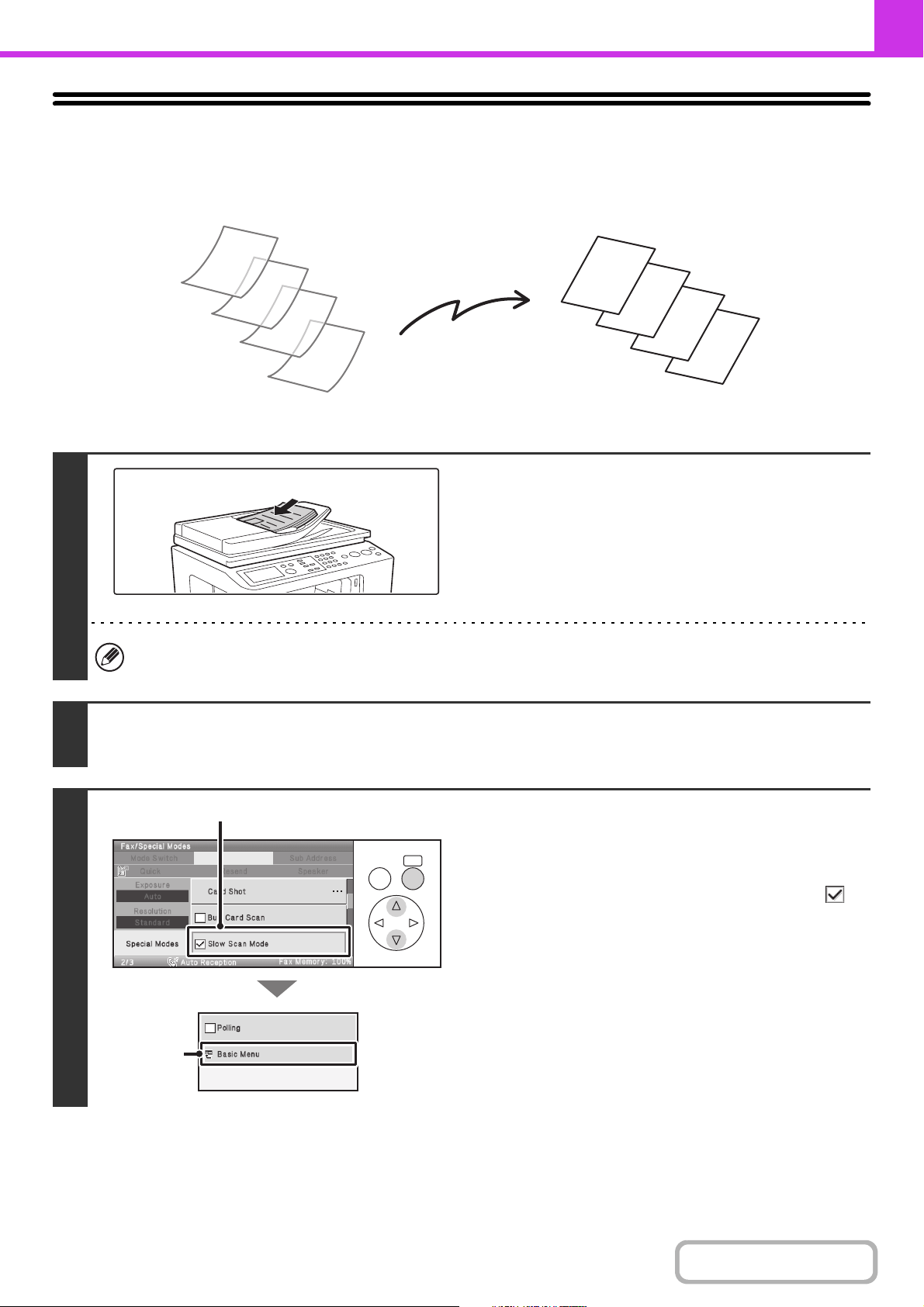
4-80
FACSIMILE
Contents
FAXING THIN ORIGINALS (Slow Scan Mode)
Use this function when you wish to scan thin originals using the automatic document feeder. This function helps prevent
thin originals from misfeeding.
Keys in the display can be selected with the arrow keys and the [OK] key.
1
Insert the originals face up in the
document feeder tray.
Adjust the document guides slowly.
When the original is a different size than the size setting, set
the original size.
☞ SPECIFYING THE SCAN SIZE AND SEND SIZE (page
4-50)
If the originals are inserted with too much force, they may crumple and misfeed.
2
Enter the destination fax number.
☞
ENTERING DESTINATIONS (page 4-19)
3
Select slow scan mode.
(1) Select the [Special Modes] key.
☞ SPECIAL MODES (page 4-69)
(2) Set the [Slow Scan Mode] checkbox to .
(3) Select the [Basic Menu] key.
D
C
B
A
D
C
B
A
OKBACK
(2)
(3)
4-81
FACSIMILE
Contents
4
Press the [BLACK & WHITE START] key.
Scanning begins. A beep will sound to indicate that scanning is finished.
To cancel scanning...
Press the [STOP] key ( ).
When this function is selected, automatic 2-sided scanning is not possible.
To cancel slow scan mode...
Set the [Slow Scan Mode] checkbox to in the screen of step 3.
System Settings (Administrator): Original Feeding Mode (Web page only)
This is used to have scanning always take place using slow scan mode.
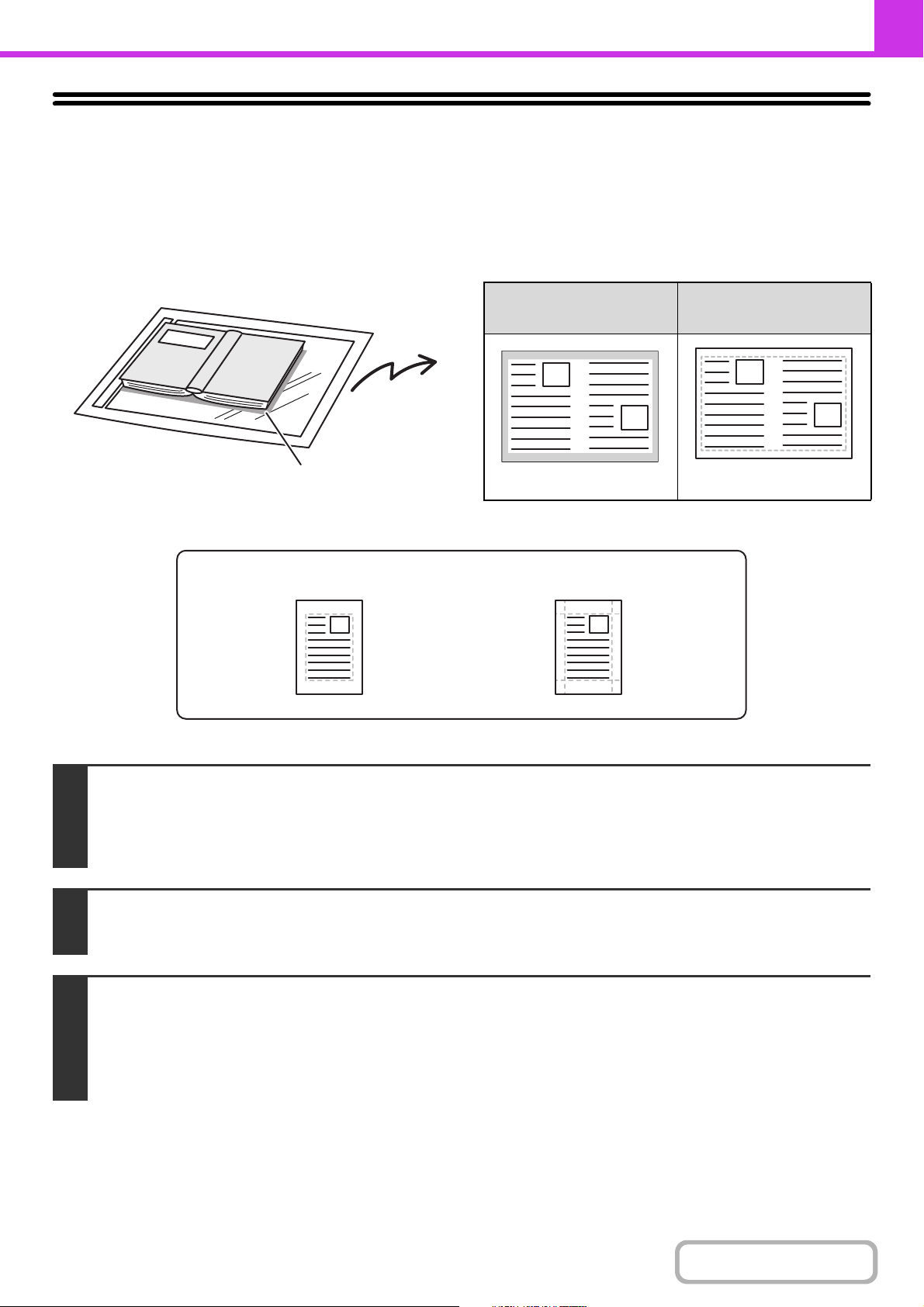
4-82
FACSIMILE
Contents
ERASING PERIPHERAL SHADOWS ON THE
IMAGE (Erase)
The erase function is used to erase shadows on images produced when scanning thick originals or books. (This function
does not detect shadows and will eliminate everything appearing in the erase area - including shadows, text and images.)
Scanning a thick book
Erase modes
Keys in the display can be selected with the arrow keys and the [OK] key.
Shadows appear here.
Not using the erase
function
Using the erase
function
Shadows appear in the image.
No shadows appear.
1
Place the original.
Place the original face up in the document feeder tray, or face down on the document glass.
When the original is a different size than the size setting, set the original size.
☞ SPECIFYING THE SCAN SIZE AND SEND SIZE (page 4-50)
2
Enter the destination fax number.
☞
ENTERING DESTINATIONS (page 4-19)
3
Select the special modes.
(1) Select the [Special Modes] key.
(2) Select the [Erase] key.
☞ SPECIAL MODES (page 4-69)
Edge Erase
Side Erase
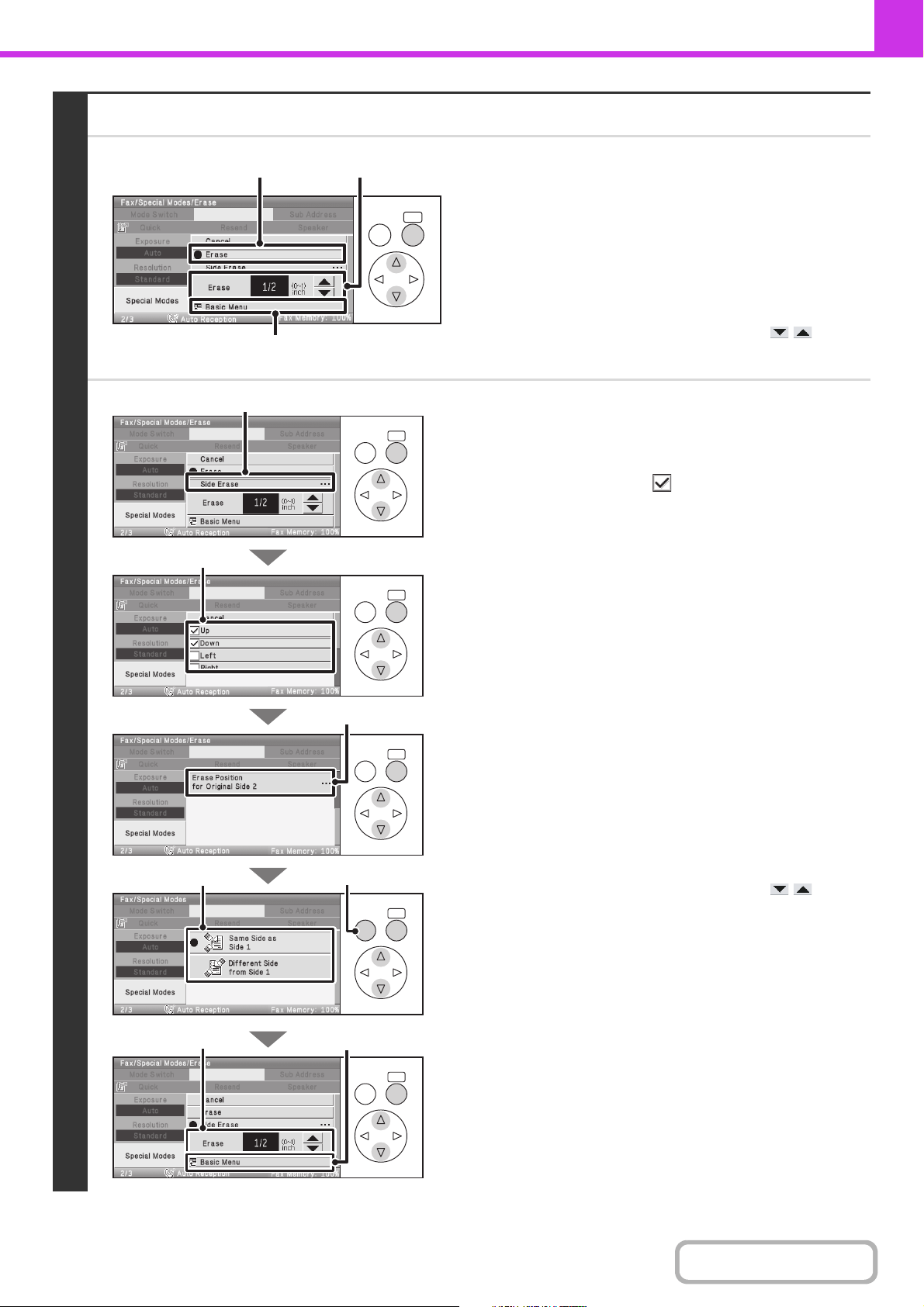
4-83
FACSIMILE
Contents
4
Select the erase settings.
● When [Erase] is selected
(1) Select the [Erase] key.
(2) Set the erasure width.
Select the number display and press the [OK] key. A
number entry screen will appear. Enter the desired
number with the numeric keys and select the [OK] key in
the number entry screen.
0" to 1" (0 mm to 20 mm) can be entered.
You can also change the number with the keys.
(3) Select the [Basic Menu] key.
● When [Side Erase] is selected
(1) Select the [Side Erase] key.
(2) Set the sides to be erased.
Select the checkboxes of the sides that you wish to
erase.
(3)
Select the [Erase Position for Original Side 2]
key.
(4) Set the erase edge on the reverse side.
When performing two-sided scanning, set the erase edge
on the reverse side.
• If you select the [Same Side as Side 1] key, the edge in
the same position as on the front side will be erased.
• If you select the [Different Side from Side 1], the edge in
the position opposite to the erased edge on the front
side will be erased.
(5) Press the [BACK] key.
(6) Set the erasure width.
Select the number display and press the [OK] key. A
number entry screen will appear. Enter the desired
number with the numeric keys and select the [OK] key in
the number entry screen.
0" to 1" (0 mm to 20 mm) can be entered.
You can also change the number with the keys.
(7) Select the [Basic Menu] key.
OKBACK
(2)(1)
(3)
OKBACK
OKBACK
OKBACK
OKBACK
OKBACK
(1)
(2)
(4)
(3)
(5)
(6)
(7)

4-84
FACSIMILE
Contents
5
Press the [BLACK & WHITE START] key.
Scanning begins.
• If you inserted the original pages in the document feeder tray, all pages are scanned.
A beep will sound to indicate that scanning is finished.
• If you are scanning the original on the document glass, scan each page one page at a time.
When scanning finishes, place the next original and press the [BLACK & WHITE START] key. Repeat until all pages have
been scanned and then select the [Read-End] key.
A beep will sound to indicate that scanning is finished.
To cancel scanning...
Press the [STOP] key ( ).
When the erase function is used, erase takes place at the edges of the original image. If you also use a reduction or an
enlargement setting, the erase width will change according to the selected ratio. For example, if the erase width setting is
1" (20 mm) and the image is reduced to 50%, the erase width will be 1/2" (10 mm).
To cancel an erase setting...
Select the [Cancel] key in the screen of step 4.
System Settings (Administrator): Erase Width Adjustment
The default erase width setting is linked to the copy mode system setting, and can be set from 0" to 1" (0 mm to 20 mm). The
factory default setting is 1/2" (10 mm).
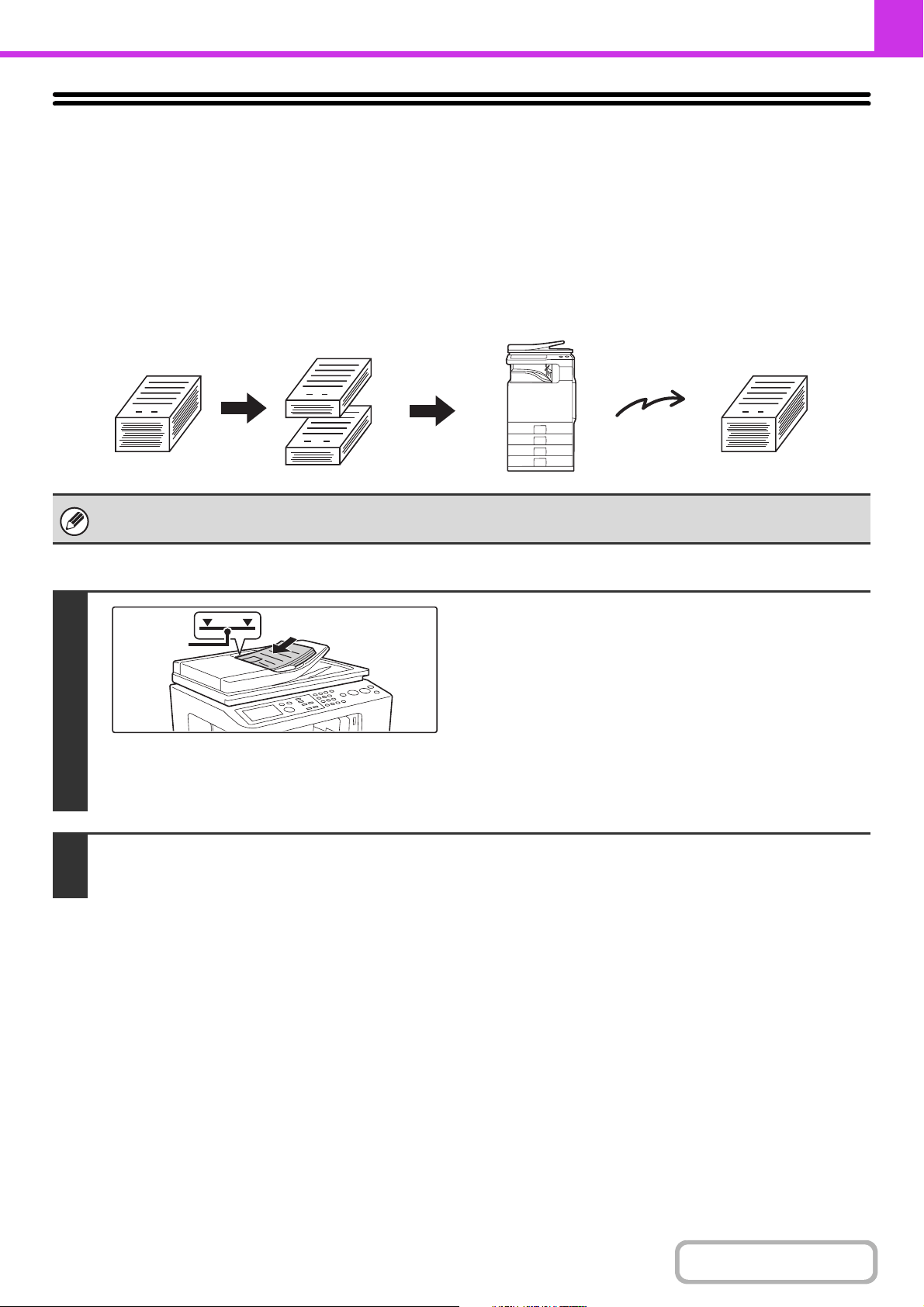
4-85
FACSIMILE
Contents
SENDING A LARGE NUMBER OF PAGES
(Job Build)
This function lets you separate an original consisting of numerous pages into sets, scan each set using the automatic
document feeder, and transmit the pages in a single transmission. Use this function when there are more original pages
than can be placed at once in the auto document feeder.
When scanning originals that are separated into sets, scan the set that has the first page first. The settings that you
select for the first set can be used for all remaining sets.
Keys in the display can be selected with the arrow keys and the [OK] key.
Up to 999 pages can be scanned. Note that when the memory is being used for other jobs, fewer pages can be scanned.
1
Insert the originals face up in the
document feeder tray.
Insert the originals all the way into the document feeder tray.
Multiple originals can be placed in the document feeder tray.
The stack of originals must not be higher than the indicator line
on the tray.
When the original is a different size than the size setting, set
the original size.
☞ SPECIFYING THE SCAN SIZE AND SEND SIZE (page
4-50)
2
Enter the destination fax number.
☞
ENTERING DESTINATIONS (page 4-19)
1
101
1
1
Originals are
scanned in
separate sets.
Originals
Transmission
Indicator
line
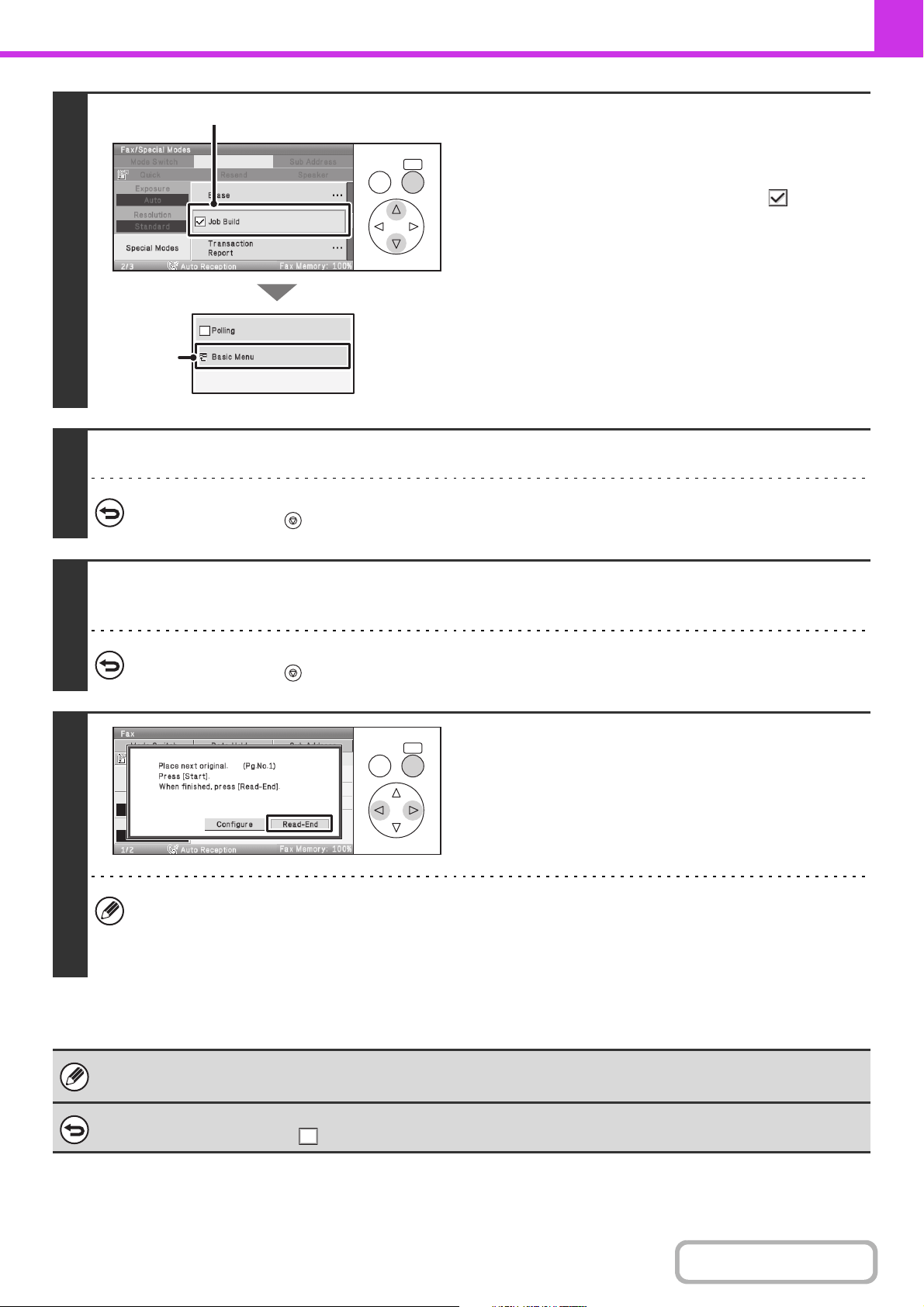
4-86
FACSIMILE
Contents
3
Select job build mode.
(1) Select the [Special Modes] key.
☞ SPECIAL MODES (page 4-69)
(2) Set the [Job Build] checkbox to .
(3) Select the [Basic Menu] key.
4
Press the [BLACK & WHITE START] key to scan the first set.
To cancel scanning...
Press the [STOP] key ( ).
5
Insert the next set of originals and press the [BLACK & WHITE START] key.
Repeat this step until all originals have been scanned.
To cancel scanning...
Press the [STOP] key ( ). All scanned data will be cleared.
6
Select the [Read-End] key.
• If no action is taken for one minute after the confirmation screen appears, scanning automatically ends and the
transmission is reserved.
• The [Configure] key can be selected to change the exposure, resolution, scan size, and send size for each original
page scanned.
• If the memory becomes full during scanning, a message will appear and the transmission will be canceled.
• This function cannot be used in direct transmission mode or when the speaker is used to dial.
To cancel Job Build....
Set the [Job Build] checkbox to in the screen of step 3.
OKBACK
(3)
(2)
OKBACK
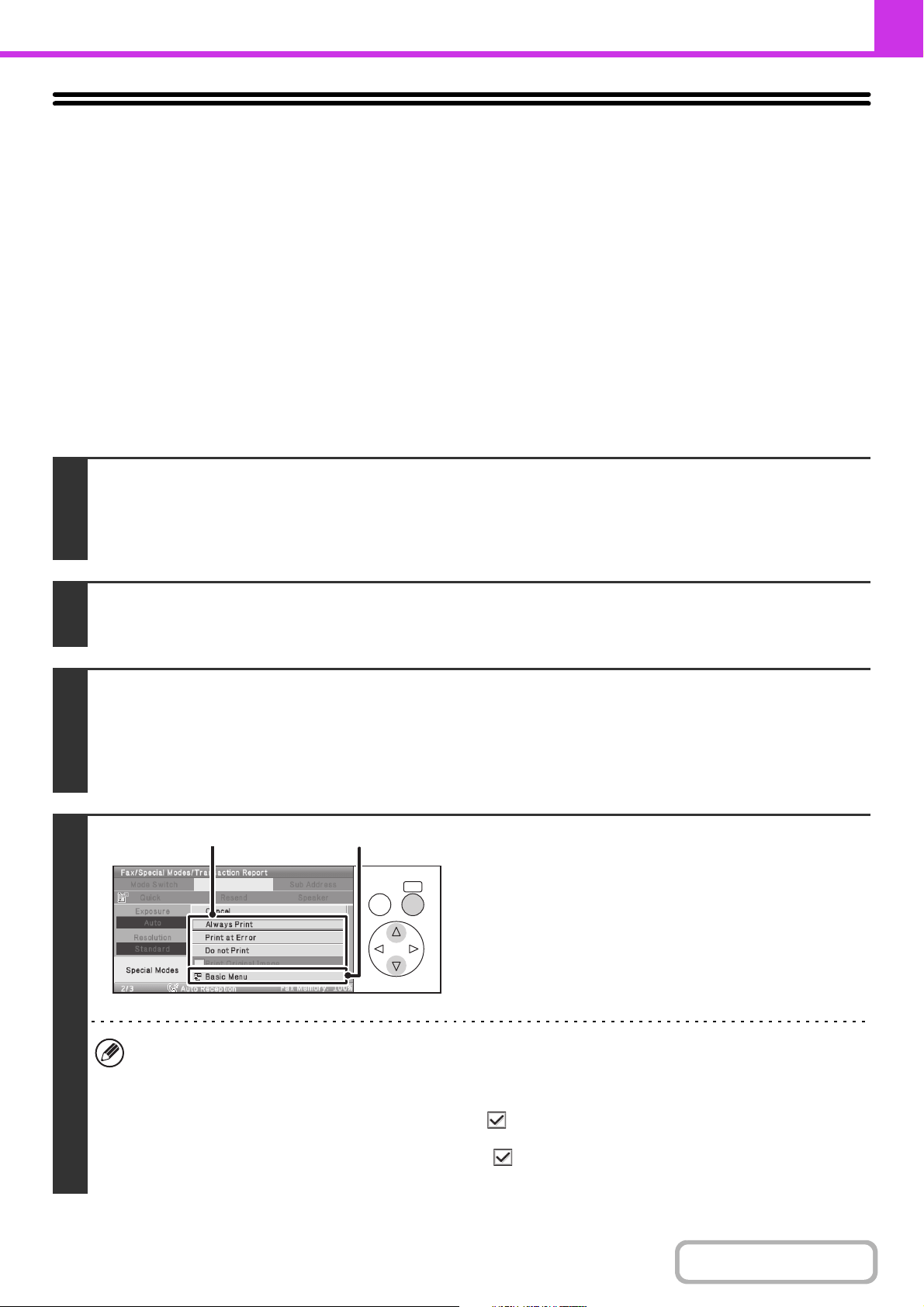
4-87
FACSIMILE
Contents
CHANGING THE PRINT SETTINGS FOR THE
TRANSACTION REPORT
(Transaction Report)
A transaction report is automatically printed out to alert you when a transmission fails or when a broadcast transmission
is performed. The transaction report contains a description of the transmission (date, start time, name of other party,
time required, number of pages, result, etc.).
☞ INFORMATION APPEARING IN THE RESULT COLUMN (page 4-129)
Transaction reports are printed based on conditions set in the system settings; however, you can temporarily select
different conditions for a transmission. To change the transaction report print conditions at the time of transmission,
follow the steps below.
Keys in the display can be selected with the arrow keys and the [OK] key.
1
Place the original.
Place the original face up in the document feeder tray, or face down on the document glass.
When the original is a different size than the size setting, set the original size.
☞ SPECIFYING THE SCAN SIZE AND SEND SIZE (page 4-50)
2
Enter the destination fax number.
☞
ENTERING DESTINATIONS (page 4-19)
3
Select the special modes.
(1) Select the [Special Modes] key.
(2) Select the [Transaction Report] key.
☞ SPECIAL MODES (page 4-69)
4
Select print conditions.
(1) Select the print conditions.
(2) Select the [Basic Menu] key.
• The print conditions for a transaction report are as follows:
"Always Print": A transaction report is printed no matter whether the transmission succeeds or fails.
"Print at Error": A transaction report is printed when transmission fails.
"Do not Print": Do not print a transaction report.
• When the [Print Original Image] checkbox is selected , part of the transmitted original is included on the
transaction report.
• Even if the [Print Original Image] checkbox is selected , the original cannot be printed when speaker dialing,
direct transmission, polling reception, or F-code transmission is used.
OKBACK
(1)
(2)
4-88
FACSIMILE
Contents
5
Press the [BLACK & WHITE START] key.
Scanning begins.
• If you inserted the original pages in the document feeder tray, all pages are scanned.
A beep will sound to indicate that scanning is finished.
• If you are scanning the original on the document glass, scan each page one page at a time.
When scanning finishes, place the next original and press the [BLACK & WHITE START] key. Repeat until all pages have
been scanned and then select the [Read-End] key.
A beep will sound to indicate that scanning is finished.
To cancel scanning...
Press the [STOP] key ( ) to cancel the operation.
For a broadcast transmission, changes to the transaction report print conditions apply to all destinations.
To cancel the transaction report setting...
Select the [Cancel] key in the screen of step 4.
• System Settings (Administrator): Transaction Report Print Select Setting (Web page only)
This is used to set the conditions for printing transaction reports.
The factory default setting is .
Single Sending: Print Out All Report/ /No Printed Report
Broadcasting: /Print Out Error Report Only/No Printed Report
Receiving: Print Out All Report/Print Out Error Report Only/
Confidential Reception (fax mode): /No Printed Report
• System Settings (Administrator): Original Print on Transaction Report (Web page only)
This is used to have part of the transmitted original printed on the transaction report.
Print Out Error Report Only
Print Out All Report
No Printed Report
Print Out Notice Page
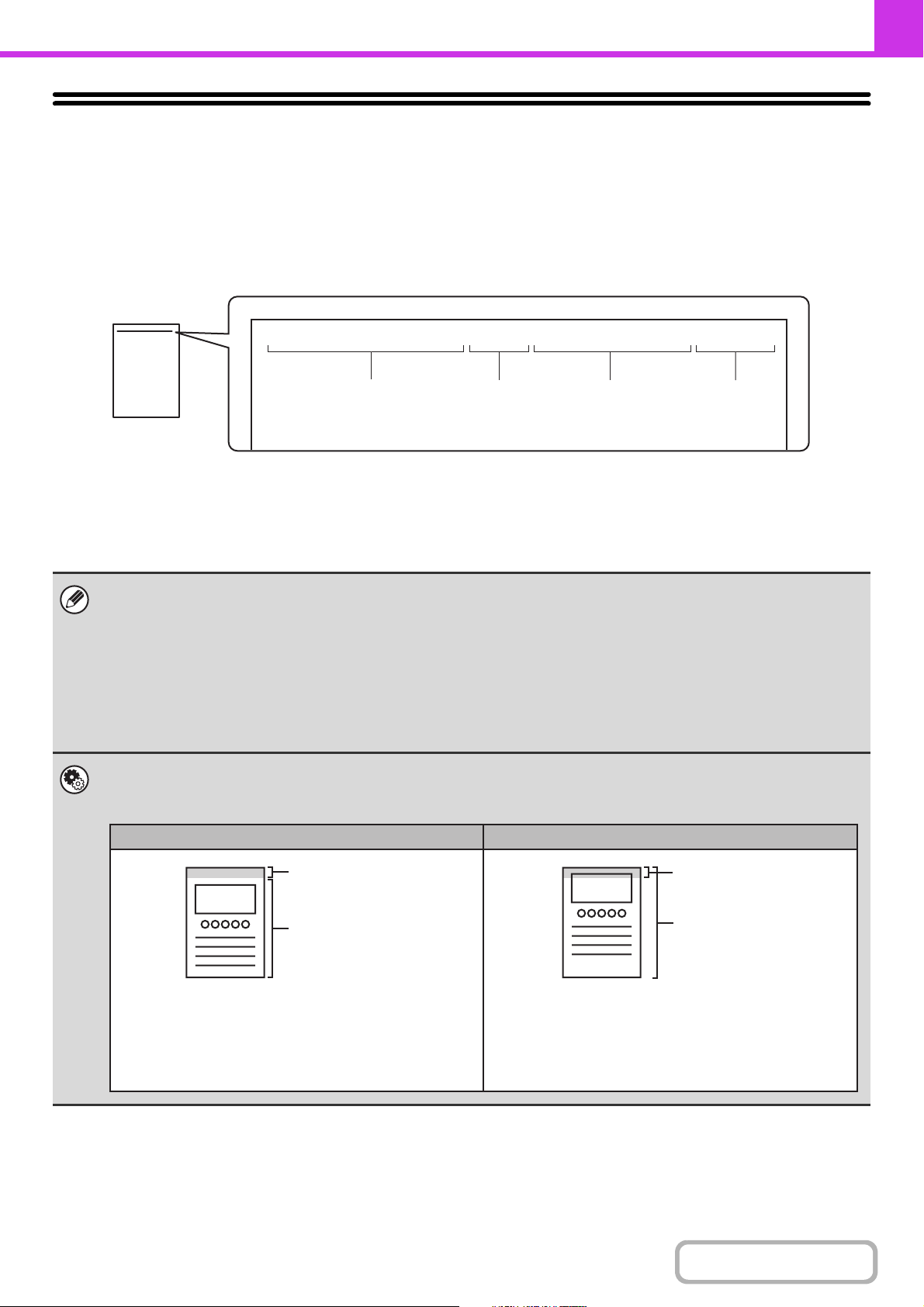
4-89
FACSIMILE
Contents
ADDING YOUR SENDER INFORMATION TO
FAXES (Own number sending)
Your sender information (date, time, sender name, sender fax number, number of pages) is automatically added to the
top of each fax page you transmit.
Example of the sender information printed
(1) Date, time: The date and time of transmission.
(2) Sender name: The sender name programmed in the machine.
(3) Sender fax number: The sender fax number programmed in the machine.
(4) Page numbers: Page number / total pages (the total page number is only printed
when the fax is sent by memory transmission.)
Information programmed in Own Number Sending
Date, time: Adjust the setting in "Clock Adjust" in the system settings.
Sender name, sender fax number: Program the sender name and fax number in "Sender Data Registration" in the system
settings (administrator). If you intend to use own number sending, be sure to configure
this information.
Page numbers: Select whether or not to include page numbers in "Printing Page Number at Receiver"
(Web page only) in the system settings (administrator).
Page numbers appear in the format "page number / total pages". Only the page number
is printed when manual transmission or quick online transmission is used.
System Settings (Administrator): Date/Own Number Print Position Setting
This is used to set the position where the sender information is printed. The sender information can be printed outside the
scanned original image or inside the scanned original image.
APR/04/2010/Sat 3:00 PM AAAAA FAX No. 0123456789 P.001/001
(1) (2) (3) (4)
Sender
information
Sender
information
Originals
Originals
Outside scanned image (factory default setting) Inside scanned image
The transmitted image length will be: length of sender
information + length of original image. When the fax is
printed by the receiving machine, it may be reduced or
divided onto two pages.
The sender information is printed inside the original
image, and thus the transmitted image length is the
length of the original. Note that the sender information
will overlap part of the original image (the overlapped
part of the original image will not appear).
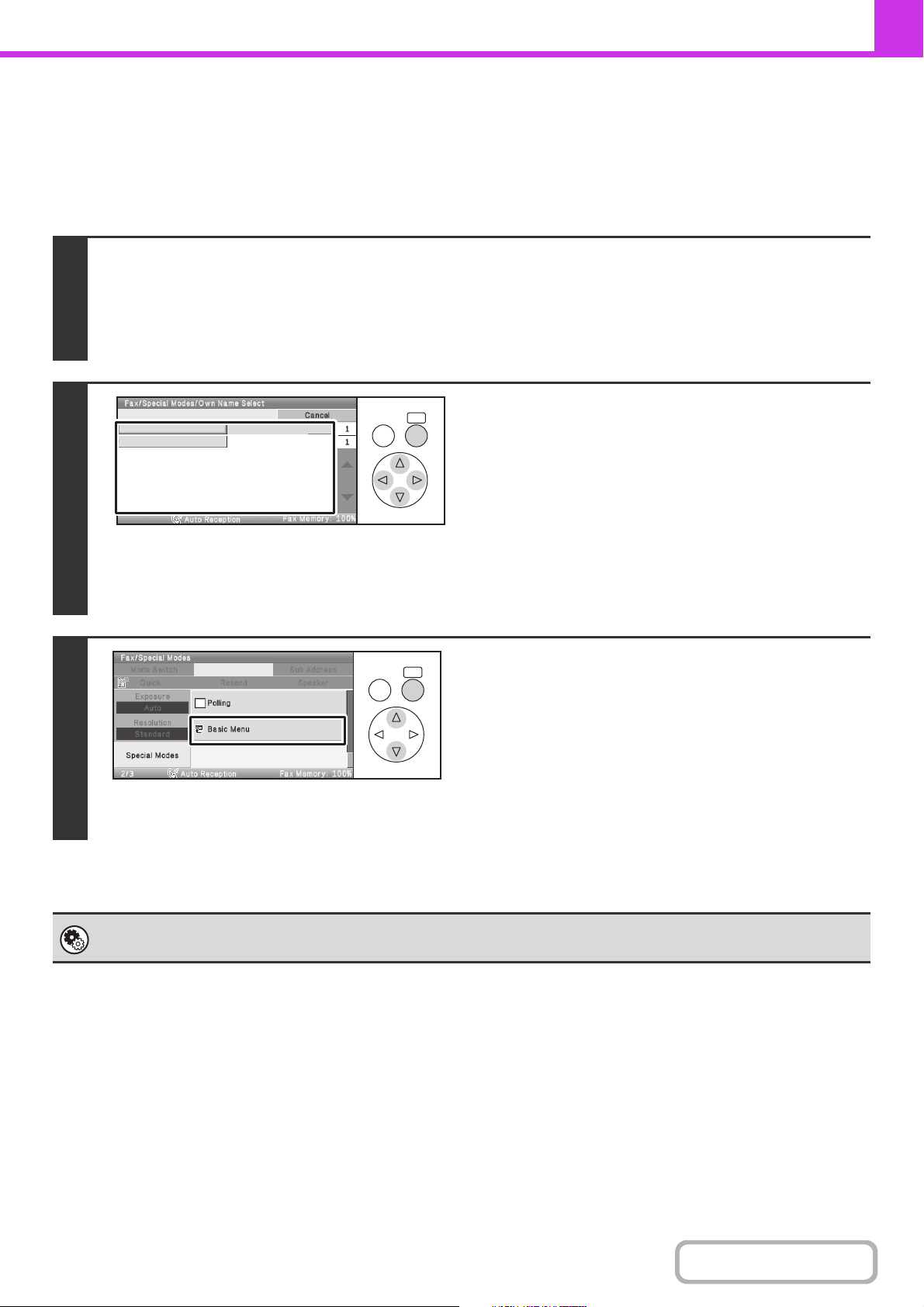
4-90
FACSIMILE
Contents
TEMPORARILY CHANGING THE SENDER
INFORMATION (Own Name Select)
You can select the sender information printed on a transmitted fax from a list of stored senders.
Keys in the display can be selected with the arrow keys and the [OK] key.
1
Select the special modes.
(1) Select the [Special Modes] key.
(2) Select the [Own Name Select] key.
☞ SPECIAL MODES (page 4-69)
2
Select the sender information.
Select the desired sender information key.
3
Select the [Basic Menu] key.
System Settings (Administrator): Registration of Own Name Select
This is used to store sender information for Own Name Select.
OKBACK
AAA AAA
BBB BBB
CCC CCC
OKBACK
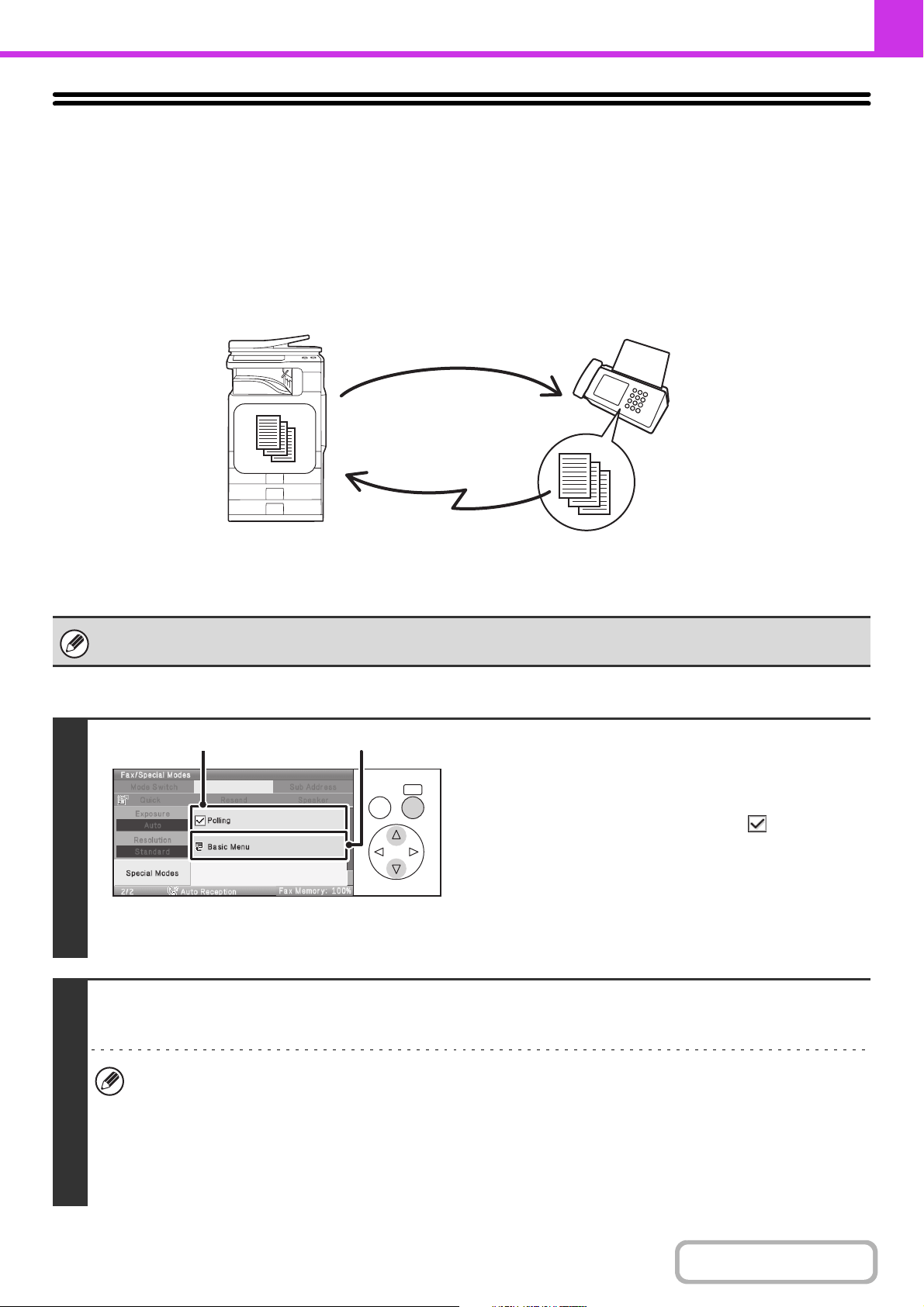
4-91
FACSIMILE
Contents
CALLING A FAX MACHINE AND INITIATING
RECEPTION (Polling)
The Polling function allows the receiving machine to call the transmitting machine and initiate reception of a document in
that machine.
Because the receiving machine initiates reception of a document, this is called "Polling Reception".
Keys in the display can be selected with the arrow keys and the [OK] key.
Make sure that an original is not placed in the machine when using the polling reception function.
1
Select polling reception.
(1) Select the [Special Modes] key.
☞ SPECIAL MODES (page 4-69)
(2) Set the [Polling] checkbox to .
(3) Select the [Basic Menu] key.
2
Enter the destination fax number.
☞
ENTERING DESTINATIONS (page 4-19)
• Multiple fax numbers can be entered.
Polling will take place in the order that the numbers were entered.
Polling multiple machines is called "Serial Polling".
Up to 500 fax numbers can be entered. In this procedure, one-touch keys that have a sub-address and passcode
cannot be used.
• To enter multiple fax numbers, select the [Next Address] key after entering a fax number and enter the next fax
number.
(1) Requests fax transmission.
Transmission
(2) The previously prepared
document is transmitted.
(3) The fax is received.
OKBACK
(3)(2)
4-92
FACSIMILE
Contents
3
Press the [BLACK & WHITE START] key.
Your machine will call the other machine and initiate reception of the fax.
• Polling reception can be used in combination with the timer function to poll at any specified time, such as at night or when
you are not present (Only one timer polling reception can be set.).
• This function can only be used when the other machine is Super G3 or G3 compatible and has a polling function.
• The receiving machine bears the expense (phone charges) of the polling reception.
To cancel polling reception...
Set the [Polling] checkbox to in the screen of step 1.

4-93
FACSIMILE
Contents
INITIATING POLLING RECEPTION MANUALLY
Use this procedure when you must start polling after listening to a recorded greeting, such as when using a fax
information service.
Keys in the display can be selected with the arrow keys and the [OK] key.
• Make sure that an original is not placed in the machine when using the polling reception function.
• This function cannot be used to poll multiple machines (serial polling).
1
Enter the destination fax number.
(1) Select the [Speaker] key.
You will hear the dial tone through the machine's speaker.
(2) Select the [Address] key in the base screen.
(3) Select the one-touch key of the desired
destination.
A group key cannot be used.
• In addition to specification by one-touch key, a destination can also be specified using a search number. You can
also directly enter a fax number with the numeric keys or look up a destination in a global address book. For more
information, see "ENTERING DESTINATIONS" (page 4-19).
• After selecting the [Speaker] key, you can select the [Speaker Volume] key to adjust the volume of the speaker. The
speaker volume changes each time the [Speaker Volume] key is selected. Adjust the volume to the desired level.
2
Receive the fax.
(1) Select the [Special Modes] key.
☞ SPECIAL MODES (page 4-69)
(2) When you hear the fax tone, select the
[Polling] key.
The fax is received.
• This function can only be used when the other machine is Super G3 or G3 compatible and has a polling function.
• The receiving machine bears the expense (phone charges) of the polling reception.
OKBACK
OKBACK
AAA AAA
BBB BBB
CCC CCC
DDD DDD
EEE EEE
FFF FFF
GGG GGG
HHH HHH
III III
JJJ JJJ
(1)(2)
(3)
OKBACK
(2)
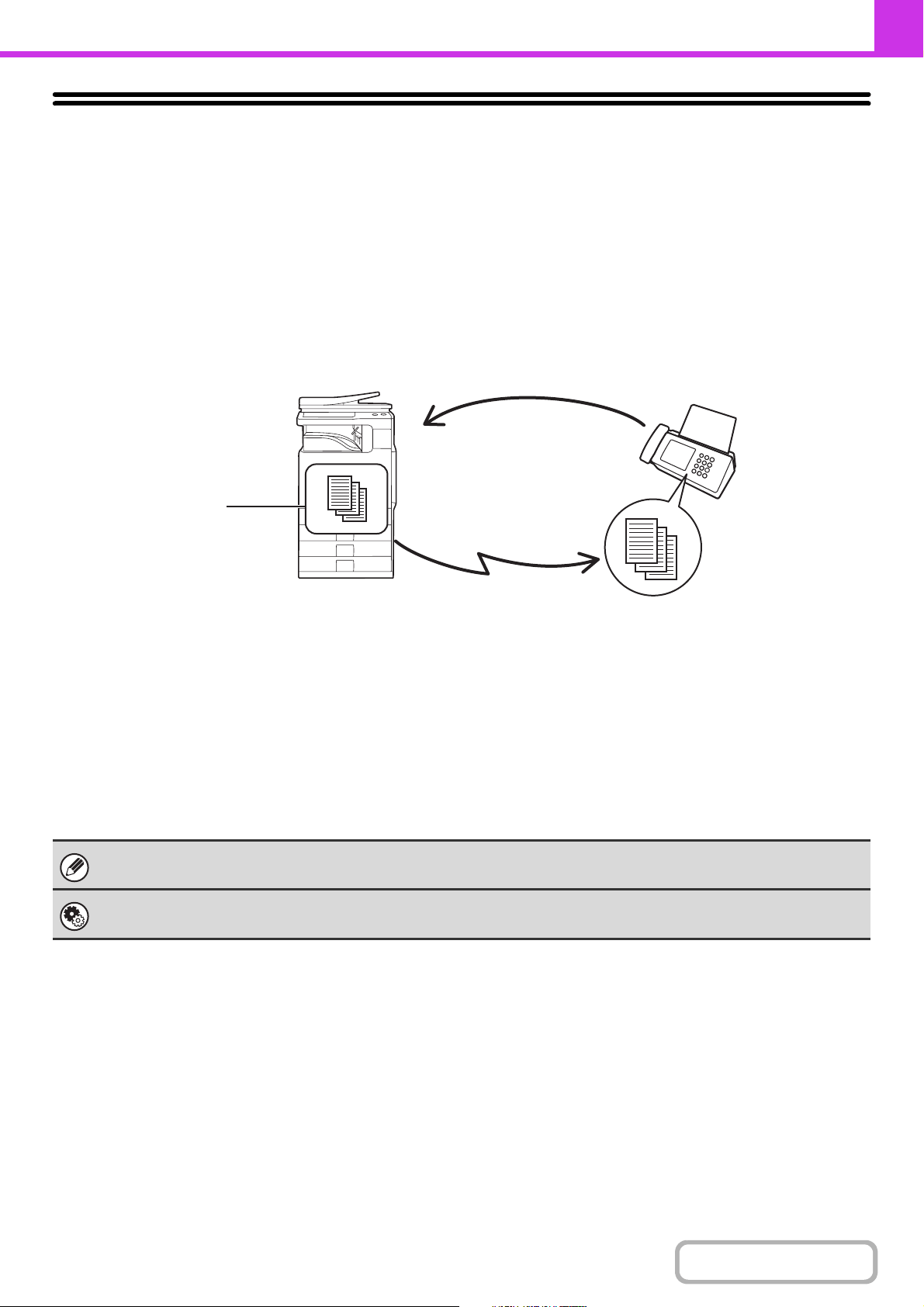
4-94
FACSIMILE
Contents
SENDING A FAX WHEN ANOTHER
MACHINE POLLS YOUR MACHINE
(Polling Memory)
Sending a document that has been scanned into memory when another machine polls your machine is called "Polling
Memory".
Prior to polling, the document that will be faxed to the other machine must be scanned into a polling memory box.
This function can only be used when the other machine is Super G3 or G3 compatible and has a polling function.
RESTRICTING POLLING ACCESS (Polling security)
To only allow specified machines to poll your machine, you can restrict polling to machines whose programmed sender
fax number matches a fax number stored in your machine as a polling passcode number. This is called "Polling
Security".
To use this function, first store polling passcode numbers (the sender fax numbers programmed in the other machines)
in the machine's system settings, and then enable polling security.
Up to 10 fax numbers can be stored as polling passcode numbers.
System Settings (Administrator): Fax Polling Security
This is used to enable polling security. This is used to store fax numbers as polling passcode numbers.
(1) Requests fax transmission.
(3) The fax is received.
(2) The document in the memory box is
transmitted.
Polling
memory box
Transmission
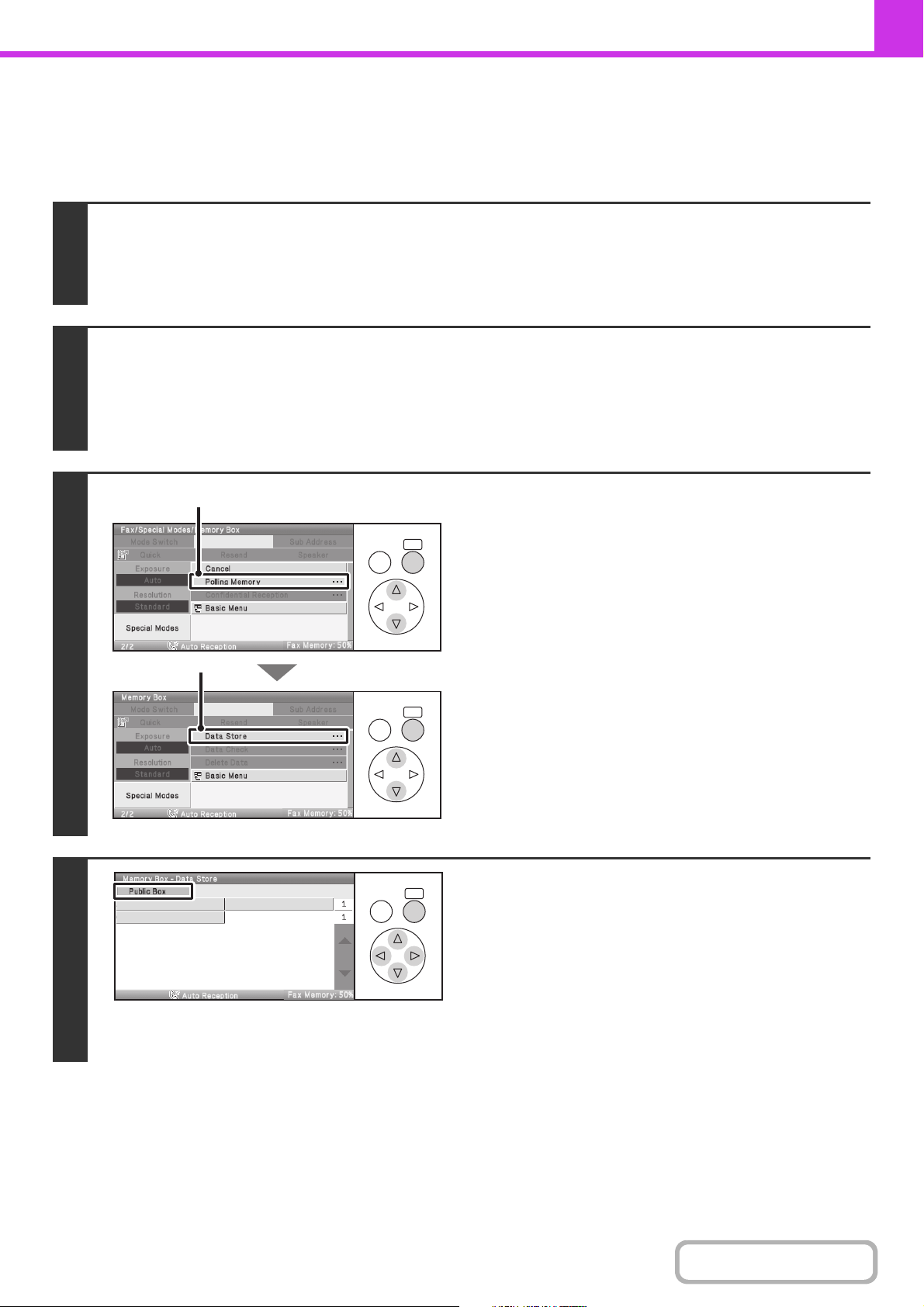
4-95
FACSIMILE
Contents
SCANNING A DOCUMENT INTO POLLING MEMORY
Follow these steps to scan a document into the memory box for polling transmission (Public Box).
Keys in the display can be selected with the arrow keys and the [OK] key.
1
Place the original.
Place the original face up in the document feeder tray, or face down on the document glass.
When the original is a different size than the size setting, set the original size.
☞ SPECIFYING THE SCAN SIZE AND SEND SIZE (page 4-50)
2
Select the special modes.
(1) Select the [Special Modes] key.
(2) Select the [Memory Box] key.
☞ SPECIAL MODES (page 4-69)
3
Select the [Data Store] key.
(1) Select the [Polling Memory] key.
(2) Select the [Data Store] key.
4
Select the [Public Box] key.
OKBACK
OKBACK
(1)
(2)
OKBACK
Box 1
Box 2
Box 3
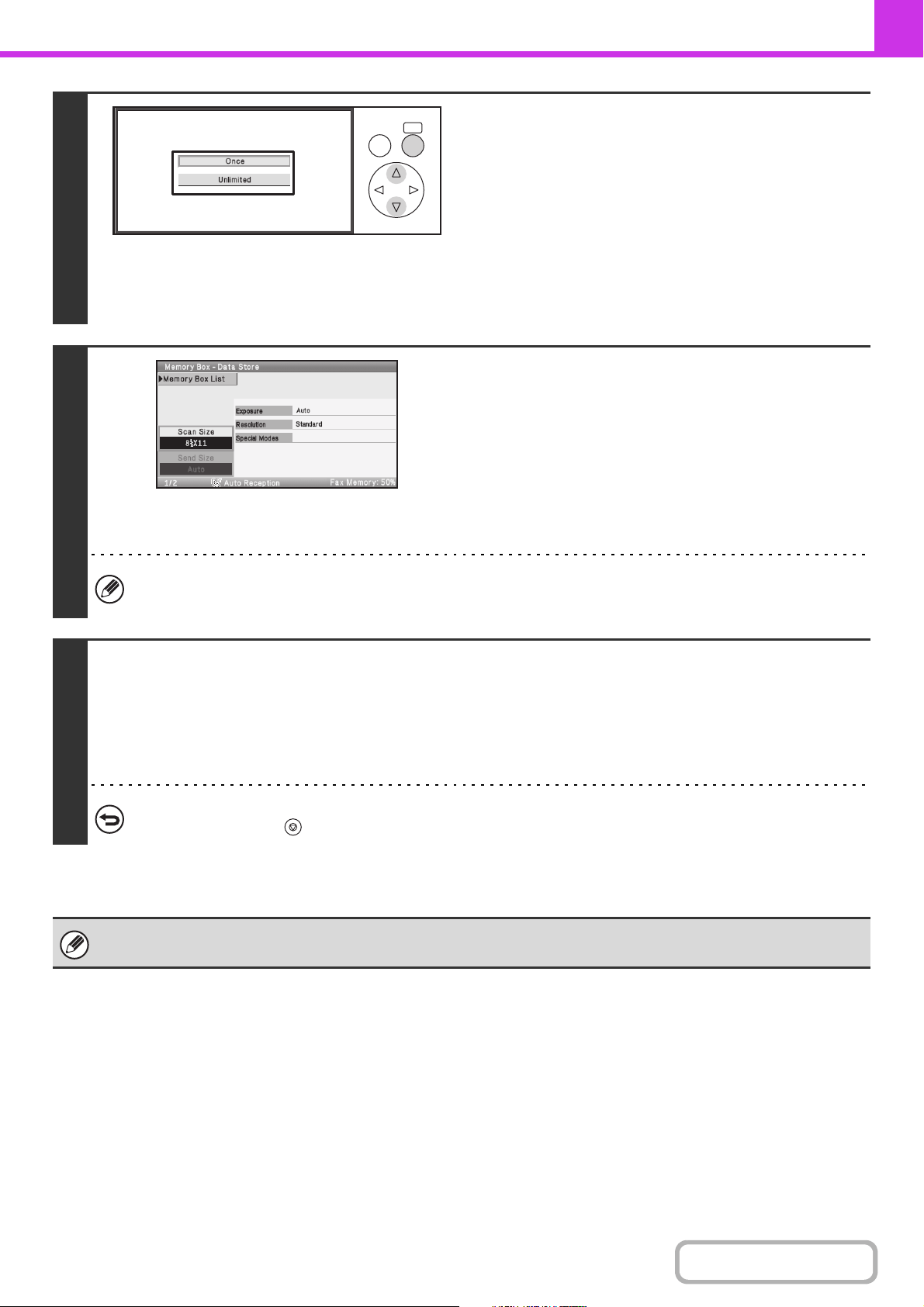
4-96
FACSIMILE
Contents
5
Specify the number of polling times.
Select the desired number of times.
Select the [Once] key if you want the document cleared from
memory after it is transmitted. Select the [Unlimited] key to
allow polling an unlimited number of times.
6
Select image settings and special
modes.
• A program, timer setting, transaction report and polling cannot be selected.
• To return to the screen of step 4, select the [Memory Box List] key.
7
Press the [BLACK & WHITE START] key.
Scanning begins.
• If you inserted the original pages in the document feeder tray, all pages are scanned.
• If you are scanning the original on the document glass, scan each page one page at a time.
When scanning finishes, place the next original and press the [BLACK & WHITE START] key. Repeat until all pages have
been scanned and then select the [Read-End] key.
To cancel scanning...
Press the [STOP] key ( ) while the original is being scanned.
If another document remains in the memory box (Public Box), the newly scanned document is added to the previous
document. In this case, the number of polling times will be the number set for the newly scanned document.
OKBACK
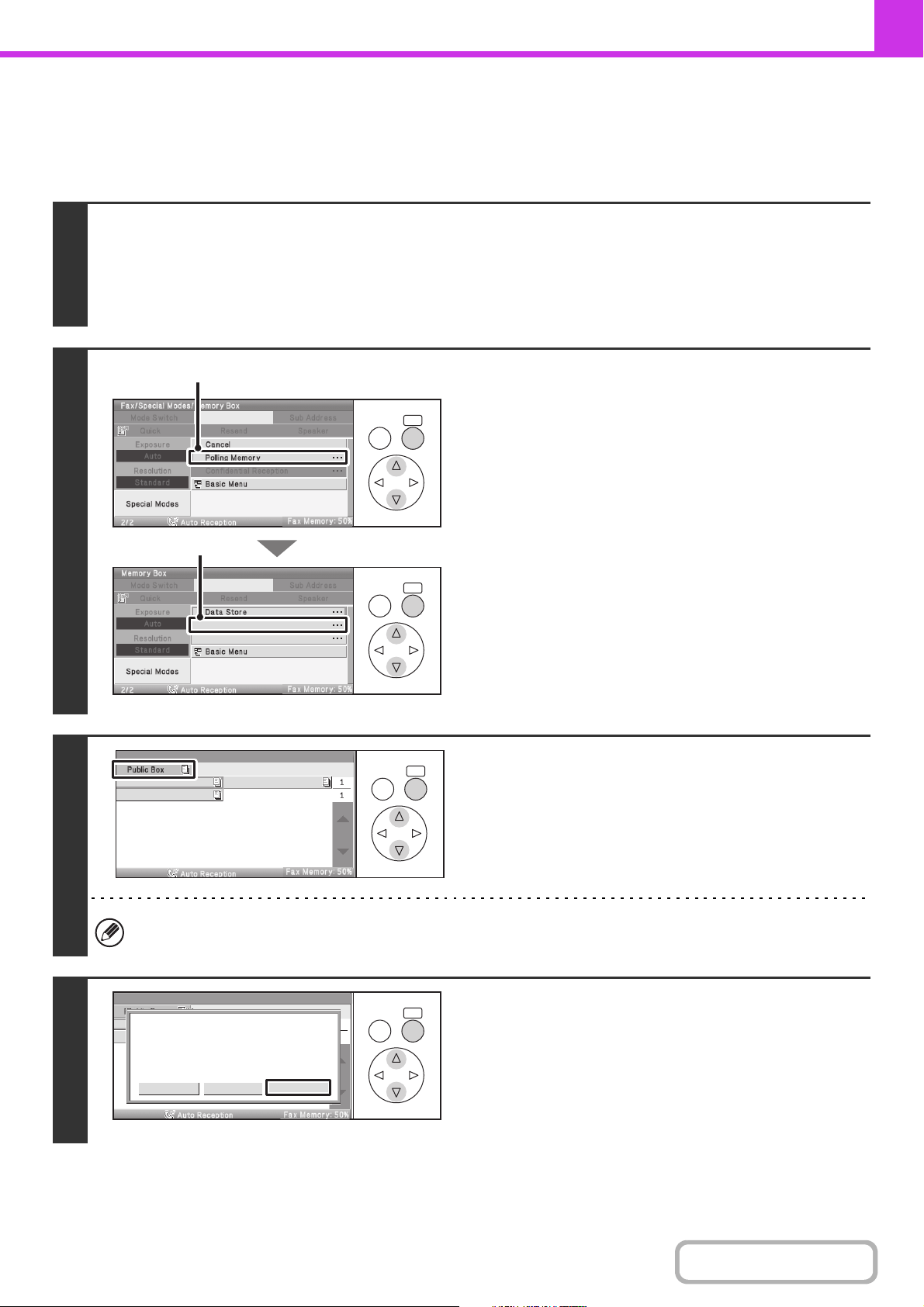
4-97
FACSIMILE
Contents
CHECKING THE DOCUMENT IN THE PUBLIC BOX
You can check the document stored in the machine's public box for memory polling.
Keys in the display can be selected with the arrow keys and the [OK] key.
1
Select the special modes.
(1) Select the [Special Modes] key.
(2) Select the [Memory Box] key.
☞ SPECIAL MODES (page 4-69)
2
Select the [Data Check] key.
(1) Select the [Polling Memory] key.
(2) Select the [Data Check] key.
3
Select the [Public Box] key.
When nothing is stored in the Public Box, the [Public Box] key will be grayed out.
4
Select the [Image Check] key.
The content of the document can be viewed in the image check
screen. For information on the image check screen, see
"IMAGE CHECK SCREEN" (page 4-64).
To print the document, select the [Print] key.
OKBACK
OKBACK
Data Check
Delete Data
(1)
(2)
OKBACK
Box 1
Box 2
Box 3
Memory Box - Data Check
OKBACK
Cancel
Press [Image Check] to check data.
Press [Print] to output data.
Print Image check
Memory Box - Data Check
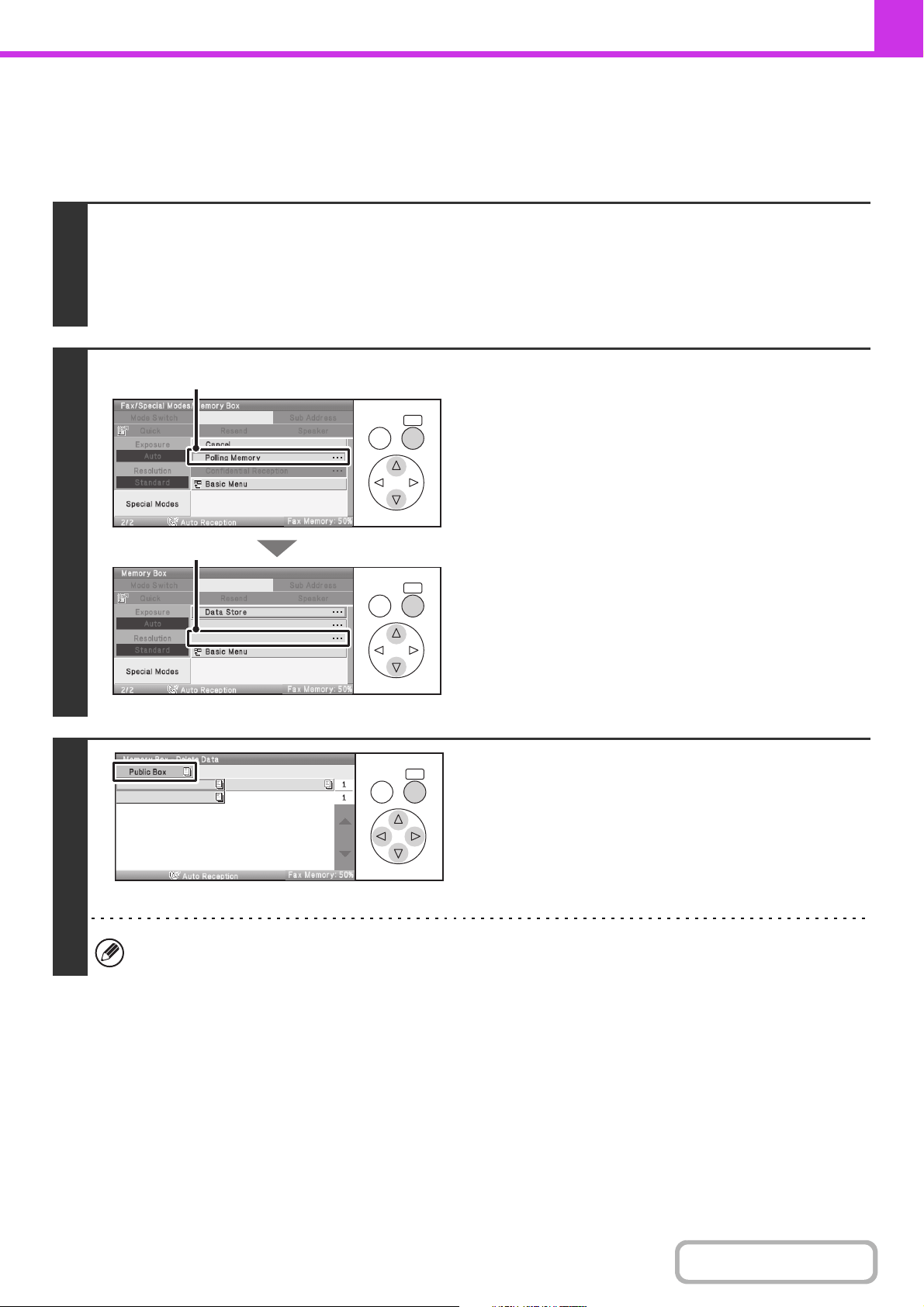
4-98
FACSIMILE
Contents
DELETING A DOCUMENT FROM THE PUBLIC BOX
Delete a document from the Public Box when it is no longer needed.
Keys in the display can be selected with the arrow keys and the [OK] key.
1
Select the special modes.
(1) Select the [Special Modes] key.
(2) Select the [Memory Box] key.
☞ SPECIAL MODES (page 4-69)
2
Select the [Delete Data] key.
(1) Select the [Polling Memory] key.
(2) Select the [Delete Data] key.
3
Select the [Public Box] key.
When nothing is stored in the Public Box, the [Public Box] key will be grayed out.
OKBACK
OKBACK
Data Check
Delete Data
(1)
(2)
OKBACK
Box 1
Box 2
Box 3
4-99
FACSIMILE
Contents
4
Select the [Yes] key.
•
The document is deleted and you return to the screen of step 3.
• You can select the [Image Check] key to check the image in
the display before deleting it. For information on the image
check screen, see "IMAGE CHECK SCREEN" (page 4-64).
To cancel the deletion...
Select the [No] key. You will return to the screen of step 3.
OKBACK
Image check No
Yes
Delete the data in the memory box?
Press [Image Check] to check data.
Memory Box - Delete Data
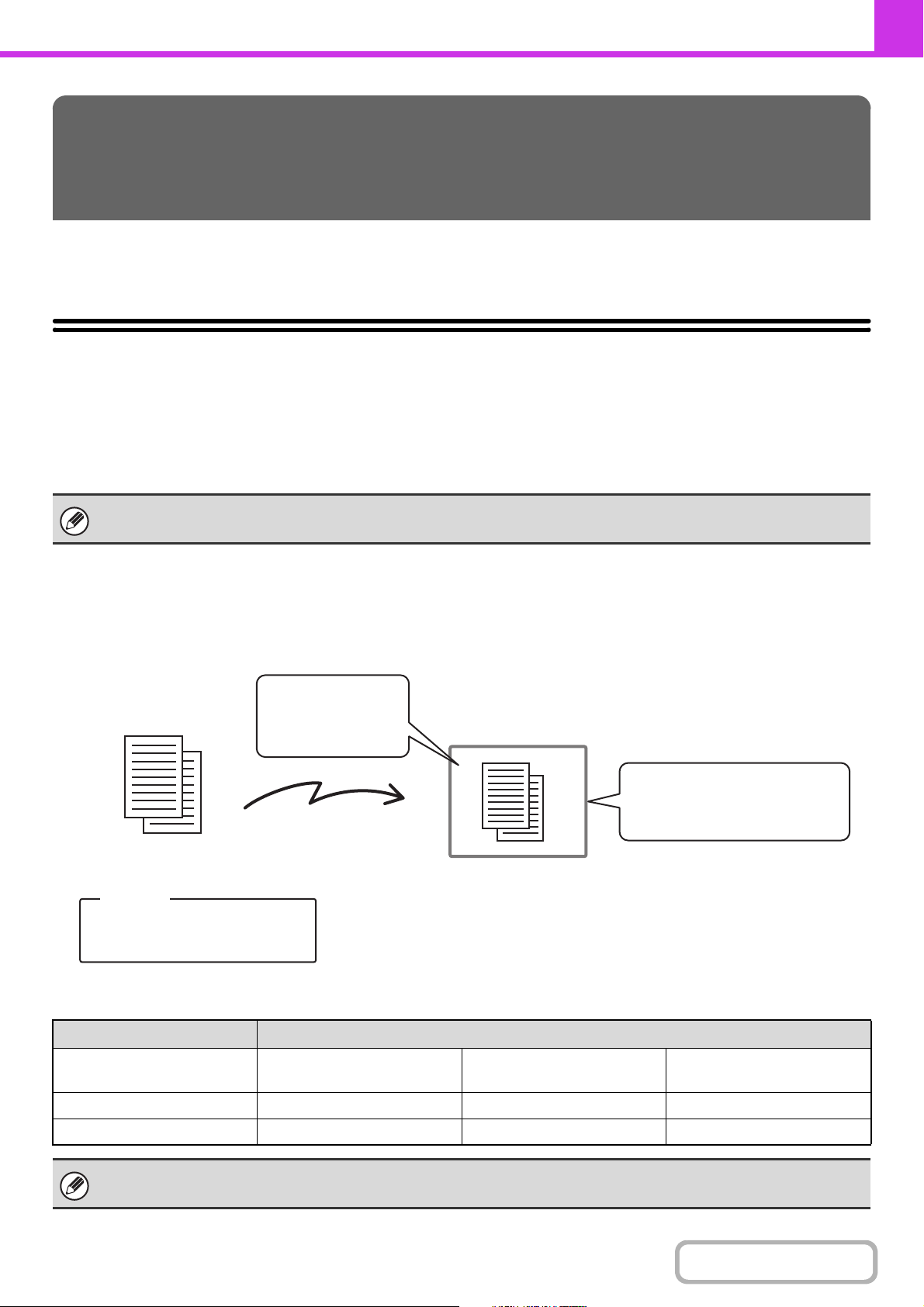
4-100
FACSIMILE
Contents
This section explains how to perform F-code communication operations. F-code communication is possible with
machines of other manufacturers that also support F-code communication.
F-CODE COMMUNICATION
Exchange of confidential documents (confidential communication), retrieval (polling) and distribution (polling memory) of
information, and distribution of information to multiple destinations (relay broadcast transmission) are possible with other
machines that support F-code communication.
An F-code* is specified in each communication, enabling a higher level of security.
* F-code is a communication function based on the G3 standard of the ITU-T.
HOW F-CODES WORK
A fax that is transmitted with a F-code is received to the memory box in the receiving machine specified by the F-code
(sub-address and passcode). If the F-code sent by the transmitting machine does not match the F-code in the receiving
machine, reception will not take place.
The products of other manufacturers may use different terms for "sub-address" and "passcode". If you need to contact the
operator of another machine regarding sub-addresses and passcodes, refer to the terms used by the ITU-T in the table below.
PERFORMING F-CODE
COMMUNICATION
The ITU-T is a United Nations organization that establishes communications standards. It is a department of the International
Telecommunication Union (ITU), which coordinates global telecommunications networks and services.
The machine ITU-T
F-code polling memory box F-code confidential box
F-code relay broadcast
memory box
Sub Address SEP SUB SUB
Passcode PWD SID SID
A F-code consists of a sub-address and passcode, and cannot be longer than 20 digits.
Fax number of other
machine
+
F-code
Sub-address: AAAAAAAA
Passcode: XXXXXXXX
Box name: BBBB
Sub-address: AAAAAAAA
Passcode: XXXXXXXX
Memory box for F-code
communication
The fax is received to
the memory box
specified by the
F-code
4-101
FACSIMILE
Contents
CREATING MEMORY BOXES IN THE MACHINE FOR
F-CODE COMMUNICATION
Before the F-code communication function can be used, special memory boxes must be created using "F-Code Memory
Box" (Web page only) in the system settings.
A box name and F-code (sub-address and passcode) are programmed in each box, and a F-code communication
function is assigned to each box.
After you have created a memory box, inform the other party of the sub-address and passcode of the box.
To use the following F-code communication functions, F-code memory boxes must be created in your machine:
F-code confidential reception, F-code polling memory, F-code relay broadcast transmission
To use the following F-code communication functions, F-code memory boxes must be created in the other machine:
F-code confidential transmission, F-code polling reception, F-code relay request transmission
F-CODE DIALING
When performing an F-code operation, the F-code (sub-address and passcode) is appended to the fax number that is
dialed. Check the F-code (sub-address and passcode) programmed in the memory box in the other machine before you
perform a F-code transmission. It is convenient to store a F-code together with the fax number in a one-touch key or
group key.
When the following F-code functions are used, your machine dials the other machine:
F-code confidential transmission, F-code polling reception, F-code relay request transmission
When the following F-code functions are used, the other machine dials your machine:
F-code confidential reception, F-code polling memory, F-code relay broadcast transmission
System Settings: F-Code Memory Box (page 6-107) (Web page only)
This is used to configure memory boxes for F-code communication.
• Up to 100 memory boxes can be created.
• The memory box name cannot be longer than 18 characters, and the sub-address and passcode cannot be longer than 20
digits.
• If the destination machine does not have a passcode configured in the F-code, do not enter a passcode when dialing that
machine.
• F-code communication cannot be performed when using the speaker or performing manual transmission.
• ADDRESS BOOK (page 4-13)
This is used to store and edit one-touch keys and group keys.
Store in [Address Book] in the Web page menu.
•Box Name
• Sub Address
•Passcode
• End receiving machines (only in an
F-code relay broadcast memory box)
• Print PIN (only for F-code confidential
reception)
Memory box for F-code
communication
0123456789
/
AAAAAAAA
/
XXXXXXXX
Fax number of other
machine
Sub Address Passcode
* Select the [Sub Address]
key in the screen to enter
"/".
*
*
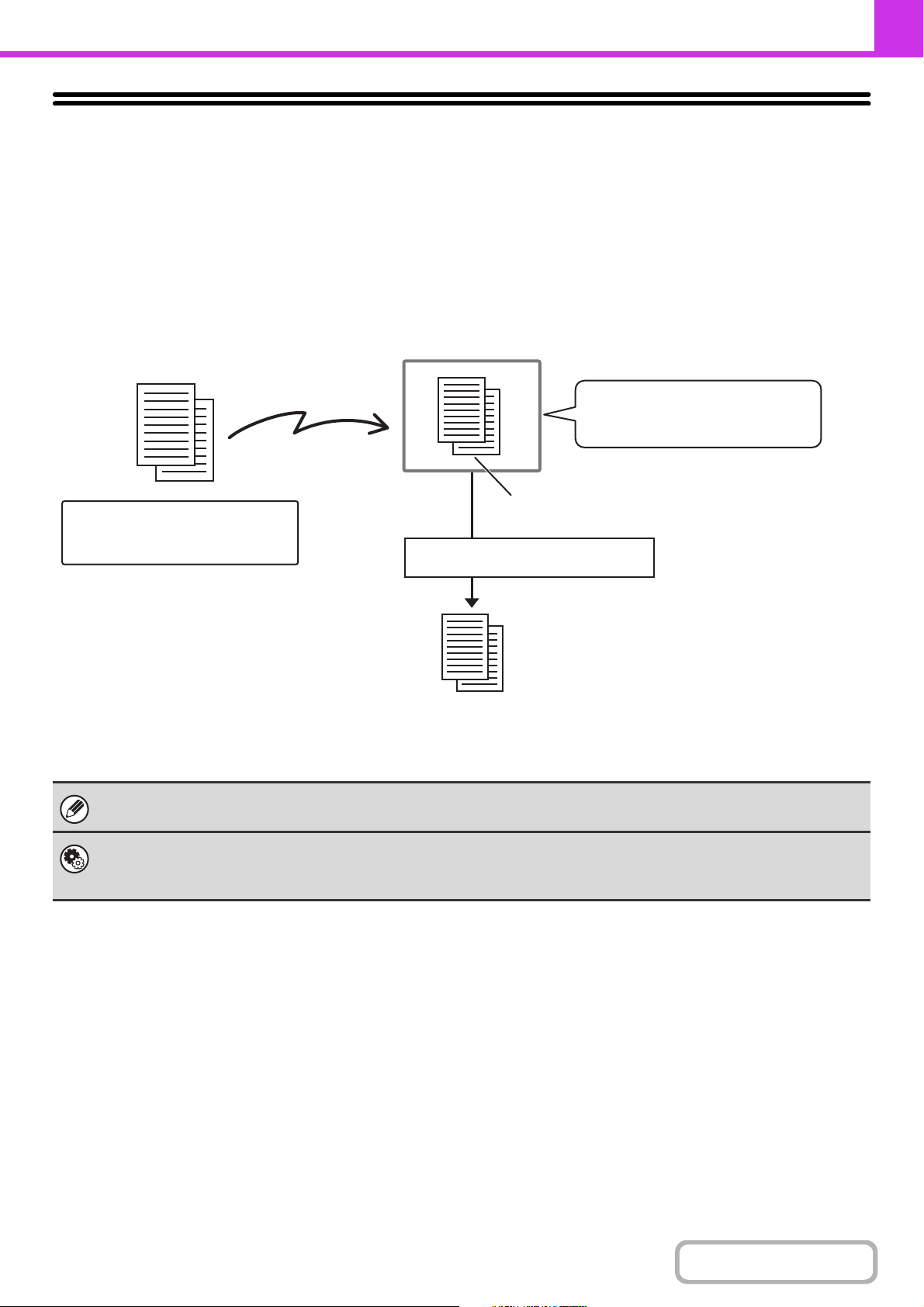
4-102
FACSIMILE
Contents
CONFIDENTIAL COMMUNICATION USING
F-CODES
By sending a fax to a F-code memory box (confidential) in the receiving machine (your machine or the other machine),
the sender can direct the transmission specifically to the user of the box.
This is convenient for sending sensitive documents that you do not wish people other than the recipient to see, or when
the receiving machine is shared by multiple departments.
To print a F-code confidential fax, the print passcode must be entered.
The F-code (sub-address and passcode) of the memory box to be used should be verified by the sender and the recipient
before the fax is sent.
System Settings: F-Code Memory Box (page 6-107) (Web page only)
This is used to create memory boxes for F-code confidential communication (confidential reception).
A memory box name, sub-address, passcode, and print passcode are programmed in each box.
Sub-address: AAAAAAAA
Passcode: XXXXXXXX
Sub-address: AAAAAAAA
Passcode: XXXXXXXX
Transmission with an
F-code
Reception in F-code Memory Box
Print passcode: Enter BBBB
The fax is printed.
Receiver
Sender
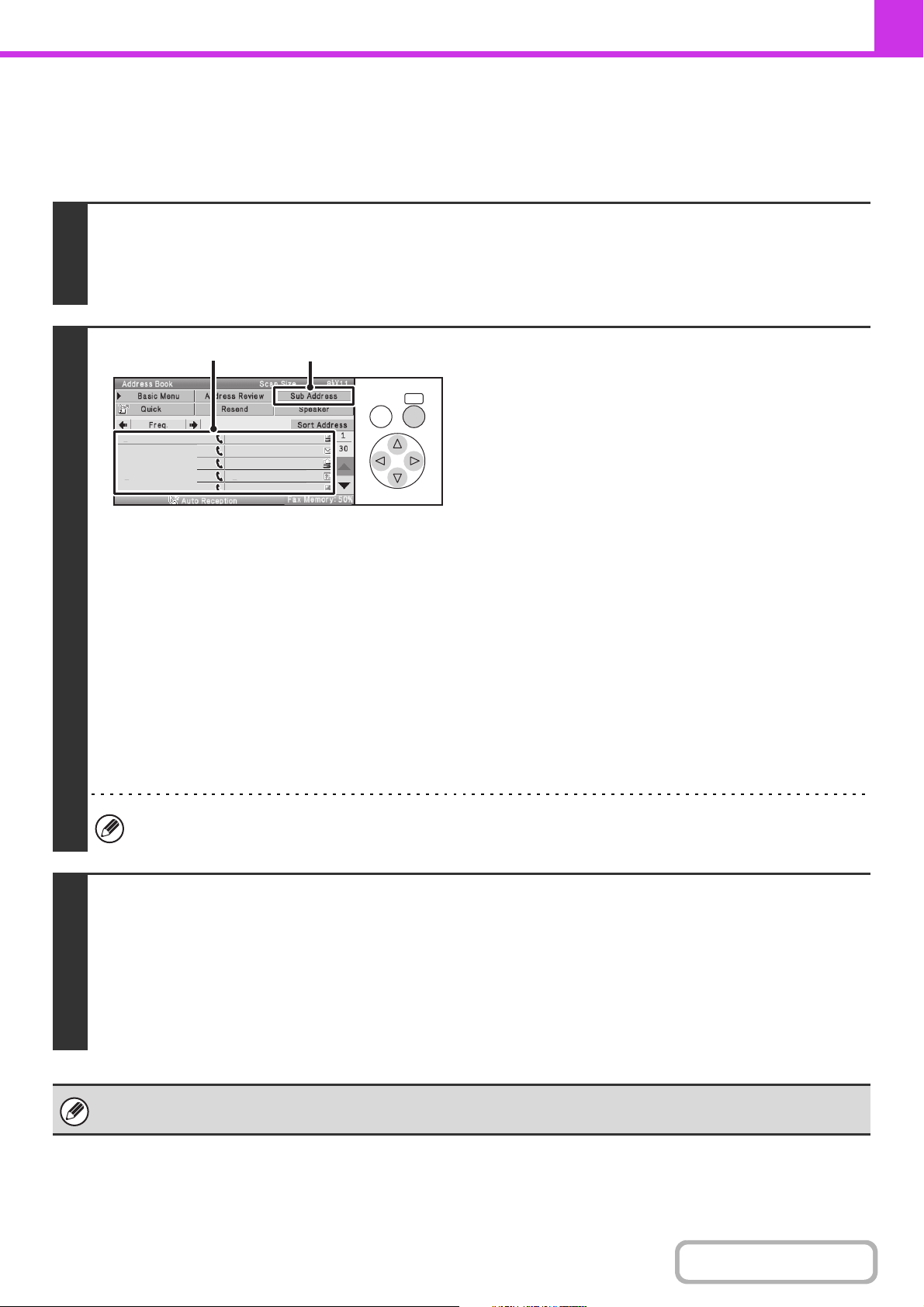
4-103
FACSIMILE
Contents
F-CODE CONFIDENTIAL TRANSMISSION
Follow the steps below to send a confidential fax by adding a F-code to the fax number.
Keys in the display can be selected with the arrow keys and the [OK] key.
1
Place the original.
Place the original face up in the document feeder tray, or face down on the document glass.
When the original is a different size than the size setting, set the original size.
☞ SPECIFYING THE SCAN SIZE AND SEND SIZE (page 4-50)
2
Enter the destination fax number.
(1) Select the [Address] key in the base screen.
For the [Address] key, see "BASE SCREEN OF FAX
MODE" (page 4-8).
(2) Select the one-touch key of the desired
destination.
If the destination is not stored in the address book, enter
the fax number with the numeric keys.
If the sub-address and passcode are stored in the one-touch
key, the following sub-steps are not necessary. Go to step 3.
(3) Select the [Sub Address] key.
"/" appears.
(4) Enter the sub-address with the numeric
keys.
(5) Select the [Sub Address] key.
"/" appears.
(6) Enter the passcode with the numeric keys.
If a passcode has been omitted in the memory box of the other machine, (5) and (6) are not necessary.
3
Press the [BLACK & WHITE START] key.
Scanning begins.
• If you inserted the original pages in the document feeder tray, all pages are scanned.
A beep will sound to indicate that scanning is finished.
• If you are scanning the original on the document glass, scan each page one page at a time.
When scanning finishes, place the next original and press the [BLACK & WHITE START] key. Repeat until all pages have
been scanned and then select the [Read-End] key.
A beep will sound to indicate that scanning is finished.
This function can be used in combination with a broadcast transmission or timer transmission. This function can also be
stored in a program.
OKBACK
AAA AAA
BBB BBB
CCC CCC
DDD DDD
EEE EEE
FFF FFF
GGG GGG
HHH HHH
III III
JJJ JJJ
(3),(5)(2)

4-104
FACSIMILE
Contents
CHECKING FAXES RECEIVED BY F-CODE
CONFIDENTIAL RECEPTION
When a F-code confidential fax is sent to your machine, the fax is received to the memory box specified by the F-code.
To check received faxes, enter the print passcode.
Keys in the display can be selected with the arrow keys and the [OK] key.
1
The machine rings and the fax is
received.
A beep sounds when reception ends.
2
Select the special modes.
(1) Select the [Special Modes] key.
(2) Select the [Memory Box] key.
☞ SPECIAL MODES (page 4-69)
3
Select the [Confidential Reception] key.
4
Select the memory box containing the
confidential fax.
" " appears in the keys of memory boxes that have received
faxes. The keys of memory boxes that have not received faxes
are grayed out and cannot be selected.
Beep
OKBACK
OKBACK
Box 1
Box 3
Box 5
Box 2
Box 4
Box 6
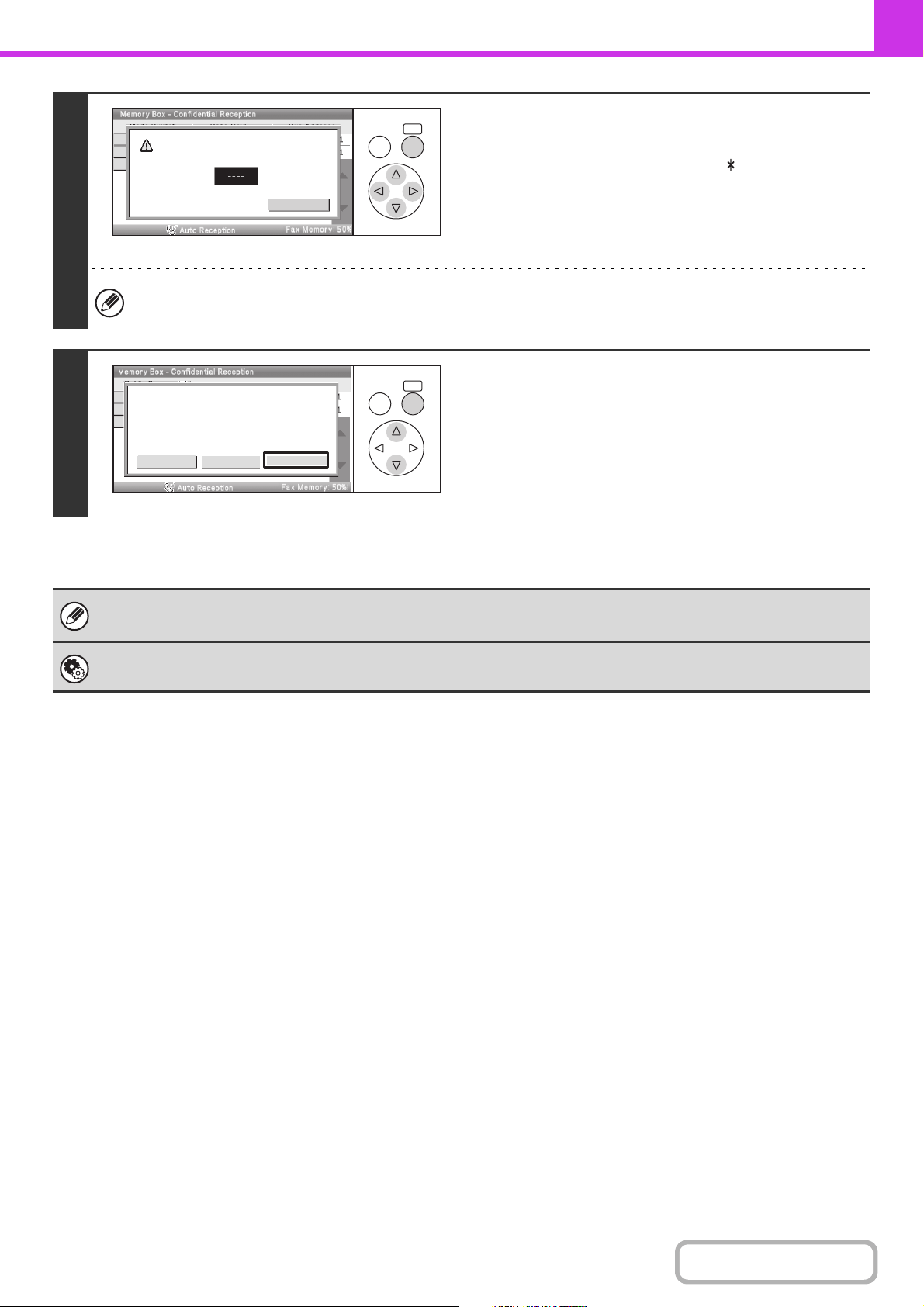
4-105
FACSIMILE
Contents
5
Enter the print passcode with the
numeric keys.
As each digit is entered, "–" changes to " ".
Take care to enter the correct print passcode. If you make a mistake, a message will appear and you will return to the
entry screen. You can select the [Cancel] key to return to step 4.
6
Select the [Image Check] key.
The content of the document can be viewed in the image check
screen. For information on the image check screen, see
"IMAGE CHECK SCREEN" (page 4-64).
To print the document, select the [Print] key.
• The confidential fax is automatically given priority in the print job queue.
• The fax is automatically cleared from the memory box after printing.
System Settings (Administrator): Transaction Report Print Select Setting
This setting can be used to have a transaction report printed automatically when a F-code confidential fax is received.
OKBACK
Enter PIN via the 10-key.
Cancel
OKBACK
Cancel
Press [Image Check] to check data.
Press [Print] to output data.
Print Image check
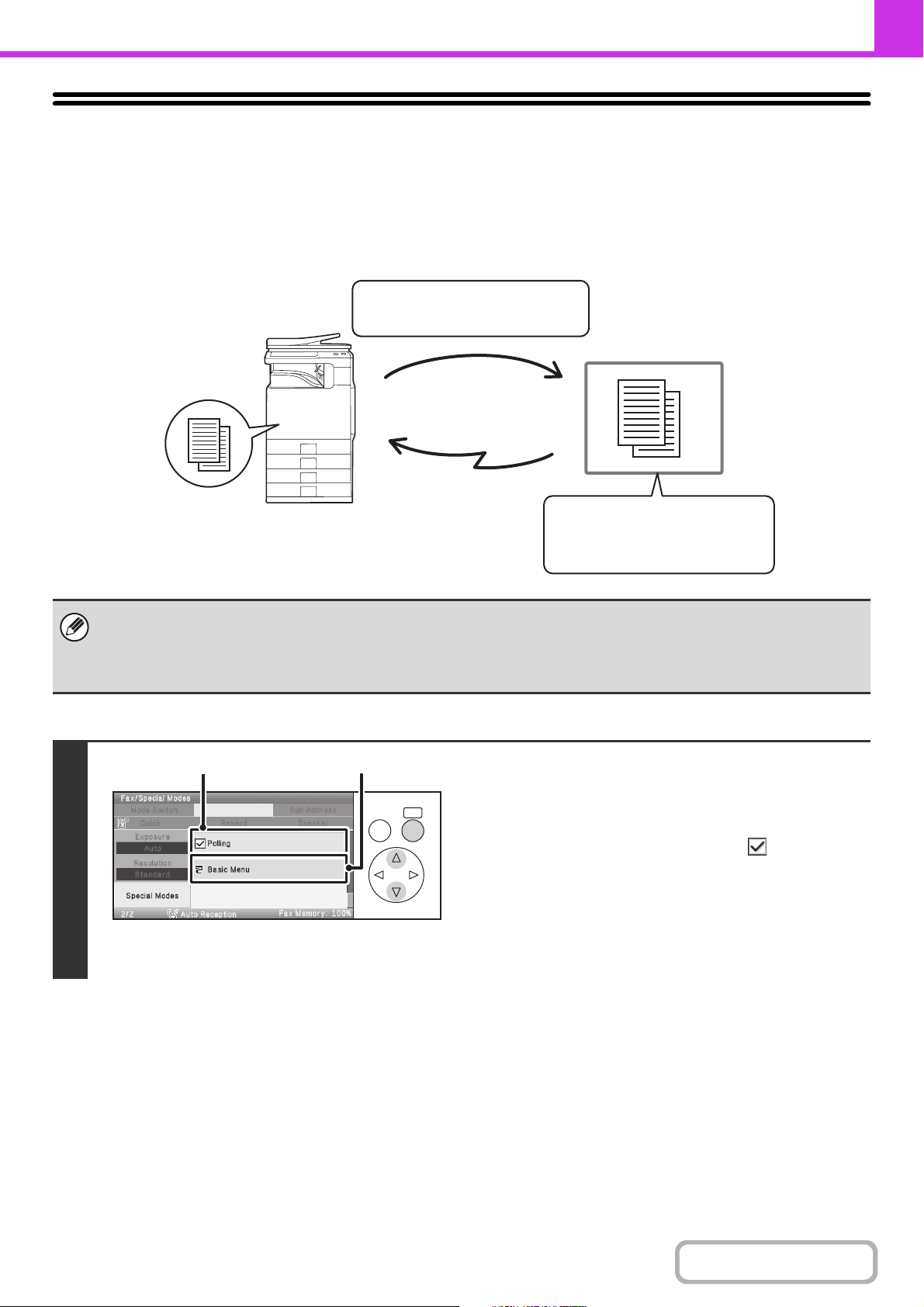
4-106
FACSIMILE
Contents
POLLING RECEPTION USING F-CODES
This function enables your machine to call another machine and initiate reception of a fax stored in a F-code memory
box (polling memory) in the other machine. During the polling operation, your machine must correctly specify the F-code
(sub-address and passcode) configured in the other machine or polling reception will not take place.
Keys in the display can be selected with the arrow keys and the [OK] key.
• Verify the F-code (sub-address and passcode) of the memory box in the other machine before you perform F-code polling
reception.
• Do not place an original in the automatic document feeder or on the document glass when using this function.
• The receiving machine bears the phone charges of the transmission.
1
Select polling.
(1) Select the [Special Modes] key.
☞ SPECIAL MODES (page 4-69)
(2) Set the [Polling] checkbox to .
(3) Select the [Basic Menu] key.
Transmission
The other machine
F-code polling memory box
Box name: BBBB
Sub-address: AAAAAAAA
Passcode: XXXXXXXX
Sub-address: AAAAAAAA
Passcode: XXXXXXXX
Transmission request (polling)
using an F-code
The machine
OKBACK
(3)(2)
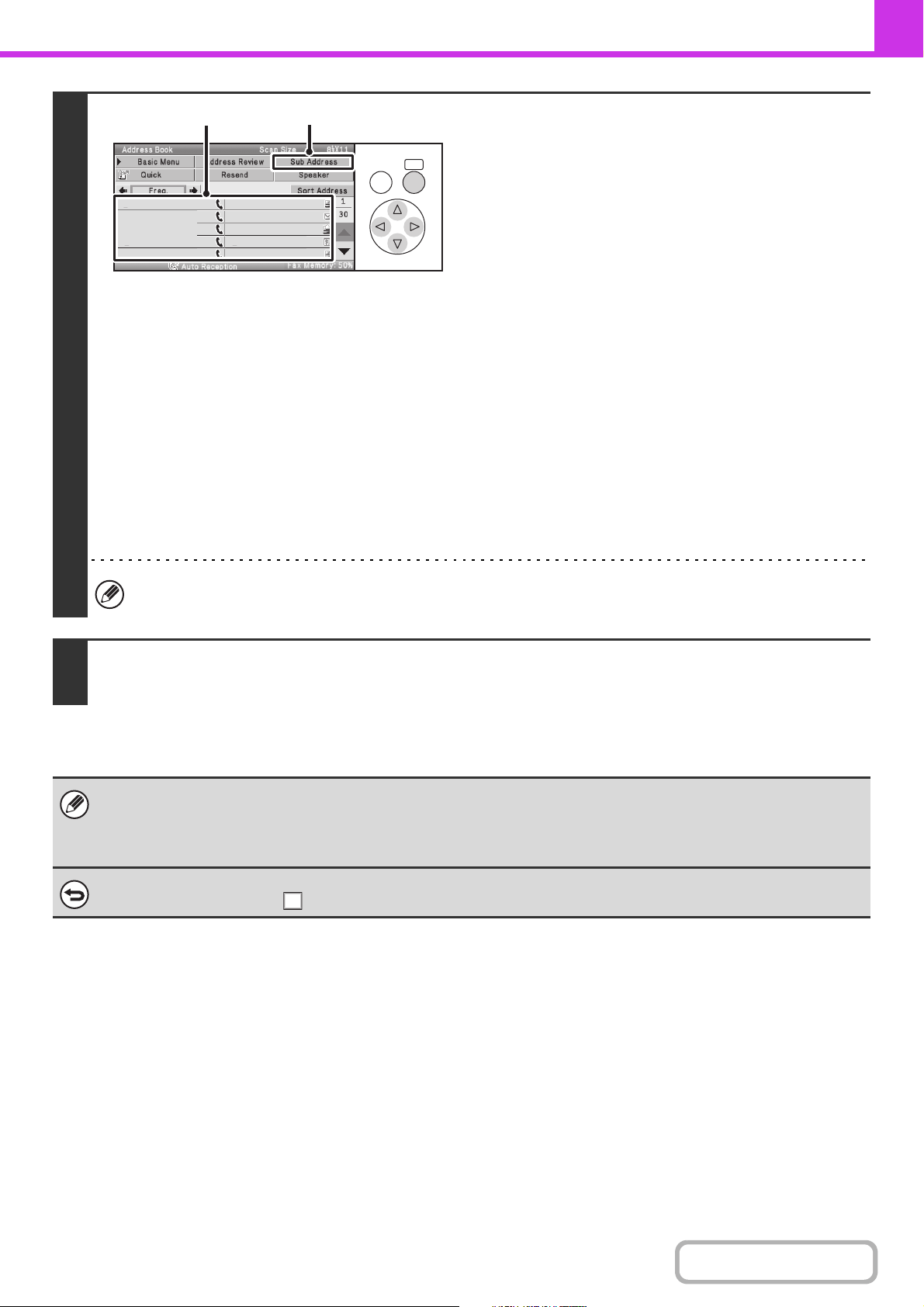
4-107
FACSIMILE
Contents
2
Enter the destination fax number.
(1) Select the [Address] key in the base screen.
For the [Address] key, see "BASE SCREEN OF FAX
MODE" (page 4-8).
(2) Select the one-touch key of the desired
destination.
If the destination is not stored in the address book, enter
the fax number with the numeric keys.
If the sub-address and passcode are stored in the one-touch
key, the following sub-steps are not necessary. Go to step 3.
(3) Select the [Sub Address] key.
"/" appears.
(4) Enter the sub-address with the numeric
keys.
(5) Select the [Sub Address] key.
"/" appears.
(6) Enter the passcode with the numeric keys.
If a passcode has been omitted in the memory box of the other machine, (5) and (6) are not necessary.
3
Press the [BLACK & WHITE START] key.
Your machine will call the other machine and initiate reception of the fax.
• Polling multiple machines (serial polling) is not possible.
• F-code polling reception can be used in combination with a timer setting. Only one polling reception operation with a timer
setting can be stored at a time.
☞SENDING A FAX AT A SPECIFIED TIME (Timer) (page 4-74)
To cancel polling...
Set the [Polling] checkbox to in the screen of step 1.
OKBACK
AAA AAA
BBB BBB
CCC CCC
DDD DDD
EEE EEE
FFF FFF
GGG GGG
HHH HHH
III III
JJJ JJJ
(3),(5)
(2)
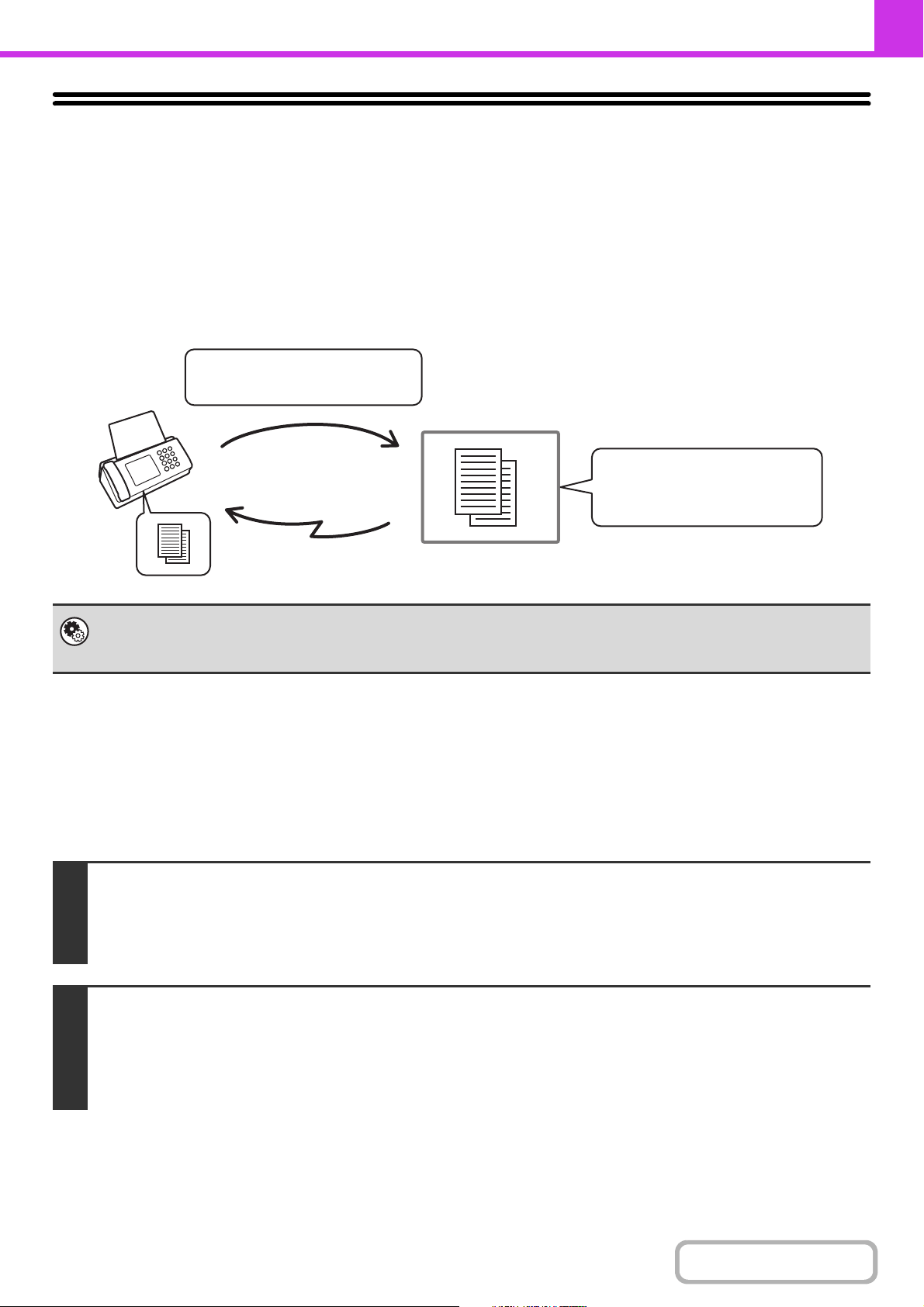
4-108
FACSIMILE
Contents
POLLING MEMORY TRANSMISSION USING
F-CODES
When your machine receives a transmission request from another machine, this function sends a fax stored in a F-code
memory box (polling memory) in your machine to that machine. The other machine must correctly specify the F-code
configured in your machine or transmission will not take place.
The document to be transmitted must be scanned into a F-code polling memory box.
SCANNING A DOCUMENT INTO A MEMORY BOX FOR
F-CODE POLLING TRANSMISSION
Follow these steps to scan a document into a memory box (polling memory) for F-code polling transmission.
Keys in the display can be selected with the arrow keys and the [OK] key.
System Settings: F-Code Memory Box (page 6-107) (Web page only)
This is used to create memory boxes (polling memory) for F-code polling memory transmission.
A memory box name, sub-address, and passcode are programmed in each box.
1
Place the original.
Place the original face up in the document feeder tray, or face down on the document glass.
When the original is a different size than the size setting, set the original size.
☞ SPECIFYING THE SCAN SIZE AND SEND SIZE (page 4-50)
2
Select the special modes.
(1) Select the [Special Modes] key.
(2) Select the [Memory Box] key.
☞ SPECIAL MODES (page 4-69)
Transmission
The machine
F-code polling memory box
The other
machine
Box name: BBBB
Sub-address: AAAAAAAA
Passcode: XXXXXXXX
Sub-address: AAAAAAAA
Passcode: XXXXXXXX
Transmission request (polling)
using an F-code
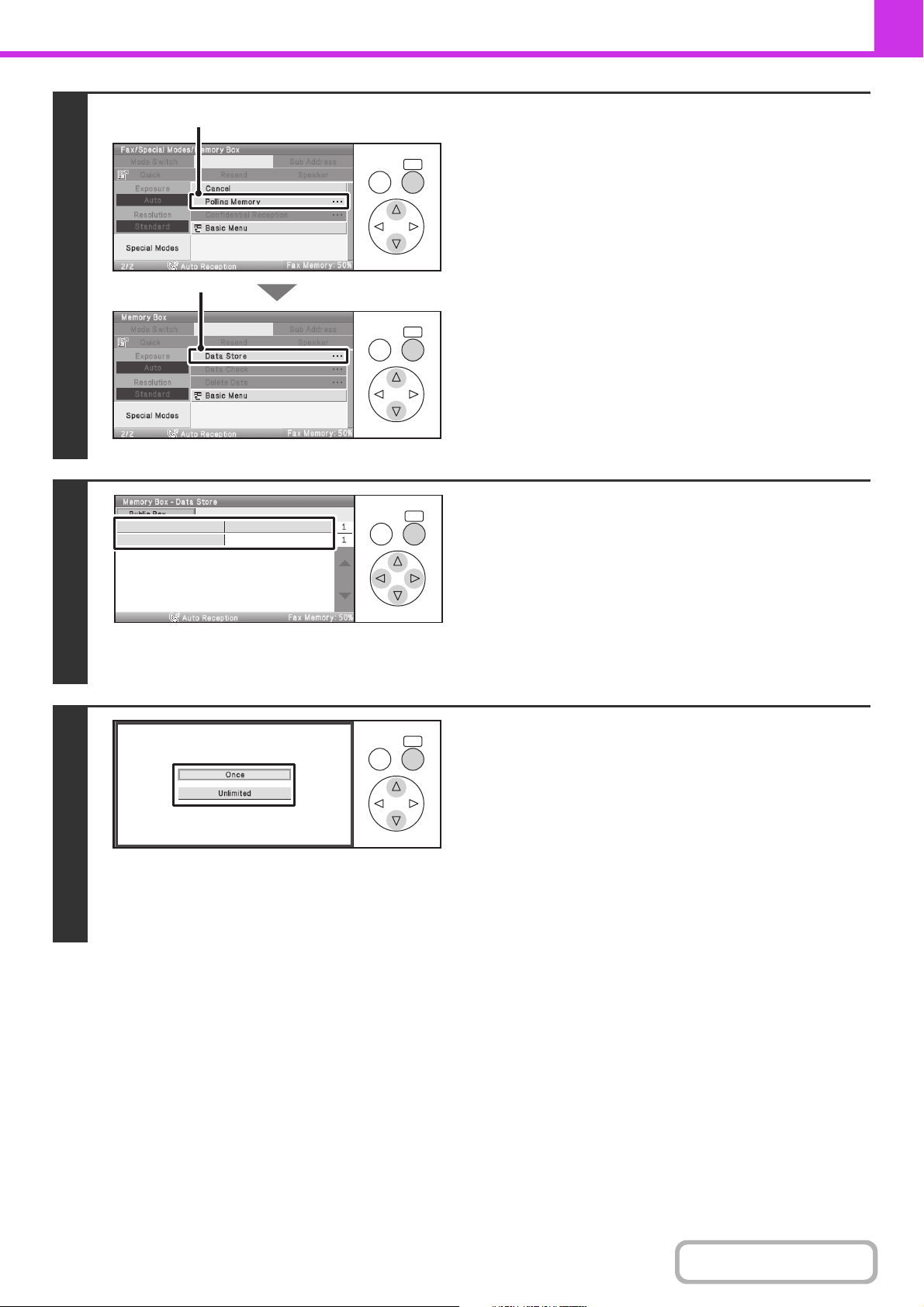
4-109
FACSIMILE
Contents
3
Select the [Data Store] key.
(1) Select the [Polling Memory] key.
(2) Select the [Data Store] key.
4
Select the F-code memory polling box.
5
Specify the number of polling times.
Select for the desired number of times.
Select the [Once] key if you want the document cleared from
memory after it is transmitted. Select the [Unlimited] key to
allow polling an unlimited number of times.
OKBACK
OKBACK
(1)
(2)
OKBACK
Box 1
Box 2
Box 3
OKBACK
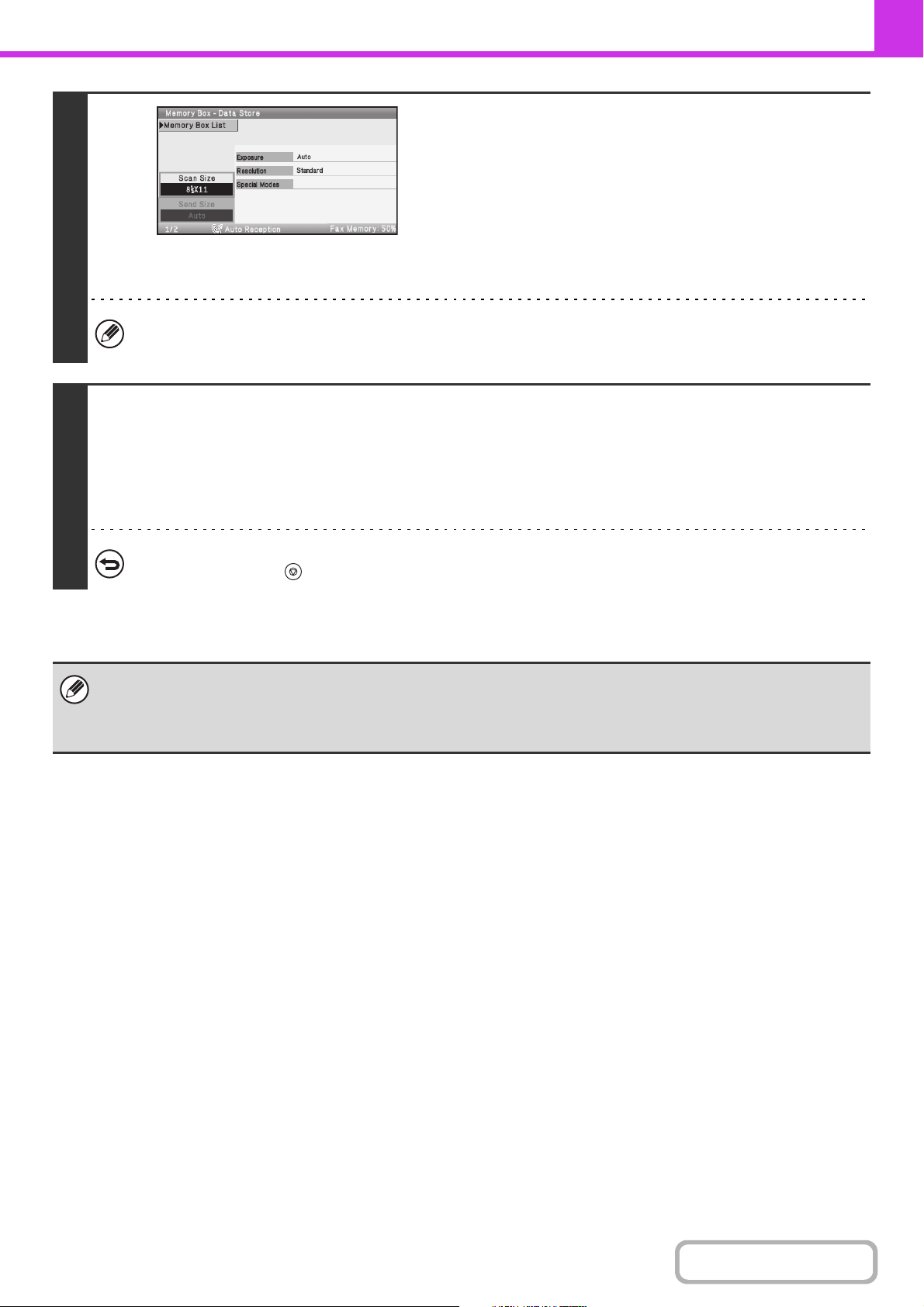
4-110
FACSIMILE
Contents
6
Select image settings and special
modes.
• A program, timer setting, transaction report and polling cannot be selected.
• To return to the screen of step 4, select the [Memory Box List] key.
7
Press the [BLACK & WHITE START] key.
Scanning begins.
• If you inserted the original pages in the document feeder tray, all pages are scanned.
• If you are scanning the original on the document glass, scan each page one page at a time.
When scanning finishes, place the next original and press the [BLACK & WHITE START] key. Repeat until all pages have
been scanned and then select the [Read-End] key.
To cancel scanning...
Press the [STOP] key ( ) while the original is being scanned.
• If other documents have already been stored in the memory box, the document is added to the previously stored
documents.
• The factory default setting for the number of polling times is "Once" (after the document is transmitted to the receiving
machine, it is automatically cleared).
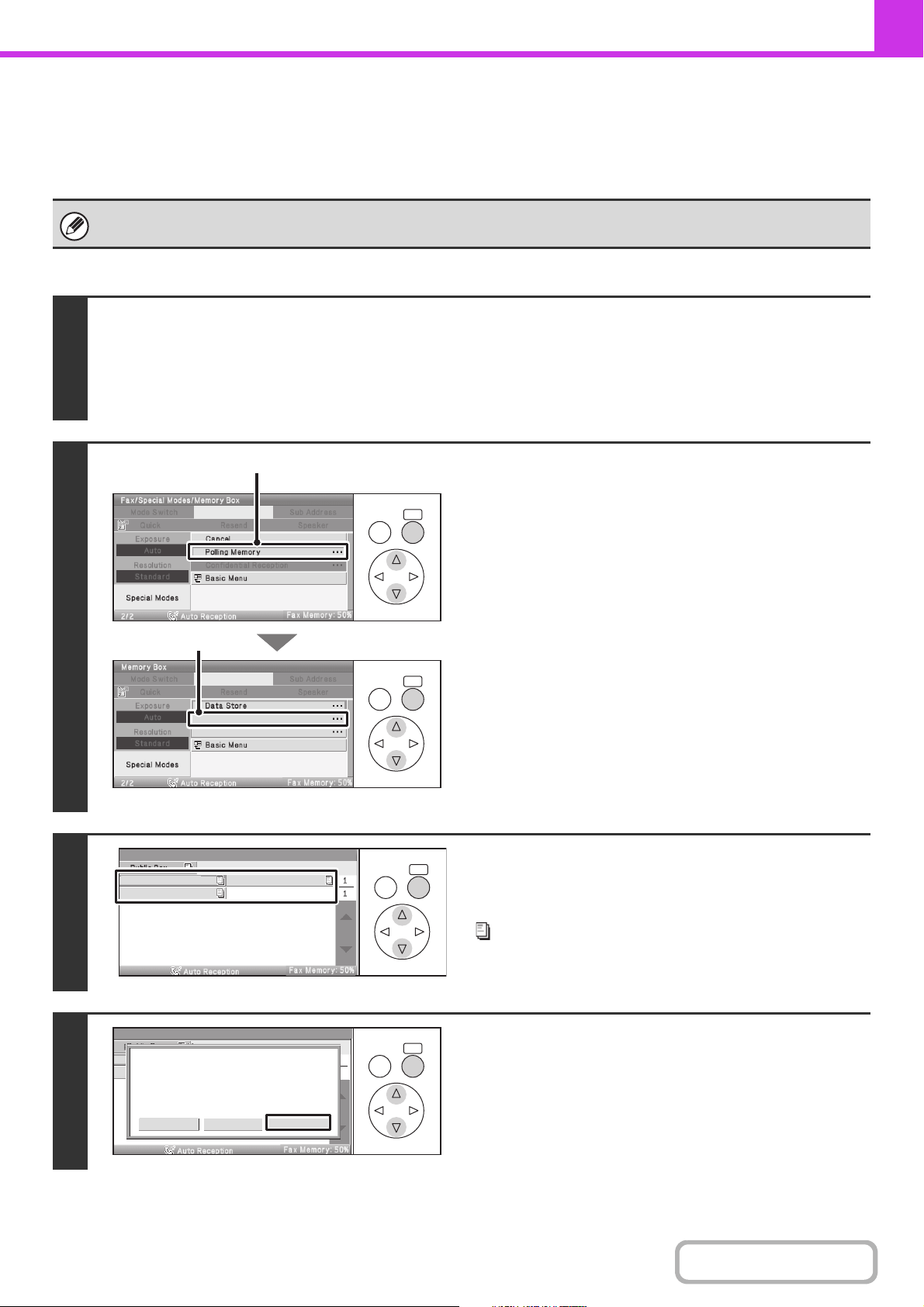
4-111
FACSIMILE
Contents
CHECKING THE DOCUMENT IN THE F-CODE MEMORY
POLLING BOX
You can check the document stored in the F-code memory polling box.
Keys in the display can be selected with the arrow keys and the [OK] key.
A document in a memory box cannot be printed while the document is being transmitted.
1
Select the special modes.
(1) Select the [Special Modes] key.
(2) Select the [Memory Box] key.
☞ SPECIAL MODES (page 4-69)
2
Select the [Data Check] key.
(1) Select the [Polling Memory] key.
(2) Select the [Data Check] key.
3
Select the F-code memory polling box
where the document you wish to print is
stored.
appears in memory boxes that have documents stored.
4
Select the [Image Check] key.
The content of the document can be viewed in the image check
screen. For information on the image check screen, see
"IMAGE CHECK SCREEN" (page 4-64).
To print the document, select the [Print] key.
OKBACK
OKBACK
Delete Data
Data Check
(1)
(2)
OKBACK
Box 1
Box 2
Box 3
Memory Box - Data Check
OKBACK
Cancel
Press [Image Check] to check data.
Press [Print] to output data.
Print Image check
Memory Box - Data Check
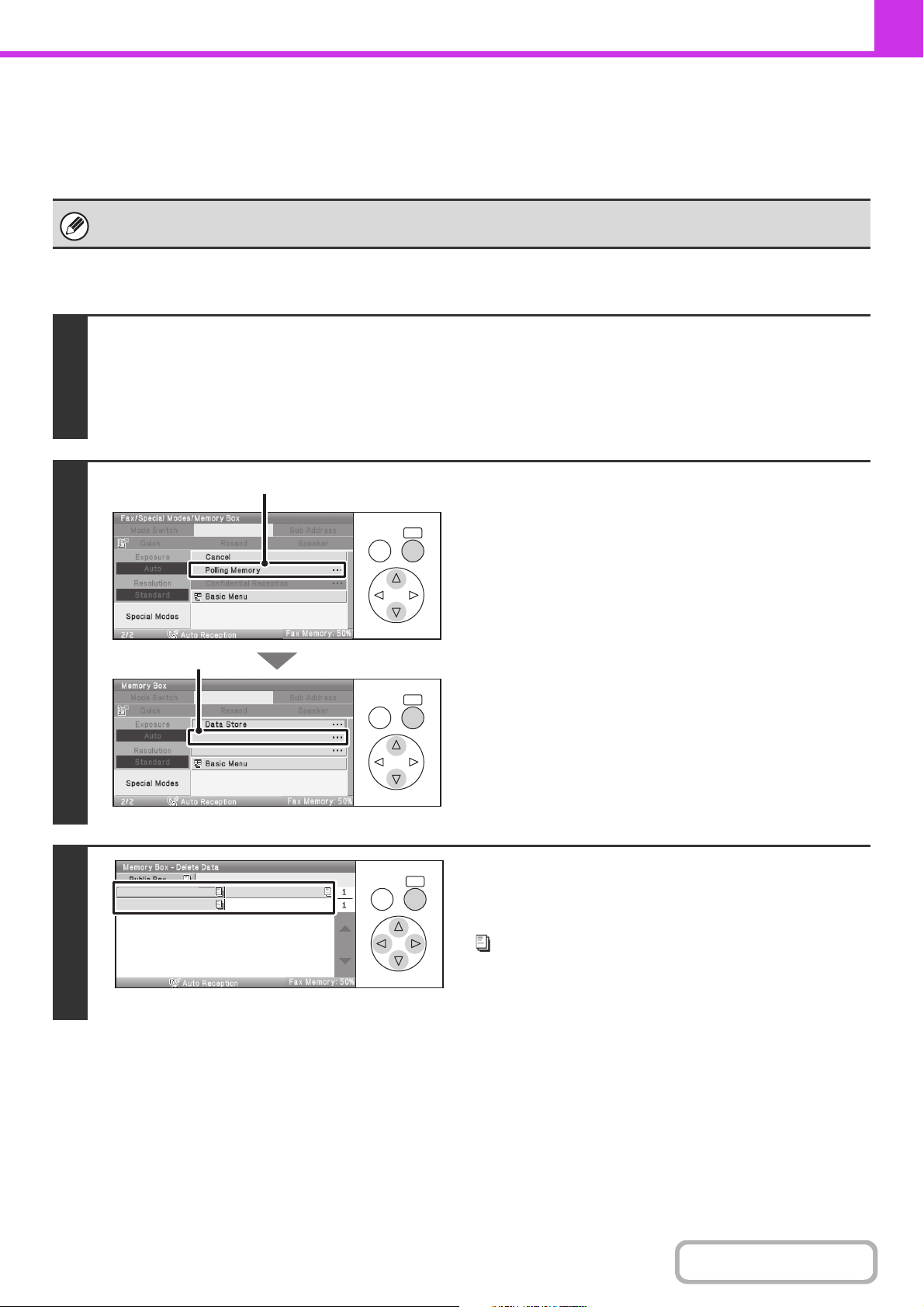
4-112
FACSIMILE
Contents
DELETING A DOCUMENT STORED FOR F-CODE
POLLING TRANSMISSION
When a document in a F-code memory polling box is no longer needed, follow the steps below to delete it.
Keys in the display can be selected with the arrow keys and the [OK] key.
A document in a memory box cannot be deleted while the document is being transmitted.
1
Select the special modes.
(1) Select the [Special Modes] key.
(2) Select the [Memory Box] key.
☞ SPECIAL MODES (page 4-69)
2
Select the [Delete Data] key.
(1) Select the [Polling Memory] key.
(2) Select the [Delete Data] key.
3
Select the F-code memory polling box
that has the document you wish to
delete.
appears in memory boxes that have documents stored.
OKBACK
OKBACK
Delete Data
Data Check
(1)
(2)
OKBACK
Box 1
Box 2
Box 3
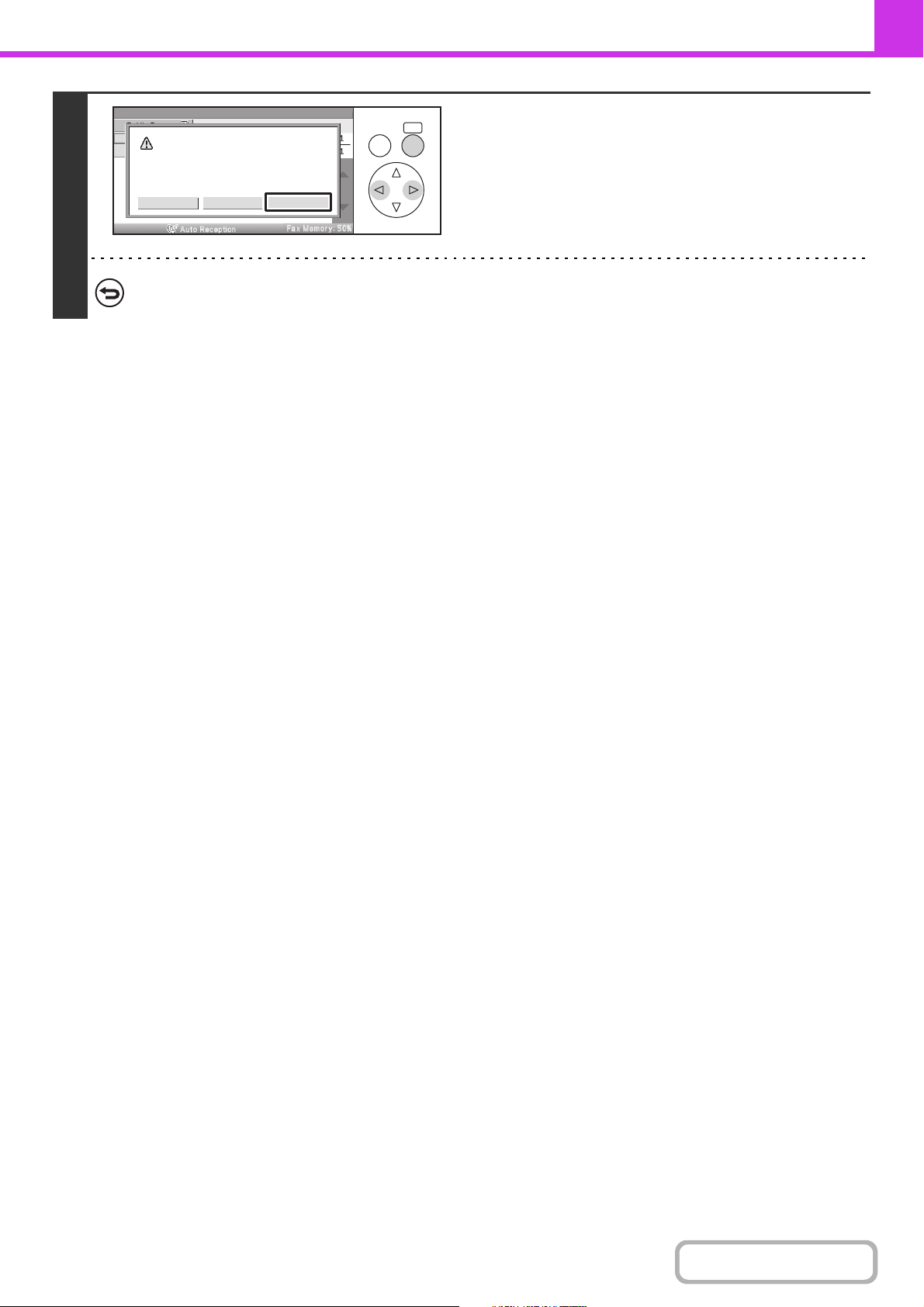
4-113
FACSIMILE
Contents
4
Select the [Yes] key.
•
The document is deleted and you return to the screen of step 3.
• You can select the [Image Check] key to check the image in
the display before deleting it. For information on the image
check screen, see "IMAGE CHECK SCREEN" (page 4-64).
To cancel the deletion...
Select the [No] key. You will return to the screen of step 3 without deleting the document.
OKBACK
Image check No
Yes
Delete the data in the memory box?
Press [Image Check] to check data.
Memory Box - Delete Data
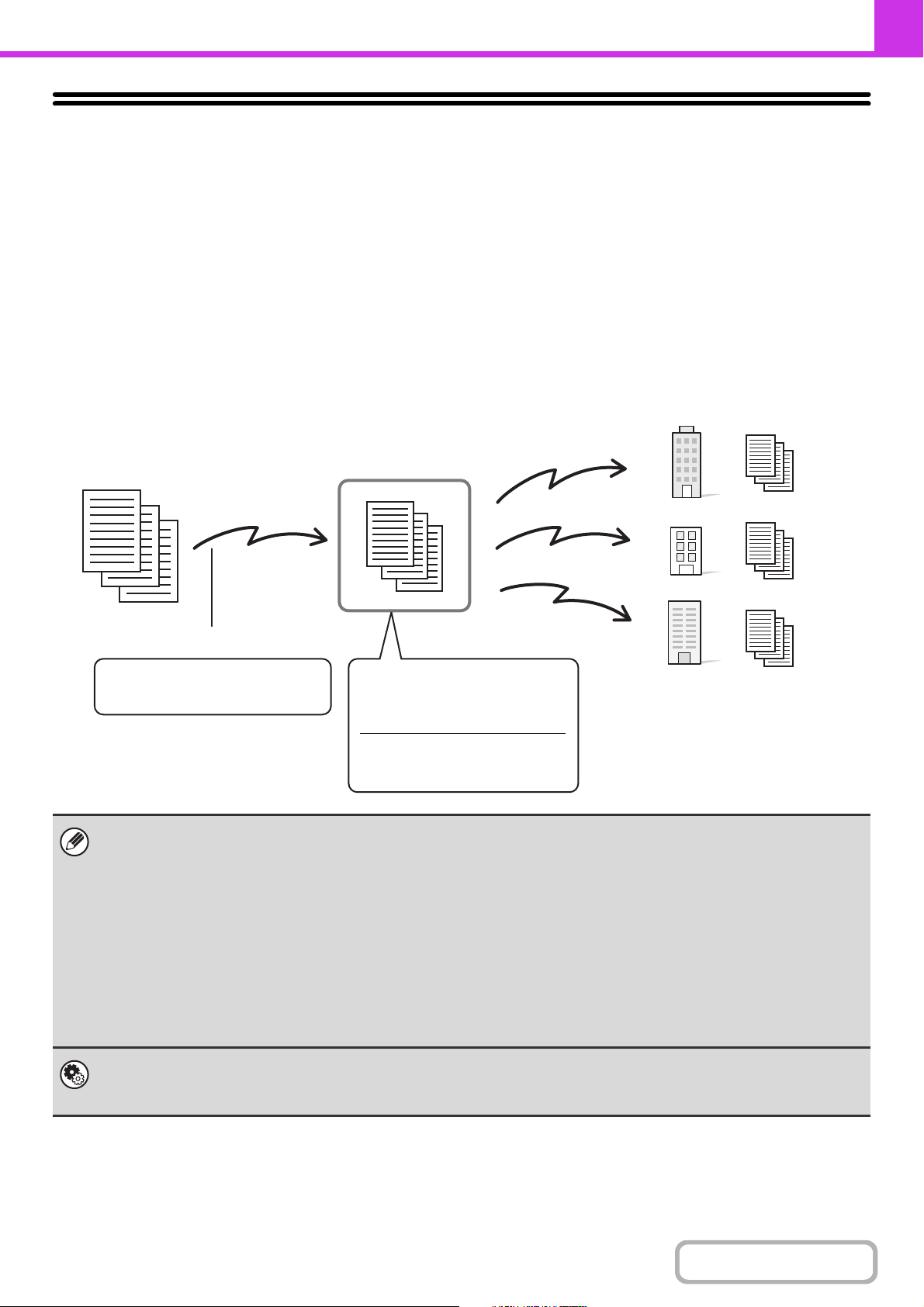
4-114
FACSIMILE
Contents
RELAY REQUEST TRANSMISSION USING
F-CODES
This function is used to send a fax to a F-code relay broadcast memory box in another machine and have that machine
relay the fax to multiple end receiving machines.
When the end receiving machines are far from your machine, sending the fax to a relay machine that is close to the end
receiving machines can help reduce phone charges. A relay request transmission can be used in combination with the
timer transmission function to further reduce phone costs.
☞ SENDING A FAX AT A SPECIFIED TIME (Timer) (page 4-74)
• Verify the F-code (sub-address and passcode) and end receiving machines programmed in the relay broadcast memory
box in the relay machine before you perform a F-code relay request transmission.
• Before this function can be used, the end receiving machines must be programmed in the F-code relay broadcast memory
box in the relay machine.
• The end receiving machines do not need to support F-code communication.
• This function can be used in combination with a broadcast transmission or timer transmission. An F-code relay request
transmission can also be stored in a program.
• Your machine (the machine that requests a relay broadcast transmission) only bears the cost of sending the fax to the
relay machine. The relay machine bears the cost of sending the fax to each of the end receiving machines.
• When faxes forwarded using this function are printed at the forwarding destination, the date and time of reception cannot
be printed on the faxes. ("Receiving Date & Time Print" is disabled.)
System Settings: F-Code Memory Box (page 6-107) (Web page only)
This is used to create memory boxes for F-code relay broadcast transmission.
A memory box name, sub-address, passcode, and end receiving machines are programmed in each box.
The machine
Transmission
The fax is transmitted to
each of the end receiving
machines programmed in
the F-code relay
broadcast memory box.
Relay machine
F-code relay broadcast
memory box
Box name: BBBB
Sub-address: AAAAAAAA
Passcode: XXXXXXXX
Sub-address: AAAAAAAA
Passcode: XXXXXXXX
Transmission specifying an F-code
End receiving machines are
programmed in this box
End receiving
machines
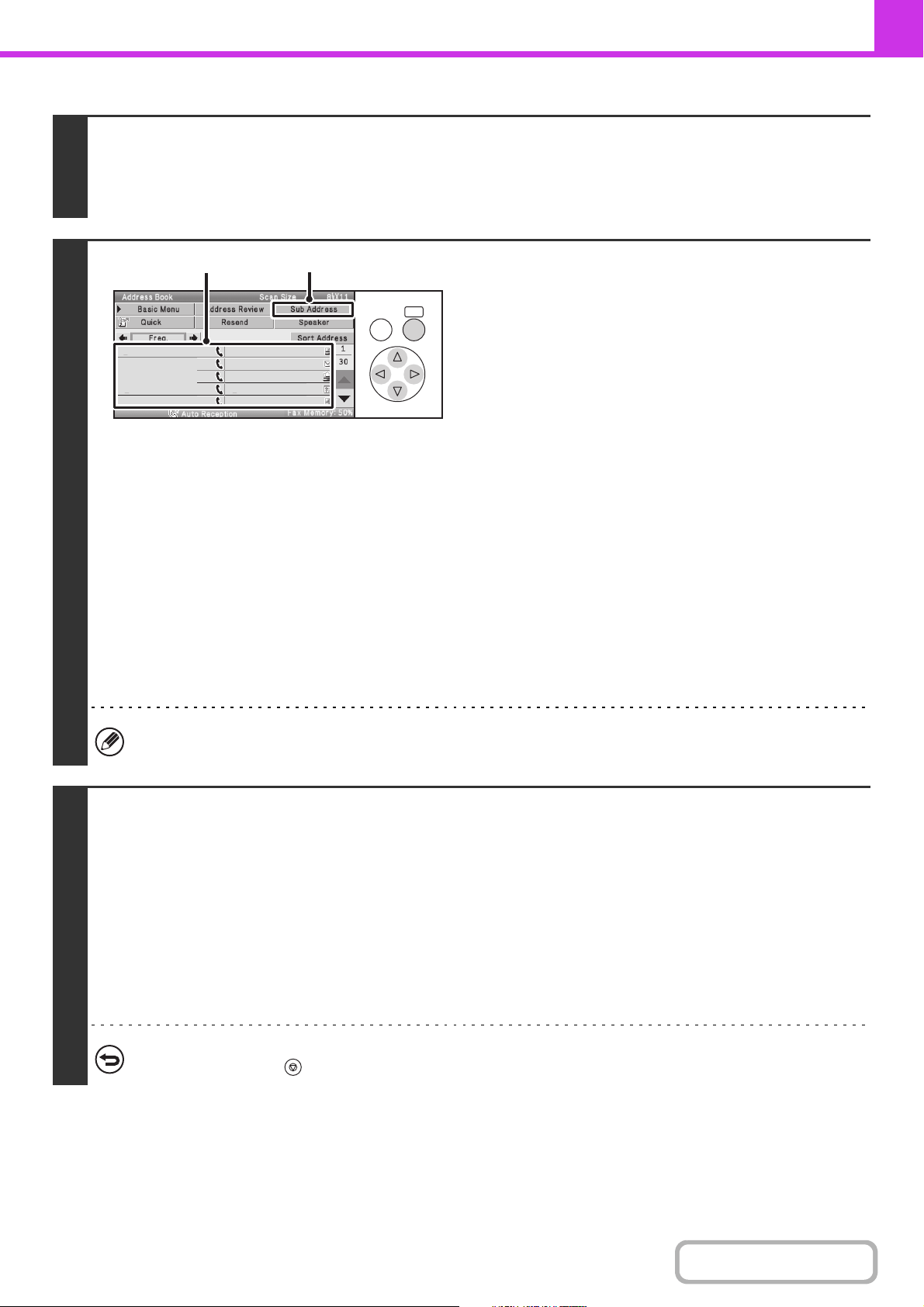
4-115
FACSIMILE
Contents
Keys in the display can be selected with the arrow keys and the [OK] key.
1
Place the original.
Place the original face up in the document feeder tray, or face down on the document glass.
When the original is a different size than the size setting, set the original size.
☞ SPECIFYING THE SCAN SIZE AND SEND SIZE (page 4-50)
2
Enter the destination fax number.
(1) Select the [Address] key in the base screen.
For the [Address] key, see "BASE SCREEN OF FAX
MODE" (page 4-8).
(2) Select the one-touch key of the desired
destination.
If the destination is not stored in the address book, enter
the fax number with the numeric keys.
If the sub-address and passcode are stored in the one-touch
key, the following sub-steps are not necessary. Go to step 3.
(3) Select the [Sub Address] key.
"/" appears.
(4) Enter the sub-address with the numeric
keys.
(5) Select the [Sub Address] key.
"/" appears.
(6) Enter the passcode with the numeric keys.
If a passcode has been omitted in the memory box of the other machine, (5) and (6) are not necessary.
3
Press the [BLACK & WHITE START] key.
Scanning begins.
• If you inserted the original pages in the document feeder tray, all pages are scanned.
A beep will sound to indicate that scanning is finished.
•
If you are scanning the original on the document glass, scan each page one page at a time.
When scanning finishes, place the next original and press the [BLACK & WHITE START] key. Repeat until all pages have
been scanned and then select the [Read-End] key.
A beep will sound to indicate that scanning is finished.
When the relay machine receives the fax, it will automatically transmit the fax to each of the end receiving machines
programmed in the memory box.
To cancel scanning...
Press the [STOP] key ( ) while the original is being scanned.
OKBACK
AAA AAA
BBB BBB
CCC CCC
DDD DDD
EEE EEE
FFF FFF
GGG GGG
HHH HHH
III III
JJJ JJJ
(3),(5)
(2)

4-116
FACSIMILE
Contents
RELAY BROADCAST TRANSMISSION
USING F-CODES
When your machine receives a F-code relay request transmission, the fax is received to a F-code relay broadcast
memory box in your machine. Your machine then relays the fax to each of the end receiving machines programmed in
the memory box. Transmission to the end receiving machines takes place automatically.
• Prior to the operation, inform the requesting party of the sub-address and passcode of the relay broadcast memory box in
your machine.
• Program the end receiving machines in the F-code relay broadcast memory box when you create the box in your machine.
☞CREATING MEMORY BOXES IN THE MACHINE FOR F-CODE COMMUNICATION (page 4-101)
• The end receiving machines do not need to support F-code communication.
• The machine that requests a relay broadcast transmission only bears the cost of sending the fax to your machine (the relay
machine). Your machine bears the cost of sending the fax to each of the end receiving machines.
• When faxes forwarded using this function are printed at the forwarding destination, the date and time of reception cannot
be printed on the faxes. ("Receiving Date & Time Print" is disabled.)
The other
machine
Transmission
The fax is transmitted to
each of the end receiving
machines programmed in
the F-code relay
broadcast memory box.
The machine
F-code relay broadcast
memory box
Box name: BBBB
Sub-address: AAAAAAAA
Passcode: XXXXXXXX
Sub-address: AAAAAAAA
Passcode: XXXXXXXX
Transmission specifying an F-code
End receiving machines are
programmed in this box
End receiving
machines
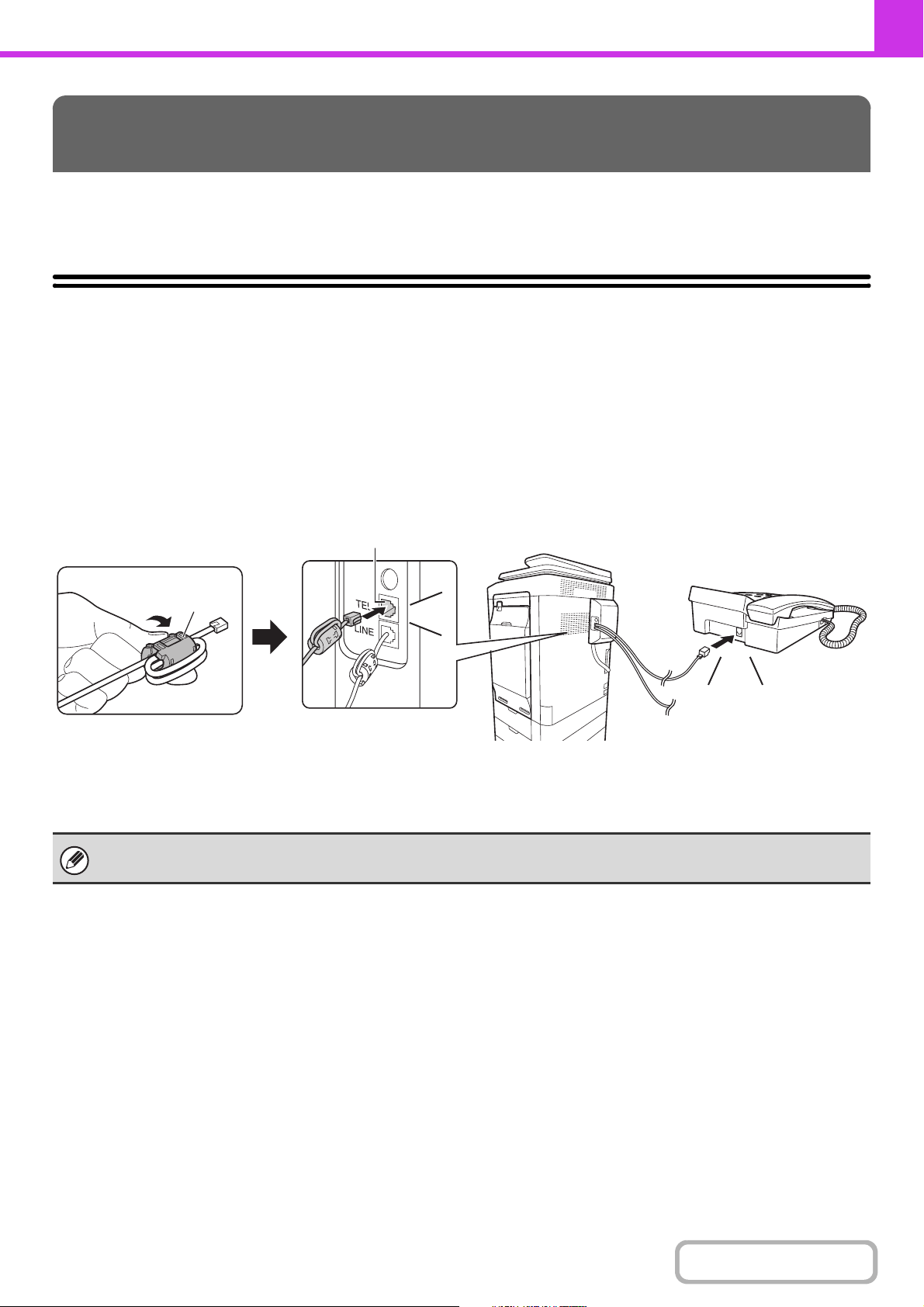
4-117
FACSIMILE
Contents
This section explains how to use an extension phone to make voice calls and receive a fax after talking with the other
party.
CONNECTING AND USING AN EXISTING
PHONE (Extension Phone Connection)
You can connect an existing extension phone to the machine.
The phone can be used for voice calls and to start fax reception on the machine.
As an example, you can make a phone call using the existing phone, speak to the other party, and then press the
[BLACK & WHITE START] key to fax an original that has been placed to that party. You can also press the [BLACK &
WHITE START] key when an original is not placed to receive a fax.
Connect the extension phone as shown below.
USING AN EXTENSION PHONE
• Connect an extension phone that has a modular jack. Use standard phone line cable to connect the phone. If other than a
standard phone line cable is used, the connection may not work correctly.
Extension phone jack
Existing extension
phone (example)
Click!
Click!
Make sure you hear a "click"
sound indicating that the
cord is securely connected.
Core
Attach the provided core to
your extension telephone cord
and then connect the cord to
the machine.
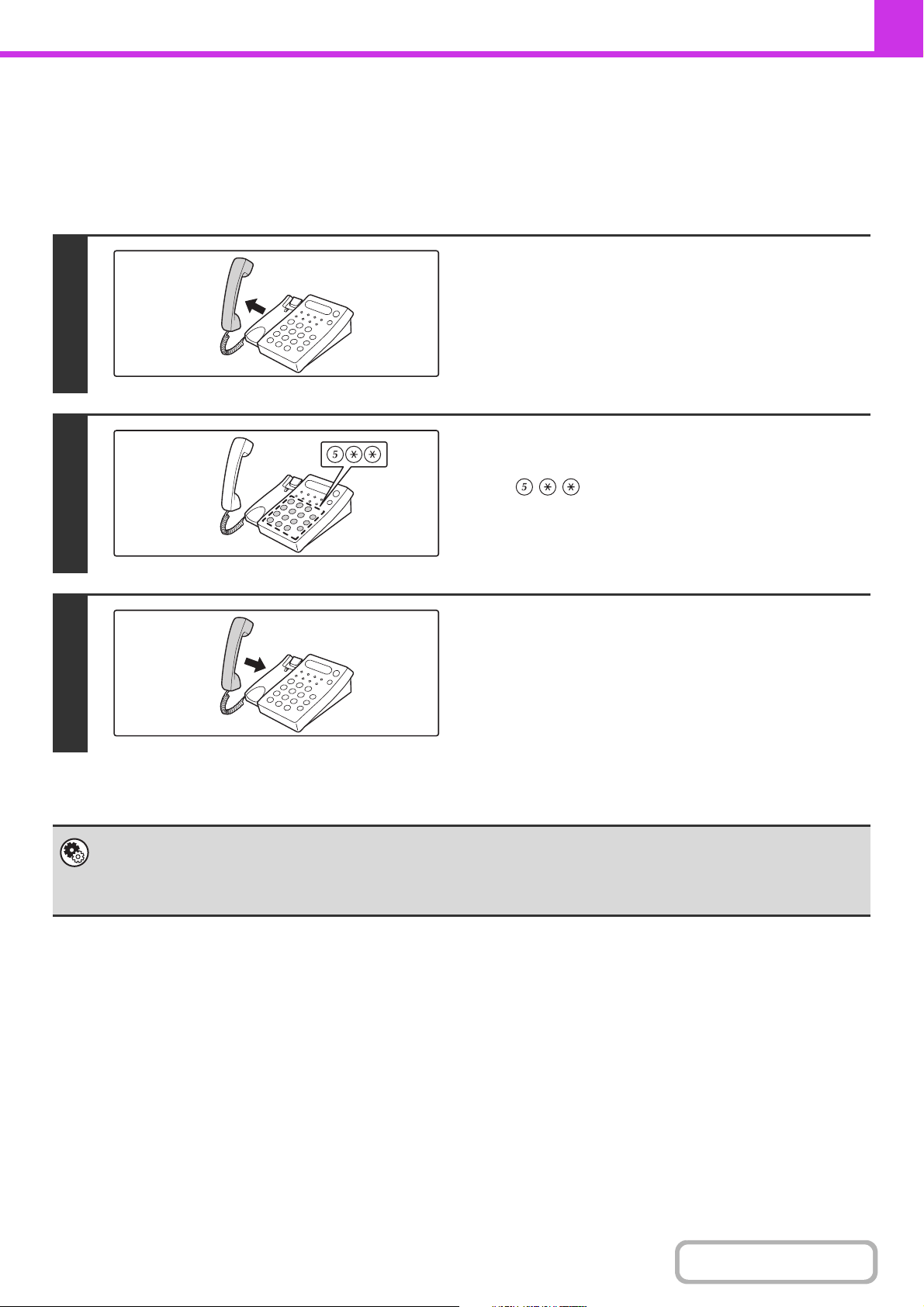
4-118
FACSIMILE
Contents
RECEIVING A FAX AFTER ANSWERING A CALL ON
THE EXTENSION PHONE (Remote Reception)
Follow the steps below if you need to start fax reception after answering a call and speaking on the extension phone.
If you are on a pulse-dial (rotary) line, set the extension phone to issue tone signals.
MAKING AND RECEIVING PHONE CALLS
You can make and receive normal calls on your extension phone. A phone call can also be made by dialing on the
machine.
1
When you hear ringing, answer the call
on the extension phone.
2
Signal the machine to start fax
reception.
Press on the keypad of the extension phone.
3
Replace the extension phone.
The machine sounds a beep when reception ends.
• System Settings: Receive Setting (page 6-98)
To use remote fax reception, set this setting to "Manual Reception".
• System Settings (Administrator): Remote Reception Number Setting
This is used to change the number used for remote fax reception. The factory default setting is "5".
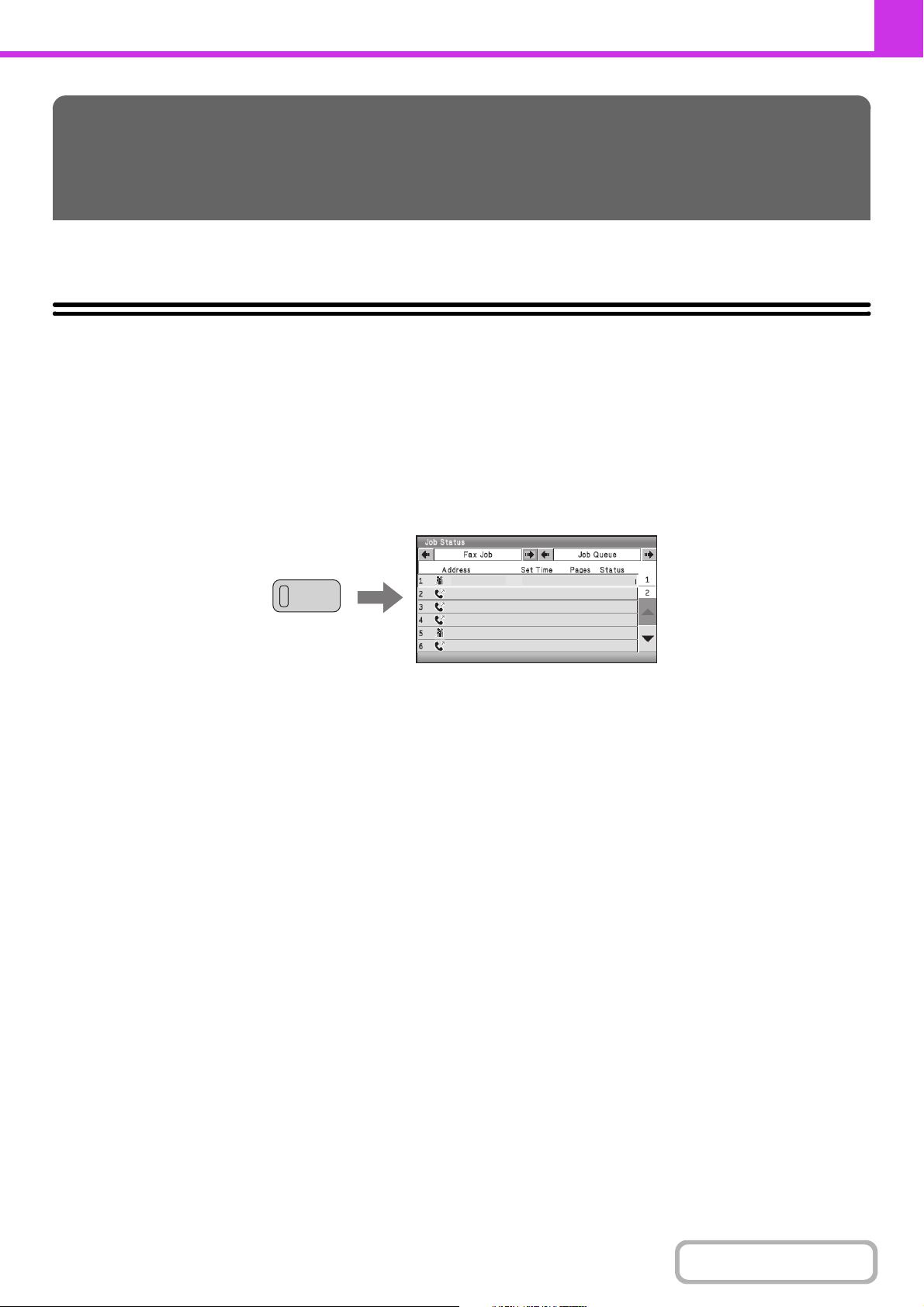
4-119
FACSIMILE
Contents
This section explains how to check the status of reserved transmission jobs and received faxes.
JOB STATUS SCREEN
The job status screen is displayed when the [JOB STATUS] key on the operation panel is pressed. The job status
screen shows the status of jobs by mode. When the [JOB STATUS] key is pressed, the job status screen of the mode
that was being used before the key was pressed appears.
Reserved transmissions and received faxes are referred to as jobs here.
Example: Pressing the key in fax mode
CHECKING THE STATUS OF FAX
JOBS
0123456789
AAA AAA
BBB BBB
Broadcast
CCC CCC
Broadcast0001
10:05 04/01 000/004 Waiting
10:22 04/01 000/004 Waiting
10:30 04/01 000/010 Waiting
10:33 04/01 000/010 Waiting
10:40 04/01 000/010 Waiting
10:00 04/01 020/003 Connecting
JOB STATUS
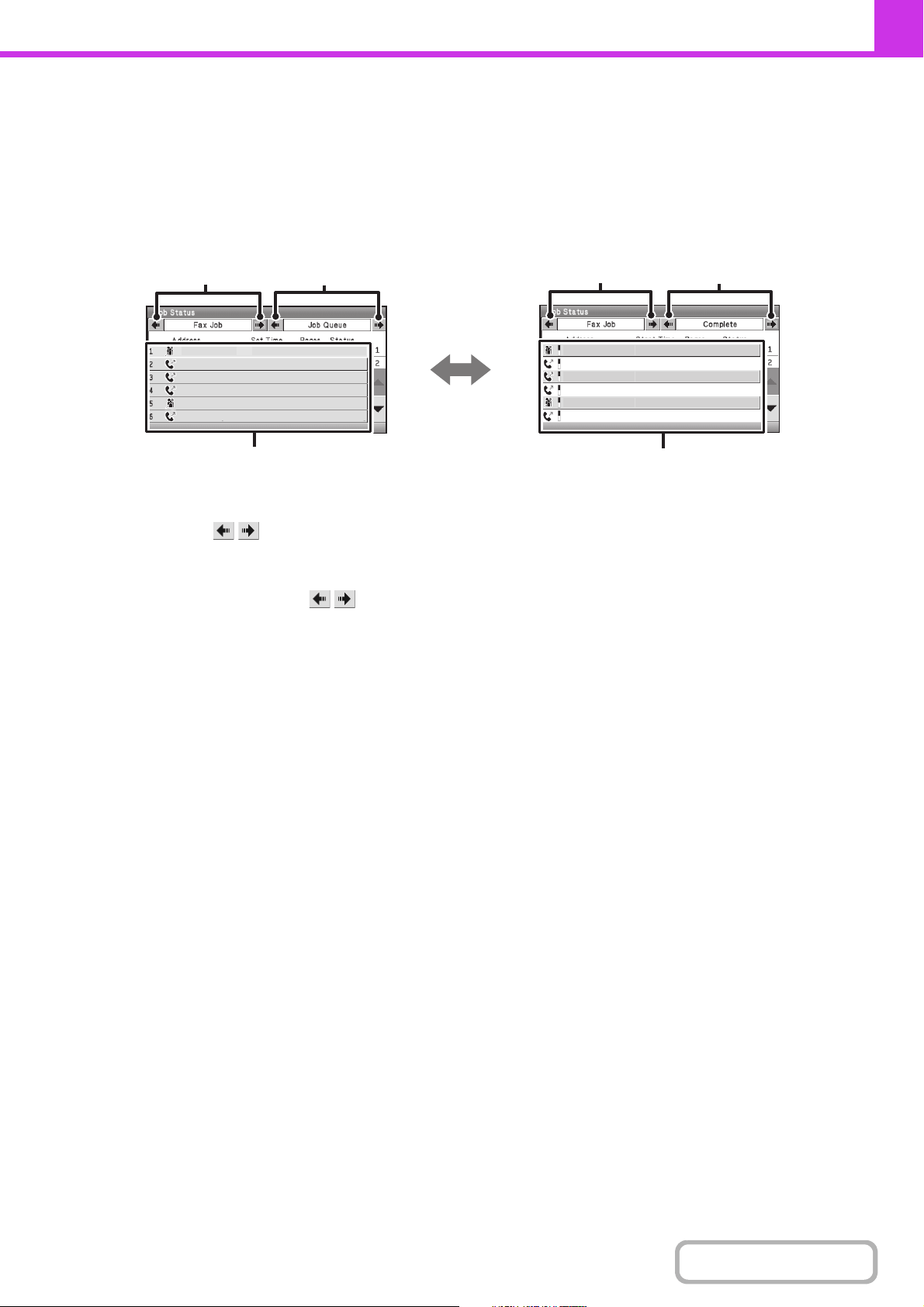
4-120
FACSIMILE
Contents
JOB QUEUE SCREEN AND COMPLETED JOB SCREEN
The job status screen consists of two screens: the job queue screen, which shows reserved jobs and the job currently in
progress, and the completed jobs screen. To switch between the two screens, select the job status screen selector key
((2) below).
(1) Mode select keys ( )
Select these keys to select the job status screen of each
mode.
(2) Job status screen selector keys ( )
Select these keys to switch between the job queue
screen and the completed jobs screen.
(3) Job queue screen
Jobs are shown as keys in the order they were reserved.
Each key shows information on a job and its current
status.
☞ Job key display (page 4-121)
(4) Completed jobs screen
This shows up to 99 completed transmission/reception
jobs. A description of each job and the result (status) are
shown.
Broadcast transmission jobs, serial polling jobs, and
received fax forwarding jobs are indicated as keys.
0123456789
AAA AAA
BBB BBB
Broadcast
CCC CCC
Broadcast0001
10:05 04/01 000/004 Waiting
10:22 04/01 000/004 Waiting
10:30 04/01 000/010 Waiting
10:33 04/01 000/010 Waiting
10:40 04/01 000/010 Waiting
10:00 04/01 020/003 Connecting
Broadcast0001
CCC CCC
0123456789
DDD DDD
Broadcast0002
EEE EEE
10:05 04/01 001/001 NG000000
10:22 04/01 004/004 Send OK
10:30 04/01 010/010 NG000000
10:33 04/01 010/010 Send OK
10:40 04/01 010/003 NG000000
10:33 04/01 010/010 Send OK
(1)
(2)
(3)
(1)
(2)
(4)
Job queue screen Completed job screen
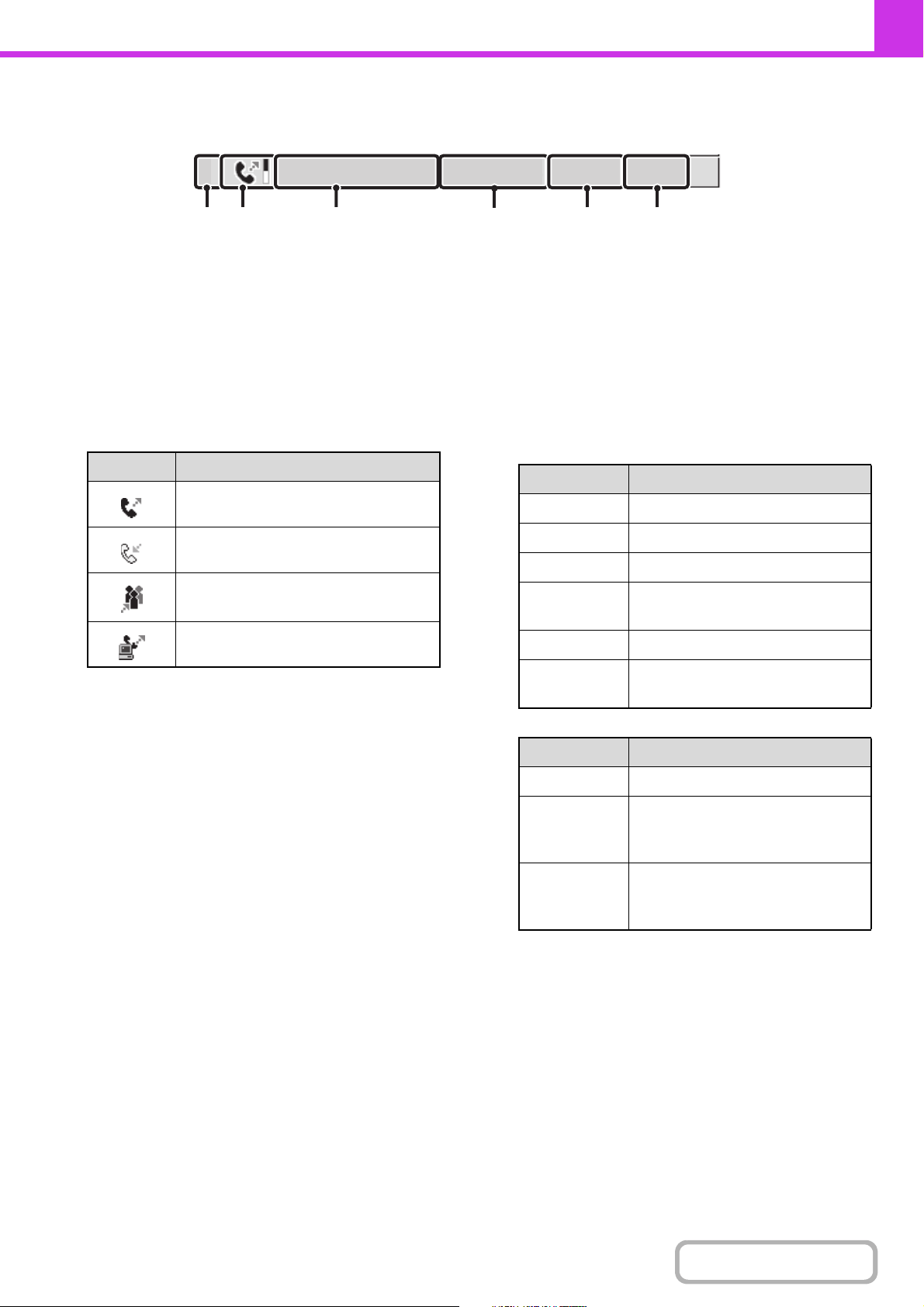
4-121
FACSIMILE
Contents
Job key display
The following information is shown in the job queue keys and completed job keys that appear in the job status screen.
(1) Indicates the number (position) of the job in the job
queue.
When the job currently being transmitted is finished, each
job moves up one position in the job queue.
This number does not appear in lists in the completed
jobs screen.
(2) Mode icon
This indicates the type of job. In the completed jobs
screen, a color bar indicating black & white will appear
next to the icon.
(3) Name of other party
For a transmission, the name or fax number of the
destination. For a reception, the fax number of the
sending party.
In the case of a broadcast transmission or serial polling
operation, "Broadcast" or "Multi Polling" appears together
with a broadcast control number (4-digits).
(4) Time reserved / Time started
In the job queue screen, the date and time the job was
reserved. In the completed jobs screen, the date and
time the job was started.
(5) Number of pages
Shows the number of pages transmitted / total number of
original pages.
(6) Status
Shows the job status.
• Job in progress
• Job waiting to be executed
AAA AAA
Waiting
10:22 04/01
000/004
3
(4)
(1) (2) (3)
(6)(5)
Icon Job type
Fax transmission
Fax reception
Broadcast transmission, Serial polling
or Inbound routing
PC-Fax transmission
Message Status
"Connecting" Connecting
"Sending" Sending
"Receiving" Receiving
"Tel" Speaking with the other party using
an extension phone
"Stopped" The job has been stopped.
"Error" An error occurred while the job was
being executed.
Message Status
"Waiting" The job is waiting to be executed.
"Retry Mode" The job is being re-attempted due
to a communication error or other
problem.
The day and
time are
displayed.
Timer transmission job (the
specified time is displayed)
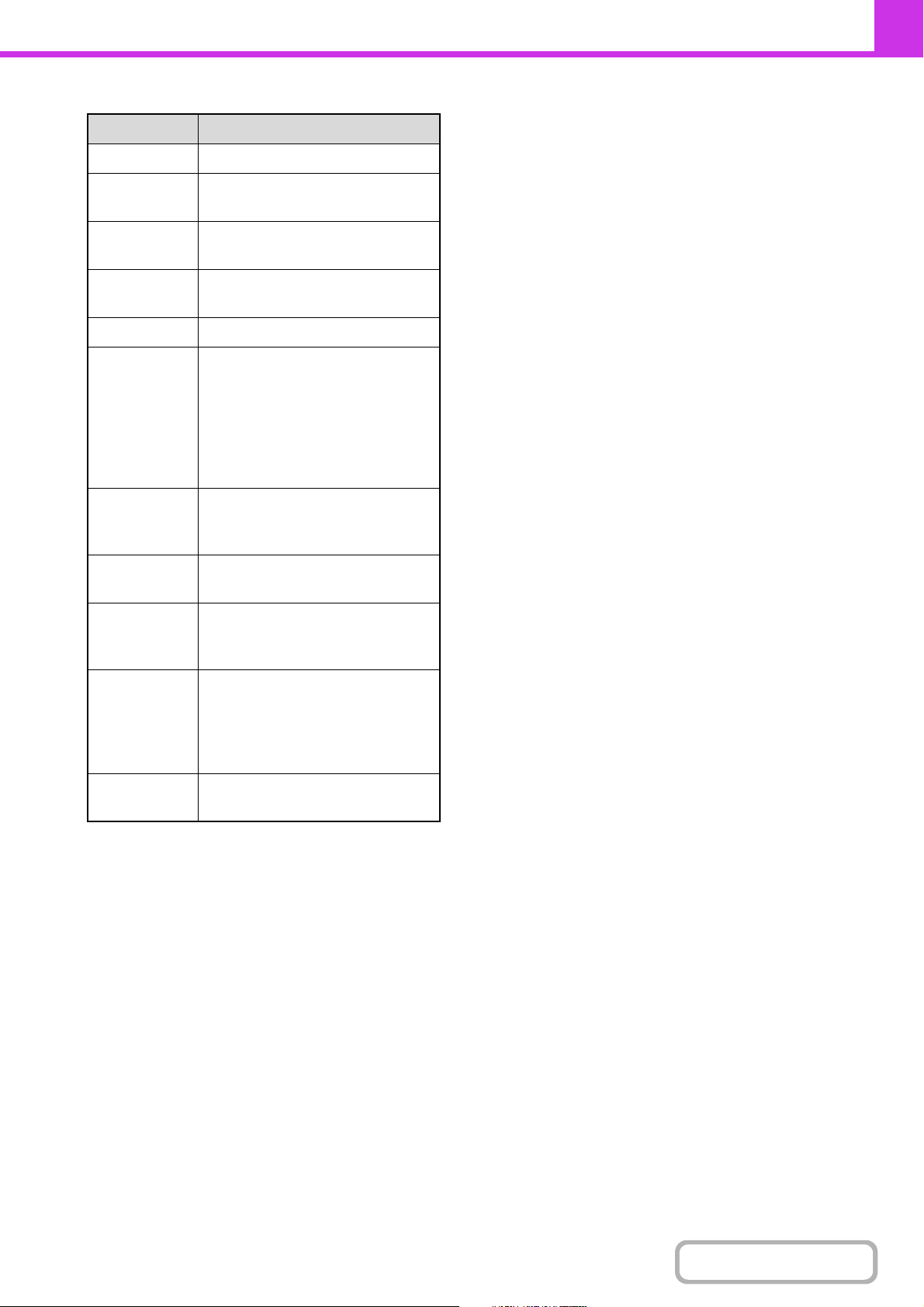
4-122
FACSIMILE
Contents
• Completed job
Message Status
"Send OK" Transmission completed.
"In Memory" Reception completed but the fax
has not been printed.
"Received" A received fax has been printed or
deleted in the check image screen.
"Forward OK" The received fax has been
forwarded.
"Stopped" The job was stopped.
"Number of
successful
transmission
destinations /
Total
destinations
OK"
Completion of a broadcast
transmission, serial polling or
inbound routing operation.
If transmission to 3 destinations
was successful out of a total of 5,
"003/005" will appear.
"No
response"
An error occurred because there
was no response from the
destination.
"Busy" An error occurred because the
other party was busy.
"Reject
Reception"
A fax was sent from a party that
has been blocked by the anti junk
fax function.
"NGxxxxxx" Transmission/reception was not
successful because a
communication error occurred (a
6-digit error code appears in
xxxxxx.)
"Error" An error occurred while the job was
being executed.

4-123
FACSIMILE
Contents
OPERATION WHEN A JOB IN THE JOB QUEUE IS
COMPLETED
When a normal transmission job is completed, it moves to the completed jobs screen and "Send OK" appears in the
status column.
Received faxes, timer transmission jobs, retry jobs, and forwarding jobs are handled in the job status screen as
explained below.
Fax reception jobs
While a fax is being received, "Receiving" appears in the job queue screen.
When reception is completed, the job moves to the completed jobs screen and "In Memory" appears.
After the fax is printed, the status changes to "Printed".
Timer transmission jobs
A timer transmission job appears at the bottom of the job queue screen until the specified time arrives.
When the specified time arrives, the job is executed. If another job is in progress, the timer job is started when the other
job is completed.
Retry jobs
A retry job appears at the bottom of the job queue screen. When the set retry interval elapses, the job is executed. If
there are jobs reserved ahead of the retry job, the retry job is reserved at the bottom of the job queue and executed
when its turn arrives.
Fax reception jobs when Inbound Routing is enabled
When Inbound Routing is enabled in the Web pages, fax reception jobs are handled as follows depending on the print
setting.
☞ FORWARDING RECEIVED FAXES TO A NETWORK ADDRESS (Inbound Routing Settings) (page 4-66)
• Received fax is not printed
"Receiving" appears in the job queue screen while the fax is being received. When reception is completed, the job
moves to the job queue of the job status screen of scan mode.
• Received fax is printed
When reception is completed, the job moves to the completed jobs screen and "In Memory" appears. After the fax is
printed, "Printed" appears. In addition, the job is added to the job queue of the job status screen of scan mode. When
forwarding is finished, "Forward OK" appears.
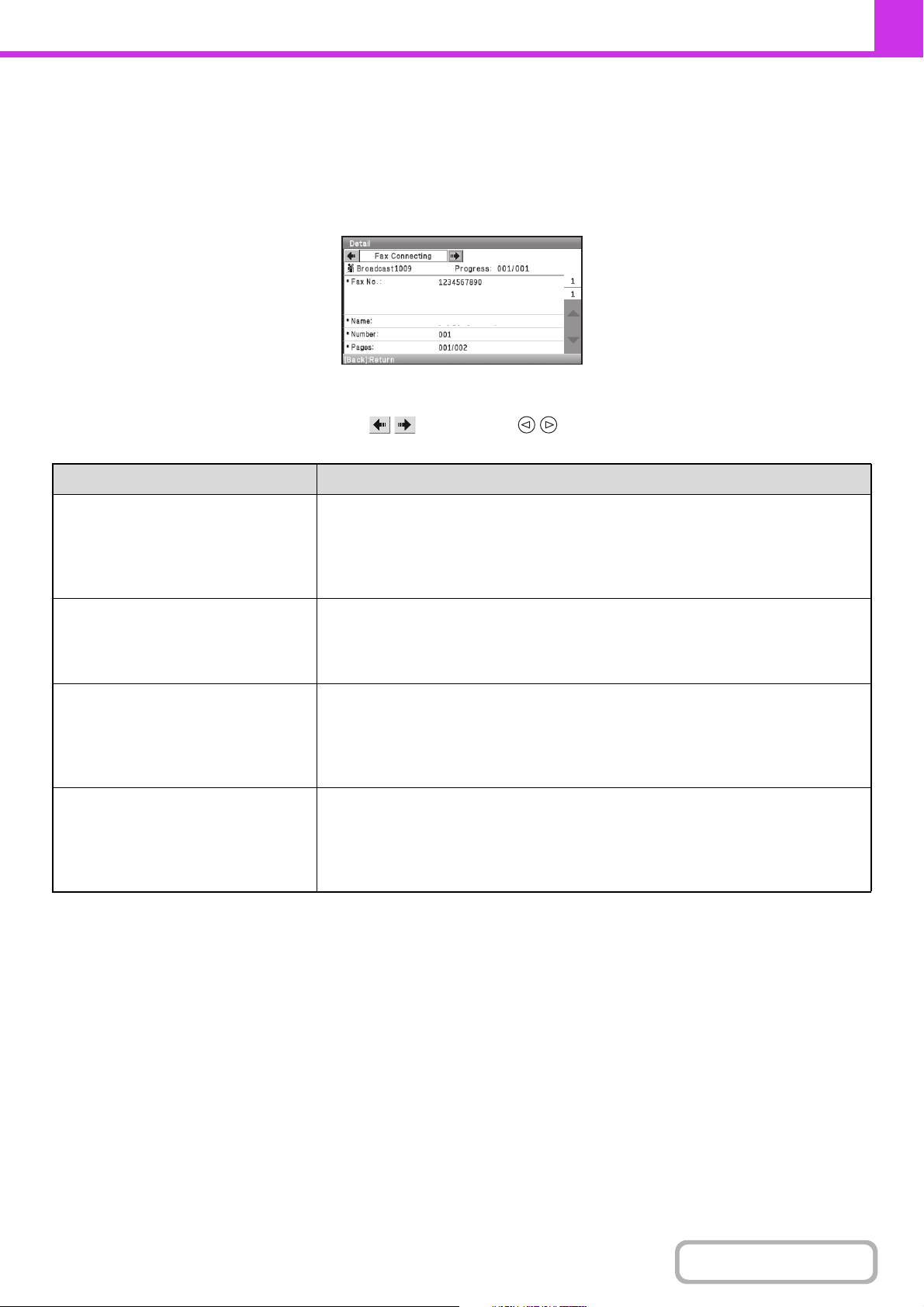
4-124
FACSIMILE
Contents
CHECKING A RESERVED JOB OR THE JOB IN PROGRESS
The detailed contents of a broadcast transmission or serial polling job can be displayed. Select the key of the job that
you wish to check and select the [Detail] key. The job details screen will appear (see below).
The job name and progress (number of completed destinations / total destinations) appear at the top of the screen.
To view details on the job, select either of the keys with the keys and press the [OK] key. The following
information appears on each screen.
Tab name Information displayed
Fax Connecting Information on the current destination appears.
Fax No.: The fax number of the destination.
Name: The name of the destination.
Number: The broadcast control number (3-digits).
Pages: Number of pages completed / total number of pages
Fax Waiting This shows information on the destinations that are waiting. A broadcast control
number (3-digits) appears in front of each destination.
Address: The name of the other destination.
Status: The status of communication.
Failed This shows information on destinations for which communication failed. A broadcast
control number (3-digits) appears in front of each destination.
Address: The name or fax number of each destination.
Start Time: The time when communication began.
Status: The status of communication.
All Destinations This shows all destinations specified in the job. A broadcast control number (3-digits)
appears in front of each destination.
Address: The name or fax number of the destination.
Start time: The time at which communication began.
Status: The status of communication.
AAA AAA
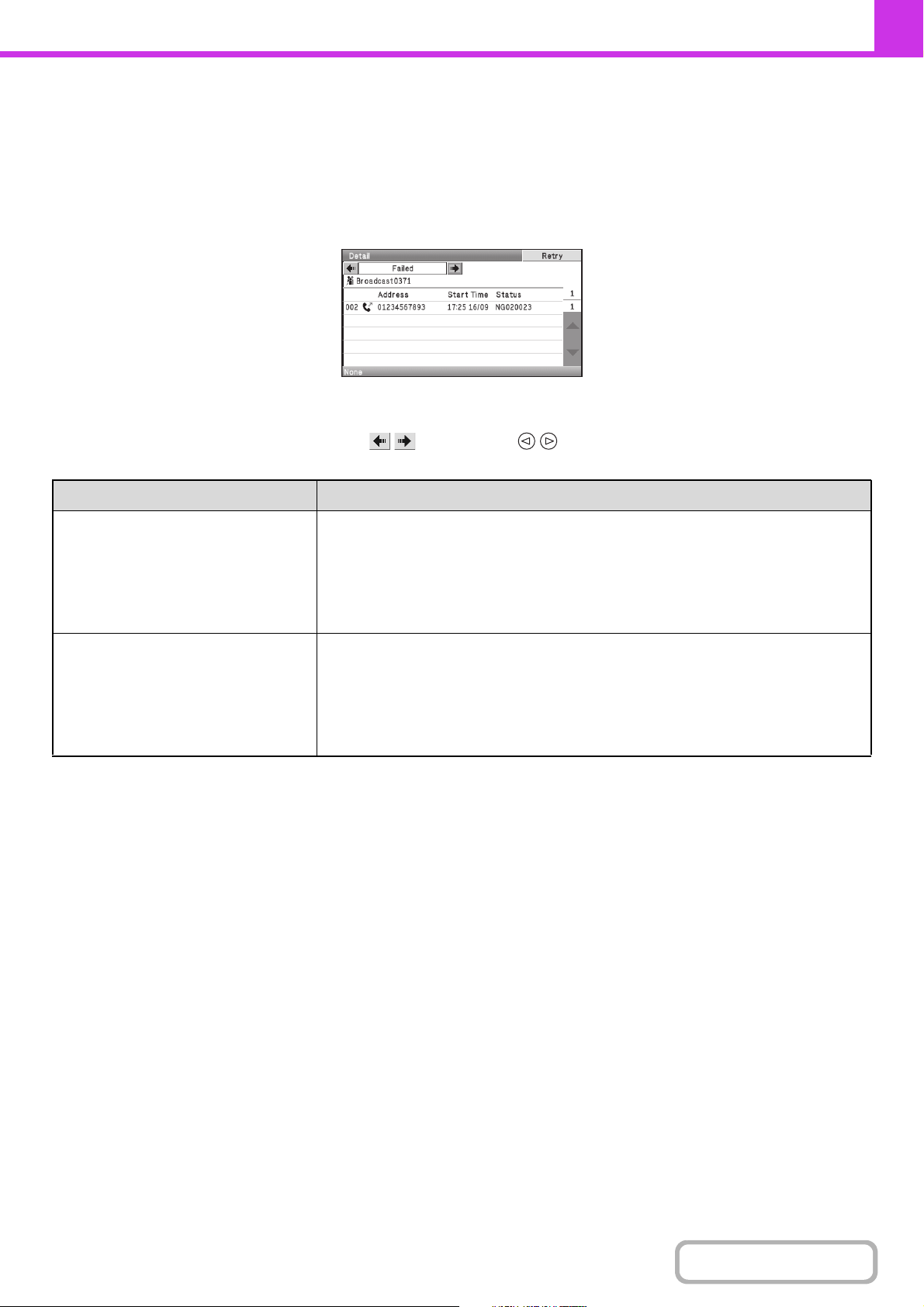
4-125
FACSIMILE
Contents
CHECKING COMPLETED JOBS
You can check a list of the destinations, the destinations for which transmission failed, and other detailed information on
completed broadcast transmission jobs, received fax forwarding jobs and serial polling jobs. Select the key of the
desired job in the completed jobs screen and select the [Detail] key. The job detail screen (see below) will appear.
The job name appears at the top of the job detail screen.
To view details on the job, select either of the keys with the keys and press the [OK] key. The following
information appears on each screen.
* Recalling is not possible for a broadcast transmission that includes a Scan to FTP address, Scan to Network Folder
address, or Scan to Desktop address.
Tab name Information displayed
Failed This shows information on destinations for which communication failed. A broadcast
control number (3-digits) appears in front of each destination.
Address: The name or fax number of each destination.
Start time: Time at which communication began.
Status: Description of failure (error)
The [Retry] key can be selected to re-attempt transmission to that destination.*
All Destinations Shows all addresses specified in the job. A broadcast control number (3-digits)
appears in front of each destination.
Address: The name or fax number of each destination.
Start time: Time at which communication began.
Status: Communication result
The [Retry] key can be selected to transmit to all destinations again.*
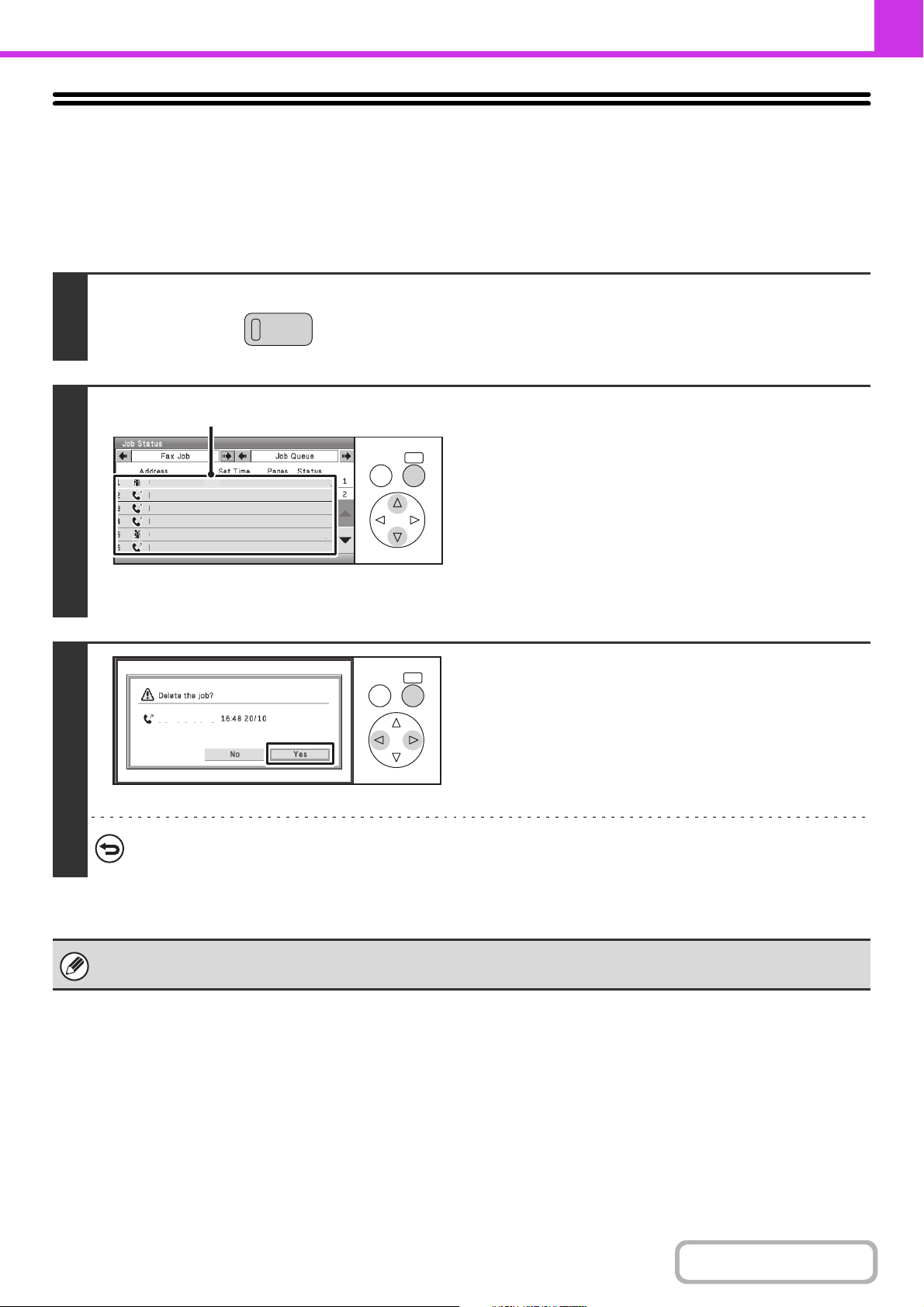
4-126
FACSIMILE
Contents
CANCELING A FAX IN PROGRESS OR A
RESERVED FAX
Follow the steps below to cancel a fax transmission that is in progress or a reserved fax job.
Keys in the display can be selected with the arrow keys and the [OK] key.
1
Press the [JOB STATUS] key.
2
Select the fax job that you wish to
cancel.
(1) Select the fax job to be canceled.
(2) Select [Stop/Delete] in the displayed screen.
3
Select the [Yes] key.
If you do not wish to cancel the selected fax job...
Select the [NO] key.
Printing of received faxes and forwarding jobs set using "Inbound Routing Settings" cannot be canceled.
☞ FORWARDING RECEIVED FAXES TO A NETWORK ADDRESS (Inbound Routing Settings) (page 4-66)
JOB STATU
S
OKBACK
0123456789
AAA AAA
BBB BBB
Broadcast
CCC CCC
Broadcast0001
10:05 04/01 000/004 Waiting
10:22 04/01 000/004 Waiting
10:30 04/01 000/010 Waiting
10:33 04/01 000/010 Waiting
10:40 04/01 000/010 Waiting
10:00 04/01 020/003 Connecting
(1)
OKBACK
BBB BBB
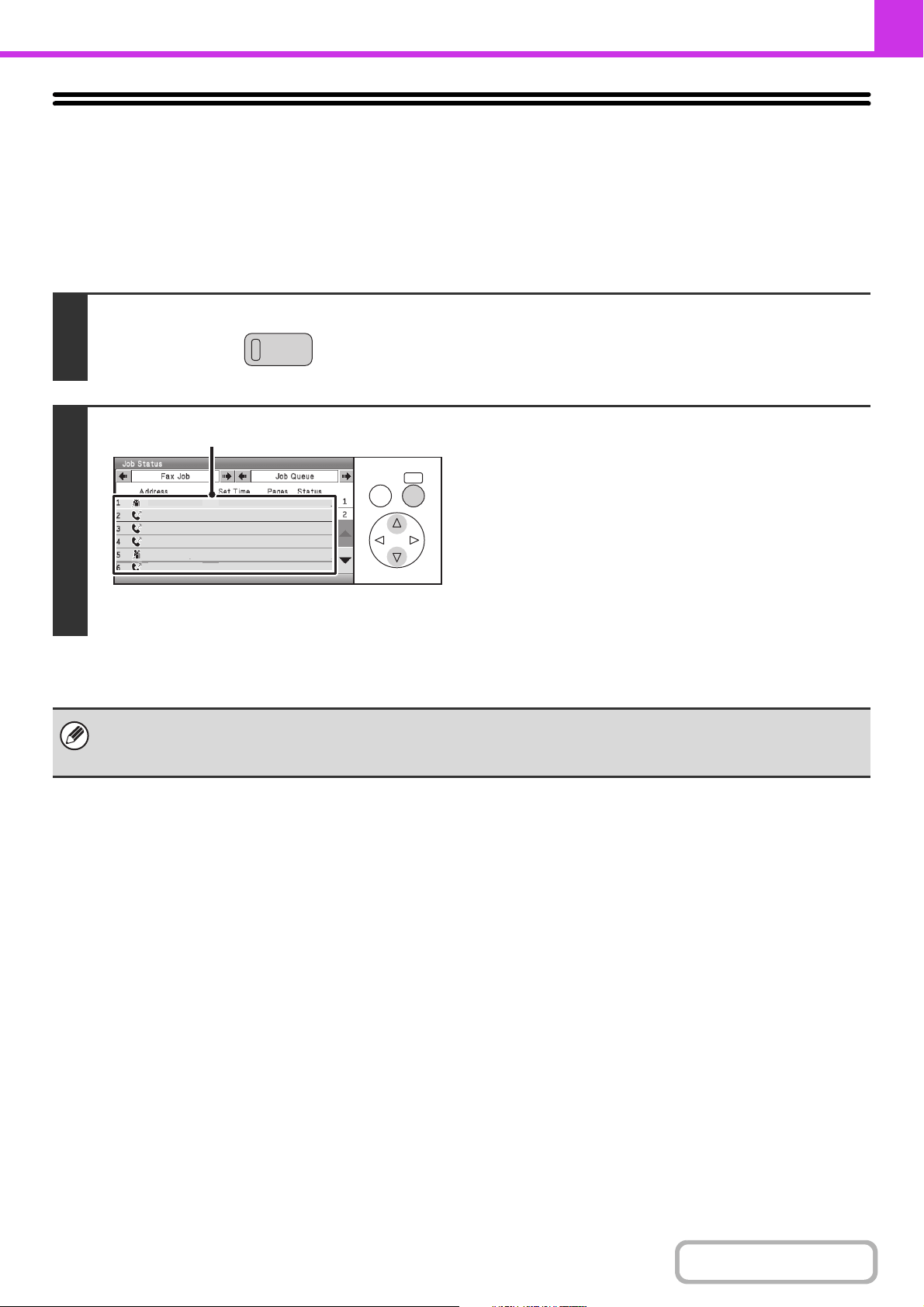
4-127
FACSIMILE
Contents
GIVING PRIORITY TO A RESERVED FAX
JOB
When multiple jobs are waiting to be transmitted, the jobs are normally transmitted in the order they were reserved.
If you need to give priority to a job and send it ahead of the other jobs, follow the steps below.
Keys in the display can be selected with the arrow keys and the [OK] key.
1
Press the [JOB STATUS] key.
2
Select the fax job to which you wish to
give priority.
(1) Select the desired job.
(2) Select [Priority] in the displayed screen.
The selected job moves up to the position immediately
following the job in progress. The job will be executed
when the job in progress is completed.
If the job in progress is a broadcast transmission job or a serial polling job, the priority job will be transmitted between
destinations of the broadcast transmission or serial polling job. However, if the priority job is a broadcast transmission job or
a serial polling job, it will be executed after the current job is completed.
JOB STATU
S
OKBACK
0123456789
AAA AAA
BBB BBB
Broadcast
CCC CCC
Broadcast0001
10:05 04/01 000/004 Waiting
10:22 04/01 000/004 Waiting
10:30 04/01 000/010 Waiting
10:33 04/01 000/010 Waiting
10:40 04/01 000/010 Waiting
10:00 04/01 020/003 Connecting
(1)
4-128
FACSIMILE
Contents
CHECKING THE ACTIVITY LOG
(Image Sending Activity Report)
IMAGE SENDING ACTIVITY REPORT
You can have the machine print a log of recent image sending activity (date, name of other party, time required, result,
etc.). The Image Sending Activity Report contains useful information such as the types of errors that occurred.
The most recent 200 transactions are included in the report.
You can have the machine print the Image Sending Activity Report each time the number of transactions reaches 201,
or at a specified time (once a day only).
The contents of the Image Sending Activity Report are erased when the report is printed, and thus it cannot be reprinted.
System Settings (Administrator): Activity Report Print Select Setting
This is used to set the conditions for printing activity reports. The factory default setting is not to print.
The Image Sending Activity Report can be set to print each time the number of transactions reaches 201, or at a specified
time (once a day only).
4-129
FACSIMILE
Contents
INFORMATION APPEARING IN THE RESULT COLUMN
Error types and other information are printed in the result column of transaction and activity reports. When a transaction
report or activity report is printed, check the result of the transaction in the result column and take action as needed.
Examples of messages that are printed in the result column
Message Explanation
OK The transaction was completed normally.
G3 Communication took place in G3 mode.
ECM Communication took place in G3 ECM mode.
SG3 Communication took place in Super G3 mode.
Forwarding The received data was forwarded.
NO RESPONSE No response from the receiving party.
BUSY Transmission was not possible because the other party was already using the line.
CANCEL The transmission was canceled while in progress.
MEMORY OVER The memory became full during quick on-line transmission.
MEM.FULL The memory became full during reception.
LENGTH OVER The transmitted fax was over 1.5 m (59") long and therefore could not be received.
ORIGINAL ERROR Direct transmission or manual transmission was not successful because a misfeed occurred.
PASS# NG The connection was broken because the polling passcode was not correct.
NO RX POLL The machine that was polled does not have a polling function.
RX POLL FAIL The other machine refused the polling operation, or your machine broke the connection when
polled because no data was in memory.
NO F-CODE POLL The other machine refused a F-code polling operation, or your machine broke the connection
when polled because no data was in its F-code memory polling box.
RX POLL# NG The connection was broken because the sub-address for F-code polling memory was not valid.
F POLL PASS# NG The connection was broken because the passcode for F-code polling memory was not valid.
BOX NO. NG Your machine broke the connection because the specified sub-address for a F-code memory box
does not exist.
F PASS# NG Your machine broke the connection because the other machine sent an incorrect passcode for
F-code communication.
RX NO F-CODE POLL
F-code polling was attempted, however, the other machine did not have a F-code polling memory box.
NO F FUNC F-code communication was attempted, however, the other machine does not support F-code
communication.
NO F-CODE F-code communication was refused by the other machine because of an incorrect sub-address or
other reason.
M. BOX: [xxxxxx] Data was received to a confidential or relay broadcast memory box, or data was sent from a
memory polling box.
The name of the memory box appears in [xxxxxx], and the type of F-code operation (relay request
reception, polling memory transmission, or confidential reception) appears in .
FAIL xx (xxxx) The transaction failed due to a communication error.
First 2 digits of communication error number: Error code from 00 to 99.
Last 4 digits of communication error number: Code for use by service technicians.
REJECTED A fax was sent from a party from which reception is blocked.

5-1
This chapter provides detailed explanations of the procedures for using the scanner function and the Internet fax
function.
For the procedures for using the display, see "USING THE OPERATION PANEL" (page 1-9) in "1. BEFORE USING
THE MACHINE".
BEFORE USING THE MACHINE AS A
NETWORK SCANNER
NETWORK SCANNER FUNCTION . . . . . . . . . . . . . 5-3
PREPARATIONS FOR USE AS A NETWORK
SCANNER . . . . . . . . . . . . . . . . . . . . . . . . . . . . . . . . 5-5
• MAKE SURE THE MAIN POWER SWITCH
IS IN THE "ON" POSITION . . . . . . . . . . . . . . . . 5-5
• CHECKING THE DATE AND TIME . . . . . . . . . . 5-5
• STORING SENDER INFORMATION . . . . . . . . . 5-5
• SETTINGS REQUIRED IN THE WEB
PAGES . . . . . . . . . . . . . . . . . . . . . . . . . . . . . . . . 5-6
• STORING DESTINATION ADDRESSES
FOR EACH SCAN MODE IN THE
ADDRESS BOOK. . . . . . . . . . . . . . . . . . . . . . . . 5-6
• CUSTOM INDEX . . . . . . . . . . . . . . . . . . . . . . . . 5-9
• STORING A DESTINATION FOR SCAN
TO DESKTOP . . . . . . . . . . . . . . . . . . . . . . . . . 5-10
• BEFORE SENDING TO A DIRECT SMTP
ADDRESS . . . . . . . . . . . . . . . . . . . . . . . . . . . . 5-11
BASE SCREEN . . . . . . . . . . . . . . . . . . . . . . . . . . . 5-12
• BASE SCREENS . . . . . . . . . . . . . . . . . . . . . . . 5-13
• ADDRESS BOOK SCREEN. . . . . . . . . . . . . . . 5-16
• CHANGING THE DISPLAY OF
ONE-TOUCH KEYS IN THE ADDRESS
BOOK SCREEN . . . . . . . . . . . . . . . . . . . . . . . . 5-17
SCAN SEND SEQUENCE . . . . . . . . . . . . . . . . . . . 5-19
ENTERING DESTINATIONS
RETRIEVING A DESTINATION FROM THE
ADDRESS BOOK. . . . . . . . . . . . . . . . . . . . . . . . . . 5-22
• RETRIEVING A DESTINATION . . . . . . . . . . . . 5-23
• CHECKING AND DELETING THE
SELECTED DESTINATIONS . . . . . . . . . . . . . . 5-25
USING A SEARCH NUMBER TO RETRIEVE
A DESTINATION . . . . . . . . . . . . . . . . . . . . . . . . . . 5-26
ENTERING AN ADDRESS MANUALLY . . . . . . . . 5-27
RETRIEVING A DESTINATION FROM A
GLOBAL ADDRESS BOOK. . . . . . . . . . . . . . . . . . 5-29
USING THE RESEND FUNCTION . . . . . . . . . . . . . 5-31
TRANSMITTING AN IMAGE
SENDING AN IMAGE IN SCAN MODE . . . . . . . . . 5-32
• CHANGING THE SUBJECT, FILE NAME,
REPLY-TO, AND BODY TEXT. . . . . . . . . . . . . 5-36
SENDING AN IMAGE IN USB MEMORY
MODE . . . . . . . . . . . . . . . . . . . . . . . . . . . . . . . . . . . 5-39
• ENTERING A FILE NAME . . . . . . . . . . . . . . . . 5-44
SENDING A FAX IN INTERNET FAX MODE. . . . . 5-45
• CHANGING THE SUBJECT, FILE NAME,
AND BODY TEXT. . . . . . . . . . . . . . . . . . . . . . . 5-49
SENDING THE SAME IMAGE TO MULTIPLE
DESTINATIONS (Broadcast Transmission) . . . . 5-52
• BROADCAST TRANSMISSIONS THAT
INCLUDE INTERNET FAX
DESTINATIONS . . . . . . . . . . . . . . . . . . . . . . . . 5-55
SENDING AN INTERNET FAX FROM A
COMPUTER (PC-I-Fax) . . . . . . . . . . . . . . . . . . . . . 5-57
IMAGE SETTINGS . . . . . . . . . . . . . . . . . . . . . . . . . 5-58
• AUTOMATICALLY SCANNING BOTH
SIDES OF AN ORIGINAL (2-Sided
Original) . . . . . . . . . . . . . . . . . . . . . . . . . . . . . . 5-59
• SPECIFYING THE ORIGINAL SCAN SIZE
AND SEND SIZE . . . . . . . . . . . . . . . . . . . . . . . 5-61
• CHANGING THE EXPOSURE AND
ORIGINAL IMAGE TYPE . . . . . . . . . . . . . . . . . 5-67
• CHANGING THE RESOLUTION . . . . . . . . . . . 5-69
• CHANGING THE FILE FORMAT . . . . . . . . . . . 5-70
• CHANGING THE COLOR MODE . . . . . . . . . . 5-75
CHAPTER 5
SCANNER/INTERNET FAX

5-2
SCANNER/INTERNET FAX
SPECIAL MODES
SPECIAL MODES . . . . . . . . . . . . . . . . . . . . . . . . . 5-77
STORING SCAN OPERATIONS (Programs) . . . . 5-79
• JOB PROGRAMS. . . . . . . . . . . . . . . . . . . . . . . 5-80
• USING A PROGRAM TO SCAN . . . . . . . . . . . 5-81
SENDING AN IMAGE AT A SPECIFIED TIME
(Timer Transmission) . . . . . . . . . . . . . . . . . . . . . . 5-83
SCANNING BOTH SIDES OF A CARD ONTO
A SINGLE PAGE (Card Shot) . . . . . . . . . . . . . . . . 5-85
SCANNING BUSINESS CARDS (Business
Card Scan) . . . . . . . . . . . . . . . . . . . . . . . . . . . . . . . 5-88
SCANNING THIN ORIGINALS (Slow Scan
Mode) . . . . . . . . . . . . . . . . . . . . . . . . . . . . . . . . . . . 5-89
ERASING PERIPHERAL SHADOWS ON THE
IMAGE (Erase) . . . . . . . . . . . . . . . . . . . . . . . . . . . . 5-91
SCANNING MANY ORIGINALS AT ONCE
(Job Build) . . . . . . . . . . . . . . . . . . . . . . . . . . . . . . . 5-94
WHITENING FAINT COLORS IN THE IMAGE
(Suppress Background) . . . . . . . . . . . . . . . . . . . . 5-96
CHANGING THE PRINT SETTINGS FOR THE
TRANSACTION REPORT (Transaction Report)
. . . 5-98
CHECKING THE STATUS OF
TRANSMISSION/RECEPTION JOBS
JOB STATUS SCREEN . . . . . . . . . . . . . . . . . . . . 5-100
• JOB QUEUE SCREEN AND COMPLETED
JOB SCREEN. . . . . . . . . . . . . . . . . . . . . . . . . 5-101
• OPERATION WHEN A JOB IN THE JOB
QUEUE IS COMPLETED . . . . . . . . . . . . . . . . 5-104
• CHECKING COMPLETED JOBS. . . . . . . . . . 5-105
STOPPING A SCAN JOB BEING
TRANSMITTED OR WAITING TO BE
TRANSMITTED . . . . . . . . . . . . . . . . . . . . . . . . . . 5-106
GIVING PRIORITY TO A SCAN
TRANSMISSION JOB . . . . . . . . . . . . . . . . . . . . . 5-107
CHECKING THE INTERNET FAX ACTIVITY
LOG (Image Sending Activity Report) . . . . . . . . 5-108
• IMAGE SENDING ACTIVITY REPORT . . . . . 5-108
• INFORMATION APPEARING IN THE
RESULT COLUMN. . . . . . . . . . . . . . . . . . . . . 5-108
INTERNET FAX RECEPTION FUNCTIONS
RECEIVING AN INTERNET FAX . . . . . . . . . . . . . 5-109
• MANUALLY RECEIVING INTERNET
FAXES . . . . . . . . . . . . . . . . . . . . . . . . . . . . . . 5-110
PRINTING A PASSWORD-PROTECTED FAX
(Hold Setting For Received Data Print) . . . . . . . 5-111
CHECKING THE IMAGE BEFORE PRINTING . . 5-112
• IMAGE CHECK SCREEN . . . . . . . . . . . . . . . 5-113
FORWARDING RECEIVED INTERNET
FAXES TO A NETWORK ADDRESS
(Inbound Routing Settings) . . . . . . . . . . . . . . . . 5-114
• CONFIGURING INBOUND ROUTING
SETTINGS . . . . . . . . . . . . . . . . . . . . . . . . . . . 5-114
SCANNING FROM A COMPUTER
(PC Scan Mode)
BASIC SCANNING PROCEDURE . . . . . . . . . . . . 5-117
METADATA DELIVERY
METADATA DELIVERY (Data Entry) . . . . . . . . . 5-122
PREPARATIONS FOR METADATA
TRANSMISSION. . . . . . . . . . . . . . . . . . . . . . . . . . 5-123
•
SETTINGS REQUIRED IN THE WEB
PAGES . . . . . . . . . . . . . . . . . . . . . . . . . . . .
. . 5-123
• METADATA TRANSMISSION FOR SCAN
TO DESKTOP . . . . . . . . . . . . . . . . . . . . . . . . 5-123
TRANSMITTING METADATA . . . . . . . . . . . . . . . 5-124
• METADATA FIELDS . . . . . . . . . . . . . . . . . . . 5-126
5-3
SCANNER/INTERNET FAX
Contents
This section provides information that you should know before using the machine as a network scanner.
NETWORK SCANNER FUNCTION
The network scanner function of the machine can be used to scan an original, create an image file, and send the file
over a network to a computer, FTP server, or other destination. Scanning is also possible from your computer using a
TWAIN-compliant application.
The network scanner function provides the following scanning modes.
☞ SENDING AN IMAGE IN SCAN MODE (page 5-32)
Scan to E-mail
The scanned file is sent to an e-mail address.
Scan to FTP
The scanned file is sent to a specified directory of a FTP server.
When the file is sent, it is also possible to send an e-mail to a previously stored e-mail
address to inform the recipient of the location of the file. (This is called "Scan to FTP
(Hyperlink)".)
Scan to Desktop
The scanned file is sent to a specified folder on your computer.
To use Scan to Desktop, software must be installed from the "Sharpdesk/Network Scanner
Utilities" CD-ROM that accompanies the machine. For the system requirements of the
software, see the manual (PDF format) or the Readme file on the CD-ROM. For the
procedures for installing the software, see the "Sharpdesk Installation Guide".
Scan to Network Folder
The scanned file is sent to a shared folder on a Windows computer on the same network as
the machine.
BEFORE USING THE MACHINE AS A
NETWORK SCANNER
Scan modes
5-4
SCANNER/INTERNET FAX
Contents
☞ SENDING AN IMAGE IN USB MEMORY MODE (page 5-39)
USB Memory Scan
The scanned file is sent to and stored in a USB memory device connected to the machine.
To use the Internet fax function, the Internet fax expansion kit must be installed.
☞ SENDING A FAX IN INTERNET FAX MODE (page 5-45)
Internet fax transmission
The scanned file is sent as an Internet fax. Reception of Internet faxes is also possible.
The machine supports Direct SMTP, which lets you directly send Internet faxes within your
company without using a mail server.
☞ SCANNING FROM A COMPUTER (PC Scan Mode) (page 5-117)
PC Scan
A TWAIN-compliant application on a computer connected to the same network as the
machine is used to scan a document or image.
To use PC Scan, the scanner driver must be installed from the "Software CD-ROM" that
accompanies the machine.
Operating systems that can be used are Windows 98/Me/2000/XP/Server 2003/Vista/Server
2008.
The application integration module is required to use the metadata transmission function.
☞ METADATA DELIVERY (page 5-122)
Metadata delivery
The application integration module can be combined with the network scanner function to append a metadata* file to a
scanned image file. (This is called metadata delivery.)
Information entered using the display or automatically generated by the machine can be sent to a directory on a FTP
server or an application on a computer as a metadata file in XML format.
* Metadata is information about a file, how it is to be processed, and its relation to other objects.
USB memory mode
Internet fax mode
PC scan mode
Data entry mode
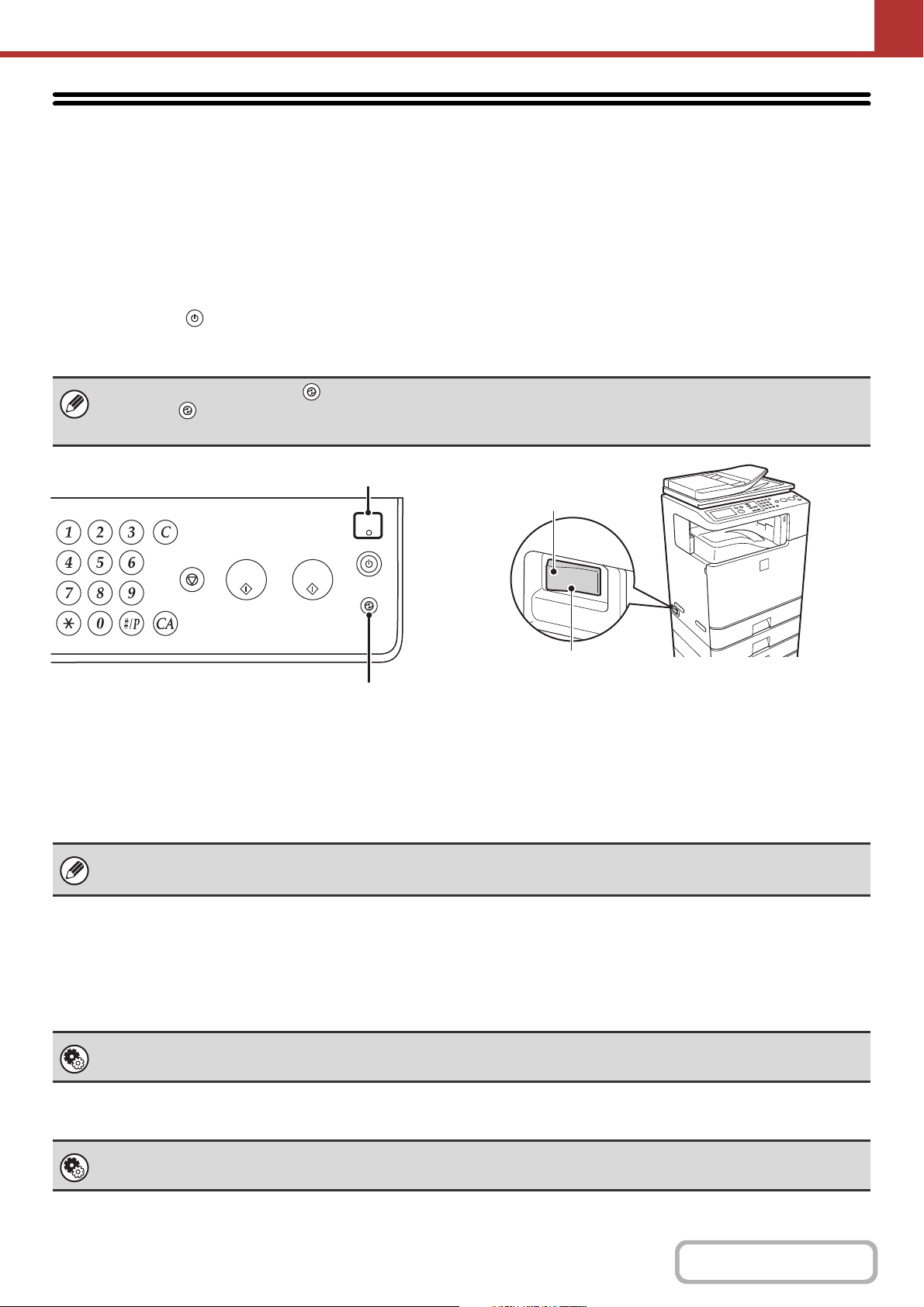
5-5
SCANNER/INTERNET FAX
Contents
PREPARATIONS FOR USE AS A NETWORK
SCANNER
MAKE SURE THE MAIN POWER SWITCH IS IN THE
"ON" POSITION
The main power is "on" when the main power indicator on the right side of the operation panel is lit.
If the main power indicator is not lit, the main power is "off". Switch the main power switch to the "on" position and press
the [POWER] key ( ) on the operation panel.
If the Internet fax function will be used, and in particular if reception or timer transmission will take place at night, always
keep the main power switch in the "on" position.
CHECKING THE DATE AND TIME
Verify that the correct date and time are set in the machine.
The date and time are set in the system settings of the machine. When the [SYSTEM SETTINGS] key is pressed, the
system settings menu screen appears on the display. Select [Default Settings], [Clock], and [Clock Adjust], and set the
year, month, day, hour, and minute.
STORING SENDER INFORMATION
Be sure to configure this information, as it is required for communication.
Before using Scan to E-mail
Store a default sender name in "Sender Name" and a reply e-mail address in "Reply E-mail Address". These will be
used when a sender is not selected.
Before using Internet fax
Store a sender name in "Sender Name" and a sender Internet fax address in "Own Address".
When the [POWER SAVE] key ( ) indicator light is blinking, the machine is in auto power shut-off mode. If the [POWER
SAVE] key ( ) is pressed when the indicator is blinking, the indicator will turn off and the machine will return to the ready
state after a brief interval.
LOGOUT
Main power indicator
[POWER SAVE] key/indicator
Main power switch
"On" position
If "Disabling of Clock Adjustment" (Web page only) has been enabled in the system settings (administrator), the date and
time cannot be set.
System Settings (Administrator): Default Sender Set (Web page only)
This is used to store the sender name and e-mail address that is used when a sender is not selected.
System Settings (Administrator): Sender Data Registration
Use this setting to program the sender name and sender address.
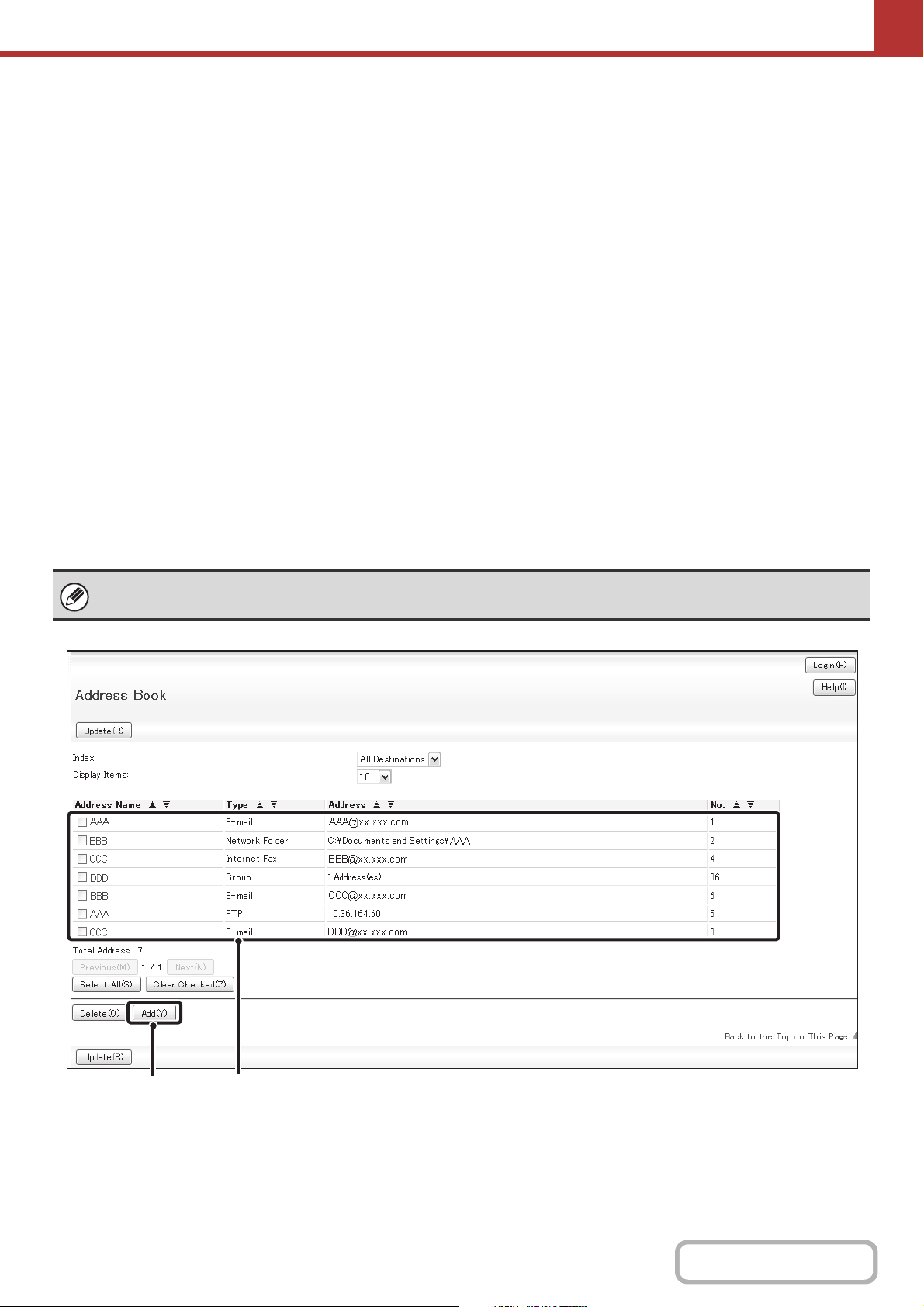
5-6
SCANNER/INTERNET FAX
Contents
SETTINGS REQUIRED IN THE WEB PAGES
To use scan mode and Internet fax mode, the basic network scanner settings, server settings such as SMTP and DNS
server settings, and sender addresses must be configured in the Web pages.
• Server settings
To configure server settings, click [Network Settings] and then [Services Settings] in the Web page menu.
(Administrator rights are required.)
• Basic network scanner settings
To configure network scanner settings, click [Application Settings] and then [Network Scanner Settings] in the Web
page menu. (Administrator rights are required.)
• Internet fax settings
To configure the network scanner settings, click [Application Settings] and then [Internet Fax Settings] in the Web
page menu. (Administrator rights are required.)
STORING DESTINATION ADDRESSES FOR EACH
SCAN MODE IN THE ADDRESS BOOK
To use Scan to FTP, Scan to Desktop, and Scan to Network Folder, destinations must be stored in the address book.
Although destinations for Scan to E-mail and Internet fax do not need to be stored in the address book (they can be
entered directly or looked up in a global address book at the time of transmission), storing these types of destinations in
the address book makes it easy to select them.
When the [Address Book] is selected, the following screen appears.
(1) [Add] key
Use this key to add a new address.
(2) List display
This displays a list of the currently stored addresses. An
address can be selected to open an edit/delete screen for
the address.
The settings that can be selected vary depending on the peripheral devices installed.
(2)
(1)
5-7
SCANNER/INTERNET FAX
Contents
Storing addresses
Select the [Add] key in the above screen to store an address. Up to 999 addresses can be programmed.
For more information, see "Settings" (page 5-8).
Editing and deleting addresses
An address can be selected from the list in the above screen to open an edit screen for the address.
To open a delete screen, select the checkbox next to the address and then select [Delete].
For more information, see "Settings" (page 5-8).
To store addresses for Scan to Desktop...
Store Scan to FTP and Scan to Network addresses in the Web pages. Store Scan to Desktop addresses using Network
Scanner Tool. A combined total of 200 Scan to Desktop, Scan to FTP, and Scan to Network Folder addresses can be stored.
• If you cannot edit or delete a one-touch individual or group key...
Individual keys and group keys cannot be edited or deleted in the following situations:
- The key is used in a reserved transmission or a transmission in progress.
- The key is included in a group key.
- The key is included in a program.
- The key is specified as a forwarding destination in the "Default Address" (page 6-84) in the system setting or "Inbound
Routing Settings" / "Document Administration Function".
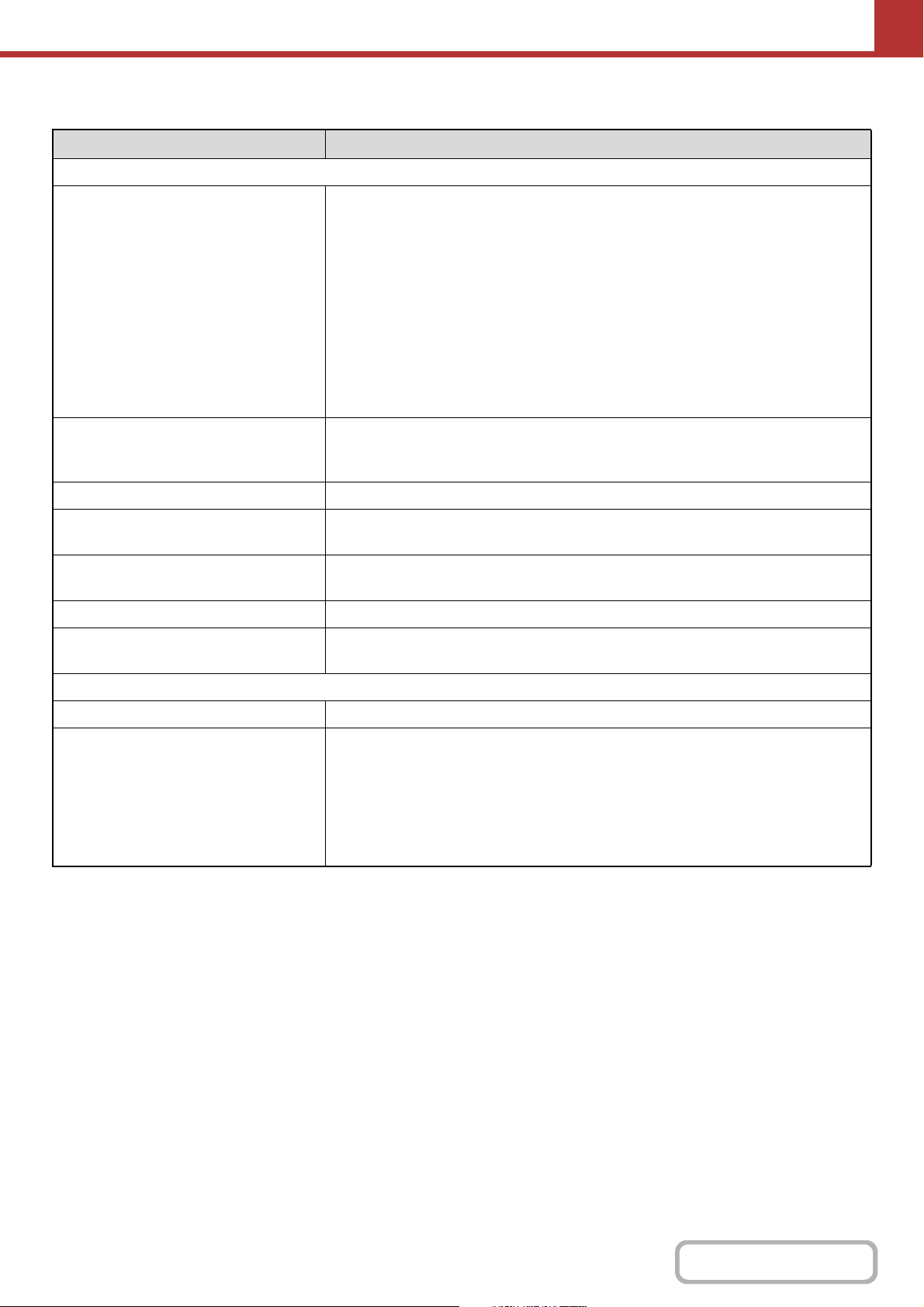
5-8
SCANNER/INTERNET FAX
Contents
Settings
Item Description
Items stored in all modes
Address Type
Select the type of address to be stored in the address book.
• E-mail: Store an e-mail address in a one-touch key.
• FTP: A Scan to FTP address can be assigned to a one-touch key.
• Desktop: A Scan to Desktop address can be assigned to a one-touch key.
To store a Scan to Desktop address, use the Network Scanner
Tool.
• Network Folder: A Scan to Network Folder address can be assigned to a
one-touch key.
• Internet Fax: Store an Internet fax address in a one-touch key.
• Direct SMTP: Store a Direct SMTP address in a one-touch key.
• Fax: Store a fax number in a one-touch key.
• Group:
Store multiple addresses as a group for a broadcast transmission.
Search Number
Set a search number. The lowest available number is automatically entered. To
change the number, enter a number from 001 to 999. A search number that has
already been stored cannot be used.
Address Name Enter a maximum of 36 characters for the address name.
Initial
Enter up to 10 characters for the initials. The initials you enter here determine the
position of the one-touch key in the alphabetical index.
Key Name
Enter the name that you wish to appear in the address book (this is different from the
address name).
Custom Index Select the custom index in which the address will appear.
Register this Address to be added to the
[Frequent Use] index.
Frequently used addresses can be stored in the [Frequent Use] index.
Items appearing when an e-mail address is stored
E-mail Address Enter an e-mail address (max. 64 characters).
File Format
Specify the format of the file to be generated and the compression mode for black &
white mode and color mode.
• File Type: Set the format of the file to be generated.
• Compression Mode (Black & White): Select the compression mode for black &
white transmission.
• Compression Ratio (Color/Grayscale):Select the compression ratio for
color/grayscale transmission.
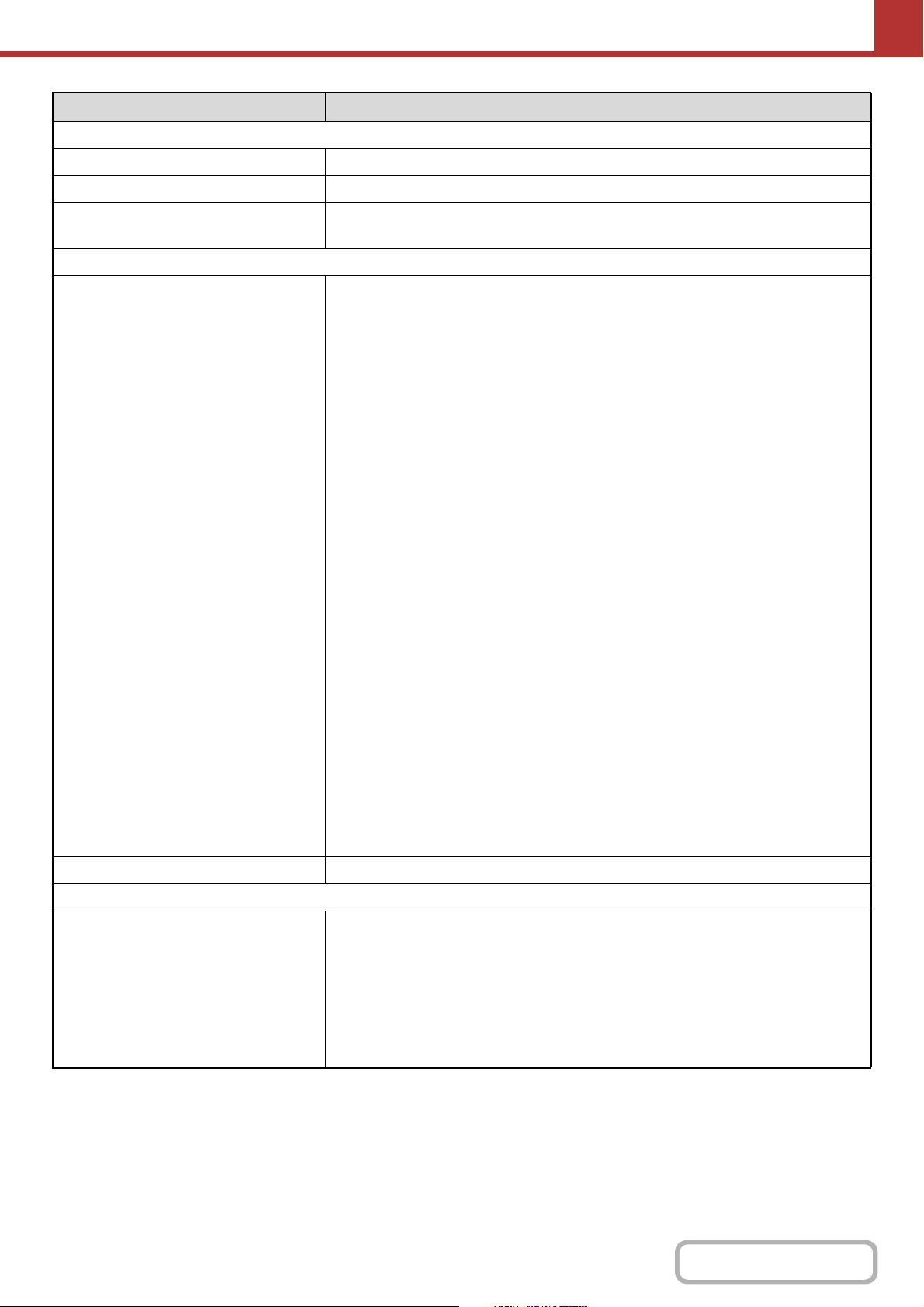
5-9
SCANNER/INTERNET FAX
Contents
CUSTOM INDEX
The name of a custom index can be changed for greater ease of use.
Delete the previously entered name and enter a new name (maximum of 6 characters).
The factory default names for the custom indexes are "User 1" to "User 6".
Items appearing when an Internet fax address is stored
I-Fax Address Enter an Internet fax address (max. 64 characters).
File Format Compression Mode: Select the compression mode for transmission.
Request Internet Fax Reception Report
Select whether or not you wish to receive a reception report by e-mail after
transmission is completed.
Items appearing when a Direct SMTP address is stored
• Direct SMTP Address
• Add Hostname or IP Address.
• Hostname or IP Address
Use these three settings to set an address for Direct SMTP transmission.
In many cases, transmission is possible using method (1).
A maximum of 64 characters each can be entered in the "Direct SMTP Address" and
"Hostname or IP Address" text boxes.
(1) Using the IPv4 address of the receiving machine in the domain part of the
e-mail address
Enter the e-mail address of the receiving machine in the [Direct SMTP Address]
text box with the IPv4 address substituted for the domain.
Example: When the e-mail address of the receiving machine is
"user@sample_domain.com" and the IPv4 address is
"192.168.123.45"
Enter "[email protected]" in the [Direct SMTP Address] text box.
(2) Using the host name in the domain part of the e-mail address of the
receiving machine
Enter the e-mail address of the receiving machine in the [Direct SMTP Address]
text box with the host name substituted for the domain.
Example: When the e-mail address of the receiving machine is
"user@sample_domain.com" and the host name is "HOST"
Enter "user@HOST" in the [Direct SMTP Address] text box.
(3) When the receiving machine is set to only receive e-mail from specific
addresses
Enter the specified specific e-mail address in the [Direct SMTP Address] text box.
Select the "Add Hostname or IP Address." checkbox and enter the host name or
IPv4 address of the receiving machine in the [Hostname or IP Address] text box.
Example: When the e-mail address of the receiving machine is
"user@sample_domain.com" and the IPv4 address is
"192.168.123.45"
Enter "user@sample_domain.com" in the [Direct SMTP Address]
text box and enter "192.168.123.45" in the [Hostname or IP Address]
text box.
Compression Mode Select the compression mode for transmission.
Items appearing when a group is stored
Address
• Select Address (From Address Book): Select addresses from the address book to
be stored in the group.
• Select Address (From Direct Entry): An address that is not stored in the address
book can be directly entered. Enter the address in the same way as when storing
an address for a mode. Note that when an Internet fax address is directly entered,
the compression mode and reception report cannot be selected.
• Address to be Entered: This displays a list of the selected addresses. Addresses
can be deleted from this list if needed.
Item Description
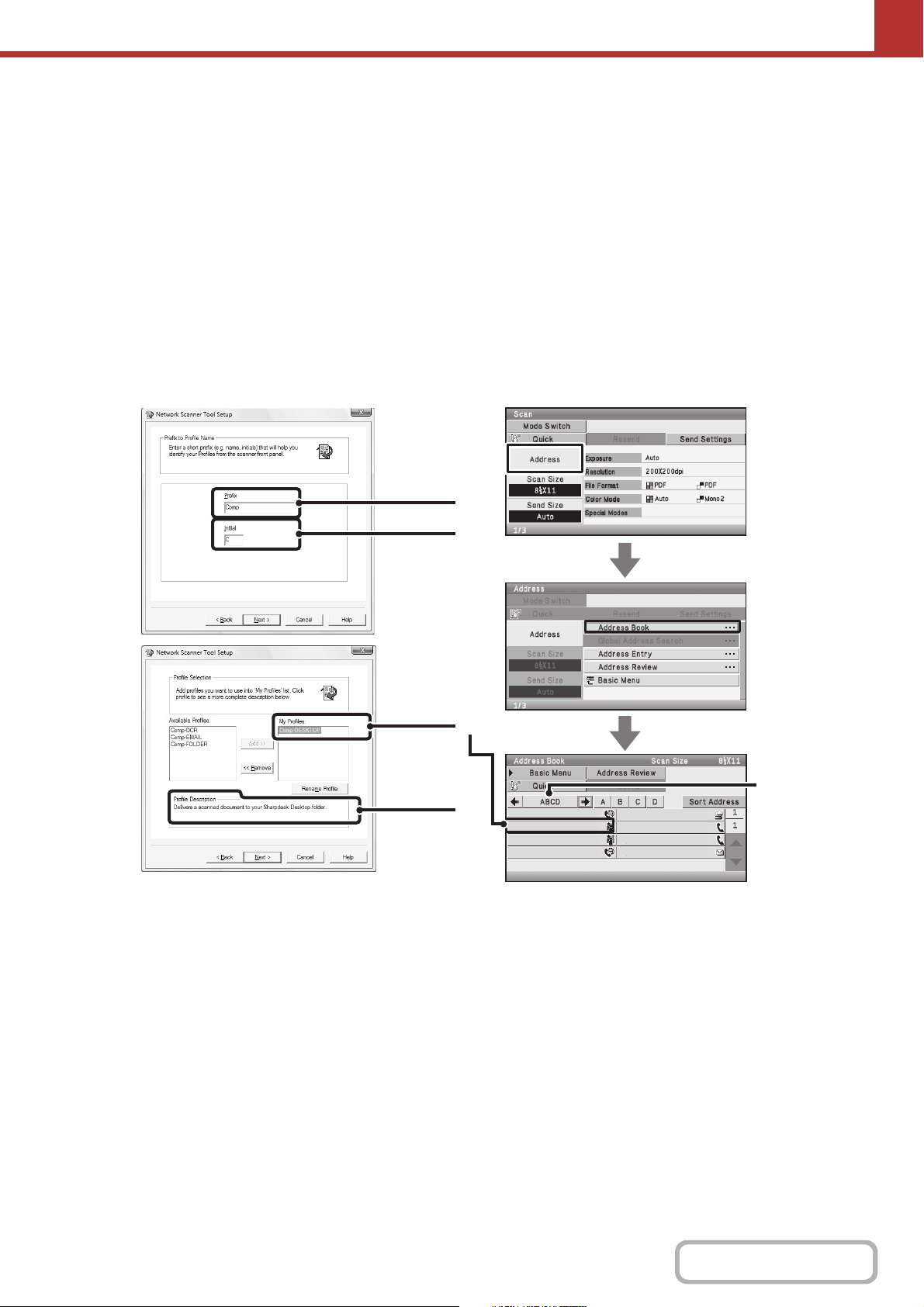
5-10
SCANNER/INTERNET FAX
Contents
STORING A DESTINATION FOR SCAN TO DESKTOP
To store your computer in the machine as a destination for Scan to Desktop, Network Scanner Tool must be installed
from the "Sharpdesk/Network Scanner Utilities" CD-ROM that accompanies the machine. To scan an image to your
computer, Network Scanner Tool must be running on your computer.
INSTALLING NETWORK SCANNER TOOL
To install Network Scanner Tool, see the "Sharpdesk Installation Guide" that accompanies the machine. When a
standard installation is performed, Network Scanner Tool is installed with Sharpdesk.
When you restart your computer after installing Network Scanner Tool, the Setup Wizard will start automatically. Follow
this wizard to set up Network Scanner Tool. This will store your computer in the machine as a destination for Scan to
Desktop. The stored destination will be displayed as a one-touch key in the address book screen.
The following window appears while Network Scanner Tool is being set up. The item selected in "My Profiles" (C) will be
the name of the one-touch key.
The profile name is determined by the combination of the text entered in "Prefix" (A) and the profile*.
The one-touch key is assigned to an index tab in the address book screen based on the text entered in "Initial" (B).
* This defines how an image sent to your computer is processed. For more information, see profile explanation (D).
ADDING DESTINATIONS
For the number of computers that can be stored in the machine as destinations of Scan to Desktop, see the number of
licenses indicated in the "Sharpdesk Installation Guide". To store more destinations, a license kit is required. Store Scan
to Desktop destinations by installing Network Scanner Tool on each computer.
CCC DDD
CCC FFF
Comp-DESKTOP
CCC AAA
CCC GGG
CCC EEE
CCC CCC
CCC BBB
(B)
(A)
(B)
(C)
(D)
5-11
SCANNER/INTERNET FAX
Contents
BEFORE SENDING TO A DIRECT SMTP ADDRESS
The machine supports Direct SMTP, which lets you directly send Internet faxes within your company without using a
mail server. For the procedure for storing a Direct SMTP address in the address book, see "STORING DESTINATION
ADDRESSES FOR EACH SCAN MODE IN THE ADDRESS BOOK" (page 5-6). Stored Direct SMTP addresses are
included in the address book for Internet fax mode.
If the destination is busy
If the destination is busy, the machine will wait briefly and then automatically resend.
When a communication error occurs
If a communication error occurs or the other fax machine does not answer the call within a preset period of time,
transmission will be re-attempted automatically after a preset interval.
To cancel transmission...
Cancel the transmission from the job status screen.
☞ STOPPING A SCAN JOB BEING TRANSMITTED OR WAITING TO BE TRANSMITTED (page 5-106)
System Settings (Administrator): Recall in Case of Line Busy (Web page only)
This is used to set the number of recall attempts and the interval between attempts when the connection cannot be
established because the line is busy.The factory default setting is 2 attempts at an interval of 3 minutes.
To cancel transmission...
Cancel the transmission from the job status screen.
☞ STOPPING A SCAN JOB BEING TRANSMITTED OR WAITING TO BE TRANSMITTED (page 5-106)
System Settings (Administrator): Recall in Case of Communication Error (Web page only)
This is used to set the number of recall attempts and the interval between attempts when a transmission fails due to an
error.The factory default setting is attempt at an interval of 3 minutes.
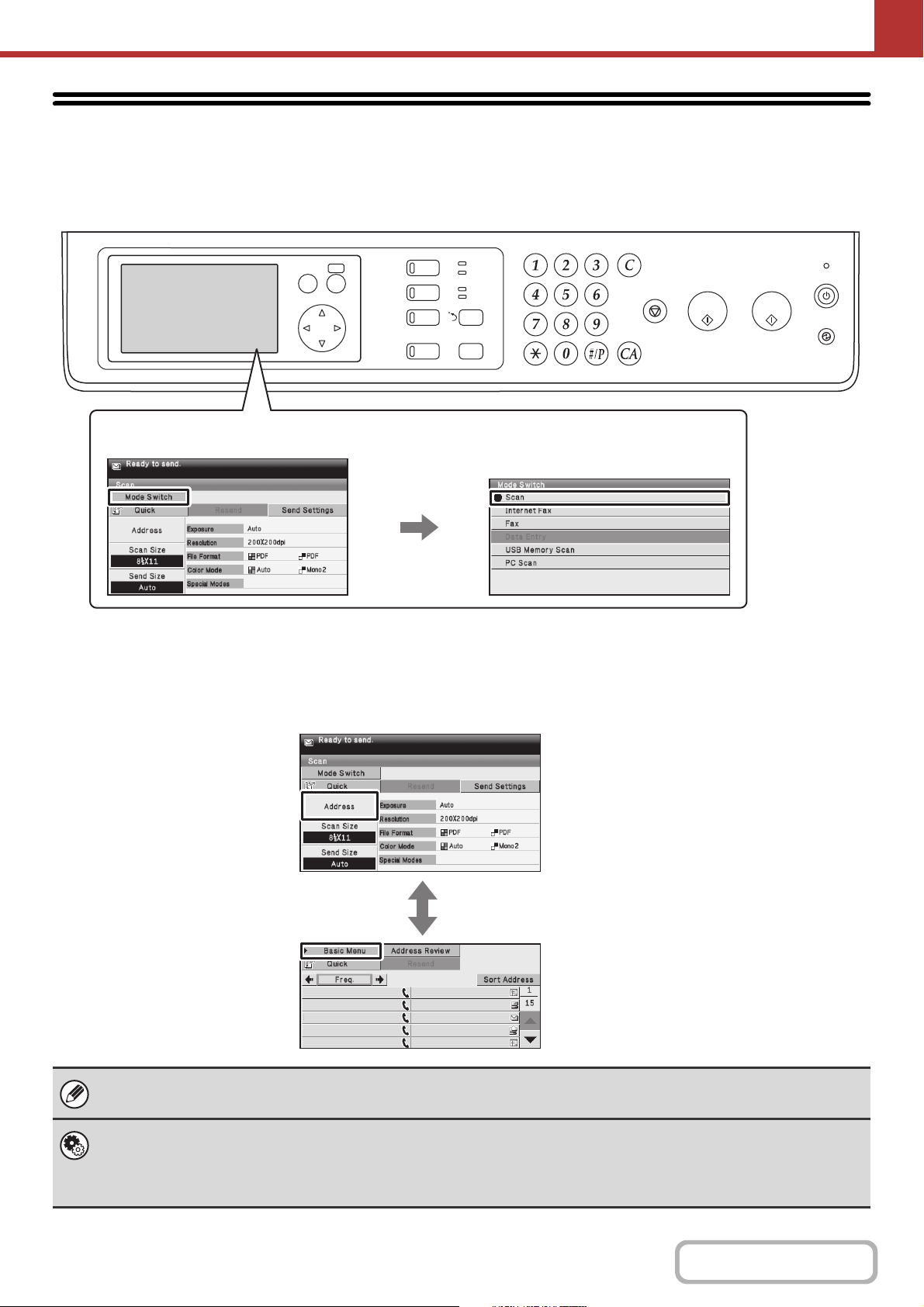
5-12
SCANNER/INTERNET FAX
Contents
BASE SCREEN
Scan mode, Internet fax mode, USB memory mode, and PC scan mode are operated by selecting settings and
commands in the base screens of these modes. To display the base screen of a mode, press the [IMAGE SEND] key
and select the desired mode in [Mode Switch].
When sending an image, you can use a transmission destination stored in the Address Book. The Address Book screen
is shared by scan mode, Internet fax mode, fax mode and data entry mode.
To switch to the Address Book screen from the base screen, select the [Address] key and then the [Address Book] key
and press the [OK] key. To switch to the base screen from the Address Book screen, select the [Basic Menu] key and
press the [OK] key.
• This manual uses the base screen of scan mode as an example when operations common to all modes are explained.
•
The procedures in this manual assume that the base screen of scan mode appears when the [IMAGE SEND] key is pressed.
System Settings (Administrator): Default Display Setting
One of the following screens can be selected for the initial screen that appears when the [IMAGE SEND] key is pressed.
• Base screen of each mode (scan mode, Internet fax mode, fax mode and data entry mode)
• Address book screen
LOGOUT
COPY
PRINT
OKBACK
JOB STATUS
SYSTEM
SETTINGS
IMAGE SEND
READY
DATA
DATA
LINE
Modes that cannot be used because the
required options are not installed are grayed
out to prevent selection.
AAA AAA
BBB BBB
CCC CCC
DDD DDD
EEE EEE
FFF FFF
GGG GGG
HHH HHH
III III
JJJ JJJ
Base screen of scan mode
Address Book screen
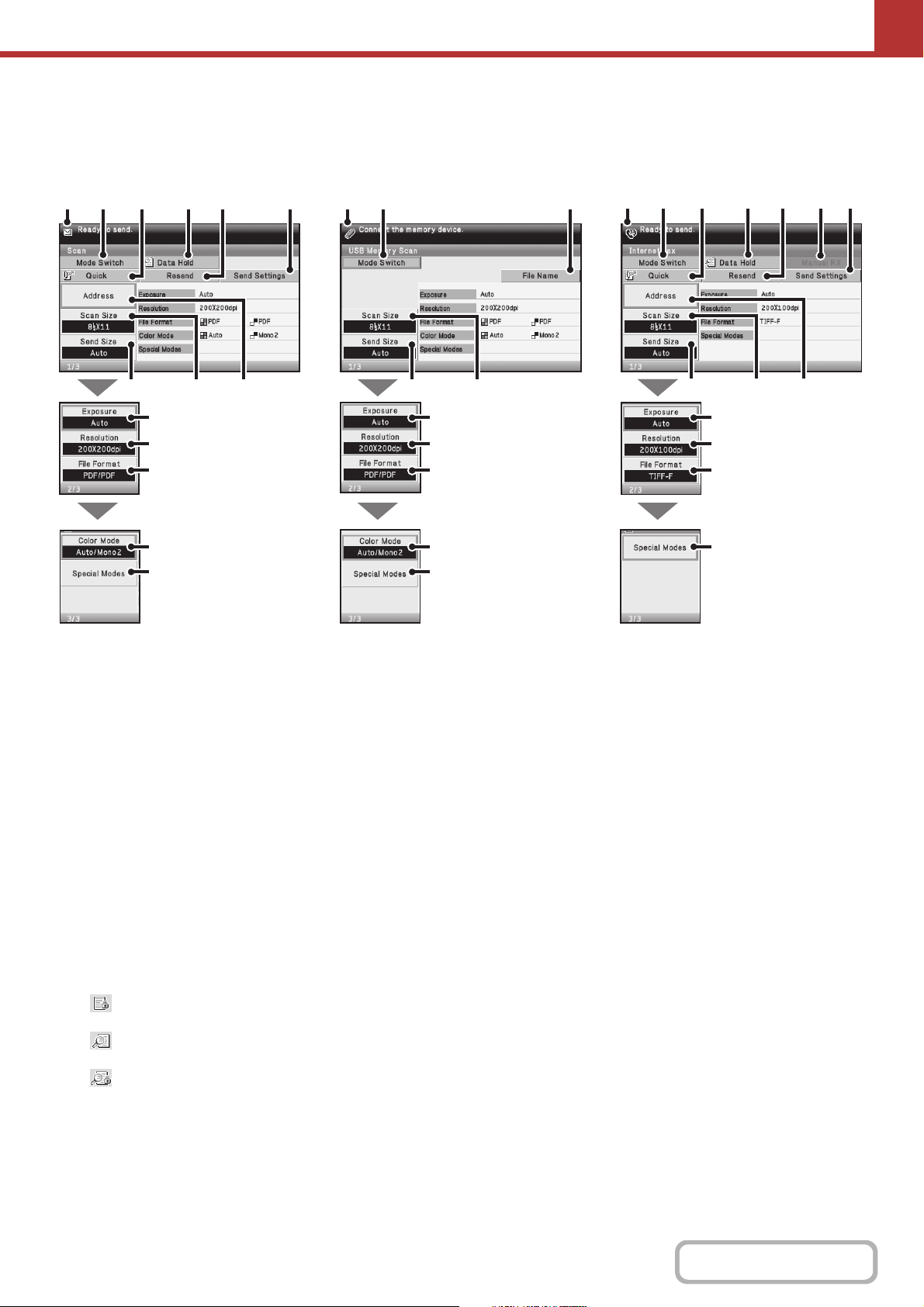
5-13
SCANNER/INTERNET FAX
Contents
BASE SCREENS
Settings are selected in the base screen of each mode.
(1) Various messages are displayed here.
The icon of the selected mode appears on the left.
(2) [Mode Switch] key
Select one of these tabs to change the image send mode.
Modes that cannot be used because the corresponding
options are not installed do not appear.
☞ BASE SCREEN (page 5-12)
(3) [Quick] key
Select this key to specify a destination using a search number.
*
* 3-digit number assigned to a destination when it is stored.
☞ USING A SEARCH NUMBER TO RETRIEVE A
DESTINATION (page 5-26)
(4) [Data Hold] key
When "Hold Setting for Received Data Print" or
"Received Data Image Check Setting" is enabled in the
system settings (administrator), this will appear when an
Internet fax is received.
: Only "Hold Setting for Received Data Print" is
enabled
: Only "Received Data Image Check Setting" is
enabled
: Both settings are enabled
☞ PRINTING A PASSWORD-PROTECTED FAX
(Hold Setting For Received Data Print) (page 5-111)
☞ CHECKING THE IMAGE BEFORE PRINTING
(page 5-112)
(5) [Resend] key/[Next Address] key
The destinations of the most recent 8 transmissions by
Scan to E-mail, fax and/or Internet fax are stored. Select
this key to select one of these destinations. After a
destination is selected, this key changes to the [Next
Address] key.
☞ USING THE RESEND FUNCTION (page 5-31)
☞ RETRIEVING A DESTINATION (page 5-23)
(6) [Send Settings] key
Select this key to select or enter the subject, file name,
sender name, or body text, which has been previously
stored in the Web page.
Scan modes:
☞ CHANGING THE SUBJECT, FILE NAME,
REPLY-TO, AND BODY TEXT (page 5-36)
Internet fax mode:
☞ CHANGING THE SUBJECT, FILE NAME, AND
BODY TEXT (page 5-49)
(7) [Address] key
Select this key to use a one-touch key or a group key.
☞ RETRIEVING A DESTINATION FROM THE
ADDRESS BOOK (page 5-22)
(8) [Scan Size] key
Select this key to select the image settings (original size,
duplex setup, image orientation) can be selected.
☞ IMAGE SETTINGS (page 5-58)
(7)(8)(9) (8)(9)
(1) (4)(2) (5)(3) (6) (1) (2) (15)
(10)
(11)
(12)
(13)
(14)
(7)(8)(9)
(1) (4)(2) (5)(3) (6)(16)
(10)
(11)
(12)
(13)
(14)
(10)
(11)
(12)
(14)
Base screen of scan mode
Base screen of USB memory mode Base screen of Internet fax mode

5-14
SCANNER/INTERNET FAX
Contents
(9) [Send Size] key
Select this key to specify the send size of the original.
☞ Specifying the send size of the image (page 5-65)
(10) [Exposure] key
Select this key to select the exposure for scanning.
☞ CHANGING THE EXPOSURE AND ORIGINAL
IMAGE TYPE (page 5-67)
(11) [Resolution] key
Select this key to select the resolution for scanning.
☞ CHANGING THE RESOLUTION (page 5-69)
(12) [File Format] key
Select this key to change the format (file type) of the
scanned image file.
☞ CHANGING THE FILE FORMAT (page 5-70)
(13) [Color Mode] key
Select this key to select the color mode for scanning.
This key does not appear in Internet fax mode.
☞ CHANGING THE COLOR MODE (page 5-75)
(14) [Special Modes] key
Select this key to use a special mode.
☞ SPECIAL MODES (page 5-77)
(15) [File Name] key
Select this key to enter a file name when storing a file to
USB memory.
☞ ENTERING A FILE NAME (page 5-44)
(16) [Manual RX] key
Select this key to receive an Internet fax manually.
☞ MANUALLY RECEIVING INTERNET FAXES (page
5-110)
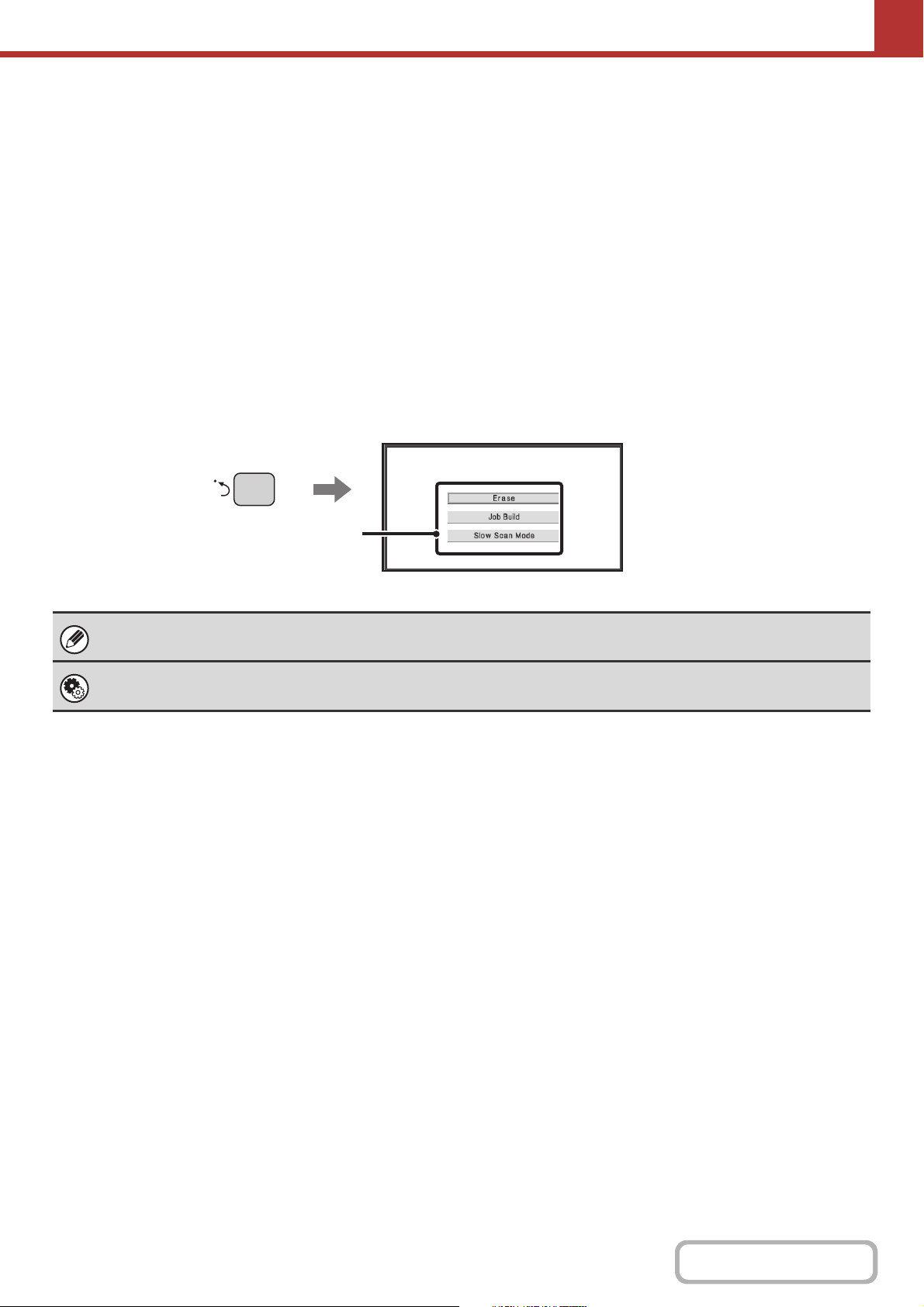
5-15
SCANNER/INTERNET FAX
Contents
Customizing displayed keys
Keys for special modes and other settings can be stored as shortcut keys. Set these keys to functions that you
frequently use to access the functions with a single select. The customized keys are configured using "Customize Key
Setting" in the Web pages. The following keys appear by factory default:
• [Program] key, [Global Address] key
Select to use the Program function or a Global Address book.
☞STORING SCAN OPERATIONS (Programs) (page 5-79)
☞RETRIEVING A DESTINATION FROM A GLOBAL ADDRESS BOOK (page 5-29)
• [Address Review] key
Select this key to display a list of the destinations that have been selected in the address book. This is the same key
as the [Address Review] key in the address book screen.
In USB memory mode...
Customized keys do not initially appear, however, up to three keys can be added.
Example: When "Erase", "Job Build", and "Slow Scan Mode" are assigned to the customized keys
The functions that can be selected for the customized keys vary depending on the mode.
System Settings (Administrator): Customize Key Setting (Web page only)
Registration is performed in [System Settings] - [Operation Settings] - "Customize Key Setting" in the Web page menu.
These three keys can be changed
as desired.
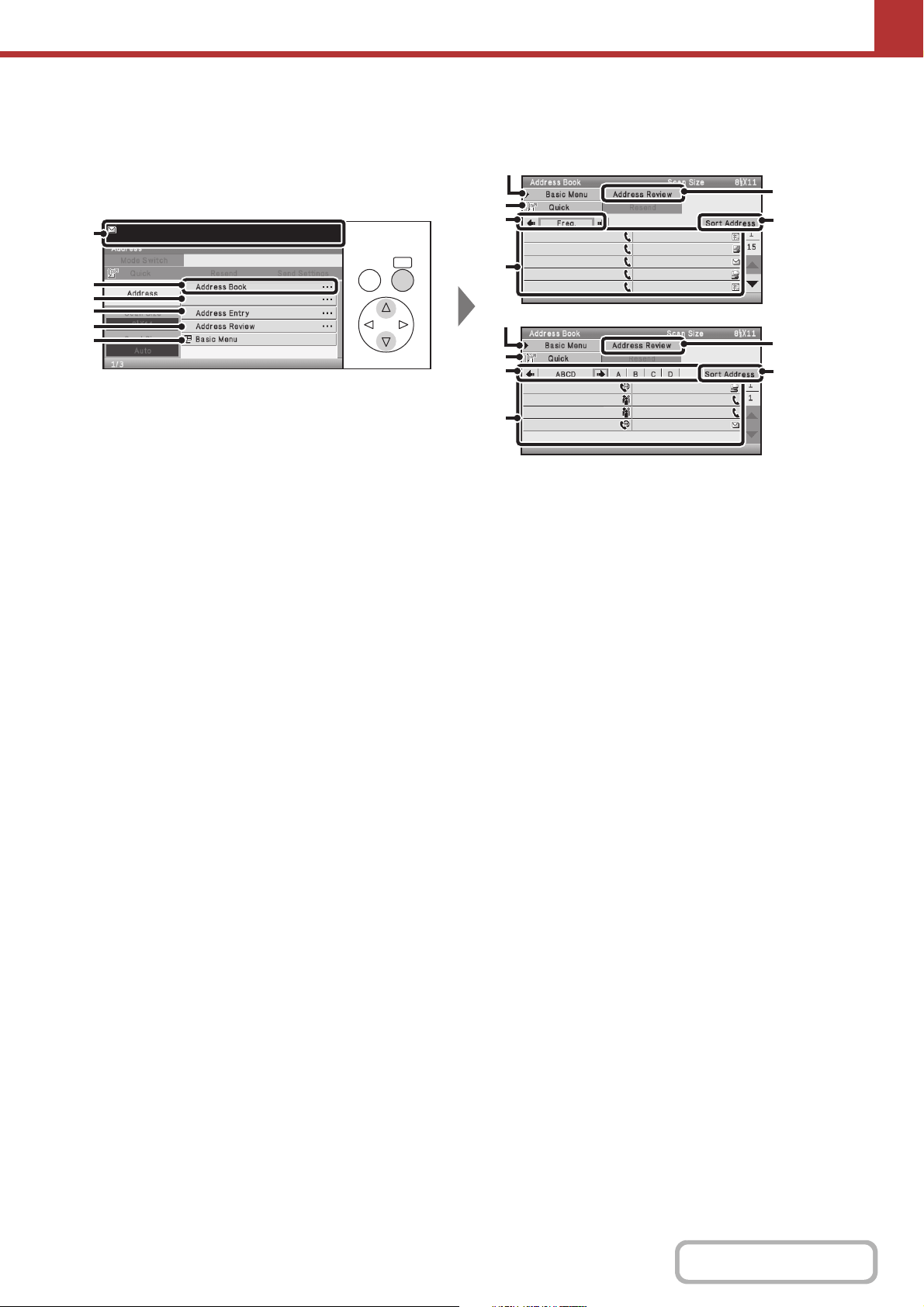
5-16
SCANNER/INTERNET FAX
Contents
ADDRESS BOOK SCREEN
This screen is used to select transmission destinations.
(1) This shows the selected destination.
(2) [Address Book] key
Select this key to specify a destination (one-touch key).
(3) [Global Address Search] key
When the use of a LDAP server has been enabled in the
machine's Web pages, a transmission address can be
obtained from a global address book.
☞ RETRIEVING A DESTINATION FROM A GLOBAL
ADDRESS BOOK (page 5-29)
(4) [Address Entry] key
Select this key to manually enter a destination address
instead of using a one-touch key.
☞ ENTERING AN ADDRESS MANUALLY (page 5-27)
(5) [Address Review] key
Select this key to view a list of the destinations that have
been selected or to enter a selected destination
(one-touch key).
Destination selections can also be changed.
☞ CHECKING AND DELETING THE SELECTED
DESTINATIONS (page 5-25)
(6) [Basic Menu] key
Select this key to select transmission settings. When the
key is selected, the base screen appears.
☞ BASE SCREENS (page 5-13)
(7) Index tabs
Select this to change the displayed index tab.
☞ Index display (page 5-18)
(8) One-touch key display
The destinations (one-touch keys) stored in each index
are displayed. Keys in which destinations and groups are
stored are called one-touch keys.
☞ RETRIEVING A DESTINATION (page 5-23)
(9) [Sort Address] key
Select this key to change the index tabs to custom
indexes or to display one-touch keys by send mode.
☞ CHANGING THE DISPLAY OF ONE-TOUCH KEYS
IN THE ADDRESS BOOK SCREEN (page 5-17)
(10) [Quick] key
Select this key to specify a destination using a search
number
*
.
* A 3-digit number assigned to a one-touch key or group
key when it is stored.
☞ USING A SEARCH NUMBER TO RETRIEVE A
DESTINATION (page 5-26)
OKBACK
AAA AAA
BBB BBB
CCC CCC
DDD DDD
EEE EEE
FFF FFF
GGG GGG
HHH HHH
III III
JJJ JJJ
AAA AAA
BBB BBB
CCC CCC
DDD DDD
EEE EEE
FFF FFF
GGG GGG
HHH HHH
Global Address Search
AAA AAA
(8)
(2)
(1)
(3)
(4)
(5)
(6)
(8)
(7)
(10)
(6)
(10)
(7)
(9)
(9)
(5)
(5)
(6)
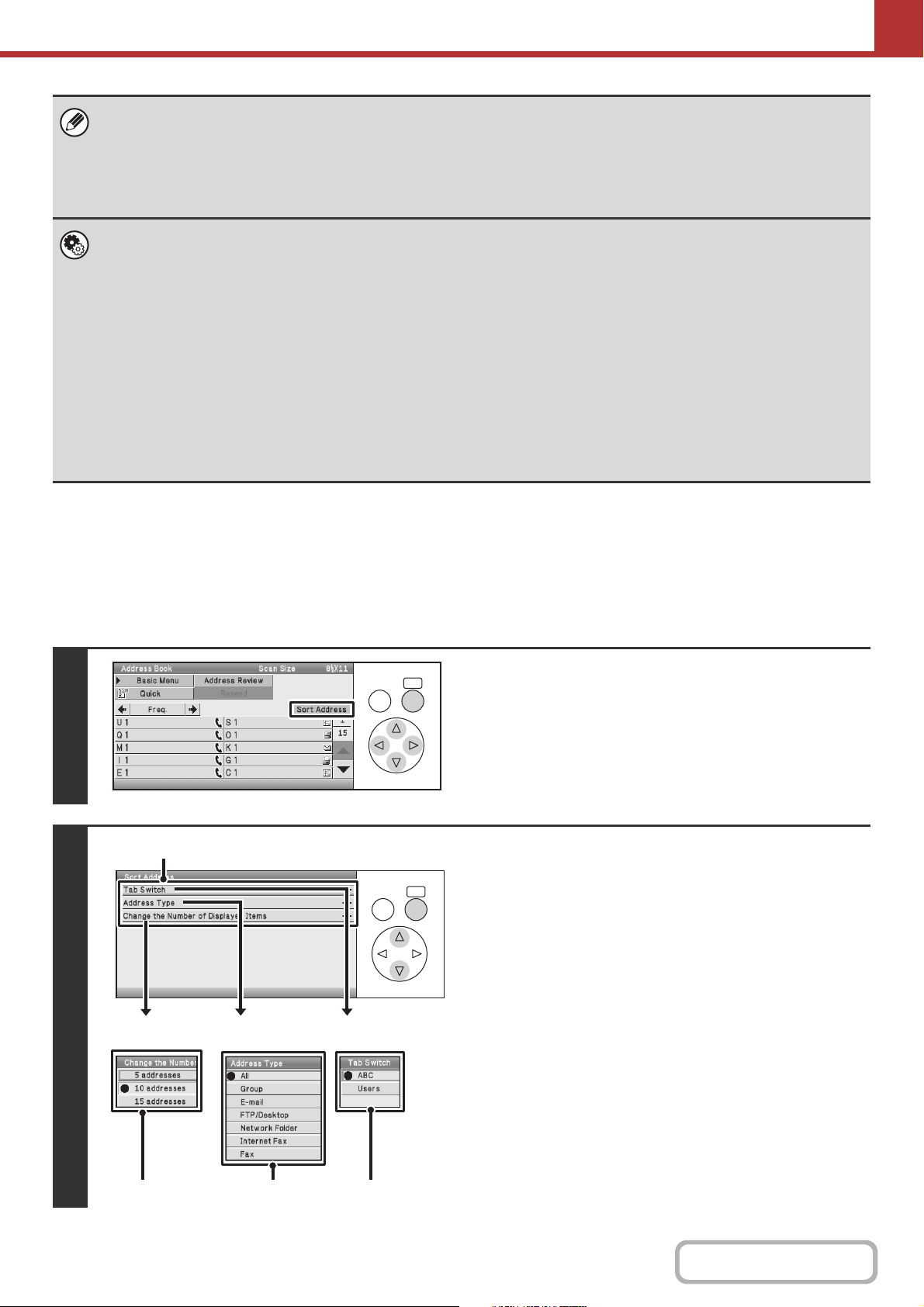
5-17
SCANNER/INTERNET FAX
Contents
CHANGING THE DISPLAY OF ONE-TOUCH KEYS IN
THE ADDRESS BOOK SCREEN
You can show destinations of only a specific transmission mode in the address book screen, or change the displayed
index tabs from the alphabetical tabs to the custom tabs. The procedure for selecting destinations does not change.
Keys in the display can be selected with the arrow keys and the [OK] key.
• Icons appear in the one-touch keys in the address book to indicate which mode is used for transmission.
☞ RETRIEVING A DESTINATION FROM THE ADDRESS BOOK (page 5-22)
• For information on storing addresses in the address book, see "STORING DESTINATION ADDRESSES FOR EACH
SCAN MODE IN THE ADDRESS BOOK" (page 5-6).
• For information on storing destinations for Scan to Desktop, see "STORING A DESTINATION FOR SCAN TO DESKTOP"
(page 5-10).
• System Settings (Administrator): The Number of Direct Address Keys Displayed Setting
This is used to change the default setting for the number of one-touch keys displayed in the address book screen.
• System Settings (Administrator): Bcc Setting (Web page only)
This setting enables or disables Bcc delivery. When this setting is enabled, switching to the [Bcc] key is possible in the
address review screen.
• System Settings (Administrator): Default Display Settings
One of the following screens can be selected for the initial screen that appears when the [IMAGE SEND] key is pressed.
- Base screen of each mode (scan, Internet fax, fax, or data entry mode)
- Address book screen
• System Settings (Administrator): Address Book Default Selection
The following settings are available for the method of sorting the addresses that appear in the address book.
- Index type (alphabetical, custom)
- Address type (all, group, E-mail, FTP/Desktop, Network Folder, Internet fax, fax)
1
Select the [Sort Address] key.
2
Change the display mode.
(1) Select the key of the mode or tab that you
wish to display.
• To change the index tabs, select the [Tab Switch] key.
• To show only the one-touch keys of a particular send
mode, select the desired mode key under "Address
Type".
• To change the number of destinations (one-touch keys)
displayed at once in the address book screen, select
the [Change the Number of Displayed Items] key and
then select 5, 10, or 15 destinations.
(2) Select the display method and press the
[OK] key.
OKBACK
AAA AAA
BBB BBB
CCC CCC
DDD DDD
EEE EEE
FFF FFF
GGG GGG
HHH HHH
III III
JJJ JJJ
OKBACK
(1)
(2)(2) (2)
Change the Number
of Displayed Items
Address Type
Tab Switch
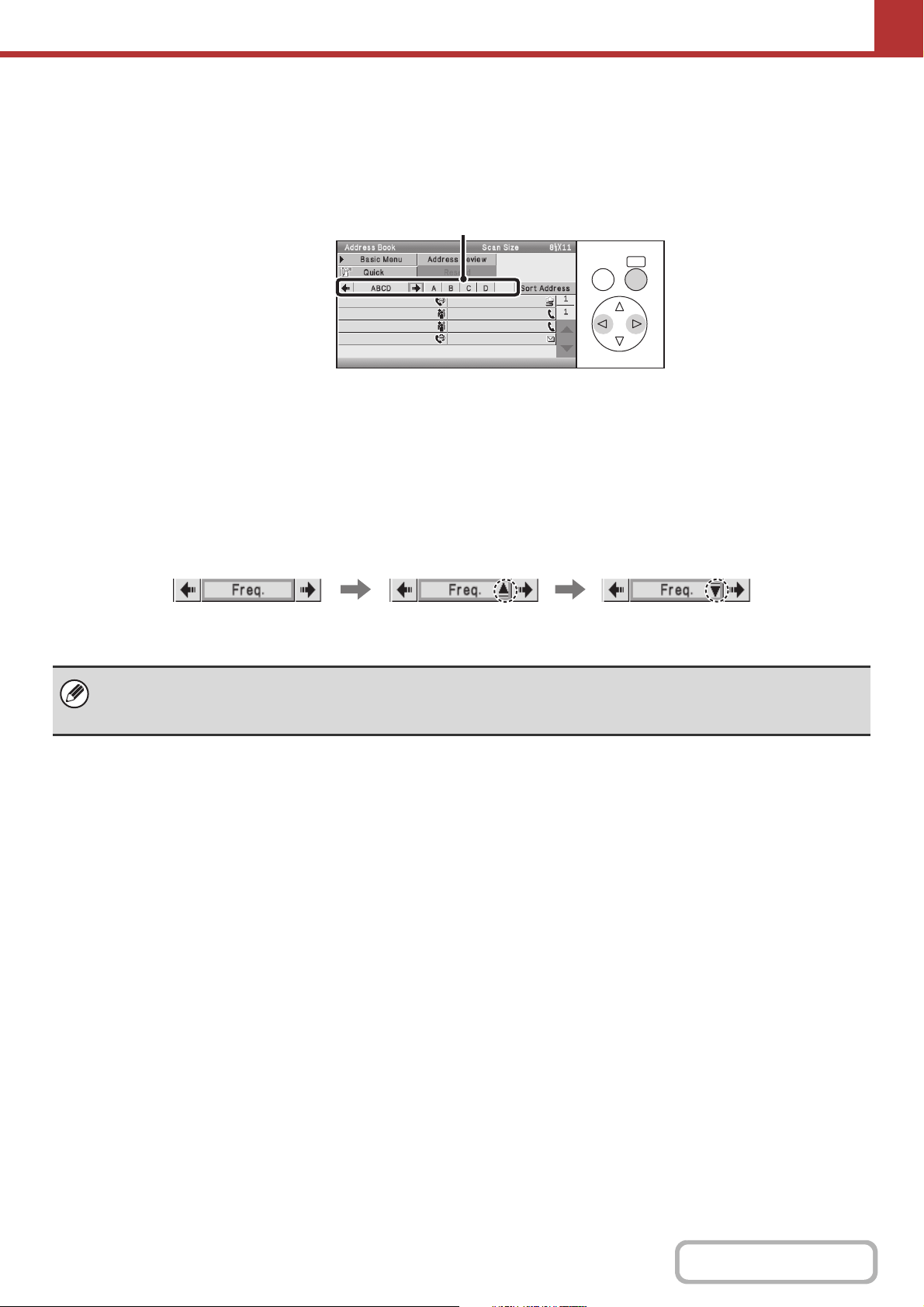
5-18
SCANNER/INTERNET FAX
Contents
Index display
Indexes make it easy to search for a destination (one-touch key). The destinations are displayed separately using
alphabetical search characters and index numbers. To display a stored destination, select the appropriate index tab. It is
convenient to store frequently used destinations in the [Freq.] index. Specify that a destination be displayed in the [Freq.]
index when you store the destination.
For example, when keys from "A" to "D" appear, you can select the [B] key to show only destinations starting with the
letter "B". To cancel, select the key again. Note that the search letter range cannot be narrowed on the [Freq.] tab, the
[etc.] tab, or on a user index tab.
The destinations can also be displayed in alphabetical order by initial.
Each time the displayed index tab is selected, the display order changes in the following order: search numbers (page
5-26), ascending names, descending names. When the display order is changed, the display order of the other index
tabs also changes.
Index names can be changed using "Custom Index" in the Web page menu, allowing you to create groups of one-touch
keys that can be easily recognized.
System Settings: CUSTOM INDEX (page 5-9)
This setting is used to store custom index names. The custom index where a one-touch key appears is specified when the
transmission destination is stored in the key. Store in [Address Book] > [Custom Index] in the Web page menu.
OKBACK
AAA AAA
BBB BBB
CCC CCC
DDD DDD
EEE EEE
FFF FFF
GGG GGG
HHH HHH
Index tabs
Ordered by search number (default) Ascending names Descending names
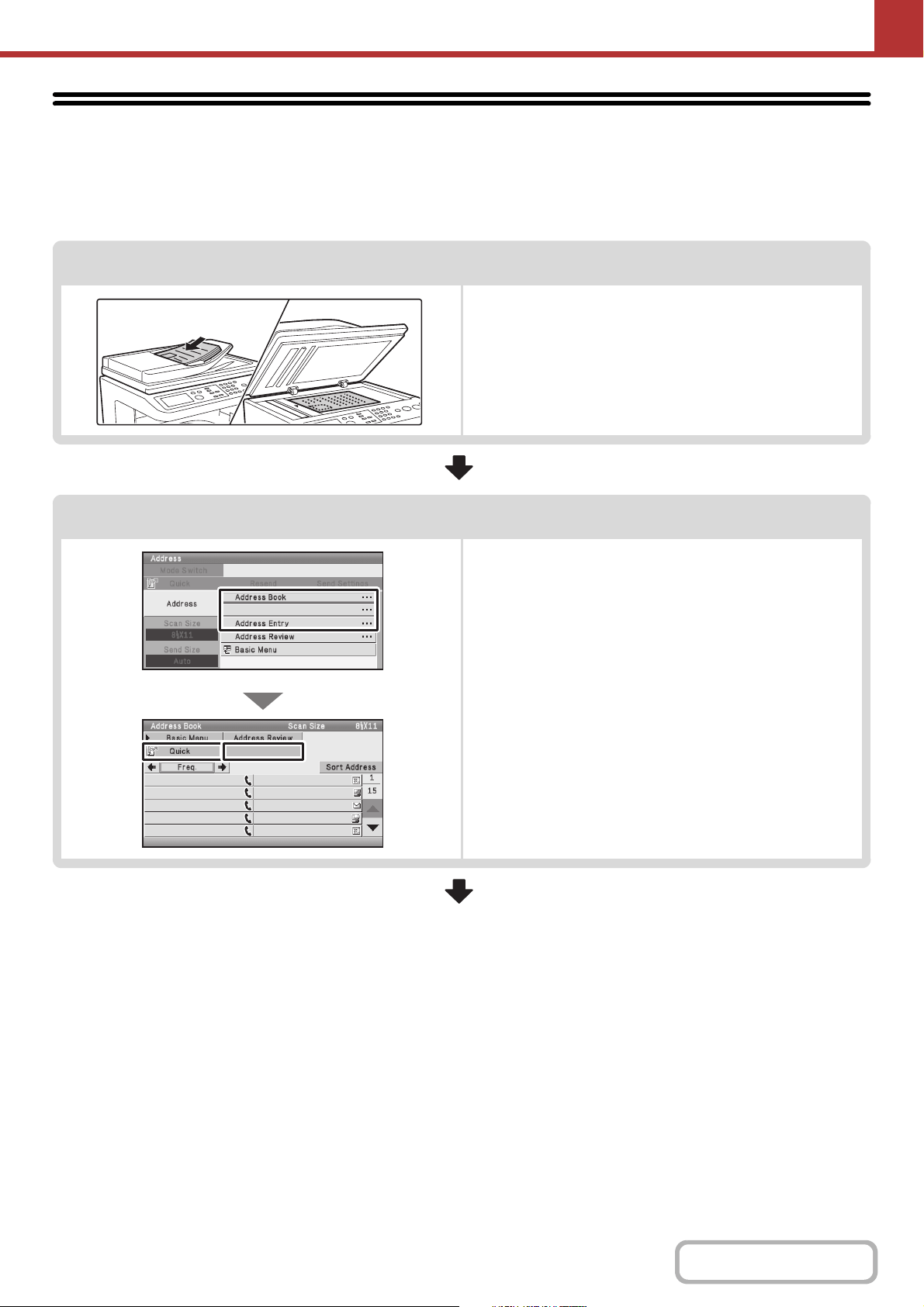
5-19
SCANNER/INTERNET FAX
Contents
SCAN SEND SEQUENCE
This section explains the basic procedure for scanning and transmission. Select settings in the order shown below to
ensure smooth transmission.
For the detailed procedures for selecting the settings, see the explanation of each setting in this chapter.
Place the original
Place the original in the document feeder tray of the automatic
document feeder, or on the document glass.
☞
SENDING AN IMAGE IN SCAN MODE (page 5-32)
☞
SENDING AN IMAGE IN USB MEMORY MODE (page
5-39)
☞
SENDING A FAX IN INTERNET FAX MODE (page 5-45)
Enter the destination
Specify the destination of the scan transmission.
• [Address Book] key:
☞ RETRIEVING A DESTINATION FROM THE ADDRESS
BOOK (page 5-22)
• [Global Address Search] key:
☞ RETRIEVING A DESTINATION FROM A GLOBAL
ADDRESS BOOK (page 5-29)
• [Address Entry] key:
☞ ENTERING AN ADDRESS MANUALLY (page 5-27)
• [Quick] key:
☞ USING A SEARCH NUMBER TO RETRIEVE A
DESTINATION (page 5-26)
• [Resend] key:
☞ USING THE RESEND FUNCTION (page 5-31)
AAA AAA
BBB BBB
CCC CCC
DDD DDD
EEE EEE
FFF FFF
GGG GGG
HHH HHH
III III
JJJ JJJ
Global Address Search
Resend
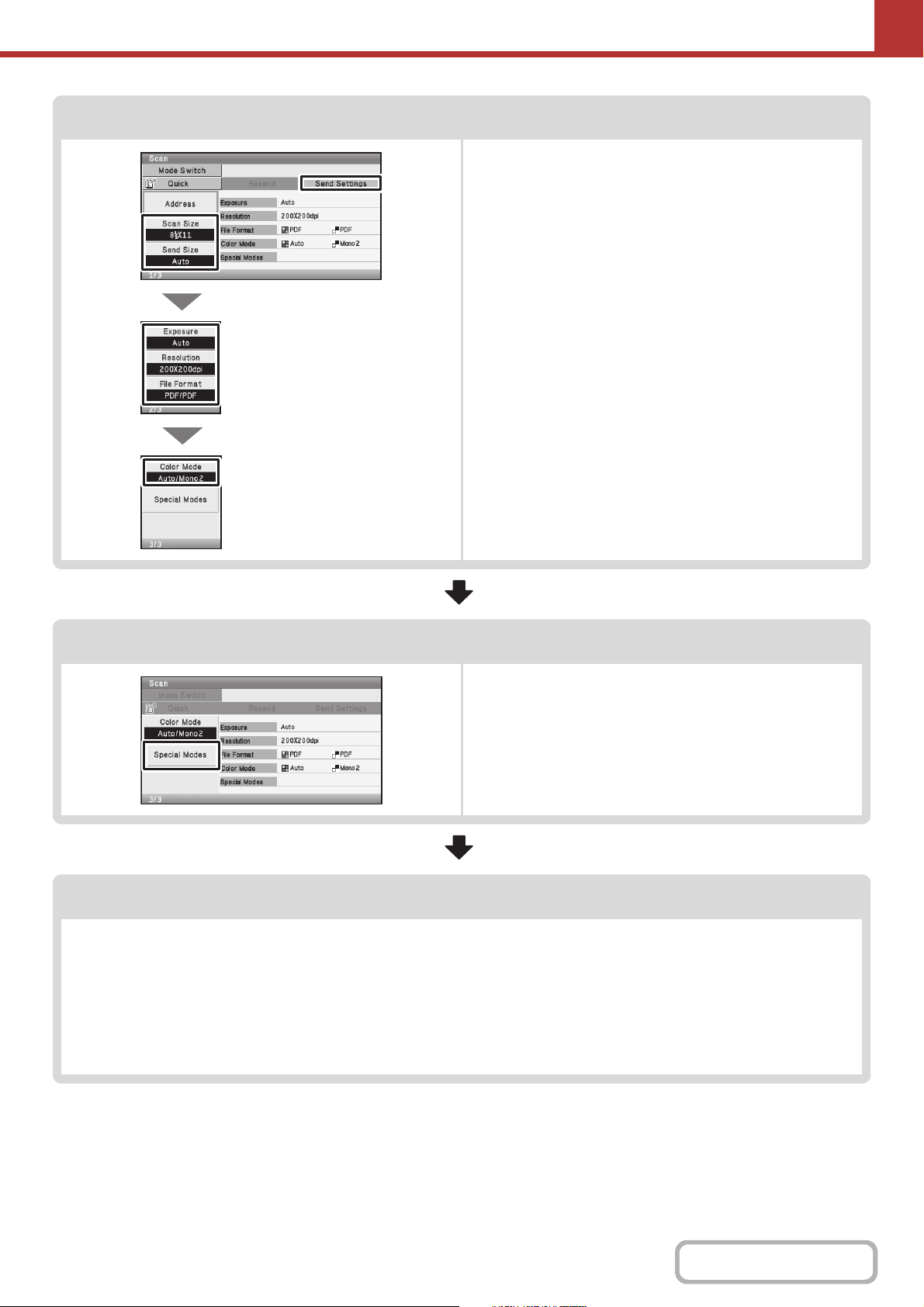
5-20
SCANNER/INTERNET FAX
Contents
Select settings
Settings can be selected for scanning the original.
• [Scan Size] key (Scan Size, Duplex Setup, Image
Orientation)
• [Send Size] key
☞ Specifying the send size of the image (page 5-65)
• Exposure • Resolution • File Format • Color Mode
☞ IMAGE SETTINGS (page 5-58)
• Send Settings (File Name)
Scan mode, Data entry mode:
☞ CHANGING THE SUBJECT, FILE NAME, REPLY-TO,
AND BODY TEXT (page 5-36)
USB memory mode:
☞ ENTERING A FILE NAME (page 5-44)
Internet fax mode:
☞ CHANGING THE SUBJECT, FILE NAME, AND BODY
TEXT (page 5-49)
Special mode settings
Special modes can be selected.
☞ SPECIAL MODES (page 5-77)
Start scanning and transmission
Start scanning and transmission.
If the original is placed on the document glass, follow these steps to start scanning and transmission:
(1) Press the [COLOR START] key or the [BLACK & WHITE START] key.
(2) When scanning is finished, replace the original with the next original.
(3) Press the [COLOR START] key or the [BLACK & WHITE START] key.
(4) Repeat (2) and (3) until all originals have been scanned.
(5) Select the [Read-End] key.
5-21
SCANNER/INTERNET FAX
Contents
• The [COLOR START] key cannot be used in Internet fax mode.
• After the original is scanned, the settings revert to the default settings.
To cancel scanning...
Press the [STOP] key ( ) to cancel the operation.
System Settings (Administrator): Default Display Settings
The settings can be kept in effect a fixed period of time after scanning is completed.
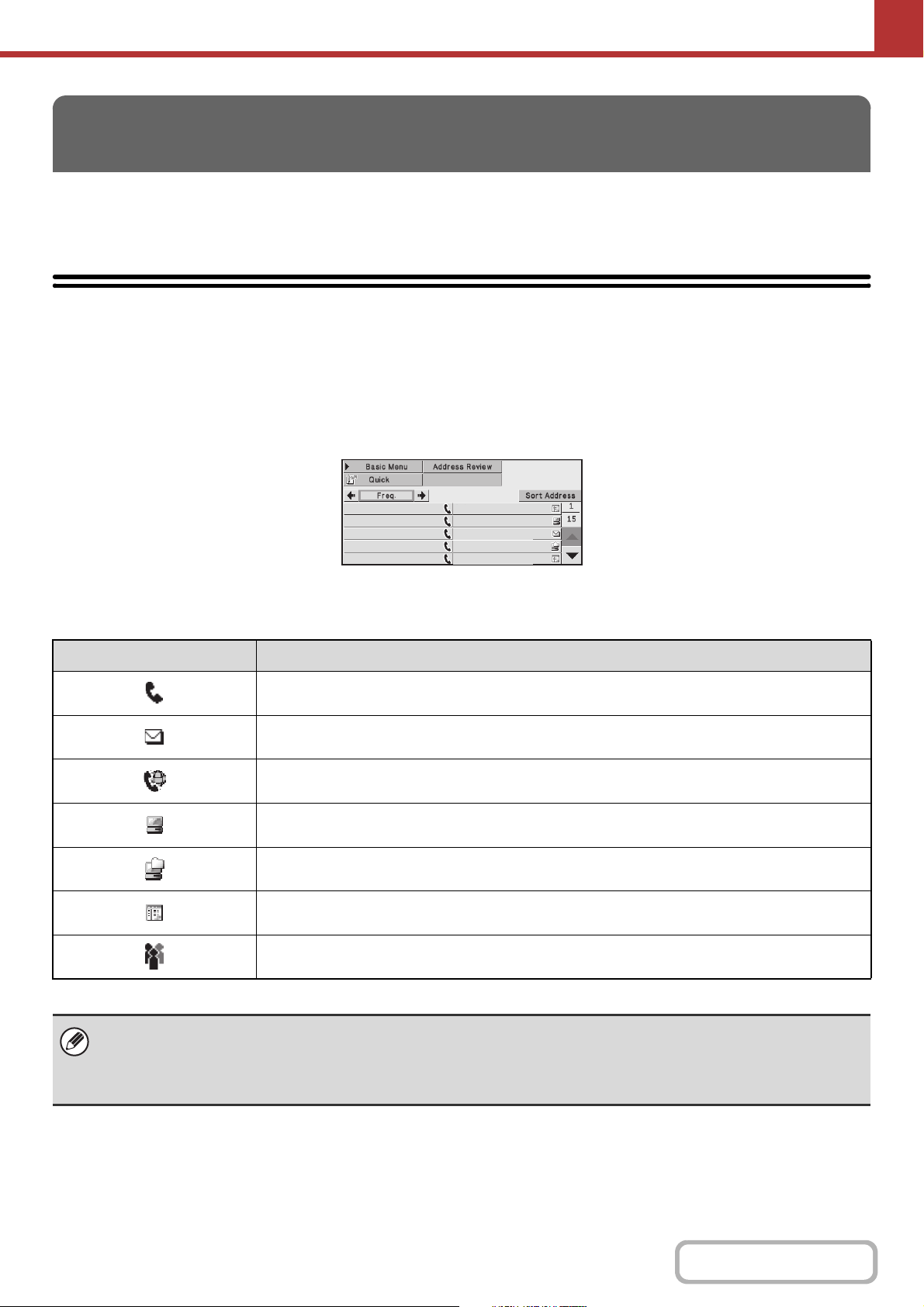
5-22
SCANNER/INTERNET FAX
Contents
This section explains how to specify destination addresses, including selecting an address from the address book and
retrieving an address by entering a search number.
RETRIEVING A DESTINATION FROM THE
ADDRESS BOOK
The address book screen shows stored destinations as one-touch keys.
The destinations are displayed in order by search number.
The address book screen shows the destinations of all modes of the image send function. Each one-touch key shows
the name of the destination and an icon indicating the mode to be used.
ENTERING DESTINATIONS
Icon Mode
Fax
Scan to E-mail
Internet fax (Direct SMTP)
Scan to FTP
Scan to Network Folder
Scan to Desktop
Group key with multiple destinations
• For information on storing addresses in the address book, see "STORING DESTINATION ADDRESSES FOR EACH
SCAN MODE IN THE ADDRESS BOOK" (page 5-6).
• For information on storing destinations for Scan to Desktop, see "STORING A DESTINATION FOR SCAN TO DESKTOP"
(page 5-10).
AAA AAA
BBB BBB
CCC CCC
DDD DDD
EEE EEE
FFF FFF
GGG GGG
HHH HHH
III III
JJJ JJJ
Resend
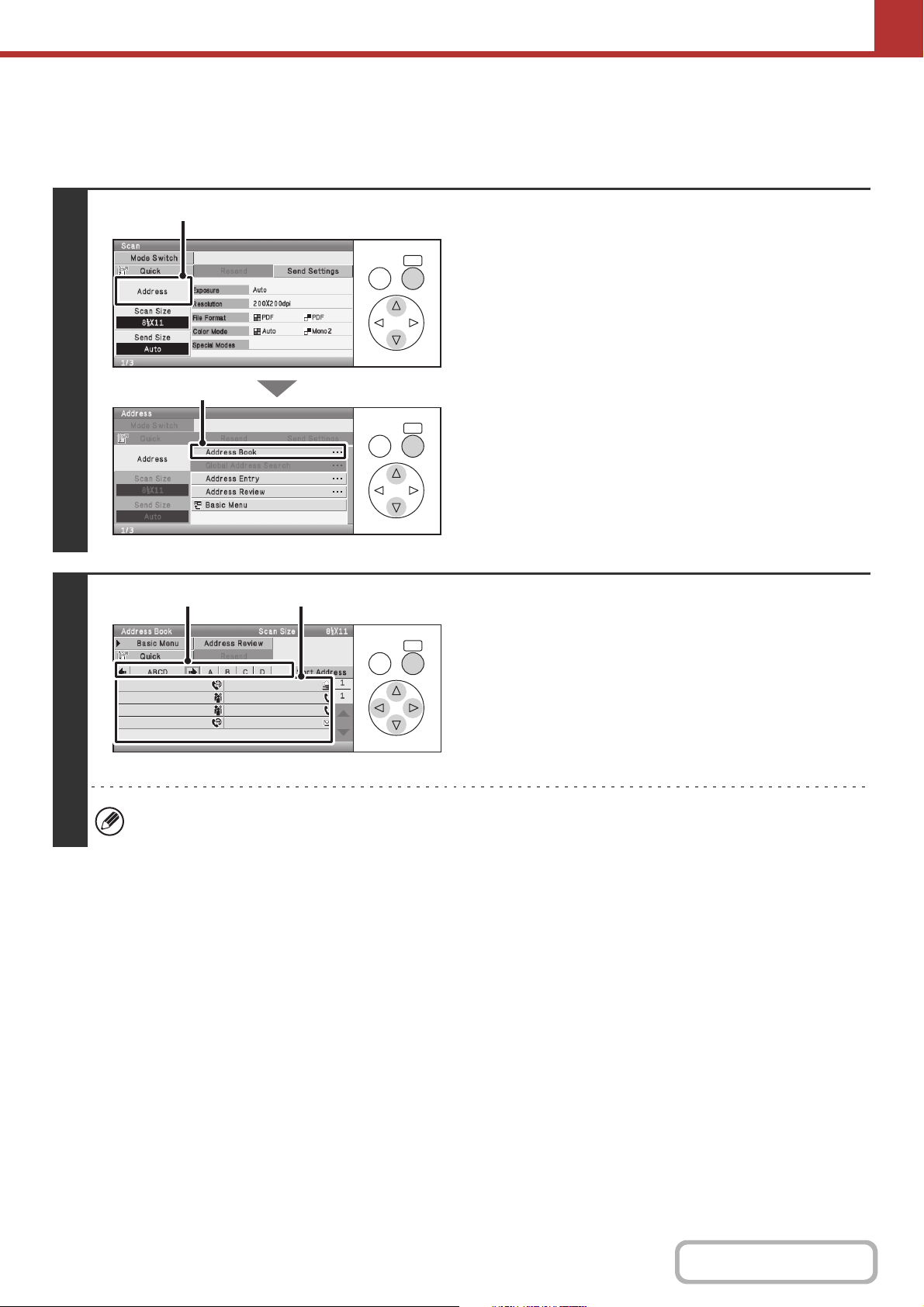
5-23
SCANNER/INTERNET FAX
Contents
RETRIEVING A DESTINATION
A destination is retrieved by selecting its one-touch key.
Keys in the display can be selected with the arrow keys and the [OK] key.
1
Display the address book screen.
(1) Select the [Address] key.
(2) Select the [Address Book] key.
2
Specify the destination.
(1) Select the index tab where the destination is
stored.
☞ Index display (page 5-18)
(2) Select the one-touch key of the desired
destination.
If you select an incorrect destination, press the [OK] key
again to cancel the selection.
It is convenient to store frequently used destinations in the [Freq.] index. Specify that a destination be displayed in the
[Freq.] index when you store the destination.
OK
BACK
OK
BACK
(1)
(2)
OKBACK
AAA AAA
BBB BBB
CCC CCC
DDD DDD
EEE EEE
FFF FFF
GGG GGG
HHH HHH
(2)(1)
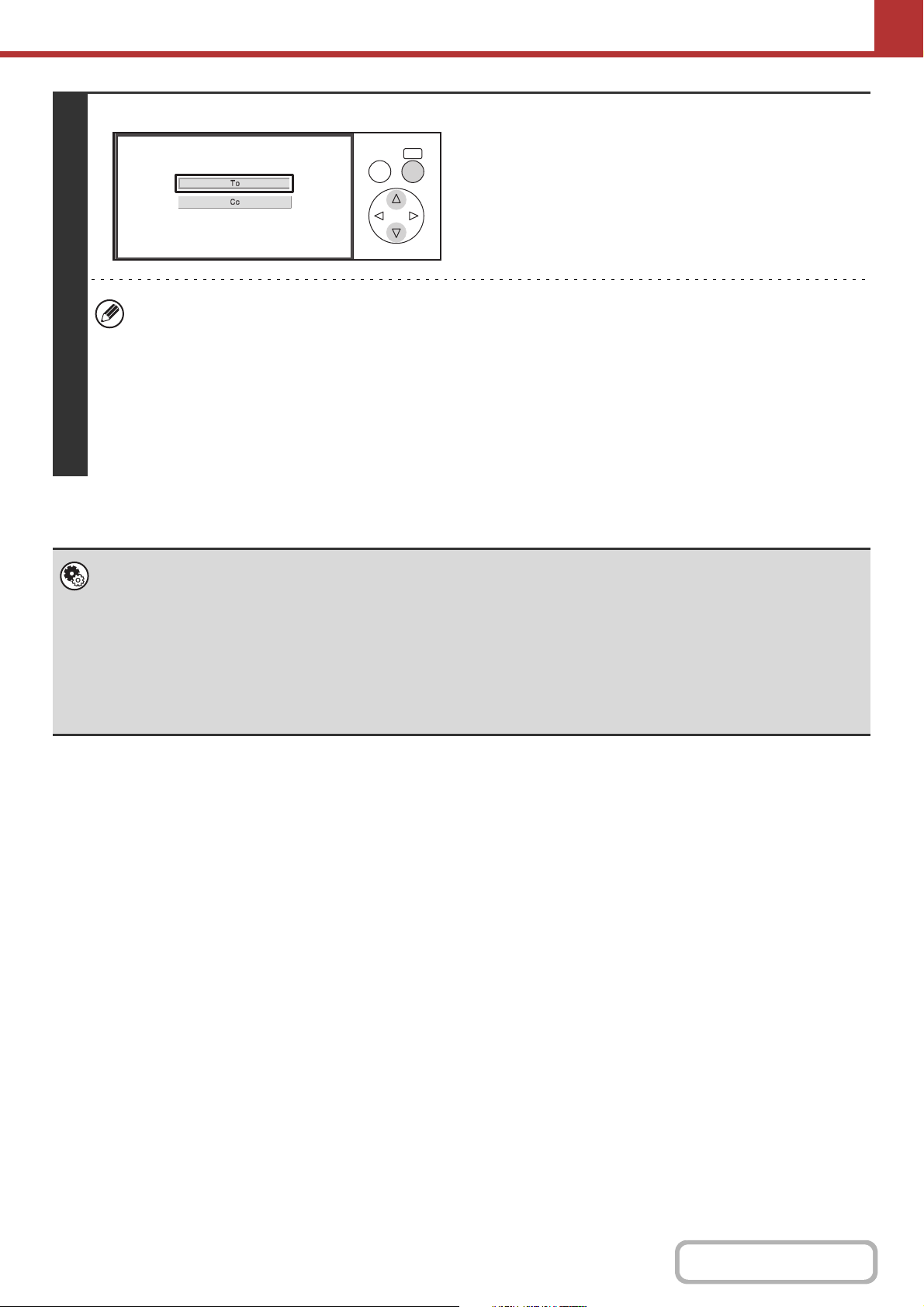
5-24
SCANNER/INTERNET FAX
Contents
3
Scan mode
Select the recipient.
(1) If you are in scan mode, select the key of
the desired delivery method.
Normally the [To] key is selected. This specifies that the
entered e-mail address will be a recipient.
(2) Press the [OK] key.
• If you wish the recipient to be a Cc recipient, select the [Cc] key and press the [OK] key.
• The [Bcc] key only appears when Bcc has been enabled using "Bcc Setting" (Web page only) in the system settings
(administrator). If you wish the recipient to be a Bcc recipient, select the [Bcc] key and press the [OK] key.
• To continue specifying other destinations...
It is possible to specify multiple scan mode (Scan to E-mail, Scan to FTP, Scan to Desktop, Scan to Network
Folder), Internet fax, and fax mode destinations when performing a broadcast transmission (maximum of 500
destinations). To specify multiple destinations, repeat steps 2 through 3.
When performing Scan to E-mail, you can select a one-touch key and then select the [Cc] key or the [Bcc] key to
send Cc or Bcc copies of the e-mail.
• System Settings (Administrator): Bcc Setting (Web page only)
This setting enables or disables Bcc delivery. When this setting is enabled, the [Bcc] key is displayed in the address review
screen.
• System Settings (Administrator): Must Input Next Address Key at Broadcast Setting
This setting determines whether or not the [Next Address] key can be omitted before specifying the next destination.
Factory default setting: the [Next Address] key can be omitted.
• System Settings (Administrator): Disable Switching of Display Order
This is used to disable switching of the order of display of the one-touch keys in the address book screen. The currently
selected display order will be the order that is used after this setting is enabled.
OK
BACK

5-25
SCANNER/INTERNET FAX
Contents
CHECKING AND DELETING THE SELECTED
DESTINATIONS
When multiple destinations have been selected, you can display and check the destinations. You can also delete a
destination from the list (cancel selection of the destination).
Keys in the display can be selected with the arrow keys and the [OK] key.
1
Display the address review screen.
(1) Select the [Address] key.
(2) Select the [Address Review] key.
2
Check the destinations and then press
the [BACK] key.
To check Cc or Bcc recipients, select either of the keys and press the [OK] key.
To cancel selection of a destination...
Select the one-touch key of the destination that you wish to cancel. A confirmation prompt will appear.
Select the [Yes] key and press the [OK] key. To check the type and name of the specified recipient, select the [Detail]
key and press the [OK] key.
OKBACK
OKBACK
(2)
(1)
OKBACK
AAA AAA
BBB BBB
CCC CCC
DDD DDD
OKBACK
AAA AAA
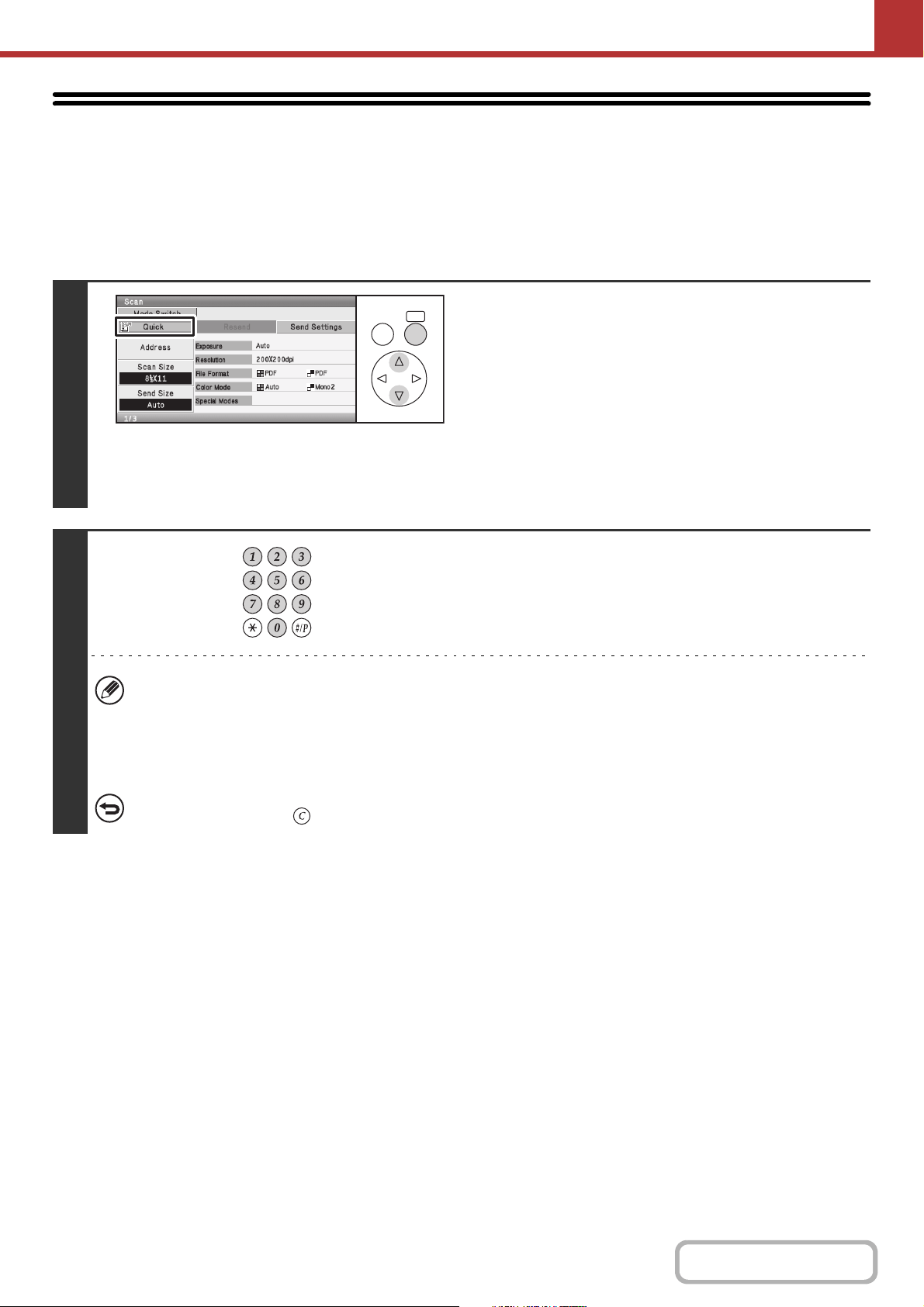
5-26
SCANNER/INTERNET FAX
Contents
USING A SEARCH NUMBER TO RETRIEVE
A DESTINATION
A destination stored in the address book can be retrieved using the [Quick] key. This can be done in the base screen of
any of the modes or in the address book screen.
Keys in the display can be selected with the arrow keys and the [OK] key.
1
Select the [Quick] key.
2
Enter the 3-digit search number of the
address with the numeric keys.
When the 3-digit search number is entered, the stored address
is retrieved and specified as a destination.
• The search number is programmed when the destination is stored in the address book.
• If you do not know the search number, print the one-touch address list using "Sending Address List" in the system
settings.
• When entering search numbers such as "001" and "011", "0" can be omitted. For example, to enter "001", enter "1",
select the [Quick] key or the [Next Address] key, and press the [OK] key.
If an incorrect search number is entered...
Press the [CLEAR] key ( ) to clear the number and enter the correct number.
OKBACK
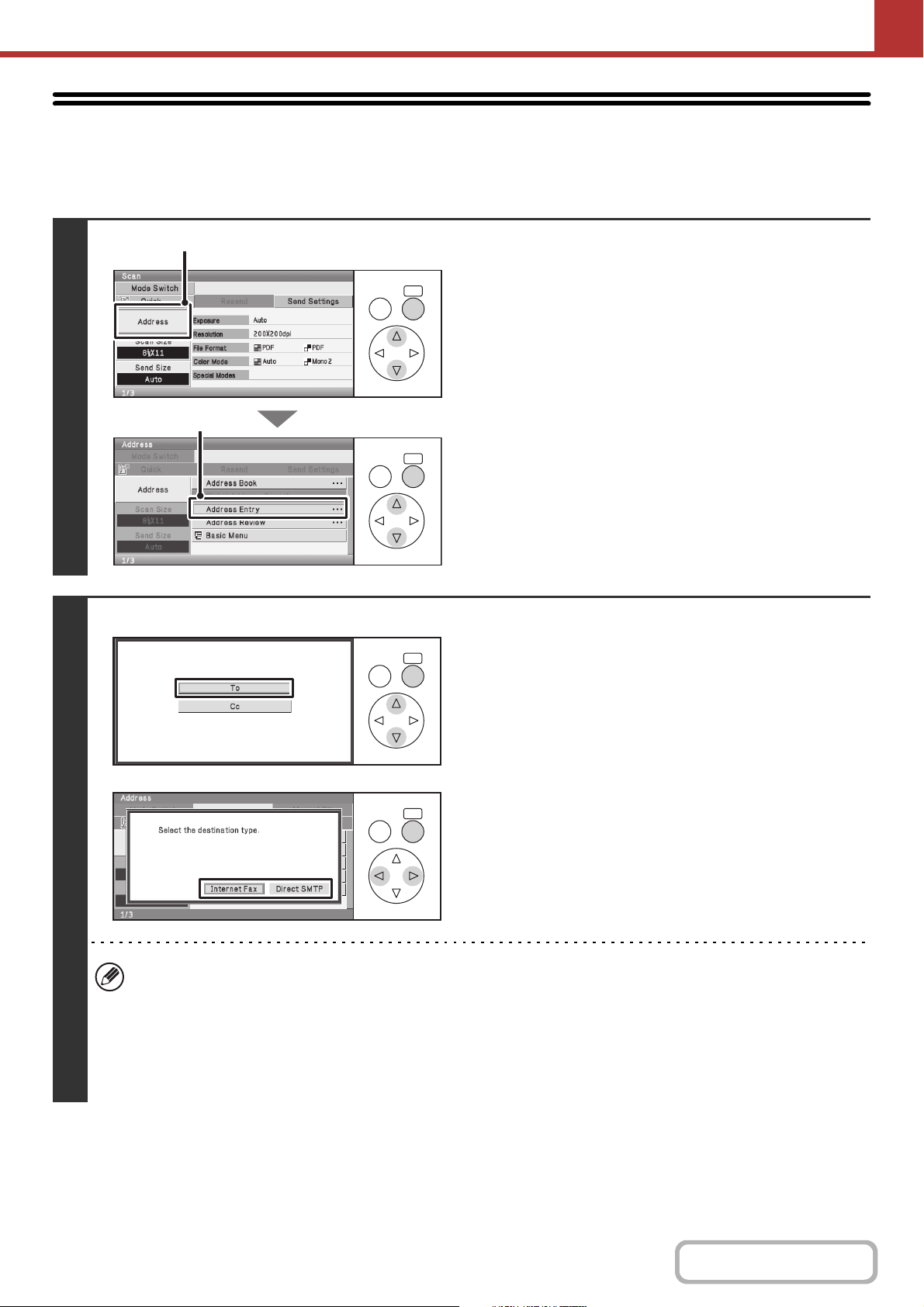
5-27
SCANNER/INTERNET FAX
Contents
ENTERING AN ADDRESS MANUALLY
Scan to E-mail, Internet fax and data entry mode addresses can be manually entered.
Keys in the display can be selected with the arrow keys and the [OK] key.
1
Display the address input screen.
(1) Select the [Address] key.
(2) Select the [Address Entry] key.
2
Scan mode
Internet fax mode
Enter the destination address.
(1) If you are in scan mode, select the desired
delivery method and press the [OK] key.
• Normally select the [To] key and press the [OK] key.
This specifies that the entered e-mail address will be a
recipient.
• If Internet fax mode is selected, select the [Internet Fax]
key or the [Direct SMTP] key and press the [OK] key.
(2) Enter the destination address in the text
entry screen that appears.
Enter the destination address and press the [OK] key.
For the procedure for entering text, see "ENTERING
TEXT" (page 1-61) in "1. BEFORE USING THE
MACHINE".
• If you wish the destination to be a Cc destination, select the [Cc] key.
• The [Bcc] key only appears when Bcc has been enabled using "Bcc Setting" (Web page only) in the system settings
(administrator). If you wish the destination to be a Bcc destination, select the [Bcc] key.
• When Internet fax mode is selected, the base screen appears after the destination address is entered. However, if
"I-Fax Reception Report On/Off Setting" (Web page only) is enabled in the system settings (administrator), the
reception report request screen will appear. If you wish to receive a report, select [Yes] and press the [OK] key. If
not, select [No] and press the [OK] key. (When Direct SMTP is used, transmission confirmation is not performed.)
OK
BACK
OK
BACK
(1)
(2)
OK
BACK
OK
BACK
5-28
SCANNER/INTERNET FAX
Contents
• System Settings (Administrator): I-Fax Reception Report On/Off Setting (Web page only)
This setting is used to request a reception report when an Internet fax is sent. When the destination is specified by directly
entering the address, a message will appear asking you if you wish to receive a report. (When Direct SMTP is used,
transmission confirmation is not performed.)
• System Settings (Administrator): Bcc Setting (Web page only)
This setting enables or disables Bcc delivery. When this setting is enabled, the [Bcc] key is displayed in the address review
screen and the delivery type selection screen.
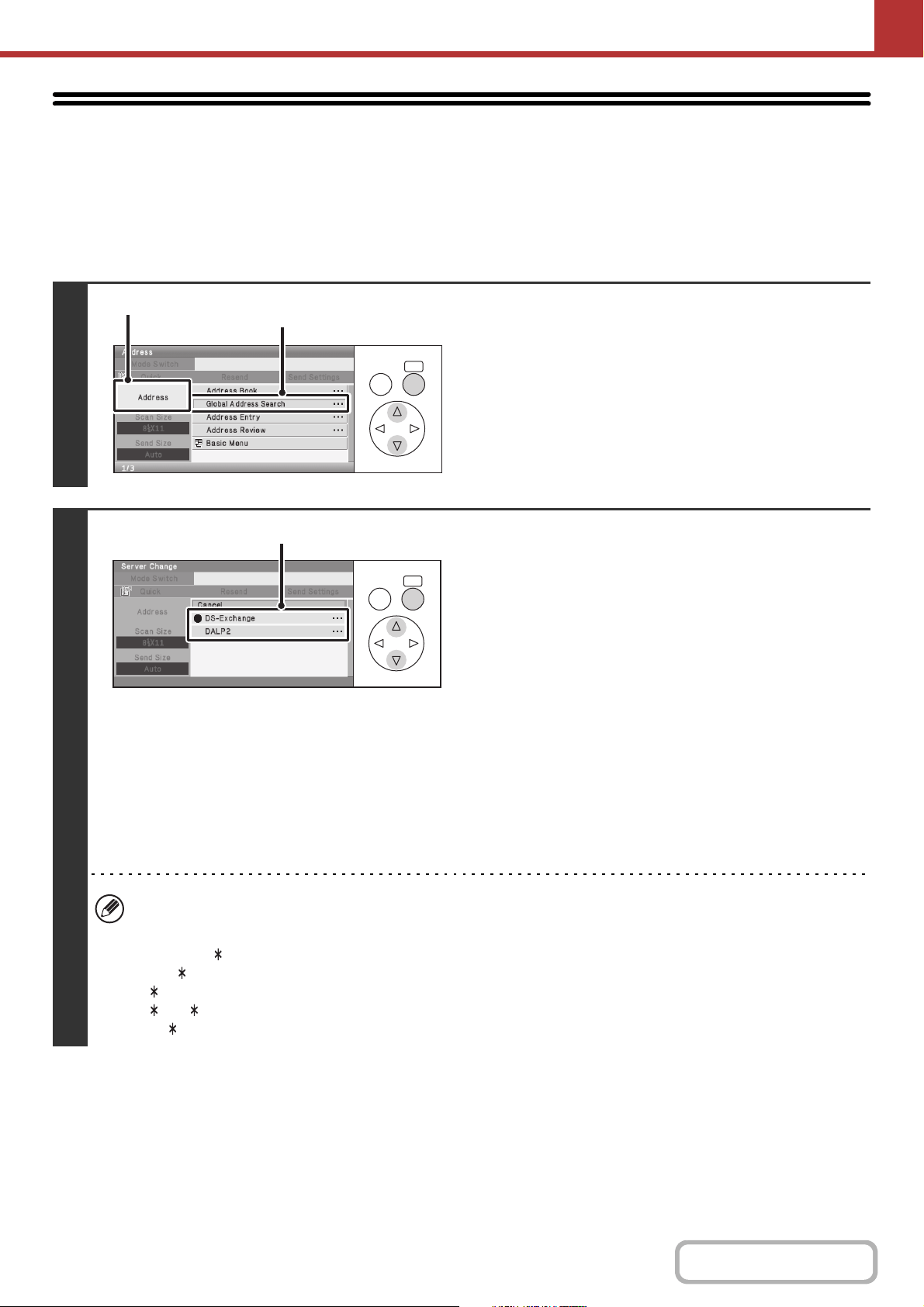
5-29
SCANNER/INTERNET FAX
Contents
RETRIEVING A DESTINATION FROM A
GLOBAL ADDRESS BOOK
When a LDAP server is configured in the Web pages, you can look up an address in a global address book and retrieve
the address for Scan to E-mail or Internet fax transmission (excluding Direct SMTP addresses).
Keys in the display can be selected with the arrow keys and the [OK] key.
1
Open the global address search screen.
(1) Select the [Address] key in the base screen.
(2) Select the [Global Address Search] key.
2
Search for the destination.
If only one LDAP server has been stored, (1) is not necessary.
Go directly to (2). If an authentication screen for the LDAP
server appears, enter your user name and password.
(1) Select the key of the LDAP server that you
wish to use.
If an authentication screen for the LDAP server appears,
enter your user name and password.
(2) Search for the destination in the search
screen.
Enter search characters for the recipient. Select the
[Search] key and press the [OK] key. The search results
will appear after a brief interval.
For the procedure for entering text, see "ENTERING
TEXT" (page 1-61) in "1. BEFORE USING THE
MACHINE".
How to search
Enter the search characters (maximum of 64 characters). The system will look for names starting with the entered
letters.
An asterisk can be used as follows:
XXX : Names beginning with "XXX".
XXX: Names that end with "XXX".
XXX : Names that include "XXX".
AA XX: Names that start with "AA" and end with "XX".
OKBACK
(2)
(1)
OKBACK
(1)
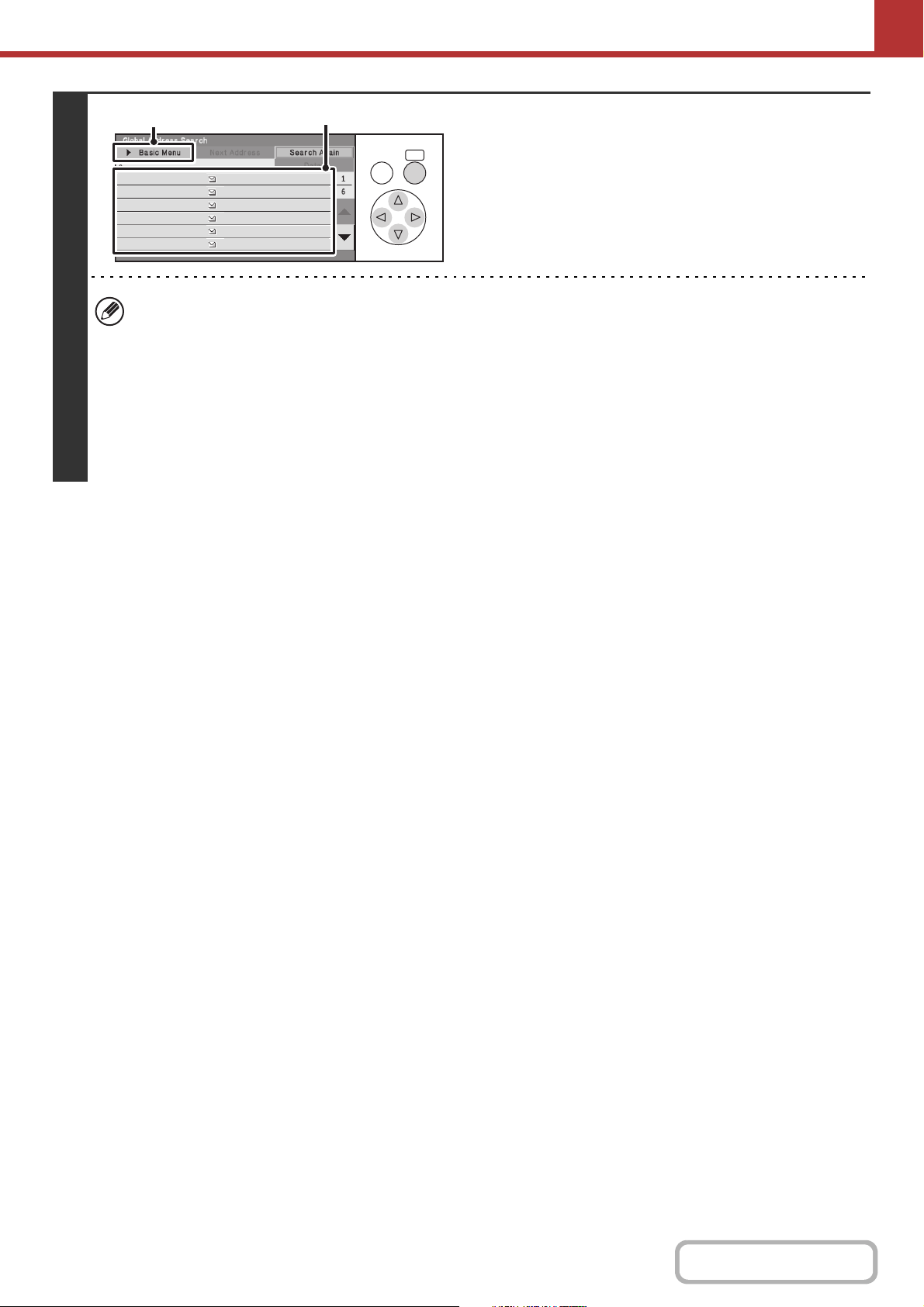
5-30
SCANNER/INTERNET FAX
Contents
3
Select the key of the desired destination.
• If no names are found that match the search
characters, a message will appear. Press the [OK] key
to close the message. To search again, select the
[Search Again] key and press the [OK] key.
• If you wish to enter another recipient, select the [Next
Address] key and then repeat this step.
• If 30 or more matches are found, a message will appear in the screen. Select the [OK] key to close the message. Up
to 300 matches can appear. If no names are found that match the search letters, select the [Search Again] key and
press the [OK] key to search again using additional search letters.
• To check the information stored in a destination...
After selecting the recipient, select the [Detail] key and press the [OK] key. The information stored for the selected
destination will appear. Check the information and then press the [BACK] key to return to the search results screen.
• If a screen for selecting the item to be used appears...
If the selected destination includes a fax number, telephone number, or other contact information in addition to the
e-mail address or Internet fax address, you will need to select which item you wish to use. Select the [E-mail] key or
the [Internet Fax] key to retrieve the address for Scan to E-mail or Internet fax transmission.
OKBACK
XXX AAA
XXX BBB
XXX CCC
XXX DDD
XXX EEE
XXX FFF
(1)
(2)
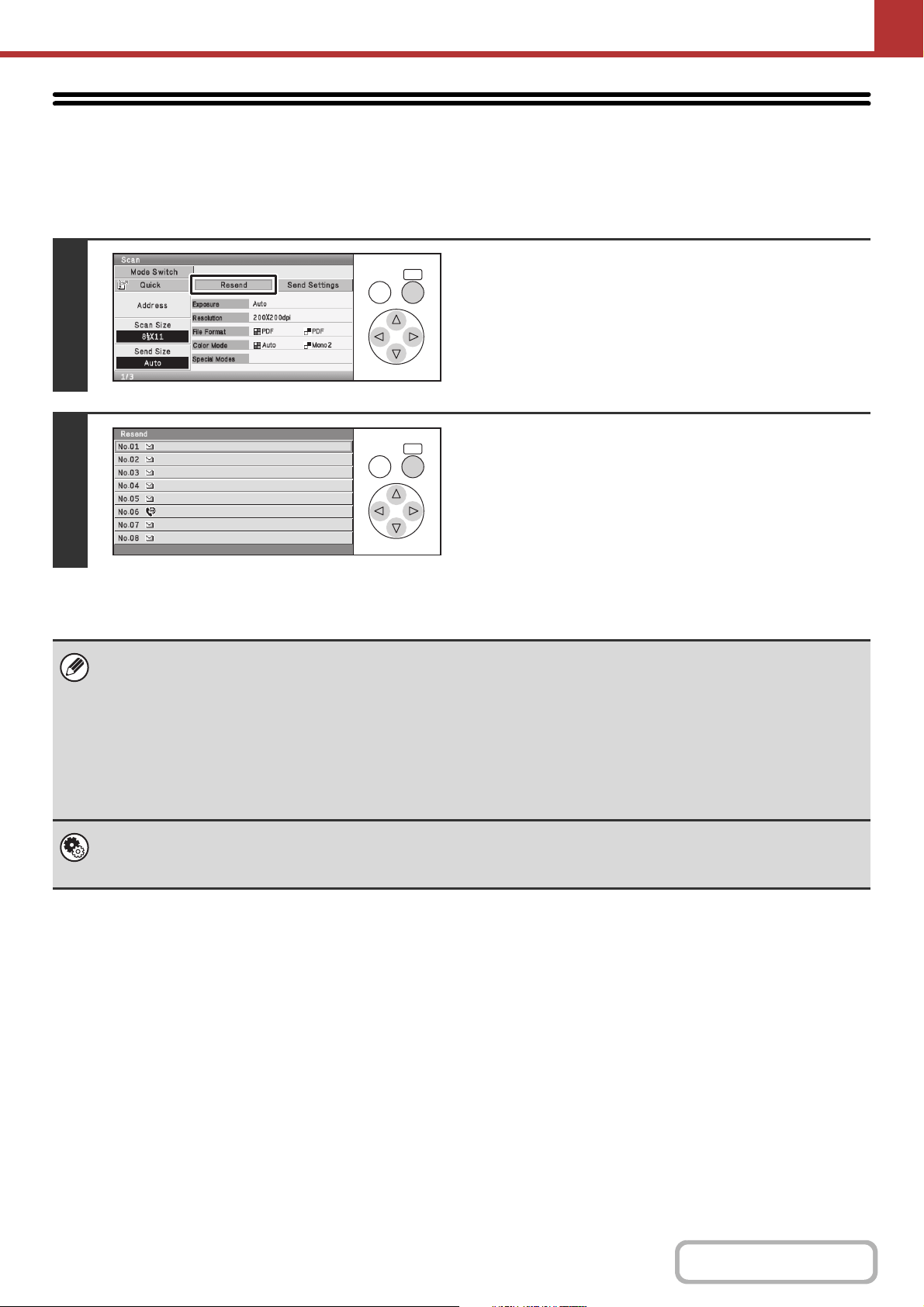
5-31
SCANNER/INTERNET FAX
Contents
USING THE RESEND FUNCTION
The destinations of the most recent 8 transmissions by Scan to E-mail, Internet fax (including Direct SMTP addresses)
and/or fax are stored. One of these can be selected to resend to that destination.
Keys in the display can be selected with the arrow keys and the [OK] key.
1
Select the [Resend] key.
2
Select the key of the desired address.
The last 8 addresses used for transmission are displayed.
• When the [Resend] key is selected and a destination selected, the mode of the selected destination is automatically
selected.
• The following types of addresses are not stored for resending.
- A one-touch key in which multiple destinations are stored (group key).
- Scan to FTP, Scan to Desktop, and Scan to Network Folder addresses.
- Broadcasting destinations
- Addresses used only for BCC delivery
- Destinations transmitted to using a program
System Settings (Administrator): Disable [Resend] on Fax/Image Send Mode (Web page only)
This prohibits use of the resend function. When this setting is enabled, the [Resend] key cannot be used in the base screen
of image send mode.
OKBACK
OK
BACK
AAA AAA
BBB BBB
CCC CCC
DDD DDD
EEE EEE
FFF FFF
GGG GGG
HHH HHH
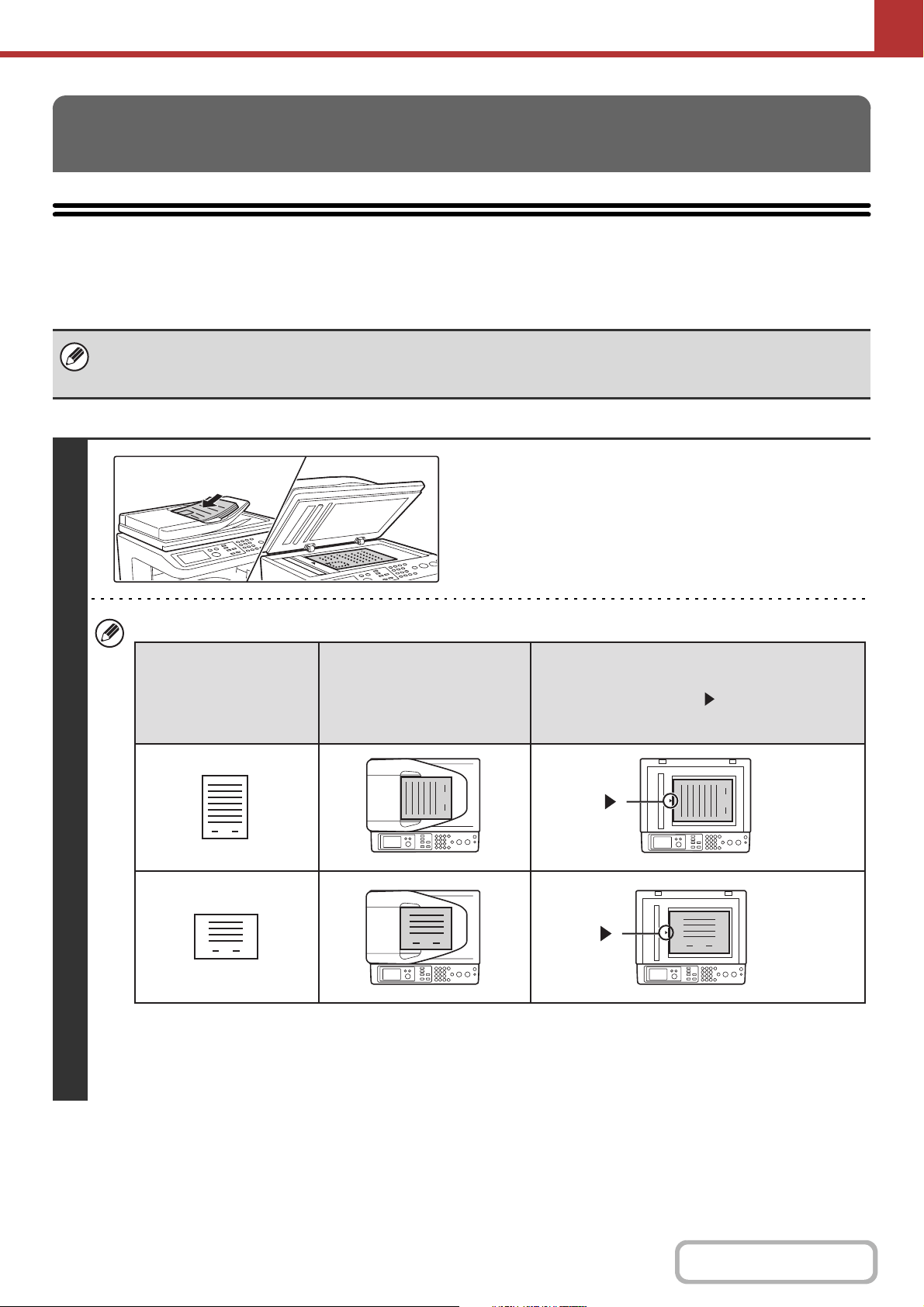
5-32
SCANNER/INTERNET FAX
Contents
SENDING AN IMAGE IN SCAN MODE
This section explains the basic procedure for transmission in scan mode (Scan to E-mail, Scan to FTP, Scan to
Desktop, and Scan to Network Folder).
Keys in the display can be selected with the arrow keys and the [OK] key.
TRANSMITTING AN IMAGE
When a default address is configured in "Default Address Setting" (Web page only) in the system settings (administrator), the
mode cannot be changed, the destination cannot be changed, and destinations cannot be added. If you wish to change the
mode or recipient, select the [Cancel] key in the display, press the [OK] key, and then follow the procedure below.
1
Place the original.
• When placing the originals, orient them as shown below.
* To place a large portrait-oriented original, place it as shown above in "Landscape orientation" and specify the
placement orientation in step 3.
• Originals cannot be scanned in succession from both the automatic document feeder and the document glass and
sent in a single transmission.
1
1
1
1
1
1
Document feeder tray
Place the original face up.
Portrait orientation*
Landscape orientation
Document glass
Place the original face down with the middle
aligned with the tip of the mark at the middle of
the scale on the left side of the document glass.
Originals
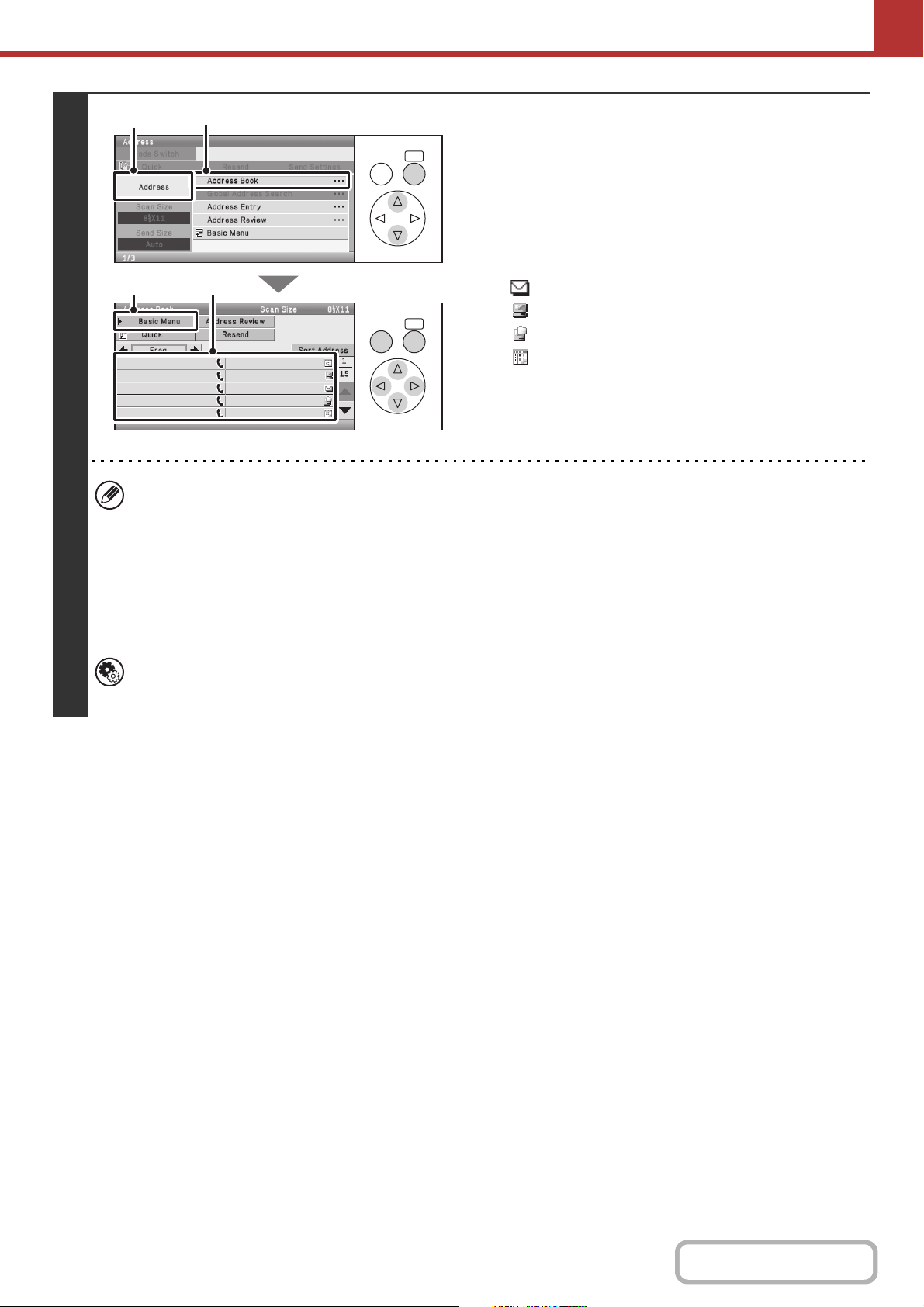
5-33
SCANNER/INTERNET FAX
Contents
2
Specify the destination.
(1) Select the [Address] key in the base screen.
(2) Select the [Address Book] key.
(3) Select the one-touch key of the desired
destination.
The icon on the key indicates the type of destination
stored in the key.
: Scan to E-mail
: Scan to FTP
: Scan to Network Folder
: Scan to Desktop
(4) Select the delivery method.
The destination is specified.
(5) Select the [Basic Menu] key.
• After selecting a one-touch key, if you change the screen without selecting the delivery method, the recipient will be
automatically specified as a "To" recipient.
• When performing Scan to E-mail, you can also send Cc or Bcc copies to other destinations. In the screen that
appears in (3), select the [Cc] key or the [Bcc] key and press the [OK] key.
• Multiple destinations can be specified. To specify multiple destinations, repeat steps (3) and (4).
• In addition to specification by a one-touch key, a destination can also be specified by a search number. For a Scan
to E-mail destination, you can enter an address manually or retrieve an address from a global address book. For
more information, see "ENTERING DESTINATIONS" (page 5-22).
System Settings (Administrator): Bcc Setting (Web page only)
This setting enables or disables Bcc delivery. When this setting is enabled, the [Bcc] key is displayed in the delivery
type selection screen.
OKBACK
OKBACK
AAA AAA
BBB BBB
CCC CCC
DDD DDD
EEE EEE
FFF FFF
GGG GGG
HHH HHH
III III
JJJ JJJ
(2)
(5)
(1)
(3)

5-34
SCANNER/INTERNET FAX
Contents
3
Check the original scan size and
placement orientation.
To make sure that the original is scanned in the correct
orientation (the orientation in which the top edge of the original
appears at the top of the display), check the size and
orientation of the original placed in step 1.
(1) Check the scan size.
Check if the size of the placed original is displayed in the
[Scan Size] key. If the displayed size is different from the
size of the placed original, set the original size.
☞ SPECIFYING THE ORIGINAL SCAN SIZE AND
SEND SIZE (page 5-61)
(2) Select the [Scan Size] key.
(3) Select the [Image Orientation] key.
(4)
Set the placement orientation of the original.
If the original is placed with the top edge at the top, select
[Landscape] with the keys. If the top edge is
placed to the left, select [Portrait]. Press the [OK] key.
(5) Press the [BACK] key.
You will return to the basic screen.
• The placement orientation of the original is initially set to [Portrait]. If you placed the original with the top edge to the
left, this step is not necessary.
• The original size set in the system settings appears as the original size.
4
Press the [COLOR START] key or the [BLACK & WHITE START] key.
Scanning begins.
• If the original is placed on the document glass, the [Read-End] key appears in the display. If the original is only one page,
go to step 6. To scan more pages, go to the next step.
• If the original was inserted in the document feeder tray, a beep will sound when scanning is completed and transmission
will take place.
• To scan in full color, press the [COLOR START] key. To scan in black and white, press the [BLACK & WHITE
START] key. If the color mode of the [COLOR START] key is set to [Auto], the color of the original will be detected
automatically and scanning in full color, grayscale or Mono2 will take place.
• If the file type is [Encrypt PDF], a password entry screen will appear when the [START] key is pressed.
Select the [Entry] key and press the [OK] key to open the keyboard screen. Enter a password (maximum of 32
characters), and press the [OK] key. The recipient must use the password entered here to open the encrypted PDF
file.
To cancel encrypted PDF, select the [Cancel] key and press the [OK] key. The format settings screen will appear to
let you change the file type. Select a new file type and press the [START] key to begin transmission.
OKBACK
OKBACK
OKBACK
(1), (2)
(3)
(4) (5)
OKBACK
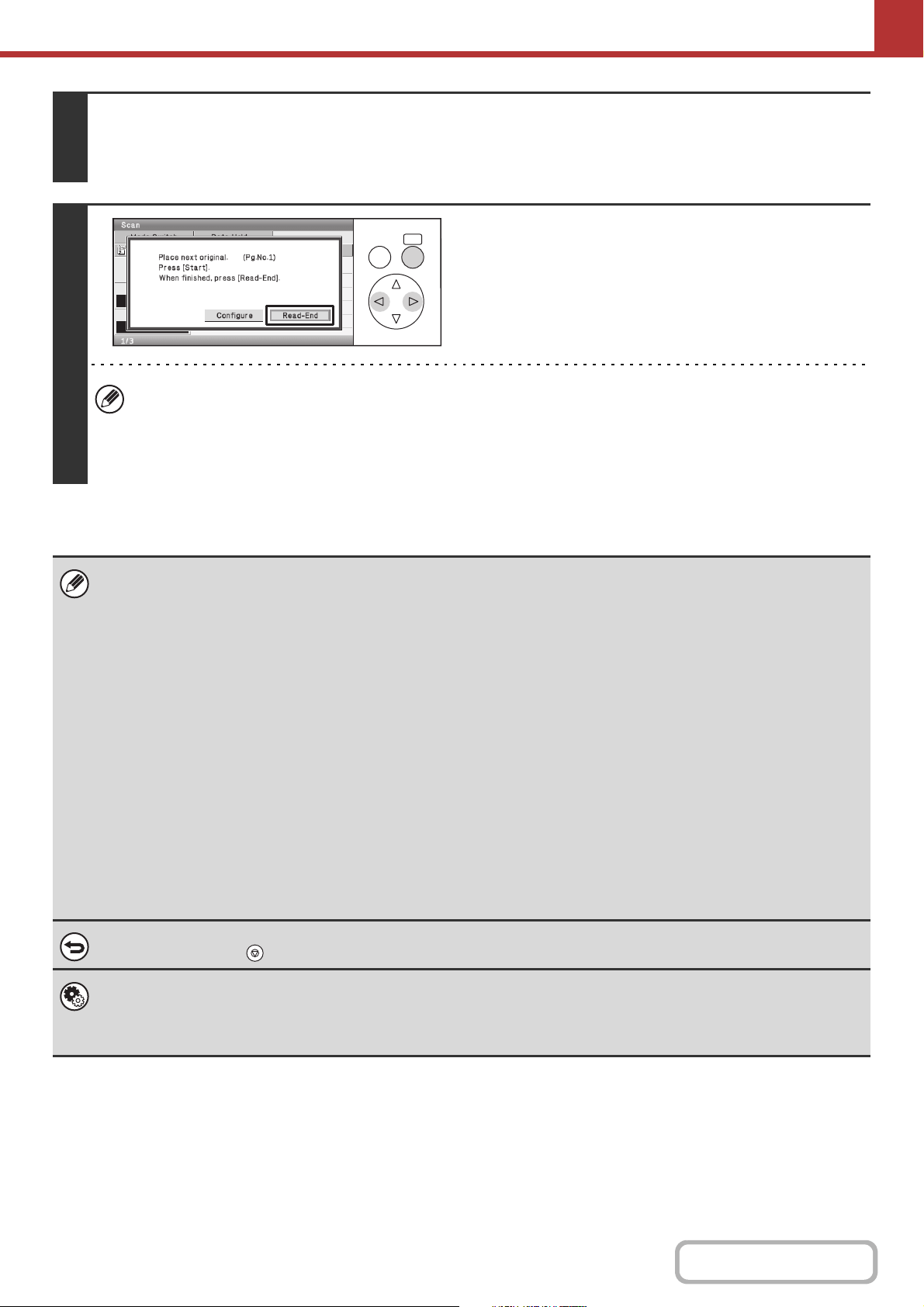
5-35
SCANNER/INTERNET FAX
Contents
5
If the original was placed on the document glass, replace it with the next original
and press the [COLOR START] key or the [BLACK & WHITE START] key.
Repeat until all originals have been scanned.
6
Select the [Read-End] key.
A beep will sound to indicate that the operation is completed.
Open the automatic document feeder and remove the original.
• If no action is taken for one minute after the confirmation screen appears, scanning automatically ends and the
transmission is reserved.
• To change the exposure, resolution, scan size, or send size for each original page scanned, select the [Configure]
key and press the [OK] key. However, when "Card Shot" is selected in the special modes, only the exposure can be
changed when scanning an even-numbered original page.
• When all originals have been scanned, "Job stored." will be displayed together with a job control number. This number can
be used to locate the job in the Transaction Report or in the Image Sending Activity Report. If the job is a broadcast
transmission, this number will also appear in the key of the job in the job status screen. For this reason, making a note of
the number is useful for checking the result.
• If the memory becomes full while the originals are being scanned, a message will appear and scanning will stop.
• When performing Scan to E-mail, take care not to send a file that is too large. In particular, multi-page files tend to be large.
When sending a multi-page file or other large file, it may be necessary to reduce the number of scanned pages or reduce
the send size.
• Storing a mail signature
• You can have preset text automatically added at the end of e-mail messages as a mail signature. This is convenient when
you wish to have a corporate policy or other preset text appear at the bottom of e-mail messages. To store the text for the
mail signature, click [Application Settings], [Network Scanner Settings] and then [Administration Settings] in the Web page
menu. (Administrator rights are required.) Up to 900 characters can be entered. (The mail signature is not included in the
maximum number of characters that can be entered in the e-mail message.)
• Add a Footer Automatically to the Mail Message Body
Use this setting to specify whether or not a mail signature is added at the end of e-mail messages. By factory default, a
mail signature is not added. Store in [Application Settings] > [Network Scanner Settings] > [Administration Settings] in the
Web page menu. (Administrator rights are required.)
To cancel scanning...
Press the [STOP] key ( ) to cancel the operation.
System Settings (Administrator): Image Send Settings
Use this to configure scanner transmission settings, including the default resolution and exposure settings, the default color
mode and file format, the file compression method for broadcasting, the file size limit for Scan to E-mail, and the default
sender and destination.
OKBACK
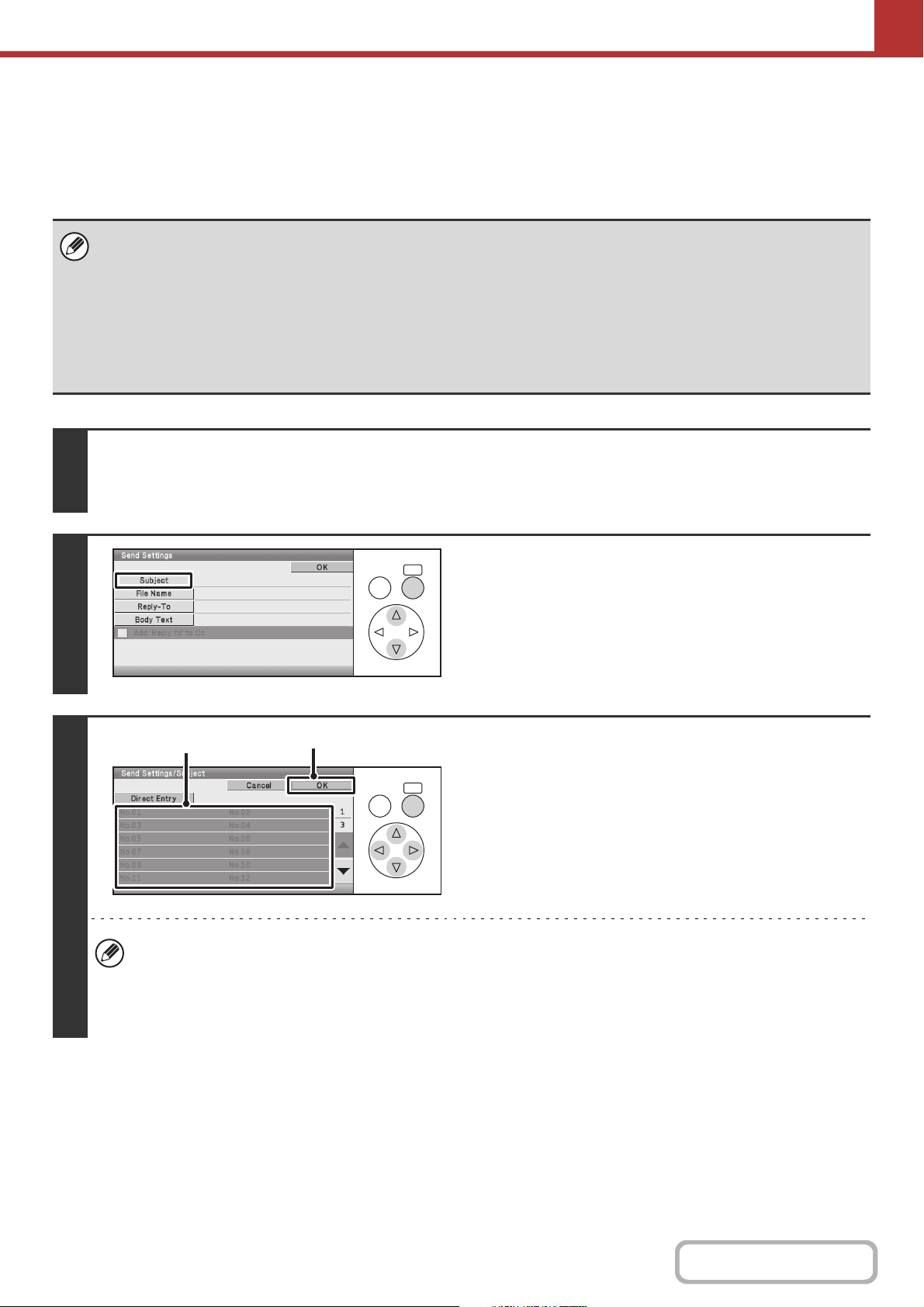
5-36
SCANNER/INTERNET FAX
Contents
CHANGING THE SUBJECT, FILE NAME, REPLY-TO,
AND BODY TEXT
The subject, file name, reply-to, and body text can be changed when performing a scan transmission. Preset items can
be selected or text can be directly entered.
Keys in the display can be selected with the arrow keys and the [OK] key.
• When performing Scan to FTP, Scan to Desktop, or Scan to Network Folder, only the file name is used.
• If the subject and file name are not changed, the settings in the Web page are used.
• If the sender name is not changed, the name set in "Default Sender Set" (Web page only) in the system settings is used. If
this is not configured, the reply address in [Network Settings] - [Services Settings] - [SMTP Settings] in the Web pages is
used. (Administrator rights are required.)
• Selections for the subject, file name, and body text are configured by clicking [Application Settings] and then [Network
Scanner Settings] in the Web page menu.
• For the procedure for entering text, see "ENTERING TEXT" (page 1-61) in "1. BEFORE USING THE MACHINE".
1
Select the [Send Settings] key in the base screen.
☞
BASE SCREENS (page 5-13)
If you are sending to a Scan to FTP, Scan to Desktop, or Scan to Network Folder destination, go to step 4.
2
To change the subject, select the
[Subject] key.
3
Enter the subject.
(1) Select a Pre-Set text key.
(2) Select the [OK] key.
• If you wish to directly enter the text, select the [Direct Entry] key and press the [OK] key. A text entry screen will
open. Enter the text and press the [OK] key.
• To edit pre-set text, select the pre-set text, select the [Direct Entry] key, and press the [OK] key. The text entry
screen will appear with the selected pre-set text entered. (When a destination is stored using the Web pages, up to
80 characters can be entered. However, only 54 characters can be entered in the display.)
OKBACK
OKBACK
(2)
(1)
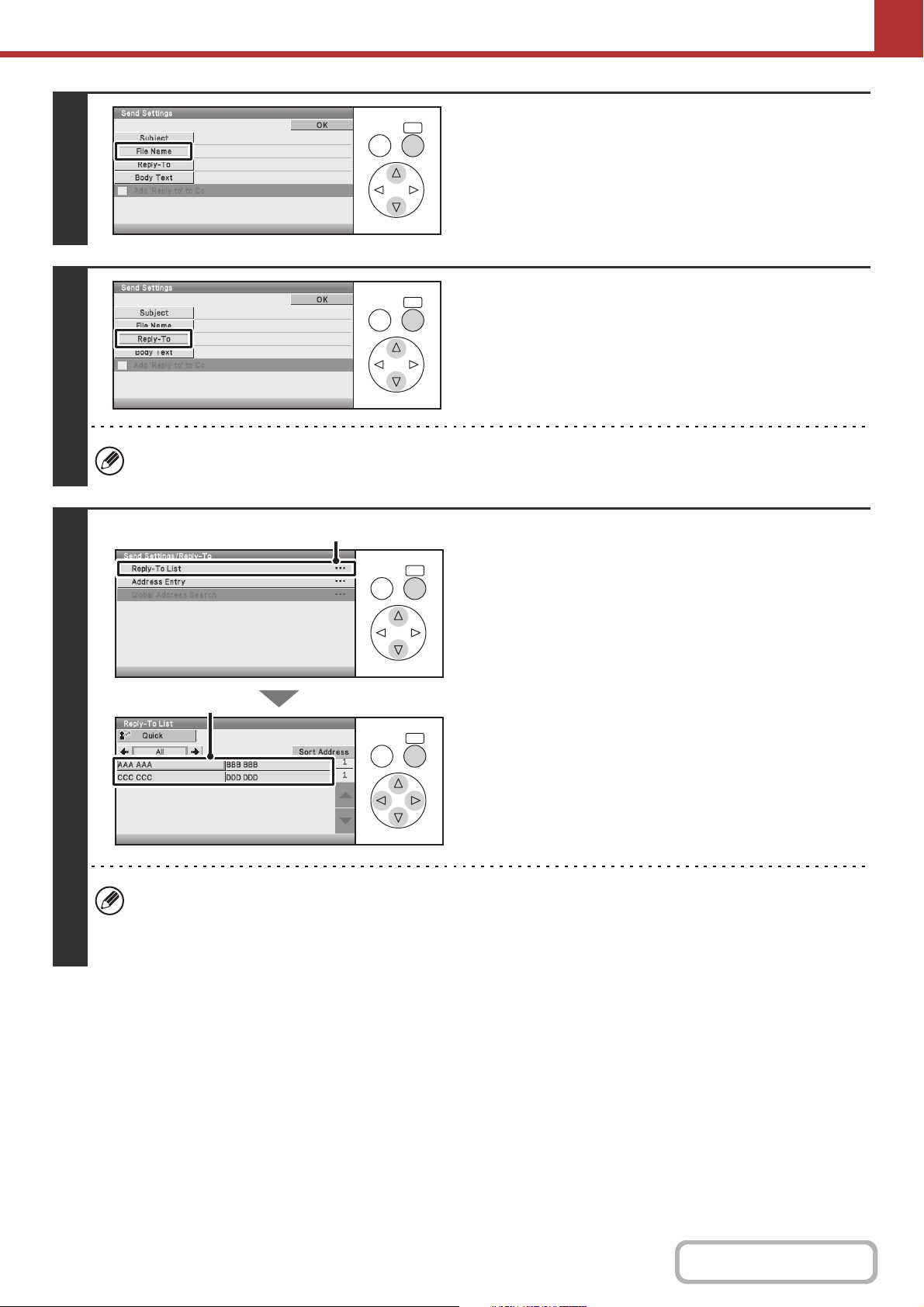
5-37
SCANNER/INTERNET FAX
Contents
4
To change the file name, select the [File
Name] key.
• The file name is entered in the same way as the subject.
• If you are sending to a Scan to FTP, Scan to Desktop, or
Scan to Network Folder destination, go to step 9.
5
To change "Reply-To", select the
[Reply-To] key.
If user authentication is being used, the information of the user that logged in will be applied, and thus "Reply-To"
cannot be changed.
6
Specify a user for "Reply-To".
(1) Select the [Reply-To List] key.
(2) Select the return address.
To specify a user stored in a global address book for
"Reply-To", you can select the [Global Address Search]
key and press the [OK] key.
You can also select the [Address Entry] key and press the
[OK] key to directly enter an e-mail address.
• To specify the return address by entering a user number that has been stored in [User List] of [User Control] > [User
List] in the Web page menu, select the [Quick] key and press the [OK] key. (Administrator rights are required.)
• To select a key for the return address, e-mail addresses must be set for the users stored in the [User List] of [User
Control] > [User List] in the Web page menu. (Administrator rights are required.)
OKBACK
OK
BACK
OKBACK
OKBACK
(1)
(2)
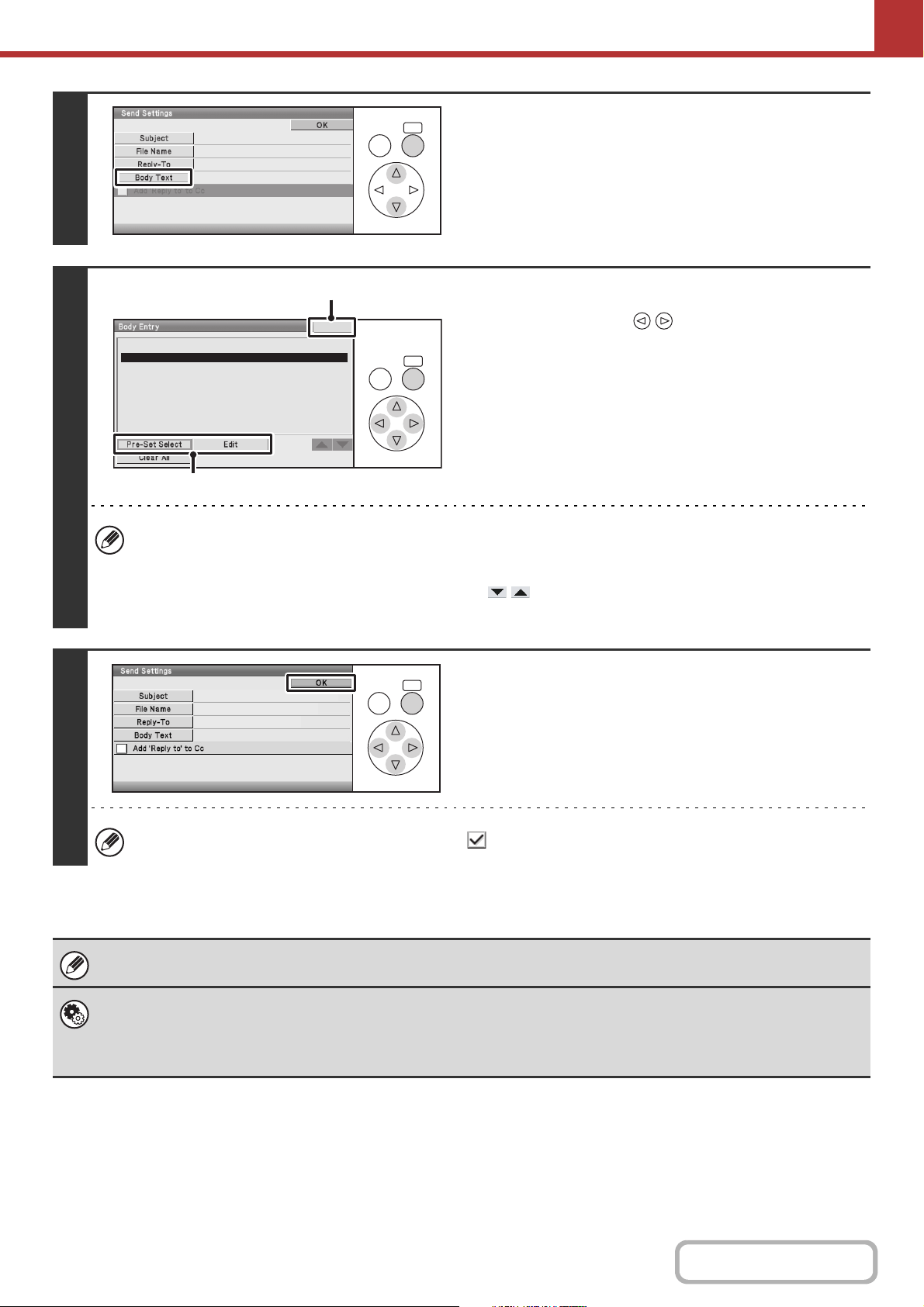
5-38
SCANNER/INTERNET FAX
Contents
7
To change the body text, select the
[Body Text] key.
8
Enter the body text.
(1) Select with the keys.
• To select a pre-set text previously stored in the Web
page, select the [Pre-Set Select] key and press the
[OK] key.
• To directly enter the body text, select the [Edit] key and
press the [OK] key.
(2) Select the [OK] key.
• 1800 characters can be entered. (A line break counts as one character.)
• To clear all entered text, select the [Clear All] key. When the [OK] key is pressed, the entire body of the message is
erased immediately; not just the selected line.
• Each line of the entered text can be selected with the keys. To edit the selected line, select the [Edit] key.
The text entry screen will appear with the selected text entered.
9
Select the [OK] key.
The [Add 'Reply to' to Cc] checkbox can be selected to send a Cc copy to the sender.
When storing pre-set text for the subject and file name in the Web pages, up to 80 characters can be entered.
• System Settings (Administrator): The Number of File Name/Subject/Body Keys Displayed Setting
The setting for the number of subject keys and file name keys displayed in one screen can be changed to 6, 12, or 18.
• System Settings (Administrator): Default Sender Set (Web page only)
This is used to store the sender name and e-mail address that is used when a sender is not selected.
OKBACK
Sub: Schedule coordination meeting
Material for planning meeting
AAA AAA
OKBACK
attached scanned data,which you have requested.
Thank you for your continuous support. We have
OK
(2)
(1)
OKBACK
Sub: Schedule coordination meeting
Material for planning meeting
AAA AAA
Thank you for your continuous sup
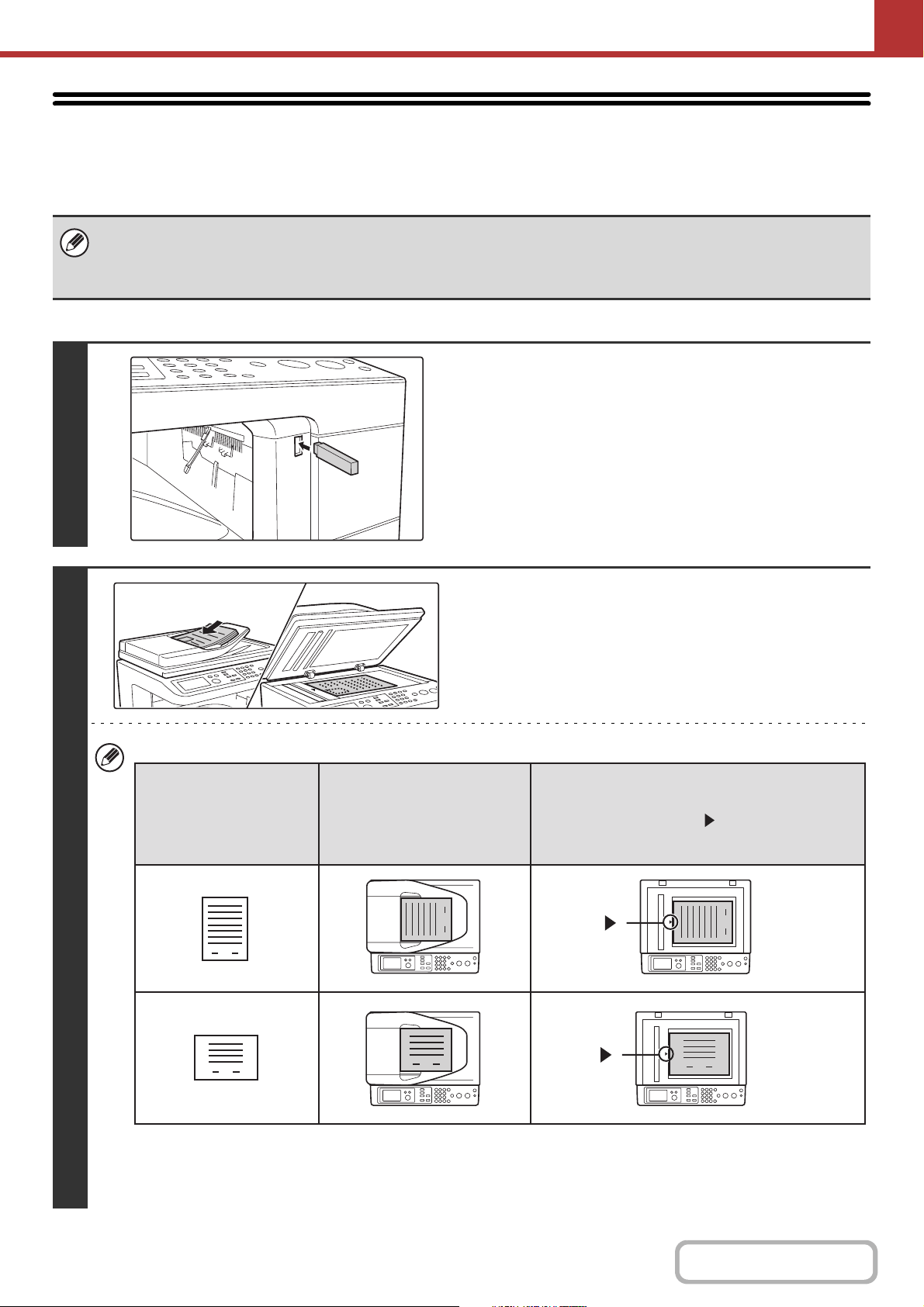
5-39
SCANNER/INTERNET FAX
Contents
SENDING AN IMAGE IN USB MEMORY MODE
Follow the steps below to send a scanned image to a commercially available USB memory device that has been
connected to the machine. This stores the file in the USB device.
Keys in the display can be selected with the arrow keys and the [OK] key.
• Use a FAT32 USB memory with a capacity of no more than 32 GB.
• When a default address is configured in "Default Address Setting" (Web page only) in the system settings (administrator),
the mode cannot be changed. To switch to USB memory mode, select the [Cancel] key in the display, press the [OK] key,
and follow the steps below.
1
Connect the USB memory to the USB
connector (Type A) on the machine.
2
Place the original.
• When placing the originals, orient them as shown below.
* To place a large portrait-oriented original, place it as shown above in "Landscape orientation" and specify the
placement orientation in step 4.
• Originals cannot be scanned in succession from both the automatic document feeder and the document glass and
sent in a single transmission.
1
1
1
1
1
1
Document feeder tray
Place the original face up.
Portrait orientation*
Landscape orientation
Document glass
Place the original face down with the middle
aligned with the tip of the mark at the middle of
the scale on the left side of the document glass.
Originals
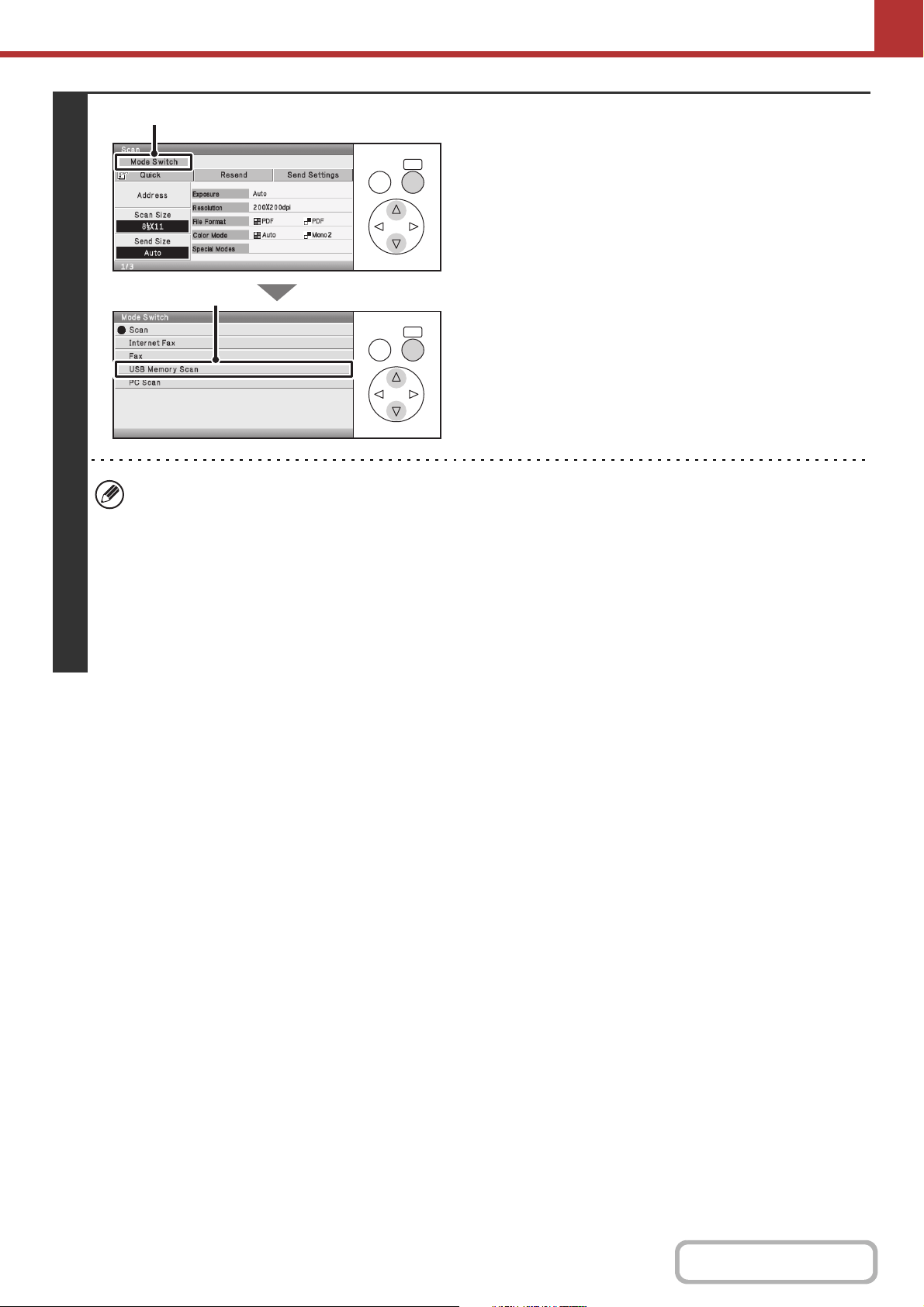
5-40
SCANNER/INTERNET FAX
Contents
3
Switch to USB memory mode.
(1) Select the [Mode Switch] key.
(2) Select the [USB Memory Scan] key.
• When scanning to USB memory, there is no need to specify the destination.
• If a destination of another mode has been previously specified, a message will appear when you change to USB
memory mode indicating that the destination setting will be cleared. Select [OK], press the [OK] key, and go to the
next step.
• The current settings of [Scan Size], [Send Size], [Exposure], [Resolution], [File Format], and [Color Mode] are
indicated in each key. The settings can be changed in the setting screens.
☞ AUTOMATICALLY SCANNING BOTH SIDES OF AN ORIGINAL (2-Sided Original) (page 5-59), SPECIFYING
THE ORIGINAL SCAN SIZE AND SEND SIZE (page 5-61), CHANGING THE EXPOSURE AND ORIGINAL
IMAGE TYPE (page 5-67), CHANGING THE RESOLUTION (page 5-69), CHANGING THE FILE FORMAT
(page 5-70), CHANGING THE COLOR MODE (page 5-75), SPECIAL MODES (page 5-77)
OKBACK
OKBACK
(1)
(2)
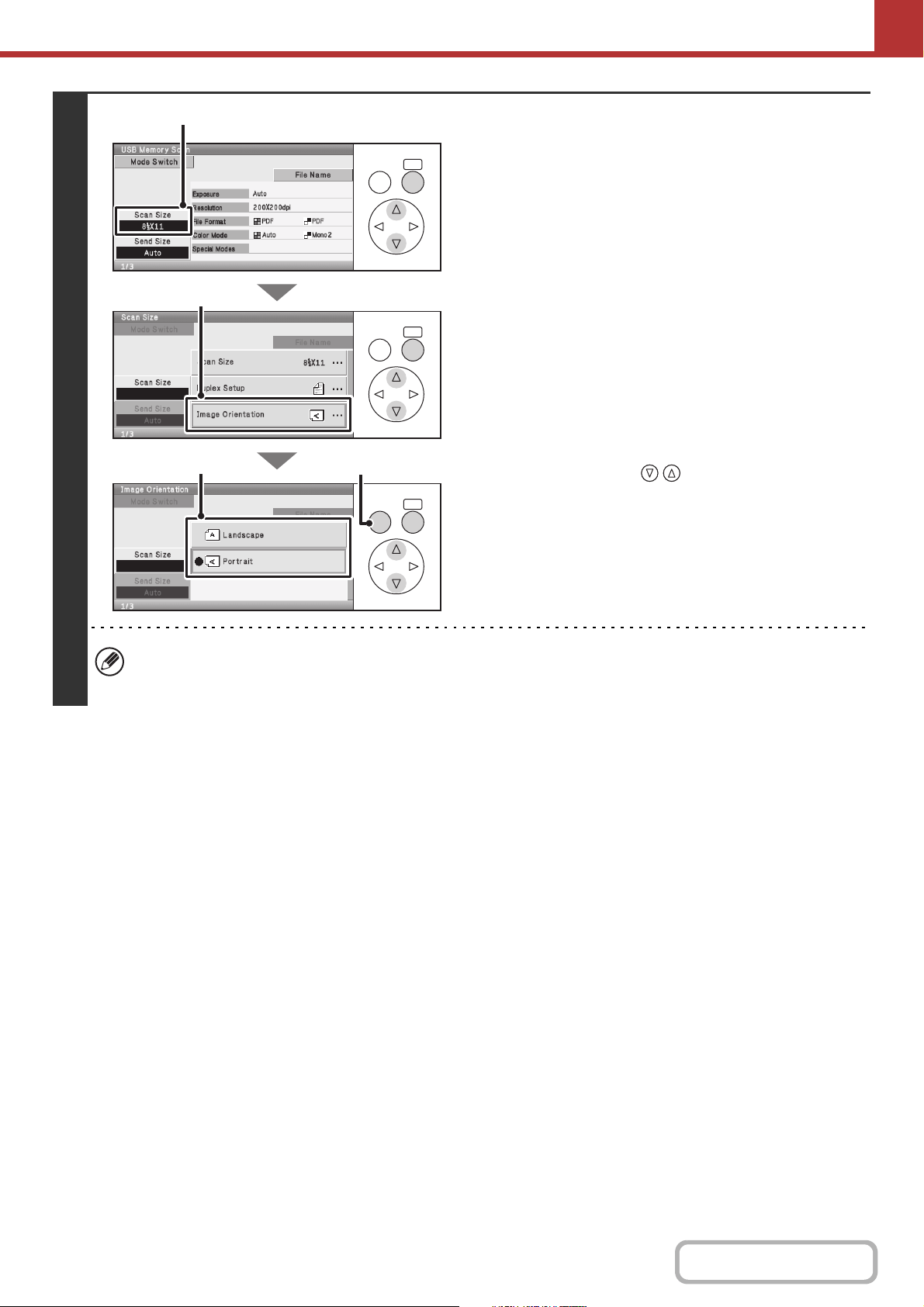
5-41
SCANNER/INTERNET FAX
Contents
4
Check the original scan size and
placement orientation.
To make sure that the original is scanned in the correct
orientation (the orientation in which the top edge of the original
appears at the top of the display), check the size and
orientation of the original placed in step 1.
(1) Check the scan size.
Check if the size of the placed original is displayed in the
[Scan Size] key. If the displayed size is different from the
size of the placed original, set the original size.
☞ SPECIFYING THE ORIGINAL SCAN SIZE AND
SEND SIZE (page 5-61)
(2) Select the [Scan Size] key.
(3) Select the [Image Orientation] key.
(4)
Set the placement orientation of the original.
If the original is placed with the top edge at the top, select
[Landscape] with the keys. If the top edge is
placed to the left, select [Portrait]. Press the [OK] key.
(5) Press the [BACK] key.
You will return to the basic screen.
• The placement orientation of the original is initially set to [Portrait]. If you placed the original with the top edge to the
left, this step is not necessary.
• The original size set in the system settings appears as the original size.
OKBACK
OKBACK
OKBACK
(1), (2)
(3)
(4)
(5)
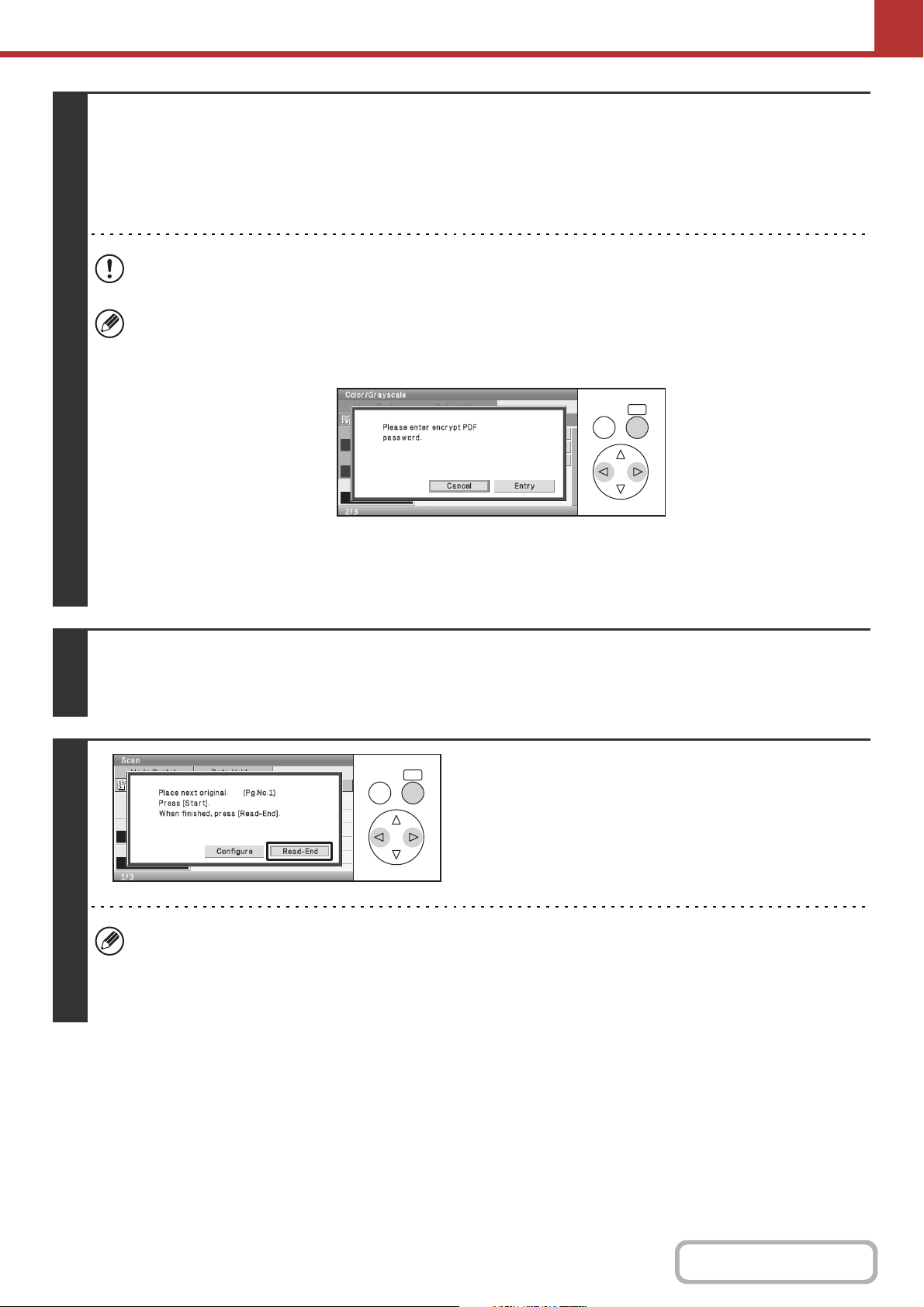
5-42
SCANNER/INTERNET FAX
Contents
5
Press the [COLOR START] key or the [BLACK & WHITE START] key.
Scanning begins.
• If the original is placed on the document glass, the [Read-End] key appears in the display. If the original is only one page,
go to step 7. To scan more pages, go to the next step.
• If the original was inserted in the document feeder tray, a beep will sound when scanning is completed and transmission
will begin. Go to step 8.
Do not disconnect the USB memory until "Sending data has been completed." appears in the display.
• To scan in full color, press the [COLOR START] key. To scan in black and white, press the [BLACK & WHITE
START] key. If the color mode of the [COLOR START] key is set to [Auto], the color of the original will be detected
automatically and scanning in full color, grayscale or Mono2 will take place.
• If the file type is [Encrypt PDF], a password entry screen will appear when the [START] key is pressed.
Select the [Entry] key and press the [OK] key to open the keyboard screen. Enter a password (maximum of 32
characters), and press the [OK] key. The recipient must use the password entered here to open the encrypted PDF file.
To cancel encrypted PDF, select the [Cancel] key and press the [OK] key. The format settings screen will appear to
let you change the file type. Select a new file type and press the [START] key to begin transmission.
6
If the original was placed on the document glass, replace it with the next original
and press the [COLOR START] key or the [BLACK & WHITE START] key.
Repeat until all originals have been scanned.
7
Select the [Read-End] key.
A beep will sound to indicate that the operation is completed.
Open the automatic document feeder and remove the original.
• If no action is taken for one minute after the confirmation screen appears, scanning automatically ends and the
transmission is reserved.
• To change the exposure, resolution, scan size, or send size for each original page scanned, select the [Configure]
key and press the [OK] key. However, when "Card Shot" is selected in the special modes, only the exposure can be
changed when scanning an even-numbered original page.
OKBACK
OKBACK
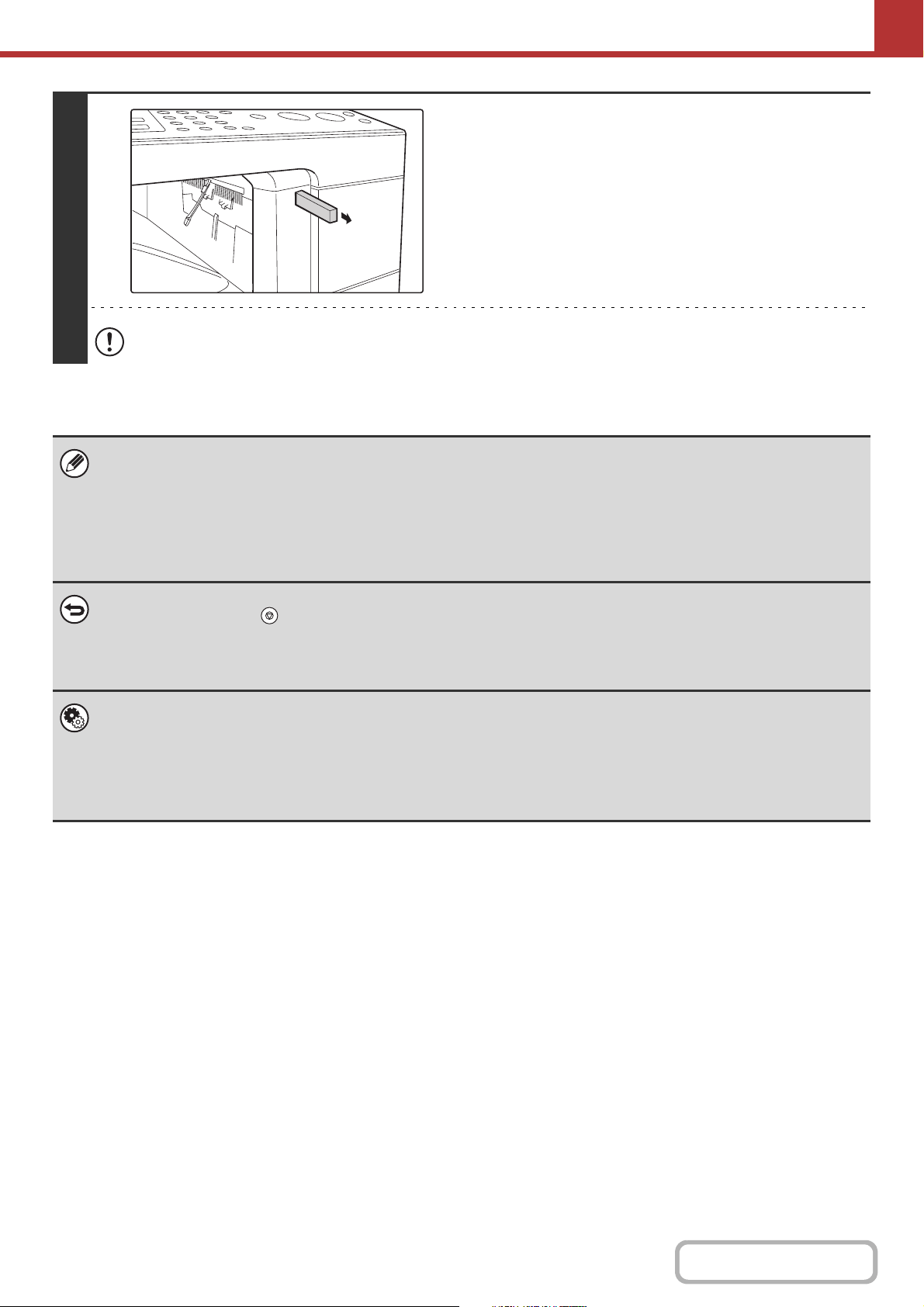
5-43
SCANNER/INTERNET FAX
Contents
8
When "Sending data has been
completed." appears in the display,
disconnect the USB memory.
Do not disconnect the USB memory while "Processing data." or "Sending data." appears in the display.
• When transmission to USB memory is completed, "Sending data has been completed." is displayed. After a brief interval
the message is cleared and the base screen of image send mode reappears. (The base screen of image send mode is the
screen that appears when the [IMAGE SEND] key is pressed.)
• If the USB memory becomes full during scanning...
A message will appear and scanning will stop. The scanned data will not be stored. However, if the file format is set to
JPEG and the [Specified Pages per File] checkbox is selected, files for which scanning is completed will be stored in USB
memory.
• To cancel scanning...
Press the [STOP] key ( ) to cancel the operation.
• To cancel scanning to USB memory...
While scanned data is being stored in the USB memory, the message "Sending data." and the [Cancel] key appear in the
display. To cancel the data save, select the [Cancel] key and press the [OK] key.
• System Settings: USB-Device Check (page 6-16)
This is used to check the connection of a USB device to the machine.
• System Settings (Administrator): Scan Settings (Web page only)
This is used to set the default color mode and file format.
• System Settings (Administrator): Disable Scan Function (Web page only)
The use of PC scan mode and USB memory mode can be prohibited.
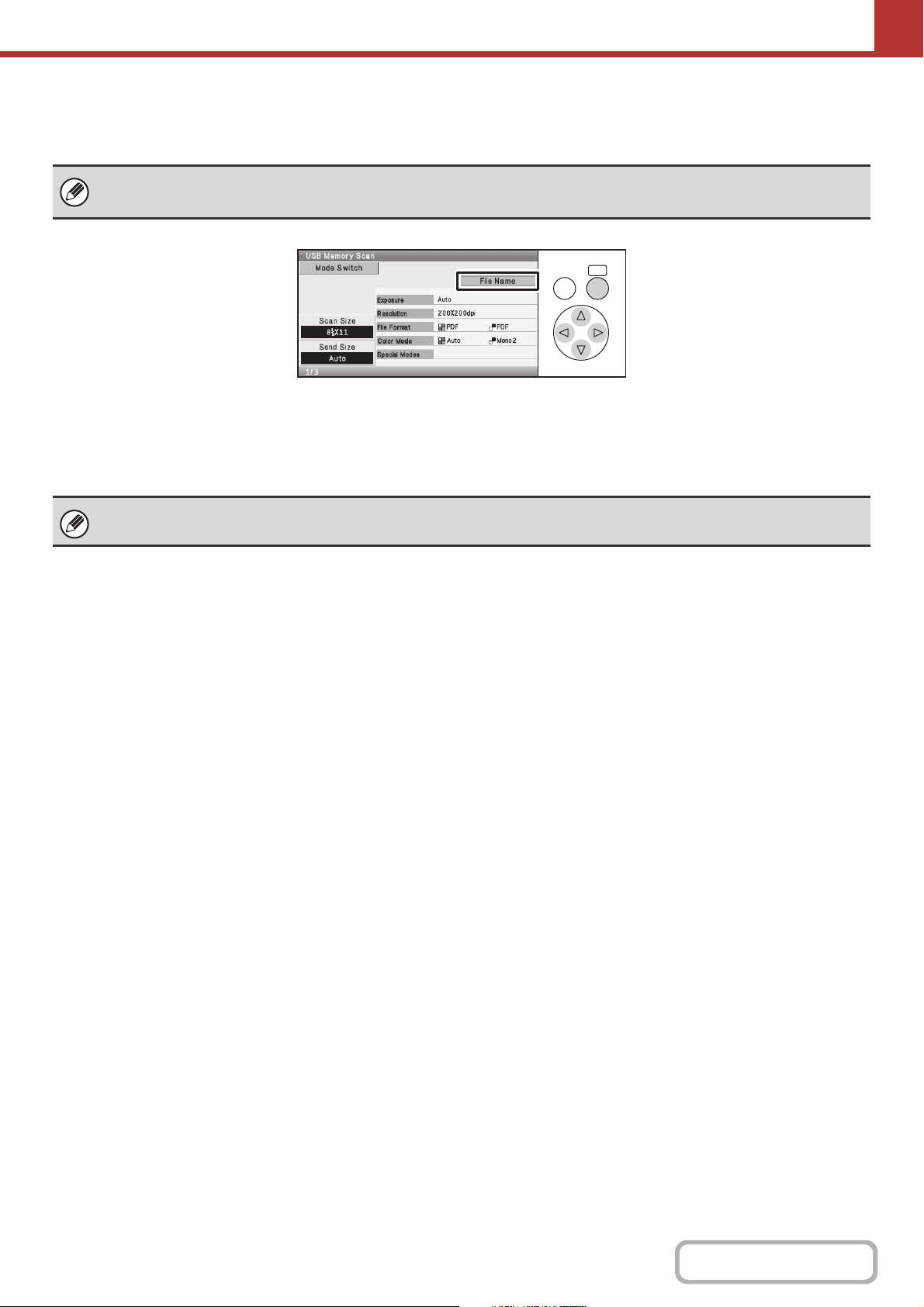
5-44
SCANNER/INTERNET FAX
Contents
ENTERING A FILE NAME
The file name can be directly entered when performing a scan transmission.
Select the [File Name] key and press the [OK] key. A text entry screen will appear. Enter the file name, select [OK], and
press the [OK] key.
• If the file name is not entered, the settings in the Web page are used.
• For the procedure for entering text, see "ENTERING TEXT" (page 1-61) in "1. BEFORE USING THE MACHINE".
To check the entered file name, select the [File Name] key in the base screen once again and press the [OK] key.
OKBACK
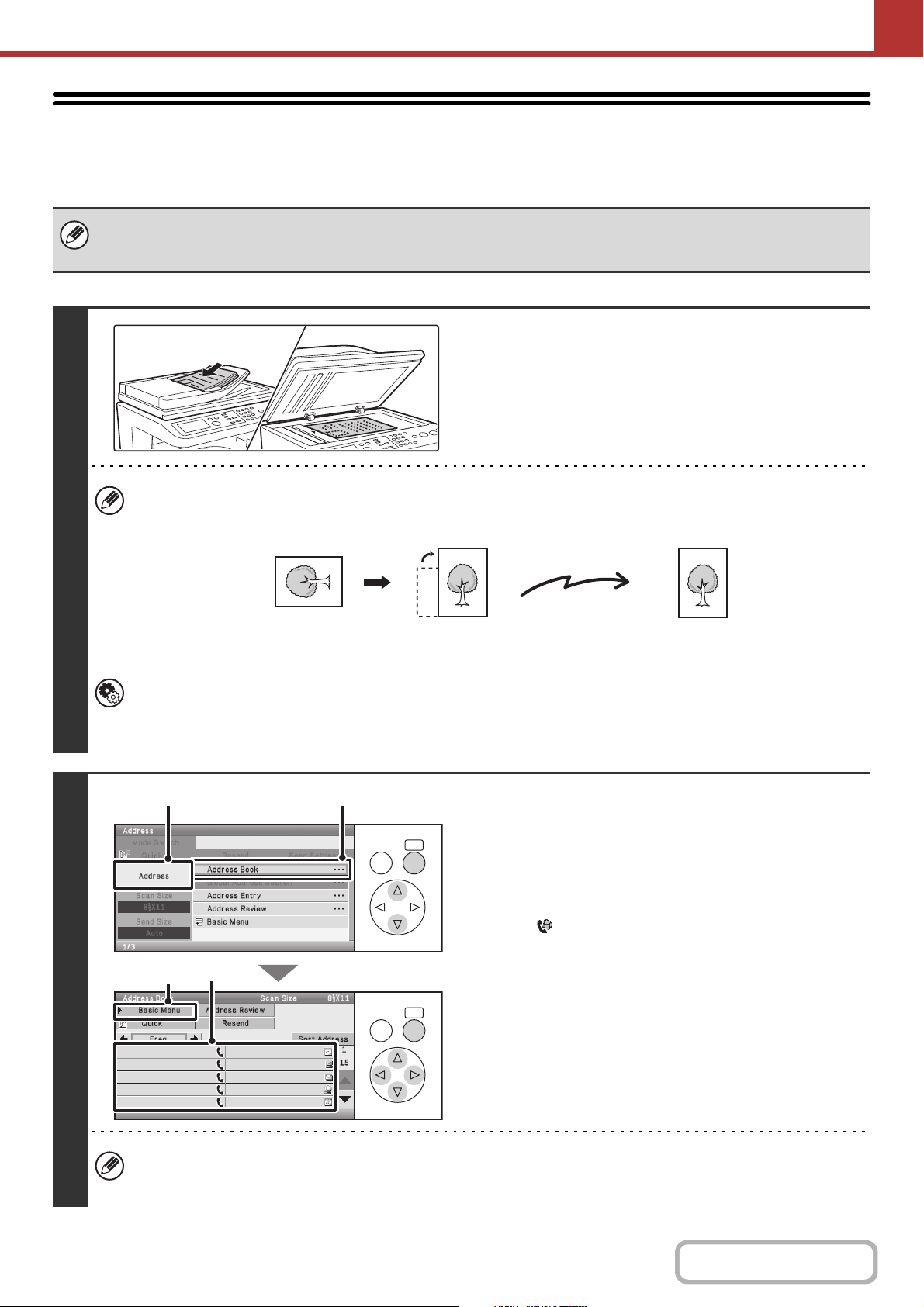
5-45
SCANNER/INTERNET FAX
Contents
SENDING A FAX IN INTERNET FAX MODE
The basic procedure for sending a fax in Internet fax mode is explained below. This procedure can also be used to
perform direct transmission by Direct SMTP.
Keys in the display can be selected with the arrow keys and the [OK] key.
When a default address is configured in "Default Address Setting" (Web page only) in the system settings (administrator), the
mode cannot be changed, the destination cannot be changed, and destinations cannot be added. To switch to Internet fax
mode, select the [Cancel] key in the display, press the [OK] key, and follow the steps below.
1
Place the original.
Place the original face up in the document feeder tray, or face
down on the document glass.
• Image rotation
5-1/2" x 8-1/2" (A5) or B5 size original in landscape orientation will be rotated 90 degrees and transmitted as
5-1/2" x 8-1/2" (A5) or B5 image in portrait orientation.
• Originals cannot be scanned in succession from both the automatic document feeder and the document glass and
sent in a single transmission.
System Settings (Administrator): Rotation Sending Setting (Web page only)
This is used to select whether or not a scanned original image is rotated before transmission.
Initially a B5 landscape original is set to be rotated and sent as a B5 portrait image, and a 5-1/2" x 8-1/2" (A5)
landscape original is set to be rotated and sent as a 5-1/2" x 8-1/2" (A5) portrait image.
2
Specify the destination.
(1) Select the [Address] key in the base screen.
(2) Select the [Address Book] key.
(3) Select the key of the desired destination.
The e-mail address is specified as the return address.
The icon appears in one-touch keys in which Internet
fax addresses are stored.
(4) Select the [Basic Menu] key.
In addition to specification by a one-touch key, a destination can also be specified by a search number. You can also
manually enter a destination or look up a destination in a global address book. For more information, see "ENTERING
DESTINATIONS" (page 5-22).
Transmission
OKBACK
OKBACK
AAA AAA
BBB BBB
CCC CCC
DDD DDD
EEE EEE
FFF FFF
GGG GGG
HHH HHH
III III
JJJ JJJ
(2)
(4)
(1)
(3)
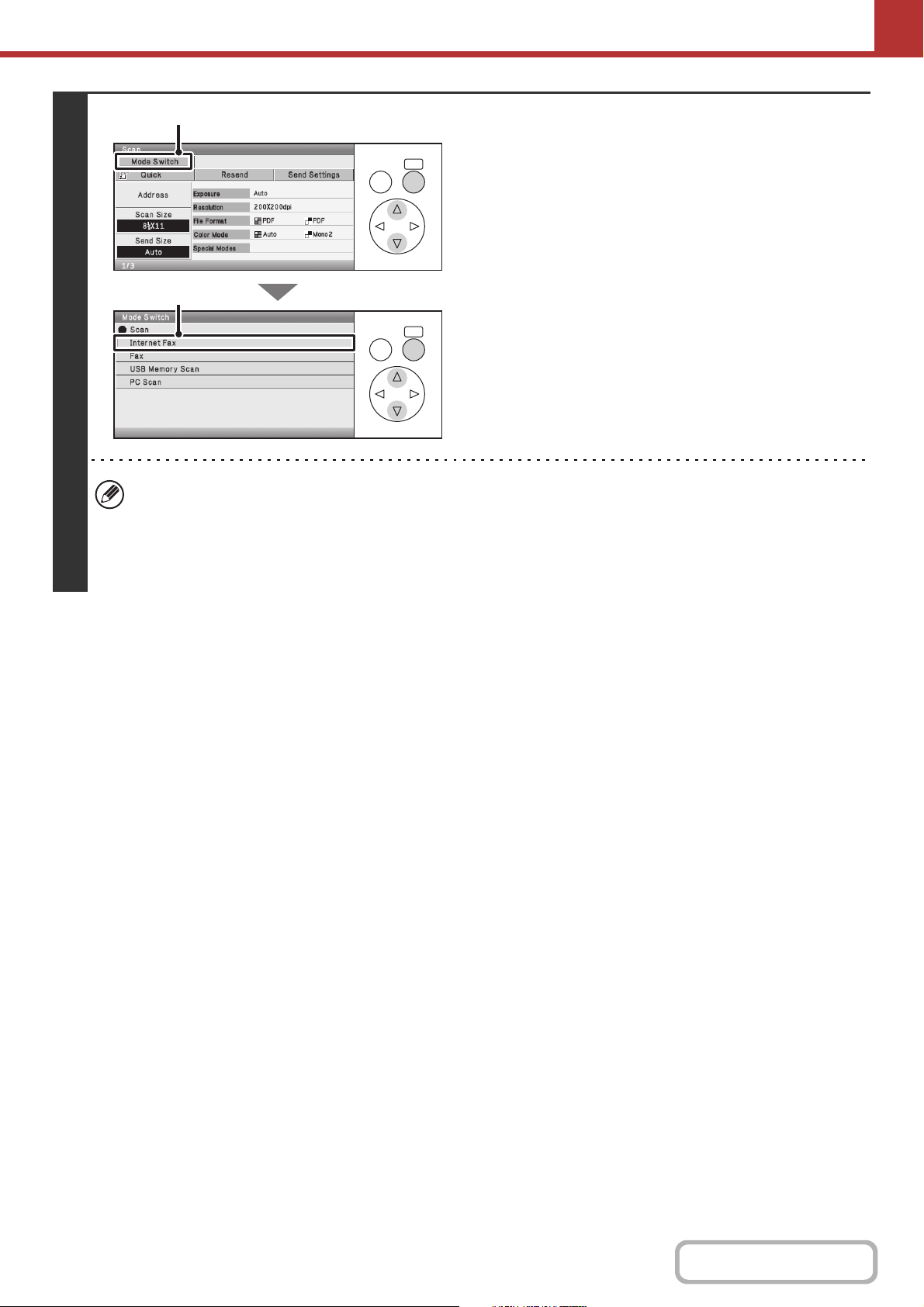
5-46
SCANNER/INTERNET FAX
Contents
3
Switch to Internet fax mode.
(1) Select the [Mode Switch] key.
(2) Select the [Internet Fax] key.
The current settings for [Scan Size], [Send Size], [Exposure], [Resolution], and [File Format] are indicated at the right
of each key. To change a setting, select the appropriate key.
☞ AUTOMATICALLY SCANNING BOTH SIDES OF AN ORIGINAL (2-Sided Original) (page 5-59), SPECIFYING
THE ORIGINAL SCAN SIZE AND SEND SIZE (page 5-61), CHANGING THE EXPOSURE AND ORIGINAL
IMAGE TYPE (page 5-67), CHANGING THE RESOLUTION (page 5-69), CHANGING THE FILE FORMAT (page
5-70), SPECIAL MODES (page 5-77)
OKBACK
OKBACK
(2)
(1)
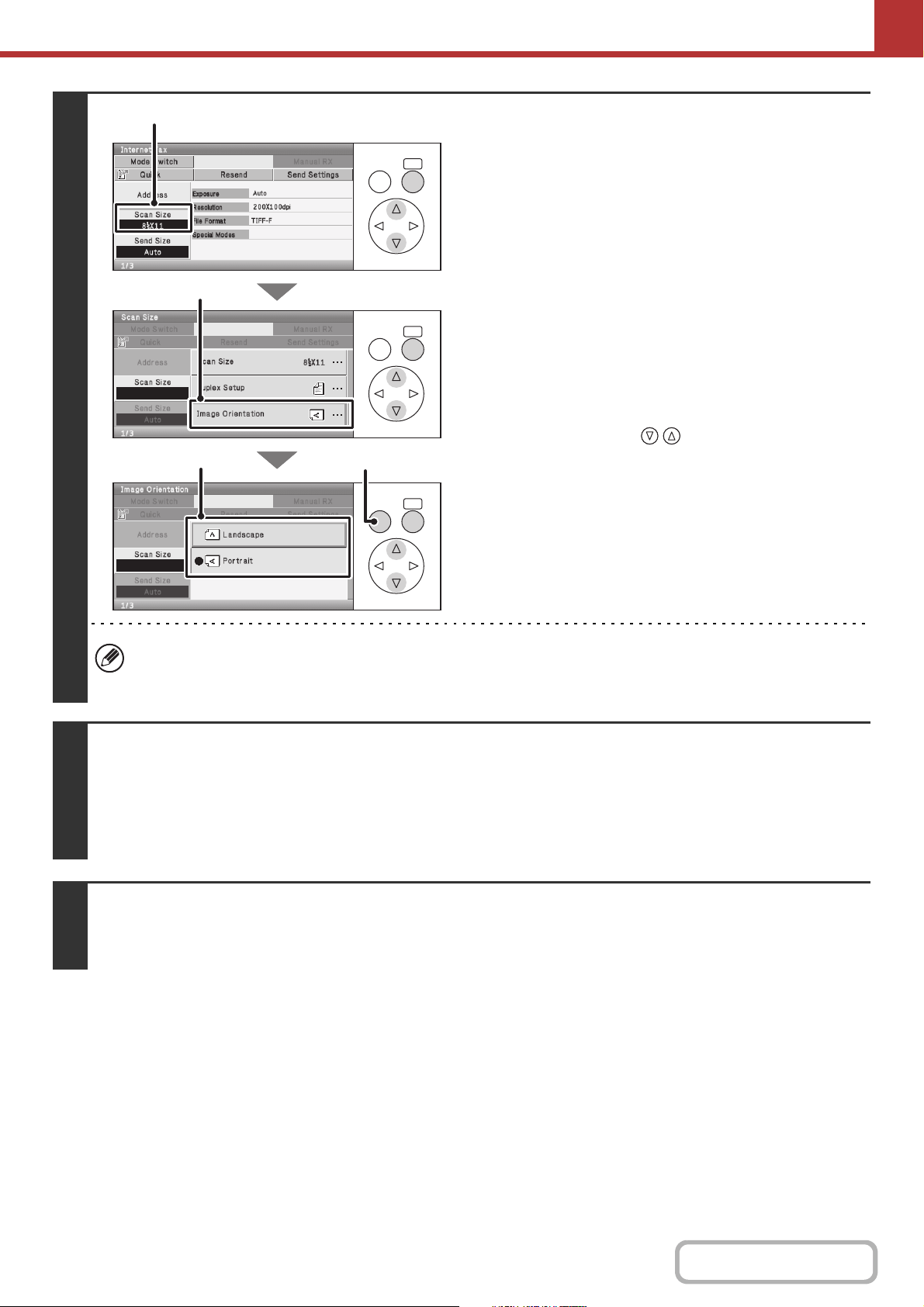
5-47
SCANNER/INTERNET FAX
Contents
4
Check the original scan size and
placement orientation.
In order to set the orientation of the image to be sent, check the
size and orientation of the original that were set in step 1.
(1) Check the scan size.
Check if the size of the placed original is displayed in the
[Scan Size] key. If the displayed size is different from the
size of the placed original, set the original size.
☞ SPECIFYING THE ORIGINAL SCAN SIZE AND
SEND SIZE (page 5-61)
(2) Select the [Scan Size] key.
(3) Select the [Image Orientation] key.
(4)
Set the placement orientation of the original.
If the original is placed with the top edge at the top, select
[Landscape] with the keys. If the top edge is
placed to the left, select [Portrait]. Press the [OK] key.
(5) Press the [BACK] key.
You will return to the basic screen.
• The placement orientation of the original is initially set to [Portrait]. If you placed the original with the top edge to the
left, this step is not necessary.
• The original size set in the system settings appears as the original size.
5
Press the [BLACK & WHITE START] key.
Scanning begins.
•
If the original is placed on the document glass, the [Read-End] key appears in the display. If the original is only one page, go
to step 7. To scan more pages, go to the next step.
• If the original was inserted in the document feeder tray, a beep will sound when scanning is completed and transmission
will take place.
6
If the original was placed on the document glass, replace it with the next original
and press the [BLACK & WHITE START] key.
Repeat until all originals have been scanned.
OKBACK
OKBACK
OKBACK
(1), (2)
(3)
(4) (5)
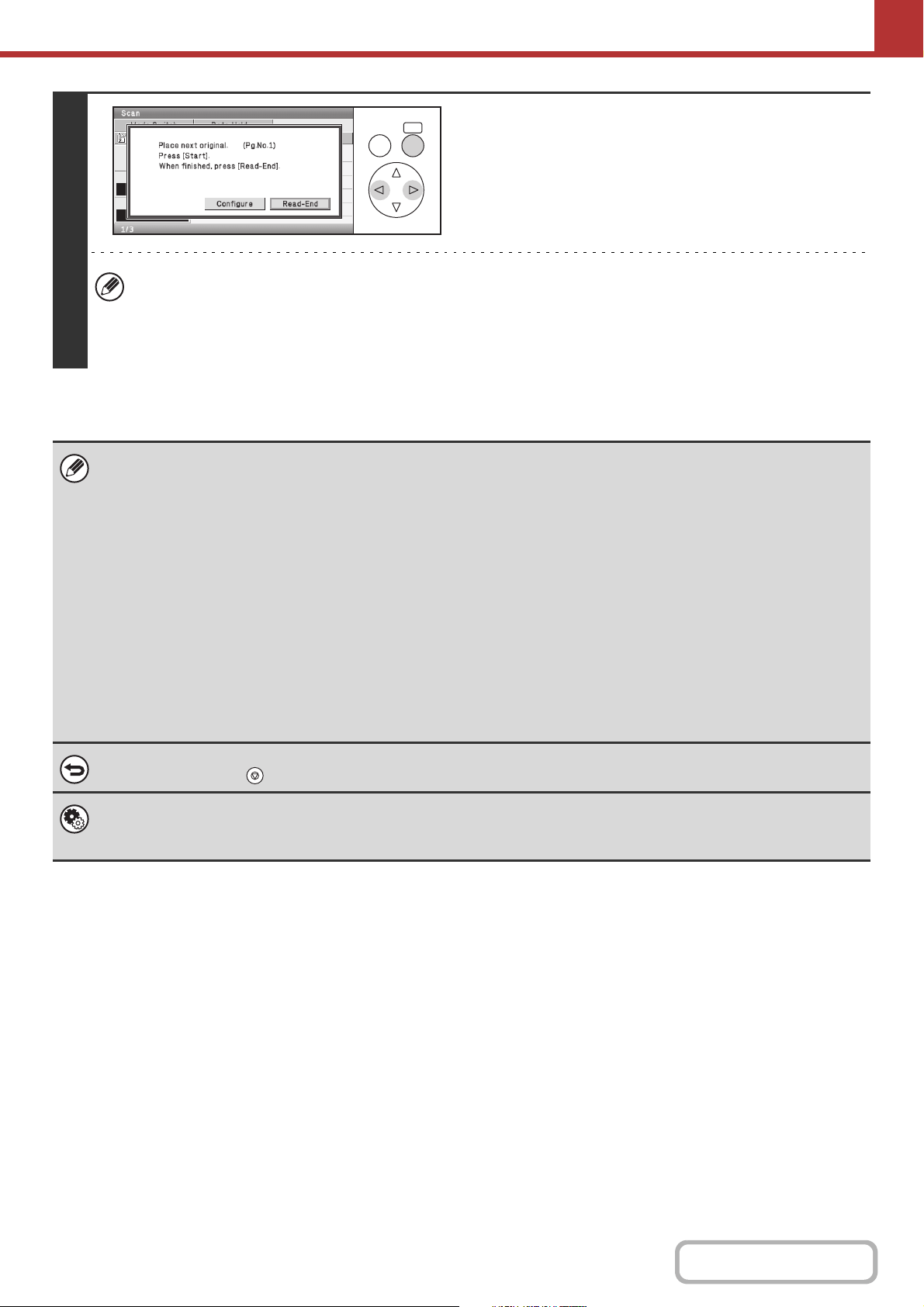
5-48
SCANNER/INTERNET FAX
Contents
7
Select the [Read-End] key.
A beep will sound to indicate that the operation is completed.
Open the automatic document feeder and remove the original.
• If no action is taken for one minute after the confirmation screen appears, scanning automatically ends and the
transmission is reserved.
• To change the exposure, resolution, scan size, or send size for each original page scanned, select the [Configure]
key and press the [OK] key. However, when "Card Shot" is selected in the special modes, only the exposure can be
changed when scanning an even-numbered original page.
• When all originals have been scanned, "Job stored." will be displayed together with a job control number. This number can
be used to locate the job in the Transaction Report or in the Image Sending Activity Report. If the job is a broadcast
transmission, this number will also appear in the key of the job in the job status screen. For this reason, making a note of
the number is useful for checking the result.
• If the memory becomes full while the originals are being scanned, a message will appear and scanning will stop.
• Storing a mail signature
You can have preset text automatically added at the end of e-mail messages as a mail signature. This is convenient when
you wish to have a corporate policy or other preset text appear at the bottom of e-mail messages. To store the text for the
mail signature, click [Application Settings], [Network Scanner Settings] and then [Administration Settings] in the Web page
menu. (Administrator rights are required.) Up to 900 characters can be entered. (The mail signature is not included in the
maximum number of characters that can be entered in the e-mail message.)
• Add a Footer Automatically to the Mail Message Body
Use this setting to specify whether or not a mail signature is added at the end of e-mail messages. By factory default, a
mail signature is not added. Store in [Application Settings] > [Network Scanner Settings] > [Administration Settings] in the
Web page menu. (Administrator rights are required.)
To cancel scanning...
Press the [STOP] key ( ) to cancel the operation.
System Settings (Administrator): I-Fax Send Settings (Web page only)
This is used to select Internet fax transmission settings such as the receive report setting, rotation setting, size restriction
setting, and sender information attachment setting.
OKBACK

5-49
SCANNER/INTERNET FAX
Contents
CHANGING THE SUBJECT, FILE NAME, AND BODY
TEXT
The subject, file name, and body text can be changed when performing an Internet fax transmission. Preset items can
be selected or text can be directly entered.
Keys in the display can be selected with the arrow keys and the [OK] key.
• If the subject and file name are not changed, the settings in the Web page are used.
• Selections for the subject, file name, and body text are configured by clicking [Application Settings] and then [Network
Scanner Settings] in the Web page menu.
• For the procedure for entering text, see "ENTERING TEXT" (page 1-61) in "1. BEFORE USING THE MACHINE".
1
Select the [Send Settings] key in the base screen.
☞
BASE SCREENS (page 5-13)
2
To change the subject, select the
[Subject] key.
3
Enter the subject.
(1) Select a pre-set text key.
(2) Select the [OK] key.
• If you wish to directly enter the text, select the [Direct Entry] key and press the [OK] key. A text entry screen will
open. Enter the text and press the [OK] key.
• To edit pre-set text, select the pre-set text, select the [Direct Entry] key, and press the [OK] key. The text entry
screen will appear with the selected pre-set text entered. (When a destination is stored using the Web page, up to
80 characters can be entered. However, only 54 characters can be entered in the display.)
OKBACK
OKBACK
(1) (2)
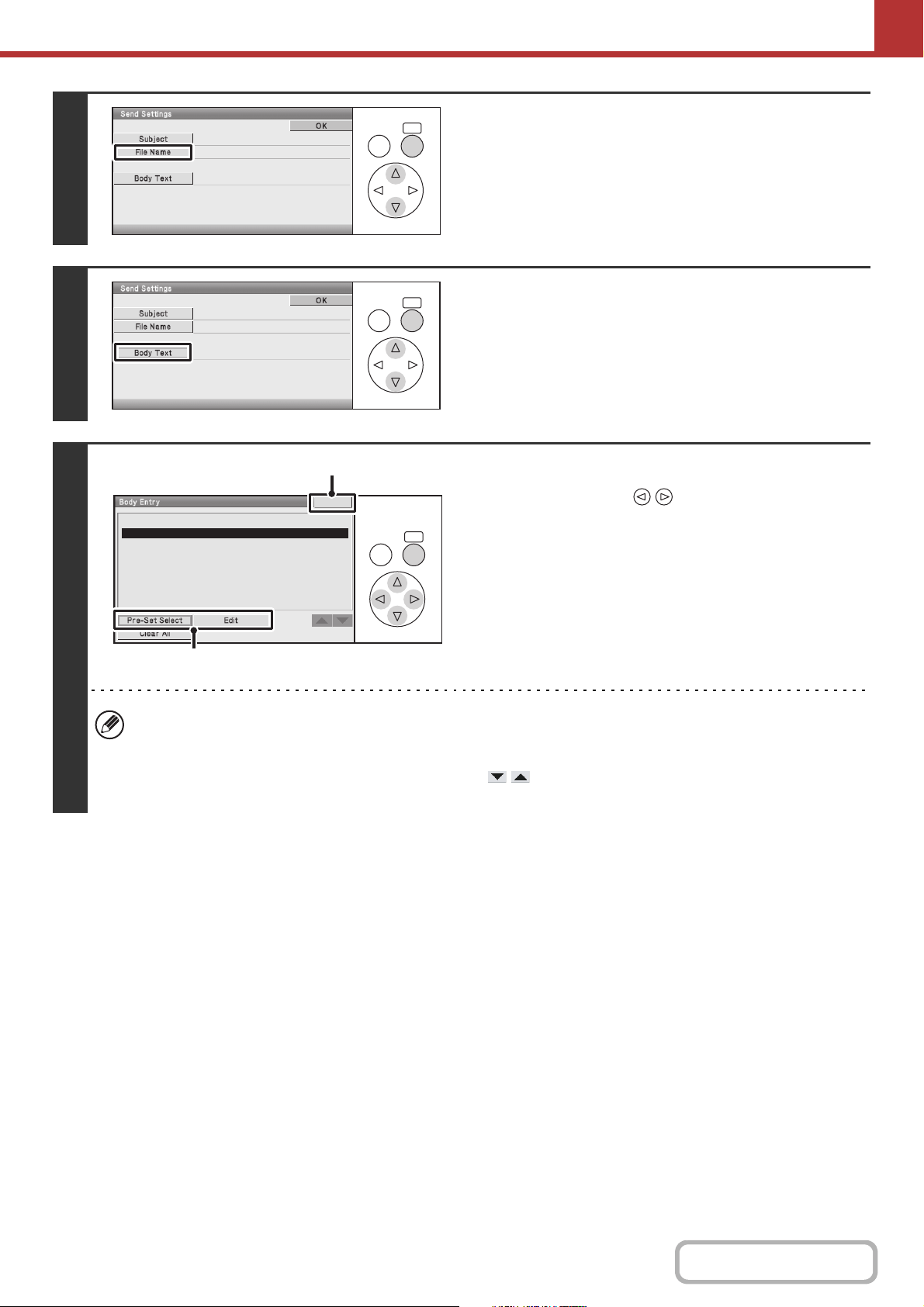
5-50
SCANNER/INTERNET FAX
Contents
4
To change the file name, select the [File
Name] key.
The file name is entered in the same way as the subject.
5
To change the body text, select the
[Body Text] key.
6
Enter the body text.
(1) Select with the keys.
• To select a pre-set text previously stored in the Web
page, select the [Pre-Set Select] key and press the
[OK] key.
• To directly enter the body text, select the [Edit] key and
press the [OK] key.
(2) Select the [OK] key.
• 1800 characters can be entered. (A line break counts as one character.)
• To clear all entered text, select the [Clear All] key. When the [OK] key is pressed, the entire body of the message is
erased immediately; not just the selected line.
• Each line of the entered text can be selected with the keys. To edit the selected line, select the [Edit] key
and press the [OK] key. The text entry screen will appear with the selected text entered.
OKBACK
Sub: Schedule coordination meeting
OKBACK
Sub: Schedule coordination meeting
Material for planning meeting
OKBACK
attached scanned data,which you have requested.
Thank you for your continuous support. We have
OK
(2)
(1)
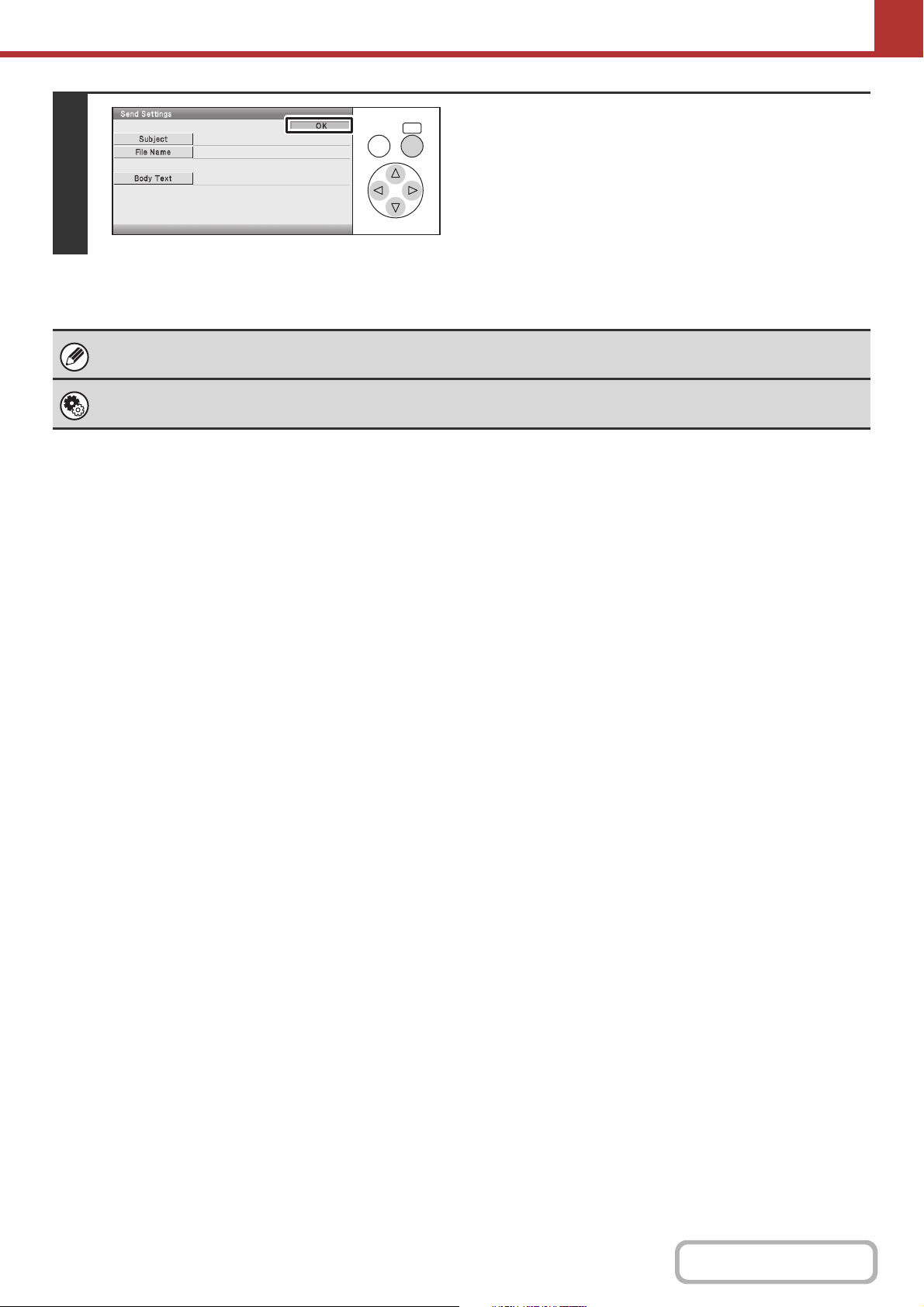
5-51
SCANNER/INTERNET FAX
Contents
7
Select the [OK] key.
When storing pre-set text for the subject and file name in the Web pages, up to 80 characters can be entered.
System Settings (Administrator): The Number of File Name/Subject/Body Keys Displayed Setting
The setting for the number of subject keys and file name keys displayed in one screen can be changed to 6, 12, or 18.
OKBACK
Sub: Schedule coordination meeting
Material for planning meeting
Thank you for your continuous sup
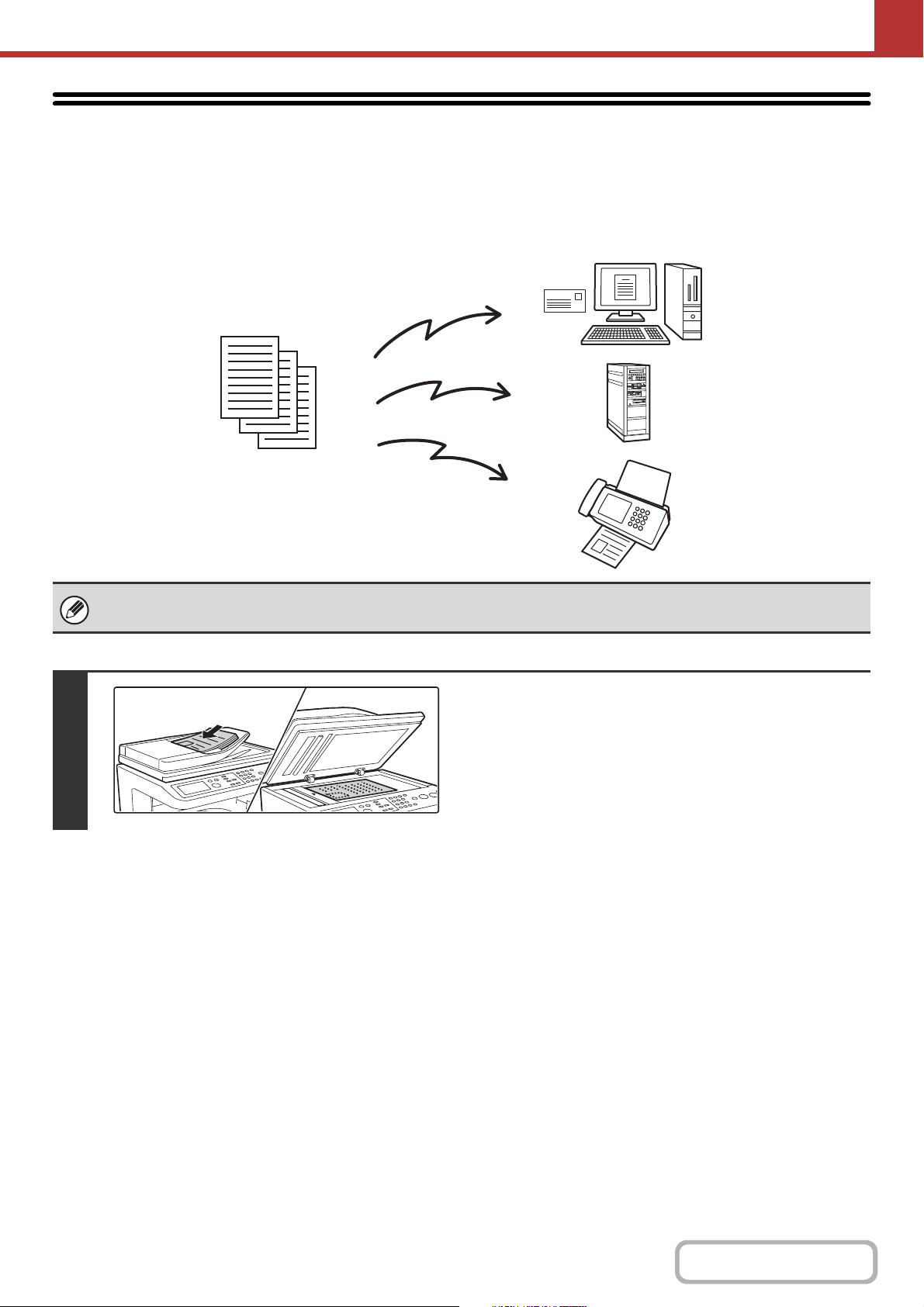
5-52
SCANNER/INTERNET FAX
Contents
SENDING THE SAME IMAGE TO MULTIPLE
DESTINATIONS (Broadcast Transmission)
The same scanned image can be sent to multiple scan modes, Internet fax mode, and fax mode destinations in a single
operation. Up to 500 destinations can be selected in one broadcast operation.
Keys in the display can be selected with the arrow keys and the [OK] key.
If you frequently use broadcasting to send images to the same group of destinations, it is convenient to store those
destinations in a group key.
Originals
Transmission
1
Place the original.
Place the original face up in the document feeder tray, or face
down on the document glass.
When the original is a different size than the size setting, set
the original size.
☞ SPECIFYING THE ORIGINAL SCAN SIZE AND SEND
SIZE (page 5-61)
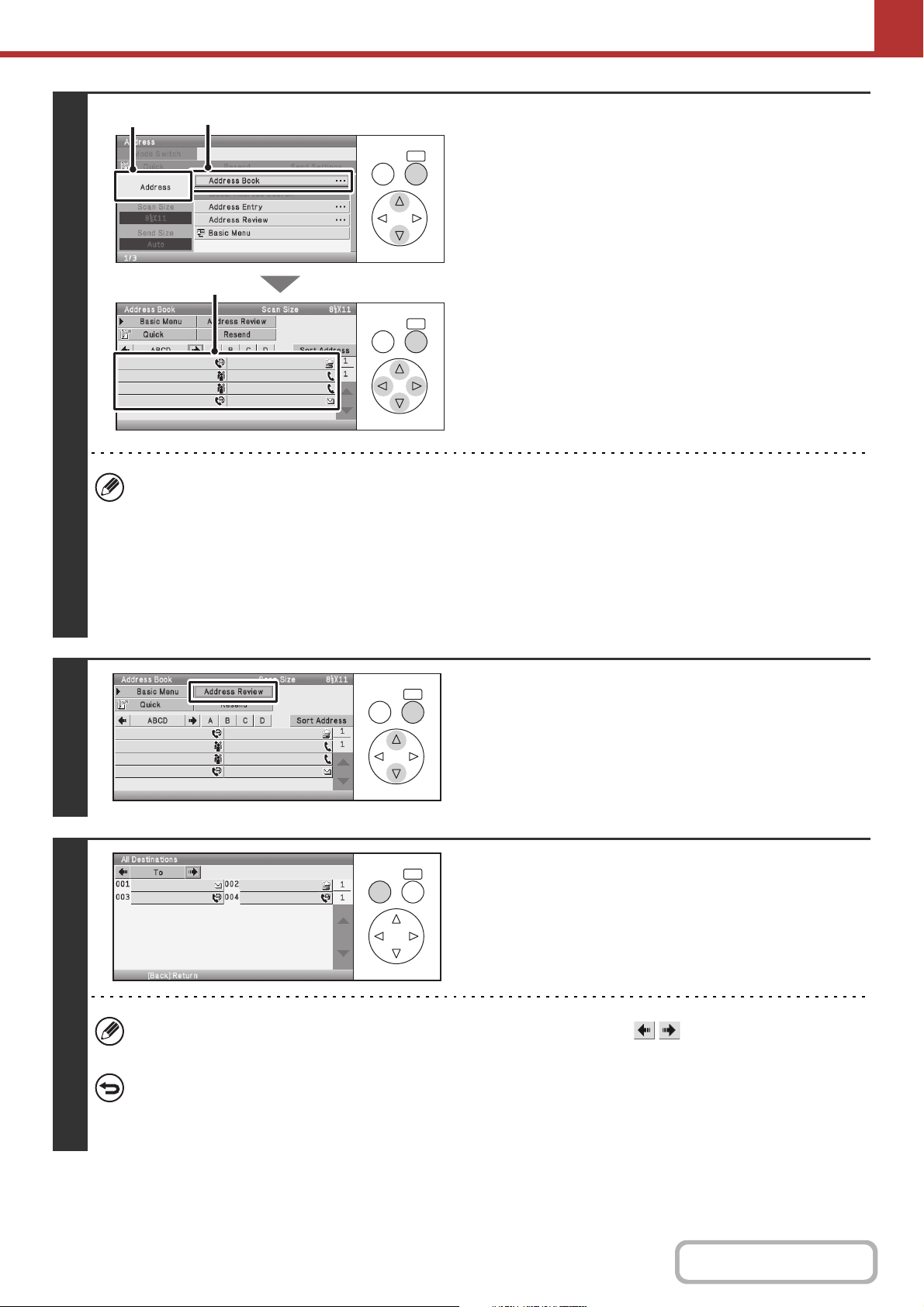
5-53
SCANNER/INTERNET FAX
Contents
2
Specify the destination.
(1) Select the [Address] key in the base screen.
(2) Select the [Address Book] key.
(3) Select the one-touch key of the desired
destination.
(4) Select the delivery method.
The destination is specified.
(5) Repeat steps (3) and (4) until all
destinations are selected.
• To send by Cc or Bcc delivery, the [Cc] key or [Bcc] key must be specified in the screen that appears in (3).
• If "Must Input Next Address Key at Broadcast Setting" is enabled in the system settings (administrator), select the
[Next Address] key before specifying the next destination.
• one-touch keys that cannot be used for broadcast transmission are grayed out to prevent selection.
• If a Scan to FTP (Hyperlink) address is specified in a broadcast transmission, hyperlink e-mail transmission will not
take place.
• If you frequently use broadcasting to send images to the same group of destinations, it is convenient to store those
destinations in a group key.
3
Select the [Address Review] key.
4
Check the destinations and then select
the [BACK] key.
If there are Cc or Bcc recipients, the recipients can be checked by selecting the keys.
To cancel a specified destination...
Select the one-touch key of the destination that you wish to cancel. A message will appear to confirm the deletion.
Select the [Yes] key.
☞ CHECKING AND DELETING THE SELECTED DESTINATIONS (page 5-25)
OKBACK
OKBACK
AAA AAA
BBB BBB
CCC CCC
DDD DDD
EEE EEE
FFF FFF
GGG GGG
HHH HHH
(2)
(1)
(3)
OKBACK
AAA AAA
BBB BBB
CCC CCC
DDD DDD
EEE EEE
FFF FFF
GGG GGG
HHH HHH
OKBACK
AAA AAA
BBB BBB
CCC CCC
DDD DDD
5-54
SCANNER/INTERNET FAX
Contents
5
Press the [COLOR START] key or the [BLACK & WHITE START] key.
Scanning begins.
• If you inserted the original pages in the document feeder tray, all pages are scanned.
A beep will sound to indicate that scanning is finished.
• If you are scanning the original on the document glass, scan each page one page at a time.
When scanning of one page finishes, replace it with the next page and press the [COLOR START] key or the [BLACK &
WHITE START] key. Repeat until all pages have been scanned and then select the [Read-End] key.
A beep will sound to indicate that scanning is finished.
If Internet fax or fax destinations are included in the broadcast transmission, the [COLOR START] key cannot be
pressed. Scanning will take place in Mono2.
To cancel scanning...
Press the [STOP] key ( ) to cancel the operation.
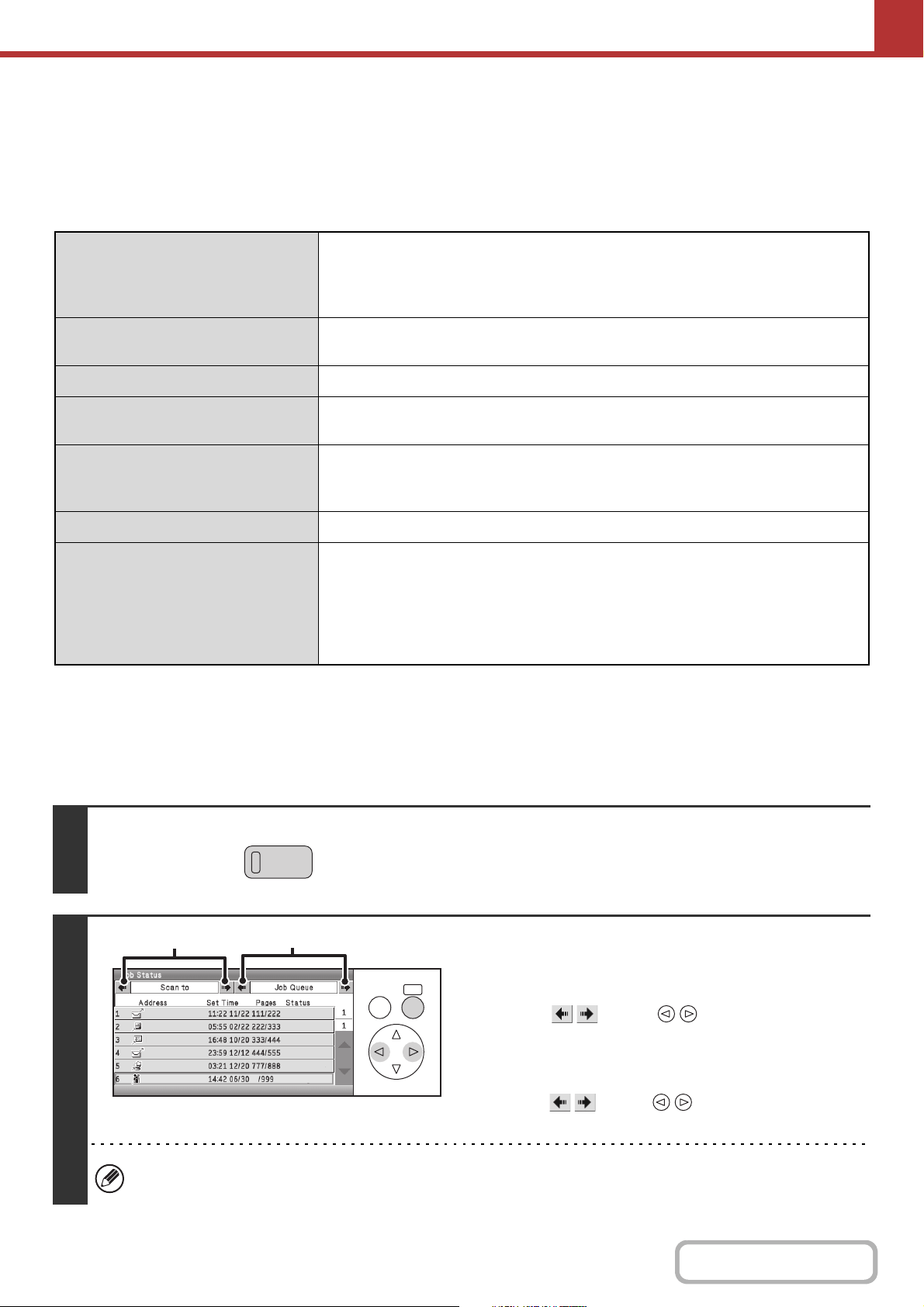
5-55
SCANNER/INTERNET FAX
Contents
BROADCAST TRANSMISSIONS THAT INCLUDE
INTERNET FAX DESTINATIONS
When a broadcast transmission includes both scan mode and Internet Fax mode destinations, the Internet Fax mode
settings (original orientation and other various settings) are given priority. When performing this type of broadcast
transmission, note the information below.
Resending to unsuccessful broadcast transmission destinations
The results of a completed broadcast transmission can be checked in the job status screen. If transmission to any of the
addresses failed, resend the image to those addresses.
Keys in the display can be selected with the arrow keys and the [OK] key.
Original placement orientation
The orientation of Internet fax mode is given priority. When "Rotation Sending Setting"
(Web page only) is enabled in the system settings (administrator), the image is rotated
90 degrees. For this reason, in some cases the image may not be displayed in the
correct orientation.
Send size
When the file format is set to [TIFF-S] in Internet fax mode, transmission is only
possible in 8-1/2" x 11" (A4) size in landscape orientation.
Exposure
The Internet fax settings are given priority.
Resolution
When the file format is set to [TIFF-S] in Internet fax mode and a high resolution
setting is selected in scan mode, the resolution will be changed to [200X200dpi].
File compression mode
The compression mode will be changed to the compression mode set in
"Compression Mode at Broadcasting" (Web page only) in the system settings
(administrator).
Color scanning
Scanning will take place in Mono2 regardless of the color mode setting.
Scan file size
If a broadcast transmission is performed that includes destinations for which an
attachment size limit has been set using "Maximum Size of E-mail Attachments
(E-mail)" (Web page only) or "Maximum Size of Data Attachments
(FTP/Desktop/Network Folder)" (Web page only) in the system settings
(administrator), the limit will also apply to destinations for which a limit is not set. (The
limitation setting of Scan to E-mail or Internet fax is given priority.)
1
Press the [JOB STATUS] key.
2
Display the jobs completed screen.
(1) Switch to the mode of the job you wish to
display.
Select with the keys and press the [OK]
key. The mode will change each time you press the [OK]
key.
(2) Switch the job status mode to [Complete].
Select with the keys and press the [OK]
key. The mode will change each time you press the [OK] key.
If the broadcast transmission included destinations of different modes, the same broadcast transmission key will
appear in each of those modes.
JOB STATU
S
OKBACK
Connecting
AAA AAA
BBB BBB
CCC CCC
DDD DDD
EEE EEE
Broadcast
(1)
(2)
Waiting
Waiting
Waiting
Waiting
Waiting
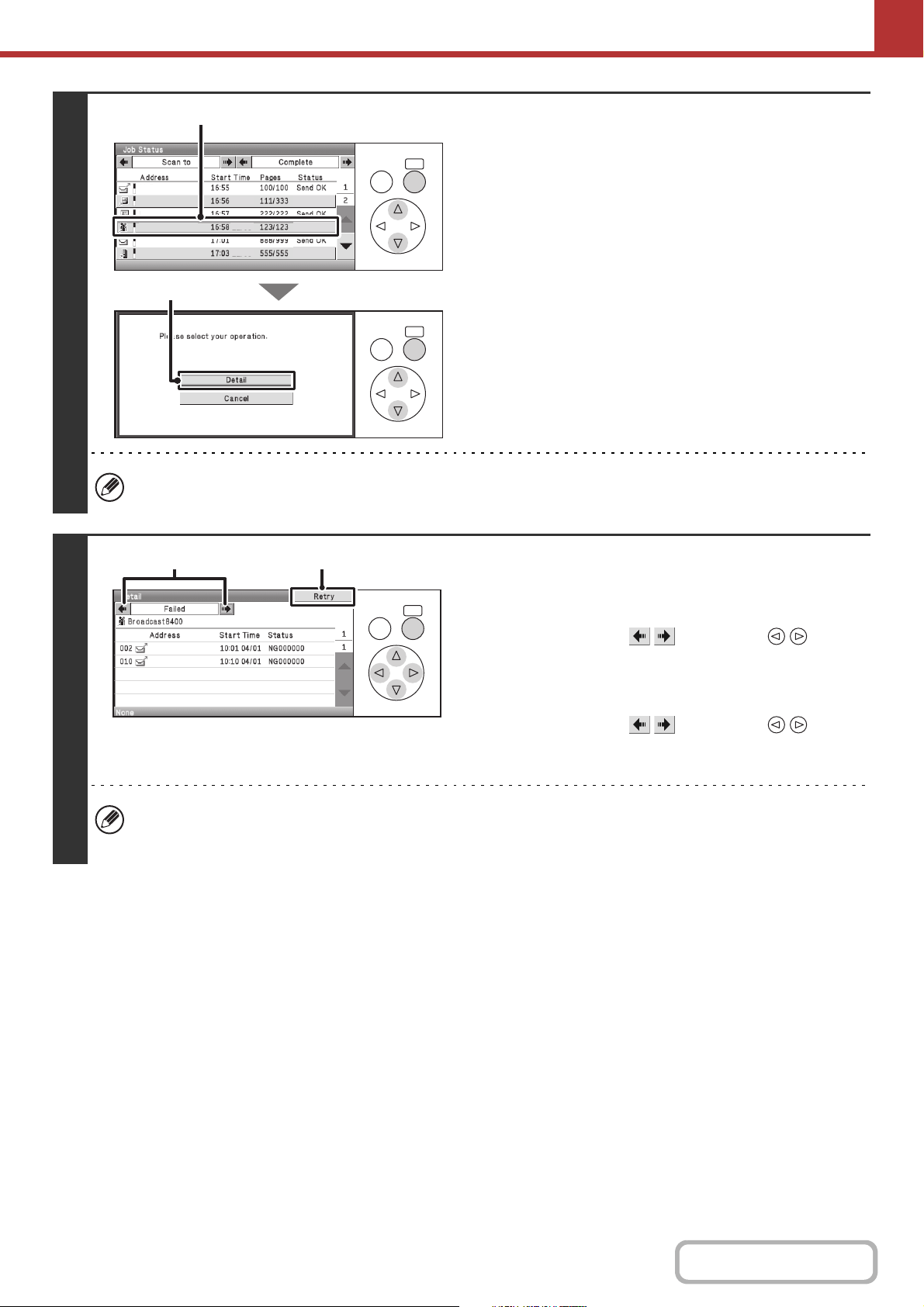
5-56
SCANNER/INTERNET FAX
Contents
3
Display details on the broadcast
transmission.
(1) Select the key of the completed broadcast
transmission.
(2) Select the [Detail] key.
"Broadcastxxxx" will appear as the address of the broadcast job key. The job control number that appeared in the
display when scanning ended appears in "xxxx".
4
Resend the image to the unsuccessful
destinations.
(1) Select the [Failed] key.
Select either of the keys with the keys
and press the [OK] key. The mode changes each time the
[OK] key is pressed.
(2) Select the [Retry] key.
Select either of the keys with the keys
and press the [OK] key. The mode changes each time the
[OK] key is pressed.
After selecting the [Retry] key, you will return to the base screen with the unsuccessful destinations entered. Place
the original and perform the steps of the broadcast transmission. Place the original and perform the steps of the
broadcast transmission.
OKBACK
OKBACK
AAA AAA
BBB BBB
CCC CCC
DDD DDD
EEE EEE
NG000000
NG000000
NG000000
Broadcast0001
04/01
04/01
04/01
04/01
04/01
04/01
(1)
(2)
OKBACK
EEE EEE
FFF FFF
(2)
(1)
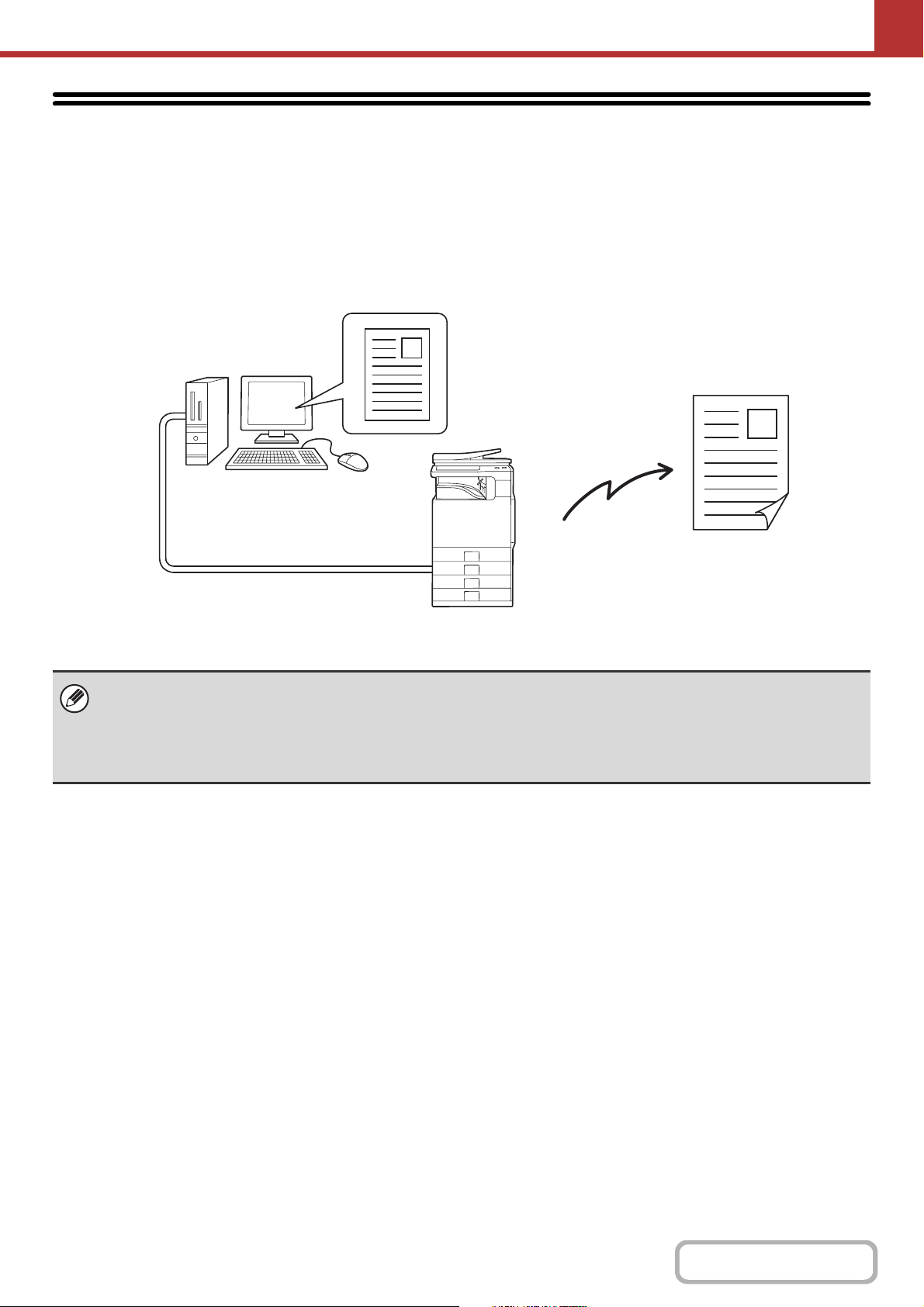
5-57
SCANNER/INTERNET FAX
Contents
SENDING AN INTERNET FAX FROM A
COMPUTER (PC-I-Fax)
A file on a computer can be sent via the machine as an Internet fax (PC-I-Fax function). Internet faxes are sent using the
PC-I-Fax function in the same way as documents are printed. Select the PC-Fax driver as the printer driver for your
computer and then select the Print command in the software application. Image data for transmission will be created and
sent as an Internet fax.
For the procedures for using this function, see the PC-Fax driver Help.
• To send an Internet fax using the PC-I-Fax function, the PC-Fax driver must be installed and then updated using the
CD-ROM that accompanies the Internet fax expansion kit. For more information, see the Installation Guide.
• This function can only be used on a Windows computer.
• This function can only be used for transmission. Internet faxes received on the machine cannot be received to a computer
that is connected to the machine.
PC-I-Fax
transmission
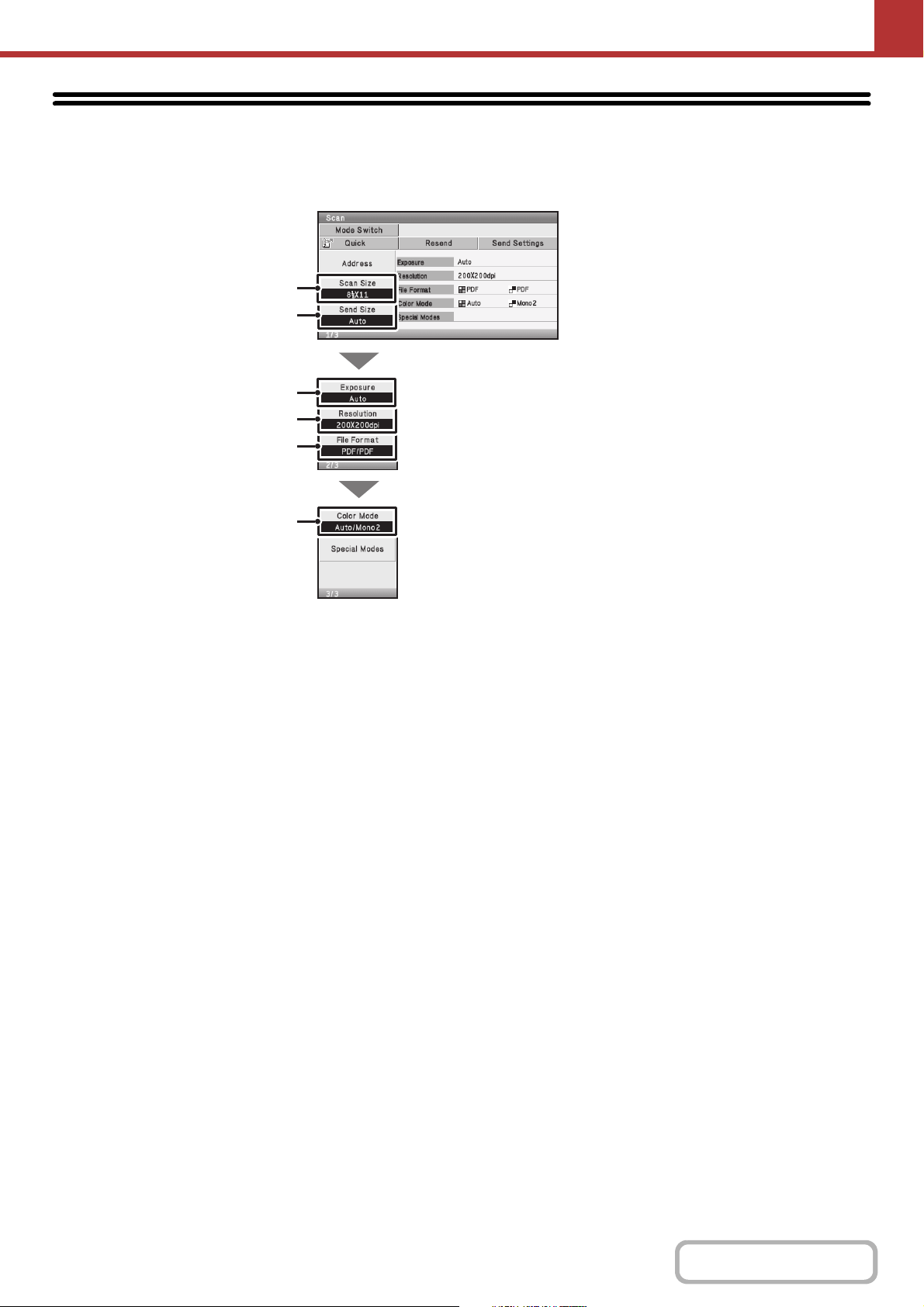
5-58
SCANNER/INTERNET FAX
Contents
IMAGE SETTINGS
Settings for scanning the original are selected in the base screen of each mode. The current state of each setting
appears to the right of the key used to select the setting.
(1) [Scan Size] key
Select this key to set the scan size, and orientation of the
original, and select 2-sided scanning settings.
☞ AUTOMATICALLY SCANNING BOTH SIDES OF
AN ORIGINAL (2-Sided Original) (page 5-59),
SPECIFYING THE ORIGINAL SCAN SIZE AND
SEND SIZE (page 5-61)
(2) [Send Size] key
Select this key to specify the send size of the original.
(3) [Exposure] key
Select this key to select the exposure for scanning.
☞ CHANGING THE EXPOSURE AND ORIGINAL
IMAGE TYPE (page 5-67)
(4) [Resolution] key
Select this key to select the resolution for scanning.
☞ CHANGING THE RESOLUTION (page 5-69)
(5) [File Format] key
Select this key to change the format (file type) of the
scanned image file.
☞ CHANGING THE FILE FORMAT (page 5-70)
(6) [Color Mode] key
Select this key to select the color mode for scanning.
This key does not appear in Internet fax mode.
☞ CHANGING THE COLOR MODE (page 5-75)
(2)
(1)
(5)
(6)
(4)
(3)
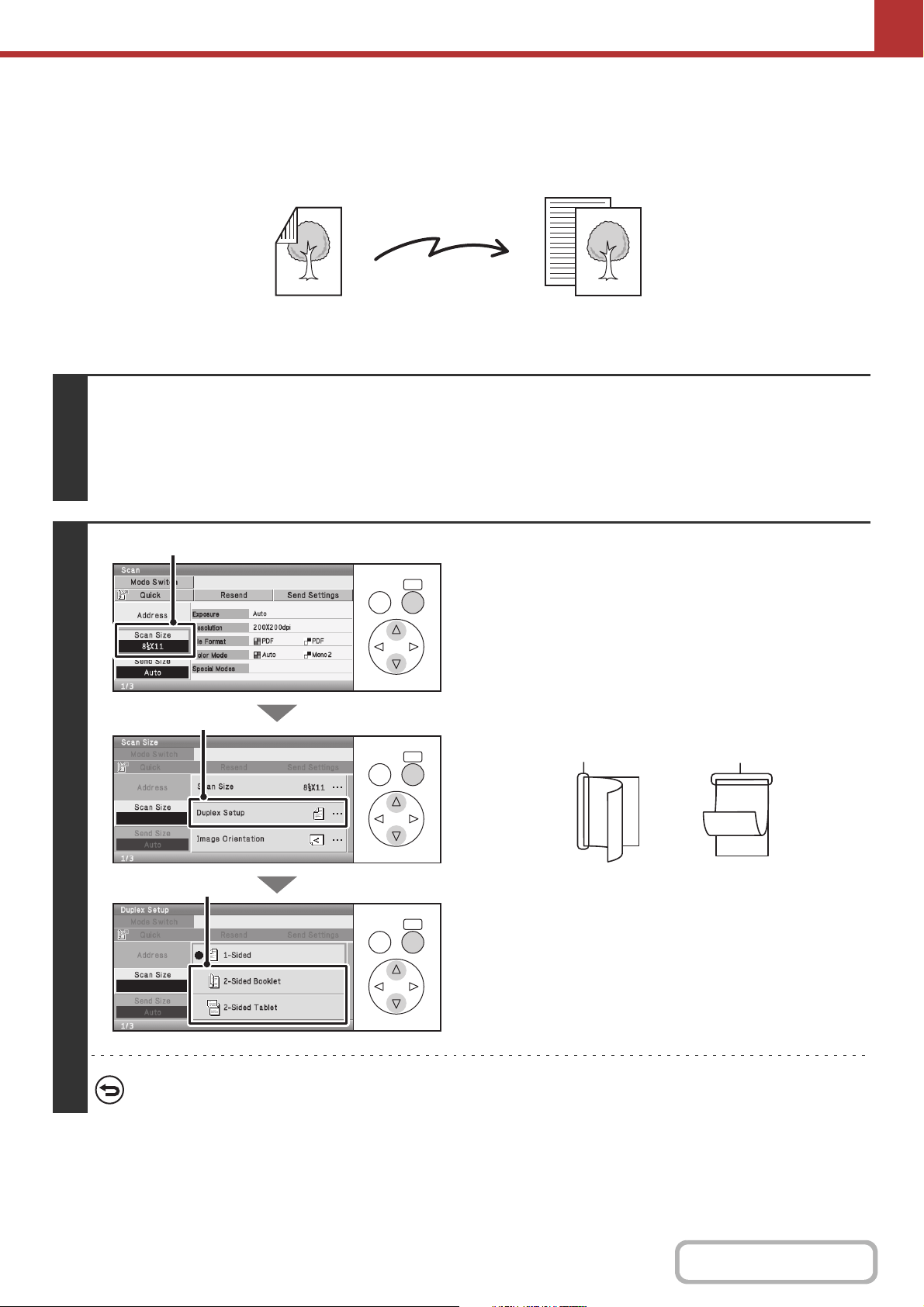
5-59
SCANNER/INTERNET FAX
Contents
AUTOMATICALLY SCANNING BOTH SIDES OF AN
ORIGINAL (2-Sided Original)
The automatic document feeder can be used to automatically scan both sides of an original.
Keys in the display can be selected with the arrow keys and the [OK] key.
2-sided original Front and reverse sides are scanned
Scan transmission
1
Select the mode and display the image settings screen.
(1) Select the [Mode Switch] key.
(2) Select the mode that you wish to use.
☞ IMAGE SETTINGS (page 5-58)
2
Specify the binding style of the 2-sided
original (book or tablet).
(1) Select the [Scan Size] key.
(2) Select the [Duplex Setup] key.
(3) Select the [2-Sided Booklet] key or the
[2-Sided Tablet] key.
A book and a tablet are bound as shown below.
To cancel 2-sided scanning, select the [1-Sided] key in (3).
OKBACK
OKBACK
OKBACK
(3)
(2)
(1)
A
C
E
G
AB
EF
J
L
KL
Book Tablet
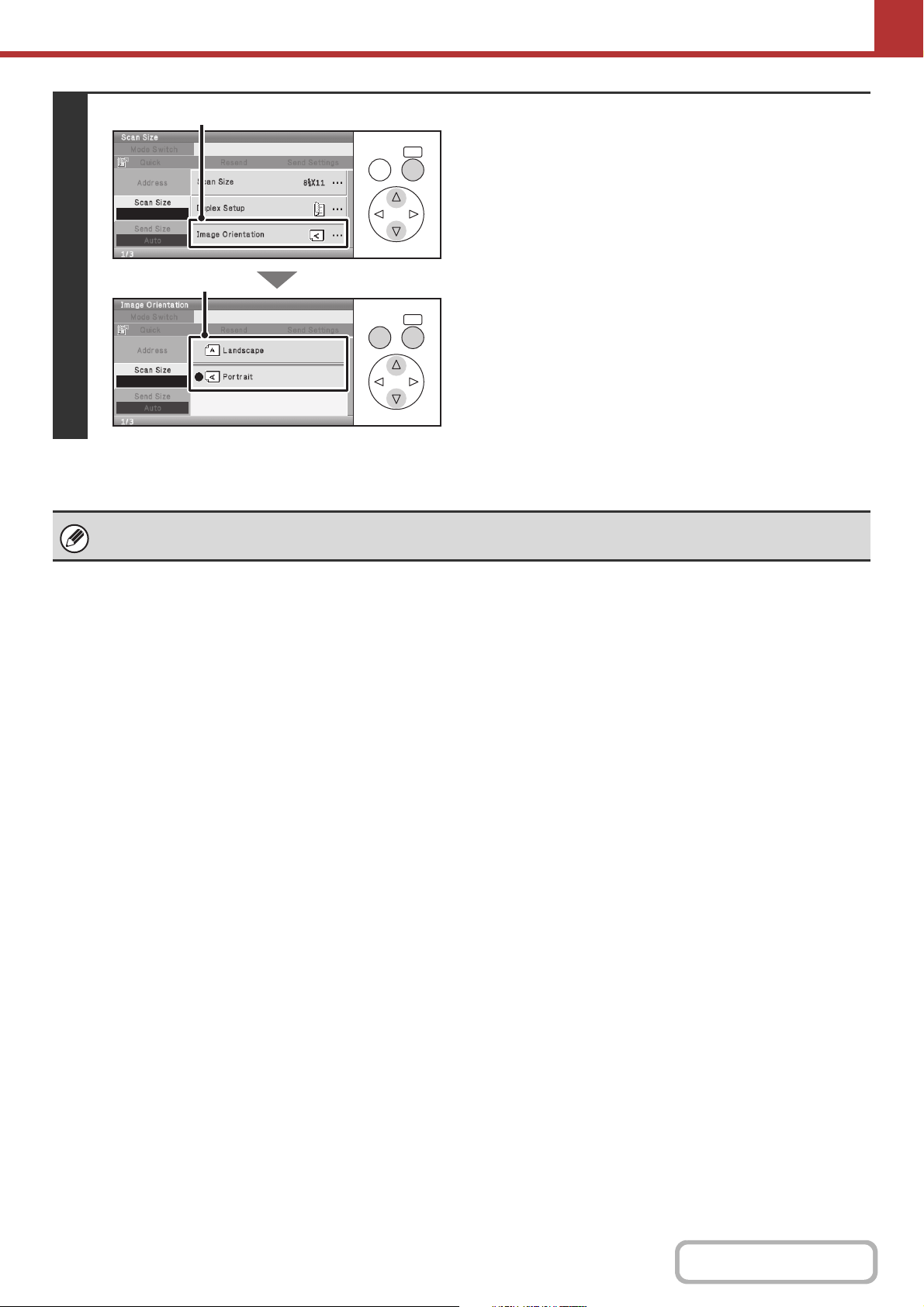
5-60
SCANNER/INTERNET FAX
Contents
3
Specify the orientation in which the
original is placed.
(1)
Select the [Image Orientation] key.
(2)
Select the "image placement orientation" key
with the same orientation as the image of the
placed original.
If this setting is not correct, a suitable image may not be
transmitted.
2-sided scanning automatically turns off after the transmission operation is completed.
OKBACK
OKBACK
(2)
(1)
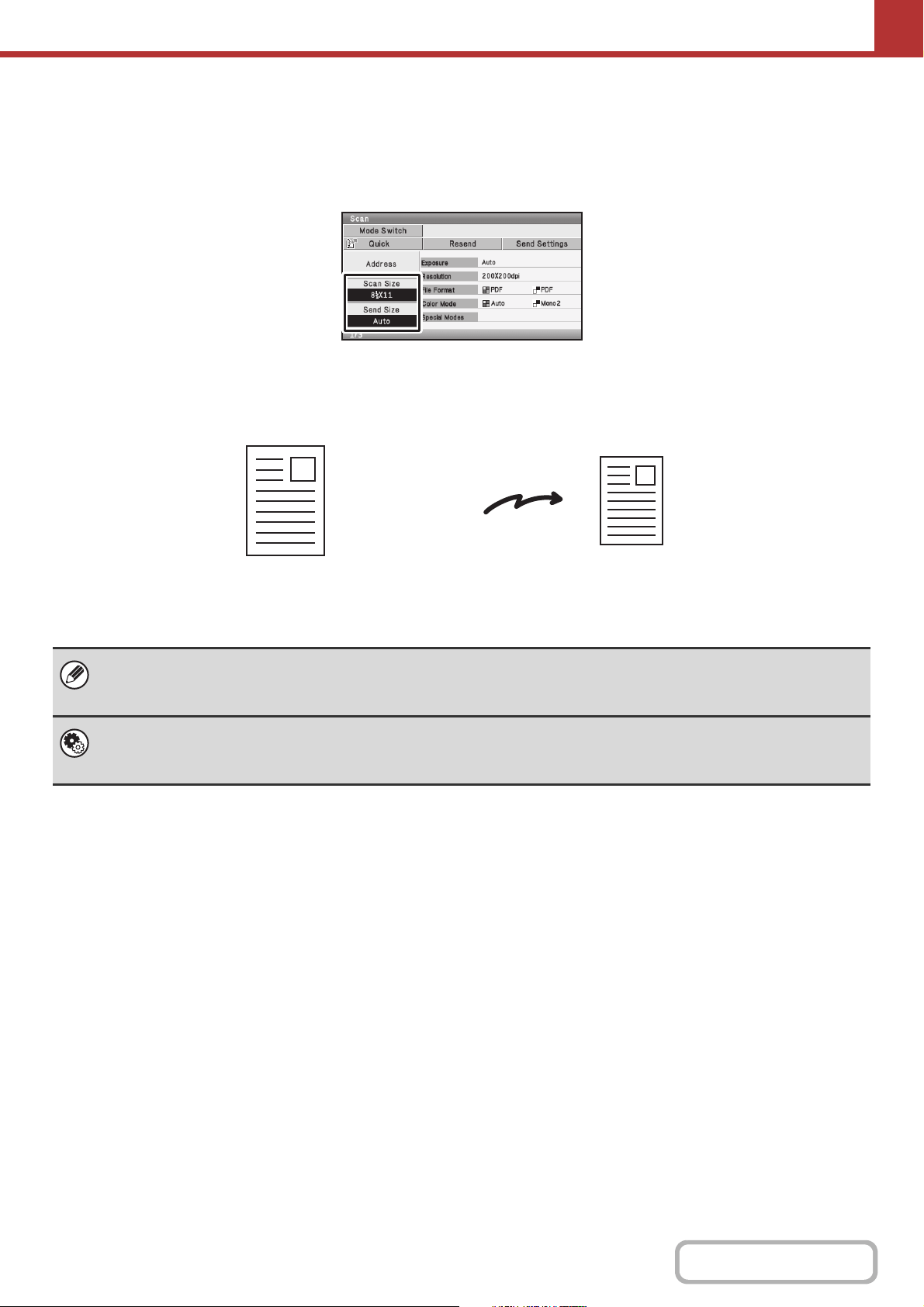
5-61
SCANNER/INTERNET FAX
Contents
SPECIFYING THE ORIGINAL SCAN SIZE AND SEND
SIZE
When the original is placed, the original size and the send size set in the system settings appear in the base screen as
the original size and send size.
In the above screen, the scan size (the original) size is 8-1/2" x 11" (A4) and the send size is auto. For example, if the
scan size is 8-1/2" x 11" (A4) and the send size is 5-1/2" x 8-1/2" (B5), the image will be reduced before transmission.
If the size of the placed original is different from the displayed original size, specify the original size.
☞ Specifying the original scan size (by paper size) (page 5-62)
☞ Specifying the original scan size (by numerical values) (page 5-63)
System Settings (Administrator): Default Original Size Settings (Web page only)
Set this if you frequently use a particular original size. The set size will appear in the [Scan Size] key.
When this setting is configured, changing the original size can be omitted.
8-1/2" x 11" (A4)
The image is reduced
to 5-1/2" x 8-1/2" (B5)
before transmission
"Scan Size"
"Send Size" is set
to 5-1/2" x 8-1/2"
(B5)
Transmission
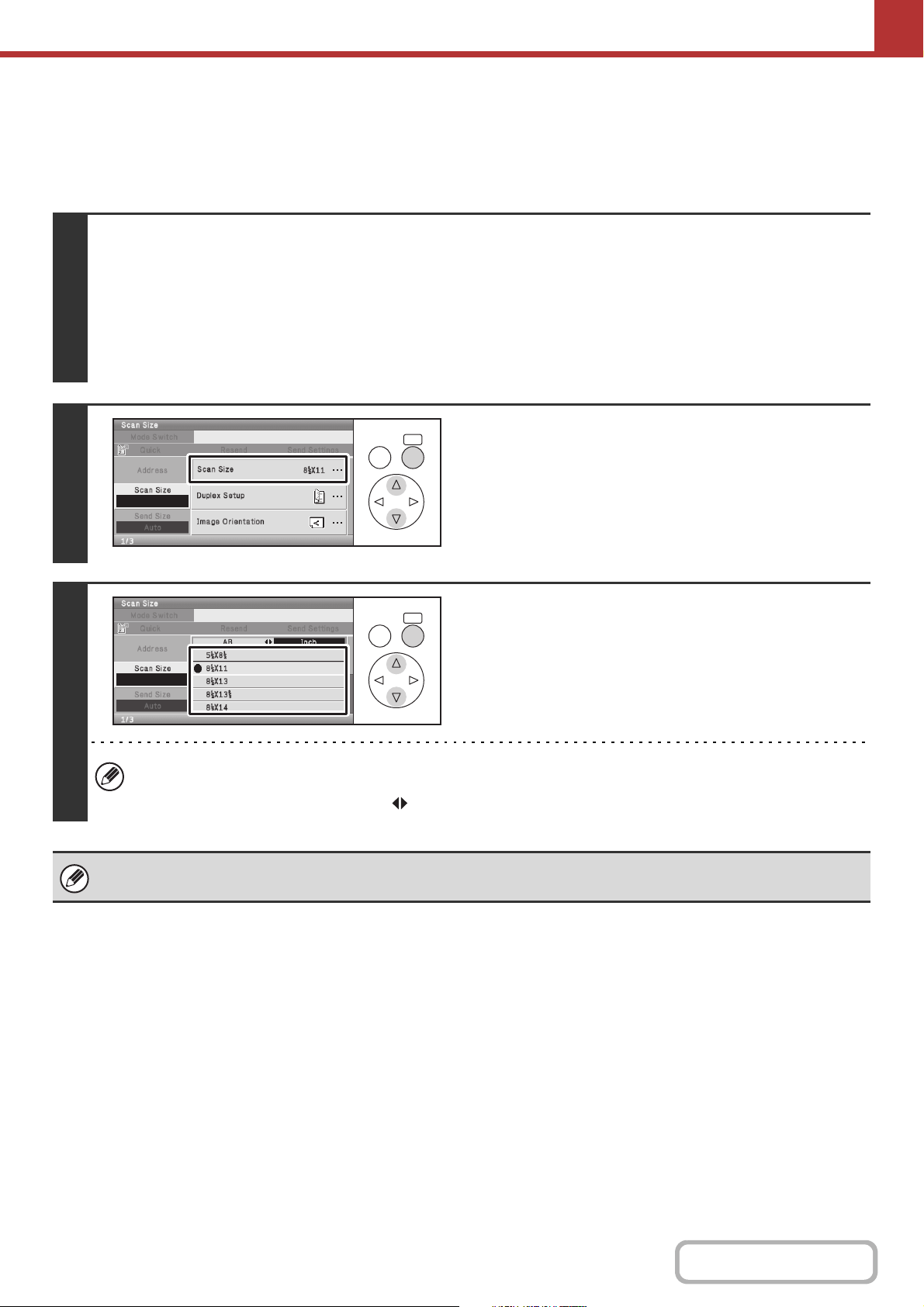
5-62
SCANNER/INTERNET FAX
Contents
Specifying the original scan size (by paper size)
If the size of the placed original is different from the displayed original size or you wish to change the original size, you
must specify the scan size. Place the original in the document feeder tray or on the document glass and follow the steps
below.
Keys in the display can be selected with the arrow keys and the [OK] key.
1
Change the mode and display the scan size setting screen.
(1) Select the [Mode Switch] key.
(2) Select the mode that you wish to use.
(3) Select the [Scan Size] key.
The original size set in the system settings appears in the [Scan Size] key.
☞ IMAGE SETTINGS (page 5-58)
2
Select the [Scan Size] key.
3
Specify the scan size.
Select the appropriate original size.
• If you are sending a long original, select the [Long Size] key. Use the automatic document feeder to scan a long
original. The maximum width that can be scanned is 19-5/8" (500 mm) (the maximum height is 8-1/2" (216 mm)).
• To set an AB scan size, select the [AB Inch] key show AB sizes.
When [Long Size] is selected, the 2-sided scanning setting and send size cannot be changed. In addition, when only scan
destinations are selected for scan transmission or metadata transmission, scanning will take place in Mono2.
OKBACK
OKBACK
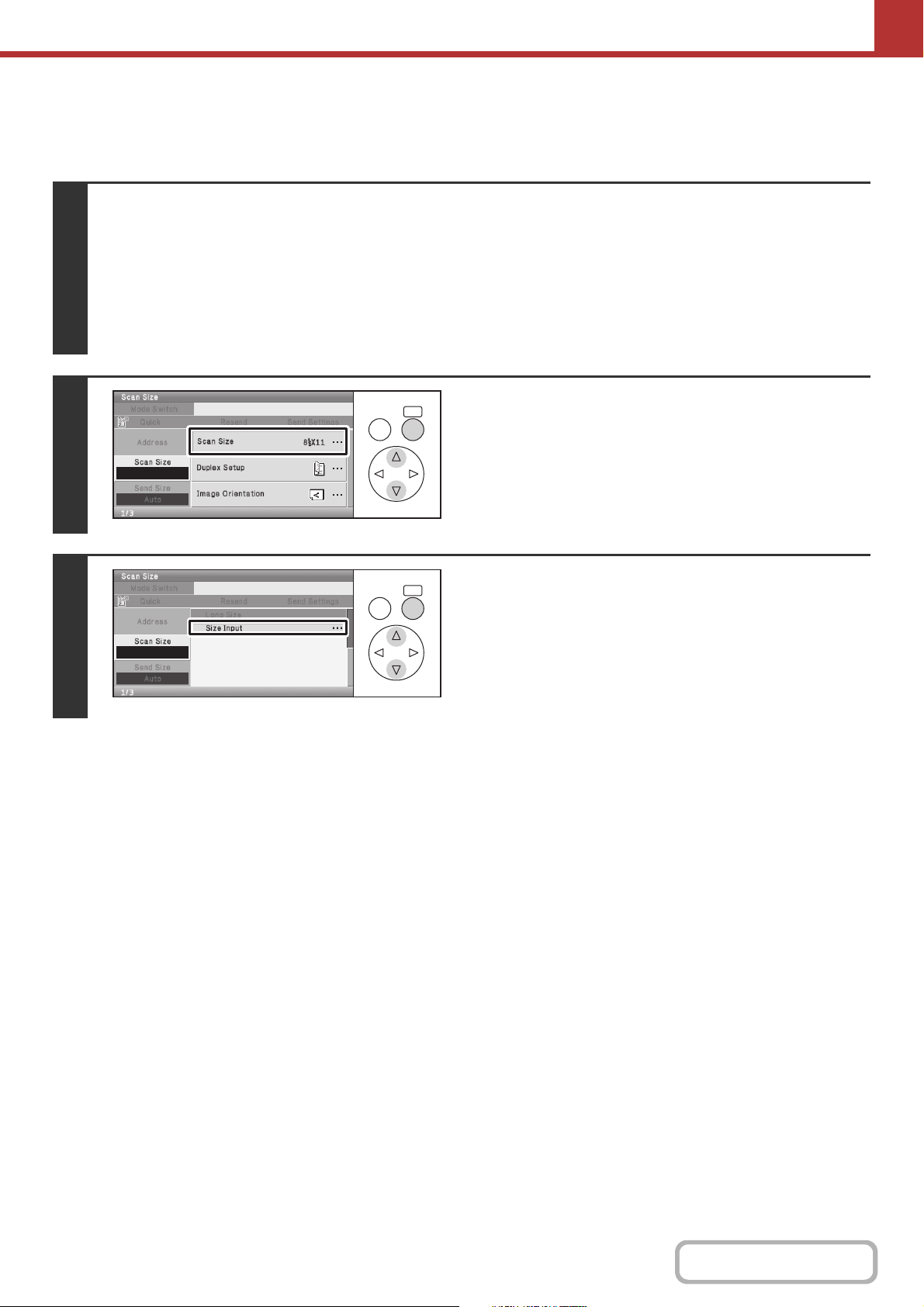
5-63
SCANNER/INTERNET FAX
Contents
Specifying the original scan size (by numerical values)
When scanning a non-standard size original such as a card, follow these steps to specify the original size.
Keys in the display can be selected with the arrow keys and the [OK] key.
1
Change the mode and display the scan size setting screen.
(1) Select the [Mode Switch] key.
(2) Select the mode that you wish to use.
(3) Select the [Scan Size] key.
The original size set in the system settings appears in the [Scan Size] key.
☞ IMAGE SETTINGS (page 5-58)
2
Select the [Scan Size] key.
3
Select the [Size Input] key.
OKBACK
OKBACK
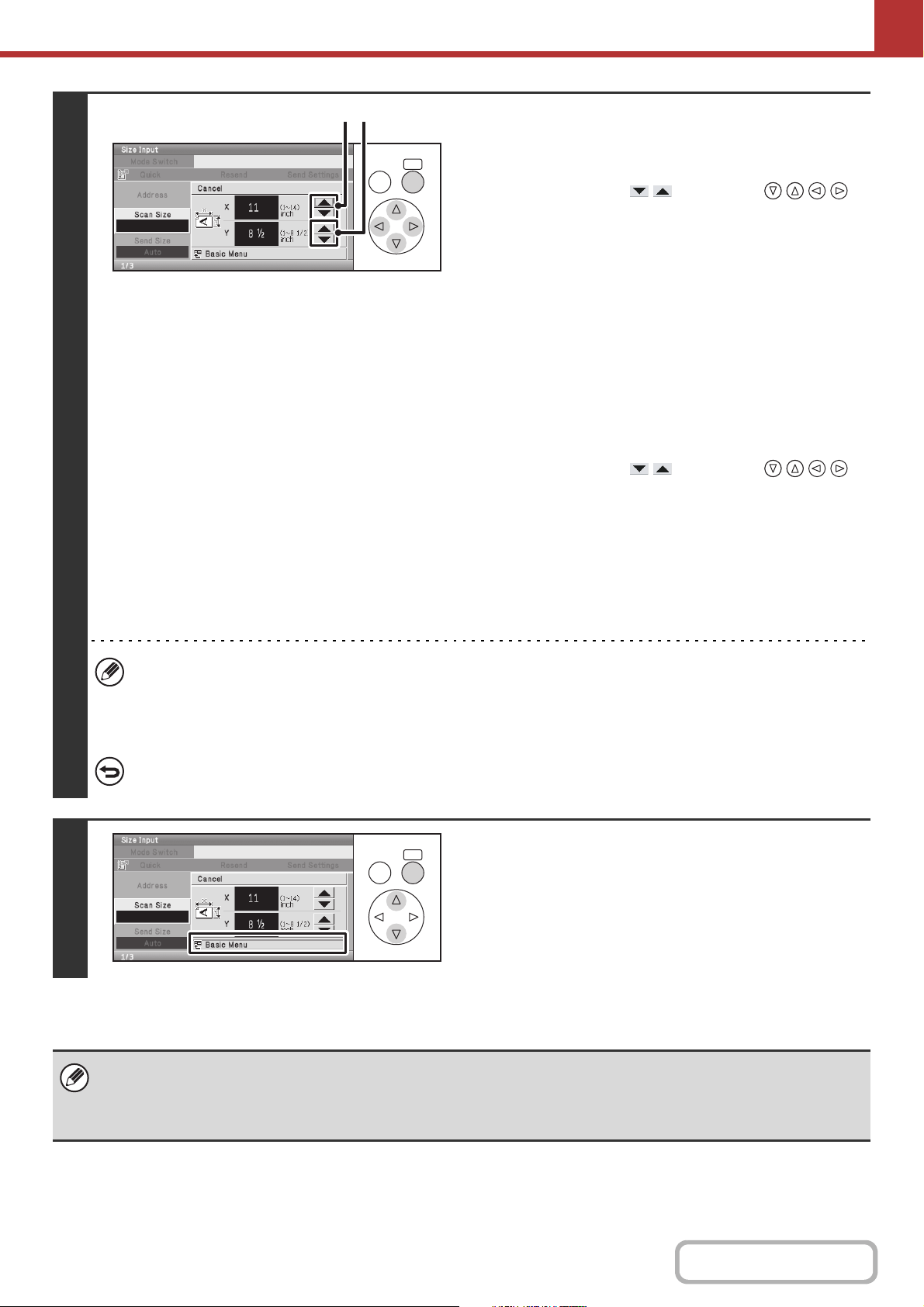
5-64
SCANNER/INTERNET FAX
Contents
4
Enter the scan size (original size).
(1) Enter the X (horizontal) dimension of the
original.
Select either of the keys with the
keys and press the [OK] key repeatedly to change the
number.
• When the document glass is used, enter a number from
1" to 11-5/8" (25 mm to 297 mm).
• When the automatic document feeder is used, enter a
number from 3-1/2" to 14" (89 mm to 356 mm).
• When a number which is from 5-3/8" (139 mm) and less
is entered in 2-Sided scanning setting, an original
cannot be scanned.
• If the horizontal dimension of the original is less than
3-1/2" (89 mm), use the document glass.
(2) Enter the Y (vertical) dimension of the
original.
Select either of the keys with the
keys and press the [OK] key repeatedly to change the
number.
• When the document glass is used, enter a number from
1" to 8-1/2" (25 mm to 216 mm).
• When the automatic document feeder is used, enter a
number from 4" to 8-1/2" (100 mm to 216 mm).
• If the vertical dimension of the original is less than 4"
(100 mm), use the document glass.
• When a number from 11-3/4" to 14" (298 mm to 356 mm) to the X (horizontal) dimension and a number from 1" to
3-7/8" (25 mm to 99 mm) to the Y (vertical) dimension are entered at the same time, an original cannot be scanned.
• For the procedure for entering numbers, see "USING THE OPERATION PANEL" (page 1-9) in "1. BEFORE USING
MACHINE".
To cancel the size input...
To cancel the size input, select the [Cancel] key.
5
Select the [Basic Menu] key.
The specified size appears in the [Scan Size] key.
• When the scan size is specified by numerical values, the send size cannot be specified.
• When the automatic document feeder is used, an original longer than 11-5/8" (297 mm) can be scanned (maximum width
19-5/8" (500 mm)). In this case, select the [Long Size] key in the screen of step 3.
☞ Specifying the original scan size (by paper size) (page 5-62)
OKBACK
(1)
(2)
OKBACK
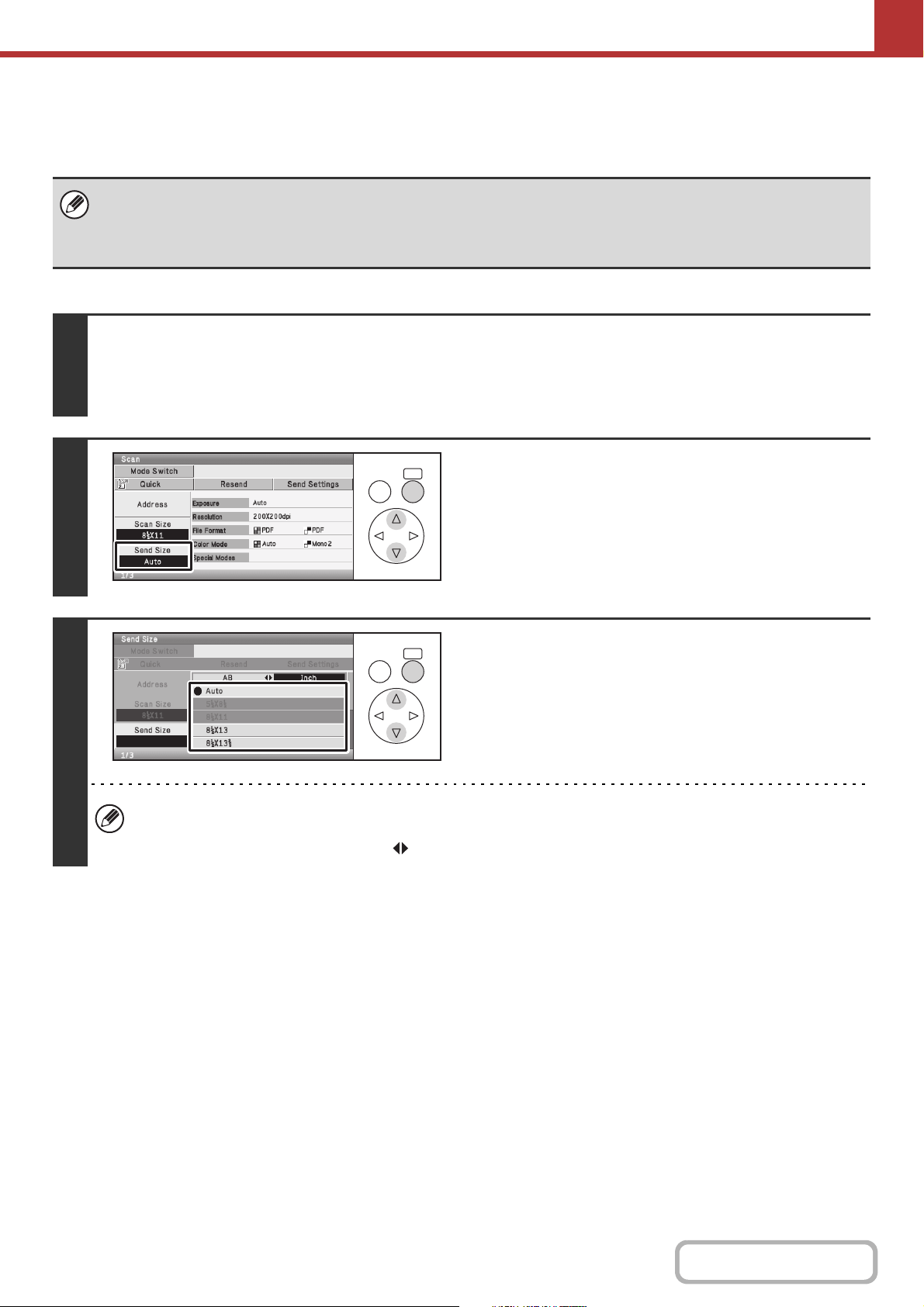
5-65
SCANNER/INTERNET FAX
Contents
Specifying the send size of the image
Specify the send size as a paper size. If a send size bigger than the scan size is selected, the image will be enlarged. If
a send size smaller than the scan size is selected, the image will be reduced.
Keys in the display can be selected with the arrow keys and the [OK] key.
• The send size cannot be specified when [Long Size] is selected for the scan size, or when the scan size is specified by
numerical values.
• The send size cannot be specified when [TIFF-S] is selected for the format in Internet fax mode. (The send size is fixed at
8-1/2" x 11" (A4) in landscape orientation.)
1
Select the mode.
(1) Select the [Mode Switch] key.
(2) Select the mode that you wish to use.
2
Select the [Send Size] key.
3
Specify the send size.
Select the desired send size key.
Select the [OK] key to return to the screen of step 2.
• Depending on the paper size specified for the "Scan Size", it may not be possible to select some sizes for the "Send
Size". Size keys that cannot be specified for the "Send Size" are grayed out to prevent selection.
• To set an AB send size, select the [AB Inch] key to show AB sizes.
OKBACK
OKBACK
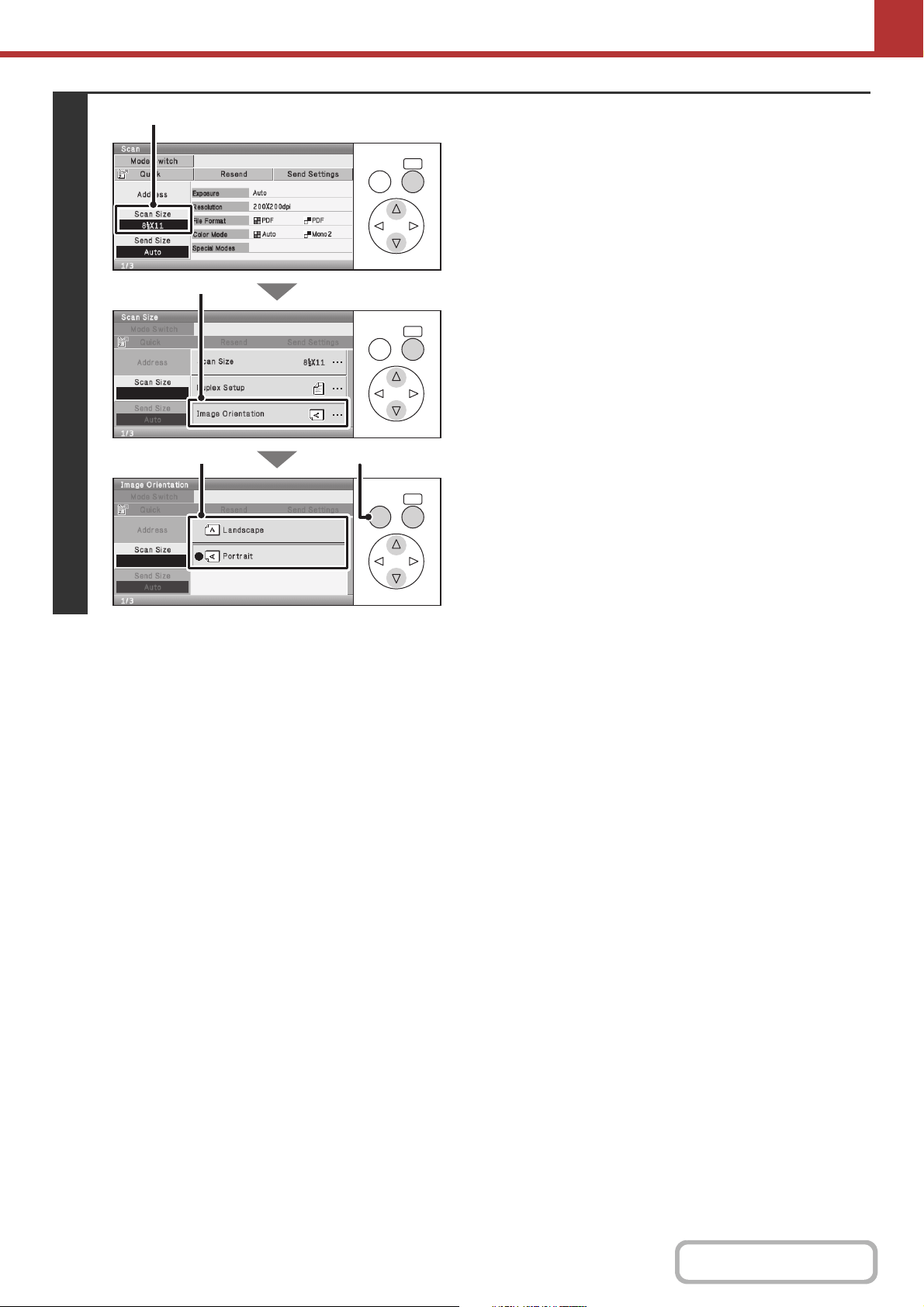
5-66
SCANNER/INTERNET FAX
Contents
4
Specify the orientation in which the
original is placed.
(1) Select the [Scan Size] key.
(2) Select the [Image Orientation] key.
(3) Select the "image placement orientation"
key with the same orientation as the image
of the placed original.
If this setting is not correct when sending an image with a
changed ratio, a suitable image may not be transmitted.
(4) Press the [BACK] key.
OKBACK
OKBACK
OKBACK
(4)
(1)
(2)
(3)
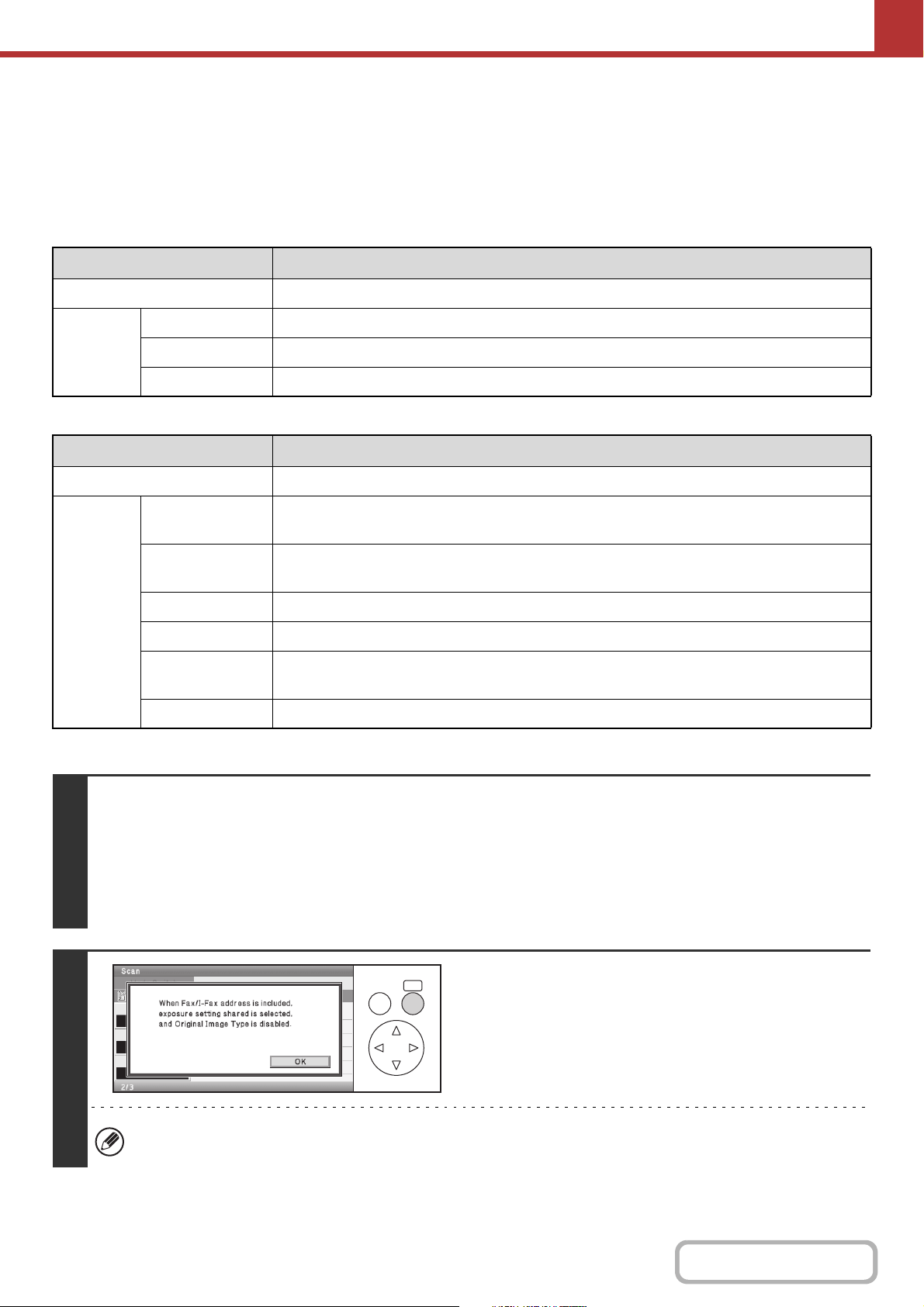
5-67
SCANNER/INTERNET FAX
Contents
CHANGING THE EXPOSURE AND ORIGINAL IMAGE
TYPE
The exposure and original image type can be set appropriately for the original to enable optimum scanning.
Refer to the following tables to select appropriate settings.
How to select the exposure
How to select the original image type (Scan mode, USB memory mode and Data entry mode)
Keys in the display can be selected with the arrow keys and the [OK] key.
Exposure When to select
Auto This setting automatically adjusts the exposure for light and dark parts of the original.
Manual
1-2 Select this setting when the original consists of dark text.
3 Select this setting for a normal original (neither dark nor light).
4-5 Select this setting when the original consists of faint text.
Setting Description
Auto The original image type is automatically selected to match the original.
Manual
Text/Prtd. Photo
This mode provides the best balance for scanning an original which contains both text and
printed photographs, such as a magazine or catalogue.
Text/Photo
This mode provides the best balance for scanning an original which contains both text and
photographs, such as a text document with a photo pasted on.
Text Use this mode for regular text documents.
Photo Use this mode to scan photos.
Printed Photo
This mode is best for scanning printed photographs, such as photos in a magazine or
catalogue.
Map This mode is best for scanning the color shading and fine details found on most maps.
1
Select the mode and display the exposure settings screen.
(1) Select the [Mode Switch] key.
(2) Select the mode that you wish to use.
(3) Select the [Exposure] key.
☞ IMAGE SETTINGS (page 5-58)
2
Read the displayed message and press
the [OK] key.
This message does not appear in USB memory mode or
Internet fax mode. Go to the next step.
If a broadcast transmission is performed that includes both scan mode destinations and Internet fax destinations, the
exposure settings for Internet fax mode will have priority.
OKBACK
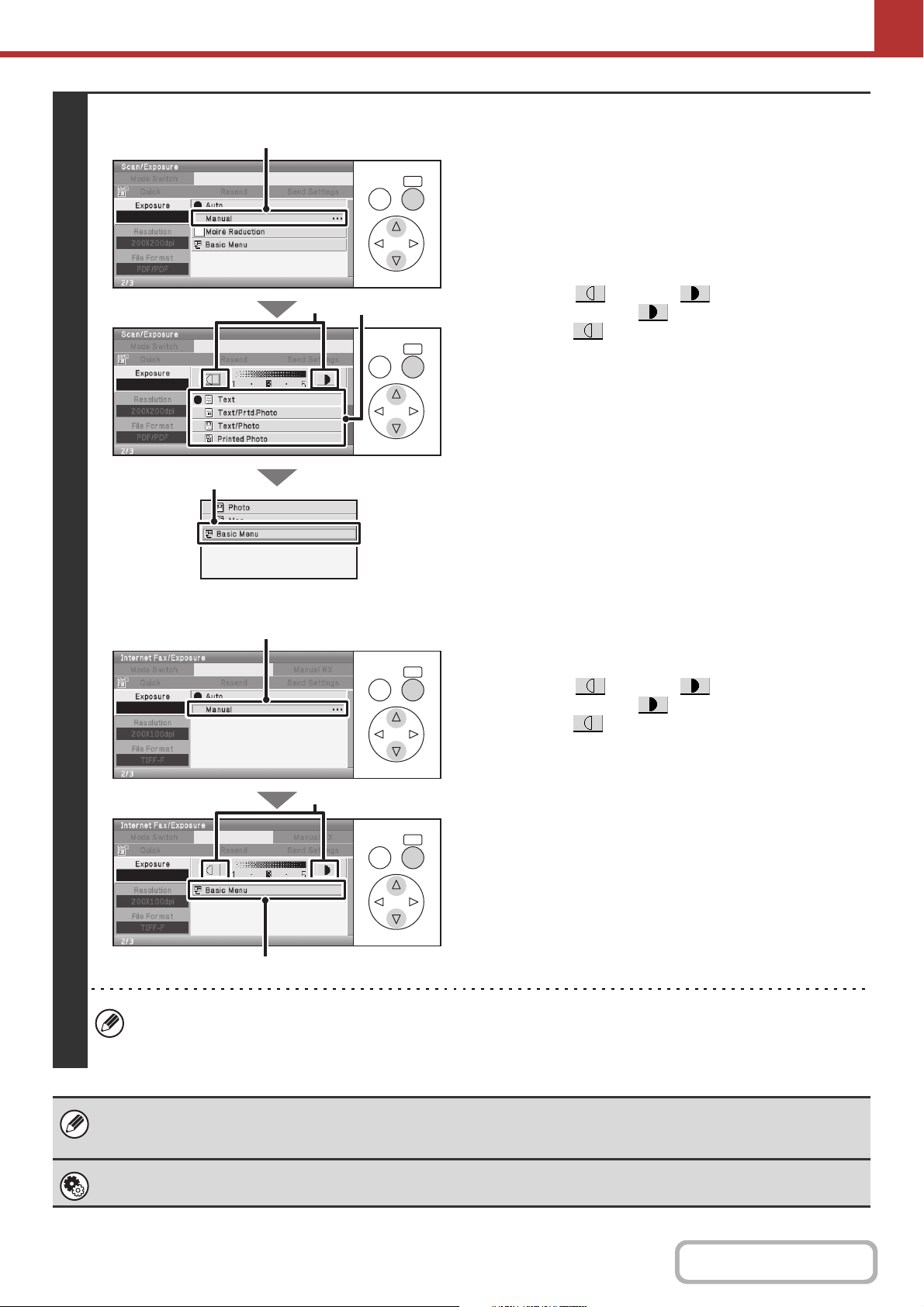
5-68
SCANNER/INTERNET FAX
Contents
3
Scan mode, USB memory mode, Data entry mode
Internet fax mode
Select the exposure and original image
type.
(1) Select the [Manual] key.
(2) Select the original image type.
Select the original image type key that matches the
original image type.
(3) Adjust the exposure.
Select the key or the key. To darken the
exposure, select the key. To lighten the exposure,
select the key.
(4) Select the [Basic Menu] key.
(1) Select the [Manual] key.
(2) Adjust the exposure.
Select the key or the key. To darken the
exposure, select the key. To lighten the exposure,
select the key.
(3) Select the [Basic Menu] key.
• In Internet fax mode, the original image type and moiré reduction cannot be selected.
• To reduce the checkerboard pattern (Moiré) that sometimes occurs when printed matter is scanned, select the
[Moiré Reduction] checkbox.
When using the document glass to scan multiple original pages, the exposure setting can be changed each time you change pages.
When using the automatic document feeder, the exposure setting cannot be changed once scanning has begun. (However, when
"Job Build" is used in the special modes, the exposure can be changed each time a new set of originals is inserted.)
System Settings (Administrator): Default Exposure Settings
This is used to change the default exposure setting.
OKBACK
OKBACK
(3) (2)
(1)
(4)
OKBACK
OKBACK
(2)
(1)
(3)
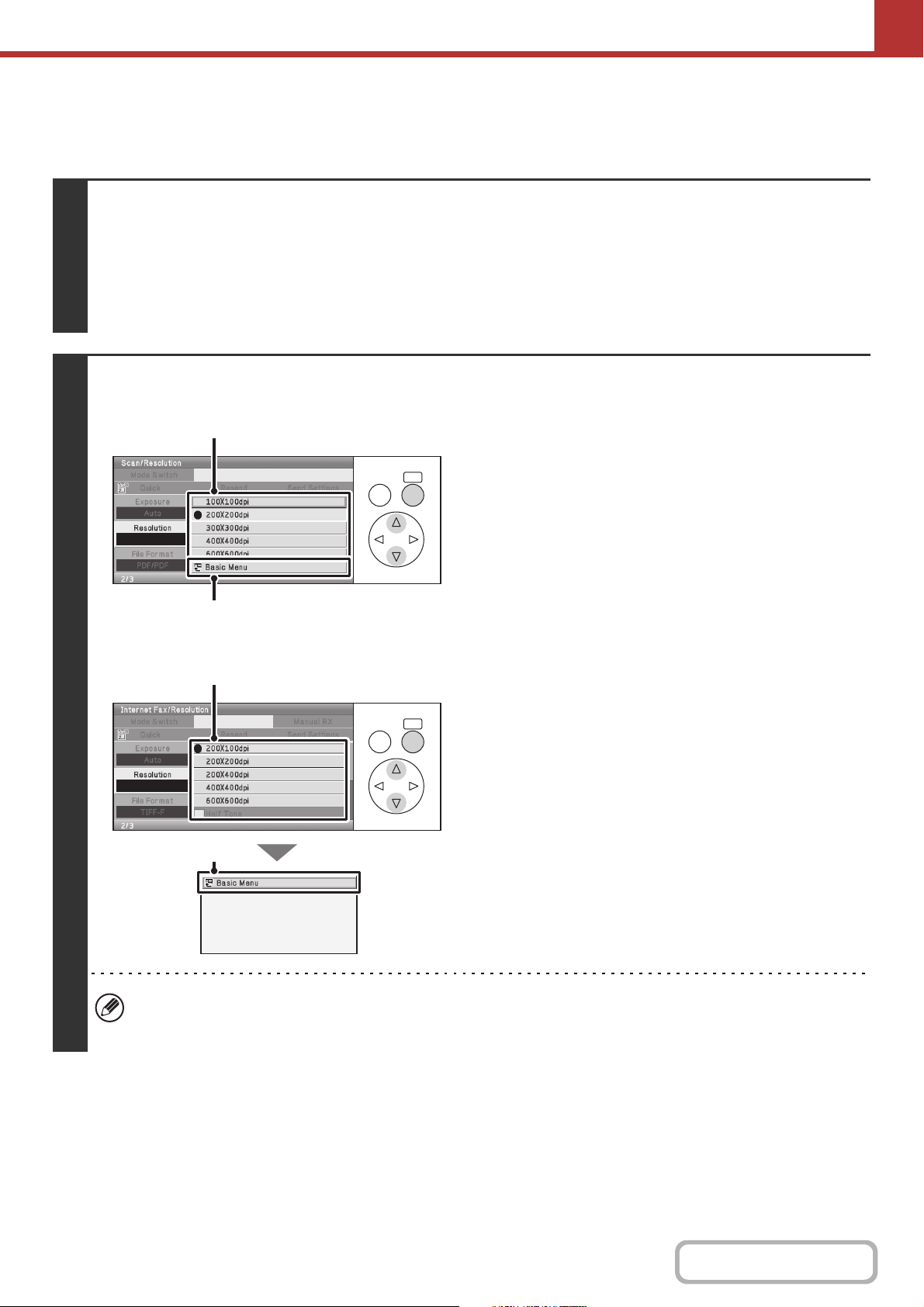
5-69
SCANNER/INTERNET FAX
Contents
CHANGING THE RESOLUTION
The resolution setting can be selected.
Keys in the display can be selected with the arrow keys and the [OK] key.
1
Select the mode and display the image settings screen.
(1) Select the [Mode Switch] key.
(2) Select the mode that you wish to use.
(3) Select the [Resolution] key.
☞ IMAGE SETTINGS (page 5-58)
2
Scan mode, USB memory mode, Data entry mode
Internet fax mode
Select the resolution.
(1) Select the key of the desired resolution.
(2) Select the [Basic Menu] key.
In Internet fax mode, the [Half Tone] key can be selected to select halftone (except when [200X100dpi] is selected).
When the original has many gradations of light and dark such as a photo or color illustration, halftone provides a more
attractive image than regular transmission.
OKBACK
(1)
(2)
OK
BACK
(2)
(1)
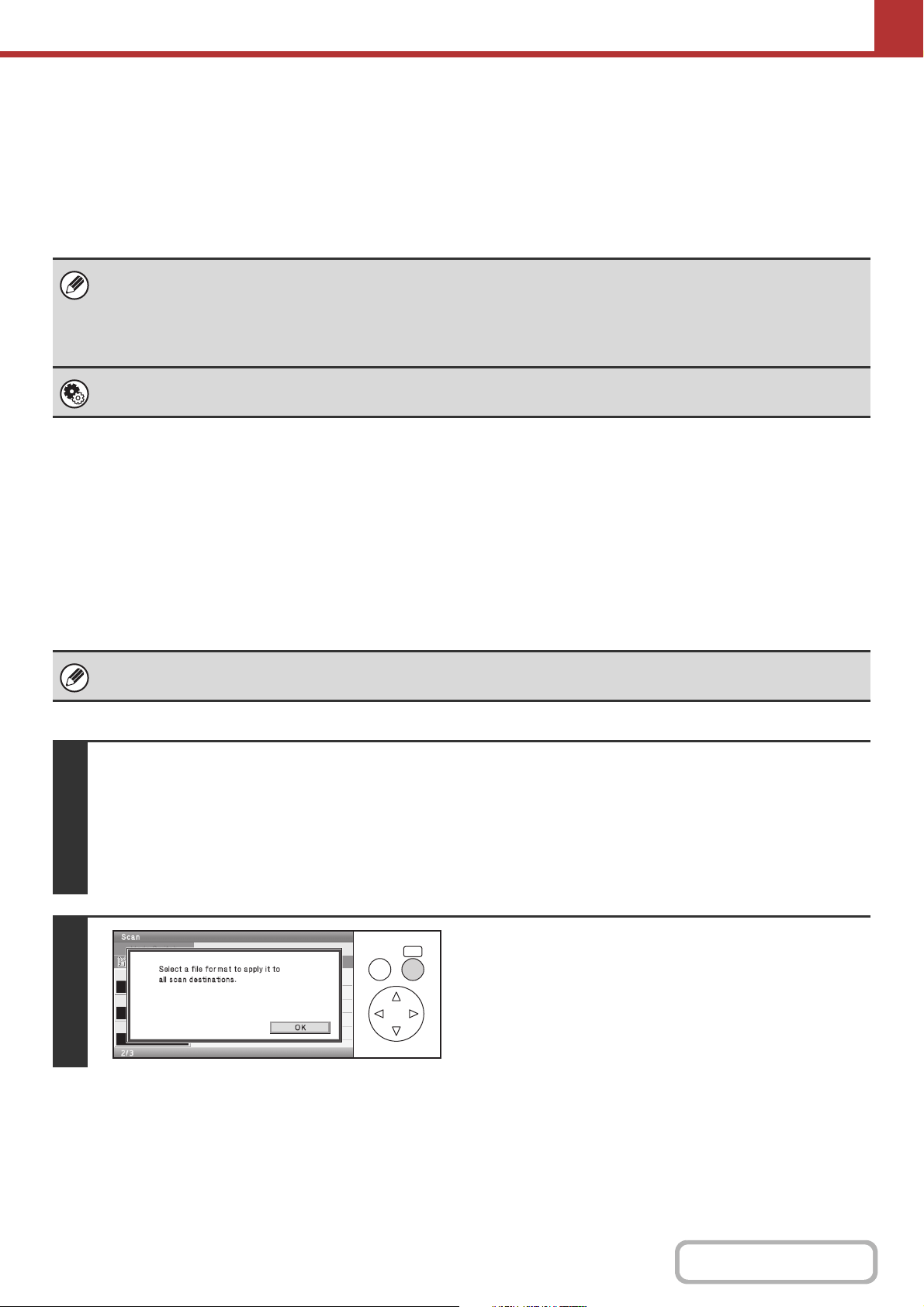
5-70
SCANNER/INTERNET FAX
Contents
How to select the resolution
For normal text originals, 200X200dpi (200X100dpi in Internet fax mode) produces an image that is sufficiently legible.
For photos and illustrations, a high resolution setting (600X600dpi, etc.) will produce a sharp image. However, a high
resolution setting will result in a large file, and if the file is too large, transmission may not be possible. In this event,
reduce the number of pages scanned or take other measures to decrease the file size.
☞ CHANGING THE FILE FORMAT
☞ Specifying the send size of the image (page 5-65)
CHANGING THE FILE FORMAT
Changing the format
(Scan mode, USB memory mode and Data entry mode)
The file format (file type and compression mode/compression ratio) for sending a scanned image can be changed at the
time of transmission. In addition, if the scanned originals are divided into separate files, the number of pages per file can
be changed.
Keys in the display can be selected with the arrow keys and the [OK] key.
• When using the document glass to scan multiple original pages, the resolution setting can be changed each time you
change pages. When using the automatic document feeder, the resolution setting cannot be changed once scanning has
begun. (However, when "Job Build" is used in the special modes, the resolution can be changed each time a new set of
originals is inserted.)
• When [TIFF-S] is selected for the format in Internet fax mode, only [200X100dpi] or [200X200dpi] can be selected.
System Settings (Administrator): Initial Resolution Setting
This is used to change the default resolution setting.
The file format for sending a scanned image is specified when the destination is stored in a one-touch key; however, you can
change the format at the time of transmission.
1
Select the mode and display the image settings screen.
(1) Select the [Mode Switch] key.
(2) Select the mode that you wish to use.
(3) Select the [File Format] key.
☞ IMAGE SETTINGS (page 5-58)
2
Read the displayed message and press
the [OK] key.
The message does not appear in USB memory mode. Go to
the next step.
OK
BACK
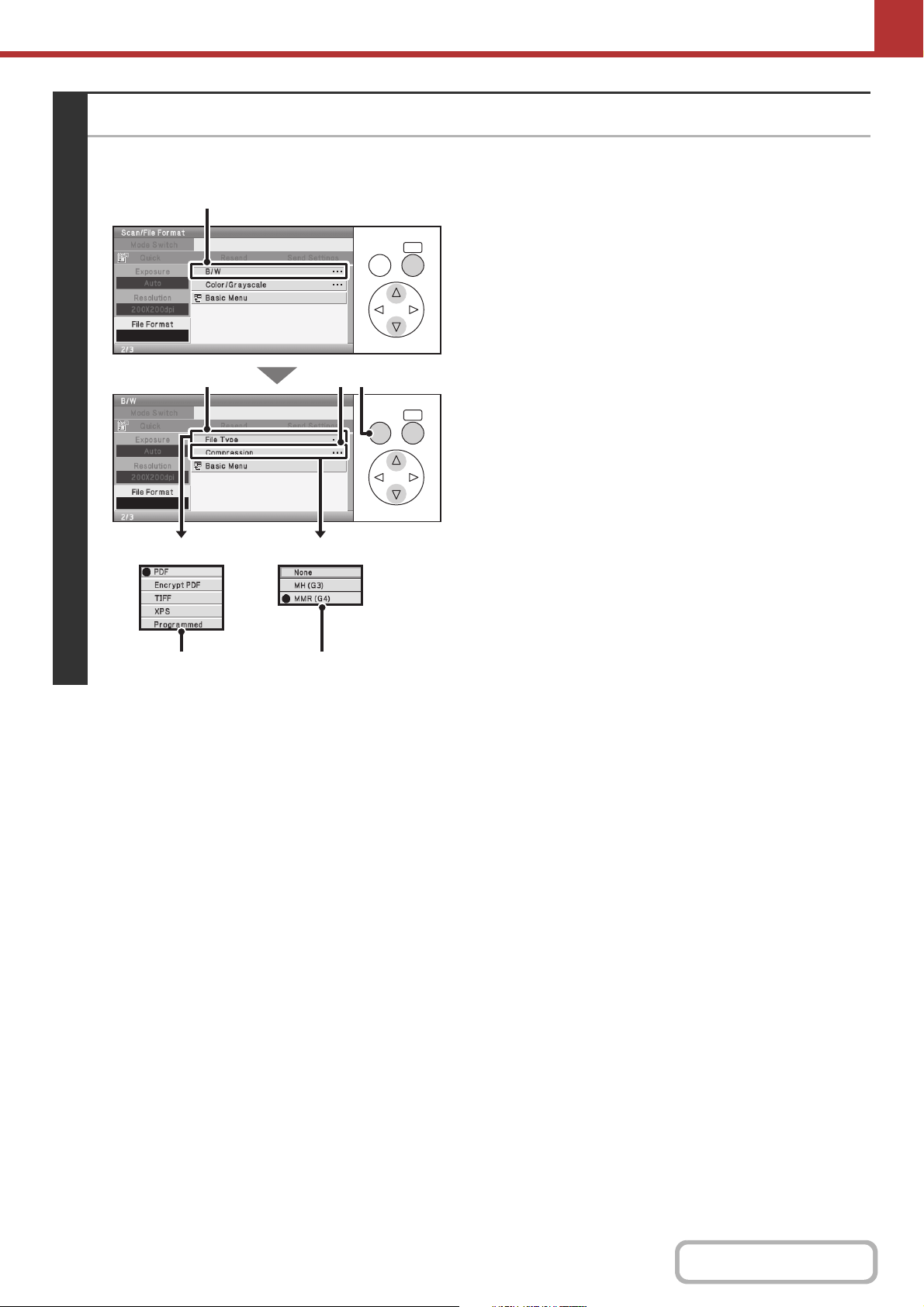
5-71
SCANNER/INTERNET FAX
Contents
3
Set the format.
● Scanning in Mono2
(1) Select the [B/W] key.
(2) Select the [File Type] key.
(3) Select the file type.
Select the desired file type.
(4) Press the [BACK] key.
(5) Select the [Compression] key.
(6) Select the compression mode.
Select the desired compression mode.
OKBACK
OKBACK
(1)
(2) (5)
(4)
(3) (6)
File Type Compression
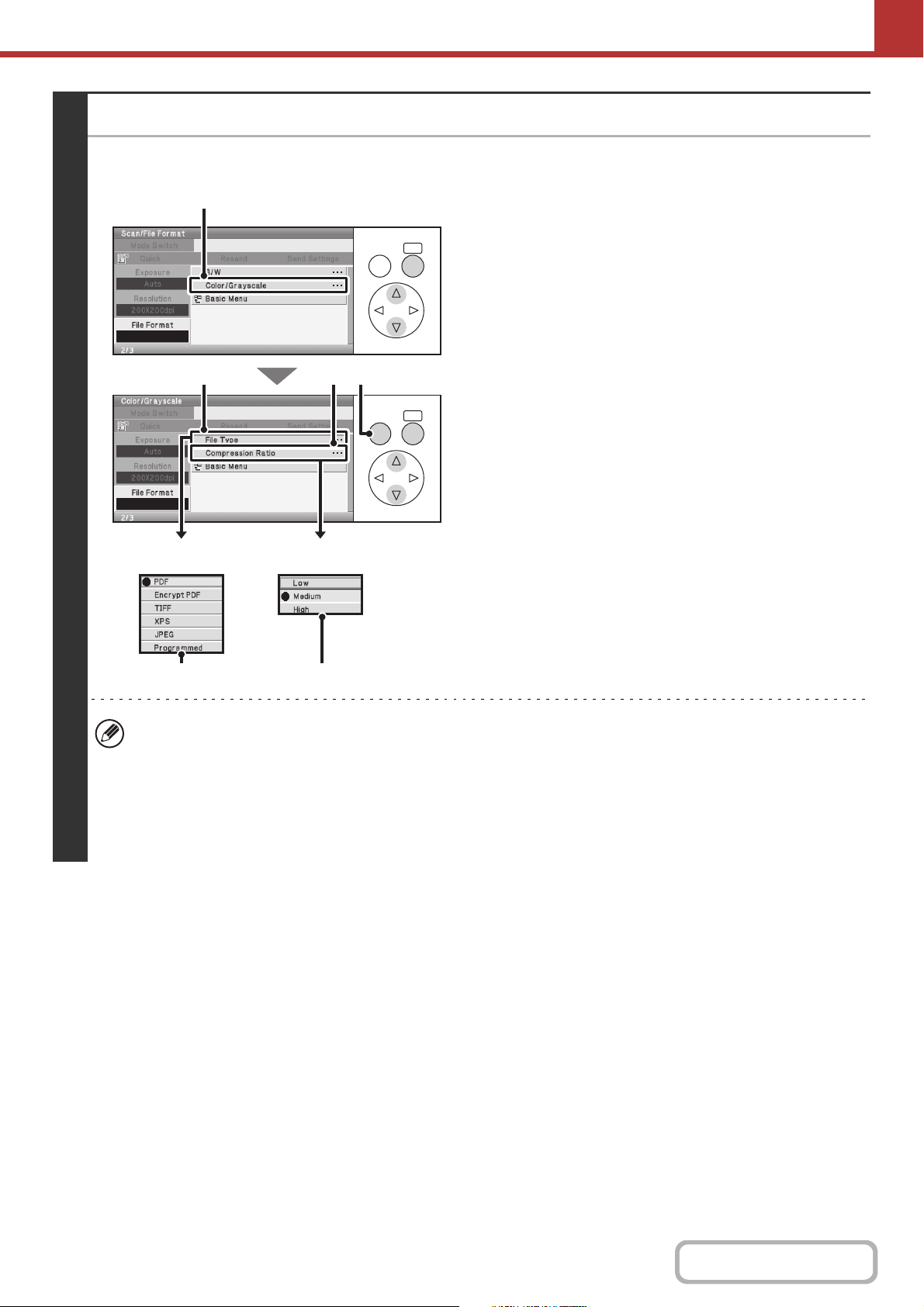
5-72
SCANNER/INTERNET FAX
Contents
3
Set the format. (Continued)
● Scanning in color/grayscale
(1) Select the [Color/Grayscale] key.
(2) Select the [File Type] key.
(3) Select the file type.
Select the desired file type.
(4) Press the [BACK] key.
(5) Select the [Compression Ratio] key.
(6) Select the compression ratio.
Select the desired compression ratio.
High compression results in a smaller file size, however,
the image quality is slightly degraded.
• The [Programmed] key does not appear in USB memory mode.
• The format setting for [B/W] mode is the file format that is used when the [BLACK & WHITE START] key is pressed
with the B/W mode set to [Mono2].
• The format setting for [Color/Gray] mode is the file format that is used when the [COLOR START] key is pressed, or
when the [BLACK & WHITE START] key is pressed with the B/W mode set to [Grayscale].
• The file type of [B/W] mode and the file type of [Color/Gray] mode are linked. The file type cannot be set separately
for each. (When [JPEG] is selected for [Color/Gray] mode, [TIFF] is automatically selected for [B/W] mode.)
OKBACK
OKBACK
(1)
(2) (5)
(4)
(3) (6)
File Type Compression Ratio
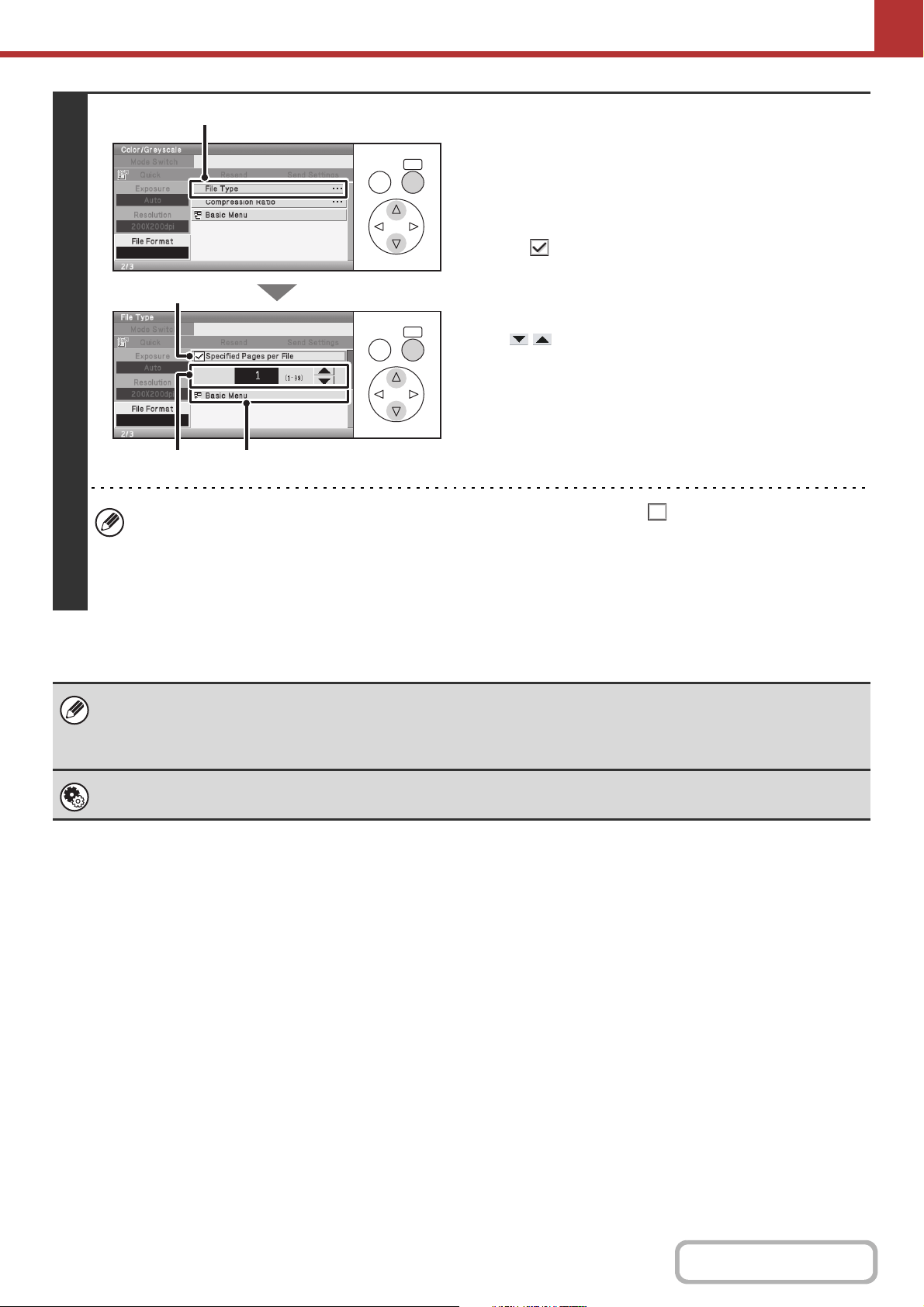
5-73
SCANNER/INTERNET FAX
Contents
4
To change the number of pages per file,
enter the number of pages and exit the
format settings.
(1) Select the [File Type] key.
(2) Set the [Specified Pages per File] checkbox
to .
The number can also be changed by selecting the
number display and pressing the [OK] key.
(3) Set the number of pages per file with the
keys.
(4) Select the [Basic Menu] key.
• When a checkmark does not appear in the [Specified Pages per File] checkbox , one file is created for all
scanned pages.
• When [Specified Pages per File] is selected, consecutive numbers are added to the created file names.
• When [JPEG] is selected for the file type, one file is created for each page (a file cannot be created for multiple
pages). For this reason, the [Specified Pages per File] checkbox does not appear.
When [Encrypt PDF] is selected, a password entry screen will appear when the [START] key is pressed to begin scanning
and transmission.
Select the [Entry] key in the displayed screen to open the keyboard screen. Enter a password (maximum of 32 characters)
and select the [OK] key. Scanning and transmission will begin.
System Settings (Administrator): Initial File Format Setting (Web page only)
This sets the default file format setting for scanner transmission.
OK
BACK
OK
BACK
(1)
(2)
(4)(3)
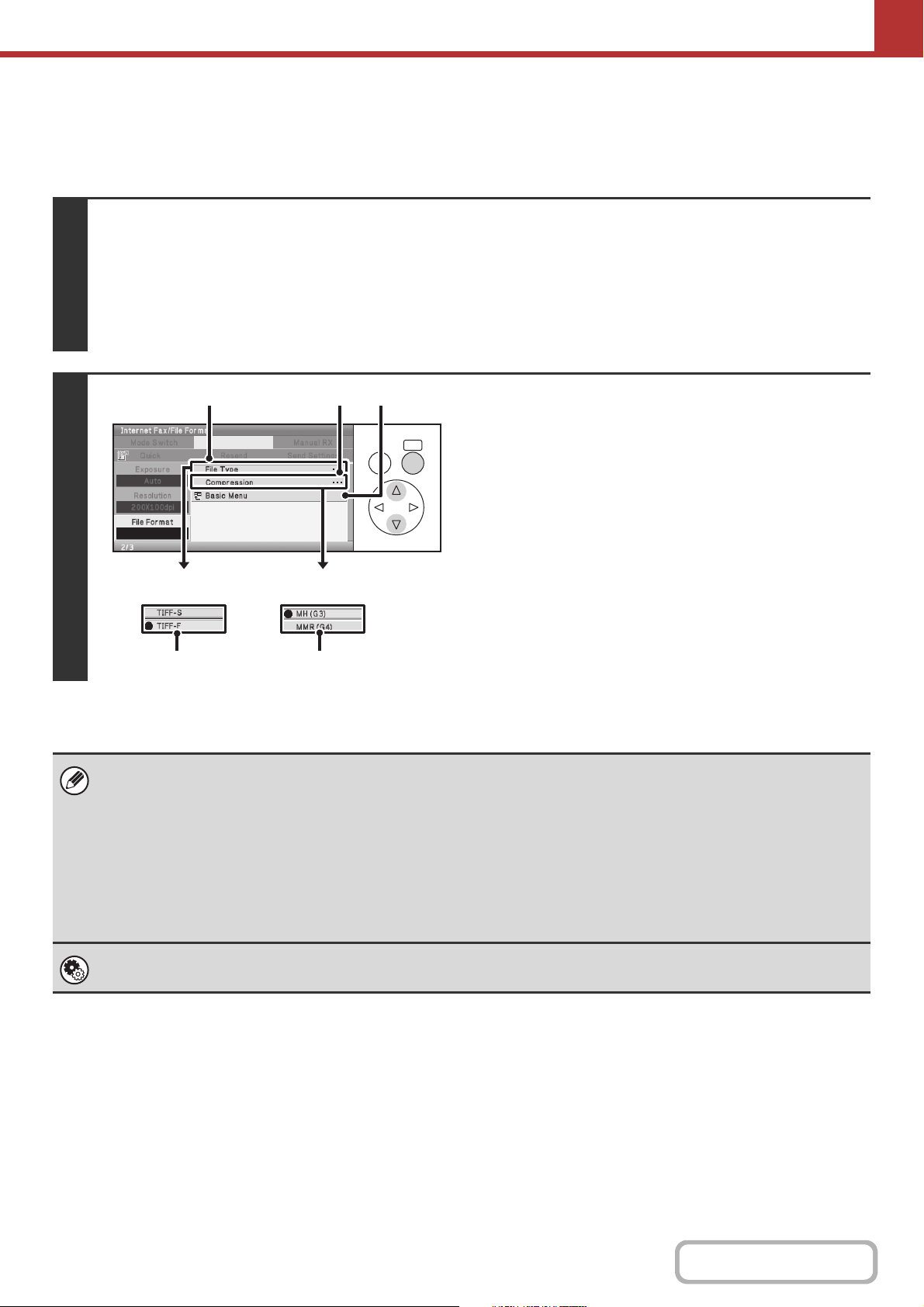
5-74
SCANNER/INTERNET FAX
Contents
Changing the format (Internet fax mode)
The file format for sending an Internet fax is normally set to [TIFF-F]. If the destination Internet fax machine does not
support full mode (it only supports simple mode), follow the steps below to select [TIFF-S].
Keys in the display can be selected with the arrow keys and the [OK] key.
1
Switch to Internet fax mode and display the file format settings screen.
(1) Select the [Mode Switch] key.
(2) Select the [Internet Fax] key.
(3) Select the [File Format] key.
☞ IMAGE SETTINGS (page 5-58)
2
Select the file format.
(1) Select the [File Type] key.
(2) Select the file format.
(3) Select the [Compression] key.
(4) Select the compression mode.
If you selected [TIFF-F], select the compression mode.
(5) Select the [Basic Menu] key.
When [TIFF-S] is selected, the transmission settings are restricted as follows:
• Resolution: The selections are [200X100dpi] and [200X200dpi]. If [TIFF-S] is selected after [200X400dpi],
[400X400dpi] or [600X600dpi] is selected, the resolution automatically changes to [200X200dpi].
• Send size: It is always 8-1/2" x 11" (A4) in landscape orientation. If [TIFF-S] is selected after the send size is
changed, the send size is automatically changed to 8-1/2" x 11" (A4) in landscape orientation. If a size
larger than 8-1/2" x 11" (A4) is scanned, the size will automatically be reduced to 8-1/2" x 11" (A4) in
landscape orientation. When this format is included in a broadcast transmission, the image will be
transmitted to all destinations at 8-1/2" x 11" (A4) in landscape orientation.
• Special modes: When a ratio setting is selected and the original size is entered, Card Shot cannot be used.
System Settings (Administrator): Compression Setting (Web page only)
This is used to set the default compression mode for Internet fax transmission.
OKBACK
(1)
(4)(2)
(3) (5)
File Type
Compression

5-75
SCANNER/INTERNET FAX
Contents
CHANGING THE COLOR MODE
This procedure is used to change the color mode used to scan the original when the [COLOR START] key or the
[BLACK & WHITE START] key is pressed.
Keys in the display can be selected with the arrow keys and the [OK] key.
This function cannot be used in Internet fax mode.
Start key Mode Scanning method
[COLOR START] key
Auto
The machine detects whether the original is color or black and white and
automatically selects full color or black and white (Mono2 or Grayscale)
scanning.
Full Color
The original is scanned in full color. This mode is best for full color originals
such as catalogues.
[BLACK & WHITE
START] key
Mono2
Colors in the original are scanned as black or white. This mode is best for
text-only originals.
Grayscale
The colors in the original are scanned in black and white as shades of gray
(grayscale).
1
Select the mode and display the color mode settings screen.
(1) Select the [Mode Switch] key.
(2) Select the mode that you wish to use.
(3) Select the [Color Mode] key.
☞ IMAGE SETTINGS (page 5-58)
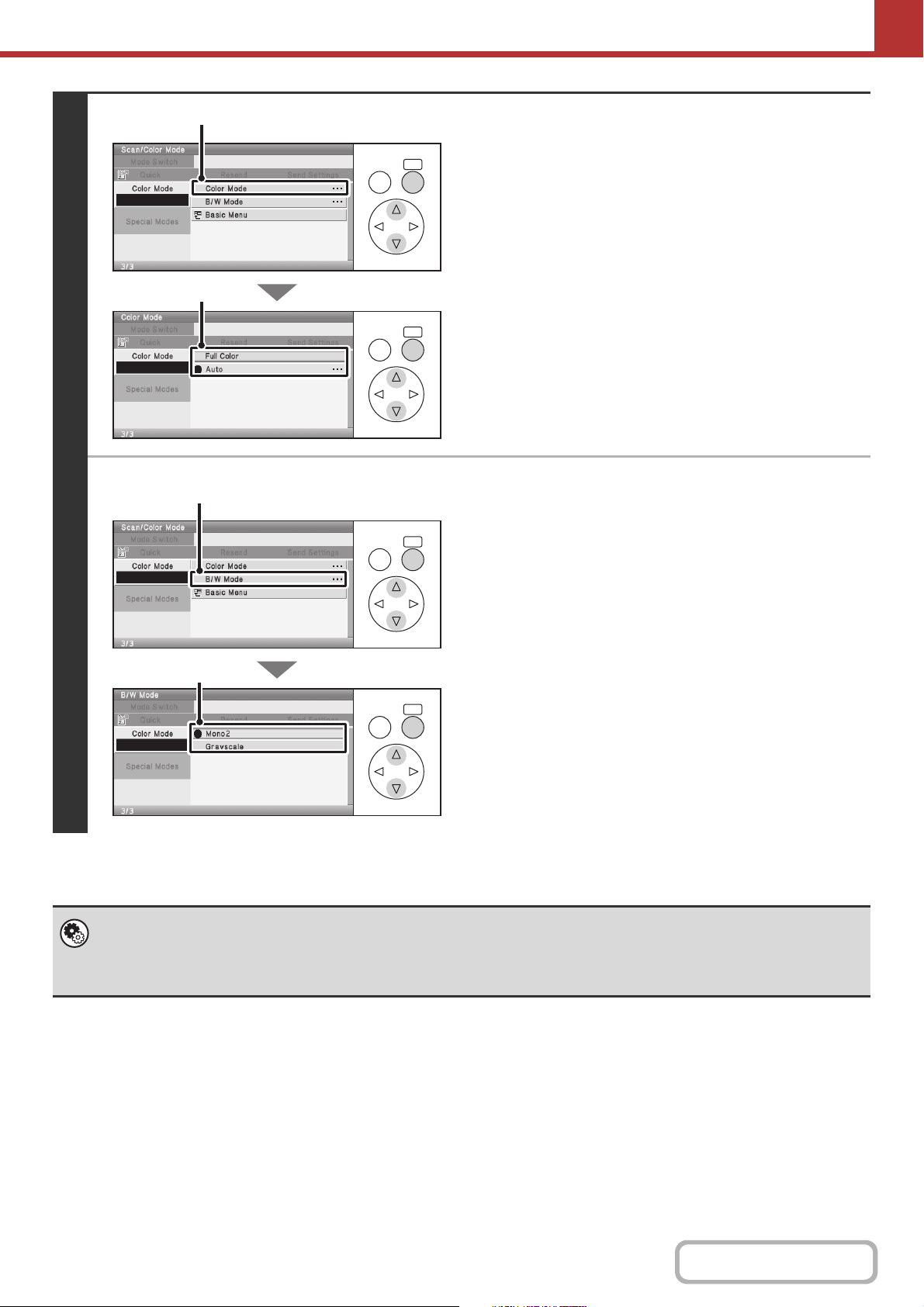
5-76
SCANNER/INTERNET FAX
Contents
2
Select the color mode.
(1) Select the [Color Mode] key.
(2) Select the key of the mode to be used when
the [COLOR START] key is pressed.
You can select whether black & white scanning will take
place in Mono2 or grayscale when [Auto] is selected and
a black and white original is scanned. Note that if the file
format is set to JPEG, scanning will take place in
grayscale.
Select the B/W mode.
(1) Select the [B/W Mode] key.
(2) Select the key of the mode to be used when
the [BLACK & WHITE START] key is
pressed.
• System Settings (Administrator): Default Color Mode Settings (Web page only)
The default color mode can be changed.
• System Settings (Administrator): Disable Change of B/W Setting in Auto Mode (Web page only)
This prohibits selection of the black and white original scanning setting when [Auto] is selected for the color mode.
OKBACK
OKBACK
(1)
(2)
OKBACK
OKBACK
(1)
(2)
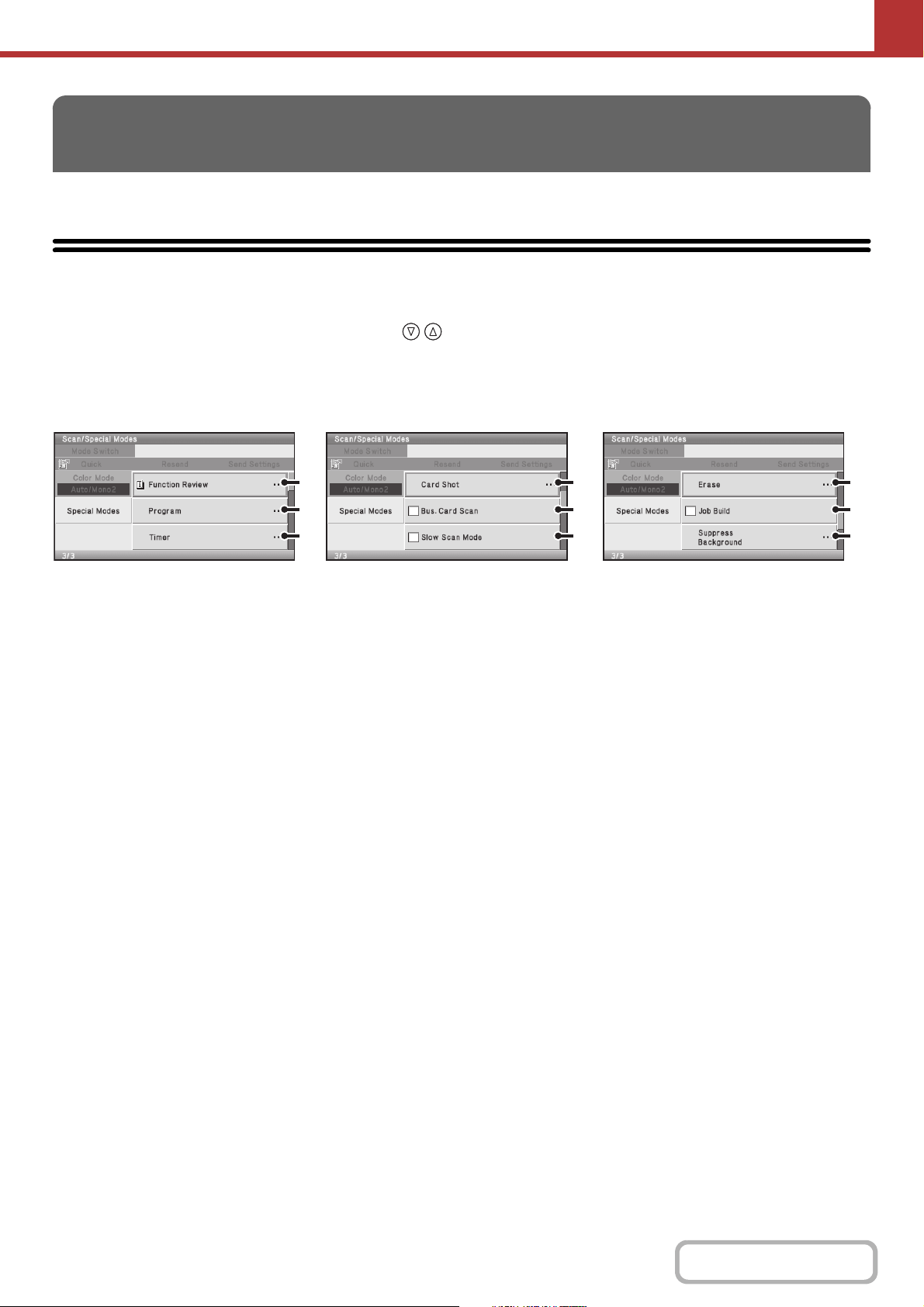
5-77
SCANNER/INTERNET FAX
Contents
This section explains special modes that can be used in scan send mode.
SPECIAL MODES
When the [Special Modes] key is selected in the base screen, the special modes menu screen appears. The special
modes menu consists of three screens. Select the key to switch between the three screens. When the [Basic
Menu] key is selected in the special modes screen, the selected settings are entered and the base screen reappears.
☞ Internet fax mode (page 5-78)
Scan mode, USB memory mode, Data entry mode
(1) [Function Review] key*
1
Select this key to check the special mode settings.
(2) [Program] key*
2,
3
☞ STORING SCAN OPERATIONS (Programs) (page
5-79)
(3) [Timer] key*
2
☞ SENDING AN IMAGE AT A SPECIFIED TIME
(Timer Transmission) (page 5-83)
(4) [Card Shot] key
☞ SCANNING BOTH SIDES OF A CARD ONTO A
SINGLE PAGE (Card Shot) (page 5-85)
(5) [Bus. Card Scan] checkbox*
4
☞ SCANNING BUSINESS CARDS (Business Card
Scan) (page 5-88)
(6) [Slow Scan Mode] checkbox
☞ SCANNING THIN ORIGINALS (Slow Scan Mode)
(page 5-89)
(7) [Erase] key
☞ ERASING PERIPHERAL SHADOWS ON THE
IMAGE (Erase) (page 5-91)
(8) [Job Build] checkbox
☞ SCANNING MANY ORIGINALS AT ONCE (Job
Build) (page 5-94)
(9) [Suppress Background] key
☞ WHITENING FAINT COLORS IN THE IMAGE
(Suppress Background) (page 5-96)
*1
This cannot be selected when a special mode has not been enabled.
*2 Does not appear in USB memory mode.
*3 Does not appear in data entry mode.
*4 The optional business card feeder must be attached and "Business Card Scan Option" must be enabled in the
system settings (administrator).
SPECIAL MODES
(1)
(2)
(3)
(4)
(5)
(6)
(7)
(8)
(9)
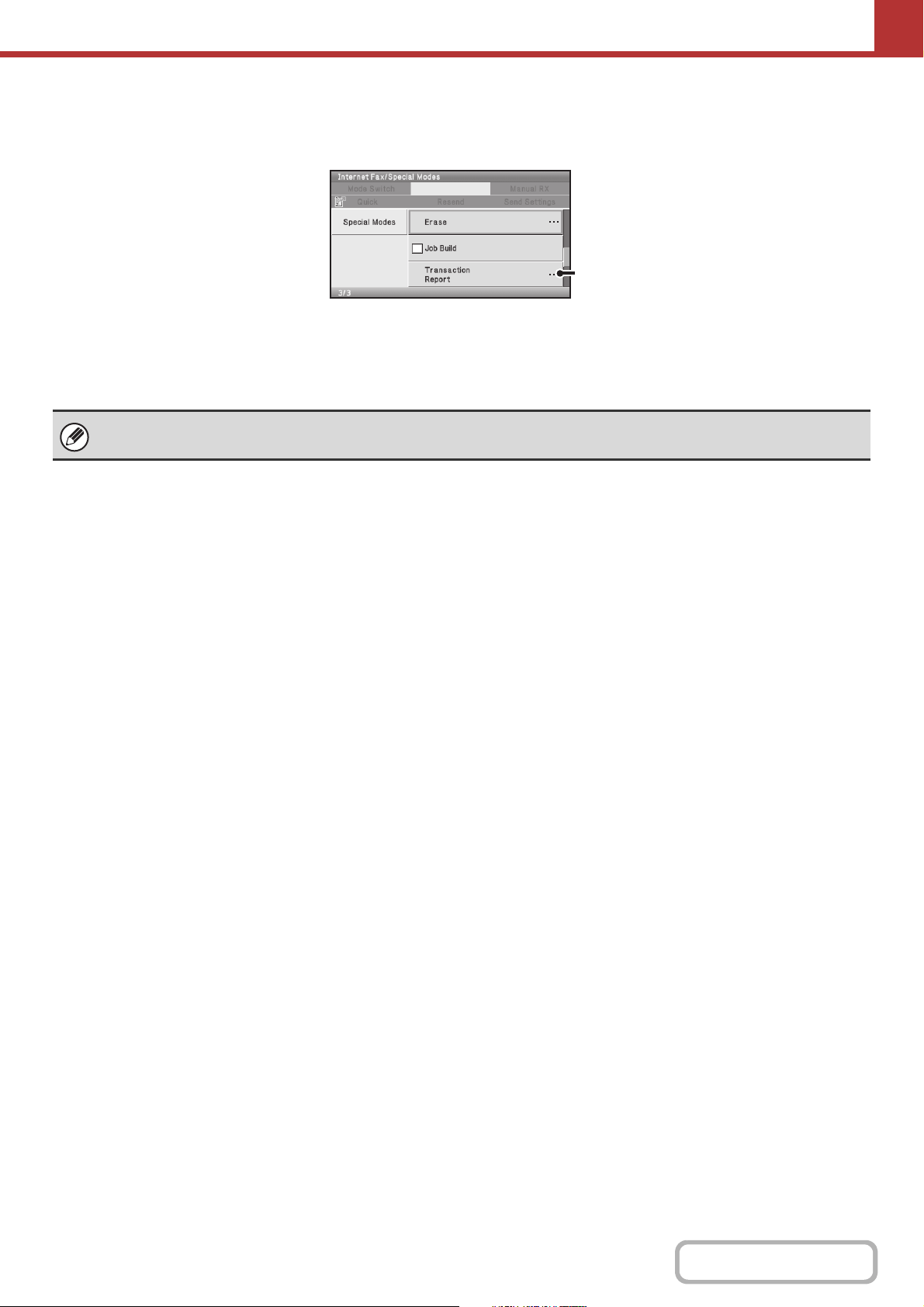
5-78
SCANNER/INTERNET FAX
Contents
Internet fax mode
The special mode explained below can only be used in Internet fax mode. The other special modes are the same as
those explained in "Scan mode, USB memory mode, Data entry mode" (page 5-77).
(1) [Transaction Report] key
☞ CHANGING THE PRINT SETTINGS FOR THE
TRANSACTION REPORT (Transaction Report)
(page 5-98)
(1)
Special modes can generally be combined with other special modes, however, there are some combinations that are not
possible. If a prohibited combination is selected, a message will appear in the display.
5-79
SCANNER/INTERNET FAX
Contents
STORING SCAN OPERATIONS (Programs)
A destination, original settings, and functions can be stored in a program. When you wish to use those settings to send
an image, they can be retrieved with ease.
For example, suppose 8-1/2" x 11" (A4) size documents are scanned into a file and sent to each branch office once a month.
(1) The same documents are sent to each branch office
(2) Smudges on the edges of the documents are erased before transmission
When a job program is not stored When a job program is stored
Enter the address of each branch office.
Select Erase settings.
Press the [START] key.
The originals are scanned and transmitted.
Select a stored program key.
Press the [START] key.
The originals are scanned and transmitted.
Considerable time is required to send the documents each
month because the above settings must be selected.
In addition, mistakes may occasionally be made when
selecting the settings, so incorrect transmissions may occur.
When a program is used, settings are selected with ease by
simply selecting the stored key.
In addition, transmission takes place based on the stored
settings so there are no chances for mistakes.
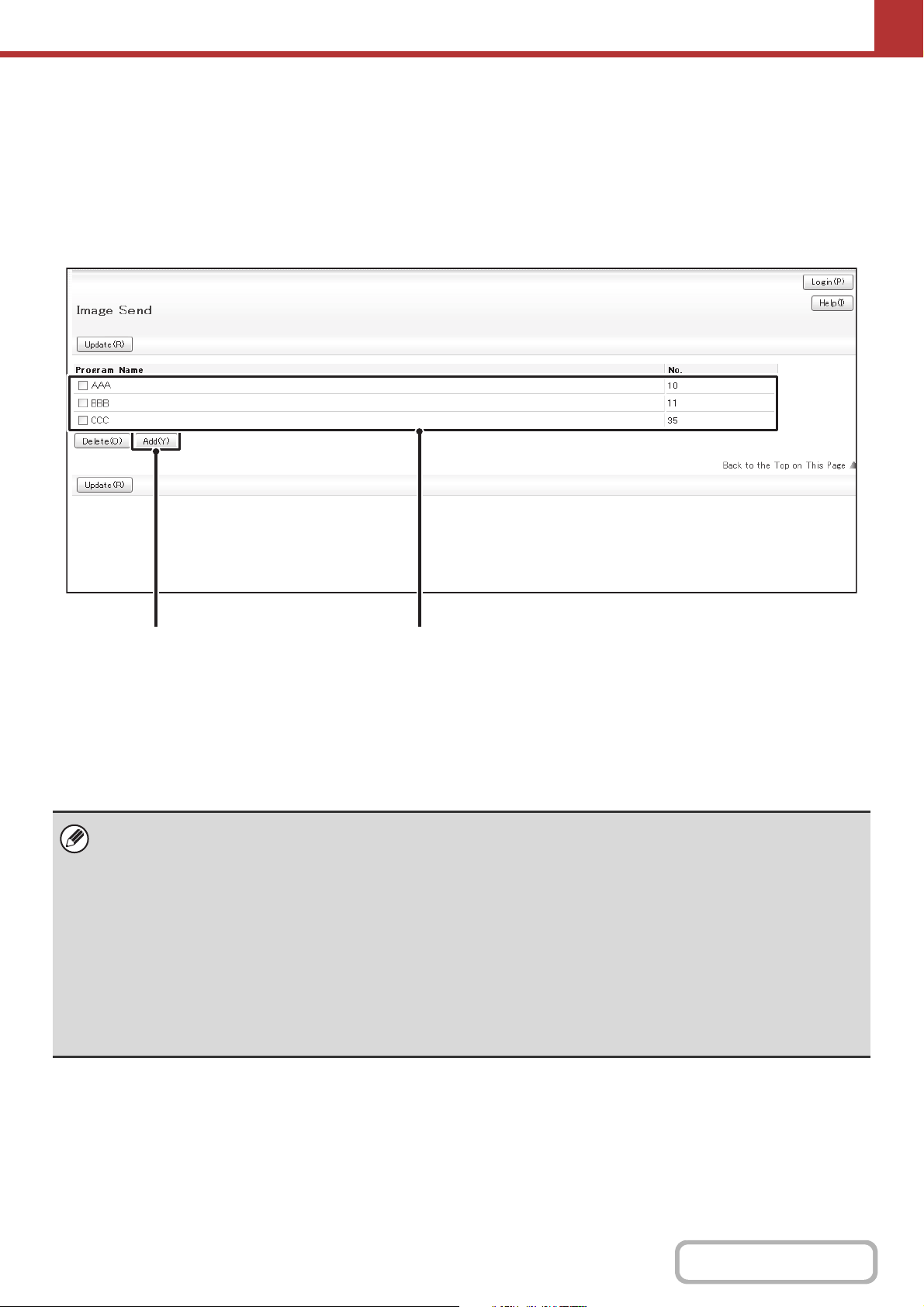
5-80
SCANNER/INTERNET FAX
Contents
JOB PROGRAMS
If you frequently use the same settings and/or functions to transmit to the same destination or destinations, the settings
and destinations can be stored in a program. This allows the settings and destinations to be selected by simply selecting
the program.
Storing a job program
Programs can be stored, edited, and deleted in [Job Program] > [Image Send] in the Web page menu.
(1) [Add] key
Use this key to add a new program.
(2) List display
This displays a list of the currently stored programs. A
program can be selected to open an edit/delete screen
for the program.
Select the [Add] key in the above screen to open a registration screen. Up to 48 programs can be stored.
For more information, see "Settings" (page 5-81).
(1) (2)
• A timer setting cannot be included in a program.
• At least one one-touch key must be specified in a program or the program cannot be stored.
•
Programs can also be stored in the Web pages. Click [Job Programs] and then [Image Send] in the Web page menu.
• The settings stored in a program will be retained even after the program is used for transmission. The same settings can
be used repeatedly for transmission.
• The following settings can be stored in programs.
• Image send mode: Scan, Internet fax
• Destinations
• Image settings: Original scan size, original orientation, duplex scanning, exposure, resolution
• Special modes: Erase, Suppress Background, Job Build, Slow Scan Mode, Business Card Scan
• Up to 500 destinations can be stored in one program.

5-81
SCANNER/INTERNET FAX
Contents
Editing and deleting job programs
A program can be selected from the list in the above screen to open an edit screen for the program.
To delete the program, select the checkbox
next to the program name and then select [Delete].
For more information, see the following table.
Settings
USING A PROGRAM TO SCAN
Keys in the display can be selected with the arrow keys and the [OK] key.
Item Description
Program Number
Set the number to be assigned to the program. The lowest available number is
automatically entered. To change the number, enter a number from 01 to 48. A
number that has already been stored cannot be used.
Program Name Enter a maximum of 36 characters for the program name.
Condition Settings This shows setting screens for each mode.
Mode Switch
Select the mode that you wish to use (Internet Fax, scan, copy, etc.). The display will
change to the base screen of the selected mode.
Address Setting
This shows the setting screen for addresses.
Select the address(es) to be used in the program from the address book. Up to 500
destinations can be stored in one program.
Mode Settings
Frequently used settings can be stored in the same way as when they are selected
for a mode.
This function cannot be used in USB memory mode or data entry mode.
1
Place the original.
Place the original in the document feeder tray or on the document glass as appropriate for the functions stored in the program.
When the original is a different size than the size setting, set the original size.
☞ SPECIFYING THE ORIGINAL SCAN SIZE AND SEND SIZE (page 5-61)
2
Select the special modes.
(1) Select the [Special Modes] key.
(2) Select the [Program] key.
☞ SPECIAL MODES (page 5-77)
3
Retrieve the stored program.
Select the desired program key.
OKBACK
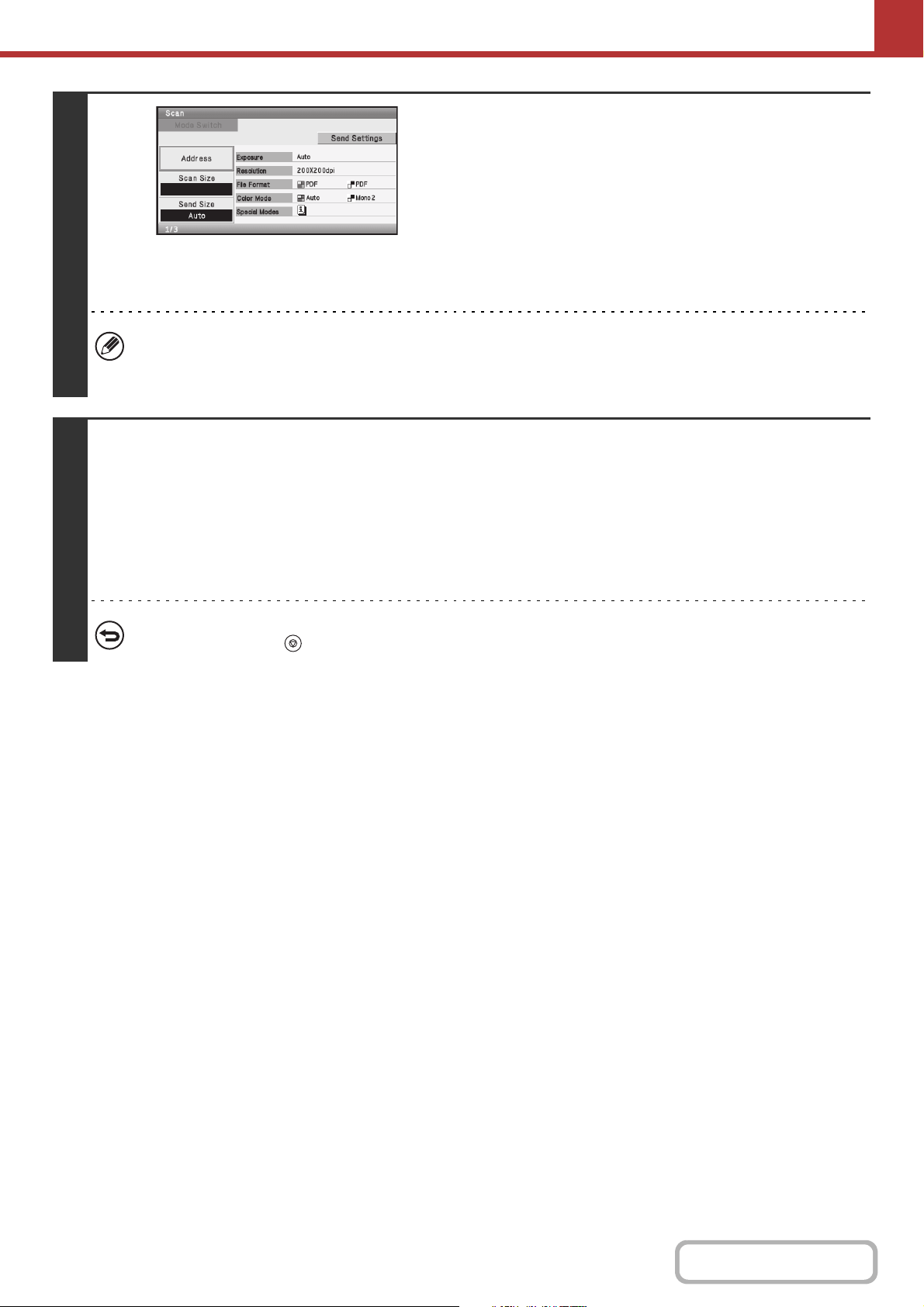
5-82
SCANNER/INTERNET FAX
Contents
4
Select additional settings.
When a program is used, the following settings can be
additionally specified:
• Image Settings: Original scan size*, send size, file format,
color mode
• Send settings
• Special modes: Timer Transmission, Card Shot, Transaction
Report
* When stored in the program, this cannot be additionally
specified.
• The screen that appears will vary depending on the destination stored in the program.
• The mode cannot be changed here.
• Functions stored in the program cannot be canceled here.
5
Press the [COLOR START] key or the [BLACK & WHITE START] key.
Scanning begins.
• If you inserted the original pages in the document feeder tray, all pages are scanned.
A beep will sound to indicate that scanning is finished.
• If you are scanning the original on the document glass, scan each page one page at a time.
When scanning finishes, place the next original and press the [COLOR START] key or the [BLACK & WHITE START] key.
Repeat until all pages have been scanned and then select the [Read-End] key.
A beep will sound to indicate that scanning is finished.
To cancel scanning...
Press the [STOP] key ( ) to cancel the operation.
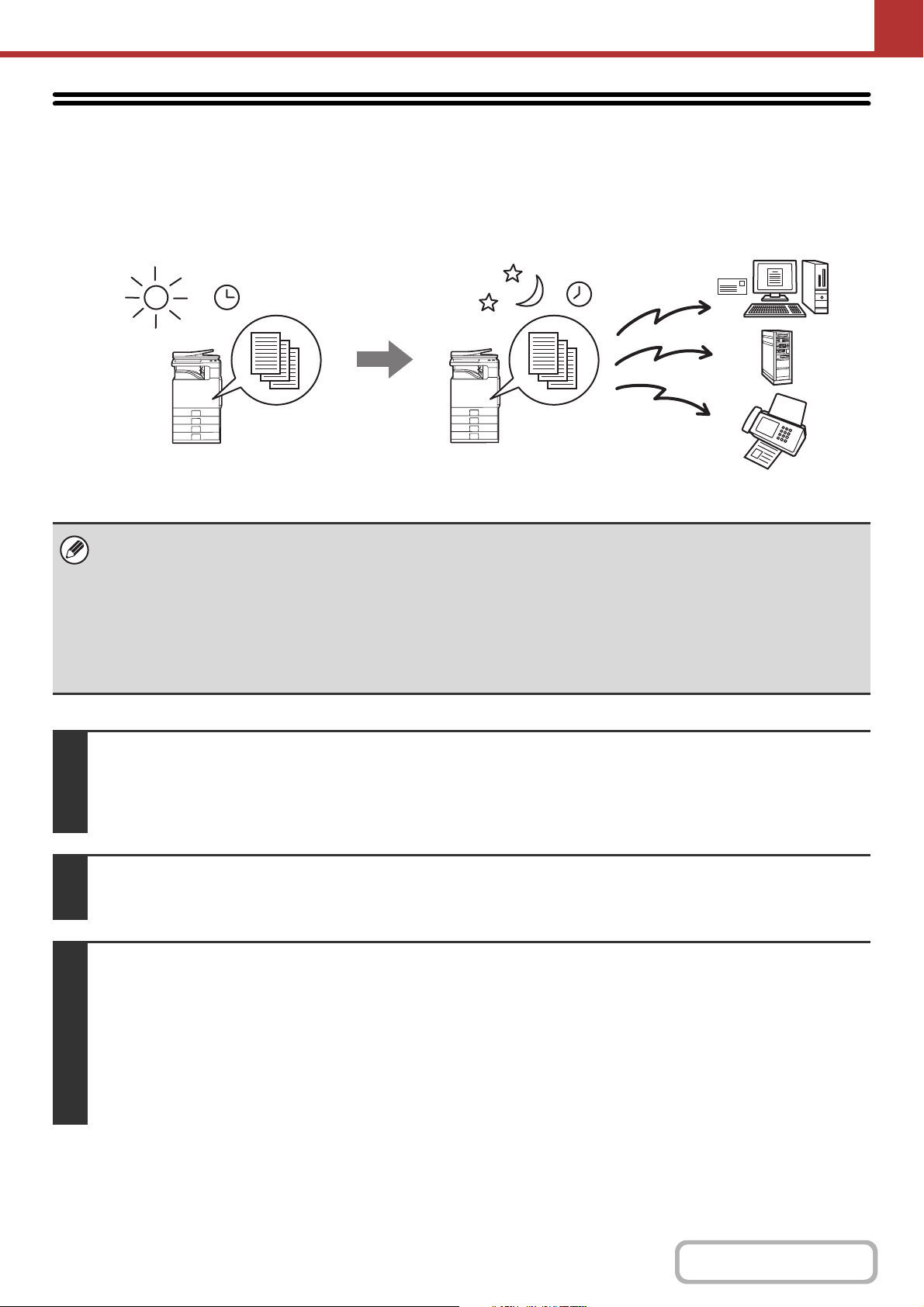
5-83
SCANNER/INTERNET FAX
Contents
SENDING AN IMAGE AT A SPECIFIED TIME
(Timer Transmission)
This function lets you specify a time at which a transmission or broadcast transmission will automatically take place.
Transmission begins automatically at the specified time.
Keys in the display can be selected with the arrow keys and the [OK] key.
• When a timer transmission is stored, keep the main power switch in the "on" position. If the main power switch is in the "off"
position at the specified time, transmission will not take place.
• When performing a timer transmission, you must scan the original into memory when you set up the transmission. It is not
possible to leave the document in the auto document feeder or on the document glass and have it scanned at the specified
time of transmission.
• Settings selected for a timer transmission (exposure, resolution, special modes, etc.) are automatically cleared after the
transmission is finished.
• This function cannot be used in USB memory mode.
1
Place the original.
Place the original face up in the document feeder tray, or face down on the document glass.
When the original is a different size than the size setting, set the original size.
☞ SPECIFYING THE ORIGINAL SCAN SIZE AND SEND SIZE (page 5-61)
2
Specify the destination.
☞
ENTERING DESTINATIONS (page 5-22)
3
Select the special modes.
(1) Select the [Mode Switch] key.
(2) Select the mode that you wish to use.
(3) Select the [Special Modes] key.
(4) Select the [Timer] key.
☞ SPECIAL MODES (page 5-77)
Set a transmission to
take place at 20:00
At 20:00, the transmission
begins automatically
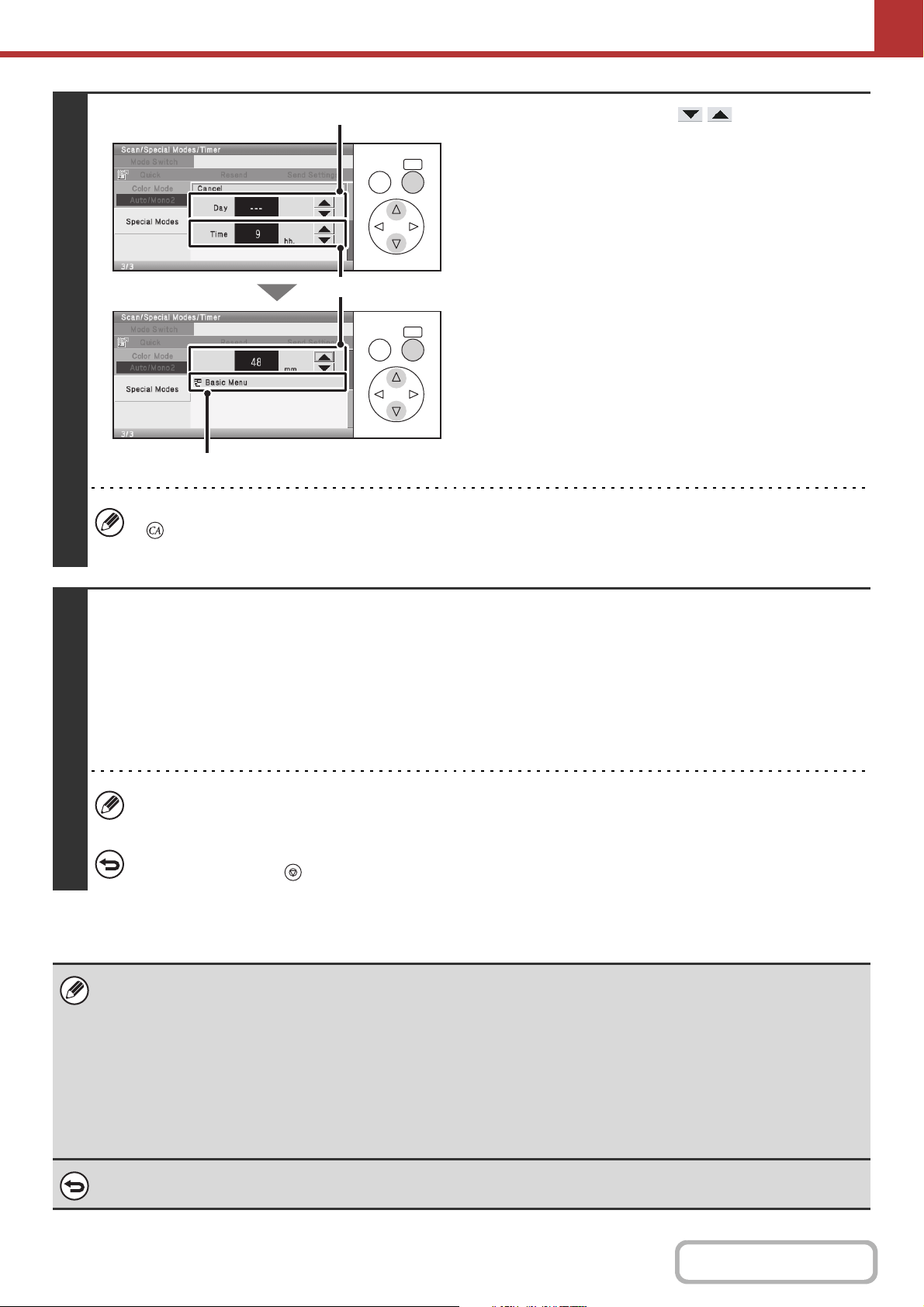
5-84
SCANNER/INTERNET FAX
Contents
4
Set the time with the keys.
(1) Specify the day.
If you do not wish to specify a day, select [---]. In this
case, transmission will begin when the time specified in
(2) arrives.
(2) Specify the time (hour, minute)
Select the time in 24-hour format.
You can also select a numeric display key to change the
setting with the numeric keys.
(3) Select the [Basic Menu] key.
When this screen is opened, the setting will show the current time. If the time is not correct, press the [CLEAR ALL] key
( ) to cancel the operation. Correct the time in the system settings and then perform the timer transmission procedure.
☞ CHECKING THE DATE AND TIME (page 5-5)
5
Press the [COLOR START] key or the [BLACK & WHITE START] key.
Scanning begins.
• If you inserted the original pages in the document feeder tray, all pages are scanned.
A beep will sound to indicate that scanning is finished.
• If you are scanning the original on the document glass, scan each page one page at a time.
When scanning finishes, place the next original and press the [COLOR START] key or the [BLACK & WHITE START] key.
Repeat until all pages have been scanned and then select the [Read-End] key.
A beep will sound to indicate that scanning is finished.
• If the destination is an Internet fax destination, press the [BLACK & WHITE START] key.
• The original is scanned into memory. The original cannot be scanned at a specified time.
To cancel scanning...
Press the [STOP] key ( ) to cancel the operation.
• The time can be specified up to a week in advance.
• Up to 94 timer transmissions can be stored at once.
• If another transmission is in progress when the specified time arrives, the timer transmission will begin after that
transmission is finished.
• Other transmissions can be performed as usual after a timer transmission is stored.
• A timer transmission can be deleted in the job status screen.
• If a timer transmission is given priority in the job status screen, the time specification is canceled. The transmission will
begin as soon as the job in progress is completed.
☞GIVING PRIORITY TO A SCAN TRANSMISSION JOB (page 5-107)
To cancel timer transmission...
Select the [Cancel] key in the screen of step 4.
OK
BACK
OK
BACK
(1)
(2)
(3)
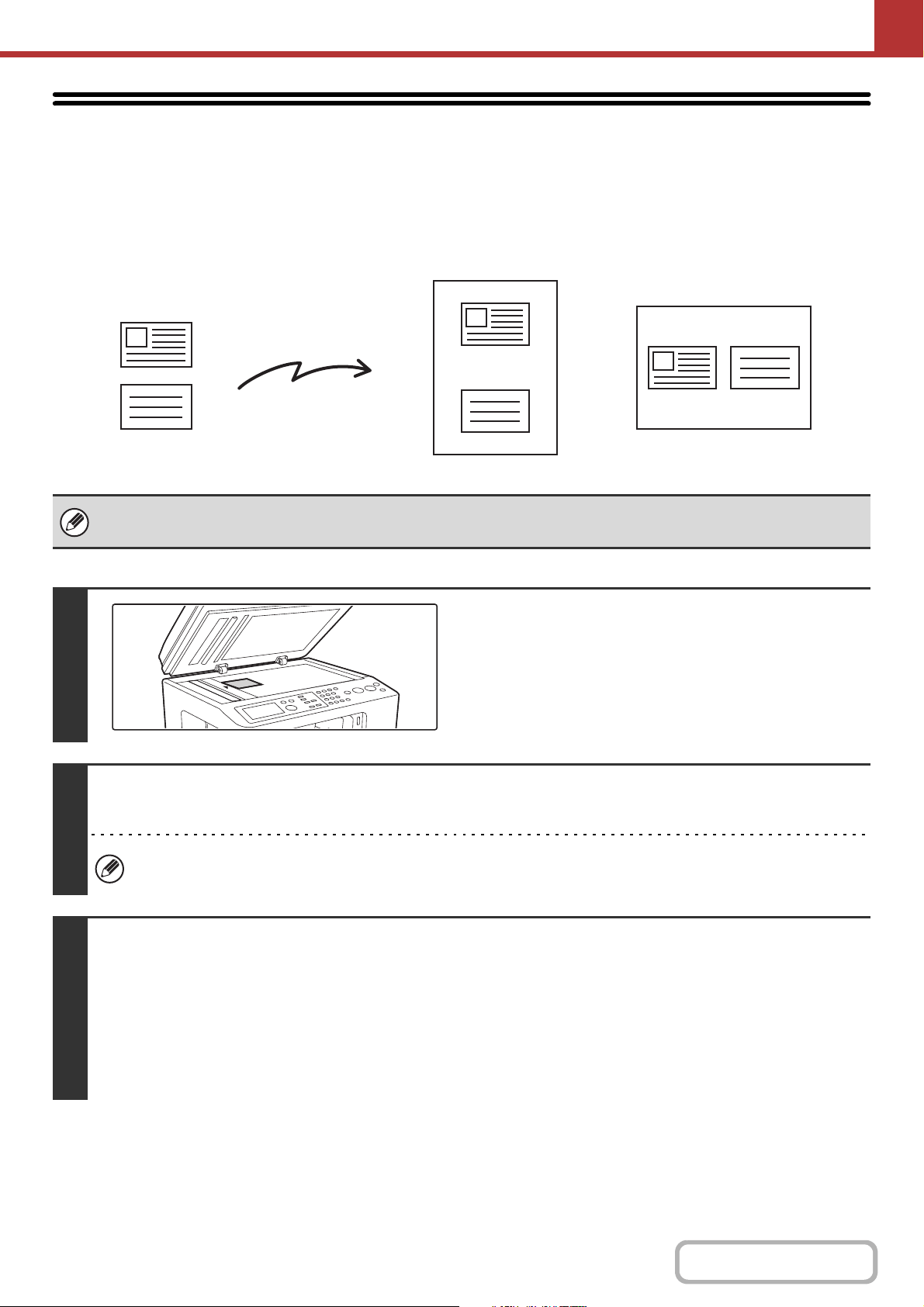
5-85
SCANNER/INTERNET FAX
Contents
SCANNING BOTH SIDES OF A CARD ONTO
A SINGLE PAGE (Card Shot)
This function lets you send the front and reverse sides of a card as a single page, without the need to send each side
separately.
Keys in the display can be selected with the arrow keys and the [OK] key.
• When using card shot, the original must be placed on the document glass.
• When using USB memory mode, connect the USB memory device to the machine before performing the procedure below.
1
Place the original face down on the
document glass.
2
Specify the destination.
☞
ENTERING DESTINATIONS (page 5-22)
When scanning to USB memory, there is no need to specify the destination. Go to step 3.
3
Select the special modes.
(1) Select the [Mode Switch] key.
(2) Select the mode that you wish to use.
(3) Select the [Special Modes] key.
(4) Select the [Card Shot] key.
☞ SPECIAL MODES (page 5-77)
Transmission
Front
Back
Scanned image
Originals
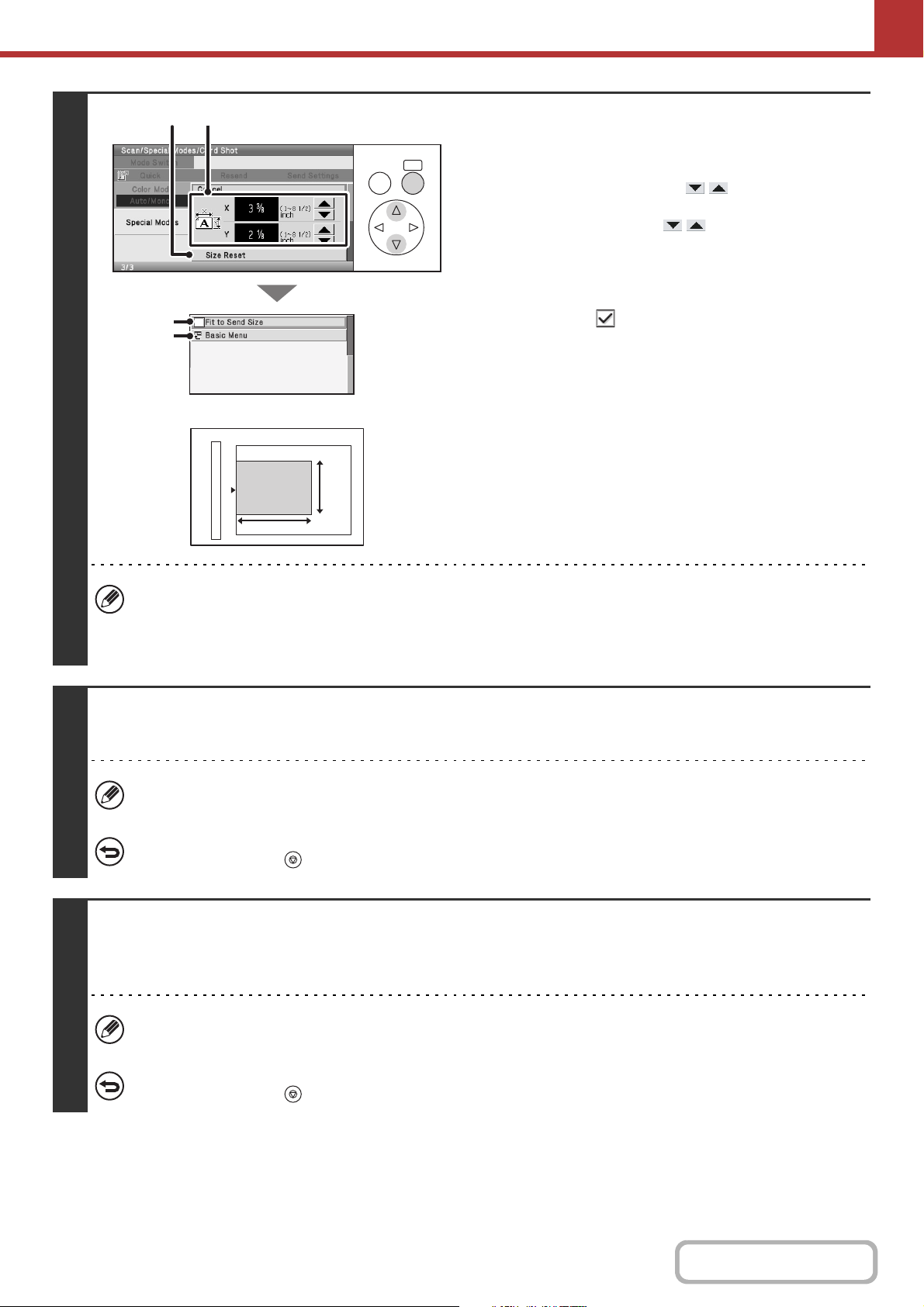
5-86
SCANNER/INTERNET FAX
Contents
4
Specify the original size.
(1) Enter the original size.
• Select the [X] key and enter the horizontal dimension
(X) of the original with the keys.
• Select the [Y] key and enter the vertical dimension (Y)
of the original with the keys.
(A) To return the original size to the default size, select
the [Size Reset] key.
(B) To have the image automatically enlarged or reduced
to the send size, select the [Fit to Send Size]
checkbox . The checkbox does not need to be
selected if you wish to scan at the entered original
size.
(2) Select the [Basic Menu] key.
• The send size will be selected automatically based on the entered original size.
• After selecting card scan, you can change the scan size and the send size from the [Scan Size] key and [Send Size]
key in the base screen. In this case, the screen of this step will appear in the scan size setting screen. For the
procedure for setting the send size, see "Specifying the send size of the image" (page 5-65).
5
Press the [COLOR START] key or the [BLACK & WHITE START] key to scan the
front side of the card.
If the destination is an Internet fax destination, press the [BLACK & WHITE START] key.
To cancel scanning...
Press the [STOP] key ( ) to cancel the operation.
6
Turn the card over and press the [COLOR START] key or the [BLACK & WHITE
START] key to scan the reverse side of the card.
Press the same [START] key that was used to scan the front side.
Before scanning the back of the card, you can select the [Configure] key in the display to change the exposure.
To cancel scanning...
Press the [STOP] key ( ) to cancel the operation.
OKBACK
(A)
(1)
(2)
(B)
X
Y
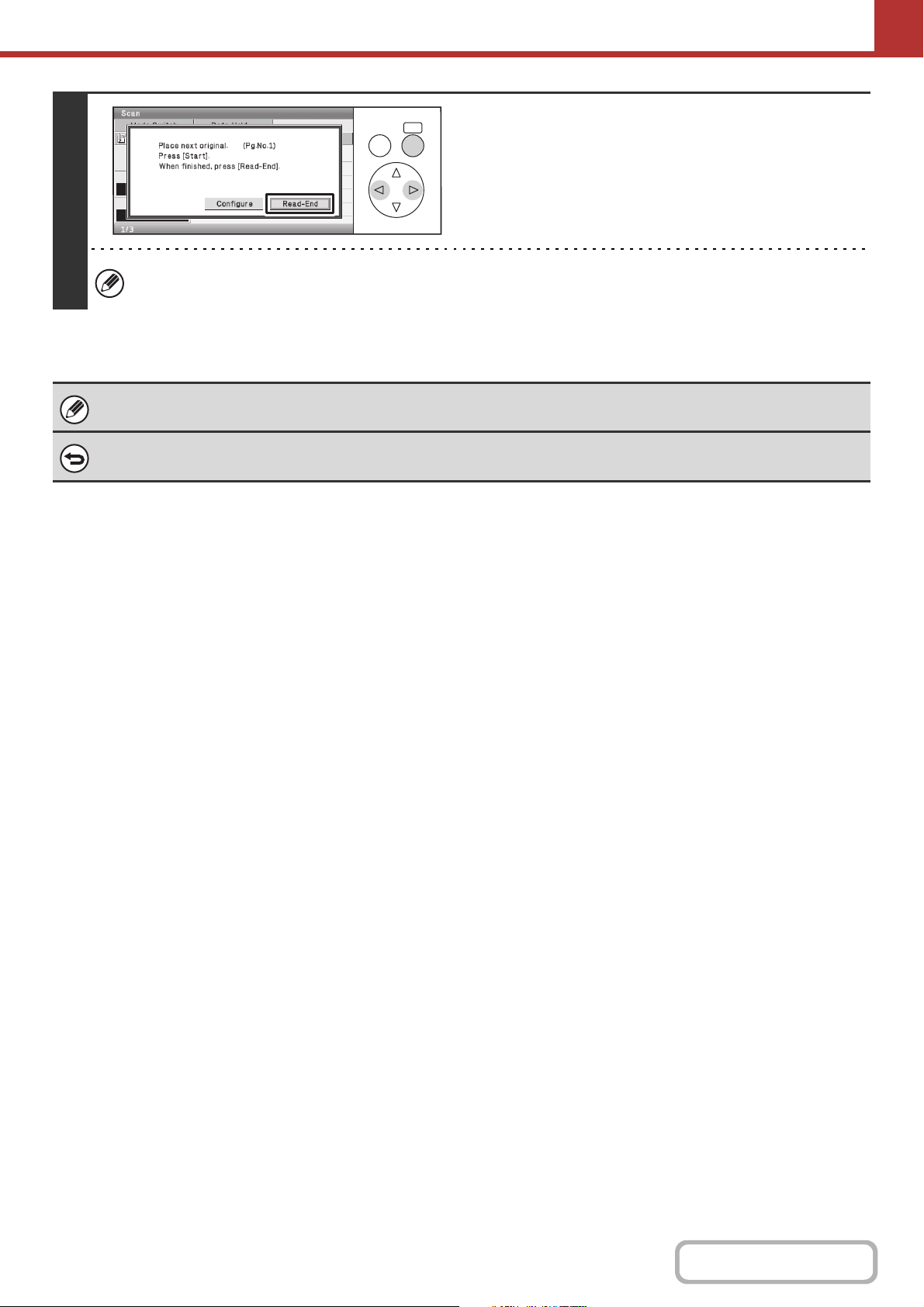
5-87
SCANNER/INTERNET FAX
Contents
7
Select the [Read-End] key.
If you will continue scanning additional cards, you can select the [Configure] key to change the exposure, resolution,
scan size, and send size.
The ratio cannot be specified and "Rotation Sending Setting" cannot be selected.
To cancel Card Shot...
Select the [Cancel] key in the screen of step 4.
OKBACK
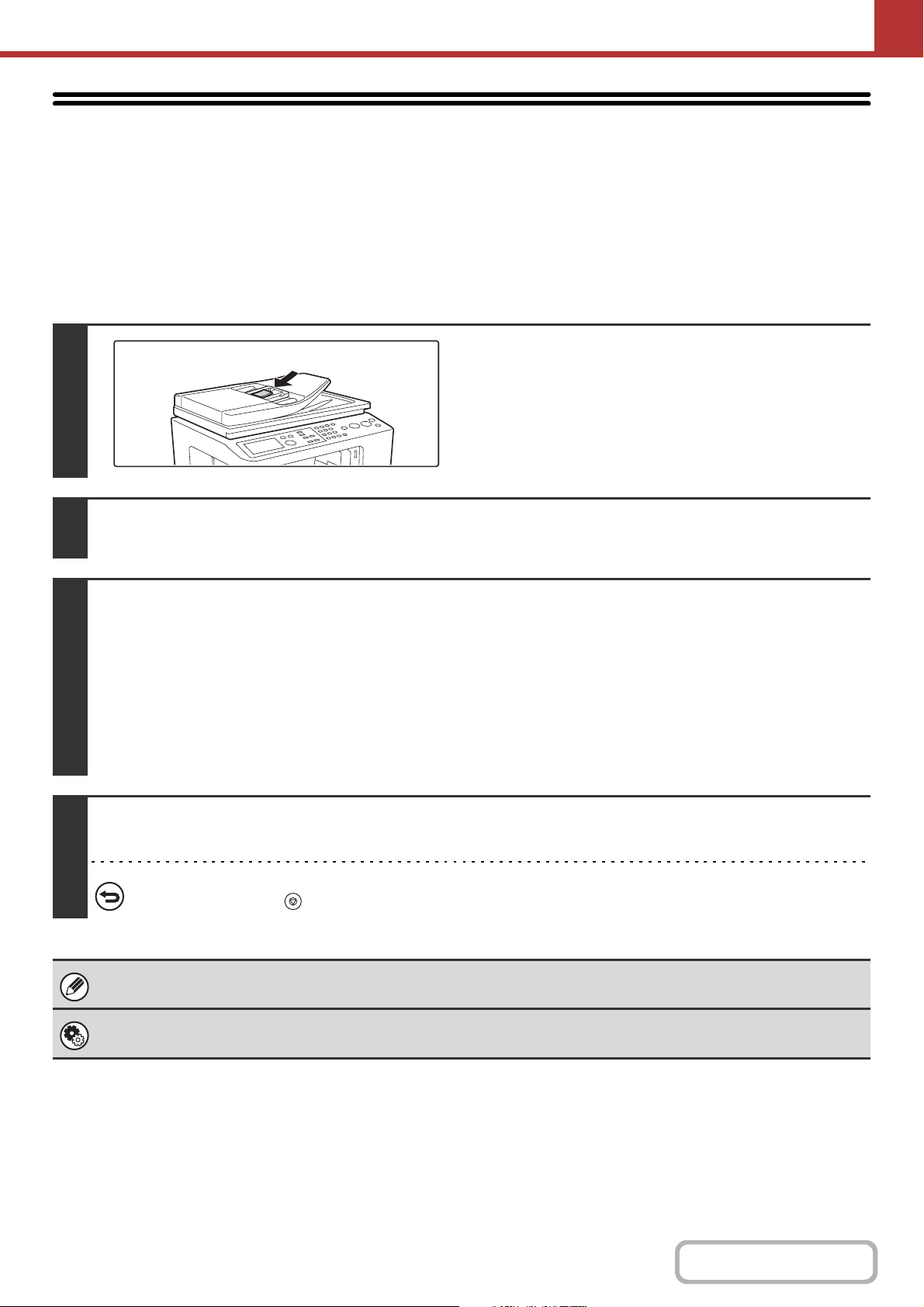
5-88
SCANNER/INTERNET FAX
Contents
SCANNING BUSINESS CARDS
(Business Card Scan)
Multiple business cards can be scanned and transmitted at once.
To use this function, the business card feeder must be attached to the automatic document feeder and "Business Card
Scan Option" must be enabled in the system settings (administrator). For the attachment procedure, see "BUSINESS
CARD FEEDER" in "BEFORE USING THE MACHINE" (page 1-57).
Keys in the display can be selected with the arrow keys and the [OK] key.
1
Load the business cards.
2
Specify the destination.
☞
ENTERING DESTINATIONS (page 5-22)
3
Select the special modes.
(1) Select the [Mode Switch] key.
(2) Select the mode that you wish to use.
(3) Select the [Special Modes] key.
(4) Select the [Bus. Card Scan] key.
Read the message that appears and then press the [OK] key.
☞ SPECIAL MODES (page 5-77)
4
Press the [COLOR START] key or the [BLACK & WHITE START] key.
Scanning begins. A beep will sound to indicate that scanning is finished.
To cancel scanning...
Press the [STOP] key ( ) to cancel the operation.
This function cannot be used when the scan size is specified by numerical values.
System Settings (Administrator): Business Card Scan Option (Web page only)
Specify whether or not the business card scan function is used.
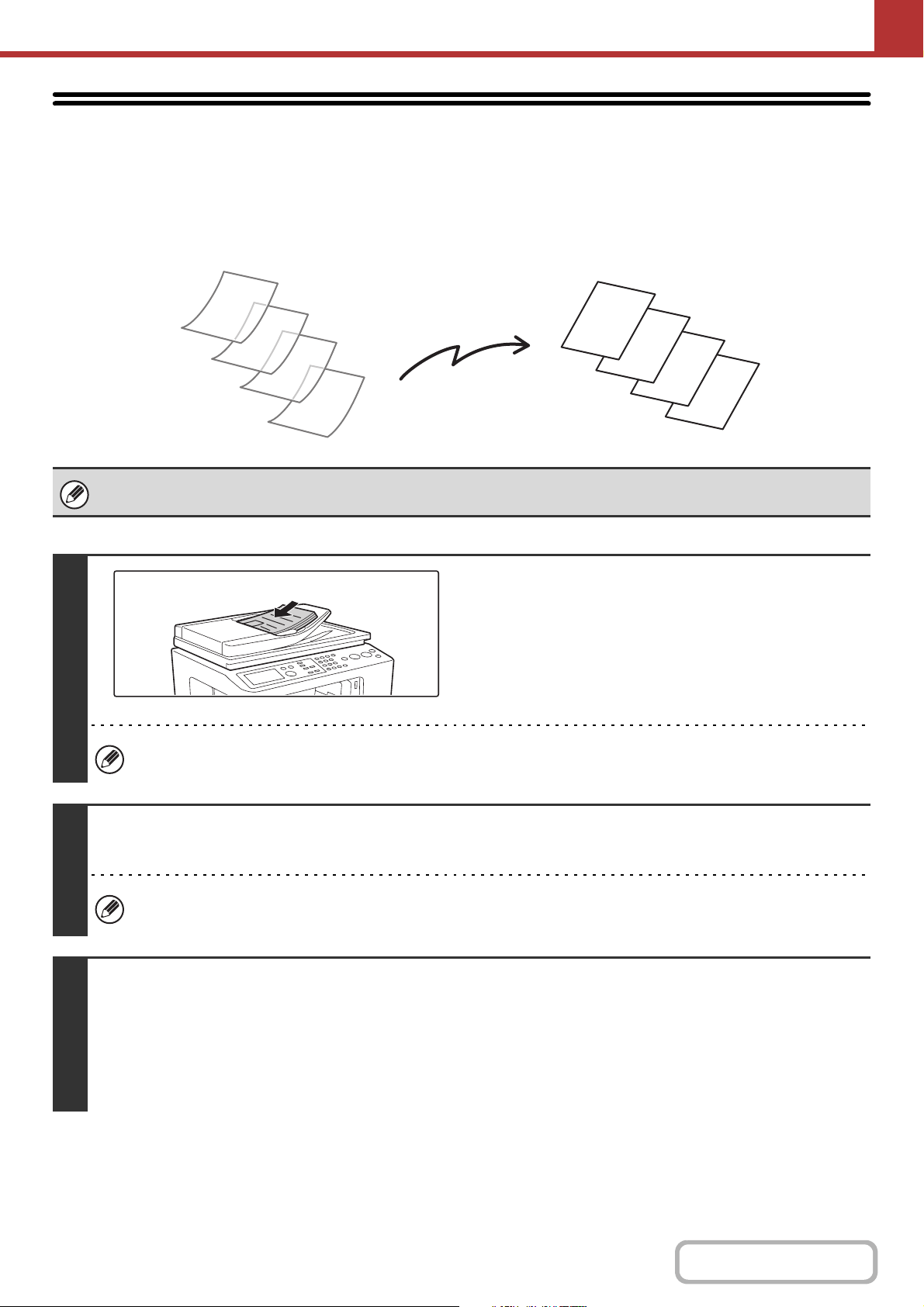
5-89
SCANNER/INTERNET FAX
Contents
SCANNING THIN ORIGINALS
(Slow Scan Mode)
Use this function when you wish to scan thin originals using the automatic document feeder. This function helps prevent
thin originals from misfeeding.
Keys in the display can be selected with the arrow keys and the [OK] key.
When using USB memory mode, connect the USB memory device to the machine before performing the procedure below.
1
Insert the originals face up in the
document feeder tray.
Adjust the original guides slowly.
When the original is a different size than the size setting, set
the original size.
☞ SPECIFYING THE ORIGINAL SCAN SIZE AND SEND
SIZE (page 5-61)
If the originals are inserted with too much force, they may crumple and misfeed.
2
Specify the destination.
☞
ENTERING DESTINATIONS (page 5-22)
When scanning to USB memory, there is no need to specify the destination. Go to step 3.
3
Select the special modes.
(1) Select the [Mode Switch] key.
(2) Select the mode that you wish to use.
(3) Select the [Special Modes] key.
☞ SPECIAL MODES (page 5-77)
D
C
B
A
D
C
B
A
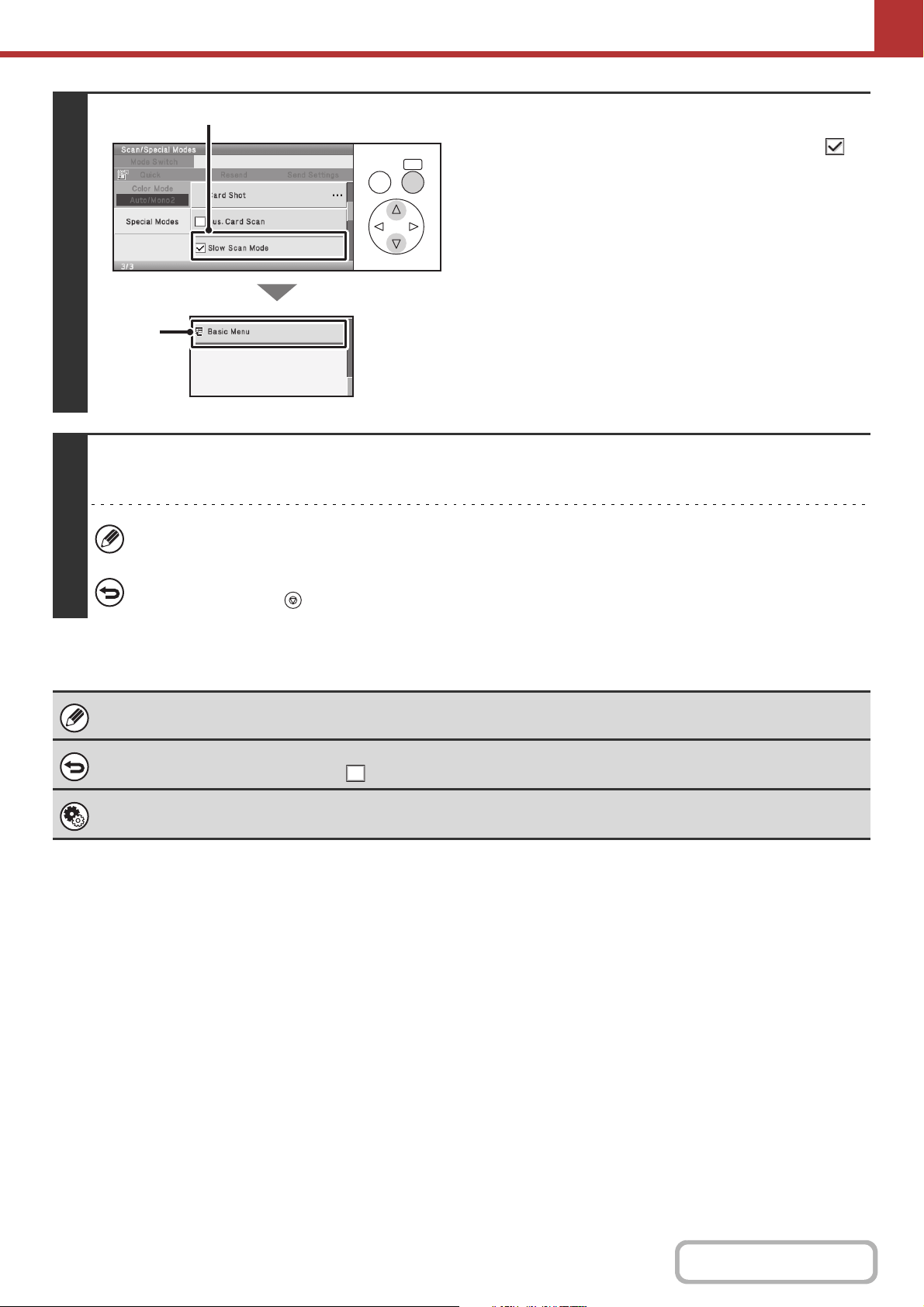
5-90
SCANNER/INTERNET FAX
Contents
4
Select slow scan mode.
(1) Set the [Slow Scan Mode] checkbox to .
(2) Select the [Basic Menu] key.
5
Press the [COLOR START] key or the [BLACK & WHITE START] key.
Scanning begins. A beep will sound to indicate that scanning is finished.
If the destination is an Internet fax destination, press the [BLACK & WHITE START] key.
To cancel scanning...
Press the [STOP] key ( ) to cancel the operation.
When this function is selected, automatic 2-sided scanning is not possible.
To cancel slow scan mode...
Set the [Slow Scan Mode] checkbox to in the screen of step 4.
System Settings (Administrator): Original Feeding Mode (Web page only)
This is used to have scanning always take place in slow scan mode.
OKBACK
(1)
(2)
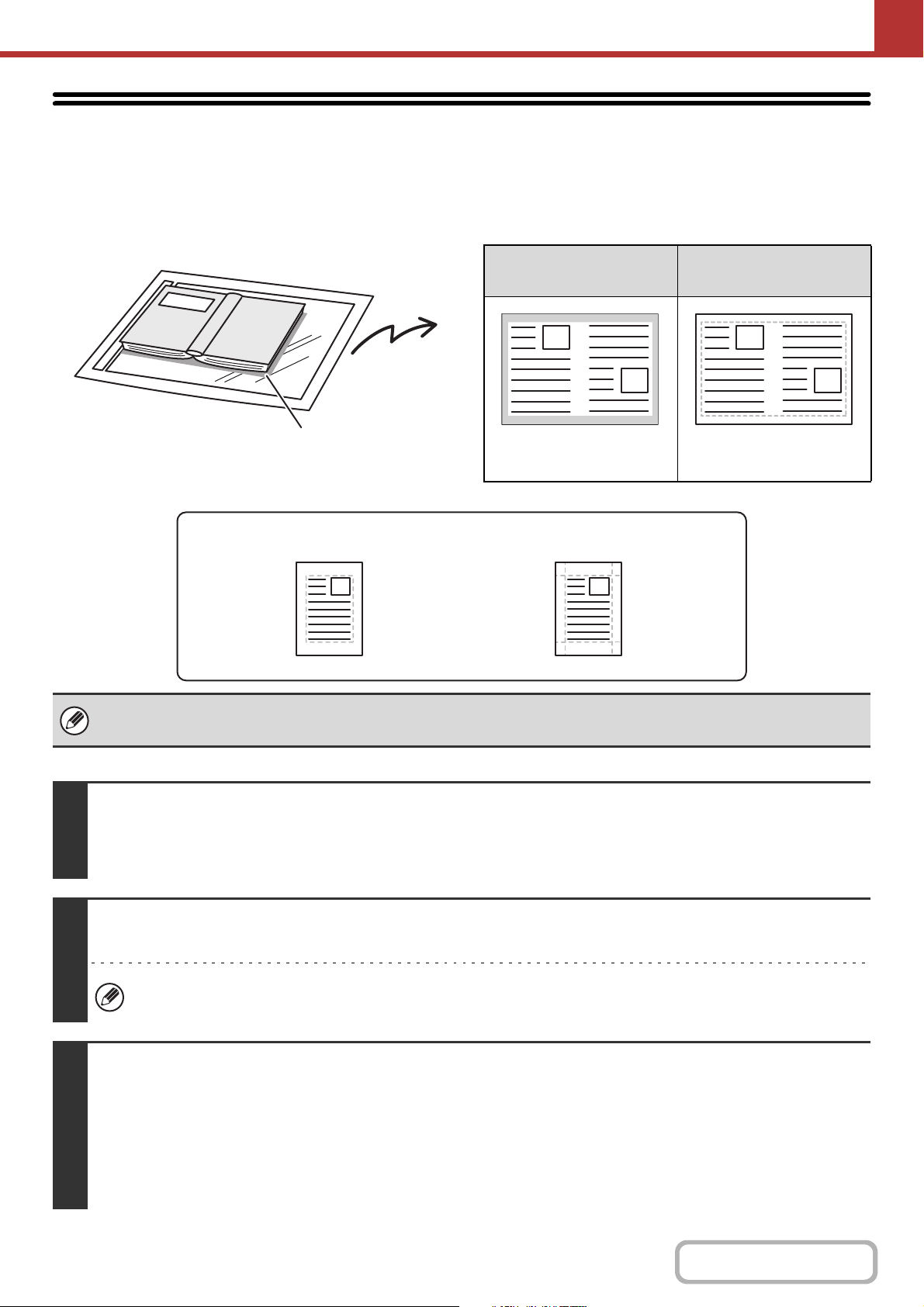
5-91
SCANNER/INTERNET FAX
Contents
ERASING PERIPHERAL SHADOWS ON THE IMAGE (Erase)
The erase function is used to erase shadows on images produced when scanning thick originals or books. (This function
does not detect shadows and will eliminate everything appearing in the erase area - including shadows, text and images.)
Scanning a thick book
Erase modes
Keys in the display can be selected with the arrow keys and the [OK] key.
Shadows appear here
Not using the erase
function
Using the erase
function
Shadows appear in the
image.
No shadows appear.
• Shadows at the edges of the original can also be erased when the automatic document feeder is used.
• When using USB memory mode, connect the USB memory device to the machine before performing the procedure below.
1
Place the original.
Place the original face up in the document feeder tray, or face down on the document glass.
When the original is a different size than the size setting, set the original size.
☞ SPECIFYING THE ORIGINAL SCAN SIZE AND SEND SIZE (page 5-61)
2
Specify the destination.
☞
ENTERING DESTINATIONS (page 5-22)
When scanning to USB memory, there is no need to specify the destination. Go to step 3.
3
Select the special modes.
(1) Select the [Mode Switch] key.
(2) Select the mode that you wish to use.
(3) Select the [Special Modes] key.
(4) Select the [Erase] key.
☞ SPECIAL MODES (page 5-77)
Edge Erase Side Erase
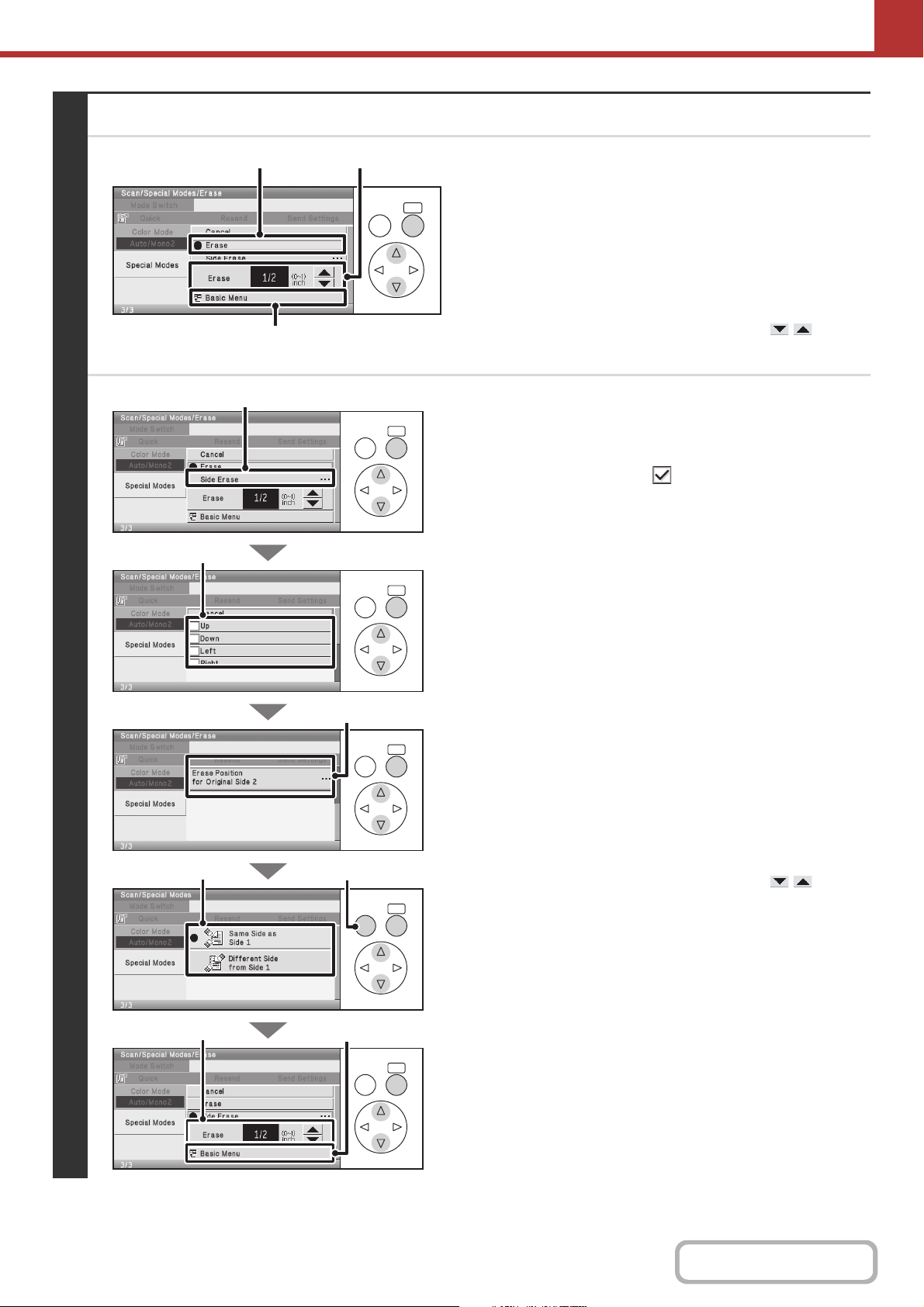
5-92
SCANNER/INTERNET FAX
Contents
4
Select the erase settings.
● When [Erase] is selected
(1) Select the [Erase] key.
(2) Set the erasure width.
Select the number display and press the [OK] key. A
number entry screen will appear. Enter the desired
number with the numeric keys and select the [OK] key in
the number entry screen.
0" to 1" (0 mm to 20 mm) can be entered.
You can also change the number with the keys.
(3) Select the [Basic Menu] key.
● When [Side Erase] is selected
(1) Select the [Side Erase] key.
(2) Set the sides to be erased.
Select the checkboxes of the sides that you wish to
erase.
(3)
Select the [Erase Position for Original Side 2]
key.
(4) Set the erase edge on the reverse side.
When performing two-sided scanning, set the erase edge
on the reverse side.
• If you select the [Same Side as Side 1] key, the edge in
the same position as on the front side will be erased.
• If you select the [Different Side from Side 1], the edge in
the position opposite to the erased edge on the front
side will be erased.
(5) Press the [BACK] key.
(6) Set the erasure width.
Select the number display and press the [OK] key. A
number entry screen will appear. Enter the desired
number with the numeric keys and select the [OK] key in
the number entry screen.
0" to 1" (0 mm to 20 mm) can be entered.
You can also change the number with the keys.
(7) Select the [Basic Menu] key.
OKBACK
(2)(1)
(3)
OKBACK
OKBACK
OKBACK
OKBACK
OKBACK
(1)
(2)
(4)
(6)
(7)
(5)
(3)
5-93
SCANNER/INTERNET FAX
Contents
5
Press the [COLOR START] key or the [BLACK & WHITE START] key.
Scanning begins.
• If you inserted the original pages in the document feeder tray, all pages are scanned.
A beep will sound to indicate that scanning is finished.
• If you are scanning the original on the document glass, scan each page one page at a time.
When scanning of one page finishes, replace it with the next page and press the [COLOR START] key or the [BLACK &
WHITE START] key. Repeat until all pages have been scanned and then press the [Read-End] key.
A beep will sound to indicate that scanning is finished.
If the destination is an Internet fax destination, press the [BLACK & WHITE START] key.
To cancel scanning...
Press the [STOP] key ( ) to cancel the operation.
When the erase function is used, erase takes place at the edges of the original image. If you also use a reduction or an
enlargement setting, the erase width will change according to the selected ratio. For example, if the erase width setting is 1"
(20 mm) and the image is reduced to 50%, the erase width will be 1/2" (10 mm).
To cancel the erase setting...
Select the [Cancel] key in the screen of step 4.
System Settings (Administrator): Erase Width Adjustment
The default erase width setting is linked to the copy mode system setting, and can be set from 0" to 1" (0 mm to 20 mm). The
factory default setting is 1/2" (10 mm).
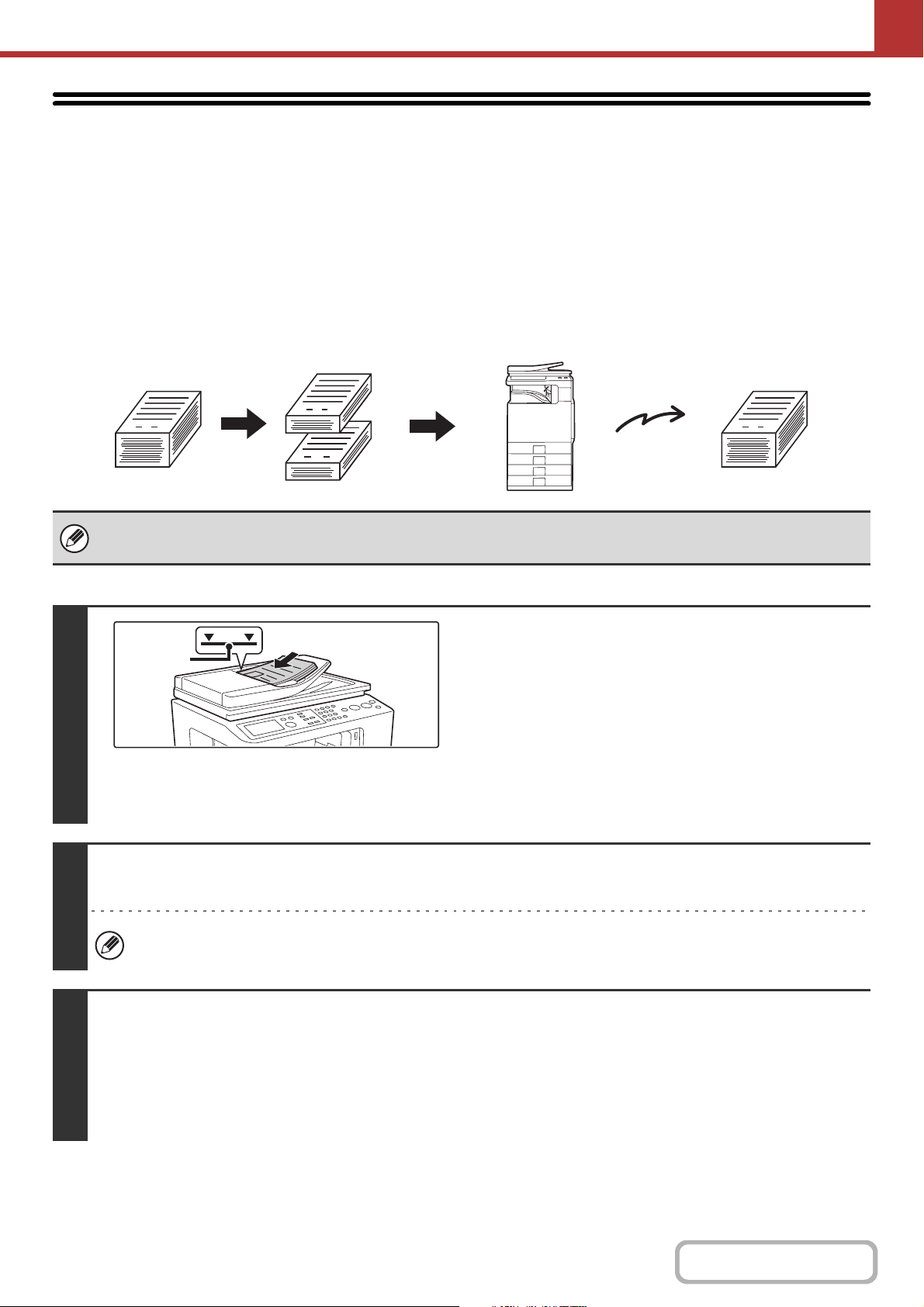
5-94
SCANNER/INTERNET FAX
Contents
SCANNING MANY ORIGINALS AT ONCE
(Job Build)
This function lets you separate an original consisting of numerous pages into sets, scan each set using the automatic
document feeder, and transmit the pages in a single transmission. Use this function when the number of originals that
you wish to scan exceeds the maximum number of sheets that can be inserted in the automatic document feeder at
once.
When scanning originals that are separated into sets, scan the set that has the first page first. The settings that you
select for the first set can be used for all remaining sets.
Keys in the display can be selected with the arrow keys and the [OK] key.
• Up to 999 pages can be scanned. Note that when the memory is being used for other jobs, fewer pages can be scanned.
• When using USB memory mode, connect the USB memory device to the machine before performing the procedure below.
1
Insert the originals face up in the
document feeder tray.
Insert the originals all the way into the document feeder tray.
Multiple originals can be placed in the document feeder tray.
The stack of originals must not be higher than the indicator line
on the tray.
When the original is a different size than the size setting, set
the original size.
☞ SPECIFYING THE ORIGINAL SCAN SIZE AND SEND
SIZE (page 5-61)
2
Specify the destination.
☞
ENTERING DESTINATIONS (page 5-22)
When scanning to USB memory, there is no need to specify the destination. Go to step 3.
3
Select the special modes.
(1) Select the [Mode Switch] key.
(2) Select the mode that you wish to use.
(3) Select the [Special Modes] key.
☞ SPECIAL MODES (page 5-77)
1
101
1
1
Originals are
scanned in
separate sets.
Originals
Transmission
Indicator
line
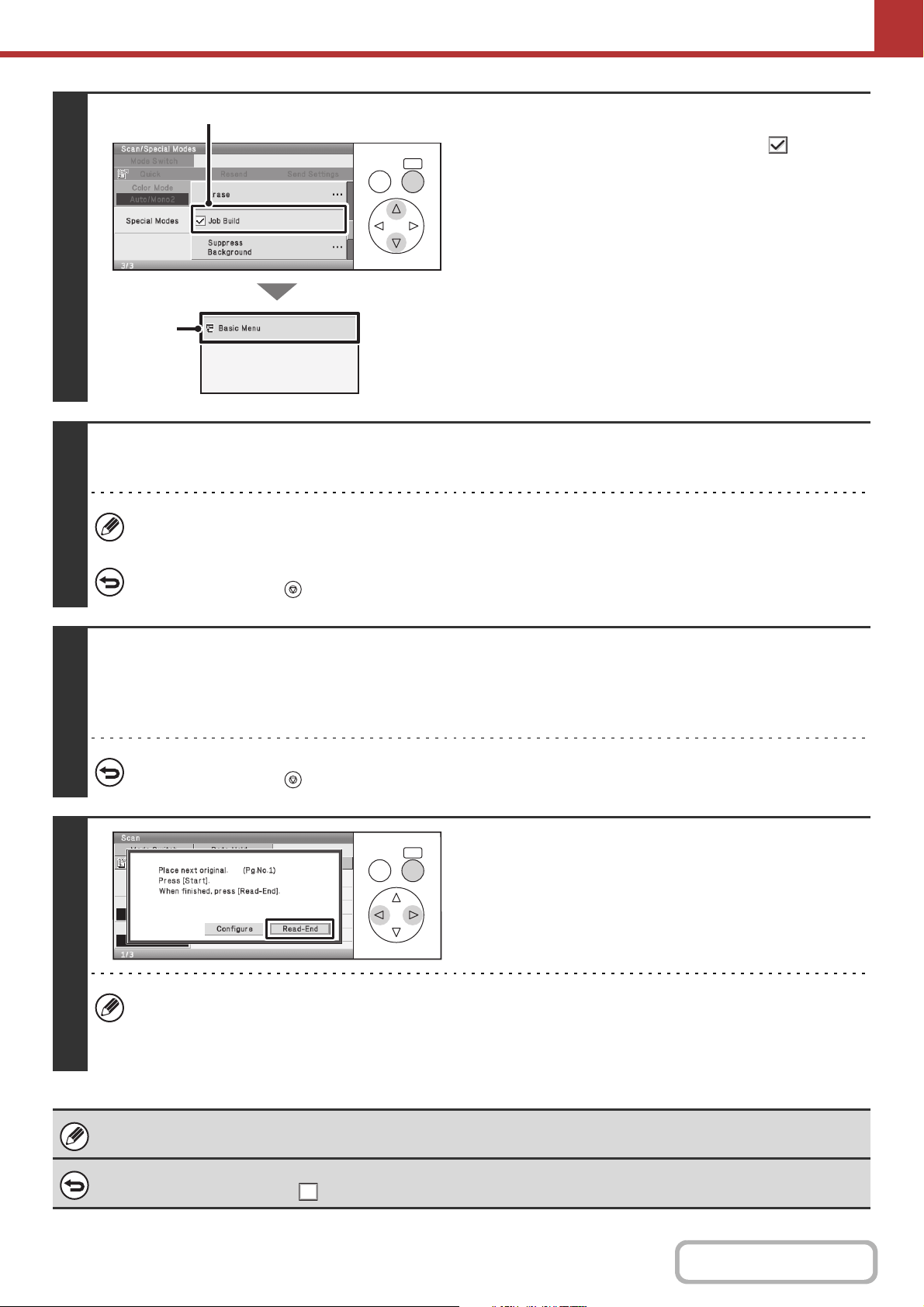
5-95
SCANNER/INTERNET FAX
Contents
4
Select job build mode.
(1) Set the [Job Build] checkbox to .
(2) Select the [Basic Menu] key.
5
Press the [COLOR START] key or the [BLACK & WHITE START] key to scan the
first set of originals.
If the destination is an Internet fax destination, press the [BLACK & WHITE START] key.
To cancel scanning...
Press the [STOP] key ( ) to cancel the operation.
6
Insert the next set of originals and press the [COLOR START] key or the [BLACK
& WHITE START] key.
Press the [START] key pressed in step 5.
Repeat until all originals have been scanned.
To cancel scanning...
Press the [STOP] key ( ) to cancel the operation. All scanned data will be cleared.
7
Select the [Read-End] key.
• If no action is taken for one minute after the confirmation screen appears, scanning automatically ends and the
transmission is reserved.
• The [Configure] key can be selected to change the exposure, resolution, scan size, and send size for each original
page scanned.
If the memory becomes full during scanning, a message will appear and the transmission will be canceled.
To cancel the job build function....
Set the [Job Build] checkbox to in the screen of step 4.
OKBACK
(2)
(1)
OKBACK
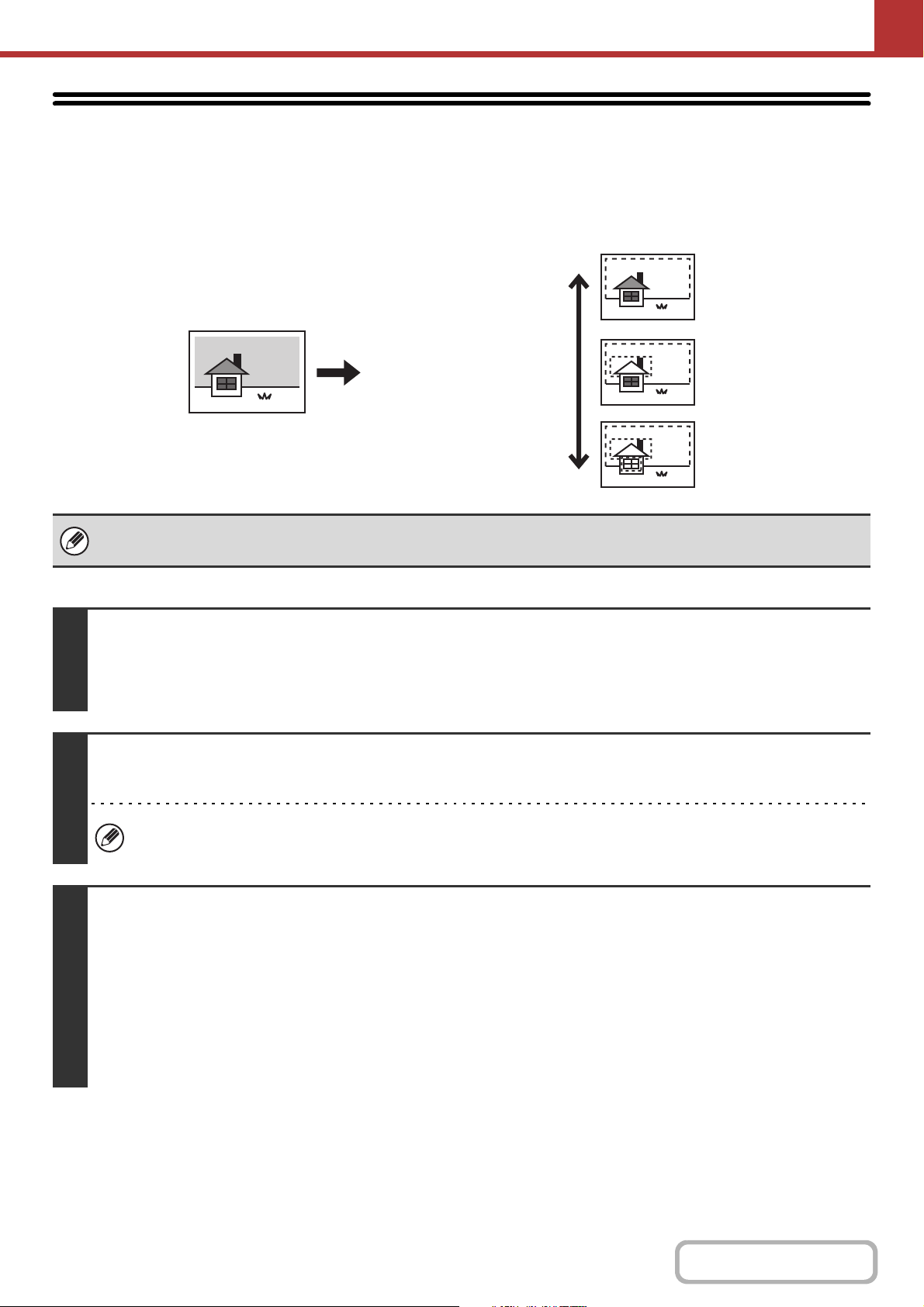
5-96
SCANNER/INTERNET FAX
Contents
WHITENING FAINT COLORS IN THE IMAGE
(Suppress Background)
This feature is used to suppress light background areas.
Keys in the display can be selected with the arrow keys and the [OK] key.
• This function cannot be used in Internet fax mode.
• When using USB memory mode, connect the USB memory device to the machine before performing the procedure below.
1
Place the original.
Place the original face up in the document feeder tray, or face down on the document glass.
When the original is a different size than the size setting, set the original size.
☞ SPECIFYING THE ORIGINAL SCAN SIZE AND SEND SIZE (page 5-61)
2
Specify the destination.
☞
ENTERING DESTINATIONS (page 5-22)
When scanning to USB memory, there is no need to specify the destination. Go to step 3.
3
Select the special modes.
(1) Select the [Mode Switch] key.
(2) Select the mode that you wish to use.
(3) Select the [Special Modes] key.
(4) Select the [Suppress Background] key.
Read the message that appears and then press the [OK] key.
☞ SPECIAL MODES (page 5-77)
The lightness level at which
suppression takes place
can be adjusted.
Level [+]
Level [-]
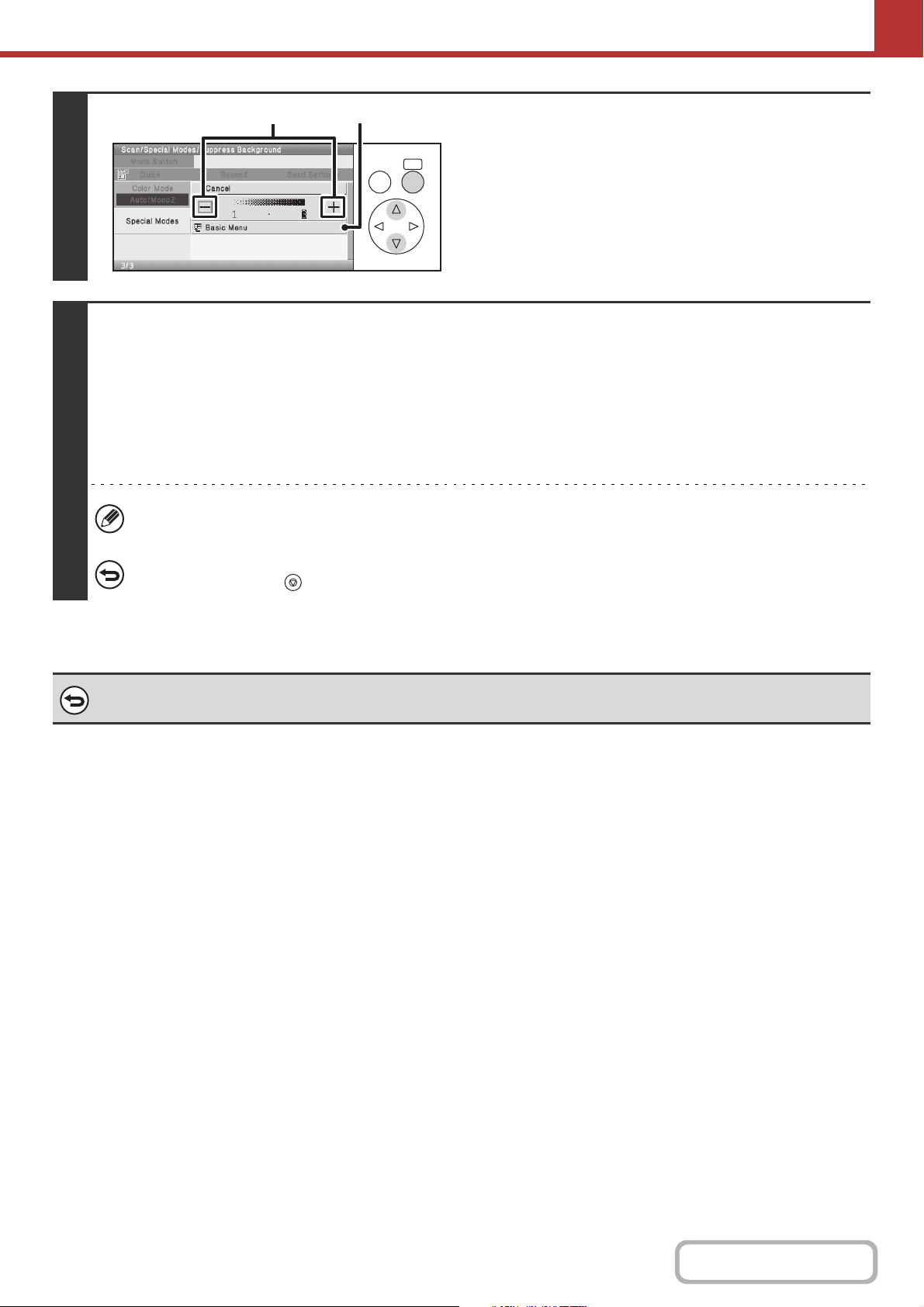
5-97
SCANNER/INTERNET FAX
Contents
4
Select the suppress background setting.
(1) Adjust the background suppression level.
Select the [+] key and press the [OK] key to suppress only
faint background.
Select the [-] key and press the [OK] key to suppress faint
to dark background.
(2) Select the [Basic Menu] key.
5
Press the [COLOR START] key or the [BLACK & WHITE START] key.
Scanning begins.
• If you inserted the original pages in the document feeder tray, all pages are scanned.
A beep will sound to indicate that scanning is finished.
• If you are scanning the original on the document glass, scan each page one page at a time.
When scanning finishes, place the next original and press the [COLOR START] key or the [BLACK & WHITE START] key.
Repeat until all pages have been scanned and then select the [Read-End] key.
A beep will sound to indicate that scanning is finished.
When the color mode setting of the [BLACK & WHITE START] key is [Mono2], the suppress background function will
not operate if the [BLACK & WHITE START] key is pressed.
To cancel scanning...
Press the [STOP] key ( ) to cancel the operation.
To cancel the background suppression setting...
Select the [Cancel] key in the screen of step 4.
OK
BACK
(1)
(2)
5-98
SCANNER/INTERNET FAX
Contents
CHANGING THE PRINT SETTINGS FOR THE
TRANSACTION REPORT
(Transaction Report)
A transaction report is automatically printed out to alert you when an Internet fax transmission fails or when a broadcast
transmission is performed. The transaction report contains a description of the transmission (date, start time, name of
other party, time required, number of pages, result, etc.).
☞ INFORMATION APPEARING IN THE RESULT COLUMN (page 5-108)
Transaction reports are printed based on conditions set in the system settings; however, you can temporarily select
different conditions for a transmission. To change the transaction report print conditions at the time of transmission,
follow the steps below.
Keys in the display can be selected with the arrow keys and the [OK] key.
This function cannot be used in scan mode, USB memory mode, or data entry mode.
1
Place the original.
Place the original face up in the document feeder tray, or face down on the document glass.
When the original is a different size than the size setting, set the original size.
☞ SPECIFYING THE ORIGINAL SCAN SIZE AND SEND SIZE (page 5-61)
2
Specify the destination.
☞
ENTERING DESTINATIONS (page 5-22)
3
Select the special modes.
(1) Select the [Mode Switch] key.
(2) Select the [Internet Fax] key.
(3) Select the [Special Modes] key.
(4) Select the [Transaction Report] key.
☞ SPECIAL MODES (page 5-77)
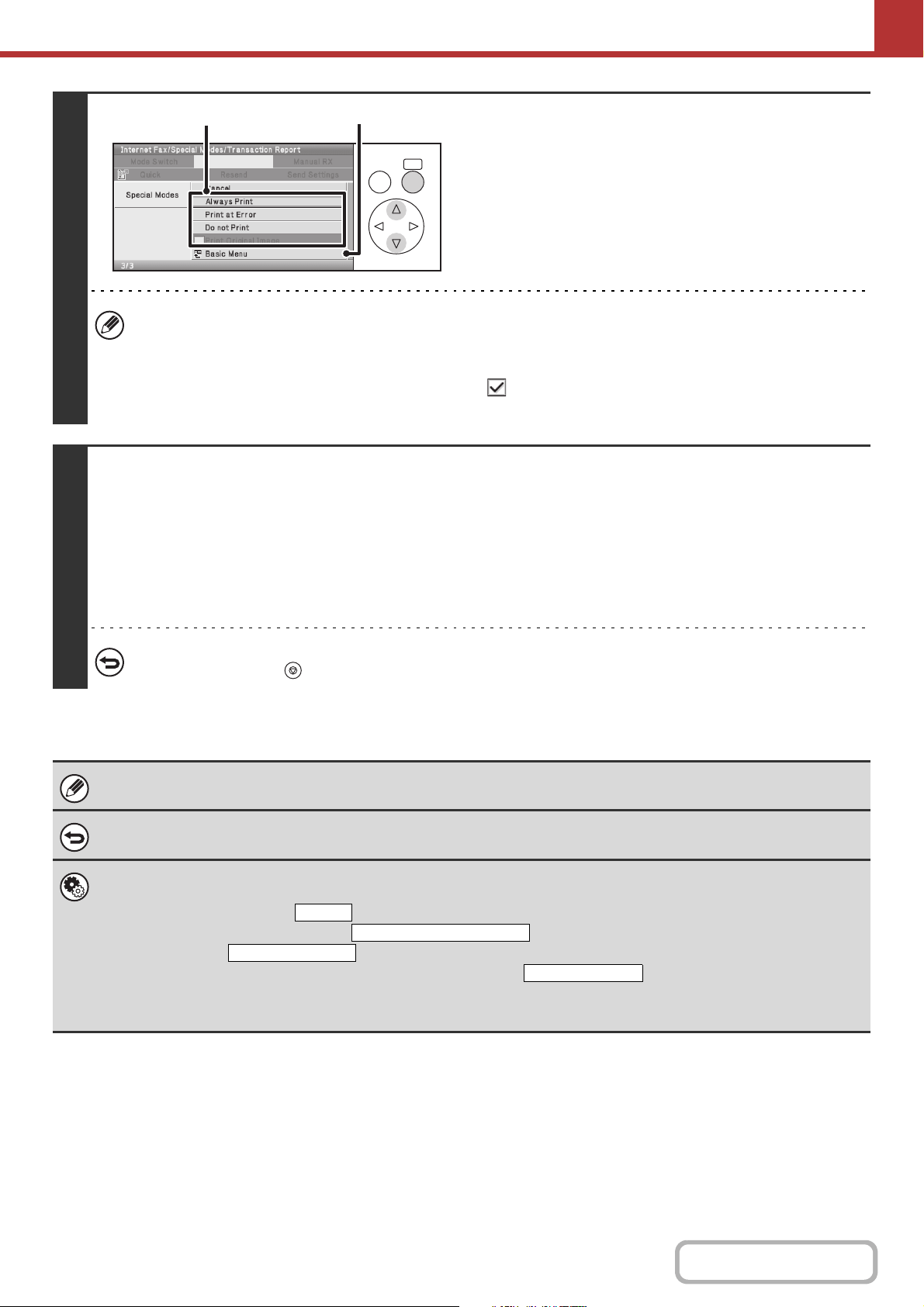
5-99
SCANNER/INTERNET FAX
Contents
4
Select print conditions.
(1) Select the print conditions.
(2) Select the [Basic Menu] key.
• The print conditions for a transaction report are as follows:
"Always Print": A transaction report is printed no matter whether the transmission succeeds or fails.
"Print at Error": A transaction report is printed when transmission fails.
"Do not Print": Do not print a transaction report.
• When the [Print Original Image] checkbox is selected , part of the transmitted original is included on the
transaction report.
5
Press the [BLACK & WHITE START] key.
Scanning begins.
• If you inserted the original pages in the document feeder tray, all pages are scanned.
A beep will sound to indicate that scanning is finished.
• If you are scanning the original on the document glass, scan each page one page at a time.
When scanning finishes, place the next original and press the [BLACK & WHITE START] key. Repeat until all pages have
been scanned and then select the [Read-End] key.
A beep will sound to indicate that scanning is finished.
To cancel scanning...
Press the [STOP] key ( ) to cancel the operation.
For a broadcast transmission, changes to the transaction report print conditions apply to all destinations.
To cancel the transaction report setting...
Select the [Cancel] key in the screen of step 4.
• System Settings (Administrator): Transaction Report Print Select Setting (Web page only)
This is used to set the conditions for printing transaction reports.
The factory default setting is .
Single Sending: Print Out All Report/ /No Printed Report
Broadcasting: /Print Out Error Report Only/No Printed Report
Receiving: Print Out All Report/Print Out Error Report Only/
• System Settings (Administrator): Original Print on Transaction Report (Web page only)
This is used to have part of the transmitted original printed on the transaction report.
OK
BACK
(1)
(2)
Print Out Error Report Only
Print Out All Report
No Printed Report
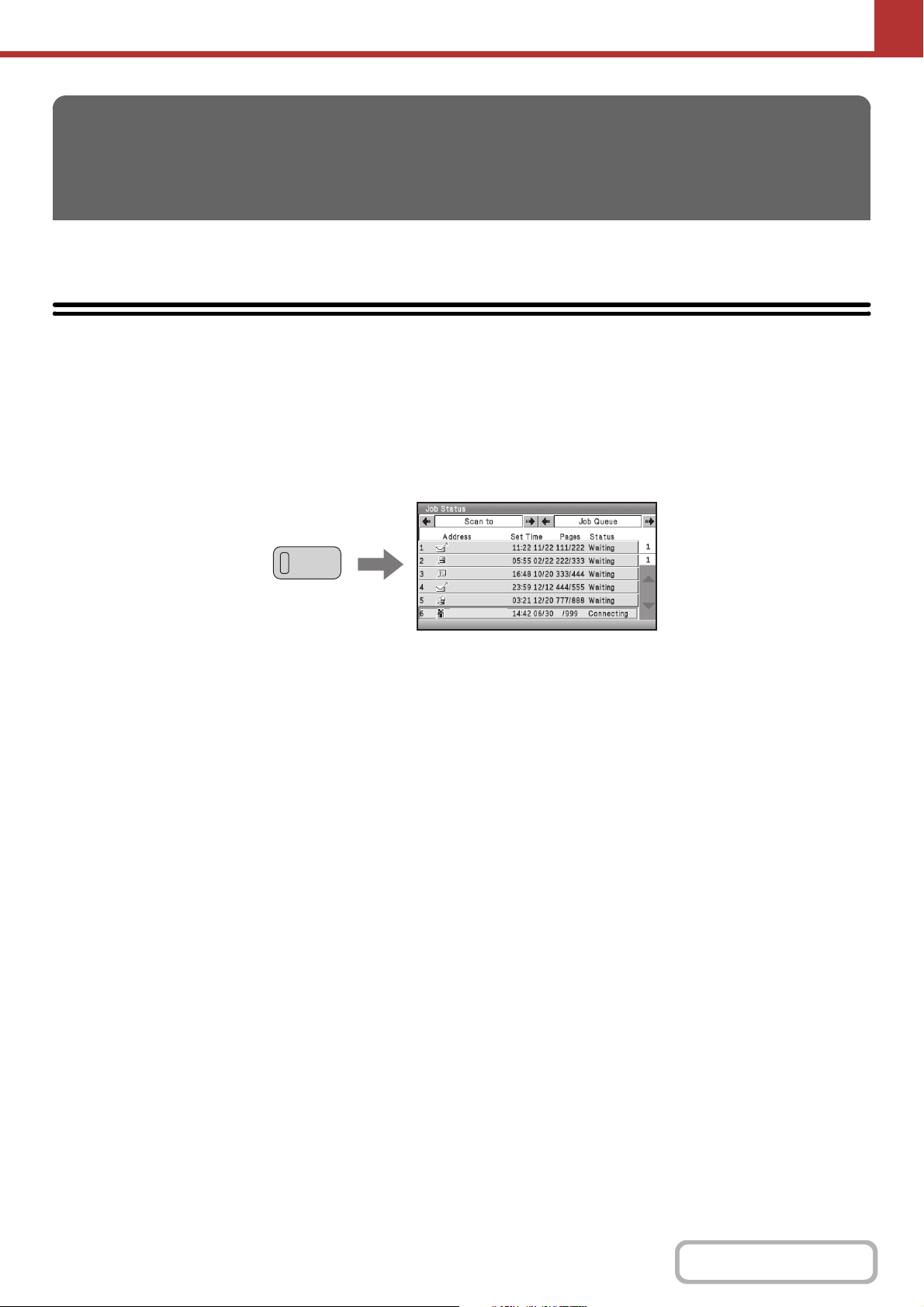
5-100
SCANNER/INTERNET FAX
Contents
This section explains how to check the status of reserved transmission jobs and received Internet faxes.
JOB STATUS SCREEN
The job status screen is displayed when the [JOB STATUS] key on the operation panel is pressed. The job status
screen shows the status of jobs by mode. When the [JOB STATUS] key is pressed, the job status screen of the mode
that was being used before the key was pressed appears.
Reserved transmissions and received Internet faxes are referred to as jobs.
Example: Selecting scan mode
CHECKING THE STATUS OF
TRANSMISSION/RECEPTION JOBS
AAA AAA
BBB BBB
CCC CCC
DDD DDD
EEE EEE
Broadcast
JOB STATUS
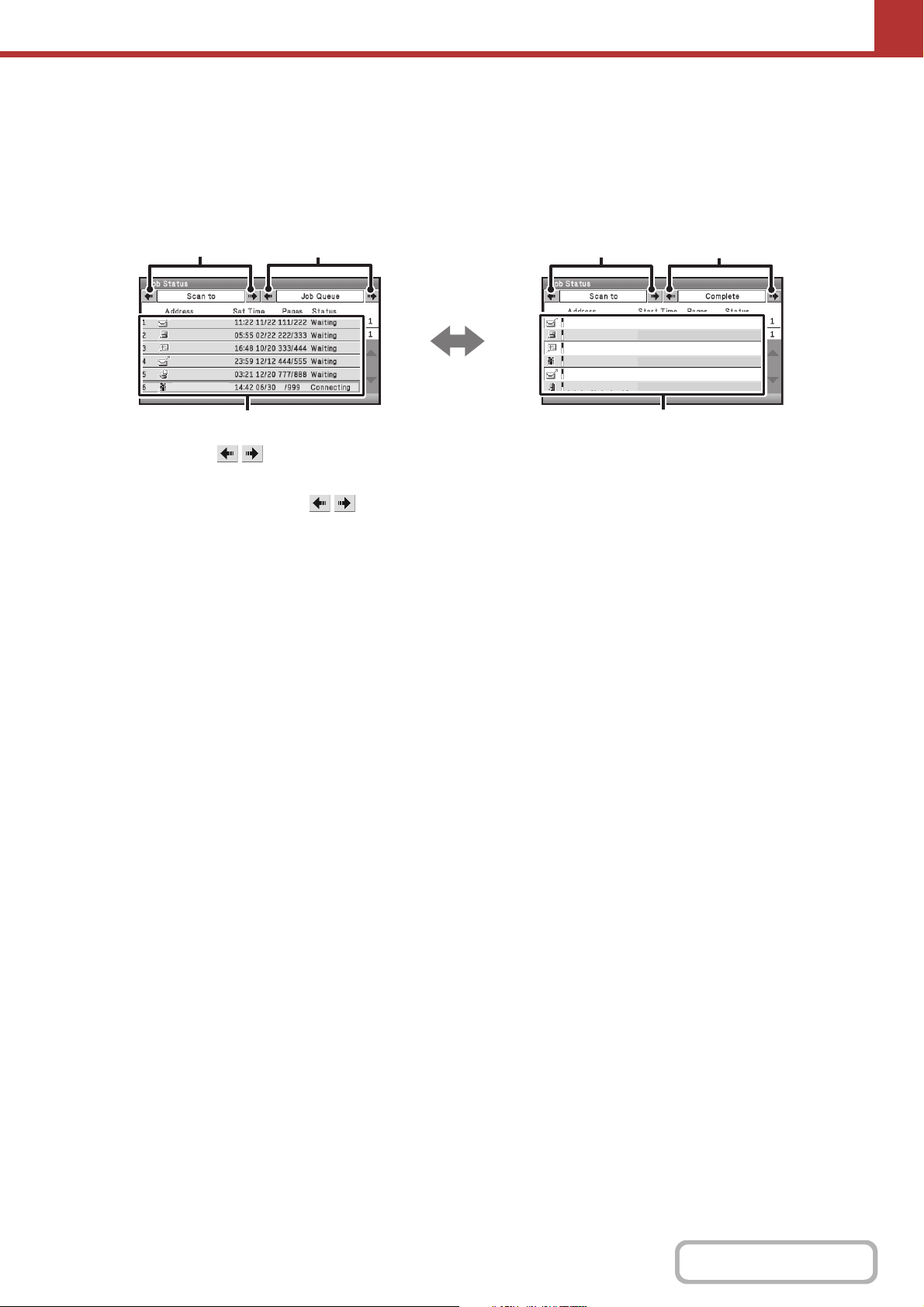
5-101
SCANNER/INTERNET FAX
Contents
JOB QUEUE SCREEN AND COMPLETED JOB SCREEN
The job status screen consists of two screens: the job queue screen that shows reserved jobs and the job currently in
progress, and the completed jobs screen. To switch between the two screens, select the job status screen selector key
((2) below).
Job queue screen Complete screen
(1) Mode switch keys ( )
Select these keys to change the job status screen mode.
(2) Job status screen selector keys ( )
Select these keys to switch between the job queue
screen and the completed jobs screen.
(3) Job queue screen
Jobs are shown as keys in the order they were reserved.
Each key shows information on the job and its current
status.
☞ Job key display (page 5-102)
(4) Completed jobs screen
This shows up to 99 completed transmission or reception
jobs in each mode. A description of the job and the result
(status) are shown.
Jobs that used broadcast transmission jobs, and
received Internet fax forwarding jobs are indicated as
keys.
AAA AAA
BBB BBB
CCC CCC
DDD DDD
EEE EEE
Broadcast
AAA AAA
BBB BBB
CCC CCC
DDD DDD
EEE EEE
16:56 04/01 111/333 NG000000
16:57 04/01 222/222 Send OK
16:58 04/01 123/123 NG000000
17:01 04/01 888/999 Send OK
17:03 04/01 555/555 NG000000
16:55 04/01 100/100 Send OK
Broadcast0001
(1)
(2)
(1)
(2)
(3)
(4)
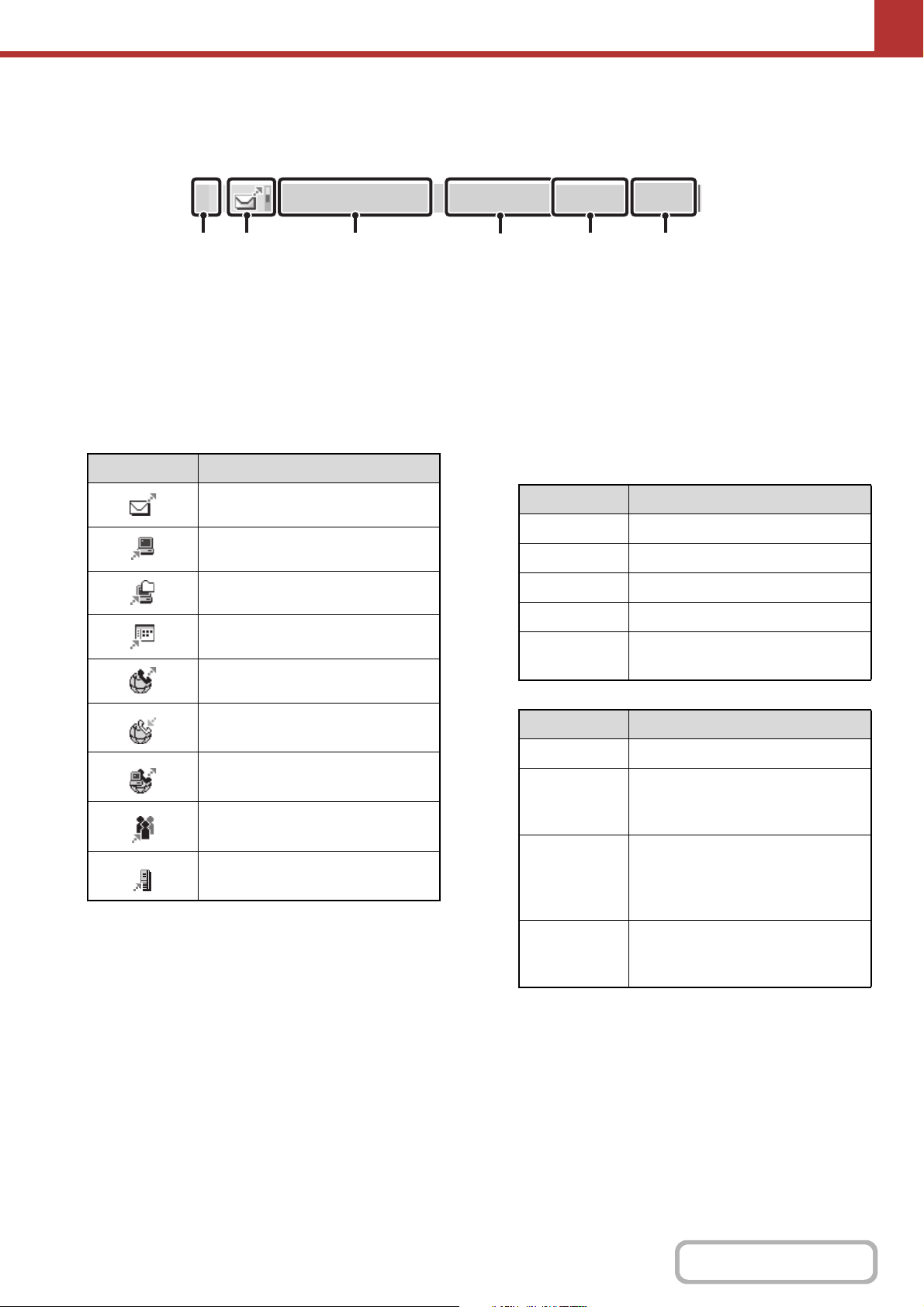
5-102
SCANNER/INTERNET FAX
Contents
Job key display
The following information is shown in the job queue keys and completed job keys that appear in the job status screen.
Direct SMTP information is also included in Internet fax transmission/reception information.
(1)
Displays the number (position) of the job in the job queue.
When the job currently being transmitted is finished, the
job moves up one position in the job queue.
This number does not appear in lists in the completed
jobs screen.
(2) Mode icon
This indicates the type of job. In the completed jobs
screen, a color bar appears next to the icon to indicate
whether the job was executed in color or black & white.
(3) Name of communicating party (address)
For a transmission, the name or address of the destination.
For a reception, the address of the sending party.
In the case of a broadcast transmission, "Broadcast"
appears together with a broadcast control number
(4-digits).
(4) Time reserved/Time started
In the job queue screen, the date and time the job was
reserved. In the completed jobs screen, the date and
time the job was started.
(5) Number of pages
Shows the number of pages transmitted/total number of
original pages.
(6) Status
Shows the job status.
• Job in progress
• Job waiting to be executed
AAA AAA
Waiting
10:22 04/01
000/004
3
(4)
(1) (2) (3)
(5) (6)
Icon Job type
Scan to E-mail
Scan to FTP
Scan to Network Folder
Scan to Desktop
Internet fax transmission
Internet fax reception
PC-I-Fax transmission
Broadcast transmission or Inbound
routing
Metadata transmission
Display Status
"Connecting" Connecting to the destination.
"Sending" Sending data.
"Receiving" Receiving an Internet fax.
"Stopped" The job has been stopped.
"Error" An error occurred while the job was
being executed.
Display Status
"Waiting" The job is waiting to be executed.
"Retry Mode" The job is being re-attempted due
to a communication error or other
problem.
"Report Wait" An Internet fax has been sent for
which a receive report was
requested, and the machine is
waiting for the receive report.
A day and
time is
displayed
Timer transmission job (the
specified time is displayed)
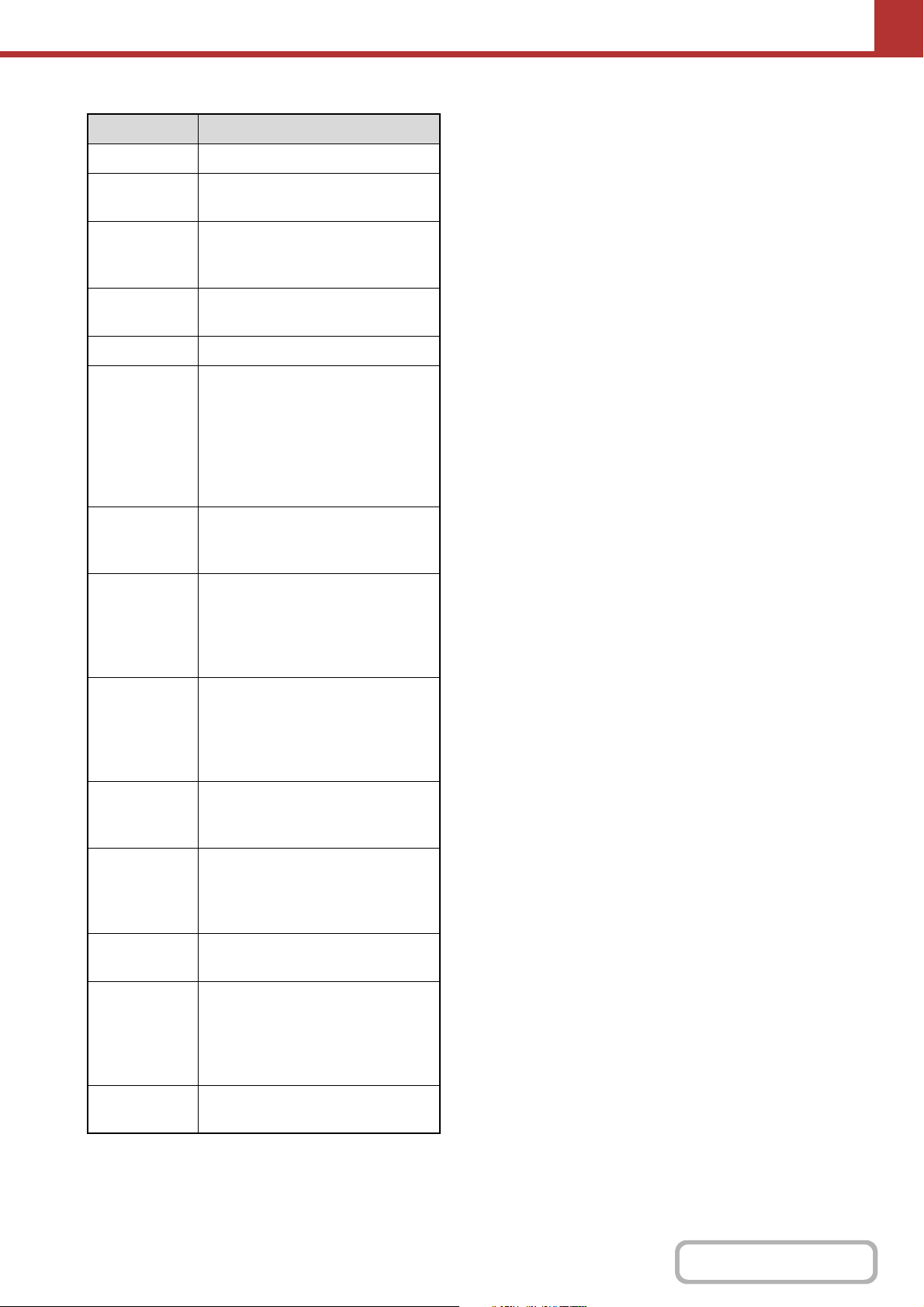
5-103
SCANNER/INTERNET FAX
Contents
• Completed job
Display Status
"Send OK" Transmission was completed.
"In Memory" An Internet fax has been received
but has not yet been printed.
"Received" A received Internet fax has been
printed or deleted in the check
image screen.
"Forward OK" A received Internet fax has been
forwarded.
"Stopped" The job was stopped.
"Number of
successful
transmission
destinations/
Total
destinations
OK"
Completion of a broadcast
transmission or inbound routing
operation.
If transmission to 3 destinations
was successful out of a total of 5,
"003/005 OK" will appear.
"No
Response"
An error occurred because there
was no response from the
destination.
"OK Report" A receive report was requested for
a transmission, the transmission
was completed normally, and the
receive report was received from
the destination.
"NG Report" A receive report was requested for
a transmission, however, the
transmission did not take place
correctly and a transmission failed
report was received.
"No Report" An e-mail was received without an
attached file and thus printing was
not possible.
"Received" An e-mail was received, however,
the attached file was not a TIFF-F
file or there was no attached file,
and thus printing was not possible.
"Rejected" An Internet fax was sent from a
party that is blocked.
"NGxxxxxx" Transmission/reception was not
successful because a
communication error occurred (a
6-digit error code appears in
xxxxxx.)
"Error" An error occurred while the job was
being executed.

5-104
SCANNER/INTERNET FAX
Contents
OPERATION WHEN A JOB IN THE JOB QUEUE IS
COMPLETED
When a normal transmission job is completed, it moves to the completed jobs screen and "Send OK" appears in the
status column.
Received Internet faxes, timer transmission jobs, and forwarding jobs are handled in the job status screen as explained
below.
Internet fax reception jobs
While an Internet fax is being received, "Receiving" appears.
When reception is completed, the job moves to the completed jobs screen and "In Memory" appears.
When printing ends, the status changes to "Printed" and the job is completed.
Timer transmission jobs
A timer transmission job appears at the bottom of the job queue until the specified time arrives.
When the specified time arrives, the job is executed. If another job is in progress, the timer job is started when the other
job is completed.
Internet fax transmission jobs that request a receive report
After completion of an Internet fax transmission job (excluding Direct SMTP transmission jobs) that requests a receive
report, the job is placed on standby at the bottom of the job queue screen. "Report Wait" appears in the status column.
When the receive report is received from the destination, or if the report is not received within the timeout time, the job
moves to the completed jobs screen.
Reception jobs when "Inbound Routing Settings" are enabled
When "Inbound Routing Settings" are enabled, reception jobs are handled as follows depending on the print setting.
☞ FORWARDING RECEIVED INTERNET FAXES TO A NETWORK ADDRESS (Inbound Routing Settings) (page 5-114)
• Received Internet fax is not printed
"Receiving" appears while the Internet fax is being received. When reception is completed, the job moves to the job
queue of the job status screen of scan mode.
• Received Internet fax is printed
When reception is completed, the job moves to the completed jobs screen and "In Memory" appears. When printing
ends, the status changes to "Printed" and the job is completed. In addition, the job is added to the job queue of the job
status screen of scan mode. When forwarding received Internet faxes is finished, "Forward OK" appears.
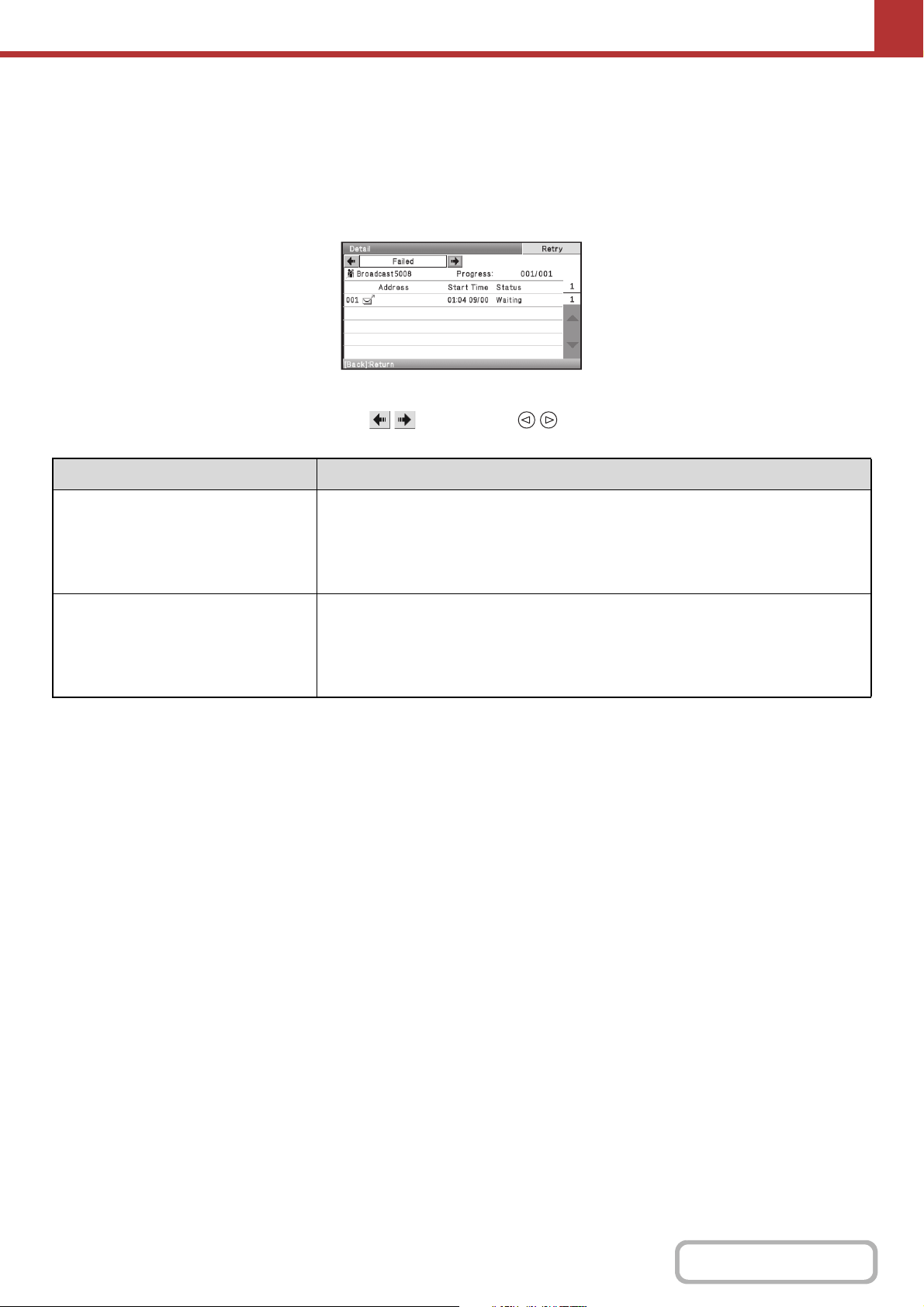
5-105
SCANNER/INTERNET FAX
Contents
CHECKING COMPLETED JOBS
You can check a list of the destinations, the destinations for which transmission failed, and other detailed information on
completed jobs that used broadcast transmission jobs, and received Internet fax forwarding jobs. Select the key of the
job for which you wish to display information in the completed jobs screen and select the [Detail] key. The job detail
screen (see below) will appear.
The job name appears at the top of the job detail screen.
To view details on the job, select either of the keys with the keys and press the [OK] key. The following
information appears on each screen.
* Recalling is not possible for a broadcast transmission that includes a Scan to FTP address, Scan to Network Folder
address, or Scan to Desktop address.
Tab name Information displayed
Failed Shows information on addresses for which communication failed.
Address: Address name or number
Start time: Time at which communication began.
Status: Description of failure (error)
The [Retry] key can be selected to re-attempt transmission to that address.*
All Destinations Shows all addresses specified in the job.
Address: Address name or number
Start time: Time at which communication began.
Status: Communication result
The [Retry] key can be selected to transmit to all addresses again.*
AAA AAA
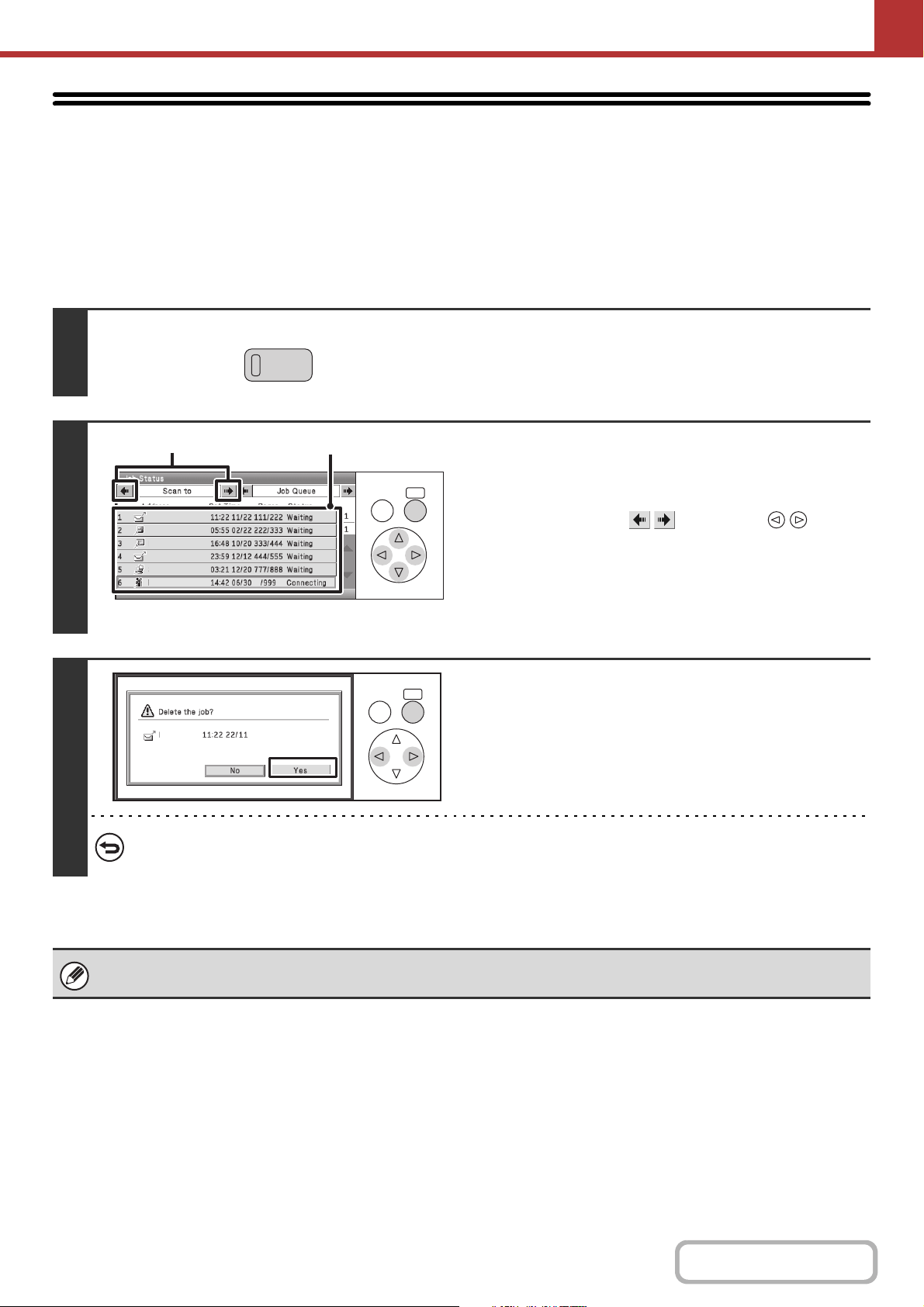
5-106
SCANNER/INTERNET FAX
Contents
STOPPING A SCAN JOB BEING
TRANSMITTED OR WAITING TO BE
TRANSMITTED
Follow the steps below to stop a job that is being transmitted or is waiting to be transmitted.
Keys in the display can be selected with the arrow keys and the [OK] key.
1
Press the [JOB STATUS] key.
2
Select the job that you wish to stop.
(1) Switch to the mode of the job that you wish
to stop.
Select either of the keys with the keys
and press the [OK] key. The mode changes each time the
[OK] key is pressed.
(2) Select the job to be stopped.
(3) Select [Stop/Delete] in the displayed screen.
3
Select the [Yes] key.
If you do not want to stop the selected job...
Select the [No] key.
Printing of a received Internet fax cannot be stopped.
JOB STATU
S
OKBACK
AAA AAA
BBB BBB
CCC CCC
DDD DDD
EEE EEE
Broadcast
(1)
(2)
OKBACK
AAA AAA
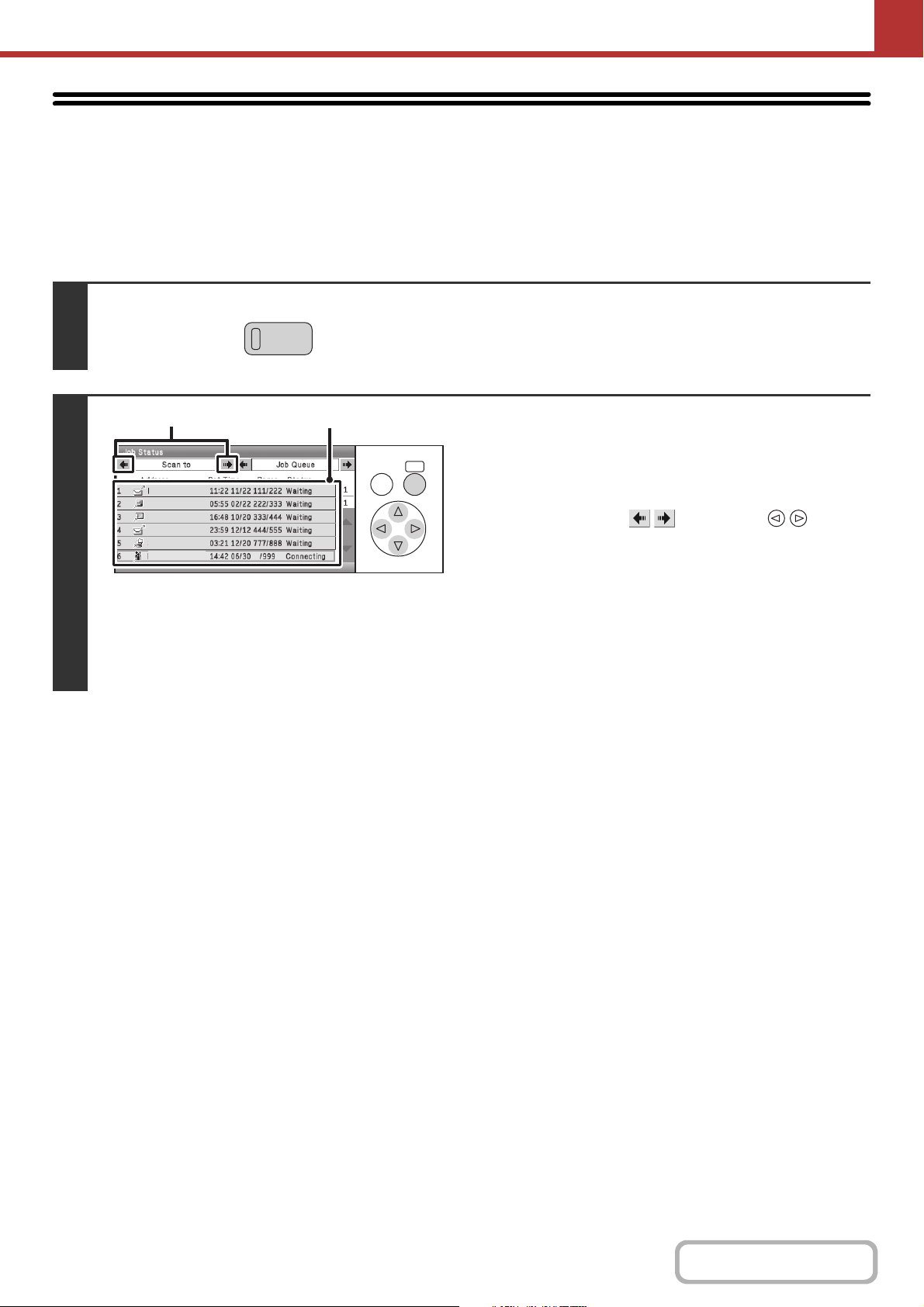
5-107
SCANNER/INTERNET FAX
Contents
GIVING PRIORITY TO A SCAN
TRANSMISSION JOB
When multiple jobs are waiting to be transmitted, the jobs are normally transmitted in the order they were reserved. If
you need to give priority to a job and send it ahead of the other jobs, follow the steps below.
Keys in the display can be selected with the arrow keys and the [OK] key.
1
Press the [JOB STATUS] key.
2
Select the job to which you wish to give
priority.
(1) Switch to the mode of the job to be given
priority.
Select either of the keys with the keys
and press the [OK] key. The mode changes each time the
[OK] key is pressed.
(2) Select the job to be given priority.
(3) Select [Priority] in the displayed screen.
The selected job moves up to the position immediately
following the job in progress. The job will be executed
when the job in progress is completed.
JOB STATU
S
OKBACK
AAA AAA
BBB BBB
CCC CCC
DDD DDD
EEE EEE
Broadcast
(1)
(2)

5-108
SCANNER/INTERNET FAX
Contents
CHECKING THE INTERNET FAX ACTIVITY
LOG (Image Sending Activity Report)
IMAGE SENDING ACTIVITY REPORT
You can have the machine print a log of recent image sending activity (date, name of other party, time required, result,
etc.). The Image Sending Activity Report contains useful information such as the types of errors that occurred.
The most recent 200 transactions are included in the report.
You can have the machine print the Image Sending Activity Report each time the number of transactions reaches 201,
or at a specified time (once a day only).
INFORMATION APPEARING IN THE RESULT COLUMN
Error types and other information are printed in the result column of transaction and activity reports. When a transaction
report or activity report is printed, check the result of the transaction in the result column and take action as needed.
Examples of messages that are printed in the result column
The contents of the Image Sending Activity Report are erased when the report is printed, and thus it cannot be reprinted.
System Settings (Administrator): Activity Report Print Select Setting (Web page only)
This is used to set the conditions for printing activity reports. The factory default setting is not to print.
The Image Sending Activity Report can be set to print each time the number of transactions reaches 201, or at a specified
time (once a day only).
Message Explanation
OK The transaction was completed normally.
OK REPORT A receive report was requested for a transmission, the transmission was completed normally, and
the receive report was received from the destination.
CANCEL A transmission was stopped while in progress, or a reserved transmission job was canceled.
MEM. FULL The memory became full during reception.
REJECTED An Internet fax was sent from a party that is blocked.
NG REPORT A receive report was requested for a transmission, however, the transmission did not take place
correctly and a transmission failed report was received.
NO REPORT A receive report was requested for a transmission, however, a report was not received within the
timeout time.
NG LIMIT Transmission was not possible because the file size exceeded the machine's file size limit setting.
RECEIVED An e-mail was received, however, the attached file was not a TIFF-F file or there was no attached
file, and thus printing was not possible.
FAIL xx (xxxx) The transaction failed due to a communication error.
First 2 digits of communication error number: Error code from 00 to 99.
Last 4 digits of communication error number: Code for use by service technicians.
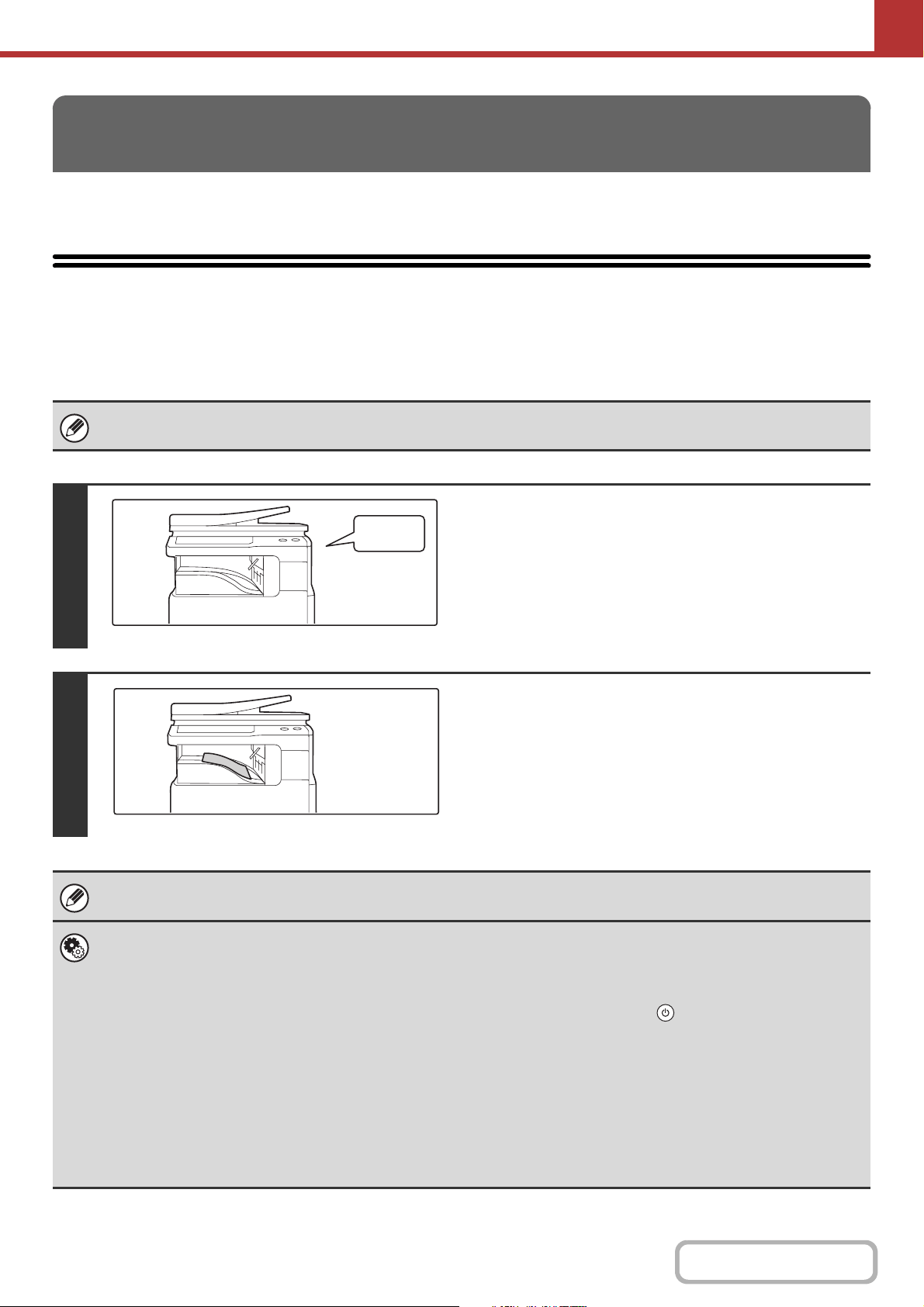
5-109
SCANNER/INTERNET FAX
Contents
This section explains the basic procedures for receiving Internet faxes.
RECEIVING AN INTERNET FAX
The Internet fax function periodically* connects to the mail server (POP3 server) and checks whether or not Internet
faxes have been received. When faxes have been received, the faxes are automatically retrieved and printed.
* The default setting is once every 5 minutes.
INTERNET FAX RECEPTION FUNCTIONS
If faxes will be received at night, keep the main power switch in the "on" position.
1
Internet faxes are received automatically.
A beep sounds when reception ends.
2
The Internet faxes are printed
automatically.
If the machine is out of paper or there is no paper that matches the size of the received fax, a message will appear in the
display. Follow the instructions in the message to load an appropriate size of paper.
• System Settings: Fax Data Receive/Forward (page 6-16)
When printing is not possible because the machine has run out of paper or toner, received Internet faxes can be forwarded
to and printed by another previously stored Internet fax machine.
• System Settings (Administrator): I-Fax Default Settings (Web page only)
These settings are used to select how received faxes are handled when the [POWER] key ( ) is "off" (the main power switch
is "on"), the volume of the beep that sounds when reception ends, and whether or not received e-mail messages are printed.
• System Settings (Administrator): I-Fax Receive Settings (Web page only)
Settings related to Internet fax reception can be configured such as the interval for checking for received faxes, duplex
reception, auto reduction printing, and storing allow/reject reception addresses.
• System Settings (Administrator): Allow/Reject Mail or Domain Name Setting (Web page only)
This setting is used to allow/refuse reception from stored addresses and domains.
• System Settings (Administrator): Receiving Date & Time Print (Web page only)
Use this to select whether or not the date and time of reception is added when a received image is printed.
Beep
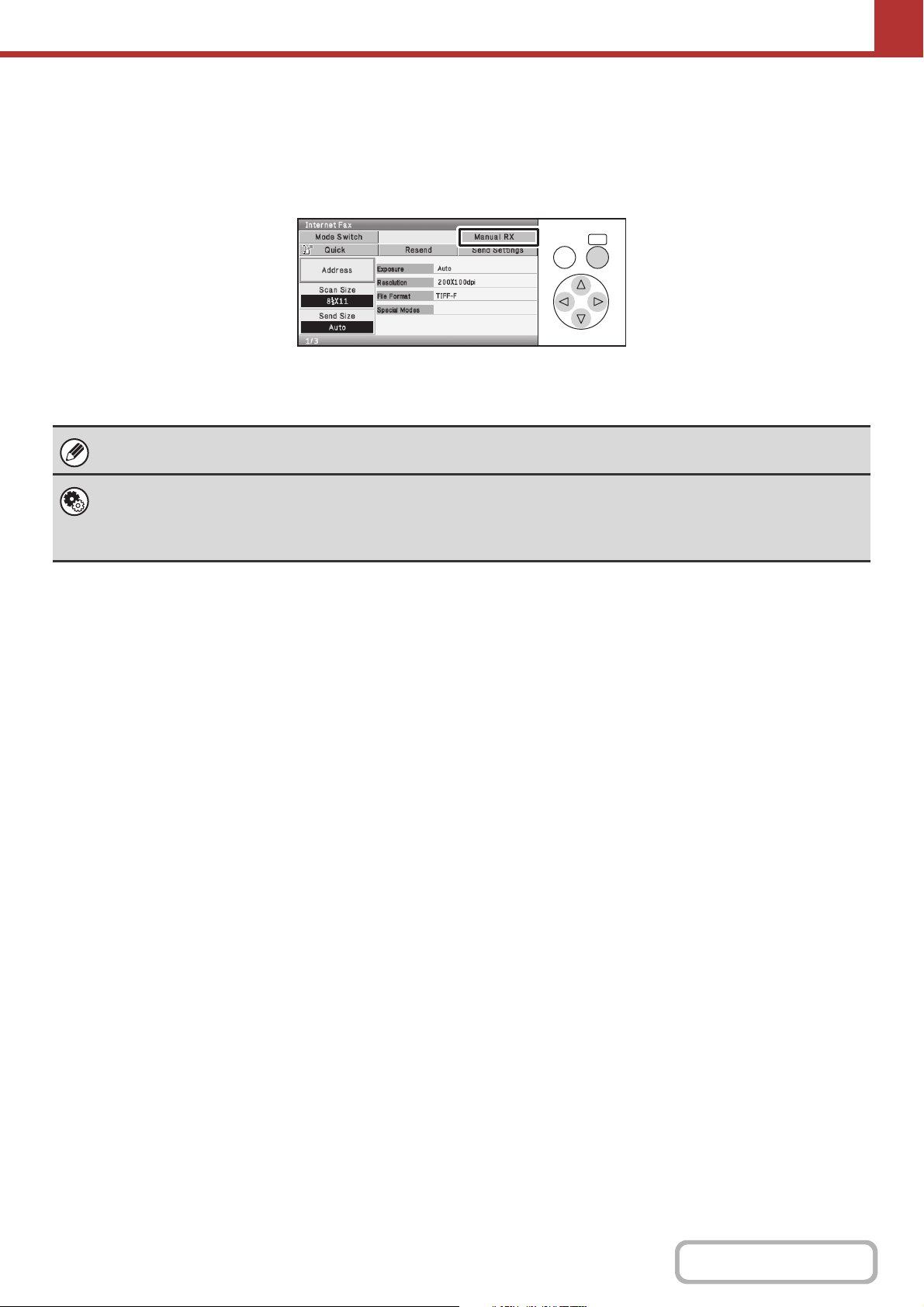
5-110
SCANNER/INTERNET FAX
Contents
MANUALLY RECEIVING INTERNET FAXES
If the interval for checking for received faxes is somewhat long and you wish to check immediately, you can manually
initiate reception.
Select the [Manual RX] key to connect to the mail server and retrieve received faxes.
If POP3 server settings are not configured in the Web pages, the [Manual RX] key is grayed out to prevent selection.
System Settings: Fax Data Receive/Forward (page 6-16)
This setting is used to hide the [Manual RX] key that appears in the base screen of Internet Fax mode. When the [Manual
RX] key is hidden, manual reception is initiated by selecting the [Reception Start] key in the screen that appears when "Fax
Data Receive/Forward" - "I-Fax Settings" is selected.
OKBACK
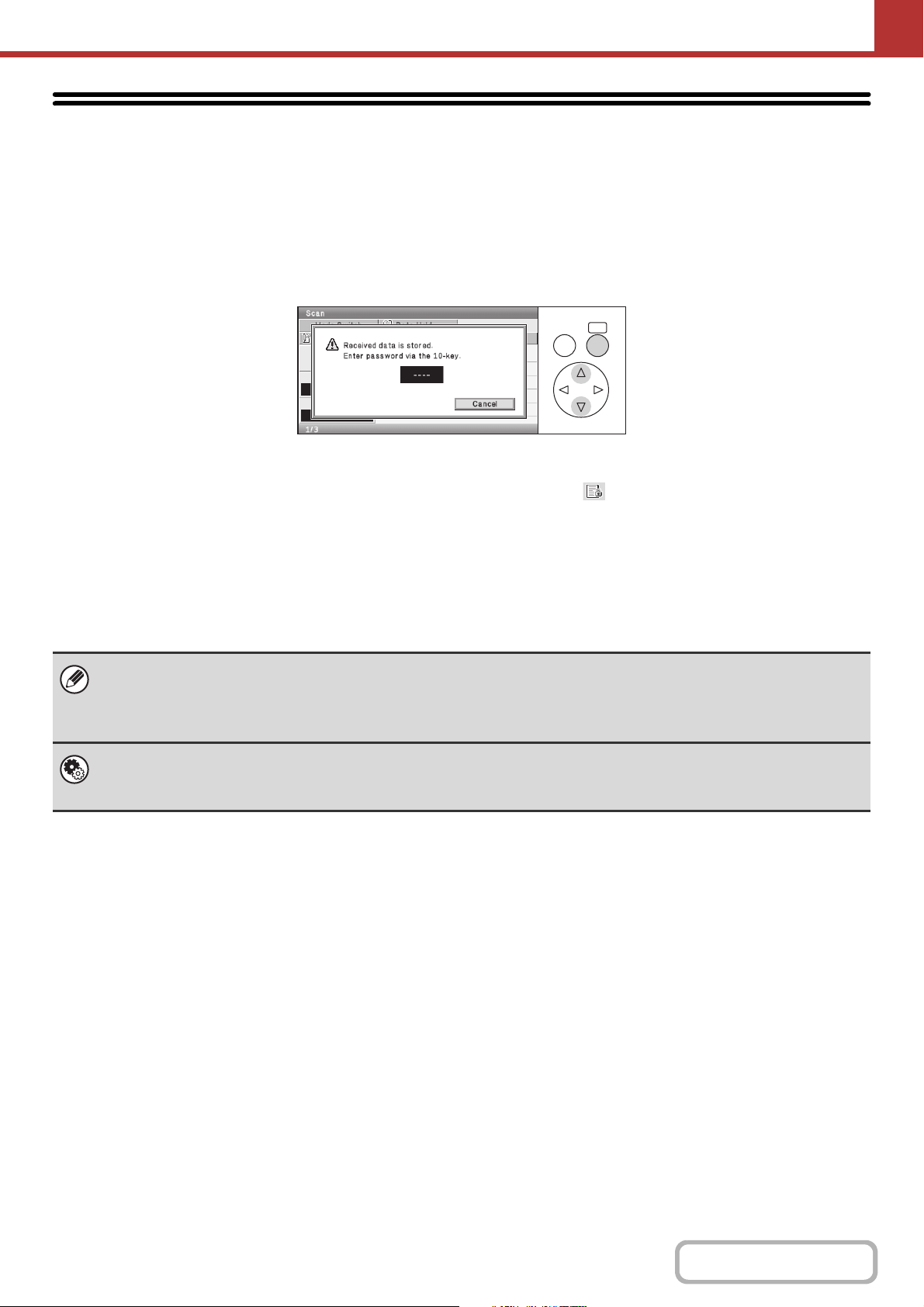
5-111
SCANNER/INTERNET FAX
Contents
PRINTING A PASSWORD-PROTECTED FAX
(Hold Setting For Received Data Print)
"Hold Setting for Received Data Print" in the system settings (administrator) can be enabled to have faxes received to
memory without being printed. To print the faxes, a password must be entered. When this function is enabled, a
password entry screen appears in the display when received Internet faxes are retrieved.
When the previously programmed 4-digit password is entered with the numeric keys, printing begins.
If the [Cancel] key is selected, the password entry screen will close; however, will blink in the display to indicate that
there is stored data. To open the password entry screen again, select the [Data Hold] key or change the mode.
When "Received Data Image Check Setting" (Web page only) is enabled in the system settings (administrator), a
password can be entered to display the received data list screen. If you wish to check an image before printing it,
continue from step 2 on the next page.
• The received faxes will be retained in memory regardless of whether they were received automatically or manually.
• If "Fax Data Receive/Forward" is enabled in the system settings so that received faxes are forwarded to another machine,
faxes retained in memory are also forwarded. At that time, the same password entry screen will appear as for printing.
Forwarding will not take place unless the password is entered.
System Settings (Administrator): Hold Setting for Received Data Print
Enable this setting to have faxes received to memory without being printed. This setting is also used to program the
password that must be entered to print the faxes.
OKBACK
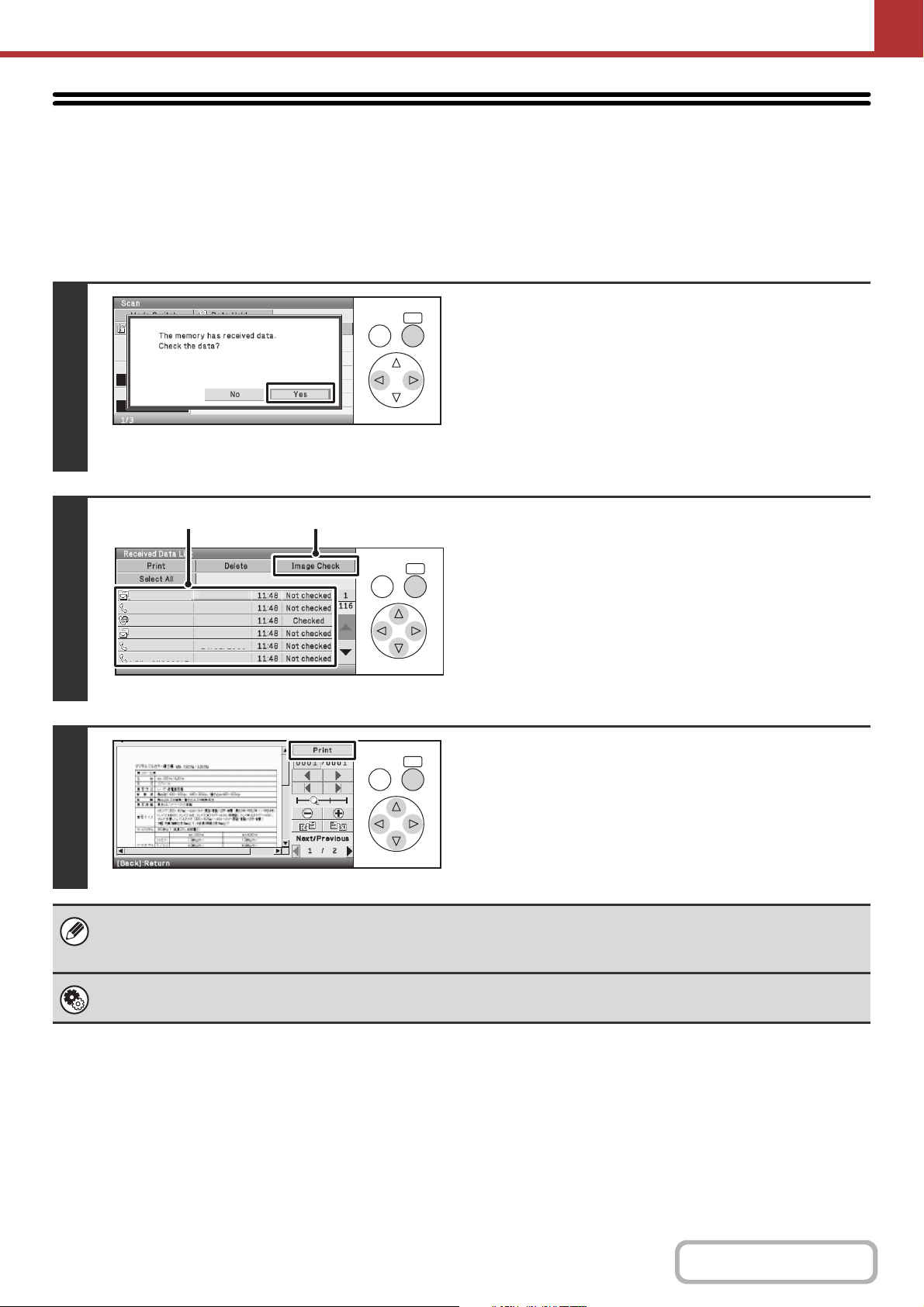
5-112
SCANNER/INTERNET FAX
Contents
CHECKING THE IMAGE BEFORE PRINTING
When "Received Data Image Check Setting" (Web page only) is enabled* in the system settings (administrator), you
can check a received image in the display before printing it out. When this function is enabled, follow the steps below to
print a received image.
* The factory default setting is disabled.
Keys in the display can be selected with the arrow keys and the [OK] key.
1
When an image is received, a
confirmation prompt will appear. Select
the [Yes] key.
If this message appears while you are configuring settings of
any type and you select the [Yes] key, the settings that you are
configuring will be canceled. If this message appears in another
mode, you will return to the base screen of image send mode
after checking the image.
2
Select the received image
(1) Select the key of the received image that
you want to check.
Multiple received images can be checked.
(2) Select the [Image Check] key.
To delete an image that has been selected, select the
[Delete] key. To print an image that has been selected,
select the [Print] key.
3
Check the received image and then
select the [Print] key.
Printing begins.
For information on the image check screen, see "IMAGE
CHECK SCREEN" (page 5-113).
If the screen of step 1 appears when you are configuring settings in the setting screens of any of the modes, the configured
settings will be canceled if you view the image. After viewing the image, you will return to the base screen of image send
mode, regardless of which mode you were in previously.
System Settings (Administrator): Received Data Image Check Setting (Web page only)
Use this to specify whether or not a received Internet fax can be viewed before it is printed.
OK
BACK
OKBACK
AAA AAA
BBB BBB
CCC CCC
DDD DDD
EEE EEE
FFF FFF
04/04/2010
04/04/2010
04/04/2010
04/04/2010
04/04/2010
04/04/2010
(1) (2)
OKBACK
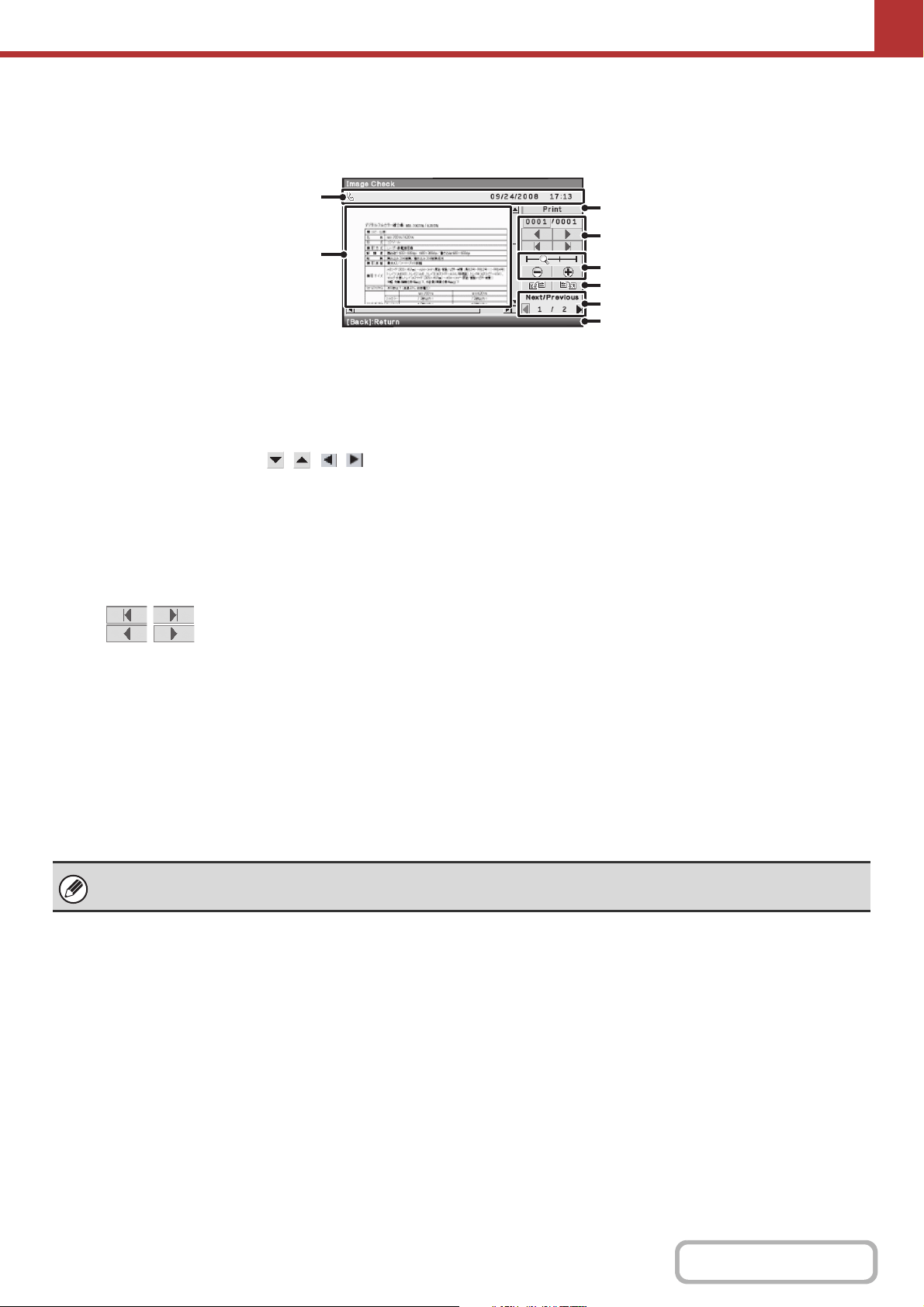
5-113
SCANNER/INTERNET FAX
Contents
IMAGE CHECK SCREEN
This section explains the image check screen.
(1) Information display
This shows information on the displayed image.
(2) Preview image
An image of the selected received image appears.
If the image is cut off, select at the right
and bottom of the image to scroll.
(3) [Print] key
Select this key to start printing.
(4) Change page keys
When there are multiple pages, use these keys to
change pages.
• keys: Go to the first or the last page.
• keys: Go to the previous page or the
next page.
• Page number display: This shows the total number of
pages and the current page
number. You can select the
current page number key and
enter a number with the
numeric keys to go to that page
number.
(5) Display zoom key
Use this key to set the zoom ratio of the displayed image.
The setting applies to all pages in the file, not just the
displayed page.
(6) "Display Rotation" key
This key rotates the image right or left by 90 degrees.
The rotation applies to all pages in the file, not just the
displayed page.
(7) Image select key
When multiple images are selected for preview display,
use this key to change the displayed images.
(8) Guidance display
Shows keys that are used when an operation is
performed.
AAA AAA
(1)
(4)
(3)
(5)
(6)
(7)
(8)
(2)
A preview image is an image for display on the display. It will differ from the actual print result.
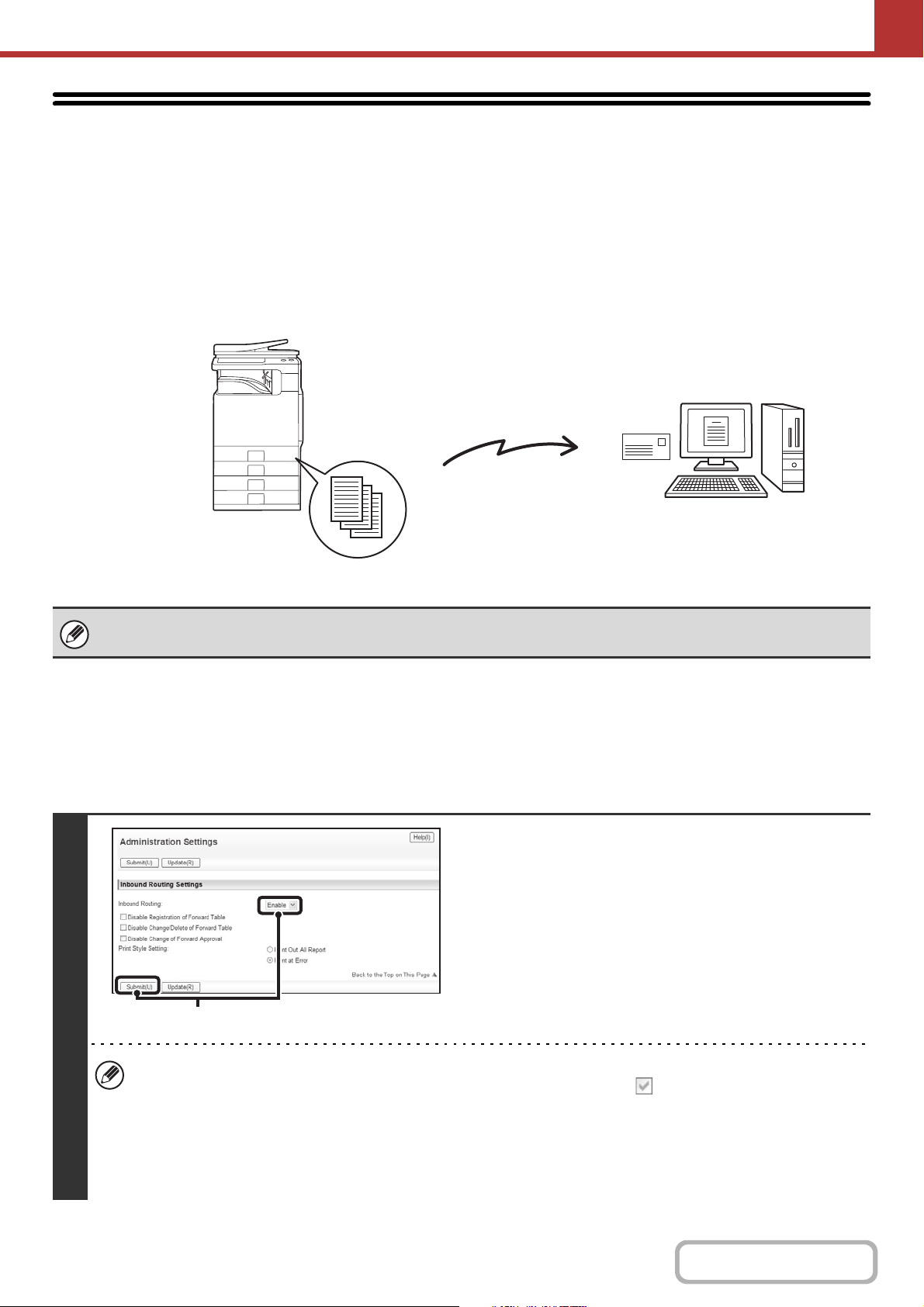
5-114
SCANNER/INTERNET FAX
Contents
FORWARDING RECEIVED INTERNET
FAXES TO A NETWORK ADDRESS
(Inbound Routing Settings)
Received Internet faxes can be automatically forwarded to an e-mail address, file server address, desktop address, or
network folder address. When this function is enabled, you can also have received Internet faxes forwarded without
printing them.
CONFIGURING INBOUND ROUTING SETTINGS
All inbound routing settings are configured in the Web pages. For the procedure for accessing the Web pages, see the
Quick Start Guide.
The following explanation assumes that the Web pages have been accessed with administrator rights.
To configure inbound routing settings, follow the steps below.
When faxes forwarded using this function are printed at the forwarding destination, the date and time of reception cannot be
printed on the faxes. ("Receiving Date & Time Print" is disabled.)
1
Enabling the inbound routing function.
(1) In the Web page menu, click [Application
Settings], [Inbound Routing Settings], and
then [Administration Settings].
(2) Select [Enable] in "Inbound Routing" and
click the [Submit] button.
Users without administrator rights can be prohibited from storing, editing, and deleting forwarding tables in this screen,
and from specifying which table is used. To do so, select the checkboxes below .
•
Disable Registration of Forward Table • Disable Change/Delete of Forward Table • Disable Change of Forward Approval
When inbound routing is enabled, you can also specify whether or not you wish the machine to print the forwarded faxes.
To have all received faxes printed before being forwarded, select "Print Out All Report" in "Print Style Setting". To
have received faxes printed only when an error prevents forwarding, select "Print at Error".
After configuring the settings, be sure to click the [Submit] button.
Forwarding
Received Internet fax
The machine
(2)
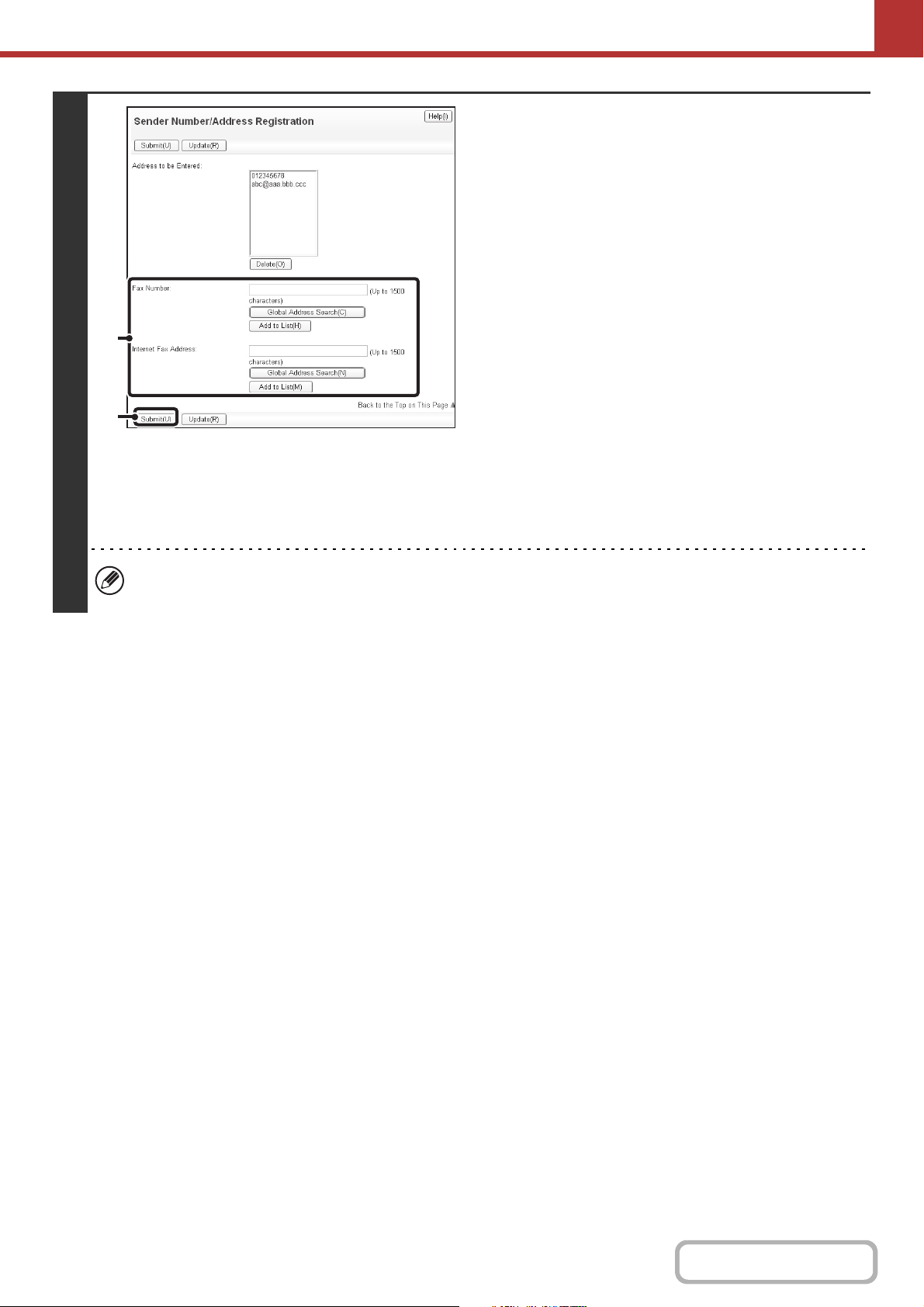
5-115
SCANNER/INTERNET FAX
Contents
2
Storing sender addresses.
If you wish to have only faxes from specified addresses
forwarded, store the desired sender addresses. Sender
addresses stored here can be selected from a list when you
store a forwarding table.
(1) Click [Sender Number/Address
Registration] in the [Inbound Routing
Settings] menu in the Web page.
(2) Enter the sender address in "Internet Fax
Address" or "Fax Number" as appropriate,
and click the [Add to List] button.
The entered address will be added to the "Address to be
Entered" list.
• Specify whether the address will be directly entered
(maximum of 1500 characters) or selected from a
global address book by clicking the [Global Address
Search] button.
• To store multiple addresses, repeat this step.
(3) When you have finished adding addresses,
click the [Submit] button.
• A maximum of 500 sender numbers/addresses can be stored.
• To delete an entered address, select the address in "Address to be Entered" and click the [Delete] button.
(2)
(3)
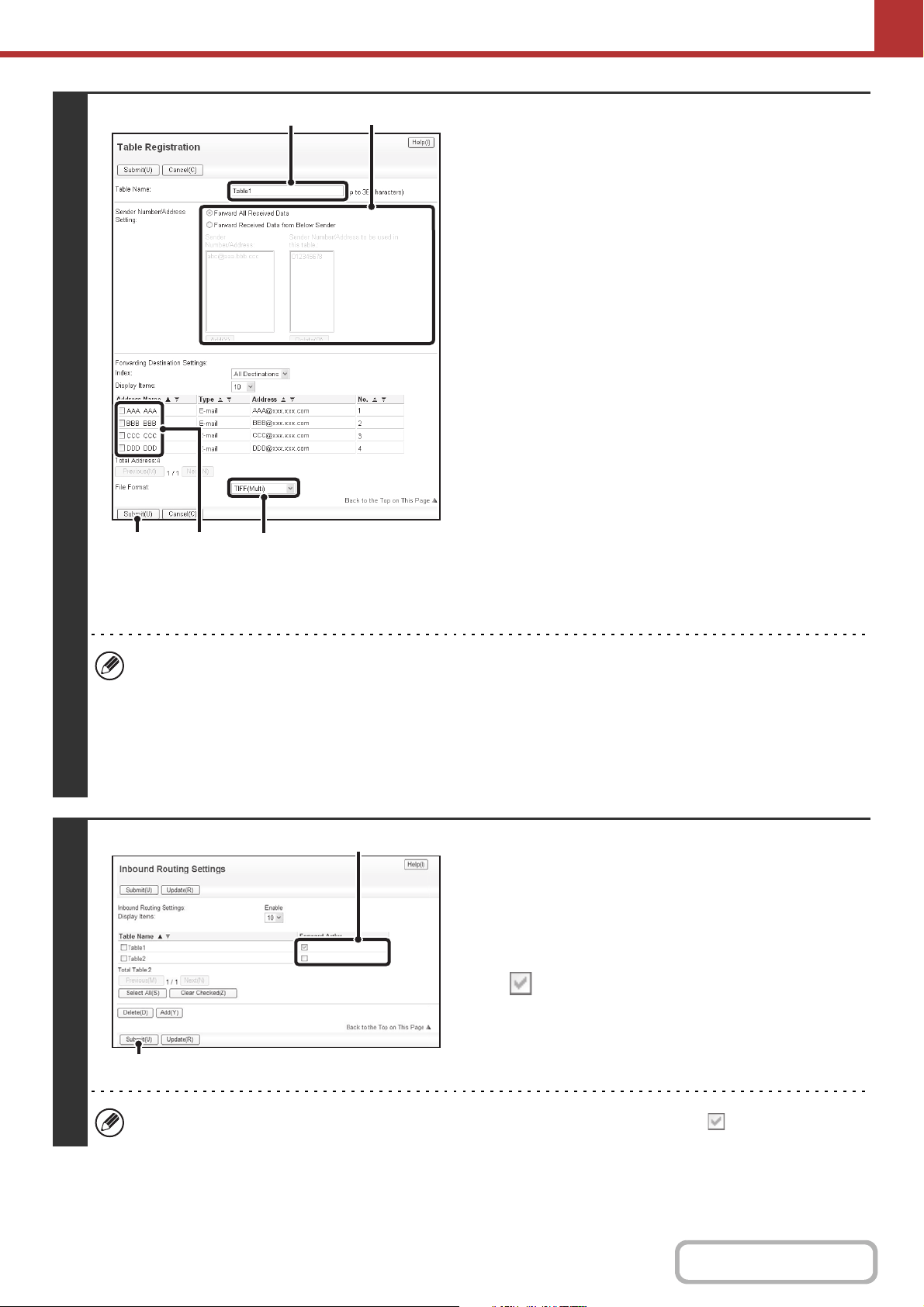
5-116
SCANNER/INTERNET FAX
Contents
3
Store a forwarding table.
Follow the steps below to store a forwarding table that
combines a specified sender and forwarding address.
(1) Click [Inbound Routing Settings] in the Web
page menu and click the [Add] button.
(2) Enter a "Table Name".
(3) Select the sender whose faxes will be
forwarded.
• To forward all received faxes, select [Forward All
Received Data].
• To forward faxes received from a specific sender only,
select [Forward Received Data from Below Sender],
select the sender from the list, and then click the [Add]
button.
(4) Select the forwarding address.
Forwarding addresses can be selected from the
machine's address book. (Multiple addresses can be
selected.) A maximum of 1000 forwarding addresses can
be stored (a combined maximum of 100 file server,
desktop, and network folder addresses can be stored).
(5) Select the file format.
A file format can be set for each forwarding table.
(6) Click [Submit].
• When selecting senders from the "Sender Number/Address Setting" list, you can use the [Shift] key or the [Ctrl] key
on your keyboard to select multiple senders.
• A maximum of 50 forwarding tables can be stored.
• If you wish to select a group of addresses for the forwarding destination, you can only select a group that contains
e-mail addresses only.
• Images sent in TIFF format may not display correctly in some recipient environments. In this event, change the file
format to PDF.
4
Specifying forwarding tables to be used.
To use the inbound routing function, enable the forwarding
tables that you wish to use from among the stored tables.
(1) Click [Inbound Routing Settings] in the Web
page menu.
(2) Select the "Forward Activated" checkbox
of each forwarding table that you wish
to use.
(3) Click [Submit].
To delete a forwarding table, click the checkbox next to the table name so that it is selected and click [Delete].
(6) (4)
(3)
(2)
(5)
(2)
(3)

5-117
SCANNER/INTERNET FAX
Contents
BASIC SCANNING PROCEDURE
You can install the scanner driver on your computer from the CD-ROM that accompanies the machine, and use a
TWAIN* compliant application to scan an image using your computer.
Scanning from your computer is most useful for scanning a single original such as a photo, particularly when you want to
adjust scan settings as you scan. By contrast, scanning at the machine is most useful for continuous scanning of
multiple originals.
* An interface standard used for scanners and other image input devices. When the scanner driver is installed on your
computer, you can use any TWAIN-compliant application to scan an image.
As an example, the procedure for scanning from the "Sharpdesk" application that accompanies the machine is
explained below.
[At the machine]
Keys in the display can be selected with the arrow keys and the [OK] key.
SCANNING FROM A COMPUTER
(PC Scan Mode)
• Scanning in PC scan mode is only possible when the scanner driver has been installed from the "Software CD-ROM"
using the integrated installer. For the procedures for installing the scanner driver and configuring settings, see the
Software Setup Guide.
•
This function cannot be used when it has been disabled using "Disable Scan Function" in the system settings (administrator).
• The procedures for selecting the scanner driver and starting scanning vary depending on the TWAIN-compliant
application. For more information, see the manual for the application or Help.
• When a large image is scanned at high resolution, the amount of data will be very large and scanning will take a long time.
Be sure to select appropriate scan settings for the original (text, photo, etc.).
1
Place the original.
Place the original face up in the document feeder tray, or face
down on the document glass.
When the original is a different size than the size setting, set
the original size.
☞ SPECIFYING THE ORIGINAL SCAN SIZE AND SEND
SIZE (page 5-61)
2
Switch to PC Scan mode.
(1) Select the [Mode Switch] key.
(2) Select the [PC Scan] key.
When PC scan mode is selected, only the [Exit] key displayed in the display can be used on the machine; no other
keys can be used.
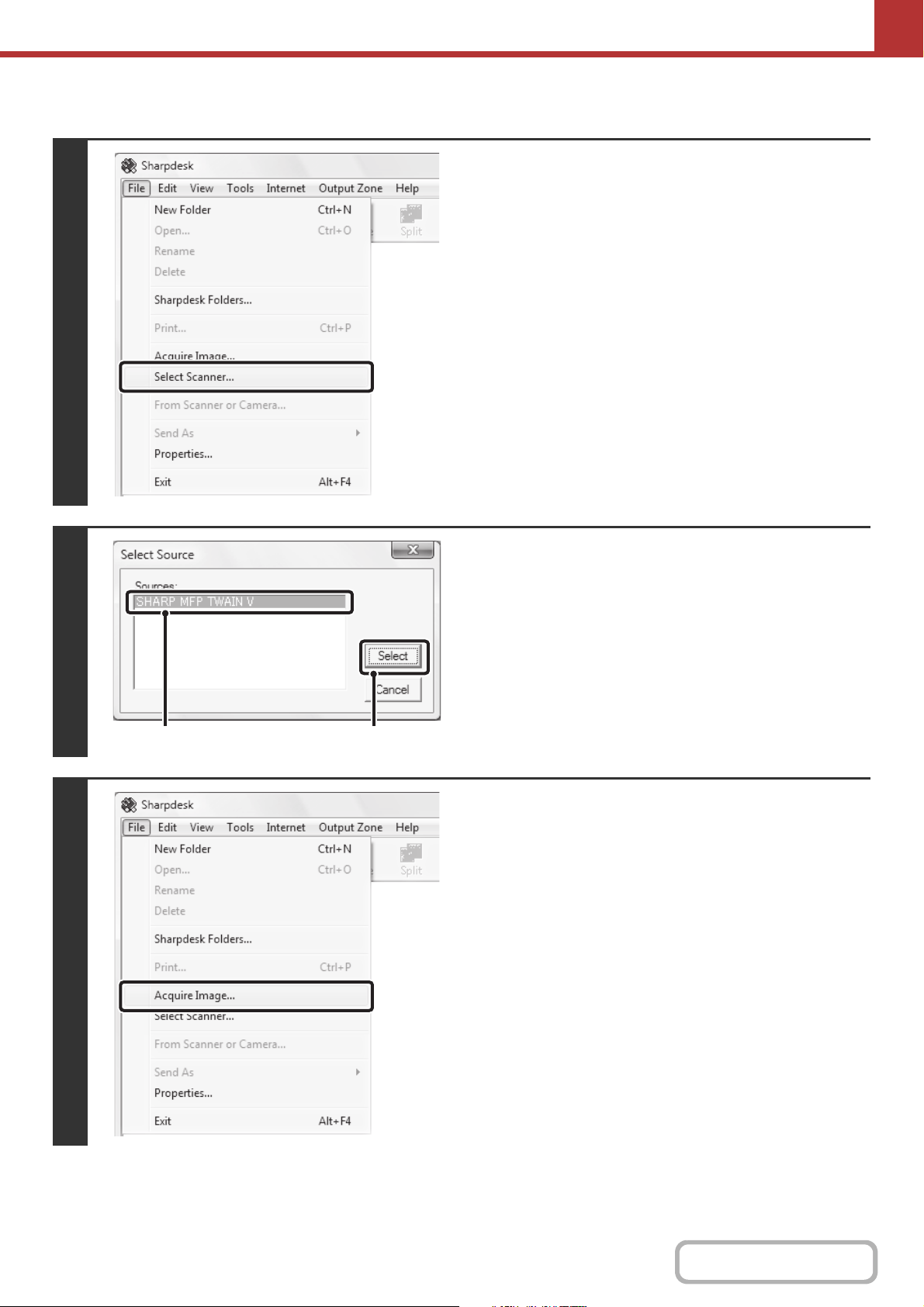
5-118
SCANNER/INTERNET FAX
Contents
[At your computer]
3
Start the TWAIN-compliant application
on your computer and select [Select
Scanner] from the [File] menu.
4
Select the scanner driver of the
machine.
(1) Select [SHARP MFP TWAIN V].
(2) Click the [Select] button.
5
Select [Acquire Image] from the [File]
menu.
The scanner driver opens.
(1)
(2)
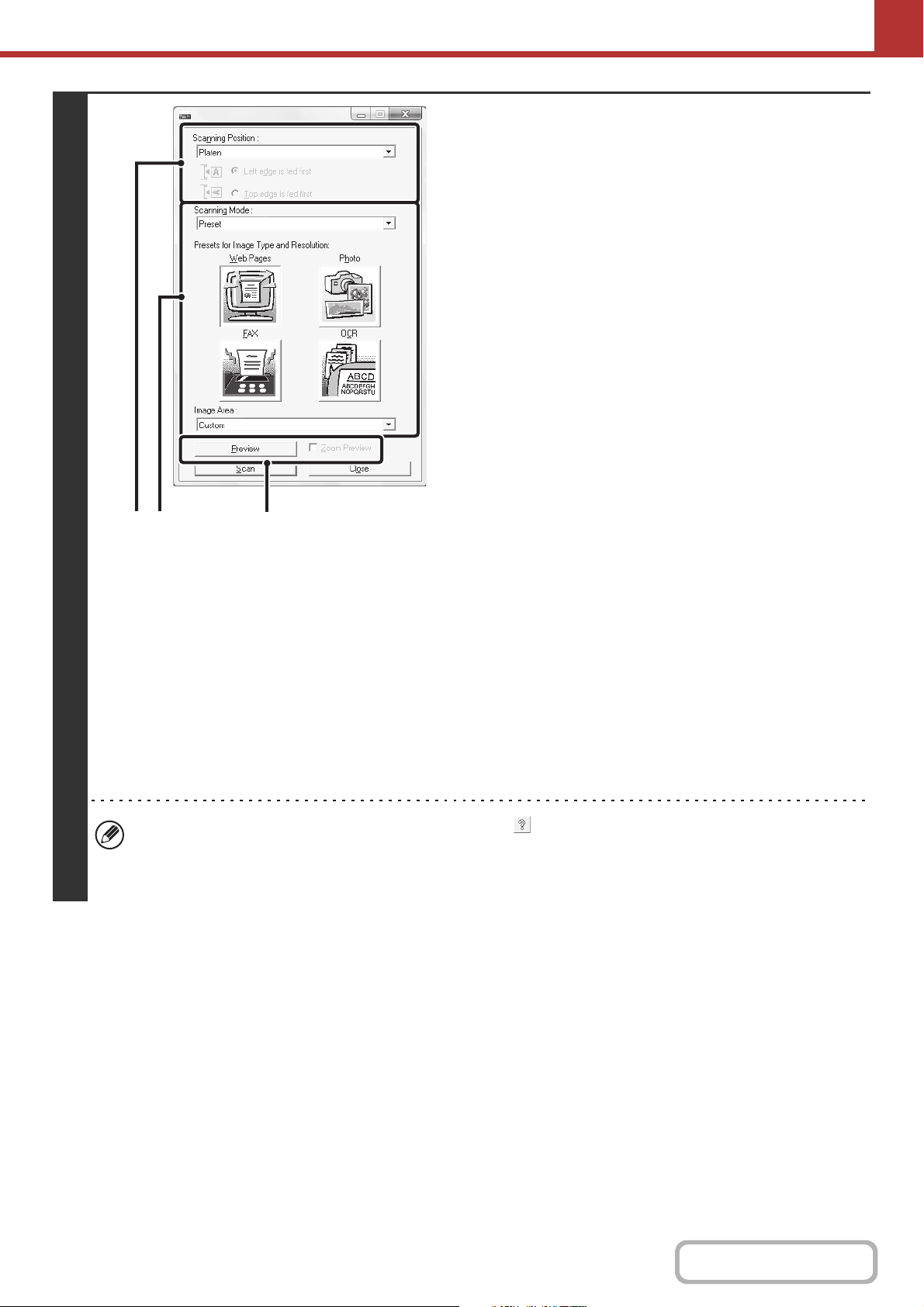
5-119
SCANNER/INTERNET FAX
Contents
6
Preview the image.
(1) Select the location where the original is
placed.
"Scanning Position" menu:
• If the original is a one-sided original and is placed in the
document feeder tray, select [SPF(Simplex)].
• If the original is a 2-sided original and is placed in the
document feeder tray, select [SPF(Duplex - Book)] or
[SPF(Duplex - Tablet)] depending on whether the
original is a book-style or tablet-style original. In
addition, select [Left edge is fed first] or [Top edge is
fed first] depending on the orientation of the original.
(2) Select scan settings.
"Scanning Mode" menu:
Switch between the "Preset" screen and the "Custom
Settings" screen. In the "Preset" screen, select "Web
Pages", "Photo", "FAX" or "OCR" depending on the
original type and your scanning purpose.
If you wish to change the initial settings of any of the four
buttons or select the resolution or other advanced
settings, change to the "Custom Settings" screen.
"Image Area" menu:
Select the scan area. You can also set the scanning area
in the preview window with your mouse.
(3) Click the [Preview] button.
The preview image will appear in the scanner driver.
If you are not satisfied with the preview image, repeat (2)
and (3).
If the [Zoom Preview] checkbox is selected before the
[Preview] button is clicked, the selected area will be
enlarged in the preview window. If the checkmark is
removed, the preview image will return to normal. Note
that if SPF is selected in the "Scanning Position" menu,
the [Zoom Preview] function cannot be used.
• For further information on the scan settings, click the button in the preview image screen of step 7 to
open scanner driver Help.
• If the [Preview] button is clicked when scanning from the document feeder tray, only one original page will be
scanned for the preview image. If you wish to include that original in the scan, return it to the document feeder tray.
(1)
(3)
(2)
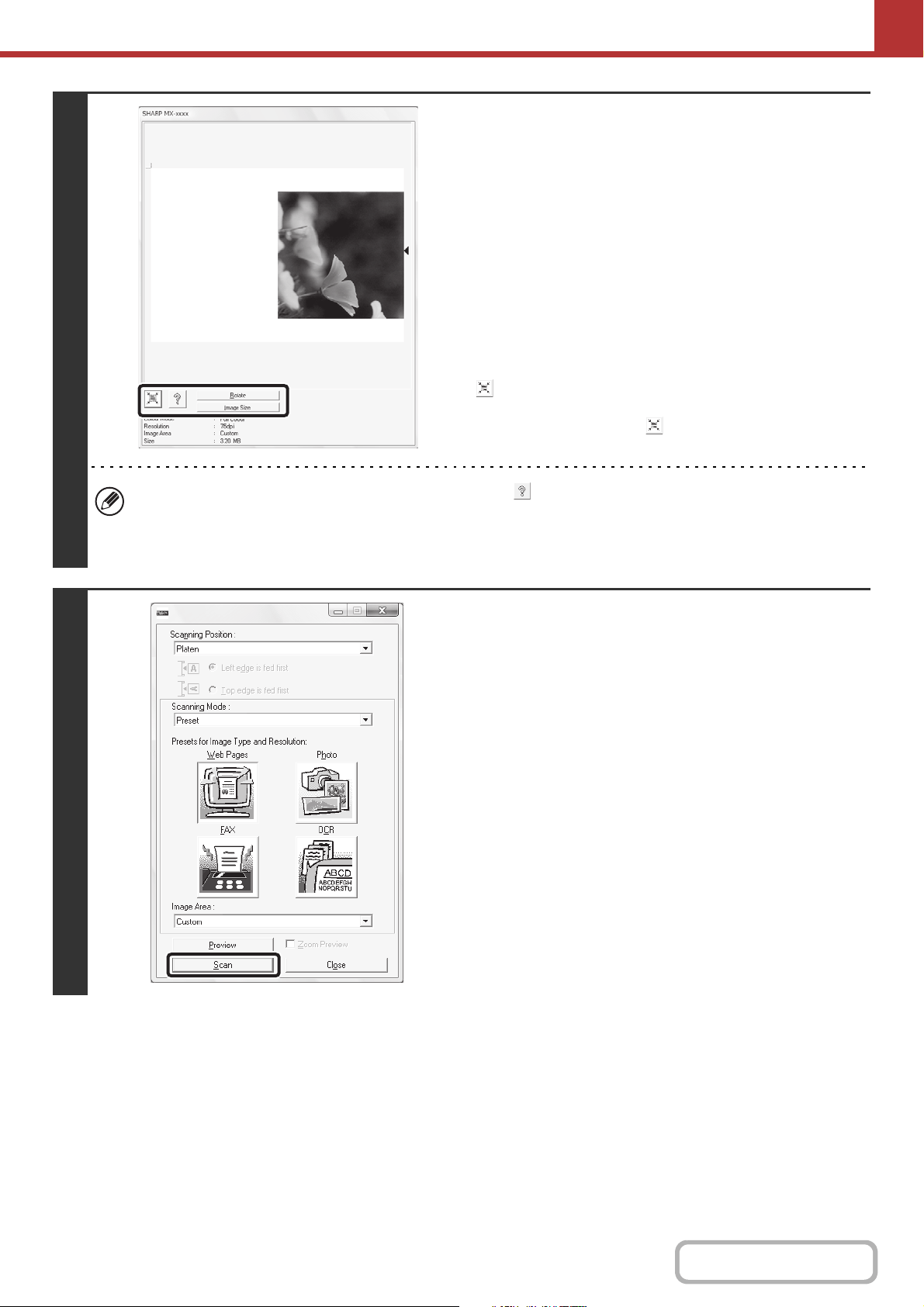
5-120
SCANNER/INTERNET FAX
Contents
7
Select scanning settings while viewing
the image.
[Rotate] button:
Each time this button is clicked, the preview image rotates 90
degrees. This lets you change the orientation of the image
without picking up and placing the original again. The image file
will be created using the orientation that appears in the preview
window.
[Image Size] button:
Click this button to specify the scan area by entering numerical
values. Pixels, mm, or inches can be selected for the units of
the numerical values. If a scanning area has already been
specified, the entered numbers will change the area relative to
the top left corner of the specified area.
button:
When a preview image is displayed and a scanning area is not
specified, you can click the button to automatically set the
scanning area to the entire preview image.
• For further information on the scan settings, click the button to open scanner driver Help.
• If the originals are placed in the document feeder tray, only the top page will be previewed. The top page will be
delivered to the original exit tray. Be sure to return the previewed page to the document feeder tray before
previewing again or scanning.
8
Click the [Scan] button.
Scanning begins. The image appears in your application.
Assign a file name to the scanned image and save it as
appropriate in the software application you are using.
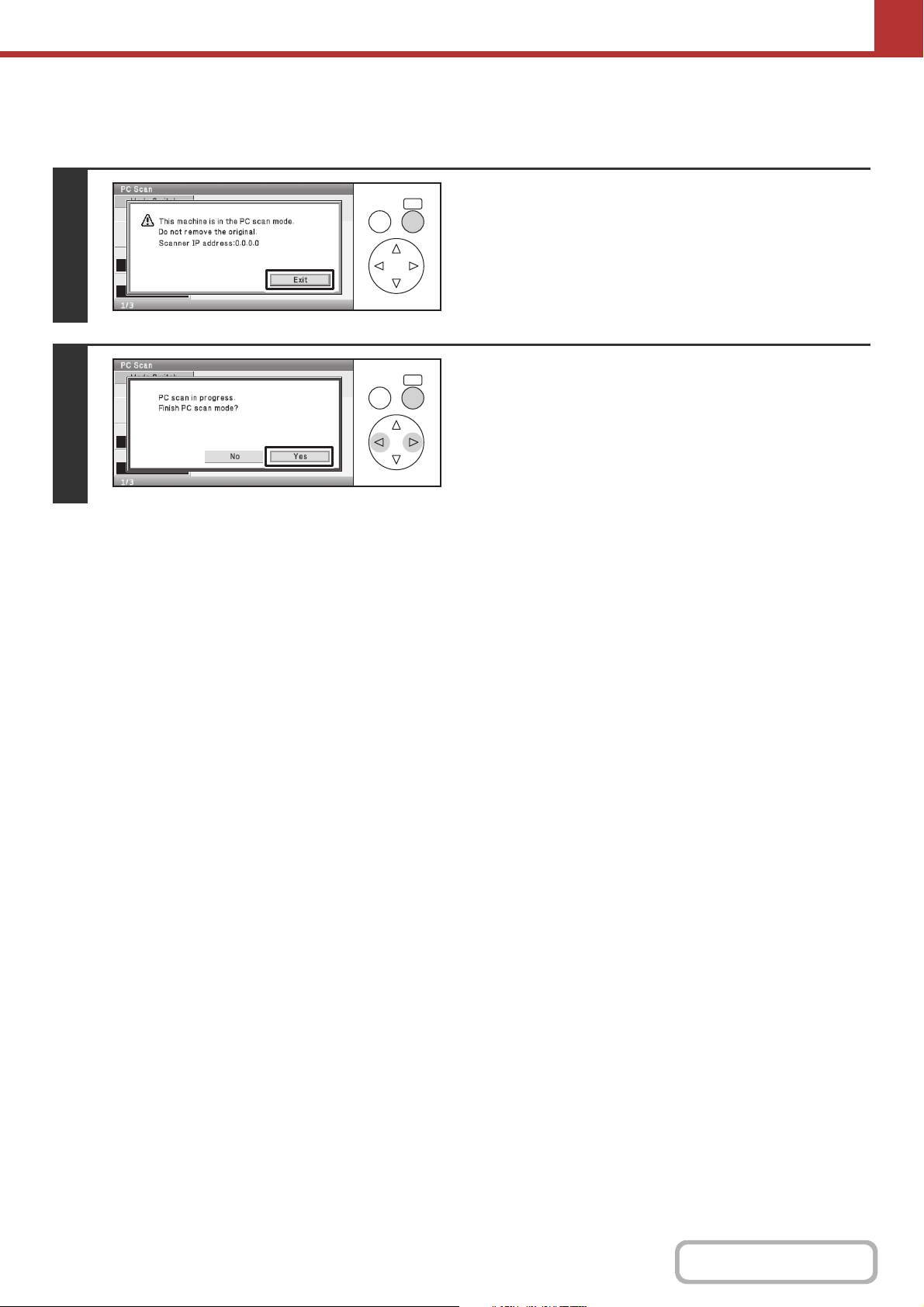
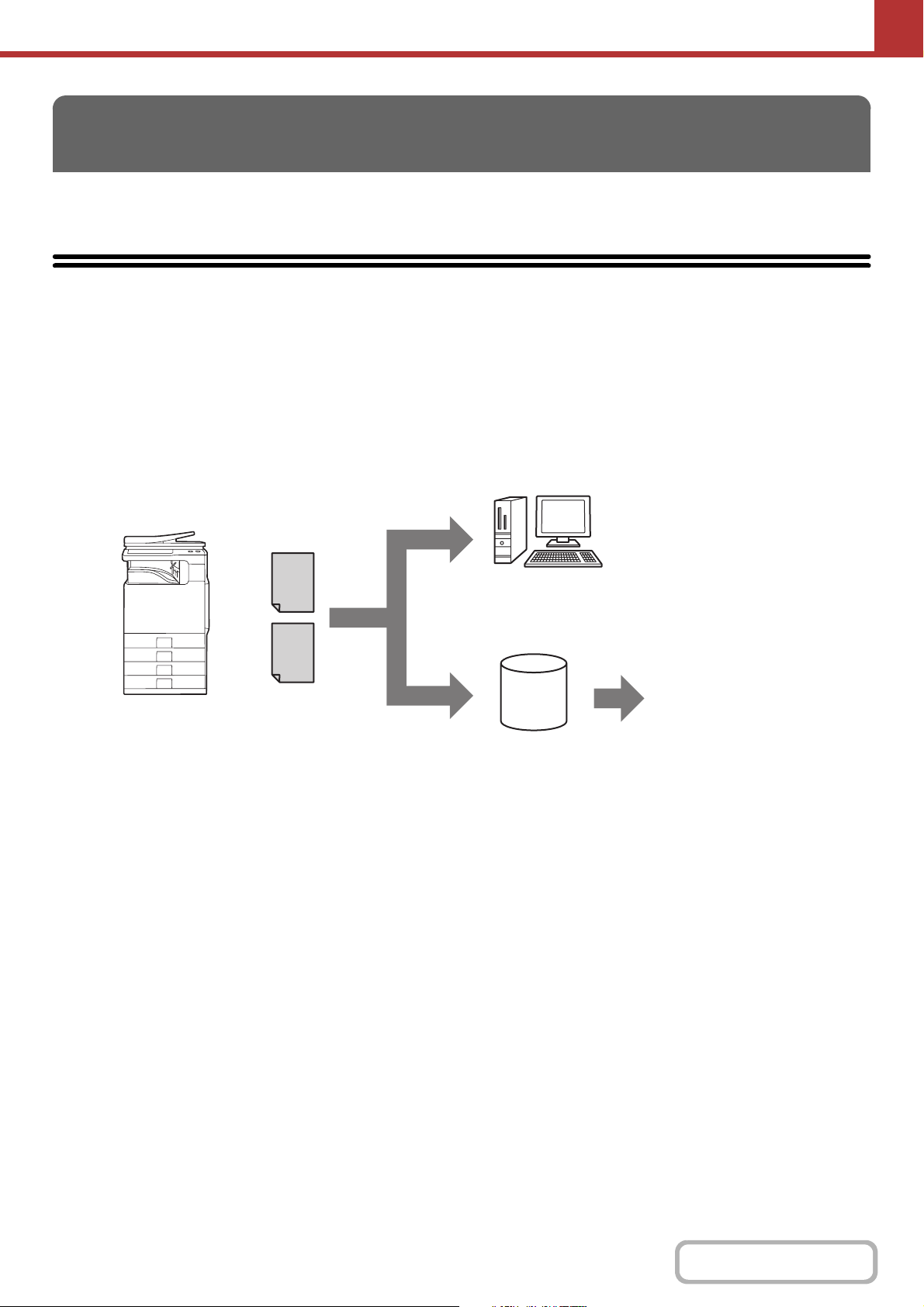
5-122
SCANNER/INTERNET FAX
Contents
This section explains metadata delivery, which can be used when the application integration module kit is installed.
METADATA DELIVERY (Data Entry)
When the application integration module kit is installed and an image file is generated for a scan send transmission,
metadata (data indicating the attributes of the image file and how it is to be processed) can be generated based on
pre-stored information and transmitted as a separate file. The metadata file is created in XML format. By linking the
metadata with applications such as document management software, a workflow application, or an encryption server, a
sophisticated document solution environment can be built.
Using the application integration module kit, information on a generated image file can be entered at the display and
transmitted along with the image as an XML file.
METADATA DELIVERY
Scan to
Desktop
Scan to E-mail
Scan to FTP
Scan to Network Folder
Client PC that uses Network
Scanner Tool
Server
Fax server, document
management software,
workflow application,
encryption server, etc.
Metadata
(XML file)
Image file
5-123
SCANNER/INTERNET FAX
Contents
PREPARATIONS FOR METADATA
TRANSMISSION
SETTINGS REQUIRED IN THE WEB PAGES
All settings related to metadata are configured in the Web pages. (Administrator rights are required.)
To configure metadata settings, click [Application Settings] and then [Metadata Settings] in the Web page menu.
When configuring settings, be sure to enable metadata transmission.
Storing Metadata Sets
Store the items (the metadata set) that are written to the XML file that is generated during scanning. Up to 10 metadata
items can be configured in a metadata set. A stored metadata set can be selected at the time of transmission.
METADATA TRANSMISSION FOR SCAN TO DESKTOP
When Network Scanner Tool is used in its factory default configuration, a file will be generated with a new file name on
the computer. When Network Scanner Tool is used as a means of sending a metadata file to a third party software
application, this setting must be disabled to allow cross referencing between the image file and XML file by means of the
file name generated by the computer. (When setting the file name in [Send Settings], to ensure that a previously existing
file on a computer is not overwritten by a transmitted file of the same name, be sure to configure the file name so that
name duplication cannot occur; for example, by including a unique extension (the date, etc.) in the generated file name.
If the file name setting is left blank, the machine will automatically generate a file name that is unique.)
Addresses specified in "Address Type Allowing Metadata Entry" when a metadata set is stored can be selected as
transmission destinations at the time of transmission using one-touch keys, manual entry, and/or a global address book
search. (Addresses for which metadata entry is not allowed cannot be specified as transmission destinations.)
• It is recommended that you use Network Scanner Tool to receive metadata. For more information, see the Network
Scanner Tool User's Guide (PDF format) on the "Sharpdesk/Network Scanner Utilities" CD-ROM.
• For information on the license agreement and how to use the CD-ROM that accompanies the application integration
module, see the separate "Sharpdesk licence kit" manual.
• Using third party software applications
Various types of third party software applications exist. Some applications can start automatically from Network Scanner
Tool and some cannot. When the auto-run function of an application is enabled, Network Scanner Tool will start the
application with the ".exe" command using the file name as a parameter. Normally an application is started twice, once for
the image file and once for the XML file. For example, when Network Scanner Tool is set to start the application
"APP.EXE", the following commands are applied when the two files "IMG.TIF" and "IMG.XML" are received.
APP.EXE IMG.TIF
APP.EXE IMG.XML
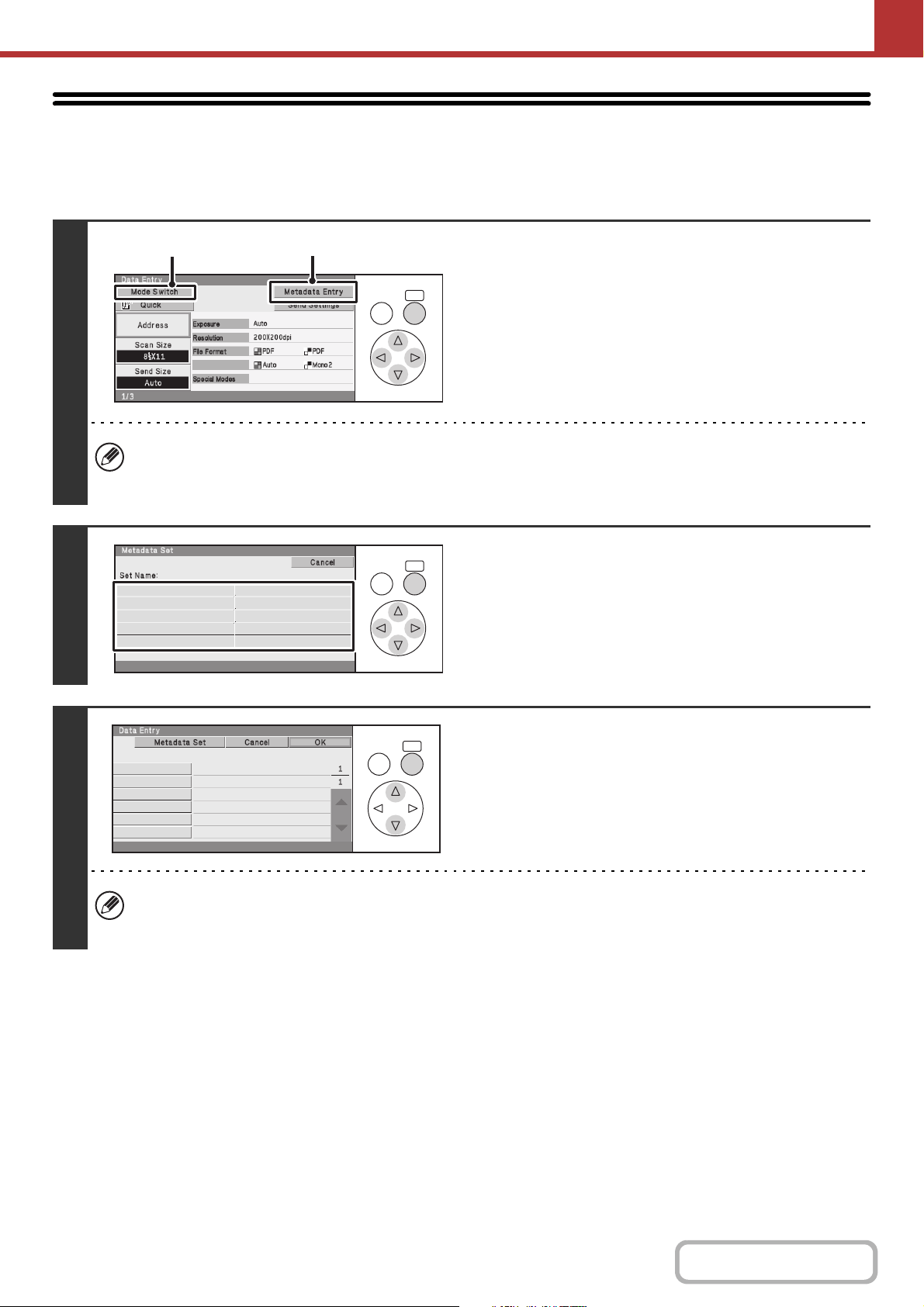
5-124
SCANNER/INTERNET FAX
Contents
TRANSMITTING METADATA
Follow the steps below to select a metadata set, enter each item, and perform metadata transmission.
Keys in the display can be selected with the arrow keys and the [OK] key.
1
Switch to data entry mode and display
the metadata set screen.
(1) Select the [Mode Switch] key.
(2) Select the [Data Entry] key.
(3) Select the [Metadata Entry] key.
• If no metadata sets have been stored, the [Data Entry] key cannot be selected. Store a metadata set in the Web
pages and then perform the transmission procedure.
• If a specific metadata set has been specified as the default set, go to step 3.
2
Select a metadata set.
Select the key of the metadata set that you wish to use.
3
The keys of the items stored in the
metadata set will appear. Select the item
that you want to enter.
If you accidentally selected the wrong metadata set or wish to use a different metadata set when a default metadata
set has been set, select the [Metadata Set] key. Select the [OK] key in the message screen that appears. You will
return to the screen of step 1. Metadata items entered to that point will be canceled.
OKBACK
Color Mode
(3)
(1)
OKBACK
Metadata 1
Metadata 3
Metadata 5
Metadata 7
Metadata 9
Metadata 2
Metadata 4
Metadata 6
Metadata 8
Metadata 10
OKBACK
User ID
From Name
Reply To
DocumentPassword
AccessPassword
BillCode1
Set Name: Metadata 1
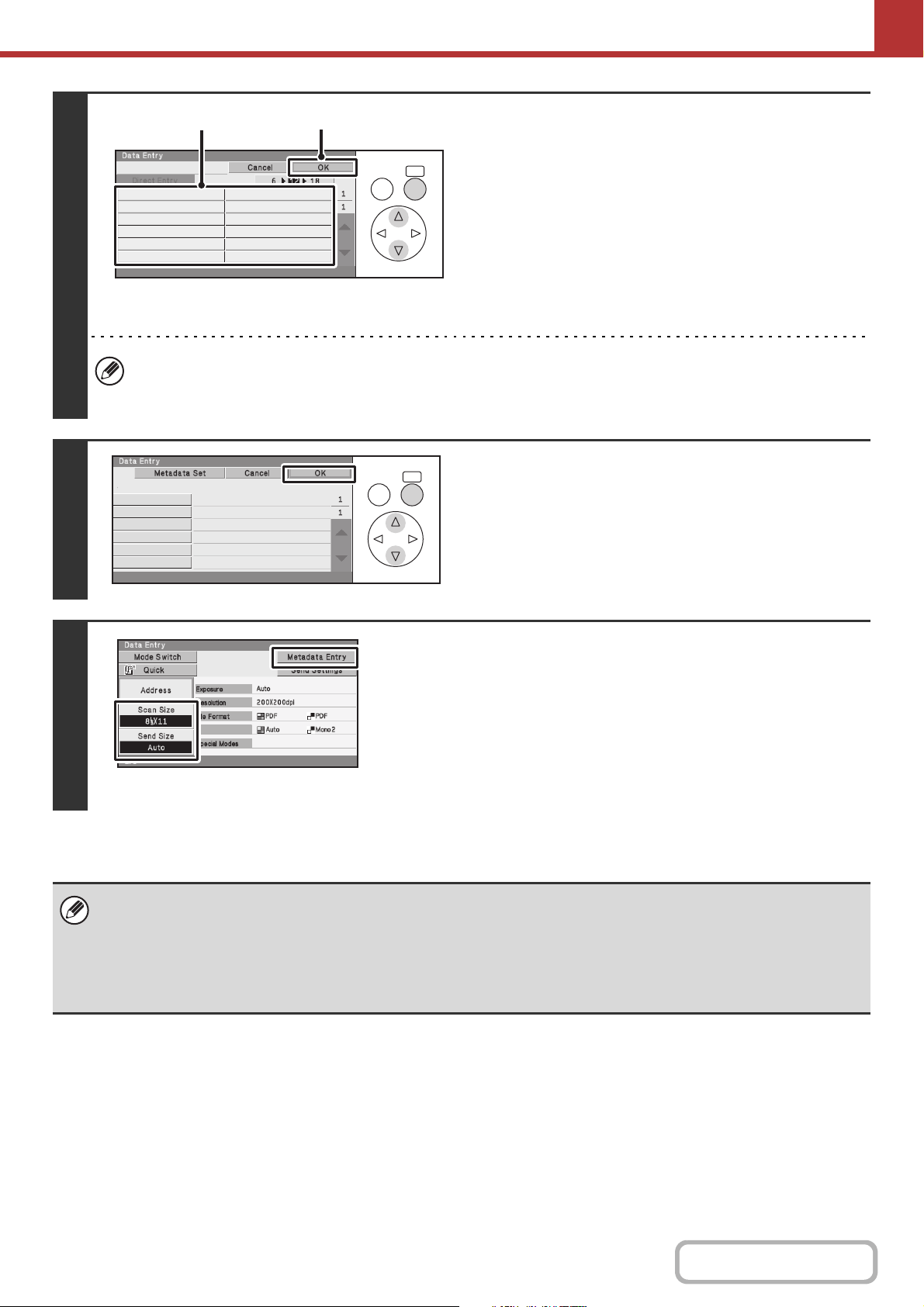
5-125
SCANNER/INTERNET FAX
Contents
4
Enter the selected metadata item.
(1) Select the key of the value that you wish to
enter.
• When the entry values of the metadata item are in the
form of selections, the selections are shown as keys.
When a value is editable, you can select the [Direct
Entry] key to manually enter the value.
• If the metadata item requires the entry of text, a text
entry screen will appear. Enter the required information.
(2) Select the [OK] key.
• To change the number of items shown at once in the screen, select the [Change the Number of Displayed Items]
key. The number of items changes from 6 to 12 to 18 each time you press the [OK] key.
• For the procedure for entering text, see "ENTERING TEXT" (page 1-61) in "1. BEFORE USING THE MACHINE".
5
When you have finished entering all
items, select the [OK] key.
6
Select image settings and any other
settings, and perform the scan send
procedure.
• The procedures for selecting settings and performing
transmission are the same as in the other modes.
• To make changes to entered values, select the [Metadata
Entry] key once again. The entry screen of the selected
metadata set will appear.
• Transmission cannot be performed if the [Data Entry] tab is displayed and no metadata settings have been configured. To
perform transmission without sending metadata, switch to a different mode and then perform transmission.
• Before configuring metadata settings, you can specify addresses in all modes to be used. After metadata settings have
been configured, only addresses in modes that are allowed in the selected metadata set can be specified.
• When metadata settings have been configured or an address is specified in the [Data Entry] tab, it will not be possible to
switch to another mode.
OKBACK
Value 1
Value 3
Value 5
Value 7
Value 9
Value 11
Value 2
Value 4
Value 6
Value 8
Value 10
Value 12
User ID
(2)(1)
OKBACK
User ID
From Name
Reply To
DocumentPassword
AccessPassword
BillCode1
Set Name: Metadata 1
Value 1
xxx xxx
xxx xxx
xxxxxx
xxxxxx
Color Mode
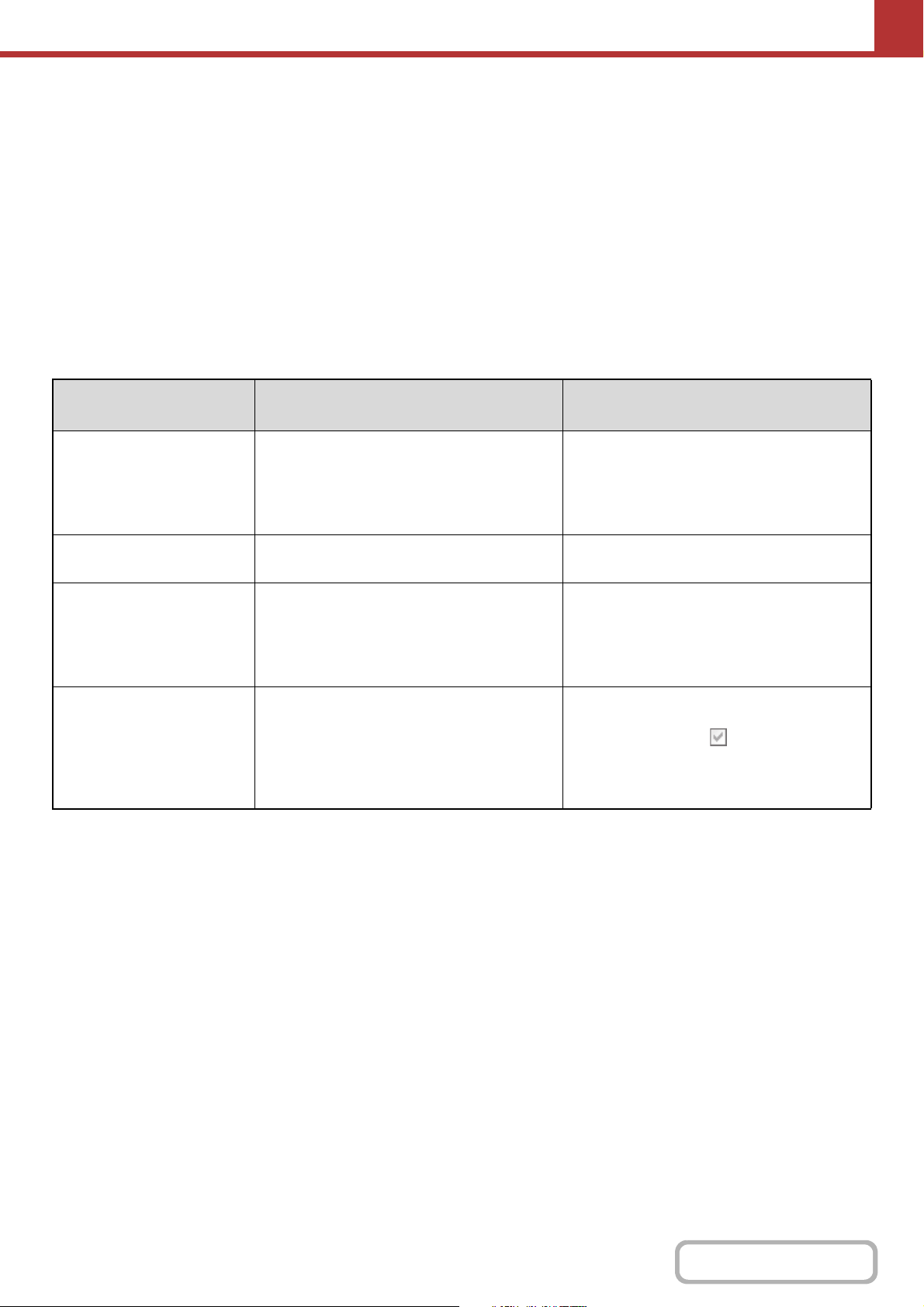
5-126
SCANNER/INTERNET FAX
Contents
METADATA FIELDS
The following three types of metadata are included in the XML file that is transmitted.
• Data automatically generated by the machine: This data is always included in the XML file and is automatically stored
on your computer.
• Previously defined fields: These fields are automatically recognized by the machine and
assigned to appropriate XML tags. These fields are selectable, and
can only be included in the XML file if enabled in the Web pages.
• User defined fields: Custom fields can be added to the XML file. These fields are selectable
and can be defined in the Web pages.
If a defined metadata field is one of the following fields, a message will appear informing you that the field cannot be
entered. Enter appropriate information in the related items of the send settings.
Name entered in
metadata field
Description Where entered
fromName Name of the user who sent the job. If the
name is not entered as metadata, the sender
name determined by the usual rules for
determining the sender name will be applied
as metadata.
[Reply-To]
(Sender name of selected sender)
replyTo E-mail address to which the transmission
result will be sent.
[Reply-To]
(E-mail address of selected sender)
documentSubject Job name appearing in the e-mail "Subject"
line, or job name on the fax cover sheet.
When the user enters a [Subject] in the send
settings screen in the display, the entered
value is applied as metadata.
[Subject]
(Blank until a value is set in the send settings
screen.)
fileName Enter the file name of the image to be sent. [File Name]
(Only when the [Allow Custom Filenames]
checkbox is selected in the metadata
settings screen in the Web pages.)
(Blank until a value is set in the send settings
screen.)

6-1
This chapter explains the system settings, which are used to configure a variety of parameters to suit the aims and
needs of your workplace. The current selections that have been made for the settings can be viewed or printed out.
To quickly check where a setting is located in the system settings menu, see "System Settings Menu (Operation Panel)"
(page 6-116) or "System Settings Menu (Web Page)" (page 6-117).
List of system settings on the operation panel
See "System Settings (General) List" (page 6-7) or "System Settings (Administrator) List" (page 6-17).
List of system settings in the Web page
See "System Settings (General) List" (page 6-42) or "System Settings (Administrator) List" (page 6-56).
For the system settings for the fax function
To configure the settings using the machine, see "System Settings for Fax (General) List" (page 6-97) and
"System Settings for Fax (Administrator) List" (page 6-99).
To configure the settings using the Web page, see "System Settings for Fax (General) List" (page 6-106) and
"System Settings for Fax (Administrator) List" (page 6-109)
For the procedures for using the display, see "USING THE OPERATION PANEL" (page 1-9) in "1. BEFORE USING
THE MACHINE".
For the procedures for using the Web page, see "USING THE WEB PAGE" (page 1-13) in "1. BEFORE USING THE MACHINE".
SYSTEM SETTINGS
System Settings . . . . . . . . . . . . . . . . . . . . . . . . . . . 6-3
Configuring the System Settings . . . . . . . . . . . . . 6-4
Common Operation Methods . . . . . . . . . . . . . . . . . 6-5
Accessing the Web Server in the Machine . . . . . . 6-6
• Opening the Web pages. . . . . . . . . . . . . . . . . . . 6-6
SYSTEM SETTINGS (GENERAL) ON THE
OPERATION PANEL
Accessing the System Settings (General) . . . . . . 6-7
System Settings (General) List . . . . . . . . . . . . . . . 6-8
Display Contrast . . . . . . . . . . . . . . . . . . . . . . . . . . 6-10
Total Count . . . . . . . . . . . . . . . . . . . . . . . . . . . . . . 6-10
• Job Count . . . . . . . . . . . . . . . . . . . . . . . . . . . . . 6-10
• Device Count . . . . . . . . . . . . . . . . . . . . . . . . . . 6-10
Default Settings. . . . . . . . . . . . . . . . . . . . . . . . . . . 6-10
• Image Quality Adjustment . . . . . . . . . . . . . . . . 6-10
• Clock Adjust . . . . . . . . . . . . . . . . . . . . . . . . . . . 6-11
• Keyboard Select . . . . . . . . . . . . . . . . . . . . . . . . 6-12
List Print (User) . . . . . . . . . . . . . . . . . . . . . . . . . . . 6-12
Paper Tray Settings . . . . . . . . . . . . . . . . . . . . . . . 6-13
• Tray Settings . . . . . . . . . . . . . . . . . . . . . . . . . . 6-13
• Paper Type Registration. . . . . . . . . . . . . . . . . . 6-15
• Auto Tray Switching . . . . . . . . . . . . . . . . . . . . . 6-15
• Custom Size Registration (Bypass) . . . . . . . . . 6-15
Fax Data Receive/Forward . . . . . . . . . . . . . . . . . . 6-16
• I-Fax Settings . . . . . . . . . . . . . . . . . . . . . . . . . . 6-16
USB-Device Check . . . . . . . . . . . . . . . . . . . . . . . . 6-16
SYSTEM SETTINGS (ADMINISTRATOR)
ON THE OPERATION PANEL
Accessing the System Settings
(Administrator) . . . . . . . . . . . . . . . . . . . . . . . . . . . 6-17
• When User Authentication is not Enabled . . . . 6-17
• When User Authentication is Enabled . . . . . . . 6-18
System Settings (Administrator) List . . . . . . . . . 6-20
Energy Save. . . . . . . . . . . . . . . . . . . . . . . . . . . . . . 6-26
Operation Settings . . . . . . . . . . . . . . . . . . . . . . . . 6-27
• Other Settings. . . . . . . . . . . . . . . . . . . . . . . . . . 6-27
• MFP Display Pattern Setting . . . . . . . . . . . . . . 6-27
Device Control . . . . . . . . . . . . . . . . . . . . . . . . . . . . 6-27
• Other Settings. . . . . . . . . . . . . . . . . . . . . . . . . . 6-27
Copy Function Settings . . . . . . . . . . . . . . . . . . . . 6-28
• Initial Status Settings . . . . . . . . . . . . . . . . . . . . 6-28
• Other Settings. . . . . . . . . . . . . . . . . . . . . . . . . . 6-29
• Color Adjustments . . . . . . . . . . . . . . . . . . . . . . 6-31
Network Settings . . . . . . . . . . . . . . . . . . . . . . . . . . 6-32
Printer Settings . . . . . . . . . . . . . . . . . . . . . . . . . . . 6-33
• Auto Color Calibration . . . . . . . . . . . . . . . . . . . 6-33
CHAPTER 6
SYSTEM SETTINGS

6-2
SYSTEM SETTINGS
Image Send Settings . . . . . . . . . . . . . . . . . . . . . . . 6-34
• Operation Settings . . . . . . . . . . . . . . . . . . . . . . 6-34
List Print (Administrator) . . . . . . . . . . . . . . . . . . . 6-37
Security Settings . . . . . . . . . . . . . . . . . . . . . . . . . . 6-38
Product Key . . . . . . . . . . . . . . . . . . . . . . . . . . . . . . 6-39
Storing/Calling of System Settings . . . . . . . . . . . 6-40
Sharp OSA Settings . . . . . . . . . . . . . . . . . . . . . . . 6-41
SYSTEM SETTINGS (GENERAL) IN THE
WEB PAGE
System Settings (General) List . . . . . . . . . . . . . . 6-42
Total Count . . . . . . . . . . . . . . . . . . . . . . . . . . . . . . 6-45
• Job Count . . . . . . . . . . . . . . . . . . . . . . . . . . . . . 6-45
• Device Count . . . . . . . . . . . . . . . . . . . . . . . . . . 6-45
Default Settings. . . . . . . . . . . . . . . . . . . . . . . . . . . 6-46
• Clock Adjust . . . . . . . . . . . . . . . . . . . . . . . . . . . 6-46
• Keyboard Select . . . . . . . . . . . . . . . . . . . . . . . . 6-47
List Print (User) . . . . . . . . . . . . . . . . . . . . . . . . . . . 6-47
Paper Tray Settings . . . . . . . . . . . . . . . . . . . . . . . 6-48
• Auto Tray Switching . . . . . . . . . . . . . . . . . . . . . 6-48
• Tray Settings . . . . . . . . . . . . . . . . . . . . . . . . . . 6-48
• Custom Size Registration (Bypass) . . . . . . . . . 6-51
Paper Type Registration . . . . . . . . . . . . . . . . . . . . 6-51
Fax Data Receive/Forward . . . . . . . . . . . . . . . . . . 6-51
• I-Fax Settings . . . . . . . . . . . . . . . . . . . . . . . . . . 6-51
Printer Condition Settings . . . . . . . . . . . . . . . . . . 6-52
• Printer Default Settings. . . . . . . . . . . . . . . . . . . 6-52
• PCL Settings. . . . . . . . . . . . . . . . . . . . . . . . . . . 6-53
• PostScript Setting . . . . . . . . . . . . . . . . . . . . . . . 6-54
USB-Device Check . . . . . . . . . . . . . . . . . . . . . . . . 6-54
SYSTEM SETTINGS (ADMINISTRATOR) IN
THE WEB PAGE
Accessing the System Settings
(Administrator) . . . . . . . . . . . . . . . . . . . . . . . . . . . 6-55
• When User Authentication is not Enabled . . . . 6-55
• When User Authentication is Enabled . . . . . . . 6-55
System Settings (Administrator) List . . . . . . . . . 6-56
Energy Save. . . . . . . . . . . . . . . . . . . . . . . . . . . . . . 6-68
Operation Settings . . . . . . . . . . . . . . . . . . . . . . . . 6-69
• Operation Settings . . . . . . . . . . . . . . . . . . . . . . 6-69
• Preview Setting. . . . . . . . . . . . . . . . . . . . . . . . . 6-70
• Remote Operation Settings . . . . . . . . . . . . . . . 6-70
• Customize Key Setting . . . . . . . . . . . . . . . . . . . 6-71
• Soft Keyboard Template Setting. . . . . . . . . . . . 6-71
Device Control . . . . . . . . . . . . . . . . . . . . . . . . . . . . 6-72
Copy Function Settings . . . . . . . . . . . . . . . . . . . . 6-74
• Initial Status Settings . . . . . . . . . . . . . . . . . . . . 6-74
• Copy Settings . . . . . . . . . . . . . . . . . . . . . . . . . . 6-75
Printer Settings . . . . . . . . . . . . . . . . . . . . . . . . . . . 6-77
• Default Settings . . . . . . . . . . . . . . . . . . . . . . . . 6-77
• Interface Settings . . . . . . . . . . . . . . . . . . . . . . . 6-78
Image Send Settings . . . . . . . . . . . . . . . . . . . . . . . 6-79
• Operation Settings . . . . . . . . . . . . . . . . . . . . . . 6-79
• Scan Settings . . . . . . . . . . . . . . . . . . . . . . . . . . 6-83
• I-Fax Settings . . . . . . . . . . . . . . . . . . . . . . . . . . 6-85
Print Hold Setting . . . . . . . . . . . . . . . . . . . . . . . . . 6-89
• Automatic Deletion of File Settings. . . . . . . . . . 6-85
List Print (Administrator) . . . . . . . . . . . . . . . . . . . 6-90
Sharp OSA Settings . . . . . . . . . . . . . . . . . . . . . . . 6-91
Enable/Disable Settings . . . . . . . . . . . . . . . . . . . . 6-92
Product Key . . . . . . . . . . . . . . . . . . . . . . . . . . . . . . 6-95
Storing/Calling of System Settings . . . . . . . . . . . 6-96
FAX SYSTEM SETTINGS ON THE
OPERATION PANEL
System Settings for Fax (General) List . . . . . . . . 6-97
Fax Data Receive/Forward . . . . . . . . . . . . . . . . . . 6-98
• Fax Settings . . . . . . . . . . . . . . . . . . . . . . . . . . . 6-98
System Settings for Fax (Administrator) List. . . 6-99
Image Send Settings . . . . . . . . . . . . . . . . . . . . . . 6-101
• Fax Settings . . . . . . . . . . . . . . . . . . . . . . . . . . 6-101
FAX SYSTEM SETTINGS IN THE WEB
PAGE
System Settings for Fax (General) List . . . . . . . 6-106
F-Code Memory Box . . . . . . . . . . . . . . . . . . . . . . 6-107
Fax Data Receive/Forward . . . . . . . . . . . . . . . . . 6-108
• Fax Settings . . . . . . . . . . . . . . . . . . . . . . . . . . 6-108
System Settings for Fax (Administrator) List . . 6-109
Image Send Settings . . . . . . . . . . . . . . . . . . . . . . 6-111
• Fax Settings . . . . . . . . . . . . . . . . . . . . . . . . . . 6-111
APPENDIX . . . . . . . . . . . . . . . . . . . . . . . . . . . . . . 6-116
• System Settings Menu (Operation Panel) . . . 6-116
• System Settings Menu (Web Page) . . . . . . . . 6-117
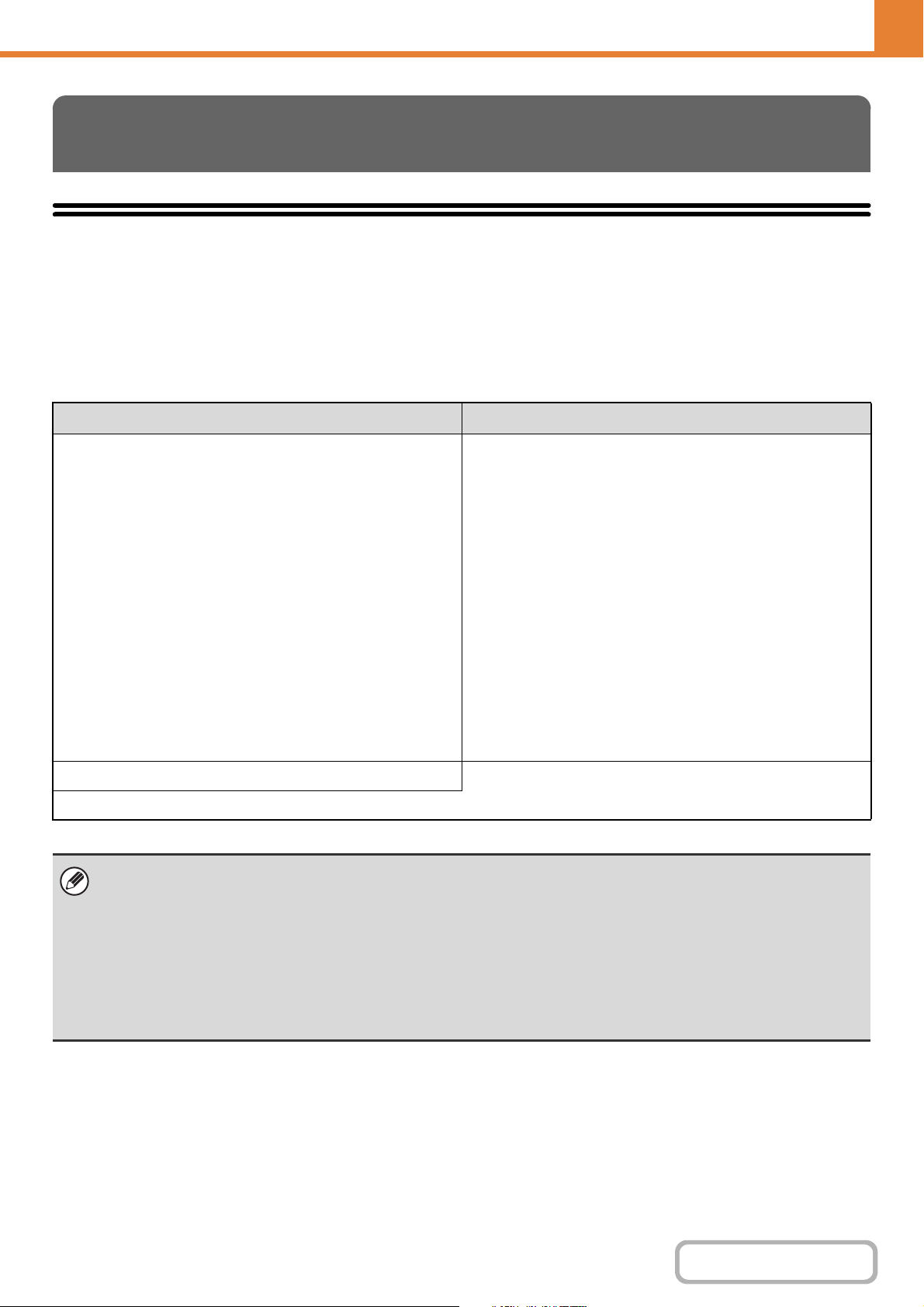
6-3
SYSTEM SETTINGS
Contents
System Settings
The system settings are used to configure a variety of parameters to suit the aims and needs of your workplace. The
system settings are also used to display or print out the current settings and status of the machine. The system settings
allow you to make the machine easier to use.
The system settings consist of settings that are used by general users, and settings that can only be configured by an
administrator of the machine. These two groups of settings are distinguished in this manual as follows.
SYSTEM SETTINGS
System Settings (General) System Settings (Administrator) *Login Required
System settings that can be configured by general users
(including the administrator). For example, the following
settings can be configured:
• Date and time settings
• Paper tray settings (paper size and paper type)
• Settings related to the printer function
• Displaying the number of pages printed, scanned, and
faxed.
For more information, see "SYSTEM SETTINGS (GENERAL)
ON THE OPERATION PANEL" (page 6-7) and "SYSTEM
SETTINGS (GENERAL) IN THE WEB PAGE" (page 6-42).
System settings that can be configured by the administrator.
To configure these settings, login as an administrator is
required. For example, the following settings can be
configured:
• Energy save settings
• Settings related to the operation panel
• Settings for peripheral devices installed on the machine.
• Settings related to the copy function
• Network connection settings
• Transmission/reception settings for faxes and scanned
images
For more information, see "SYSTEM SETTINGS
(ADMINISTRATOR) ON THE OPERATION PANEL" (page
6-17) and "SYSTEM SETTINGS (ADMINISTRATOR) IN THE
WEB PAGE" (page 6-55).
Settings for general users
Settings for administrators
• Administrator password
To maintain security, the administrator of the machine should promptly change the password after the machine is
purchased. (For the factory default administrator password, see "TO THE ADMINISTRATOR OF THE MACHINE" in the
Maintenance & Safety Guide.) The password is changed in "Security Settings" in the Web page.
*To ensure a high level of security, change the password at regular intervals.
• The above groupings of "General" and "Administrator" are used as a convenient means of clarifying the functions of the
settings. These groupings do not appear in the display.
• For fax settings, see "FAX SYSTEM SETTINGS ON THE OPERATION PANEL" (page 6-97) and "FAX SYSTEM
SETTINGS IN THE WEB PAGE" (page 6-106).

6-4
SYSTEM SETTINGS
Contents
Configuring the System Settings
There are two ways to configure the system settings: using the machine's operation panel, and using the Web page that
appears when the machine's Web server is accessed.
The Web page enables easy configuration of the settings from your computer via the network.
To configure the settings using the machine, see "Common Operation Methods" (page 6-5). To configure the settings
using the Web page, see "Accessing the Web Server in the Machine" (page 6-6).
The settings are explained on the following pages of this manual:
System settings on the operation panel
• SYSTEM SETTINGS (GENERAL) ON THE OPERATION PANEL (page 6-7)
• SYSTEM SETTINGS (ADMINISTRATOR) ON THE OPERATION PANEL (page 6-17)
• FAX SYSTEM SETTINGS ON THE OPERATION PANEL (page 6-97)
System settings in the Web page
• SYSTEM SETTINGS (GENERAL) IN THE WEB PAGE (page 6-42)
• SYSTEM SETTINGS (ADMINISTRATOR) IN THE WEB PAGE (page 6-55)
• FAX SYSTEM SETTINGS IN THE WEB PAGE (page 6-106)
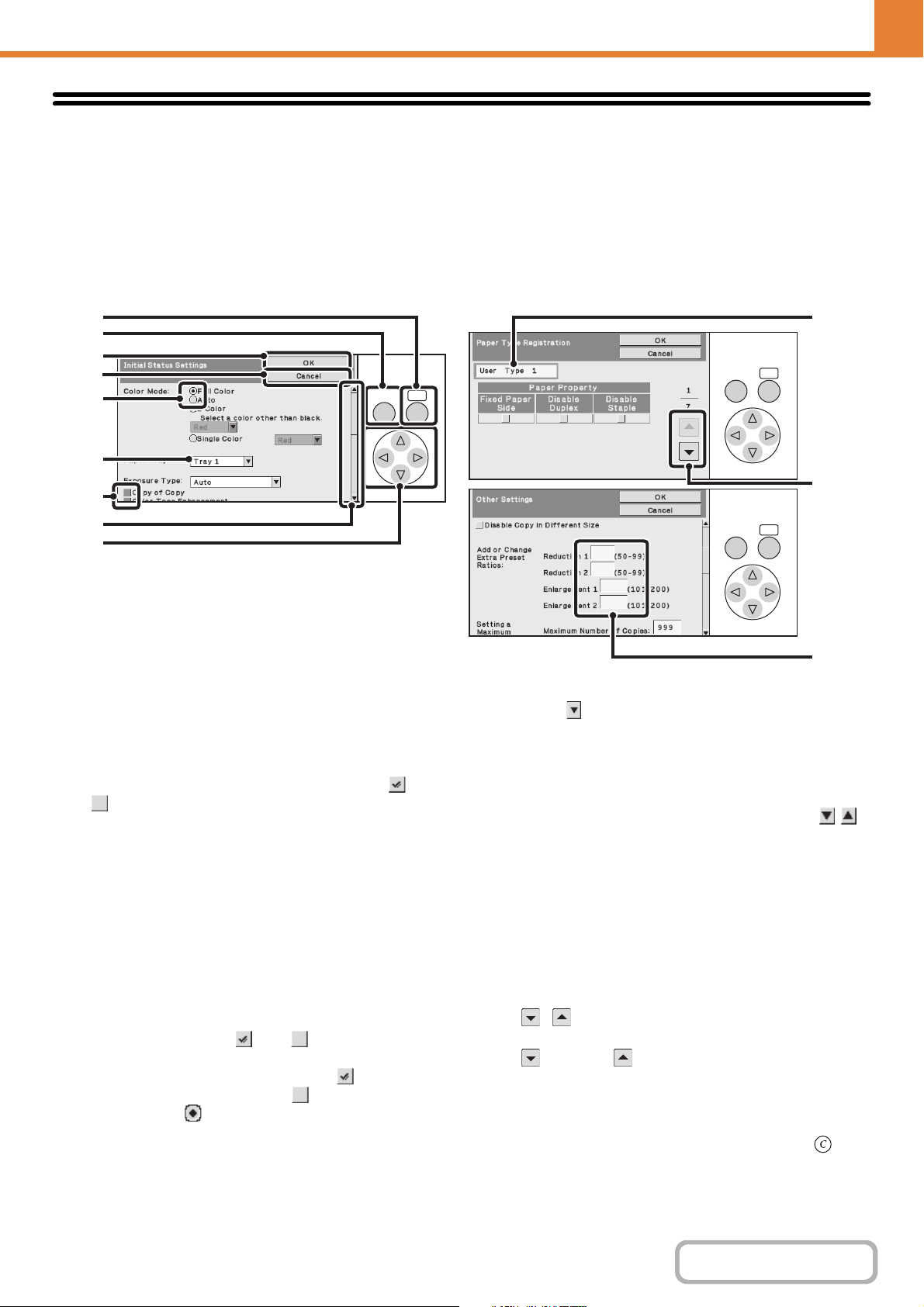
6-5
SYSTEM SETTINGS
Contents
Common Operation Methods
This section explains special operation methods that are common to all system settings.
Be sure to read this section, as the information is omitted in the explanations of some of the individual settings.
For the procedures for using the display, see "USING THE OPERATION PANEL" (page 1-9) in "1. BEFORE USING
THE MACHINE".
Example:Initial Status Settings (Copy Settings) screen, Paper Type Registration (Paper Tray
Settings) screen, and Other Settings (Copy Settings) screen
(1) [OK] key (Operation panel)
When the selection frame is moved to a setting key and
this key is pressed, the current setting is stored or the
setting screen for that setting key appears. When the
selection frame is moved to a checkbox or radio button,
the checkbox or radio button will switch between and
each time this key is pressed.
(2) [Back] key
This key returns you to the previous screen.
(3) [OK] key (Display)
Select this key when you have finished configuring the
settings in the displayed screen.
(4) [Cancel] key
This key cancels a setting and returns you to the
previous screen.
(5) Checkbox
This switches between and each time you
select it. To enable the corresponding setting, select the
checkbox so that a checkmark appears . To disable
the setting, clear the checkmark .
Radio buttons ( ) are also used to select settings in
this way. (However, radio buttons are used to select a
single item out of several.)
(6) Select box
Select to display a list of the items that can be
selected. Select an item in the list to select it.
(7) Scroll bar
This bar shows the position of the current display in the
whole screen.
You can move the screen up and down with the
keys.
(8) Arrow keys
Press these keys to move the selection frame used to
select settings and items in the display.
(9) Text box
Select this box to open a text entry screen. When you
have finished entering text in the screen, the text will
appear in the text box.
(10) , keys
When settings extend over multiple screens, select the
key or the key to switch through the screens.
(11) Text box (numerical)
Select this box to enter a number. Numbers are entered
with the numeric keys.
If you make a mistake, press the [CLEAR] key ( ) to
clear the incorrect number.
OKBACK
OKBACK
OKBACK
(2)
(3)
(4)
(5)
(6)
(5)
(7)
(8)
(9)
(11)
(1)
(10)
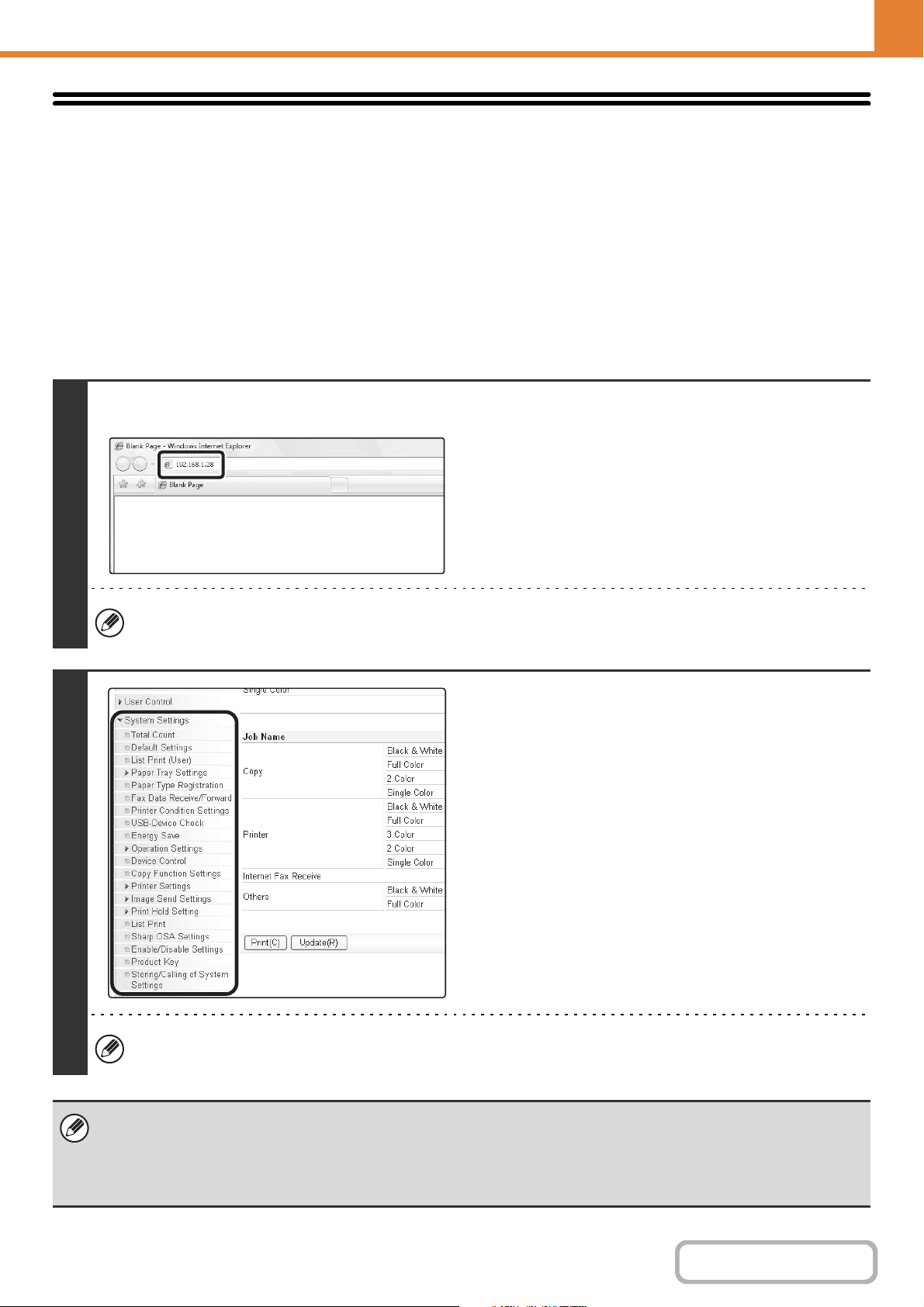
6-6
SYSTEM SETTINGS
Contents
Accessing the Web Server in the Machine
When the machine is connected to a network, the machine's built-in Web server can be accessed from a Web browser
on your computer.
For the procedures for using the display, see "USING THE WEB PAGE" (page 1-13) in "1. BEFORE USING THE
MACHINE".
Opening the Web pages
This accesses the Web server in the machine and displays the Web page. The Web page can be used to configure the
system settings.
1
(Example: When the machine's IP address is
192.168.1.28)
Start your Web browser and enter the IP
address of the machine.
You must use a computer that is connected to the same
network as the machine.
After the IP address is entered, the Web page will appear.
If user authentication is enabled, a login screen will appear after the IP address is entered. Enter your user name and
password.
2
Click [System Settings] in the menu bar
of the Web page and click the item that
you wish to set.
When you have finished configuring the settings, click the
[Submit] button.
To update the machine's setting information, click the [Update]
button.
When you click an item, you may be prompted to enter your user name and password (or other information) for user
authentication. In that case, enter your user information as appropriate.
Recommended Web browsers
• Internet Explorer: 6.0 or higher (Windows)
• Netscape Navigator: 9 (Windows)
• Firefox: 2.0 or higher (Windows)
• Safari: 1.5 or higher (Macintosh)
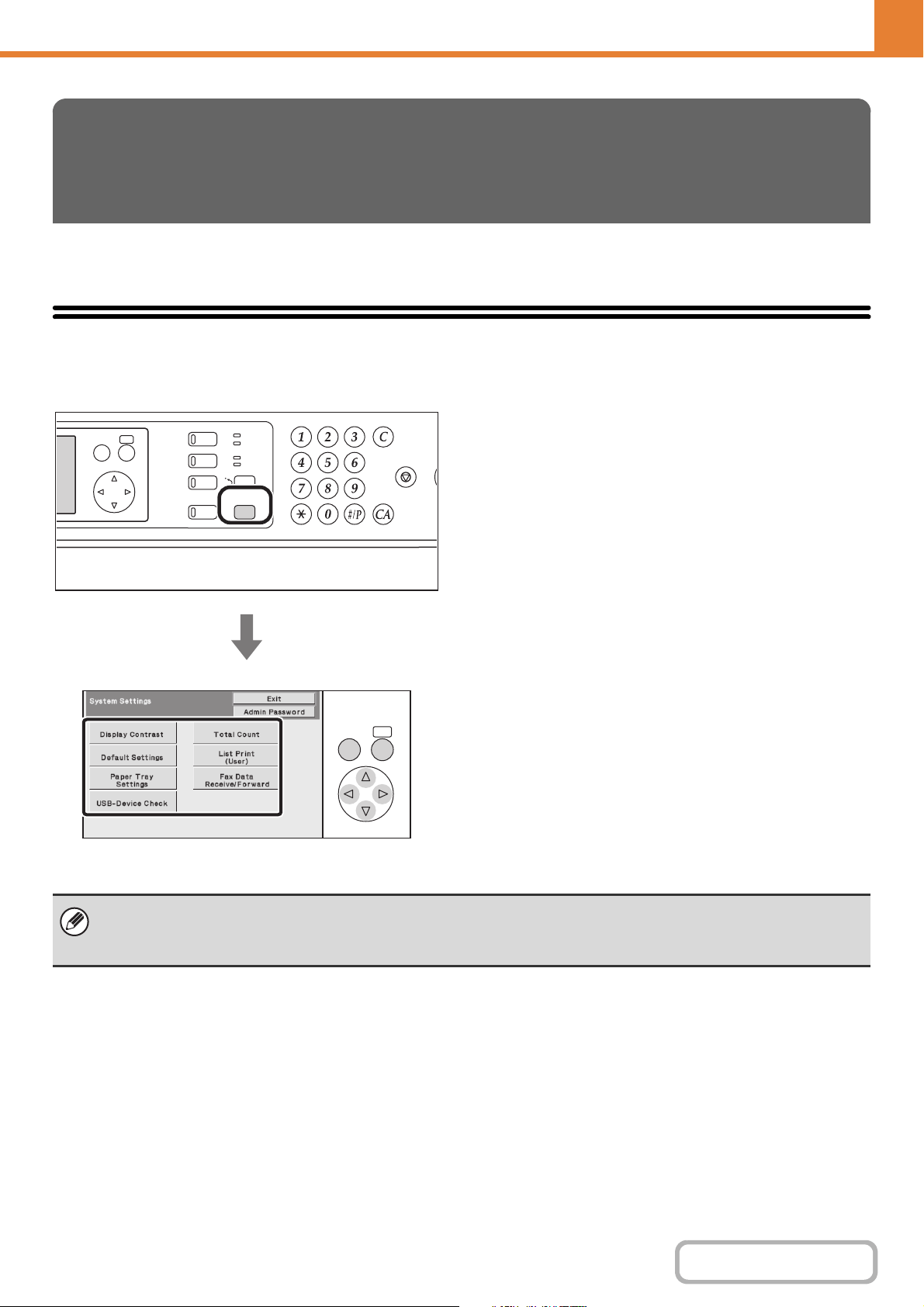
6-7
SYSTEM SETTINGS
Contents
OPERATION PANEL (GENERAL)
This section explains system settings that can be configured on the operation panel by general users.
Accessing the System Settings (General)
Make sure that the machine is in the standby state and
then press the [SYSTEM SETTINGS] key on the
operation panel.
When the [SYSTEM SETTINGS] key is pressed, the
following menu screen appears on the display.
Use the arrow keys to select the desired item, press the
[OK] key, and configure the settings.
For detailed explanations of each of the settings, see the
following pages of this chapter.
SYSTEM SETTINGS (GENERAL) ON
THE OPERATION PANEL
LOGOUT
COPY
PRINT
OKBACK
JOB STATUS
SYSTEM
SETTINGS
IMAGE SEND
READY
DATA
DATA
LINE
OKBACK
• To quit the system settings, select the [Exit] key in the top right corner of the screen.
• For the procedure to follow when user authentication is enabled, see "USER AUTHENTICATION" (page 1-17) in
"1. BEFORE USING THE MACHINE".
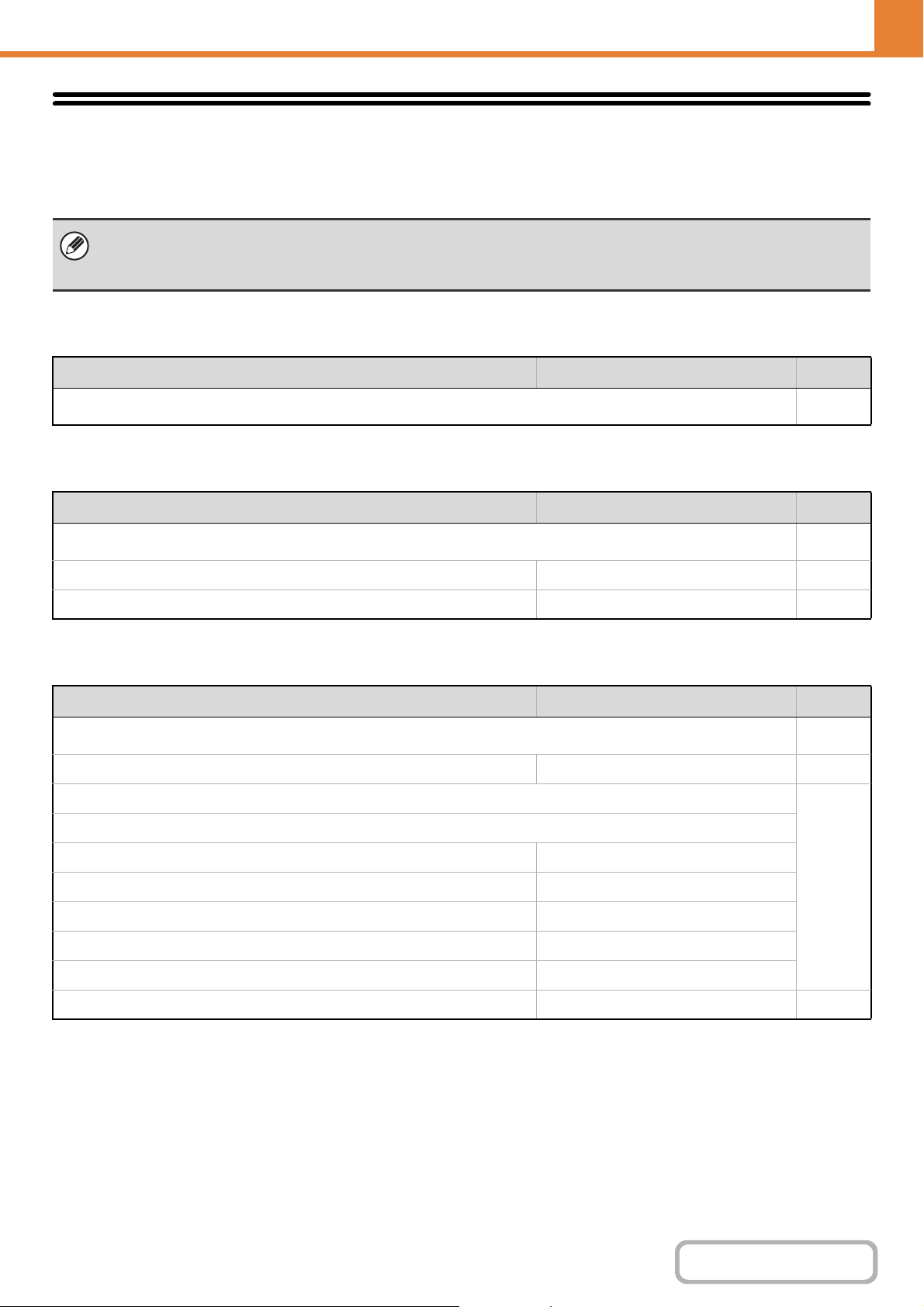
6-8
SYSTEM SETTINGS
Contents
OPERATION PANEL (GENERAL)
System Settings (General) List
When the system settings are accessed with general rights, the following items appear. For items that can only be
accessed with administrator rights, see "System Settings (Administrator) List" (page 6-20).
Display Contrast
Total Count
Default Settings
• Depending on the machine specifications and peripheral devices installed, it may not be possible to use some settings.
• For explanations of settings related to the fax function, see "FAX SYSTEM SETTINGS ON THE OPERATION PANEL"
(page 6-97).
Item Factory default setting Page
■ Display Contrast
6-10
Item Factory default setting Page
■ Total Count
6-10
● Job Count – 6-10
● Device Count – 6-10
Item Factory default setting Page
■ Default Settings
6-10
● Image Quality Adjustment – 6-10
● Clock Adjust
6-11
X Clock Adjust
Specify Time Zone –
Date & Time Settings –
Synchronize with Internet Time Server Disable
X Daylight Saving Time Setting Disable
X Date Format
[MM/DD/YYYY], [/], [Last], [12 Hour]
● Keyboard Select
English (US)
6-12
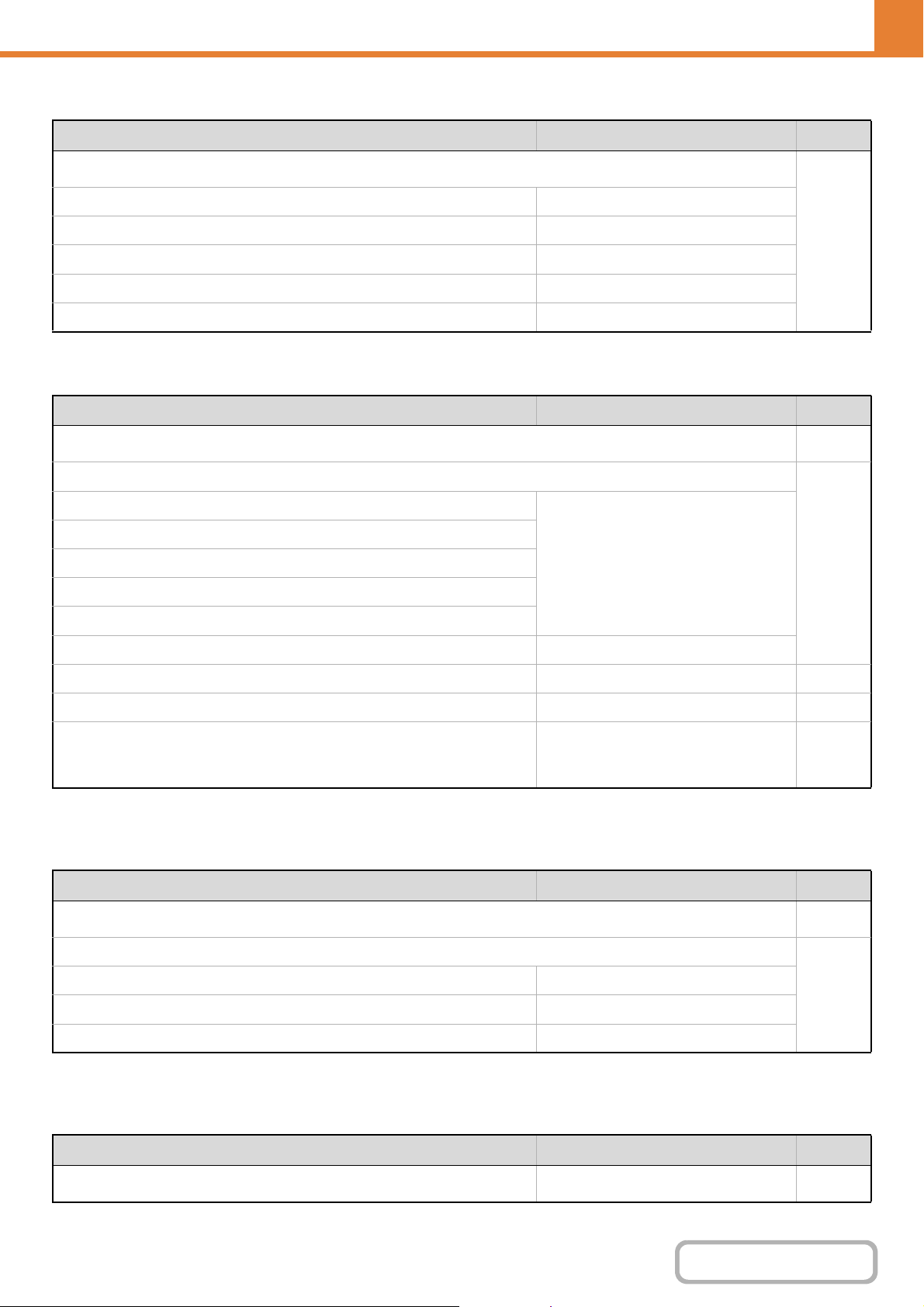
6-9
SYSTEM SETTINGS
Contents
OPERATION PANEL (GENERAL)
List Print (User)
Paper Tray Settings
* When a 500-sheet paper feed unit is installed.
Fax Data Receive/Forward
* When the Internet fax expansion kit is installed.
USB-Device Check
Item Factory default setting Page
■ List Print (User)
6-12
● All Custom Setting List –
● Printer Test Page –
● Sending Address List –
● Machine Information List –
● Image Quality Check Chart –
Item Factory default setting Page
■ Paper Tray Settings
6-13
● Tray Settings
6-13
X Tray 1
Plain, Auto-Inch
X Tray 2*
X Tray 3*
X Tray 4*
X Bypass
Select Similar Sizes for Auto Detection 8-1/2" x 14"
● Paper Type Registration – 6-15
● Auto Tray Switching Enabled 6-15
● Custom Size Registration (Bypass) Custom 1: X=11", Y=8-1/2"
Custom 2: X=11", Y=8-1/2"
Custom 3: X=11", Y=8-1/2"
6-15
Item Factory default setting Page
■ Fax Data Receive/Forward
6-16
● I-Fax Settings*
6-16
X Reception Start –
X Manual Reception Key in Initial Screen Enabled
X Forward Received Data –
Item Factory default setting Page
■ USB-Device Check
–
6-16
6-10
SYSTEM SETTINGS
Contents
OPERATION PANEL (GENERAL)
Display Contrast
Use this to set the contrast of the machine's display. Select the [Display Contrast] key.
In the screen that appears, select the [Lighter] key or the [Darker] key to adjust the contrast.
Total Count
This function shows the page count in each mode. Select the [Total Count] key.
Job Count
This displays or prints out the counts of all jobs.
Device Count
This is used to display or print the counts of the peripheral devices installed on the machine.
Default Settings
The default settings for operation of the machine can be configured. Select the [Default Settings] key and select the settings.
Image Quality Adjustment
When color printing is performed repeatedly, the color may change due to various factors.
"Image Quality Adjustment" can be used to automatically adjust the tone and density of colors in color printing to obtain
a suitable image quality.
• Each sheet of paper used for automatic two-sided copying is counted as two pages.
• Pages printed directly from the machine such as list prints are included in the "Other Prints" count.
• The items displayed (or printed) will vary depending on the machine specifications and peripheral devices installed.
• Document feeder
Each sheet is counted as two pages when two-sided scanning is performed.
• The items displayed (or printed) will vary depending on the machine specifications and peripheral devices installed.
• After the [Image Quality Adjustment] key is selected, a message will appear explaining that image quality adjustment will
consume toner and will take about 30 seconds. Select the [OK] key to begin adjustment.
• A message will be displayed while image quality adjustment takes place. Cancelation is not possible during adjustment.
6-11
SYSTEM SETTINGS
Contents
OPERATION PANEL (GENERAL)
Clock Adjust
Use this to set the date and time in the machine's built-in clock.
Set the time.
Daylight Saving Time Setting
Enable daylight saving time.
Date Format
The format used to print the date on lists and other output can be changed.
Item Settings
Current Setting The current time set in the machine appears.
Specify Time Zone
If your region is ahead of GMT (Greenwich Mean Time), select [+]. If your region is
behind GMT, select [-]. Next, specify the time difference between your region and
GMT in hours and minutes.
Date & Time Settings Select and set the year, month, day, hour, and minute.
Synchronize with Internet Time Server
This can be used when the machine is connected to the Internet. The machine's time
is automatically adjusted to the time of an Internet time server.
Item Settings
Daylight Saving Time Setting
Select whether or not the Daylight Saving Time Setting is enabled. If disabled, the
following settings will not be possible.
Select Setting Type
Specify whether the starting and ending day of daylight saving time are to be set
using the day of the week or the date.
Start Time
Set the starting time of daylight saving time. Set the starting month. If you selected "Day
of the Week" in "Select Setting Type", set the starting week of daylight saving time and
then the starting day. If you selected "Date" in "Select Setting Type", set the starting date.
Set the hour and minute and the UTC (Coordinated Universal Time) setting.
Completing Time
Set the ending time of daylight saving time in the same way as you set the starting
time.
Adjustment Time Set the time that adjustment will take place when daylight saving time begins.
Item Settings
Current Setting The current time appears in the format set in the date format settings.
Format Set the order of display of the year, month, and day (YYYY/MM/DD).
Separator Select one of three symbols or a blank space for the separator used in the date.
Day-Name Position Select whether the day name appears before or after the date.
Time Display Select 12-hour format or 24-hour format for the time.
12-Hour Display: 12:00AM to 11:59AM/12:00 to 11:59PM
24-Hour Display: 00:00 to 23:59
If "Disabling of Clock Adjustment" (page 6-69) has been enabled in the system settings (administrator) in the Web page
menu, the date and time cannot be set.
6-12
SYSTEM SETTINGS
Contents
OPERATION PANEL (GENERAL)
Keyboard Select
The layout of the keyboard that appears in text entry screens can be changed.
The keyboard layouts that can be selected are shown below.
List Print (User)
Lists showing the settings and information stored in the machine can be printed. Select the [List Print (User)] key and
select the settings.
English (US) English (UK) Japanese French German Swedish
Norwegian Finnish Danish Russian Greek Turkish
List name Description
All Custom Setting List
This list shows the hardware status, software status, printer condition settings, paper
tray settings, and total counts.
Printer Test Page
This is used to print the PCL Symbol Set List, various font lists, and the NIC page
(network interface settings, etc.).
• PCL Symbol Set List
• PCL Internal Font List
• PCL Extended Font List
• PS Font List
• PS Extended Font List
• NIC Page
Sending Address List
Lists can be printed of various addresses stored in the machine.
• Individual List
• Group List
• Program List
• Memory Box List
• All Sending Address List
Machine Information List
This list prints basic information such as the model name and the installation location
of the machine.
Image Quality Check Chart
Print this chart based on the instruction of the dealer or nearest authorized service
representative.
You can print a chart to check the image quality of the machine.
The dealer or nearest authorized service representative will use this chart to evaluate
the machine's condition and give you appropriate instructions.
• The items that appear will vary depending on the functions that have been added to the machine.
•If "Prohibit Test Page Printing" (page 6-77) has been enabled in the system settings (administrator) in the Web page
menu, it will not be possible to print a test page.
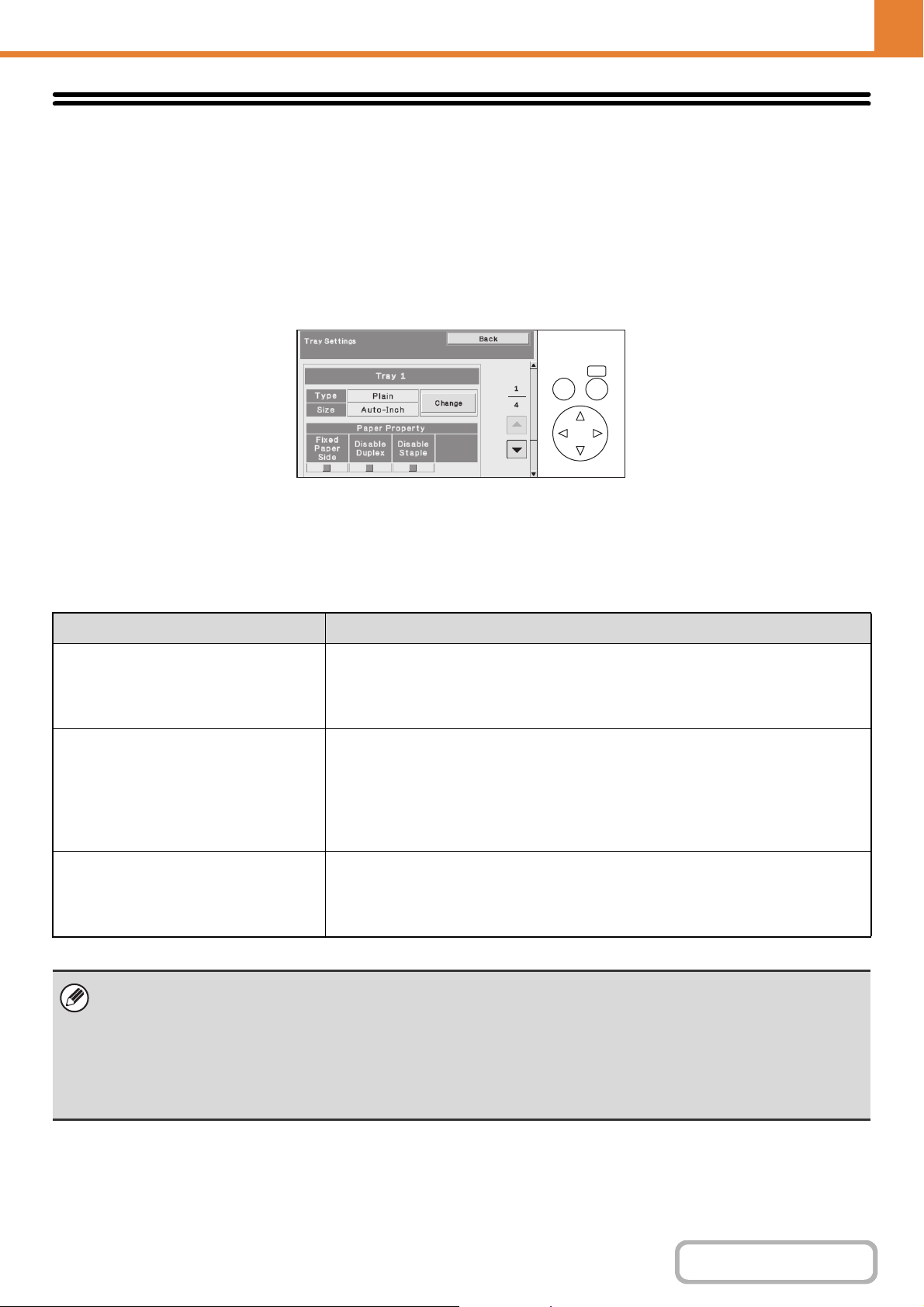
6-13
SYSTEM SETTINGS
Contents
OPERATION PANEL (GENERAL)
Paper Tray Settings
Paper tray and paper type settings are explained in this section. Select the [Paper Tray Settings] key to configure the
settings.
Tray Settings
These settings specify the paper type, paper size, and functions allowed for each paper tray.
When the [Tray Settings] key is selected, a list appears showing the trays and the current settings.
Settings of each tray
Select the [Change] key in the above screen to change the settings.
The following settings can be configured.
Item Description
Type
Select the type of paper that is loaded in the tray.
The paper types that can be selected vary by paper tray. For more information, see
"Tray Settings" (page 6-14).
To store a new paper type, see "Paper Type Registration" (page 6-15).
Size
Select the paper size from the list. The paper sizes that can be selected vary by tray.
The sizes that can be selected may also be restricted by the paper type selected
above. For more information, see "Tray Settings" (page 6-14).
If the desired size does not appear in the list, select [Custom Size] and directly enter
the size (only for the bypass tray). For more information, see "Tray Settings" (page
6-14).
Feeding Approved Job
Select the modes that can be used. If there is a function that you do not wish to be
used with the selected tray, disable the function.
When the "Type" is other than plain paper, recycled paper, colored paper, or a user
type, [Fax] and [Internet Fax] cannot be selected.
• If the paper size specified here is different from the size of paper that is loaded in a tray, a problem or misfeed may result
when printing.
To change the paper size in a tray, see "1. BEFORE USING THE MACHINE".
• Paper properties such as "Fixed Paper Side" are automatically set when the paper type is selected. The paper tray
properties cannot be changed in this screen.
•If "Disabling of Tray Settings" (page 6-72) has been enabled in the system settings (administrator) in the Web page menu,
the tray settings (except for the bypass tray) cannot be configured.
OKBACK
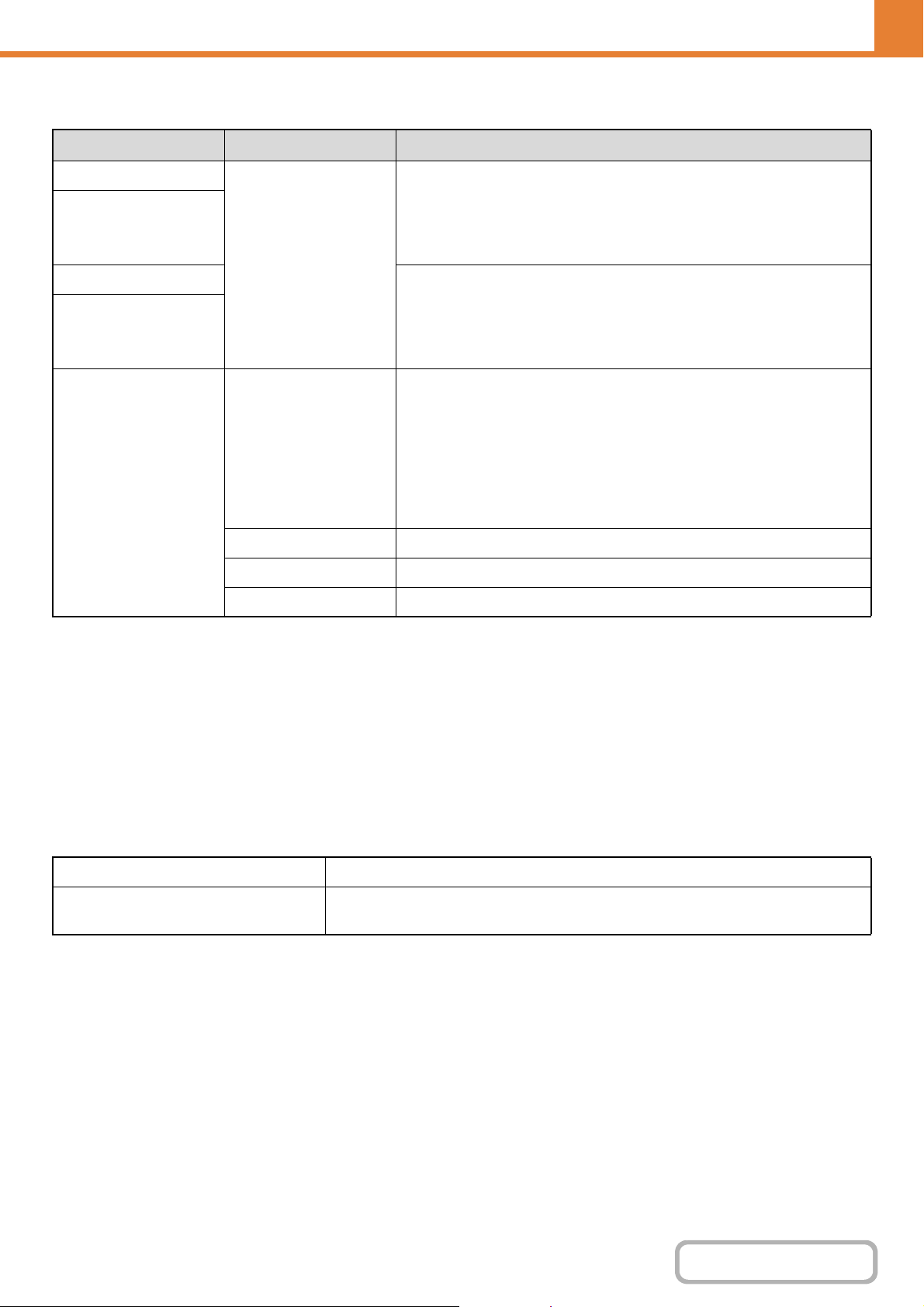
6-14
SYSTEM SETTINGS
Contents
OPERATION PANEL (GENERAL)
Tray Settings
*1 When a 500-sheet paper feed unit is installed.
*2 Heavy Paper : 28 lbs. bond to 110 lbs. index (106 g/m
2
to 209 g/m
2
) heavy paper
*3 The size that is automatically detected is set in "Select Similar Sizes for Auto Detection" in the bypass tray settings screen (see
below).
Select Similar Sizes for Auto Detection
"Select Similar Sizes for Auto Detection" in the bypass tray settings screen is used to select the paper size that is
automatically detected from similar sizes when automatic paper size detection takes place.
Select one of two sizes when "Auto-Inch" is set. Select one of three sizes when "Auto-AB" is set.
When paper that is the same size as one of the paper sizes in the settings is placed in the bypass tray, the size that is
selected in the settings will be automatically detected.
Paper Tray Paper Type Size
Tray 1 Plain, Pre-Printed,
Recycled, Letter Head,
Pre-Punched, Color,
User Type
Auto-Inch (8-1/2" x 14", 8-1/2" x 11", 7-1/4" x 10-1/2", 5-1/2" x 8-1/2"),
Auto-AB ( A4, A5, B5, 216 mm x330 mm (8-1/2" x 13")),
216 mm x 343 mm (8-1/2" x 13-1/2"), 8-1/2" x 13-2/5"
(216 mm x 340 mm),
16K
Tray 2*
1
Tray 3*
1
Auto-Inch (8-1/2" x 14", 8-1/2" x 11", 7-1/4" x 10-1/2"),
Auto-AB (A4, B5, 216 mm x 330 mm(8-1/2" x 13")),
216 mm x 343 mm (8-1/2" x 13-1/2"), 8-1/2" x 13-2/5"
(216 mm x 340 mm),
16K
Tray 4*
1
Bypass
In addition to the paper
types of trays 1 to 4,
Heavy Paper*
2
,
Thin Paper,
Glossy Paper
Auto-Inch (8-1/2" x 14"*
3
, 8-1/2" x 13-2/5" (216 mm x 340 mm)*
3
,
8-1/2" x 11", 7-1/4" x 10-1/2", 5-1/2" x 8-1/2"),
Auto-AB (A4, A5, B5, 216 mm x 330 mm (8-1/2" x 13")*
3
,
216 mm x 340 mm (8-1/2" x 13-2/5")*
3
, 216 mm x 343 mm
(8-1/2" x 13-1/2")*
3
),
Size Input-Inch (X=5-1/2" to 14", Y=5-1/2" to 8-1/2"),
Size Input-AB (X=140 mm to 356 mm, Y=100 mm to 216 mm),
16K, Custom 1, Custom 2, Custom 3
Labels Auto-Inch (8-1/2" x 11"), Auto-AB (A4, B5)
Transparency Auto-Inch (8-1/2" x 11"), Auto-AB (A4)
Envelope Com-10, Monarch, DL, C5
Auto-Inch 8-1/2" x 14", 8-1/2" x 13-2/5" (216 mm x 340 mm)
Auto-AB
216 mm x 330 mm (8-1/2" x 13"), 216 mm x 340 mm (8-1/2" x 13-2/5"),
216 mm x 343 mm (8-1/2" x 13-1/2")
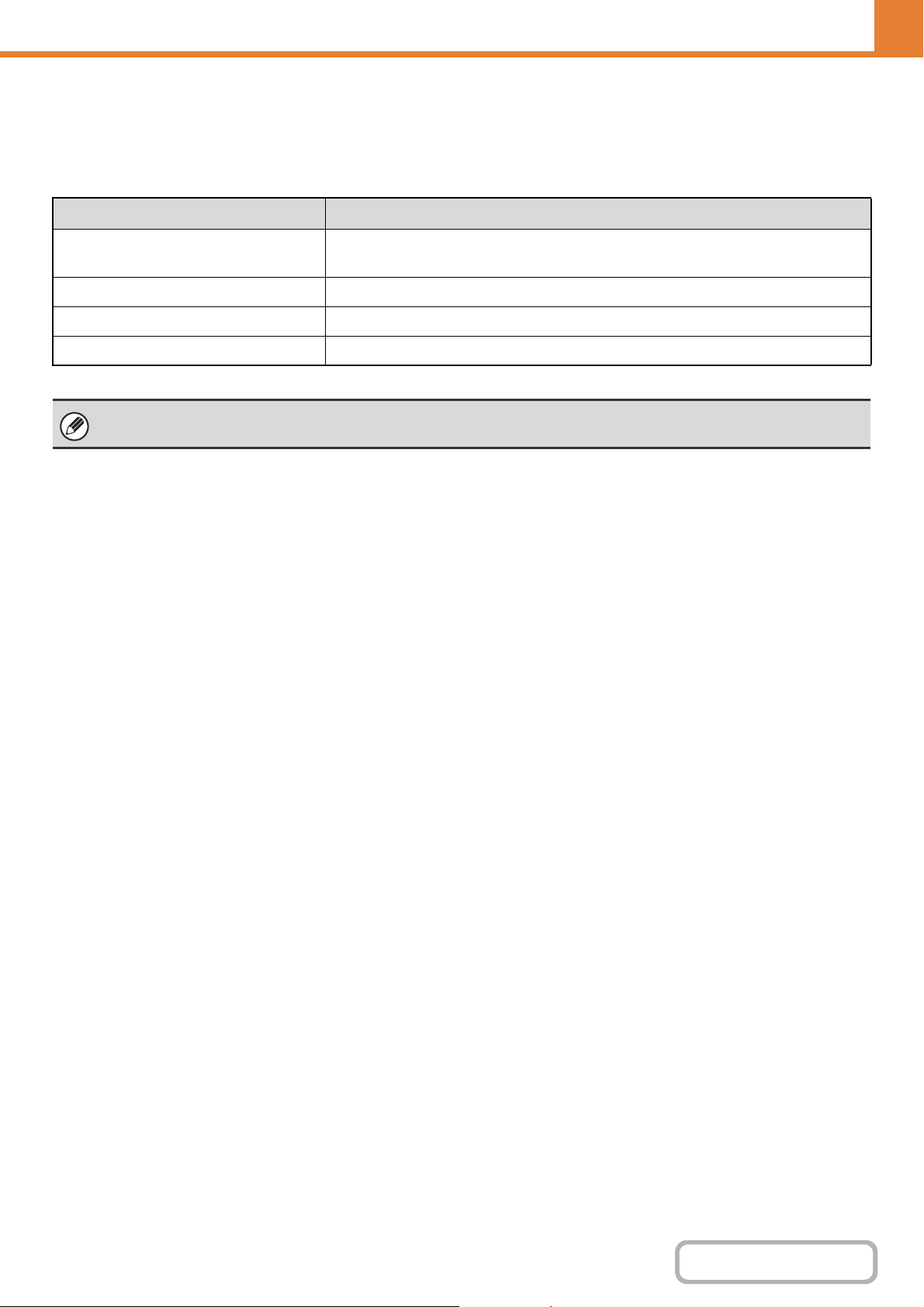
6-15
SYSTEM SETTINGS
Contents
OPERATION PANEL (GENERAL)
Paper Type Registration
Store a paper type when the desired paper type does not appear as a selection or when you wish to create a new set of
paper properties.
Up to 7 paper types can be stored.
Auto Tray Switching
When a tray runs out of paper during printing, this determines whether or not another tray with the same size and type of
paper is automatically selected and printing continues.
Custom Size Registration (Bypass)
If you frequently use a special non-standard paper size in the bypass tray, you can store that paper size.
Storing the paper size saves you the trouble of setting the size each time you need to use it.
Up to three paper sizes can be stored.
Select the key ([Custom 1] to [Custom 3]) in which you wish to store or change a paper size.
Select whether you wish to enter the size in inches ("Size Input-Inch") or mm ("Size Input-AB"), and then set the X and Y
dimensions of the paper.
"Size Input-Inch"
The X dimension can be set to a value from 5-1/2" to 14". The factory default setting is 11".
The Y dimension can be set to a value from 5-1/2" to 8-1/2". The factory default setting is 8-1/2".
"Size Input-AB"
The X dimension can be set to a value from 140 mm to 356 mm. The factory default setting is 297 mm.
The Y dimension can be set to a value from 100 mm to 216 mm. The factory default setting is 210 mm.
Item Description
Type Name
Store any name.
The factory default names are "User Type 1" - "User Type 7".
Fixed Paper Side Enable this setting when paper with a front and reverse side is used.
Disable Duplex Enable this setting when paper is loaded that cannot be used for two-sided printing.
Disable Staple Enable this setting when paper is used that cannot be stapled.
The settings that can be selected vary depending on the peripheral devices installed.
6-16
SYSTEM SETTINGS
Contents
OPERATION PANEL (GENERAL)
Fax Data Receive/Forward
This section explains settings for reception and forwarding. Select the [Fax Data Receive/Forward] key and configure
the settings.
I-Fax Settings
These settings can be configured when the Internet fax expansion kit is installed.
Reception Start
Select this key to immediately connect to your mail server (POP3 server) and check for received Internet faxes. If you
have received Internet faxes, the faxes will be retrieved and printed.
Manual Reception Key in Initial Screen
This displays the [I-Fax Manual Reception] key in the base screen of Internet fax mode.
Forward Received Data
When the machine cannot print because it is out of paper or out of toner, received faxes can be forwarded to another
Internet fax machine.
USB-Device Check
This lets you check the connection when a USB device is connected to the machine. Select the [USB-Device Check] key
to check the connection.
For explanations of settings related to the fax function, see "FAX SYSTEM SETTINGS ON THE OPERATION PANEL" (page
6-97).
To use this function, POP3 server settings must be configured. Configure these settings in the screen that appears when
[Application Settings] - [Internet Fax Settings] is selected in the Web page menu.
• To store a forwarding address, see "Set Address for Data Forwarding" (page 6-87) in the system settings (administrator) in
the Web page menu.
• If forwarding was not successful because the transmission was canceled or a communication error occurred, the faxes that
were to be forwarded will return to the print queue on the machine.
• If the initial pages of a fax were successfully printed, only those pages that were not printed will be forwarded.
• Forwarding is not possible if no faxes were received or a forwarding address is not programmed.
•If "Hold Setting for Received Data Print" (page 6-35) is enabled, you will be prompted to enter a password. Enter the
correct password with the numeric keys.
To cancel forwarding...
Press the [JOB STATUS] key, and then cancel the forwarding job in the same way as a transmission job.
The status of a USB device that is not compatible with the machine will not appear.

6-17
SYSTEM SETTINGS
Contents
OPERATION PANEL (ADMINISTRATOR)
This section explains the system settings that are configured by the administrator of the machine.
Accessing the System Settings (Administrator)
To access the system settings (administrator), the administrator must log in as explained below.
When User Authentication is not Enabled
When "User Authentication" (Web page only) is not enabled, follow the procedure below to log in.
Keys in the display can be selected with the arrow keys and the [OK] key.
SYSTEM SETTINGS (ADMINISTRATOR)
ON THE OPERATION PANEL
1
Select the [Admin Password] key.
2
Log in.
(1) Select the [Password] text box and enter the
administrator password.
Enter the administrator password in the administrator
password entry screen.
(2) Select the [OK] key.
This completes the administrator login procedure. The
system settings (administrator) can now be used.
• User authentication is initially disabled (factory default setting).
• To logout...
Press the [LOGOUT] ( ) key. (Except when entering a fax number.)
(If Auto Clear activates, logout will automatically take place.)
OKBACK
OKBACK
(2) (1)
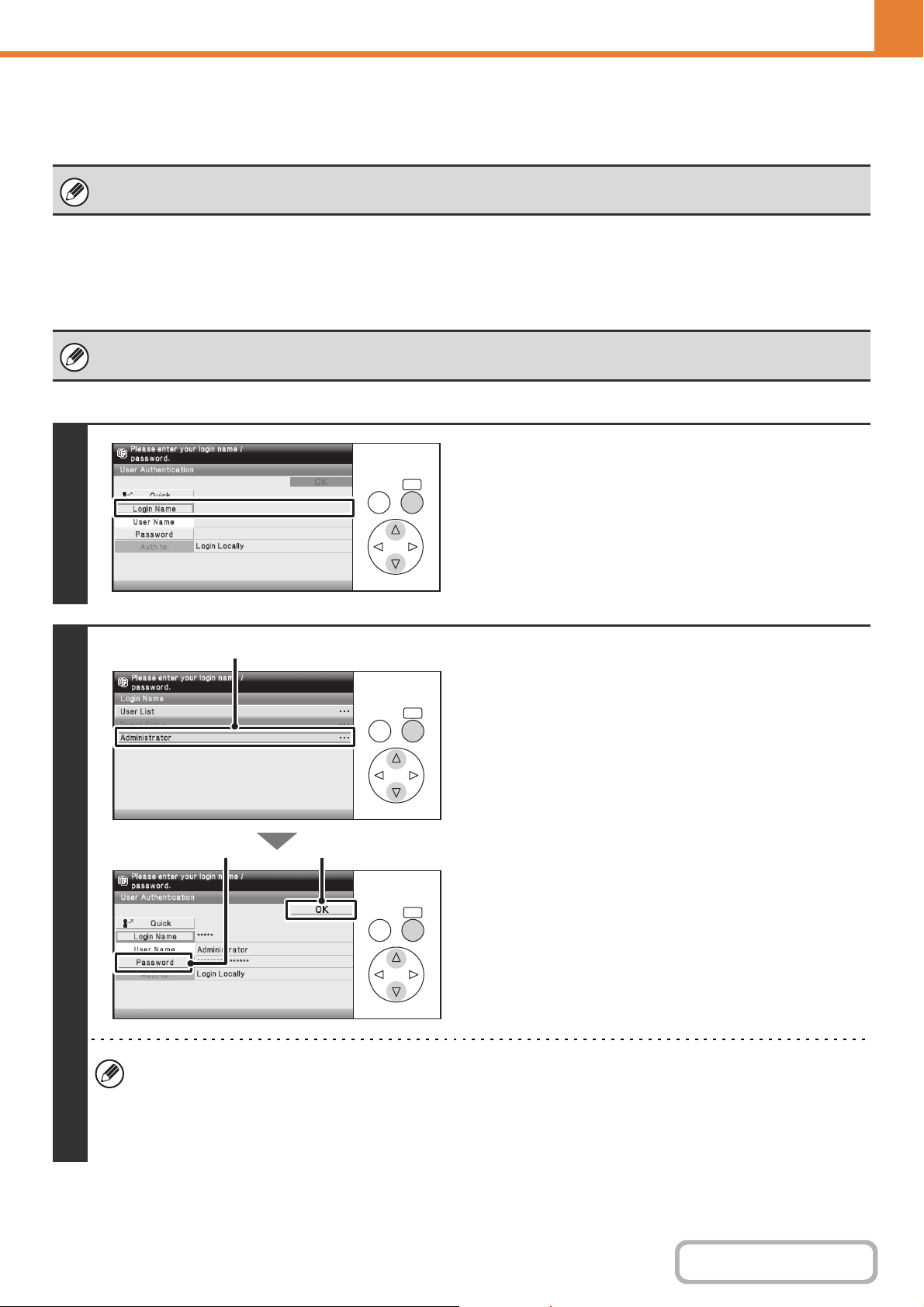
6-18
SYSTEM SETTINGS
Contents
OPERATION PANEL (ADMINISTRATOR)
When User Authentication is Enabled
When "User Authentication" (Web page only) is enabled, follow the procedure below to log in.
When user authentication is by login name and password (and e-mail
address)
Keys in the display can be selected with the arrow keys and the [OK] key.
When auto login is enabled, the login screen will not appear.
Administrator login is performed in the user selection screen. For more information on the login procedure when user
authentication is enabled, see "USER AUTHENTICATION" (page 1-17) in "1. BEFORE USING THE MACHINE".
1
Select the [Login Name] key.
2
Log in.
(1) Select the [Administrator] key.
(2) Select the [Password] key.
Enter the administrator password in the administrator
password entry screen.
(3) Select the [OK] key.
This completes the administrator login procedure. The
system settings (administrator) can now be used.
• If login name / password / e-mail address is selected for the authentication method, the [E-mail Address] key will
appear below the "User Name".
• For the factory default administrator password, see "TO THE ADMINISTRATOR OF THE MACHINE" in the
Maintenance & Safety Guide.
• This completes the administrator login procedure. The system settings (administrator) can now be used.
OKBACK
OKBACK
OKBACK
(1)
(3)(2)
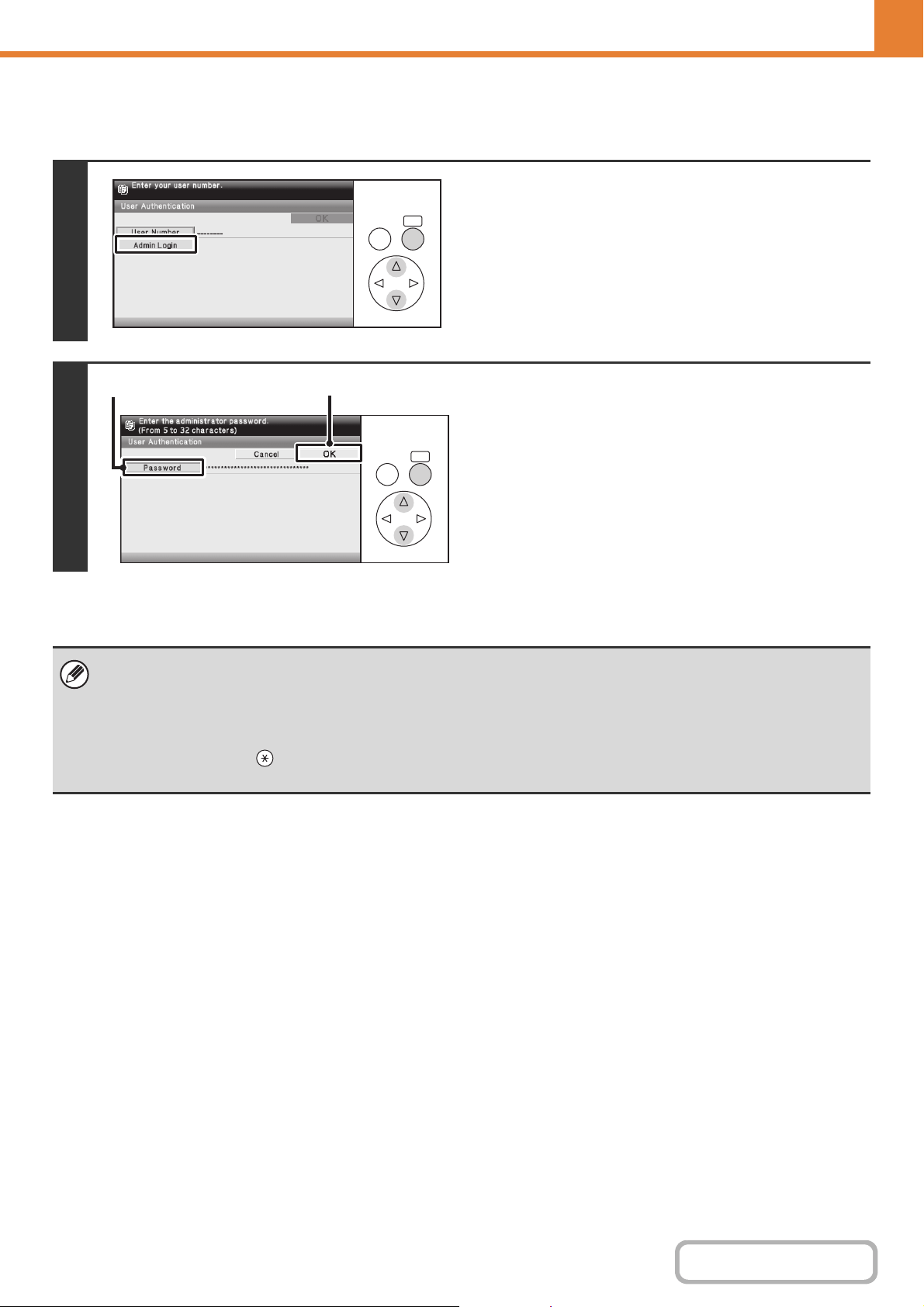
6-19
SYSTEM SETTINGS
Contents
OPERATION PANEL (ADMINISTRATOR)
Login by user number
Keys in the display can be selected with the arrow keys and the [OK] key.
1
Select the [Admin Login] key.
2
Log in.
(1) Select the [Password] key.
Enter the administrator password in the administrator
password entry screen.
(2) Select the [OK] key.
This completes the administrator login procedure. The
system settings (administrator) can now be used.
• In addition to login by selecting the [Admin Login] key, the system settings (administrator) can also be accessed when
login is performed by selecting a user with administrator rights from the user list or by entering a user number with
administrator rights. For more information on login procedures when user authentication is enabled, see "USER
AUTHENTICATION" (page 1-17) in "1. BEFORE USING THE MACHINE".
• To logout...
Press the [LOGOUT] ( ) key. (Except when entering a fax number.)
(If Auto Clear activates, logout will automatically take place.)
OKBACK
OKBACK
(1) (2)
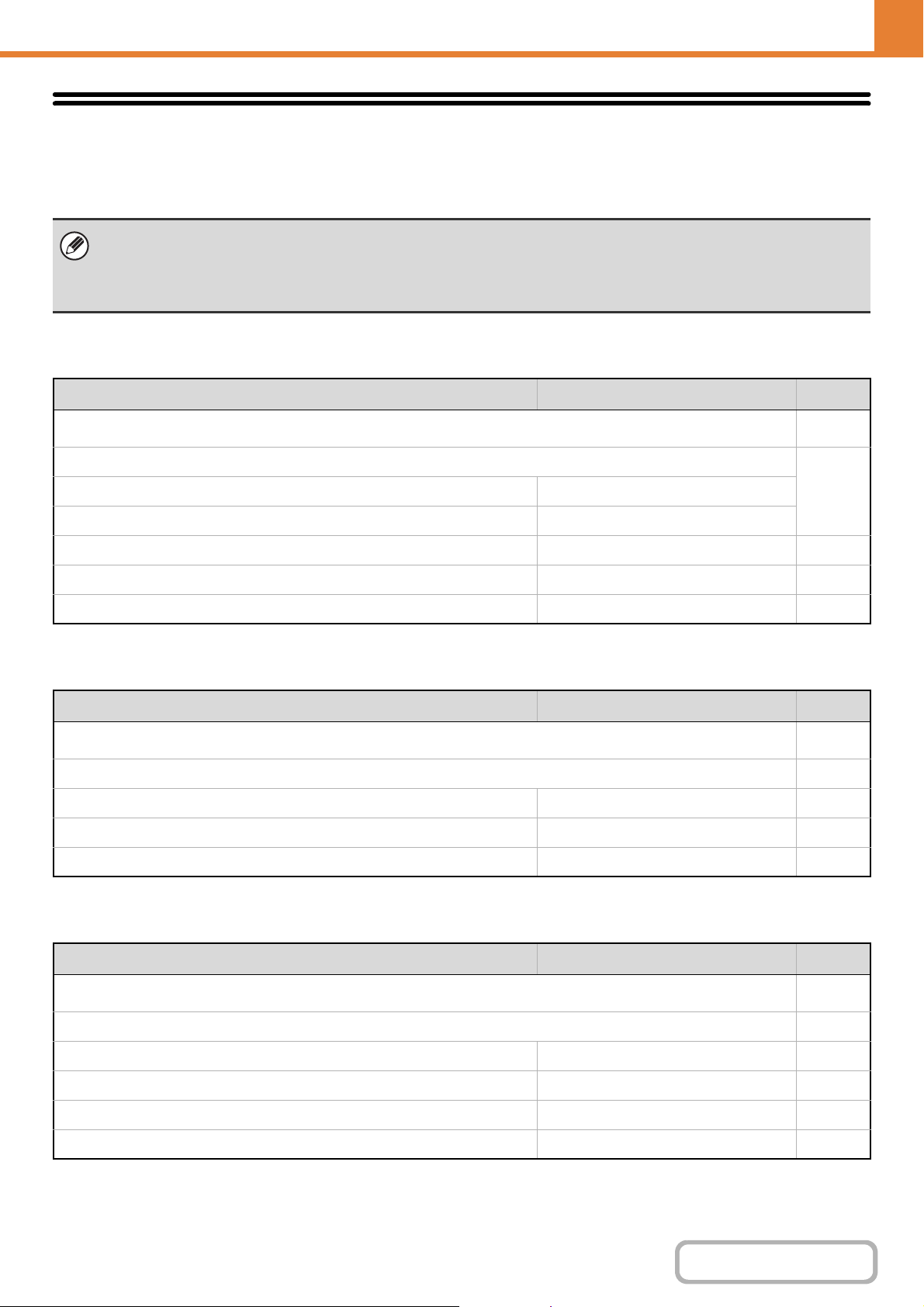
6-20
SYSTEM SETTINGS
Contents
OPERATION PANEL (ADMINISTRATOR)
System Settings (Administrator) List
The system settings that appear following administrator login are shown below. The default setting for each item is also
shown.
Energy save
Operation Settings
Device Control
• Depending on the machine specifications and peripheral devices installed, it may not be possible to use some settings.
• For information on the general settings, see "System Settings (General) List" (page 6-8).
• For explanations of settings related to the fax function, see "FAX SYSTEM SETTINGS ON THE OPERATION PANEL"
(page 6-97).
Item Factory default setting Page
■ Energy Save
6-26
● Toner Save Mode
6-26X Print Disabled
X Copy Disabled
● Auto Power Shut-Off Enabled 6-26
● Auto Power Shut-Off Timer 45 min. 6-26
● Preheat Mode Setting 10 min. 6-26
Item Factory default setting Page
■ Operation Settings
6-27
● Other Settings 6-27
X Keys Touch Sound Middle 6-27
X Display Language Setting American English 6-27
● MFP Display Pattern Setting Pattern 1 6-27
Item Factory default setting Page
■ Device Control
6-27
● Other Settings 6-27
X Registration Adjustment – 6-27
X Fusing Cleaning Mode – 6-27
X Optimization of a Hard Disk – 6-27
X Interval of Image Quality Adjustment Setting 2 6-28
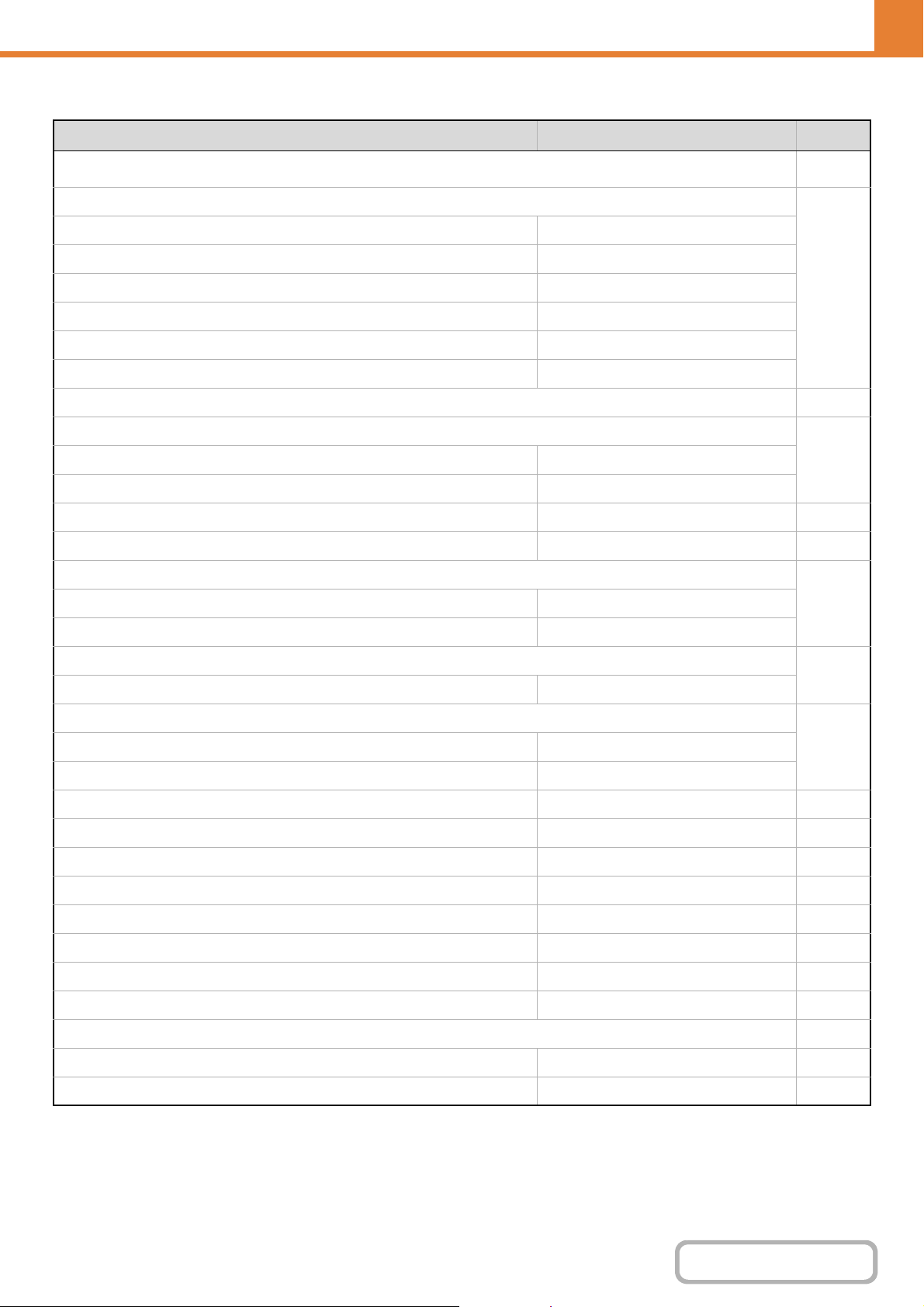
6-21
SYSTEM SETTINGS
Contents
OPERATION PANEL (ADMINISTRATOR)
Copy Function Settings
Item Factory default setting Page
■ Copy Function Settings
6-28
● Initial Status Settings
6-28
X Color Mode Full Color
X Paper Tray Tray 1
X Exposure Type Auto
X Copy Ratio 100%
X 2-Sided Copy 1-Side to 1-Side
X Output Auto
● Other Settings 6-29
X Copy Exposure Adjustment
6-29 Color 5
Black & White 5
X Add or Change Extra Preset Ratios – 6-29
X Setting a Maximum Number of Copies 999 6-29
X Initial Margin Shift Setting
6-29 Side 1 1/2"
Side 2 1/2"
X Erase Width Adjustment
6-29
Edge Clearance Width 1/2"
X Card Shot Settings
6-29 Original Size X: 3-3/8", Y: 2-1/8"
Fit to Page Disabled
X Disabling Deletion of Job Programs Disabled 6-29
X Disabling of Bypass-Tray in Duplex Copy Disabled 6-29
X Disabling of Auto Paper Selection Disabled 6-29
X Auto Selection of Paper Tray that was Last Loaded Disabled 6-29
X Color 600dpi x 600dpi Scanning Mode for Document Feeder Enabled 6-30
X Color Quick Scan from Document Glass Disabled 6-30
X B/W 600dpi x 600dpi Scanning Mode for Document Feeder Enabled 6-30
X B/W Quick Scan from Document Glass Disabled 6-30
● Color Adjustments 6-31
X Initial Color Balance Setting Factory default state 6-31
X Auto Color Calibration – 6-31
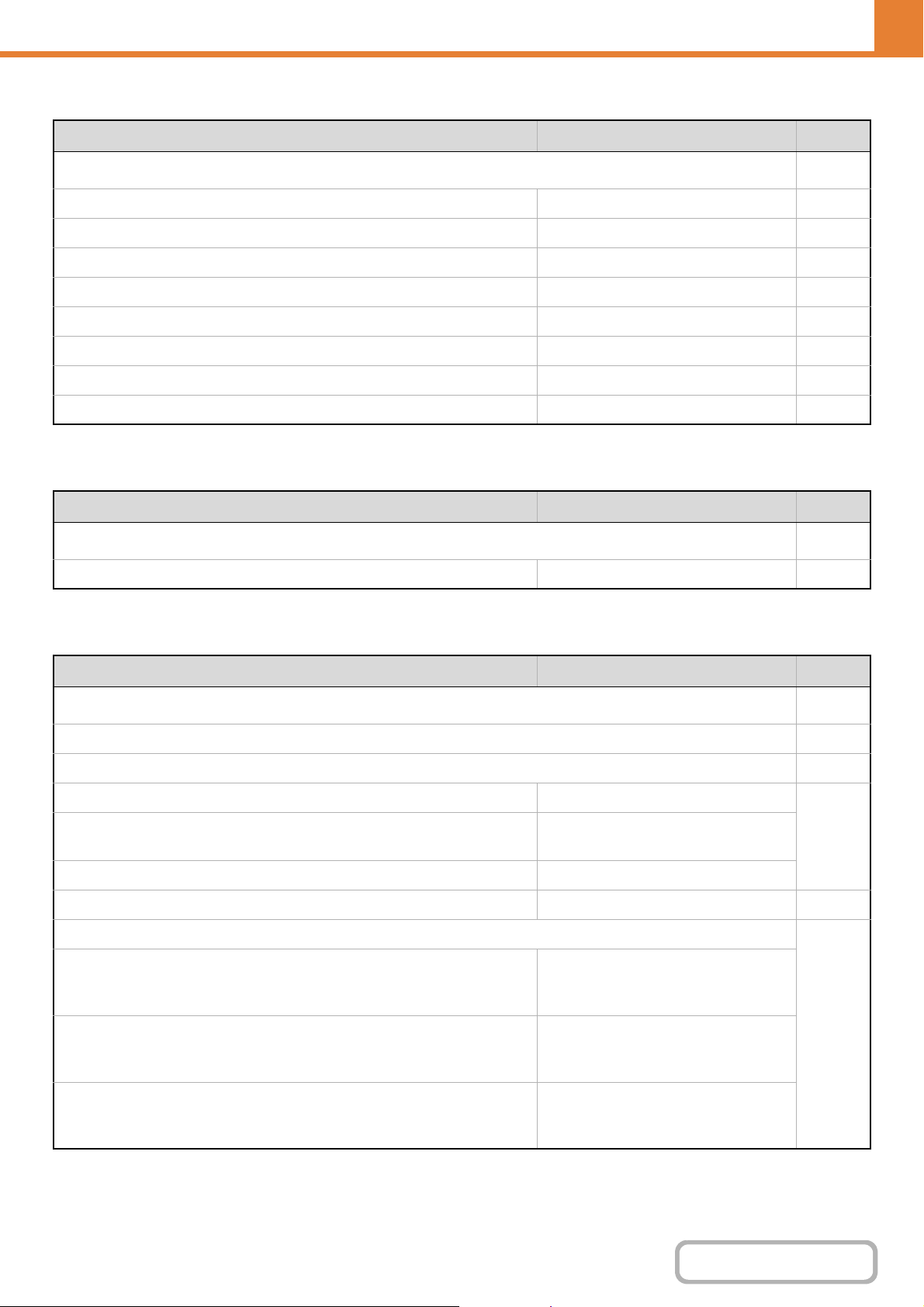
6-22
SYSTEM SETTINGS
Contents
OPERATION PANEL (ADMINISTRATOR)
Network Settings
Printer Settings
Image Send Settings
Item Factory default setting Page
■ Network Settings
6-32
● IPv4 Settings DHCP 6-32
● IPv6 Settings Disabled 6-32
● Enable TCP/IP Enabled 6-32
● Enable NetWare Enabled 6-32
● Enable EtherTalk Enabled 6-32
● Enable NetBEUI Enabled 6-32
● Reset the NIC – 6-32
● Ping Command – 6-32
Item Factory default setting Page
■ Printer Settings
6-33
● Auto Color Calibration – 6-33
Item Factory default setting Page
■ Image Send Settings
6-34
● Operation Settings 6-34
X Other Settings 6-34
Default Display Settings Scan (fax when fax is installed)
6-34
• Hold settings for a while after scanning has been
completed
Disabled
• Switch Automatically to Copy Mode Screen
Enabled
Address Book Default Selection Tab Switch: ABC, Address Type: All 6-34
Initial Resolution Setting
6-34
•Scan Apply the Resolution Set when
Stored: Disabled
200 X 200 dpi
• Internet Fax*
1
Apply the Resolution Set when
Stored: Disabled
200 X 100 dpi
•Fax*
2
Apply the Resolution Set when
Stored: Disabled
Standard
6-23
SYSTEM SETTINGS
Contents
OPERATION PANEL (ADMINISTRATOR)
*1 When the Internet fax expansion kit is installed.
*2 When the facsimile expansion kit is installed.
*3 When the Internet fax expansion kit or facsimile expansion kit is installed.
List Print (Administrator)
Default Exposure Settings Auto
6-34• Original Image Type Text
• Moiré Reduction Disabled
Must Input Next Address Key at Broadcast Setting Disabled 6-35
Scan Complete Sound Setting Middle 6-35
The Number of File Name/Subject/Body Keys Displayed
Setting
12
6-35
The Number of Direct Address Keys Displayed Setting 10 6-35
Disable Switching of Display Order Disabled 6-35
Hold Setting for Received Data Print*
3
Disabled 6-35
Erase Width Adjustment
6-35
• Edge Clearance Width 1/2"
X Own Name and Destination Set
6-36
Sender Data Registration
• Sender Name –
• Sender Fax Number*
2
–
• I-Fax Own Address*
1
–
Registration of Own Name Select – 6-36
Item Factory default setting Page
■ List Print (Administrator)
6-37
● Image Sending Activity Report – 6-37
● Data Receive/Forward List – 6-37
● User Information Print – 6-37
Item Factory default setting Page
6-24
SYSTEM SETTINGS
Contents
OPERATION PANEL (ADMINISTRATOR)
Security Settings
Product Key
* It may not be possible to use some settings, depending on the peripheral devices installed.
Item Factory default setting Page
■ Security Settings
6-38
● SSL Settings
6-38
X Server Port
HTTPS Enabled
IPP-SSL Disabled
Redirect HTTP to HTTPS in Device Web Page Access Disabled
X Client Port
HTTPS Enabled
FTPS Enabled
SMTP-SSL Enabled
POP3-SSL Enabled
LDAP-SSL Enabled
Level of Encryption Low
● IPsec Settings Disabled 6-38
● IEEE802.1X Setting Disabled 6-38
Item Factory default setting Page
■ Product Key*
6-39
● Serial Number – 6-39
● PS3 Expansion Kit – 6-39
● Internet Fax Expansion Kit – 6-39
● E-mail Alert and Status – 6-39
● Application Integration Module – 6-39
● Application Communication Module – 6-39
● External Account Module – 6-39
● XPS Expansion Kit – 6-39
6-25
SYSTEM SETTINGS
Contents
OPERATION PANEL (ADMINISTRATOR)
Storing/Calling of System Settings
Sharp OSA Settings
*1 When the external account module is installed.
*2 When the external account module or application communication module is installed.
Item Factory default setting Page
■ Storing/Calling of System Settings
6-40
● Restore Factory Defaults – 6-40
● Store Current Configuration – 6-40
● Restore Configuration – 6-40
Item Factory default setting Page
■ Sharp OSA Settings
6-41
● External Account Setting*
1
6-41X External Account Control Disabled
X Enable Authentication by External Server Disabled
● USB Driver Settings*
2
6-41
X External Keyboard Internal driver
X USB Memory Internal driver
X Level of Encryption None
● Animation Play Speed Setting Standard 6-41
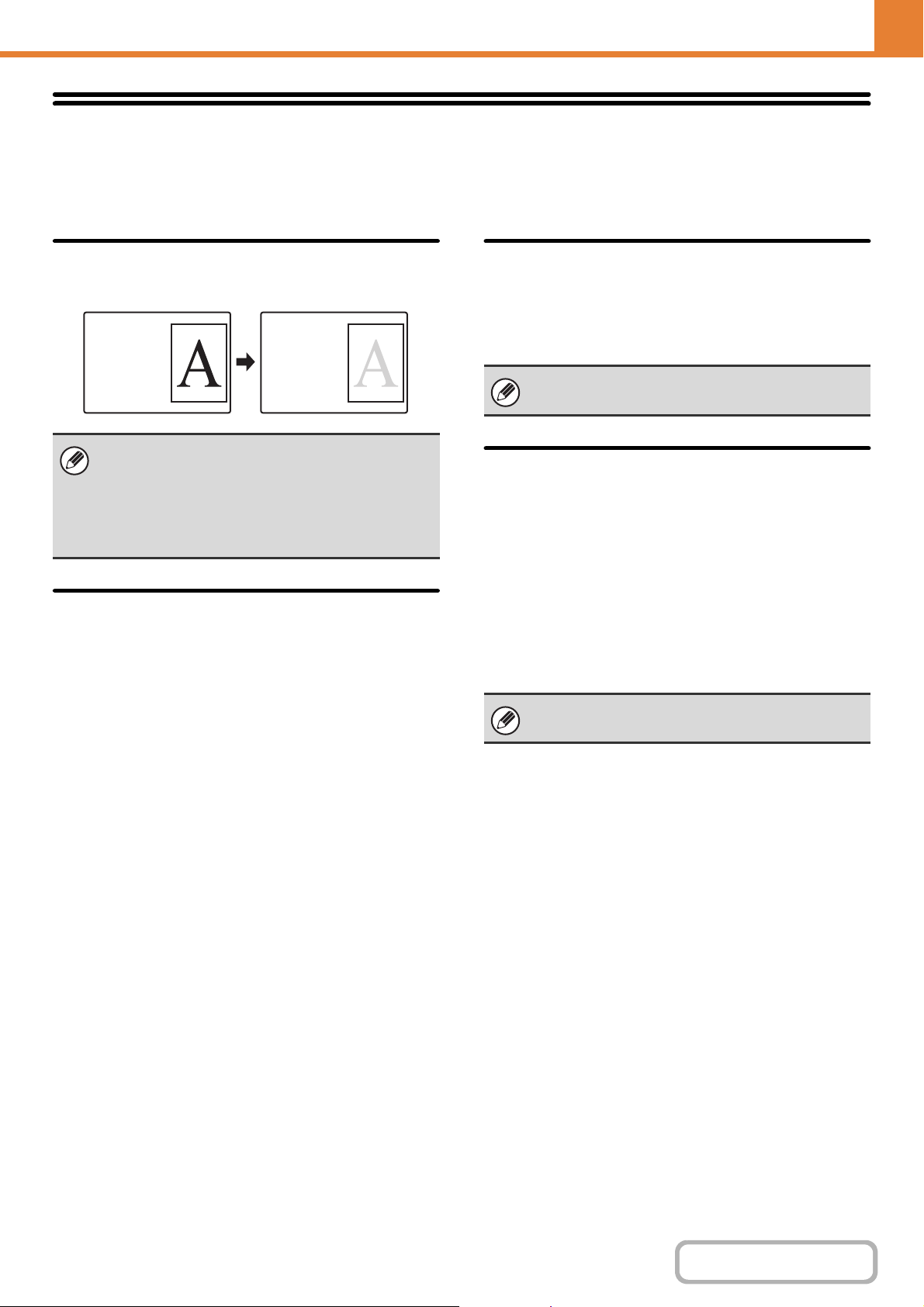
6-26
SYSTEM SETTINGS
Contents
OPERATION PANEL (ADMINISTRATOR)
Energy Save
The Energy Save settings help reduce power costs. From an environmental perspective, these settings also help reduce
pollution and conserve natural resources. Select the [Energy Save] key to configure the settings.
Toner Save Mode
You can reduce the amount of toner used for printing.
Auto Power Shut-Off
This setting enables or disables Auto Power Shut-Off.
Remove the checkmark if you prefer that Auto Power
Shut-Off does not operate.
When the set duration of time elapses after printing
ends, Auto Power Shut-Off activates and causes the
machine to go on standby at a minimal level of power
consumption.
This function reduces your power costs, and at the same
time helps conserve natural resources and reduce
pollution.
If you prefer that auto power shut-off activates as little as
possible, it is recommended that you try lengthening the
time setting after which activation takes place rather than
disabling the function altogether. (The time setting is
changed using "Auto Power Shut-Off Timer" below.)
Auto Power Shut-Off Timer
The time until Auto Power Shut-Off activates can be set
to any number of minutes from 1 to 240.
Select the time that best suits your workplace needs.
Preheat Mode Setting
The time until Preheat Mode activates can be set to any
number of minutes from 1 to 240.
Preheat Mode will activate when the set duration of time
elapses after printing ends and no further operations are
performed. This function reduces your power costs, and
at the same time helps conserve natural resources and
reduce pollution.
Select the time that best suits the needs of your
workplace.
[Print] in Toner Save Mode is only effective when the
machine's printer driver is not used. When the printer
driver is used, the printer driver setting takes
precedence.
This function may not operate in some applications
and operating systems.
Print
data
Print example
when "Toner
Save Mode"
is enabled
The timer setting will not be effective if Auto Power
Shut-Off is disabled using "Auto Power Shut-Off
".
Preheat mode cannot be disabled.
6-27
SYSTEM SETTINGS
Contents
OPERATION PANEL (ADMINISTRATOR)
Operation Settings
Settings related to machine operation can be configured. Select the [Operation Settings] key to configure the settings.
Other Settings
Keys Touch Sound
This setting is used to adjust (or turn off) the volume of
the beep that sounds when you select a key.
Display Language Setting
The language that appears in the display can be
changed.
MFP Display Pattern Setting
One of the six color patterns can be selected for the color pattern in the display.
A sample of the selected pattern can be viewed.
Device Control
These settings control devices installed on the machine. Select the [Device Control] key to configure the settings.
Other Settings
Registration Adjustment
If the colors are out of place on the printed surface when
color printing is performed, the print positions of the
colors can be adjusted.
To perform this adjustment, select the [Auto Adjustment]
key. A message will appear. select the [Execute] key.
Fusing Cleaning Mode
Use this function to clean the machine's fusing unit when
dots or other dirt appear on the printed side of the paper.
When this function is executed, a "V" is printed on both
sides of the paper and the fusing unit is cleaned.
Optimization of a Hard Disk
This function optimizes the hard drive of the machine by
defragmenting data. If a job is in progress, a message
will appear and optimization will not begin until the job is
finished. During optimization, the following operations
are not possible:
• Web page access, reception of print data
• Use of keys on the operation panel
• Turning off the power with the main power switch of
the machine.
• Auto Power Shut-Off
When optimization is completed, the machine will
automatically restart.
When user authentication is enabled and a display
language is specified in the favorite operation group,
that setting is given priority.
• When "Disabling of Duplex" in web page is enabled
(page 6-72), printing only takes place on one side of
the cleaning sheet.
• If improvement is not noticed after the first time you
use the function, try executing the function again.
• It is not possible to move to the job status screen
while this function is operating.
When the print hold (retention) function is frequently
used and output of files seems somewhat slow,
optimizing the hard drive may improve performance.
6-28
SYSTEM SETTINGS
Contents
OPERATION PANEL (ADMINISTRATOR)
Interval of Image Quality
Adjustment
The machine automatically performs Image Quality
Adjustment at regular intervals in order to prevent
changes of color after repeated color printing.
This setting is used to select the interval of Image
Quality Adjustment.
The interval becomes shorter and Image Quality
Adjustment is performed more frequently in the following
order:
Setting 1 (Long), Setting 2, Setting 3, Setting 4, Setting 5
(Short)
Guidelines for selection
If you print mostly business documents in black and
white, Setting 2 (factory default setting) or Setting 1
(Long) is recommended.
If you often print photos, Setting 3 or higher is
recommended.
Copy Function Settings
The following settings are related to copying. Select the [Copy Function Settings] key to configure the settings.
Default settings selected with these settings apply to all functions of the machine (not just the copy function).
Initial Status Settings
The copier settings are reset when the [POWER] key ( ) is turned on, when the [CLEAR ALL] key ( ) is pressed, or
when the auto clear interval has elapsed. These settings are used to change the default settings for copy mode.
The following settings can be changed:
• When Setting 3 or higher is selected, more toner is
consumed than usual, and when a job is being
printed, printing may take place more slowly.
• Image Quality Adjustment can also be performed
whenever you notice that the color has changed.
See "Image Quality Adjustment" (page 6-10).
Item Description
Color Mode Configure default color mode settings.
Paper Tray Specify the paper tray that is selected by default.
Exposure Type Configure exposure mode settings.
Copy Ratio Specify the copy ratio that is selected by default.
2-Sided Copy
Configure the 2-sided mode settings that are selected by default.
If this setting is used to change the default setting for the duplex function to other than "1-Side to 1-Side"
and the duplex function or automatic document feeder fails or is disabled, the setting will revert to
"1-Side to 1-Side".
Output Set the print output method that is selected by default.
Return to the
Defaults
This returns all items to the factory default settings.
6-29
SYSTEM SETTINGS
Contents
OPERATION PANEL (ADMINISTRATOR)
Other Settings
Copy Exposure Adjustment
This is used to adjust the exposure level when [Auto] is
used for the copy exposure.
Color
Use this to set the copy exposure level in color mode for the
document glass and for the automatic document feeder.
Black & White
Use this to set the copy exposure level in black & white
mode for the document glass and for the automatic
document feeder.
Add or Change Extra Preset Ratios
Two enlargement preset ratios (101% to 200%) and two
reduction preset ratios (50% to 99%) can be added. An
added preset ratio can also be changed.
Setting a Maximum Number of Copies
This is used to set the maximum number that can be
entered for the number of copies (number of continuous
copies). Any number from 1 to 999 can be specified.
Initial Margin Shift Setting
This is used to set the default margin shift amount.
Specify a value from 0" (0 mm) to 1" (20 mm) in
increments of 1/8" (1 mm) for both the front and reverse
sides.
Erase Width Adjustment
This is used to set the default erase width for erase
copy. Specify a value from 0 mm (0") to 20 mm (1") in
increments of 1 mm (1/8") for edge erase.
Card Shot Settings
This is used to set the default original size for the card
shot function.
Both the X (horizontal) and Y (vertical) dimensions of the
original can be set from 1" (25 mm) to 8-1/2" (210 mm) in
increments of 1/8"(1 mm ).
Fit to Page
Enable this setting to have the [Fit to Page] key always
appear in the card shot screen.
Disabling Deletion of Job Programs
This is used to prohibit the deletion and changing of copy
settings stored in job programs.
Disabling of Bypass-Tray in
Duplex Copy
This is used to prohibit the use of the bypass tray when
making two-sided copies.
The bypass tray is often used to feed label sheets,
transparency film, and other special media for which
two-sided copying is prohibited. If a sheet of one of these
special media enters the reversing unit, a misfeed or
damage to the unit may result. If special media for which
two-sided copying is prohibited is often used, it is
recommended that you enable this setting.
Disabling of Auto Paper Selection
This setting is used to disable the Auto Paper Selection
function.
When this is enabled and an original size is set, the
same size of paper is not automatically selected.
Auto Selection of Paper Tray that
was Last Loaded
When this setting is enabled and the machine is on
standby in copy mode, the last paper tray that was
loaded with paper automatically becomes the default
paper tray for copy mode, until the machine is reset.
Preset ratios other than added preset ratios cannot be
changed.
6-30
SYSTEM SETTINGS
Contents
OPERATION PANEL (ADMINISTRATOR)
Color 600dpi x 600dpi Scanning
Mode for Document Feeder
The resolution for copying in color using the automatic
document feeder can be changed from 600 x 300 dpi to
600 x 600 dpi (high quality mode).
When high quality mode is used, fine print and thin lines
are reproduced with greater clarity, however, the
scanning speed is slower.
Color Quick Scan from Document
Glass
The resolution for copying in color using the document
glass can be changed from 600 x 600 dpi to 600 x 300
dpi (high speed mode).
When high speed mode is selected, the first copy time is
quicker, however, the copy image is not as clear.
B/W 600dpi x 600dpi Scanning
Mode for Document Feeder
The resolution for copying in black and white using the
automatic document feeder can be changed from 600 x
300 dpi to 600 x 600 dpi (high quality mode).
When high quality mode is used, fine print and thin lines
are reproduced with greater clarity, however, the
scanning speed is slower.
B/W Quick Scan from Document
Glass
The resolution for copying in black and white using the
document glass can be changed from 600 x 600 dpi to
600 x 300 dpi (high speed mode).
When high speed mode is selected, the first copy time is
quicker, however, the copy image is not as clear.
When high quality mode is not selected, the following
conditions must be satisfied in order to scan at 600 x
300 dpi and attain the fastest speed.
• The copy ratio must be set to 100%.
• Do not select a special mode that will change the
ratio.
• [Copy of Copy] must not be enabled.
When high speed mode is selected, the following
conditions must be satisfied in order to scan at 600 x
300 dpi and attain the fastest speed.
• The copy ratio must be set to 100%.
• Do not select a special mode that will change the
ratio.
• [Copy of Copy] must not be enabled.
When high quality mode is not selected, the following
conditions must be satisfied in order to scan at 600 x
300 dpi and attain the fastest speed.
• The copy ratio must be set to 100%.
• Do not select a special mode that will change the
ratio.
• [Copy of Copy] must not be enabled.
• Do not copy in black and white with the [COLOR
START] key.
When high speed mode is selected, the following
conditions must be satisfied in order to scan at 600 x
300 dpi and attain the fastest speed.
• The copy ratio must be set to 100%.
• Do not select a special mode that will change the
ratio.
• [Copy of Copy] must not be enabled.
• Do not copy in black and white with the [COLOR
START] key.
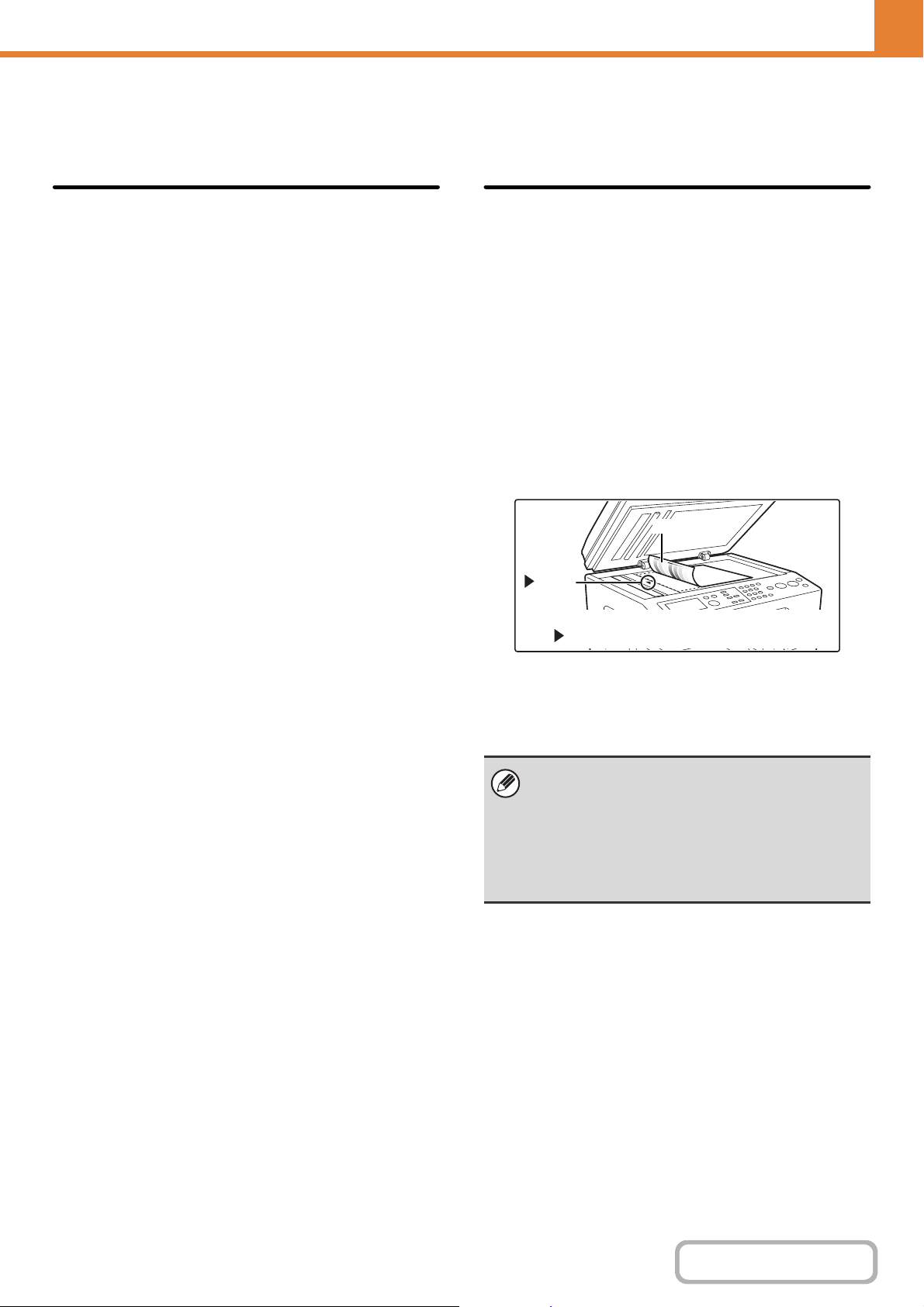
6-31
SYSTEM SETTINGS
Contents
OPERATION PANEL (ADMINISTRATOR)
Color Adjustments
The following color settings can be configured.
Initial Color Balance Setting
Color balance values obtained using "Color Balance" in
the special modes can be stored in a job program (1 to
48), and those values can be retrieved and stored as the
initial color balance setting*. Use this feature when you
want to repeatedly use a color balance setting for a
favorite color or for correction when a change occurs in
the color balance.
* Preset values displayed when you select "Color
Balance" in the special modes.
Return to the Factory Default Setting
This returns the stored color balance values to the
factory default values (all color balance values are "0" for
the 8 levels of each color).
Auto Color Calibration
This is used to perform automatic color correction when
the color copy output appears to contain the incorrect
colors throughout the document. The machine prints a
test patch, the test patch is scanned, and the color is
automatically corrected.
Make sure to load 8-1/2" x 11" or A4 white plain paper in
the machine.
After the [Execute] key is selected and a test patch is
printed, a message appears prompting you to begin
automatic calibration. Place the test patch on the
document glass as shown below (so that the thin line at
the edge of the page is to the left).
Lay copy paper (about five sheets) that is the same size
as the test patch on top of the placed test patch, gently
close the automatic document feeder, and select the
[Execute] key.
• Before executing Auto Color Calibration, check to
see if the registration adjustment is correct. If the
registration adjustment is not correct, perform
"Registration Adjustment" (page 6-27).
• If the color is still off after performing Auto Color
Calibration, repeating Auto Color Calibration once
again may improve the color.
Align the middle of the test patch with the tip of
the mark.
mark
Thin line
6-32
SYSTEM SETTINGS
Contents
OPERATION PANEL (ADMINISTRATOR)
Network Settings
Network settings are described below. Select the [Network Settings] key to configure the settings.
IPv4 Settings
When using the machine on a TCP/IP (IPv4) network, use
this setting to configure the IP address of the machine.
The settings are shown below.
IP Address*
Enter the IP address of the machine.
IP Subnet Mask*
Enter the IP Subnet Mask.
IP Gateway*
Enter the IP Gateway address.
DHCP
Use this setting to have the IP address obtained
automatically using DHCP (Dynamic Host Configuration
Protocol). When this setting is enabled, it is not
necessary to manually enter an IP address.
* In these settings, press the key when entering dot
separators.
IPv6 Settings
When using the machine on a TCP/IP (IPv6) network, use
this setting to configure the IP address of the machine.
The settings are shown below.
Enable IPv6 Protocol
Enable this setting.
DHCPv6
Use this setting to have the IP address obtained
automatically using DHCP (Dynamic Host Configuration
Protocol). When this setting is enabled, it is not
necessary to manually enter an IP address.
Manual Address
Enter the IP address of the machine.
Prefix Length
Enter the prefix length (0 to 128).
Default Gateway
Enter the IP Gateway address.
Enable TCP/IP
To use the machine on a TCP/IP network, this setting
must be enabled.
Enable NetWare
To use the machine on a NetWare network, this setting
must be enabled.
Enable EtherTalk
To use the machine on an EtherTalk network, this
setting must be enabled.
Enable NetBEUI
To use the machine on a NetBEUI network, this setting
must be enabled.
Reset the NIC
This returns all "Network Settings" to the factory default
settings.
Ping Command
Use this function to check if the machine can
communicate with a computer on the network.
Specify the IP address of the desired computer and
select the [Execute] key.
When entering an IPv4 IP address, press the key to
enter dot separators. A message will appear indicating
whether or not the computer responded.
When settings are changed, the changes will take effect after the machine is restarted. To restart the machine see
"TURNING THE POWER ON AND OFF" (page 1-14) in "1. BEFORE USING THE MACHINE ".
• If the machine will be used on a TCP/IP network, be
sure to enable "Enable TCP/IP
" below.
•
If DHCP is used, the IP address assigned to the machine
may change automatically. If the IP address changes,
specify the printer port setting again and then print.
• If the machine will be used on a TCP/IP network, be
sure to enable "Enable TCP/IP" below.
• If DHCP is used, the IP address assigned to the
machine may change automatically. If the IP
address changes, specify the printer port setting
again and then print.
• In an IPv6 environment, the machine can use LPD
or IPP protocol.

6-33
SYSTEM SETTINGS
Contents
OPERATION PANEL (ADMINISTRATOR)
Printer Settings
Settings related to the printer function can be configured. Select the [Printer Settings] key to configure the settings.
Auto Color Calibration
This is used to perform automatic color correction when the color print output appears to contain the incorrect colors
throughout the document. The machine prints a test patch, the test patch is scanned, and the color is automatically
corrected.
Make sure to load 8-1/2" x 11" or A4 white plain paper in the machine.
After the [Execute] key is selected and a test patch is printed, a message appears prompting you to begin automatic
calibration. Place the test patch on the document glass as shown below (the four squares should be on the left).
Lay copy paper (about five sheets) that is the same size as the test patch on top of the placed test patch, gently close
the automatic document feeder, and select the [Execute] key.
• Before executing Auto Color Calibration, check to see if the registration adjustment is correct. If the registration adjustment
is not correct, perform "Registration Adjustment" (page 6-27).
• If the color is still off after performing Auto Color Calibration, repeating Auto Color Calibration once again may improve the
color.
Four squares
Align the middle of the test patch with the tip of
the mark.
mark
6-34
SYSTEM SETTINGS
Contents
OPERATION PANEL (ADMINISTRATOR)
Image Send Settings
Settings related to the image send function (scan, Internet fax, etc.) can be configured. Select the [Image Send Settings]
key to configure the settings.
Operation Settings
The operation settings below apply to all image send functions.
Default Display Settings
You can select one of 5 base screen types for the base screen
that appears when the [IMAGE SEND] key is pressed or when
the [CLEAR ALL] ( ) key is pressed in image send mode.
• Address Book
• Scan
• Internet Fax
•Fax
• Data Entry
Hold settings for a while after scanning has been completed
Use this setting to hold the settings after scanning is
completed (until Auto Clear Mode activates).
Switch Automatically to Copy Mode Screen
Enable this setting to have the screen automatically
switch to the copy mode screen if no action is taken in
the image send mode screen for 20 seconds.
Address Book Default Selection
One of the following screens can be specified for the
initial address book screen.
Tab Switch
• ABC
•Group
Address Type
•All
•E-mail
• FTP/Desktop
• Network Folder
• Internet Fax (Including Direct SMTP)
•Fax
•Group
Initial Resolution Setting
The following settings are available for the default
resolutions of scan, Internet fax, and fax mode.
Scan : 100X100 dpi, 200X200 dpi, 300X300 dpi,
400X400 dpi, 600X600 dpi
Internet fax : 200X100 dpi
200X200 dpi
200X400 dpi
400X400 dpi
600X600 dpi
Fax: Standard
Fine
Super Fine
Ultra Fine
Default Exposure Settings
This is used to set the default exposure settings for
scanning a document in image send mode. Select [Auto]
or [Manual]. When [Manual] is selected, the exposure
can be set to one of 5 levels.
Default Original Image Type
Select the original type beforehand to enable transmission
at a resolution suitable for the original (only in scan mode
and USB memory mode).
The settings are shown below.
• Text/Printed Photo
• Text/Photo
•Text
• Photo
• Printed Photo
•Map
•
Moiré Reduction
This reduces the moiré effect (line pattern) that occurs
when printed matter is scanned (only in scan mode and
USB memory mode).
For explanations of settings related to the fax function, see "FAX SYSTEM SETTINGS ON THE OPERATION PANEL" (page
6-97).
Other Settings
When the exposure is set to [Auto], a default
original type cannot be selected.
Half Tone
Half Tone
6-35
SYSTEM SETTINGS
Contents
OPERATION PANEL (ADMINISTRATOR)
Must Input Next Address Key at
Broadcast Setting
This setting is used to require that the [Next Address]
key be selected before the next address is entered when
performing a broadcast transmission.
When this setting is enabled, the [Next Address] key
cannot be omitted even if the next address is entered
with a one-touch key.
If a user attempts to enter the next address without
selecting the [Next Address] key, a double-beep alarm
will sound and the entry will be rejected.
Scan Complete Sound Setting
The scan complete sound can be selected.
The Number of File Name/Subject/Body
Keys Displayed Setting
Select 6, 12 or 18 for the number of file name/subject
keys that are displayed in the screen.
The Number of Direct Address
Keys Displayed Setting
Select 5, 10, or 15 for the number of one-touch keys that
appear in the address book screen.
Disable Switching of Display Order
This is used to prohibit changes to the order of display
(search number order, ascending, descending) in the
address book.
When this setting enabled, selecting a tab on the
address book screen does not change the order. The
display order will remain fixed at the order that is in effect
when this setting is enabled.
Hold Setting for Received Data Print
(When the Internet fax expansion kit or facsimile
expansion kit is installed.)
This function holds received faxes and Internet faxes in
memory without printing them. The faxes can be printed
by entering a password (factory default setting: 0000)
with the numeric keys.
Password
When [Hold Setting for Received Data Print] is enabled,
enter the password (4-digit number).
Erase Width Adjustment
This is used to set the default erase width for erase
function. Specify a value from 0" (0 mm) to 1" (20 mm) in
increments of 1/8" (1 mm) for edge erase.
These settings can only be configured when there is
no received data in the machine's memory (excluding
data in a confidential or relay broadcast memory box).
6-36
SYSTEM SETTINGS
Contents
OPERATION PANEL (ADMINISTRATOR)
Use this setting to enter the Internet fax address, fax
number of the machine and the name of the user.
Sender Data Registration
Use this to store the sender name for fax and Internet
fax, the sender number for fax, and the sender address
for Internet fax.
The stored sender name and fax sender number or
Internet sender address will be printed at the top of the
received fax.
Sender Name
Enter the sender name. A maximum of 20 characters
can be entered for the sender name.
Sender Fax Number
This is used to set the sender fax number.
To insert a pause between digits of the number, select
the [-] key.
To insert a space between digits of the number, select
the [Space] key.
I-Fax Own Address
Enter a default sender address (maximum of 56
characters).
Registration of Own Name Select
Store sender names used in "Own Name Select" in the
special modes. Up to 18 sender names can be stored.
Add New
Store a sender name. A maximum of 20 characters can
be stored.
After entering a sender name, select the [Store] key. The
lowest unused registration number from 01 to 18 will be
automatically assigned to the sender name. This number
cannot be changed.
Sender Name List
This shows a list of the stored sender names.
A sender name can be selected to delete it.
Own Name and Destination Set
6-37
SYSTEM SETTINGS
Contents
OPERATION PANEL (ADMINISTRATOR)
List Print (Administrator)
This is used to print lists and reports that are only for use by the administrator of the machine. Select the [List Print
(Administrator)] key to configure the settings.
Image Sending Activity Report
The following Image Sending Activity Reports can each
be separately printed.
• Image Sending Activity Report (Scan)
• Image Sending Activity Report (Internet Fax)
• Image Sending Activity Report (Fax)
Data Receive/Forward List
The following lists showing reception settings and
forwarding settings can be printed.
• Anti Junk Fax Number List
• Anti Junk Mail/Domain Name List
• Inbound Routing List
• Document Admin List
User Information Print
User lists, usage count lists, usage limit group lists, and
other lists related to user control can be printed.
•User List
• List of Number of Pages Used
• Page Limit Group List
• Authority Group List
• Favorite Operation Group List
• All User Information Print
6-38
SYSTEM SETTINGS
Contents
OPERATION PANEL (ADMINISTRATOR)
Security Settings
The following settings are related to security. Select the [Security Settings] key to configure the settings.
SSL Settings
SSL can be used for data transmission over a network.
SSL is a protocol that enables the encryption of
information communicated over a network. Encrypting
data makes it possible to transmit and receive sensitive
information safely.
SSL can be enabled for the following protocols:
Server Port
• HTTPS: Apply SSL encryption to HTTP
communication.
• IPP-SSL: Apply SSL encryption to IPP
communication.
• Redirect HTTP to HTTPS in Device Web Page
Access:
When this setting is enabled, all communication that
attempts to access the machine by HTTP is redirected
to HTTPS.
Client Port
• HTTPS: Apply SSL encryption to HTTP
communication.
• FTPS: Apply SSL encryption to FTP
communication.
• SMTP-SSL: Apply SSL encryption to SMTP
communication.
• POP3-SSL: Apply SSL encryption to POP3
communication.
• LDAP-SSL: Apply SSL encryption to LDAP
communication.
Level of Encryption
The encryption strength can be set to one of three levels.
IPsec Settings
IPsec can be used for data transmission/reception on a
network. When IPsec is used, data can be sent and
received safely without the need to configure settings for
IP packet encryption in a Web browser or other
higher-level application.
This setting is only used to enable or disable IPsec;
detailed IPsec settings are configured in the Web pages.
Some Web page settings may not allow connection to
the machine, or the settings may not allow printing,
scanning, or Web page display. In this case, deselect
this setting and change the Web page settings.
IEEE802.1X Setting
IEEE802.1X can be used to authenticate a user to allow
use of the machine.
IEEE802.1X protocol defines port-based authentication
for both wired and wireless networks.
Use IEEE802.1X authentication to allow only
authenticated devices to use network, and protect
against network abuse by third parties.
This setting is only used to enable or disable
IEEE802.1X; detailed IEEE802.1X settings are
configured in the Web pages.
Some Web page settings may not allow connection to
the machine, or the settings may not allow printing,
scanning, or Web page display. In this case, deselect
this setting and change the Web page settings.
Advanced IPsec settings are configured by clicking
[Security Settings] and then [IPsec Settings] in the
Web page menu.
Advanced IEEE802.1X settings are configured by
clicking [Security Settings] and then [IEEE802.1X
Settings] in the Web page menu.
6-39
SYSTEM SETTINGS
Contents
OPERATION PANEL (ADMINISTRATOR)
Product Key
The procedures for entering the product keys of the expansion kits are explained below. Select the [Product Key] key to
configure the settings.
Serial Number
This displays the serial number that is required to obtain
the product key.
PS3 Expansion Kit
Enter the product key of the PS3 expansion kit.
Internet Fax Expansion Kit
Enter the product key of the Internet fax expansion kit.
E-mail Alert and Status
Enter the product key of e-mail alert and status.
Application Integration Module
Enter the product key of the application integration
module.
Application Communication
Module
Enter the product key of the application communication
module.
External Account Module
Enter the product key of the external account module.
XPS Expansion Kit
Enter the product key of the XPS expansion kit.
• It may not be possible to use some settings, depending on the peripheral devices installed.
• For the product key to be entered, contact your dealer.
When the fax function is enabled, this is displayed as
"E-mail Status".
6-40
SYSTEM SETTINGS
Contents
OPERATION PANEL (ADMINISTRATOR)
Storing/Calling of System Settings
The current system settings can be stored, previously stored system settings can be retrieved, and the factory default
system settings can be restored. Select the [Storing/Calling of System Settings] key to configure the settings.
Restore Factory Defaults
This is used to return the system settings to the factory
default settings. If you wish to create a record of the
current settings before restoring the factory default
settings, print the current settings using "List Print
(Administrator)" (page 6-37) in the system settings
(administrator).
Store Current Configuration
This is used to store the currently configured system
settings. The stored settings will be retained even if the
[POWER] key ( ) is turned off. To retrieve the stored
settings, use "Restore Configuration" below.
Items not stored
• Network Settings: These are not stored as unexpected
settings may cause damage to the
network.
• Product Keys: Product Keys are not stored as
reissue of keys may be necessary.
Restore Configuration
Use this to restore settings stored with "Store Current
Configuration".
The current settings will change to the retrieved settings.
When settings are changed, the changes will take
effect after the machine is restarted. To restart the
machine see "TURNING THE POWER ON AND OFF"
(page 1-14) in "1. BEFORE USING THE MACHINE ".
6-41
SYSTEM SETTINGS
Contents
OPERATION PANEL (ADMINISTRATOR)
Sharp OSA Settings
External Account Setting
(When the external account module is installed.)
External Account Control
When this setting is enabled, the machine enters
external totaling mode and the totaling function can be
used via an external account application.
Enable Authentication by External Server
When this setting is enabled, the machine enters
external authentication mode. Access to the machine is
controlled by an external application.
USB Driver Settings
(When the external account module or application
communication module is installed.)
When installing the external account module or
application communication module, set the driver of the
USB device to be connected.
Configure the settings below based on the specifications
of your Sharp OSA application.
External Keyboard
Select whether the internal or external driver for the
external keyboard is used.
USB Memory
Select whether the internal or external USB memory
driver is used.
Level of Encryption
Select the level of encryption for communication using
the external driver.
Select from none or AES-128, AES-256.
Animation Play Speed Setting
Set the playing speed of the animation in the Sharp OSA
application.
The following settings can be configured.
• Standard
• High
When settings are changed, the changes will take
effect after the machine is restarted. To restart the
machine see "TURNING THE POWER ON AND OFF"
(page 1-14) in "1. BEFORE USING THE MACHINE ".
• When the external driver is selected, it will not be
possible to use a USB device in a mode other than
Sharp OSA mode.
• When settings are changed, the changes will take
effect after the machine is restarted. To restart the
machine see "TURNING THE POWER ON AND
OFF" (page 1-14) in "1. BEFORE USING THE
MACHINE ".
When "High" is selected, the machine's job processing
speed (for print and other jobs) may become slower. If
you wish to give priority to job processing speed,
select "Standard". Note that this setting ("High" or
"Standard") does not change the animation playing
speed when the machine is not processing a print job.
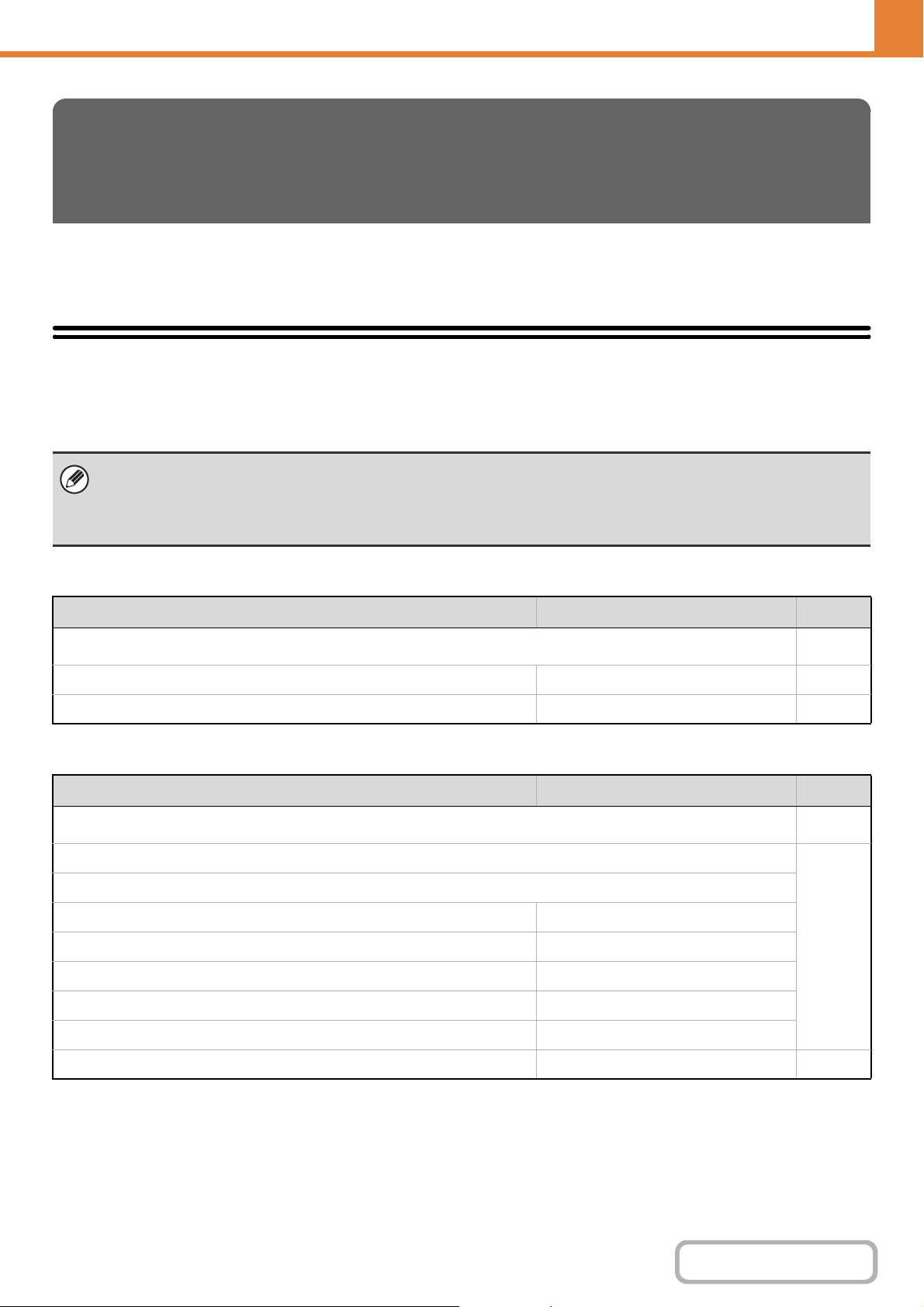
6-42
SYSTEM SETTINGS
Contents
WEB PAGE (GENERAL)
This section explains system settings that can be configured in the Web page by general users. These settings are
accessed by selecting [System Settings] in the Web page menu bar.
System Settings (General) List
When the system settings are accessed with general rights, the following items appear. For items that can only be
accessed with administrator rights, see "System Settings (Administrator) List" (page 6-56).
Total Count
Default Settings
SYSTEM SETTINGS (GENERAL) IN
THE WEB PAGE
• Depending on the machine specifications and peripheral devices installed, it may not be possible to use some settings.
• For explanations of settings related to the fax function, see "FAX SYSTEM SETTINGS IN THE WEB PAGE" (page 6-106).
• After configuring certain settings, you may be prompted to restart the machine. Restart the machine in the screen that
appears.
Item Factory default setting Page
■ Total Count
6-45
● Job Count – 6-45
● Device Count – 6-45
Item Factory default setting Page
■ Default Settings
6-46
● Clock Adjust
6-46
X Clock Adjust
Specify Time Zone –
Date & Time Settings –
Synchronize with Internet Time Server Disable
X Daylight Saving Time Setting Disable
X Date Format
[MM/DD/YYYY], [/], [Last], [12 Hour]
● Keyboard Select
English (US)
6-47
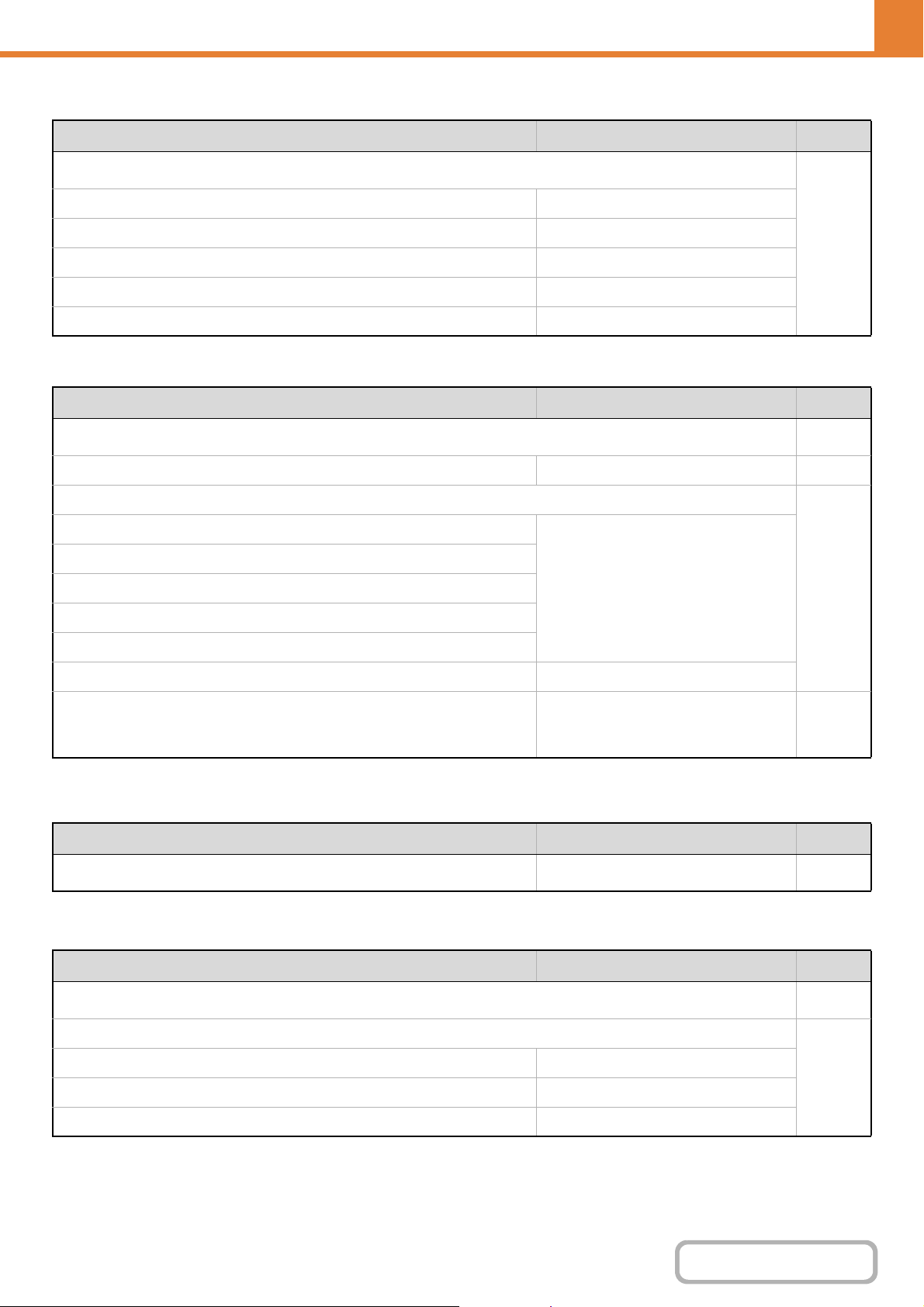
6-43
SYSTEM SETTINGS
Contents
WEB PAGE (GENERAL)
List Print (User)
Paper Tray Settings
* When a 500-sheet paper feed unit is installed.
Paper Type Registration
Fax Data Receive/Forward
* When the Internet fax expansion kit is installed.
Item Factory default setting Page
■ List Print (User)
6-47
● All Custom Setting List –
● Printer Test Page –
● Sending Address List –
● Machine Information List –
● Image Quality Check Chart –
Item Factory default setting Page
■ Paper Tray Settings
6-48
● Auto Tray Switching Enabled 6-48
● Tray Settings
6-48
X Tray 1
Plain, Auto-Inch
X Tray 2*
X Tray 3*
X Tray 4*
X Bypass
Select Similar Sizes for Auto Detection 8-1/2" x 14"
● Custom Size Registration (Bypass) Custom 1: X=11", Y=8-1/2"
Custom 2: X=11", Y=8-1/2"
Custom 3: X=11", Y=8-1/2"
6-48
Item Factory default setting Page
■ Paper Type Registration
– 6-51
Item Factory default setting Page
■ Fax Data Receive/Forward
6-51
● I-Fax Settings*
6-51
X Reception Start –
X Manual Reception Key in Initial Screen Enabled
X Forward Received Data –
6-44
SYSTEM SETTINGS
Contents
WEB PAGE (GENERAL)
Printer Condition Settings
* When a finisher is installed.
USB-Device Check
Item Factory default setting Page
■ Printer Condition Settings
6-52
● Printer Default Settings
6-52
X Copies 1
X Orientation Portrait
X Default Paper Size A4 (8-1/2" x 11")
X Default Paper Type Plain Paper
X Initial Resolution Setting 600dpi (High Quality)
X Disable Blank Page Print Disabled
X Line Thickness 5
X 2-Sided Print 1-Sided
X Color Mode Auto
X N-Up Print 1-Up
X Fit To Page Enabled
X Output
Print per Unit Enabled
Staple* Disabled
X Quick File Disabled
● PCL Settings
6-53
X PCL Symbol Set Setting PC-8
X PCL Font Setting Internal Font, 0: Courier
X PCL Line Feed Code 0.CR=CR; LF=LF; FF=FF
X Wide A4 Disabled
● PostScript Setting
6-54X Print PS Errors Disabled
X Binary Processing Disabled
Item Factory default setting Page
■ USB-Device Check
–
6-54
6-45
SYSTEM SETTINGS
Contents
WEB PAGE (GENERAL)
Total Count
This function shows the page count in each mode. Select [System Settings] - [Total Count] from the menu bar.
Job Count
This displays or prints out the counts of all jobs.
Device Count
This is used to display or print the counts of the peripheral devices installed on the machine.
• Each sheet of paper used for automatic two-sided copying is counted as two pages.
• Pages printed directly from the machine such as list prints are included in the "Other Prints" count.
• The items displayed (or printed) will vary depending on the machine specifications and peripheral devices installed.
• Document feeder
Each sheet is counted as two pages when two-sided scanning is performed.
• The items displayed (or printed) will vary depending on the machine specifications and peripheral devices installed.
6-46
SYSTEM SETTINGS
Contents
WEB PAGE (GENERAL)
Default Settings
The default settings for operation of the machine can be configured. Select [System Settings] - [Default Settings] from the
menu bar and configure each setting.
Clock Adjust
Use this to set the date and time in the machine's built-in clock.
Set the time.
Daylight Saving Time Setting
Enable daylight saving time.
Date Format
The format used to print the date on lists and other output can be changed.
Item Settings
Current Date & Time The current time set in the machine appears.
Specify Time Zone
If your region is ahead of GMT (Greenwich Mean Time), select [+]. If your region is
behind GMT, select [-]. Next, specify the time difference between your region and
GMT in hours and minutes.
Date & Time Settings Select and set the year, month, day, hour, and minute.
Synchronize with Internet Time Server
This can be used when the machine is connected to the Internet. The machine's time
is automatically adjusted to the time of an Internet time server.
Item Settings
Daylight Saving Time Setting
Select whether or not the Daylight Saving Time Setting is enabled. If disabled, the
following settings will not be possible.
Select Setting Type
Specify whether the starting and ending day of daylight saving time are to be set
using the day of the week or the date.
Start Time
Set the starting time of daylight saving time. Set the starting month. If you selected "Day
of the Week" in "Select Setting Type", set the starting week of daylight saving time and
then the starting day. If you selected "Date" in "Select Setting Type", set the starting date.
Set the hour and minute and the UTC (Coordinated Universal Time) setting.
Completing Time
Set the ending time of daylight saving time in the same way as you set the starting time.
Adjustment Time Set the time that adjustment will take place when daylight saving time begins.
Item Settings
Current Setting The current time appears in the format set in the date format settings.
Format Set the order of display of the year, month, and day (YYYY/MM/DD).
Separator Select one of three symbols or a blank space for the separator used in the date.
Day-Name Position Select whether the day name appears before or after the date.
Time Display Select 12-hour format or 24-hour format for the time.
12-Hour Display: 12:00AM to 11:59AM/12:00 to 11:59PM
24-Hour Display: 00:00 to 23:59
If "Disabling of Clock Adjustment" (page 6-69) has been enabled in the system settings (administrator), the date and time
cannot be set.
6-47
SYSTEM SETTINGS
Contents
WEB PAGE (GENERAL)
Keyboard Select
The layout of the keyboard that appears in text entry screens can be changed.
The keyboard layouts that can be selected are shown below.
List Print (User)
Lists showing the settings and information stored in the machine can be printed. Select [System Settings] - [List Print
(User)] from the menu bar and configure each setting. To print a list, select the [Print] key that appears in each item.
English (US) English (UK) Japanese French German Swedish
Norwegian Finnish Danish Russian Greek Turkish
List name Description
All Custom Setting List
This list shows the hardware status, software status, printer condition settings, paper
tray settings, and total counts.
Printer Test Page
This is used to print the PCL Symbol Set List, various font lists, and the NIC page
(network interface settings, etc.).
• PCL Symbol Set List
• PCL Internal Font List
• PCL Extended Font List
• PS Font List
• PS Extended Font List
• NIC Page
Sending Address List
Lists can be printed of various addresses stored in the machine.
• Individual List
• Group List
• Program List
• Memory Box List
• All Sending Address List
Machine Information List
This list prints basic information such as the model name and the installation location
of the machine.
Image Quality Check Chart
Print this chart based on the instruction of the dealer or nearest authorized service
representative.
You can print a chart to check the image quality of the machine.
The dealer or nearest authorized service representative assistance will use this chart
to evaluate the machine's condition and give you appropriate instructions.
• The items that appear will vary depending on the functions that have been added to the machine.
•If "Prohibit Test Page Printing" (page 6-77) has been enabled in the system settings (administrator), it will not be possible
to print a test page.
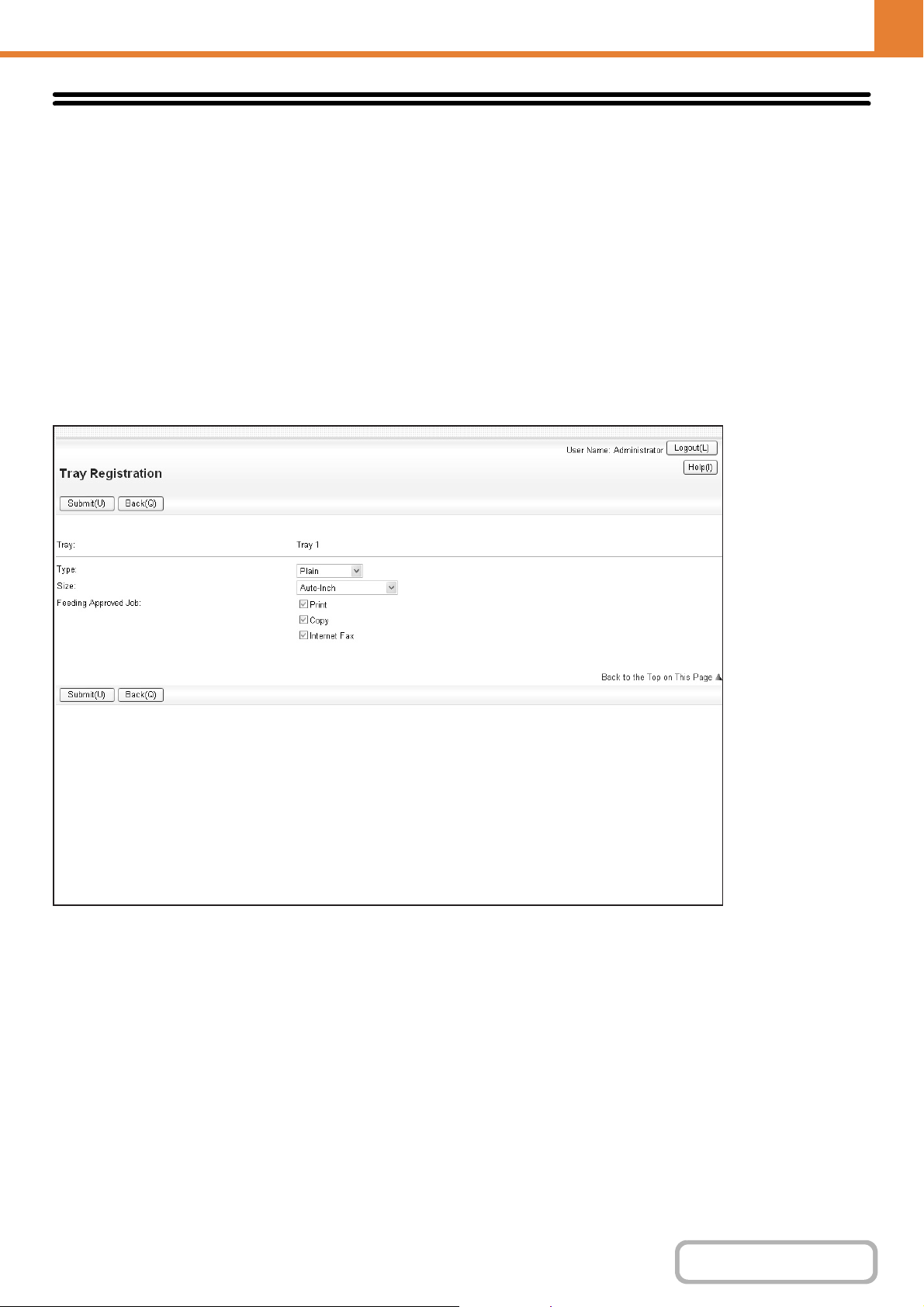
6-48
SYSTEM SETTINGS
Contents
WEB PAGE (GENERAL)
Paper Tray Settings
Paper tray and paper type settings are explained in this section. Select [System Settings] - [Paper Tray Settings] from
the menu bar and configure each setting.
A displayed tray name can be selected to open the tray settings screen.
Auto Tray Switching
When a tray runs out of paper during printing, this determines whether or not another tray with the same size and type of
paper is automatically selected and printing continues.
Tray Settings
These settings specify the paper type, paper size, and functions allowed for each paper tray.
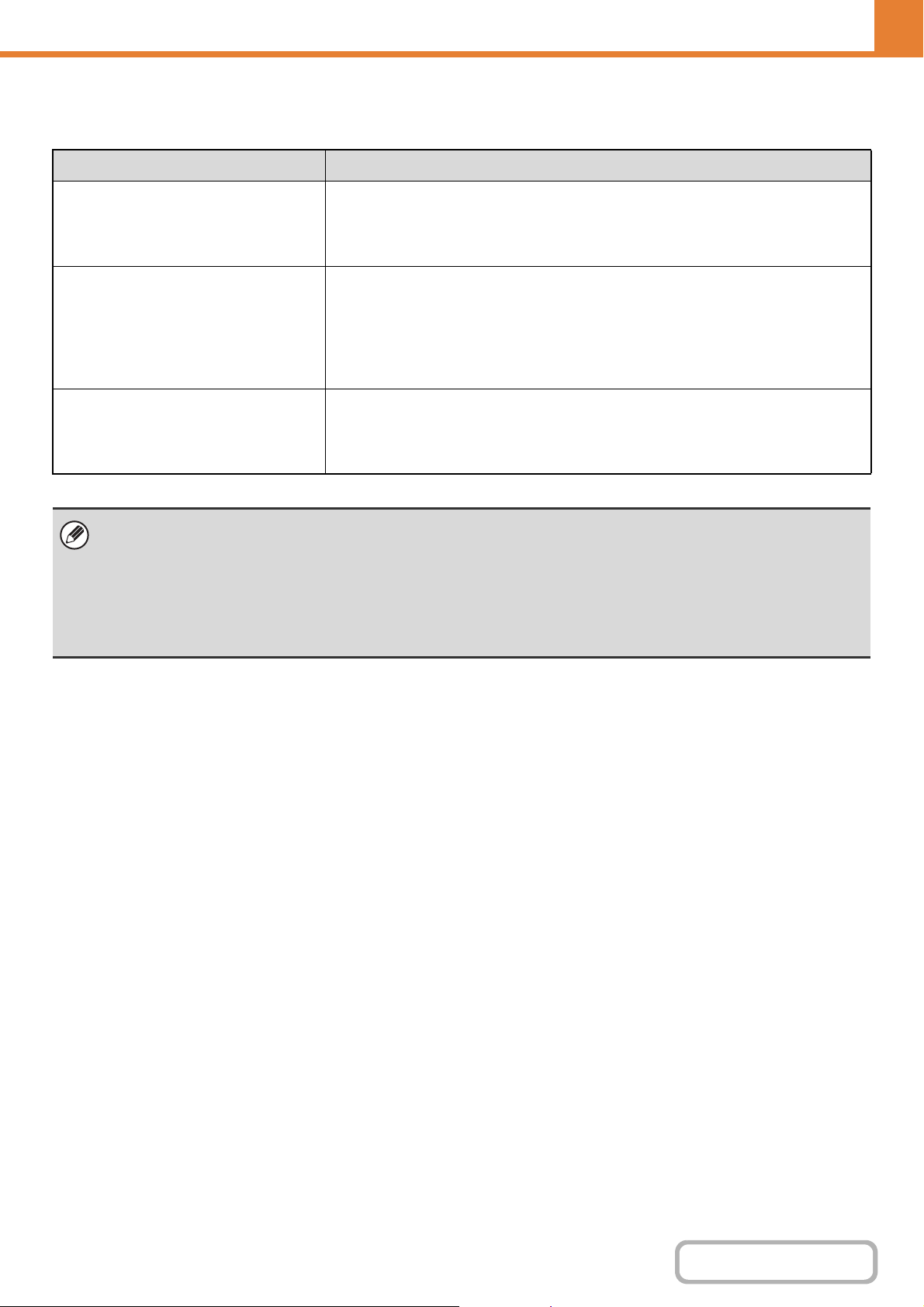
6-49
SYSTEM SETTINGS
Contents
WEB PAGE (GENERAL)
Settings of each tray
The following settings can be configured.
Item Description
Type
Select the type of paper that is loaded in the tray.
The paper types that can be selected vary by paper tray. For more information, see
"Tray Settings" (page 6-50).
To store a new paper type, see "Paper Type Registration" (page 6-51).
Size
Select the paper size from the list. The paper sizes that can be selected vary by tray.
The sizes that can be selected may also be restricted by the paper type selected
above. For more information, see "Tray Settings" (page 6-50).
If the desired size does not appear in the list, select [Custom Size] and directly enter
the size (only for the bypass tray). For more information, see "Tray Settings" (page
6-50).
Feeding Approved Job
Select the modes that can be used. If there is a function that you do not wish to be
used with the selected tray, disable the function.
When the "Type" is other than plain paper, recycled paper, colored paper, or a user
type, [Fax] and [Internet Fax] cannot be selected.
• If the paper size specified here is different from the size of paper that is loaded in a tray, a problem or misfeed may result
when printing.
To change the paper size in a tray, see "1. BEFORE USING THE MACHINE".
• Paper properties such as "Fixed Paper Side" are automatically set when the paper type is selected. The paper tray
properties cannot be changed in this screen.
•If "Disabling of Tray Settings" (page 6-72) has been enabled in the system settings (administrator), the tray settings
(except for the bypass tray) cannot be configured.
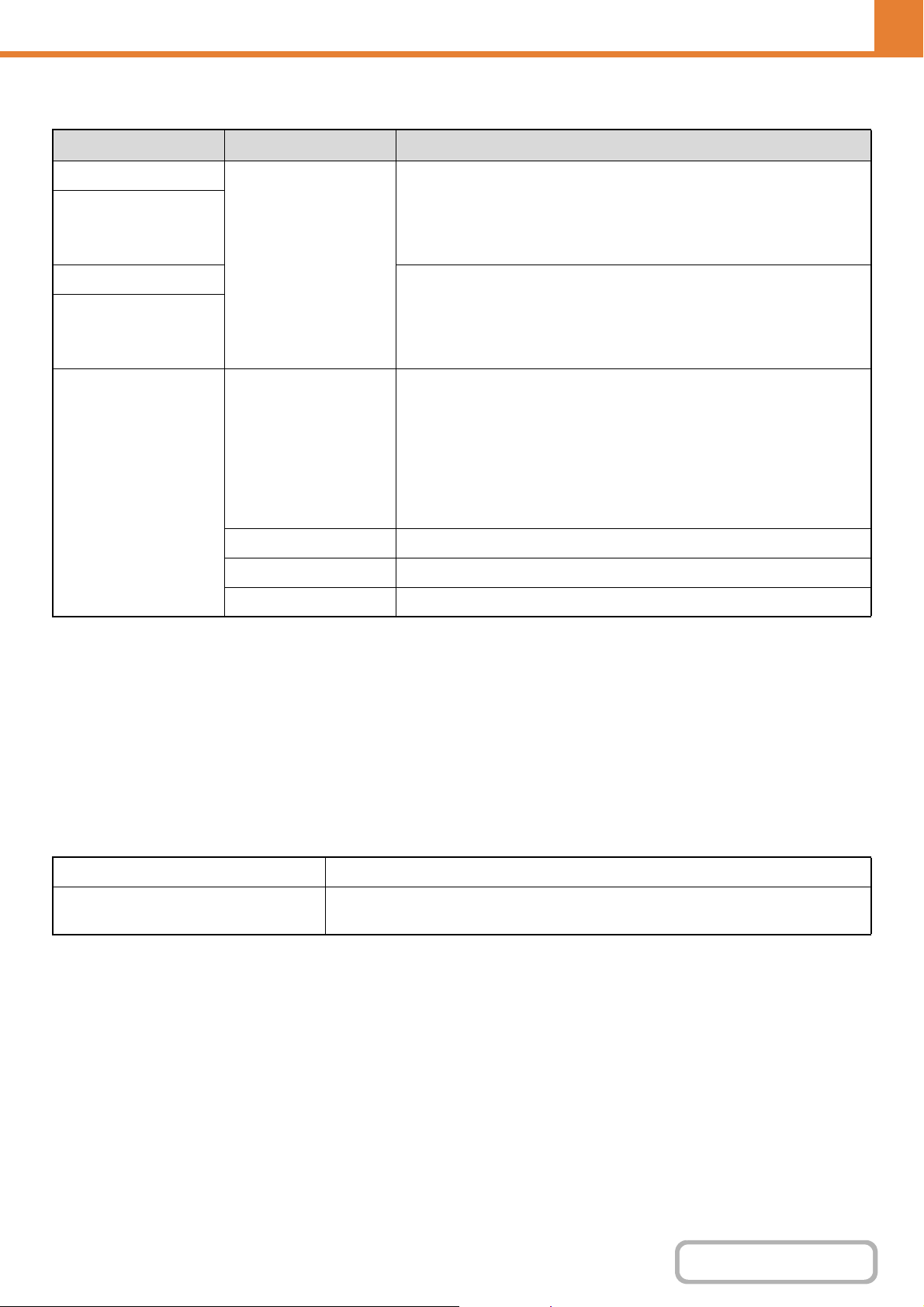
6-50
SYSTEM SETTINGS
Contents
WEB PAGE (GENERAL)
Tray Settings
*1 When a 500-sheet paper feed unit is installed.
*2 Heavy Paper : 28 lbs. bond to 110 lbs. index (106 g/m
2
to 209 g/m
2
) heavy paper
*3 The size that is automatically detected is set in "Select Similar Sizes for Auto Detection" in the bypass tray settings screen (see
below).
Select Similar Sizes for Auto Detection
"Select Similar Sizes for Auto Detection" in the bypass tray settings screen is used to select the paper size that is
automatically detected from similar sizes when automatic paper size detection takes place.
Select one of two sizes when "Auto-Inch" is set. Select one of three sizes when "Auto-AB" is set.
When paper that is the same size as one of the paper sizes in the settings is placed in the bypass tray, the size that is
selected in the settings will be automatically detected.
Paper Tray Paper Type Size
Tray 1 Plain, Pre-Printed,
Recycled, Letter Head,
Pre-Punched, Color,
User Type
Auto-Inch (8-1/2" x 14", 8-1/2" x 11", 7-1/4" x 10-1/2", 5-1/2" x 8-1/2"),
Auto-AB ( A4, A5, B5, 216 mm x330 mm (8-1/2" x 13")),
216 mm x 343 mm (8-1/2" x 13-1/2"), 8-1/2" x 13-2/5"
(216 mm x 340 mm),
16K
Tray 2*
1
Tray 3*
1
Auto-Inch (8-1/2" x 14", 8-1/2" x 11", 7-1/4" x 10-1/2"),
Auto-AB (A4, B5, 216 mm x 330 mm(8-1/2" x 13")),
216 mm x 343 mm (8-1/2" x 13-1/2"), 8-1/2" x 13-2/5"
(216 mm x 340 mm),
16K
Tray 4*
1
Bypass
In addition to the paper
types of trays 1 to 4,
Heavy Paper*
2
,
Thin Paper,
Glossy Paper
Auto-Inch (8-1/2" x 14"*
3
, 8-1/2" x 13-2/5" (216 mm x 340 mm)*
3
,
8-1/2" x 11", 7-1/4" x 10-1/2", 5-1/2" x 8-1/2"),
Auto-AB (A4, A5, B5, 216 mm x 330 mm (8-1/2" x 13")*
3
,
216 mm x 340 mm (8-1/2" x 13-2/5")*
3
, 216 mm x 343 mm
(8-1/2" x 13-1/2")*
3
),
Size Input-Inch (X=5-1/2" to 14", Y=5-1/2" to 8-1/2"),
Size Input-AB (X=140 mm to 356 mm, Y=100 mm to 216 mm),
16K, Custom 1, Custom 2, Custom 3
Labels Auto-Inch (8-1/2" x 11"), Auto-AB (A4, B5)
Transparency Auto-Inch (8-1/2" x 11"), Auto-AB (A4)
Envelope Com-10, Monarch, DL, C5
Auto-Inch 8-1/2" x 14", 8-1/2" x 13-2/5" (216 mm x 340 mm)
Auto-AB
216 mm x 330 mm (8-1/2" x 13"), 216 mm x 340 mm (8-1/2" x 13-2/5"),
216 mm x 343 mm (8-1/2" x 13-1/2")
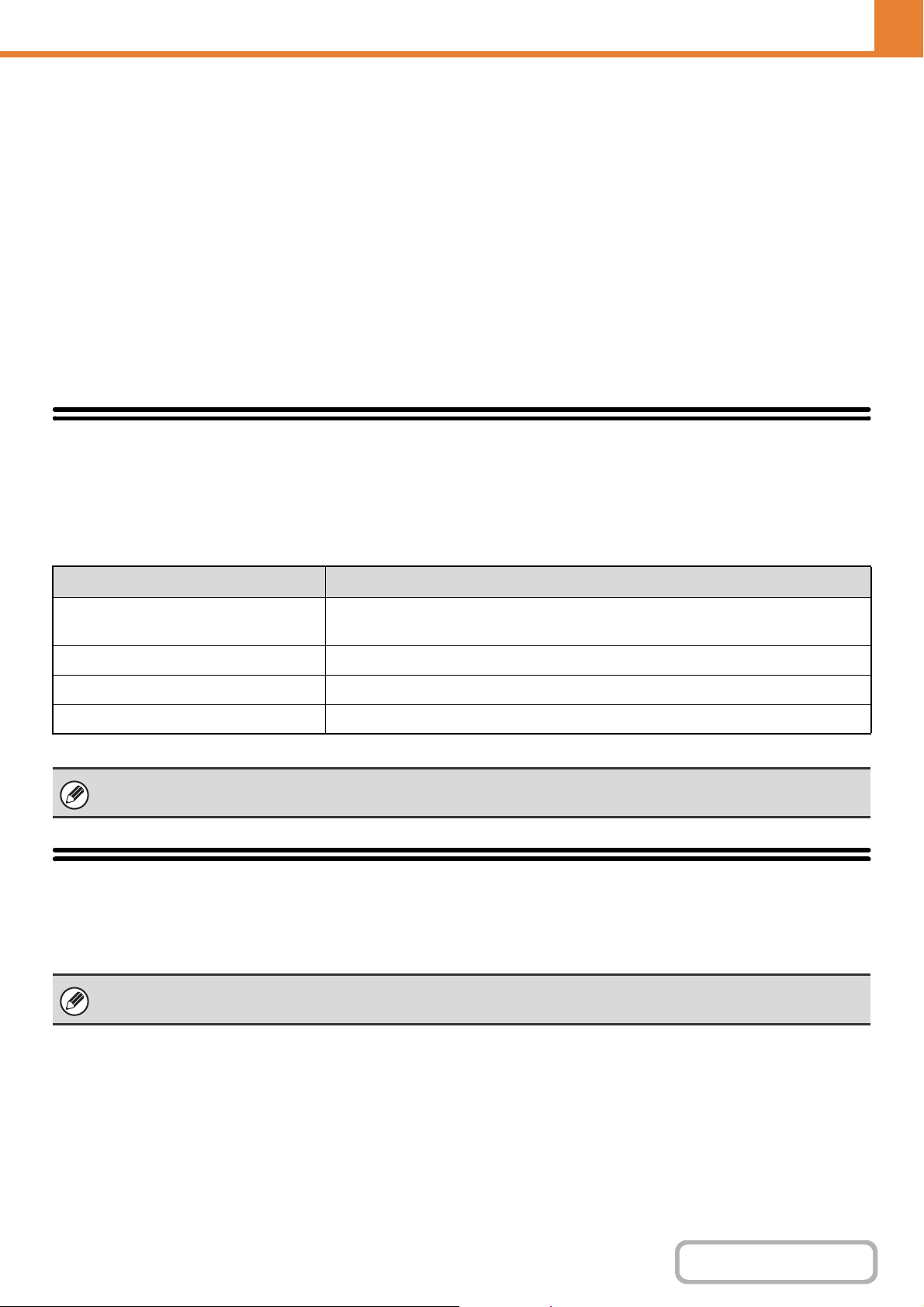
6-51
SYSTEM SETTINGS
Contents
WEB PAGE (GENERAL)
Custom Size Registration (Bypass)
If you frequently use a special non-standard paper size in the bypass tray, you can store that paper size.
Storing the paper size saves you the trouble of setting the size each time you need to use it.
Up to three paper sizes can be stored.
Select whether you wish to enter the size in inches ("Size Input-Inch") or mm ("Size Input-AB"), and then set the X and Y
dimensions of the paper.
"Size Input-Inch"
The X dimension can be set to a value from 5-1/2" to 14". The factory default setting is 11".
The Y dimension can be set to a value from 5-1/2" to 8-1/2". The factory default setting is 8-1/2".
"Size Input-AB"
The X dimension can be set to a value from 140 mm to 356 mm. The factory default setting is 297 mm.
The Y dimension can be set to a value from 100 mm to 216 mm. The factory default setting is 210 mm.
Paper Type Registration
Store a paper type when the desired paper type does not appear as a selection or when you wish to create a new set of
paper properties.
Select [System Settings] - [Paper Type Registration] from the menu bar and configure each setting.
Up to 7 paper types can be stored.
Fax Data Receive/Forward
This section explains settings for reception and forwarding. Select [System Settings] - [Fax Data Receive/Forward] from
the menu bar and configure each setting.
I-Fax Settings
This setting can be configured when the Internet fax expansion kit is installed.
Manual Reception Key in Initial Screen
This displays the [I-Fax Manual Reception] key in the base screen of Internet fax mode.
Item Description
Type Name
Store any name.
The factory default names are "User Type 1" - "User Type 7".
Fixed Paper Side Enable this setting when paper with a front and reverse side is used.
Disable Duplex Enable this setting when paper is loaded that cannot be used for two-sided printing.
Disable Staple Enable this setting when paper is used that cannot be stapled.
The settings that can be selected vary depending on the peripheral devices installed.
For explanations of settings related to the fax function, see "FAX SYSTEM SETTINGS ON THE OPERATION PANEL" (page
6-97).
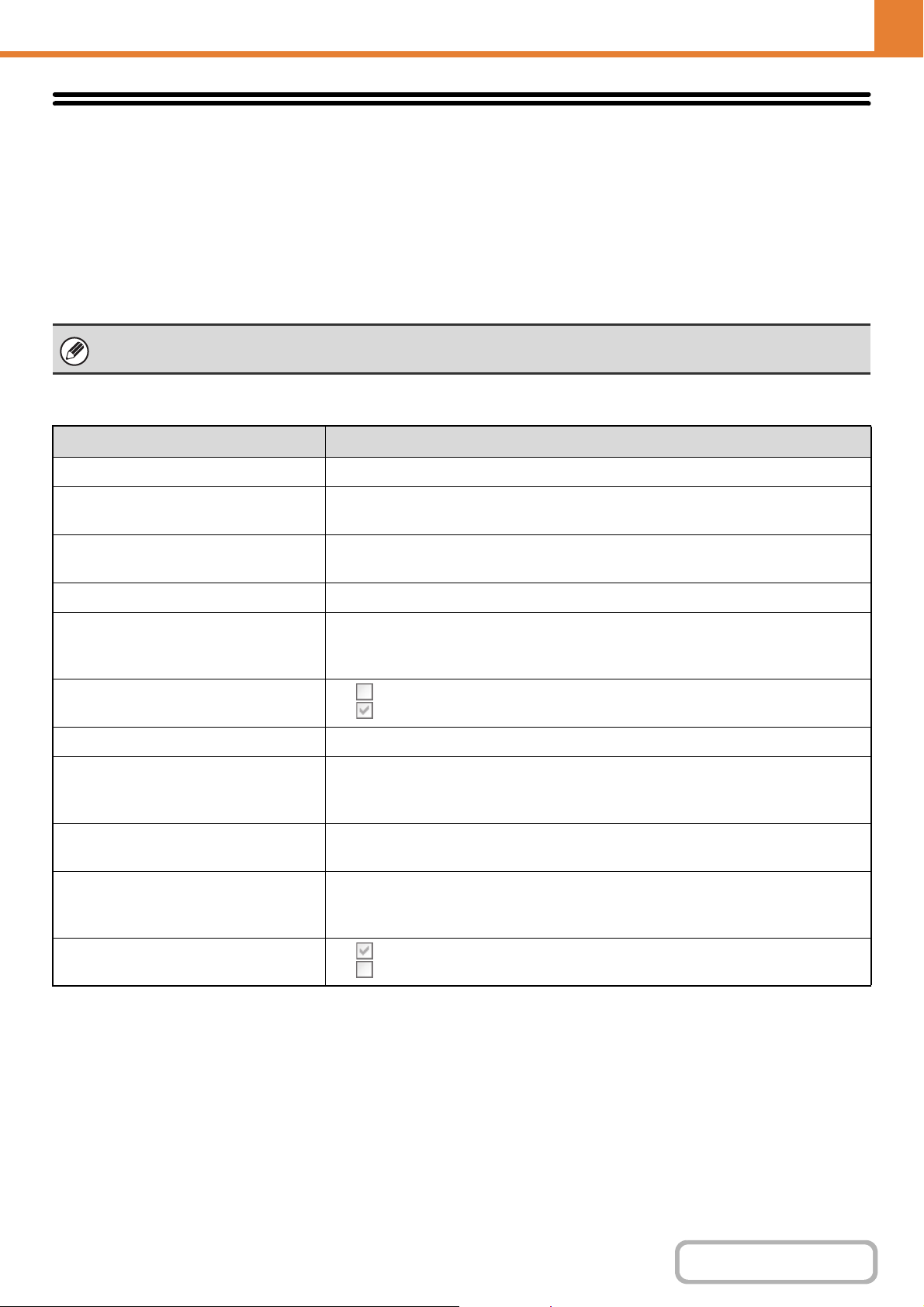
6-52
SYSTEM SETTINGS
Contents
WEB PAGE (GENERAL)
Printer Condition Settings
The Printer Condition Settings are used to configure basic printer settings and settings for printing from a DOS
application. Select [System Settings] - [Printer Condition Settings] from the menu bar and configure each setting.
Printer Default Settings
The default settings are used to set advanced print conditions for printing in an environment where the print driver is not
used (such as printing from MS-DOS or from a computer that does not have the provided print driver installed).
Settings
When printing using the printer driver, the printer driver settings take precedence over the printer condition settings.
Item Selections
Copies 1 - 999 sets
Orientation
• Portrait
• Horizontal
Default Paper Size
8-1/2" x 14", 8-1/2" x 13", 8-1/2" x 11", 7-1/4" x 10-1/2", 5-1/2" x 8-1/2", A4, B5, A5,
16k
Default Paper Type Plain Paper, Letter Head, Pre-Printed, Pre-Punched, Recycle Paper, Color
Initial Resolution Setting
• 600 dpi
• 600 dpi (High Quality)
• 1200 dpi
Disable Blank Page Print
• (Disabled)
• (Enabled)
Line Thickness*
1
0-9
2-Sided Print
• 1-Sided
• 2-Sided (Book)
• 2-Sided (Tablet)
Color Mode
•Auto
• Black & White
N-Up Print*
2
•1-Up
•2-Up
•4-Up
Fit To Page*
3
• (Use Fit to Page)
• (Do not use Fit to Page)

6-53
SYSTEM SETTINGS
Contents
WEB PAGE (GENERAL)
*1 This setting is used to adjust the line width of vector graphics (black & white printing only). Except for CAD and other
specialized uses, there is normally no need to change this setting. When "0" is selected, all lines are printed at a
width of 1 dot.
*2 Paper sizes that can be used with this function are 8-1/2" x 14", 8-1/2" x 11", and A4. (This function may not take
effect with some print methods.)
*3 Only effective when printing PDF, JPEG, and TIFF files.
*4 When a finisher is installed.
PCL Settings
To configure the symbol set, fonts, line break codes, and other settings used in a PCL environment, click the [PCL
Settings] tab.
Settings
Output
Print per unit
• (Use Print per Unit)
• (Do not use Print per Unit)
Staple*
4
• (Use Staple)
• (Do not use Staple)
Quick File
• (Disabled)
• (Enabled)
Item Description Selections
PCL Symbol Set Setting
Specify the symbol set used for
printing.
Select from 35 items.
PCL Font Setting
Use this to select the font used for
printing.
• Internal Font
• Extended Font
(List of internal fonts when extended fonts are not
installed.)
PCL Line Feed Code
This setting is used to select how
the printer responds when a line
feed command is received.
• 0.CR=CR; LF=LF; FF=FF
• 1.CR=CR+LF; LF=LF;FF=FF
• 2.CR=CR; LF=CR+LF; FF=CR+FF
• 3.CR=CR+LF; LF=CR+LF; FF=CR+FF
Wide A4
When this is enabled, 80
characters per line can be printed
on A4 size paper using a 10-pitch
font. (When this setting is
disabled, up to 78 characters can
be printed per line.)
• (Enabled)
• (Disabled)
Item Selections
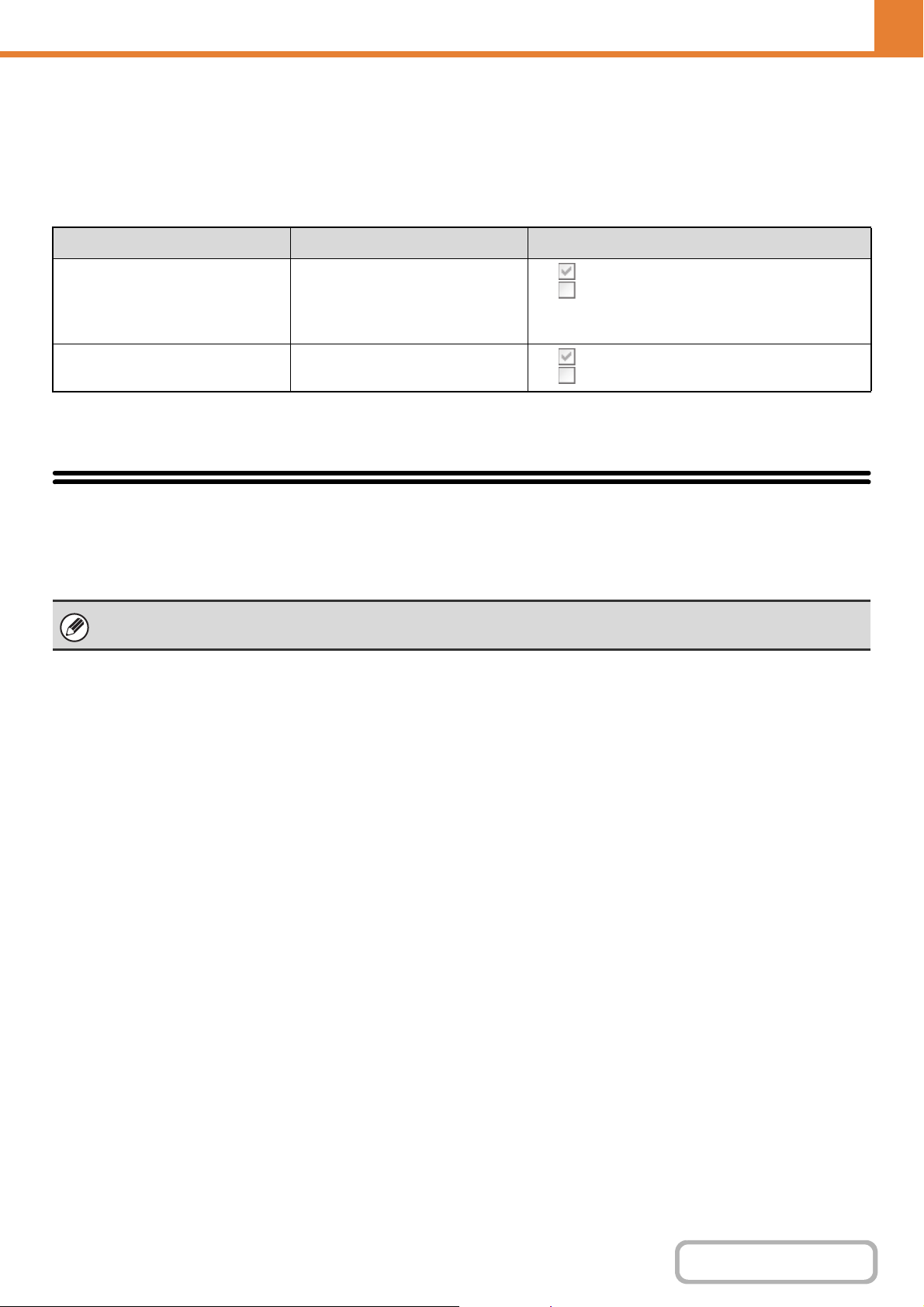
6-54
SYSTEM SETTINGS
Contents
WEB PAGE (GENERAL)
PostScript Setting
To configure settings for printing an error description when a PostScript data print error occurs and settings for reception
of PostScript data in binary format, click the [PostScript Setting] tab.
Settings
USB-Device Check
This lets you check the connection when a USB device is connected to the machine. Select [System Settings] -
[USB-Device Check] from the menu bar, and check the USB device.
Item Description Selections
Print PS Error
When a PS (PostScript) error
occurs during PostScript printing,
this setting determines whether or
not an error notice is printed.
• (Enabled)
• (Disabled)
Binary Processing
Receive PostScript data in binary
format.
• (Enabled)
• (Disabled)
The status of a USB device that is not compatible with the machine will not appear.
6-55
SYSTEM SETTINGS
Contents
WEB PAGE (ADMINISTRATOR)
This section explains system settings that can be configured in the Web page by an administrator. These settings are
accessed by selecting [System Settings] in the Web page menu bar.
Accessing the System Settings (Administrator)
To access the system settings (administrator), the administrator must log in as explained below.
When User Authentication is not Enabled
Click [Login] or click an item that requires administrator authority.
A login screen will appear. Enter the administrator password.
When User Authentication is Enabled
Log in using one of the methods below. Note that a login screen will not appear when auto login user is enabled.
When user authentication is by login name and password (and e-mail
address)
When accessing the Web page, enter a login name and password with administrator authority in the login screen. If the
login method has been set to login name / password / e-mail address, a text box for your [E-mail Address] will appear.
Enter your e-mail address in the text box.
Login by user number
When accessing the Web page, enter a user number with administrator authority in the login screen.
Login by administrator password is also possible from [Administrator Login].
SYSTEM SETTINGS
(ADMINISTRATOR) IN THE WEB PAGE
• User authentication is initially disabled (factory default setting).
• Before logging in, it is recommended that you enable the SSL function in your Web browser to prevent the password from
being leaked onto the network.
• To logout...
Click the [Logout] key in the top right corner of the screen. You can also close your Web browser.
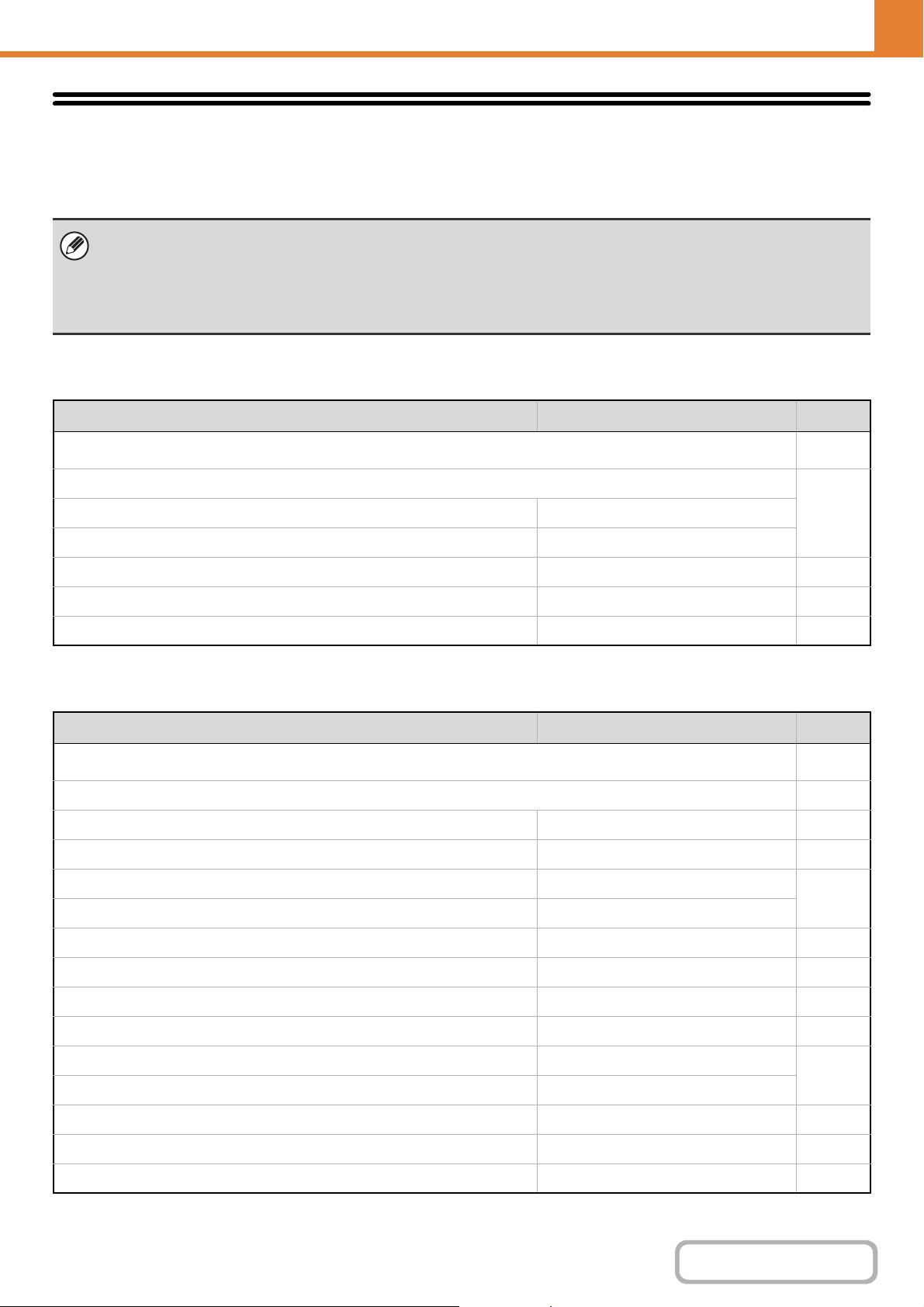
6-56
SYSTEM SETTINGS
Contents
WEB PAGE (ADMINISTRATOR)
System Settings (Administrator) List
The system settings that appear following administrator login are shown below. The default setting for each item is also
shown.
Energy save
Operation Settings
• Depending on the machine specifications and peripheral devices installed, it may not be possible to use some settings.
• For information on the general settings, see "System Settings (General) List" (page 6-8).
• For explanations of settings related to the fax function, see "FAX SYSTEM SETTINGS IN THE WEB PAGE" (page 6-106).
• After configuring certain settings, you may be prompted to restart the machine. Restart the machine in the screen that
appears.
Item Factory default setting Page
■ Energy Save
6-68
● Toner Save Mode
6-68X Print Disabled
X Copy Disabled
● Auto Power Shut-Off Enabled 6-68
● Auto Power Shut-Off Timer 45 min. 6-68
● Preheat Mode Setting 10 min. 6-68
Item Factory default setting Page
■ Operation Settings
6-69
● Operation Settings 6-69
X Keys Touch Sound Middle 6-69
X Key Touch Sound at Initial Point Disabled 6-69
X Auto Clear Setting 60 sec.
6-69
Cancel Auto Clear Timer Disabled
X Message Time Setting 6 sec. 6-69
X MFP Display Language Setting
American English
6-69
X Disabling of Job Priority Operation Disabled 6-69
X Disabling of Bypass Printing Disabled 6-69
X Key Operation Setting 0.0 sec.
6-69
Disable Auto Key Repeat Disabled
X Disabling of Clock Adjustment Disabled 6-69
X Business Card Scan Option Disabled 6-69
X MFP Display Pattern Setting Pattern 1 6-69
6-57
SYSTEM SETTINGS
Contents
WEB PAGE (ADMINISTRATOR)
● Preview Setting
6-70
X Default Preview Display
Image Send Reception Data: Twice
Memory Box: Twice
X Received Data Image Check Setting Disabled
● Remote Operation Settings
6-70
X Remote Software Operation
Operational Authority Prohibited
View Password Entry Screen Display in Both PC and MFP
X Operation from Specified PC
Operational Authority Prohibited
Hostname or IP Address of PC –
View Password Entry Screen Display in Both PC and MFP
X Operation by User who Has Password
Operational Authority Prohibited
View Password Entry Screen Display in Both PC and MFP
● Customize Key Setting 6-71
X Copy
6-71
Customize 1 2in1
Customize 2 Card Shot
Customize 3 Slow Scan Mode
X Scan
6-71
Customize 1 Program
Customize 2 Global Address
Customize 3 All Destinations
X Internet Fax*
1
(Same as Scan)
X Fax*
2
(Same as Scan)
X USB Memory Scan
Customize 1 –
Customize 2 –
Customize 3 –
X Data Entry*
3
(Same as Scan)
Item Factory default setting Page
6-58
SYSTEM SETTINGS
Contents
WEB PAGE (ADMINISTRATOR)
*1 When the Internet fax expansion kit is installed.
*2 When the facsimile expansion kit is installed.
*3 When the application integration module is installed.
Device Control
*1 When a 500-sheet paper feed unit is installed.
*2 When a finisher is installed.
● Soft Keyboard Template Setting 1: .com, 2: .net, 3: .org, 4: .biz, 5: .info,
6: http://, 7 to 30: Not set
6-71
Item Factory default setting Page
■ Device Control
6-72
● AB/Inch Type Setting Inch 6-72
● Default Original Size Settings Copy: None
Fax/Image Send: 8-1/2" x 11"
6-72
● Disabling of Document Feeder Disabled 6-72
● Original Feeding Mode All Disabled 6-72
● Disabling of Duplex Disabled 6-72
● Disabling of Optional Paper Feed Unit*
1
Disabled 6-72
● Disabling of Tray Settings Disabled 6-72
● Disabling of Offset*
2
Disabled 6-72
● Disabling of Stapler*
2
Disabled 6-72
● Auto Paper Selection Setting Plain Paper 6-73
● Detect Standard in Auto Color Mode 3 6-73
● Fusing Control Settings 16 - 23 lbs. (60 - 89g/m
2
) 6-73
● Interval of Image Quality Adjustment Setting 2 6-73
Item Factory default setting Page
6-59
SYSTEM SETTINGS
Contents
WEB PAGE (ADMINISTRATOR)
Copy Function Settings
Item Factory default setting Page
■ Copy Function Settings
6-74
● Initial Status Settings
6-74
X Color Mode Full Color
X Paper Tray Tray 1
X Exposure Type Auto
X Copy Ratio 100%
X 2-Sided Copy 1-Side to 1-Side
X Output Auto
● Copy Settings 6-75
X Copy Exposure Adjustment
6-75 Color 5
Black & White 5
X Add or Change Extra Preset Ratios – 6-75
X Setting a Maximum Number of Copies 999 6-75
X Initial Margin Shift Setting
6-75 Side 1 1/2"
Side 2 1/2"
X Erase Width Adjustment
6-75
Edge Clearance Width 1/2"
X Card Shot Settings
6-75 Original Size X: 3-3/8", Y: 2-1/8"
Fit to Page Disabled
X Disabling Deletion of Job Programs Disabled 6-75
X Disabling of Bypass-Tray in Duplex Copy Disabled 6-75
X Disabling of Auto Paper Selection Disabled 6-75
X Auto Selection of Paper Tray that was Last Loaded Disabled 6-75
X Color 600dpi x 600dpi Scanning Mode for Document Feeder Enabled 6-76
X Color Quick Scan from Document Glass Disabled 6-76
X B/W 600dpi x 600dpi Scanning Mode for Document Feeder Enabled 6-76
X B/W Quick Scan from Document Glass Disabled 6-76
6-60
SYSTEM SETTINGS
Contents
WEB PAGE (ADMINISTRATOR)
Printer Settings
Image Send Settings
Item Factory default setting Page
■ Printer Settings
6-77
● Default Settings 6-77
X Prohibit Notice Page Printing Enabled 6-77
X Prohibit Test Page Printing Disabled 6-77
X A4/Letter Size Auto Change Disabled 6-77
X Print Density Level
6-77 Color 3
Black & White 3
X CMYK Exposure Adjustment 0 6-77
X Bypass Tray Settings 6-77
Enable Detected Paper Size in Bypass Tray Disabled 6-77
Enable Selected Paper Type in Bypass Tray Enabled 6-77
Exclude Bypass-Tray from Auto Paper Select Disabled 6-77
X Job Spool Queuing Enabled 6-77
● Interface Settings 6-78
X Hexadecimal Dump Mode Disabled 6-78
X I/O Timeout 60 sec. 6-78
X Enable USB Port Enabled 6-78
X USB Port Emulation Switching Auto 6-78
X Enable Network Port Enabled 6-78
X Network Port Emulation Switching Auto 6-78
X Port Switching Method Switch at End of Job 6-78
Item Factory default setting Page
■ Image Send Settings
6-79
● Operation Settings 6-79
X Default Settings 6-79
Default Display Settings Scan (fax when fax is installed)
6-79
• Hold settings for a while after scanning has been
completed
Disabled
• Switch Automatically to Copy Mode Screen
Enabled
Address Book Default Selection Tab Switch: ABC, Address Type: All 6-79
6-61
SYSTEM SETTINGS
Contents
WEB PAGE (ADMINISTRATOR)
Initial Resolution Setting
6-79
•Scan Apply the Resolution Set when
Stored: Disabled
200 X 200 dpi
• Internet Fax*
1
Apply the Resolution Set when
Stored: Disabled
200 X 100 dpi
•Fax*
2
Apply the Resolution Set when
Stored: Disabled
Standard
Default Exposure Settings Auto 6-79
Default Original Image Type Text
6-80
• Moiré Reduction Disabled
Must Input Next Address Key at Broadcast Setting Disabled 6-80
Scan Complete Sound Setting Middle 6-80
The Number of File Name/Subject/Body Keys Displayed
Setting
12
6-80
The Number of Direct Address Keys Displayed Setting 10 6-80
Disable Switching of Display Order Disabled 6-80
Hold Setting for Received Data Print*
3
Disabled 6-80
Erase Width Adjustment
6-80
• Edge Clearance Width 1/2"
X Enable/Disable Settings 6-81
Settings to Disable Registration 6-81
• Disable Registering Destination on Web Page*
4
All disabled 6-81
• Disable Registration of Program All disabled 6-81
• Disable Registration of Memory Box*
2
All disabled 6-81
• Disable Registration Using Network Scanner Tool*
4
Disabled 6-81
Settings to Disable Transmission 6-81
• Disable [Resend] on Image Send Mode Disabled 6-81
• Disable Selection From Address Book All disabled 6-81
• Disable Direct Entry All disabled 6-82
• Disable PC-I-Fax Transmission*
1
Disabled 6-82
• Disable PC-Fax Transmission*
2
Disabled 6-82
X Own Name and Destination Set
6-82
Sender Data Registration
• Sender Name –
• Sender Fax Number*
2
–
• I-Fax Own Address*
1
–
Registration of Own Name Select*
2
– 6-82
Item Factory default setting Page
6-62
SYSTEM SETTINGS
Contents
WEB PAGE (ADMINISTRATOR)
● Scan Settings 6-83
X Scan Settings 6-83
Default Sender Set – 6-83
Default Color Mode Settings
6-83
• Black & White Mono 2
• Color Mode Auto, Grayscale
• Disable Change of B/W Setting in Auto Mode Disabled
Initial File Format Setting
6-83
• File Type PDF
• Black & White MMR (G4)
• Color/Grayscale Medium
• Specified Pages per File Disabled
• Number of Pages Disabled
Compression Mode at Broadcasting
6-83• Black & White MH (G3)
• Color/Grayscale Medium
Maximum Size of E-mail Attachments (E-mail) Unlimited 6-84
Maximum Size of Data Attachments (FTP/Desktop/Network
Folder)
Unlimited
6-84
Bcc Setting
6-84• Enable Bcc Disabled
• Display Bcc Address on the Job Status Screen Disabled
Disable Scan Function
6-84• USB Memory Scan Disabled
•PC Scan Disabled
X Default Address 6-84
Default Address Setting Disabled 6-84
● I-Fax Settings*
1
6-85
X Default Settings 6-85
Auto Wake Up Print Enabled 6-85
Compression Setting MH (G3) 6-85
Speaker Volume Setting
6-85• Receive Signal Middle
• Communication Error Signal Middle
Original Print on Transaction Report Print Out Error Report Only 6-85
Item Factory default setting Page
6-63
SYSTEM SETTINGS
Contents
WEB PAGE (ADMINISTRATOR)
*1 When the Internet fax expansion kit is installed.
*2 When the facsimile expansion kit is installed.
*3 When the Internet fax expansion kit or facsimile expansion kit is installed.
*4 When network connection is enabled.
Transaction Report Print Select Setting
6-85
• Single Sending Print Out Error Report Only
• Broadcasting Print Out All Report
• Receiving No Printed Report
Activity Report Print Select Setting
6-86• Auto Print at Memory Full Disabled
• Print Daily at Designated Time Disabled
Body Text Print Select Setting Disabled 6-86
X Send Settings 6-86
I-Fax Reception Report On/Off Setting Disabled 6-86
I-Fax Reception Report Request Timeout Setting 1 hour 6-86
Number of Resend Times at Reception Error 2 6-86
Maximum Size of E-mail Attachments Unlimited 6-86
Rotation Sending Setting All Enabled 6-87
Printing Page Number at Receiver Enabled 6-87
Recall in Case of Line Busy Times: 2, Interval 3 min. 6-87
Recall in Case of Communication Error Times: 2, Interval 3 min. 6-87
X Receive Settings 6-87
Auto Receive Reduce Setting Enabled 6-87
Duplex Reception Setting Disabled 6-87
Set Address for Data Forwarding
6-87
• Forwarding to –
• Direct SMTP Disabled
• Add Hostname or IP Address. Disabled
• Hostname or IP Address –
Receiving Date & Time Print Disabled 6-88
POP3 Communication Timeout Setting 60 sec. 6-88
Reception Check Interval Setting 5 min. 6-88
X Allow/Reject Mail or Domain Name Setting All Invalid 6-88
Item Factory default setting Page
6-64
SYSTEM SETTINGS
Contents
WEB PAGE (ADMINISTRATOR)
Print Hold Setting
List Print (Administrator)
*1 When network connection is enabled.
*2 When the application integration module is installed.
Sharp OSA Settings
Item Factory default setting Page
■ Print Hold Setting
6-89
● Default Mode Settings Sharing Mode 6-89
● Sort Method Setting Date 6-89
● Administrator Authority Setting
6-89X Delete File Disabled
X Change Password Disabled
● Batch Print Settings
6-89X Selection of [All Users] is not allowed. Enabled
X Selection of [User Unknown] is not allowed. Enabled
● Automatic Deletion of File Settings All invalid 6-89
Item Factory default setting Page
■ List Print (Administrator)
6-90
● Administrator Settings List – 6-90
● Image Sending Activity Report – 6-90
● Data Receive/Forward List – 6-90
● Web Settings List*
1
– 6-90
● Metadata Set List*
2
– 6-90
Item Factory default setting Page
■ Sharp OSA Settings
6-91
● Animation Play Speed Setting Standard 6-91
6-65
SYSTEM SETTINGS
Contents
WEB PAGE (ADMINISTRATOR)
Enable/Disable Settings
Item Factory default setting Page
■ Enable/Disable Settings
6-92
● Printer Condition Settings 6-92
X Disable Blank Page Print Disabled 6-92
● User Control 6-92
X Disabling of Printing by Invalid User Disabled 6-92
● Operation Settings 6-92
X Cancel Auto Clear Timer Disabled 6-92
X Disabling of Job Priority Operation Disabled 6-92
X Disabling of Bypass Printing Disabled 6-92
X Disable Auto Key Repeat Disabled 6-92
X Disabling of Clock Adjustment Disabled 6-92
● Device Control 6-92
X Disabling of Document Feeder Disabled 6-92
X Disabling of Duplex Disabled 6-92
X Disabling of Optional Paper Feed Unit*
1
Disabled 6-92
X Disabling of Tray Setting Disabled 6-92
X Disabling of Offset*
2
Disabled 6-92
X Disabling of Stapler*
2
Disabled 6-92
● Copy Function Settings 6-93
X Disabling Deletion of Job Programs Disabled 6-93
X Disabling of Bypass-Tray in Duplex Copy Disabled 6-93
X Disabling of Auto Paper Selection Disabled 6-93
● Printer Settings 6-93
X Prohibit Notice Page Printing Enabled 6-93
X Prohibit Test Page Printing Disabled 6-93
X Exclude Bypass-Tray from Auto Paper Select Disabled 6-93
6-66
SYSTEM SETTINGS
Contents
WEB PAGE (ADMINISTRATOR)
*1 When a 500-sheet paper feed unit is installed.
*2 When a finisher is installed.
*3 When network connection is enabled.
*4 When the facsimile expansion kit is installed.
*5 When the Internet fax expansion kit is installed.
● Image Send Settings 6-93
X Disable Switching of Display Order Disabled 6-93
X Disable Scan Function
6-93 PC Scan Disabled
USB Memory Scan Disabled
X Settings to Disable Registration 6-93
Disable Registering Destination on Web Page*
3
All disabled 6-93
Disable Registration of Program All disabled 6-93
Disable Registration of Memory Box*
4
All disabled 6-93
Disable Registration Using Network Scanner Tools*
3
Disabled 6-94
X Settings to Disable Transmission 6-94
Disable [Resend] on Image Send Mode Disabled 6-94
Disable Selection from Address Book All disabled 6-94
Disable Direct Entry All disabled 6-94
Disable PC-I-Fax Transmission*
5
Disabled 6-94
Disable PC-Fax Transmission*
4
Disabled 6-94
● Print Hold Setting 6-94
X Batch Print Settings
6-94 Selection of [All Users] is not allowed. Enabled
Selection of [User Unknown] is not allowed. Enabled
Item Factory default setting Page
6-67
SYSTEM SETTINGS
Contents
WEB PAGE (ADMINISTRATOR)
Product Key
* It may not be possible to use some settings, depending on the peripheral devices installed.
Storing/Calling of System Settings
Item Factory default setting Page
■ Product Key*
6-95
● Serial Number – 6-95
● PS3 Expansion Kit – 6-95
● Internet Fax Expansion Kit – 6-95
● E-mail Alert and Status – 6-95
● Application Integration Module – 6-95
● Application Communication Module – 6-95
● External Account Module – 6-95
● XPS Expansion Kit – 6-95
Item Factory default setting Page
■ Storing/Calling of System Settings
6-96
● Restore Factory Defaults – 6-96
● Store Current Configuration – 6-96
● Restore Configuration – 6-96
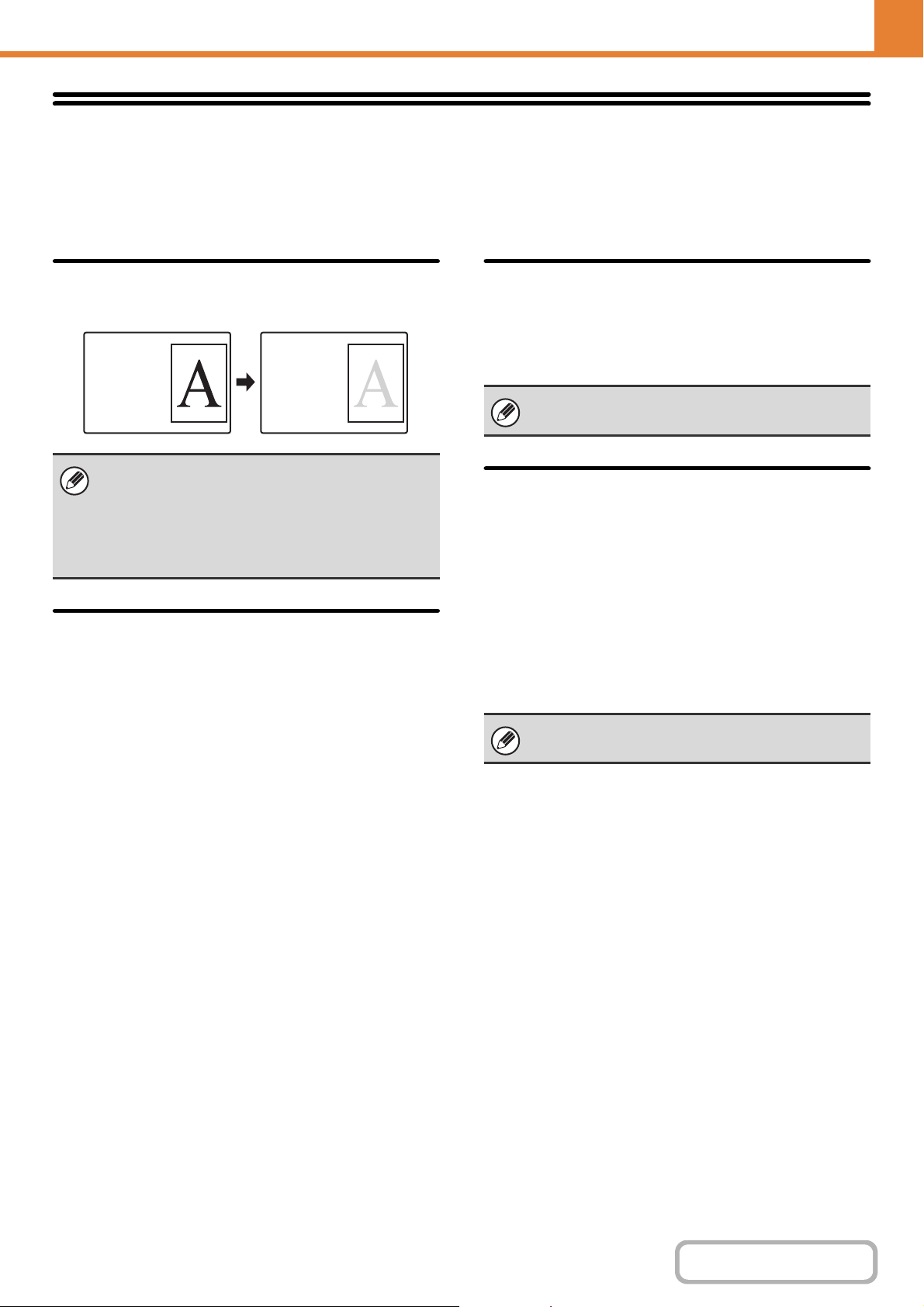
6-68
SYSTEM SETTINGS
Contents
WEB PAGE (ADMINISTRATOR)
Energy Save
The Energy Save settings help reduce power costs. From an environmental perspective, these settings also help reduce
pollution and conserve natural resources. Select [System Settings] - [Energy Save] from the menu bar and configure
each setting.
Toner Save Mode
You can reduce the amount of toner used for printing.
Auto Power Shut-Off
This setting enables or disables Auto Power Shut-Off.
Remove the checkmark if you prefer that Auto Power
Shut-Off does not operate.
When the set duration of time elapses after printing
ends, Auto Power Shut-Off activates and causes the
machine to go on standby at a minimal level of power
consumption.
This function reduces your power costs, and at the same
time helps conserve natural resources and reduce
pollution.
If you prefer that auto power shut-off activates as little as
possible, it is recommended that you try lengthening the
time setting after which activation takes place rather than
disabling the function altogether. (The time setting is
changed using "Auto Power Shut-Off Timer" below.)
Auto Power Shut-Off Timer
The time until Auto Power Shut-Off activates can be set
to any number of minutes from 1 to 240.
Select the time that best suits your workplace needs.
Preheat Mode Setting
The time until Preheat Mode activates can be set to any
number of minutes from 1 to 240.
Preheat Mode will activate when the set duration of time
elapses after printing ends and no further operations are
performed. This function reduces your power costs, and
at the same time helps conserve natural resources and
reduce pollution.
Select the time that best suits the needs of your
workplace.
[Print] in Toner Save Mode is only effective when the
machine's printer driver is not used. When the printer
driver is used, the printer driver setting takes
precedence.
This function may not operate in some applications
and operating systems.
Print
data
Print example
when "Toner
Save Mode"
is enabled
The timer setting will not be effective if Auto Power
Shut-Off is disabled using "Auto Power Shut-Off
".
Preheat mode cannot be disabled.
6-69
SYSTEM SETTINGS
Contents
WEB PAGE (ADMINISTRATOR)
Operation Settings
Settings related to machine operation can be configured. Select [System Settings] - [Operation Settings] from the menu
bar and configure each setting.
Operation Settings
Keys Touch Sound
This setting is used to adjust (or turn off) the volume of the
beep that sounds when you select a key.
Key Touch Sound at Initial Point
You can have three beeps sound at initial values when
setting the ratio in copy mode or when adjusting the
exposure in any mode.
Auto Clear Setting
The time until Auto Clear activates can be set to any
number of minutes from 10 to 240.
If the machine is not used for the duration of time set
here, the auto clear function will clear any settings that
have been selected and return the screen to the base
screen of copy mode or the job status screen.
Cancel Auto Clear Timer
This is used to disable the auto clear function.
Message Time Setting
The duration of time that messages appear in the display
(the time until a message is automatically cleared) can
be set to any number of seconds from 1 to 12.
MFP Display Language Setting
The language that appears in the display can be changed.
Disabling of Job Priority Operation
This disables the job priority function and hides the
[Priority] key in the job status screen.
Disabling of Bypass Printing
This is used to disable bypass printing (printing other
jobs ahead of a job that has been stopped* because the
paper required for the job is not in any of the trays).
* This does not include cases where the paper ran out
during the job.
Key Operation Setting
This setting determines how long a key in the display
must be selected until the key input is registered. The
time can be set from 0 to 2 seconds in increments of 0.5
seconds.
By lengthening the time setting, key input can be
prevented when a key is selected accidentally. Keep in
mind, however, that when a longer setting is selected
more care is required when selecting keys to ensure that
key input is registered.
Disable Auto Key Repeat
This is used to disable key repeat.
Key repeat causes a setting to change continuously
while a key is selected, not only each time the key is
selected.
Disabling of Clock Adjustment
This setting is used to prohibit changing of the date and
time.
Business Card Scan Option
When this setting is enabled, "Business Card Scan" can
be used in the special modes for copying and scanning.
MFP Display Pattern Setting
One of the six color patterns can be selected for the
color pattern in the display.
A sample of the selected pattern can be viewed.
Screen in which setting is effective
Initial
value
Ratio setting screen in base screen of
copy mode
Ratio 100%
Exposure adjustment screen in base
screen of copy mode
Exposure
level:
3 (medium)
Exposure adjustment screen in base screen of
fax, Internet fax, and network scanner modes
When user authentication is enabled and a display
language is specified in the favorite operation group,
that setting is given priority.
6-70
SYSTEM SETTINGS
Contents
WEB PAGE (ADMINISTRATOR)
Preview Setting
Configure settings for the preview screen that can be used for fax/image send.
Default Preview Display
Select the display zoom ratio of the preview screen for fax/image send.
Received Data Image Check Setting
Select whether or not a preview of received faxes and Internet faxes is shown.
Remote Operation Settings
Configure settings required for remote operation of the machine from a computer connected to the same network.
Remote Software Operation
Operation from Specified PC
Operation by User who Has Password
Operational Authority This is used when remote software is used to operate the machine remotely.
View Password Entry Screen
When remote software is used to operate the machine remotely, the entry screen for
the various passwords entered on the machine (such as login passwords) can be
displayed on the machine, your computer, or both.
This setting can be used to prevent the password from being seen.
Operational Authority This is used to allow remote operation of the machine using a specified computer.
Hostname or IP Address of PC
Enter the host name or IP address of the computer that will connect to the machine.
A maximum of 127 characters can be entered.
View Password Entry Screen
When a specified computer is used to operate the machine remotely, the entry screen
for the various passwords entered on the machine (such as login passwords) can be
displayed on the machine, your computer, or both.
This setting can be used to prevent the password from being seen.
Operational Authority This is used to allow a user who has a password to operate the machine.
View Password Entry Screen
When a user who has a password operates the machine remotely, the entry screen for
the various passwords entered on the machine (such as login passwords) can be
displayed on the machine, your computer, or both.
This setting can be used to prevent the password from being seen.
6-71
SYSTEM SETTINGS
Contents
WEB PAGE (ADMINISTRATOR)
Customize Key Setting
Short-cuts to functions that are frequently used can be displayed in the base screen of each mode.
For information on customize keys, see the chapters for each function.
The settings are shown below.
Soft Keyboard Template Setting
Use this to add a word to or edit a word in the list of stored words of the keyboard that appears in text entry screens.
Up to 30 words can be stored.
Select [System Settings] - [Operation Settings] - [Soft Keyboard Template Setting] in the menu bar, and configure the
settings.
Item Description
Customized Keys 1 - 3 Enter a name for the customized key (maximum of 14 characters).
Item
Select the function that you want to assign to the key. The functions that can be
selected vary by mode.
Return to the Defaults This returns all customized keys to their factory default state.
6-72
SYSTEM SETTINGS
Contents
WEB PAGE (ADMINISTRATOR)
Device Control
These settings control devices installed on the machine. Select [System Settings] - [Device Control] from the menu bar
and configure each setting.
AB/Inch Type Setting
The numbers and units of the default settings and input
ranges that appear in the setting screens can be
switched between inches and AB sizes.
Default Original Size Settings
Specify this setting when a particular original size is
frequently used. The setting will appear in the [Original]
key.
Specifying this setting allows the original size setting to
be omitted.
When [None] is selected, the original size does not
appear and must always be set manually.
Disabling of Document Feeder
Use this setting to prohibit the use of the automatic
document feeder, such as when the feeder malfunctions.
(When the setting is enabled, scanning is still possible
using the document glass.)
Original Feeding Mode
The following original feeding modes can be set to
operate by default in copy, and image send modes.
When a mode is frequently used, this saves you from
having to select the mode in the special modes each
time you need to use it.
• Mixed size originals of the same width (Copy mode
only)
• Slow Scan Mode
Disabling of Duplex
This is used to disable two-sided printing, such as when
the duplex module malfunctions.
Disabling of Optional Paper Feed
Unit
(When a 500-sheet paper feed unit is installed.)
This setting is used to disable a 500-sheet paper feed
unit, such as when it malfunctions.
Disabling of Tray Settings
This setting is used to prohibit tray settings (except for
the bypass tray).
Disabling of Offset
(When a finisher is installed.)
This setting is used to disable the offset function.
Disabling of Stapler
(When a finisher is installed.)
This setting is used to prohibit stapling, such as when
the stapler unit of the finisher malfunctions.
Mode Settings
Copy None, A5, B5, A4,
216mm x 330mm (8-1/2" x 13"),
8-1/2" x 13-2/5" (216mm x 340mm),
216mm x 343mm (8-1/2" x 13-1/2"),
8-1/2" x 11", 8-1/2" x 14", 5-1/2" x 8-1/2",
16K
Image Send None, A5, B5, A4,
216mm x 330mm (8-1/2" x 13"),
8-1/2" x 13-2/5" (216mm x 340mm),
216mm x 343mm (8-1/2" x 13-1/2"),
8-1/2" x 11", 8-1/2" x 14", 5-1/2" x 8-1/2",
16K, Long Size
6-73
SYSTEM SETTINGS
Contents
WEB PAGE (ADMINISTRATOR)
Auto Paper Selection Setting
The paper types* that the Auto Paper Selection function will
select can be specified. Select one of the following settings:
• Plain Paper
• Plain and Recycle Paper
• Recycle Paper
The Auto Paper Selection function will not select any
paper types other than the paper types specified with
this setting.
* The paper type set for each paper tray using "Paper
Tray Settings" (page 6-13) in the system settings
(general).
Detect Standard in Auto Color
Mode
When the color mode is set to auto in copy mode, the
discrimination point for detecting whether originals are
color or black and white can be set to one of 5 levels. To
make it easier to detect a black and white original, adjust
the setting toward [Black & White]. To make it easier to
detect a color original, adjust the setting toward [Color].
Fusing Control Settings
These are used to control the toner fusing temperature
according to the weight of the paper.
These settings apply to plain paper, recycled paper,
punched paper, pre-printed paper, letterhead paper,
colored paper, and user type paper.
You can select "16 to 23 lbs." or "23+ to 28 lbs."
("60g/m
2
to 89g/m
2
" or "90g/m
2
to 105g/m
2
").
Interval of Image Quality
Adjustment
The machine automatically performs Image Quality
Adjustment at regular intervals in order to prevent
changes of color after repeated color printing.
This setting is used to select the interval of Image
Quality Adjustment.
The interval becomes shorter and Image Quality
Adjustment is performed more frequently in the following
order:
Setting 1 (Long), Setting 2, Setting 3, Setting 4, Setting 5
(Short)
Guidelines for selection
If you print mostly business documents in black and
white, Setting 2 (factory default setting) or Setting 1
(Long) is recommended.
If you often print photos, Setting 3 or higher is
recommended.
• Be sure to use only paper that is in the same weight
range as the weight range set here. Do not mix
plain or other paper that is outside the range with
the paper in the tray.
• When settings are changed, the changes will take
effect after the machine is restarted. To restart the
machine see "TURNING THE POWER ON AND
OFF" (page 1-14) in "1. BEFORE USING THE
MACHINE ".
• When Setting 3 or higher is selected, more toner is
consumed than usual, and when a job is being
printed, printing may take place more slowly.
• Image Quality Adjustment can also be performed
whenever you notice that the color has changed.
See "Image Quality Adjustment" (page 6-10).
6-74
SYSTEM SETTINGS
Contents
WEB PAGE (ADMINISTRATOR)
Copy Function Settings
The following settings are related to copying. Select [System Settings] - [Copy Function Settings] from the menu bar and
configure each setting.
Default settings selected with these settings apply to all functions of the machine (not just the copy function).
Initial Status Settings
The copier settings are reset when the [POWER] key ( ) is turned on, when the [CLEAR ALL] key ( ) is pressed, or
when the auto clear interval has elapsed. These settings are used to change the default settings for copy mode.
The following settings can be changed:
Item Description
Color Mode Configure default color mode settings.
Paper Tray Specify the paper tray that is selected by default.
Exposure Type Configure exposure mode settings.
Copy Ratio Specify the copy ratio that is selected by default.
2-Sided Copy
Configure the 2-sided mode settings that are selected by default.
If this setting is used to change the default setting for the duplex function to other than "1-Side to 1-Side"
and the duplex function or automatic document feeder fails or is disabled, the setting will revert to
"1-Side to 1-Side".
Output Set the print output method that is selected by default.
Return to the
Defaults
This returns all items to the factory default settings.
6-75
SYSTEM SETTINGS
Contents
WEB PAGE (ADMINISTRATOR)
Copy Settings
Click the [Copy Settings] tab and configure the settings.
Copy Exposure Adjustment
This is used to adjust the exposure level when [Auto] is
used for the copy exposure.
Color
Use this to set the copy exposure level in color mode for the
document glass and for the automatic document feeder.
Black & White
Use this to set the copy exposure level in black & white
mode for the document glass and for the automatic
document feeder.
Add or Change Extra Preset Ratios
Two enlargement preset ratios (101% to 200%) and two
reduction preset ratios (50% to 99%) can be added. An
added preset ratio can also be changed.
Setting a Maximum Number of Copies
This is used to set the maximum number that can be
entered for the number of copies (number of continuous
copies). Any number from 1 to 999 can be specified.
Initial Margin Shift Setting
This is used to set the default margin shift amount.
Specify a value from 0" (0 mm) to 1" (20 mm) in
increments of 1/8" (1 mm) for both the front and reverse
sides.
Erase Width Adjustment
This is used to set the default erase width for erase
copy. Specify a value from 0" (0 mm) to 1" (20 mm) in
increments of 1/8" (1 mm) for edge erase.
Card Shot Settings
This is used to set the default original size for the card
shot function.
Both the X (horizontal) and Y (vertical) dimensions of the
original can be set from 1" (25 mm) to 8-1/2" (210 mm) in
increments of 1/8" (1 mm).
Fit to Page
Enable this setting to have the [Fit to Page] key always
appear in the card shot screen.
Disabling Deletion of Job Programs
This is used to prohibit the deletion and changing of copy
settings stored in job programs.
Disabling of Bypass-Tray in
Duplex Copy
This is used to prohibit the use of the bypass tray when
making two-sided copies.
The bypass tray is often used to feed label sheets,
transparency film, and other special media for which
two-sided copying is prohibited. If a sheet of one of these
special media enters the reversing unit, a misfeed or
damage to the unit may result. If special media for which
two-sided copying is prohibited is often used, it is
recommended that you enable this setting.
Disabling of Auto Paper Selection
This setting is used to disable the Auto Paper Selection
function.
When this is enabled and an original size is set, the
same size of paper is not automatically selected.
Auto Selection of Paper Tray that
was Last Loaded
When this setting is enabled and the machine is on
standby in copy mode, the last paper tray that was
loaded with paper automatically becomes the default
paper tray for copy mode, until the machine is reset.
Preset ratios other than added preset ratios cannot be
changed.
6-76
SYSTEM SETTINGS
Contents
WEB PAGE (ADMINISTRATOR)
Color 600dpi x 600dpi Scanning
Mode for Document Feeder
The resolution for copying in color using the automatic
document feeder can be changed from 600 x 300 dpi to
600 x 600 dpi (high quality mode).
When high quality mode is used, fine print and thin lines
are reproduced with greater clarity, however, the
scanning speed is slower.
Color Quick Scan from Document
Glass
The resolution for copying in color using the document
glass can be changed from 600 x 600 dpi to 600 x 300
dpi (high speed mode).
When high speed mode is selected, the first copy time is
quicker, however, the copy image is not as clear.
B/W 600dpi x 600dpi Scanning
Mode for Document Feeder
The resolution for copying in black and white using the
automatic document feeder can be changed from 600 x
300 dpi to 600 x 600 dpi (high quality mode).
When high quality mode is used, fine print and thin lines
are reproduced with greater clarity, however, the
scanning speed is slower.
B/W Quick Scan from Document
Glass
The resolution for copying in black and white using the
document glass can be changed from 600 x 600 dpi to
600 x 300 dpi (high speed mode).
When high speed mode is selected, the first copy time is
quicker, however, the copy image is not as clear.
When high quality mode is not selected, the following
conditions must be satisfied in order to scan at 600 x
300 dpi and attain the fastest speed.
• The copy ratio must be set to 100%.
• Do not select a special mode that will change the
ratio.
• [Copy of Copy] must not be enabled.
When high speed mode is selected, the following
conditions must be satisfied in order to scan at 600 x
300 dpi and attain the fastest speed.
• The copy ratio must be set to 100%.
• Do not select a special mode that will change the
ratio.
• [Copy of Copy] must not be enabled.
When high quality mode is not selected, the following
conditions must be satisfied in order to scan at 600 x
300 dpi and attain the fastest speed.
• The copy ratio must be set to 100%.
• Do not select a special mode that will change the
ratio.
• [Copy of Copy] must not be enabled.
• Do not copy in black and white with the [COLOR
START] key.
When high speed mode is selected, the following
conditions must be satisfied in order to scan at 600 x
300 dpi and attain the fastest speed.
• The copy ratio must be set to 100%.
• Do not select a special mode that will change the
ratio.
• [Copy of Copy] must not be enabled.
• Do not copy in black and white with the [COLOR
START] key.
6-77
SYSTEM SETTINGS
Contents
WEB PAGE (ADMINISTRATOR)
Printer Settings
Settings related to the printer function can be configured
Default Settings
Printer condition settings are described below. Select [System Settings] - [Printer Settings] - [Default Settings] in the
menu bar, and configure the settings.
Prohibit Notice Page Printing
This setting is used to disable printing of notice pages.
A notice page is printed when printing cannot be
executed as specified due to insufficient memory or
other reason. The notice page indicates the reason.
Prohibit Test Page Printing
This setting is used to disable printing of test pages.
When this setting is enabled, "Printer Test Page" in the
system settings cannot be used to print test pages.
A4/Letter Size Auto Change
When printing an A4 size image, this setting allows letter
(8-1/2 x 11") size paper to be used if A4 size paper is not
loaded.
Print Density Level
This lightens or darkens the print density of color and
black and white images. The print density can be
adjusted to five levels.
CMYK Exposure Adjustment
This is used to adjust the density of cyan (C), magenta
(M), Yellow (Y), and Black (K). The density of each color
can be adjusted to 17 levels.
Bypass Tray Settings
Enable Detected Paper Size in Bypass Tray
This is used to prohibit printing when the paper size
specified for a print job is different from the paper size
inserted in the bypass tray.
Enable Selected Paper Type in Bypass Tray
This is used to prohibit printing when the paper type
specified for a print job is different from the paper type
inserted in the bypass tray.
Exclude Bypass-Tray from Auto Paper Select
When [auto] is selected for paper type selection, the
bypass tray can be excluded from the trays that can be
selected. This is recommended when special media is
often placed in the bypass tray.
Job Spool Queuing
When this function is enabled, received print jobs are
displayed in the spool queue of the job status screen.
The jobs are moved to the job queue after they have
been analyzed by the machine. Multiple jobs that have
not yet been analyzed can appear in the spool queue.
When this function is disabled, received print jobs are
displayed in the job queue without being displayed in the
spool queue. However, when an encrypted PDF job is
printed, the job appears in the spool queue.
6-78
SYSTEM SETTINGS
Contents
WEB PAGE (ADMINISTRATOR)
Interface Settings
These settings are used to control and monitor data transmitted to the USB port or network port of the machine.
Select [System Settings] - [Printer Settings] - [Interface Settings] in the menu bar, and configure the settings.
Hexadecimal Dump Mode
This function is used to print the print data from a
computer in hexadecimal format together with the
corresponding ASCII text. This allows you to check
whether or not print data from the computer is being
transmitted to the machine correctly.
Example of a hexadecimal dump
I/O Timeout
The I/O timeout can be set to any number of seconds
from 1 to 999.
The I/O timeout function temporarily breaks the
connection if the set duration of time elapses without any
data being received by the port. After the connection is
broken, the port is set to auto selection or the next print
job is begun.
Enable USB Port
This is used to enable printing from the USB port.
USB Port Emulation Switching
If the machine is connected using the USB port, select
the emulated printer language.
The settings are shown below.
•Auto
• PostScript
•PCL
Enable Network Port
This is used to enable printing from the network port.
Network Port Emulation Switching
This setting is used to select the emulated printer
language when the machine is connected by a network
port.
The settings are shown below.
•Auto
• PostScript
•PCL
Port Switching Method
This setting is used to select when port switching takes
place.
Switch at End of Job
The port changes to auto selection when printing ends.
Switch after I/O Timeout
When the time set in "I/O Timeout" elapses, the port
changes to auto selection.
• The settings are the same as those of "Network Port
Emulation Switching".
• Unless printer errors occur frequently, it is
recommended that you use the factory default
setting "Auto".
• The settings are the same as those of "USB Port
Emulation Switching".
• Unless printer errors occur frequently, it is
recommended that you use the factory default
setting "Auto".
The following two print ports are available on the
machine:
• USB port
• Network port

6-79
SYSTEM SETTINGS
Contents
WEB PAGE (ADMINISTRATOR)
Image Send Settings
Settings related to the image send function (scan, Internet fax, etc.) can be configured.
Operation Settings
The operation settings below apply to all image send functions. Select [System Settings] - [Image Send Settings] -
[Operation Settings] in the menu bar, and configure the settings.
Click the [Default Settings] tab and configure the
settings.
Default Display Settings
You can select one of 5 base screen types for the base screen
that appears when the [IMAGE SEND] key is pressed or when
the [CLEAR ALL] ( ) key is pressed in image send mode.
• Address Book
• Scan
• Internet Fax
•Fax
• Data Entry
Hold settings for a while after scanning has been completed
Use this setting to hold the settings after scanning is
completed (until Auto Clear Mode activates).
Switch Automatically to Copy Mode Screen
Enable this setting to have the screen automatically
switch to the copy mode screen if no action is taken in
the image send mode screen for 20 seconds.
Address Book Default Selection
One of the following screens can be specified for the
initial address book screen.
Tab Switch
• ABC
•Group
Address Type
•All
•E-mail
• FTP/Desktop
• Network Folder
• Internet Fax (Including Direct SMTP)
•Fax
•Group
Initial Resolution Setting
The following settings are available for the default
resolutions of scan, Internet fax, and fax mode.
Scan : 100X100 dpi, 200X200 dpi, 300X300 dpi,
400X400 dpi, 600X600 dpi
Internet fax : 200X100 dpi
200X200 dpi
200X400 dpi
400X400 dpi
600X600 dpi
Fax: Standard
Fine
Super Fine
Ultra Fine
Default Exposure Settings
This is used to set the default exposure settings for
scanning a document in image send mode. Select [Auto]
or [Manual]. When [Manual] is selected, the exposure
can be set to one of 5 levels.
For explanations of settings related to the fax function, see "FAX SYSTEM SETTINGS IN THE WEB PAGE" (page 6-106).
Default Settings
Half Tone
Half Tone
6-80
SYSTEM SETTINGS
Contents
WEB PAGE (ADMINISTRATOR)
Default Original Image Type
Select the original type beforehand to enable transmission
at a resolution suitable for the original (only in scan mode
and USB memory mode).
The settings are shown below.
• Text/Printed Photo
• Text/Photo
•Text
•Photo
• Printed Photo
•Map
•
Moiré Reduction
This reduces the moiré effect (line pattern) that occurs
when printed matter is scanned (only in scan mode and
USB memory mode).
Must Input Next Address Key at
Broadcast Setting
This setting is used to require that the [Next Address]
key be selected before the next address is entered when
performing a broadcast transmission.
When this setting is enabled, the [Next Address] key
cannot be omitted even if the next address is entered
with a one-touch key.
If a user attempts to enter the next address without
selecting the [Next Address] key, a double-beep alarm
will sound and the entry will be rejected.
Scan Complete Sound Setting
The scan complete sound can be selected.
The Number of File Name/Subject/Body
Keys Displayed Setting
Select 6, 12 or 18 for the number of file name/subject
keys that are displayed in the screen.
The Number of Direct Address
Keys Displayed Setting
Select 5, 10, or 15 for the number of one-touch keys that
appear in the address book screen.
Disable Switching of Display Order
This is used to prohibit changes to the order of display
(search number order, ascending, descending) in the
address book.
When this setting enabled, selecting a tab on the
address book screen does not change the order. The
display order will remain fixed at the order that is in effect
when this setting is enabled.
Hold Setting for Received Data Print
(When the Internet fax expansion kit or facsimile
expansion kit is installed.)
This function holds received faxes and Internet faxes in
memory without printing them. The faxes can be printed
by entering a password (factory default setting: 0000)
with the numeric keys.
Password
When [Hold Setting for Received Data Print] is enabled,
enter the password (4-digit number).
Erase Width Adjustment
This is used to set the default erase width for erase
function. Specify a value from 0" (0 mm) to 1" (20 mm) in
increments of 1/8" (1 mm) for edge erase.
When the exposure is set to [Auto], a default
original type cannot be selected.
These settings can only be configured when there is
no received data in the machine's memory (excluding
data in a confidential or relay broadcast memory box).
6-81
SYSTEM SETTINGS
Contents
WEB PAGE (ADMINISTRATOR)
Click the [Enable/Disable Settings] tab and configure the
settings.
Settings to Disable Registration
This is used to prohibit the storing of destinations.
Storing from the Web page, and storing from a computer
can each be separately prohibited.
Disable Registering Destination on
Web Page
(When network connection is enabled.)
This disables address control from the Web pages.
Configure the setting for each of the following items:
• Group (Direct Entry)
• Group (Address Book)
• Individual
Select All: Select all items.
Clear Checked: Clear all selections.
Disable Registration of Program
This prohibits the use of the address book when a
program is stored.
Configure the setting for each of the following items:
•E-mail
• FTP
•Desktop
• Network Folder
• Internet Fax (Including Direct SMTP)
•Fax
Select All: Select all items.
Clear Checked: Clear all selections.
Disable Registration of Memory
Box
(When the fax expansion kit is installed.)
Disable all types of memory box registration.
Configure the setting for each of the following items:
• Polling Memory
• Confidential
• Relay Broadcast (Direct Entry)
• Relay Broadcast (Address Book)
Select All: Select all items.
Clear Checked: Clear all selections.
Disable Registration Using
Network Scanner Tool
(When network connection is enabled.)
This disables address control from the Network Scanner
Tool.
Settings to Disable Transmission
These settings are used to disable the following
transmission operations.
Disable [Resend] on Image Send
Mode
This setting disables the [Resend] key in the base
screen of image send mode.
Disable Selection From Address
Book
This disables the selection of destinations from the
Address Book.
Configure the setting for each of the following items:
• E-mail
• FTP
• Desktop
• Network Folder
• Internet Fax (Including Direct SMTP)
•Fax
Select All: Select all items.
Clear Checked: Clear all selections.
Enable/Disable Settings
6-82
SYSTEM SETTINGS
Contents
WEB PAGE (ADMINISTRATOR)
Disable Direct Entry
This prohibits the direct entry of addresses.
Configure the setting for each of the following items:
•E-mail
• Internet Fax (Including Direct SMTP)
•Fax
Select All: Select all items.
Clear Checked: Clear all selections.
Disable PC-I-Fax Transmission
(When the Internet fax expansion kit is installed.)
This prohibits PC-I-Fax transmission.
Disable PC-Fax Transmission
(When facsimile expansion kit is installed.)
This prohibits PC-Fax transmission.
Use this setting to enter the Internet fax address, fax
number of the machine and the name of the user.
Click the [Own Name and Destination Set] tab and
configure the settings.
Sender Data Registration
Use this to store the sender name for fax and Internet
fax, the sender number for fax, and the sender address
for Internet fax.
The stored sender name and fax sender number or
Internet sender address will be printed at the top of the
received fax.
Sender Name
Enter the sender name. A maximum of 20 characters
can be entered for the sender name.
Sender Fax Number
This is used to set the sender fax number.
To insert a pause between digits of the number, select
the [-] key.
To insert a space between digits of the number, select
the [Space] key.
I-Fax Own Address
Enter a default sender address (maximum of 56
characters).
Registration of Own Name Select
(When the fax expansion kit is installed.)
Store sender names used in "Own Name Select" in the
special modes. Up to 18 sender names can be stored.
Add New
Store a sender name. A maximum of 20 characters can
be stored.
After entering a sender name, select the [Store] key. The
lowest unused registration number from 01 to 18 will be
automatically assigned to the sender name. This number
cannot be changed.
Sender Name List
This shows a list of the stored sender names.
A sender name can be selected to delete it.
Own Name and Destination Set
6-83
SYSTEM SETTINGS
Contents
WEB PAGE (ADMINISTRATOR)
Scan Settings
Settings related to scanning can be configured. Select [System Settings] - [Image Send Settings] - [Scan Settings] in the
menu bar, and configure the settings.
Click the [Scan Settings] tab and configure the settings.
Default Sender Set
The information stored here is used if you do not specify
[Reply-To] in the send settings when performing Scan to
E-mail.
Sender Name
Enter a default sender name (maximum of 20
characters).
Reply E-mail Address
Enter a default reply address (maximum of 64
characters).
Default Color Mode Settings
Select a default color mode setting for both color and
black & white in scan mode.
Black & White
Mono 2, Grayscale
Color Mode
Auto (Mono 2, Grayscale*), Full Color
* When scanning a black and white original with the color
mode set to [Auto].
Disable Change of B/W Setting in Auto Mode
This prohibits black & white settings from the base
screen when the color mode is set to Auto.
Initial File Format Setting
This is used to set the default file format for Scan to
E-mail and USB memory mode when the e-mail address
is entered manually by selecting the [Address Entry] key.
File Format
PDF, TIFF, JPEG (B/W:TIFF), Encrypt PDF, XPS
Black & White
Compression Mode: None, MH(G3), MMR(G4)
Color/Grayscale
Compression Ratio: Low, Medium, High
Specified Pages per File
When multiple pages are scanned, this is used to
generate a separate file for each scanned page (or
specified number of pages).
When this setting is enabled, the number of pages per
file can be specified.
Number of Pages
Any number of pages can be specified as the number of
pages per file. This setting can be specified when
[Specified Pages per File] is enabled.
Compression Mode at Broadcasting
This is used to set the compression mode for
broadcasting using Scan to E-mail or Internet fax. The
compression mode set here is used for all destinations
regardless of their individual compression mode settings.
Black & White
MH(G3), MMR(G4)
Color/Grayscale
Low, Medium, High
Scan Settings
If only the sender name is stored, it will not be used as
sender information.
When [JPEG] is selected for the file type, [Specified
Pages per File] cannot be selected.
6-84
SYSTEM SETTINGS
Contents
WEB PAGE (ADMINISTRATOR)
Maximum Size of E-mail
Attachments (E-mail)
To prevent the transmission of excessively large image
files by Scan to E-mail, a file size limit can be set from
1 MB to 10 MB in increments of 1 MB. If the total size of
the image files created by scanning the original exceeds
the limit, the image files are discarded.
If you do not wish to set a limit, select [Unlimited].
Maximum Size of Data Attachments
(FTP/Desktop/Network Folder)
A limit can be set for the size of files that can be sent by
Scan to FTP, Scan to Desktop, and Scan to Network
Folder. Limits that can be selected are 50 MB, 150 MB,
and 300 MB. If the total size of the image files created by
scanning the original exceeds the limit, the image files
are discarded.
If you do not wish to set a limit, select [Unlimited].
Bcc Setting
Enable Bcc
Enable this setting if you wish to use Bcc delivery. When
the setting is enabled, the [Bcc] key will appear in the
image send address book screen.
Display Bcc Address on the Job Status Screen
This displays Bcc addresses on the job status screen
and address list tab.
Disable Scan Function
This is used to disable PC scan and USB memory scan.
When these modes are disabled, they are grayed out
when the mode is changed in the base screen.
Click the [Default Address] tab and configure the
settings.
Default Address Setting
A default address can be stored that makes it possible to
transmit by simply pressing the [COLOR START] key or
the [BLACK & WHITE START] key without specifying an
address.
This setting is linked to "Maximum Size of E-mail
Attachments" (page 6-86) in the Internet Fax Send
Settings.
When a broadcast transmission is performed that
includes both e-mail and Internet fax destinations, the
limit set in "Maximum Size of E-mail Attachments
(E-mail)" (page 6-84) is given priority.
Default Address
• When this setting is enabled, the base screen
changes to scan mode.
• Only a single default address can be set for Scan to
E-mail, Scan to FTP, Scan to Desktop, and Scan to
Network Folder.
6-85
SYSTEM SETTINGS
Contents
WEB PAGE (ADMINISTRATOR)
I-Fax Settings
These settings are used to configure the default settings for Internet fax. Select [System Settings] - [Image Send
Settings] - [I-Fax Settings] in the menu bar, and configure the settings.
Click the [Default Settings] tab and configure the
settings.
Auto Wake Up Print
When the [POWER] key ( ) is "off" (but the main power
switch is "on") and an Internet fax is received, this function
activates the machine and prints the fax.
When this function is disabled, received Internet faxes are
not printed until the [POWER] key ( ) is switched "on".
Compression Setting
This is used to set the default compression mode for
Internet fax transmission.
The settings are shown below.
•MH (G3)
• MMR (G4)
Speaker Volume Setting
This is used to adjust the volume of fax receive signals
and communication error signals heard through the
speaker.
A fax receive signal sounds after the machine checks the
mail server and retrieves received faxes. A communication
error signal sounds when a delivery failed e-mail is received
from the destination Internet fax machine.
Original Print on Transaction
Report
When a transaction report is printed, this is used to print
part of the first page of the transmitted original on the
transaction report. Select one of the settings below.
• Print Out All Report
• Print Out Error Report Only
• No Printed Report
This setting will not be effective if "Transaction Report
Print Select Setting" below is set to "No Printed Report".
Transaction Report Print Select
Setting
This is used to select whether or not a transaction report
will be printed, and if printed, the condition for being
printed. Select a setting for each of the following
operations:
Single Sending
• Print Out All Report
• Print Out Error Report Only
• No Printed Report
Broadcasting
• Print Out All Report
• Print Out Error Report Only
• No Printed Report
Receiving
• Print Out All Report
• Print Out Error Report Only
• No Printed Report
When a transaction report is printed, you can have part
of the first page of the transmitted original printed on the
transaction report. For more information, see "Original
Print on Transaction Report".
These settings can be configured when the Internet fax expansion kit is installed.
Default Settings
6-86
SYSTEM SETTINGS
Contents
WEB PAGE (ADMINISTRATOR)
Activity Report Print Select Setting
This is used to have the Image Sending Activity Report
stored in the machine's memory automatically print at
specified times. "Auto Print at Memory Full" and "Print
Daily at Designated Time" can be configured. (The
settings can be simultaneously enabled.)
Auto Print at Memory Full
The Image Sending Activity Report can be set to
automatically print each time the number of transactions
reaches 201.
Print Daily at Designated Time
It can also be set to automatically print at a specified
time (once a day only).
Body Text Print Select Setting
Image files attached to Internet faxes are normally
printed. This setting can be enabled to also have the
e-mail body text (subject and message) printed.
This setting also applies to printing of the body text of
e-mail messages without file attachments.
Click the [Send Setting] tab and configure settings for
Internet Fax transmission.
I-Fax Reception Report On/Off
Setting
This setting is used to request a reception report when
an Internet fax is sent.
The reception report is returned to the sender address
stored in "Own Name and Destination Set" (page 6-82).
I-Fax Reception Report Request
Timeout Setting
The duration of time that the machine will wait for a
reception report from the destination machine can be set
by any number from 1 minute to 240 hours in increments
of 1 minute.
Number of Resend Times at
Reception Error
The number of resend attempts when an error message
is received from an I-Fax recipient can be set to any
number from 0 to 15.
Maximum Size of E-mail
Attachments
To prevent the transmission of excessively large image
files by Internet fax, a file size limit can be set from 1 MB
to 10 MB in increments of 1 MB. If the total size of the
image files created by scanning the original exceeds the
limit, the image files are discarded.
If you do not wish to set a limit, select [Unlimited].
• If you only enable the [Print Daily at Designated
Time] setting and the number of recorded
transactions exceeds 201 before the specified time,
each new transaction will delete the oldest
transaction (the oldest transaction will not be
printed).
• The Image Sending Activity Report can also be
printed manually. See "List Print (Administrator)"
(page 6-90) in the system settings (administrator).
A maximum of 5 pages of body text can be printed.
Send Settings
This setting is only effective when "I-Fax Reception
Report On/Off Setting" is enabled.
This setting is only effective when "I-Fax Reception
Report On/Off Setting" is enabled.
• This setting is linked to "Maximum Size of E-mail
Attachments (E-mail)" (page 6-84) in the Scan
Settings.
• This setting does not apply to the limit for direct
SMTP transmission.
6-87
SYSTEM SETTINGS
Contents
WEB PAGE (ADMINISTRATOR)
Rotation Sending Setting
When transmitting an image that is one of the following
sizes, this function rotates the image counterclockwise
90 degrees. (The setting can be configured separately
for each size.)
5-1/2" x 8-1/2", B5, A5
Printing Page Number at Receiver
When the transmitted image is printed by the receiving
machine, the page number can be added to the top of
each printed page.
Recall in Case of Line Busy
(This setting is only effective for Direct SMTP
transmission.)
This program is used to set the number of recall
attempts and the interval between recall attempts when
a transmission is not successful due to the line being
busy or other reason.
Number of Times to Recall When Line is Busy
This setting specifies whether or not recalling is
performed when the line is busy. When recalling is
performed, you can set the number of recall attempts.
Any number from 0 to 15 can be selected.
Interval to Wait Between Recall Attempts (min.)
When Line is Busy
The interval between recall attempts can be set. Any
number of minutes from 1 to 15 can be selected.
Recall in Case of Communication Error
(This setting is only effective for Direct SMTP
transmission.)
This determines how many times your machine will
automatically re-attempt the call if a fax transmission
fails due to a communication error.
Number of Times to Recall in Case of Error
Specify how many times the machine will re-attempt the
call when a communication error occurs.
Any number from 0 to 15 can be selected.
Interval to Wait Between Recall Attempts (min.) in
Case of Error
The interval between recall attempts can be set. Any
number of minutes from 1 to 15 can be selected.
Click the [Receive Settings] tab and configure settings
for Internet Fax reception.
Auto Receive Reduce Setting
When a fax is received that includes printed information
such as the sender's name and address, the received image
is slightly larger than the standard size. This setting is used
to automatically reduce the image to fit the standard size.
Duplex Reception Setting
This is used to select whether or not received faxes are
printed on both sides of the paper.
When this setting is enabled and a fax consisting of 2 or
more pages is received (the pages must be the same
size), the pages are printed on both sides of the paper.
Set Address for Data Forwarding
When the machine is unable to print a received fax, the
fax can be forwarded to another machine. This setting is
used to configure the address of the other machine.
Forwarding to
Enter the forwarding address (maximum of 64 characters).
Direct SMTP
Select this to enable forwarding when direct SMTP is
used.
Add Hostname or IP Address.
Select this to separately enter a host name or IP address.
Hostname or IP Address
When "Add Hostname or IP Address." is enabled, use this
setting to enter the host name or IP address (maximum of
64 characters).
Receive Settings
• If Auto Receive Reduce is disabled, the edges of
the image outside the standard size will be cut off.
However, the image will be clearer because it will
be printed at the same size as the original.
• Standard sizes are sizes such as 8-1/2" x 11" and
8-1/2" x 5-1/2" (A4 and B5).
Multiple forwarding addresses cannot be stored.
6-88
SYSTEM SETTINGS
Contents
WEB PAGE (ADMINISTRATOR)
Receiving Date & Time Print
Enable this setting to have the date and time of
reception printed.
Select [Inside the Received Image] or [Outside the
Received Image] for the position where the date and
time is printed.
When [Inside the Received Image] is selected, the date
and time of reception is printed on the received image.
When [Outside the Received Image] is selected, the
received image is reduced and the date and time of
reception is printed in the blank area that results.
POP3 Communication Timeout Setting
The duration of time the machine waits until stopping
reception when a response is not received from the mail
server (POP3 server) can be set from 30 to 300 seconds
in increments of 30 seconds.
Reception Check Interval Setting
This is used to specify the interval at which the machine
automatically checks the mail server (POP3 server) for
received Internet faxes. The interval can be set from 0
minutes to 8 hours in increments of 1 minute.
When 0 hours 0 minutes is specified, the machine does
not automatically check the mail server for received
Internet faxes.
This setting is used to allow or refuse reception from
specified addresses/domains.
[Outside the Received Image] cannot be selected for
the reception date and time print setting when "Auto
Receive Reduce Setting" (page 6-87) is not enabled.
The machine also checks the mail server (POP3
server) for received Internet faxes when the main
power is switched on. (Except when 0 hours 0 minutes
is specified.)
Allow/Reject Mail or Domain
Name Setting
Item Description
Reject
Reception
Reception from the stored
address/domain is not allowed.
Allow
Reception
Reception from the stored
address/domain is allowed.
All Invalid
Reception from any address and domain
is allowed, regardless of whether or not
any addresses or domains have been
stored.
Add New
Use this to add a new address or domain
(maximum of 50) from which reception is
to be rejected or allowed.
Enter the address/domain (maximum of
64 characters) and select the [Store] key.
If the first character of the entry is not
"@", the entry is identified as an address.
If the first character is "@", the entry is
identified as a domain. ([email protected]
is treated as an address, and
@xx.xxx.com is treated as a domain.)
Storing an address specifies only that
address. Storing a domain specifies all
addresses that include that domain.
Registered
address or
domain list
This shows a list of the stored addresses
and domains. An address or domain can
be selected in this screen to delete it from
the list.
When there are no stored anti junk mail addresses or
domains, only the [Add New] key can be selected.
6-89
SYSTEM SETTINGS
Contents
WEB PAGE (ADMINISTRATOR)
Print Hold Setting
Settings for Print Hold (Retention) can be configured. Select [System Settings] - [Print Hold Setting] from the menu bar
and configure each setting.
Default Mode Settings
This is used to specify which mode, Sharing or
Confidential, is used as the default mode when storing a
file.
When [Confidential Mode] is selected, the [Confidential]
checkbox in the information screen for filing will be
selected .
Sort Method Setting
This setting is used to select the order in which of files
stored in the Main Folder are displayed. Select one of
the following settings:
• File Name
• User Name
•Date
Administrator Authority Setting
For files and user folders that have a password, this
setting allows the administrator password to be entered
instead of the password when accessing the file or
folder.
The administrator can also change the password.
Batch Print Settings
When printing files by batch printing, this setting is used
to prohibit the selection of the [All Users] key and the
[User Unknown] key in the user selection screen.
Automatic Deletion of File Settings
Time setting can be configured to have files (stored by print hold (retention)) automatically deleted at a specified time.
Up to 3 settings can be stored to be automatically deleted.
The procedure for using this function is as follows:
(1) Select one of [Setting 1] to [Setting 3].
(2) Set the time and date of automatic deletion.
(3) Specify whether or not protected files and confidential files are to be deleted, and then click the [Submit] button.
(4) Enable the stored settings, and then click the [Submit] button.
Delete Now
Print Hold (Retention) data will be deleted immediately, regardless of the date and time setting.
Item Description
Schedule Select the automatic deletion cycle.
• Every Day: Auto deletion every day at the specified time.
• Every Week: Auto deletion at the specified time on the specified day of the week.
• Every Month: Auto deletion at the specified time on the specified day of the month.
Delete Protected File Enable this setting to include protected files in the deletion.
Delete Confidential File Enable this setting to include confidential files in the deletion.
6-90
SYSTEM SETTINGS
Contents
WEB PAGE (ADMINISTRATOR)
List Print (Administrator)
This is used to print lists and reports that are only for use by the administrator of the machine. Select [System Settings] -
[List Print (Administrator)] from the menu bar and configure each setting.
Administrator Settings List
Lists of the administrator settings for the following modes
can be printed.
• Copy
•Print
• Image Send
• Print Hold
• Security
•Common
• All Administrator Settings List
Image Sending Activity Report
The following Image Sending Activity Reports can each
be separately printed.
• Image Sending Activity Report (Scan)
• Image Sending Activity Report (Internet Fax)
• Image Sending Activity Report (Fax)
Data Receive/Forward List
The following lists showing reception settings and
forwarding settings can be printed.
• Anti Junk Fax Number List
• Anti Junk Mail/Domain Name List
• Inbound Routing List
• Document Admin List
Web Settings List
(When network connection is enabled.)
This prints a list of the settings that are configured in the
Web pages.
Metadata Set List
(When the application integration module is
installed.)
This prints a list of the metadata sets stored in the Web
pages.
6-91
SYSTEM SETTINGS
Contents
WEB PAGE (ADMINISTRATOR)
Sharp OSA Settings
Select [System Settings] - [Sharp OSA Settings] from the menu bar and configure each setting.
Animation Play Speed Setting
Set the playing speed of the animation in the Sharp OSA
application.
The following settings can be configured.
• Standard
• High
When "High" is selected, the machine's job processing
speed (for print and other jobs) may become slower. If
you wish to give priority to job processing speed,
select "Standard". Note that this setting ("High" or
"Standard") does not change the animation playing
speed when the machine is not processing a print job.
6-92
SYSTEM SETTINGS
Contents
WEB PAGE (ADMINISTRATOR)
Enable/Disable Settings
The following settings are used to prohibit the use of certain functions. Select [System Settings] - [Enable/Disable
Settings] from the menu bar and configure each setting.
Printer Condition Settings
Disable Blank Page Print
This setting is used to disable blank page printing.
User Control
Disabling of Printing by Invalid User
Printing by users whose information is not stored in the
machine, such as printing without entering valid user
information in the printer driver or printing of a file on an
FTP server from the Web pages, can be prohibited.
Operation Settings
Cancel Auto Clear Timer
This setting is used to disable Auto Clear.
Disabling of Job Priority Operation
The job priority function can be disabled. When this is
done, the [Priority] key will not appear in the job status
screen.
Disabling of Bypass Printing
This setting is used to disable bypass printing (printing
other jobs ahead of a job that has been stopped*
because the paper required for the job is not in any of
the trays).
* This does not include cases where the paper ran out
during the job.
Disable Auto Key Repeat
This setting is used to disable the auto key repeat
function.
Disabling of Clock Adjustment
This setting is used to prohibit changing of the date and
time.
Device Control
Disabling of Document Feeder
Use this setting to prohibit the use of the automatic
document feeder, such as when the feeder malfunctions.
(When the setting is enabled, scanning is still possible
using the document glass.)
Disabling of Duplex
This is used to disable two-sided printing, such as when
the duplex module malfunctions.
Disabling of Optional Paper Feed Unit
(When a 500-sheet paper feed unit is installed.)
This setting is used to disable a 500-sheet paper feed
unit, such as when it malfunctions.
Disabling of Tray Setting
This setting is used to prohibit tray settings.
Disabling of Offset
(When a finisher is installed.)
This setting is used to disable the offset function.
Disabling of Stapler
(When a finisher is installed.)
This setting is used to prohibit stapling, such as when
the stapler unit of the finisher malfunctions.
The Enable/Disable Settings control the same parameters as the enable/disable settings in other settings. The settings are
linked together (changing one setting changes the other).

6-93
SYSTEM SETTINGS
Contents
WEB PAGE (ADMINISTRATOR)
Copy Function Settings
Disabling Deletion of Job Programs
This is used to prohibit the deletion and changing of copy
settings stored in job programs.
Disabling of Bypass-Tray in Duplex Copy
This is used to prohibit the use of the bypass tray when
making two-sided copies.
The bypass tray is often used to feed label sheets,
transparency film, and other special media for which
two-sided copying is prohibited. If a sheet of one of these
special media enters the reversing unit, a misfeed or
damage to the unit may result. If special media for which
two-sided copying is prohibited is often used, it is
recommended that you enable this setting.
Disabling of Auto Paper Selection
This setting is used to disable the Auto Paper Selection
function.
When this setting is enabled, automatic selection of
paper that is the same size as the original on the
document glass or in the automatic document feeder
does not take place.
Printer Settings
Prohibit Notice Page Printing
This setting is used to disable printing of notice pages.
Prohibit Test Page Printing
This setting is used to disable printing of test pages.
When this setting is enabled, "Printer Test Page" in the
system settings cannot be used to print test pages.
Exclude Bypass-Tray from Auto Paper Select
When [Auto] is selected for paper type selection, the
bypass tray can be excluded from the trays that can be
selected. This is recommended when special paper is
often placed in the bypass tray.
Image Send Settings
Disable Switching of Display Order
This is used to prohibit changes to the order of display
(search number order, ascending, descending) in the
address book.
When this setting is enabled, selecting a tab on the
address book screen does not change the order. The
currently selected display order will be the order that is
used after the setting is selected.
Disable Scan Function
This is used to disable PC scan and USB memory scan.
When these modes are disabled, they are grayed out
when the mode is changed in the base screen.
Settings to Disable Registration
Disable Registering Destination on Web Page
(When network connection is enabled.)
This disables address control from the Web pages.
• Group (Direct Entry)
• Group (Address Book)
• Individual
Select All: Select all items.
Clear Checked: Clear all selections.
Disable Registration of Program
This prohibits the use of the address book when a
program is stored.
Configure the setting for each of the following items:
• E-mail
• FTP
• Desktop
• Network Folder
• Internet Fax (Including Direct SMTP)
•Fax
Select All: Select all items.
Clear Checked: Clear all selections.
Disable Registration of Memory Box
(When the fax expansion kit is installed.)
Disable all types of memory box registration.
Configure the setting for each of the following items:
• Polling Memory
• Confidential
• Relay Broadcast (Direct Entry)
• Relay Broadcast (Address Book)
Select All: Select all items.
Clear Checked: Clear all selections.

6-94
SYSTEM SETTINGS
Contents
WEB PAGE (ADMINISTRATOR)
Disable Destination Registration Using Global
Address Search
(When network connection is enabled.)
This disables address control from the global address
search.
Configure the setting for each of the following items:
•E-mail
• Internet Fax
•Fax
Select All: Select all items.
Clear Checked: Clear all selections.
Disable Registration Using Network Scanner Tools
(When network connection is enabled.)
This disables address control from the Network Scanner
Tool.
Settings to Disable Transmission
These settings are used to disable the following
transmission operations.
Disable [Resend] on Image Send Mode
This setting disables the [Resend] key in the base
screen of image send mode.
Disable Selection from Address Book
This disables the selection of destinations from the
address book.
Configure the setting for each of the following items:
•E-mail
• FTP
•Desktop
• Network Folder
• Internet Fax (Including Direct SMTP)
•Fax
Select All: Select all items.
Clear Checked: Clear all selections.
Disable Direct Entry
This prohibits the direct entry of addresses.
Configure the setting for each of the following items:
•E-mail
• Internet Fax (Including Direct SMTP)
•Fax
Select All: Select all items.
Clear Checked: Clear all selections.
Disable PC-I-Fax Transmission
(When the Internet fax expansion kit is installed.)
This prohibits PC-I-Fax transmission.
Disable PC-Fax Transmission
(When the facsimile expansion kit is installed.)
This prohibits PC-Fax transmission.
Print Hold Setting
Batch Print Settings
When printing files by batch printing, this setting is used
to prohibit the selection of the [All Users] key and the
[User Unknown] key in the user selection screen.
6-95
SYSTEM SETTINGS
Contents
WEB PAGE (ADMINISTRATOR)
Product Key
The procedures for entering the product keys of the expansion kits are explained below. Select [System Settings] -
[Product Key] from the menu bar and configure each setting.
Serial Number
This displays the serial number that is required to obtain
the product key.
PS3 Expansion Kit
Enter the product key of the PS3 expansion kit.
Internet Fax Expansion Kit
Enter the product key of the Internet fax expansion kit.
E-mail Alert and Status
Enter the product key of e-mail alert and status.
Application Integration Module
Enter the product key of the application integration
module.
Application Communication
Module
Enter the product key of the application communication
module.
External Account Module
Enter the product key of the external account module.
XPS Expansion Kit
Enter the product key of the XPS expansion kit.
• It may not be possible to use some settings, depending on the peripheral devices installed.
• For the product key to be entered, contact your dealer.
6-96
SYSTEM SETTINGS
Contents
WEB PAGE (ADMINISTRATOR)
Storing/Calling of System Settings
The current system settings can be stored, previously stored system settings can be retrieved, and the factory default
system settings can be restored. Select [System Settings] - [Storing/Calling of System Settings] from the menu bar and
configure each setting.
Restore Factory Defaults
This is used to return the system settings to the factory
default settings. If you wish to create a record of the
current settings before restoring the factory default
settings, print the current settings using "List Print
(Administrator)" (page 6-90) in the system settings
(administrator).
Store Current Configuration
This is used to store the currently configured system
settings. The stored settings will be retained even if the
[POWER] key ( ) is turned off. To retrieve the stored
settings, use "Restore Configuration" below.
Items not stored
• Network Settings: These are not stored as unexpected
settings may cause damage to the
network.
• Product Keys: Product Keys are not stored as
reissue of keys may be necessary.
Restore Configuration
Use this to restore settings stored with "Store Current
Configuration".
The current settings will change to the retrieved settings.
When settings are changed, the changes will take
effect after the machine is restarted. To restart the
machine see "TURNING THE POWER ON AND OFF"
(page 1-14) in "1. BEFORE USING THE MACHINE ".
6-97
SYSTEM SETTINGS
Contents
OPERATION PANEL - FAX (GENERAL)
This section explains system settings for fax that can be configured on the operation panel.
The system settings for the fax function can only be configured when the facsimile expansion kit is installed.
System Settings for Fax (General) List
When the system settings for fax are accessed with general rights, the following items appear. For items that can only
be accessed with administrator rights, see "System Settings for Fax (Administrator) List" (page 6-99).
Fax Data Receive/Forward
* When a finisher is installed.
FAX SYSTEM SETTINGS ON THE
OPERATION PANEL
Depending on the machine specifications and peripheral devices installed, it may not be possible to use some settings.
Item Factory default setting Page
■ Fax Data Receive/Forward
6-98
● Fax Settings
6-98
X Receive Setting Auto Reception
X Multiple Set Print Disabled
X Staple* Disabled
X Forward Received Data –
6-98
SYSTEM SETTINGS
Contents
OPERATION PANEL - FAX (GENERAL)
Fax Data Receive/Forward
This section explains settings for reception and forwarding.
Fax Settings
The following items appear when the "Fax Settings" are configured.
Item Description
Receive Setting
Set the fax reception method.
• Auto Reception: When a call comes in, the machine rings and then
automatically begins fax reception.
• Manual Reception: This can be used when an existing extension phone is
connected to the machine. Fax reception is begun by
manual operation after answering on the extension phone.
Multiple Set Print
Specify whether or not two or more copies of received faxes will be printed. The
number of copies is set in "Fax Output Settings", (page 6-104).
Staple Specify whether or not stapling is performed. (Only when a finisher is installed.)
Forward Received Data
When the machine cannot print because it is out of paper or out of toner, received
faxes can be forwarded to another previously stored fax machine.
• If some pages of a fax that is being forwarded were successfully printed, only those pages that were not printed will be
forwarded.
• A forwarded fax becomes a fax transmission job. If transmission does not take place because the transmission was
canceled or an error occurred, the fax will be held in memory until it can be printed.
• All faxes received are forwarded. Note, however, that faxes received to a F-code confidential memory box cannot be
forwarded.
• To store a forwarding fax number, see "Set the Telephone Number for Data Forwarding" (page 6-104) in the system
settings (administrator).
• Forwarding is not possible if no faxes were received or a forwarding fax number is not programmed.
•If "Hold Setting for Received Data Print" (page 6-35) is enabled in the system settings (administrator) in Web page menu,
you will be prompted to enter a password. Enter the correct password with the numeric keys.
6-99
SYSTEM SETTINGS
Contents
OPERATION PANEL - FAX (ADMINISTRATOR)
System Settings for Fax (Administrator) List
When the system settings for fax are accessed with administrator rights, the following items appear. For information on
the general settings, see "System Settings for Fax (General) List" (page 6-97).
Image Send Settings
•
For the procedure for using the system settings (administrator), see "Accessing the System Settings (Administrator)" (page
6-17).
• Depending on the machine specifications and peripheral devices installed, it may not be possible to use some settings.
Item Factory default setting Page
■ Image Send Settings
6-101
● Fax Settings 6-101
X Fax Default Settings 6-101
Detection of Dial Tone Enabled 6-101
Dial Mode Setting Tone 6-101
Auto Wake Up Print Enabled 6-101
Pause Time Setting
2 sec.
6-101
Fax Dest. Confirmation Mode Disabled 6-101
Speaker Settings
6-101
• Speaker Volume: 5
• Ringer Volume Volume: 5
• Line Monitor Volume: 5
• Fax Receive Complete Signal Volume: 5; Tone Pattern: 3
Transmission Complete Sound Time
Setting: 3 sec.
• Fax Send Complete Signal Volume: 5; Tone Pattern: 3
Transmission Complete Sound Time
Setting: 3 sec.
• Fax Communication Error Signal Volume: 5; Tone Pattern: 3
Transmission Complete Sound Time
Setting: 0.3 sec. each
Remote Reception Number Setting 5 6-101
Original Print on Transaction Report Print Out Error Report Only 6-102
6-100
SYSTEM SETTINGS
Contents
OPERATION PANEL - FAX (ADMINISTRATOR)
Transaction Report Print Select Setting
6-102
• Single Sending Print Out Error Report Only
• Broadcasting Print Out All Report
• Receiving No Printed Report
• Confidential Reception Print Out Notice Page
Activity Report Print Select Setting
6-102• Auto Print at Memory Full Disabled
• Print Daily at Designated Time Disabled
ECM Enabled 6-102
Distinctive Ring Detection Off 6-102
X Fax Send Settings 6-103
Rotation Sending Setting All Enabled 6-103
Quick On Line Sending Enabled 6-103
Printing Page Number at Receiver Enabled 6-103
Date/Own Number Print Position Setting Outside the Original Image 6-103
Recall in Case of Line Busy Recall, Number of Times: 2,
Interval: 3 min.
6-103
Recall in Case of Communication Error Recall, Number of Times: 1,
Interval: 3 min.
6-103
Initial Transmission Speed Setting 33.6kbps 6-103
X Fax Receive Settings 6-104
Number of Calls in Auto Reception 2 6-104
Duplex Reception Setting Disabled 6-104
Print Style Setting Auto Size Select 6-104
Set the Telephone Number for Data Forwarding – 6-104
Receiving Date & Time Print Disabled 6-104
Fax Output Settings Varies depending on the machine
configuration
6-104
Initial Reception Speed Setting 33.6kbps 6-105
X Allow/Reject Number Setting All disabled 6-105
X Fax Polling Security Enabled 6-105
Item Factory default setting Page
6-101
SYSTEM SETTINGS
Contents
OPERATION PANEL - FAX (ADMINISTRATOR)
Image Send Settings
Settings related to the image send function (scan, Internet fax, etc.) can be configured. Select the [Image Send Settings]
key to configure the settings.
Fax Settings
The fax settings can be enabled or disabled to suit the
needs of your workplace.
Detection of Dial Tone
This setting determines whether or not the machine
verifies the presence of a dial tone on the line before
starting transmission.
Enabling this setting can ensure transmission to the
correct destination, because the machine automatically
verifies that there is a dial tone on the line before
sending a fax.
Dial Mode Setting
Select the appropriate setting for your telephone line
type.
Dial Mode Setting
Select the line type from the list.
Auto Select
Select this after the line has been connected to have the
machine automatically detect whether your line is a
pulse dial line or a tone dial line.
Auto Wake Up Print
When the [POWER] key ( ) is "off" (but the main
power switch is "on") and a fax is received, this function
automatically activates the machine and prints the fax.
When this function is disabled, received faxes are not
printed until the [POWER] key ( ) is switched "on".
Pause Time Setting
Use this to change the length of pauses inserted in fax
numbers.
If a hyphen "-" is entered when dialing or storing a fax
number, a pause of 2 seconds is inserted.
The pause can be changed to any number of seconds
from 1 to 15.
Fax Dest. Confirmation Mode
This setting specifies whether or not a destination
verification message is displayed when sending a fax in
order to prevent accidental transmission to the wrong
destination.
Speaker Settings
Use these settings to set the sound heard from the
speaker for the Speaker, Ringer Volume, Line Monitor,
Fax Receive Complete Signal, Fax Send Complete
Signal, and Fax Communication Error Signal. For the
Fax Receive Complete Signal, the Fax Send Complete
Signal, and the Fax Communication Error Signal, the
Tone Pattern and Transmission Complete Sound Time
Setting can be selected in addition to the volume.
Check on Setup Sounds
Use this to check the selected tone pattern and volume.
Remote Reception Number Setting
Fax reception can be activated from an extension phone
connected to the machine by entering a 1-digit number
and pressing the key twice on the phone's keypad.
This number is called the remote reception number, and
you can set it to any number from "0" to "9".
Fax Default Settings
• If you find that your connection environment is not
capable of transmission when this setting is
enabled, disable the setting.
• When the function is disabled, there is a slight
possibility that a wrong number may be dialed due
to the initial digit of the number becoming lost during
dialing.
6-102
SYSTEM SETTINGS
Contents
OPERATION PANEL - FAX (ADMINISTRATOR)
Original Print on Transaction
Report
When a transaction report is printed for a memory
transmission, this is used to print part of the first page of
the transmitted original on the transaction report. Select
one of the settings below.
• Print Out All Report
• Print Out Error Report Only
• No Printed Report
This setting will not be effective if "Transaction Report
Print Select Setting" below is set to "No Printed Report".
Transaction Report Print Select
Setting
This is used to select whether or not a transaction report
will be printed, and if printed, the condition for being
printed. Select a setting for each of the following
operations:
Single Sending
• Print Out All Report
• Print Out Error Report Only
• No Printed Report
Broadcasting
• Print Out All Report
• Print Out Error Report Only
• No Printed Report
Receiving
• Print Out All Report
• Print Out Error Report Only
• No Printed Report
Confidential Reception
• Print Out Notice Page
• No Printed Report
When a transaction report is printed, you can have part
of the first page of the transmitted original printed on the
transaction report. For more information, see "Original
Print on Transaction Report".
Activity Report Print Select Setting
This is used to have the Image Sending Activity Report
that is stored in the machine's memory printed at regular
intervals.
The Image Sending Activity Report can be set to
automatically print each time the number of transactions
reaches 201, and it can also be set to automatically print
at a specified time (once a day only). (The settings can
be simultaneously enabled.)
ECM
Line conditions can sometimes distort a transmitted fax
image. When ECM (Error Correction Mode) is turned on,
pages that are distorted are automatically re-transmitted.
Distinctive Ring Detection
If multiple telephone numbers have been assigned to
your telephone line, the number called can be identified
by its ringing pattern. By using one number for voice
calls and another number for faxes, you can tell which
type of call you are receiving by the ringing pattern. You
can set your machine to automatically receive faxes
when your fax number is called by setting the pattern
that corresponds to your fax number. Six selections are
available.)
When transaction report printing is set for "Receiving",
a report will not be printed for a reception from a
number specified as a reject number in "Allow/Reject
Number Setting" (page 6-105).
• If you only select the "Print Daily at Designated
Time" setting and the number of recorded
transactions exceeds 201 before the specified time,
each new transaction will delete the oldest
transaction (the oldest transaction will not be
printed).
• The Image Sending Activity Report can also be
printed manually. See "List Print (Administrator)"
(page 6-37).
If the other machine supports Super G3, ECM will
function regardless of this setting.
6-103
SYSTEM SETTINGS
Contents
OPERATION PANEL - FAX (ADMINISTRATOR)
Settings for fax transmission can be configured.
Rotation Sending Setting
When transmitting an image that is one of the following
sizes, this function rotates the image counterclockwise
90 degrees. (The setting can be configured separately
for each size.)
5-1/2" x 8-1/2", B5, A5
Quick On Line Sending
When this setting is enabled, the machine starts
transmitting a fax as soon as the first page is scanned.
Transmission takes place at the same time as the
remaining pages are being scanned.
If you disable this setting, transmission will not begin
until all pages have been scanned. Note that this setting
does not apply to manual transmission.
Printing Page Number at Receiver
This setting is used to add the page number to the top of
each fax page printed by the receiving machine.
Date/Own Number Print Position
Setting
This setting determines the position of the date and sender
information printed at the top of faxes by the receiving
machine. To have the information printed outside the
transmitted document image, select the [Outside the
Original Image] key. To have the information printed inside
the document image, select [Inside the Original Image]
key.
For more information on the print position, see "ADDING
YOUR SENDER INFORMATION TO FAXES (Own
number sending)" (page 4-89) in "4. FACSIMILE".
Recall in Case of Line Busy
This program is used to set the number of recall
attempts and the interval between recall attempts when
a transmission is not successful due to the line being
busy or other reason.
Number of Times to Recall When Line is Busy
This setting specifies whether or not recalling is
performed when the line is busy. When recalling is
performed, you can set the number of recall attempts.
Any number from 1 to 14 can be selected.
Interval to Wait Between Recall Attempts (min.)
When Line is Busy
The interval between recall attempts can be set.
Any number of minutes 1 to 15 can be selected.
Recall in Case of Communication Error
Settings can be configured for automatic resending of
faxes when transmission fails due to a communication
error.
Number of Times to Recall in Case of Error
This setting determines whether to re-attempt once or
not when a communication error occurs.
Interval to Wait Between Recall Attempts (min.) in
Case of Error
The interval between recall attempts can be set.
Any number of minutes 1 to 15 can be selected.
Initial Transmission Speed Setting
The transmission speed can be set for all originals.
If you find that communication errors frequently occur
with the currently set transmission speed, gradually
decrease the speed in the following order setting until
errors do not occur.
33.6kbps, 14.4kbps, 9.6kbps, 4.8kbps
Fax Send Settings
Even when this setting is enabled, note that your
machine will not re-attempt a call when manual
transmission or direct transmission is used.
When this setting is enabled, note that your machine
will not re-attempt a call when manual transmission or
direct transmission is used.
6-104
SYSTEM SETTINGS
Contents
OPERATION PANEL - FAX (ADMINISTRATOR)
Settings for fax reception can be configured.
Number of Calls in Auto Reception
This setting is used to select the number of rings on
which the machine automatically receives a call and
begins fax reception in auto reception mode.
Any number from 0 to 15 can be selected.
Duplex Reception Setting
This is used to have received faxes printed on both sides
of the paper.
When this setting is enabled and a fax consisting of 2 or
more pages is received (the pages must be the same
size), the pages are printed on both sides of the paper.
Auto Receive Reduce Setting
When a fax is received that includes the sender's name
and number, the received image is slightly larger than
the standard size. This setting is used to automatically
reduce the image to fit the standard size.
Print Style Setting
This setting determines the paper selection condition
when printing received faxes. Select one of the three
conditions below.
Print Actual Size Cut off Enabled
Each received image is printed at full size. If necessary,
the image is divided onto multiple sheets of paper.
Auto Size Select
Each received image is printed at full size when
possible. When not possible, the image is automatically
reduced before printing.
Set the Telephone Number for Data
Forwarding
When a problem prevents the machine from printing a
received fax, the received fax can be forwarded to
another fax machine. This setting is used to program the
fax number of the destination fax machine. Only one
forwarding fax number can be programmed (maximum
of 64 digits).
To insert a pause between digits of the number, select
the [-] key.
If you wish to specify a F-code confidential memory box
in the destination machine, select the [/] key after
entering the fax number and enter the F-code
(sub-address and passcode).
Receiving Date & Time Print
Enable this setting to have the date and time of
reception printed.
Select [Inside the Received Image] or [Outside the
Received Image] for the position where the date and
time is printed.
When [Inside the Received Image] is selected, the date
and time of reception is printed on the received image.
When [Outside the Received Image] is selected, the
received image is reduced and the date and time of
reception is printed in the blank area that results.
Fax Output Settings
These settings are used to select the number of copies
for received faxes.
Number of Prints
Set the number of copies of received faxes that are
printed to any number from 1 to 99.
Fax Receive Settings
If you select "0" for the number of rings, the machine
will immediately answer and begin fax reception
without ringing in auto reception mode.
• If Auto Receive Reduce is disabled, the edges of
the image outside the standard size will be cut off.
However, the image will be clearer because it will
be printed at the same size as the original.
• Standard sizes are sizes such as 8-1/2" x 11" and
8-1/2" x 5-1/2" (A4 and B5).
[Outside the Received Image] cannot be selected for
the reception date and time print setting when "Auto
Receive Reduce Setting" (page 6-104) is not enabled.
This setting can only be used when the [Multiple Set
Print] checkbox is selected in "Fax Settings"
(page 6-98).
6-105
SYSTEM SETTINGS
Contents
OPERATION PANEL - FAX (ADMINISTRATOR)
Initial Reception Speed Setting
The reception speed can be set for all originals.
To enable smooth communication when receiving a fax
from an area where the transmission speed is slow, you
can set the machine's communication speed in the
following speed to match the speed of the sending
machine.
33.6kbps, 14.4kbps, 9.6kbps, 4.8kbps
Use this setting to specify whether reception from a
stored number is to be allowed or rejected.
The following settings are for regular polling memory
using the Public Box.
Set Fax Polling Security
When the memory polling function is used, this setting
determines whether any machine will be allowed to poll
your machine, or only machines that have been stored in
your machine.
Add New
When the Polling Security Setting is enabled, use this
setting to store (or delete) the fax numbers of the
machines that are allowed to poll your machine. The
stored fax numbers are called passcode numbers. Up to
10 passcode numbers can be stored (maximum of 20
digits each).
Passcode Number Key List
This shows a list of the stored passcode numbers. A
number can be selected to delete it.
If you do not know the condition of the line, do not
change the speed setting.
Allow/Reject Number Setting
Item Description
Reject
Reception
Reject reception from the stored number.
Allow
Reception
Allow reception from the stored number.
All Invalid
Even if numbers have been stored,
disregard the numbers and allow
reception from all numbers.
Add New
Store a new number for which allow or
reject will be specified (maximum of 50
numbers).
Enter the number (maximum of 20 digits)
and select the [Store] key.
Registration
Number List
A list of the stored numbers can be
displayed.
A number can be selected in this screen
to delete it from the list.
When no numbers have been stored for allow/reject
specification, no keys other than [Add New] can be
selected.
Fax Polling Security
Note that these settings do not apply to F-code polling
memory.
6-106
SYSTEM SETTINGS
Contents
WEB PAGE - FAX (GENERAL)
This section explains system settings for fax that can be configured in the Web page.
The system settings for the fax function can only be configured when the facsimile expansion kit is installed.
System Settings for Fax (General) List
When the system settings for fax are accessed with general rights, the following items appear. For items that can only
be accessed with administrator rights, see "System Settings for Fax (Administrator) List" (page 6-109).
F-Code Memory Box
Fax Data Receive/Forward
* When a finisher is installed.
FAX SYSTEM SETTINGS IN THE WEB
PAGE
Depending on the machine specifications and peripheral devices installed, it may not be possible to use some settings.
Item Factory default setting Page
■ F-Code Memory Box
6-107
Item Factory default setting Page
■ Fax Data Receive/Forward
6-108
● Fax Settings
6-108
X Receive Setting Auto Reception
X Multiple Set Print Disabled
X Staple* Disabled
6-107
SYSTEM SETTINGS
Contents
WEB PAGE - FAX (GENERAL)
F-Code Memory Box
This section explains how to store memory boxes for various types of F-code communication.
Select [System Settings] - [F-Code Memory Box] from the menu bar and configure each setting.
Storing a memory box
Select the [Add] key in the above screen to open a registration screen. A total of 100 F-code memory boxes for all
functions (polling memory, confidential, and relay broadcast) can be stored.
For information on the settings, see "Settings" (page 6-107).
Editing and deleting a memory box
To open an edit screen for a memory box, select the box name from the displayed list. To open a delete screen for a
memory box, select the checkbox ( ) next to the box name and select [Delete].
Settings
Item Description
Items common to all types
Box Type
Select the type of box.
• Polling Memory: Store a memory box for F-code polling memory. The
sub-address and passcode that you program in the memory
box are necessary for the other machine to poll your machine
(request transmission) using F-code communication.
• Confidential: Store a memory box for F-code confidential reception. In
addition, store a "Print PIN" in the memory box to print faxes
received by confidential reception. The sub-address and
passcode that you program in the memory box are necessary
for the other machine to send a fax to your machine by
F-code confidential transmission.
• Relay Broadcast: Store a memory box for F-code relay broadcast transmission.
Store the fax numbers of the end recipients (up to 30) in the
memory box. The sub-address and passcode that you
program in the memory box are necessary for the other
machine to perform a F-code relay request transmission (ask
your machine to relay a fax).
Memory Box Name Enter a name (maximum of 18 characters) for the memory box.
Sub Address / Passcode
Enter a sub-address and passcode. A maximum of 20 digits can be entered for
each.
Separate a sub-address and passcode by a slash ("/").
Items displayed when storing a confidential memory box
Print PIN Set a "Print PIN" for confidential reception. Enter a 4-digit number.
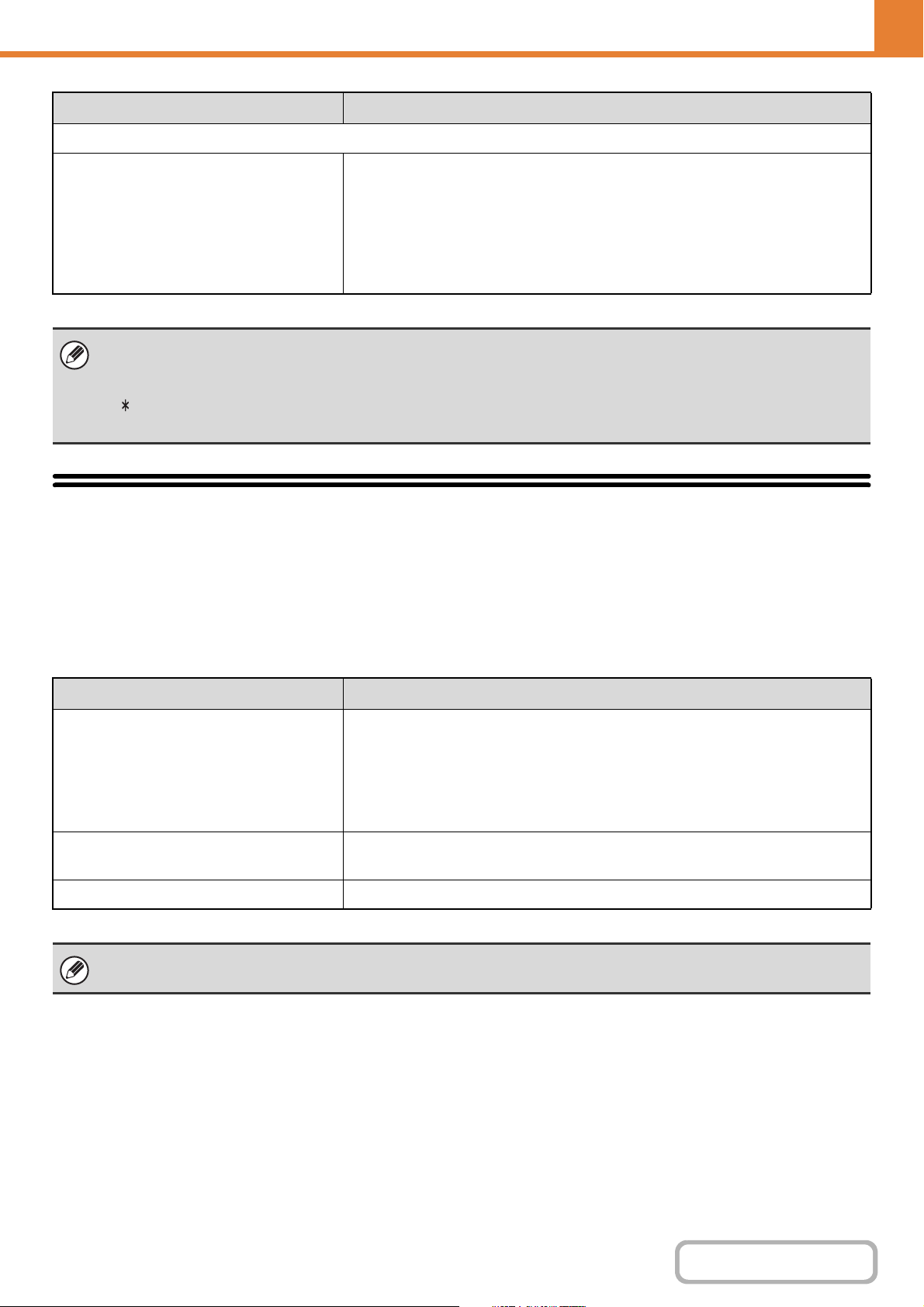
6-108
SYSTEM SETTINGS
Contents
WEB PAGE - FAX (GENERAL)
Fax Data Receive/Forward
This section explains settings for reception and forwarding. Select [System Settings] - [Fax Data Receive/Forward] from
the menu bar and configure each setting.
Fax Settings
The following items appear when the "Fax Settings" are configured.
Items displayed when storing a relay broadcast memory box
Recipients
Select the end recipients of the relay broadcast. Select the recipients from the
address book.
• Direct Entry: An address that is not stored in the address book can be
directly entered. Enter the address in the same way as when
storing an address for a mode.
• Address Review: This displays a list of the selected recipients. Addresses can
be deleted from this list if needed.
• When programming a new memory box, a sub-address that is already programmed for another box cannot be used.
However, the same passcode can be used for more than one memory box.
• A passcode can be omitted.
• [ ] and [#] cannot be used in a sub-address.
• Do not forget the Print PIN.
Item Description
Receive Setting
Set the fax reception method.
• Auto Reception: When a call comes in, the machine rings and then
automatically begins fax reception.
• Manual Reception: This can be used when an existing extension phone is
connected to the machine. Fax reception is begun by
manual operation after answering on the extension phone.
Multiple Set Print
Specify whether or not two or more copies of received faxes will be printed. The
number of copies is set in "Fax Output Settings", (page 6-115).
Staple Specify whether or not stapling is performed. (Only when a finisher is installed.)
If "Hold Setting for Received Data Print" (page 6-35) is enabled, you will be prompted to enter a password. Enter the correct
password with the numeric keys.
Item Description
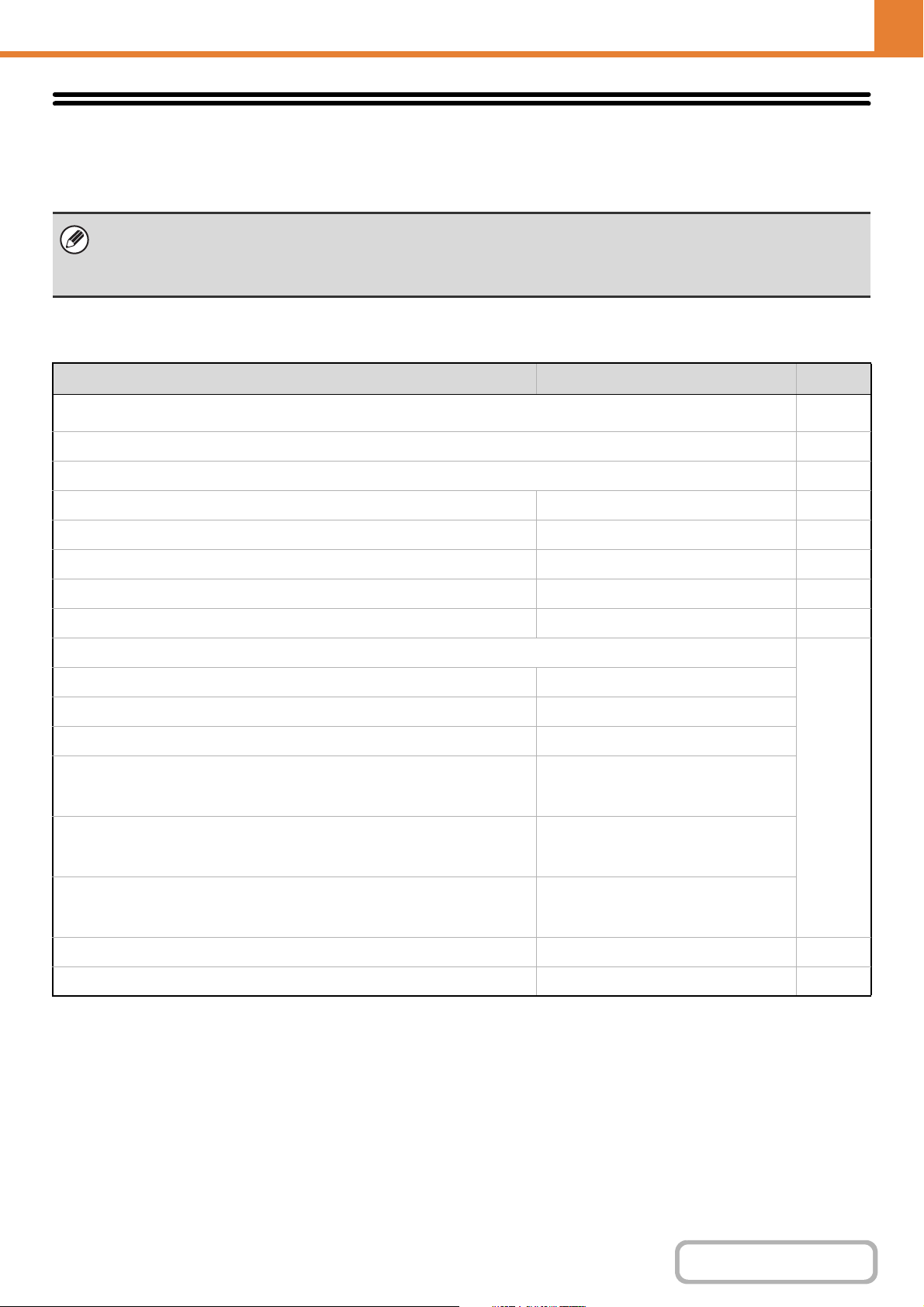
6-109
SYSTEM SETTINGS
Contents
WEB PAGE - FAX ( ADMINISTRATOR)
System Settings for Fax (Administrator) List
When the system settings for fax are accessed with administrator rights, the following items appear. For information on
the general settings, see "System Settings for Fax (General) List" (page 6-106).
Image Send Settings
•
For the procedure for using the system settings (administrator), see "Accessing the System Settings (Administrator)" (page
6-17).
•
After configuring certain settings, you may be prompted to restart the machine. Restart the machine in the screen that appears.
• Depending on the machine specifications and peripheral devices installed, it may not be possible to use some settings.
Item Factory default setting Page
■ Image Send Settings
6-111
● Fax Settings 6-111
X Default Settings 6-111
Detection of Dial Tone Enabled 6-111
Dial Mode Setting Tone 6-111
Auto Wake Up Print Enabled 6-111
Pause Time Setting
2 sec.
6-111
Fax Dest. Confirmation Mode Disabled 6-111
Speaker Settings
6-111
• Speaker Volume: 5
• Ringer Volume Volume: 5
• Line Monitor Volume: 5
• Fax Receive Complete Signal Volume: 5; Tone Pattern: 3
Transmission Complete Sound Time
Setting: 3 sec.
• Fax Send Complete Signal Volume: 5; Tone Pattern: 3
Transmission Complete Sound Time
Setting: 3 sec.
• Fax Communication Error Signal Volume: 5; Tone Pattern: 3
Transmission Complete Sound Time
Setting: 0.3 sec. each
Remote Reception Number Setting 5 6-111
Original Print on Transaction Report Print Out Error Report Only 6-112
6-110
SYSTEM SETTINGS
Contents
WEB PAGE - FAX ( ADMINISTRATOR)
Transaction Report Print Select Setting
6-112
• Single Sending Print Out Error Report Only
• Broadcasting Print Out All Report
• Receiving No Printed Report
• Confidential Reception Print Out Notice Page
Activity Report Print Select Setting
6-112• Auto Print at Memory Full Disabled
• Print Daily at Designated Time Disabled
ECM Enabled 6-112
Distinctive Ring Detection Off 6-112
X Send Settings 6-113
Rotation Sending Setting All Enabled 6-113
Quick On Line Sending Enabled 6-113
Printing Page Number at Receiver Enabled 6-113
Date/Own Number Print Position Setting Outside the Original Image 6-113
Recall in Case of Line Busy Recall, Number of Times: 2,
Interval: 3 min.
6-113
Recall in Case of Communication Error Recall, Number of Times: 1,
Interval: 3 min.
6-113
Initial Transmission Speed Setting 33.6kbps 6-113
X Receive Settings 6-114
Number of Calls in Auto Reception 2 6-114
Duplex Reception Setting Disabled 6-114
Auto Receive Reduce Setting Enabled 6-114
Print Style Setting Auto Size Select 6-114
Set the Telephone Number for Data Forwarding – 6-114
Receiving Date & Time Print Disabled 6-114
Fax Output Settings Varies depending on the machine
configuration
6-115
Initial Reception Speed Setting 33.6kbps 6-115
X Allow/Reject Number Setting All disabled 6-115
X Fax Polling Security Enabled 6-115
Item Factory default setting Page
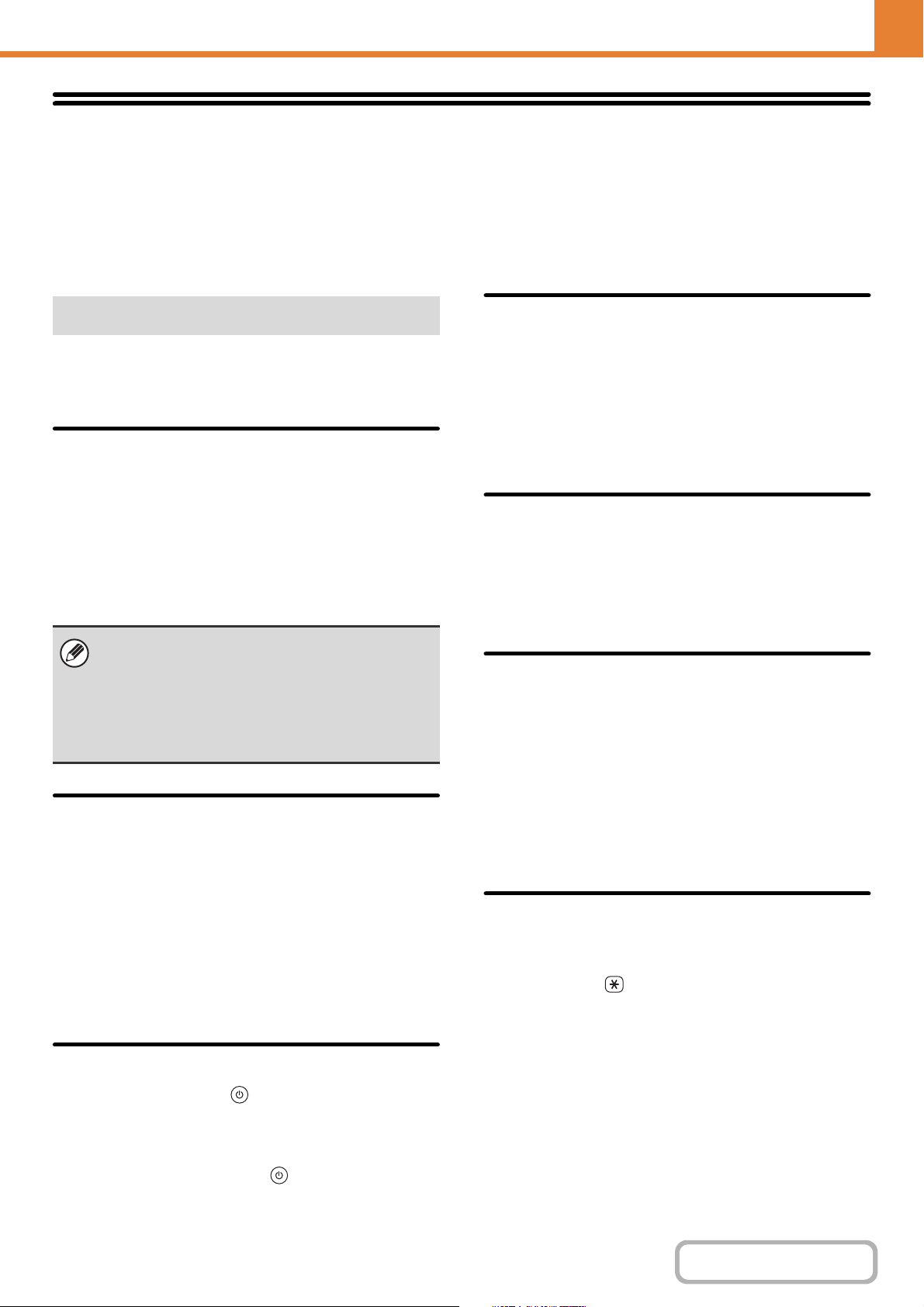
6-111
SYSTEM SETTINGS
Contents
WEB PAGE - FAX ( ADMINISTRATOR)
Image Send Settings
Settings related to the image send function (scan, Internet fax, etc.) can be configured.
Fax Settings
Select [System Settings] - [Image Send Settings] - [Fax Settings] in the menu bar, and configure the settings.
Fax settings can be enabled or disabled as needed to
suit the needs of your workplace by clicking the [Default
Settings] tab.
Detection of Dial Tone
This setting determines whether or not the machine
verifies the presence of a dial tone on the line before
starting transmission.
Enabling this setting can ensure transmission to the
correct destination, because the machine automatically
verifies that there is a dial tone on the line before
sending a fax.
Dial Mode Setting
Select the appropriate setting for your telephone line
type.
Dial Mode Setting
Select the line type from the list.
Auto Select
Select this after the line has been connected to have the
machine automatically detect whether your line is a
pulse dial line or a tone dial line.
Auto Wake Up Print
When the [POWER] key ( ) is "off" (but the main
power switch is "on") and a fax is received, this function
automatically activates the machine and prints the fax.
When this function is disabled, received faxes are not
printed until the [POWER] key ( ) is switched "on".
Pause Time Setting
Use this to change the length of pauses inserted in fax
numbers.
If a hyphen "-" is entered when dialing or storing a fax
number, a pause of 2 seconds is inserted.
The pause can be changed to any number of seconds
from 1 to 15.
Fax Dest. Confirmation Mode
This setting specifies whether or not a destination
verification message is displayed when sending a fax in
order to prevent accidental transmission to the wrong
destination.
Speaker Settings
Use these settings to set the sound heard from the
speaker for the Speaker, Ringer Volume, Line Monitor,
Fax Receive Complete Signal, Fax Send Complete
Signal, and Fax Communication Error Signal. For the
Fax Receive Complete Signal, the Fax Send Complete
Signal, and the Fax Communication Error Signal, the
Tone Pattern and Transmission Complete Sound Time
Setting can be selected in addition to the volume.
Remote Reception Number Setting
Fax reception can be activated from an extension phone
connected to the machine by entering a 1-digit number
and pressing the key twice on the phone's keypad.
This number is called the remote reception number, and
you can set it to any number from "0" to "9".
Default Settings
• If you find that your connection environment is not
capable of transmission when this setting is
enabled, disable the setting.
• When the function is disabled, there is a slight
possibility that a wrong number may be dialed due
to the initial digit of the number becoming lost during
dialing.
6-112
SYSTEM SETTINGS
Contents
WEB PAGE - FAX ( ADMINISTRATOR)
Original Print on Transaction
Report
When a transaction report is printed for a memory
transmission, this is used to print part of the first page of
the transmitted original on the transaction report. Select
one of the settings below.
• Print Out All Report
• Print Out Error Report Only
• No Printed Report
This setting will not be effective if "Transaction Report
Print Select Setting" below is set to "No Printed Report".
Transaction Report Print Select
Setting
This is used to select whether or not a transaction report
will be printed, and if printed, the condition for being
printed. Select a setting for each of the following
operations:
Single Sending
• Print Out All Report
• Print Out Error Report Only
• No Printed Report
Broadcasting
• Print Out All Report
• Print Out Error Report Only
• No Printed Report
Receiving
• Print Out All Report
• Print Out Error Report Only
• No Printed Report
Confidential Reception
• Print Out Notice Page
• No Printed Report
When a transaction report is printed, you can have part
of the first page of the transmitted original printed on the
transaction report. For more information, see "Original
Print on Transaction Report".
Activity Report Print Select Setting
This is used to have the Image Sending Activity Report
that is stored in the machine's memory printed at regular
intervals.
The Image Sending Activity Report can be set to
automatically print each time the number of transactions
reaches 201, and it can also be set to automatically print
at a specified time (once a day only). (The settings can
be simultaneously enabled.)
ECM
Line conditions can sometimes distort a transmitted fax
image. When ECM (Error Correction Mode) is turned on,
pages that are distorted are automatically re-transmitted.
Distinctive Ring Detection
If multiple telephone numbers have been assigned to
your telephone line, the number called can be identified
by its ringing pattern. By using one number for voice
calls and another number for faxes, you can tell which
type of call you are receiving by the ringing pattern. You
can set your machine to automatically receive faxes
when your fax number is called by setting the pattern
that corresponds to your fax number. Six selections are
available.
When transaction report printing is set for "Receiving",
a report will not be printed for a reception from a
number specified as a reject number in "Allow/Reject
Number Setting" (page 6-115).
• If you only select the "Print Daily at Designated
Time" setting and the number of recorded
transactions exceeds 201 before the specified time,
each new transaction will delete the oldest
transaction (the oldest transaction will not be
printed).
• The Image Sending Activity Report can also be
printed manually. See "List Print (Administrator)"
(page 6-37).
If the other machine supports Super G3, ECM will
function regardless of this setting.
6-113
SYSTEM SETTINGS
Contents
WEB PAGE - FAX ( ADMINISTRATOR)
Click the [Send Setting] tab and configure settings for fax
transmission.
Rotation Sending Setting
When transmitting an image that is one of the following
sizes, this function rotates the image counterclockwise
90 degrees. (The setting can be configured separately
for each size.)
5-1/2" x 8-1/2", B5, A5,
Quick On Line Sending
When this setting is enabled, the machine starts
transmitting a fax as soon as the first page is scanned.
Transmission takes place at the same time as the
remaining pages are being scanned.
If you disable this setting, transmission will not begin
until all pages have been scanned. Note that this setting
does not apply to manual transmission.
Printing Page Number at Receiver
This setting is used to add the page number to the top of
each fax page printed by the receiving machine.
Date/Own Number Print Position
Setting
This setting determines the position of the date and sender
information printed at the top of faxes by the receiving
machine. To have the information printed outside the
transmitted document image, select the [Outside the
Original Image] key. To have the information printed inside
the document image, select [Inside the Original Image]
key.
For more information on the print position, see "ADDING
YOUR SENDER INFORMATION TO FAXES (Own
number sending)" (page 4-89) in "4. FACSIMILE".
Recall in Case of Line Busy
This program is used to set the number of recall
attempts and the interval between recall attempts when
a transmission is not successful due to the line being
busy or other reason.
Number of Times to Recall When Line is Busy
This setting specifies whether or not recalling is
performed when the line is busy. When recalling is
performed, you can set the number of recall attempts.
Any number from 1 to 14 can be selected.
Interval to Wait Between Recall Attempts (min.)
When Line is Busy
The interval between recall attempts can be set.
Any number of minutes from 1 to 15 can be selected.
Recall in Case of Communication Error
Settings can be configured for automatic resending of
faxes when transmission fails due to a communication
error.
Number of Times to Recall in Case of Error
This setting determines whether to re-attempt once or
not when a communication error occurs.
Interval to Wait Between Recall Attempts (min.) in
Case of Error
The interval between recall attempts can be set.
Any number of minutes from 1 to 15 can be selected.
Initial Transmission Speed Setting
The transmission speed can be set for all originals.
If you find that communication errors frequently occur
with the currently set transmission speed, gradually
decrease the speed in the following order setting until
errors do not occur.
33.6kbps, 14.4kbps, 9.6kbps, 4.8kbps
Send Settings
Even when this setting is enabled, note that your
machine will not re-attempt a call when manual
transmission or direct transmission is used.
Even when this setting is enabled, note that your
machine will not re-attempt a call when manual
transmission or direct transmission is used.
6-114
SYSTEM SETTINGS
Contents
WEB PAGE - FAX ( ADMINISTRATOR)
Click the [Receive Settings] tab and configure settings
for fax reception
Number of Calls in Auto Reception
This setting is used to select the number of rings on
which the machine automatically receives a call and
begins fax reception in auto reception mode.
Any number from 0 to 15 can be selected.
Duplex Reception Setting
This is used to have received faxes printed on both sides
of the paper.
When this setting is enabled and a fax consisting of 2 or
more pages is received (the pages must be the same
size), the pages are printed on both sides of the paper.
Auto Receive Reduce Setting
When a fax is received that includes the sender's name
and number, the received image is slightly larger than
the standard size. This setting is used to automatically
reduce the image to fit the standard size.
Print Style Setting
This setting determines the paper selection condition
when printing received faxes. Select one of the three
conditions below.
Print Actual Size Cut off Enabled
Each received image is printed at full size. If necessary,
the image is divided onto multiple sheets of paper.
Auto Size Select
Each received image is printed at full size when
possible. When not possible, the image is automatically
reduced before printing.
Set the Telephone Number for Data
Forwarding
When a problem prevents the machine from printing a
received fax, the received fax can be forwarded to
another fax machine. This setting is used to program the
fax number of the destination fax machine. Only one
forwarding fax number can be programmed (maximum
of 64 digits).
To insert a pause between digits of the number, select
the [-] key.
If you wish to specify a F-code confidential memory box
in the destination machine, select the [/] key after
entering the fax number and enter the F-code
(sub-address and passcode).
Receiving Date & Time Print
Enable this setting to have the date and time of
reception printed.
Select [Inside the Received Image] or [Outside the
Received Image] for the position where the date and
time is printed.
When [Inside the Received Image] is selected, the date
and time of reception is printed on the received image.
When [Outside the Received Image] is selected, the
received image is reduced and the date and time of
reception is printed in the blank area that results.
Receive Settings
If you select "0" for the number of rings, the machine
will immediately answer and begin fax reception
without ringing in auto reception mode.
• If Auto Receive Reduce is disabled, the edges of
the image outside the standard size will be cut off.
However, the image will be clearer because it will
be printed at the same size as the original.
• Standard sizes are sizes such as 8-1/2" x 11" and
8-1/2" x 5-1/2" (A4 and B5).
[Outside the Received Image] cannot be selected for
the reception date and time print setting when "Auto
Receive Reduce Setting" (page 6-114) is not enabled.
6-115
SYSTEM SETTINGS
Contents
WEB PAGE - FAX ( ADMINISTRATOR)
Fax Output Settings
These settings are used to select the number of copies
for received faxes.
Number of Prints
Set the number of copies of received faxes that are
printed to any number from 1 to 99.
Initial Reception Speed Setting
The reception speed can be set for all originals.
To enable smooth communication when receiving a fax
from an area where the transmission speed is slow, you
can set the machine's communication speed in the
following speed to match the speed of the sending
machine.
33.6kbps, 14.4kbps, 9.6kbps, 4.8kbps
Use this setting to specify whether reception from a
stored number is to be allowed or rejected.
The following settings are for regular polling memory
using the Public Box.
Set Fax Polling Security
When the memory polling function is used, this setting
determines whether any machine will be allowed to poll
your machine, or only machines that have been stored in
your machine.
Add New
When the Polling Security Setting is enabled, use this
setting to store (or delete) the fax numbers of the
machines that are allowed to poll your machine. The
stored fax numbers are called passcode numbers. Up to
10 passcode numbers can be stored (maximum of 20
digits each).
Passcode Number Key List
This shows a list of the stored passcode numbers. A
number can be selected to delete it.
This setting can only be used when the [Multiple Set
Print] checkbox is selected in "Fax Settings"
(page 6-108).
If you do not know the condition of the line, do not
change the speed setting.
Allow/Reject Number Setting
Item Description
Reject
Reception
Reject reception from the stored number.
Allow
Reception
Allow reception from the stored number.
All Invalid
Even if numbers have been stored,
disregard the numbers and allow
reception from all numbers.
Add New
Store a new number for which allow or
reject will be specified (maximum of 50
numbers).
Enter the number (maximum of 20 digits)
and select the [Store] key.
Registration
Number List
A list of the stored numbers can be
displayed.
A number can be selected in this screen
to delete it from the list.
When no numbers have been stored for allow/reject
specification, no keys other than [Add New] can be
selected.
Fax Polling Security
Note that these settings do not apply to F-code polling
memory.
6-116
SYSTEM SETTINGS
Contents
APPENDIX
System Settings Menu (Operation Panel)
Total Count
System Settings
Entering Administrator's Password
Clock AdjustImage Quality Adjustment Keyboard Select
Device CountJob Count
All Custom Setting List
Printer Test Page
Sending Address List
Machine Information List
Image Quality Check Chart
Tray Settings Paper Type Registration Auto Tray Switching
Custom Size Registration (Bypass)
Registration Adjustment
Fusing Cleaning Mode
Optimization of a Hard Disk
Interval of Image Quality Adjustment
Toner Save Mode Auto Power Shut-Off
Auto Power Shut-Off Timer
Preheat Mode Setting
Other Settings
MFP Display Pattern Setting
Initial Status Settings
Other Settings
Auto Color Calibration
Color Adjustments
IPv4 Settings
IPv6 Settings
Enable TCP/IP
Enable NetWare
Enable EtherTalk
Enable NetBEUI
Reset the NIC
Ping Command
Keys Touch Sound
Other Settings
B/W 600dpi x 600dpi Scanning
Mode for Document Feeder
B/W
Quick Scan from Document Glass
Copy Exposure Adjustment
Add or Change Extra Preset Ratios
Setting a Maximum Number of Copies
Initial Margin Shift Setting
Erase Width Adjustment
Card Shot Settings
Disabling Deletion of Job Programs
Disabling of Bypass-Tray in Duplex Copy
Disabling of Auto Paper Selection
Auto Selection of Paper Tray that
was Last Loaded
Color 600dpi x 600dpi Scanning
Mode for Document Feeder
Color
Quick Scan from Document Glass
Default Settings
Display Contrast
List Print (User)
Paper Tray Settings
Device Control
USB-Device Check
Energy Save
Operation Settings
Copy Settings
Network Settings
Printer Settings
Image Send Settings
Operation Settings Other Settings
Default Display Settings
Address Book Default Selection
Initial Resolution Setting
Default Exposure Settings
Must Input Next Address Key at
Broadcast Setting
Scan Complete Sound Setting
The Number of File Name/Subject/Body
Keys Displayed Setting
The Number of Direct Address Keys
Displayed Setting
Disable Switching of Display Order
Hold Setting for Received Data Print
Erase Width Adjustment
Initial Transmission Speed Setting
ECM
Distinctive Ring Detection
Rotation Sending Setting
Quick On Line Sending
Printing Page Number at Receiver
Date/Own Number Print Position Setting
Recall in Case of Line Busy
Recall in Case of Communication Error
Number of Calls in Auto Reception
Duplex Reception Setting
Auto Receive Reduce Setting
Print Style Setting
Set the Telephone Number for
Data Forwarding
Receiving Date & Time Print
Fax Output Settings
Initial Reception Speed Setting
Detection of Dial Tone
Dial Mode Setting
Auto Wake Up Print
Pause Time Setting
Fax Dest. Confirmation Mode
Speaker Settings
Remote Reception Number Setting
Original Print on Transaction Report
Transaction Report Print Select
Setting
Activity Report Print Select Setting
Own Name and Destination Set
Fax Default Settings
Fax Send Settings
Fax Receive Settings
Allow/Reject Number Setting
Fax Polling Security
Data Receive/Forward List
Image Sending Activity Report
User Infromation Print
Restore Factory Defaults
Store Current Configuration
Restore Configuration
Fax Settings
List Print (Administrator)
Product Key
SSL Settings IPsec Settings IEEE802.1X Setting
Security Settings
Storing/Calling of System Settings
External Account Setting USB Driver Settings
Animation Play Speed Setting
Sharp OSA Settings
6-117
SYSTEM SETTINGS
Contents
System Settings Menu (Web Page)
Total Count
System Settings
Entering Administrator's Password
Keyboard SelectClock Adjust
Device CountJob Count
All Custom Setting List
Printer Test Page
Sending Address List
Machine Information List
Image Quality Check Chart
Auto Tray Switching Tray Settings Auto Tray Switching
Custom Size Registration (Bypass)
Fax Settings I-Fax Settings
Printer Default Settings
Toner Save Mode Auto Power Shut-Off Auto Power Shut-Off Timer Preheat Mode Setting
Operation Settings
Customize Key Setting
Preview Setting
Remote Operation Settings
Soft Keyboard Template Setting
Initial Status Settings
Copy Settings
Default Settings
Interface Settings
Port Switching Method
Prohibit Notice Page Printing
Prohibit Test Page Printing
A4/Letter Size Auto Change
Hexadecimal Dump Mode
I/O Timeout
Enable USB Port
USB Port Emulation Switching
Enable Network Port
Network Port Emulation Switching
Print Density Level
CMYK Exposure Adjustment
Bypass Tray Settings
Job Spool Queuing
PCL Settings
PostScript Settings
Copies
Orientation
Default Paper Size
Default Paper Type
Initial Resolution Setting
Keys Touch Sound
Keys Touch Sound at Initial Point
Auto Clear Setting
Message Time Setting
AB/Inch Type Setting
Default Original Size Settings
Disabling of Document Feeder
Original Feeding Mode
Disabling of Duplex
Disabling of Optional Paper Feed Unit
Disabling of Tray Settings
Disabling of Offset
B/W 600dpi x 600dpi Scanning
Mode for Document Feeder
B/W
Quick Scan from Document Glass
Copy Exposure Adjustment
Add or Change Extra Preset Ratios
Setting a Maximum Number of Copies
Initial Margin Shift Setting
Erase Width Adjustment
Card Shot Settings
Display Language Setting
Disabling of Job Priority Operation
Disabling of Bypass Printing
Key Operation Setting
Disabling Deletion of Job Programs
Disabling of Bypass-Tray in Duplex Copy
Disabling of Auto Paper Selection
Auto Selection of Paper Tray that
was Last Loaded
Color 600dpi x 600dpi Scanning
Mode for Document Feeder
Color
Quick Scan from Document Glass
Disabling of Clock Adjustment
Business Card Scan Option
MFP Display Pattern Setting
Disable Blank Page Print
Line Thickness
2-Sided Print
Color Mode
N-Up Print
Fit To Page
Output
Quick File
Default Settings
List Print (User)
Paper Tray Settings
Paper Type Registration
Fax Data Receive/Forward
Printer Condition Settings
USB-Device Check
Energy Save
Operation Settings
Device Control
Copy Settings
Printer Settings
Interval of Image Quality Adjustment
Disabling of Stapler
Auto Paper Selection Setting
Detect Standard in Auto Color Mode
Fusing Control Settings
6-118
SYSTEM SETTINGS
Contents
Image Send Settings
Operation Settings Default Settings
Default Settings
Default Display Settings
Address Book Default Selection
Initial Resolution Setting
Default Exposure Settings
Default Original Image Type
Must Input Next Address Key at
Broadcast Setting
Scan Complete Sound Setting
The Number of File Name/Subject/Body
Keys Displayed Setting
The Number of Direct Address Keys
Displayed Setting
Disable Switching of Display Order
Hold Setting for Received Data Print
Erase Width Adjustment
Default Sender Set
Default Color Mode Settings
Initial File Format Setting
Compression Mode at Broadcasting
Maximum Size of E-mail
Attachments (E-mail)
Maximum Size of Data Attachments
(FTP/Desktop/Network Folder)
Bcc Setting
Disable Scan Function
Auto Wake Up Print
Compression Setting
Speaker Volume Setting
Original Print on Transaction Report
Transaction Report Print Select Setting
Activity Report Print Select Setting
Body Text Print Select Setting
Recall in Case of Line Busy
Recall in Case of Communication
Error
Reception Check Interval Setting
Initial Transmission Speed Setting
I-Fax Reception Report On/Off Setting
I-Fax Reception Report Request
Timeout Setting
Number of Resend Times at
Reception Error
Maximum Size of E-mail Attachments
Rotation Sending Setting
Printing Page Number at Receiver
Auto Receive Reduce Setting
Duplex Reception Setting
Set Address for Data Forwarding
Letter Size RX Reduce Print
Receiving Date & Time Print
POP3 Communication Timeout Setting
ECM
Distinctive Ring Detection
Rotation Sending Setting
Quick On Line Sending
Printing Page Number at Receiver
Date/Own Number Print Position Setting
Recall in Case of Line Busy
Recall in Case of Communication Error
Number of Calls in Auto Reception
Duplex Reception Setting
Auto Receive Reduce Setting
Print Style Setting
Set the Telephone Number for
Data Forwarding
Receiving Date & Time Print
Fax Output Settings
Initial Reception Speed Setting
Detection of Dial Tone
Dial Mode Setting
Auto Wake Up Print
Pause Time Setting
Fax Dest. Confirmation Mode
Speaker Settings
Remote Reception Number Setting
Original Print on Transaction Report
Transaction Report Print Select
Setting
Activity Report Print Select Setting
Settings to Disable Registration
Disable Registering Destination
on Web Page
Disable Registration of Program
Disable Registration of Memory Box
Disable Registration Using Network
Scanner Tool
Disable [Resend] on Image Send Mode
Disable Direct Entry
Disable Selection from Address Book
Disable PC-I-Fax Transmission
Disable PC-Fax Transmission
Settings to Disable Transmission
Own Name and Destination Set
Scan Settings
Default Address
Default Settings
Send Settings
Receive Settings
Allow/Reject Mail or Domain
Name Setting
Default Settings
Send Settings
Receive Settings
Allow/Reject Number Setting
Fax Polling Security
Data Receive/Forward List
Web Settings List
Metadata Set List
Restore Factory Defaults
Store Current Configuration
Restore Configuration
Default Mode Settings
Sort Method Setting
Administrator Authority Setting
Batch Print Settings
Automatic Deletion of File Settings
Administrator Settings List
Image Sending Activity Report
Scan Settings
I-Fax Settings
Fax Settings
Print Hold Settings
List Print (Administrator)
Enable/Disable Settings
Product Key
Storing/Calling of System Settings
Animation Play Speed Setting
Sharp OSA Settings
7-1
This chapter provides solutions to possible problems in a question and answer format. Locate the question that relates
to your problem and use the answer to help correct the situation. If you are unable to solve a problem using this manual,
please contact your dealer or nearest authorized service representative.
System settings or Web pages
System settings are indicated in the "Solutions" column as shown below. In some cases a problem may be solved by
enabling the indicated system setting or Web pages.
Example:
➞
System Settings (Administrator) > "Copy Function Settings" > "Other Settings" > "Disable Copy in Different Size" >
This is an abbreviated description of the procedure for selecting the setting. ">" indicates the setting sequence and
indicates the state of the setting after it has been enabled. Use these descriptions as a quick manual to help you
configure the settings. When "(Web page only)" is indicated, the item being described can only be set in the Web page;
it cannot be set on the machine.
REMOVING MISFEEDS
• REMOVING MISFEEDS. . . . . . . . . . . . . . . . . . . 7-2
• HOW TO REMOVE MISFEEDS. . . . . . . . . . . . . 7-3
REMOVING STAPLE JAMS
• FINISHER. . . . . . . . . . . . . . . . . . . . . . . . . . . . . . 7-6
COPYING
• PROBLEMS RELATED TO COPYING
OPERATION . . . . . . . . . . . . . . . . . . . . . . . . . . . 7-8
• PROBLEMS RELATED TO COPY
RESULTS . . . . . . . . . . . . . . . . . . . . . . . . . . . . . . 7-9
PRINTING
• PROBLEMS RELATED TO PRINTING
OPERATION . . . . . . . . . . . . . . . . . . . . . . . . . . 7-12
• PROBLEMS RELATED TO PRINT
RESULTS . . . . . . . . . . . . . . . . . . . . . . . . . . . . . 7-14
• PROBLEMS RELATED TO FILING . . . . . . . . . 7-17
• PROBLEMS RELATED TO FILE
MANAGEMENT . . . . . . . . . . . . . . . . . . . . . . . . 7-17
FACSIMILE
• PROBLEMS RELATED TO
TRANSMISSION . . . . . . . . . . . . . . . . . . . . . . . 7-19
• PROBLEMS RELATED TO RECEPTION . . . . 7-21
• PROBLEMS RELATED TO TELEPHONE . . . . 7-22
• PROBLEMS RELATED TO AUDIBLE
SIGNALS . . . . . . . . . . . . . . . . . . . . . . . . . . . . . 7-22
• PROBLEMS RELATED TO ONE-TOUCH
INDIVIDUAL KEYS / GROUP KEYS . . . . . . . . 7-23
SCANNING / INTERNET FAX
• PROBLEMS RELATED TO SCANNING /
INTERNET FAX OPERATION . . . . . . . . . . . . . 7-24
• PROBLEMS RELATED TO SCAN
RESULTS . . . . . . . . . . . . . . . . . . . . . . . . . . . . . 7-27
• PROBLEMS RELATED TO ONE-TOUCH
INDIVIDUAL KEYS / GROUP KEYS . . . . . . . . 7-29
GENERAL PROBLEMS
• PROBLEMS RELATED TO MACHINE
OPERATION . . . . . . . . . . . . . . . . . . . . . . . . . . 7-31
• PROBLEMS RELATED TO PAPER
FEEDING AND OUTPUT . . . . . . . . . . . . . . . . . 7-33
• PROBLEMS RELATED TO QUALITY /
PRINT RESULTS . . . . . . . . . . . . . . . . . . . . . . . 7-34
• PROBLEMS RELATED TO PERIPHERAL
DEVICES . . . . . . . . . . . . . . . . . . . . . . . . . . . . . 7-36
• OTHER PROBLEMS . . . . . . . . . . . . . . . . . . . . 7-38
CHAPTER 7
TROUBLESHOOTING
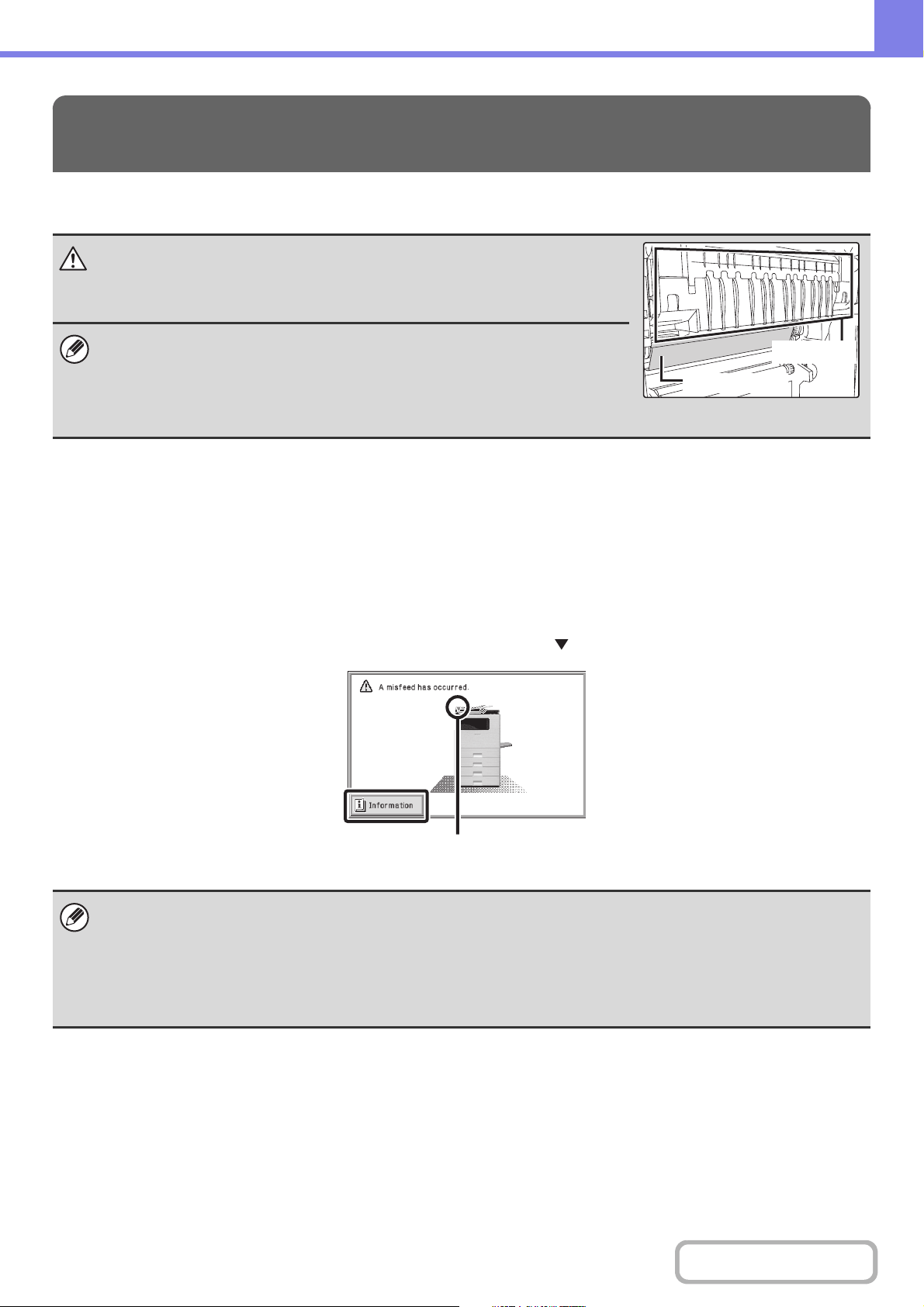
7-2
TROUBLESHOOTING
Contents
This section explains what to do when a paper misfeed occurs in the machine.
REMOVING MISFEEDS
When a paper misfeed occurs, the message "A misfeed has occurred." will appear in the display and printing and
scanning will stop. In this event, select the [Information] key in the display. When the key is selected, instructions for
removing the misfeed will appear. Follow the instructions. When the misfeed is cleared, the message will automatically
clear.
The approximate locations of possible misfeeds are indicated by blinking marks as shown below.
REMOVING MISFEEDS
Caution
The fusing unit is hot. Take care not to burn yourself when
removing a misfeed.
• When removing misfed paper, do not touch or damage the transfer belt.
• Carefully pull the paper out without tearing it.
• A misfeed may have occurred inside the machine. Check carefully and remove the
misfeed.
• If the paper tears, be sure to remove all pieces from the machine.
• While the message appears, printing and scanning cannot be resumed.
• If the message does not clear even after the misfeed has been removed, the causes below are possible. Check once
again.
- The misfeed was not correctly removed.
- A torn piece of paper remains in the machine.
- A cover or unit that was opened or moved to remove the misfeed was not returned to its original position.
Transfer belt
Fusing unit
misfeed location
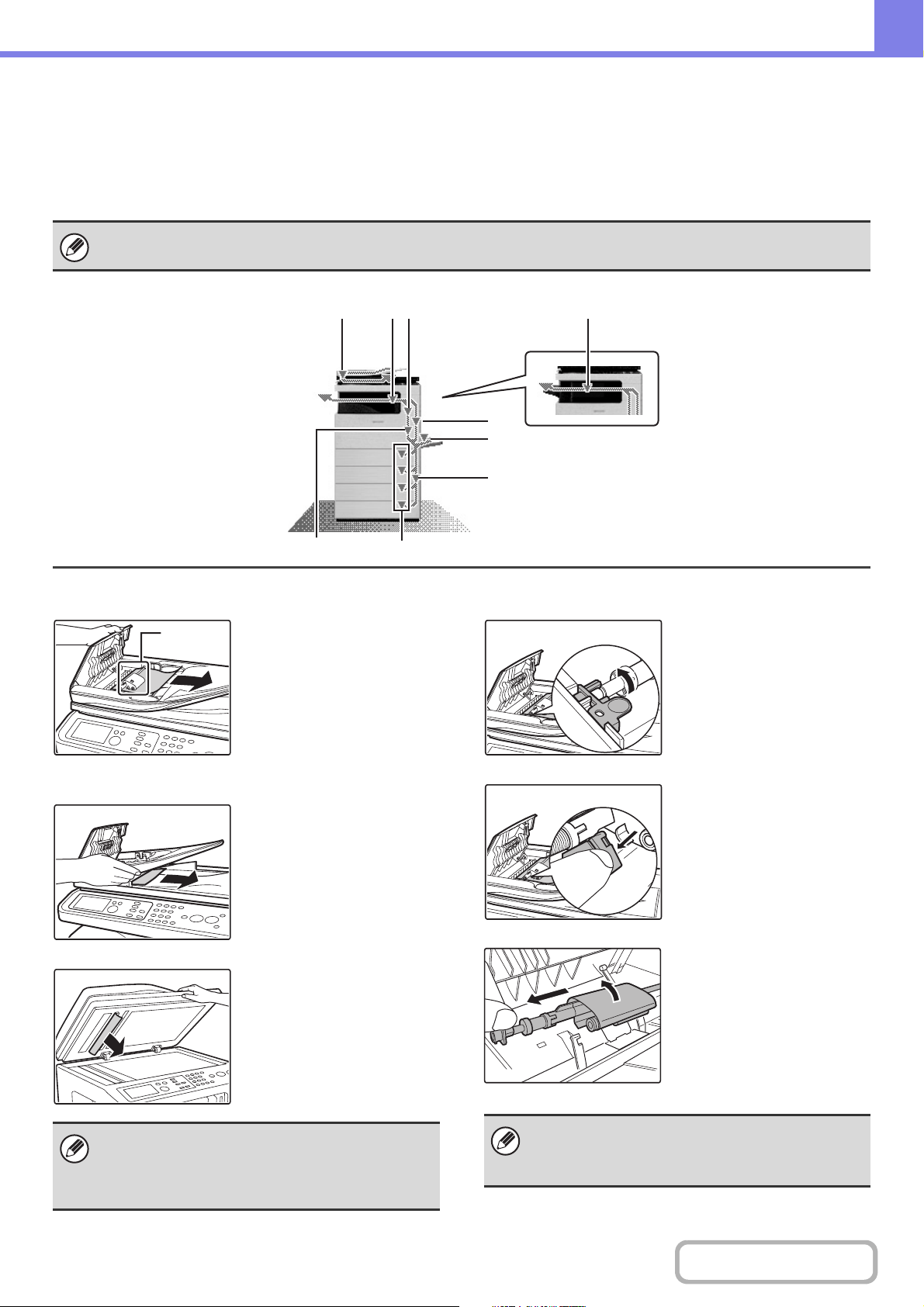
7-3
TROUBLESHOOTING
Contents
HOW TO REMOVE MISFEEDS
If you require more information when reading the instructions in the display, see the paper misfeed illustrations below.
Refer to the illustration below and then go to the appropriate illustration (1 to 10) for your situation.
☞ (1): page 7-3, (2)-(8): page 7-4, (9)-(10): page 7-5
(1) Original misfeed
Open the document feeder
cover and remove the paper
feed roller.
If it is difficult to remove
misfed paper, remove the
paper feed roller. To remove
the paper feed roller, see
"Removing the paper feed
roller".
Pull out the document feeder
tray and remove the misfed
paper.
Open the automatic
document feeder and
remove the original.
Removing the paper feed roller
Lift up the knob that holds
the roller shaft.
Pull down the release lever.
Remove the shaft rotating
the roller cover upward and
remove the shaft.
When removing a misfeed or closing a cover, tray, or the finisher, take care that your fingers do not become pinched.
(1) (2) (10)
(5) (9)
(3)
(4)
(6)
(6), (7)
After removing the misfeed, open and close the
automatic document feeder (or the document feeding
area cover or document feeder tray) to clear the
misfeed display from the display.
Paper
feed roller
• If the roller cover is not pointing straight up when
the shaft is removed, a failure may occur.
• Carefully pull the misfed paper out without tearing it.
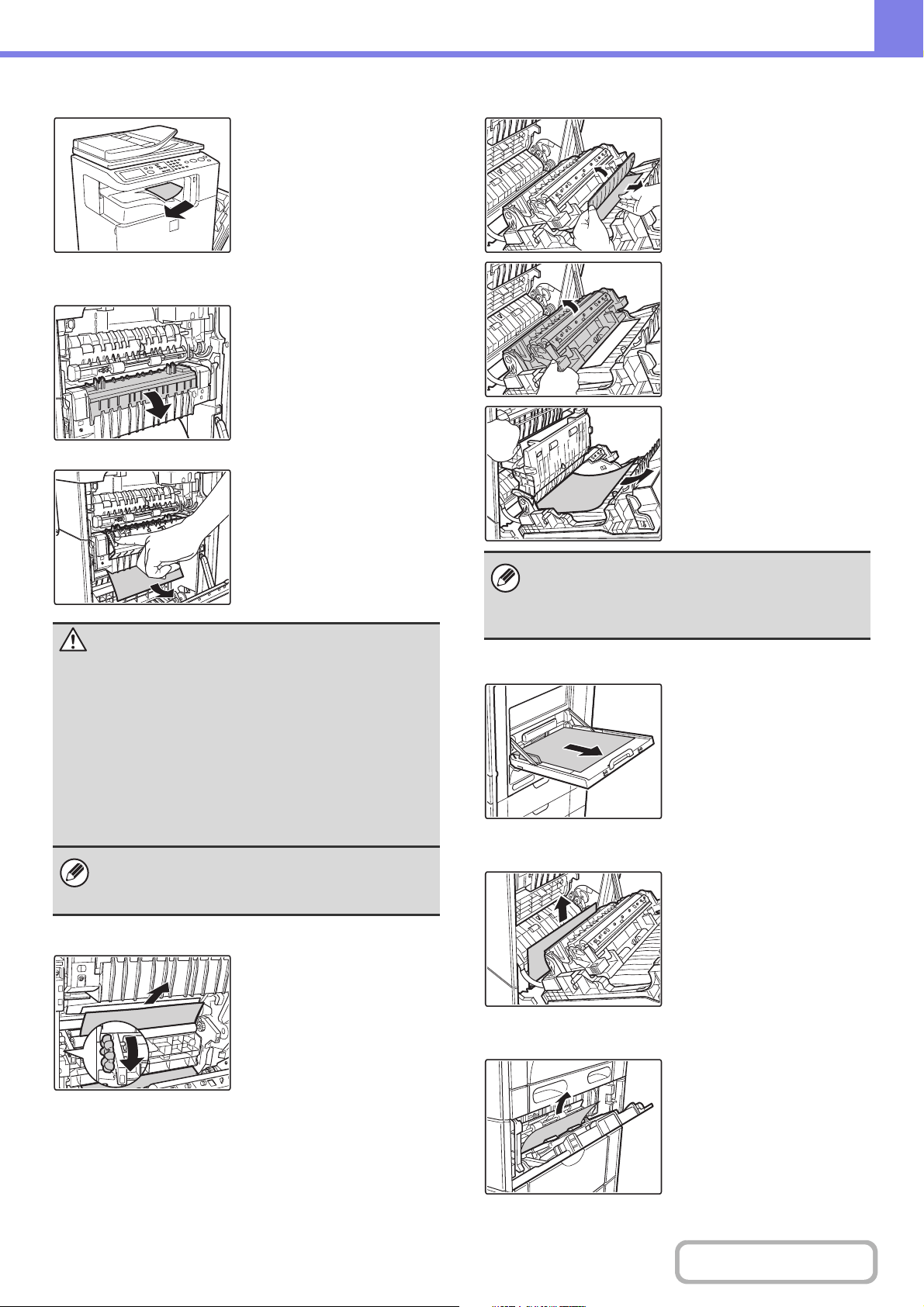
7-4
TROUBLESHOOTING
Contents
(2) Paper misfeed in the output area
Remove the misfed paper.
(3) Paper misfeed in the fusing unit
If a paper misfeed has
occurred inside the fusing
unit, press down on the
green part, open the fusing
unit, and remove the paper.
(4) Paper misfeed in the transport area
When the rotate knob is
turned in the direction of the
arrow, paper comes out for
above.
(5) Paper misfeed in the reversing unit
Open the right side cover,
open the paper conveyor
cover, and remove the
paper.
If the misfeed is not in the
above location, grasp the
handle on the secondary
transfer roller unit, slowly
open the unit, and remove
the paper.
(6) Paper misfeed in the bypass tray
Remove the misfed paper.
(7) Paper misfeed in tray 1 (side)
Open the right side cover
and remove the misfed
paper.
(8) Paper misfeed in tray 2 to tray 4 (side)
The misfeed may have
occurred inside the machine.
Check carefully and remove
it.
Caution
• The fusing unit area is hot. Take care
not to burn yourself. (Do not touch any
metal parts.)
• When the fusing unit is tilted down
toward you, projections come out in the
middle. Do not touch the projections.
These can be a cause of human injury
or machine failure.
Unfused toner may remain on the paper that is
removed. Take care that it does not soil your hands or
clothing.
When opening the paper reversing section, open
slowly and gently. Forcing the section open may
cause the secondary transfer roller unit to detach,
resulting in failure.
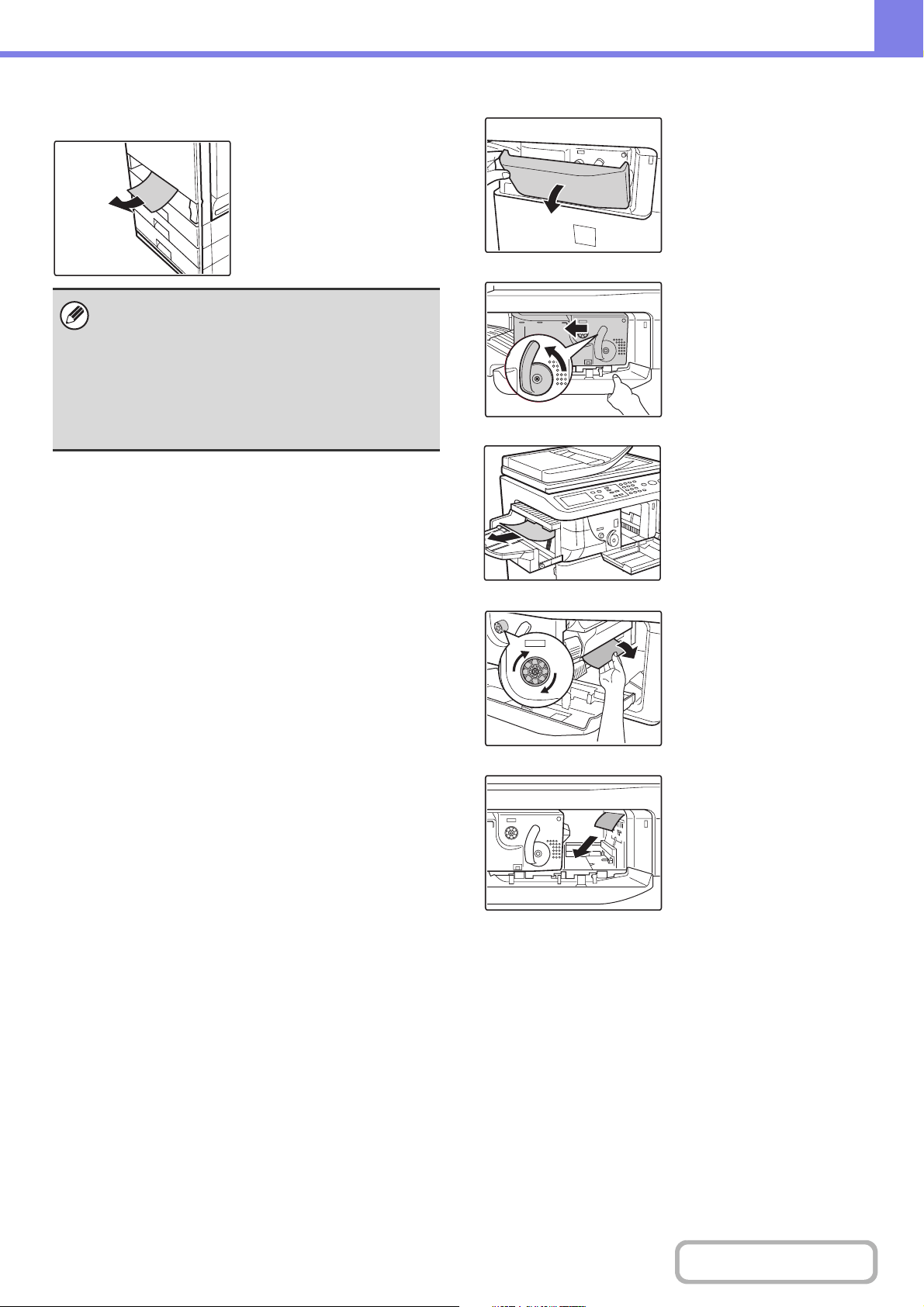
7-5
TROUBLESHOOTING
Contents
(9) Paper misfeed in tray 1 to tray 4 (in the
tray)
When a paper gets twisted to
the roller, remove the tray
and remove the misfed
paper.
(10) Paper misfeed in the finisher
Open the front cover.
While pressing the lever over
to the left, slide the finisher to
the left until it stops.
Remove the misfed paper.
Turn roller rotating knob in
the direction of the arrow to
remove the misfed paper.
Make sure that there is no
misfed paper in the machine.
When pulling out a tray, be sure to open the right
cover and check for a paper misfeed. If a tray is pulled
out when there is a misfeed, the paper will tear and a
torn piece may remain in the machine, making it more
difficult to remove the misfed paper. To open the right
cover and check for a misfeed, follow the procedure in
(7) Paper misfeed in tray 1 (side) or (8) Paper misfeed
in tray 2 to tray 4 (side).
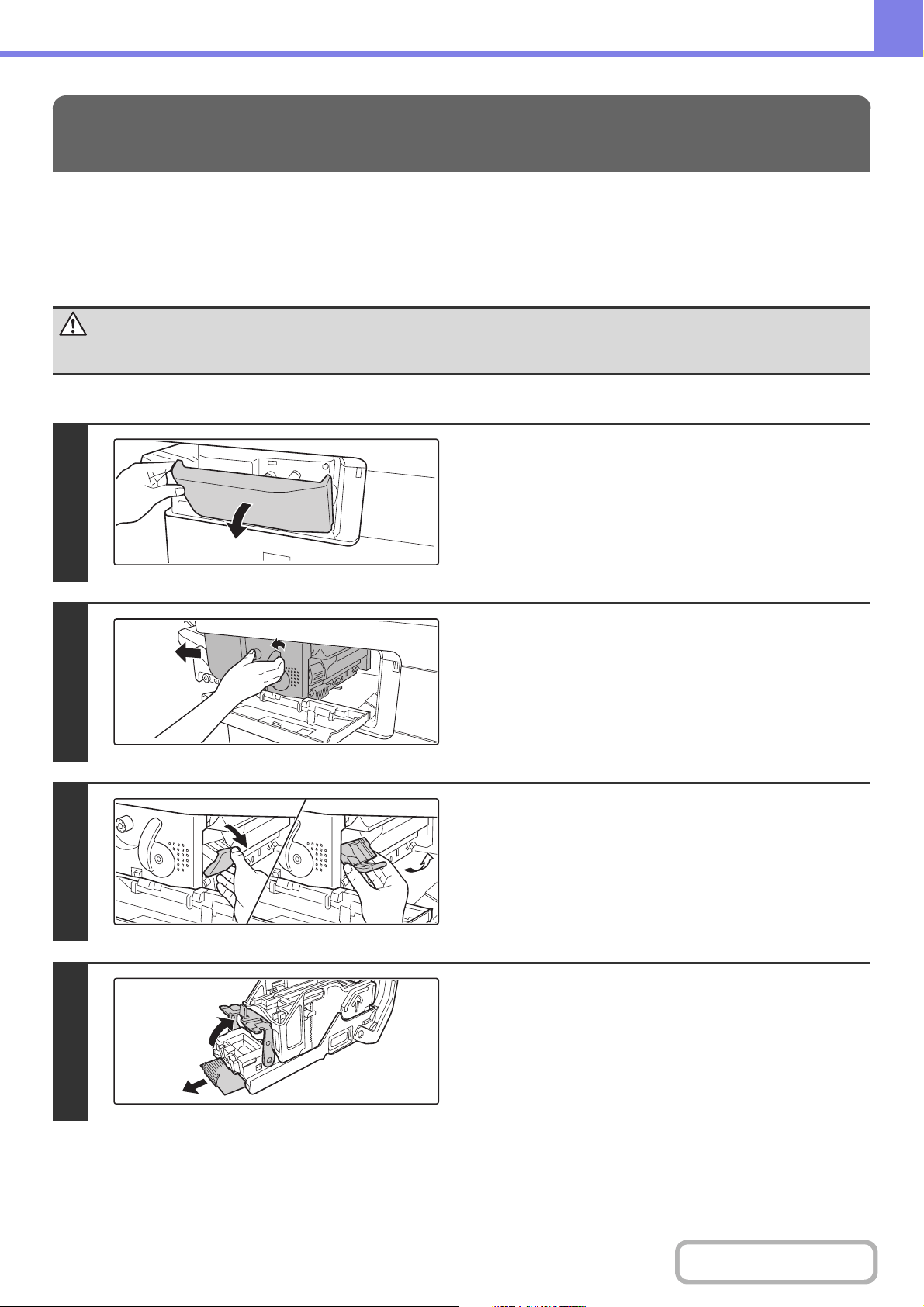
7-6
TROUBLESHOOTING
Contents
Follow the steps below to remove a staple jam.
FINISHER
REMOVING STAPLE JAMS
Caution
Take care that a bent staple does not hurt you.
1
Open the cover.
2
While pressing the lever over to the left,
slide the finisher to the left until it stops.
Gently slide the finisher until it stops.
3
Lower the staple case release lever and
remove the staple case.
Pull the staple case out to the right.
4
Raise the lever at the front end of the
staple case and remove the jammed
staple.
Remove the leading staple if it is bent. If bent staples remain, a
staple jam will occur again.
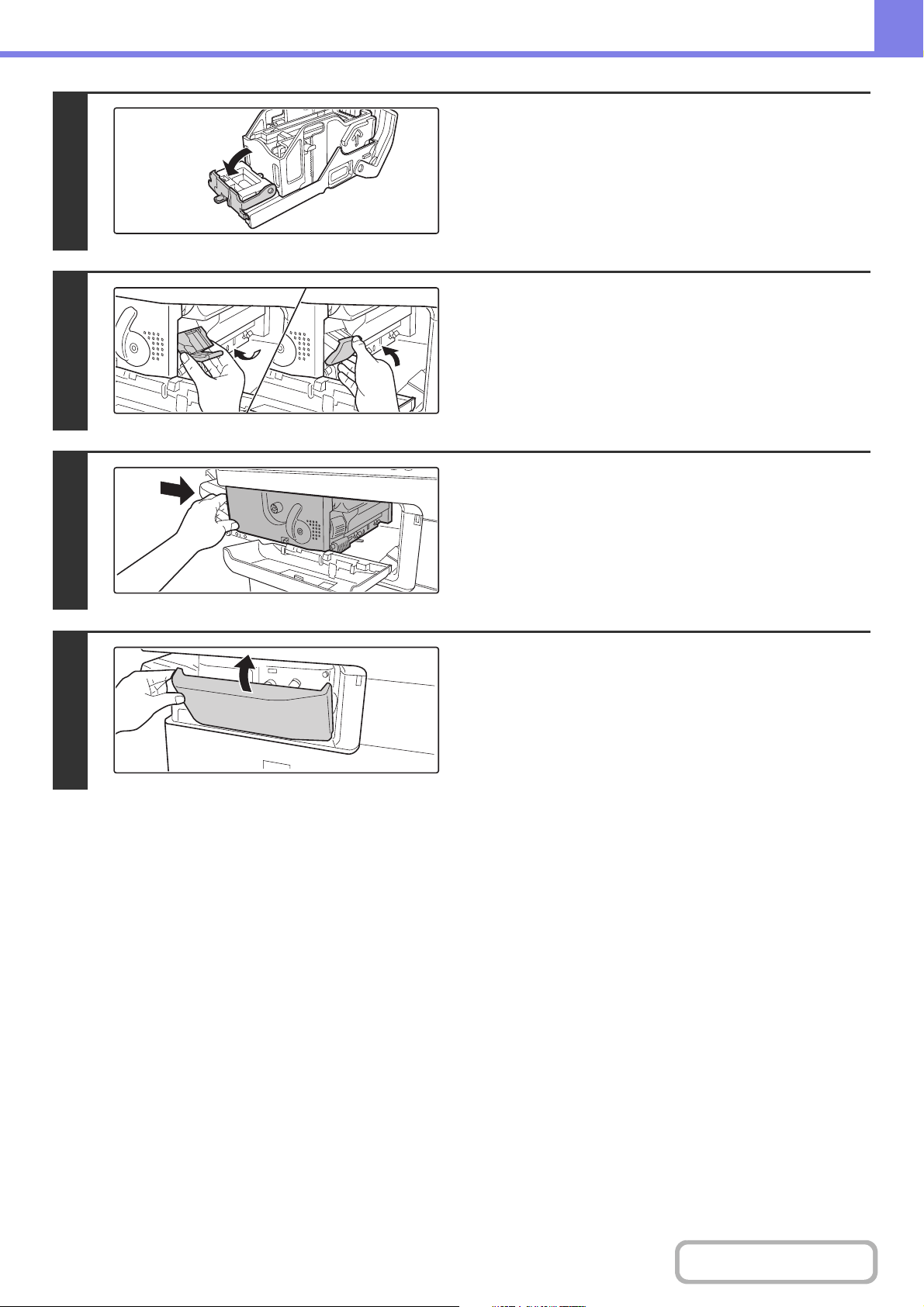
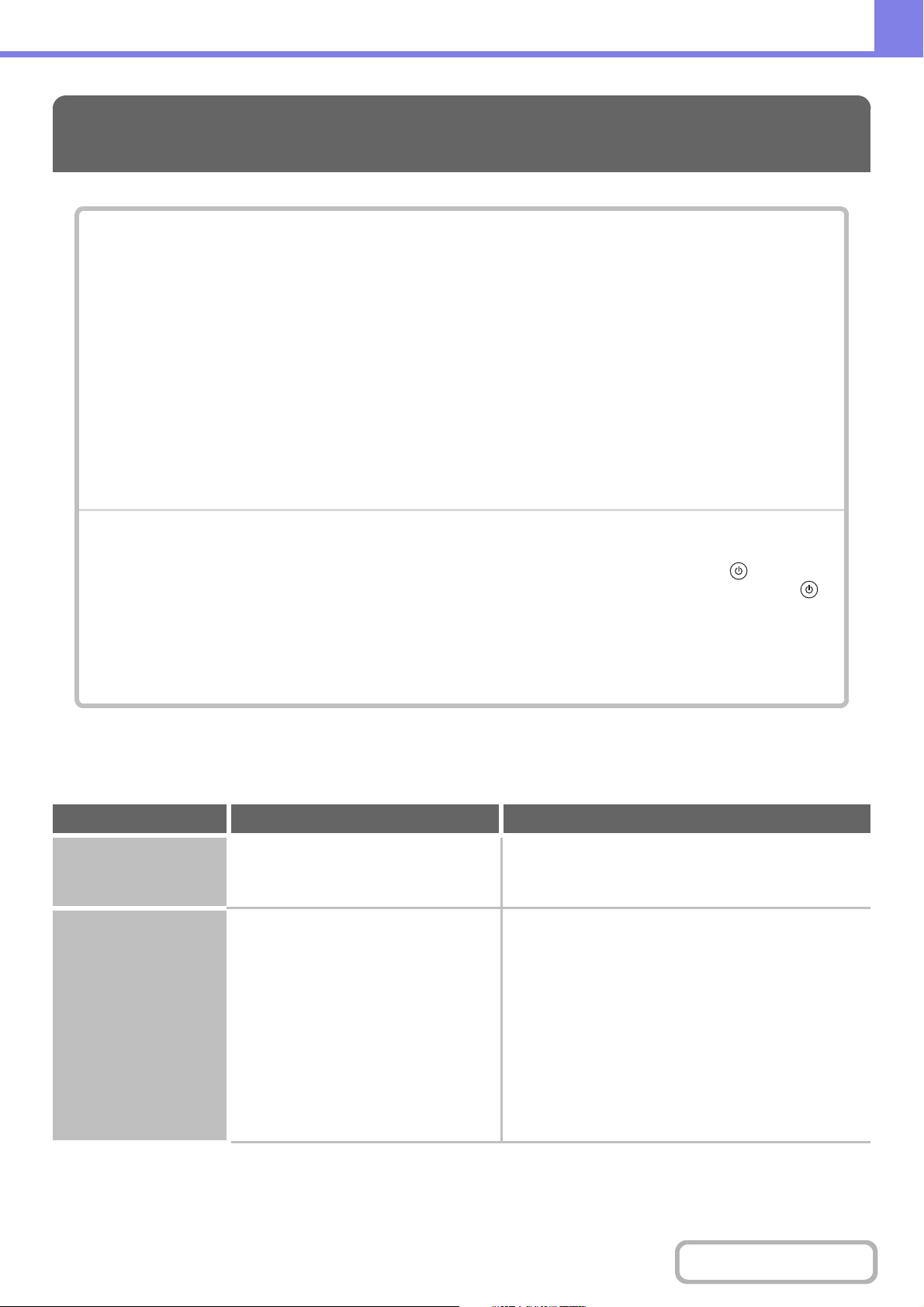
7-8
TROUBLESHOOTING
Contents
PROBLEMS RELATED TO COPYING OPERATION
COPYING
PROBLEMS RELATED TO COPYING OPERATION
• Copying does not take place. . . . . . . . . . . . . . . . . . . . . . . . . . . . . . . . . . . . . . . . . . . . . . . . . . . . . . . . .7-8
• Auto selection of the color mode does not take place. . . . . . . . . . . . . . . . . . . . . . . . . . . . . . . . . . . . . .7-8
• Two-sided copying does not take place.. . . . . . . . . . . . . . . . . . . . . . . . . . . . . . . . . . . . . . . . . . . . . . . .7-9
• The paper size of a tray cannot be set.. . . . . . . . . . . . . . . . . . . . . . . . . . . . . . . . . . . . . . . . . . . . . . . . .7-9
PROBLEMS RELATED TO COPY RESULTS
• The image is too light or too dark.. . . . . . . . . . . . . . . . . . . . . . . . . . . . . . . . . . . . . . . . . . . . . . . . . . . . .7-9
• Colors are off. . . . . . . . . . . . . . . . . . . . . . . . . . . . . . . . . . . . . . . . . . . . . . . . . . . . . . . . . . . . . . . . . . . . .7-9
• The color tones are off.. . . . . . . . . . . . . . . . . . . . . . . . . . . . . . . . . . . . . . . . . . . . . . . . . . . . . . . . . . . . .7-9
• Part of the image is cut off. . . . . . . . . . . . . . . . . . . . . . . . . . . . . . . . . . . . . . . . . . . . . . . . . . . . . . . . . .7-10
• Copies come out blank. . . . . . . . . . . . . . . . . . . . . . . . . . . . . . . . . . . . . . . . . . . . . . . . . . . . . . . . . . . .7-10
•
If you cannot find the item that you are looking for in the above table of contents, see "GENERAL PROBLEMS" (page
7-30).
• If you are unable to solve a problem using the solutions in this manual, switch off the [POWER] key ( ) and the
main power switch. Wait at least 10 seconds, and then switch on the main power switch and the [POWER] key ( )
in that order.
Caution:
When the LINE indicator is lit or the DATA indicator is lit or blinking, do not switch off the main power switch
or unplug the power plug. This may damage the hard drive or cause the data being stored or received to be
lost.
Problem Point to check Solution
Copying does not take
place.
Have functions been disabled by the
administrator?
When user authentication is enabled, the functions that
you can use may be restricted in your user settings.
Check with your administrator.
Auto selection of the
color mode does not
take place.
Are you using one of the following types
of originals?
Black & White is not selected
• Are there colors or coloring in the
paper?
Color is not selected
• The color in the original is very light.
• The color in the original is very dark,
almost black.
• Is only a very small area of the
original colored?
When the color mode is set to "Auto", the machine
detects whether the original is black and white or color
when the [COLOR START] key is pressed. However,
when an original similar to one of those at left is used,
automatic detection may not give the correct result. In
this event, specify the color mode manually.
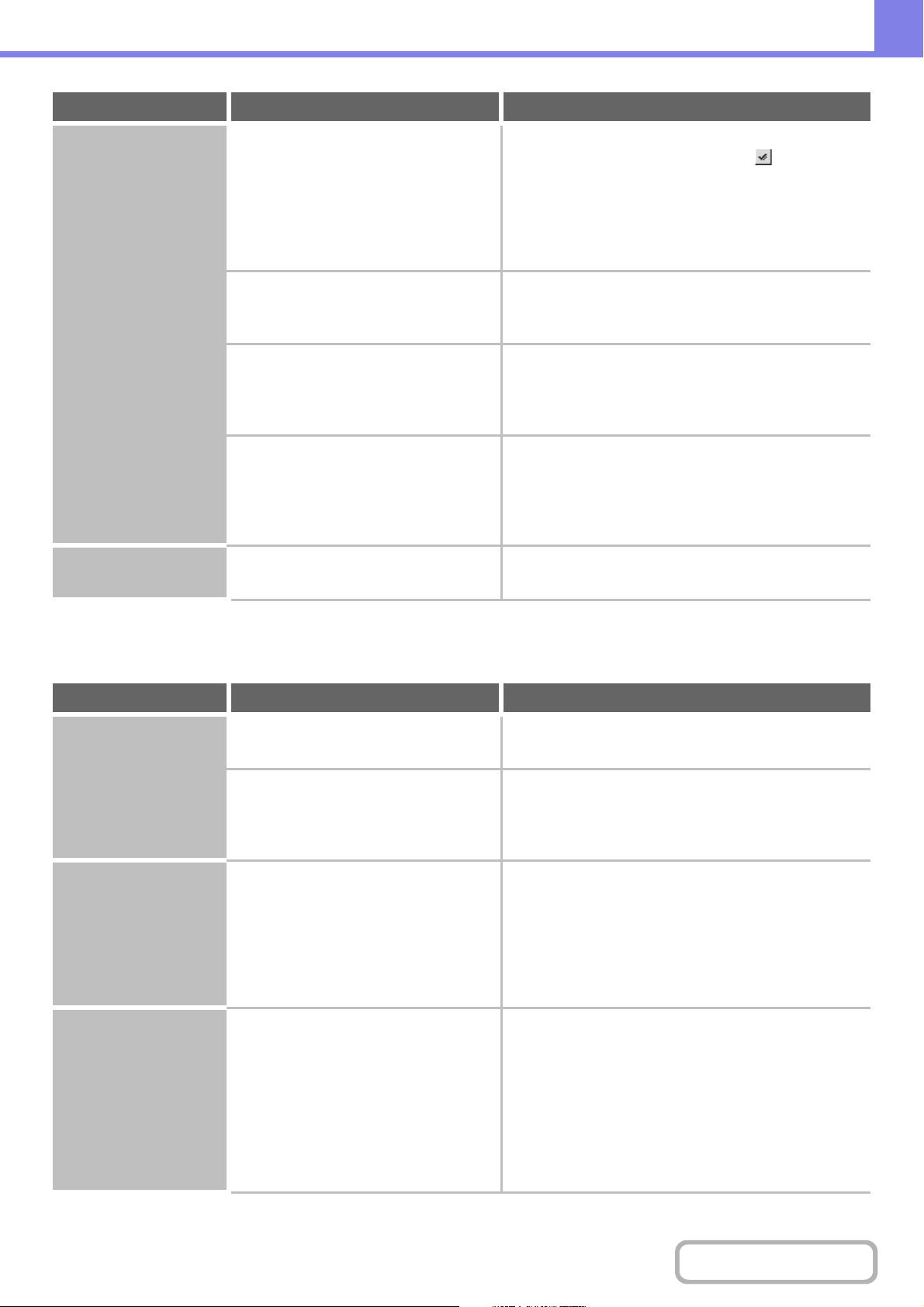
7-9
TROUBLESHOOTING
Contents
PROBLEMS RELATED TO COPY RESULTS
Two-sided copying
does not take place.
Does the paper type setting of the
selected tray specify a type of paper that
cannot be used for two-sided copying?
Check "Tray Settings" in the system settings. If the
[Disable Duplex] checkbox is selected , two-sided
copying using that tray will not be possible. Change the
paper type setting to a type that can be used for
two-sided printing.
➞ System Settings > "Paper Tray Settings" > "Tray
Settings" > "Change"
Are you using a special size or type of
paper?
For the paper types and sizes that can be used for
two-sided copying, see "SPECIFICATIONS" in the
Maintenance & Safety Guide.
Are you copying using settings that do
not allow two-sided copying?
Two-sided copying can generally be combined with
other special modes, however, some combinations are
not possible. If a prohibited combination is selected, a
message will appear in the display.
Have functions been disabled by the
administrator?
Some functions may have been disabled in the system
settings (administrator). Check with your administrator.
When user authentication is enabled, the functions that
you can use may be restricted in your user settings.
Check with your administrator.
The paper size of a
tray cannot be set.
Have functions been disabled by the
administrator?
Some functions may have been disabled in the system
settings (administrator). Check with your administrator.
Problem Point to check Solution
The image is too light
or too dark.
Is the image too light or too dark? Select an appropriate exposure mode for the original
being copied and adjust the exposure level manually.
If you selected an original type instead
of "Auto" for the copy exposure setting,
is the selected original type appropriate
for your original?
Select the original type that matches your original. If the
wrong type is selected, suitable image adjustment will
not be possible.
Colors are off. Did you perform "Registration
Adjustment"?
Ask your administrator to perform "Registration
Adjustment".
If the colors are out of position in the printed output of a
color copy job, "Registration Adjustment" can be used to
adjust the print position of each color.
➞ System Settings (Administrator) > "Device Control" >
"Registration Adjustment"
The color tones are
off.
Did you perform "Auto Color
Calibration"?
If the color tones are off, perform "Auto Color
Calibration" after the above registration adjustment is
finished.
"Auto Color Calibration" automatically corrects color
tones using a test pattern that you scan into the
machine.
➞ System Settings (Administrator) > "Copy Function
Settings" > "Color Adjustment" > "Auto Color
Calibration"
Problem Point to check Solution
7-10
TROUBLESHOOTING
Contents
Part of the image is
cut off.
Has an appropriate ratio been selected
for the original size and paper size?
Select an appropriate ratio setting.
Are you using an AB size original? When copying an AB size original, specify the original
size manually.
Has the correct original size been set? Select the [Original] key and select the correct size.
Copies come out
blank.
Is the original placed face up or face
down correctly?
When using the document glass, the original must be
placed face down. When using the automatic document
feeder, the original must be placed face up.
Problem Point to check Solution
7-11
TROUBLESHOOTING
Contents
PRINTING
PROBLEMS RELATED TO PRINTING OPERATION
• Printing does not take place.. . . . . . . . . . . . . . . . . . . . . . . . . . . . . . . . . . . . . . . . . . . . . . . . . . . . . . . .7-12
• Color printing does not take place. . . . . . . . . . . . . . . . . . . . . . . . . . . . . . . . . . . . . . . . . . . . . . . . . . . .7-13
• Two-sided printing does not take place. . . . . . . . . . . . . . . . . . . . . . . . . . . . . . . . . . . . . . . . . . . . . . . .7-13
• Direct printing of a file in a shared folder on a computer is not possible. . . . . . . . . . . . . . . . . . . . . . .7-14
• A tray, finisher, or other peripheral device installed on the machine cannot be used. . . . . . . . . . . . .7-14
PROBLEMS RELATED TO PRINT RESULTS
• The image is grainy. . . . . . . . . . . . . . . . . . . . . . . . . . . . . . . . . . . . . . . . . . . . . . . . . . . . . . . . . . . . . . .7-14
• The image is too light or too dark.. . . . . . . . . . . . . . . . . . . . . . . . . . . . . . . . . . . . . . . . . . . . . . . . . . . .7-14
• Colors are off. . . . . . . . . . . . . . . . . . . . . . . . . . . . . . . . . . . . . . . . . . . . . . . . . . . . . . . . . . . . . . . . . . . .7-15
• Text and lines are faint and difficult to see.. . . . . . . . . . . . . . . . . . . . . . . . . . . . . . . . . . . . . . . . . . . . .7-15
• Part of the image is cut off. . . . . . . . . . . . . . . . . . . . . . . . . . . . . . . . . . . . . . . . . . . . . . . . . . . . . . . . . .7-15
• The image is upside down. . . . . . . . . . . . . . . . . . . . . . . . . . . . . . . . . . . . . . . . . . . . . . . . . . . . . . . . . .7-15
• Many nonsense characters are printed. . . . . . . . . . . . . . . . . . . . . . . . . . . . . . . . . . . . . . . . . . . . . . . .7-16
PROBLEMS RELATED TO FILING
• Retention does not take place. . . . . . . . . . . . . . . . . . . . . . . . . . . . . . . . . . . . . . . . . . . . . . . . . . . . . . .7-17
• A filed data can not be printed. . . . . . . . . . . . . . . . . . . . . . . . . . . . . . . . . . . . . . . . . . . . . . . . . . . . . . .7-17
PROBLEMS RELATED TO FILE MANAGEMENT
• A stored file has disappeared. . . . . . . . . . . . . . . . . . . . . . . . . . . . . . . . . . . . . . . . . . . . . . . . . . . . . . .7-17
• A file cannot be deleted. . . . . . . . . . . . . . . . . . . . . . . . . . . . . . . . . . . . . . . . . . . . . . . . . . . . . . . . . . . .7-17
• A confidential file or confidential folder cannot be opened.. . . . . . . . . . . . . . . . . . . . . . . . . . . . . . . . .7-17
• A file name cannot be stored or changed. . . . . . . . . . . . . . . . . . . . . . . . . . . . . . . . . . . . . . . . . . . . . .7-17
•
If you cannot find the item that you are looking for in the above table of contents, see "GENERAL PROBLEMS" (page
7-30).
• If you are unable to solve a problem using the solutions in this manual, switch off the [POWER] key ( ) and the
main power switch. Wait at least 10 seconds, and then switch on the main power switch and the [POWER] key ( )
in that order.
Caution:
When the LINE indicator is lit or the DATA indicator is lit or blinking, do not switch off the main power switch
or unplug the power plug. This may damage the hard drive or cause the data being stored or received to be
lost.
7-12
TROUBLESHOOTING
Contents
PROBLEMS RELATED TO PRINTING OPERATION
Problem Point to check Solution
Printing does not take
place.
Is your computer connected correctly to
the machine?
Make sure that the cable is connected securely to the
LAN connector or the USB connector on your computer
and the machine.
If you are on a network, check the connections at the
hub as well.
☞
1. BEFORE USING THE MACHINE "
SIDE AND
BACK
"
(page 1-6)
Is the machine connected to the same
network (LAN, etc.) as your computer?
The machine must be connected to the same network
as your computer.
If you do not know which network the machine is
connected to, ask the network administrator.
Is the IP address selected correctly?
(Windows)
If the machine does not have a permanent IP address
(the machine receives an IP address from a DHCP
server), printing will not be possible if the IP address
changes. Print the "All Custom Setting List" in the
system settings and check the IP address of the
machine. If the IP address has changed, change the
port setting in the printer driver.
➞ System Settings > "List Print (User)" > "All Custom
Setting List"
☞ Installation Guide
If the IP address changes frequently, it is recommended
that a permanent IP address be assigned to the machine.
➞ System Settings (Administrator) > "Network Settings"
Are you using a printer port created
using Standard TCP/IP Port?
(Windows 2000/XP/Server 2003/Vista/
Server 2008)
When a port created with Standard TCP/IP Port in
Windows is used and the [SNMP Status Enabled]
checkbox is , it may not be possible to print correctly.
Change the [SNMP Status Enabled] checkbox to .
☞ Installation Guide
Is "Connect via" set to [Ethernet] for
AppleTalk?
(Mac OS 9.0-9.2.2)
Open [AppleTalk] from the [Control Panels] and make
sure that [Ethernet] is selected in the "Connect via"
menu. Printing is not possible if [Ethernet] is not selected.
Is your computer in an unstable state? Printing is sometimes not possible when you run
multiple applications at once or there is insufficient
memory or hard drive space. Restart your computer.
Is the machine specified correctly in the
software application that you are using
for printing?
Make sure that the printer driver of the machine is
selected in the Print window of the application.
If the printer driver does not appear in the list of
available printer drivers, it may not be installed correctly.
Remove the printer driver and then install it once again.
☞ Installation Guide
Are the network connection devices
operating normally?
Make sure that the routers and other network
connection devices are operating correctly. If a device is
not powered on or is in an error state, see the manual of
the device to correct the problem.
7-13
TROUBLESHOOTING
Contents
Printing does not take
place.
Is the I/O timeout setting too short?
If the I/O timeout setting is too short, errors may occur
while writing to the printer. Ask the administrator of the
machine to configure an appropriate time in "I/O Timeout".
➞ System Settings (Administrator) (Web page only)>
"Printer Settings" > "Interface Settings" > "I/O
Timeout"
Was a Notice Page printed? A Notice Page will be printed to indicate the cause of the
problem if a print job cannot be performed as specified
and the cause is not shown in the display. Read the
printed page and take appropriate action.
For example, a notice page will be printed in the
following situations.
• The print job is too large to fit in memory.
• A function that has been prohibited by the
administrator is specified.
By factory default, Notice Pages are not printed.
Have functions been disabled by the
administrator?
When user authentication is enabled, the functions that
you can use may be restricted in your user settings.
Check with your administrator.
Color printing does
not take place.
Is the color mode set to "Color"? Select "Automatic" or "Color" for the color mode setting.
The color mode setting is configured as follows:
Windows:
On the [Color] tab of the printer driver.
Macintosh:
In the [Color] menu of the print window.
In Windows, [Black and White Print] can also be
selected on the [Main] tab of the printer driver. If you
wish to print in color, make sure that the [Black and
White Print] checkbox on the [Main] tab is not selected
.
Have functions been disabled by the
administrator?
When user authentication is enabled, the functions that
you can use may be restricted in your user settings.
Check with your administrator.
Two-sided printing
does not take place.
Does the paper type setting of the
selected tray specify a type of paper that
cannot be used for two-sided printing?
Check "Tray Settings" in the system settings.
If the [Disable Duplex] checkbox is selected ,
two-sided printing using that tray will not be possible.
Change the paper type setting to a type that can be
used for two-sided printing.
➞ System Settings > "Paper Tray Settings" > "Tray
Settings" > "Change"
Are you using a special size or type of
paper?
For the paper types and sizes that can be used for
two-sided printing, see "SPECIFICATIONS" in the
Maintenance & Safety Guide.
Have functions been disabled by the
administrator?
Some functions may have been disabled in the system
settings (administrator). Check with your administrator.
When user authentication is enabled, the functions that
you can use may be restricted in your user settings.
Check with your administrator.
Problem Point to check Solution
7-14
TROUBLESHOOTING
Contents
PROBLEMS RELATED TO PRINT RESULTS
Direct printing of a file
in a shared folder on a
computer is not
possible.
Is "IPsec Settings" enabled on the
machine?
When "IPsec Settings" is enabled in the system settings
(administrator), direct printing of a file in a shared folder
may not be possible in some computer environments.
For information about "IPsec settings", consult your
administrator.
➞ System Settings (Administrator) > "Security Settings"
> "IPsec Settings"
A tray, finisher, or
other peripheral
device installed on the
machine cannot be
used.
Have the peripheral devices that are
installed on the machine been
configured in the printer driver?
Open the printer properties and click the [Auto
Configuration] button on the [Configuration] tab.
(Windows)
If auto configuration cannot be executed, see the
Installation Guide.
Problem Point to check Solution
The image is grainy. Are the printer driver settings
appropriate for the print job?
When selecting print settings, you can set the print
mode to [Normal], [High Quality], or [Fine]. When you
need a very clear image, select [Fine]. (The [Fine] mode
cannot be selected when using the PCL5c printer
driver.)
Windows:
The resolution setting is selected in the [Advanced]
tab of the printer driver properties window.
Macintosh:
Select the resolution in the [Advanced] menu of the
print window. (In Mac OS v10.5, select the resolution
on the [Color] menu in the print window.)
Have you selected color settings
appropriate for the print job?
Select color settings appropriate for the print job.
Windows:
Select the appropriate document type in [Image Type]
on the [Color] tab of the printer driver. Advanced color
settings can be selected in the [Advanced Color]*
button.
Macintosh:
Select the appropriate document type in [Image Type]
on the [Color] menu of the printer driver. Advanced
color settings can be selected in the [Advanced
Color]* button. (In Mac OS X v10.5 to 10.5.1, in the
[Advanced Color] tab.)
* When adjusting detailed color management settings
such as "Output Profile", select "Custom" from "Image
Type" and then select the desired setting from
"Advanced Color".
The image is too light
or too dark.
Does the image (particularly a photo)
need correction?
(Windows)
Brightness and contrast can be corrected by performing
[Color Adjustment] on the [Color] tab of the printer
driver. These settings can be used for simple
corrections when you do not have image editing
software installed on your computer.
Problem Point to check Solution
7-15
TROUBLESHOOTING
Contents
Colors are off. Did you perform "Registration
Adjustment"?
Ask your administrator to perform "Registration
Adjustment".
If the colors are out of position in the printed output of a
color print job, "Registration Adjustment" can be used to
adjust the print position of each color.
➞ System Settings (Administrator) > "Device Control" >
"Registration Adjustment"
If the color tones are off, perform "Auto Color
Calibration". (If the colors are still off after calibration,
repeating calibration may improve the results.)
➞ System Settings (Administrator) > "Printer Settings" >
"Auto Color Calibration"
Text and lines are faint
and difficult to see.
Was color data printed in black and
white?
(Windows)
When color text and lines are printed in black and white,
they may become faint and difficult to see. To have
color text or lines (areas) that are faint converted to
black, select [Text To Black] or [Vector To Black] on the
[Color] tab of the printer driver. (Raster data such as
bitmap images cannot be adjusted.)
Part of the image is
cut off.
Does the paper size specified by the job
match the size of paper loaded in the
tray?
Make sure that the paper size setting matches the size
of paper loaded in the tray.
The paper size setting is selected as follows:
Windows:
On the [Paper] tab of the printer driver.
If [Fit to Paper Size] is selected, check the loaded
paper and the paper size setting.
Macintosh:
In the [Page Setup] menu.
Is the print orientation setting (portrait or
landscape) correct?
Set the print orientation to match the image.
The print orientation is selected as follows:
Windows: On the [Main] tab of the printer driver.
Macintosh: In the [Page Setup] menu.
Are the margins set correctly in the
layout settings of the application?
If the edge of the image extends outside the printable
area of the machine, the edge will be cut off. Select an
appropriate paper size and margins in the layout
settings of the application.
The image is upside
down.
Are you using a type of paper (punch
paper, etc.) that can only be loaded in a
fixed orientation?
When the image size and paper size are the same but
the orientations are different, the orientation of the
image is automatically rotated to match the paper.
However, when the paper can only be loaded in a fixed
orientation, this may result in the image being printed
upside down. In this event, rotate the image 180
degrees before printing.
The 180 degree rotation setting is selected as follows:
Windows:
On the [Main] tab of the printer driver.
Macintosh (OS X v10.3.9 to 10.5.1):
On the [Page Setup] menu. (Landscape orientation
only.)
(In Mac OS 9.0 to 9.2.2, in the [PostScript Options]
menu of the [Page Setup] menu.)
Problem Point to check Solution
7-16
TROUBLESHOOTING
Contents
The image is upside
down.
Is the correct binding position selected
for two-sided printing?
When two-sided printing is performed, every other page
is printed upside down when tablet binding is selected
for the binding position. Be sure to set the appropriate
binding position.
The binding position is selected as follows:
Windows:
On the [Main] tab of the printer driver.
Macintosh:
In the [Layout] menu of the print window. (In Mac OS
9.0 to 9.2.2, in [Output/Document Style].)
Many nonsense
characters are printed.
Is your computer or the machine in an
unstable state?
If little free space remains in the memory or hard drive of
your computer, or many jobs have been spooled on the
machine and it has little free memory remaining, printed
text may turn into nonsense characters. In this situation,
cancel printing, restart your computer and the machine,
and try printing again.
To cancel printing
Windows:
Double-click the printer icon that appears at the lower
right of the task bar and click "Cancel All Documents"
(or "Purge Print Documents") in the [Printer] menu.
Macintosh:
Double-click the name of the machine in the printer
list, select the job that you wish to delete, and delete
it. (In Mac OS 9.0 to 9.2.2, double-click the printer
icon on the desktop, select the print job that you wish
to delete, and delete it.)
At the machine:
Press the [JOB STATUS] key on the operation panel,
select the [Print Job] tab to change the screen, select
the key of the print job that you wish to delete, and
select the [Stop/Delete] key. A message appears to
confirm the cancelation. Select the [Yes] key.
If nonsense characters are still printed after restarting,
ask your administrator to lengthen the timeout setting of
"I/O Timeout" in the system settings (administrator).
➞ System Settings (Administrator) (Web page only) >
"Printer Settings" > "Interface Settings" > "I/O
Timeout"
If nonsense characters are still printed after taking the
above measures, remove and then reinstall the printer
driver.
Problem Point to check Solution
7-17
TROUBLESHOOTING
Contents
PROBLEMS RELATED TO FILING
PROBLEMS RELATED TO FILE MANAGEMENT
Problem Point to check Solution
Retention does not
take place.
Did you select retention settings in the
printer driver?
In print mode, enable retention on the [Job Handling] tab
of the printer driver.
A filed data can not be
printed.
Have functions been disabled by the
administrator?
Some functions may have been disabled in the system
settings (administrator). Check with your administrator.
When user authentication is enabled, the functions that
you can use may be restricted in your user settings.
Check with your administrator.
Problem Point to check Solution
A stored file has
disappeared.
Did you select the [Print and Delete the
Data] key to print a stored file?
A file that is printed using the [Print and Delete the Data]
key is automatically deleted after being printed. To print
a file without deleting it, use the [Print and Save the
Data] key.
The file property can be set to "Protect" to prevent the
file from being easily deleted. Click "Document
Operations (Web page only)", and then click a file
name.
➞ "Property" > "File Property"
Has automatic deletion of retention files
been enabled?
When "Automatic Deletion of File Settings" is enabled in
the system settings (administrator), the files in the
specified folders are periodically deleted. (Even when
the file property is "Confidential" or "Protect", the file
may be deleted.) If files that you need have been
deleted, consult the administrator of the machine.
➞ System Settings (Administrator) (Web page only) >
"Print Hold Setting" > "Automatic Deletion of File
Settings"
A file cannot be
deleted.
Is the property of the file set to
[Protect]?
A file cannot be deleted when its property is set to
[Protect]. Change the property to [Sharing] and then
delete the file.
Click "Document Operations (Web page only)", and
then click a file name.
➞ "Property" > "File Property"
A confidential file or
confidential folder
cannot be opened.
Did you enter the wrong password? If you cannot remember the password, it is possible to
change the file or folder password to a new password in
the system settings (administrator). Ask your
administrator.
A file name cannot be
stored or changed.
Does the name include characters that
cannot be used in a file name?
The following characters cannot be used in a file name:
\ ? / " ; : , < > ! * & # |
7-18
TROUBLESHOOTING
Contents
FACSIMILE
PROBLEMS RELATED TO TRANSMISSION
• Transmission does not take place. . . . . . . . . . . . . . . . . . . . . . . . . . . . . . . . . . . . . . . . . . . . . . . . . . . .7-19
• The transmitted fax prints out blank at the receiving side. . . . . . . . . . . . . . . . . . . . . . . . . . . . . . . . . .7-20
• The transmitted fax is reduced by the receiving fax machine. . . . . . . . . . . . . . . . . . . . . . . . . . . . . . .7-20
• Transmission does not begin at the specified time. . . . . . . . . . . . . . . . . . . . . . . . . . . . . . . . . . . . . . .7-21
PROBLEMS RELATED TO RECEPTION
• Another party sent a fax but you did not receive it.. . . . . . . . . . . . . . . . . . . . . . . . . . . . . . . . . . . . . . .7-21
• Printing does not take place after reception.. . . . . . . . . . . . . . . . . . . . . . . . . . . . . . . . . . . . . . . . . . . .7-21
• The received image is faint. . . . . . . . . . . . . . . . . . . . . . . . . . . . . . . . . . . . . . . . . . . . . . . . . . . . . . . . .7-21
• The machine does not begin fax reception. . . . . . . . . . . . . . . . . . . . . . . . . . . . . . . . . . . . . . . . . . . . .7-21
PROBLEMS RELATED TO TELEPHONE
• Dialing is not possible. . . . . . . . . . . . . . . . . . . . . . . . . . . . . . . . . . . . . . . . . . . . . . . . . . . . . . . . . . . . .7-22
• You cannot talk to the other party. . . . . . . . . . . . . . . . . . . . . . . . . . . . . . . . . . . . . . . . . . . . . . . . . . . .7-22
PROBLEMS RELATED TO AUDIBLE SIGNALS
• The volume is too low. . . . . . . . . . . . . . . . . . . . . . . . . . . . . . . . . . . . . . . . . . . . . . . . . . . . . . . . . . . . .7-22
• No sound is heard. . . . . . . . . . . . . . . . . . . . . . . . . . . . . . . . . . . . . . . . . . . . . . . . . . . . . . . . . . . . . . . .7-22
PROBLEMS RELATED TO ONE-TOUCH INDIVIDUAL KEYS / GROUP KEYS
• A one-touch individual key or group key cannot be stored. . . . . . . . . . . . . . . . . . . . . . . . . . . . . . . . .7-23
• A one-touch individual key or group key cannot be edited or deleted. . . . . . . . . . . . . . . . . . . . . . . . .7-23
• If you cannot find the item that you are looking for in the above table of contents, see "GENERAL PROBLEMS" (page
7-30).
• If you are unable to solve a problem using the solutions in this manual, switch off the [POWER] key ( ) and the
main power switch. Wait at least 10 seconds, and then switch on the main power switch and the [POWER] key ( )
in that order.
Caution:
When the LINE indicator is lit or the DATA indicator is lit or blinking, do not switch off the main power switch
or unplug the power plug. This may damage the hard drive or cause the data being stored or received to be
lost.
7-19
TROUBLESHOOTING
Contents
PROBLEMS RELATED TO TRANSMISSION
Problem Point to check Solution
Transmission does
not take place.
Is the telephone line connected
securely?
Check the telephone line jack, the wall jack, and any
extension adapters to make sure that all connections
are secure.
☞ CONNECTION TO THE TELEPHONE LINE (page
4-4)
Is the correct dial mode set for your
line?
Ask your administrator to verify that "Dial Mode Setting"
is set correctly for the line you are using.
➞ System Settings (Administrator) > "Image Send
Settings" > "Fax Settings" > "Fax Default Settings" >
"Dial Mode Setting"
Is a busy signal received? If a busy signal is received, the transmission is
temporarily canceled and then automatically
re-attempted after a brief interval. (Factory default
setting: 2 attempts, 3 min. intervals)
➞ System Settings (Administrator) > "Image Send
Settings" > "Fax Settings" > "Fax Send Settings" >
"Recall in Case of Line Busy"
To cancel the transmission, press the [JOB STATUS]
key, select the key of the job that you wish to cancel,
and then select the [Stop/Delete] key.
Did a communication error occur? Depending on the destination region and line conditions,
transmission may fail if the transmission speed is too
fast. Lower the transmission speed in the system
settings and try again.
➞ System Settings (Administrator) > "Image Send
Settings" > "Fax Settings" > "Fax Send Settings" >
"Initial Transmission Speed Setting"
If an error occurs that prevents transmission, the
transmission is temporarily canceled and then
automatically re-attempted after a brief interval.
(Factory default setting: 3 min. intervals)
➞ System Settings (Administrator) > "Image Send
Settings" > "Fax Settings" > "Fax Send Settings" >
"Recall in Case of Communication Error"
To cancel the transmission, press the [JOB STATUS]
key, select the key of the job that you wish to cancel,
and then select the [Stop/Delete] key.
The machine supports error correction mode (ECM) and
is configured to automatically resend any part of a fax
that is distorted due to noise on the line.
➞ System Settings (Administrator) > "Image Send
Settings" > "Fax Settings" > "Fax Default Settings" >
"ECM"
Has the correct original size been set? When an original is placed, the detected original size is
displayed.
If the original size displayed in this key is different from
the size of the original you placed, be sure to select this
key and specify the correct size.
7-20
TROUBLESHOOTING
Contents
Transmission does
not take place.
Does the job status screen (completed
jobs) or a transaction report indicate that
the transmission was not successful?
Perform the transmission again.
If the transmission is still not successful after recalling is
performed as set in "Recall in Case of Line Busy" or
"Recall in Case of Communication Error", the
transmission failure will be indicated in the job status
screen and the transaction report.
➞ System Settings (Administrator) > "Image Send
Settings" > "Fax Settings" > "Fax Send Settings" >
"Recall in Case of Line Busy"
➞ System Settings (Administrator) > "Image Send
Settings" > "Fax Settings" > "Fax Send Settings" >
"Recall in Case of Communication Error"
Did you place a long size original on the
document glass when it is scanned?
A long size original cannot be scanned from the
document glass. Place originals in the document feeder
tray of the automatic document feeder.
Are the sub-address and passcode
correct?
(When using F-code communication)
Check with the operator of the other machine to make
sure that the sub-address and passcode are correct.
Is "Detection of Dial Tone" enabled in
the system settings?
"Detection of Dial Tone" is normally enabled so that the
machine will detect the dial tone before dialing to ensure
that transmission will take place correctly. However, in
some connection environments, transmission is not
possible when this setting is enabled. In this case,
disable "Detection of Dial Tone" and try faxing again.
➞ System Settings (Administrator) > "Image Send
Settings" > "Fax Settings" > "Fax Default Settings" >
"Detection of Dial Tone"
Have functions been disabled by the
administrator?
When user authentication is enabled, the functions that
you can use may be restricted in your user settings.
Check with your administrator.
The transmitted fax
prints out blank at the
receiving side.
Is the original placed face up or face
down correctly?
When using the document glass, the original must be
placed face down. When using the automatic document
feeder, the original must be placed face up. Place the
original correctly and send the fax again.
If the receiving machine is using thermal
paper, was the thermal paper loaded
with the wrong side out?
Check with the operator of the other machine.
The transmitted fax is
reduced by the
receiving fax machine.
Has image rotation been enabled? When "Rotation Sending Setting" is not enabled (the
image is not rotated), an original placed in the vertical
orientation may be reduced by the receiving machine.
Enable "Rotation Sending Settings" before
transmission.
➞ System Settings (Administrator) > "Image Send
Settings" > "Fax Settings" > "Fax Send Settings" >
"Rotation Sending Setting" >
If "Mixed Size Originals" in the special modes is enabled
and an original with a different width is sent, rotate
transmission will be disabled.
Problem Point to check Solution
7-21
TROUBLESHOOTING
Contents
PROBLEMS RELATED TO RECEPTION
Transmission does
not begin at the
specified time.
Is the machine's clock set to the correct
time?
Set the clock to the correct time.
➞ System Settings > "Default Settings" > "Clock" >
"Clock Adjust"
Is a transmission in progress? If another transmission is in progress when the specified
time arrives, the timer operation will begin after that
transmission is finished.
Problem Point to check Solution
Another party sent a
fax but you did not
receive it.
Did a reception error occur? Depending on your region and line conditions,
communication may not be possible if your reception
speed is too fast. Lower the reception speed in the
system settings and ask the other party to try sending
the fax again.
➞ System Settings (Administrator) > "Image Send
Settings" > "Fax Settings" > "Fax Receive Settings" >
"Initial Reception Speed Setting"
Printing does not take
place after reception.
Does a message appear in the display
instructing you to add toner or paper?
(Printing is not possible when this
screen appears.)
Restore printing capability as instructed by the
message.
Does a password entry screen appear? "Hold Setting for Received Data Print" is enabled. Enter
the correct password with the numeric keys.
If you do not know the password, check with your
administrator.
Is forwarding (Inbound Routing function)
selected in the Web page for a received
fax?
When the Inbound Routing function is enabled in the
Web pages, received faxes are automatically forwarded
to a specified address. If "Print at Error" is selected
when Inbound Routing is enabled, received faxes will
only be printed when an error occurs. If you need to
print a received fax, ask your administrator.
The received image is
faint.
Is the original that was faxed also faint? Ask the other party to send the fax again using a
suitable (darker) exposure setting.
The machine does not
begin fax reception.
Has the reception mode been set to
"Manual Reception" in the system
settings?
When the reception mode is set to "Manual Reception",
the machine will not receive faxes automatically. To
have the machine receive faxes automatically, set the
reception mode to "Auto Reception".
➞ System Settings > "Fax Data Receive/Forward" >
"Fax Settings" > "Receive Setting"
Problem Point to check Solution
7-22
TROUBLESHOOTING
Contents
PROBLEMS RELATED TO TELEPHONE
PROBLEMS RELATED TO AUDIBLE SIGNALS
Problem Point to check Solution
Dialing is not possible. Is the extension phone connected? Check the telephone line jack, the extension phone
jack, the wall jack, and any extension adapters to make
sure that all connections are secure.
You cannot talk to the
other party.
Did you dial using the speaker? When you dial using the speaker, you will be able to
hear the voice of the other party, but he or she will not
hear your voice. Use the extension phone. (When the
extension phone is not installed, you cannot talk to the
other party.)
Problem Point to check Solution
The volume is too low.
• Speaker
• Ringer Volume
• Line Monitor
• Fax Receive
Complete Signal
• Fax Send Complete
Signal
• Fax Communication
Error Signal
Has the volume been set to a low level
in the system settings (administrator)?
Ask your administrator to set the volumes in "Speaker
Settings" to a higher level.
➞ System Settings (Administrator) > "Image Send
Settings" > "Fax Settings" > "Fax Default Settings" >
"Speaker Settings"
No sound is heard.
• Ringer Volume
• Line Monitor
• Fax Receive
Complete Signal
• Fax Send Complete
Signal
• Fax Communication
Error Signal
Has the ringer volume been turned off in
the system settings (administrator)?
Ask your administrator to set the volumes in "Speaker
Settings" to other than "No Sound".
➞ System Settings (Administrator) > "Image Send
Settings" > "Fax Settings" > "Fax Default Settings" >
"Speaker Settings"
7-23
TROUBLESHOOTING
Contents
PROBLEMS RELATED TO ONE-TOUCH INDIVIDUAL
KEYS / GROUP KEYS
Problem Point to check Solution
A one-touch individual
key or group key
cannot be stored.
Has the maximum number of keys been
stored?
Delete one-touch keys and group keys that are not
being used.
Have functions been disabled by the
administrator?
Some functions may have been disabled in the system
settings (administrator). Check with your administrator.
A one-touch individual
key or group key
cannot be edited or
deleted.
If the key is an individual key, is the key
included in a group?
Remove the key from the group and then edit or delete
the key. (If the key is included in multiple groups, it must
be removed from all groups.)
➞ "Address Book" (Web page only)
If multiple group keys have been stored, print the Group
List in "Sending Address List" in the system settings.
The list will show where the key is stored.
➞ System Settings > "List Print (User)" > "Sending
Address List" > "Group List"
Is the key being used in a reserved
transmission or a transmission in
progress?
Wait until the transmission is finished or cancel the
transmission and then edit or delete the key.
Is the key included in a program key? Remove the key from the program and then edit or
delete the key. (If the key is included in program, it must
be removed from program.)
➞ System Settings > "Address Control" > "Program"
If multiple program keys have been stored, print the
Program List in "Sending Address List" in the system
settings. The list will show where individual and group
keys are stored.
➞ "Job Program" (Web page only)
Is the key that you wish to edit or delete
stored as a relay destination of a F-code
relay broadcast transmission?
An individual or group one-touch key that is stored as a
relay destination cannot be edited or deleted. Remove
the key from the relay destinations of the F-code relay
broadcast transmission and then edit or delete the key.
➞ System Settings (Web page only) > "F-Code Memory
Box"
Have functions been disabled by the
administrator?
Some functions may have been disabled in the system
settings (administrator). Check with your administrator.
Has your administrator enabled a
function that prevents editing/deleting?
If your administrator has enabled settings such as
"Inbound Routing Settings" (Web page only),
editing/deleting will not be possible. Check with your
administrator.
➞ Application Settings (Web page only) > "Inbound
Routing Settings"
7-24
TROUBLESHOOTING
Contents
PROBLEMS RELATED TO SCANNING / INTERNET FAX
OPERATION
SCANNING / INTERNET FAX
PROBLEMS RELATED TO SCANNING / INTERNET FAX OPERATION
• Transmission does not take place. . . . . . . . . . . . . . . . . . . . . . . . . . . . . . . . . . . . . . . . . . . . . . . . . . . .7-24
• An address cannot be specified.. . . . . . . . . . . . . . . . . . . . . . . . . . . . . . . . . . . . . . . . . . . . . . . . . . . . .7-25
• Mode cannot be selected.. . . . . . . . . . . . . . . . . . . . . . . . . . . . . . . . . . . . . . . . . . . . . . . . . . . . . . . . . .7-25
• Auto selection of the color mode does not take place correctly.. . . . . . . . . . . . . . . . . . . . . . . . . . . . .7-25
• The received image file cannot be opened. . . . . . . . . . . . . . . . . . . . . . . . . . . . . . . . . . . . . . . . . . . . .7-26
• Transmission takes a long time. . . . . . . . . . . . . . . . . . . . . . . . . . . . . . . . . . . . . . . . . . . . . . . . . . . . . .7-26
• A destination is pre-selected. . . . . . . . . . . . . . . . . . . . . . . . . . . . . . . . . . . . . . . . . . . . . . . . . . . . . . . .7-26
• Cannot write to USB memory. (When using USB Memory Scan.) . . . . . . . . . . . . . . . . . . . . . . . . . . .7-26
PROBLEMS RELATED TO SCAN RESULTS
• The scanned image is clipped. . . . . . . . . . . . . . . . . . . . . . . . . . . . . . . . . . . . . . . . . . . . . . . . . . . . . . .7-27
• The quality of the scanned image is poor. . . . . . . . . . . . . . . . . . . . . . . . . . . . . . . . . . . . . . . . . . . . . .7-27
• The scanned image is blank. . . . . . . . . . . . . . . . . . . . . . . . . . . . . . . . . . . . . . . . . . . . . . . . . . . . . . . .7-27
• The scanned image is upside down or on its side. . . . . . . . . . . . . . . . . . . . . . . . . . . . . . . . . . . . . . . .7-27
• The [COLOR START] key indicator is not lit. . . . . . . . . . . . . . . . . . . . . . . . . . . . . . . . . . . . . . . . . . . .7-27
• JPEG was selected for the file type but the file was created as a TIFF file. . . . . . . . . . . . . . . . . . . . .7-28
• The image is too light or too dark. (When using PC Scan.) . . . . . . . . . . . . . . . . . . . . . . . . . . . . . . . .7-28
PROBLEMS RELATED TO ONE-TOUCH INDIVIDUAL KEYS / GROUP KEYS
• A one-touch individual key or group key cannot be stored. . . . . . . . . . . . . . . . . . . . . . . . . . . . . . . . .7-29
• A one-touch individual key or group key cannot be edited or deleted. . . . . . . . . . . . . . . . . . . . . . . . .7-29
•
If you cannot find the item that you are looking for in the above table of contents, see "GENERAL PROBLEMS" (page
7-30).
• If you are unable to solve a problem using the solutions in this manual, switch off the [POWER] key ( ) and the
main power switch. Wait at least 10 seconds, and then switch on the main power switch and the [POWER] key ( )
in that order.
Caution:
When the LINE indicator is lit or the DATA indicator is lit or blinking, do not switch off the main power switch or
unplug the power plug. This may damage the hard drive or cause the data being stored or received to be lost.
Problem Point to check Solution
Transmission does
not take place.
Did you select the correct destination?
Is the correct information (e-mail
address or FTP server information)
stored for that destination?
Make sure that the correct destination information is
stored for the destination and that the destination is
correctly selected. If delivery by e-mail (Scan to E-mail)
is unsuccessful, an error message such as "Undelivered
Message" may be sent to the designated administrator's
e-mail address. This information may help you
determine the cause of the problem.
7-25
TROUBLESHOOTING
Contents
Transmission does
not take place.
Does the image file exceed the e-mail
attachment limit set in the system
settings (administrator)?
If your administrator has set a limit on the size of
transmitted files, a file that exceeds the limit cannot be
transmitted. Check with your administrator.
Did the image file exceed the file
attachment size limit of your mail
server?
(When Scan to E-mail is used.)
Reduce the size of the file attachment (reduce the
number of pages scanned). The size of the file can also
be reduced by scanning using a lower resolution setting.
Ask your mail server administrator what the file size limit
is for one e-mail transmission.
Has the folder on the destination
computer been set as a shared folder so
that files can be sent to it?
(When using Scan to Network Folder.)
If the destination folder is not configured as a shared
folder, select "share" in the folder properties. If the folder
was moved or otherwise changed, the "share" setting
may have been canceled.
Is "IPsec Settings" enabled on the
machine?
(When using Scan to Network Folder.)
When "IPsec Settings" is enabled in the system settings
(administrator), direct printing of a file in a shared folder
may not be possible in some computer environments.
For information about "IPsec settings", consult your
administrator.
➞ System Settings (Administrator) > "Security Settings"
> "IPsec Settings"
Did you place a long size original on the
document glass when it is scanned?
A long size original cannot be scanned from the
document glass. Place originals in the document feeder
tray of the automatic document feeder.
An address cannot be
specified.
Have functions been disabled by the
administrator?
Some functions may have been disabled in the system
settings (administrator). Check with your administrator.
When user authentication is enabled, the functions that
you can use may be restricted in your user settings.
Check with your administrator.
Mode cannot be
selected.
Auto selection of the
color mode does not
take place correctly.
Are you scanning one of the following
types of originals?
When Black & White is not selected:
• Are there colors or coloring in the
paper?
When Color is not selected:
• Is the color in the original very light?
• Is the color in the original very dark,
almost black?
• Is only a very small area of the
original colored?
When the color mode is set to "Auto", the machine
detects whether the original is black and white or color
when the [COLOR START] key is pressed; however, in
the cases at left, automatic detection may not give the
correct result. In this event, specify the color mode
manually.
Problem Point to check Solution
7-26
TROUBLESHOOTING
Contents
The received image
file cannot be opened.
Does the viewer program used by the
recipient support the format of the
received image data?
The recipient may be able to open the file if you change
the file type and compression mode selected at the time
of transmission. Use a software program that is capable
of opening the selected file type and compression mode.
Does a message appear prompting you
to enter your password?
The received file is an encrypted PDF file. Ask the
sender for the password, or have the image sent again
in a non-encrypted format.
Transmission takes a
long time.
Is the resolution setting appropriate at
the time of scanning?
To select resolution and data compression settings that
are suited to the purpose of transmission and create
image data that is balanced in terms of resolution and
file size, pay attention to the following points:
Resolution settings
The default resolution setting is [200X200dpi] in
scanner and USB memory mode, and [200X100dpi] in
Internet fax mode. If the original does not contain a
halftone image such as a photo or illustration,
scanning at the default resolution will create a
practical and useful image. A higher resolution setting
or the "Half Tone" setting (in Internet fax mode)
should only be selected if the original contains a photo
and you wish to give priority to the quality of the photo
image. Exercise caution in this case as a larger file
will be created than when the default setting is used.
A destination is
pre-selected.
Is "Default Address Setting" enabled in
the system settings (administrator)?
If you wish to send to a destination other than the
default destination, select the [Cancel] key.
If you are the administrator and wish to change or
disable the default destination, change the settings as
appropriate in "Default Address Setting".
➞ System Settings (Administrator) (Web page only) >
> "Image Send Settings" > "Scan Settings" > "Default
Address Setting"
Cannot write to USB
memory.
(When using USB
Memory Scan.)
Is the connected USB device
recognized correctly?
Use "USB-Device Check" in the system settings to
check whether or not the device can be recognized.
➞ System Settings > "USB-Device Check"
If it is not recognized, connect it once again.
Problem Point to check Solution
7-27
TROUBLESHOOTING
Contents
PROBLEMS RELATED TO SCAN RESULTS
Problem Point to check Solution
The scanned image is
clipped.
Is the original scan size setting smaller
than the actual original size?
Set the scan size to the actual original size.
If you have intentionally set a smaller size than the actual
original size, note carefully the placement position of the
selected scan size when placing the original. For example,
when scanning a 8-1/2" x 11" (A4) original using a
5-1/2" x 8-1/2" (B5) setting on the document glass, align
the original using the document glass scale at the left
center to fit the area you wish to scan into the
5-1/2" x 8-1/2" (B5) scanning area.
☞ 1. BEFORE USING THE MACHINE "PLACING
THE ORIGINAL ON THE DOCUMENT GLASS"
(page 1-52)
The quality of the
scanned image is
poor.
Is the original printed matter such as a
book or magazine?
When the original is printed matter, vertical patterns
(moiré) may occur. Select the [Exposure] key in the base
screen to open the exposure setting screen. The [Moiré
Reduction] checkbox appears in this screen. This
checkbox can be selected to reduce the moiré
effect. (only in scan mode and USB memory scan mode)
It may also be possible to reduce the moiré effect by
changing the resolution setting or shifting the original (or
changing its angle) slightly on the document glass.
When scanning a color or grayscale
original, is the color mode set to
"Mono2"?
Setting the color mode to "Mono2" replaces the colors in
the original with either black or white. This is suitable for
text-only originals; however, for originals that contain
illustrations, it is best to use the [BLACK & WHITE START]
key with the color mode set to [Grayscale], or set the color
mode of the [COLOR START] key to [Full Color] or
[Auto]-[Grayscale] and then scan.
Is a destination included that has
[TIFF-S] selected for the format?
When a broadcast transmission is performed that
includes both scan mode destinations and Internet fax
destinations that have [TIFF-S] selected for the format,
the resolution will remain fixed at [200X200dpi] even if a
different resolution setting is selected. If you wish to
send an image scanned at high resolution to scan mode
destinations, send the image in a separate
transmission.
The scanned image is
blank.
Is the original placed face up or face
down correctly?
When using the document glass, the original must be
placed face down. When using the automatic document
feeder, the original must be placed face up.
The scanned image is
upside down or on its
side.
Are Internet fax addresses included in
the transmission?
When both scan mode and Internet fax destinations are
included in a broadcast transmission, the original
transmission orientation of Internet fax takes
precedence, and thus the file may not appear in the
correct orientation when viewed on a computer. In this
event, send the image to the scan mode destinations in
a separate transmission.
The [COLOR START]
key indicator is not lit.
Are Internet fax or fax destinations
included?
If Internet fax or fax destinations are included in the
destinations, only the [BLACK & WHITE START] key
can be used.
7-28
TROUBLESHOOTING
Contents
JPEG was selected for
the file type but the file
was created as a TIFF
file.
Did you press the [BLACK & WHITE
START] key to begin scanning?
When [JPEG] is selected for the file type and the image
is scanned in Mono 2, the file will be created as a TIFF
file. To create the file as a JPEG file, change the color
mode to [Full Color] and then press the [COLOR
START] key.
The image is too light
or too dark.
(When using PC
Scan.)
Is the threshold value suitable? When scanning from the TWAIN driver with [Mono 2
gradation] selected from the [Color Mode] of the
"Custom Settings" window, check the "B/W Threshold"
setting. A large threshold value makes the image darker
and a small threshold value makes the image brighter.
To adjust the "B/W Threshold" automatically, click the
[Auto Threshold] button on the [Image] tab of the
"Custom Settings" window.
Are the brightness and contrast settings
suitable?
When the brightness and contrast settings are not
suitable (for example, the scanned image is too bright),
click the [Auto Brightness / Contrast Adjustment] button
on the [Color] tab of the "Custom Settings" window. You
can also click the [Brightness / Contrast] button to set
the brightness and contrast while viewing the scanned
image.
Problem Point to check Solution

7-29
TROUBLESHOOTING
Contents
PROBLEMS RELATED TO ONE-TOUCH INDIVIDUAL
KEYS / GROUP KEYS
Problem Point to check Solution
A one-touch individual
key or group key
cannot be stored.
Has the maximum number of keys been
stored?
Delete one-touch keys and group keys that are not
being used.
Have functions been disabled by the
administrator?
Some functions may have been disabled in the system
settings (administrator). Check with your administrator.
A one-touch individual
key or group key
cannot be edited or
deleted.
If the key is an individual key, is the key
included in a group?
Remove the key from the group and then edit or delete
the key. (If the key is included in multiple groups, it must
be removed from all groups.)
➞ "Address Book" (Web page only)
If multiple group keys have been stored, print the Group
List in "Sending Address List" in the system settings.
The list will show where the key is stored.
➞ System Settings > "List Print (User)" > "Sending
Address List" > "Group List"
Is the key being used in a reserved
transmission or a transmission in
progress?
Wait until the transmission is finished or cancel the
transmission and then edit or delete the key.
Is the key included in a program key? Remove the key from the program and then edit or
delete the key. (If the key is included in program, it must
be removed from program.)
➞ "Job Program" (Web page only)
If multiple program keys have been stored, print the
Program List in "Sending Address List" in the system
settings. The list will show where individual and group
keys are stored.
➞ System Settings > "List Print (User)" > "Sending
Address List" > "Program List"
Have functions been disabled by the
administrator?
Some functions may have been disabled in the system
settings (administrator). Check with your administrator.
Has your administrator enabled a
function that prevents editing/deleting?
If your administrator has enabled "Default Address
Setting" or "Inbound Routing Settings" (in the Web
pages), editing/deleting will not be possible. Check with
your administrator.
➞ System Settings (Administrator) (Web page only) >
"Image Send Settings" > "Scan Settings" > "Default
Address" > "Default Address Setting"
➞ Application Settings (Web page only) > "Inbound
Routing Settings"

7-30
TROUBLESHOOTING
Contents
GENERAL PROBLEMS
PROBLEMS RELATED TO MACHINE OPERATION
• Specified machine functions cannot be used.. . . . . . . . . . . . . . . . . . . . . . . . . . . . . . . . . . . . . . . . . . .7-31
• The operation panel cannot be used. . . . . . . . . . . . . . . . . . . . . . . . . . . . . . . . . . . . . . . . . . . . . . . . . .7-31
• Printing is not possible or stops during a job. . . . . . . . . . . . . . . . . . . . . . . . . . . . . . . . . . . . . . . . . . . .7-32
• The wrong size is selected.. . . . . . . . . . . . . . . . . . . . . . . . . . . . . . . . . . . . . . . . . . . . . . . . . . . . . . . . .7-32
• The displayed bypass tray paper size is not correct. . . . . . . . . . . . . . . . . . . . . . . . . . . . . . . . . . . . . .7-32
PROBLEMS RELATED TO PAPER FEEDING AND OUTPUT
• The original misfeeds (automatic document feeder). . . . . . . . . . . . . . . . . . . . . . . . . . . . . . . . . . . . . .7-33
• The paper misfeeds. . . . . . . . . . . . . . . . . . . . . . . . . . . . . . . . . . . . . . . . . . . . . . . . . . . . . . . . . . . . . . .7-33
• Paper does not feed from the paper tray. . . . . . . . . . . . . . . . . . . . . . . . . . . . . . . . . . . . . . . . . . . . . . .7-34
• The image on paper is skewed. . . . . . . . . . . . . . . . . . . . . . . . . . . . . . . . . . . . . . . . . . . . . . . . . . . . . .7-34
• The automatic document feeder does not operate. . . . . . . . . . . . . . . . . . . . . . . . . . . . . . . . . . . . . . .7-34
PROBLEMS RELATED TO QUALITY / PRINT RESULTS
• Lines appear in the scanned image. . . . . . . . . . . . . . . . . . . . . . . . . . . . . . . . . . . . . . . . . . . . . . . . . . .7-34
• Smudges appear on printed output. . . . . . . . . . . . . . . . . . . . . . . . . . . . . . . . . . . . . . . . . . . . . . . . . . .7-35
• Toner does not adhere well or creases appear in the paper. . . . . . . . . . . . . . . . . . . . . . . . . . . . . . . .7-35
• Print quality is poor. . . . . . . . . . . . . . . . . . . . . . . . . . . . . . . . . . . . . . . . . . . . . . . . . . . . . . . . . . . . . . .7-35
• Part of the image is cut off. . . . . . . . . . . . . . . . . . . . . . . . . . . . . . . . . . . . . . . . . . . . . . . . . . . . . . . . . .7-35
• Printing takes place on the wrong side of the paper. . . . . . . . . . . . . . . . . . . . . . . . . . . . . . . . . . . . . .7-36
• A cover or insert is not printed on the specified paper.. . . . . . . . . . . . . . . . . . . . . . . . . . . . . . . . . . . .7-36
PROBLEMS RELATED TO PERIPHERAL DEVICES
• The connected USB device cannot be used. . . . . . . . . . . . . . . . . . . . . . . . . . . . . . . . . . . . . . . . . . . .7-36
• The connected USB memory cannot be used. . . . . . . . . . . . . . . . . . . . . . . . . . . . . . . . . . . . . . . . . . .7-36
• The finisher does not operate. . . . . . . . . . . . . . . . . . . . . . . . . . . . . . . . . . . . . . . . . . . . . . . . . . . . . . .7-36
• Stapling does not take place. . . . . . . . . . . . . . . . . . . . . . . . . . . . . . . . . . . . . . . . . . . . . . . . . . . . . . . .7-36
• The stapling position is not correct. . . . . . . . . . . . . . . . . . . . . . . . . . . . . . . . . . . . . . . . . . . . . . . . . . .7-37
• Output does not collect neatly in the output tray of the finisher. . . . . . . . . . . . . . . . . . . . . . . . . . . . . .7-37
• Stapled output does not collect neatly. . . . . . . . . . . . . . . . . . . . . . . . . . . . . . . . . . . . . . . . . . . . . . . . .7-37
OTHER PROBLEMS
• Preview images or thumbnail images do not appear. . . . . . . . . . . . . . . . . . . . . . . . . . . . . . . . . . . . . .7-38
• The display screen is difficult to view.. . . . . . . . . . . . . . . . . . . . . . . . . . . . . . . . . . . . . . . . . . . . . . . . .7-38
• You were logged out without having performed logout yourself. . . . . . . . . . . . . . . . . . . . . . . . . . . . .7-38
• You forgot the administrator password. . . . . . . . . . . . . . . . . . . . . . . . . . . . . . . . . . . . . . . . . . . . . . . .7-38
If you are unable to solve a problem using the solutions in this manual, switch off the [POWER] key ( ) and the main
power switch. Wait at least 10 seconds, and then switch on the main power switch and the [POWER] key ( ) in that
order.
Caution:
When the LINE indicator is lit or the DATA indicator is lit or blinking, do not switch off the main power switch or
unplug the power plug. This may damage the hard drive or cause the data being stored or received to be lost.
7-31
TROUBLESHOOTING
Contents
PROBLEMS RELATED TO MACHINE OPERATION
Problem Point to check Solution
Specified machine
functions cannot be
used.
Have functions been disabled by the
administrator?
Some functions may have been disabled in the "User
Control" (Web page only) or system settings
(administrator). Check with your administrator.
When user authentication is enabled, the functions that
you can use and page counts may be restricted in your
user settings. Check with your administrator.
The operation panel
cannot be used.
Is the main power indicator lit? If the main power indicator is not lit, make sure that the
power plug is firmly inserted in the power outlet, switch
the main power switch to the "on" position, and press
the [POWER] key ( ) to turn on the power.
Did you just power on the machine? After the [POWER] key ( ) is turned on, the machine
requires some time to complete warmup operation.
During this time functions can be selected, however, a
job cannot be run. Wait until a message appears
indicating that the machine is ready.
Is the [POWER SAVE] key ( )
blinking?
Auto Power Shut-Off mode has activated. To return the
machine to normal operation, press the [POWER SAVE]
key ( ).
☞ 1. BEFORE USING THE MACHINE "[POWER
SAVE] KEY" (page 1-15)
Is a cover open or a device separated
from the machine?
A warning message will appear when a cover is open or
a device is separated from the machine. Read the
message and take appropriate action.
Did login fail three times in a row? When "A Warning when Login Fails" is enabled in the
"User Control" (Web page only) and login fails 3 times in
a row, a warning will be displayed and operation will
lock for 5 minutes. After operation unlocks, log in using
the correct user information. (If you do not know your
user information, contact your administrator.)
Does a message appear indicating that
Auto Login failed?
Auto Login failed due to a problem on the network.
Contact your administrator.
If you are the administrator, select the [Admin
Password] key, log in as an administrator, and
temporarily change the auto login settings in the system
settings (administrator). (Restore the changed settings
to their original state after the network problem has
been solved.)
7-32
TROUBLESHOOTING
Contents
Printing is not
possible or stops
during a job.
Is a tray out of paper?
Add paper as instructed by the message in the display.
Is the machine out of toner? When toner runs low, a message will appear to inform
you that the toner cartridge must be replaced. To
replace the toner cartridge, see the Maintenance &
Safety Guide.
Has a paper misfeed occurred? Remove the misfeed as instructed by the message in
the display.
☞ REMOVING MISFEEDS (page 7-2)
Is the output tray full? When the output tray becomes full, a detector activates
and stops printing.
Remove the output from the tray and resume printing.
Is the toner collection container full? Replace the toner collection container as instructed by
the message in the display.
☞ Maintenance & Safety Guide
In the Paper Tray Settings of the system
settings, are restrictions placed on the
trays that can be used in each mode
(copy, print, fax, Internet fax, and
document filing)?
Check the Paper Tray Settings and see if checkmarks
appear in the checkboxes of each mode (Feeding
Approved Job). Functions without a checkmark cannot
be used for printing using that tray.
➞ System Settings > "Paper Tray Settings" > "Tray
Settings" > "Change" > (Each mode)
The wrong size is
selected.
Has the correct original size been set? When an original is placed, the detected original size is
displayed.
If the original size displayed in this key is different from
the size of the original you placed, be sure to select this
key and specify the correct size.
The displayed bypass
tray paper size is not
correct.
Is the bypass tray extension pulled out? When loading paper in the bypass tray, be sure to pull
out the extension to enable the paper size to be
detected correctly.
Problem Point to check Solution
7-33
TROUBLESHOOTING
Contents
PROBLEMS RELATED TO PAPER FEEDING AND
OUTPUT
Problem Point to check Solution
The original misfeeds
(automatic document
feeder).
Is too much paper loaded in document
feeder tray?
Make sure that the stack of paper in the tray is not
higher than the indicator line.
Is the original a long original? When using the automatic document feeder to scan a
long original, set the scan size to [Long Size]. (Note that
long originals cannot be copied using the copy function.)
Is the original on thin paper? Use the document glass to scan the original. If you need
to use the automatic document feeder, use slow scan
mode in the special modes to scan the original.
Is the feed roller dirty? Clean the surface of the original feed roller.
☞ Maintenance & Safety Guide
The paper misfeeds. Is a torn piece of paper remaining in the
machine?
Make sure all paper is removed.
☞ REMOVING MISFEEDS (page 7-2)
Is too much paper loaded in the tray? Make sure that the stack of paper in the tray is not
higher than the indicator line.
Are multiple sheets feeding at once? Fan the paper well before loading it.
Are you using paper that is not within
the specifications?
Use SHARP-recommended paper. Using paper that is
not supported may result in misfeeds, creases, or
smudges.
Please use SHARP-recommended paper and label
sheets.
For paper that is prohibited or not recommended, see
"USEABLE PAPER" (page 1-42) in "1. BEFORE USING
THE MACHINE".
Has the paper in the tray absorbed
moisture?
If you will not be using paper in a tray for a long time,
remove the paper from the tray and store it in a bag in a
dark and dry location.
Are the bypass tray guides adjusted to
the width of the paper?
Adjust the bypass tray guides to the width of the paper.
Is the bypass tray extension pulled out? When loading a large size of paper, pull out the
extension.
Is the bypass feed roller dirty? Clean the surface of the bypass feed roller.
☞ Maintenance & Safety Guide
7-34
TROUBLESHOOTING
Contents
PROBLEMS RELATED TO QUALITY / PRINT RESULTS
The paper misfeeds. Has the correct paper size been set? If you are using a special size, be sure to specify the
paper size.
If the size of paper loaded in a tray was changed, be
sure to check the paper size setting.
➞ System Settings > "Paper Tray Settings" > "Tray
Settings"
Did you add paper to the bypass tray? When adding paper, remove any paper remaining in the
bypass tray, combine it with the paper to be added, and
reload as a single stack. If paper is added without
removing the remaining paper, a misfeed may result.
Paper does not feed
from the paper tray.
Is the paper loaded correctly in the
paper tray?
Set the guides to the size of the paper. Make sure the
height of the paper does not exceed the indicator line.
In the Paper Tray Settings of the system
settings, are restrictions placed on the
trays that can be used in each mode
(copy, print, fax, Internet fax, and
document filing)?
Check the Paper Tray Settings and see if checkmarks
appear in the checkboxes of each mode (Feeding
Approved Job). Functions without a checkmark cannot
be used for printing using that tray.
➞ System Settings > "Paper Tray Settings" > "Tray
Settings" > "Change" > (Each mode)
The image on paper is
skewed.
Is too much paper loaded in the bypass
tray?
Do not load more than the maximum number of sheets.
The maximum number of sheets varies depending on
the paper type setting. For more information, see
"SPECIFICATIONS" in the Maintenance & Safety
Guide.
Are the bypass tray guides adjusted to
the width of the paper?
Adjust the bypass tray guides to the width of the paper.
Are the original guides adjusted to the
width of the paper?
Adjust the original guides to the width of the paper.
The automatic
document feeder does
not operate.
Have functions been disabled by the
administrator?
Some functions may have been disabled in the "User
Control" (Web page only) or system settings
(administrator). Check with your administrator.
Problem Point to check Solution
Lines appear in the
scanned image.
Are the scanning areas of the document
glass or automatic document feeder
dirty?
Clean the scanning areas of the document glass or
automatic document feeder.
☞ Maintenance & Safety Guide
Is the paper feed roller or the bypass
feed roller dirty?
Clean the surface of the paper feed roller or the bypass
feed roller.
☞ Maintenance & Safety Guide
Problem Point to check Solution
7-35
TROUBLESHOOTING
Contents
Smudges appear on
printed output.
Are you using paper that is not within
the specifications?
Use SHARP-recommended paper. Using paper that is
for other models or special paper that is not supported
may result in misfeeds, creases, or smudges.
Please use SHARP-recommended paper and label
sheets.
Are you printing on pre-punched paper? If the printed image overlaps the punch holes, smudges
may appear on the reverse side of the paper following
one-sided printing, or on both sides following two-sided
printing. Take care that the image does not overlap the
punch holes.
Is the laser unit, the main charger, or the
PT charger dirty?
If these units are dirty, smudges appear upon print
results. Clean these units periodically.
For cleaning, see "Maintenance & Safety Guide".
Toner does not adhere
well or creases appear
in the paper.
Are you using paper that is not within
the specifications?
Use SHARP-recommended paper. Using paper that is
for other models or special paper that is not supported
may result in misfeeds, creases, or smudges.
Please use SHARP-recommended paper and label
sheets.
Did you set the correct paper type? Set the correct paper type in the tray settings. Make
sure that the following has not occurred:
• Heavy paper is being used, but a paper type other
than heavy paper is selected in the tray settings. (The
image may disappear if rubbed.)
• Paper other than heavy paper is being used, but
heavy paper is selected in the tray settings. (This may
cause creases and misfeeds.)
➞ System Settings > "Paper Tray Settings" > "Tray
Settings"
Is the paper loaded so that printing
takes place on the reverse side?
If printing takes place on the wrong side of label sheets
or transparency film, the toner may not adhere well and
a clear image may not be obtained.
Print quality is poor. Is "Toner Save Mode" enabled? When "Toner Save Mode" is enabled, printing takes
place using less toner and thus the print result is lighter.
Check with your administrator.
Part of the image is
cut off.
Has the correct paper size been set? If you are using a special size, be sure to specify the
paper size.
If the size of paper loaded in a tray was changed, be
sure to check the paper size setting.
➞ System Settings > "Paper Tray Settings" > "Tray
Settings"
Was the original placed in the correct
position?
If you are using the document glass, be sure to place
the original in the left center of the document glass.
☞ 1. BEFORE USING THE MACHINE "PLACING
THE ORIGINAL ON THE DOCUMENT GLASS"
(page 1-52)
Problem Point to check Solution
7-36
TROUBLESHOOTING
Contents
PROBLEMS RELATED TO PERIPHERAL DEVICES
Printing takes place
on the wrong side of
the paper.
Is the paper loaded with the print side
facing in the correct direction?
• Trays 1 to 4:
Load the paper with the front side facing up*.
• Bypass tray:
Load the paper with the front side facing down*.
* When the paper type is "Pre-Punched", "Pre-Printed"
or "Letter Head", load the paper in the opposite way.
(Except when "Disabling of Duplex" is enabled in the
system settings (administrator). For the current setting,
check with your administrator.)
A cover or insert is not
printed on the
specified paper.
Has the paper type been set correctly? If the paper type set for the cover or insert is not the
same as the paper type set for the tray, paper will be fed
from a different tray. Set the correct paper type for the
tray that contains the paper specified for the cover or
insert.
➞ System Settings > "Paper Tray Settings" > "Tray
Settings"
Problem Point to check Solution
The connected USB
device cannot be
used.
Is the USB device compatible with the
machine?
Ask your dealer if the device is compatible with the
machine.
Is the connected USB device
recognized correctly?
Use "USB-Device Check" in the system settings to
check whether or not the device can be recognized.
➞ System Settings > "USB-Device Check"
If it is not recognized, connect it once again.
The connected USB
memory cannot be
used.
Is the format of the USB memory
FAT32?
If the format of the USB memory is other than FAT32,
use your computer to change the format to FAT32.
Are you using a USB memory with a
capacity of more than 32 GB?
Use a 32 GB or less USB memory.
The finisher does not
operate.
Does a message appear indicating that
you need to remove paper from the
stapler compiler?
Remove all remaining paper from the stapler compiler.
Does the following message appear in
the display?
"Please refer to operation manual.
Code:xx-xx*. Finisher trouble."
*Letters and numbers appear in xx-xx.
Check the connection cable. Remove and then firmly
reinsert the connection cable, and restart the machine.
Stapling does not take
place.
Does a message appear instructing you
to check the staple unit?
Remove jammed staples.
☞ "REMOVING STAPLE JAMS" (page 7-6)
Does a message appear instructing you
to add staples?
Replace the staple cartridge. Do not forget to replace
the staple case.
☞ "REMOVING STAPLE JAMS" (page 7-6)
Problem Point to check Solution
7-37
TROUBLESHOOTING
Contents
Stapling does not take
place.
Is a different width of paper mixed in? Stapling is not possible when paper of different widths
are mixed together. To perform mixed size stapling, use
paper of the same width. When copying, select [Mixed
Size Original] in the special modes.
Are there more sheets than can be
stapled at once?
For the maximum number of sheets that can be stapled,
see "SPECIFICATIONS" in the Maintenance & Safety
Guide.
Is a paper size that cannot be stapled
included in the print job?
For the paper sizes that can be stapled, see
"SPECIFICATIONS" in the Maintenance & Safety
Guide.
Is the paper type setting of the tray
selected in the printer driver set to a
paper type that cannot be stapled?
Check the paper type settings in the machine and select
a tray that has paper that can be used for stapling*.
Click the [Tray Status] button in "Paper Selection" on
the [Paper] tab of the printer properties window and
check the paper type setting of each tray.
* Stapling is not possible on labels, transparency film, or
envelopes. In addition, if "Disable Staple" is selected in the
user type, stapling will not be possible.
Have functions been disabled by the
administrator?
Some functions may have been disabled in the "User
Control" (Web page only) or system settings
(administrator). Check with your administrator.
The stapling position
is not correct.
Is the stapling position set correctly? Check the stapling position setting.
☞ 2. COPIER "OUTPUT" (page 2-33)
Output does not
collect neatly in the
output tray of the
finisher.
Is the paper curled? It may help to turn the paper over in the paper tray.
Stapled output does
not collect neatly.
Is the paper curled? It may help to turn the paper over in the paper tray.
Problem Point to check Solution

7-38
TROUBLESHOOTING
Contents
OTHER PROBLEMS
Problem Point to check Solution
Preview images or
thumbnail images do
not appear.
Are there a number of jobs waiting to be
executed?
Wait until several of the jobs have been executed.
The display screen is
difficult to view.
Is the display contrast properly
adjusted?
Adjust the display contrast with "Display Contrast" in the
system settings.
You were logged out
without having
performed logout
yourself.
Did Auto Clear activate? When user authentication is used, the currently logged
in user will be automatically logged out if Auto Clear
activates. (Except when in PC scan mode.)
Log in again.
If you are the administrator, you can change the time
setting of Auto Clear or disable Auto Clear in "Auto
Clear Setting".
➞ System Settings (Administrator) (Web page only) >
"Operation Settings" > "Other Settings" > "Auto Clear
Setting"
You forgot the
administrator
password.
Was the administrator password
changed from the factory default
setting?
For the factory default administrator password, see "TO
THE ADMINISTRATOR OF THE MACHINE" in the
Maintenance & Safety Guide. After changing the
password, take special care to remember it.
SHARP ELECTRONICS CORPORATION
1 Sharp Plaza, Mahwah, New Jersey 07495-1163.
www.sharpusa.com
SHARP ELECTRONICS OF CANADA LTD.
335 Britannia Road East, Mississauga, Ontario, L4Z 1W9
DXC310-US-Z1
Operation Guide
DX-C310
DX-C400
MODEL: