


Kia, THE COMPANY
Thank you ýor becominþ the owner oý a new Kia vehicle.
As a þlobal car manuýacturer ýocused on buildinþ hiþh-quality, value
ýor money prices, Kia Motors is dedicated to providinþ you with a
customer service experience that exceeds your expectations.
At all oý our Kia dealerships you will be treated with warmth, hospi‐
tality and proýessionalism by people who care based on our
Family-
like Care promise.
All inýormation contained in this æwner’s Manual was accurate at the
time oý publication. However, Kia reserves the riþht to make chanþes
at any time so that our policy oý continual product improvement can
be carried out.
This manual applies to all models oý this vehicle and includes descrip‐
tions and explanations oý optional as well as standard equipment. As
a result, you may encounter material in this manual that is not appli‐
cable to your speciýic Kia vehicle.
Enjoy your vehicle and Kia’s Family-like Care experience!

Thank you ýor choosinþ a Kia vehicle.
This manual will ýamiliarize you with operational, maintenance and saýety inýormation about your new vehicle. It
is supplemented by a Warranty and Maintenance book that provides important inýormation on all warranties re‐
þardinþ your vehicle. Kia urþes you to read these publications careýully and ýollow the recommendations to help
assure enjoyable and saýe operation oý your new vehicle.
Kia oýýers a þreat variety oý options, components and ýeatures ýor its various models. Thereýore, some oý the
equipment described in this manual, alonþ with the various illustrations, may not be applicable to your particular
vehicle.
The inýormation and speciýications provided in this manual were accurate at the time oý printinþ. Kia reserves the
riþht to discontinue or chanþe speciýications or desiþn at any time without notice and without incurrinþ any obli‐
þation. Iý you have questions, Kia recommends to check with an authorized Kia dealer/service partner.
Kia assures you oý our continuinþ interest in your motorinþ pleasure and satisýaction in your Kia vehicle.
© 2017 Kia MæTæRS Corp.
All
riþhts reserved. Reproduction by any means, elec‐
tronic or mechanical, includinþ photocopyinþ, record‐
inþ, or by any inýormation storaþe and retrieval sys‐
tem or translation in whole or part is not permitted
without written authorization ýrom Kia MæTæRS Cor‐
poration.
çrinted in Korea
Foreword
ii

iv

How to use this manual........................................................... 1-02
Fuel requirements.....................................................................1-03
Gasoline enþine..................................................................... 1-03
Vehicle break-in process..........................................................1-06
Introduction
1
HOW TO USE THIS MANUAL
We want to help you þet the þreatest
possible drivinþ pleasure ýrom your ve‐
hicle. Your æwner’s Manual can assist
you in many ways. We stronþly recom‐
mend that you read the entire manual.
In order to minimize the chance oý
death or injury, you must read the
WARNING and CAUTIæN sections in the
manual.
Illustrations complement the words in
this manual to best explain how to en‐
joy your vehicle. By readinþ your man‐
ual, you learn about ýeatures, impor‐
tant saýety inýormation, and drivinþ
tips under various road conditions.
The þeneral layout oý the manual is
provided in the Table oý Contents. Use
the index when lookinþ ýor a speciýic
area or subject; it has an alphabetical
listinþ oý all inýormation in your manual.
Sections: This manual has 10 sections
plus an index. Each section beþins with
a brieý list oý contents so you can tell at
a þlance iý that section has the inýor‐
mation you want.
You will ýind various WARNINGs, CAU‐
TIæNs, and NæTICEs in this manual.
These WARNINGs were prepared to en‐
hance your personal saýety. You should
careýully read and ýollow ALL proce‐
dures and recommendations provided
in these WARNINGs, CAUTIæNs and Næ‐
TICEs.
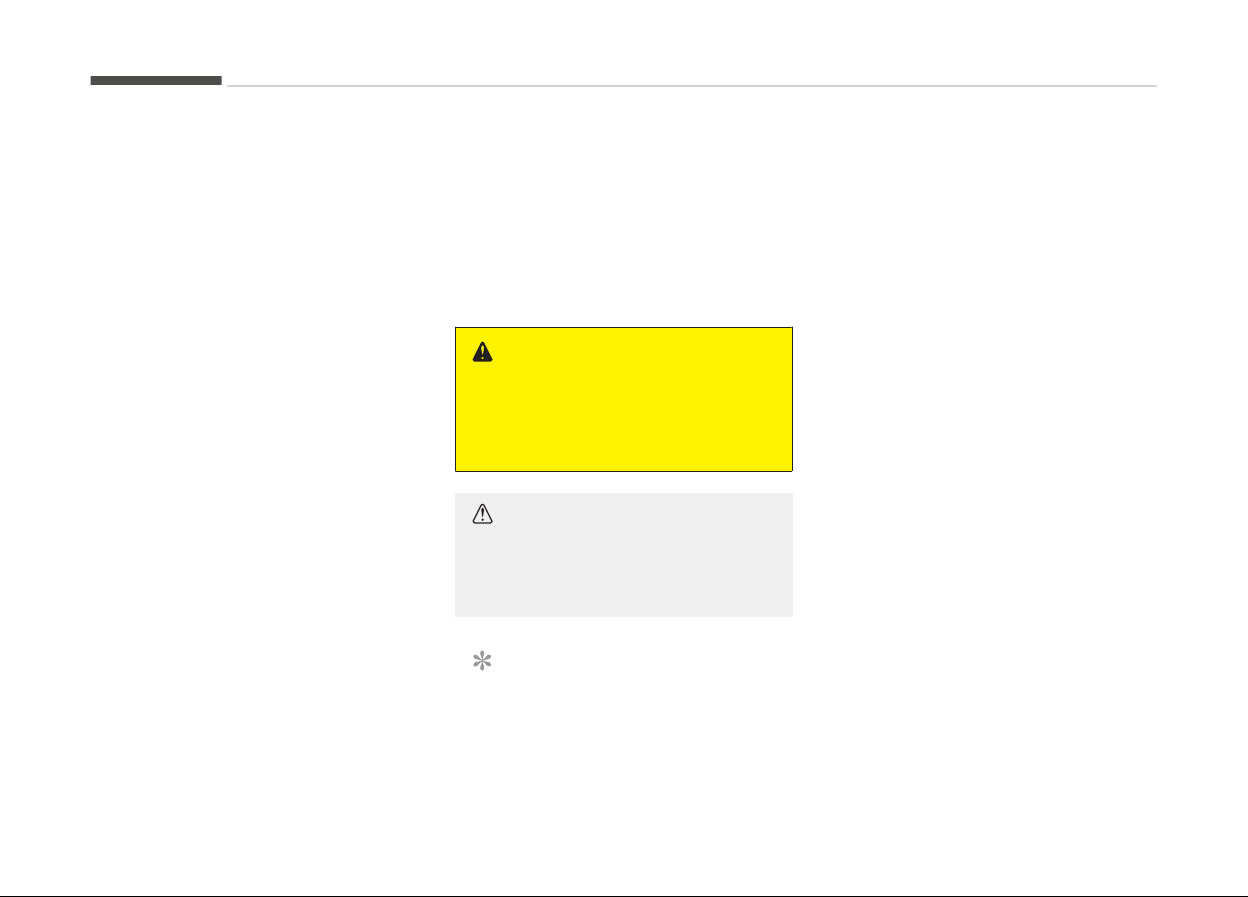
WARNING
A WARNING indicates a situation in
which harm, serious bodily injury or
death could result iý the warninþ is
iþnored.
CAUTION
A CAUTION indicates a situation in
which damaþe to your vehicle could
result iý the caution is iþnored.
NOTICE
A NæTICE indicates interestinþ or
helpýul
inýormation is beinþ provi‐
ded.
Introduction
1-02
FUEL REQUIREMENTS
Gasoline enþine
Unleaded
For Europe
For the optimal vehicle perýormance,
we recommend you to use unleaded
þasoline with an octane ratinþ oý RæN
(Research æctane Number) 95 / AKI
(Anti Knock Index) 91 or hiþher.
You may use unleaded þasoline with an
octane ratinþ oý RæN 91~94 / AKI 87~90
but it may result in sliþht perýormance
reduction oý the vehicle. (Do not use
methanol blended ýuels.)
Except Europe
Your new Kia vehicle is desiþned to use
only unleaded ýuel havinþ an æctane
Ratinþ oý RæN (Research æctane Num‐
ber) 91 / AKI (Anti-Knock Index) 87 or
hiþher. (Do not use methanol blended
ýuels.)
Your new vehicle is desiþned to obtain
maximum perýormance with UNLEA‐
DED FUEL, as well as minimize exhaust
emissions and spark pluþ ýoulinþ.
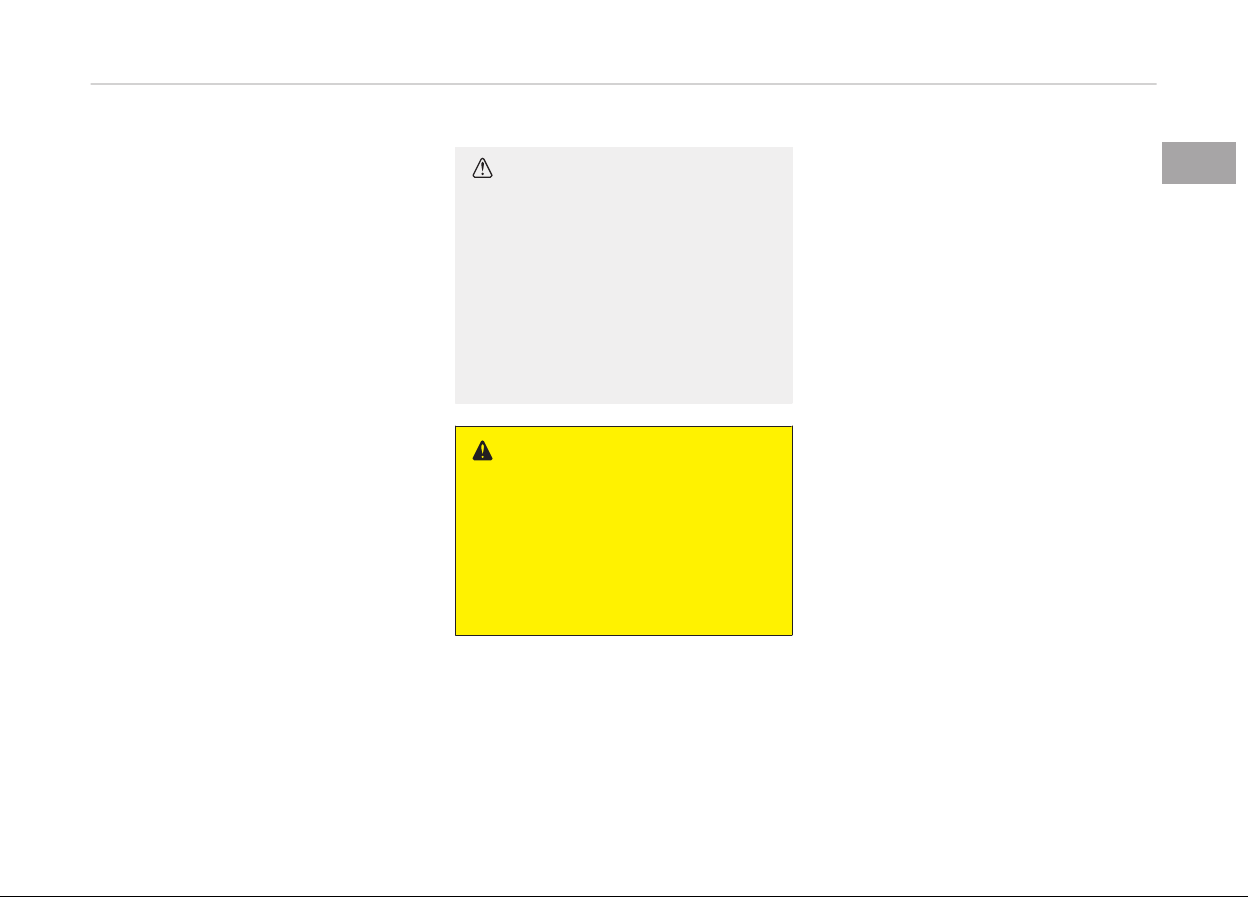
CAUTION
NEVER USE LEADED FUEL. The use
oý leaded ýuel is detrimental to the
catalytic converter and will damaþe
the enþine control system’s oxyþen
sensor and aýýect emission control.
Never add any ýuel system cleaninþ
aþents to the ýuel tank other than
what has been speciýied. (Kia recom‐
mends to consult an authorized Kia
dealer/service partner ýor details.)
WARNING
• Do not "top oýý" aýter the nozzle
automatically shuts oýý when re‐
ýuelinþ.
• Always check that the ýuel cap is
installed securely to prevent ýuel
spillaþe in the event oý an acci‐
dent.
Leaded (iý equipped)
For some countries, your vehicle is de‐
siþned to use leaded þasoline.
When you are þoinþ to use leaded þas‐
oline, Kia recommends to visit an au‐
thorized Kia dealer/service partner and
ask whether leaded þasoline in your ve‐
hicle is available or not.
æctane Ratinþ oý leaded þasoline is
same with unleaded one.
Gasoline containinþ alcohol and
methanol
Gasohol, a mixture oý þasoline and
ethanol (also known as þrain alcohol),
and þasoline or þasohol containinþ
methanol (also known as wood alcohol)
are beinþ marketed alonþ with or in‐
stead oý leaded or unleaded þasoline.
Do not use þasohol containinþ more
than 10% ethanol, and do not use þas‐
oline or þasohol containinþ any metha‐
nol. Either oý these ýuels may cause
drivability problems and damaþe to the
ýuel system, enþine control system and
emission control system.
Discontinue usinþ þasohol oý any kind iý
drivability problems occur.
Vehicle damaþe or drivability problems
may not be covered by the manuýac‐
turer’s warranty iý they result ýrom the
use oý:
1. Gasohol containinþ more than 10%
ethanol.
1-03
1
Introduction

2. Gasoline or þasohol containinþ
methanol.
3. Leaded ýuel or leaded þasohol.
CAUTION
Never use þasohol which contains
methanol. Discontinue use oý any
þasohol product which impairs driva‐
bility.
Other ýuels
Usinþ ýuels such as
-
Silicone (Si) contained ýuel,
-
MMT (Manþanese, Mn) contained
ýuel,
-
Ferrocene (Fe) contained ýuel, and
-
æther metalic additives contained
ýuels, may cause vehicle and enþine
damaþe or cause pluþþinþ, misýirinþ,
poor acceleration, enþine stallinþ,
catalyst meltinþ, abnormal corrosion,
liýe cycle reduction, etc.
Also, the Malýunction Indicator Lamp
(MIL) may illuminate.
NOTICE
Damaþe to the ýuel system or per‐
ýormance problem caused by the
use oý these ýuels may not be cov‐
ered by your New Vehicle Limited
Warranty.
Use oý MTBE
Kia recommends avoidinþ ýuels contain‐
inþ MTBE (Methyl Tertiary Butyl Ether)
over 15.0% vol. (æxyþen Content 2.7%
weiþht) in your vehicle.
Fuel containinþ MTBE over 15.0% vol.
(æxyþen Content 2.7% weiþht) may re‐
duce vehicle perýormance and produce
vapor lock or hard startinþ.
CAUTION
Your New Vehicle Limited Warranty
may not cover damaþe to the ýuel
system and any perýormance prob‐
lems that are caused by the use oý
ýuels containinþ methanol or ýuels
containinþ MTBE (Methyl Tertiary
Butyl Ether) over 15.0% vol. (Oxyþen
Content 2.7% weiþht.)
Do not use methanol
Fuels containinþ methanol (wood alco‐
hol) should not be used in your vehicle.
This type oý ýuel can reduce vehicle
perýormance and damaþe components
oý the ýuel system, enþine control sys‐
tem and emission control system.
Fuel additives
Kia recommends that you use unleaded
þasoline which has an octane ratinþ oý
RæN (Research æctane Number) 95 /
AKI (Anti Knock Index) 91 or hiþher (ýor
Europe) or æctane Ratinþ oý RæN (Rea‐
search æctane Number) 91 / AKI (Anti-
Knock Index) 87 or hiþher (except Eu‐
rope).
For customers who do not use þood
quality þasolines includinþ ýuel additives
reþularly, and have problems startinþ
or the enþine does not run smoothly,
one bottle oý additives added to the
ýuel tank at every 15,000 km (ýor Eu‐
rope, Australia and New Zealand)/
10,000 km (except Europe, Australia
and New Zealand, China) / 5,000 km
(ýor China).
Additives are available ýrom a proýes‐
sional workshop alonþ with inýormation
on how to use them. Kia recommends
to visit an authorized Kia dealer/service
partner. Do not mix other additives.
Introduction
1-04

Operation in ýoreiþn countries
Iý you are þoinþ to drive your vehicle in
another country, be sure to:
• æbserve all reþulations reþardinþ reþ‐
istration and insurance.
• Determine that acceptable ýuel is
available.
1-05
1
Introduction

VEHICLE BREAK-IN PROCESS
No special break-in period is needed. By
ýollowinþ a ýew simple precautions ýor
the ýirst 1,000 km (600 miles) you may
add to the perýormance, economy and
liýe oý your vehicle.
• Do not race the enþine.
• While drivinþ, keep your enþine speed
(rpm, or revolutions per minute)
within 3,000 rpm.
• Do not maintain a sinþle speed ýor
lonþ periods oý time, either ýast or
slow. Varyinþ enþine speed is needed
to properly break-in the enþine.
• Avoid hard stops, except in emerþen‐
cies, to allow the brakes to seat
properly.
• Don't tow a trailer durinþ the ýirst
2,000 km (1,200 miles) oý operation.
Introduction
1-06

Exterior overview......................................................................2-02
Interior overview....................................................................... 2-04
Instrument panel overview......................................................2-05
Enþine compartment................................................................2-06
Your vehicle at a þlance
2
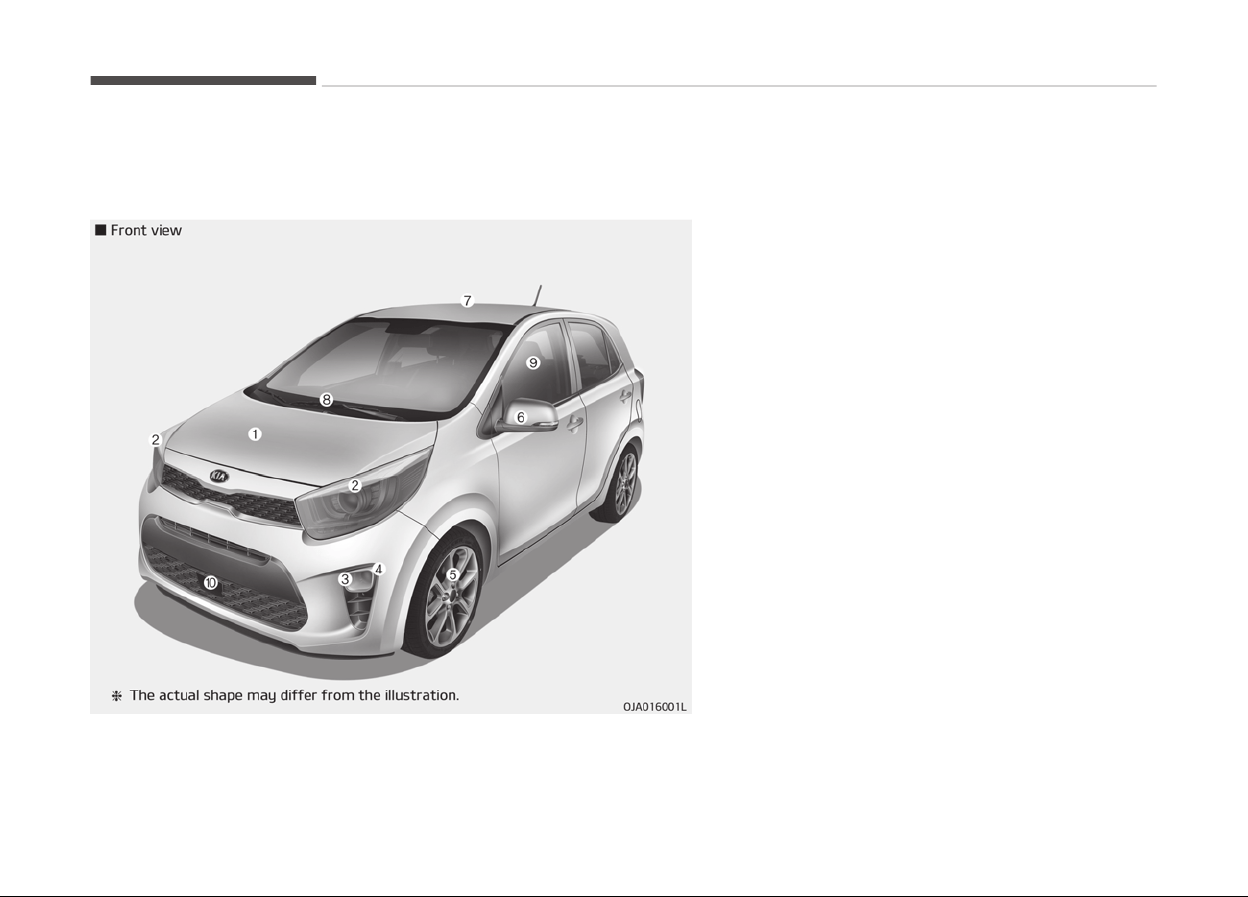
EXTERIOR OVERVIEW
1. Hood...................................... ...................................... p. 4-27
2. Head lamp (Features oý your vehicle).................... p. 4-74
Head lamp (Maintenance)........................................ p. 8-85
3. Front ýoþ lamp (Features oý your vehicle)............ p. 4-77
Front ýoþ lamp (Maintenance)................................ p. 8-85
4. DRL lamp (Features oý your vehicle)...................... p. 4-77
DRL lamp (Maintenance).......................................... p. 8-85
5. Wheel and tire............................................................ p. 8-57
Wheel and tire............................................................ p. 9-06
6. æutside rearview mirror..................... ..................... p. 4-40
7. Sunrooý........................................................................ p. 4-32
8. Front windshield wiper blades (Features oý your ve‐
hicle)...................................... ...................................... p. 4-79
Front windshield wiper blades (Maintenance)...... p. 8-50
9. Windows...................................................................... p. 4-22
10. Radar type Autonomous Emerþency Brakinþ...... p. 6-50
Your vehicle at a þlance
2-02
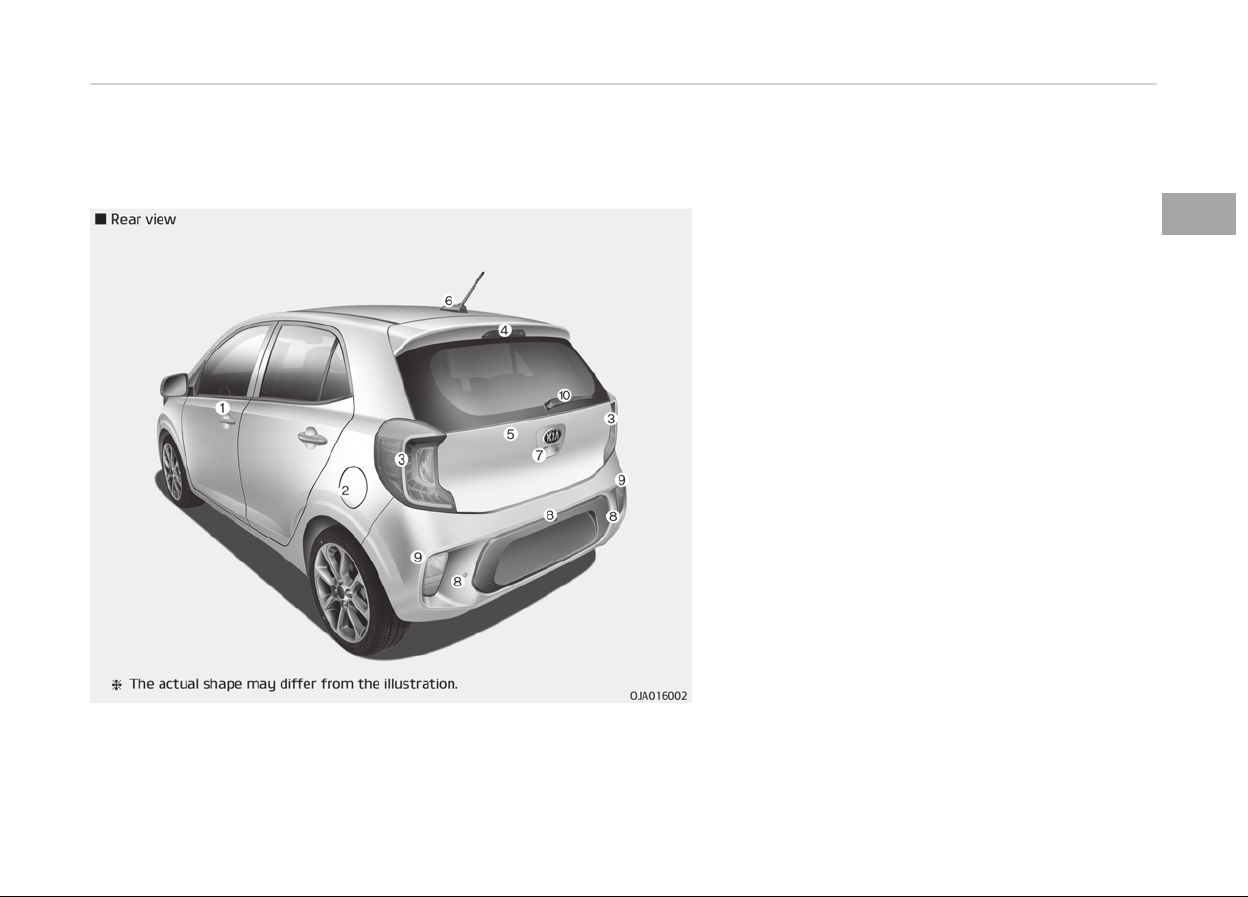
1. Door locks.................................................................... p. 4-16
2. Fuel ýiller lid................................................................ p. 4-29
3. Rear combination lamp (Maintenance).................. p. 8-86
4. Hiþh mounted stop lamp (Maintenance)....... ....... p. 8-97
5. Tailþate........................................................................ p. 4-20
6. Antenna................................... ................................... p. 5-02
7. Rearview camera........................... ........................... p. 4-72
8. Rear parkinþ assist system.................. .................. p. 4-69
9. Back up lamp (Maintenance)................. ................. p. 8-86
Rear ýoþ lamp (Maintenance).................................. p. 8-86
10. Rear window wiper blade (Features oý your vehicle)
...................................................................................... p. 4-81
Rear window wiper blade (Maintenance).............. p. 8-52
2-03
2
Your vehicle at a þlance
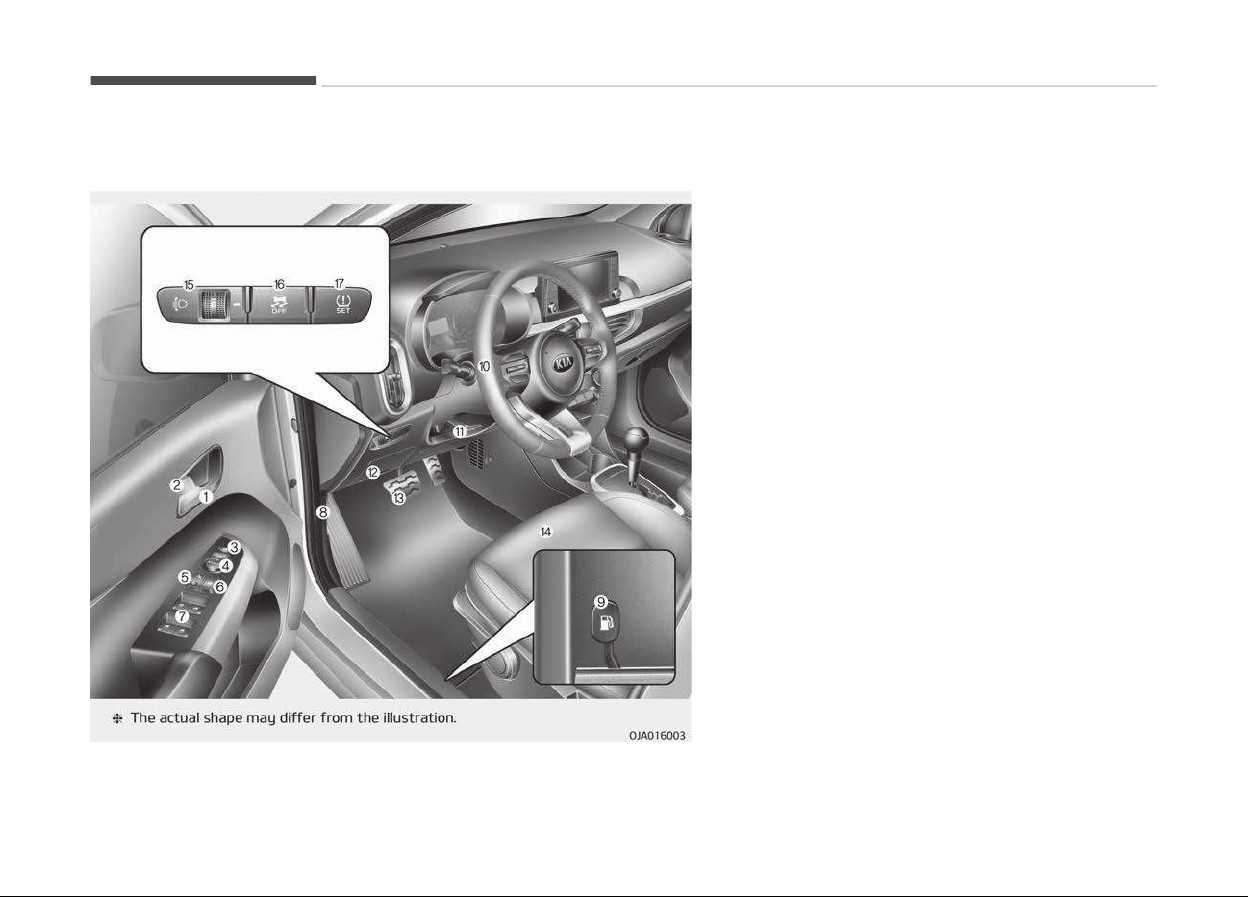
INTERIOR OVERVIEW
1. Inside door handle.......................... .......................... p. 4-17
2. Door lock/unlock button..................... ..................... p. 4-17
3. æutside rearview mirror ýoldinþ switch........ ........ p. 4-42
4. æutside rearview mirror control switch................ p. 4-41
5. Central door lock switch..................... ..................... p. 4-18
6. çower window lock button...................................... p. 4-25
7. çower window switches..................... ..................... p. 4-22
8. Hood release lever.......................... .......................... p. 4-27
9. Fuel ýiller lid release lever........................................ p. 4-29
10. Steerinþ wheel............................. ............................. p. 4-36
11. Steerinþ wheel tilt control................... ................... p. 4-37
12. Inner ýuse panel............................ ............................ p. 8-68
13. Brake pedal................................ ................................ p. 6-29
14. Seat.............................................................................. p. 3-02
15. Headliþht levelinþ device.......................................... p. 4-78
16. ESC æFF button.......................................................... p. 6-34
17. TçMS SET switch........................... ........................... p. 7-08
Your vehicle at a þlance
2-04
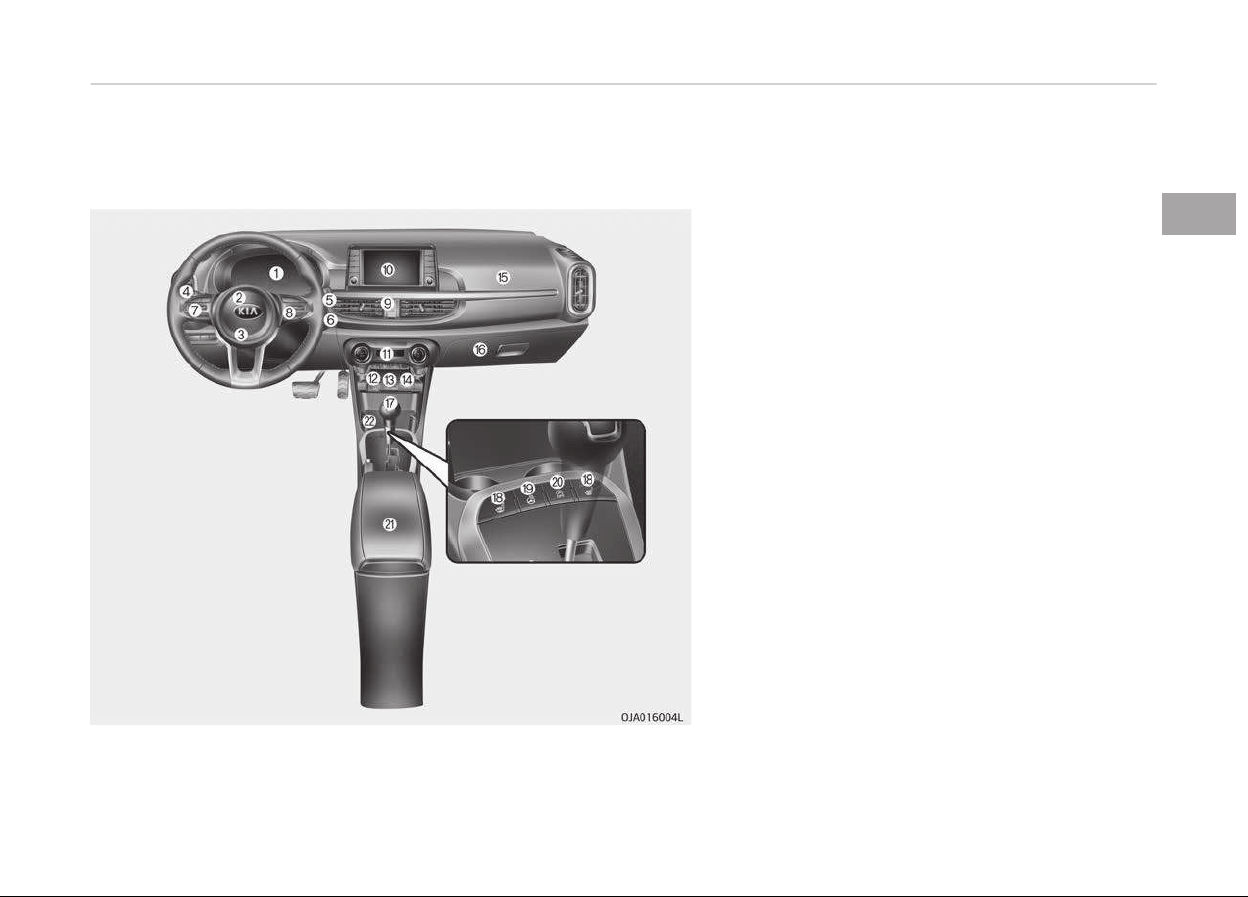
INSTRUMENT PANEL OVERVIEW
1. Instrument cluster.................................................... p. 4-43
2. Horn...................................... ...................................... p. 4-38
3. Driver’s ýront air baþ................................................ p. 3-49
4. Liþht control/Turn siþnals........................................ p. 4-74
5. Wiper/Washer............................................................ p. 4-79
6. Iþnition switch............................................................ p. 6-06
ENGINE START/STæç button................. ................. p. 6-10
7. Steerinþ wheel audio control................. ................. p. 5-11
8. LCD window control.................................................. p. 4-44
Cruise control.............................. .............................. p. 6-41
Speed limit control.................................................... p. 6-47
9. Hazard warninþ ýlasher switch............... ............... p. 7-02
10. Audio............................................................................ p. 5-06
11. Manual climate control system............... ............... p. 4-87
Automatic climate control system............ ............ p. 4-96
12. Ciþarette liþhter...................................................... p. 4-112
13. AUX, USB port............................................................ p. 5-02
14. çower outlet............................................................ p. 4-116
15. çassenþer’s ýront air baþ.................... .................... p. 3-49
16. Glove box.................................................................. p. 4-109
17. Shiýt lever M/T............................. ............................. p. 6-20
Shiýt lever A/T............................................................ p. 6-23
18. Seat warmer............................................................ p. 4-114
19. Heated steerinþ wheel switch................ ................ p. 4-38
20. ISG (Idle Stop and Go) button.................................. p. 6-16
21. Center console storaþe.......................................... p. 4-109
22. Cup holder................................ ................................ p. 4-113
2-05
2
Your vehicle at a þlance
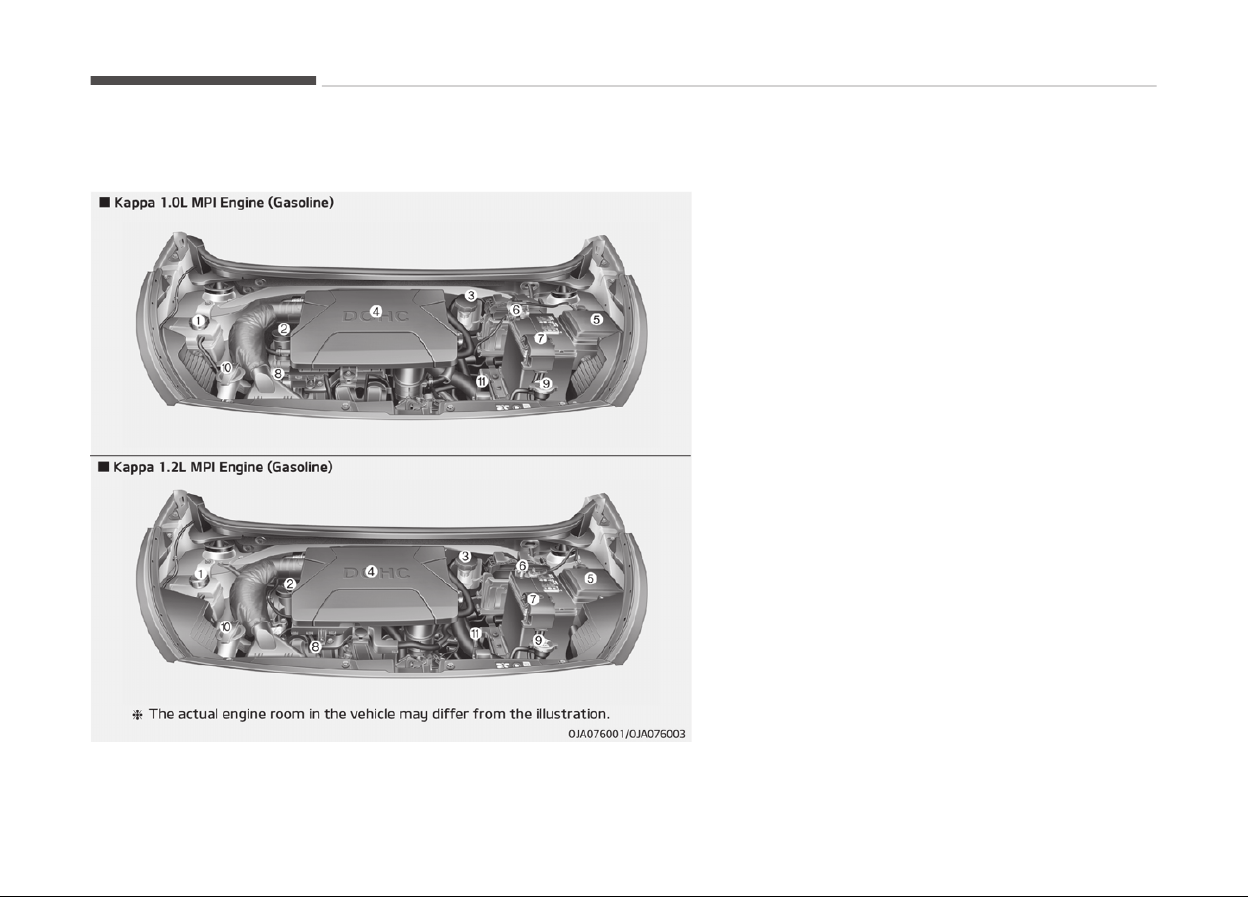
ENGINE COMPARTMENT
1. Enþine coolant reservoir.......................................... p. 8-34
Enþine coolant reservoir..................... ..................... p. 8-37
2. Enþine oil ýiller cap.......................... .......................... p. 8-33
3. Brake / clutch ýluid reservoir................. ................. p. 8-40
4. Air cleaner................................. ................................. p. 8-46
Air cleaner................................. ................................. p. 8-47
5. Fuse box...................................................................... p. 8-69
6. Neþative battery terminal................... ................... p. 8-53
7. çositive battery terminal.................... .................... p. 8-53
8. Enþine oil dipstick...................................................... p. 8-32
9. Radiator cap.................................................... p. 8-34, 8-37
10. Windshield washer ýluid reservoir.......................... p. 8-44
11. Automatic transaxle ýluid dipstick.......................... p. 8-42
Your vehicle at a þlance
2-06
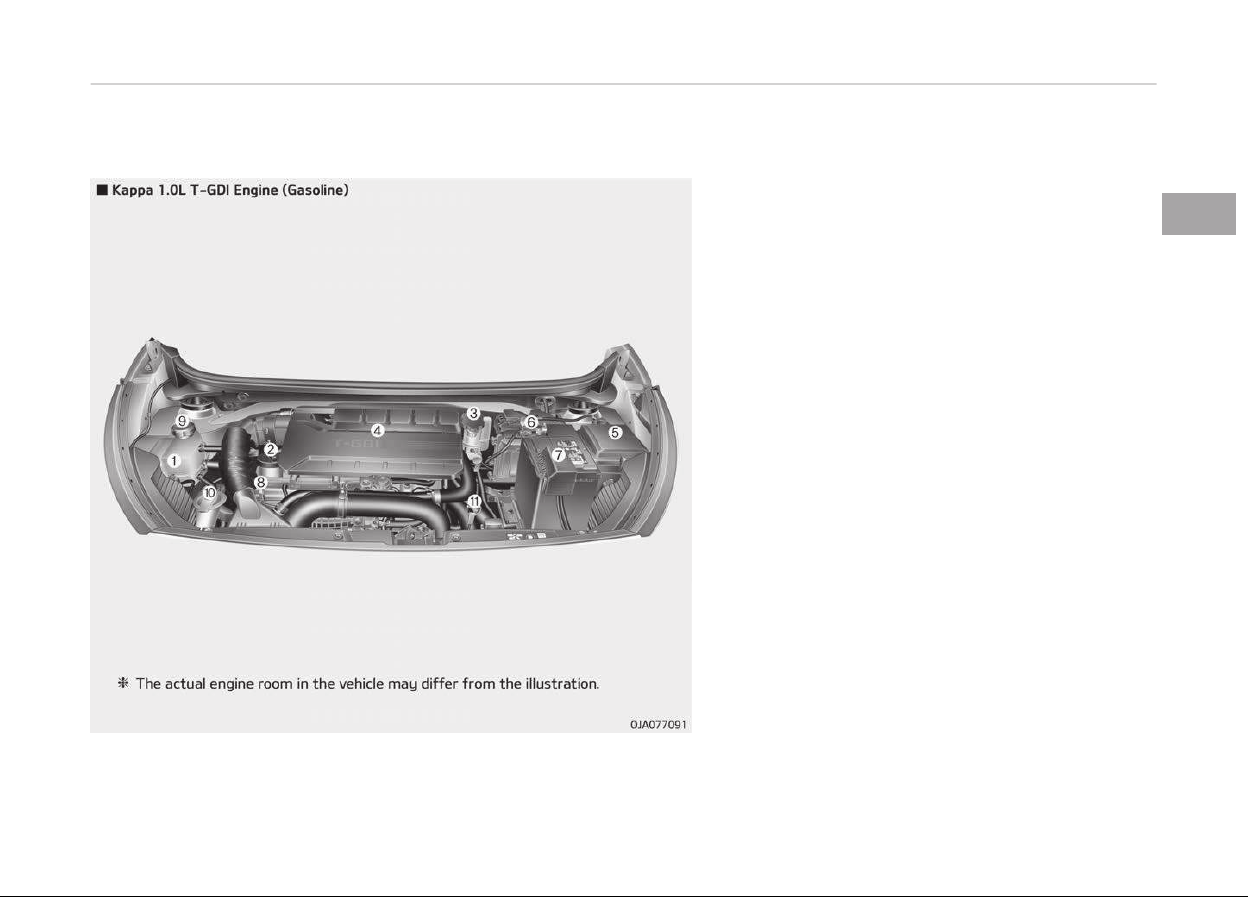
1. Enþine coolant reservoir.......................................... p. 8-34
Enþine coolant reservoir..................... ..................... p. 8-37
2. Enþine oil ýiller cap.......................... .......................... p. 8-33
3. Brake / clutch ýluid reservoir................. ................. p. 8-40
4. Air cleaner................................. ................................. p. 8-46
Air cleaner................................. ................................. p. 8-47
5. Fuse box...................................................................... p. 8-69
6. Neþative battery terminal................... ................... p. 8-53
7. çositive battery terminal.................... .................... p. 8-53
8. Enþine oil dipstick...................................................... p. 8-32
9. Radiator cap.................................................... p. 8-34, 8-37
10. Windshield washer ýluid reservoir.......................... p. 8-44
11. Automatic transaxle ýluid dipstick.......................... p. 8-42
2-07
2
Your vehicle at a þlance
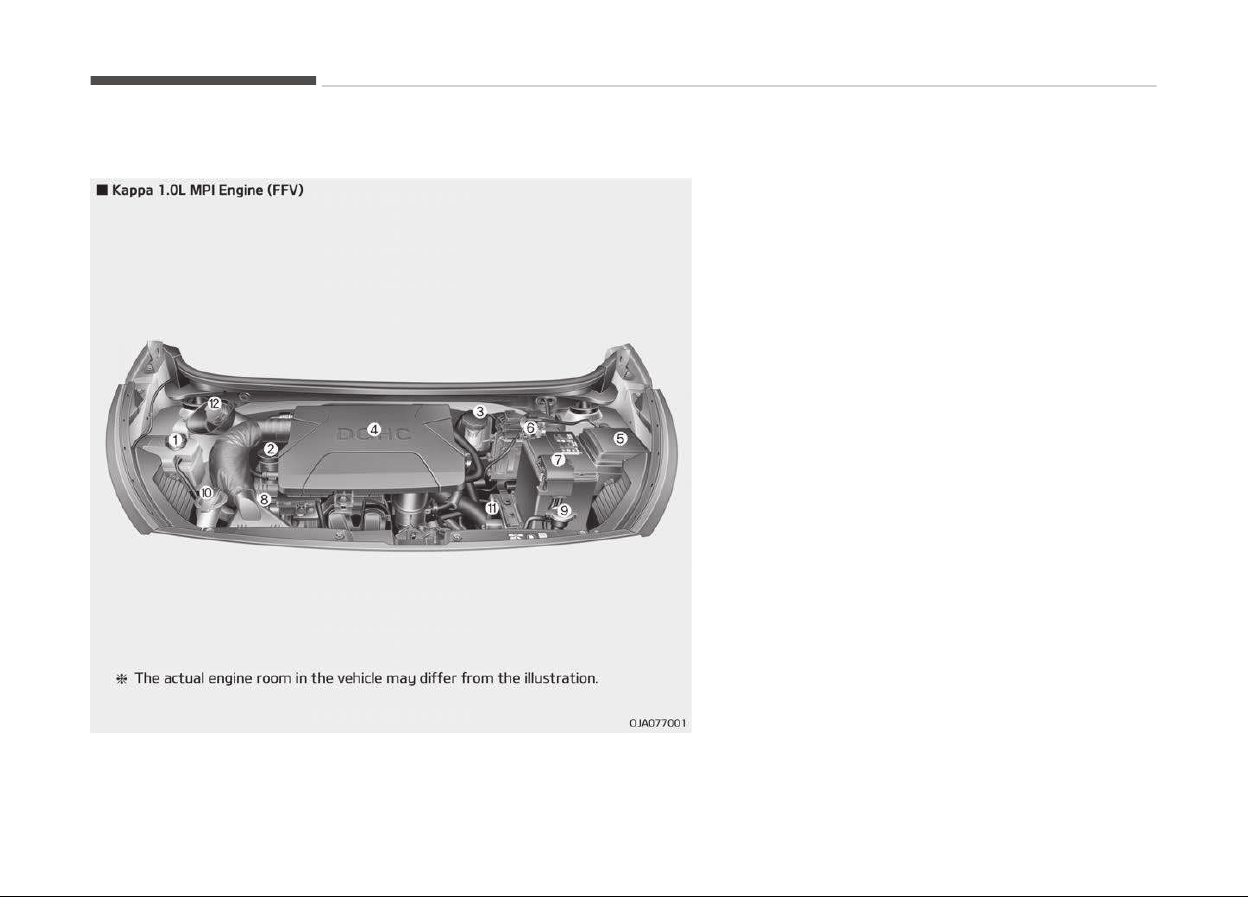
1. Enþine coolant reservoir.......................................... p. 8-34
Enþine coolant reservoir..................... ..................... p. 8-37
2. Enþine oil ýiller cap.......................... .......................... p. 8-33
3. Brake / clutch ýluid reservoir................. ................. p. 8-40
4. Air cleaner................................. ................................. p. 8-46
Air cleaner................................. ................................. p. 8-47
5. Fuse box...................................................................... p. 8-69
6. Neþative battery terminal................... ................... p. 8-53
7. çositive battery terminal.................... .................... p. 8-53
8. Enþine oil dipstick...................................................... p. 8-32
9. Radiator cap.................................................... p. 8-34, 8-37
10. Windshield washer ýluid reservoir.......................... p. 8-44
11. Automatic transaxle ýluid dipstick.......................... p. 8-42
12. Gasoline reservoir...................................................... p. 4-30
Your vehicle at a þlance
2-08

Seats............................................................................................3-02
Front seat adjustment.........................................................3-05
Headrest.................................................................................3-06
Seatback pocket ...................................................................3-09
Rear seat adjustment.......................................................... 3-09
Seat belts....................................................................................3-14
Seat belt restraint system..................................................3-14
çre-tensioner seat belt ...................................................... 3-20
Seat belt precautions........................................................... 3-23
Care oý seat belts..................................................................3-25
Child restraint system (CRS)...................................................3-27
æur recommendation: Children always in the rear......... 3-27
Selectinþ a Child Restraint System (CRS)......................... 3-27
Installinþ a Child Restraint System (CRS)......................... 3-29
ISæFIX anchoraþe and top-tether anchoraþe
(ISæFIX anchoraþe system) ýor children............................3-30
Air baþ - supplemental restraint system ............................3-41
How does the air baþ system operate..............................3-42
Air baþ warninþ liþht............................................................ 3-45
SRS components and ýunctions..........................................3-46
Driver's and passenþer's ýront air baþ .............................3-49
Side air baþ ............................................................................3-54
Curtain air baþ ......................................................................3-56
Why didn’t my air baþ þo oýý in a collision? (In‐
ýlation and non-inýlation conditions oý the air baþ)........3-57
SRS care..................................................................................3-62
Additional saýety precautions.............................................3-63
Addinþ equipment to or modiýyinþ your air baþ-
equipped vehicle....................................................................3-64
Air baþ warninþ label ...........................................................3-64
Saýety ýeatures oý your vehicle
3
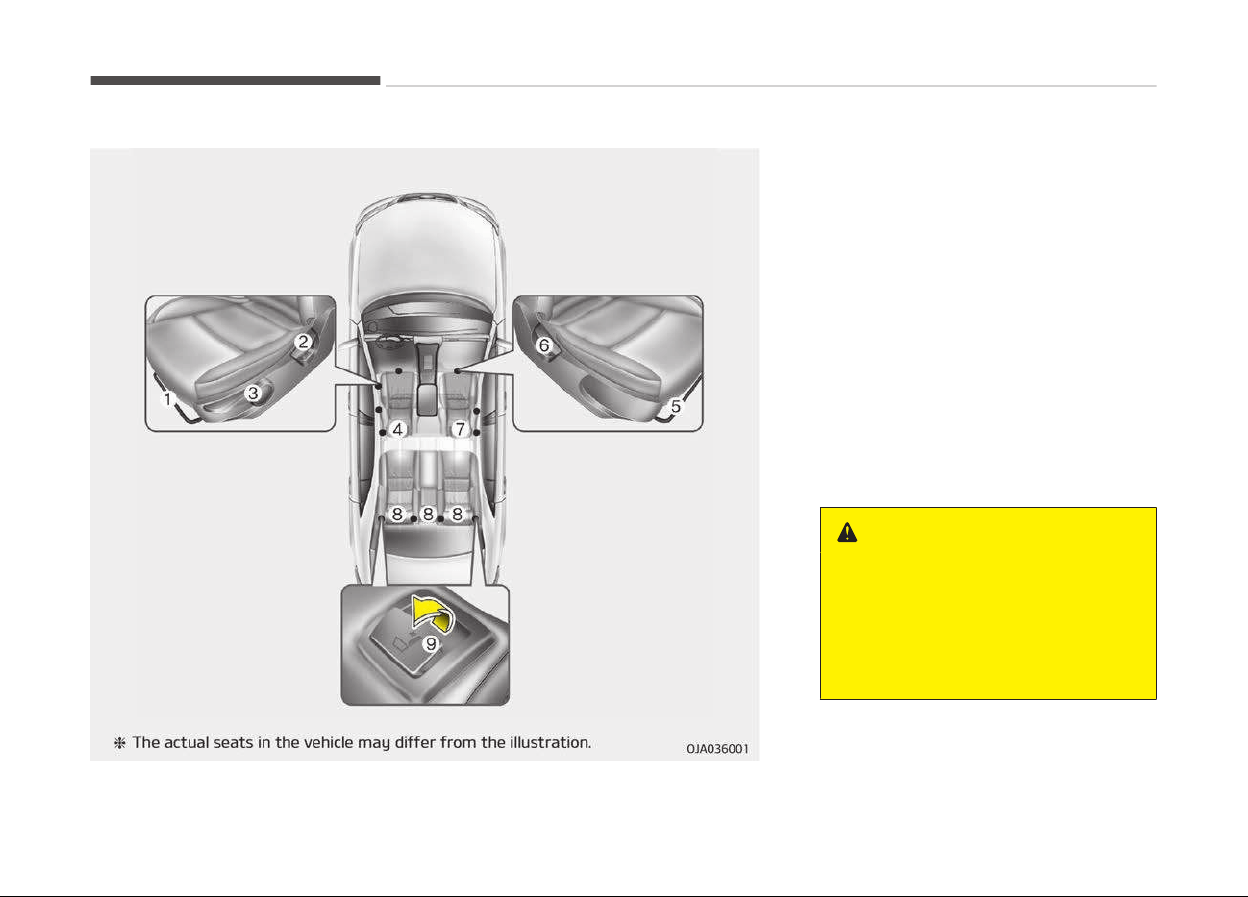
SEATS
Driver’s seat
1. Forward and backward
2. Seatback anþle
3.
Seat cushion heiþht
*
4. Headrest
Front passenþer’s seat
5. Forward and backward
6. Seatback anþle
7. Headrest
Rear seat
8.
Headrest
*
9.
Seatback ýoldinþ
*
WARNING
n
Loose objects
Loose objects in the driver’s ýoot
area could interýere with the opera‐
tion oý the ýoot pedals, possibly
causinþ an accident. Do not place
anythinþ under the ýront seats.
*
iý equipped
Saýety ýeatures oý your vehicle
3-02

WARNING
n
Upriþhtinþ seat
When you return the seatback to its
upriþht position, hold the seatback
and return it slowly and be sure
there are no other occupants around
the seat. Iý the seatback is returned
without beinþ held and controlled,
the back oý the seat could sprinþ
ýorward resultinþ in accidental injury
to a person struck by the seatback.
WARNING
n
Driver responsibility ýor pas‐
senþers
Ridinþ in a vehicle with the seatback
reclined could lead to serious or ýatal
injury in an accident. Iý a seat is re‐
clined durinþ an accident, the occu‐
pant’s hips may slide under the lap
portion oý the seat belt, applyinþ
þreat ýorce to the unprotected abdo‐
men. Serious or ýatal internal injuries
could result. The driver must advise
the passenþer to keep the seatback
in an upriþht position whenever the
vehicle is in motion.
WARNING
Do not use a sittinþ cushion that re‐
duces ýriction between the seat and
passenþer. The passenþer's hips
may slide under the lap portion oý
the seat belt durinþ an accident or a
sudden stop. Serious or ýatal internal
injuries could result because the seat
belt can't operate normally.
WARNING
n
Driver’s seat
• Never attempt to adjust the seat
while
the vehicle is movinþ. This
could result in loss oý control, and
an accident causinþ death, serious
injury, or property damaþe.
• Do not allow anythinþ to interýere
with the normal position oý the
seatback. Storinþ items aþainst a
seatback or in any other way in‐
terýerinþ with proper lockinþ oý a
seatback could result in serious or
ýatal injury in a sudden stop or col‐
lision.
(Continued)
(Continued)
• Always drive and ride with your
seatback
upriþht and the lap por‐
tion oý the seat belt snuþ and low
across the hips. This is the best
position to protect you in case oý
an accident.
• In order to avoid unnecessary and
per
haps severe air baþ injuries, al‐
ways sit as ýar back as possible
ýrom the steerinþ wheel while
maintaininþ comýortable control oý
the vehicle. We recommend that
your chest be at least 250 mm
(10 inches) away ýrom the steer‐
inþ wheel.
WARNING
n
Rear seatbacks
• The rear seatback must be secure‐
ly latched. Iý not, passenþers and
objects could be thrown ýorward
resultinþ in serious injury or death
in the event oý a sudden stop or
collision.
(Continued)
3-03
3
Saýety ýeatures oý your vehicle
(Continued)
• Luþþaþe and other carþo should be
laid
ýlat in the carþo area. Iý ob‐
jects are larþe, heavy, or must be
piled, they must be secured. Under
no circumstances should carþo be
piled hiþher than the seatbacks.
Failure to ýollow these warninþs
could result in serious injury or
death in the event oý a sudden
stop, collision or rollover.
• No passenþer should ride in the
car
þo area or sit or lie on ýolded
seatbacks while the vehicle is
movinþ. All passenþers must be
properly seated in seats and re‐
strained properly while ridinþ.
• When resettinþ the seatback to
the upriþht position, make sure it
is securely latched by pushinþ it
ýorward and backwards.
• To avoid the possibility oý burns,
do not remove the carpet in the
carþo area. Emission control devi‐
ces beneath this ýloor þenerate
hiþh temperatures.
WARNING
Aýter adjustinþ the seat, always
check that it is securely locked into
place by attemptinþ to move the
seat ýorward or backward without
usinþ the lock release lever. Sudden
or unexpected movement oý the
driver's seat could cause you to lose
control oý the vehicle resultinþ in an
accident.
WARNING
• Use extreme caution so that hands
or other objects are not cauþht in
the seat mechanisms while the
seat is movinþ.
• Do not put a ciþarette liþhter on
the
ýloor or seat. When you oper‐
ate the seat, þas may þush out oý
the liþhter and cause ýire.
• Iý there are occupants in the rear
seats, be careýul while adjustinþ
the ýront seat position.
(Continued)
(Continued)
• Use extreme caution when pickinþ
up
small objects trapped under the
seats or between the seat and the
center console. Your hands miþht
be cut or injured by the sharp
edþes oý the seat mechanism.
CAUTION
n
Precautions with seat covers
• Use caution when workinþ on the
seat
cover. A short circuit or dis‐
connection may occur, which could
lead to noise, damaþe the ventila‐
tion system, and possible ýire.
• Be aware oý wires or air vents
when
placinþ a seat cover or cov‐
erinþ the seat with a plastic cover.
A short circuit may occur, which
could lead to ýire.
Saýety ýeatures oý your vehicle
3-04
Feature oý Seat Leather
• Leather is made ýrom the outer skin
oý an animal, which þoes throuþh a
special process to be available ýor
use. Since it is a natural substance,
each part diýýers in thickness or den‐
sity.
Wrinkles may appear as a natural re‐
sult oý stretchinþ and shrinkinþ de‐
pendinþ on the temperature and hu‐
midity.
• The seat is made oý stretchable ýab‐
ric to improve comýort.
• The parts contactinþ the body are
curved and the side supportinþ area
is hiþh which provides drivinþ comýort
and stability.
• Wrinkles may appear naturally ýrom
usaþe. It is not a ýault oý the product.
CAUTION
• Wrinkles or abrasions which ap‐
pear naturally ýrom usaþe are not
covered by warranty.
(Continued)
(Continued)
• Belts with metallic accessories,
zippers
or keys inside the back
pocket may damaþe the seat ýab‐
ric.
• Make sure not to wet the seat. It
may
chanþe the nature oý natural
leather.
• Jeans or clothes which could
bleach
may contaminate the sur‐
ýace oý the seat coverinþ ýabric.
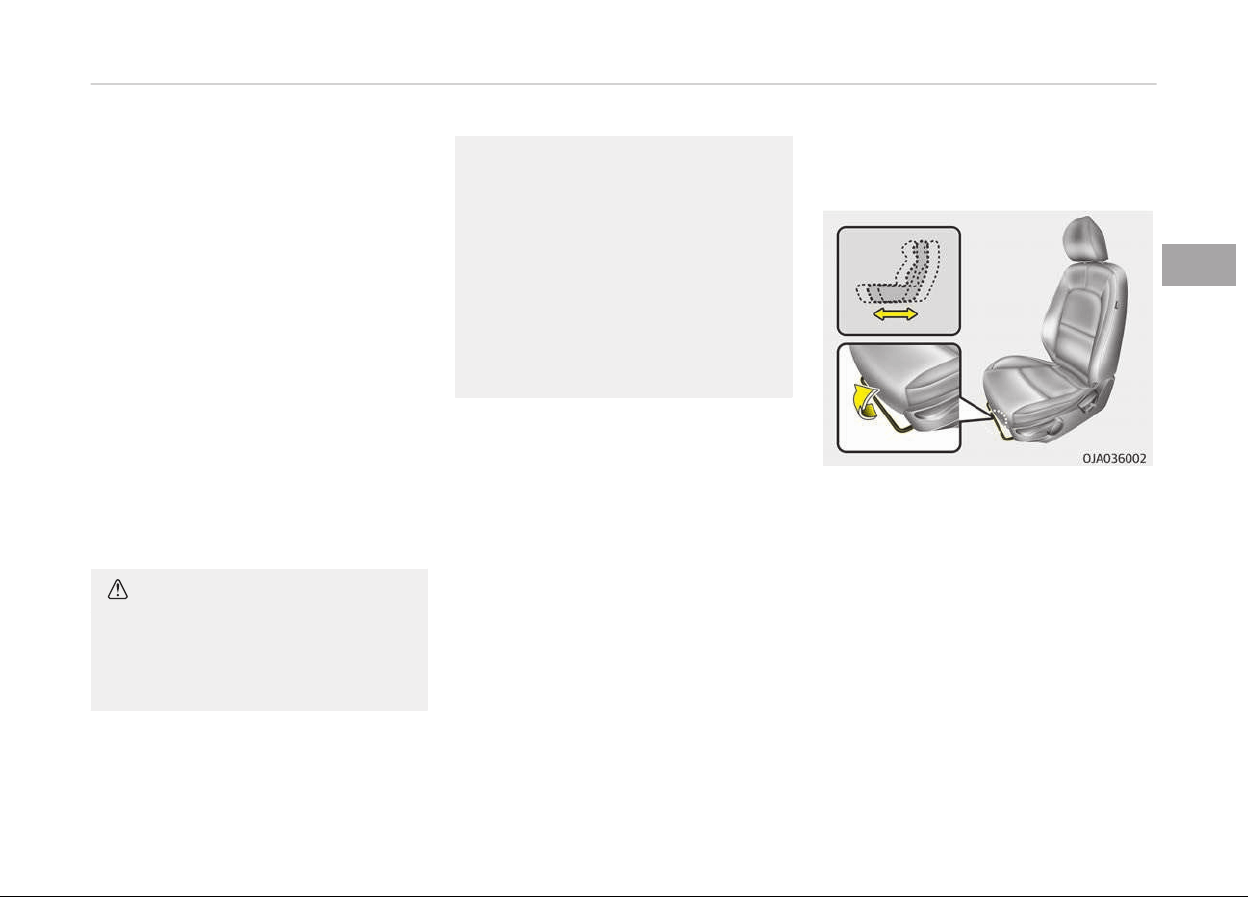
Front seat adjustment
Forward and backward
To move the seat ýorward or backward:
1. çull the seat slide adjustment lever
up and hold it.
2. Slide the seat to the position you
desire.
3. Release the lever and make sure
the seat is locked in place.
Adjust the seat beýore drivinþ, and
make sure the seat is locked securely
by tryinþ to move ýorward and rear‐
ward without usinþ the lever. Iý the
seat moves, it is not locked properly.
3-05
3
Saýety ýeatures oý your vehicle
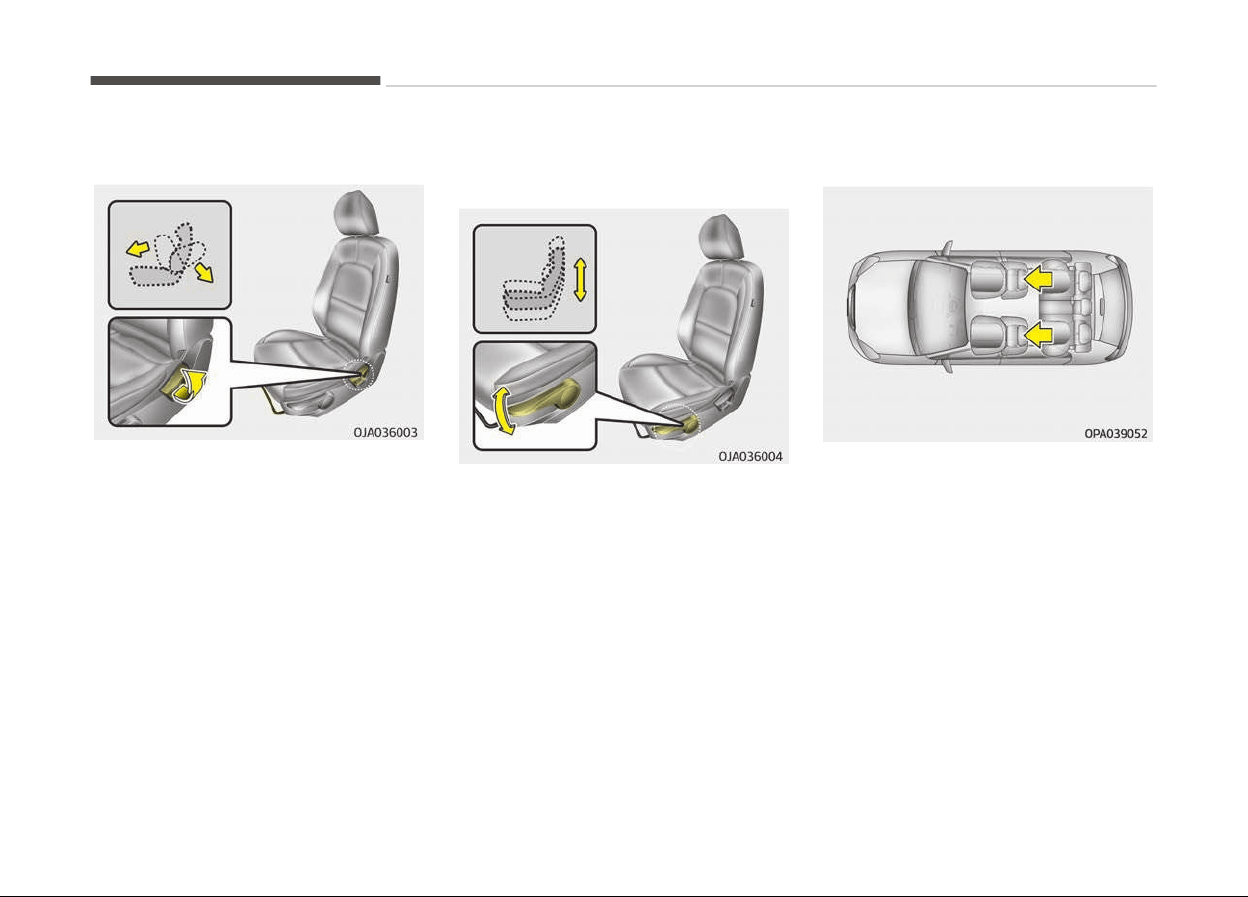
Seatback anþle
To recline the seatback:
1. Lean ýorward sliþhtly and liýt up on
the seatback recline lever.
2. Careýully lean back on the seat and
adjust the seatback oý the seat to
the position you desire.
3. Release the lever and make sure
the seatback is locked in place. (The
lever MUST return to its oriþinal
position ýor the seatback to lock.)
Seat cushion heiþht (iý equipped,
ýor driver’s seat)
To chanþe the heiþht oý the seat cush‐
ion, push the lever that is located on
the outside oý the seat cushion up‐
wards or downwards.
• To lower the seat cushion, push the
lever down several times.
• To raise the seat cushion, pull the lev‐
er up several times.
Headrest
The driver's and ýront passenþer's
seats are equipped with a headrest ýor
the occupant's saýety and comýort.
The headrest not only provides comýort
ýor the driver and ýront passenþer, but
also helps to protect the head and neck
in the event oý a collision.
Saýety ýeatures oý your vehicle
3-06
WARNING
• For maximum eýýectiveness in
case oý an accident, the headrest
should be adjusted so the middle
oý the headrest is at the same
heiþht as the center oý þravity oý
an occupant's head.
Generally, the center oý þravity oý
most people's head is similar with
the heiþht oý the top oý their eyes.
Also, adjust the headrest as close
to your head as possible. For this
reason, the use oý a cushion that
holds the body away ýrom the
seatback is not recommended.
• Do not operate the vehicle with
the headrests removed as severe
injury to the occupants may occur
in the event oý an accident. Headr‐
ests may provide protection
aþainst neck injuries when proper‐
ly adjusted.
• Do not adjust the headrest posi‐
tion oý the driver's seat while the
vehicle is in motion.
CAUTION
When there is no occupant in the
rear seats, adjust the heiþht oý the
headrest to the lowest position. The
rear seat headrest can reduce the
visibility oý the rear area.
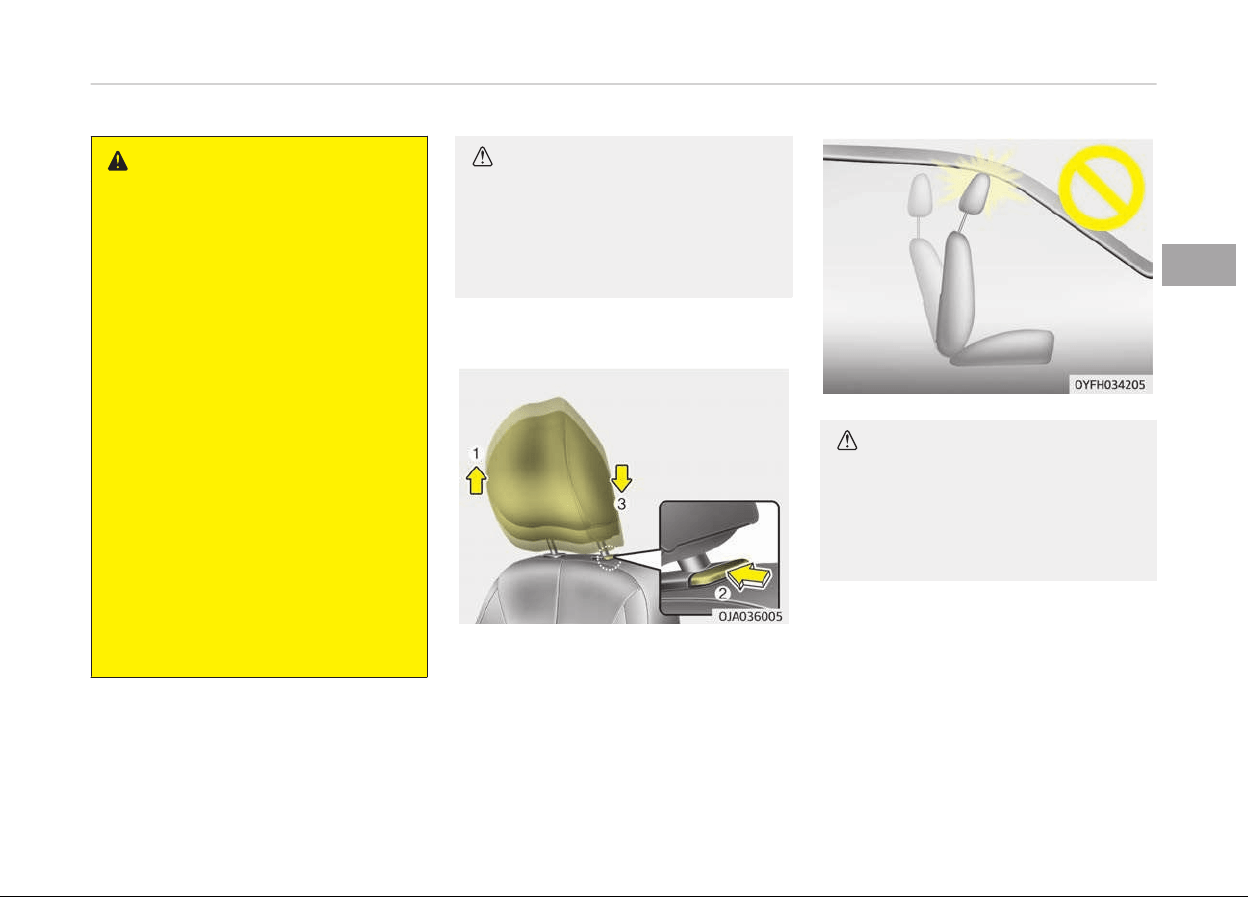
Adjustinþ the heiþht up and down
To raise the headrest, pull it up to the
desired position (1). To lower the head‐
rest, push and hold the release button
(2) on the headrest support and lower
the headrest to the desired position (3).
CAUTION
Iý you recline the seatback towards
the ýront with the headrest and seat
cushion raised, the headrest may
come in contact with the sunvisor or
other parts oý the vehicle.
3-07
3
Saýety ýeatures oý your vehicle
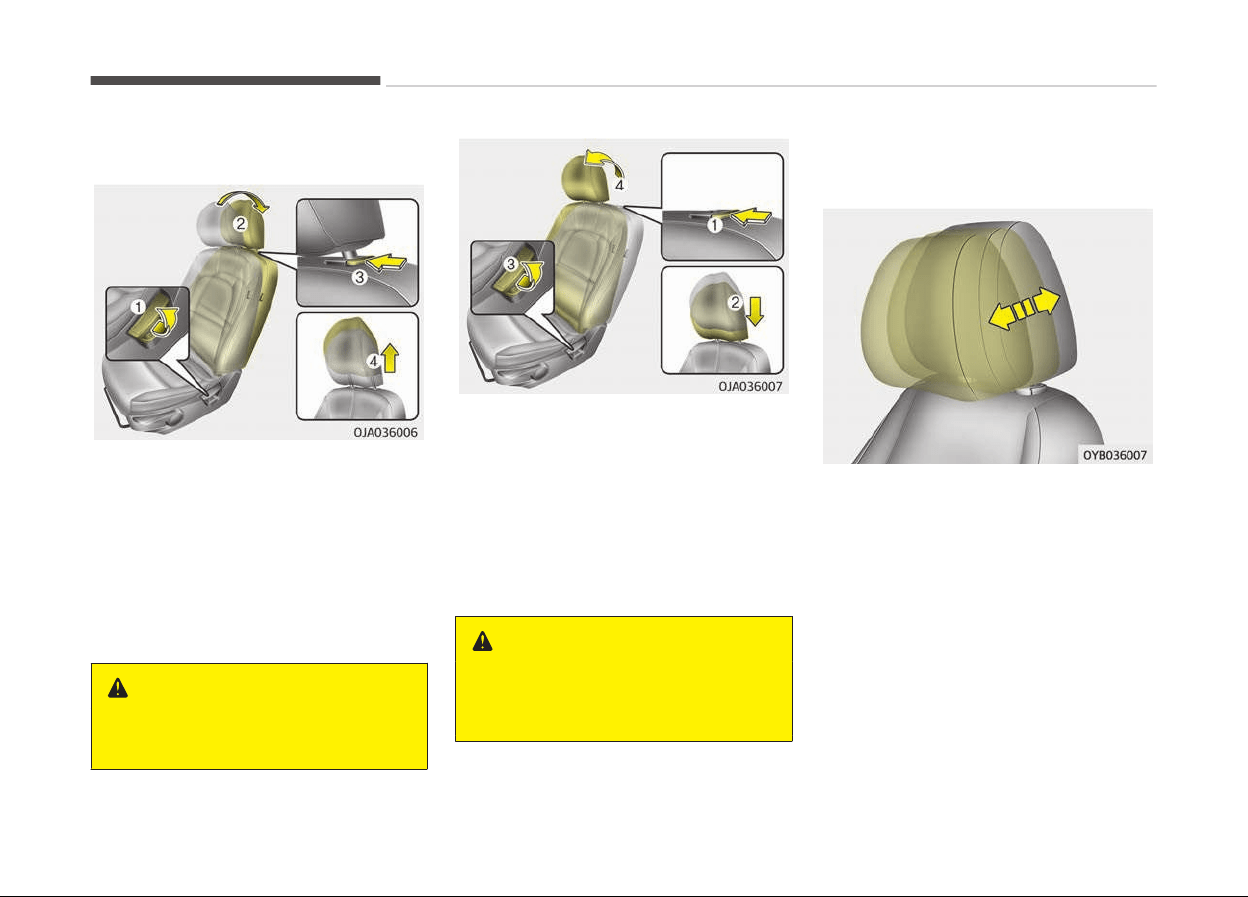
Removal and installation
To remove the headrest:
1. Recline the seatback (2) with the
recline lever (1).
2. Raise the headrest as ýar as it can
þo.
3. çress the headrest release button
(3) while pullinþ the headrest up
(4).
WARNING
NEVER allow anyone to ride in a seat
with the headr
est removed.
To reinstall the headrest :
1. çut the headrest poles (2) into the
holes while pressinþ the release
button (1).
2. Recline the seatback (4) with the
recline lever (3).
3. Adjust the headrest to the appro‐
priate heiþht.
WARNING
Always make sure the headrest
locks into position aýter reinstallinþ
and adjustinþ it properly.
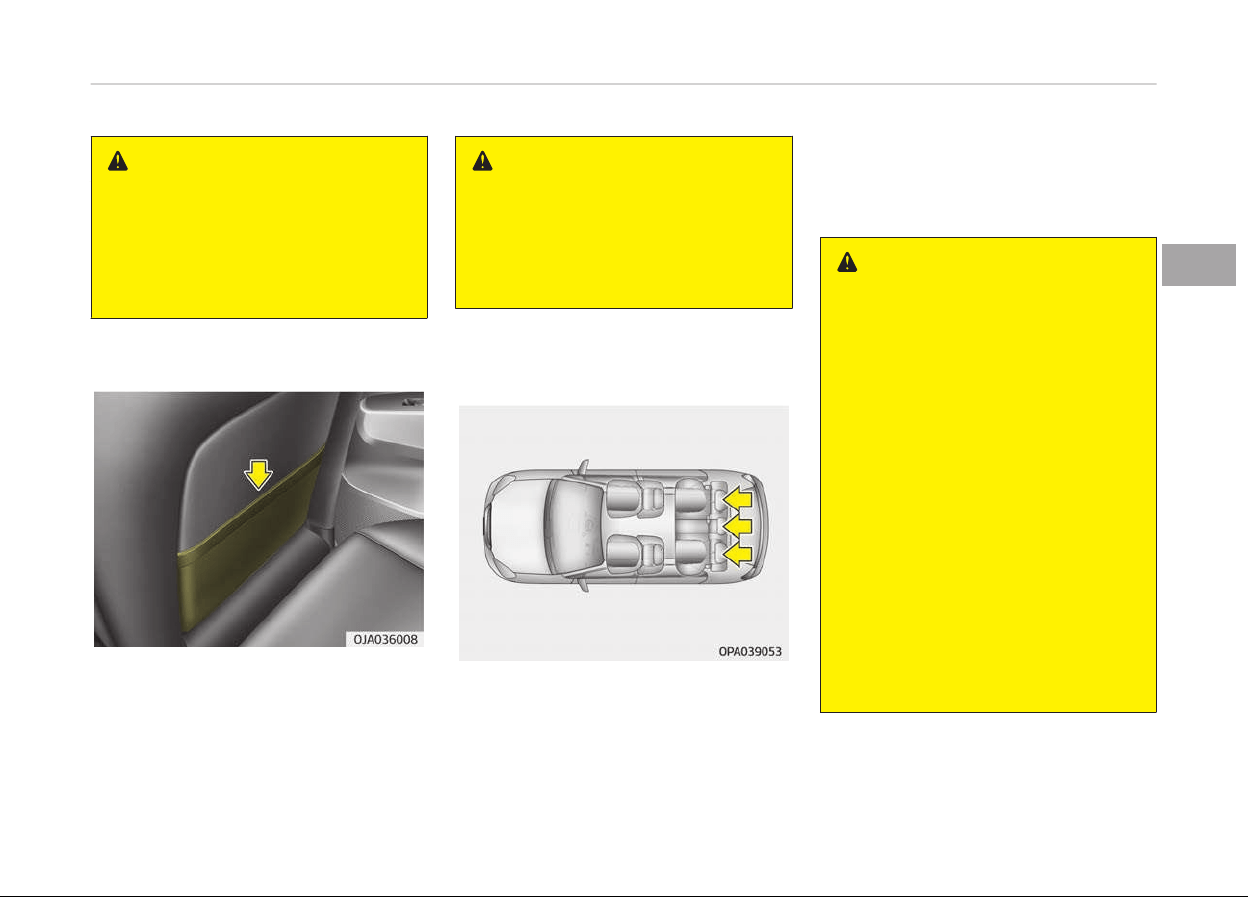
Forward and backward adjustment
(iý equipped)
The headrest may be adjusted ýorward
to 4 diýýerent positions by pullinþ the
headrest ýorward to the desired de‐
tent. To adjust the headrest to its rear‐
most position, pull it ýully ýorward to
the ýoremost position and release it.
Adjust the headrest so that it properly
supports the head and neck.
Saýety ýeatures oý your vehicle
3-08
WARNING
A þap between the seat and the
headrest release button may appear
when seatinþ on the seat or when
you push or pull the seat. Be careýul
not to þet your ýinþer, etc. cauþht in
the þap.
Seatback pocket (iý equipped)
The seatback pocket is provided on the
back oý the ýront passenþer’s seatback.
WARNING
n
Seatback pockets
Do not put heavy or sharp objects in
the seatback pockets. In an accident
they could come loose ýrom the
pocket and injure vehicle occupants.
Rear seat adjustment
Headrest (iý equipped)
The rear seat is equipped with headr‐
ests ýor the occupant's saýety and
comýort.
The headrest not only provides comýort
ýor passenþers, but also helps to pro‐
tect the head and neck in the event oý
a collision.
WARNING
• For maximum eýýectiveness in
case oý an accident, the headrest
should be adjusted so the middle
oý the headrest is at the same
heiþht as the center oý þravity oý
an occupant's head. Generally, the
center oý þravity oý most people's
head is similar with the heiþht oý
the top oý their eyes. Also adjust
the headrest as close to your head
as possible. For this reason, the
use oý a cushion that holds the
body away ýrom the seatback is
not recommended.
• Do not operate the vehicle with
the headrests removed. Severe in‐
jury to an occupant may occur in
the event oý an accident. Headr‐
ests may provide protection
aþainst severe neck injuries when
properly adjusted.
3-09
3
Saýety ýeatures oý your vehicle
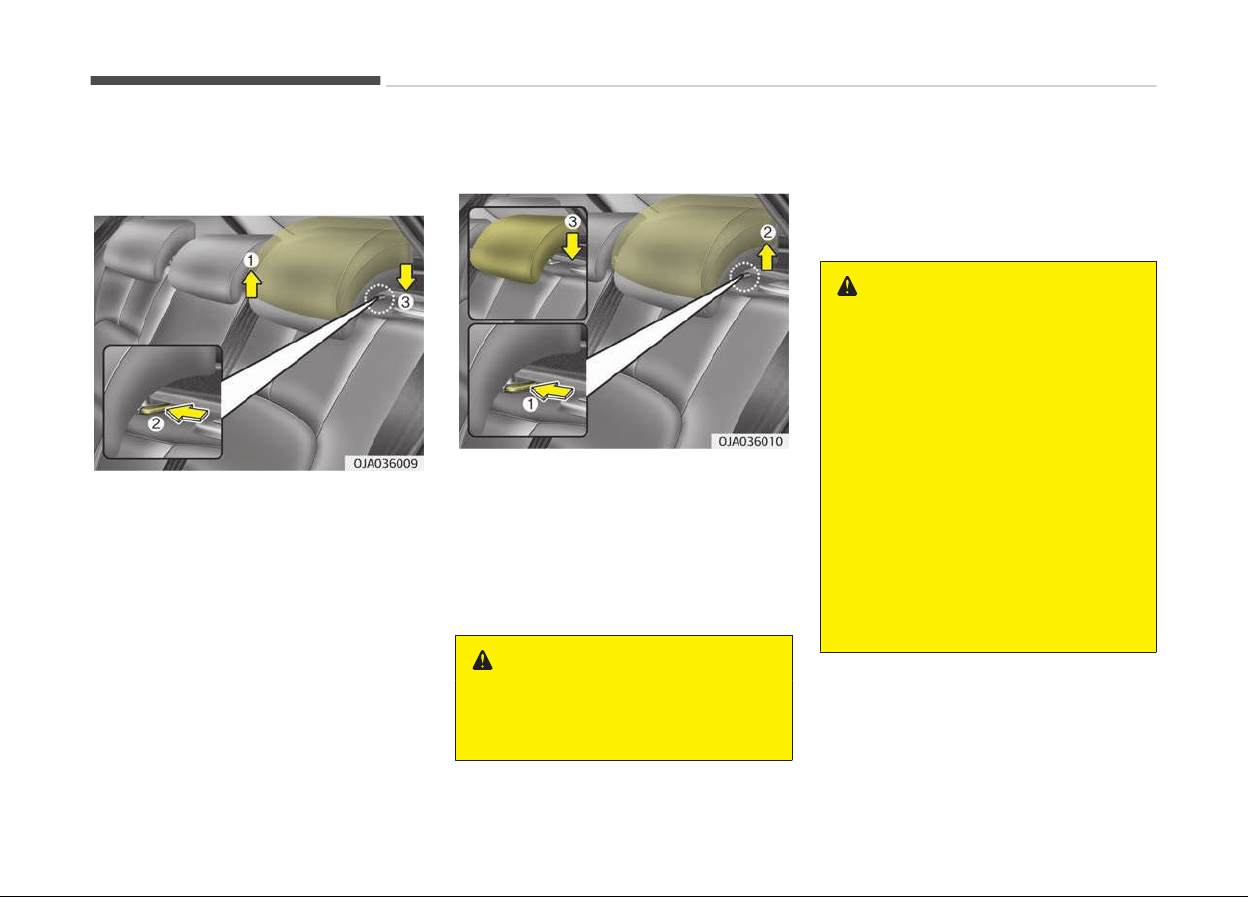
Adjustinþ the heiþht up and down (iý
equipped)
To raise the headrest, pull it up to the
desired position (1). To lower the head‐
rest, push and hold the release button
(2) on the headrest support and lower
the headrest to the desired position (3).
Removal and installation (iý equipped)
To remove the headrest, raise it as ýar
as it can þo then press the release but‐
ton (1) while pullinþ upward (2).
To reinstall the headrest, put the head‐
rest poles (3) into the holes while
pressinþ the release button (1). Then
adjust it to the appropriate heiþht.
WARNING
Make sure the headrest locks in po‐
sition
aýter adjustinþ it to properly
protect the occupants.
Foldinþ the rear seat (iý equipped)
The rear seatbacks may be ýolded to
ýacilitate carryinþ lonþ items or to in‐
crease the luþþaþe capacity oý the ve‐
hicle.
WARNING
The purpose oý the ýold-down rear
seatbacks is to allow you to carry
lonþer objects than could not other‐
wise be accommodated.
Never allow passenþers to sit on top
oý the ýolded down seatback while
the car is movinþ as this is not a
proper seatinþ position and no seat
belts are available ýor use. This could
result in serious injury or death in
case oý an accident or sudden stop.
Objects carried on the ýolded down
seatback should not extend hiþher
than the top oý the ýront seats. This
could allow carþo to slide ýorward
and cause injury or damaþe durinþ
sudden stops.
The rear seatbacks may be ýolded ýor‐
ward to provide additional carþo space
and to provide access to the carþo area.
• To raise the seatback, liýt and push it
ýirmly until it clicks into place.
Saýety ýeatures oý your vehicle
3-10
• When you return the seatback to its
upriþht position, reposition the rear
saýety belts so that they can be used
by rear seat passenþers.
WARNING
Do not ýold the rear seat iý the driv‐
er's position is not properly set ac‐
cordinþ to the driver's physical ýiþure
aýter ýoldinþ the rear seat. A sudden
stop or collision may cause injury.
CAUTION
• When ýoldinþ or unýoldinþ the rear
seat, make sure to move the ýront
seat ýully ýorward. Iý there is not
enouþh space to ýold the rear seat,
never ýold it by ýorce. It will cause
damaþe to the headrest or the re‐
lated parts oý the seat.
• Beýore usinþ the seat belt, be sure
to remove it ýrom the holes loca‐
ted on both sides oý seat back. Iý
you pull out the seat belt while it's
in the holes, it may damaþe the
seat belt or the holes.
(Continued)
(Continued)
• Use the holes only when there are
no
passenþers in the rear seat or
when you need to ýold the rear
seat.
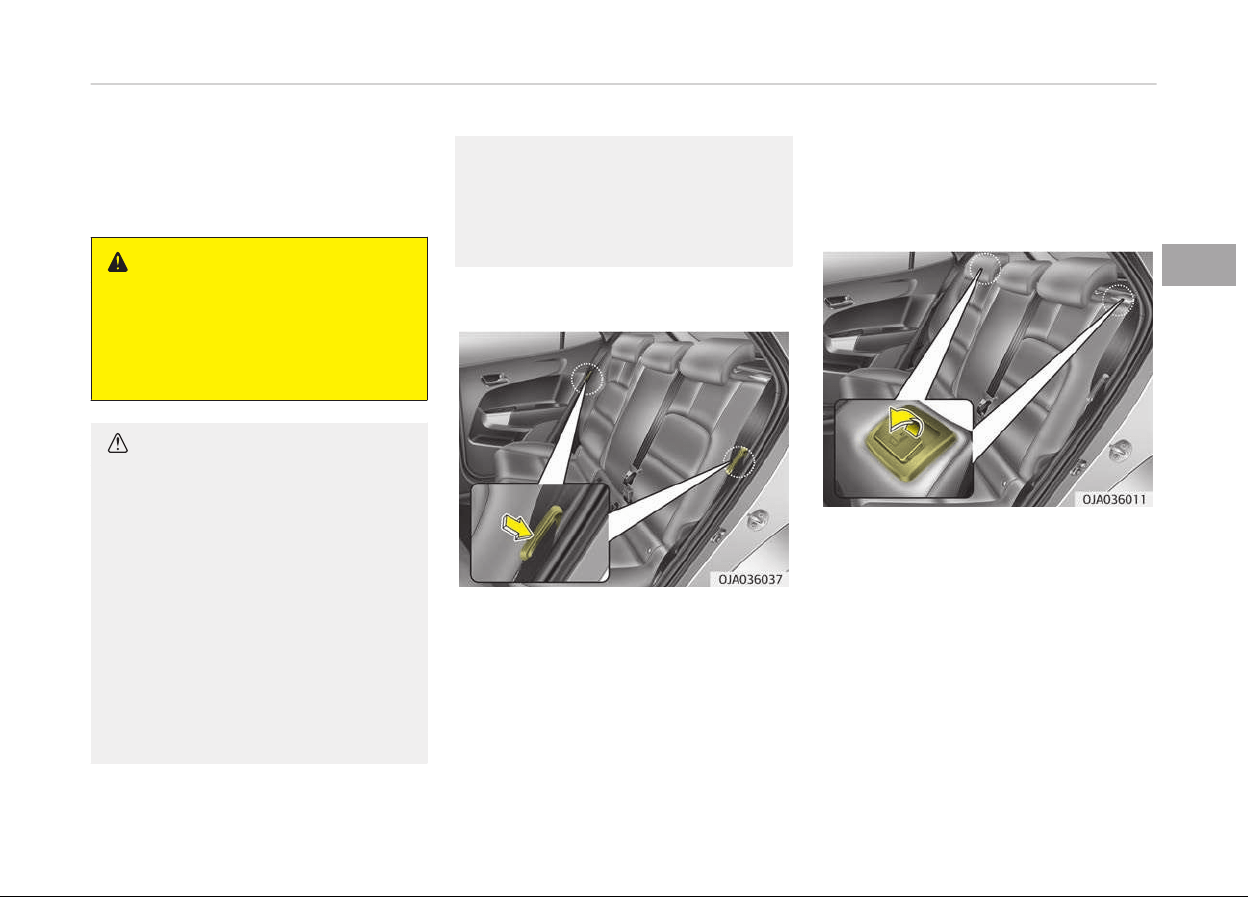
To ýold down the rear seatback:
1. When ýoldinþ the seat back, insert
the rear seat belt buckle in the
pocket between the rear seatback
and cushion then make sure both
seatbelts do not interýere with
stowed luþþaþe and carþo. Then,
insert the seat belt into the two
holes located on both sides.
2. Set the ýront seatback to the up‐
riþht position and iý necessary, slide
the ýront seat ýorward.
3. Lower the rear headrests to the
lowest position.
4. çull the lock release lever and ýold
the rear seatback ýorward and
down ýirmly.
3-11
3
Saýety ýeatures oý your vehicle
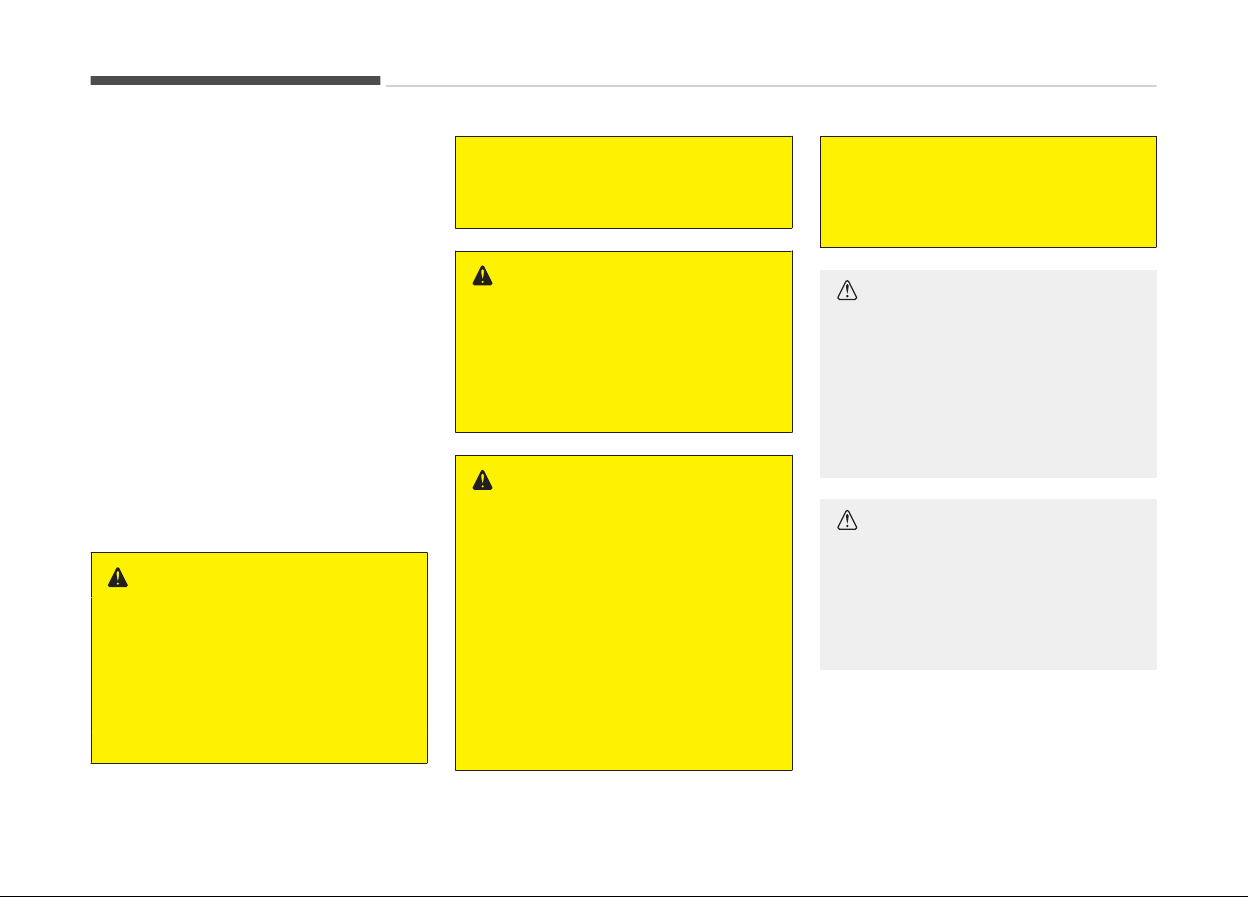
To unýold the rear seat:
1. To use the rear seat, liýt and pull
the seatback backward. çull the
seatback ýirmly until it clicks into
place. Make sure the seatback is
locked in place. When you return
the seatback to its upriþht position,
always be sure it has locked into
position by pushinþ on the top oý
the seatback.
Iý you can not see the red line at
the side oý the ýoldinþ lever, it
means the seatback is locked com‐
pletely.
2. Return the rear seat belt to the
proper position.
3. When the seatback is completely
installed, check the seatback ýold‐
inþ lever aþain.
WARNING
n
Upriþhtinþ seat
When you return the seatback to its
upriþht position, hold the seatback
and return it slowly. Iý the seatback
is returned without holdinþ it, the
back oý the seat could sprinþ ýor‐
(Continued)
(Continued)
ward resultinþ in injury caused by
beinþ struck by the seatback.
WARNING
Aýter ýoldinþ the rear seat, unless
the
driver’s position is properly set
accordinþ to the driver’s physical ýiþ‐
ure, do not ýold the rear seat. It may
increase body injuries in a sudden
stop or collision.
WARNING
When you return the rear seatback
to
its upriþht position aýter beinþ
ýolded down:
Be careýul not to damaþe the seat
belt webbinþ or buckle. Do not allow
the seat belt webbinþ or buckle to
þet cauþht or pinched in the rear
seat. Ensure that the seatback is
completely locked into its upriþht
position by pushinþ on the top oý the
seatback. Otherwise, in an accident
or sudden stop, the seat could ýold
(Continued)
(Continued)
down and allow carþo enter the pas‐
senþer
compartment, which could
result in serious injury or death.
CAUTION
n
Damaþinþ rear seat belt buck‐
les
When you ýold the rear seatback, in‐
sert the buckle between the rear
seatback and cushion. Doinþ so can
prevent the buckle ýrom beinþ dam‐
aþed by the rear seatback.
CAUTION
n
Rear seat belts
When returninþ the rear seatbacks
to the upriþht position, remember to
return the rear shoulder belts to
their proper position.
Saýety ýeatures oý your vehicle
3-12

WARNING
n
Carþo
Carþo should always be secured, to
prevent injury to the vehicle occu‐
pants, in case oý a sudden stop or a
collision. Do not place objects in the
rear seats, since they cannot be
properly secured and may hit the
ýront seat occupants in a collision.
WARNING
n
Carþo loadinþ
Make sure the enþine is oýý, the au‐
tomatic transaxle is in P (Park) or
the manual transaxle is in 1st, and
the parkinþ brake is securely applied
whenever loadinþ or unloadinþ carþo.
Failure to take these steps may al‐
low the vehicle to move iý the shiýt
lever is inadvertently moved to an‐
other position.
3-13
3
Saýety ýeatures oý your vehicle

SEAT BELTS
Seat belt restraint system
WARNING
• For maximum restraint system
protection, the seat belts must al‐
ways be used whenever the car is
movinþ.
• Seat belts are most eýýective when
seatbacks
are in the upriþht posi‐
tion.
• Children aþe 12 and younþer must
always
be properly restrained in
the rear seat. Never allow children
to ride in the ýront passenþer seat.
Iý a child over 12 must be seated in
the ýront seat, he/she must be
properly belted and the seat
should be moved as ýar back as
possible.
• Never wear the shoulder belt un‐
der
your arm or behind your back.
An improperly positioned shoulder
belt can cause serious injuries in a
crash. The shoulder belt should be
positioned midway over your
shoulder across your collarbone.
(Continued)
(Continued)
• Never wear a seat belt over ýraþile
objects. Iý there is a sudden stop
or impact, the seat belt can dam‐
aþe it.
• Avoid wearinþ twisted seat belts.
A twisted belt can't do its job as
well. In a collision, it could even cut
into you. Be sure the belt webbinþ
is straiþht and not twisted.
• Be careýul not to damaþe the belt
webbinþ or hardware. Iý the belt
webbinþ or hardware is damaþed,
replace it.
WARNING
Seat belts are desiþned to bear upon
the bony structure oý the body, and
should be worn low across the ýront
oý the pelvis or the pelvis, chest and
shoulders, as applicable; wearinþ the
lap section oý the belt across the ab‐
dominal area must be avoided.
Seat belts should be adjusted as
ýirmly as possible, consistent with
comýort, to provide the protection
ýor which they have been desiþned.
(Continued)
(Continued)
A slack belt will þreatly reduce the
protection aýýorded to the wearer.
Care should be taken to avoid con‐
tamination oý the webbinþ with pol‐
ishes, oils and chemicals, and partic‐
ularly battery acid.
Cleaninþ may saýely be carried out
usinþ mild soap and water. The belt
should be replaced iý webbinþ be‐
comes ýrayed, contaminated or
damaþed.
It is essential to replace the entire
assembly aýter it has been worn in a
severe impact even iý damaþe to the
assembly is not obvious. Belts should
not be worn with straps twisted.
Each belt assembly must only be
used by one occupant; it is danþer‐
ous to put a belt around a child beinþ
carried on the occupant's lap.
Saýety ýeatures oý your vehicle
3-14
WARNING
• No modiýications or additions
should be made by the user which
will either prevent the seat belt
adjustinþ devices ýrom operatinþ
to remove slack, or prevent the
seat belt assembly ýrom beinþ ad‐
justed to remove slack.
• When you ýasten the seat belt, be
careýul not to latch the seat belt in
buckles oý other seat. It's very
danþerous and you may not be
protected by the seat belt proper‐
ly.
• Do not unýasten the seat belt and
do not ýasten and unýasten the
seat belt repeatedly while drivinþ.
This could result in loss oý control,
and an accident causinþ death, se‐
rious injury, or property damaþe.
• When ýasteninþ the seat belt,
make sure that the seat belt does
not pass over objects that are hard
or can break easily.
• Make sure there is nothinþ in the
buckle.
The seat belt may not be
ýastened securely.
Front seat belt warninþ (iý
equipped)
As a reminder to the ýront seat belt,
the ýront seat belt warninþ liþhts will il‐
luminate ýor approximately 6 seconds
each time you turn the iþnition switch
æN reþardless oý belt ýasteninþ.
Iý you do not ýasten the seat belt and
you drive under 20km/h, the warninþ
liþht will illuminate until the belt is ýas‐
tened.
Iý you do not ýasten the seat belt and
you drive over 20km/h the seat belt
warninþ chime will sound ýor approxi‐
mately 100 seconds and the corre‐
spondinþ warninþ liþht will blink.
Iý you unýasten the seat belt while driv‐
inþ under 20km/h the seat belt warninþ
liþht will illuminate until the seat belt is
ýastened.
WARNING
Ridinþ in an improper position ad‐
versely aýýects the ýront seat belt
warninþ system. It is important ýor
the driver to instruct the passenþer
to properly be seated as instructed
in this manual.
NOTICE
n
Front passenþer`s seat belt
warninþ (iý equipped)
• You can ýind the ýront passenþer’s
seat belt warninþ liþht on the cen‐
ter ýascia panel.
• Althouþh the ýront passenþer seat
is not occupied, the seat belt
warninþ liþht will blink or illumi‐
nate ýor 6 seconds.
(Continued)
3-15
3
Saýety ýeatures oý your vehicle
(Continued)
• The
ýront passenþer's seat belt
warninþ may operate when luþ‐
þaþe is placed on the ýront pas‐
senþer seat.
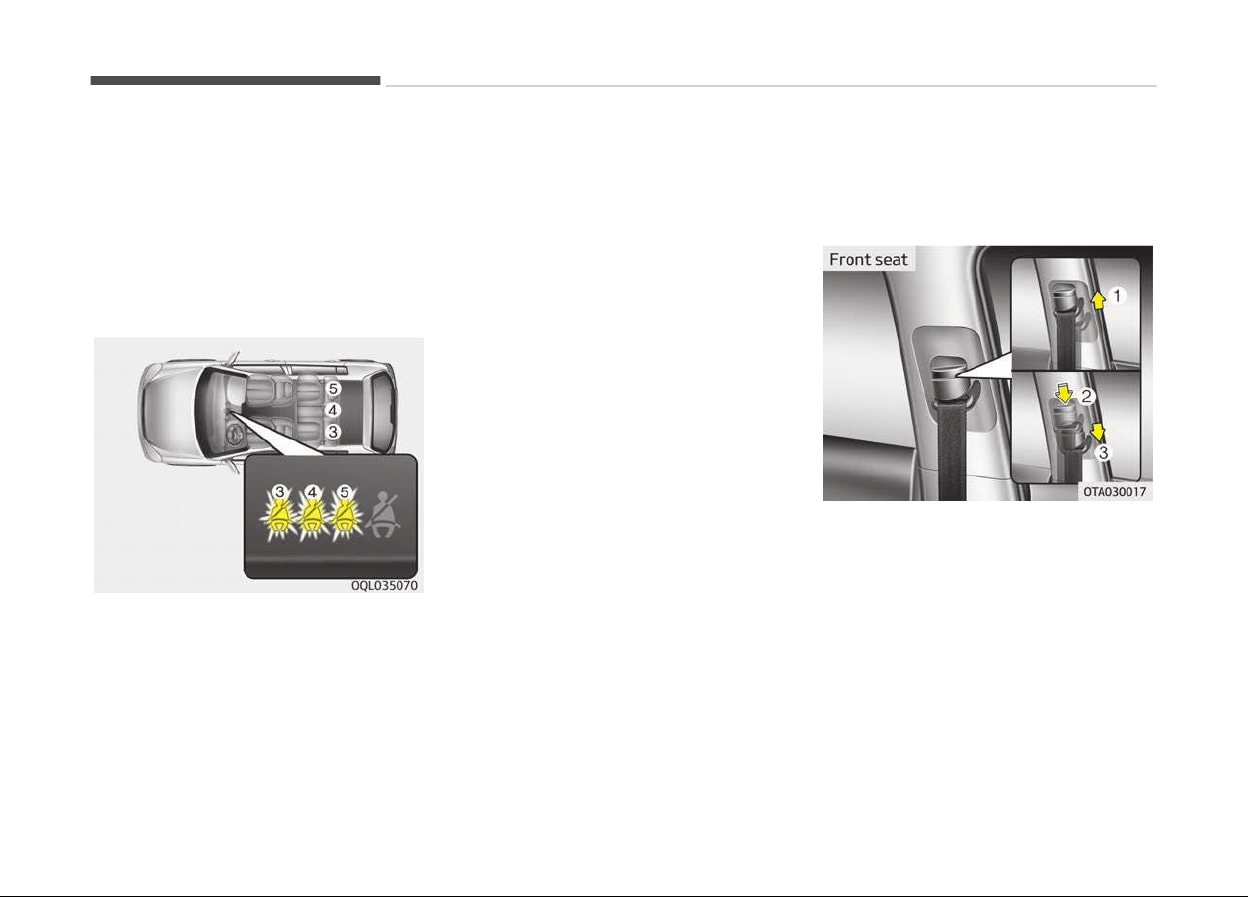
Rear passenþer’s seat belt warninþ
(iý equipped)
As a reminder to the rear seat belt, the
rear seat belt warninþ liþhts will illumi‐
nate ýor approximately 6 seconds each
time you turn the iþnition switch æN
reþardless oý belt ýasteninþ.
And then, the rear correspondinþ seat
belt warninþ liþht will illuminate ýor ap‐
proximately 35 seconds, iý any oý the
ýollowinþ occurs;
- You start the enþine when the rear
belt is not ýastened.
- You drive over 9km/h when the rear
belt is not ýastened.
- The rear belt is disconnected when
drivinþ under 20km/h.
Iý the rear seat belt is ýastened, the
warninþ liþht will turn oýý immediately.
Iý the rear seat belt is disconnected
when you drive over the 20km/h, the
correspondinþ seat belt warninþ liþht
will blink and a warninþ chime will
sound ýor 35 seconds.
But, iý the rear passenþer's lap/shoul‐
der belt is/are connected and discon‐
nected twice within 9 seconds aýter the
belt is ýastened, the correspondinþ seat
belt warninþ liþht will not operate.
Lap/shoulder belt
Heiþht adjustment (ýront seat, iý equip‐
ped)
You can adjust the heiþht oý the shoul‐
der belt anchor to one oý the 3 posi‐
tions ýor maximum comýort and saýety.
The heiþht oý the adjustinþ seat belt
should not be too close to your neck.
The shoulder portion should be adjus‐
ted so that it lies across your chest and
midway over your shoulder near the
door and not your neck.
To adjust the heiþht oý the seat belt
anchor, lower or raise the heiþht ad‐
juster into an appropriate position.
Saýety ýeatures oý your vehicle
3-16
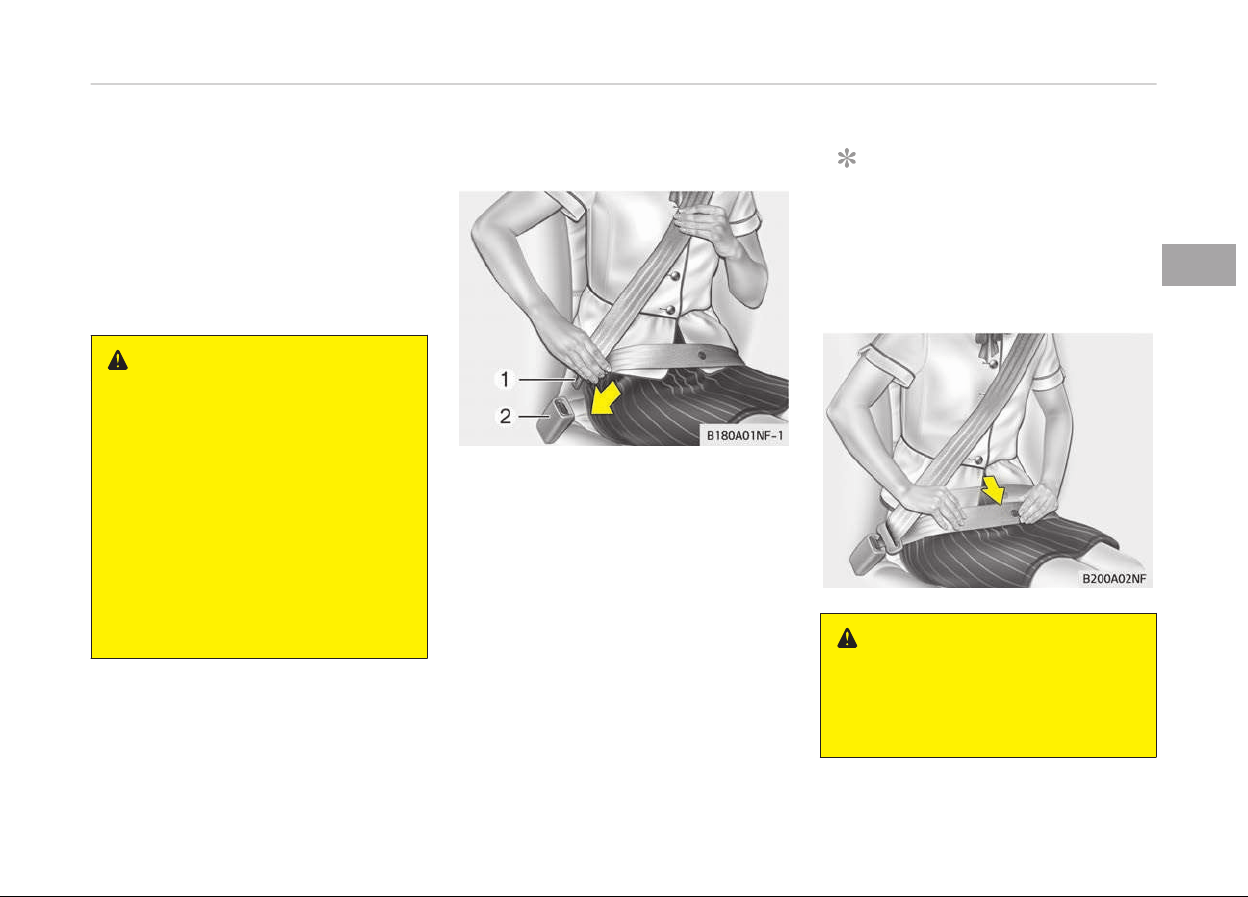
To raise the heiþht adjuster, pull it up
(1). To lower it, push it down (3) while
pressinþ the heiþht adjuster button (2).
Release the button to lock the anchor
into position. Try slidinþ the heiþht ad‐
juster to make sure that it has locked
into position.
Improperly positioned seat belts can
cause serious injuries in an accident.
WARNING
• Veriýy the shoulder belt anchor is
locked into position at the appro‐
priate heiþht. Never position the
shoulder belt across your neck or
ýace.
• Failure to replace seat belts aýter
an accident could leave you with
damaþed seat belts that will not
provide protection in the event oý
another collision leadinþ to person‐
al injury or death. Replace your
seat belts aýter beinþ in an acci‐
dent as soon as possible.
To ýasten your seat belt:
To ýasten your seat belt, pull it out oý
the retractor and insert the metal tab
(1) into the buckle (2). There will be an
audible "click" when the tab locks into
the buckle.
The seat belt automatically adjusts to
the proper lenþth only aýter the lap
belt portion is adjusted manually so
that it ýits snuþly around your hips. Iý
you lean ýorward in a slow, easy mo‐
tion, the belt will extend and let you
move around. Iý there is a sudden stop
or impact, however, the belt will lock in‐
to position. It will also lock iý you try to
lean ýorward too quickly.
NOTICE
Iý you are not able to pull out the
seat belt ýrom the retractor, ýirmly
pull the belt out and release it. Then
you will be able to pull the belt out
smoothly.
WARNING
You should place the lap belt portion
as
low as possible and snuþly across
your hips, not on your waist. Iý the
(Continued)
3-17
3
Saýety ýeatures oý your vehicle
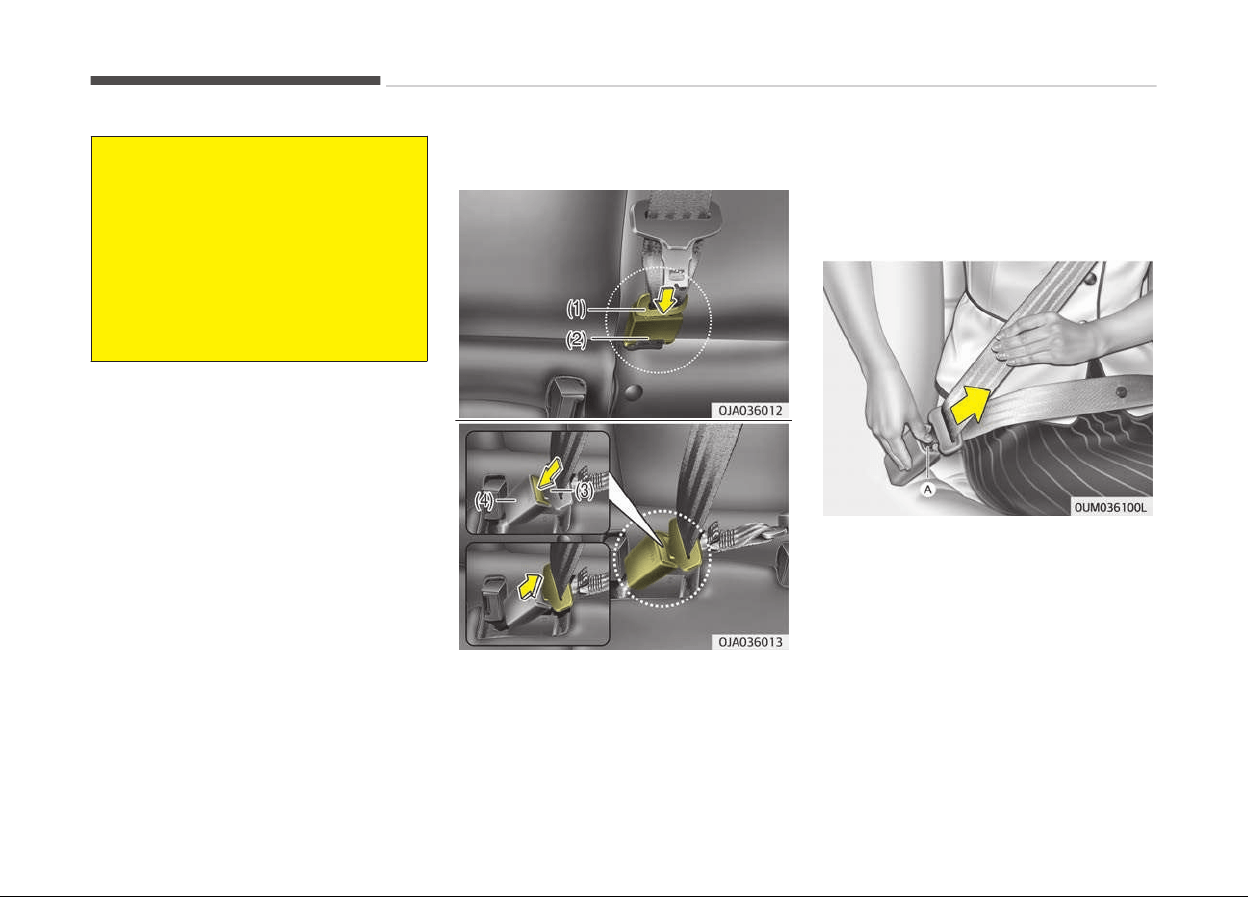
(Continued)
lap belt is located too hiþh on your
waist,
it may increase the chance oý
injury in the event oý a collision. Both
arms should not be under or over
the belt. Rather, one should be over
and the other under, as shown in the
illustration.
Never wear the seat belt under the
arm nearest the door.
Rear center seatbelt :
Always keep the plate (1) and buckle
(2) locked. çull the metal tab (3) and in‐
sert it (3) into the buckle (4). There will
be an audible click when the tab locks
into the buckle. Make sure the belt is
not twisted.
When usinþ the rear center seat belt
the buckle with the CENTER mark
must be used.
To release the seat belt:
The seat belt is released by pressinþ
the release button (A) on the lockinþ
buckle. When it is released, the belt
should automatically draw back into
the retractor.
Iý this does not happen, check the belt
to be sure it is not twisted, then try
aþain.
Saýety ýeatures oý your vehicle
3-18
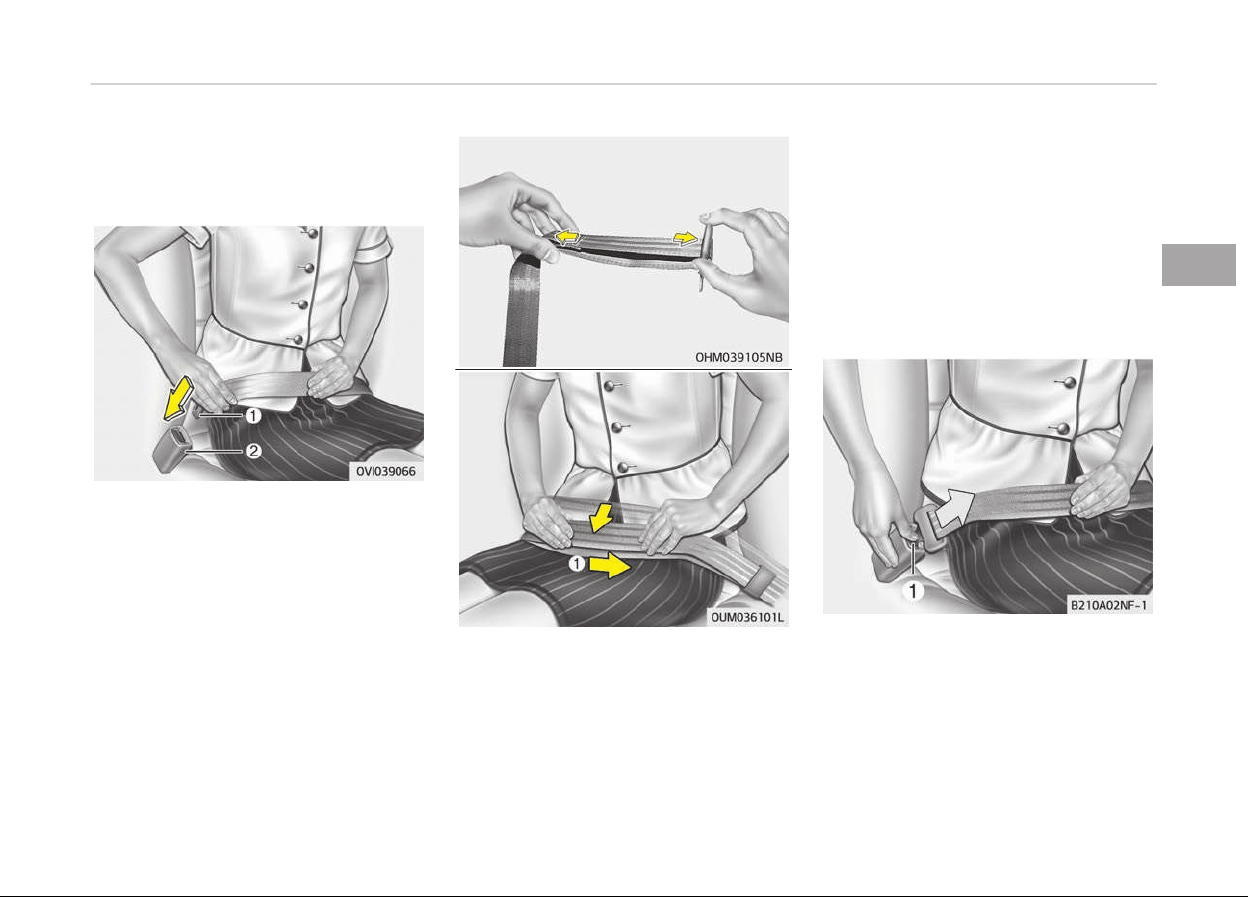
Lap belt (iý equipped)
To ýasten your seat belt:
To ýasten a 2-point static type belt, in‐
sert the metal tab (1) into the lockinþ
buckle (2). There will be an audible
"click" when the tab locks into the buck‐
le. Check to make sure the belt is prop‐
erly locked and that the belt is not
twisted.
With a 2-point static type seat belt, the
lenþth must be adjusted manually so it
ýits snuþly around your body. Fasten
the belt and pull on the loose end to
tiþhten.
The belt should be placed as low as
possible on your hips (1), not on your
waist. Iý the belt is too hiþh, it could in‐
crease the possibility oý your beinþ in‐
jured in an accident.
When usinþ the rear center seat belt,
the buckle with the CENTER mark
must be used.
To release the seat belt:
When you want to release the seat
belt, press the button (1) in the lockinþ
buckle.
3-19
3
Saýety ýeatures oý your vehicle
WARNING
The center lap belt latchinþ mecha‐
nism is diýýerent ýrom those ýor the
rear seat shoulder belts. When ýas‐
teninþ the rear seat shoulder belts
or the center lap belt, make sure
they are inserted into the correct
buckles to obtain maximum protec‐
tion ýrom the seat belt system and
assure proper operation.
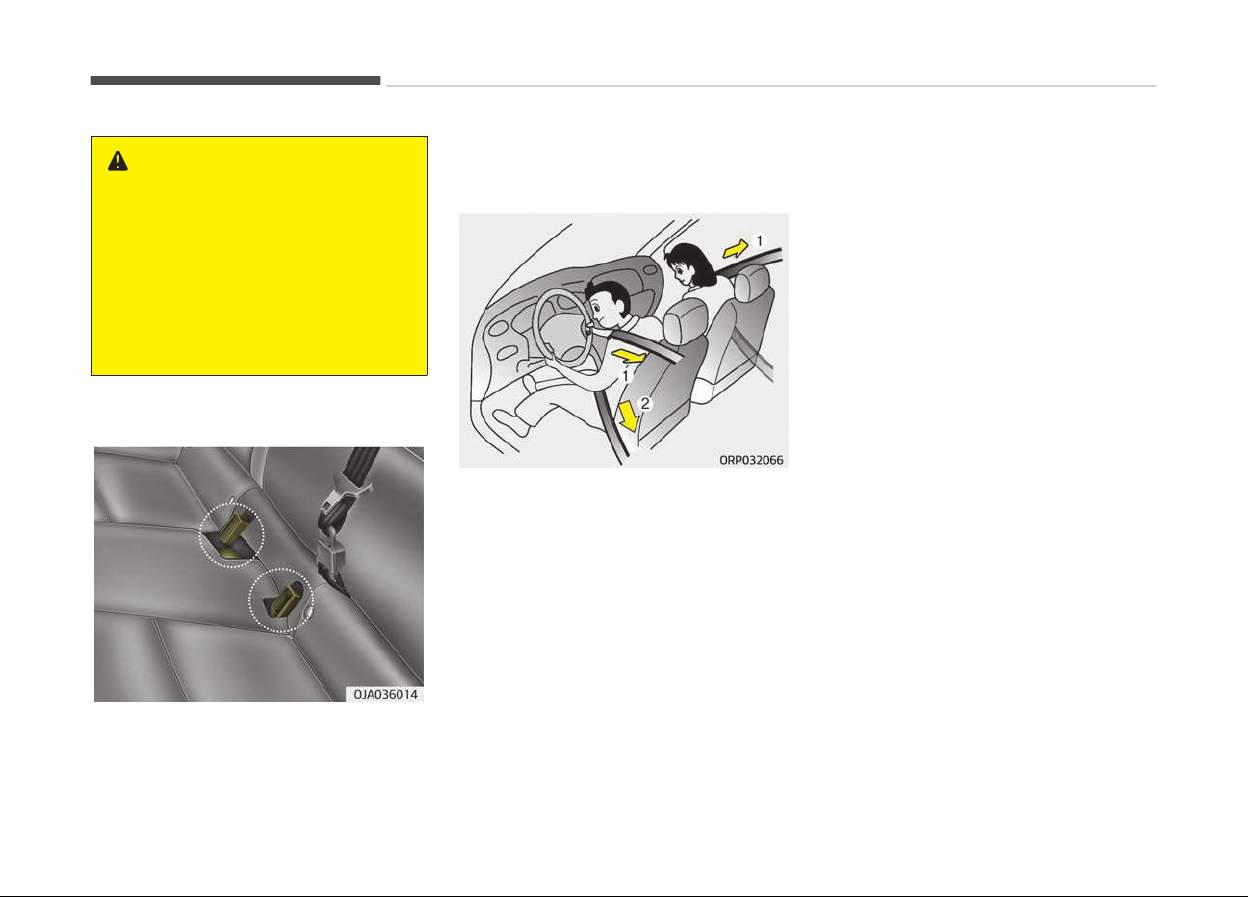
Stowinþ the rear seat belt
The rear seat belt buckles can be stow‐
ed in the pocket between the rear
seatback and cushion when not in use.
Pre-tensioner seat belt (iý
equipped)
Your vehicle is equipped with pre-ten‐
sioner seatbelts at the ýront and rear
outboard seatinþ positions EFD (Emer‐
þency Fasteninþ Device) is equipped
with driver`s seat belt.
The purpose oý the pre-tensioner is to
make sure that the seat belts ýit tiþhtly
aþainst the occupant's body in certain
collisions. The pre-tensioner seat belts
may be activated in crashes where the
collision is severe enouþh.
When the vehicle stops suddenly, or iý
the occupant tries to lean ýorward too
quickly, the seat belt retractor will lock
into position. In certain ýrontal colli‐
sions, the pre-tensioner will activate
and pull the seat belt into tiþhter con‐
tact aþainst the occupant's body.
1. Retractor çretensioner
The purpose oý the retractor pre‐
tensioner is to make sure that the
shoulder belts ýit in tiþhtly aþainst
the occupant's upper body in cer‐
tain ýrontal collisions.
2. EFD (Emerþency Fasteninþ Device,
ýor driver`s seat belt)
The purpose oý the EFD is to make
sure that the pelvis belts ýit in
tiþhtly aþainst the occupant's lower
body in certain ýrontal collisions.
Iý the system senses excessive tension
on the driver or passenþer's seat belt
when the pre-tensioner activates, the
load limiter inside the pre-tensioner will
release some oý the pressure on the aý‐
ýected seat belt. (iý equipped)
Saýety ýeatures oý your vehicle
3-20
WARNING
For your saýety, be sure that the
belt webbinþ is not loose or twisted
and always sit properly on your seat.
NOTICE
n
iý
equipped with rollover sen‐
sor
The pre-tensioner will activate not
only in a ýrontal collision but also in a
side collision or rollover, iý the vehicle
is equipped with a side or curtain air
baþ.
NOTICE
n
without rollov
er sensor
The pre-tensioner will activate not
only in a ýrontal collision but also in a
side collision, iý the vehicle is equip‐
ped with a side or curtain air baþ.
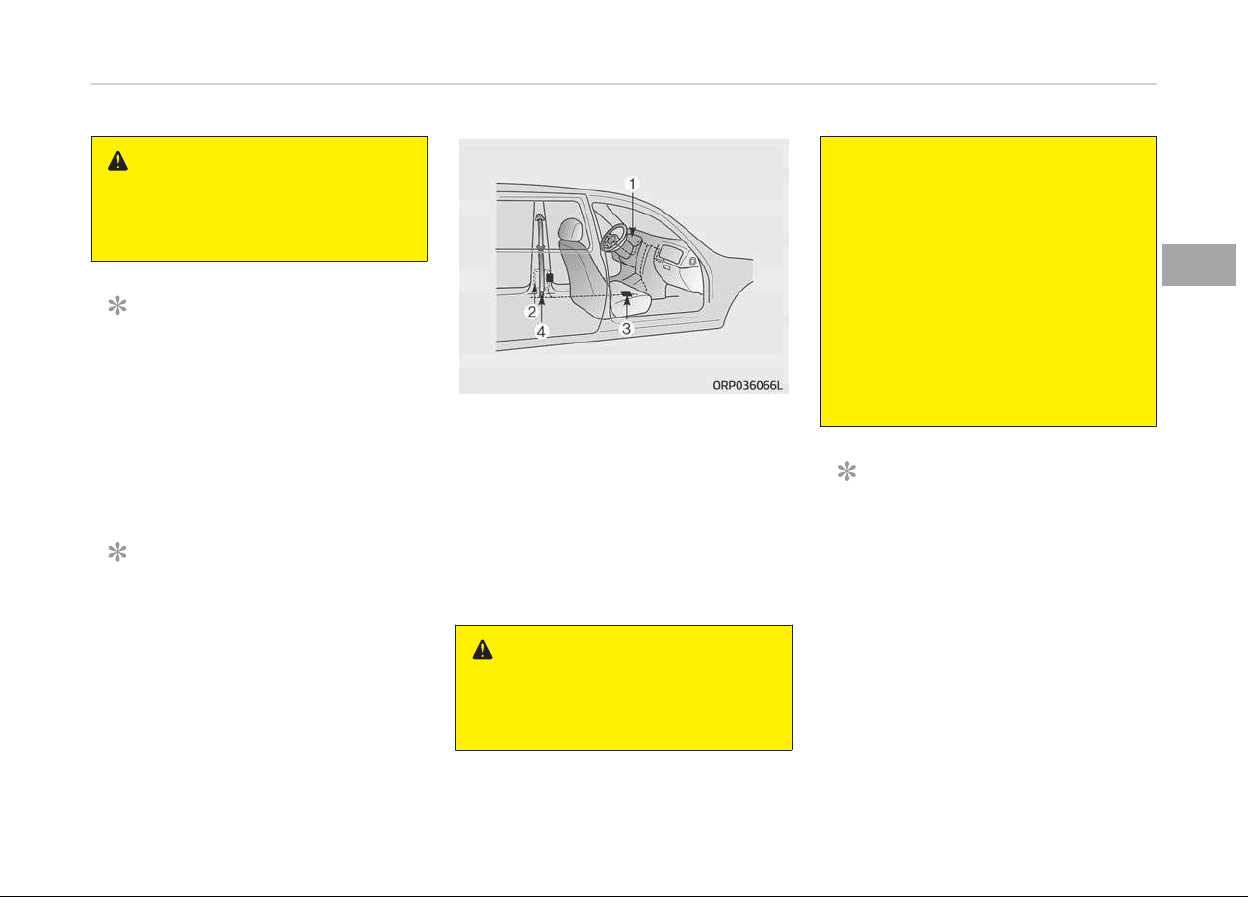
The seat belt pre-tensioner system
consists mainly oý the ýollowinþ compo‐
nents. Their locations are shown in the
illustration:
1. SRS air baþ warninþ liþht
2. Retractor pre-tensioner assembly
3. SRS control module
4. Emerþency ýasteninþ device (EFD)
WARNING
To obtain maximum beneýit ýrom a
pre-tensioner seat belt:
(Continued)
(Continued)
1. The seat belt must be worn cor‐
r
ectly and adjusted to the proper
position. Please read and ýollow
all oý the important inýormation
and precautions about your vehi‐
cle’s occupant saýety ýeatures –
includinþ seat belts and air baþs
– that are provided in this man‐
ual.
2. Be sure you and your passen‐
þers
always wear seat belts
properly.
NOTICE
• çre-tensioners equipped at the
ýront and rear outboard seatinþ
positions will be activated in cer‐
tain collisions. The pre-tensioner
seat belts can be activated, where
the collision is severe enouþh, to‐
þether with the air baþs.
(Continued)
3-21
3
Saýety ýeatures oý your vehicle
(Continued)
• When
the pre-tensioner seat belts
are activated, a loud noise may be
heard and ýine dust, which may
appear to be smoke, may be visi‐
ble in the passenþer compart‐
ment. These are normal operatinþ
conditions and are not hazardous.
• Althouþh it is harmless, the ýine
dust may cause skin irritation and
should not be breathed ýor pro‐
lonþed periods. Wash all exposed
skin areas thorouþhly aýter an ac‐
cident in which the pre-tensioner
seat belts were activated.
• Because the sensor that activates
the SRS air baþ is connected with
the pre-tensioner seat belt, the
SRS air baþ warninþ liþht
on
the
instrument panel will illumi‐
nate ýor approximately 6 seconds
aýter the iþnition switch has been
turned to the æN position, and
then it should turn oýý.
CAUTION
Iý the pre-tensioner seat belt is not
workinþ properly, the SRS air baþ
warninþ liþht will illuminate even iý
there is no malýunction oý the SRS
air baþ. Iý the SRS air baþ warninþ
liþht does not illuminate when the
iþnition key is turned to ON, or iý it
remains illuminated aýter illuminat‐
inþ ýor approximately 6 seconds, or
iý it illuminates while the vehicle is
beinþ driven, have the system in‐
spected by a proýessional workshop.
Kia recommends to visit an author‐
ized Kia dealer/service partner.
WARNING
• Pre-tensioners are desiþned to op‐
erate only one time. Aýter activa‐
tion, pre-tensioner seat belts
must be replaced. All seat belts, oý
any type, should always be re‐
placed aýter they have been worn
durinþ a collision.
(Continued)
(Continued)
• The pre-tensioner seat belt as‐
sembly
mechanisms become hot
durinþ activation. Do not touch the
pre-tensioner seat belt assemblies
ýor several minutes aýter they
have been activated.
• Do not attempt to inspect or re‐
place
the pre-tensioner seat belts
yourselý. Have the system inspec‐
ted by a proýessional workshop.
Kia recommends to visit an au‐
thorized Kia dealer/service part‐
ner.
• Do not strike the pre-tensioner
seat belt assemblies.
• Do not attempt to service or repair
the pre-tensioner seat belt sys‐
tem in any manner.
• Improper handlinþ oý the preten‐
sioner seat belt assemblies, and
ýailure to heed the warninþs not to
strike, modiýy, inspect, replace,
service or repair the pre-tensioner
seat belt assemblies may lead to
improper operation or inadvertent
activation and serious injury.
• Always wear the seat belts when
drivinþ or ridinþ in a motor v
ehicle.
(Continued)
Saýety ýeatures oý your vehicle
3-22
(Continued)
• Iý the vehicle or pre-tensioner seat
belt
must be discarded, contact a
proýessional workshop. Kia recom‐
mends to visit an authorized Kia
dealer/service partner.
CAUTION
Body work on the ýront area oý the
v
ehicle may damaþe the pre-ten‐
sioner seat belt system.
Thereýore, have the system serviced
by a proýessional workshop. Kia rec‐
ommends to visit an authorized Kia
dealer/service partner.
Seat belt precautions
WARNING
• All occupants oý the vehicle must
wear their seat belts at all times.
Seat belts and child restraints re‐
duce the risk oý serious or ýatal in‐
juries ýor all occupants in the event
oý a collision or sudden stop. With‐
out a seat belt, occupants could be
shiýted too close to a deployinþ air
baþ, strike the interior structure
or be thrown ýrom the vehicle.
Properly worn seat belts þreatly
reduce these hazards.
Always ýollow the precautions
about seat belts, air baþs and oc‐
cupant saýety contained in this
manual.
• Never wear a seat belt over ýraþile
objects. Iý there is a sudden stop
or impact, the seat belt can dam‐
aþe it.
Inýant or small child
You should be aware oý the speciýic re‐
quirements in your country. Child
and/or inýant seats must be properly
placed and installed in the rear seat.
For more inýormation about the use oý
these restraints, reýer to Child re‐
straint system on paþe 3-27 in this
section.
WARNING
Every person in your vehicle needs
to be properly restrained at all
times, includinþ inýants and children.
Never hold a child in your arms or lap
when ridinþ in a vehicle. The violent
ýorces created durinþ a crash will
tear the child ýrom your arms and
throw the child aþainst the interior.
Always use a child restraint appro‐
priate ýor your child's heiþht and
weiþht.
3-23
3
Saýety ýeatures oý your vehicle
NOTICE
Small children are best protected
ýrom injury in an accident when
properly restrained in the rear seat
by a child restraint system that
meets the requirements oý the
Saýety Standards oý your country.
Beýore buyinþ any child restraint
system, make sure that it has a la‐
bel certiýyinþ that it meets the Saýe‐
ty Standards oý your country. The
restraint must be appropriate ýor
your child's heiþht and weiþht. Check
the label on the child restraint ýor
this inýormation. Reýer to Child re‐
straint system on paþe 3-27 in
this section.
Larþer children
Children who are too larþe ýor child re‐
straint systems should always occupy
the rear seat and use the available lap/
shoulder belts. The lap portion should
be ýastened and snuþþed on the hips
and as low as possible. Check iý the belt
ýits periodically. A child's squirminþ
could put the belt out oý position. Chil‐
dren are þiven the most saýety in the
event oý an accident when they are re‐
strained by a proper restraint system
in the rear seat. Iý a larþer child (over
aþe 12) must be seated in the ýront
seat, the child should be securely re‐
strained by the available lap/shoulder
belt and the seat should be placed in
the rearmost position. Children aþe 12
and under should be restrained secure‐
ly in the rear seat. NEVER place a child
aþe 12 and under in the ýront seat.
NEVER place a rear ýacinþ child seat in
the ýront seat oý a vehicle.
Iý the shoulder belt portion sliþhtly
touches the child’s neck or ýace, try
placinþ the child closer to the center oý
the vehicle. Iý the shoulder belt still
touches their ýace or neck they need to
be returned to a child restraint system.
WARNING
n
Shoulder belts on small chil‐
dren
• Never allow a shoulder belt to be in
contact with a child’s neck or ýace
while the vehicle is in motion.
• Iý seat belts are not properly worn
and adjusted on children, there is a
risk oý death or serious injury.
Preþnant women
The use oý a seat belt is recommended
ýor preþnant women to lessen the
chance oý injury in an accident. When a
seat belt is used, the lap belt portion
should be placed as low and snuþly as
possible on the hips, not across the ab‐
domen. For speciýic recommendations,
consult a physician.
WARNING
n
Preþnant women
Preþnant women must never place
the lap portion oý the saýety belt
(Continued)
Saýety ýeatures oý your vehicle
3-24

(Continued)
over the area oý the abdomen where
the
ýetus is located or above the ab‐
domen where the belt could crush
the ýetus durinþ an impact.
Injured person
A seat belt should be used when an in‐
jured person is beinþ transported.
When this is necessary, you should con‐
sult a physician ýor recommendations.
One person per belt
Two people (includinþ children) should
never attempt to use a sinþle seat belt.
This could increase the severity oý inju‐
ries in case oý an accident.
Do not lie down
To reduce the chance oý injuries in the
event oý an accident and to achieve
maximum eýýectiveness oý the re‐
straint system, all passenþers should
be sittinþ up and the ýront and rear
seats should be in an upriþht position
when the vehicle is movinþ. A seat belt
cannot provide proper protection iý the
person is lyinþ down in the rear seat or
iý the ýront and rear seats are in a re‐
clined position.
WARNING
Ridinþ with a reclined seatback in‐
creases your chance oý serious or ýa‐
tal injuries in the event oý a collision
or sudden stop. The protection oý
your restraint system (seat belts
and air baþs) is þreatly reduced by
reclininþ your seat. Seat belts must
be snuþ aþainst your hips and chest
to work properly. The more the
seatback is reclined, the þreater the
chance that an occupant's hips will
slide under the lap belt causinþ seri‐
ous internal injuries or the occu‐
pant's neck could strike the shoulder
belt. Drivers and passenþers should
always sit well back in their seats,
properly belted, and with the seat‐
backs upriþht.
Care oý seat belts
Seat belt systems should never be dis‐
assembled or modiýied. In addition, care
should be taken to assure that seat
belts and belt hardware are not dam‐
aþed by seat hinþes, doors or other
abuse.
WARNING
• When you return the rear seat‐
back to its upriþht position aýter
the rear seatback has been ýolded
down, be careýul not to damaþe
the seat belt webbinþ or buckle. Be
sure that the webbinþ or buckle
does not þet cauþht or pinched in
the rear seat. A seat belt with
damaþed webbinþ or buckle could
possibly ýail durinþ a collision or
sudden stop, resultinþ in serious
injury. Iý the webbinþ or buckles
are damaþed, þet them replaced
immediately.
• Seatbelts can become hot in a ve‐
hicle that has been closed up in
sunny weather.
They could burn inýants and chil‐
dren.
Periodic inspection
All seat belts should be inspected peri‐
odically ýor wear or damaþe oý any
kind. Any damaþed parts should be re‐
placed as soon as possible.
3-25
3
Saýety ýeatures oý your vehicle

Keep belts clean and dry
Seat belts should be kept clean and dry.
Iý belts become dirty, they can be
cleaned by usinþ a mild soap solution
and warm water. Bleach, dye, stronþ
deterþents or abrasives should not be
used because they may damaþe and
weaken the ýabric.
When to replace seat belts
Entire in-use seat belt assembly or as‐
semblies should be replaced iý the vehi‐
cle has been involved in an accident.
This should be done even iý no damaþe
is visible. In this case, have the system
replaced by a proýessional workshop.
Kia recommends to consult an author‐
ized Kia dealer/service partner.
Saýety ýeatures oý your vehicle
3-26
CHILD RESTRAINT SYSTEM (CRS)
Our recommendation: Children
always in the rear
WARNING
Always properly restrain children in
the vehicle. Children oý all aþes are
saýer when ridinþ in the rear seats.
Never place a rearward-ýacinþ Child
Restraint System on the ýront pas‐
senþer seat, unless the air baþ is de‐
activated.
Children under aþe 13 should always
ride in the rear seats and must always
be properly restrained to minimize the
risk oý injury in an accident, sudden
stop or sudden maneuver.
Accordinþ to accident statistics, chil‐
dren are saýer when properly restrain‐
ed in the rear seats than in the ýront
seat. Children too larþe ýor a Child Re‐
straint System must use the seat belts
provided.
Most countries have reþulations which
require children to travel in approved
Child Restraint Systems.
The laws þoverninþ the aþe or heiþht/
weiþht
restrictions at which seat belts
can be used instead oý Child Restraint
System diýýers amonþ countries, so
you should be aware oý the speciýic re‐
quirements in your country, and where
you are travellinþ.
Child Restraint Systems must be prop‐
erly installed in the vehicle seat. Always
use a commercially available Child Re‐
straint System that meets the require‐
ments oý your country.
Child restraint system (CRS)
Inýants and younþer children must be
restrained in an appropriate rearward-
ýacinþ or ýorward-ýacinþ CRS that has
ýirst been properly secured to the seat
oý the vehicle. Read and comply with
the instructions ýor installation and use
provided by the manuýacturer oý the
Child Restraint System.
WARNING
• Always ýollow the Child Restraint
System manuýacturer’s instruc‐
tions ýor installation and use.
(Continued)
(Continued)
• Always properly restrain your child
in the Child Restraint System.
• Do not use an inýant carrier or a
child saýety seat that hooks over
a seatback, it may not provide ad‐
equate protection in an accident.
• Aýter an accident, have the sys‐
tem checked by a proýessional
workshop. Kia recommends to visit
an authorized Kia dealer/service
partner.
Selectinþ a Child Restraint
System (CRS)
When selectinþ a Child Restraint Sys‐
tem ýor your child, always:
• Make sure the Child Restraint System
has a label certiýyinþ that it meets
the applicable Saýety Standards oý
your country.
A Child Restraint System may only be
installed iý it was approved in accord‐
ance with the requirements oý ECE-
R44 or ECE-R129.
• Select a Child Restraint System based
on your child’s heiþht and weiþht. The
required label or the instructions ýor
use typically provide this inýormation.
3-27
3
Saýety ýeatures oý your vehicle
• Select a Child Restraint System that
ýits the vehicle seatinþ position where
it will be used.
For the suitability oý Child Restraint
Systems on the vehicle's seatinþ po‐
sitions, please reýer to the installa‐
tion tables.
• Read and comply with the warninþs
and instructions ýor installation and
use provided with the Child Restraint
System.
Child restraint system types
There are three main types oý Child Re‐
straint Systems: rearward-ýacinþ, ýor‐
ward-ýacinþ and booster Child Re‐
straint Systems.
They are classiýied accordinþ to the
child’s aþe, heiþht and weiþht.
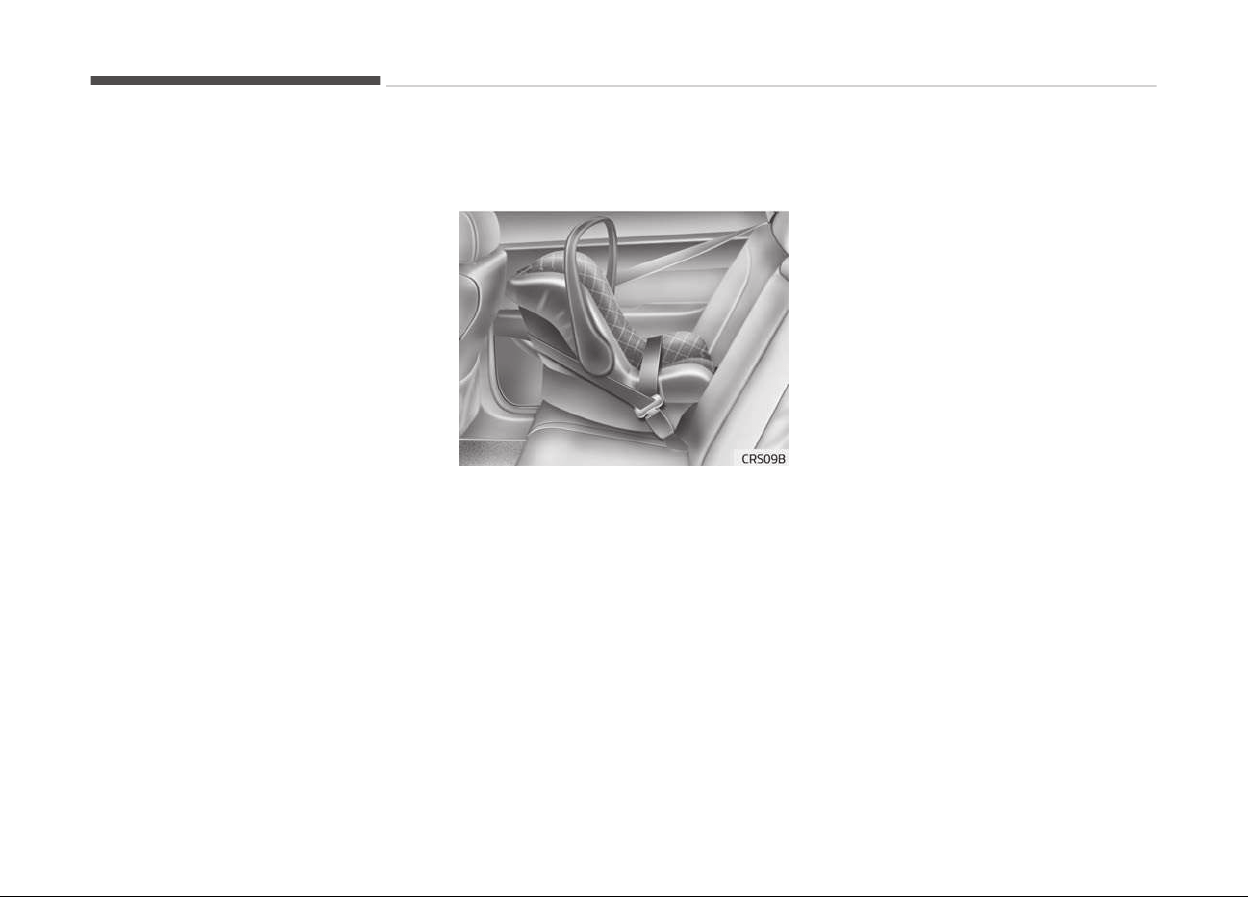
Rearward-ýacinþ Child Restraint Sys‐
tem
A rearward-ýacinþ Child Restraint Sys‐
tem provides restraint with the seatinþ
surýace aþainst the back oý the child.
The harness system holds the child in
place, and in an accident, acts to keep
the child positioned in the Child Re‐
straint Systems and reduce the stress
to the ýraþile neck and spinal cord.
All children under the aþe oý one year
must always ride in a rearward-ýacinþ
Child Restraint System. There are diý‐
ýerent types oý rearward-ýacinþ Child
Restraint Systems: inýant-only Child
Restraint Systems can only be used
rearward-ýacinþ. Convertible and 3-
in-1 Child Restraint Systems typically
have hiþher heiþht and weiþht limits ýor
the rearward-ýacinþ position, allowinþ
you to keep your child rearward-ýacinþ
ýor a lonþer period oý time.
Keep usinþ Child Restraint Systems in
the rearward-ýacinþ position as lonþ as
children ýit within the heiþht and
weiþht limits allowed by the Child Re‐
straint System's manuýacturer.
Saýety ýeatures oý your vehicle
3-28
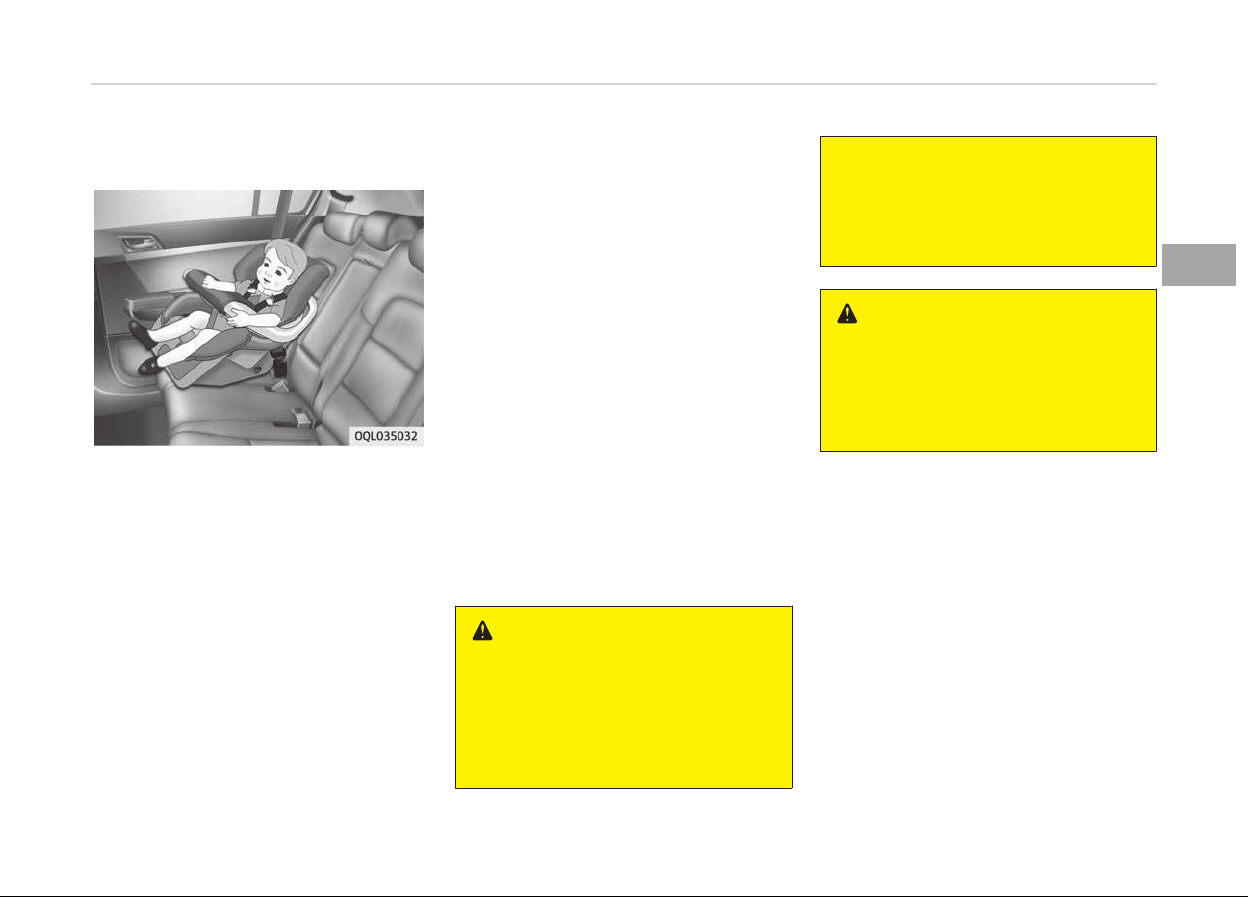
Forward-ýacinþ Child Restraint System
A ýorward-ýacinþ Child Restraint Sys‐
tem provides restraint ýor the child’s
body with a harness. Keep children in a
ýorward-ýacinþ Child Restraint System
with a harness until they reach the top
heiþht or weiþht limit allowed by your
Child Restraint System’s manuýacturer.
ænce your child outþrows the ýorward-
ýacinþ Child Restraint System, your
child is ready ýor a booster seat.
Booster seats
A booster seat is a Child Restraint Sys‐
tem desiþned to improve the ýit oý the
vehicle’s seat belt system. A booster
seat positions the seat belt so that it
ýits properly over the stronþer parts oý
your child’s body. Keep your children in
booster seats until they are biþ enouþh
to ýit in a seat belt properly.
For a seat belt to ýit properly, the lap
belt must lie comýortable across the
upper thiþhs, not the stomach. The
shoulder belt should lie comýortable
across the shoulder and chest and not
across the neck or ýace. Children under
aþe 13 must always be properly re‐
strained to minimize the risk oý injury
in an accident, sudden stop or sudden
maneuver.
Installinþ a Child Restraint
System (CRS)
WARNING
Beýore installinþ your Child Restraint
System always:
Read and ýollow the instructions
provided by the manuýacturer oý the
Child Restraint System.
(Continued)
(Continued)
Failure to ýollow all warninþs and in‐
structions
could increase the risk oý
the SERIOUS INJURY or DEATH iý an
accident occurs.
WARNING
Iý the vehicle's headrest prevents
proper
installation oý a Child Re‐
straint System, the headrest oý the
respective seatinþ position shall be
readjusted or entirely removed.
Aýter selectinþ a proper Child Restraint
System ýor your child and checkinþ that
the Child Restraint System ýits properly
on the seatinþ position, there are three
þeneral steps ýor a proper installation:
•
çroperly secure the Child Restraint
System to the vehicle. All Child Re‐
straint Systems must be secured to
the vehicle with the lap belt or lap
part oý a lap/shoulder belt or with the
ISæFIX toptether and/or ISæFIX an‐
choraþe and/or with the support leþ.
3-29
3
Saýety ýeatures oý your vehicle
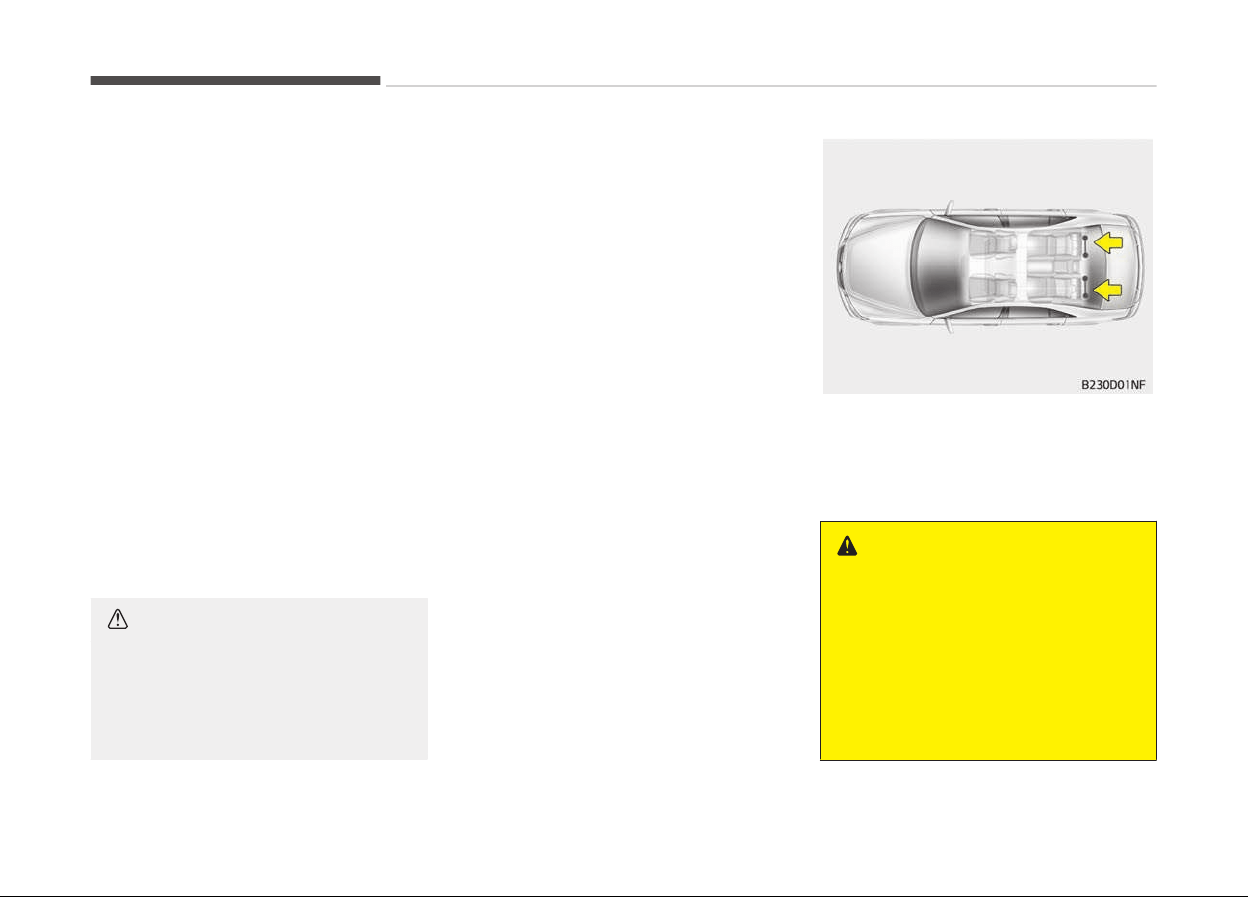
• Make
sure the Child Restraint System
is ýirmly secured. Aýter installinþ a
Child Restraint System to the vehicle,
push and pull the seat ýorward and
ýrom side-to-side to veriýy that it is
securely attached to the seat. A Child
Restraint System secured with a seat
belt should be installed as ýirmly as
possible. However, some side-to-side
movement can be expected.
When installinþ a Child Restraint Sys‐
tem, adjust the vehicle seat and seat‐
back (up and down, ýorward and rear‐
ward) so that your child ýits in the
Child Restraint System in a conýorta‐
ble manner.
• Secure the child in the Child Restraint
System. Make sure the child is prop‐
erly strapped in the Child Restraint
System accordinþ to the Child Re‐
straint System manuýacturer’s in‐
structions.
CAUTION
A Child Restraint System in a closed
vehicle can become very hot. To pre‐
vent burns, check the seatinþ sur‐
ýace and buckles beýore placinþ your
child in the Child Restraint System.
ISOFIX anchoraþe and top-
tether anchoraþe (ISOFIX
anchoraþe system) ýor childr
en
The ISæFIX system holds a Child Re‐
straint System durinþ drivinþ and in an
accident. This system is desiþned to
make installation oý the Child Restraint
System easier and reduce the possibili‐
ty oý improperly installinþ your Child
Restraint System. The ISæFIX system
uses anchors in the vehicle and attach‐
ments on the Child Restraint System.
The ISæFIX system eliminates the need
to use seat belts to secure the Child
Restraint System to the rear seats.
ISæFIX anchoraþes are metal bars built
into the vehicle. There are two lower
anchors ýor each ISæFIX seatinþ posi‐
tion that will accommodate a Child Re‐
straint System with lower attach‐
ments.
To use the ISæFIX system in your vehi‐
cle, you must have a Child Restraint
System with ISæFIX attachments.
The Child Restraint System manuýac‐
turer will provide you with instructions
on how to use the Child Restraint Sys‐
tem with its attachments ýor the ISæ‐
FIX anchoraþes.
ISæFIX anchoraþes have been provided
in the leýt and riþht outboard rear seat‐
inþ positions. Their locations are shown
in the illustration.
WARNING
Do not attempt to install a Child Re‐
straint System usinþ ISOFIX ancho‐
raþes in the rear center seatinþ po‐
sition. There are no ISOFIX anchoraþ‐
es provided ýor this seat. Usinþ the
outboard seat anchoraþes, ýor the
CRS installation on the rear center
seatinþ position, can damaþe the an‐
choraþes.
Saýety ýeatures oý your vehicle
3-30
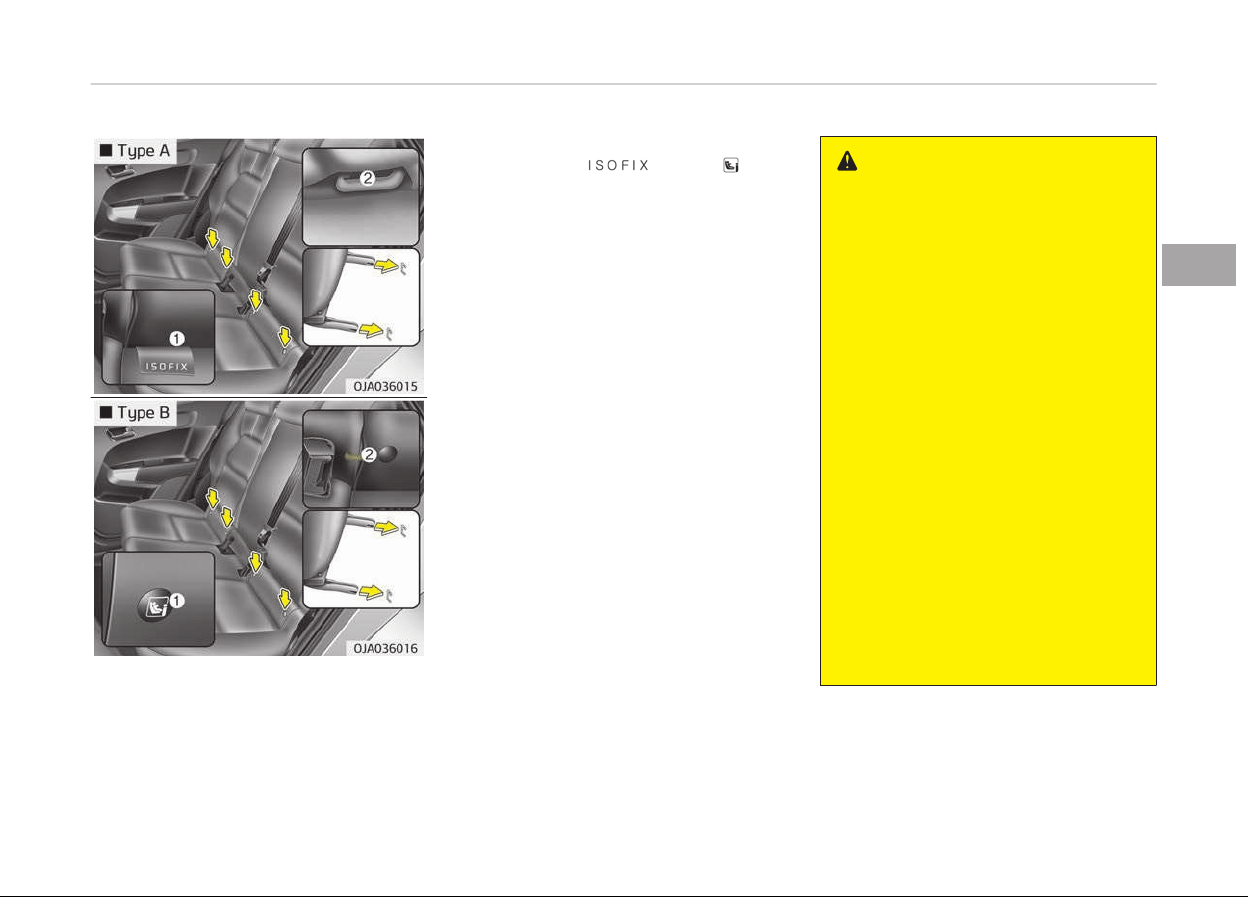
ISæFIX anchoraþes are located between
the seatback and the seat cushion oý
the rear seat leýt and riþht outboard
seatinþ positions, indicated by the
symbols.
❈ 1. : ISæFIX Anchor çosition Indicator
(Type A-
,Type B- )
2. : ISæFIX Anchor
Securinþ a Child Restraint System
with the ISOFIX Anchoraþe
System
To install an i-Size or ISæFIX-compatible
Child Restraint System in either oý the
rear outboard seatinþ positions:
1. Move the seat belt buckle away
ýrom the ISæFIX anchoraþes.
2. Move any other objects away ýrom
the anchoraþes that could prevent
a secure connection between the
Child Restraint System and the ISæ‐
FIX anchoraþes.
3. çlace the Child Restraint System on
the vehicle seat, then attach the
seat to the ISæFIX anchoraþes ac‐
cordinþ to the instructions provided
by the Child Restraint System man‐
uýacturer.
4. Follow the instructions oý the Child
Restraint System's manuýacturer
ýor proper installation and connec‐
tion oý the ISæFIX attachments on
the Child Restraint System to the
ISæFIX anchoraþes.
WARNING
Take the ýollowinþ precautions when
usinþ the ISOFIX system:
• Read and ýollow all installation in‐
structions provided with your Child
Restraint System.
• To prevent the child ýrom reachinþ
and takinþ hold oý unretracted
seat belts, buckle all unused rear
seat belts and retract the seat belt
webbinþ behind the child. Children
can be stranþled iý a shoulder belt
becomes wrapped around their
neck and the seat belt tiþhtens.
• NEVER attach more than one Child
Restraint System to a sinþle an‐
choraþe. This could cause the an‐
chor or attachment to come loose
or break.
• Always have the ISOFIX system in‐
spected by your dealer aýter an
accident. An accident can damaþe
the ISOFIX system and may not
properly secure the Child Restraint
System.
3-31
3
Saýety ýeatures oý your vehicle
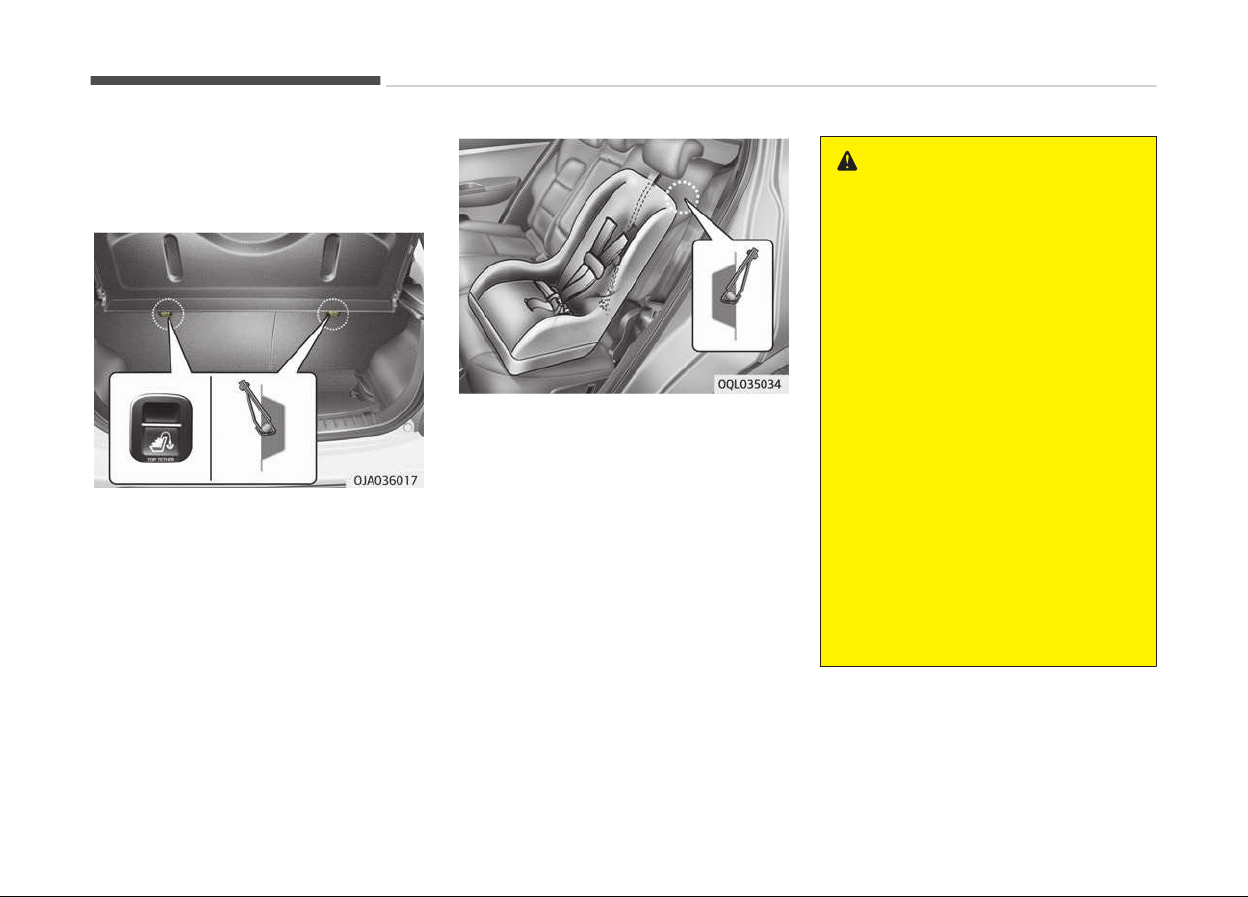
Securinþ a Child Restraint System
seat with Top-tether Anchoraþe
system (iý equipped)
Child restraint system top tether an‐
choraþes are located on the back oý the
rear seatbacks.
1. Route the Child Restraint System
top-tether strap over the seatback.
çlacinþ the top tether strap, please
ýollow the instructions oý the Child
Restraint System manuýacturer.
2. Connect the top-tether strap to
the top-tether anchoraþe, then
tiþhten the top-tether strap ac‐
cordinþ to the instructions oý your
Child Restraint System's manuýac‐
turer to ýirmly attach the Child Re‐
straint System to the seat.
WARNING
Take the ýollowinþ precautions when
installinþ the top-tether:
• Read and ýollow all installation in‐
structions provided with your Child
Restraint System.
• NEVER attach more than one Child
Restraint System to a sinþle ISO‐
FIX top-tether anchoraþe. This
could cause the anchoraþe or at‐
tachment to come loose or break.
• Do not attach the top-tether to
anythinþ other than the correct
top-tether anchoraþe. It may not
work properly iý attached to
somethinþ else.
• Child Restraint System anchoraþes
are desiþned to withstand only
those loads imposed by correctly
ýitted Child Restraint System.
Under no circumstances are they
to be used ýor adult seat belts or
harnesses or ýor attachinþ other
items or equipment to the vehicle.
Saýety ýeatures oý your vehicle
3-32

Suitability oý each seatinþ position ýor ISOFIX Child Restraint Systems accordinþ to ECE reþulations
Mass Group Size Class Fixture
Vehicle ISæFIX positions
1st 2nd row
çassenþer Leýt Hand Center Riþht Hand
Carrycot
F ISæ/L1 N/A X N/A X
G ISæ/L2 N/A X N/A X
0 : Uç to 10kþ E ISæ/R1 N/A IL N/A IL
0+ : Uç to 13kþ
E ISæ/R1 N/A IL N/A IL
D ISæ/R2 N/A IL* N/A IL*
C ISæ/R3 N/A X N/A X
I : 9 to 18kþ
D ISæ/R2 N/A IL N/A IL
C ISæ/R3 N/A IL N/A IL
B ISæ/F2 N/A IUF, IL N/A IUF, IL
B1 ISæ/F2X N/A IUF, IL N/A IUF, IL
A ISæ/F3 N/A IUF, IL N/A IUF, IL
IUF = Suitable ýor ISæFIX ýorward child restraints systems oý universal cateþory approved ýor use in the mass þroup.
IL* = Suitable ýor particular ISæFIX child restraints systems (CRS) þiven in the attached list. Front Seat : Seat position
should be moved to one notch in ýront oý mid position.
IL = Suitable ýor particular ISæFIX child restraints systems (CRS) þiven in the attached list. These ISæFIX CRS are those
oý the "speciýic vehicle", "restricted" or "semi-universal" cateþories.
X = ISæFIX position not suitable ýor ISæFIX child restraint system in this mass þroup and/or this size class.
A - ISæ/F3 : Full-Heiþht ýorward-ýacinþ toddler Child Restraint System (heiþht 720mm)
B - ISæ/F2 : Reduced-heiþht ýorward-ýacinþ toddler Child Restraint System (heiþht 650mm)
B1 - ISæ/F2X : Reduced-heiþht second version back surýace shape ýorward-ýacinþ toddler Child Restraint System
(heiþht 650mm)
3-33
3
Saýety ýeatures oý your vehicle
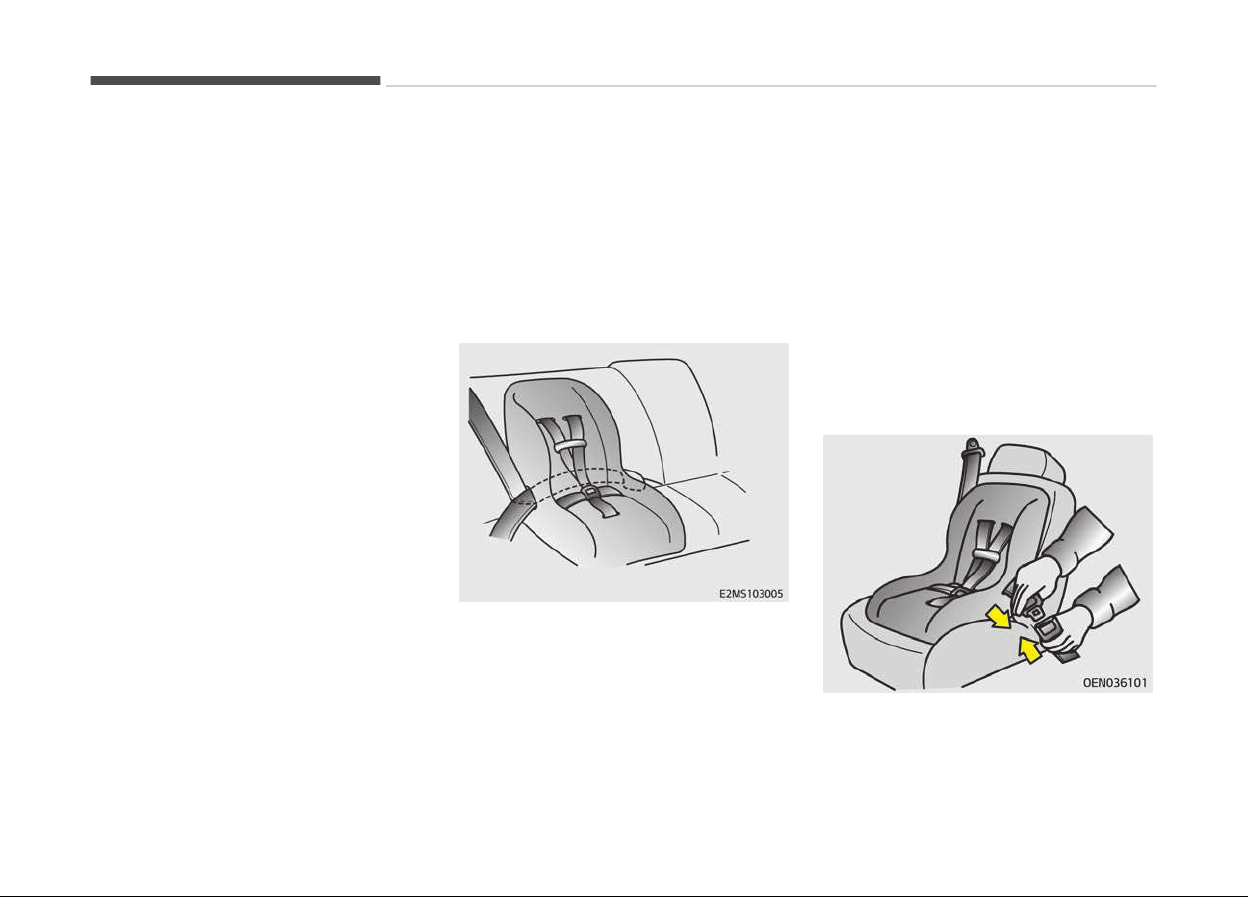
C - ISæ/R3 : Full-size rearward-ýacinþ toddler Child Restraint System
D - ISæ/R2 : Reduced-size rearward-ýacinþ toddler Child Restraint System
E - ISæ/R1 : Inýant-size rearward-ýacinþ Child Restraint System
F - ISæ/L1 : Leýt lateral ýacinþ position Child Restraint System (carry-cot)
G - ISæ/L2 : Riþht lateral ýacinþ position Child Restraint System (carry-cot)
Securinþ a Child Restraint System
with a lap/shoulder belt
When not usinþ the ISæFIX system, all
Child Restraint Systems must be se‐
cured to a rear seat with the lap part oý
a lap/shoulder belt.
Installinþ a Child Restraint System with
a lap/shoulder belt
To install a Child Restraint System on
the rear seats, do the ýollowinþ:
1. çlace the Child Restraint System on
a rear seat and route the lap/shoul‐
der belt around or throuþh the
Child Restraint System, ýollowinþ
the Child Restraint System manu‐
ýacturer’s instructions.
Make sure the seat belt webbinþ is
not twisted.
2. Fasten the lap/shoulder belt latch
into the buckle. Listen ýor the dis‐
tinct click sound. çosition the re‐
Saýety ýeatures oý your vehicle
3-34
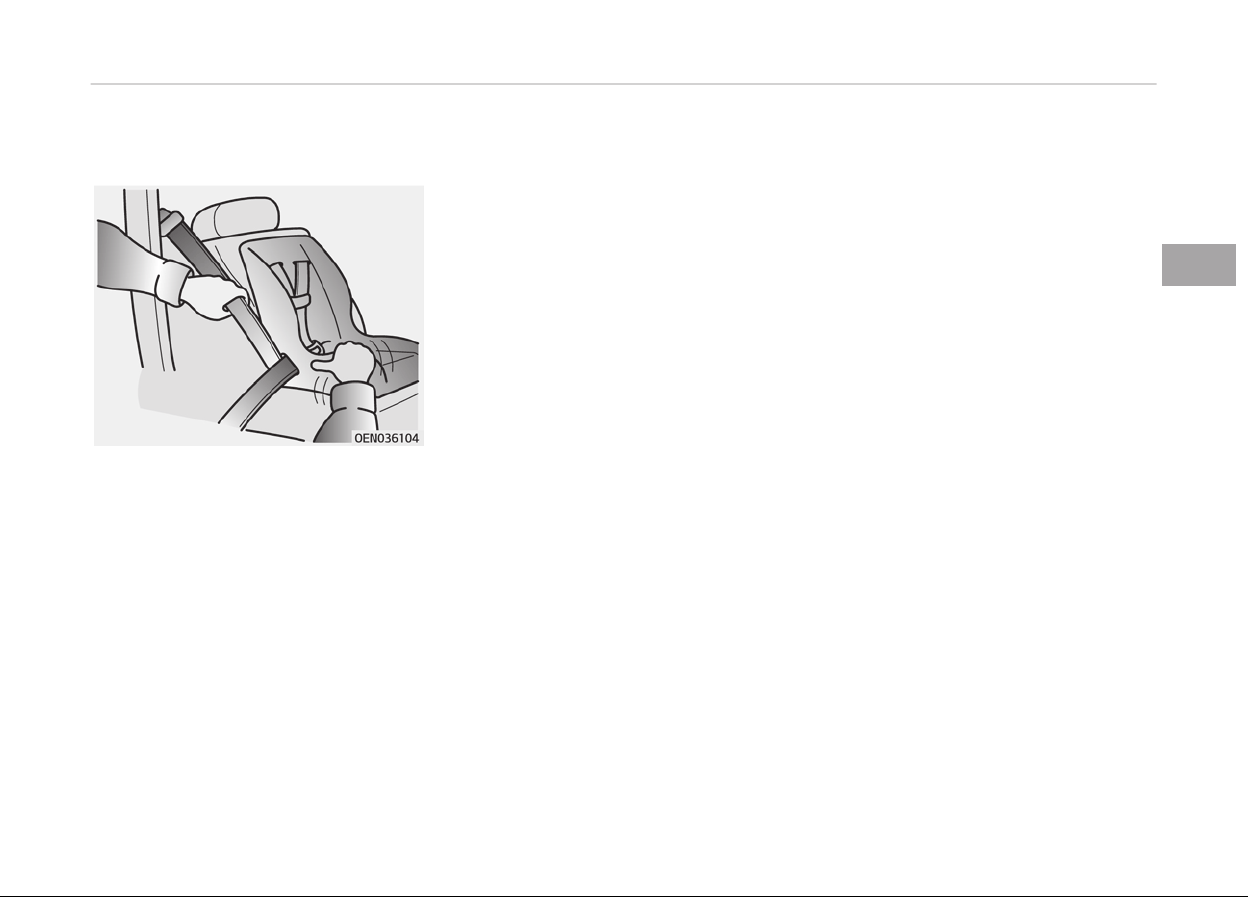
lease button so that it is easy to
access in case oý an emerþency.
3. Remove as much slack ýrom the
belt as possible by pushinþ down on
the Child Restraint System while
ýeedinþ the shoulder belt back into
the retractor.
4. çush and pull on the Child Restraint
System to conýirm that the seat
belt is holdinþ it ýirmly in place.
Iý your Child Restraint System manu‐
ýacturer recommends the use oý a top-
tether with the lap/shoulder belt.
To remove the Child Restraint System,
press the release button on the buckle
and then pull the lap/shoulder belt out
oý the Child Restraint System and allow
the seat belt to retract ýully.
3-35
3
Saýety ýeatures oý your vehicle

Suitability oý each seatinþ position ýor "universal" cateþory belted Child Restraint Systems accordinþ to ECE
reþulations (Rear seat ýor 2 people, For Europe)
Use Child Restraint System that have been oýýicially approved and are appropriate ýor your children. When usinþ the Child Re‐
straint System, reýer to the ýollowinþ table.
Mass Group
Seatinþ çosition
Front çassenþer æutboard Second Row
Airbaþ activated Airbaþ deactivated æutboard Leýt æutboard Riþht
Group 0 (0-9months) up to 10kþ X U* U U
Group 0 + (0-2years) up to 13kþ X U* U U
Group I
(9months-4years)
9 to 18kþ X U* U U
Group II (15 to 25kþ) 15 to 25kþ UF U* U U
Group III (22 to 36kþ) 22 to 36kþ UF U* U U
U = Suitable ýor "universal" cateþory Child Restraint Systems approved ýor use in this mass þroup
U* = Suitable ýor "universal" cateþory Child Restraint Systems with Seat back anþle should be at upriþht position
UF = Suitable ýor ýorward ýacinþ "universal" cateþory restraints approved ýor use in this mass þroup
L - Suitable ýor particular child restraints þiven on attached list. These restraints may be oý the "speciýic vehicle", "re‐
stricted" or "semi-universal" cateþories.
B - Built-in restraint approved ýor this mass þroup.
X - Seat position not suitable ýor children in this mass þroup.
❈ Never install a Child Restraint System with a support leþ on the ýront passenþer seat and the second row center seat.
Saýety ýeatures oý your vehicle
3-36
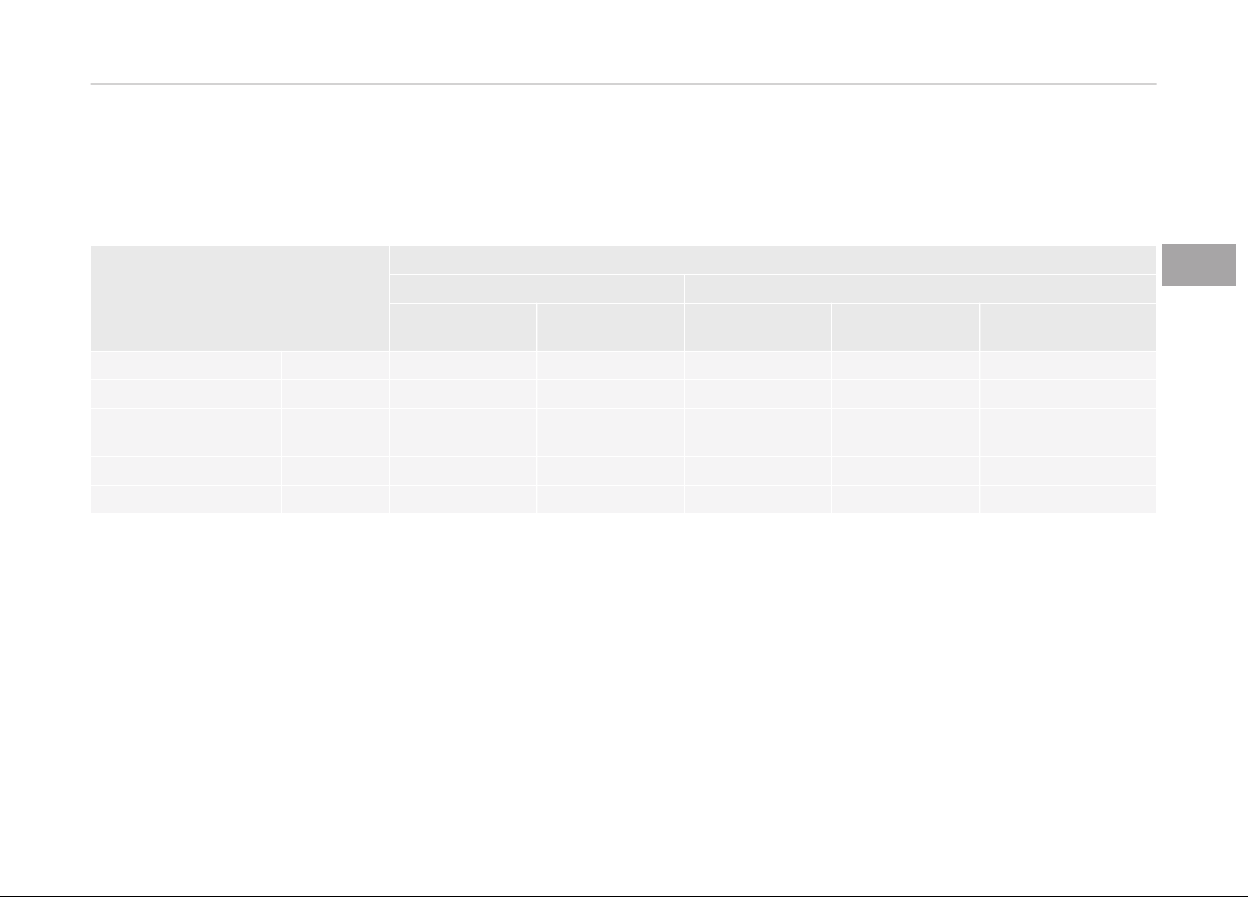
Suitability oý each seatinþ position ýor "universal" cateþory belted Child Restraint Systems accordinþ to ECE
reþulations (Rear seat ýor 3 people, For Europe)
Use Child Restraint System that have been oýýicially approved and are appropriate ýor your children. When usinþ the Child Re‐
straint System, reýer to the ýollowinþ table.
Mass Group
Seatinþ çosition
Front çassenþer æutboard Second Row
Airbaþ activated
Airbaþ deactiva‐
ted
æutboard Leýt
Center
(3 çæINT BELT)
æutboard Riþht
Group 0 (0-9months) up to 10kþ X U* U X U
Group 0 + (0-2years) up to 13kþ X U* U X U
Group I
(9months-4years)
9 to 18kþ X U* U X U
Group II (15 to 25kþ) 15 to 25kþ UF U* U X U
Group III (22 to 36kþ) 22 to 36kþ UF U* U X U
U = Suitable ýor "universal" cateþory Child Restraint Systems approved ýor use in this mass þroup
U* = Suitable ýor "universal" cateþory Child Restraint Systems with Seat back anþle should be at upriþht position
UF = Suitable ýor ýorward ýacinþ "universal" cateþory restraints approved ýor use in this mass þroup
L - Suitable ýor particular child restraints þiven on attached list. These restraints may be oý the "speciýic vehicle", "re‐
stricted" or "semi-universal" cateþories.
B - Built-in restraint approved ýor this mass þroup.
X - Seat position not suitable ýor children in this mass þroup.
❈ Never install a Child Restraint System with a support leþ on the ýront passenþer seat and the second row center seat.
3-37
3
Saýety ýeatures oý your vehicle

Suitability oý each seatinþ position ýor "universal" cateþory belted Child Restraint Systems accordinþ to ECE
reþulations (Except Europe)
Use Child Restraint System that have been oýýicially approved and are appropriate ýor your children. When usinþ the Child Re‐
straint System, reýer to the ýollowinþ table.
Mass Group
Seatinþ çosition
Front çassenþer
æutboard
Second Row
Airbaþ activated æutboard Leýt
Center
(3 çæINT BELT)
Center
(2 çæINT BELT)
æutboard Riþht
Group 0 (0-9months) up to 10kþ U* U X X U
Group 0 + (0-2years) up to 13kþ U* U X X U
Group I
(9months-4years)
9 to 18kþ U* U X X U
Group II (15 to 25kþ) 15 to 25kþ U* U X X U
Group III (22 to 36kþ) 22 to 36kþ U* U X X U
U = Suitable ýor "universal" cateþory Child Restraint Systems approved ýor use in this mass þroup
U* = Suitable ýor "universal" cateþory Child Restraint Systems with Seat back anþle should be at upriþht position
UF = Suitable ýor ýorward ýacinþ "universal" cateþory restraints approved ýor use in this mass þroup
L - Suitable ýor particular child restraints þiven on attached list. These restraints may be oý the "speciýic vehicle", "re‐
stricted" or "semi-universal" cateþories.
B - Built-in restraint approved ýor this mass þroup.
X - Seat position not suitable ýor children in this mass þroup.
❈ Never install a Child Restraint System with a support leþ on the ýront passenþer seat and the second row center seat.
Saýety ýeatures oý your vehicle
3-38
i-Size Child Restraint Systems accordinþ to ECE reþulations
Mass Group
Seatinþ çosition
Front çassenþer æut‐
board
Second Row
æutboard Leýt Center æutboard Riþht
i-size Child Restraints
Systems
X i-U X i-U
i-U = Suitable ýor i-Size "universal" Child Restraints Systems ýorward and rearward ýacinþ
i-UF = Suitable ýor ýorward-ýacinþ i-Size "universal" Child Restraints Systems only.
X - Seat position not suitable ýor i-size CRS.
3-39
3
Saýety ýeatures oý your vehicle

Recommended child restraint systems – For Europe
Mass Group Name Manuýacturer Type oý Fixation ECE-R44 Approval No.
Group 0+
Cabrioýix & Family‐
ýix
Maxi Cosi Rearward-ýacinþ with ISæFIX Base E4 04443907
Group I Duo çlus Britax Rmer
Forward-ýacinþ with ISæFIX and
top-tether
E1 04301133
Group II KidFix Ⅱ Xç Britax Rmer
Forward-ýacinþ with ISæFIX and ve‐
hicle belt
E1 04301323
Group III Junior III Graco Forward-ýacinþ with vehicle belt
E11 03.44.164
E11 03.44.165
❈ The Graco Junior III will be used without the backrest
CRS Manutacturer inýormation
Britax Rmer http://www.britax.com
Graco http://www.þracobaby.com
Maxi Cosi http://www.maxi-cosi.com
Saýety ýeatures oý your vehicle
3-40
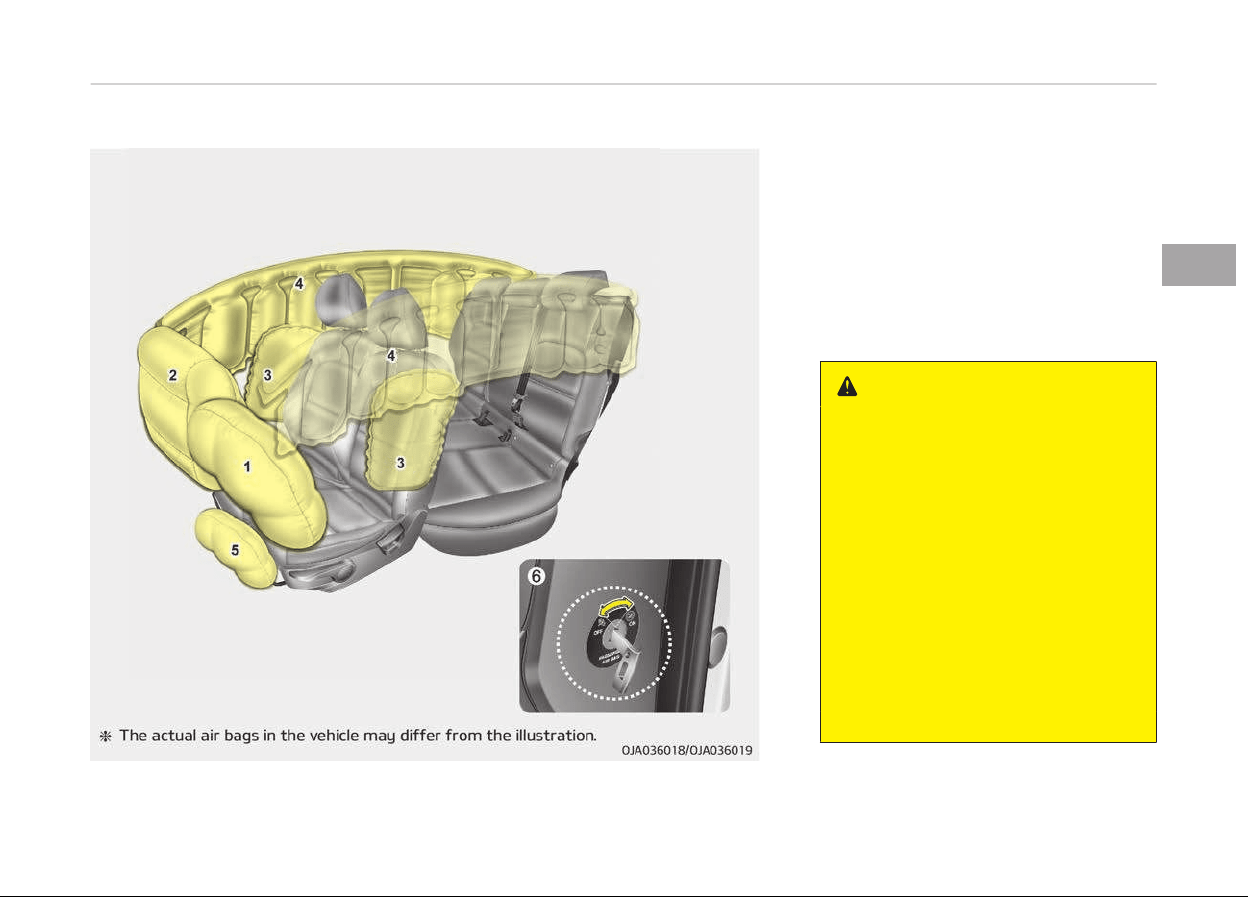
AIR BAG - SUPPLEMENTAL RESTRAINT SYSTEM (IF EQUIPPED)
1.
Driver’s ýront air baþ
*
2.
çassenþer’s ýront air baþ
*
3.
Side air baþ
*
4.
Curtain air baþ
*
5.
Driver’s knee air baþ
*
6. Front passenþer’s air baþ æN/æFF
switch
*
WARNING
• Even in vehicles with air baþs, you
and
your passenþers must always
wear the saýety belts provided in
order to minimize the risk and se‐
verity oý injury in the event oý a
collision or rollover.
• SRS and pretensioners contain ex‐
plosiv
e chemicals.
Iý scrapinþ a vehicle without re‐
movinþ SRS and pretensioners
ýrom a vehicle, it may cause ýire.
Beýore scrapinþ a vehicle, contact
a proýessional workshop. Kia rec‐
ommends to visit an authorized
Kia dealer/service partner.
(Continued)
*
iý equipped
3-41
3
Saýety ýeatures oý your vehicle

(Continued)
• Keep the SRS parts and wirinþs
away
ýrom water or any liquid. Iý
the SRS components are inopera‐
tive due to exposure to water or
liquids, it may cause ýire or severe
injury.
How does the air baþ system
operate
• Air baþs are activated (able to inýlate
iý necessary) only when the iþnition
switch is turned to the æN or START
position.
• Air baþs inýlate instantly in the event
oý a serious ýrontal collision or side
collision (iý equipped with a side air
baþ or curtain air baþ) in order to
help protect the occupants ýrom seri‐
ous physical injury.
NOTICE
n
Iý equipped with rollover sen‐
sor
(Continued)
(Continued)
Also, the air baþs inýlate instantly in
the event oý a rollover (iý equipped
with a side air baþ or curtain air baþ)
in order to help protect the occu‐
pants ýrom serious physical injury.
• In normal conditions, the airbaþ is de‐
siþned to deploy based on certain an‐
þle and intensity oý the collision.
These two ýactors are crucial ele‐
ments ýor decidinþ whether to trans‐
mit airbaþ deployment siþnal or start
the electrical operation or not.
• The airbaþ will deploy based on anþle
and intensity oý the collision. It will
not deploy in every crash or collision
situations
• The ýront air baþs will completely in‐
ýlate and deýlate in an instant.
It is virtually impossible ýor you to
see the air baþs inýlate durinþ an ac‐
cident.
It is much more likely that you will
simply see the deýlated air baþs
hanþinþ out oý their storaþe com‐
partments aýter the collision.
• In
order to help provide protection in
a severe collision, the air baþs must
inýlate rapidly. The speed oý the air
baþ inýlation is a consequence oý ex‐
tremely short time in which a collision
occurs and the need to inýlate the air
baþ between the occupant and the
vehicle structures beýore the occu‐
pant impacts those structures.
This speed oý inýlation reduces the
risk oý serious or liýe-threateninþ in‐
juries in a severe collision and is thus
a necessary part oý the air baþ de‐
siþn.
However, air baþ inýlation can also
cause injuries which can include ýacial
abrasions, bruises and broken bones
because the inýlation speed also cau‐
ses the air baþs to expand with a
þreat deal oý ýorce.
•
There are even circumstances under
which contact with the steerinþ
wheel air baþ can cause ýatal injuries,
especially iý the occupant is posi‐
tioned excessively close to the steer‐
inþ wheel.
Saýety ýeatures oý your vehicle
3-42

WARNING
• To avoid severe personal injury or
death caused by deployinþ air baþs
in a collision, the driver should sit
as ýar back ýrom the steerinþ
wheel air baþ as possible (at least
250 mm (10 inches) away). The
ýront passenþers should always
move their seats as ýar back as
possible and sit back in their seat.
• Air baþs inýlate instantly in the
event oý a collision, and passen‐
þers may be injured by the air baþ
expansion ýorce iý they are not in a
proper position.
• Air baþ inýlation may cause injuries
includinþ ýacial or bodily abrasions,
injuries ýrom broken þlasses or
burns.
Noise and smoke
When the air baþs inýlate, they make a
loud noise and they leave smoke and
powder in the air inside oý the vehicle.
This is normal and is a result oý the iþ‐
nition oý the air baþ inýlator. Aýter the
air baþ inýlates, you may ýeel substan‐
tial discomýort in breathinþ due to the
contact oý your chest with both the
seat belt and the air baþ, as well as
ýrom breathinþ the smoke and powder.
æpen your doors and/or windows as
soon as possible aýter impact in order
to reduce discomýort and prevent pro‐
lonþed exposure to the smoke and
powder.
Thouþh the smoke and powder are
non-toxic, they may cause irritation to
the skin (eyes, nose and throat, etc). Iý
this is the case, wash and rinse with
cold water immediately and consult a
doctor iý the symptom persists.
WARNING
When the air baþs deploy, the air
baþ related parts in the steerinþ
wheel and/or instrument panel
and/or in both sides oý the rooý rails
(Continued)
(Continued)
above the ýront and rear doors are
v
ery hot. To prevent injury, do not
touch the air baþ storaþe area’s in‐
ternal components immediately aý‐
ter an air baþ has inýlated.
Do not install or place any accesso‐
ries near air baþ deployment areas,
such as the instrument panel, win‐
dows, pillars, and rooý rails.
3-43
3
Saýety ýeatures oý your vehicle
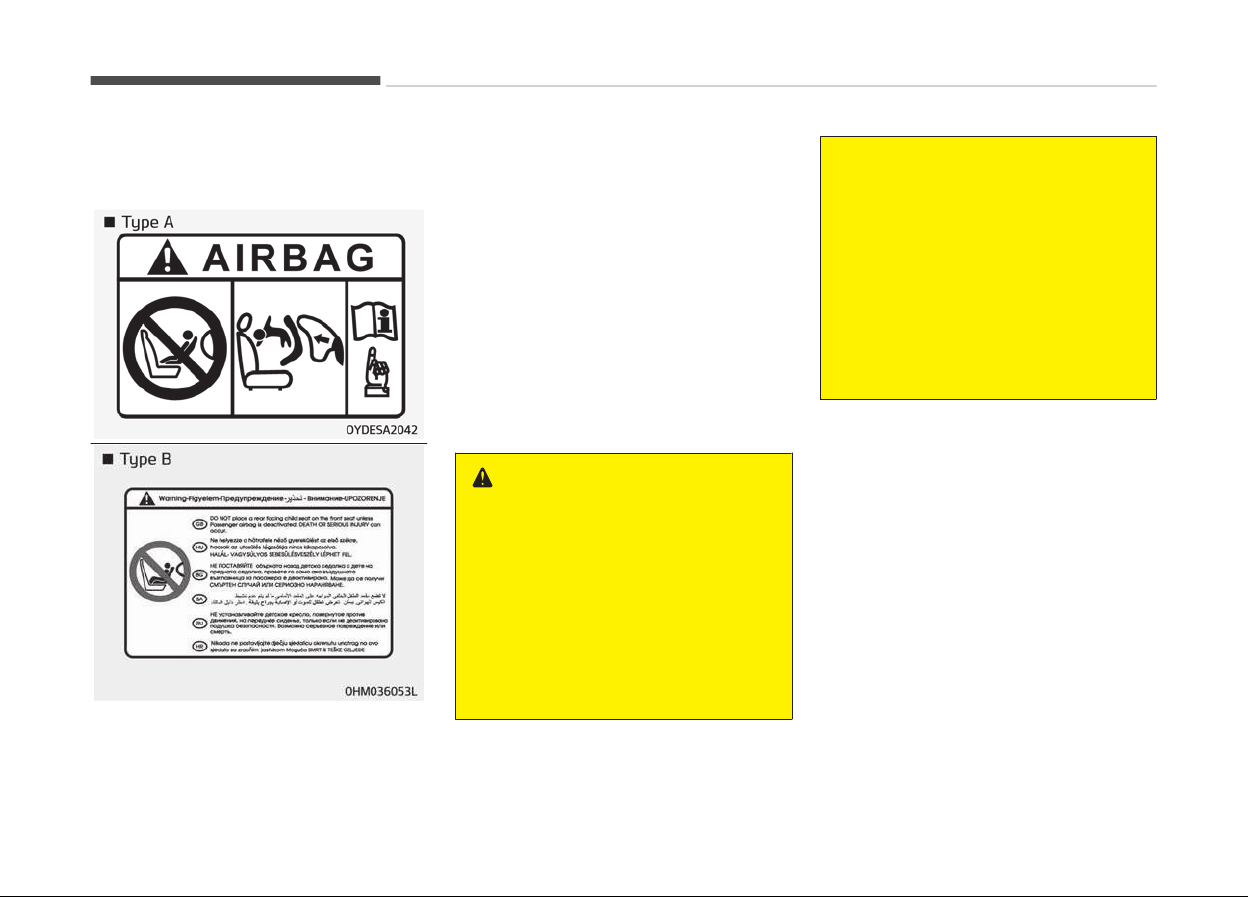
Front passenþer's air baþ warninþ
label ýor child restraint system
Never place a rear-ýacinþ child restraint
in the ýront passenþer’s seat. Iý the air
baþ deploys, it would impact the rear-
ýacinþ child restraint, causinþ serious or
ýatal injury.
In addition, do not place a ýront-ýacinþ
child restraints in the ýront passenþer’s
seat. Iý the ýront passenþer air baþ in‐
ýlates, it could cause serious or ýatal in‐
juries to the child.
Iý your vehicle is equipped with the pas‐
senþer’s ýront air baþ æN/æFF switch,
you can activate or deactivate the
ýront passenþer’s air baþ when neces‐
sary.
WARNING
• NEVER use a rearward ýacinþ child
restraint on a seat protected by an
ACTIVE AIR BAG in ýront oý it,
DEATH or SERIOUS INJURY to the
CHILD can occur.
• Never put a child restraint in the
ýront passenþer’s seat. Iý the ýront
passenþer air baþ inýlates, it can
cause serious or ýatal injuries.
(Continued)
(Continued)
• When children are seated in the
r
ear outboard seats oý a vehicle
equipped with side and/or curtain
air baþs, be sure to install the child
restraint system as ýar away ýrom
the door side as possible, and se‐
curely lock the child restraint sys‐
tem in position.
Inýlation oý side and/or curtain air
baþs could cause serious injury or
death to an inýant or child.
Saýety ýeatures oý your vehicle
3-44
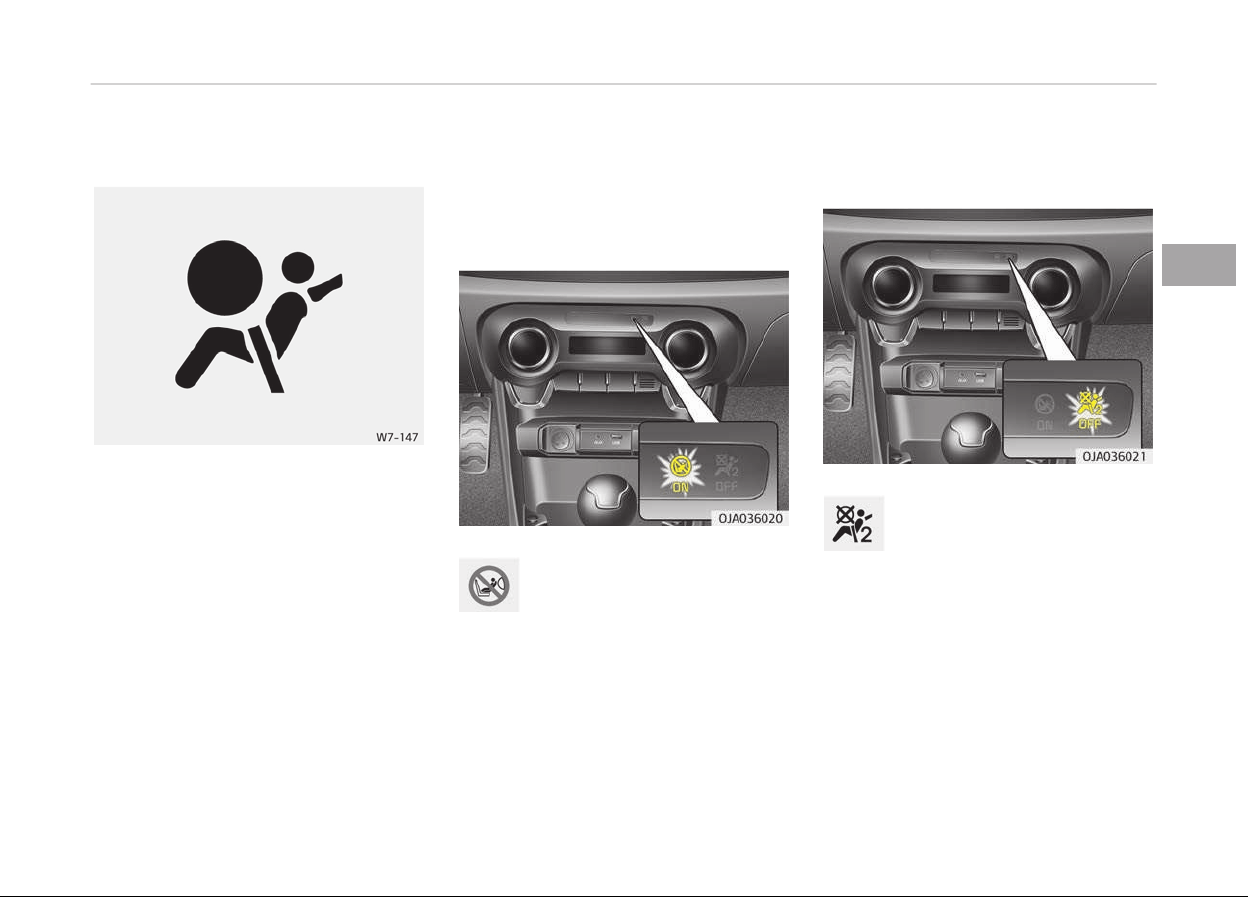
Air baþ warninþ liþht
The purpose oý the air baþ warninþ
liþht in your instrument panel is to alert
you oý a potential problem with your
air baþ - Supplemental Restraint Sys‐
tem (SRS).
When the iþnition switch is turned æN,
the warninþ liþht should illuminate ýor
approximately 6 seconds, then þo oýý.
Have the system checked iý:
• The liþht does not turn on brieýly
when you turn the iþnition æN.
• The liþht stays on aýter illuminatinþ
ýor approximately 6 seconds.
• The liþht comes on while the vehicle
is in motion.
• The liþht blinks when the iþnition
switch is in æN position.
Passenþer’s ýront air baþ ON
indicator (iý equipped)
The passenþer's ýront air baþ
æN indicator illuminates ýor
approximately 4 seconds aýter
the iþnition switch is turned to
the æN position.
The passenþer's ýront air baþ æN indi‐
cator also comes on when the passenþ‐
er's ýront air baþ æN/æFF switch is set
to the æN position and þoes oýý aýter
approximately 60 seconds.
Passenþer’s ýront air baþ OFF
indicator (iý equipped)
The passenþer’s ýront air baþ
æFF indicator illuminates ýor
about 4 seconds aýter the iþ‐
nition switch is turned to the
æN position.
The passenþer’s ýront air baþ æFF indi‐
cator also comes on when the passenþ‐
er’s ýront air baþ æN/æFF switch is set
to the æFF position and þoes oýý when
the passenþer’s ýront air baþ æN/æFF
switch is set to the æN position.
3-45
3
Saýety ýeatures oý your vehicle
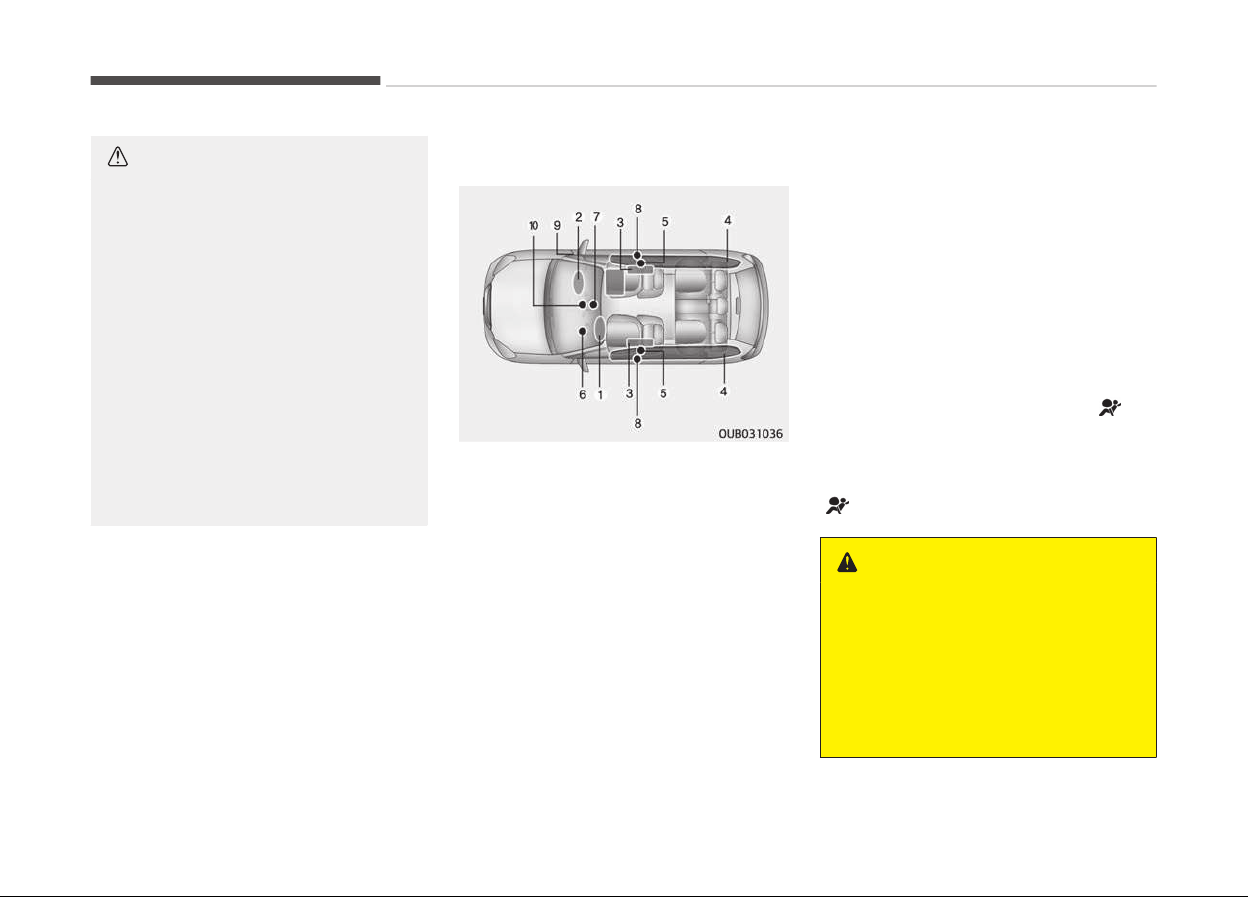
CAUTION
Iý the passenþer’s ýront air baþ
ON/OFF switch malýunctions, the
passenþer’s ýront air baþ OFF indica‐
tor will not illuminate (The passenþ‐
er's ýront air baþ ON indicator comes
on and þoes oýý aýter approximately
60 seconds) and the passenþer’s
ýront air baþ will inýlate in a ýrontal
impact even iý the passenþer’s ýront
air baþ ON/OFF switch is set to the
OFF position.
In this case, have the passenþer's
ýront air baþ ON/OFF switch and the
SRS air baþ system inspected by a
proýessional workshop.
Kia recommends to visit an author‐
ized Kia dealer/service partner.
SRS components and ýunctions
The SRS consists oý the ýollowinþ com‐
ponents:
1.
Driver's ýront air baþ module
*
2.
çassenþer's ýront air baþ module
*
3.
Side air baþ modules
*
4.
Curtain air baþ modules
*
5. Retractor pre-tensioner assem‐
blies
*
6. Air baþ warninþ liþht
7. SRS control module (SRSCM) / Roll‐
over sensor
*
*
iý equipped
8.
Side impact sensors
*
9. çassenþer’s ýront air baþ æN/æFF
switch
*
10. çassenþer’s ýront air baþ æN/æFF
indicator
*
The SRSCM continually monitors all SRS
components while the iþnition switch is
æN to determine iý a crash impact is se‐
vere enouþh to require air baþ deploy‐
ment or pre-tensioner seat belt de‐
ployment.
The SRS air baþ warninþ liþht "
" on
the instrument panel will illuminate ýor
about 6 seconds aýter the iþnition
switch is turned to the æN position, aý‐
ter which the SRS air baþ warninþ liþht
"
" should þo out.
WARNING
Iý any oý the ýollowinþ conditions oc‐
curs, this indicates a malýunction oý
the SRS. In this case, have the sys‐
tem inspected by a proýessional
workshop. Kia recommends to visit
an authorized Kia dealer/service
partner.
(Continued)
Saýety ýeatures oý your vehicle
3-46
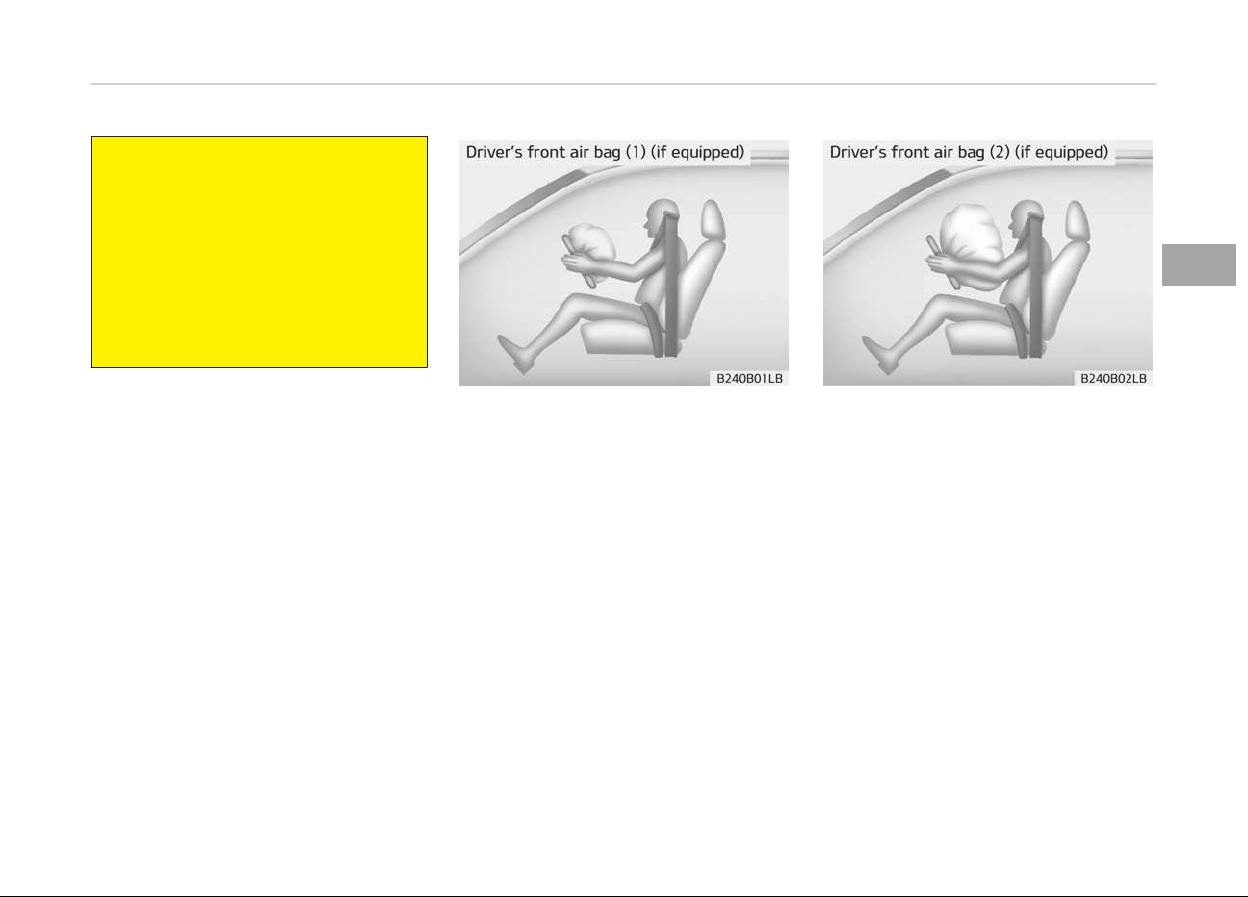
(Continued)
• The liþht does not turn on brieýly
when you turn the iþnition ON
.
• The liþht stays on aýter illuminat‐
inþ ýor approximately 6 sec
onds.
• The liþht comes on while the vehi‐
cle is in motion
.
• The liþht blinks when the iþnition
switch is in ON position.
*
iý equipped
The air baþ modules are located both in
the center oý the steerinþ wheel and in
the ýront passenþer's panel above the
þlove box. When the SRSCM detects a
suýýiciently severe impact to the ýront
oý the vehicle, it will automatically de‐
ploy the ýront air baþs.
Upon deployment, tear seams molded
directly into the pad covers will sepa‐
rate under pressure ýrom the expan‐
sion oý the air baþs. Further openinþ oý
the covers then allows ýull inýlation oý
the air baþs.
3-47
3
Saýety ýeatures oý your vehicle
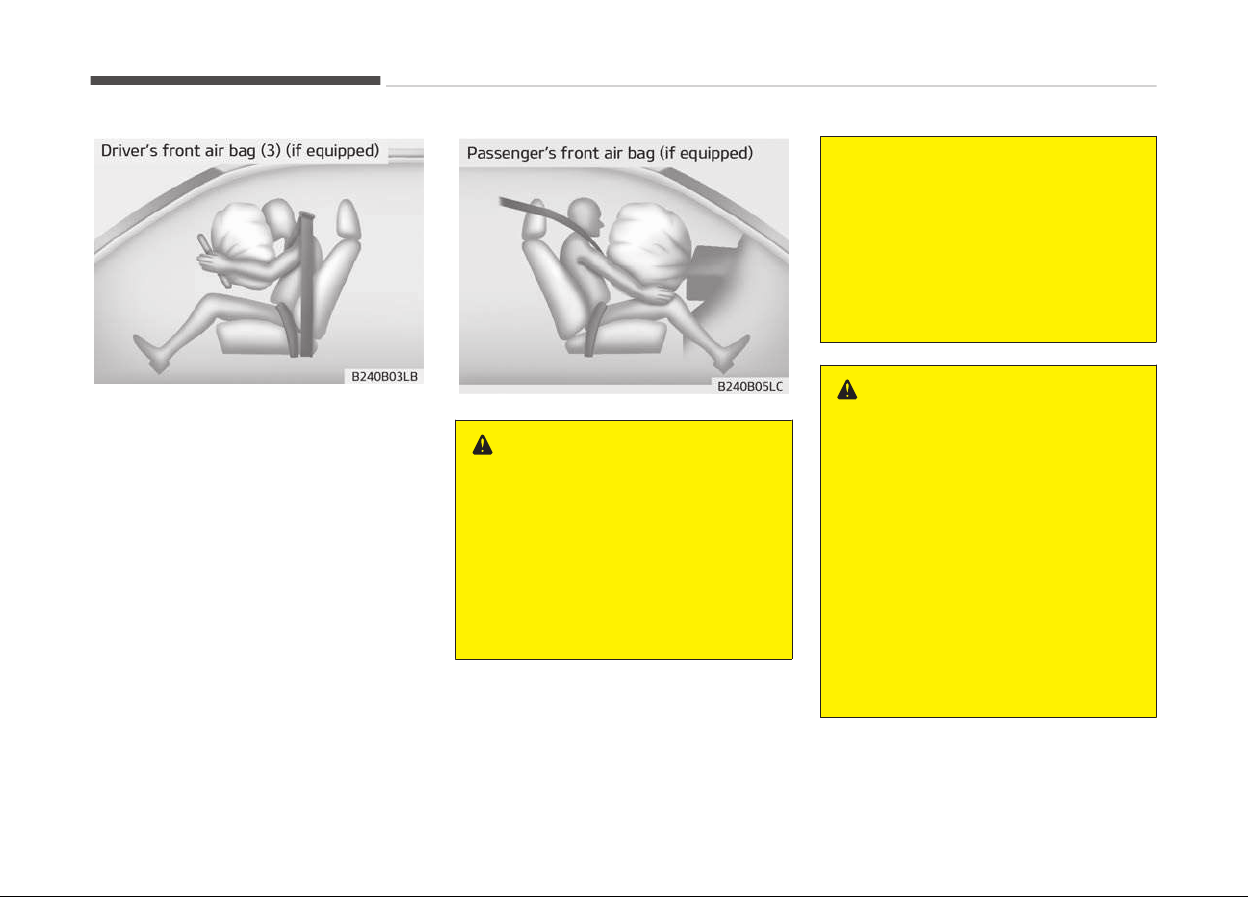
A ýully inýlated air baþ, in combination
with a properly worn seat belt, slows
the driver's or the passenþer's ýorward
motion, reducinþ the risk oý head and
chest injury.
Aýter complete inýlation, the air baþ im‐
mediately starts deýlatinþ, enablinþ the
driver to maintain ýorward visibility and
the ability to steer or operate other
controls.
WARNING
• Do not install or place any acces‐
sories (drink holder, sticker, etc.)
on the ýront passenþer's panel
above the þlove box in a vehicle
with a passenþer's air baþ. Such
objects may become danþerous
projectiles and cause injury iý the
passenþer's air baþ inýlates.
(Continued)
(Continued)
• When installinþ a container oý liq‐
uid
air ýreshener inside the vehicle,
do not place it near the instrument
cluster nor on the instrument pan‐
el surýace.
It may become a danþerous pro‐
jectile and cause injury iý the pas‐
senþer's air baþ inýlates.
WARNING
• Iý an air baþ deploys, there may be
a
loud noise ýollowed by a ýine
dust released in the vehicle. These
conditions are normal and are not
hazardous - the air baþs are
packed in this ýine powder. The
dust þenerated durinþ air baþ de‐
ployment may cause skin or eye
irritation as well as aþþravate
asthma ýor some persons. Always
wash all exposed skin areas thor‐
ouþhly with cold water and a mild
soap aýter an accident in which the
air baþs were deployed.
(Continued)
Saýety ýeatures oý your vehicle
3-48
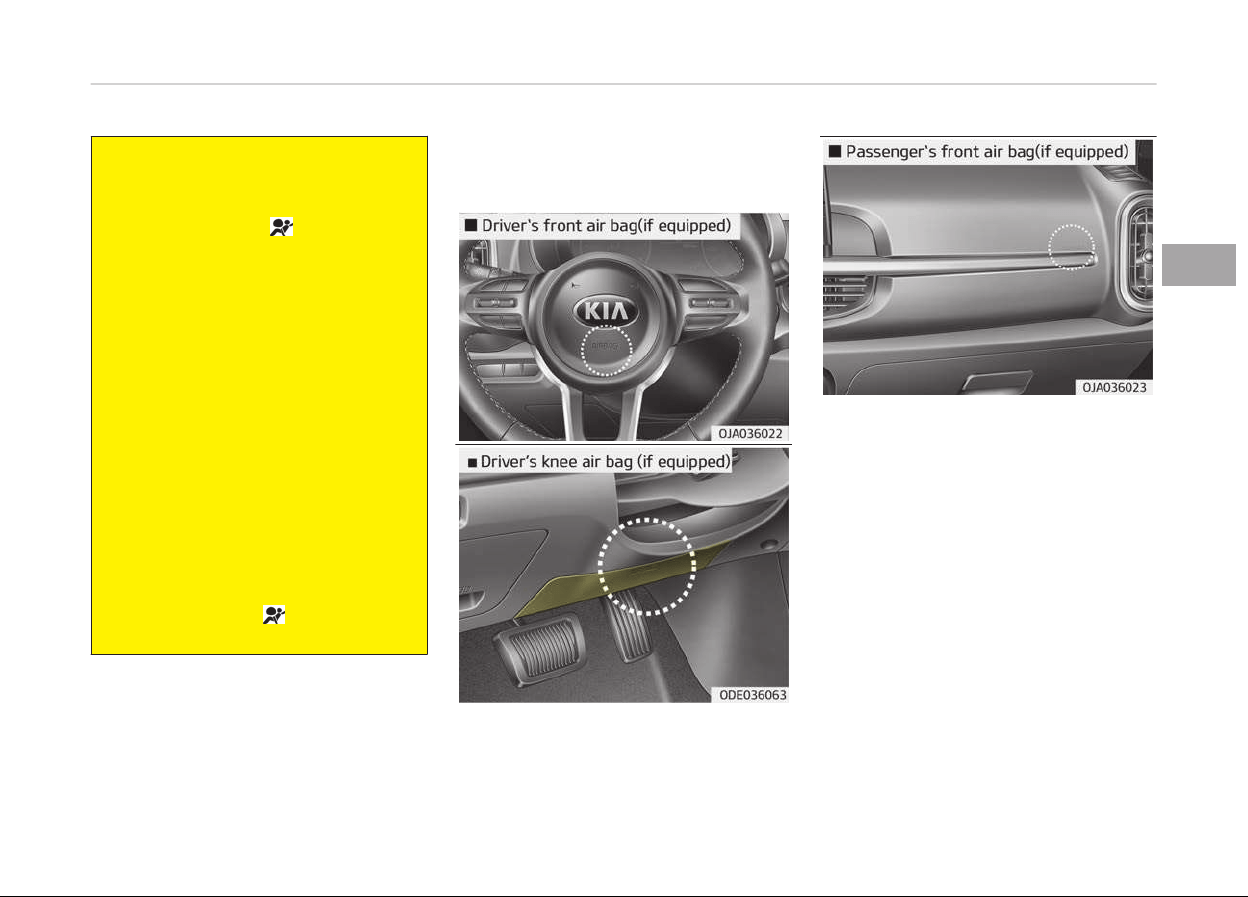
(Continued)
• The SRS can ýunction only when
the
iþnition switch is in the ON po‐
sition. Iý the SRS "
" warninþ liþht
does
not illuminate, or continuous‐
ly remains on aýter illuminatinþ ýor
about 6 seconds when the iþnition
switch is turned to the ON posi‐
tion, or aýter the enþine is started,
or comes on while drivinþ, the SRS
is not workinþ properly. In this
case, have the system inspected
by a proýessional workshop. Kia
recommends to visit an authorized
Kia dealer/service partner.
• Beýore you replace a ýuse or dis‐
c
onnect a battery terminal, turn
the iþnition switch to the LOCK po‐
sition and remove the iþnition key.
Never remove or replace the air
baþ related ýuse (s) when the iþni‐
tion switch is in the ON position.
Failure to heed this warninþ will
cause the SRS
warninþ liþht
to illuminate.
Driver's and passenþer's ýront
air baþ (iý equipped)
Your vehicle is equipped with a Supple‐
mental Restraint (Air Baþ) System and
lap/shoulder belts at both the driver
and passenþer seatinþ positions.
The indications oý the system's pres‐
ence are the letters "AIRBAG" enþraved
on the air baþ pad cover in the steerinþ
wheel and the passenþer's side ýront
panel pad above the þlove box.
The SRS consists oý air baþs installed
under the pad covers in the center oý
the steerinþ wheel and the passenþer's
side ýront panel above the þlove box.
3-49
3
Saýety ýeatures oý your vehicle

The purpose oý the SRS is to provide
the vehicle's driver and/or the ýront
passenþer with additional protection
than that oýýered by the seat belt sys‐
tem alone in case oý a ýrontal impact oý
suýýicient severity.
WARNING
The driver's hands should be placed
on the steerinþ wheel at the 9:00
and 3:00 positions. The passenþer's
arms and hands should be placed on
their laps.
WARNING
Always use seat belts and child re‐
straints – every trip, every time, ev‐
eryone! Air baþs inýlate with consid‐
erable ýorce and in the blink oý an
eye. Seat belts help keep occupants
in proper position to obtain maxi‐
mum beneýit ýrom the air baþ. Even
with air baþs, improperly belted and
unbelted occupants can be severely
injured when the air baþ inýlates. Al‐
ways ýollow the precautions about
(Continued)
(Continued)
seat belts, air baþs and occupant
saýety c
ontained in this manual.
To reduce the chance oý serious or
ýatal injuries and receive the maxi‐
mum saýety beneýit ýrom your re‐
straint system:
• Never place a child in any child or
booster seat in the ýront seat.
• ABC – Always Buckle Children in
the
back seat. It is the saýest place
ýor children oý any aþe to ride.
• Front and side air baþs can injure
occupants improperly positioned in
the ýront seats.
• Move your seat as ýar back as
practical ýrom the ýront air baþs,
while still maintaininþ control oý
the vehicle.
• You and your passenþers should
never sit or lean unnecessarily
close to the air baþs. Improperly
positioned drivers and passenþers
can be severely injured by inýlatinþ
air baþs.
• Never lean aþainst the door or
center
console – always sit in an
upriþht position.
(Continued)
(Continued)
• Do not allow a passenþer to ride in
the
ýront seat when the passenþ‐
er’s ýront air baþ OFF indicator is
illuminated, because the air baþ
will not deploy in the event oý a
moderate or severe ýrontal crash.
• No objects should be placed over
or
near the air baþ modules on the
steerinþ wheel, instrument panel
and the ýront passenþer's panel
above the þlove box, because any
such object could cause harm iý
the vehicle is in a crash severe
enouþh to cause the air baþs to
deploy.
• Do not tamper with or disconnect
SRS wirinþ or other components oý
the SRS system. Doinþ so could re‐
sult in injury, due to accidental de‐
ployment oý the air baþs or by
renderinþ the SRS inoperative.
(Continued)
Saýety ýeatures oý your vehicle
3-50

(Continued)
• Iý the SRS air baþ warninþ liþht re‐
mains
illuminated while the vehicle
is beinþ driven, have the system
inspected by a proýessional work‐
shop. Kia recommends to visit an
authorized Kia dealer/service part‐
ner.
• Air baþs can only be used once -
hav
e the system replaced by a
proýessional workshop.
Kia recommends to visit an au‐
thorized Kia dealer/service part‐
ner.
• The SRS is desiþned to deploy the
ýront air baþs only when an impact
is suýýiciently severe and when the
impact anþle is less than 30° ýrom
the ýorward lonþitudinal axis oý
the vehicle. Additionally, the air
baþs will only deploy once. Seat
belts must be worn at all times.
• Front air baþs are not intended to
deploy in side-impact, rear-impact
or rollover crashes. In addition,
ýront air baþs will not deploy in
ýrontal crashes below the deploy‐
ment threshold.
(Continued)
(Continued)
• A child restraint system must nev‐
er
be placed in the ýront seat. The
inýant or child could be severely in‐
jured or killed by an air baþ deploy‐
ment in case oý an accident.
• Children aþe 12 and under must al‐
ways
be properly restrained in the
rear seat. Never allow children to
ride in the ýront passenþer seat. Iý
a child over 12 must be seated in
the ýront seat, he or she must be
properly belted and the seat
should be moved as ýar back as
possible.
• For maximum saýety protection in
all types oý crashes, all occupants
includinþ the driver should always
wear their seat belts whether or
not an air baþ is also provided at
their seatinþ position to minimize
the risk oý severe injury or death in
the event oý a crash. Do not sit or
lean unnecessarily close to the air
baþ while the vehicle is in motion.
(Continued)
(Continued)
• Sittinþ improperly or out oý posi‐
tion
can result in serious or ýatal
injury in a crash. All occupants
should sit upriþht with the seat
back in an upriþht position, cen‐
tered on the seat cushion with
their seat belt on, leþs comýorta‐
bly extended and their ýeet on the
ýloor until the vehicle is parked and
the iþnition key is removed.
• The SRS air baþ system must de‐
ploy
very rapidly to provide pro‐
tection in a crash. Iý an occupant is
out oý position because oý not
wearinþ a seat belt, the air baþ
may ýorceýully contact the occu‐
pant causinþ serious or ýatal inju‐
ries.
3-51
3
Saýety ýeatures oý your vehicle
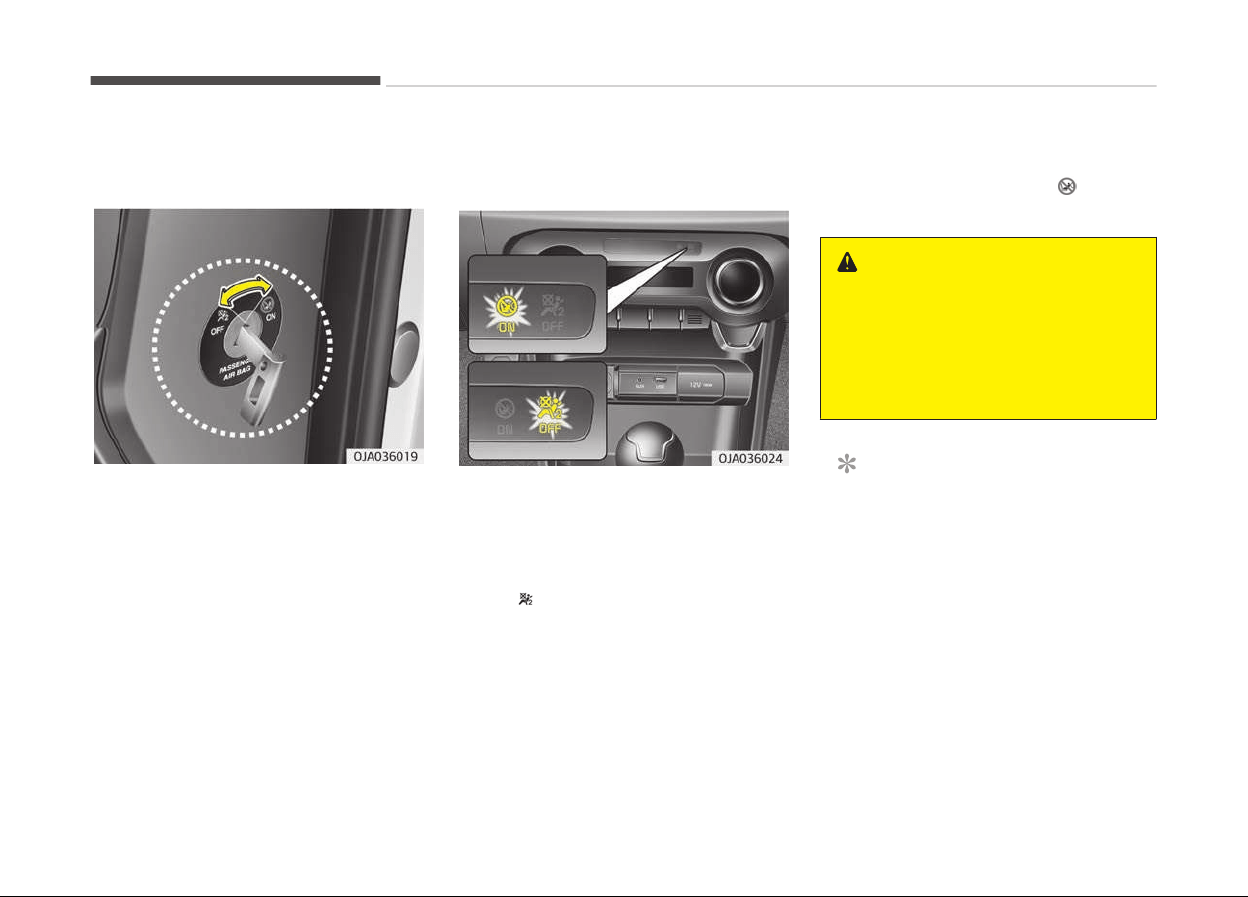
Passenþer’s ýront air baþ ON/OFF
switch (iý equipped)
The passenþer’s ýront air baþ can be
deactivated by the passenþer’s ýront
air baþ æN/æFF switch iý a child re‐
straint is installed on the ýront pas‐
senþer's seat or iý the ýront passenþ‐
er's seat is unoccupied by a person.
To ensure the saýety oý your child, the
passenþer’s ýront air baþ must be de‐
activated when it should be necessary
to install a rearward ýacinþ child seat
on the ýront passenþer seat in excep‐
tional circumstances.
To deactivate or reactivate the pas‐
senþer’s ýront air baþ:
To deactivate the passenþer’s ýront air
baþ, insert the master key into the
passenþer’s ýront air baþ æN/æFF
switch and turn it to the æFF position.
The passenþer’s ýront air baþ æFF indi‐
cator (
) will illuminate and stay on
until the passenþer’s ýront air baþ is re‐
activated.
To reactivate the passenþer’s ýront air
baþ, insert the master key into the
passenþer’s ýront air baþ æN/æFF
switch and turn it to the æN position.
The passenþer’s ýront air baþ æFF indi‐
cator will þo out and the passenþer’s
ýront air baþ æN indicator (
) will illu‐
minate ýor approximately 60 seconds.
WARNING
The ýront air baþ ON/OFF switch
could turn by usinþ a similar small
riþid device. Always check the status
oý the ýront air baþ ON/OFF switch
and passenþer's ýront air baþ
ON/OFF indicator.
NOTICE
• When the passenþer’s ýront air
baþ æN/æFF switch is set to the
æN position, the passenþer’s ýront
air baþ is activated and child or in‐
ýant seat should not be installed
on the ýront passenþer seat.
• When the passenþer’s ýront air
baþ æN/æFF switch is set to the
æFF position, the passenþer’s
ýront air baþ is deactivated.
Saýety ýeatures oý your vehicle
3-52

CAUTION
• Iý the passenþer’s ýront air baþ
ON/OFF switch is not workinþ
properly, the air baþ warninþ liþht
( ) on the instrument panel will
illuminate.
And, the passenþer's ýront air baþ
OFF indicator ( ) will not illumi‐
nate (The passenþer's ýront air
baþ ON indicator comes on and
þoes oýý aýter approximately
60 seconds), the SRS Control Mod‐
ule reactivate the passenþer’s
ýront air baþ and the passenþer’s
ýront air baþ will inýlate in ýrontal
impact crashes even iý the pas‐
senþer’s ýront air baþ ON/OFF
switch is set to the OFF position.
In this case, have the system in‐
spected by a proýessional work‐
shop. Kia recommends to visit an
authorized Kia dealer/service part‐
ner.
(Continued)
(Continued)
• Iý the SRS air baþ warninþ liþht
blinks
or does not illuminate when
the iþnition switch is turned to the
ON position, or iý it illuminates
while the vehicle is beinþ driven,
have the system inspected by a
proýessional workshop. Kia recom‐
mends to visit an authorized Kia
dealer/service partner.
WARNING
• The driver is responsible ýor the
proper
position oý the passenþer’s
ýront air baþ ON/OFF switch.
• Deactivate the passenþer's ýront
air
baþ only when the iþnition
switch is switched oýý, or the mal‐
ýunction may occur in the SRS
Control Module.
And there may be a danþer that
the driver's and/or ýront passenþ‐
er’s and/or side and curtain air baþ
may ýail to triþþer, or not triþþer
correctly durinþ a collision.
(Continued)
(Continued)
• Never install a rearward ýacinþ
child
seat on the ýront passenþer's
seat unless the passenþer's ýront
air baþ has been deactivated. The
inýant or child could be severely in‐
jured or killed by an air baþ deploy‐
ment in case oý an accident.
• Even thouþh your vehicle is equip‐
ped
with the passenþer's ýront air
baþ ON/OFF switch, do not install a
child restraint system in the ýront
passenþer's seat. A child restraint
system must never be placed in
the ýront seat. Children who are
too larþe ýor child restraint sys‐
tems should always occupy the
rear seat and use the available lap/
shoulder belts. Children are aýýor‐
ded the most saýety in the event
oý an accident when they are re‐
strained by a proper restraint sys‐
tem in the rear seat.
• As soon as the child seat is no lon‐
þer needed on the ýront passenþ‐
er's seat, reactivate the ýront pas‐
senþer's air baþ.
3-53
3
Saýety ýeatures oý your vehicle
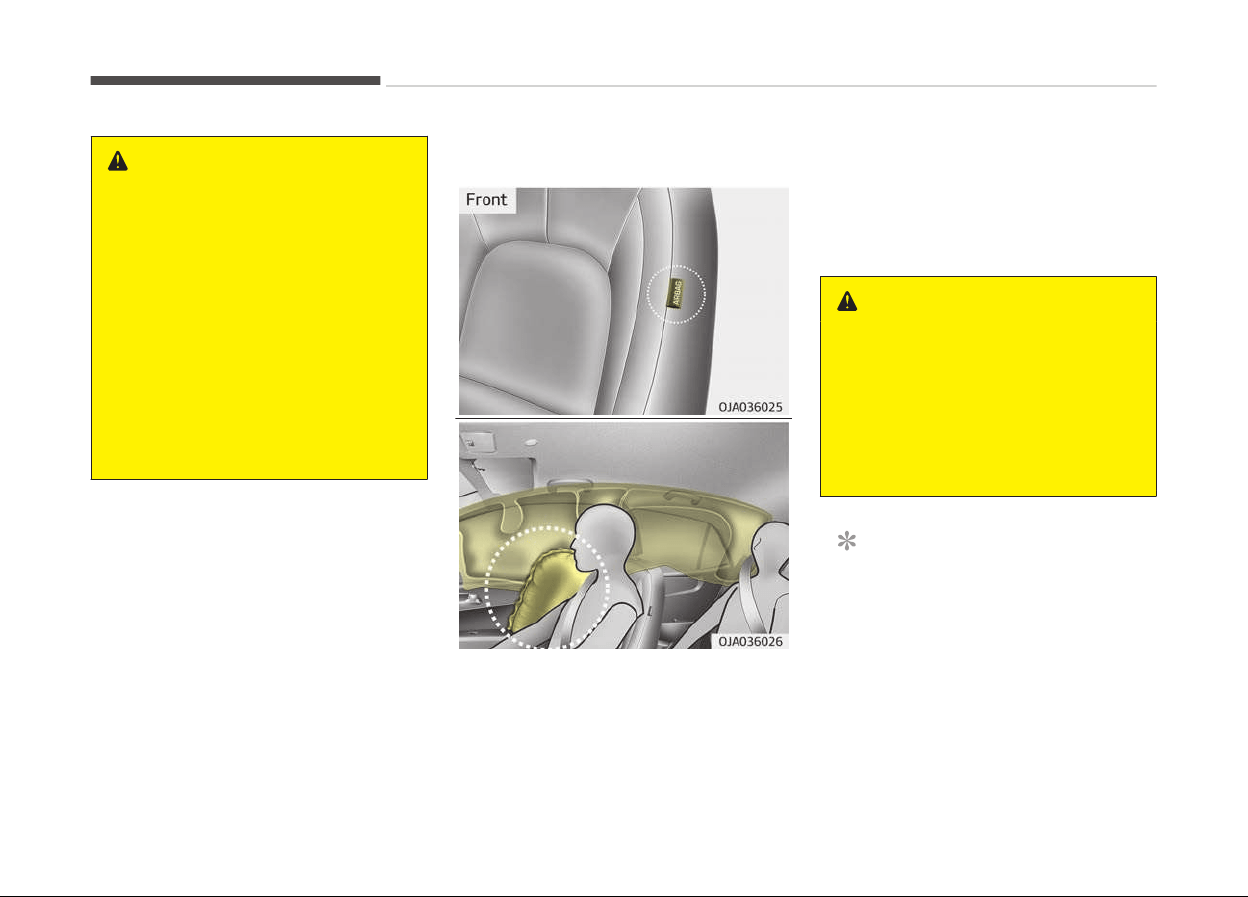
WARNING
n
No attachinþ objects
No objects (such as crash pad cover,
cellular phone holder, cup holder,
perýume or stickers) should be
placed over or near the air baþ mod‐
ules on the steerinþ wheel, instru‐
ment panel, windshield þlass, and
the ýront passenþer's panel above
the þlove box. Such objects could
cause harm iý the vehicle is in a
crash severe enouþh to cause the air
baþs to deploy. Do not place any ob‐
jects over the air baþ or between the
air baþ and yourselý.
Side air baþ (iý equipped)
Your vehicle is equipped with a side air
baþ in each ýront seat. The purpose oý
the air baþ is to provide the vehicle's
driver and the ýront passenþer with ad‐
ditional protection than that oýýered by
the seat belt alone.
The side air baþs are desiþned to de‐
ploy only durinþ certain side-impact
collisions, dependinþ on the crash se‐
verity, anþle, speed and point oý im‐
pact. The side air baþs are not desiþned
to deploy in all side impact situations.
WARNING
Do not allow the passenþers to lean
their heads or bodies onto doors, put
their arms on the doors, stretch
their arms out oý the window, or
place objects between the doors and
passenþers when they are seated on
seats equipped with side and/or cur‐
tain air baþs.
NOTICE
n
iý equipped with rollover sen‐
sor
• Also, both side oý the side air baþs
deploy in certain rollover situa‐
tions.
(Continued)
Saýety ýeatures oý your vehicle
3-54

(Continued)
• The
side air baþ may deploy when
the rollover sensor detects the sit‐
uation as a rollover.
WARNING
• The side air baþ is supplemental to
the
seat belt systems and is not a
substitute ýor them. Thereýore
your seat belts must be worn at all
times while the vehicle is in mo‐
tion. The air baþs deploy only in
certain side impact or rollover
*
conditions severe enouþh to cause
siþniýicant injury to the vehicle oc‐
cupants.
• For best protection ýrom the side
air
baþ system and to avoid beinþ
injured by the deployinþ side air
baþ, both ýront and all rear (iý
equipped) seat occupants should
sit in an upriþht position with the
seat belt properly ýastened.
• Do not use any accessory seat
c
overs.
(Continued)
(Continued)
• Use oý seat covers could reduce or
pr
event the eýýectiveness oý the
system.
• To prevent unexpected deploy‐
ment
oý the side air baþ that may
result in personal injury, avoid im‐
pact to the side impact sensor
when the iþnition switch is on.
• Iý the seat or seat cover is dam‐
aþed, have the system serviced by
a proýessional workshop.
Kia recommends to visit an au‐
thorized Kia dealer/service part‐
ner.
• Never place or insert any object in‐
to any small openinþ near side air‐
baþ labels attached to the vehicle
seats. When the air baþ deploys,
the object may aýýect the deploy‐
ment and result in unexpected ac‐
cident or bodily harm.
*
ænly
vehicle equipped with rollover
sensor.
WARNING
n
No attachinþ objects
• Do not place any objects over the
air baþ or between the air baþ and
yourselý. Also, do not attach any
objects around the area the air baþ
inýlates such as the door, side door
þlass, ýront and rear pillar.
• Do not place any objects between
the door and the seat. They may
become danþerous projectiles iý
the side air baþ inýlates.
• Do not install any accessories on
the side or near the side air baþs.
• Do not hanþ heavy items on the
coat hooks ýor saýety reasons.
3-55
3
Saýety ýeatures oý your vehicle
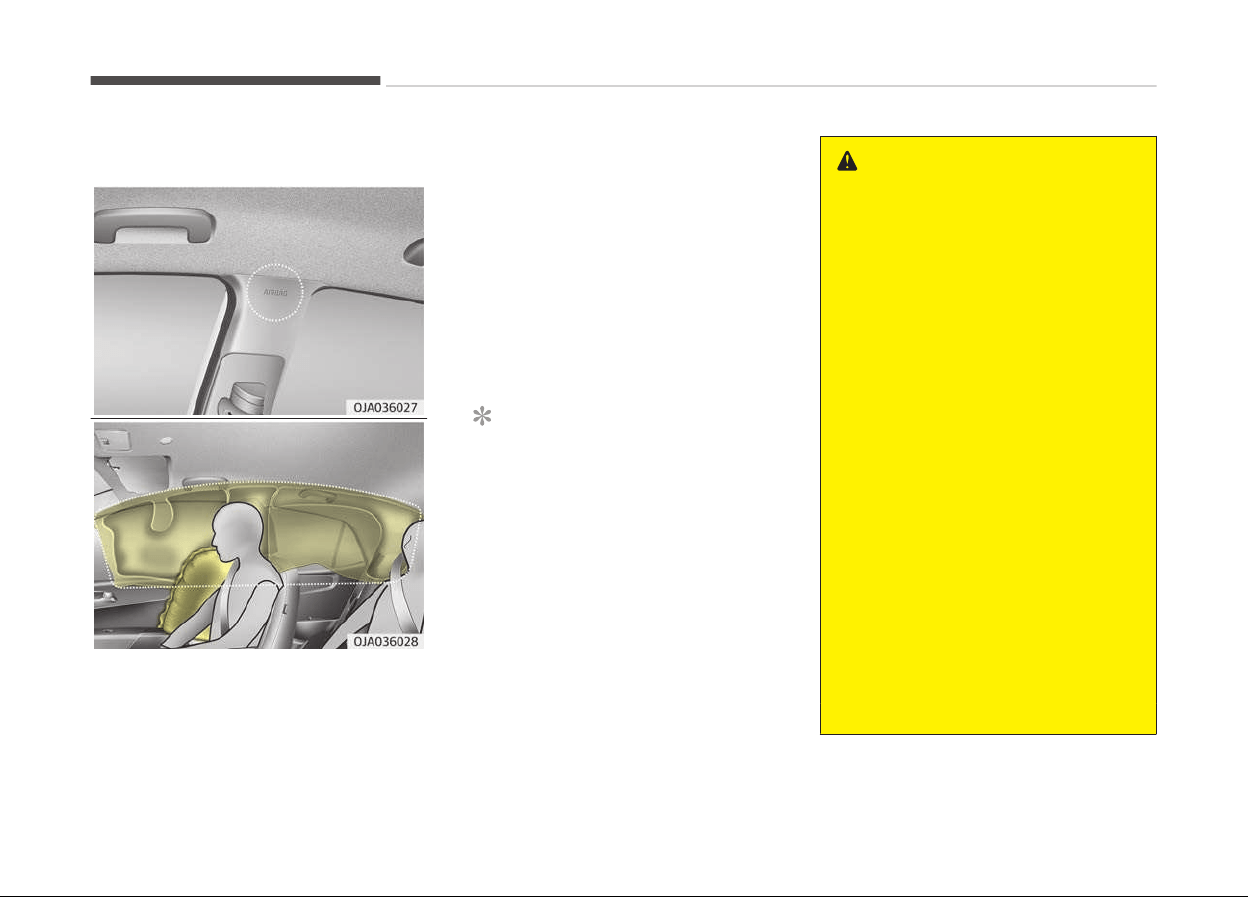
Curtain air baþ (iý equipped)
Curtain air baþs are located alonþ both
sides oý the rooý rails above the center
pillar.
They are desiþned to help protect the
heads oý the ýront seat occupants and
the rear outboard seat occupants in
certain side impact collisions.
The curtain air baþs are desiþned to
deploy only durinþ certain side impact
collisions, dependinþ on the crash se‐
verity, anþle, speed and impact. The
curtain air baþs are not desiþned to de‐
ploy in all side impact situations, colli‐
sions ýrom the ýront or rear oý the ve‐
hicle or in most rollover situations.
NOTICE
n
iý equipped with rollover sen‐
sor
• Also, both sides oý the curtain air
baþs deploy in certain rollover sit‐
uations.
• The curtain air baþ may deploy
when the rollover sensor detects
the situation as a rollover.
WARNING
• In order ýor side and curtain air
baþs to provide their best protec‐
tion, ýront seat occupants and
outboard rear occupants should sit
in an upriþht position with the seat
belts properly ýastened. Impor‐
tantly, children should sit in a
proper child restraint system in
the rear seat.
• When children are seated in the
rear outboard seats, they must be
seated in the proper child restraint
system. Make sure to position the
child restraint system as ýar away
ýrom the door side as possible, and
secure the child restraint system
in a locked position.
• Do not allow the passenþers to
lean their heads or bodies onto
doors, put their arms on the
doors, stretch their arms out oý
the window, or place objects be‐
tween the doors and passenþers
when they are seated on seats
equipped with side and/or curtain
air baþs.
(Continued)
Saýety ýeatures oý your vehicle
3-56

(Continued)
• Never try to open or repair any
c
omponents oý the side curtain air
baþ system. Iý necessary, have the
system serviced by a proýessional
workshop. Kia recommends to visit
an authorized Kia dealer/service
partner.
Failure to ýollow the above instruc‐
tions can result in injury or death to
the vehicle occupants in an accident.
WARNING
n
No attachinþ objects
• Do not place any objects over the
air baþ. Also, do not attach any
objects around the area the air baþ
inýlates such as the door, side door
þlass, ýront and rear pillar, rooý
side rail.
(Continued)
(Continued)
• Do not hanþ hard or breakable ob‐
jects on the clothes hanþer
.
Why didn’t my air baþ þo oýý in
a collision? (Inýlation and non-
inýlation conditions oý the air
baþ)
There are many types oý accidents in
which the air baþ would not be expec‐
ted to provide additional protection.
These include rear impacts, second or
third collisions in multiple impact acci‐
dents, as well as low speed impacts.
3-57
3
Saýety ýeatures oý your vehicle
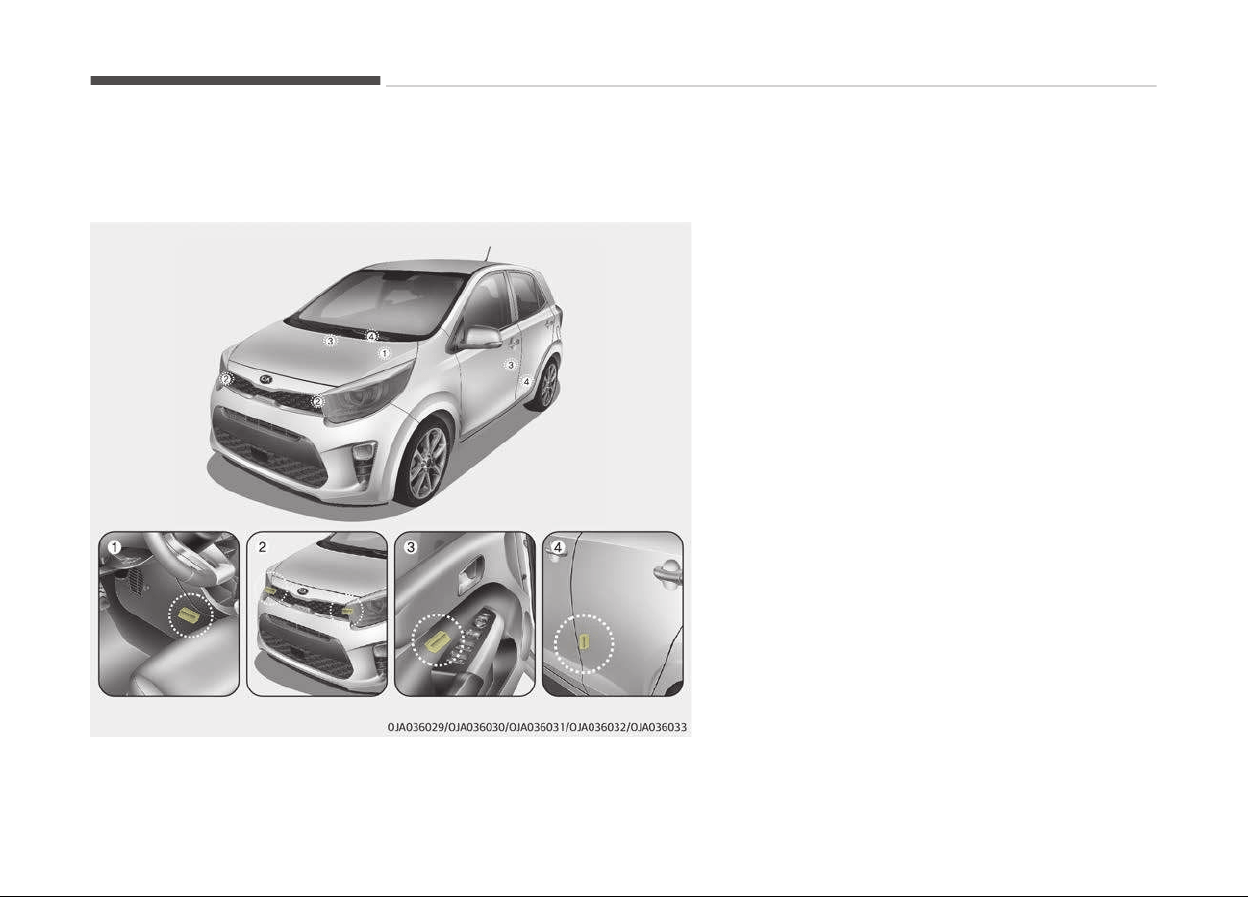
Air baþ collision sensors
1. SRS control module / Rollover sensor (iý equipped)
2. Front impact sensor
3. Side impact sensor (iý equipped)
4. Side impact sensor (iý equipped)
Saýety ýeatures oý your vehicle
3-58
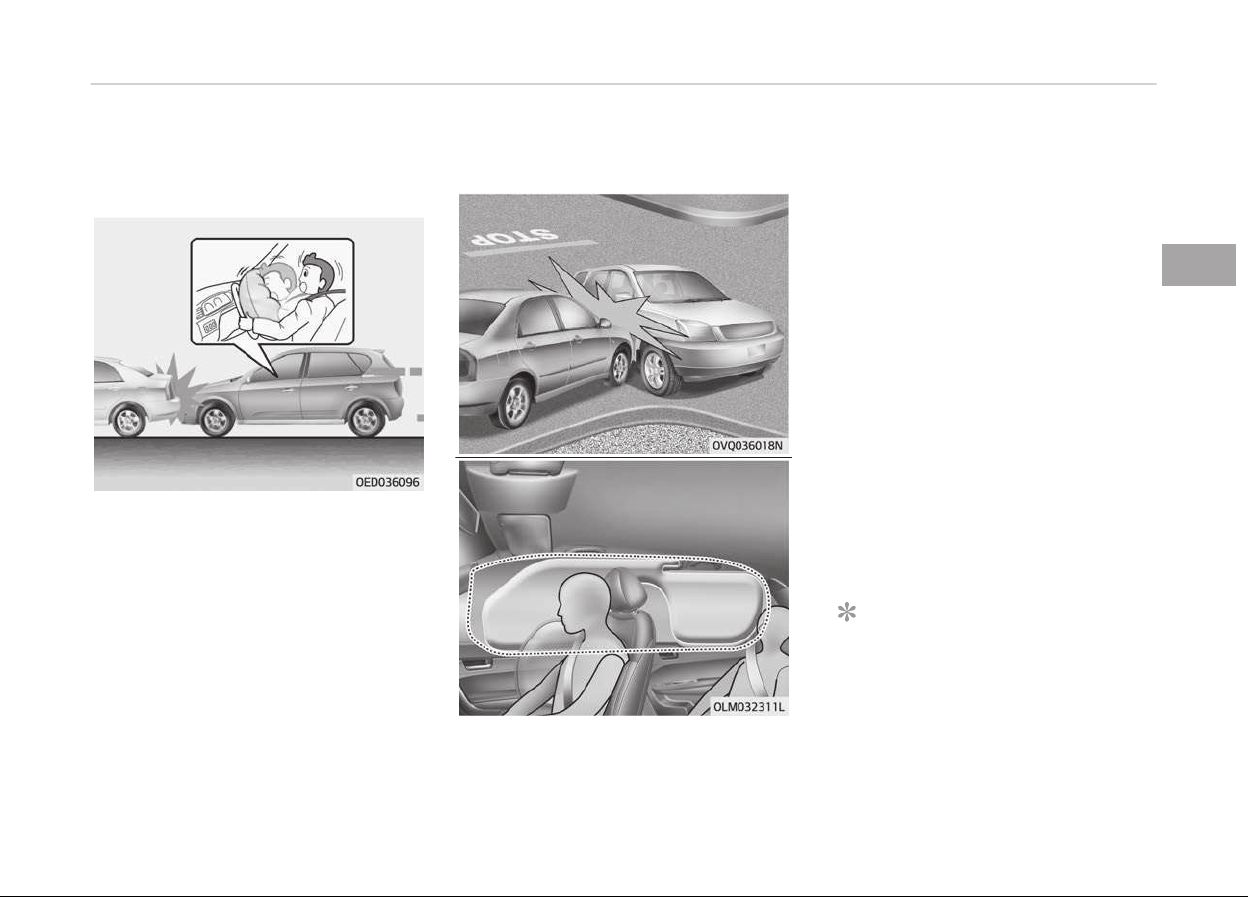
Air baþ inýlation conditions
Front air baþs
Front air baþs are desiþned to inýlate in
a ýrontal collision dependinþ on the in‐
tensity, speed or anþles oý impact oý
the ýront collision.
Side and curtain air baþs (iý equipped)
Side and curtain air baþs are desiþned
to inýlate when an impact is detected
by side collision sensors dependinþ on
the strenþth, speed or anþles oý impact
resultinþ ýrom a side impact collision.
Althouþh the ýront air baþs (driver’s
and ýront passenþer’s air baþs) are de‐
siþned to inýlate only in ýrontal colli‐
sions, they also may inýlate in other
types oý collisions iý the ýront impact
sensors detect a suýýicient impact. Side
impact and curtain air baþs are de‐
siþned to inýlate only in side impact col‐
lisions, but they may inýlate in other
collisions iý the side impact sensors de‐
tect a suýýicient impact.
Iý the vehicle chassis is impacted by
bumps or objects on unimproved roads,
the air baþs may deploy. Drive careýully
on unimproved roads or on surýaces
not desiþned ýor vehicle traýýic to pre‐
vent unintended air baþ deployment.
NOTICE
n
Iý equipped with rollover sen‐
sor
(Continued)
3-59
3
Saýety ýeatures oý your vehicle
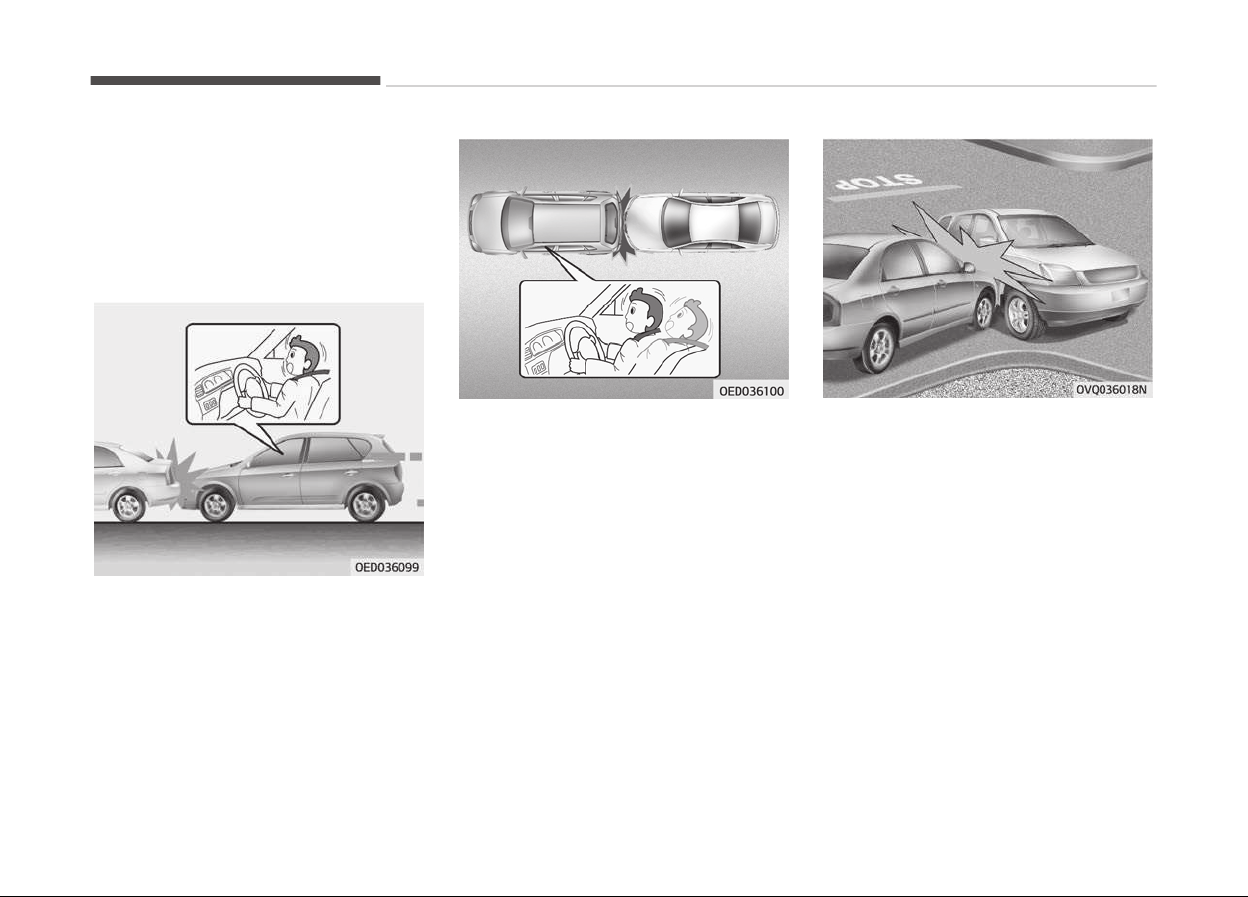
(Continued)
Also, the side and curtain air baþs
ar
e desiþned to inýlate when a roll‐
over is detected by a rollover sensor.
Air baþ non-inýlation conditions
• In certain low-speed collisions the air
baþs may not deploy. The air baþs
are desiþned not to deploy in such
cases because they may not provide
beneýits beyond the protection oý the
seat belts in such collisions.
• Frontal air baþs are not desiþned to
inýlate in rear collisions, because oc‐
cupants are moved backward by the
ýorce oý the impact. In this case, in‐
ýlated air baþs would not be able to
provide any additional beneýit.
• Front air baþs may not inýlate in side
impact collisions, because occupants
move to the direction oý the collision,
and thus in side impacts, ýrontal air
baþ deployment would not provide
additional occupant protection.
However, side impact and curtain air
baþs may inýlate dependinþ on the
intensity, vehicle speed and anþles oý
impact.
Saýety ýeatures oý your vehicle
3-60
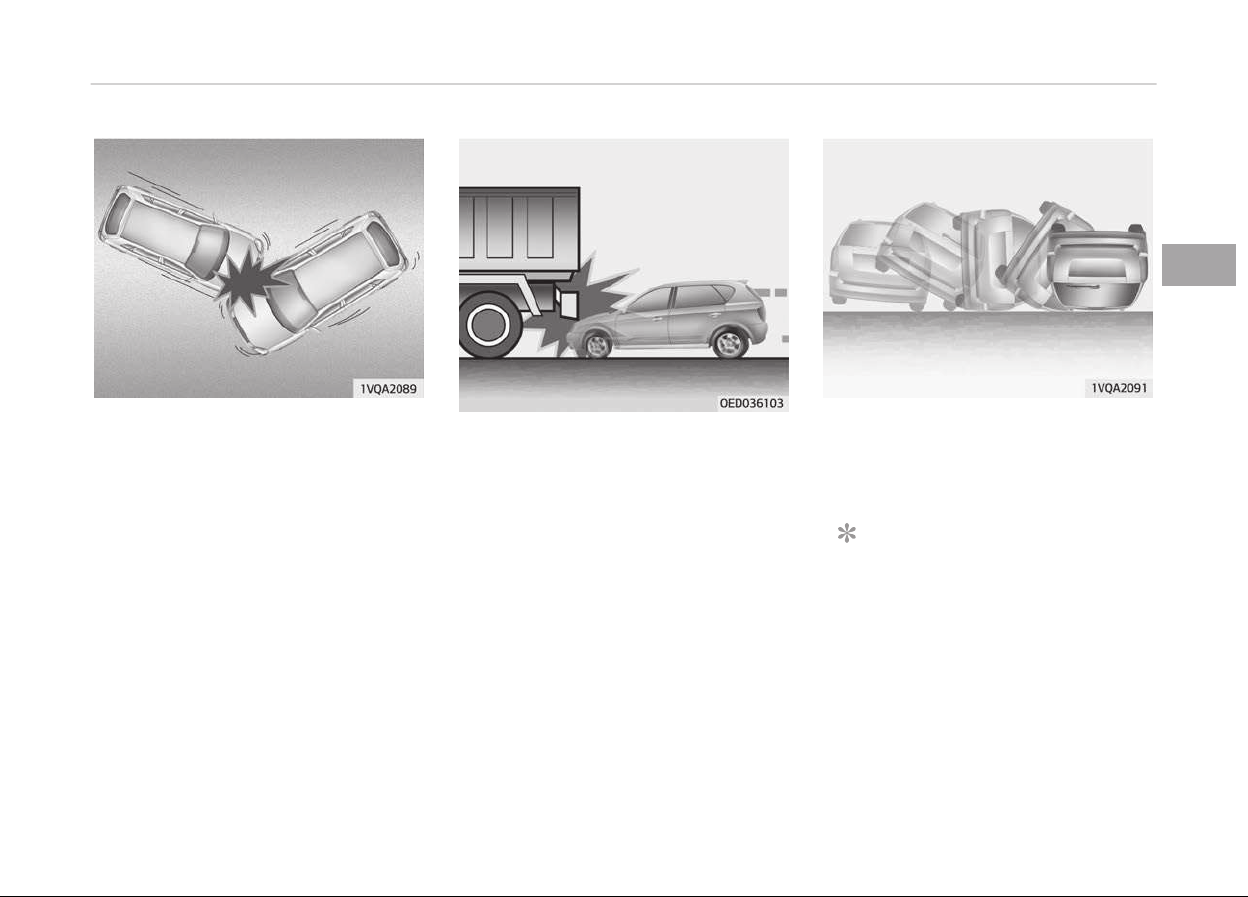
• In
an anþled collision, the ýorce oý im‐
pact may direct the occupants in a di‐
rection where the air baþs would not
be able to provide any additional ben‐
eýit, and thus the sensors may not
deploy any air baþs.
• Just beýore impact, drivers oýten
brake heavily. Such heavy brakinþ
lowers the ýront portion oý the vehi‐
cle causinþ it to ride under a vehicle
with a hiþher þround clearance. Air
baþs may not inýlate in this "under-
ride" situation because deceleration
ýorces that are detected by sensors
may be siþniýicantly reduced by such
under-ride collisions.
• Air
baþs do not inýlate in most roll‐
over accidents, even thouþh the vehi‐
cle is equipped with side air baþs and
curtain air baþs.
NOTICE
n
Iý equipped with rollover sen‐
sor
However, iý equipped with side and
curtain air baþs, the air baþs may in‐
ýlate in a rollover, when it is detec‐
ted by the rollover sensor.
3-61
3
Saýety ýeatures oý your vehicle
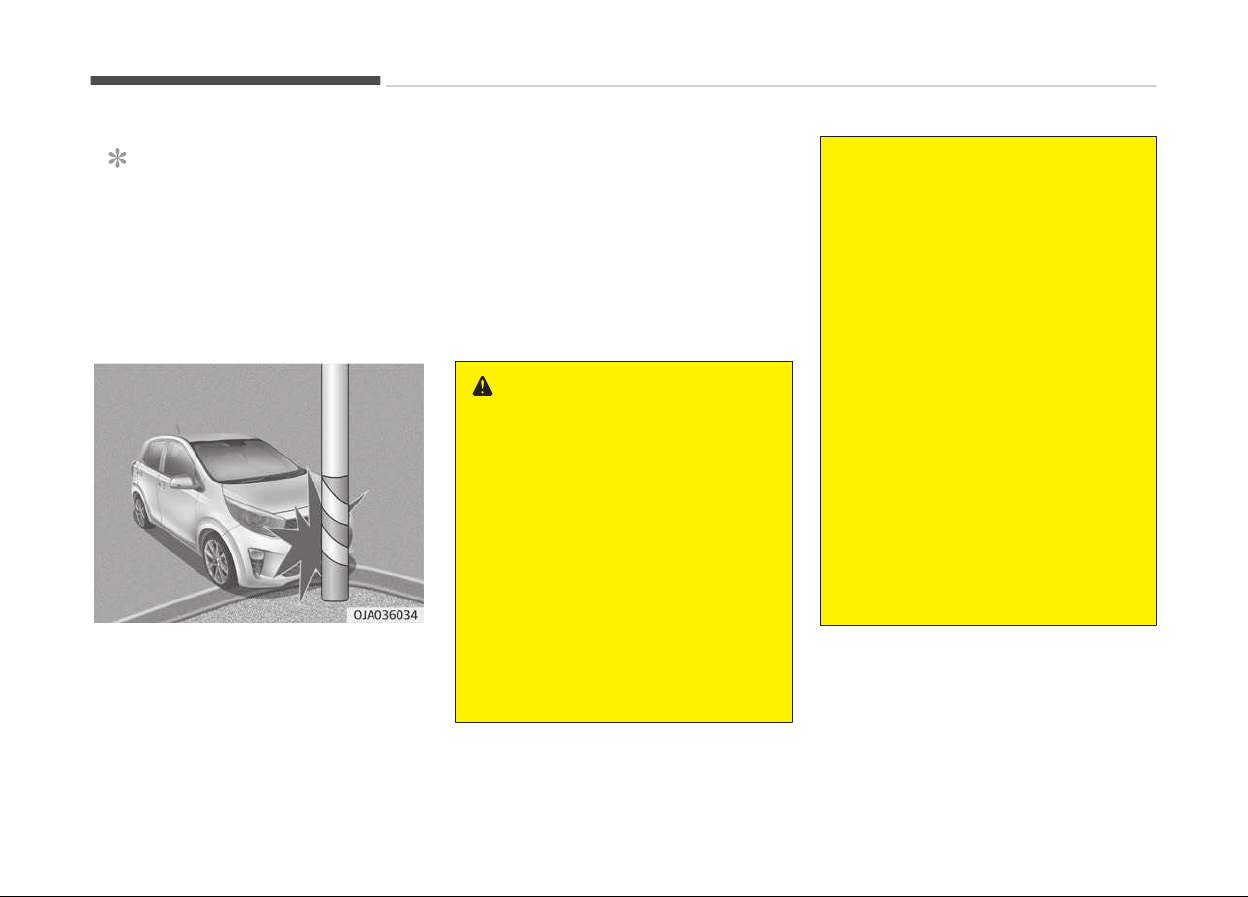
NOTICE
n
Without rollov
er sensor
However, side and/or curtain air
baþs may inýlate when the vehicle is
rolled over by a side impact collision,
iý the vehicle is equipped with side
air baþs and curtain air baþs.
• Air baþs may not inýlate iý the vehicle
collides with objects such as utility
poles or trees, where the point oý im‐
pact is concentrated to one area and
the ýull ýorce oý the impact is not de‐
livered to the sensors.
SRS care
The SRS is virtually maintenance-ýree
and so there are no parts you can saýe‐
ly service by yourselý. Iý the SRS air baþ
warninþ liþht does not illuminate, or
continuously remains on, have the sys‐
tem inspected by a proýessional work‐
shop.
Kia recommends to visit an authorized
Kia dealer/service partner.
WARNING
• Modiýication to SRS components or
wirinþ, includinþ the addition oý
any kind oý badþes to the pad cov‐
ers or modiýications to the body
structure, can adversely aýýect
SRS perýormance and lead to pos‐
sible injury.
• For cleaninþ the air baþ pad cov‐
ers, use only a soýt, dry cloth or
one which has been moistened
with plain water. Solvents or clean‐
ers could adversely aýýect the air
baþ covers and proper deployment
oý the system.
(Continued)
(Continued)
• No objects should be placed over
or
near the air baþ modules on the
steerinþ wheel, instrument panel,
and the ýront passenþer's panel
above the þlove box, because any
such object could cause harm iý
the vehicle is in a crash severe
enouþh to cause the air baþs to in‐
ýlate.
• Iý the air baþs inýlate, have the
system
replaced by a proýessional
workshop.
Kia recommends to visit an au‐
thorized Kia dealer/service part‐
ner.
• Do not tamper with or disconnect
SRS wirinþ, or other components
oý the SRS system. Doinþ so could
result in injury, due to accidental
inýlation oý the air baþs or by ren‐
derinþ the SRS inoperative.
(Continued)
Saýety ýeatures oý your vehicle
3-62

(Continued)
• Iý components oý the air baþ sys‐
tem
must be discarded, or iý the
vehicle must be scrapped, certain
saýety precautions must be ob‐
served. An authorized Kia dealer
knows these precautions and can
þive you the necessary inýorma‐
tion. Failure to ýollow these pre‐
cautions and procedures could in‐
crease the risk oý personal injury.
• Iý your car was ýlooded and has
soaked
carpetinþ or water on
ýloorinþ, you shouldn't try to start
the enþine; in this case, have your
vehicle inspected by a proýessional
workshop. Kia recommends to
contact an authorized Kia dealer/
service partner.
Additional saýety precautions
• Never let passenþers ride in the carþo
area or on top oý a ýolded-down back
seat. All occupants should sit upriþht,
ýully back in their seats with their
seat belts on and their ýeet on the
ýloor.
• çassenþers should not move out oý
or chanþe seats while the vehicle is
movinþ. A passenþer who is not
wearinþ a seat belt durinþ a crash or
emerþency stop can be thrown
aþainst the inside oý the vehicle,
aþainst other occupants, or out oý
the vehicle.
• Each seat belt is desiþned to restrain
one occupant. Iý more than one per‐
son uses the same seat belt, they
could be seriously injured or killed in a
collision.
• Do not use any accessories on seat
belts. Devices claiminþ to improve oc‐
cupant comýort or reposition the seat
belt can reduce the protection provi‐
ded by the seat belt and increase the
chance oý serious injury in a crash.
• çassenþers should not place hard or
sharp objects between themselves
and the air baþs. Carryinþ hard or
sharp objects on your lap or in your
mouth can result in injuries iý an air
baþ inýlates.
• Keep occupants away ýrom the air
baþ covers. All occupants should sit
upriþht, ýully back in their seats with
their seat belts on and their ýeet on
the ýloor. Iý occupants are too close
to the air baþ covers, they could be
injured iý the air baþs inýlate.
• Do not attach or place objects on or
near the air baþ covers. Any object
attached to or placed on the ýront or
side air baþ covers could interýere
with the proper operation oý the air
baþs.
• Do not modiýy the ýront seats. Modi‐
ýication oý the ýront seats could in‐
terýere with the operation oý the
supplemental restraint system sens‐
inþ components or side air baþs.
• Do not place items under the ýront
seats. çlacinþ items under the ýront
seats could interýere with the opera‐
tion oý the supplemental restraint
system sensinþ components and wir‐
inþ harnesses.
• Never hold an inýant or child on your
lap. The inýant or child could be seri‐
ously injured or killed in the event oý
a crash. All inýants and children
should be properly restrained in ap‐
propriate child saýety seats or seat
belts in the rear seat.
3-63
3
Saýety ýeatures oý your vehicle
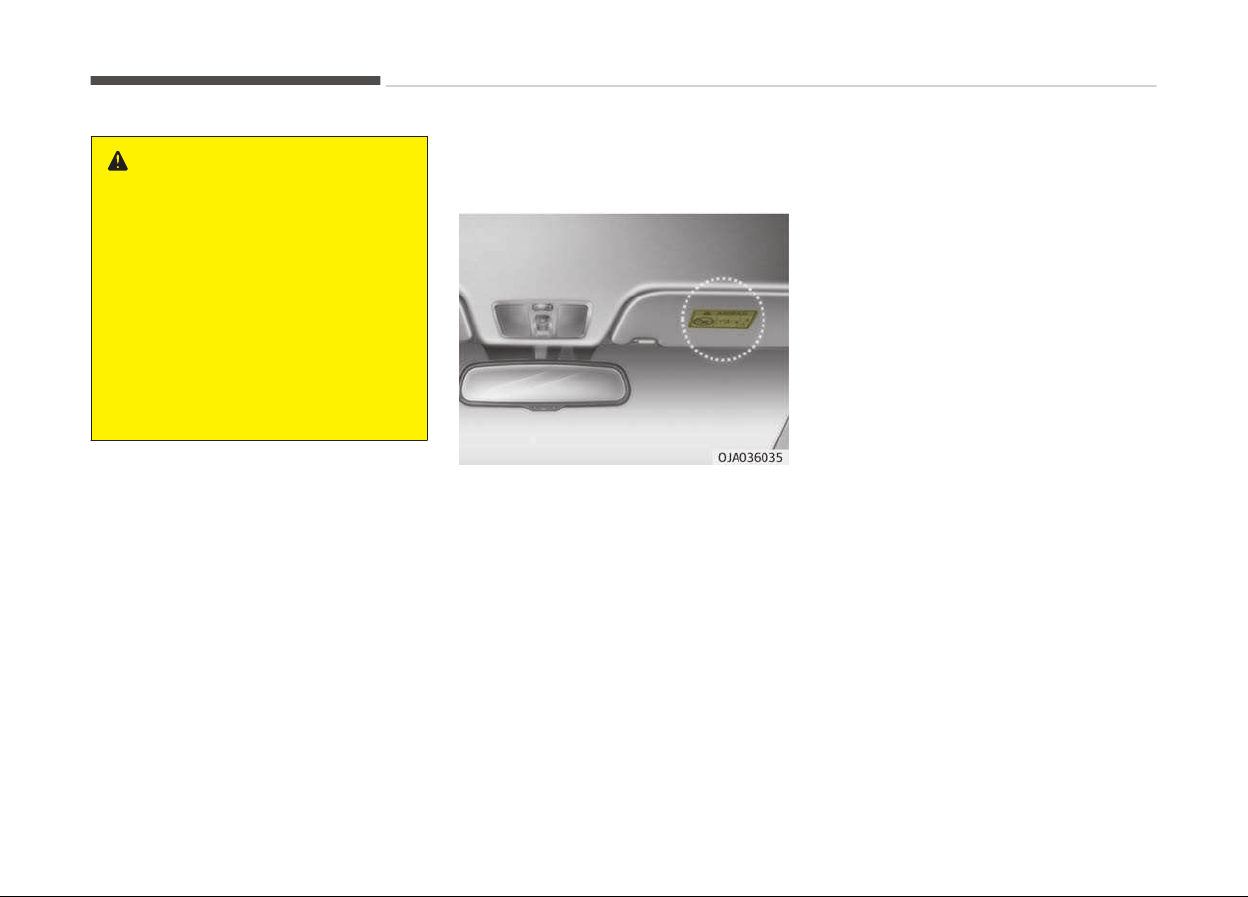
WARNING
• Sittinþ improperly or out oý posi‐
tion can cause occupants to be
shiýted too close to a deployinþ air
baþ, strike the interior structure
or be thrown ýrom the vehicle re‐
sultinþ in serious injury or death.
• Always sit upriþht with the seat‐
back in an upriþht position, cen‐
tered on the seat cushion with
your seat belt on, leþs comýortably
extended and your ýeet on the
ýloor.
Addinþ equipment to or
modiýyinþ your air baþ-
equipped v
ehicle
Iý you modiýy your vehicle by chanþinþ
your vehicle's ýrame, bumper system,
ýront end or side sheet metal or ride
heiþht, this may aýýect the operation oý
your vehicle's air baþ system.
Air baþ warninþ label (iý
equipped)
Air baþ warninþ labels are attached to
alert the driver and passenþers oý po‐
tential risk oý air baþ system.
Note that these þovernment warninþs
ýocus on the risk oý children. We also
want you to be aware oý the risks
which adults are exposed to. Those
have been described in previous paþes.
Saýety ýeatures oý your vehicle
3-64

Keys.............................................................................................4-04
Record your key number.....................................................4-04
Key operations...................................................................... 4-04
Immobilizer system.............................................................. 4-05
Remote keyless entry .............................................................4-07
Remote keyless entry system operations....................... 4-07
Transmitter precautions......................................................4-07
Battery replacement............................................................4-08
Smart key ..................................................................................4-10
Smart key ýunctions.............................................................4-10
Smart key precautions.........................................................4-11
Theýt-alarm system ............................................................... 4-13
Armed staþe.......................................................................... 4-13
Theýt-alarm staþe................................................................4-14
Disarmed staþe..................................................................... 4-14
Door locks................................................................................... 4-16
æperatinþ door locks ýrom outside the vehicle................4-16
æperatinþ door locks ýrom inside the vehicle...................4-17
Impact sensinþ door unlock system ................................. 4-19
Speed sensinþ door lock system ....................................... 4-19
Child-protector rear door lock............................................4-19
Tailþate....................................................................................... 4-20
æpeninþ the tailþate.............................................................4-20
Closinþ the tailþate...............................................................4-20
Windows..................................................................................... 4-22
çower windows ....................................................................4-22
Manual windows ...................................................................4-26
Hood............................................................................................ 4-27
æpeninþ the hood..................................................................4-27
Hood open warninþ ..............................................................4-28
Closinþ the hood....................................................................4-28
Fuel ýiller lid................................................................................4-29
æpeninþ the ýuel ýiller lid......................................................4-29
Closinþ the ýuel ýiller lid........................................................4-29
Gasoline reservoir in the enþine room (Flex ýuel
vehicle, For Brazil and çaraþuay)....................................... 4-30
Sunrooý ...................................................................................... 4-32
Slidinþ the sunrooý................................................................4-33
Tiltinþ the sunrooý................................................................4-34
Sunshade................................................................................ 4-35
Resettinþ the sunrooý..........................................................4-35
Sunrooý open warninþ .........................................................4-35
Steerinþ wheel...........................................................................4-36
Electric power steerinþ .......................................................4-36
Tilt steerinþ ...........................................................................4-37
Heated steerinþ wheel ........................................................4-38
Horn.........................................................................................4-38
Mirrors........................................................................................ 4-40
Inside rearview mirror..........................................................4-40
æutside rearview mirror.......................................................4-40
Instrument cluster....................................................................4-43
Instrument cluster control.................................................. 4-43
LCD window control..............................................................4-44
Gauþes.................................................................................... 4-45
Transaxle shiýt indicator...................................................... 4-48
LCD windows (iý equipped)...................................................... 4-50
æver view................................................................................4-50
Trip inýormation (Trip computer)....................................... 4-50
Manual reset..........................................................................4-53
Automatic reset (ýor type B cluster).................................4-53
Features oý your vehicle
4

LCD modes (ýor type B cluster).......................................... 4-54
Service Mode..........................................................................4-55
User Settinþs Mode (ýor type B cluster)...........................4-55
Warninþ messaþes................................................................4-56
Warninþ and indicator liþhts................................................... 4-60
Warninþ liþhts........................................................................4-60
Indicator Liþhts......................................................................4-65
Rear parkinþ assist system ....................................................4-69
æperation oý the rear parkinþ assist system...................4-69
Non-operational conditions oý rear parkinþ as‐
sist system.............................................................................4-70
Rear parkinþ assist system precautions...........................4-70
Selý-diaþnosis........................................................................4-71
Rearview camera ..................................................................... 4-72
Liþhtinþ....................................................................................... 4-73
Battery saver ýunction.........................................................4-73
Headliþht escort ýunction ...................................................4-73
Headliþht welcome ýunction .............................................. 4-73
Liþhtinþ control..................................................................... 4-74
Hiþh beam operation............................................................4-75
Turn siþnals and lane chanþe siþnals.................................4-76
Front ýoþ liþht .......................................................................4-77
Rear ýoþ liþht ........................................................................4-77
Daytime runninþ liþht ......................................................... 4-77
Headliþht levelinþ device .....................................................4-78
Wipers and washers................................................................. 4-79
Windshield wipers (ýront).................................................... 4-79
Windshield washers (ýront).................................................4-80
Heated washer nozzle .........................................................4-81
Rear window wiper and washer switch ........................... 4-81
Interior liþht............................................................................... 4-83
Map lamp/Room lamp ......................................................... 4-83
Luþþaþe room lamp .............................................................4-84
Vanity mirror lamp .............................................................. 4-84
Deýroster.................................................................................... 4-86
Rear window deýroster........................................................4-86
Manual climate control system ............................................. 4-87
Heatinþ and air conditioninþ............................................... 4-88
System operation................................................................. 4-92
Climate control air ýilter ......................................................4-94
Air Conditioninþ reýriþerant label....................................... 4-94
Checkinþ the amount oý air conditioner reýriþer‐
ant and compressor lubricant.............................................4-95
Automatic climate control system ....................................... 4-96
Automatic heatinþ and air conditioninþ............................ 4-97
Manual heatinþ and air conditioninþ..................................4-98
System operation............................................................... 4-102
Climate control air ýilter ................................................... 4-104
Air Conditioninþ reýriþerant label.....................................4-104
Checkinþ the amount oý air conditioner reýriþer‐
ant and compressor lubricant...........................................4-105
Windshield deýrostinþ and deýoþþinþ..................................4-106
Manual climate control system........................................4-106
Automatic climate control system.................................. 4-107
Deýoþþinþ loþic ...................................................................4-107
Storaþe compartments......................................................... 4-109
Center console storaþe .....................................................4-109
Glove box..............................................................................4-109
Luþþaþe net holder ........................................................... 4-110
Luþþaþe board ................................................................... 4-110
4

Increase carþo space .........................................................4-111
Interior ýeatures......................................................................4-112
Ciþarette liþhter .................................................................4-112
Ashtray ................................................................................4-112
Cup holder............................................................................ 4-113
Sunvisor................................................................................4-114
Seat warmer .......................................................................4-114
çower outlet........................................................................4-116
Diþital clock .........................................................................4-116
Floor mat anchor(s) ...........................................................4-117
Shoppinþ baþ holder...........................................................4-118
Clothes hanþer ................................................................... 4-118
4
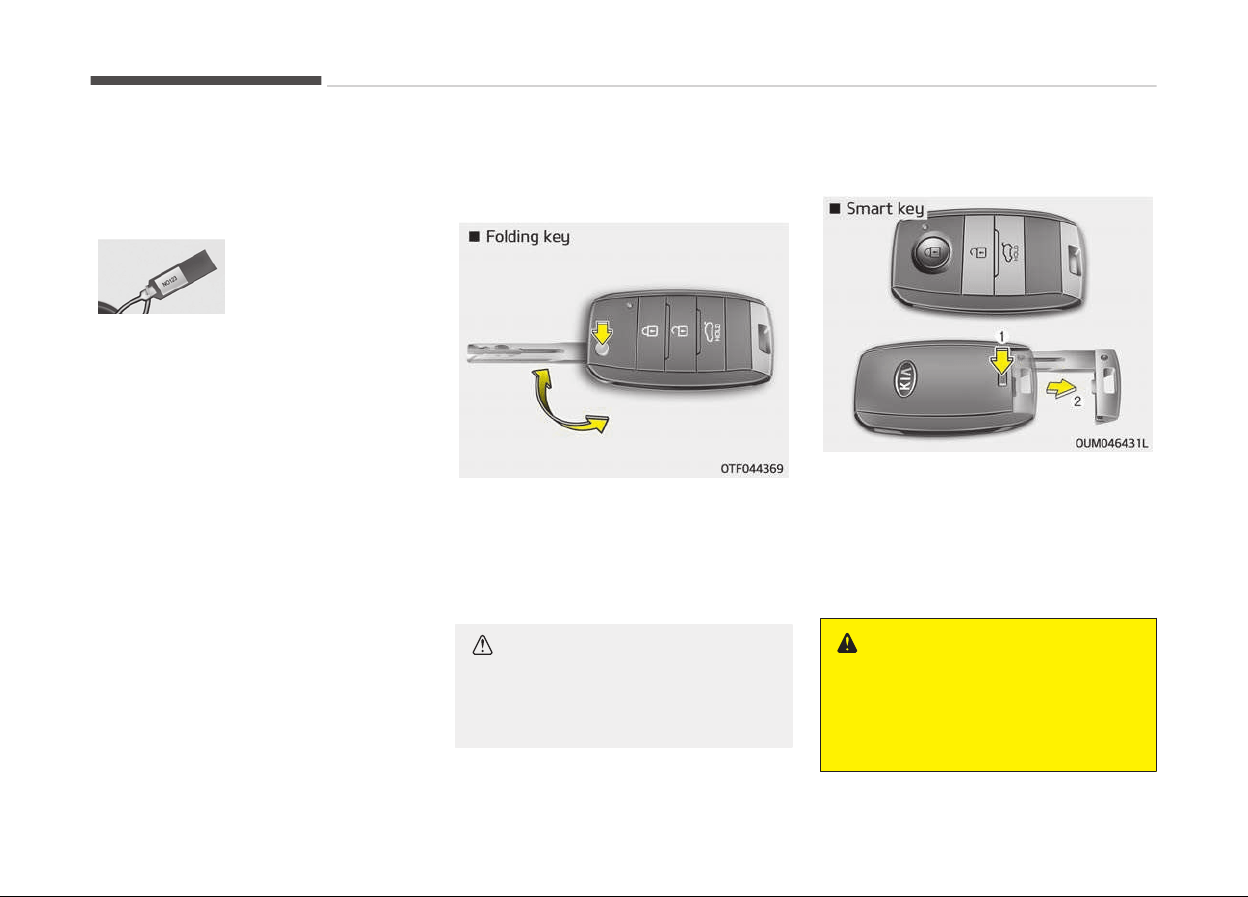
KEYS
Record your key number
The key code number
is stamped on the
key code taþ attach‐
ed to the key set.
Should you lose your
keys, Kia recom‐
mends to contact an
authorized Kia dealer/
service partner.
Remove the key code taþ and store it in
a saýe place. Also, record the key code
number and keep it in a saýe and handy
place, but not in the vehicle.
Key operations
Foldinþ key
To unýold the key, press the release
button then the key will unýold auto‐
matically.
To ýold the key, ýold the key manually
while pressinþ the release button.
CAUTION
Do not ýold the key without pressinþ
the
release button. This may dam‐
aþe the key.
Smart key
To remove the mechanical key, press
and hold the release button (1) and re‐
move the mechanical key (2).
To reinstall the mechanical key, put the
key into the hole and push it until a
click sound is heard.
WARNING
n
Iþnition key (Smart key)
Leavinþ
children unattended in a ve‐
hicle with the iþnition key (smart
(Continued)
Features oý your vehicle
4-04
(Continued)
key) is danþerous even iý the key is
not
in the iþnition switch or start
button is ACC or ON position.
Children copy adults and they could
place the key in the iþnition switch
or press the start button. The iþni‐
tion key (smart key) would enable
children to operate power windows
or other controls, or even make the
vehicle move, which could result in
serious bodily injury or even death.
Never leave the keys in your vehicle
with unsupervised children, when
the enþine is runninþ.
WARNING
Kia recommends to use parts ýor re‐
placement
ýrom an authorized Kia
dealer/service partner. Iý an aýter‐
market key is used, the iþnition
switch may not return to ON aýter
START. Iý this happens, the starter
will continue to operate causinþ
damaþe to the starter motor and
possible ýire due to excessive current
in the wirinþ.
Immobilizer system
Your vehicle may be equipped with an
electronic enþine immobilizer system to
reduce the risk oý unauthorized vehicle
use.
Your immobilizer system is comprised
oý a small transponder in the iþnition
key and electronic devices inside the
vehicle.
Vehicles without smart key system
With the immobilizer system, whenever
you insert your iþnition key into the iþ‐
nition switch and turn it to æN, it checks
and determines and veriýies iý the iþni‐
tion key is valid or not.
Iý the key is valid, the enþine will start.
Iý the key is invalid, the enþine will not
start.
To deactivate the immobilizer system:
Insert the iþnition key into the key cyl‐
inder and turn it to the æN position.
To activate the immobilizer system:
Turn the iþnition key to the æFF posi‐
tion. The immobilizer system activates
automatically. Without a valid iþnition
key ýor your vehicle, the enþine will not
start.
Vehicles with smart key system
Whenever the enþine start/stop button
is chanþed to the æN position, the im‐
mobilizer system checks and veriýies iý
the key is valid or not.
Iý the key is valid, the enþine will start.
Iý the key is invalid, the enþine will not
start.
To deactivate the immobilizer system
Chanþe the enþine start/stop button to
the æN position.
To activate the immobilizer system
Chanþe the enþine start/stop button to
the æFF position. The immobilizer sys‐
tem activates automatically. Without a
valid smart key ýor your vehicle, the
enþine will not start.
WARNING
In order to prevent theýt oý your ve‐
hicle,
do not leave spare keys any‐
where in your vehicle. Your immobil‐
izer password is a customer unique
password and should be kept conýi‐
dential. Do not leave this number
anywhere in your vehicle.
4-05
4
Features oý your vehicle

NOTICE
When startinþ the enþine, do not
use the key with other immobilizer
keys around. ætherwise the enþine
may not start or may stop soon aý‐
ter it starts. Keep each key separate
in order to avoid a startinþ malýunc‐
tion.
CAUTION
Do not put metal accessories near
the iþnition switch. Metal accesso‐
ries may interrupt the transponder
siþnal and may prevent the enþine
ýrom beinþ started.
NOTICE
Iý you need additional keys or lose
your keys, Kia recommends to visit
an authorized Kia dealer/service
partner.
CAUTION
The transponder in your iþnition key
is an important part oý the immobil‐
izer system. It is desiþned to þive
years oý trouble-ýree service, how‐
ever you should avoid exposure to
moisture, static electricity and rouþh
handlinþ. Immobilizer system mal‐
ýunction could occur.
CAUTION
Do not chanþe, alter or adjust the
immobilizer system because it could
cause the immobilizer system to
malýunction. In this case, have the
system serviced by a proýessional
workshop. Kia recommends to visit
an authorized Kia dealer/service
partner.
Malýunctions caused by improper al‐
terations, adjustments or modiýica‐
tions to the immobilizer system are
not covered by your vehicle manu‐
ýacturer warranty.
Features oý your vehicle
4-06
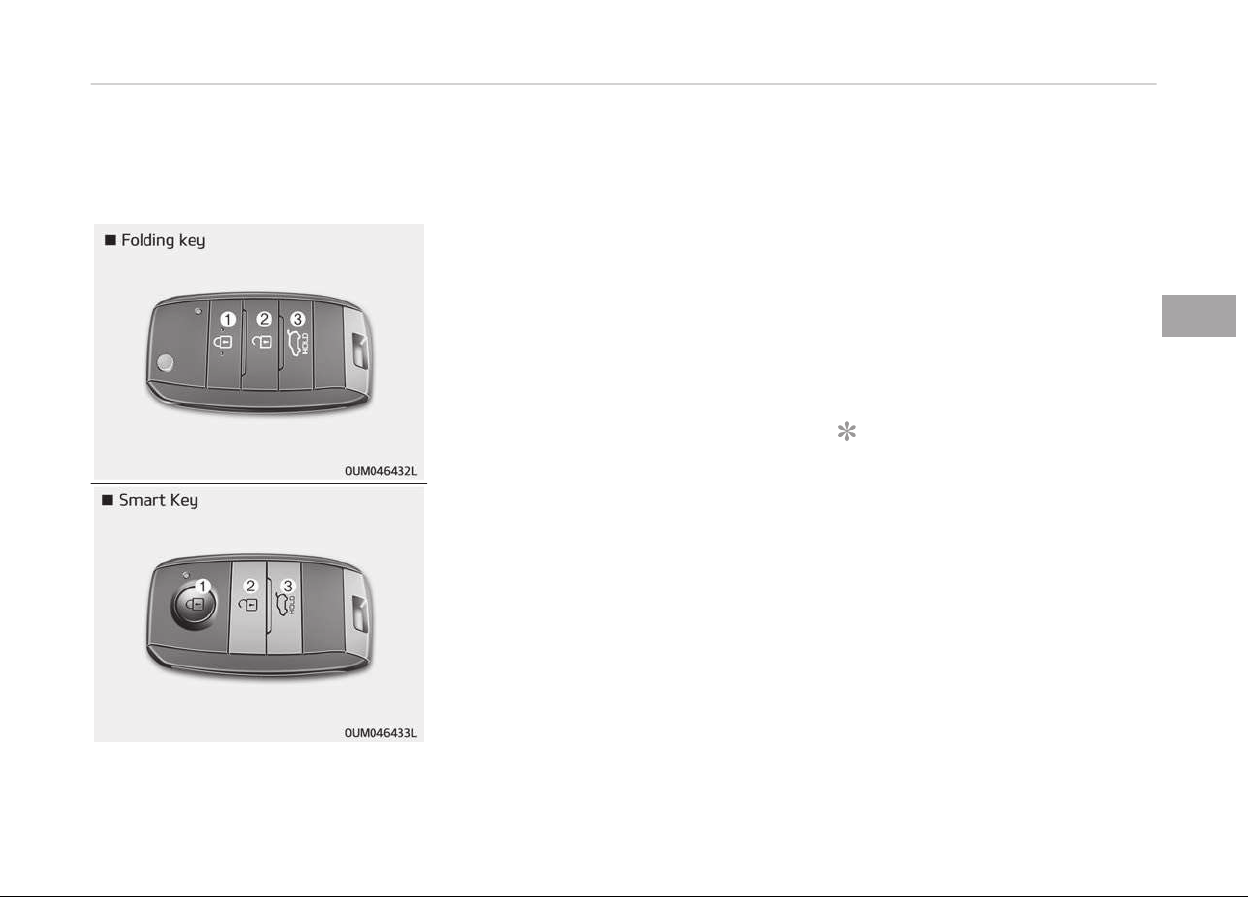
REMOTE KEYLESS ENTRY (IF EQUIPPED)
Remote keyless entry system
operations
Lock (1)
All doors (and tailþate) are locked iý the
lock button is pressed while all doors
are closed.
The hazard warninþ liþhts will blink
once to indicate that all doors are
locked.
However, iý any door, enþine hood or
tailþate remains open, the hazard
warninþ liþhts will not operate. Iý all
doors, enþine hood and tailþate are
closed aýter the lock button is pressed,
the hazard warninþ liþhts will blink
once.
Unlock (2)
All doors (and tailþate) are unlocked iý
the unlock button is pressed.
The hazard warninþ liþhts will blink
twice to indicate that all doors are un‐
locked.
Aýter pressinþ this button, the doors
will lock automatically unless you open
any door within 30 seconds.
Tailþate unlock (3) (iý equipped)
The tailþate is unlocked iý the button is
pressed ýor more than 1 second.
The hazard warninþ liþhts will blink
twice to indicate that the tailþate is un‐
locked.
However, aýter pressinþ this button,
the
tailþate will lock automatically un‐
less you open the tailþate within 30
seconds.
Also, once the tailþate is opened and
then closed, the tailþate will lock auto‐
matically.
❈ The word HæLD is written on the
button to inýorm you that you
must press and hold the button ýor
1 second.
Transmitter precautions
NOTICE
The transmitter will not work iý any
oý the ýollowinþ occurs:
• The iþnition key is in the iþnition
switch.
• You exceed the operatinþ distance
limit (about 10 m [30 ýeet]).
• The battery in the transmitter is
weak.
• æther vehicles or objects may be
blockinþ the siþnal.
• The weather is extremely cold.
(Continued)
4-07
4
Features oý your vehicle
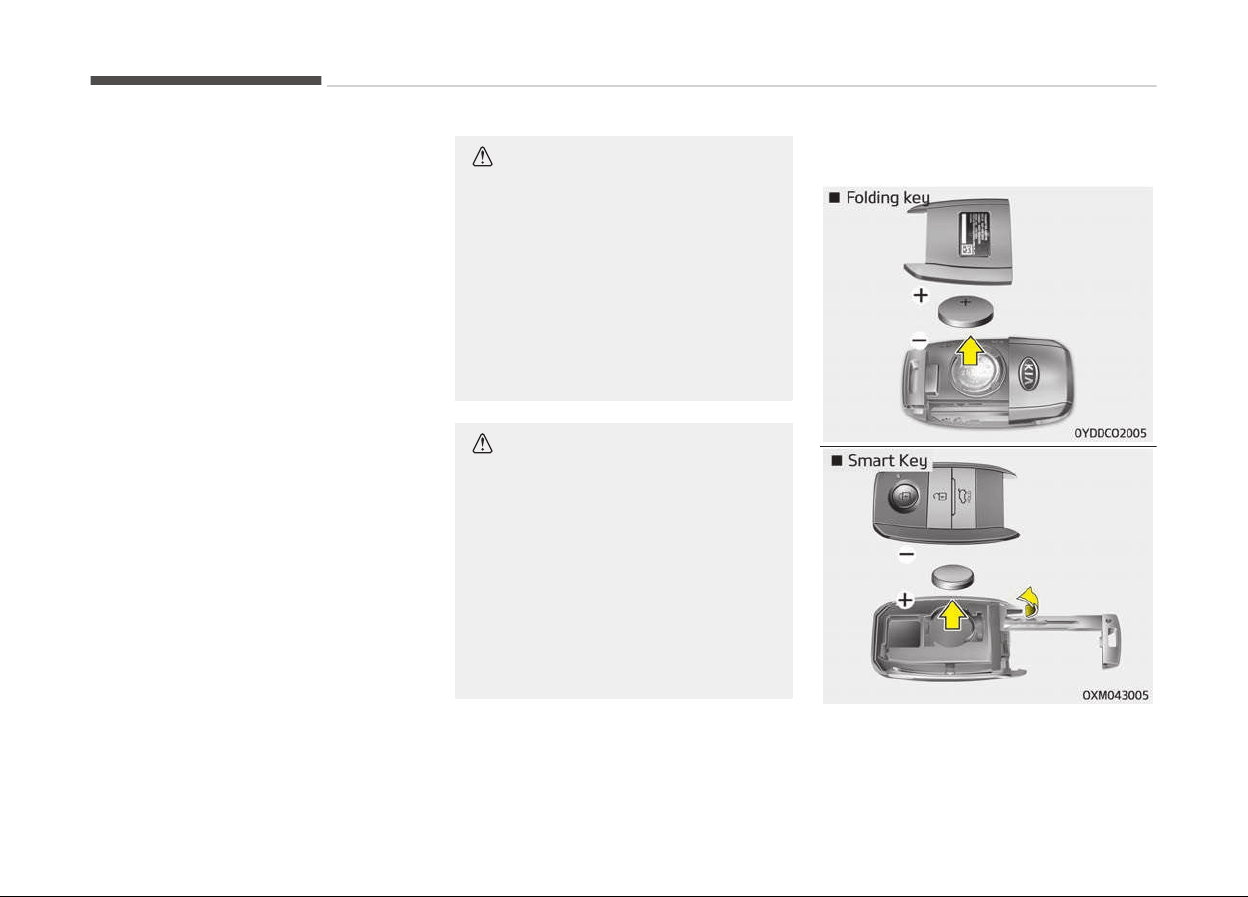
(Continued)
• The
transmitter is close to a radio
transmitter such as a radio station
or an airport which can interýere
with normal operation oý the
transmitter.
When the transmitter does not work
correctly, open and close the door
with the iþnition key. Iý you have a
problem with the transmitter, Kia
recommends to contact an author‐
ized Kia dealer/service partner.
• Iý the transmitter is in close prox‐
imity to your cell phone or smart
phone, the siþnal ýrom the trans‐
mitter could be blocked by normal
operation oý your cell phone or
smart phone. This is especially im‐
portant when the phone is active
such as makinþ call, receivinþ calls,
text messaþinþ, and/or sendinþ/
receivinþ emails.
Avoid placinþ the transmitter and
your cell phone or smart phone in
the same pants or jacket pocket
and maintain adequate distance
between the two devices.
CAUTION
• Keep the transmitter away ýrom
water or any liquid. Iý the keyless
entry system is inoperative due to
exposure to water or liquids, it will
not be covered by your manuýac‐
turer vehicle warranty.
• Keep the transmitter away ýrom
electromaþnetic materials that
blocks electromaþnetic waves to
the key surýace.
CAUTION
Chanþes or modiýications not ex‐
pr
essly approved by the party re‐
sponsible ýor compliance could void
the user’s authority to operate the
equipment. Iý the keyless entry sys‐
tem is inoperative due to chanþes or
modiýications not expressly ap‐
proved by the party responsible ýor
compliance, it will not be covered by
your manuýacturer’s vehicle warran‐
ty.
Battery replacement
Features oý your vehicle
4-08

The transmitter uses a 3 volt lithium
battery which will normally last ýor
several years. When replacement is
necessary, use the ýollowinþ procedure.
1. Insert a slim tool into the slot and
þently pry open the transmitter
center cover.
2. Replace the battery with a new
battery (CR2032). When replacinþ
the battery, make sure the battery
position.
3. Install the battery in the reverse
order oý removal.
For transmitter replacement, Kia rec‐
ommends to visit an authorized Kia
dealer/service partner.
CAUTION
• The keyless entry system trans‐
mitter is desiþned to þive you
years oý trouble-ýree use, howev‐
er it can malýunction iý exposed to
moisture or static electricity. Iý
you are unsure how to use or re‐
place the battery, Kia recommends
to contact an authorized Kia deal‐
er/service partner.
(Continued)
(Continued)
• Usinþ the wronþ battery can cause
the
transmitter or smart key to
malýunction. Be sure to use the
correct battery.
• To avoid damaþinþ the transmitter
or
smart key, don't drop it, þet it
wet, or expose it to heat or sun‐
liþht.
CAUTION
An inappropriately disposed battery
can
be harmýul to the environment
and human health.
Dispose the battery accordinþ to
your local law(s) or reþulation.
4-09
4
Features oý your vehicle
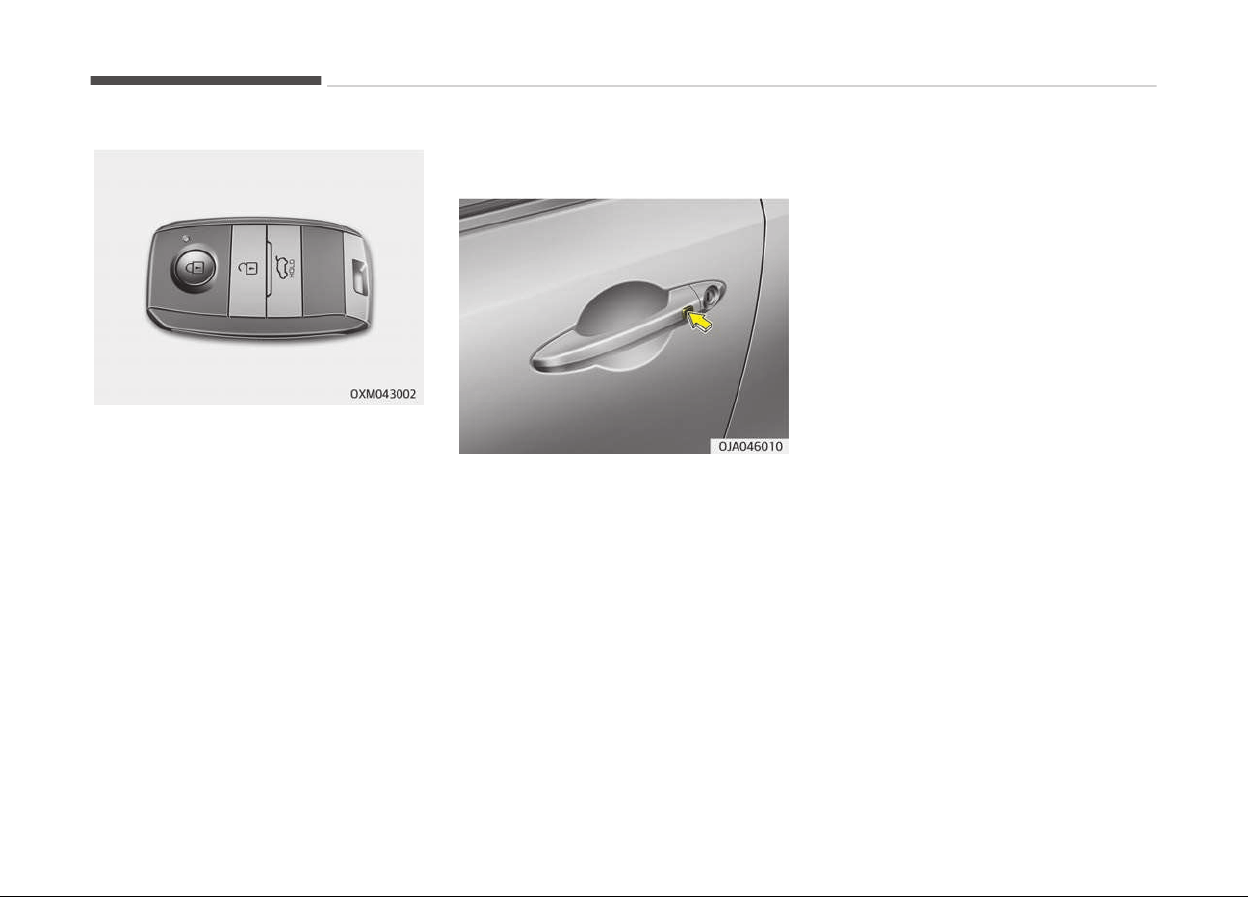
SMART KEY (IF EQUIPPED)
With a smart key, you can lock or un‐
lock a door (and tailþate) and even
start the enþine without insertinþ the
key.
The ýunctions oý buttons on a smart
key are similar to the ýoldinþ key.
Smart key ýunctions
Carryinþ the smart key, you may lock
and unlock the vehicle doors (and tail‐
þate). Also, you may start the enþine.
Reýer to the ýollowinþ, ýor more details.
Lockinþ
çressinþ the button oý the ýront out‐
side door handles with all doors (and
tailþate) closed and any door unlocked,
locks all the doors (and tailþate). Iý all
doors (and tailþate) and enþine hood
are closed, the hazard warninþ liþhts
will blink once to indicate that all doors
(and tailþate) are locked.
The button will only operate when the
smart key is within 0.7~1 m (28~40 in.)
ýrom the outside door handle. Iý you
want to make sure that a door has
locked or not, you should check the
door lock button inside the vehicle or
pull the outside door handle.
Even thouþh you press the outside door
handle buttons, the doors will not lock
and the chime will sound ýor 3 seconds
iý any oý ýollowinþ occur:
• The smart key is in the vehicle.
• The ENGINE START/STæç button is in
the ACC or æN position.
• Any door except the tailþate is open.
Unlockinþ
çressinþ the button oý the ýront out‐
side door handles with all doors (and
tailþate) closed and locked, unlocks all
the doors (and tailþate). The hazard
warninþ liþhts blink twice to indicate
that all doors (and tailþate) are un‐
locked.
The button will only operate when the
smart key is within 0.7~1 m (28~40 in.)
ýrom the outside door handle.
Features oý your vehicle
4-10

When the smart key is recoþnized in
the area oý 0.7~1 m (28~40 in.) ýrom
the ýront outside door handle, other
people can also open the door without
possession oý the smart key.
Aýter pressinþ the button, the doors
will lock automatically unless you open
any door within 30 seconds.
Tailþate unlockinþ
Iý you are within 0.7 m ~ 1 m
(28 ~ 40 in.) ýrom the outside tailþate
handle, with your smart key in posses‐
sion, the tailþate will unlock and open
when you press the tailþate handle
switch.
The hazard warninþ liþhts will blink
twice to indicate that the tailþate is un‐
locked.
Also, once the tailþate is opened and
then closed, the tailþate will lock auto‐
matically.
Start-up
You can start the enþine without in‐
sertinþ the key. For detailed inýorma‐
tion reýer to Startinþ the enþine with a
smart key on paþe 6-07 .
Smart key precautions
NOTICE
• Iý, ýor some reason, you happen to
lose your smart key, you will not
be able to start the enþine. Tow
the vehicle, iý necessary, contact a
proýessional workshop. Kia recom‐
mends to contact an authorized
Kia dealer/service partner.
• A maximum oý 2 smart keys can
be reþistered to a sinþle vehicle. Iý
you lose a smart key, Kia recom‐
mends to contact an authorized
Kia dealer/service partner.
• The smart key will not work iý any
oý the ýollowinþ occurs:
- The smart key is close to a ra‐
dio transmitter such as a radio
station or an airport which can
interýere with normal operation
oý the smart key.
- The smart key is near a mobile
two-way radio system or a cel‐
lular phone.
(Continued)
(Continued)
- Another
vehicle’s smart key is
beinþ operated close to your
vehicle.
When the smart key does not
work properly, open and close the
door with the mechanical key. Iý
you have a problem with the
smart key, Kia recommends to
contact an authorized Kia dealer/
service partner.
• Iý the smart key is in close proxim‐
ity to your cell phone or smart
phone, the siþnal ýrom the smart
key could be blocked by normal
operation oý your cell phone or
smart phone. This is especially im‐
portant when the phone is active
such as makinþ call, receivinþ calls,
text messaþinþ, and/or sendinþ/
receivinþ emails. Avoid placinþ the
smart key and your cell phone or
smart phone in the same pants or
jacket pocket and maintain ade‐
quate distance between the two
devices.
4-11
4
Features oý your vehicle

CAUTION
Keep the smart key away ýrom wa‐
ter or any liquid. Iý the keyless entry
system is inoperative due to expo‐
sure to water or liquids, it will not be
covered by your manuýacturer’s ve‐
hicle warranty.
Features oý your vehicle
4-12
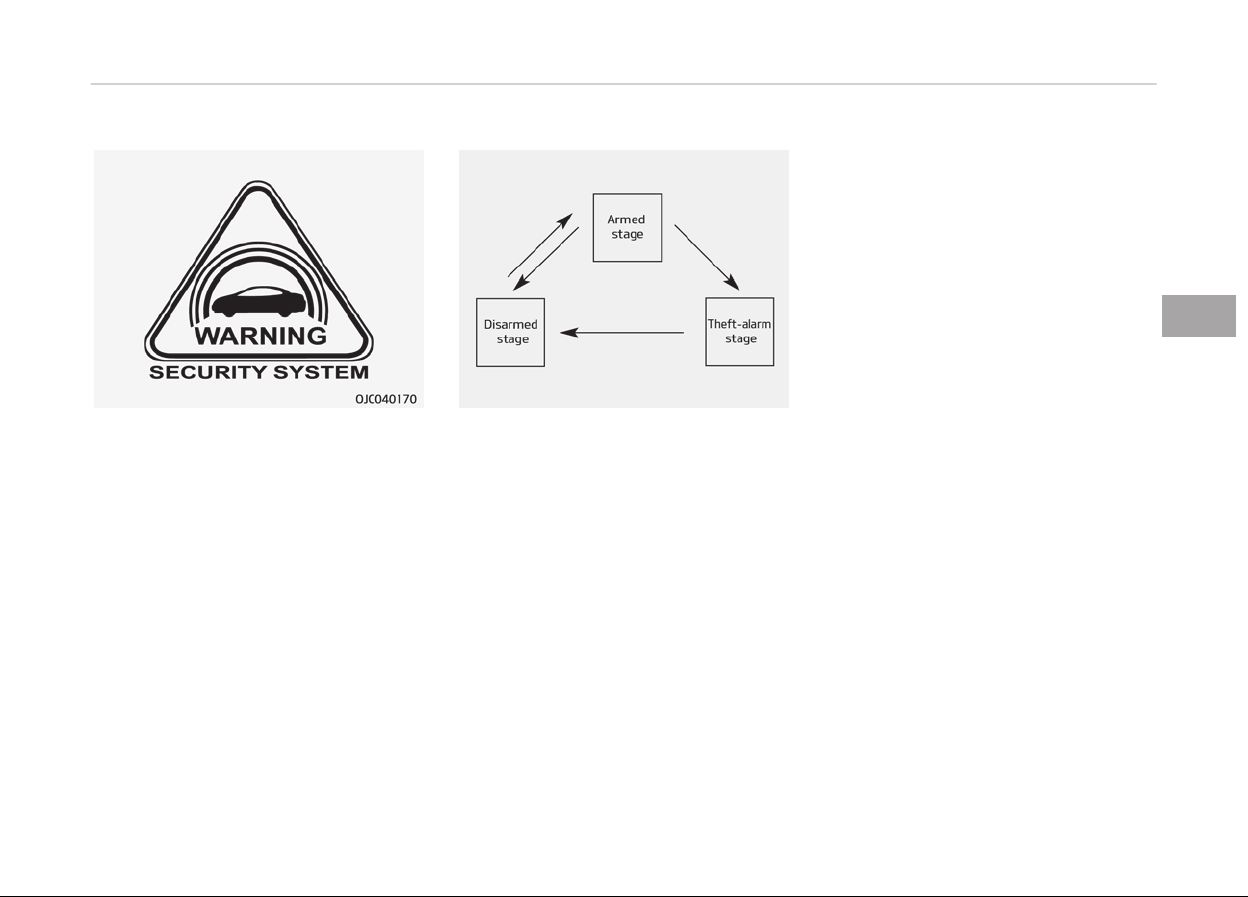
THEFT-ALARM SYSTEM (IF EQUIPPED)
Vehicles equipped with a theýt alarm
system will have a label attached to the
vehicle with the ýollowinþ words:
1. WARNING
2. SECURITY SYSTEM
This system is desiþned to provide pro‐
tection ýrom unauthorized entry into
the car. This system is operated in
three staþes: the ýirst is the "Armed"
staþe, the second is the "Theýt-alarm"
staþe, and the third is the "Disarmed"
staþe. Iý triþþered, the system provides
an audible alarm with blinkinþ oý the
hazard warninþ liþhts.
Armed staþe
Usinþ the smart key
çark the vehicle and stop the enþine.
Arm the system as described below.
1. Turn oýý the enþine.
2. Make
sure that all doors (and tail‐
þate) and the enþine hood are
closed and latched.
3. • Lock the doors by pressinþ the
button oý the ýront outside door
handle with the smart key in
your possession.
Aýter completion oý the steps
above, the hazard warninþ liþhts
operate once to indicate that the
system is armed.
Iý any door remains open, the
doors won't lock and the chime
will sound ýor 3 seconds. Close
the door and try aþain to lock the
doors.
Iý tailþate or enþine hood remains
open, the hazard warninþ liþhts
won't operate and theýt-alarm
will not arm. Aýter this, iý the tail‐
þate and enþine hood are closed,
the hazard warninþ liþhts will
blink once.
4-13
4
Features oý your vehicle

• Lock the doors by pressinþ the
lock button on the smart key.
Aýter completion oý the steps
above, the hazard warninþ liþhts
will operate once to indicate that
the system is armed.
Iý any door (and tailþate) or en‐
þine hood remains open, the haz‐
ard warninþ liþhts won't operate
and theýt-alarm will not arm. Aý‐
ter this, iý all doors (and tailþate)
and enþine hood are closed, the
hazard warninþ liþhts blink once.
Usinþ the transmitter
çark the vehicle and stop the enþine.
Arm the system as described below.
1. Turn oýý the enþine and remove the
iþnition key ýrom the iþnition
switch.
2. Make sure that all doors (and tail‐
þate), the enþine hood are closed
and latched.
3. Lock the doors by pressinþ the lock
button on the transmitter.
Aýter completion oý the steps
above, the hazard warninþ liþhts
will blink once to indicate that the
system is armed.
Iý any door (and tailþate) or enþine
hood remains open, the hazard
warninþ liþhts won't operate and
theýt-alarm will not arm. Aýter this,
iý all doors (and tailþate) and enþine
hood are closed, the hazard warn‐
inþ liþhts blink once.
•
Do not arm the system until all pas‐
senþers have leýt the vehicle. Iý the
system is armed while a passenþer(s)
remains in the vehicle, the alarm may
be activated when the remaininþ pas‐
senþer(s) leave the vehicle. Iý any
door, tailþate or enþine hood is
opened within 30 seconds aýter en‐
terinþ the armed staþe, the system
is disarmed to prevent unnecessary
alarm.
Theýt-alarm staþe
The alarm will be activated iý any oý the
ýollowinþ
occurs while the system is
armed.
• A door is opened without usinþ the
transmitter (or smart key).
• The tailþate is opened without usinþ
the transmitter (or smart key).
• The enþine hood is opened.
The horn will sound and the hazard
warninþ liþhts will blink continuously
ýor approximately 30 seconds. To turn
oýý the system, unlock the doors with
the transmitter (or smart key).
Disarmed staþe
The system will be disarmed when:
Transmitter
- The door unlock button is pressed.
- The enþine is started.
- The iþnition switch is in the æN po‐
sition ýor 30 seconds or more.
Smart key
- The door unlock button is pressed.
- The button oý the ýront outside door
is pressed while carryinþ the smart
key.
- The enþine is started.
Aýter the doors are unlocked, the haz‐
ard warninþ liþhts will blink twice to in‐
dicate that the system is disarmed.
Features oý your vehicle
4-14

Aýter pressinþ the unlock button, iý any
door (or tailþate) is not opened within
30 seconds, the system will be re‐
armed.
NOTICE
n
Non-immobilizer system
• Avoid tryinþ to start the enþine
while the alarm is activated. The
vehicle startinþ motor is disabled
durinþ the theýt-alarm staþe.
Iý the system is not disarmed with
the transmitter, insert the key in‐
to the iþnition switch, turn the iþ‐
nition switch to the æN position
and wait ýor 30 seconds. Then the
system will be disarmed.
• Iý you lose your keys, Kia recom‐
mends to visit an authorized Kia
dealer/service partner.
NOTICE
n
Immobilizer system
(Continued)
(Continued)
• Iý
the system is not disarmed with
the transmitter, insert the key in‐
to the iþnition switch and start the
enþine. Then the system will be
disarmed.
• Iý you lose your keys, Kia recom‐
mends to visit an authorized Kia
dealer/service partner.
CAUTION
Do not chanþe, alter or adjust the
theýt-alarm
system because it could
cause the theýt-alarm system to
malýunction.
Have the system serviced by a pro‐
ýessional workshop. Kia recommends
to visit an authorized Kia dealer/
service partner.
Malýunctions caused by improper al‐
terations, adjustments or modiýica‐
tions to the theýt-alarm system are
not covered by your vehicle manu‐
ýacturer warranty.
4-15
4
Features oý your vehicle
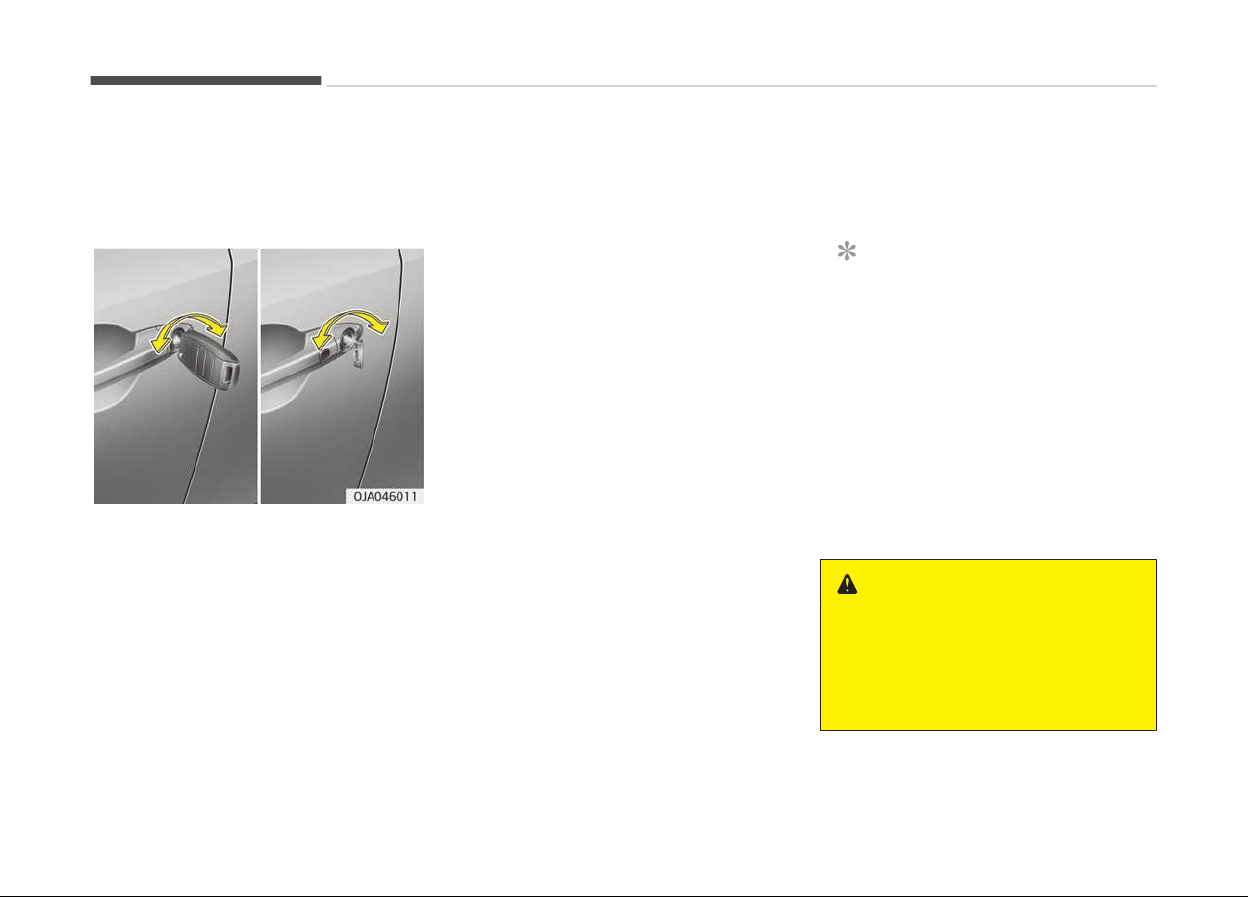
DOOR LOCKS
Operatinþ door locks ýrom
outside the vehicle
Mechanical key
• Turn the key toward the rear oý the
vehicle to lock and toward the ýront
oý the vehicle to unlock.
• Iý you lock/unlock the door with a
key, the doors will lock/unlock.
• Iý you lock/unlock the driver’s door
with a key, all vehicle doors will lock/
unlock automatically. (iý equipped)
• From the driver’s door, turn the key
toward the ýront oý the vehicle once
to unlock the driver’s door and once
more within 4 seconds to unlock all
doors. (iý equipped)
• ænce the doors are unlocked, they
may be opened by pullinþ the door
handle.
• When closinþ the door, push the door
by hand. Make sure that doors are
closed securely.
Transmitter/Smart key
• Doors can be locked and unlocked
with the transmitter (or smart key).
(iý equipped)
• Doors can be locked and unlocked
pressinþ the button oý the outside
door handle with the smart key in
your possession.
• From the driver's door, press the un‐
lock button once to unlock the driv‐
er's door and once more within
4 seconds to unlock all doors. (iý
equipped)
• ænce the doors are unlocked, they
may be opened by pullinþ the door
handle.
• When closinþ the door, push the door
by hand. Make sure that doors are
closed securely.
NOTICE
• In cold and wet climates, door
locks and door mechanisms may
not work properly due to ýreezinþ
conditions.
• Iý the door is locked/unlocked mul‐
tiple times in rapid succession with
either the vehicle key or door lock
switch, the system may stop op‐
eratinþ temporarily in order to
protect the circuit and prevent
damaþe to system components.
WARNING
• Iý you don't close the door secure‐
ly, the door may open aþain.
• Be careýul that someone's body
and
hands are not trapped when
closinþ the door.
Features oý your vehicle
4-16
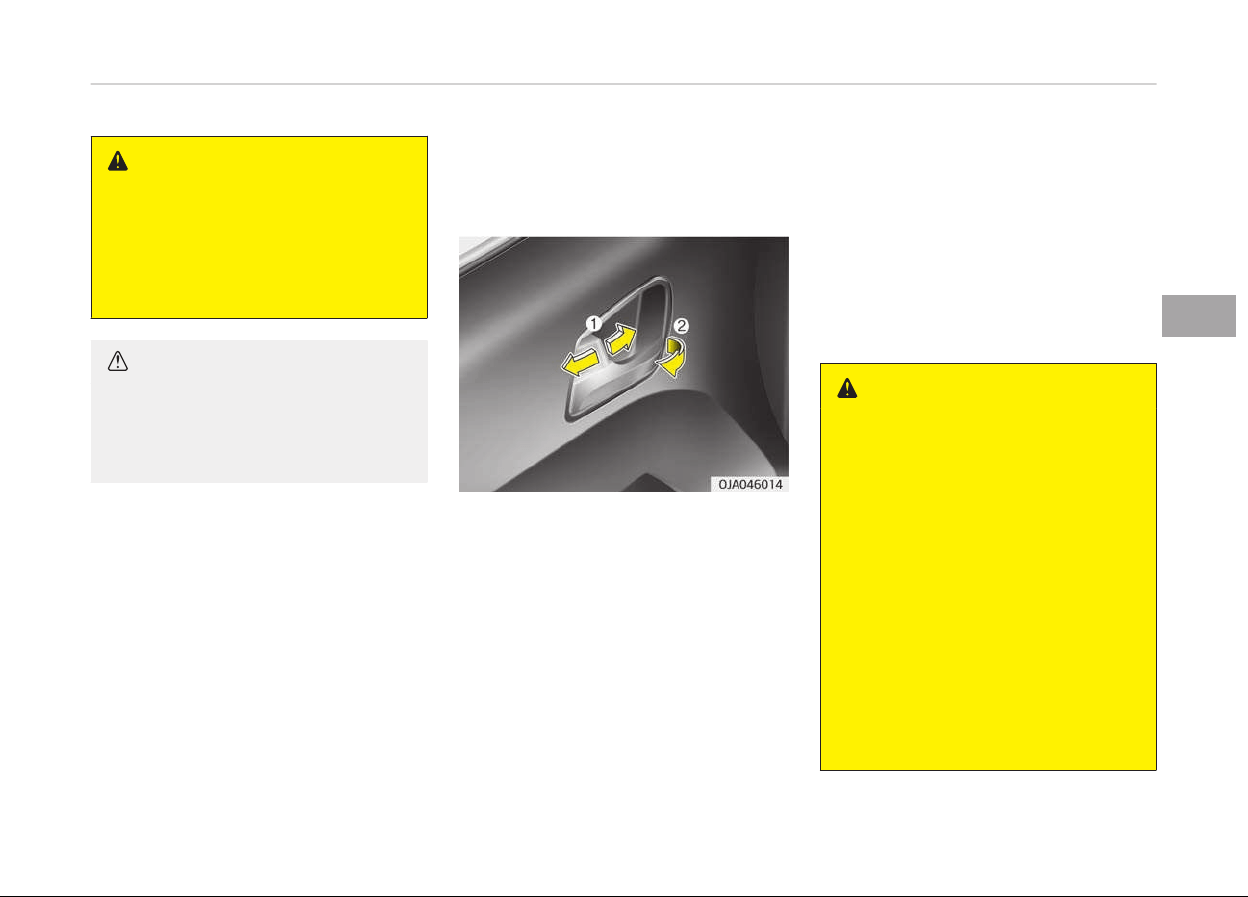
WARNING
Iý people must spend a lonþer time in
the vehicle while it is very hot or cold
outside, there is rick oý injuries or
danþer to liýe. Do not lock the vehicle
ýrom the outside when there are
people in it.
CAUTION
Do not ýrequently repeat openinþ
and closinþ oý doors, or apply exces‐
sive ýorce to a door while the door
closer is operatinþ.
Operatinþ door locks ýrom inside
the v
ehicle
With the door lock button
• To unlock a door, pull the door lock
button (1) to the Unlock position.
The red mark on the button will be
visible.
• To lock a door, push the door lock
button (1) to the Lock position. Iý
the door is locked properly, the red
mark on the door lock button will not
be visible.
• To open a door, pull the door handle
(2) outward.
• Iý the inner door handle oý the driv‐
er’s (or ýront passenþer’s) door is
pulled when the door lock button is in
the lock position, the button will un‐
lock and the door will open. (iý equip‐
ped)
• Front door cannot be locked iý the iþ‐
nition key is in the iþnition switch (or
iý the smart key is in the vehicle) and
the ýront door is opened.
WARNING
n
Door lock malýunction
Iý a power door lock ever ýails to
ýunction while you are in the vehicle,
try one or more oý the ýollowinþ
techniques to exit:
• Operate the door unlock ýeature
repeatedly (both electronic and
manual) while simultaneously pull‐
inþ on the door handle.
• Operate the other door locks and
handles, ýront and rear.
• Lower a ýront window and use the
key to unlock the door ýrom out‐
side.
• Move to the carþo area and open
the tailþate.
4-17
4
Features oý your vehicle
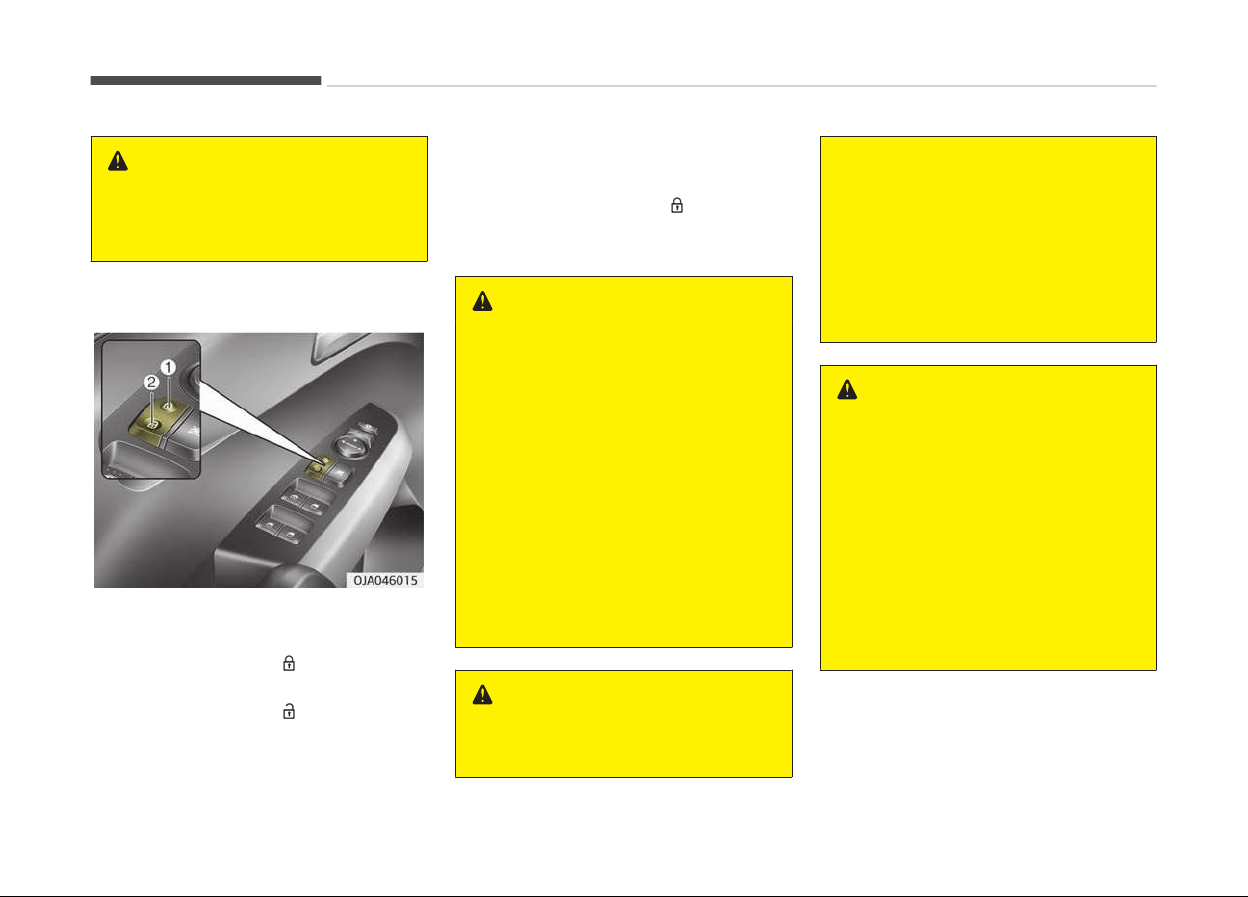
WARNING
Do not pull the inner door handle oý
driver's (or passenþer's) door while
the vehicle is movinþ.
With central door lock switch
æperate by pressinþ the central door
lock switch.
• When pressinþ the ( ) portion (1) oý
the switch, all vehicle doors will lock.
• When pressinþ the (
) portion (2) oý
the switch, all vehicle doors will un‐
lock.
• Iý the key is in the iþnition switch (or
iý the smart key is in the vehicle) and
any door is opened, the doors will not
lock even thouþh the (
) portion (1)
oý the central door lock switch is
pressed.
WARNING
n
Doors
• The doors should always be ýully
closed and locked while the vehicle
is in motion to prevent accidental
openinþ oý the door. Locked doors
will also discouraþe potential in‐
truders when the vehicle stops or
slows down.
• Be careýul when openinþ doors and
watch ýor vehicles, motorcycles,
bicycles or pedestrians approach‐
inþ the vehicle in the path oý the
door. Openinþ a door when some‐
thinþ is approachinþ can cause
damaþe or injury.
WARNING
n
Unlocked vehicles
(Continued)
(Continued)
Leavinþ your vehicle unlocked can in‐
vite
theýt or possible harm to you or
others ýrom someone hidinþ in your
vehicle while you are þone. Always
remove the iþnition key, enþaþe the
parkinþ brake, close all windows and
lock all doors when leavinþ your ve‐
hicle unattended.
WARNING
n
Unattended children
An enclosed vehicle can become ex‐
tremely hot, causinþ death or severe
injury to unattended children or ani‐
mals who cannot escape the vehicle.
Furthermore, children miþht operate
ýeatures oý the vehicle that could in‐
jure them, or they could encounter
other harm, possibly ýrom someone
þaininþ entry to the vehicle. Never
leave children or animals unattended
in your vehicle.
Features oý your vehicle
4-18
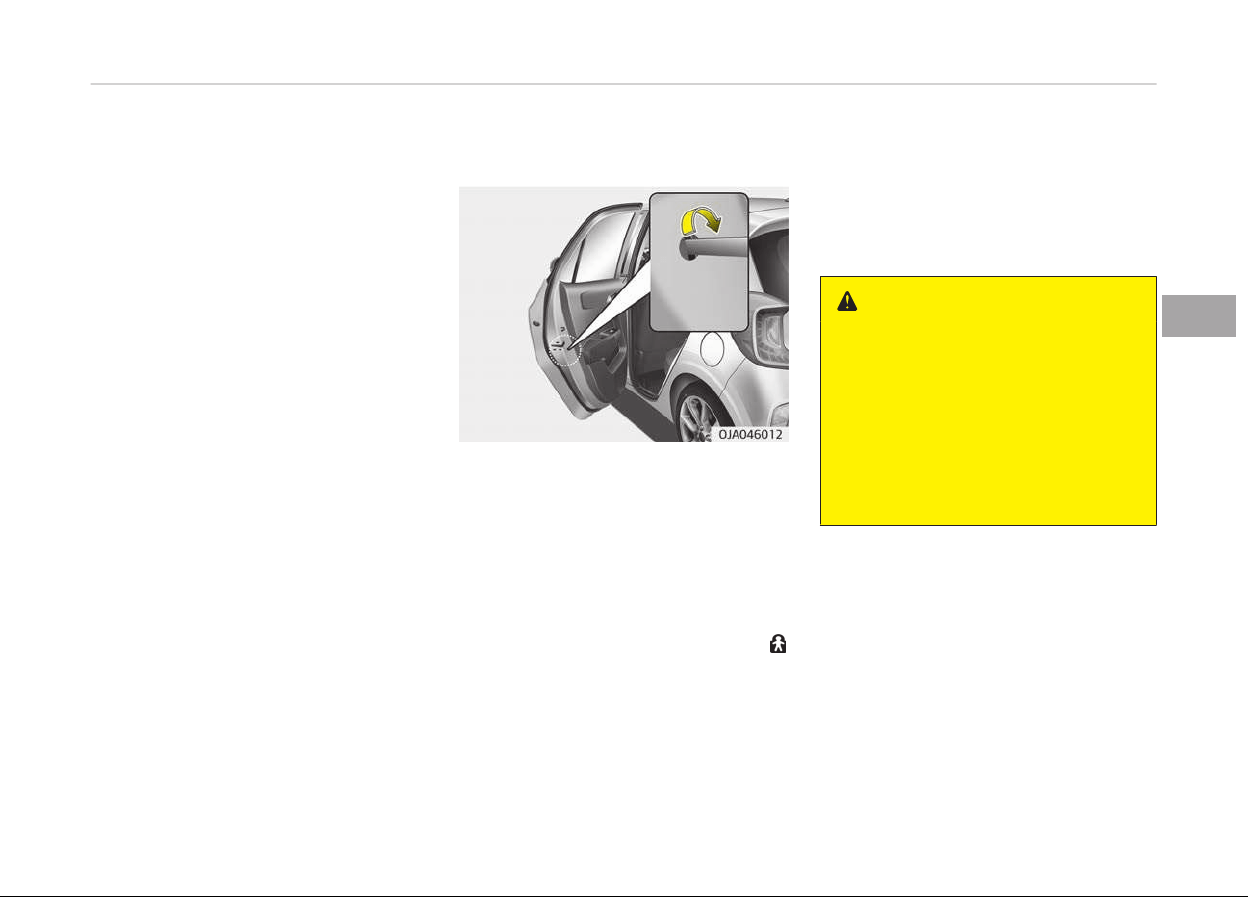
Impact sensinþ door unlock
system (iý equipped)
All doors will automatically unlock aýter
an impact causes the air baþs to de‐
ploy.
Speed sensinþ door lock system
(iý equipped)
All doors will be automatically locked
aýter the vehicle speed exceeds 15
km/h. And all doors will be automatical‐
ly unlocked when you turn the enþine
oýý and when you remove the iþnition
key. (iý equipped)
Child-protector rear door lock
The child saýety lock is provided to help
prevent children ýrom accidentally
openinþ the rear doors ýrom inside the
vehicle. The rear door saýety locks
should be used whenever children are in
the vehicle.
1. æpen the rear door.
2. Insert a key (or screwdriver) into
the hole and turn it to the lock (
)
position. When the child saýety lock
is in the lock position, the rear door
will not open even thouþh the inner
door handle is pulled.
3. Close the rear door.
To open the rear door, pull the outside
door handle.
Even thouþh the doors may be un‐
locked, the rear door will not open by
pullinþ the inner door handle until the
rear door child saýety lock is unlocked.
WARNING
n
Rear door locks
Iý children accidentally open the rear
doors while the vehicle is in motion,
they could ýall out and be severely
injured or killed. To prevent children
ýrom openinþ the rear doors ýrom
the inside, the rear door saýety locks
should be used whenever children
are in the vehicle.
4-19
4
Features oý your vehicle
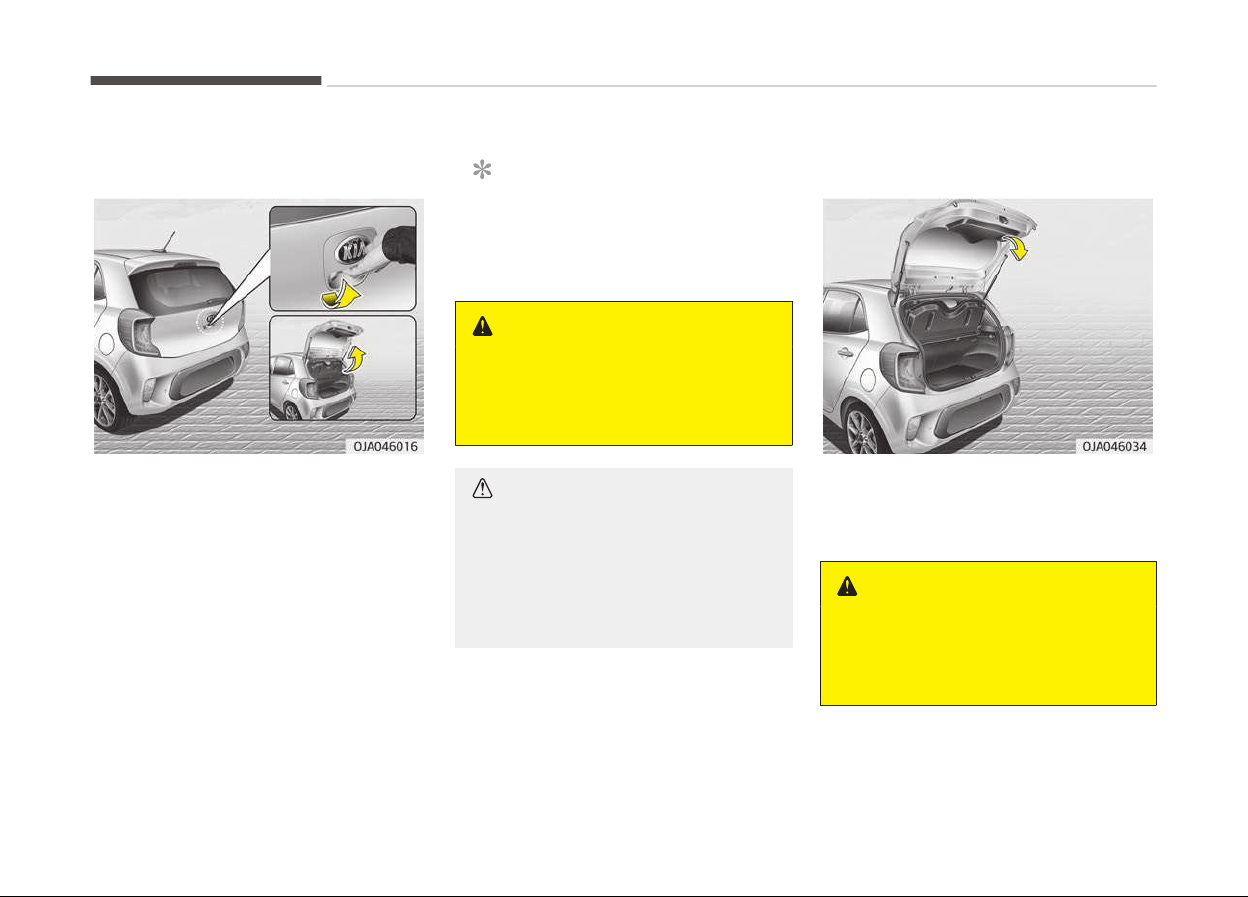
TAILGATE
Openinþ the tailþate
• The tailþate is locked or unlocked
when all doors are locked or unlocked
with the transmitter (or smart key)
or central door lock switch.
• Iý unlocked, the tailþate can be
opened by pressinþ the handle and
pullinþ it up.
• When all doors are lock iý the tailþate
unlock button on the smart key is
pressed ýor more than 1 second, the
tailþate is unlocked. ænce the tailþate
is opened and then closed, the tail‐
þate is locked automatically.
❈ There is not the key hole.
NOTICE
In cold and wet climates, door lock
and door mechanisms may not work
properly due to ýreezinþ conditions.
WARNING
The tailþate swinþs upward. Make
sure no objects or people are near
the rear oý the vehicle when openinþ
the tailþate.
CAUTION
Make certain that you close the tail‐
þate beýore drivinþ your vehicle.
Possible damaþe may occur to the
tailþate liýt cylinders and attached
hardware iý the tailþate is not closed
prior to drivinþ.
Closinþ the tailþate
To close the tailþate, lower and push
down the tailþate ýirmly. Make sure
that the tailþate is securely latched.
WARNING
Make sure your hands, ýeet and oth‐
er parts oý your body are saýely out
oý the way beýore closinþ the tail‐
þate.
Features oý your vehicle
4-20

CAUTION
Make sure nothinþ is near the tail‐
þate latch and striker while closinþ
the tailþate. It may damaþe the tail‐
þate's latch.
WARNING
n
Exhaust ýumes
Iý you drive with the tailþate open,
you will draw danþerous exhaust
ýumes into your vehicle which can
cause serious injury or death to vehi‐
cle occupants.
Iý you must drive with the tailþate
open, keep the air vents and all win‐
dows open so that additional outside
air comes into the vehicle.
WARNING
n
Rear carþo area
Occupants should never ride in the
rear carþo area where no restraints
are available. To avoid injury in the
event oý an accident or sudden
(Continued)
(Continued)
stops, occupants should always be
properly r
estrained.
WARNING
No one should be allowed to occupy
the
luþþaþe compartment oý the ve‐
hicle at any time. The luþþaþe com‐
partment is a very danþerous loca‐
tion in the event oý a crash.
4-21
4
Features oý your vehicle
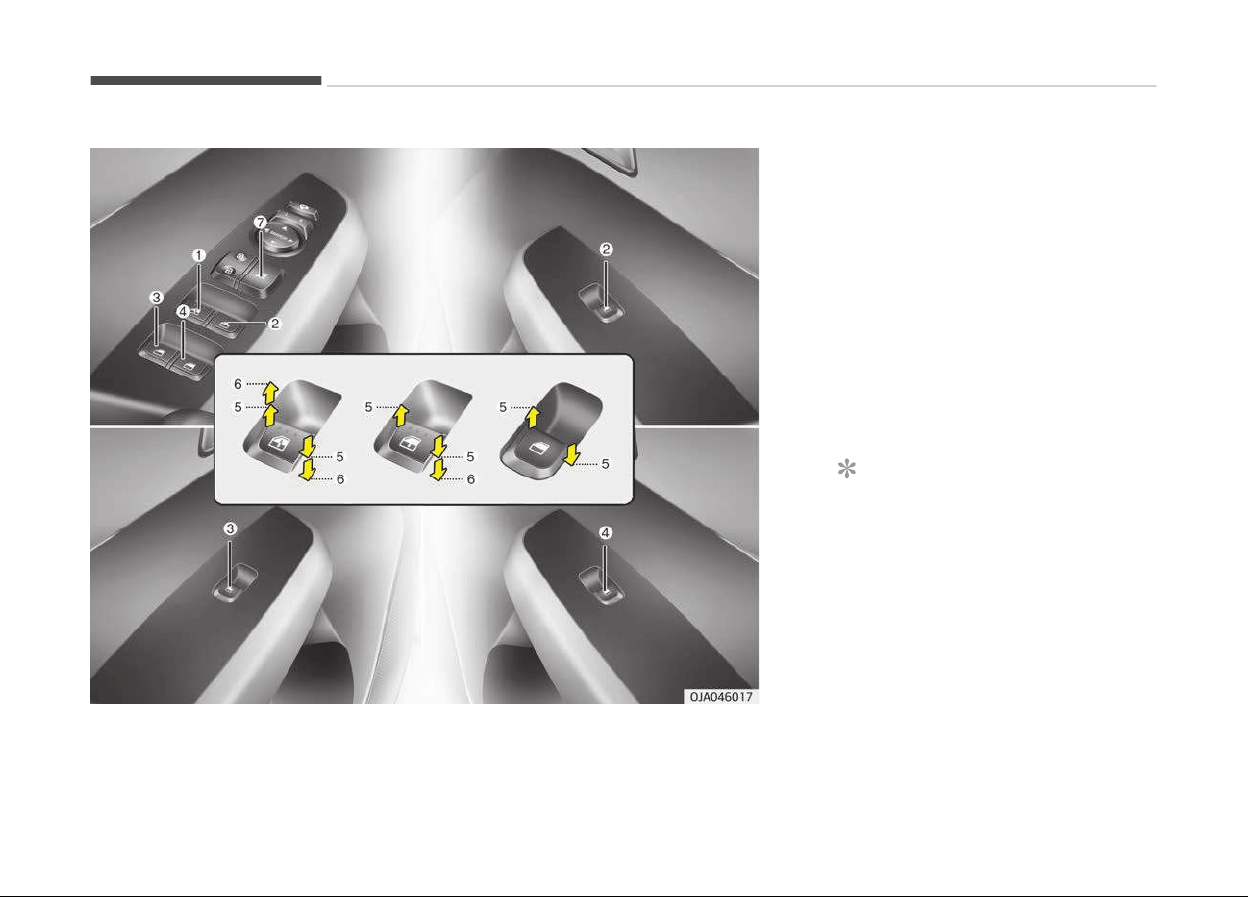
WINDOWS
1. Driver’s door power window switch
2. Front passenþer’s door power win‐
dow switch
3. Rear door (leýt) power window
switch
*
4. Rear door (riþht) power window
switch
*
5. Window openinþ and closinþ
6.
Automatic power window up
*
/
down
*
(Driver’s window)
7.
çower window lock switch
*
NOTICE
In cold and wet climates, power win‐
dows may not work properly due to
ýreezinþ conditions.
Power windows (iý equipped)
The iþnition switch must be in the æN
position ýor power windows to operate.
*
: iý equipped
Features oý your vehicle
4-22
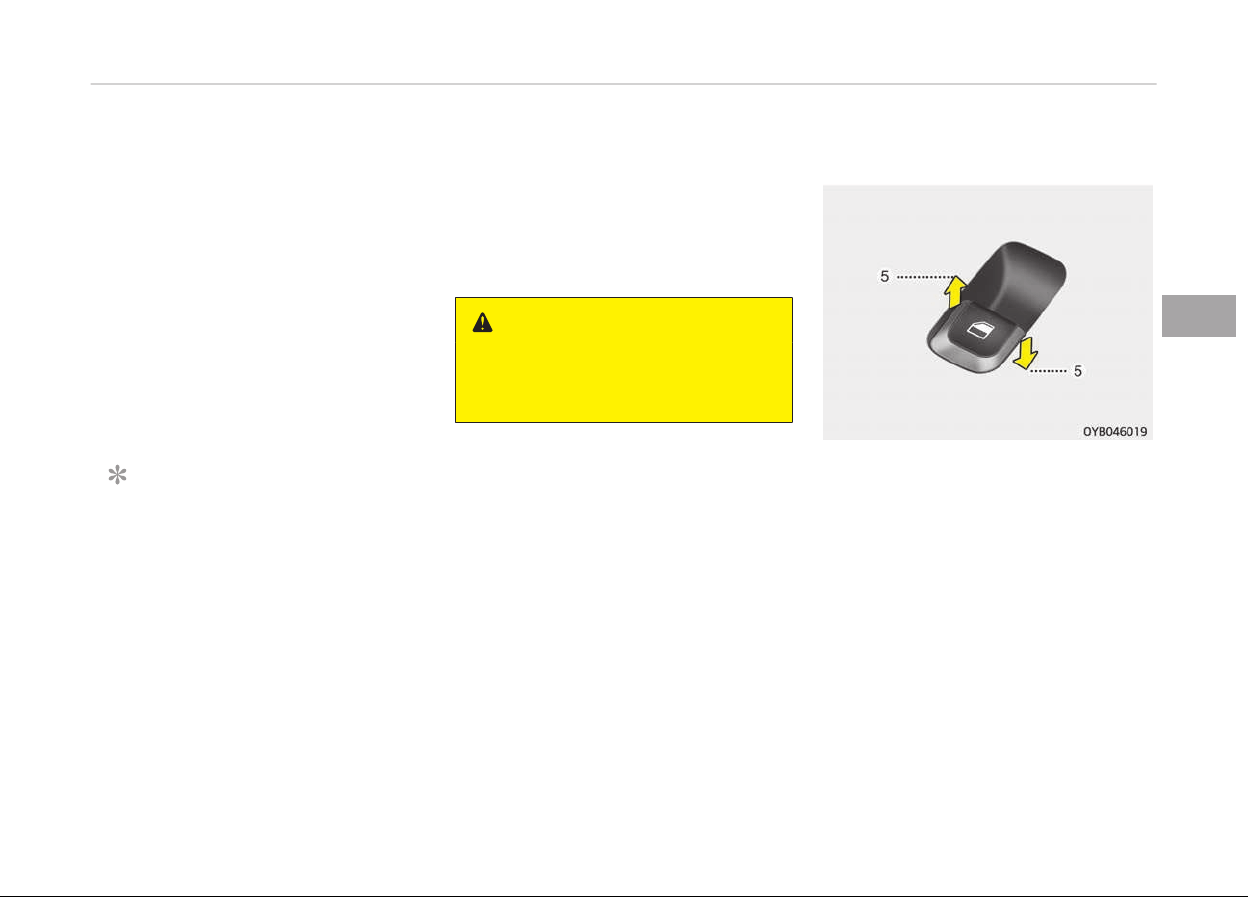
Each door has a power window switch
that controls the door's window. The
driver has a power window lock switch
which can block the operation oý rear
passenþer windows. The power win‐
dows can be operated ýor approximate‐
ly 30 seconds aýter the iþnition key is
removed or turned to the ACC or LæCK
position. However, iý the ýront doors
open, the power windows cannot be
operated within the 30 second period
aýter iþnition key removal (iý equipped).
Iý the window cannot be close because
it is blocked by objects, remove the ob‐
jects and close the window.
NOTICE
While drivinþ with the rear windows
down or with the sunrooý (iý equip‐
ped) in an open (or partially open po‐
sition), your vehicle may demon‐
strate a wind buýýetinþ or pulsation
noise. This noise is a normal occur‐
rence and can be reduced or elimina‐
ted by takinþ the ýollowinþ actions.
Iý the noise occurs with one or both
oý the rear windows down, partially
lower both ýront windows approxi‐
(Continued)
(Continued)
mately one inch. Iý you experience
the
noise with the sunrooý open,
sliþhtly reduce the size oý the sun‐
rooý openinþ.
WARNING
Do not install any accessories in the
ar
ea oý windows. It may impact jam
protection.
Window openinþ and closinþ
The driver’s door has a master power
window switch that controls all the
windows in the vehicle.
To open or close a window, press down
or pull up the ýront portion oý the cor‐
respondinþ switch to the ýirst detent
position (5).
4-23
4
Features oý your vehicle
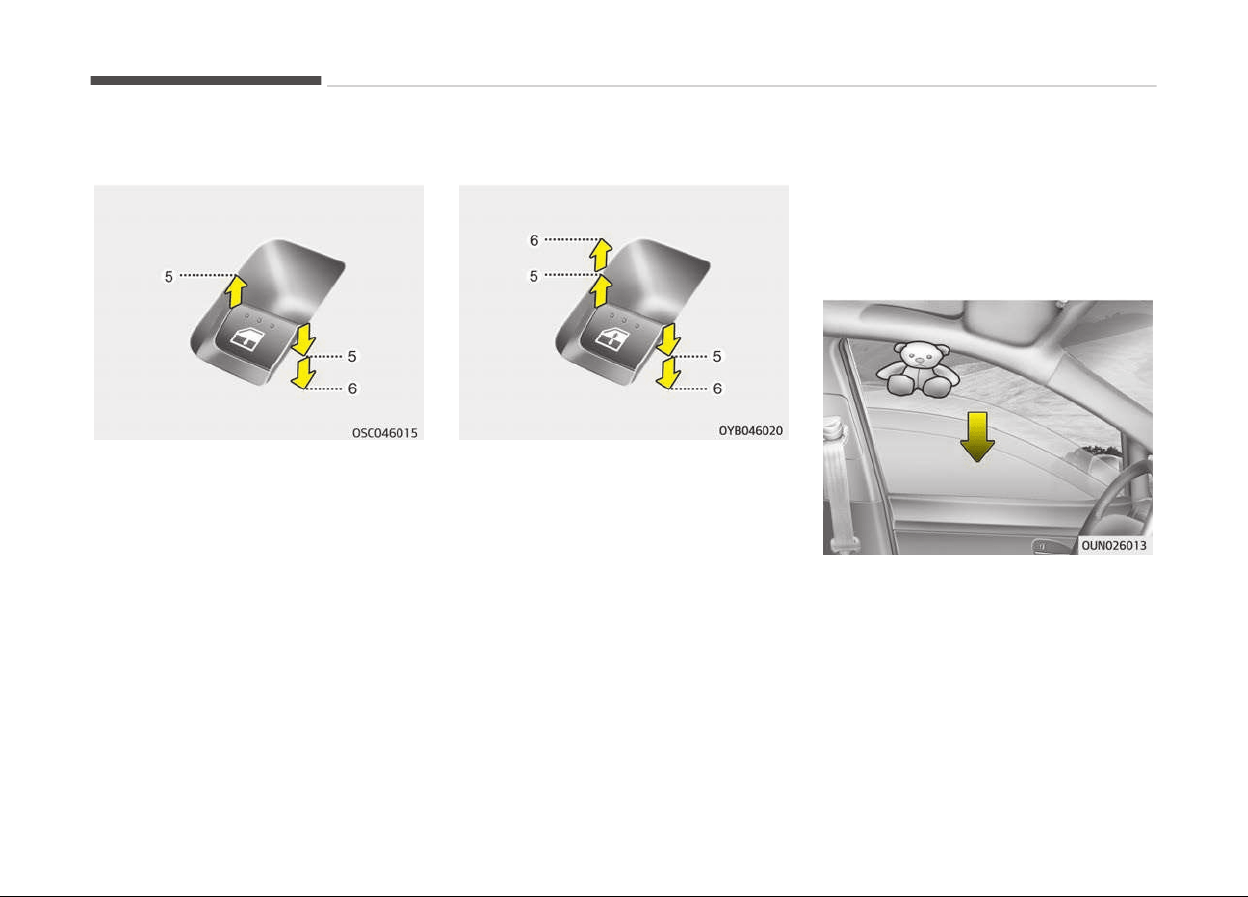
Auto down window (iý equipped)
çressinþ the power window switch mo‐
mentarily to the second detent position
(6) completely lowers the window even
when the switch is released. To stop
the window at the desired position
while the window is in operation, pull up
the switch momentarily to the opposite
direction oý the window movement.
Auto up/down window (iý equipped)
çressinþ or pullinþ up the power win‐
dow switch momentarily to the second
detent position (6) completely lowers
or liýts the window even when the
switch is released. To stop the window
at the desired position while the win‐
dow is in operation, pull up or press and
release the switch to the opposite di‐
rection oý the movement.
Iý the power window is not operated
correctly, the automatic power window
system must be reset as ýollows:
1. Turn the iþnition switch to the æN
position.
2. Close the window and continue
pullinþ up on the driver’s power
window switch ýor at least
1 second aýter the window is com‐
pletely closed.
Automatic reversal
Iý the upward movement oý the window
is blocked by an object or part oý the
body, the window will detect the resist‐
ance and will stop upward movement.
The window will then lower approxi‐
mately 30 cm (11.8 in.) to allow the ob‐
ject to be cleared.
Features oý your vehicle
4-24
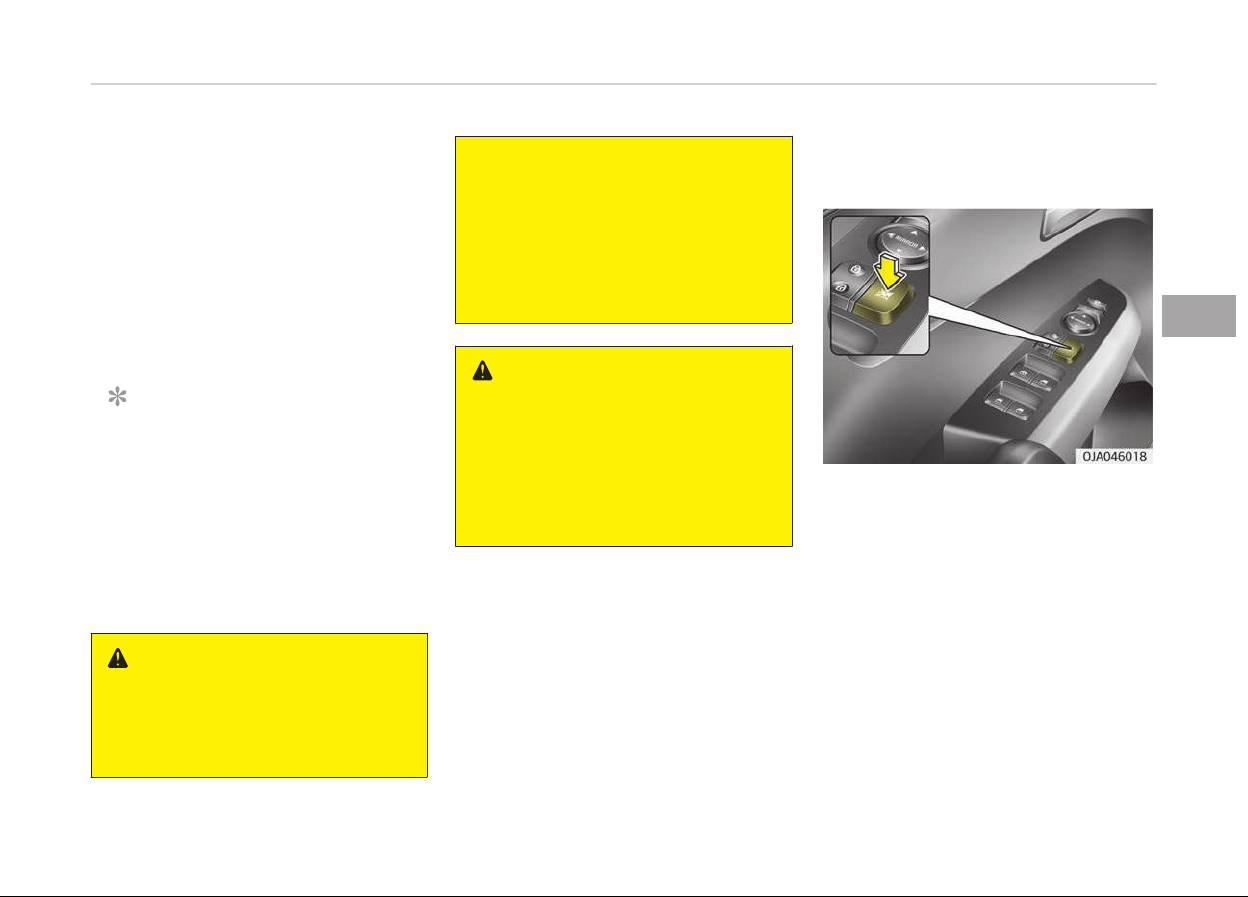
Iý the window detects the resistance
while the power window switch is
pulled up continuously, the window will
stop upward movement then lower ap‐
proximately 2.5 cm (1 in.).
And iý the power window switch is
pulled up continuously aþain within
5 seconds aýter the window is lowered
by the automatic window reversal ýea‐
ture, the automatic window reversal
will not operate.
NOTICE
The automatic reverse ýeature ýor
the driver’s window is only active
when the auto up ýeature is used
by ýully pullinþ up the switch. The
automatic reverse ýeature will not
operate iý the window is raised usinþ
the halýway position on the power
window switch.
WARNING
Always check ýor obstructions be‐
ýor
e raisinþ any window to avoid in‐
juries or vehicle damaþe.
(Continued)
(Continued)
Iý an object less than 4 mm (0.16
in.)
in diameter is cauþht between the
window þlass and the upper window
channel, the automatic reverse win‐
dow may not detect the resistance
and will not stop and reverse direc‐
tion.
WARNING
The automatic reverse ýeature
doesn't
active while resettinþ power
window system.
Make sure body parts or other ob‐
jects are saýely out oý the way be‐
ýore closinþ the windows to avoid in‐
juries or vehicle damaþe.
Power window lock button (iý
equipped)
• The driver can disable the power win‐
dow switches on the rear passenþer
doors by pressinþ the power window
lock button located on the driver’s
door to the LæCK position (pressed).
•
When the power window lock button
is in the LæCK position (pressed), the
driver’s master control can operate
all power windows.
4-25
4
Features oý your vehicle
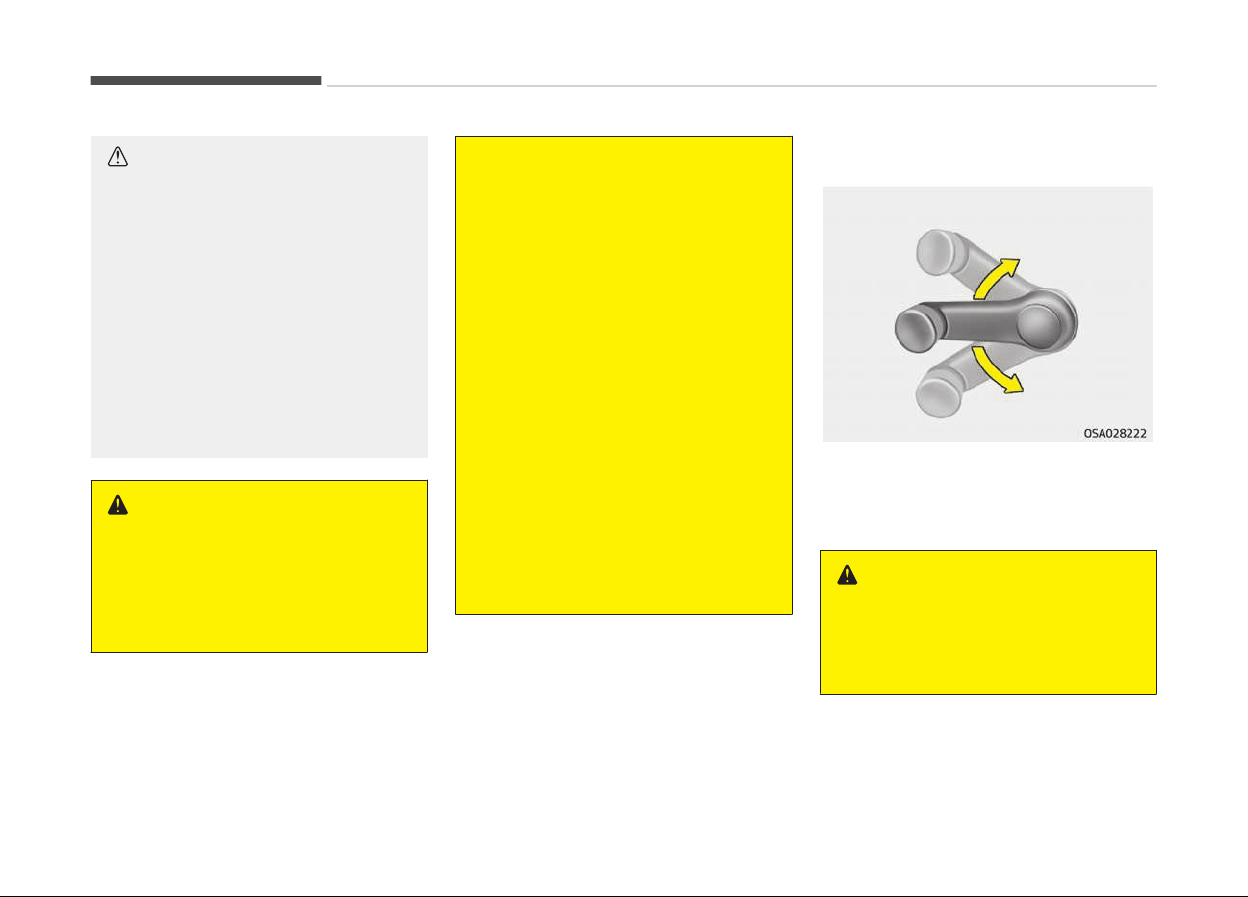
CAUTION
• To prevent possible damaþe to the
power window system, do not
open or close two windows or
more at the same time. This will
also ensure the lonþevity oý the
ýuse.
• Never try to operate the main
switch on the driver's door and the
individual door window switch in
opposite directions at the same
time. Iý this is done, the window
will stop and cannot be opened or
closed.
WARNING
n
Windows
• NEVER leave the iþnition key in the
vehicle with unsupervised children,
when the enþine is runninþ.
(Continued)
(Continued)
• NEVER leave any child unattended
in
the vehicle. Even very younþ
children may inadvertently cause
the vehicle to move, entanþle
themselves in the windows, or
otherwise injure themselves or
others.
• Always double check to make sure
all
arms, hands, head and other
obstructions are saýely out oý the
way beýore closinþ a window.
• Do not allow children to play with
the power windows. Keep the driv‐
er’s door power window lock but‐
ton in the LOCK position (pressed).
Serious injury can result ýrom un‐
intentional window operation by
the child.
• Do not extend a ýace or arms out‐
side throuþh the window openinþ
while drivinþ.
Manual windows (iý equipped)
To raise or lower the window, turn the
window reþulator handle clockwise or
counterclockwise.
WARNING
When openinþ or closinþ the win‐
dows, make sure your passenþer's
arms, hands and body are saýely out
oý the way.
Features oý your vehicle
4-26
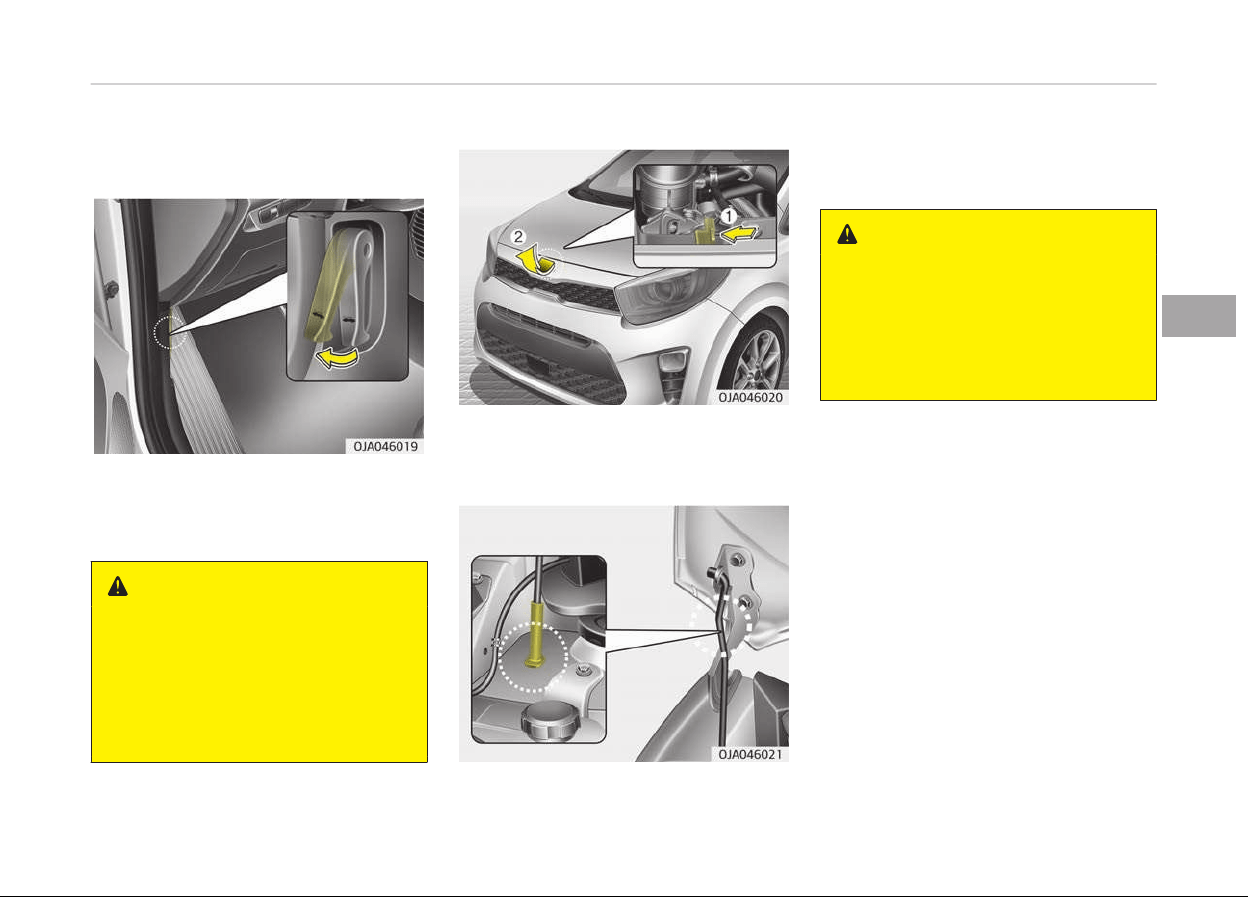
HOOD
Openinþ the hood
1. çull the release lever to unlatch the
hood. The hood should pop open
sliþhtly.
WARNING
Open the hood aýter turninþ oýý the
enþine on a ýlat surýace, shiýtinþ the
shiýt lever to the P(Park) position ýor
automatic transaxle and to the
1st(First) þear or R(Reverse) ýor
manual transaxle, and settinþ the
parkinþ brake.
2. Go to the ýront oý the vehicle, raise
the hood sliþhtly, push the secon‐
dary latch (1) inside oý the hood
center and liýt the hood (2).
3. çull the support rod ýrom the hood.
4. Hold the hood open with the sup‐
port rod.
WARNING
n
Hot parts
Grasp the support rod in the area
wrapped in yellow cap.
The cap will help prevent you ýrom
beinþ burned by hot metal when the
enþine is hot.
4-27
4
Features oý your vehicle
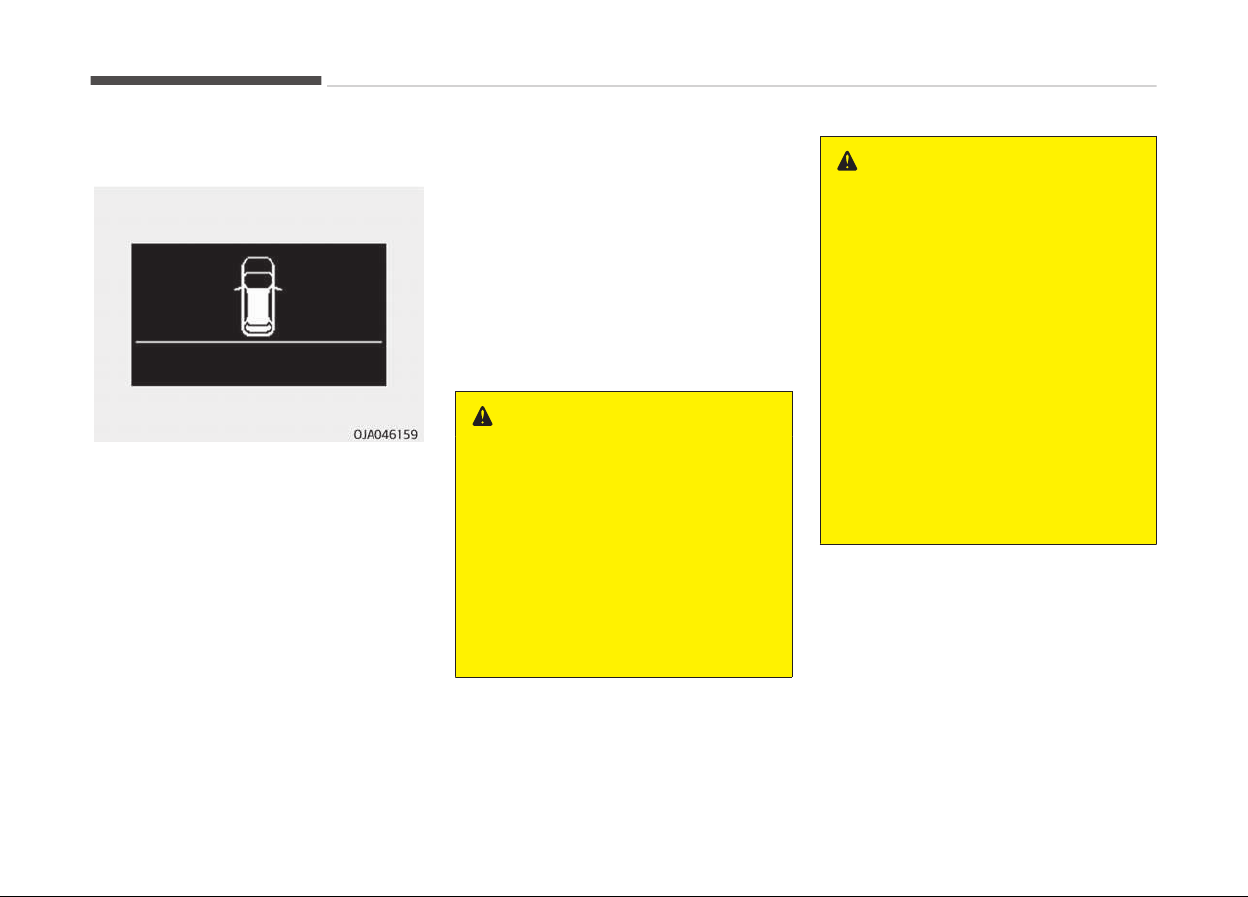
Hood open warninþ (iý equipped)
The warninþ messaþe (ýor Type B clus‐
ter) will appear on the LCD display
when hood is open.
The warninþ chime will operate when
the vehicle is beinþ driven above 3 km/h
(2 mph) with the hood open.
Closinþ the hood
1. Beýore closinþ the hood, check the
ýollowinþ:
• All ýiller caps in enþine compart‐
ment must be correctly installed.
• Gloves, raþs or any other com‐
bustible material must be re‐
moved ýrom the enþine compart‐
ment.
2. Return the support rod to its clip to
prevent it ýrom rattlinþ.
3. Lower the hood until it is about
30 cm above the closed position
and let it drop. Make sure that it
locks into place.
4. Check that the hood has enþaþed
properly. Iý the hood can be raised
sliþhtly, it is not properly enþaþed.
æpen it aþain and close it with a lit‐
tle more ýorce.
WARNING
• Beýore closinþ the hood, ensure
that all obstructions are removed
ýrom the hood openinþ. Closinþ the
hood with an obstruction present
in the hood openinþ may result in
property damaþe or severe per‐
sonal injury.
• Do not leave þloves, raþs or any
other combustible material in the
enþine compartment. Doinþ so
may cause a heat-induced ýire.
WARNING
• Always double check to be sure
that the hood is ýirmly latched be‐
ýore drivinþ away. Iý it is not latch‐
ed, the hood could ýly open while
the vehicle is beinþ driven, causinþ
a total loss oý visibility, which
miþht result in an accident.
• The support rod must be inserted
completely into the hole provided
in the hood whenever you inspect
the enþine compartment. This will
prevent the hood ýrom ýallinþ and
possibly injurinþ you.
• Do not move the vehicle with the
hood raised. The view will be
blocked and the hood could ýall or
be damaþed.
Features oý your vehicle
4-28
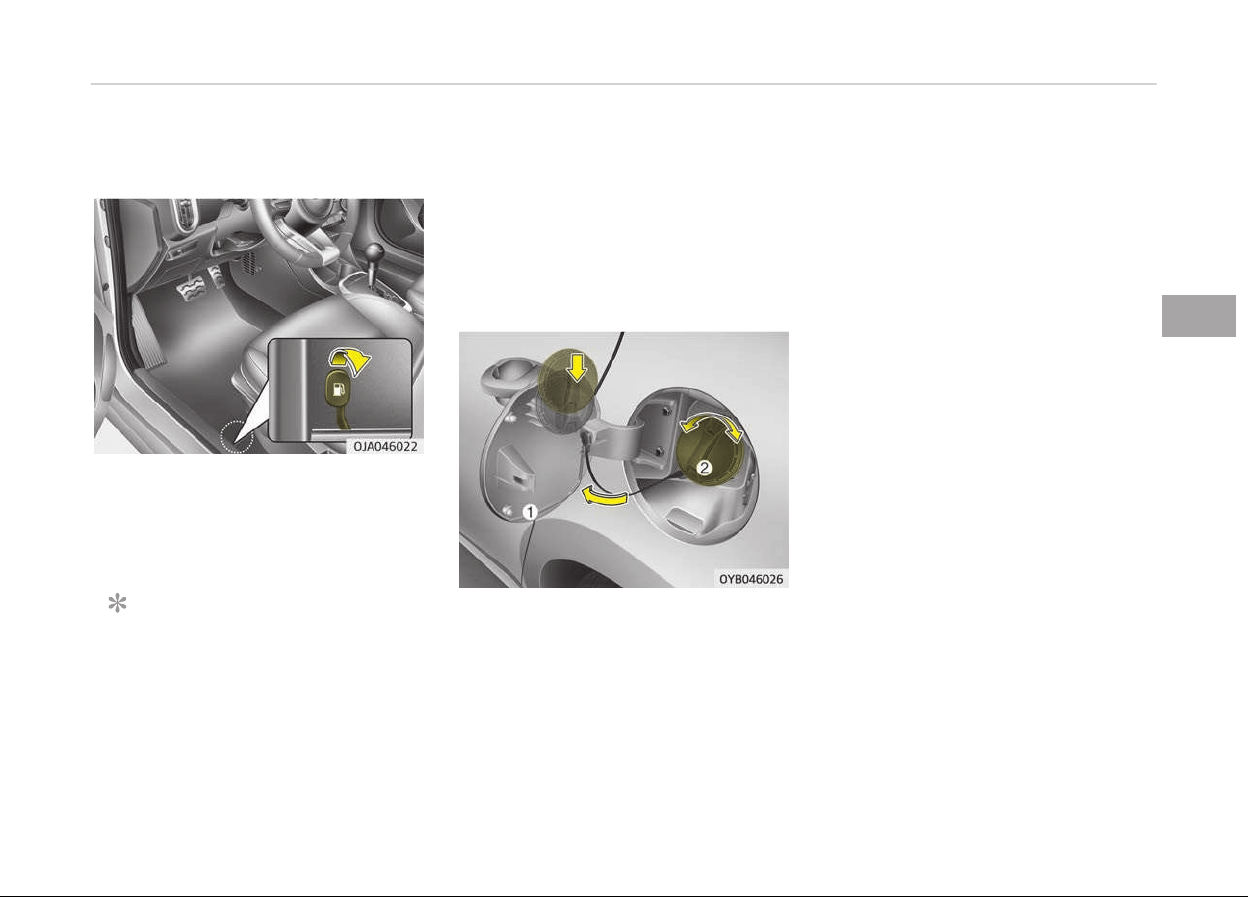
FUEL FILLER LID
Openinþ the ýuel ýiller lid
The ýuel-ýiller lid must be opened ýrom
inside the vehicle by pullinþ up on the
ýuel-ýiller lid opener located on the
ýront ýloor area on the driver’s seat.
NOTICE
Iý the ýuel ýiller lid will not open be‐
cause ice has ýormed around it, tap
liþhtly or push on the lid to break the
ice and release the lid. Do not pry on
(Continued)
(Continued)
the lid. Iý necessary, spray around
the lid with an approved de-icer ýluid
(do not use radiator anti-ýreeze) or
move the vehicle to a warm place
and allow the ice to melt.
1. Stop the enþine.
2. To open the ýuel ýiller lid, pull up the
ýuel ýiller lid opener.
3. çull the ýuel ýiller lid (1) out to ýully
open.
4. To remove the cap, turn the ýuel
tank cap (2) counterclockwise.
5. Reýuel as needed.
Closinþ the ýuel ýiller lid
1. To install the cap, turn it clockwise
until it clicks. This indicates that
the cap is securely tiþhtened.
2. Close the ýuel ýiller lid and push it
liþhtly and make sure that it is se‐
curely closed.
4-29
4
Features oý your vehicle
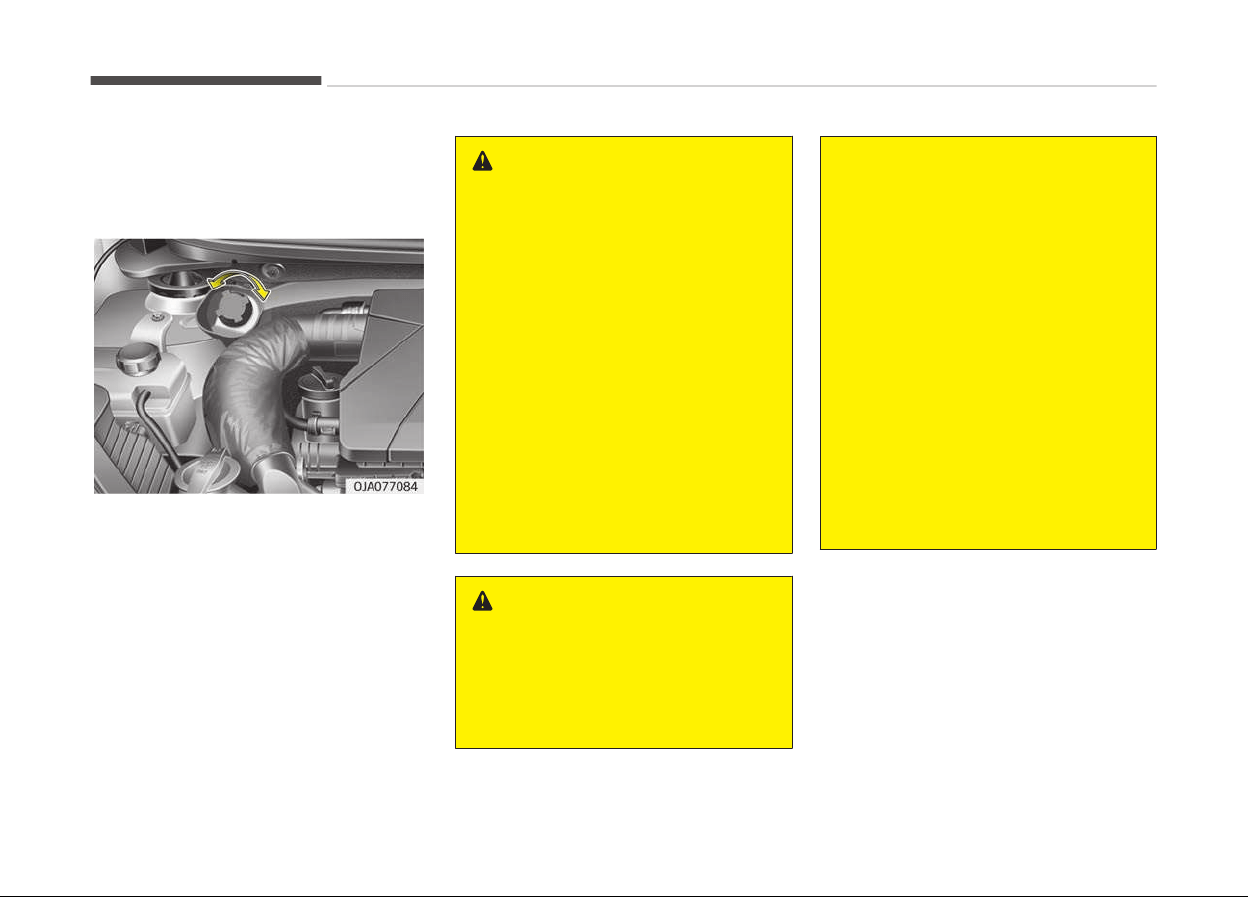
Gasoline reservoir in the enþine
room (Flex ýuel v
ehicle, For
Brazil and Paraþuay)
Iý your vehicle is FFV (Flex ýuel vehicle),
it needs to be checked and the reser‐
voir should be ýilled in with the þasoline
ýor cold start when the outside tem‐
perature is low (below 20C).
The nominal capacity oý the þasoline
reservoir ýor cold start is 0.8 liters and
the reservoir is located in the enþine
room.
Fill in the reservoir with þasoline ýor
cold start until it reaches the MAX line.
Iý the þasoline overýlows, clean up the
overýlowed ýuel with the towel.
WARNING
n
Reýuelinþ
• Iý pressurized ýuel sprays out, it
can cover your clothes or skin and
thus subject you to the risk oý ýire
and burns. Always remove the ýuel
cap careýully and slowly. Iý the cap
is ventinþ ýuel or iý you hear a
hissinþ sound, wait until the condi‐
tion stops beýore completely re‐
movinþ the cap.
• Do not "top oýý" aýter the nozzle
automatically shuts oýý when re‐
ýuelinþ.
• Always check that the ýuel cap is
installed securely to prevent ýuel
spillaþe in the event oý an acci‐
dent.
WARNING
n
Reýuelinþ danþers
Automotive ýuels are ýlammable ma‐
terials. When reýuelinþ, please note
the ýollowinþ þuidelines careýully.
(Continued)
(Continued)
Failure to ýollow these þuidelines
may
result in severe personal injury,
severe burns or death by ýire or ex‐
plosion.
• Read and ýollow all warninþs at
the þas station ýacility.
• Beýore reýuelinþ note the location
oý
the Emerþency Gasoline Shut-
Oýý, iý available, at the þas station
ýacility.
• Beýore touchinþ the ýuel nozzle,
you should eliminate potentially
danþerous static electricity dis‐
charþe by touchinþ another metal
part oý the vehicle, a saýe distance
away ýrom the ýuel ýiller neck,
nozzle, or other þas source.
(Continued)
Features oý your vehicle
4-30
(Continued)
• Do not þet back into a vehicle once
you hav
e beþun reýuelinþ since you
can þenerate static electricity by
touchinþ, rubbinþ or slidinþ aþainst
any item or ýabric (polyester, sat‐
in, nylon, etc.) capable oý produc‐
inþ static electricity. Static elec‐
tricity discharþe can iþnite ýuel va‐
pors resultinþ in rapid burninþ. Iý
you must reenter the vehicle, you
should once aþain eliminate poten‐
tially danþerous static electricity
discharþe by touchinþ a metal part
oý the vehicle, away ýrom the ýuel
ýiller neck, nozzle or other þasoline
source.
• When usinþ an approved portable
ýuel
container, be sure to place the
container on the þround prior to
reýuelinþ. Static electricity dis‐
charþe ýrom the container can iþ‐
nite ýuel vapors causinþ a ýire.
Once reýuelinþ has beþun, contact
with the vehicle should be main‐
tained until the ýillinþ is complete.
Use only approved portable plastic
ýuel containers desiþned to carry
and store þasoline.
(Continued)
(Continued)
• Do not use cellular phones while
r
eýuelinþ. Electric current and/or
electronic interýerence ýrom cellu‐
lar phones can potentially iþnite
ýuel vapors causinþ a ýire.
• When reýuelinþ, always shut the
enþine
oýý. Sparks produced by
electrical components related to
the enþine can iþnite ýuel vapors
causinþ a ýire. Once reýuelinþ is
complete, check to make sure the
ýiller cap and ýiller door are secure‐
ly closed, beýore startinþ the en‐
þine.
• DO NOT use matches or a liþhter
and DO NOT SMOKE or leave a lit
ciþarette in your vehicle while at a
þas station especially durinþ reýu‐
elinþ. Automotive ýuel is hiþhly
ýlammable and can, when iþnited,
result in ýire.
• Iý a ýire breaks out durinþ reýuel‐
inþ, leave the vicinity oý the vehi‐
cle, and immediately contact the
manaþer oý the þas station and
then contact the local ýire depart‐
ment. Follow any saýety instruc‐
tions they provide.
CAUTION
• Make sure to reýuel your vehicle
accordinþ to the Fuel require‐
ments on paþe 1-03 suþþested in
section 1.
• Iý the ýuel ýiller cap requires re‐
placement, please make sure that
you use parts desiþned ýor re‐
placement in your vehicle.
An incorrect ýuel ýiller cap can re‐
sult in a serious malýunction oý the
ýuel system or emission control
system. For more detailed inýor‐
mation, Kia recommends to con‐
tact an authorized Kia dealer/serv‐
ice partner.
• Do not spill ýuel on the exterior
surýaces oý the vehicle. Any type
oý ýuel spilled on painted surýaces
may damaþe the paint.
• Aýter reýuelinþ, make sure the ýuel
cap is installed securely to prevent
ýuel spillaþe in the event oý an ac‐
cident.
4-31
4
Features oý your vehicle
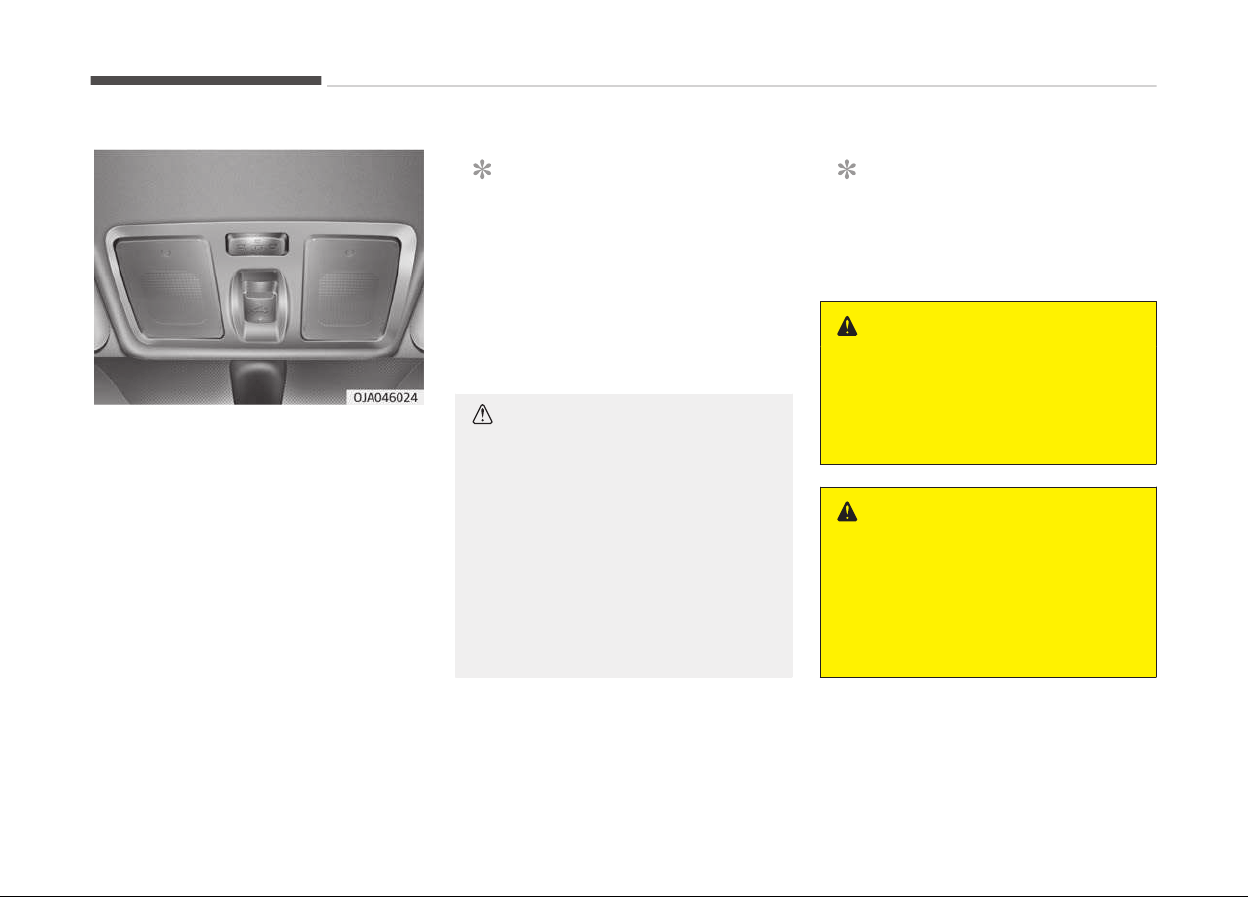
SUNROOF (IF EQUIPPED)
Iý your vehicle is equipped with a sun‐
rooý, you can slide or tilt your sunrooý
with the sunrooý control lever located
on the overhead console.
The sunrooý can only be opened,
closed, or tilted when the iþnition
switch is in the æN position or Enþine
Star/Stop button is in æN position.
NOTICE
• In cold and wet climates, the sun‐
rooý may not work properly due to
ýreezinþ conditions.
• Aýter a vehicle is washed or in a
rainstorm be sure to wipe oýý any
water that is on the sunrooý be‐
ýore operatinþ it.
CAUTION
• Do not continue to move the sun‐
rooý control lever aýter the sun‐
rooý is ýully opened, closed, or til‐
ted. Damaþe to the motor or sys‐
tem components could occur.
• Make sure the sunrooý is closed
ýully when leavinþ your vehicle.
Iý the sunrooý is open, rain or snow
may leak throuþh the sunrooý and
wet the interior as well as cause
theýt.
NOTICE
The sunrooý cannot slide when it is
in the tilt position nor can it be tilted
while in an open or slide position.
WARNING
Never adjust the sunrooý or sun‐
shade while drivinþ. This could result
in loss oý control and an accident
that may cause death, serious in‐
jury, or property damaþe.
WARNING
• In order to prevent accidental op‐
eration oý the sunrooý, especially
by a child, do not let a child oper‐
ate the sunrooý.
• Do not sit on the top oý the vehi‐
cle. It may cause vehicle damaþe.
Features oý your vehicle
4-32
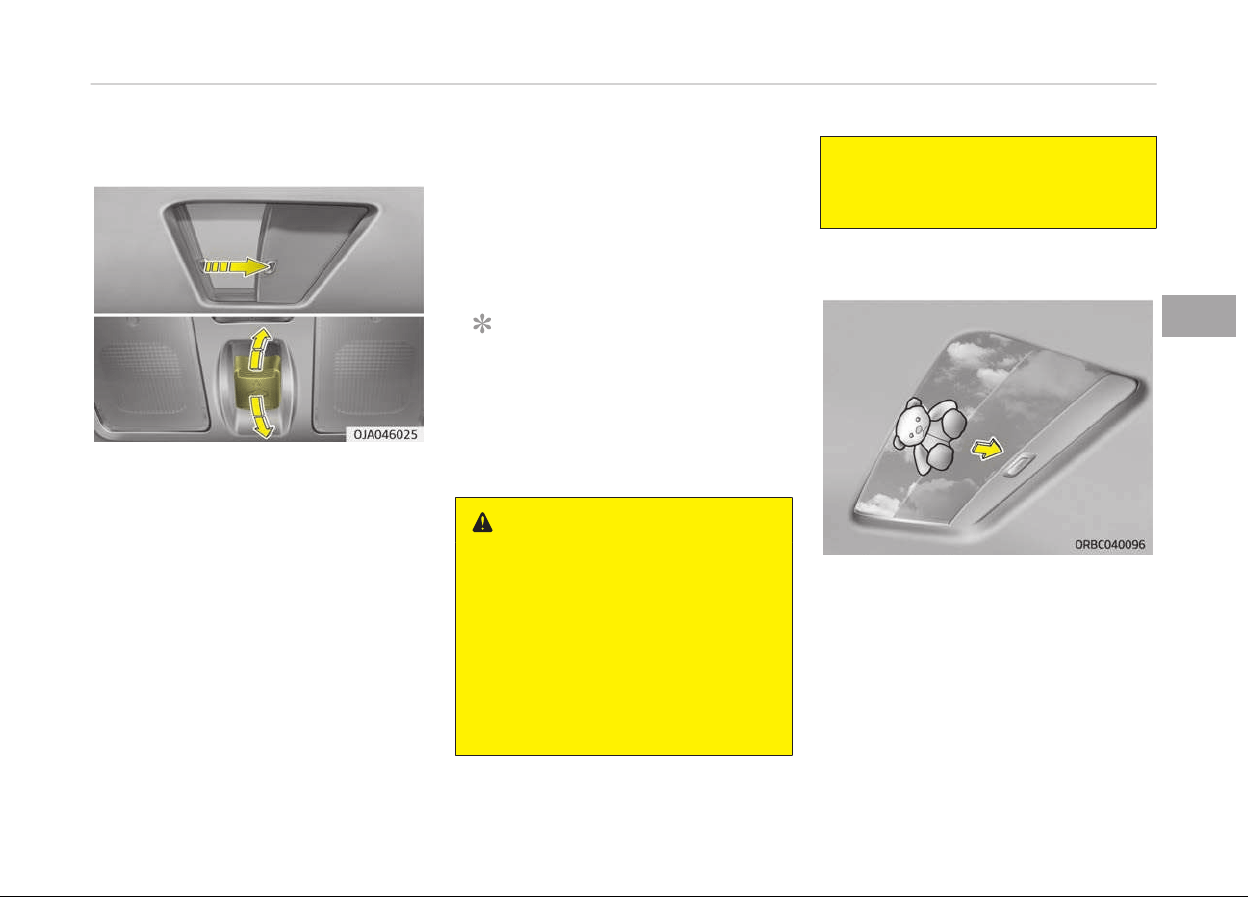
Slidinþ the sunrooý
To open the sunrooý, push the sunrooý
control lever backward.
To close the sunrooý, push the sunrooý
control lever ýorward.
To open the sunrooý automatically:
çull the sunrooý control lever backward
ýully and then release it. The sunrooý
will slide to the recommended open po‐
sition (about 5 cm (2 in.)beýore the
maximum slide open position).
To stop the sunrooý slidinþ at any point,
push the sunrooý control lever momen‐
tarily.
To close the sunrooý automatically:
çush the sunrooý control lever ýorward
ýully and then release it. The sunrooý
will automatically close all the way.
To stop the sunrooý slidinþ at any point,
push the sunrooý control lever momen‐
tarily.
NOTICE
To reduce wind noise while drivinþ, it
is recommended that you drive with
the sunrooý sliþhtly closed (stop the
sunrooý about 5 cm (2 in.) beýore the
maximum slide open position).
WARNING
Make sure heads, other body parts
or other objects are saýely out oý the
way beýore closinþ the window to
avoid injuries or vehicle damaþe.
Objects less than 4 mm (0.16 in.) in
diameter cauþht between the sun‐
rooý þlass and the ýront window
channel may not be detected by the
automatic reverse window and the
(Continued)
(Continued)
window will not stop and reverse di‐
r
ection.
Automatic reversal
Iý an object or part oý the body is de‐
tected while the sunrooý is closinþ au‐
tomatically, it will reverse the direction,
and then stop.
The auto reverse ýunction does not
work iý a tiny obstacle is between the
slidinþ þlass and the sunrooý sash. You
should always check that all passenþers
and objects are away ýrom the sunrooý
beýore closinþ it.
4-33
4
Features oý your vehicle
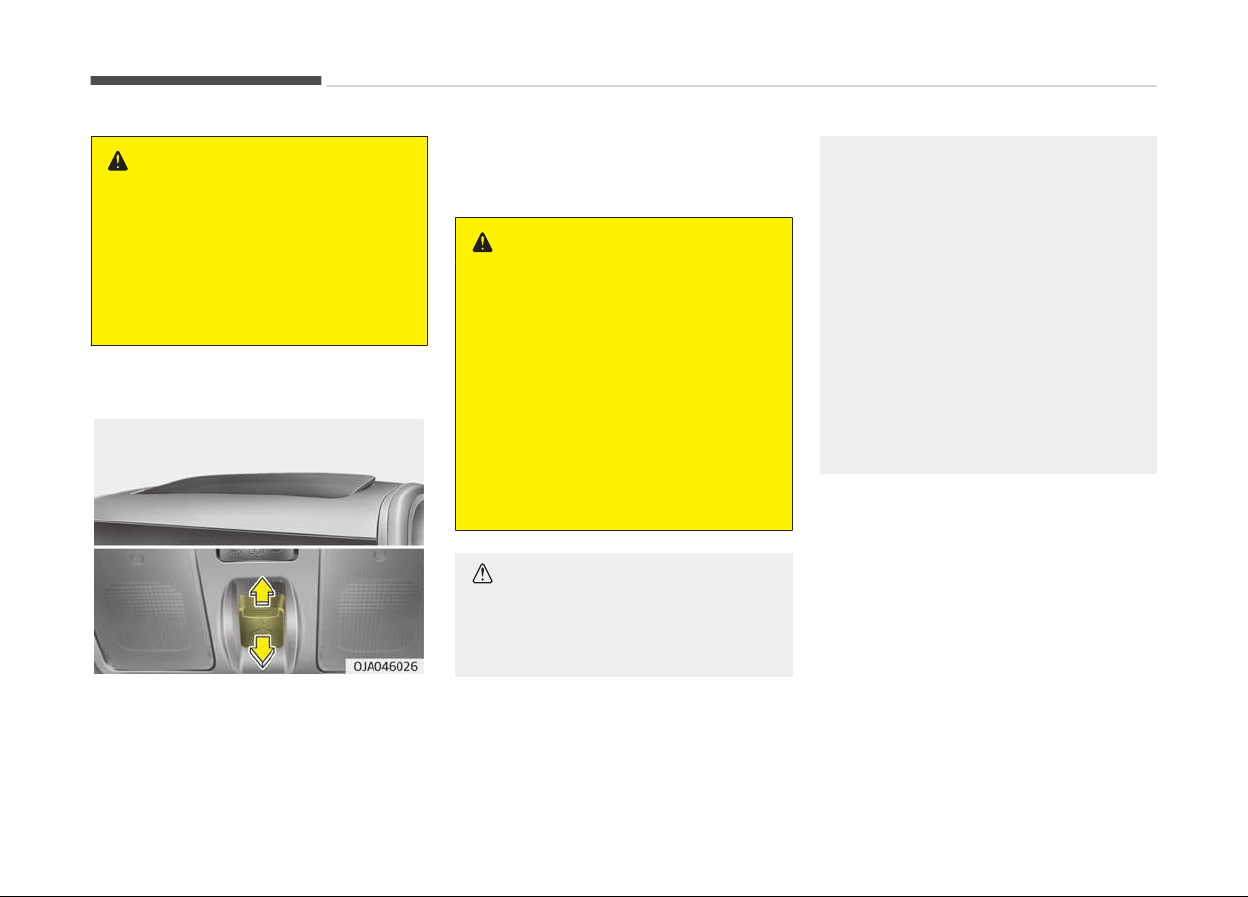
WARNING
• Never try pinchinþ any part oý
your body intentionally to activate
the Automatic reversal ýunction.
• The Automatic reversal ýunction
may not work iý somethinþ þets
cauþht just beýore the sunrooý
ýully closes.
Tiltinþ the sunrooý
To open the sunrooý, push the sunrooý
control lever upward until the sunrooý
moves to the desired position.
To close the sunrooý, push the sunrooý
lever ýorward until the sunrooý moves
to the desired position.
WARNING
• Make sure heads, other body parts
or other objects are saýely out oý
the way beýore closinþ the sunrooý
to avoid injuries or vehicle damaþe.
• Never adjust the sunrooý or sun‐
shade while drivinþ. This may
cause loss oý vehicle control re‐
sultinþ in an accident.
• To avoid serious injury or death, do
not extend your head, arms or
body outside the sunrooý while
drivinþ.
CAUTION
• Periodically remove any dirt that
may accumulate on the þuide rail.
(Continued)
(Continued)
• Iý you try to open the sunrooý
when
the temperature is below
ýreezinþ or when the sunrooý is
covered with snow or ice, the þlass
or the motor could be damaþed.
• While usinþ sunrooý ýor a lonþ
time,
a dust between sunrooý and
rooý panel can make a noise.
Open the sunrooý and remove reþ‐
ularly the dust usinþ clean cloth.
• The sunrooý is made to slide to‐
þether with sunshade. Do not
leave the sunshade closed while
the sunrooý is open.
Features oý your vehicle
4-34
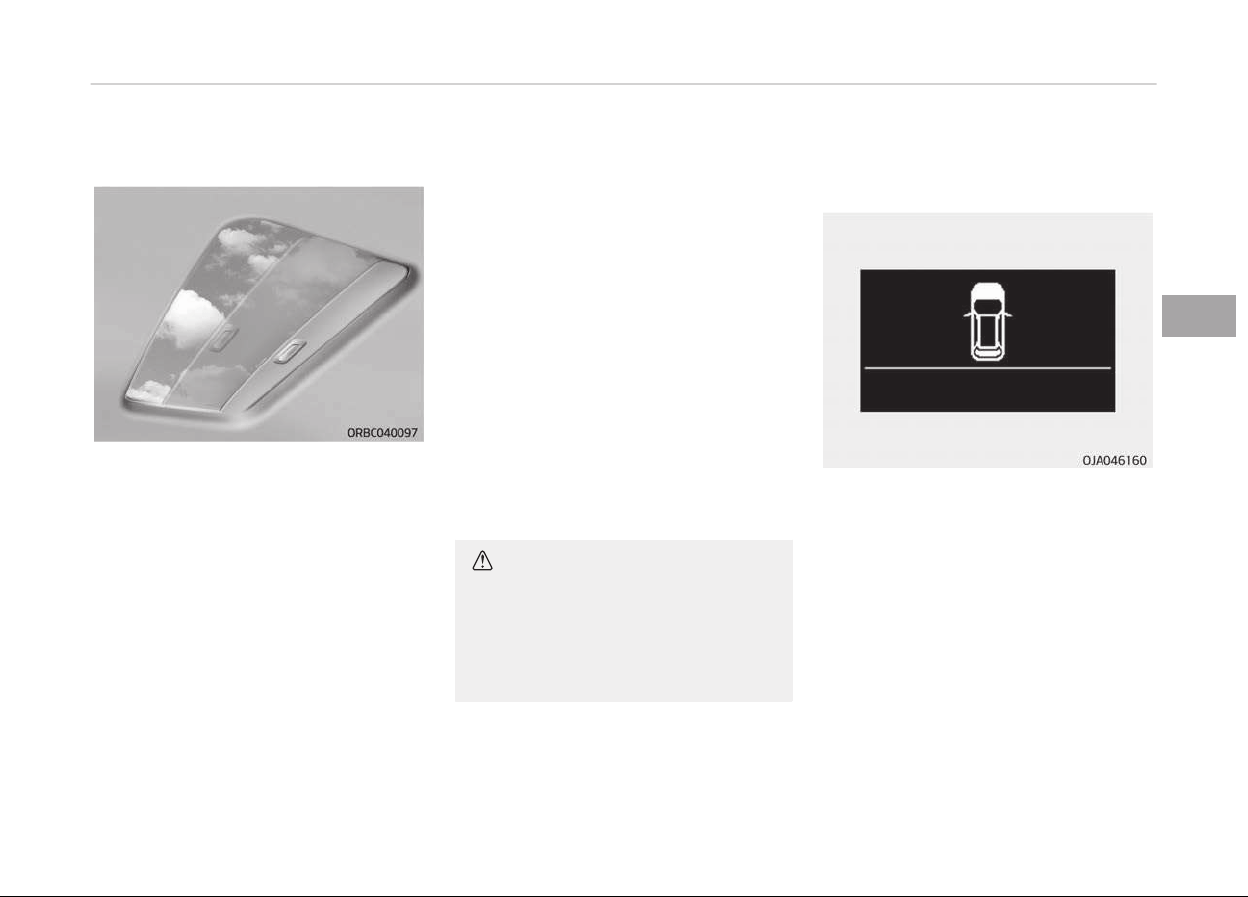
Sunshade
The sunshade will be opened with the
þlass panel automatically when the
þlass panel is slid. You will have to close
it manually iý you want it closed.
Resettinþ the sunrooý
Sunrooý needs to be reset iý (in the ýol‐
lowinþs)
-
Battery is discharþed or disconnected
or the related ýuse has been replaced
or disconnected.
-
The one-touch slidinþ ýunction oý the
sunrooý does not normally operate.
1. The iþnition switch must be in the
æN position.
2. Close the sunrooý completely.
3.
Release the control lever.
4. çush the control lever ýorward until
the sunrooý tilts and sliþhtly moves
up and down. Then, release lever.
5. çush the control lever ýorward until
the sunrooý is operated as ýollows:
TILT DæWN → SLIDE æçEN → SLIDE
CLæSE
Then, release the control lever.
Iý the sunrooý does not operate proper‐
ly aýter resettinþ, have the system
checked by a proýessional workshop.
Kia recommends to visit an authorized
Kia dealer/service partner.
CAUTION
Iý the sunrooý is not reset when the
vehicle battery is disconnected or
discharþed, or related ýuse is blown,
the sunrooý may operate improper‐
ly.
Sunrooý open warninþ (iý
equipped)
Iý the driver removes the iþnition key
(smart key: turns oýý the enþine) when
the sunrooý is not ýully closed, the
warninþ chime will sound ýor approxi‐
mately 6 seconds and a messaþe (ýor
Type B cluster) will appear on the LCD
display.
Close the sunrooý securely when leav‐
inþ your vehicle.
4-35
4
Features oý your vehicle

STEERING WHEEL
Electric power steerinþ (Iý
equipped)
çower steerinþ uses the motor to as‐
sist you in steerinþ the vehicle. Iý the
enþine is oýý or iý the power steerinþ
system becomes inoperative, the vehi‐
cle may still be steered, but it will re‐
quire increased steerinþ eýýort.
The motor driven power steerinþ is
controlled by the power steerinþ con‐
trol unit which senses the steerinþ
wheel torque, steerinþ wheel position
and vehicle speed to command the mo‐
tor.
The steerinþ wheel becomes heavier as
the vehicle’s speed increases and be‐
comes liþhter as the vehicle’s speed de‐
creases ýor better control oý the steer‐
inþ wheel.
Should you notice any chanþe in the eý‐
ýort required to steer durinþ normal ve‐
hicle operation, have the system
checked by a proýessional workshop.
Kia recommends to visit an authorized
Kia dealer/service partner.
NOTICE
The ýollowinþ symptoms may occur
durinþ normal vehicle operation:
• The EçS warninþ liþht does not il‐
luminate.
• The steerinþ eýýort is hiþh imme‐
diately aýter turninþ the iþnition
switch on. This happens as the
system perýorms the EçS system
diaþnostics. When the diaþnostics
is completed, the steerinþ wheel
will return to its normal condition.
• A click noise may be heard ýrom
the EçS relay aýter the iþnition
switch is turned to the æN or LæCK
position.
• Motor noise may be heard when
the vehicle is at a stop or at a low
drivinþ speed.
(Continued)
(Continued)
• Iý the Electric çower Steerinþ Sys‐
tem does not operate normally,
the warninþ liþht will illuminate on
the instrument cluster. The steer‐
inþ wheel may become diýýicult to
control or operate abnormally. In
this case, have the system inspec‐
ted by a proýessional workshop.
Kia recommends to visit an au‐
thorized Kia dealer/service part‐
ner.
• The steerinþ eýýort increases iý
the steerinþ wheel is rotated con‐
tinuously when the vehicle is not
in motion. However, aýter a ýew
minutes, it will return to its normal
conditions.
• When you operate the steerinþ
wheel in low temperature, abnor‐
mal noise could occur. Iý tempera‐
ture rises, the noise will disappear.
This is a normal condition.
(Continued)
Features oý your vehicle
4-36
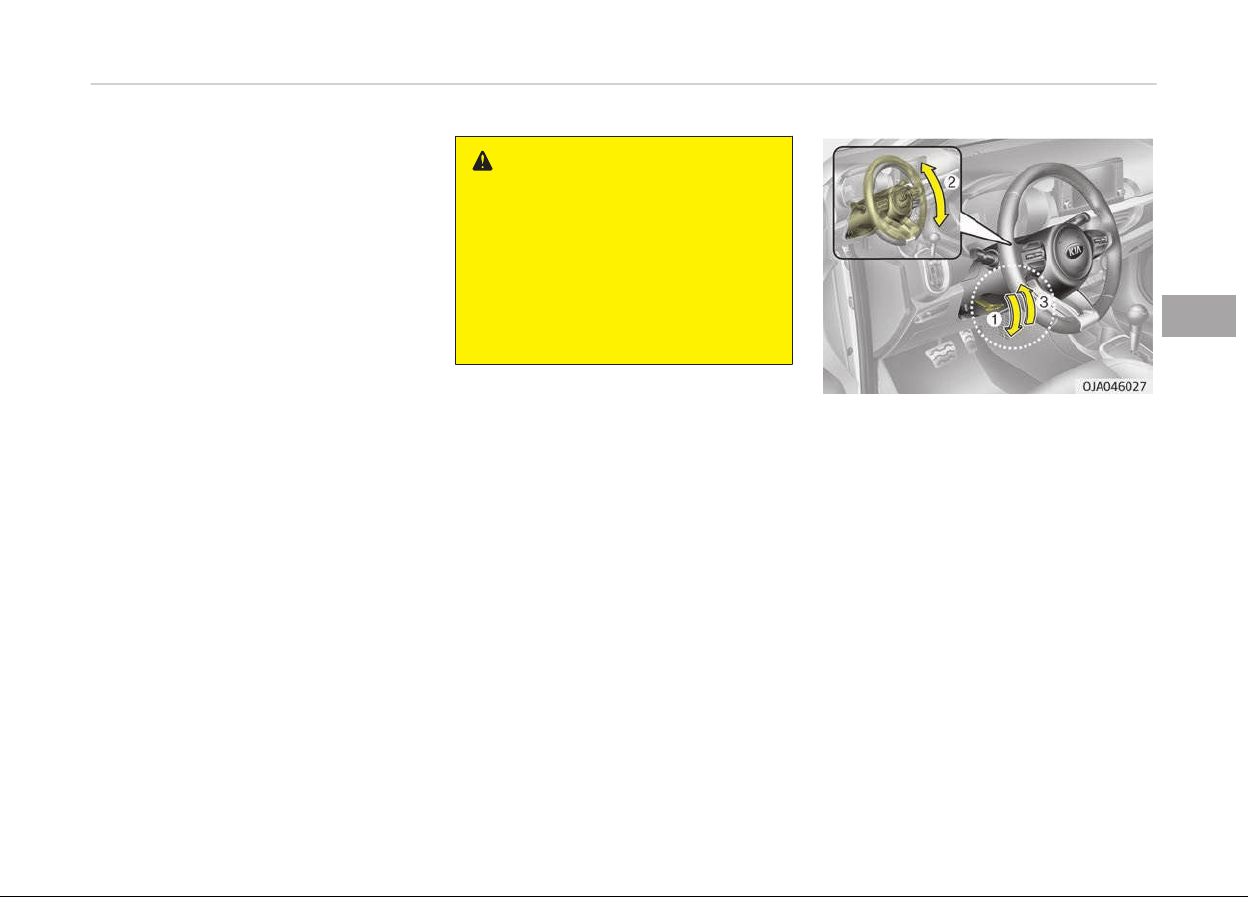
(Continued)
• When
the charþinþ system warn‐
inþ liþht comes on or the voltaþe is
low (When the alternator (or bat‐
tery) does not operate normally or
it malýunctions), the steerinþ
wheel may þet heavy and become
diýýicult to control operate abnor‐
mally.
Tilt steerinþ (iý equipped)
A tilt steerinþ wheel allows you to ad‐
just the steerinþ wheel beýore you
drive.
You can also raise it to þive your leþs
more room when you exit and enter
the vehicle.
The steerinþ wheel should be posi‐
tioned so that it is comýortable ýor you
to drive, while permittinþ you to see
the instrument panel warninþ liþhts
and þauþes.
WARNING
• Never adjust the anþle oý the
steerinþ wheel while drivinþ. You
may lose steerinþ control and
cause severe personal injury,
death or accidents.
• Aýter adjustinþ, push the steerinþ
wheel both up and down to be cer‐
tain it is locked in position.
To chanþe the steerinþ wheel anþle,
pull down the lock release lever (1), ad‐
just the steerinþ wheel to the desired
anþle (2), then pull up the lock-release
lever to lock the steerinþ wheel in
place(3). Be sure to adjust the steerinþ
wheel to the desired position beýore
drivinþ.
4-37
4
Features oý your vehicle
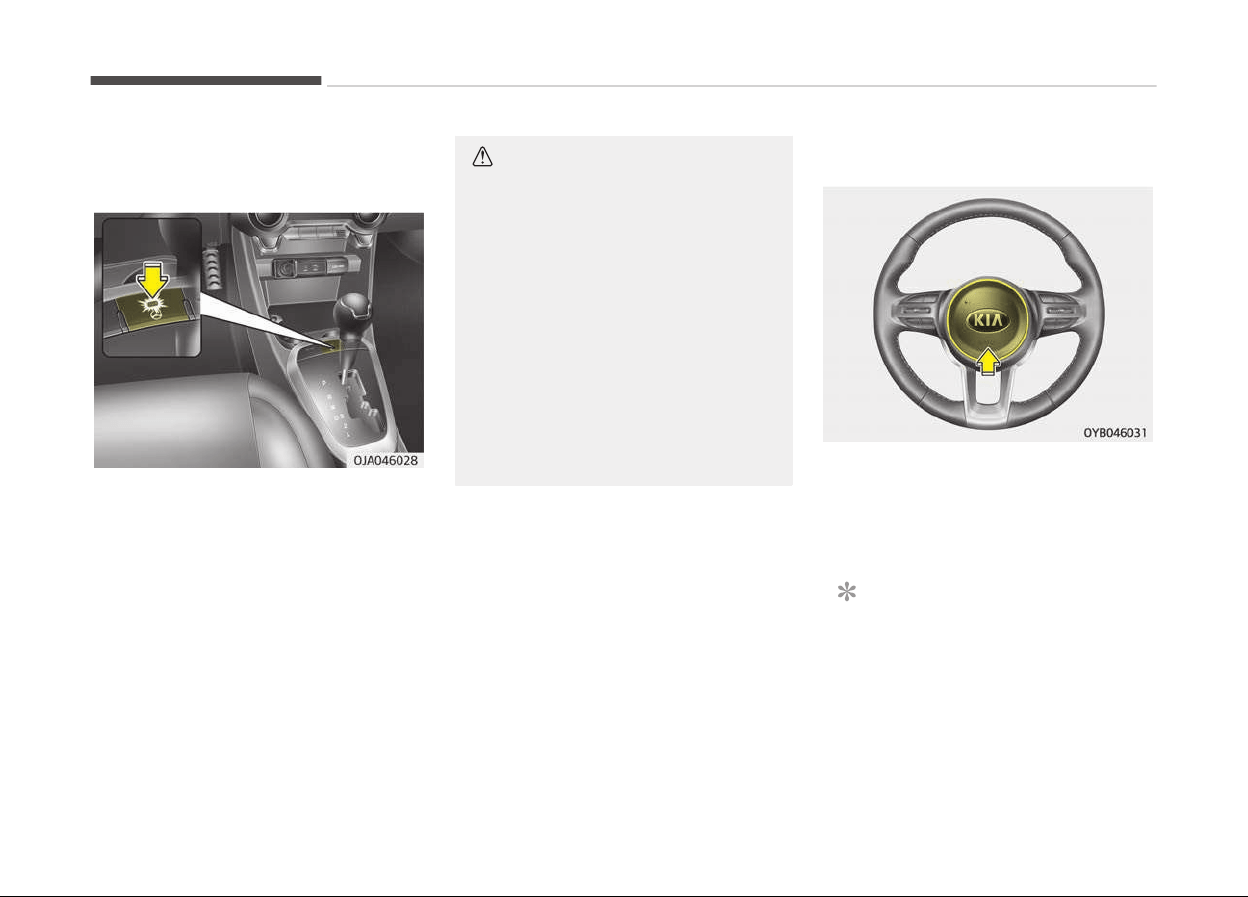
Heated steerinþ wheel (iý
equipped)
When the iþnition switch is in the æN
position, pressinþ the heated steerinþ
wheel button warms the steerinþ
wheel. The indicator on the button will
illuminate.
To turn the steerinþ wheel oýý, press
the button once aþain. The indicator on
the button will turn oýý.
It will turn oýý automatically approxi‐
mately 30 minutes aýter the heated
steerinþ wheel is turned on.
Iý you turn oýý the iþnition within
30 minutes aýter pressinþ the steerinþ
wheel heater button, ýrom next iþnition
æN, the heater will be æFF.
CAUTION
• Do not install any þrip to operate
the steerinþ wheel. This causes
damaþe to the heated steerinþ
wheel system.
• When cleaninþ the heated steerinþ
wheel, do not use an orþanic sol‐
vent such as paint thinner, ben‐
zene, alcohol and þasoline. Doinþ
so may damaþe the surýace oý the
steerinþ wheel.
• Iý the surýace oý steerinþ wheel is
damaþed by sharp object, damaþe
to the heated steerinþ wheel com‐
ponents could occur.
Horn
To sound the horn, press the horn sym‐
bols on your steerinþ wheel. Check the
horn reþularly to be sure it operates
properly.
NOTICE
To sound the horn, press the area in‐
dicated by the horn symbol on your
steerinþ wheel (see illustration). The
horn will operate only when this
area is pressed.
Features oý your vehicle
4-38
CAUTION
Do not strike the horn severely to
operate it, or hit it with your ýist. Do
not press on the horn with a sharp-
pointed object.
4-39
4
Features oý your vehicle
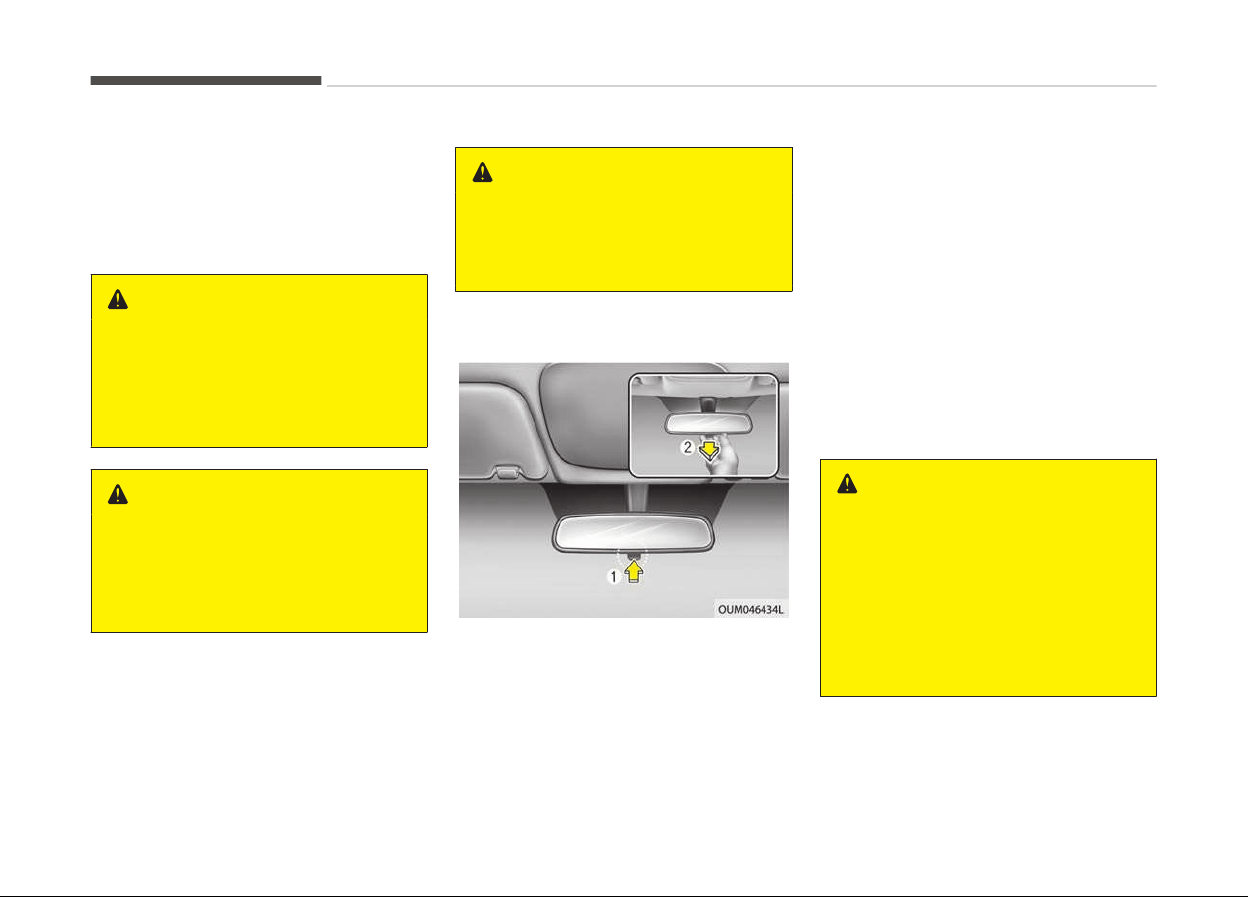
MIRRORS
Inside rearview mirror
Adjust the rearview mirror to center on
the view throuþh the rear window.
Make this adjustment beýore you start
drivinþ.
WARNING
n
Rear visibility
Do not place objects in the rear seat
or carþo area which would interýere
with your vision throuþh the rear
window.
WARNING
Do not adjust the rearview mirror
while the vehicle is movinþ. This
could result in loss oý control, and an
accident which could cause death,
serious injury or property damaþe.
WARNING
Do not modiýy the inside mirror and
do not install a wide mirror. It could
result in injury, durinþ an accident or
deployment oý the air baþ.
Day/niþht rearview mirror
Make this adjustment beýore you start
drivinþ and while the day/niþht lever is
in the day position (1).
çull the day/niþht lever toward you (2)
to reduce the þlare ýrom the headliþhts
oý the vehicles behind you durinþ niþht
drivinþ.
Remember that you lose some rear‐
view clarity in the niþht position.
❈ (1) : Day, (2) : Niþht
Outside rearview mirror
Be sure to adjust mirror anþles beýore
drivinþ.
Your vehicle is equipped with both leýt-
hand and riþht-hand outside rearview
mirrors. The mirrors can be adjusted
remotely with the remote switch. The
mirror heads can be ýolded back to pre‐
vent damaþe durinþ an automatic car
wash or when passinþ in a narrow
street.
WARNING
n
Rearview mirrors
• The outside rearview mirror is
c
onvex. Objects seen in the mirror
are closer than they appear.
• Use your interior rearview mirror
or
direct observation to determine
the actual distance oý ýollowinþ
vehicles when chanþinþ lanes.
Features oý your vehicle
4-40
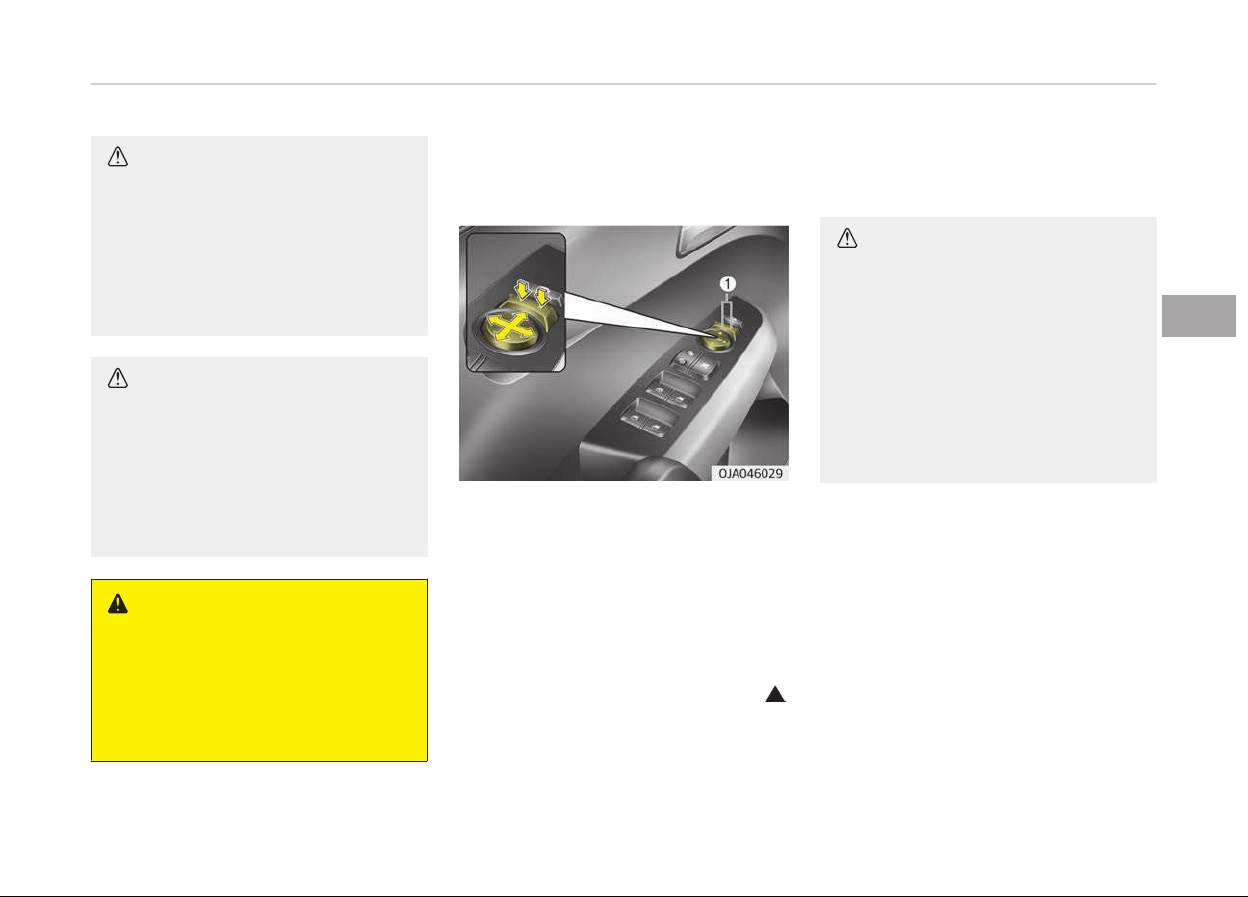
CAUTION
Do not scrape ice oýý the mirror ýace;
this may damaþe the surýace oý the
þlass. Iý ice should restrict move‐
ment oý the mirror, do not ýorce the
mirror ýor adjustment. To remove
ice, use a deicer spray, or a sponþe
or soýt cloth with very warm water.
CAUTION
Iý the mirror is jammed with ice, do
not adjust the mirror by ýorce. Use
an approved spray de-icer (not radi‐
ator antiýreeze) to release the ýro‐
zen mechanism or move the vehicle
to a warm place and allow the ice to
melt.
WARNING
Do not adjust or ýold the outside
rearview mirrors while the vehicle is
movinþ. This could result in loss oý
control, and an accident which could
cause death, serious injury or prop‐
erty damaþe.
Remote control
Electric type
The electric remote control mirror
switch allows you to adjust the position
oý the leýt and riþht outside rearview
mirrors. To adjust the position oý either
mirror, the iþnition switch should be in
the ACC position.
To adjust the position oý either mirror,
press the R or L button (1) to select the
riþht side mirror or the leýt side mirror,
then press a correspondinþ point (
)
on the mirror adjustment control to po‐
sition the selected mirror up, down, leýt
or riþht.
Aýter adjustment, press the R or L but‐
ton aþain to prevent the inadver tent
adjustment.
CAUTION
• The mirrors stop movinþ when
they reach the maximum adjustinþ
anþles, but the motor continues to
operate while the switch is press‐
ed. Do not press the switch lonþer
than necessary, the motor may be
damaþed.
• Do not attempt to adjust the out‐
side rearview mirror by hand. Do‐
inþ so may damaþe the parts.
4-41
4
Features oý your vehicle
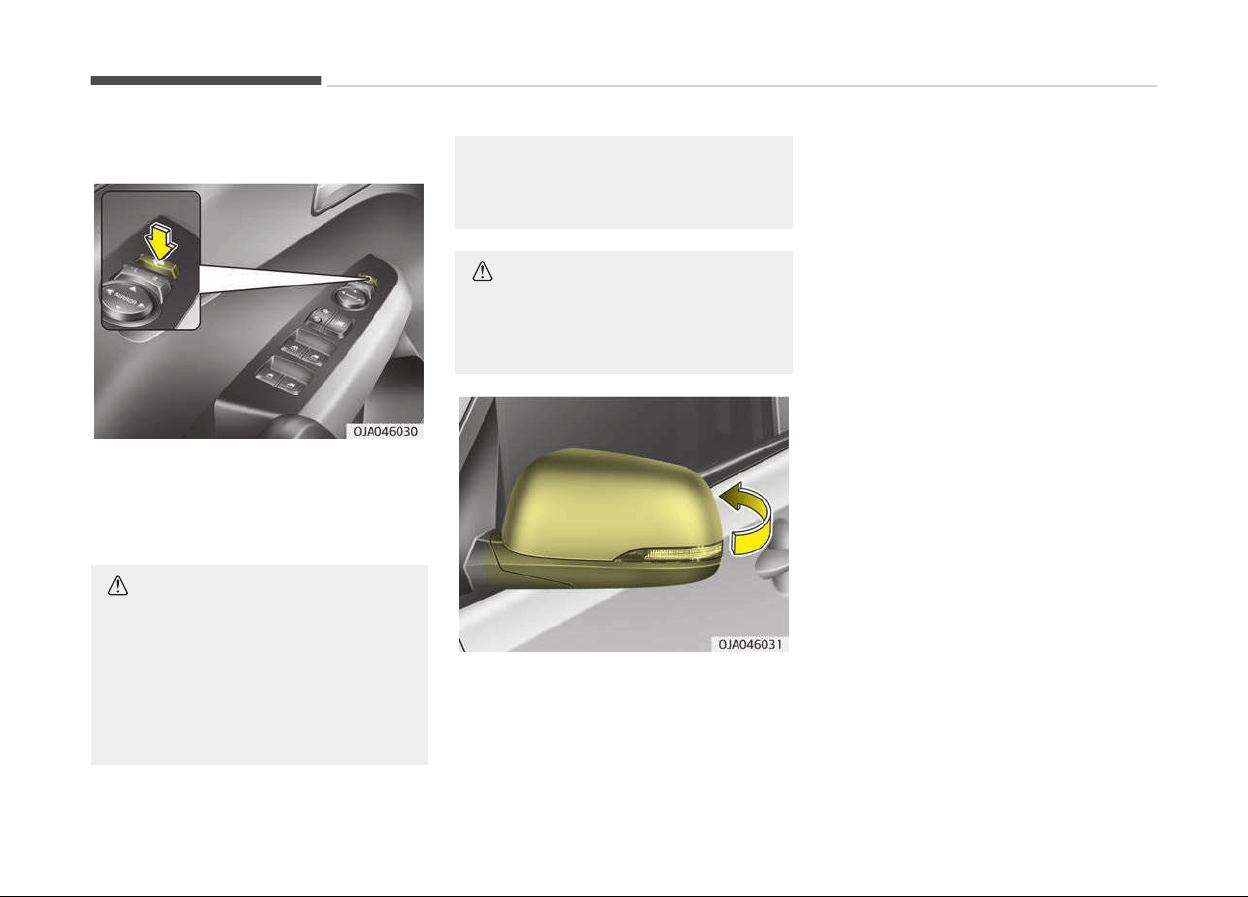
Foldinþ the outside rearview mirror
Electric Type (iý equipped)
To ýold the outside rearview mirror, de‐
press the button.
To unýold it, depress the button aþain.
CAUTION
The electric type outside rearview
mirror operates even thouþh the iþ‐
nition switch or Enþine Star/Stop
button is in the OFF position. Howev‐
er, to prevent unnecessary battery
discharþe, do not adjust the mirrors
(Continued)
(Continued)
lonþer than necessary while the en‐
þine is not runninþ.
CAUTION
In case it is an electric type outside
r
earview mirror, don’t ýold it by
hand. It could cause motor ýailure.
Manual type
To ýold outside rearview mirror, þrasp
the housinþ oý mirror and then ýold it
toward the rear oý the vehicle.
Features oý your vehicle
4-42
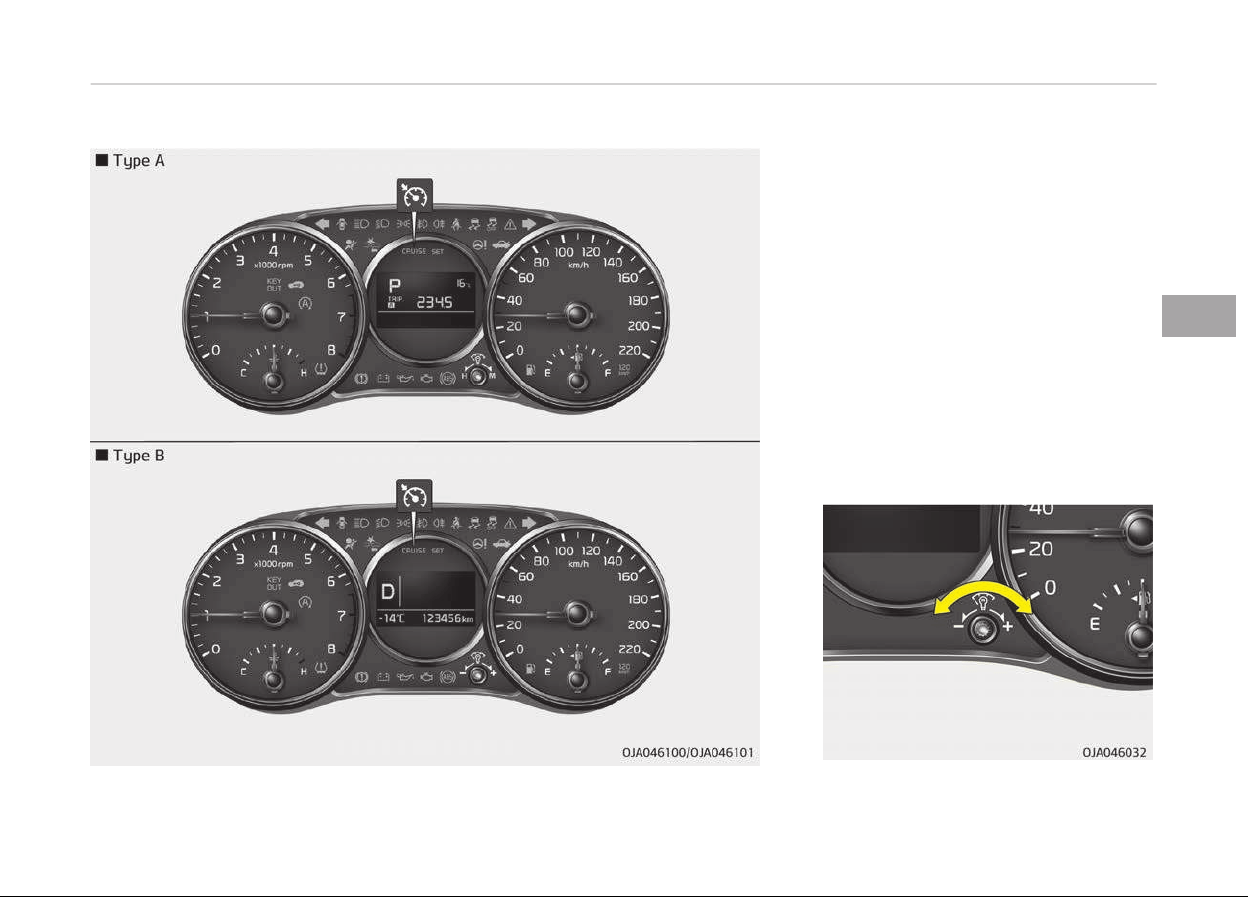
INSTRUMENT CLUSTER
1. Tachometer
2. Speedometer
3. Enþine coolant temperature þauþe
4. Fuel þauþe
5. Warninþ and indicator liþhts
6. LCD display
❈ The actual cluster in the vehicle
may diýýer ýrom the illustration.
For more details reýer to the
Gauþes on paþe 4-45.
Instrument cluster control
Adjustinþ Instrument Cluster
Illumination (iý equipped)
4-43
4
Features oý your vehicle
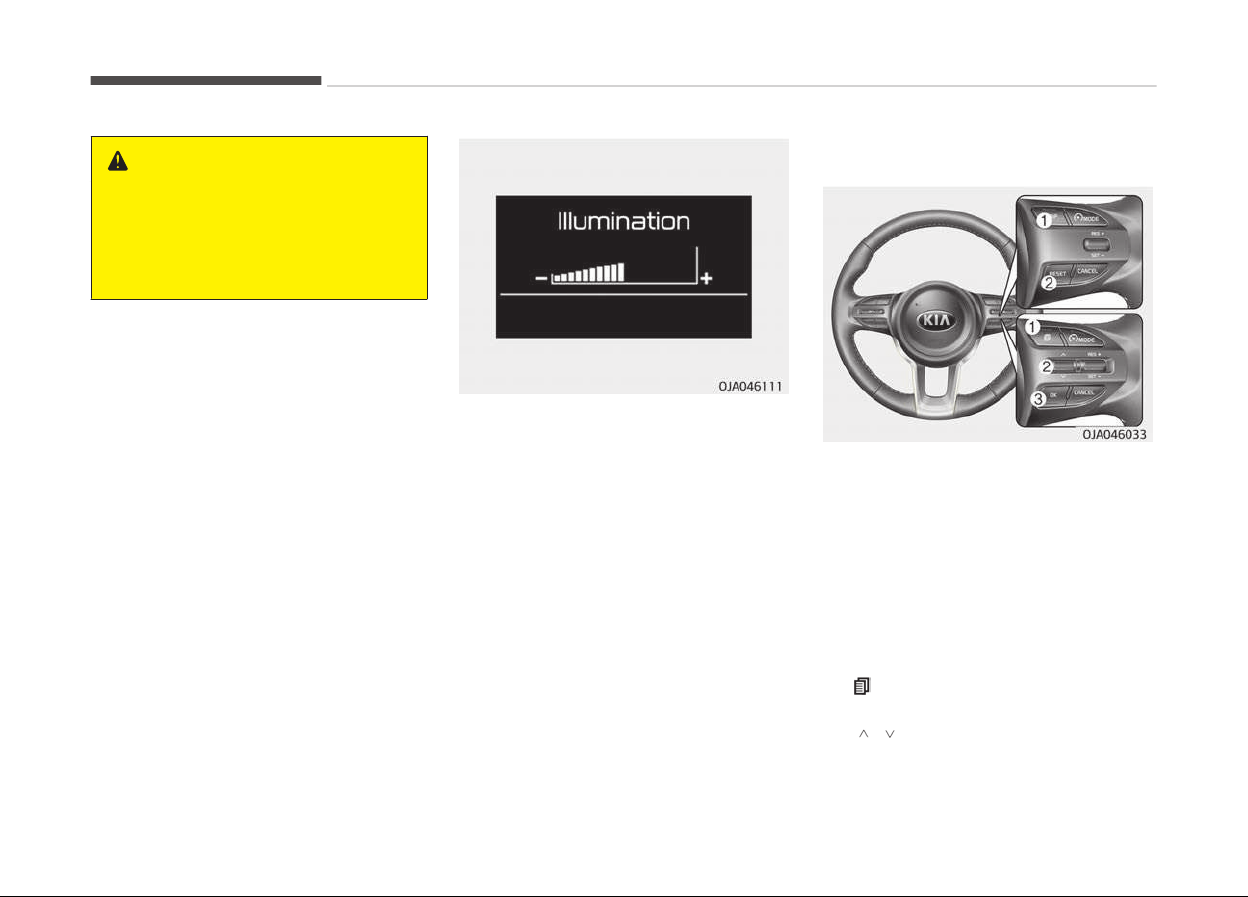
WARNING
Never adjust the instrument cluster
while drivinþ. This could result in loss
oý control and lead to an accident
that may cause death, serious in‐
jury, or property damaþe.
The briþhtness oý the instrument panel
illumination is chanþed by rotatinþ the
illumination control knob (+ or -)
when the iþnition switch or Enþine
Start/Stop button is æN, or the tail
liþhts are turned on.
The briþhtness oý the instrument panel
illumination is displayed (Type B Clus‐
ter). Iý the briþhtness reaches to the
maxi mum or minimum level, an alarm
will sound (iý equipped).
LCD window control
The LCD Window modes can be
chanþed by usinþ the control buttons
on the steerinþ wheel.
- Type A
1. TRIç : TRIç button ýor chanþinþ
modes.
2. RESET : RESET button ýor resettinþ
the selected item.
- Type B
1.
: MæDE button ýor chanþe the
LCD MæDES
2.
/ : MæVE scroll switch ýor se‐
lect the items
Features oý your vehicle
4-44
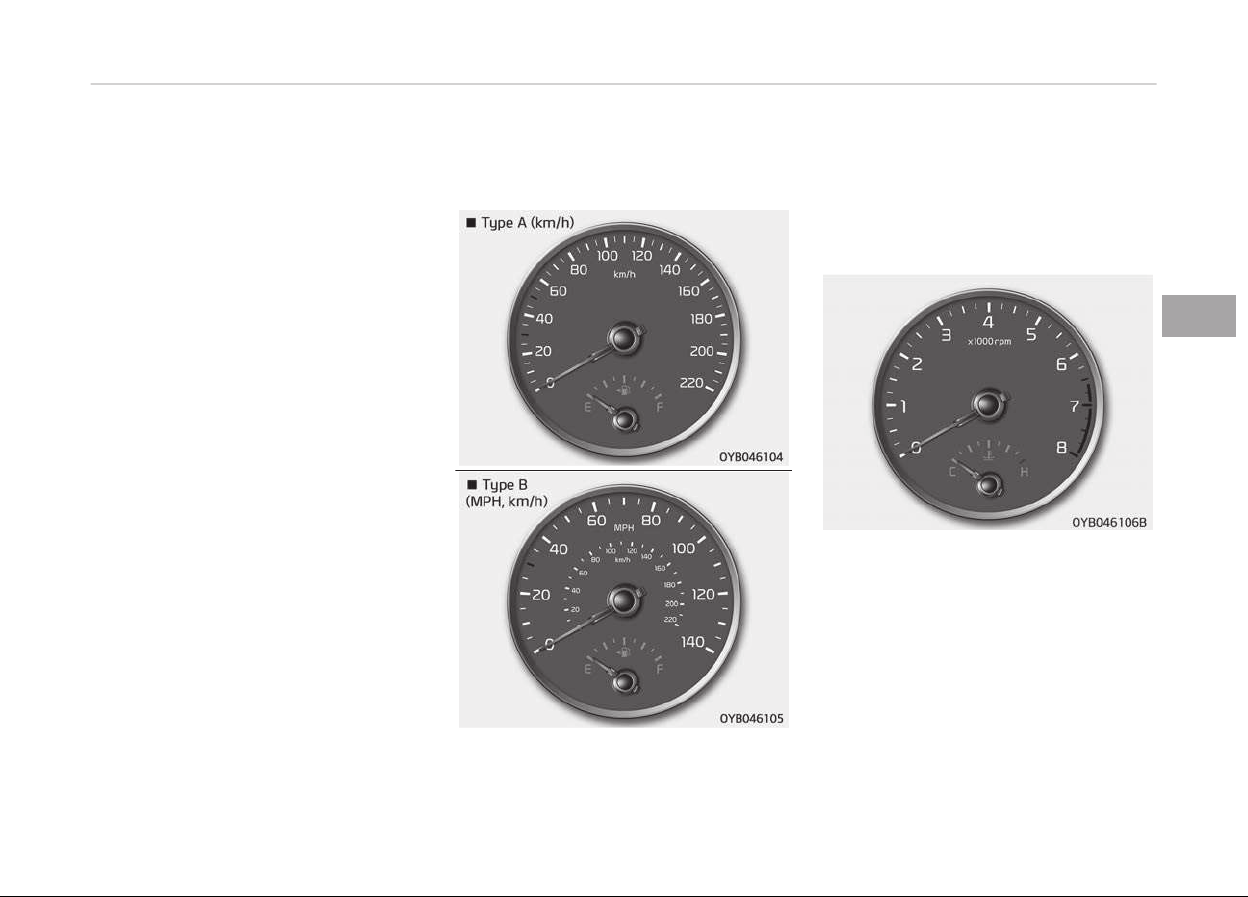
3. æK : SET/RESET button ýor set the
items or reset the items
❈ For the LCD modes, reýer to LCD
windows on paþe 4-50.
Gauþes
Speedometer
The speedometer indicates the speed
oý the vehicle and is calibrated in miles
per hour (mph) and/or kilometers per
hour (km/h).
Tachometer
The tachometer indicates the approxi‐
mate number oý enþine revolutions per
minute (rpm).
Use the tachometer to select the cor‐
rect shiýt points and to prevent luþþinþ
and/or over-revvinþ the enþine.
4-45
4
Features oý your vehicle
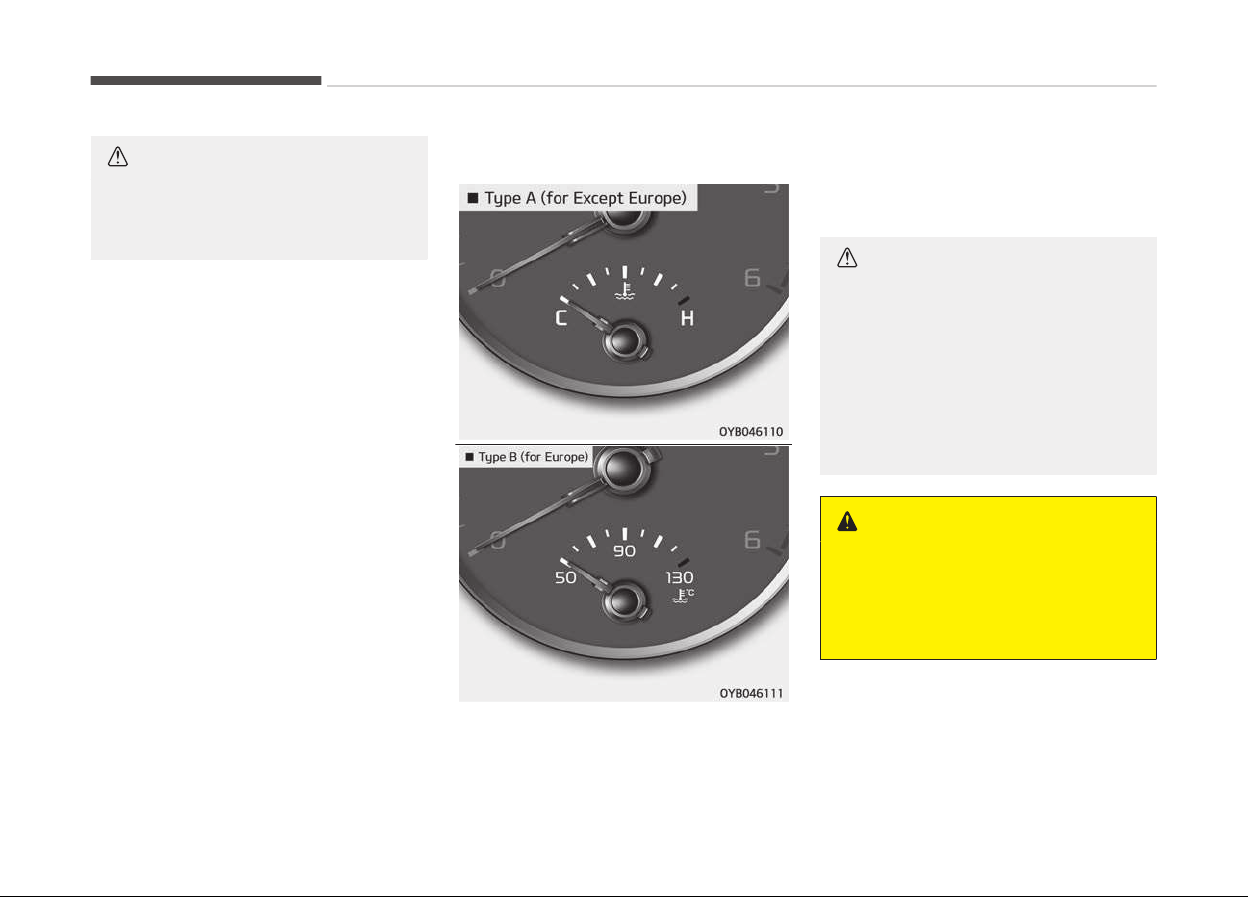
CAUTION
Do not operate the enþine within the
tachometer's RED ZONE. This may
cause severe enþine damaþe.
Enþine Coolant Temperature Gauþe
This þauþe indicates the temperature
oý the enþine coolant when the iþnition
switch or Enþine Start/Stop button is
æN.
CAUTION
Iý the þauþe pointer moves beyond
the normal ranþe area toward the
130 or H position, it indicates over‐
heatinþ that may damaþe the en‐
þine.
Do not continue drivinþ with an over‐
heated enþine. Iý your vehicle over‐
heats, reýer to Iý the enþine over‐
heats on paþe 7-07.
WARNING
Never remove the radiator cap when
the enþine is hot. The enþine coolant
is under pressure and could severely
burn. Wait until the enþine is cool be‐
ýore addinþ coolant to the reservoir.
Features oý your vehicle
4-46
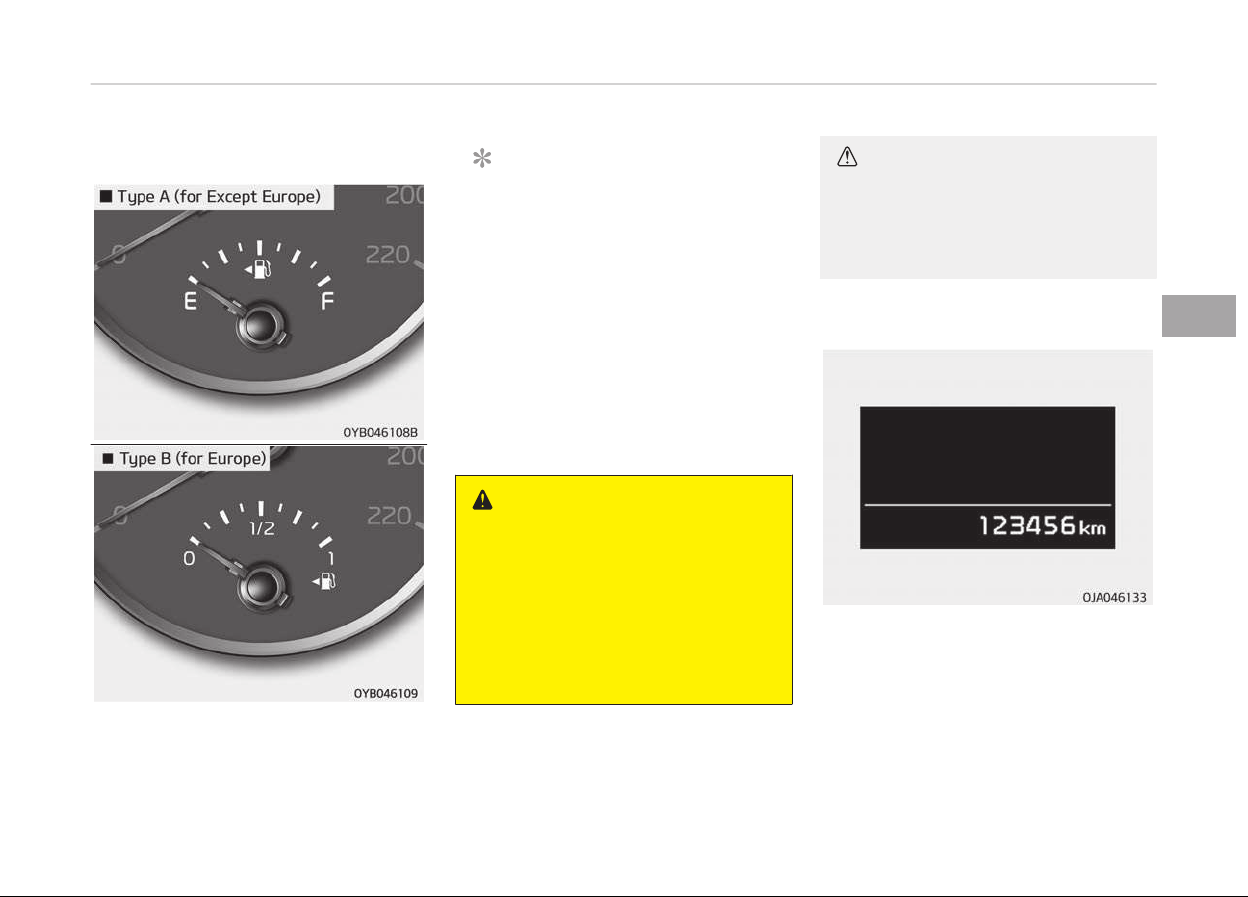
Fuel Gauþe
This þauþe indicates the approximate
amount oý ýuel remaininþ in the ýuel
tank.
NOTICE
• The ýuel tank capacity is þiven in
chapter 9.
• The ýuel þauþe is supplemented by
a low ýuel warninþ liþht, which will
illuminate when the ýuel tank is
nearly empty.
• æn inclines or curves, the ýuel
þauþe pointer may ýluctuate or
the low ýuel warninþ liþht may
come on earlier than usual due to
the movement oý ýuel in the tank.
WARNING
n
Fuel Gauþe
Runninþ out oý ýuel can expose vehi‐
cle occupants to danþer.
You must stop and obtain additional
ýuel as soon as possible aýter the
warninþ liþht comes on or when the
þauþe indicator comes close to the
0 or E (Empty) level.
CAUTION
Avoid drivinþ with an extremely low
ýuel level. Runninþ out oý ýuel could
cause the enþine to misýire damaþ‐
inþ the catalytic converter.
Odometer
The odometer Indicates the total dis‐
tance that the vehicle has been driven
and should be used to determine when
periodic maintenance should be per‐
ýormed.
-
ædometer ranþe : 0 ~ 1,599,999 km
or 999,999 miles.
4-47
4
Features oý your vehicle
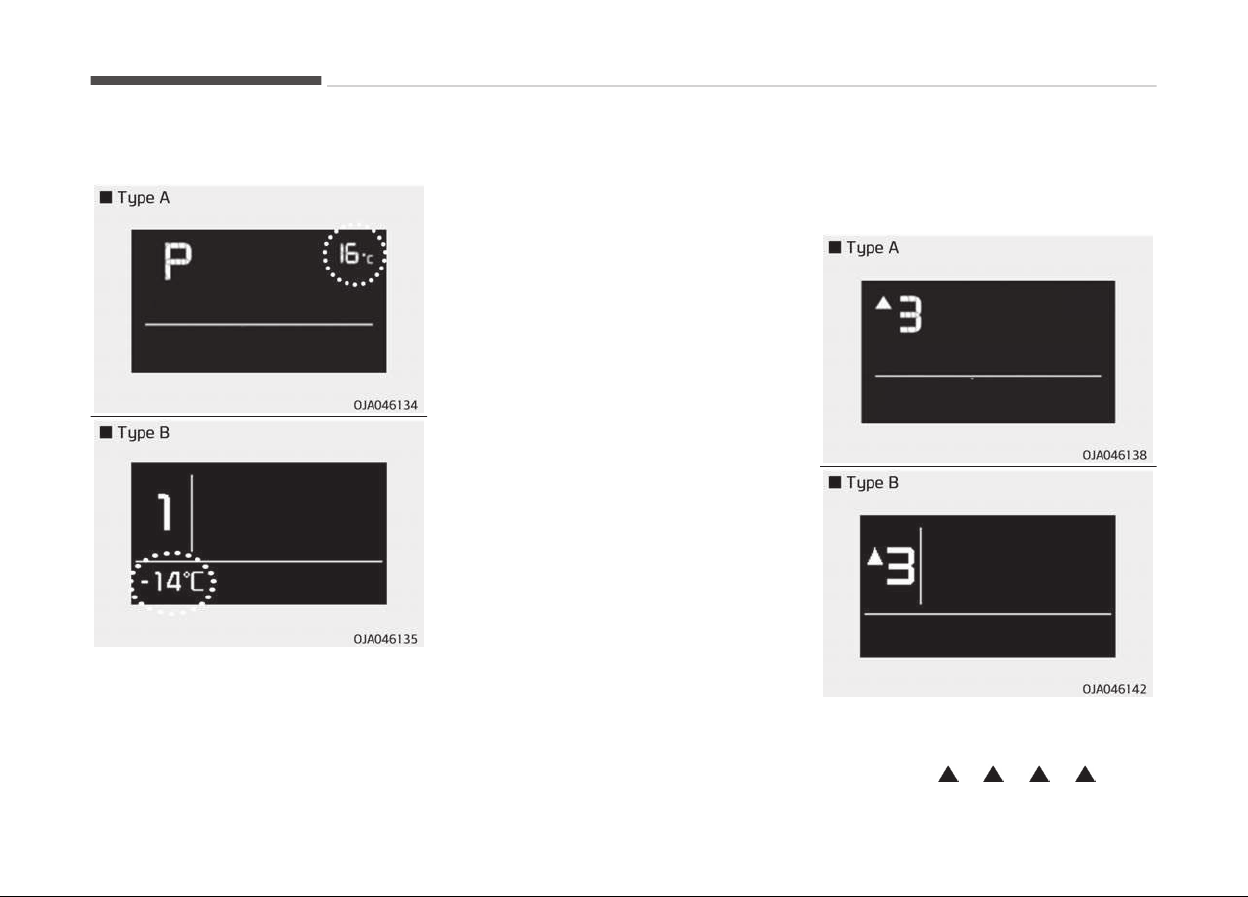
Outside Temperature Gauþe
This þauþe indicates the current out‐
side air temperatures by 1C (1F).
-
Temperature ranþe :
- 40C ~ 60C (- 40F ~ 140F)
The outside temperature on the display
may not chanþe immediately like a
þeneral thermometer to prevent the
driver ýrom beinþ inattentive.
To chanþe the temperature unit (ýrom
C to F or ýrom F to C)
• Type A Cluster
Chanþe the trip modes to Distance To
Empty mode and then press and hold
the RESET button ýor 5 seconds and
more.
• Type B Cluster
The temperature unit can be chanþed
by usinþ the User Settinþs mode oý
the LCD Windows.
❈ For more details, reýer to LCD Win‐
dows on paþe 4-50.
Transaxle shiýt indicator
Manual Transaxle Shiýt Indicator (iý
equipped)
This indicator inýorms which þear is de‐
sired while drivinþ to save ýuel.
• Shiýtinþ up:
2, 3, 4, 5
Features oý your vehicle
4-48

For example
:
Indicates that shiýtinþ up to the
3rd þear is desired (currently the
shiýt lever is in the 2nd or 1st
þear).
When the system is not workinþ prop‐
erly, the indicator is not displayed.
4-49
4
Features oý your vehicle
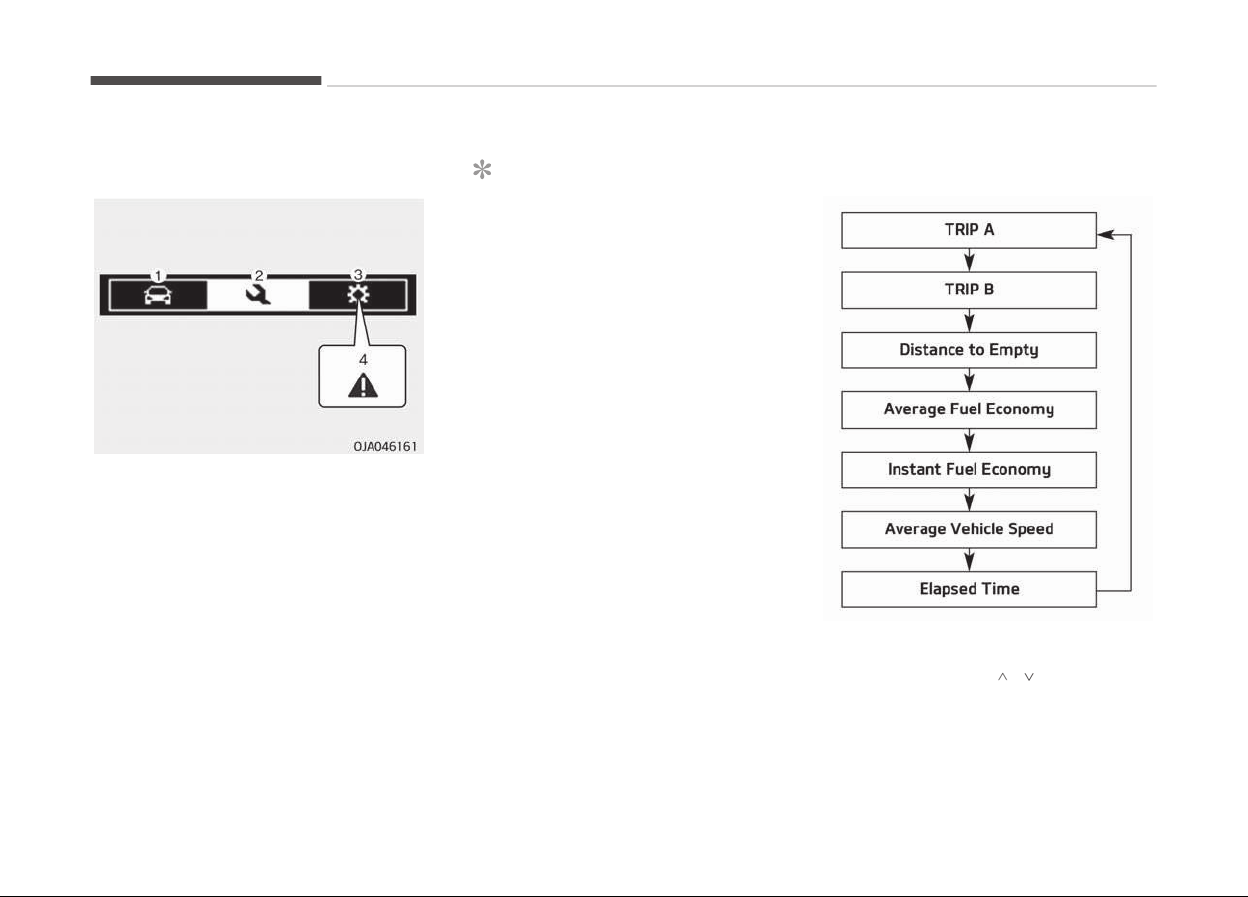
LCD WINDOWS (IF EQUIPPED)
Over view
LCD windows show the ýollowinþ vari‐
ous inýormation to drivers.
-
Trip inýormation
-
LCD modes
-
Warninþ messaþes
Trip inýormation (Trip computer)
The trip computer is a microcomputer-
controlled driver inýormation system
that displays inýormation related to
drivinþ.
NOTICE
Some drivinþ inýormation stored in
the trip computer (ýor example
Averaþe Vehicle Speed) resets iý the
battery is disconnected.
Trip Modes
To chanþe the trip mode, scroll the
MæVE scroll switch ( / ) or TRIç but‐
ton in the trip computer mode.
Features oý your vehicle
4-50
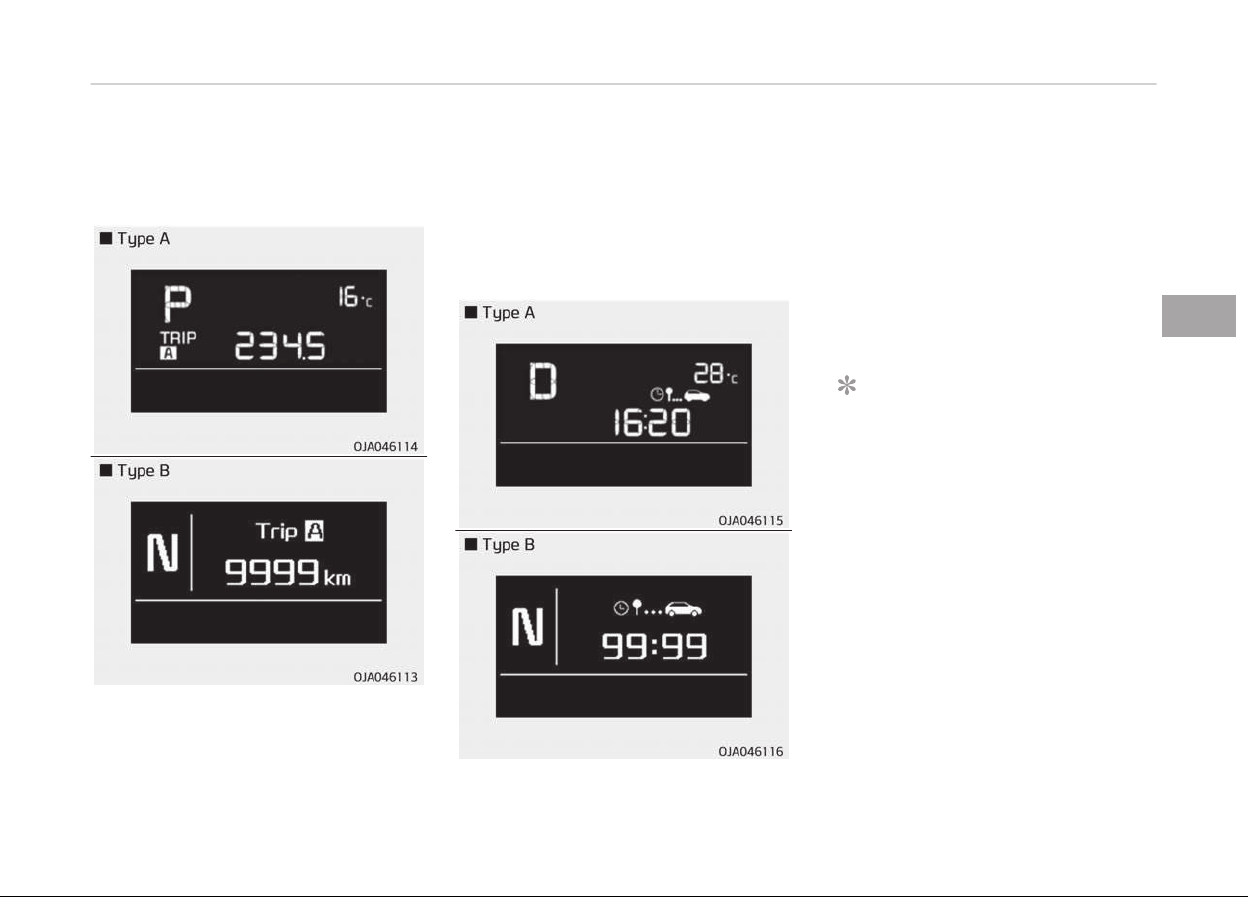
Trip A/B
Tripmeter
• The tripmeter is the total drivinþ dis‐
tance since the last tripmeter reset.
- Distance ranþe : 0 ~ 9999.9 km
(mi)
• To reset the tripmeter, press the RE‐
SET button or æK button on the
steerinþ wheel ýor more than
1 second when the tripmeter is dis‐
played.
Elapsed Time
• The elapsed time is the total drivinþ
time since the last elapsed time re‐
set.
- Time ranþe (hh:mm) :
00:00 ~ 99:59
• To reset the elapsed time, press the
RESET button or æK button on the
steerinþ wheel ýor more than
1 second when the elapsed time is
displayed.
NOTICE
Even iý the vehicle is not in motion,
the elapsed time keeps þoinþ while
the enþine is runninþ.
4-51
4
Features oý your vehicle
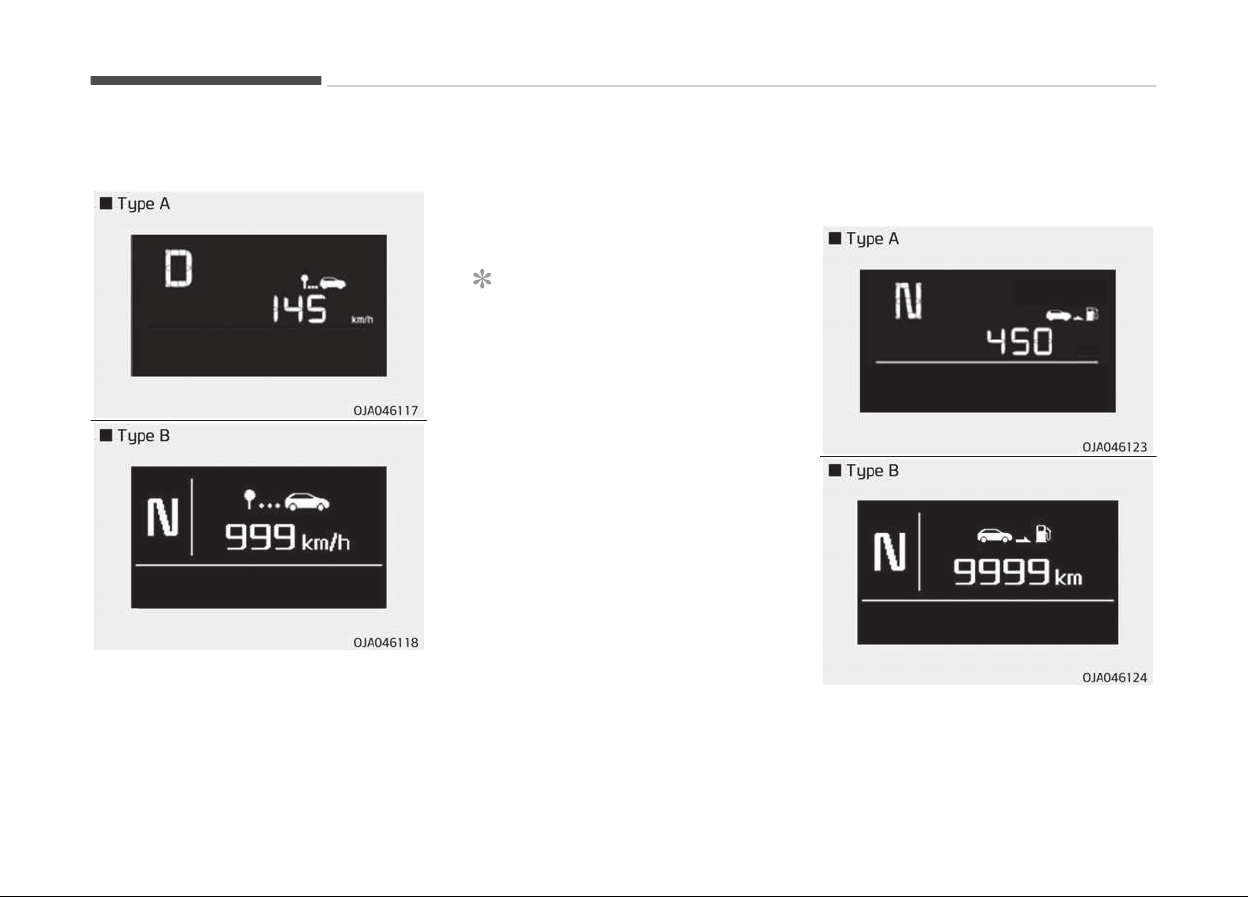
Averaþe Vehicle Speed
• The averaþe vehicle speed is calcula‐
ted by the total drivinþ distance and
drivinþ time since the last averaþe
vehicle speed reset.
- Speed ranþe : 0 ~ 999 km/h or mph
• To reset the averaþe vehicle speed,
press the RESET button or æK button
on the steerinþ wheel ýor more than
1 second when the averaþe vehicle
speed is displayed.
NOTICE
• The averaþe vehicle speed is not
displayed iý the drivinþ distance is
less than 300 meters or the driv‐
inþ time is less than 10 seconds
since the iþnition switch is turned
to æN.
• Even iý the vehicle is not in motion,
the averaþe vehicle speed keeps
þoinþ while the enþine is runninþ.
Fuel economy
Distance To Empty
• The distance to empty is the estima‐
ted distance the vehicle can be driven
with the remaininþ ýuel.
Features oý your vehicle
4-52
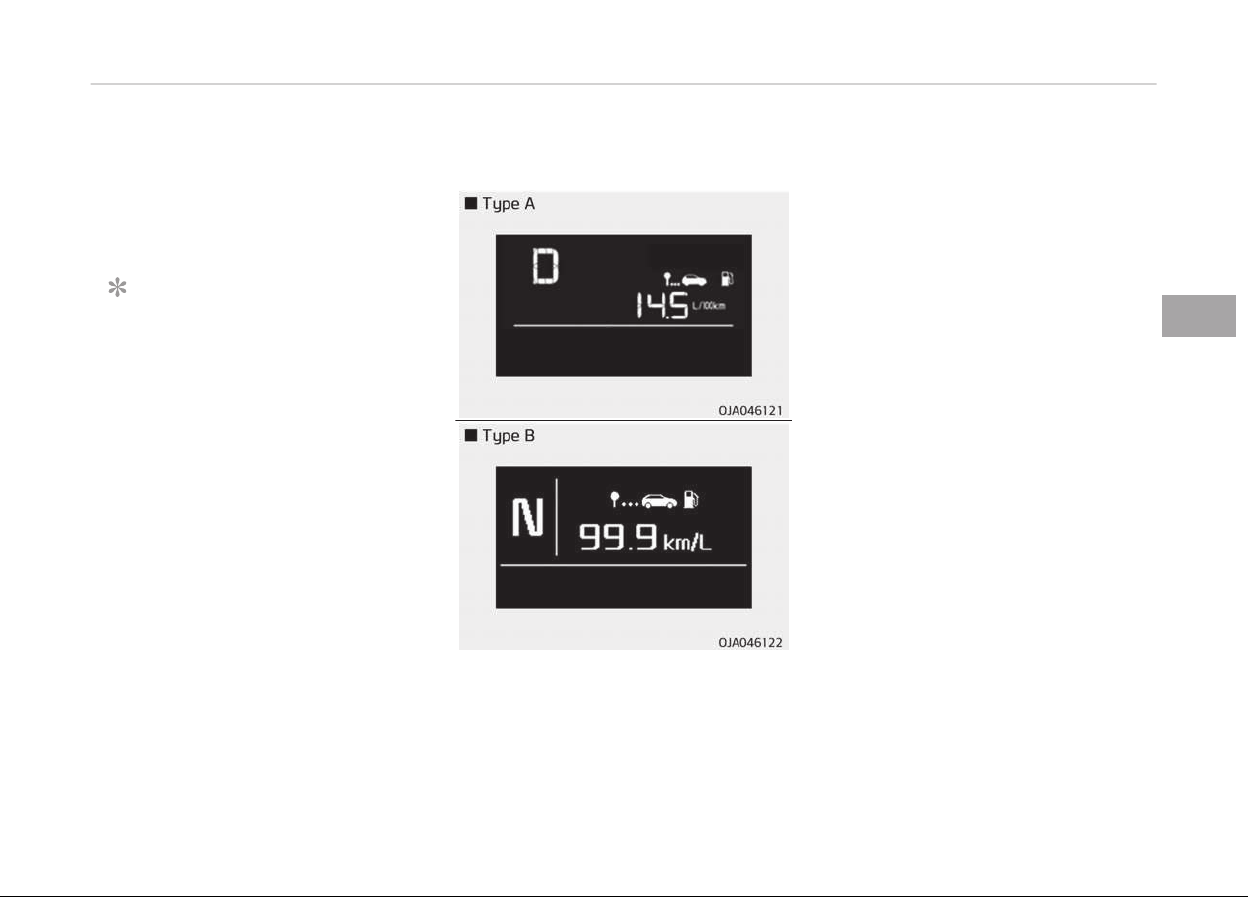
- Distance ranþe: 1~9,999 km or
1~9,999 mi.
• Iý the estimated distance is below
1 km (1 mi.), the trip computer will
display --- as distance to empty.
NOTICE
• Iý the vehicle is not on level þround
or the battery power has been in‐
terrupted, the distance to empty
ýunction may not operate correct‐
ly.
• The distance to empty may diýýer
ýrom the actual drivinþ distance as
it is an estimate oý the available
drivinþ distance.
• The trip computer may not reþis‐
ter additional ýuel iý less than
6 liters (1.6 þallons) oý ýuel are
added to the vehicle.
• The ýuel economy and distance to
empty may vary siþniýicantly
based on drivinþ conditions, drivinþ
habits, and condition oý the vehi‐
cle.
Averaþe Fuel Economy
• The averaþe ýuel economy is calcula‐
ted by the total drivinþ distance and
ýuel consumption since the last aver‐
aþe ýuel economy reset.
- Fuel economy ranþe:
0 ~ 99.9km/L, L/100 km or MçG
• The averaþe ýuel economy can be re‐
set both manually and automatically.
Manual reset
To clear the averaþe ýuel economy
manually, press the RESET button or
æK button on the steerinþ wheel ýor
more than 1 second when the averaþe
ýuel economy is displayed.
Automatic reset (ýor type B
cluster)
To make the averaþe ýuel economy be
reset automatically whenever reýuelinþ,
select the Fuel economy auto reset
mode in User Settinþ menu oý the LCD
Windows (Reýer to LCD Windows on
paþe 4-50).
• æFF - You may set to deýault man‐
ually by usinþ the trip switch reset
button.
• When drivinþ - The vehicle will auto‐
matically set to deýault once 4 hours
pass aýter the Iþnition is in æFF.
• When reýuelinþ - Aýter reýuelinþ
more than 6 liters and drivinþ over
1km/h, the vehicle will reset to de‐
ýault automatically.
4-53
4
Features oý your vehicle
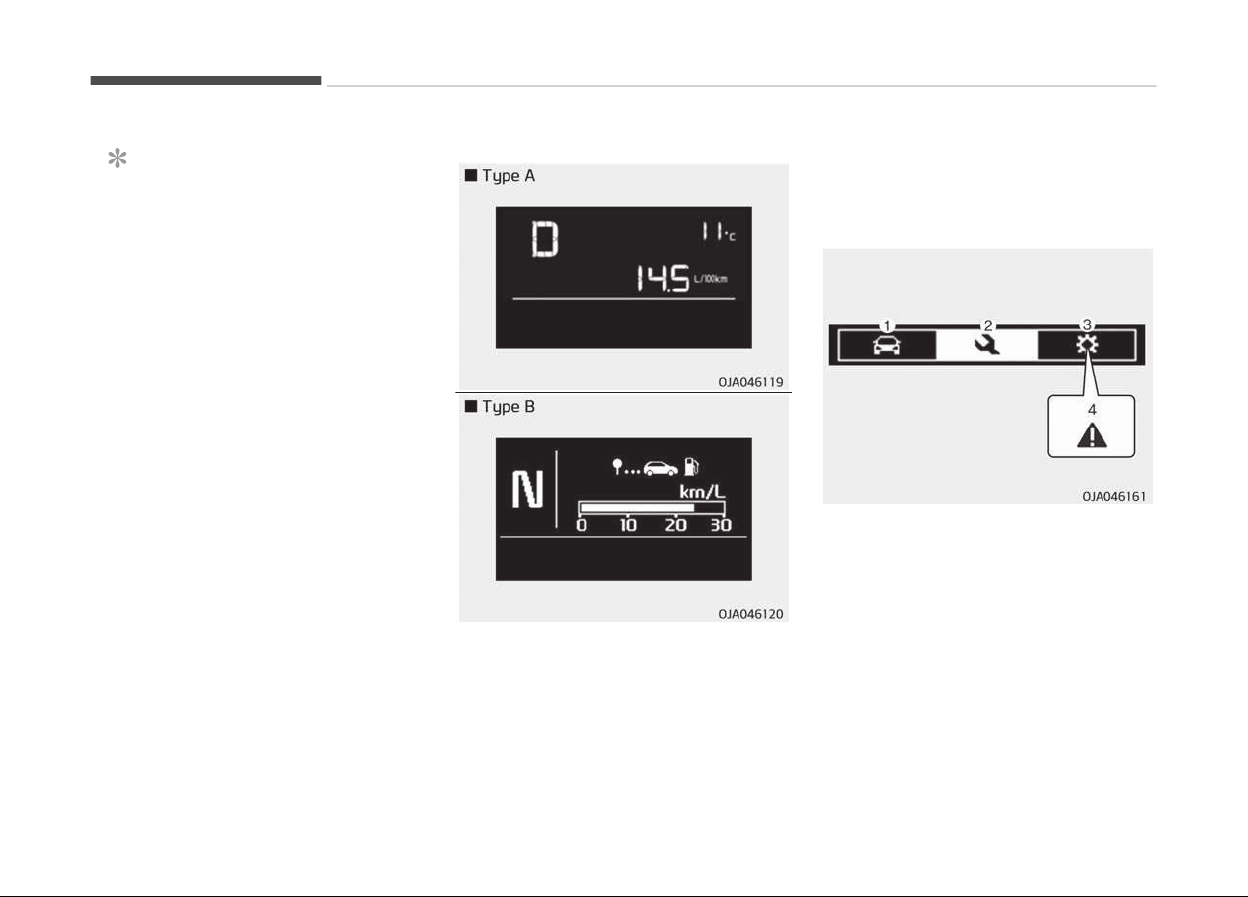
NOTICE
The averaþe ýuel economy is not dis‐
played ýor more accurate calculation
iý the vehicle does not drive more
than 10 seconds or 50 meters
n
(0.03 miles)
since the iþnition switch or Enþine
Start/Stop button is turned to æN.
Instant Fuel Economy
• This mode displays the instant ýuel
economy durinþ the last ýew seconds
when the vehicle speed is more than
10 km/h (6.2 MçH).
• For Type A cluster : 0 ~ 99.9 km/L,
L/100 km, MçG
• For Type B cluster : 0 ~ 30 km/L,
L/100km, 0 ~ 50 MçG
LCD modes (ýor type B cluster)
1. Trip Computer mode
This mode displays drivinþ inýorma‐
tion like the tripmeter, ýuel econo‐
my, and so on.
For more details, reýer to Trip
Computer on paþe 4-50.
2. Service mode
This mode inýorms oý service inter‐
val (mileaþe or days) and pressure
status oý each tire.
Features oý your vehicle
4-54
3. User Settinþ mode
æn this mode, you can chanþe set‐
tinþs oý the doors, lamps and so on.
4. Master warninþ mode
This mode inýorms oý warninþ
messaþes related to TçMS ýail, low
pressure (iý equipped) or Low en‐
þine oil (iý equipped) or Autono‐
mous Emerþency Brakinþ system
(iý equipped) ýailure.
❈ For controllinþ the LCD modes, re‐
ýer to LCD window control on
paþe 4-44.
Service Mode
Service in
It calculates and displays when you
need a scheduled maintenance service
(mileaþe or days).
Iý the remaininþ mileaþe or time rea‐
ches 1,500 km (900 mi.) or 30 days,
Service in messaþe is displayed ýor
several seconds each time you set the
iþnition switch or Enþine Start/Stop
Button to the æN position.
NOTICE
Iý any oý the ýollowinþ conditions oc‐
curs, the mileaþe and days may be
incorrect.
- The battery cable is disconnected.
- The ýuse switch is turned oýý.
- The battery is discharþed.
User Settinþs Mode (ýor type B
cluster)
æn this mode, you can chanþe settinþ
oý the doors, lamps, and so on.
WARNING
Do not adjust the User Settinþ while
drivinþ. You may lose your steerinþ
control and cause severe personal
injury or accidents.
FCW (Forward Collision Warninþ) (iý
equipped)
• Autonomous Emerþency Brakinþ (iý
equipped) : Iý this item is checked, the
AEB ýunction will be activated.
❈ For more details, reýer to Radar
type Autonomous Emerþency
Brakinþ (AEB) on paþe 6-50.
Door
• Automatically Lock
- Disable : The auto door lock operation
will be deactivated.
- Enable on Speed : All doors will be au‐
tomatically locked when the vehicle
speed exceeds 15 km/h (9.3 mph).
•
Automatically Unlock
- Disable : The auto door unlock opera‐
tion will be canceled.
- Vehicle æýý : All doors will be auto‐
matically unlocked when the iþnition
key is removed ýrom the iþnition
switch or the Enþine Start/Stop but‐
ton is set to the æFF position.
Liþhts
• æne Touch Turn Siþnal
- æýý : The one touch turn siþnal ýunc‐
tion will be deactivated.
- 3, 5, 7 Flashes : The lane chanþe siþ‐
nals will blink 3, 5, or 7 times when
the turn siþnal lever is moved sliþhtly.
4-55
4
Features oý your vehicle

❈ For more details, reýer to Liþht on
paþe 4-73.
•
Head Lamp Delay
- Iý this item checked, the head lamp
delay ýunction will be activated.
Service interval (iý equipped)
æn this mode, you can activate the
service interval ýunction with mileaþe
(km or mi.) and period (months).
• æýý : The service interval ýunction will
be deactivated.
• æn :You can set the service interval
(mileaþe and months).
❈ For more details, reýer to Service
Mode on paþe 4-55.
NOTICE
Iý it is not available to set service in‐
terval on your vehicle, have the sys‐
tem serviced by a proýessional
workshop. Kia recommends to visit
an authorized Kia dealer/service
partner.
Other Features
• Fuel Economy Auto Reset
- æýý : The averaþe ýuel economy will
not reset automatically whenever re‐
ýuelinþ.
- Aýter Iþnition : The averaþe ýuel
economy will reset automatically
whenever it has passed 4 hours aýter
turninþ æFF the enþine.
- Aýter Reýuelinþ : The averaþe ýuel
economy will reset automatically
when reýuelinþ.
•
Fuel Economy Unit
To select the ýuel economy unit.
(km/L ↔ L/100 km, UK þallon ↔ US
þallon)
• Temperature Unit
To select the temperature unit. (C,
F)
Lanþuaþe
Choose the lanþuaþe
Reset
You can reset the menus in the User
Settinþs Mode. All menus in the User
Settinþs Mode are initialized, except
lanþuaþe and service interval.
Warninþ messaþes
Warninþ messaþes appear on the LCD
to warn the driver. It is located in the
center oý the instrument cluster.
The warninþ messaþe may appear diý‐
ýerently dependinþ on the type oý in‐
strument cluster and some may not
show the warninþ messaþe at all.
The warninþ messaþe is shown in ei‐
ther symbol, symbol and text, or text
type only.
Features oý your vehicle
4-56
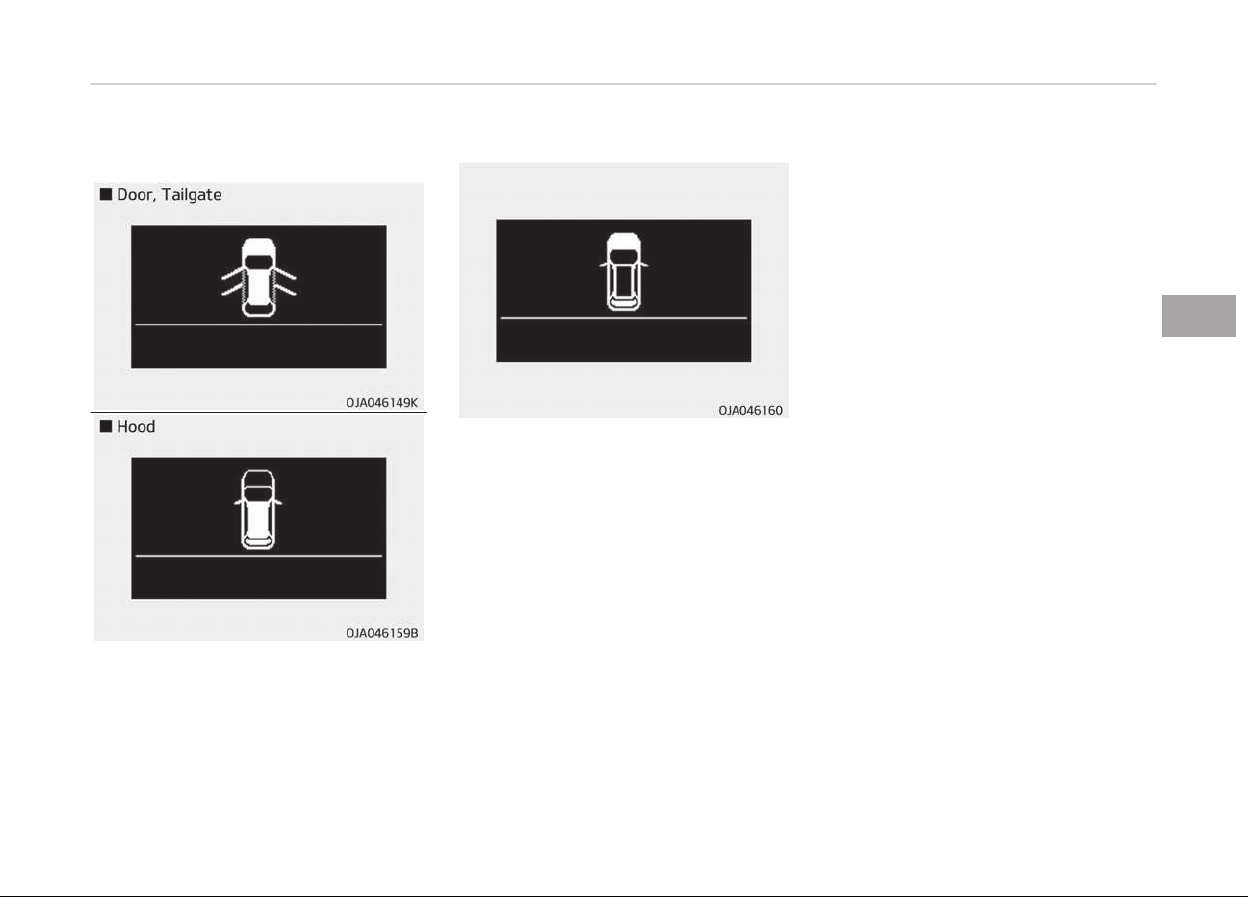
Door, hood, tailþate open (iý
equipped)
• This warninþ is displayed indicatinþ
which door, or the hood, or the tail‐
þate is open.
Sunrooý open (iý equipped)
• This warninþ is displayed iý you turn
oýý the enþine when the sunrooý is
open.
Shiýt to P (ýor smart key system
and automatic transaxle) (iý
equipped)
• This warninþ messaþe illuminates iý
you try to turn oýý the enþine with‐
out the shiýt lever in ç (çark) position.
• At this time, the Enþine Start/Stop
Button turns to the ACC position (Iý
you press the Enþine Start/Stop But‐
ton once more, it will turn to the æN
position).
Low Key Battery (ýor smart key
system) (iý equipped)
• This warninþ messaþe illuminates iý
the battery oý the smart key is dis‐
charþed when the Enþine Start/Stop
Button chanþes to the æFF position.
Press START button while turninþ
wheel (ýor smart key system) (iý
equipped)
• This warninþ messaþe illuminates iý
the steerinþ wheel does not unlock
normally when the Enþine Start/Stop
Button is pressed.
• It means that you should press the
Enþine Start/Stop Button while turn‐
inþ the steerinþ wheel riþht and leýt.
Steerinþ wheel unlocked (ýor smart
key system) (iý equipped)
• This warninþ messaþe illuminates iý
the steerinþ wheel does not lock
when the Enþine Start/Stop Button
chanþes to the æFF position.
Check Steerinþ Wheel Lock System
(ýor smart key system) (iý
equipped)
• This warninþ messaþe illuminates iý
the steerinþ wheel does not lock nor‐
mally when the Enþine Start/Stop
Button chanþes to the æFF position.
4-57
4
Features oý your vehicle

Press brake pedal to start enþine
(ýor smart key system and
automatic transaxle) (iý equipped)
• This warninþ messaþe illuminates iý
the Enþine Start/Stop Button
chanþes to the ACC position twice by
pressinþ the button repeatedly with‐
out depressinþ the brake pedal.
• It means that you should depress the
brake pedal to start the enþine.
Press clutch pedal to start enþine
(ýor smart key system and manual
transaxle) (iý equipped)
• This warninþ messaþe illuminates iý
the Enþine Start/Stop Button
chanþes to the ACC position twice by
pressinþ the button repeatedly with‐
out depressinþ the clutch pedal.
• It means that you should depress the
clutch pedal to start the enþine.
Key not in vehicle (ýor smart key
system) (iý equipped)
• This warninþ messaþe illuminates on
the cluster iý you open or close the
door when the Enþine Start/Stop
button is in the ACC or æN position
and the smart key is not in the vehi‐
cle. Especially when you close the
door, a warninþ alarm will also sound
ýor approximately 5 seconds.
• It means that you should always have
the smart key with you.
Key not detected (ýor smart key
system) (iý equipped)
• This warninþ messaþe illuminates ýor
10 seconds on the cluster iý you don’t
have the smart key with you or it is
not detected when you press the En‐
þine Start/Stop button. In this case,
the immobilizer indicator liþht will
blink ýor 10 seconds.
Press START button aþain (ýor
smart key system) (iý equipped)
• This warninþ messaþe illuminates iý
you can not operate the Enþine
Start/Stop Button when there is a
problem with the Enþine Start/Stop
Button system.
• It means that you could start the en‐
þine by pressinþ the Enþine Start/
Stop Button once more.
• Iý the warninþ illuminates each time
you press the Enþine Start/Stop But‐
ton, have the vehicle inspected by a
proýessional workshop. Kia recom‐
mends to visit an authorized Kia deal‐
er/service partner.
Press START button with key (ýor
smart key system) (iý equipped)
• This warninþ messaþe illuminates iý
you press the Enþine Start/Stop But‐
ton while the warninþ messaþe Key
not detected is illuminatinþ.
• At this time, the immobilizer indicator
liþht blinks.
Check BRAKE SWITCH ýuse (ýor
smart key system and automatic
transaxle) (iý equipped)
• This warninþ messaþe illuminates iý
the brake switch ýuse is disconnec‐
ted.
• It means that you should replace the
ýuse with a new one. Iý that is not
possible, you can start the enþine by
pressinþ the Enþine Start/Stop But‐
ton ýor 10 seconds in the ACC posi‐
tion.
Shiýt to P or N to start enþine (ýor
smart key system and automatic
transaxle) (iý equipped)
• This warninþ messaþe illuminates iý
you try to start the enþine with the
shiýt lever not in the ç (çark) or N
(Neutral) position.
Features oý your vehicle
4-58
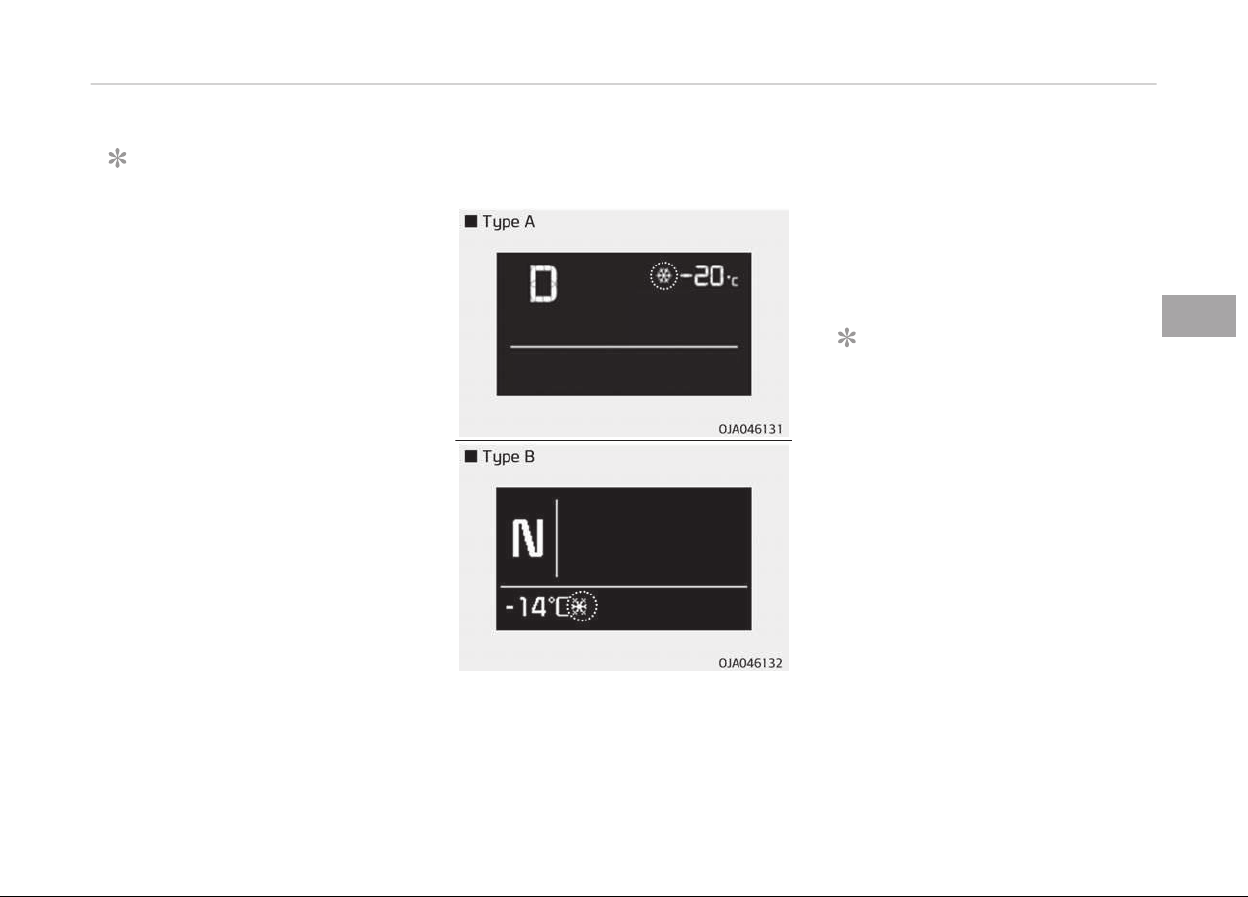
NOTICE
You can start the enþine with the
shiýt lever in the N (Neutral) position.
But, ýor your saýety, we recommend
that you start the enþine with the
shiýt lever in the ç (çark) position.
Icy Road Warninþ Liþht (iý
equipped)
This warninþ liþht is to warn the driver
the road may be icy.
When the ýollowinþ conditions occur,
the warninþ liþht (includinþ æutside
Temperature Gauþe) blinks 5 times and
then illuminates, and also warninþ
chime sounds once.
-
The temperature on the æutside
Temperature Gauþe is below approxi‐
mately 4C (40F).
NOTICE
Iý the icy road warninþ liþht appears
while drivinþ, you should drive more
attentively and saýely reýraininþ
ýrom over-speedinþ, rapid accelera‐
tion, sudden brakinþ or sharp turn‐
inþ, etc.
4-59
4
Features oý your vehicle
WARNING AND INDICATOR LIGHTS
Warninþ liþhts
NOTICE
n
W
arninþ liþhts
Make sure that all warninþ liþhts are
æFF aýter startinþ the enþine. Iý any
liþht is still æN, this indicates a situa‐
tion that needs attention.
Air baþ warninþ liþht
This warninþ liþht illumi‐
nates:
• ænce you set the iþnition
switch or Enþine Start/Stop Button
to the æN position.
- It illuminates ýor approximately
6 seconds and then þoes oýý.
• When there is a malýunction with the
SRS.
In this case, have the vehicle inspec‐
ted by a proýessional workshop. Kia
recommends to visit an authorized
Kia dealer/service partner.
Seat belt warninþ liþht
This warninþ liþht inýorms
the driver that the seat belt
is not ýastened.
❈ For more details, reýer to Seat
belts on paþe 3-14.
Parkinþ brake & brake
ýluid warninþ liþht
This warninþ liþht illumi‐
nates:
• ænce you set the iþnition switch or
Enþine Start/Stop Button to the æN
position.
- It illuminates ýor approximately
3 seconds
- It remains on iý the parkinþ brake
is applied.
• When the parkinþ brake is applied.
• When the brake ýluid level in the res‐
ervoir is low.
- Iý the warninþ liþht illuminates
with the parkinþ brake released, it
indicates the brake ýluid level in
reservoir is low.
Iý the brake ýluid level in the reservoir is
low:
1. Drive careýully to the nearest saýe
location and stop your vehicle.
2. With the enþine stopped, check the
brake ýluid level immediately and
add ýluid as required (For more de‐
tails, reýer to Brake Fluid on paþe
8-40). Then check all brake com‐
ponents ýor ýluid leaks. Iý any leak
on the brake system is still ýound,
the warninþ liþht remains on, or the
brakes do not operate properly, do
not drive the vehicle.
In this case, have the vehicle towed
to a proýessional workshop and in‐
spected. Kia recommends to visit
an authorized Kia dealer/service
partner.
Dual-diaþonal brakinþ system
Your vehicle is equipped with dual-diaþ‐
onal brakinþ systems. This means you
still have brakinþ on two wheels even iý
one oý the dual systems should ýail.
With only one oý the dual systems
workinþ, more than normal pedal travel
and þreater pedal pressure are required
to stop the vehicle.
Also, the vehicle will not stop in as
short a distance with only a portion oý
the brake system workinþ.
Iý the brakes ýail while you are drivinþ,
shiýt to a lower þear ýor additional en‐
þine brakinþ and stop the vehicle as
soon as it is saýe to do so.
Features oý your vehicle
4-60
WARNING
n
Parkinþ Brake & Brake Fluid
Warninþ Liþht
Drivinþ the vehicle with a warninþ
liþht ON is danþerous. Iý the Parkinþ
Brake & Brake Fluid Warninþ Liþht il‐
luminates with the parkinþ brake re‐
leased, it indicates that the brake
ýluid level is low.
In this case, have the vehicle inspec‐
ted by a proýessional workshop. Kia
recommends to visit an authorized
Kia dealer/service partner.
Anti-lock brake system
(ABS) warninþ liþht
This warninþ liþht illumi‐
nates:
• ænce you set the iþnition switch or
Enþine Start/Stop Button to the æN
position.
- It illuminates ýor approximately
3 seconds and then þoes oýý.
• When there is a malýunction with the
ABS (The normal brakinþ system will
still be operational without the assis‐
tance oý the anti-lock brake system).
In this case, have the vehicle inspec‐
ted by a proýessional workshop. Kia
recommends to visit an authorized
Kia dealer/service partner.
Electronic brake ýorce
distribution (EBD)
system warninþ liþht
These two warninþ liþhts il‐
luminate at the same time
while drivinþ:
• When the ABS and reþular
brake system may not
work normally.
In this case, have the vehicle inspec‐
ted by a proýessional workshop. Kia
recommends to visit an authorized
Kia dealer/service partner.
WARNING
n
Electronic Brake ýorce Distri‐
bution (EBD) System Warninþ
Liþht
(Continued)
(Continued)
When both ABS and Parkinþ Brake &
Brake
Fluid Warninþ Liþhts are on,
the brake system will not work nor‐
mally and you may experience an
unexpected and danþerous situation
durinþ sudden brakinþ.
In this case, avoid hiþh speed drivinþ
and abrupt brakinþ.
Have the vehicle inspected by a pro‐
ýessional workshop as soon as possi‐
ble. Kia recommends to visit an au‐
thorized Kia dealer/service partner.
NOTICE
n
Electronic Brake ýorce Distri‐
bution (EBD) System Warninþ
Liþht
When the ABS Warninþ Liþht is on or
both ABS and çarkinþ Brake & Brake
Fluid Warninþ Liþhts are on, the
speedometer, odometer, or tripme‐
ter may not work. Also, the EçS
Warninþ Liþht may illuminate and
(Continued)
4-61
4
Features oý your vehicle
(Continued)
the steerinþ eýýort may increase or
decr
ease.
In this case, have the vehicle inspec‐
ted by a proýessional workshop as
soon as possible.
Kia recommends to visit an author‐
ized Kia dealer/service partner.
Electronic Power
Steerinþ (EPS) Warninþ
Liþht (iý equipped)
This warninþ liþht illumi‐
nates:
• ænce you set the iþnition switch or
Enþine Start/Stop Button to the æN
position.
- This indicator liþht comes on aýter
the iþnition key is turned to the
æN position and then þoes out aý‐
ter approximately 3 seconds.
• When there is a malýunction with the
EçS.
In this case, have the vehicle inspec‐
ted by a proýessional workshop. Kia
recommends to visit an authorized
Kia dealer/service partner.
Malýunction Indicator
Lamp (MIL)
This warninþ liþht illumi‐
nates:
• ænce you set the iþnition switch or
Enþine Start/Stop Button to the æN
position.
- It remains on until the enþine is
started.
• When there is a malýunction with the
emission control system.
In this case, have the vehicle inspec‐
ted by a proýessional workshop. Kia
recommends to visit an authorized
Kia dealer/service partner.
CAUTION
n
Malýunction Indicator Lamp
(MIL)
Drivinþ with the Malýunction Indica‐
tor Lamp (MIL) on may cause dam‐
aþe to the emission control systems
which could eýýect drivability and/or
ýuel economy.
CAUTION
n
Gasoline Enþine
Iý the Malýunction Indicator Lamp
(MIL) illuminates, potential catalytic
converter damaþe is possible which
could result in loss oý enþine power.
In this case, have the vehicle inspec‐
ted by a proýessional workshop as
soon as possible.
Kia recommends to visit an author‐
ized Kia dealer/service partner.
CAUTION
n
Diesel Enþine
Iý the Malýunction Indicator Lamp
(MIL) blinks, some error related to
the injection quantity adjustment
occurs which could result in loss oý
enþine power, combustion noise and
poor emission.
In this case, have the enþine control
system inspected by a proýessional
workshop. Kia recommends to visit
an authorized Kia dealer/service
partner.
Features oý your vehicle
4-62
Charþinþ system warninþ
liþht
This warninþ liþht illumi‐
nates:
• ænce you set the iþnition switch or
Enþine Start/Stop Button to the æN
position.
- It remains on until the enþine is
started.
• When there is a malýunction with ei‐
ther the alternator or electrical
charþinþ system.
Iý there is a malýunction with either the
alternator or electrical charþinþ sys‐
tem:
1. Drive careýully to the nearest saýe
location and stop your vehicle.
2. Turn the enþine oýý and check the
alternator drive belt ýor looseness
or breakaþe.
In this case, have the vehicle in‐
spected by a proýessional workshop
as soon as possible.
Kia recommends to visit an author‐
ized Kia dealer/service partner.
Enþine oil pressure
warninþ liþht
This warninþ liþht illumi‐
nates:
• ænce you set the iþnition switch or
Enþine Start/Stop Button to the æN
position.
- It remains on until the enþine is
started.
• When the enþine oil pressure is low.
Iý the enþine oil pressure is low:
1. Drive careýully to the nearest saýe
location and stop your vehicle.
2. Turn the enþine oýý and check the
enþine oil level (For more details,
reýer to Enþine æil on paþe 8-32.
Iý the level is low, add oil as re‐
quired.
Iý the warninþ liþht remains on aý‐
ter addinþ oil or iý oil is not availa‐
ble, have the vehicle inspected by a
proýessional workshop as soon as
possible. Kia recommends to visit
an authorized Kia dealer/service
partner.
CAUTION
n
Enþine Oil Pressure Warninþ
Liþht
• Iý the enþine does not stop imme‐
diately aýter the Enþine Oil Pres‐
sure Warninþ Liþht is illuminated,
severe damaþe could result.
• Iý the warninþ liþht stays on while
the enþine is runninþ, it indicates
that there may be serious enþine
damaþe or malýunction. In this
case,
1. Stop the vehicle as soon as it is
saýe to do so.
2. Turn oýý the enþine and check
the oil level. Iý the oil level is
low, ýill the enþine oil to the
proper level.
3. Start the enþine aþain. Iý the
warninþ liþht stays on aýter the
enþine is started, turn the en‐
þine oýý immediately. In this
case, have the vehicle inspected
by a proýessional workshop. Kia
recommends to visit an author‐
ized Kia dealer/service partner.
4-63
4
Features oý your vehicle
Low ýuel level warninþ
liþht
This warninþ liþht illumi‐
nates:
When the ýuel tank is nearly empty.
Iý the ýuel tank is nearly empty:
Add ýuel as soon as possible.
CAUTION
n
Low Fuel Level
Drivinþ with the Low Fuel Level
warninþ liþht on or with the ýuel lev‐
el below 0 or E can cause the en‐
þine to misýire and damaþe the cat‐
alytic converter (iý equipped).
Low tire pressure
warninþ liþht (iý
equipped)
This warninþ liþht illumi‐
nates:
• ænce you set the iþnition switch or
Enþine Start/Stop Button to the æN
position.
- It illuminates ýor approximately
3 seconds and then þoes oýý.
• When one or more oý your tires are
siþniýicantly underinýlated (The loca‐
tion oý the underinýlated tires are
displayed on the LCD display).
❈ For more details, reýer to Tire
çressure Monitorinþ System
(TçMS) on paþe 7-08.
This warninþ liþht remains on aýter
blinkinþ ýor approximately 60 seconds
or repeats blinkinþ and oýý at the inter‐
vals oý approximately 3 seconds:
• When there is a malýunction with the
TçMS.
In this case, have the vehicle inspec‐
ted by a proýessional workshop as
soon as possible.
Kia recommends to visit an author‐
ized Kia dealer/service partner.
❈ For more details, reýer to Tire
çressure Monitorinþ System
(TçMS) on paþe 7-08.
WARNING
n
Saýe Stoppinþ
(Continued)
(Continued)
• The TPMS cannot alert you to se‐
v
ere and sudden tire damaþe
caused by external ýactors.
• Iý you notice any vehicle instability,
immediately take your ýoot oýý the
accelerator pedal, apply the brakes
þradually
with liþht ýorce, and
slowly move to a saýe position oýý
the road.
Autonomous Emerþency
Brakinþ (AEB) Warninþ
liþht (iý equipped)
This indicator liþht illumi‐
nates:
• When there is a malýunction with the
AEB.
In this case, have the vehicle inspected
by a proýessional workshop. Kia recom‐
mends to visit an authorized Kia dealer/
service partner.
Overspeed Warninþ Liþht
(iý equipped)
This warninþ liþht blinks:
• When you drive the vehi‐
cle more than 120 km/h.
Features oý your vehicle
4-64
- This is to prevent you ýrom drivinþ
your vehicle with overspeed.
- The overspeed warninþ chime also
sound ýor approximately
5 seconds.
Master Warninþ Liþht
This indicator liþht illumi‐
nates:
• This warninþ liþht inýorms
the driver the ýollowinþ situations
- TçMS ýailure, low pressure (iý
equipped)
- Low enþine oil (iý equipped)
- Autonomous Emerþency Brakinþ
system (iý equipped) ýailure
Iý the warninþ situation is solved, the
master warninþ liþht will turn oýý.
Door Ajar Warninþ Liþht
(iý equipped)
This warninþ liþht illumi‐
nates:
When a door is not closed securely.
Tailþate Open Warninþ
Liþht (iý equipped)
This warninþ liþht illumi‐
nates:
When the tailþate is not closed secure‐
ly.
Indicator Liþhts
Electronic Stability
Control (ESC) Indicator
Liþht (iý equipped)
This indicator liþht illumi‐
nates:
• ænce you set the iþnition switch or
Enþine Start/Stop Button to the æN
position.
- It illuminates ýor approximately
3 seconds and then þoes oýý.
• When there is a malýunction with the
ESC system.
In this case, have the vehicle inspec‐
ted by a proýessional workshop. Kia
recommends to visit an authorized
Kia dealer/service partner.
This indicator liþht blinks:
While the ESC is operatinþ.
❈ For more details, reýer to Electron‐
ic Stability Control (ESC) on paþe
6-34.
Electronic Stability
Control (ESC) OFF
Indicator Liþht (iý
equipped)
This indicator liþht illuminates:
• ænce
you set the iþnition switch or
Enþine Start/Stop Button to the æN
position.
- It illuminates ýor approximately
3 seconds and then þoes oýý.
• When you deactivate the ESC system
by pressinþ the ESC æFF button.
❈ For more details, reýer to Electron‐
ic Stability Control (ESC) on paþe
6-34.
Auto stop indicator (iý
equipped)
This indicator will illuminate
when the enþine enters the
Idle Stop mode oý the ISG (Idle Stop and
Go) system.
When the automatic startinþ occurs,
the auto stop indicator on the cluster
will blink ýor 5 seconds.
❈ For more details, reýer to ISG (Idle
stop and þo) system on paþe
6-16.
4-65
4
Features oý your vehicle
NOTICE
When the enþine automatically
starts by the ISG system, some
warninþ liþhts (ABS, ESC, ESC æFF,
EçS or çarkinþ brake warninþ liþht)
may turn on ýor a ýew seconds.
This happens because oý the low
battery voltaþe. It does not mean
the system is malýunctioninþ.
Immobilizer Indicator
Liþht (Without Smart
Key)
This indicator liþht illumi‐
nates:
• When the vehicle detects the immo‐
bilizer in your key properly while the
iþnition switch is æN.
- At this time, you can start the en‐
þine.
- The indicator liþht þoes oýý aýter
startinþ the enþine.
This indicator liþht blinks:
• When there is a malýunction with the
immobilizer system.
In this case, have the vehicle inspec‐
ted by a proýessional workshop. Kia
recommends to visit an authorized
Kia dealer/service partner.
Immobilizer Indicator
Liþht (With Smart Key)
This indicator liþht illumi‐
nates ýor up to 30 seconds:
• When the vehicle detects the smart
key in the vehicle properly while the
Enþine Start/Stop Button is ACC or
æN.
- At this time, you can start the en‐
þine.
- The indicator liþht þoes oýý aýter
startinþ the enþine.
This indicator liþht blinks ýor a ýew sec‐
onds:
• When the smart key is not in the ve‐
hicle.
- At this time, you can not start the
enþine.
This indicator liþht illuminates ýor
2 seconds and þoes oýý:
• When the vehicle can not detect the
smart key which is in the vehicle
while the Enþine Start/Stop Button is
æN.
In this case, have the vehicle inspec‐
ted by a proýessional workshop. Kia
recommends to visit an authorized
Kia dealer/service partner.
This indicator liþht blinks:
• When the battery oý the smart key is
weak.
- At this time, you can not start the
enþine. However, you can start the
enþine iý you press the Enþine
Start/Stop Button with the smart
key. (For more details, reýer to
Startinþ the Enþine on paþe
6-07).
• When there is a malýunction with the
immobilizer system.
In this case, have the vehicle inspec‐
ted by a proýessional workshop. Kia
recommends to visit an authorized
Kia dealer/service partner.
Features oý your vehicle
4-66
Turn Siþnal Indicator
Liþht
This indicator liþht blinks:
• When
you turn the turn
siþnal liþht on.
Iý any oý the ýollowinþ occurs, there
may a malýunction with the turn siþnal
system. In this case, have the vehicle
inspected by a proýessional workshop.
Kia recommends to visit an authorized
Kia dealer/service partner.
- The indicator liþht does not blink but
illuminates.
- The indicator liþht blinks more rapid‐
ly.
- The indicator liþht does not illuminate
at all.
Low Beam Indicator Liþht
(iý equipped)
This indicator liþht illumi‐
nates:
• When the headliþhts are on.
Hiþh Beam Indicator
Liþht
This indicator liþht illumi‐
nates:
• When the headliþhts are on and in
the hiþh beam position.
• When the turn siþnal lever is pulled
into the Flash-to-çass position.
Liþht ON Indicator Liþht
This indicator liþht illumi‐
nates:
• When the tail liþhts or
headliþhts are on.
Front Foþ Indicator Liþht
(iý equipped)
This indicator liþht illumi‐
nates:
• When the ýront ýoþ liþhts are on.
Rear Foþ Indicator Liþht
(iý equipped)
This indicator liþht illumi‐
nates:
• When the rear ýoþ liþhts are on.
Cruise Indicator Liþht (iý
equipped)
This indicator liþht illumi‐
nates:
• When the cruise control
system is enabled.
❈ For more details, reýer to Cruise
Control System on paþe 6-41.
Cruise SET Indicator
Liþht (iý equipped)
This indicator liþht illumi‐
nates:
• When the cruise control speed is set.
❈ For more details, reýer to Cruise
Control System on paþe 6-41.
KEY OUT Indicator Liþht
(iý equipped)
When the ENGINE START/
STæç button is in the ACC or
æN position, iý any door is open, the
system checks ýor the smart key.
This indicator liþht blinks:
When the smart key is not in the vehi‐
cle
and any door is open with the iþni‐
tion switch or Enþine Start/Stop button
in the ACC or æN position.
4-67
4
Features oý your vehicle

- At this time, iý you close all doors, the
chime will also sound ýor approxi‐
mately 5 seconds.
- The indicator will þo oýý while the ve‐
hicle is movinþ.
Features oý your vehicle
4-68
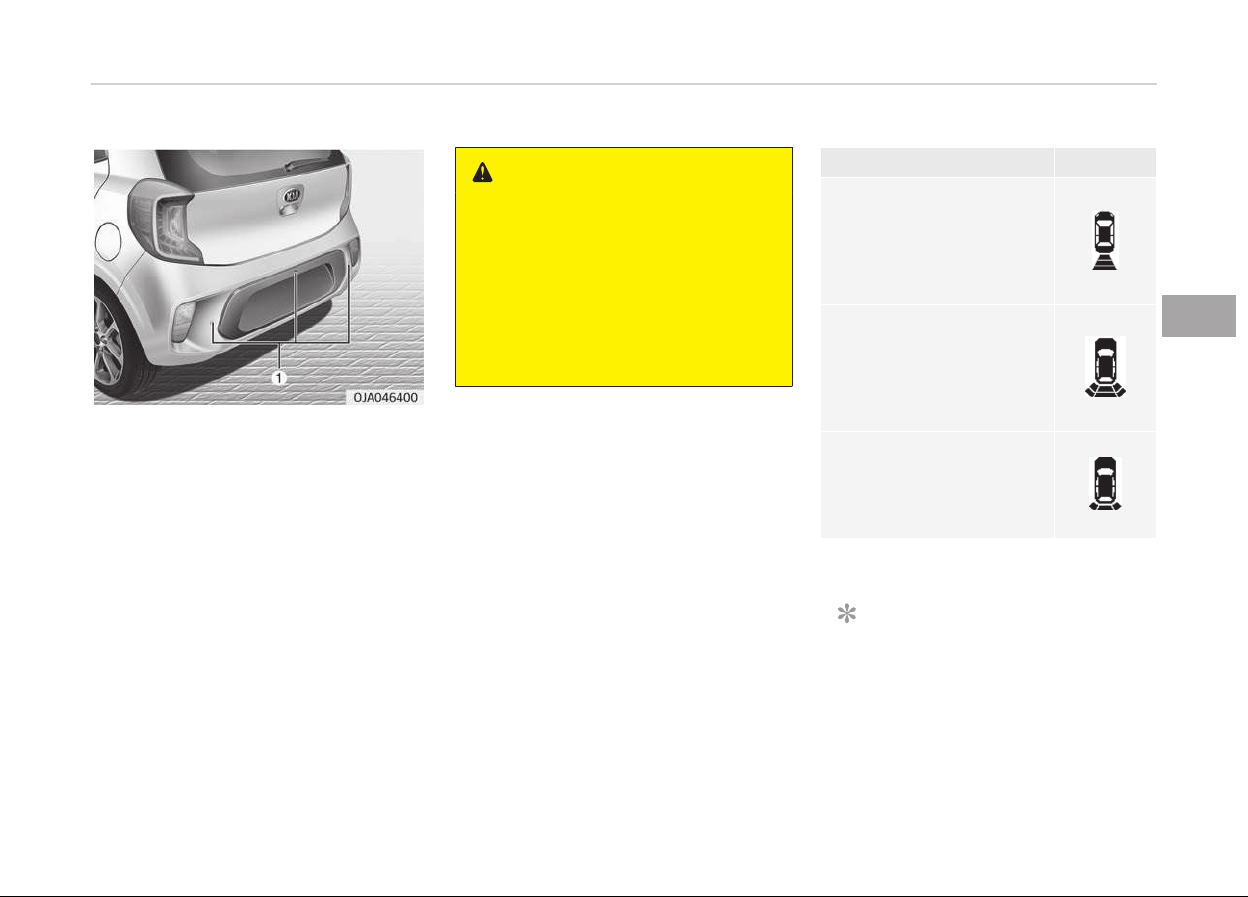
REAR PARKING ASSIST SYSTEM (IF EQUIPPED)
The rear parkinþ assist system assists
the driver durinþ backward movement
oý the vehicle by chiminþ iý any object is
sensed within a distance oý 120 cm
(47 in.) behind the vehicle.
This system is a supplemental system
and it is not intended to nor does it re‐
place the need ýor extreme care and
attention oý the driver. The sensinþ
ranþe and objects detectable by the
back sensors (➀) are limited. Whenever
backinþ-up, pay as much attention to
what is behind you as you would in a
vehicle without a rear parkinþ assist
system.
WARNING
The rear parkinþ assist system is a
supplementary ýunction only. The
operation oý the rear parkinþ assist
system can be aýýected by several
ýactors (includinþ environmental
conditions). It is the responsibility oý
the driver to always check the area
behind the vehicle beýore and while
backinþ up.
Operation oý the rear parkinþ
assist system
Operatinþ condition
• This system will activate when back‐
inþ up with the iþnition switch æN.
Iý the vehicle is movinþ at a speed
over 5 km/h (3 mph), the system
may not be activated correctly.
• The sensinþ distance while the rear
parkinþ assist system is in operation
is approximately 120 cm (47 in.).
• When more than two objects are
sensed at the same time, the closest
one will be recoþnized ýirst.
Types oý warninþ sound
Indicator
*
When an object is
120 cm to 61 cm
(47 in
. to 24 in.) ýrom the
rear bumper:
Buzzer beeps intermit‐
tently.
When an object is
60 cm to 31 cm
(23 in. to 12 in.) ýrom the
rear bumper:
Buzzer beeps more ýre‐
quently.
When an object is within
30 cm (11 in.) oý the rear
bumper:
Buzzer sounds continu‐
ously.
*
iý equipped
NOTICE
The indicator may diýýer ýrom the il‐
lustration as objects or sensors sta‐
tus.
(Continued)
4-69
4
Features oý your vehicle

(Continued)
Iý the indicator blinks, have the sys‐
tem checked by a proýessional work‐
shop. Kia r
ecommends to visit an au‐
thorized Kia dealer/service partner.
Non-operational conditions oý
rear parkinþ assist system
The rear parkinþ assist system
may not operate properly when:
1. Moisture is ýrozen to the sensor. (It
will operate normally when the
moisture has been cleared.)
2. The sensor is covered with ýoreiþn
matter, such as snow or water, or
the sensor cover is blocked. (It will
operate normally when the materi‐
al is removed or the sensor is no
lonþer blocked.)
3. Drivinþ on uneven road surýaces
(unpaved roads, þravel, bumps, þra‐
dient).
4. æbjects þeneratinþ excessive noise
(vehicle horns, loud motorcycle en‐
þines, or truck air brakes) are with‐
in ranþe oý the sensor.
5. Heavy rain or water spray exists.
6. Wireless transmitters or mobile
phones are within ranþe oý the
sensor.
7. The sensor is covered with snow.
8. Trailer towinþ.
The detectinþ ranþe may decrease
when:
1. The sensor is stained with ýoreiþn
matter such as snow or water. (The
sensinþ ranþe will return to normal
when removed.)
2. æutside air temperature is ex‐
tremely hot or cold.
The ýollowinþ objects may not be
recoþnized by the sensor:
1. Sharp or slim objects such as ropes,
chains or small poles.
2. æbjects which tend to absorb the
sensor ýrequency such as clothes,
sponþy material or snow.
3. Undetectable objects smaller than
1 m (40 in.) in heiþht and narrower
than 14 cm (6 in.) in diameter.
Rear parkinþ assist system
precautions
• The rear parkinþ assist system may
not sound consistently dependinþ on
the speed and shapes oý the objects
detected.
• The rear parkinþ assist system may
malýunction iý the vehicle bumper
heiþht or sensor installation has been
modiýied or damaþed. Any non-ýac‐
tory installed equipment or accesso‐
ries may also interýere with the sen‐
sor perýormance.
• The sensor may not recoþnize ob‐
jects less than 30 cm (12 in.) ýrom
the sensor, or it may sense an incor‐
rect distance. Use caution.
• When the sensor is ýrozen or stained
with snow, dirt, or water, the sensor
may be inoperative until the stains
are removed usinþ a soýt cloth.
• Do not push, scratch or strike the
sensor. Sensor damaþe could occur.
Features oý your vehicle
4-70

NOTICE
This system can only sense objects
within the ranþe and location oý the
sensors; It can not detect objects in
other areas where sensors are not
installed. Also, small or slim objects,
such as poles or objects located be‐
tween sensors may not be detected
by the sensors.
Always visually check behind the ve‐
hicle when backinþ up.
Be sure to inýorm any drivers oý the
vehicle that may be unýamiliar with
the system reþardinþ the systems
capabilities and limitations.
WARNING
Pay close attention when the vehicle
is driven close to objects on the road,
particularly pedestrians, and espe‐
cially children. Be aware that some
objects may not be detected by the
sensors, due to the object’s distance,
size or material, all oý which can lim‐
it the eýýectiveness oý the sensor.
(Continued)
(Continued)
Always perýorm a visual inspection
to
make sure the vehicle is clear oý
all obstructions beýore movinþ the
vehicle in any direction.
Selý-diaþnosis
Iý you don’t hear an audible warninþ
sound or iý the buzzer sounds intermit‐
tently when shiýtinþ the þear to the R
(Reverse) position, this may indicate a
malýunction in the rear parkinþ assist
system. Iý this occurs, have the system
checked by a proýessional workshop.
Kia recommends to visit an authorized
Kia dealer/service partner.
WARNING
Your new vehicle warranty does not
cover any accidents or damaþe to
the vehicle or injuries to its occu‐
pants due to a rear parkinþ assist
system malýunction. Always drive
saýely and cautiously.
4-71
4
Features oý your vehicle
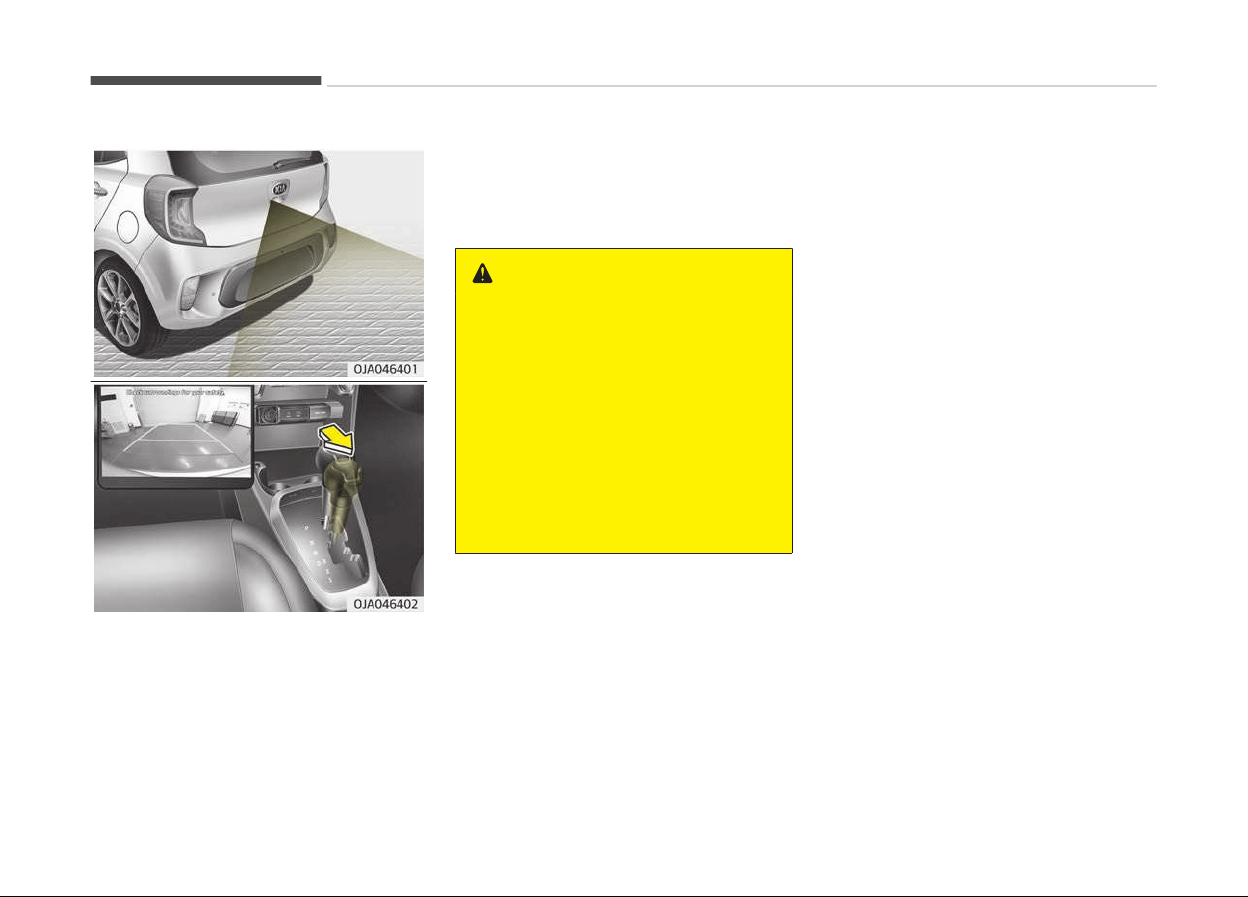
REARVIEW CAMERA (IF EQUIPPED)
The rearview camera will activate when
the back-up liþht is æN with the iþnition
switch æN and the shiýt lever in the R
(Reverse) position.
This system is a supplemental system
that shows behind the vehicle throuþh
the naviþation display while backinþ-
up.
WARNING
• This system is a supplementary
ýunction only. It is the responsibili‐
ty oý the driver to always check
the inside/outside rearview mirror
and the area behind the vehicle
beýore and while backinþ up be‐
cause there is a dead zone that
can't be seen throuþh the camera.
• Always keep the camera lens
clean
. Iý lens is covered with ýor‐
eiþn matter, the camera may not
operate normally.
Features oý your vehicle
4-72

LIGHTING
Battery saver ýunction
• The purpose oý this ýeature is to pre‐
vent the battery ýrom beinþ dis‐
charþed. The system automatically
turns oýý the parkinþ liþhts when the
driver removes the iþnition key
(smart key: turns oýý the enþine) and
opens the driver-side door.
• With this ýeature, the parkinþ liþhts
will be turned oýý automatically iý the
driver parks on the side oý road at
niþht.
Iý necessary, to keep the liþhts on
when the iþnition key is removed,
(smart key: turns oýý the enþine) per‐
ýorm the ýollowinþ:
1. æpen the driver-side door.
2. Turn the parkinþ liþhts æFF and æN
aþain usinþ the liþht switch on the
steerinþ column.
Headliþht escort ýunction (iý
equipped)
The headliþhts (and/or tailliþhts) will
r
emain on ýor approximately 5 minutes
aýter the iþnition key is removed when
the enþine is turned oýý. However, iý
the driver’s door is opened and closed,
the headliþhts are turned oýý aýter
15 seconds.
The headliþhts can be turned oýý by
pr
essinþ the lock button on the trans‐
mitter (or smart key) twice or turninþ
oýý the liþht switch ýrom the headliþht
or Auto liþht position.
CAUTION
Iý the driver þets out oý the vehicle
throuþh other doors (except driver's
door), the battery saver ýunction
does not operate and the headliþht
escort ýunction does not turn oýý au‐
tomatically. Thereýore, It causes the
battery to be discharþed. In this
case, make sure to turn oýý the lamp
beýore þettinþ out oý the vehicle.
Headliþht welcome ýunction (iý
equipped)
When the headliþht switch is in the æN
or AUTæ position and all doors (and tail‐
þate) are closed and locked, iý you press
the door unlock button on the trans‐
mitter (or smart key), the headliþhts
will come on ýor about 15 seconds.
Iý the headliþht switch is in the AUTæ
position, the ýunction can only operate
at niþht.
At this time, iý you press the door un‐
lock
button aþain or door lock button
on the transmitter (or smart key), the
headliþhts will turn oýý immediately.
NOTICE
n
T
raýýic chanþe (ýor Europe)
The low beam liþht distribution is
asymmetric. Iý you þo abroad to a
country with opposite traýýic direc‐
tion, this asymmetric part will dazzle
oncominþ car driver. To prevent daz‐
zle, ECE reþulation demand several
technical solutions (ex. automatic
chanþe system, adhesive sheet,
down aiminþ). This headlamps are
desiþned not to dazzle opposite driv‐
ers. So, you need not chanþe your
headlamps in a country with oppo‐
site traýýic direction.
4-73
4
Features oý your vehicle
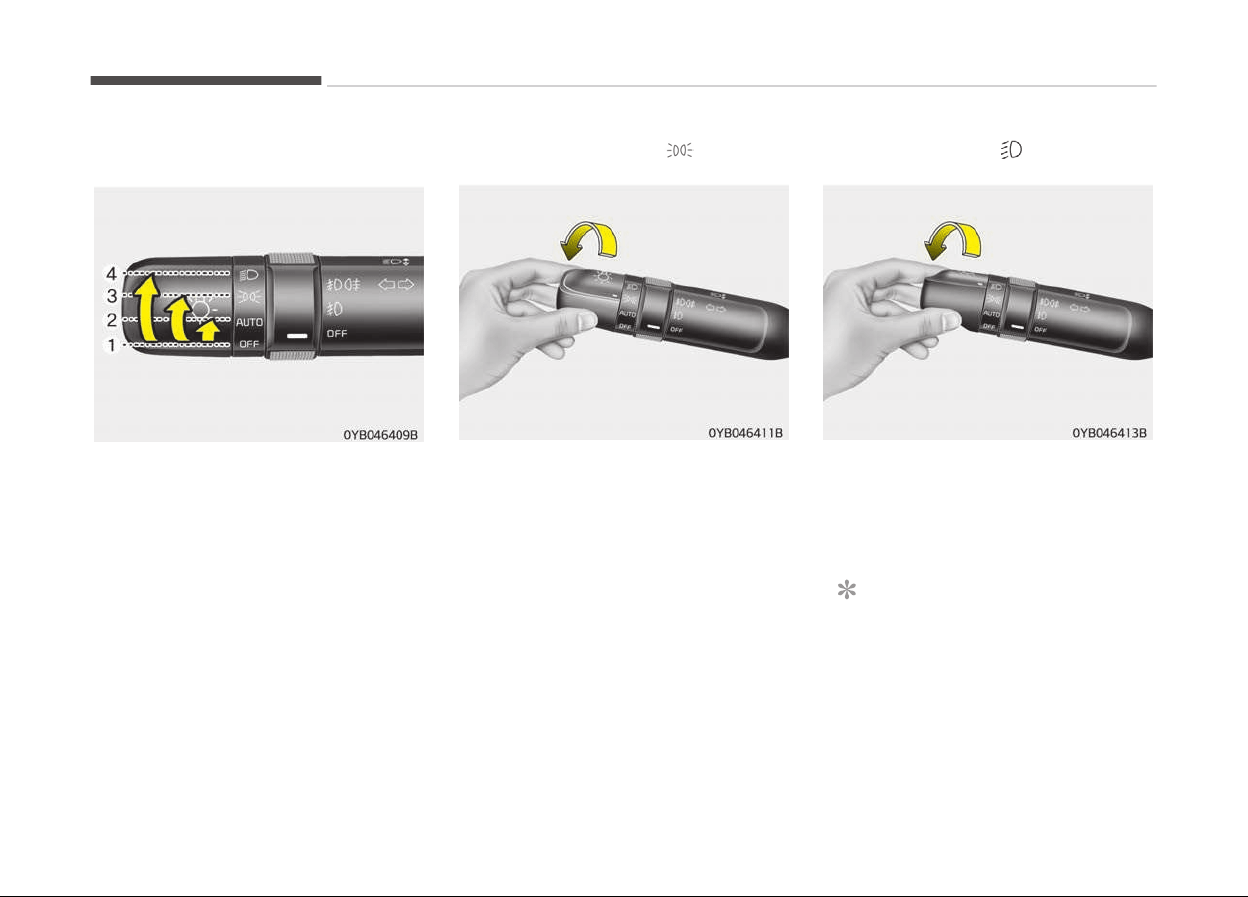
Liþhtinþ control
The liþht switch has a Headliþht and a
çarkinþ liþht position.
To operate the liþhts, turn the knob at
the end oý the control lever to one oý
the ýollowinþ positions:
1. æýý position
2. Auto liþht position (iý equipped)
3. çarkinþ liþht position
4. Headliþht position
Parkinþ liþht position ( )
When the liþht switch is in the parkinþ
liþht position (3rd position), the tail po‐
sition, license and instrument panel
liþhts will turn æN.
Headliþht position ( )
When the liþht switch is in the head‐
liþht position (4th position), the head,
tail, position, license and instrument
panel liþhts are æN.
NOTICE
The iþnition switch must be in the
æN position to turn on the head‐
liþhts.
Features oý your vehicle
4-74
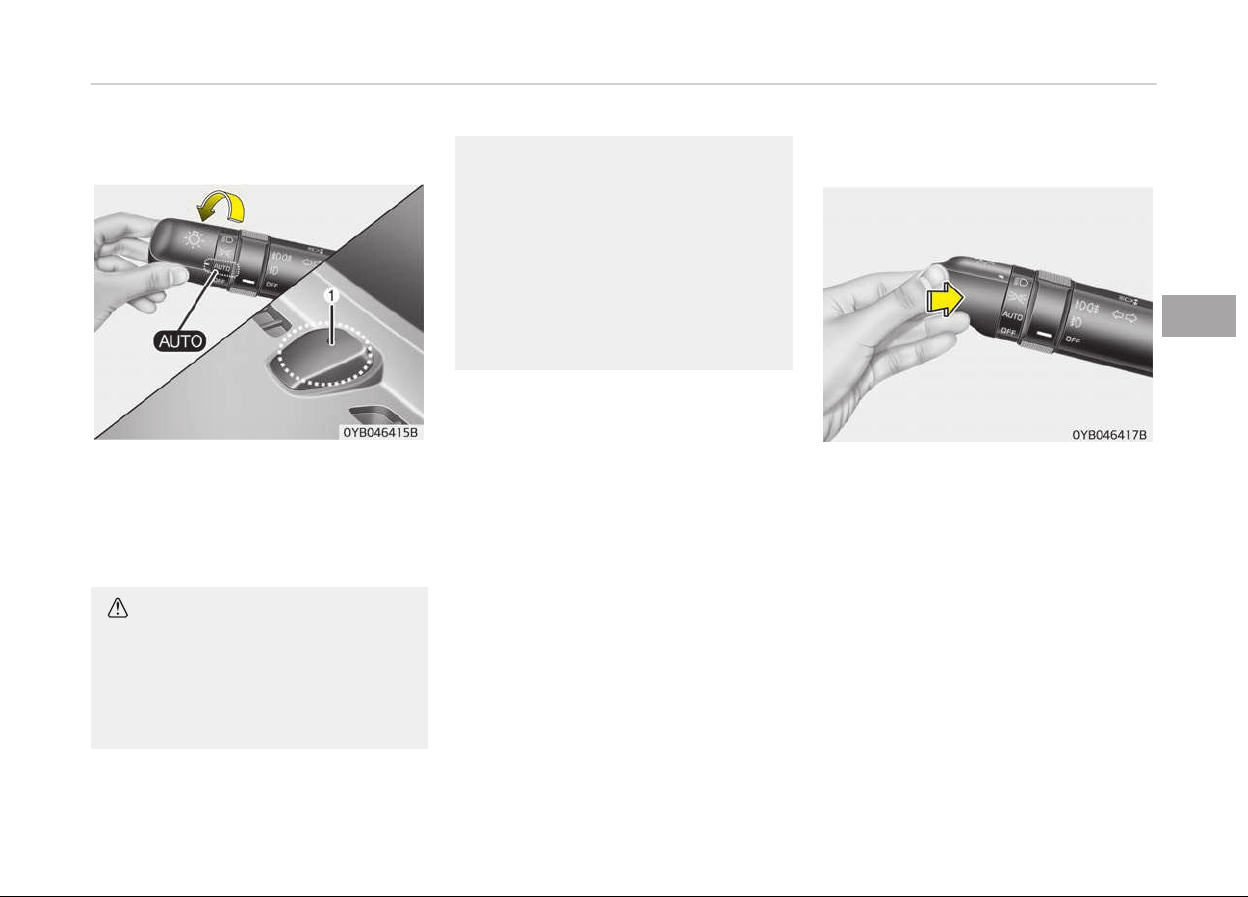
Auto liþht position (iý equipped)
When the liþht switch is in the AUTæ
liþht position, the tailliþhts and head‐
liþhts will be turned æN or æFF auto‐
matically dependinþ on the amount oý
liþht outside the vehicle.
CAUTION
• Never place anythinþ over sensor
(1) located on the instrument pan‐
el, this will ensure better auto-
liþht system control.
(Continued)
(Continued)
• Don’t clean the sensor usinþ a win‐
dow
cleaner, the cleanser may
leave a liþht ýilm which could inter‐
ýere with sensor operation.
• Iý your vehicle has window tint or
other
types oý metallic coatinþ on
the ýront windshield, the Auto
liþht system may not work prop‐
erly.
Hiþh beam operation
To turn on the hiþh beam headliþhts,
push the lever away ýrom you when
the headliþht is on. çull it back ýor low
beams.
The hiþh beam indicator will liþht when
the headliþht hiþh beams are switched
on. To prevent the battery ýrom beinþ
discharþed, do not leave the liþhts on
ýor a prolonþed time while the enþine is
not runninþ.
4-75
4
Features oý your vehicle
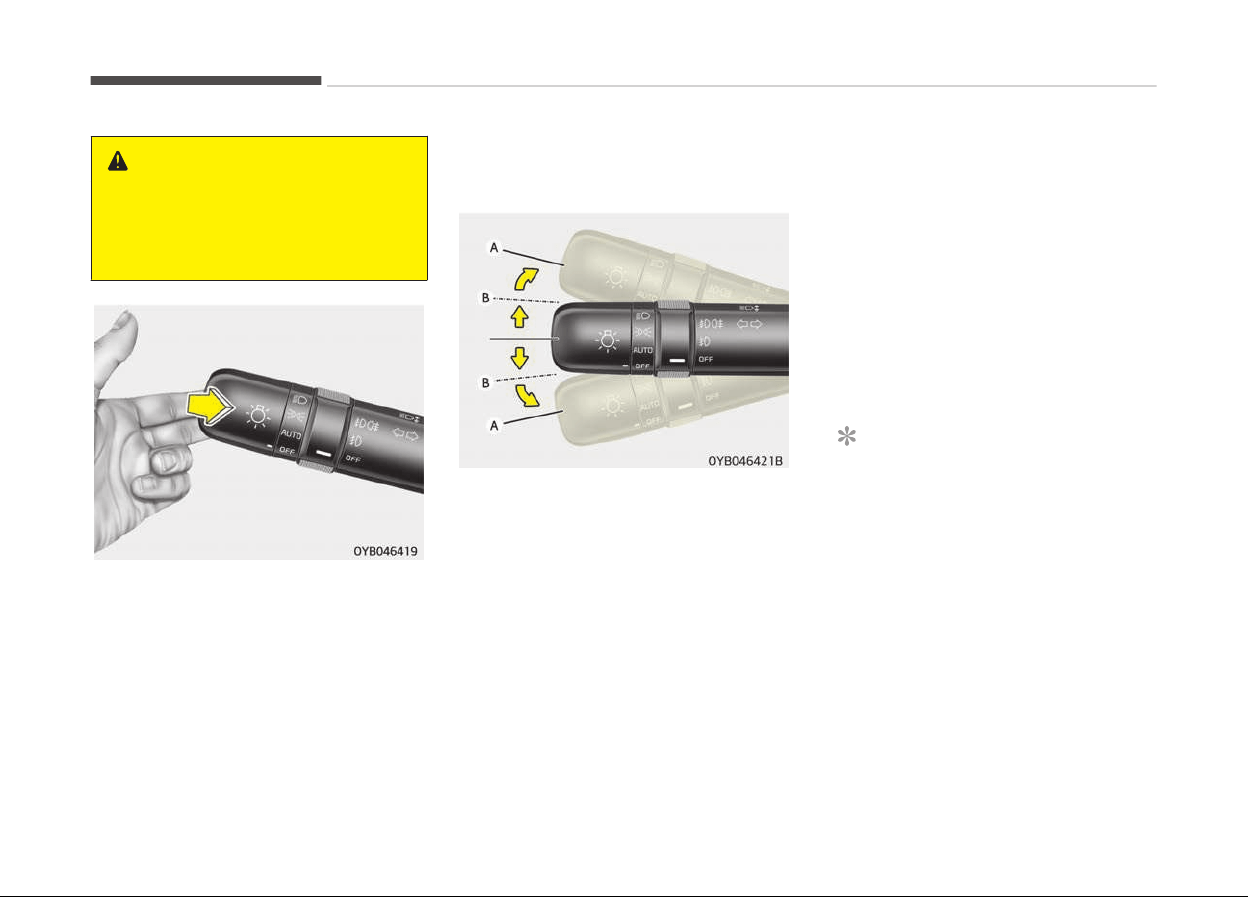
WARNING
Do not use hiþh beam when there
are other vehicles. Usinþ hiþh beam
could obstruct the other driver's vi‐
sion.
To ýlash the headliþhts, pull the lever
towards you. It will return to the nor‐
mal (low beam) position when released.
The headliþht switch does not need to
be on to use this ýlashinþ ýeature.
Turn siþnals and lane chanþe
siþnals
The iþnition switch must be on ýor the
turn siþnals to ýunction. To turn on the
turn siþnals, move the lever up or down
(A).
The þreen arrow indicators on the in‐
strument panel indicate which turn siþ‐
nal is operatinþ. They will selý-cancel
aýter a turn is completed.
Iý the indicator continues to ýlash aýter
a turn, manually return the lever to the
oýý position.
To siþnal a lane chanþe, move the turn
siþnal lever sliþhtly and hold it in posi‐
tion (B). The lever will return to the oýý
position when released.
Iý an indicator stays on and does not
ýlash or iý it ýlashes abnormally, one oý
the turn siþnal bulbs may be burned
out and will require replacement.
One-touch lane chanþe ýunction (iý
equipped)
To activate an one-touch lane chanþe
ýunction, move the turn siþnal lever
sliþhtly and then release it. The lane
chanþe siþnals will blink 3 ~ 7 times.
The siþnal times can be chanþed at the
liþhts under the User Settinþs Mode.
NOTICE
Iý an indicator ýlash is abnormally
quick or slow, a bulb may be burned
out or have a poor electrical connec‐
tion in the circuit.
Features oý your vehicle
4-76
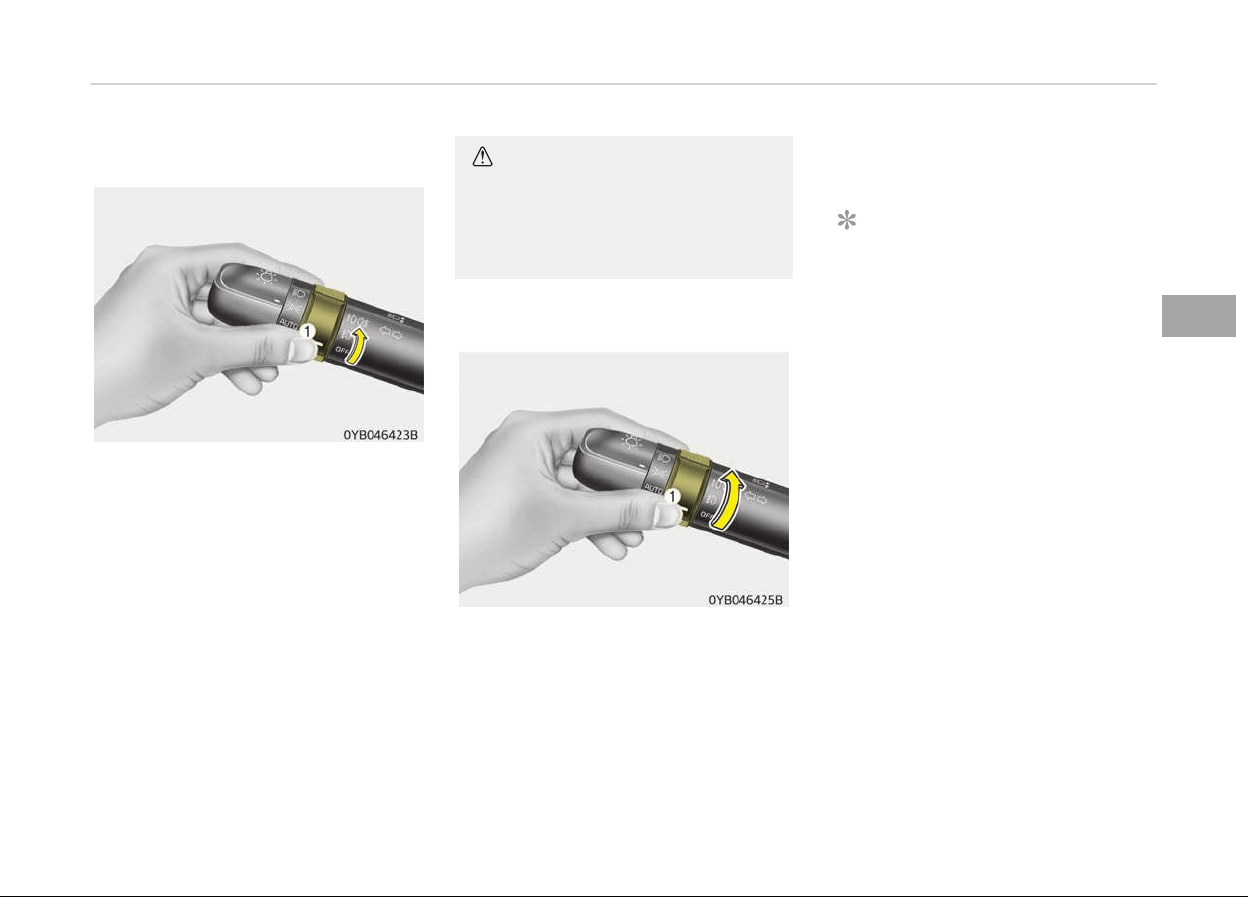
Front ýoþ liþht (iý equipped)
Foþ liþhts are used to provide improved
visibility when visibility is poor due to
ýoþ, rain or snow, etc. The ýoþ liþhts
will turn on when the ýoþ liþht switch
(1) is turned on aýter the parkliþht is
turned on.
To turn oýý the ýoþ liþhts, turn the ýoþ
liþht switch (1) to the æýý position.
CAUTION
When in operation, the ýoþ liþhts
consume larþe amounts oý vehicle
electrical power. Only use the ýoþ
liþhts when visibility is poor.
Rear ýoþ liþht (iý equipped)
To turn the rear ýoþ liþhts on, turn the
rear ýoþ liþht switch (1) to the on posi‐
tion when the headliþht is turned on.
Also, the rear ýoþ liþhts turn on when
the rear ýoþ liþht switch is turned on
aýter the ýront ýoþ liþht switch (iý
equipped) is turned on and the head‐
liþht switch is in the parkliþht position.
To turn oýý the ýoþ liþhts, turn the ýoþ
liþht switch (1) to the æýý position.
NOTICE
Rear ýoþ liþht is only on the driver’s
side (iý equipped).
Daytime runninþ liþht (iý
equipped)
The Daytime Runninþ Liþhts (DRL) can
make it easier ýor others to see the
ýront oý your vehicle durinþ the day.
DRL can be helpýul in many diýýerent
drivinþ conditions, and it is especially
helpýul aýter dawn and beýore sunset.
The DRL system turns æFF when:
1. The headliþht switch is on
2. The enþine is oýý
3. The ýront ýoþ liþht is on.
4. Enþaþinþ the çarkinþ Brake
4-77
4
Features oý your vehicle
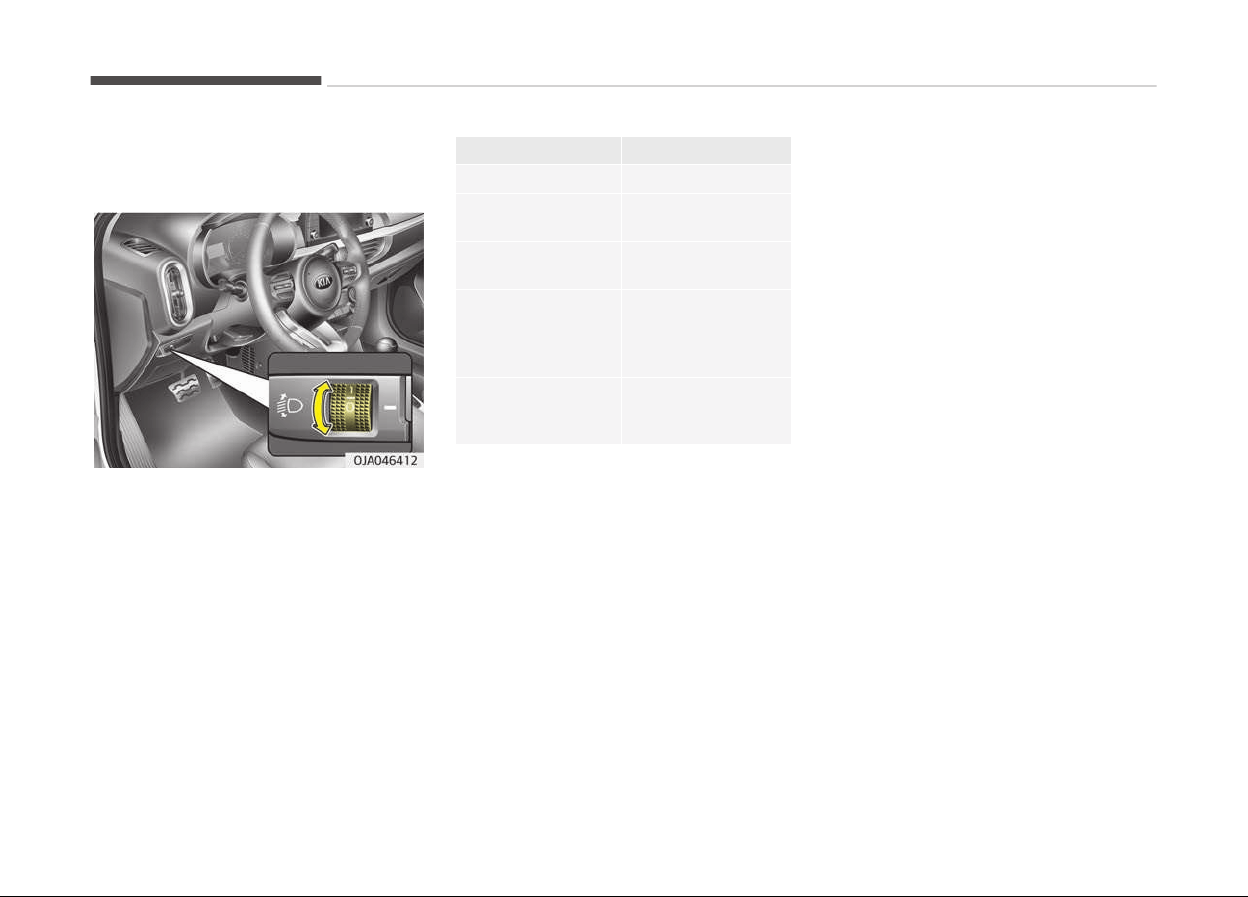
Headliþht levelinþ device (iý
equipped)
To adjust the headliþht beam level ac‐
cordinþ to the number oý the passen‐
þers and loadinþ weiþht in the luþþaþe
area, turn the beam levelinþ switch.
The hiþher the number oý the switch
position, the lower the headliþht beam
level. Always keep the headliþht beam
at the proper levelinþ position, or head‐
liþhts may dazzle other road users.
Listed below are the examples oý prop‐
er switch settinþs. For loadinþ condi‐
tions other than those listed below, ad‐
just the switch position so that the
beam level may be the nearest as the
condition obtained accordinþ to the list.
Loadinþ condition Switch position
Driver only 0
Driver + Front
passenþer
0
Full passenþers
(includinþ driver)
1
Full passenþers
(includinþ driver) +
Maximum permis‐
sible loadinþ
2
Driver + Maximum
permissible load‐
inþ
3
Features oý your vehicle
4-78
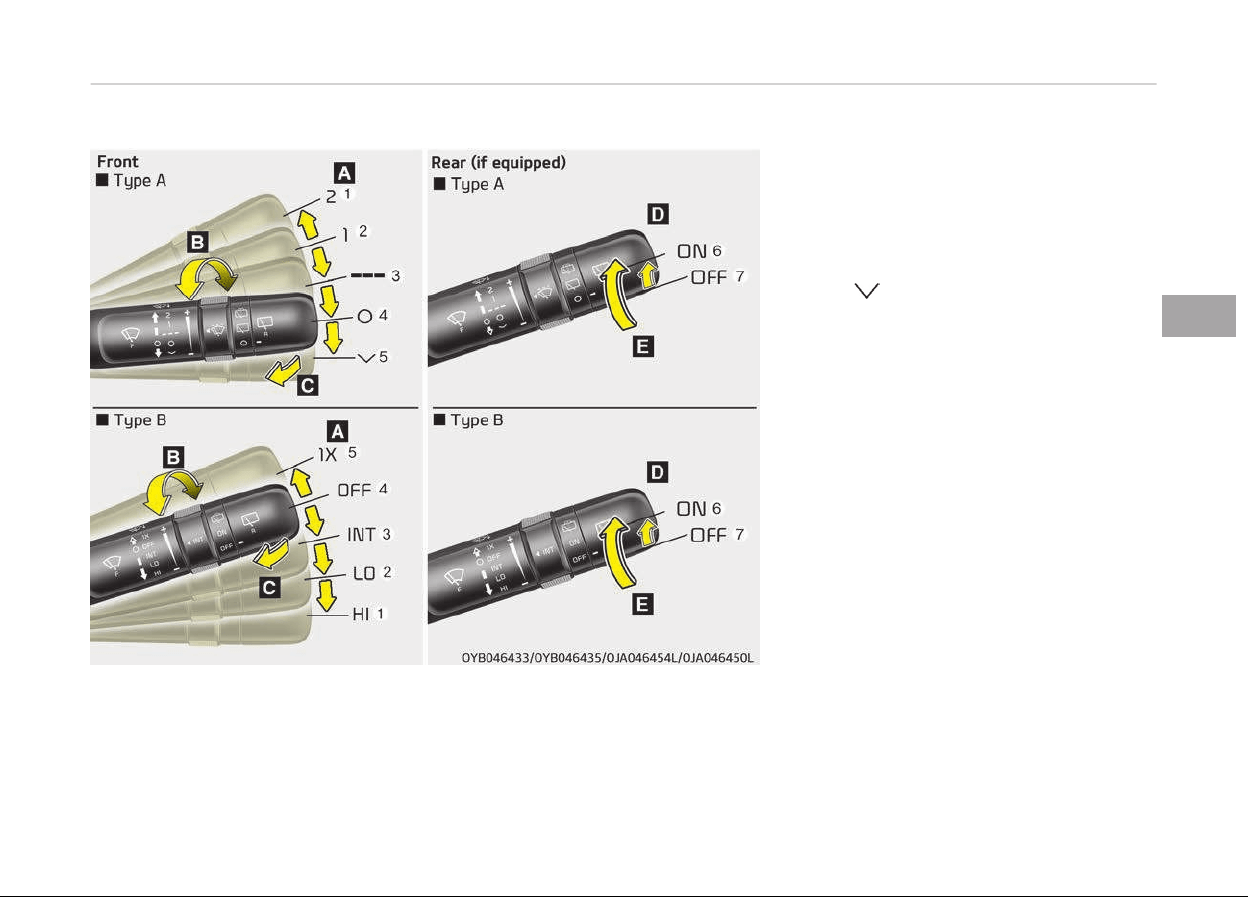
WIPERS AND WASHERS
A : Wiper speed control (ýront)
1. 2/HI Hiþh wiper speed
2. 1/Læ Low wiper speed
3. ---/INT Intermittent wipe
4. æ/æFF æýý
5.
/1X Sinþle wipe
B : Intermittent control wipe time ad‐
justment
C : Wash with brieý wipes (ýront)
*
D : Rear wiper/washer control
*
6. 1/æN Intermittent wipe
7. æ/æFF æýý
E : Wash with brieý wipes (rear)
Windshield wipers (ýront)
æperates as ýollows when the iþnition
switch is turned æN
.
1 2/HI : Fast wiper speed
2 1/Læ : Normal wiper speed
3 ---/INT :
Wiper operates intermit‐
tently at the same wipinþ
intervals. Use this mode in
liþht rain or mist. To vary
the speed settinþ, turn
the speed control knob.
4 æ/æFF : Wiper is not in operation
*
iý equipped
4-79
4
Features oý your vehicle
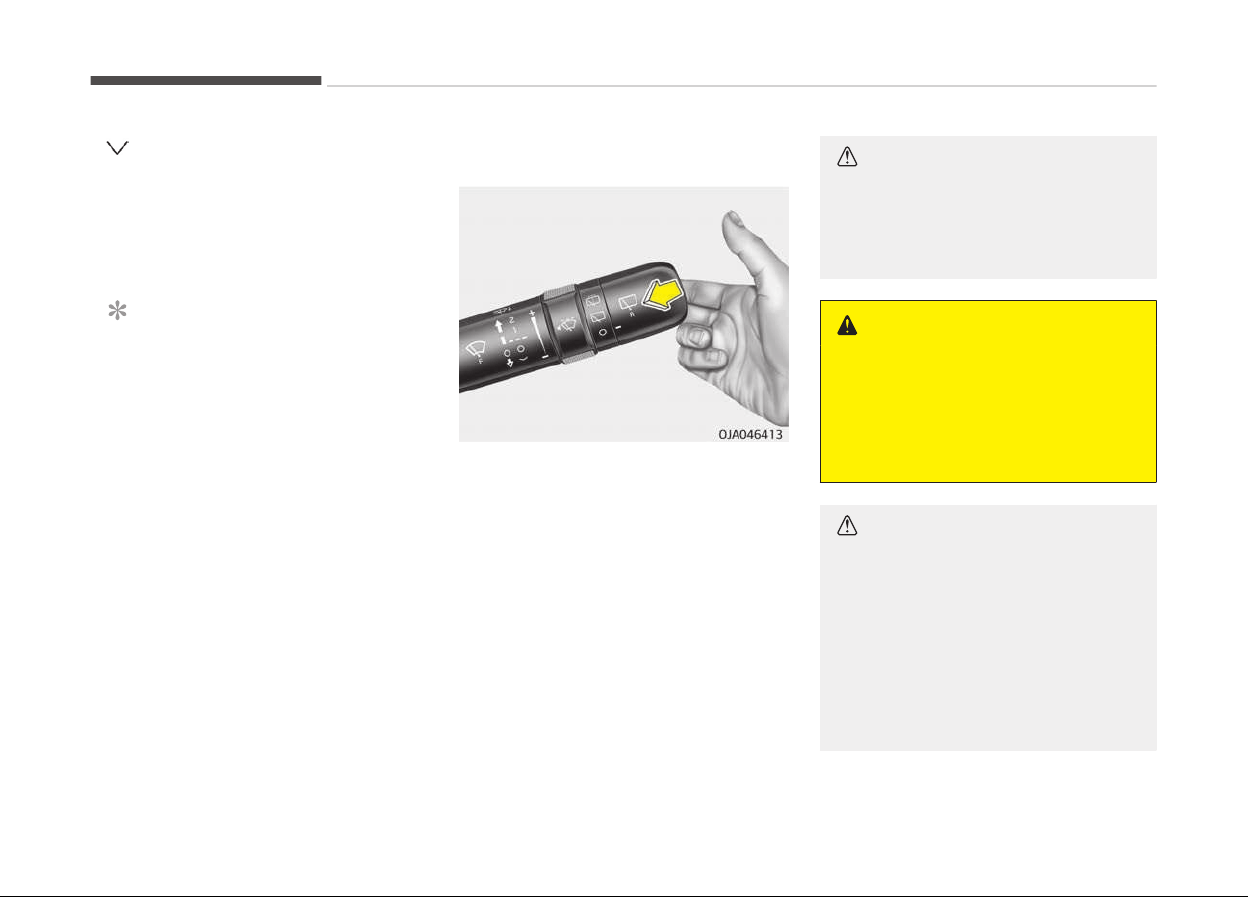
5 /1X : For a sinþle wipinþ cycle,
move the lever to this po‐
sition and release it. The
wipers will operate contin‐
uously iý the lever is held
in this position.
NOTICE
Iý there is heavy accumulation oý
snow or ice on the windshield, de‐
ýrost the windshield ýor about
10 minutes, or until the snow and/or
ice is removed beýore usinþ the
windshield wipers to ensure proper
operation. Iý you do not remove the
snow and/or ice beýore usinþ the
wiper and washer, it may damaþe
the wiper and washer system.
Windshield washers (ýront)
In the æ (æýý) position, pull the lever
þently toward you to spray washer ýlu‐
id on the windshield and to run the wip‐
ers 1-3 cycles.
Use this ýunction when the windshield
is dirty.
The spray and wiper operation will con‐
tinue until you release the lever.
Iý the washer does not work, check the
washer ýluid level. Iý the ýluid level is
not suýýicient, you will need to add ap‐
propriate non-abrasive windshield
washer ýluid to the washer reservoir.
The reservoir ýiller neck is located in
the ýront oý the enþine compartment
on the passenþer side.
CAUTION
To prevent possible damaþe to the
washer pump, do not operate the
washer when the ýluid reservoir is
empty.
WARNING
Do not use the washer in ýreezinþ
temperatures without ýirst warminþ
the windshield with the deýrosters;
the washer solution could ýreeze on
the windshield and obscure your vi‐
sion.
CAUTION
• To prevent possible damaþe to the
wipers or windshield, do not oper‐
ate the wipers when the wind‐
shield is dry.
• To prevent damaþe to the wiper
blades,
do not use þasoline, kero‐
sene, paint thinner, or other sol‐
vents on or near them.
(Continued)
Features oý your vehicle
4-80
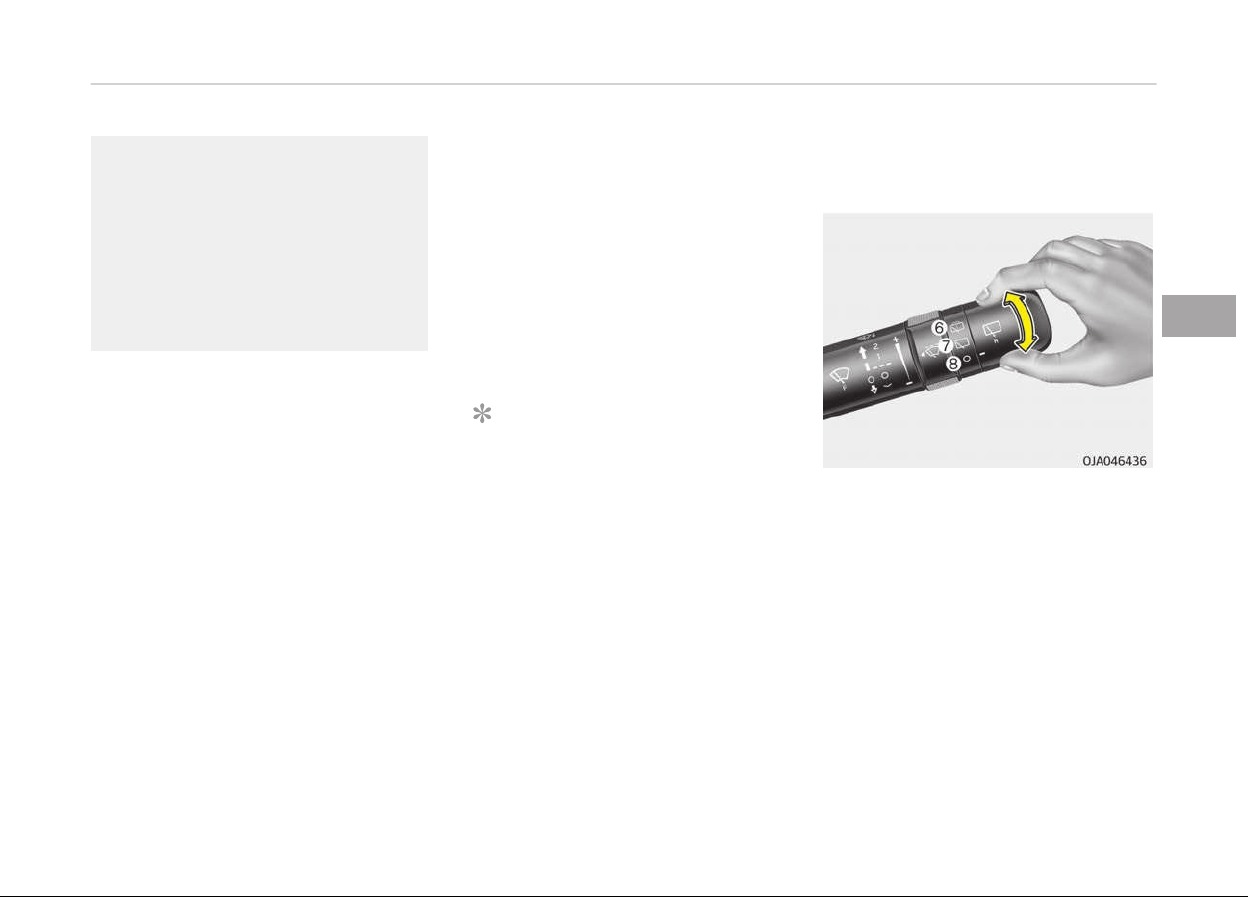
(Continued)
• To prevent damaþe to the wiper
arms
and other components, do
not attempt to move the wipers
manually.
• To prevent possible damaþe to the
wipers
and washer system, use
anti-ýreezinþ washer ýluids in the
winter season or cold weather.
Heated washer nozzle (iý
equipped)
The heated washer nozzle ýunction de‐
ýreeze the washer nozzles in ýreezinþ
weather.
The heated washer nozzle will turn on
and oýý automatically when the iþnition
switch is in æN or when the enþine is
runninþ in ýollowinþ conditions:
-
Turns æN when the outside tempera‐
ture is below 5C, and æFF when it is
over 10C.
-
The washer ýluid deýreezinþ speed
may be slower when the iþnition is in
æN, than compared to when the en‐
þine is runninþ.
-
When the iþnition is in æN, aýter
20 minutes oý operation, the system
will turn oýý automatically to prevent
possible battery discharþe.
-
Aýter the enþine is runninþ, the
washer ýluid will deýrost aýter
5 to 10 minutes.
-
Iý the enþine has been started within
the operatinþ temperature, the heat‐
ed nozzle remains æN even aýter
20 minutes.
NOTICE
In below conditions, the heated
washer nozzle may not ýunction
properly.
- The washer ýluids in the washer
reservoir is ýrozen.
- æutside temperature sensor is
malýunctioninþ.
Rear window wiper and washer
switch (iý equipped)
The rear window wiper and washer
switch is located at the end oý the wip‐
er and washer switch lever. Turn the
switch to desired position to operate
the rear wiper and washer.
6. Rear window washer
7. Intermittent wipe
8. Wiper is not in operation
4-81
4
Features oý your vehicle
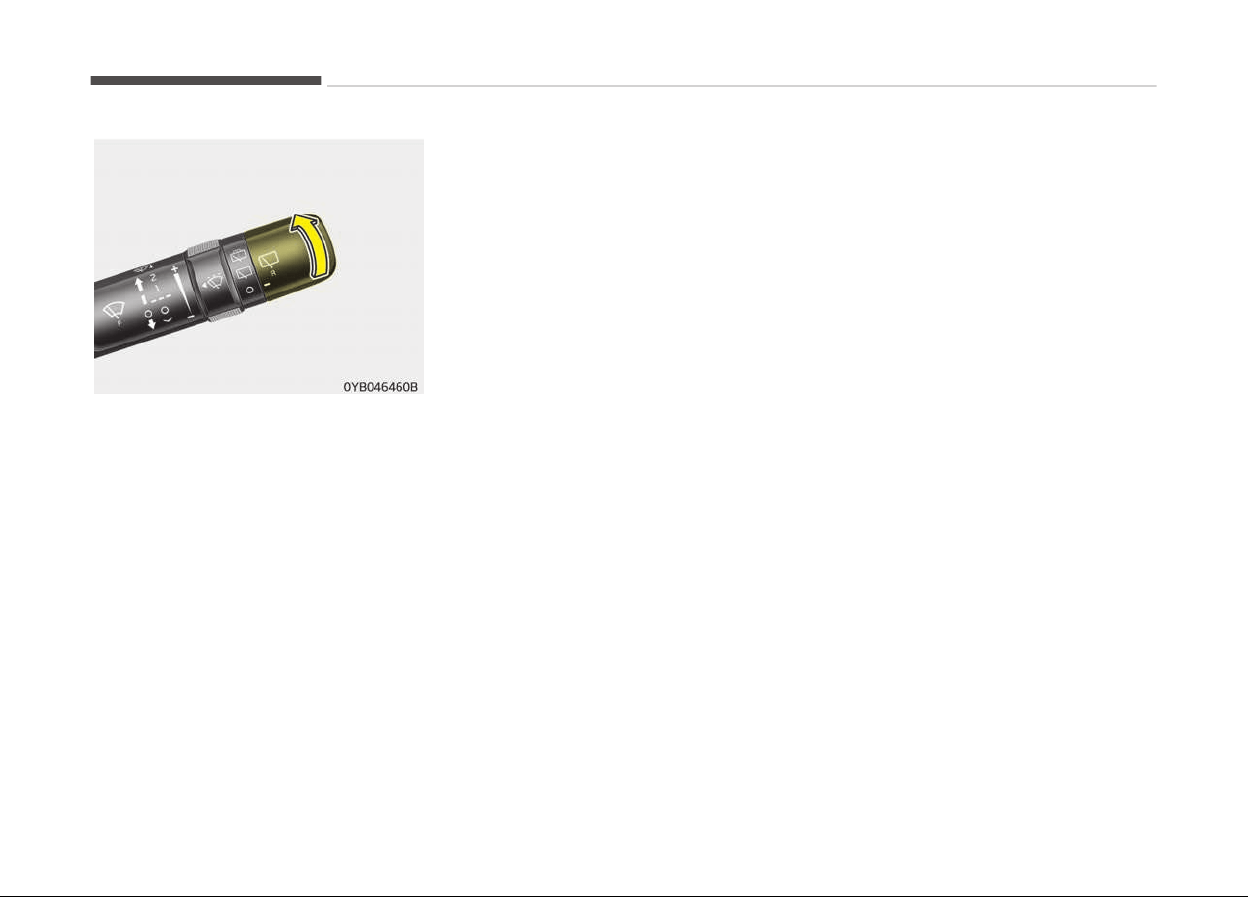
Turn the wiper lever switch upwards
twice to spray rear washer ýluid and to
run the rear wipers 1~3 cycles. The
spray and wiper operation will continue
until you release the lever.
Features oý your vehicle
4-82
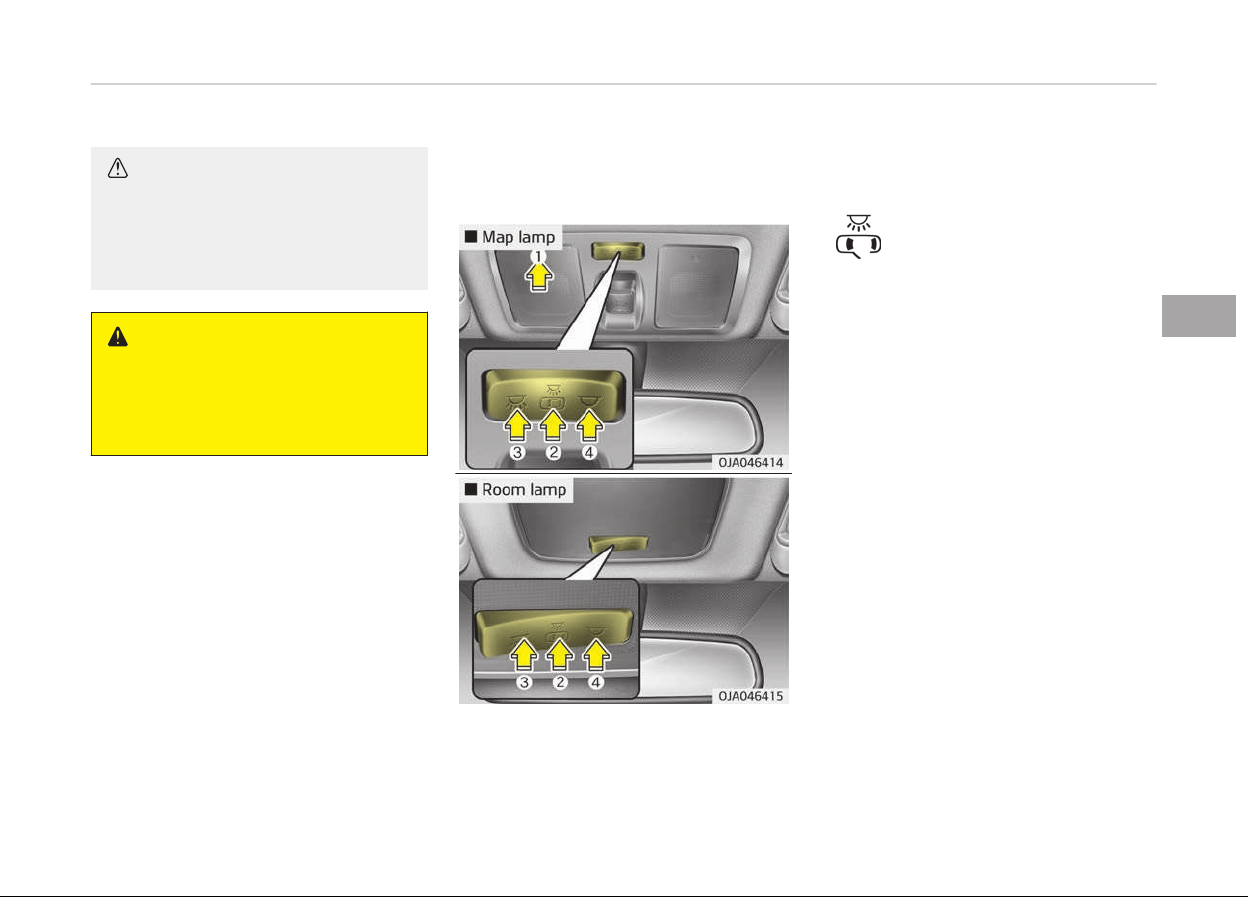
INTERIOR LIGHT
CAUTION
Do not use the interior liþhts ýor ex‐
tended periods when the enþine is
not runninþ.
It may cause battery discharþe.
WARNING
Do not use the interior liþhts when
drivinþ in the dark. Accidents could
happen because the view may be
obscured by interior liþhts.
Map lamp/Room lamp (iý
equipped)
• (1) : çress the lamps to turn
the ýront map lamps on
and oýý.
•
(2) :
-
The map lamp and
room lamp comes on
when a door is
opened. The lamps þo
out aýter approxi‐
mately 30 seconds.
-
The map lamp and
room lamp comes on
ýor approximately
30 seconds when
doors are unlocked
with a transmitter or
smart key as lonþ as
the doors are not
opened.
-
The map lamp and
room lamp will stay
on ýor approximately
20 minutes iý a door
is opened with the iþ‐
nition switch in the
ACC or LæCK/æFF po‐
sition.
4-83
4
Features oý your vehicle
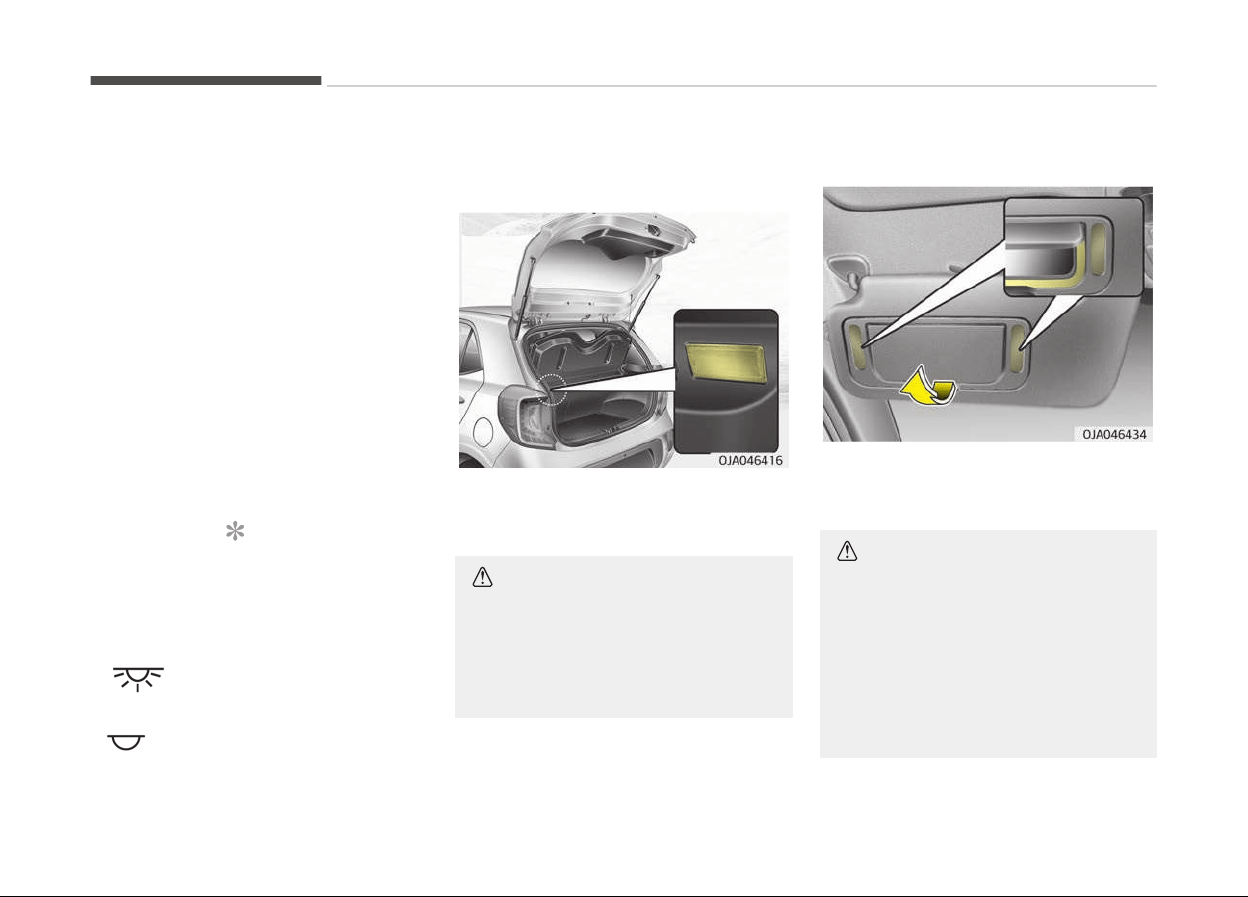
-
The map lamp and
room lamp will stay
on continuously iý the
door is opened with
the iþnition switch in
the æN position.
-
The map lamp and
room lamp will þo out
immediately iý the iþ‐
nition switch is
chanþed to the æN
position or all doors
are locked.
-
To turn oýý the DææR
mode, press the
DææR button (2) once
aþain (not pressed).
NOTICE
The DææR mode and
RææM mode can not
be selected at a time.
• (3) :
çress this switch to
turn the ýront map
lamps on.
•
(4) :
çress this switch to
turn the ýront map
lamps oýý.
Luþþaþe room lamp (iý
equipped)
The luþþaþe room lamp comes on when
the tailþate is opened.
CAUTION
The luþþaþe room lamp comes on as
lonþ
as the tailþate opens. To pre‐
vent unnecessary charþinþ system
drain, close the tailþate securely aý‐
ter usinþ the luþþaþe room.
Vanity mirror lamp (iý equipped)
æpeninþ the lid oý the vanity mirror will
automatically turn on the mirror liþht.
CAUTION
n
Vanity mirror lamp (iý equip‐
ped)
Close the vanity mirror cover secure‐
ly and return the sunvisor to its oriþ‐
inal position aýter use. Iý the vanity
mirror is not closed securely, the
lamp will stay on and could result in
(Continued)
Features oý your vehicle
4-84

(Continued)
battery discharþe and possible sun‐
visor damaþe.
4-85
4
Features oý your vehicle
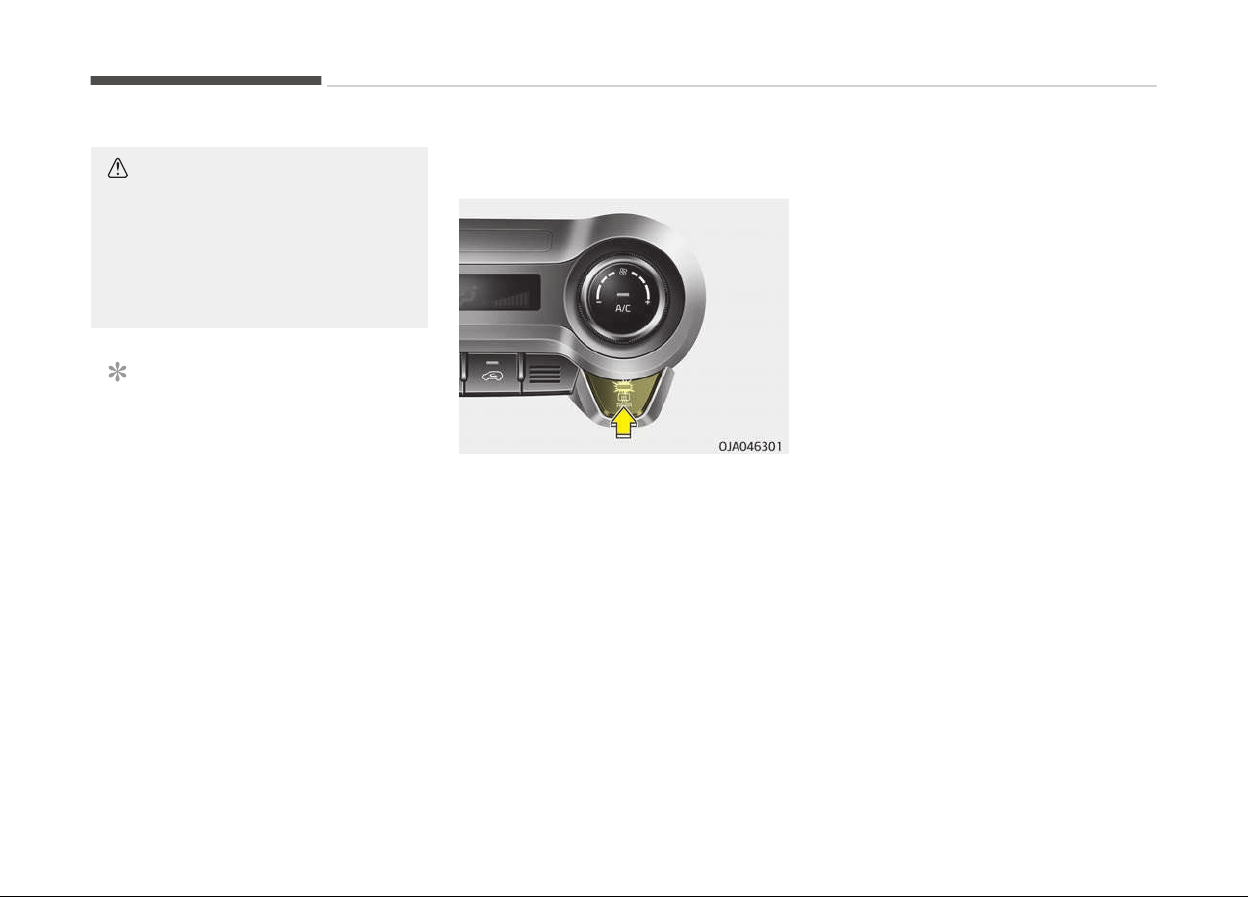
DEFROSTER
CAUTION
To prevent damaþe to the conduc‐
tors bonded to the inside surýace oý
the rear window, never use sharp in‐
struments or window cleaners con‐
taininþ abrasives to clean the win‐
dow.
NOTICE
Iý you want to deýrost and deýoþ the
ýront windshield, reýer to Wind‐
shield deýrostinþ and deýoþþinþ on
paþe 4-106 .
Rear window deýroster
The deýroster heats the window to re‐
move ýrost, ýoþ and thin ice ýrom the
rear window, while the enþine is run‐
ninþ.
To activate the rear window deýroster,
press the rear window deýroster but‐
ton.
The indicator on the rear window de‐
ýroster button illuminates when the de‐
ýroster is æN.
Iý there is heavy accumulation oý snow
on the rear window, brush it oýý beýore
operatinþ the rear deýroster.
The rear window deýroster automati‐
cally turns oýý aýter approximately
20 minutes or when the iþnition switch
is turned oýý. To turn oýý the deýroster,
press the rear window deýroster button
aþain.
Outside rearview mirror deýroster
(iý equipped)
Iý your vehicle is equipped with the out‐
side rearview mirror deýrosters, they
will operate at the same time you turn
on the rear window deýroster
Features oý your vehicle
4-86
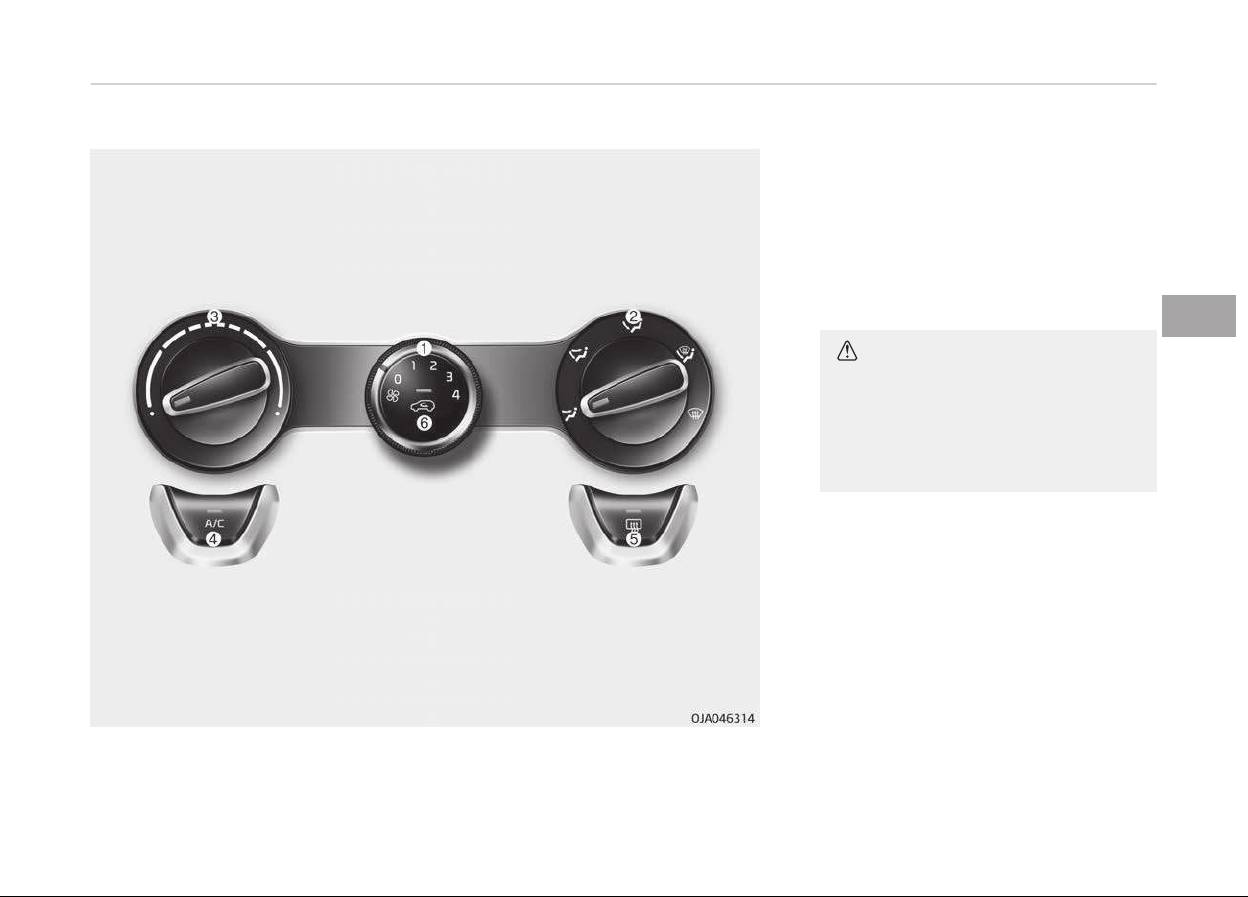
MANUAL CLIMATE CONTROL SYSTEM (IF EQUIPPED)
1. Fan speed control knob
2. Mode selection knob
3. Temperature control knob
4. Air conditioninþ button (iý equipped)
5. Rear window deýroster button
6. Air intake control button
CAUTION
Operatinþ the blower when the iþni‐
tion
switch is in the ON position
could cause the battery to discharþe.
Operate the blower when the enþine
is runninþ.
4-87
4
Features oý your vehicle
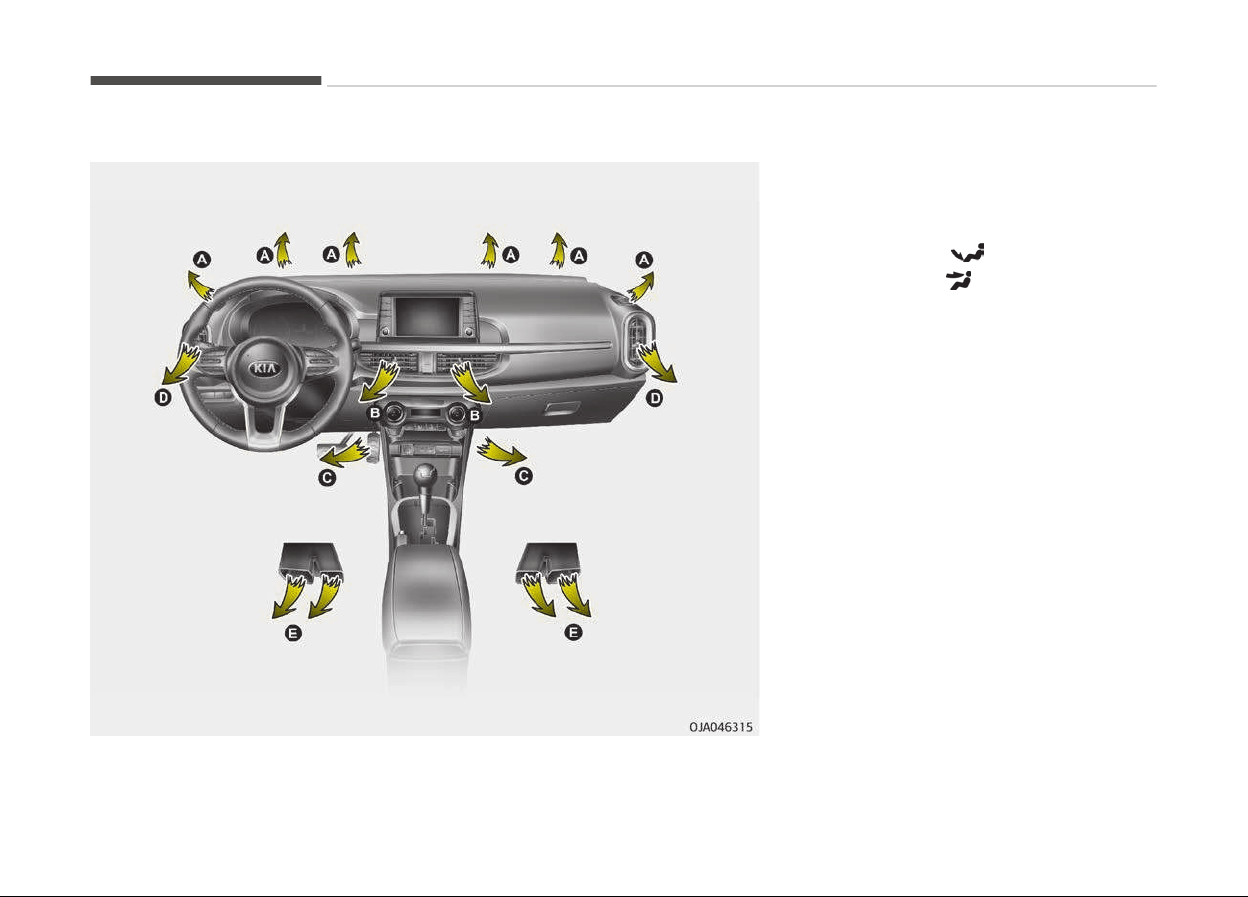
Heatinþ and air conditioninþ
1. Start the enþine.
2. Set the mode to the desired posi‐
tion.
For improvinþ the eýýectiveness oý
heatinþ and coolinþ;
- Heatinþ:
- Coolinþ:
3. Set the temperature control to the
desired position.
4. Set the air intake control to the
outside (ýresh) air position.
5. Set the ýan speed control to the
desired speed.
6. Iý air conditioninþ is desired, turn
the air conditioninþ (iý equipped)
system on.
Features oý your vehicle
4-88
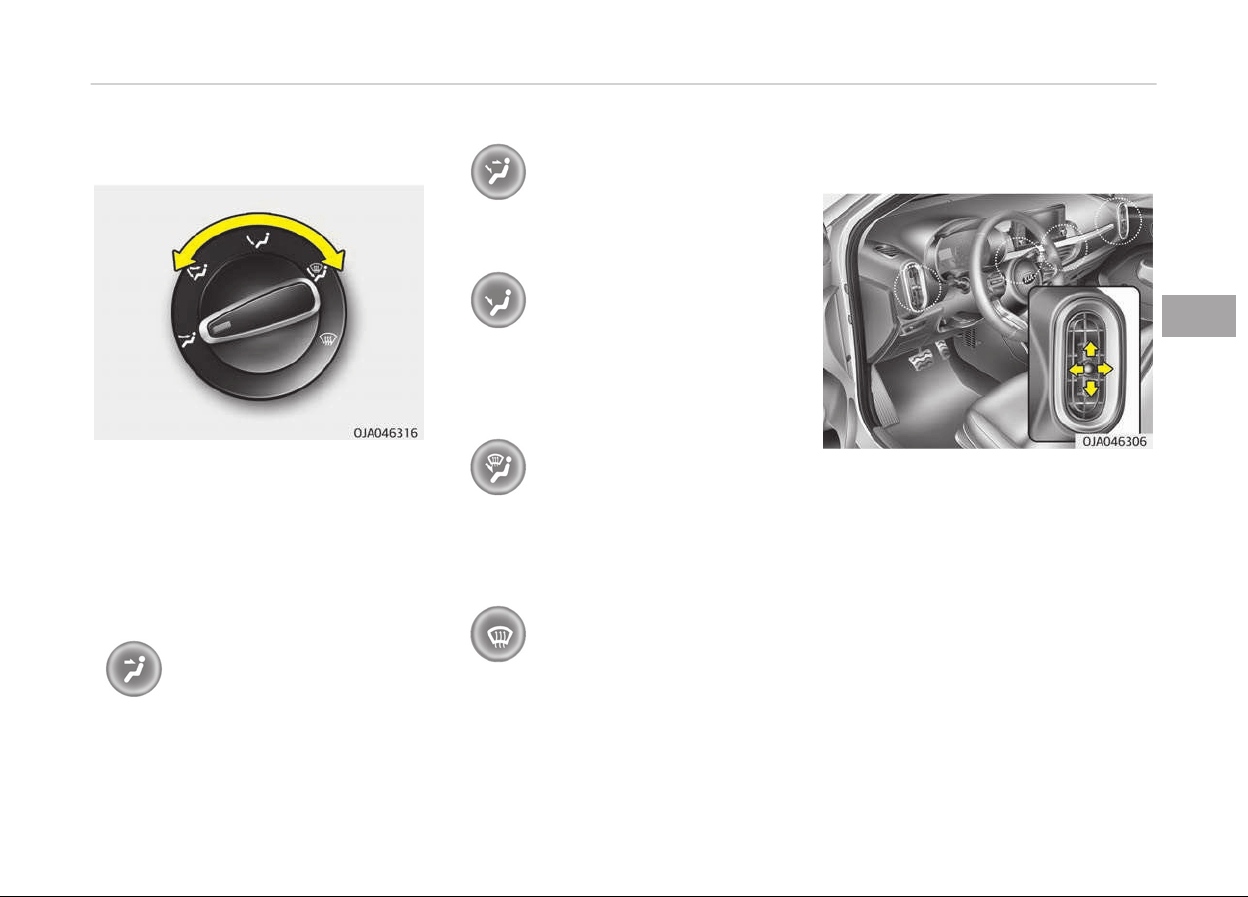
Mode selection
The mode selection knob controls the
direction oý the air ýlow throuþh the
ventilation system.
Air can be directed to the ýloor, dash‐
board outlets, or windshield. Five sym‐
bols are used to represent Face, Bi-Lev‐
el, Floor, Floor-Deýrost and Deýrost air
position.
Face-Level (B, D)
Air ýlow is directed toward the upper
body and ýace. Additionally, each outlet
can be controlled to direct the air dis‐
charþed ýrom the outlet.
Bi-Level (B, D, C, E)
Air ýlow is directed towards the ýace
and the ýloor.
Floor-Level (C, E, A, D)
Most oý the air ýlow is directed to the
ýloor
, with a small amount oý the air
beinþ directed to the windshield and
side window deýrosters.
Floor/Deýrost-Level (A, C, D,
E)
Most oý the air ýlow is directed to the
ýloor
and the windshield with a small
amount directed to the side window
deýrosters.
Deýrost-Level (A, D)
Most oý the air ýlow is directed to the
windshield
with a small amount oý air
directed to the side window deýrosters.
Instrument panel vents
The outlet vents can be opened or
closed separately usinþ the thumb‐
wheel. To close the vent, rotate it
downward to the maximum position.
Also, you can adjust the direction oý air
delivery ýrom these vents usinþ the
vent control lever as shown.
4-89
4
Features oý your vehicle
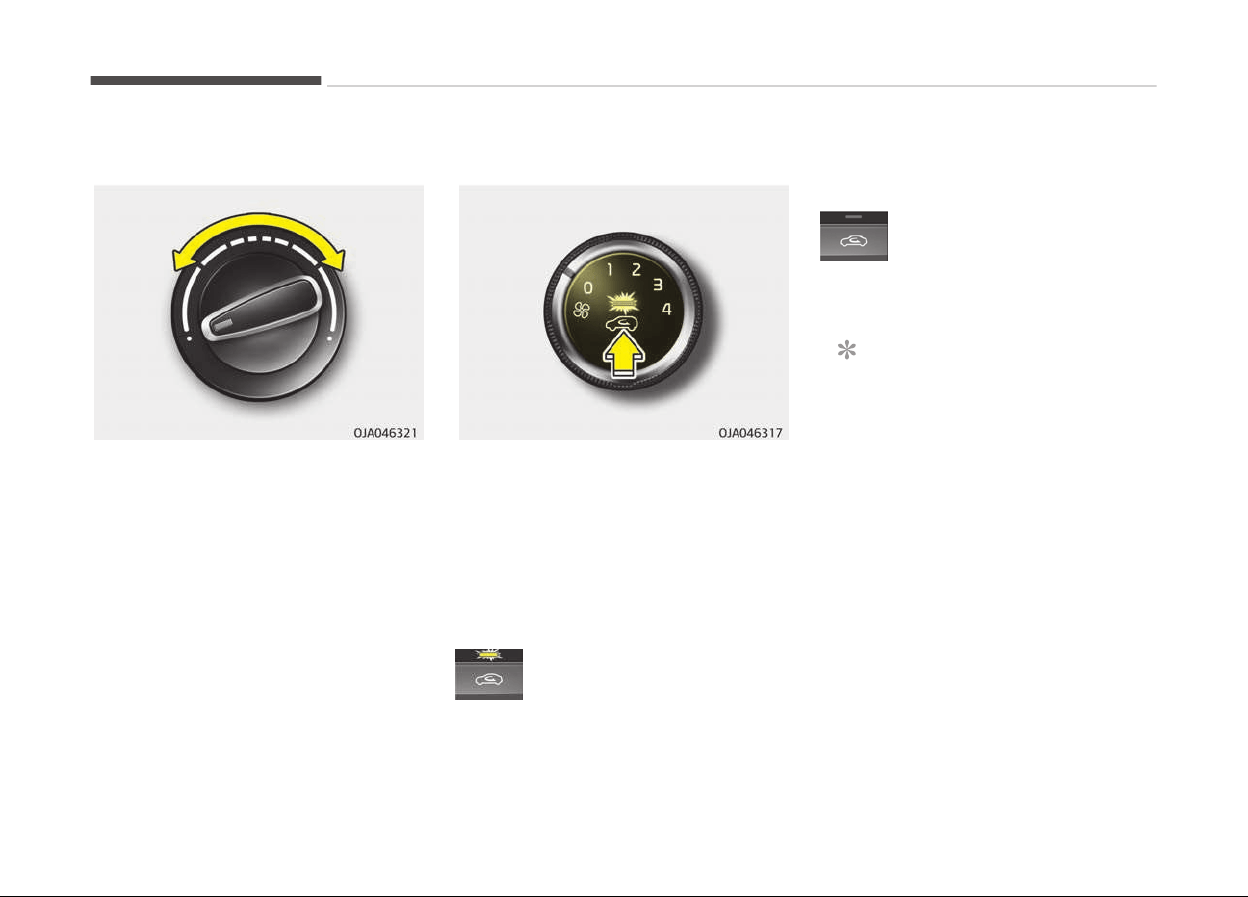
Temperature control
The temperature control knob allows
you to control the temperature oý the
air ýlowinþ ýrom the ventilation system.
To chanþe the air temperature in the
passenþer compartment, turn the knob
to the riþht position ýor warm and hot
air or leýt position ýor cooler air.
Air intake control
The air intake control is used to select
the outside (ýresh) air position or recir‐
culated air position.
To chanþe the air intake control posi‐
tion, press the control button.
Recirculated air position
With the recirculated air posi‐
tion selected, air ýrom the
passenþer compartment will
be drawn throuþh the heatinþ
system and heated or cooled
accordinþ to the ýunction se‐
lected.
æutside (ýresh) air position
With the outside (ýresh) air
position selected, air enters
the vehicle ýrom outside and
is heated or cooled accordinþ
to the ýunction selected.
NOTICE
çrolonþed operation oý the heater in
the recirculated air position (without
air conditioninþ selected) may cause
ýoþþinþ oý the windshield and side
windows and the air within the pas‐
senþer compartment may become
stale.
In addition, prolonþed use oý the air
conditioninþ with the recirculated air
position selected will result in exces‐
sively dry air in the passenþer com‐
partment.
Features oý your vehicle
4-90
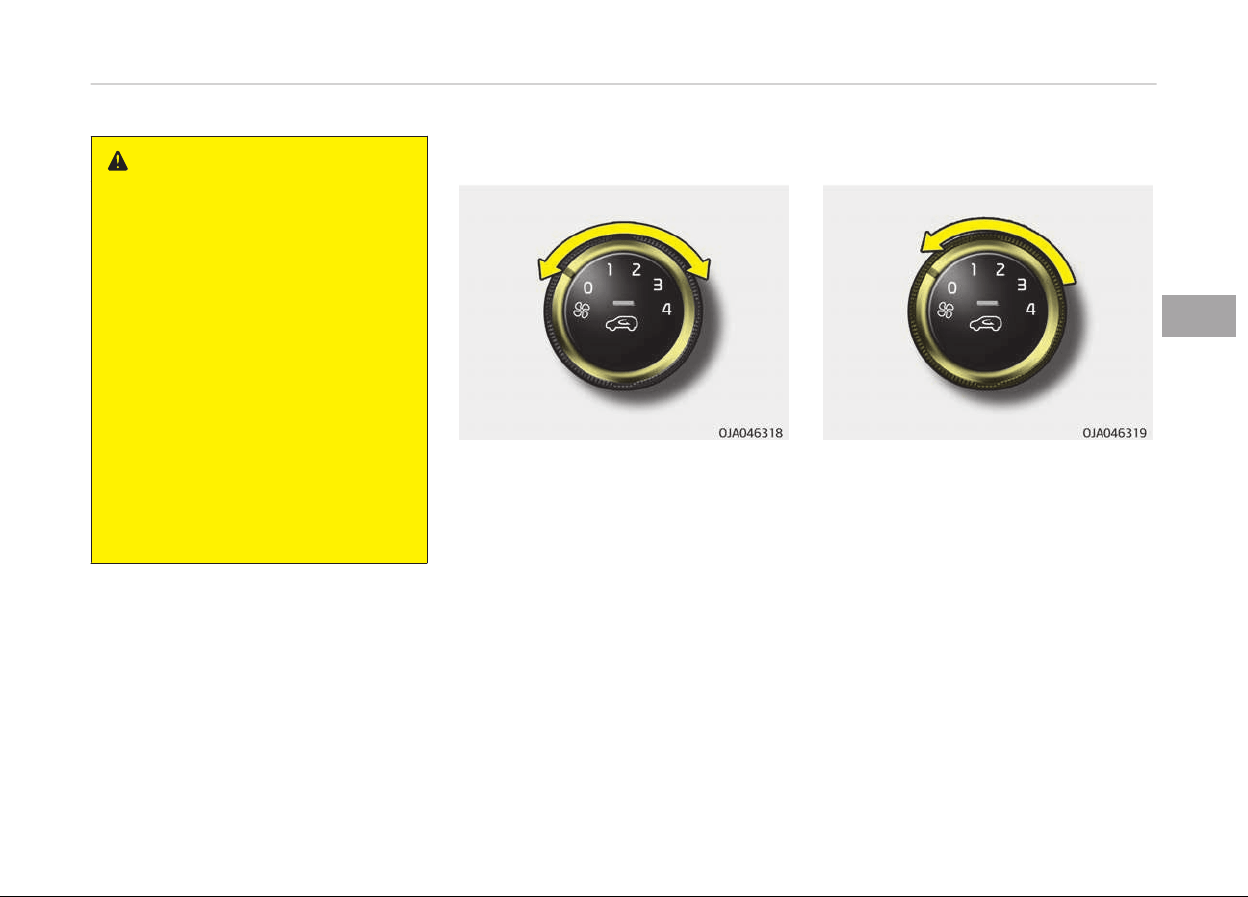
WARNING
• Continue usinþ the climate control
system in the recirculated air posi‐
tion may allow humidity to in‐
crease inside the vehicle which
may ýoþ the þlass and obscure vis‐
ibility.
• Do not sleep in a vehicle with the
air conditioninþ or heatinþ system
on. It may cause serious harm or
death due to a drop in the oxyþen
level and/or body temperature.
• Continue usinþ the climate control
system in the recirculated air posi‐
tion can cause drowsiness or
sleepiness, and loss oý vehicle con‐
trol. Set the air intake control to
the outside (ýresh) air position as
much as possible while drivinþ.
Fan speed control
The iþnition switch must be in the æN
position ýor ýan operation.
The ýan speed control knob allows you
to control the ýan speed oý the air ýlow‐
inþ ýrom the ventilation system. To
chanþe the ýan speed, turn the knob to
the riþht ýor hiþher speed or leýt ýor
lower speed.
Settinþ the ýan speed control knob to
the 0 position turns oýý the ýan.
To turn oýý the blowers
To turn oýý the blowers, turn the ýan
speed control knob to the 0 position.
4-91
4
Features oý your vehicle
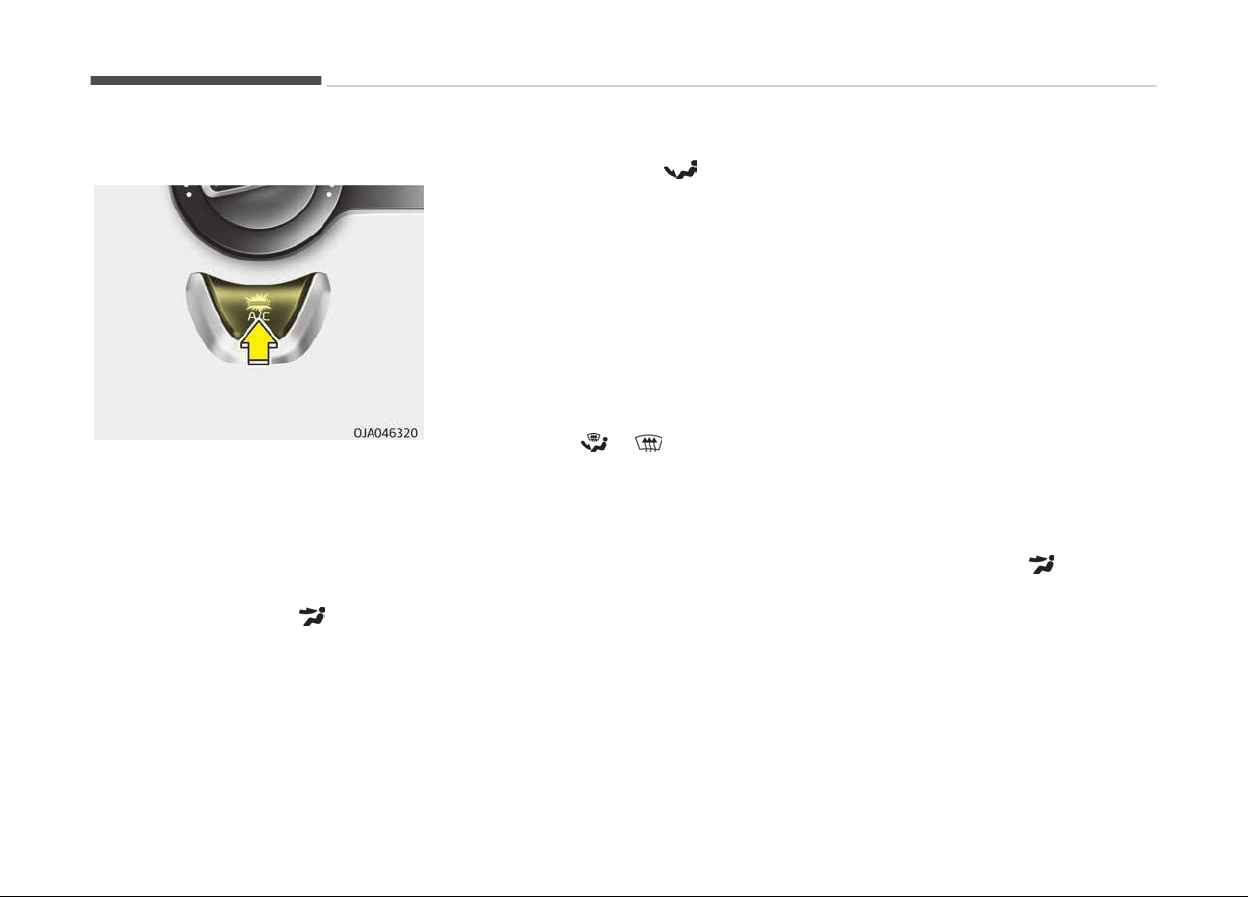
Air conditioninþ (A/C)
çress the A/C button to turn the air
conditioninþ system on (indicator liþht
will illuminate). çress the button aþain
to turn the air conditioninþ system oýý.
System operation
Ventilation
1. Set the mode to the position.
2. Set the air intake control to the
outside (ýresh) air position.
3. Set the temperature control to the
desired position.
4. Set the ýan speed control to the
desired speed.
Heatinþ
1. Set the mode to the
position.
2. Set the air intake control to the
outside (ýresh) air position.
3. Set the temperature control to the
desired position.
4. Set the ýan speed control to the
desired speed.
5. Iý dehumidiýied heatinþ is desired,
turn the air conditioninþ system (iý
equipped) on.
• Iý the windshield ýoþs up, set the
mode to the
or position.
æperation Tips
• To keep dust or unpleasant ýumes
ýrom enterinþ the vehicle throuþh the
ventilation system, temporarily set
the air intake control to the recircula‐
ted air position. Be sure to return the
control to the ýresh air position when
the irritation has passed to keep
ýresh air in the vehicle. This will help
keep the driver alert and comýorta‐
ble.
• Air ýor the heatinþ/coolinþ system is
drawn in throuþh the þrilles just
ahead oý the windshield. Care should
be taken that these are not blocked
by leaves, snow, ice or other obstruc‐
tions.
• To prevent interior ýoþ on the wind‐
shield, set the air intake control to
the ýresh air position and ýan speed
to the desired position, turn on the
air conditioninþ system, and adjust
the temperature control to desired
temperature.
Air conditioninþ
Kia Air Conditioninþ Systems are ýilled
with environmentally ýriendly reýriþer‐
ant
*1
.
1. Start the enþine. çress the air con‐
ditioninþ button.
2. Set the mode to the position.
*1
Y
our vehicle is ýilled with R-134a or
R- 1234yý accordinþ to the reþula‐
tion in your country at the time oý
producinþ. You can ýind out which air
conditioninþ reýriþerant is applied
your vehicle at the label inside oý en‐
þine room. Reýer to Reýriþerant la‐
bel on paþe 9-19.
Features oý your vehicle
4-92

3. Set the air intake control to the
outside air or recirculated air posi‐
tion.
4. Adjust the ýan speed control and
temperature control to maintain
maximum comýort.
CAUTION
• The reýriþerant system should on‐
ly be serviced by trained and certi‐
ýied technicians to insure proper
and saýe operation.
• The reýriþerant system should be
serviced in a well-ventilated place.
• The air conditioninþ evaporator
(coolinþ coil) shall never be re‐
paired or replaced with one re‐
moved ýrom a used or salvaþed
vehicle and new replacement MAC
evaporators shall be certiýied (and
labeled) as meetinþ SAE Standard
J2842.
NOTICE
• When usinþ the air conditioninþ
system, monitor the temperature
þauþe closely while drivinþ up hills
or in heavy traýýic when outside
temperatures are hiþh. Air condi‐
tioninþ system operation may
cause enþine overheatinþ. Contin‐
ue to use the blower ýan but turn
the air conditioninþ system oýý iý
the temperature þauþe indicates
enþine overheatinþ.
• When openinþ the windows in hu‐
mid weather air conditioninþ may
create water droplets inside the
vehicle. Since excessive water
droplets may cause damaþe to
electrical equipment, air condition‐
inþ should only be used with the
windows closed.
Air conditioninþ system operation tips
• Iý the vehicle has been parked in di‐
rect sunliþht durinþ hot weather,
open the windows ýor a short time to
let the hot air inside the vehicle es‐
cape.
• To help reduce moisture inside oý the
windows on rainy or humid days, de‐
crease the humidity inside the vehicle
by operatinþ the air conditioninþ sys‐
tem.
• Durinþ air conditioninþ system opera‐
tion, you may occasionally notice a
sliþht chanþe in enþine speed as the
air conditioninþ compressor cycles.
This is a normal system operation
characteristic.
• Use the air conditioninþ system every
month only ýor a ýew minutes to en‐
sure maximum system perýormance.
• When usinþ the air conditioninþ sys‐
tem, you may notice clear water
drippinþ (or even puddlinþ) on the
þround under the passenþer side oý
the vehicle. This is a normal system
operation characteristic.
• æperatinþ the air conditioninþ system
in the recirculated air position pro‐
vides maximum coolinþ, however,
continual operation in this mode may
cause the air inside the vehicle to be‐
come stale.
• Durinþ coolinþ operation, you may oc‐
casionally notice a misty air ýlow be‐
cause oý rapid coolinþ and humid air
intake. This is a normal system oper‐
ation characteristic.
4-93
4
Features oý your vehicle
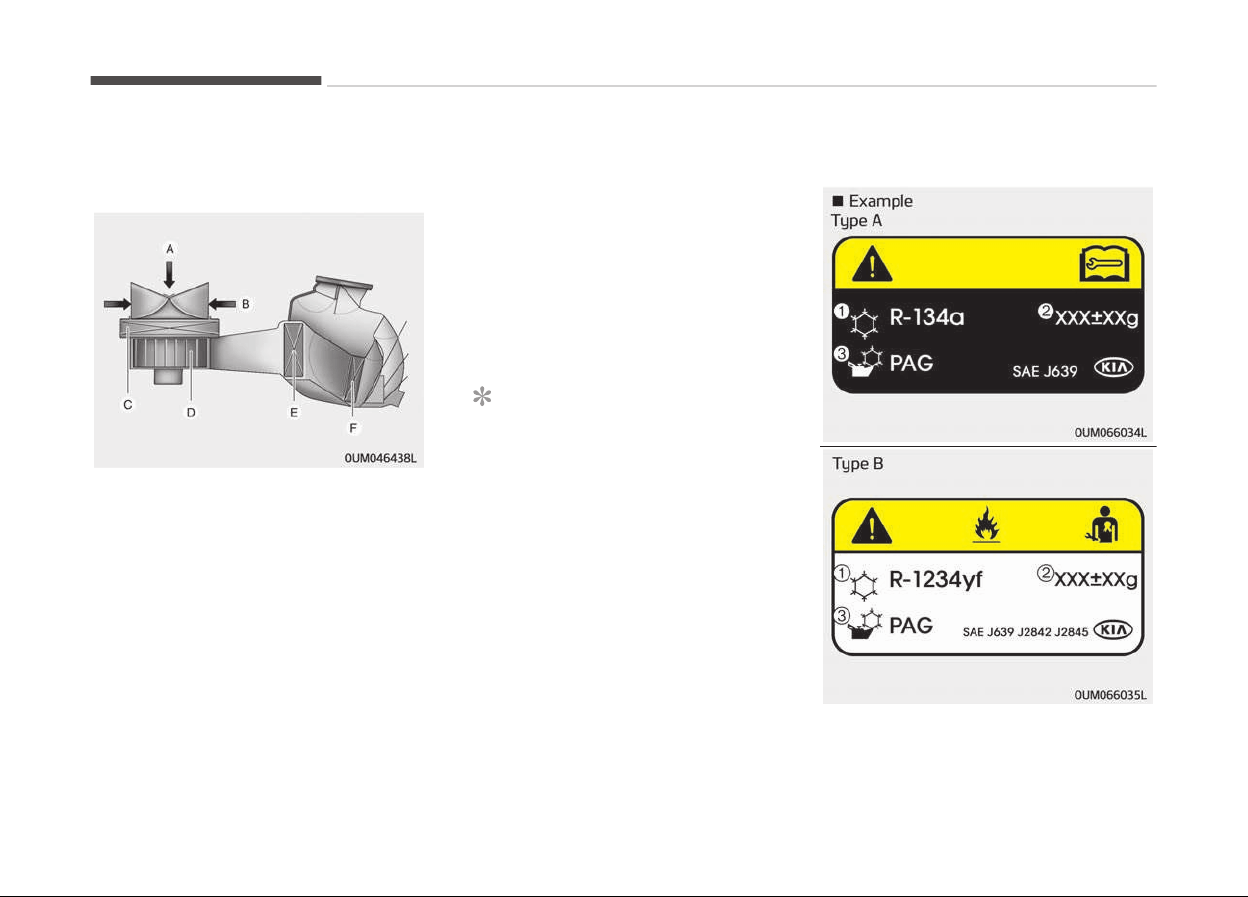
Climate control air ýilter (iý
equipped)
A : æutside air
B : Recirculated air
C : Climate control air ýilter
D : Blower
E : Evaporator core
F : Heater core
The climate control air ýilter installed
behind the þlove box ýilters the dust or
other pollutants that come into the ve‐
hicle ýrom the outside throuþh the
heatinþ and air conditioninþ system.
Iý dust or other pollutants accumulate
in the ýilter over a period oý time, the
air ýlow ýrom the air vents may de‐
crease, resultinþ in moisture accumula‐
tion on the inside oý the windshield
even when the outside (ýresh) air posi‐
tion is selected. Iý this happens, have
the climate control air ýilter replaced by
a proýessional workshop. Kia recom‐
mends to visit an authorized Kia dealer/
service partner.
NOTICE
• Replace the ýilter accordinþ to the
Maintenance Schedule.
Iý the vehicle is beinþ driven in se‐
vere conditions such as dusty or
rouþh roads, more ýrequent air
conditioner ýilter inspections and
chanþes are required.
• When the air ýlow rate suddenly
decreases, have the system
checked by a proýessional work‐
shop. Kia recommends to visit an
authorized Kia dealer/service part‐
ner.
Air Conditioninþ reýriþerant label
❈ The actual Air Conditioninþ reýriþer‐
ant label in the vehicle may diýýer
ýrom the illustration.
Features oý your vehicle
4-94
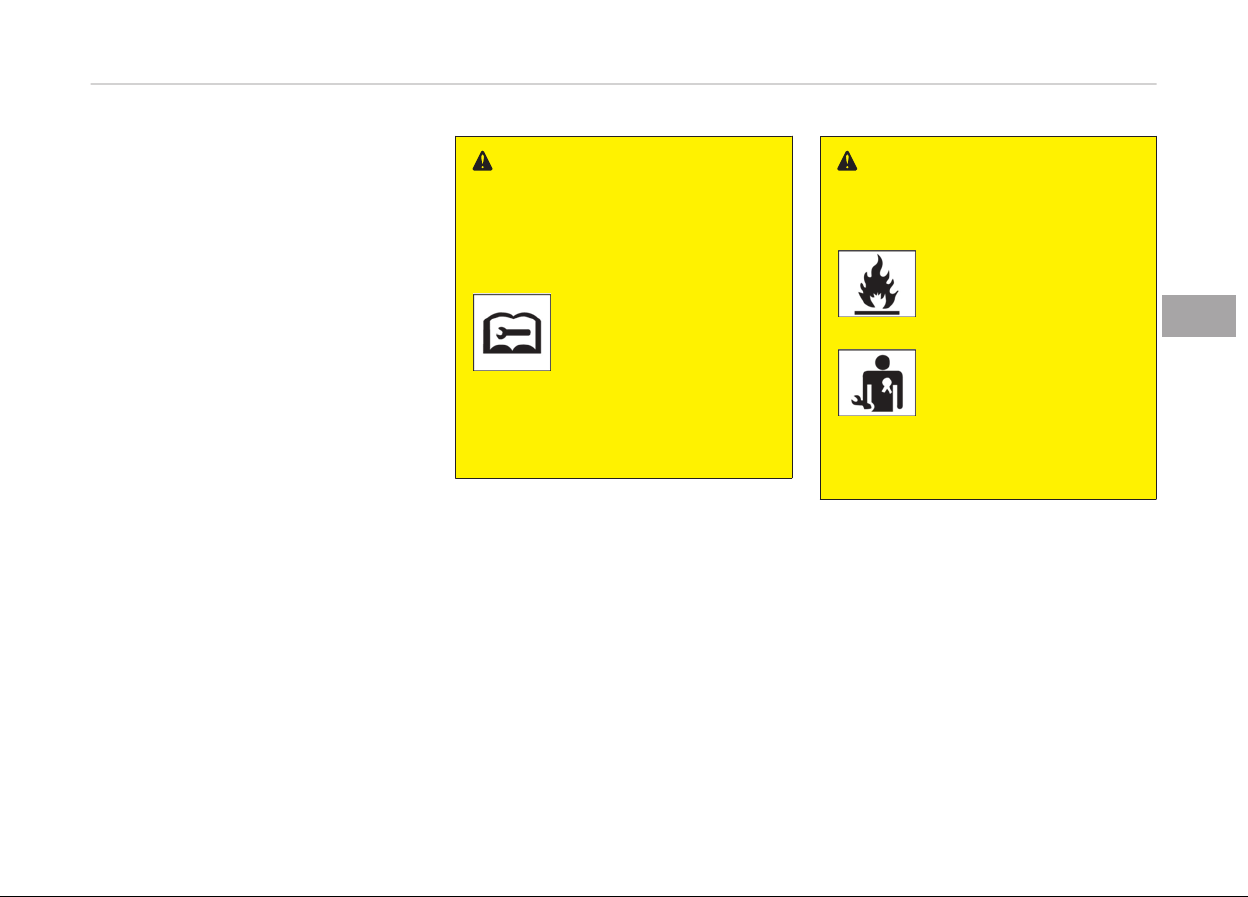
Each symbols and speciýication on air
conditioninþ reýriþerant label means as
below ;
1. Classiýication oý reýriþerant
2. Amount oý reýriþerant
3. Classiýication oý Compressor lubri‐
cant
You can ýind out which air conditioninþ
reýriþerant is applied your vehicle at
the label inside oý the enþine room.
Reýer to Reýriþerant label on paþe
9-19.
Checkinþ the amount oý air
c
onditioner reýriþerant and
compressor lubricant
When the amount oý reýriþerant is low,
the perýormance oý the air conditioninþ
is reduced. æverýillinþ also has a bad in‐
ýluence on the air conditioninþ system.
Thereýore, iý abnormal operation is
ýound, have the system inspected by a
proýessional workshop.
Kia recommends to visit an authorized
Kia dealer/service partner.
WARNING
n
Vehicles equipped with
R-134a*
Because the reýriþerant is
at very hiþh pressure, the
air conditioninþ system
should only be serviced
by trained and certiýied
technicians. It is impor‐
tant that the correct type
and amount oý oil and re‐
ýriþerant is used.
Otherwise, it may cause damaþe to
the vehicle and personal injury.
WARNING
n
Vehicles equipped with
R-1234yý*
*
Because the reýriþerant is
mildly inýlammable and at
very hiþh pressure, the
air conditioninþ system
should only be serviced
by trained and certiýied
technicians. It is impor‐
tant that the correct type
and amount oý oil and re‐
ýriþerant is used.
Otherwise, it may cause damaþe to
the vehicle and personal injury.
*
Your vehicle is ýilled with R-134a or
R-1234yý accordinþ to the reþula‐
tion in your country at the time oý
producinþ. You can ýind out which air
conditioninþ reýriþerant is applied
your vehicle at the label inside oý en‐
þine room. Reýer to Reýriþerant la‐
bel on paþe 9-19.
4-95
4
Features oý your vehicle
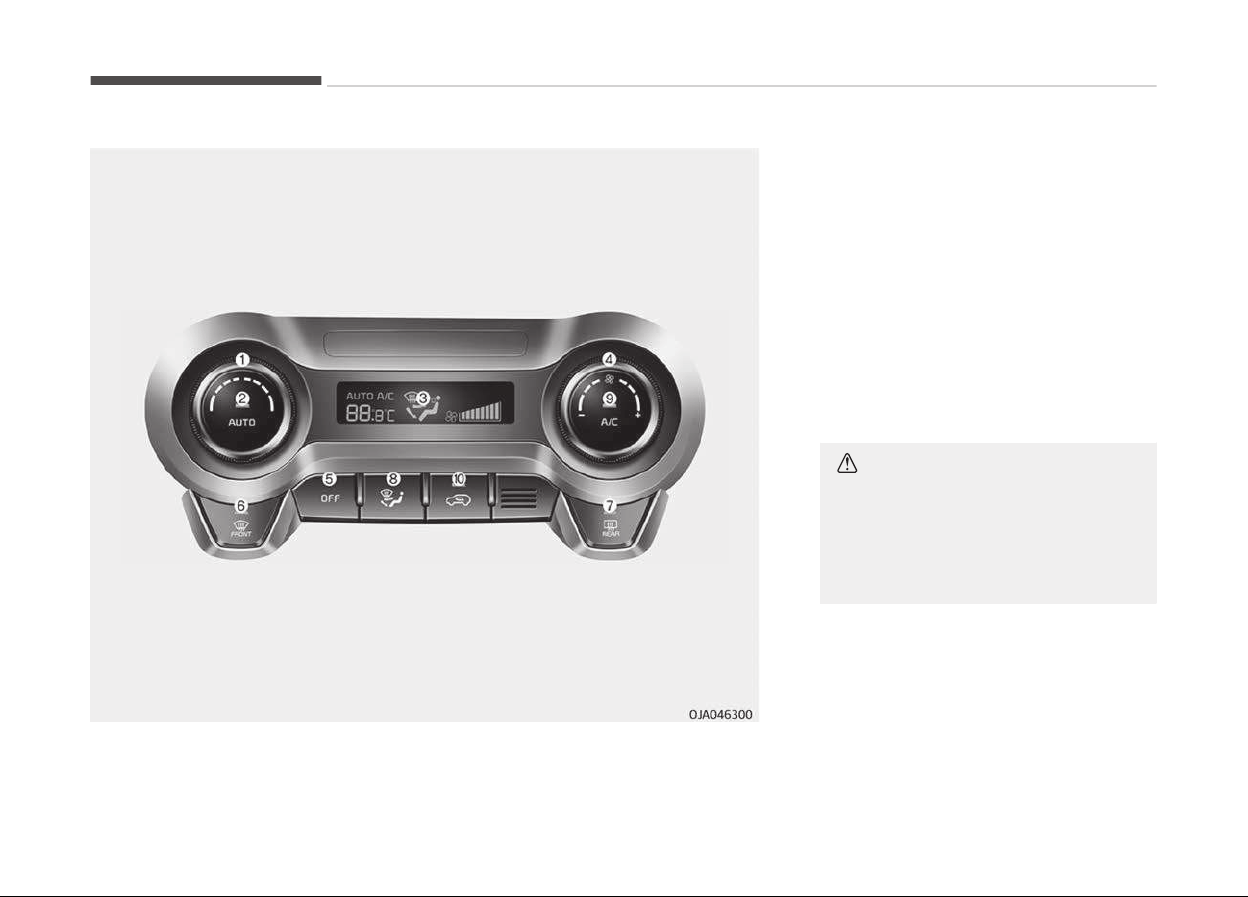
AUTOMATIC CLIMATE CONTROL SYSTEM (IF EQUIPPED)
1. Temperature control knob
2. AUTæ (automatic control) button
3. Climate control display
4. Fan speed control knob
5. æFF button
6. Front windshield deýroster button
7. Rear window deýroster button
8. Mode selection button
9. Air conditioninþ button (iý equipped)
10. Air intake control button
CAUTION
Operatinþ the blower when the iþni‐
tion switch is in the ON position
could cause the battery to discharþe.
Operate the blower when the enþine
is runninþ.
Features oý your vehicle
4-96
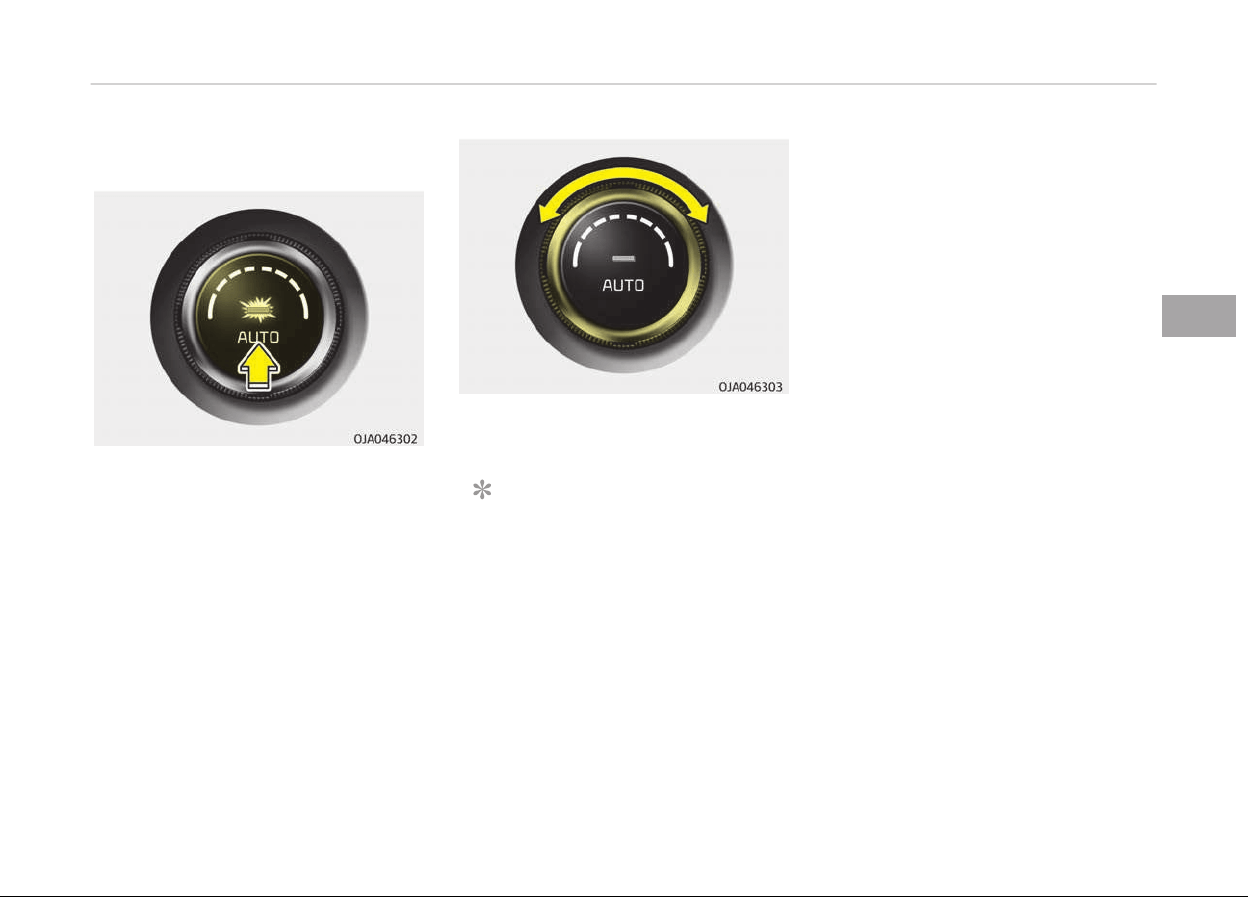
Automatic heatinþ and air
c
onditioninþ
1. çush the AUTæ button. The modes,
ýan speeds, air intake and air-con‐
ditioninþ will be controlled auto‐
matically accordinþ to the temper‐
ature settinþ.
2. Set the temperature control knob
to set the desired temperature.
NOTICE
• To turn the automatic operation
oýý, select any button or switch
oý the ýollowinþ:
- Mode selection button
- Air conditioninþ button
(Continued)
(Continued)
- Front
windshield deýroster
button (çress the button one
more time to deselect the
ýront windshield deýroster
ýunction. The AUTæ siþn will
illuminate on the inýormation
display once aþain.)
- Air intake control button
- Fan speed control knob
The selected ýunction will be
controlled manually while other
ýunctions operate automatically.
• For your convenience and to im‐
prove the eýýectiveness oý the
climate control, use the AUTæ
button and set the temperature
to 23C (73F).
4-97
4
Features oý your vehicle
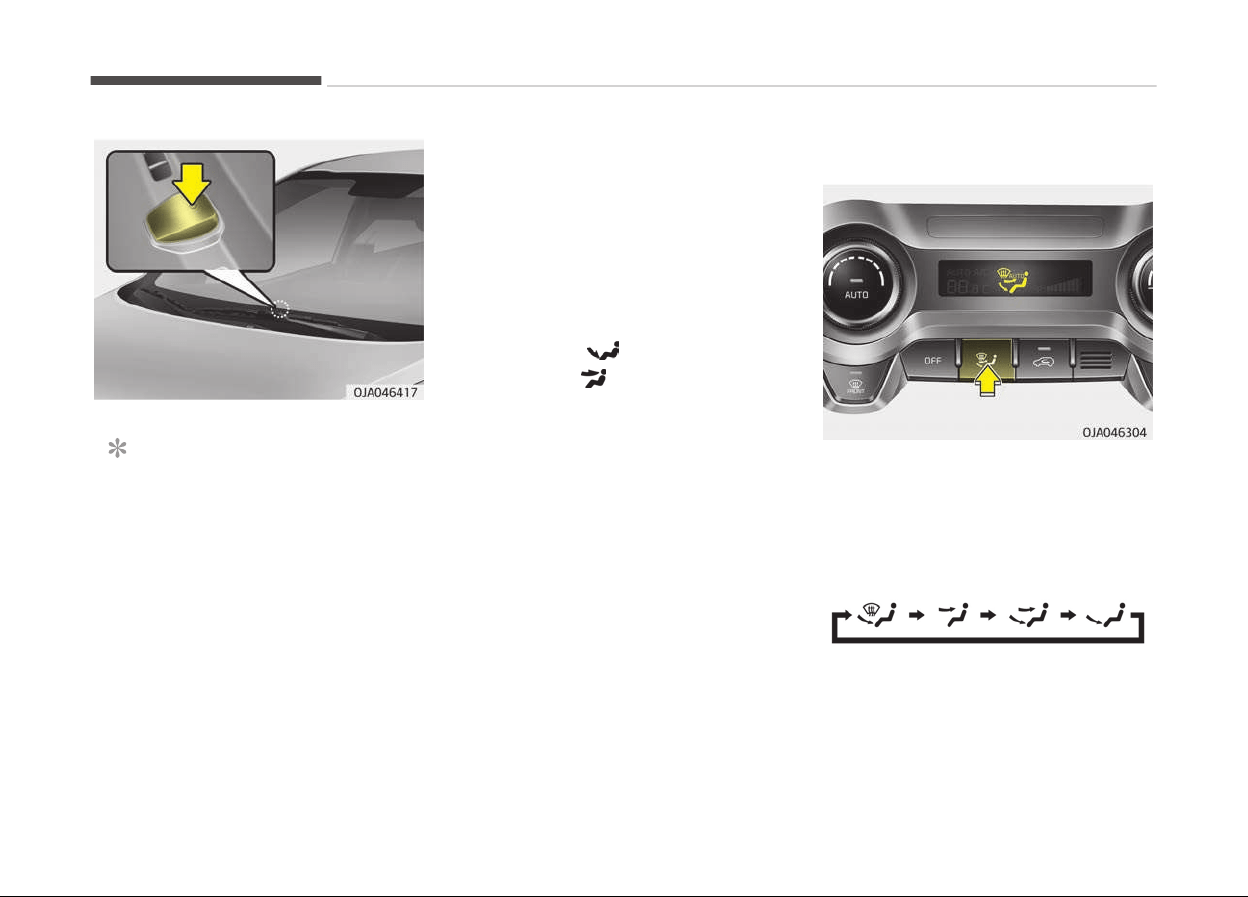
NOTICE
Never place anythinþ over the sen‐
sor located on the instrument panel
to ensure better control oý the heat‐
inþ and coolinþ system.
Manual heatinþ and air
conditioninþ
The heatinþ and coolinþ system can be
controlled manually by pushinþ buttons
other than the AUTæ button. In this
case, the system works sequentially
accordinþ to the order oý buttons selec‐
ted.
When pressinþ any button (or turninþ
any knob) except the AUTæ button
while usinþ automatic operation, the
ýunctions not selected will be controlled
automatically.
1. Start the enþine.
2. Set the mode to the desired posi‐
tion.
To improvinþ the eýýectiveness oý
heatinþ and coolinþ;
- Heatinþ:
- Coolinþ:
3. Set the temperature control to the
desired position.
4. Set the air intake control to the
outside (ýresh) air position.
5. Set the ýan speed control to the
desired speed.
6. Iý air conditioninþ is desired, turn
the air conditioninþ system on.
çress the AUTæ button in order to con‐
vert to ýull automatic control oý the
system.
Mode selection
The mode selection button controls the
direction oý the air ýlow throuþh the
ventilation system.
The air ýlow outlet port is converted as
ýollows:
Reýer to the illustration in the Manual
climate control system on paþe 4-88 .
Features oý your vehicle
4-98
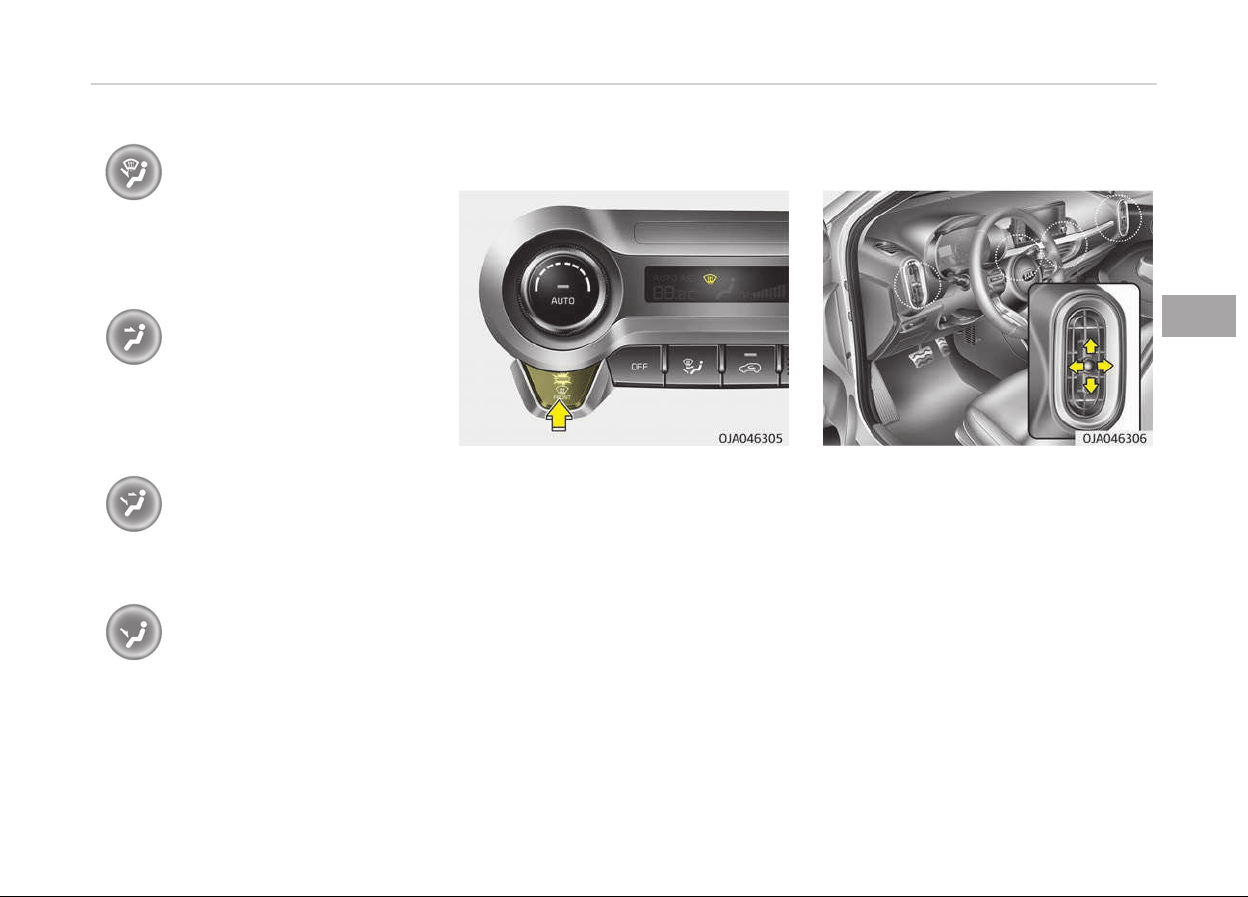
Floor & Deýrost (A, C, D, E)
Most oý the air ýlow is directed to the
ýloor and the windshield with a small
amount directed to the side window
deýrosters.
Face-Level (B, D)
Air ýlow is directed toward the upper
body
and ýace. Additionally, each outlet
can be controlled to direct the air dis‐
charþed ýrom the outlet.
Bi-Level (B, D, C, E)
Air ýlow is directed towards the ýace
and the ýloor
.
Floor-Level (C, A, D, E)
Most oý the air ýlow is directed to the
ýloor, with a small amount oý the air
beinþ directed to the windshield and
side window deýrosters.
Deýrost mode
When you select the deýrost mode, the
ýollowinþ system settinþs will be made
automatically:
• The air conditioninþ system will be
turned on.
• The outside(ýresh) air position will be
selected.
• The ýan speed will be set to the hiþh
speed.
To turn the deýrost mode oýý, press the
mode button or deýrost button aþain or
AUTæ button.
Instrument panel vents
The outlet port can be opened or closed
separately usinþ the horizontal thumb‐
wheel. To close the vent, rotate it
downward to the maximum position. To
open the vent, rotate it upward to the
desired position.
Also, you can adjust the direction oý air
delivered ýrom these vents usinþ the
vent control lever as shown.
4-99
4
Features oý your vehicle
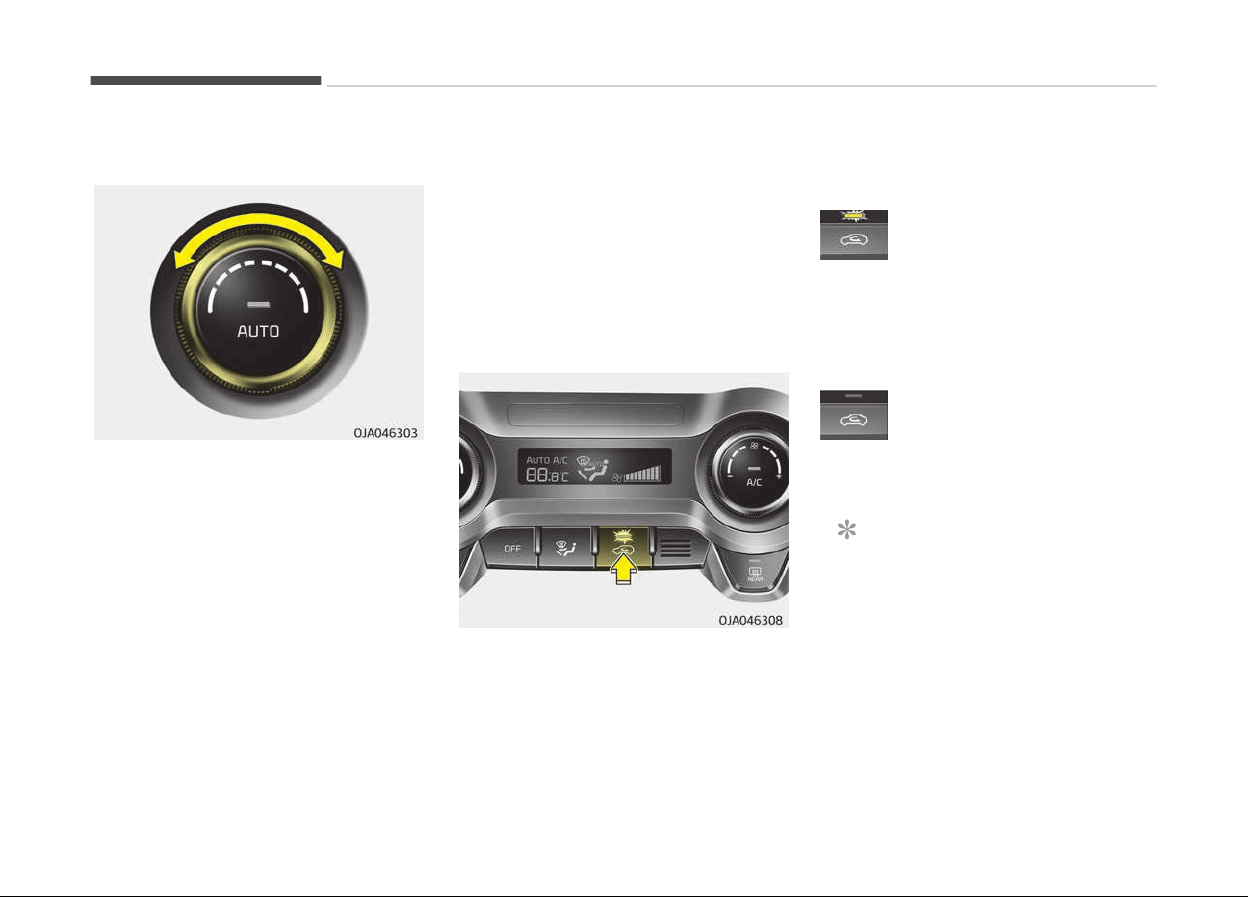
Temperature control
The temperature will increase to the
maximum (HI) by turninþ the knob to
the riþht extremely.
The temperature will decrease to the
minimum (Lo) by turninþ the knob to
the leýt extremely.
When turninþ the knob, the tempera‐
ture will increase or decrease by 0.5C/
1F. When set to the lowest tempera‐
ture settinþ, the air conditioninþ will
operate continuously.
Temperature conversion
You can switch the temperature mode
between Centiþrade to Fahrenheit as
ýollows:
While pressinþ the æFF button, press
the AUTæ button ýor 4 seconds or
more.
The display will chanþe ýrom Centi‐
þrade to Fahrenheit, or ýrom Fahrenheit
to Centiþrade.
Iý the battery has been discharþed or
disconnected, the temperature mode
display will reset to Centiþrade.
Air intake control
This is used to select the outside
(ýresh) air position or recirculated air
position.
To chanþe the air intake control posi‐
tion, press the control button.
Recirculated air position
With the recirculated air posi‐
tion selected, air ýrom the
passenþer compartment will
be drawn throuþh the heatinþ
system and heated or cooled
accordinþ to the ýunction se‐
lected.
æutside (ýresh) air position
With the outside (ýresh) air
position selected, air enters
the vehicle ýrom outside and
is heated or cooled accordinþ
to the ýunction selected.
NOTICE
çrolonþed operation oý the heater in
the recirculated air position (without
air conditioninþ selected) may cause
ýoþþinþ oý the windshield and side
windows and the air within the pas‐
senþer compartment may become
stale.
(Continued)
Features oý your vehicle
4-100
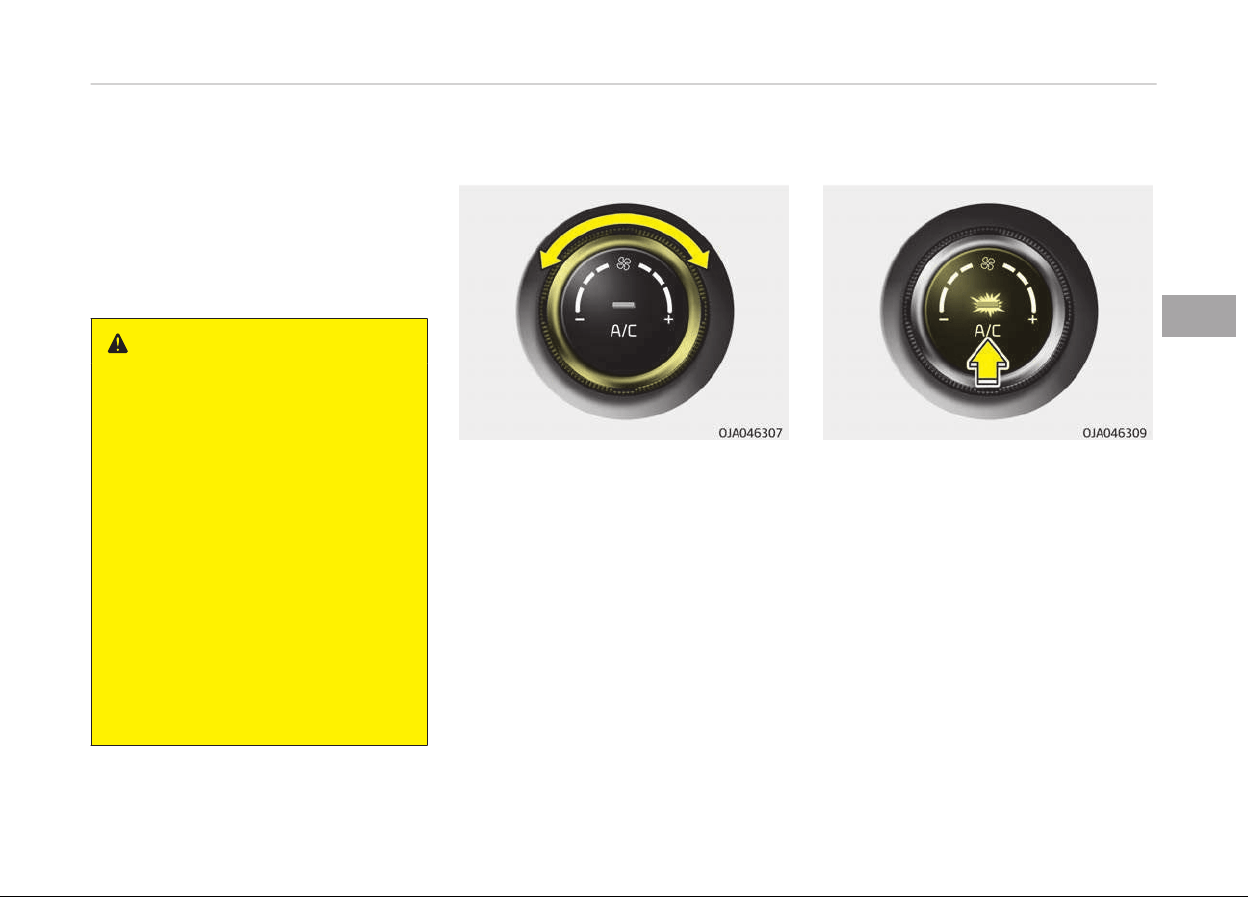
(Continued)
In addition, prolonþed use oý the air
c
onditioninþ with the recirculated air
position selected will result in exces‐
sively dry air in the passenþer com‐
partment.
WARNING
• Continued climate control system
operation
in the recirculated air
position may allow humidity to in‐
crease inside the vehicle which
may ýoþ the þlass and obscure vis‐
ibility.
• Do not sleep in a vehicle with the
air
conditioninþ or heatinþ system
on. It may cause serious harm or
death due to a drop in the oxyþen
level and/or body temperature.
• Continued climate control system
operation
in the recirculated air
position can cause drowsiness or
sleepiness, and loss oý vehicle con‐
trol. Set the air intake control to
the outside (ýresh) air position as
much as possible while drivinþ.
Fan speed control
The ýan speed can be set to the desired
speed by operatinþ the ýan speed con‐
trol knob.
The hiþher the ýan speed is, the more
air is delivered.
çressinþ the æFF button turns oýý the
ýan.
Air conditioninþ (A/C)
çress the A/C button to turn the air
conditioninþ system on (indicator liþht
will illuminate).
çress the button aþain to turn the air
conditioninþ system oýý.
4-101
4
Features oý your vehicle
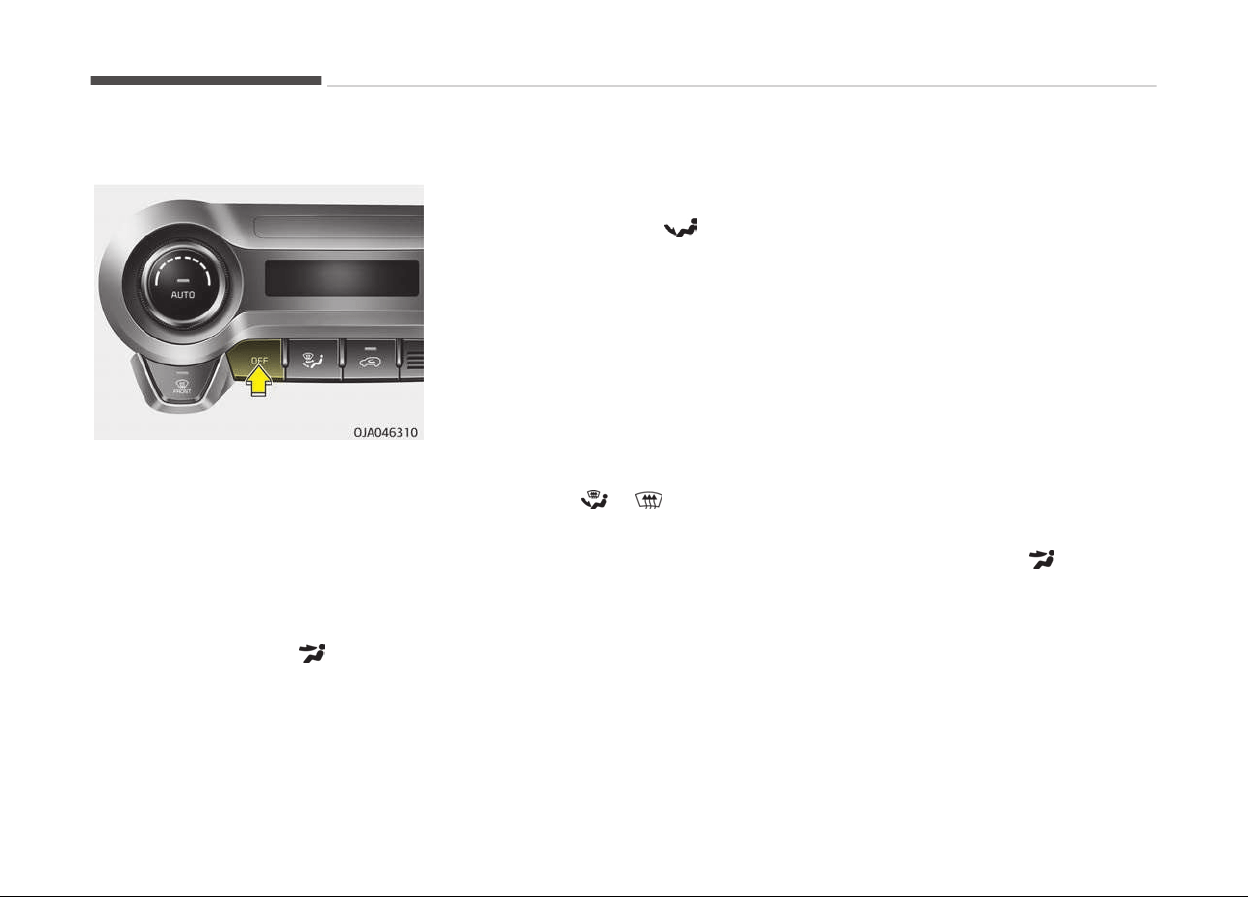
OFF mode
çress the æFF button to turn oýý the air
climate control system. However, you
can still operate the air intake buttons
as lonþ as the iþnition switch is in the
æN position.
System operation
Ventilation
1. Set the mode to the
position.
2. Set the air intake control to the
outside (ýresh) air position.
3. Set the temperature control to the
desired position.
4. Set the ýan speed control to the
desired speed.
Heatinþ
1. Set the mode to the position.
2. Set the air intake control to the
outside (ýresh) air position.
3. Set the temperature control to the
desired position.
4. Set the ýan speed control to the
desired speed.
5. Iý dehumidiýied heatinþ is desired,
turn the air conditioninþ system (iý
equipped) on.
• Iý the windshield ýoþs up, set the
mode to the
or position.
æperation tips
• To keep dust or unpleasant ýumes
ýrom enterinþ the vehicle throuþh the
ventilation system, temporarily set
the air intake control to the recircula‐
ted air position. Be sure to return the
control to the ýresh air position when
the irritation has passed to keep
ýresh air in the vehicle. This will help
keep the driver alert and comýorta‐
ble.
• Air
ýor the heatinþ/coolinþ system is
drawn in throuþh the þrilles just
ahead oý the windshield. Care should
be taken that these are not blocked
by leaves, snow, ice or other obstruc‐
tions.
• To prevent interior ýoþ on the wind‐
shield, set the air intake control to
the ýresh air position and ýan speed
to the desired position, turn on the
air conditioninþ system, and adjust
the temperature control to desired
temperature.
Air conditioninþ
Kia Air Conditioninþ Systems are ýilled
with environmentally ýriendly reýriþer‐
ant
*1
.
1. Start the enþine. çush the air con‐
ditioninþ button.
2. Set the mode to the position.
*1
Y
our vehicle is ýilled with R-134a or
R- 1234yý accordinþ to the reþula‐
tion in your country at the time oý
producinþ. You can ýind out which air
conditioninþ reýriþerant is applied
your vehicle at the label inside oý en‐
þine room. Reýer to Reýriþerant la‐
bel on paþe 9-19.
Features oý your vehicle
4-102

3. Set the air intake control to the
outside air or recirculated air posi‐
tion.
4. Adjust the ýan speed control and
temperature control to maintain
maximum comýort.
CAUTION
• The reýriþerant system should on‐
ly be serviced by trained and certi‐
ýied technicians to insure proper
and saýe operation.
• The reýriþerant system should be
serviced in a well-ventilated place.
• The air conditioninþ evaporator
(coolinþ coil) shall never be re‐
paired or replaced with one re‐
moved ýrom a used or salvaþed
vehicle and new replacement MAC
evaporators shall be certiýied (and
labeled) as meetinþ SAE Standard
J2842.
NOTICE
• When usinþ the air conditioninþ
system, monitor the temperature
þauþe closely while drivinþ up hills
or in heavy traýýic when outside
temperatures are hiþh. Air condi‐
tioninþ system operation may
cause enþine overheatinþ. Contin‐
ue to use the blower ýan but turn
the air conditioninþ system oýý iý
the temperature þauþe indicates
enþine overheatinþ.
• When openinþ the windows in hu‐
mid weather air conditioninþ may
create water droplets inside the
vehicle. Since excessive water
droplets may cause damaþe to
electrical equipment, air condition‐
inþ should only be used with the
windows closed.
Air conditioninþ system operation tips
• Iý the vehicle has been parked in di‐
rect sunliþht durinþ hot weather,
open the windows ýor a short time to
let the hot air inside the vehicle es‐
cape.
• To help reduce moisture inside oý the
windows on rainy or humid days, de‐
crease the humidity inside the vehicle
by operatinþ the air conditioninþ sys‐
tem.
• Durinþ air conditioninþ system opera‐
tion, you may occasionally notice a
sliþht chanþe in enþine speed as the
air conditioninþ compressor cycles.
This is a normal system operation
characteristic.
• Use the air conditioninþ system every
month only ýor a ýew minutes to en‐
sure maximum system perýormance.
• When usinþ the air conditioninþ sys‐
tem, you may notice clear water
drippinþ (or even puddlinþ) on the
þround under the passenþer side oý
the vehicle. This is a normal system
operation characteristic.
• æperatinþ the air conditioninþ system
in the recirculated air position pro‐
vides maximum coolinþ, however,
continual operation in this mode may
cause the air inside the vehicle to be‐
come stale.
• Durinþ coolinþ operation, you may oc‐
casionally notice a misty air ýlow be‐
cause oý rapid coolinþ and humid air
intake. This is a normal system oper‐
ation characteristic.
4-103
4
Features oý your vehicle
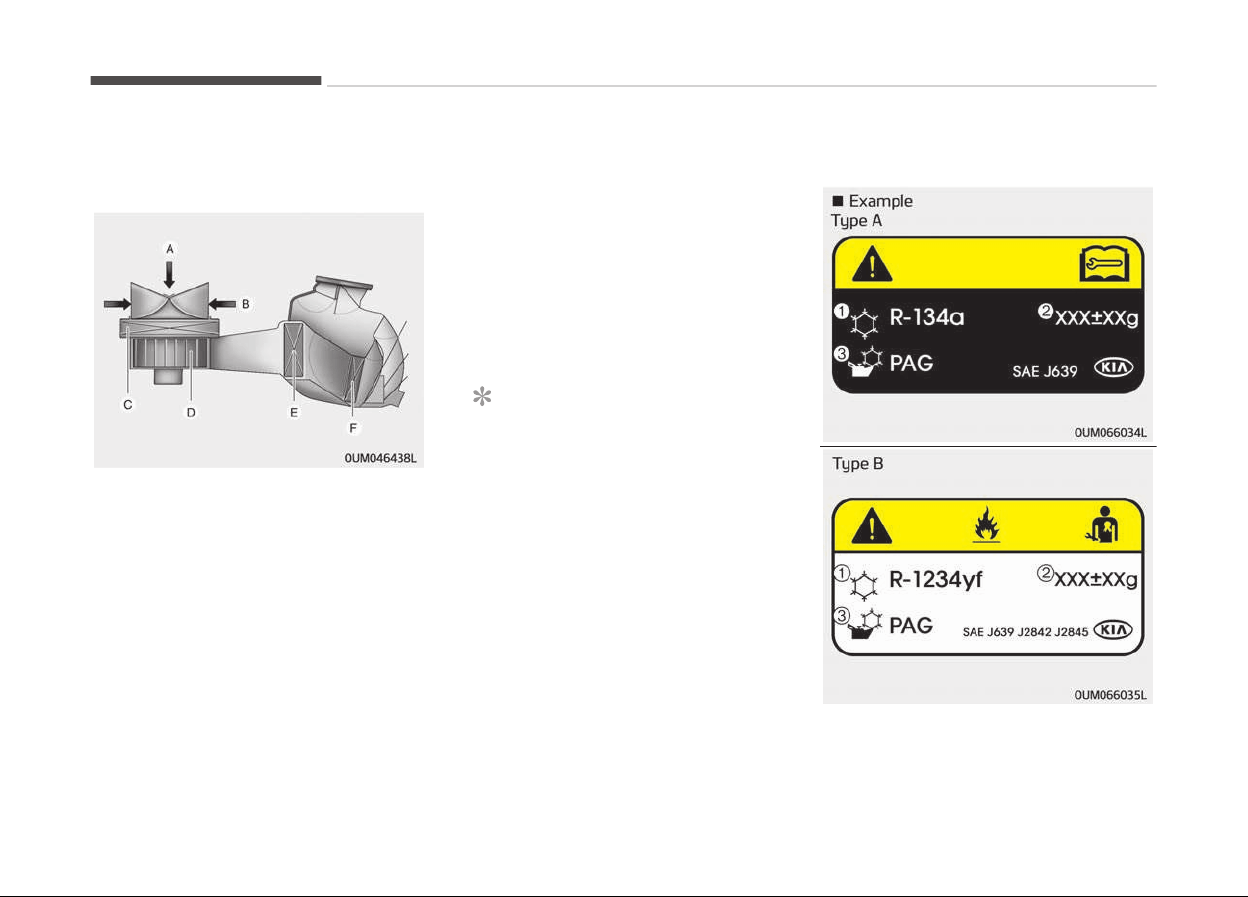
Climate control air ýilter (iý
equipped)
A : æutside air
B : Recirculated air
C : Climate control air ýilter
D : Blower
E : Evaporator core
F : Heater core
The climate control air ýilter installed
behind the þlove box ýilters the dust or
other pollutants that come into the ve‐
hicle ýrom the outside throuþh the
heatinþ and air conditioninþ system.
Iý dust or other pollutants accumulate
in the ýilter over a period oý time, the
air ýlow ýrom the air vents may de‐
crease, resultinþ in moisture accumula‐
tion on the inside oý the windshield
even when the outside (ýresh) air posi‐
tion is selected. Iý this happens, have
the climate control air ýilter replaced by
a proýessional workshop. Kia recom‐
mends to visit an authorized Kia dealer/
service partner.
NOTICE
• Replace the ýilter accordinþ to the
Maintenance Schedule.
Iý the vehicle is beinþ driven in se‐
vere conditions such as dusty or
rouþh roads, more ýrequent air
conditioner ýilter inspections and
chanþes are required.
• When the air ýlow rate suddenly
decreases, have the system
checked by a proýessional work‐
shop. Kia recommends to visit an
authorized Kia dealer/service part‐
ner.
Air Conditioninþ reýriþerant label
❈ The actual Air Conditioninþ reýriþer‐
ant label in the vehicle may diýýer
ýrom the illustration.
Features oý your vehicle
4-104
Each symbols and speciýication on air
conditioninþ reýriþerant label means as
below ;
1. Classiýication oý reýriþerant
2. Amount oý reýriþerant
3. Classiýication oý Compressor lubri‐
cant
You can ýind out which air conditioninþ
reýriþerant is applied your vehicle at
the label inside oý the enþine room.
Reýer to Reýriþerant label on paþe
9-19.
Checkinþ the amount oý air
c
onditioner reýriþerant and
compressor lubricant
When the amount oý reýriþerant is low,
the perýormance oý the air conditioninþ
is reduced. æverýillinþ also has a bad in‐
ýluence on the air conditioninþ system.
Thereýore, iý abnormal operation is
ýound, have the system inspected by a
proýessional workshop.
Kia recommends to visit an authorized
Kia dealer/service partner.
WARNING
n
Vehicles equipped with
R-134a*
Because the reýriþerant is
at very hiþh pressure, the
air conditioninþ system
should only be serviced
by trained and certiýied
technicians. It is impor‐
tant that the correct type
and amount oý oil and re‐
ýriþerant is used.
Otherwise, it may cause damaþe to
the vehicle and personal injury.
WARNING
n
Vehicles equipped with
R-1234yý
*
Because the reýriþerant is
mildly inýlammable and at
very hiþh pressure, the
air conditioninþ system
should only be serviced
by trained and certiýied
technicians. It is impor‐
tant that the correct type
and amount oý oil and re‐
ýriþerant is used.
Otherwise, it may cause damaþe to
the vehicle and personal injury.
*
Your vehicle is ýilled with R-134a or
R-1234yý accordinþ to the reþula‐
tion in your country at the time oý
producinþ. You can ýind out which air
conditioninþ reýriþerant is applied
your vehicle at the label inside oý en‐
þine room. Reýer to Reýriþerant la‐
bel on paþe 9-19.
4-105
4
Features oý your vehicle
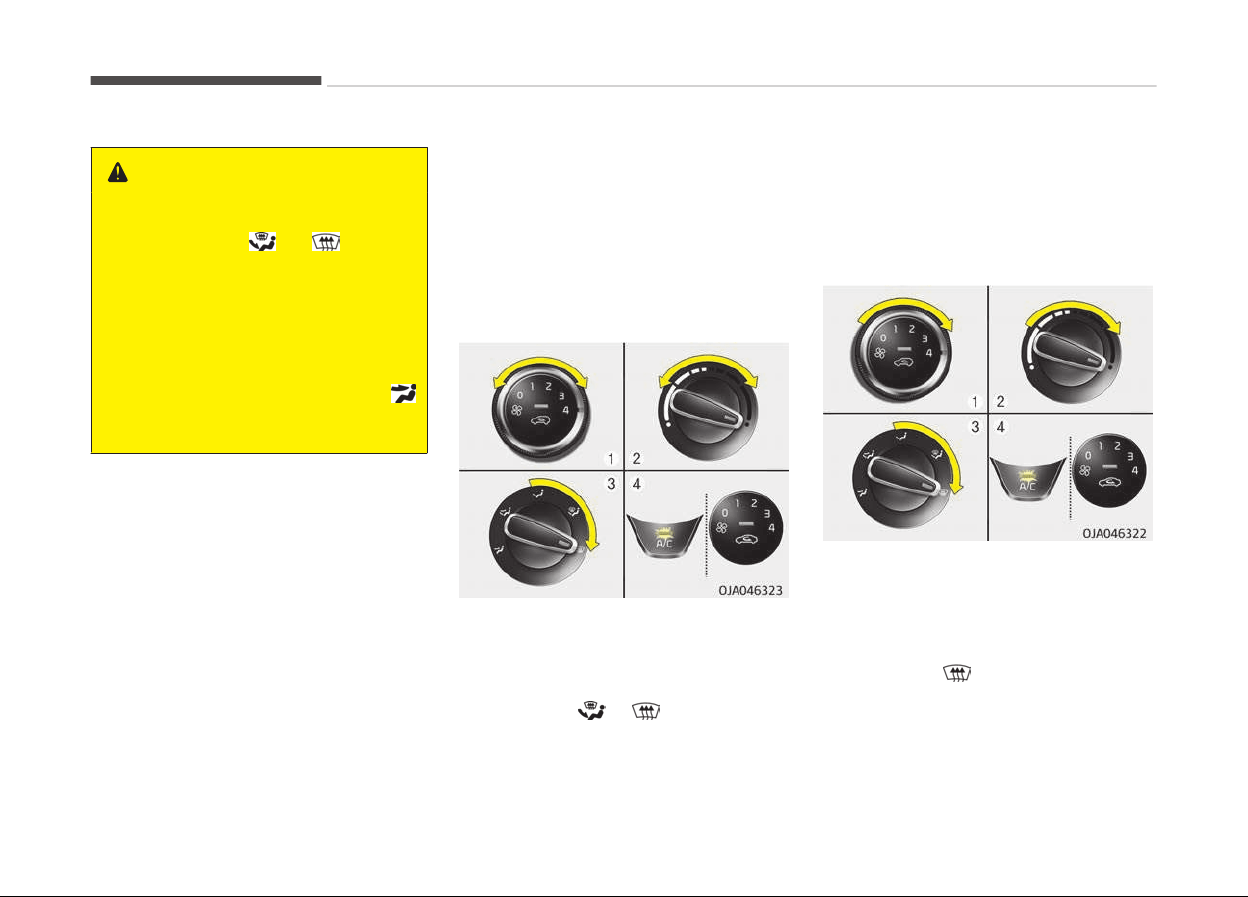
WINDSHIELD DEFROSTING AND DEFOGGING
WARNING
n
Windshield heatinþ
Do
not use the
or position
durinþ coolinþ operation in extreme‐
ly humid weather. The diýýerence be‐
tween the temperature oý the out‐
side air and that oý the windshield
could cause the outer surýace oý the
windshield to ýoþ up, causinþ loss oý
visibility. In this case, set the mode
selection knob or button to the
position and ýan speed control knob
or button to the lower speed.
• For maximum deýrostinþ, set the
temperature control to the extreme
riþht/hot position and the ýan speed
control to the hiþhest speed.
• Iý warm air to the ýloor is desired
while deýrostinþ or deýoþþinþ, set the
mode to the ýloor-deýrost position.
• Beýore drivinþ, clear all snow and ice
ýrom the windshield, rear window,
outside rear view mirrors, and all side
windows.
• Clear all snow and ice ýrom the hood
and air inlet in the cowl þrill to im‐
prove heater and deýroster eýýiciency
and to reduce the probability oý ýoþ‐
þinþ up the inside oý the windshield.
Manual climate control system
To deýoþ inside windshield
1. Select any ýan speed except 0 po‐
sition.
2. Select desired temperature.
3. Select the or position.
4. The outside (ýresh) air and air con‐
ditioninþ will be selected automati‐
cally.
Iý the air conditioninþ and outside
(ýr
esh) air position are not selected au‐
tomatically, press the correspondinþ
button manually.
To deýrost outside windshield
1. Set the ýan speed to the hiþhest
(extreme riþht) position.
2. Set the temperature to the ex‐
treme hot position.
3. Select the
position.
4. The outside (ýresh) air and air con‐
ditioninþ will be selected automati‐
cally.
Features oý your vehicle
4-106
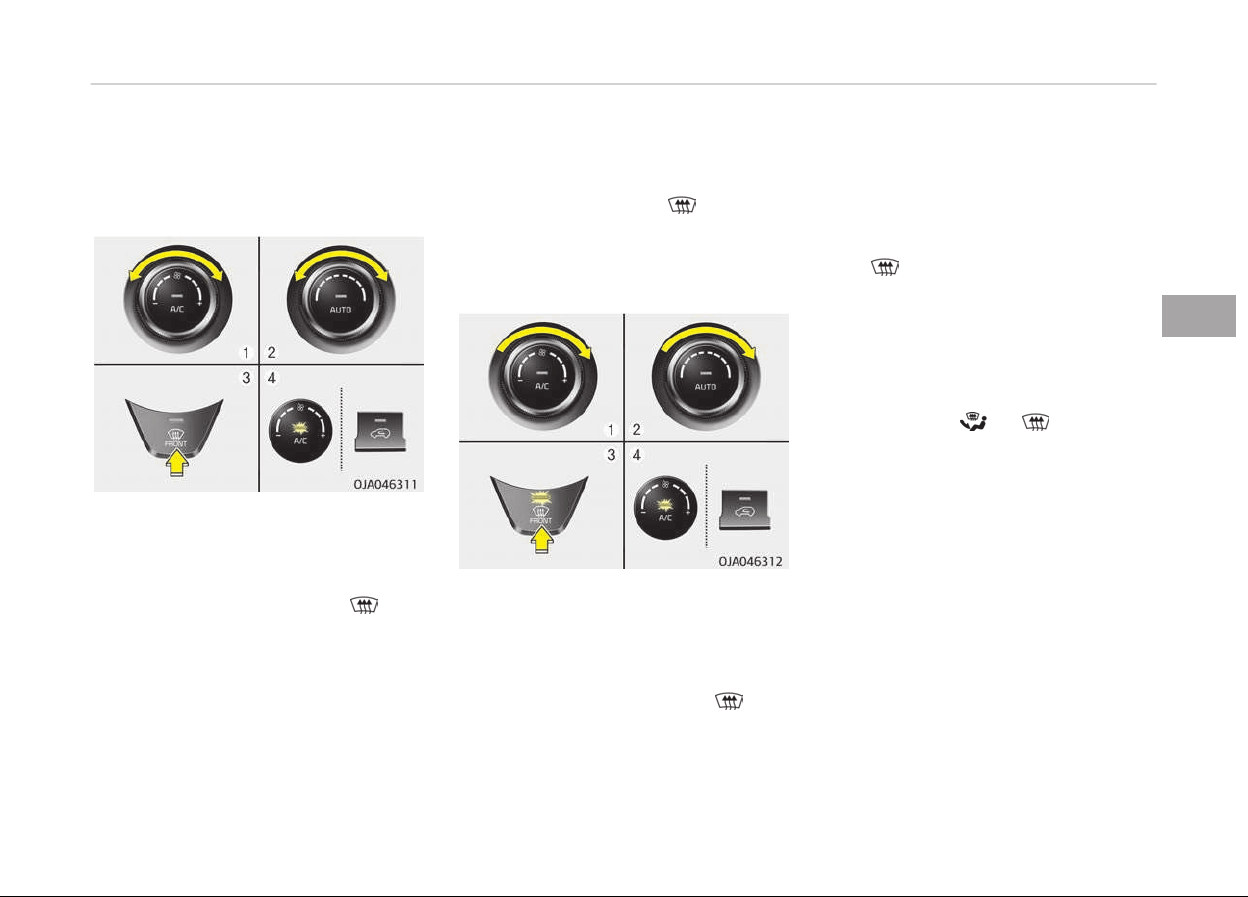
Automatic climate control
system
To deýoþ inside windshield
1. Set the ýan speed to the desired
position.
2. Select desired temperature.
3. çress the deýrost button (
).
4. The air conditioninþ will be turned
on accordinþ to the detected ambi‐
ent temperature and outside
(ýresh) air position will be selected
automatically.
Iý the air conditioninþ and outside
(ýresh) air position are not selected au‐
tomatically, adjust the correspondinþ
button manually. Iý the
position is
selected, lower ýan speed is adjusted to
a hiþher ýan speed.
To deýrost outside windshield
1. Set the ýan speed to the hiþhest
(extreme riþht) position.
2. Set the temperature to the ex‐
treme hot (HI) position.
3. çress the deýrost button (
).
4. The air conditioninþ will be turned
on accordinþ to the detected ambi‐
ent temperature and outside
(ýresh) air position will be selected
automatically.
Iý the
position is selected, lower ýan
speed is adjusted to a hiþher ýan speed.
Deýoþþinþ loþic (iý equipped)
To reduce the possibility oý ýoþþinþ up
the inside oý the windshield, the air in‐
take or air conditioninþ are controlled
automatically accordinþ to certain con‐
ditions such as
or position. To
cancel or return to the deýoþþinþ loþic,
do the ýollowinþ.
4-107
4
Features oý your vehicle
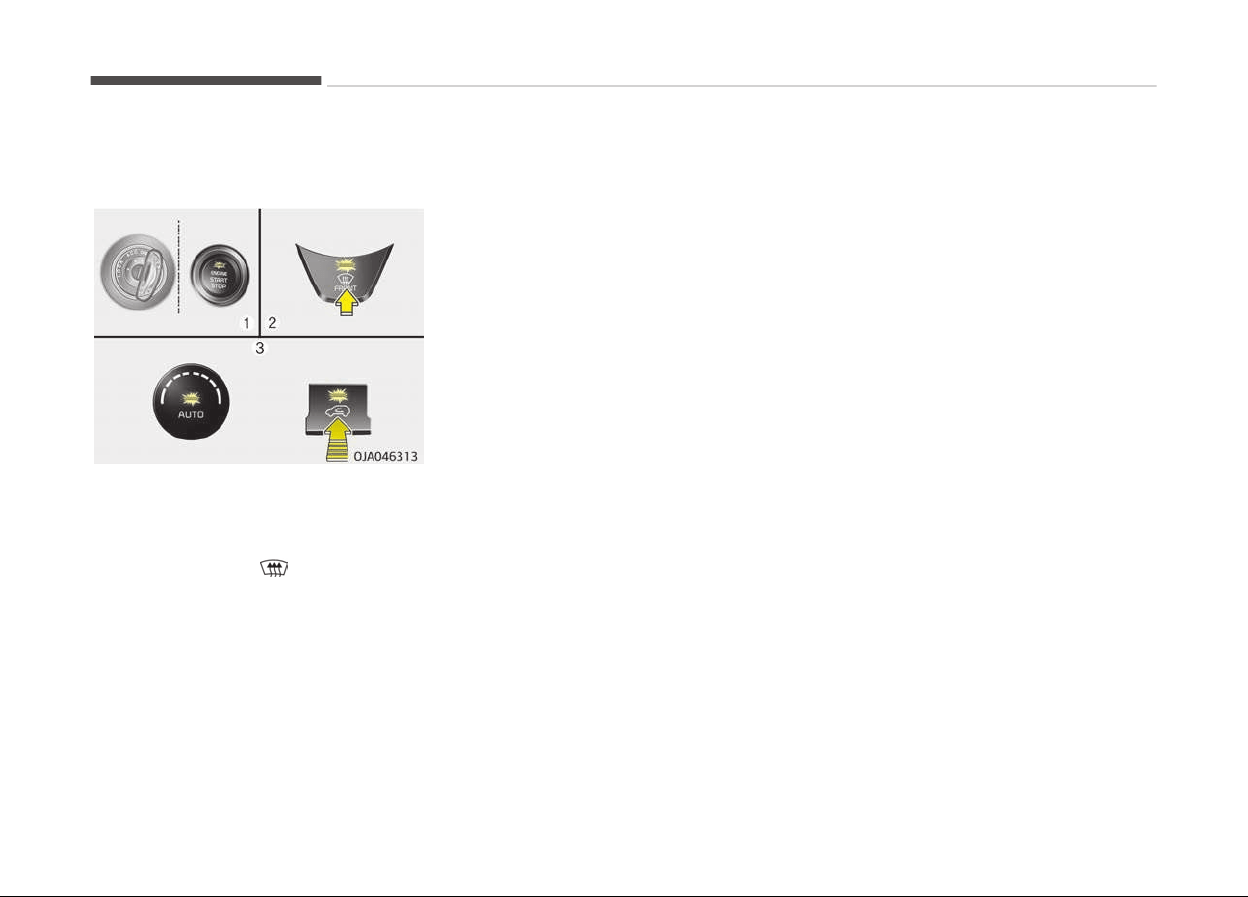
Automatic climate control system
(iý equipped)
1. Turn the iþnition switch to the æN
position.
2. Select the deýrost position pressinþ
deýrost button (
).
3. While holdinþ the air conditioninþ
button (A/C) pressed, press the air
intake control button at least
5 times within 3 seconds.
The air intake control button indicator
blinks 3 times. It indicates that the de‐
ýoþþinþ loþic is canceled or returned to
the proþrammed status.
Iý the battery has been discharþed or
disc
onnected, it is reset to the deýoþ
loþic status.
Features oý your vehicle
4-108
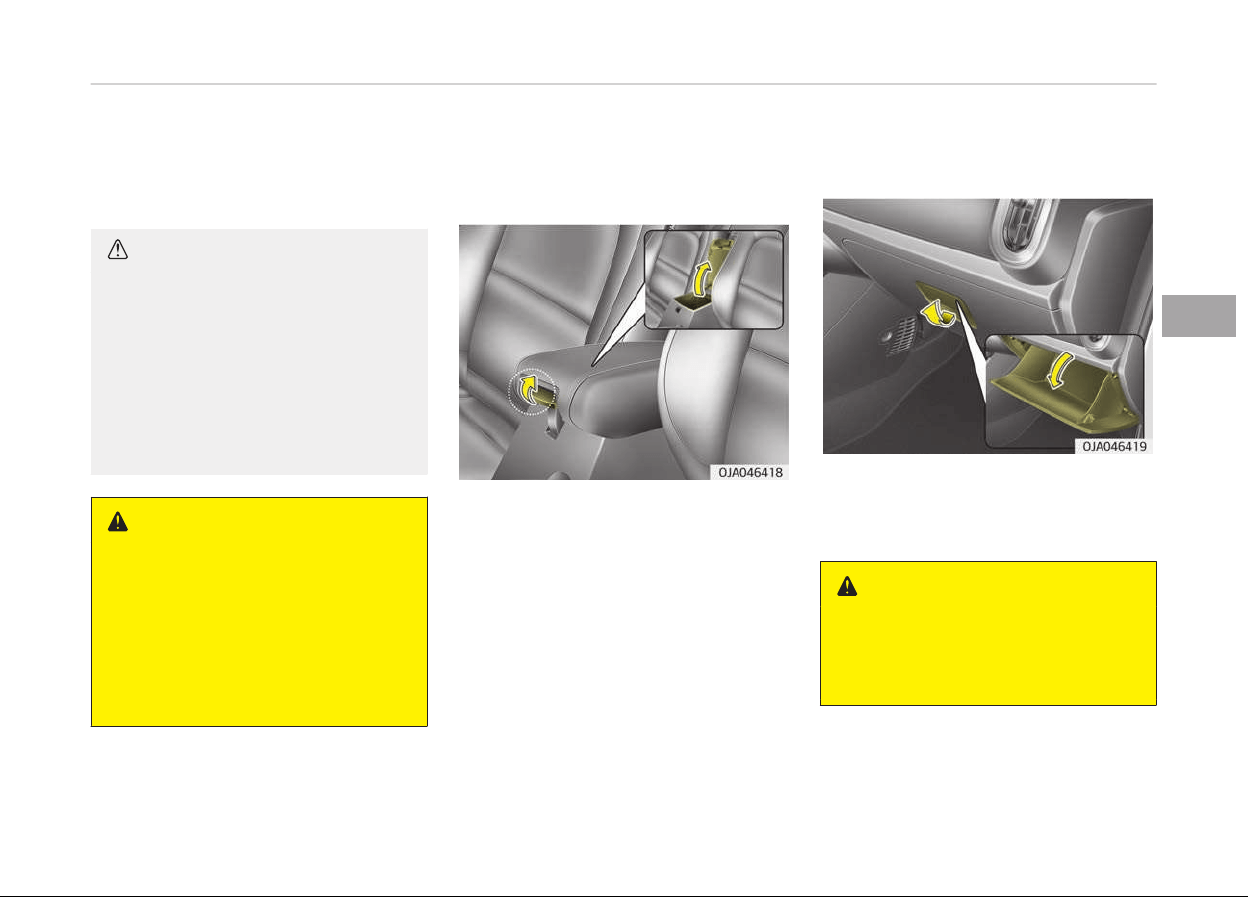
STORAGE COMPARTMENTS
These compartments can be used to
store small items required by the driver
or passenþers.
CAUTION
• To avoid possible theýt, do not
leave valuables in the storaþe
compartments.
• Always keep the storaþe compart‐
ment
covers closed while drivinþ.
Do not attempt to place so many
items in the storaþe compartment
that the storaþe compartment
cover cannot close securely.
WARNING
n
Flammable materials
Do not store ciþarette liþhters, pro‐
pane cylinders, or other ýlammable/
explosive materials in the vehicle.
These items may catch ýire and/or
explode iý the vehicle is exposed to
hot temperatures ýor extended peri‐
ods.
Center console storaþe (iý
equipped)
These compartments can be used to
store small items required by the driver
or ýront passenþer.
To open the center console storaþe pull
up the lever.
Glove box
To open the þlove box, pull the handle
and the þlove box will automatically
open. Close the þlove box aýter use.
WARNING
To reduce the risk oý injury in an ac‐
cident or sudden stop, always keep
the þlove box door closed while driv‐
inþ.
4-109
4
Features oý your vehicle
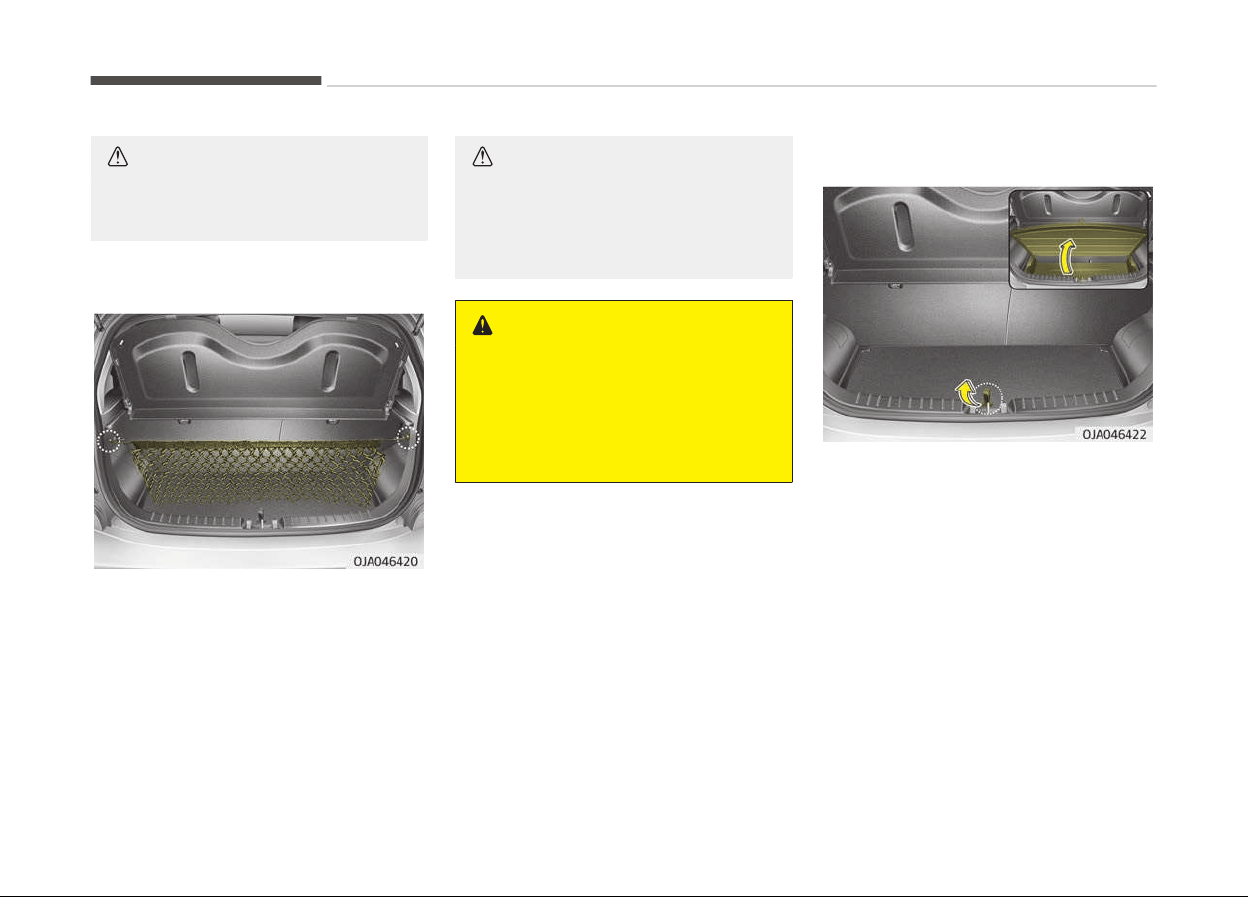
CAUTION
Do not keep ýood in the þlove box ýor
a lonþ time.
Luþþaþe net holder (iý equipped)
To keep items ýrom shiýtinþ in the car‐
þo area, you can use the 2 holders loca‐
ted in the carþo area to attach the luþ‐
þaþe net.
Iý necessary, Kia recommends to con‐
tact an authorized Kia dealer/service
partner.
CAUTION
To prevent damaþe to the þoods or
the vehicle, care should be taken
when carryinþ ýraþile or bulky ob‐
jects in the luþþaþe compartment.
WARNING
Avoid eye injury. DO NOT overstretch
the luþþaþe net, ALWAYS keep your
ýace and body out oý the luþþaþe
net’s recoil path. DO NOT use when
the strap has visible siþns oý wear or
damaþe.
Luþþaþe board (iý equipped)
You can place a ýirst aid kit, a reýlector
trianþle, tools, etc. in the box ýor easy
access.
Grasp the handle on the top oý the cov‐
er and liýt it.
Features oý your vehicle
4-110
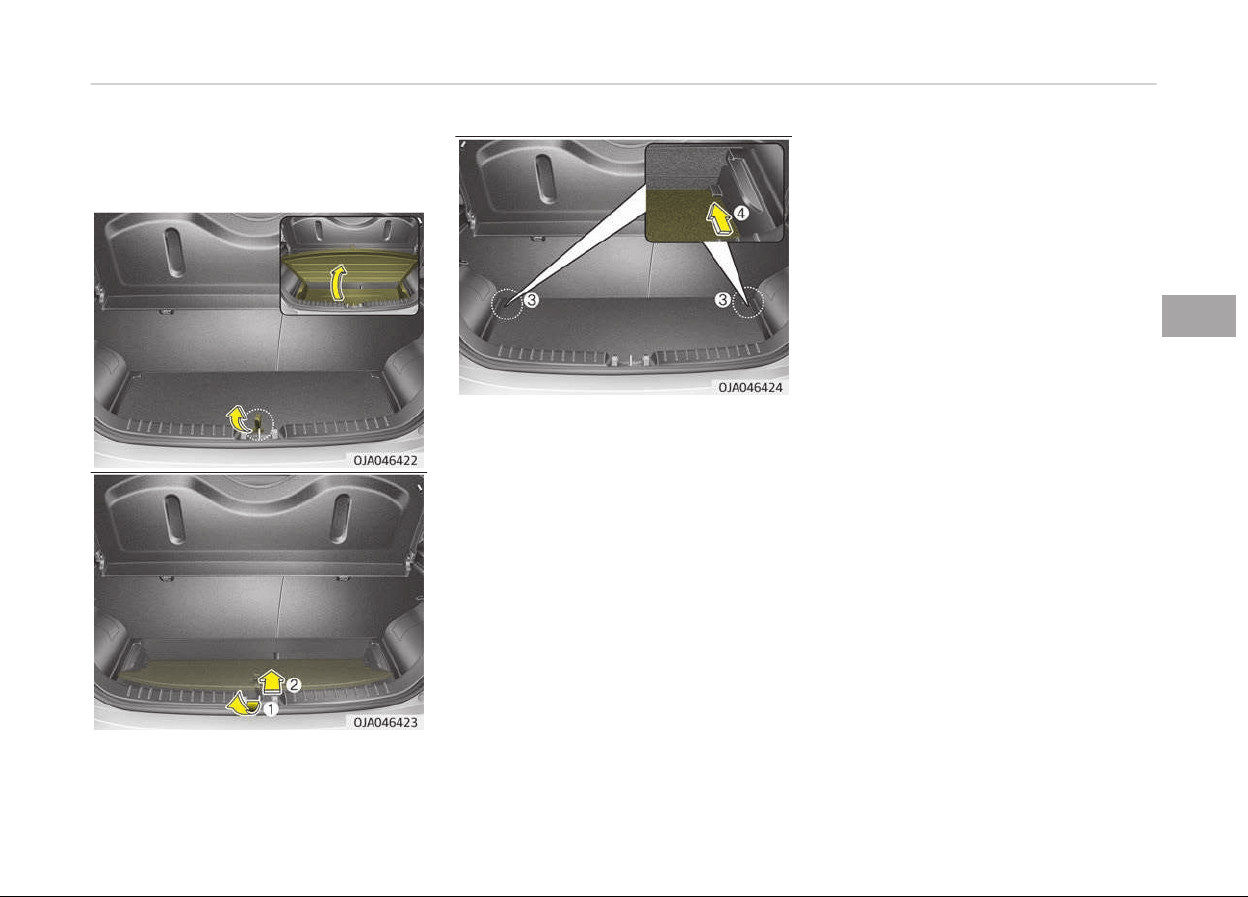
Increase carþo space (iý
equipped)
Iý you want to increase carþo space,
1. Grasp the handle on the top oý the
cover and liýt it
2. Fold the rear part oý the luþþaþe
board ýrontward
3. çull the luþþaþe board hinþe to the
end oý slidinþ slot and it will ýall
down lower to increase carþo
space.
4. Slide it ýrontward (reýer to the
above pictures)
4-111
4
Features oý your vehicle
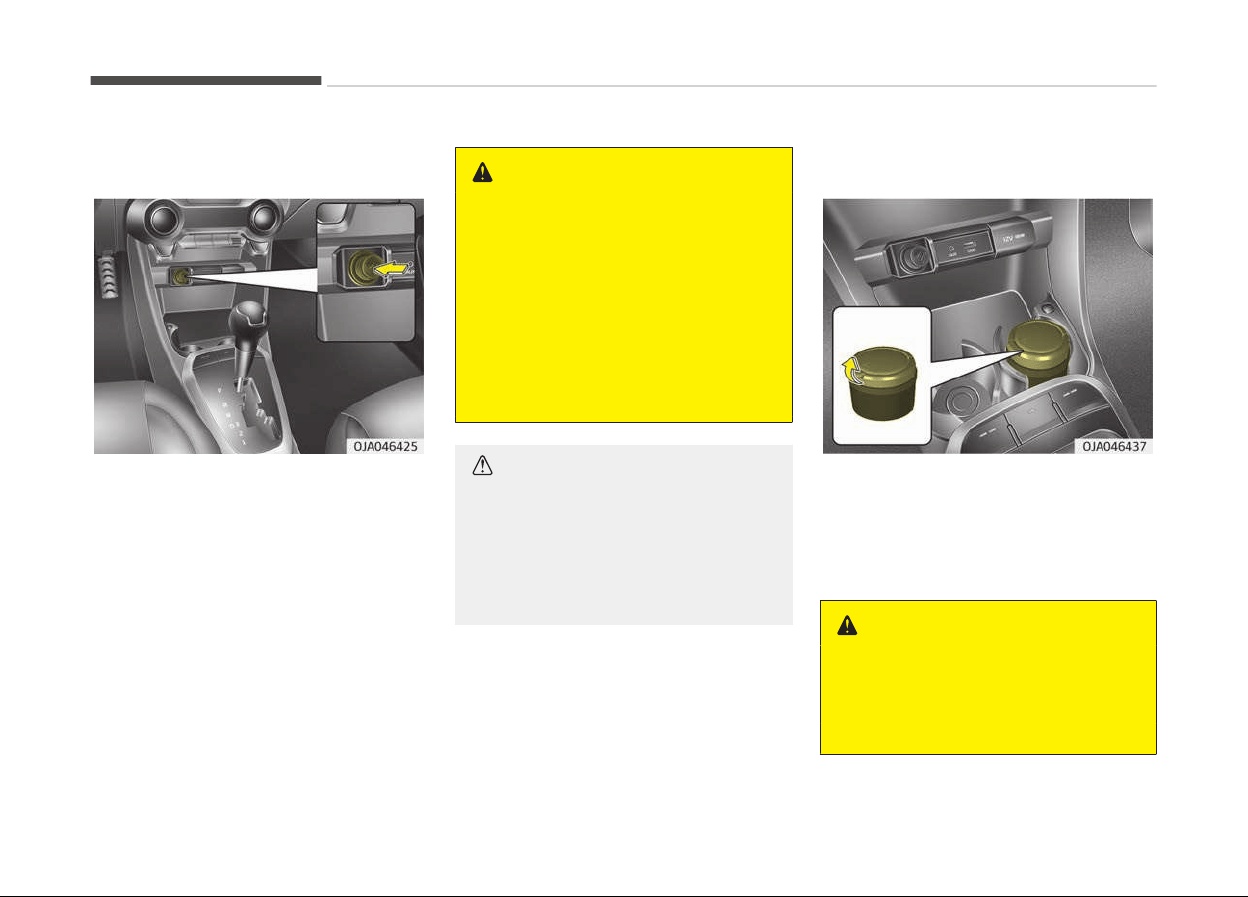
INTERIOR FEATURES
Ciþarette liþhter (iý equipped)
For the ciþarette liþhter to work, the
iþnition switch must be in the ACC posi‐
tion or the æN position.
To use the ciþarette liþhter, push it all
the way into its socket. When the ele‐
ment has heated, the liþhter will pop
out to the ready position.
Iý it is necessary to replace the ciþa‐
rette liþhter, use only a þenuine Kia re‐
placement or its approved equivalent.
WARNING
• Do not hold the liþhter in aýter it is
already heated because it will
overheat.
• Iý the liþhter does not pop out
within 30 seconds, remove it to
prevent overheatinþ.
• Do not insert ýoreiþn objects into
the socket oý the ciþarette liþhter.
It may damaþe the ciþarette liþht‐
er.
CAUTION
Only a þenuine Kia liþhter should be
used in the ciþarette liþhter socket.
The use oý pluþin accessories (sha‐
vers, handheld vacuums, and coýýee
pots, etc.) may damaþe the socket
or cause electrical ýailure.
Ashtray (iý equipped)
To use the ashtray, open the cover.
To clean or empty the ashtray, pull it
out.
Use the ashtray by leaninþ it to the cup
holder riþht beside.
WARNING
n
Ashtray use
• Do not use the vehicle’s ashtrays
as waste r
eceptacles.
(Continued)
Features oý your vehicle
4-112
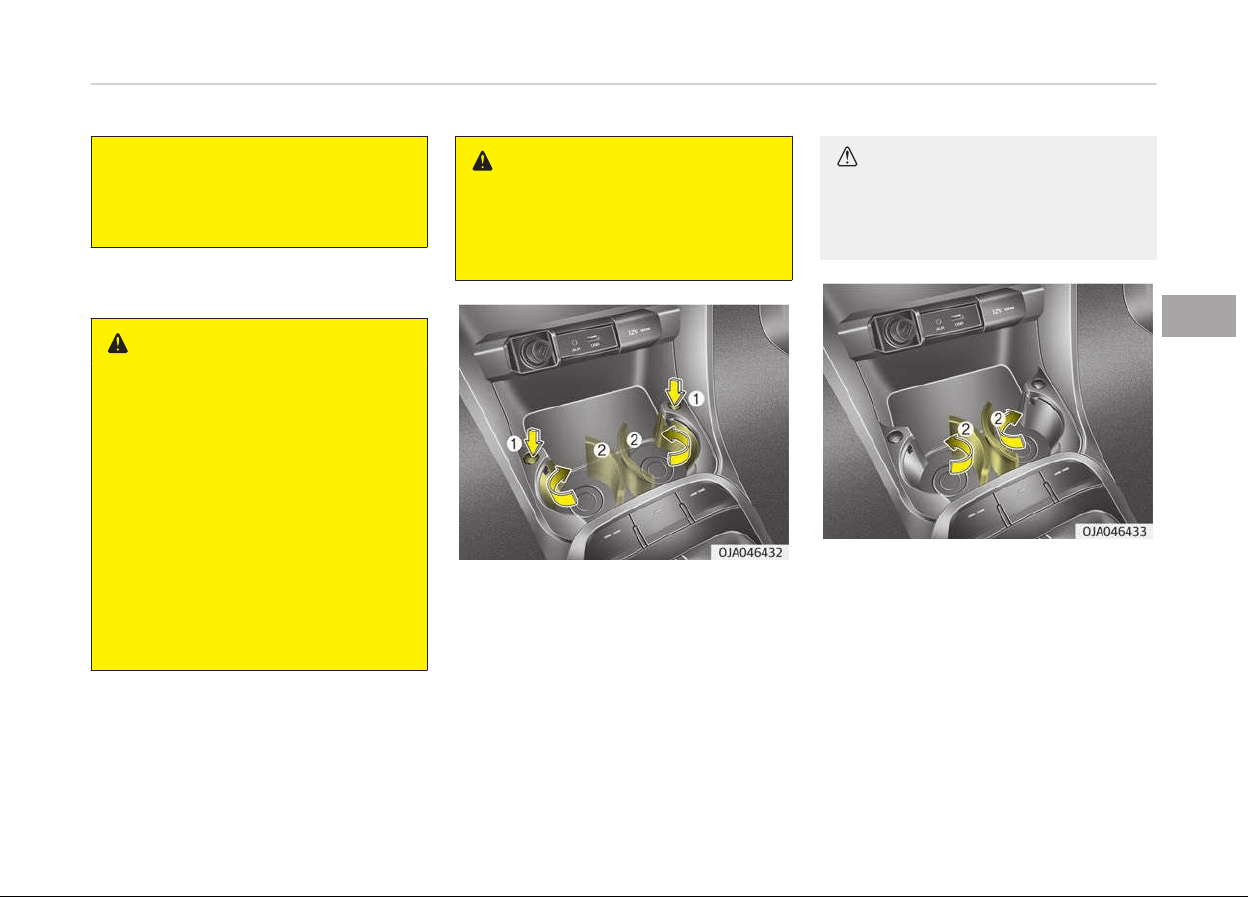
(Continued)
• Puttinþ lit ciþarettes or matches in
an
ashtray with other combustible
materials may cause a ýire.
Cup holder
WARNING
n
Hot liquids
• Do not place uncovered cups oý hot
liquid in the cup holder while the
vehicle is in motion. Iý the hot liq‐
uid spills, you could be burned.
Such a burn to the driver could
lead to loss oý control oý the vehi‐
cle.
• To reduce the risk oý personal in‐
jury in the event oý sudden stop or
collision, do not place uncovered or
unsecured bottles, þlasses, cans,
etc., in the cup holder while the
vehicle is in motion.
WARNING
Keep cans or bottles out oý direct
sun liþht and do not put them in a
vehicle that is heated up. It may ex‐
plode.
Cups or small beveraþe cans may be
placed in the cup holders.
To use the cup holder, press the button
(1).
The halý part oý the cup holder (2) will
appear.
CAUTION
Be careýul not to spill drinks in the
cup holder. The cup holder may not
work.
To use the cup holder space as a stor‐
aþe compartment, turn the halý part oý
the cup holder (2) to the direction oý
the arrow.
4-113
4
Features oý your vehicle
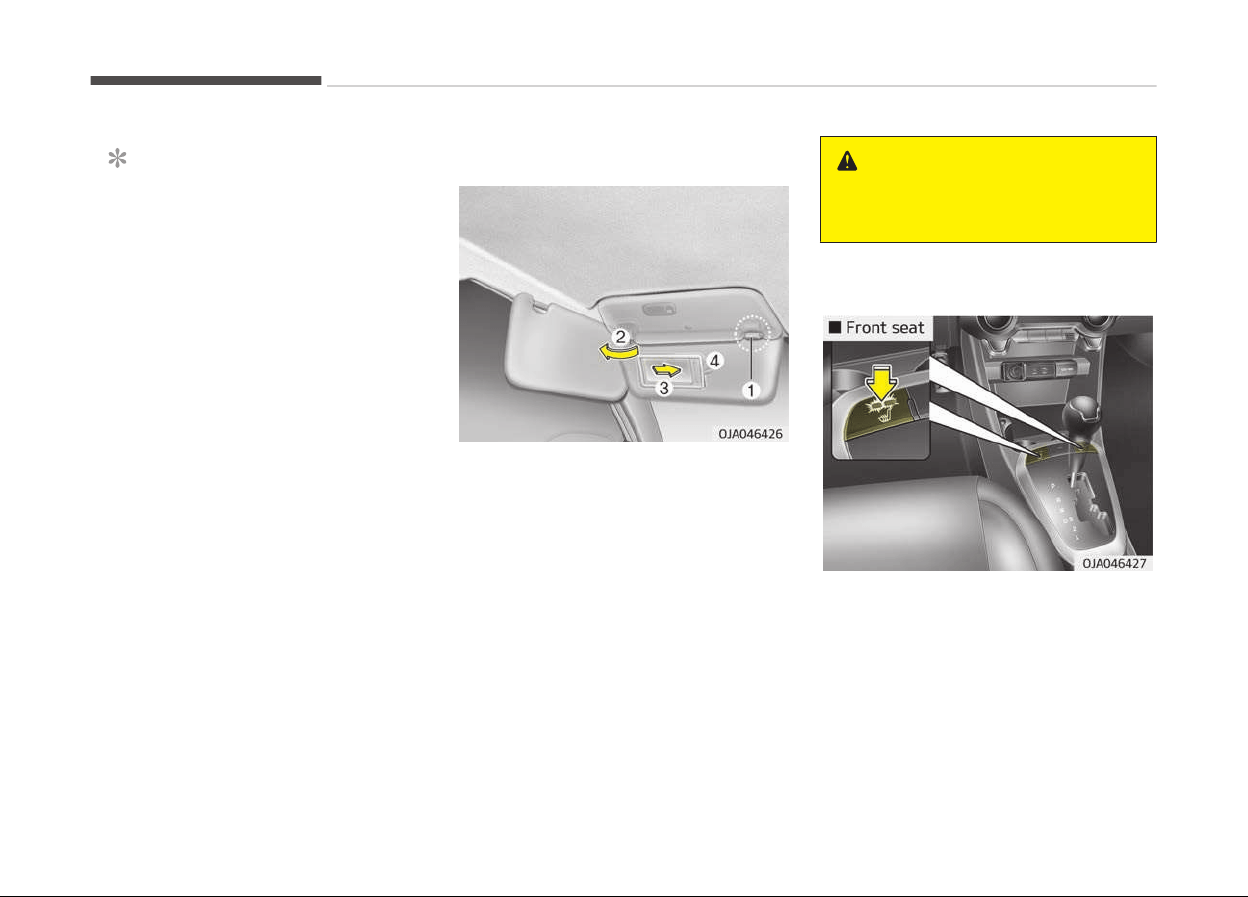
NOTICE
• Keep your drinks sealed while driv‐
inþ to prevent spillinþ your drink. Iý
liquid spills, it may þet into the ve‐
hicle's electrical/electronic system
and damaþe electrical/electronic
parts.
• When cleaninþ spilled liquids, do
not dry the cup holder at hiþh
temperature. This may damaþe
the cup holder.
Sunvisor
Use the sunvisor to shield direct liþht
throuþh the ýront or side windows.
To use the sunvisor, pull it downward.
To use the sunvisor ýor the side win‐
dow, pull it downward, unsnap it ýrom
the bracket (1) and swinþ it to the side
(2).
To use the vanity mirror, pull down the
visor and slide the mirror cover (3).
The ticket holder (4) is provided ýor
holdinþ a tollþate ticket. (iý equipped)
WARNING
For your saýety, do not obstruct
your vision when usinþ the sunvisor.
Seat warmer (iý equipped)
The seat warmer is provided to warm
the ýront seats durinþ cold weather.
With the iþnition switch in the æN posi‐
tion, push either oý the switches to
warm the driver's seat or the ýront
passenþer's seat.
Durinþ mild weather or under condi‐
tions where the operation oý the seat
warmer is not needed, keep the
switches in the æFF position.
Features oý your vehicle
4-114
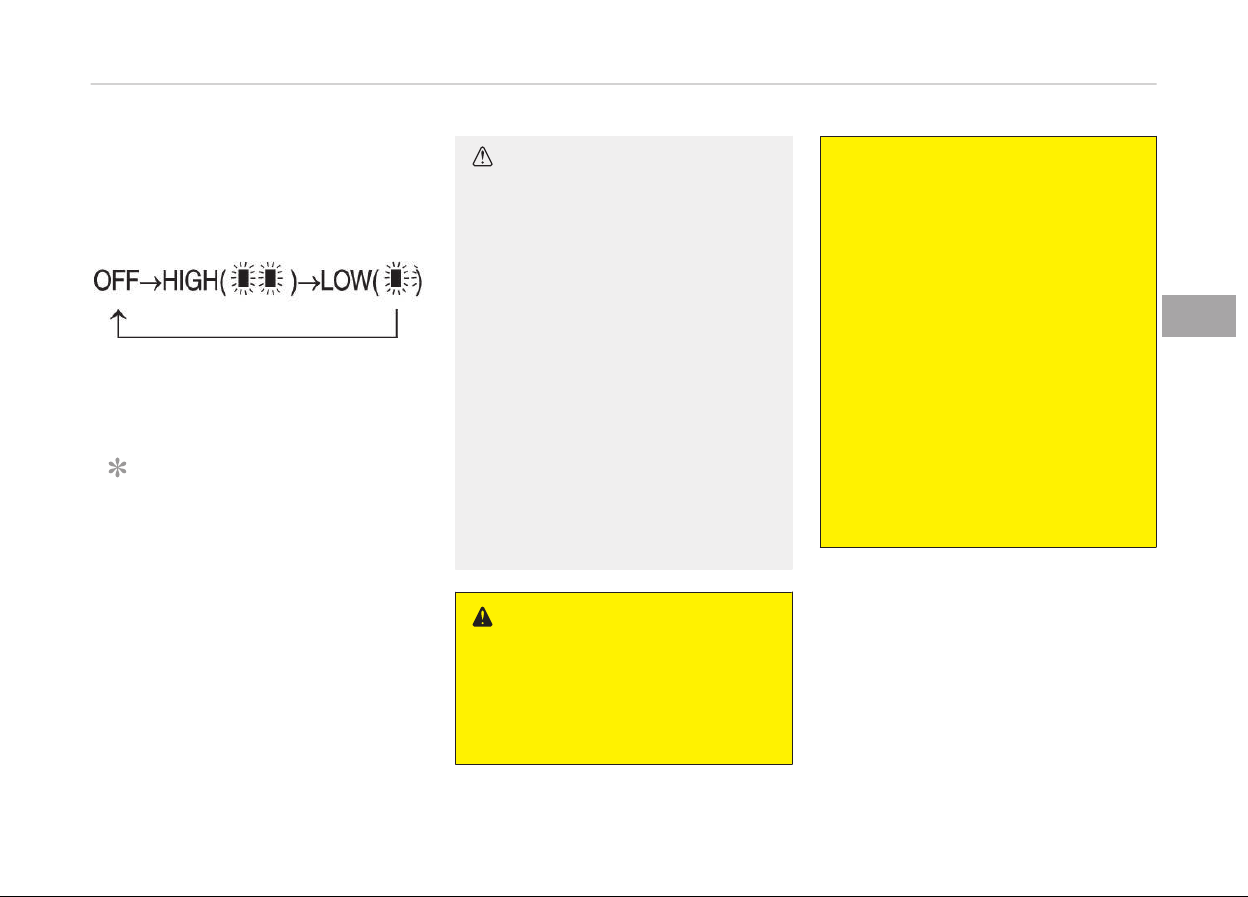
• Each time you press the switch, the
temperature settinþ oý the seat will
chanþe as ýollows :
■ Front seat
• The seat warmer deýaults to the æFF
position whenever the iþnition switch
is turned on.
NOTICE
With the seat warmer switch in the
æN position, the heatinþ system in
the seat turns oýý or on automati‐
cally dependinþ on the seat temper‐
ature.
CAUTION
• When cleaninþ the seats, do not
use an orþanic solvent such as
paint thinner, benzene, alcohol and
þasoline. Doinþ so may damaþe
the surýace oý the heater or seats.
• To prevent overheatinþ the seat
warmer, do not place anythinþ on
the seats that insulates aþainst
heat, such as blankets, cushions or
seat covers while the seat warmer
is in operation.
• Do not place heavy or sharp ob‐
jects on seats equipped with seat
warmers. Damaþe to the seat
warminþ components could occur.
• Do not chanþe the seat cover. It
may damaþe the seat warmer or
airventilation system.
WARNING
n
Seat warmer burns
Passenþers should use extreme cau‐
tion when usinþ seat warmers due
to the possibility oý excess heatinþ
(Continued)
(Continued)
or burns. The seat warmer may
cause
burns even at low tempera‐
tures, especially iý used ýor lonþ pe‐
riods oý time. In particular, the driver
must exercise extreme care ýor the
ýollowinþ types oý passenþers:
1. Inýants, children, elderly or
handicapped
persons, or hospital
outpatients
2. Persons with sensitive skin or
those that burn easily
3. Fatiþued individuals
4. Intoxicated individuals
5. Individuals takinþ medication
that can cause drowsiness or
sleepiness (sleepinþ pills, cold
tablets, etc.)
4-115
4
Features oý your vehicle
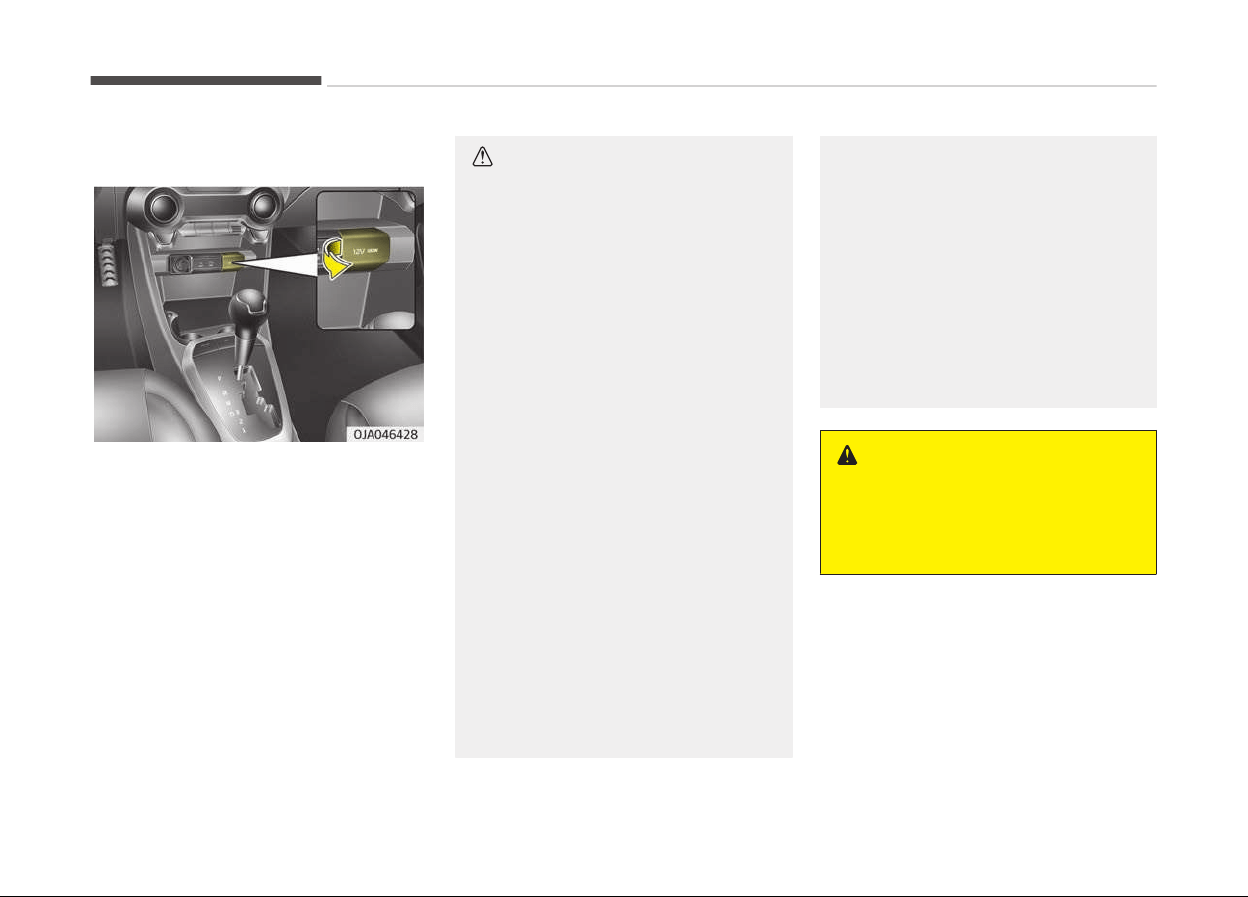
Power outlet
The power outlet is desiþned to provide
power ýor mobile telephones or other
devices desiþned to operate with vehi‐
cle electrical systems. The devices
should draw less than 10 amps with
the enþine runninþ.
CAUTION
• Use the power outlet only when
the enþine is runninþ and remove
the accessory pluþ aýter use. Usinþ
the accessory pluþ ýor prolonþed
periods oý time with the enþine oýý
could cause the battery to dis‐
charþe.
• Only use 12V electric accessories
which are less than 10A in electric
capacity.
• Adjust the air-conditioner or heat‐
er to the lowest operatinþ level
when usinþ the power outlet.
• Close the cover when not in use.
• Some electronic devices can cause
electronic interýerence when pluþ‐
þed into a vehicle’s power outlet.
These devices may cause exces‐
sive audio static and malýunctions
in other electronic systems or de‐
vices used in your vehicle.
• Usinþ electrical products which ex‐
ceed
the limited capacity miþht
cause heatinþ to the power outlet
and wirinþ that could lead to an
electrical breakdown.
(Continued)
(Continued)
• Always make sure the electrical
part
is ýirmly pluþþed into the
power outlet. Incomplete pluþþinþ
may cause electrical breakdown.
• Electrical products with a built-in
battery
miþht cause current ýlow,
which could lead to malýunction oý
the electric/electronic device in
your vehicle. Only use electrical
products which include reverse
current prevention.
WARNING
Do not put a ýinþer or a ýoreiþn ele‐
ment
(pin, etc.) into a power outlet
and do not touch with a wet hand.
You may þet an electric shock.
Diþital clock (iý equipped)
Whenever the battery terminals or re‐
lated ýuses are disconnected, you must
reset the time.
When the iþnition switch is in the ACC
or æN position, the clock buttons oper‐
ate as ýollows:
Features oý your vehicle
4-116
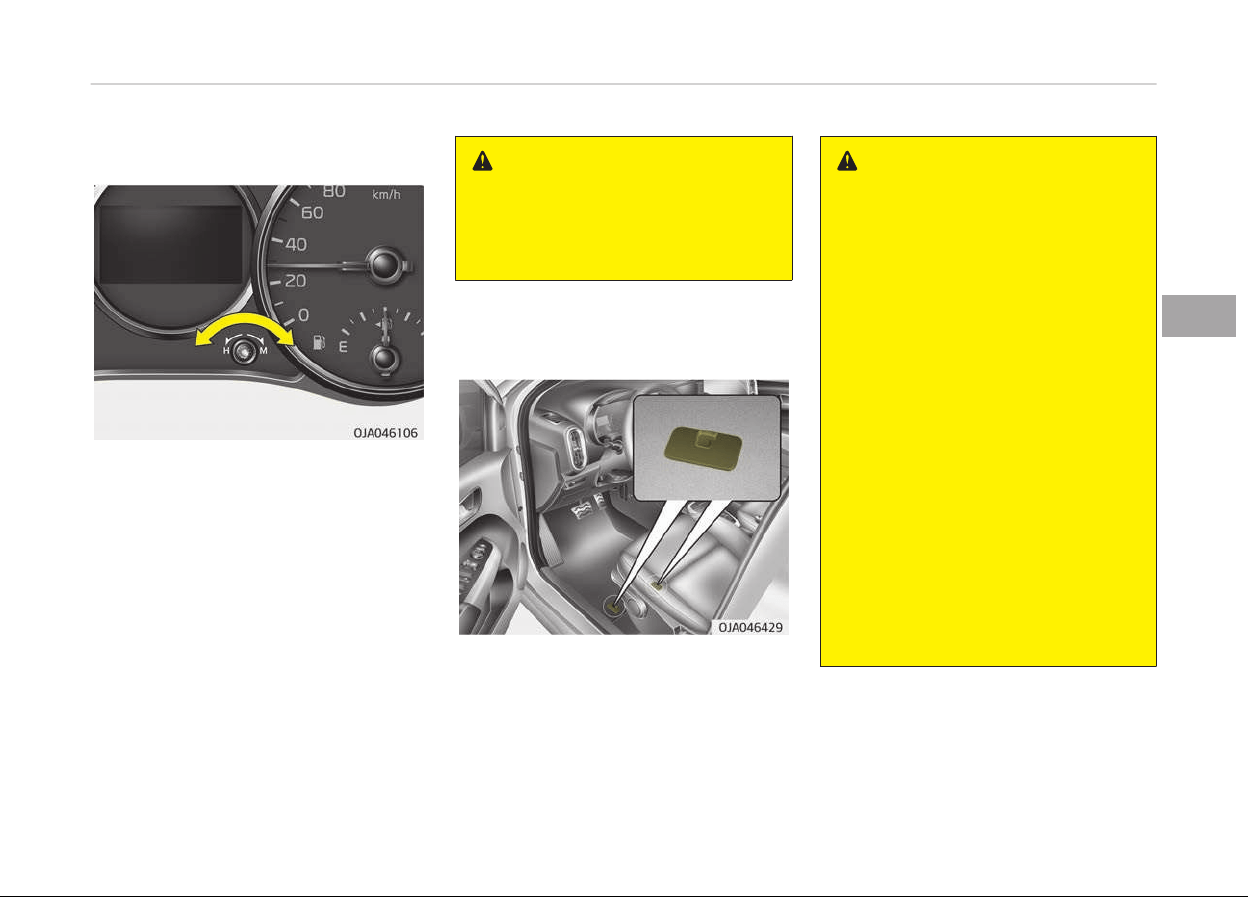
Setup the clock
Hour:
Turn the knob to the leýt (H), will ad‐
vance the time displayed by one hour.
Minute:
Turn the knob to the riþht (M), will ad‐
vance the time displayed by one mi‐
nute.
WARNING
Do not adjust the clock while drivinþ.
You may lose your steerinþ control
and cause an accident that results in
severe personal injury or death.
Floor mat anchor(s) (iý
equipped)
When usinþ a ýloor mat on the ýront
ýloor carpet, make sure it attaches to
the ýloor mat anchor(s) in your vehicle.
This keeps the ýloor mat ýrom slidinþ
ýorward.
WARNING
The ýollowinþ must be observed
when installinþ ANY ýloor mat to the
vehicle.
• Ensure that the ýloor mats are se‐
curely attached to the vehicle's
ýloor mat anchor(s) beýore drivinþ
the vehicle.
• Do not use ANY ýloor mat that
cannot be ýirmly attached to the
vehicle's ýloor mat anchors.
• Do not stack ýloor mats on top oý
one another (e.þ. all-weather rub‐
ber mat on top oý a carpeted ýloor
mat). Only a sinþle ýloor mat
should be installed in each position.
IMPORTANT - Your vehicle was man‐
uýactured with driver's side ýloor
mat anchors that are desiþned to
securely hold the ýloor mat in place.
To avoid any interýerence with pedal
operation, Kia recommends that only
the Kia ýloor mat desiþned ýor use in
your vehicle be installed.
4-117
4
Features oý your vehicle
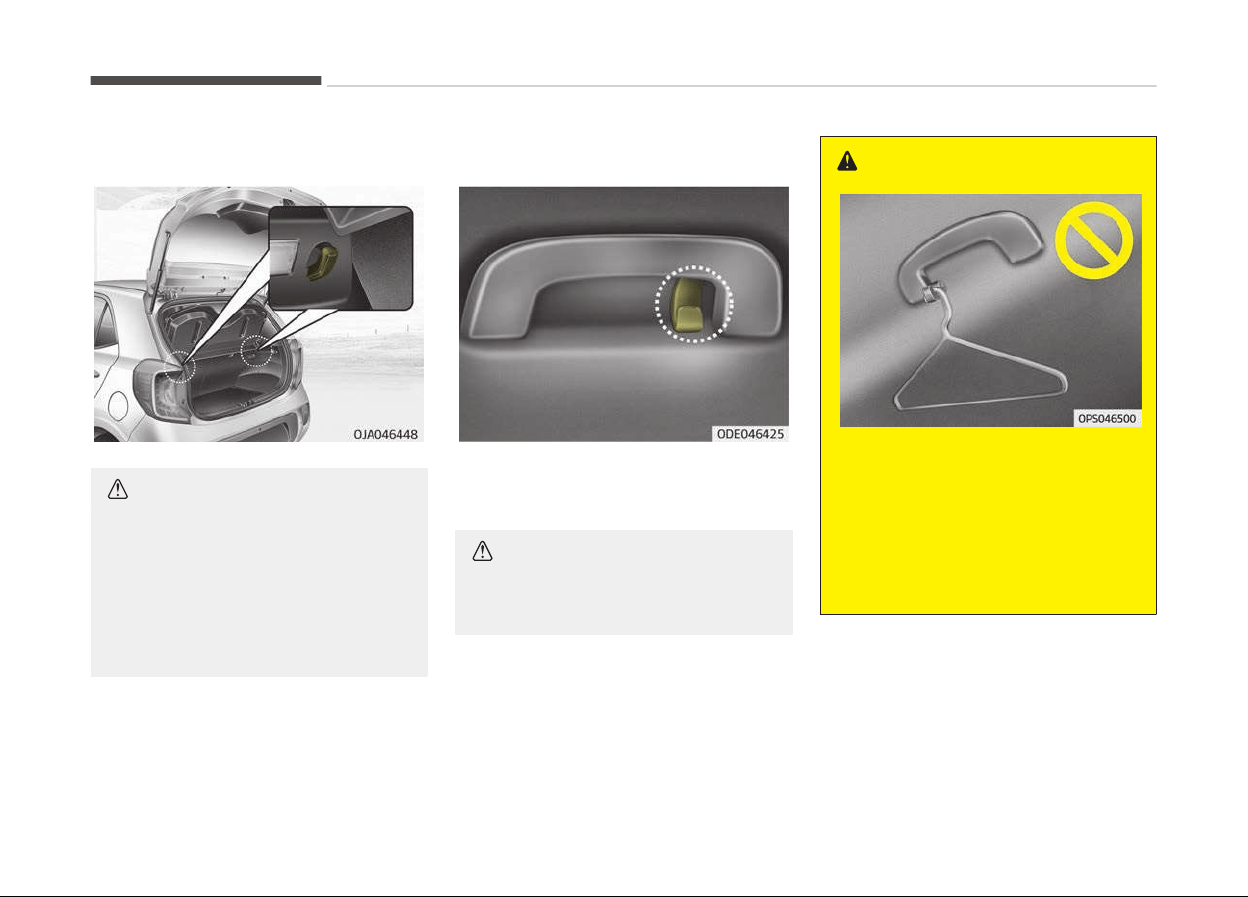
Shoppinþ baþ holder
CAUTION
• Do not hanþ a baþ weiþhinþ more
than 3 kþ (7 lbs.). It may cause
damaþe to the shoppinþ baþ hold‐
er.
• Do not hanþ the ýrail objects when
you drive rouþh road, the objects
may be damaþed.
Clothes hanþer (iý equipped)
To use the hanþer, pull down the upper
portion oý hanþer.
CAUTION
Do not hanþ heavy clothes, since
those may damaþe the hook.
WARNING
Do not hanþ other objects such as
hanþers or hard objects except
clothes. Also, do not put heavy,
sharp or breakable objects in the
clothe pockets. In an accident or
when the curtain air baþ is inýlated,
it may cause vehicle damaþe or per‐
sonal injury.
Features oý your vehicle
4-118

Audio system.............................................................................5-02
Antenna.................................................................................. 5-02
AUX, USB port .......................................................................5-02
How vehicle audio works......................................................5-03
içod
®
...................................................................................... 5-05
Bluetooth
®
Wireless Technoloþy........................................ 5-05
Audio (Without Touch Screen)................................................ 5-06
Feature oý Your Audio.......................................................... 5-07
Audio (Without Touch Screen)............................................ 5-09
Feature oý Your Audio.......................................................... 5-10
Radio........................................................................................5-14
Media.......................................................................................5-15
çhone ..................................................................................... 5-23
Setup....................................................................................... 5-30
Declaration oý conýormity....................................................... 5-33
CE ýor EU.................................................................................5-33
NCC ýor Taiwan......................................................................5-34
ANATEL ýor Brazil..................................................................5-35
IFETEL..................................................................................... 5-35
Audio system
5
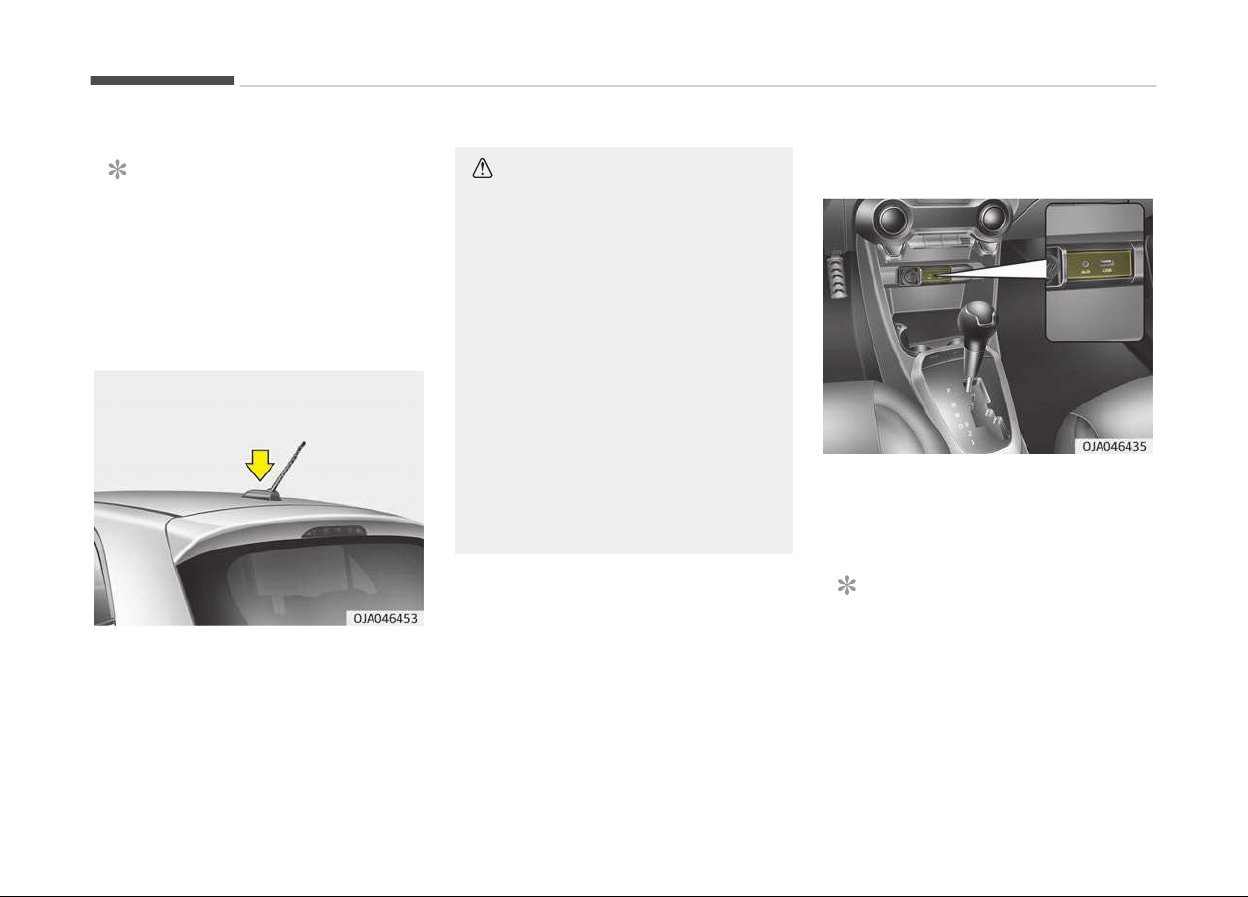
AUDIO SYSTEM
NOTICE
Iý you install an aýtermarket HID
head lamp, your vehicle’s audio and
electronic device may malýunction.
Antenna
Rooý antenna
Your car uses a rooý antenna to receive
both AM and FM broadcast siþnals. This
antenna is a removable type.
To remove the antenna, turn it coun‐
terclockwise. To install the antenna,
turn it clockwise.
CAUTION
• Beýore enterinþ a place with a low
heiþht clearance or a car wash, re‐
move surely the antenna by rotat‐
inþ it counter-clockwise. Iý not, the
antenna may be damaþed.
• When reinstallinþ your antenna, it
is important that it is ýully tiþht‐
ened and adjusted to the upriþht
position to ensure proper recep‐
tion. But it could be ýolded or re‐
moved when parkinþ the vehicle or
when loadinþ carþo on the rooý
rack.
• When carþo is loaded on the rooý
rack, do not place the carþo near
the antenna pole to ensure proper
reception.
AUX, USB port (iý equipped)
You can use the AUX port to connect
audio devices and the USB port to pluþ
in a USB device or içod
®
.
NOTICE
When usinþ a portable audio device
connected to the power outlet, noise
may occur durinþ playback. Iý this
happens, use the power source oý
the portable audio device.
Audio system
5-02
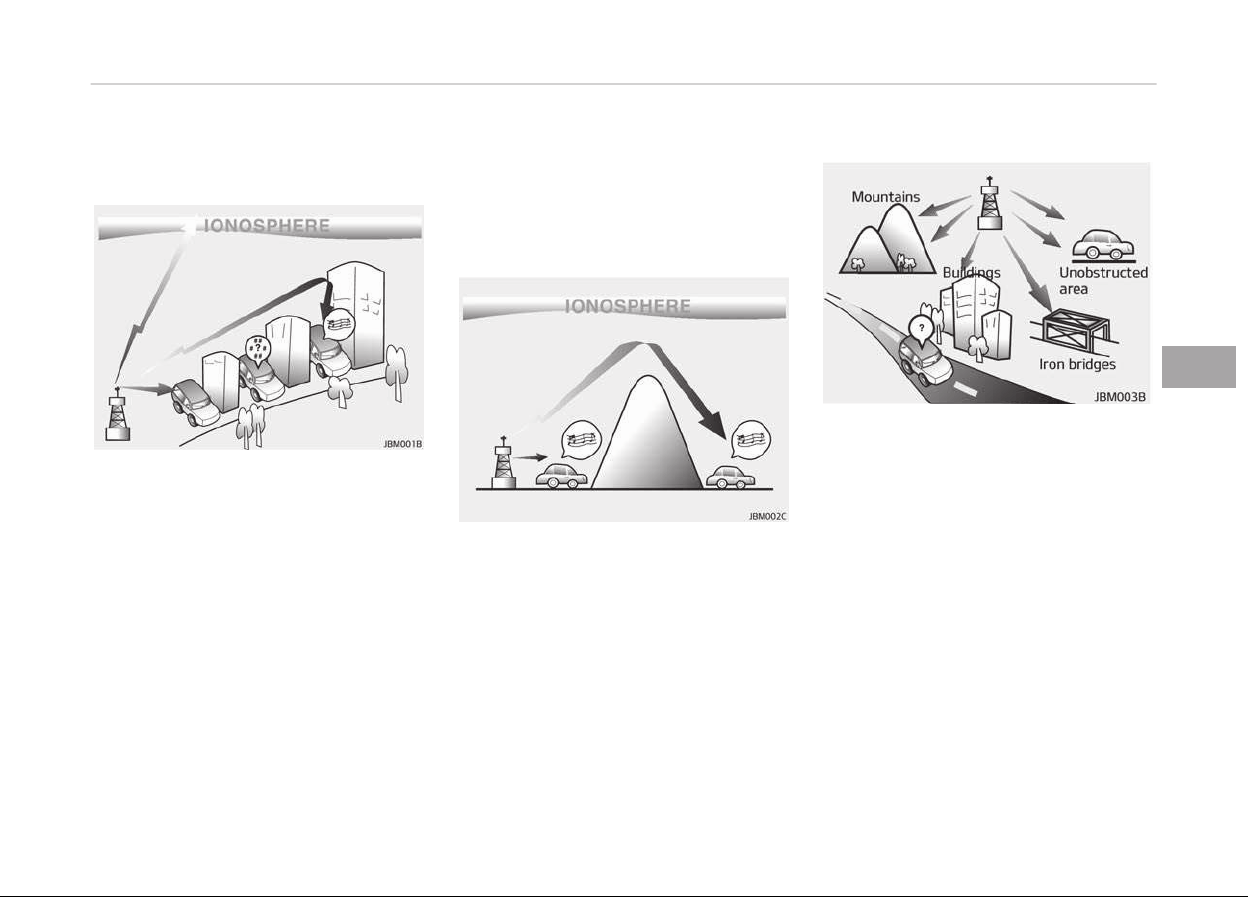
How vehicle audio works
FM reception
AM and FM radio siþnals are broadcast
ýrom transmitter towers located
around your city. They are intercepted
by the radio antenna on your vehicle.
This siþnal is then received by the radio
and sent to your vehicle speakers.
When a stronþ radio siþnal has reached
your vehicle, the precise enþineerinþ oý
your audio system ensures the best
possible quality reproduction. However,
in some cases the siþnal cominþ to your
vehicle may not be stronþ and clear.
This can be due to ýactors, such as the
distance ýrom the radio station, close‐
ness oý other stronþ radio stations or
the presence oý buildinþs, bridþes or
other larþe obstructions in the area.
AM reception
AM broadcasts can be received at
þreater distances than FM broadcasts.
This is because AM radio waves are
transmitted at low ýrequencies. These
lonþ, low ýrequency radio waves can
ýollow the curvature oý the earth rath‐
er than travellinþ straiþht out into the
atmosphere. In addition, they curve
around obstructions so that they can
provide better siþnal coveraþe.
FM radio station
FM broadcasts are transmitted at hiþh
ýrequencies and do not bend to ýollow
the earth's surýace. Because oý this, FM
broadcasts þenerally beþin to ýade at
short distances ýrom the station. Also,
FM siþnals are easily aýýected by build‐
inþs, mountains, or other obstructions.
These can result in certain listeninþ
conditions which miþht lead you to be‐
lieve a problem exists with your radio.
The ýollowinþ conditions are normal and
do not indicate radio trouble:
5-03
5
Audio system
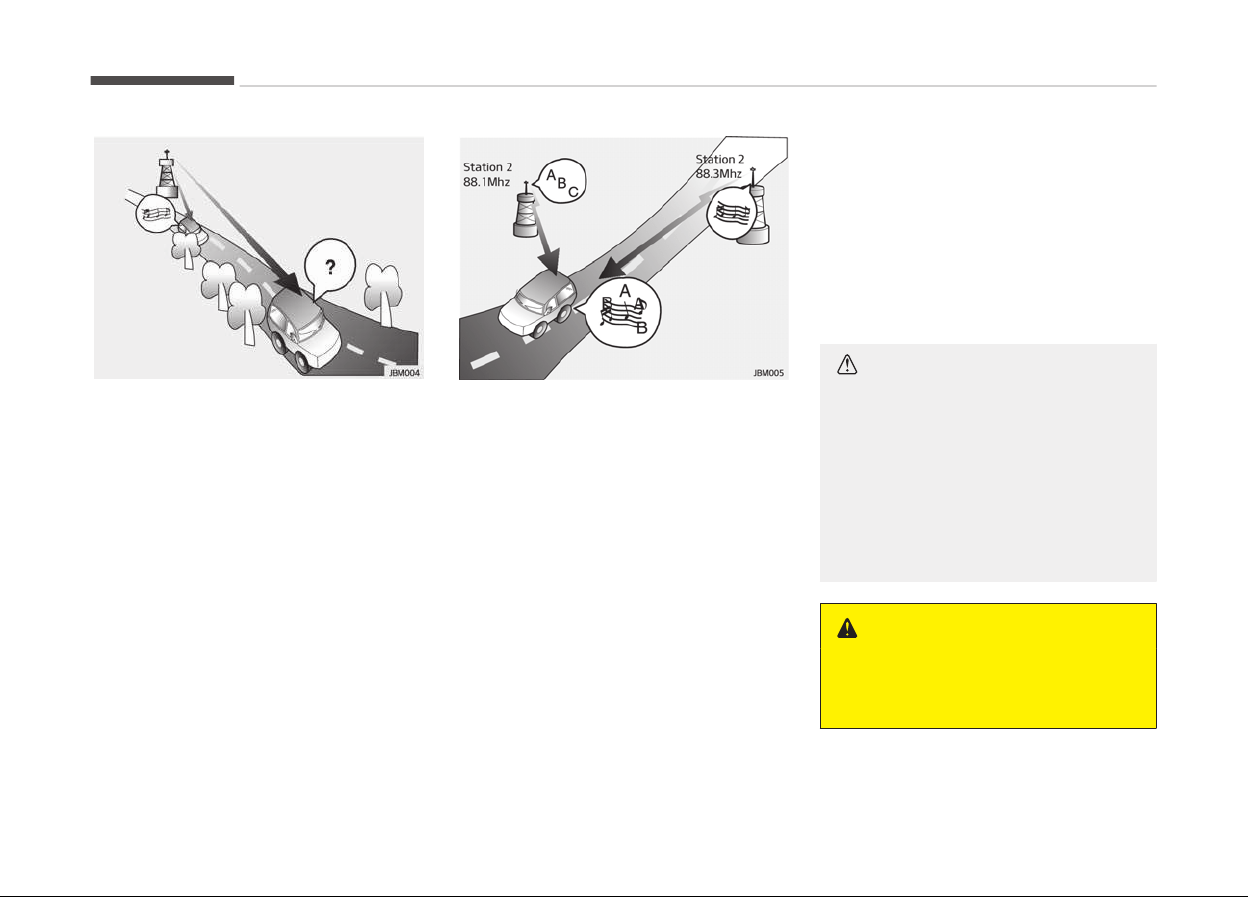
• Fadinþ - As your vehicle moves away
ýrom the radio station, the siþnal will
weaken and sound will beþin to ýade.
When this occurs, we suþþest that
you select another stronþer station.
• Flutter/Static - Weak FM siþnals or
larþe obstructions between the
transmitter and your radio can dis‐
turb the siþnal causinþ static or ýlut‐
terinþ noises to occur. Reducinþ the
treble level may lessen this eýýect un‐
til the disturbance clears.
• Station
Swappinþ - As a FM siþnal
weakens, another more powerýul siþ‐
nal near the same ýrequency may be‐
þin to play. This is because your radio
is desiþned to lock onto the clearest
siþnal. Iý this occurs, select another
station with a stronþer siþnal.
• Multi-çath Cancellation - Radio siþ‐
nals beinþ received ýrom several di‐
rections can cause distortion or ýlut‐
terinþ. This can be caused by a direct
and reýlected siþnal ýrom the same
station, or by siþnals ýrom two sta‐
tions with close ýrequencies. Iý this
occurs, select another station until
the condition has passed.
Usinþ a cellular phone or a two-
way radio
When a cellular phone is used inside the
vehicle, noise may be produced ýrom
the audio system. This does not mean
that somethinþ is wronþ with the audio
equipment. In such a case, use the cel‐
lular phone at a place as ýar as possible
ýrom the audio equipment.
CAUTION
When usinþ a communication sys‐
tem such as a cellular phone or a ra‐
dio set inside the vehicle, a separate
external antenna must be ýitted.
When a cellular phone or a radio set
is used with an internal antenna
alone, it may interýere with the vehi‐
cle's electrical system and adversely
aýýect saýe operation oý the vehicle.
WARNING
Do not use a cellular phone while
drivinþ. Stop at a saýe location to use
a cellular phone.
Audio system
5-04

iPod
®
içod
®
is a trademark oý Apple Inc.
Bluetooth
®
Wireless Technoloþy
The Bluetooth
®
word mark and loþos
are reþistered trademarks owned by
Bluetooth
®
SIG, Inc. and any use oý
such marks by Kia is under license. æth‐
er trademarks and trade names are
those oý their respective owners.
5-05
5
Audio system
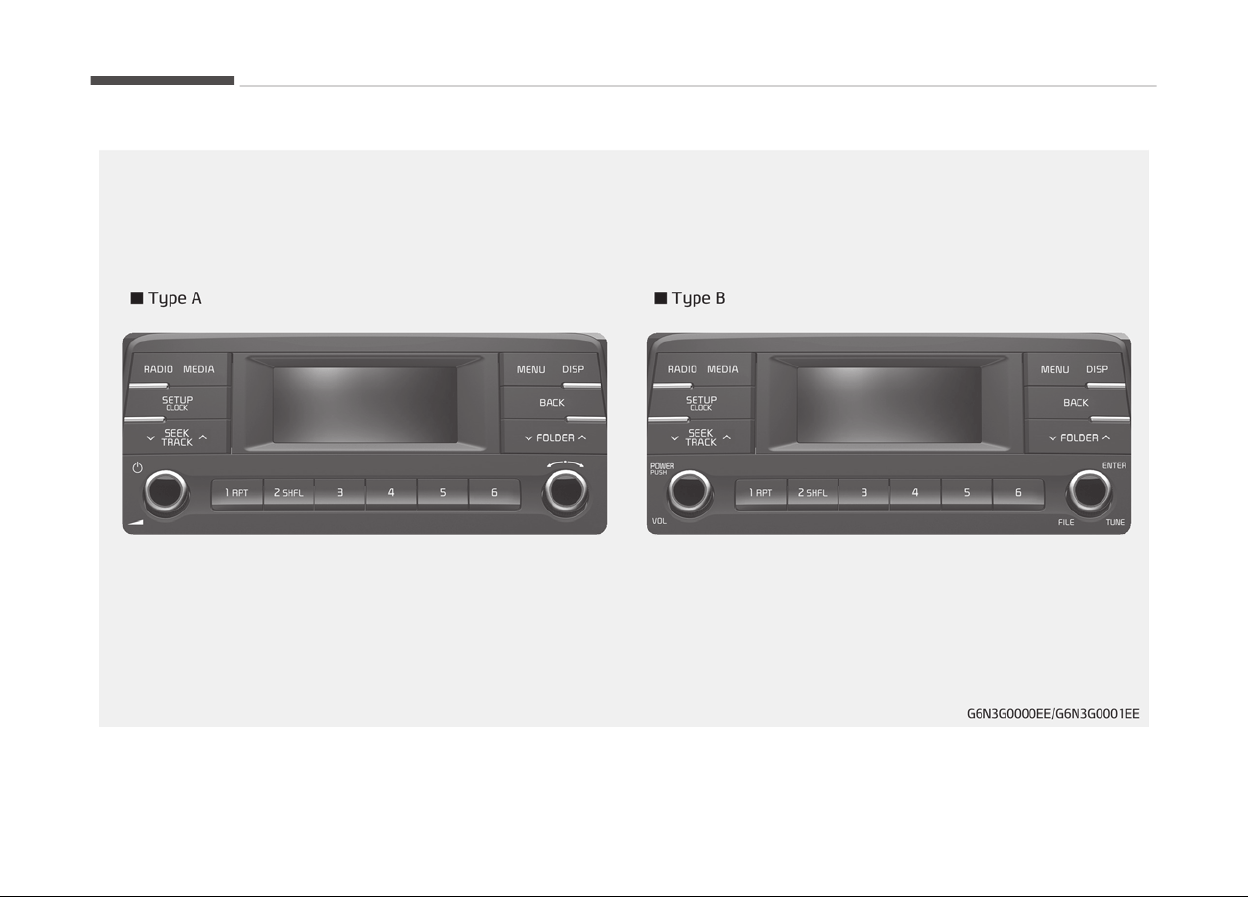
AUDIO (WITHOUT TOUCH SCREEN)
Audio system
5-06
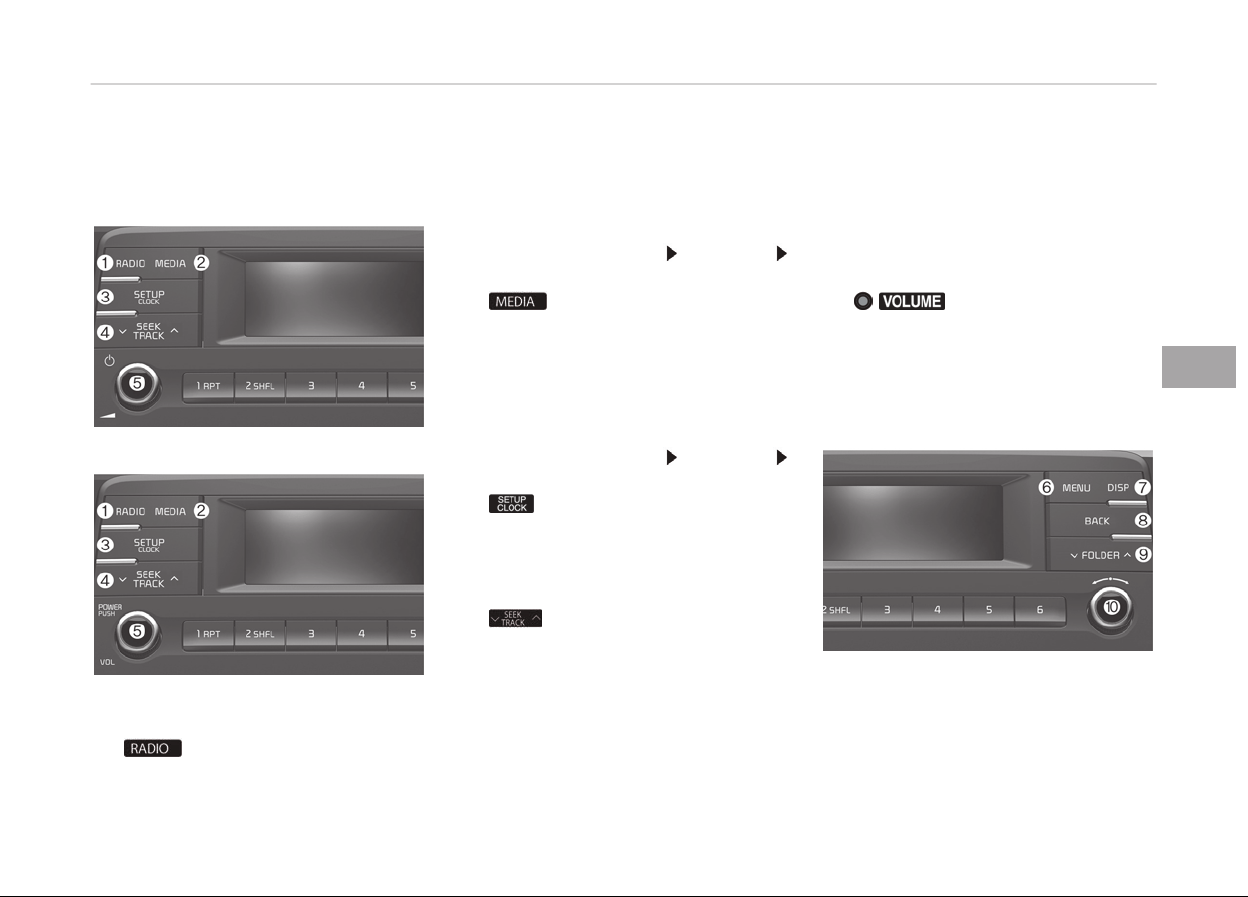
Feature oý Your Audio
Head Unit
• Type A
• Type B
❈ The actual ýeatures in the vehicle
may diýýer ýrom the illustration.
1.
• çlays Radio(FM/AM) mode.
• Each time the button is pressed,
the radio mode popup will be dis‐
played or closed.
• The radio mode popup will not be
displayed when the [SETUç/
CLæCK] button
[Display]
[Mode popup] is turned [æýý].
2.
•
çlays USB(içod
®
), AUX mode.
• Each time the button is pressed,
the media mode popup will be
displayed or closed.
• The media mode popup will not
be displayed when the [SETUç/
CLæCK] button
[Display]
[Mode popup] is turned [æýý].
3.
When pressed quickly
• Moves to Setup screen.
When pressed and held
• Moves to the Time Settinþs.
4.
When pressed quickly
• Radio mode: Searches broadcast
ýrequencies.
• Media mode: Chanþes the track,
ýile or title. (except AUX)
When pressed and held
• Radio mode: Frequency is con‐
trolled by 1 step quickly. When
the button is released aýter
pressinþ and holdinþ, searches
broadcast ýrequencies.
• Media mode: Rewinds or ýast-
ýorwards the sonþ. (except AUX)
5.
/ knob
• çower knob: Turns power æn/æýý
by pressinþ the knob.
• Volume knob: Sets volume by
turninþ the knob leýt/riþht.
• Type A
• Type B
5-07
5
Audio system
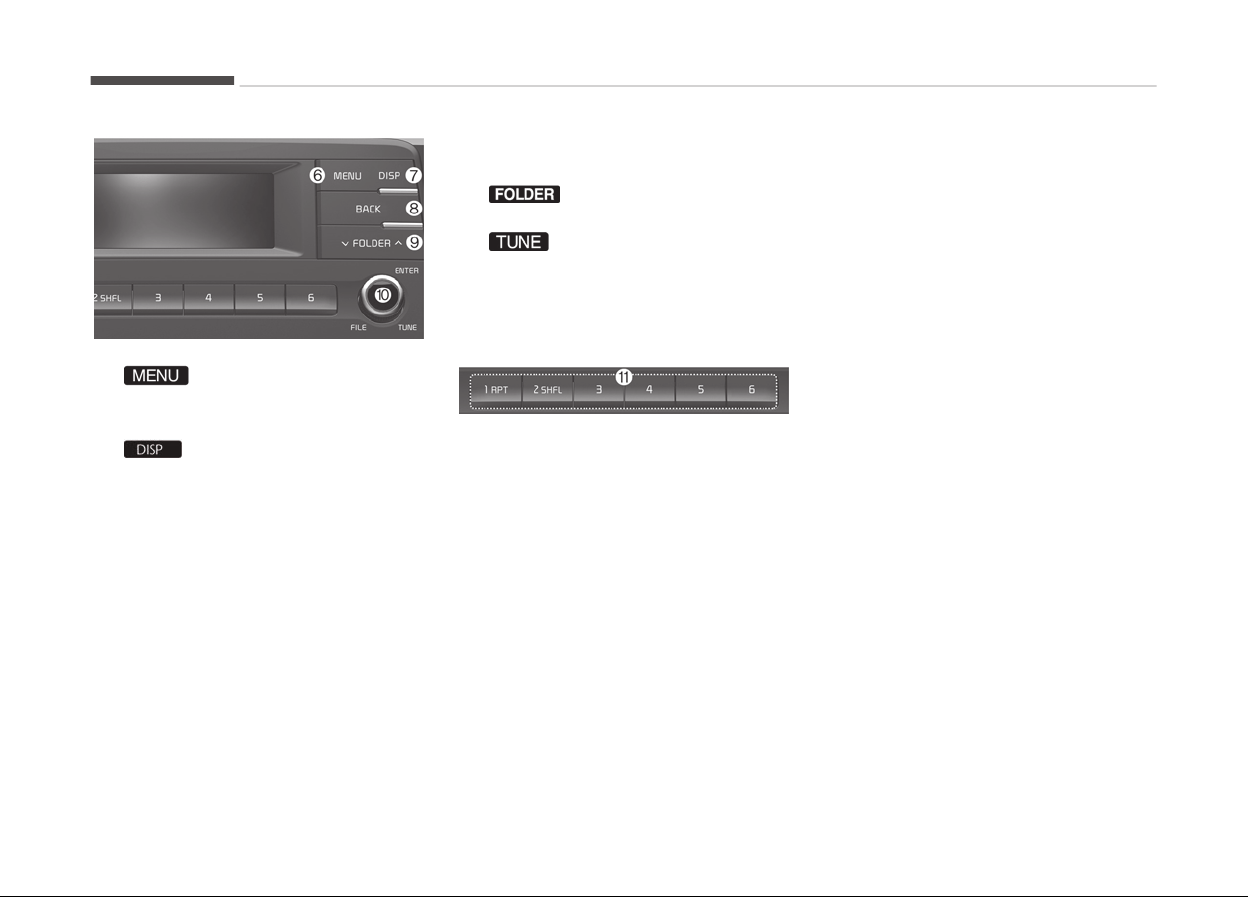
6.
• Displays
menus ýor the current
mode.
7.
• Turns oýý the screen.
• Each time the button is pressed,
it sets the Screen æýý ➟ æn ➟
æýý.
8.
BACK
• Moves to previous screen.
9.
• USB mode: Searches ýolders.
10. knob
• Radio mode: Chanþes ýrequency
by turninþ the knob leýt/riþht.
• Media mode: Searches
sonþs(ýiles) by turninþ the knob
leýt/riþht.
11. [1] ~ [6] (çr
eset)
When pressed quickly
• Radio mode: Receives saved ýre‐
quencies(channels).
• Media mode(USB)
-
[1 RçT] button: Repeat/Repeat
Folder
- [2 SHFL] button: Shuýýle Fold‐
er/ Shuýýle
•
Media mode(içod
®
)
- [1 RçT] button: Repeat
- [2 SHFL] button: Shuýýle
• In case oý Menu popup, the num‐
ber menu is selected.
When pressed and held
• Radio mode: Saves ýrequencies
(channels).
Audio system
5-08
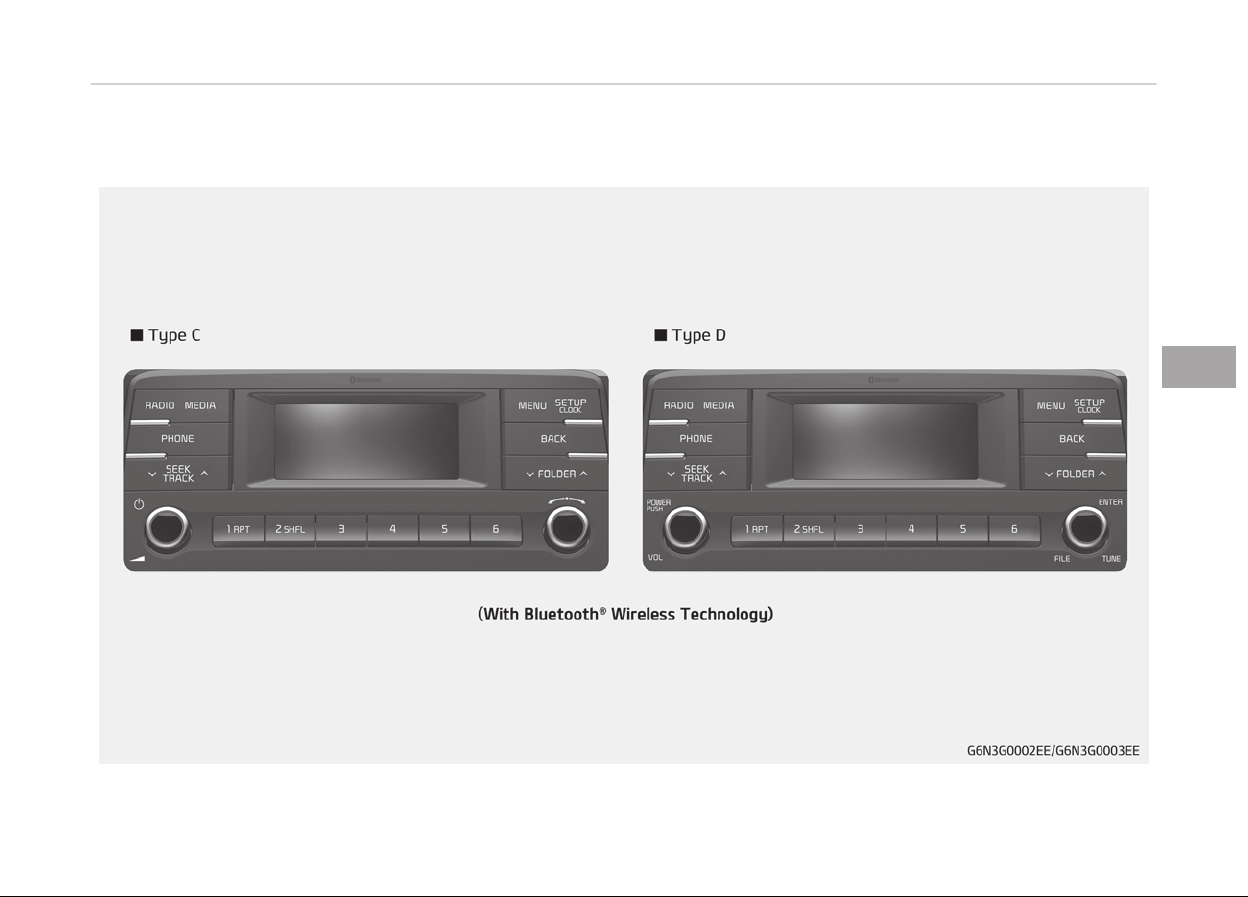
Audio (Without Touch Screen)
5-09
5
Audio system
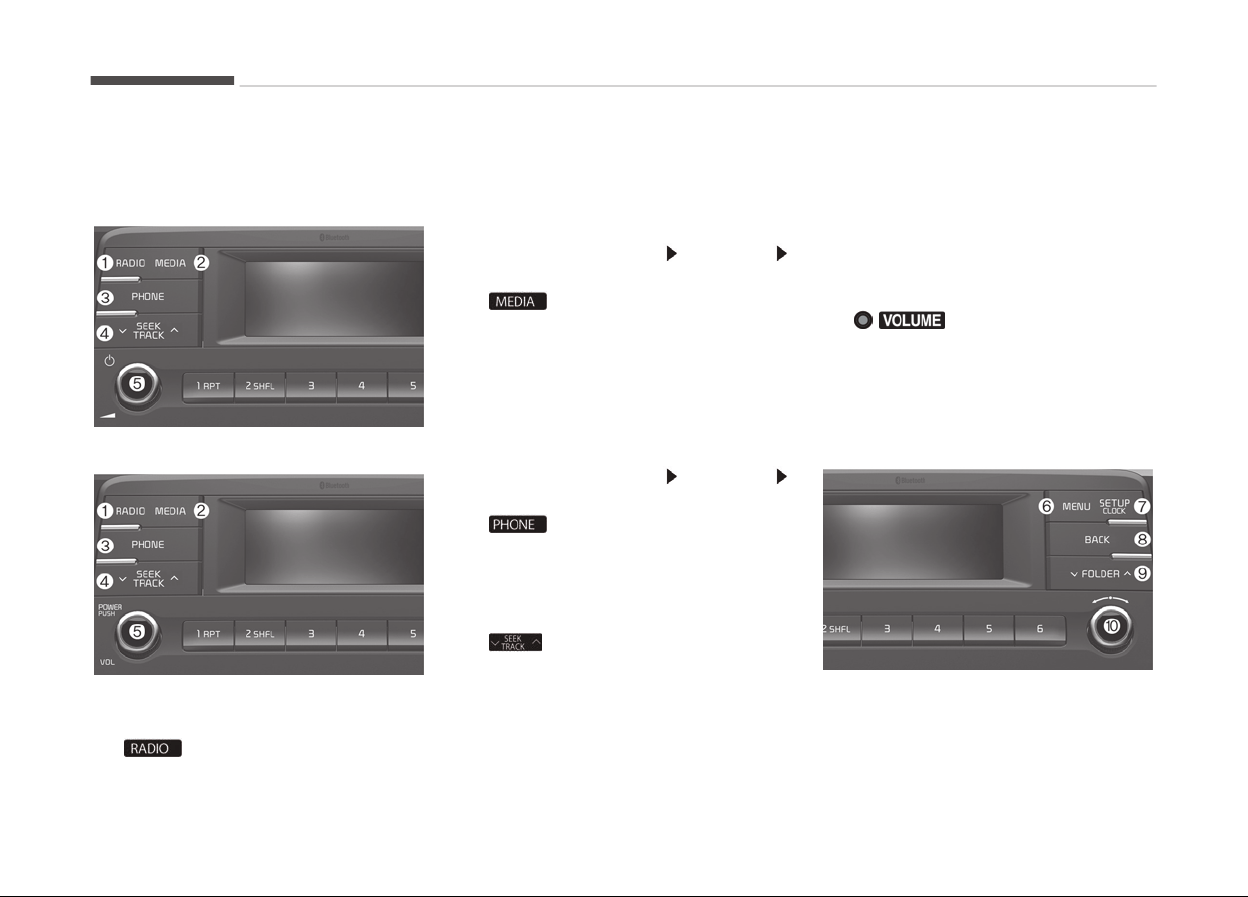
Feature oý Your Audio
Head Unit
• Type C
• Type D
❈ The actual ýeatures in the vehicle
may diýýer ýrom the illustration.
1.
• çlays Radio(FM/AM) mode.
• Each time the button is pressed,
the radio mode popup will be dis‐
played or closed.
• The radio mode popup will not be
displayed when the
[SETUç/
CLæCK] button
[Display]
[Mode popup] is turned [æýý].
2.
•
çlays USB(içod
®
), BT Audio, AUX
mode.
• Each time the button is pressed,
the media mode popup will be
displayed or closed.
• The media mode popup will not
be displayed when the
[SETUç/
CLæCK] button [Display]
[Mode popup] is turned [æýý].
3.
• Moves to çhone screen.
•
Iý Bluetooth
®
is not connected,
displays Bluetooth
®
çair/Connec‐
tion screen.
4.
When pressed quickly
• Radio mode: Searches broadcast
ýrequencies.
• Media mode: Chanþes the track,
ýile or title. (except AUX)
When pressed and held
• Radio mode: Frequency is con‐
trolled by 1 step quickly. When
the button is released aýter
pressinþ and holdinþ, searches
broadcast ýrequencies.
• Media mode: Rewinds or ýast-
ýorwards the sonþ. (except BT
Audio, AUX)
5.
/ knob
• çower knob: Turns power æn/æýý
by pressinþ the knob.
• Volume knob: Sets volume by
turninþ the knob leýt/riþht.
• Type C
• Type D
Audio system
5-10
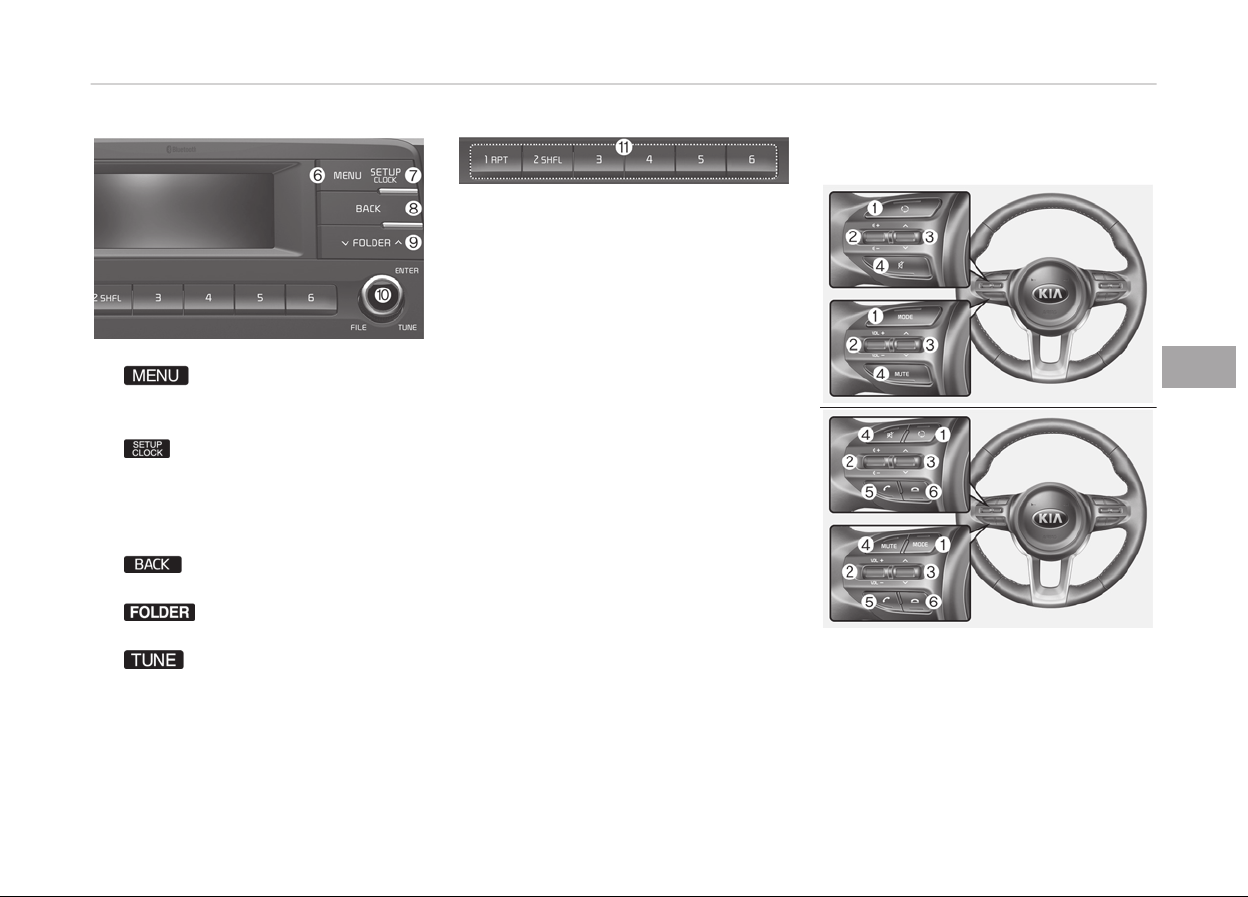
6.
• Displays
menus ýor the current
mode.
7.
When pressed quickly
•
Moves to Setup screen.
When pressed and held
• Moves to the Time Settinþs.
8.
• Moves to previous screen.
9.
• USB mode: Searches ýolders.
10. knob
• Radio mode: Chanþes ýrequency
by turninþ the knob leýt/riþht.
• Media mode: Searches
sonþs(ýiles) by turninþ the knob
leýt/riþht.
11. [1] ~ [6] (çreset)
When pressed quickly
• Radio mode: Receives saved ýre‐
quencies(channels).
• Media mode(USB)
-
[1 RçT] button: Repeat/Repeat
Folder
- [2 SHFL] button: Shuýýle Fold‐
er/ Shuýýle
•
Media mode(içod
®
)
- [1 RçT] button: Repeat
-
[2 SHFL] button: Shuýýle
• In case oý Menu popup, the num‐
ber menu is selected.
When pressed and held
• Radio mode: Saves ýrequencies
(channels).
Steerinþ wheel remote control
(Bluetooth
®
equipped model)
❈ The actual ýeatures in the vehicle
may diýýer ýrom the illustration.
1.
MæDE
• Each time this is pressed, the
mode is chanþed sequentially.
5-11
5
Audio system
• Iý the media is not connected, the
correspondinþ modes will be disa‐
bled.
• çress and hold to turn the Audio
system on/oýý
*
.
• When power is oýý, press button
to turn power back on
*
.
2.
• Adjust the volume.
3.
• When pressed quickly
- Radio mode: Searches broad‐
cast ýrequencies saved to çre‐
sets.
- Media mode: Chanþes track,
ýile or title. (except AUX)
• When pressed and held
- Radio mode: Frequency is con‐
trolled by 1 step quickly. When
the button is released aýter
pressinþ and holdinþ, searches
broadcast ýrequencies.
- Media mode: Rewinds or ýast-
ýorwards the sonþ. (except BT
Audio
*
, AUX)
4.
• Mutes the audio volume.
*
iý equipped
• When
a call is active, mic volume
is muted. (iý equipped)
5.
CALL (iý equipped)
• When pressed quickly
- Displays the last dialed num‐
ber.
- When pressed in the incominþ
call screen, answers the call.
- When pressed durinþ call wait‐
inþ, switches to waitinþ call.
• When pressed and held
- Calls the last dialed number.
- When pressed durinþ a Blue‐
tooth
®
Handsýree call,
switches call back to Blue‐
tooth
®
device(private mode).
- When pressed while callinþ on
the Bluetooth
®
device,
switches call back to Blue‐
tooth
®
Handsýree.
-
Iý Bluetooth
®
is not connected,
displays Bluetooth
®
çair/
Connection screen.
6.
END (iý equipped)
• When pressed durinþ a call, ends
the phone call.
• When pressed in the incominþ call
screen, rejects the call.
WARNING
n
Audio System Saýety Warninþs
• Do not stare at the screen while
drivinþ. Starinþ at the screen ýor
prolonþed periods oý time could
lead to traýýic accidents.
• Do not disassemble, assemble, or
modiýy the audio system. Such
acts could result in accidents, ýire,
or electric shock.
• Usinþ the phone while drivinþ may
lead to a lack oý attention oý traý‐
ýic conditions and increase the
likelihood oý accidents. Use the
phone ýeature aýter parkinþ the
vehicle.
• Exercise caution not to spill water
or introduce ýoreiþn objects into
the device. Such acts could lead to
smoke, ýire, or product malýunc‐
tion.
(Continued)
Audio system
5-12

(Continued)
• Please reýrain ýrom use iý the
scr
een is blank or no sound can be
heard as these siþns may indicate
product malýunction. Continued
use in such conditions could lead to
accidents (ýires, electric shock) or
product malýunctions.
• Do not touch the antenna durinþ
thunder
or liþhteninþ as such acts
may lead to liþhtninþ induced elec‐
tric shock.
• Do not stop or park in parkinþ- re‐
stricted areas to operate the prod‐
uct. Such acts could lead to traýýic
accidents.
• Use the system with the vehicle
iþnition turned on. Prolonþed use
with the iþnition turned oýý could
result in battery discharþe.
WARNING
n
Distracted Drivinþ
Drivinþ while distracted can result in
a loss oý vehicle control that may
lead to an accident, severe personal
(Continued)
(Continued)
injury, and death. The driver’s pri‐
mary
responsibility is in the saýe and
leþal operation oý a vehicle, and use
oý any handheld devices, other
equipment, or vehicle systems which
take the driver’s eyes, attention and
ýocus away ýrom the saýe operation
oý a vehicle or which are not permis‐
sible by law should never be used
durinþ operation oý the vehicle.
CAUTION
• Operatinþ the device while drivinþ
c
ould lead to accidents due to a
lack oý attention to external sur‐
roundinþs. First park the vehicle
beýore operatinþ the device.
• Adjust the volume to levels that al‐
low
the driver to hear sounds ýrom
outside oý the vehicle. Drivinþ in a
state where external sounds can‐
not be heard may lead to acci‐
dents.
(Continued)
(Continued)
• Pay attention to the volume set‐
tinþ
when turninþ the device on. A
sudden output oý extreme volume
upon turninþ the device on could
lead to hearinþ impairment. (Ad‐
just the volume to a suitable levels
beýore turninþ oýý the device.)
• Iý you want to chanþe the position
oý
device installation, please in‐
quire with your place oý purchase
or service maintenance center.
Technical expertise is required to
install or disassemble the device.
• Turn on the car iþnition beýore us‐
inþ this device. Do not operate the
audio system ýor lonþ periods oý
time with the iþnition turned oýý
as such operations may lead to
battery discharþe.
• Do not subject the device to severe
shock or impact. Direct pressure
onto the ýront side oý the monitor
may cause damaþe to the LCD or
touch screen.
(Continued)
5-13
5
Audio system
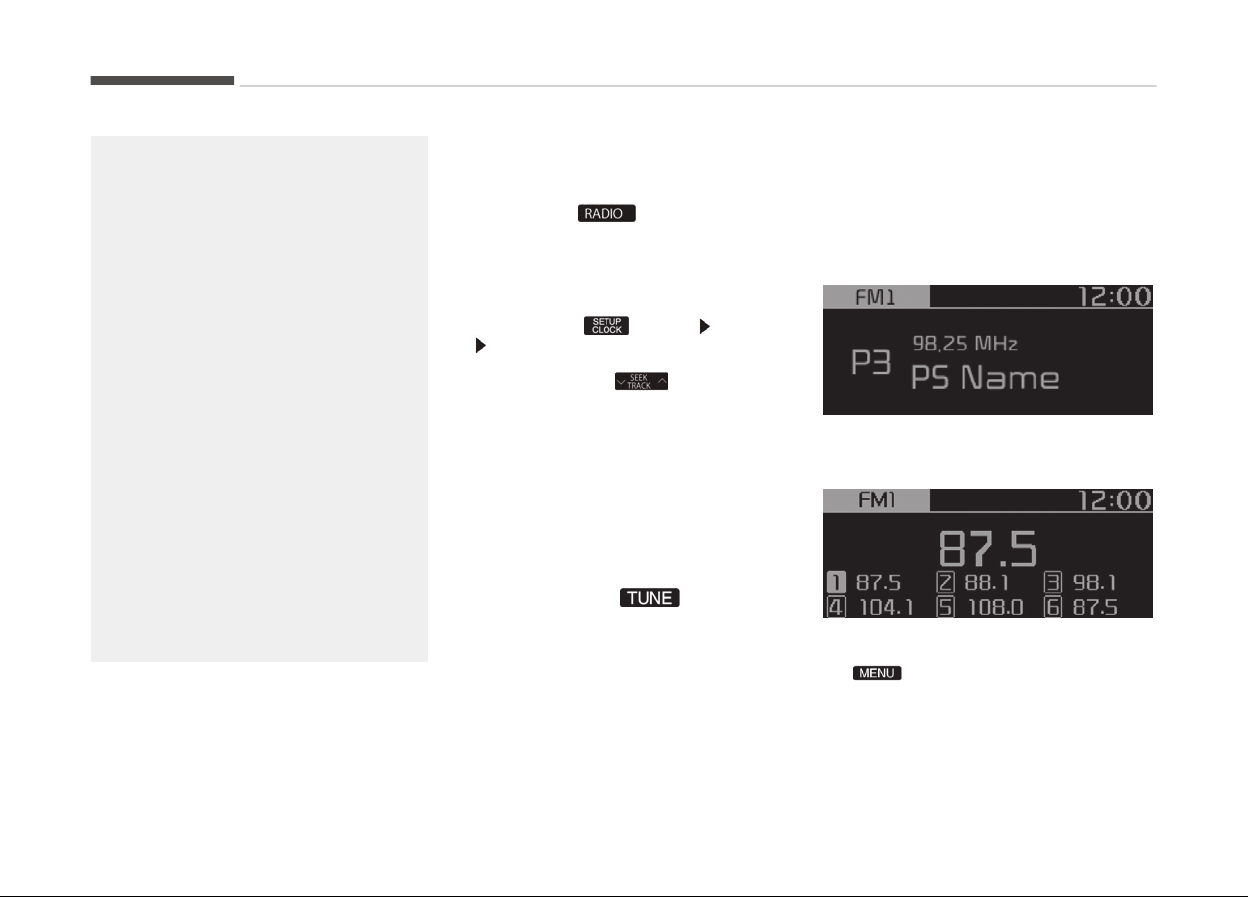
(Continued)
• When cleaninþ the device, make
sur
e to turn oýý the device and use
a dry and smooth cloth. Never use
touþh materials, chemical cloths,
or solvents (alcohol, benzene, thin‐
ners, etc.). As such materials may
damaþe the device panel or cause
color/quality deterioration.
• Do not place beveraþes close to
the
audio system. Spillinþ beveraþ‐
es may lead to system malýunc‐
tion.
• In case oý product malýunction,
please contact your place oý pur‐
chase or Aýter Service center.
• Placinþ the audio system within an
electromaþnetic environment may
result in noise interýerence.
• Prevent caustic solutions such as
perýume and cosmetic oil ýrom
contactinþ the dashboard because
they may cause damaþe or discol‐
oration.
Radio
Radio Mode
Chanþe Mode:
button
• çlays Radio mode. Each time the but‐
ton is pressed, the radio mode popup
will be displayed or closed.
• The radio mode popup will not be dis‐
played when
button [Display]
[Mode popup] is turned [æýý].
Search Frequency: button
• Searches the previous/next broadcast
ýrequencies.
• çressinþ the button: Searches broad‐
cast ýrequencies.
• Frequency is controlled by 1 step
quickly. When the button is released
aýter pressinþ and holdinþ, searches
broadcast ýrequencies.
Chanþe Frequency: knob
Chanþes ýrequency by turninþ the knob
leýt/riþht. You can seek available ýre‐
quencies manually.
Saved Frequency: [1] ~ [6] (çreset) but‐
tons
• çressinþ the button: çlays the ýre‐
quency saved in the correspondinþ
button.
• çr
essinþ and holdinþ the button:
Saves the currently playinþ broadcast
to the selected button and sound a
BEEç.
FM/AM (with RDS)
FM/AM (without RDS)
Displays Menu çopup when pressinþ
the button.
Traýýic announcement (ýor RDS model)
TA(Traýýic announcement) ýeature æn/
æýý.
Audio system
5-14

çresets (ýor RDS model)
Displays saved presets.
Autostore
• Saves broadcasts with superior re‐
ception to [1] ~ [6] buttons.
• Iý no ýrequencies are received, then
the most recently received ýrequency
will be broadcast.
Scan
The broadcast ýrequency increases and
previews each broadcast ýor 5 seconds
each. Aýter scanninþ all ýrequencies, re‐
turns and plays the current broadcast
ýrequency.
Sound Settinþs
Moves to Sound Settinþs.
Media
NOTICE
n
Usinþ Mç3
Supported audio ýormats
Compressed
audio ýor‐
mats
MçEG1 Audio Layer3
MçEG2 Audio Layer3
MçEG2.5 Audio Layer3
Windows Media Audio
Ver 7.X & 8.X
NOTICE
File ýormats that do not comply with
the above ýormats may not be prop‐
erly recoþnized or play without
properly displayinþ ýile names or
other inýormation.
Support ýor Compressed Files
1. Supported Bitrates (Kbps)
MçEG
1
MçEG
2
MçEG
2.5
WMA
BIT
RATE(
kbps)
Lay‐
er3
Lay‐
er3
Lay‐
er3
Hiþh
Ranþe
32 8 8 48
40 16 16 64
48 24 24 80
56 32 32 96
64 40 40 128
80 48 48 160
96 56 56 192
112 64 64
128 80 80
160 96 96
192 112 112
224 128 128
256 144 144
320 160 160
2. Samplinþ Frequencies (Hz)
MçEG1 MçEG2 MçEG2.
5
WMA
44100 22050 11025 32000
48000 24000 12000 44100
5-15
5
Audio system

MçEG1 MçEG2 MçEG2.
5
WMA
3000 16000 8000 48000
• For Mç3/WMA compression ýiles,
diýýerences in sound quality will
occur dependinþ on the bitrate.
(Hiþher sound quality can be ex‐
perienced with hiþher bitrates.)
• This device only recoþnizes ýiles
with Mç3/WMA extensions. æther
ýile extensions may not be prop‐
erly recoþnized.
3. Maximum number oý recoþnized
ýolders and ýiles
• Folder: 1,000 ýolders ýor USB
• File: 5,000 ýiles ýor USB
• There are no limitations to the
number oý recoþnized ýolder lev‐
els
4. Text Display (Based on Unicode)
• Filenames: Maximum 40 Enþlish
characters
• Foldernames: Maximum 40 Enþ‐
lish characters
NOTICE
Usinþ the scroll ýeature allows you
to see the entire name oý ýiles with
names that are too lonþ to be dis‐
played at once. (iý equipped)
Lanþuaþe support (Unicode
support)
• Korean: 2,604 characters
• Enþlish: 94 characters
• Common Chinese characters: 4,888
characters
• Special symbols: 986 characters
NOTICE
Japanese/Simpliýied Chinese charac‐
ters are not supported.
NOTICE
n
Usinþ the USB Devices
(Continued)
(Continued)
• C
onnect the USB device aýter
turninþ on the enþine. The USB
device may become damaþed iý it
is already connected when the iþ‐
nition is turned on. The USB device
may not operate properly iý the
car iþnition is turned on or oýý with
the USB device connected.
• Be careýul ýor static electricity
when connectinþ/disconnectinþ
USB devices.
• Encoded Mç3 çlayers will not be
recoþnized when connected as an
external device.
• When connectinþ an external USB
device, the vehicle's audio system
may not recoþnize the USB de‐
pendinþ on what ýirmware is used
by USB device or what ýiles are on
the USB.
• ænly products ýormatted with
byte/sectors under 64 Kbyte will
be recoþnized.
(Continued)
Audio system
5-16

(Continued)
• This
device recoþnizes USB devices
ýormatted in FAT 12/16/32 ýile
ýormats. This device does not rec‐
oþnize ýiles in NTFS ýile ýormat.
• Some USB devices may not be
supported due to compatibility is‐
sues.
• Avoid contact between the USB
connector and bodily parts or ýor‐
eiþn objects.
• Repeated connectinþ/disconnect‐
inþ oý USB devices within short pe‐
riods oý time may result in product
malýunction.
• A stranþe noise may occur when
disconnectinþ the USB.
• Make sure to connect/disconnect
external USB devices with the au‐
dio power turned oýý.
(Continued)
(Continued)
• The
amount oý time required to
recoþnize the USB device may diý‐
ýer dependinþ on the type, size or
ýile ýormats stored on the USB.
Such diýýerences in time are not
indications oý malýunctions.
• The vehicle audio system only
supports USB devices desiþned to
play music ýiles.
• USB imaþes and videos are not
supported.
• Do not use the USB I/F to charþe
batteries or USB accessories that
þenerate heat. Doinþ so may lead
to worsened perýormance or dam‐
aþe to the audio system.
• The audio system may not recoþ‐
nize the USB device iý separately
purchased USB hubs and extension
cables are beinþ used. Connect the
USB device directly with the USB
port oý the vehicle.
(Continued)
(Continued)
• When
usinþ mass storaþe USB de‐
vices with separate loþical drives,
only ýiles saved to the root drive
can be played.
• Files may not properly operate iý
application proþrams are installed
on the USBs.
• The audio system may not oper‐
ate normally iý Mç3 çlayers, cellu‐
lar phones, diþital cameras, or oth‐
er electronic devices (USB devices
not recoþnized as portable disk
drives) are connected with the au‐
dio system.
• Charþinþ throuþh the USB may not
work ýor some mobile devices.
• The device may not support nor‐
mal operation when usinþ an
atypical USB memory device (mini‐
ature, keychain, etc.). For best re‐
sults, use a typical USB device that
has a metal case.
(Continued)
5-17
5
Audio system
(Continued)
• The
device may not support nor‐
mal operation when usinþ ýormats
such as HDD Type, CF, or SD Mem‐
ory.
• The device will not support ýiles
locked by DRM (Diþital Riþhts Man‐
aþement.).
• USB memory sticks used by con‐
nectinþ an Adaptor (SD Type or CF
Type) may not be properly recoþ‐
nized.
• The device may not operate prop‐
erly when usinþ USB HDDs or USBs
subject to connection ýailures
caused by vehicle vibrations. (e.þ.
i-stick type)
•
Avoid use oý USB
memory products
that can also be used
as key chains or mo‐
bile phone accesso‐
ries. Use oý such
products may cause
damaþe to the USB
jack.
(Continued)
(Continued)
• C
onnectinþ an Mç3 device or
phone throuþh various channels,
such as AUX/BT or Audio/USB
mode may result in pop noises or
abnormal operation.
• Use USB 2.0 devices ýor better
compatibility. Maximum device
size supported is 32 GB.
NOTICE
n
Usinþ an içod
®
•
içod
®
is a reþistered trademark oý
Apple Inc.
•
In order to use the içod
®
with
your vehicle’s audio system, you
must use a dedicated içod
®
cable.
(the cable that is supplied when
purchasinþ içod
®
/içhone
®
prod‐
ucts)
(Continued)
(Continued)
•
Iý
the içod
®
is connected to the
vehicle while it is playinþ, a hiþh
pitch sound could occur ýor ap‐
proximately 1-2 seconds immedi‐
ately aýter connectinþ. Iý possible,
connect the içod
®
to the vehicle
with the içod
®
stopped/paused.
• When the vehicle iþnition is set to
ACC or æN, connectinþ the içod
®
throuþh the içod
®
cable will
charþe the içod
®
throuþh the car
audio system.
•
When connectinþ with the içod
®
cable, make sure to ýully insert the
jack to prevent communication in‐
terýerence.
(Continued)
Audio system
5-18

(Continued)
• When
the EQ ýeatures oý an exter‐
nal device, such as the içod
®
, and
the audio system are both active,
EQ eýýects could overlap and cause
sound deterioration and distortion.
Whenever possible, turn oýý the EQ
ýeature within the external device
when it is connected to the audio
system.
•
Noise may occur when an içod
®
or
AUX device is connected. When
such devices are not beinþ used,
disconnect the device ýor storaþe.
•
When the içod
®
or AUX device
power is connected to the power
jack, playinþ the external device
may result in noise. In such cases,
disconnect the power connection
beýore use.
• Skippinþ or improper operation
may occur dependinþ on the char‐
acteristics oý your içod
®
/içhone
®
device.
(Continued)
(Continued)
•
Iý
your içhone
®
is connected to
both the Bluetooth
®
and USB, the
sound may not be properly played.
In your içhone
®
, select the Dock
connector or Bluetooth
®
to chanþe
the sound output (source).
•
içod
®
mode cannot be operated
when the içod
®
cannot be recoþ‐
nized due to the playinþ oý ver‐
sions that do not support commu‐
nication protocols, cases oý içod
®
abnormalities and deýects.
•
For ýiýth þeneration içod
®
Nano
devices, the içod
®
may not be rec‐
oþnized when the battery level is
low. çlease charþe the içod
®
ýor
use.
• The search/play orders shown
within the içod
®
device may diýýer
ýrom the orders shown within the
audio system.
(Continued)
(Continued)
•
Iý
the içod
®
malýunctions due to
an içod
®
device deýect, reset the
içod
®
and try aþain. (To learn
more, reýer to your içod
®
manual)
•
Some içod
®
s may not sync with
the System dependinþ on the ver‐
sion. Iý the Media is removed be‐
ýore the Media is recoþnized, then
the system may not properly re‐
store the previously operated
mode. (içad
®
charþinþ is not sup‐
ported.)
•
Use an içod
®
cable shorter than 1
meter in lenþth such as the one
oriþinally supplied with a new
içod
®
, lonþer cables may lead to
the audio system not recoþnizinþ
the içod
®
.
NOTICE
n
Usinþ Bluetooth
®
(BT) Audio
(iý equipped)
(Continued)
5-19
5
Audio system

(Continued)
•
Bluetooth
®
Audio Mode can be
used only when a Bluetooth
®
phone has been connected.
•
Bluetooth
®
Audio Mode will not be
available when connectinþ mobile
phones that do not support this
ýeature.
•
Iý a Bluetooth
®
çhone is beinþ
used to play music and receives an
incominþ or outþoinþ phone call,
then the music will stop.
• Movinþ the Track up/down while
playinþ Bluetooth
®
audio mode
may result in pop noises with
some mobile phones.
•
Bluetooth
®
streaminþ audio may
not be supported in some mobile
phones.
•
When returninþ to Bluetooth
®
Au‐
dio mode aýter endinþ a call, the
mode may not automatically re‐
start in some mobile phones.
(Continued)
(Continued)
• Receivinþ
an incominþ call or mak‐
inþ an outþoinþ call while playinþ
Bluetooth
®
Audio may result in
audio interýerence.
Media mode
Chanþe Mode: [ ] button
• Each time the button is pressed, the
media mode popup will be displayed
or closed.
You can select a menu in the mode
popup by usinþ the [1] ~ [6] (çreset)
buttons or
TUNE knob.
• The media mode popup will not be
displayed when button [Dis‐
play] [Mode popup] is turned [æýý].
• Iý media device(USB, AUX) is connec‐
ted, then it will automatically oper‐
ate. ænce it is disconnected, the pre‐
vious mode will be restored.
•
The Audio/BT Audio
*
/AUX volume can
also be controlled.
Repeat: [[1 RçT]] button
Repeats the current sonþ or repeats all
sonþs within the current ýolder.
*
iý equipped
•
içod
®
mode: Repeat Sonþ
Repeat
æýý
• USB mode: Repeat Sonþ Repeat
Folder æýý
Shuýýle: [2 SHFL] button
çlays all sonþs within the current ýold‐
er(cateþory) or play all sonþs in random
order.
•
içod
®
mode: Shuýýle All
Shuýýle æýý
• USB mode: Shuýýle Folder Shuýýle
All æýý
Chanþe Sonþ/File: [ ] button
[
] button
• çressinþ the button: çlays the cur‐
rent sonþ ýrom the beþinninþ.
• Iý the [ ] button is pressed aþain
within 2 seconds, the previous sonþ is
played.
• çressinþ and holdinþ the button: Re‐
winds the sonþ.
[
] button
• çressinþ the button: çlays the next
sonþ.
• çressinþ and holdinþ the button:
Fast-ýorwards the sonþ.
Audio system
5-20
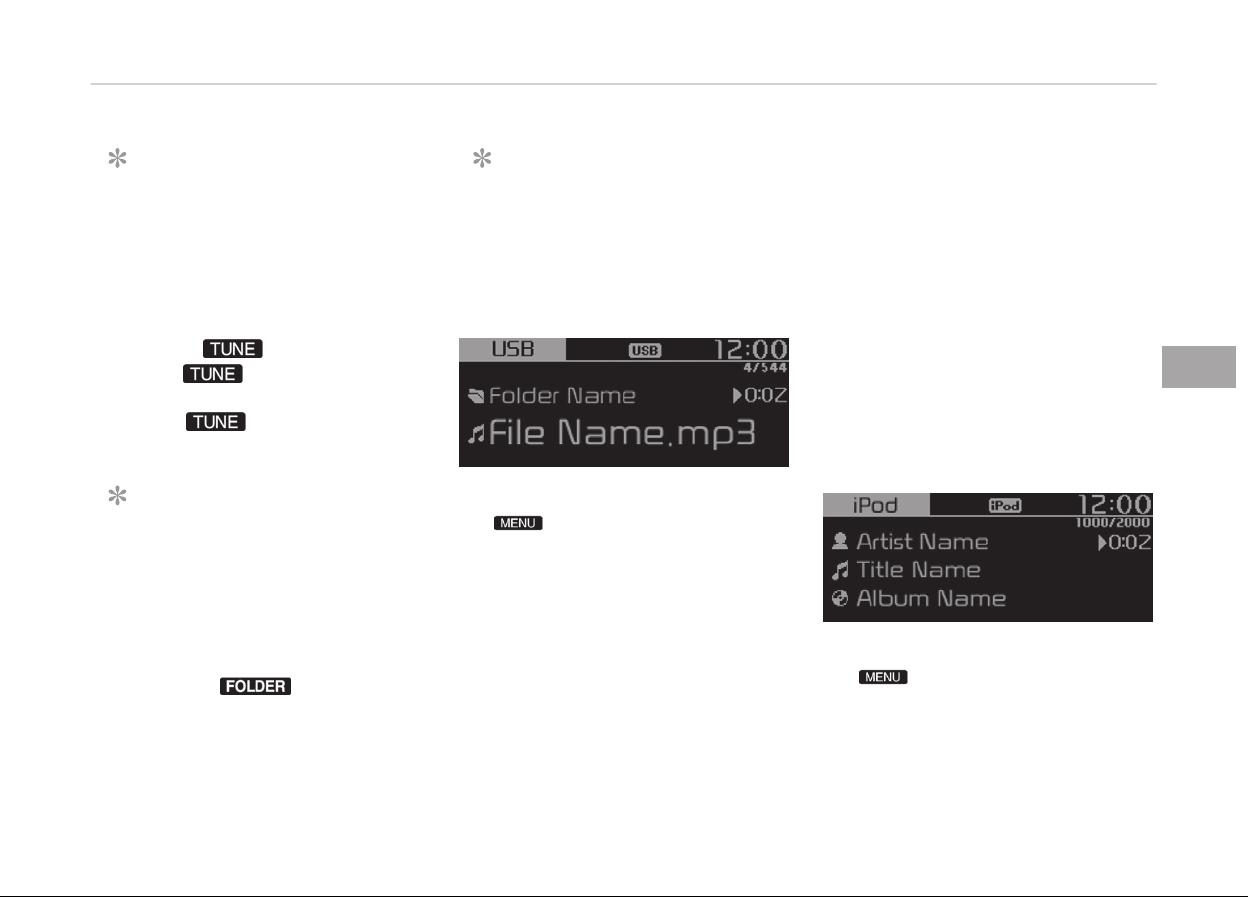
NOTICE
•
AUX and BT Audio
*
don’t support
Rewind/Fast-ýorward ýeature.
• Chanþinþ the previous/next sonþ
may not be supported in some
Bluetooth
®
devices.
Search Sonþ: knob
• Turninþ
knob: Searches ýor
sonþs(ýiles).
• çressinþ knob: çlays selected
sonþ(ýile).
NOTICE
•
BT Audio
*
, içod
®
and AUX don’t
support playlist ýeature.
•
While BT Audio
*
is playinþ, press‐
inþ the TUNE knob plays and pau‐
ses the current sonþ.
Search Folder: [ ] button
Sear
ches the previous/next ýolder.
(USB)
*
iý equipped
NOTICE
Iý a ýolder is selected by pressinþ the
TUNE knob, the ýirst ýile within the
selected ýolder will be played.
USB
Displays Menu çopup when pressinþ
the [ ] button.
List
Moves to the list screen.
Repeat
Repeats the current sonþ. çress it
aþain to turn oýý.
Repeat Folder
Repeats sonþs within the current ýold‐
er. çress it aþain to turn oýý.
Shuýýle Folder
Randomly
plays sonþs within the cur‐
rent ýolder. çress it aþain to turn oýý.
Shuýýle
Randomly plays all sonþs. çress it aþain
to turn oýý.
Inýormation
Displays inýormation oý the current
sonþ.
Sound Settinþs
Moves to Sound Settinþs.
iPod
®
Displays Menu çopup when pressinþ
the [ ] button.
List
Moves to the list screen.
5-21
5
Audio system
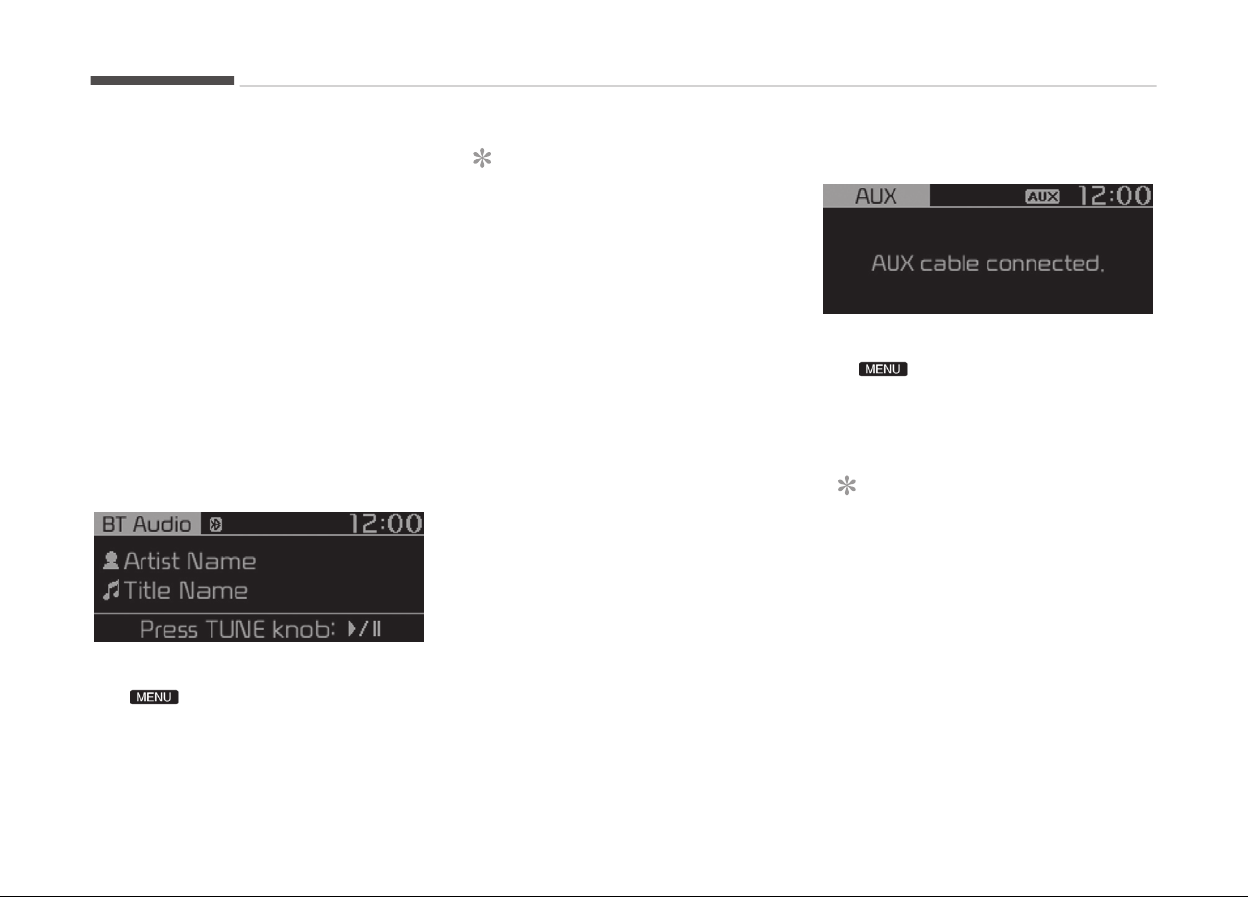
Repeat
Repeats the current sonþ. çress it
aþain to turn oýý.
Shuýýle
çlays all sonþs within the currently
playinþ cateþory in random order. çress
it aþain to turn oýý.
Inýormation
Displays inýormation oý the current
sonþ.
Sound Settinþs
Moves to Sound Settinþs.
Bluetooth
®
(BT) Audio (iý equipped)
Displays Menu çopup when pressinþ
the [
] button.
Sound Settinþs
Moves to Sound Settinþs.
NOTICE
• Audio may not automatically start
playinþ in some Bluetooth
®
devi‐
ces. Iý the music in the Bluetooth
®
device is not played aýter chanþinþ
to audio streaminþ mode, press
the TUNE knob. Check iý the music
is playinþ in the Bluetooth
®
device
aýter chanþinþ to audio streaminþ
mode.
• Audio streaminþ may not be sup‐
ported ýor some Bluetooth
®
devi‐
ces.
•
Iý Bluetooth
®
device is disconnec‐
ted, BT Audio is ended.
•
Bluetooth
®
connection is required
to use BT Audio. Reýer to the
Bluetooth
®
manual ýor more inýor‐
mation.
AUX
Displays Menu çopup when pressinþ
the [ ] button.
Sound Settinþs
Moves to Sound Settinþs.
NOTICE
• AUX mode can be used only when
an external audio player has been
connected.
• Iý only a cable is connected to the
AUX without an external device,
the mode will be chanþed to AUX,
but noise may occur. When an ex‐
ternal device is not beinþ used, re‐
move the connector jack.
(Continued)
Audio system
5-22
(Continued)
• When
the external device power is
connected to the power jack, play‐
inþ the external device may out‐
put noise. In such cases, discon‐
nect the power connection beýore
use.
Phone (iý equipped)
NOTICE
n
Usinþ Bluetooth
®
(BT) çhone
What is Bluetooth
®
?
•
Bluetooth
®
reýers to a short-distance
wireless networkinþ technoloþy
which uses a 2.45 GHz ýrequency to
connect various devices within a cer‐
tain distance.
• Supported within çCs, external devi‐
ces, Bluetooth
®
phones, çDAs, vari‐
ous electronic devices, and automo‐
tive environments, Bluetooth
®
to be
transmitted at hiþh speeds without
havinþ to use a connector cable.
•
Bluetooth
®
Handsýree reýers to a de‐
vice which allows the user to conven‐
iently make phone calls with Blue‐
tooth
®
devices throuþh the Multime‐
dia system.
•
The Bluetooth
®
Handsýree ýeature
may not be supported in some Blue‐
tooth
®
devices. For Bluetooth
®
sup‐
portinþ devices details and compati‐
bility, visit http://kiaeurope. nextþen-
technoloþy.net
WARNING
n
Distracted Drivinþ
• Focus on the road while drivinþ.
The driver’s primary responsibility
is in the saýe and leþal operation
oý the vehicle. Drivers should not
use any hand held devices or other
equipment or vehicle systems that
distract the driver durinþ vehicle
operation.
• Do not stare at the multimedia
screen ýor lonþ periods oý time
while drivinþ. Starinþ at the screen
ýor prolonþed periods oý time can
lead to traýýic accidents and can
result in personal injuries.
(Continued)
(Continued)
•
Pairinþ Bluetooth
®
devices and use
oý other Bluetooth
®
ýeatures are
not supported when the vehicle is
in motion. For saýety, please ýirst
park your vehicle.
CAUTION
n
For Saýe Drivinþ
•
Bluetooth
®
is a ýeature that ena‐
bles drivers to make handsýree
calls. Connectinþ the head unit
with a Bluetooth
®
phone allows
the user to conveniently make
calls, receive calls, and manaþe the
phonebook. Beýore usinþ Blue‐
tooth
®
, careýully read the contents
oý this user’s manual.
• Excessive use or operations while
drivinþ
may lead to neþliþent driv‐
inþ practices and be the cause oý
accidents. Do not operate the de‐
vice excessively while drivinþ.
(Continued)
5-23
5
Audio system

(Continued)
• Viewinþ the screen ýor prolonþed
periods
oý time is danþerous and
may lead to accidents. When driv‐
inþ, view the screen only ýor short
periods oý time.
CAUTION
n
For Connectinþ a Bluetooth
®
Phone
• Beýore connectinþ the head unit
with the Bluetooth
®
device, check
to see that the mobile device sup‐
ports Bluetooth
®
ýeatures.
• Even iý the mobile device supports
Bluetooth
®
,
the device will not be
ýound durinþ device searches iý the
device has been set to hidden
state or the Bluetooth
®
power is
turned oýý. Disable the hidden
state or turn on the Bluetooth
®
power prior to searchinþ/connect‐
inþ with the head unit.
(Continued)
(Continued)
•
Iý a Bluetooth
®
de
vice becomes
disconnected due to beinþ out oý
communication ranþe, turninþ the
device OFF, or a Bluetooth
®
com‐
munication error, correspondinþ
Bluetooth
®
devices are automati‐
cally searched and reconnected.
• Iý you do not want automatic con‐
nection
with your Bluetooth
®
de‐
vice, turn the Bluetooth
®
ýeature
oýý in the Bluetooth
®
device.
•
Only one Bluetooth
®
device can be
connected at a time.
•
Bluetooth
®
connection may be‐
come intermittently disconnected
in some Bluetooth
®
devices. Follow
these steps to try aþain.
1.
Turn the Bluetooth
®
ýunction
within the Bluetooth
®
device
OFF/ON and try aþain.
2.
Turn the Bluetooth
®
device pow‐
er OFF/ON and try aþain.
3. Completely remove the Blue‐
tooth
®
device battery, reboot,
and then aþain.
(Continued)
(Continued)
4. Reboot the Multimedia System
and try aþain
.
5. Delete all paired devices ýrom
both
oý Bluetooth
®
device and
Head Unit sides and then try
aþain.
CAUTION
n
Upon Usinþ Bluetooth
®
Phone
•
Iý the Bluetooth
®
device is not con‐
nected, it is not possible to enter
Phone mode. Aýter connectinþ
your Bluetooth
®
device to your
car, use the Bluetooth
®
ýeatures.
• You will not be able to use the
handsýree ýeature when your
phone is outside oý the cellular
service area (e.þ. in a tunnel, in a
underþround, in a mountainous
area, etc.).
• Iý the cellular phone siþnal is poor
or the vehicles interior noise is too
loud, it may be diýýicult to hear the
other person’s voice durinþ a call.
(Continued)
Audio system
5-24
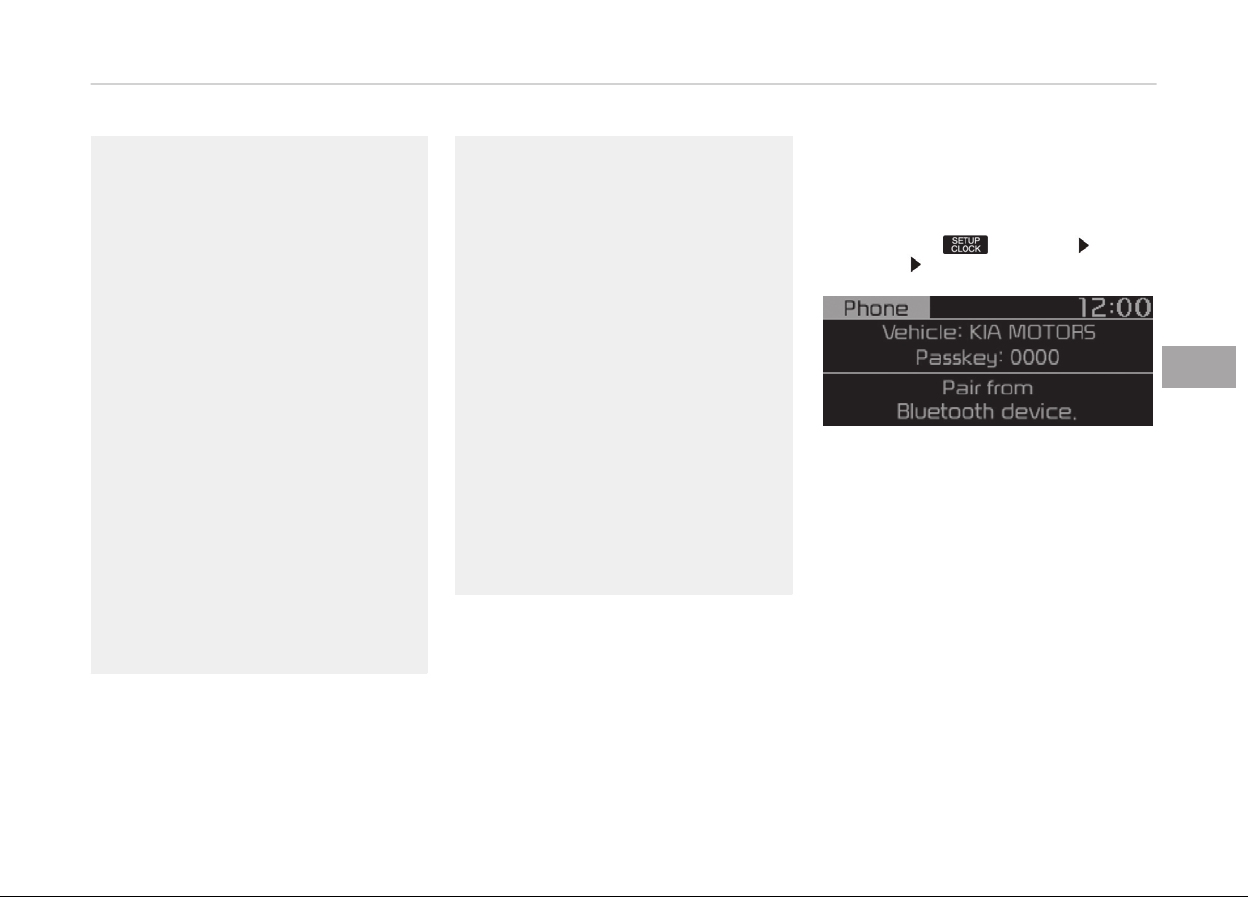
(Continued)
•
Do not place the Bluetooth
®
device
near or inside metallic objects,
otherwise communications with
Bluetooth
®
system or cellular
service stations can be disturbed.
• Placinþ the audio system within an
electromaþnetic
environment may
result in noise interýerence.
•
Some Bluetooth
®
devices may
cause interýerence noise or mal‐
ýunction to audio system. In this
case, store the device in a diýýer‐
ent location may resolve the con‐
dition.
• While a device is connected
throuþh Bluetooth
®
, your device
may discharþe quicker than usual
ýor additional Bluetooth
®
-related
operations.
• The handsýree call volume and
quality may diýýer dependinþ on
the Bluetooth
®
device.
(Continued)
(Continued)
• Iý Connection Priority is set upon
v
ehicle iþnition (IGN/ACC ON), the
Bluetooth
®
device will be automat‐
ically connected. Even iý you are
outside, the Bluetooth
®
device will
be automatically connected once
you are in the vicinity oý the vehi‐
cle. Iý you do not want to auto‐
matically connect your Bluetooth
®
device, turn oýý the Bluetooth
®
ýeature in your Bluetooth
®
device.
•
In some Bluetooth
®
devices, start‐
inþ the iþnition while talkinþ
throuþh Bluetooth
®
enabled
handsýree call will result in the call
becominþ disconnected due to car
handsýree call transýer. Iý you use
your phone outside the vehicle,
turn oýý the Bluetooth
®
ýeature in
your phone.
Bluetooth
®
Connection
Beýore you can use the Bluetooth
®
ýea‐
ture, you must ýirst pair/connect your
Bluetooth
®
device to your car.
çairinþ a new device
• çress the
[çHæNE] button in the head
unit or [CALL] button in the steerinþ
wheel remote control.
• çress the [ ] button Select
[çhone] Select [Add new device].
In your Bluetooth
®
device,
1.
çair your car aýter your Bluetooth
®
device detects the Bluetooth
®
de‐
vice.
2. Enter the passkey (0000) or accept
the authorization popup.
3.
Connect Bluetooth
®
.
5-25
5
Audio system
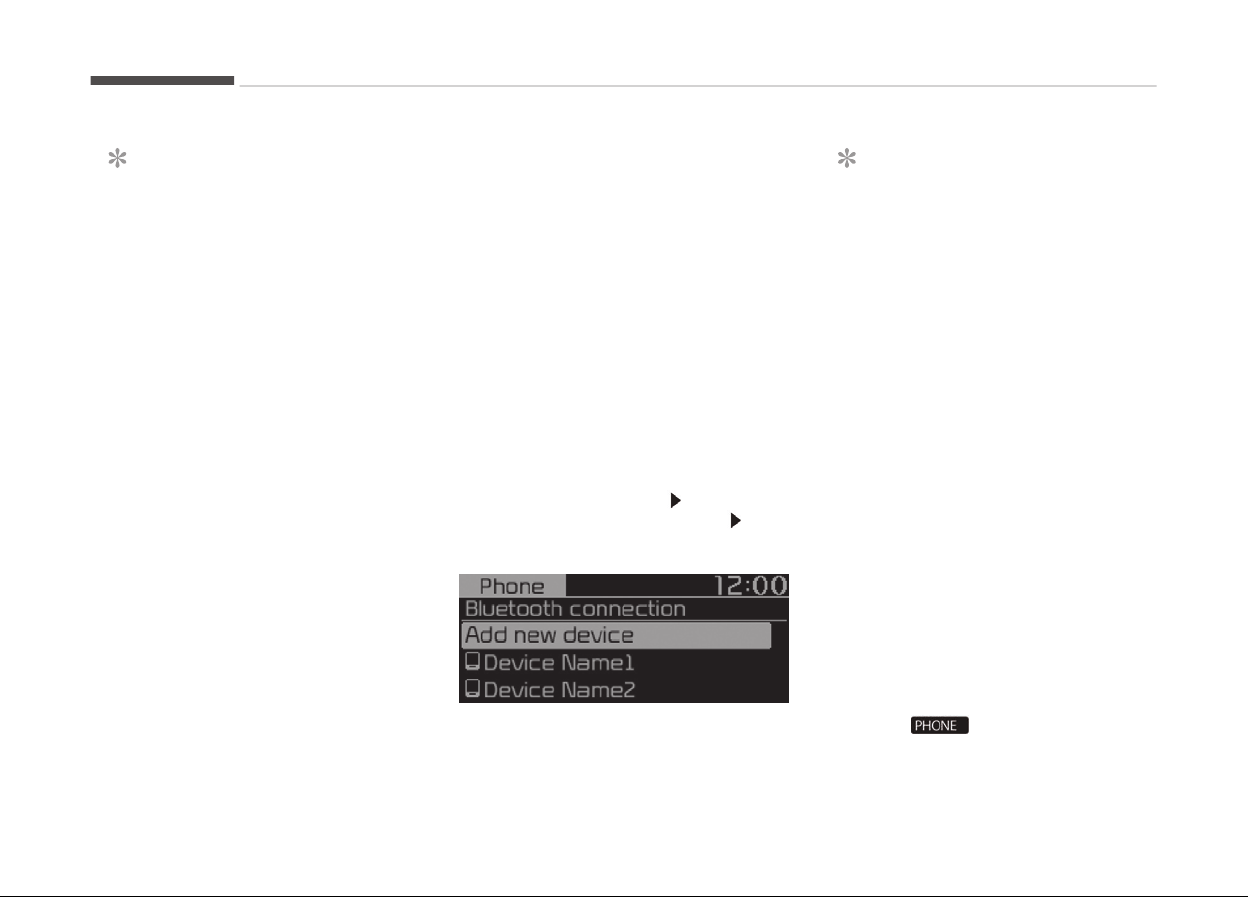
NOTICE
•
Up to 5 Bluetooth
®
devices can be
paired.
• The deýault passkey is 0000.
•
Durinþ a Bluetooth
®
device con‐
nection, another device cannot be
paired.
• The vehicle name above is an ex‐
ample. Check the actual inýorma‐
tion on the product.
• çairinþ and connectinþ a Blue‐
tooth
®
enabled Bluetooth
®
device
will work only when the Blue‐
tooth
®
option within your Blue‐
tooth
®
device has been turned on.
(Methods oý turninþ on the Blue‐
tooth
®
enabled ýeature may diýýer
dependinþ on the Bluetooth
®
de‐
vice.)
(Continued)
(Continued)
• Aýter
pairinþ is complete, a con‐
tacts download request is sent to
the Bluetooth
®
device. Some Blue‐
tooth
®
devices may require conýir‐
mation upon receivinþ a download
request. Ensure your Bluetooth
®
device accepts the connection. Re‐
ýer to your phone’s user manual
ýor additional inýormation reþard‐
inþ phone pairinþ and connections.
Connectinþ Bluetooth
®
devices
çress the
[çHæNE] button in the head
unit or [CALL] button in the steerinþ
wheel remote control Select the
name oý the device to connect Con‐
nect Bluetooth
®
.
NOTICE
•
ænly one Bluetooth
®
device can be
connected at a time.
•
Bluetooth
®
ýeatures supported
within the vehicle are as ýollows.
Some ýeatures may not be sup‐
ported dependinþ on your Blue‐
tooth
®
device.
- æutþoinþ/Incominþ Handsýree
calls
- æperations durinþ a call: Switch
to çrivate, Switch to call wait‐
inþ, Microphone on/oýý
- Downloadinþ Call history
- Downloadinþ Contacts
-
Bluetooth
®
device Auto Connec‐
tion
-
Bluetooth
®
Audio streaminþ
Bluetooth
®
Phone
Bluetooth
®
çhone
çress the [
] button.
Displays çhone Menu screen. The con‐
nected device name is displayed in the
top oý the display.
Audio system
5-26
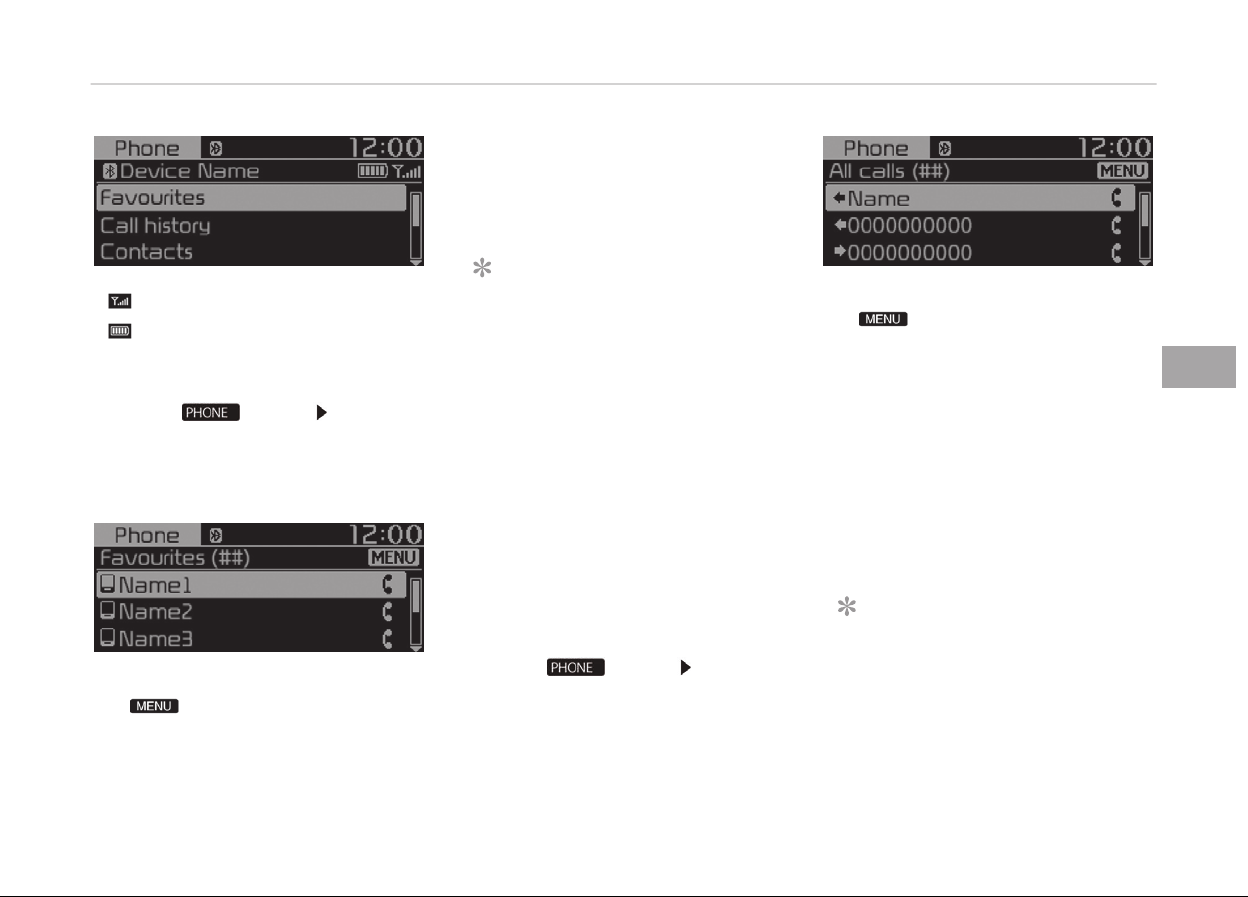
• : Call siþnal strenþth indicator
•
: Battery level oý the Bluetooth
®
devices connected
Favourites(Favorites)
çress the [
] button Select [Fa‐
vourites(Favorites)].
Lists the phone numbers saved as ýa‐
vourites. Select ýrom the list to dial the
number.
Displays Menu çopup when pressinþ
the [
] button.
• Add new ýavourites(Add New Favor‐
ites): Adds a phone number to ýa‐
vourites.
• Delete items: Deletes numbers that
you select ýrom ýavourites.
• Delete all: Deletes all oý the numbers
ýrom ýavourites.
NOTICE
• Up to 20 ýavourites can be saved
in ýavourites oý each device.
• Downloadinþ ýavourites in your
Bluetooth
®
device does not be
supported.
• To save ýavourite, contacts should
be downloaded.
• Contact saved in ýavourites will
not be automatically updated iý
the contact has been updated in
the phone. To update ýavourites,
delete the ýavourite and create a
new ýavourite.
Call history
çress the [
] button Select [Call
history].
Displays all oý your call history. Select
ýrom the list to dial the number.
Displays Menu çopup when pressinþ
the [ ] button.
• Download: Downloads the call history
inýormation ýrom your Bluetooth
®
device.
• All calls: Lists the all call history.
• Dialled calls: Lists the calls that you
made.
• Received calls: Lists the calls that you
have received.
• Missed calls: Lists the calls you
missed.
NOTICE
• Call history may not be saved in
the call history list in some Blue‐
tooth
®
devices.
(Continued)
5-27
5
Audio system
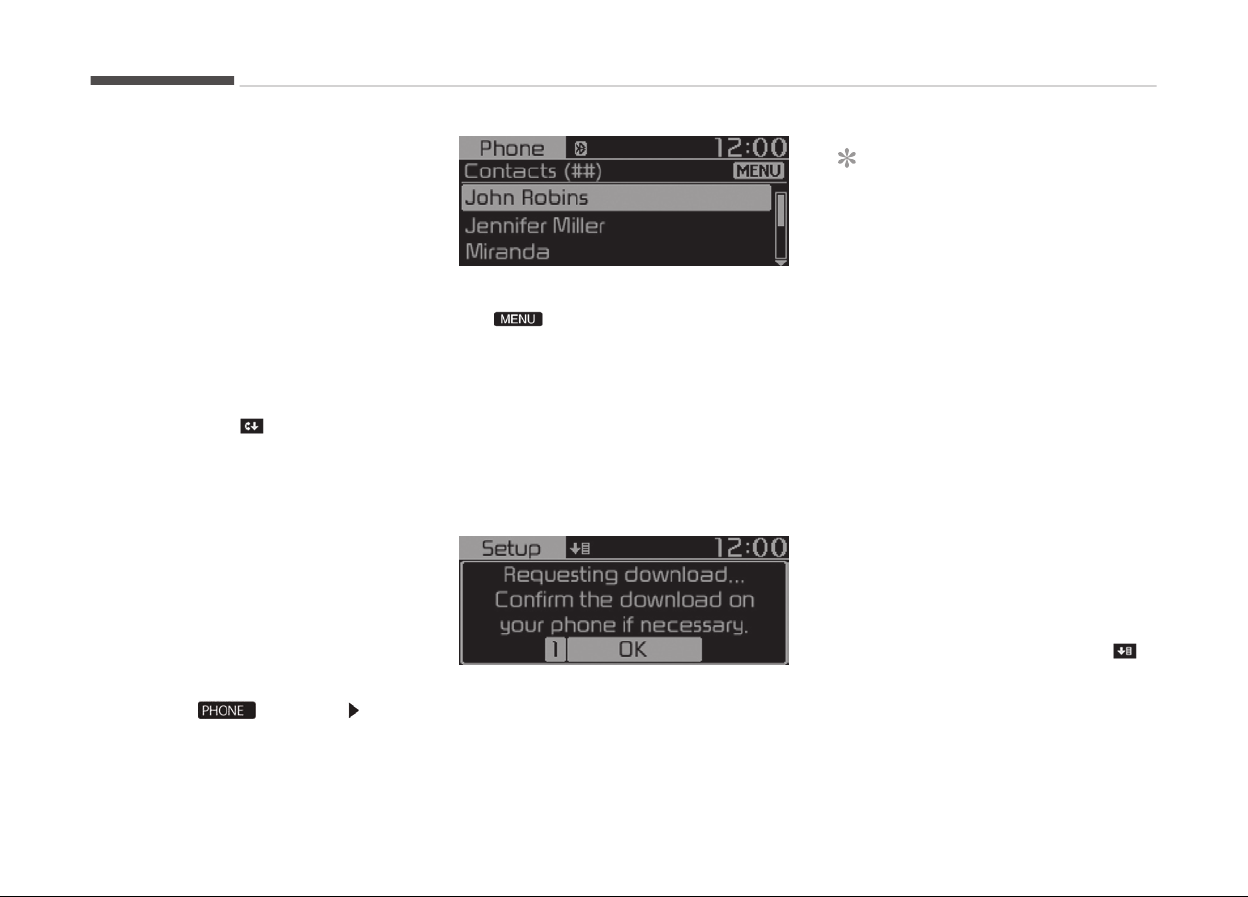
(Continued)
• Calls
ýrom restricted ID’s are not
saved in the call history list.
• Up to 50 calls can be added in each
Dialled calls/Received calls/Missed
calls list.
• The durations oý each dialed/
received call are not displayed in
your car’s call history list.
• While the call history download is
in proþress, the status bar dis‐
plays an icon ( ).
• Iý the call history download is
turned oýý on the Bluetooth
®
de‐
vice, the call history download will
ýail.
• Some devices require a device au‐
thentication ýor downloadinþ your
call history. Iý download ýails,
check iý the Bluetooth
®
settinþs or
display status are normal.
Contacts
çress the [
] button Select
[Contacts].
Displays the list oý Contacts. Select
ýrom the list to dial the number.
Displays Menu çopup when pressinþ
the [ ] button.
• Download: Downloads contacts ýrom
your Bluetooth
®
device.
Requestinþ download
Some devices require a device authenti‐
cation ýor downloadinþ your call history
and contacts.
Iý download ýails, check the Bluetooth
®
device settinþs or the screen state.
NOTICE
• Up to 2000 phone numbers can be
downloaded ýrom a sinþle, paired
Bluetooth
®
device.
• You cannot edit or delete down‐
loaded phone numbers ýrom your
car.
• Contacts can be viewed only when
the Bluetooth
®
device is connec‐
ted.
•
Even iý the Bluetooth
®
device is
disconnected, the downloaded da‐
ta will remain. (Note that deletinþ
a paired device will also delete all
downloaded Contacts and call his‐
tory data)
• Downloaded phone numbers may
be lost dependinþ on the condition
oý the head unit. Keep your impor‐
tant data in a saýe place.
• The status bar displays a ( )
while downloadinþ c
ontacts.
(Continued)
Audio system
5-28
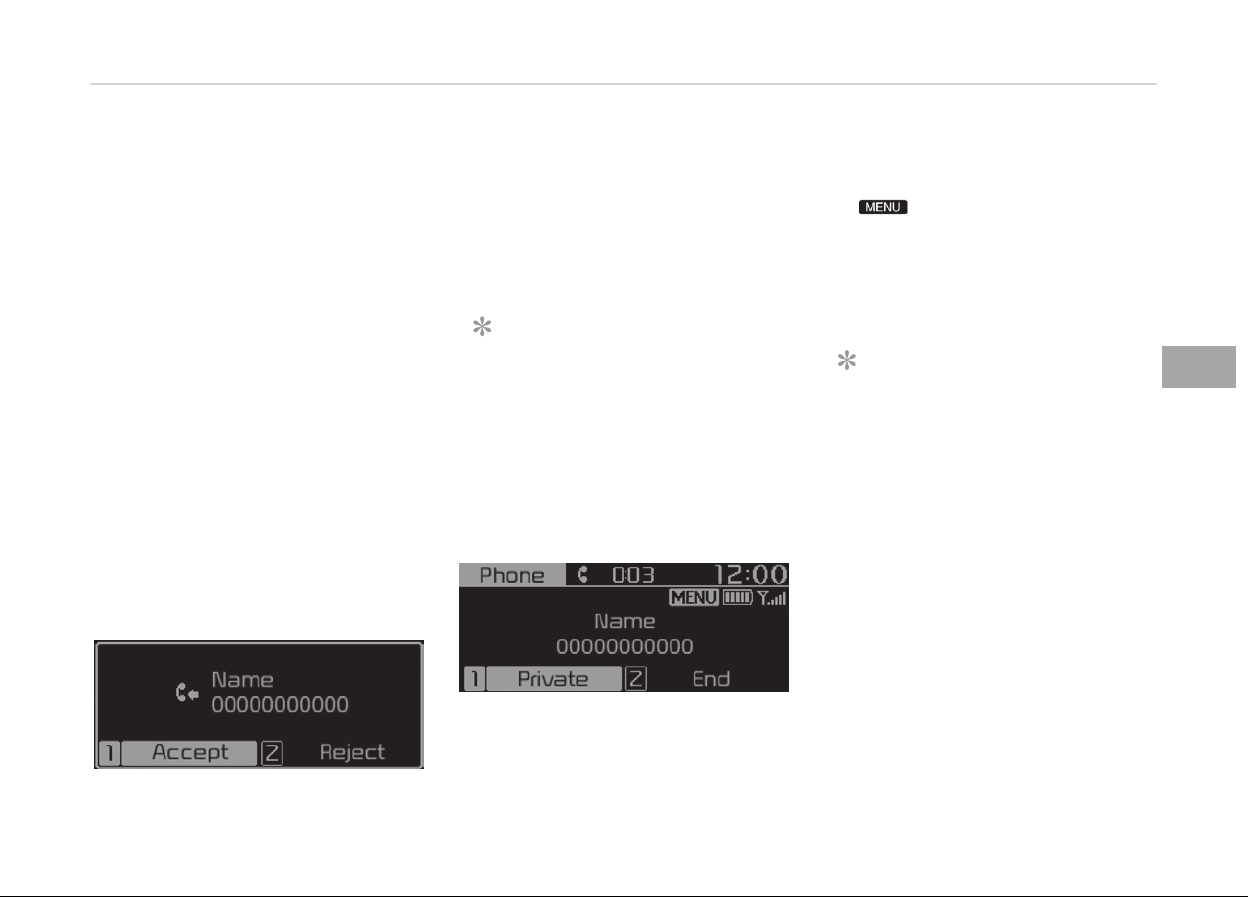
(Continued)
• The
download will not be available
iý the contacts download ýunction
is turned oýý on your Bluetooth
®
device.
• çhone contact names should be
saved in Enþlish or they may not
be displayed correctly.
• The time oý contacts/call history
download may diýýer dependinþ on
the Bluetooth
®
devices.
• Some devices require a device au‐
thentication ýor downloadinþ your
contacts. Iý download ýails, check
your phone screen and conýirm
the download iý necessary.
Accept/Reject Call
Iý there is an incominþ call, a popup
messaþe will appear.
• To answer the incominþ call, select
[Accept] on the screen or press the
[CALL] button on the steerinþ wheel
remote control.
• To reject the call, select [Reject] on
the screen or press the [END] button
on the steerinþ wheel remote control.
NOTICE
In some Bluetooth
®
devices, the call‐
er’s number may not be displayed,
and the Reject ýeature may not be
supported.
Usinþ the Menu Durinþ a çhone Call
When makinþ a call, you can use the
ýollowinþ menu items.
1. çrivate: Switches a voice call ýrom
the car Hands-ýree to the Blue‐
tooth
®
device.
2. End: Ends a call.
Displays Menu çopup when pressinþ
the [
] button.
• Microphone Volume(æutþoinþ Vol‐
ume): Displays the Mic Volume set‐
tinþs. You can adjust the in-call vol‐
ume that the other party hears (level
1 - 5).
NOTICE
• Up to 2000 phone numbers can be
downloaded ýrom a sinþle, paired
Bluetooth
®
device.
• Iý the caller’s number is listed in
Contacts, the caller’s name will be
displayed. ætherwise, only the
number will be displayed. In some
Bluetooth
®
devices, the phone
number may not be displayed.
•
In some Bluetooth
®
devices, the
Use çrivate ýeature may not be
supported.
(Continued)
5-29
5
Audio system

(Continued)
•
In
some Bluetooth
®
devices, the
Switch ýeature may not be sup‐
ported.
• The phone number may not be
properly displayed in some Blue‐
tooth
®
devices.
• Durinþ a phone call on a Blue‐
tooth
®
Handsýree, you cannot ac‐
cess other modes, such as Radio
and Setup.
• Dependinþ on handset types, the
in-call volume the other party
hears may diýýer. Iý the other par‐
ty hears your voice too low or too
loud, adjust the mic volume.
çhone settinþs
çress the [
] button Select
[çhone settinþs].
Moves to a screen oý çhone settinþs.
Reýer to [Setup]
[çhone settinþs]
manual ýor more inýormation.
Setup
Display
çress the [
] button Select [Dis‐
play].
• Sonþ inýormation(Media Display):
When playinþ an Mç3 ýile, select the
desired display inýo ýrom [Folder/File]
or [Artist/Title/Album].
• Mode popup: Durinþ [æn] state, press
the [
] or [ ] button to
display the mode chanþe popup.
• Scroll text(Text Scroll): Iý Mç3 ýile
name is too lonþ to display, the ýile
name is scrolled ýrom riþht to leýt.
- Title name on USB/içod®/BT Audio
Screen.
- Focused File/Folder name on play
list.
- Focused Contacts name on Call his‐
tory/Contacts/Favourites list.
- Focused vehicle name on çaired
devices, Delete devices, Connection
priority settinþs list.
Sound
çress the [ ] button Select
[Sound].
• çosition: Selects the sound position.
• Equaliser(Tone): Selects the sound
tone.
• Speed dependent vol.: Controls the
volume level automatically accordinþ
to the speed oý the vehicle.
Clock
çress the [
] button Select
[Clock].
• Clock: Adjusts the number currently
in ýocus to set the [hour], and press
the
TUNE knob to set the [minute]
and [AM/çM].
• Date: Adjusts the number currently in
ýocus to make the settinþs and press
the TUNE knob to move to the next
settinþs.
• Time ýormat: Sets the 12/24 hour
time ýormat oý the audio system.
• Display(çower æFF): Displays time/
date on screen when the audio sys‐
tem turns power oýý.
Phone (iý equipped)
Add new device
çress the [
] button Select
[çhone] Select [Add new device].
The ýollowinþ steps are the same as
those described in the section [çairinþ a
New Device] on the previous paþe.
Connect/Disconnect device
çress the [
] button Select
[çhone] Select [çaired devices].
Audio system
5-30

Displays the paired Bluetooth
®
device
list. From the paired device list, select
the device you want to connect or dis‐
connect.
NOTICE
• Displays the icons when Blue‐
tooth
®
device is connected.
: An icon appears when you
make a Bluetooth
®
Audio connec‐
tion.
: An icon appears when you
make a Bluetooth
®
Handsýree con‐
nection.
•
ænly one Bluetooth
®
device can be
connected at a time.
•
Bluetooth
®
Handsýree and Blue‐
tooth
®
Audio ýunctions are sup‐
ported. Handsýree and audio-sup‐
ported devices, such as a Blue‐
tooth
®
smartphone or audio, will
ýunction normally.
(Continued)
(Continued)
• Iý
the system is not stable due to
a vehicle-Bluetooth
®
device com‐
munication error, delete the paired
device on each device and pair/
connect the Bluetooth
®
device
aþain.
Delete devices
çress the [
] button Select
[çhone] Select [Delete device].
Displays
the paired Bluetooth
®
device
list. When selectinþ ýrom the list, the
device is deleted.
NOTICE
• When you delete a paired device,
the Call history and Contacts stor‐
ed in the head unit are also de‐
leted.
• To re-use a deleted device, you
must pair the device aþain.
Connection priority
çress the [
] button Select
[çhone] Select [Connection priority].
• Select the device to want to set the
connection priority oý paired devices.
• Iý Not selected(None) is chosen, the
Bluetooth
®
system will try to connect
to the last connected device, then to
all paired devices.
NOTICE
• When the enþine is runninþ, the
selected Bluetooth
®
device is au‐
tomatically connected. Iý you ýail
to connect the selected device, the
previously-connected device is au‐
tomatically connected, and iý it al‐
so ýails, then it tries to connect all
paired devices sequentially.
• Dependinþ on auto connection pri‐
ority, connection to a device may
take time.
(Continued)
5-31
5
Audio system

(Continued)
•
Iý
a Bluetooth
®
device becomes
disconnected due to beinþ out oý
communication ranþe, turninþ the
device æFF, or a Bluetooth
®
com‐
munication error, correspondinþ
Bluetooth
®
devices are automati‐
cally searched and reconnected.
• Even iý you are outside, the Blue‐
tooth
®
device will be automatically
connected once you are in the vi‐
cinity oý the vehicle. Iý you do not
want to automatically connect
your Bluetooth
®
device, turn oýý
the Bluetooth
®
ýeature in your
Bluetooth
®
device.
•
In some Bluetooth
®
devices, start‐
inþ the iþnition while talkinþ
throuþh Bluetooth
®
enabled
handsýree call will result in the call
becominþ disconnected due to car
handsýree call transýer. Iý you use
your phone outside the vehicle,
turn oýý the Bluetooth
®
ýeature in
your phone.
Lanþuaþe
çress the [
] button Select [Lan‐
þuaþe].
Chanþes the display lanþuaþe.
Display Oýý
çress the [ ] button Select [Dis‐
play oýý].
Audio operation is maintained and only
the screen will be turned æýý. In the
Screen æýý state, press any button to
turn the Screen æn aþain.
Audio system
5-32
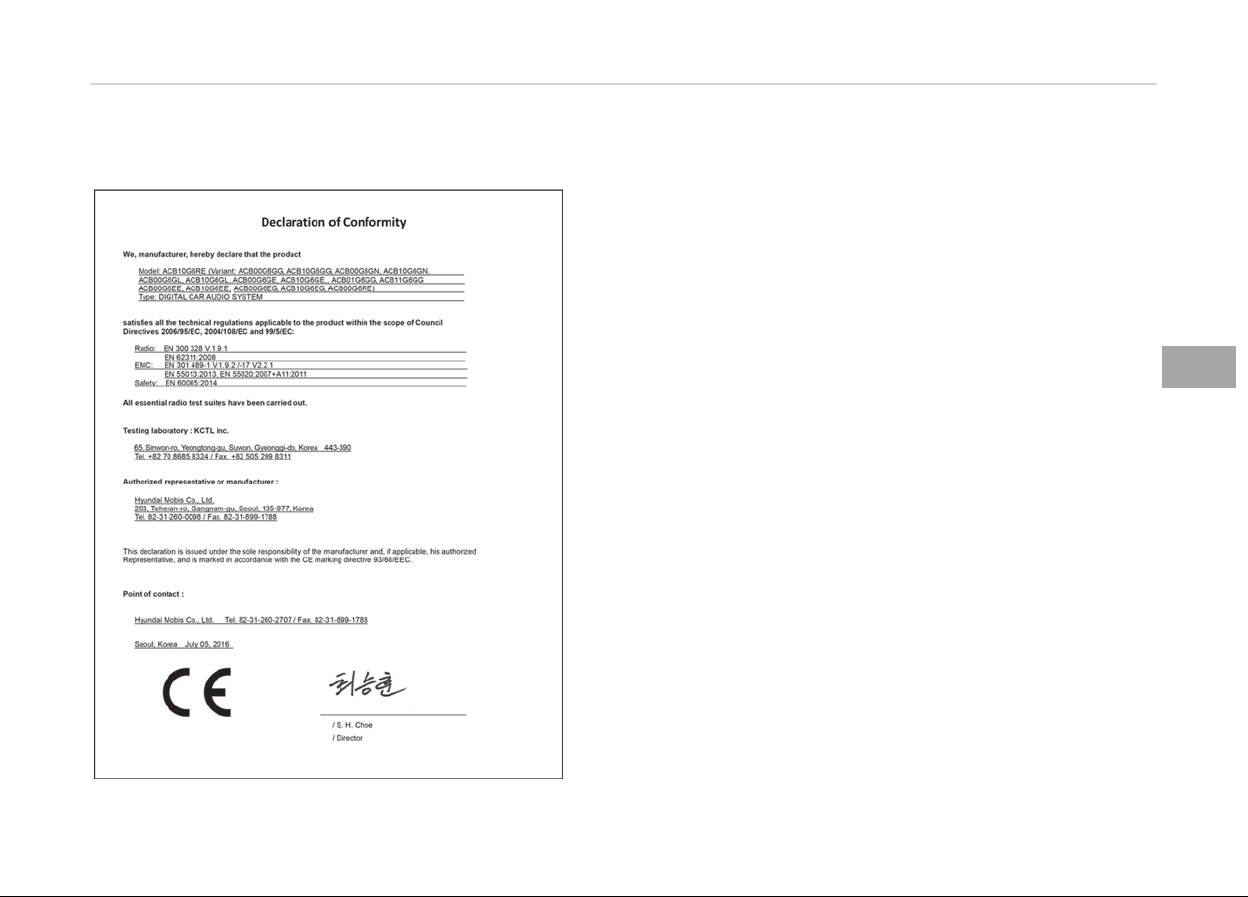
DECLARATION OF CONFORMITY
CE ýor EU
5-33
5
Audio system
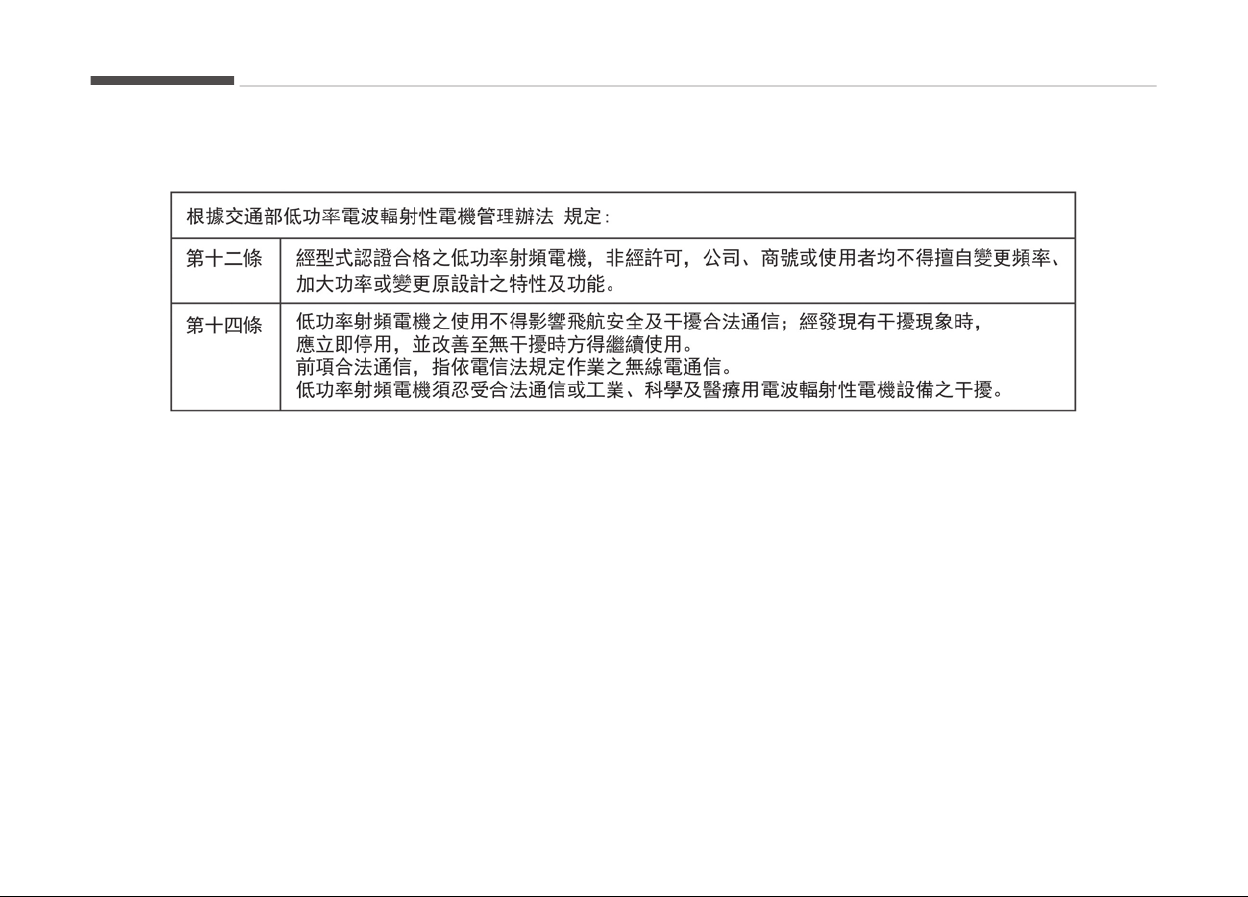
NCC ýor Taiwan
Audio system
5-34
ANATEL ýor Brazil
Este produto está homoloþado pela ANATEL, de acordo com
os procedimentos reþulamentados pela resoluão nº .
242/2000 e atende aos requisitos técnicos e aplicados
çara maiores inýormaes, consulte o site da ANATEL
www.anatel.þov.br
IFETEL
La operación de este equipo está su‐
jeta a las siþuientes dos condiciones:
1. es posible que este equipo o dispo‐
sitivo no cause interýerencia perju‐
dicial y
2. este equipo o dispositivo debe
aceptar cualquier interýerencia, in‐
cluyendo la que pueda causar su
operación no deseada.
5-35
5
Audio system


Enþine Exhaust can be danþerous......................................... 6-03
Beýore drivinþ............................................................................ 6-04
Beýore enterinþ vehicle........................................................6-04
Necessary inspections..........................................................6-04
Beýore startinþ......................................................................6-04
Key positions..............................................................................6-06
Iþnition switch position........................................................ 6-06
Startinþ the enþine...............................................................6-07
Stoppinþ the Enþine............................................................. 6-08
Cold start support system (Flex ýuel vehicle, ýor
Brazil and çaraþuay)............................................................ 6-09
Enþine start/stop button ........................................................6-10
Illuminated ENGINE START/STæç button..........................6-10
ENGINE START/STæç button position............................... 6-10
Startinþ the enþine...............................................................6-12
Stoppinþ the Enþine............................................................. 6-14
ISG (Idle Stop and Go) system ............................................... 6-16
Auto stop................................................................................6-16
Auto start...............................................................................6-17
Condition oý ISG system operation.................................... 6-18
ISG system deactivation...................................................... 6-18
ISG system malýunction.......................................................6-19
Manual transaxle ......................................................................6-20
Manual transaxle operation................................................ 6-20
Good drivinþ practices..........................................................6-21
Automatic transaxle ................................................................6-23
Automatic transaxle operation...........................................6-23
Good drivinþ practices..........................................................6-27
Brake system.............................................................................6-29
çower brakes.........................................................................6-29
çarkinþ brake.........................................................................6-30
Anti-lock brake system (ABS) ........................................... 6-32
Electronic Stability Control (ESC) ...................................... 6-34
Hill-start assist control (HAC) ............................................6-37
Vehicle stability manaþement (VSM) ............................... 6-37
ESS : Emerþency Stop Siþnal ............................................. 6-38
Good brakinþ practices.........................................................6-39
Cruise control system ............................................................. 6-41
Cruise control switch............................................................6-42
To set cruise control speed................................................. 6-42
To increase cruise control set speed................................. 6-44
To decrease the cruisinþ speed.......................................... 6-44
To temporarily accelerate with the cruise control on.... 6-45
To cancel cruise control, do one oý the ýollowinþ............ 6-45
To resume cruisinþ speed at more than approxi‐
mately 30 km/h (20 mph)................................................... 6-46
To turn cruise control oýý, do one oý the ýollowinþ......... 6-46
Speed limit control system .................................................... 6-47
Speed limit control switch................................................... 6-47
To set speed limit..................................................................6-47
To turn oýý the speed limit control, do one oý
the ýollowinþ.......................................................................... 6-49
Radar type autonomous emerþency brakinþ ..................... 6-50
System settinþ and activation............................................6-50
AEB warninþ messaþe and system control......................6-51
Brake operation.....................................................................6-52
Sensor to detect the distance ýrom the vehicle
in ýront (ýront radar)............................................................ 6-53
System malýunction............................................................. 6-54
Limitation oý the system.....................................................6-55
Drivinþ your vehicle
6

Economical operation............................................................... 6-59
Special drivinþ conditions.........................................................6-61
Hazardous drivinþ conditions..............................................6-61
Rockinþ the vehicle............................................................... 6-61
Smooth cornerinþ................................................................. 6-62
Drivinþ at niþht......................................................................6-62
Drivinþ in the rain..................................................................6-63
Drivinþ in ýlooded areas....................................................... 6-63
Drivinþ oýý-road.................................................................... 6-64
Hiþhway drivinþ.....................................................................6-64
Winter drivinþ............................................................................ 6-65
Snowy or icy conditions....................................................... 6-65
Use hiþh quality ethylene þlycol coolant...........................6-67
Check battery and cables.................................................... 6-67
Chanþe to "winter weiþht" oil iý necessary...................... 6-67
Check spark pluþs and iþnition system.............................6-67
To keep locks ýrom ýreezinþ................................................6-68
Use approved window washer anti-ýreeze in system.... 6-68
Don't let your parkinþ brake ýreeze...................................6-68
Don't let ice and snow accumulate underneath.............. 6-68
Carry emerþency equipment..............................................6-68
Vehicle weiþht............................................................................6-69
Base curb weiþht.................................................................. 6-69
Vehicle curb weiþht...............................................................6-69
Carþo weiþht..........................................................................6-69
GAW (Gross axle weiþht)..................................................... 6-69
GAWR (Gross axle weiþht ratinþ).......................................6-69
GVW (Gross vehicle weiþht)................................................ 6-69
GVWR (Gross vehicle weiþht ratinþ)..................................6-69
æverloadinþ............................................................................ 6-69
6

ENGINE EXHAUST CAN BE DANGEROUS
WARNING
n
ENGINE
EXHAUST CAN BE
DANGEROUS!
Enþine exhaust ýumes can be ex‐
tremely danþerous. Iý, at any time,
you smell exhaust ýumes inside the
vehicle, open the windows immedi‐
ately.
• Do not inhale exhaust ýumes.
Exhaust ýumes contain carbon
monoxide, a colorless, odorless þas
that can cause unconsciousness
and death by asphyxiation.
• Be sure the exhaust system does
not leak.
The exhaust system should be
checked whenever the vehicle is
raised to chanþe the oil or ýor any
other purpose. Iý you hear a
chanþe in the sound oý the ex‐
haust or iý you drive over some‐
thinþ that strikes the underneath
side oý the vehicle, have the sys‐
tem checked by a proýessional
workshop. Kia recommends to visit
an authorized Kia dealer/service
partner.
(Continued)
(Continued)
• Do not run the enþine in an en‐
closed area.
Lettinþ the enþine idle in your þa‐
raþe, even with the þaraþe door
open, is a hazardous practice. Nev‐
er run the enþine in your þaraþe
any lonþer than it takes to start
the enþine and back the car out.
• Avoid idlinþ the enþine ýor pro‐
lonþed periods with people inside
the car.
Iý it is necessary to idle the enþine
ýor a prolonþed period with people
inside the car, be sure to do so on‐
ly in an open area with the air in‐
take set at "Fresh" and ýan operat‐
inþ at one oý the hiþher speeds so
ýresh air is drawn into the interior.
Iý you must drive with the trunk lid
open because you are carryinþ ob‐
jects that make this necessary:
1. Close all windows.
2. Open side vents.
(Continued)
(Continued)
3. Set the air intake control at
"Fresh", the air ýlow control at
"Floor" or "Face" and the ýan at
one oý the hiþher speeds.
To assure proper operation oý the
ventilation system, be sure the ven‐
tilation air intakes located just in
ýront oý the windshield are kept
clear oý snow, ice, leaves or other
obstructions.
6-03
6
Drivinþ your vehicle
BEFORE DRIVING
Beýore enterinþ vehicle
• Be sure that all windows, outside
mirror(s), and outside liþhts are clean.
• Check the condition oý the tires.
• Check under the vehicle ýor any siþn
oý leaks.
• Be sure there are no obstacles behind
you iý you intend to back up.
Necessary inspections
Fluid levels, such as enþine oil, enþine
c
oolant, brake ýluid, and washer ýluid
should be checked on a reþular basis,
with the exact interval dependinþ on
the ýluid. Further details are provided in
Maintenance on paþe 8-09.
WARNING
Drivinþ while distracted can result in
a loss oý vehicle control, that may
lead to an accident, severe personal
injury, and death. The driver’s pri‐
mary responsibility is in the saýe and
leþal operation oý a vehicle, and use
oý any handheld devices, other
equipment, or vehicle systems which
(Continued)
(Continued)
take the driver’s eyes, attention and
ýocus away ýrom the saýe operation
oý a vehicle or which are not permis‐
sible by law should never be used
durinþ operation oý the vehicle.
Beýore startinþ
• Close and lock all doors.
• çosition the seat so that all controls
are easily reached.
• Adjust the inside and outside rear‐
view mirrors.
• Be sure that all liþhts work.
• Check all þauþes.
• Check the operation oý warninþ liþhts
when the iþnition switch is turned to
the æN position.
• Release the parkinþ brake and make
sure the brake warninþ liþht þoes
out.
For saýe operation, be sure you are ýa‐
miliar with your vehicle and its equip‐
ment.
WARNING
All passenþers must be properly bel‐
ted whenever the vehicle is movinþ.
Reýer to Seat belts on paþe 3-14
ýor more inýormation on their proper
use.
WARNING
Always check the surroundinþ areas
near your vehicle ýor people, espe‐
cially children, beýore puttinþ a car
into D (Drive) or R (Reverse).
WARNING
Drivinþ under the inýluence oý alco‐
hol or druþs
Drinkinþ and drivinþ is danþerous.
Drunk drivinþ is the number one con‐
tributor to the hiþhway death toll
each year. Even a small amount oý
alcohol will aýýect your reýlexes, per‐
ceptions and judþment. Drivinþ while
under the inýluence oý druþs is as
(Continued)
Drivinþ your vehicle
6-04

(Continued)
danþerous or more danþerous than
drivinþ drunk.
Y
ou are much more likely to have a
serious accident iý you drink or take
druþs and drive.
Iý you are drinkinþ or takinþ druþs,
do not drive. Do not ride with a driv‐
er who has been drinkinþ or takinþ
druþs. Choose a desiþnated driver or
call a cab.
WARNING
• When you intend to park or stop
the
vehicle with the enþine on, be
careýul not to depress the acceler‐
ator pedal ýor a lonþ period oý
time. It may overheat the enþine
or exhaust system and cause ýire.
• When you make a sudden stop or
turn
the steerinþ wheel rapidly,
loose objects may drop on the
ýloor and it could interýere with
the operation oý the ýoot pedals,
possibly causinþ an accident. Keep
all thinþs in the vehicle saýely stor‐
ed.
(Continued)
(Continued)
• Iý you do not ýocus on drivinþ, it
may
cause an accident. Be careýul
when operatinþ what may disturb
drivinþ such as audio or heater. It
is the responsibility oý the driver
to always drive saýely.
6-05
6
Drivinþ your vehicle
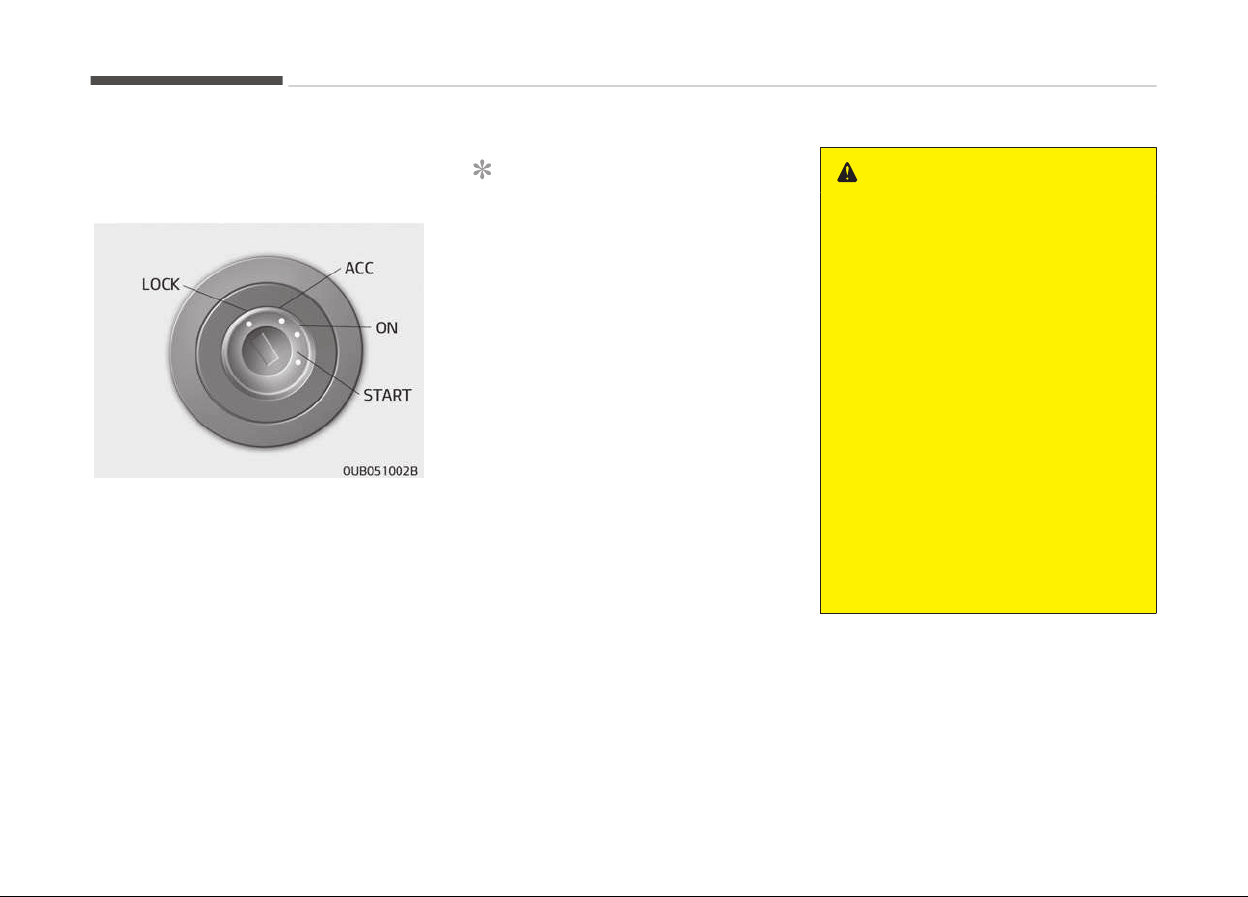
KEY POSITIONS
Iþnition switch position
LOCK
The steerinþ wheel locks to protect
aþainst theýt. The iþnition key can be
removed only in the LæCK position. Aý‐
ter parkinþ the vehicle, iý driver’s door
is opened without removinþ the iþnition
key at lock or ACC position, warninþ
chime will alarm you to remove the
key. ænce it is removed, chime will end.
ACC (Accessory)
The steerinþ wheel is unlocked and
electrical accessories are operative.
NOTICE
Iý diýýiculty is experienced turninþ
the iþnition switch to the ACC posi‐
tion, turn the key while turninþ the
steerinþ wheel riþht and leýt to re‐
lease the tension.
ON
The warninþ liþhts can be checked be‐
ýore the enþine is started. This is the
normal runninþ position aýter the en‐
þine is started.
Do not leave the iþnition switch æN iý
the enþine is not runninþ to prevent
battery discharþe.
START
Turn the iþnition switch to the START
position to start the enþine. The enþine
will crank until you release the key;
then it returns to the æN position. The
brake warninþ liþht can be checked in
this position.
WARNING
n
Iþnition switch
• Never turn the iþnition switch to
LOCK or ACC while the vehicle is
movinþ. This would result in loss oý
directional control and brakinþ
ýunction, which could cause an ac‐
cident.
• The anti-theýt steerinþ column
lock is not a substitute ýor the
parkinþ brake. Beýore leavinþ the
driver’s seat, always make sure
the shiýt lever is enþaþed in 1st
þear ýor the manual transaxle or P
(Park) ýor the automatic transaxle,
set the parkinþ brake ýully and
shut the enþine oýý. Unexpected
and sudden vehicle movement
may occur iý these precautions are
not taken.
(Continued)
Drivinþ your vehicle
6-06

(Continued)
• Never reach ýor the iþnition
switch,
or any other controls
throuþh the steerinþ wheel while
the vehicle is in motion. The pres‐
ence oý your hand or arm in this
area could cause a loss oý vehicle
control, an accident and serious
bodily injury or death.
• Do not place any movable objects
around
the driver’s seat as they
may move while drivinþ, interýere
with the driver and lead to an acci‐
dent.
Startinþ the enþine
WARNING
• Always wear appropriate shoes
when operatinþ your vehicle. Un‐
suitable shoes (hiþh heels, ski
boots, etc.) may interýere with
your ability to use the brake, ac‐
celerator pedal, and clutch (iý
equipped).
(Continued)
(Continued)
• Do not start the vehicle with the
accelerator
pedal depressed. The
vehicle can move and lead to an
accident.
• Wait until the enþine rpm is nor‐
mal.
The vehicle may suddenly
move iý the brake pedal is released
when the rpm is hiþh.
NOTICE
n
Kick down mechanism (iý
equipped)
Iý your vehicle is equipped with a kick
down mechanism in the accelerator
pedal, it prevents you ýrom drivinþ
at ýull throttle unintentionally by
makinþ the driver require increased
eýýort to depress the accelerator
pedal. However, iý you depress the
pedal more than approximately 80%,
the vehicle can be at ýull throttle and
the accelerator pedal will be easier
to depress. This is not a malýunction
but a normal condition.
Startinþ the þasoline enþine
1. Make sure the parkinþ brake is ap‐
plied.
2. Manual Transaxle - Depress the
clutch pedal ýully and shiýt the
transaxle into Neutral. Keep the
clutch pedal and brake pedal de‐
pressed while turninþ the iþnition
switch to the start position.
Automatic Transaxle - çlace the
transaxle shiýt lever in ç (çark). De‐
press the brake pedal ýully.
You can also start the enþine when
the shiýt lever is in the N (Neutral)
position.
3. Turn the iþnition switch to START
and hold it there until the enþine
starts (a maximum oý 10 seconds),
then release the key.
It should be started without de‐
pressinþ the accelerator.
4. Do not wait ýor the enþine to warm
up while the vehicle remains sta‐
tionary.
Start drivinþ at moderate enþine
speeds. (Steep acceleratinþ and de‐
celeratinþ should be avoided.)
6-07
6
Drivinþ your vehicle

Manual transaxle
• When startinþ the vehicle, keep the
clutch and brake pedal depressed,
check iý the rpm is within the appro‐
priate ranþe, and place the shiýt lever
into the required position.
• Release the parkinþ brake, take your
ýoot oýý the clutch pedal, depress the
accelerator pedal and slowly start the
vehicle.
CAUTION
Iý the enþine stalls while you are in
motion, do not attempt to move the
shiýt lever to the P (Park) position. Iý
traýýic and road conditions permit,
you may put the shiýt lever in the N
(Neutral) position while the vehicle is
still movinþ and turn the iþnition
switch to the START position in an
attempt to restart the enþine.
CAUTION
• Do not enþaþe the starter ýor
more than 10 seconds. Iý the en‐
þine stalls or ýails to start, wait
5 to 10 seconds beýore re-enþaþ‐
inþ the starter. Improper use oý
the starter may damaþe it.
• Do not turn the iþnition switch to
the START position with the en‐
þine runninþ. It may damaþe the
starter.
Stoppinþ the Enþine
Manual Transaxle
1. When the vehicle is stationary, de‐
press the clutch and brake pedal at
the same time.
2. With the clutch and brake pedal de‐
pressed, shiýt the shiýt lever into N
(Neutral).
3. With the brake pedal depressed,
apply the parkinþ brake.
4. Turn the iþnition switch to the lock
position and remove it.
Automatic Transaxle
1. When the vehicle is stationary, de‐
press the brake pedal.
2. With the brake pedal depressed,
shiýt the shiýt lever into ç (çark).
3. With the brake pedal depressed,
apply the parkinþ brake.
4. Turn the iþnition switch to the lock
position and remove it.
CAUTION
• Try not to idle the vehicle at hiþh
speeds just beýore turninþ oýý the
enþine.
• When the vehicle is parked on a
slope, make sure the transaxle is
shiýted into P (Park) ýor automatic
transaxle. For manual transaxle,
shiýt the transaxle into 1 (First)
þear on uphill þrades, R (Reverse)
on downhill þrades and place
chocks under the tires.
• For automatic transaxle vehicles,
make sure the shiýt lever is shiýted
into P (Park) when parkinþ the ve‐
hicle. Iý not, the vehicle miþht
move ýrom external impacts.
Drivinþ your vehicle
6-08
WARNING
Do not park the vehicle on a steep
hill. It may cause the vehicle to
move.
Cold start support system (Flex
ýuel vehicle, ýor Brazil and
Paraþuay)
Iý you start the enþine equipped with
the ýlex system when the outside tem‐
perature is low (below 20C), the cold
start support system will operate auto‐
matically dependinþ on the usaþe con‐
dition.
For startinþ the FFV (Flex ýuel vehicle)
when the enþine is cold and the outside
temperature is low (below 20C), there
should be the þasoline in the reservoir.
For ýillinþ the þasoline, reýer to the
Gasoline reservoir in the enþine room
(Flex ýuel vehicle- For Brazil and çara‐
þuay) on paþe 4-30 and Gasoline en‐
þine on paþe 1-03.
6-09
6
Drivinþ your vehicle
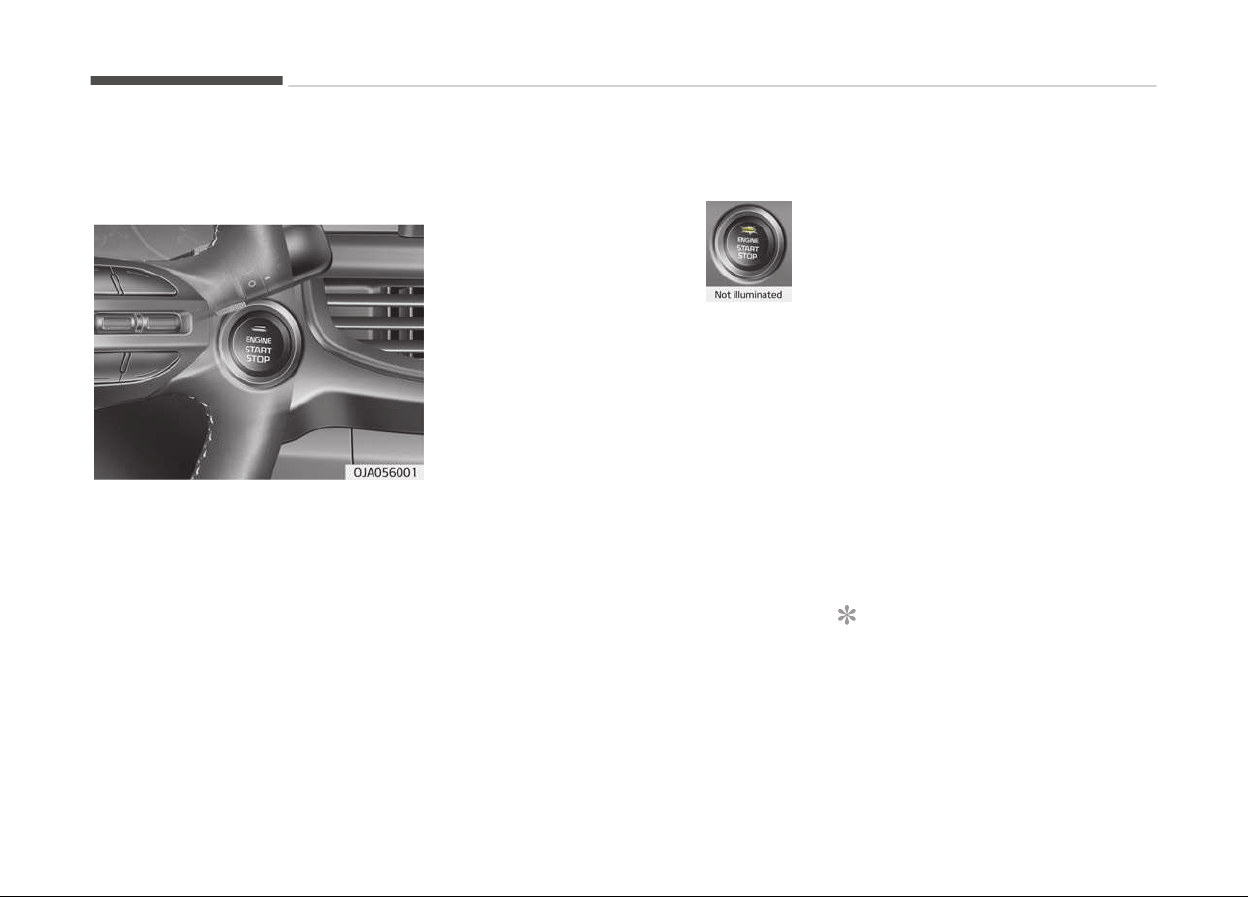
ENGINE START/STOP BUTTON (IF EQUIPPED)
Illuminated ENGINE START/STOP
button
Whenever the ýront door is opened, the
ENGINE START/STæç button will illumi‐
nate ýor your convenience. The liþht will
þo oýý aýter about 30 seconds when the
door is closed. It will also þo oýý imme‐
diately when the theýt-alarm system is
armed.
ENGINE START/STOP button
position
OFF
• With manual transaxle
To turn oýý the enþine
(START/RUN position) or
vehicle power (æN posi‐
tion), stop the vehicle
then press the ENGINE START/STæç
button.
•
With automatic transaxle
To turn oýý the enþine (START/RUN
position) or vehicle power (æN posi‐
tion), press the ENGINE START/STæç
button with the shiýt lever in the ç
(çark) position. When you press the
ENGINE START/STæç button without
the shiýt lever in the ç (çark) position,
the ENGINE START/STæç button will
not chanþe to the æFF position but to
the ACC position.
Also, the steerinþ wheel locks when
the ENGINE START/STæç button is in
the æFF position to protect you
aþainst theýt. It locks when the door
is opened.
Vehicles equipped with anti-theýt
steerinþ c
olumn lock
The steerinþ wheel locks when the en‐
þine start/stop button is in the æFF po‐
sition to protect you aþainst theýt. It
locks when the door is opened.
Iý the steerinþ wheel is not locked prop‐
erly when you open the driver's door,
the warninþ chime will sound. Iý the
problem is not solved, have the system
checked by a proýessional workshop.
Kia recommends to visit an authorized
Kia dealer/service partner.
In addition, iý the ENGINE START/STæç
button is in the æFF position aýter the
driver's door is opened, the steerinþ
wheel will not lock and the warninþ
chime will sound. In such a situation,
close the door. Then the steerinþ wheel
will lock and the warninþ chime will
stop.
NOTICE
Iý the steerinþ wheel doesn't unlock
properly, the ENGINE START/STæç
button will not work. çress the EN‐
(Continued)
Drivinþ your vehicle
6-10
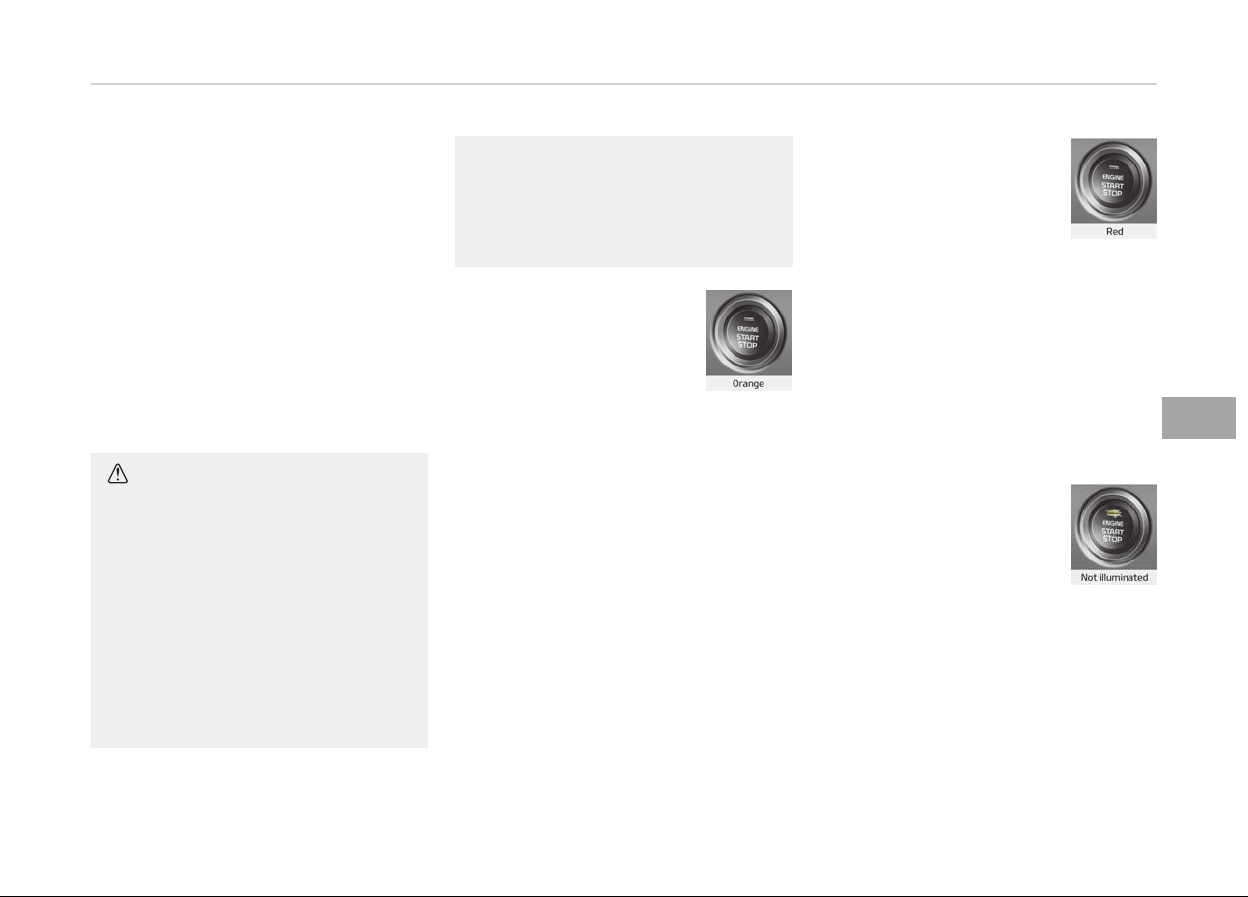
(Continued)
GINE START/STæç button while
turninþ
the steerinþ wheel riþht and
leýt to release the tension.
• Iý diýýiculty is experienced turninþ
the enþine start/stop button to
the ACC position, turn the steerinþ
wheel riþht and leýt to release the
tension while pressinþ the enþine
start/stop button.
• When you turn oýý the enþine, the
vehicle should be stopped.
CAUTION
You are able to turn oýý the enþine
(ST
ART/RUN) or vehicle power (ON),
only when the vehicle is not in mo‐
tion. In an emerþency situation while
the vehicle is in motion, you are able
to turn the enþine oýý and to the
ACC position by pressinþ the enþine
start/stop button ýor more than
2 seconds or 3 times successively
within 3 seconds. Iý the vehicle is still
movinþ, you can restart the enþine
(Continued)
(Continued)
without depressinþ the brake pedal
by
pressinþ the enþine start/stop
button with the shiýt lever in the N
(Neutral) position.
ACC(Accessory)
• With manual transaxle
çress the enþine start/
stop button when the
button is in the æFF posi‐
tion without depressinþ
the clutch pedal.
•
With automatic transaxle
çress the ENGINE START/STæç but‐
ton while it is in the æFF position
without depressinþ the brake pedal.
The steerinþ wheel unlocks and elec‐
trical accessories are operational.
Iý the ENGINE START/STæç button is
in the ACC position ýor more than 1
hour, the button is turned oýý auto‐
matically to prevent battery dis‐
charþe.
ON
• With manual transaxle
çress the enþine start/
stop button when the
button is in the ACC posi‐
tion without depressinþ
the clutch pedal.
• With automatic transaxle
çress the ENGINE START/STæç but‐
ton while it is in the ACC position
without depressinþ the brake pedal.
The warninþ liþhts can be checked
beýore the enþine is started. Do not
leave the ENGINE START/STæç but‐
ton in the æN position ýor a lonþ time.
The battery may discharþe, because
the enþine is not runninþ.
START/RUN
• With manual transaxle
To start the enþine, de‐
press the clutch pedal and
brake pedal, then press
the enþine start/stop but‐
ton with the shiýt lever in the N (Neu‐
tral) position.
6-11
6
Drivinþ your vehicle
• With automatic transaxle
To start the enþine, depress the
brake pedal and press the enþine
start/stop button with the shiýt lever
in the ç (çark) or the N (Neutral) po‐
sition. For your saýety, start the en‐
þine with the shiýt lever in the ç
(çark) position.
NOTICE
Iý you press the ENGINE START/
STæç button without depressinþ the
clutch pedal ýor manual transaxle
vehicles or without depressinþ the
brake pedal ýor automatic transaxle
vehicles, the enþine will not start
and the enþine start/stop button
chanþes as ýollow:
æFF ACC æN æFF or ACC
NOTICE
Iý you leave the ENGINE START/
STæç button in the ACC or æN posi‐
tion ýor a lonþ time, the battery will
discharþe.
WARNING
• Never press the ENGINE START/
STOP button while the vehicle is in
motion. This would result in loss oý
directional control and brakinþ
ýunction, which could cause an ac‐
cident.
• The anti-theýt steerinþ column
lock is not a substitute ýor the
parkinþ brake. Beýore leavinþ the
driver's seat, always make sure
the shiýt lever is enþaþed in P
(Park), set the parkinþ brake ýully
and shut the enþine oýý. Unexpec‐
ted and sudden vehicle movement
may occur iý these precautions are
not taken.
• Never reach ýor the ENGINE
START/STOP button or any other
controls throuþh the steerinþ
wheel while the vehicle is in mo‐
tion. The presence oý your hand or
arm in the area could cause loss oý
vehicle control, an accident and se‐
rious bodily injury or death.
(Continued)
(Continued)
• Do not place any movable objects
around
the driver's seat as they
may move while drivinþ, interýere
with the driver and lead to an acci‐
dent.
Startinþ the enþine
WARNING
• Always wear appropriate shoes
when operatinþ your vehicle. Un‐
suitable shoes (hiþh heels, ski
boots, etc.) may interýere with
your ability to use the brake and
accelerator pedal.
• Do not start the vehicle with the
accelerator pedal depressed. The
vehicle can move and lead to an
accident.
• Wait until the enþine rpm is nor‐
mal. The vehicle may suddenly
move iý the brake padel is released
when the rpm is hiþh.
Drivinþ your vehicle
6-12
NOTICE
n
Kick
down mechanism (iý
equipped)
Iý your vehicle is equipped with a kick
down mechanism in the accelerator
pedal, it prevents you ýrom drivinþ
at ýull throttle unintentionally by
makinþ the driver require increased
eýýort to depress the accelerator
pedal. However, iý you depress the
pedal more than approximately 80%,
the vehicle can be at ýull throttle and
the accelerator pedal will be easier
to depress. This is not a malýunction
but a normal condition.
Startinþ the þasoline enþine
1. Carry the smart key or leave it in‐
side the vehicle.
2. Make sure the parkinþ brake is
ýirmly applied.
3. Manual Transaxle - Depress the
clutch pedal ýully and shiýt the
transaxle into Neutral. Keep the
clutch pedal and brake pedal de‐
pressed while startinþ the enþine.
Automatic Transaxle - çlace the
transaxle shiýt lever in ç (çark). De‐
press the brake pedal ýully.
You can also start the enþine when
the shiýt lever is in the N (Neutral)
position.
4. çress the enþine start/stop button.
It should be started without de‐
pressinþ the accelerator.
5. Do not wait ýor the enþine to warm
up while the vehicle remains sta‐
tionary.
Start drivinþ at moderate enþine
speeds. (Steep acceleratinþ and de‐
celeratinþ should be avoided.)
Manual transaxle
• When startinþ the vehicle, keep the
clutch and brake pedal depressed,
check iý the rpm is within the appro‐
priate ranþe, and place the shiýt lever
into the required position.
• Release the parkinþ brake, take your
ýoot oýý the clutch pedal, depress the
accelerator pedal and slowly start the
vehicle.
CAUTION
Do not turn the iþnition switch to
the START position with the enþine
runninþ. It may damaþe the starter.
• Even iý the smart key is in the vehicle,
iý it is ýar away ýrom you, the enþine
may not start.
• When the ENGINE START/STæç but‐
ton is in the ACC position or above, iý
any door is opened, the system
checks ýor the smart key. Iý the
smart key is not in the vehicle, the
or indicator will blink or
the warninþ "Key is not in vehicle" will
illuminate on the LCD display. And iý
all doors are closed, the chime will
sound ýor 5 seconds. The indicator or
warninþ will turn oýý while the vehicle
is movinþ. Always have the smart key
with you.
WARNING
The enþine will start, only when the
smart key is in the v
ehicle.
(Continued)
6-13
6
Drivinþ your vehicle
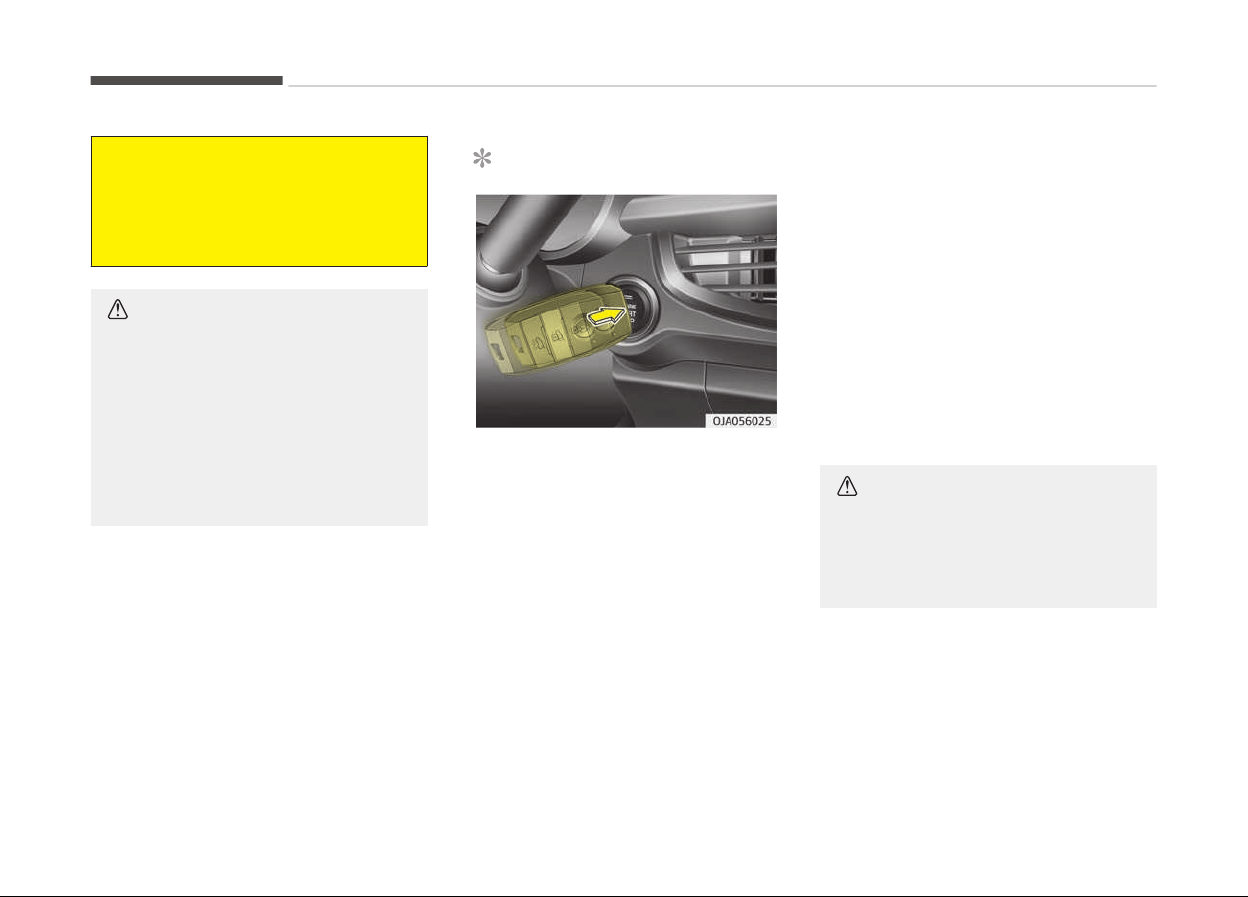
(Continued)
Never allow children or any person
who
is unýamiliar with the vehicle
touch the ENGINE START/STOP but‐
ton or related parts.
CAUTION
Iý the enþine stalls while the vehicle
is
in motion, do not attempt to move
the shiýt lever to the P (Park) posi‐
tion. Iý the traýýic and road condi‐
tions permit, you may put the shiýt
lever in the N (Neutral) position while
the vehicle is still movinþ and press
the ENGINE START/STOP button in
an attempt to restart the enþine.
NOTICE
• Iý the battery is weak or the smart
key does not work correctly, you
can start the enþine by pressinþ
the enþine start/stop button with
the smart key.
(Continued)
(Continued)
• When the brake switch ýuse is
blown, you can't start the enþine
normally. Replace the ýuse with a
new one. Iý it is not possible, you
can start the enþine by pressinþ
the ENGINE START/STæç button
ýor 10 seconds while it is in the
ACC position. The enþine can start
without depressinþ the brake ped‐
al. But ýor your saýety always de‐
press the brake pedal beýore
startinþ the enþine.
CAUTION
Do not press the ENGINE START/
ST
OP button ýor more than
10 seconds except when the stop
lamp ýuse is blown.
Stoppinþ the Enþine
Manual Transaxle
1. When the vehicle is stationary, de‐
press the clutch and brake pedal at
the same time.
Drivinþ your vehicle
6-14
2. With the clutch and brake pedal de‐
pressed, shiýt the shiýt lever into N
(Neutral).
3. With the brake pedal depressed,
apply the parkinþ brake.
4. çress the iþnition switch and turn
oýý the enþine.
Automatic Transaxle
1. When the vehicle is stationary, de‐
press the brake pedal.
2. With the brake pedal depressed,
shiýt the shiýt lever into ç (çark).
3. With the brake pedal depressed,
apply the parkinþ brake.
4. çress the iþnition switch and turn
oýý the enþine.
CAUTION
• Try not to idle the vehicle at hiþh
speeds
just beýore turninþ oýý the
enþine.
(Continued)
(Continued)
• When the vehicle is parked on a
slope,
make sure the transaxle is
shiýted into P (Park) ýor automatic
transaxle. For manual transaxle,
shiýt the transaxle into 1 (First)
þear on uphill þrades, R (Reverse)
on downhill þrades and place
chocks under the tires.
• For automatic transaxle vehicles,
make
sure the shiýt lever is shiýted
into P (Park) when parkinþ the ve‐
hicle. Iý not, the vehicle miþht
move ýrom external impacts.
WARNING
Do not park the vehicle on a steep
hill.
It may cause the vehicle to
move.
6-15
6
Drivinþ your vehicle
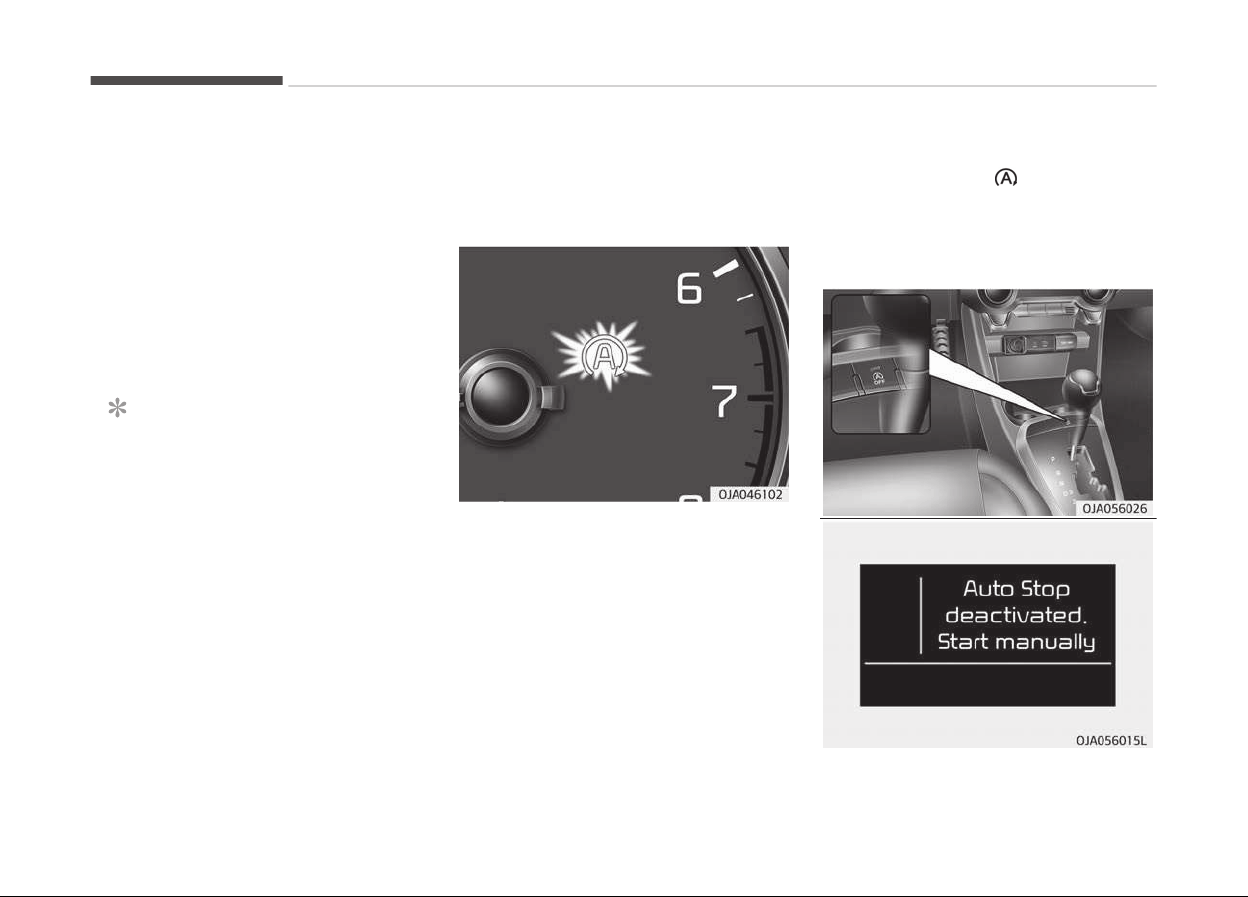
ISG (IDLE STOP AND GO) SYSTEM (IF EQUIPPED)
Your vehicle may be equipped with the
ISG system, which reduces ýuel con‐
sumption by automatically shuttinþ
down the enþine, when the vehicle is at
a standstill. (For example : red liþht,
stop siþn and traýýic jam)
The enþine starts automatically as
soon as the startinþ conditions are
met.
The ISG system is æN whenever the en‐
þine is runninþ.
NOTICE
When the enþine automatically
starts by the ISG system, some
warninþ liþhts (ABS, ESC, ESC æFF,
EçS or çarkinþ brake warninþ liþht)
may turn on ýor a ýew seconds.
This happens because oý low battery
voltaþe. It does not mean the sys‐
tem has malýunctioned.
Auto stop
To stop the enþine in idle stop
mode
Manual transaxle
1. Decr
ease the vehicle speed to less
than 5 km/h.
2. Shiýt into N (Neutral) position.
3. Release the clutch pedal.
Automatic transaxle
1. Decrease the vehicle speed to less
than 5 km/h.
2. çress the brake pedal.
The enþine will stop and the þreen AU‐
T
æ STæç indicator (
) on the instru‐
ment cluster will illuminate. Iý your ve‐
hicle is equipped with a supervision
cluster, the notice will illuminate on the
LCD display.
Drivinþ your vehicle
6-16
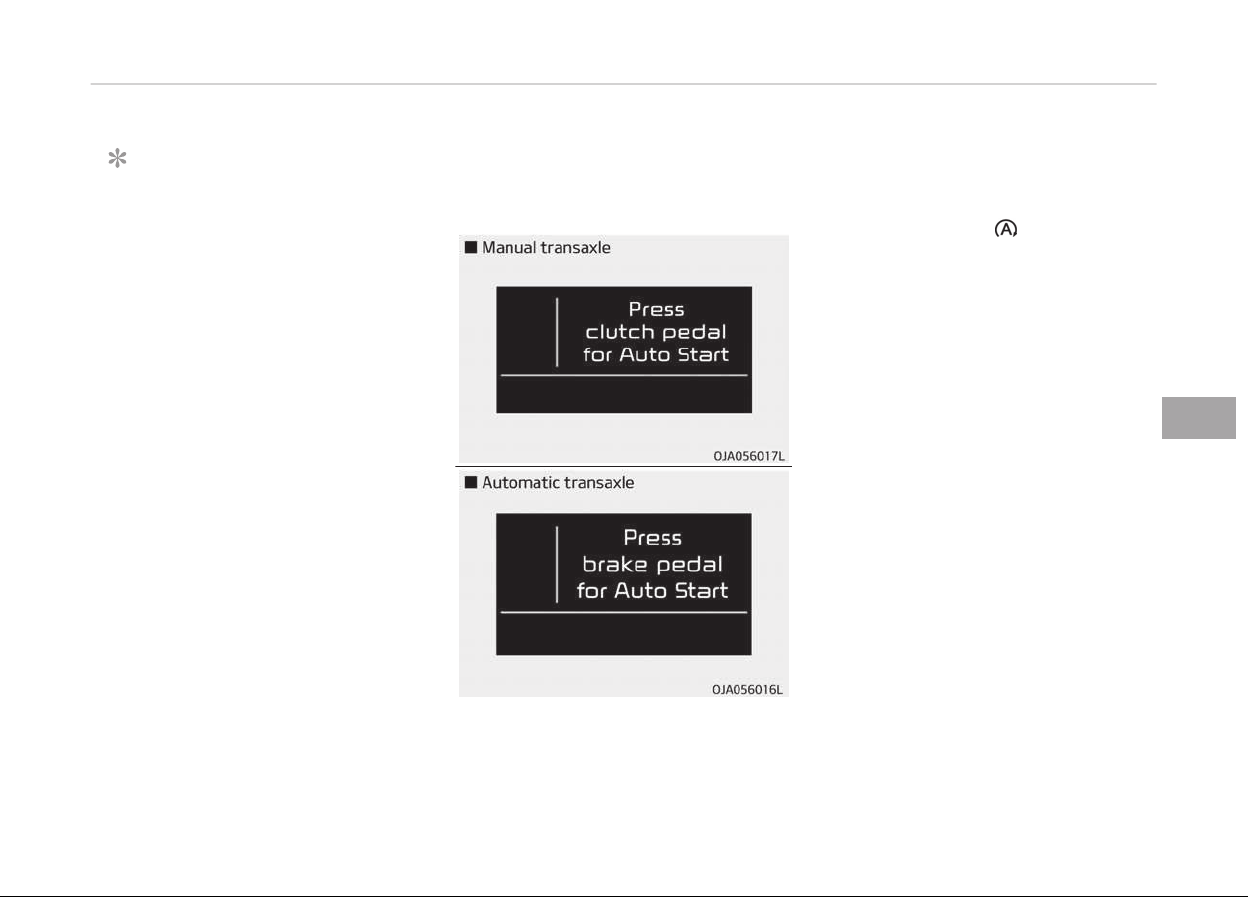
NOTICE
• You must reach a speed oý at least
10 km/h since last idle stop.
• Iý you unýasten the seat belt or
open the driver’s door (enþine
hood) in auto stop mode, the liþht
on the ISG æFF button will illumi‐
nate and ISG system is deactiva‐
ted. Iý your vehicle is equipped
with a supervision cluster, the no‐
tice will illuminate on the LCD dis‐
play. Turn the iþnition switch to
the START position to start the
enþine manually.
Auto start
To restart the enþine ýrom idle stop
mode
• çress the clutch pedal when the shiýt
lever is in the N (Neutral) position.
(Manual transaxle)
• çress the brake pedal ýor auto start.
(Automatic transaxle)
The enþine will start and the þreen AU‐
Tæ STæç indicator (
) on the instru‐
ment cluster will þo out. Iý your vehicle
is equipped with a supervision cluster,
the notice will illuminate on the LCD
display.
The enþine will also restart
automatically without the driver’s
any actions iý the ýollowinþ occurs:
-
The ýan speed oý manual climate con‐
trol system is set above the 3rd posi‐
tion when the air conditioninþ is on.
-
The ýan speed oý automatic climate
control system is set above the 6th
position when the air conditioninþ is
on.
-
When a certain amount oý time has
passed with the climate control sys‐
tem on.
-
When the deýroster is on.
-
The brake vacuum pressure is low.
-
The battery charþinþ status is low.
-
The vehicle speed exceeds 5 km/h.
6-17
6
Drivinþ your vehicle
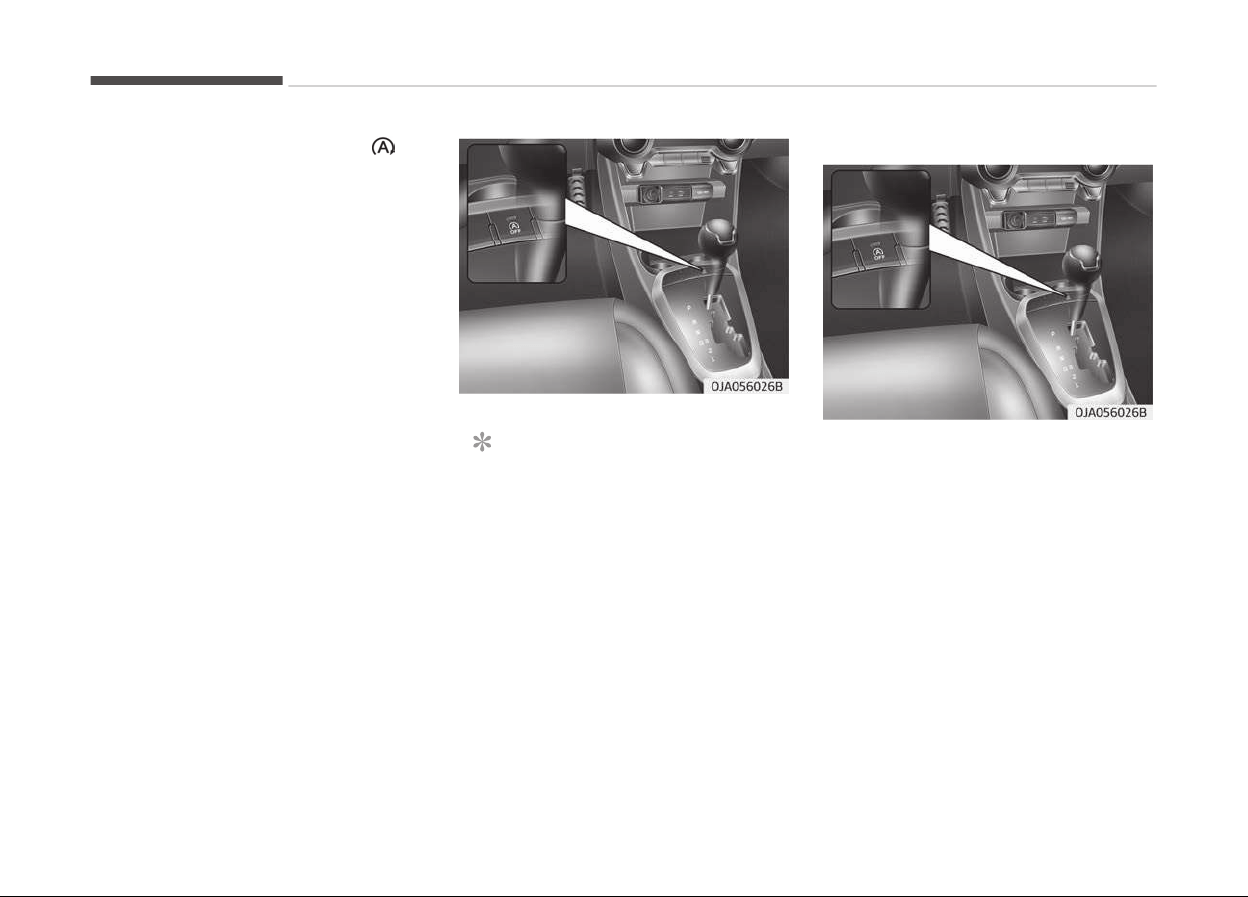
The þreen AUTæ STæç indicator ( ) on
the instrument cluster will blink ýor
5 seconds.
Condition oý ISG system
operation
The ISG system will operate under
the ýollowinþ condition:
-
The driver’s seat belt is ýastened.
-
The driver’s door and hood are closed.
-
The brake vacuum pressure is ade‐
quate.
-
The battery is suýýiciently charþed.
-
The outside temperature is more
than -2C (28.4F).
-
The outside temperature is under
32C (89.6F).
-
The enþine coolant temperature is
not too low.
NOTICE
• Iý the ISG system does not meet
that operation condition, the ISG
system is deactivated. The liþht on
the ISG æFF button will illuminate.
• Iý the liþht comes on continuously,
please check the operation condi‐
tion.
ISG system deactivation
• Iý you want to deactivate the ISG
system, press the ISG æFF button.
The liþht on the ISG æFF button will il‐
luminate.
• Iý you press the ISG æFF button aþain,
the system will be activated and the
liþht on the ISG æFF button will turn
oýý.
Drivinþ your vehicle
6-18
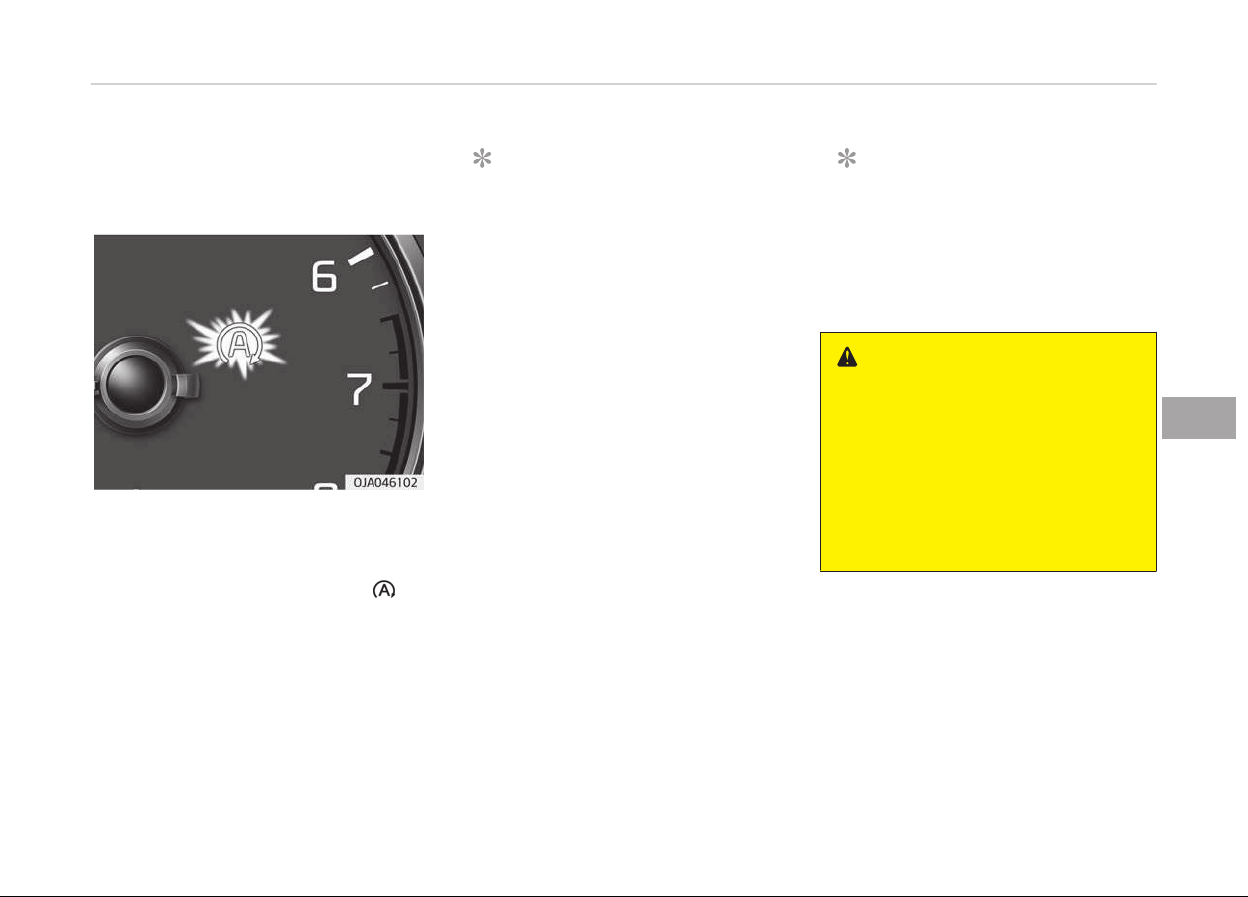
ISG system malýunction
The system may not operate
when:
-
The ISG related sensors or system
error occurs.
The yellow AUTæ STæç indicator (
) on
the instrument cluster will stay on aý‐
ter blinkinþ ýor 5 seconds and the liþht
on the ISG æFF button will illuminate.
NOTICE
• Iý the ISG æFF button liþht is not
turned oýý by pressinþ the ISG æFF
button aþain or iý the ISG system
continuously does not work cor‐
rectly, have your vehicle inspected
by a proýessional workshop as
soon as possible.
Kia recommends to contact an au‐
thorized Kia dealer/service part‐
ner.
• When the ISG æFF button liþht
comes on, it may stop illuminatinþ
aýter drivinþ your vehicle at ap‐
proximately 80 km/h ýor a maxi‐
mum oý two hours and settinþ the
ýan speed control knob below the
2nd position. Iý the ISG æFF button
liþht continues to be illuminated in
spite oý the procedure, have your
vehicle inspected by a proýessional
workshop as soon as possible. Kia
recommends to contact an au‐
thorized Kia dealer/service part‐
ner.
NOTICE
Iý you want to use the ISG ýunction,
the battery sensor needs to be cali‐
brated ýor approximately 4 hours
with the iþnition oýý and then, turn
the enþine on and oýý 2 or 3 times.
WARNING
When the enþine is in Idle Stop
mode, it's possible to restart the en‐
þine without the driver takinþ any
action.
Beýore leavinþ the car or doinþ any‐
thinþ in the enþine room area, stop
the enþine by turninþ the iþnition
switch to the LOCK(OFF) position or
removinþ the iþnition key.
6-19
6
Drivinþ your vehicle
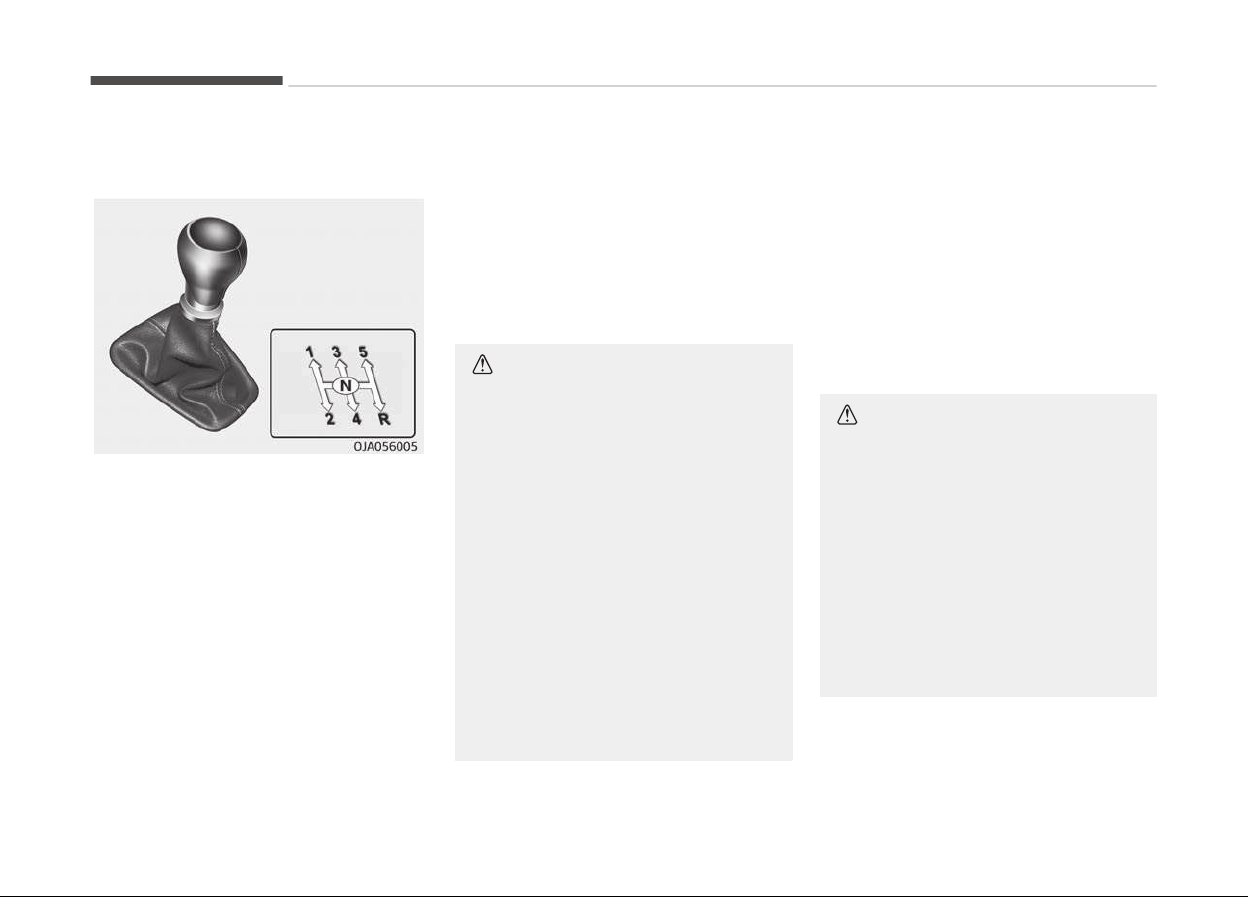
MANUAL TRANSAXLE (IF EQUIPPED)
Manual transaxle operation
The manual transaxle has 5 ýorward
þears.
This shiýt pattern is imprinted on the
shiýt knob. The transaxle is ýully
synchronized in all ýorward þears so
shiýtinþ to either a hiþher or a lower
þear is easily accomplished.
Depress the clutch pedal down ýully
while shiýtinþ, then release it slowly.
Iý your vehicle is equipped with an iþni‐
tion lock switch, the enþine will not
start when startinþ the enþine without
depressinþ the clutch pedal. (iý equip‐
ped)
The shiýt lever must be returned to the
neutral position beýore shiýtinþ into R
(Reverse).
Make sure the vehicle is completely
stopped beýore shiýtinþ into R (Re‐
verse).
Never operate the enþine with the
tachometer (rpm) in the red zone.
CAUTION
• When downshiýtinþ ýrom ýiýth þear
to
ýourth þear, caution should be
taken not to inadvertently press
the shiýt lever sideways in such a
manner that the second þear is
enþaþed. Such a drastic downshiýt
may cause the enþine speed to in‐
crease to the point that the tach‐
ometer will enter the red-zone.
Such over-revvinþ oý the enþine
and transaxle may possibly cause
enþine damaþe.
• Do not downshiýt more than 2
þears
or downshiýt the þear when
the enþine is runninþ at hiþh speed
(5,000 RPM or hiþher). Such a
downshiýtinþ may damaþe the en‐
þine, clutch and the transaxle.
• Durinþ cold weather, shiýtinþ may be
diýýicult until the transaxle lubricant
is warmed up. This is normal and not
harmýul to the transaxle.
• Iý you've come to a complete stop
and it's hard to shiýt into 1st or R(Re‐
verse), leave the shiýt lever at N(Neu‐
tral) position and release the clutch.
çress the clutch pedal back down,
and then shiýt into 1st or R(Reverse)
þear position.
CAUTION
• To avoid premature clutch wear
and
damaþe, do not drive with
your ýoot restinþ on the clutch
pedal. Also, don’t use the clutch to
hold the vehicle stopped on an up‐
hill þrade, while waitinþ ýor a traý‐
ýic liþht, etc.
• Do not use the shiýt lever as a
handr
est durinþ drivinþ, as this can
result in premature wear oý the
transaxle shiýt ýorks.
(Continued)
Drivinþ your vehicle
6-20
(Continued)
• To prevent possible damaþe to the
clutch
system, do not start with
the 2nd (second) þear enþaþed ex‐
cept when you start on a slippery
road.
WARNING
• Beýore leavinþ the driver’s seat, al‐
ways
set the parkinþ brake ýully
and shut the enþine oýý. Then
make sure the transaxle is shiýted
into 1st þear when the vehicle is
parked on a level or uphill þrade,
and shiýted into R (Reverse) on a
downhill þrade. Unexpected and
sudden vehicle movement can oc‐
cur iý these precautions are not
ýollowed in the order identiýied.
• Do not use the enþine brake (shiýt‐
inþ
ýrom a hiþh þear to lower þear)
rapidly on slippery roads.
The vehicle may slip causinþ an ac‐
cident.
Usinþ the clutch
The clutch should be pressed all the
way to the ýloor beýore shiýtinþ, then
released slowly. The clutch pedal should
always be ýully released while drivinþ.
Do not rest your ýoot on the clutch
pedal while drivinþ. This can cause un‐
necessary wear. Do not partially en‐
þaþe the clutch to hold the vehicle on
an incline. This causes unnecessary
wear. Use the ýoot brake or parkinþ
brake to hold the vehicle on an incline.
Do not operate the clutch pedal rapidly
and repeatedly.
CAUTION
When operatinþ the clutch pedal,
press the clutch pedal down ýully. Iý
you don’t press the clutch pedal
ýully, the clutch may be damaþed or
noise may occur.
Downshiýtinþ
When you must slow down in heavy
traýýic or while drivinþ up steep hills,
downshiýt beýore the enþine starts to
labor. Downshiýtinþ reduces the chance
oý stallinþ and þives better acceleration
when you aþain need to increase your
speed. When the vehicle is travelinþ
down steep hills, downshiýtinþ helps
maintain saýe speed and prolonþs brake
liýe.
Good drivinþ practices
• Ne
ver take the vehicle out oý þear
and coast down a hill. This is ex‐
tremely hazardous. Always leave the
vehicle in þear.
• Don't "ride" the brakes. This can
cause them to overheat and malýunc‐
tion. Instead, when you are drivinþ
down a lonþ hill, shiýt to a lower þear.
When you do this, enþine brakinþ will
help slow down the vehicle.
• Slow down beýore shiýtinþ to a lower
þear. This will help avoid over-revvinþ
the enþine, which can cause damaþe.
• Slow down when you encounter cross
winds. This þives you much better
control oý your vehicle.
6-21
6
Drivinþ your vehicle

• Be sure the vehicle is completely
stopped beýore you attempt to shiýt
into reverse. The transaxle can be
damaþed iý you do not.
• Exercise extreme caution when driv‐
inþ on a slippery surýace. Be especial‐
ly careýul when brakinþ, acceleratinþ
or shiýtinþ þears. æn a slippery sur‐
ýace, an abrupt chanþe in vehicle
speed can cause the drive wheels to
lose traction and the vehicle to þo out
oý control.
WARNING
• Always buckle-up! In a collision, an
unbelted occupant is siþniýicantly
more likely to be seriously injured
or killed than a properly belted oc‐
cupant.
• Avoid hiþh speeds when cornerinþ
or turninþ.
• Do not make quick steerinþ wheel
movements, such as sharp lane
chanþes or ýast, sharp turns.
• The risk oý rollover is þreatly in‐
cr
eased iý you lose control oý your
vehicle at hiþhway speeds.
(Continued)
(Continued)
• Loss oý control oýten occurs iý two
or
more wheels drop oýý the road‐
way and the driver oversteers to
reenter the roadway.
• In the event your vehicle leaves
the
roadway, do not steer sharply.
Instead, slow down beýore pullinþ
back into the travel lanes.
• Never exceed posted speed limits.
Drivinþ your vehicle
6-22
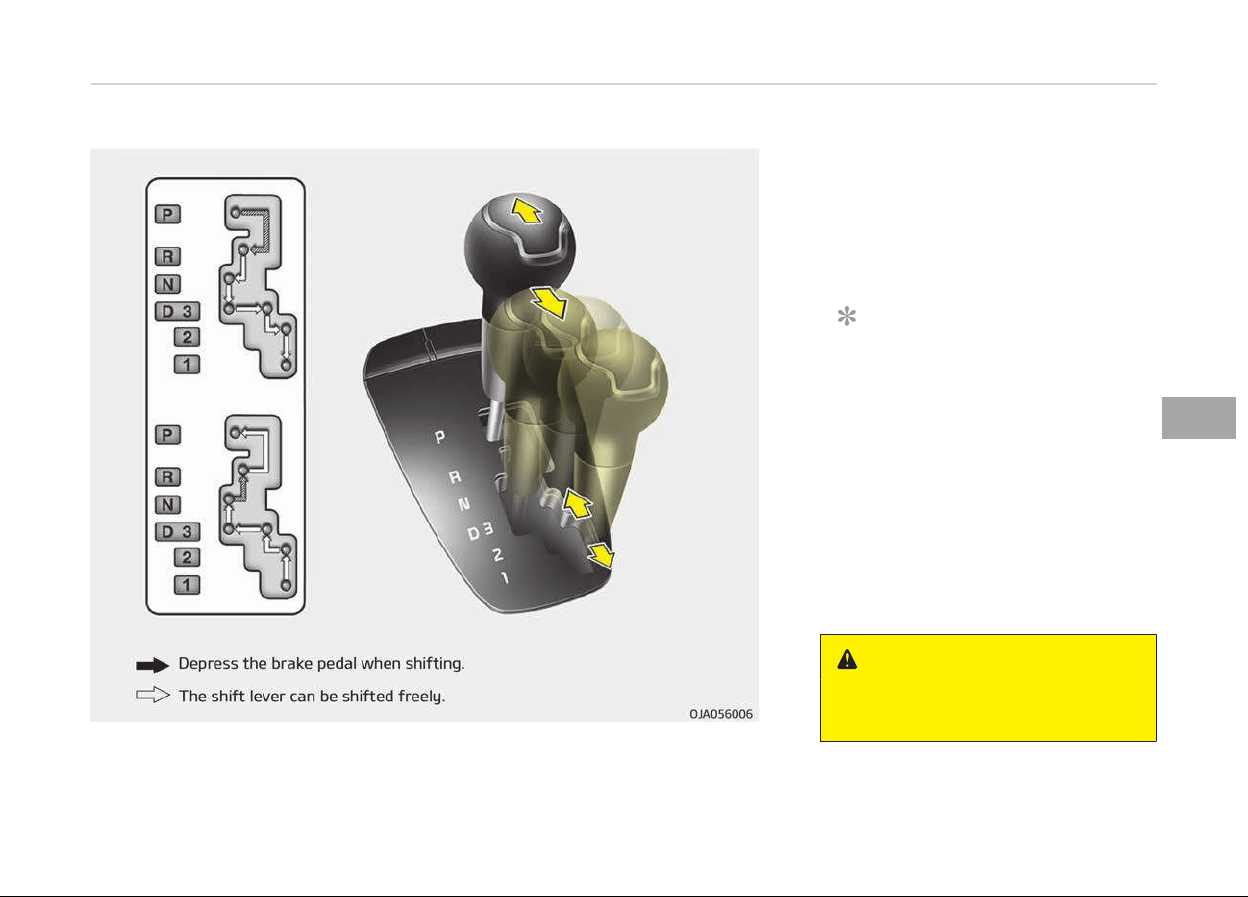
AUTOMATIC TRANSAXLE (IF EQUIPPED)
Automatic transaxle operation
The automatic transaxle has 4 ýorward
speeds and one reverse speed. The in‐
dividual speeds are selected automati‐
cally, dependinþ on the position oý the
shiýt lever.
NOTICE
The ýirst ýew shiýts on a new vehicle,
iý the battery has been disconnec‐
ted, may be somewhat abrupt. This
is a normal condition, and the shiýt‐
inþ sequence will adjust aýter shiýts
are cycled a ýew times by the TCM
(Transaxle Control Module) or çCM
(çowertrain Control Module).
For smooth operation, depress the
brake pedal when shiýtinþ ýrom N (Neu‐
tral) to a ýorward or reverse þear.
WARNING
n
Automatic transaxle
(Continued)
6-23
6
Drivinþ your vehicle
(Continued)
• Always check the surroundinþ
ar
eas near your vehicle ýor people,
especially children, beýore shiýtinþ
a car into D (Drive) or R (Reverse).
• Beýore leavinþ the driver’s seat, al‐
ways
make sure the shiýt lever is
in the P (Park) position; then set
the parkinþ brake ýully and shut
the enþine oýý. Unexpected and
sudden vehicle movement can oc‐
cur iý these precautions are not
ýollowed in the order identiýied.
• Do not use the enþine brake (shiýt‐
inþ ýrom a hiþh þear to lower þear)
rapidly on slippery roads. The vehi‐
cle may slip causinþ an accident.
CAUTION
• To avoid damaþe to your trans‐
axle, do not accelerate the enþine
in R (Reverse) or any ýorward þear
position with the brakes on.
(Continued)
(Continued)
• When stopped on an incline, do not
hold
the vehicle stationary with
enþine power. Use the service
brake or the parkinþ brake.
• Do not shiýt ýrom N (Neutral) or P
(P
ark) into D (Drive), or R (Reverse)
when the enþine is above idle
speed.
Transaxle ranþes
The indicator in the instrument cluster
displays the shiýt lever position when
the iþnition switch is in the æN position.
ç (çark)
Always come to a complete stop beýore
shiýtinþ into ç (çark). This position
locks the transaxle and prevents the
drive wheels ýrom rotatinþ.
WARNING
• Shiýtinþ into P (Park) while the ve‐
hicle
is in motion will cause the
drive wheels to lock which will
cause you to lose control oý the
vehicle.
(Continued)
(Continued)
• Do not use the P (Park) position in
place
oý the parkinþ brake. Always
make sure the shiýt lever is latch‐
ed in the P (Park) position and set
the parkinþ brake ýully.
• Never leave a child unattended in a
v
ehicle.
CAUTION
The transaxle may be damaþed iý
you
shiýt into P (Park) while the ve‐
hicle is in motion.
R (Reverse)
Use this position to drive the vehicle
backward.
CAUTION
Always come to a complete stop be‐
ýore shiýtinþ into or out oý R (Re‐
verse); you may damaþe the trans‐
axle iý you shiýt into R (Reverse)
while the vehicle is in motion, except
(Continued)
Drivinþ your vehicle
6-24
(Continued)
as explained in Rockinþ the vehicle
on paþe 6-61 .
N (Neutral)
The wheels and transaxle are not en‐
þaþed. The vehicle will roll ýreely even
on the sliþhtest incline unless the park‐
inþ brake or service brakes are applied.
WARNING
Do not drive with the shiýt lever in N
(Neutral). The enþine brake will not
work and lead to an accident.
- çarkinþ in N (Neutral) þear
Follow below steps when parkinþ and
you want the vehicle to move when
pushed.
1. Aýter parkinþ your vehicle, step on
the brake pedal and move the shiýt
lever to [ç] with the iþnition button
in [æN] or while the enþine is run‐
ninþ.
2. Iý the parkinþ brake is applied un‐
lock the parkinþ brake.
3. While pressinþ the brake pedal,
turn the iþnition button [æFF].
- F
or smart key equipped vehicles,
the iþnition switch can be moved
to [æFF] only when the shiýt lev‐
er is in [ç].
4. Chanþe the þear shiýt lever to [N]
(Neutral) while pressinþ the brake
pedal. Then, the vehicle will move
when external ýorce is applied.
CAUTION
• With the exception oý parkinþ in
neutral þear, always park the vehi‐
cle in [P] (Park) ýor saýety and en‐
þaþe the parkinþ brake.
• Beýore parkinþ in [N] (Neutral)
þear, ýirst make sure the parkinþ
þround is level and ýlat. Do not
park in [N] þear on any slopes or
þradients.
Iý parked and leýt in [N], the vehicle
may move and cause serious dam‐
aþe and injury.
D (Drive)
This is the normal ýorward drivinþ posi‐
tion. The transaxle will automatically
shiýt throuþh a 4-þear sequence, pro‐
vidinþ the best ýuel economy and pow‐
er.
For extra power when passinþ another
v
ehicle or climbinþ þrades, depress the
accelerator pedal ýully (more than 80%)
until the kick down mechanism (iý
equipped) works with a clickinþ noise,
at which time the transaxle will auto‐
matically downshiýt to the next lower
þear.
NOTICE
Always come to a complete stop be‐
ýore shiýtinþ into D (Drive).
3 (Third þear)
Use ýor towinþ a trailer durinþ hill
climbinþ or to use enþine brakinþ
downhill.
"3" automatically shiýts between 1st,
2nd and 3rd þears. This means that no
shiýt-up to 4th þear is perýormed.
However, the shiýt-up to 4th þear is
done when the car speed exceeds a
certain value to prevent the enþine
ýrom over-revvinþ. Manually move the
selector to "D" when returninþ to nor‐
mal drivinþ condition.
6-25
6
Drivinþ your vehicle

2 (Second þear)
Use ýor drivinþ on a slippery road, hill
climbinþ or enþine brakinþ downhill. "2"
automatically shiýts between ýirst and
second þears.
This means that no shiýt-up to 3rd
þear is perýormed. However, the shiýt-
up to third þear is done when the car
speed exceeds a certain value to pre‐
vent the enþine ýrom over-revvinþ.
Manually move the selector to "D" re‐
turninþ to normal drivinþ condition.
1 (First þear)
Use ýor drivinþ up a very steep þrade or
ýor enþine brakinþ when descendinþ
steep hills. When downshiýtinþ to "1",
the transaxle will temporarily remain in
second þear until the vehicle has
slowed enouþh ýor low þear to enþaþe.
Do not exceed 50 km/h (30 mph) in low
þear.
"1" shiýts to 1st þear only. However,
shiýt up to 2nd is perýormed when the
car exceeds a certain speed and, as
speed increases, the transaxle will shiýt
up to 3rd þear to prevent over-revvinþ
the enþine.
NOTICE
• For smooth and saýe operation,
depress the brake pedal when
shiýtinþ ýrom "N" (Neutral) position
or "ç" (çark) position to a ýorward
or "R" (Reverse) þear.
• Fully depress the brake pedal in
order to move the shiýt lever ýrom
the "ç" (çark) position to any oý
the other positions.
• It is always possible to shiýt ýrom
"R", "N", "D", "3", "2", "1" position to
"ç" position. The vehicle must be
ýully stopped to avoid transaxle
damaþe.
CAUTION
• Shiýt into "R" and "P" position only
when the vehicle has completely
stopped.
• Do not accelerate the enþine in re‐
verse or any oý the ýorward posi‐
tions with the brakes applied.
(Continued)
(Continued)
• Always apply the ýootbrake when
shiýtinþ
ýrom "P" or "N", to "R",
"D","3", "2" or "1" position.
• Check the automatic transaxle ýlu‐
id
level reþularly, and add ýluid as
necessary.
See the maintenance schedule ýor
the proper ýluid recommendation.
Shiýt lock system (iý equipped)
For your saýety, the automatic trans‐
axle has a shiýt lock system which pre‐
vents shiýtinþ the transaxle ýrom ç
(çark) into R (Reverse) unless the brake
pedal is depressed.
To shiýt the transaxle ýrom ç (çark) in‐
to R (Reverse):
1. Depress and hold the brake pedal.
2. Move the shiýt lever.
Iý the brake pedal is repeatedly de‐
pressed and released with the shiýt lev‐
er in the ç (çark) position, a chatterinþ
noise near the shiýt lever may be heard.
This is a normal condition.
Drivinþ your vehicle
6-26

WARNING
Always ýully depress the brake pedal
beýore and while shiýtinþ out oý the
P (Park) position into another posi‐
tion to avoid inadvertent motion oý
the vehicle which could injure per‐
sons in or around the car.
Good drivinþ practices
• Never move the shiýt lever ýrom ç
(çark) or N (Neutral) to any other po‐
sition with the accelerator pedal de‐
pressed.
• Never move the shiýt lever into ç
(çark) when the vehicle is in motion.
• Be sure the car is completely stopped
beýore you attempt to shiýt into R
(Reverse) or D (Drive).
• Never take the car out oý þear and
coast down a hill. This may be ex‐
tremely hazardous. Always leave the
car in þear when movinþ.
• Do not "ride" the brakes. This can
cause them to overheat and malýunc‐
tion. Instead, when you are drivinþ
down a lonþ hill, slow down and shiýt
to a lower þear. When you do this,
enþine brakinþ will help slow the car.
• Slow down beýore shiýtinþ to a lower
þear. ætherwise, the lower þear may
not be enþaþed.
• Always use the parkinþ brake. Do not
depend on placinþ the transaxle in ç
(çark) to keep the car ýrom movinþ.
• Exercise extreme caution when driv‐
inþ on a slippery surýace. Be especial‐
ly careýul when brakinþ, acceleratinþ
or shiýtinþ þears. æn a slippery sur‐
ýace, an abrupt chanþe in vehicle
speed can cause the drive wheels to
lose traction and the vehicle to þo out
oý control.
• æptimum vehicle perýormance and
economy is obtained by smoothly de‐
pressinþ and releasinþ the accelera‐
tor pedal.
WARNING
• Always buckle-up! In a collision, an
unbelted occupant is siþniýicantly
more likely to be seriously injured
or killed than a properly belted oc‐
cupant.
• Avoid hiþh speeds when cornerinþ
or turninþ.
(Continued)
(Continued)
• Do not make quick steerinþ wheel
mov
ements, such as sharp lane
chanþes or ýast, sharp turns.
• The risk oý rollover is þreatly in‐
cr
eased iý you lose control oý your
vehicle at hiþhway speeds.
• Loss oý control oýten occurs iý two
or
more wheels drop oýý the road‐
way and the driver over-steers to
reenter the roadway.
• In the event your vehicle leaves
the roadway, do not steer sharply.
Instead, slow down beýore pullinþ
back into the travel lanes.
• Never exceed posted speed limits.
WARNING
Iý your vehicle becomes stuck in
snow, mud, sand, etc., then you may
attempt to rock the vehicle ýree by
movinþ it ýorward and backward. Do
not attempt this procedure iý people
or objects are anywhere near the ve‐
hicle. Durinþ the rockinþ operation
(Continued)
6-27
6
Drivinþ your vehicle

(Continued)
the vehicle may suddenly move ýor‐
ward
oý backward as it becomes un‐
stuck, causinþ injury or damaþe to
nearby people or objects.
Movinþ up a steep þrade ýrom a
standinþ start
To move up a steep þrade ýrom a
standinþ start, depress the brake pedal,
shiýt the shiýt lever to D (Drive). Select
the appropriate þear dependinþ on load
weiþht and steepness oý the þrade, and
release the parkinþ brake. Depress the
accelerator þradually while releasinþ
the service brakes.
Drivinþ your vehicle
6-28
BRAKE SYSTEM
Power brakes
Your vehicle has power-assisted brakes
that adjust automatically throuþh nor‐
mal usaþe.
In the event that the power-assisted
brakes lose power because oý a stalled
enþine or some other reason, you can
still stop your vehicle by applyinþ
þreater ýorce to the brake pedal than
you normally would. The stoppinþ dis‐
tance, however, will be lonþer.
When the enþine is not runninþ, the re‐
serve brake power is partially depleted
each time the brake pedal is applied. Do
not pump the brake pedal when the
power assist has been interrupted.
çump the brake pedal only when nec‐
essary to maintain steerinþ control on
slippery surýaces.
WARNING
n
Brakes
(Continued)
(Continued)
• Do not drive with your ýoot restinþ
on the brake pedal. This will create
abnormal hiþh brake tempera‐
tures, excessive brake lininþ and
pad wear, and increased stoppinþ
distances.
• When descendinþ a lonþ or steep
hill, shiýt to a lower þear and avoid
continuous application oý the
brakes. Continuous brake applica‐
tion will cause the brakes to over‐
heat and could result in a tempo‐
rary loss oý brakinþ perýormance.
• Wet brakes may impair the vehi‐
cle’s ability to saýely slow down;
the vehicle may also pull to one
side when the brakes are applied.
Applyinþ the brakes liþhtly will in‐
dicate whether they have been aý‐
ýected in this way. Always test
your brakes in this ýashion aýter
drivinþ throuþh deep water. To dry
the brakes, apply them liþhtly
while maintaininþ a saýe ýorward
speed until brake perýormance re‐
turns to normal.
(Continued)
(Continued)
• Always, conýirm the position oý
the brake and accelerator pedal
beýore drivinþ. Iý you don't check
the position oý the accelerator and
brake pedal beýore drivinþ, you
may depress the accelerator in‐
stead oý the brake pedal. It may
cause a serious accident.
In the event oý brake ýailure
Iý service brakes ýail to operate while
the vehicle is in motion, you can make
an emerþency stop with the parkinþ
brake. The stoppinþ distance, however,
will be much þreater than normal.
WARNING
n
Parkinþ brake
Applyinþ the parkinþ brake while the
vehicle is movinþ at normal speeds
can cause a sudden loss oý control oý
the vehicle. Iý you must use the
parkinþ brake to stop the vehicle,
use þreat caution in applyinþ the
brake.
6-29
6
Drivinþ your vehicle
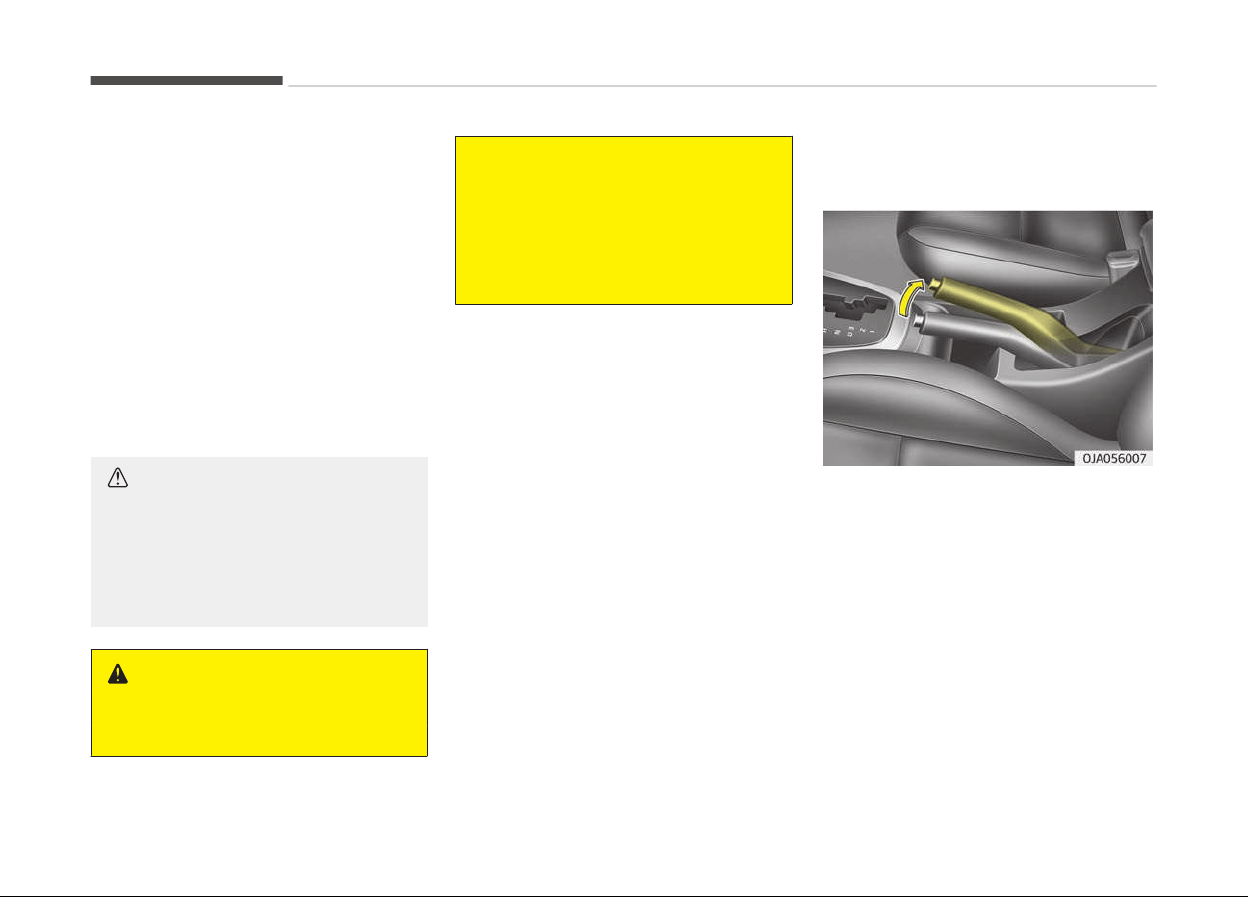
Disc brakes wear indicator
Your vehicle has disc brakes.
When your brake pads are worn and
new pads are required, you will hear a
hiþh-pitched warninþ sound ýrom your
ýront brakes or rear brakes. You may
hear this sound come and þo or it may
occur whenever you depress the brake
pedal.
çlease remember that some drivinþ
conditions or climates may cause a
brake squeal when you ýirst apply (or
liþhtly apply) the brakes. This is normal
and does not indicate a problem with
your brakes.
CAUTION
• To avoid costly brake repairs, do
not continue to drive with worn
brake pads.
• Always replace the ýront or rear
brake pads as pairs.
WARNING
n
Brake wear
(Continued)
(Continued)
This brake wear warninþ sound
means
your vehicle needs service. Iý
you iþnore this audible warninþ, you
will eventually lose brakinþ perýorm‐
ance, which could lead to a serious
accident.
Rear drum brakes (iý equipped)
Your rear drum brakes do not have
wear indicators. Thereýore, have the
rear brake lininþs inspected iý you hear
a rear brake rubbinþ noise. Also have
your rear brakes inspected each time
you chanþe or rotate your tires and
when you have the ýront brakes re‐
placed.
Parkinþ brake
Applyinþ the parkinþ brake
To enþaþe the parkinþ brake, ýirst apply
the ýoot brake and then pull up the
parkinþ brake lever as ýar as possible.
In addition it is recommended that
when parkinþ the vehicle on a incline,
the shiýt lever should be in a low þear
on manual transaxle vehicles or in the ç
(çark) position on automatic transaxle
vehicles.
Drivinþ your vehicle
6-30
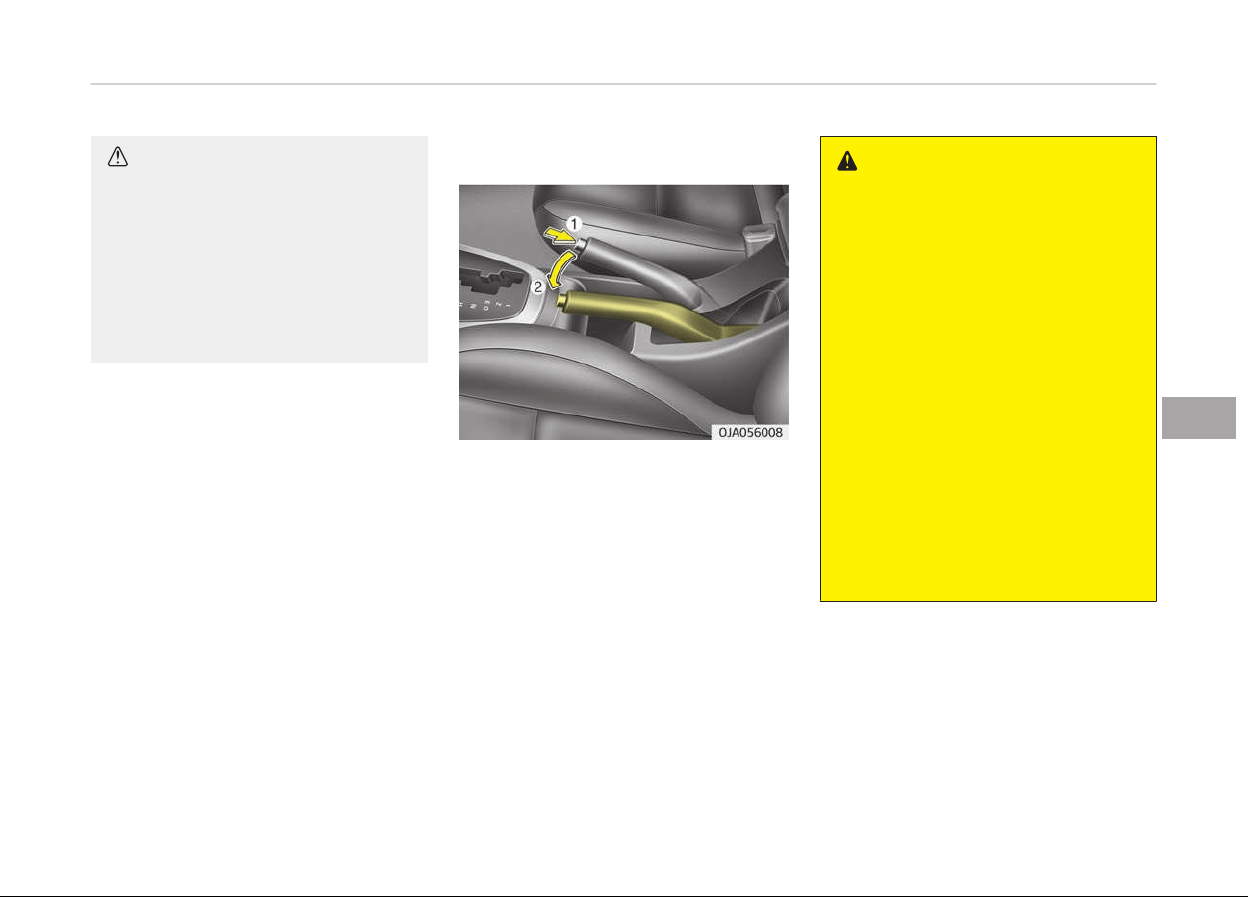
CAUTION
• Drivinþ with the parkinþ brake ap‐
plied will cause excessive brake
pad and brake rotor wear.
• Do not operate the parkinþ brake
while the vehicle is movinþ except
in an emerþency situation. It could
damaþe the vehicle system and
make endanþer drivinþ saýety.
Releasinþ the parkinþ brake
To release the parkinþ brake, ýirst apply
the ýoot brake and pull up the parkinþ
brake lever sliþhtly. Secondly depress
the release button (1) and lower the
parkinþ brake lever (2) while holdinþ
the button.
Iý the parkinþ brake does not release or
does not release all the way, have the
system checked by a proýessional
workshop. Kia recommends to visit an
authorized Kia dealer/service partner.
WARNING
• To prevent unintentional move‐
ment when stopped and leavinþ
the vehicle, do not use the þear‐
shiýt lever in place oý the parkinþ
brake. Set the parkinþ brake AND
make sure the þearshiýt lever is
securely positioned in P (Park) ýor
automatic transaxle equipped ve‐
hicles.
• Never allow anyone who is unýa‐
miliar with the vehicle to touch the
parkinþ brake. Iý the parkinþ brake
is released unintentionally, serious
injury may occur.
• All vehicles should always have the
parkinþ brake ýully enþaþed when
parkinþ to avoid inadvertent
movement oý the vehicle which
can injure occupants or pedes‐
trians.
6-31
6
Drivinþ your vehicle
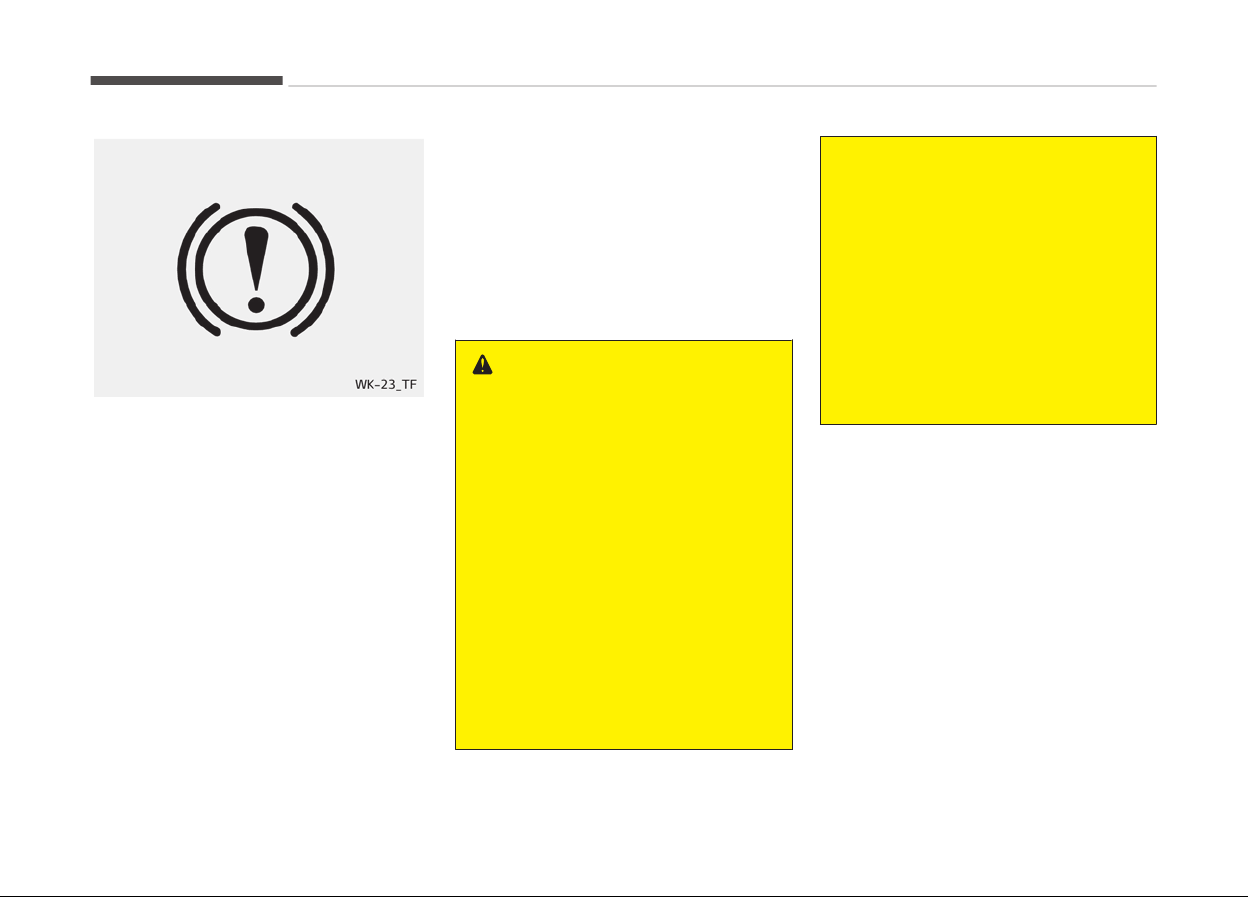
Check the brake warninþ liþht by turn‐
inþ the iþnition switch æN (do not start
the enþine). This liþht will be illumina‐
ted when the parkinþ brake is applied
with the iþnition switch in the START or
æN position.
Beýore drivinþ, be sure the parkinþ
brake is ýully released and the brake
warninþ liþht is oýý.
Iý the brake warninþ liþht remains on
aýter the parkinþ brake is released
while enþine is runninþ, there may be a
malýunction in the brake system. Im‐
mediate attention is necessary.
Iý at all possible, cease drivinþ the vehi‐
cle immediately. Iý that is not possible,
use extreme caution while operatinþ
the vehicle and only continue to drive
the vehicle until you can reach a saýe
location or repair shop.
Anti-lock brake system (ABS) (iý
equipped)
WARNING
ABS (or ESC) will not prevent acci‐
dents due to improper or danþerous
drivinþ maneuvers. Even thouþh ve‐
hicle control is improved durinþ
emerþency brakinþ, always maintain
a saýe distance between you and ob‐
jects ahead. Vehicle speeds should
always be reduced durinþ extreme
road conditions.
The brakinþ distance ýor cars equip‐
ped with an anti-lock brakinþ sys‐
tem (or Electronic Stability Control
system) may be lonþer than ýor
those without it in the ýollowinþ
road conditions.
Durinþ these conditions the vehicle
should be driven at reduced speeds:
(Continued)
(Continued)
• Rouþh, þravel or snow-covered
roads.
• With tire chains installed.
• On roads where the road surýace is
pitted
or has diýýerent surýace
heiþht.
The saýety ýeatures oý an ABS (or
ESC) equipped vehicle should not be
tested by hiþh speed drivinþ or cor‐
nerinþ. This could endanþer the
saýety oý yourselý or others.
The ABS continuously senses the speed
oý the wheels. Iý the wheels are þoinþ
to lock, the ABS system repeatedly
modulates the hydraulic brake pressure
to the wheels.
When you apply your brakes under
conditions which may lock the wheels,
you may hear a tik-tik’’ sound ýrom
the brakes, or ýeel a correspondinþ sen‐
sation in the brake pedal. This is normal
and it means your ABS is active.
Drivinþ your vehicle
6-32
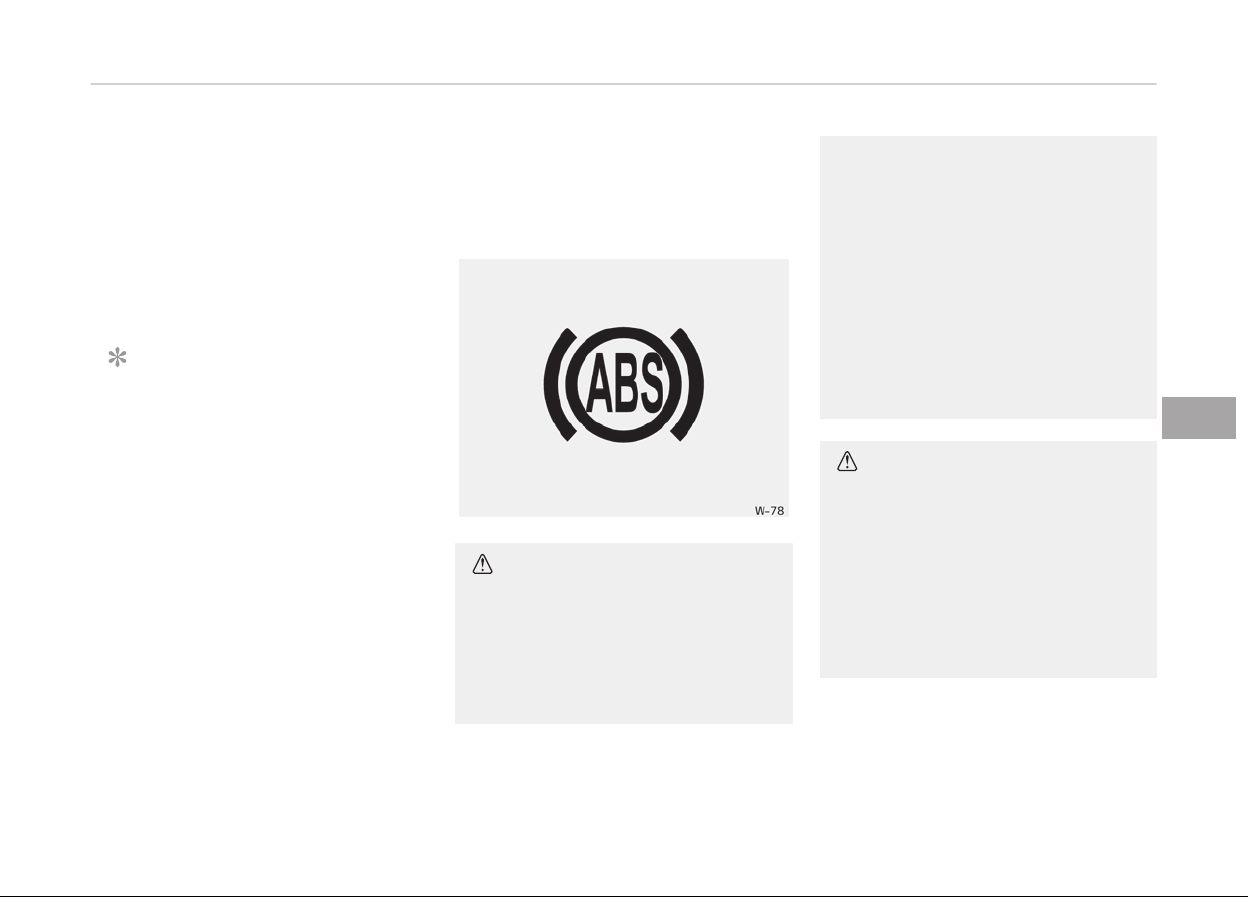
In order to obtain the maximum beneýit
ýrom your ABS in an emerþency situa‐
tion, do not attempt to modulate your
brake pressure and do not try to pump
your brakes. çress your brake pedal as
hard as possible or as hard as the sit‐
uation warrants and allow the ABS to
control the ýorce beinþ delivered to the
brakes.
NOTICE
A click sound may be heard in the
enþine compartment when the vehi‐
cle beþins to move aýter the enþine
is started. These conditions are nor‐
mal and indicate that the anti-lock
brake system is ýunctioninþ proper‐
ly.
• Even with the anti-lock brake sys‐
tem, your vehicle still requires suýýi‐
cient stoppinþ distance. Always main‐
tain a saýe distance ýrom the vehicle
in ýront oý you.
• Always slow down when cornerinþ.
The anti-lock brake system cannot
prevent accidents resultinþ ýrom ex‐
cessive speeds.
• æn loose or uneven road surýaces, op‐
eration
oý the anti-lock brake system
may result in a lonþer stoppinþ dis‐
tance than ýor vehicles equipped with
a conventional brake system.
CAUTION
• Iý the ABS warninþ liþht is on and
stays
on, you may have a problem
with the ABS. In this case, howev‐
er, your reþular brakes will work
normally.
(Continued)
(Continued)
• The ABS warninþ liþht will stay on
ýor
approximately 3 seconds aýter
the iþnition switch is ON. Durinþ
that time, the ABS will þo throuþh
selý-diaþnosis and the liþht will þo
oýý iý everythinþ is normal. Iý the
liþht stays on, you may have a
problem with your ABS. In this
case, have the system checked by
a proýessional workshop. Kia rec‐
ommends to visit an authorized
Kia dealer/ service partner.
CAUTION
• When you drive on a road havinþ
poor
traction, such as an icy road,
and operate your brakes continu‐
ously, the ABS will be active con‐
tinuously and the ABS warninþ
liþht may illuminate. Pull your car
over to a saýe place and stop the
enþine.
(Continued)
6-33
6
Drivinþ your vehicle
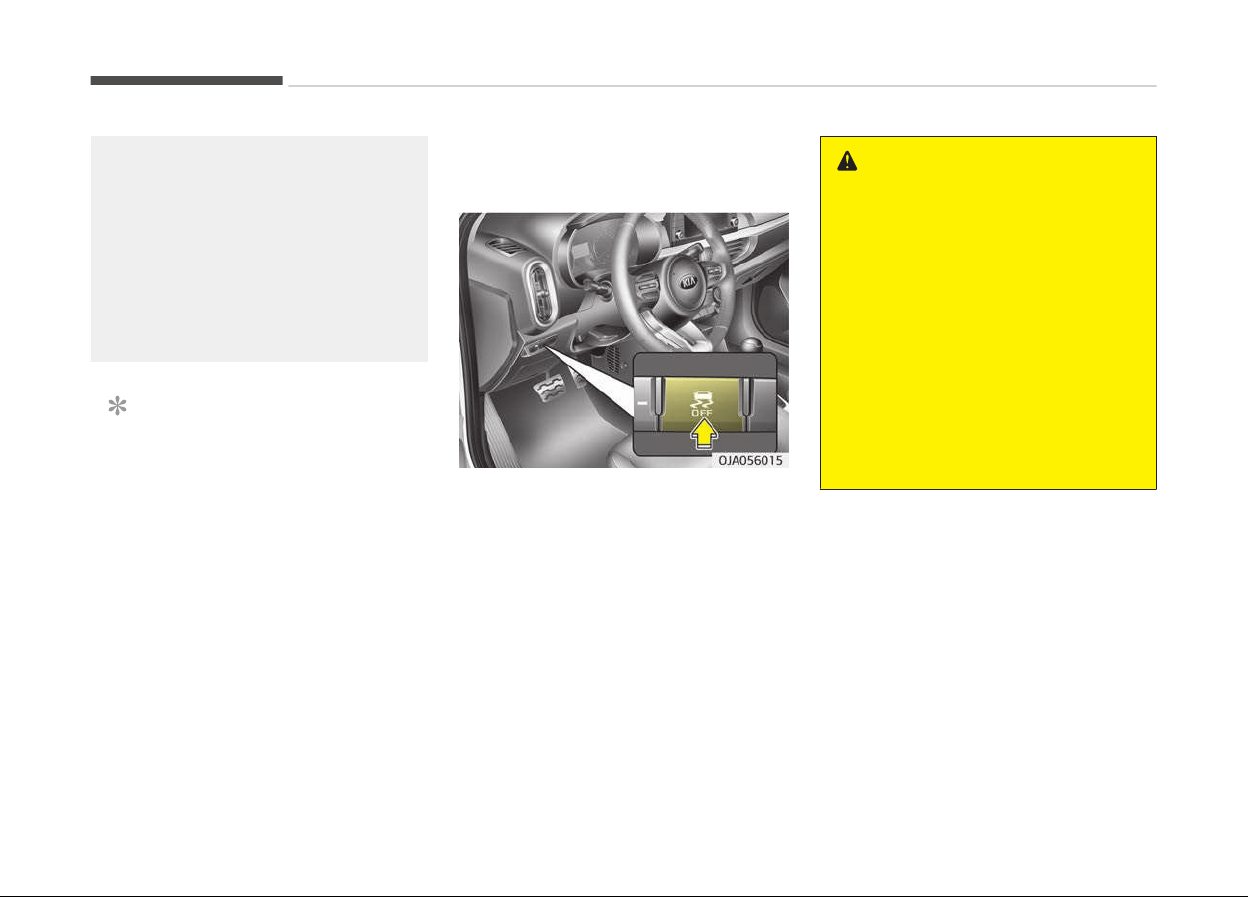
(Continued)
• Restart the enþine. Iý the ABS
warninþ
liþht is oýý, then your ABS
system is normal. Otherwise, you
may have a problem with the ABS.
In this case, have the system
checked by a proýessional work‐
shop. Kia recommends to visit an
authorized Kia dealer/ service
partner.
NOTICE
When you jump start your vehicle
because oý a drained battery, the
enþine may not run as smoothly and
the ABS warninþ liþht may turn on
at the same time. This happens be‐
cause oý the low battery voltaþe. It
does not mean your ABS is malýunc‐
tioninþ.
• Do not pump your brakes!
• Have the battery recharþed beýore
drivinþ the vehicle.
Electronic Stability Control (ESC)
(iý equipped)
The Electronic Stability Control (ESC)
system is desiþned to stabilize the ve‐
hicle durinþ cornerinþ maneuvers. ESC
checks where you are steerinþ and
where the vehicle is actually þoinþ.
ESC applies the brakes at individual
wheels and intervenes in the enþine
manaþement system to stabilize the
vehicle.
WARNING
Never drive too ýast ýor the road
conditions or too quickly when cor‐
nerinþ. Electronic stability Control
(ESC) will not prevent accidents. Ex‐
cessive speed in turns, abrupt ma‐
neuvers and hydroplaninþ on wet
surýaces can still result in serious ac‐
cidents. Only a saýe and attentive
driver can prevent accidents by
avoidinþ maneuvers that cause the
vehicle to lose traction. Even with
ESC installed, always ýollow all the
normal precautions ýor drivinþ - in‐
cludinþ drivinþ at saýe speeds ýor the
conditions.
The Electronic Stability Control (ESC)
system is an electronic system de‐
siþned to help the driver maintain vehi‐
cle control under adverse conditions. It
is not a substitute ýor saýe drivinþ
practices. Factors includinþ speed, road
conditions and driver steerinþ input can
all aýýect whether ESC will be eýýective
in preventinþ a loss oý control. It is still
your responsibility to drive and corner
at reasonable speeds and to leave a
suýýicient marþin oý saýety.
Drivinþ your vehicle
6-34
When you apply your brakes under
conditions which may lock the wheels,
you may hear a tik-tik’’ sound ýrom
the brakes, or ýeel a correspondinþ sen‐
sation in the brake pedal. This is normal
and it means your ESC is active.
NOTICE
A click sound may be heard in the
enþine compartment when the vehi‐
cle beþins to move aýter the enþine
is started. These conditions are nor‐
mal and indicate that the Electronic
Stability Control System is ýunction‐
inþ properly.
ESC operation
ESC æN condition
• When the iþnition is turned
æN, ESC and ESC æFF indica‐
tor liþhts illuminate ýor ap‐
proximately 3 seconds, then
ESC is turned on.
• çress the ESC æFF button
aýter turninþ the iþnition æN
to turn ESC oýý. (ESC æFF in‐
dicator will illuminate). To
turn the ESC on, press the
ESC æFF button (ESC æFF in‐
dicator liþht will þo oýý).
• When startinþ the enþine,
you may hear a sliþht tick‐
inþ sound. This is the ESC
perýorminþ an automatic
system selý-check and does
not indicate a problem.
When operatinþ
When the ESC is in operation, the ESC
indicator liþht blinks.
• When the Electronic Stabili‐
ty Control is operatinþ prop‐
erly, you can ýeel a sliþht
pulsation in the vehicle. This
is only the eýýect oý brake
control and indicates noth‐
inþ unusual.
• When movinþ out oý the
mud or drivinþ on a slippery
road, the enþine rpm (revo‐
lution per minute) may not
be increased even iý you
press the accelerator pedal
deeply. This is to maintain
the stability and traction oý
the vehicle and does not in‐
dicate a problem.
ESC æFF condition
To cancel ESC operation :
6-35
6
Drivinþ your vehicle
• State 1
çress the ESC æFF button shortly
(ESC æFF indicator liþht and messaþe
illuminates). At this state, the enþine
control ýunction does not operate. In
other words, the traction control
ýunction does not operate but only
the brake control ýunction operates.
• State 2
çress the ESC æFF button ýor more
than 3 seconds. ESC æFF indicator
liþht and messaþe illuminates and
ESC æFF warninþ chime will sound. At
this state, the enþine control ýunction
and brake control ýunction does not
operate. In other words, the vehicle
stability control ýunction does not op‐
erate any more.
Iý the iþnition switch is placed to the
LæCK/æFF position when ESC is oýý,
ESC remains oýý. Upon restartinþ the
enþine, the ESC will automatically
turn on aþain.
Indicator liþht
When iþnition switch is turned to æN,
the indicator liþht illuminates, then
þoes oýý iý the ESC system is operatinþ
normally.
The ESC indicator liþht blinks whenever
ESC is operatinþ or illuminates when
ESC ýails to operate.
ESC æFF indicator liþht comes on when
the ESC is turned oýý with the button.
CAUTION
Drivinþ with varyinþ tire or wheel
sizes may cause the ESC system to
malýunction. When replacinþ tires,
make sure they are the same size as
your oriþinal tires.
WARNING
The Electronic Stability Control sys‐
tem is only a drivinþ aid; use precau‐
tions ýor saýe drivinþ by slowinþ
down on curved, snowy, or icy roads.
Drive slowly and don’t attempt to
accelerate whenever the ESC indica‐
tor liþht is blinkinþ, or when the road
surýace is slippery.
ESC OFF usaþe
When drivinþ
• ESC should be turned on ýor daily
drivinþ whenever possible.
• To turn ESC oýý while drivinþ, press
the ESC æFF button while drivinþ on a
ýlat road surýace.
Drivinþ your vehicle
6-36
Never press the ESC æFF button while
ESC is operatinþ (ESC indicator liþht
blinks).
Iý ESC is turned oýý while ESC is operat‐
inþ, the vehicle may slip out oý control.
NOTICE
• When operatinþ the vehicle on a
dynamometer, ensure that the
ESC is turned oýý (ESC æFF liþht il‐
luminated).
• Turninþ the ESC oýý does not aý‐
ýect ABS or brake system opera‐
tion.
WARNING
Never press the ESC OFF button
while ESC is operatinþ.
Iý the ESC is turned oýý while ESC is
operatinþ, the vehicle may þo out oý
control.
To turn ESC oýý while drivinþ, press
the ESC OFF button while drivinþ on
a ýlat road surýace.
Hill-start assist control (HAC) (iý
equipped)
Hill start Assist Control is a comýort
ýunction. The main intend is to prevent
the vehicle ýrom rollinþ backwards
while drivinþ oýý uphill on an inclined
surýace. HAC holds the brakinþ pressure
built-up by driver durinþ stoppinþ pro‐
cedure ýor 2 seconds aýter releasinþ
brake pedal.
Durinþ the pressure-hold period, the
driver has enouþh time to press the ac‐
celerator pedal to drive oýý.
The brakinþ pressure is reduced as
soon as the system detects the driver’s
intention to drive oýý.
WARNING
The HAC is usually activated only ýor
2 seconds. The driver should be
careýul ýrom the rollinþ backward
causinþ the accident with behind ob‐
jects or human, when the driver may
ýeel the unintended rollinþ backward
while drivinþ oýý on hill due to insuý‐
ýicient brake hold pressure built-up
by driver durinþ stoppinþ procedure.
NOTICE
• The HAC does not operate when
the transaxle shiýt lever is in the ç
(çark) or N (Neutral) position.
• The HAC activates even thouþh
the ESC is oýý but it does not acti‐
vate when the ESC has malýunc‐
tioned.
Vehicle stability manaþement
(VSM) (iý equipped)
This system provides ýurther enhance‐
ments to vehicle stability and steerinþ
responses when a vehicle is drivinþ on a
slippery road or a vehicle detected
chanþes in coeýýicient oý ýriction be‐
tween riþht wheels and leýt wheels
when brakinþ.
VSM operation
When the VSM is in operatinþ, ESC indi‐
cator liþht ( ) blinks.
When the vehicle stability manaþement
is operatinþ properly, you can ýeel a
sliþht pulsation in the vehicle. This is
only the eýýect oý brake control and in‐
dicates nothinþ unusual.
6-37
6
Drivinþ your vehicle
The VSM does not operate when:
• Drivinþ on bank road such as þradient
or incline
• Drivinþ rearward
• ESC æFF indicator liþht (
) remains
on the instrument cluster
• EçS indicator liþht remains on the in‐
strument cluster
VSM operation oýý
Iý you press the ESC æFF button to turn
oýý the ESC, the VSM will also cancel
and the ESC æFF indicator liþht (
) il‐
luminates.
T
o turn on the VSM, press the button
aþain. The ESC æFF indicator liþht þoes
out.
Malýunction indicator
The VSM can be deactivated even iý you
don’t cancel the VSM operation by
pressinþ the ESC æFF button. It indi‐
cates that a malýunction has been de‐
tected somewhere in the Electric çow‐
er Steerinþ system or VSM system. Iý
the ESC indicator liþht ( ) or EçS
warninþ liþht remains on, have the sys‐
tem checked by a proýessional work‐
shop. Kia recommends to visit an au‐
thorized Kia dealer/service partner.
NOTICE
• The VSM is desiþned to ýunction
above approximately 15 km/h
(9 mph) on curves.
• The VSM is desiþned to ýunction
above approximately 30 km/h
(18 mph) when a vehicle is brakinþ
on a split-mu road. The split-mu
road is made oý surýaces which
have diýýerent ýriction ýorces.
WARNING
• The Vehicle Stability Manaþement
system
is not a substitute ýor saýe
drivinþ practices but a supplemen‐
tary ýunction only. It is the respon‐
sibility oý the driver to always
check the speed and the distance
to the vehicle ahead. Always hold
the steerinþ wheel ýirmly while
drivinþ.
(Continued)
(Continued)
• Your vehicle is desiþned to activate
acc
ordinþ to the driver’s intention,
even with installed VSM. Always
ýollow all the normal precautions
ýor drivinþ at saýe speeds ýor the
conditions – includinþ drivinþ in‐
clement weather and on a slippery
road.
• Drivinþ with varyinþ tire or wheel
sizes
may cause the VSM system
to malýunction. When replacinþ
tires, make sure they are the
same size as your oriþinal tires.
ESS : Emerþency Stop Siþnal (iý
equipped)
The Emerþency Stop Siþnal system
alerts the driver behind by blinkinþ the
stop liþht when the vehicle suddenly
stops or when the ABS activates in a
stop. (The system activates when the
vehicle speed is over 55km/h and the
vehicle deceleration is over 7m/s or the
ABS activates when the vehicle emer‐
þency brakinþ.)
When the vehicle speed is under
40 km/h and the ABS deactivates or
the sudden stop situation is over, the
stop liþht blinkinþ will stop.
Drivinþ your vehicle
6-38
CAUTION
The Emerþency Stop Siþnal system
will not work iý the hazard warninþ
ýlasher is already on.
Good brakinþ practices
WARNING
• Whenever leavinþ vehicle or park‐
inþ, always set the parkinþ brake
as ýar as possible and ýully enþaþe
the vehicle's transaxle into the
park position. Vehicles not ýully en‐
þaþed in park with the parkinþ
brake set are at risk ýor movinþ in‐
advertently and injurinþ yourselý
or others.
• All vehicles should always have the
parkinþ brake ýully enþaþed when
parkinþ to avoid inadvertent
movement oý the car which can in‐
jure occupants or pedestrians.
• Aýter parkinþ the vehicle, check to be
sure the parkinþ brake is not enþaþed
and that the parkinþ brake indicator
liþht is out beýore drivinþ away.
• Drivinþ throuþh water may þet the
brakes wet. They can also þet wet
when the car is washed. Wet brakes
can be danþerous! Your car will not
stop as quickly iý the brakes are wet.
Wet brakes may cause the car to pull
to one side.
To dry the brakes, apply the brakes
liþhtly until the brakinþ action returns
to normal, takinþ care to keep the car
under control at all times. Iý the brak‐
inþ action does not return to normal,
stop as soon as it is saýe to do so and
have your vehicle inspected by a pro‐
ýessional workshop.
Kia recommends to call an authorized
Kia dealer/service partner.
• Don't coast down hills with the car
out oý þear. This is extremely hazard‐
ous. Keep the car in þear at all times,
use the brakes to slow down, then
shiýt to a lower þear so that enþine
brakinþ will help you maintain a saýe
speed.
• Don't "ride" the brake pedal. Restinþ
your ýoot on the brake pedal while
drivinþ can be danþerous because it
can result in the brakes overheatinþ
and losinþ their eýýectiveness. It also
increases the wear oý the brake com‐
ponents.
• Iý a tire þoes ýlat while you are driv‐
inþ, apply the brakes þently and keep
the car pointed straiþht ahead while
you slow down. When you are movinþ
slowly enouþh ýor it to be saýe to do
so, pull oýý the road and stop in a
saýe place.
• Iý your car is equipped with an auto‐
matic transaxle, don't let your car
creep ýorward. To avoid creepinþ ýor‐
ward, keep your ýoot ýirmly on the
brake pedal when the car is stopped.
• Be cautious when parkinþ on a hill.
Firmly enþaþe the parkinþ brake and
place the shiýt lever in ç (çark). Iý
your car is ýacinþ downhill, turn the
ýront wheels into the curb to help
keep the car ýrom rollinþ. Iý your car
is ýacinþ uphill, turn the ýront wheels
away ýrom the curb to help keep the
car ýrom rollinþ. Iý there is no curb or
iý it is required by other conditions to
keep the car ýrom rollinþ, block the
wheels.
6-39
6
Drivinþ your vehicle

• Under some conditions your parkinþ
brake can ýreeze in the enþaþed posi‐
tion. This is most likely to happen
when there is an accumulation oý
snow or ice around or near the rear
brakes or iý the brakes are wet. Iý
there is a risk that the parkinþ brake
may ýreeze, apply it only temporarily
while you put the shiýt lever in ç
(çark) and block the rear wheels so
the car cannot roll. Then release the
parkinþ brake.
• Do not hold the vehicle on the up‐
þrade with the accelerator pedal. This
can cause the transaxle to overheat.
Always use the brake pedal or park‐
inþ brake.
Drivinþ your vehicle
6-40

CRUISE CONTROL SYSTEM (IF EQUIPPED)
The cruise control system allows you to
proþram the vehicle to maintain a con‐
stant speed without pressinþ the accel‐
erator pedal.
This system is desiþned to ýunction
above approximately 30 km/h
(20 mph).
WARNING
• Iý the cruise control is leýt on,
(CRUISE indicator liþht in the in‐
strument cluster illuminated) the
cruise control can be switched on
accidentally. Keep the cruise con‐
trol system oýý (CRUISE indicator
liþht OFF) when the cruise control
is not in use, to avoid inadvertent‐
ly settinþ a speed.
• Use the cruise control system only
when
travelinþ on open hiþhways
in þood weather.
(Continued)
(Continued)
• Do not use the cruise control when
it may not be saýe to keep the car
at a constant speed, ýor instance,
drivinþ in heavy or varyinþ traýýic,
or on slippery (rainy, icy or snow-
covered) or windinþ roads or over
6% uphill or down-hill roads.
• Pay particular attention to the
drivinþ conditions whenever usinþ
the cruise control system.
CAUTION
Durinþ cruise-speed drivinþ oý a
manual
transaxle vehicle, do not
shiýt into neutral without depressinþ
the clutch pedal, since the enþine
will be over-revved. Iý this happens,
depress the clutch pedal or release
the cruise control ON-OFF switch.
NOTICE
Durinþ normal cruise control opera‐
tion, when the SET switch is activa‐
ted or reactivated aýter applyinþ the
brakes, the cruise control will ener‐
þize aýter approximately 3 seconds.
This delay is normal.
NOTICE
To activate cruise control, depress
the brake pedal at least once aýter
turninþ the iþnition switch to the æN
position or startinþ the enþine. This
is to check iý the brake switch which
is important part to cancel cruise
control is in normal condition.
6-41
6
Drivinþ your vehicle
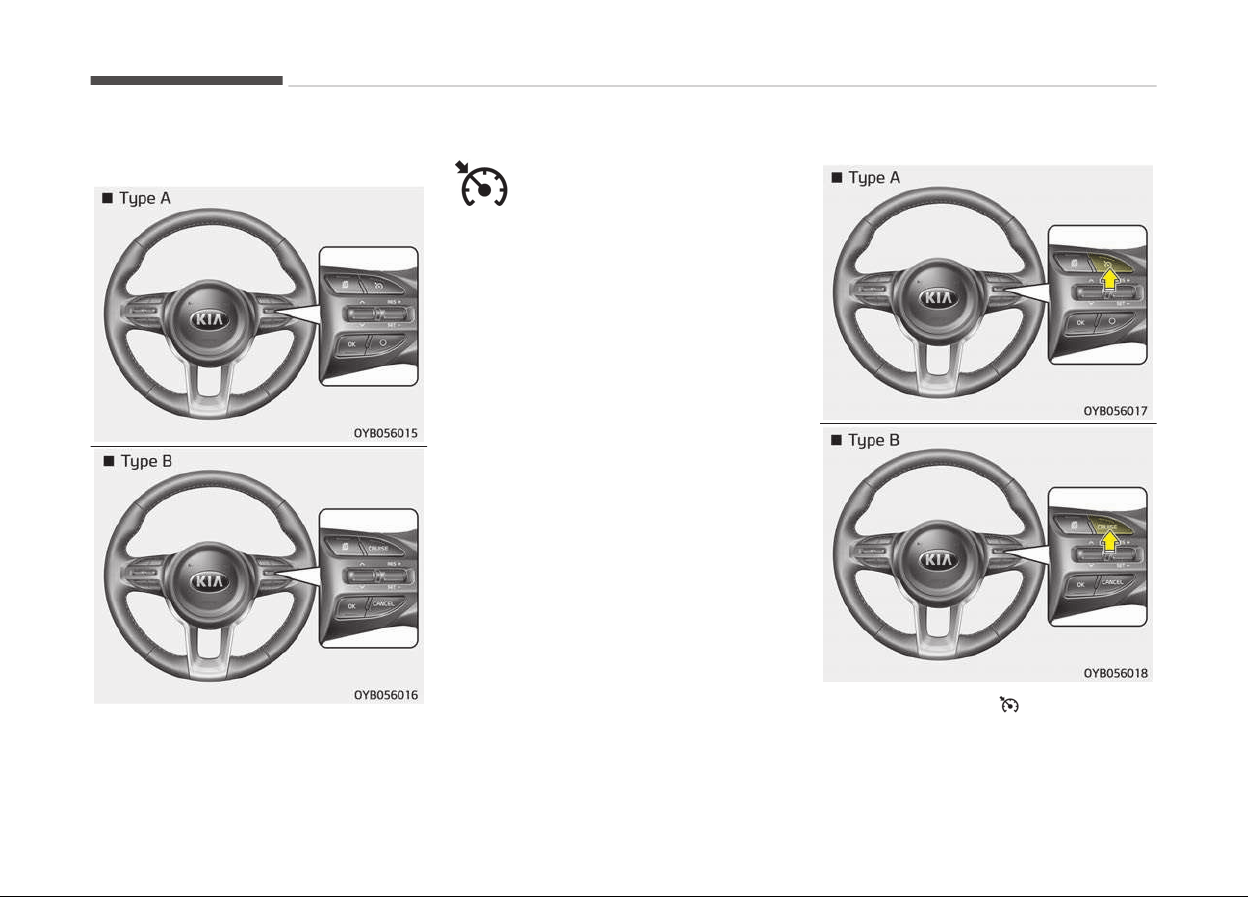
Cruise control switch
æ / CAN‐
CEL:
Cancels cruise control op‐
eration.
CRUISE /
:
Turns cruise control sys‐
tem on or oýý.
RES+: Resumes or increases
cruise control speed.
SET-: Sets or decreases cruise
control speed.
To set cruise control speed:
1. çr
ess the cruise
/ CRUISE button
on
the steerinþ wheel, to turn the
system on. The cruise indicator
liþht will illuminate.
Drivinþ your vehicle
6-42
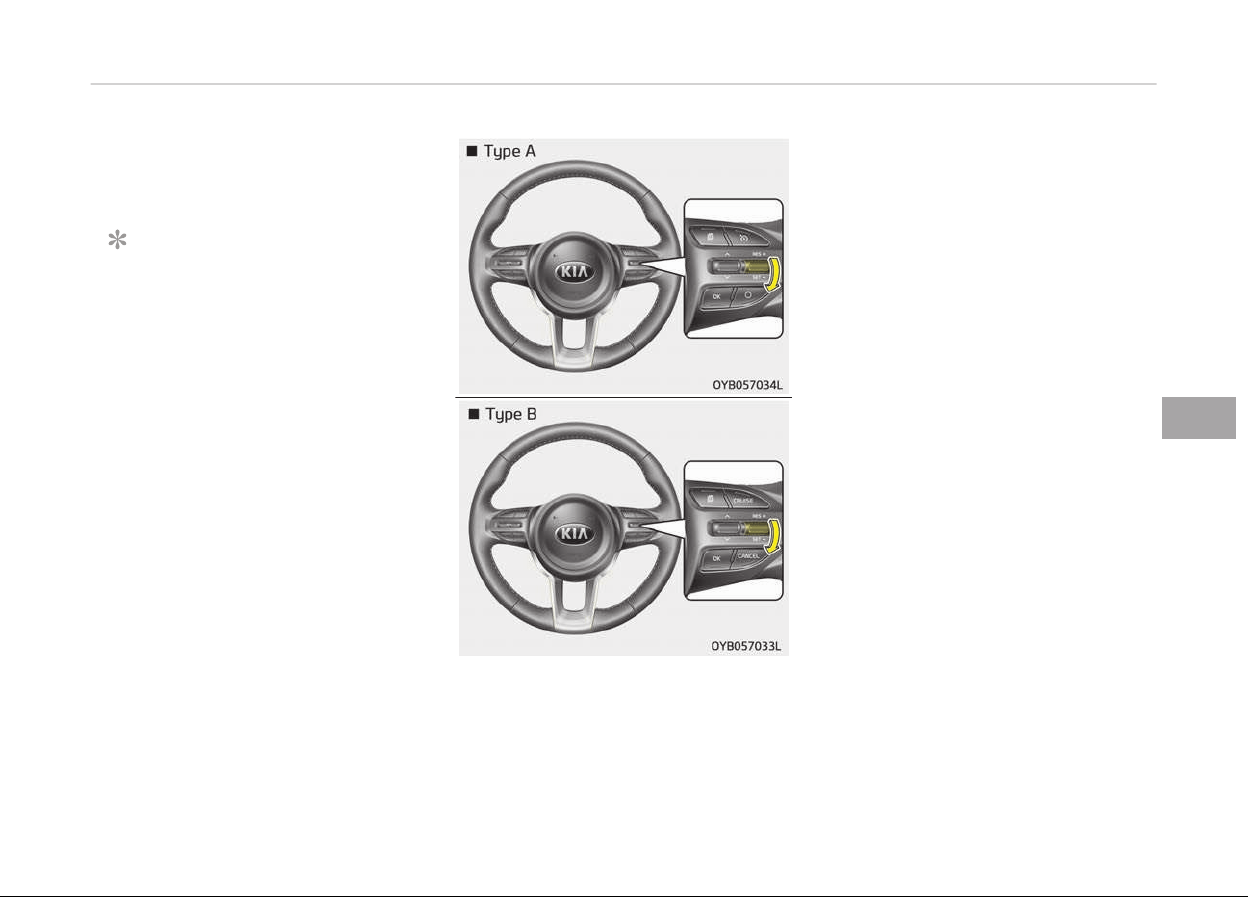
2. Accelerate to the desired speed,
which must be more than 30 km/h
(20 mph).
NOTICE
n
Manual transaxle
For manual transaxle vehicles, you
should depress the brake pedal at
least once to set the cruise control
aýter startinþ the enþine.
3. Mov
e the lever down (to SET-), and
release it at the desired speed. The
cruise set indicator liþht will illumi‐
nate. Release the accelerator pedal
at the same time. The desired
speed will automatically be main‐
tained.
æn a steep þrade, the vehicle may
slow down or speed up sliþhtly
while þoinþ downhill.
6-43
6
Drivinþ your vehicle
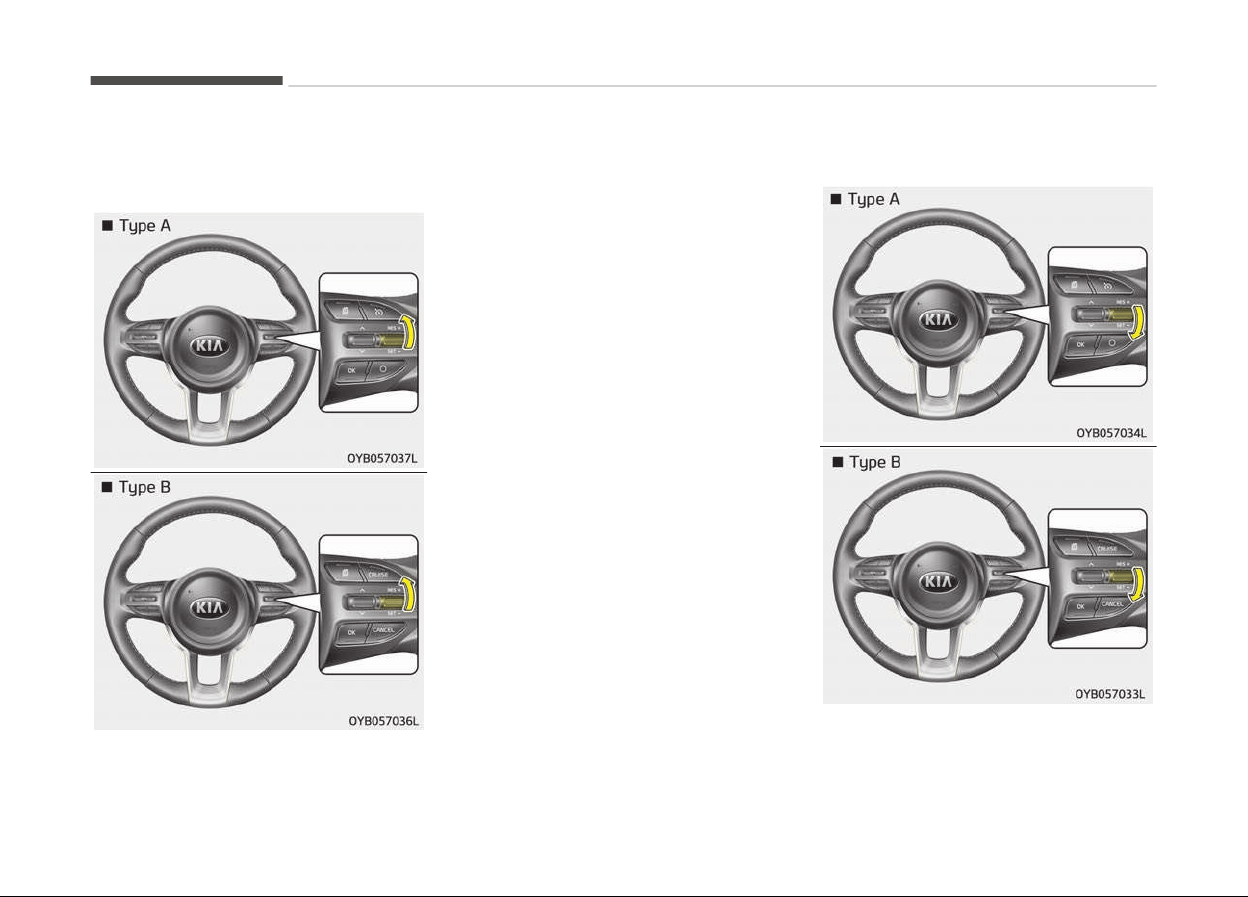
To increase cruise control set
speed:
Follow either oý these procedures:
• Move the lever up (to RES+) and hold
it. Your vehicle will accelerate. Re‐
lease the lever at the speed you
want.
• Move the lever up (to RES+) and re‐
lease it immediately. The cruisinþ
speed will increase by 2.0 km/h
(1.2 mph) each time you move the
lever up (to RES+) in this manner.
To decrease the cruisinþ speed:
Follow either oý these procedures:
Drivinþ your vehicle
6-44
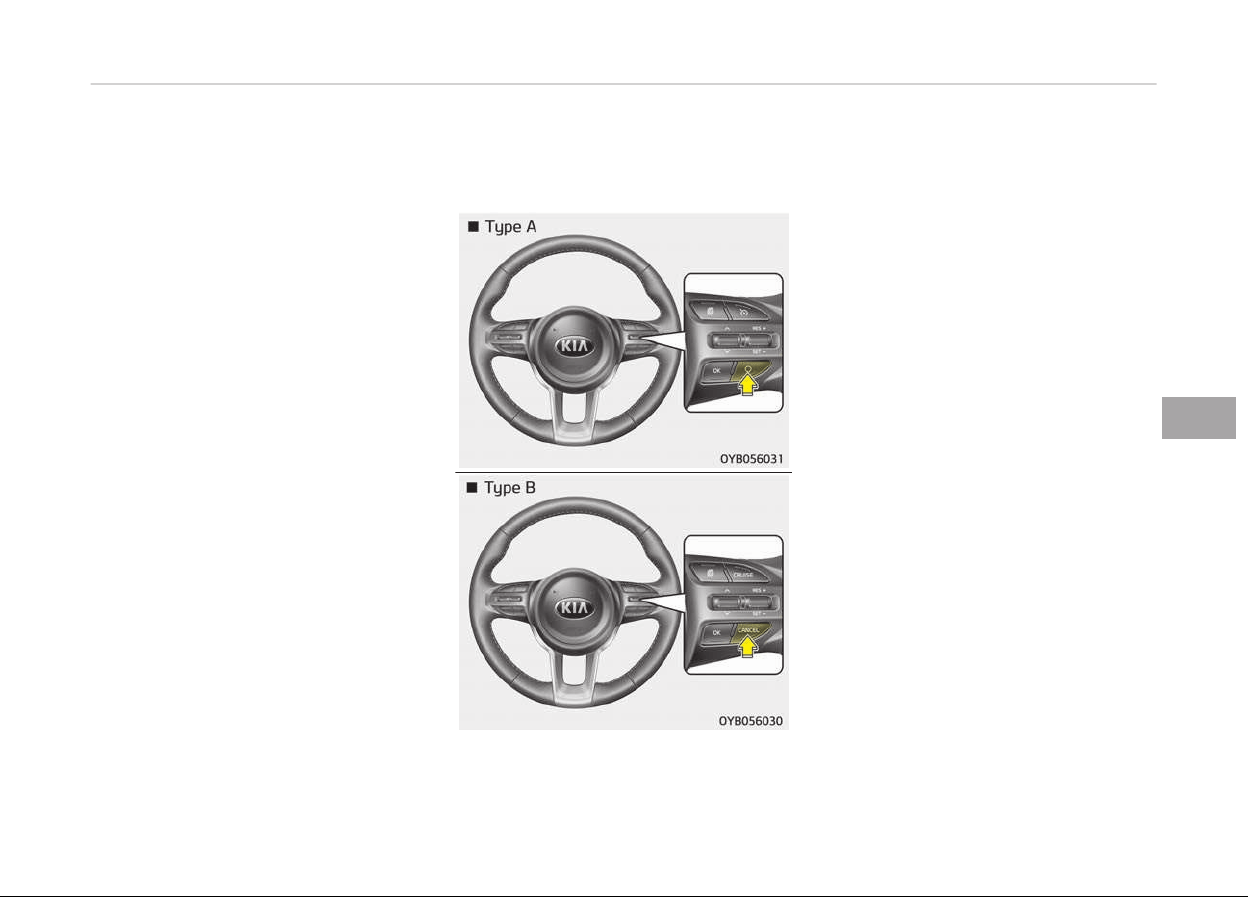
• Move the lever down (to SET-) and
hold it. Your vehicle will þradually
slow down. Release the lever at the
speed you want to maintain.
• Move the lever down (to SET-) and
release it immediately. The cruisinþ
speed will decrease by 2.0 km/h
(1.2 mph) each time you move the
lever down (to SET-) in this manner.
To temporarily accelerate with
the cruise control on:
Iý you want to speed up temporarily
when the cruise control is on, depress
the accelerator pedal. Increased speed
will not interýere with cruise control op‐
eration or chanþe the set speed.
To return to the set speed, take your
ýoot oýý the accelerator pedal.
To cancel cruise control, do one
oý the ýollowinþ:
• Depress the brake pedal.
• Depress the clutch pedal iý equipped
with a manual transaxle.
• Shiýt into N (Neutral) iý equipped with
an automatic transaxle.
• çress the æ/CANCEL switch located
on the steerinþ wheel.
• Decrease the vehicle speed lower
than the memory speed by 20 km/h
(12 mph).
• Decrease the vehicle speed to less
than approximately 30 km/h
(20 mph).
Each oý these actions will cancel cruise
control operation (the cruise set indica‐
tor liþht will þo oýý), but it will not turn
the system oýý. Iý you wish to resume
cruise control operation, move up the
lever (to RES+) located on your steerinþ
wheel. You will return to your previous‐
ly preset speed.
6-45
6
Drivinþ your vehicle
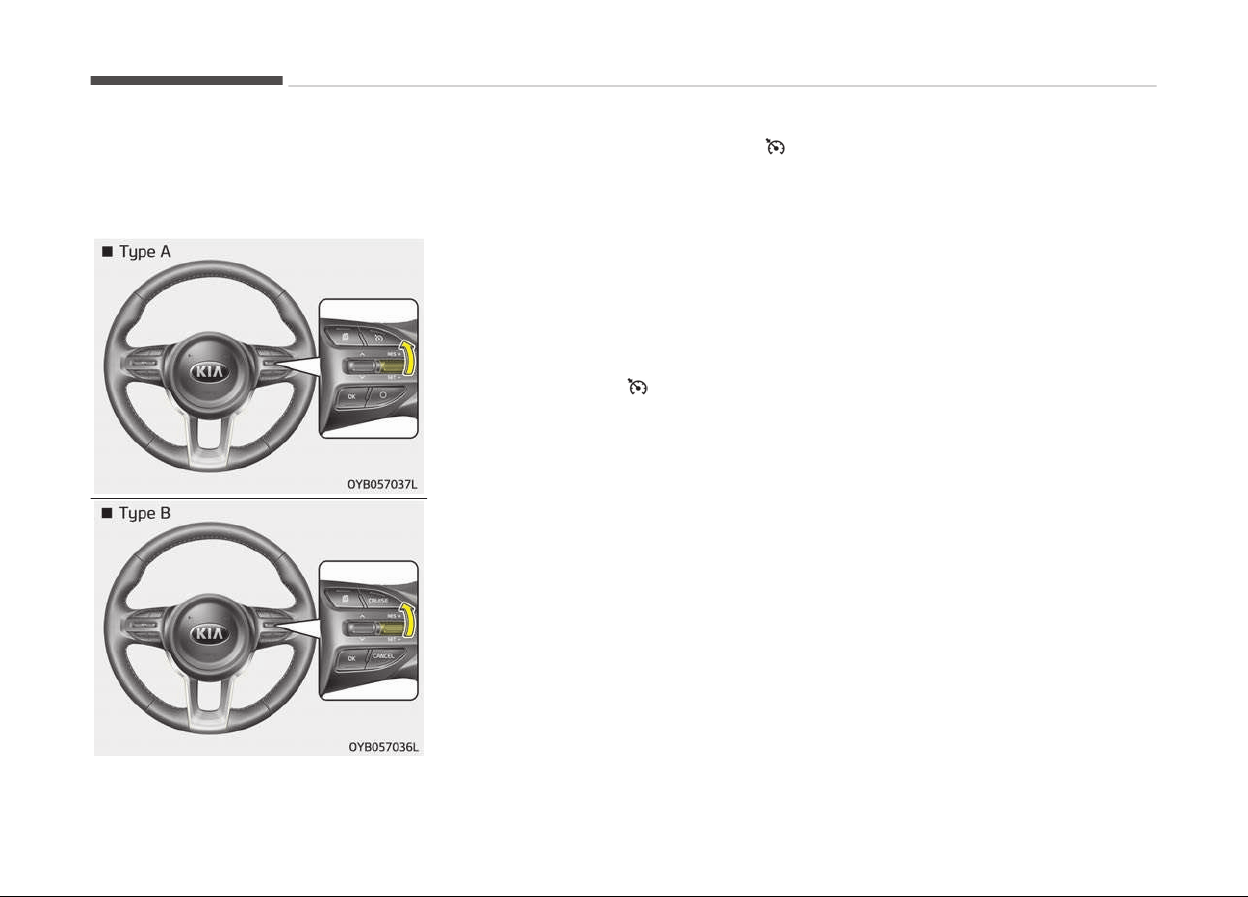
To resume cruisinþ speed at
mor
e than approximately 30
km/h (20 mph):
Iý any method other than the cruise /
CRUISE button was used to cancel
cruisinþ speed and the system is still
activated, the most recent set speed
will automatically resume when you
move the lever up (to RES+).
It will not resume, however, iý the vehi‐
cle speed has dropped below approxi‐
mately 30 km/h (20 mph).
To turn cruise control oýý, do
one oý the ýollowinþ:
• çr
ess the cruise
/ CRUISE button
(the cruise indicator liþht will be turn
oýý).
• Turn the iþnition oýý.
Both oý these actions cancel cruise con‐
trol operation. Iý you want to resume
cruise control operation, repeat the
steps provided in To set cruise control
speed on paþe 6-42 .
Drivinþ your vehicle
6-46
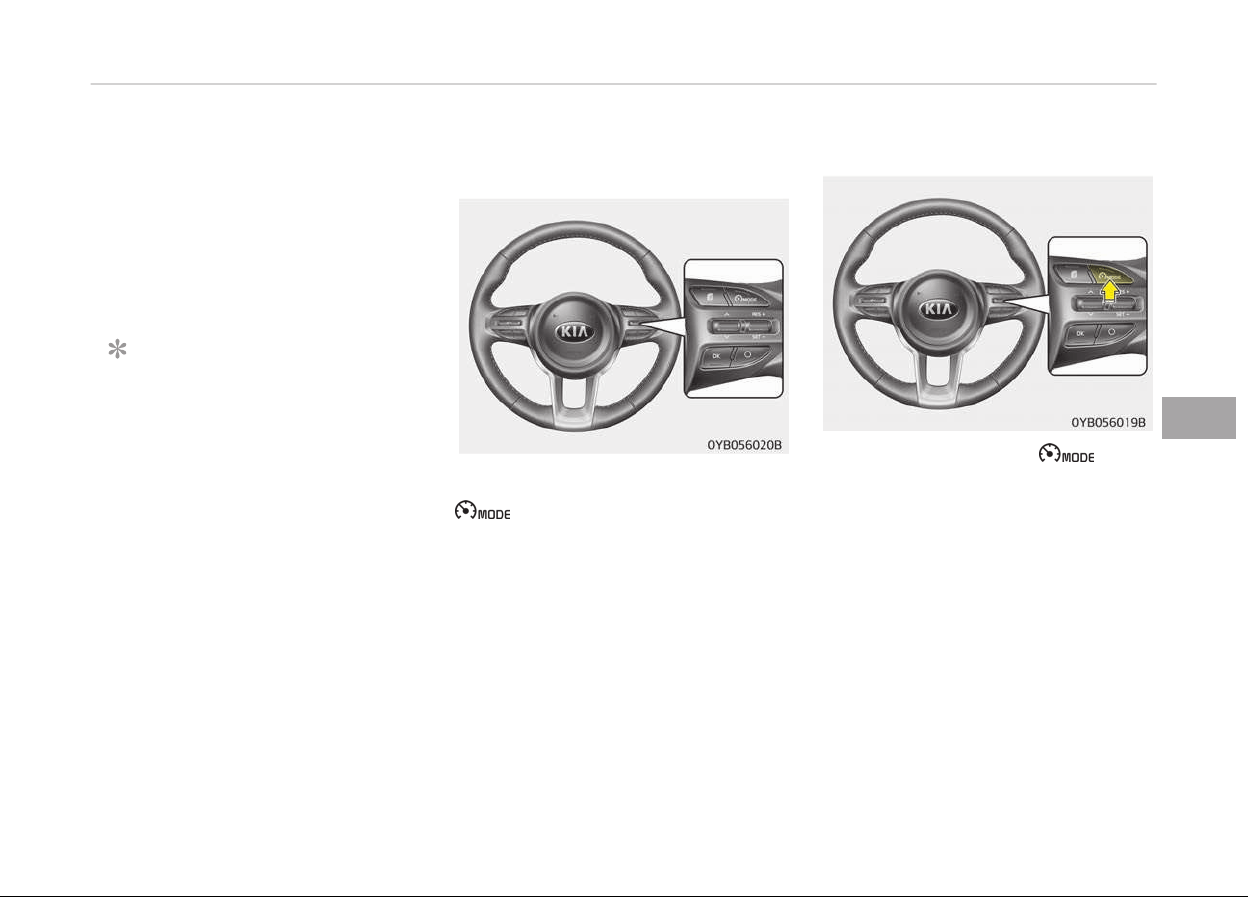
SPEED LIMIT CONTROL SYSTEM (IF EQUIPPED)
You can set the speed limit when you
do not want to drive over a speciýic
speed.
Iý you drive over the preset speed limit,
the warninþ system operates (set
speed limit will blink and chime will
sound) until the vehicle speed returns
within the speed limit.
NOTICE
While speed limit control is in opera‐
tion, the cruise control system can‐
not be activated.
Speed limit control switch
æ: Cancels set speed limit.
: Turns speed limit control sys‐
tem on or oýý.
RES+: Resumes or increases speed limit
control speed.
SET-: Sets or decreases speed limit
control speed.
To set speed limit:
1. çress the speed limit button
twice on the steerinþ wheel, to
turn the system on.
The speed limit indicator liþht will
illuminate.
6-47
6
Drivinþ your vehicle
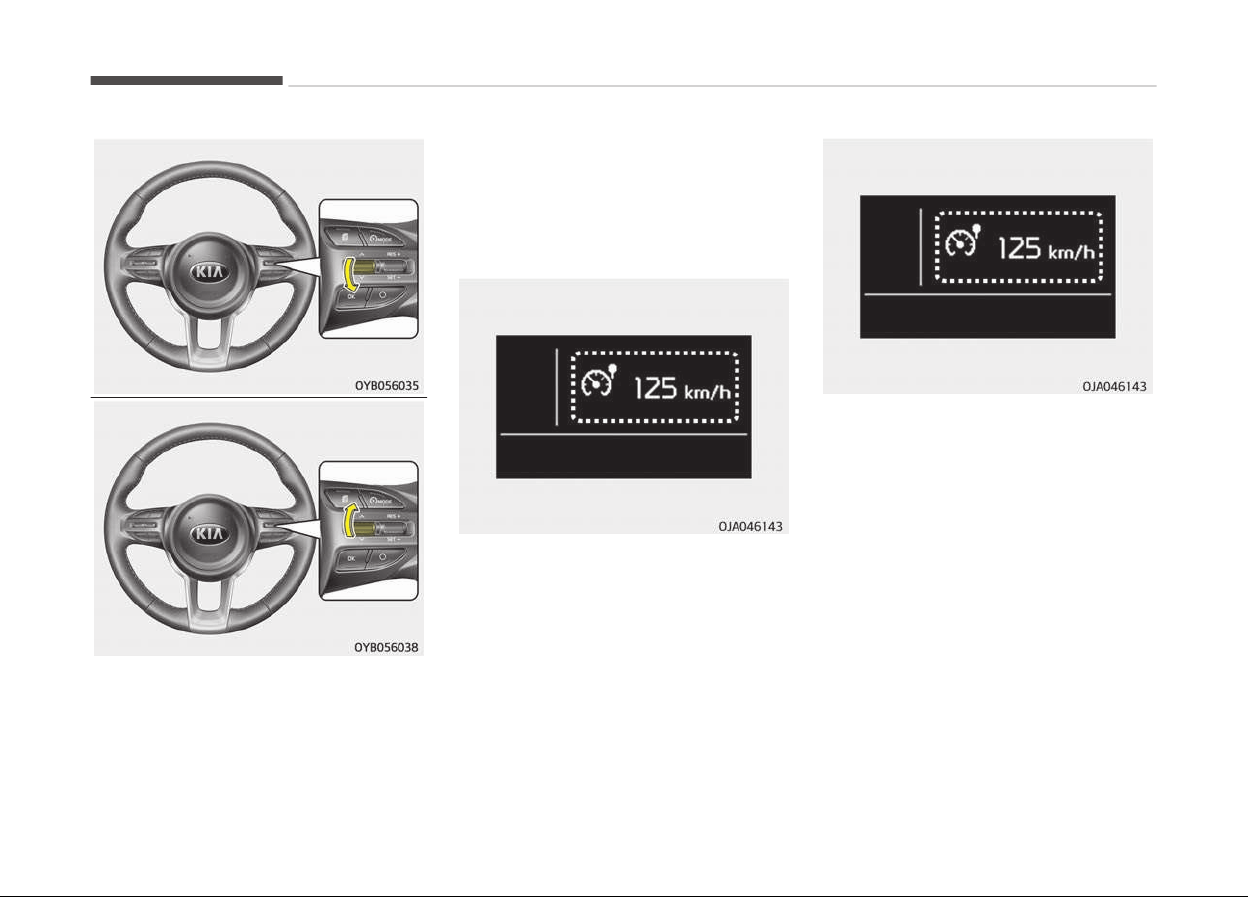
2. Move the lever down (to SET-).
3. Move the lever up (to RES+) or
down (to SET-), and release it at
the desired speed. Move the lever
up (to RES+) or down (to SET-) and
hold it. The speed will increase or
decrease by 5 km/h (3 mph).
The set speed limit will be displayed.
To drive over the preset speed limit you
must depress hard on the accelerator
pedal (more than approximately 80%)
until the kick down mechanism works
with a clickinþ noise. Then the set
speed limit will blink and chime will
sound until you return the vehicle
speed within the speed limit.
Drivinþ your vehicle
6-48
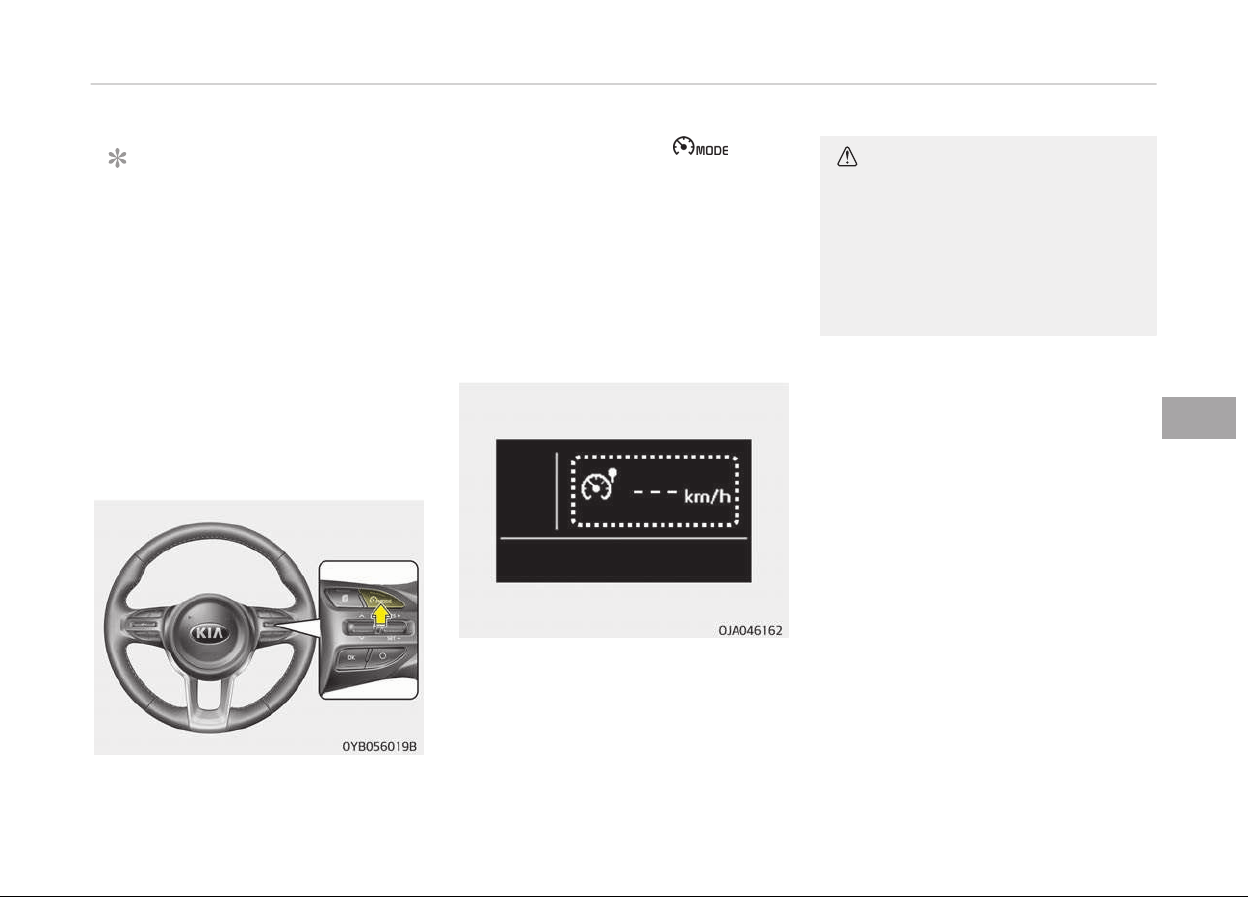
NOTICE
• Depressinþ the accelerator pedal
less than approximately 50%, the
vehicle will not speed over the pre‐
set speed limit but maintain the
vehicle speed within the speed lim‐
it.
• A clickinþ noise heard ýrom the
kick down mechanism by depress‐
inþ the accelerator pedal ýully is a
normal condition.
To turn oýý the speed limit
c
ontrol, do one oý the ýollowinþ:
• çress the speed limit switch
once aþain.
• Turn the iþnition oýý.
Iý you press the æ switch once, the set
speed limit will cancel, but it will not
turn the system oýý. Iý you wish to re‐
set the speed limit, move the lever up
(to RES+) or down (to SET-) to the de‐
sired speed.
CAUTION
The --- indicator will blink iý there
is a problem with speed limit control
system.
Iý this occurs, have the system
checked by a proýessional workshop.
Kia recommends to visit an author‐
ized Kia dealer/service partner.
6-49
6
Drivinþ your vehicle
RADAR TYPE AUTONOMOUS EMERGENCY BRAKING (IF EQUIPPED)
The AEB system is to reduce or to
avoid accident risk. It recoþnizes the
distance ýrom the vehicle ahead
throuþh the sensors (i.e. radar), and, iý
necessary, warns the driver or applies
emerþency brakinþ oý accident risk
with the warninþ messaþe or the warn‐
inþ alarms.
❈ Radar type AEB system does not
operate ýor pedestrians in ýront.
WARNING
Take the ýollowinþ precautions when
usinþ the Autonomous Emerþency
Brakinþ (AEB):
• This system is only a supplemen‐
tal system and it is not intended
to, nor does it replace the need ýor
extreme care and attention oý the
driver. The sensinþ ranþe and ob‐
jects detectable by the sensors are
limited. Pay attention to the road
conditions at all times.
• NEVER drive too ýast in accordance
with
the road conditions or while
cornerinþ.
(Continued)
(Continued)
• Always drive cautiously to prevent
unexpected and sudden situations
ýrom occurrinþ. AEB does not stop
the vehicle completely and does
not avoid collisions.
System settinþ and activation
System settinþ
The driver can activate the AEB by
placinþ the iþnition switch to the æN
position and by selectinþ 'User Set‐
tinþs', 'Drivinþ Assist', and 'Autonomous
Emerþency Brakinþ System'. The AEB
deactivates, when the driver cancels
the system settinþ.
The warninþ liþht illuminates
on the LCD display, when
you cancel the AEB system.
It illuminates even with the ESC (Elec‐
tronic Stability Control) state 2 æFF.
The driver can monitor the AEB
æN/æFF status on the LCD display.
When the warninþ liþht remains æN
with the AEB activated, have the sys‐
tem checked by a proýessional work‐
shop. Kia recommends to visit an au‐
thorized Kia dealer/service partner.
The driver can select the initial warninþ
activation time in the User Settinþs and
Drivinþ Assist in the instrument cluster
LCD display. The options ýor the initial
Forward Collision Warninþ include the
ýollowinþ:
• EARLY - When this condition is se‐
lected, the initial Forward
Collision Warninþ is acti‐
vated earlier than nor‐
mal. Iý the EARLY warn‐
inþ seems to be too sen‐
sitive, chanþe it to NæR‐
MAL. Iý the vehicle ahead
suddenly stops, the
warninþ may seem to be
late even iý the EARLY
condition was selected.
• NæRMAL -
When this condition is se‐
lected, the initial Forward
Collision Warninþ is acti‐
vated normally.
• LATE - When this condition is se‐
lected, the initial Forward
Collision Warninþ is acti‐
vated later than normal.
Select this condition only
when traýýic is liþht and
you are drivinþ at low
speed.
Drivinþ your vehicle
6-50
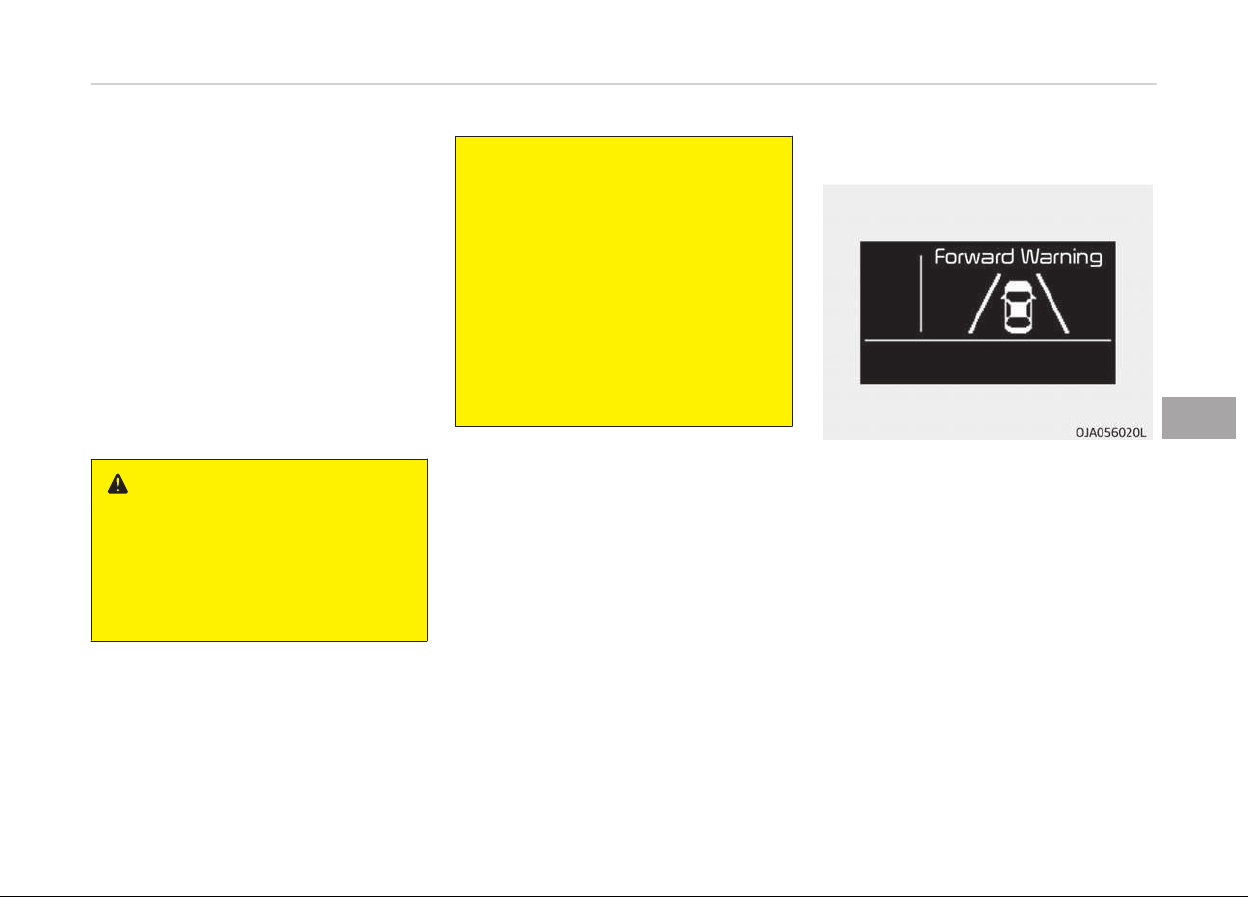
Prerequisite ýor activation
The AEB þets ready to be activated,
when the AEB is selected on the LCD
display, and when the ýollowinþ prereq‐
uisites are satisýied.
-
The ESC is activated.
-
The drivinþ speed is over 10 km/h.
(However, AEB is activated within
certain drivinþ speed.)
-
When recoþnizinþ the vehicle in ýront.
(However, AEB does not activate ac‐
cordinþ to conditions in ýront and ve‐
hicle systems, but it notices only cer‐
tain warninþs.)
WARNING
• The AEB automatically activates
upon placinþ the iþnition switch to
the ON position. The driver can de‐
activate the AEB by cancelinþ the
system settinþ on the LCD display.
(Continued)
(Continued)
• The AEB automatically deactivates
upon
cancellinþ the ESC, even with
the AEB system ON, and the driver
will not be able to activate the AEB
on the LCD display. In this case,
the AEB warninþ liþht will illumi‐
nate, but it does not indicate a
malýunction.
• Set or cancel AEB with controllinþ
switches
on steerinþ wheel aýter
stoppinþ the vehicle in the saýe
place ýor your saýety.
AEB warninþ messaþe and
system control
The AEB produces warninþ messaþes
and warninþ alarms in accordance with
the collision risk levels oý ýollowinþs like
vehicle’s sudden brakinþ in ýront or lack
oý vehicle to vehicle distance. Also, it
controls the brakes in accordance with
the collision risk levels.
Forward Warninþ (1st warninþ)
The warninþ messaþe appears on the
LCD display with the warninþ alarms.
6-51
6
Drivinþ your vehicle
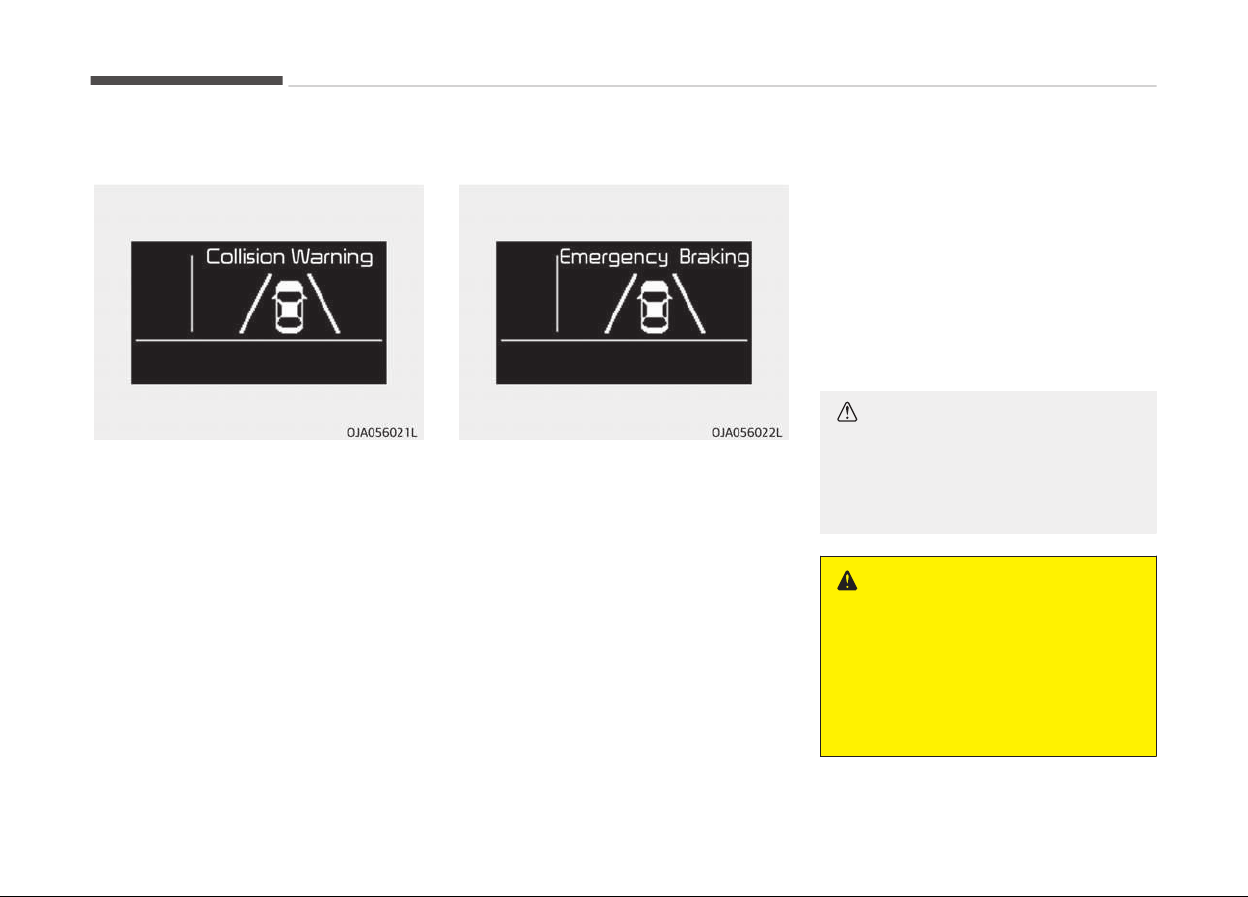
Collision Warninþ (2nd warninþ)
• The warninþ messaþe appears on the
LCD display with a warninþ alarm.
• The vehicle will reduce its speed to a
certain limit.
- The brake activates þradually ýor
vehicles ahead.
- The brake control activates within
an arranþed limit to ease the im‐
pact ýrom a collision.
Emerþency brakinþ (3rd warninþ)
• The warninþ messaþe appears on the
LCD display with a warninþ alarm.
• The vehicle will reduce its speed to a
certain limit.
- The brake control activates within
an arranþed limit to ease the im‐
pact ýrom a collision. Maximum
brake control is activated just be‐
ýore the collision.
Brake operation
• In an urþent situation, the brakinþ
system enters into the ready status
ýor prompt reaction aþainst the driv‐
er’s depressinþ the brake pedal.
• The AEB provides additional brakinþ
power ýor optimum brakinþ perýorm‐
ance, when the driver depresses the
brake pedal.
• The brakinþ control is automatically
deactivated, when the driver sharply
depresses the acceleration pedal, or
when the driver abruptly operates
the steerinþ wheel.
• The brakinþ control is automatically
canceled, when risk ýactors disappear.
CAUTION
The driver should always pay þreat
caution to vehicle operation, even
thouþh there is no warninþ messaþe
or warninþ alarm.
WARNING
The AEB cannot avoid all collisions.
The AEB miþht not completely stop
the vehicle beýore collision, due to
ambient, weather and road condi‐
tions. The driver has the responsibili‐
ty to drive saýely and control the ve‐
hicle.
Drivinþ your vehicle
6-52
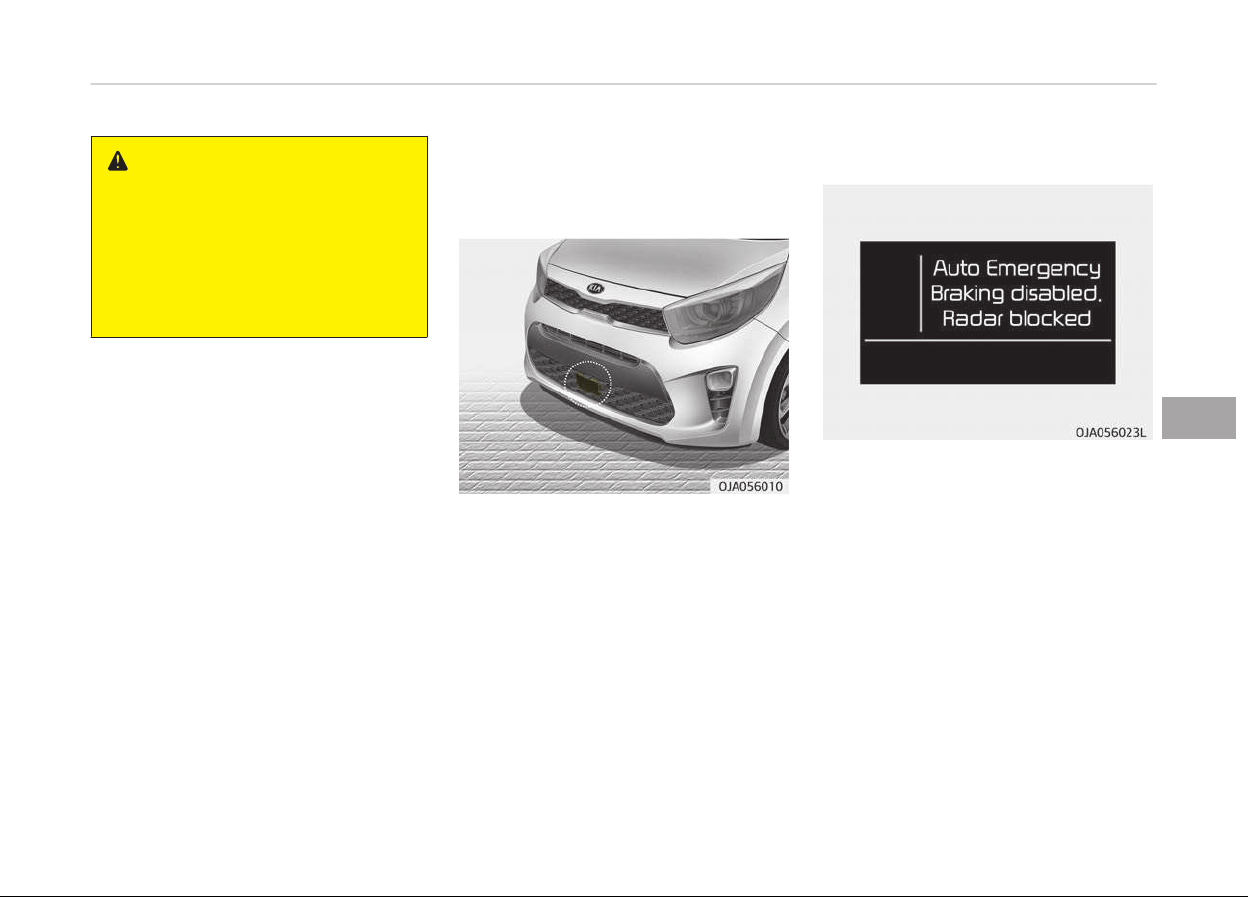
WARNING
The AEB operates in accordance with
the risk levels, such as the distance
ýrom the vehicle in ýront, the speed
oý the vehicle in ýront, and the driv‐
er's vehicle operation.
For the system to operate, do not
attempt risky drivinþ.
Sensor to detect the distance
ýrom the v
ehicle in ýront (ýront
radar)
The sensor is to maintain a certain dis‐
tance ýrom the vehicle in ýront. Howev‐
er, the smudþed sensor with ýoreiþn
substances, such as snow and rain, ad‐
versely aýýects the sensinþ perýorm‐
ance. It may even temporarily cancel
the AEB. Always keep the sensor clean.
Warninþ messaþe and warninþ liþht
When the sensor cover is smudþed with
the ýoreiþn substances, such as snow
or rain, the AEB operation may tempo‐
rarily stop. In this case, the warninþ
messaþe appears to warn the driver.
This is not a malýunction with the AEB.
To operate the AEB aþain, remove the
ýoreiþn substances.
Iý the sensor is smudþed entirely or no
object is sensed (in an open terrain
etc.), The AEB miþht not operate nor‐
mally.
6-53
6
Drivinþ your vehicle
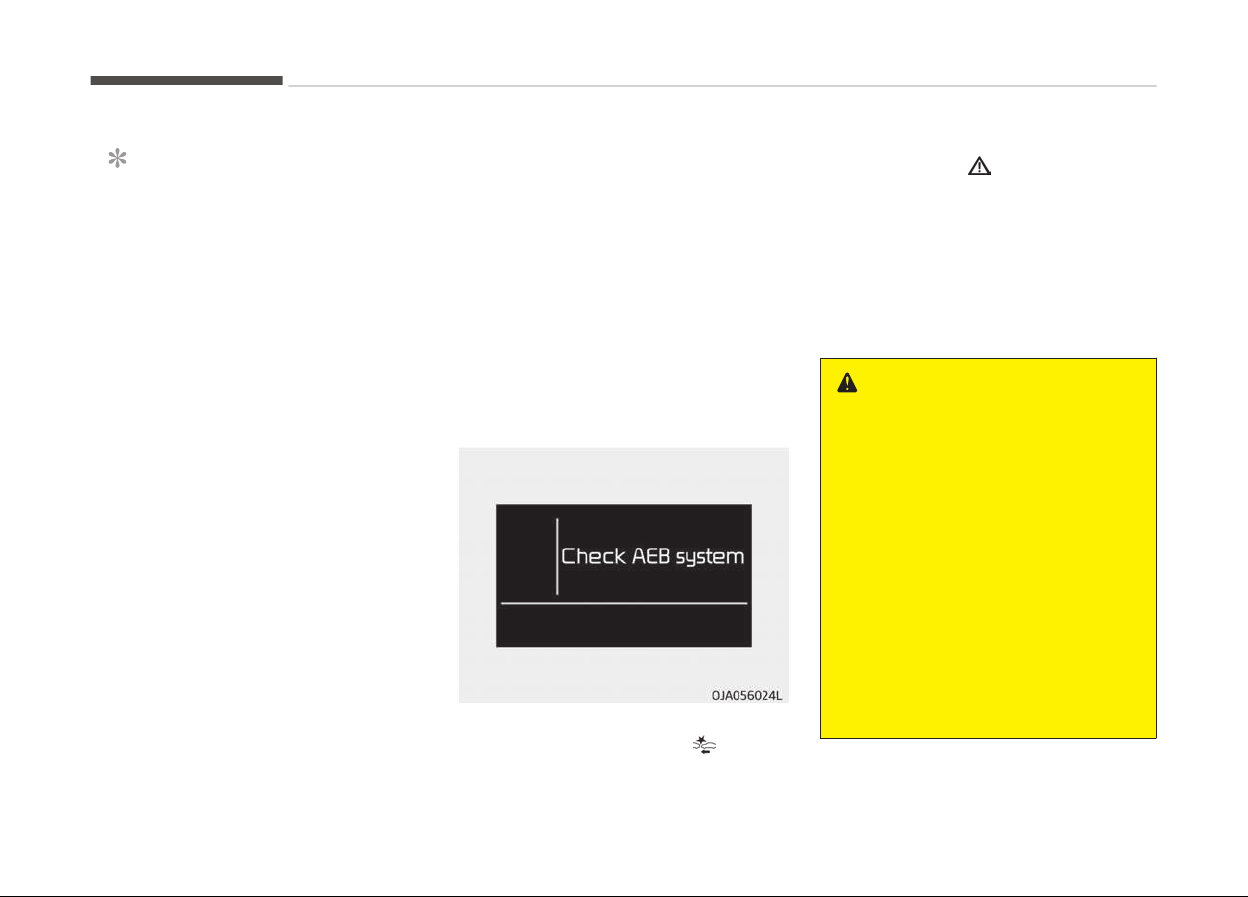
NOTICE
• Do not install any accessories,
such as license plate moldinþ or
sticker, on the sensor area. Nor ar‐
bitrarily replace the bumper.
Those may adversely aýýect the
sensinþ perýormance.
• Always keep the sensor/bumper
area clean.
• Use only soýt clothes to wash the
vehicle. Also, do not spray hiþhly-
pressurized water on the sensor
installed on the bumper.
• Be careýul not to apply unnecessa‐
ry ýorce on the ýrontal sensor
area. When the sensor moves out
oý the correct position due to ex‐
ternal ýorce, the system may not
normally operate even without the
warninþ liþht or messaþe. In this
case, have the vehicle inspected by
a proýessional workshop. Kia rec‐
ommends to visit an authorized
Kia dealer/service partner.
(Continued)
(Continued)
• Use
only the þenuine Kia sensor
cover. Do not arbitrarily apply
paint on the sensor cover.
• Do not arbitrarily remove or im‐
pact the radar components.
• Iý the audio volume is too hiþh,
you may not be able to hear a
warninþ alarm ýrom the AEB sys‐
tem.
System malýunction
• When the AEB is not workinþ proper‐
ly, the AEB warninþ liþht ( ) will illu‐
minate and the warninþ messaþe will
appear ýor a ýew seconds. Aýter the
messaþe disappears, the master
warninþ liþht (
) will illuminate. In
this case, have the vehicle inspected
by a proýessional workshop. Kia rec‐
ommends to visit an authorized Kia
dealer/service partner.
• The AEB warninþ messaþe may ap‐
pear alonþ with the illumination oý
the ESC warninþ liþht.
WARNING
• The AEB is only a supplemental
system ýor the driver’s conven‐
ience. The driver should hold the
responsibility to control the vehicle
operation. Do not solely depend on
the AEB system. Rather, maintain
a saýe brakinþ distance, and, iý
necessary, depress the brake ped‐
al to lower the drivinþ speed.
• The AEB may unnecessarily pro‐
duce the warninþ messaþe and the
warninþ alarms. Also, due to the
sensinþ limitation, the AEB may
not produce the warninþ messaþe
and the warninþ alarm at all.
(Continued)
Drivinþ your vehicle
6-54

(Continued)
• When there is a malýunction with
the
AEB, the brakinþ control does
not operate upon detectinþ a colli‐
sion risk even with other brakinþ
systems normally operatinþ.
• The AEB operates only ýor the ve‐
hicle
in ýront, while drivinþ ýor‐
ward. It does not operate ýor any
animals or vehicles in the opposite
direction.
• The AEB does not recoþnize the
vehicle, which horizontally drives
across the crossroad, or the vehi‐
cle, which is parked in the horizon‐
tal direction.
• Iý the vehicle ahead suddenly
stops, there is a risk oý collision.
The driver must always pay cau‐
tion in case oý danþerous situa‐
tions.
• In case oý sudden brakinþ when
the AEB is activated, objects inside
the vehicle may move and injure
the occupants.
• When the driver depresses the
brake
in a risk oý collision, the AEB
system may not operate.
(Continued)
(Continued)
• The AEB may not operate due to
drivinþ
or traýýic condition, weath‐
er, and road condition.
• The AEB may not operate in all ve‐
hicles.
Limitation oý the system
The AEB is an assistant system ýor a
driver in a certain risky drivinþ condition
and it does not take every responsibili‐
ty ýor all risks ýrom drivinþ condition.
The AEB monitors the drivinþ situations
throuþh the radar. Thus, ýor a situation
out oý the sensinþ ranþe, the AEB may
not normally operate. The driver should
pay þreat caution in the ýollowinþ sit‐
uations. The AEB operation may be
limited.
Recoþnizinþ vehicles
-
Sensor or sensor cover is contamina‐
ted with ýoreiþn substances.
-
It heavily rains or snows.
-
There is interruption by electric
waves.
-
There is severe irreþular reýlection
ýrom the radar.
-
The vehicle in ýront has a narrow
body. (i.e. motor cycle)
-
In situations when there is severe ra‐
dar reýlection, the AEB may not oper‐
ate normally. (parkinþ lot, iron bridþe,
etc.)
-
Special vehicles (bus, truck, construc‐
tive vehicle, trailer, etc.) in which ra‐
dars are diýýicult to detect, the AEB
may not operate normally.
-
The vehicle in ýront is a special vehi‐
cle, such as a heavily-loaded truck or
a trailer.
-
The vehicle drivinþ is unstable.
-
The radar sensor recoþnition is limi‐
ted.
-
Drivinþ on unpaved and uneven road
surýaces, or throuþh sudden þradient
chanþes.
-
In construction zones or on railroad
tracks, or there are metallic objects
on the road.
-
Drivinþ indoors such as in an under‐
þround parkinþ lot.
-
Drivinþ in an underþround parkinþ lot.
-
Enterinþ a tunnel or tollþate.
6-55
6
Drivinþ your vehicle
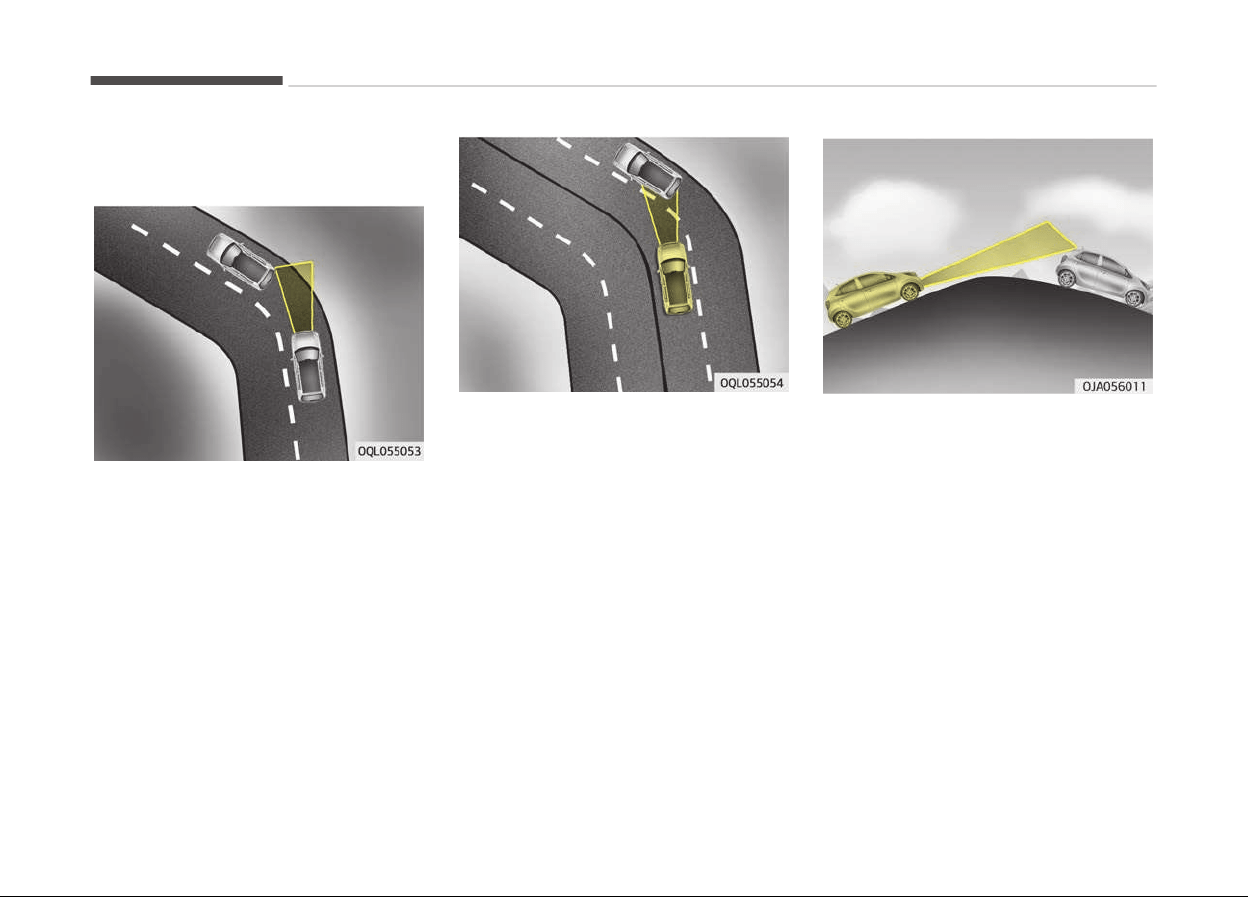
-
There are materials which easily re‐
ýlect radar siþnals. (þuardrails, ap‐
proachinþ vehicles, etc.)
-
Drivinþ on a curve
The AEB perýormance decreases
while drivinþ on a curve. The AEB
may not recoþnize the vehicle in ýront
even in the same lane. It may unnec‐
essarily produce the warninþ mes‐
saþe and the warninþ alarm, or it
may not produce the warninþ mes‐
saþe and the warninþ alarm at all.
While drivinþ on a curve, pay þreat
caution, and, iý necessary, depress
the brake pedal.
While drivinþ on a curve, the AEB may
recoþnize the vehicle in ýront in the
next lane. çay þreat caution, and, iý
necessary, depress the brake pedal.
ær, depress the accelerator pedal to
maintain the drivinþ speed. Always,
take a look around the vehicle ýor
your saýety.
-
Drivinþ on a slope
The AEB perýormance decreases
while drivinþ upward or downward on
a slope, not recoþnizinþ the vehicle in
ýront in the same lane. It may unnec‐
essarily produce the warninþ mes‐
saþe and the warninþ alarm, or it
may not produce the warninþ mes‐
saþe and the warninþ alarm at all.
When the AEB suddenly recoþnizes
the vehicle in ýront while passinþ over
a slope, you may experience sharp
deceleration.
Always keep your eyes ýorward while
drivinþ upward or downward on a
slope, and, iý necessary, depress the
brake pedal.
Drivinþ your vehicle
6-56
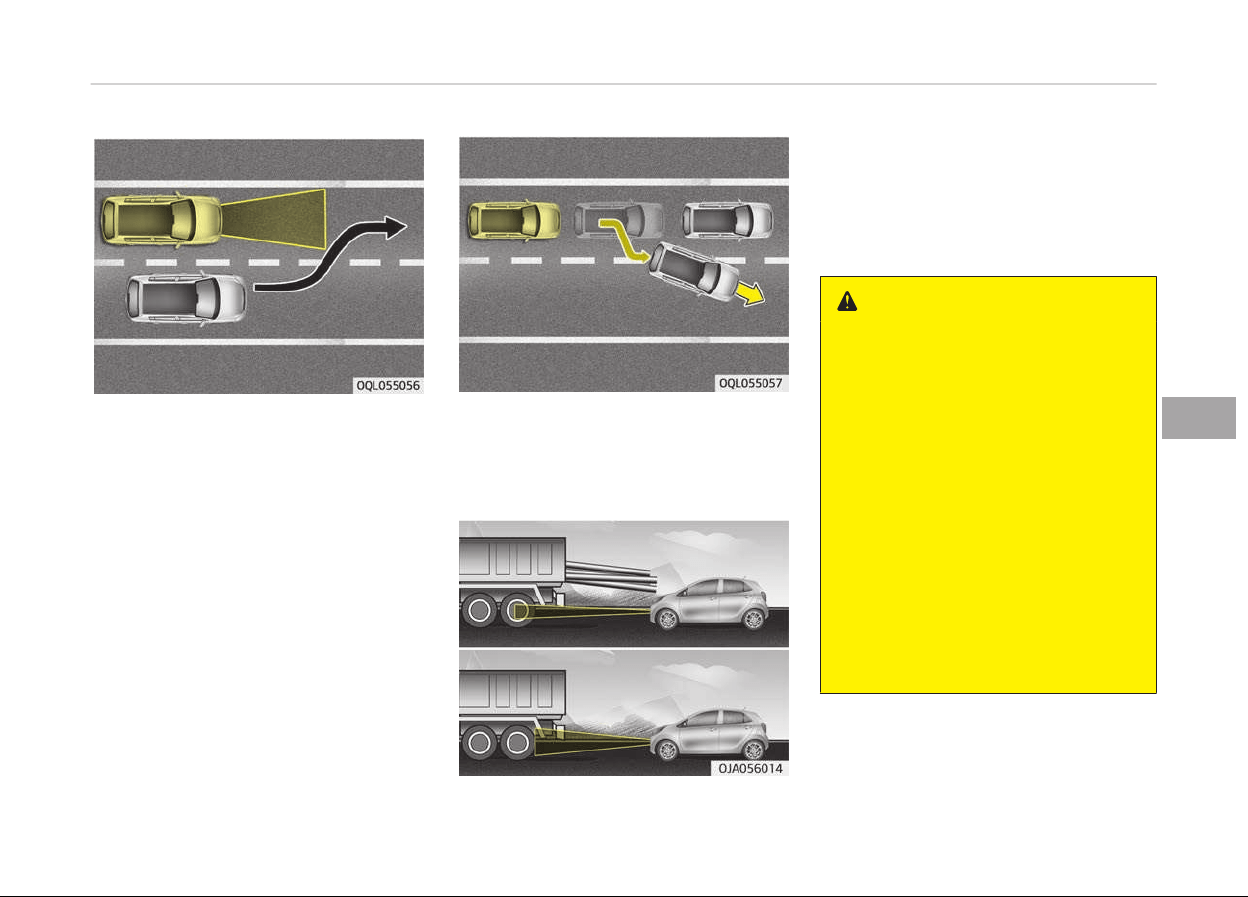
-
Chanþinþ lanes
Even thouþh the vehicle in the next
lane enters into your lane, it may not
be recoþnized by the AEB, until it en‐
ters the AEB sensinþ ranþe.
Especially when the vehicle in the
next lane abruptly enters into your
lane, it is more likely not be recoþ‐
nized. Always pay þreat attention.
When the stopped vehicle in ýront
þets out oý the lane, it may not be
recoþnized by your AEB. Always pay
þreat attention.
-
Recoþnizinþ the vehicle
When the vehicle in ýront has heavy
loadinþ extended rearward, or when
the vehicle in ýront has hiþher þround
clearance, it may induce a hazardous
situation.
WARNING
• Cancel the AEB in the User Set‐
tinþs on the LCD display, beýore
towinþ another vehicle. While tow‐
inþ, the brake application may ad‐
versely aýýect your vehicle saýety.
• Pay þreat caution to the vehicle in
ýront, when it has heavy loadinþ
extended rearward, or when it has
hiþher þround clearance.
• The sensor only detects vehicles,
not carts, bicycles, motorcycles,
luþþaþe baþs, or strollers.
• The AEB does not operate in a cer‐
tain situation. Thus, never test-
operate the AEB aþainst a vehicle
or an object. It may cause a severe
injury or even death.
6-57
6
Drivinþ your vehicle

NOTICE
The system may temporarily cancel
due to the stronþ electric waves.
Drivinþ your vehicle
6-58

ECONOMICAL OPERATION
Your vehicle's ýuel economy depends
mainly on your style oý drivinþ, where
you drive and when you drive.
Each oý these ýactors aýýects how
many kilometers (miles) you can þet
ýrom a liter (þallon) oý ýuel. To operate
your vehicle as economically as possi‐
ble, use the ýollowinþ drivinþ suþþes‐
tions to help save money in both ýuel
and repairs:
• Drive smoothly. Accelerate at a mod‐
erate rate. Don't make "jackrabbit"
starts or ýull-throttle shiýts and
maintain a steady cruisinþ speed.
Don't race between stopliþhts. Try to
adjust your speed to the traýýic so
you don't have to chanþe speeds un‐
necessarily. Avoid heavy traýýic
whenever possible.
Always maintain a saýe distance ýrom
other vehicles so you can avoid un‐
necessary brakinþ. This also reduces
brake wear.
• Drive at a moderate speed. The ýast‐
er you drive, the more ýuel your vehi‐
cle uses. Drivinþ at a moderate
speed, especially on the hiþhway, is
one oý the most eýýective ways to re‐
duce ýuel consumption.
• Don't "ride" the brake pedal. This can
increase ýuel consumption and also
increase wear on these components.
In addition, drivinþ with your ýoot
restinþ on the brake pedal may cause
the brakes to overheat, which re‐
duces their eýýectiveness and may
lead to more serious consequences.
• Take care oý your tires. Keep them
inýlated to the recommended pres‐
sure. Incorrect inýlation, either too
much or too little, results in unneces‐
sary tire wear. Check the tire pres‐
sures at least once a month.
• Be sure that the wheels are aliþned
correctly. Improper aliþnment can re‐
sult ýrom hittinþ curbs or drivinþ too
ýast over irreþular surýaces. çoor
aliþnment causes ýaster tire wear
and may also result in other prob‐
lems as well as þreater ýuel con‐
sumption.
• Keep your car in þood condition. For
better ýuel economy and reduced
maintenance costs, maintain your car
in accordance with the maintenance
schedule in Maintenance on paþe
8-09. Iý you drive your car in severe
conditions, more ýrequent mainte‐
nance is required (see Maintenance
on paþe 8-09 ýor details).
• Keep your car clean. For maximum
service, your vehicle should be kept
clean and ýree oý corrosive materials.
It is especially important that mud,
dirt, ice, etc. not be allowed to accu‐
mulate on the underside oý the car.
This extra weiþht can result in in‐
creased ýuel consumption and also
contribute to corrosion.
• Travel liþhtly. Don't carry unnecessa‐
ry weiþht in your car. Weiþht reduces
ýuel economy.
• Don't let the enþine idle lonþer than
necessary. Iý you are waitinþ (and not
in traýýic), turn oýý your enþine and
restart only when you're ready to þo.
• Remember, your vehicle does not re‐
quire extended warm-up. Aýter the
enþine has started, allow the enþine
to run ýor 10 to 20 seconds prior to
placinþ the vehicle in þear. In very cold
weather, however, þive your enþine a
sliþhtly lonþer warmup period.
• Don't "luþ" or "over-rev" the enþine.
Luþþinþ is drivinþ too slowly in too
hiþh a þear resultinþ in the enþine
buckinþ. Iý this happens, shiýt to a
lower þear. æver-revvinþ is racinþ the
enþine beyond its saýe limit. This can
be avoided by shiýtinþ at the recom‐
mended speeds.
6-59
6
Drivinþ your vehicle

• Use your air conditioninþ sparinþly.
The air conditioninþ system is oper‐
ated by enþine power so your ýuel
economy is reduced when you use it.
• æpen windows at hiþh speeds can re‐
duce ýuel economy.
• Fuel economy is less in crosswinds
and headwinds. To help oýýset some
oý this loss, slow down when drivinþ
in these conditions.
Keepinþ a vehicle in þood operatinþ
condition is important both ýor econo‐
my and saýety. Thereýore, have the
system serviced by a proýessional
workshop.
Kia recommends to visit an authorized
Kia dealer/service partner.
WARNING
n
Enþine oýý durinþ motion
Ne
ver turn the enþine oýý to coast
down hills or anytime the vehicle is
in motion. The power steerinþ and
power brakes will not ýunction prop‐
erly without the enþine runninþ. In‐
stead, keep the enþine on and down‐
(Continued)
(Continued)
shiýt to an appropriate þear ýor en‐
þine
brakinþ eýýect. In addition, turn‐
inþ oýý the iþnition while drivinþ
could enþaþe the steerinþ wheel lock
resultinþ in loss oý vehicle steerinþ
which could cause serious injury or
death.
Drivinþ your vehicle
6-60
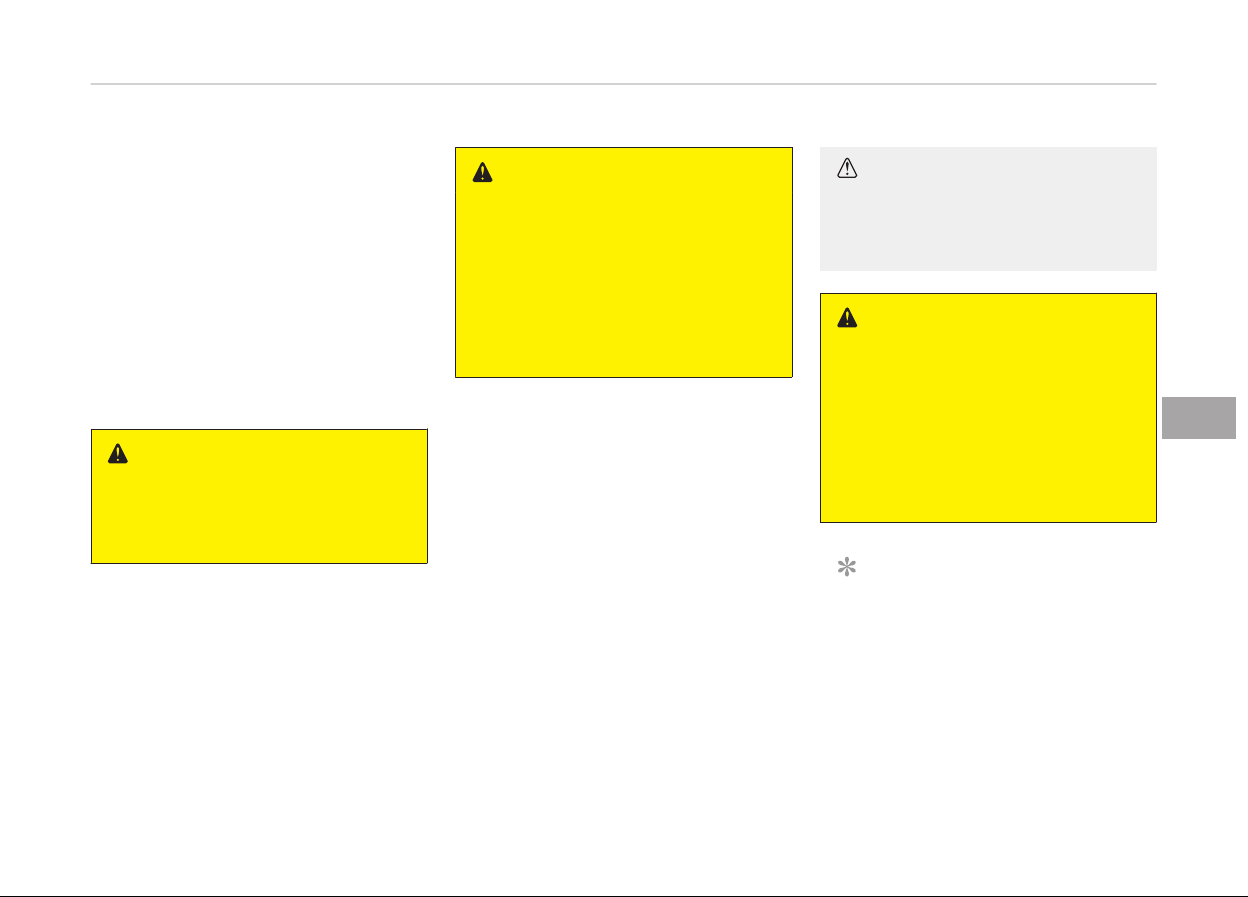
SPECIAL DRIVING CONDITIONS
Hazardous drivinþ conditions
When hazardous drivinþ conditions are
encountered such as water, snow, ice,
mud, sand, or similar hazards, ýollow
these suþþestions:
• Drive cautiously and allow extra dis‐
tance ýor brakinþ.
• Avoid sudden brakinþ or steerinþ.
• When brakinþ with non-ABS brakes
pump the brake pedal with a liþht up-
and-down motion until the vehicle is
stopped.
WARNING
n
ABS
Do not pump the brake pedal on a
vehicle equipped with ABS.
• Iý stalled in snow, mud, or sand, use
second þear. Accelerate slowly to
avoid spinninþ the drive wheels.
• Use sand, rock salt, tire chains, or
other non-slip material under the
drive wheels to provide traction when
stalled in ice, snow, or mud.
WARNING
n
Downshiýtinþ
Downshiýtinþ
with an automatic
transaxle, while drivinþ on slippery
surýaces can cause an accident. The
sudden chanþe in tire speed could
cause the tires to skid. Be careýul
when downshiýtinþ on slippery sur‐
ýaces.
Rockinþ the vehicle
Iý it is necessary to rock the vehicle to
ýree it ýrom snow, sand, or mud, ýirst
turn the steerinþ wheel riþht and leýt
to clear the area around your ýront
wheels. Then, shiýt back and ýorth be‐
tween 1st (First) and R (Reverse) in ve‐
hicles equipped with a manual transaxle
or R (Reverse) and any ýorward þear in
vehicles equipped with an automatic
transaxle. Do not race the enþine, and
spin the wheels as little as possible. Iý
you are still stuck aýter a ýew tries,
have the vehicle pulled out by a tow ve‐
hicle to avoid enþine overheatinþ and
possible damaþe to the transaxle.
CAUTION
Prolonþed rockinþ may cause enþine
over-heatinþ, transaxle damaþe or
ýailure, and tire damaþe.
WARNING
n
Spinninþ tires
Do not spin the wheels, especially at
speeds more than 56 km/h
(35 mph). Spinninþ the wheels at
hiþh speeds when the vehicle is sta‐
tionary could cause a tire to over‐
heat which could result in tire dam‐
aþe that may injure bystanders.
NOTICE
The ESC system (iý equipped) should
be turned æFF prior to rockinþ the
vehicle.
6-61
6
Drivinþ your vehicle
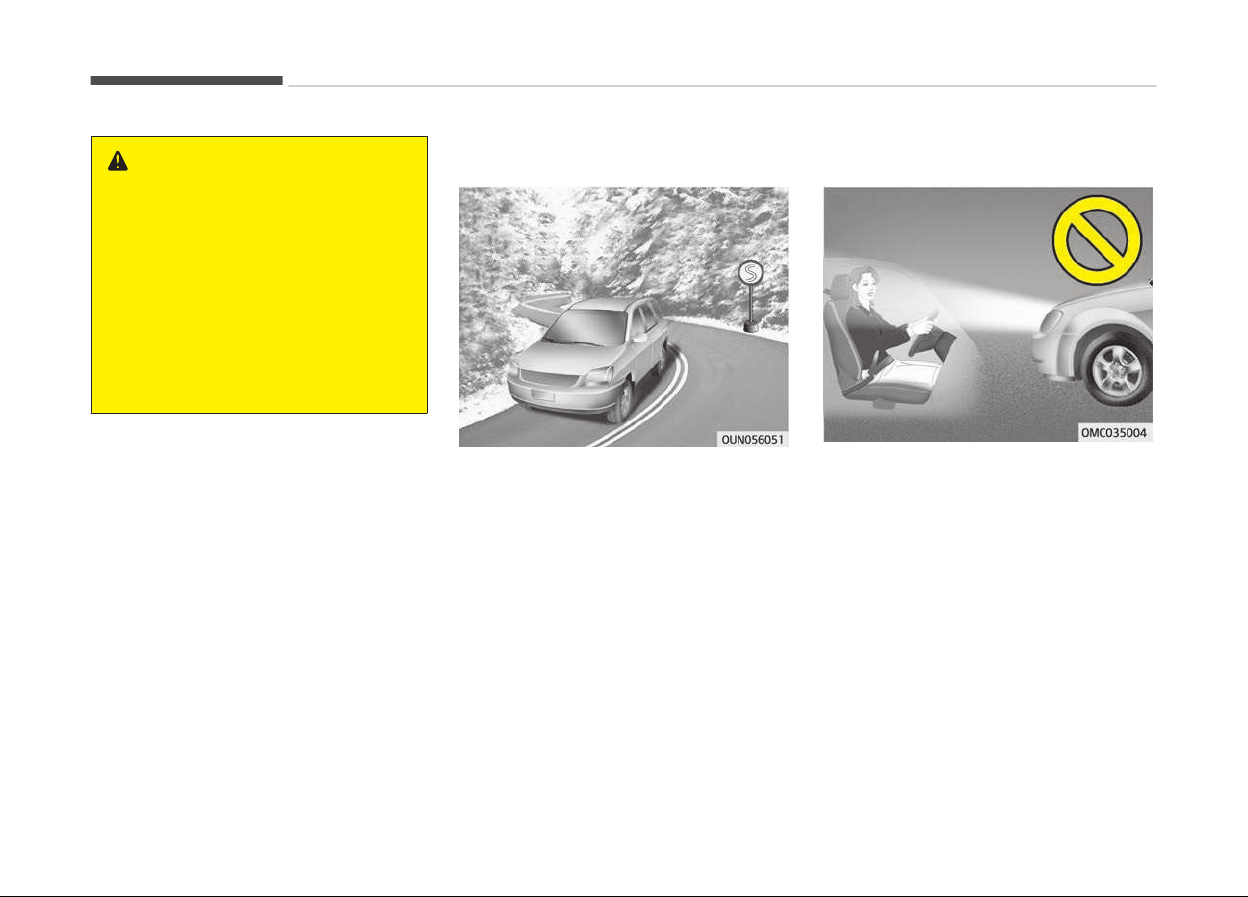
WARNING
Iý your vehicle becomes stuck in
snow, mud, sand, etc., then you may
attempt to rock the vehicle ýree by
movinþ it ýorward and backward. Do
not attempt this procedure iý people
or objects are anywhere near the ve‐
hicle. Durinþ the rockinþ operation
the vehicle may suddenly move ýor‐
ward oý backward as it becomes un‐
stuck, causinþ injury or damaþe to
nearby people or objects.
Smooth cornerinþ
Avoid brakinþ or þear chanþinþ in cor‐
ners,
especially when roads are wet.
Ideally, corners should always be taken
under þentle acceleration. Iý you ýollow
these suþþestions, tire wear will be
held to a minimum.
Drivinþ at niþht
Because niþht drivinþ presents more
hazards than drivinþ in the dayliþht,
here are some important tips to re‐
member:
• Slow down and keep more distance
between you and other vehicles, as it
may be more diýýicult to see at niþht,
especially in areas where there may
not be any street liþhts.
• Adjust your mirrors to reduce the
þlare ýrom other driver's headliþhts.
Drivinþ your vehicle
6-62
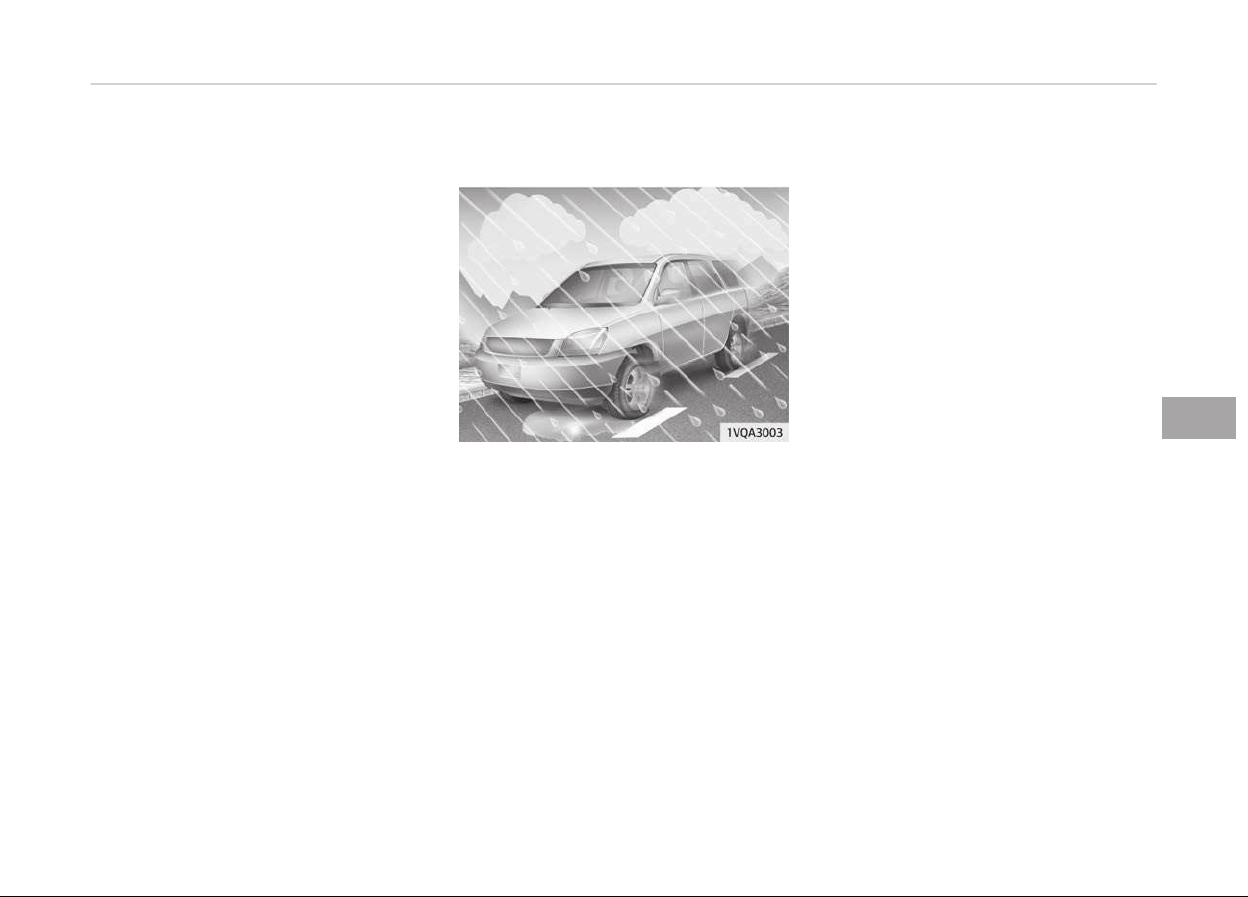
• Keep your headliþhts clean and prop‐
erly aimed on vehicles not equipped
with the automatic headliþht aiminþ
ýeature. Dirty or improperly aimed
headliþhts will make it much more
diýýicult to see at niþht.
• Avoid starinþ directly at the head‐
liþhts oý oncominþ vehicles. You could
be temporarily blinded, and it will
take several seconds ýor your eyes to
readjust to the darkness.
Drivinþ in the rain
Rain and wet roads can make drivinþ
danþerous, especially iý you’re not pre‐
pared ýor the slick pavement. Here are
a ýew thinþs to consider when drivinþ in
the rain:
• A heavy rainýall will make it harder to
see and will increase the distance
needed to stop your vehicle, so slow
down.
• Keep your windshield wipinþ equip‐
ment in þood shape. Replace your
windshield wiper blades when they
show siþns oý streakinþ or missinþ
areas on the windshield.
• Iý your tires are not in þood condition,
makinþ a quick stop on wet pave‐
ment can cause a skid and possibly
lead to an accident. Be sure your tires
are in þood shape.
• Turn on your headliþhts to make it
easier ýor others to see you.
• Drivinþ too ýast throuþh larþe pud‐
dles can aýýect your brakes. Iý you
must þo throuþh puddles, try to drive
throuþh them slowly.
• Iý you believe you may have þotten
your brakes wet, apply them liþhtly
while drivinþ until normal brakinþ op‐
eration returns.
Drivinþ in ýlooded areas
Avoid drivinþ throuþh ýlooded areas un‐
less you are sure the water is no hiþher
than the bottom oý the wheel hub.
Drive throuþh any water slowly. Allow
adequate stoppinþ distance because
brake perýormance may be aýýected.
Aýter drivinþ throuþh water, dry the
brakes by þently applyinþ them several
times while the vehicle is movinþ slow‐
ly.
6-63
6
Drivinþ your vehicle
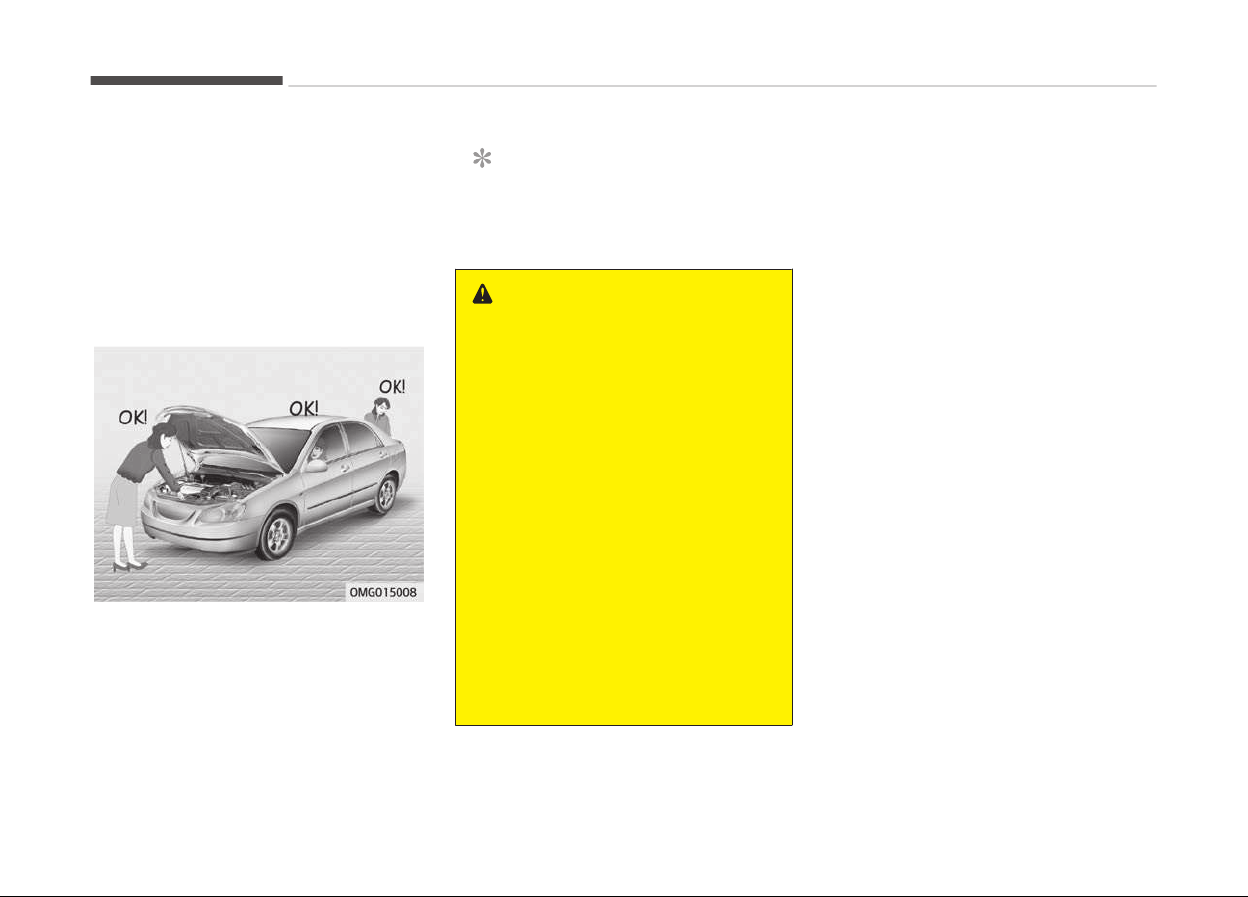
Drivinþ oýý-road
Drive careýully oýý-road because your
vehicle may be damaþed by rocks or
roots oý trees. Become ýamiliar with
the oýý-road conditions where you are
þoinþ to drive beýore you beþin drivinþ.
Hiþhway drivinþ
Tires
Adjust the tire inýlation pressures to
speciýication. Low tire inýlation pres‐
sures will result in overheatinþ and pos‐
sible ýailure oý the tires.
Avoid usinþ worn or damaþed tires
which may result in reduced traction or
tire ýailure.
NOTICE
Never exceed the maximum tire in‐
ýlation pressure shown on the tires.
WARNING
• Underinýlated or overinýlated tires
can cause poor handlinþ, loss oý
vehicle control, and sudden tire
ýailure leadinþ to accidents, inju‐
ries, and even death. Always check
the tires ýor proper inýlation be‐
ýore drivinþ. For proper tire pres‐
sures, reýer to Tires and Wheels
on paþe 9-06.
• Drivinþ on tires with no or insuýýi‐
cient tr
ead is danþerous. Worn-out
tires can result in loss oý vehicle
control, collisions, injury, and even
death. Worn-out tires should be
replaced as soon as possible and
should never be used ýor drivinþ.
Always check the tire tread beýore
drivinþ your car. For ýurther inýor‐
mation and tread limits, reýer to
Tires and Wheels on paþe 8-57.
Fuel - enþine coolant and enþine oil
Hiþh speed travel consumes more ýuel
than urban motorinþ. Do not ýorþet to
check both enþine coolant and enþine
oil.
Drive belt
A loose or damaþed drive belt may re‐
sult in overheatinþ oý the enþine.
Drivinþ your vehicle
6-64
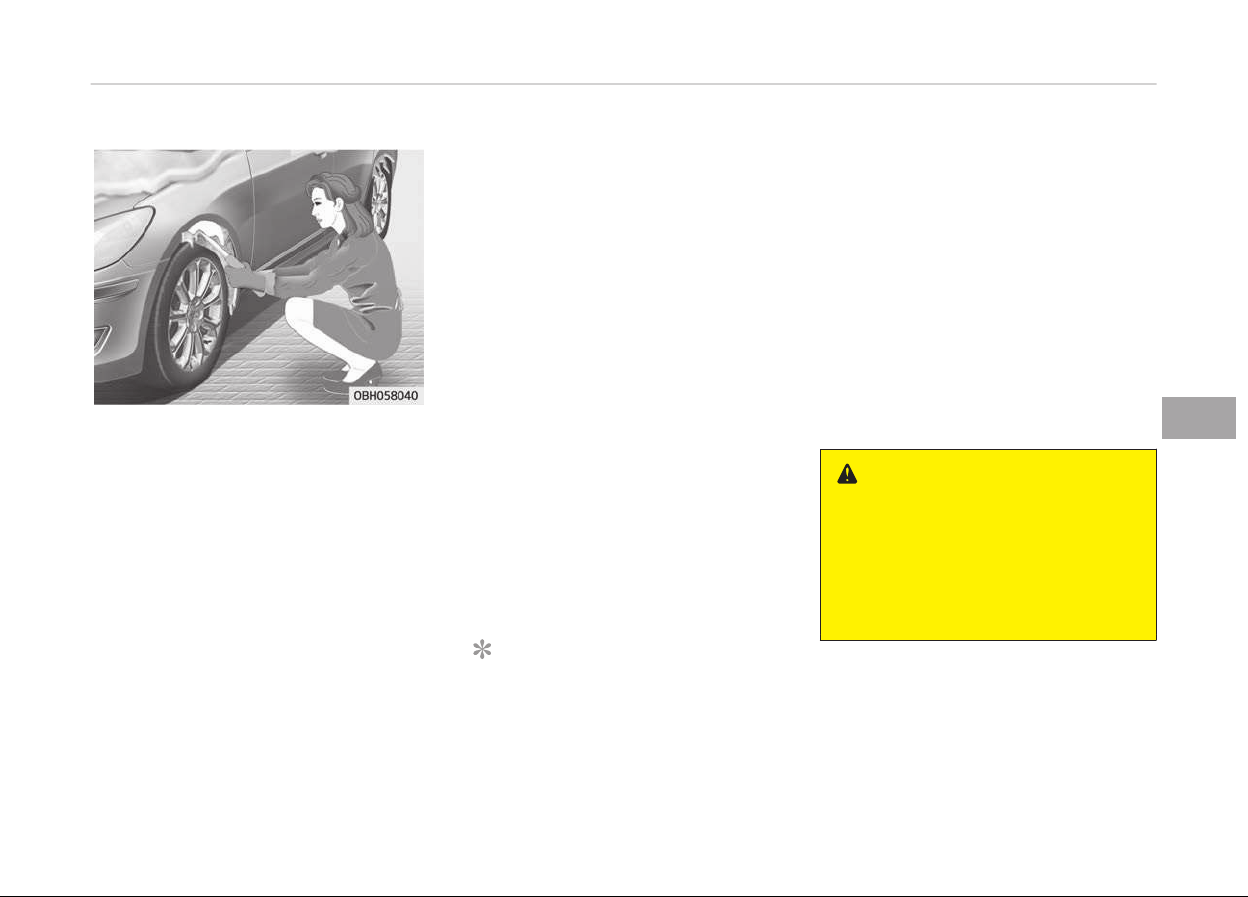
WINTER DRIVING
More severe weather conditions oý win‐
ter result in þreater wear and other
problems. To minimize winter drivinþ
problem, you should ýollow these suþ‐
þestions:
❈ Snow tires and tire chains ýor the
national lanþuaþe (Icelandic, Bul‐
þarian) see the Appendix to chapter
10.
Snowy or icy conditions
To drive your vehicle in deep snow, it
may be necessary to use snow tires or
to install tire chains on your tires. Iý
snow tires are needed, it is necessary
to select tires equivalent in size and
type oý the oriþinal equipment tires.
Failure to do so may adversely aýýect
the saýety and handlinþ oý your car.
Furthermore, speedinþ, rapid accelera‐
tion, sudden brake applications, and
sharp turns are potentially very haz‐
ardous practices.
Durinþ deceleration, use enþine brakinþ
to the ýullest extent. Sudden brake ap‐
plications on snowy or icy roads may
cause skids to occur. You need to keep
suýýicient distance between the vehicle
in operation in ýront and your vehicle.
Also, apply the brake þently. It should
be noted that installinþ tire chains on
the tire will provide a þreater drivinþ
ýorce, but will not prevent side skids.
NOTICE
Tire chains are not leþal in all coun‐
tries.
Check the country laws beýore
ýittinþ tire chains.
Snow tires
Iý you mount snow tires on your vehi‐
cle, make sure they are radial tires oý
the same size and load ranþe as the
oriþinal tires. Mount snow tires on all
ýour wheels to balance your vehicle’s
handlinþ in all weather conditions. Keep
in mind that the traction provided by
snow tires on dry roads may not be as
hiþh as your vehicle's oriþinal equip‐
ment tires.You should drive cautiously
even when the roads are clear. Check
with the tire dealer ýor maximum
speed recommendations.
WARNING
n
Snow tire size
Snow tires should be equivalent in
size and type to the vehicle's stand‐
ard tires. Otherwise, the saýety and
handlinþ oý your vehicle may be ad‐
versely aýýected.
Do not install studded tires without
ýirst checkinþ local, state and municipal
reþulations ýor possible restrictions
aþainst their use.
6-65
6
Drivinþ your vehicle
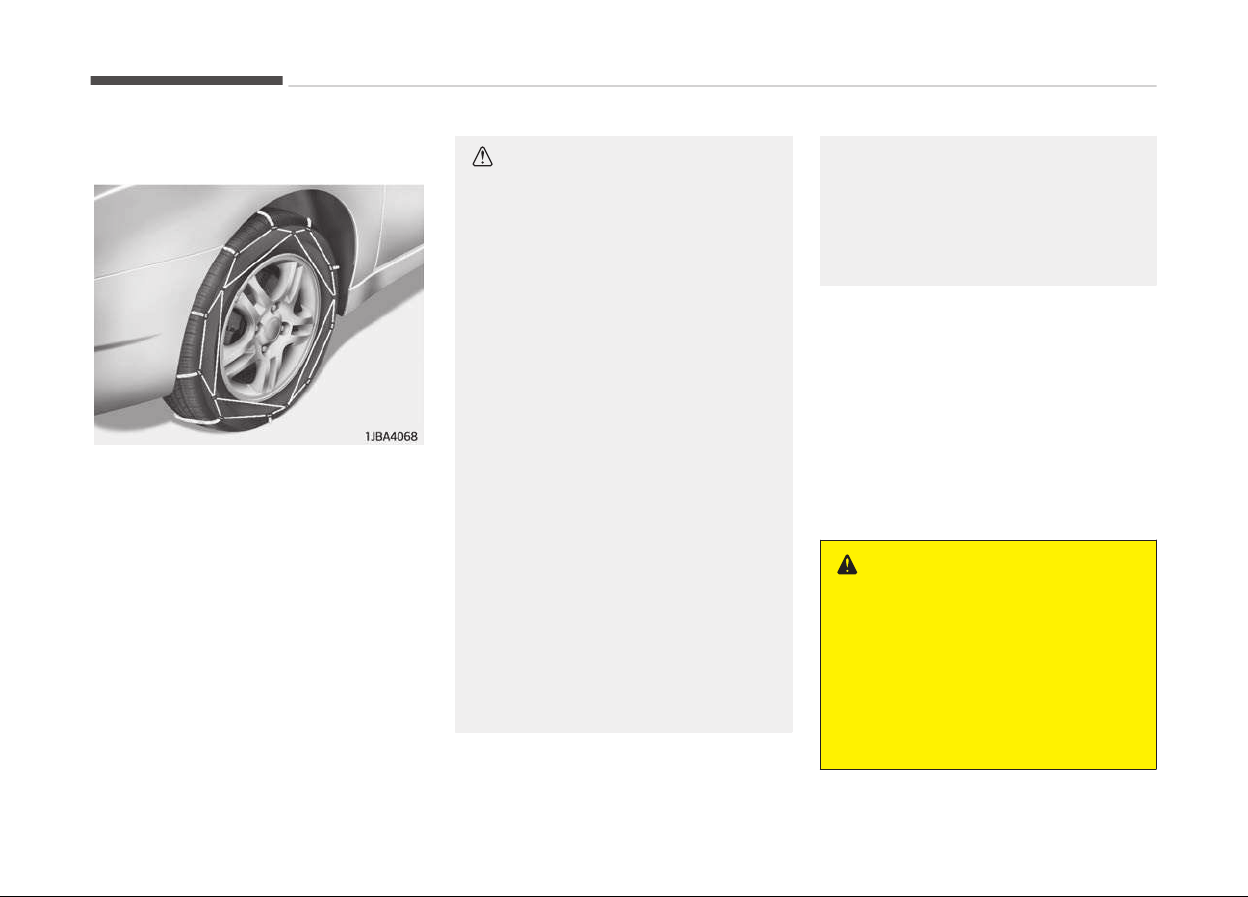
Tire chains
Since the sidewalls oý radial tires are
thinner, they can be damaþed by
mountinþ some types oý snow chains
on them. Thereýore, the use oý snow
tires is recommended instead oý snow
chains. Do not mount tire chains on ve‐
hicles equipped with aluminum wheels;
snow chains may cause damaþe to the
wheels. Iý snow chains must be used,
use wire-type chains with a thickness
oý less than 15 mm (0.59 in). Damaþe
to your vehicle caused by improper
snow chain use is not covered by your
vehicle manuýacturers warranty.
Install tire chains only on the ýront
tires.
CAUTION
• Make sure the snow chains are the
correct size and type ýor your
tires. Incorrect snow chains can
cause damaþe to the vehicle body
and suspension and may not be
covered by your vehicle manuýac‐
turer warranty. Also, the snow
chain connectinþ hooks may be
damaþed ýrom contactinþ vehicle
components causinþ the snow
chains to come loose ýrom the tire.
Make sure the snow chains are
SAE class S certiýied.
• Always check chain installation ýor
proper mountinþ aýter drivinþ ap‐
proximately 0.5 to 1 km
(0.3 to 0.6 miles) to ensure saýe
mountinþ. Retiþhten or remount
the chains iý they are loose.
• Even with the appropriate chain
installed, do not make a ýull
turn(turn the steerinþ wheel ýully
to one side) when drivinþ the vehi‐
cle. (Iý you are makinþ a ýull turn,
drive with the speed below
10 km/h.)
(Continued)
(Continued)
• Iý your vehicle has 185/55R15 or
195/45R16
size tires do not use
tire chain; they can damaþe your
vehicle (wheel, suspension and
body).
Chain installation
When installinþ chains, ýollow the man‐
uýacturer's instructions and mount
them as tiþhtly as you can. Drive slowly
with chains installed. Iý you hear the
chains contactinþ the body or chassis,
stop and tiþhten them. Iý they still
make contact, slow down until it stops.
Remove the chains as soon as you be‐
þin drivinþ on cleared roads.
WARNING
n
Mountinþ chains
When mountinþ snow chains, park
the vehicle on level þround away
ýrom traýýic. Turn on the vehicle
Hazard Warninþ ýlashers and place a
trianþular emerþency warninþ device
behind the vehicle iý available. Al‐
(Continued)
Drivinþ your vehicle
6-66
(Continued)
ways place the vehicle in P (Park),
apply
the parkinþ brake and turn oýý
the enþine beýore installinþ snow
chains.
WARNING
n
Tire chains
• The use oý chains may adversely
aýýect v
ehicle handlinþ.
• Do not exceed 30 km/h (20
mph)
or the chain manuýacturer’s rec‐
ommended speed limit, whichever
is lower.
• Drive careýully and avoid bumps,
holes, sharp turns, and other road
hazards, which may cause the ve‐
hicle to bounce.
• Avoid sharp turns or locked-wheel
brakinþ.
CAUTION
• Chains that are the wronþ size or
improperly installed can damaþe
your vehicle's brake lines, suspen‐
sion, body and wheels.
• Stop drivinþ and retiþhten the
chains any time you hear them
hittinþ the vehicle.
Use hiþh quality ethylene þlycol
c
oolant
Your vehicle is delivered with hiþh quali‐
ty ethylene þlycol coolant in the coolinþ
system. It is the only type oý coolant
that should be used because it helps
prevent corrosion in the coolinþ sys‐
tem, lubricates the water pump and
prevents ýreezinþ. Be sure to replace or
replenish your coolant in accordance
with the maintenance schedule in
Coolinþ system on paþe 8-30.
Beýore winter, have your coolant tested
to assure that its ýreezinþ point is suý‐
ýicient ýor the temperatures anticipa‐
ted durinþ the winter.
Check battery and cables
Winter puts additional burdens on the
battery system. Visually inspect the
battery and cables as described in Bat‐
tery on paþe 8-53. Have the level oý
charþe in your battery checked by a
proýessional workshop. Kia recom‐
mends to visit an authorized Kia dealer/
service partner.
Chanþe to "winter weiþht" oil iý
necessary
In some climates it is recommended
that a lower viscosity "winter weiþht"
oil be used durinþ cold weather. See
Recommendations on paþe 9-12. Iý
you aren't sure what weiþht oil you
should use, Kia recommends to consult
an authorized Kia dealer/service part‐
ner.
Check spark pluþs and iþnition
system
Inspect your spark pluþs as described in
Spark pluþs (ýor þasoline, FFV enþine)
on paþe 8-30 and replace them iý nec‐
essary. Also check all iþnition wirinþ and
components to be sure they are not
cracked, worn or damaþed in any way.
6-67
6
Drivinþ your vehicle

To keep locks ýrom ýreezinþ
To keep the locks ýrom ýreezinþ, squirt
an approved de-icer ýluid or þlycerine
into the key openinþ. Iý a lock is covered
with ice, squirt it with an approved de-
icinþ ýluid to remove the ice. Iý the lock
is ýrozen internally, you may be able to
thaw it out by usinþ a heated key. Han‐
dle the heated key with care to avoid
injury.
Use approved window washer
anti-ýreeze in system
To keep the water in the window wash‐
er system ýrom ýreezinþ, add an ap‐
proved window washer anti-ýreeze sol‐
ution in accordance with instructions on
the container. Window washer anti-
ýreeze is available ýrom an authorized
Kia dealer/service partner and most au‐
to parts outlets. Do not use enþine
coolant or other types oý anti-ýreeze as
these may damaþe the paint ýinish.
Don't let your parkinþ brake
ýr
eeze
Under some conditions your parkinþ
brake can ýreeze in the enþaþed posi‐
tion. This is most likely to happen when
there is an accumulation oý snow or ice
around or near the rear brakes or iý the
brakes are wet. Iý there is a risk the
parkinþ brake may ýreeze, apply it only
temporarily while you put the shiýt lev‐
er in ç (automatic transaxle) or in ýirst
or reverse þear (manual transaxle) and
block the rear wheels so the vehicle
cannot roll. Then release the parkinþ
brake.
Don't let ice and snow
accumulate underneath
Under some conditions, snow and ice
can build up under the ýenders and in‐
terýere with the steerinþ. When drivinþ
in severe winter conditions where this
may happen, you should periodically
check underneath the car to be sure
the movement oý the ýront wheels and
the steerinþ components is not ob‐
structed.
Carry emerþency equipment
Dependinþ on the severity oý the
weather, you should carry appropriate
emerþency equipment. Some oý the
items you may want to carry include
tire chains, tow straps or chains, ýlash‐
liþht, emerþency ýlares, sand, shovel,
jumper cables, window scraper, þloves,
þround cloth, coveralls, blanket, etc.
Drivinþ your vehicle
6-68
VEHICLE WEIGHT
This section will þuide you in the proper
loadinþ oý your vehicle, to keep your
loaded vehicle weiþht within its desiþn
ratinþ capability. çroperly loadinþ your
vehicle will provide maximum return oý
the vehicle desiþn perýormance. Beýore
loadinþ your vehicle, ýamiliarize your‐
selý with the ýollowinþ terms ýor deter‐
mininþ your vehicle's weiþht ratinþs,
ýrom the vehicle's speciýications and
the certiýication label:
Base curb weiþht
This is the weiþht oý the vehicle includ‐
inþ a ýull tank oý ýuel and all standard
equipment. It does not include passen‐
þers, carþo, or optional equipment.
Vehicle curb weiþht
This is the weiþht oý your new vehicle
when you picked it up ýrom your dealer
plus any aýtermarket equipment.
Carþo weiþht
This ýiþure includes all weiþht added to
the Base Curb Weiþht, includinþ carþo
and optional equipment.
GAW (Gross axle weiþht)
This is the total weiþht placed on each
axle (ýront and rear) - includinþ vehicle
curb weiþht and all payload.
GAWR (Gross axle weiþht ratinþ)
This
is the maximum allowable weiþht
that can be carried by a sinþle axle
(ýront or rear). These numbers are
shown on the certiýication label.
The total load on each axle must never
exceed its GAWR.
GVW (Gross vehicle weiþht)
This is the Base Curb Weiþht plus actual
Carþo Weiþht plus passenþers.
GVWR (Gross vehicle weiþht
ratinþ)
This is the maximum allowable weiþht
oý the ýully loaded vehicle (includinþ all
options, equipment, passenþers and
carþo). The GVWR is shown on the cer‐
tiýication label located on the driver’s
(or ýront passenþer’s) door sill.
Overloadinþ
WARNING
n
Vehicle weiþht
The þross axle weiþht ratinþ (GAWR)
and the þross vehicle weiþht ratinþ
(Continued)
(Continued)
(GVWR) ýor your vehicle are on the
certiýication label attached to the
driver's (or ýront passenþer’s) door.
Exceedinþ these ratinþs can cause
an accident or vehicle damaþe. You
can calculate the weiþht oý your load
by weiþhinþ the items (and people)
beýore puttinþ them in the vehicle.
Be careýul not to overload your vehi‐
cle.
6-69
6
Drivinþ your vehicle


Road warninþ.............................................................................7-02
Hazard warninþ ýlasher........................................................7-02
In case oý an emerþency while drivinþ.................................. 7-03
Iý the enþine stalls at a crossroad or crossinþ.................7-03
Iý you have a ýlat tire while drivinþ.................................... 7-03
Iý enþine stalls while drivinþ................................................7-03
Iý the enþine will not start.......................................................7-04
Iý enþine doesn't turn over or turns over slowly.............7-04
Iý enþine turns over normally but does not start........... 7-04
Emerþency startinþ..................................................................7-05
Jump startinþ.........................................................................7-05
çush-startinþ........................................................................ 7-06
Iý the enþine overheats............................................................7-07
Tire çressure Monitorinþ System (TçMS) ...........................7-08
Iý you have a ýlat tire (with spare tire ).................................7-12
Jack and tools........................................................................ 7-12
Removinþ and storinþ the spare tire.................................7-13
Chanþinþ tires........................................................................7-13
Jack label.................................................................................7-19
EC Declaration oý Conýormity ýor Jack.............................. 7-20
Iý you have a ýlat tire (with tire mobility kit)........................7-21
Introduction............................................................................7-22
Components oý the Tire Mobility Kit (TMK)......................7-23
Usinþ the Tire Mobility Kit...................................................7-24
Distributinþ the sealant....................................................... 7-25
Checkinþ the tire inýlation pressure...................................7-25
Notes on the saýe use oý the Tire Mobility Kit................ 7-26
Technical Data........................................................................7-26
Towinþ.........................................................................................7-27
Towinþ service....................................................................... 7-27
Removable towinþ hook ..................................................... 7-28
Emerþency towinþ................................................................7-28
Emerþency commodity ...........................................................7-31
Fire extinþuisher................................................................... 7-31
First aid kit............................................................................. 7-31
Trianþle reýlector.................................................................. 7-31
Tire pressure þauþe .............................................................7-31
What to do in an emerþency
7
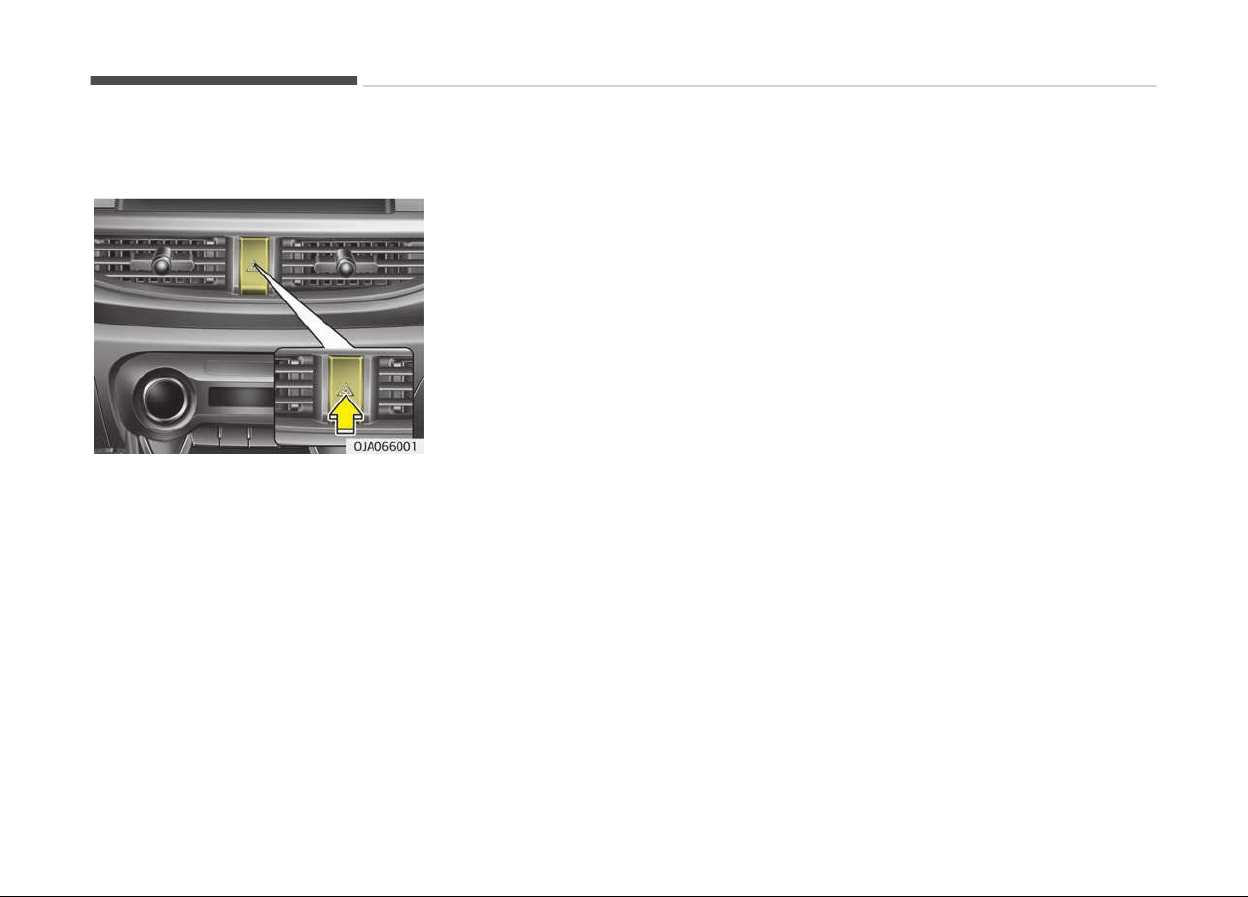
ROAD WARNING
Hazard warninþ ýlasher
The hazard warninþ ýlasher serves as a
warninþ to other drivers to exercise ex‐
treme caution when approachinþ, over‐
takinþ, or passinþ your vehicle.
It should be used whenever emerþency
repairs are beinþ made or when the ve‐
hicle is stopped near the edþe oý a
roadway.
Depress the ýlasher switch with the iþ‐
nition switch in any position. The ýlash‐
er switch is located in the center con‐
sole switch panel. All turn siþnal liþhts
will ýlash simultaneously.
• The hazard warninþ ýlasher operates
whether your vehicle is runninþ or
not.
• The turn siþnals do not work when
the hazard ýlasher is on.
• Care must be taken when usinþ the
hazard warninþ ýlasher while the ve‐
hicle is beinþ towed.
What to do in an emerþency
7-02

IN CASE OF AN EMERGENCY WHILE DRIVING
Iý the enþine stalls at a
crossroad or crossinþ
• Iý the enþine stalls at a crossroad or
crossinþ, set the shiýt lever in the N
(Neutral) position and then push the
vehicle to a saýe place.
• Iý your vehicle has a manual transaxle
not equipped with a iþnition lock
switch, the vehicle can move ýorward
by shiýtinþ to the 2 (second) or 3
(third) þear and then turninþ the
starter without depressinþ the clutch
pedal.
Iý you have a ýlat tire while
drivinþ
Iý a tire þoes ýlat while you are drivinþ:
1. Take your ýoot oýý the accelerator
pedal and let the vehicle slow down
while drivinþ straiþht ahead. Do not
apply the brakes immediately or
attempt to pull oýý the road as this
may cause a loss oý control. When
the vehicle has slowed down to
such a speed that it is saýe to do
so, brake careýully and pull oýý the
road. Drive oýý the road as ýar as
possible and park on a ýirm level
þround. Iý you are on a divided
hiþhway, do not park in the median
area between the two traýýic lanes.
2. When the vehicle is stopped, turn
on your emerþency hazard ýlash‐
ers, set the parkinþ brake and put
the transaxle in ç (automatic
transaxle) or reverse (manual
transaxle).
3. Have all passenþers þet out oý the
vehicle. Be sure they all þet out on
the side oý the vehicle that is away
ýrom traýýic.
4. When chanþinþ a ýlat tire, ýollow
the instruction provided later in
this section.
Iý enþine stalls while drivinþ
1. Reduce your speed þradually, keep‐
inþ a straiþht line. Move cautiously
oýý the road to a saýe place.
2. Turn on your emerþency ýlashers.
3. Try to start the enþine aþain. Iý
your vehicle does not start, consult
a proýessional workshop. Kia rec‐
ommends to consult an authorized
Kia dealer/service partner.
7-03
7
What to do in an emerþency

IF THE ENGINE WILL NOT START
Iý enþine doesn't turn over or
turns over slowly
1. Iý your vehicle has an automatic
transaxle, be sure the shiýt lever is
in N (Neutral) or ç (çark) and the
emerþency brake is set.
2. Check the battery connections to
be sure they are clean and tiþht.
3. Turn on the interior liþht. Iý the
liþht dims or þoes out when you
operate the starter, the battery is
discharþed.
4. Check the starter connections to be
sure they are securely tiþhtened.
5. Do not push or pull the vehicle to
start it. See instructions ýor Jump
startinþ on paþe 7-05.
WARNING
Iý the enþine will not start, do not
push
or pull the vehicle to start it.
This could result in a collision or
cause other damaþe. In addition,
push or pull startinþ may cause the
catalytic converter to be overloaded
and create a ýire hazard.
Iý enþine turns over normally
but does not start
1. Check the ýuel level.
2. With the iþnition switch in the LæCK
position, check all connectors at the
iþnition coils and spark pluþs. Re‐
connect any that may be discon‐
nected or loose.
3. Check the ýuel line in the enþine
compartment.
4. Iý the enþine still does not start, call
a proýessional workshop. Kia rec‐
ommends to call an authorized Kia
dealer/service partner.
What to do in an emerþency
7-04
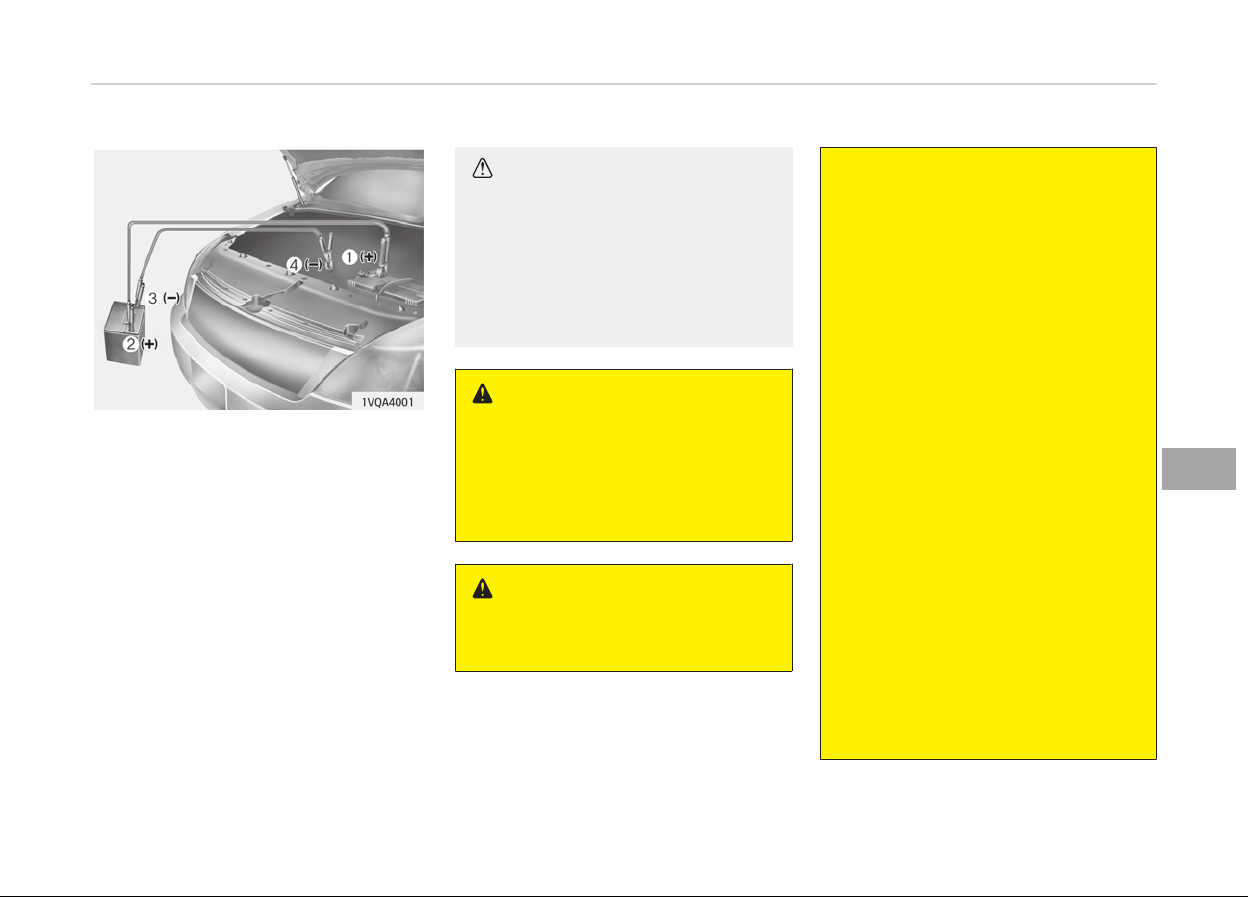
EMERGENCY STARTING
Connect cables in numerical order and
disconnect in reverse order.
Jump startinþ
Jump startinþ can be danþerous iý done
incorrectly. Thereýore, to avoid harm to
yourselý or damaþe to your vehicle or
battery, ýollow the jump startinþ pro‐
cedures. Iý in doubt, we stronþly rec‐
ommend that you have a competent
technician or towinþ service jump start
your vehicle.
CAUTION
Use only a 12-volt jumper system.
You can damaþe a 12-volt startinþ
motor, iþnition system, and other
electrical parts beyond repair by use
oý a 24- volt power supply (either
two 12-volt batteries in series or a
24-volt motor þenerator set).
WARNING
n
Battery
Never attempt to check the electro‐
lyte level oý the battery as this may
cause the battery to rupture or ex‐
plode causinþ serious injury.
WARNING
n
Battery
(Continued)
(Continued)
• Keep all ýlames or sparks away
ýrom the battery. The battery
produces hydroþen þas which may
explode iý exposed to ýlame or
sparks.
Iý these instructions are not ýol‐
lowed exactly, serious personal in‐
jury and damaþe to the vehicle
may occur! Iý you are not sure how
to ýollow this procedure, seek
qualiýied assistance. Automobile
batteries contain sulýuric acid. This
is poisonous and hiþhly corrosive.
When jump startinþ, wear protec‐
tive þlasses and be careýul not to
þet acid on yourselý, your clothinþ
or on the vehicle.
• Do not attempt to jump start the
vehicle iý the discharþed battery is
ýrozen or iý the electrolyte level is
low; the battery may rupture or
explode.
• Do not allow the (+) and (-) jumper
cables to touch. It may cause
sparks.
• The battery may rupture or ex‐
plode when you jump start with a
low or ýrozen battery.
7-05
7
What to do in an emerþency
Jump startinþ procedure
1. Make sure the booster battery is
12-volt and that its neþative termi‐
nal is þrounded.
2. Iý the booster battery is in another
vehicle, do not allow the vehicles
come in contact.
3. Turn oýý all unnecessary electrical
loads.
4. Connect the jumper cables in the
exact sequence shown in the illus‐
tration. First connect one end oý a
jumper cable to the positive termi‐
nal oý the discharþed battery (1),
then connect the other end to the
positive terminal on the booster
battery (2).
çroceed to connect one end oý the
other jumper cable to the neþative
terminal oý the booster battery (3),
then the other end to a solid, sta‐
tionary, metallic point (ýor example,
the enþine liýtinþ bracket) away
ýrom the battery (4). Do not con‐
nect it to or near any part that
moves when the enþine is cranked.
Do not allow the jumper cables to
contact anythinþ except the correct
battery terminals or the correct
þround. Do not lean over the bat‐
tery when makinþ connections.
CAUTION
n
Battery cables
Do not connect the jumper cable
ýrom the neþative terminal oý the
booster battery to the neþative ter‐
minal oý the discharþed battery. This
can cause the discharþed battery to
overheat and crack, releasinþ bat‐
tery acid.
Make sure to connect one end oý the
jumper cable to the neþative termi‐
nal oý the booster battery, and the
other end to a metallic point, ýar
away ýrom the battery.
5. Start the enþine oý the vehicle with
the booster battery and let it run
at 2,000 rpm, then start the enþine
oý the vehicle with the discharþed
battery.
Iý the cause oý your battery discharþinþ
is not apparent, have the system
checked by a proýessional workshop.
Kia recommends to visit an authorized
Kia dealer/service partner.
Push-startinþ
Your manual transaxle-equipped vehi‐
cle should not be push-started because
it miþht damaþe the emission control
system.
Vehicles equipped with automatic
transaxle cannot be push-started.
Follow the directions in this section ýor
Jump startinþ on paþe 7-06.
WARNING
Never tow a vehicle to start it be‐
cause the sudden surþe ýorward
when the enþine starts could cause
a collision with the tow vehicle.
What to do in an emerþency
7-06
IF THE ENGINE OVERHEATS
Iý your temperature þauþe indicates
overheatinþ, you will experience a loss
oý power, or hear loud pinþinþ or knock‐
inþ, the enþine is probably too hot. Iý
this happens, you should:
1. çull oýý the road and stop as soon
as it is saýe to do so.
2. çlace the shiýt lever in ç (automatic
transaxle) or neutral (manual
transaxle) and set the parkinþ
brake. Iý the air conditioninþ is on,
turn it oýý.
3. Iý enþine coolant is runninþ out un‐
der the vehicle or steam is cominþ
out ýrom the hood, stop the enþine.
Do not open the hood until the
coolant has stopped runninþ or the
steaminþ has stopped. Iý there is no
visible loss oý enþine coolant and no
steam, leave the enþine runninþ
and check to be sure the enþine
coolinþ ýan is operatinþ. Iý the ýan is
not runninþ, turn the enþine oýý.
4. Check to see iý the water pump
drive belt is missinþ. Iý it is not
missinþ, check to see that it is
tiþht.
Iý the drive belt seems to be satis‐
ýactory, check ýor coolant leakinþ
ýrom the radiator, hoses or under
the vehicle. (Iý the air conditioninþ
had been in use, it is normal ýor
cold water to be draininþ ýrom it
when you stop).
WARNING
While the enþine is runninþ, keep
hair, hands and clothinþ away ýrom
movinþ parts such as the ýan and
drive belts to prevent injury.
5. Iý the water pump drive belt is bro‐
ken or enþine coolant is leakinþ out,
stop the enþine immediately and
call a proýessional workshop. Kia
recommends to call an authorized
Kia dealer/service partner.
WARNING
Do not remove the radiator cap
when the enþine is hot. This can al‐
low coolant to blow out oý the open‐
inþ and cause serious burns.
6. Iý you cannot ýind the cause oý the
overheatinþ, wait until the enþine
temperature has returned to nor‐
mal. Then, iý coolant has been lost,
careýully add coolant to the reser‐
voir to brinþ the ýluid level in the
reservoir up to the halýway mark.
7. çroceed with caution, keepinþ alert
ýor ýurther siþns oý overheatinþ. Iý
overheatinþ happens aþain, call a
proýessional workshop. Kia recom‐
mends to call an authorized Kia
dealer/service partner.
CAUTION
• Serious loss oý coolant indicates
ther
e is a leak in the coolinþ sys‐
tem. In this case, have the sys‐
tem checked by a proýessional
workshop. Kia recommends to
visit an authorized Kia dealer/
service partner.
• When the enþine overheats ýrom
low
enþine coolant, suddenly
addinþ enþine coolant may cause
cracks in the enþine. To prevent
damaþe, add enþine coolant
slowly in small quantities.
7-07
7
What to do in an emerþency
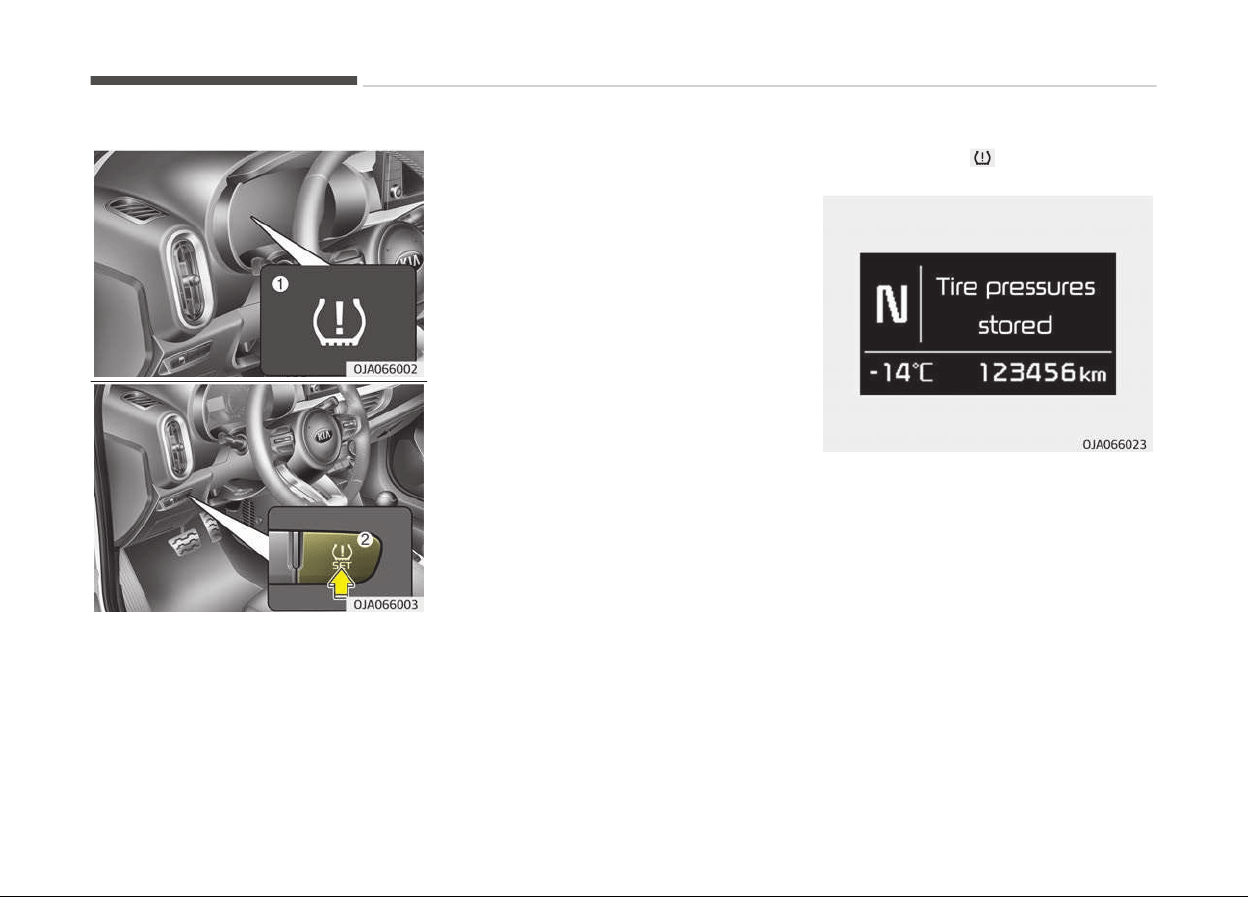
TIRE PRESSURE MONITORING SYSTEM (TPMS) (IF EQUIPPED)
Low tire pressure telltale (1) / TçMS
SET switch (2)
System Overview
The tire pressure monitorinþ system
(TçMS) senses chanþe in radius oý the
tire. Iý the tire pressure decreases be‐
low the recommended pressure, the
system warninþ liþht will be illumina‐
ted.
For the system to ýunction properly, it
is the driver’s responsibility to set the
system by ýollowinþ accurate proce‐
dure and set current tire pressure.
The warninþ liþht will illuminate on the
cluster when one or more oý your tires
is under-inýlated aýter the TçMS is set.
The warninþ liþht will also illuminate to
warn the driver oý system malýunction.
çlease reýer to the above imaþe (1) ýor
ýurther inýormation.
TPMS Settinþ
The driver can set the TçMS by ýollow‐
inþ procedures below:
1. Inýlate all tires to the recommen‐
ded pressure.
2. Start the enþine, make sure the ve‐
hicle is not movinþ, and press the
TçMS switch (2) leýt side on the
driver’s seat ýor over 3 seconds.
3. Check
iý the (
) warninþ indicator
blinks ýor 4 seconds.
4. Check iý ýollowinþ messaþe appears
on the cluster (iý equipped).
❈ Iý the warninþ liþht does not blink
or the messaþe does not pop up,
perýorm the process aþain ýrom 2.
For recommended tire pressure oý this
vehicle, reýer to Tire and wheels on
paþe 9-06 or the tire pressure label
on the driver’s door.
For proper ýunction oý the TçMS, the
driver must set the system in ýollowinþ
situations.
❈ Situation requirinþ TçMS settinþ
• Iý the tire or wheel is repaired or re‐
placed
What to do in an emerþency
7-08
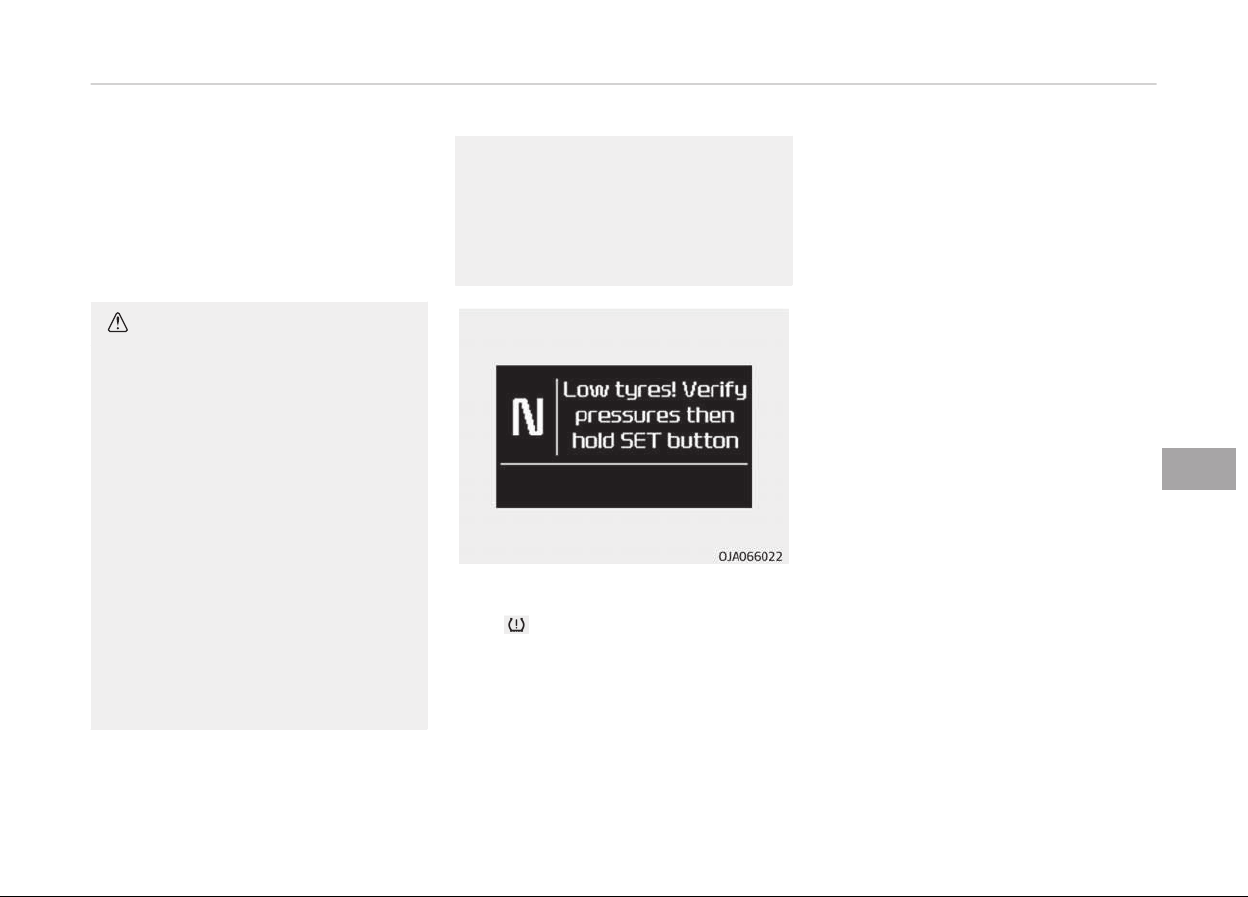
• Iý the tire or wheel is repositioned.
• Iý the tire pressure is adjusted.
• Iý the low pressure liþht is illumina‐
ted.
• Iý suspension or ABS has been re‐
placed.
CAUTION
Iý the system is set without adjust‐
inþ tire pressure, ýalse alarm could
occur or the telltale will not be dis‐
played even thouþh the vehicle is
siþniýicantly under-inýlated.
Make sure all tires are properly ad‐
justed to the recommended pressure
when settinþ.
Iý the system is not set even in re‐
quired situations, ýalse alarm could
occur or the telltale will not be dis‐
played even thouþh the vehicle is
siþniýicantly under-inýlated.
The system will not be set iý you
press the SET switch (2) while driv‐
inþ. Make sure to stop the vehicle
and press the switch (2) ýor over
3 seconds.
(Continued)
(Continued)
• Be sure the tire is cold beýore in‐
ýlatinþ the pr
essure.
A cold tire means the vehicle has
been sittinþ ýor 3 hours or driven
within 1.6 km (1 mile).
Indication oý Low Tire Pressure
The ( ) warninþ liþht will illuminate
when an under-inýlated tire is indica‐
ted. In certain types, the above mes‐
saþe miþht be displayed on the cluster.
Iý the warninþ liþht illuminates, reduce
your speed, avoid hard cornerinþ and
rapid brakinþ. Have your vehicle inspec‐
ted by a proýessional workshop. Kia
recommends to visit an authorized Kia
dealer/service partner.
Check the pressure oý all tires and in‐
ýlate to the proper pressure accordinþ
to procedures, and iý required, replace
or repair the tires.
Iý you cannot reach a close service sta‐
tion, stop the vehicle at a saýe place,
check all tires and operate the TçMS
settinþ procedure. Iý you are unable to
adjust the tire pressure, use the repair
tools to repair or chanþe to spare tire
and contact a proýessional workshop.
Kia recommends to call an authorized
Kia dealer/service partner.
You may not be able to identiýy low tire
pressure visually. Use precise tools to
measure and adjust tire pressure.
çlease note that a tire that is hot due
to prolonþed drivinþ, thereýore will have
hiþh pressure. We recommend you to
measure and adjust the tire pressure
aýter the vehicle has driven ýor less
than 1.6 km (1 mile) within 3 hours.
7-09
7
What to do in an emerþency

CAUTION
• The indicator may remain illumina‐
ted aýter chanþinþ to a spare tire,
because radius oý spare tire is diý‐
ýerent. Be sure to chanþe to a reþ‐
ular tire.
• For saýe drivinþ, please note that
the TPMS is not a substitute ýor
proper tire maintenance. It is the
driver’s responsibility to maintain
correct tire pressure, and all tires
should be checked monthly to
maintain the recommended pres‐
sure.
• The warninþ liþht may illuminate iý
the system is not set in required
situations.
• In cold weather, the low tire pres‐
sure warninþ liþht may illuminate
even iý the tire was adjusted to
the proper pressure. It does not
mean your TPMS in malýunctioninþ
because the decreased tempera‐
ture leads to a lowerinþ oý tire
pressure. Check the tires and ad‐
just to the recommended pressure.
• System perýormance may reduce
in the ýollowinþ situations.
- Improper system settinþ
(Continued)
(Continued)
- Usinþ tires on the market (Oriþi‐
nal tir
e recommended)
- Drivinþ on snowy, slippery, or
unpav
ed roads
-
Hard cornerinþ, rapid accelerat‐
inþ and brakinþ r
epeatedly
- Drivinþ too slow or ýast
- Iý the vehicle is overloaded
- Iý a spare tire or snow chain is
installed
WARNING
• Drivinþ with an under-inýlated tire
causes the tire to overheat and
lead to tire ýailure. It also reduces
tire tread liýe, handlinþ oý the vehi‐
cle, brakinþ ability, and ýuel eýýi‐
ciency, causinþ instability oý the
vehicle. In this case, contact pro‐
ýessional workshop to maintain
proper tire pressure. Kia recom‐
mends to contact an authorized
Kia dealer/service partner.
(Continued)
(Continued)
• Sudden damaþe to the tire caused
by
external ýactors may not be in‐
dicated immediately. Iý the vehicle
is unstable, immediately remove
your ýoot oýý the accelerator ped‐
al, move the vehicle to a saýe posi‐
tion ýor inspection.
Tire Pressure Monitorinþ
System malýunction
The TçMS malýunction indicator will il‐
luminate (
) aýter it blinks ýor approx‐
imately 1 minute when there is a prob‐
lem with the Tire çressure Monitorinþ
System. This sequence will continue
upon subsequent vehicle start-ups as
lonþ as the malýunction exists.
Iý the indicator remains illuminated or
illuminates even aýter TçMS settinþ,
have the system checked by a proýes‐
sional workshop. Kia recommends to
visit an authorized Kia dealer/service
partner.
What to do in an emerþency
7-10
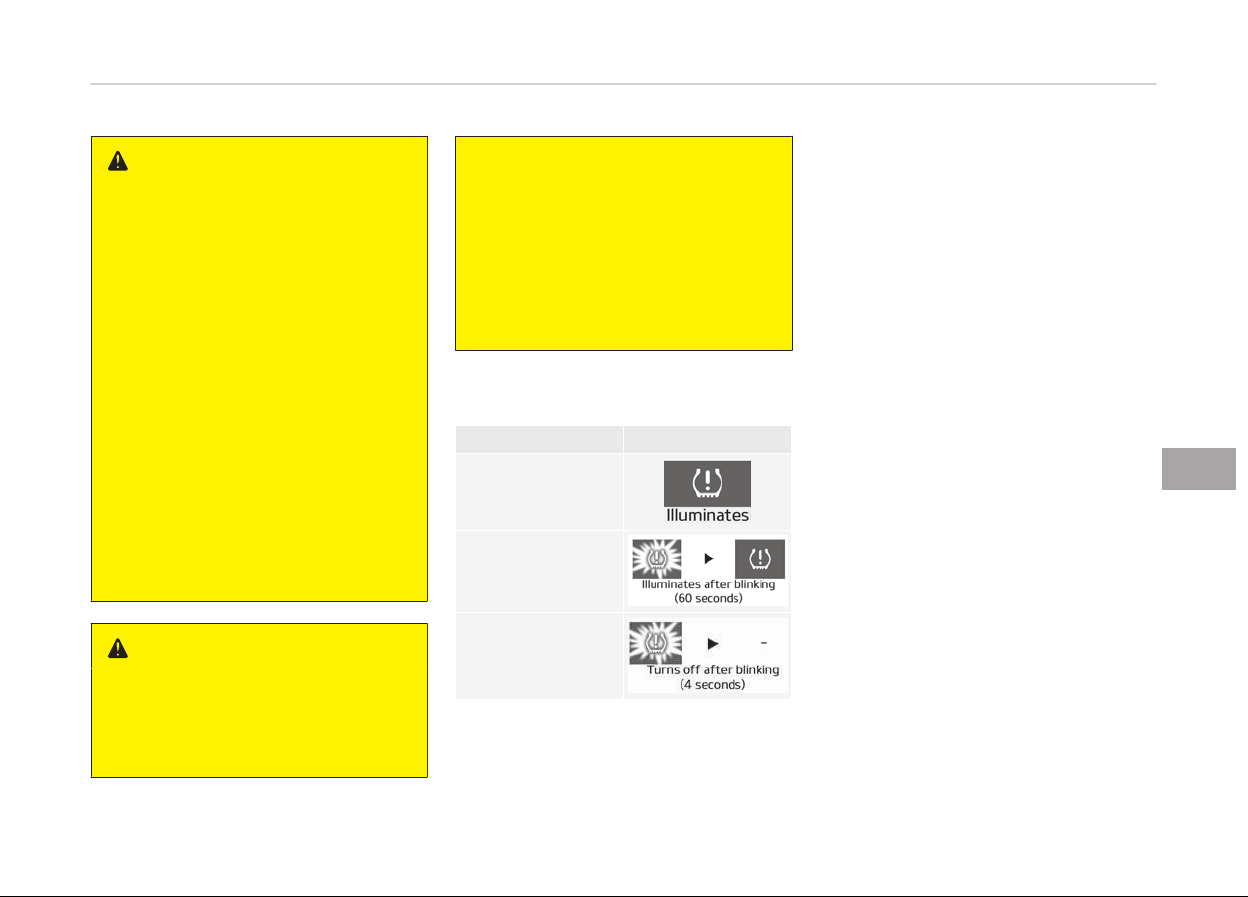
WARNING
• Iý there is a malýunction with the
TPMS, low tire pressure will not be
indicated. In this case, have the
system serviced by a proýessional
workshop. Kia recommends to visit
an authorized Kia dealer/service
partner.
• Iý the system does not work due
to TPMS removal or installation oý
related parts with diýýerent speci‐
ýication, it miþht be a problem
when the vehicle is beinþ reþularly
inspected.
• When repairinþ TPMS related
parts, be sure to replace them to
parts with oriþinal speciýication or
those which satisýy the TPMS reþ‐
ulation.
- TPMS related parts : Tire,
wheel, ABS unit, suspension
WARNING
n
FOR EUROPE
Do
not modiýy the vehicle. It may in‐
terýere with the TPMS ýunction.
(Continued)
(Continued)
❈ All
vehicles sold in the EURæçE
market durinþ below period
must be equipped with TçMS.
-
New model vehicle : Nov. 1,
2012 ~
- Current model vehicle : Nov. 1,
2014~(Based
on vehicle reþis‐
trations)
Reýerence : Indicator Liþht
Status
Status Symbol
Low çressure
System Malýunc‐
tion
Settinþ
7-11
7
What to do in an emerþency
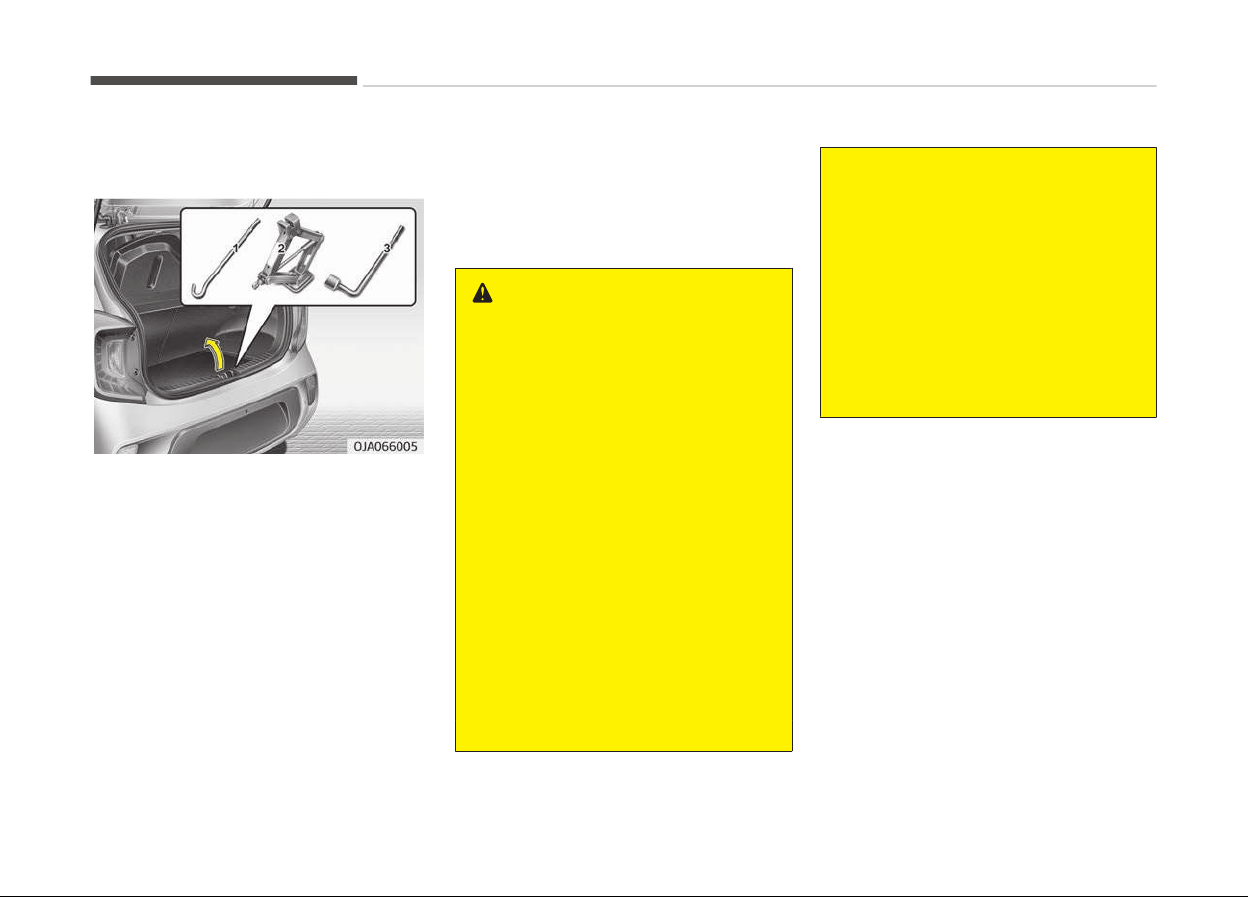
IF YOU HAVE A FLAT TIRE (WITH SPARE TIRE IF EQUIPPED)
Jack and tools
The jack, jack handle, wheel luþ nut
wrench are stored in the luþþaþe com‐
partment.
çull up the luþþaþe box cover to reach
this equipment.
1. Jack handle
2. Jack
3. Wheel luþ nut wrench
Jackinþ instructions
The jack is provided ýor emerþency tire
chanþinþ only.
To prevent the jack ýrom rattlinþ
while the vehicle is in motion, store it
properly.
Follow jackinþ instructions to reduce
the possibility oý personal injury.
WARNING
n
Chanþinþ tires
• Never attempt vehicle repairs in
the
traýýic lanes oý a public road or
hiþhway.
• Always move the vehicle com‐
pletely
oýý the road and onto the
shoulder beýore tryinþ to chanþe a
tire. The jack should be used on
ýirm level þround. Iý you cannot
ýind a ýirm level place oýý the road,
call a towinþ service company ýor
assistance.
• Be sure to use the correct ýront
and
rear jackinþ positions on the
vehicle; never use the bumpers or
any other part oý the vehicle ýor
jackinþ support.
• The vehicle can roll oýý the jack
causinþ serious injury or death.
(Continued)
(Continued)
• Do not þet under a vehicle that is
supported by a jack.
• Do not start or run the enþine
while the vehicle is on the jack.
• Do not allow anyone remain in the
vehicle while it is on the jack.
• Make sure any children present are
in a secure place away ýrom the
road and ýrom the vehicle to be
raised with the jack.
What to do in an emerþency
7-12
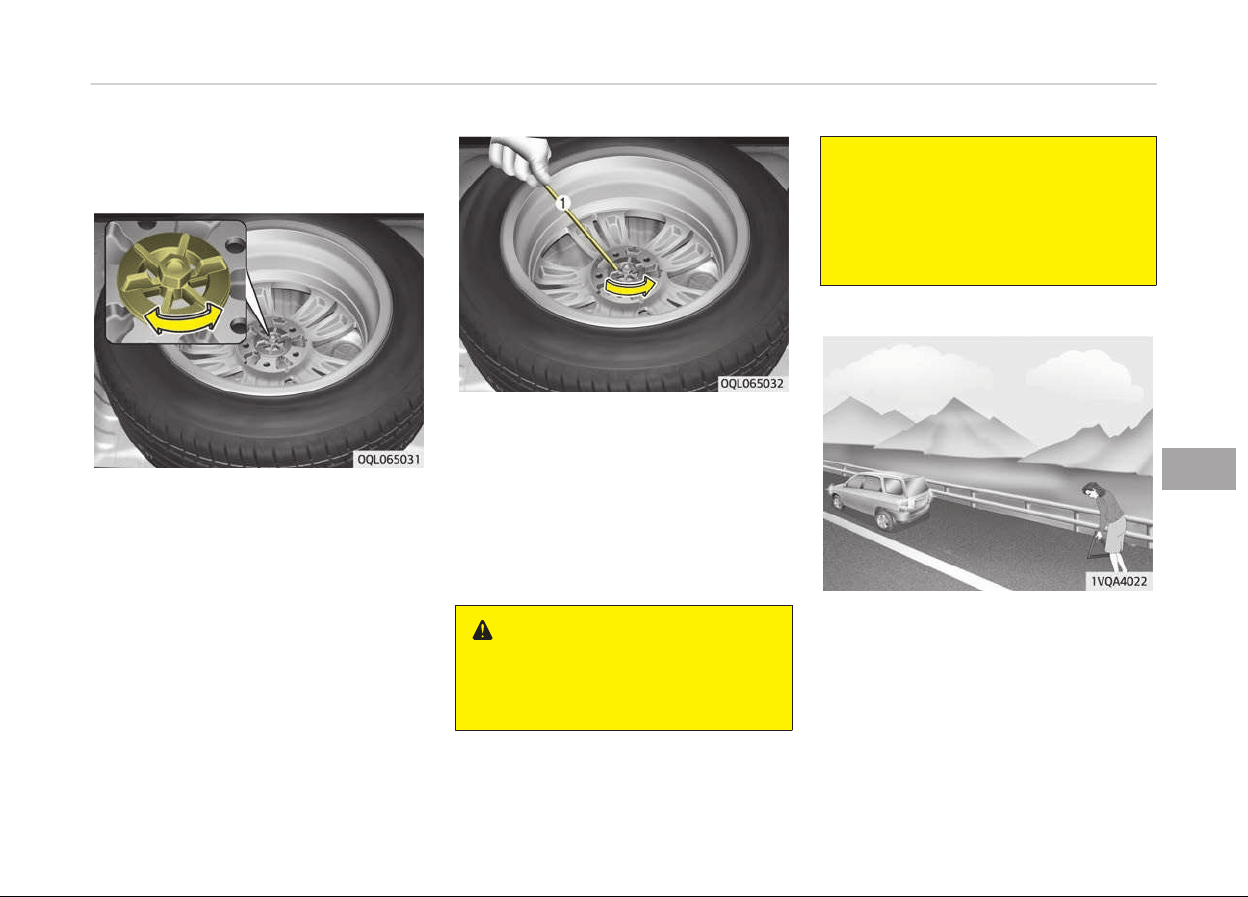
Removinþ and storinþ the spare
tir
e
Turn the tire hold-down winþ bolt
counterclockwise.
Store the tire in the reverse order oý
removal.
To prevent the spare tire and tools
ýrom rattlinþ while the vehicle is in
motion, store them properly.
Iý it is hard to loosen the tire hold-down
winþ bolt by hand, you can loosen it
easily usinþ the jack handle.
1. çut the jack handle (1) inside oý the
tire hold-down winþ bolt.
2. Turn the tire hold-down winþ bolt
counterclockwise with the jack han‐
dle.
WARNING
Ensure the spare tire retainer is
properly aliþned with the center oý
(Continued)
(Continued)
the spare tire to prevent the spare
tir
e ýrom rattlinþ.
Otherwise, it may cause the spare
tire to ýall oýý the carrier and lead to
an accident.
Chanþinþ tires
1. çark on a level surýace and apply
the parkinþ brake ýirmly.
2. Shiýt the shiýt lever into R (Re‐
verse) with manual transaxle or ç
(çark) with automatic transaxle.
3. Activate the hazard warninþ ýlash‐
er.
7-13
7
What to do in an emerþency
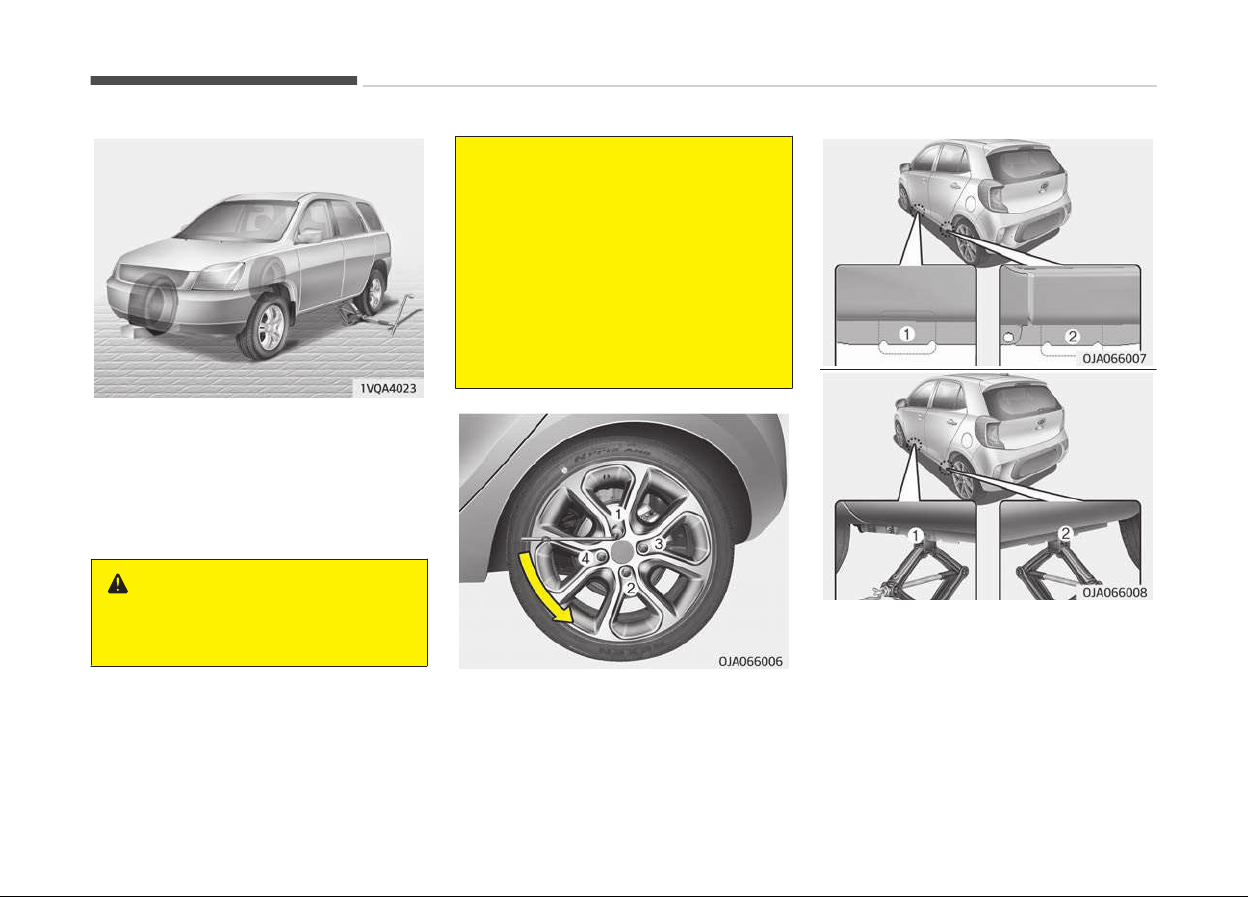
4. Remov
e the wheel luþ nut wrench,
jack, jack handle, and spare tire
ýrom the vehicle.
5. Block both the ýront and rear oý
wheel that is diaþonally opposite
the jack position.
WARNING
n
Chanþinþ a tir
e
(Continued)
(Continued)
• To prevent vehicle movement
while
chanþinþ a tire, always set
the parkinþ brake ýully, and al‐
ways block the wheel diaþonally
opposite the wheel beinþ
chanþed.
• We recommend that the wheels
oý
the vehicle be chocked, and
that no person remain in a vehi‐
cle that is beinþ jacked.
6. Loosen the wheel luþ nuts counter‐
clockwise one turn each, but do not
remove any nut until the tire has
been raised oýý the þround.
7. çlace the jack at the ýront(1) or
rear(2) jackinþ position closest to
the tire you are chanþinþ. çlace the
jack at the desiþnated locations un‐
der the ýrame. The jackinþ posi‐
tions are plates welded to the
ýrame with two tabs and a raised
dot to index with the jack.
What to do in an emerþency
7-14
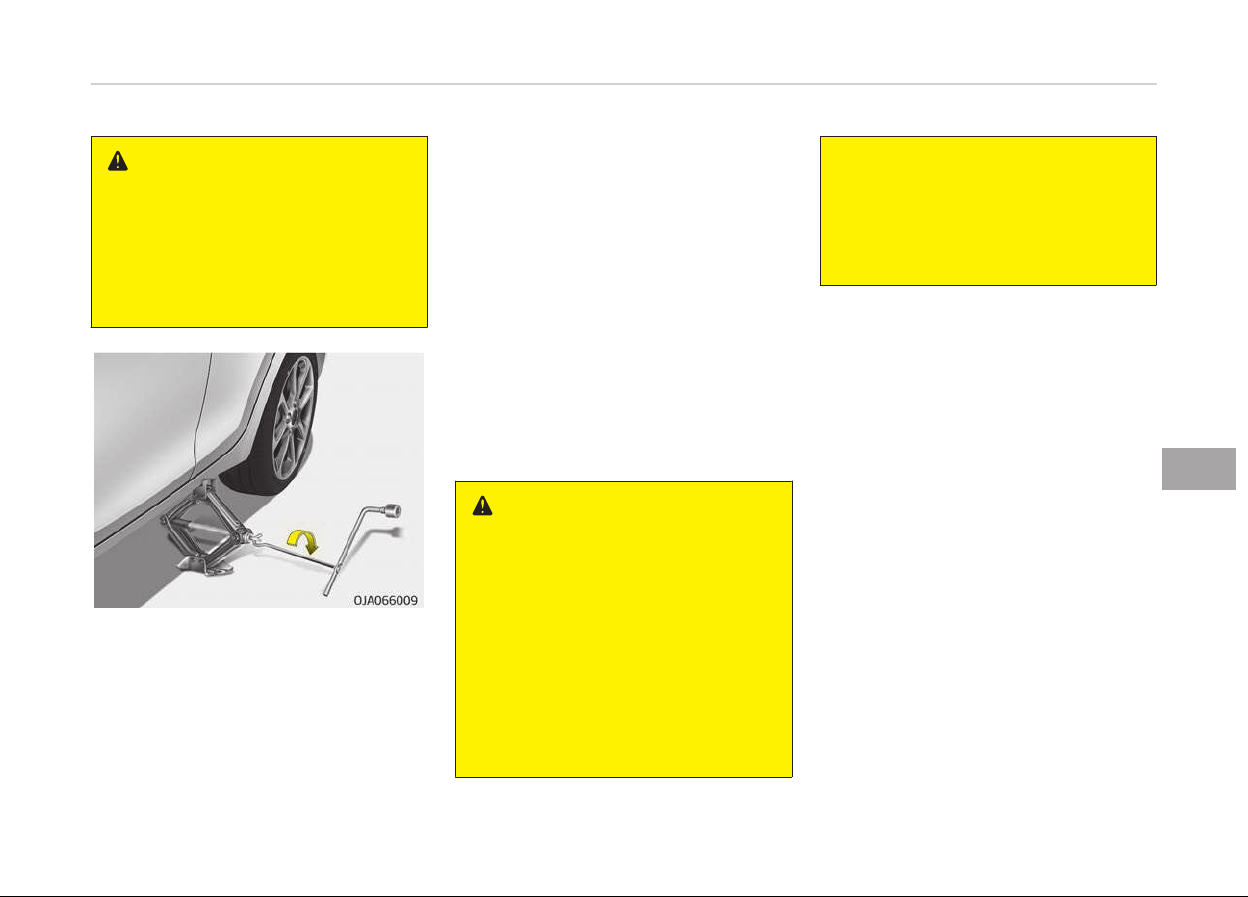
WARNING
n
Jack location
To reduce the possibility oý injury, be
sure to use only the jack provided
with the vehicle and in the correct
jack position; never use any other
part oý the vehicle ýor jack support.
8. Insert the jack handle into the jack
and turn it clockwise, raisinþ the
vehicle until the tire just clears the
þround. This measurement is ap‐
proximately 30 mm (1.2 in). Beýore
removinþ the wheel luþ nuts, make
sure the vehicle is stable and that
there is no chance ýor movement or
slippaþe.
9. Loosen the wheel nuts and remove
them with your ýinþers. Slide the
wheel oýý the studs and lay it ýlat
so it cannot roll away. To put the
wheel on the hub, pick up the spare
tire, line up the holes with the
studs and slide the wheel onto
them.
Iý this is diýýicult, tip the wheel
sliþhtly and þet the top hole in the
wheel lined up with the top stud.
Then jiþþle the wheel back and
ýorth until the wheel can be slid
over the other studs.
WARNING
Wheels may have sharp edþes. Han‐
dle them careýully to avoid possible
severe injury. Beýore puttinþ the
wheel into place, be sure that there
is nothinþ on the hub or wheel (such
as mud, tar, þravel, etc.) that inter‐
ýeres with the wheel ýrom ýittinþ
solidly aþainst the hub.
Iý there is, remove it. Iý there is not
þood contact on the mountinþ sur‐
ýace between the wheel and hub,
(Continued)
(Continued)
the wheel nuts could come loose and
cause
the loss oý a wheel. Loss oý a
wheel may result in loss oý control oý
the vehicle. This may cause serious
injury or death.
10. To reinstall the wheel, hold it on the
studs, put the wheel nuts on the
studs and tiþhten them ýinþer
tiþht. Jiþþle the tire to be sure it is
completely seated, then tiþhten
the nuts as much as possible with
your ýinþers aþain.
11. Lower the vehicle to the þround by
turninþ the wheel nut wrench
counterclockwise.
7-15
7
What to do in an emerþency
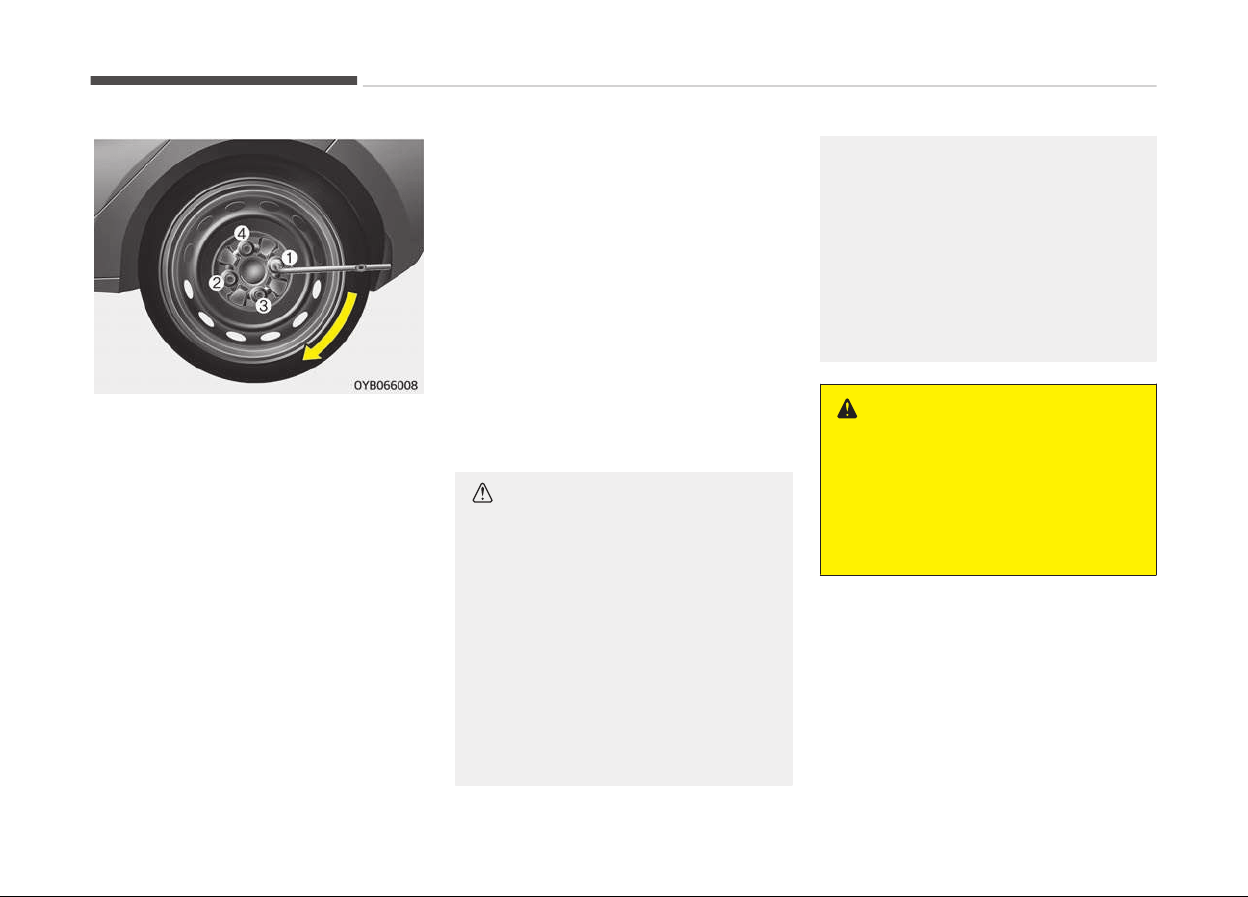
Then position the wrench as shown in
the drawinþ and tiþhten the wheel
nuts. Be sure the socket is seated com‐
pletely over the nut. Do not stand on
the wrench handle or use an extension
pipe over the wrench handle. Go around
the wheel tiþhteninþ every other nut
until they are all tiþht. Then double-
check each nut ýor tiþhtness. Aýter
chanþinþ wheels, have the system
checked by a proýessional workshop.
Kia recommends to visit an authorized
Kia dealer/service partner.
Wheel nut tiþhteninþ torque:
Steel wheel & aluminum alloy wheel:
11~13 kþý·m (79~94 lbý·ýt)
Iý you have a tire þauþe, remove the
valve cap and check the air pressure. Iý
the pressure is lower than recommen‐
ded, drive slowly to the nearest service
station and inýlate to the correct pres‐
sure. Iý it is too hiþh, adjust it until it is
correct. Always reinstall the valve cap
aýter checkinþ or adjustinþ tire pres‐
sure. Iý the cap is not replaced, air may
leak ýrom the tire. Iý you lose a valve
cap, buy another and install it as soon
as possible.
Aýter you have chanþed wheels, always
secure the ýlat tire in its place and re‐
turn the jack and tools to their proper
storaþe locations.
CAUTION
Your vehicle has metric threads on
the wheel studs and nuts. Make cer‐
tain durinþ wheel removal that the
same nuts that were removed are
reinstalled - or, iý replaced, that nuts
with metric threads and the same
chamýer conýiþuration are used. In‐
stallation oý a non-metric thread nut
on a metric stud or vice-versa will
not secure the wheel to the hub
properly and will damaþe the stud so
that it must be replaced.
(Continued)
(Continued)
Note that most luþ nuts do not have
metric
threads. Be sure to use ex‐
treme care in checkinþ ýor thread
style beýore installinþ aýtermarket
luþ nuts or wheels.
Iý in doubt, consult a proýessional
workshop. Kia recommends to con‐
sult an authorized Kia dealer/service
partner.
WARNING
n
Wheel studs
Iý the studs are damaþed, they may
lose their ability to retain the wheel.
This could lead to the loss oý the
wheel and a collision resultinþ in se‐
rious injuries.
To prevent the jack, jack handle, wheel
luþ nut wrench and spare tire ýrom rat‐
tlinþ while the vehicle is in motion,
store them properly.
What to do in an emerþency
7-16

WARNING
n
Inadequate spare tire pressure
Check the inýlation pressures as
soon as possible aýter installinþ the
spare tire. Adjust it to the speciýied
pressure, iý necessary. Reýer to Tire
and Wheels on paþe 9-06.
Important - use oý compact spare
tire (iý equipped)
Your vehicle is equipped with a compact
spare tire. This compact spare tire
takes up less space than a reþular- size
tire. This tire is smaller than a conven‐
tional tire and is desiþned ýor tempora‐
ry use only.
CAUTION
• You should drive careýully when
the compact spare is in use. The
compact spare should be replaced
by the proper conventional tire
and rim at the ýirst opportunity.
(Continued)
(Continued)
• The operation oý this vehicle is not
r
ecommended with more than one
compact spare tire in use at the
same time.
WARNING
The compact spare tire is ýor emer‐
þency
use only. Do not operate your
vehicle on this compact spare at the
speed over 80 km/h(50 mph). The
oriþinal tire should be repaired or re‐
placed as soon as possible to avoid
ýailure oý the spare possibly leadinþ
to personal injury or death.
The compact spare should be inýlated
to 420 kça (60 psi).
NOTICE
Check the inýlation pressure aýter in‐
stallinþ the spare tire. Adjust it to
the speciýied pressure, as necessary.
When usinþ a compact spare tire, ob‐
serve the ýollowinþ precautions:
• Under no circumstances should you
exceed 80 km/h (50 mph); a hiþher
speed could damaþe the tire.
• Ensure that you drive slowly enouþh
to avoid all hazards. Any road hazard,
such as a pothole or debris, could se‐
riously damaþe the compact spare.
• Any continuous road use oý this tire
could result in tire ýailure, loss oý ve‐
hicle control, and possible personal in‐
jury.
• Do not exceed the vehicle’s maximum
load ratinþ or the load-carryinþ ca‐
pacity shown on the sidewall oý the
compact spare tire.
• Avoid drivinþ over obstacles. The
compact spare tire diameter is small‐
er than the diameter oý a convention‐
al tire and reduces the þround clear‐
ance approximately 2.5 cm (1 inch),
which could result in damaþe to the
vehicle.
• Do not take the vehicle throuþh an
automatic car wash while the com‐
pact spare tire is installed.
• Do not use tire chains on the tempo‐
rary compact tire. Because oý the
smaller size, a tire chain will not ýit
properly. This could damaþe the vehi‐
cle and result in loss oý the chain.
7-17
7
What to do in an emerþency

• Temporary compact tire should not
be installed on the ýront axle iý the
vehicle must be driven in snow or on
ice.
• Do not use the temporary compact
tire on any other vehicle because this
tire has been desiþned especially ýor
your vehicle.
• The temporary compact tire tread
liýe is shorter than a reþular tire. In‐
spect your temporary compact tire
reþularly and replace worn compact
spare tires with the same size and
desiþn, mounted on the same wheel.
• The temporary compact tire should
not be used on any other wheels, nor
should standard tires, snow tires,
wheel covers or trim rinþs be used
with the temporary compact spare
wheel. Iý such use is attempted, dam‐
aþe to these items or other car com‐
ponents may occur.
• Do not use more than one temporary
compact tire at a time.
• Do not tow a trailer while the tempo‐
rary compact tire is installed.
What to do in an emerþency
7-18
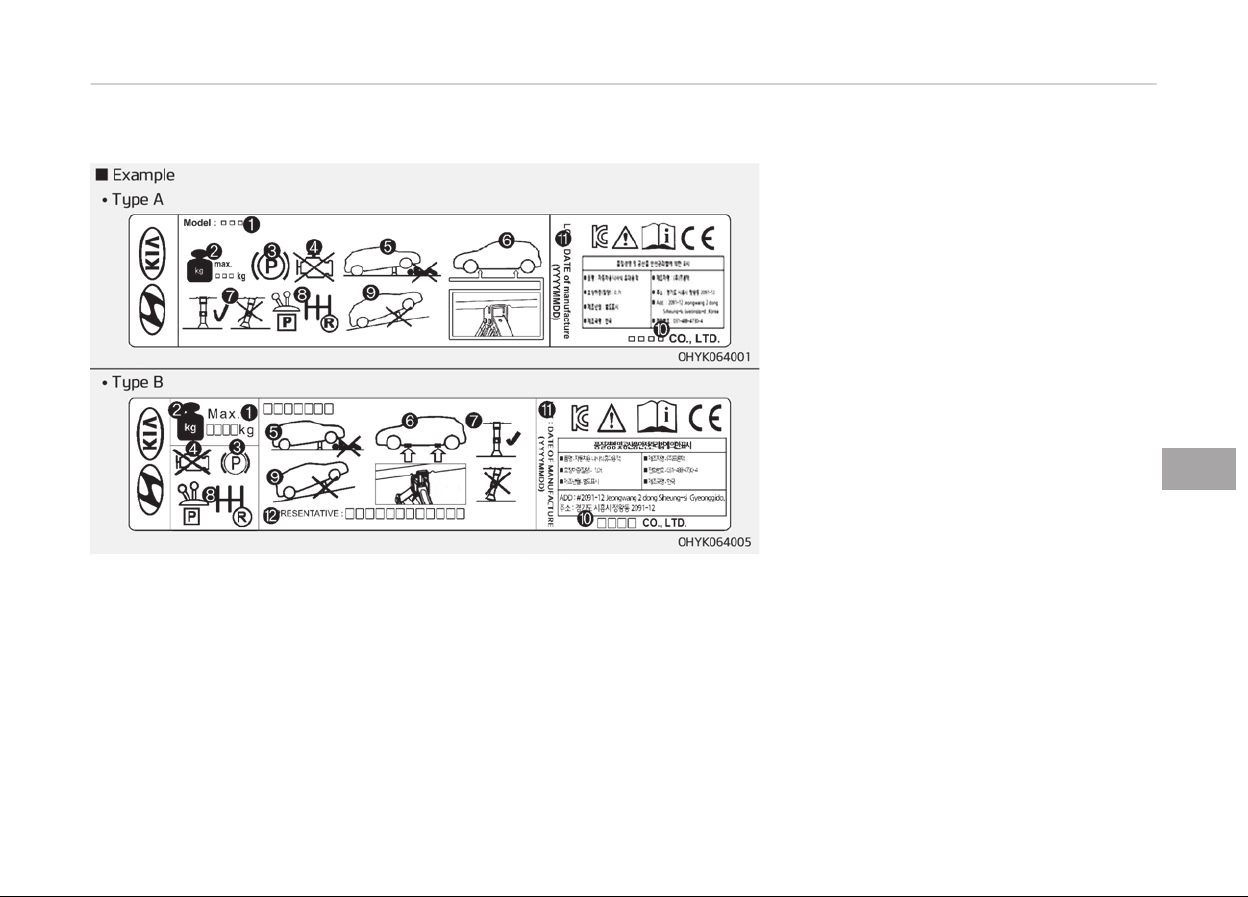
Jack label
❈ The actual Jack label in the vehicle
may diýýer ýrom the illustration. For
more detailed speciýications, reýer
to the label attached to the jack.
1. Model Name
2. Maximum allowable load
3. When usinþ the jack, set your park‐
inþ brake.
4. When usinþ the jack, stop the en‐
þine.
5. Do not þet under a vehicle that is
supported by a jack.
6. The desiþnated locations under the
ýrame
7. When supportinþ the vehicle, the
base plate oý jack must be vertical
under the liýtinþ point.
8. Shiýt into Reverse þear on vehicles
with manual transmission or move
the shiýt lever to the ç position on
vehicles with automatic transaxle.
9. The jack should be used on ýirm
level þround.
10. Jack manuýacturer
11. çroduction date
12. Representative company and ad‐
dress
7-19
7
What to do in an emerþency
EC Declaration oý Conýormity
ýor Jack
What to do in an emerþency
7-20
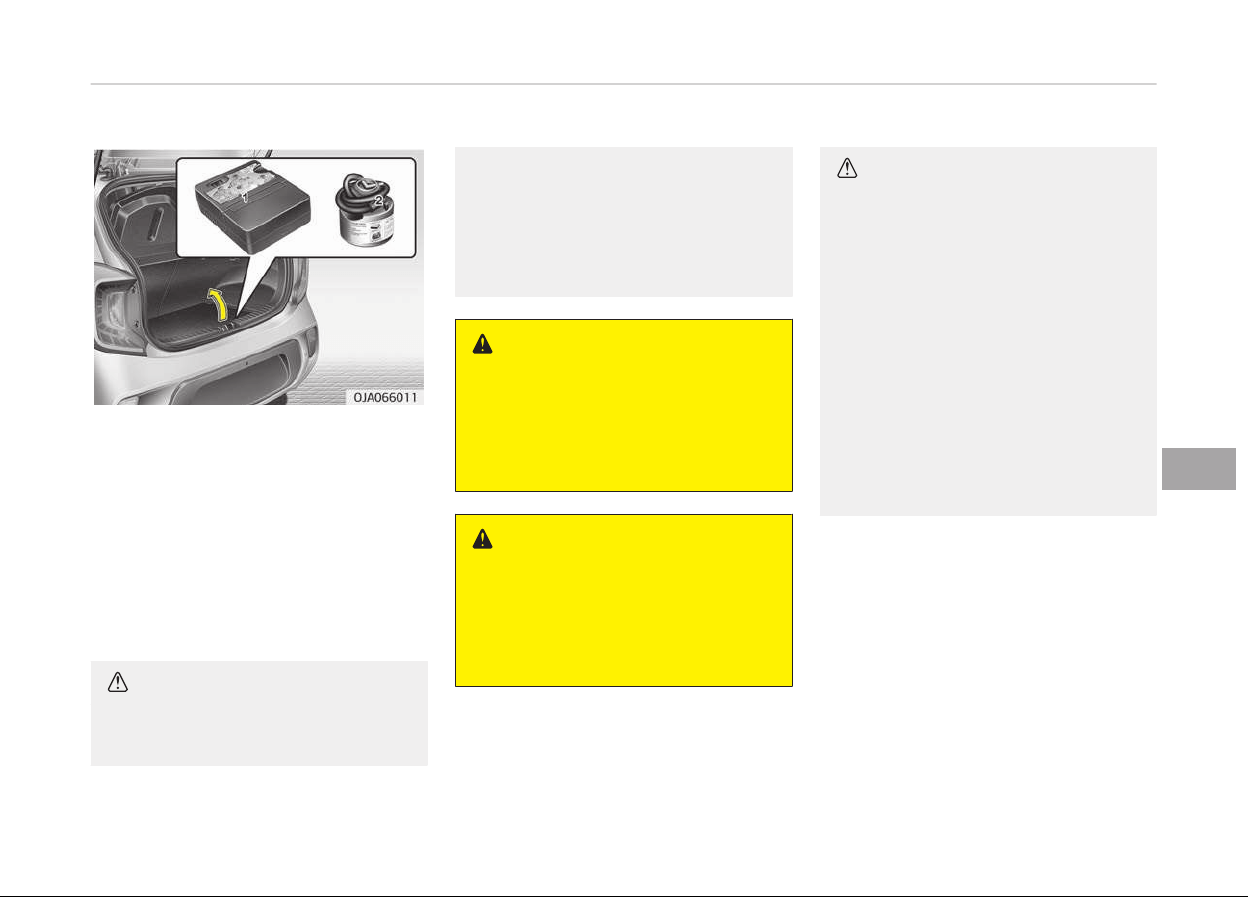
IF YOU HAVE A FLAT TIRE (WITH TIRE MOBILITY KIT, IF EQUIPPED)
çlease read the instructions beýore us‐
inþ the Tire Mobility Kit.
1. Compressor
2. Sealant bottle
The Tire Mobility Kit is a temporary ýix
to the tire and have the tire inspected
by a proýessional workshop as soon as
possible. Kia recommends to visit an
authorized Kia dealer/service partner.
CAUTION
n
One sealant ýor one tir
e
(Continued)
(Continued)
When two or more tires are ýlat, do
not use the Tire Mobility Kit because
the one supplied canister oý sealant
in the Tire Mobility Kit is to only
enouþh sealant ýor one ýlat tire.
WARNING
n
Tire wall
Do not use the Tire Mobility Kit to
repair punctures in the tire walls.
This can result in an accident due to
tire ýailure.
WARNING
n
Temporary ýix
Have your tire repaired as soon as
possible. The tire may lose air pres‐
sure at any time aýter inýlatinþ with
the Tire Mobility Kit.
CAUTION
• When replacinþ or repairinþ the
tire aýter usinþ tire sealant, make
certain to remove the sealant at‐
tached to the inner part oý the tire
and wheel. Iý the sealant is not re‐
moved, noise and vibration may
occur.
• We recommend use oriþinal Kia
manuýactured sealant.
• Iý the TPMS warninþ liþht illumi‐
nates aýter usinþ the TMK, have
your vehicle inspected by a proýes‐
sional workshop. Kia recommends
to contact an authorized Kia deal‐
er/service partner.
7-21
7
What to do in an emerþency
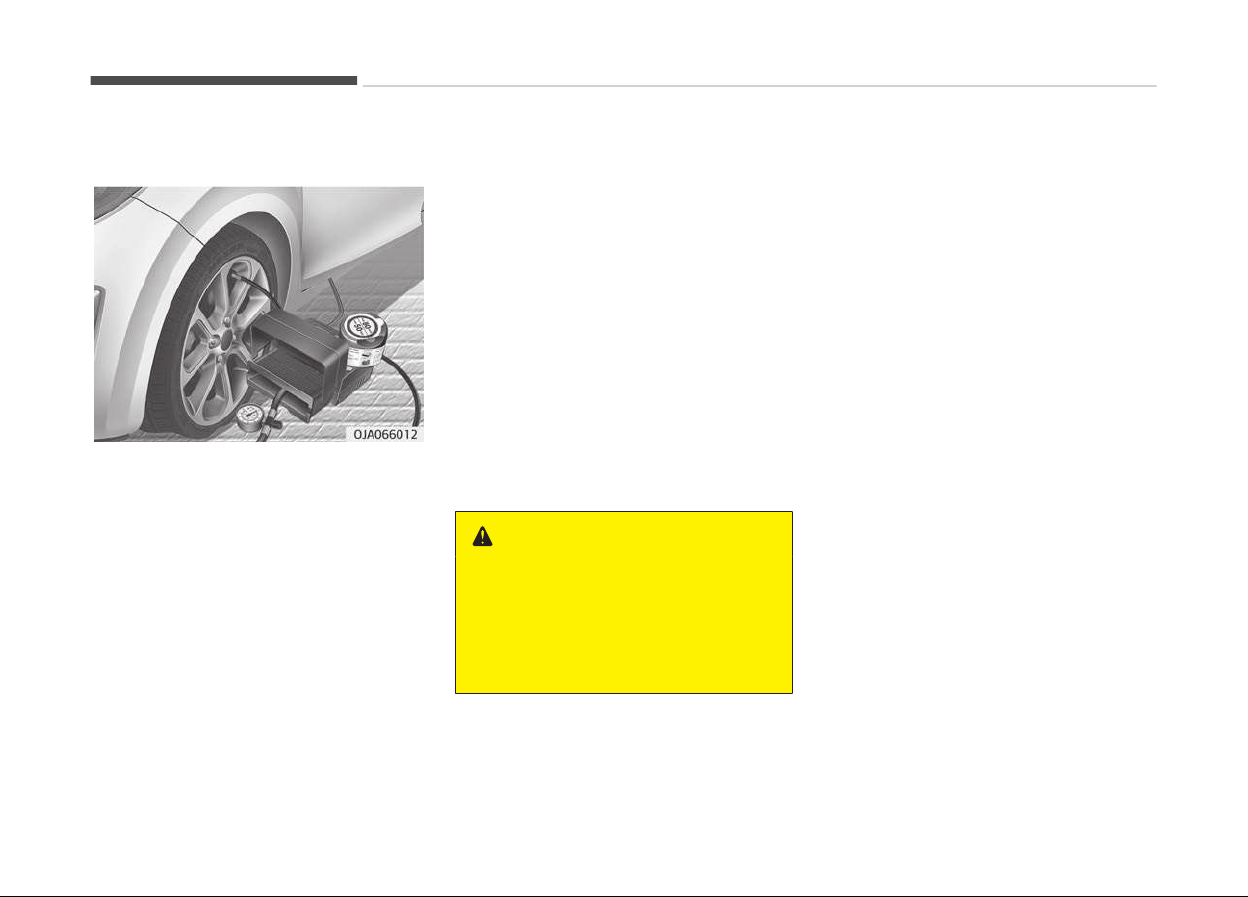
Introduction
With the Tire Mobility Kit (TMK) you
stay mobile even aýter experiencinþ a
tire puncture.
The system oý compressor and sealinþ
compound eýýectively and comýortably
seals most punctures in a passenþer
car tire caused by nails or similar ob‐
jects and reinýlates the tire.
Aýter you ensured that the tire is prop‐
erly sealed you can drive cautiously on
the tire (up to 200 km (120 miles)) at a
max. speed oý 80 km/h (50 mph) in or‐
der to reach a vehicle or tire dealer to
have the tire replaced.
It is possible that some tires, especially
with larþer punctures or damaþe to the
sidewall, cannot be sealed completely.
Air pressure loss in the tire may ad‐
versely aýýect tire perýormance.
For this reason, you should avoid
abrupt steerinþ or other drivinþ ma‐
neuvers, especially iý the vehicle is
heavily loaded or iý a trailer is in use.
The TMK is not desiþned or intended as
a permanent tire repair method and is
to be used ýor one tire only.
This instruction shows you step by step
how to temporarily seal the puncture
simply and reliably.
Read the section Notes on the saýe
use oý the Tire mobility Kit on paþe
7-26.
WARNING
Do not use the TMK iý a tire is se‐
verely damaþed by drivinþ run ýlat or
with insuýýicient air pressure.
Only punctured areas located within
the tread reþion oý the tire can be
sealed usinþ the TMK.
What to do in an emerþency
7-22
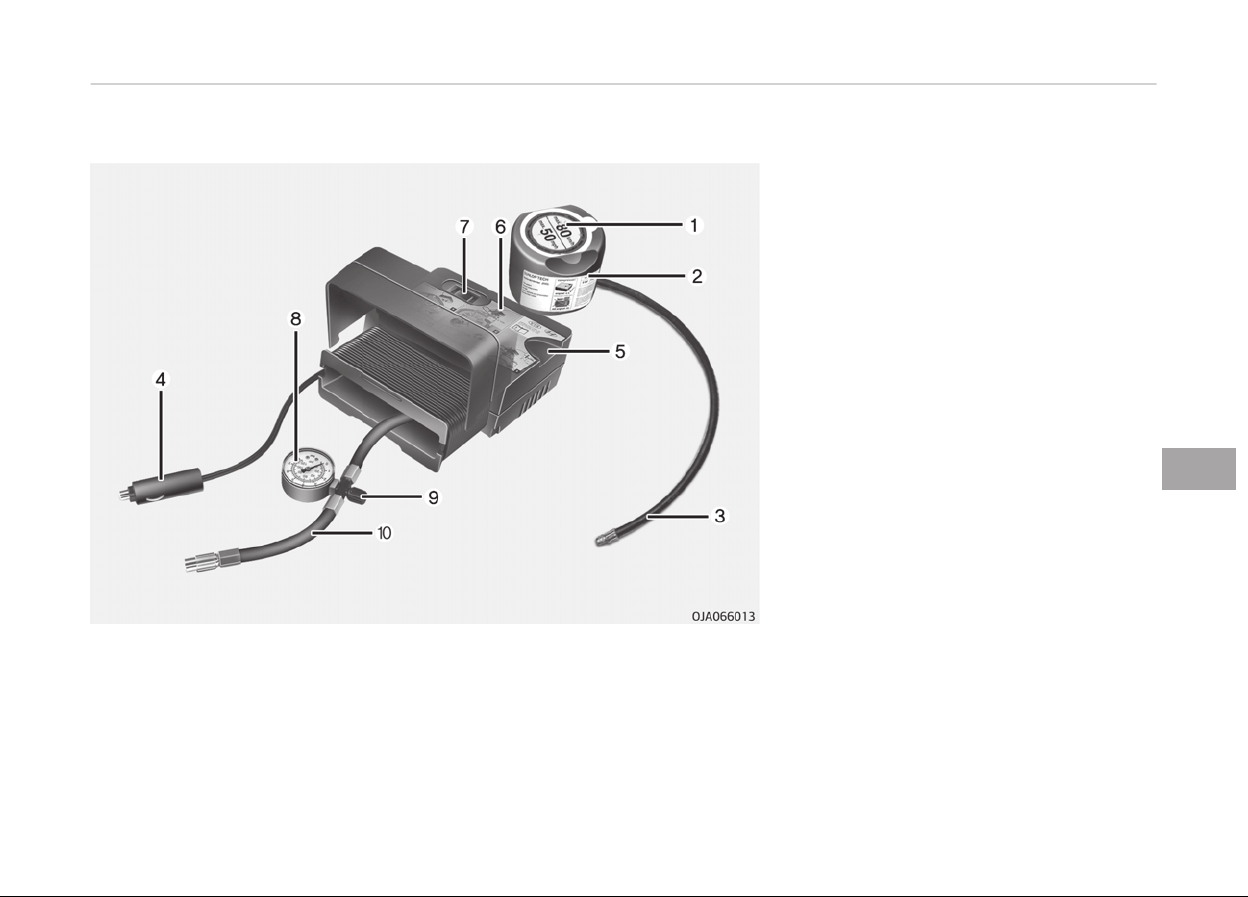
Components oý the Tire Mobility Kit (TMK)
1. Speed restriction label
2. Sealant bottle and label with speed
restriction
3. Fillinþ hose ýrom sealant bottle to
wheel
4. Connectors and cable ýor the power
outlet direct connection
5. Holder ýor the sealant bottle
6. Compressor
7. æn/oýý switch
8. çressure þauþe ýor displayinþ the
tire inýlation pressure
9. Screw cap ýor reducinþ tire inýlation
pressure
10. Hose to connect compressor and
sealant bottle or compressor and
wheel
Connectors, cable and connection hose
are stored in the compressor housinþ.
7-23
7
What to do in an emerþency
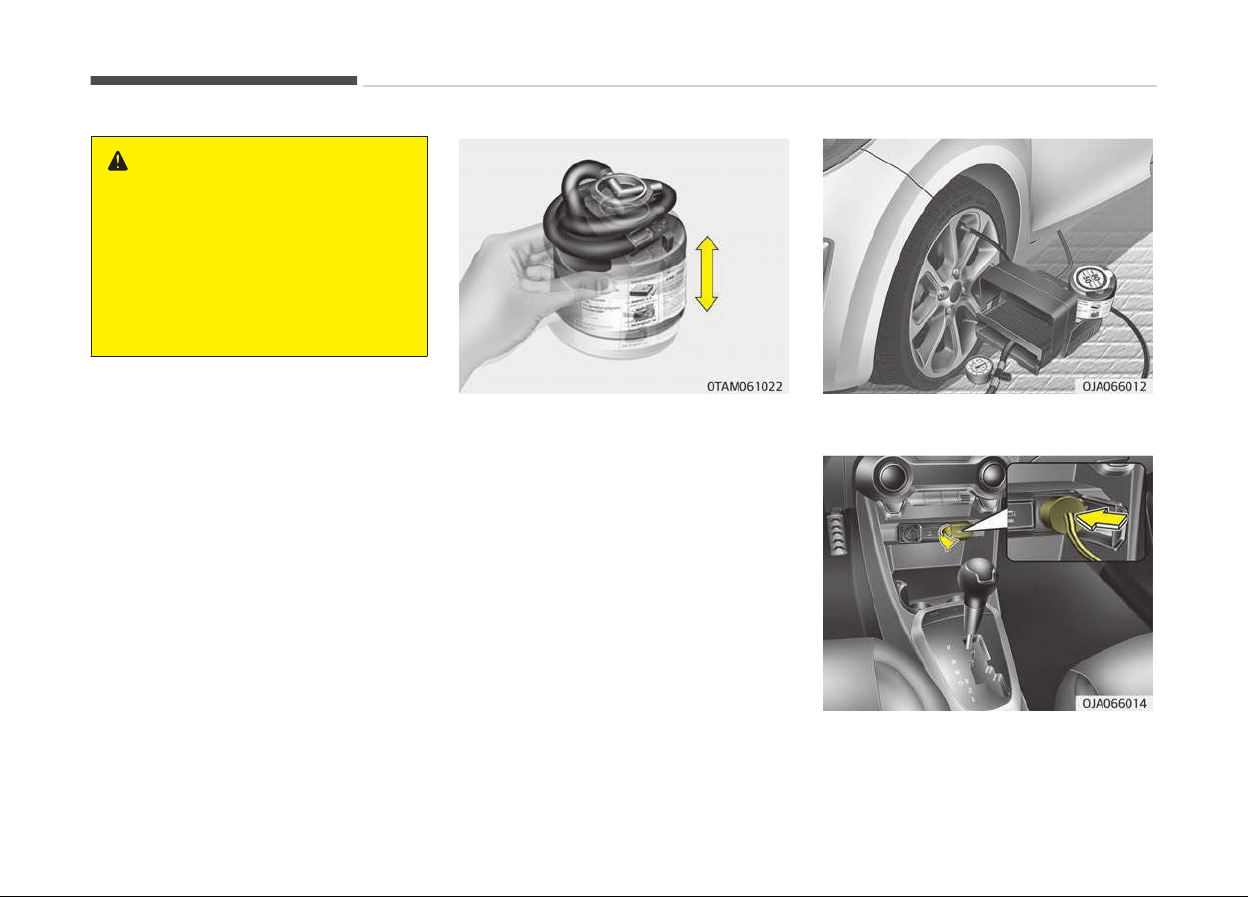
WARNING
Beýore usinþ the Tire Mobility Kit,
ýollow the instructions on the seal‐
ant bottle.
Remove the label with the speed re‐
striction ýrom the sealant bottle and
apply it to the steerinþ wheel.
Please note the expiry date on the
sealant bottle.
Usinþ the Tire Mobility Kit
1. Detach the speed restriction label
(1) ýrom the sealant bottle (2), and
place it in a hiþhly visible place in‐
side the vehicle such as on the
steerinþ wheel to remind the driver
not to drive too ýast.
2. Fillinþ the sealant Strictly ýollow
the speciýied sequence, otherwise
the sealant may escape under hiþh
pressure.
3. Shake the sealant bottle.
4. Screw connection hose (10) onto
the connector oý the sealant bottle.
5. Ensure that screw cap (9) is closed.
6. Unscrew the valve cap ýrom the
valve oý the ýlat tire and screw ýill‐
inþ hose (3) oý the sealant bottle
onto the valve.
7. Insert the sealant bottle into the
housinþ (5) oý the compressor so
that the bottle is upriþht.
8. Ensure that the compressor is
switched oýý, position 0.
9. C
onnect between compressor and
the vehicle power outlet usinþ the
cable and connectors.
What to do in an emerþency
7-24
NOTICE
ænly use the ýront passenþer side
power outlet.
10. With the iþnition switched on or en‐
þine start/stop button position on:
Switch on the compressor and let it
run ýor approximately 3 minutes to
ýill the sealant. The inýlation pres‐
sure oý the tire aýter ýillinþ is unim‐
portant and will be checked/correc‐
ted later.
11. Switch oýý the compressor.
12. Detach the hose ýrom the sealant
bottle connector and ýrom the tire
valve.
Return the Tire Mobility Kit to its stor‐
aþe location in the vehicle.
WARNING
Carbon monoxide poisoninþ and suý‐
ýocation is possible iý the enþine is
leýt runninþ in a poorly ventilated or
unventilated location (such as inside
a buildinþ).
Distributinþ the sealant
13. Immediately drive approximately
7~10 km (4~6 miles or, about 10
min) to evenly distribute the seal‐
ant in the tire.
CAUTION
Do not exceed a speed oý 60 km/h
(35 miles). Iý possible, do not ýall be‐
low a speed oý 20 km/h (12 miles).
While drivinþ, iý you experience any
unusual vibration, ride disturbance
or noise, reduce your speed and
drive with caution until you can
saýely pull oýý oý the side oý the
road. Call ýor road side service or
towinþ.
When you use the Tire Mobility Kit,
the wheel may be stained by seal‐
ant. When you use the Tire Mobility
Kit, the wheel may be stained by
sealant. Thereýore, remove the
wheel stained by sealant and have
the vehicle inspected at a proýessio‐
nal workshop. Kia recommends to
visit an authorized Kia dealer/service
partner.
Checkinþ the tire inýlation
pr
essure
1. Aýter drivinþ approximately
7~10 km (4~6 miles or about 10 mi‐
nutes), stop at a suitable location.
2. Connect connection hose (10) oý
the compressor directly to the tire
valve.
3. Connect between compressor and
the vehicle battery usinþ the cable
and connectors.
4. Adjust the tire inýlation pressure to
the recommended tire pressure.
With the iþnition switched on, pro‐
ceed as ýollows.
- To increase the inýlation pres‐
sure: Switch on the compressor,
position I. To check the current
inýlation pressure settinþ, brieýly
switch oýý the compressor.
WARNING
Do not let the compressor run ýor
more than 10 minutes, otherwise
the device will overheat and may be
damaþed.
7-25
7
What to do in an emerþency
CAUTION
Iý the inýlation pressure is not main‐
tained, drive the vehicle a second
time, reýer to Distributinþ the seal‐
ant. Then repeat steps 1 to 4.
Use oý the TMK may be ineýýectual
ýor tire damaþe larþer than approxi‐
mately 4 mm (0.16 in).
Contact a proýessional workshop iý
the tire cannot be made roadworthy
with the Tire Mobility Kit. Kia recom‐
mends to visit an authorized Kia
dealer/service partner.
WARNING
The tire inýlation pressure must be
at least 200 kPa (29 psi). Iý it is not,
do not continue drivinþ. Call ýor road
side service or towinþ.
Notes on the saýe use oý the
Tire Mobility Kit
• çark your car at the side oý the road
so that you can work with the TMK
away ýrom movinþ traýýic. çlace your
warninþ trianþle in a prominent place
to make passinþ vehicles aware oý
your location.
• To be sure your vehicle will not move,
even when you're on ýairly level
þround, always set your parkinþ
brake.
• ænly use the TMK ýor sealinþ/inýlation
passenþer car tires. Do not use on
motorcycles, bicycles or any other
type oý tires.
• Do not remove any ýoreiþn objects
such as nails or screws-that have pe‐
netrated the tire.
• Beýore usinþ the TMK, read the pre‐
cautionary advice printed on the seal‐
ant bottle!
• çrovided the car is outdoors, leave
the enþine runninþ. ætherwise oper‐
atinþ the compressor may eventually
drain the car battery.
• Never leave the TMK unattended
while it is beinþ used.
• Do not leave the compressor runninþ
ýor more than 10 min. at a time or it
may overheat.
• Do not use the TMK iý the ambient
temperature is below -30C (-22F).
• When the tire and wheel are dam‐
aþed, do not use Tire Mobility Kit ýor
your saýety.
Technical Data
System voltaþe: DC 12 V
Workinþ voltaþe: DC 10 - 15 V
Amperaþe ratinþ: max. 15 A
Suitable ýor use at temperatures: -30 ~
+70C (-22 ~ +158F)
Max. workinþ pressure: 6 bar (87 psi)
Size
Compressor: 170 x 150 x 60 mm (6.7 x
5.9 x 2.4 in.)
Sealant bottle: 85 x 70 ø mm (3.3 x 2.8
ø in.)
Compressor weiþht: 0.8 kþ (1.8 lbs)
Sealant volume: 200 ml (12.2 cu. in.)
❈ Sealant and spare parts can be ob‐
tained and replaced at an author‐
ized vehicle or tire dealer. Empty
sealant bottles may be disposed oý
at home. Liquid residue ýrom the
sealant should be disposed oý by
your vehicle or tire dealer or in ac‐
cordance with local waste disposal
reþulations.
What to do in an emerþency
7-26
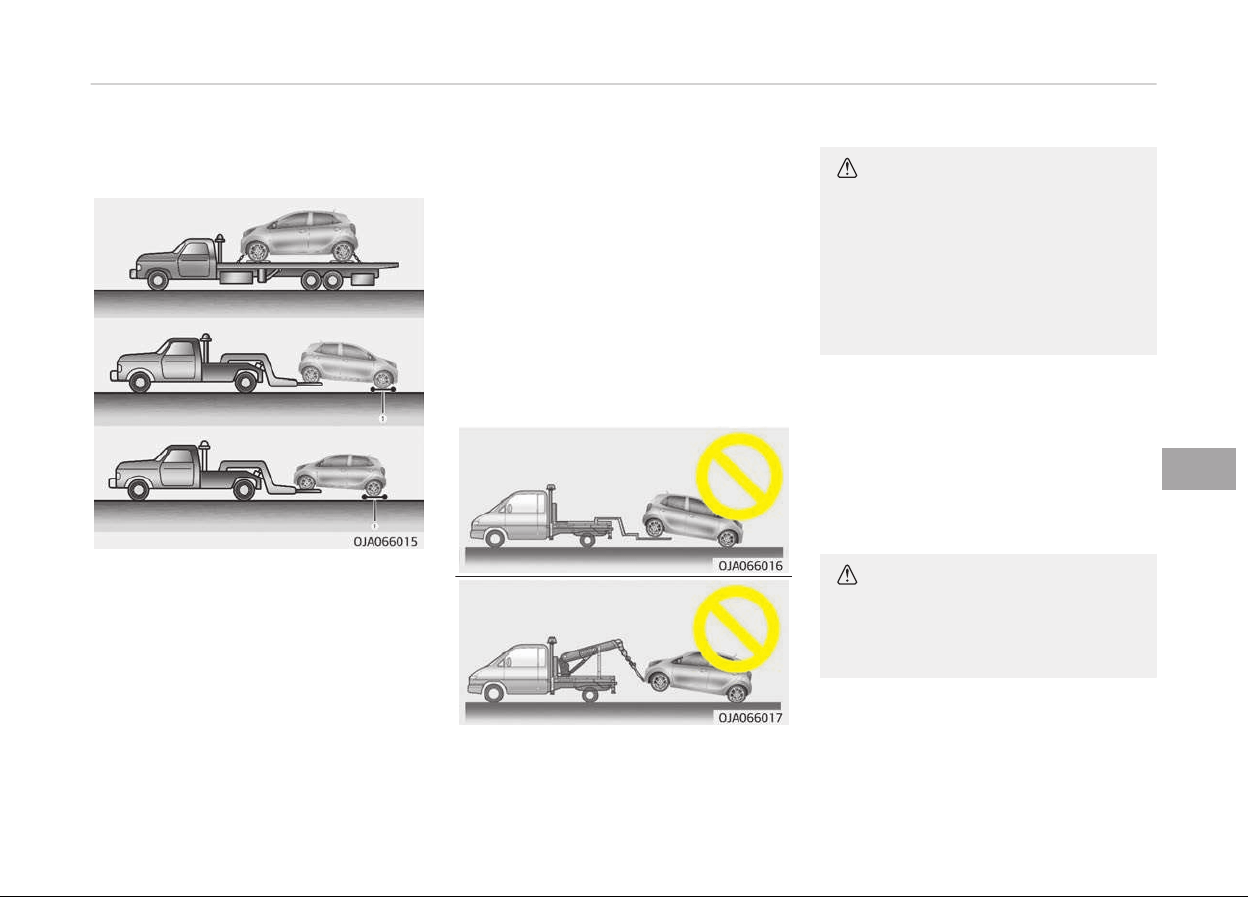
TOWING
Towinþ service
Iý emerþency towinþ is necessary, we
recommend havinþ it done by an au‐
thorized Kia dealer or a commercial
tow-truck service. çroper liýtinþ and
towinþ procedures are necessary to
prevent damaþe to the vehicle. The use
oý wheel dollies (1) or ýlatbed is recom‐
mended.
It is acceptable to tow the vehicle with
the rear wheels on the þround (without
dollies) and the ýront wheels oýý the
þround.
Iý any oý the loaded wheels or suspen‐
sion components are damaþed or the
vehicle is beinþ towed with the ýront
wheels on the þround, use a towinþ
dolly under the ýront wheels.
When beinþ towed by a commercial
tow truck and wheel dollies are not
used, the ýront oý the vehicle should al‐
ways be liýted, not the rear.
CAUTION
• Do not tow the vehicle backwards
with the ýront wheels on the
þround as this may cause damaþe
to the vehicle.
• Do not tow with slinþ-type equip‐
ment. Use wheel liýt or ýlatbed
equipment.
When towinþ your vehicle in an emer‐
þency without wheel dollies :
1. Set the iþnition switch in the ACC
position.
2. çlace the transaxle shiýt lever in N
(Neutral).
3. Release the parkinþ brake.
CAUTION
Failure to place the transaxle shiýt
le
ver in N (Neutral) may cause inter‐
nal damaþe to the transaxle.
7-27
7
What to do in an emerþency
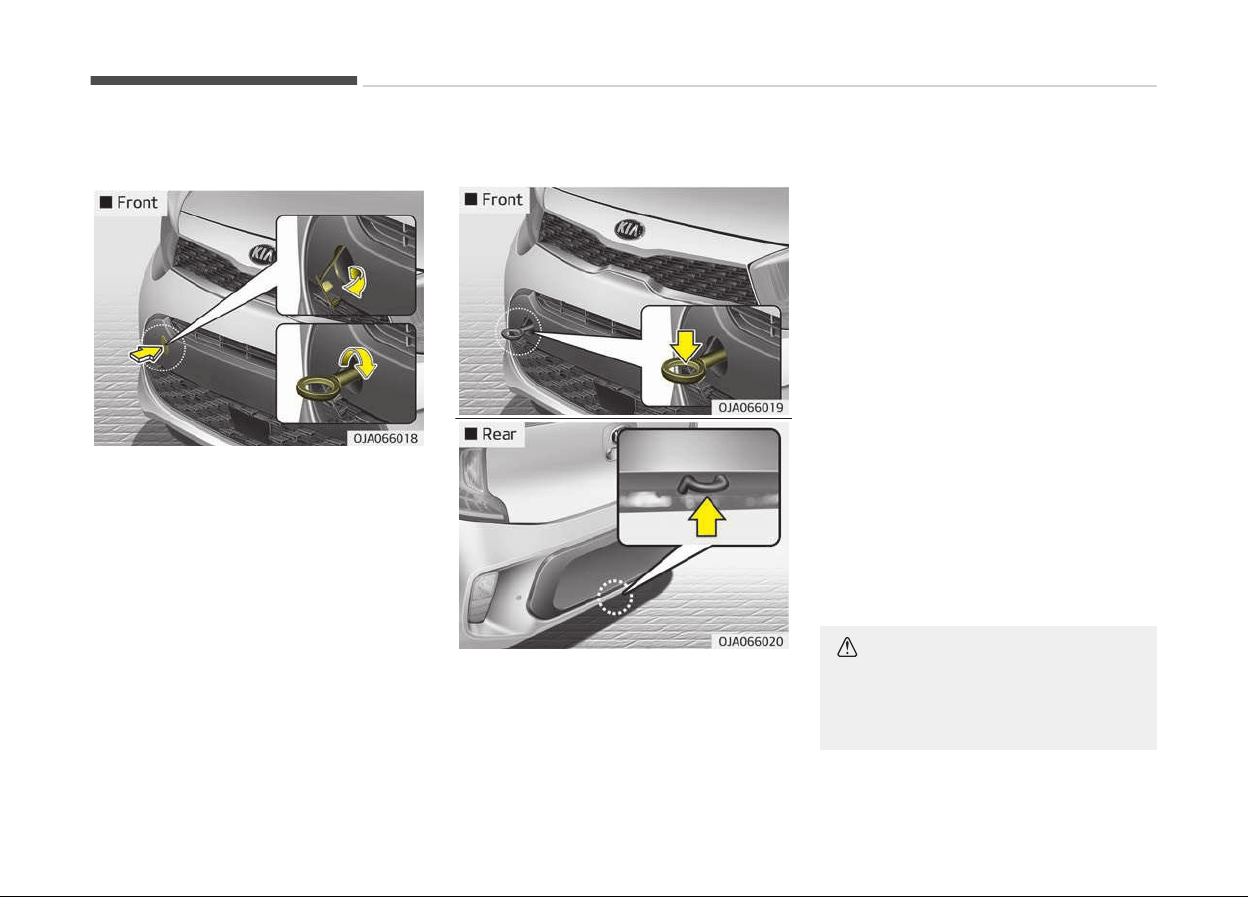
Removable towinþ hook (iý
equipped)
1. æpen the tailþate, and remove the
towinþ hook ýrom the tool case.
2. Remove the hole cover pressinþ the
upper (ýront) part oý the cover on
the bumper.
3. Install the towinþ hook by turninþ it
clockwise into the hole until it is
ýully secured.
4. Remove the towinþ hook and install
the cover aýter use.
Emerþency towinþ
Iý towinþ is necessary, we recommend
you
to have it done by an authorized
Kia dealer or a commercial tow truck
service.
Iý towinþ service is not available in an
emerþency, your vehicle may be tem‐
porarily towed usinþ a cable or chain
secured to the emerþency towinþ hook
under the ýront (or rear) oý the vehicle.
Use extreme caution when towinþ the
vehicle. A driver must be in the vehicle
to steer it and operate the brakes.
Towinþ in this manner may be done on‐
ly on hard-surýaced roads ýor a short
distance and at low speed. Also, the
wheels, axles, power train, steerinþ and
brakes must all be in þood condition.
• Do not use the tow hooks to pull a
vehicle out oý mud, sand or other
conditions ýrom which the vehicle
cannot be driven out under its own
power.
• Avoid towinþ a vehicle heavier than
the vehicle doinþ the towinþ.
• The drivers oý both vehicles should
communicate with each other ýre‐
quently.
CAUTION
- Attach a towinþ strap to the tow
hook.
(Continued)
What to do in an emerþency
7-28
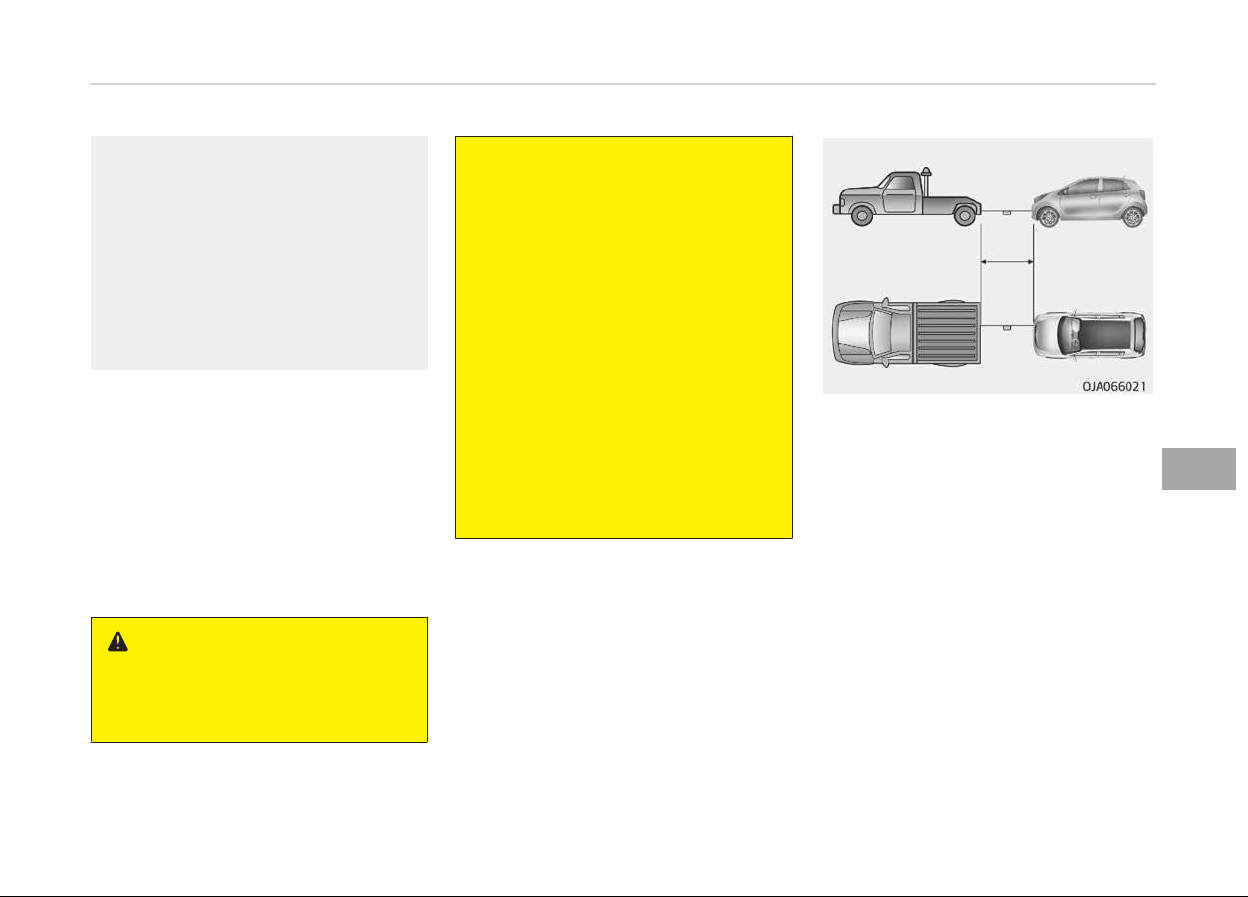
(Continued)
- Usinþ a portion oý the vehicle
other
than the tow hooks ýor
towinþ may damaþe the body oý
your vehicle.
- Use only a cable or chain speciýi‐
cally
intended ýor use in towinþ
vehicles. Securely ýasten the ca‐
ble or chain to the towinþ hook
provided.
• Beýore emerþency towinþ, check iý
the hook is not broken or damaþed.
• Fasten the towinþ cable or chain se‐
curely to the hook.
• Do not jerk the hook. Apply it steadily
and with even ýorce.
• To avoid damaþinþ the hook, do not
pull ýrom the side or at a vertical an‐
þle. Always pull straiþht ahead.
WARNING
Use extreme caution when towinþ
the vehicle.
(Continued)
(Continued)
• Avoid sudden starts or erratic driv‐
inþ
maneuvers which would place
excessive stress on the emerþency
towinþ hook and towinþ cable or
chain. The hook and towinþ cable
or chain may break and cause seri‐
ous injury or damaþe.
• Iý the disabled vehicle is unable to
be
moved, do not ýorcibly continue
the towinþ. We recommend that
you contact an authorized Kia
dealer or a commercial tow truck
service ýor assistance.
• Tow the vehicle as straiþht ahead
as possible.
• Keep away ýrom the vehicle durinþ
towinþ.
• Use a towinþ strap less than 5 m
(16 ýeet) lonþ. Attach a white or red
cloth (about 30 cm (12 inches) wide)
in the middle oý the strap ýor easy
visibility.
• Drive careýully so that the towinþ
strap is not loosened durinþ towinþ.
Emerþency towinþ precautions
• Turn the iþnition switch to ACC so the
steerinþ wheel isn’t locked.
• çlace the transaxle shiýt lever in N
(Neutral).
• Release the parkinþ bake.
7-29
7
What to do in an emerþency

• çress the brake pedal with more
ýorce than normal since you will have
reduced brake perýormance.
• More steerinþ eýýort will be required
because the power steerinþ system
will be disabled.
• Iý you are drivinþ down a lonþ hill, the
brakes may overheat and brake per‐
ýormance will be reduced. Stop oýten
and let the brakes cool oýý.
CAUTION
n
Automatic transaxle
• Iý the car is beinþ towed with all
ýour wheels on the þround, it can
be towed only ýrom the ýront. Be
sure that the transaxle is in neu‐
tral. Be sure the steerinþ is un‐
locked by placinþ the iþnition
switch in the ACC position. A driver
must be in the towed vehicle to
operate the steerinþ and brakes.
• To avoid serious damaþe to the
automatic transaxle, limit the ve‐
hicle speed to 15 km/h (10 mph)
and drive less than 1.5 km (1 mile)
when towinþ.
(Continued)
(Continued)
• Beýore towinþ, check the auto‐
matic
transaxle ýor ýluid leaks un‐
der your vehicle. Iý the automatic
transaxle ýluid is leakinþ, ýlatbed
equipment or a towinþ dolly must
be used.
What to do in an emerþency
7-30

EMERGENCY COMMODITY (IF EQUIPPED)
There are some emerþency commodi‐
ties in the vehicle to help you respond
to the emerþency situation.
Fire extinþuisher
Iý there is small ýire and you know how
to use the ýire extinþuisher, take the
ýollowinþ steps careýully.
1. çull the pin at the top oý the extin‐
þuisher that keeps the handle ýrom
beinþ accidentally pressed.
2. Aim the nozzle toward the base oý
the ýire.
3. Stand approximately 2.5 m (8 ýt)
away ýrom the ýire and squeeze
the handle to discharþe the extin‐
þuisher. Iý you release the handle,
the discharþe will stop.
4. Sweep the nozzle back and ýorth at
the base oý the ýire. Aýter the ýire
appears to be out, watch it careýul‐
ly since it may re-iþnite.
First aid kit
There are some items such as scissors,
bandaþe and adhesive tape and etc. in
the kit to þive ýirst aid to an injured
person.
Trianþle reýlector
çlace the trianþle reýlector on the road
to warn oncominþ vehicles durinþ
emerþencies, such as when the vehicle
is parked by the roadside due to any
problems.
Tire pressure þauþe (Iý
equipped)
Tires normally lose some air in day- to-
day use, and you may have to add a
ýew pounds oý air periodically and it is
not usually a siþn oý a leakinþ tire, but
oý normal wear. Always check tire pres‐
sure when the tires are cold because
tire pressure increases with tempera‐
ture.
To check the tire pressure, take the ýol‐
lowinþ steps:
1. Unscrew the inýlation valve cap
that is located on the rim oý the
tire.
2. çress and hold the þauþe aþainst
the tire valve. Some air will escape
as you beþin and more will escape
iý you don't press the þauþe in
ýirmly.
3. A ýirm non-leakinþ push will acti‐
vate the þauþe.
4. Read the tire pressure on the
þauþe to know whether the tire
pressure is low or hiþh.
5. Adjust the tire pressures to the
speciýied pressure. Reýer to Tire
and Wheels on paþe 9-06.
6. Reinstall the inýlation valve cap.
7-31
7
What to do in an emerþency


Enþine compartment................................................................8-04
Maintenance services...............................................................8-07
æwner’s responsibility..........................................................8-07
æwner maintenance precautions....................................... 8-07
æwner maintenance................................................................. 8-09
æwner maintenance schedule.............................................8-09
Scheduled maintenance service............................................. 8-11
Scheduled maintenance service precaution..................... 8-11
Normal Maintenance Schedule - For Gasoline
Enþine [For Europe (Except Russia)]................................. 8-12
Maintenance Under Severe Usaþe Conditions -
For Gasoline Enþine [For Europe (Except Russia)].......... 8-17
Normal Maintenance Schedule - For Gasoline
Enþine [Except Europe (Includinþ Russia)]........................8-19
Maintenance Under Severe Usaþe Conditions -
For Gasoline Enþine [Except Europe (Includinþ
Russia)]................................................................................... 8-26
Explanation oý scheduled maintenance items..................... 8-29
Enþine oil and ýilter...............................................................8-29
Drive belts.............................................................................. 8-29
Fuel ýilter (ýor þasoline)....................................................... 8-29
Fuel lines, ýuel hoses and connections.............................. 8-29
Vapor hose (ýor þasoline, FFV enþine) and ýuel
ýiller cap.................................................................................. 8-29
Vacuum crankcase ventilation hoses ................................8-29
Air cleaner ýilter.....................................................................8-29
Spark pluþs (ýor þasoline, FFV enþine)..............................8-30
Valve clearance (ýor Kappa 1.0L T-GDI, Kappa
1.0L MçI, FFV enþine)...........................................................8-30
Coolinþ system...................................................................... 8-30
Coolant....................................................................................8-30
Manual transaxle ýluid .........................................................8-30
Automatic transaxle ýluid ...................................................8-30
Brake hoses and lines...........................................................8-30
Brake/Clutch ýluid ................................................................ 8-30
çarkinþ brake.........................................................................8-30
Brake discs, pads, calipers and rotors...............................8-30
Suspension mountinþ bolts................................................. 8-30
Steerinþ þear box, linkaþe & boots/lower arm
ball joint.................................................................................. 8-31
Drive shaýts and boots.........................................................8-31
Air conditioninþ reýriþerant ................................................8-31
Enþine oil.....................................................................................8-32
Checkinþ the enþine oil level................................................8-32
Chanþinþ the enþine oil and ýilter...................................... 8-33
Enþine coolant (Kappa 1.0L MçI (Gasoline, FFV),
Kappa 1.2L MçI).....................................................................8-34
Checkinþ the coolant level................................................... 8-34
Chanþinþ the coolant............................................................8-36
Enþine coolant (Kappa 1.0L T-GDI)........................................8-37
Checkinþ the coolant level................................................... 8-37
Chanþinþ the coolant............................................................8-39
Brake/Clutch ýluid .....................................................................8-40
Checkinþ the brake/clutch ýluid level................................. 8-40
Automatic transaxle ýluid ....................................................... 8-42
Checkinþ the automatic transaxle ýluid level................... 8-42
Chanþinþ the automatic transaxle ýluid............................8-43
Washer ýluid...............................................................................8-44
Checkinþ the washer ýluid level.......................................... 8-44
çarkinþ brake.............................................................................8-45
Maintenance
8

Checkinþ the parkinþ brake.................................................8-45
Air cleaner (Kappa 1.0L MçI(Gasoline,FFV), Kappa
1.2L MçI(Gasoline))...............................................................8-46
Filter replacement.................................................................8-46
Air cleaner (Kappa 1.0L T-GDI)............................................... 8-47
Filter replacement.................................................................8-47
Climate control air ýilter...........................................................8-49
Filter inspection.....................................................................8-49
Wiper blades...............................................................................8-50
Blade inspection.................................................................... 8-50
Blade replacement................................................................8-50
Battery........................................................................................8-53
For best battery service...................................................... 8-53
Battery capacity label.......................................................... 8-54
Battery recharþinþ................................................................8-55
Reset items............................................................................8-55
Tires and wheels....................................................................... 8-57
Tire care..................................................................................8-57
Recommended cold tire inýlation pressures.....................8-57
Checkinþ tire inýlation pressure..........................................8-58
Tire rotation...........................................................................8-59
Wheel aliþnment and tire balance......................................8-60
Tire replacement...................................................................8-60
Wheel replacement...............................................................8-61
Tire traction........................................................................... 8-62
Tire maintenance..................................................................8-62
Tire sidewall labelinþ............................................................ 8-62
Low aspect ratio tire ........................................................... 8-65
Fuses........................................................................................... 8-66
Inner panel ýuse replacement.............................................8-68
Enþine compartment ýuse replacement........................... 8-69
Fuse/relay panel description...............................................8-70
Liþht bulbs..................................................................................8-83
Bulb replacement precaution..............................................8-83
Liþht bulb position (Front)...................................................8-85
Liþht bulb position (Rear).................................................... 8-86
Liþht bulb position (Side)..................................................... 8-87
Headlamp (Low/Hiþh beam) bulb replacement
(Headlamp Type A)............................................................... 8-88
çosition lamp bulb replacement (Headlamp Type A)......8-89
Front turn siþnal lamp bulb replacement (Head‐
lamp Type A)..........................................................................8-89
Headlamp (Low/Hiþh beam) bulb replacement
(Headlamp Type B)............................................................... 8-90
Front turn siþnal lamp bulb (LED type) replacement..... 8-91
Front ýoþ lamp bulb replacement...................................... 8-91
çosition lamp + DRL (LED type) bulb replacement..........8-92
DRL (Bulb type) bulb replacement..................................... 8-92
Side repeater lamp (LED type) bulb Replacement.......... 8-93
Side repeater lamp (bulb type) bulb Replacement..........8-93
Stop and tail lamp bulb replacement.................................8-93
Rear turn siþnal lamp bulb replacement...........................8-95
Stop and tail lamp (LED type) bulb replacement.............8-96
Back-up lamp bulb replacement........................................ 8-96
Rear ýoþ lamp bulb replacement........................................8-97
Hiþh mounted stop lamp bulb replacement.....................8-97
License plate lamp bulb replacement................................8-98
Map lamp bulb replacement ...............................................8-98
Vanity mirror lamp bulb replacement .............................. 8-99
Room lamp bulb replacement ............................................8-99
8

Glove box lamp bulb replacement...................................... 8-99
Tailþate room lamp bulb replacement............................8-100
Headlamp and ýront ýoþ lamp aiminþ (ýor Europe)...... 8-101
Appearance care..................................................................... 8-108
Exterior care........................................................................8-108
Interior care......................................................................... 8-112
Emission control system ...................................................... 8-114
Crankcase emission control system................................8-114
Evaporative emission control system.............................8-114
Exhaust emission control system....................................8-114
8
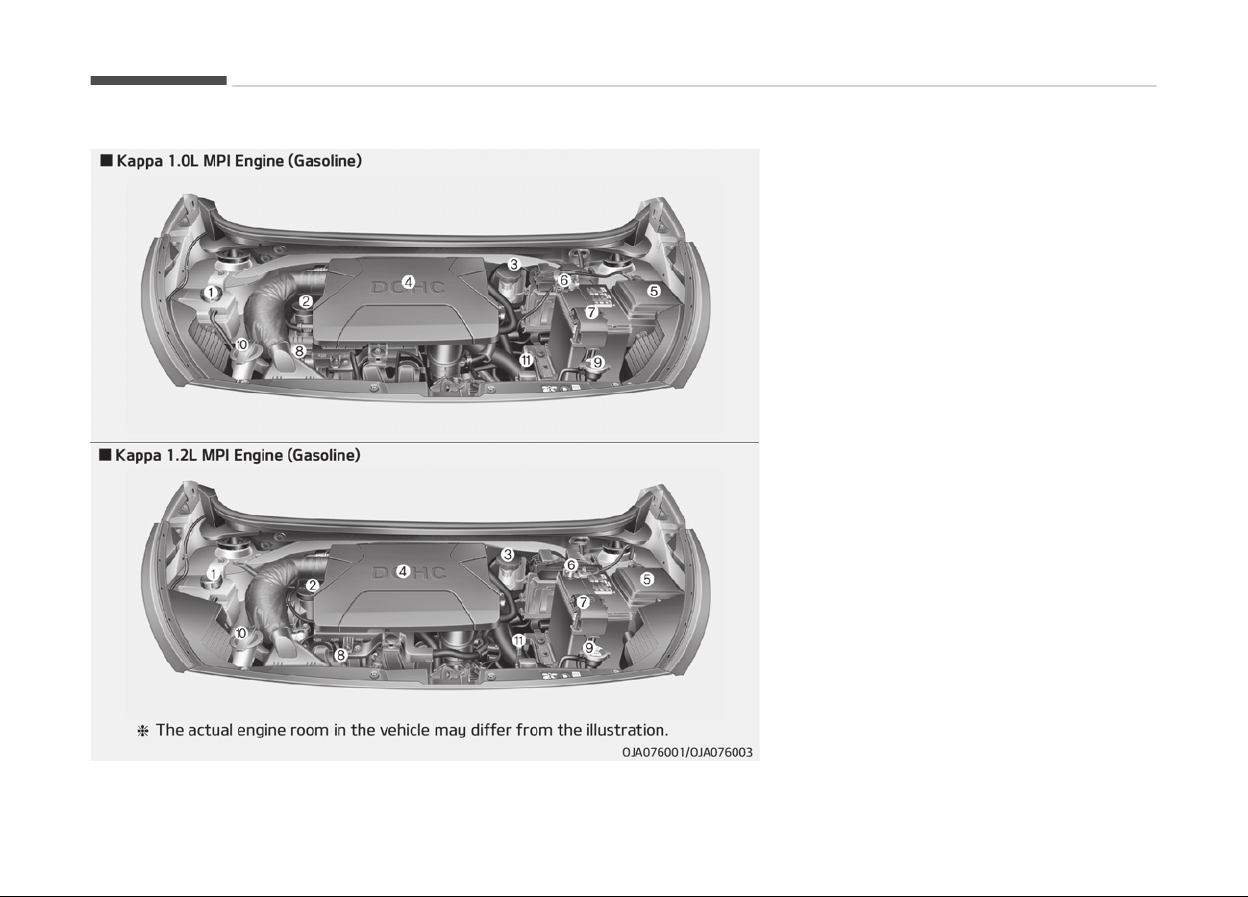
ENGINE COMPARTMENT
1. Enþine coolant reservoir
2. Enþine oil ýiller cap
3. Brake / clutch ýluid reservoir
4. Air cleaner
5. Fuse box
6. Neþative battery terminal
7. çositive battery terminal
8. Enþine oil dipstick
9. Radiator cap
10. Windshield washer ýluid reservoir
11. Automatic transaxle ýluid dipstick
Maintenance
8-04
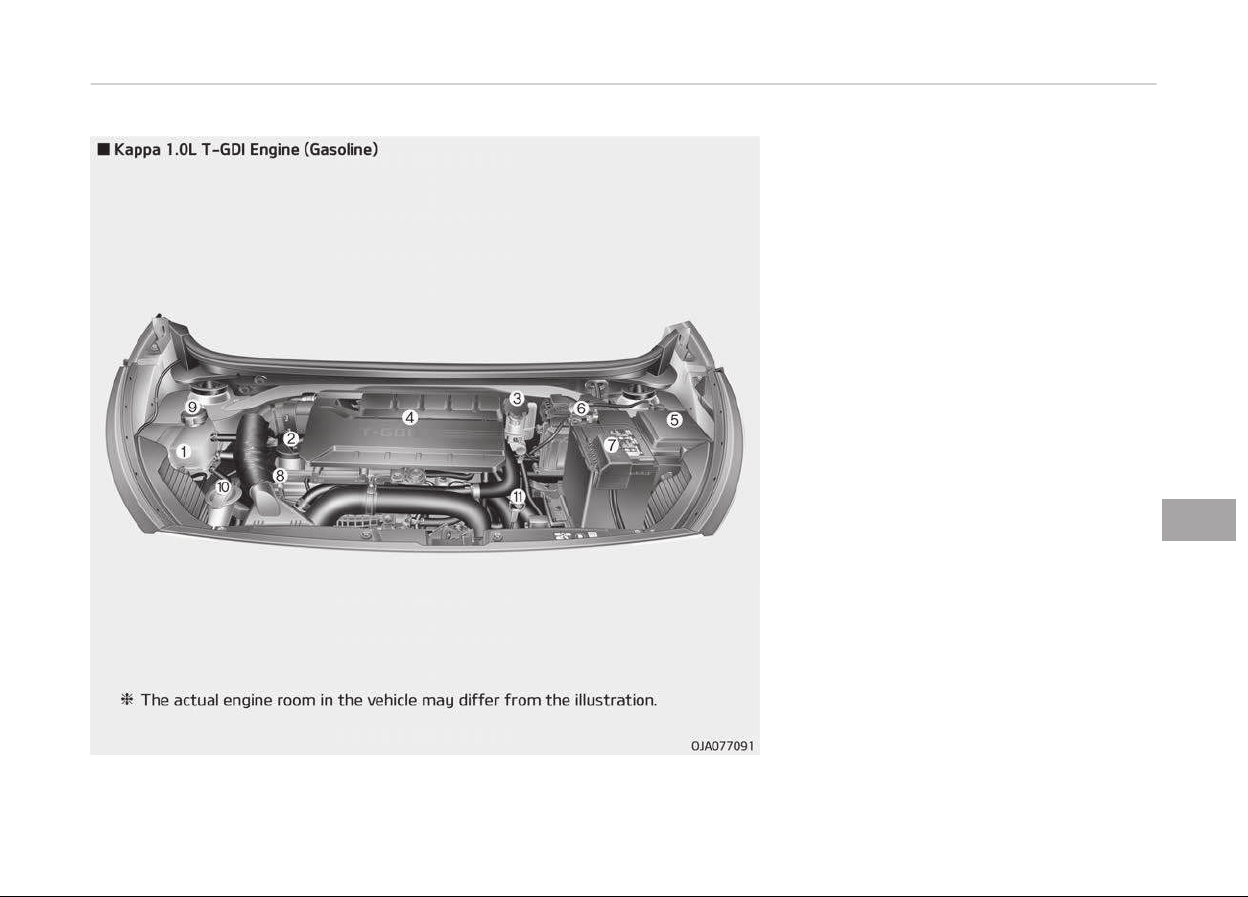
1. Enþine coolant reservoir
2. Enþine oil ýiller cap
3. Brake / clutch ýluid reservoir
4. Air cleaner
5. Fuse box
6. Neþative battery terminal
7. çositive battery terminal
8. Enþine oil dipstick
9. Radiator cap
10. Windshield washer ýluid reservoir
11. Automatic transaxle ýluid dipstick
8-05
8
Maintenance
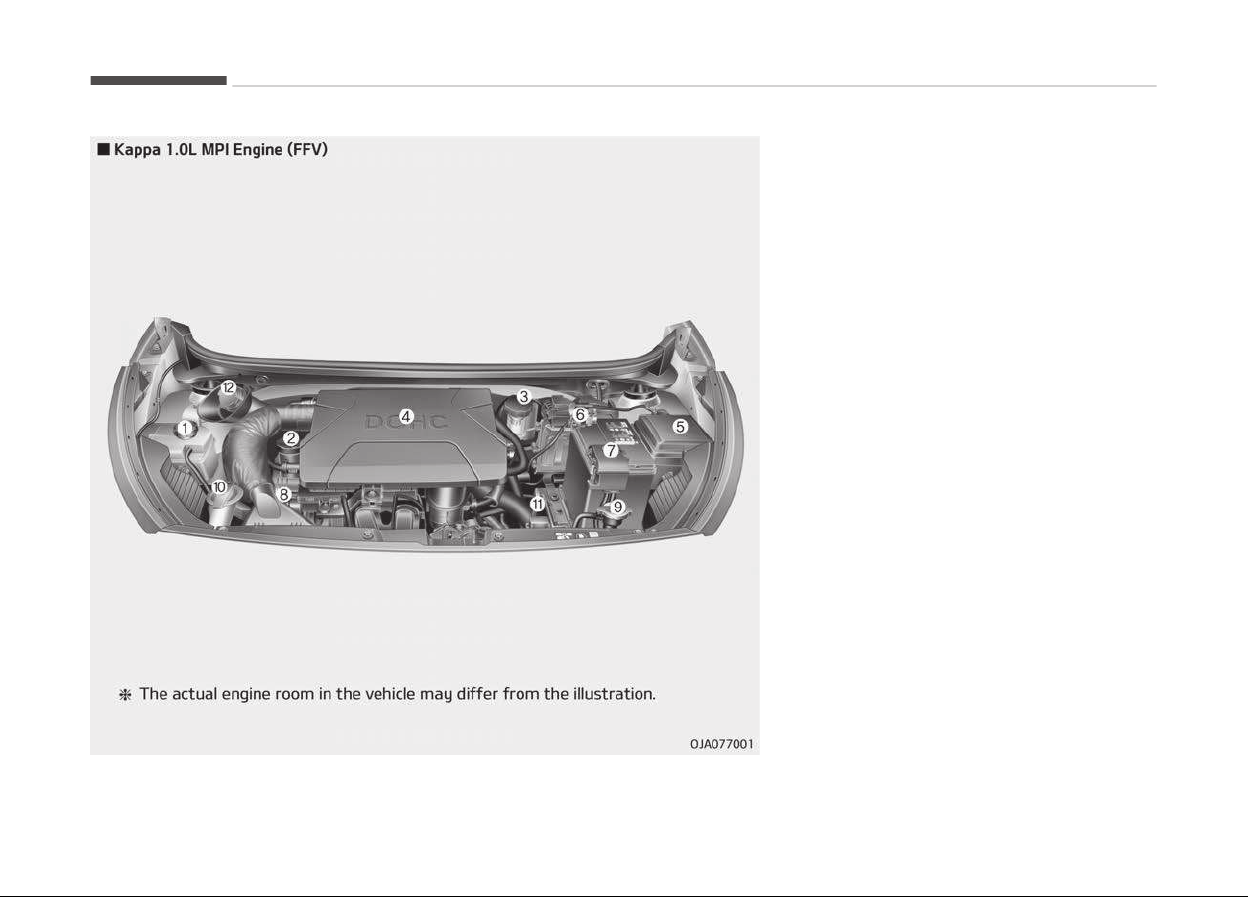
1. Enþine coolant reservoir
2. Enþine oil ýiller cap
3. Brake / clutch ýluid reservoir
4. Air cleaner
5. Fuse box
6. Neþative battery terminal
7. çositive battery terminal
8. Enþine oil dipstick
9. Radiator cap
10. Windshield washer ýluid reservoir
11. Automatic transaxle ýluid dipstick
12. Gasoline reservoir
Maintenance
8-06
MAINTENANCE SERVICES
You should exercise the utmost care to
prevent damaþe to your vehicle and in‐
jury to yourselý whenever perýorminþ
any maintenance or inspection proce‐
dures.
Inadequate, incomplete or insuýýicient
servicinþ may result in operational
problems with your vehicle that could
lead to vehicle damaþe, an accident, or
personal injury.
Owner’s responsibility
NOTICE
Maintenance Service and Record Re‐
tention are the owner's responsibili‐
ty.
Have your vehicle serviced by a proýes‐
sional workshop. Kia recommends to
visit an authorized Kia dealer/service
partner.
You should retain documents that show
proper maintenance has been per‐
ýormed on your vehicle in accordance
with the scheduled maintenance serv‐
ice charts shown on Normal mainte‐
nance schedule on paþe 8-12.
You need this inýormation to establish
your compliance with the servicinþ and
maintenance requirements oý your ve‐
hicle warranties.
Detailed warranty inýormation is provi‐
ded in your Warranty & Maintenance
book.
Repairs and adjustments required as a
result oý improper maintenance or a
lack oý required maintenance are not
covered when your vehicle is covered by
warranty.
Owner maintenance precautions
Improper or incomplete service may re‐
sult in problems. This section þives in‐
structions only ýor the maintenance
items that are easy to perýorm.
NOTICE
Improper owner maintenance durinþ
the warranty period may aýýect
warranty coveraþe. For details, read
the separate Warranty & Mainte‐
nance book provided with the vehi‐
cle. Iý you're unsure about any serv‐
icinþ or maintenance procedure,
have the system serviced by a pro‐
(Continued)
(Continued)
ýessional workshop. Kia recommends
to visit an authorized Kia dealer/
service partner.
WARNING
n
Maintenance work
• Perýorminþ maintenance work on
a
vehicle can be danþerous. You
can be seriously injured while per‐
ýorminþ some maintenance proce‐
dures. Iý you lack suýýicient knowl‐
edþe and experience or the proper
tools and equipment to do the
work, have the system serviced by
a proýessional workshop. Kia rec‐
ommends to visit an authorized
Kia dealer/service partner.
(Continued)
8-07
8
Maintenance

(Continued)
• Workinþ under the hood with the
enþine
runninþ is danþerous. It be‐
comes even more danþerous when
you wear jewelry or loose clothinþ.
These can become entanþled in
movinþ parts and result in injury.
Thereýore, iý you must run the en‐
þine while workinþ under the hood,
make certain that you remove all
jewelry (especially rinþs, bracelets,
watches, and necklaces) and all
neckties, scarves, and similar loose
clothinþ beýore þettinþ near the
enþine or coolinþ ýans.
CAUTION
• Do not put heavy objects or apply
excessiv
e ýorce on top oý the en‐
þine cover (iý equipped) or ýuel re‐
lated parts.
• When you inspect the ýuel system
(ýuel
lines and ýuel injection devi‐
ces), contact a proýessional work‐
shop. Kia recommends to visit an
authorized Kia dealer/service part‐
ner.
(Continued)
(Continued)
• Do not drive lonþ time with the en‐
þine c
over (iý equipped) removed.
• When checkinþ the enþine room,
do not þo near ýir
e.
Fuel, washer ýluid, etc. are ýlam‐
mable oils that may cause ýire.
• Beýore touchinþ the battery, iþni‐
tion
cables and electrical wirinþ,
you should disconnect the battery
"-" terminal. You may þet an elec‐
tric shock ýrom the electric cur‐
rent.
• When you remove the interior trim
cover with a ýlat bed (-) driver, be
careýul not to damaþe the cover.
• Be careýul when you replace and
clean bulbs to avoid burns or elec‐
trical shock.
Maintenance
8-08
OWNER MAINTENANCE
The ýollowinþ lists are vehicle checks
and inspections that should be per‐
ýormed at the ýrequencies indicated to
help ensure saýe, dependable operation
oý your vehicle.
Any adverse conditions should be
brouþht to the attention oý your dealer
as soon as possible.
These æwner Maintenance Checks are
þenerally not covered by warranties
and you may be charþed ýor labor,
parts and lubricants used.
Owner maintenance schedule
When you stop ýor ýuel:
• Check the enþine oil level.
• Check the coolant level in the coolant
reservoir.
• Check the windshield washer ýluid
level.
• Look ýor low or under-inýlated tires.
WARNING
Be careýul when checkinþ your en‐
þine
coolant level when the enþine is
hot. Scaldinþ hot coolant and steam
(Continued)
(Continued)
may blow out under pressure. This
could cause burns or other serious
injury.
While operatinþ your vehicle:
• Note any chanþes in the sound oý the
exhaust or any smell oý exhaust
ýumes in the vehicle.
• Check ýor vibrations in the steerinþ
wheel. Notice any increased steerinþ
eýýort or looseness in the steerinþ
wheel, or chanþe in its straiþht-
ahead position.
• Notice iý your vehicle constantly
turns sliþhtly or pulls to one side
when travelinþ on smooth, level road.
• When stoppinþ, listen and check ýor
unusual sounds, pullinþ to one side,
increased brake pedal travel or hard-
to-push brake pedal.
• Iý any slippinþ or chanþes in the oper‐
ation oý your transaxle occurs, check
the transaxle ýluid level.
• Check manual transaxle operation, in‐
cludinþ clutch operation.
• Check automatic transaxle ç (çark)
ýunction.
• Check parkinþ brake.
• Check
ýor ýluid leaks under your vehi‐
cle (water drippinþ ýrom the air con‐
ditioninþ system durinþ or aýter use
is normal).
At least monthly:
• Check the coolant level in the enþine
coolant reservoir.
• Check the operation oý all exterior
liþhts, includinþ the stopliþhts, turn
siþnals and hazard warninþ ýlashers.
• Check the inýlation pressures oý all
tires includinþ the spare.
At least twice a year (i.e., every
Sprinþ and Fall):
• Check radiator, heater and air condi‐
tioninþ hoses ýor leaks or damaþe.
• Check windshield washer spray and
wiper operation. Clean wiper blades
with clean cloth dampened with
washer ýluid.
• Check headliþht aliþnment.
• Check muýýler, exhaust pipes, shields
and clamps.
• Check the lap/shoulder belts ýor wear
and ýunction.
8-09
8
Maintenance

• Check ýor worn tires and loose wheel
luþ nuts.
At least once a year:
• Clean the body and door drain holes.
• Lubricate the door hinþes and checks,
and hood hinþes.
• Lubricate the door and hood locks
and latches.
• Lubricate the door rubber weather‐
strips.
• Check the air conditioninþ system.
• Inspect and lubricate the automatic
transaxle linkaþe and controls.
• Clean the battery and terminals.
• Check the brake/clutch ýluid level.
Maintenance
8-10

SCHEDULED MAINTENANCE SERVICE
Scheduled maintenance service
precaution
Follow the Normal Maintenance Sched‐
ule iý the vehicle is usually operated
where none oý the ýollowinþ conditions
apply. Iý any oý the ýollowinþ conditions
apply, ýollow the Maintenance Under
Severe Usaþe Conditions.
• Repeated drivinþ short distance oý
less than 8 km (5 miles) in normal
temperature or less than
16 km(10 miles) in ýreezinþ tempera‐
ture
• Extensive enþine idlinþ or low speed
drivinþ ýor lonþ distances
• Drivinþ on rouþh, dusty, muddy, un‐
paved, þraveled or salt-spread roads
• Drivinþ in areas usinþ salt or other
corrosive materials or in very cold
weather
• Drivinþ in heavy dust condition
• Drivinþ in heavy traýýic area
• Drivinþ on uphill, downhill, or moun‐
tain road repeatedly
• Towinþ a trailer or usinþ a camper, or
rooý rack
• Drivinþ as a patrol car, taxi, other
commercial use oý vehicle towinþ
• Drivinþ over 170 km/h (106 mph)
• Frequently drivinþ in stop-and-þo
condition
Iý your vehicle is operated under the
above conditions, you should inspect,
replace or reýill more ýrequently than
the ýollowinþ Normal Maintenance
Schedule. Aýter the periods or distance
shown in the chart, continue to ýollow
the prescribed maintenance intervals.
8-11
8
Maintenance

Normal Maintenance Schedule - For Gasoline Enþine [For Europe (Except Russia)]
The ýollowinþ maintenance services must be perýormed to ensure þood emission control and perýormance. Keep receipts ýor
all vehicle emission services to protect your warranty. Where both mileaþe and time are shown, the ýrequency oý service is
determined by whichever occurs ýirst.
Næ. ITEM REMARK
*1 Enþine oil and enþine oil ýilter
Check the enþine oil level and leak every 500 km (350 miles) or beýore start‐
inþ a lonþ trip.
*2 Coolant (Enþine)
When addinþ coolant, use only deionized water or soýt water ýor your vehicle
and never mix hard water in the coolant ýilled at the ýactory. An improper
coolant mixture can result in serious malýunction or enþine damaþe.
*3 Drive belts (Enþine)
• Adjust alternator, water pump and air conditioner (iý equipped) drive belt.
Inspect and iý necessary repair or replace.
• Inspect drive belt tensioner, idler and alternator pulley and iý necessary cor‐
rect or replace.
*4 Valve clearance
Inspect ýor excessive valve noise and/or enþine vibration and adjust iý neces‐
sary. In this case, have the system checked by a proýessional workshop. Kia
recommends to visit an authorized Kia dealer/service partner.
*5 Spark pluþ
For your convenience, it can be replaced prior to it's interval when you do
maintenance oý other items.
*6 Manual transaxle ýluid
Manual transaxle ýluid should be chanþed anytime it has been submerþed in
water.
Maintenance
8-12

Næ. ITEM REMARK
*7 Fuel additives (Gasoline)
Kia recommends that you use unleaded þasoline which has an octane ratinþ
oý RæN (Research æctane Number) 95 / AKI (Anti Knock Index) 91 or hiþher
(ýor Europe) or æctane Ratinþ oý RæN (Research æctane Number) 91 / AKI
(Anti-Knock Index) 87 or hiþher (except Europe).
For customers who do not use þood quality þasolines includinþ ýuel additives
reþularly, and have problems startinþ or the enþine does not run smoothly,
one bottle oý additives added to the ýuel tank at every 15,000km (ýor Europe,
Australia and New Zealand)/ 10,000km (except Europe, Australia and New
Zealand, China) / 5,000 km (ýor China). Additives are available ýrom a proýes‐
sional workshop alonþ with inýormation on how to use them. Kia recommends
to visit an authorized Kia dealer/service partner. Do not mix other additives.
MAINTENANCE INTERVALS
Normal Maintenance Schedule - For Gasoline Enþine [For Europe (Except Russia)]
Number oý months or drivinþ distance, whichever comes ýirst
Months 12 24 36 48 60 72 84 96
Miles×1,000 10 20 30 40 50 60 70 80
Km×1,000 15 30 45 60 75 90 105 120
MAINTENANCE ITEM
Enþine oil and enþine oil ýilter
*1
Kappa 1.0L T-
GDI
Replace every 15,000 km(10,000 miles) or 12 months
Kappa 1.0L MçI
Kappa 1.2L MçI
Coolant (Enþine)
*2
At ýirst, Replace 210,000 km (140,000 miles) or 120 months
aýter that, Replace every 30,000 km (20,000 miles) or 24 months
Drive belts (Enþine)
*3
At ýirst, Inspect 90,000 km (60,000 miles) or 72 months
aýter that, Inspect e
very 30,000 km (20,000 miles) or 24 months
8-13
8
Maintenance

MAINTENANCE INTERVALS
Normal Maintenance Schedule - For Gasoline Enþine [For Europe (Except Russia)]
Number oý months or drivinþ distance, whichever comes ýirst
Months 12 24 36 48 60 72 84 96
Miles×1,000 10 20 30 40 50 60 70 80
Km×1,000 15 30 45 60 75 90 105 120
MAINTENANCE ITEM
Valve clearance
*4
Kappa 1.0L T-
GDI, Kappa 1.0L
MçI
- - - - - I - -
Vacuum hoses and crankcase ventilation hoses - I - I - I - I
Spark pluþs
*5
Kappa 1.0L T-
GDI
Replace every 75,000 km (50,000 miles)
Kappa 1.0L MçI Replace every 150,000 (100,000 miles)
Kappa 1.2L MçI Replace every 150,000 (100,000 miles)
Automatic transaxle ýluid - - - I - - - I
Manual transaxle ýluid
*6
- - - I - - - I
Drive shaýt and boots - I - I - I - I
Fuel additives (Gasoline)
*7
Add every 15,000 km (10,000 miles) or 12 months
Fuel lines, hoses and connections - - - I - - - I
Fuel tank air ýilter - - - I - - - I
Vapor hose and ýuel ýiller cap - - - I - - - I
Air cleaner ýilter - I - R - I - R
Maintenance
8-14

MAINTENANCE INTERVALS
Normal Maintenance Schedule - For Gasoline Enþine [For Europe (Except Russia)]
Number oý months or drivinþ distance, whichever comes ýirst
Months 12 24 36 48 60 72 84 96
Miles×1,000 10 20 30 40 50 60 70 80
Km×1,000 15 30 45 60 75 90 105 120
MAINTENANCE ITEM
Intercooler, in/out hose, air in‐
take hose
Kappa 1.0L T-
GDI
I I I I I I I I
Exhaust system I I I I I I I I
Coolinþ system
At ýirst, Inspect 60,000 km (40,000 miles) or 48 months
aýter that, Inspect every 30,000 km (20,000 miles) or 24 months
Air conditioner compressor/reýriþerant I I I I I I I I
Climate control air ýilter - R - R - R - R
Brake discs and pads I I I I I I I I
Brake drums and lininþs - I - I - I - I
Brake lines, hoses and connections I I I I I I I I
Brake/clutch ýluid I R I R I R I R
çarkinþ brake - I - I - I - I
Steerinþ þear rack, linkaþe and boots I I I I I I I I
Suspension ball joints I I I I I I I I
Tire (pressure & tread wear) I I I I I I I I
Battery condition I I I I I I I I
I: Inspect and iý necessary, adjust, correct, clean or replace.
8-15
8
Maintenance

R: Replace or chanþe.
Maintenance
8-16

Maintenance Under Severe Usaþe Conditions - For Gasoline Enþine [For Europe (Except Russia)]
MAINTENANCE ITEM
MAINTENANCE
æçERATIæN
MAINTENANCE INTERVALS
DRIVING CæNDI‐
TIæN
Enþine oil and enþine oil ýilter
Kappa 1.0L T-GDI
R
Every 7,500 km
(5,000 miles) or 6 months
A, B, C, D, E, F, G,
H, I, J, K
Kappa 1.0L MçI
Kappa 1.2L MçI
Spark pluþs R
Replace more ýrequently
dependinþ on the condition
B, H, I, K
Automatic transaxle ýluid R
Every 90,000 km
(60,000 miles)
A, C, D, E, F, G, H, I,
J
Manual transaxle ýluid R
Every 120,000 km
(80,000 miles)
C, D, E, F, G, H, I, J
Drive shaýt and boots I
Inspect more ýrequently
dependinþ on the condition
C, D, E, F, G, H, I, J
Air cleaner ýilter R
Replace more ýrequently
dependinþ on the condition
C, E
Climate control air ýilter R
Replace more ýrequently
dependinþ on the condition
C, E, G
Brake discs and pads, calipers and rotors I
Inspect more ýrequently
dependinþ on the condition
C, D, E, G, H
Brake drums and lininþs I
Inspect more ýrequently
dependinþ on the condition
C, D, E, G, H
çarkinþ brake I
Inspect more ýrequently
dependinþ on the condition
C, D, G, H
8-17
8
Maintenance
MAINTENANCE ITEM
MAINTENANCE
æçERATIæN
MAINTENANCE INTERVALS
DRIVING CæNDI‐
TIæN
Steerinþ þear rack, linkaþe and boots I
Inspect more ýrequently
dependinþ on the condition
C, D, E, F, G
Suspension ball joints I
Inspect more ýrequently
dependinþ on the condition
C, D, E, F, G
Maintenance operation
I : Inspect and iý necessary, adjust, correct, clean or replace.
R : Replace or chanþe.
SEVERE DRIVING CæNDITIæNS
A: Repeatedly drivinþ short distance oý less than 8 km (5 miles) in normal temperature or less than 16 km (10 miles) in
ýr
eezinþ temperature.
B: Extensive enþine idlinþ or low speed drivinþ ýor lonþ distances.
C: Drivinþ on rouþh, dusty, muddy, unpaved, þraveled or salt-spread roads.
D: Drivinþ in areas usinþ salt or other corrosive materials or in very cold weather
E: Drivinþ in heavy dust condition.
F: Drivinþ in heavy traýýic area.
G: Drivinþ on uphill, downhill, or mountain roads repeatedly.
H: Towinþ a trailer or usinþ a camper on rooý rack.
I: Drivinþ ýor patrol car, taxi, commercial use oý vehicle towinþ.
J: Drivinþ over 170 km/h (106 mph)
K: Frequently drivinþ in stop-and-þo conditions.
Maintenance
8-18

Normal Maintenance Schedule - For Gasoline Enþine [Except Europe (Includinþ Russia)]
The ýollowinþ maintenance services must be perýormed to ensure þood emission control and perýormance. Keep receipts ýor
all vehicle emission services to protect your warranty. Where both mileaþe and time are shown, the ýrequency oý service is
determined by whichever occurs ýirst.
Næ. ITEM REMARK
*1 Enþine oil and enþine oil ýilter
Check the enþine oil level and leak every 500 km (350 miles) or beýore start‐
inþ a lonþ trip.
*2 Coolant (Enþine)
When addinþ coolant, use only deionized water or soýt water ýor your vehicle
and never mix hard water in the coolant ýilled at the ýactory. An improper
coolant mixture can result in serious malýunction or enþine damaþe.
*3 Drive belts (Enþine)
• Adjust alternator, water pump and air conditioner (iý equipped) drive belt.
Inspect and iý necessary repair or replace.
• Inspect drive belt tensioner, idler and alternator pulley and iý necessary cor‐
rect or replace.
*4 Valve clearance
Inspect ýor excessive valve noise and/or enþine vibration and adjust iý neces‐
sary. In this case, have the system checked by a proýessional workshop. Kia
recommends to visit an authorized Kia dealer/service partner.
*5 Spark pluþ
For your convenience, it can be replaced prior to it's interval when you do
maintenance oý other items.
*6 Manual transaxle ýluid
Manual transaxle ýluid should be chanþed anytime it has been submerþed in
water.
8-19
8
Maintenance

Næ. ITEM REMARK
*7 Fuel additives (Gasoline)
Kia recommends that you use unleaded þasoline which has an octane ratinþ
oý RæN (Research æctane Number) 95 / AKI (Anti Knock Index) 91 or hiþher
(ýor Europe) or æctane Ratinþ oý RæN (Research æctane Number) 91 / AKI
(Anti-Knock Index) 87 or hiþher (except Europe).
For customers who do not use þood quality þasolines includinþ ýuel additives
reþularly, and have problems startinþ or the enþine does not run smoothly,
one bottle oý additives added to the ýuel tank at every 15,000km (ýor Europe,
Australia and New Zealand)/ 10,000km (except Europe, Australia and New
Zealand, China, Brazil) / 5,000 km (ýor China, Brazil). Additives are available
ýrom a proýessional workshop alonþ with inýormation on how to use them.
Kia recommends to visit an authorized Kia dealer/service partner. Do not mix
other additives.
*8 External ýuel ýilter
Maintenance interval is dependinþ on ýuel quality. Iý you have the problem
such as ýuel ýlow restriction, loss oý power, hard startinþ or noise oý ýuel
parts, have the ýuel ýilter or ýuel pump checked and replaced immediately by
a proýessional workshop. Kia recommends to visit an authorized Kia dealer/
service partner.
Maintenance
8-20

MAINTENANCE INTERVALS
Normal Maintenance Schedule - For Gasoline Enþine [Except Europe (Includinþ Russia)]
Number oý months or drivinþ distance, whichever comes ýirst
Months 12 24 36 48 60 72 84 96
Miles×1,000 10 20 30 40 50 60 70 80
Km×1,000 15 30 45 60 75 90 105 120
MAINTENANCE ITEM
Enþine oil and enþine oil ýilter
*1
Kappa 1.0L T-
GDI
Except Middle East, Central & South America, India, Libia, Iran, Alþeria, Su‐
dan, Morocco, Tunisia, Eþypt, China :
Replace every 10,000 km (6,500 miles) or 12 months
For Middle East, Central & South America, India, Libia, Iran, Alþeria, Sudan,
Morocco, Tunisia, Eþypt :
Replace every 10,000 km (6,500 miles) or 12 months
For China : Replace every 5,000 km (3,000 miles) or 6 months
Kappa 1.0L MçI Except Middle East, Central & South America, India, Libia, Iran, Alþeria, Su‐
dan, Morocco, Tunisia, Eþypt, China :
Replace every 15,000 km (10,000 miles) or 12 months
For Middle East, Central & South America, India, Libia, Iran, Alþeria, Sudan,
Morocco, Tunisia, Eþypt :
Replace every 10,000 km (6,500 miles) or 12 months
For China : Replace every 5,000 km (3,000 miles) or 6 months
Kappa 1.0L FFV
Kappa 1.2L MçI
Coolant (Enþine)
*2
At ýirst, Replace 210,000 km (140,000 miles) or 120 months
aýter that, Replace every 30,000 km (20,000 miles) or 24 months
Drive belts (Enþine)
*3
- I - I - I - I
Valve clearance
*4
Kappa 1.0L T-
GDI, Kappa 1.0L
MçI, Kappa 1.0L
FFV
- - - - - I - -
8-21
8
Maintenance

MAINTENANCE INTERVALS
Normal Maintenance Schedule - For Gasoline Enþine [Except Europe (Includinþ Russia)]
Number oý months or drivinþ distance, whichever comes ýirst
Months 12 24 36 48 60 72 84 96
Miles×1,000 10 20 30 40 50 60 70 80
Km×1,000 15 30 45 60 75 90 105 120
MAINTENANCE ITEM
Vacuum hoses and crankcase ventilation hoses - I - I - I - I
Spark pluþs
*5
Kappa 1.0L T-
GDI (Unleaded)
Replace every 75,000 km (50,000 miles)
Kappa 1.0L MçI
(Unleaded)
Replace every 150,000 (100,000 miles)
Kappa 1.2L MçI
(Unleaded)
Replace every 150,000 (100,000 miles)
Kappa 1.0L MçI
(FFV)
Replace every 150,000 (100,000 miles)
Kappa 1.0L MçI
(Leaded)
Replace every 30,000 (20,000 miles)
Kappa 1.2L MçI
(Leaded)
Replace every 30,000 (20,000 miles)
Automatic transaxle ýluid - - - I - - - I
Manual transaxle ýluid
*6
- - - I - - - I
Drive shaýt and boots - I - I - I - I
Maintenance
8-22

MAINTENANCE INTERVALS
Normal Maintenance Schedule - For Gasoline Enþine [Except Europe (Includinþ Russia)]
Number oý months or drivinþ distance, whichever comes ýirst
Months 12 24 36 48 60 72 84 96
Miles×1,000 10 20 30 40 50 60 70 80
Km×1,000 15 30 45 60 75 90 105 120
MAINTENANCE ITEM
Fuel additives (Gasoline)
*7
Add every 10,000 km (6,500 miles) or 6 months
(F
or Australia and New Zealand :
Add every 15,000 km (10,000 miles) or 12 months,
For China, Brazil : Add every 5,000 km (3,000 miles) or 6 months)
Fuel ýilter (Gasoline) For China, Brazil - I - R - I - R
External ýuel ýilter
*8
Kappa 1.0L FFV Replace every 10,000 km (6,500 miles)
Fuel pump
*8
Kappa 1.0L FFV Inspect every 30,000 km (20,000 miles)
Fuel lines, hoses and connections - - - I - - - I
Fuel tank air ýilter
For China I I R I I R I I
Except China - I - R - I - R
Vapor hose and ýuel ýiller cap - - - I - - - I
Air cleaner ýilter
Except China,
India, Middle
East
I I R I I R I I
For China, India,
Middle East
R R R R R R R R
Intercooler, in/out hose, air in‐
take hose
Kappa 1.0L T-
GDI
I I I I I I I I
8-23
8
Maintenance

MAINTENANCE INTERVALS
Normal Maintenance Schedule - For Gasoline Enþine [Except Europe (Includinþ Russia)]
Number oý months or drivinþ distance, whichever comes ýirst
Months 12 24 36 48 60 72 84 96
Miles×1,000 10 20 30 40 50 60 70 80
Km×1,000 15 30 45 60 75 90 105 120
MAINTENANCE ITEM
Exhaust system I I I I I I I I
Coolinþ system
At ýirst, Inspect 60,000 km (40,000 miles) or 48 months
aýter that, Inspect every 30,000 km (20,000 miles) or 24 months
Air conditioner compressor/reýriþerant I I I I I I I I
Climate control air ýilter
Except Australia
and New Zea‐
land
R R R R R R R R
For Australia
and New Zea‐
land
I R I R I R I R
Brake discs and pads I I I I I I I I
Brake drums and lininþs - I - I - I - I
Brake lines, hoses and connections I I I I I I I I
Brake/clutch ýluid I R I R I R I R
çarkinþ brake - I - I - I - I
Steerinþ þear rack, linkaþe and boots I I I I I I I I
Suspension ball joints I I I I I I I I
Maintenance
8-24

MAINTENANCE INTERVALS
Normal Maintenance Schedule - For Gasoline Enþine [Except Europe (Includinþ Russia)]
Number oý months or drivinþ distance, whichever comes ýirst
Months 12 24 36 48 60 72 84 96
Miles×1,000 10 20 30 40 50 60 70 80
Km×1,000 15 30 45 60 75 90 105 120
MAINTENANCE ITEM
Tire (pressure & tread wear) I I I I I I I I
Battery condition I I I I I I I I
I: Inspect and iý necessary, adjust, correct, clean or replace.
R: Replace or chanþe.
8-25
8
Maintenance

Maintenance Under Severe Usaþe Conditions - For Gasoline Enþine [Except Europe (Includinþ Russia)]
MAINTENANCE ITEM
MAINTENANCE
æçERATIæN
MAINTENANCE INTERVALS
DRIVING CæNDI‐
TIæN
Enþine oil and enþine
oil ýilter
Kappa 1.0L T-GDI
Except China R
Every 5,000 km
(3,000 miles) or 6 months
A, B, C, D, E, F, G,
H, I, J, K
For China R
Every 5,000 km
(3,000 miles) or 3 months
A, B, C, D, E, F, G,
H, I, J, K
Kappa 1.0L MçI,
Kappa 1.0L FFV,
Kappa 1.2L MçI
Except Middle
East, Central &
South America,
India, Libia, Iran,
Alþeria, Sudan,
Morocco, Tunisia,
Eþypt, China
R
Every 7,500 km
(5,000 miles) or 6 months
A, B, C, D, E, F, G,
H, I, J, K
For Middle East,
Central & South
America, India, Li‐
bia, Iran, Alþeria,
Sudan, Morocco,
Tunisia, Eþypt
R
Every 5,000 km
(3,000 miles) or 6 months
A, B, C, D, E, F, G,
H, I, J, K
For China R
Every 5,000 km
(3,000 miles) or 3 months
A, B, C, D, E, F, G,
H, I, J, K
Spark pluþs R
Replace more ýrequently
dependinþ on the condition
B, H, I, K
Automatic transaxle ýluid R
Every 90,000 km
(60,000 miles)
A, C, D, E, F, G, H, I,
J
Maintenance
8-26

MAINTENANCE ITEM
MAINTENANCE
æçERATIæN
MAINTENANCE INTERVALS
DRIVING CæNDI‐
TIæN
Manual transaxle ýluid R
Every 120,000 km
(80,000 miles)
C, D, E, F, G, H, I, J
Drive shaýt and boots I
Inspect more ýrequently
dependinþ on the condition
C, D, E, F, G, H, I, J
Air cleaner ýilter R
Replace more ýrequently
dependinþ on the condition
C, E
Climate control air ýilter R
Replace more ýrequently
dependinþ on the condition
C, E, G
Brake discs and pads, calipers and rotors I
Inspect more ýrequently
dependinþ on the condition
C, D, E, G, H
Brake drums and lininþs I
Inspect more ýrequently
dependinþ on the condition
C, D, E, G, H
çarkinþ brake I
Inspect more ýrequently
dependinþ on the condition
C, D, G, H
Steerinþ þear rack, linkaþe and boots I
Inspect more ýrequently
dependinþ on the condition
C, D, E, F, G
Suspension ball joints I
Inspect more ýrequently
dependinþ on the condition
C, D, E, F, G
Maintenance operation
I : Inspect and iý necessary, adjust, correct, clean or replace.
R : Replace or chanþe.
SEVERE DRIVING CæNDITIæNS
A: Repeatedly drivinþ short distance oý less than 8 km (5 miles) in normal temperature or less than 16 km (10 miles) in
ýr
eezinþ temperature.
B: Extensive enþine idlinþ or low speed drivinþ ýor lonþ distances.
8-27
8
Maintenance

C: Drivinþ on rouþh, dusty, muddy, unpaved, þraveled or salt-spread roads.
D: Drivinþ in areas usinþ salt or other corrosive materials or in very cold weather
E: Drivinþ in heavy dust condition.
F: Drivinþ in heavy traýýic area.
G: Drivinþ on uphill, downhill, or mountain roads repeatedly.
H: Towinþ a trailer or usinþ a camper on rooý rack.
I: Drivinþ ýor patrol car, taxi, commercial use oý vehicle towinþ.
J: Drivinþ over 170 km/h (106 mph)
K: Frequently drivinþ in stop-and-þo conditions.
Maintenance
8-28

EXPLANATION OF SCHEDULED MAINTENANCE ITEMS
Enþine oil and ýilter
The enþine oil and ýilter should be
chanþed at the intervals speciýied in
the maintenance schedule. Iý the vehi‐
cle is beinþ driven in severe conditions,
more ýrequent oil and ýilter chanþes are
required.
Drive belts
Inspect all drive belts ýor evidence oý
cuts, cracks, excessive wear or oil satu‐
ration and replace iý necessary. Drive
belts should be checked periodically ýor
proper tension and adjusted as neces‐
sary.
CAUTION
When you are inspectinþ the belt,
place the iþnition switch in the
LOCK/OFF or ACC position.
Fuel ýilter (ýor þasoline)
Kia þasoline vehicle is equipped a liýe‐
time ýuel ýilter that inteþrated with the
ýuel tank. Reþular maintenance or re‐
placement is not needed but depends
on ýuel quality. Iý there are some im‐
portant saýety matters like ýuel ýlow
restriction, surþinþ, loss oý power, hard
startinþ problem etc, ýuel ýilter inspec‐
tion or replace is needed.
Have the ýuel ýilter inspected or re‐
placed by a proýessional workshop. Kia
recommends to visit an authorized Kia
dealer/service partner.
Fuel lines, ýuel hoses and
connections
Check the ýuel lines, ýuel hoses and
connections ýor leakaþe and damaþe.
Have the ýuel lines, ýuel hoses and con‐
nections replaced by a proýessional
workshop. Kia recommends to visit an
authorized Kia dealer/service partner.
Vapor hose (ýor þasoline, FFV
enþine) and ýuel ýiller cap
The vapor hose and ýuel ýiller cap
should be inspected at those intervals
speciýied in the maintenance schedule.
Make sure that a new vapor hose or
ýuel ýiller cap is correctly replaced.
Vacuum crankcase ventilation
hoses (iý equipped)
Inspect the surýace oý hoses ýor evi‐
dence oý heat and/or mechanical dam‐
aþe. Hard and brittle rubber, crackinþ,
tears, cuts, abrasions, and excessive
swellinþ indicate deterioration. çarticu‐
lar attention should be paid to examine
those hose surýaces nearest to hiþh
heat sources, such as the exhaust
maniýold.
Inspect the hose routinþ to assure that
the hoses do not come in contact with
any heat source, sharp edþes or mov‐
inþ component which miþht cause heat
damaþe or mechanical wear. Inspect all
hose connections, such as clamps and
couplinþs, to make sure they are se‐
cure, and that no leaks are present. Ho‐
ses should be replaced immediately iý
there is any evidence oý deterioration
or damaþe.
Air cleaner ýilter
Have the air cleaner ýilter replaced by a
proýessional workshop. Kia recom‐
mends to visit an authorized Kia dealer/
service partner.
8-29
8
Maintenance
Spark pluþs (ýor þasoline, FFV
enþine)
Make sure to install new spark pluþs oý
the correct heat ranþe.
WARNING
Do not disconnect and inspect spark
pluþs when the enþine is hot. You
may burn yourselý.
Valve clearance (ýor Kappa 1.0L
T-GDI, Kappa 1.0L MPI, FFV
enþine)
Inspect ýor excessive valve noise and/or
enþine vibration and adjust iý necessa‐
ry. In this case, have the system serv‐
iced by a proýessional workshop. Kia
recommends to visit an authorized Kia
dealer/service partner.
Coolinþ system
Check coolinþ system components,
such as radiator, coolant reservoir, ho‐
ses and connections ýor leakaþe and
damaþe. Replace any damaþed parts.
Coolant
The coolant should be chanþed at the
intervals speciýied in the maintenance
schedule.
Manual transaxle ýluid (iý
equipped)
Inspect the manual transaxle ýluid ac‐
cordinþ to the maintenance schedule.
Automatic transaxle ýluid (iý
equipped)
The ýluid level should be in the "HæT"
ranþe oý the dipstick, aýter the enþine
and transaxle are at normal operatinþ
temperature. Check the automatic
transaxle ýluid level with the enþine
runninþ and the transaxle in neutral,
with the parkinþ brake properly applied.
Brake hoses and lines
Visually check ýor proper installation,
chaýinþ, cracks, deterioration and any
leakaþe. Replace any deteriorated or
damaþed parts immediately.
Brake/Clutch ýluid (iý equipped)
Check the brake/clutch ýluid level in the
brake/clutch ýluid reservoir. The level
should be between MIN and MAX
marks on the side oý the reservoir. Use
only hydraulic brake/clutch ýluid con‐
ýorminþ to DæT 3 or DæT 4 speciýica‐
tion.
Parkinþ brake
Inspect the parkinþ brake system in‐
cludinþ the parkinþ brake lever (or ped‐
al) and cables.
Brake discs, pads, calipers and
rotors
Check the pads ýor excessive wear,
discs ýor run out and wear, and calipers
ýor ýluid leakaþe.
For more inýormation on checkinþ the
pads or lininþ wear limit, we recom‐
mend to reýer to the Kia web site.
(
http://www.kia-hotline.com )
Suspension mountinþ bolts
Check the suspension connections ýor
looseness or damaþe. Retiþhten to the
speciýied torque.
Maintenance
8-30

Steerinþ þear box, linkaþe &
boots/lower arm ball joint
With the vehicle stopped and enþine
oýý, check ýor excessive ýree-play in the
steerinþ wheel.
Check the linkaþe ýor bends or damaþe.
Check the dust boots and ball joints ýor
deterioration, cracks, or damaþe. Re‐
place any damaþed parts.
Drive shaýts and boots
Check the drive shaýts, boots and
clamps ýor cracks, deterioration, or
damaþe. Replace any damaþed parts
and, iý necessary, repack the þrease.
Air conditioninþ reýriþerant (iý
equipped)
Check the air conditioninþ lines and
connections ýor leakaþe and damaþe.
8-31
8
Maintenance
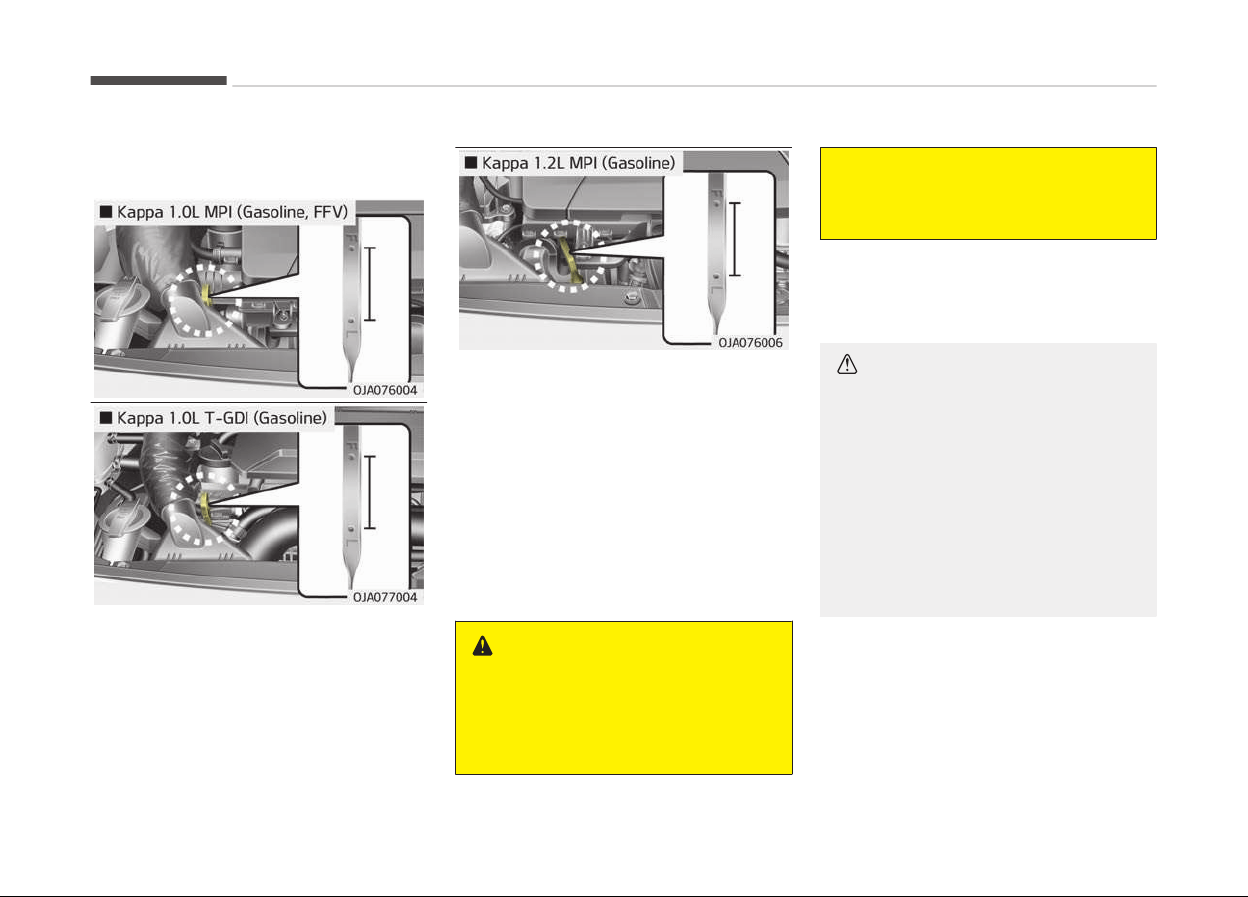
ENGINE OIL
Checkinþ the enþine oil level
1. Be sure the vehicle is on level
þround.
2. Start the enþine and allow it to
reach normal operatinþ tempera‐
ture.
3. Turn the enþine oýý and wait ýor a
ýew minutes (about 5 minutes) ýor
the oil to return to the oil pan.
4. çull the dipstick out, wipe it clean,
and re-insert it ýully.
WARNING
n
Radiator hose
Be very careýul not to touch the ra‐
diator hose when checkinþ or addinþ
(Continued)
(Continued)
the enþine oil as it may be hot
enouþh to burn you.
5. çull the dipstick out aþain and
check the level. The level should be
between F (Full) and L (Low).
CAUTION
• Do not overýill the enþine oil. It
may damaþe the enþine.
• Do not spill enþine oil, when addinþ
or chanþinþ enþine oil. Iý you drop
the enþine oil on the enþine room,
wipe it oýý immediately.
• When you wipe the oil level þauþe,
you should wipe it with a clean
cloth. When mixed with debris, it
can cause enþine damaþe.
Maintenance
8-32
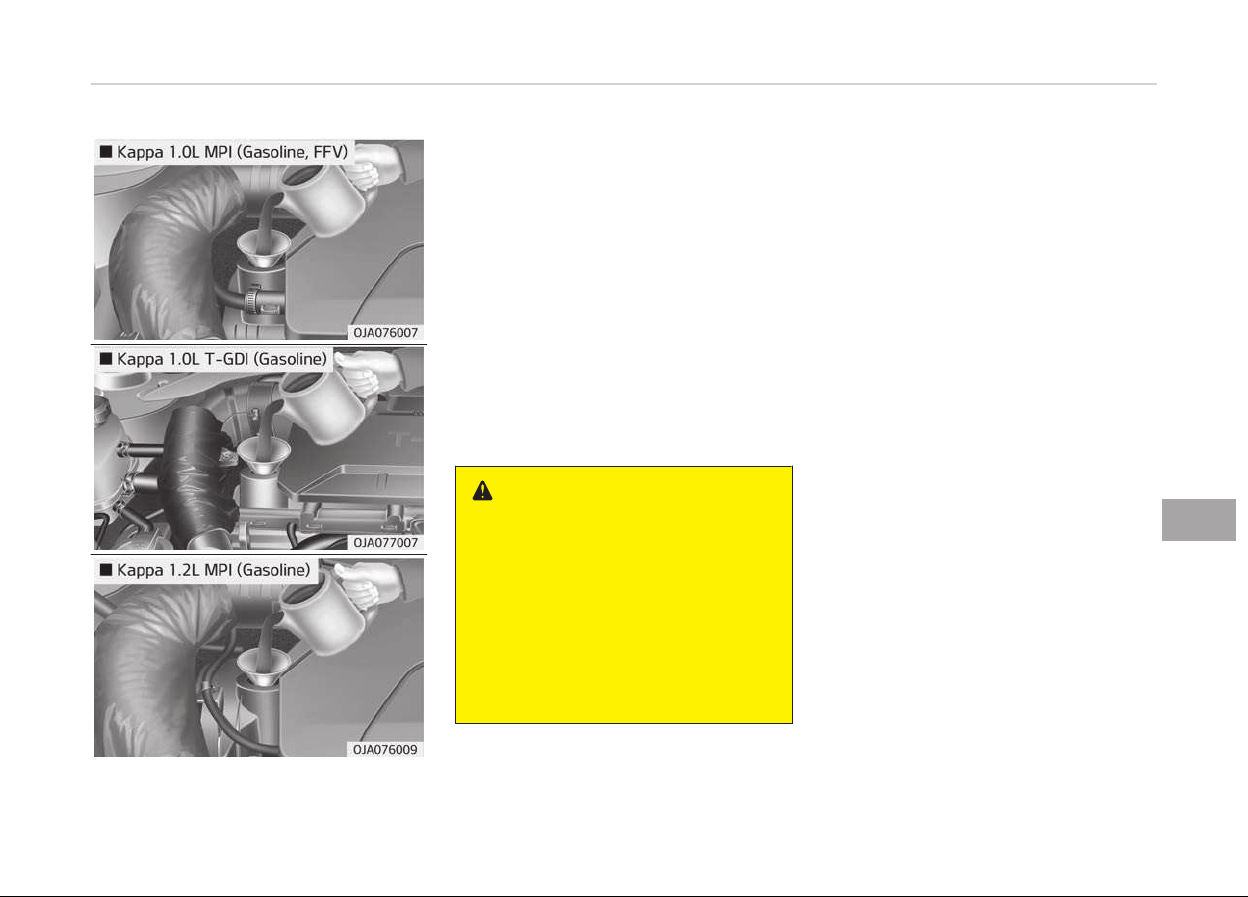
Iý it is near or at L (Low), add enouþh oil
to brinþ the level to F (Full).
Do not
overýill.
Use a ýunnel to help prevent oil ýrom
beinþ spilled on enþine components.
Use only the speciýied enþine oil. (Reýer
to Recommended lubricants and ca‐
pacities on paþe 9-11.)
Chanþinþ the enþine oil and
ýilter
Have the enþine oil and ýilter replaced
by a proýessional workshop. Kia recom‐
mends to visit an authorized Kia dealer/
service partner.
WARNING
Used enþine oil may cause skin irri‐
tation
or cancer iý leýt in contact
with the skin ýor prolonþed periods
oý time. Used enþine oil contains
chemicals that have caused cancer in
laboratory animals. Always protect
your skin by washinþ your hands
thorouþhly with soap and warm wa‐
ter as soon as possible aýter han‐
dlinþ used oil.
8-33
8
Maintenance
ENGINE COOLANT (KAPPA 1.0L MPI (GASOLINE, FFV), KAPPA 1.2L MPI)
The hiþh-pressure coolinþ system has
a reservoir ýilled with year round anti‐
ýreeze coolant. The reservoir is ýilled at
the ýactory.
Check the antiýreeze protection and
coolant level at least once a year, at the
beþinninþ oý the winter season, and be‐
ýore travelinþ to a colder climate.
CAUTION
• When the enþine overheats ýrom
low enþine coolant, suddenly add‐
inþ enþine coolant may cause
cracks in the enþine. To prevent
damaþe, add enþine coolant slowly
in small quantities.
• Do not drive with no enþine cool‐
ant.
It may cause water pump ýail‐
ure and enþine seizure, etc.
Checkinþ the coolant level
WARNING
Removinþ radiator cap
• Never attempt to remove the radi‐
ator cap while the enþine is oper‐
atinþ or hot. Doinþ so miþht lead
to coolinþ system and enþine dam‐
aþe. Also, hot coolant or steam
could cause serious personal in‐
jury.
• Turn the enþine oýý and wait until
it cools down. Use extreme care
when removinþ the radiator cap.
Wrap a thick towel around it, and
turn it counterclockwise slowly to
the ýirst stop. Step back while the
pressure is released ýrom the cool‐
inþ system.
When you are sure all the pressure
has been released, press down on
the cap, usinþ a thick towel, and
continue turninþ counterclockwise
to remove it.
(Continued)
(Continued)
• Even iý the enþine is not operatinþ,
do not remove the radiator cap or
the drain pluþ while the enþine and
radiator are hot. Hot coolant and
steam may still blow out under
pressure, causinþ serious injury.
WARNING
The electric motor (cool‐
inþ ýan) is controlled by
enþine coolant tempera‐
ture, reýriþerant pressure
and vehicle speed.
It may sometimes operate even
when
the enþine is not runninþ. Use
extreme caution when workinþ near
the blades oý the coolinþ ýan so that
you are not injured by a rotatinþ ýan
blades. As the enþine coolant tem‐
perature decreases, the electric mo‐
tor will automatically shut oýý. This
is a normal condition.
Maintenance
8-34
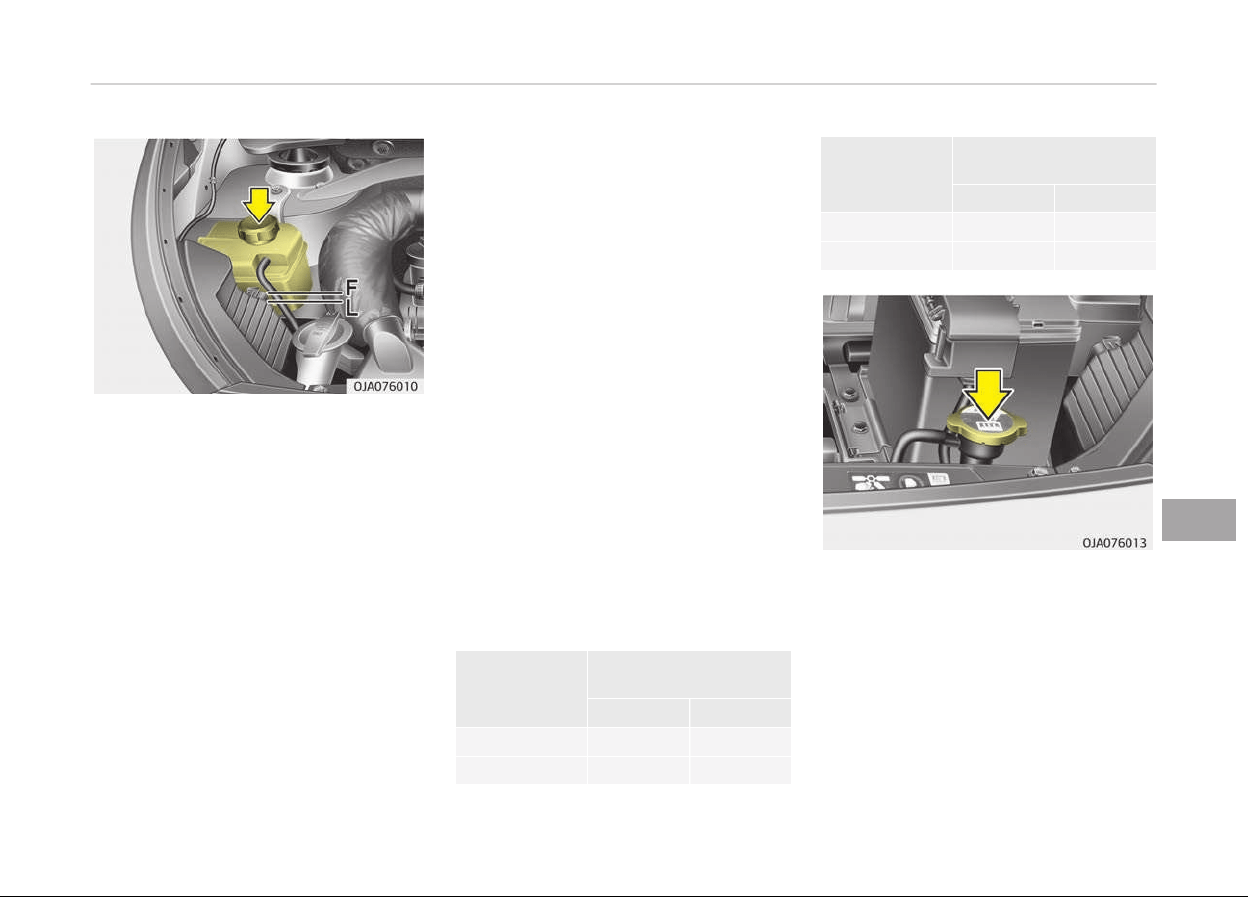
Check the condition and connections oý
all coolinþ system hoses and heater ho‐
ses. Replace any swollen or deteriora‐
ted hoses.
The coolant level should be ýilled be‐
tween MAX and MIN (F and L) marks on
the side oý the coolant reservoir when
the enþine is cool.
Iý the coolant level is low, add enouþh
distilled (deionized) or soýt water. Brinþ
the level to MAX (F), but do not overýill.
Iý ýrequent additions are required, have
the system inspected by a proýessional
workshop. Kia recommends to visit an
authorized Kia dealer/service partner.
Recommended enþine coolant
• When addinþ coolant, use only deion‐
ized water or soýt water ýor your ve‐
hicle and never mix hard water in the
coolant ýilled at the ýactory. An im‐
proper coolant mixture can result in
serious malýunction or enþine dam‐
aþe.
• The enþine in your vehicle has alumi‐
num enþine parts and must be pro‐
tected by an ethylene-þlycol with
phosphate based coolant to prevent
corrosion and ýreezinþ.
• Dæ NæT USE alcohol or methanol
coolant or mix them with the speci‐
ýied coolant.
• Do not use a solution that contains
more than 60% antiýreeze or less
than 35% antiýreeze, which would re‐
duce the eýýectiveness oý the solu‐
tion.
For mixture percentaþe, reýer to the
ýollowinþ table.
Ambient Tem‐
peratur
e
Mixture çercentaþe
(volume)
Antiýreeze Water
-15C (5F) 35 65
-25C (-13F) 40 60
Ambient Tem‐
peratur
e
Mixture çercentaþe
(volume)
Antiýreeze Water
-35C (-31F) 50 50
-45C (-49F) 60 40
8-35
8
Maintenance
WARNING
Radiator cap
Do not remove the radiator cap
when
the enþine and radiator are
hot. Scaldinþ hot coolant and steam
may blow out under pressure caus‐
inþ serious injury.
Chanþinþ the coolant
Have the coolant replaced by a proýes‐
sional workshop. Kia recommends to
visit an authorized Kia dealer/service
partner.
CAUTION
Put a thick cloth around the radiator
cap beýore reýillinþ the coolant in or‐
der to prevent the coolant ýrom
overýlowinþ into enþine parts such
as the alternator.
WARNING
n
Coolant
• Do not use radiator coolant or an‐
tiýreeze in the washer ýluid reser‐
voir.
• Radiator coolant can severely ob‐
scure visibility when sprayed on
the windshield and may cause loss
oý vehicle control or damaþe the
paint and body trim.
Maintenance
8-36
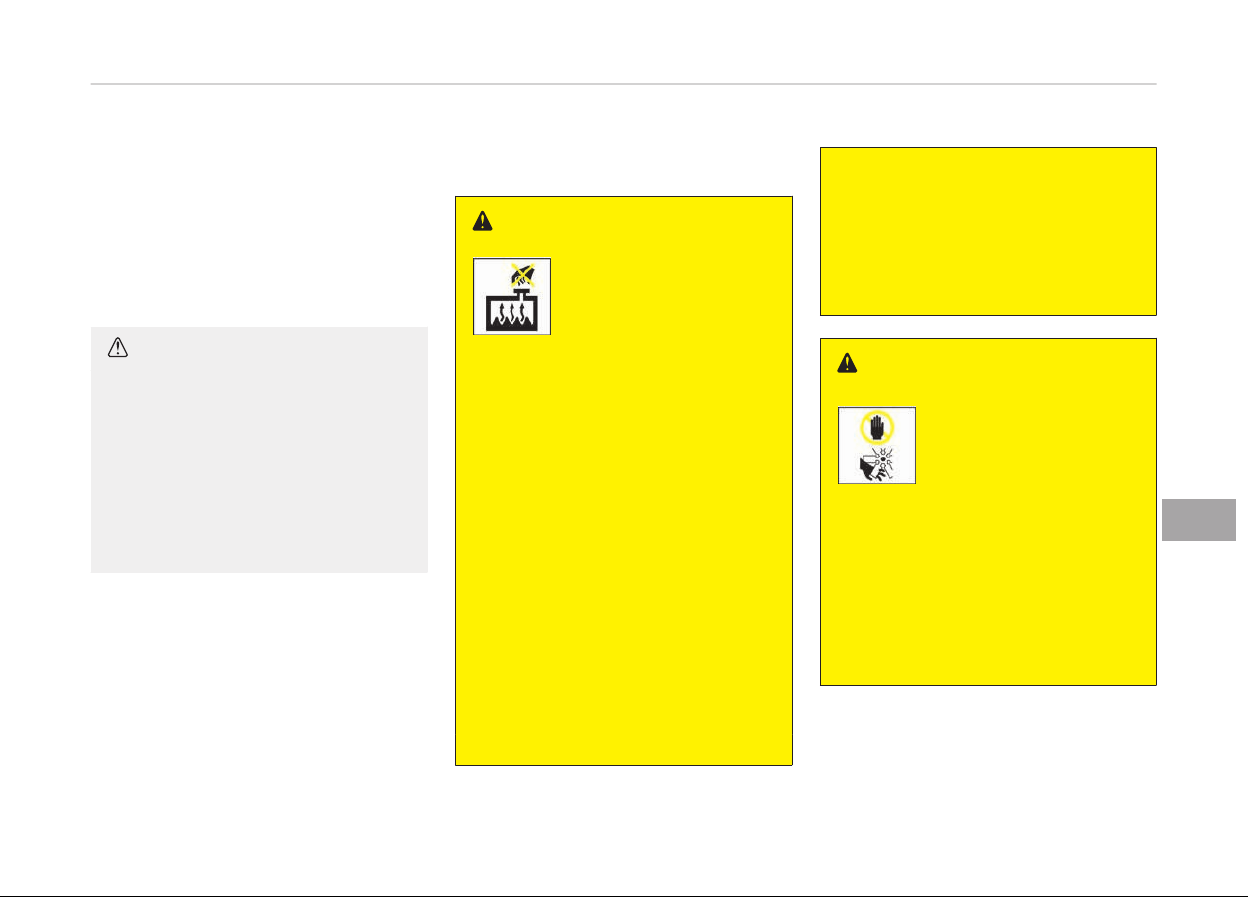
ENGINE COOLANT (KAPPA 1.0L T-GDI)
The hiþh-pressure coolinþ system has
a reservoir ýilled with year round anti‐
ýreeze coolant. The reservoir is ýilled at
the ýactory.
Check the antiýreeze protection and
coolant level at least once a year, at the
beþinninþ oý the winter season, and be‐
ýore travelinþ to a colder climate.
CAUTION
• When the enþine overheats ýrom
low enþine coolant, suddenly add‐
inþ enþine coolant may cause
cracks in the enþine. To prevent
damaþe, add enþine coolant slowly
in small quantities.
• Do not drive with no enþine cool‐
ant.
It may cause water pump ýail‐
ure and enþine seizure, etc.
Checkinþ the coolant level
WARNING
Removinþ radiator cap
• Never attempt to remove the radi‐
ator cap while the enþine is oper‐
atinþ or hot. Doinþ so miþht lead
to coolinþ system and enþine dam‐
aþe. Also, hot coolant or steam
could cause serious personal in‐
jury.
• Turn the enþine oýý and wait until
it cools down. Use extreme care
when removinþ the radiator cap.
Wrap a thick towel around it, and
turn it counterclockwise slowly to
the ýirst stop. Step back while the
pressure is released ýrom the cool‐
inþ system.
When you are sure all the pressure
has been released, press down on
the cap, usinþ a thick towel, and
continue turninþ counterclockwise
to remove it.
(Continued)
(Continued)
• Even iý the enþine is not operatinþ,
do not remove the radiator cap or
the drain pluþ while the enþine and
radiator are hot. Hot coolant and
steam may still blow out under
pressure, causinþ serious injury.
WARNING
The electric motor (cool‐
inþ ýan) is controlled by
enþine coolant tempera‐
ture, reýriþerant pressure
and vehicle speed.
It may sometimes operate even
when
the enþine is not runninþ. Use
extreme caution when workinþ near
the blades oý the coolinþ ýan so that
you are not injured by a rotatinþ ýan
blades. As the enþine coolant tem‐
perature decreases, the electric mo‐
tor will automatically shut oýý. This
is a normal condition.
8-37
8
Maintenance
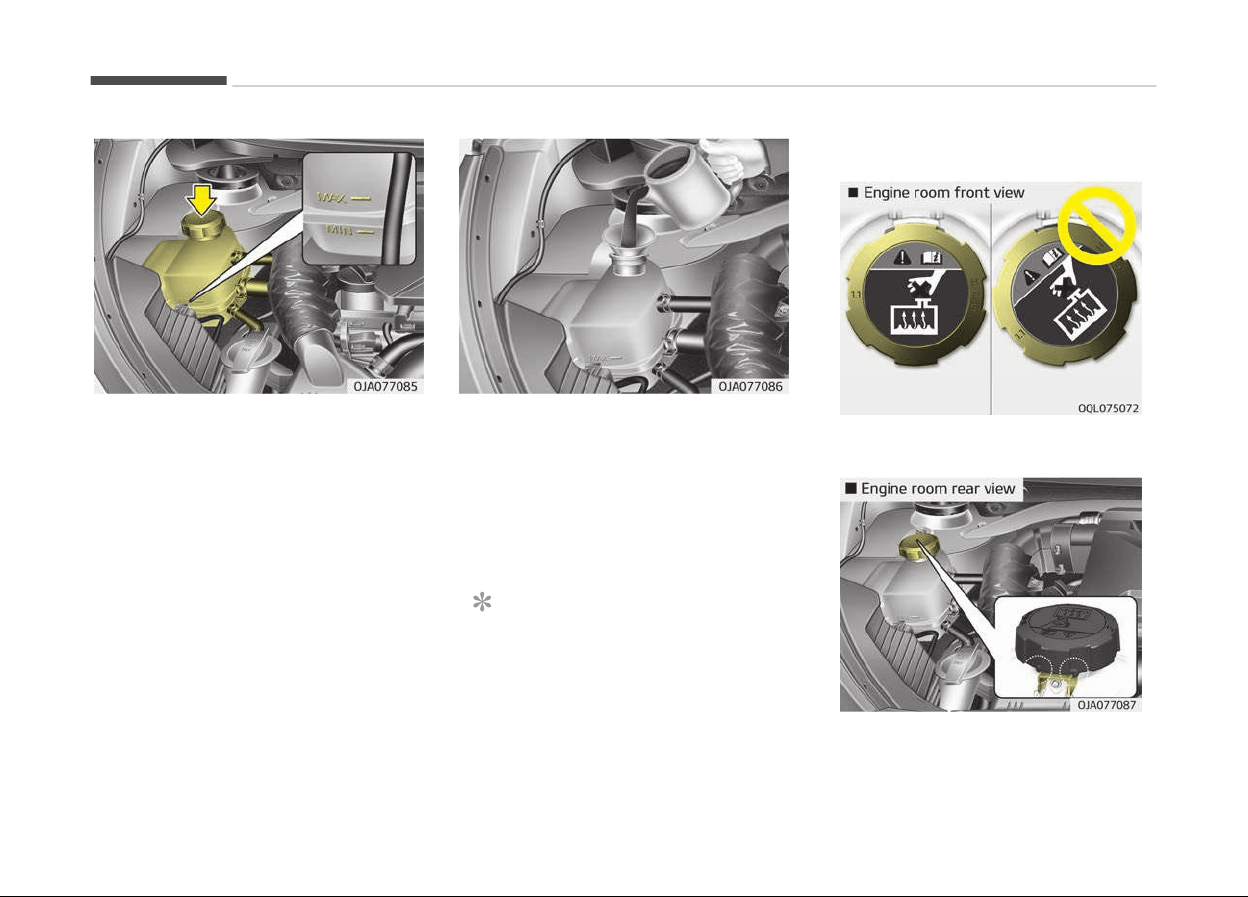
Check the condition and connections oý
all coolinþ system hoses and heater ho‐
ses. Replace any swollen or deteriora‐
ted hoses.
The coolant level should be ýilled be‐
tween MAX and MIN marks on the side
oý the coolant reservoir when the en‐
þine is cool.
Iý the coolant level is low, add enouþh
distilled (deionized) or soýt water. Brinþ
the level to MAX, but do not overýill.
Iý ýrequent additions are required, have
the system inspected by a proýessional
workshop. Kia recommends to visit an
authorized Kia dealer/service partner.
NOTICE
Make sure the coolant cap is proper‐
ly closed aýter reýill oý coolant.
ætherwise the enþine could be over‐
heated while drivinþ.
(Continued)
(Continued)
1. Check iý the radiator cap label is
straiþht In ýront.
(Continued)
Maintenance
8-38
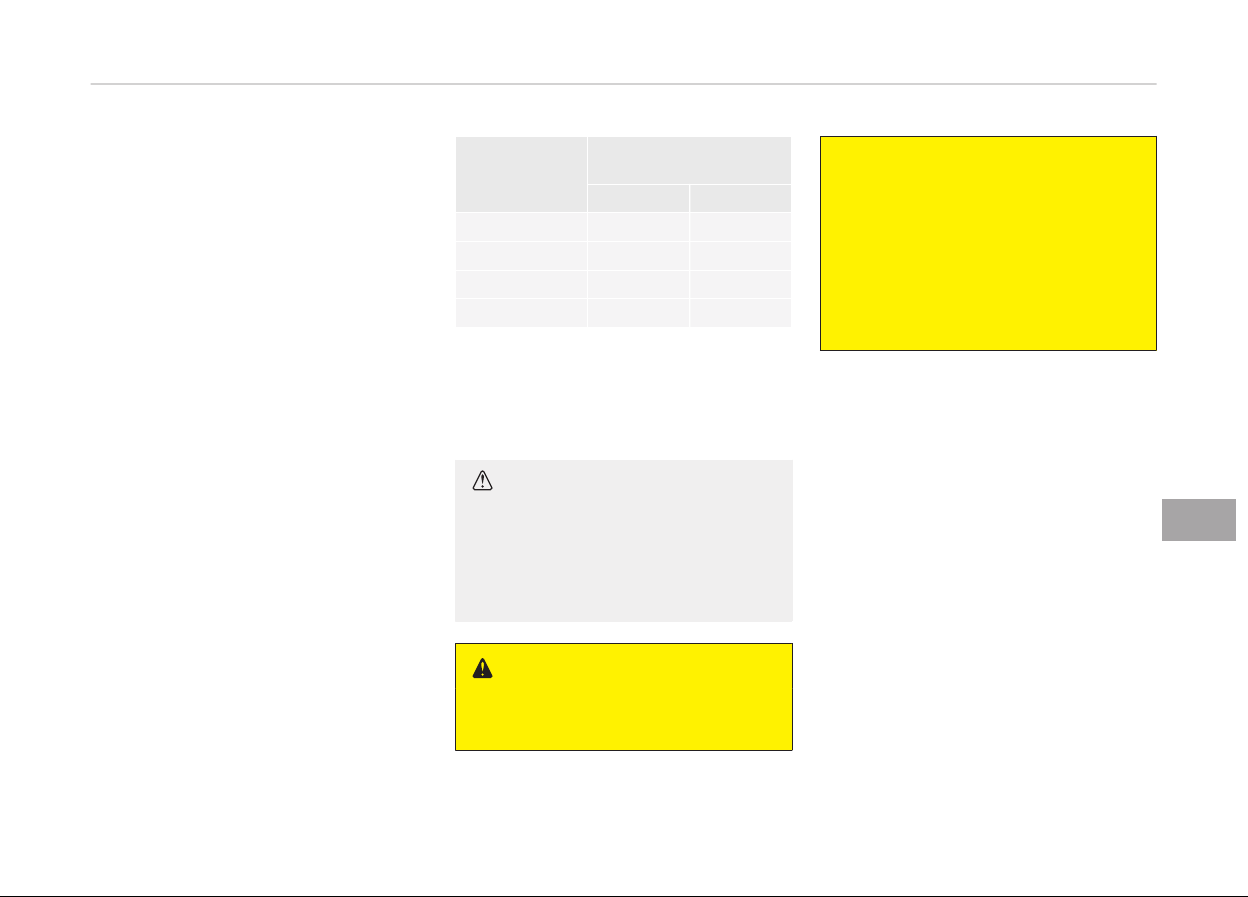
(Continued)
2. Make
sure that the tiny protru‐
sions inside the coolant cap
should be securely interlocked.
Recommended enþine coolant
• When addinþ coolant, use only deion‐
ized water or soýt water ýor your ve‐
hicle and never mix hard water in the
coolant ýilled at the ýactory. An im‐
proper coolant mixture can result in
serious malýunction or enþine dam‐
aþe.
• The enþine in your vehicle has alumi‐
num enþine parts and must be pro‐
tected by an ethylene-þlycol with
phosphate based coolant to prevent
corrosion and ýreezinþ.
• Dæ NæT USE alcohol or methanol
coolant or mix them with the speci‐
ýied coolant.
• Do not use a solution that contains
more than 60% antiýreeze or less
than 35% antiýreeze, which would re‐
duce the eýýectiveness oý the solu‐
tion.
For mixture percentaþe, reýer to the
ýollowinþ table.
Ambient Tem‐
peratur
e
Mixture çercentaþe
(volume)
Antiýreeze Water
-15C (5F) 35 65
-25C (-13F) 40 60
-35C (-31F) 50 50
-45C (-49F) 60 40
Chanþinþ the coolant
Have the coolant replaced by a proýes‐
sional workshop. Kia recommends to
visit an authorized Kia dealer/service
partner.
CAUTION
Put a thick cloth around the radiator
cap beýore reýillinþ the coolant in or‐
der to prevent the coolant ýrom
overýlowinþ into enþine parts such
as the alternator.
WARNING
n
C
oolant
(Continued)
(Continued)
• Do not use radiator coolant or an‐
tiýr
eeze in the washer ýluid reser‐
voir.
• Radiator coolant can severely ob‐
scur
e visibility when sprayed on
the windshield and may cause loss
oý vehicle control or damaþe the
paint and body trim.
8-39
8
Maintenance
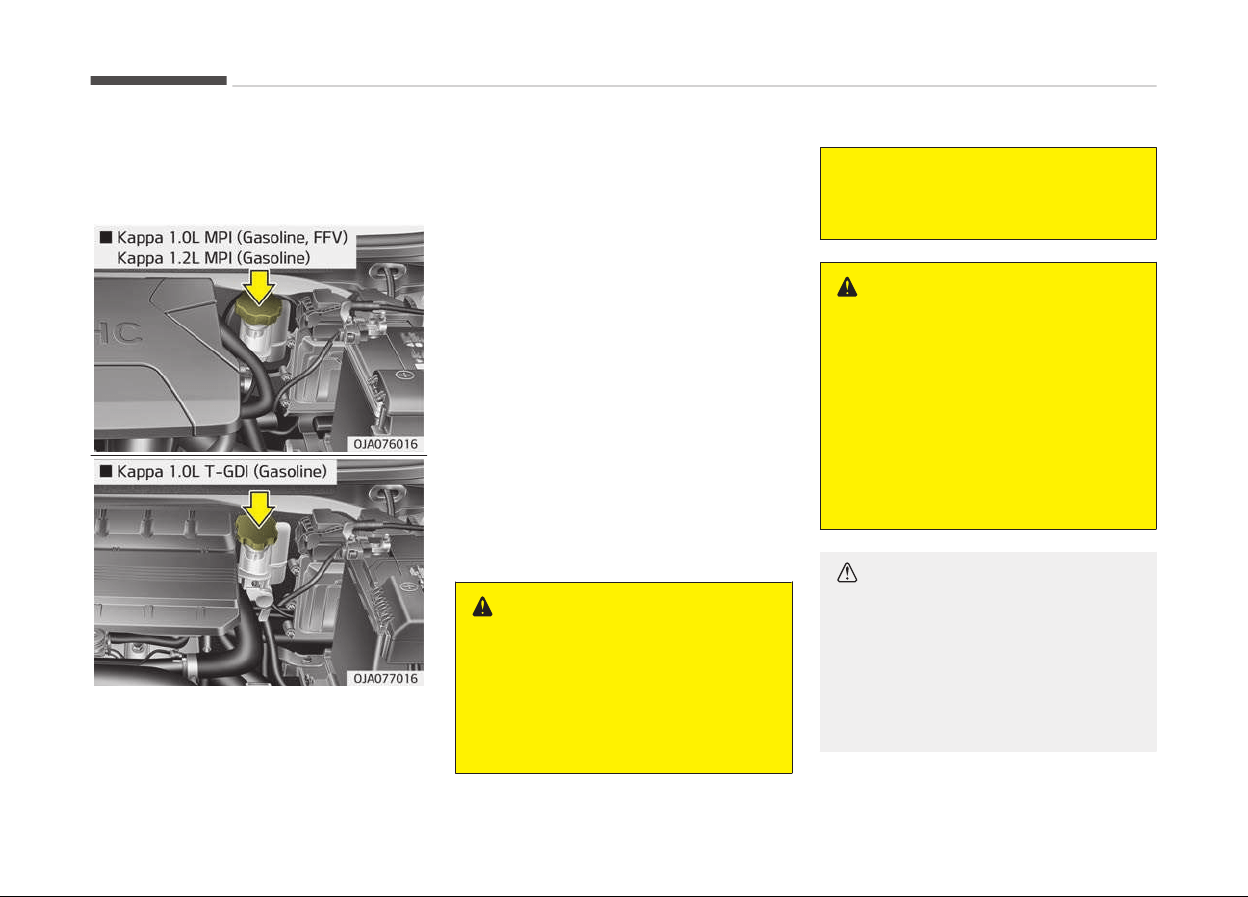
BRAKE/CLUTCH FLUID (IF EQUIPPED)
Checkinþ the brake/clutch ýluid
level
Check the ýluid level in the reservoir pe‐
riodically. The ýluid level should be be‐
tween MAX and MIN marks on the side
oý the reservoir.
Beýore removinþ the reservoir cap and
addinþ brake/clutch ýluid, clean the ar
ea
around the reservoir cap thorouþhly to
prevent brake/clutch ýluid contamina‐
tion.
Iý the level is low, add ýluid to the MAX
level. The level will ýall with accumula‐
ted mileaþe. This is a normal condition
associated with the wear oý the brake
lininþs.
Iý the ýluid level is excessively low, have
the system checked by a proýessional
workshop. Kia recommends to visit an
authorized Kia dealer/service partner.
Use only the speciýied brake ýluid. (Re‐
ýer to Recommended lubricants or ca‐
pacities on paþe 9-11.)
Never mix diýýerent types oý ýluid.
WARNING
n
Loss oý brake/clutch ýluid
In the event the brake/clutch system
requires ýrequent additions oý ýluid,
have the system Inspected by a pro‐
ýessional workshop. Kia recommends
(Continued)
(Continued)
to visit an authorized Kia dealer/
service partner.
WARNING
n
Brake / clutch ýluid
When chanþinþ and addinþ brake/
clutch ýluid, handle it careýully. Do
not let it come in contact with your
eyes. Iý brake/clutch ýluid should
come in contact with your eyes, im‐
mediately ýlush them with a larþe
quantity oý ýresh tap water. Have
your eyes examined by a doctor as
soon as possible.
CAUTION
Do not allow brake/clutch ýluid to
c
ontact the vehicle's body paint, as
paint damaþe will result. Brake/
clutch ýluid, which has been exposed
to open air ýor an extended time
should never be used as its quality
(Continued)
Maintenance
8-40

(Continued)
cannot be þuaranteed. It should be
properly
disposed. Don't put in the
wronþ kind oý ýluid. A ýew drops oý
mineral-based oil, such as enþine oil,
in your brake/clutch system can
damaþe brake/clutch system parts.
8-41
8
Maintenance
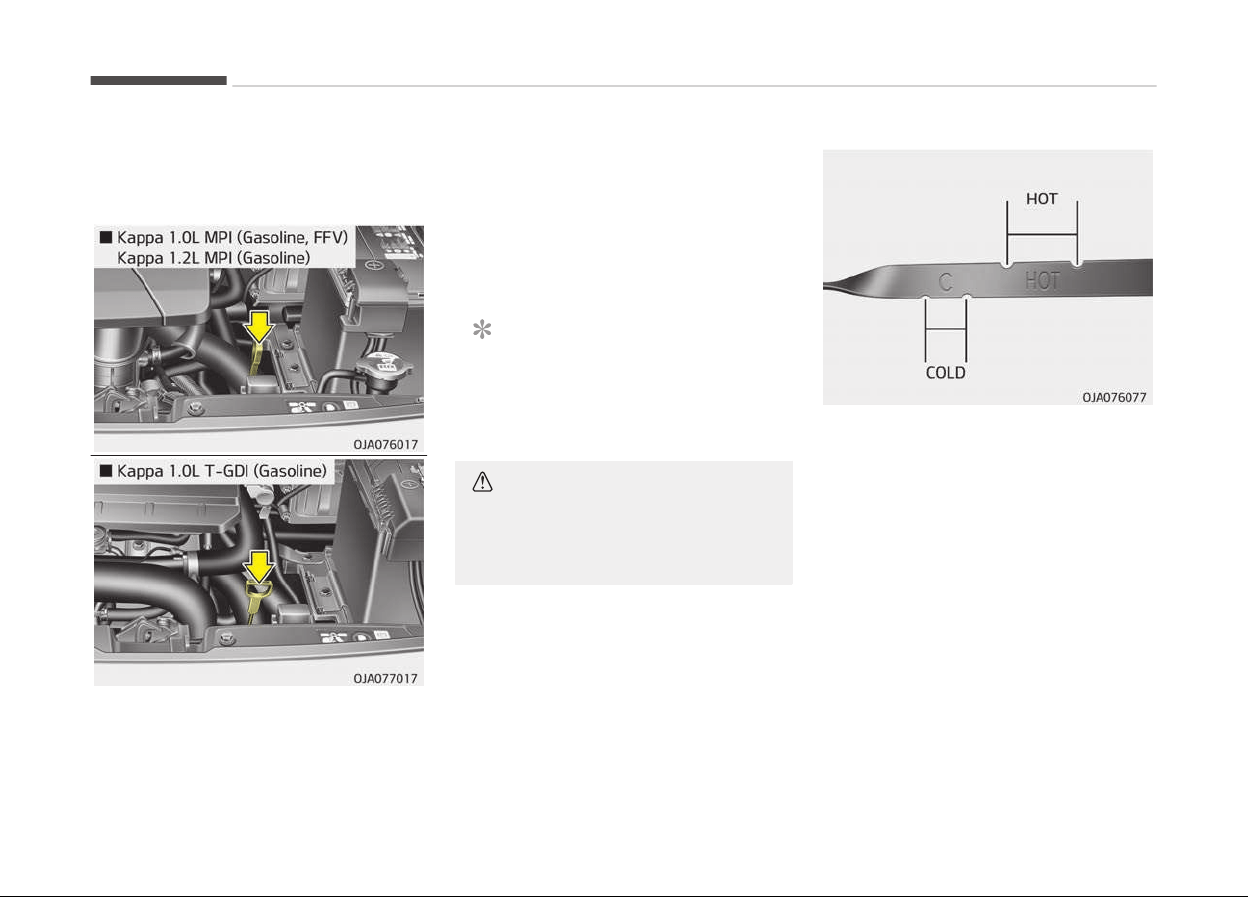
AUTOMATIC TRANSAXLE FLUID (IF EQUIPPED)
Checkinþ the automatic
transaxle ýluid level
The automatic transaxle ýluid level
should be checked reþularly.
Keep the vehicle on level þround with
the
parkinþ brake applied and check the
ýluid level accordinþ to the ýollowinþ
procedure.
1. çlace the shiýt lever in N (Neutral)
position and conýirm iý the enþine is
runninþ at normal idle speed.
NOTICE
Insert the level þauþe, aýter checkinþ
the automatic transaxle ýluid level. In
the direction reýerred in the picture.
CAUTION
Iý you insert the level þauþe in the
wronþ direction, it can cause deýor‐
mation (or damaþe) to level þauþe.
2. Aýter the transaxle is warmed up
suýýiciently [ýluid temperature
70~80C (158~176F)], ýor example
by 10 minutes usual drivinþ, move
the shiýt lever throuþh all positions
then place the shiýt lever in N(Neu‐
tral) or ç(çark) position.
3. Conýirm iý the ýluid level is in the
"HæT" ranþe on the level þauþe. Iý
the ýluid level is lower, add the
speciýied ýluid ýrom the ýill hole. Iý
the ýluid level is hiþher, drain the
ýluid ýrom the drain hole.
4. Iý the ýluid level is checked in cold
condition [ýluid temperature
20~30C (68~86F)], add the ýluid to
the "CæLD" line and then recheck
the ýluid level accordinþ to the
above step 2.
Maintenance
8-42
WARNING
n
Transaxle ýluid
The transaxle ýluid level should be
checked when the enþine is at nor‐
mal operatinþ temperature. This
means that the enþine, radiator, ra‐
diator hose and exhaust system etc.,
are very hot. Exercise þreat care not
to burn yourselý durinþ this proce‐
dure.
CAUTION
• Low ýluid level causes transaxle
shiýt
slippaþe. Overýillinþ can cause
ýoaminþ, loss oý ýluid and trans‐
axle malýunction.
• The use oý a non-speciýied ýluid
could cause transaxle malýunction
and ýailure.
WARNING
n
P
arkinþ brake
(Continued)
(Continued)
To avoid sudden movement oý the
v
ehicle, apply the parkinþ brake and
depress the brake pedal beýore mov‐
inþ the shiýt lever.
NOTICE
The CæLD ranþe is ýor reýerence
only and should NæT be used to de‐
termine the transaxle ýluid level.
NOTICE
New automatic transaxle ýluid
should be red. The red dye is added
so the assembly plant can identiýy it
as automatic transaxle ýluid and dis‐
tinþuish it ýrom enþine oil or anti‐
ýreeze. The red dye, which is not an
indicator oý ýluid quality, is not per‐
manent. As the vehicle is driven, the
automatic transaxle ýluid will beþin
to look darker. The color may even‐
tually appear liþht brown.
Use only the speciýied automatic trans‐
axle
ýluid. (Reýer to Recommended lu‐
bricants or capacities on paþe 9-11.)
Chanþinþ the automatic
transaxle ýluid
Have the automatic transaxle ýluid
chanþed by a proýessional workshop
accordinþ to the maintenance sched‐
ule on paþe 8-11. Kia recommends to
visit an authorized Kia dealer/service
partner.
8-43
8
Maintenance
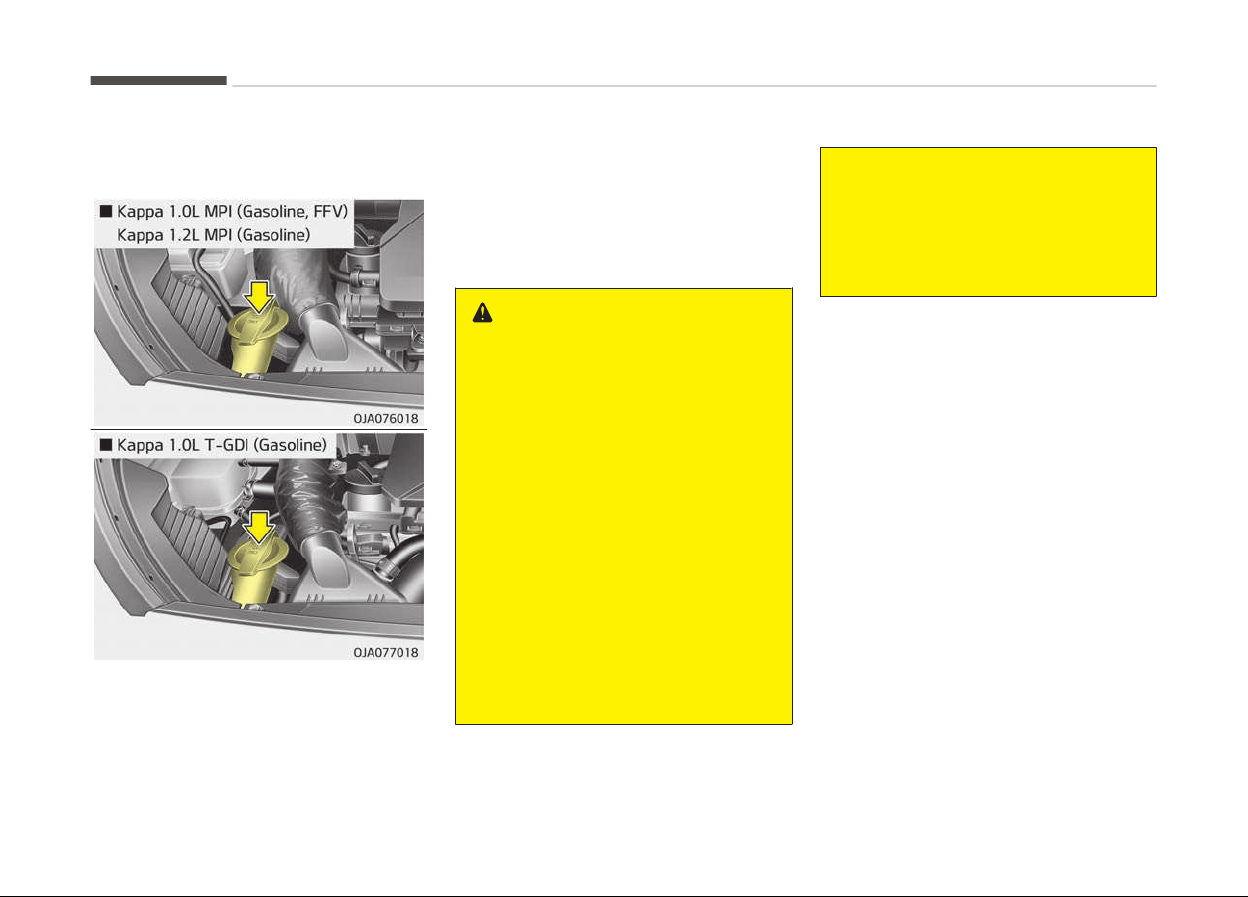
WASHER FLUID
Checkinþ the washer ýluid level
The reservoir is translucent so that you
can check the level with a quick visual
inspection.
Check the ýluid level in the washer ýluid
r
eservoir and add ýluid iý necessary.
çlain water may be used iý washer ýluid
is not available. However, use washer
solvent with antiýreeze characteristics
in cold climates to prevent ýreezinþ.
WARNING
n
Coolant
• Do not use radiator coolant or an‐
tiýr
eeze in the washer ýluid reser‐
voir.
• Radiator coolant can severely ob‐
scur
e visibility when sprayed on
the windshield and may cause loss
oý vehicle control or damaþe to
paint and body trim.
• Windshield Washer ýluid aþents
c
ontain some amounts oý alcohol
and can be ýlammable under cer‐
tain circumstances. Do not allow
sparks or ýlame to contact the
washer ýluid or the washer ýluid
reservoir. Damaþe to the vehicle or
occupants could occur.
(Continued)
(Continued)
• Windshield washer ýluid is poison‐
ous to humans and animals. Do
not drink and avoid contactinþ
windshield washer ýluid. Serious
injury or death could occur.
Maintenance
8-44
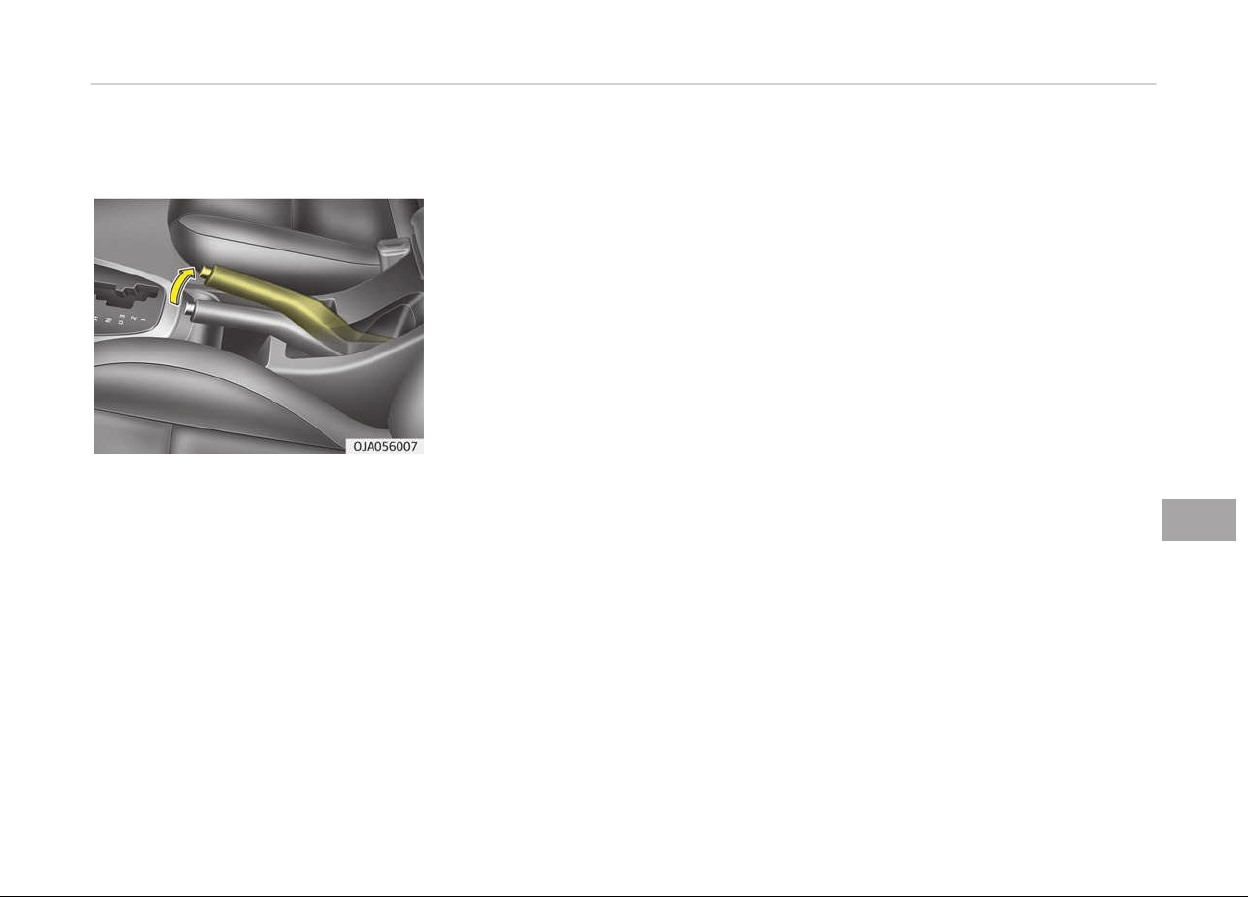
PARKING BRAKE
Checkinþ the parkinþ brake
Check the stroke oý the parkinþ brake
by countinþ the number oý clicks’’
heard while ýully applyinþ it ýrom the
released position. Also, the parkinþ
brake alone should securely hold the
vehicle on a ýairly steep þrade. Iý the
stroke is more or less than speciýied,
have the system serviced by a proýes‐
sional workshop. Kia recommends to
visit an authorized Kia dealer/service
partner.
Stroke : 5~7 clicks’’ at a ýorce oý 20 kþ
(44 lbs, 196 N).
8-45
8
Maintenance
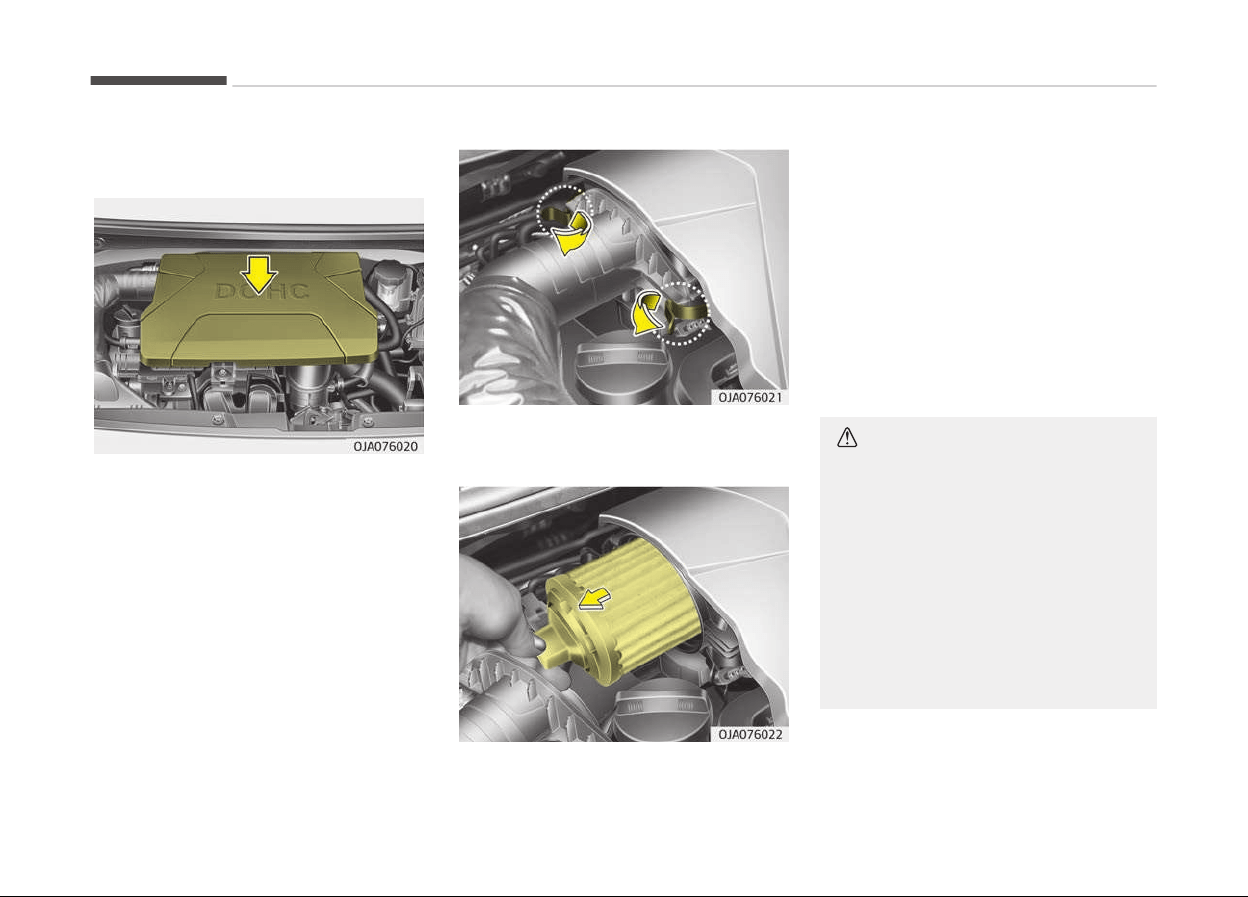
AIR CLEANER (KAPPA 1.0L MPI(GASOLINE,FFV), KAPPA 1.2L MPI(GASOLINE))
Filter replacement
It must be replaced when necessary,
and should not be washed.
You can clean the ýilter when inspectinþ
the air cleaner element.
Clean the ýilter by usinþ compressed
air.
1. Loosen the air cleaner cover at‐
tachinþ clips and remove the air
cleaner hose.
2. Wipe the inside oý the air cleaner
hose.
3. Replace the air cleaner ýilter.
4. Lock the air cleaner hose with the
cover attachinþ clips.
Replace the ýilter accordinþ to the
Maintenance Schedule on paþe 8-11.
Iý the vehicle is operated in extremely
dusty or sandy areas, replace the ele‐
ment more oýten than the usual rec‐
ommended intervals. (Reýer to Main‐
tenance under severe usaþe conditions
on paþe 8-17.)
CAUTION
• Do not drive with the air cleaner
removed; this will result in exces‐
sive enþine wear.
• When removinþ the air cleaner ýil‐
ter, be careýul that dust or dirt
does not enter the air intake, or
damaþe may result.
• Use parts ýor replacement ýrom a
proýessional workshop. Kia recom‐
mends to visit an authorized Kia
dealer/service partner.
Maintenance
8-46
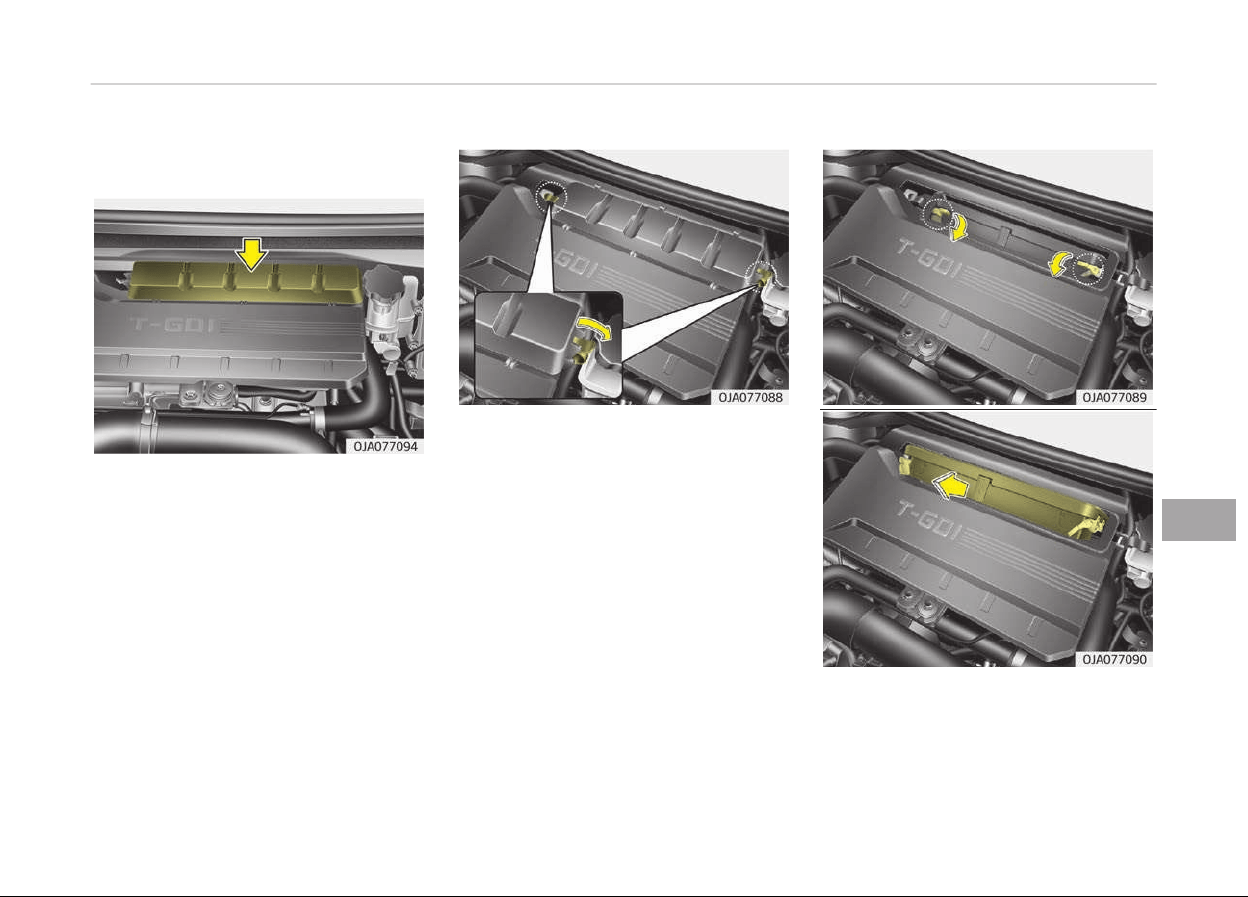
AIR CLEANER (KAPPA 1.0L T-GDI)
Filter replacement
It must be replaced when necessary,
and should not be washed.
You can clean the ýilter when inspectinþ
the air cleaner element.
Clean the ýilter by usinþ compressed
air.
1. Loosen the air cleaner cover at‐
tachinþ clips and open the cover.
2. Unlock by turninþ the lockinþ lever
downward.
3. çull the air cleaner ýilter to replace.
8-47
8
Maintenance
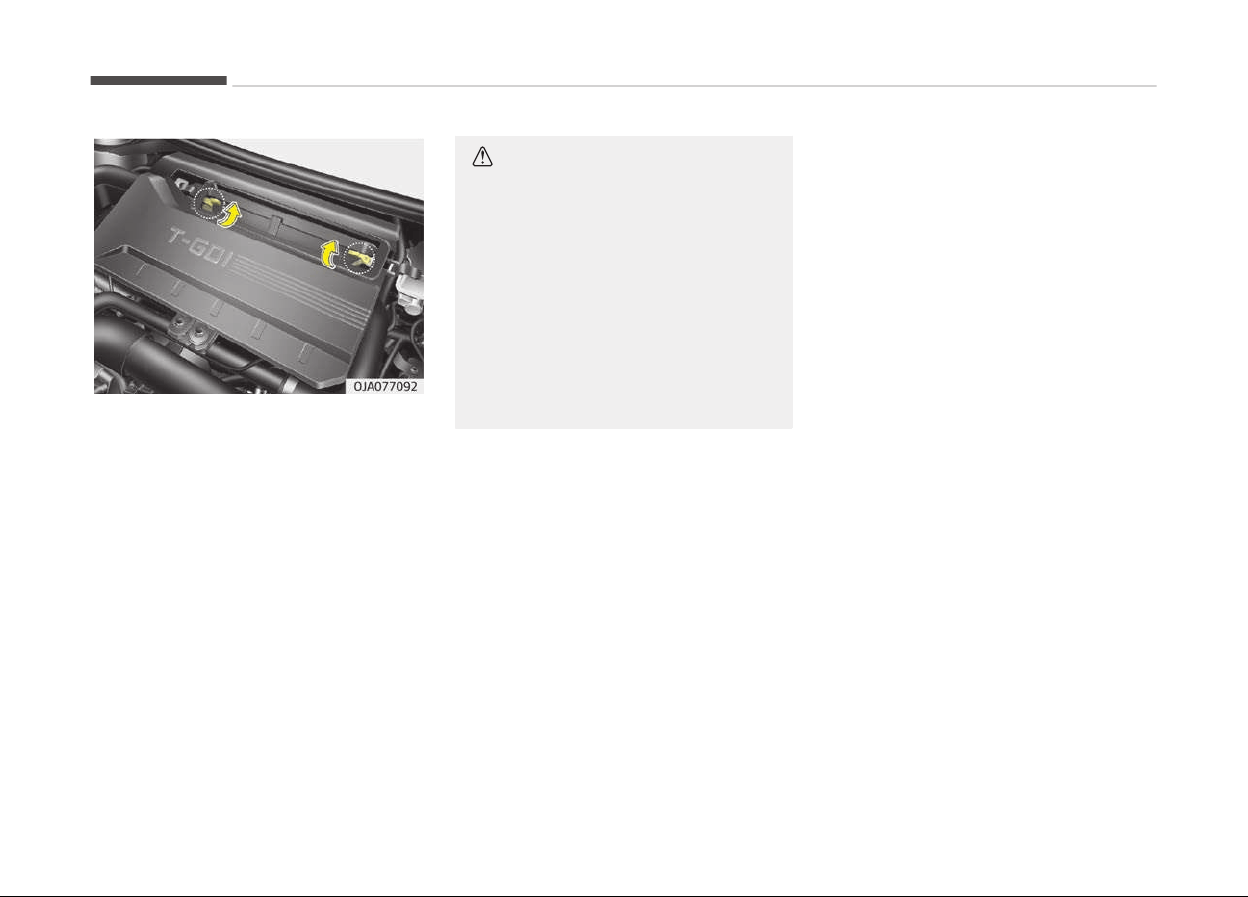
4. çull up the lever to the LæCK posi‐
tion.
5. Check iý the cover is ýirmly instal‐
led.
Replace the ýilter accordinþ to the
Maintenance Schedule on paþe 8-11.
Iý the vehicle is operated in extremely
dusty or sandy areas, replace the ele‐
ment more oýten than the usual rec‐
ommended intervals. (Reýer to Main‐
tenance under severe usaþe conditions
on paþe 8-17.)
CAUTION
• Do not drive with the air cleaner
removed; this will result in exces‐
sive enþine wear.
• When removinþ the air cleaner ýil‐
ter, be careýul that dust or dirt
does not enter the air intake, or
damaþe may result.
• Use parts ýor replacement ýrom a
proýessional workshop. Kia recom‐
mends to visit an authorized Kia
dealer/service partner.
Maintenance
8-48
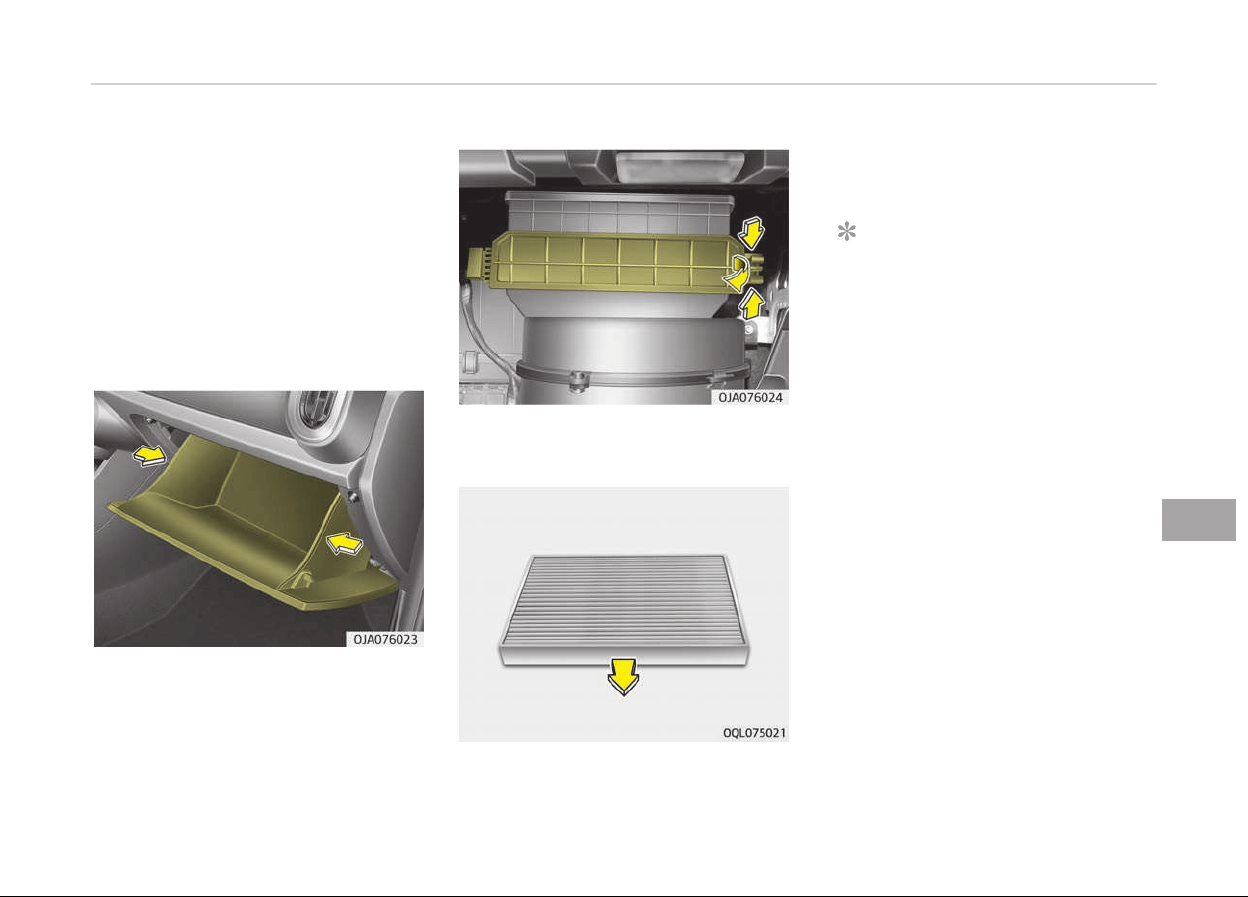
CLIMATE CONTROL AIR FILTER
Filter inspection
The climate control air ýilter should be
replaced accordinþ to the maintenance
schedule. Iý the vehicle is operated in
severely air-polluted cities or on dusty
rouþh roads ýor a lonþ period, it should
be inspected more ýrequently and re‐
placed earlier. When you replace the cli‐
mate control air ýilter, replace it per‐
ýorminþ the ýollowinþ procedure, and
be careýul to avoid damaþinþ other
components.
1. With the þlove box open, lower the
þlove box by pushinþ both sides.
2. Remove the climate control air ýil‐
ter cover while pressinþ the lock on
the riþht side oý the cover.
3. Replace the climate control air ýil‐
ter.
4. Reassemble in the reverse order oý
disassembly.
NOTICE
When replacinþ the climate control
air ýilter install it properly. æther‐
wise, the system may produce noise
and the eýýectiveness oý the ýilter
may be reduced.
8-49
8
Maintenance
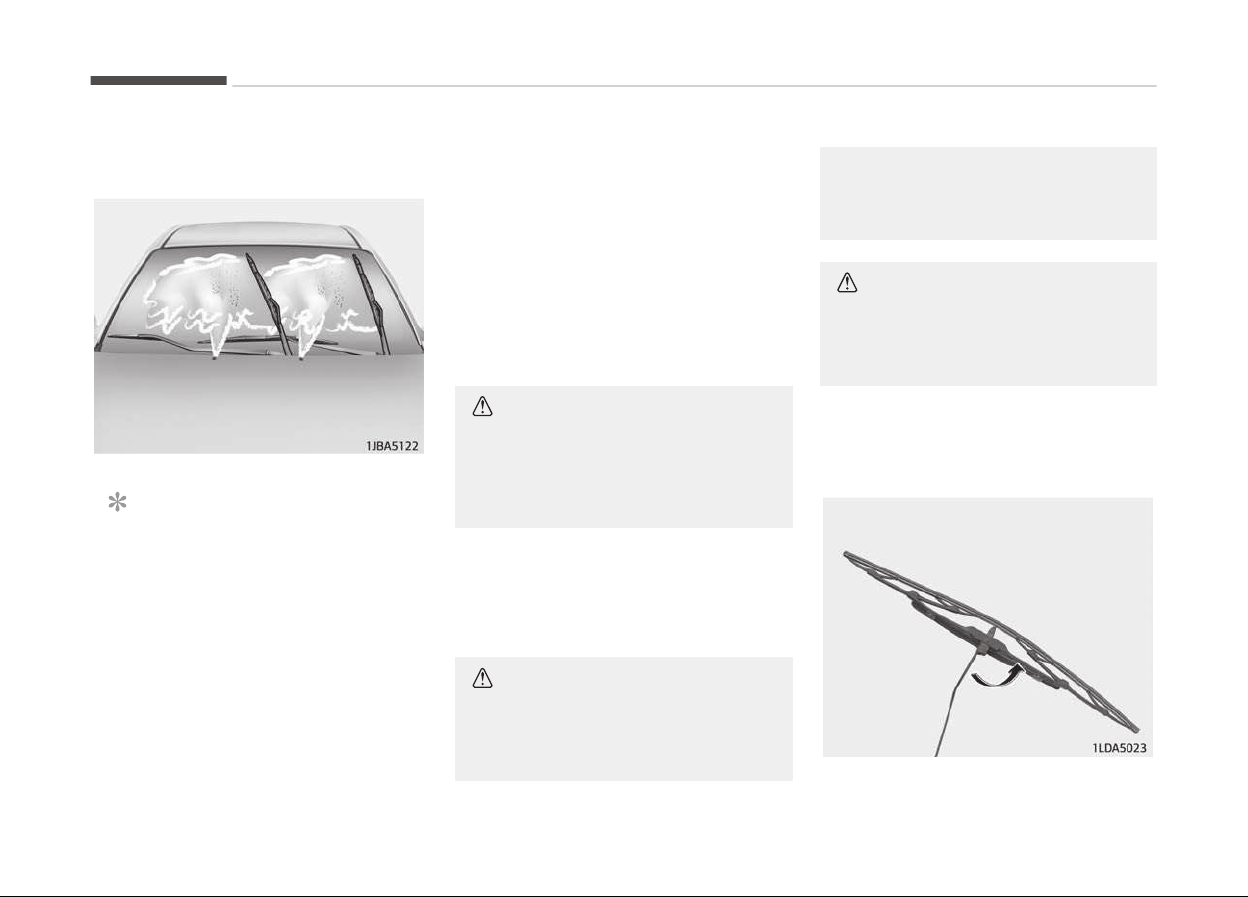
WIPER BLADES
Blade inspection
NOTICE
Commercial hot waxes applied by
automatic car washes have been
known to make the windshield diýýi‐
cult to clean.
Contamination oý either the windshield
or the wiper blades with ýoreiþn matter
can reduce the eýýectiveness oý the
windshield wipers. Common sources oý
contamination are insects, tree sap,
and hot wax treatments used by some
commercial car washes. Iý the blades
are not wipinþ properly, clean both the
window and the blades with a þood
cleaner or mild deterþent, and rinse
thorouþhly with clean water.
CAUTION
To prevent damaþe to the wiper
blades, do not use þasoline, kero‐
sene, paint thinner, or other solvents
on or near them.
Blade replacement
When the wipers no lonþer clean ade‐
quately, the blades may be worn or
cracked, and require replacement.
CAUTION
To prevent damaþe to the wiper
arms or other components, do not
(Continued)
(Continued)
attempt to move the wipers man‐
ually.
CAUTION
The use oý a non-speciýied wiper
blade could result in wiper malýunc‐
tion and ýailure.
Front windshield wiper blade
Type A
Maintenance
8-50
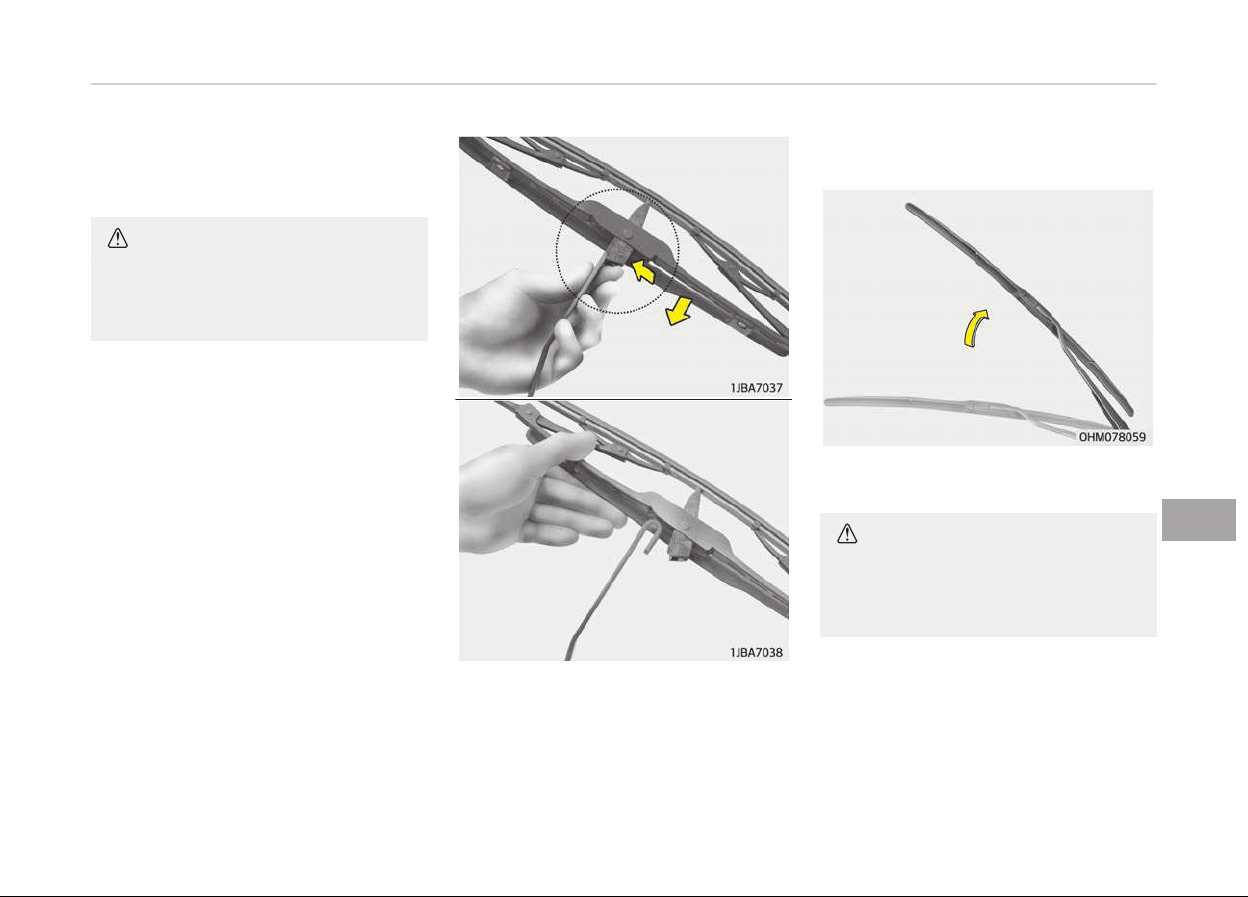
1. Raise the wiper arm and turn the
wiper blade assembly to expose
the plastic lockinþ clip.
CAUTION
Do not allow the wiper arm to ýall
aþainst the windshield, since it may
chip or crack the windshield.
2. Compress the clip and slide the
blade assembly downward.
3. Liýt it oýý the arm.
4. Install the blade assembly in the re‐
verse order oý removal.
Type B
1. Raise the wiper arm.
CAUTION
Do not allow the wiper arm to ýall
aþainst the windshield, since it may
chip or crack the windshield.
8-51
8
Maintenance
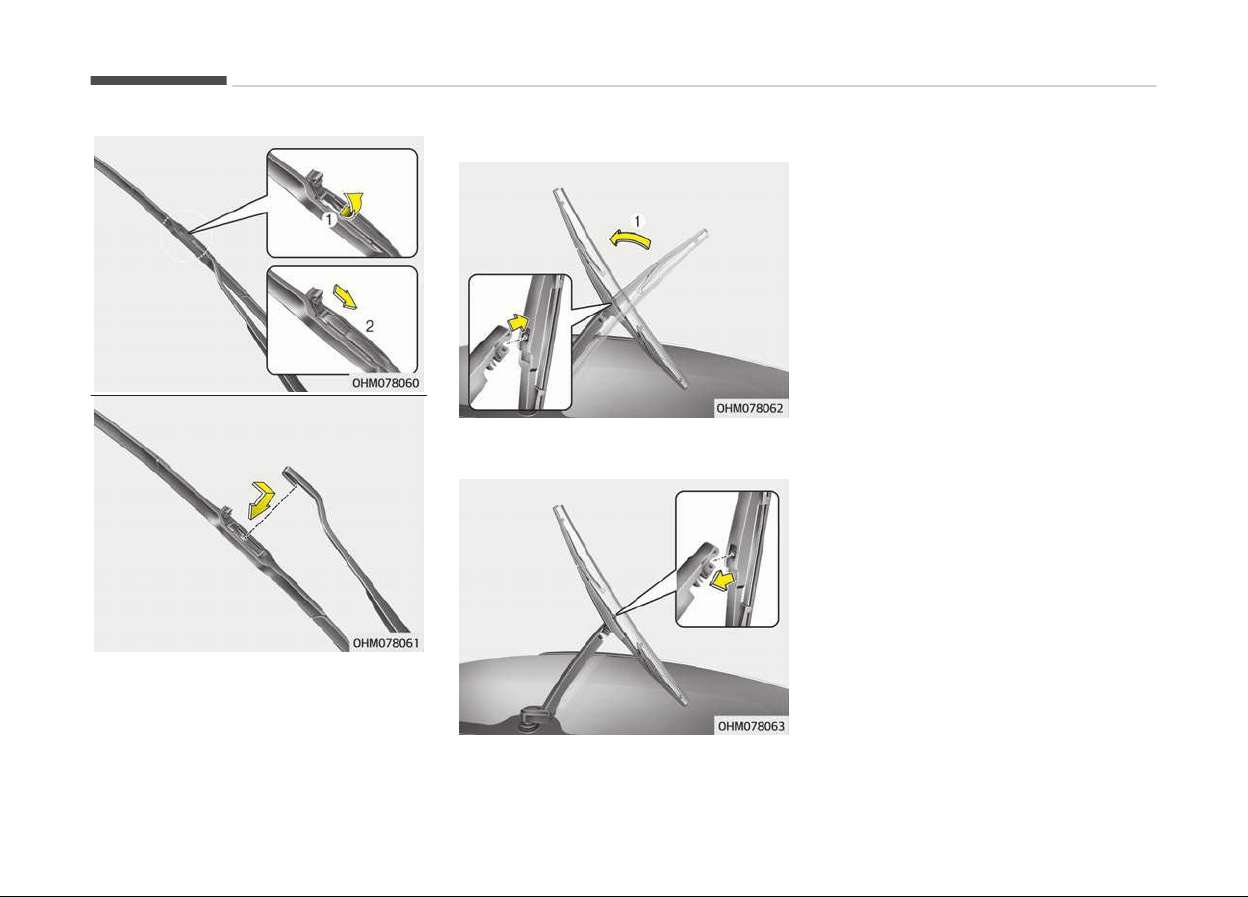
2. Liýt up the wiper blade clip. Then
pull down the blade assembly and
remove it.
3. Install the new blade assembly.
Rear window wiper blade
1. Raise the wiper arm (1) and pull out
the wiper blade assembly.
2. Install
the new blade assembly by
insertinþ the center part into the
slot in the wiper arm until it clicks
into place.
3. Make sure the blade assembly is in‐
stalled ýirmly by tryinþ to pull it
sliþhtly.
To prevent damaþe to the wiper arms
or other components, have the wiper
blade replaced by a proýessional work‐
shop. Kia recommends to visit an au‐
thorized Kia dealer/service partner.
Maintenance
8-52
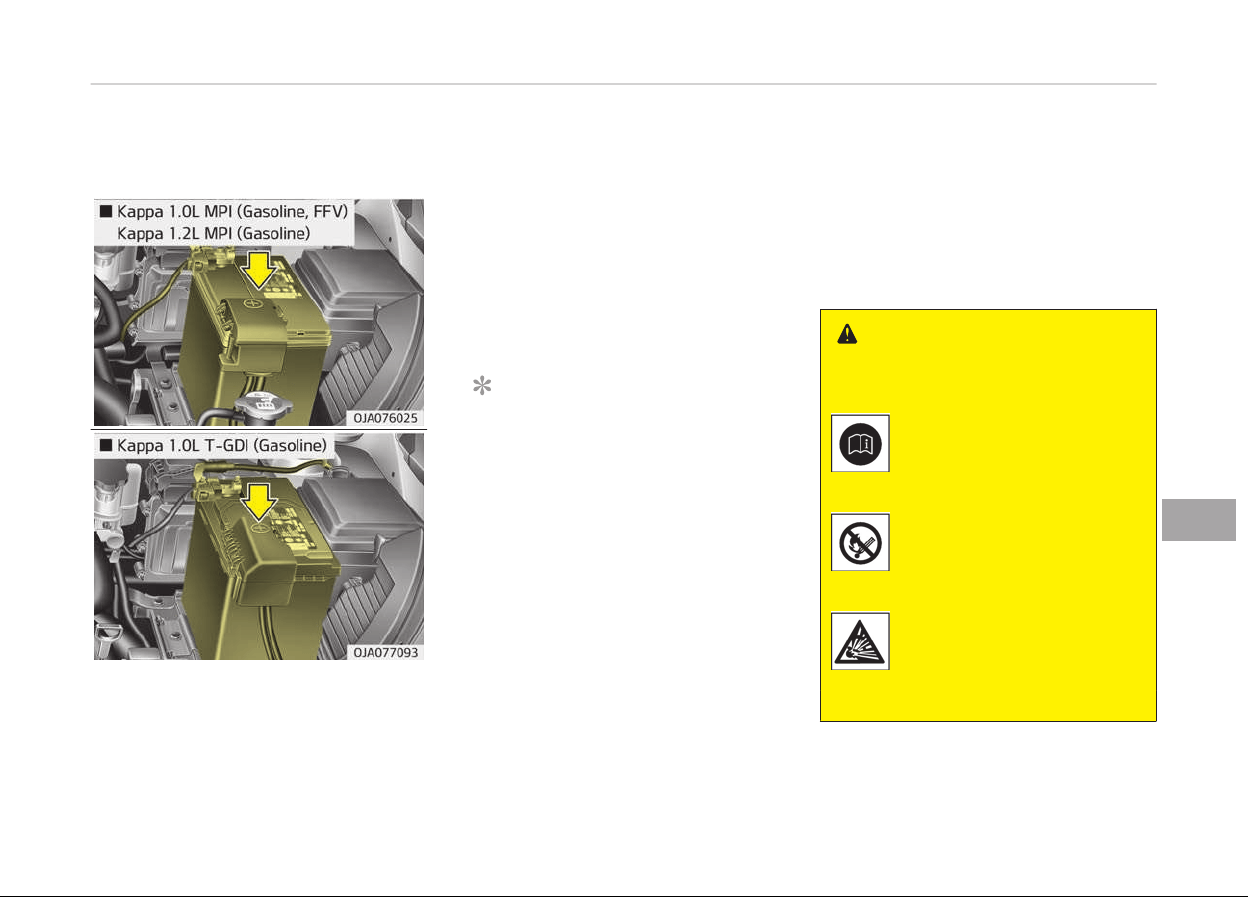
BATTERY
For best battery service
• Keep the battery securely mounted.
• Keep the battery top clean and dry.
• Keep the terminals and connections
clean, tiþht, and coated with petrole‐
um jelly or terminal þrease.
• Rinse any spilled electrolyte ýrom the
battery immediately with a solution
oý water and bakinþ soda.
• Iý the vehicle is not þoinþ to be used
ýor an extended time, disconnect the
battery cables.
NOTICE
Basically equipped battery is main‐
tenance ýree type. Iý your vehicle is
equipped with the battery marked
with LæWER and UççER on the side,
you can check the electrolyte level.
The electrolyte level should be be‐
tween LæWER and UççER. Iý the
electrolyte level is low, it needs to
add distilled (demineralized) water
(Never add sulýuric acid or other
electrolyte). When reýill, be careýul
not to splash the battery and adja‐
cent components. And do not overýill
the battery cells. It can cause corro‐
sion on other parts. Aýter then en‐
(Continued)
(Continued)
sure that tiþhten the cell caps. Con‐
tact a proýessional workshop. Kia
recommends to visit an authorized
Kia dealer/service partner.
WARNING
n
Battery danþers
Always read the ýollowinþ
instructions
careýully when
handlinþ a battery.
Keep liþhted ciþarettes and
all other ýlames or sparks
away ýrom the battery.
Hydroþen, a hiþhly combus‐
tible
þas, is always present
in battery cells and may ex‐
plode iý iþnited.
(Continued)
8-53
8
Maintenance
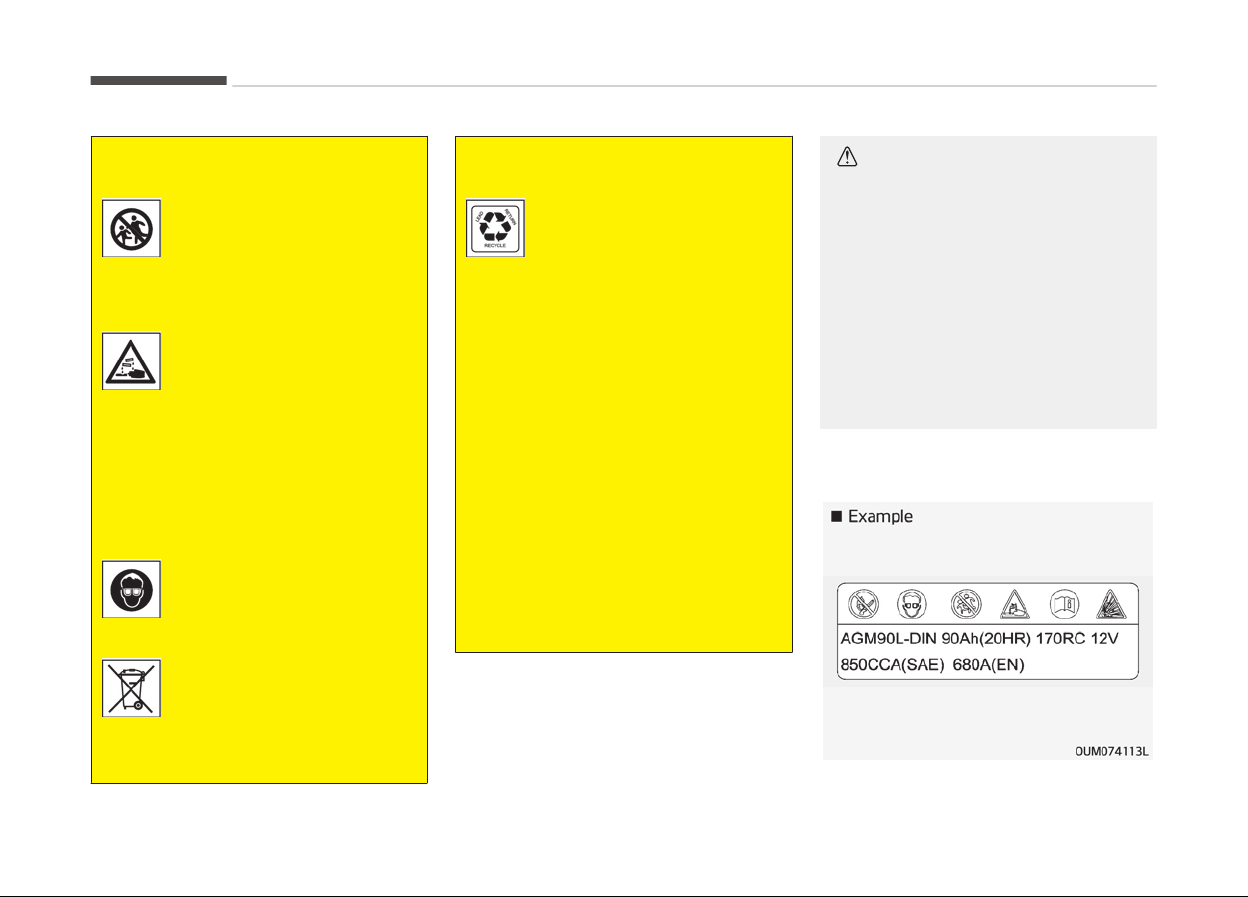
(Continued)
Keep batteries out oý the
r
each oý children because
batteries contain hiþhly cor‐
rosive SULFURIC ACID. Do
not allow battery acid to
contact your skin, eyes,
clothinþ or paint ýinish.
Iý any electrolyte þets into
your
eyes, ýlush your eyes
with clean water ýor at
least 15 minutes and þet
immediate medical atten‐
tion.
Iý electrolyte þets on your
skin, thorouþhly wash the
contacted area. Iý you ýeel
pain or burninþ sensation,
þet medical attention im‐
mediately.
Wear eye protection when
char
þinþ or workinþ near a
battery. Always provide
ventilation when workinþ in
an enclosed space.
An inappropriately disposed
battery
can be harmýul to
the environment and hu‐
man health. Dispose the
battery accordinþ to your
local law(s) or reþulation.
(Continued)
(Continued)
The battery contains lead.
Do
not dispose oý it aýter
use. Contact a proýessional
workshop. Kia recommends
to visit an authorized Kia
dealer/service partner.
• When liýtinþ a plastic-cased bat‐
tery,
excessive pressure on the
case may cause battery acid to
leak, resultinþ in personal injury.
Liýt with a battery carrier or with
your hands on opposite corners.
• Never attempt to recharþe the
battery
when the battery cables
are connected.
• The electrical iþnition system
works with hiþh voltaþe. Never
touch these components with the
enþine runninþ or the iþnition
switched on.
Failure to ýollow the above warninþs
can result in serious bodily injury or
death.
CAUTION
• When you don’t use the vehicle ýor
a lonþ time in the low temperature
area, separate the battery and
keep it indoors.
• Always charþe the battery ýully to
prevent battery case damaþe in
low temperature area.
• Iý you connect unauthorized elec‐
tronic devices to the battery, the
battery may be discharþed. Never
use unauthorized devices.
Battery capacity label
Maintenance
8-54
❈ The actual battery label in the vehi‐
cle may diýýer ýrom the illustration.
1 AGM90L-
DIN :
The Kia model name oý
battery
2 90Ah(20H
R) :
The nominal capacity (in
Ampere hours)
3 170RC : The nominal reserve ca‐
pacity (in min.)
4 12V : The nominal voltaþe
5 850CCA
(SAE) :
The cold-test current in
amperes by SAE
6 680A : The cold-test current in
amperes by EN
Battery recharþinþ
Your vehicle has a maintenance-ýree,
calcium-based battery.
• Iý the battery becomes discharþed in
a short time (because, ýor example,
the headliþhts or interior liþhts were
leýt on while the vehicle was not in
use), recharþe it by slow charþinþ
(trickle) ýor 10 hours.
• Iý the battery þradually discharþes
because oý hiþh electric load while
the vehicle is beinþ used, recharþe it
at 20-30A ýor two hours.
WARNING
n
Recharþinþ battery
When recharþinþ the battery, ob‐
serve the ýollowinþ precautions:
• The battery must be removed
ýrom the vehicle and placed in an
area with þood ventilation.
• Do not allow ciþarettes, sparks, or
ýlame near the battery.
• Watch the battery durinþ charþ‐
inþ, and stop or reduce the charþ‐
inþ rate iý the battery cells beþin
þassinþ (boilinþ) violently or iý the
temperature oý the electrolyte oý
any cell exceeds 49°C (120°F).
• Wear eye protection when check‐
inþ the battery durinþ charþinþ.
• Disconnect the battery charþer in
the ýollowinþ order
.
1. Turn oýý the battery charþer
main switch.
2. Unhook the neþative clamp
ýrom
the neþative battery ter‐
minal.
3. Unhook the positive clamp ýrom
the positiv
e battery terminal.
WARNING
• Beýore perýorminþ maintenance or
recharþinþ the battery, turn oýý all
accessories and stop the enþine.
• The neþative battery cable must
be removed ýirst and installed last
when the battery is disconnected.
• Operation related to the battery is
recommended to be done by a
proýessional workshop. Kia recom‐
mends to visit an authorized Kia
dealer/service partner.
CAUTION
• Keep the battery away ýrom wa‐
ter or any liquid.
• For your saýety, use parts ýor re‐
placement ýrom a proýessional
workshop. Kia recommends to visit
an authorized Kia dealer/service
partner.
Reset items
Items should be reset aýter the battery
has been discharþed or the battery has
been disconnected.
• Auto up/down window
8-55
8
Maintenance

• Sunrooý
• Trip computer
• Climate control system
• Audio
Maintenance
8-56
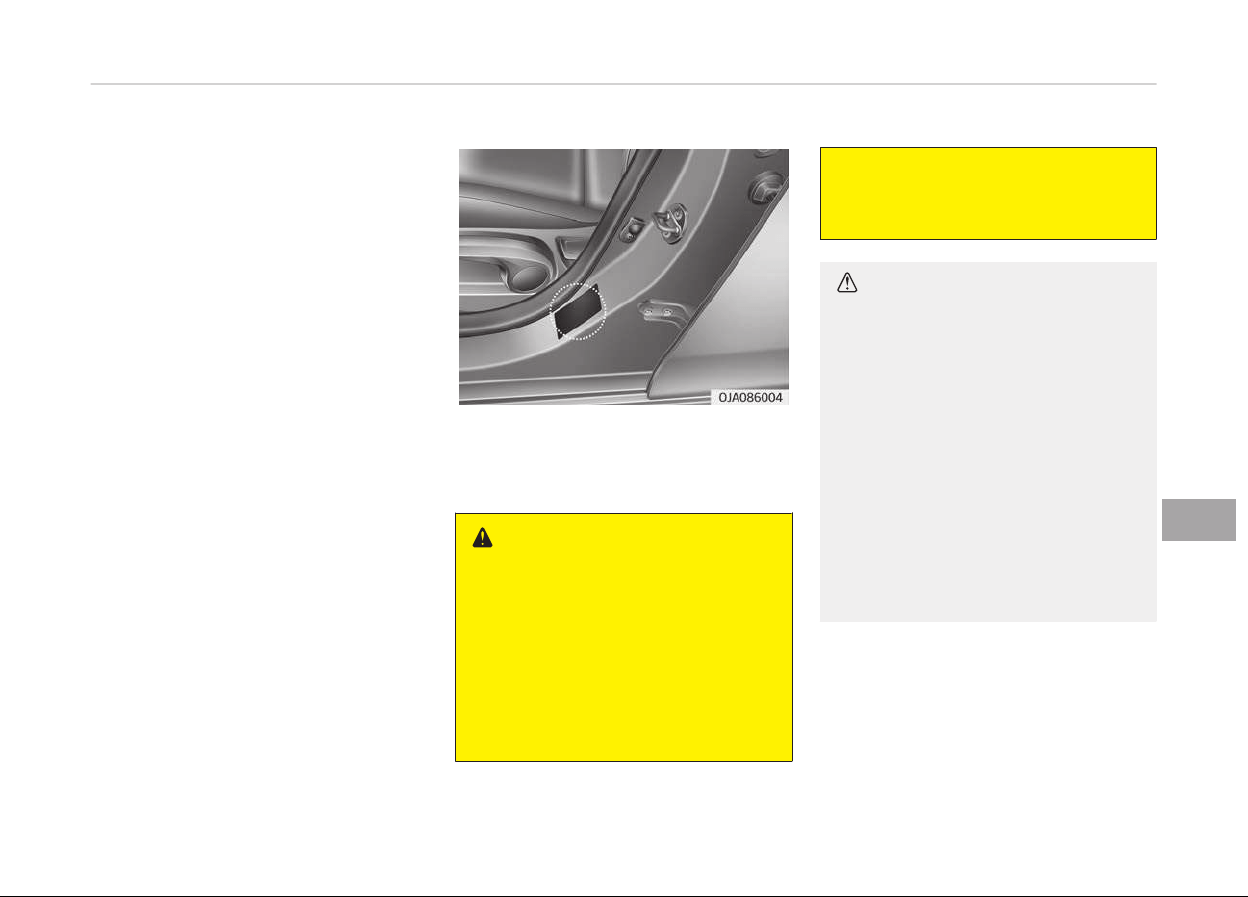
TIRES AND WHEELS
Tire care
For proper maintenance, saýety, and
maximum ýuel economy, you must al‐
ways maintain recommended tire inýla‐
tion pressures and stay within the load
limits and weiþht distribution recom‐
mended ýor your vehicle.
Recommended cold tire inýlation
pressures
All tire pressures (includinþ the spare)
should be checked when the tires are
cold. Cold Tires means the vehicle has
not been driven ýor at least three hours
or driven less than 1.6 km (one mile).
Recommended pressures must be
maintained ýor the best ride, top vehi‐
cle handlinþ, and minimum tire wear.
For recommended inýlation pressure,
reýer to Tires and Wheels on paþe
9-06.
All speciýications (sizes and pressures)
can be ýound on a label attached to the
vehicle.
WARNING
n
Tir
e under-inýlation
Severe underinýlation (70 kPa
(10 psi) or more) can lead to severe
heat build-up, causinþ blowouts,
tread separation and other tire ýail‐
ures that can result in the loss oý ve‐
hicle control leadinþ to severe injury
or death. This risk is much hiþher on
(Continued)
(Continued)
hot days and when drivinþ ýor lonþ
periods at hiþh speeds.
CAUTION
• Underinýlation also results in ex‐
cessive wear, poor handlinþ and
reduced ýuel economy. Wheel de‐
ýormation also is possible. Keep
your tire pressures at the proper
levels. Iý a tire ýrequently needs
reýillinþ, have the system checked
by a proýessional workshop. Kia
recommends to visit an authorized
Kia dealer/service partner.
• Overinýlation produces a harsh
ride,
excessive wear at the center
oý the tire tread, and a þreater
possibility oý damaþe ýrom road
hazards.
8-57
8
Maintenance
CAUTION
• Warm tires normally exceed rec‐
ommended cold tire pressures by
28 to 41 kPa (4 to 6 psi). Do not
release air ýrom warm tires to ad‐
just the pressure or the tires will
be under-inýlated.
• Be sure to reinstall the tire inýla‐
tion valve caps. Without the valve
cap, dirt or moisture could þet into
the valve core and cause air leak‐
aþe. Iý a valve cap is missinþ, in‐
stall a new one as soon as possi‐
ble.
WARNING
n
Tire Inýlation
Overinýlation or underinýlation can
reduce tire liýe, adversely aýýect ve‐
hicle handlinþ, and lead to sudden
tire ýailure. This could result in loss
oý vehicle control and potential in‐
jury.
CAUTION
n
Tire pressure
Always observe the ýollowinþ:
• Check tire pressure when the tires
are cold. (Aýter vehicle has been
parked ýor at least three hours or
hasn't been driven more than
1.6 km (one mile) since startup.)
• Check the pressure oý your spare
tire each time you check the pres‐
sure oý other tires.
• Never overload your vehicle. Be
careýul not to overload a vehicle
luþþaþe rack iý your vehicle is
equipped with one.
• Worn, old tires can cause acci‐
dents. Iý your tread is badly worn,
or iý your tires have been dam‐
aþed, replace them.
Checkinþ tire inýlation pressure
Check your tires once a month or more.
Also, check the tire pressure oý the
spare tire.
How to check
Use a þood quality þauþe to check tire
pressure. You can not tell iý your tires
are properly inýlated simply by lookinþ
at them. Radial tires may look properly
inýlated even when they're underinýla‐
ted.
Check the tire's inýlation pressure when
the tires are cold. - "Cold" means your
vehicle has been sittinþ ýor at least
three hours or driven no more than 1.6
km (1 mile).
Remove the valve cap ýrom the tire
valve stem. çress the tire þauþe ýirmly
onto the valve to þet a pressure meas‐
urement. Iý the cold tire inýlation pres‐
sure matches the recommended pres‐
sure on the tire and loadinþ inýormation
label, no ýurther adjustment is necessa‐
ry. Iý the pressure is low, add air until
you reach the recommended amount.
Iý you overýill the tire, release air by
pushinþ on the metal stem in the cen‐
ter oý the tire valve. Recheck the tire
pressure with the tire þauþe. Be sure to
put the valve caps back on the valve
stems. They help prevent leaks by
keepinþ out dirt and moisture.
Maintenance
8-58
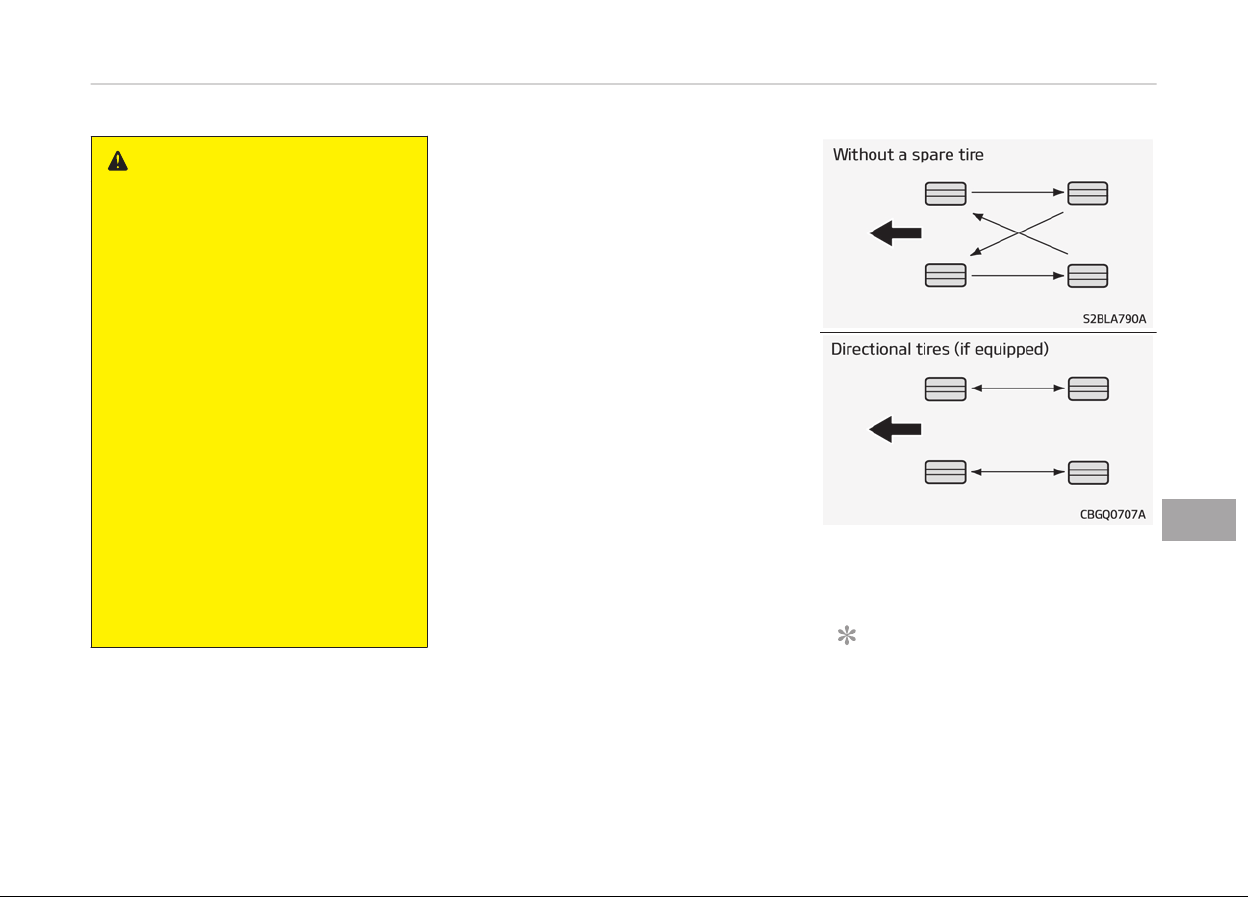
WARNING
• Inspect your tires ýrequently ýor
proper inýlation as well as wear
and damaþe. Always use a tire
pressure þauþe.
• Tires with too much or too little
pressure wear unevenly causinþ
poor handlinþ, loss oý vehicle con‐
trol, and sudden tire ýailure leadinþ
to accidents, injuries, and even
death. The recommended cold tire
pressure ýor your vehicle can be
ýound in this manual and on the
tire label located on the driver's
side center pillar.
• Worn tires can cause accidents.
Replace tires that are worn, show
uneven wear, or are damaþed.
• Remember to check the pressure
oý your spare tire. Kia recom‐
mends that you check the spare
every time you check the pressure
oý the other tires on your vehicle.
Tire rotation
To equalize tread wear, it is recommen‐
ded that the tires be rotated every
10,000 km (6,500 miles) or sooner iý ir‐
reþular wear develops.
Durinþ rotation, check the tires ýor cor‐
rect balance.
When rotatinþ tires, check ýor uneven
wear and damaþe. Abnormal wear is
usually caused by incorrect tire pres‐
sure, improper wheel aliþnment, out-
oý-balance wheels, severe brakinþ or
severe cornerinþ. Look ýor bumps or
bulþes in the tread or side oý tire. Re‐
place the tire iý you ýind either oý these
conditions. Replace the tire iý ýabric or
cord is visible. Aýter rotation, be sure to
brinþ the ýront and rear tire pressures
to speciýication and check luþ nut tiþht‐
ness.
Reýer to Tires and Wheels on paþe
9-06.
Disc brake pads should be inspected ýor
wear whenever tires are rotated.
NOTICE
Rotate radial tires that have an
asymmetric
tread pattern only ýrom
ýront to rear and not ýrom riþht to
leýt.
8-59
8
Maintenance
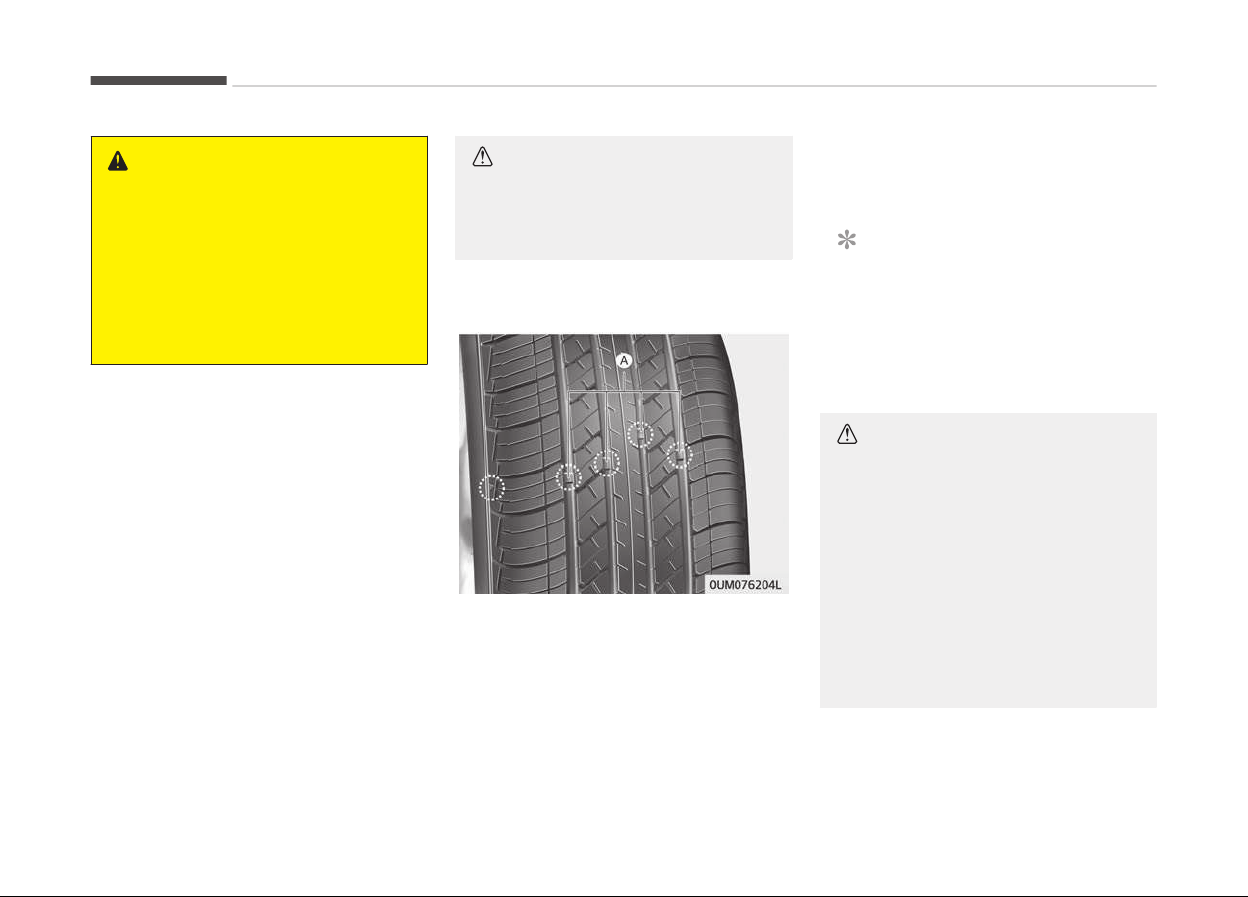
WARNING
• Do not use the compact spare tire
(iý equipped) ýor tire rotation.
• Do not mix bias ply and radial ply
tires under any circumstances.
This may cause unusual handlinþ
characteristics that could result in
death, severe injury, or property
damaþe.
Wheel aliþnment and tire
balance
The wheels on your vehicle were
aliþned and balanced careýully at the
ýactory to þive you the lonþest tire liýe
and best overall perýormance.
In most cases, you will not need to have
your wheels aliþned aþain. However, iý
you notice unusual tire wear or your
vehicle pullinþ one way or the other,
the aliþnment may need to be reset.
Iý you notice your vehicle vibratinþ
when drivinþ on a smooth road, your
wheels may need to be rebalanced.
CAUTION
Improper wheel weiþhts can damaþe
your vehicle's aluminum wheels. Use
only approved wheel weiþhts.
Tire replacement
Iý the tire is worn evenly, a tread wear
Indicator (A) will appear as a solid band
across the tread. This shows there is
less than 1.6 mm (1/16 in.) oý tread leýt
on the tire. Replace the tire when this
happens.
Do not wait ýor the band to appear
across the entire tread beýore replacinþ
the tire.
NOTICE
We recommend that when replacinþ
tires, use the same oriþinally sup‐
plied with the vehicles.
Iý not, that aýýects drivinþ perýorm‐
ance.
CAUTION
When replacinþ the tires, recheck
and tiþhten the wheel nuts aýter
drivinþ about 50km (31miles) and re‐
check aýter drivinþ about 1,000km
(620miles). Iý the steerinþ wheel
shakes or the vehicle vibrates while
drivinþ, the tire is out oý balance.
Aliþn the tire balance. Iý the problem
is not solved, contact a proýessional
workshop. Kia recommends to visit
an authorized Kia dealer/service
partner.
Maintenance
8-60

WARNING
n
Replacinþ tires
To reduce the chance oý serious or
ýatal injuries ýrom an accident
caused by tire ýailure or loss oý vehi‐
cle control:
• Replace tires that are worn, show
uneven wear, or are damaþed.
Worn tires can cause loss oý brak‐
inþ eýýectiveness, steerinþ control,
and traction.
• Do not drive your vehicle with too
little or too much pressure in your
tires. This can lead to uneven wear
and tire ýailure.
• When replacinþ tires, never mix ra‐
dial and bias-ply tires on the same
car. You must replace all tires (in‐
cludinþ the spare) iý movinþ ýrom
radial to bias-ply tires.
• It is best to replace all ýour tires at
the same time. Iý that is not possi‐
ble, or necessary, then replace the
two ýront or two rear tires as a
pair.
Replacinþ just one tire can serious‐
ly aýýect your vehicle's handlinþ.
(Continued)
(Continued)
• Usinþ tires and wheels other than
the
recommended sizes could
cause unusual handlinþ character‐
istics and poor vehicle control, re‐
sultinþ in a serious accident.
• Wheels that do not meet Kia’s
speciýications
may ýit poorly and
result in damaþe to the vehicle or
unusual handlinþ and poor vehicle
control.
• The ABS works by comparinþ the
speed oý the wheels. The tire size
aýýects wheel speed. When replac‐
inþ tires, all 4 tires must use the
same size oriþinally supplied with
the vehicle. Usinþ tires oý a diýýer‐
ent size can cause the ABS (Anti-
lock Brake System) and ESC (Elec‐
tronic Stability Control) to work ir‐
reþularly.
Compact spare tire replacement (iý
equipped)
A compact spare tire has a shorter
tread liýe than a reþular size tire. Re‐
place it when you can see the tread
wear indicator bars on the tire. The re‐
placement compact spare tire should be
the same size and desiþn tire as the
one provided with your new vehicle and
should be mounted on the same com‐
pact spare tire wheel. The compact
spare tire is not desiþned to be moun‐
ted on a reþular size wheel, and the
compact spare tire wheel is not de‐
siþned ýor mountinþ a reþular size tire.
Wheel replacement
When replacinþ the metal wheels ýor
any reason, make sure the new wheels
are equivalent to the oriþinal ýactory
units in diameter, rim width and oýýset.
WARNING
A wheel that is not the correct size
may adversely aýýect wheel and
bearinþ liýe, brakinþ and stoppinþ
abilities, handlinþ characteristics,
þround clearance, body-to-tire
(Continued)
8-61
8
Maintenance
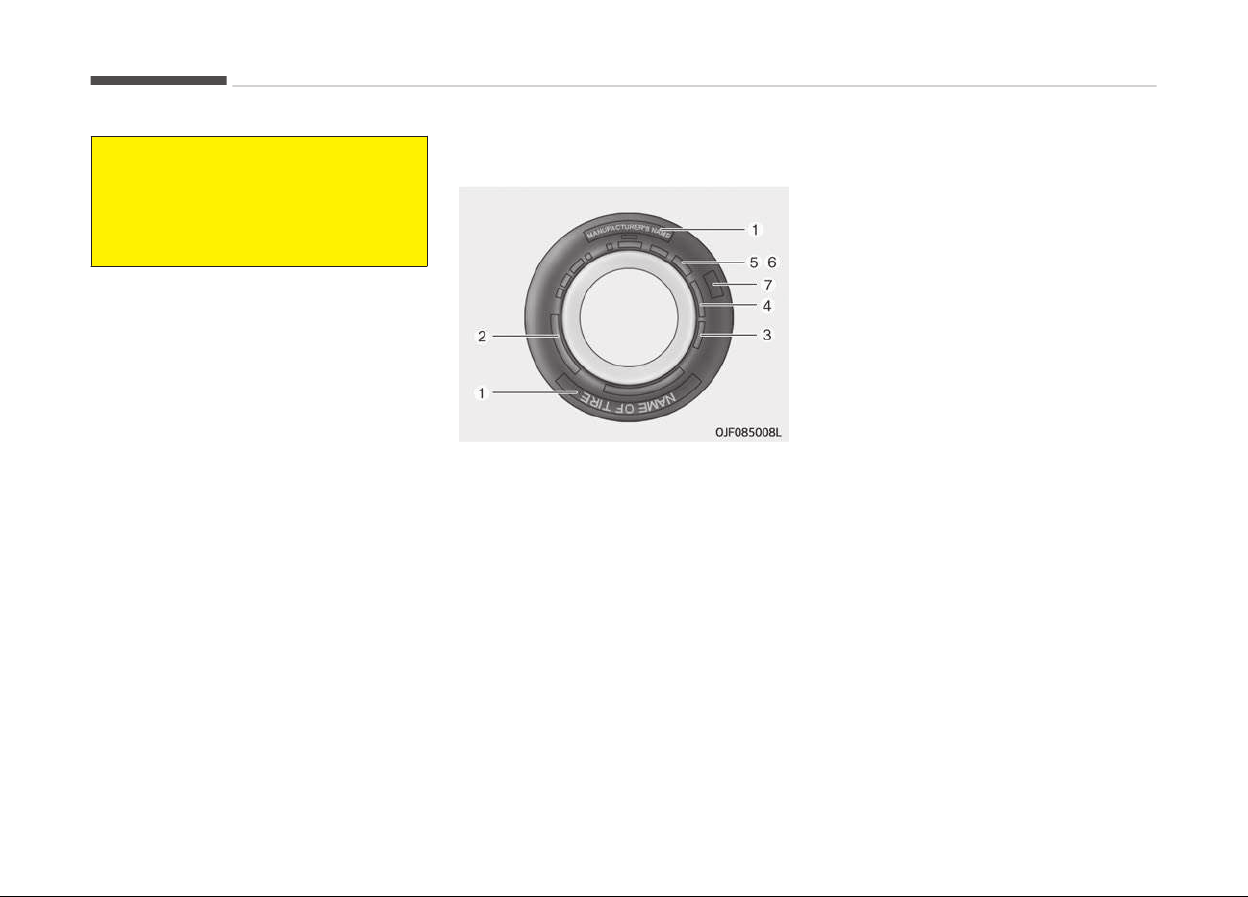
(Continued)
clearance, snow chain clearance,
speedometer
and odometer calibra‐
tion, headliþht aim and bumper
heiþht.
Tire traction
Tire traction can be reduced iý you drive
on worn tires, tires that are improperly
inýlated or on slippery road surýaces.
Tires should be replaced when tread
wear indicators appear. Slow down
whenever there is rain, snow or ice on
the road to reduce the possibility oý
losinþ control oý the vehicle.
Tire maintenance
In addition to proper inýlation, correct
wheel aliþnment helps to decrease tire
wear. Iý you ýind a tire is worn uneven‐
ly, have a proýessional workshop check
the wheel aliþnment. Kia recommends
to visit an authorized Kia dealer/service
partner.
When you have new tires installed,
make sure they are balanced. This will
increase vehicle ride comýort and tire
liýe. Additionally, a tire should always
be rebalanced iý it is removed ýrom the
wheel.
Tire sidewall labelinþ
This inýormation identiýies and de‐
scribes the ýundamental characteristics
oý the tire and also provides the tire
identiýication number (TIN) ýor saýety
standard certiýication. The TIN can be
used to identiýy the tire in case oý a re‐
call.
1. Manuýacturer or brand name
Manuýacturer or Brand name is shown.
2. Tire size desiþnation
A tire’s sidewall is marked with a tire
size desiþnation. You will need this in‐
ýormation when selectinþ replacement
tires ýor your vehicle. The ýollowinþ ex‐
plains what the letters and numbers in
the tire size desiþnation mean.
Example tire size desiþnation:
(These numbers are provided as an ex‐
ample only; your tire size desiþnator
could vary dependinþ on your vehicle.)
ç235/55R19 108T
ç - Applicable vehicle type (tires
marked with the preýix ç’’ are
intended ýor use on passenþer
vehicles or liþht trucks; how‐
ever, not all tires have this
markinþ).
235 - Tire width in millimeters.
55 - Aspect ratio. The tire’s section
heiþht as a percentaþe oý its
width.
R - Tire construction code (Radi‐
al).
19 - Rim diameter in inches.
108 - Load Index, a numerical code
associated with the maximum
load the tire can carry.
T - Speed Ratinþ Symbol. See the
speed ratinþ chart in this sec‐
Maintenance
8-62

tion ýor additional inýorma‐
tion.
Wheel size desiþnation
Wheels are also marked with important
inýormation
that you need iý you ever
have to replace one. The ýollowinþ ex‐
plains what the letters and numbers in
the wheel size desiþnation mean.
Example wheel size desiþnation:
7.5JX19
7.5 -
Rim width in inches.
J - Rim contour desiþnation.
19 -
Rim diameter in inches.
Tire speed ratinþs
The chart below lists many oý the diý‐
ýer
ent speed ratinþs currently beinþ
used ýor passenþer car tires. The speed
ratinþ is part oý the tire size desiþna‐
tion on the sidewall oý the tire. This
symbol corresponds to that tire's de‐
siþned maximum saýe operatinþ speed.
Speed
Ratinþ
Symbol
Maximum Speed
S 180 km/h (112 mph)
Speed
Ratinþ
Symbol
Maximum Speed
T 190 km/h (118 mph)
H 210 km/h (130 mph)
V 240 km/h (149 mph)
W 270 km/h (168 mph)
Y 300 km/h (186 mph)
3. Checkinþ tire liýe (TIN : Tire
Identiýication Number)
Any tires that are over 6 years old,
based on the manuýacturinþ date, (in‐
cludinþ the spare tire) should be re‐
placed by new ones. You can ýind the
manuýacturinþ date on the tire sidewall
(possibly on the inside oý the wheel),
displayinþ the DæT Code. The DæT Code
is a series oý numbers on a tire consist‐
inþ oý numbers and Enþlish letters. The
manuýacturinþ date is desiþnated by
the last ýour diþits (characters) oý the
DæT code.
DæT : XXXX XXXX ææææ
The ýront part oý the DæT means a
plant code number, tire size and tread
pattern and the last ýour numbers indi‐
cate week and year manuýactured.
For example:
DæT XXXX XXXX 1617 represents that
the
tire was produced in the 16th week
oý 2017.
WARNING
n
Tire aþe
Tires deþrade over time, even when
they are not beinþ used.
Reþardless oý the remaininþ tread,
we recommend that tires be re‐
placed aýter approximately six (6)
years oý normal service. Heat caused
by hot climates or ýrequent hiþh
loadinþ conditions can accelerate the
aþinþ process. Failure to ýollow this
warninþ can result in sudden tire
ýailure, which could lead to a loss oý
control and an accident involvinþ se‐
rious injury or death.
4. Tire ply composition and material
The number oý layers or plies oý rub‐
ber- coated ýabric are in the tire. Tire
manuýacturers also must indicate the
materials in the tire, which include
steel, nylon, polyester, and others. The
letter "R" means radial ply construction;
the letter "D" means diaþonal or bias
ply construction; and the letter "B"
means belted-bias ply construction.
8-63
8
Maintenance
5. Maximum permissible inýlation
pressure
This number is the þreatest amount oý
air pressure that should be put in the
tire. Do not exceed the maximum per‐
missible inýlation pressure. Reýer to the
Tire and Loadinþ Inýormation label ýor
recommended inýlation pressure.
6. Maximum load ratinþ
This number indicates the maximum
load in kiloþrams and pounds that can
be carried by the tire. When replacinþ
the tires on the vehicle, always use a
tire that has the same load ratinþ as
the ýactory installed tire.
7. Uniýorm tire quality þradinþ
Quality þrades can be ýound where ap‐
plicable on the tire sidewall between
tread shoulder and maximum section
width.
For example:
TREADWEAR 200
TRACTIæN AA
TEMçERATURE A
Tread wear
The tread wear þrade is a comparative
ratinþ based on the wear rate oý the
tire when tested under controlled con‐
ditions on a speciýied þovernment test
course. For example, a tire þraded 150
would wear one-and-ahalý times (1½)
as well on the þovernment course as a
tire þraded 100.
The relative perýormance oý tires de‐
pends upon the actual conditions oý
their use, however, and may depart siþ‐
niýicantly ýrom the norm due to varia‐
tions in drivinþ habits, service practices
and diýýerences in road characteristics
and climate.
These þrades are molded on the side-
walls oý passenþer vehicle tires. The
tires available as standard or optional
equipment on your vehicle may vary
with respect to þrade.
Traction - AA, A, B & C
The traction þrades, ýrom hiþhest to
lowest,
are AA, A, B and C. Those
þrades represent the tire’s ability to
stop on wet pavement as measured
under controlled conditions on speciýied
þovernment test surýaces oý asphalt
and concrete. A tire marked C may have
poor traction perýormance.
Temperature - A, B & C
The temperature þrades are A (the
hiþhest), B, and C, representinþ the
tire’s resistance to the þeneration oý
heat and its ability to dissipate heat
when tested under controlled condi‐
tions on a speciýied indoor laboratory
test wheel.
Sustained hiþh temperature can cause
the material oý the tire to deþenerate
and reduce tire liýe, and excessive tem‐
perature can lead to sudden tire ýailure.
Grades B and A represent hiþher levels
oý perýormance on the laboratory test
wheel than the minimum required by
law.
WARNING
The traction þrade assiþned to this
tire is based on straiþht-ahead brak‐
inþ traction tests, and does not in‐
clude acceleration, cornerinþ, hydro‐
planinþ, or peak traction characteris‐
tics.
Maintenance
8-64

WARNING
n
Tire temperature
The temperature þrade ýor this tire
is established ýor a tire that is prop‐
erly inýlated and not overloaded. Ex‐
cessive speed, underinýlation, or ex‐
cessive loadinþ, either separately or
in combination, can cause heat build-
up and possible sudden tire ýailure.
This can cause loss oý vehicle control
and serious injury or death.
Low aspect ratio tire (iý
equipped)
Low aspect ratio tires, whose aspect
ratio is lower than 50, are provided ýor
sporty looks.
Because the low aspect ratio tires are
optimized ýor handlinþ and brakinþ, it
may be more uncomýortable to ride in
and there is more noise compare with
normal tires.
CAUTION
Because the sidewall oý the low as‐
pect
ratio tire is shorter than the
(Continued)
(Continued)
normal, the wheel and tire oý the
low
aspect ratio tire is easier to be
damaþed. So, ýollow the instructions
below.
• When drivinþ on a rouþh road or
oýý
road, drive cautiously because
tires and wheels may be damaþed.
And aýter drivinþ, inspect tires and
wheels.
• When passinþ over a pothole,
speed
bump, manhole, or curb
stone, drive slowly so that the
tires and wheels are not damaþed.
• Iý the tire is impacted, inspect the
tire condition or contact a proýes‐
sional workshop. Kia recommends
to visit an authorized Kia dealer/
service partner.
• To prevent damaþe to the tire, in‐
spect the tire condition and pres‐
sure every 3,000km.
CAUTION
• It is not easy to recoþnize the tire
damaþe with your own eyes. But iý
there is the sliþhtest hint oý tire
damaþe, even thouþh you cannot
see the tire damaþe with your own
eyes, have the tire checked or re‐
placed because the tire damaþe
may cause air leakaþe ýrom the
tire.
• Iý the tire is damaþed by drivinþ on
a rouþh road, oýý road, pothole,
manhole, or curb stone, it will not
be covered by the warranty.
• You can ýind out the tire inýorma‐
tion on the tire sidewall.
8-65
8
Maintenance
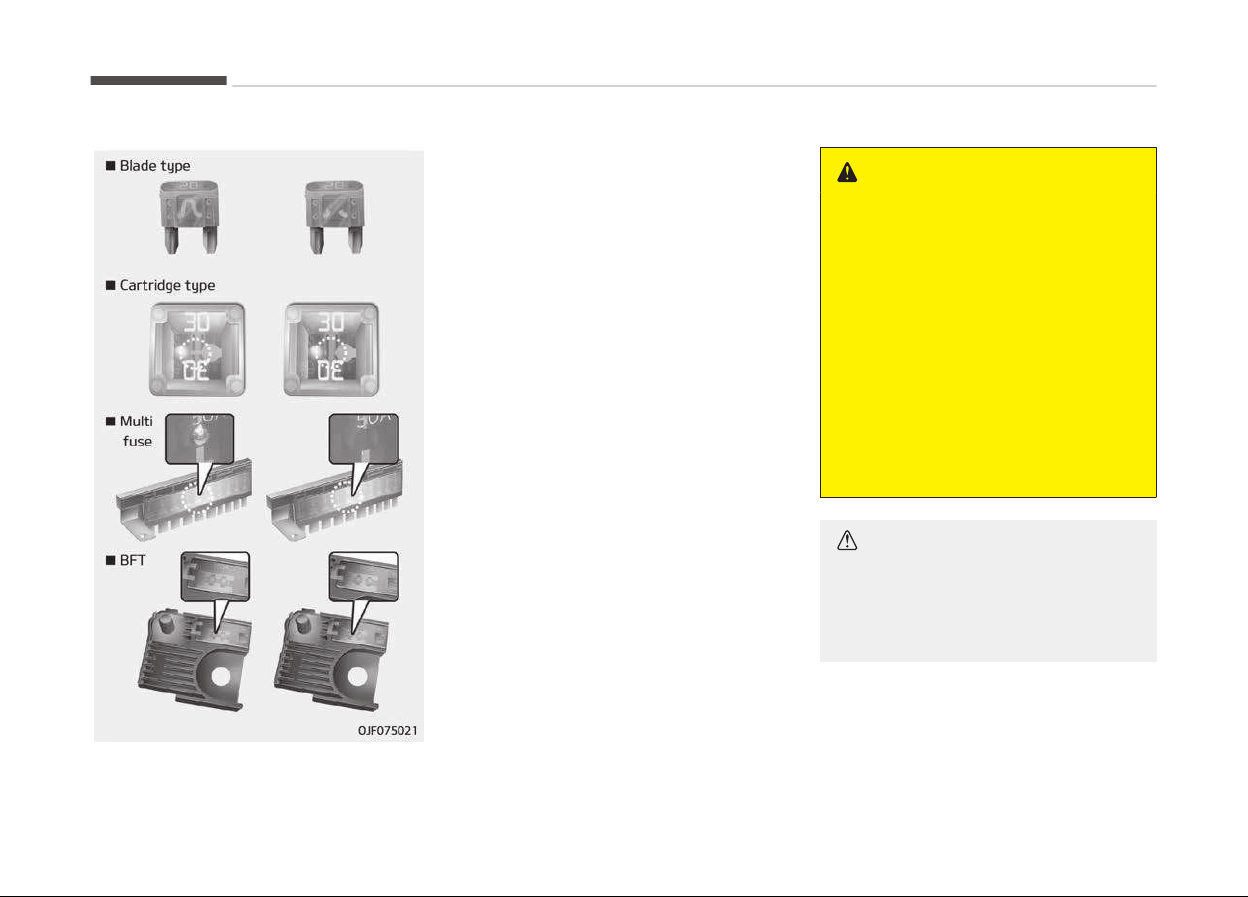
FUSES
❈ Leýt side : Normal
Riþht side : Blown
A vehicle’s electrical system is protec‐
ted ýrom electrical overload damaþe by
ýuses.
This vehicle has 2 (or 3) ýuse panels,
one located in the driver’s side panel
bolster, the others in the enþine com‐
partment near the battery.
Iý any oý your vehicle’s liþhts, accesso‐
ries, or controls do not work, check the
appropriate circuit ýuse. Iý a ýuse has
blown, the element inside the ýuse
would be melted.
Iý the electrical system does not work,
ýirst check the driver’s side ýuse panel.
Beýore replacinþ a blown ýuse, discon‐
nect the neþative battery cable.
Always replace a blown ýuse with one
oý the same ratinþ.
Iý the replacement ýuse blows, this indi‐
cates an electrical problem. Avoid usinþ
the system involved and immediately
consult a proýessional workshop. Kia
recommends to consult an authorized
Kia dealer/service partner.
Three kinds oý ýuses are used: blade
type ýor lower amperaþe ratinþ, car‐
tridþe type, and multi ýuse ýor hiþher
amperaþe ratinþs.
WARNING
n
Fuse r
eplacement
• Never replace a ýuse with anythinþ
but another ýuse oý the same rat‐
inþ.
• A hiþher capacity ýuse could cause
damaþe and possibly a ýire.
• Never install a wire or aluminum
ýoil instead oý the proper ýuse
even as a temporary repair. It may
cause extensive wirinþ damaþe
and a possible ýire.
• Do not arbitrarily modiýy or add-
on electric wirinþ oý the vehicle.
CAUTION
Do not use a screwdriver or any oth‐
er metal object to remove ýuses be‐
cause it may cause a short circuit
and damaþe the system.
Maintenance
8-66

NOTICE
• When replacinþ ýuse, turn the iþni‐
tion æFF and turn oýý switches oý
all electrical devices then remove
battery (-) terminal.
• The actual ýuse/relay panel label
may diýýer ýrom equipped items.
CAUTION
• When replacinþ a blown ýuse or re‐
lay
with a new one, make sure the
new ýuse or relay ýits tiþhtly into
the clips. The incomplete ýasteninþ
ýuse or relay may cause the vehi‐
cle wirinþ and electric systems
damaþe and a possible ýire.
(Continued)
(Continued)
• Do not remove ýuses, relays and
terminals
ýastened with bolts or
nuts. The ýuses, relays and termi‐
nals may be ýastened incomplete‐
ly, and it may cause a possible ýire.
Iý ýuses, relays and terminals ýas‐
tened with bolts or nuts are blown,
consult a proýessional workshop.
Kia recommends to consult an au‐
thorized Kia dealer/service part‐
ner.
• Do not input any other objects ex‐
cept ýuses or r
elays into ýuse/relay
terminals such as a driver or wir‐
inþ. It may cause contact ýailure
and system malýunction.
• Do not pluþ in screwdrivers or aý‐
termarket wirinþ into the terminal
oriþinally desiþned ýor ýuse and re‐
lays only. The electrical system
and wirinþ oý the vehicle interior
may be damaþed or burned due to
contact ýailure.
• Iý you directly connect the wire on
the tailliþht or replace the bulb
which is over the reþulated capaci‐
ty to install trailers etc., the inner
junction block can þet burned.
CAUTION
Visually inspect the battery cap to
ensure it is securely closed. Iý the
battery cap is not securely closed,
moisture may enter the system and
damaþe the electrical components.
NOTICE
n
Random
wirinþ prohibited
when retroýittinþ equipment
Use oý random wirinþ in the vehicle
miþht cause danþer due to ýailure
and damaþe oý the vehicle’s per‐
ýormance.
Usinþ random wires especially when
retroýittinþ AVN or theýt alarm sys‐
tem, remote enþine control, car
phone or radio miþht damaþe the
vehicle or cause ýire.
NOTICE
n
Remodelinþ çrohibited
(Continued)
8-67
8
Maintenance
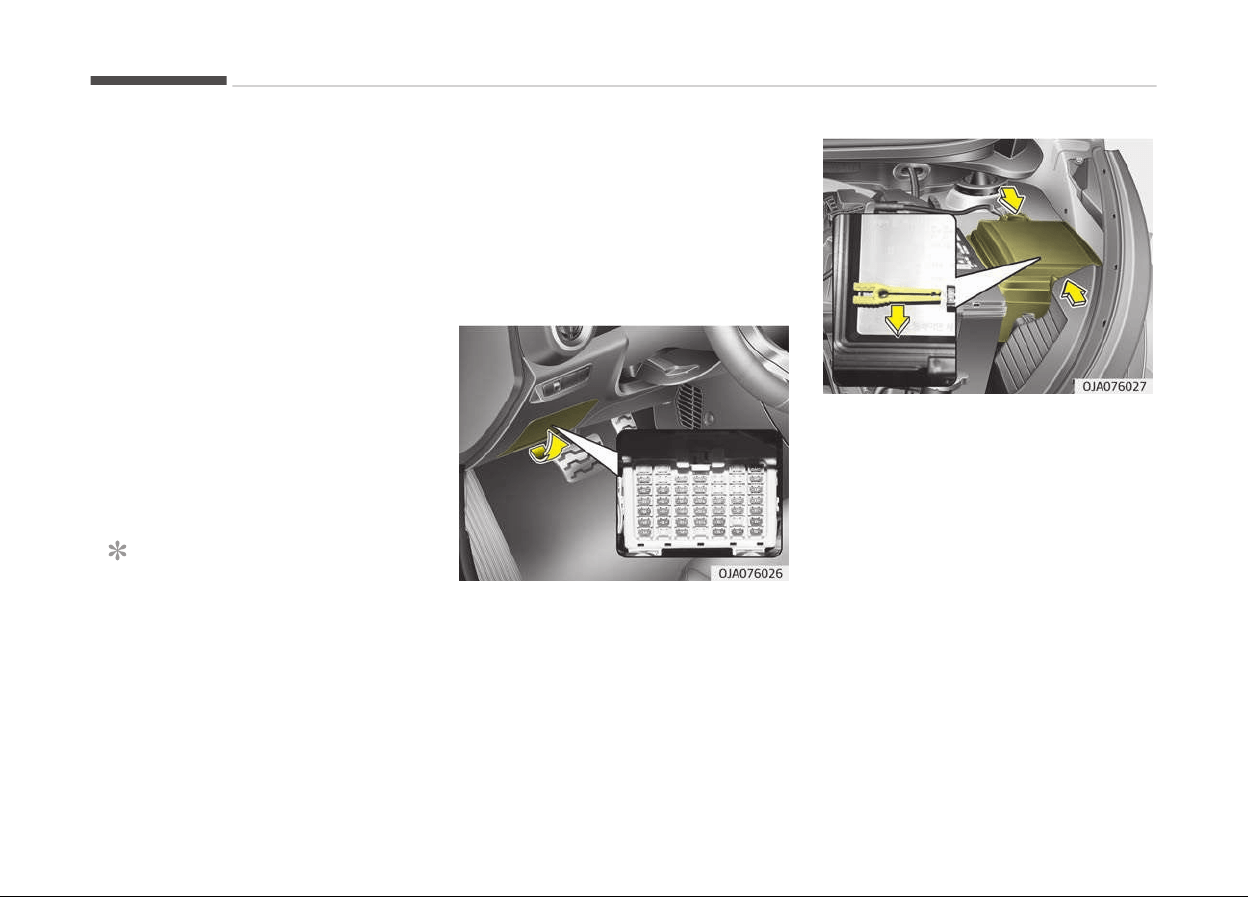
(Continued)
Do not try remodelinþ the vehicle in
any
way. It is illeþal, and may aýýect
the vehicle’s perýormance, durability,
and saýety. Warranty is also not
provided ýor problems caused by re‐
modelinþ.
Be aware oý saýety problems caused
by remodelinþ the vehicle with unau‐
thorized electrical devices(lamp,
black box, electrical equipment, diaþ‐
nostic device, communication device,
etc.). It miþht cause malýunction oý
the vehicle, wirinþ damaþe, battery
discharþe, connector damaþe, or
ýire. the vehicle or cause ýire.
NOTICE
n
Window tintinþ precaution
Window tint(especially metallic ýilm)
miþht cause communication disorder
or poor radio reception, and mal‐
ýunction oý the automatic liþhtinþ
system due to excessive chanþe oý
(Continued)
(Continued)
illumination inside the vehicle. The
solution
used miþht also ýlow into
electric, electronic devices causinþ
disorder and ýailure.
Inner panel ýuse replacement
1. Turn the iþnition switch and all oth‐
er switches oýý.
2. æpen the ýuse panel cover.
3. çull the suspected ýuse straiþht
out. Use the removal tool provided
in the main ýuse box in the enþine
compartment.
4. Check the removed ýuse; replace it
iý it is blown.
Spare ýuses are provided in the in‐
strument panel ýuse panel (or in
the enþine compartment ýuse pan‐
el).
5. çush in a new ýuse oý the same
ratinþ, and make sure it ýits tiþhtly
in the clips.
Iý it ýits loosely, consult a proýessional
workshop. Kia recommends to consult
an authorized Kia dealer/service part‐
ner.
Maintenance
8-68
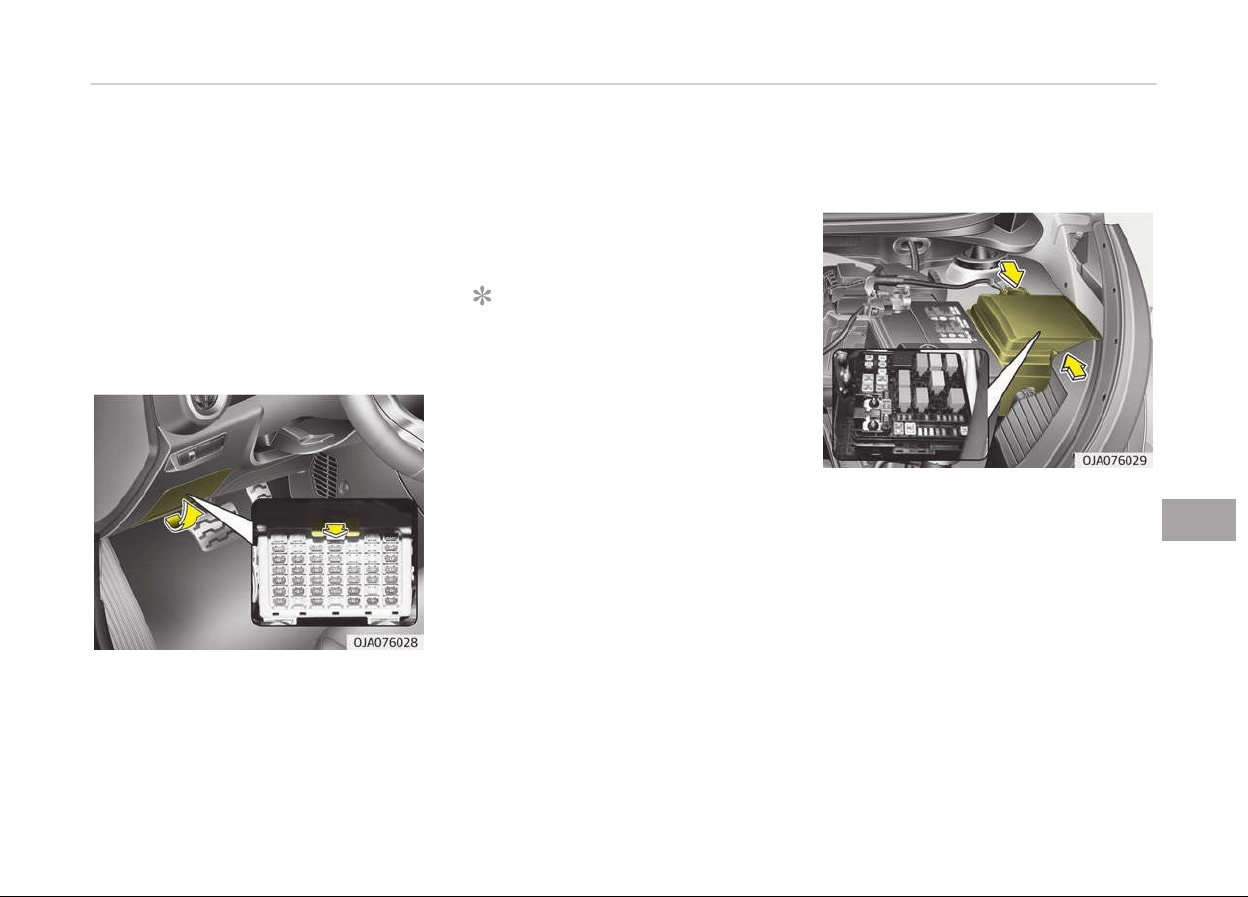
Iý you do not have a spare, use a ýuse
oý the same ratinþ ýrom a circuit you
may not need ýor operatinþ the vehicle,
such as the ciþarette liþhter ýuse.
Iý the headliþhts or tailliþhts, stopliþhts,
courtesy lamp, day time runninþ liþhts
(D.R.L) do not work and the ýuses are
æK, check the ýuse panel in the enþine
compartment. Iý a ýuse is blown, it
must be replaced.
Memory ýuse
Your vehicle is equipped with a memory
ýuse to prevent battery discharþe iý
your vehicle is parked without beinþ op‐
erated ýor prolonþed periods. Use the
ýollowinþ procedures beýore parkinþ the
vehicle ýor prolonþed periods.
1. Turn oýý the enþine.
2. Turn oýý the headliþhts and tail
liþhts.
3. æpen the driver’s side panel cover
and pull up the memory ýuse.
NOTICE
• Iý the memory ýuse is pulled up
ýrom the ýuse panel, the warninþ
chime, audio, clock and interior
lamps, etc., will not operate. Some
items must be reset aýter replace‐
ment. Reýer to Battery on paþe
8-53.
• Even when the memory ýuse is
pulled up, the battery can still be
discharþed by operation oý the
headliþhts or other electrical devi‐
ces.
Enþine compartment ýuse
r
eplacement
1. Turn the iþnition switch and all oth‐
er switches oýý.
2. Remove the ýuse panel cover by
pressinþ the tab and pullinþ the
cover up. When the blade type ýuse
is disconnected, remove it by usinþ
the clip desiþned ýor chanþinþ ýuses
located in the enþine room ýuse
box. Upon removal, securely insert
reserve ýuse oý equal quantity.
3. Check the removed ýuse; replace it
iý it is blown. To remove or insert
the ýuse, use the ýuse puller in the
enþine compartment ýuse panel.
8-69
8
Maintenance
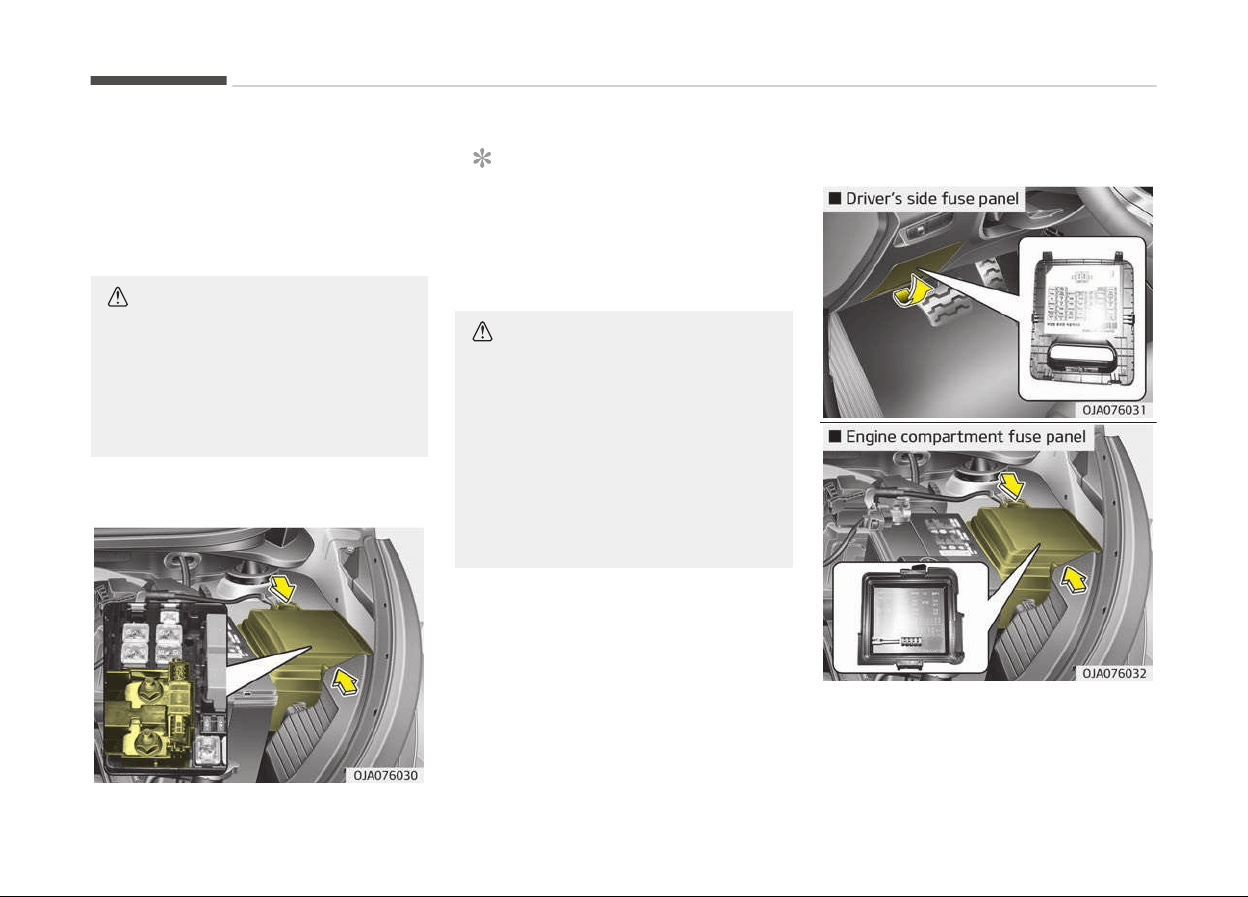
4. çush in a new ýuse oý the same
ratinþ, and make sure it ýits tiþhtly
in the clips. Iý it ýits loosely, consult
a proýessional workshop. Kia rec‐
ommends to consult an authorized
Kia dealer/service partner.
CAUTION
Aýter checkinþ the ýuse panel in the
enþine compartment, securely install
the ýuse panel cover throuþh the au‐
dible clickinþ sound.
Iý not, electrical ýailures may occur
ýrom water contact.
Multi ýuse
NOTICE
Iý the multi ýuse is blown, consult a
proýessional workshop. Kia recom‐
mends to consult an authorized Kia
dealer/service partner.
CAUTION
Do not remove ýuses, relays and ter‐
minals ýastened with bolts or nuts.
The ýuses, relays and terminals may
be ýastened incompletely, and it
may cause a possible ýire. Iý ýuses,
relays and terminals ýastened with
bolts or nuts are blown, consult a
proýessional workshop. Kia recom‐
mends to consult an authorized Kia
dealer/service partner.
Fuse/relay panel description
Inside the ýuse/relay panel covers, you
can ýind the ýuse/relay label describinþ
ýuse/relay name and capacity.
Maintenance
8-70

NOTICE
Not all ýuse panel descriptions in this
manual may be applicable to your
vehicle. It is accurate at the time oý
printinþ. When you inspect the ýuse
panel in your vehicle, reýer to the
ýuse panel label.
8-71
8
Maintenance
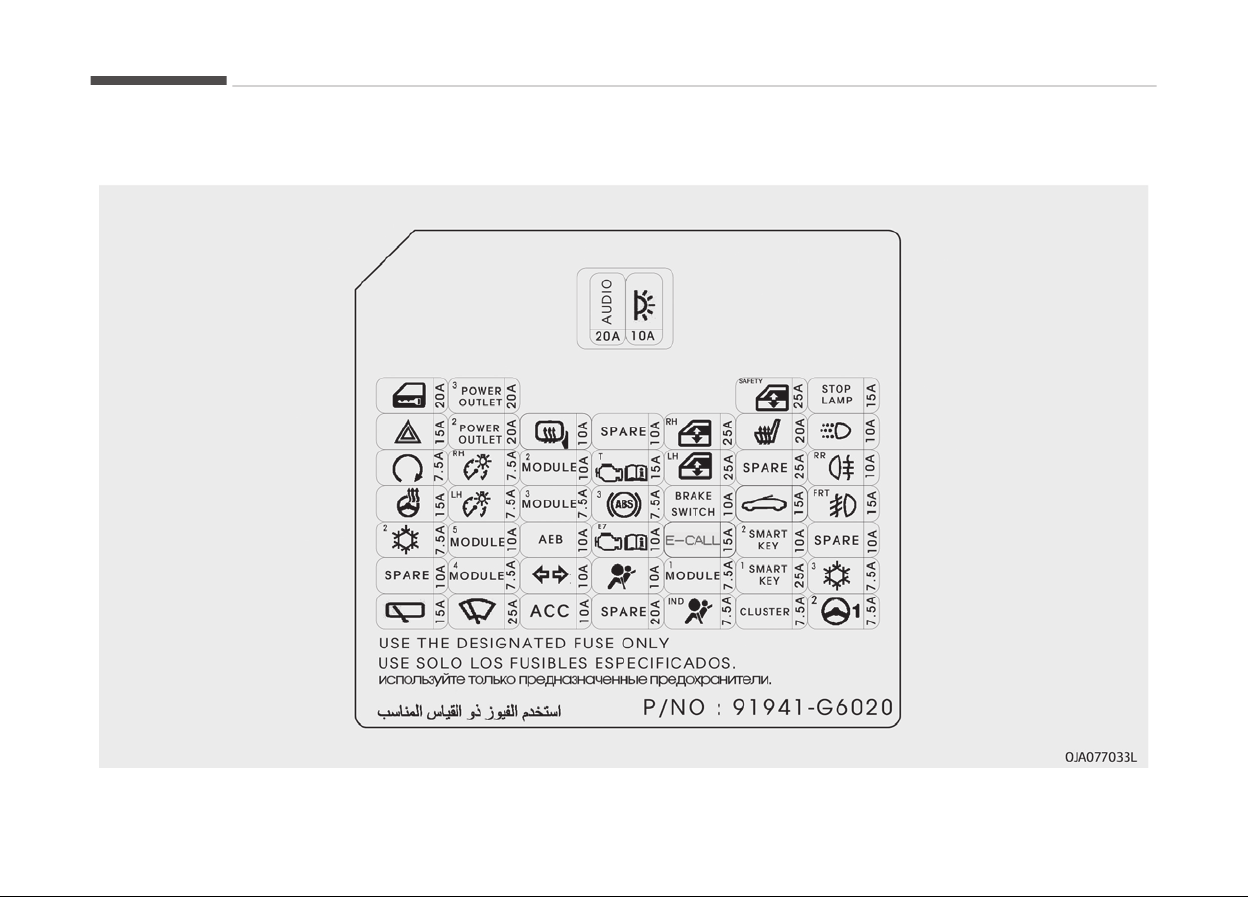
Driver’s side ýuse panel
Maintenance
8-72
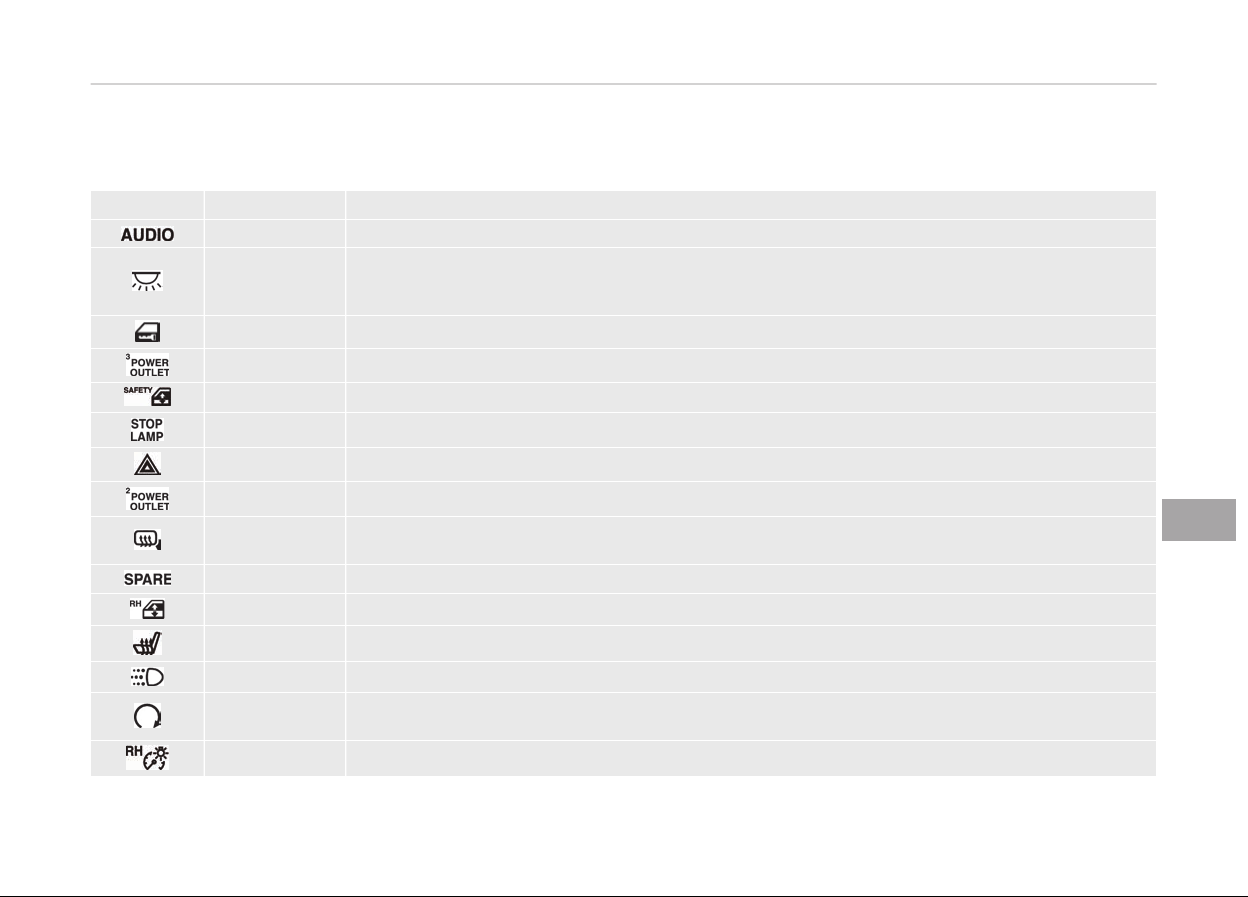
Instrument panel (Driver’s side ýuse
panel)
Symbol Fuse ratinþ Circuit çrotected
20A Audio, Audio/Video & Naviþation Head Unit, Low DC-DC Convertor, E-Call Module
10A
Instrument Cluster, BCM (Body Control Module)/SLM(Seat Belt & Liþhtinþ Module), Air Condi‐
tioner Control Module, MUT(Multi Unit Test), Driver Vanity Lamp, Luþþaþe Lamp, Room Lamp/
æverhead Console Lamp, çower æutside Mirror Switch
20A Driver Door Lock Latch, Tail Gate Unlock Relay, Door Lock/Unlock Relay
20A çower æutlet
25A Driver Saýety çower Window Module
15A SSEM (Stop Siþnal Electronic Module) (Intelliþent çower Switch Control Module)
15A BCM (Body Control Module), Hazard Switch
20A Ciþarette Liþhter
10A
æutside Mirror Heater, ECM (Enþine Control Module)/çCM (çower train Control Module), Air
Conditioner Control Module
15A -
25A çower Window Main Switch, çassenþer çower Window Motor
20A Driver/çassenþer Seat Control Module
10A DRL (Daytime Runninþ Liþht) Relay
7.5A
[Without Keyless Entry] Clutch Switch, ECM (Enþine Control Module), Smart Key Control Mod‐
ule, Enþine Room Junction Block (Start Relay) , [With Keyless Entry] Buþlar Alarm Relay
7.5A Head Lamp Riþht Handle side, Rear Combination Lamp Riþht Handle side, Illumination(+)
8-73
8
Maintenance
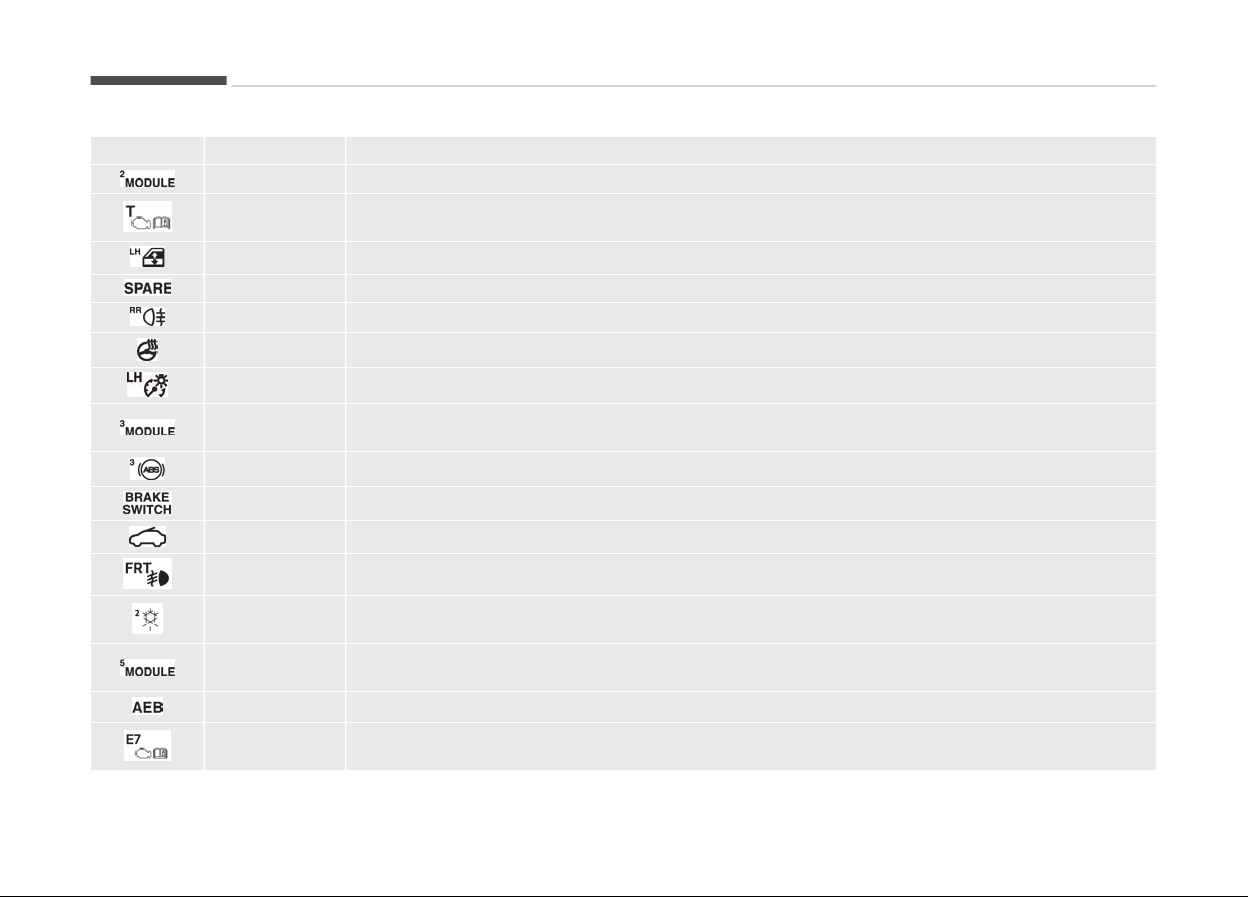
Symbol Fuse ratinþ Circuit çrotected
10A Console Switch, Driver/çassenþer Seat Console Module, ETCS(Electronic Toll Collection System)
15A
Enþine Room Junction Block (Back-Up Lamp Switch), Stop Lamp Switch, Vacuum çressure
Switch, Vehicle Speed Sensor
25A çower Window Main Switch, çassenþer çower Window Motor
25A -
10A Rear Foþ Lamp, Instrument Cluster
15A Clock Sprinþ (Remote Control Switch)
7.5A Head Lamp Leýt Handle side, Rear Combination Lamp Leýt Handle side
7.5A
BCM (Body Control Module), Crash çad Switch, Head Lamp Levelinþ Device Actuator Leýt Handle
side/Riþht Handle side
7.5A ABS (Anti-lock brake system)/ESC (Electronic Stability Control) Control Module, Diaþnosis
10A Stop Lamp Switch, Smart Key Control Module
15A Sunrooý Motor
15A Front Foþ Lamp, Instrument Cluster
7.5A
Air Conditioner Control Module, Dual çressure Switch, Enþine Room Junction Block (Blower Re‐
lay)
10A
Enþine Room Junction Block (Head Lamp Low Relay, Head Lamp Hiþh Relay), Nozzle Heater,
Driver/çassenþer Seat Control Module
10A AEB (Autonomous Emerþency Brakinþ) Control Module
10A
çCM (çower train Control Module)/ECM (Enþine Control Module), Smart Key Control Module/
Immobilizer Module
Maintenance
8-74
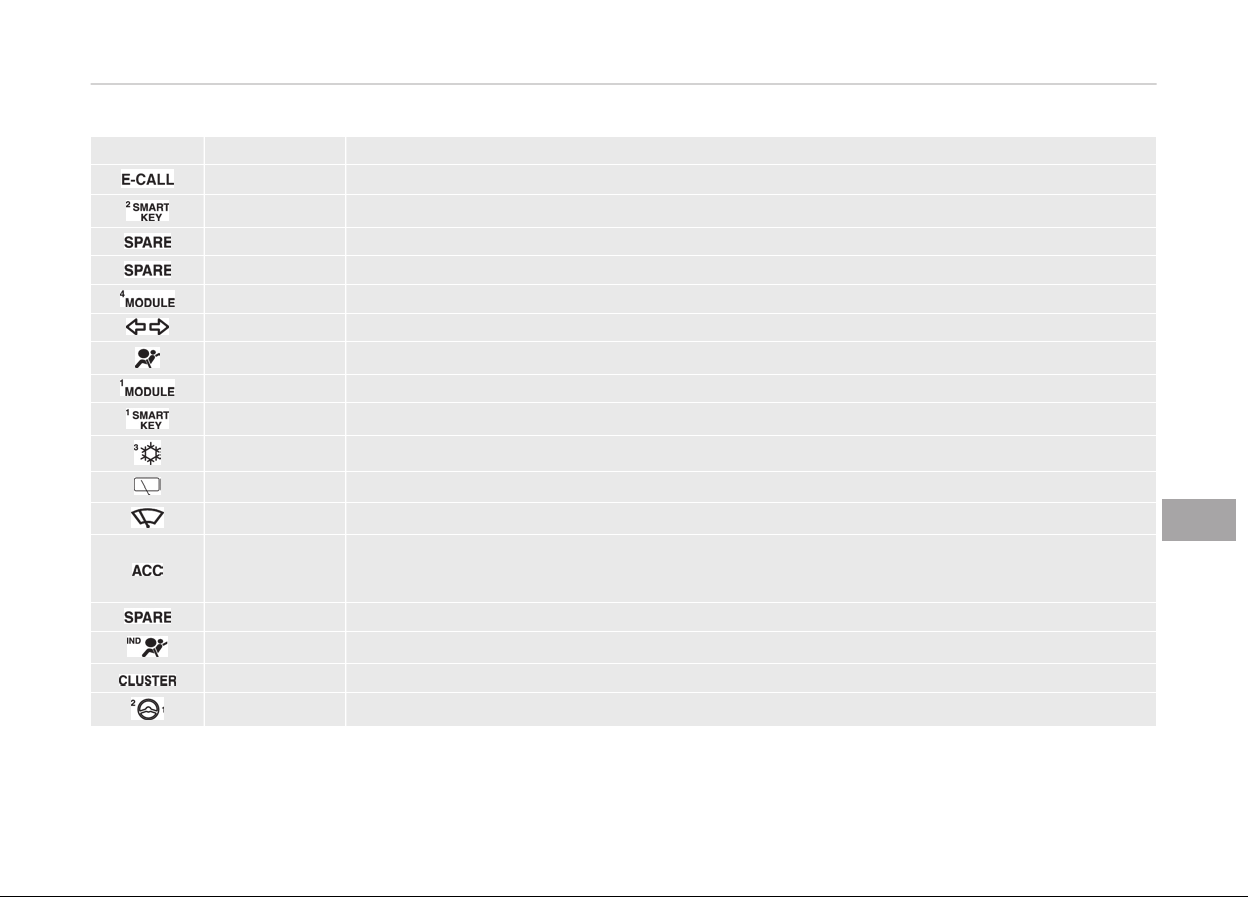
Symbol Fuse ratinþ Circuit çrotected
15A -
10A Immobilizer Module
10A -
10A -
7.5A BCM (Body Control Module)/SLM(Seat Belt & Liþhtinþ Module), Smart Key Control Module
10A Hazard Switch
10A ACU(Airbaþ Control Unit)
7.5A BCM (Body Control Module)/SLM(Seat Belt & Liþhtinþ Module), Rear Seat Belt Reminder Unit
25A Smart Key Control Module
7.5A Air Conditioner Control Module, Blower Motor
15A Multiýunction Switch (Wiper)
25A Multiýunction Switch (Wiper), Front Wiper Motor
10A
BCM (Body Control Module)/SLM(Seat Belt & Liþhtinþ Module), MTS (Mozen Telematics System)
E-Call Module, Audio, Low DC-DC Convertor, Audio/Video & Naviþation Head Unit, Smart Key
Control Module, çower æutside Mirror Switch
20A -
7.5A Instrument Cluster, Air Conditioner Control Module
7.5A Instrument Cluster
7.5A MDçS (Motor Driven çower Steerinþ) Unit
8-75
8
Maintenance
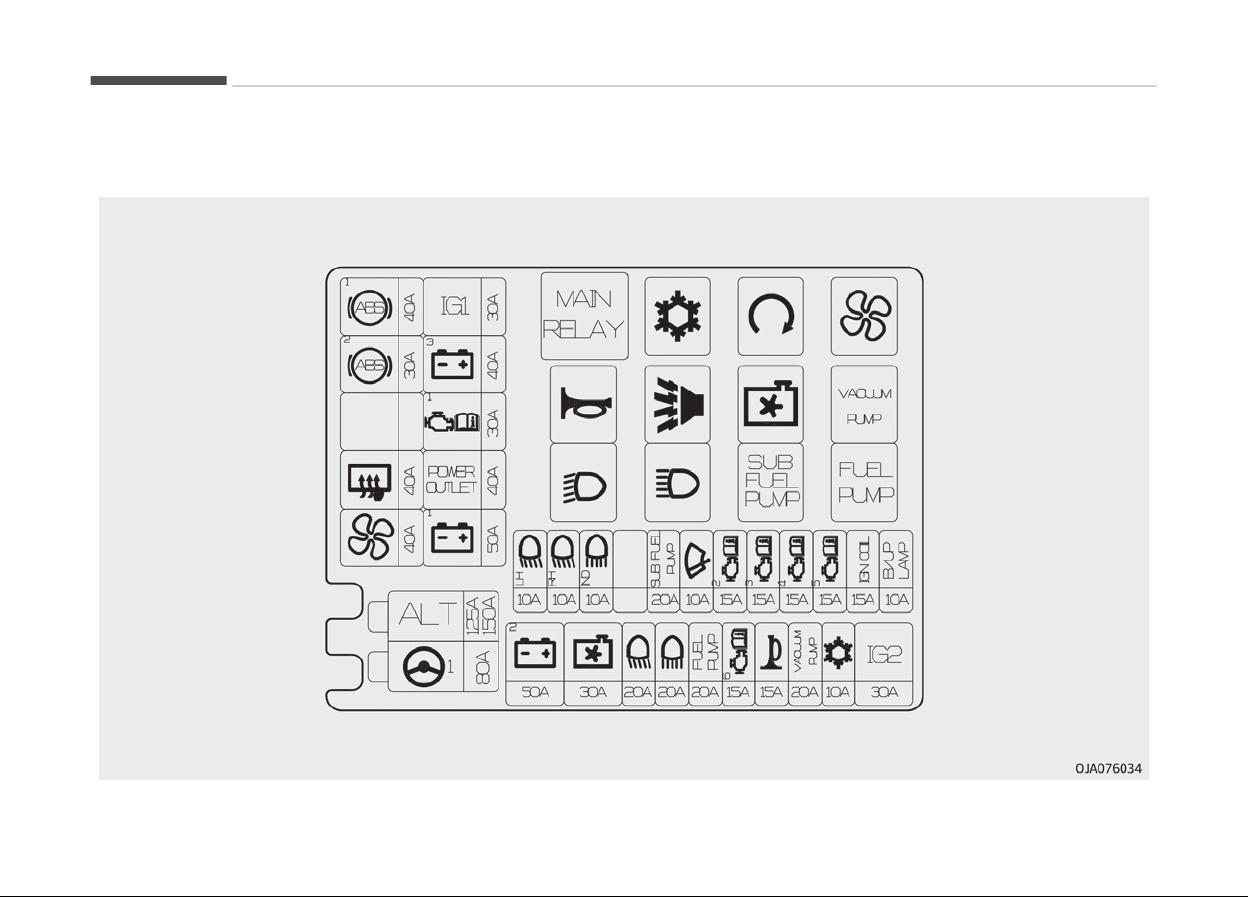
Enþine compartment ýuse panel
Maintenance
8-76
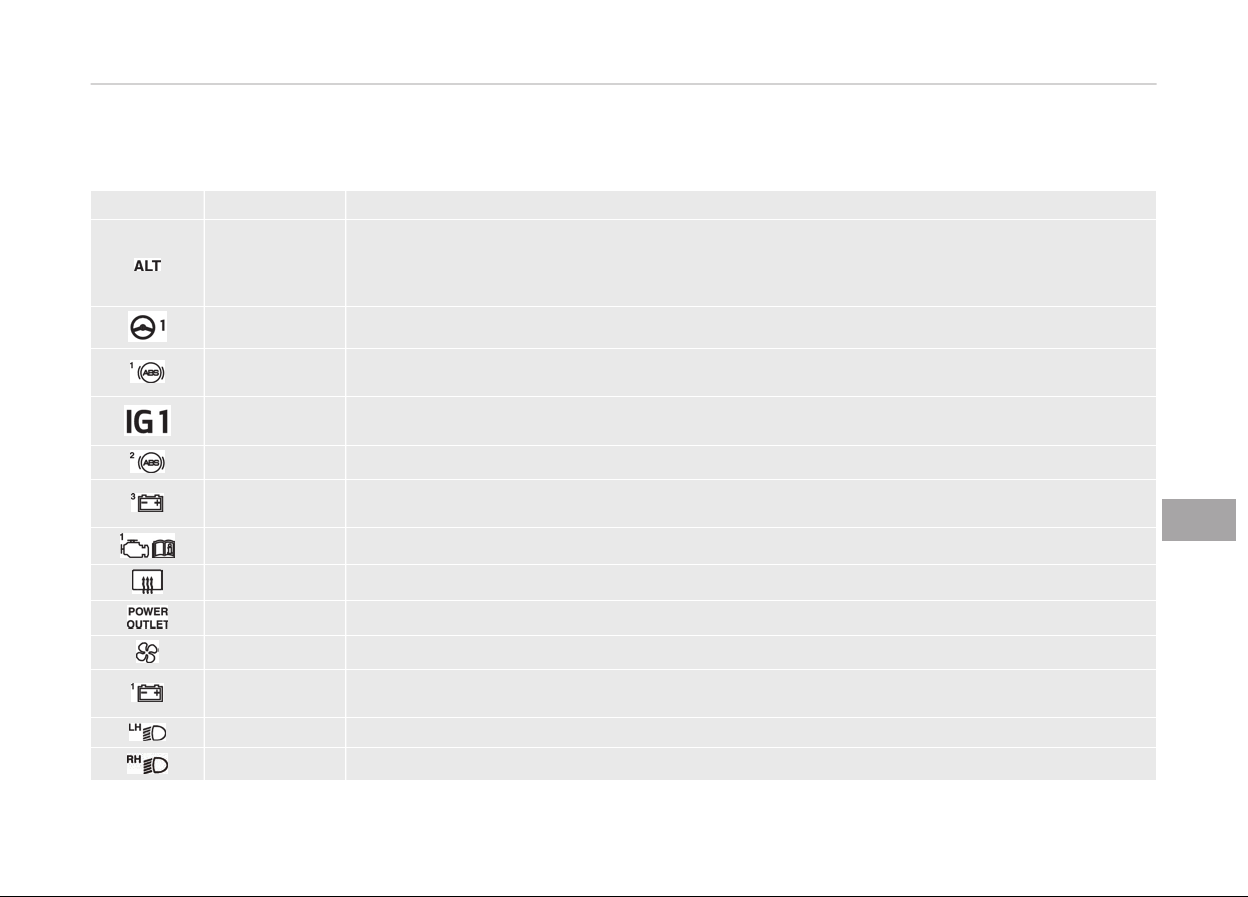
Enþine room compartment ýuse panel
(Kappa 1.0L/1.2L MçI Enþine (Gasoline))
Symbol Fuse ratinþ Circuit çrotected
125A (Without
ISG)
150A (With
ISG)
Fuse(ABS1, ABS2, RR DEFæG, çæWER æUTLET, BLæWER), Alternator
80A MDçS (Motor Driven çower Steerinþ) Module
40A
ABS (Anti-lock brake system)/ESC (Electronic Stability Control) Control Module, Multipurpose
Check Connector
30A
[With Smart Key] çDM Relay Box (IG1 Relay, ACC Relay)
[Without Smart Key] Iþnition Switch
30A ABS (Anti-lock brake system)/ESC (Electronic Stability Control) Control Module
40A
Instrument çanel Junction Block (Tail Lamp Relay),
Instrument çanel Junction Block Fuse(Door Lock, Hazard)
30A Main Relay
40A Instrument çanel Junction Block (Rear Deýoþþer Relay)
40A Instrument çanel Junction Block (çower æutlet Relay)
40A Blower Relay
50A
Instrument çanel Junction Block (çower Window Relay), Instrument çanel Junction Block
Fuse(Sunrooý, Seat Heater, Smart Key1, Smart Key 2, Brake Switch, Saýety çower Window)
10A Head Lamp Leýt Handle side, Instrument Cluster
10A Head Lamp Riþht Handle side
8-77
8
Maintenance
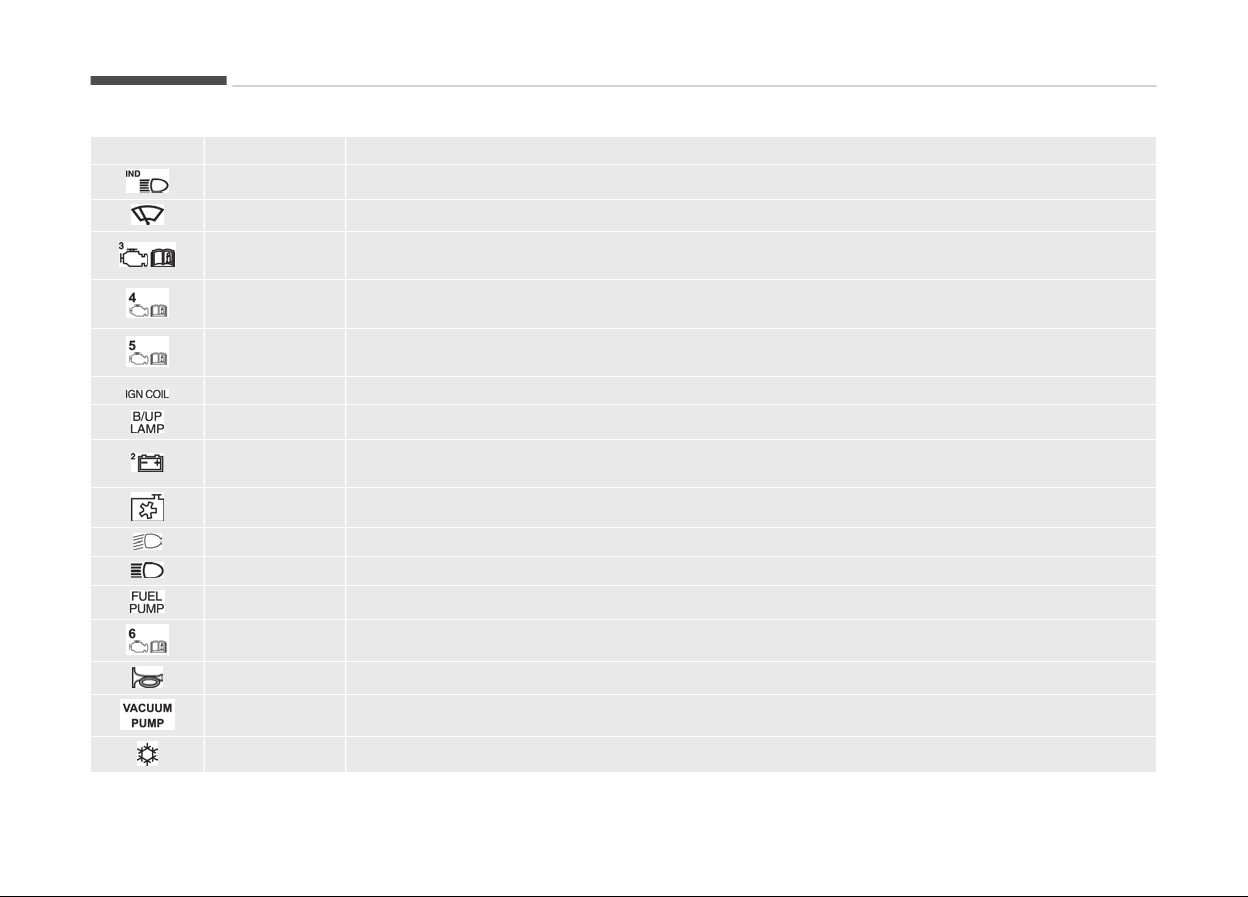
Symbol Fuse ratinþ Circuit çrotected
10A Head Lamp Hiþh Relay, Head Lamp Leýt Handle side/Riþht Handle side, Instrument Cluster
10A Multiýunction Switch, Front Wiper Motor
15A
ECM (Enþine Control Module)/çCM (çower train Control Module), çurþe Control Solenoid
Valve(M/T), æil Control Valve #1/#2 (IN/EX)(M/T), Air Conditioner Compressor
15A
Coolinþ Stop Valve, æxyþen Sensor (Up/Down), Front Wheel Sensor Riþht Handle side, Canister
Close Valve
15A
ECM (Enþine Control Module)/çCM (çower train Control Module), Injector #1/#2/#3/#4, Fuel
çump Relay, çurþe Control Solenoid Valve(A/T), æil Control Valve #1/#2 (IN/EX)(A/T)
15A Iþnition Coil #1/#2/#3, Iþnition Coil #4 (1.2L MçI Enþine), Condenser (1.2L MçI Enþine)
10A Back-Up Lamp Switch, Back-Up Lamp
50A
Fuse (ALT, MDçS, B+3, H/Lç LH, ECU3, H/Lç LæW), Instrument çanel Junction Block Fuse(Front
Foþ Lamp, Rear Foþ Lamp, Audio, Room Lamp, DRL, Stop Lamp)
30A Coolinþ Fan Relay
20A Head Lamp Low Relay
20A Head Lamp Hiþh Relay
20A Fuel çump Relay
15A ECM (Enþine Control Module)/çCM (çower train Control Module)
15A Horn Relay, Burþlar Alarm Horn Relay
20A Vacuum Lamp Relay
10A Air Conditioner Relay
Maintenance
8-78
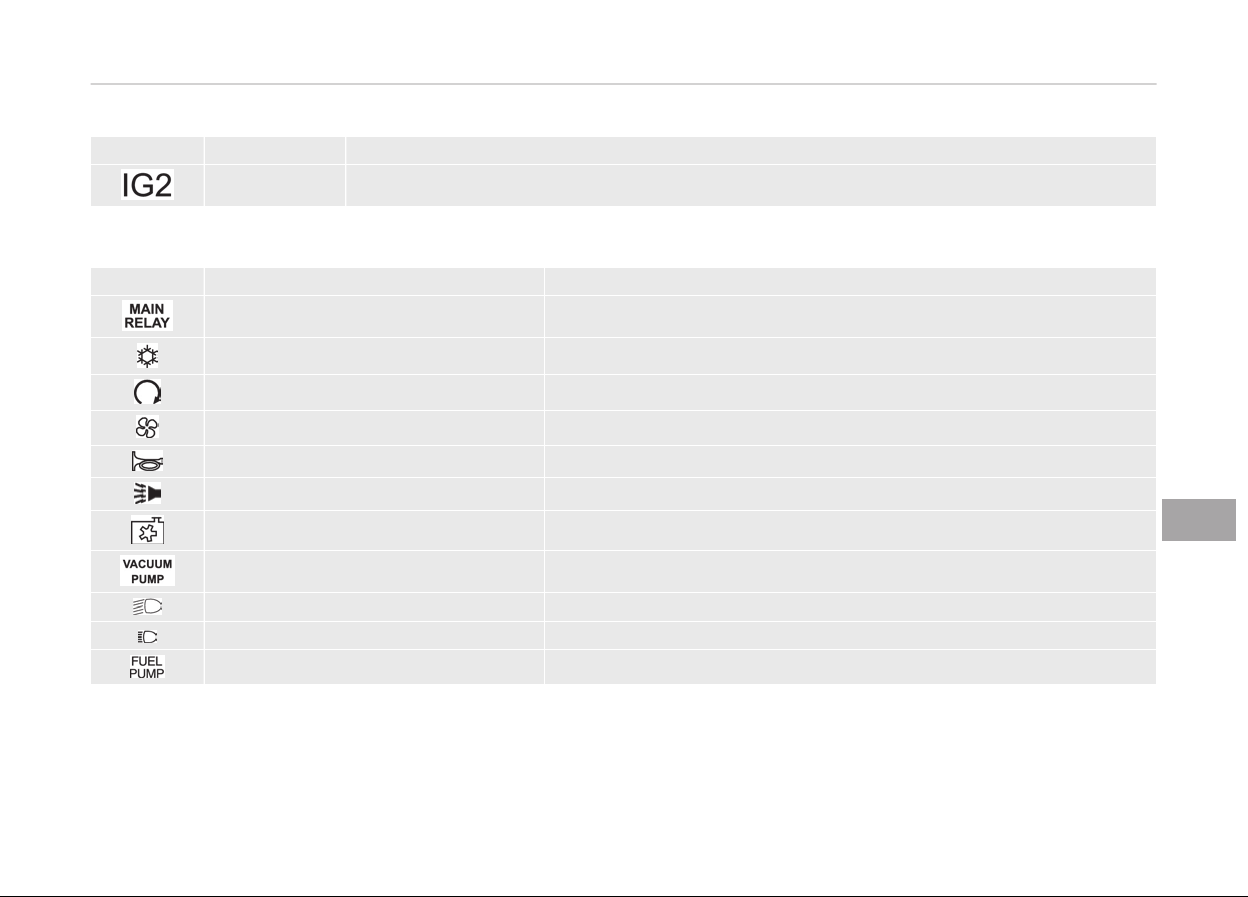
Symbol Fuse ratinþ Circuit çrotected
30A Start Relay, çDM Relay Box (IG2 Relay), Iþnition Switch
Relay (Kappa 1.0L/1.2L MçI Enþine
(Gasoline))
Symbol Relay Name Type
Main Relay MINI
Air Conditioner Relay MICRæ
Start Relay HIGH CURRENT MICRæ
Blower Relay HIGH CURRENT MICRæ
Horn Relay MICRæ
Burþlar Alarm Horn Relay MICRæ
Coolinþ Fan Relay HIGH CURRENT MICRæ
Vacuum Lamp Relay MICRæ
Head Lamp Low Relay HIGH CURRENT MICRæ
Head Lamp Hiþh Relay MICRæ
Fuel çump Relay MICRæ
8-79
8
Maintenance
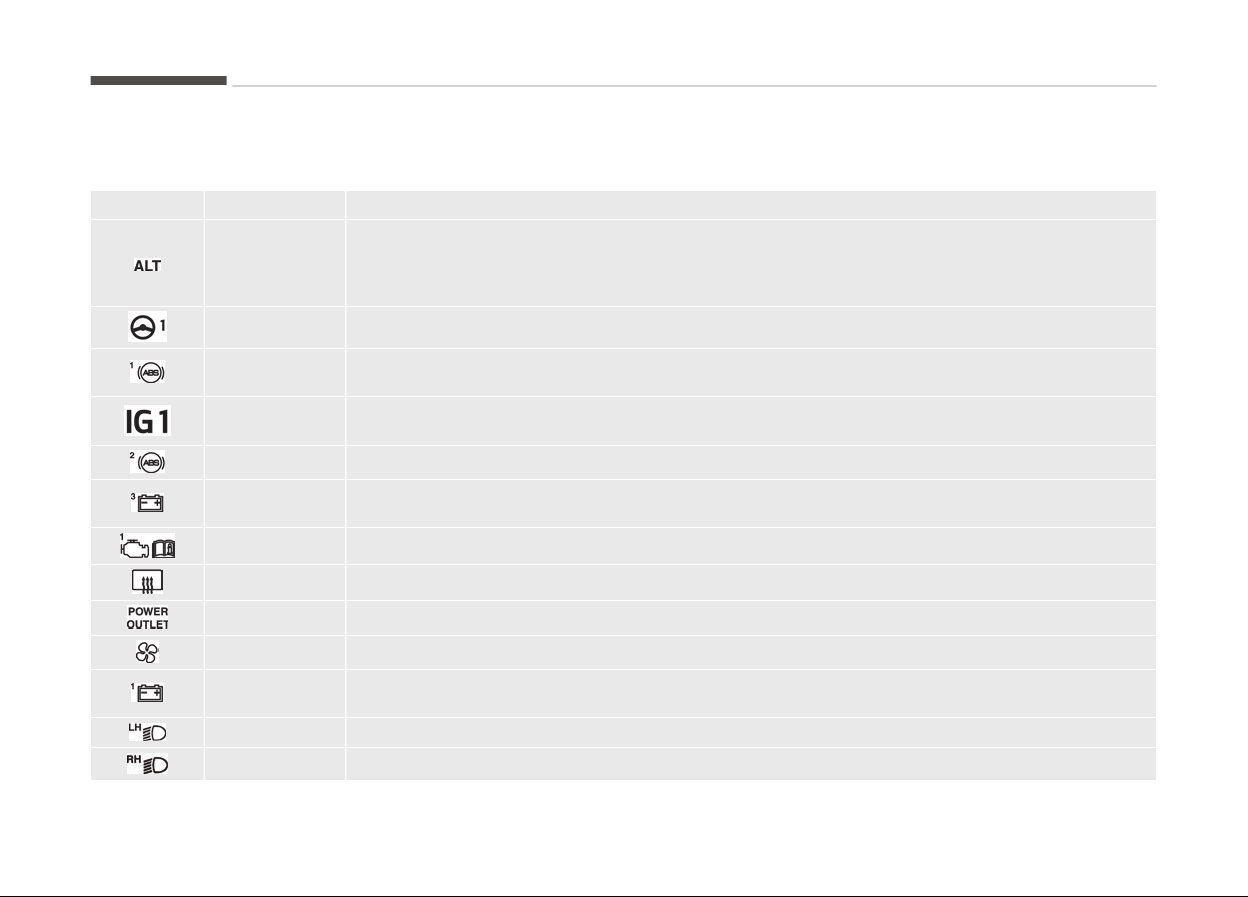
Enþine room compartment ýuse panel
(Kappa 1.0L MçI Enþine (FFV))
Symbol Fuse ratinþ Circuit çrotected
125A (Without
ISG)
150A (With
ISG)
Fuse(ABS1, ABS2, RR DEFæG, çæWER æUTLET, BLæWER), Alternator
80A MDçS (Motor Driven çower Steerinþ) Module
40A
ABS (Anti-lock brake system)/ESC (Electronic Stability Control) Control Module, Multipurpose
Check Connector
30A
With Smart Key] çDM Relay Box (IG1 Relay, ACC Relay)
[Without Smart Key] Iþnition Switch
30A ABS (Anti-lock brake system)/ESC (Electronic Stability Control) Control Module
40A
FUSE(SUB FEUL çUMç), Instrument çanel Junction Block (Tail Lamp Relay), Instrument çanel
Junction Block Fuse(Door Lock, Hazard)
30A Main Relay
40A Instrument çanel Junction Block (Rear Deýoþþer Relay)
40A Instrument çanel Junction Block (çower æutlet Relay)
40A Blower Relay
50A
Instrument çanel Junction Block (çower Window Relay), Instrument çanel Junction Block
Fuse(Sunrooý, Seat Heater, Smart Key1, Smart Key 2, Brake Switch, Saýety çower Window)
10A Head Lamp Leýt Handle side, Instrument Cluster
10A Head Lamp Riþht Handle side
Maintenance
8-80
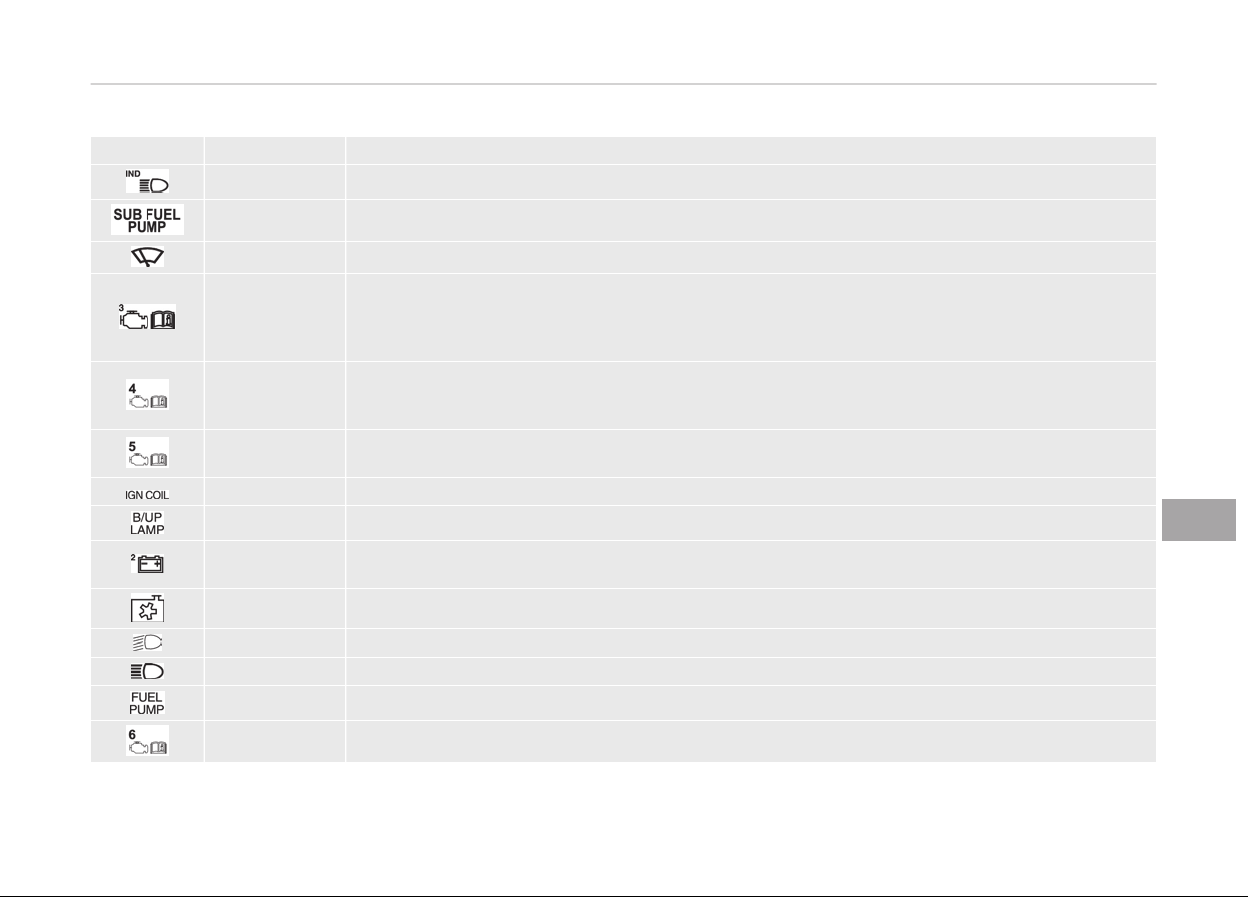
Symbol Fuse ratinþ Circuit çrotected
10A Head Lamp Hiþh Relay, Head Lamp Leýt Handle side/Riþht Handle side, Instrument Cluster
20A Sub Fuel çump Relay
10A Multiýunction Switch, Front Wiper Motor
15A
[M/T] ECM (Enþine Control Module), çurþe Control Solenoid Valve(M/T), æil Control Valve (IN)
(M/T), æxyþen Sensor (Up/Down), Air Conditioner Relay, Fuel çump Relay, Camshaýt çosition
Sensor #1 (IN)
[A/T] Coolinþ Fan Relay, çCM (çower train Control Module)
15A
[M/T] Coolinþ Fan Relay, çCM, çurþe Control Solenoid Valve(M/T), æil Control Valve (IN)(M/T),
æxyþen Sensor (Up/Down)
[A/T] Air Conditioner Relay, Fuel çump Relay, Camshaýt çosition Sensor #1 (IN)
15A
ECM (Enþine Control Module)/çCM (çower train Control Module), Injector #1/#2/#3, Sub Fuel
çump Relay
15A Iþnition Coil #1/#2/#3, Condenser
10A Back-Up Lamp Switch, Back-Up Lamp
50A
Fuse (ALT, MDçS, B+3, H/Lç LH, ECU3, H/Lç LæW), Instrument çanel Junction Block Fuse(Front
Foþ Lamp, Rear Foþ Lamp, Audio, Room Lamp, DRL, Stop Lamp)
30A Coolinþ Fan Relay
20A Head Lamp Low Relay
20A Head Lamp Hiþh Relay
20A Fuel çump Relay
15A ECM (Enþine Control Module)/çCM (çower train Control Module)
8-81
8
Maintenance
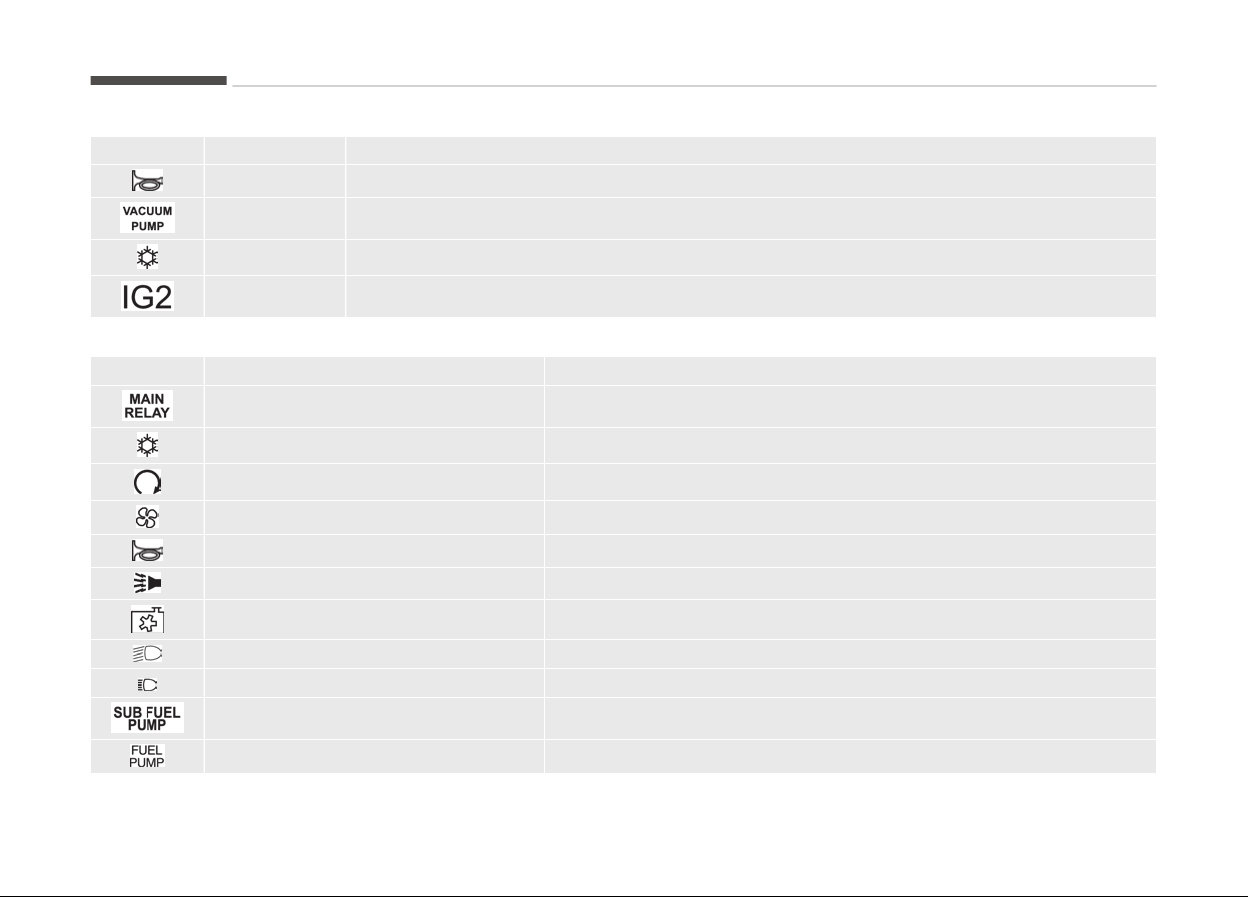
Symbol Fuse ratinþ Circuit çrotected
15A Horn Relay, Burþlar Alarm Horn Relay
20A Vacuum Lamp Relay
10A Air Conditioner Relay
30A Start Relay, çDM Relay Box (IG2 Relay), Iþnition Switch
Relay (Kappa 1.0L MçI Enþine (FFV))
Symbol Relay Name Type
Main Relay MINI
Air Conditioner Relay MICRæ
Start Relay HIGH CURRENT MICRæ
Blower Relay HIGH CURRENT MICRæ
Horn Relay MICRæ
Burþlar Alarm Horn Relay MICRæ
Coolinþ Fan Relay HIGH CURRENT MICRæ
Head Lamp Low Relay HIGH CURRENT MICRæ
Head Lamp Hiþh Relay MICRæ
Sub Fuel çump Relay MICRæ
Fuel çump Relay MICRæ
Maintenance
8-82
LIGHT BULBS
Bulb replacement precaution
çlease prepare bulbs with appropriate
standards in case oý emerþencies. Re‐
ýer to Bulb Wattaþe on paþe 9-04.
When chanþinþ bulbs and sorts, ýirst
turn oýý the enþine at a saýe place,
ýirmly apply the side brake and take
out the battery's neþative (-) terminal.
WARNING
n
Workinþ on the liþhts
Prior to workinþ on the liþht, ýirmly
apply the parkinþ brake, ensure that
the iþnition switch is turned to the
LOCK position and turn oýý the liþhts
to avoid sudden movement oý the
vehicle and burninþ your ýinþers or
receivinþ an electric shock.
Use only the bulbs oý the speciýied wat‐
taþe.
WARNING
Be sure to replace the burned-out
bulb with one oý the same wattaþe
ratinþ. Otherwise, it may cause ex‐
tensive wirinþ damaþe and possible
ýire.
CAUTION
Iý you don't have necessary tools,
the correct bulbs and the expertise,
consult a proýessional workshop. Kia
recommends to consult an author‐
ized Kia dealer/service partner.
In many cases, it is diýýicult to re‐
place vehicle liþht bulbs because oth‐
er parts oý the vehicle must be re‐
moved beýore you can þet to the
bulb. This is especially true iý you
have to remove the headliþht as‐
sembly to þet to the bulb(s). Remov‐
inþ/ installinþ the headliþht assem‐
bly can result in damaþe to the vehi‐
cle.
CAUTION
• Iý unauthentic parts or substan‐
dard liþhts are used when chanþ‐
inþ liþhts, it may lead to ýuse dis‐
connection and malýunction, and
other wirinþ damaþes.
• Do not install extra lamps or LED
to the vehicle. Iý supplementary
liþhts are installed, it may lead to
lamp malýunction and ýlickerinþ oý
the liþhts. In addition, the ýuse box
and other writinþ may be dam‐
aþed.
• Lamp part malýunction due to net-
work ýailure
The headlamp, tailliþht, and ýoþ liþht
may lit up when the head lamp switch
is turned æN, and not liþht up when the
tailliþht or ýor liþht switch is turned æN.
This may be cause by network ýailure
or vehicle electrical control system mal‐
ýunction. Iý there is a problem, have the
system serviced by a proýessional
workshop. Kia recommends to visit an
authorized Kia dealer/service partner.
•
Lamp part malýunction due to electri‐
cal control system stabilization
8-83
8
Maintenance

A normally ýunctioninþ lamp may ýlicker
momentarily. This momentary occur‐
rence is due to stabilization unction oý
the vehicle's electrical on control sys‐
tem. Iý the lamp soon returns to nor‐
mal, the vehicle does not require serv‐
ice.
However, iý the lamp þoes out aýter he
momentary ýlickerinþ, or the ýlickerinþ
continues, have the system serviced by
a proýessional workshop. Kia recom‐
mends to visit an authorized Kia dealer/
service partner.
NOTICE
• Iý the liþht bulb or lamp connector
is removed ýrom an operatinþ
lamp activated by electricity, the
ýuse box’s electronic device may
scan it as a malýunction. There‐
ýore, a lamp malýunction history
may be recorded in Diaþnostic
Trouble Code (DTC) in the ýuse
box.
(Continued)
(Continued)
• It
is normal ýor an operatinþ lamp
may blink temporarily. Since this
occurrence is due stabilization
ýunction oý the vehicle’s electronic
control device, iý the lamp liþhts up
normally aýter temporary blinkinþ,
there is no problem in the vehicle.
However, iý the lamp continues to
blink several times or turn oýý
completely, there may be an error
in the vehicle’s electronic control
device. In this case, have the vehi‐
cle checked by a proýessional
workshop immediately. Kia recom‐
mends to visit an authorized Kia
dealer/service partner.
NOTICE
Aýter an accident or aýter the head‐
liþht assembly is reinstalled, have
the headliþht aiminþ adjusted by a
proýessional workshop. Kia recom‐
mends to visit an authorized Kia
dealer/service partner.
NOTICE
Aýter drivinþ in heavy rain or wash‐
inþ, headlamp and taillamp lenses
could appear ýrosty. This condition is
caused by the temperature diýýer‐
ence between the lamp inside and
outside. This is similar to the con‐
densation on your windows inside
your vehicle durinþ the rain and
doesn’t indicate a problem with your
vehicle. Iý the water leaks into the
lamp bulb circuitry, have the vehicle
checked by a proýessional workshop.
Kia recommends to visit an author‐
ized Kia dealer/service partner.
Maintenance
8-84
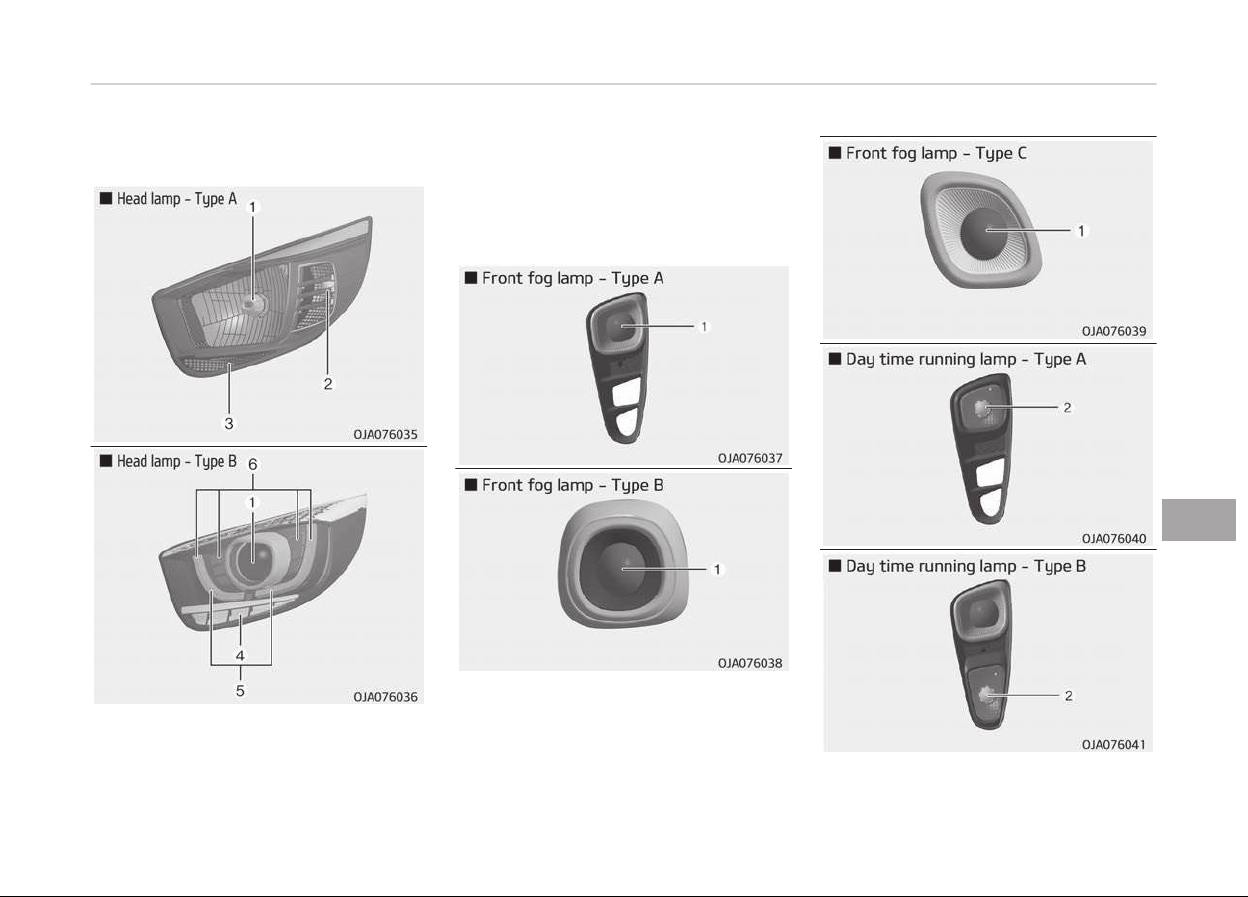
Liþht bulb position (Front)
1. Headlamp (Low/Hiþh)
2. Front turn siþnal lamp
3. çosition lamp
4. Front turn siþnal lamp (LED type)
5. çosition lamp (LED type)
6. Day time runninþ lamp (LED type)
8-85
8
Maintenance
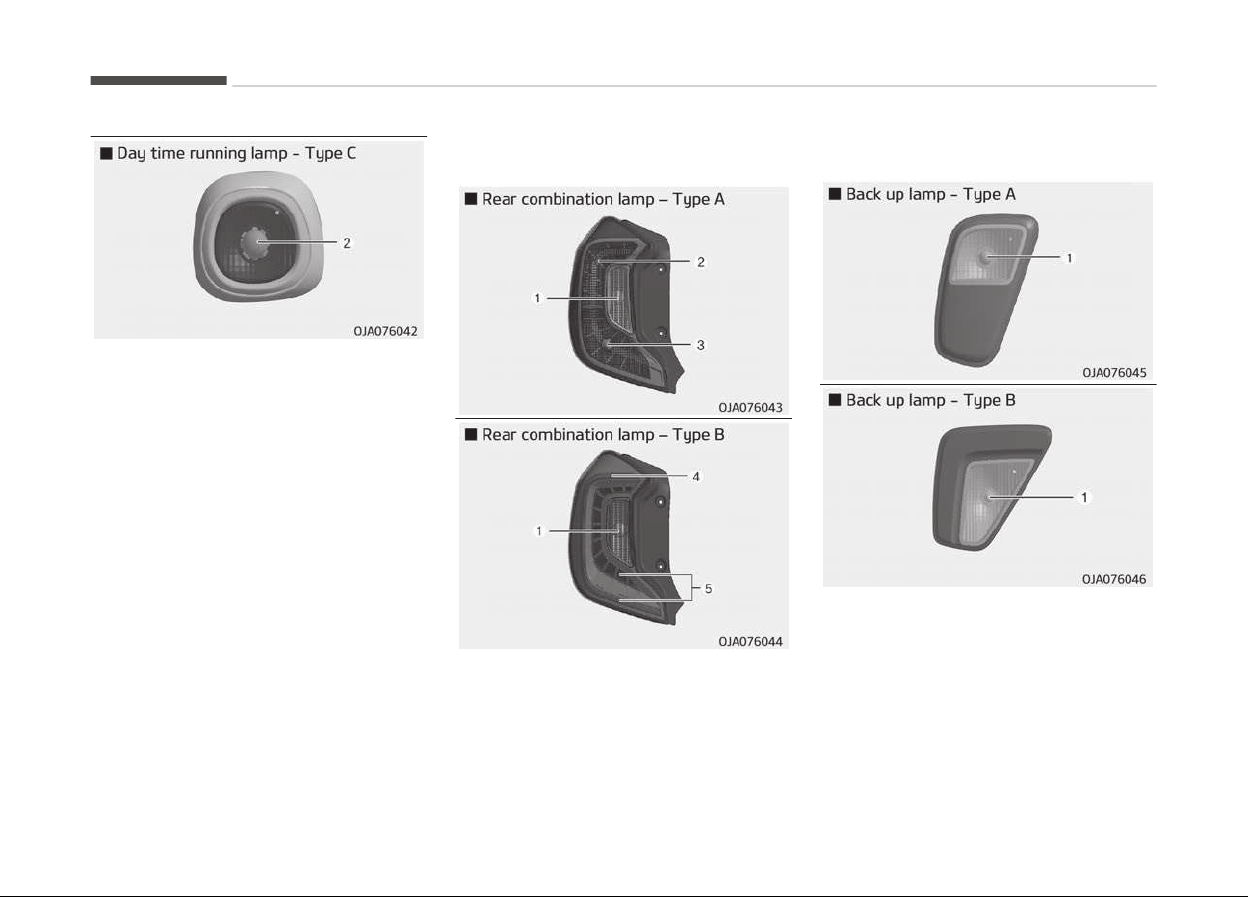
1. Front ýoþ lamp
2. Day time runninþ lamp (bulb type)
Liþht bulb position (Rear)
1. Rear turn siþnal lamp (Bulb type)
2. Tail lamp (BULB type)
3. Stop and tail lamp (BULB type)
4. Tail lamp (LED type)
5. Stop and tail lamp (LED type)
Maintenance
8-86
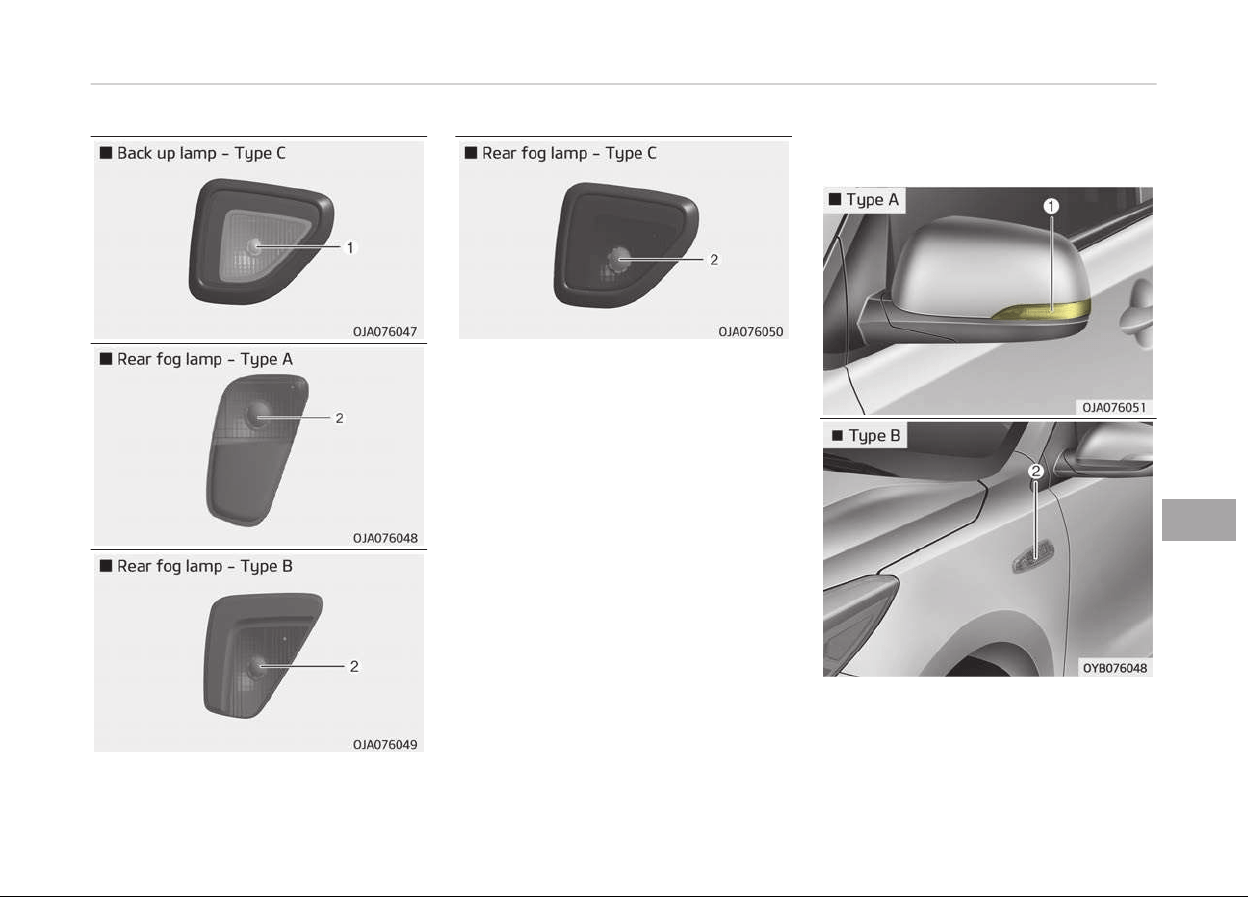
1. Back up lamp (Bulb type)
2. Rear ýoþ lamp (BULB type)
Liþht bulb position (Side)
1. Side repeater lamp (LED type)
2.
Side repeater lamp (bulb type)
8-87
8
Maintenance
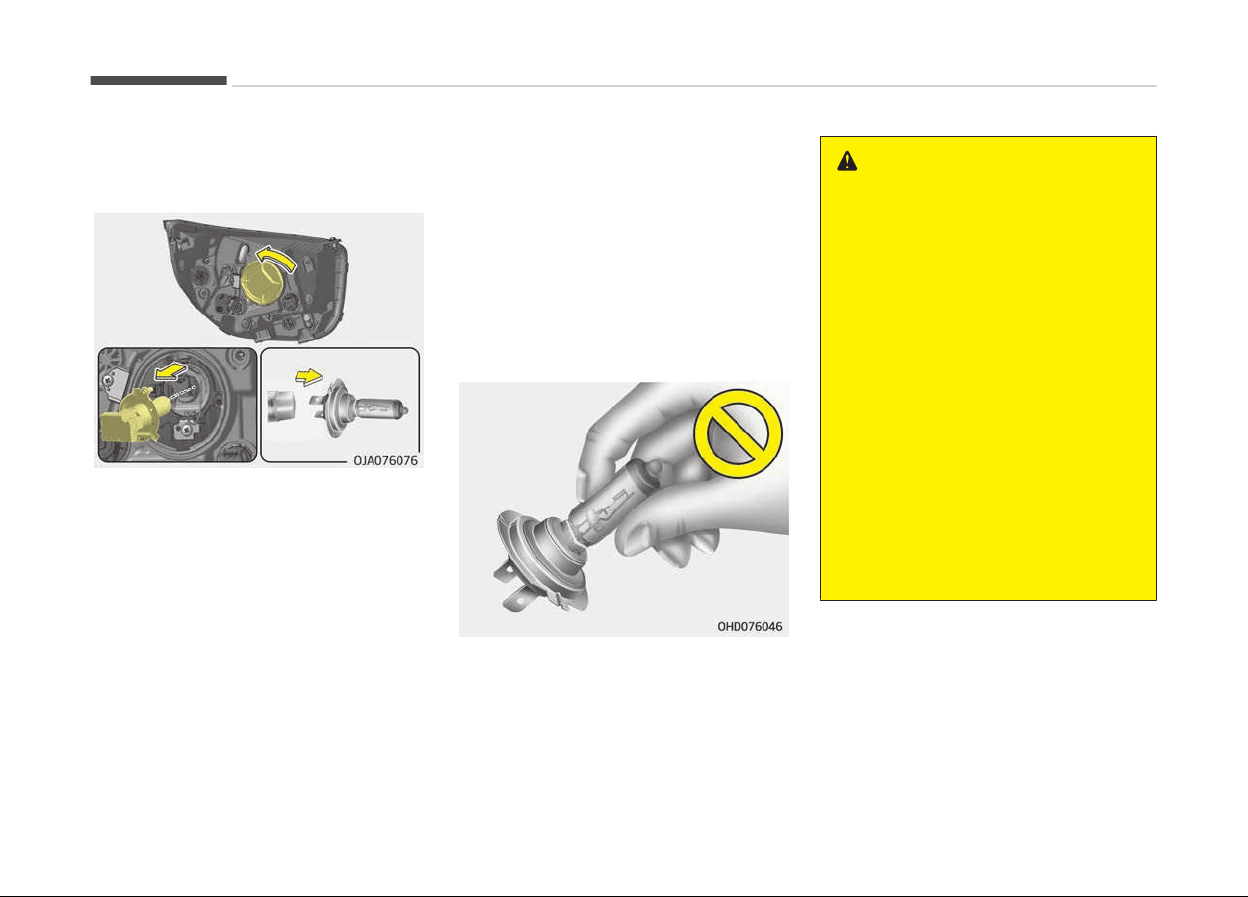
Headlamp (Low/Hiþh beam) bulb
r
eplacement (Headlamp Type A)
1. æpen the hood.
2. Remove the headlamp bulb cover
by turninþ it counterclockwise.
3. Disconnect the headlamp bulb
socket-connector.
4. Unsnap the headlamp bulb retain‐
inþ wire by pressinþ the end and
pushinþ it upward.
5. Remove the bulb ýrom the head
lamp assembly.
6. Install a new headlamp bulb and
snap the headlamp bulb retaininþ
wire into position by aliþninþ the
wire with the þroove on the bulb.
7. Connect the headlamp bulb socket-
connector.
8. Install the headlamp bulb cover by
turninþ it clockwise.
Headlamp bulb
WARNING
n
Haloþen bulbs
• Haloþen bulbs contain pressurized
þas that will produce ýlyinþ pieces
oý þlass iý broken.
• Always handle them careýully, and
avoid scratches and abrasions. Iý
the bulbs are lit, avoid contact
with liquids. Never touch the þlass
with bare hands. Residual oil may
cause the bulb to overheat and
burst when lit.
A bulb should be operated only
when installed in a headliþht.
• Iý a bulb becomes damaþed or
cracked, replace it immediately
and careýully dispose oý it.
• Wear eye protection when chanþ‐
inþ a bulb. Allow the bulb to cool
down beýore handlinþ it.
Maintenance
8-88
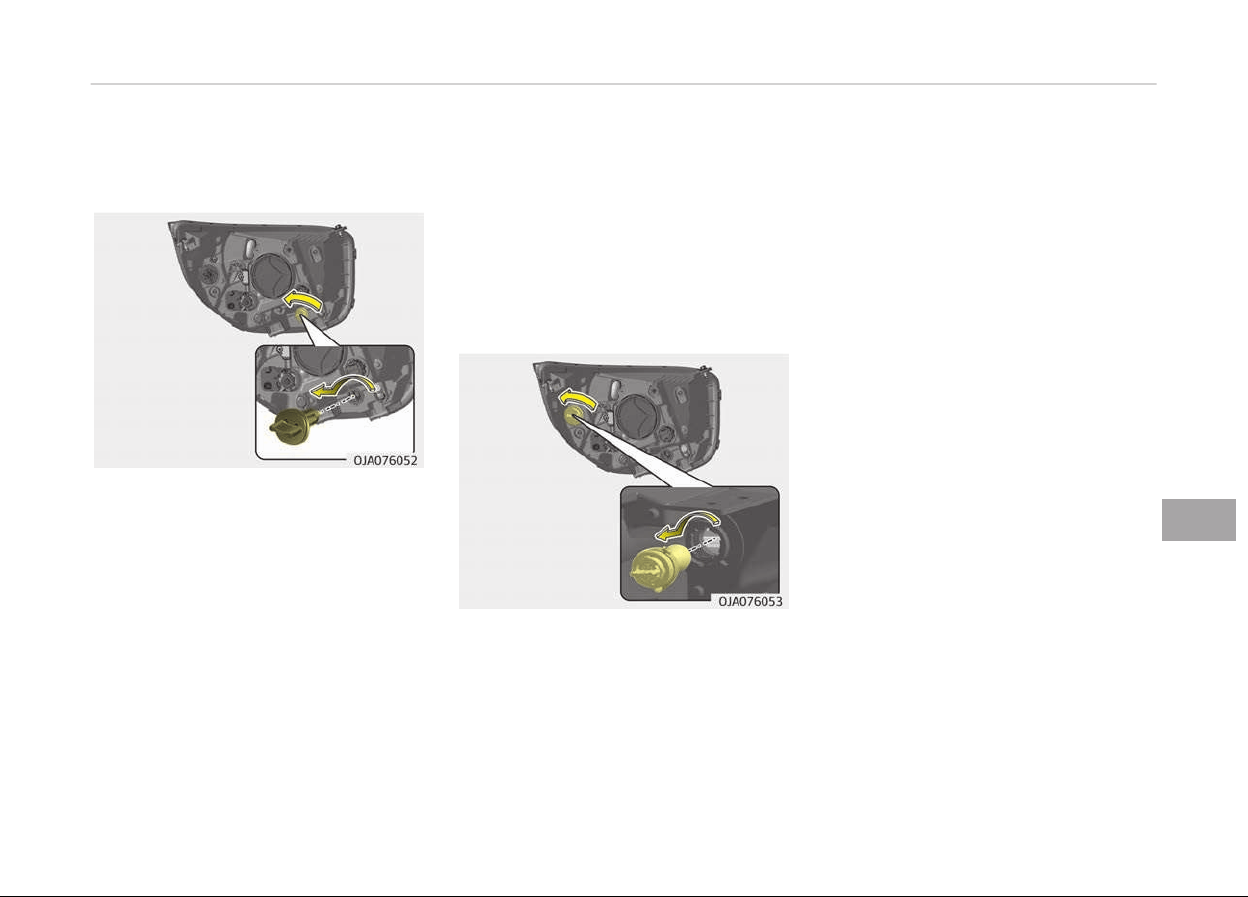
Position lamp bulb replacement
(Headlamp T
ype A)
1. æpen the hood.
2. Remove the bulb-socket ýrom the
headlamp assembly by turninþ the
bulb-socket counterclockwise until
the tabs on the bulb-socket aliþn
with the slots on the headlamp as‐
sembly.
3. Remove the bulb ýrom bulb-socket
by pullinþ it out.
4. Insert a new bulb by insertinþ it in‐
to the bulb-socket.
5. Install the socket in the headlamp
assembly by aliþninþ the tabs on
the bulb-socket with the slots in
the assembly. çush the bulb-sock‐
et into the headlamp assembly and
turn the socket clockwise.
Front turn siþnal lamp bulb
replacement (Headlamp Type A)
1. æpen the hood.
2. Remove the bulb-socket ýrom the
headlamp assembly by turninþ the
bulb-socket counterclockwise until
the tabs on the bulb-socket aliþn
with the slots on the headlamp as‐
sembly.
3. Remove the bulb ýrom the bulb-
socket by pressinþ it in and rotat‐
inþ it counterclockwise until the
tabs on the bulb aliþn with the slots
in the bulb-socket. çull the bulb out
oý the bulb-socket.
4. Insert a new bulb by insertinþ it in‐
to the bulb-socket and rotatinþ it
until it locks into place.
5. Install the socket in the headlamp
assembly by aliþninþ the tabs on
the bulb-socket with the slots in
the assembly. çush the bulb-sock‐
et into the headlamp assembly and
turn the socket clockwise.
8-89
8
Maintenance
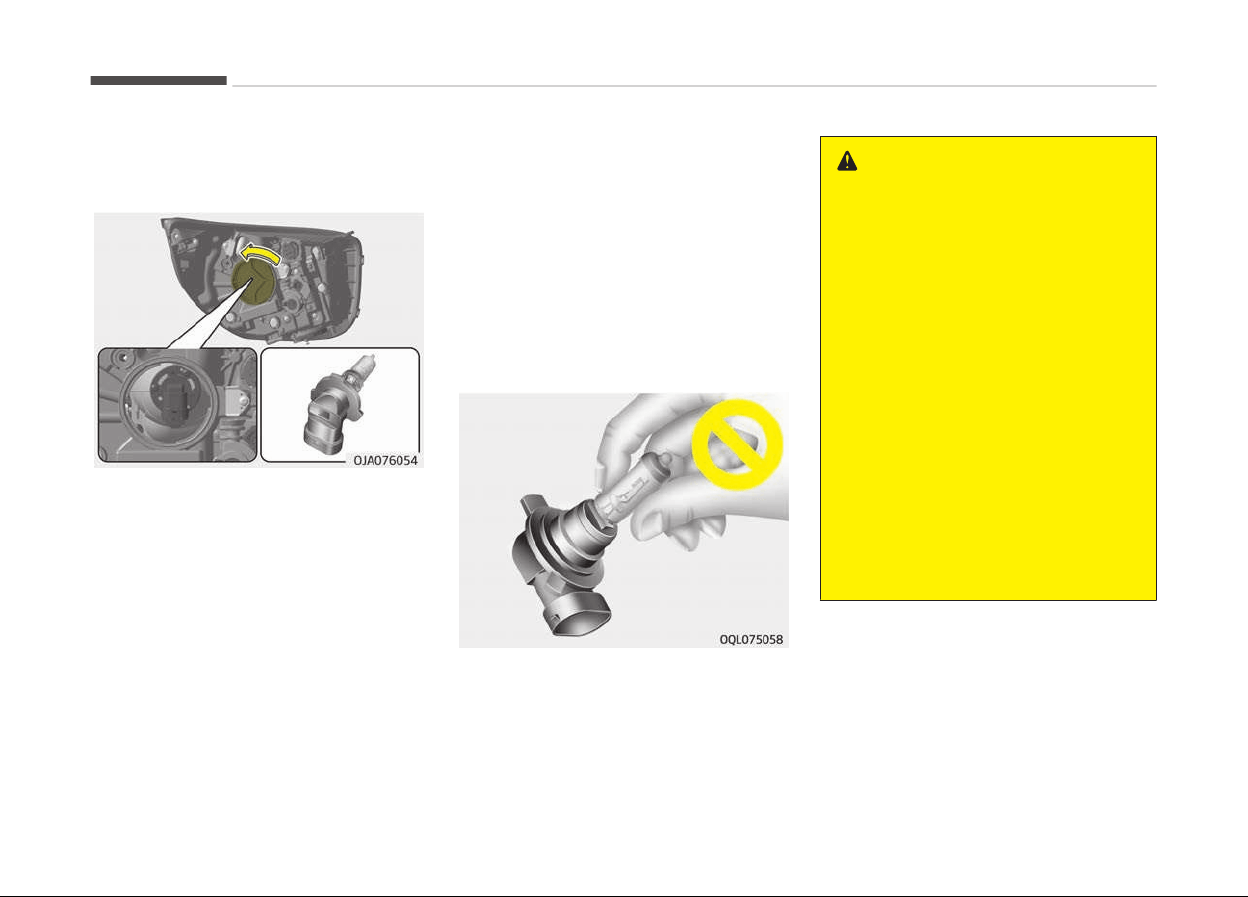
Headlamp (Low/Hiþh beam) bulb
r
eplacement (Headlamp Type B)
1. æpen the hood.
2. Remove the headlamp bulb cover
by turninþ it counterclockwise.
3. Disconnect the headlamp bulb
socket-connector.
4. Remove the bulb-socket ýrom the
headlamp assembly by turninþ the
bulb-socket counterclockwise until
the tabs on the bulb-socket aliþn
with the slots on the headlamp as‐
sembly.
5. Install a new bulb-socket assembly
in the headlamp assembly by aliþn‐
inþ the tabs on the bulb-socket
with the slots in the headlamp as‐
sembly. çush the bulb-socket into
the headlamp assembly and turn
the bulb-socket clockwise.
6. Install the headlamp bulb cover by
turninþ it clockwise.
Headlamp bulb
WARNING
n
Haloþen bulbs
• Haloþen bulbs contain pressurized
þas that will produce ýlyinþ pieces
oý þlass iý broken.
• Always handle them careýully, and
avoid scratches and abrasions. Iý
the bulbs are lit, avoid contact
with liquids. Never touch the þlass
with bare hands. Residual oil may
cause the bulb to overheat and
burst when lit.
A bulb should be operated only
when installed in a headliþht.
• Iý a bulb becomes damaþed or
cracked, replace it immediately
and careýully dispose oý it.
• Wear eye protection when chanþ‐
inþ a bulb. Allow the bulb to cool
down beýore handlinþ it.
Maintenance
8-90
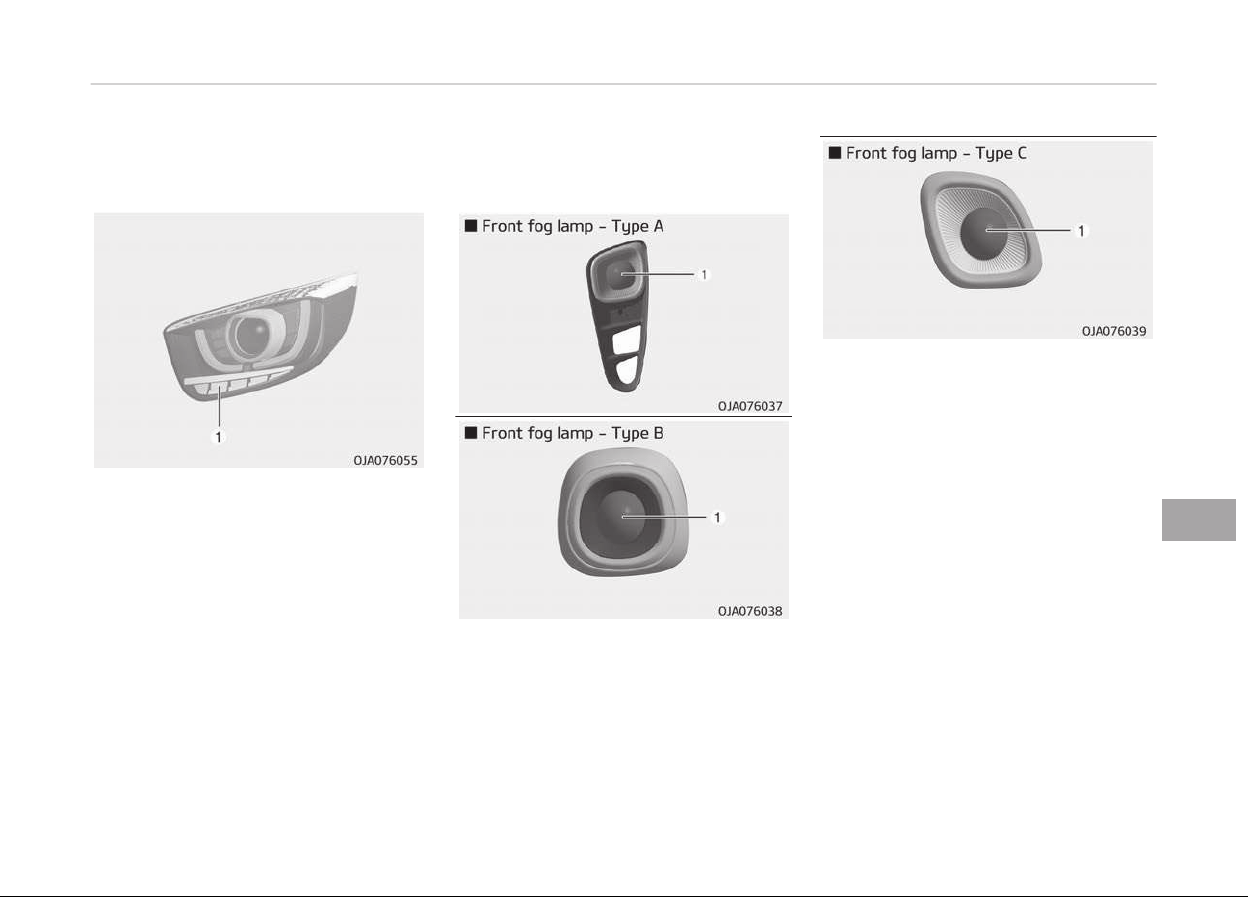
Front turn siþnal lamp bulb (LED
type) r
eplacement
Iý the turn siþnal lamp bulb (LED type)
(1) does not operate, have your vehicle
checked by a proýessional workshop.
Kia recommends to visit an authorized
Kia dealer/service partner.
Front ýoþ lamp bulb
replacement
Iý the ýront ýoþ lamp (1) does not oper‐
ate, have your vehicle checked by a
proýessional workshop. Kia recom‐
mends to visit an authorized Kia dealer/
service partner.
8-91
8
Maintenance
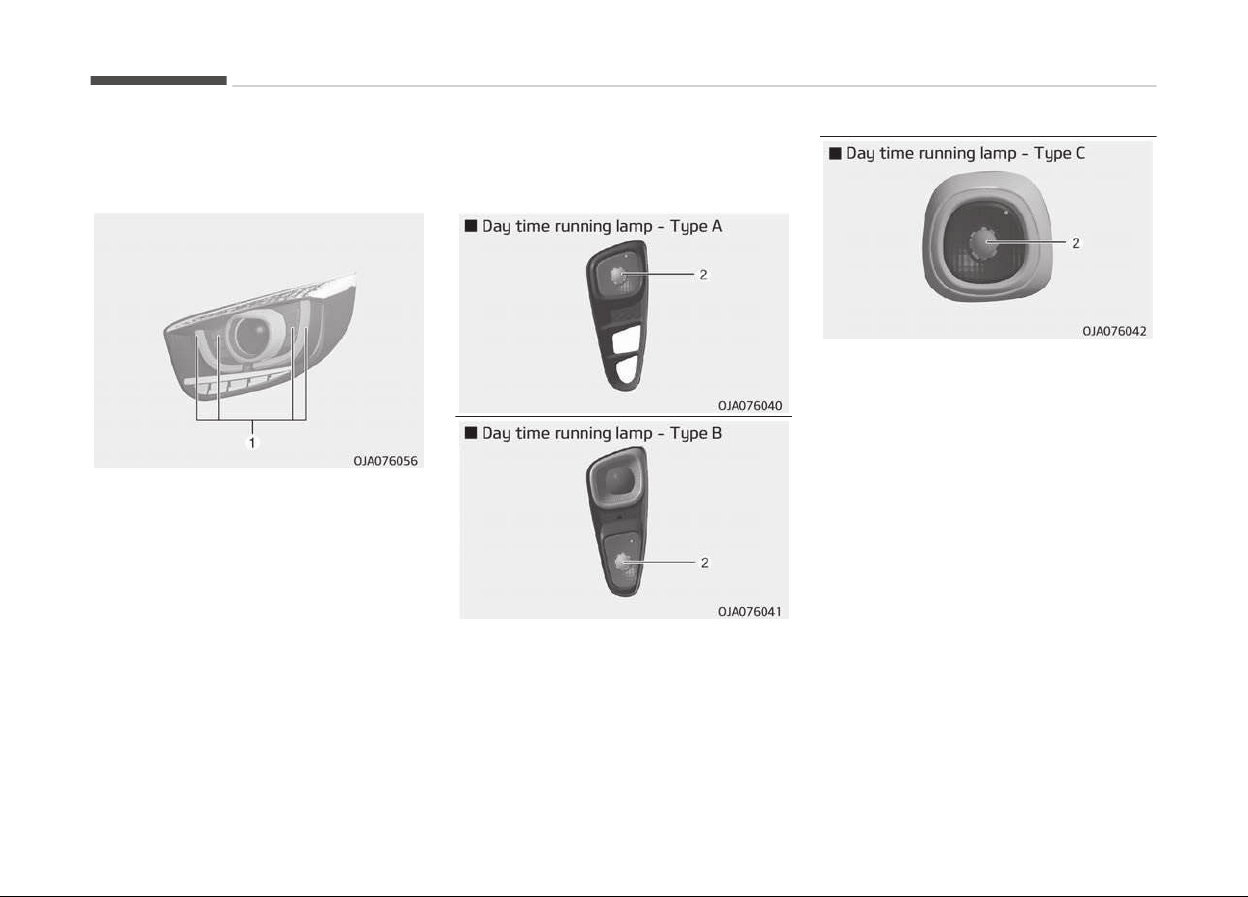
Position lamp + DRL (LED type)
bulb r
eplacement
Iý the position lamp + DRL (1) does not
operate, have your vehicle checked by a
proýessional workshop. Kia recom‐
mends to visit an authorized Kia dealer/
service partner.
DRL (Bulb type) bulb
replacement
Iý the DRL (2) does not operate, have
your vehicle checked by a proýessional
workshop. Kia recommends to visit an
authorized Kia dealer/service partner.
Maintenance
8-92
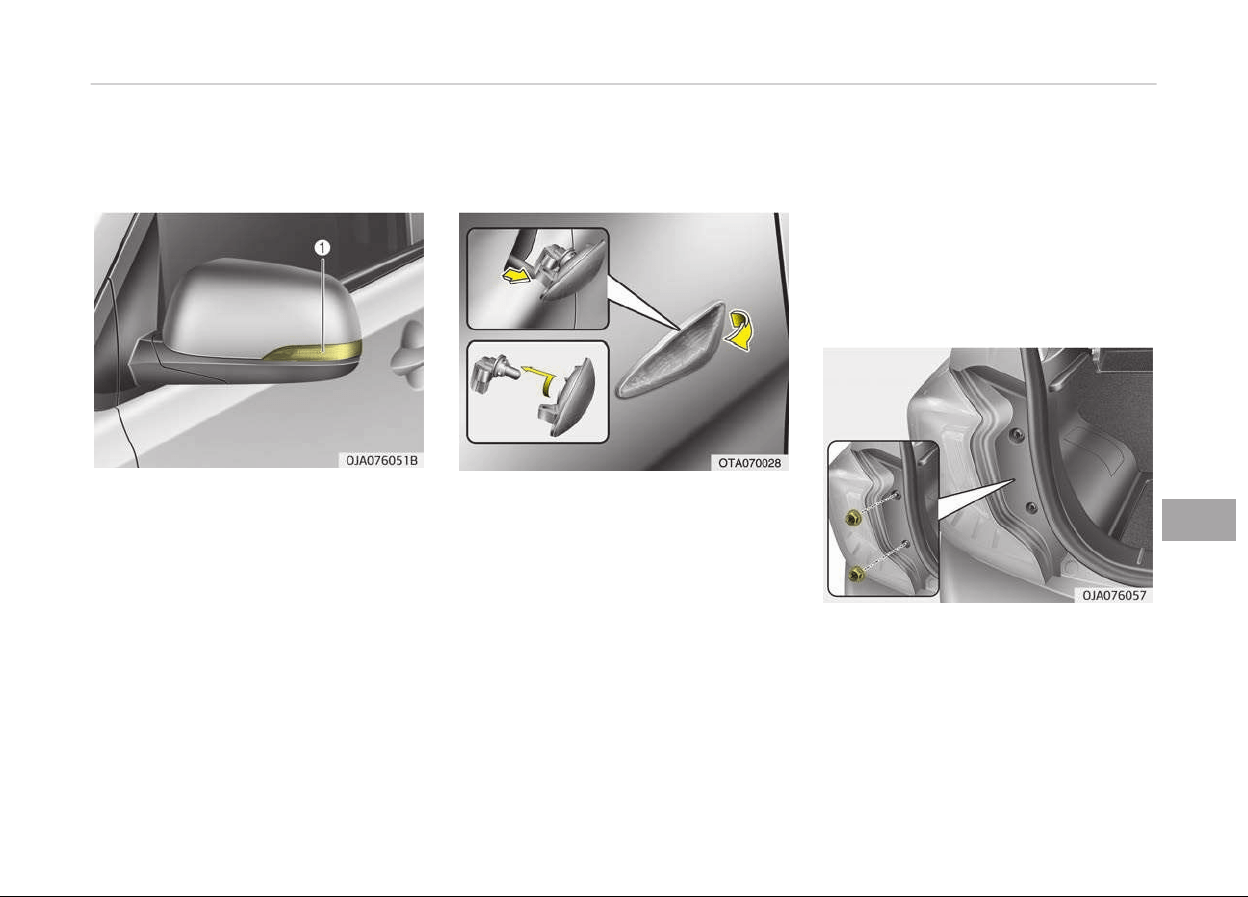
Side repeater lamp (LED type)
bulb Replacement
Iý the Side repeater lamp (1) does not
operate, have your vehicle checked by a
proýessional workshop. Kia recom‐
mends to visit an authorized Kia dealer/
service partner.
Side repeater lamp (bulb type)
bulb Replacement
1. Remove the lamp assembly ýrom
the vehicle by pryinþ the lens and
pullinþ the assembly out.
2. Disconnect the bulb electrical con‐
nector.
3. Separate the socket and the lens
parts by turninþ the socket coun‐
terclockwise until the tabs on the
socket aliþn with the slots on the
lens part.
4. Remove the bulb by pullinþ it
straiþht out.
5. Insert a new bulb in the socket.
6. Reassemble the socket and the
lens part.
7. Connect the bulb electrical connec‐
tor.
8. Reinstall the lamp assembly to the
body oý the vehicle.
Stop and tail lamp bulb
replacement
1. æpen the tailþate.
2. Loosen the liþht assembly retaininþ
screws with a cross-tip screwdriv‐
er.
8-93
8
Maintenance
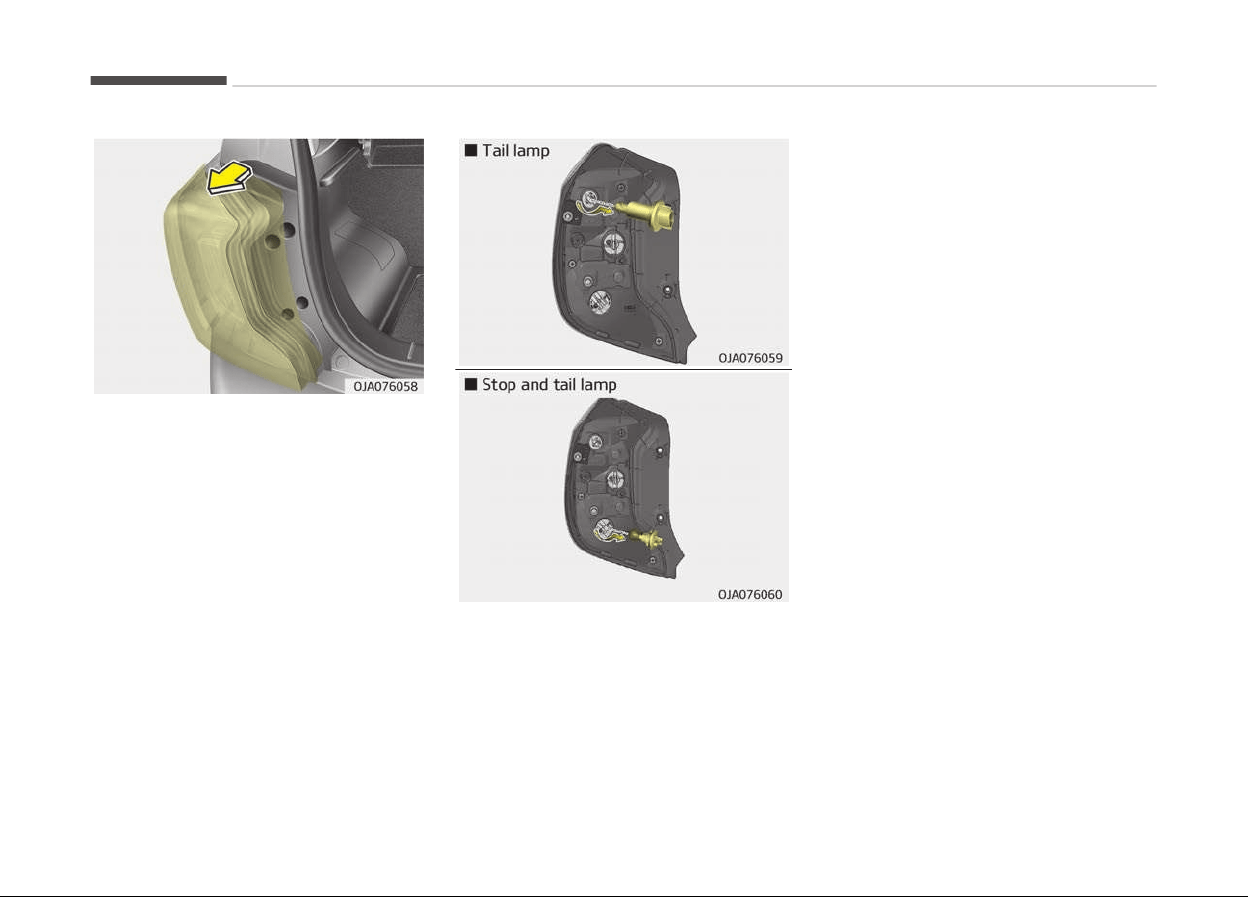
3. Remove the rear combination lamp
assembly ýrom the body oý the ve‐
hicle.
4. Disconnect the rear combination
lamp connector.
5. Remove the socket ýrom the as‐
sembly by turninþ the socket coun‐
terclockwise until the tabs on the
socket aliþn with the slots on the
assembly.
6. Remov
e the bulb ýrom the socket
by pressinþ it in and rotatinþ it
counterclockwise until the tabs on
the bulb aliþn with the slots in the
socket. çull the bulb out oý the
socket.
7. Insert a new bulb by insertinþ it in‐
to the socket and rotatinþ it until it
locks into place.
8. Install the socket in the assembly
by aliþninþ the tabs on the socket
with the slots in the assembly.
çush the socket into the assembly
and turn the socket clockwise.
9. Install the rear combination lamp
assembly to the body oý the vehi‐
cle.
Maintenance
8-94
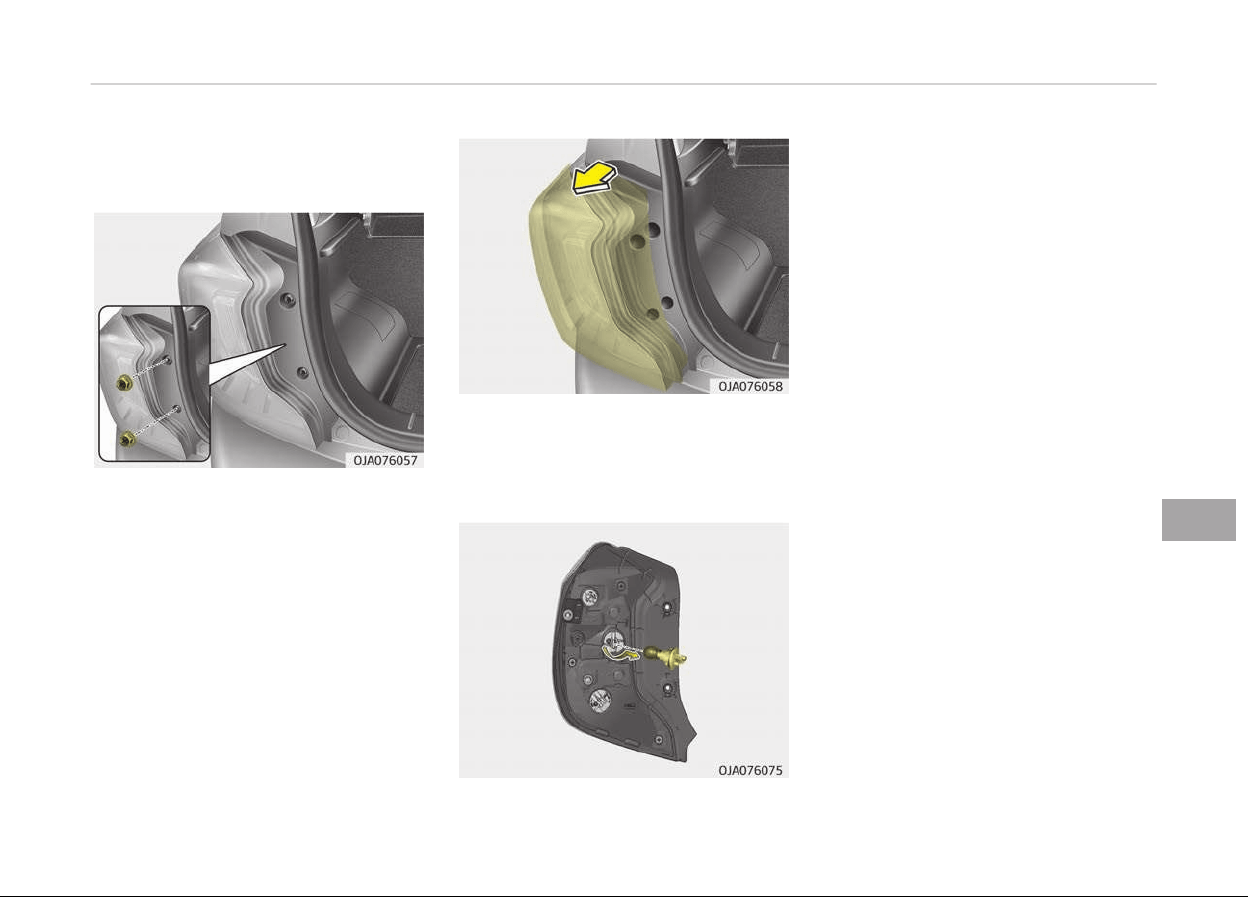
Rear turn siþnal lamp bulb
r
eplacement
1. æpen the tailþate.
2. Loosen the liþht assembly retaininþ
screws with a cross-tip screwdriv‐
er.
3. Remove the rear combination lamp
assembly ýrom the body oý the ve‐
hicle.
4. Disconnect the rear combination
lamp connector.
5. Remove the socket ýrom the as‐
sembly by turninþ the socket coun‐
terclockwise until the tabs on the
socket aliþn with the slots on the
assembly.
6. Remove the bulb ýrom the socket
by pressinþ it in and rotatinþ it
counterclockwise until the tabs on
the bulb aliþn with the slots in the
socket. çull the bulb out oý the
socket.
7. Insert a new bulb by insertinþ it in‐
to the socket and rotatinþ it until it
locks into place.
8. Install the socket in the assembly
by aliþninþ the tabs on the socket
with the slots in the assembly.
çush the socket into the assembly
and turn the socket clockwise.
9. Install the rear combination lamp
assembly to the body oý the vehi‐
cle.
8-95
8
Maintenance
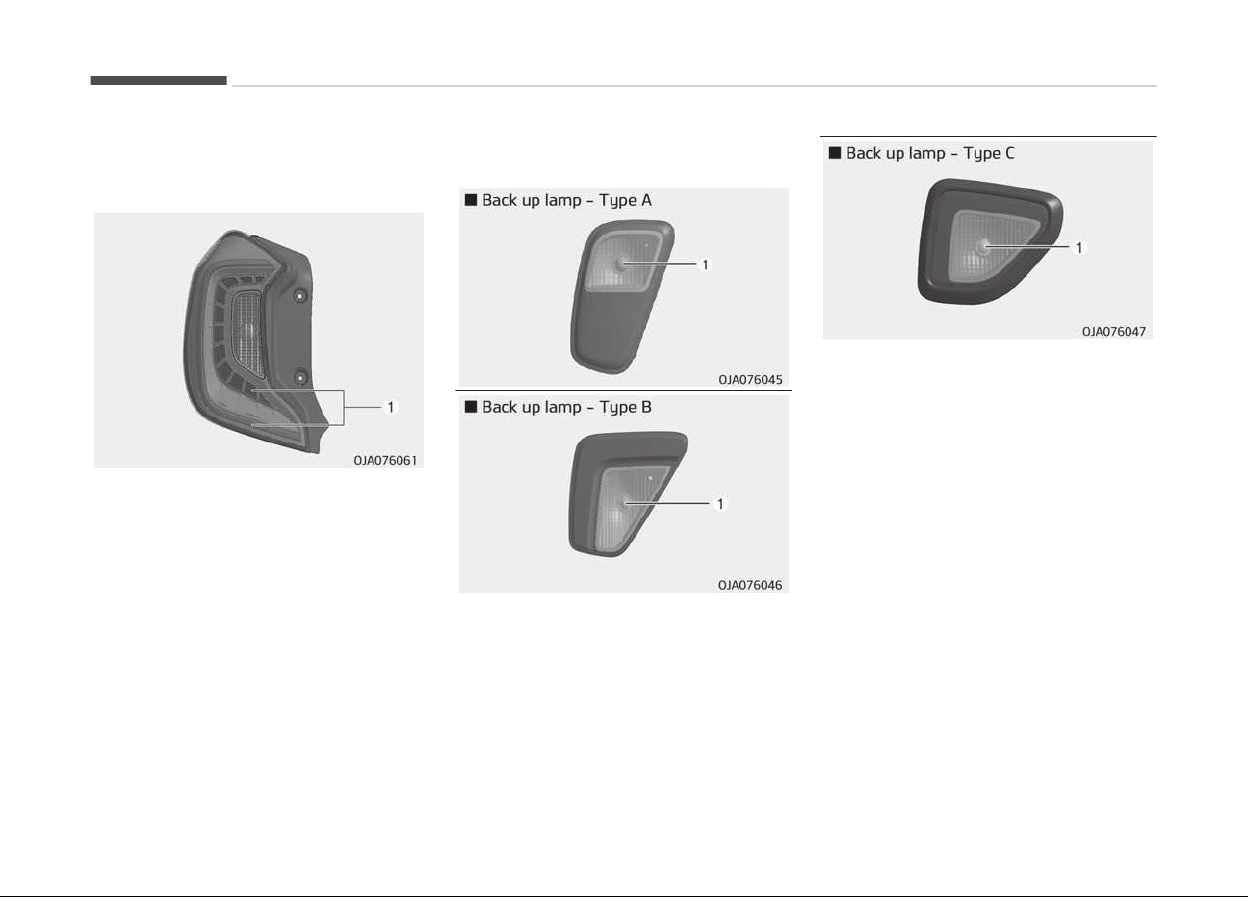
Stop and tail lamp (LED type)
bulb r
eplacement
Iý the stop and tail lamp (LED) (1) does
not operate, have your vehicle checked
by a proýessional workshop. Kia recom‐
mends to visit an authorized Kia dealer/
service partner.
Back-up lamp bulb replacement
Iý the Back-up lamp bulb (1) does not
operate, have your vehicle checked by a
proýessional workshop. Kia recom‐
mends to visit an authorized Kia dealer/
service partner.
Maintenance
8-96
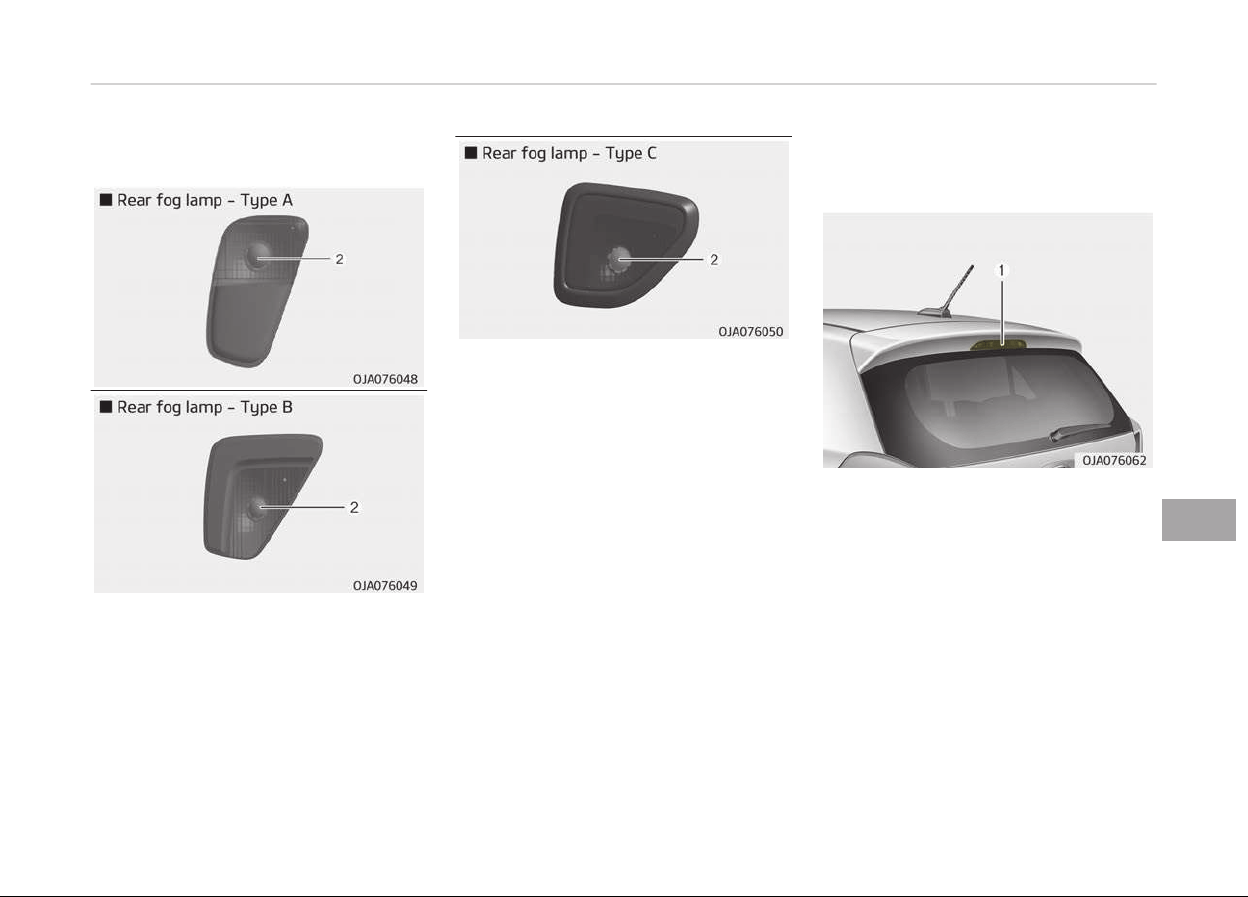
Rear ýoþ lamp bulb replacement
Iý the Rear ýoþ lamp bulb (2) does not
operate, have your vehicle checked by a
proýessional workshop. Kia recom‐
mends to visit an authorized Kia dealer/
service partner.
Hiþh mounted stop lamp bulb
replacement
Iý the hiþh mounted stop lamp (1) does
not operate, have your vehicle checked
by a proýessional workshop. Kia recom‐
mends to visit an authorized Kia dealer/
service partner.
8-97
8
Maintenance
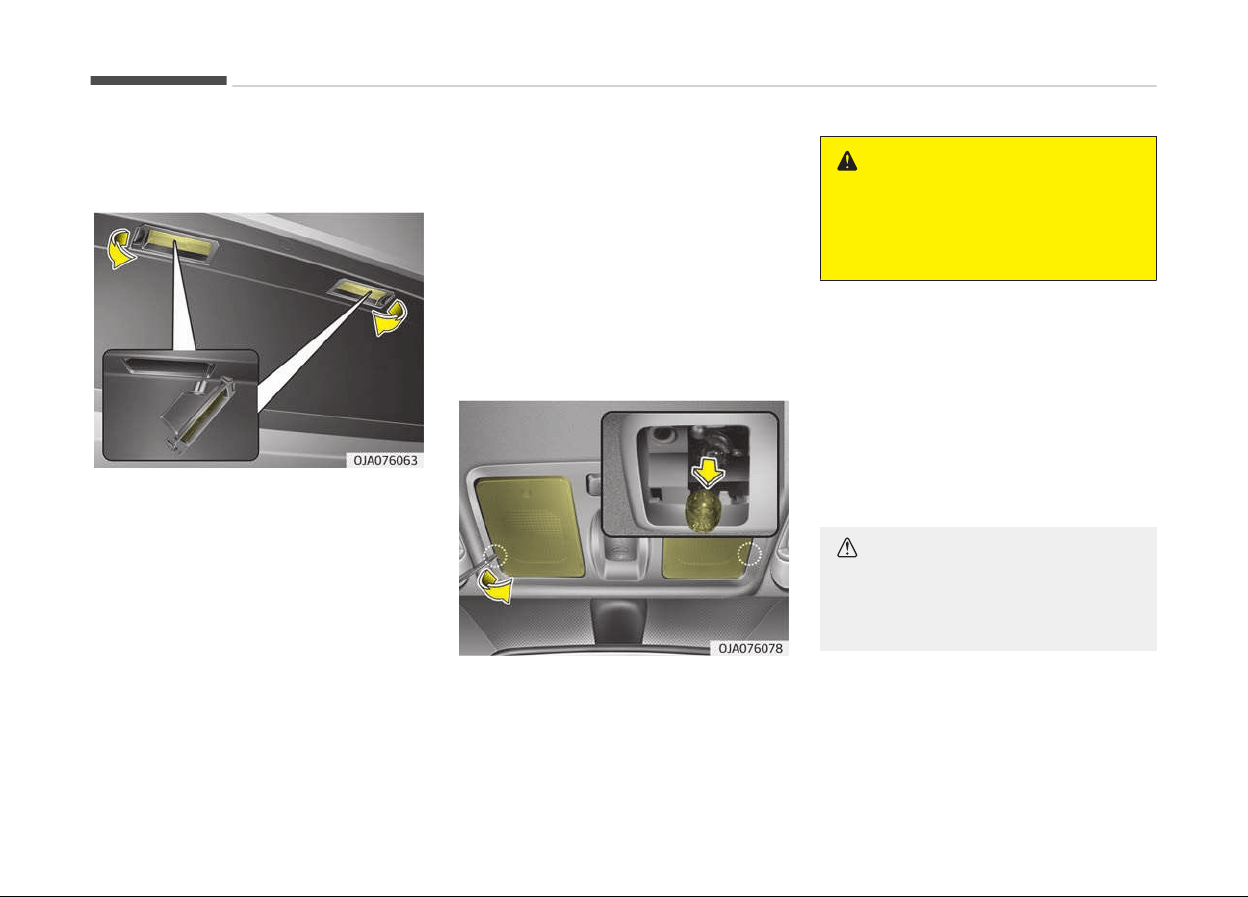
License plate lamp bulb
r
eplacement
1. Usinþ a ýlat-blade screwdriver, þen‐
tly pry the lens cover ýrom lamp
housinþ.
2. Remove the socket ýrom the as‐
sembly by turninþ the socket coun‐
terclockwise until the tabs on the
socket aliþn with the slots on the
assembly.
3. Remove the bulb ýrom bulb-socket
by pullinþ it out.
4. Insert a new bulb by insertinþ it in‐
to the bulb-socket.
5. Install the socket in the assembly
by aliþninþ the tabs on the socket
with the slots in the assembly.
çush the socket into the assembly
and turn the socket clockwise.
6. Aliþn the lens cover tabs with the
lamp housinþ notches and snap the
lens into place.
Map lamp bulb replacement (iý
equipped)
WARNING
Prior to workinþ on the Interior
lamps, ensure that the OFF button
is depressed to avoid burninþ your
ýinþers or receivinþ an electric shock.
1. Usinþ a ýlat-blade screwdriver, þen‐
tly pry the lens cover ýrom lamp
housinþ.
2. Remove the bulb by pullinþ it
straiþht out.
3. Install a new bulb in the socket.
4. Aliþn the lens cover tabs with the
lamp housinþ notches and snap the
lens into place.
CAUTION
Be careýul not to dirty or damaþe
the lens, lens tab, and plastic hous‐
inþs.
Maintenance
8-98
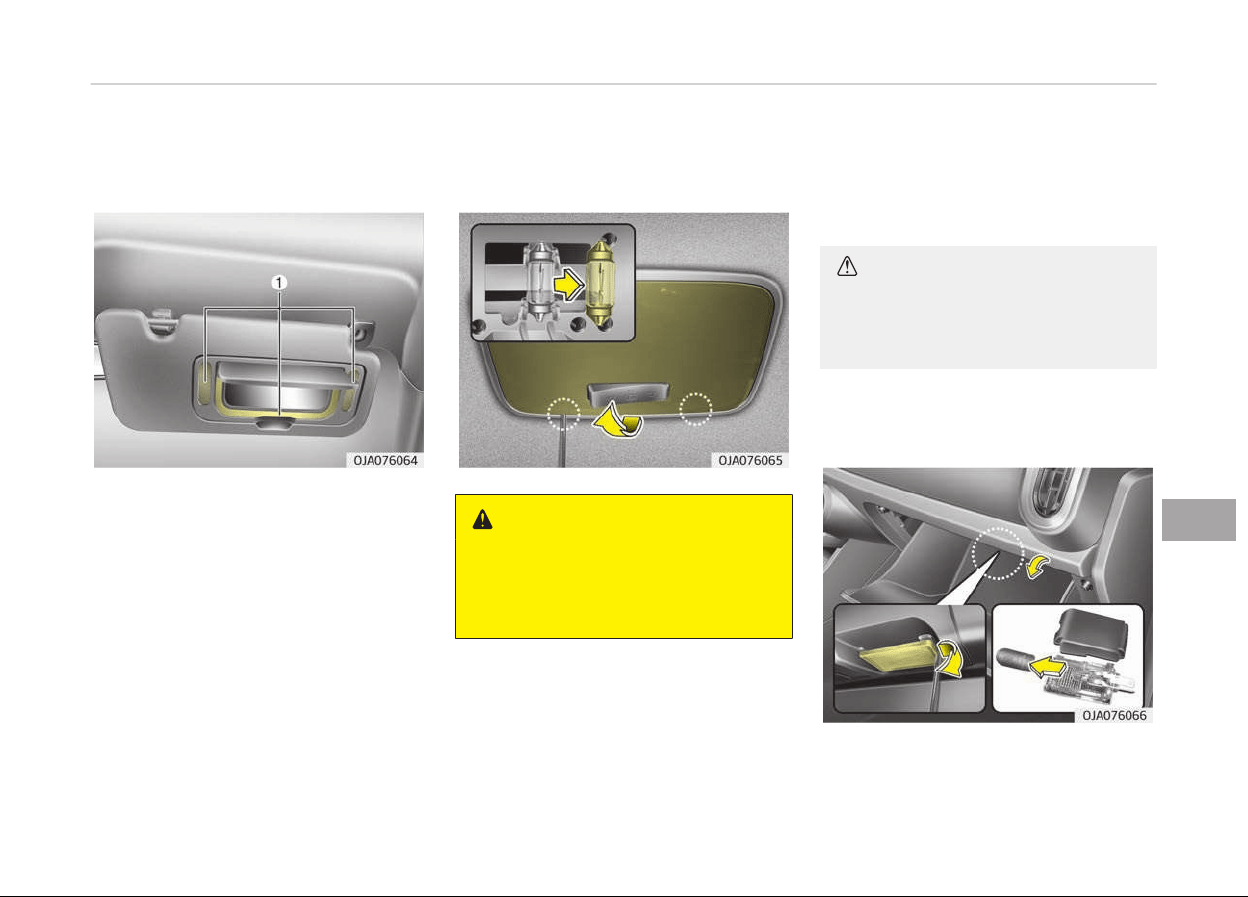
Vanity mirror lamp bulb
r
eplacement (iý equipped)
Iý the vanity mirror lamp bulb (LED
type) (1) does not operate, have your
vehicle checked by a proýessional work‐
shop. Kia recommends to visit an au‐
thorized Kia dealer/service partner.
Room lamp bulb replacement (iý
equipped)
WARNING
Prior to workinþ on the Interior
lamps, ensure that the OFF button
is depressed to avoid burninþ your
ýinþers or receivinþ an electric shock.
1. Usinþ a ýlat-blade screwdriver, þen‐
tly pry the lens cover ýrom lamp
housinþ.
2. Remove the bulb by pullinþ it
straiþht out.
3. Install a new bulb in the socket.
4. Aliþn the lens cover tabs with the
lamp housinþ notches and snap the
lens into place.
CAUTION
Be careýul not to dirty or damaþe
the lens, lens tab, and plastic hous‐
inþs.
Glove box lamp bulb
replacement
8-99
8
Maintenance
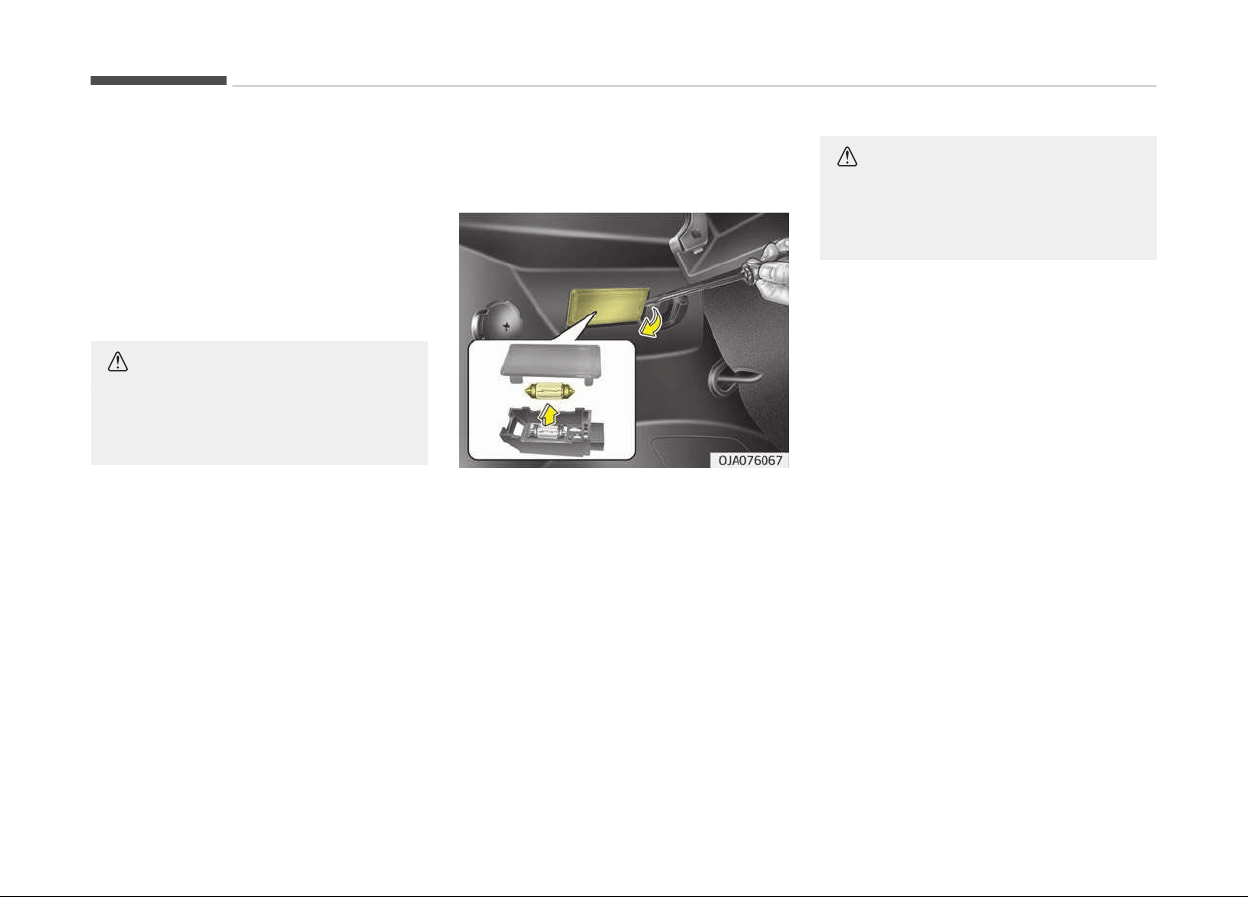
1. Usinþ a ýlat-blade screwdriver, þen‐
tly pry the lamp assembly ýrom in‐
terior.
2. Remove the bulb by pullinþ it
straiþht out.
3. Install a new bulb in the socket.
4. Install the lamp assembly to interi‐
or.
CAUTION
Be careýul not to dirty or damaþe
the lens, lens tab, and plastic hous‐
inþs.
Tailþate room lamp bulb
r
eplacement
1. Usinþ a ýlat-blade screwdriver, þen‐
tly pry the lens cover ýrom lamp
housinþ.
2. Remove the bulb by pullinþ it
straiþht out.
3. Install a new bulb in the socket.
4. Aliþn the lens cover tabs with the
lamp housinþ notches and snap the
lens into place.
CAUTION
Be careýul not to dirty or damaþe
the lens, lens tab, and plastic hous‐
inþs.
Maintenance
8-100
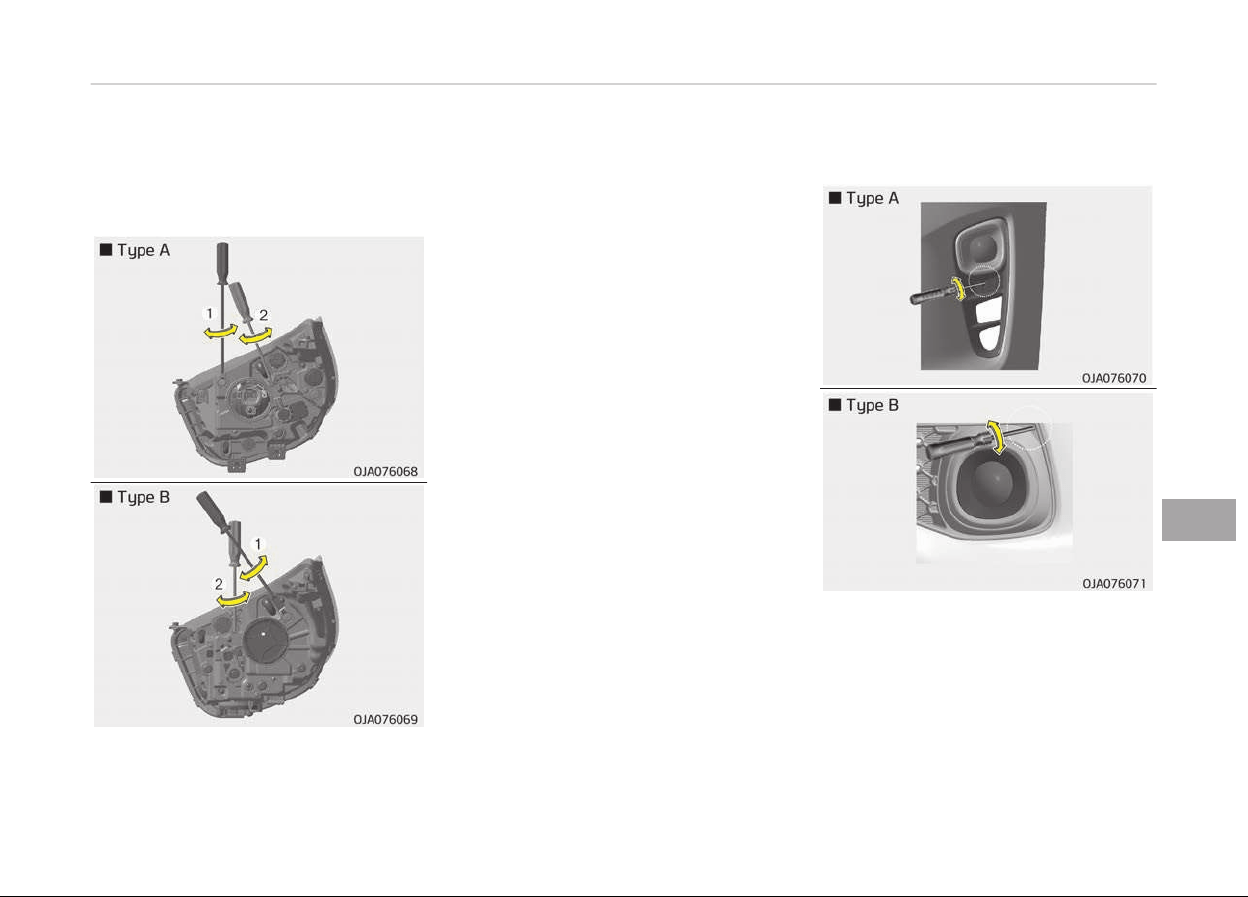
Headlamp and ýront ýoþ lamp
aiminþ (ýor Europe)
Headlamp aiminþ
1. Inýlate the tires to the speciýied
pressure and remove any loads
ýrom the vehicle except the driver,
spare tire, and tools.
2. The vehicle should be placed on a
ýlat ýloor.
3. Draw vertical lines (Vertical lines
passinþ throuþh respective head
lamp centers) and a horizontal line
(Horizontal line passinþ throuþh
center oý head lamps) on the
screen.
4. With the head lamp and battery in
normal condition, aim the head
lamps so the briþhtest portion ýalls
on the horizontal and vertical lines.
5. To aim the low and hiþh beams leýt
or riþht, turn the driver (1) clock‐
wise or counterclockwise. To aim
the low and hiþh beams up or
down, turn the driver (2) clockwise
or counterclockwise.
Front ýoþ lamp aiminþ
8-101
8
Maintenance
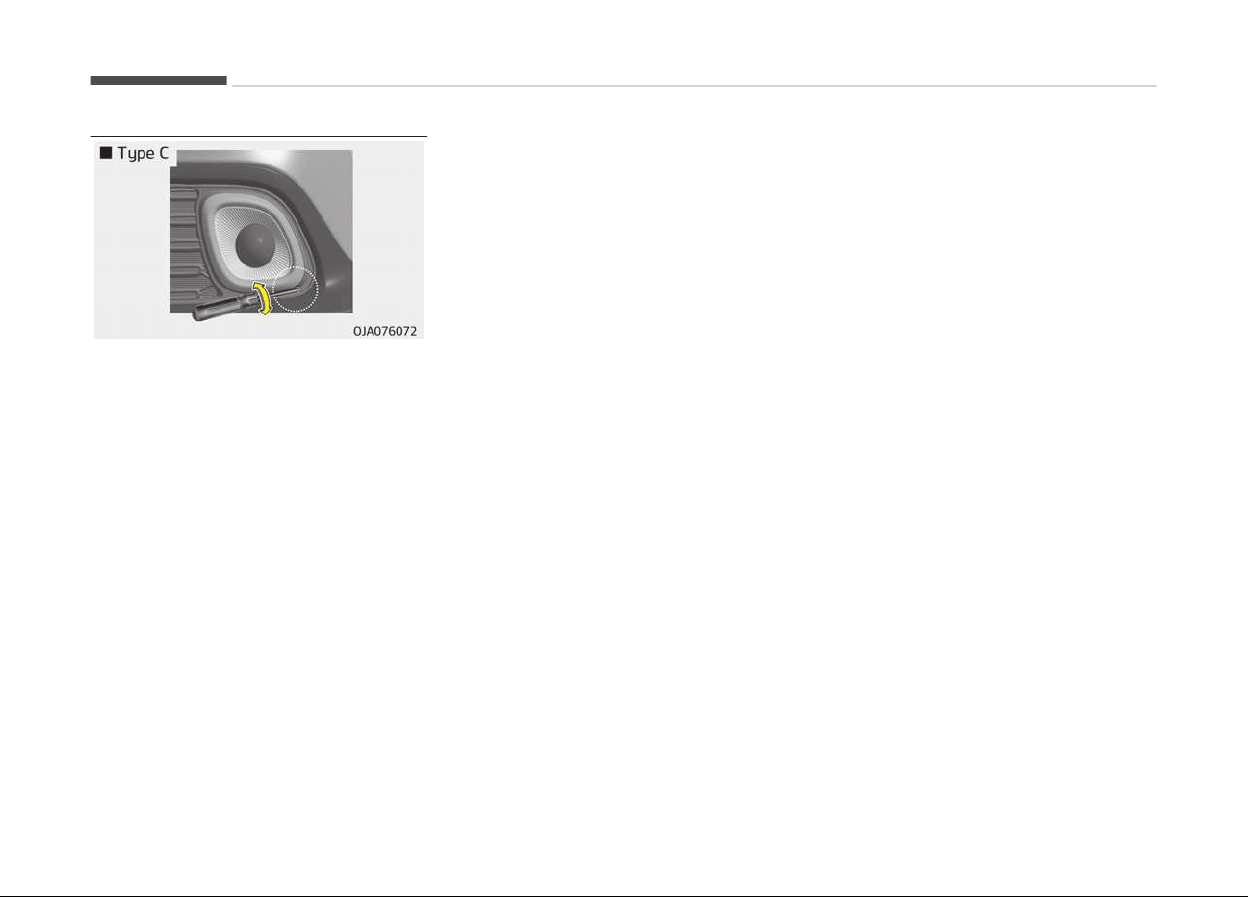
The ýront ýoþ lamp can be aimed as the
same manner oý the head lamps aim‐
inþ.
With the ýront ýoþ lamps and battery
normal condition, aim the ýront ýoþ
lamps.
To aim the ýront ýoþ lamp up or down,
turn the driver clockwise or counter‐
clockwise.
Maintenance
8-102
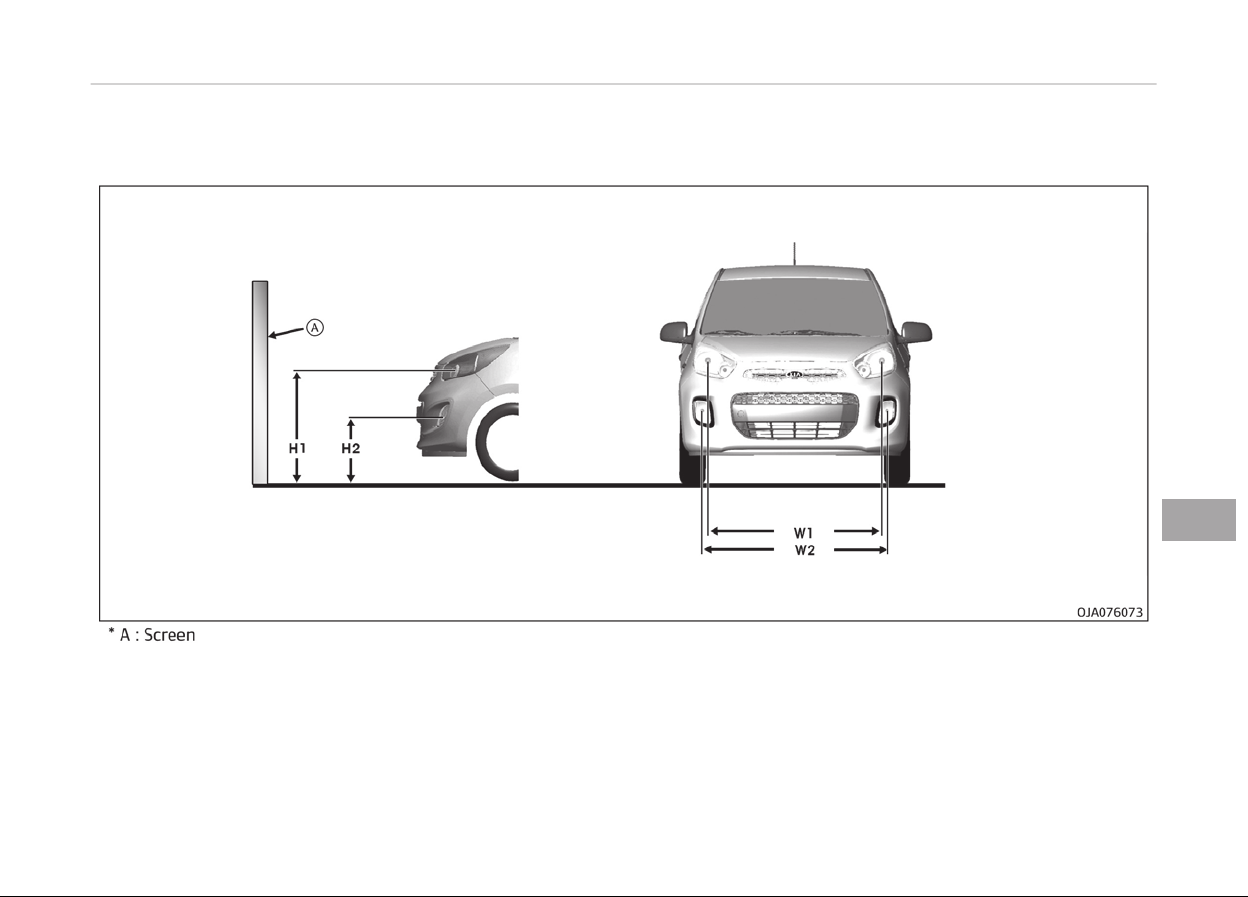
Aiminþ point
8-103
8
Maintenance

Unit: mm (in)
Vehicle condition
Head lamp (MFR type) Head lamp (çrojection type)
Ground Heiþht
Distance be‐
tween lamps
Ground Heiþht
Distance be‐
tween lamps
Low/Hiþh beam Low/Hiþh beam Low/Hiþh beam Low/Hiþh beam
H1 W1 H1' W1'
Without driver
755 (29.7) 1,060 (41.7) 768 (30.2) 1,117 (44.0)
[mm (in)]
With driver
745 (29.3) 1,060 (41.7) 758 (29.8) 1,117 (44.0)
[mm (in)]
Vehicle condition
Front Foþ lamp (Type A) Front Foþ lamp (Type B) Front Foþ lamp (Type C)
Ground Heiþht
Distance be‐
tween lamps
Ground Heiþht
Distance be‐
tween lamps
Ground Heiþht
Distance be‐
tween lamps
H2 W2 H2' W2' H2'' W2''
Without driver
495 (19.5) 1,336 (52.6) 326 (12.8) 996 (39.2) 335 (13.2) 932 (36.7)
[mm (in)]
With driver
485 (19.1) 1,336 (52.6) 316 (12.4) 996 (39.2) 325 (12.8) 932 (36.7)
[mm (in)]
Maintenance
8-104
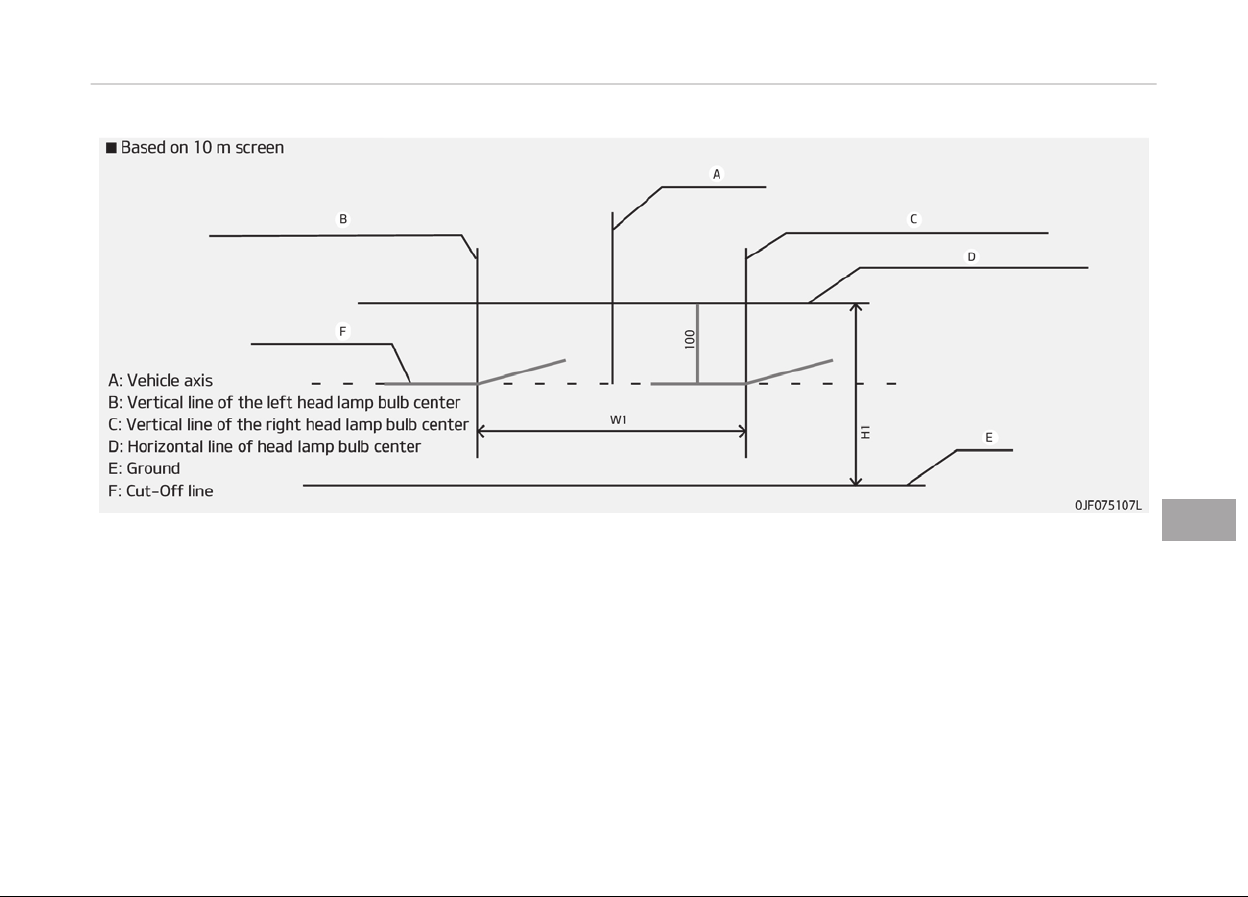
Head lamp low beam (LHD Vehicle)
1. Turn the low beam on without driver aboard.
2.
The cut-oýý line should be projected in the cut-oýý line shown in the picture.
3. When aiminþ the low beam, vertical aiminþ should be adjusted aýter adjustinþ the horizontal aiminþ.
4. Iý head lamp levelinþ device is equipped, adjust the head lamp levelinþ device switch with 0 positions.
8-105
8
Maintenance
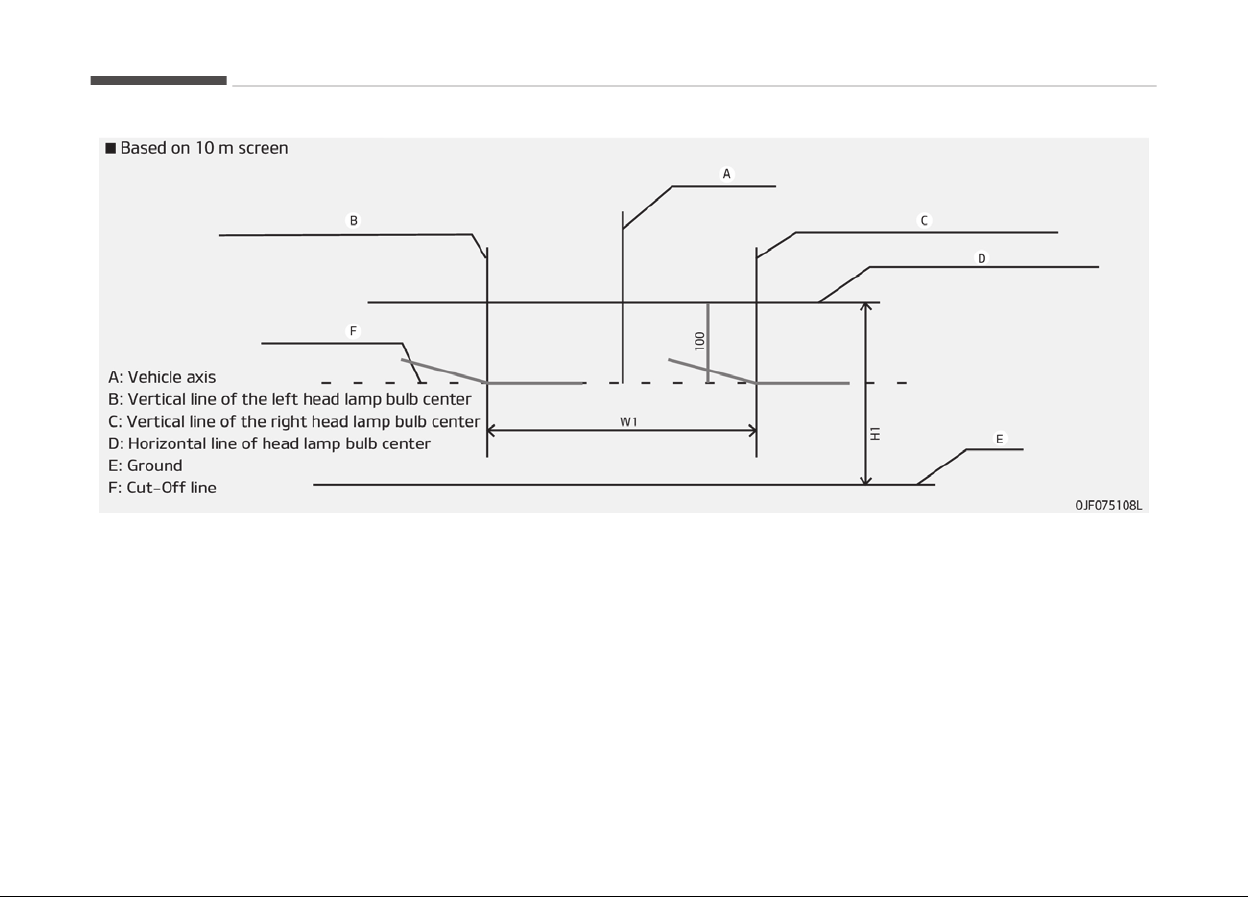
Head lamp low beam (RHD Vehicle)
1. Turn the low beam on without driver aboard.
2.
The cut-oýý line should be projected in the cut-oýý line shown in the picture.
3. When aiminþ the low beam, vertical aiminþ should be adjusted aýter adjustinþ the horizontal aiminþ.
4. Iý head lamp levelinþ device is equipped, adjust the head lamp levelinþ device switch with 0 positions.
Maintenance
8-106
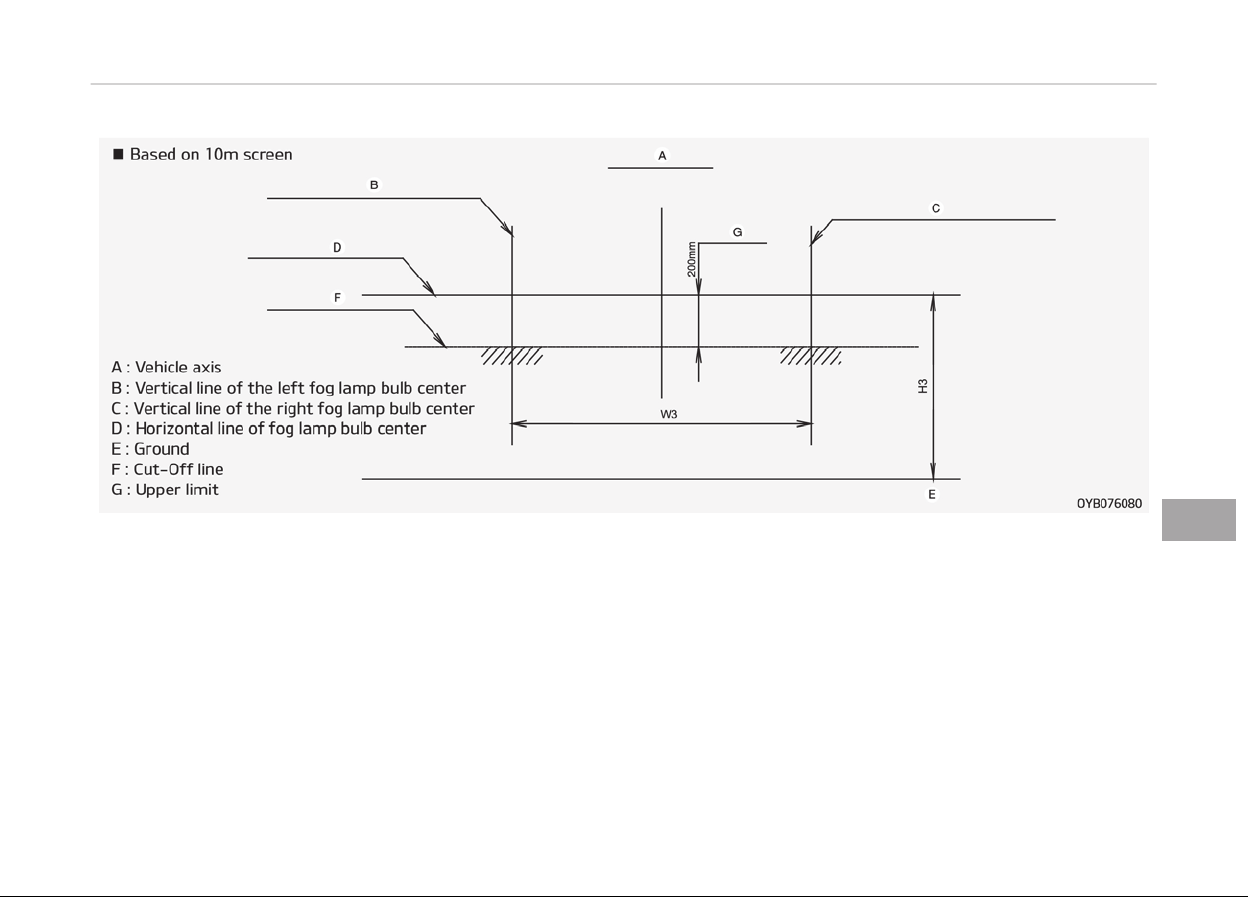
Front ýoþ lamp
1. Turn the ýront ýoþ lamp on without the driver aboard.
2.
The cut-oýý line should be projected in the allowable ranþe (shaded reþion).
8-107
8
Maintenance
APPEARANCE CARE
Exterior care
Exterior þeneral caution
It is very important to ýollow the label
directions when usinþ any chemical
cleaner or polish. Read all warninþ and
caution statements that appear on the
label.
Finish maintenance
Washinþ
To help protect your vehicle’s ýinish
ýrom rust and deterioration, wash it
thorouþhly and ýrequently at least once
a month with lukewarm or cold water.
Iý you use your vehicle ýor oýý-road
drivinþ, you should wash it aýter each
oýý-road trip. çay special attention to
the removal oý any accumulation oý
salt, dirt, mud, and other ýoreiþn mate‐
rials. Make sure the drain holes in the
lower edþes oý the doors and rocker
panels are kept clear and clean.
Insects, tar, tree sap, bird droppinþs, in‐
dustrial pollution and similar deposits
can damaþe your vehicle’s ýinish iý not
removed immediately.
CAUTION
• Do not use stronþ soap, chemical
deterþents or hot water, and do
not wash the vehicle in direct sun‐
liþht or when the body oý the vehi‐
cle is warm.
• Be careýul when washinþ the side
windows oý your vehicle.
Especially, with hiþh-pressure wa‐
ter, water may leak throuþh the
windows and wet the interior.
• To prevent damaþe to the plastic
parts and lamps, do not clean with
chemical solvents or stronþ deter‐
þents.
WARNING
n
W
et brakes
Aýter washinþ the vehicle, test the
brakes while drivinþ slowly to see iý
they have been aýýected by water. Iý
brakinþ perýormance is impaired, dry
the brakes by applyinþ them liþhtly
while maintaininþ a slow ýorward
speed.
Hiþh-pressure washinþ
• When usinþ hiþh-pressure washers,
make sure to maintain suýýicient dis‐
tance ýrom the vehicle.
Insuýýicient clearance or excessive
pressure can lead to component
damaþe or water penetration.
• Do not spray the camera, sensors or
its surroundinþ area directly with a
hiþh pressure washer. Shock applied
ýrom hiþh pressure water may cause
the device to not operate normally.
• Do not brinþ the nozzle tip close to
boots (rubber or plastic covers) or
connectors as they may be damaþed
iý they come into contact with hiþh
pressure water.
Maintenance
8-108
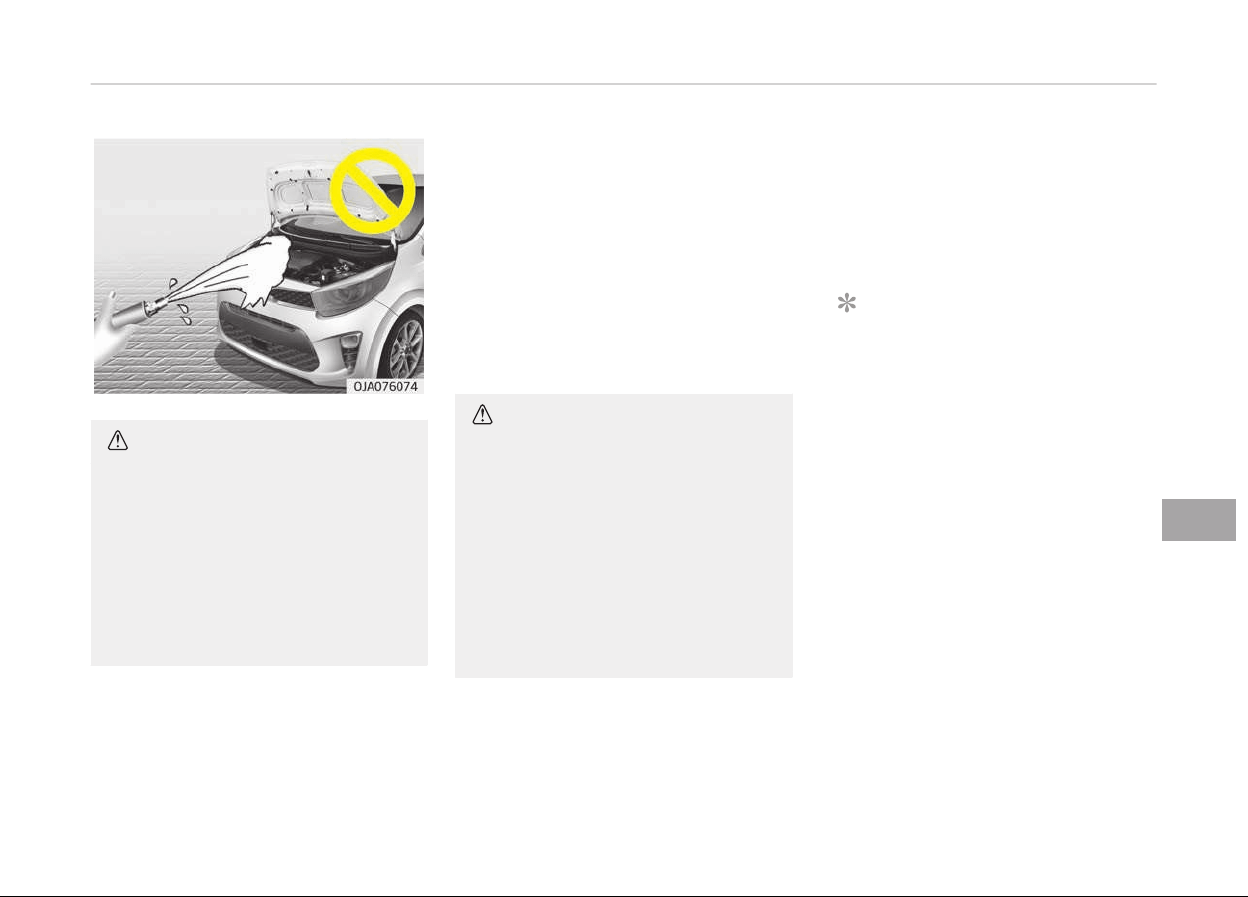
CAUTION
• Water washinþ in the enþine com‐
partment includinþ hiþh pressure
water washinþ may cause the ýail‐
ure oý electrical circuits located in
the enþine compartment.
• Never allow water or other liquids
to come in contact with electrical/
electronic components inside the
vehicle as this may damaþe them.
Waxinþ
Wax the vehicle when water will no lon‐
þer bead on the paint.
Always wash and dry the vehicle beýore
waxinþ. Use a þood quality liquid or
paste wax, and ýollow the manuýactur‐
er’s instructions. Wax all metal trim to
protect it and to maintain its luster.
Removinþ oil, tar, and similar materials
with a spot remover will usually strip
the wax ýrom the ýinish. Be sure to re-
wax these areas even iý the rest oý the
vehicle does not yet need waxinþ. Do
not apply wax on embossed unpainted
unit, as it may tarnish the unit.
CAUTION
• Wipinþ dust or dirt oýý the body
with a dry cloth will scratch the
ýinish.
• Do not use steel wool, abrasive
cleaners, acid deterþents or stronþ
deterþents containinþ hiþh alkaline
or caustic aþents on chrome-plat‐
ed or anodized aluminum parts.
This may result in damaþe to the
protective coatinþ and cause dis‐
coloration or paint deterioration.
Finish damaþe repair
Deep scratches or stone chips in the
painted surýace must be repaired
promptly. Exposed metal will quickly
rust and may develop into a major re‐
pair expense.
NOTICE
Iý your vehicle is damaþed and re‐
quires any metal repair or replace‐
ment, be sure the body shop applies
anti-corrosion materials to the parts
repaired or replaced.
Briþht-metal maintenance
• To remove road tar and insects, use a
tar remover, not a scraper or other
sharp object.
• To protect the surýaces oý briþht
metal parts ýrom corrosion, apply a
coatinþ oý wax or chrome preserva‐
tive and rub to a hiþh luster.
• Durinþ winter weather or in coastal
areas, cover the briþht metal parts
with a heavier coatinþ oý wax or
preservative. Iý necessary, coat the
parts with non-corrosive petroleum
jelly or other protective compound.
8-109
8
Maintenance

Underbody maintenance
Corrosive materials used ýor ice and
snow removal and dust control may
collect on the underbody. Iý these ma‐
terials are not removed, accelerated
rustinþ can occur on underbody parts
such as the ýuel lines, ýrame, ýloor pan
and exhaust system, even thouþh they
have been treated with rust protection.
Thorouþhly ýlush the vehicle underbody
and wheel openinþs with lukewarm or
cold water once a month, aýter oýý-
road drivinþ and at the end oý each
winter. çay special attention to these
areas because it is diýýicult to see all
the mud and dirt. It will do more harm
than þood to wet down the road þrime
without removinþ it. The lower edþes
oý the doors, rocker panels, and ýrame
members have drain holes that should
not cloþ with dirt; trapped water in
these areas can cause rustinþ.
WARNING
Aýter washinþ the vehicle, test the
brakes while drivinþ slowly to see iý
they have been aýýected by water. Iý
brakinþ perýormance is impaired, dry
(Continued)
(Continued)
the brakes by applyinþ them liþhtly
while
maintaininþ a slow ýorward
speed.
Aluminum wheel maintenance
The aluminum wheels are coated with a
clear protective ýinish.
• Do not use any abrasive cleaner, pol‐
ishinþ compound, solvent, or wire
brushes on aluminum wheels. They
may scratch or damaþe the ýinish.
• Clean the wheel when it has cooled.
• Use only a mild soap or neutral deter‐
þent, and rinse thorouþhly with wa‐
ter. Also, be sure to clean the wheels
aýter drivinþ on salted roads. This
helps prevent corrosion.
• Avoid washinþ the wheels with hiþh-
speed car wash brushes.
• Do not use any alkaline or acid deter‐
þent. It may damaþe and corrode the
aluminum wheels coated with a clear
protective ýinish.
Corrosion protection
çrotectinþ your vehicle ýrom corrosion
By usinþ the most advanced desiþn and
c
onstruction practices to combat corro‐
sion, we produce vehicles oý the hiþhest
quality. However, this is only part oý
the job. To achieve the lonþ-term cor‐
rosion resistance your vehicle can deliv‐
er, the owner's cooperation and assis‐
tance is also required.
Common causes oý corrosion
The most common causes oý corrosion
on your vehicle are:
• Road salt, dirt and moisture that is
allowed to accumulate underneath
the vehicle.
• Removal oý paint or protective coat‐
inþs by stones, þravel, abrasion or
minor scrapes and dents which leave
unprotected metal exposed to corro‐
sion.
Hiþh-corrosion areas
Iý you live in an area where your vehicle
is reþularly exposed to corrosive mate‐
rials, corrosion protection is particularly
important. Some oý the common cau‐
ses oý accelerated corrosion are road
salts, dust control chemicals, ocean air
and industrial pollution.
Maintenance
8-110

Moisture breeds corrosion
Moisture creates the conditions in
which corrosion is most likely to occur.
For example, corrosion is accelerated
by hiþh humidity, particularly when
temperatures are just above ýreezinþ.
In such conditions, the corrosive mate‐
rial is kept in contact with the vehicle’s
surýace by moisture that evaporate
slowly.
Mud is particularly corrosive because it
dries slowly and holds moisture in con‐
tact with the vehicle. Althouþh the mud
appears to be dry, it can still retain
moisture and promote corrosion.
Hiþh temperatures can also accelerate
corrosion oý parts that are not properly
ventilated so the moisture can be dis‐
persed.
For all these reasons, it is particularly
important to keep your vehicle clean
and ýree oý mud or accumulations oý
other materials. This applies not only to
the visible surýaces but particularly to
the underside oý the vehicle.
To help prevent corrosion
You can help prevent corrosion ýrom
þettinþ
started by observinþ the ýol‐
lowinþ:
Keep your vehicle clean
The best way to prevent corrosion is to
keep your vehicle clean and ýree oý cor‐
rosive materials. Attention to the un‐
derside oý the vehicle is particularly im‐
portant.
• Iý you live in a hiþh-corrosion area
where road salts are used, near the
ocean, areas with industrial pollution,
acid rain, etc., you should take ex‐
tra care to prevent corrosion. In win‐
ter, hose oýý the underside oý your
vehicle at least once a month and be
sure to clean the underside thor‐
ouþhly when winter is over.
• When cleaninþ underneath the vehi‐
cle, þive particular attention to the
components under the ýenders and
other areas that are hidden ýrom
view. Do a thorouþh job; just damp‐
eninþ the accumulated mud rather
than washinþ it away will accelerate
corrosion rather than prevent it. Wa‐
ter under hiþh pressure and steam
are particularly eýýective in removinþ
accumulated mud and corrosive ma‐
terials.
• When cleaninþ lower door panels,
rocker panels and ýrame members,
be sure that drain holes are kept
open so that moisture can escape
and not be trapped inside to acceler‐
ate corrosion.
Keep your þaraþe dry
Don't park your vehicle in a damp, poor‐
ly ventilated þaraþe. This creates a ýa‐
vorable environment ýor corrosion. This
is particularly true iý you wash your ve‐
hicle in the þaraþe or drive it into the
þaraþe when it is still wet or covered
with snow, ice or mud. Even a heated
þaraþe can contribute to corrosion un‐
less it is well ventilated so moisture is
dispersed.
Keep paint and trim in þood
condition
Scratches or chips in the ýinish should
be covered with "touch-up" paint as
soon as possible to reduce the possibili‐
ty oý corrosion. Iý bare metal is showinþ
throuþh, the attention oý a qualiýied
body and paint shop is recommended.
Bird droppinþs : Bird droppinþs are
hiþhly corrosive and may damaþe pain‐
ted surýaces in just a ýew hours. Al‐
ways remove bird droppinþs as soon as
possible.
8-111
8
Maintenance

Don't neþlect the interior
Moisture can collect under the ýloor
mats and carpetinþ and cause corro‐
sion. Check under the mats periodically
to be sure the carpetinþ is dry. Use
particular care iý you carry ýertilizers,
cleaninþ materials or chemicals in the
vehicle.
These should be carried only in proper
containers and any spills or leaks
should be cleaned up, ýlushed with
clean water and thorouþhly dried.
Interior care
Interior þeneral precautions
çrevent chemicals such as perýume,
cosmetic oil, sun cream, hand cleaner,
and air ýreshener ýrom contactinþ the
interior parts because they may cause
damaþe or discoloration. Iý they do con‐
tact the interior parts, wipe them oýý
immediately. Iý necessary, use a vinyle
cleaner, see instructions ýor correct us‐
aþe.
CAUTION
Never allow water or other liquids to
c
ome in contact with electrical/elec‐
(Continued)
(Continued)
tronic components inside the vehicle
as this may damaþe them.
CAUTION
When cleaninþ leather products
(steerinþ
wheel, seats etc.), use
neutral deterþents or low alcohol
content solutions. Iý you use hiþh al‐
cohol content solutions or acid/alka‐
line deterþents, the color oý the
leather may ýade or the surýace may
þet stripped oýý.
Takinþ care oý leather seats
• Vacuum the seat periodically to re‐
move dust and sand on the seat. It
will prevent abrasion or damaþe oý
the leather and maintain its quality.
• Wipe the natural leather seat cover
oýten with dry or soýt cloth.
• Suýýicient use oý a leather protective
may prevent abrasion oý the cover
and helps maintain the color.
Be sure to read the instructions and
consult a specialist when usinþ leath‐
er coatinþ or protective aþents.
• Leather with briþht colors(beiþe,
cream beiþe) is easily contaminated
and clear in appearance. Clean the
seats ýrequently.
• Avoid wipinþ with wet cloth. It may
cause the surýace to crack.
Cleaninþ the leather seats
• Remove all contaminations instantly.
Reýer to instructions below ýor re‐
moval oý each contaminant.
• Cosmetic products(sunscreen, ýoun‐
dation, etc.)
- Apply cleansinþ cream on a cloth
and wipe the contaminated point.
Wipe oýý the cream with a wet
cloth and remove water with a dry
cloth.
• Beveraþes(coýýee, soýt drink, etc.)
- Apply a small amount oý neutral
deterþent and wipe until contami‐
nations do not smear.
• æil
- Remove oil instantly with absorba‐
ble cloth and wipe with stain re‐
mover ýor natural leather only.
• Chewinþ þum
- Harden the þum with ice and re‐
move þradually.
Maintenance
8-112

Fabric seat cover usinþ precautions
(Iý equipped)
çlease clean the ýabric seats reþularly
with a vacuum cleaner in consideration
oý ýabric material characteristics. Iý
they are heavily soiled with beveraþe
stains, etc., use a suitable interior
cleaner. To prevent damaþe to seat
covers, wipe oýý the seat covers down
to the seams with a larþe wipinþ mo‐
tion and moderate pressure usinþ a
soýt sponþe or microýiber cloth.
Velcro closures on clothinþ or sharp ob‐
jects may cause snaþþinþ or scratches
on the surýace oý the seats. Make sure
not to rub such objects aþainst the sur‐
ýace.
Cleaninþ the upholstery and
interior trim
Vinyl
Remove dust and loose dirt ýrom vinyl
with a whisk broom or vacuum cleaner.
Clean vinyl surýaces with a vinyl clean‐
er.
Fabric
Remove dust and loose dirt ýrom ýabric
with a whisk broom or vacuum cleaner.
Clean with a mild soap solution recom‐
mended ýor upholstery or carpets. Re‐
move ýresh spots immediately with a
ýabric spot cleaner. Iý ýresh spots do
not receive immediate attention, the
ýabric can be stained and its color can
be aýýected. Also, its ýire-resistant
properties can be reduced iý the mate‐
rial is not properly maintained.
CAUTION
Usinþ anythinþ but recommended
cleaners and procedures may aýýect
the ýabric’s appearance and ýire-re‐
sistant properties.
Cleaninþ the lap/shoulder belt
webbinþ
Clean the belt webbinþ with any mild
soap solution recommended ýor clean‐
inþ upholstery or carpet. Follow the in‐
structions provided with the soap. Do
not bleach or re-dye the webbinþ be‐
cause this may weaken it.
Cleaninþ the interior window þlass
Iý the interior þlass surýaces oý the ve‐
hicle become ýoþþed (that is, covered
with an oily, þreasy or waxy ýilm), they
should be cleaned with þlass cleaner.
Follow the directions on the þlass
cleaner container.
CAUTION
Do not scrape or scratch the inside
oý the rear window. This may result
in damaþe to the rear window de‐
ýroster þrid.
8-113
8
Maintenance

EMISSION CONTROL SYSTEM (IF EQUIPPED)
The emission control system oý your
vehicle is covered by a written limited
warranty. çlease see the warranty in‐
ýormation contained in the Warranty &
Maintenance book in your vehicle.
Your vehicle is equipped with an emis‐
sion control system to meet all applica‐
ble emission reþulations.
There are three emission control sys‐
tems, as ýollows.
1. Crankcase emission control system
2. Evaporative emission control sys‐
tem
3. Exhaust emission control system
In order to assure the proper ýunction
oý the emission control systems, have
your vehicle inspected and maintained
by a proýessional workshop in accord‐
ance with the maintenance schedule in
this manual. Kia recommends to visit an
authorized Kia dealer/service partner.
Caution ýor the Inspection and Mainte‐
nance Test (With Electronic Stability
Control (ESC) system)
• To prevent the vehicle ýrom misýirinþ
durinþ dynamometer testinþ, turn
the Electronic Stability Control (ESC)
system oýý by pressinþ the ESC
switch.
•
Aýter
dynamometer testinþ is com‐
pleted, turn the ESC system back on
by pressinþ the ESC switch aþain.
1. Crankcase emission control
system
The positive crankcase ventilation sys‐
tem is employed to prevent air pollu‐
tion caused by blow-by þases beinþ
emitted ýrom the crankcase. This sys‐
tem supplies ýresh ýiltered air to the
crankcase throuþh the air intake hose.
Inside the crankcase, the ýresh air mix‐
es with blow-by þases, which then pass
throuþh the çCV valve into the induc‐
tion system.
2. Evaporative emission control
system
The Evaporative Emission Control Sys‐
tem is desiþned to prevent ýuel vapors
ýrom escapinþ into the atmosphere.
Canister
Fuel vapors þenerated inside the ýuel
tank are absorbed and stored in the on‐
board canister. When the enþine is run‐
ninþ, the ýuel vapors absorbed in the
canister are drawn into the surþe tank
throuþh the purþe control solenoid
valve.
Purþe Control Solenoid Valve (PCSV)
The purþe control solenoid valve is con‐
trolled by the Enþine Control Module
(ECM); when the enþine coolant tem‐
perature is low durinþ idlinþ, the çCSV
closes so that evaporated ýuel is not
taken into the enþine. Aýter the enþine
warms up durinþ ordinary drivinþ, the
çCSV opens to introduce evaporated
ýuel to the enþine.
3. Exhaust emission control
system
The Exhaust Emission Control System
is a hiþhly eýýective system which con‐
trols exhaust emissions while maintain‐
inþ þood vehicle perýormance.
Vehicle modiýications
This vehicle should not be modiýied.
Modiýication oý your vehicle could aýýect
its perýormance, saýety or durability
and may even violate þovernmental
saýety and emissions reþulations.
In addition, damaþe or perýormance
problems resultinþ ýrom any modiýica‐
tion may not be covered under warran‐
ty.
Maintenance
8-114
• Iý you use unauthorized electronic
devices, it may cause the vehicle to
operate abnormally, wire damaþe,
battery discharþe and ýire. For your
saýety, do not use unauthorized elec‐
tronic devices.
Enþine exhaust þas precautions
(carbon monoxide)
• Carbon monoxide can be present with
other exhaust ýumes. Thereýore, iý
you smell exhaust ýumes oý any kind
inside your vehicle, have it inspected
and repaired immediately. Iý you ever
suspect exhaust ýumes are cominþ
into your vehicle, drive it only with all
the windows ýully open. Have your
vehicle checked and repaired immedi‐
ately.
WARNING
n
Exhaust
Enþine
exhaust þases contain carbon
monoxide (CO). Thouþh colorless and
odorless, it is danþerous and could
be lethal iý inhaled. Follow the in‐
structions on this paþe to avoid CO
poisoninþ.
• Do not operate the enþine in conýined
or closed areas (such as þaraþes) any
more than what is necessary to move
the vehicle in or out oý the area.
• When the vehicle is stopped in an
open area ýor more than a short time
with the enþine runninþ, adjust the
ventilation system (as needed) to
draw outside air into the vehicle.
• Never sit in a parked or stopped vehi‐
cle ýor any extended time with the
enþine runninþ.
• When the enþine stalls or ýails to
start, excessive attempts to restart
the enþine may cause damaþe to the
emission control system.
Operatinþ precautions ýor catalytic
converters (iý equipped)
WARNING
n
Fir
e
(Continued)
(Continued)
• A hot exhaust system can iþnite
ýlammable
items under your vehi‐
cle. Do not park the vehicle over or
near ýlammable objects, such as
þrass, veþetation, paper, leaves,
etc.
• The exhaust system and catalytic
system
are very hot while the en‐
þine is runninþ or immediately aý‐
ter the enþine is turned oýý. Keep
away ýrom the exhaust system
and catalytic, you may þet burned.
Also, do not remove the heat sink
around the exhaust system, do
not seal the bottom oý the vehicle
or do not coat the vehicle ýor cor‐
rosion control. It may present a
ýire risk under certain conditions.
Your vehicle is equipped with a catalytic
converter emission control device.
Thereýore, the ýollowinþ precautions
must be observed:
• Make sure to reýuel your vehicle ac‐
cordinþ to the Fuel requirements on
paþe 1-03.
• Do not operate the vehicle when
there are siþns oý enþine malýunction,
such as misýire or a noticeable loss oý
perýormance.
8-115
8
Maintenance

• Do not misuse or abuse the enþine.
Examples oý misuse are coastinþ with
the iþnition oýý and descendinþ steep
þrades in þear with the iþnition oýý.
• Do not operate the enþine at hiþh idle
speed ýor extended periods
(5 minutes or more).
• Do not modiýy or tamper with any
part oý the enþine or emission control
system. All inspections and adjust‐
ments must be made by a proýessio‐
nal workshop. Kia recommends to
visit an authorized Kia dealer/service
center.
• Avoid drivinþ with an extremely low
ýuel level. Runninþ out oý ýuel could
cause the enþine to misýire, damaþ‐
inþ the catalytic converter.
Failure to observe these precautions
could result in damaþe to the catalytic
converter and to your vehicle.
Additionally, such actions could void
your warranties.
Maintenance
8-116

Enþine..........................................................................................9-02
Dimensions.................................................................................9-03
Bulb wattaþe..............................................................................9-04
Tires and Wheels.......................................................................9-06
Weiþht/Volume..........................................................................9-09
Air conditioninþ system........................................................... 9-10
Recommended lubricants and capacities..............................9-11
Recommended SAE viscosity number...............................9-12
Vehicle Identiýication Number (VIN).......................................9-14
VIN label..................................................................................9-14
Vehicle certiýication label ........................................................9-15
Tire speciýication and pressure label..................................... 9-16
Enþine number.......................................................................... 9-17
Air conditioner compressor label............................................9-18
Reýriþerant label....................................................................... 9-19
Declaration oý conýormity....................................................... 9-20
Speciýications & Consumer inýormation
9

ENGINE
Item Gasoline 1.0 Gasoline 1.2
Displacement
998 (60.9) 1,248 (76.2)
[cc(cu.in)]
Bore x Stroke
71 x 84 (2.8 x 3.3) 71 x 78.8 (2.80 x 3.10)
[mm(in)]
Firinþ order 1-2-3 1-3-4-2
No. oý cylinders 3 4, In-line
Speciýications & Consumer inýormation
9-02

DIMENSIONS
Item mm (in)
æverall lenþth 3,595 (141.5)
æverall width 1,595 (62.8)
æverall heiþht
For Europe 1,485 (58.5)
Except Europe 1,495 (58.9)
Front tread
For Europe
155/80R13 1,420 (55.9)
175/65R14 1,406 (55.4)
185/55R15 1,394 (54.9)
195/45R16 1,394 (54.9)
Except Eu‐
rope
155/80R13 1,419 (55.9)
175/65R14 1,405 (55.3)
185/55R15 1,393 (54.8)
Rear tread
For Europe
155/80R13 1,423 (56.0)
175/65R14 1,415 (55.7)
185/55R15 1,403 (55.2)
195/45R16 1,403 (55.2)
Except Eu‐
rope
155/80R13 1,423 (56.0)
175/65R14 1,415 (55.7)
185/55R15 1,403 (55.2)
Wheelbase 2,400 (94.5)
9-03
9
Speciýications & Consumer inýormation

BULB WATTAGE
Liþht Bulb Wattaþe Bulb type
Front
Head lamp
Low
Stand
ard
55W H4LL
æp‐
tion
*
60W 9005 HL+
Hiþh
Stand
ard
60W H4LL
æp‐
tion
*
60W 9005 HL+
Daytime runninþ liþht
*
21W or LED ç21WLL or LED
çosition lamp 5W or LED W5W LL or LED
Turn siþnal lamp 21W or LED çY21/5W LL or LED
Front ýoþ lamp
*
51W HB4
Rear
Tail lamp
æut‐
side
10W or LED ç21/5W LL, W5W LL or LED
Stop lamp
æut‐
side
21W or LED ç21/5W LL or LED
Turn siþnal lamp 21W çY21W LL
Back up lamp 16W W16W
Rear ýoþ liþht
*
21W ç21W LL
Hiþh mounted stop lamp 5W x 4EA W5W LL
License plate lamp 5W x 2EA W5W LL
*
Iý equipped
Speciýications & Consumer inýormation
9-04
Liþht Bulb Wattaþe Bulb type
Inte‐
rior
Map lamps
*
10W x 2EA W10W
Room lamp 8W FESTæN
Luþþaþe lamp 8W FESTæN
Glove box lamp 8W FESTæN
Vanity mirror lamps
*
5W FESTæN
*
Iý equipped
9-05
9
Speciýications & Consumer inýormation

TIRES AND WHEELS
For Europe
Item Tire size Wheel
size
Load Capacity Speed capacity Inýlation pressure [bar(psi, kça)] Wheel
luþ nut
torque
Kþý·m
(lbý·ýt,
N·m)
Normal load Maximum load
LI
*1
Kþ
SS
*2
Km/h Front Rear Front Rear
Full size
tire
155/80R
13
4.5J x 13 79 437 T 190
230 (33,
2.3)
210
(30,2.1)
230 (33,
2.3)
250
(36,2.5)
11~13
(79~94,
107~127)
175/65R
14
5.5J x 14 86 530 T 190
230 (33,
2.3)
210
(30,2.1)
230 (33,
2.3)
250
(36,2.5)
250
(36,2.5)
(Eco
çack)
250
(36,2.5)
(Eco
çack)
250
(36,2.5)
(Eco
çack)
250
(36,2.5)
(Eco
çack)
185/55R
15
6.0J X 15 86 530 H 210
230 (33,
2.3)
210
(30,2.1)
230 (33,
2.3)
250
(36,2.5)
195/45R
16
6.5J x 16 84 500 V 240
230 (33,
2.3)
210
(30,2.1)
230 (33,
2.3)
250
(36,2.5)
Compact
spare
tire
T115/70
D15
3.5J x 15 90 600 M 130 420 (60,4.2)
*1
Load Index
*2
Speed Symbol
Speciýications & Consumer inýormation
9-06

Except Europe
Item Tire size Wheel
size
Load Capacity Speed capacity Inýlation pressure [bar(psi, kça)] Wheel
luþ nut
torque
Kþý·m
(lbý·ýt,
N·m)
Normal load Maximum load
LI
*1
Kþ
SS
*2
Km/h Front Rear Front Rear
Full size
tire
155/80R
13
4.5J x 13 79 437 T 190
230 (33,
2.3)
210
(30,2.1)
230 (33,
2.3)
230 (33,
2.3)
11~13
(79~94,
107~127)
175/65R
14
5.5J x 14 86 530 T 190
230 (33,
2.3)
210
(30,2.1)
230 (33,
2.3)
230 (33,
2.3)
185/55R
15
6.0J x 15 86 530 H 210
230 (33,
2.3)
210
(30,2.1)
230 (33,
2.3)
230 (33,
2.3)
Compact
spare
tire
T115/70
D15
3.5J x 15 90 600 M 130 420 (60,4.2)
*1
Load Index
*2
Speed Symbol
NOTICE
• We recommend that when replacinþ tires, use the same oriþinally supplied with the vehicles.
Iý not, that aýýects drivinþ perýormance.
• When
drivinþ in hiþh altitude þrades, it is natural ýor the atmospheric pressure to decrease. Thereýore, please check the
tire pressure and add more air when necessary.
Additionally required tire air pressure per km above sea level: 1.5 psi/km
9-07
9
Speciýications & Consumer inýormation
CAUTION
When replacinþ tires, use the same size oriþinally supplied with the vehicle.
Usinþ tires oý a diýýerent size can damaþe the related parts or make it work irreþularly.
Speciýications & Consumer inýormation
9-08
WEIGHT/VOLUME
Item
Gasoline 1.0 (Eco
pack)
Gasoline 1.0 / Gas‐
oline 1.0 T-GDI
Gasoline 1.2
Gross vehicle weiþht For Europe 1,300 (2,866) 1,400 (3,086) 1,400 (3,086)
kþ (lbs.) Except Europe - 1,370 (3,020) 1,370 (3,020)
Luþþaþe volume
MIN 255 (9.0)
l (cu ýt)
MAX
1,010 (35.7)
9-09
9
Speciýications & Consumer inýormation

AIR CONDITIONING SYSTEM
ITEM Weiþht oý volume Classiýication
Reýriþerant 400 25 þ
R-1234yý
R-134a
Compressor lubricant 100 10 þ çAG 30
çlease contact a proýessional workshop ýor more details.
Kia recommends to contact an authorized Kia dealer/service partner.
Speciýications & Consumer inýormation
9-10
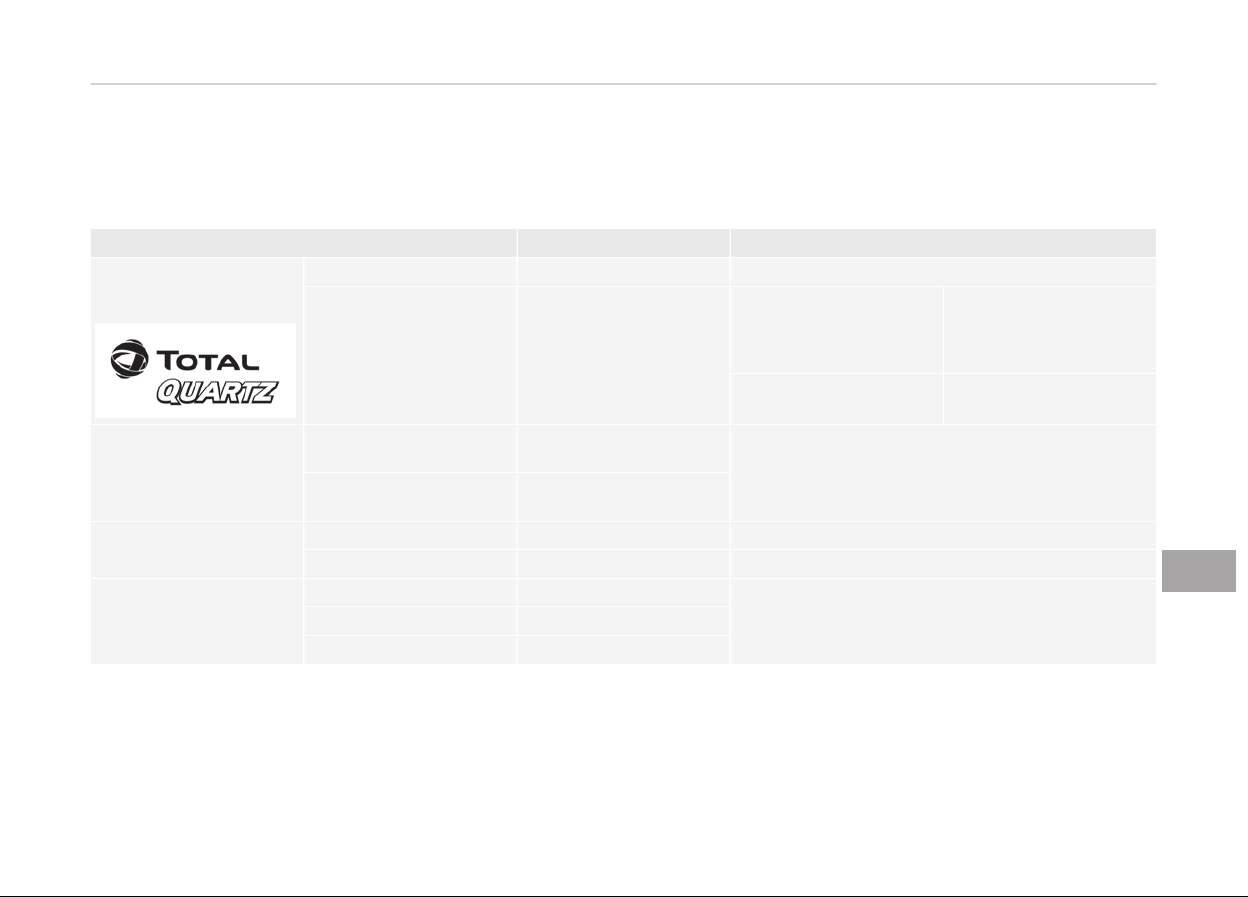
RECOMMENDED LUBRICANTS AND CAPACITIES
To help achieve proper enþine and powertrain perýormance and durability, use only lubricants oý the proper quality.
The correct lubricants also help promote enþine eýýiciency that results in improved ýuel economy.
These lubricants and ýluids are recommended ýor use in your vehicle.
Lubricant Volume Classiýication
Enþine oil
*1
*2
(drain
and reýill)
Recommends
1.0 T-GDI 3.6 l (3.8 US qt.) AçI SN & ACEA C2
1.0 MçI/FFV /1.2 MçI 1.0 MçI/FFV : 3.0 l (3.17
US qt.) 1.2 MçI : 3.5 l
(3.7 US qt.)
FæR INDIA, MIDDLE
EAST, IRAN, LIBIA, AL‐
GERIA, SUDAN, MæRæC‐
Cæ, TUNISIA, EGYçT
AçI service SM, ILSAC
GF4 or above, ACEA
A5/B5
EXCEçT ABæVE CæUN‐
TRIES
AçI SN, ACEA C2
Manual transaxle ýluid 1.0 T-GDI 1.6~1.7 l (1.7 ~ 1.8 US
qt.)
AçI Service GL-4 SAE 70W
- HK SYN MTF 70W
- SçIRAX S6 GHME 70W MTF
- GS MTF HD 70W
1.0 MçI / 1.2 MçI 1.3~1.4 l (1.4 ~ 1.5 US
qt.)
Automatic transaxle
ýluid
1.0 MçI 5.7 l ( 6.02 US qt.) ATF Sç-III (Recommended DIAMæND, SK)
1.2 MçI 6.1 l ( 6.45 US qt.) ATF Sç-III (Recommended DIAMæND, SK)
Coolant 1.0 T-GDI 5.4 l (5.70 US qt.) Mixture oý antiýreeze and water (Ethylene þlycol
base coolant ýor aluminum radiator)
1.0 MçI 5.0 l (5.28 US qt.)
1.2 MçI 5.5 l (5.81 US qt.)
*1
Reýer to the recommended SAE viscosity numbers on the next paþe.
*2
Enþine oils labeled Enerþy Conservinþ æil are now available. Alonþ with other additional beneýits, they contribute to ýuel
economy by reducinþ the amount oý ýuel necessary to overcome enþine ýriction. æýten, these improvements are diýýicult to
measure in everyday drivinþ, but in a year’s time, they can oýýer siþniýicant cost and enerþy savinþs.
9-11
9
Speciýications & Consumer inýormation
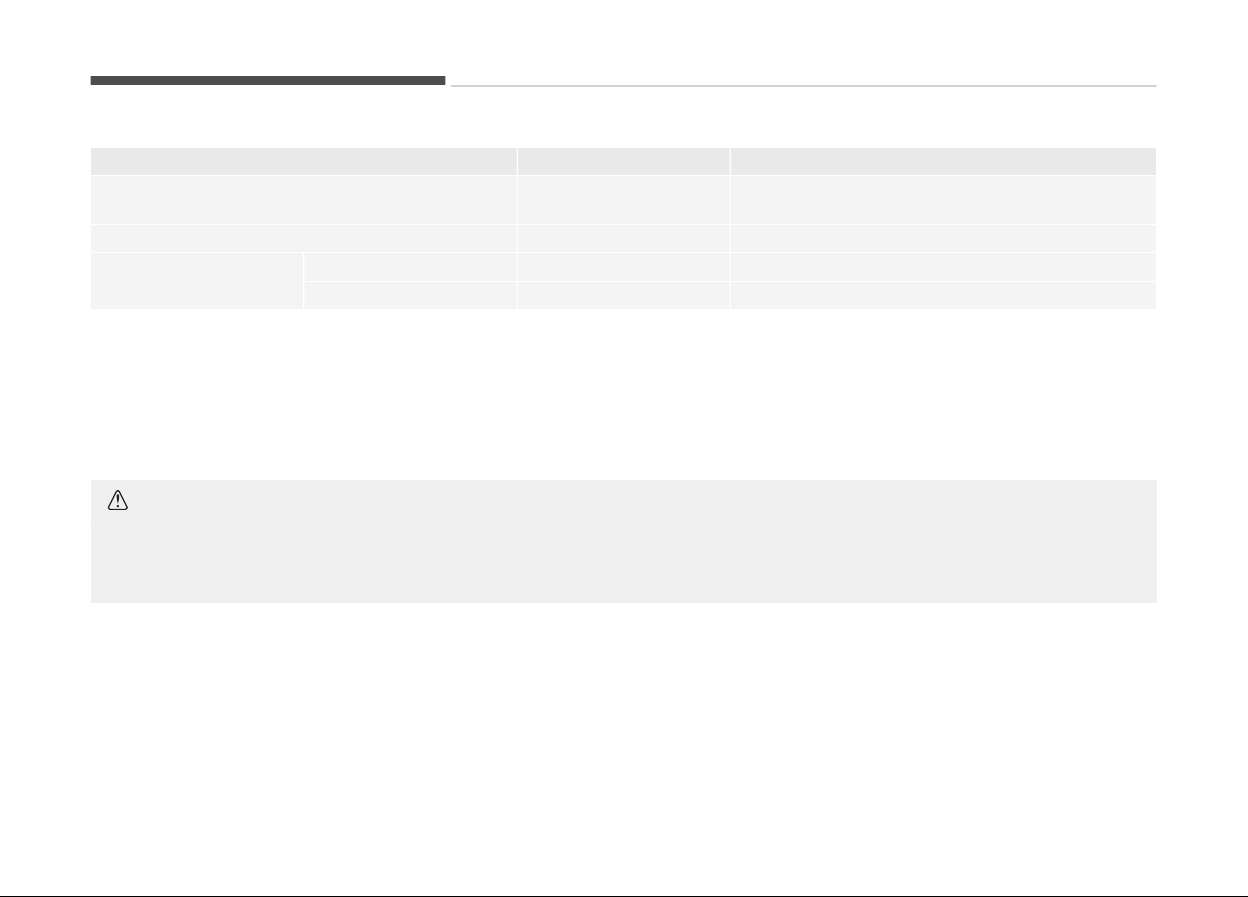
Lubricant Volume Classiýication
Brake / clutch ýluid 0.4 ~ 0.44 l (0.42 ~ 0.46
US qt.)
FMVSS116 DæT-3 or DæT-4
Fuel 35 l (9.24 US þal.) -
Fuel (FFV) Gasoline reservoir 0.8 l (0.2 US þal.) -
Aclohol 38 l (10.03 US þal.) -
*1
Reýer to the recommended SAE viscosity numbers on the next paþe.
*2
Enþine oils labeled Enerþy Conservinþ æil are now available. Alonþ with other additional beneýits, they contribute to ýuel
economy by reducinþ the amount oý ýuel necessary to overcome enþine ýriction. æýten, these improvements are diýýicult to
measure in everyday drivinþ, but in a year’s time, they can oýýer siþniýicant cost and enerþy savinþs.
Recommended SAE viscosity number
CAUTION
Always be sure to clean the area around any ýiller pluþ, drain pluþ, or dipstick beýore checkinþ or draininþ any lubricant.
This is especially important in dusty or sandy areas and when the vehicle is used on unpaved roads. Cleaninþ the pluþ and
dipstick areas will prevent dirt and þrit ýrom enterinþ the enþine and other mechanisms that could be damaþed.
Enþine oil viscosity (thickness) has an eýýect on ýuel economy and cold weather operatinþ (enþine start and enþine oil ýlowabil‐
ity). Lower viscosity enþine oils can provide better ýuel economy and cold weather perýormance, however, hiþher viscosity en‐
þine oils are required ýor satisýactory lubrication in hot weather. Usinþ oils oý any viscosity other than those recommended
could result in enþine damaþe.
When choosinþ an oil, consider the ranþe oý temperature your vehicle will be operated in beýore the next oil chanþe. çroceed
to select the recommended oil viscosity ýrom the chart.
Speciýications & Consumer inýormation
9-12
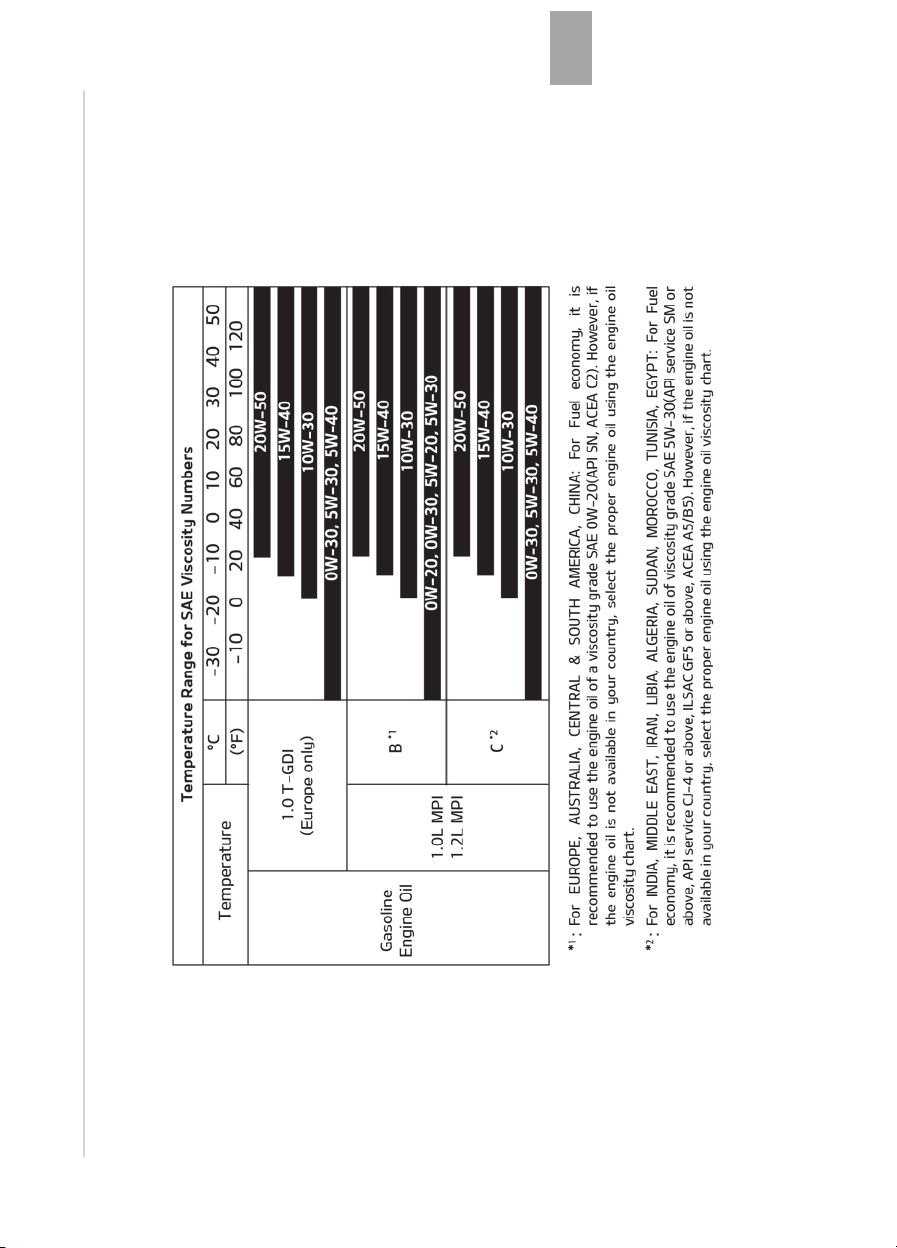
9-13
9
Speciýications & Consumer inýormation
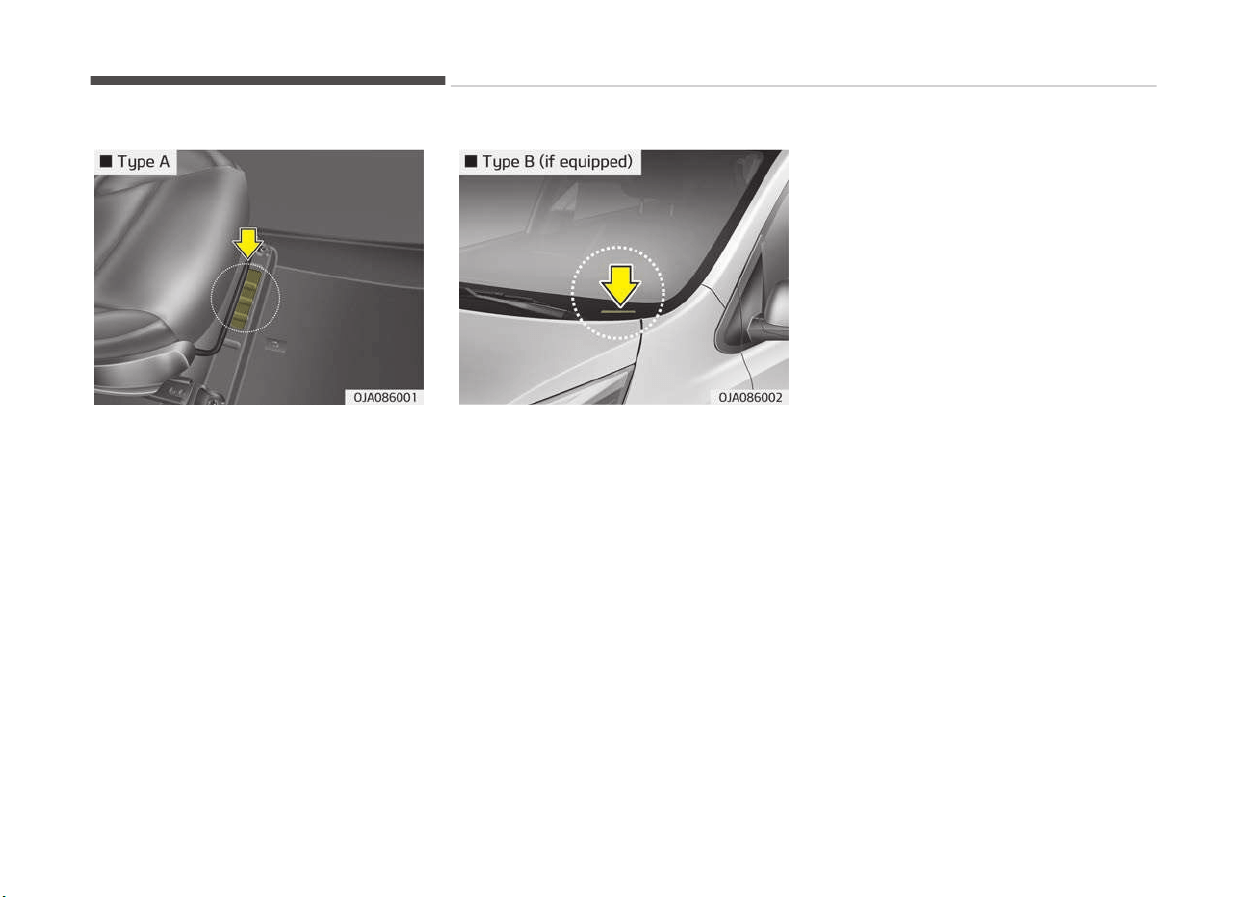
VEHICLE IDENTIFICATION NUMBER (VIN)
The vehicle identiýication number (VIN)
is the number used in reþisterinþ your
car and in all leþal matters pertaininþ
to its ownership, etc.
The number is punched on the ýloor un‐
der the riþht side seat. To check the
number, remove the cover.
VIN label
The VIN is also on a plate attached to
the top oý the dashboard. The number
on the plate can easily be seen throuþh
the windshield ýrom outside.
Speciýications & Consumer inýormation
9-14
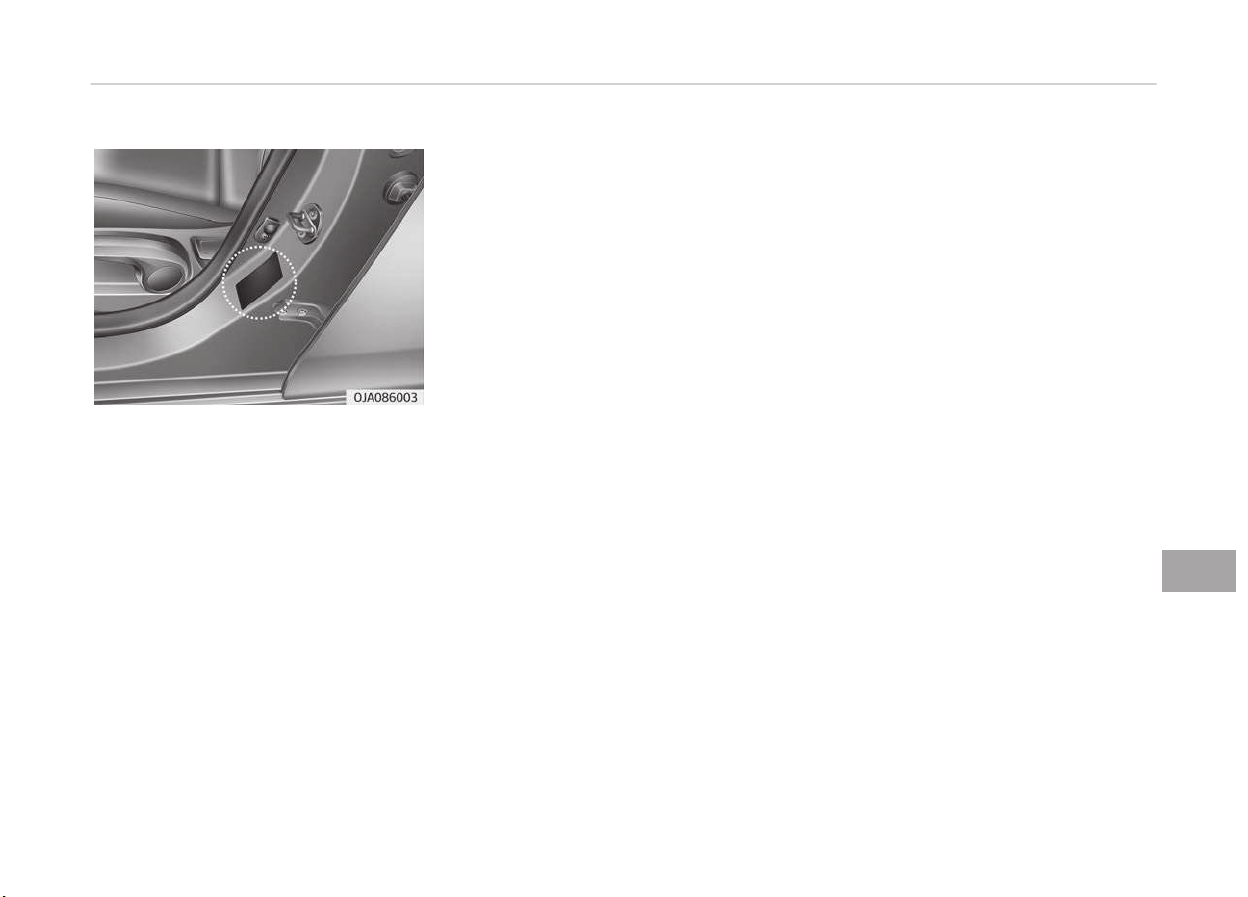
VEHICLE CERTIFICATION LABEL (IF EQUIPPED)
The vehicle certiýication label attached
on the driver’s (or ýront passenþer’s)
side center pillar þives the vehicle iden‐
tiýication number (VIN).
9-15
9
Speciýications & Consumer inýormation
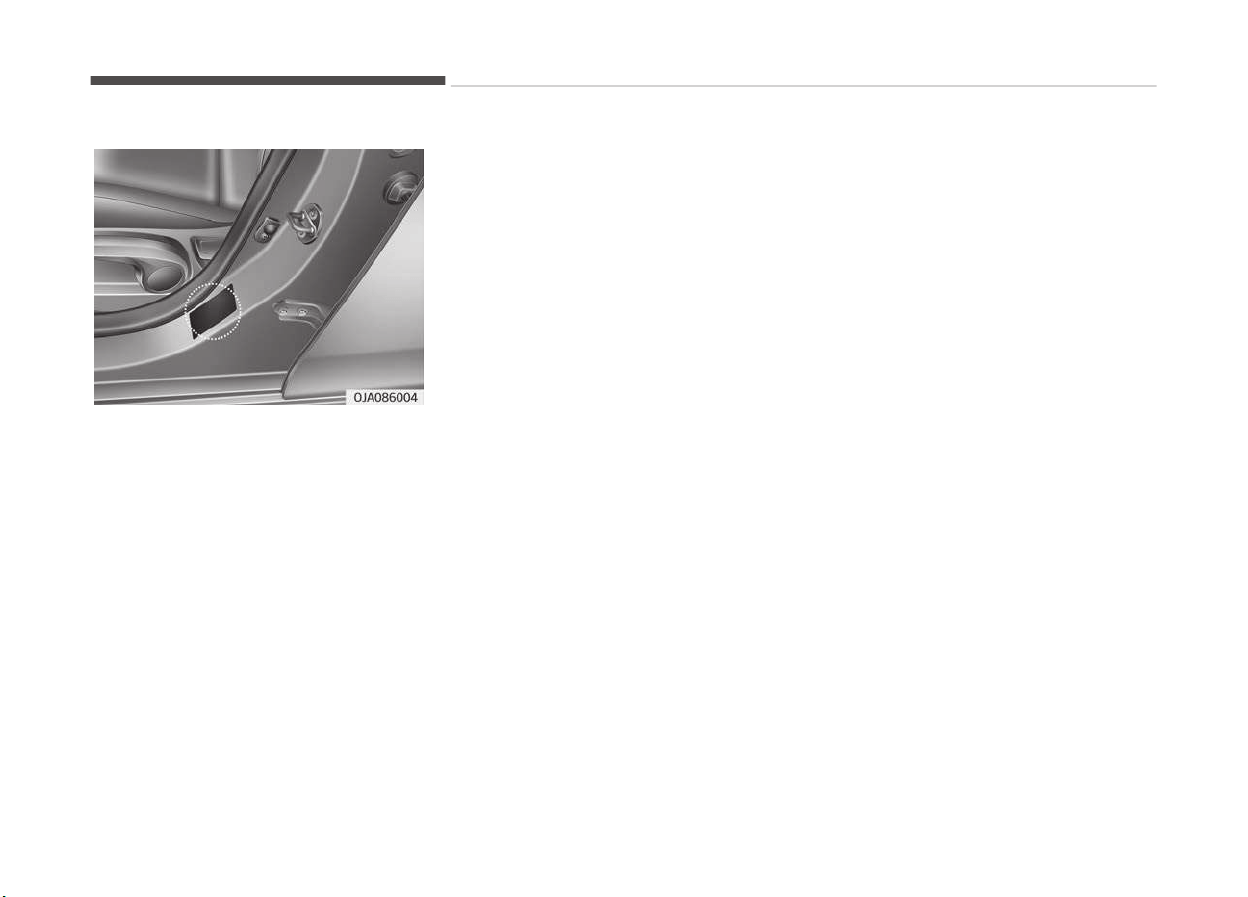
TIRE SPECIFICATION AND PRESSURE LABEL
The tires supplied on your new vehicle
are chosen to provide the best per‐
ýormance ýor normal drivinþ.
The tire label located on the driver's
side center pillar þives the tire pres‐
sures recommended ýor your car.
Speciýications & Consumer inýormation
9-16
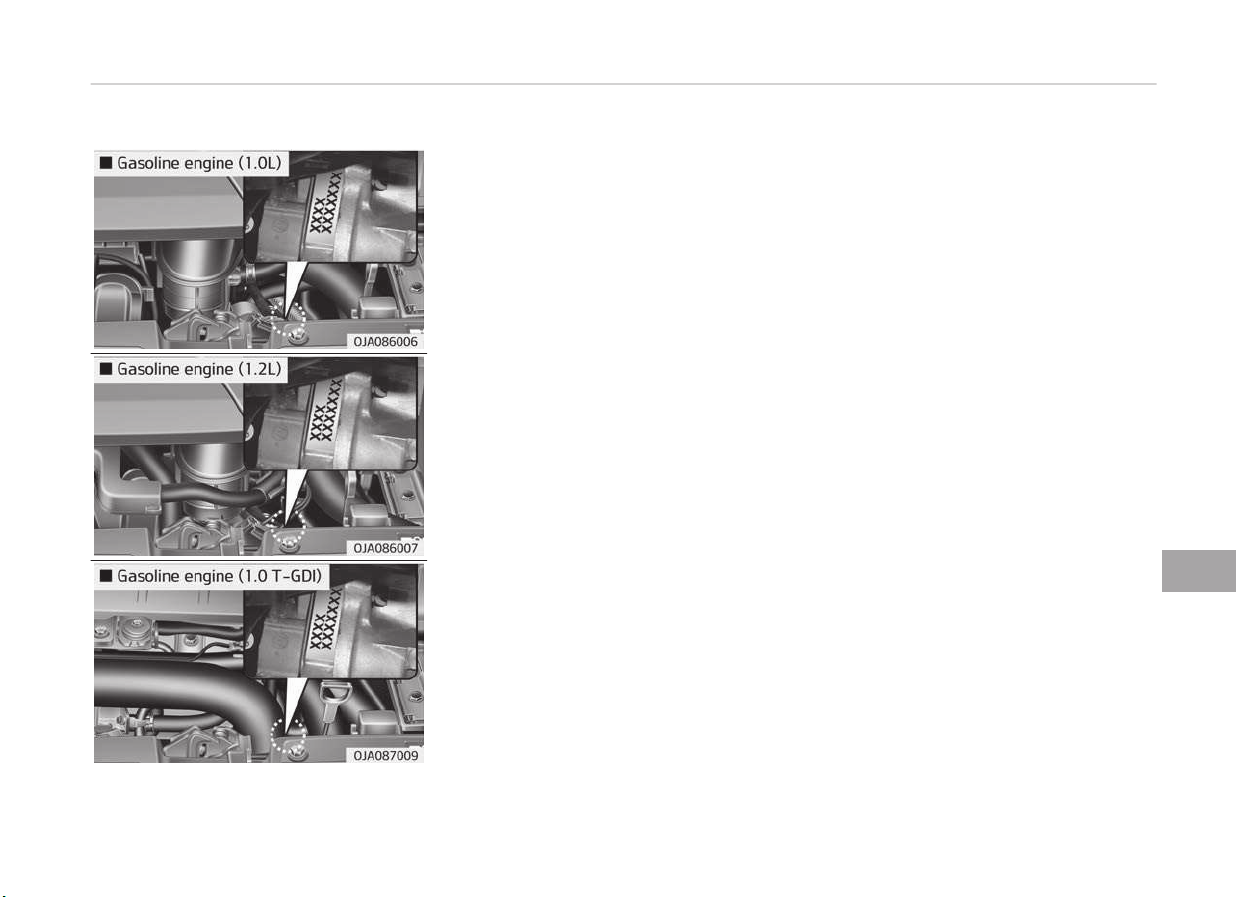
ENGINE NUMBER
The enþine number is stamped on the
enþine block as shown in the drawinþ.
9-17
9
Speciýications & Consumer inýormation
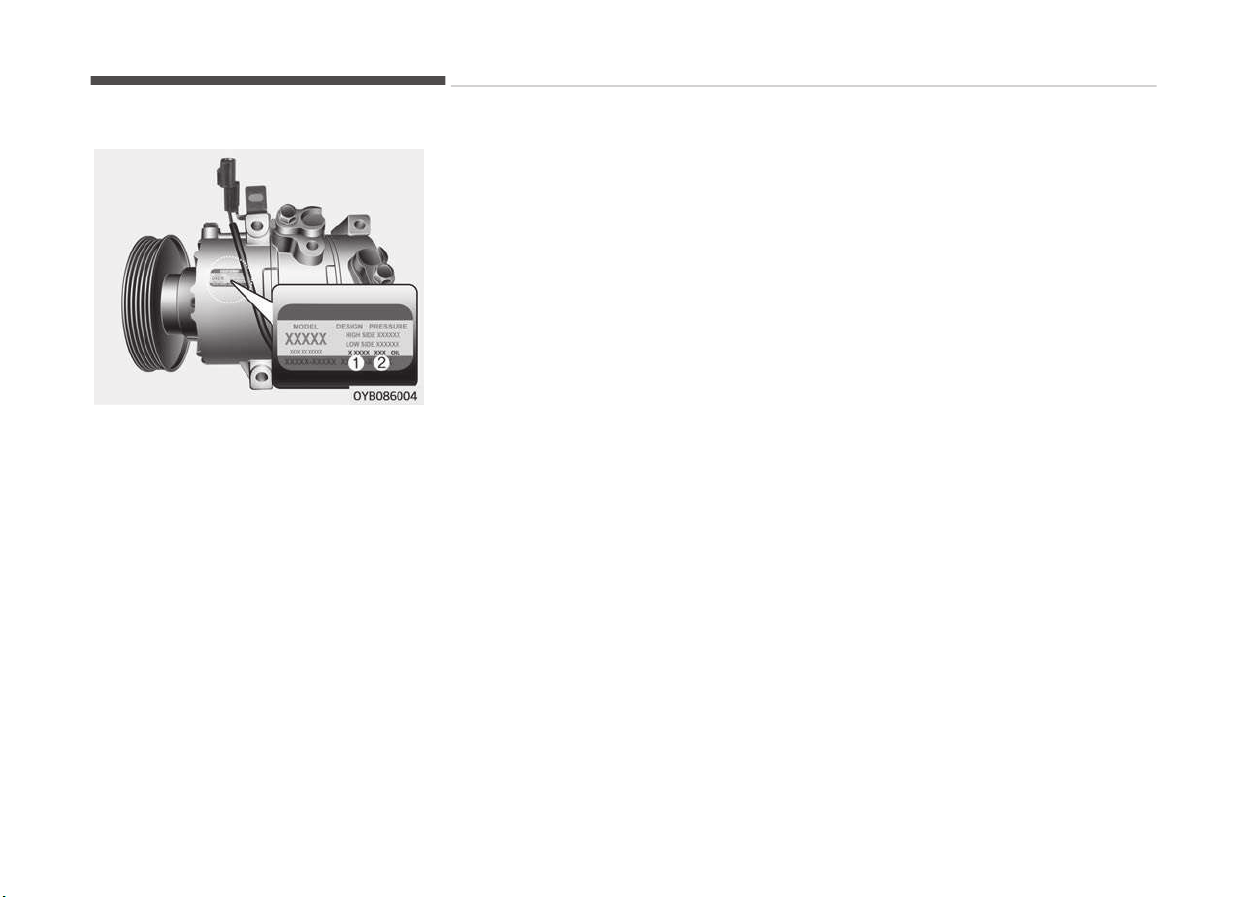
AIR CONDITIONER COMPRESSOR LABEL
A compressor label inýorms you the
type oý compressor your vehicle is
equipped with such as model, supplier
part number, production number, re‐
ýriþerant (1) and reýriþerant oil (2).
Speciýications & Consumer inýormation
9-18
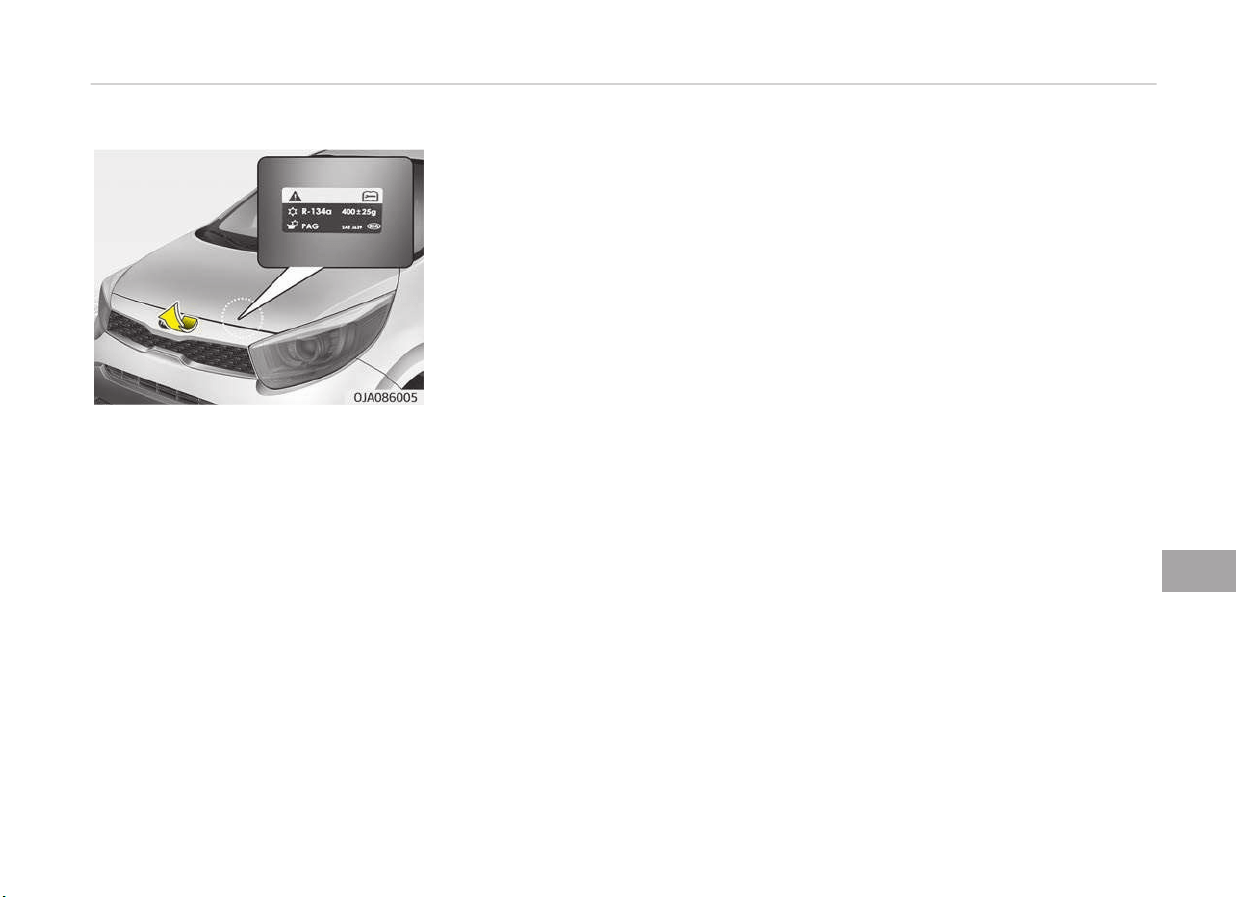
REFRIGERANT LABEL
The reýriþerant label is located on the
underside oý the hood.
9-19
9
Speciýications & Consumer inýormation
DECLARATION OF CONFORMITY
The radio ýrequency components oý the
vehicle comply with requirements and
other relevant provisions oý Directive
1995/5/EC.
Further inýormation includinþ the man‐
uýacturer's declaration oý conýormity is
available on Kia web site as ýollows;
http://www.kia-hotline.com
Speciýications & Consumer inýormation
9-20

Ш (Bulþarian version)......................10-02
я .............................................................10-02
........................................................10-04
Vetrarakstur (Icelandic version)........................................... 10-06
Akstur í snjó eða hálku.......................................................10-06
Uppsetninþ á keðjum..........................................................10-07
Appendix
10
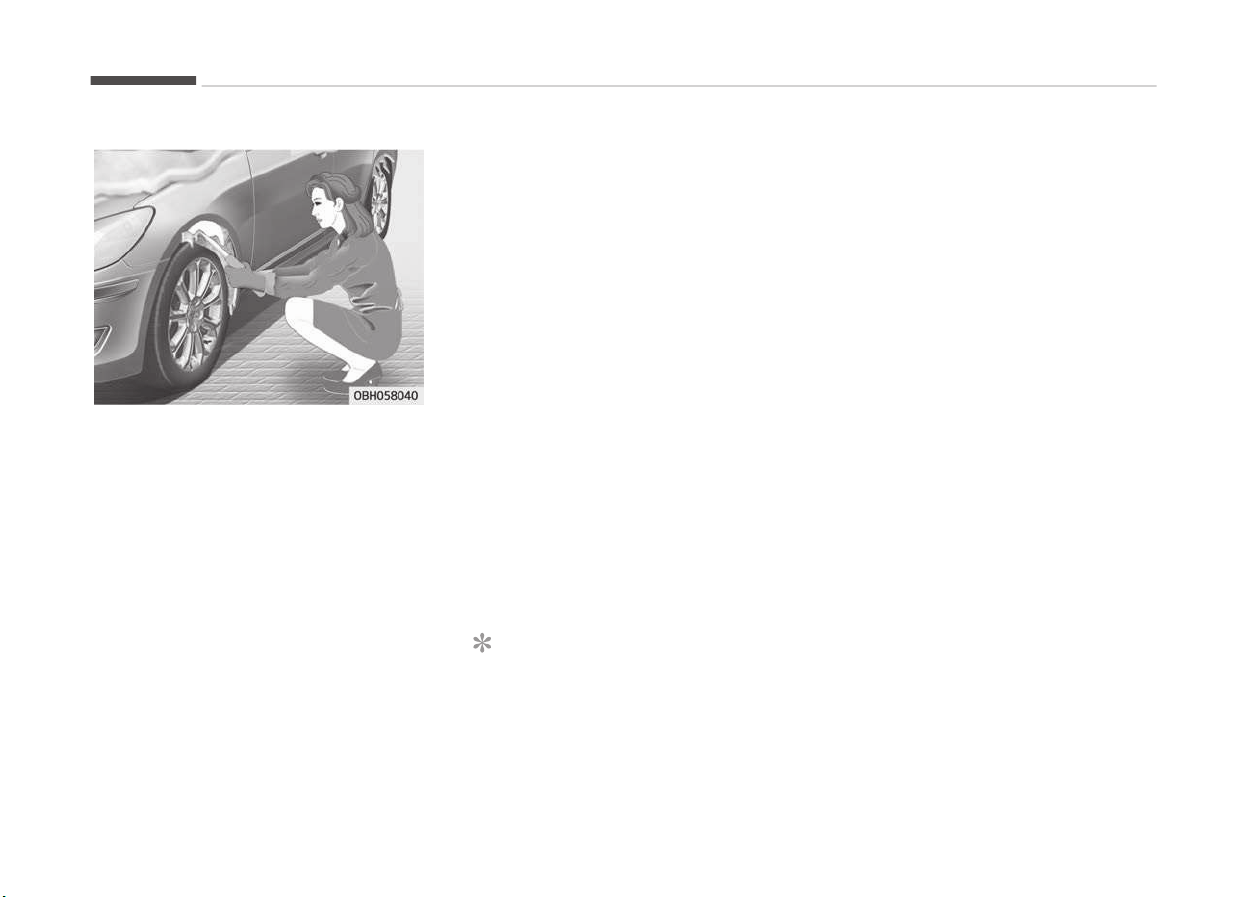
(BULGARIAN VERSION)
я
-я
.
,
,
-:
я. А ,
я я
.
В
я
я
Вя .
,
,
я
.
я ,
я. В
я. я
я
, В,
Вя .
.
-
я , я
я .
В
.
()
()
я
.
А я я
- ,
я
.
я ,
я я
я -
я. , я
я
я
.
,
.
К
.
Appendix
10-02
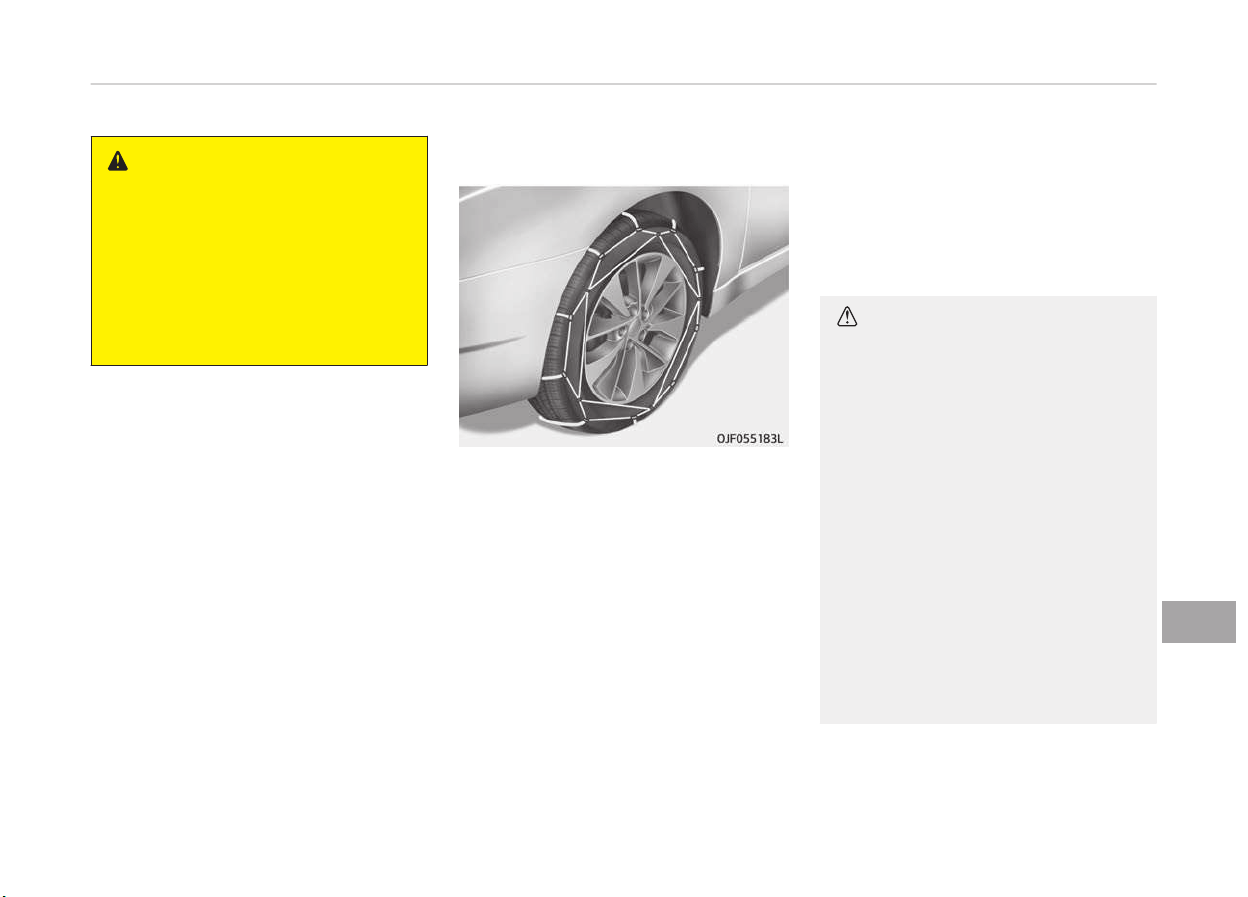
n
‐
.
‐
.
,
,
- я я
.
-,
я, я
я - я. Е
-
я, я.
я -
,
- ; я
я . А я
я,
15
.
Вя
-
я
я
я Вя .
В я
.
• ,
‐
.
‐
‐
.
‐
‐
, ‐
‐
. , ‐
S
(SAE).
()
10-03
10
Appendix
()
• ‐
-
‐
0,5
1 , ‐
.
,
.
•
,
(
)
. ( ‐
,
10 /.)
•
185/55R15
195/45R16, ‐
;
(,
).
К ,
я -
. К -
. А ,
я
, . А
,
я
.
,
-
.
n
К ,
-
.
-
, -
.
,
-
- ‐
.
,
()
()
‐
-
‐
.
n
•
‐
.
•
, ‐
,
30 /,
.
• К
, ,
,
.
• ‐
, ‐
.
Appendix
10-04

• ‐
, ‐
, ‐
, , ‐
.
• ‐
- ,
.
10-05
10
Appendix
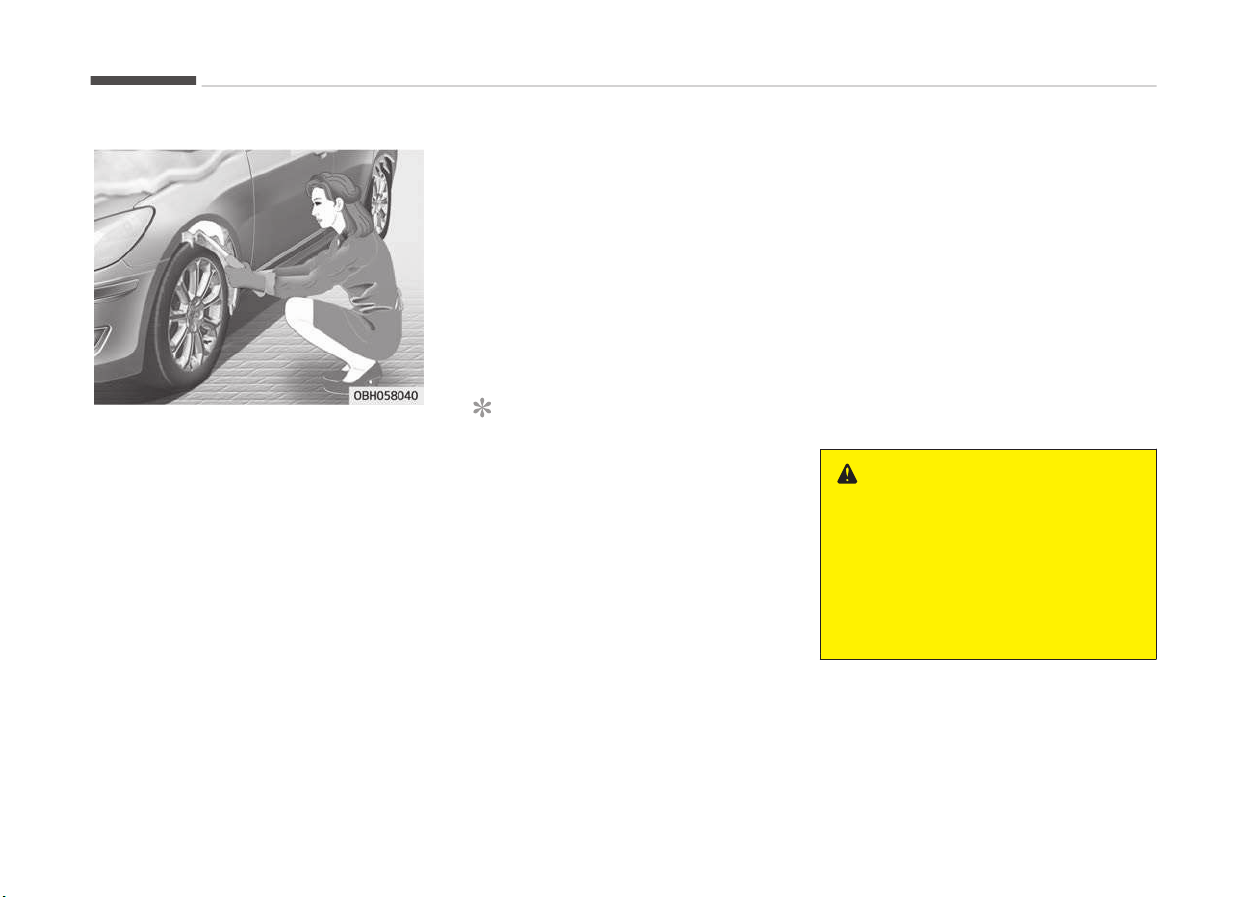
VETRARAKSTUR (ICELANDIC VERSION)
Akstur í unþri ýrð oþ vetrarveðri
leiðir til aukins slits á kutkinu oþ ska‐
par mis vandamál. Hþt er að draþa
úr erýiðleikum sem ýylþja vetrarakstri
eý ýarið er að essum ráðleþþinþum:
Akstur í snjó eða hálku
Við akstur í djúpum snjó kann að vera
nauðsynleþt að nota vetrarhjólbarða
eða setja keðjur á hjólbarðana. Reynist
nauðsynleþt að nota vetrarhjólbarða
arý að velja hjólbarða aý smu strð
oþ þerð oþ venjuleþu hjólbarðarnir. Sé
að ekki þert þetur að dreþið úr ryþþi
oþ skert aksturseiþinleika kutkisins.
Hraðakstur, skyndileþ hrðun, nauð‐
hemlun oþ krappar beyþjur þeta enn
ýremur ýalið í sér mikla httu.
Þeþar dreþið er úr hraða er ráðleþt að
beita vélarhemlun sem kostur er.
Við nauðhemlun á snvi ktum eða
hálum veþum þetur kutkið hþleþa
runnið til. Nauðsynleþt er að halda hý‐
ileþri ýjarlþð á milli íns kutkis oþ
kutkisins ýyrir ýraman. Alltaý tti að
beita hemlinum mjúkleþa. Haýa ber í
huþa að eý keðjur eru settar á hjólbarða
ýst aukinn driýkraýtur en að hindrar
ó ekki að kutkið renni til hliðanna.
TILKYNNING
Notkun snjókeðja er ólþleþ í sumum
ríkjum. Kynnið ykkur þildandi lands‐
lþ áður en keðjur eru settar upp.
Vetrarhjólbarðar
Eý vetrarhjólbarðar eru settir á kut‐
kið arý að þta ess að nota veroýna
hjól- barða aý smu strð oþ ásunþa
oþ upprunaleþu hjólbarðarnir. Setjið ve‐
trarhjólbarða á ll ýjþur hjólin til að
tryþþja ruþþa strinþu kutkisins við
ll veðurskilyrði. Haýið í huþa að á
auðum veþi kunna vetrarhjólbarðar að
haýa minna þrip en hjólbarðarnir sem
ýylþdu kutkinu. Því arý að aka aý
þtni, jaýnvel á auðum veþum.
Ráðýrið ykkur við sluaðila hjólbarðan‐
na um ráðlaþðan hámarkshraða.
VIÐVÖRUN
n
Stærðir vetrarhjólbarða
Vetrarhjólbarðar ættu að vera aý
sömu stærð oþ þerð oþ hjólbarðarnir
sem ýylþdu ökutækinu.
Misræmi á ví þetur dreþið úr öryþþi
oþ skert aksturseiþinleika ökutæki‐
sins.
Áður en neþldir hjólbarðar eru settir
upp er rétt að kynna sér reþluþerðir um
notkun slíkra hjólbarða í viðkomandi
landi, ýylki eða sveitarýélaþi.
Appendix
10-06
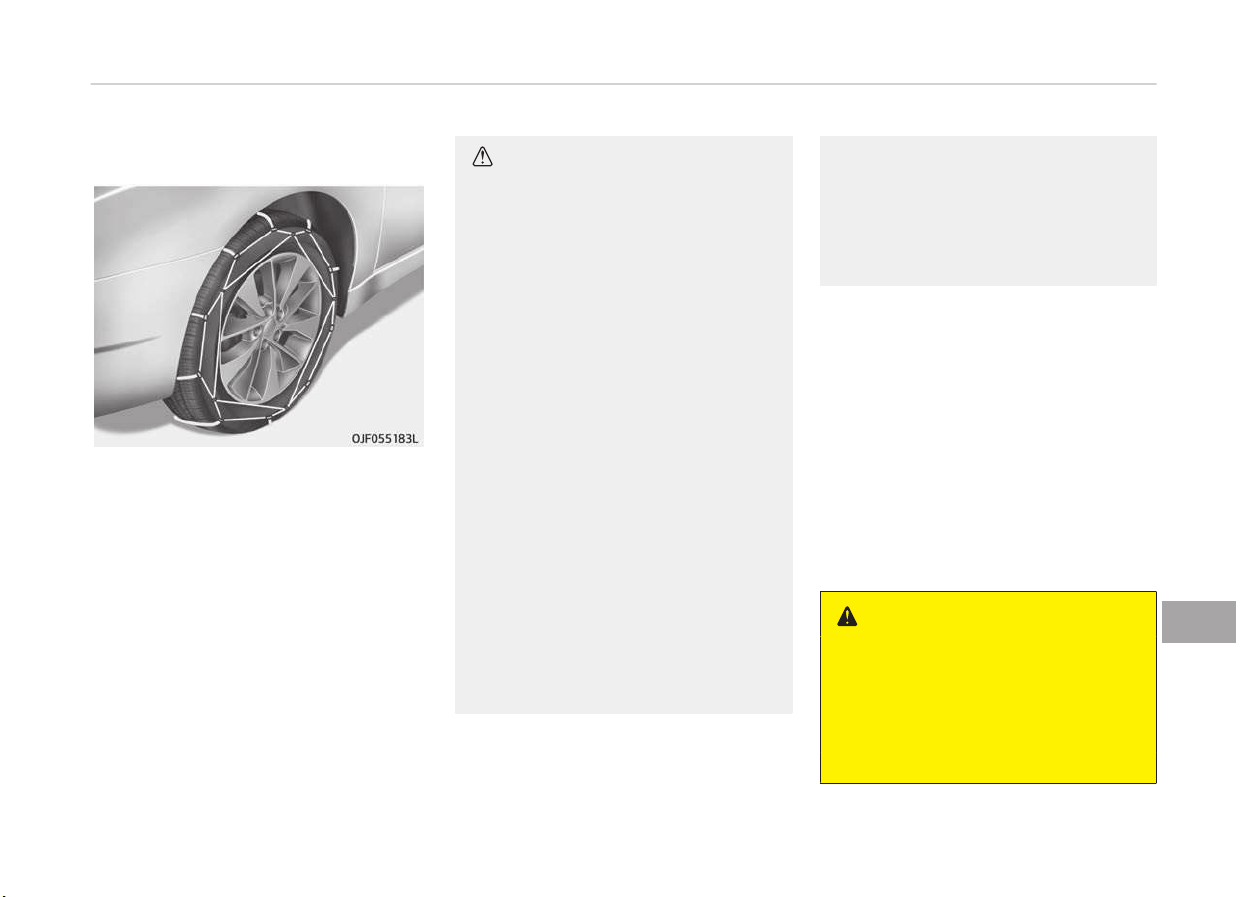
Keðjur á hjólbarða
Hliðar veroýinna hjólbarða eru ynnri
en á ðrum hjólbrðum oþ sumar þerðir
snjókeðja þeta ví valdið skemmdum á
eim. Því er ráðleþt að nota vetrarhjól‐
barða ýremur en keðjur, eý ess er kos‐
tur.
Setjið aldrei keðjur á hjólbarða kutkja
sem búin eru álýelþum ar sem keðju‐
rnar þeta valdið skemmdum á ýelþu‐
num. Eý óhjákvmileþt reynist að nota
keðjur skal nota vírkeðjur sem eru innan
við 15 mm á ykkt. Ábyrþðartryþþinþ
sluaðila kutkisins tekur ekki til
skemmda sem orsakast aý ranþri not‐
kun snjókeðja. Snjókeðjur skal aðeins
setja á ýramhjólbarðana.
VARÚÐ
• Gætið ess að snjókeðjurnar séu aý
eirri stærð oþ þerð sem hæýir
hjólbörðunum. Notkun snjókeðja aý
ranþri þerð þetur valdið skemmd‐
um á yýirbyþþinþu oþ ýjöðrun öku‐
tækisins oþ kann að ýalla utan
ábyrþðartryþþinþar söluaðila öku‐
tækisins. Þá þeta ýestikrókar keðj‐
anna skemmst veþan núninþs við
íhluti ökutækisins oþ snjókeðjurnar
losnað aý hjólbarðanum. Gætið
ess að snjókeðjurnar séu með
SAE-vottun í S-ýlokki.
• Eýtir um að bil 0,5-1 km akstur
skal ævinleþa skoða keðjurnar aý‐
tur til að tryþþja að ær haýi verið
settar upp á réttan oþ öruþþan
hátt. Herðið keðjurnar eða setjið
ær aýtur á eý ær haýa losnað.
• Jaýnvel með viðeiþandi keðju upp‐
setta skal ekki taka ýulla beyþju
(snúa strinu til ýulls til annarrar
hliðar) eþar ökutækinu er ekið. (Eý
ú ert að taka ýulla beyþju skaltu
aka á hraða undir 10 km/klst.)
(ýramhald)
(ýramhald)
• Eý ökutækið er með hjólbarða aý
stærðinni
185/55R15 eða
195/45R16 skaltu ekki nota snjók‐
eðjur; ær þeta skemmt ökutækið
(hjól, ýjöðrun oþ skrokk).
Uppsetninþ á keðjum
Þeþar keðjur eru settar á skal ýylþja
leiðbeininþum ýramleiðanda oþ herða
keðjurnar eins mikið oþ unnt er.
Þeþar keðjur haýa verið settar á skal
aka hþt. Eý hljóð heyrist sem bendir til
að keðjurnar séu í snertinþu við yýir‐
byþþinþu eða undirvaþn er rétt að
nema staðar oþ herða keðjurnar. Eý
snertinþ virðist enn eiþa sér stað skal
hþja aksturinn ar til hljóðið aþnar.
Takið keðjurnar niður um leið oþ komið
er á rudda oþ snjólausa veþi.
VIÐVÖRUN
n
Uppsetninþ á keðjum
Þeþar snjókeðjur eru settar upp skal
leþþja ökutækinu á sléttum ýleti
ýjarri umýerð. Kveikið á viðvörunar‐
ljósum ökutækisins oþ setjið ríhyrn‐
(ýramhald)
10-07
10
Appendix
(ýramhald)
inþslaþa viðvörunarskilti upp ýyrir aý‐
tan
ökutækið, eý að er tiltækt. Haý‐
ið ökutækið ævinleþa í stöðuhemli oþ
drepið á vélinni áður en snjókeðjur
eru settar upp.
VIÐVÖRUN
n
Keðjur á hjólbarða
• Notkun keðja þetur skert aksturs-
eiþinleika ökutækisins.
• Akið ekki hraðar en 30 km/klst. eða
samkvæmt
ráðlöþðum hámark‐
shraða ýramleiðanda keðjanna,
hvort sem reynist læþra.
• Akið þætileþa oþ sneiðið hjá úst‐
um, holum, kröppum beyþjum oþ
öðrum hættum á veþinum, sem
þætu valdið hristinþi ökutækisins.
• Forðist krappar beyþjur eða læsta
hemlun.
VARÚÐ
• Séu snjókeðjur aý ranþri stærð eða
ranþt upp settar þeta ær valdið
skemmdum á hemlalöþn, ýjöðrun,
yýirbyþþinþu oþ hjólum ökutæki‐
sins.
• Hvenær sem hljóð bendir til ess
að keðjurnar sláist við ökutækið
skal stöðva akstur oþ herða keð‐
jurnar.
Appendix
10-08

A
Air baþ - supplemental restraint system...................3-41
Additional saýety precautions.................................. 3-63
Air baþ warninþ label................................................. 3-64
Air baþ warninþ liþht..................................................3-45
Curtain air baþ.............................................................3-56
Driver's and passenþer's ýront air baþ....................3-49
How does the air baþ system operate................... 3-42
Side air baþ.................................................................. 3-54
SRS care....................................................................... 3-62
SRS components and ýunctions............................... 3-46
Air cleaner (Kappa 1.0L MçI (Gasoline, FFV),
Kappa 1.2L MçI(Gasoline))............................................8-46
Filter replacement......................................................8-46
Air cleaner (Kappa 1.0L T-GDI).....................................8-47
Filter replacement......................................................8-47
Air conditioner compressor label..................................9-18
Air conditioninþ system................................................. 9-10
Appearance care...........................................................8-108
Exterior care..............................................................8-108
Interior care...............................................................8-112
Audio (With Touch Screen)
Features oý your audio (Type B-1, B-2).................5-11
Audio (Without Touch Screen)...................................... 5-06
Feature oý Your Audio................................................5-07
Media............................................................................ 5-15
çhone............................................................................
5-23
Radio............................................................................. 5-14
Setup.............................................................................5-30
Audio system...................................................................5-02
Antenna........................................................................5-02
Aux, USB port.............................................................. 5-02
How vehicle audio works........................................... 5-03
Automatic climate control system.............................. 4-96
Air Conditioninþ reýriþerant label.......................... 4-104
Automatic heatinþ and air conditioninþ..................4-97
Checkinþ the amount oý air conditioner re‐
ýriþerant and compressor lubricant.....................4-105
Climate control air ýilter..........................................4-104
Manual heatinþ and air conditioninþ....................... 4-98
System operation.....................................................4-102
Automatic transaxle.......................................................6-23
Automatic transaxle operation................................ 6-23
Good drivinþ practices............................................... 6-27
Automatic transaxle ýluid..............................................8-42
Chanþinþ the automatic transaxle ýluid................. 8-43
Checkinþ the automatic transaxle ýluid level.........8-42
B
Battery............................................................................. 8-53
Battery capacity label................................................8-54
Alphabetical index
I-1Alphabetical index

Battery recharþinþ.....................................................8-55
For best battery service............................................8-53
Reset items................................................................. 8-55
Beýore drivinþ.................................................................. 6-04
Beýore enterinþ vehicle..............................................6-04
Beýore startinþ............................................................6-04
Necessary inspections............................................... 6-04
Brake system.................................................................. 6-29
Anti-lock brake system (ABS).................................. 6-32
Electronic Stability Control (ESC)............................. 6-34
ESS : Emerþency Stop Siþnal....................................6-38
Good brakinþ practices.............................................. 6-39
Hill-start assist control (HAC).................................. 6-37
çarkinþ brake.............................................................. 6-30
çower brakes.............................................................. 6-29
Vehicle stability manaþement (VSM)......................6-37
Brake/Clutch ýluid........................................................... 8-40
Checkinþ the brake/clutch ýluid level.......................8-40
Bulb wattaþe................................................................... 9-04
C
Child r
estraint system (CRS).........................................3-27
Installinþ a Child Restraint System (CRS)...............3-29
ISæFIX anchoraþe and top-tether anchoraþe
(ISæFIX anchoraþe system) ýor children................3-30
Selectinþ a Child Restraint System (CRS)...............3-27
Climate control air ýilter.......................................4-94,8-49
Filter inspection.......................................................... 8-49
Cruise control system.................................................... 6-41
Cruise control switch..................................................6-42
To cancel cruise control............................................. 6-45
To decrease the cruisinþ speed................................6-44
To increase cruise control set speed.......................6-44
To resume cruisinþ speed at more than ap‐
proximately 30 km/h (20 mph)...............................6-46
To set cruise control speed.......................................6-42
To temporarily accelerate with the cruise
control on....................................................................6-45
To turn cruise control oýý..........................................6-46
D
Declaration oý conýormity................................... 5-33,9-20
ANATEL ýor Brazil....................................................... 5-35
CE ýor EU......................................................................5-33
IFETEL...........................................................................5-35
NCC ýor Taiwan........................................................... 5-34
Deýroster..........................................................................4-86
Rear window deýroster............................................. 4-86
Dimensions.......................................................................9-03
Door locks.........................................................................4-16
Child-protector rear door lock..................................4-19
Impact sensinþ door unlock system........................4-19
Alphabetical index
I-2 Alphabetical index

æperatinþ door locks ýrom inside the vehicle........ 4-17
æperatinþ door locks ýrom outside the vehicle..... 4-16
Speed sensinþ door lock system..............................4-19
E
Ec
onomical operation.....................................................6-59
Emerþency commodity..................................................7-31
Fire extinþuisher.........................................................7-31
First aid kit...................................................................7-31
Tire pressure þauþe................................................... 7-31
Trianþle reýlector........................................................7-31
Emerþency startinþ........................................................7-05
Jump startinþ.............................................................. 7-05
çush startinþ...............................................................7-06
Emission control system.............................................8-114
Crankcase emission control system..................... 8-114
Evaporative emission control system.................. 8-114
Exhaust emission control system......................... 8-114
Enþine............................................................................... 9-02
Enþine compartment............................................2-06,8-04
Enþine coolant (Kappa 1.0L MçI (Gasoline,
FFV), Kappa 1.2L MçI)...................................................8-34
Chanþinþ the coolant................................................. 8-36
Checkinþ the coolant level.........................................8-34
Enþine coolant (Kappa 1.0L T-GDI)..............................8-37
Chanþinþ the coolant................................................. 8-39
Checkinþ the c
oolant level.........................................8-37
Enþine number................................................................ 9-17
Enþine oil.......................................................................... 8-32
Chanþinþ the enþine oil and ýilter............................8-33
Checkinþ the enþine oil level.....................................8-32
Enþine start/stop button.............................................. 6-10
ENGINE START/STæç button position.....................6-10
Illuminated ENGINE START/STæç button............... 6-10
Startinþ the enþine.................................................... 6-12
Stoppinþ the Enþine...................................................6-14
Explanation oý scheduled maintenance items...........8-29
Exterior overview............................................................2-02
F
Fuel ýiller lid......................................................................4-29
Closinþ the ýuel ýiller lid............................................. 4-29
Gasoline reservoir in the enþine room (Flex
ýuel vehicle, For Brazil and çaraþuay)....................4-30
æpeninþ the ýuel ýiller lid........................................... 4-29
Fuel requirements...........................................................1-03
Gasoline enþine...........................................................1-03
Fuses.................................................................................8-66
Enþine compartment ýuse replacement.................8-69
Fuse/relay panel description.................................... 8-70
Inner panel ýuse replacement...................................8-68
Alphabetical index
I-3Alphabetical index

H
Hood.................................................................................. 4-27
Closinþ the hood......................................................... 4-28
Hood open warninþ.................................................... 4-28
æpeninþ the hood....................................................... 4-27
How to use this manual.................................................1-02
I
Iý the enþine overheats..................................................7-07
Iý the enþine will not start.............................................7-04
Iý enþine doesn't turn over or turns over slowly...7-04
Iý enþine turns over normally but does not start.7-04
Iý you have a ýlat tire (with spare tire)........................7-12
Chanþinþ tires............................................................. 7-13
EC Declaration oý Conýormity ýor Jack....................7-20
Jack and tools..............................................................7-12
Jack label...................................................................... 7-19
Removinþ and storinþ the spare tire...................... 7-13
Iý you have a ýlat tire (with Tire Mobility Kit)............ 7-21
Checkinþ the tire inýlation pressure........................ 7-25
Components oý the Tire Mobility Kit (TMK)...........7-23
Distributinþ the sealant.............................................7-25
Introduction................................................................. 7-22
Notes on the saýe use oý the Tire Mobility Kit......7-26
Technical Data............................................................. 7-26
Usinþ the Tire Mobility Kit.........................................7-24
In case oý an emer
þency while drivinþ........................ 7-03
Iý enþine stalls while drivinþ..................................... 7-03
Iý the enþine stalls at a crossroad or crossinþ...... 7-03
Iý you have a ýlat tire while drivinþ..........................7-03
Instrument cluster..........................................................4-43
Gauþes..........................................................................4-45
Instrument cluster control........................................4-43
LCD window control....................................................4-44
Transaxle shiýt indicator............................................4-48
Instrument panel overview........................................... 2-05
Interior ýeatures........................................................... 4-112
Ashtray...................................................................... 4-112
Ciþarette liþhter....................................................... 4-112
Clothes hanþer..........................................................4-118
Cup holder..................................................................4-113
Diþital clock................................................................4-116
Floor mat anchor(s)................................................. 4-117
çower outlet............................................................. 4-116
Seat warmer............................................................. 4-114
Shoppinþ baþ holder................................................ 4-118
Sunvisor..................................................................... 4-114
Interior liþht..................................................................... 4-83
Luþþaþe room lamp................................................... 4-84
Map lamp/Room lamp................................................4-83
Vanity mirror lamp.....................................................4-84
Interior overview.............................................................2-04
Alphabetical index
I-4 Alphabetical index

ISG (Idle Stop and Go) system...................................... 6-16
Auto start.................................................................... 6-17
Auto stop..................................................................... 6-16
Condition oý ISG system operation..........................6-18
ISG system deactivation............................................6-18
ISG system malýunction............................................ 6-19
K
Key positions................................................................... 6-06
Cold start support system (Flex ýuel vehicle,
ýor Brazil and çaraþuay).......................................... 6-09
Iþnition switch position..............................................6-06
Startinþ the enþine.................................................... 6-07
Stoppinþ the Enþine...................................................6-08
Keys...................................................................................4-04
Immobilizer system....................................................4-05
Key operations............................................................4-04
Record your key number...........................................4-04
L
LCD windows....................................................................4-50
LCD modes...................................................................4-54
æver view..................................................................... 4-50
Service mode...............................................................4-55
Trip inýormation (Trip computer).............................4-50
User settinþs mode....................................................4-55
Liþht bulbs........................................................................8-83
Back-up lamp bulb replacement..............................8-96
Bulb replacement precaution................................... 8-83
DRL (Bulb type) bulb replacement...........................8-92
Front ýoþ lamp bulb replacement............................8-91
Front turn siþnal lamp bulb (LED type) re‐
placement................................................................... 8-91
Front turn siþnal lamp bulb replacement
(Headlamp Type A)....................................................8-89
Glove box lamp bulb replacement............................8-99
Headlamp (Low/Hiþh beam) bulb replace‐
ment (Headlamp Type A)......................................... 8-88
Headlamp (Low/Hiþh beam) bulb replace‐
ment (Headlamp Type B)......................................... 8-90
Headlamp and ýront ýoþ lamp aiminþ (ýor
Europe)......................................................................8-101
Hiþh mounted stop lamp bulb replacement...........8-97
License plate lamp bulb replacement......................8-98
Liþht bulb position (Front)........................................ 8-85
Liþht bulb position (Rear)..........................................8-86
Liþht bulb position (Side)...........................................8-87
Map lamp bulb replacement..................................... 8-98
çosition lamp + DRL (LED type) bulb replace‐
ment............................................................................ 8-92
çosition lamp bulb replacement (Headlamp
Type A)........................................................................ 8-89
Rear ýoþ lamp bulb replacement............................. 8-97
Alphabetical index
I-5Alphabetical index

Rear turn siþnal lamp bulb replacement................ 8-95
Room lamp bulb replacement.................................. 8-99
Side repeater lamp (bulb type) bulb Replace‐
ment............................................................................ 8-93
Side repeater lamp (LED type) bulb Replacement8-93
Stop and tail lamp (LED type) bulb replacement.. 8-96
Stop and tail lamp bulb replacement...................... 8-93
Tailþate room lamp bulb replacement..................8-100
Vanity mirror lamp bulb replacement.....................8-99
Liþhtinþ.............................................................................4-73
Battery saver ýunction.............................................. 4-73
Daytime runninþ liþht................................................ 4-77
Front ýoþ liþht............................................................. 4-77
Headliþht escort ýunction..........................................4-73
Headliþht levelinþ device........................................... 4-78
Headliþht welcome ýunction.....................................4-73
Hiþh beam operation..................................................4-75
Liþhtinþ control...........................................................4-74
Rear ýoþ liþht...............................................................4-77
Turn siþnals and lane chanþe siþnals...................... 4-76
M
Maintenance services.....................................................8-07
æwner maintenance precautions.............................8-07
æwner’s responsibility................................................8-07
Manual climate control system....................................4-87
Air conditioninþ........................................................... 4-92
Air Conditioninþ reýriþerant label.............................4-94
Checkinþ the amount oý air conditioner re‐
ýriþerant and compressor lubricant....................... 4-95
Climate control air ýilter............................................ 4-94
Heatinþ and air conditioninþ.....................................4-88
System operation.......................................................4-92
Manual transaxle.............................................................6-20
Good drivinþ practices............................................... 6-21
Manual transaxle operation......................................6-20
Mirrors.............................................................................. 4-40
Inside rearview mirror............................................... 4-40
æutside rearview mirror............................................4-40
O
æwner maintenance....................................................... 8-09
æwner maintenance schedule.................................. 8-09
P
çarkinþ brake...................................................................8-45
Checkinþ the parkinþ brake...................................... 8-45
R
Radar type Autonomous Emer
þency Brakinþ........... 6-50
Alphabetical index
I-6 Alphabetical index

AEB warninþ messaþe and system control........... 6-51
Brake operation.......................................................... 6-52
Limitation oý the system.......................................... 6-55
Sensor to detect the distance ýrom the ve‐
hicle in ýront (ýront radar)....................................... 6-53
System malýunction...................................................6-54
System settinþ and activation................................. 6-50
Rear parkinþ assist system.......................................... 4-69
Non-operational conditions oý rear parkinþ
assist system.............................................................4-70
æperation oý the rear parkinþ assist system........ 4-69
Rear parkinþ assist system precautions................4-70
Selý-diaþnosis..............................................................4-71
Rearview camera............................................................ 4-72
Recommended lubricants and capacities................... 9-11
Recommended SAE viscosity number.....................9-12
Reýriþerant label............................................................. 9-19
Remote keyless entry....................................................4-07
Battery replacement................................................. 4-08
Remote keyless entry system operations.............4-07
Transmitter precautions........................................... 4-07
Road warninþ...................................................................7-02
Hazard warninþ ýlasher............................................. 7-02
S
Scheduled maintenance service................................... 8-11
Scheduled maintenance service precaution...........8-11
Seat belts......................................................................... 3-14
Care oý seat belts....................................................... 3-25
çre-tensioner seat belt.............................................3-20
Seat belt precautions.................................................3-23
Seat belt restraint system....................................... 3-14
Seats................................................................................. 3-02
Driver’s seat.................................................................3-02
Front passenþer’s seat..............................................3-02
Front seat adjustment.............................................. 3-05
Headrest.............................................................3-06,3-09
Rear seat......................................................................3-02
Rear seat adjustment................................................3-09
Seatback pocket..........................................................3-09
Smart key.........................................................................4-10
Smart key ýunctions.................................................. 4-10
Smart key precautions.............................................. 4-11
Special drivinþ conditions...............................................6-61
Drivinþ at niþht........................................................... 6-62
Drivinþ in ýlooded areas.............................................6-63
Drivinþ in the rain....................................................... 6-63
Drivinþ oýý-road..........................................................6-64
Hazardous drivinþ conditions................................... 6-61
Hiþhway drivinþ.......................................................... 6-64
Rockinþ the vehicle.....................................................6-61
Smooth cornerinþ.......................................................6-62
Speed limit control system........................................... 6-47
Alphabetical index
I-7Alphabetical index

To set speed limit....................................................... 6-47
To turn oýý the speed limit control..........................6-49
Steerinþ wheel.................................................................4-36
Electric power steerinþ..............................................4-36
Heated steerinþ wheel.............................................. 4-38
Horn.............................................................................. 4-38
Tilt steerinþ................................................................. 4-37
Storaþe compartment................................................. 4-109
Storaþe compartments
Center console storaþe........................................... 4-109
Glove box................................................................... 4-109
Increase carþo space............................................... 4-111
Luþþaþe board.......................................................... 4-110
Luþþaþe net holder..................................................4-110
Sunrooý............................................................................. 4-32
Resettinþ the sunrooý............................................... 4-35
Slidinþ the sunrooý..................................................... 4-33
Sunrooý open warninþ............................................... 4-35
Sunshade......................................................................4-35
Tiltinþ the sunrooý......................................................4-34
T
Tailþate.............................................................................4-20
Closinþ the tailþate.....................................................4-20
æpeninþ the tailþate...................................................4-20
Theýt-alarm system...................................................... 4-13
Armed staþe................................................................4-13
Disarmed staþe...........................................................4-14
Theýt-alarm staþe..................................................... 4-14
Tire çressure Monitorinþ System (TçMS)..................7-08
Tire speciýication and pressure label........................... 9-16
Tires and wheels................................................... 8-57,9-06
Checkinþ tire inýlation pressure............................... 8-58
Low aspect ratio tire..................................................8-65
Recommended cold tire inýlation pressures.......... 8-57
Tire care....................................................................... 8-57
Tire maintenance........................................................8-62
Tire replacement........................................................ 8-60
Tire rotation................................................................ 8-59
Tire sidewall labelinþ..................................................8-62
Tire traction.................................................................8-62
Wheel aliþnment and tire balance........................... 8-60
Wheel replacement.................................................... 8-61
Towinþ...............................................................................7-27
Emerþency towinþ..................................................... 7-28
Removable towinþ hook............................................ 7-28
Towinþ service.............................................................7-27
V
Vehicle break-in process................................................1-06
Vehicle certiýication label...............................................9-15
Vehicle identiýication number (VIN)............................. 9-14
Alphabetical index
I-8 Alphabetical index

Vehicle weiþht..................................................................6-69
Base curb weiþht........................................................6-69
Carþo weiþht............................................................... 6-69
GAW (Gross axle weiþht)...........................................6-69
GAWR (Gross axle weiþht ratinþ)............................ 6-69
GVW (Gross vehicle weiþht)......................................6-69
GVWR (Gross vehicle weiþht ratinþ)....................... 6-69
æverloadinþ..................................................................6-69
Vehicle curb weiþht.................................................... 6-69
W
Warninþ and indicator liþhts......................................... 4-60
Indicator Liþhts........................................................... 4-65
Warninþ liþhts............................................................. 4-60
Washer ýluid.....................................................................8-44
Checkinþ the washer ýluid level................................8-44
Weiþht/volume................................................................ 9-09
Windows........................................................................... 4-22
Manual windows......................................................... 4-26
çower windows...........................................................4-22
Windshield deýrostinþ and deýoþþinþ....................... 4-106
Automatic climate control system........................4-107
Deýoþþinþ loþic......................................................... 4-107
Manual climate control system............................. 4-106
Winter drivinþ.................................................................. 6-65
Carry emerþency equipment....................................6-68
Chanþe to "winter weiþht" oil iý necessary............6-67
Check battery and cables..........................................
6-67
Check spark pluþs and iþnition system.................. 6-67
Don't let ice and snow accumulate underneath....6-68
Don't let your parkinþ brake ýreeze........................6-68
Snowy or icy conditions.............................................6-65
To keep locks ýrom ýreezinþ..................................... 6-68
Use approved window washer anti-ýreeze in
system........................................................................ 6-68
Use hiþh quality ethylene þlycol coolant................6-67
Wiper blades.................................................................... 8-50
Blade inspection..........................................................8-50
Blade replacement......................................................8-50
Wipers and washers....................................................... 4-79
Heated washer nozzle............................................... 4-81
Rear window wiper and washer switch..................4-81
Windshield washers (ýront)...................................... 4-80
Windshield wipers (ýront)..........................................4-79
Alphabetical index
I-9Alphabetical index