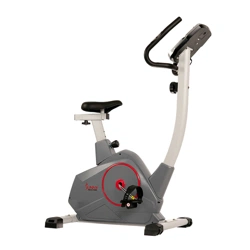
CHAIN DRIVE PREMIUM INDOOR
CYCLING BIKE
SF-B1509C
USER MANUAL
IMPORTANT!
Please retain owner’s manual for maintenance and adjustment
We thank you for choosing our product. To ensure your safety and health. please use this equipment correctly. It is important to read this entire manual before assembling and using the equipment. Safe and effective use can only be achieved if the equipment is assembled. maintained and used properly. It is your responsibility to ensure that all users of the equipment are informed of all warnings and precautions.
1. Before starting any exercise program. you should consult your physician to
2. Be aware of your body’s signals. Incorrect or excessive exercise can damage your
3. Keep children and pets away from the equipment. The equipment is designed for
4. Use the equipment on a solid. flat level surface with a protective cover for your
5. Ensure that all nuts and bolts are securely tightened before using the equipment.
The safety of the equipment can only be maintained if it is regularly examined for damage and/or wear and tear.
6. Always use the equipment as indicated. If you find any defective components while
7. Wear suitable clothing while using the equipment. Avoid wearing loose clothing
8. Do not place fingers or objects into the moving parts of the equipment.
9. The maximum weight capacity of this unit is 300 pounds (135 KG).
10.The equipment is not suitable for therapeutic use.
11.To avoid bodily injury and/or damage to the product or property. proper lifting and
12.Your product is intended for use in cool and dry conditions. You should avoid
13.This equipment is designed for indoor and home use only; it is not intended for
Ordering Replacement Parts (U.S. and Canadian Customers only)
Please provide the following information in order for us to accurately identify the part(s) needed:
The model number (found on cover of manual)
The product name (found on cover of manual)
The part number found on the “EXPLODED DIAGRAM” and “PARTS LIST” (found
ADJUSTMENT GUIDE
ADJUSTING THE HEIGHT AND BALANCE
In order to achieve a smooth and comfortable ride. you must ensure that the stability of the bike is secured. If you notice that the bike is unbalanced during use. you should adjust the foot levelers located beneath the Front and Rear Stabilizers of the bike. To do so. use Spanner (No. 80) to loosen 2 Nuts (No. 48) by turning it clockwise (direction A). With the nut loosened. rotate the Foot Leveler (No. 15) until it sits level with the surface that the bike is on. When you have finished adjusting the foot leveler. use Spanner (No. 80) to re-tighten the 2 Nuts (No. 48) by turning it counter-clockwise (direction B). If required. repeat this process to adjust the remaining foot levelers.
ADJUSTING THE SEAT
The seat of this bike is fully adjustable as it moves Up. Down. Fore (forward). Aft (backward).
To adjust the height of the Seat Post (No. 2). loosen and pull the Adjustment Knob (No. 16) outward. then raise or lower the seat to the desired height. Once adjusted. re-insert and tighten the Adjustment Knob (No. 16) to secure the seat in place.
To adjust the seat back and forth. loosen and pull Adjustment Knob (No. 16) outward. then slide the Seat Slider Tube (No. 8) to the desired position. Once positioned. re-insert and tighten the Adjustment Knob (No. 16) to secure the seat slider tube in place.
ADJUSTING THE HANDLEBAR
It is important that the handlebar and seat are both set to the correct height of your body. To adjust the handlebar height. loosen and pull the Adjustment Knob (No. 16) outward. then slide the Handlebar Post (No. 4) up or down to the desired height. Once adjusted re-insert and tighten the Adjustment Knob (No. 16) to secure the handlebar post in place.
PEDAL STRAP ADJUSTMENT
Your feet should be secured in the toe clips during exercise. Place your feet as far forward into the toe-clips as you can. With your feet in place. turn the crank to bring one foot to within arm’s reach. grasp the pedal strap and pull it upward to tighten the toe-clip cage. then insert the strap back into the hoop of the toe-clip. Repeat this process to secure your other foot.
ADJUSTING THE RESISTANCE
Adjust the resistance of the bike using the Tension Knob (No. 47).
Increase the level of resistance by turning the tension knob to the RIGHT (clockwise). decrease the level of resistance by turning the tension knob to the LEFT (counter-clockwise).
EMERGENCY BRAKE
During use. users can stop the bike completely by pushing down on the Tension Knob (No. 47). Pushing down on the tension knob will enforce the brake and bring the bike to an immediate stop.
TRANSPORTING THE BIKE
To move the bike. first ensure that the Handlebar (No. 3) is properly secured. If the handlebar is loose. tighten the Adjustment Knob (No. 16) to secure it. Next. stand at the front of the bike so that you’re directly in front of the handlebar. Firmly grasp and hold each side of the handlebar. place one foot on the front stabilizer and tilt the bike towards you until the transportation wheels on the front stabilizer touch the ground. With the wheels on the ground. you can transport the bike to the desired location with ease.
NOTE: When moving the bike. use caution as unexpected impact. such as dropping the bike. may cause injury and affect the bike’s performance.
DISMOUNTING
For your safety. it is recommended that you never attempt to dismount or remove your feet from the pedals until both the flywheel and pedals/crank have come to a complete stop. Failure to follow this recommendation may lead to loss of control and/or serious injury.
Here are a few examples of how to safely dismount the bike:
1. Reduce the pedal speed until the pedals/crank come to a complete stop.
2. Increase the resistance until the pedals/crank come to a complete stop.
3. Push and hold the tension knob down until the pedals/crank come to a complete stop.
MAINTENANCE INSTRUCTIONS
This is general information for daily. weekly and monthly maintenance to be performed on your bike.
Version 2.1
DAILY MAINTENANCE After each exercise session. wipe down all the equipment: seat. frame. handlebars. Pay special attention to the seat post. handlebar post and belt/chain guard. Sweat is very corrosive and may cause problems that
2. Pay attention to any vibrations felt through
3. Use a wrench to tighten the pedals until
MONTHLY MAINTENANCE 1. Check if all hardware is secure. such as:
2. Inspect the brake tension rod for signs of
3. Clean and lubricate the seat post. handlebar
WEEKLY MAINTENANCE 1. Inspect moving parts and tighten the
2. Inspect pull pin frame fittings to make
3. Clean and lubricate pop pin assemblies.
Pull on the pin and spray a small amount of lubricant onto the shaft.
4. Tighten the seat hardware to make sure
5. Brush and treat the resistance pads.
Remove any foreign material that may have collected on the pads. Spray the pads with silicone lubricant. This helps to reduce noise from friction between the pads and the flywheel.
6. Visually inspect the bottom bracket. toe
LEATHER BRAKE PAD CARE (If Applicable) 1. Perform this maintenance when the brake pad
2. Some brake pad assemblies are pre
3. If the brake pad is dry. then coat the brake
4. Inspect the brake pad weekly and lubricate if
Version3.3