Before use, please read these
instructions completely.
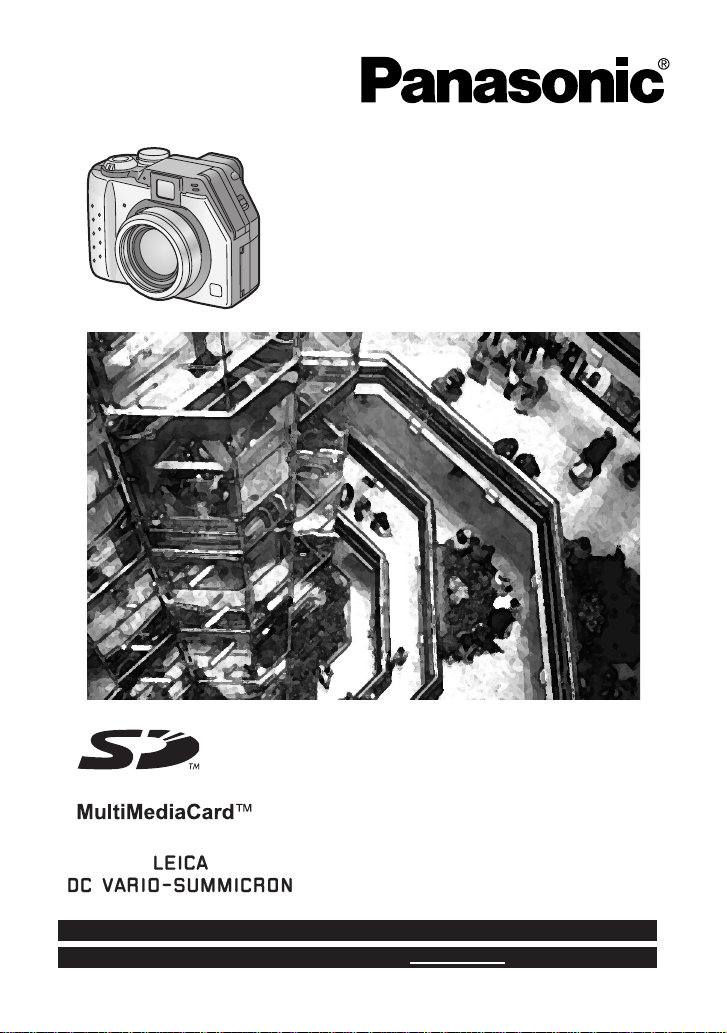
Digital Camera
Operating Instructions
Model No.
DMC-LC40PP
VQT9861
For USA assistance, please call: 1-800-272-7033 or send e-mail to : [email protected]
For Canadian assistance, please call: 1-800-561-5505 or visit us at www.panasonic.ca
KC3‑PP.book1ページ2002年4月5日 金曜日 午前11時55分
2
RBRC
Li-ion
TM
Dear Customer,
We would like to take this opportunity to
thank you for purchasing this Panasonic
Digital Camera. Please read these
Operating Instructions carefully and keep
them handy for future reference.
Information for
Your Safety
WARNING
TO REDUCE THE RISK OF FIRE OR
SHOCK HAZARD AND ANNOYING
INTERFERENCE, USE ONLY THE
RECOMMENDED ACCESSORIES AND
DO NOT EXPOSE THIS EQUIPMENT TO
RAIN OR MOISTURE. DO NOT
REMOVE THE COVER (OR BACK);
THERE ARE NO USER SERVICEABLE
PARTS INSIDE. REFER SERVICING TO
QUALIFIED SERVICE PERSONNEL.
Notice:
This product has parts that contain a small
amount of mercury. It also contains lead in
some components. Disposal of these
materials may be regulated in your
community due to environmental
considerations. For disposal or recycling
information please contact your local
authorities, or the Electronics Industries
Alliance: <http://www.eiae.org.>
Carefully observe copyright laws.
Recording of pre-recorded tapes or
discs or other published or broadcast
material for purposes other than your
own private use may infringe copyright
laws. Even for the purpose of private
use, recording of certain material may
be restricted.
• Please note that the actual controls and
components, menu items, etc. of your
Digital Camera may look somewhat
different from those shown in the
illustrations in these Operating
Instructions.
• SD Logo is a trademark.
• Other names, company names, and
product names printed in these
instructions are trademarks or registered
trademarks of the companies
concerned.
A lithium ion/polymer battery that is recyclable powers the
product you have purchased. Please call 1-800-8-BATTERY
for information on how to recycle this battery.
KC3‑PP.book2ページ2002年4月5日 金曜日 午前11時55分
3
FCC Note: (U.S. only)
This equipment has been tested and
found to comply with the limits for a Class
B digital device, pursuant to Part 15 of the
FCC Rules. These limits are designed to
provide reasonable protection against
harmful interference in a residential
installation. This equipment generates,
uses, and can radiate radio frequency
energy and, if not installed and used in
accordance with the instructions, may
cause harmful interference to radio
communications. However, there is no
guarantee that interference will not occur
in a particular installation. If this
equipment does cause harmful
interference to radio or television
reception, which can be determined by
turning the equipment off and on, the user
is encouraged to try to correct the
interference by one or more of the
following measures:
• Reorient or relocate the receiving
antenna.
• Increase the separation between the
equipment and receiver.
• Connect the equipment into an outlet on
a circuit different from that to which the
receiver is connected.
• Consult the dealer or an experienced
radio/TV technician for help.
FCC Caution: To assure continued
compliance, follow the
attached installation
instructions and use only
shielded interface cables
with ferrite core when
connecting to computer
or peripheral devices.
Any changes or modifications not
expressly approved by the party
responsible for compliance could void the
user’s authority to operate this equipment.
Trade Name: Panasonic
Model No.: DMC-LC40
Responsible party: Matsushita Electric
Corporation of
America One
Panasonic Way,
Secaucus, NJ 07094
Support Contact: Panasonic
Consumer
Electronics
Company 1-800-
272-7033
This device complies with Part 15 of the
FCC Rules. Operation is subject to the
following two conditions: (1) This device
may not cause harmful interference, and
(2) this device must accept any
interference received, including
interference that may cause undesired
operation.
This Class [B] digital apparatus complies
with Canadian ICES-003.
DMC-LC40
KC3‑PP.book3ページ2002年4月5日 金曜日 午前11時55分

4
USB Driver End User License Agreement
You (
“Licensee”) are granted a license for the Software defined in this End User Soft
Agreement (“Agreement”) on condition that you agree to the terms and conditions of
this Agreement. If Licensee does not agree to the terms and conditions of this
Agreement, promptly return the Software to Matsushita Electric Industrial Co., Ltd
(“Matsushita”), its distributors or dealers from which you made the purchase.
Article 1 License
Licensee is granted the right to use the software, including the information recorded or
described on the CD-ROM, instruction manuals, and any other media provided to
Licensee (collectively “Software”), but all applicable rights to patents, copyrights,
trademarks and trade secrets in the Software are not transferred to Licensee.
Article 2 Use by a Third Party
Licensee may not use, copy, modify, transfer or allow any third party, whether free of
charge or not, to use, copy or modify the Software, except as expressly provided for in
this Agreement.
Article 3 Restrictions on Copying the Software
Licensee may make a single copy of the Software in whole or a part solely for back-up
purpose.
Article 4 Computer
Licensee may use the Software only on the computer, and may not use it on more than
one computer.
Article 5 Reverse Engineering, Decompiling or Disassembly
Licensee may not reverse engineer, decompile, or disassemble the Software, except to
the extent either of them is permitted under law or regulation of the country where
Licensee resides. Matsushita, or its distributors will not be responsible for any defects in
the Software or damage to Licensee caused by Licensee’s reverse engineering,
decompiling, or disassembly of the Software.
Article 6 Indemnification
The Software is provided “AS-IS” without warranty of any kind, either expressed or
implied, including, but not limited to, warranties of non-infringement, merchantability
and/or fitness for a particular purpose. Further, Matsushita does not warrant that the
operation of the Software will be uninterrupted or error free. Matsushita or any of its
distributors will not be liable for any damage suffered by Licensee arising from or in
connection with Licensee’s use of the Software.
Article 7 Export Control
Licensee agrees not to export or re-export to any country the Software in any form
without the appropriate export licenses under regulations of the country where Licensee
resides, if necessary.
Article 8 Termination of License
The right granted to Licensee hereunder will be automatically terminated if Licensee
contravenes of any of the terms and conditions of this Agreement. In the event, Licensee
must destroy the Software and related documentation together with all the copies
thereof at Licensee’s own expense.
KC3‑PP.book4ページ2002年4月5日 金曜日 午前11時55分

5
KC3‑PP.book5ページ2002年4月5日 金曜日 午前11時55分

6
KC3‑PP.book6ページ2002年4月5日 金曜日 午前11時55分

5
Contents
Safety
Information for Your Safety ................ 2
USB Driver End User License
Agreement ......................................... 4
Preparation
Standard Accessories ........................ 7
Names of the Components ................ 8
LCD Monitor Display ........................ 10
Quick Guide ..................................... 12
Inserting the Battery......................... 13
Charging the Battery ........................ 14
Connecting to an Electrical Outlet.... 15
Inserting the Card ............................ 16
Turning Power on/off........................ 18
Adjusting the Optical Finder
(Diopter Adjustment) ........................ 19
Attaching the Strap/Attaching the
Lens Cap ......................................... 20
Using the Tripod............................... 21
Using the LCD Monitor..................... 22
The Indicators .................................. 23
The Shutter Button
(Pressing halfway/Pressing fully) ..... 24
The Operational Mode Dial and the
REC Mode Dial ................................ 25
Operating the Menu ......................... 27
Setting the Date/Time (Clock Set) ... 28
Recording images (basic)
Taking Pictures (AUTO Mode) ......... 29
Checking the Last Picture
(Review) ........................................... 30
Recording Motion Images ................ 31
Using the Optical Zoom ................... 32
Using the Digital Zoom..................... 33
Taking Pictures with the Built-in
Flash ................................................ 34
Taking Pictures with the
Self-timer.......................................... 36
Recording images (advanced)
Taking Pictures with Audio ............... 37
Changing the Picture Size................ 38
Changing the Quality
(Data Compression Ratio)................ 39
Taking Pictures with Program AE
Mode ................................................ 40
Taking Pictures with Aperture-priority
AE .................................................... 41
Taking Pictures with Shutter-priority
AE .................................................... 42
Taking Pictures with the Portrait
Mode ................................................ 43
Taking Pictures with the Landscape
Mode ................................................ 44
Taking Pictures with the Sports
Mode ................................................ 45
Taking Pictures with the Night Portrait
Mode ................................................ 46
Taking Pictures with the Spot
Mode ................................................ 47
Compensating the Exposure............ 48
Taking Pictures with Auto (AE)
Bracket ............................................. 49
Using the AF/AE Lock ...................... 50
Picture Adjustment
(Contrast/Sharpness/Saturation)...... 51
Setting the White Balance................ 52
Setting ISO Sensitivity...................... 54
Using the Spot AF ............................ 55
Taking Pictures with Macro Mode .... 56
Taking Pictures with Burst Mode...... 57
Using the Conversion Lens .............. 58
Playback
Playing Back Still Pictures................ 59
Playing Back Still Pictures with
Audio ................................................ 60
9 Images Multi Playback .................. 61
Using the Playback Zoom ................ 62
Playing Back Motion Images ............ 63
KC3‑PP.book5ページ2002年4月5日 金曜日 午前11時55分

6
Editing
Deleting Images ............................... 64
Writing the Print Information in the
Card (DPOF Setting)........................ 66
Protecting Images on the Card ........ 69
Technical use
Playing Back with Slide Show
(Automatic Playback) ....................... 70
Adding Audio to Recorded Pictures
(Audio Dubbing) ............................... 72
Resizing the Recorded Pictures....... 73
Trimming the Recorded Pictures ..... 74
Formatting the Card ......................... 76
Adjusting the LCD Monitor
Brightness ........................................ 77
Using the Auto Review..................... 78
Setting up the Operational Sound.... 79
Setting up the Power Save Mode .... 80
Resetting the File Number ............... 81
Playing Back Images with a TV
Monitor ............................................. 82
After Use .......................................... 83
Connecting to a PC .......................... 84
Others
The Menu Items ............................... 85
Cautions for Use .............................. 87
Warning Indications ......................... 91
Troubleshooting ............................... 92
Specifications................................... 93
Digital Camera Accessory System... 96
Digital Camera Accessory Order
Form................................................. 97
Request for Service Notice .............. 98
Limited Warranty (For USA Only) .... 99
Customer Services Directory (For USA
Only) .............................................. 101
Index .............................................. 102
Spanish Quick Use Guide/Guía
española para el uso rápido........... 103
KC3‑PP.book6ページ2002年4月5日 金曜日 午前11時55分
7
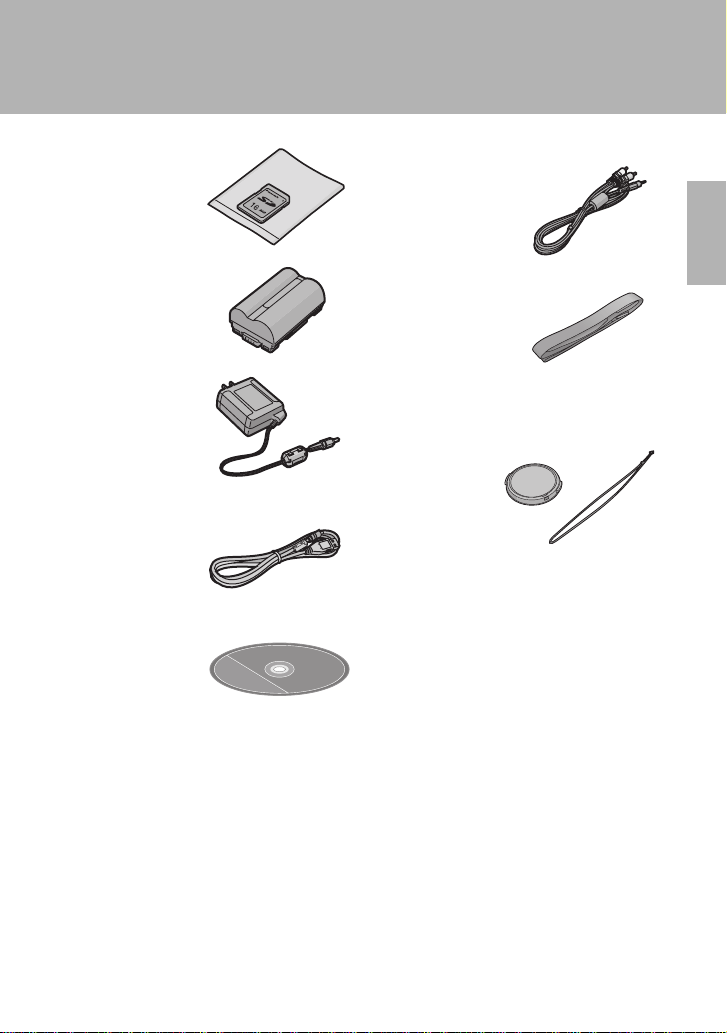
Standard Accessories
Before using your camera, check the contents.
1
SD Memory Card (16 MB)
RP-SD016B
2
Battery Pack
CGR-S602A
3
AC Adaptor
DE-877B
4
USB Connection Kit
(Consists of)
USB Connection Cable
K1HA05CD0001
CD-ROM
VFF0144
5
A/V Cable
K1V204C20002
6
Strap
VFC3868
7
Lens Cap
VYK0B77
Lens Cap String
VFC3893
KC3‑PP.book7ページ2002年4月5日 金曜日 午前11時55分
8
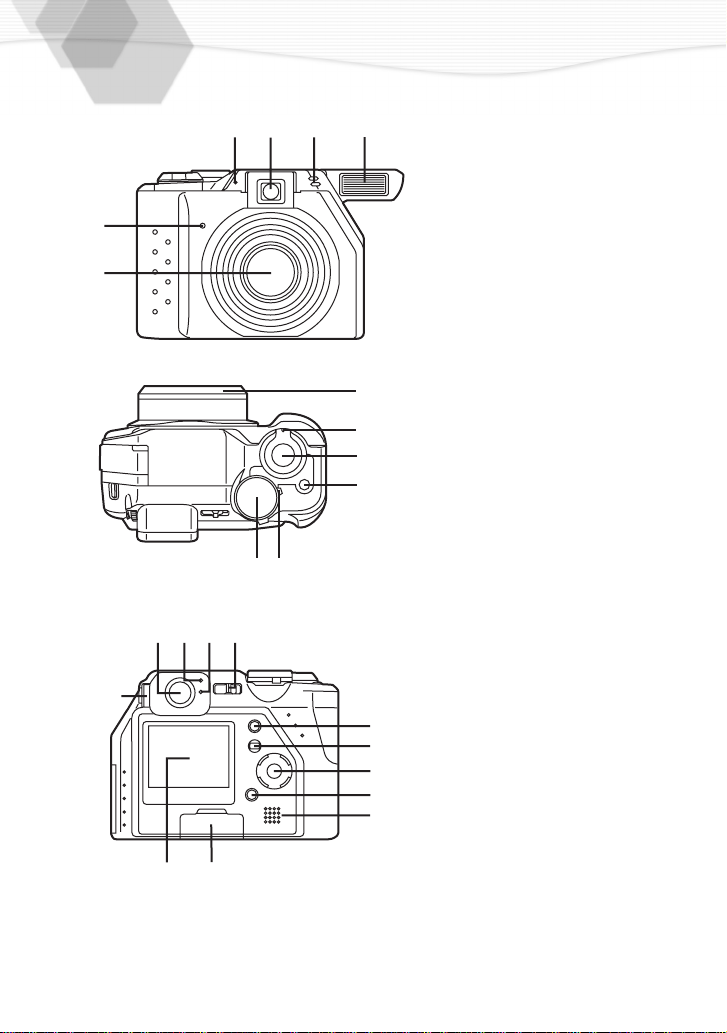
Names of the Components
[Front View]
1
Flash Sensor (P35)
2
Optical Finder (P19)
3
Microphone (P37, P72)
4
Flash
5
Self-timer Indicator (P36)
6
Lens
[Up View]
7
REC Mode Dial (P25)
8
Operational Mode Dial (P25)
9
Flash Mode Button (P34)
10
Shutter Button (P24)
11
Zoom Lever (P32, P33)
12
Lens Ring (P58)
[Back View]
13
Diopter Adjustment Dial (P19)
14
Optical Finder (P19)
15
Status Indicator (P23)
16
Flash/Access Indicator (P17,
P23)
17
Power Switch (P18)
18
DISPLAY Button (P22)
19
MENU Button (P27)
20
Cursor (
3/ 4/ 2/ 1
) Buttons
21
REVIEW/SET Button (P30)
22
Speaker (P60)
23
Memory Card Door (P16)
24
LCD Monitor (P10)
1
5
6
23 4
78
9
10
11
12
13
14 15 16 17
18
19
20
21
22
2324
KC3‑PP.book8ページ2002年4月5日 金曜日 午前11時55分
9
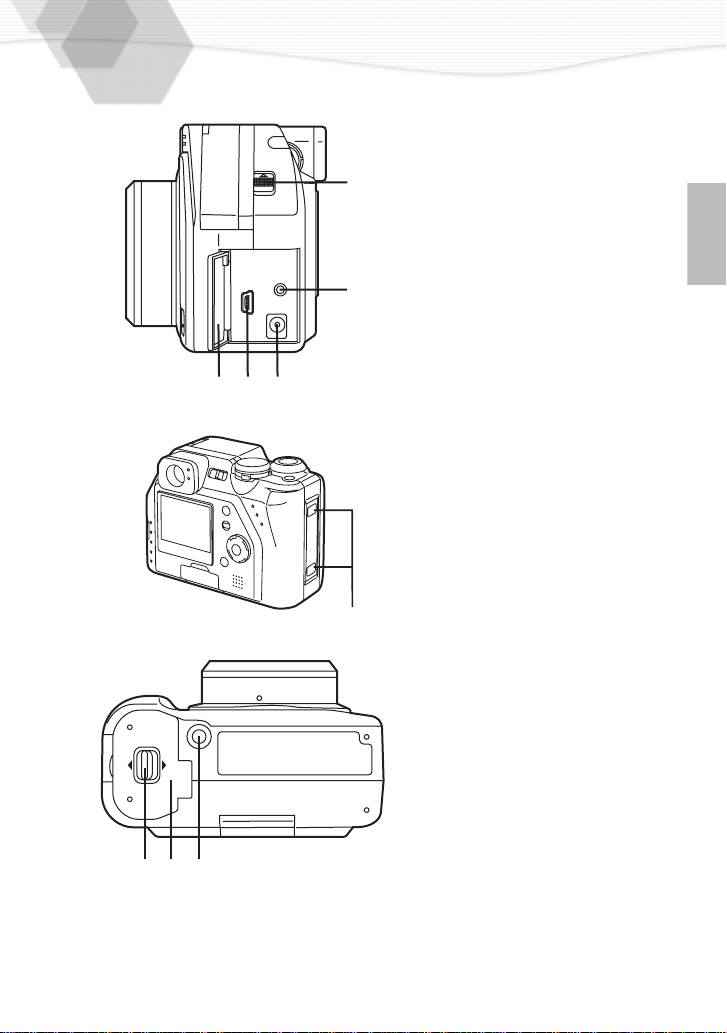
[Left View]
25
Flash Open Lever (P34)
26
A/V OUT Socket (P82)
27
DC IN Socket (P14)
28
USB Socket (5pin) (P84)
29
Terminal Door (P14)
[Right View]
30
Strap Hole (P20)
[Bottom View]
31
Battery Door Open/Lock Lever
(P13)
32
Battery Door (P13)
33
Tripod Receptacle (P21)
25
26
272829
30
31 32 33
LOCK
OPEN
KC3‑PP.book9ページ2002年4月5日 金曜日 午前11時55分
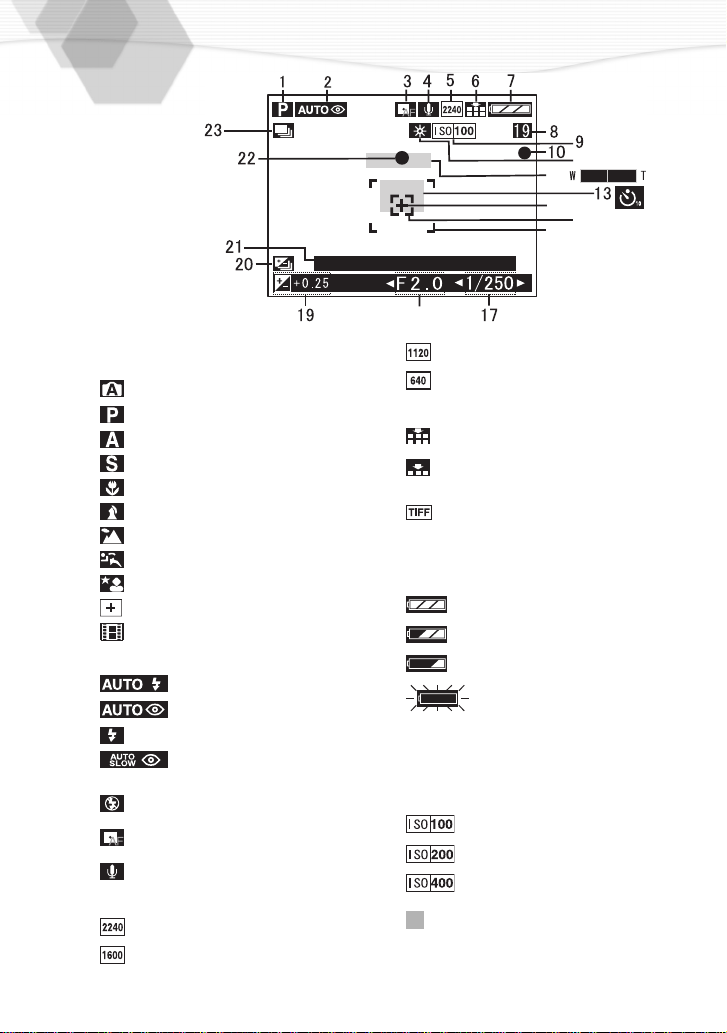
10
LCD Monitor Display
[In recording]
1
REC mode
: AUTO (P29)
: Program AE (P40)
: Aperture-priority AE (P41)
: Shutter-priority AE (P42)
: Macro mode (P56)
: Portrait mode (P43)
: Landscape mode (P44)
: Sports mode (P45)
: Night portrait mode (P46)
: Spot mode (P47)
: Motion image mode (P31)
2
Flash mode (P34)
: AUTO
: AUTO/Red-eye reduction
:Forced ON
: Slow sync./Red-eye
reduction
:Forced OFF
3
:Spot AF (P55)
4
: Audio REC (P37)
5
Picture size (P38)
:2240
a
1680
:1600
a
1200
:1120
a
840
:
640
a
480
6
Quality (data compression ratio) (P39)
: Fine (low compression)
: Standard
(standard compression)
: TIFF (incompression)
7
Battery indicator (P14)
(When using AC adaptor this is not
displayed)
8
Frame/Time remain
In motion image mode: XXXS
9
ISO sensitivity (P54)
No: AUTO
10
: Recording indication
11
White balance (P52)
No: AUTO
11
12
14
15
16
18
10:00 MAR. 1. 2002
KC3‑PP.book10ページ2002年4月5日 金曜日 午前11時55分
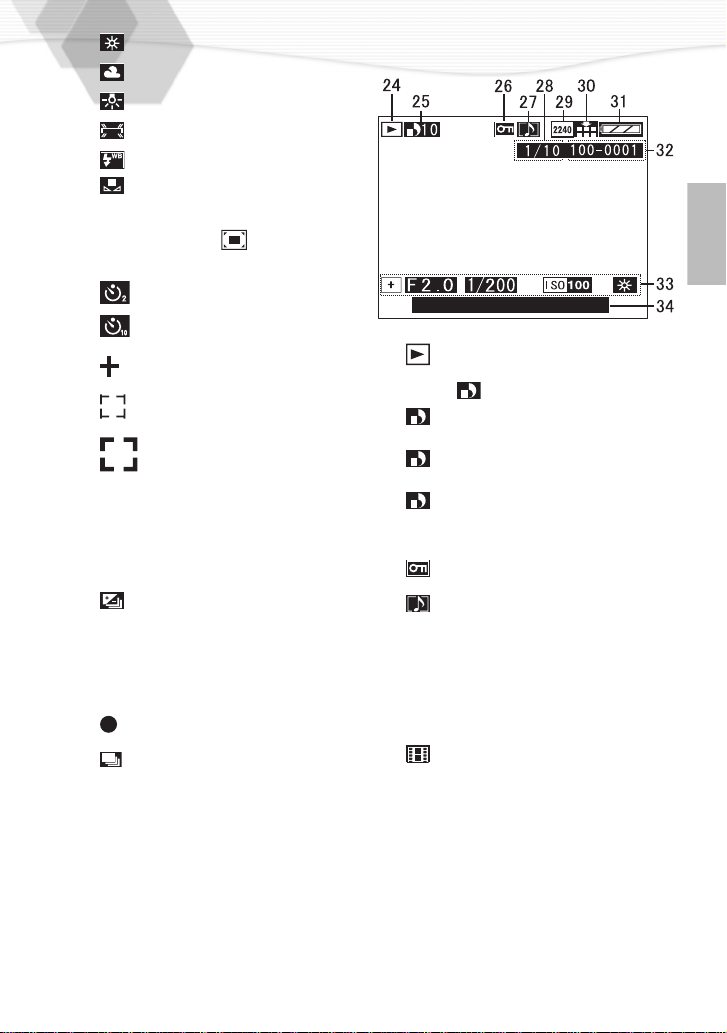
11
: Daylight
: Cloudy
: Halogen
: Fluorescent
: Flash
: White set
12
Zoom (P32, P33)
(digital zoom ON: )
13
Self-timer mode (P36)
: 2 seconds
: 10 seconds
14
: Spot metering target (P47)
15
: Spot AF area (P47, P55)
16
: Focus area (P29)
17
Shutter speed indication (P42)
18
Aperture indication (P41)
19
Exposure compensation (P48)
20
Auto bracket (P49)
: Auto (AE) bracket
21
Current date and time (P28)
It is displayed for about 5 seconds
when starting/after setting the REC
mode/after setting the time.
22
: Focus indication (P29)
23
: Burst mode (P57)
[In playback]
24
: Playback mode
25
DPOF [ ] (P66)
(White):
DPOF setting for printing
(Green):
DPOF setting for Slide Show
(Green with DPOF number):
DPOF setting for printing and
Slide Show
26
: Protected image (P69)
27
: Image with audio (P60)
28
Page/Total images
29
Picture size (P38)
(Reference 5)
30
Quality (data compression ratio) (P39)
(Reference 6)
: In motion image mode
31
Battery indicator (P14)
(Reference 7)
32
Folder/File number
33
REC data
It will be displayed when the
[DISPLAY] button is pressed.
34
Recorded date and time
10:00 MAR. 1. 2002
KC3‑PP.book11ページ2002年4月5日 金曜日 午前11時55分
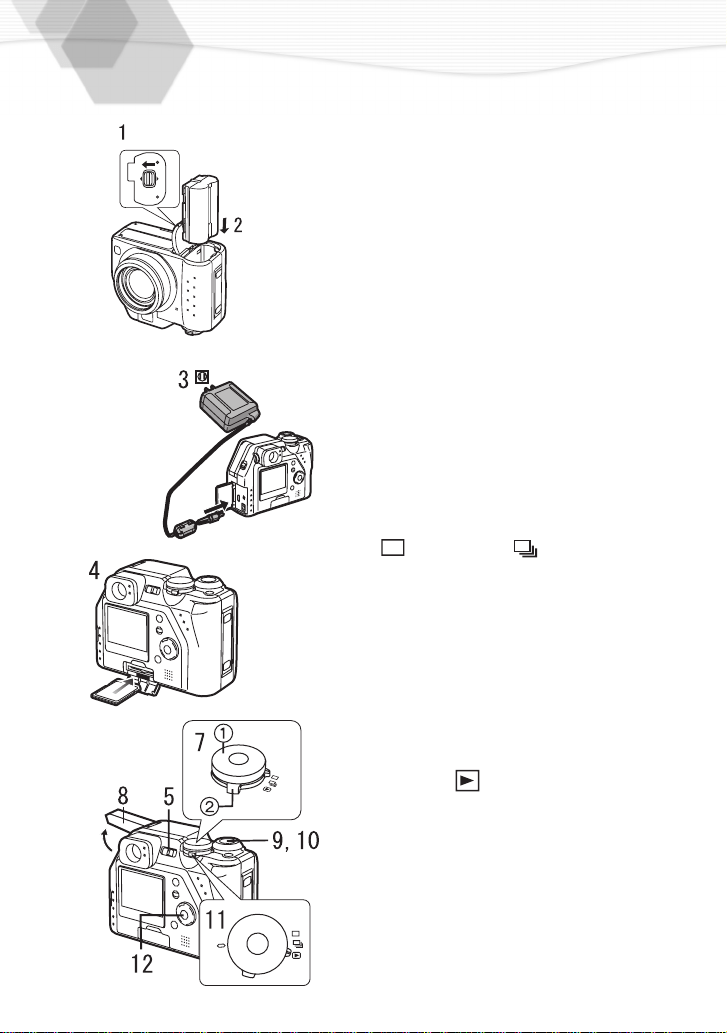
12
Quick Guide
Prepare the following items.
• Camera
• Battery
• Memory card
• AC adaptor
Check that the power switch is set to [OFF].
1
Slide the lever in the direction of the
arrow to open the battery door.
2
Insert the battery into the camera.
(P13)
3
Connect the AC adaptor to the
camera to charge the battery. (P14)
4
Insert the memory card into the
camera. (P16)
5
Set the power switch to [ON]. (P18)
6
Set date/time. (P28)
7
Set the operational mode dial 2
2 2
2 and
the REC mode dial 1
11
1. (P25)
• Set the operational mode dial to single mode
[ ] or burst mode [ ].
8
Slide the flash open lever to open the
Flash. (P34)
9
Press the shutter button halfway to
set the focus. (P24)
10
Press the shutter button fully to take
a picture. (P24)
[Playback]
11
Set the operational mode dial to
playback [ ]. (P59)
12
Press 2/1 to select the picture you
want to view.
LOCK
OPEN
KC3‑PP.book12ページ2002年4月5日 金曜日 午前11時55分
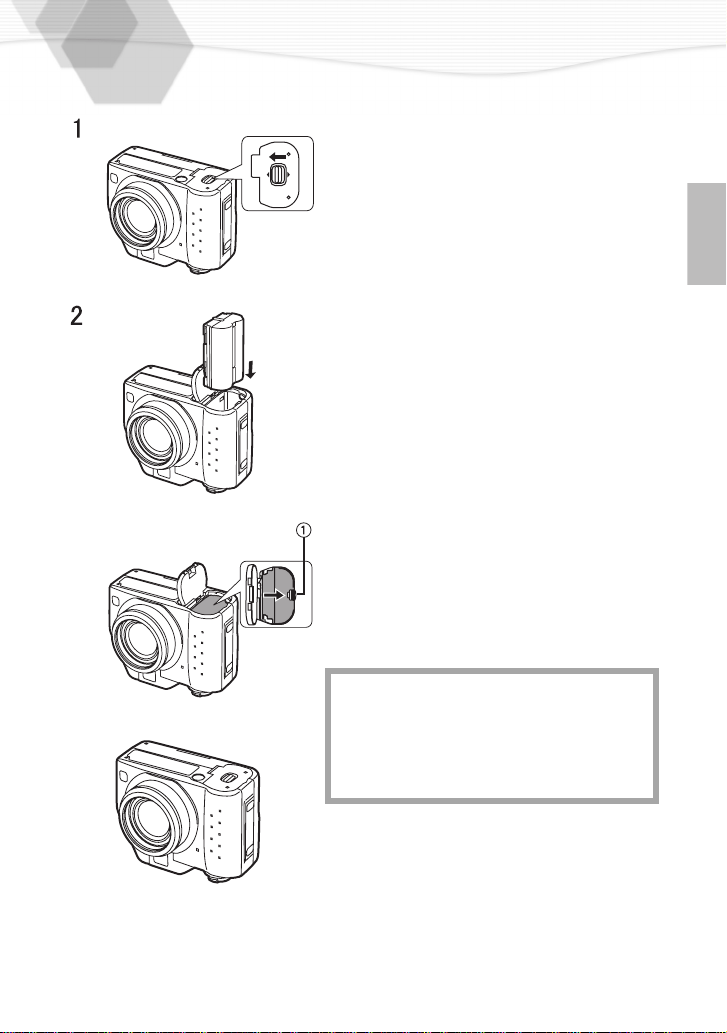
13
Inserting the Battery
[Preparation]
• Set the power switch to [OFF].
1
Slide the lever in the direction of the
arrow to open the battery door.
2
Insert the battery all the way in, until
it is locked.
3
Close the battery door.
4
Slide the lever to lock the battery
door.
[Removing the battery]
1
Slide the lever in the direction of the
arrow to open the battery door.
2
Press the lock 1 in the direction of
the arrow to remove the battery.
3
Close the battery door.
4
Slide the lever to lock the battery
door.
• If you will not be using the camera for a long
time, remove the battery. (When you insert the
battery again, set the date)
• Before removing the battery from the camera, set
the power switch to [OFF].
• The battery supplied with this camera is
exclusively designed for this camera. Do not use
with any other equipment.
CAUTION
Danger of explosion if battery is incorrectly
replaced. Replace only with the same or
equivalent type recommended by the
manufacturer. Dispose of used batteries
according to the manufacturer’s instructions.
LOCK
OPEN
3
4
[Inserting]
[Removing]
KC3‑PP.book13ページ2002年4月5日 金曜日 午前11時55分
14
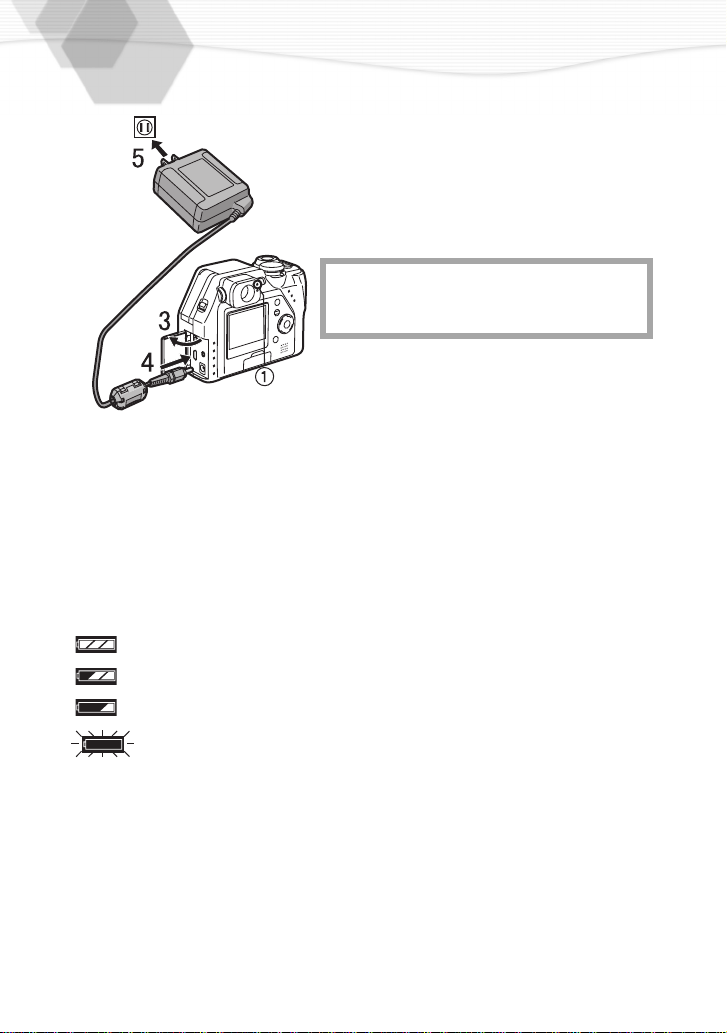
Charging the Battery
1
Set the power switch to [OFF].
2
Insert the battery into the camera.
(P13)
3
Open the terminal door.
4
Insert the connection plug of the AC
adaptor into the DC IN socket of the
camera.
THE SOCKET OUTLET SHALL BE
INSTALLED NEAR THE EQUIPMENT AND
SHALL BE EASILY ACCESSIBLE.
5
Plug the AC adaptor into the
electrical outlet.
• The green status indicator
1
blinks and
charging starts.
6
When the
status indicator
stops
blinking, charging is complete.
• After charging is finished, remove the AC
adaptor from the electrical outlet and then
remove the connecting plug from the DC IN
socket.
ª Battery indicator
The remaining battery power is displayed on the LCD monitor. (This is not displayed
when using AC adaptor)
: The battery power is sufficient
: The remaining power is a little low
: The remaining power is low
: Recharge or replace the battery
KC3‑PP.book14ページ2002年4月5日 金曜日 午前11時55分
15
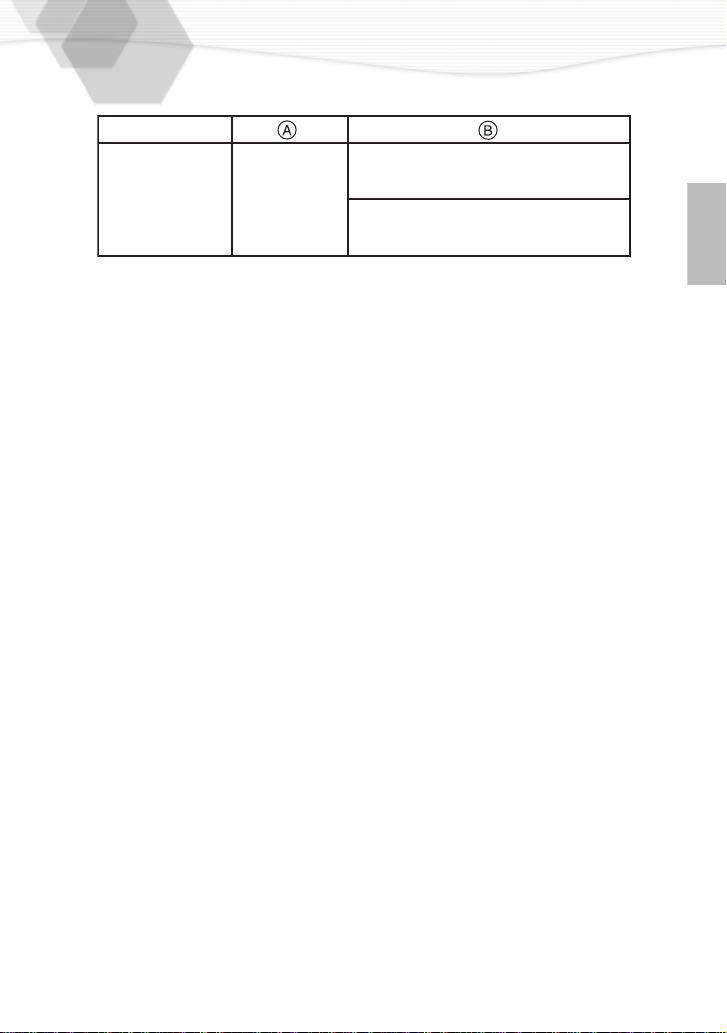
ª Charging time and available recording time
(LCD on, shooting once every 30 seconds, flash every other shot. Measured using
supplied 16 MB SD Memory Card)
A Charging time
B Continuous recording time (recordable number)
ª Charging environment and charging error
• Charge the battery in a place with a temperature of 50 - 95 F (10 - 35 °C). (The battery
should also be the same temperature)
• When charging starts, the status indicator blinks at about 2 second cycles. If, after charging
starts, the status indicator blinks quicker, this indicates a charging error.
In this case, remove the AC adaptor from the electrical outlet, remove the battery and check
if both room and battery temperature is too low or high and then charge it again. (It is not
possible to cancel the error by only turning the power off/on.) If the problem persists,
consult the dealer or your nearest servicentre.
Connecting to an Electrical Outlet
If you use an AC adaptor and connect it to an electrical outlet, you can use the camera
without worrying about battery discharge. The connection method is the same as
explained in “Charging the Battery”. (P14)
• During use, the camera becomes warm; this is not a malfunction.
In setting LCD monitor to ON
Approx. 150 min.
(equal to 300 still pictures)
In setting LCD monitor to OFF
Approx. 180 min.
(equal to 360 still pictures)
Supplied
battery pack
Approx.
120 min.
KC3‑PP.book15ページ2002年4月5日 金曜日 午前11時55分
16
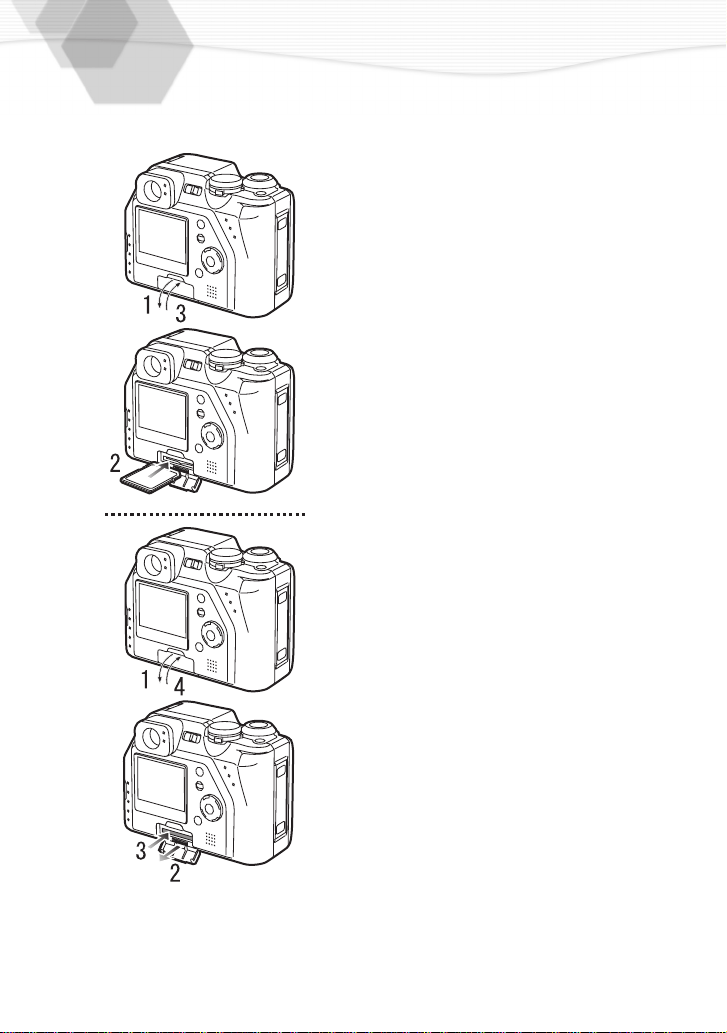
Inserting the Card
[Preparation]
• Set the power switch to [OFF].
1
Open the memory card door.
2
Insert the card all the way in until it
clicks.
• Check the direction of the card.
3
Close the memory card door.
[Removing the card]
1
Open the memory card door.
2
Press the card to release.
3
Pull the card out.
4
Close the memory card door.
• Do not touch the connection terminals on the
back side of the card.
• If the memory card door cannot completely close,
take the card out and insert it again.
• If the card cannot be fully inserted, verify whether
the direction of the card is correct.
• We recommend that you use a Panasonic
branded SD Memory Card. (Use only the
genuine card)
KC3‑PP.book16ページ2002年4月5日 金曜日 午前11時55分
17
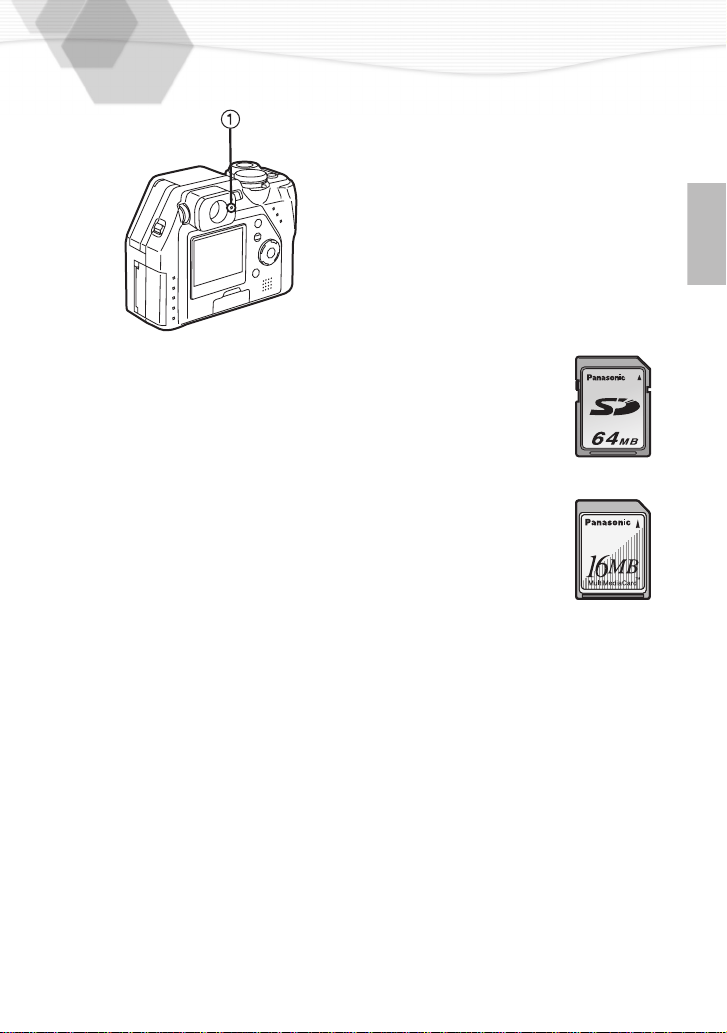
ª Access to the card
When the card is being accessed, the
red flash/access indicator 1 lights.
When the flash/access indicator lights,
do not remove the battery, open the
memory card door, or pull out the card.
The card and the card contents may be
destroyed and the camera may not
operate normally.
There is a risk that the data on the card
may be damaged or erased due to the
electrical noise, static electricity or the
defects of camera/card, please back up
your data to your PC using USB
connection. (P84)
ª SD Memory Card (supplied) and
MultiMediaCard (optional)
The SD Memory Card and
MultiMediaCard are small, lightweight,
removable external cards. The SD
Memory Card is equipped with a write
protection switch that can inhibit writing
and formatting. (When the switch is
moved towards the [LOCK] side, it is not
possible to write or delete data on the
card and format it. When the switch is
unlocked, these functions become
available)
SD Memory Card
• RP-SDH512 (512MB)
• RP-SDH256 (256MB)
• RP-SD128 (128MB)
• RP-SD064B (64MB)
• RP-SD032B (32MB)
• RP-SD016B (16MB)
• RP-SD008B (8MB)
MultiMediaCard
• After recording motion images using the
MultiMediaCard, the screen may appear
grey, but this is not a malfunction.
KC3‑PP.book17ページ2002年4月5日 金曜日 午前11時55分
18
Turning Power on/off
1
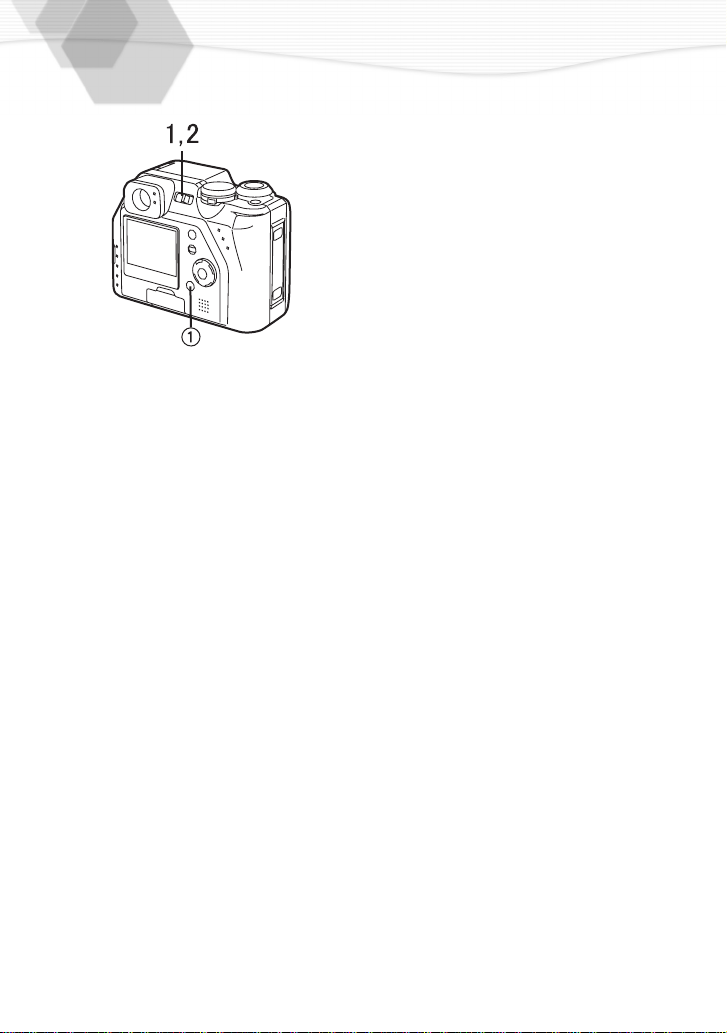
Set the power switch to [ON].
• The status indicator lights.
2
Set
the power switch to [OFF].
• When switching the power on/off, do not put any obstacle in front of the lens.
• Please be sure to remove the lens cap (P20) before you switch on the camera in recording
mode. If not, the message “REMOVE LENS CAP AND PRESS SET BUTTON” appears on
the LCD monitor. Please remove the lens cap and press [REVIEW/SET] button
1
.
KC3‑PP.book18ページ2002年4月5日 金曜日 午前11時55分
19
Adjusting the Optical Finder
(Diopter Adjustment)
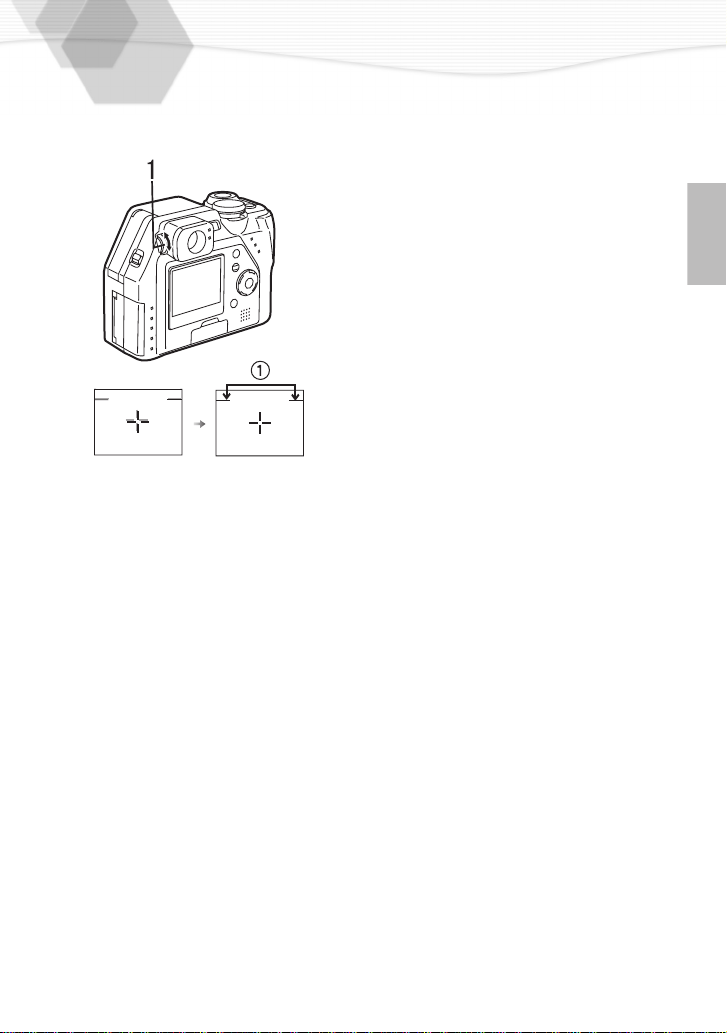
This camera’s optical view finder offers a
diopter adjustment. It allows the user to make
adjustments related to each users individual
vision characteristics. Please adjust this
feature before using the camera.
1
Adjust the diopter, rotating the diopter
adjustment dial.
• If you take the picture of the subject at the
distance between 2.3 feet (70 cm) - 3.3 feet (1 m)
with the zoom in tele position, make the top of the
subject match with the parallax compensation
mark
1
, in order not to cut it. When accurate
framing is necessary, use the LCD monitor.
KC3‑PP.book19ページ2002年4月5日 金曜日 午前11時55分
20
Attaching the Strap/Attaching the Lens
Cap
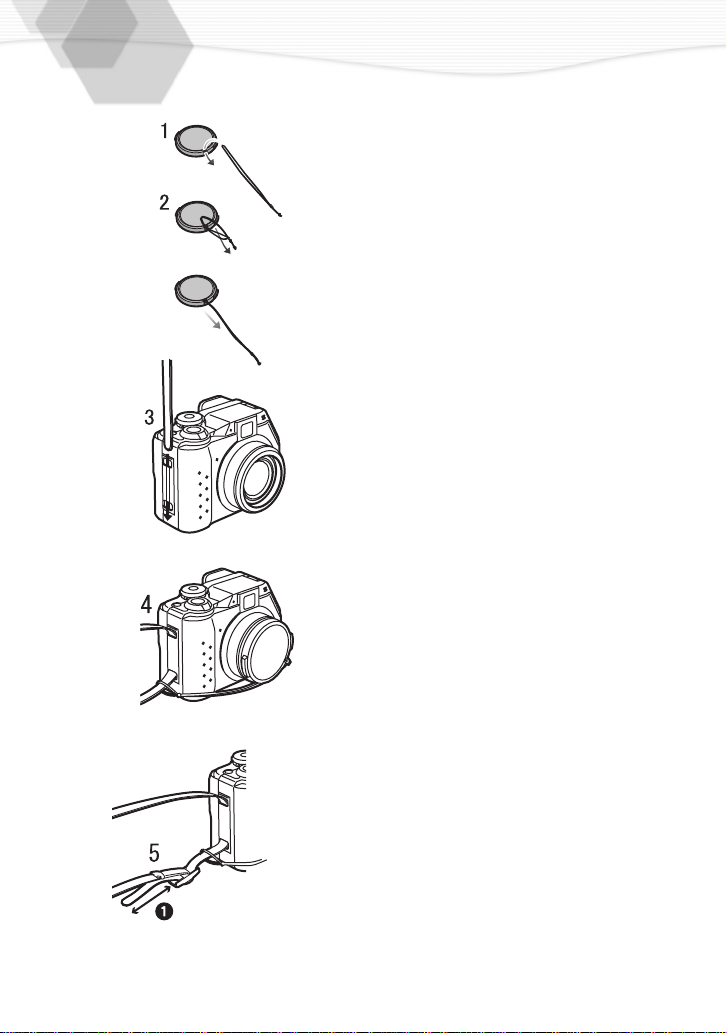
When the camera is switched off or used in
playback mode, protect the lens surface by
attaching the supplied lens cap.
1
Pass the end of the string through the
lens cap eyelet.
2
Pass
the knotted end of the string
through the other end of the string
and pull it firmly.
3
Pass the strap through the strap
hole.
4
Pass
the end of the strap through the
small loop at the knotted end of the
string.
5
Fold the tip of the strap, run it
through the strap length adjuster,
and pull it.
• Pull it out more than 0.07 feet (2 cm)
1
from
the strap length adjuster so that it cannot slip
off.
• Remove the lens cap before turning the
camera on. (P18)
KC3‑PP.book20ページ2002年4月5日 金曜日 午前11時55分
21
Using the Tripod
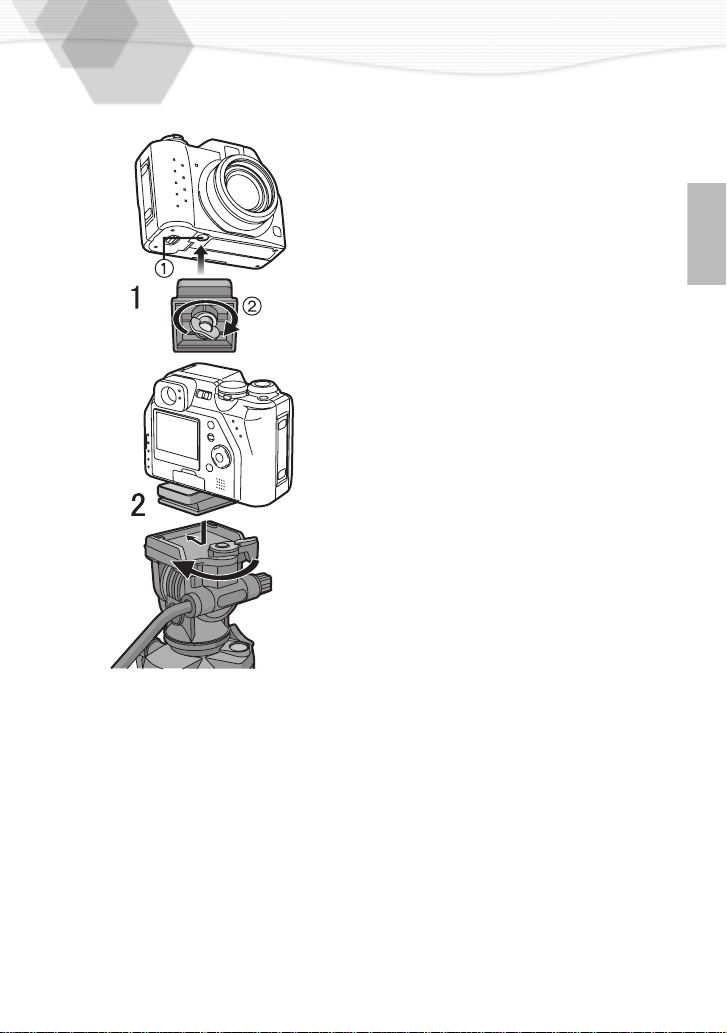
Using a tripod (customer supplied), can
minimize or eliminate picture motion jitter
associated with physical movement. This is
especially true when in the tele position or
when using slow shutter speeds.
1
Align the camera holder
2
22
2
with the
tripod receptacle
1
11
1
of the camera and
attach.
2
Install the camera holder into the
tripod.
• To avoid damaging the camera, be careful not to
over tighten the tripod.
• Read the tripod operating instructions carefully.
KC3‑PP.book21ページ2002年4月5日 金曜日 午前11時55分
22
Using the LCD Monitor
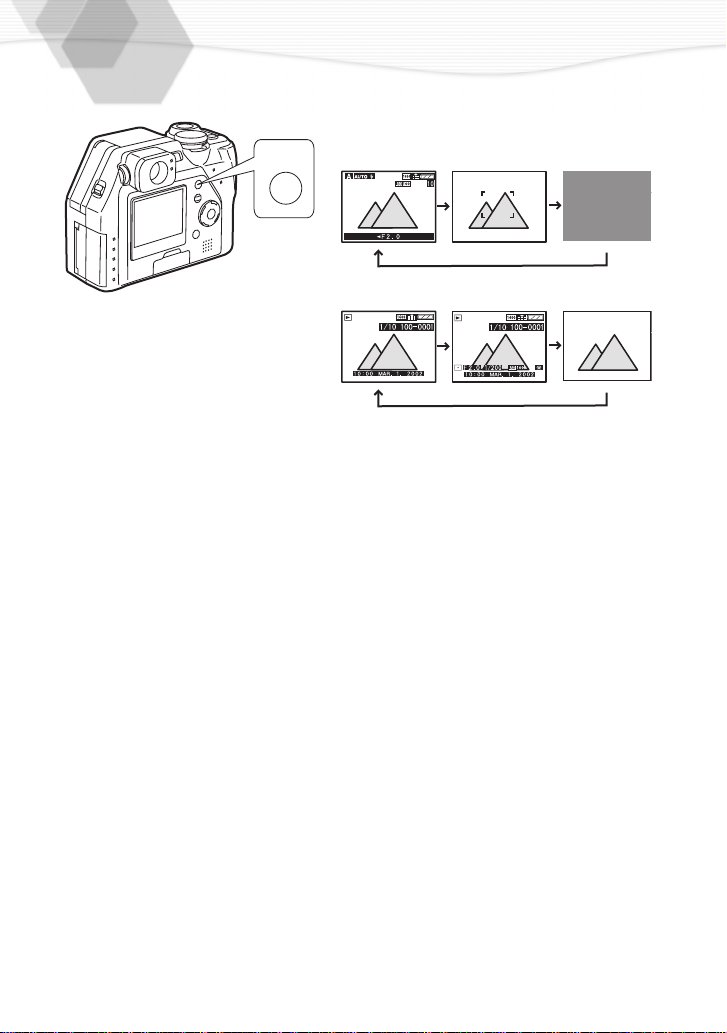
Every time you press the [DISPLAY] button,
the display of the LCD monitor changes as
shown below.
[In recording]
[In playback]
• These settings are retained in the Record mode, even if the power is turned off.
• When setting the digital zoom to [ON], you can not turn off the LCD monitor.
• When Auto Review function is set to [ON], LCD monitor turns on after taking picture for
reviewing even if you use the camera in LCD off mode.
• You can also use Review function (P30) in LCD off mode. Press [REVIEW/SET] button
after taking the picture, the last picture you have taken is displayed on the LCD monitor.
DISPLAY
KC3‑PP.book22ページ2002年4月5日 金曜日 午前11時55分
23
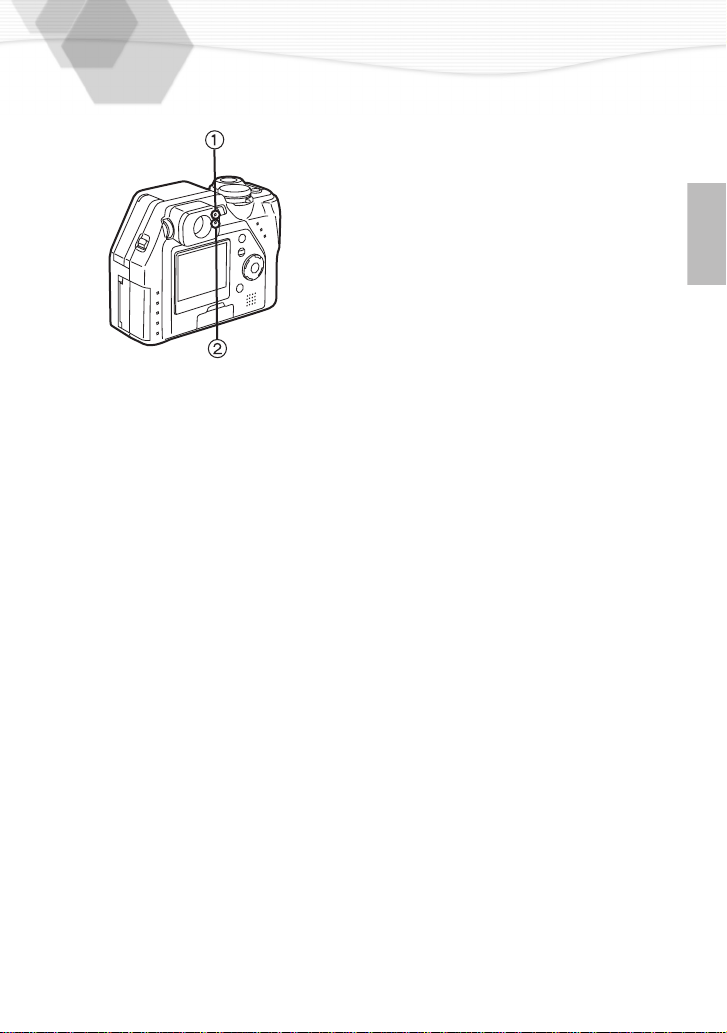
The Indicators
ª Status Indicator (Green) 1
[Blinking]
Warning indication
[Lighting]
When turning the power switch to [ON]
ª Flash/Access Indicator (Red) 2
[Blinking]
When charging the flash
When setting the flash mode to forced off and
recording in dark places
[Lighting]
When accessing the card
Indicating the flash fires in next capture (It
lights when the shutter is pressed halfway)
KC3‑PP.book23ページ2002年4月5日 金曜日 午前11時55分
24
The Shutter Button
(Pressing halfway/Pressing fully)
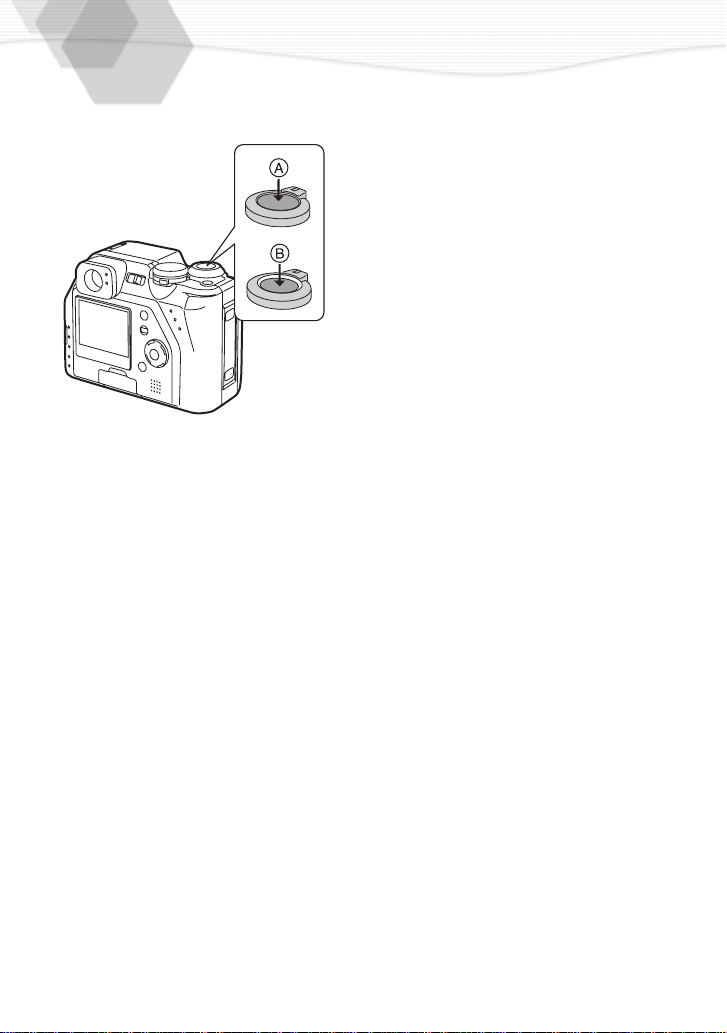
The shutter button is pressed in 2 steps:
“pressing halfway” and “pressing fully”.
Pressing halfway (Press lightly) A
• Focus and exposure are locked.
Pressing fully (Press all the way) B
• The picture is captured. In motion image mode,
the recording starts.
• You can adjust volume of the operational sound
in the menu. (P79)
• If you press the shutter button fully in a single
stroke, the captured picture may appear shaken
or unfocused. (The camera may be moved
during capturing)
KC3‑PP.book24ページ2002年4月5日 金曜日 午前11時55分
25
The Operational Mode Dial and the REC
Mode Dial
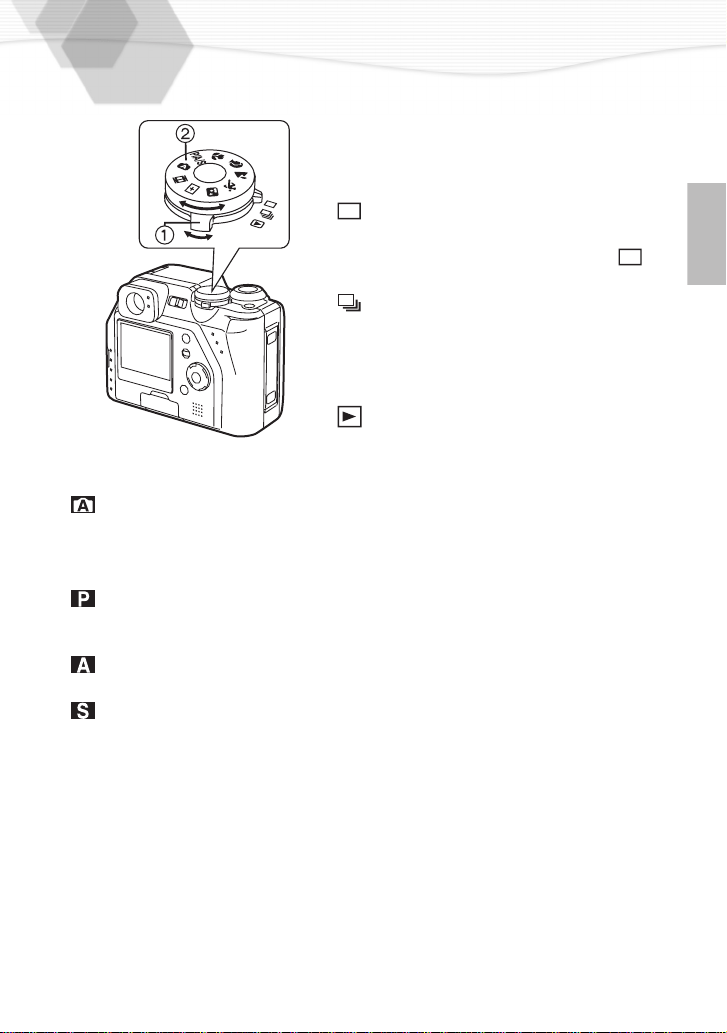
ª Operational mode dial 1
With this dial you can set REC (single mode
or burst mode) and playback modes.
[In recording]
: Single mode
Pressing the shutter button once, a single
picture is captured. Set to single mode [ ]
also when you record motion images.
: Burst mode (P57)
If you keep pressing the shutter button, you
can take several
picture
s in sequence. (MAX
4 fps/8 frames)
[In playback]
: Playback (P59)
Playback recorded images.
ª REC mode dial 2
You can choose among 9 REC modes, as shown below.
: AUTO (P29)
The shutter speed and the aperture value are automatically adjusted. Also the settings
can be adjusted is limited. This mode is for beginners.
P/A/S
: Program AE: (P40)
The shutter speed and the aperture value are automatically adjusted. In addition, more
settings can be adjusted.
: Aperture-priority AE: (P41)
The shutter speed is adjusted automatically, according to the aperture value you set.
:Shutter-priority AE: (P42)
The aperture value is adjusted automatically, according to the shutter speed you set.
KC3‑PP.book25ページ2002年4月5日 金曜日 午前11時55分
26
The Operational Mode Dial and the REC
Mode Dial (Continued)
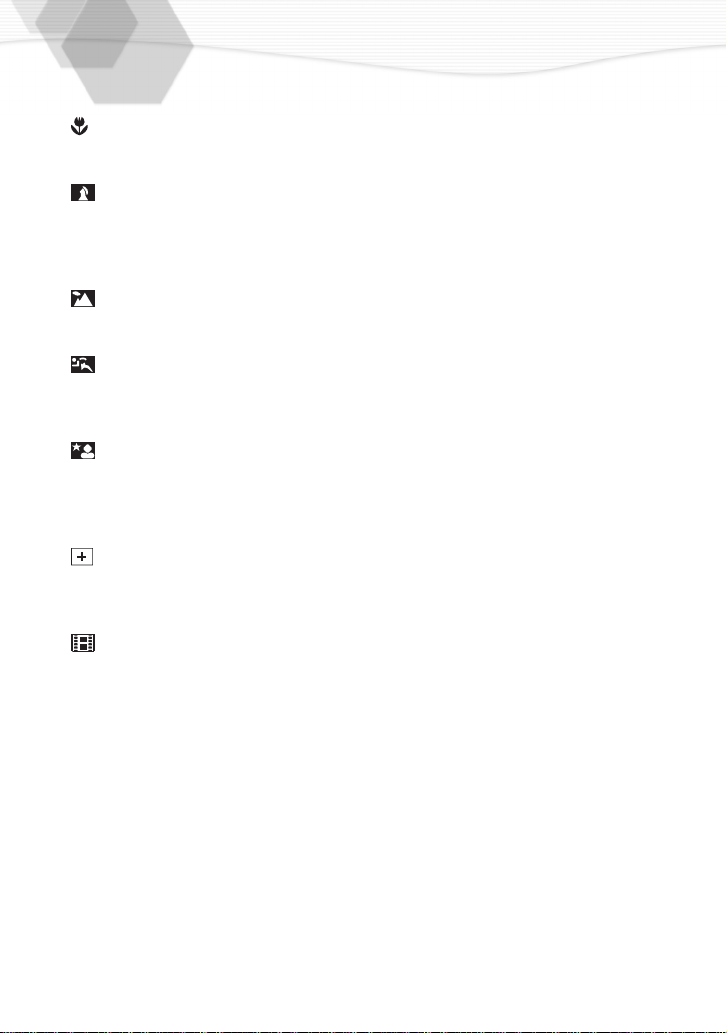
: Macro mode: (P56)
When you take the pictures from a distance closer than 1.64 feet (50 cm), set the
camera in macro mode. This allows you to get closer to the subject up to 0.2 feet (6 cm).
: Portrait mode: (P43)
Portrait mode lets you achieve the depth of focus effect easily when you take portrait
photos. The subject looks sharp and outstanding with an unfocused background. You
can place the subject much closer and allow proper distance between subject and
background.
: Landscape mode: (P44)
You can capture sharp and crisp landscape photos easily. Please note that this mode is
suitable for the landscapes farther than 32.8 feet (10 m) and in daylight situations.
: Sports mode: (P45)
When you take photos of outdoor sports, this mode let you capture the still action photo
easily. Please note that this mode is suitable to capture subjects from distances more
than 16.4 feet (5 m) and in daylight situations.
: Night portrait mode: (P46)
When you take pictures of, for example, your friends in front of beautiful night
illumination scenery, this mode let you get the appropriate exposure for your subject as
well as the background, using flash and slow shutter. Since slow shutter is set, use of
tripod is recommended. Subject should be placed within the range of flash light.
: Spot mode: (P47)
When this mode is selected, both autofocus area and exposure will be set to spot mode.
This is suitable when you take pictures in delicate lighting conditions and intend to set
the exposure for a limited area.
:Motion images (P31)
Recording motion images.
KC3‑PP.book26ページ2002年4月5日 金曜日 午前11時55分
27
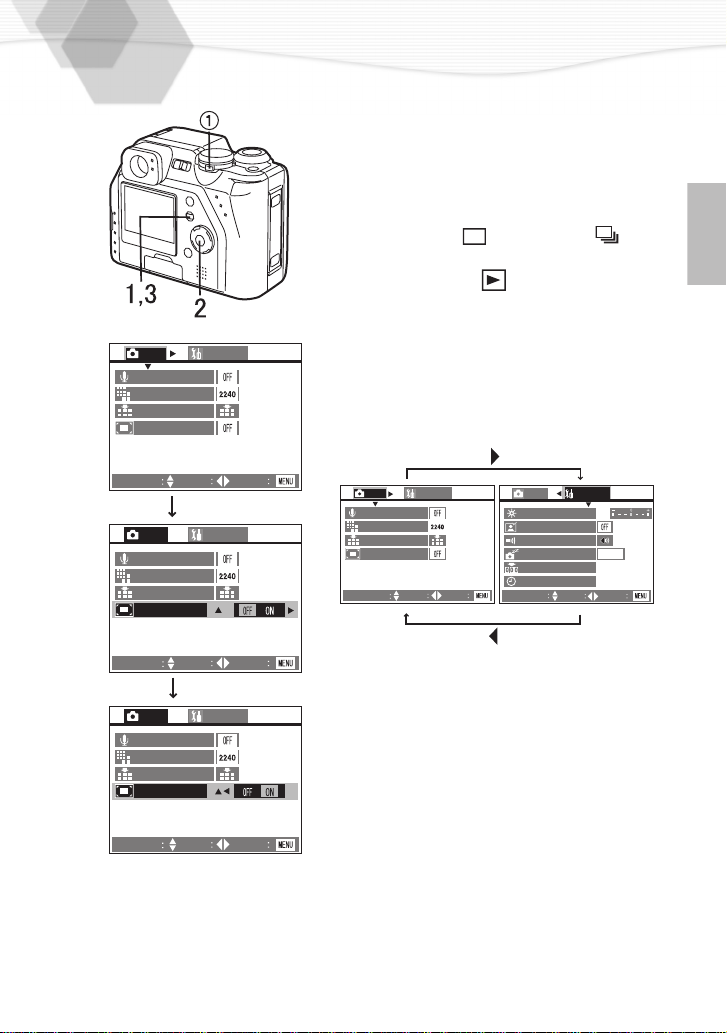
Operating the Menu
By operating the menu you can set the
settings of REC or playback mode. You can
also set the date and time, the operational
sound and various other settings. Follow
these instructions.
1
Press the [MENU] button.
• If you set the operational mode dial
1
to the
single mode [ ] or burst mode [ ], the
REC menu is displayed; if you set it to the
playback mode [ ], the playback menu is
displayed.
2
Press 3/4 to choose the item and
press 2/1 to confirm this setting
.
• With step 2, by pressing
1
,
you can access
the setup menu. (If you press
2
,
you can go
back)
3
Press the [MENU] button
.
• The menu will disappear.
REC
AUDIO REC.
PICT.SIZE
QUALITY
D.ZOOM
SETUP
SELECT
SET
EXIT
REC
SETUP
SETUP
AUDIO REC.
AUDIO REC.
PICT.SIZE
PICT.SIZE
QUALITY
QUALITY
D.ZOOM
D.ZOOM
SELECT
SELECT
SET
SET
EXIT
EXIT
REC
REC
SETUP
AUDIO REC.
PICT.SIZE
QUALITY
D.ZOOM
SELECT SET
EXIT
REC SETUP
SELECT
SET
EXIT
MONITOR
AUTO REVIEW
BEEP
POWER SAVE
NO.RESET
CLOCK SET
2 MIN.
KC3‑PP.book27ページ2002年4月5日 金曜日 午前11時55分
28
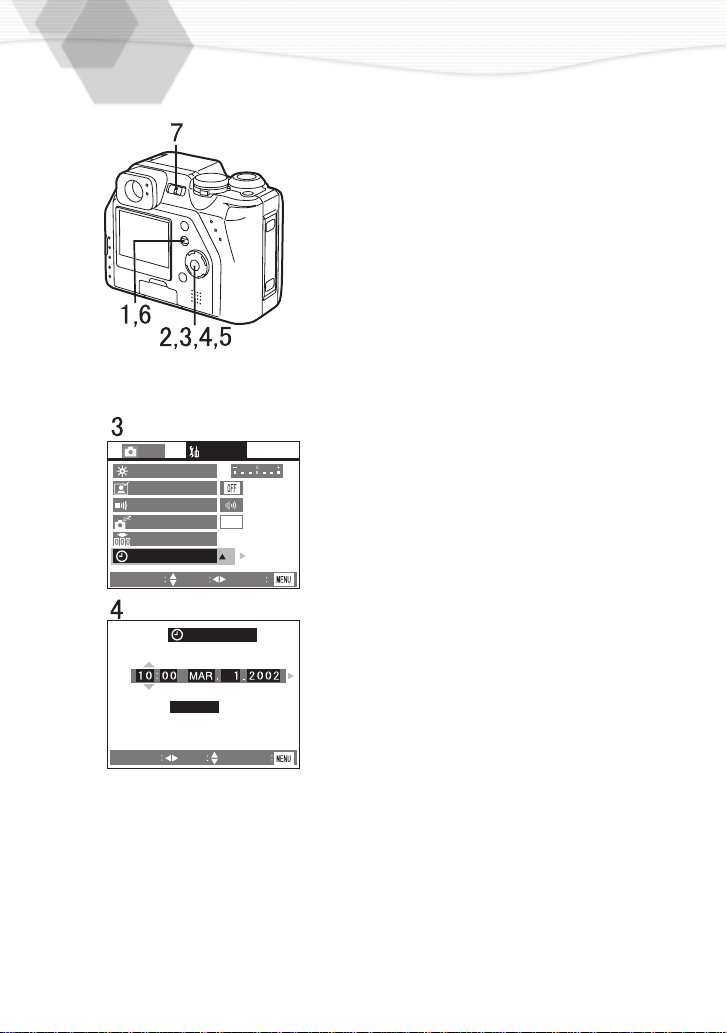
Setting the Date/Time (Clock Set)
You can set the year from 2001 to 2099. The
24-hour system is used.
1
Press the [MENU] button.
2
Press 1 to make the setup menu
appear.
3
Press 3/4 to select [CLOCK SET],
and then press 1.
4
Press 3/4/2/1 to set date and time,
and then press 1.
5
Press 3/4 to select [M/D/Y], [D/M/Y]
or [Y/M/D].
6
Press the [
MENU
]
button twice.
• The menu will disappear.
7
Check if the date/time setting is
displayed correctly, after turning the
camera [OFF] and [ON].
• If the message [PLEASE SET THE DATE/TIME]
appears, charge the battery about 2 hours and
set the date and time again.
REC
SETUP
MONITOR
AUTO REVIEW
BEEP
POWER SAVE
NO.RESET
CLOCK SET
SELECT
SET
EXIT
CLOCK SET
SELECT
SET
EXIT
2 MIN.
M/D/Y
KC3‑PP.book28ページ2002年4月5日 金曜日 午前11時55分
29
Taking Pictures (AUTO Mode)
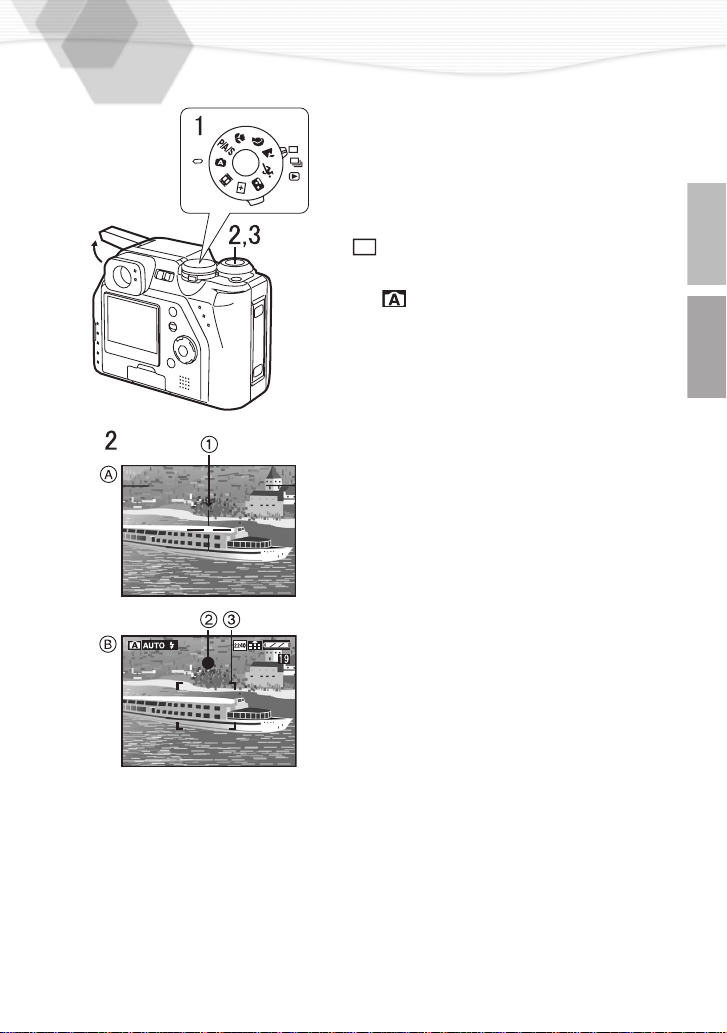
By only pressing the shutter button, the
exposure (shutter speed and aperture value)
will be automatically adjusted and the picture
will be taken.
[Preparations]
• Insert the card. (P16)
• Set the power switch to [ON]. (P18)
• Set the operational mode dial to the single mode
[]. (P25)
1
Set the REC mode dial to AUTO mode
[].
2
[
A
Optical
finder]
Center the subject in the AF target 1
inside the optical finder and press
the shutter button halfway.
[
B LCD monitor]
After centering the subject in the
focus area 3
on the LCD monitor,
press the shutter button halfway.
• When the focus is adjusted, the focus
indication [¥] 2 appears.
• The shutter speed and the aperture value
are automatically adjusted and displayed on
the LCD monitor.
• When the subject is out of the AF target or
the focus area, use the AF/AE lock. (P50)
3
Press the shutter button fully to take
the picture.
• After taking a picture, when the auto review
(P78) is set to [ON], the picture is displayed
on the LCD monitor for about 2 seconds.
• When power saving time is set, if you do not operate the camera for a while, it is
automatically turned off at the set time. To operate the camera again, press the shutter
button or turn the power switch first to [OFF] and then to [ON]. (P80)
• There are times when the brightness of the LCD monitor differs from that of the recorded
pictures. In particular, when taking pictures in dark places with a long time exposure,
darkness appears on the LCD Monitor, but the recorded pictures are bright.
KC3‑PP.book29ページ2002年4月5日 金曜日 午前11時55分
30
Checking the Last Picture (Review)
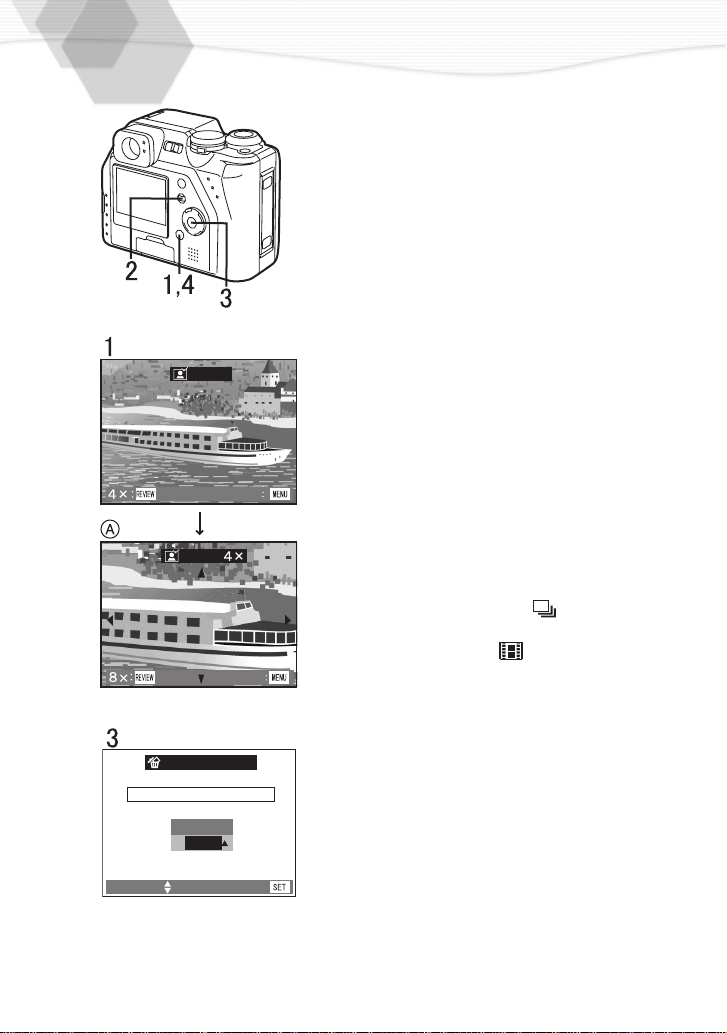
After taking a picture, when auto review (P78)
is set to [ON], the captured picture is
displayed on the LCD monitor for about 2
seconds, but you can also check the picture
by following the methods shown below.
1
After taking a picture, press the
[REVIEW/SET] button.
• The last captured picture is displayed for
about 3 seconds. If you press the
[REVIEW/SET] button again, the captured
picture is zoomed 4 times (
A)
and 8 times if
you press once again.
ª Erasing the captured picture during the
review
2
Press the [MENU] button.
3
When the message [DELETE THIS
PICTURE?] is displayed, press 3/4
to select [YES].
4
Press the [REVIEW/SET]
button.
• The picture is erased.
• Once erased, pictures cannot be recovered.
• When using the burst mode [ ], you can see
only the first picture with the review.
• In motion image mode [ ], Review cannot be
used.
• Once you turn off the camera or rotate the REC
mode dial, you cannot use Review function.
REVIEW
REVIEW
DELETE
DELETE
DELETE SINGLE
DELETE THIS PICTURE?
NO
YES
SELECT
:
SET
:
KC3‑PP.book30ページ2002年4月5日 金曜日 午前11時55分
31
Recording Motion Images
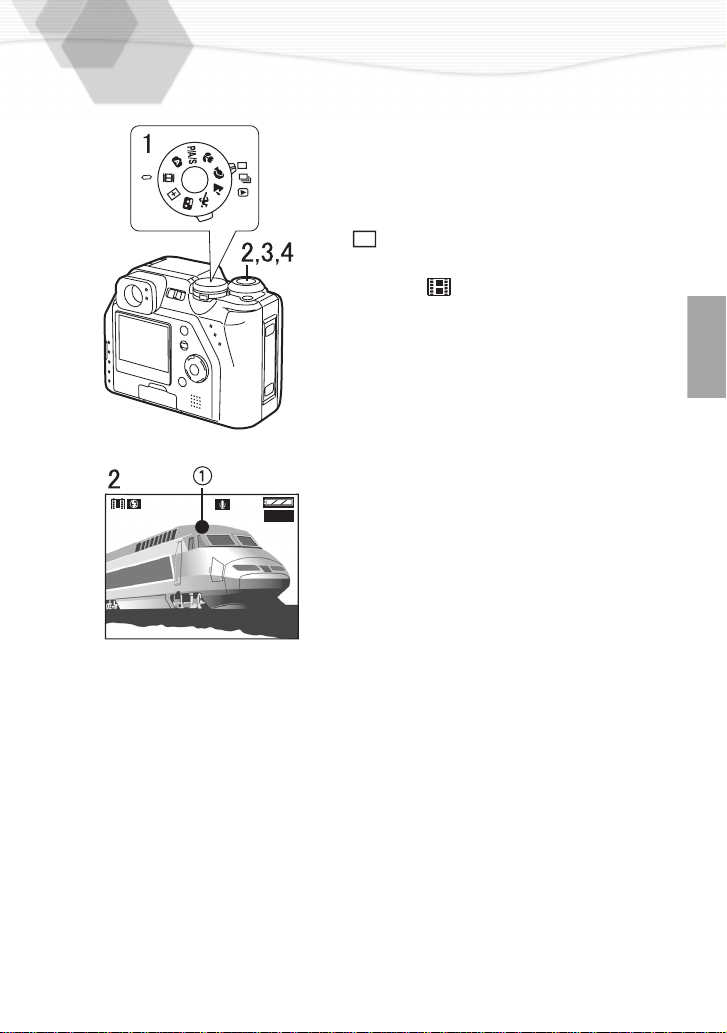
With this camera you can also record motion
images. (If using the supplied 16MB SD
Memory Card, it is possible to record for
about 75 seconds)
[Preparations]
• Insert the card. (P16)
• Set the power switch to [ON]. (P18)
• Set the operational mode dial to single mode
[]. (P25)
1
Set the REC mode dial to motion image
mode [ ].
2
Center the subject in the focus area
on the LCD monitor and press the
shutter button halfway.
• When the focus is adjusted, the focus
indication [
¥
] appears. (
1
Focus indication)
3
By pressing the shutter button fully,
the recording starts.
• The audio REC starts simultaneously.
4
By pressing the shutter button fully
again, recording stops.
• If during the recording the memory of the
card becomes full, the recording is stopped
automatically.
ª In motion image record mode, the settings
listed below are not available
• Picture size (P38)
• Built-in flash (P34)
• White balance (P52)
• ISO sensitivity (P54)
• The remaining time displayed on the LCD monitor is an approximation.
• You cannot record motion images without audio.
• If using the MultiMediaCard, after recording motion images, the screen may appear grey,
but this is not a malfunction.
• After recording starts, the auto focus and zoom are locked (with the first frame).
• Recording could suddenly stop when recording motion images.
135S
KC3‑PP.book31ページ2002年4月5日 金曜日 午前11時55分
32
Using the Optical Zoom
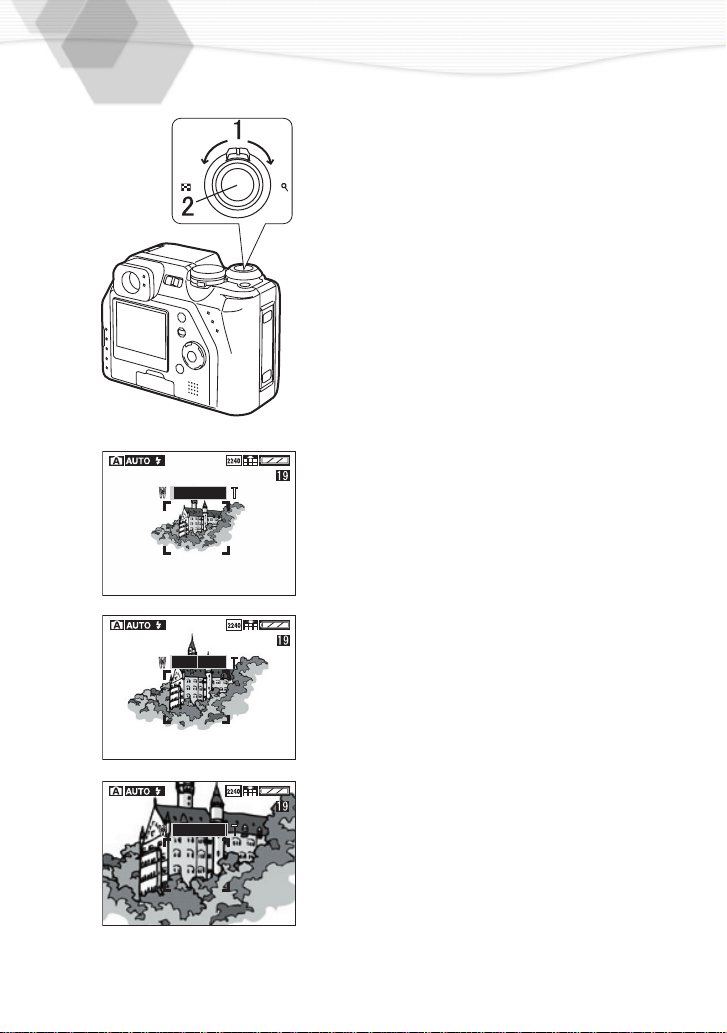
With this function, you can make people and
subjects closer, and landscapes can be
captured in wide angle, with the 3 times
optical zoom.
[Preparation]
• Set the operational mode dial and REC mode
dial.
(P25)
1
Aim the camera at the subject and
adjust the size with the zoom lever.
To make subjects closer (Tele):
Rotate towards T as far as it goes.
To make subjects wider (Wide angle):
Rotate towards W as far as it goes.
2
Take pictures.
• The recording method is the same as in
“Taking Pictures (AUTO Mode)”. (P29)
• The focus is adjusted at a distance of more than
0.98 feet (30 cm). For details on Macro mode,
read P56.
W
T
KC3‑PP.book32ページ2002年4月5日 金曜日 午前11時55分
33
Using the Digital Zoom
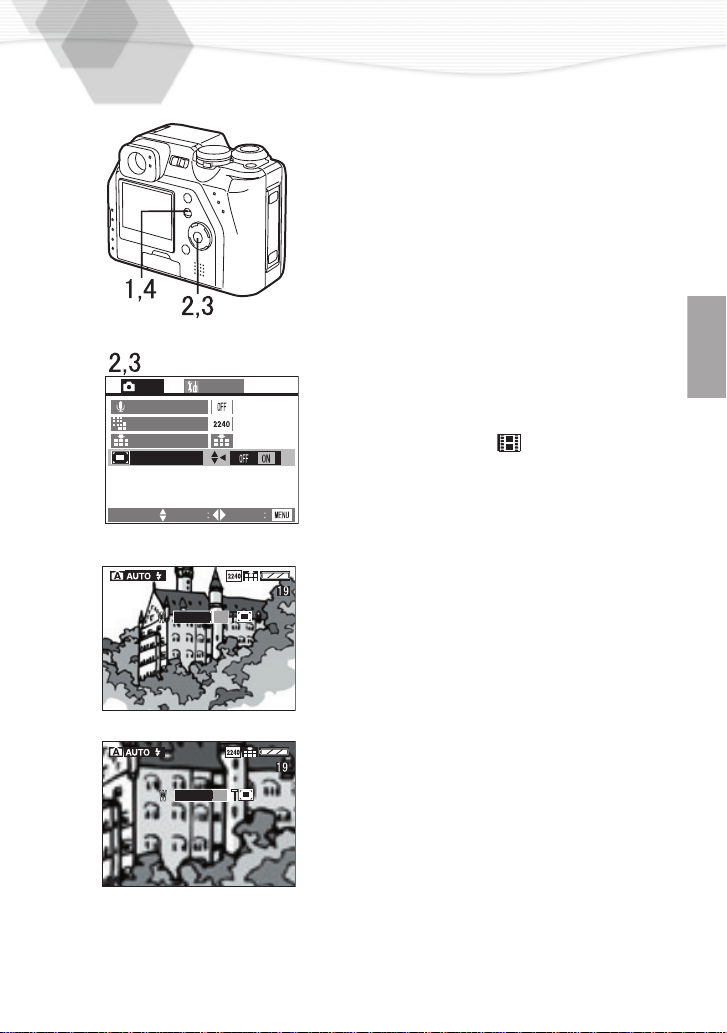
It is possible to further magnify a subject
already magnified 3 times with the optical
zoom by 2 more times, with the digital zoom,
thereby reaching a maximum of 6 times.
[Preparation]
• Set the operational mode dial and REC mode
dial. (P25)
1
Press the [MENU] button.
2
Press 3/4 to select [D. ZOOM].
3
Press 2/1 to set to [ON].
4
Press the [
MENU
]
button.
• The menu will disappear.
• The zoom adjustment and recording method are
the same as in “Using the Optical Zoom”. (P32)
• In motion image mode [ ], you cannot use the
digital zoom.
• When setting the digital zoom to [ON], the display
of the LCD monitor cannot be set to off.
• When using the digital zoom the picture quality
becomes deteriorated.
AUDIO REC.
PICT.SIZE
QUALTY
D.ZOOM
SELECT: SET
EXIT
REC
SET UP
KC3‑PP.book33ページ2002年4月5日 金曜日 午前11時55分
34
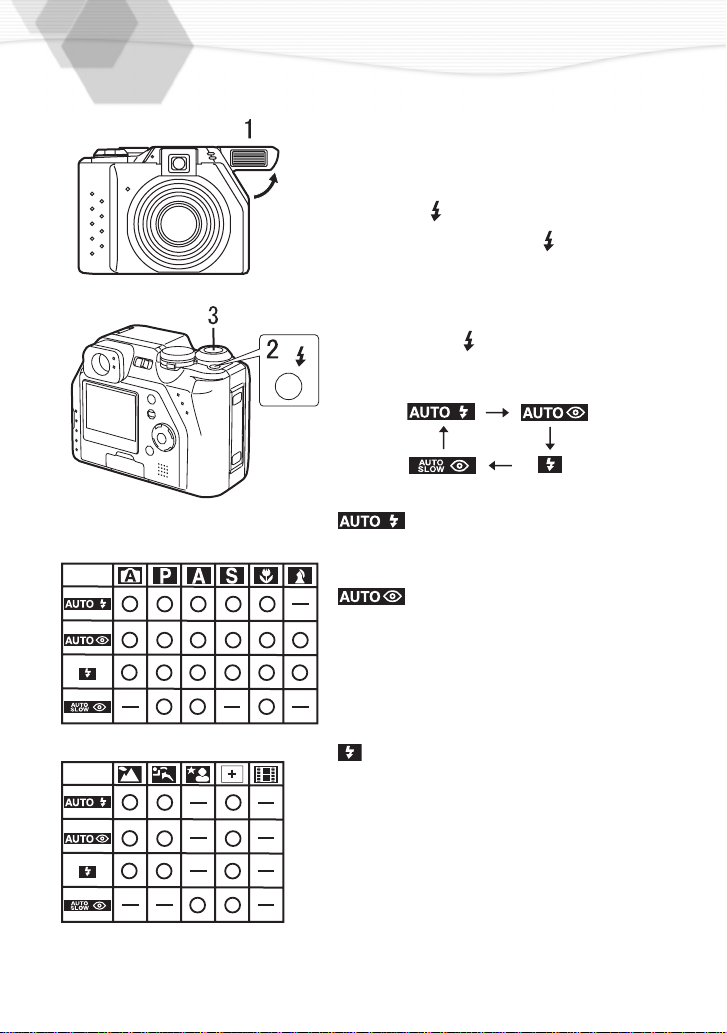
Taking Pictures with the Built-in Flash
[Preparation]
• Set the operational mode dial and REC mode
dial. (P25)
1
Slide the flash open lever to open the
Flash.
2
Press [ ].
• Every time you press the [ ] button, the
available settings will appear as shown
below. (There are settings that cannot be set
according to the REC mode. Those that
cannot be set are not displayed when
pressing the [ ] button. Refer to the table
on the left.)
: AUTO
The flash fires automatically according to the
recording situation.
: AUTO/Red-eye reduction
The flash fires automatically according to the
recording situation and simultaneously it
reduces the red-eye phenomenon (when a
subject’s eyes appear red in flash light).
Use it when you take pictures of people or
animals in dark places.
: Forced ON
The flash fires in every capturing.
Use this setting when your subject is
backlighted.
KC3‑PP.book34ページ2002年4月5日 金曜日 午前11時55分
35
:
Slow sync./Red-eye reduction
When you take a picture with a dark
background landscape, it makes the flash fire
and the shutter speed slow, so that the dark
background landscape will become bright.
Simultaneously it reduces the red-eye
phenomenon.
: Forced OFF
When you do not open the flash, this mode is
set.
Even being in dark places, the flash does not
fire.
Set it when you take pictures in places where
using flash is not allowed.
3
Take pictures.
The recording method is the same as in
“Taking Pictures (AUTO Mode)”. (P29)
• The available flash range is about 0.98 feet (30 cm) - 14.8 feet (4.5 m) at a maximum wide
angle and about 0.98 feet (30 cm) - 11.5 feet (3.5 m) at a maximum telephoto setting. (In
macro mode, at a maximum wide angle setting it is about 0.33 feet (10 cm) - 1.64 feet
(50 cm), at a maximum telephoto setting it is about 0.66 feet (20 cm) - 1.64 feet (50 cm)
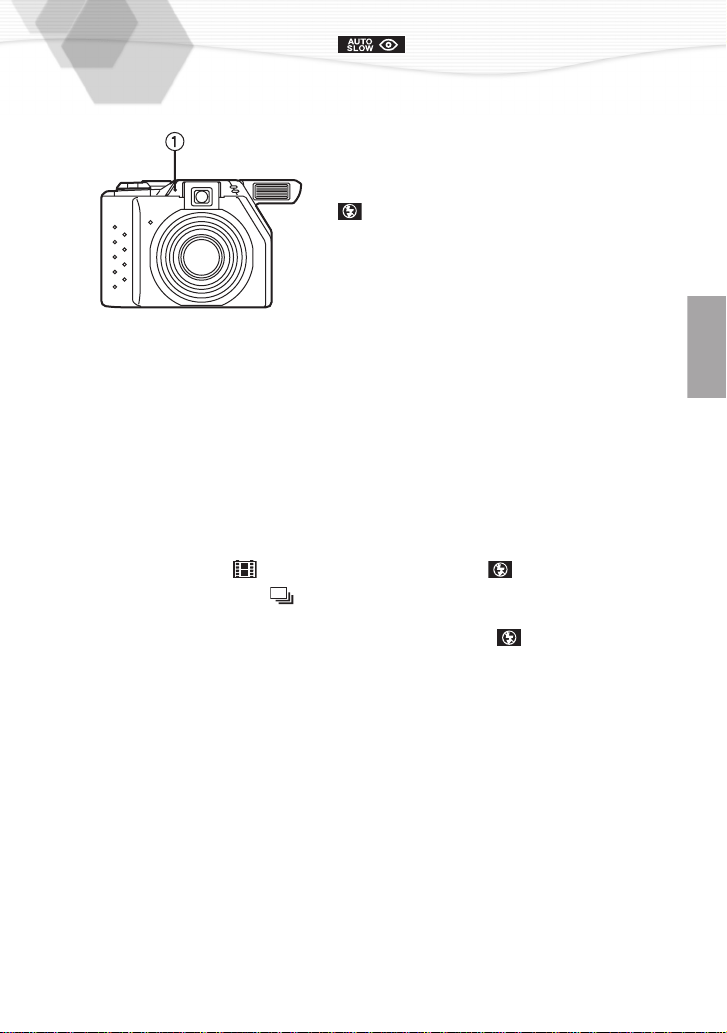
• Do not cover the flash sensor
1
with your fingers or other items. Otherwise, brightness
cannot be perceived.
• In motion image mode [ ], setting is fixed to the forced OFF [ ].
• When you set to burst mode [ ] or auto bracket, only 1 picture is taken for every flash
firing.
• When the flash does not open, setting is fixed to the forced OFF [ ].
KC3‑PP.book35ページ2002年4月5日 金曜日 午前11時55分
36
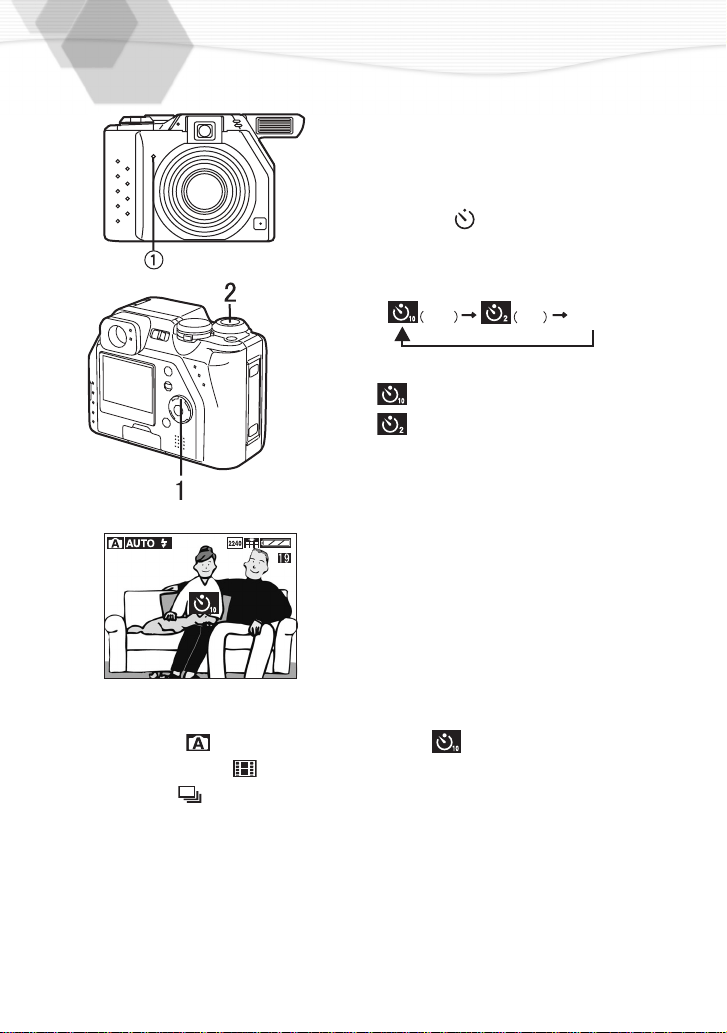
Taking Pictures with the Self-timer
When you set the self-timer, the picture is
automatically taken after 10 seconds (or 2
seconds).
[Preparation]
• Set the operational mode dial and REC mode
dial. (P25)
1
Press the [ ] button.
• Every time you press it, what is displayed
changes as shown below.
: Self-timer set to 10 seconds
: Self-timer set to 2 seconds
When these indicators are not displayed,
self-timer setting is cancelled.
2
Press the shutter button fully
.
• The self-timer indicator
1
blinks and the
shutter is activated after 10 seconds (or 2
seconds).
• When setting the self-timer, the focus and
exposure are not adjusted by pressing the
shutter button halfway. When pressing the
button fully, they are automatically adjusted
just before recording.
• Before taking a picture, if you press the
[MENU] button, the self-timer setting is
cancelled.
• In AUTO mode [ ], you can only set to 10 seconds [ ].
• In motion image mode [ ], it is not possible to use the self-timer.
• In burst mode [ ], the self-timer setting applies to the first picture only.
10 s 2 s
OFF
KC3‑PP.book36ページ2002年4月5日 金曜日 午前11時55分
37
Taking Pictures with Audio
You can take a picture with audio for 5
seconds.
[Preparation]
• Set the operational mode dial and REC mode
dial. (P25)
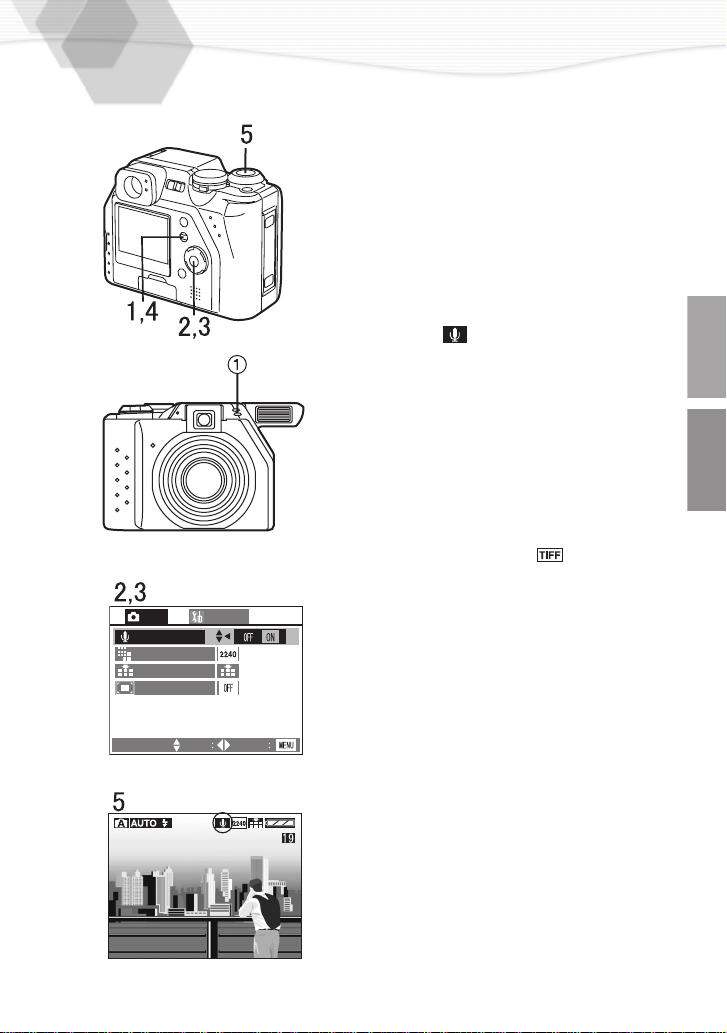
1
Press the [MENU] button.
2
Press 3/4 to set to
[
AUDIO REC.].
3
Press 2/1 to set to [ON].
4
Press the [MENU] button.
• The menu will disappear.
• This icon [ ] will appear on the LCD
monitor.
5
Press the shutter button fully and
take a picture.
• It is not necessary to continue pressing the
shutter
button
.
• Audio is recorded from the built-in
microphone
1
of the camera.
• 5 seconds later, the audio recording is
stopped automatically.
• When setting quality of TIFF [ ], to burst
mode or auto bracket, it is not possible to take a
picture with audio. (P39, P49, P57)
REC
SETUP
AUDIO REC.
PICT.SIZE
QUALITY
D.ZOOM
SELECT
:
SET
EXIT
KC3‑PP.book37ページ2002年4月5日 金曜日 午前11時55分

38
Changing the Picture Size
You can choose among 4 picture size
settings.
[Preparation]
• Set the operational mode dial and REC mode
dial. (P25)
1
Press the [MENU] button.
2
Press 3/4 to select [PICT. SIZE].
3
Press 2/1 to set the picture size.
• : 2240
a
1680 pixels
• : 1600
a
1200 pixels
• : 1120
a
840 pixels
• : 640
a
480 pixels
4
Press the [MENU] button.
• The menu will disappear.
In motion image mode [ ], the picture size is fixed to 320
a
240 pixels.
The smaller you set the picture size, the more pictures you can store on the memory
card. In addition, a small data volume allows you attach the picture to an e-mail or post it
on a web site more easily.
If you set a larger picture size, the printed picture will be clearer, especially with larger
sized prints.
REC SETUP
AUDIO REC.
PICT.SIZE
QUALITY
D.ZOOM
SELECT
:
SET
EXIT
KC3‑PP.book38ページ2002年4月5日 金曜日 午前11時55分
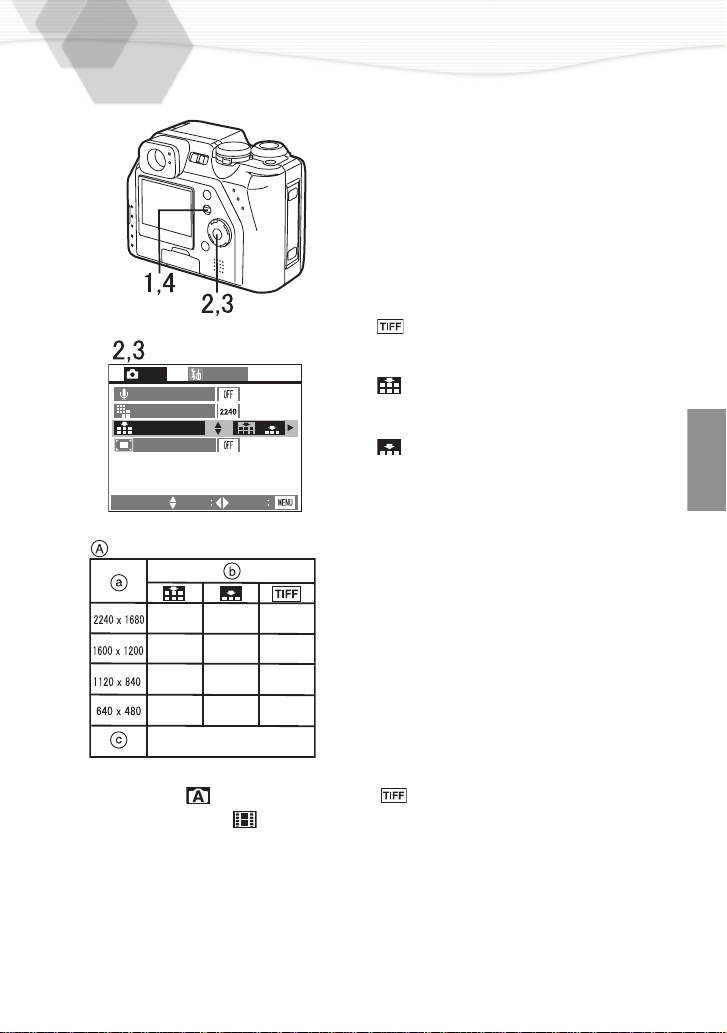
39
Changing the Quality
(Data Compression Ratio)
You can choose among 3 quality levels (Data
Compression Ratio).
[Preparation]
• Set the operational mode dial and REC mode
dial. (P25)
1
Press the [MENU] button.
2
Press 3/4 to select [QUALITY].
3
Press 2/1 to select the
quality (Data
Compression Ratio).
• : TIFF (No compression)
Suitable when editing and processing
pictures with editing/retouching software.
• : Fine (Low compression)
It gives priority to picture quality to record
high quality pictures.
• : Standard
(Standard compression)
It gives priority to the number of recordable
pictures and records standard quality
pictures.
A
:
Quality and number of recordable
pictures
(
a
Picture size,
b
Quality,
c
In motion
image mode) (With the supplied 16MB SD
Memory Card)
4
Press the [MENU] button.
• The menu will disappear.
• In AUTO mode [ ], you cannot select TIFF [ ].
• In motion image mode [ ], quality cannot be modified.
• It may happen that pictures appear like a mosaic depending on the scene characteristics.
• The number of recordable pictures corresponds to the capacity of the supplied 16MB SD
Memory Card. (If you mix fine quality and standard quality, the number of recordable
pictures changes)
• Remaining frame which is displayed on the LCD monitor may not correspond with recorded
frames, however, this is not a malfunction.
REC
SETUP
AUDIO REC.
PICT.SIZE
QUALITY
D.ZOOM
SELECT
:
SET EXIT
Approx.75 s
7151
15 29 2
29 56 4
69 113 13
KC3‑PP.book39ページ2002年4月5日 金曜日 午前11時55分
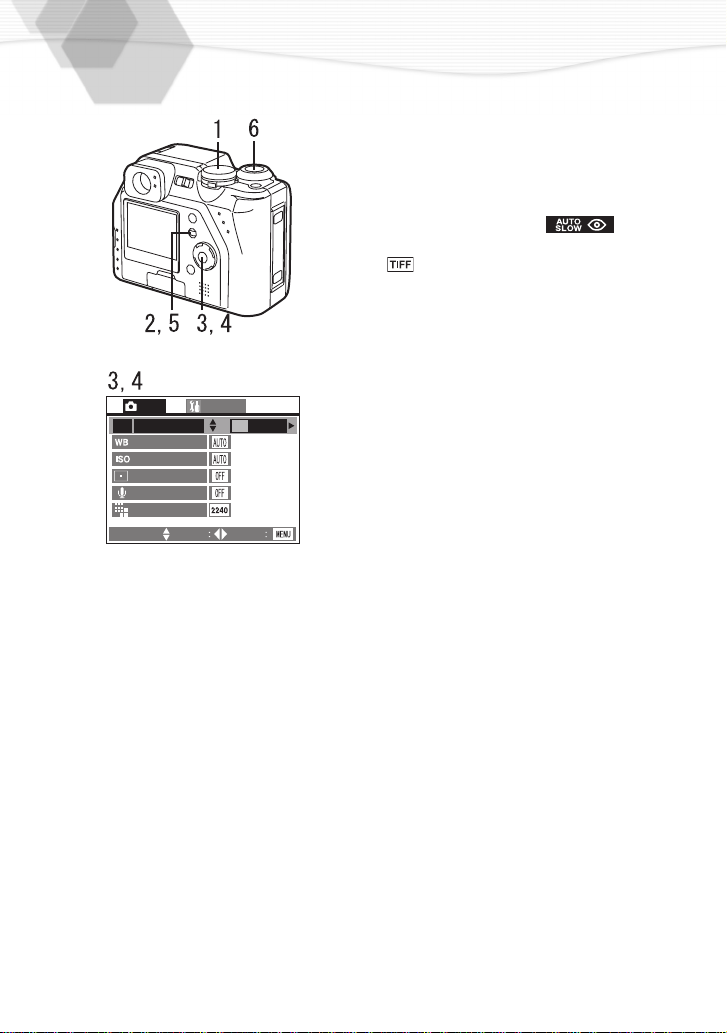
40
Taking Pictures with Program AE Mode
The shutter speed and aperture value are set
automatically according to the brightness of
the subject. The combination of the shutter
speed and aperture value is the same as that
of the AUTO mode (P29), but the settings
listed below are also available. (It is not
possible to set in AUTO mode)
• Slow sync./Red-eye reduction [ ] (P34)
• 2 seconds self-timer (P36)
• TIFF [ ] quality (compression ratio) (P39)
• Exposure compensation (P48)
• Auto bracket (P49)
• Picture adjustment (P51)
• White balance (P52)
• ISO sensitivity selection (P54)
• Spot mode (P55)
[Preparation]
• Set the operational mode dial. (P25)
1
Set the REC mode dial to P/A/S.
2
Press the [MENU] button.
3
Press 3/4 to select [AE MODE].
4
Press 2/1 to set to [P]
.
5
Press the [MENU] button
.
• The menu will disappear.
6
Take a picture.
• The recording method is the same as in
“Taking Pictures (AUTO Mode)”. (P29)
• When taking pictures in dark places, as the exposure time becomes longer and it is difficult
to stabilize the camera, the use of a tripod is recommended.
• If the aperture value is not properly set, the color of the F and the shutter speed values on
the LCD monitor becomes red.
REC
SETUP
W.BALANCE
SENSITIVITY
SPOT AF
AUDIO REC.
PICT.SIZE
SELECT:
SET
EXIT
AE MODE
P A S
AE
KC3‑PP.book40ページ2002年4月5日 金曜日 午前11時55分
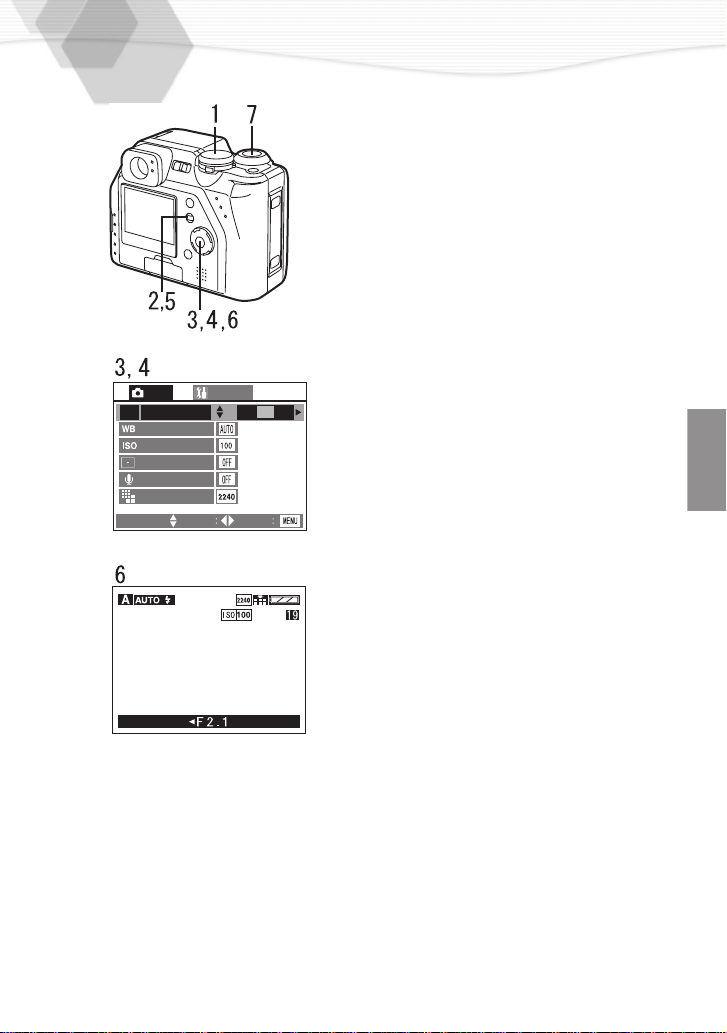
41
Taking Pictures with Aperture-priority AE
When aperture value is set, the shutter speed
is set automatically according to the subject
brightness. Changing the aperture value
changes the depth of field of the picture.
Manipulating this value can change the
sharpness of the background of your picture.
[Preparation]
• Set the operational mode dial. (P25)
1
Set the REC mode dial to P/A/S.
2
Press the [MENU] button.
3
Press 3/4 to select [AE MODE]
.
4
Press 2/1 to set to [A]
.
5
Press the [MENU] button
.
• The menu will disappear.
6
Press 2/1
to
set the aperture value.
7
Take a picture.
• The recording method is the same as in
“Taking Pictures (AUTO Mode)”. (P29)
• The available setting range of the aperture value is from F2.0 to F8.0.
• The aperture value can change according to zoom position.
• It is not possible to select ISO sensitivity [AUTO].
• If the aperture value is not properly set, the color of the F and the shutter speed values on
the LCD monitor becomes red.
REC
SETUP
W.BALANCE
SENSITIVITY
SPOT AF
AUDIO REC.
PICT.SIZE
SELECT:
SET
EXIT
AE MODE
P A S
AE
KC3‑PP.book41ページ2002年4月5日 金曜日 午前11時55分
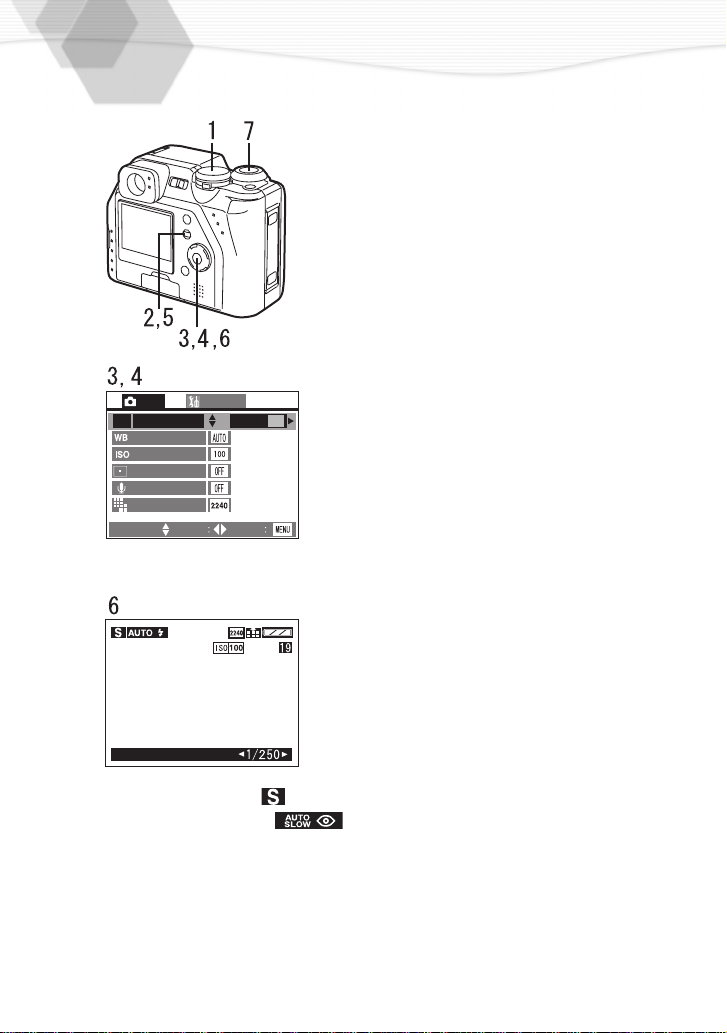
42
Taking Pictures with Shutter-priority AE
When the shutter speed is set, the aperture
value is set automatically according to the
subject brightness.
e.g.: when recording a moving subject, set to
high speed.
[Preparation]
• Set the operational mode dial. (P25)
1
Set the REC mode dial to P/A/S.
2
Press the [MENU] button.
3
Press 3/4 to select [AE MODE]
.
4
Press 2/1 to set [S]
.
5
Press the [MENU] button
.
• The menu will disappear.
6
Press 2/1 to set the shutter speed.
7
Take a picture.
• The recording method is the same as in
“Taking Pictures (AUTO Mode)”. (P29)
• In shutter-priority AE mode [ ], it is not possible to choose the settings listed below.
Slow sync./red-eye reduction [ ] (P34) of the built-in flash
[AUTO] ISO sensitivity (P54)
• The available setting range of the shutter speed is adjustable from 8 seconds to 1/1000 th.
• When the shutter speed is slow, the use of a tripod is recommended.
• If the aperture value is not properly set, the color of the F and the shutter speed values on
the LCD monitor becomes red.
• If the shutter speed is faster than 1/500, the aperture value is limited.
REC
SETUP
W.BALANCE
SENSITIVITY
SPOT AF
AUDIO REC.
PICT.SIZE
SELECT:
SET
EXIT
P A S
AE MODE
AE
KC3‑PP.book42ページ2002年4月5日 金曜日 午前11時55分
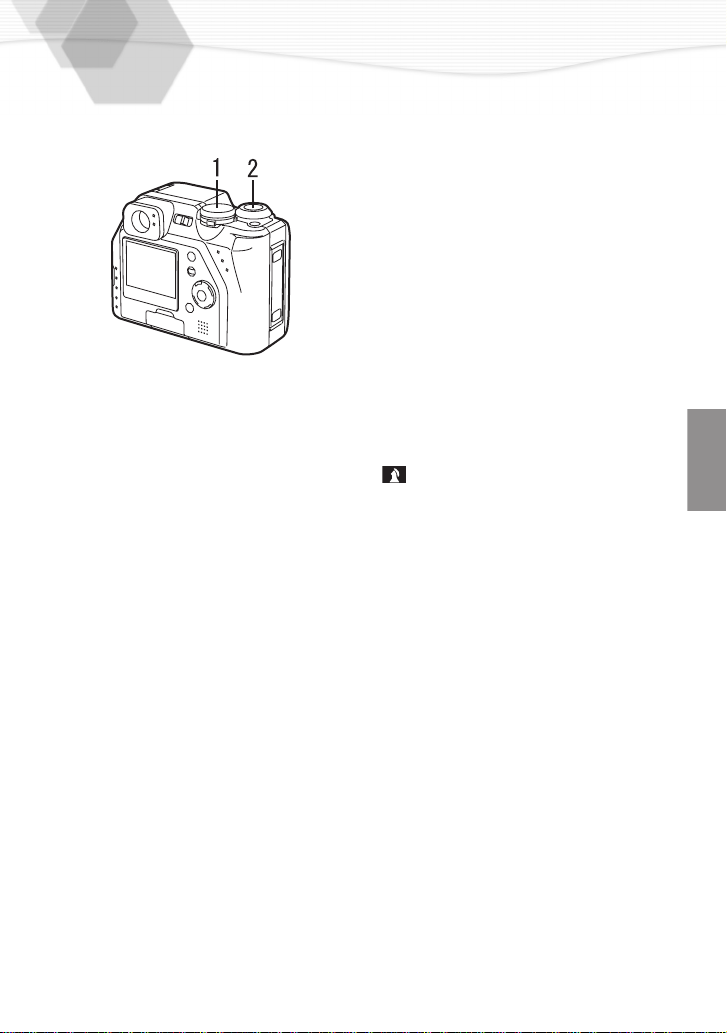
43
Taking Pictures with the Portrait Mode
Portrait mode allows you to achieve the depth
of focus effect easily when you take portrait
photos. The subject looks sharp and
outstanding against an unfocused
background. It will be best place the subject
much closer and allow for proper distance
between subject and background.
Please note that this mode is suitable for
outdoor situations under sunlight.
When you view the subject under differing
lighting situations, you may need to open the
flash. Flash mode will be [Forced ON] in the
default position and you can also select
[Auto/Red-eye reduction]. ([AUTO] can not be
selected in this mode.)
[Preparation]
• Set the operational mode dial. (P25)
1
Set the REC mode dial to Portrait mode
[].
2
Take a picture.
The recording method is the same as in “Taking
Pictures (AUTO Mode)”. (P29)
KC3‑PP.book43ページ2002年4月5日 金曜日 午前11時55分
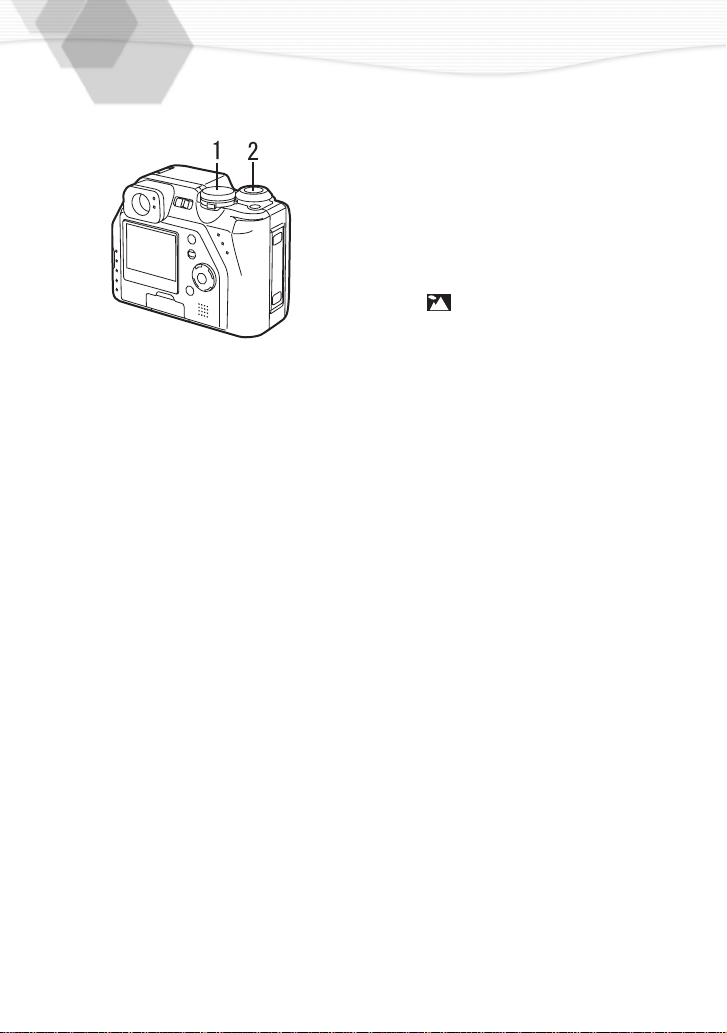
44
Taking Pictures with the Landscape
Mode
In Landscape mode the camera is adjusted to
product the greatest depth of field. This mode
works best outdoors under direct sunlight at
diatances
exceeding 32.8 feet (10 m)
.
[Preparation]
• Set the operational mode dial. (P25)
1
Set the REC mode dial to Landscape
mode [ ].
2
Take a picture.
The recording method is the same as in “Taking
Pictures (AUTO Mode)”. (P29)
KC3‑PP.book44ページ2002年4月5日 金曜日 午前11時55分
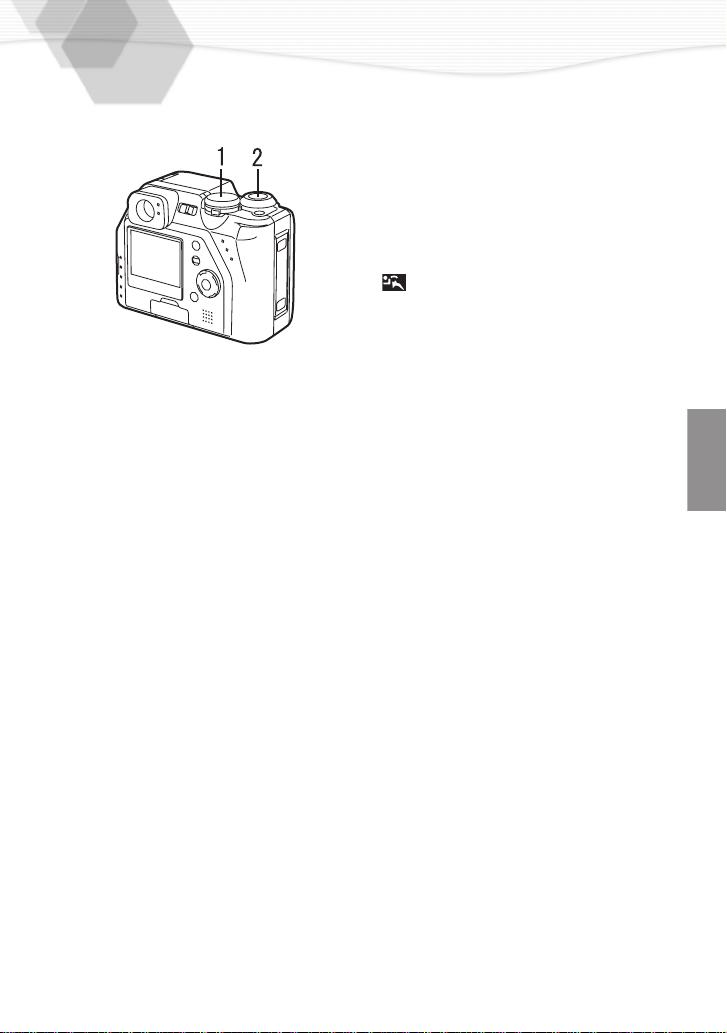
45
Taking Pictures with the Sports Mode
When you take photos of outdoor sports, this
mode allows you to capture a still action
photo easily. Please note that this mode is
suitable to take photos of the subject from
distances of more than 16.4 feet (5 m) and in
daylight
situations.
[Preparation]
• Set the operational mode dial. (P25)
1
Set the REC mode dial to Sports mode
[].
2
Take a picture.
The recording method is the same as in “Taking
Pictures (AUTO Mode)”. (P29)
KC3‑PP.book45ページ2002年4月5日 金曜日 午前11時55分
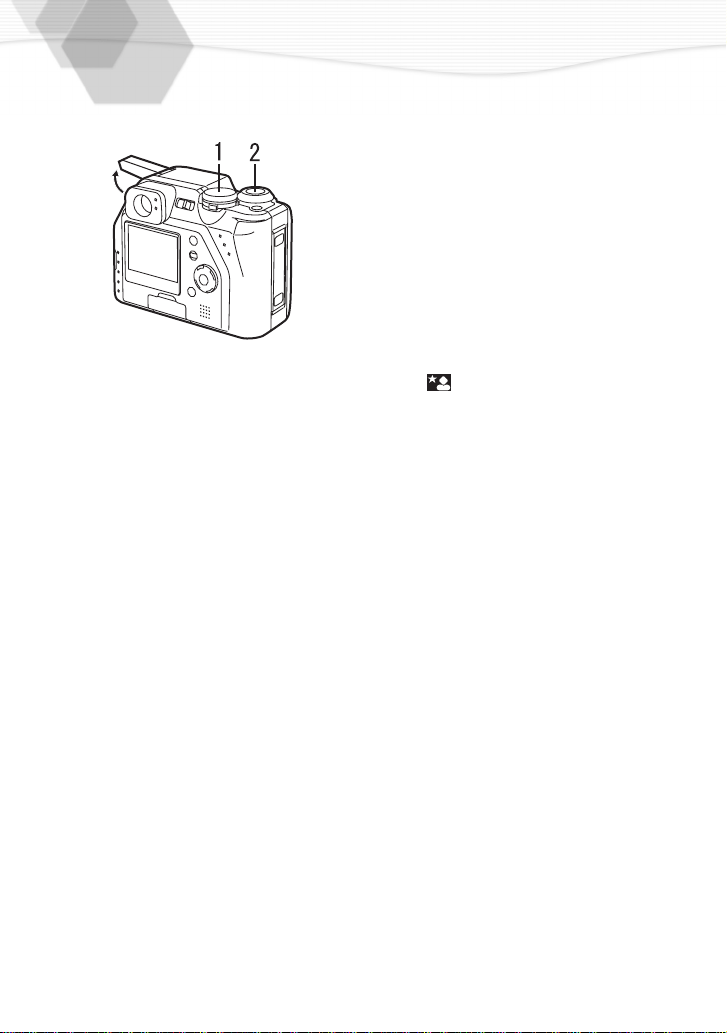
46
Taking Pictures with the Night Portrait
Mode
The Night Portrait mode combines the
electronic flash with a “slow shutter” mode.
This unique feature allows you to photograph
close subjects against the natural night
background. Since the shutter speed is slow,
we highly recommend using a tripod to steady
the camera. The subject should be positioned
within the recommended distance for the
camera’s flash can illuminate.
[Preparation]
• Set the operational mode dial. (P25)
1
Set the REC mode dial to Night portrait
mode [ ].
2
Take a picture.
The recording method is the same as in “Taking
Pictures (AUTO Mode)”. (P29)
• If you do not open the flash using this mode, you
can take the night illumination scenery itself with
slower shutter speed. Use the tripod when using
this mode.
KC3‑PP.book46ページ2002年4月5日 金曜日 午前11時55分
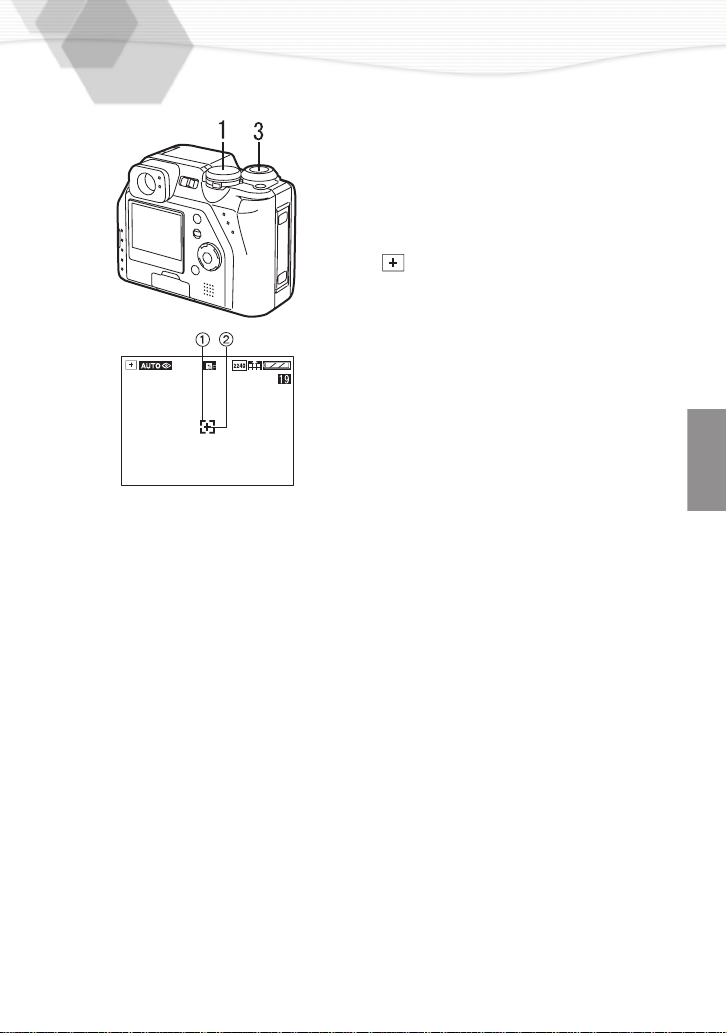
47
Taking Pictures with the Spot Mode
When this mode is selected, both autofocus
area and exposure will be set to spot mode.
This is suitable when you take pictures in
delicate light conditions and intend to spot on
a limited area.
[Preparation]
• Set the operational mode dial. (P25)
1
Set the REC mode dial to Spot mode
[].
• The spot AF area
1
and spot metering
target
2
appears.
2
Center the subject in the spot AF
area.
3
Take a picture.
• The recording method is the same as in
“Taking Pictures (AUTO Mode)”. (P29)
KC3‑PP.book47ページ2002年4月5日 金曜日 午前11時55分
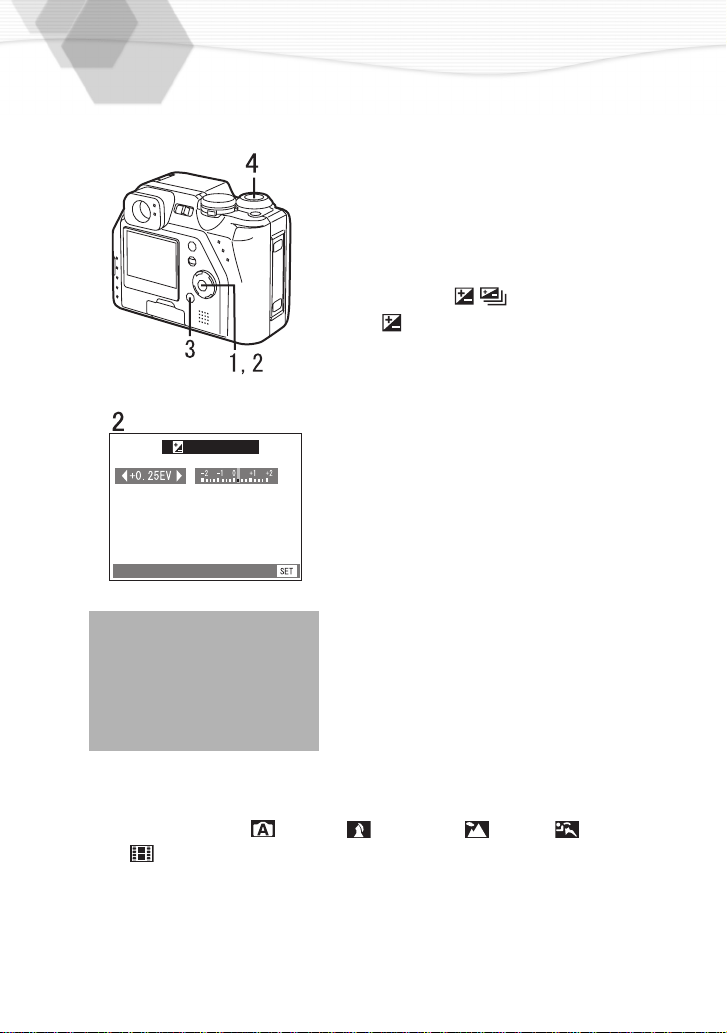
48
Compensating the Exposure
In some situations the illumination of the
background and your subject may differ. Auto
exposure systems may not always calculate
the proper exposure correctly. This is a
normal situation. This feature allows you to
manually compensate the exposure.
[Preparation]
• Set the operational mode dial and REC mode
dial. (P25)
1
Press the [ ] button to select
[ EXPOSURE].
2
Press 2/1 to compensate the
exposure.
• You can compensate from -2 EV to +2 EV
with 0.25 EV step.
(EV is an abbreviation of Exposure Value,
and it is the amount of light given to the CCD
by the aperture value and the shutter speed.
EV0: the exposure capacity with the
aperture value F1.0 and the shutter speed 1
second
When the aperture value or shutter speed
rises, EV1, EV2, EV3... rise too.)
• The compensation state is not reflected on
the LCD monitor.
3
Press the [
REVIEW/SET
] button.
• The compensation window will close.
4
Take a picture.
• The recording method is the same as in
“Taking Pictures (AUTO Mode)”. (P29)
• When the shutter speed is faster than 1/500, the range of aperture value which is possible
to compensate exposure will be limited. (
A
)
• When recording in AUTO [ ],
portrait [ ], landscape [ ], sports [ ]
or motion
image [ ] mode, it is not possible to compensate exposure.
Shutter speed
Aperture value
EXPOSURE
EXIT:
KC3‑PP.book48ページ2002年4月5日 金曜日 午前11時55分
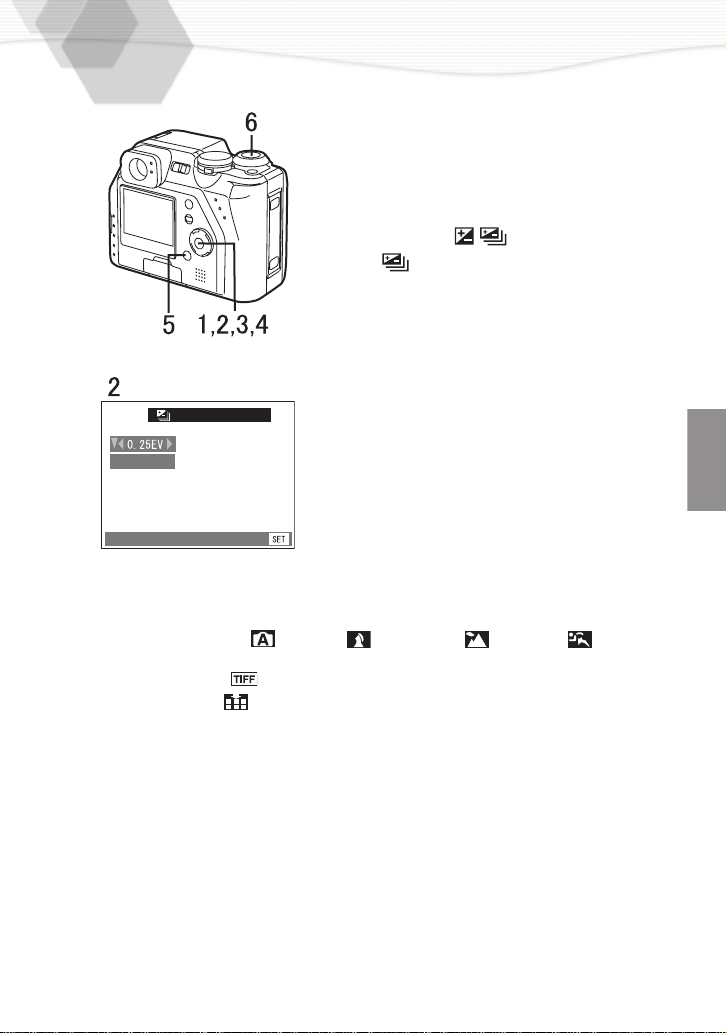
49
Taking Pictures with Auto (AE) Bracket
Pressing the shutter button once, the camera
will automatically take 3 (or 5) pictures
changing exposure according to the set
exposure compensation value.
[Preparation]
• Set the operational mode dial and REC mode
dial. (P25)
1
Press the [ ] button to select
[ AUTO BRACKET].
2
Press 2/ 1 to set the exposure
compensation range.
• Select among 0.25EV, 0.5EV, 0.75EV,
1.0EV. Setting to [OFF], auto bracket is
unavailable.
3
Press 4.
• Press
3/4
to select step 2 or 4.
4
Press 2/1 to set the number of
pictures (3/5).
5
Press the [
REVIEW/SET
] button.
6
Take a picture.
• The recording method is the same as in
“Taking Pictures (AUTO Mode)”. (P29)
• When recording in AUTO [ ],
portrait [ ], landscape [ ]
or
sports [ ]
, you
cannot record using auto bracket.
• Setting quality to TIFF [ ], you cannot record using auto bracket.
• Setting quality to fine [ ], the number of pictures is set to 3.
• When flash fires, you can take only 1 picture.
AUTO BRACKET
3 FRAMES
SET:
KC3‑PP.book49ページ2002年4月5日 金曜日 午前11時55分
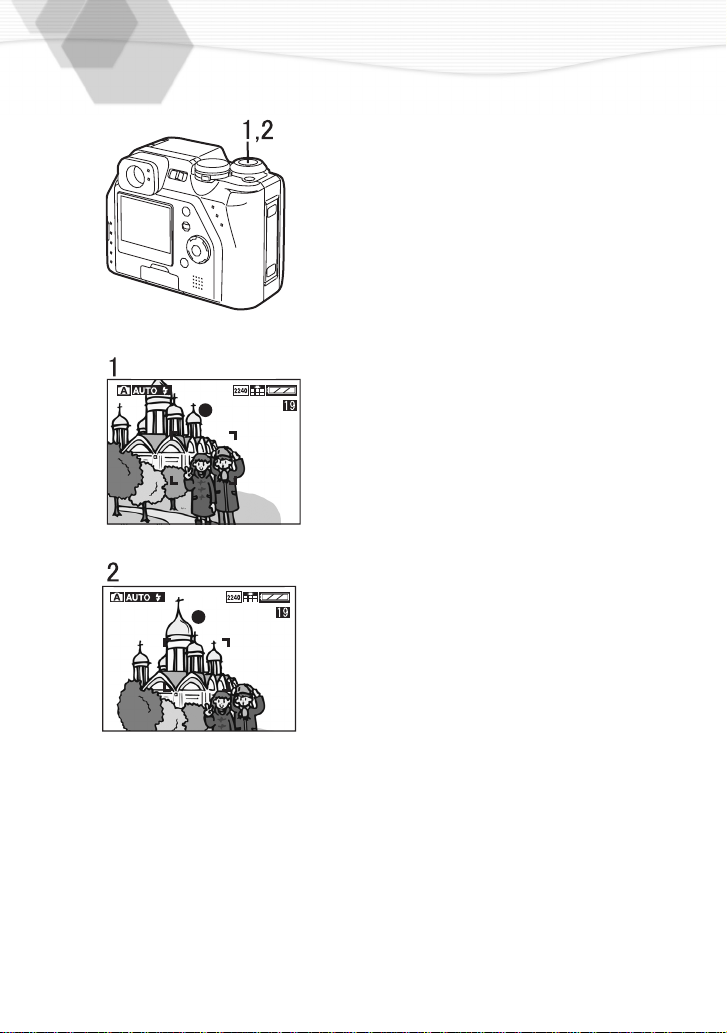
50
Using the AF/AE Lock
If the subject is out of the AF target or the
focus area and you press the shutter button,
the subject’s focus is not adjusted. After
locking focus and exposure (AF/AE lock), you
can take a clear picture with adjusted focus.
AF: Auto focus
AE: Auto exposure
[Preparation]
• Set the operational mode dial and REC mode
dial. (P25)
1
Aim the camera at the subject on which
you want to adjust the focus to enter
the focus area on the LCD monitor and
then press the shutter button halfway
(AF/AE lock) to set it.
• When the focus is adjusted, the focus
indication [
¥
] appears.
2
Move the camera keeping the chosen
composition and press the shutter
button all the way.
• Before pressing the shutter button, you can set
the AF/AE lock any time you want.
KC3‑PP.book50ページ2002年4月5日 金曜日 午前11時55分
51
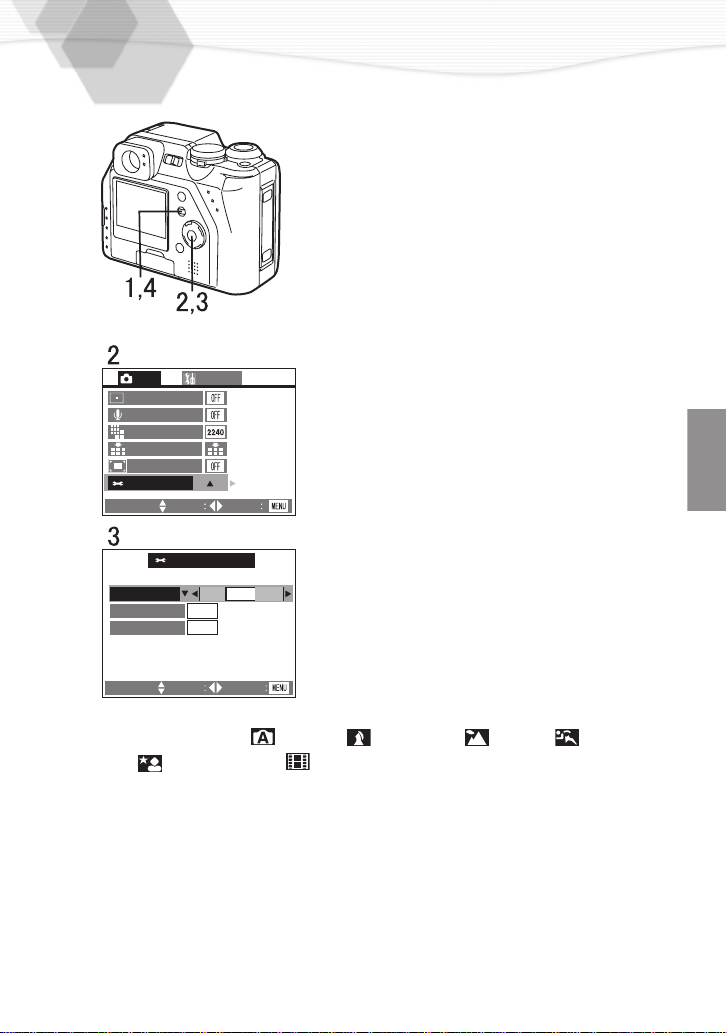
Picture Adjustment
(Contrast/Sharpness/Saturation)
[Preparation]
• Set the operational mode dial and REC mode
dial. (P25)
1
Press the [MENU] button.
2
Press 3/4 to select [PICT. ADJ.] and
press 1
.
3
Press 3/4/2/1 to set [CONTRAST],
[SHARPNESS] and [SATURATION]
.
4
Press the [MENU] button twice
.
• The menu will disappear.
• When recording in AUTO [ ],
portrait [ ], landscape [ ], sports [ ], night
portrait [ ]
or motion image [ ] mode, it is not possible to adjust quality.
REC
SETUP
QUALITY
D.ZOOM
PICT.ADJ.
SELECT:
SET EXIT
PICTURE ADJ.
SELECT:
SET
EXIT
CONTRAST
STD.
LOW
HIGH
STD.
STD.
SHARPNESS
SATURATION
SPOT AF
AUDIO REC.
PICT.SIZE
KC3‑PP.book51ページ2002年4月5日 金曜日 午前11時55分
52
Setting the White Balance
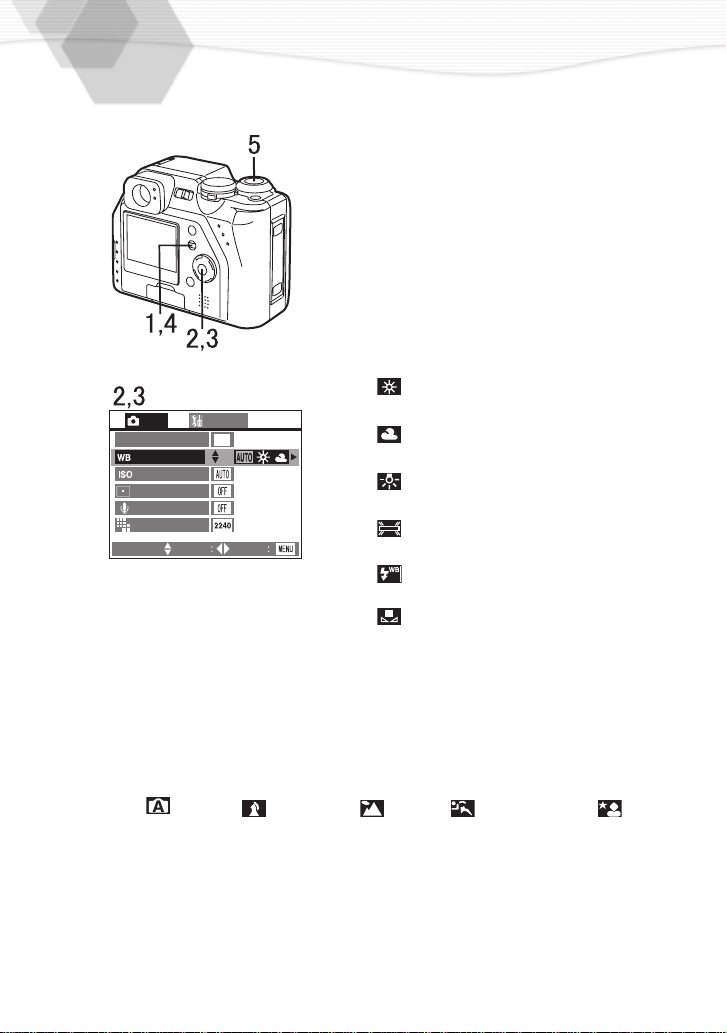
Auto White Balance is designed to
automatically adjust the camera to produce
natural flesh tones. In most situations it works
fine. In some situations where several
different types of lighting are present,
enhanced performance can be achieved by
setting the white balance manually.
[Preparation]
• Set the operational mode dial and REC mode
dial. (P25)
1
Press the [MENU] button.
2
Press 3/4 to select [W.BALANCE].
3
Press 2/1 to select the mode.
• AUTO: if the auto white balance is set
• (Daylight): for recording outdoors on a
bright day
• (Cloudy): for recording under
cloudy and shady sky
• (Halogen): for recording under
halogen lighting
• (Fluorescent): for recording
under fluorescent lighting
• (Flash): for taking a picture with
flash light only
• (White set): for manual setting (Read
the following page where the manual setting
is explained in detail)
4
Press the [MENU]
button.
• The menu will disappear.
5
Take a picture.
• The recording method is the same as in
“Taking Pictures (AUTO Mode)”. (P29)
• In AUTO [ ],
portrait [ ], landscape [ ], sports [ ] or night portrait [ ]
mode,
the white balance is set to [AUTO].
REC
W.BALANCE
SETUP
SENSITIVITY
SPOT AF
AUDIO REC.
PICT.SIZE
SELECT:
SET
EXIT
P
AE MODE
AE
KC3‑PP.book52ページ2002年4月5日 金曜日 午前11時55分

53
Here the white set mode of white balance is
explained.
[Preparation]
• Set the operational mode dial and REC mode
dial. (P25)
1
Press the [MENU] button.
2
Press 3/4 to select [W.BALANCE].
3
Press 2/1 to set to white set [ ].
Only when setting the white balance again
4
Press the [
REVIEW/SET
] button.
• The menu will disappear.
5
Aim the camera at a white paper or
similar objects so that it completely
fills the frame to white on the screen
and press the shutter button all the
way.
• White balance is set.
REC
SETUP
W.BALANCE
SELECT:
SET
EXIT
WHITE SET
CANCEL
FRAME THE CAMERA
AT THE WHITE SURFACE
AND PRESS SHUTTER
SENSITIVITY
SPOT AF
AUDIO REC.
PICT.SIZE
P
AE MODE
AE
KC3‑PP.book53ページ2002年4月5日 金曜日 午前11時55分
54
Setting ISO Sensitivity
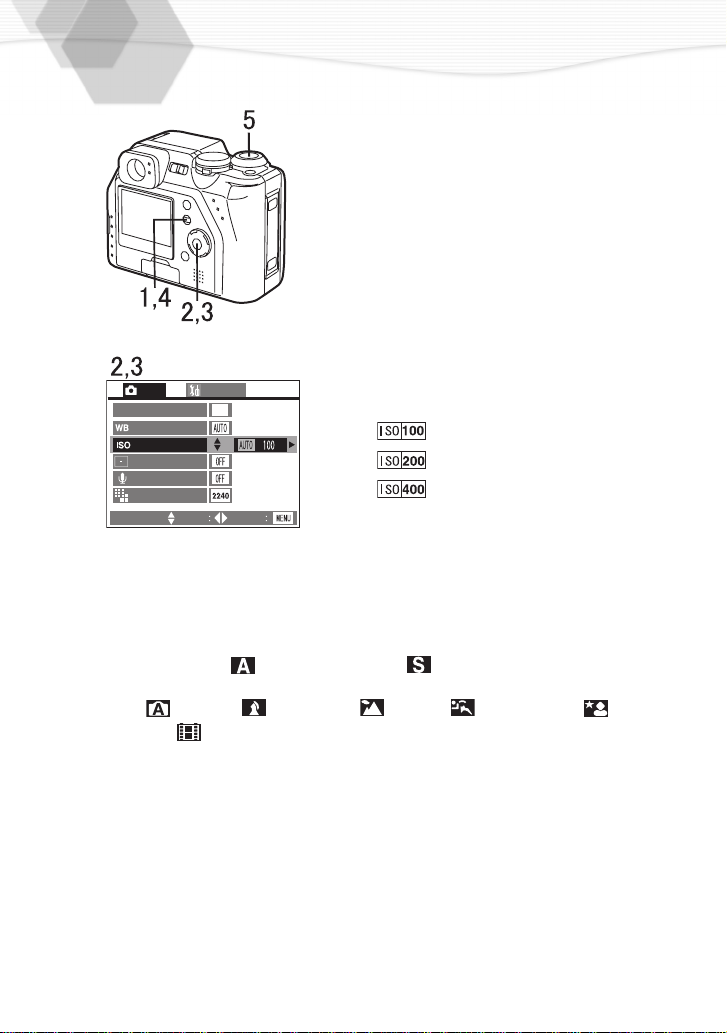
ISO sensitivity is a value that corresponds to
the sensitivity to light. The higher it is, the
better the camera performs in dark places.
[Preparation]
• Set the operational mode dial and REC mode
dial. (P25)
1
Press the [MENU] button.
2
Press 3/4 to select [SENSITIVITY].
3
Press 2/1 to select the sensitivity.
• AUTO: If “AUTO” is selected and Flash
mode is “Forced OFF”, if available light
needs shutter speed slower than 1/8, the
ISO sensitivity is automatically adjusted up
to ISO 200 and shutter speed stays 1/8. If
your picture is still too dark, please use the
flash.
•
•
•
4
Press the [MENU] button.
• The menu will disappear.
5
Take a picture.
• The recording method is the same as in
“Taking Pictures (AUTO Mode)”. (P29)
• In aperture-priority AE [ ] or shutter-priority AE [ ], it is not possible to set to [AUTO]
ISO sensitivity.
• In AUTO [ ],
portrait [ ], landscape [ ], sports [ ], night portrait [ ] or
motion image [ ] mode, it is set to [AUTO].
REC SETUP
SENSITIVITY
SELECT:
SET EXIT
W.BALANCE
SPOT AF
AUDIO REC.
PICT.SIZE
P
AE MODE
AE
KC3‑PP.book54ページ2002年4月5日 金曜日 午前11時55分
55
Using the Spot AF
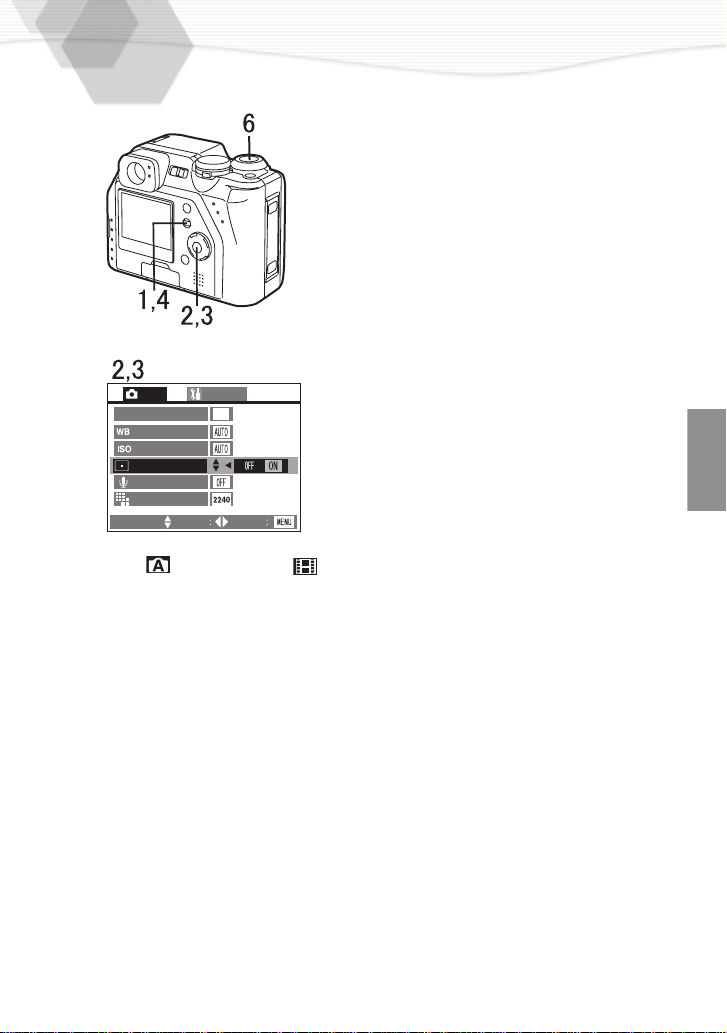
You can record a subject focusing on a single
part with a smaller focus area than usual. This
setting is particularly suitable to focus on the
eye when you take portrait photos.
[Preparation]
• Set the operational mode dial and REC mode
dial. (P25)
1
Press the [MENU] button.
2
Press 3/4 to select [SPOT AF].
3
Press 2/1 to set to [ON].
4
Press the [MENU] button.
• The menu will disappear.
5
Center the subject in the spot AF
area.
6
Take a picture.
• The recording method is the same as in
“Taking Pictures (AUTO Mode)”. (P29)
• In AUTO [ ] or motion image [ ] mode, it is not possible to record with the spot AF.
REC
SETUP
SPOT AF
SELECT:
SET EXIT
SENSITIVITY
W.BALANCE
AUDIO REC.
PICT.SIZE
P
AE MODE
AE
KC3‑PP.book55ページ2002年4月5日 金曜日 午前11時55分

56
Taking Pictures with Macro Mode
If the camera lens is at a distance of 0.2 feet
(6 cm) to 1.64 feet (50 cm) from the subject,
set macro mode [ ].
[Preparation]
• Set the operational mode dial. (P25)
1
Set the REC mode dial to macro mode
[].
• [ ] will be displayed.
2
Take a picture.
• The recording method is the same as in
“Taking Pictures (AUTO Mode)”. (P29)
• When selecting the macro mode, optical finder functionality is limited. Use the LCD monitor.
• If you use the close-up lens (DMW-LC52, optional), you can record from a shorter distance.
When using close-up lens (optional)
0.98 feet
(30 cm)
0.66 feet
(20 cm)
1.64 feet
(50 cm)
0.2 feet
(6 cm)
0.52 feet
(16 cm)
1.08 feet
(33 cm)
0.39 feet
(12 cm)
0.66 feet
(20 cm)
0.15 feet
(4.5 cm)
KC3‑PP.book56ページ2002年4月5日 金曜日 午前11時55分
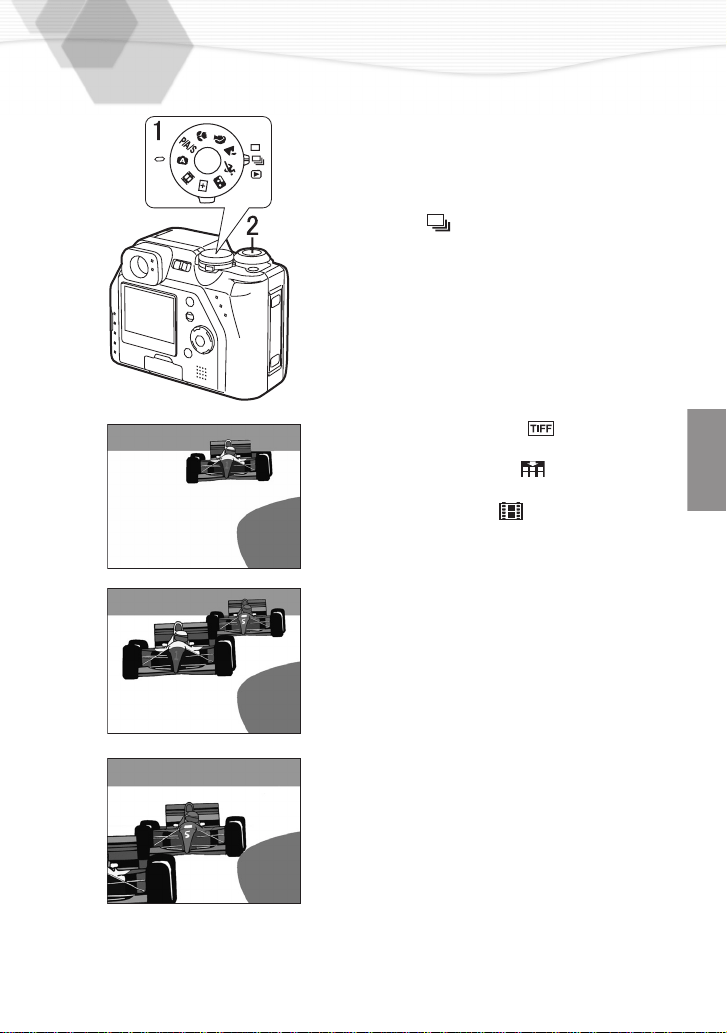
57
Taking Pictures with Burst Mode
By continuously pressing the shutter button, it
is possible to record in burst mode. (4
frames/second maximum of 8 frames)
[Preparation]
• Set the REC mode dial. (P25)
1
Set the operational mode dial to burst
mode [ ].
2
Press the shutter button halfway to
lock the focus, then press it fully to
take pictures in sequence.
• It is possible to record 4 frames in 1 second in
burst mode, at a shutter speed higher than 1/25,
but the flash does not fire simultaneously.
• If the flash fires, it is possible to record only 1
frame.
• When quality is set to TIFF [ ], it is not
possible to use the burst mode.
• When quality is set to fine [ ], it is possible to
record a maximum of 4 frames in burst mode .
• In motion image mode [ ], the burst mode
cannot be used.
• Only the first picture recorded is displayed on the
LCD monitor.
KC3‑PP.book57ページ2002年4月5日 金曜日 午前11時55分
58
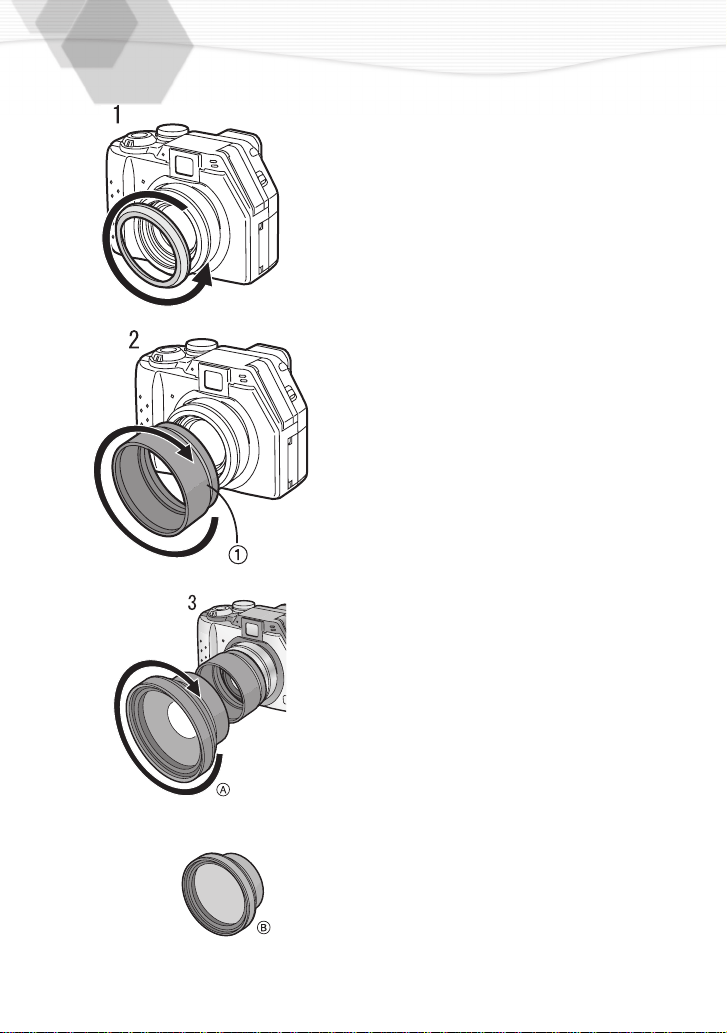
Using the Conversion Lens
Using the tele conversion lens (DMW-LT52,
optional), it is possible to zoom in much more;
using the wide conversion lens (DMW-LW52,
optional), it is possible to widen much more.
(When attaching the conversion lens, the
Close-up lens (DMW-LC52, optional) or MC
protector (DMW-LMC52; optional) to the
camera, the conversion lens adaptor
(DMW-LA1) is necessary)
1
Remove the lens ring.
2
Attach the conversion lens adaptor
1.
3
Install the tele conversion lens B or
the wide conversion lens A.
• When attaching the tele conversion lens and
rotating the zoom lever towards W, a vignetting
effect occurs. Only rotate towards T.
• When using the conversion lens, set the built-in
flash to forced OFF.
• When attaching the conversion lens, use the
LCD monitor.
• To prevent the lens from being stained with water
or oil, attach both the optional conversion lens
adaptor and the optional MC protector to protect
the lens.
• For further information, read the conversion lens
operating instructions.
KC3‑PP.book58ページ2002年4月5日 金曜日 午前11時55分
59
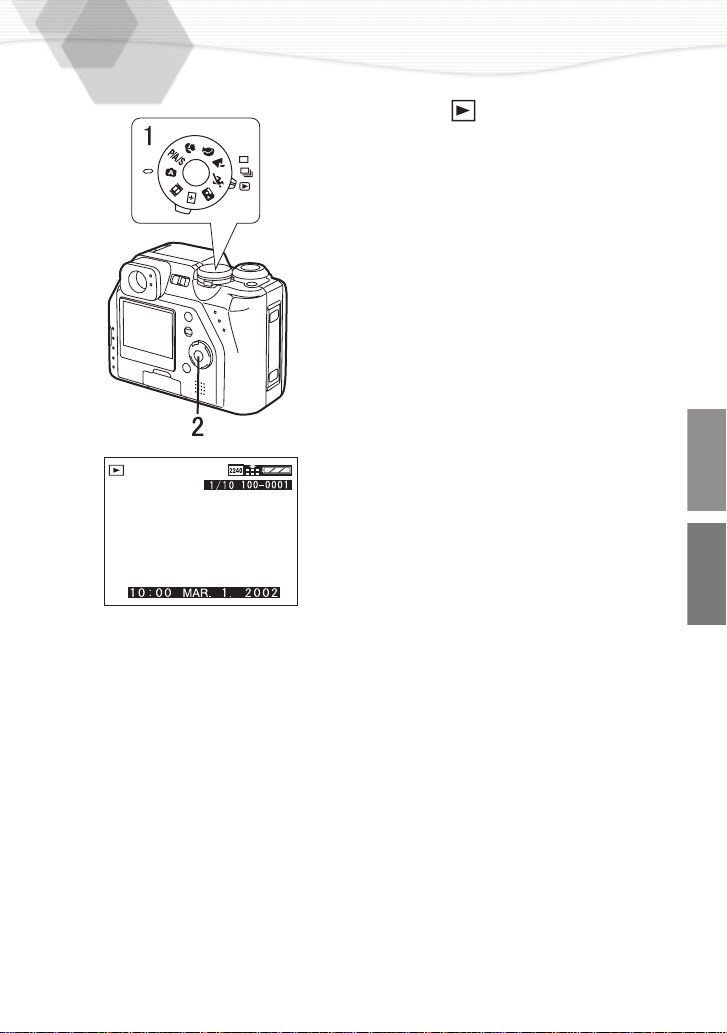
Playing Back Still Pictures
1
Set the operational mode dial to
playback [ ].
• The last recorded picture is played back.
2
Press 2 to play back the previous
picture.
Press 1 to play back the following
picture.
• Every time you press, the previous
(following) picture is played back.
• The picture following the last one is the first
picture.
[Fast forwarding/Fast rewinding]
During playback, continue pressing 2/ 1.
1: Fast forward
2: Fast rewind
• The file number increases/decreases. When
releasing
2/ 1
,
the picture corresponding to the
current file number is displayed.
• This camera is based on the DCF standards (Design rule for Camera File system) which
were established by the Japan Electronic Industry Technology Association (JEITA).
• The file format that can be played back with this camera is JPEG. (There are also pictures
that cannot be played back in JPEG format)
• When playing back still pictures that have been recorded with other equipment, the quality
of pictures may be deteriorated and pictures may not be able to be played back.
• When playing back a file out of standard, the folder/file number is indicated by [-] and the
screen becomes black.
KC3‑PP.book59ページ2002年4月5日 金曜日 午前11時55分
60
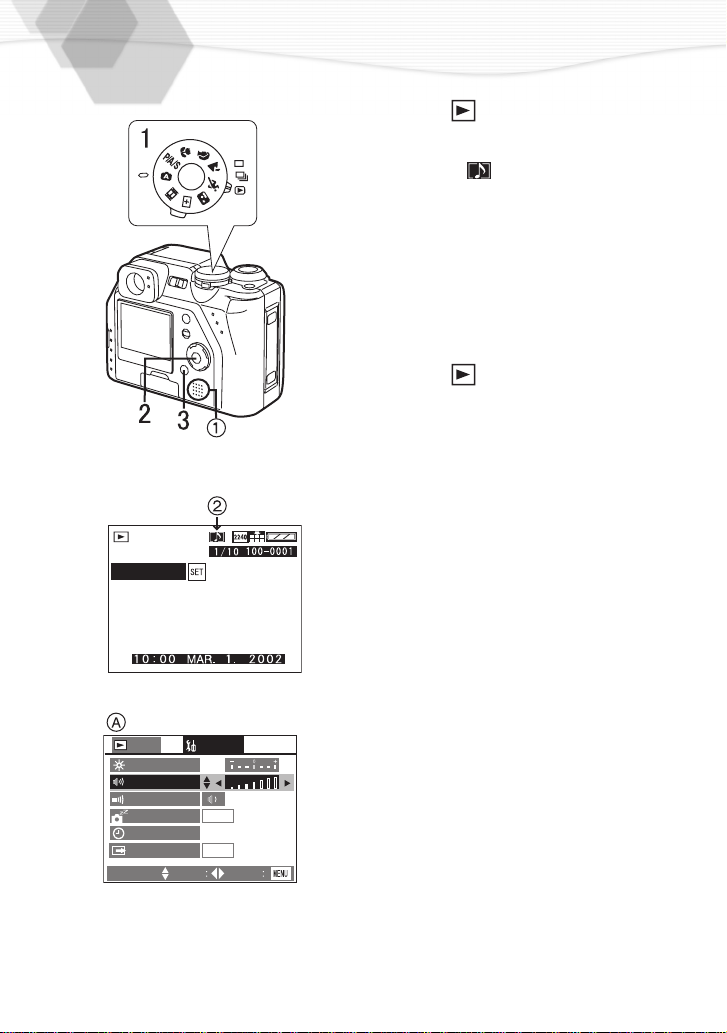
Playing Back Still Pictures with Audio
1
Set the operational mode dial to
playback [ ].
2
Press 2/1 to select the file with
audio icon [ ] 2
22
2
.
3
By pressing the [REVIEW/SET]
button, audio is played back.
•
You can hear audio from the speaker
1
.
ª
Following the steps listed below, it is possible
to adjust the sound volume.
A
1
Set the operational mode dial to
playback [ ].
2
Press the [MENU] button.
3
Press 1 to select the setup menu.
4
Press 3/4 to select [VOLUME].
5
Press 2/1 to adjust the sound
volume.
6
Press the [MENU] button.
•
The menu will disappear.
PLAY AUDIO:
MONITOR
PLAY SETUP
VOLUME
BEEP
POWER SAVE
CLOCK SET
2 MIN.
SELECT:
SET
EXIT
VIDEO OUT
NTSC
KC3‑PP.book60ページ2002年4月5日 金曜日 午前11時55分
61
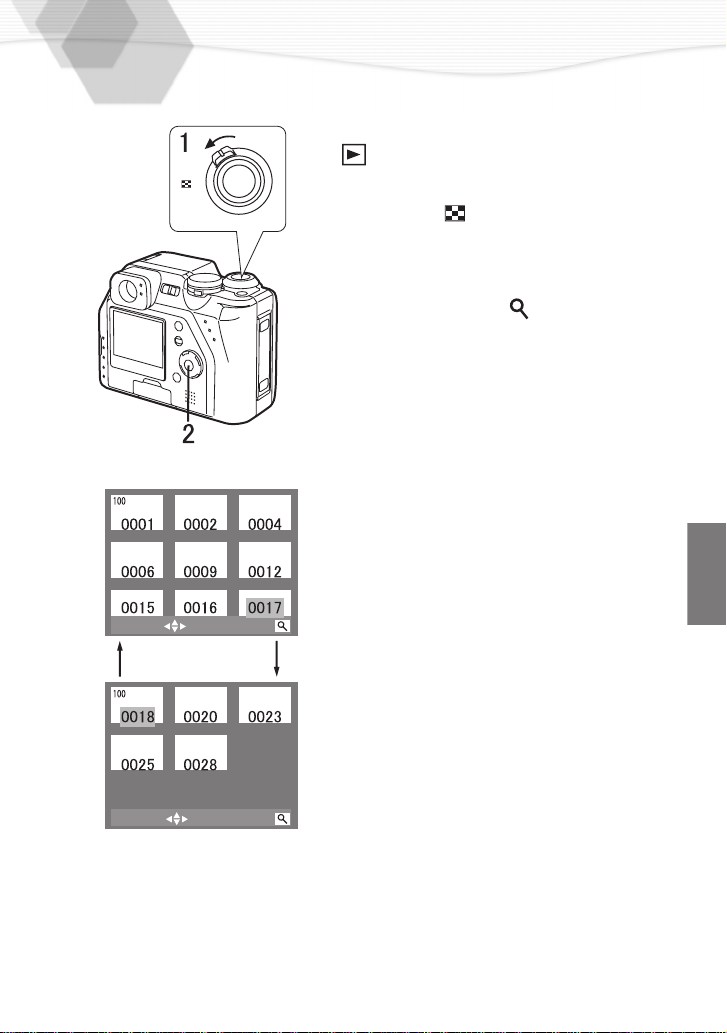
9 Images Multi Playback
It is possible to display 9 images at once.
[Preparation]
Set the operational mode dial to playback
[].
1
During playback, rotate the zoom lever
towards [ ].
• Multi playback (9 frames) starts.
2
Press 3/4/2/1 to select images.
• To return to the normal indication, rotate the
zoom lever towards [ ]. The image with
the file number colored in yellow is
displayed.
W
SELECT:
CANCEL:
SELECT:
CANCEL:
KC3‑PP.book61ページ2002年4月5日 金曜日 午前11時55分
62
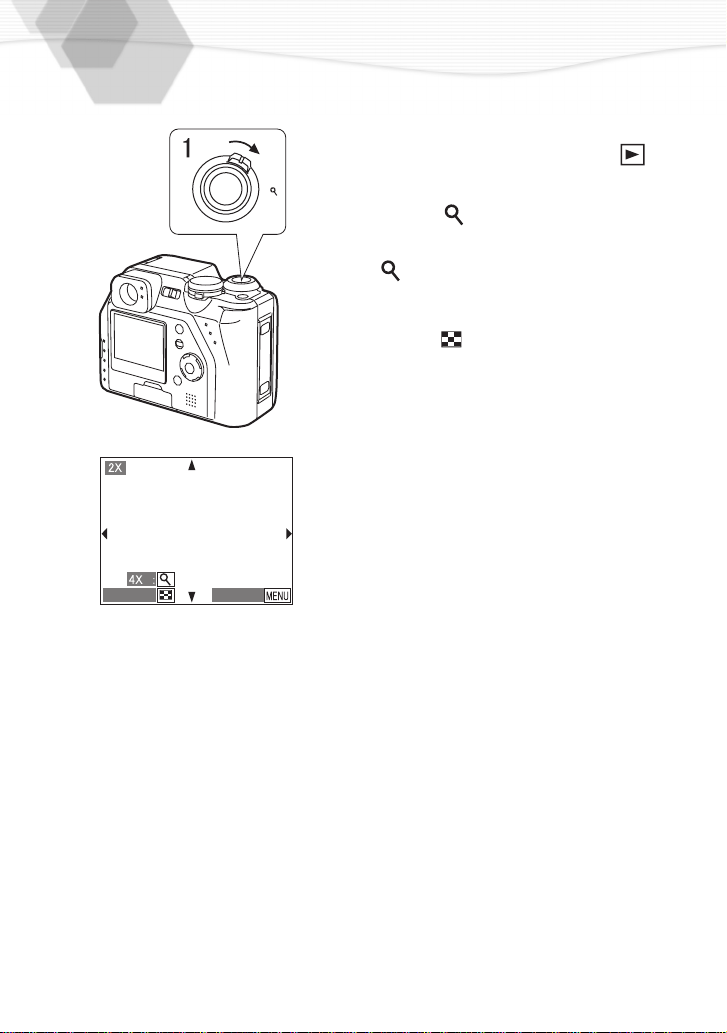
Using the Playback Zoom
During playback it is possible to enlarge
pictures.
[Preparation]
• Set the operational mode dial to playback [ ].
1
During playback, rotate the zoom lever
towards [ ].
• The more the zoom lever rotates towards
[ ], the more the zoom magnification ratio
increases.
•
The more the zoom lever rotates
towards
[ ], the
more
the zoom
magnification ratio decreases.
• Use
3/4/2/1
to change the area to be
enlarged.
ª To delete a picture during the playback
zoom
Press the [MENU] button.
When this message is displayed “DELETE
THIS PICTURE?”, press 3/4 to select
[YES], and press the [REVIEW/SET] button.
• In motion image playback, it is not possible to magnify.
• The more the zoom magnification increases, the more the picture quality deteriorates.
• The playback zoom may not operate if pictures have been recorded with other equipment.
T
CANCEL:
DELETE:
KC3‑PP.book62ページ2002年4月5日 金曜日 午前11時55分
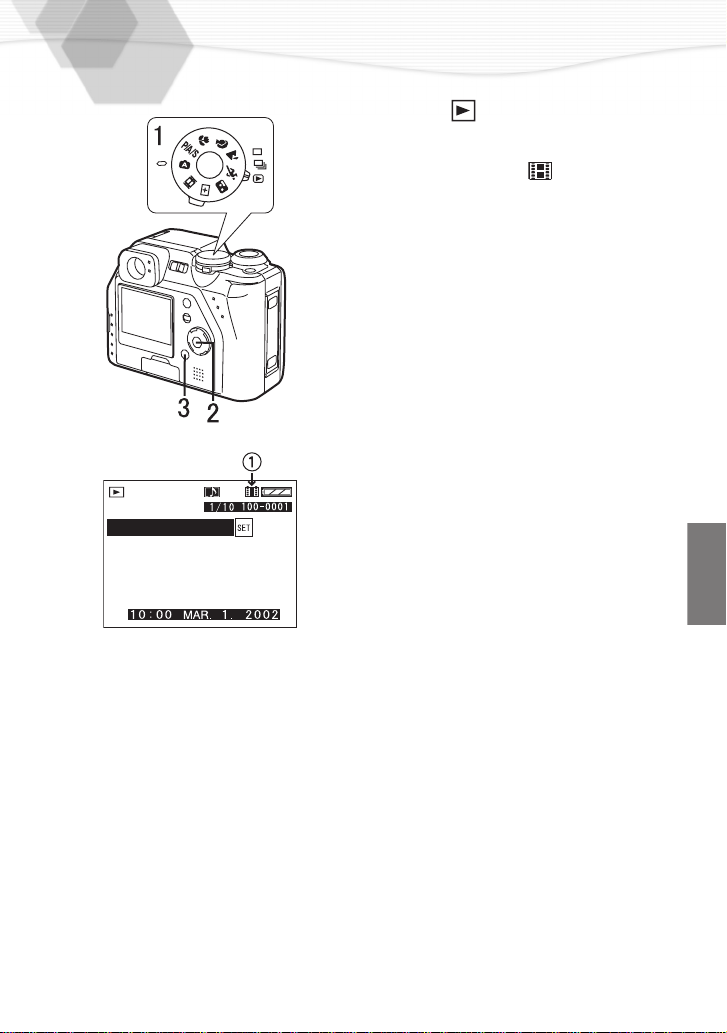
63
Playing Back Motion Images
1
Set the operational mode dial to
playback [ ].
2
Press 2/1 to select the file with the
motion image icon [ ] 1
11
1
.
3
By pressing the [
REVIEW/SET]
button, the motion image will be
played back.
• By pressing
4
, motion image playback will
stop.
[Fast forwarding/Fast rewinding]
During motion image playback, continue
pressing 2/1.
1: Fast forward
2: Fast rewind
• When releasing the button, it turns to normal
playback.
[To pause]
Press 3 during motion image playback.
Press 3 again to resume playback.
• When playing back motion images that have been recorded with other equipment, the
quality of images may be deteriorated and images may not be able to be played back.
• The file format that can be played back with this camera is QuickTime Motion JPEG.
• It could happen that the Motion JPEG file recorded by PC or other equipments cannot be
played back with this camera.
• When using a high capacity memory card, it is possible that fast rewinding may be slower.
PLAY MOTION IMAGE:
KC3‑PP.book63ページ2002年4月5日 金曜日 午前11時55分
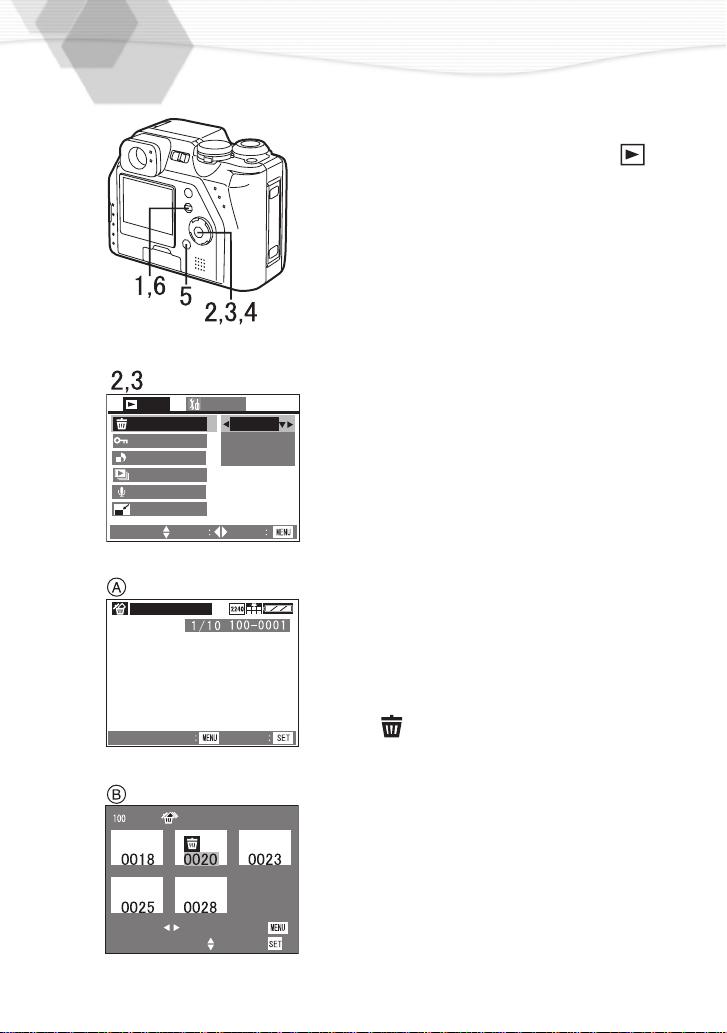
64
Deleting Images
Images recorded on the card can be deleted.
Once deleted, images cannot be recovered.
[Preparations]
• Set the operational mode dial to playback [ ].
• When an image is protected, it cannot be
deleted. Cancel the protect setting. (P69)
[Delete single image]
A
1
Press the [MENU] button.
2
Press 3/4 to select [DELETE] and
press 1
.
3
Select [SINGLE] and press 1
.
4
Press 2/1 to select the image to be
deleted.
5
Press the [
REVIEW/SET
] button.
• The selected image is deleted.
6
Press the [MENU] button twice.
• The menu will disappear.
[Delete multi images]
B
It is possible to delete up to 50 images all at
once.
1
Press the
[
MENU] button.
2
Press 3/4 to select [DELETE] and
then press 1
.
3
Press 3/4 to select [MULTI] and
then press 1
.
4
Press 2/1 to select the images to be
deleted and then press 3 to confirm
this setting.
• The selected images are displayed with
[ ]. Pressing
4
,
the setting is cancelled.
5
Press the [REVIEW/SET] button.
• The selected multi images are deleted all at
once.
6
Press the [MENU] button twice.
• The menu will disappear.
PLAY
SETUP
DELETE
PROTECT
SLIDE SHOW
AUDIO DUB.
SINGLE
MULTI
ALL
SELECT:
SET EXIT
RESIZE
DPOF
DELETE THIS
CANCEL
DELETE
DELETE MULTI
SELECT:
CANCEL:
MARK/UNMARK:
SET:
KC3‑PP.book64ページ2002年4月5日 金曜日 午前11時55分
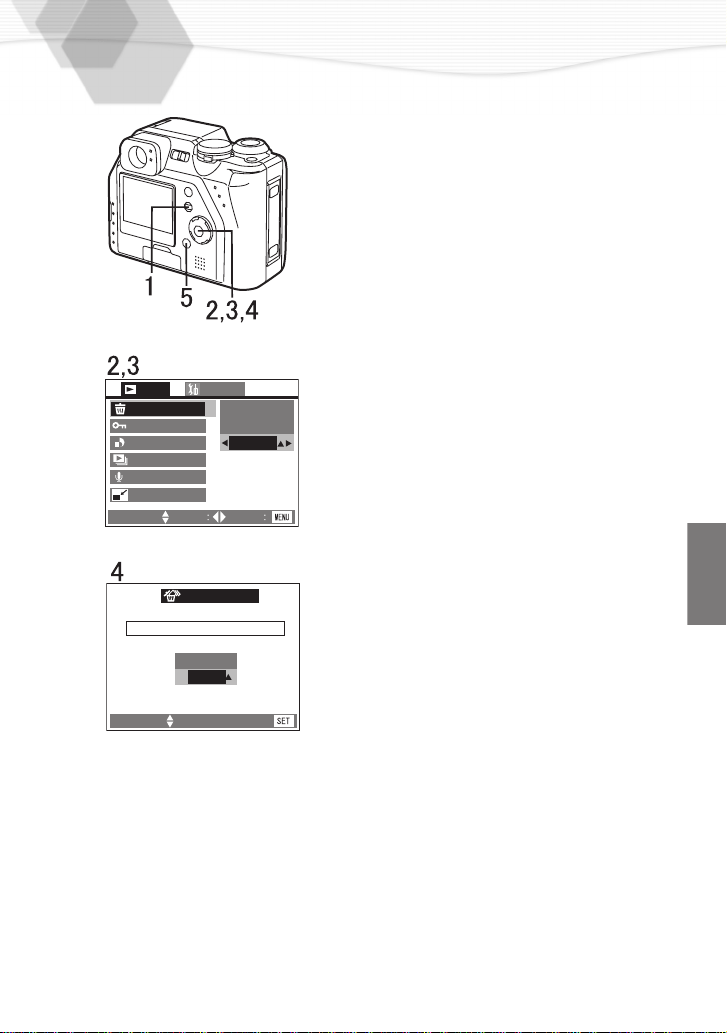
65
[Delete all images]
Once deleted, images cannot be recovered.
1
Press the [MENU] button.
2
Press 3/4 to select [DELETE] and
then press 1
.
3
Press 3/4 to select [ALL] and then
press 1
.
4
When this message is displayed
“DELETE ALL PICTURES?”, press
3/4 to select [YES].
5
Press the [
REVIEW/SET]
button
.
• All images are deleted.
PLAY SETUP
DELETE
PROTECT
SLIDE SHOW
AUDIO DUB.
SINGLE
MULTI
ALL
SELECT: SET
EXIT
DPOF
RESIZE
DELETE ALL
DELETE ALL PICTURES?
NO
YES
SELECT:
SET:
KC3‑PP.book65ページ2002年4月5日 金曜日 午前11時55分
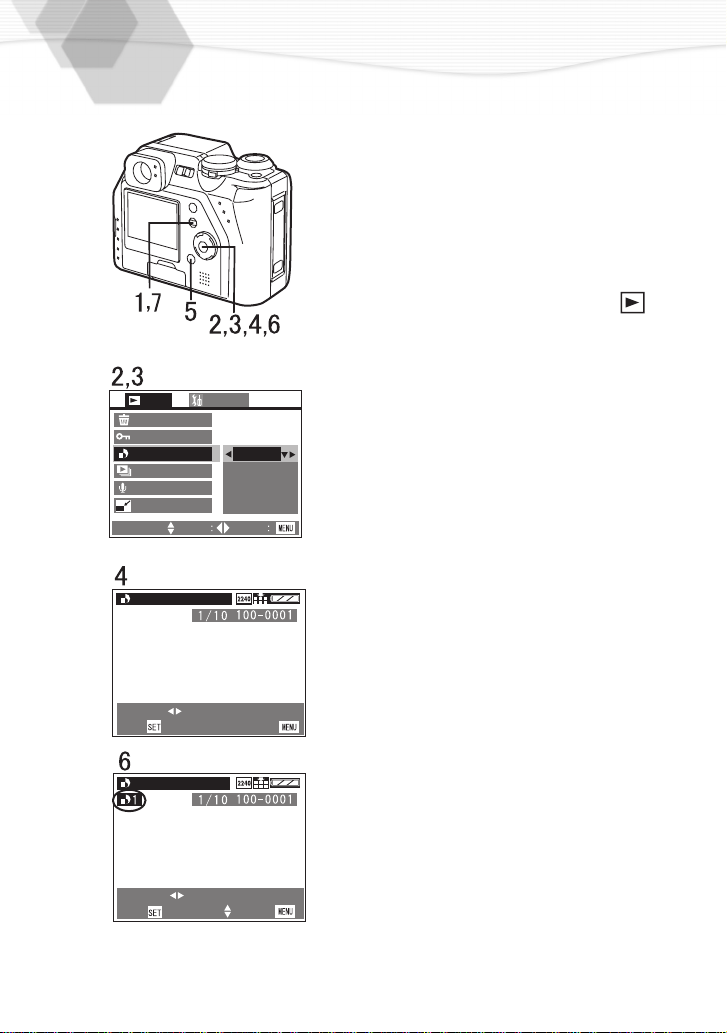
66
Writing the Print Information in the Card
(DPOF Setting)
It is possible to write print information (DPOF
data) on the card with the images that you
want to print and the number of sheets.
DPOF is an abbreviation of Digital Print Order
Format. With the DPOF corresponding
system, you can add print information to the
images on the memory card.
[Preparation]
• Set the operational mode dial to playback [ ].
[
Single
copy setting
]
1
Press the [MENU] button.
2
Press 3/4 to select [DPOF] and then
press 1
.
3
Select [SINGLE] and then press 1
.
4
Press 2/1 to select 1 image
.
5
Press the [REVIEW/SET] button.
• If the DPOF has already been set and only
the number of sheets is changed, skip step
5.
6
Press 3/4 to select the number of
sheets.
• The number of sheets can be set from 1 to
99.
7
Press the [MENU] button twice.
• The menu will disappear.
[To cancel]
Perform steps 1-5, 7 of the [Single copy
setting].
PLAY
SETUP
DELETE
PROTECT
SLIDE SHOW
AUDIO DUB.
SINGLE
MULTI
CANCEL
INDEX
SELECT: SET EXIT
DPOF
RESIZE
SELECT:
EXIT:
EXIT:
SELECT:
DPOF SET THIS
SET:
SET:
DPOF SET THIS
COUNT:
KC3‑PP.book66ページ2002年4月5日 金曜日 午前11時55分
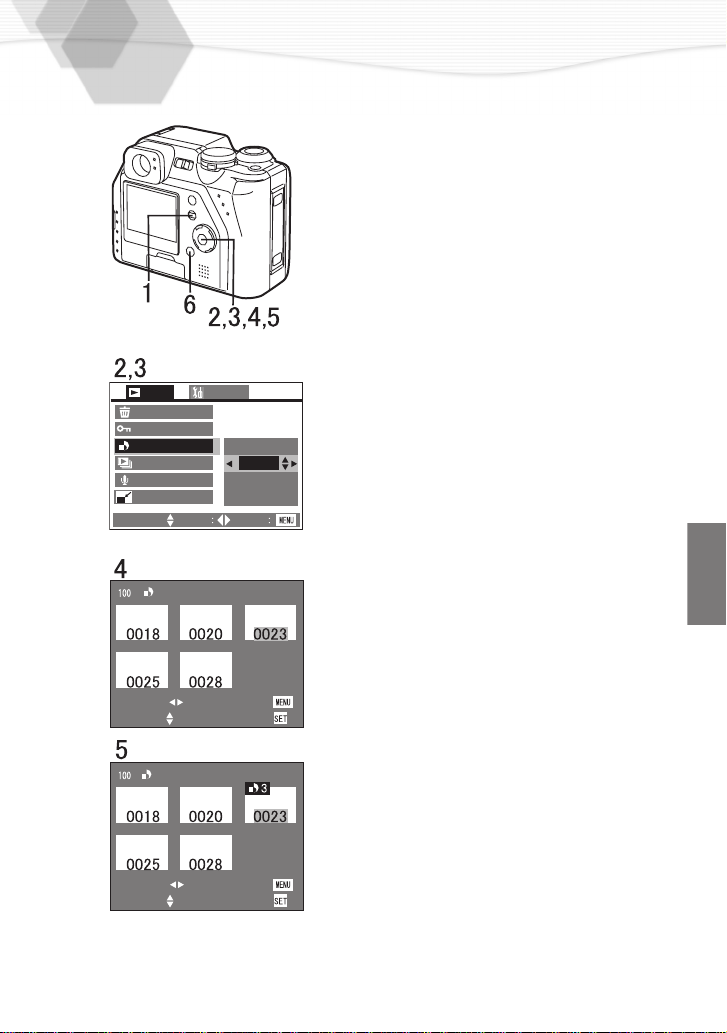
67
[Multi copy setting/to cancel]
It is possible to set up to 50 images all at
once.
1
Press the [MENU] button.
2
Press 3/4 to select [DPOF] and then
press 1
.
3
Press 3/4 to select [MULTI] and
then press 1
.
4
Press 2/1 to select the image
.
5
Press 3/4 to select the number of
sheets
to be printed
.
• The number of sheets can be set from 1 to
99.
6
Repeat steps 4 and 5, and at the end
press the [REVIEW/SET] button.
• The DPOF setting of multi images is set at
once.
• If the file is not based on the DCF standard, the
DPOF setting cannot be set.
• Images that are set by DPOF with the supplied
software [SD Viewer for DSC] recorded on the
CD-ROM cannot be played back in DPOF slide
show with this camera. Set DPOF on this
camera.
• When using the DPOF feature, this camera will
overwrite any previous DPOF settings made by
other products.
PLAY
SETUP
DELETE
PROTECT
SLIDE SHOW
AUDIO DUB.
SELECT: SET
EXIT
SINGLE
CANCEL
INDEX
DPOF
RESIZE
MULTI
DPOF SET MULTI
SELECT:
CANCEL:
COUNT: SET:
DPOF SET MULTI
SELECT:
CANCEL:
COUNT:
SET:
KC3‑PP.book67ページ2002年4月5日 金曜日 午前11時55分
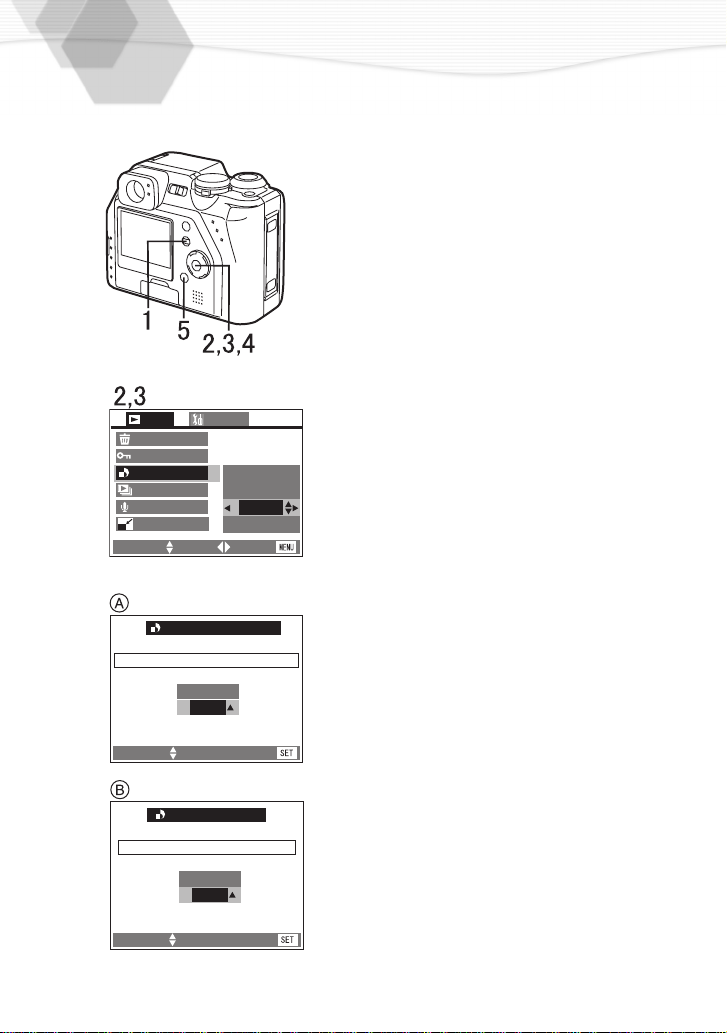
68
Writing the Print Information in the Card
(DPOF Setting) (Continued)
[To cancel all settings]
A
1
Press the [MENU] button.
2
Press 3/4 to select [DPOF] and then
press 1
.
3
Press 3/4 to select [CANCEL] and
then press 1
.
4
When this message is displayed
“CANCEL ALL DPOF SETTINGS?”,
press 3/4 to select [YES]
.
5
Press the [
REVIEW/SET]
button
.
• All DPOF settings are cancelled.
[
Index setting/to cancel
]
B
1
Press the [MENU] button.
2
Press 3/4 to select [DPOF] and then
press 1
.
3
Press 3/4 to select [INDEX] and
then press 1
.
4
When this message is displayed
“SET INDEX PRINT?”, press 3/4 to
select [YES].
• When the index is already set, press
3/4
to select [SET] or [CANCEL].
5
Press the [
REVIEW/SET]
button
.
• All images are set/cancelled.
SET:
PLAY
SETUP
DELETE
PROTECT
SLIDESHOW
AUDIO DUB.
SINGLE
MULTI
CANCEL
INDEX
SELECT: EXIT:
DPOF
RESIZE
CANCEL ALL DPOF
CANCEL ALL DPOF SETTINGS?
NO
YES
SELECT: SET:
DPOF INDEX
SET INDEX PRINT?
NO
YES
SELECT:
SET:
KC3‑PP.book68ページ2002年4月5日 金曜日 午前11時55分
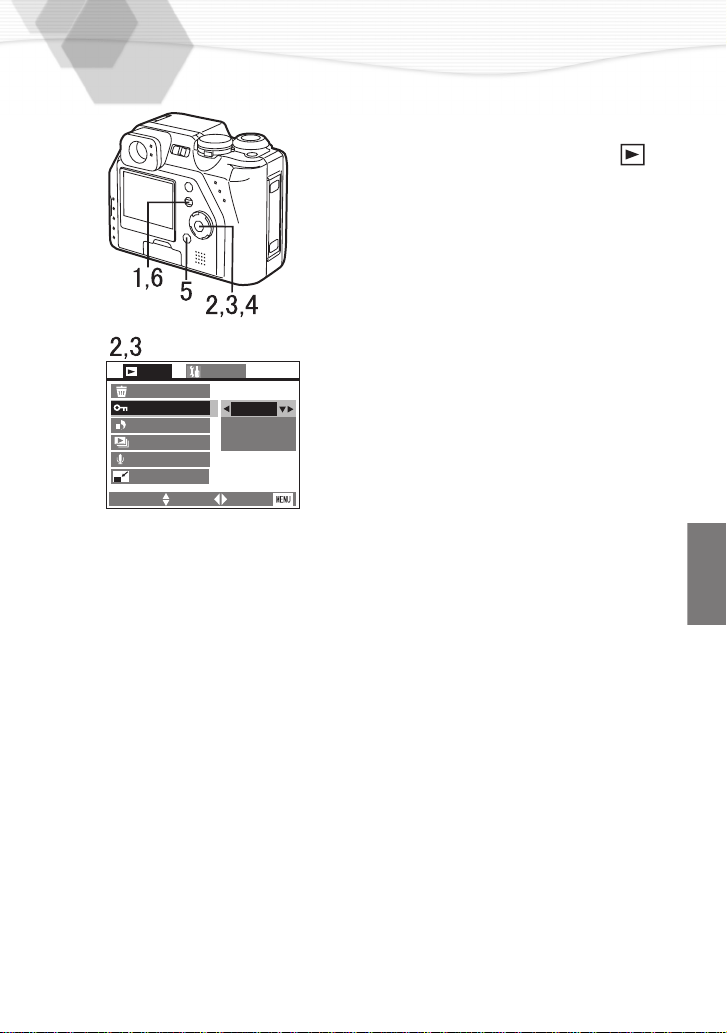
69
Protecting Images on the Card
It is possible to protect the important images
recorded on the card from accidental erasure.
[Preparation]
• Set the operational mode dial to playback [ ].
[Single setting/to cancel]
1
Press the [MENU] button.
2
Press 3/4 to select [PROTECT] and
then press 1
.
3
Select [SINGLE] and then press 1
.
4
Press 2/1 to select 1 image
.
5
Press the [REVIEW/SET] button.
6
Press the [MENU] button twice.
• The menu will disappear.
[Multi setting/to cancel, To cancel all
settings]
1
The method is the same as in “Writing
the Print Information in the Card (DPOF
Setting)”. (P66~P68)
• Formatting the card will erase all the data on the card, even if you protect the images in this
procedure.
• When trying to delete a protected file, these messages are displayed “THIS PICTURE IS
PROTECTED” or “SOME PICTURES CAN’T BE DELETED”. If you want to delete this file,
cancel the protect setting first.
• The protect setting is effective only in this camera.
PLAY SETUP
DELETE
PROTECT
SLIDE SHOW
AUDIO DUB.
SELECT:
SET:
EXIT:
SINGLE
MULTI
CANCEL
DPOF
RESIZE
KC3‑PP.book69ページ2002年4月5日 金曜日 午前11時55分
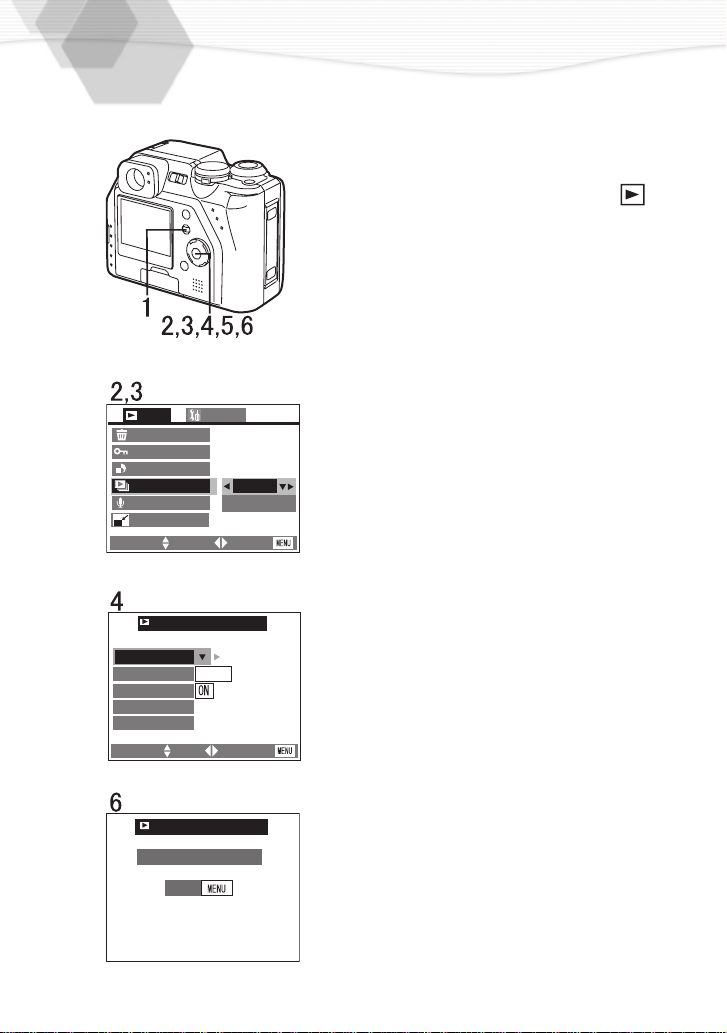
70
Playing Back with Slide Show
(Automatic Playback)
All pictures selected in the card can be played
back one-by-one automatically.
[Preparation]
• Set the operational mode dial to playback [ ].
1
Press the [MENU] button.
2
Press 3/4 to select [SLIDE SHOW]
and then press 1.
3
Press 3/4
to
select [ALL]/[DPOF]
and then press 1
.
• [ALL]:
for playing back all pictures
[DPOF]:
for playing back the DPOF set pictures
4
Press 3/4/2/1
for setting below.
• [DURATION]: it can be set among 1, 2, 3
and 5 seconds.
• [AUDIO]: it can be set to [ON] or [OFF]. By
setting it to [ON], it is possible to play back
the still pictures with audio in slide show.
• [DPOF SET] (Only when setting to [DPOF]):
You can select the pictures you want to set
to the Slide Show.
• [CANCEL ALL] (Only when setting to
[DPOF]):
You can delete the pictures that have been
set to the Slide Show.
5
Press 3/4 to select [SLIDE SHOW].
6
Press 1
.
• The slide show starts.
• By pressing the [MENU] button, it stops.
PLAY
SETUP
DELETE
SLIDE SHOW
AUDIO DUB.
SELECT: SET:
EXIT:
ALL
PROTECT
DPOF
RESIZE
DPOF
SLIDE SHOW
DURATION
AUDIO
DPOF SET
CANCEL ALL
SELECT: SET:
CANCEL:
1SEC.
DPOF SLIDE SHOW
START SLIDE SHOW
STOP:
DPOF SLIDE SHOW
KC3‑PP.book70ページ2002年4月5日 金曜日 午前11時55分

71
• In motion image playback, slide show is not available.
• When editing with the supplied software [SD Viewer for DSC] recorded on the CD-ROM,
you can play back in SD slide show with this camera. Read P90.
• Images that are set DPOF with the supplied software [SD Viewer for DSC] recorded on the
CD-ROM cannot be played back in DPOF slide show with this camera. Set DPOF on this
camera.
• When using the DPOF feature, this camera will overwrite any previous DPOF settings
made by other products.
KC3‑PP.book71ページ2002年4月5日 金曜日 午前11時55分
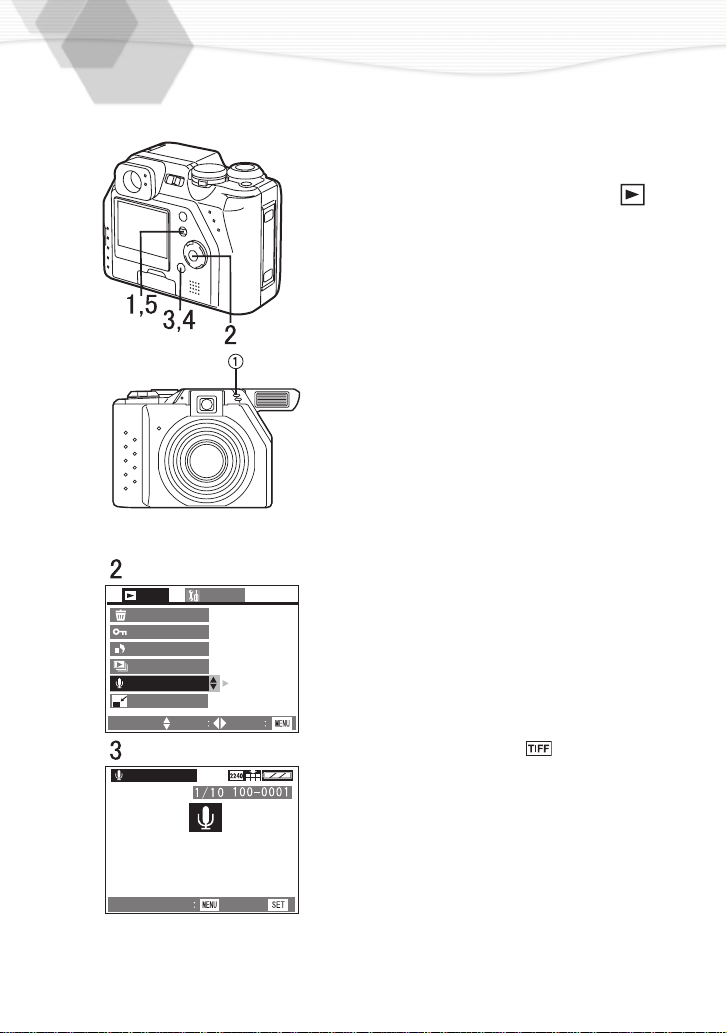
72
Adding Audio to Recorded Pictures
(Audio Dubbing)
It is possible to add a 10-second narration to
a recorded picture.
[Preparations]
• Set the operational mode dial to playback [ ].
• Select the picture to which you want to add
audio.
1
Press the [MENU] button.
2
Press 3/4 to select [AUDIO DUB.]
and then press 1
.
3
By pressing the [
REVIEW/SET]
button, audio recording starts
.
(1
11
1 Microphone)
• When audio has already been recorded,
after the audio dubbing the original audio is
overwritten.
• When audio has already been recorded, this
message is displayed “OVERWRITE AUDIO
DATA?”. Then press
3/4
to select [YES]
and after pressing the [REVIEW/SET]
button, the audio recording starts.
4
By pressing the [
REVIEW/SET]
button, the audio recording stops
.
• Even if you do not press the [REVIEW/SET]
button, after about 10 seconds the audio
recording stops automatically.
5
Press the [MENU] button twice.
• The menu will disappear.
• The audio dubbing cannot be used with pictures
with the quality set to TIFF [ ].
• The audio dubbing cannot be used with motion
images.
PLAY
SETUP
DELETE
PROTECT
SLIDE SHOW
AUDIO DUB.
SELECT: SET
EXIT
AUDIO DUB.
CANCEL START:
DPOF
RESIZE
KC3‑PP.book72ページ2002年4月5日 金曜日 午前11時55分
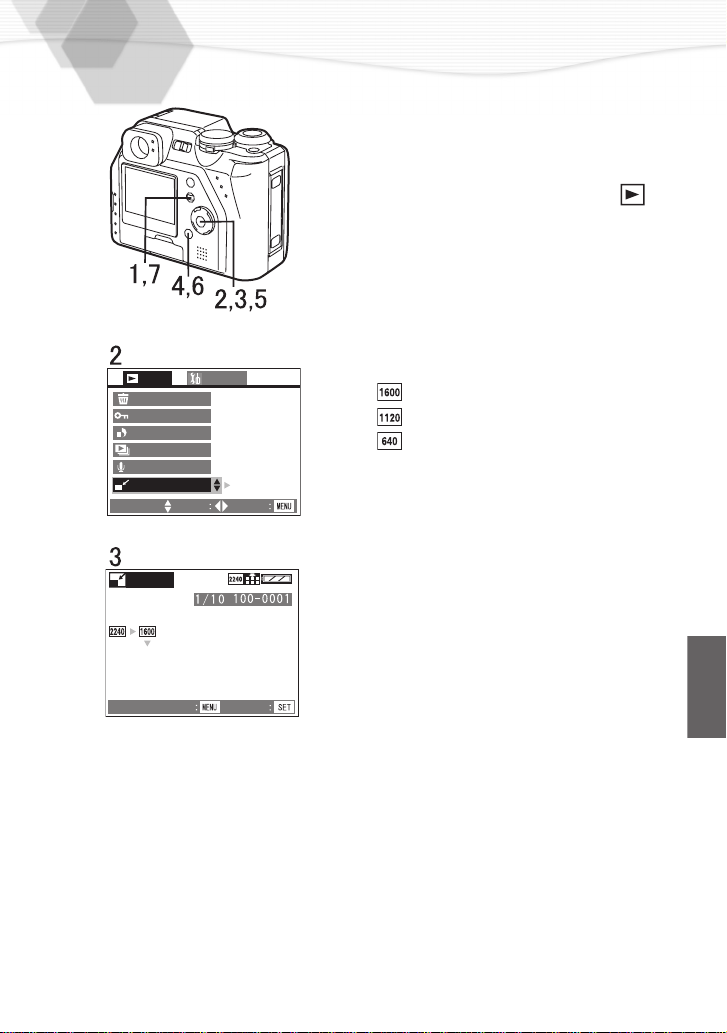
73
Resizing the Recorded Pictures
It is possible to reduce the recorded picture
size. This function is useful if you want to
reduce the volume of the picture for attaching
to an e-mail or uploading on web-site.
[Preparations]
• Set the operational mode dial to playback [ ].
• Play back the picture for which you want to
change the size. (Note: for pictures in a size
lower than [640
a
480] or with an aspect ratio
that is not 4:3, it is not possible to resize)
1
Press the [MENU] button.
2
Press 3/4 to select [RESIZE] and
then press 1.
3
Press 3/4
to
select the size
.
• : 1600
a
1200
• : 1120
a
840
•
: 640
a
480
4
Press the
[REVIEW/SET]
button to set
the size
.
5
When this message is displayed
“DELETE ORIGINAL PICTURE?”,
press 3/4 to
select
[YES] or [NO]
.
6
Press the [
REVIEW/SET]
button
.
7
Press the [MENU] button.
• The menu will disappear.
• It may not be possible to resize the pictures
recorded with other equipments.
• Motion images or TIFF pictures cannot be
resized or pictures cannot be enlarged.
PLAY SETUP
PROTECT
SLIDE SHOW
AUDIO DUB.
RESIZE
SELECT:
SET
EXIT
DPOF
DELETE
RESIZE
RESIZE
CANCEL
KC3‑PP.book73ページ2002年4月5日 金曜日 午前11時55分
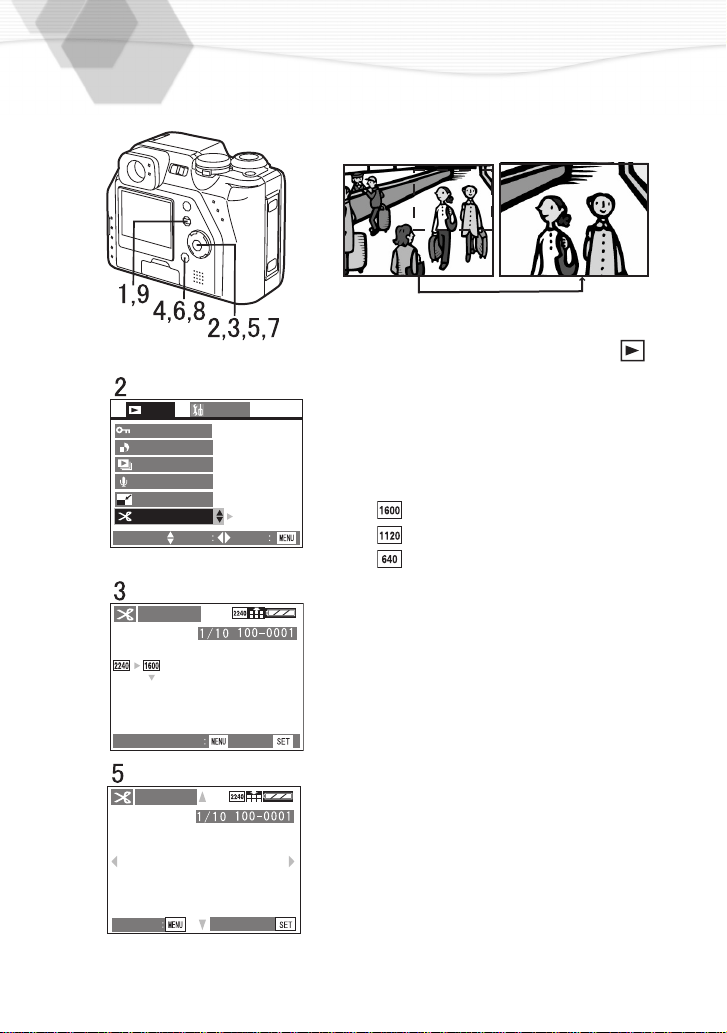
74
Trimming the Recorded Pictures
It is possible to cut off the unnecessary parts
of the picture (trimming), and enlarge the
remainder parts of the picture.
[Preparations]
• Set the operational mode dial to playback [ ].
• Select the picture you want to trim.
1
Press the [MENU] button.
2
Press 3/4 to select [TRIMMING] and
then press 1.
3
Press 3/4
to
select the size
.
• : 1600
a
1200
• : 1120
a
840
•
: 640
a
480
4
Press the [
REVIEW/SET]
button
.
5
Press 3/4/2/1
to
shift pictures.
6
Press the [
REVIEW/SET]
button to set
.
7
When this message is displayed
“DELETE ORIGINAL PICTURE?”,
press 3/4 to select [YES] or [NO].
8
Press the [
REVIEW/SET]
button
.
9
Press the [MENU] button.
• The menu will disappear.
PLAY
SETUP
SLIDE SHOW
AUDIO DUB.
RESIZE
TRIMMING
SELECT:
SET
EXIT
DPOF
PROTECT
TRIMMING
CANCEL SET:
TRIMMING
TRIMMING:
CANCEL
KC3‑PP.book74ページ2002年4月5日 金曜日 午前11時55分

75
• You cannot operate trimming on pictures recorded with other equipment.
• Motion images or TIFF pictures cannot be trimmed or enlarged.
• Trimming is not possible for pictures with audio or pictures with a size of [640
a
480] pixels.
KC3‑PP.book75ページ2002年4月5日 金曜日 午前11時55分
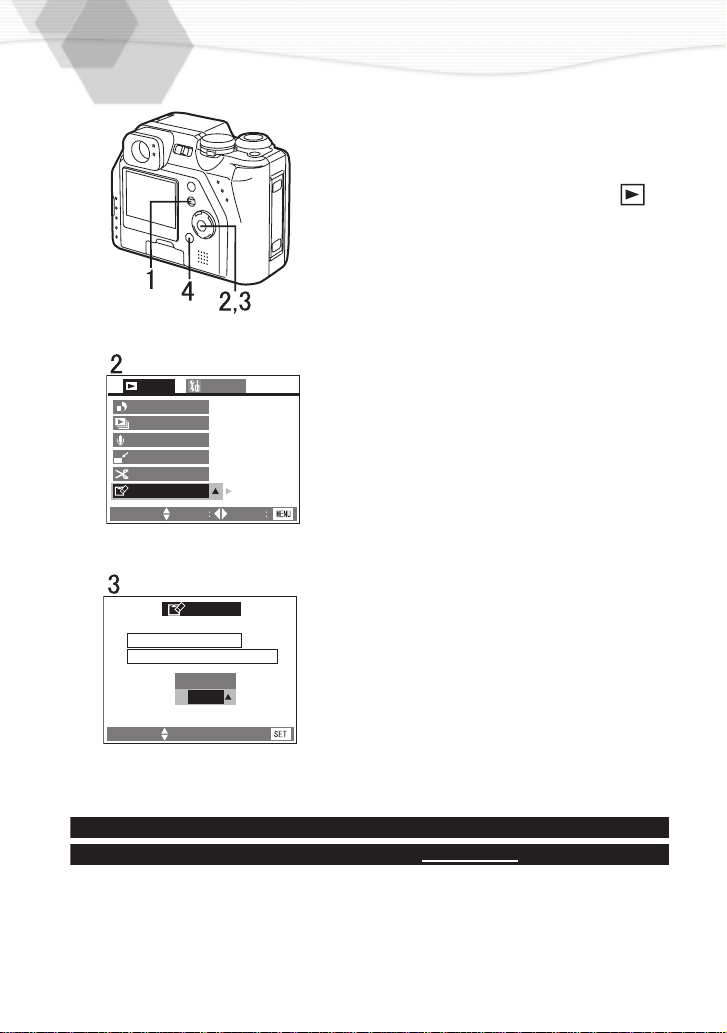
76
Formatting the Card
Usually, it is not necessary to format the card
(initializing). Format the card when this
message is displayed “MEMORY CARD
ERROR”.
[Preparation]
• Set the operational mode dial to playback [ ].
1
Press the [MENU] button.
2
Press 3/4 to select [FORMAT] and
then press 1.
3
When this message is displayed
“DELETE ALL DATA ON THE
MEMORY CARD?”, press 3/4 to
select [YES].
4
Press the [
REVIEW/SET]
button
.
• The card is formatted.
• After formatting, recorded images and any
other data cannot be recovered.
• During formatting, do not turn the power off.
• When the card is formatted by PC or other
equipment, format the card on the camera again.
• If the card cannot be formatted, consult your dealer.
PLAY SETUP
SLIDE SHOW
AUDIO DUB.
RESIZE
TRIMMING
SELECT:
SET
EXIT
FORMAT
DPOF
DELETE ALL DATA
ON THE MEMORY CARD?
NO
YES
SELECT:
EXIT:
FORMAT
For USA assistance, please call: 1-800-272-7033 or send e-mail to : [email protected]
For Canadian assistance, please call: 1-800-561-5505 or visit us at www.panasonic.ca
KC3‑PP.book76ページ2002年4月5日 金曜日 午前11時55分
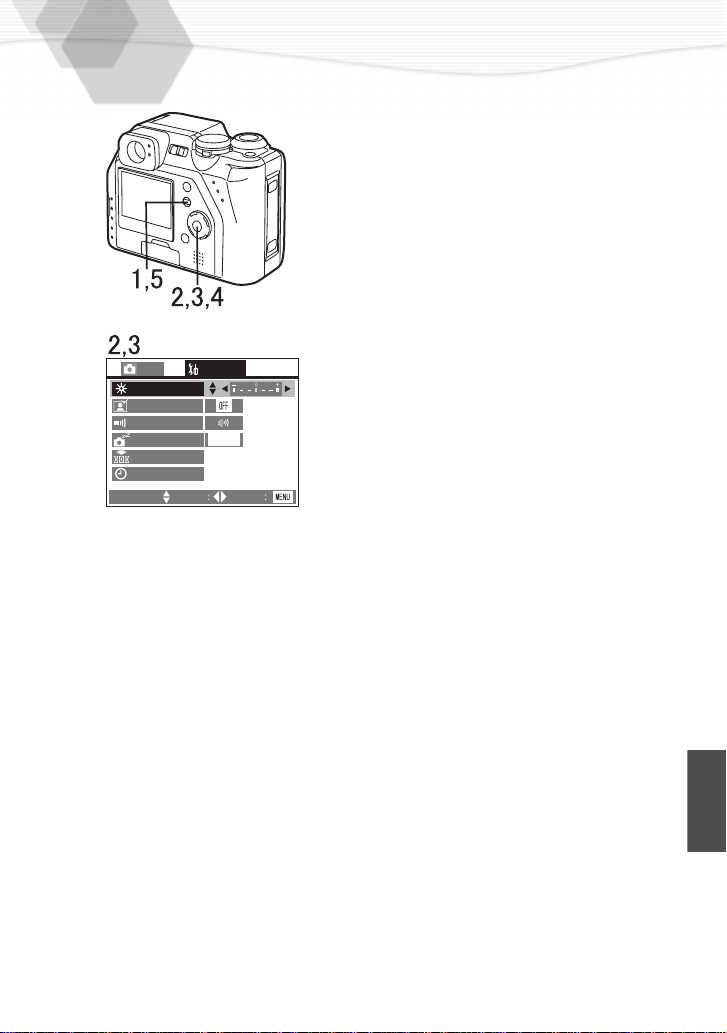
77
Adjusting the LCD Monitor Brightness
1
Press the [MENU] button.
2
Press 1 to open the setup menu
.
3
Press 3/4 to select [MONITOR]
.
4
Press 2/1 to adjust the brightness
.
5
Press the [
MENU] button.
• The menu will disappear.
• When turning the power off, the LCD monitor brightness is returned.
REC
SETUP
MONITOR
AUTO REVIEW
BEEP
POWER SAVE
NO. RESET
CLOCK SET
SELECT:
SET
EXIT
2 MIN.
KC3‑PP.book77ページ2002年4月5日 金曜日 午前11時55分
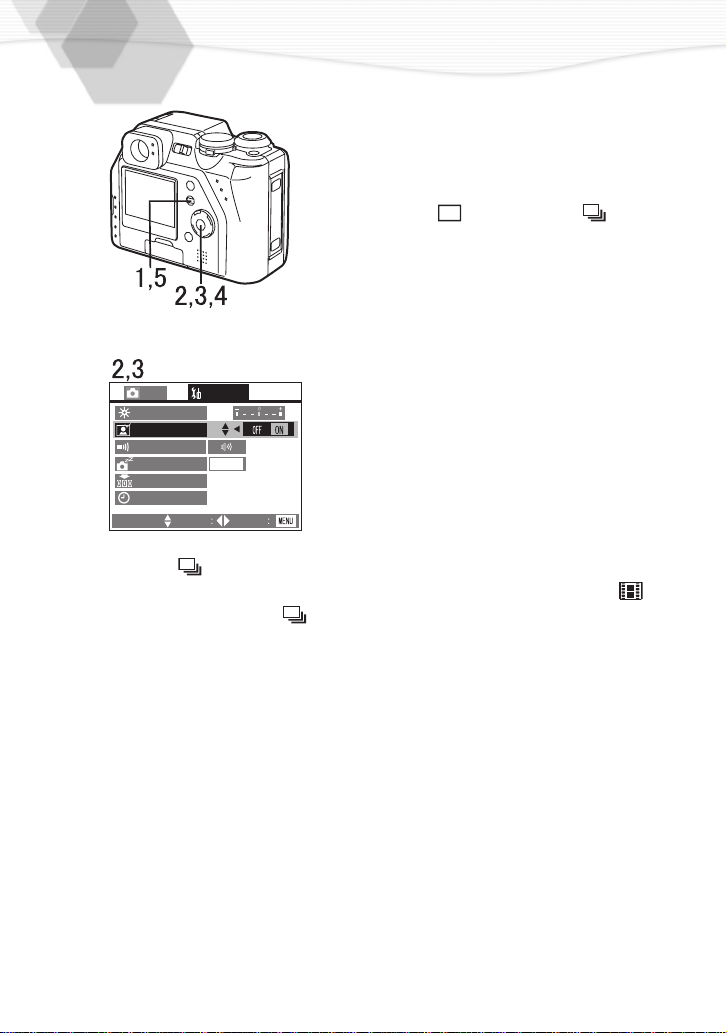
78
Using the Auto Review
Recording with the auto review set to [ON],
the recorded picture is automatically
displayed on the LCD monitor for about 2
seconds.
[Preparation]
Set the operational mode dial to REC mode
(single mode [ ] or burst mode [ ]).
1
Press the [MENU] button.
2
Press 1 to open the setup menu
.
3
Press 3/4 to select [AUTO REVIEW]
.
4
Press 2/1 to select [
ON].
5
Press the
[MENU] button.
• The menu will disappear.
• In burst mode [ ] or auto bracket, only the first recorded picture is displayed.
• Even when setting the auto review to [ON], it is not available in motion image mode [ ].
• When recording in burst mode [ ], auto bracket, TIFF or still picture with audio modes,
the auto review is set to [ON].
REC
SETUP
MONITOR
AUTO REVIEW
BEEP
POWER SAVE
NO. RESET
CLOCK SET
SELECT:
SET
EXIT
2 MIN.
KC3‑PP.book78ページ2002年4月5日 金曜日 午前11時55分
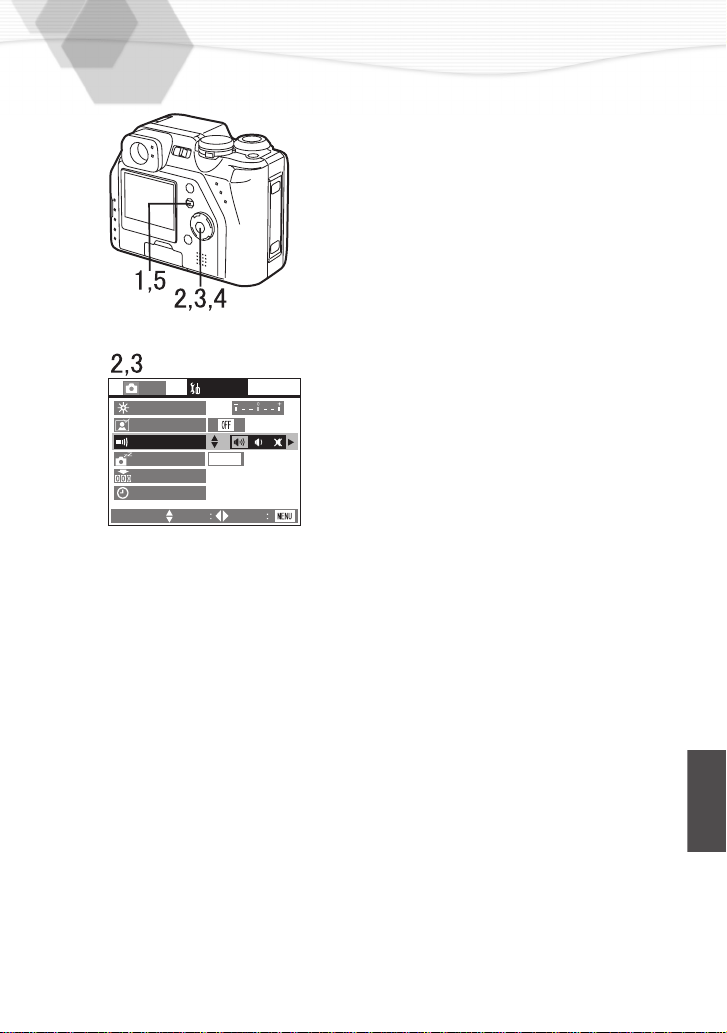
79
Setting up the Operational Sound
It is possible to set the sound volume when
the menu operations are done.
1
Press the [MENU] button.
2
Press 1 to open the setup menu
.
3
Press 3/4 to select [BEEP].
4
Press 2/1 to adjust the operational
sound volume.
5
Press the [MENU] button.
• The menu will disappear.
REC
SETUP
MONITOR
AUTO REVIEW
BEEP
POWER SAVE
NO. RESET
CLOCK SET
SELECT:
SET
EXIT
2 MIN.
KC3‑PP.book79ページ2002年4月5日 金曜日 午前11時55分
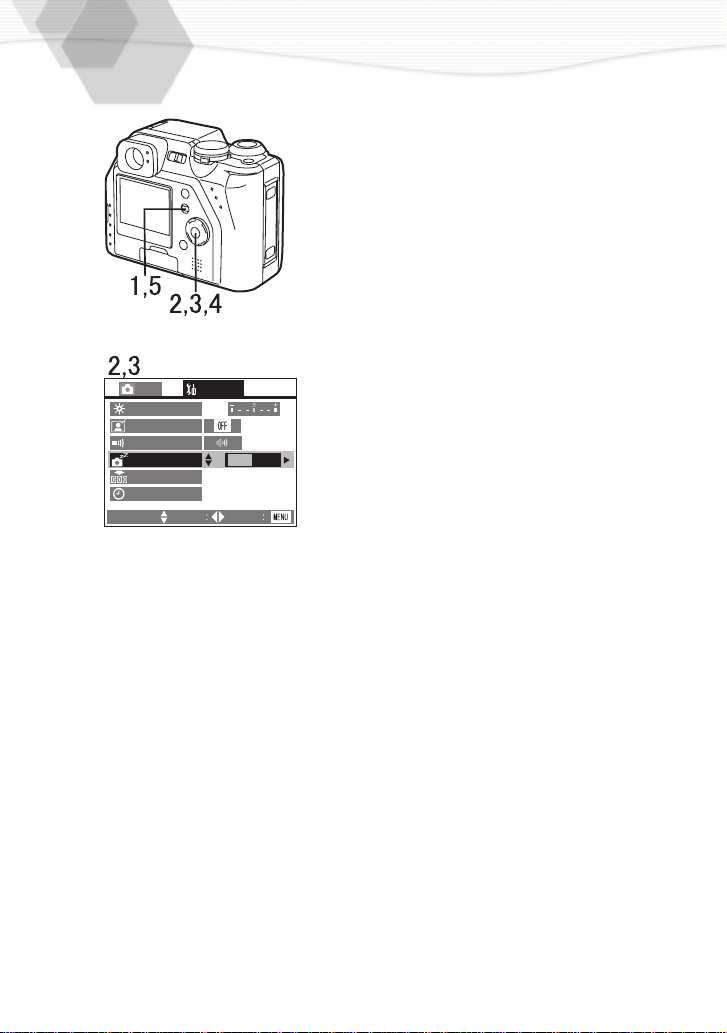
80
Setting up the Power Save Mode
When setting this mode, the camera, if it is
not operated for about 2, 5 or 10 minutes, it is
automatically turned off.
1
Press the [MENU] button.
2
Press 1 to open the setup menu
.
3
Press 3/4 to select [POWER SAVE]
.
4
Press 2/1 to
choose
the
setting time.
• You can choose among [2 MIN.], [5 MIN.]
and [10 MIN.].
• If selecting [OFF], the power is not turned off
automatically.
5
Press the [MENU] button.
• The menu will disappear.
• If you want to cancel the power save mode, turn the power switch to [ON] again after
turning it to [OFF], or press the shutter button.
• When using the AC adaptor, the power save mode is not available.
• In power save mode, or if the battery charge is low and you have to charge it, turn the
camera off and connect the AC adaptor to the camera DC IN socket. If connecting the AC
adaptor when the power switch is set to [ON], the camera may not function correctly.
REC
SETUP
MONITOR
AUTO REVIEW
BEEP
POWER SAVE
NO. RESET
CLOCK SET
SELECT: SET
EXIT
2 MIN. 5 MIN.
KC3‑PP.book80ページ2002年4月5日 金曜日 午前11時55分
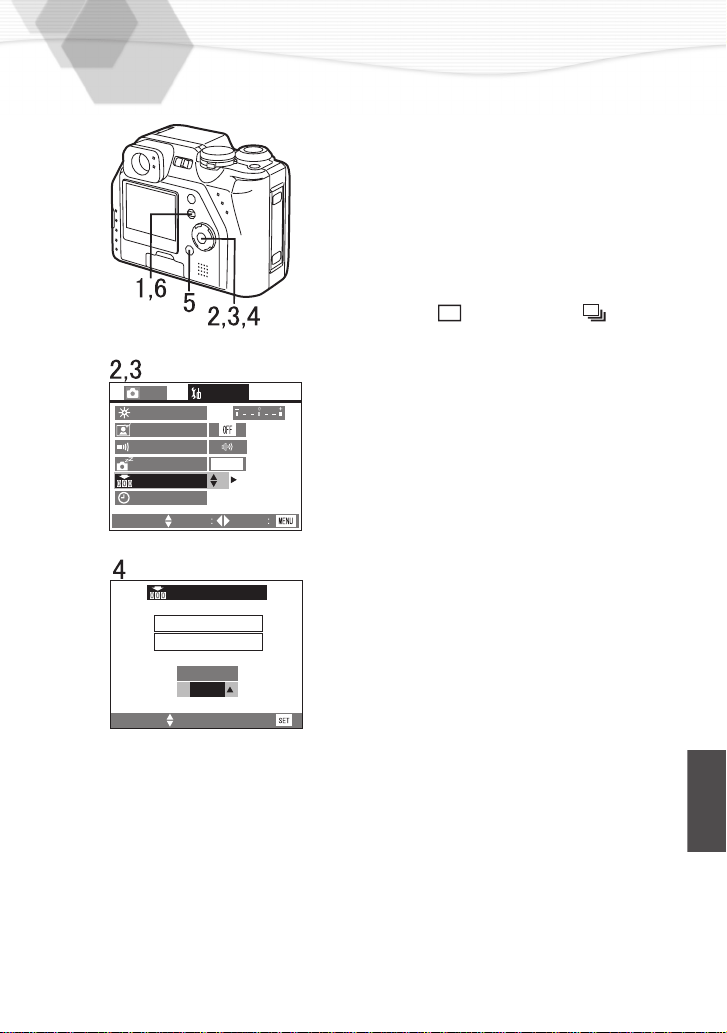
81
Resetting the File Number
As the file numbers are recorded sequentially
by the camera, when you use some cards
(SD Memory Card/MultiMediaCard), it may
happen that the file numbers on your cards
are not in order. Use this function when you
insert a new card and you want to start
recording from the file number 0001, or when
you want to set the file numbers of the
recorded cards in consecutive numbers.
[Preparation]
Set the operational mode dial to REC mode
(single mode [ ] or burst mode [ ]).
1
Press the [MENU] button.
2
Press 1 to open the setup menu
.
3
Press 3/4 to select [
NO. RESET
] and
then press 1
.
4
When this message is displayed
“RESET FILE NO. IN THE
CAMERA?”, press 3/4 to select
[YES].
5
Press the [
REVIEW/SET]
button to
set.
6
Press the [MENU] button.
• The menu will disappear.
MONITOR
AUTO REVIEW
BEEP
POWER SAVE
NO. RESET
CLOCK SET
SELECT:
SET EXIT
SETUP
REC
2 MIN.
NUMBER RESET
RESET FILE NO.
IN THE CAMERA?
NO
YES
SELECT: EXIT:
KC3‑PP.book81ページ2002年4月5日 金曜日 午前11時55分
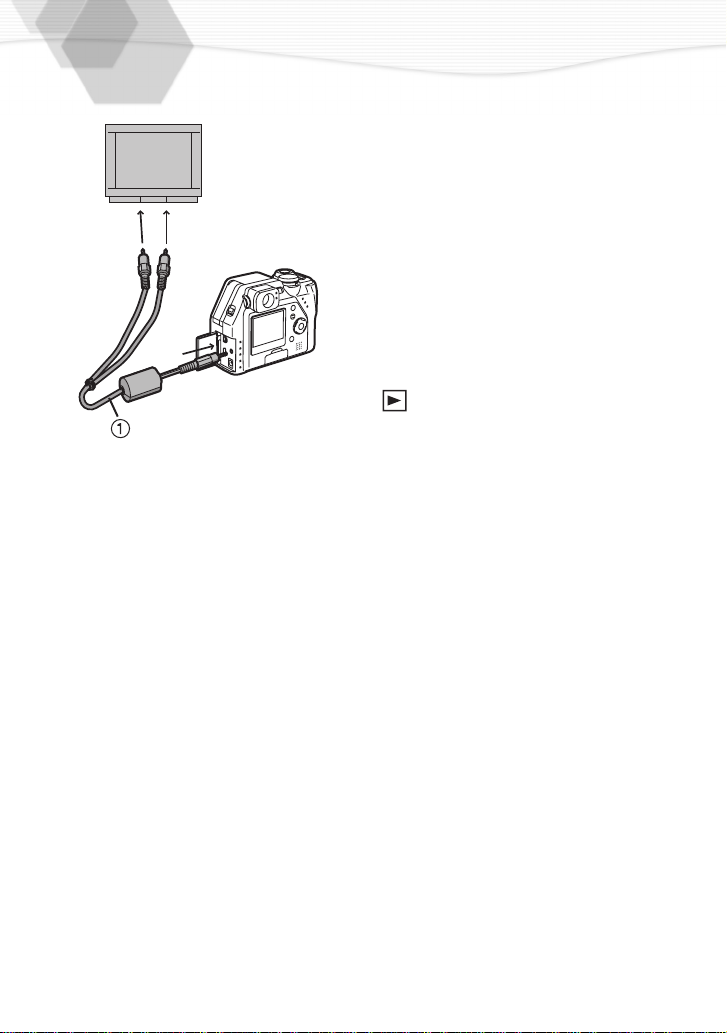
82
Playing Back Images with a TV Monitor
By connecting the camera to a television via
the supplied A/V cable 1, it is possible to
view and play back the recorded images.
[Preparation]
• Turn the camera and the television off.
1
Connect
the A/V cable to the A/V OUT
socket of the camera.
2
Connect the A/V cable to the video in
and the audio in sockets of the TV
.
3
Turn the television on and select
external input
.
4
Turn the camera on and then set the
operational mode dial to playback
[]
.
• The image is displayed on the television.
Yellow: to the video in socket
White: to the audio in socket
ª
Viewing images in other countries
When setting [VIDEO OUT] on the menu, you can view images on the TV in other
countries (regions) which use the NTSC or PAL system.
• Even if you set menu selection for [VIDEO OUT] to [PAL], the output signal is still NTSC
system.
• Do not use any other cables except the supplied one.
• Read the TV operating instructions too.
KC3‑PP.book82ページ2002年4月5日 金曜日 午前11時55分
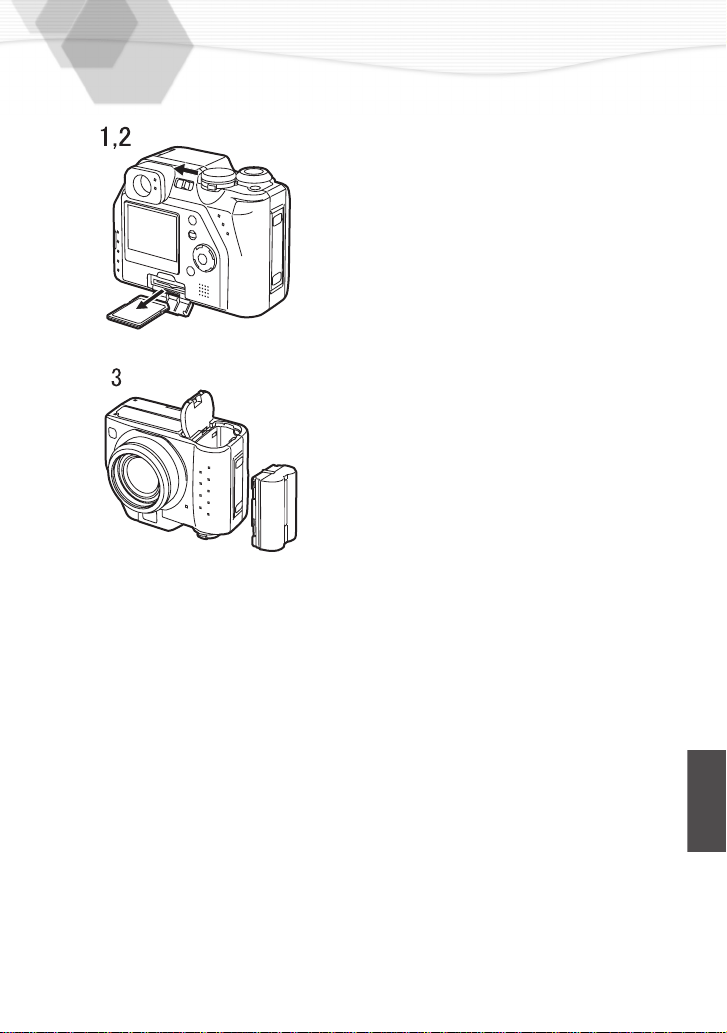
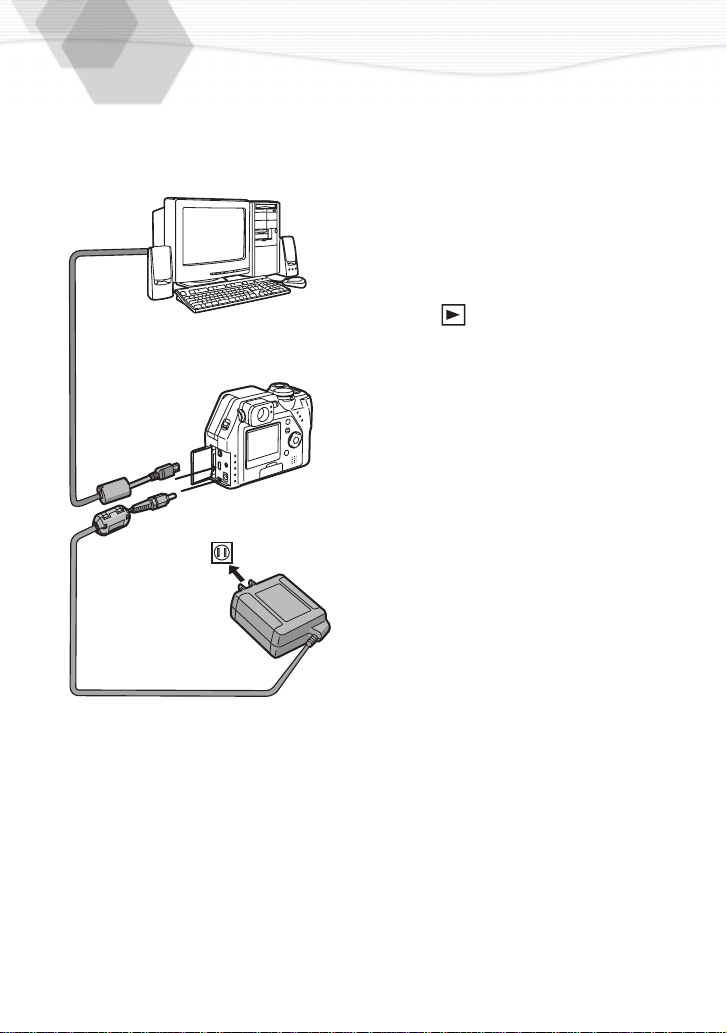
84
Connecting to a PC
[Preparation]
Only if using Windows
®
98 or Windows
®
98
Second Edition, start the supplied CD from
PC and install the USB driver.
• For further information, read the supplied
operating instructions for USB connection kit.
1
Connect the camera to PC via supplied
USB cable.
• After inserting the memory card into the
camera, set the operational mode dial to
playback [ ] and turn the power switch to
[ON].
[Windows]
The drive is shown on the [My computer]
folder.
• If it is the first time you are connecting the
camera to PC, the required driver is installed
automatically in order to let the camera be
recognized by the Windows Plug and Play,
then it is shown on the [My computer] folder.
[Macintosh]
The drive is shown on the screen.
• When connecting to a PC it is recommended that
you use the AC adaptor as the power source.
• When connecting the PC, the display of the LCD
monitor is set to off. In this case, the status
indicator lights. Moreover, when the PC
accesses the card, the flash indicator also lights.
KC3‑PP.book84ページ2002年4月5日 金曜日 午前11時55分
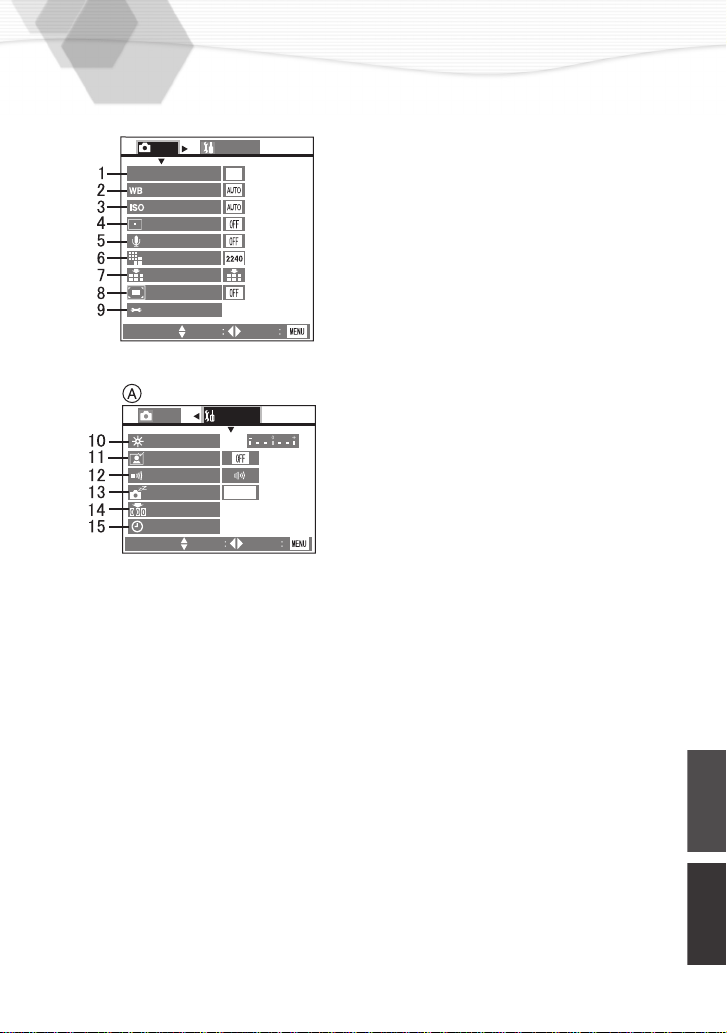
85
The Menu Items
REC mode menu
• For items without number, refer to those with the
same name.
1
AE MODE (P40, P41, P42)
2
W.BALANCE (P52)
3
SENSITIVITY (P54)
4
SPOT AF (P55)
5
AUDIO REC. (P37)
6
PICT. SIZE (P38)
7
QUALITY (P39)
8
D. ZOOM (P33)
9
PICT. ADJ. (P51)
REC mode setup menu
A
AA
A
10
MONITOR (P77)
11
AUTO REVIEW (P78)
12
BEEP (P79)
13
POWER SAVE (P80)
14
NO. RESET (P81)
15
CLOCK SET (P28)
REC
SETUP
W.BALANCE
SENSITIVITY
SPOT AF
AUDIO REC.
PICT.SIZE
QUALITY
D.ZOOM
PICT.ADJ.
SELECT:
SET
EXIT
SELECT:
SET
EXIT
SETUP
MONITOR
AUTO REVIEW
BEEP
POWER SAVE
NO. RESET
CLOCK SET
2 MIN.
P
AE MODE
AE
KC3‑PP.book85ページ2002年4月5日 金曜日 午前11時55分
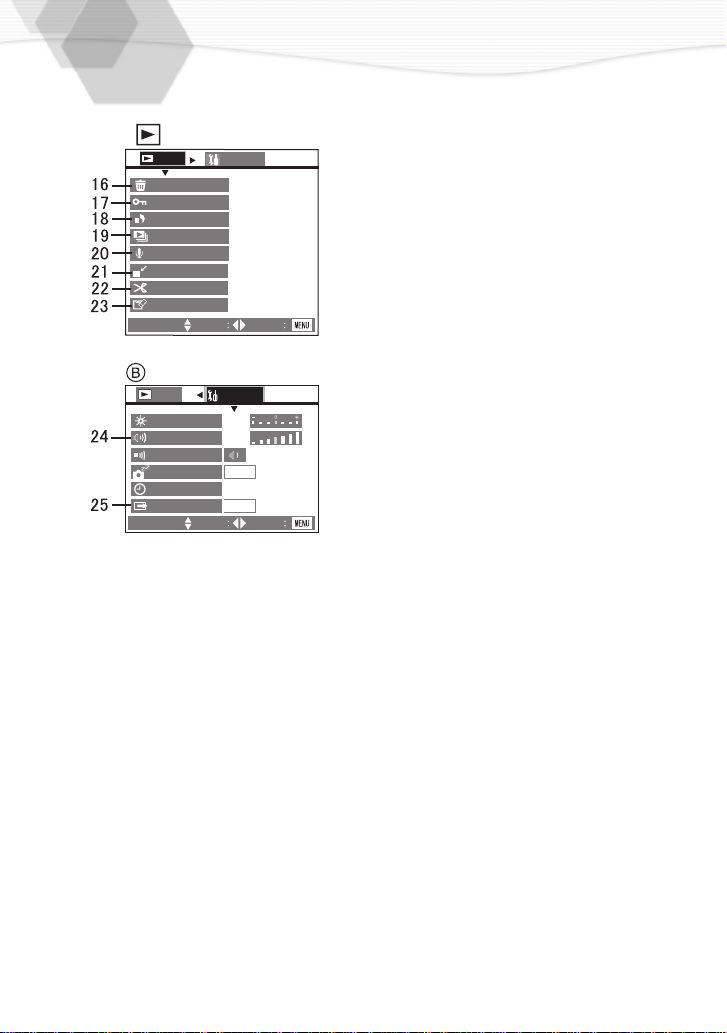
86
The Menu Items (Continued)
Playback mode menu
• For items without number, refer to those with the
same name.
16
DELETE (P64)
17
PROTECT (P69)
18
DPOF (P66)
19
SLIDE SHOW (P70)
20
AUDIO DUB. (P72)
21
RESIZE (P73)
22
TRIMMING (P74)
23
FORMAT (P76)
Playback mode setup menu B
24
VOLUME (P60)
25
VIDEO OUT (P82)
SETUP
DELETE
PROTECT
DPOF
SLIDE SHOW
AUDIO DUB.
RESIZE
TRIMMING
SELECT:
SET
EXIT
PLAY
SETUP
MONITOR
VOLUME
BEEP
POWER SAVE
CLOCK SET
SELECT:
SET
EXIT
PLAY
FORMAT
VIDEO OUT
NTSC
2 MIN.
KC3‑PP.book86ページ2002年4月5日 金曜日 午前11時55分

87
Cautions for Use
ª Cautions for Use
Keep the digital camera away from
magnetized equipment (such as a
microwave oven, TV, video game
equipment, etc.).
• If you use the digital camera on or near a
TV, images and sounds may be disturbed
due to electromagnetic wave radiation.
• Do not use the digital camera near a cell
phone because doing so may cause noise
to adversely affect the images and sounds.
• Recorded data may be damaged, or
images may be distorted by strong
magnetic fields created by speakers or
large motors.
• Electromagnetic wave radiation generated
by a microprocessor may adversely affect
the digital camera, causing the disturbance
of images and sounds.
• If the digital camera is affected by
magnetically charged equipment and does
not function properly, turn the camera off
and detach the battery or AC adaptor and
then connect the battery or AC adaptor
again. Thereafter, turn the camera on.
Do not use the digital camera near
radio transmitters or high-voltage
lines.
• If you record near radio transmitters or
high-voltage lines, recorded images or
sounds may be adversely affected.
Do not spray insecticides or volatile
chemicals onto the digital camera.
• If the digital camera is sprayed with such
chemicals, the camera body may be
deformed and the surface finish may peel
off.
• Do not keep rubber or plastic products in
contact with the digital camera for a long
period of time.
When you use the digital camera on a
beach or similar place, do not let sand
or fine dust get into the camera.
• Sand or dust may damage the digital
camera or card. (Care should be taken
when inserting and removing the card)
When you use your digital camera on
a rainy or snowy day or on a beach,
make sure that no water enters the
digital camera.
• Water may cause the digital camera or
card to malfunction. (Irreparable damage
may occur)
• If sea water splashes onto the digital
camera, wet a soft cloth with tap water,
wring it well, and use it to wipe the camera
body carefully. Then, wipe it again
thoroughly with a soft dry cloth.
Do not use the digital camera for
surveillance purpose or other business
use.
• If you use the digital camera for a long
period of time, the internal temperature
increases and, consequently, this may
cause malfunction.
• The digital camera is not intended for
business use.
Do not use benzine, thinner or alcohol
for cleaning the digital camera.
• The camera body may be deformed and
the surface finish may peel off.
• Before cleaning the camera, detach the
battery or pull out the AC adaptor from the
electrical outlet.
• Wipe the digital camera with a soft, dry
cloth. To remove stubborn stains, wipe
with a cloth that is soaked in a detergent
diluted with water and afterward finish
wiping with a dry cloth.
• For storing or transporting the digital
camera, place it in a bag or case lined with
soft pads to prevent the coating on the
camera body from being worn.
After use, be sure to take the card out,
and detach the battery or pull out the
AC adaptor from the electrical outlet.
• If the battery is left on the digital camera
for a long time, the voltage drops
excessively, and the battery will not
function even after it is recharged.
KC3‑PP.book87ページ2002年4月5日 金曜日 午前11時55分

88
ª
ªª
ª Optimal Use of the Battery
The battery is a rechargeable lithium ion
battery. Its ability to generate power is
based upon the chemical reaction that
takes place inside it. This reaction is
susceptible to the surrounding
temperature and humidity, and, if the
temperature is too high or too low, the
operating time of the battery becomes
shorter.
Be sure to detach the battery after use.
Be sure to detach the battery from the
digital camera. (If it is left attached to
the digital camera, a minute amount of
current is consumed even when the
digital camera power is off) If the battery
is left attached to the digital camera for
a long time, discharge takes place. The
battery may become unusable after it is
charged.
Dispose of an unusable battery.
• The battery has a limited life.
• Do not throw the battery into fire because it
may cause an explosion.
Always keep the terminals of the
battery clean.
Prevent the terminals from getting
clogged with dirt, dust, or other
substances.
If you drop the battery accidentally,
check to see if the battery body and
terminals are deformed. Attaching a
deformed battery to the digital camera
may damage the camera.
ª Condensation
When condensation has taken place:
Set the power switch to [OFF] and
leave the digital camera in this
condition for about 1 hour. When the
camera becomes close to the ambient
temperature, the fog disappears
naturally.
ª Cautions for Storage
Before storing the digital camera, take
the card out and detach the battery.
Store all the components in a dry place
with a relatively stable temperature.
(Recommended temperature:
15 to 25 oC, Recommended humidity:40
to 60 %)
Digital camera
• Wrap it with a soft cloth to prevent dust
from getting into the camera.
• Do not leave the camera in places that
expose it to high temperature.
Battery
• Extremely high or low temperatures will
shorten the life of the battery.
• If the battery is kept in smoky or dusty
places, the terminal may rust and cause
malfunctions.
• Do not allow the battery terminals to come
in contact with metal objects (such as
necklaces, hairpins, etc.). This can result
in a short circuit or heat generation and, if
you touch the battery in this condition, you
may be badly burned.
• Store the battery in a completely
discharged state. To store the battery for a
long period of time, we recommend you
charge it once every year and store it
again after you completely use up the
charged capacity.
KC3‑PP.book88ページ2002年4月5日 金曜日 午前11時55分

89
Card
• When the card is being read, do not
remove the card, turn off the power, or
subject it to vibration or impact.
• Do not leave the card in places where
there is high temperature or direct sunlight,
or where electromagnetic waves or static
electricity are easily generated.
• Do not bend or drop the card. The card or
the recorded content may be damaged.
• After use, be sure to remove the card from
the digital camera.
• Do not touch the terminals on the back of
the card with your fingers. Do not allow
dirt, dust or water to enter it.
ª LCD Monitor/Viewfinder/Lens Ring
LCD monitor
• In a place with drastic temperature
changes, condensation may form on the
LCD monitor. Wipe it with soft dry cloth.
• If the digital camera is extremely cold
when you turn the power on, the image on
the LCD monitor is slightly darker than
usual at first. However, as the internal
temperature increases, it goes back to the
normal brightness.
Extremely high precision technology is
employed to produce the LCD monitor
screen featuring a total of approximately
110,000 pixels. The result is more than
99.99% effective pixels with a mere
0.01% of the pixels inactive or always lit.
However, this is not a malfunction and
does not affect the recorded picture.
Viewfinder
• Do not direct the viewfinder or lens to the
sun. Internal components may be seriously
damaged.
Lens ring
• Do not attach other conversion lenses on
the lens ring; there is no mount to be used
for the attachment.
• When you want to attach the tele
conversion lens (DMW-LT52; optional) or
wide conversion lens (DMW-LW52;
optional), first of all, turn the lens ring
counterclockwise. If the MC protector
(DMW-LMC52; optional) is used, the lens
ring can be mounted on the filter.
• If you push the zoom lever toward W
during recording with the filter or
conversion lens attached to the digital
camera, 4 corners of the image may
become dark (vignetting). For details, refer
to the operating instructions of your
accessories.
• Be sure to keep the lens ring attached to
the digital camera so as to shut out
unnecessary light.
KC3‑PP.book89ページ2002年4月5日 金曜日 午前11時55分
90
ª SD Slide Show
If setting the SD slide show with the [SD
Viewer for DSC] which is in the supplied
CD-ROM, when playing back, the
message “START SD SLIDE SHOW?”
is displayed. Press 3/4 to select [YES]
and press the REVIEW/SET button to
start the SD slide show.
ª Folder Composition
When the memory card where data are
recorded is inserted into a PC, the
folders shown below will be displayed.
• In the 100_PANA folder it is possible to
record up to 999 images.
• In the MISC folder it is possible to record
the files that have been set with DPOF
settings.
100_PANA
MISC
EXPORT
DCIM
SD Memory
Card
KC3‑PP.book90ページ2002年4月5日 金曜日 午前11時55分

91
Warning Indications
[NO MEMORY CARD]
Insert the memory card.
[THIS MEMORY CARD IS PROTECTED]
Cancel the memory card lock.
[NO VALID IMAGE TO PLAY]
Carry out playback after recording or
after inserting the memory card with a
recorded image.
[MEMORY CARD FULL]
Insert a new memory card or delete the
useless data.
[REMOVE LENS CAP AND PRESS SET
BUTTON]
Remove the lens cap and then press
the [REVIEW/SET] button.
[MEMORY CARD ERROR]
Failed access to memory card.
Insert the card again.
[READ ERROR]
Data reading error.
Play it back again.
[WRITE ERROR]
Data writing error.
Turn the camera [OFF] and remove the
card. Then insert the card and turn the
camera back [ON]. Be sure camera is
[OFF] before removing or inserting the
card to avoid damaging the card.
[THIS PICTURE IS PROTECTED]
After cancelling the protect setting, you
can delete or overwrite the image.
[THIS PICTURE CAN’T BE DELETED] /
[SOME PICTURES CAN’T BE
DELETED]
After cancelling the protect setting, you
can delete the image.
[NUMBER OF PRINT IS OVER]
You have exceeded the number of
images that can be set at once, with
multi deleting, protect and DPOF
settings.
[CAN’T BE SET ON THIS PICTURE] /
[CAN’T BE SET ON SOME PICTURES]
If the image is not based on the DCF
standard, it is not possible to set the
DPOF.
[MEMORY CARD ERROR
FORMAT THIS CARD?]
The format of this card cannot be
recognized by the camera. Format this
again with the camera.
KC3‑PP.book91ページ2002年4月5日 金曜日 午前11時55分

92
Troubleshooting
1: The power does not turn on.
1-1: Are the battery and the AC adaptor
correctly connected? Check the
connection.
1-2: Is the battery sufficiently charged?
Use a battery that has been
sufficiently charged.
2: As the power is turned on, it turns
off immediately.
2-1: Is the battery charge insufficient to
operate the camera? Charge the
battery or replace it with charged
one.
2-2: Has condensation occurred?
Carrying the digital camera from a
cold place to a warm place could
cause condensation to form inside
the camera. Wait until condensation
disappears.
3: The image cannot be recorded.
3-1: Is the memory card inside?
3-2: The operational mode dial is not set
to REC mode.
3-3: There is no memory capacity left on
the card. Before recording, delete
some images.
4: The image is not displayed on the
LCD monitor.
4: Is the LCD monitor set to off?
5: The LCD monitor is too bright or
dark.
5: Adjust the brightness of the LCD
monitor.
6: The display or images on the LCD
monitor are not focused.
6: Set the REC mode dial to the mode
corresponding to the distance to the
subject.
7: The image cannot playback.
7-1: Is the memory card inside?
7-2: There is no image in the memory
card.
7-3: The operational mode dial is not set
to playback [ ].
8: The image is not displayed on the
television.
8-1: Is the camera correctly connected
with the TV? Check it.
8-2: Set the TV to video input mode.
9: When connecting to PC, images
cannot be transferred.
9: Check that the camera is correctly
connected to the PC.
KC3‑PP.book92ページ2002年4月5日 金曜日 午前11時55分

93
Specifications
Digital Camera
Information for your safety
Power Source: DC 9 V
Power Consumption: 3.5 W (When recording with LCD Monitor to on)
2.7 W (When recording with LCD Monitor to off)
2.4 W (When playing back)
Effective number of pixels 3.9 Million Pixels
Image sensor 1/1.76 inch CCD, total pixel number 4,010,000
Complementary color filter
Lens Optical 3
a
zoom, f=7-21 mm (35 mm film camera
equivalent: 33-100 mm)/F2.0-2.5
Digital zoom Max 2
a
(variable)
Focus Auto/Macro
Normal/Spot AF change
Focus range Auto: 0.98 feet (30 cm) -

,
Macro: 0.2 feet (6 cm) (Wide)/0.66 feet (20 cm) (Tele) -
1.64 feet (50 cm)
Shutter system Electronic shutter + Mechanical shutter
Burst recording 4 frames/second, Max 8 frames (standard)/
4 frames (fine)
Motion image recording 320
a
240 (with audio)
ISO sensitivity AUTO/100/200/400
Shutter speed AUTO mode/Program AE (ISO AUTO mode):
1/8 - 1/1,000
Program AE (ISO set)/Aperture-priority AE:
1 - 1/1,000
Shutter-priority AE:
8 - 1/1,000
Motion image mode: 1/30 - 1/1,000
White balance AUTO/Daylight/Cloudy/Halogen/Fluorescent/Flash
/White set
Exposure (AE) Program AE, Aperture-priority AE (A), Shutter-priority AE
(S)
Exposure compensation (0.25 EV Step, -2 - +2 EV)
Metering mode Multi/Spot
LCD monitor 1.8 inch low-temperature polycrystalline TFT LCD
(110,000 pixels)
Optical finder Real-image zoom finder (with dioptor adjustment) (-2.8 -
0.8 dioptor, field of view ratio 82 %)
Flash Built-in flash
flash range:
(Wide) approx. 0.33 feet (10 cm) - 14.8 feet (4.5 m)
(Tele) approx. 0.66 feet (20 cm) - 11.5 feet (3.5 m)
AUTO, AUTO/Red-eye reduction, Forced ON, Slow
sync./Red-eye reduction, Forced OFF
Microphone Monaural
Speaker Monaural
Recording media SD Memory Card/MultiMediaCard
KC3‑PP.book93ページ2002年4月5日 金曜日 午前11時55分
94
Recording size 2240
a
1680, 1600
a
1200, 1120
a
840,
640
a
480, 320
a
240 (Motion image mode)
Quality TIFF/Fine/Standard
Recording file format
Still Picture JPEG (Design rule for Camera File system)/TIFF (RGB),
DPOF corresponding
Still picture with audio JPEG (Design rule for Camera File system)
+ 640
a
480 QuickTime Motion JPEG (still picture with
audio)
Motion image
QuickTime Motion JPEG (motion image with audio)
Interface
Digital USB
Analog video/audio NTSC/PAL Composite/Audio line output (monaural)
Terminal
USB 5 pin Mini USB
Analog video/audio
Φ
2.5 mm jack
DC IN EIAJ type 3 jack
Dimensions (W
a
H
a
D) 4.13
a
3.03
a
2.58 inch/105
a
77
a
65.6 mm (excluding
the projection part)
Weight Approx.10.9 oz/310
g
(excluding memory card and
battery)
Approx.14.1 oz/400
g
(with memory card and battery)
AC adaptor (Panasonic DE-877B)
Information for your safety
Input USA&CANADA 120 V 60 Hz, 0.3 A
Foreign 110 - 240 V 50/60 Hz, 0.3 A
Output 9.0 V 1.0 A
Battery pack (lithium-ion
)
(Panasonic CGR-S602A)
Information for your safety
Voltage/capacity 7.2 V, 1400 mAh
KC3‑PP.book94ページ2002年4月5日 金曜日 午前11時55分

95
Memo
KC3‑PP.book95ページ2002年4月5日 金曜日 午前11時55分
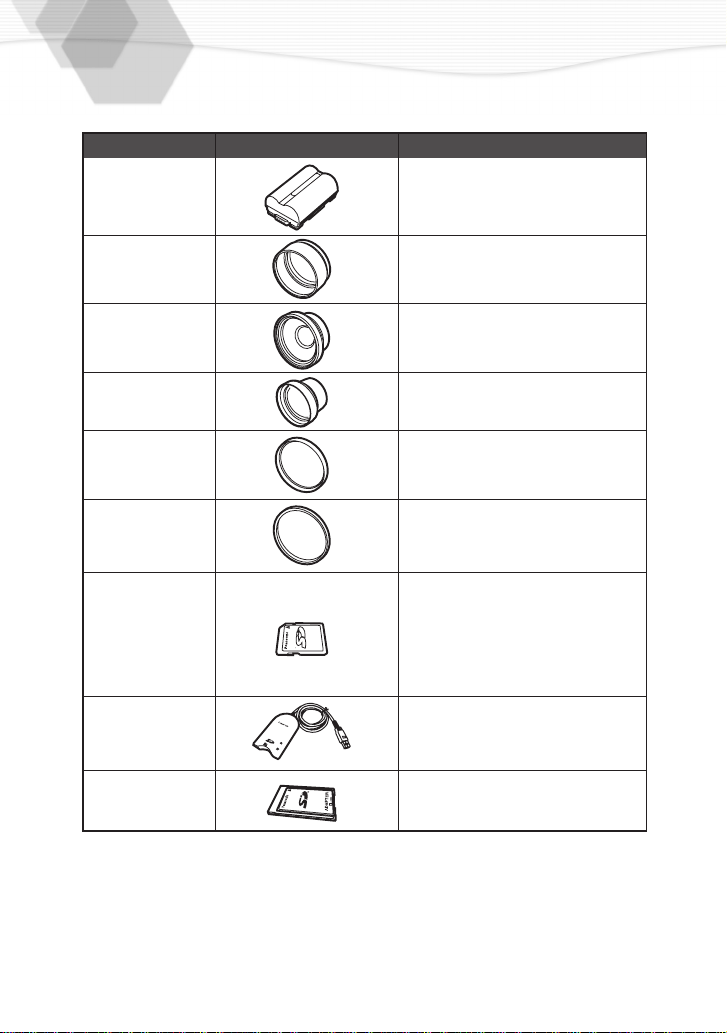
96
Digital Camera Accessory System
*Please refer to page 15, concerning the battery charging time and available
recording time.
*NOTE: Accessories and/or model numbers may vary by country. Please
consult your local dealer.
Accessory#
Description
Figure
RP-SD064B
RP-SD032B
RP-SD016B
BN-SDCAPU/1B
BN-SDABPU/1B
512 MB SD Memory Card
256 MB SD Memory Card
128 MB SD Memory Card
64 MB SD Memory Card
32 MB SD Memory Card
16 MB SD Memory Card
8 MB SD Memory Card
SD USB Reader/Writer
(compatible with
MultiMediaCard)
SD PC Card Adaptor
(compatible with
MultiMediaCard)
DMW-LA1
DMW-LW52
DMW-LT52
DMW-LC52
DMW-LMC52
RP-SD008B
RP-SD128
RP-SDH256
RP-SDH512
Conversion Lens Adaptor
Wide Conversion Lens
Tele Conversion Lens
Close-up Lens
MC Protector
CGR-S602A/1B Lithum Ion Battery
KC3‑PP.book96ページ2002年4月5日 金曜日 午前11時55分
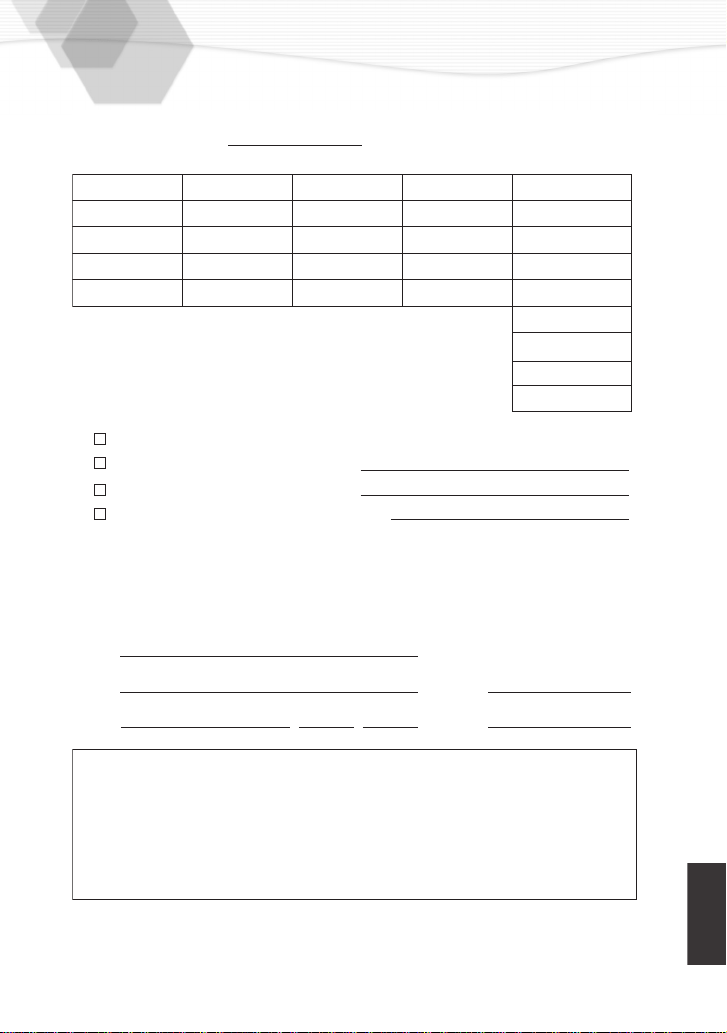
97
Digital Camera Accessory Order Form
(For USA Customers)
In CANADA, please contact your local Dealer for more information on
Accessories.
TO OBTAIN ANY OF OUR DIGITAL CAMERA ACCESSORIES YOU CAN DO ANY OF
THE FOLLOWING:
VISIT YOUR LOCAL PANASONIC DEALER
OR
CALL PANASONIC’S ACCESSORY ORDER LINE AT 1-800-332-5368
[6 AM-5 PM M-F, 6 AM-10:30 AM SAT, PACIFIC TIME]
OR
MAIL THIS ORDER TO: PANASONIC SERVICES COMPANY ACCESSORY ORDER OFFICE
20421 84th Avenue South Kent, WA. 98032
Ship To:
Mr.
Mrs.
Ms.
First Last
Street Address
City State Zip
Phone#:
Day ( )
Night ( )
4. Shipping information (UPS delivery requires complete street address)
Please photocopy this form when placing an order.
3. Method of payment (check one)
Check of Money Order enclosed (NO C.O.D.SHIPMENTS)
VISA
MasterCard
Make Check or Money Order to: PANASONIC ACCESSORIES
(Please do not send cash)
2. Items Ordered
QuantityAccessory # Price Each Description
Total Price
6.95
Subtotal
Your State & Local Sales Tax
Shipping & Handling
Total Enclosed
1. Digital Camera Model #
Discover
Expiration Date
Credit Card #
Customer Signature
KC3‑PP.book97ページ2002年4月5日 金曜日 午前11時55分

98
Request for Service Notice
Mail this completed form and your Proof of Purchase along with your unit to:
Panasonic Services Company
1705 N. Randall Road
Elgin, IL. 60123-7847
Attn: Digital Camera Repair
Request for Service Notice:
(USA Only)
Please photocopy this form when making a request for service notice.
In the unlikely event this product needs service.
• Please include your proof of purchase.
(Failure to due so will delay your repair.)
• To further speed your repair, please provide
an explanation of what wrong with the unit
and any symptom it is exhibiting.
Please write the displayed above Self Diagnostic number
here.
KC3‑PP.book98ページ2002年4月5日 金曜日 午前11時55分

99
Limited Warranty
(For USA Only)
PANASONIC CONSUMER
ELECTRONICS COMPANY,
DIVISION OF MATSUSHITA
ELECTRIC CORPORATION OF
AMERICA, One Panasonic Way
Secaucus, New Jersey 07094
PANASONIC SALES COMPANY,
DIVISION OF MATSUSHITA
ELECTRIC OF PUERTO RICO, INC.
Ave. 65 de Infanteria, Km. 9.5, San
Gabriel Industrial Park, Carolina,
Puerto Rico 00985
Panasonic Digital Still Camera
Limited Warranty
Limited Warranty Coverage
If your product does not work properly because of a defect in materials or
workmanship, Panasonic Consumer Electronics Company or Panasonic Sales
Company (collectively referred to as “the warrantor”) will, for the length of the
period indicated on the chart below, which starts with the date of original
purchase (“warranty period”), at its option either (a) repair your product with
new or refurbished parts, or (b) replace it with a new or refurbished product.
The decision to repair or replace will be made by the warrantor.
During the “Labor” warranty period there will be no charge for labor. During the
“Parts” warranty period, there will be no charge for parts. You must carry-in or
mail-in your product during the warranty period. If non-rechargeable batteries
are included, they are not warranted. This warranty only applies to products
purchased and serviced in the United States or Puerto Rico. This warranty is
extended only to the original purchaser of a new product which was not sold
“as is”. A purchase receipt or other proof of the original purchase date is
required for warranty service.
PRODUCT OR PART NAME PARTS LABOR
DIGITAL STILL CAMERA
(EXCEPT ITEMS LISTED
BELOW)
1 (ONE) YEAR 90 (NINETY) DAYS
CCD 6 (SIX) MONTHS 90 (NINETY) DAYS
RECHARGEABLE BATTERY
PACK (IN EXCHANGE FOR
DEFECTIVE BATTERY PACK)
90 (NINETY) DAYS NOT APPLICABLE
SD MEMORY CARD (IN
EXCHANGE FOR
DEFECTIVE SD CARD)
90 (NINETY) DAYS NOT APPLICABLE
KC3‑PP.book99ページ2002年4月5日 金曜日 午前11時55分

100
Carry-In or Mail-In Service
For Carry-In or Mail-In Service in the United States call
1-800-272-7033.
For assistance in Puerto Rico call Panasonic Sales Company
(787)-750-4300 or fax (787)-768-2910.
This warranty ONLY COVERS failures due to defects in materials or
workmanship, and DOES NOT COVER normal wear and tear or cosmetic
damage. The warranty ALSO DOES NOT COVER damages which
occurred in shipment, or failures which are caused by products not
supplied by the warrantor, or failures which result from accidents, misuse,
abuse, neglect, mishandling, misapplication, alteration, faulty installation,
set-up adjustments, misadjustment of consumer controls, improper
maintenance, power line surge, lightning damage, modification, or
commercial use (such as in a hotel, office, restaurant, or other business),
rental use of the product, service by anyone other than a Factory
Servicenter or other Authorized Servicer, or damage that is attributable to
acts of God.
THERE ARE NO EXPRESS WARRANTIES EXCEPT AS LISTED
UNDER
“
LIMITED WARRANTY COVERAGE
”
. THE WARRANTOR IS
NOT LIABLE FOR INCIDENTAL OR CONSEQUENTIAL DAMAGES
RESULTING FROM THE USE OF THIS PRODUCT, OR ARISING OUT
OF ANY BREACH OF THIS WARRANTY. (As examples, this excludes
damages for lost time, travel to and from the servicer, loss of media or
images, data or other memory content. The items listed are not exclusive,
but are for illustration only.) ALL EXPRESS AND IMPLIED
WARRANTIES, INCLUDING THE WARRANTY OF
MERCHANTABILITY, ARE LIMITED TO THE PERIOD OF THE LIMITED
WARRANTY.
Some states do not allow the exclusion or limitation of incidental or conse-
quential damages, or limitations on how long an implied warranty lasts, so
the exclusions may not apply to you.
This warranty gives you specific legal rights and you may also have other
rights which vary from state to state. If a problem with this product
develops during or after the warranty period, you may contact your dealer
or Servicenter. If the problem is not handled to your satisfaction, then write
to the warrantor's Consumer Affairs Department at the addresses listed for
the warrantor.
PARTS AND SERVICE WHICH ARE NOT COVERED BY THIS LIMITED
WARRANTY ARE YOUR RESPONSIBILITY.
KC3‑PP.book100ページ2002年4月5日 金曜日 午前11時55分

101
Customer Services Directory
(For USA Only)
Product Repairs
1-800-332-5368 (Customer Orders Only)
Panasonic Services Company 20421 84th Avenue South, Kent, WA 98032
(6 am to 5 pm Monday - Friday; 6 am to 10:30 am Saturday; PST)
(Visa, MasterCard, Discover Card, American Express, Check)
Web Site: http://www.panasonic.com
You can purchase parts, accessories or locate your
nearest servicenter by visiting our Web Site.
For Product Information, Operating Assistance, Literature Request, Dealer Locations, and
all Customer Service inquiries please contact:
1-800-272-7033
, Monday-Friday 8:30am-8pm EST.
As of January 2002
Service in Puerto Rico
Matsushita Electric of Puerto Rico, Inc. Panasonic Sales Company/ Factory Servicenter:
Ave. 65 de Infanteria, Km. 9.5, San Gabriel Industrial Park, Carolina, Puerto Rico 00985
Phone (787) 750-4300 Fax (787) 768-2910
Accessory Purchases:
MAIL TO :
Centralized Factory Servicenter
Panasonic Services Company
1705 N. Randall Road,
Elgin, IL 60123-7847
Attention: Digital Camera Repair
Please carefully pack and ship, prepaid and insured, to the Elgin Centralized Factory
Servicenter.
Customer's in Puerto Rico, please ship or carry in to location below (“Service in Puerto Rico”).
KC3‑PP.book101ページ2002年4月5日 金曜日 午前11時55分

102
Index
A
AF/AE Lock ............................... 50
Aperture-priority AE .................. 41
Audio Dubbing .......................... 72
Auto (AE) Bracket ..................... 49
AUTO Mode .............................. 29
Auto Review .............................. 78
B
Built-in Flash ............................. 34
Burst Mode ............................... 57
C
Clock Set .................................. 28
Condensation ............................ 88
Conversion Lens ....................... 58
D
Digital Zoom .............................. 33
DPOF ........................................ 66
F
File Number .............................. 81
Flash/Access Indicator .............. 23
Formatting ................................. 76
I
ISO Sensitivity .......................... 54
L
Landscape Mode ...................... 44
LCD Monitor Brightness ............ 77
M
Macro Mode .............................. 56
Motion Image ............................ 31
Multi Playback ........................... 61
MultiMediaCard ......................... 17
N
Night Portrait Mode ................... 46
O
Operational Sound .................... 79
Optical Zoom ............................ 32
P
Picture Adjustment ....................51
Picture Size ...............................38
Playback Zoom ..........................62
Portrait Mode .............................43
Power Save Mode .....................80
Program AE ...............................40
Q
Quality .......................................39
R
Resizing .....................................73
Review .......................................30
S
SD Memory Card .......................17
SD Slide Show ...........................90
Self-timer ...................................36
Shutter-priority AE .....................42
Slide Show .................................70
Sports Mode ..............................45
Spot AF ......................................55
Spot Mode .................................47
Status Indicator ..........................23
T
Trimming ....................................74
W
White Balance ...........................52
KC3‑PP.book102ページ2002年4月5日 金曜日 午前11時55分
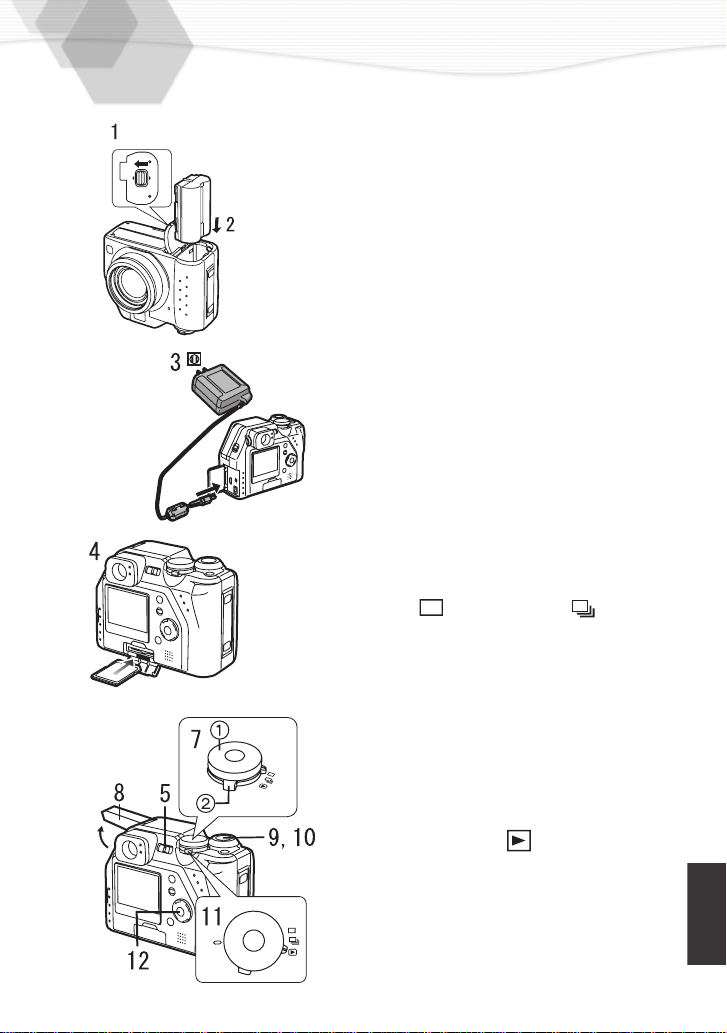
103
Spanish Quick Use Guide/Guía española
para el uso rápido
Prepare las siguientes piezas.
• Cámara
• Batería
• Tarjeta de memoria
• Adaptador AC
Verifique que el interruptor de alimentación
esté en [OFF].
1
Desplace la palanca hacia la dirección
para que se abra la tapa de baterías.
2
Inserte la batería en la cámara.
3
Para cargar la batería, conecte el
adaptador AC a la cámara.
4
Introduzca la tarjeta de memoria en
la cámara.
5
Ponga el interruptor de alimentación
a [ON].
6
Defina la fecha/hora.
7
Ajuste el disco del modo operativo 2
22
2
y el disco del modo de grabación 1
11
1.
• Ajuste el disco del modo operativo al modo
único [ ] o al modo ráfaga [ ].
8
Deslice la palanca del flash para abrir
el Flash.
9
Pulse el botón del obturador a mitad
para arreglar el enfoque.
10
Pulse el botón del obturador para
sacar una imagen.
[Reproducción]
11
Ajuste el disco del modo operativo a
la reproducción [ ].
12
Pulse 2/1 para reproducir la imagen
que quiere ver.
LOCK
OPEN
KC3‑PP.book103ページ2002年4月5日 金曜日 午前11時55分

VQT9861
F0302Mm1032( 6600B)
Panasonic Consumer Electronics Company,
Division of Matsushita Electric Corporation of America
One Panasonic Way, Secaucus, NJ 07094
Panasonic Sales Company ("PSC")
Division of Matsushita Electric of Puerto Rico, Inc.
Ave. 65 de Infanteria, Km. 9.5, San Gabriel Industrial Park, Carolina, Puerto Rico 00985
Panasonic Canada Inc.
5770 Ambler Drive, Mississauga, Ontario, L4W 2T3
P
KC3‑PP.book104ページ2002年4月5日 金曜日 午前11時55分