• GETTING STARTED
• MAKING COPIES
• STATUS INDICATORS
• GENERAL INFORMATION
• OPTIONAL EQUIPMENT
2
13
28
35
53
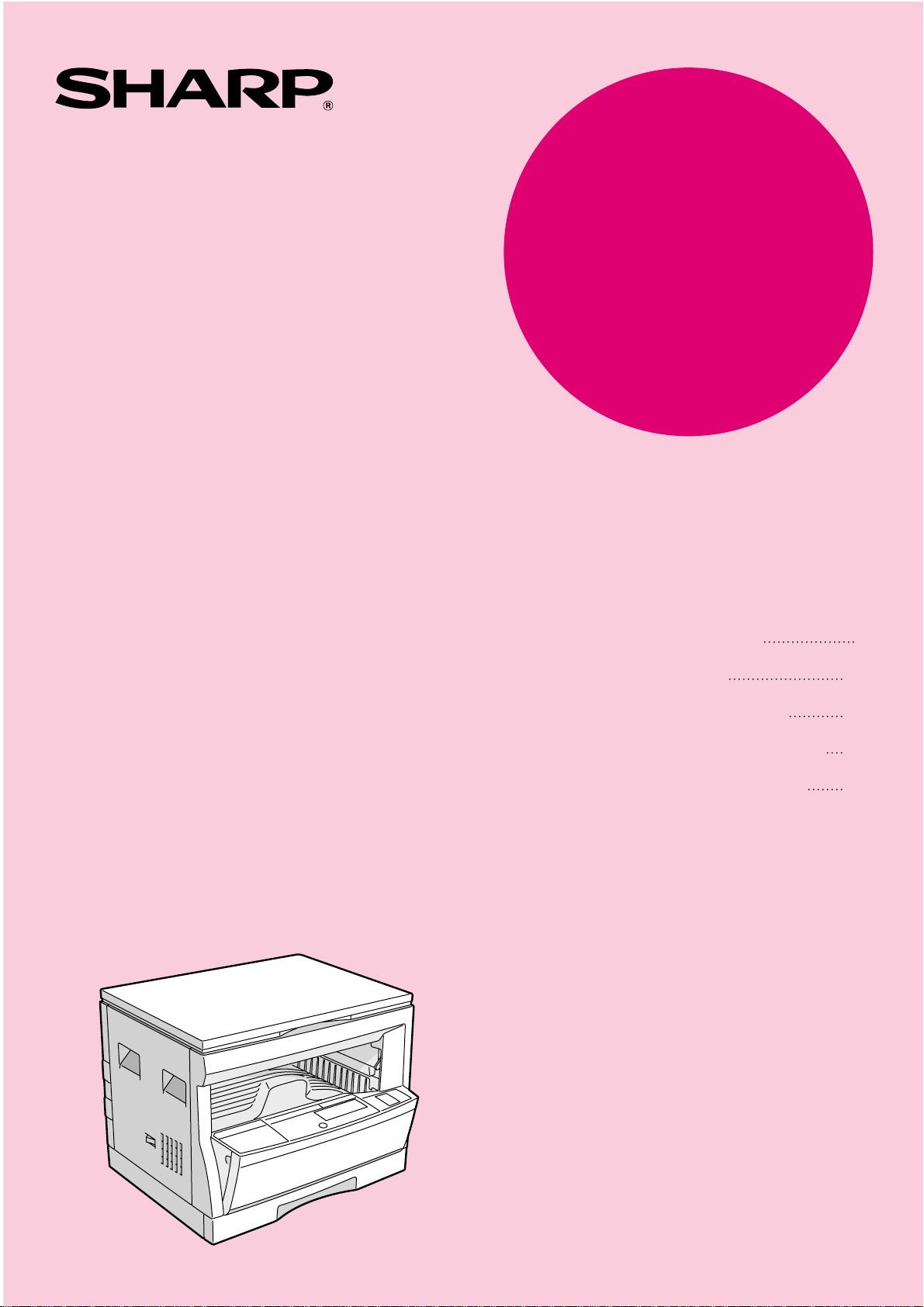
DIGITAL COPYING MACHINE
OPERATION MANUAL
Page
MODEL
AR-163
CAUTIONS
Follow the cautions below when using this copier.
●
The fusing area is hot. Exercise care in this area when removing misfed paper.
●
Do not look directly at the light source. Doing so may damage your eyes.
●
Place the copier on a firm, level surface.
●
Do not install the copier in a humid or dusty location.
●
When the copier is not used for a long time, for example, during prolonged holidays, turn the power
switch off and remove the power cord from the outlet.
●
When moving the copier, be sure to turn the power switch off and remove the power cord from the
outlet.
●
Do not cover the copier with a dust cover, cloth or plastic film while the power is on. Doing so may
prevent heat dissipation, damaging the copier.
●
Use of controls or adjustments or performance of procedures other than those specified herein
may result in hazardous laser radiation exposure.
Cautions on laser
Wave length 785 nm ±10 nm
Pulse times (8.141 µs ±0.1 µs)/7 mm
Output power 0.2 mW ±0.02 mW
1
GETTING STARTED
STATUS
INDICATORS
MAKING COPIES
GENERAL INFORMATION OPTIONAL EQUIPMENT
CONTENTS Page
GETTING STARTED
●
INTRODUCTION. . . . . . . . . . . . . . . . . . . . . . . . . . . . . . . . . 2
●
MAIN FEATURES . . . . . . . . . . . . . . . . . . . . . . . . . . . . . . . . 3
●
PART NAMES AND FUNCTIONS . . . . . . . . . . . . . . . . . . . 4
– Overall layout . . . . . . . . . . . . . . . . . . . . . . . . . . . . . . . . . . . . . . . 4
– Operation panel . . . . . . . . . . . . . . . . . . . . . . . . . . . . . . . . . . . . . 6
●
COPIER INSTALLATION . . . . . . . . . . . . . . . . . . . . . . . . . . 8
●
CAUTIONS ON HANDLING . . . . . . . . . . . . . . . . . . . . . . . . 9
●
LOADING COPY PAPER . . . . . . . . . . . . . . . . . . . . . . 10
MAKING COPIES
●
AUDITING ACCOUNTS . . . . . . . . . . . . . . . . . . . . . . . . . . 13
●
NORMAL COPYING . . . . . . . . . . . . . . . . . . . . . . . . . . . . . 14
●
REDUCTION/ENLARGEMENT/ZOOM. . . . . . . . . . . . . . . 16
●
BYPASS FEED (special paper) . . . . . . . . . . . . . . . . . . . . 18
●
TWO-SIDED COPYING . . . . . . . . . . . . . . . . . . . . . . . . . . 20
●
XY ZOOM . . . . . . . . . . . . . . . . . . . . . . . . . . . . . . . . . . . . . 21
●
B/W REVERSE . . . . . . . . . . . . . . . . . . . . . . . . . . . . . . . . . 23
●
DUAL PAGE COPY . . . . . . . . . . . . . . . . . . . . . . . . . . . . . 24
●
INTERRUPTING A COPY RUN . . . . . . . . . . . . . . . . . . . . 25
●
AUTOMATIC EXPOSURE ADJUSTMENT. . . . . . . . . . . . 26
●
TONER SAVE MODE . . . . . . . . . . . . . . . . . . . . . . . . . . . . 27
STATUS INDICATORS
●
TONER CARTRIDGE REPLACEMENT . . . . . . . . . . 28
●
MISFEED REMOVAL . . . . . . . . . . . . . . . . . . . . . . . . 30
●
DEVELOPER REQUIRED . . . . . . . . . . . . . . . . . . . . . 34
●
MAINTENANCE REQUIRED . . . . . . . . . . . . . . . . . . . 34
GENERAL INFORMATION
●
USER PROGRAMS . . . . . . . . . . . . . . . . . . . . . . . . . . . . . 35
– Settings for auditing accounts . . . . . . . . . . . . . . . . . . . . . . 38
●
POWER SAVE MODES . . . . . . . . . . . . . . . . . . . . . . . . . . 42
●
USER MAINTENANCE . . . . . . . . . . . . . . . . . . . . . . . . . . . 44
●
COPIER TROUBLE? . . . . . . . . . . . . . . . . . . . . . . . . . . . . 46
●
SUPPLIES. . . . . . . . . . . . . . . . . . . . . . . . . . . . . . . . . . . . . 49
– Types and sizes of copy paper . . . . . . . . . . . . . . . . . . . . . . 49
– Genuine supplies statement . . . . . . . . . . . . . . . . . . . . . . . . 50
●
SPECIFICATIONS . . . . . . . . . . . . . . . . . . . . . . . . . . . . . . 51
OPTIONAL EQUIPMENT
●
SYSTEM CONFIGURATION . . . . . . . . . . . . . . . . . . . . . . 54
●
SINGLE PASS FEEDER (AR-SP2) . . . . . . . . . . . . . . . . . 55
●
ELECTRONIC SORTING KIT (AR-EB3) . . . . . . . . . . . . . 58
– Sort/group . . . . . . . . . . . . . . . . . . . . . . . . . . . . . . . . . . . . 59
– 2 in 1 or 4 in 1 . . . . . . . . . . . . . . . . . . . . . . . . . . . . . . . . . 61
– Erase . . . . . . . . . . . . . . . . . . . . . . . . . . . . . . . . . . . . . . . . 63
– Margin shift . . . . . . . . . . . . . . . . . . . . . . . . . . . . . . . . . . . 65
●
250-SHEET PAPER FEED UNIT (AR-DE5)/
2x250-SHEET PAPER FEED UNIT (AR-DE6) . . . . . . . . . 66
INDEX. . . . . . . . . . . . . . . . . . . . . . . . . . . . . . . . . . . . . . . . 69
2
GETTING STARTED
INTRODUCTION
This copier has been designed to provide convenient copying features in a minimum
amount of office space and with maximum operational ease. To get full use of all copier
features, be sure to familiarise yourself with this manual and the copier.
For quick reference during copier use, keep this manual in a handy location.
This copier can be used as a laser printer and as a facsimile machine by installing optional
components. However, this manual describes only the copier features. For description of the printer
features and facsimile features, see their separate manuals. (Some options may not be available in
some countries.)
Conventions used in this manual
In this manual, the following icons are used to provide the user with
information pertinent to the use of the copier.
Introduction
Warns the user that injury to the user or damage to the
copier may result if the contents of the warning are not
properly followed.
Cautions the user that damage to the copier or one of its
components may result if the contents of the caution are
not properly followed.
Notes provide information relevant to the copier regarding
specifications, functions, performance, operation and such,
that may be useful to the user.
Indicates a letter displayed in the copy quantity display.
[Inch series]
[AB series]
AB series (metric) and inch series
references
Both specifications are quoted where applicable.
●
The inch series specifications are quoted in brackets.
For example:
Page 18, step 1 -------- B4 or A3 (8-1/2" x 14" or 11" x 17")
Page 17, step 2-A ----- 86%, 81%, 70%, and 50% (95%, 77%, 64%,
and 50%)
●
Although AB series size indications are shown on the operation
panel of this manual, inch series indications are displayed on the
inch series machines.
3
GETTING STARTED
MAIN FEATURES
High-speed laser copying
●
First-copy time is only 7.2 seconds (except in a power save mode or immediately after power on).
●
Copying speed is 16 copies/min., which adapts to business use, allowing improvement of working efficiency.
High-quality digital image
●
High-quality copying at 600 dpi is performed.
●
In addition to the automatic exposure mode, the manual exposure can be adjusted in five steps.
●
The photo mode copying function allows clear copying of delicate halftone original images such as monochrome
photos and colour photos. Photo mode is adjustable in five steps.
Substantial copying features
●
Zoom copying from 50% to 200% in 1% increments can be performed.
●
Continuous copying of maximum 99 sheets can also be performed.
●
Useful special features such as the XY zoom, black and white reverse, and dual page copy are available.
●
Toner save mode reduces toner consumption by approximately 10%.
●
User programs allow setting/modification of functions for customer needs. Also the user programs allow the internal
auditor to be controlled.
Optional features
●
An optional single pass feeder (SPF) allows automatic document feeding of up to 30 sheets.
●
An optional electronic sorting kit allows many useful copier features to be used. Multiple sets of copies can be sorted
without the aid of a sorter and each set can be offset from the previous set. Also the erase, margin shift, and 4 in 1 and
2 in 1 functions are available. (To use the 2 in 1 and 4 in 1 and sort/group functions, an optional SPF is also needed.)
●
This copier can be used as a laser printer by installing an optional printer expansion kit.
●
This copier can be used as a facsimile machine by installing an optional facsimile expansion kit.
Some options may not be available in some countries.
Environmentally friendly design
●
Paper output tray is housed in the copier for space saving.
●
Preheat mode and auto power shut-off mode are provided to reduce power consumption in standby mode and meet the
Energy Star Guidelines.
As an ENERGY STA R
®
Partner, SHARP has determined that this product meets the
ENERGY STA R
®
guidelines for energy efficiency.
Main features
4
GETTING STARTED
PART NAMES AND FUNCTIONS
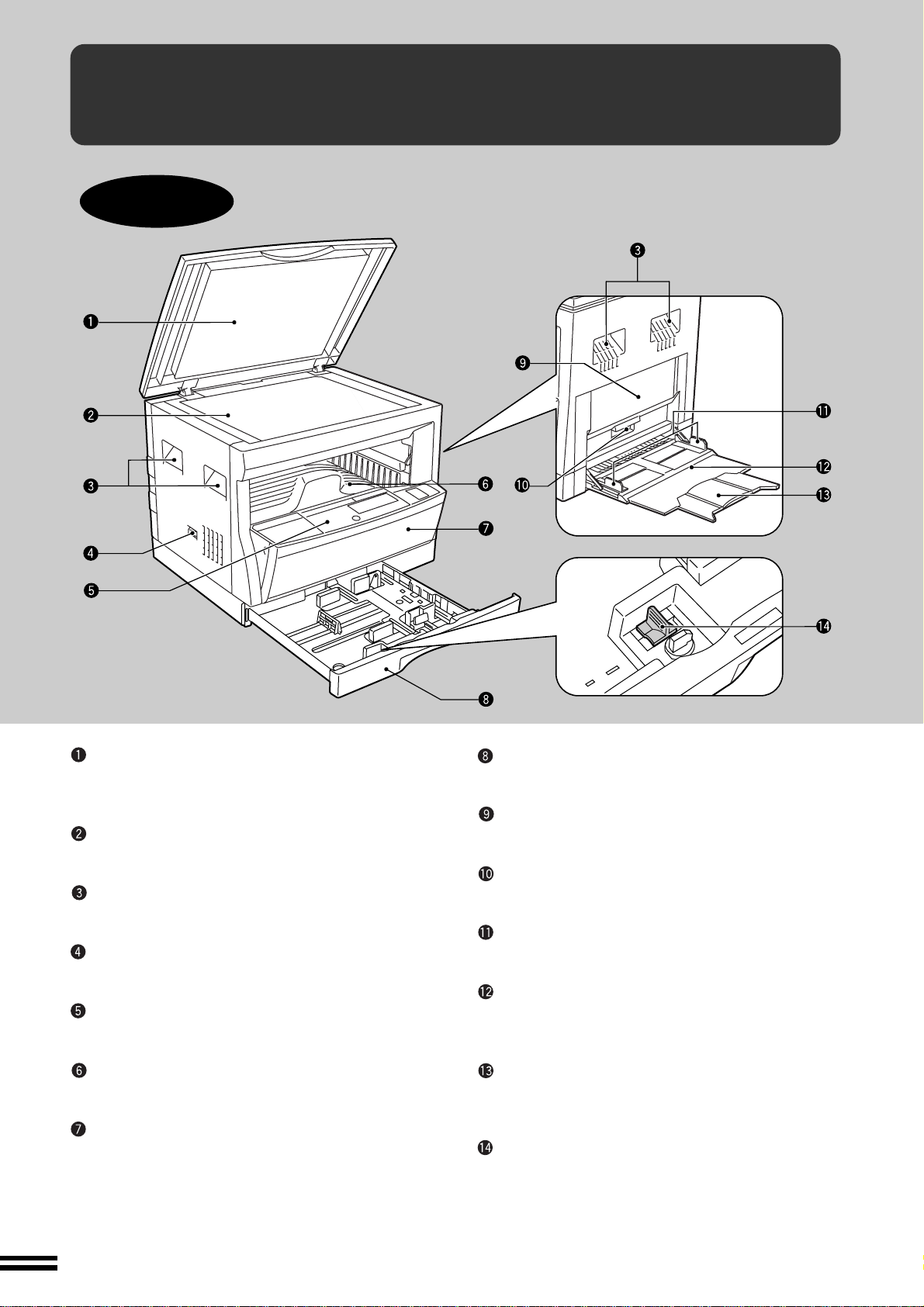
Overall layout
Platen cover
Place the original on the original table and close the
platen cover before copying starts.
Original table
Place the document to be copied here.
Handles
Use to move the copier.
Power switch
Press to turn copier power on and off.
Operation panel
All copier controls are located here for easy operation.
Paper output tray
Finished copies are deposited in the paper output tray.
Front cover
Open to remove misfeeds and for copier servicing.
Paper tray
Holds 250 sheets of copy paper.
Side cover
Open to remove misfeeds and to service the copier.
Side cover handle
Lift and pull to open the side cover.
Bypass tray guides
Adjust to the width of the copy paper.
Bypass tray
Special papers (including transparency film) and copy
paper can be fed from the bypass tray.
Bypass tray extension
Pull out when feeding large paper such as B4 and A3
(8-1/2" x 14" and 11" x 17").
Charger cleaner
Use to clean the transfer charger.
GETTING STARTED
Part names and functions
5
GETTING STARTED
PART NAMES AND FUNCTIONS
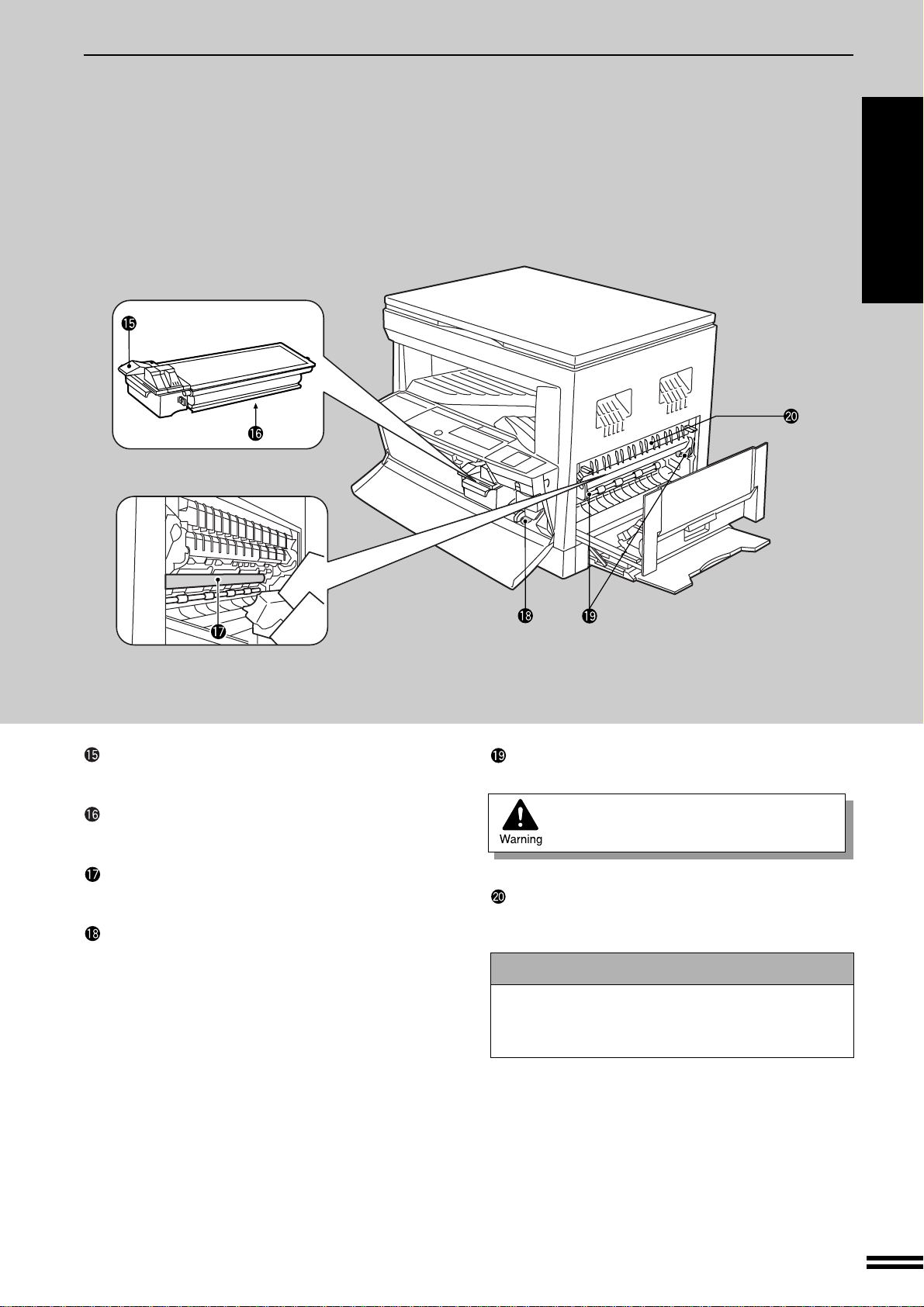
Toner cartridge lock release lever
Use to unlock the toner cartridge.
Toner cartridge
Contains toner.
Photoconductive drum
Copy images are formed on the photoconductive drum.
Roller rotating knob
Turn to remove misfed paper.
Fusing unit release levers
Lower to remove misfed paper.
The fusing unit is hot.
Take care in removing paper.
Paper guide
Open to remove misfed paper.
Accessories
Operation manual . . . . . . . . . . . . . . . . . . . . . . 1
Charger cleaner . . . . . . . . . . . . . . . . . . . . . . . . 1
Part names and functions
GETTING STARTED
6
GETTING STARTED
Part names and functions
Operation
panel
PART NAMES AND FUNCTIONS
Part names and functions
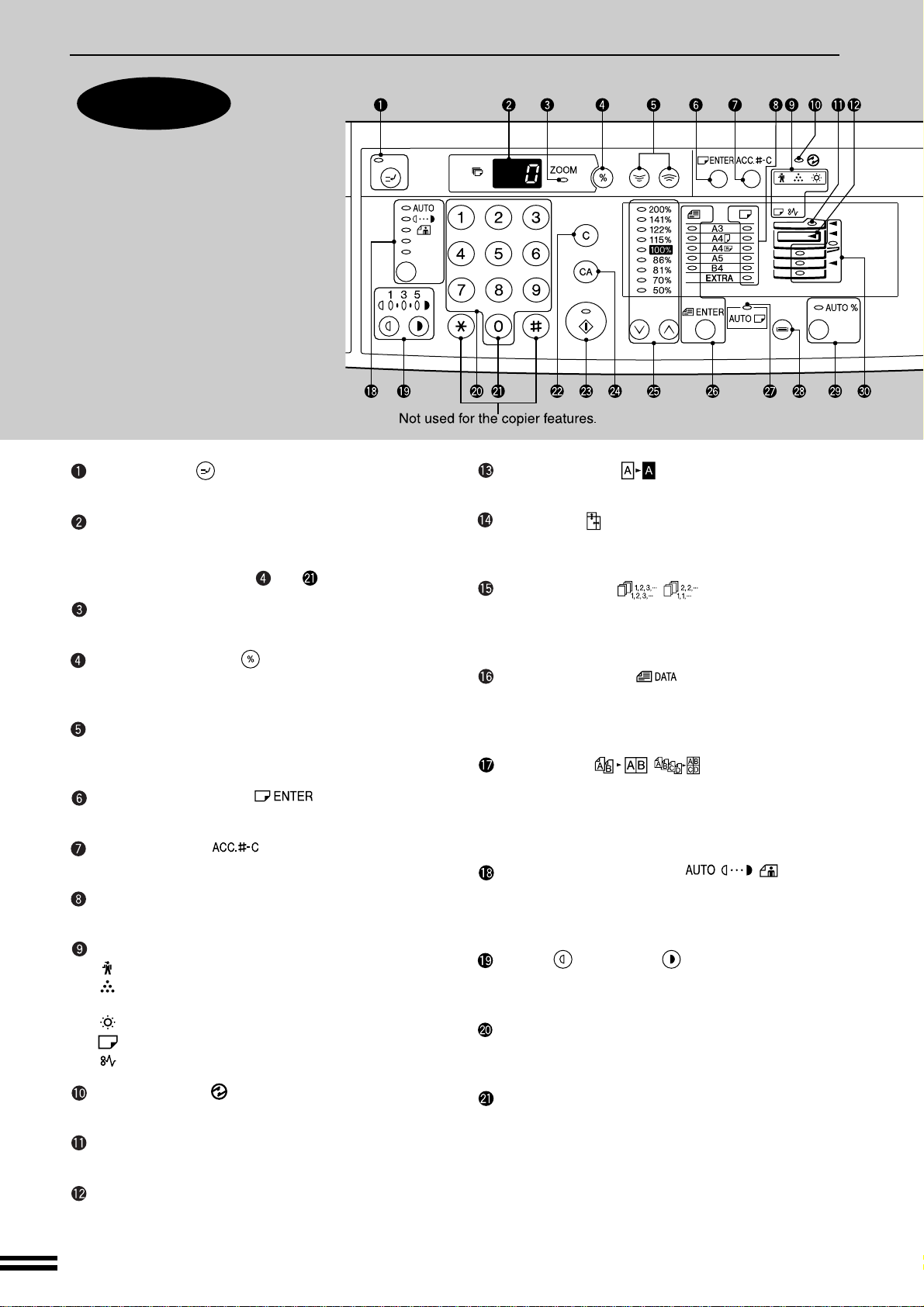
INTERRUPT ( ) key and indicator (p. 25)
Interrupts a copy run.
Copy quantity display
Displays the specified copy quantity during the ready
condition and displays the copy countdown as copies
are made. Also see items and .
ZOOM indicator (p.17)
Lights up when a zoom ratio is set.
Copy ratio display ( ) key (p. 17)
Press and hold down during standby to display the copy
ratio in the copy quantity display.
Zoom keys (p. 17)
Use to select any reduction or enlargement copy ratio
from 50% to 200% in 1% increments.
PAPER SIZE ENTER ( ) key (p.12)
Use to set the paper size in a tray.
AUDIT CLEAR ( ) key (p.13)
Closes an open account.
PAPER SIZE indicators
Light up to show the selected copy paper size.
Alarm indicators
: Maintenance indicator (p.34)
: Toner cartridge replacement required indicator
(p.28)
: Developer replacement required indicator (p.34)
: Paper required indicator (p.10)
: Misfeed indicator (p.30)
POWER SAVE ( ) indicator (p. 42)
Lights up when the copier is in a power save mode.
SPF indicator (p. 56)
Lights up when originals are set in the optional SPF tray.
Output tray full indicator (p. 59)
Indicates copies must be removed from the paper output
tray.
B/W REVERSE ( ) key and indicator (p. 23)
Press to reverse the black and white areas.
XY-ZOOM ( ) key and indicator (p. 21)
Press to change the horizontal and vertical copy ratios
independently.
SORT/GROUP ( / ) key and indicators
(p. 59)
Press to select the sort or group mode when an optional
electronic sorting kit and an optional SPF are installed.
ORIGINAL DATA ( ) indicator
Blinks when the memory becomes full of scanned
original image data. (Used when an optional electronic
sorting kit and an optional SPF are installed)
2 IN 1 / 4 IN 1 ( / ) key and indicators
(p. 61)
Press to select the 2 in 1 or 4 in 1 mode. (Only available
when an optional electronic sorting kit and an optional
SPF are installed)
AUTO/MANUAL/PHOTO ( / / ) key and
indicators (p. 14)
Use to sequentially select the exposure modes: AUTO,
MANUAL, or PHOTO.
Light ( ) and dark ( ) keys and indicators
(p. 15)
Use to adjust the MANUAL or PHOTO exposure level.
Numeric keys
Use to select the desired copy quantity or to make user
program entries.
Zero key
Use as part of numeric keys to enter copy quantity.
Press during a continuous copy run to display the
number of copies completed in the current run.
Press during standby to display the total output count.
GETTING STARTED
Part names and functions
7
GETTING STARTED
PART NAMES AND FUNCTIONS
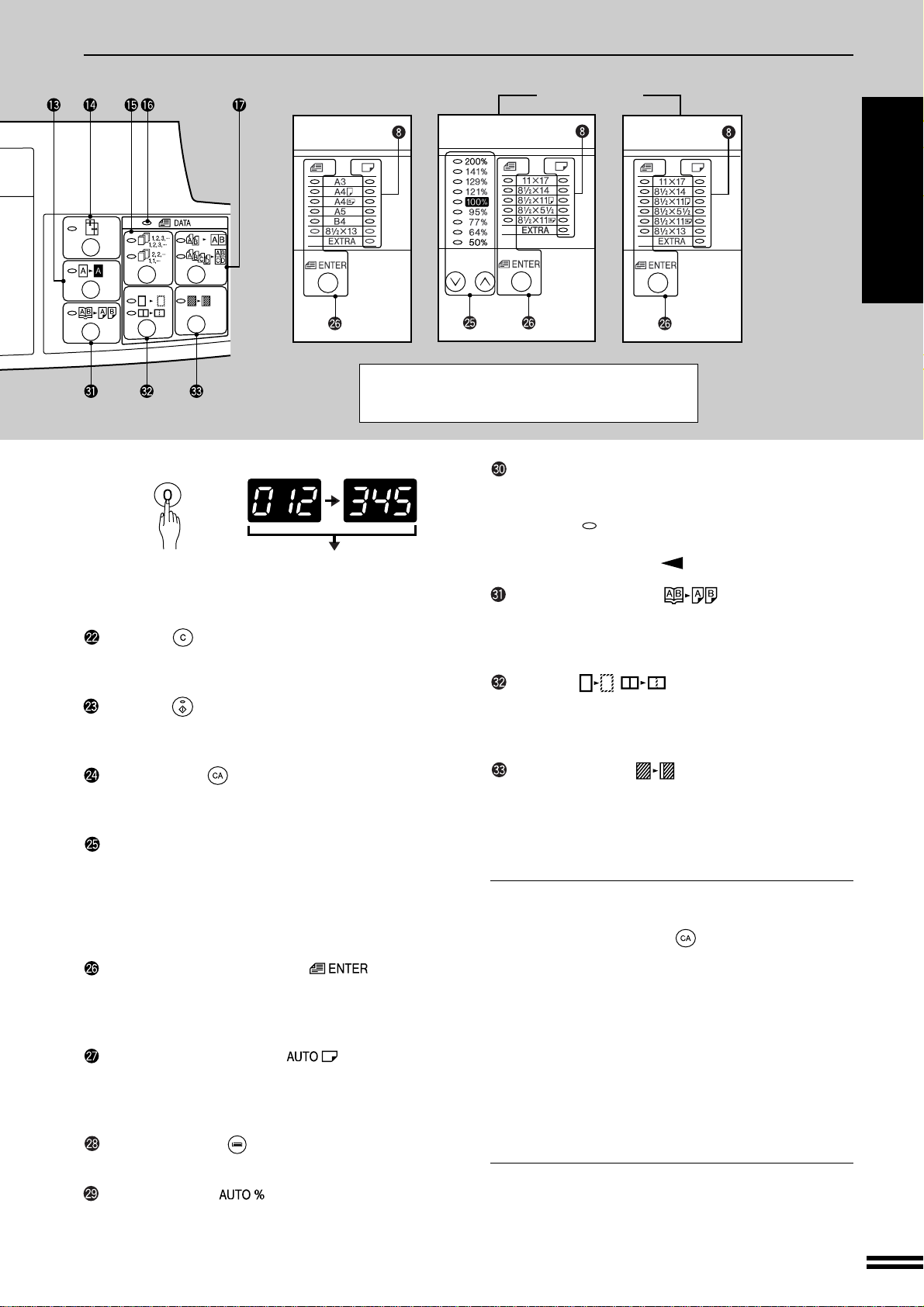
Press and hold down the key. 12,345 sheets output
1st display
2nd display
Note: A3 (11" x 17") size copies are counted as two
copies.
CLEAR ( ) key
Clears the copy quantity display or terminates a copy
run.
START ( ) key and indicator
Copying is possible when the indicator is on.
Press to start copying.
CLEAR ALL ( ) key
Clears all selected settings and returns the copier to the
initial settings.
PRESET RATIO selector keys and indicators (p.
17)
Use to sequentially select preset reduction/enlargement
copy ratios: 50%, 70%, 81%, 86%, 100%, 115%, 122%,
141%, 200% (50%, 64%, 77%, 95%, 100%, 121%,
129%, 141%, 200%).
ORIGINAL SIZE ENTER ( ) key and
indicators (p. 14, 16)
Use to input the original size for automatic paper selec-
tion and automatic copy ratio selection.
AUTO PAPER SELECT ( ) indicator
Paper of the proper size will be automatically selected
depending on the original size and selected copy ratio
when this indicator is on.
TRAY SELECT ( ) key (p. 14)
Use to manually select a paper tray.
AUTO IMAGE ( ) key and indicator
Press for automatic copy ratio selection.
Paper feed location/misfeed location indica-
tors (p. 30)
The selected paper feed location is shown by a lit
indicator ( ).
The general location of misfed paper is shown by a
blinking red indicator ( ).
DUAL PAGE COPY ( ) key and indicator
(p. 24)
Use to make individual copies of two originals placed
side by side on the original table.
ERASE ( / ) key and indicators (p. 63)
Press to select the edge erase and/or the centre erase
mode. (Only available when an optional electronic
sorting kit is installed)
MARGIN SHIFT ( ) key and indicator (p. 65)
Shifts text or image on the copy to leave a binding
margin on the left side of the copy. (Only available
when an optional electronic sorting kit is installed)
Initial settings
The copier assumes the initial settings when it is first turned
on, when the CLEAR ALL ( ) key is pressed, and ap-
proximately one minute* after the last copy is made in any
mode.
●
Copy ratio: 100%
●
Exposure: Automatic
●
Copy quantity: 0
●
All special copier modes: Off
●
Auto paper selection : On
●
Paper feed station: Previously selected paper tray
* This time (auto clear time) can be changed. See page 35,
USER PROGRAMS.
Part names and functionsGETTING STARTED
In some countries and regions, 8-1/2" x 13" size
is indicated on the operation panel.
Inch system
8
GETTING STARTED
10 cm (4")
Copier installation
COPIER INSTALLATION
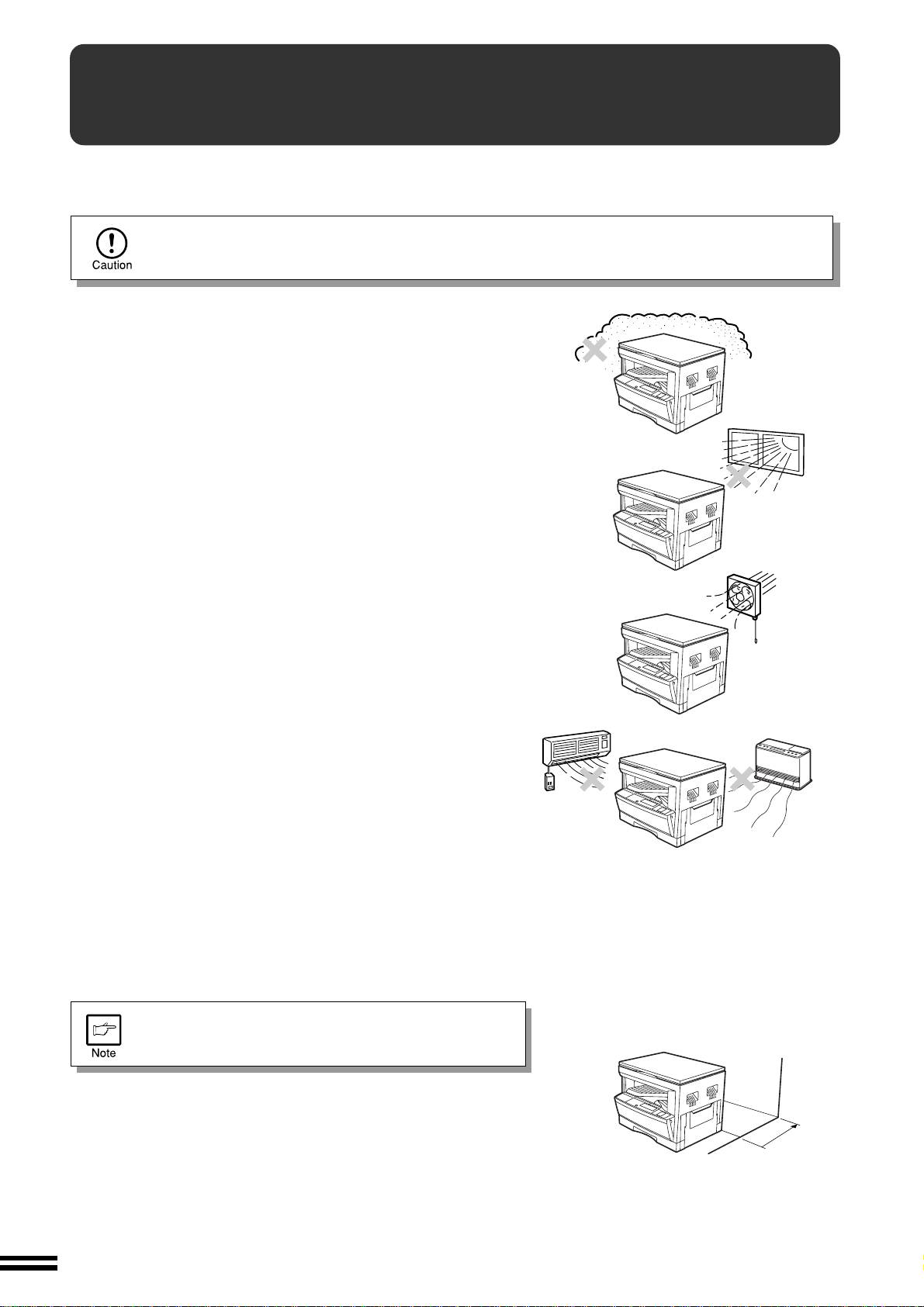
Improper installation may damage the copier. Please note the following
during initial installation and whenever the copier is moved.
If the copier is moved from a cool place to a warm place, condensation may form inside the copier.
Operation in this condition will cause poor copy quality and malfunctions. Leave the copier at room
temperature for at least 2 hours before use.
Do not install your copier in areas that are:
●
damp, humid, or very dusty
●
exposed to direct sunlight
●
poorly ventilated
●
subject to extreme temperature or humidity changes, e.g., near an
air conditioner or heater.
The copier should be installed near an accessible power outlet
for easy connection.
Be sure to connect the power cord only to a power outlet that
meets the specified voltage and current requirements.
Also make certain the outlet is properly grounded.
●
For this copier’s power supply requirements, see the name plate located
on the back of the unit.
Connect the copier to a power outlet which is not used
for other electric appliances. If a lighting fixture is
connected to the same outlet, the light may flicker.
Be sure to allow the required space around the machine for
servicing and proper ventilation.
9
GETTING STARTED
CAUTIONS ON HANDLING
Be careful in handling the copier as follows to maintain the performance of
this copier.
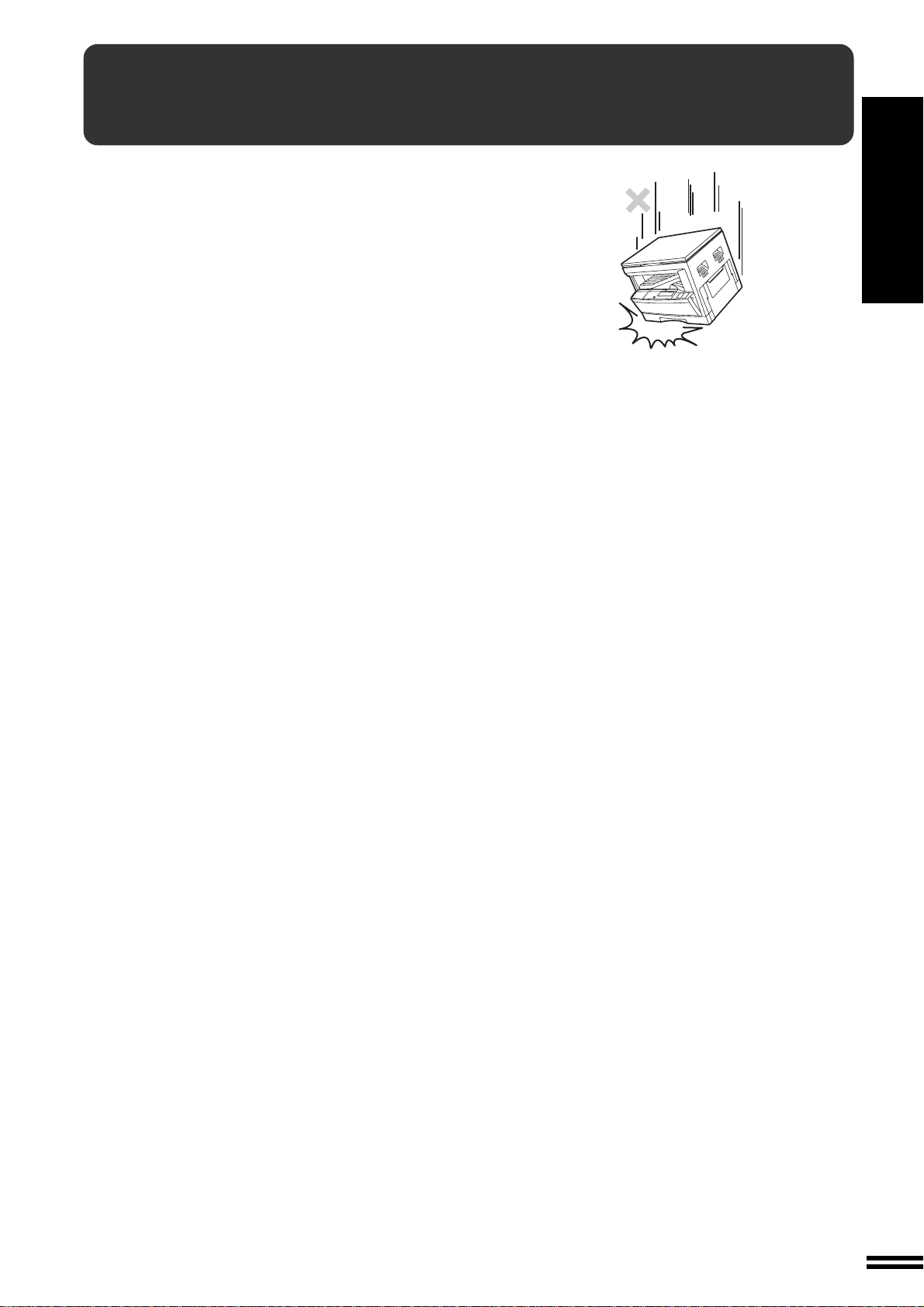
Do not drop the copier, subject it to shock or strike it against any
object.
Store spare toner cartridges in a dark place without removing
from the package before use.
If they are exposed to direct sunlight, poor copies may result.
Do not touch the photoconductive drum (green portion).
Scratches or smudges on the drum will cause dirty copies.
Cautions on handling
10
GETTING STARTED
LOADING COPY PAPER
To save space, this copier has been designed with an adjustable front-loading
tray, which is easily opened for paper loading. For best results, use only
SHARP recommended paper. (See page 49.)
The paper required ( ) indicator will light up when there is no copy paper
in the selected paper feed station, or when the selected paper tray is not
installed or is improperly installed.
When the paper size is changed in a paper tray, the size
of the paper must be entered by steps 8 through 11 on
page 12. If not, the edges of copies may become smudged
with toner. Also, the AUTO PAPER SELECT and the AUTO
IMAGE features will not function properly.
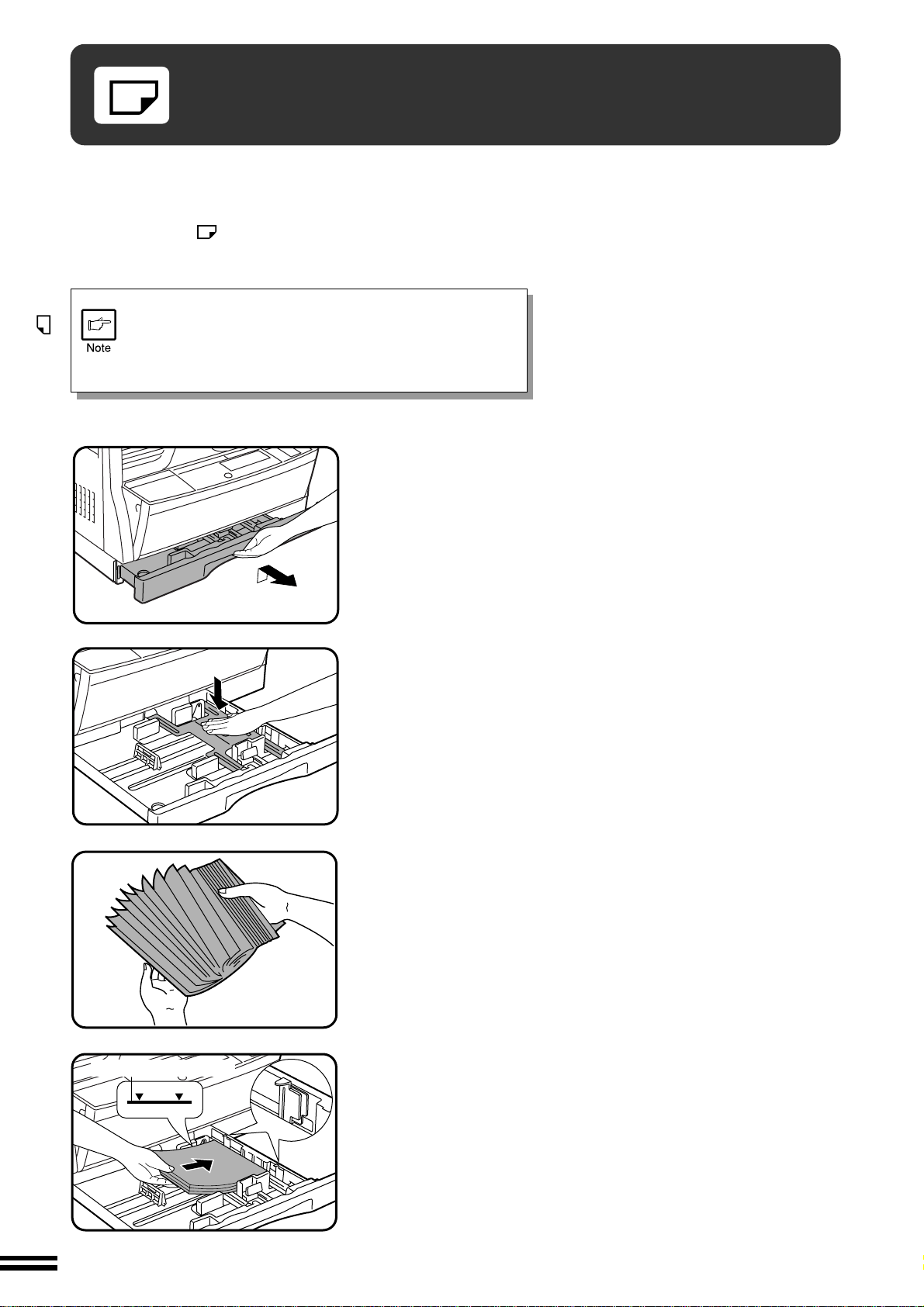
1
Gently lift and pull out the paper tray until it stops.
2
Push the pressure plate down until it locks in place.
3
Fan the copy paper and insert it into the tray. Make sure
the edges go under the corner hooks.
●
If you change to a different size of copy paper, the tray must be
adjusted. See the next page.
●
Set the paper along the guides.
●
The tray holds up to 250 sheets of paper.
Do not load paper above the maximum height line.
4
Push the paper tray firmly back into the copier.
Loading copy paper
Maximum height line
11
GETTING STARTED
Changing the copy paper size in the tray
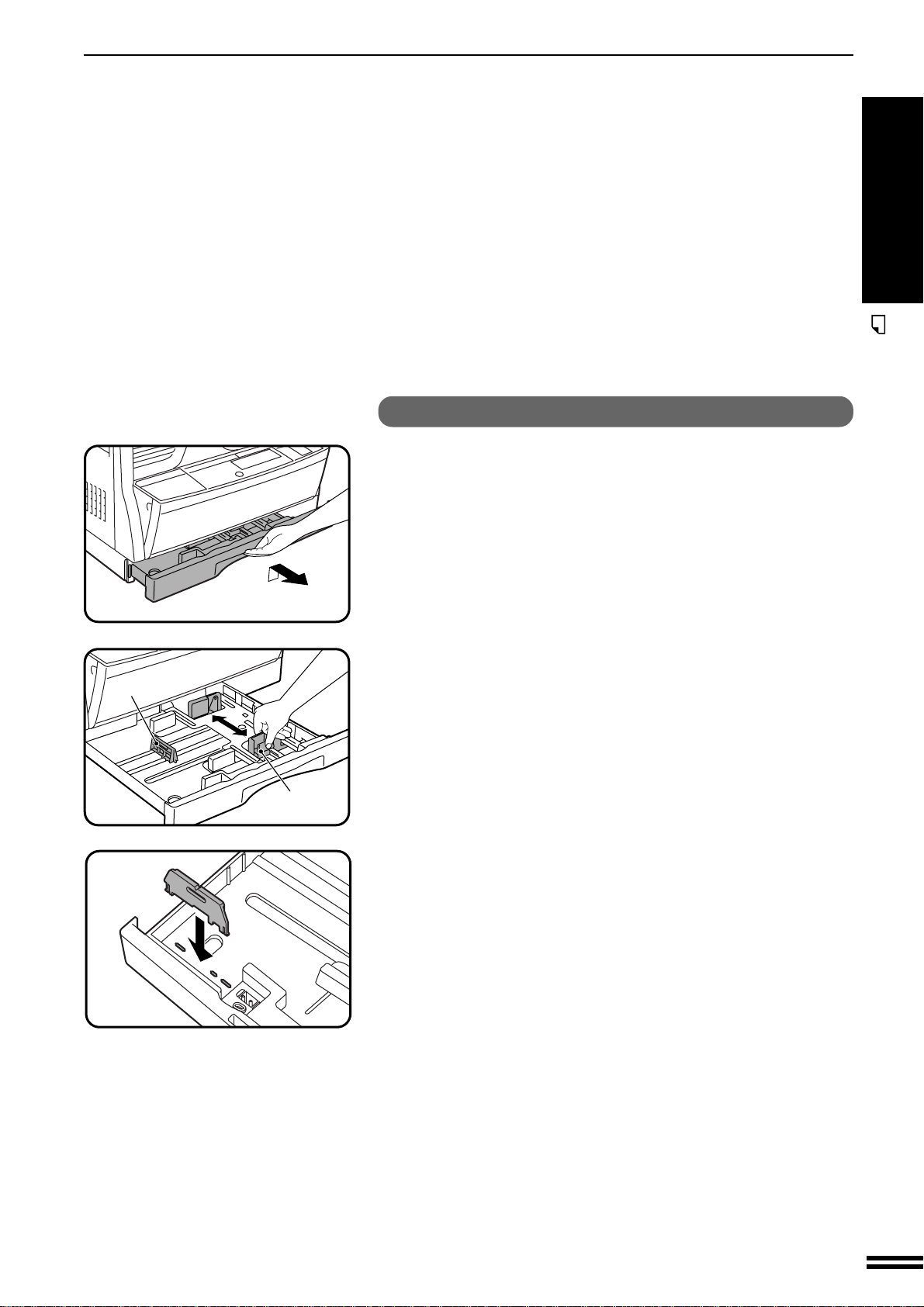
1
Gently lift and pull out the paper tray until it stops.
2
Push the pressure plate down until it locks in place.
3
Squeeze the lock lever of the front guide and slide the
front guide to match the width of the paper.
4
Move the left guide to the appropriate slot as marked
on the tray.
●
When using A5 (5-1/2" x 8-1/2") copy paper, load it into the
uppermost paper tray. If other trays (in optional paper feed units) are
used, paper misfeeds may occur.
●
With inch system machines, when using 11" x 17" copy paper, store
the left guide in the slot at the left front of the paper tray.
5
Load copy paper into the tray.
6
Place the appropriate label to indicate the selected
paper size into the recess on the right front side of the
paper tray.
7
Push the paper tray firmly back into the copier.
Loading copy paper
LOADING COPY PAPER
Front guide
Left guide
12
GETTING STARTED
Loading copy paper
LOADING COPY PAPER
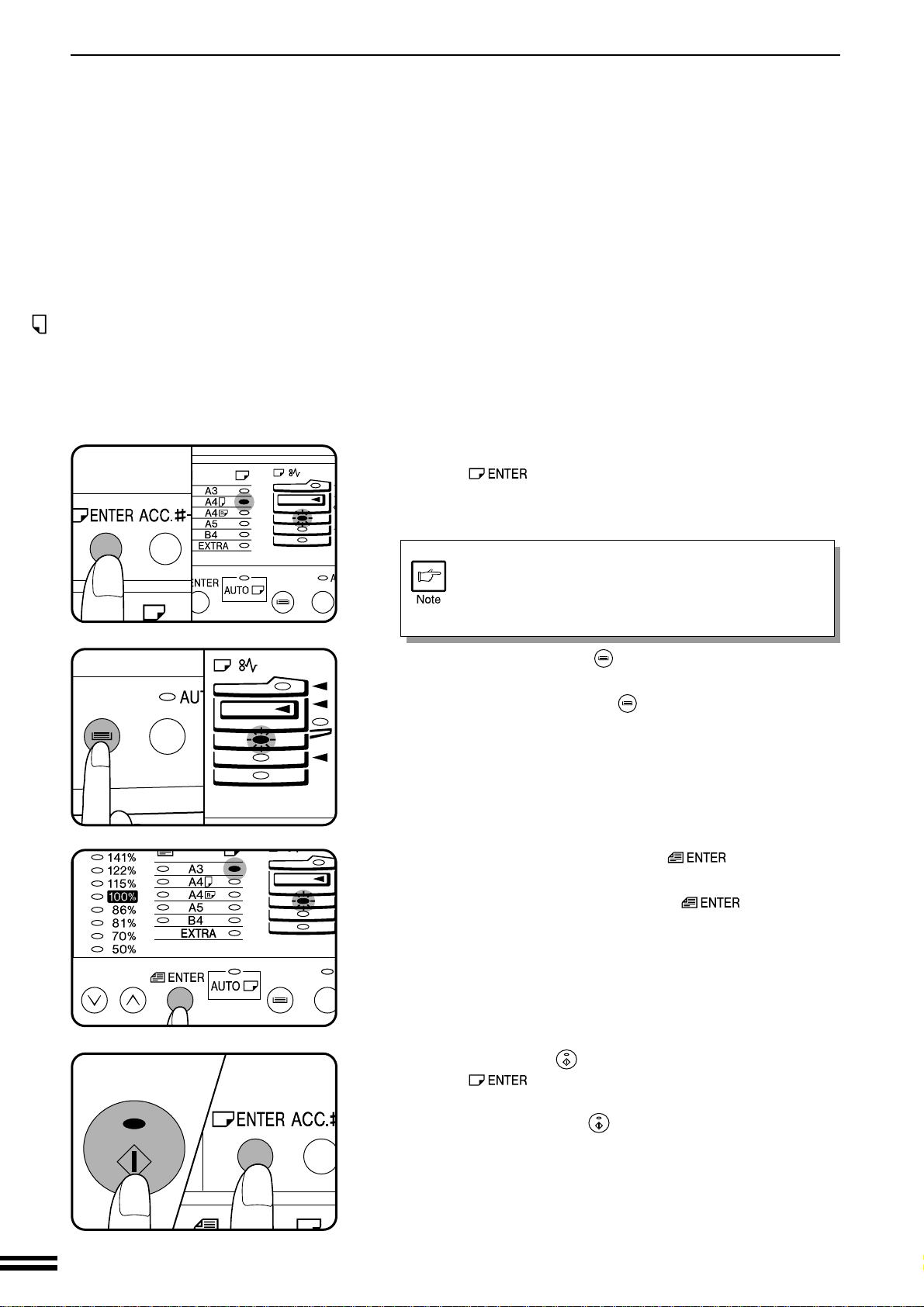
8
To set the selected paper size, press the PAPER SIZE
ENTER ( ) key.
●
The selected paper feed location indicator will blink and the corre-
sponding paper size (which is currently set) indicator will light up
steadily. All other indicators will go out.
For paper size setting, ensure that the COPY mode
has been selected. However, if copying, printing or
facsimile printing is being performed, paper size setting
cannot be made even in the COPY mode. See Note
on page 47.
9
Use the TRAY SELECT ( ) key to select the paper tray
of which the paper size has been changed.
●
Each time the TRAY SELECT ( ) key is pressed, a paper tray will
be indicated with a blinking paper feed location indicator. If an
optional paper feed unit is not installed, this operation is not needed.
10
Use the ORIGINAL SIZE ENTER ( ) key to select
the paper size which is set.
●
Each time the ORIGINAL SIZE ENTER ( ) key is pressed,
a paper size will be indicated with a paper size indicator.
11
Press the START ( ) key and then the PAPER SIZE
ENTER ( ) key.
●
To change the paper size setting of another tray, repeat steps 9 to 10
after pressing the START ( ) key.
13
MAKING COPIES
AUDITING ACCOUNTS
If this copier has been programmed in the auditing mode, it will not function
until an assigned 3-digit account number has been entered. See page 38 for
setting the auditing mode.
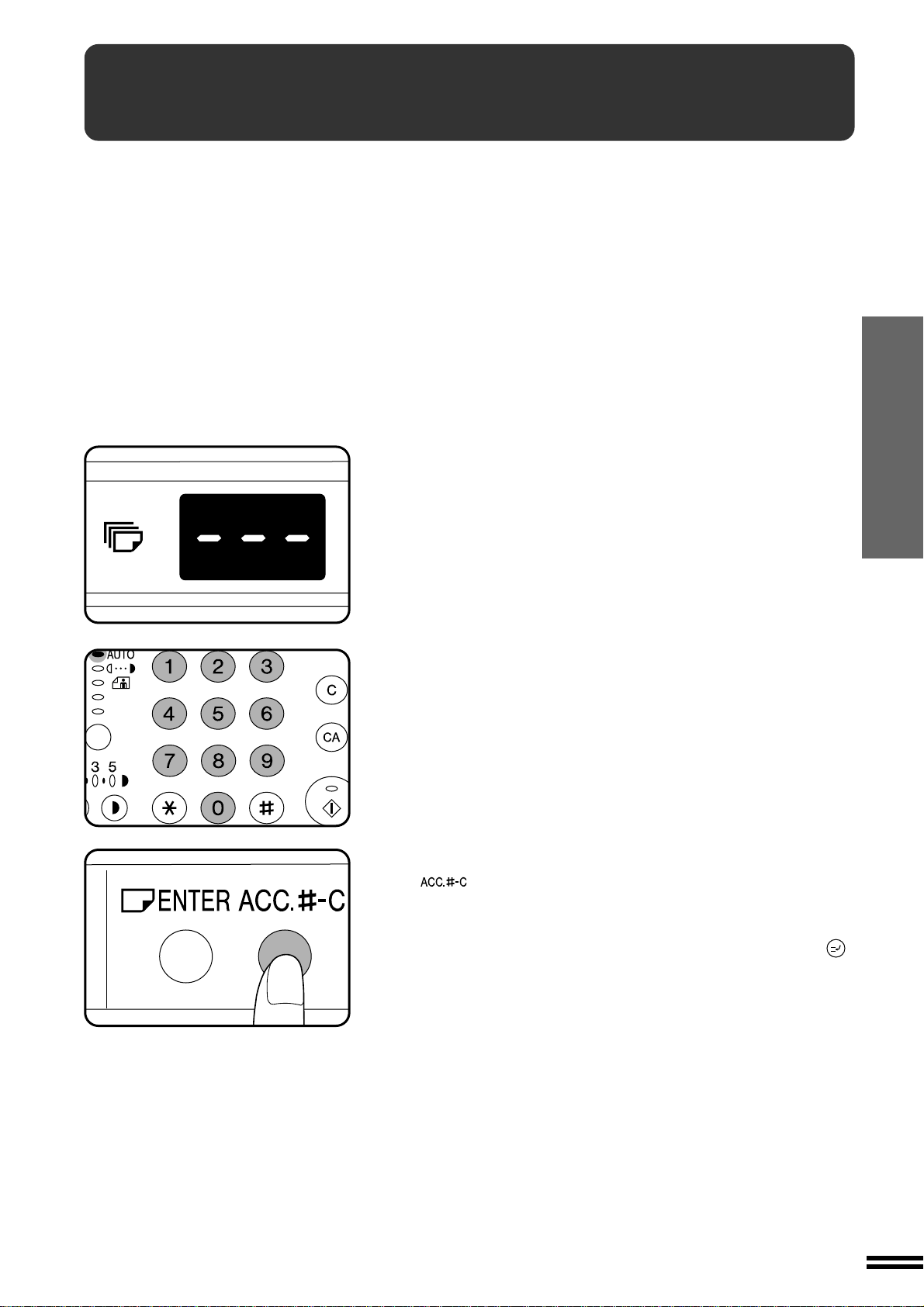
If the copier has been programmed in the auditing mode, “–––” will appear
in the copy quantity display in the initial conditions.
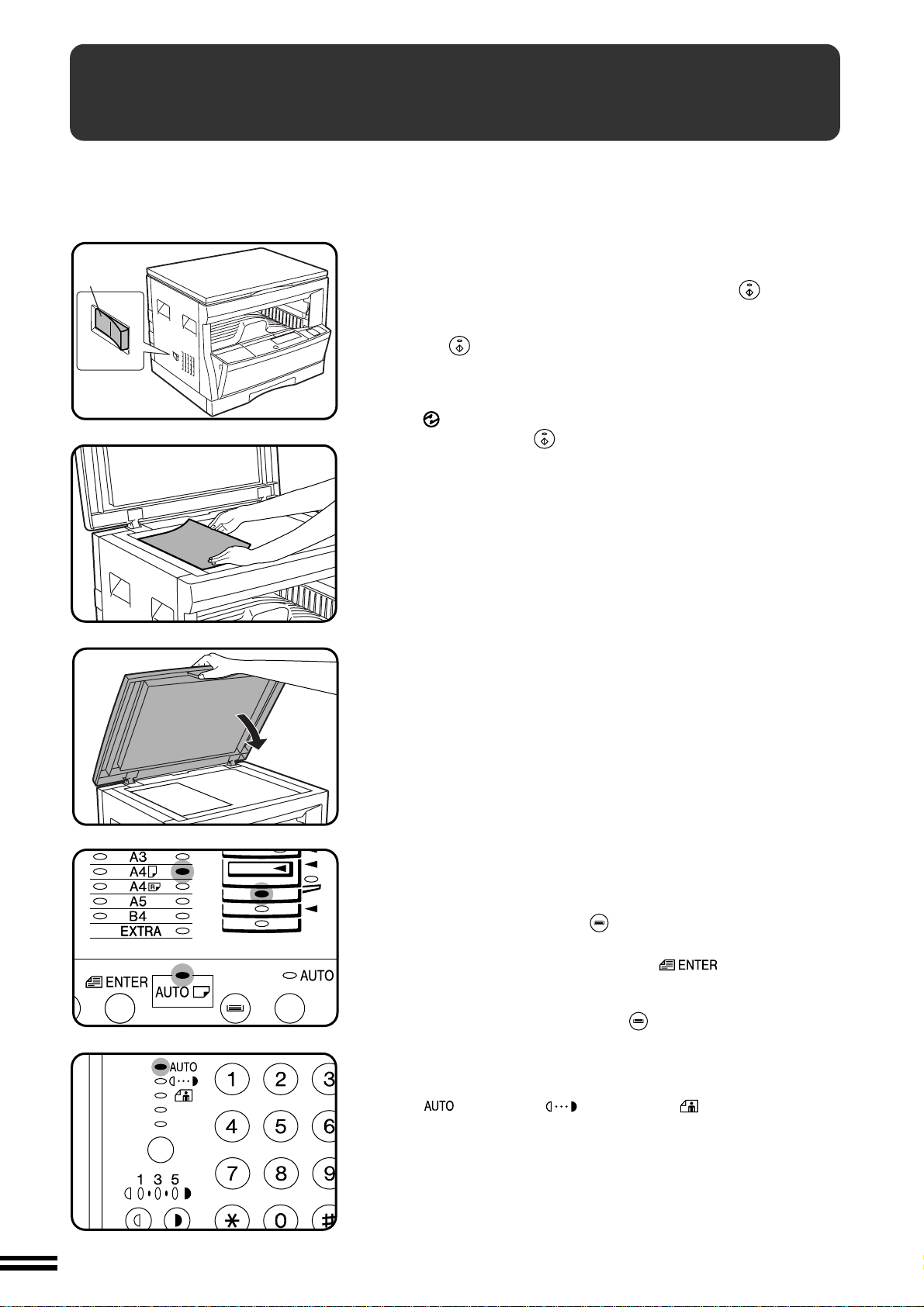
1
Enter your account number using the numeric keys.
●
As each digit is entered, the dashes in the copy quantity display will
disappear.
●
After the number is entered, the copy quantity display will change
to 0.
●
If an unassigned number is entered, “–––” will appear again in the
copy quantity display, indicating that the number was not accepted.
2
When copying is completed, press the AUDIT CLEAR
( ) key.
●
“–––” will appear again in the copy quantity display, indicating the
auditing mode.
●
In the interrupt copy mode (see page 25), press the INTERRUPT ( )
key after an interrupt copy run is completed. All previous copier
settings will be restored and the previous account number will be
active.
Auditing accounts
14
MAKING COPIES
NORMAL COPYING
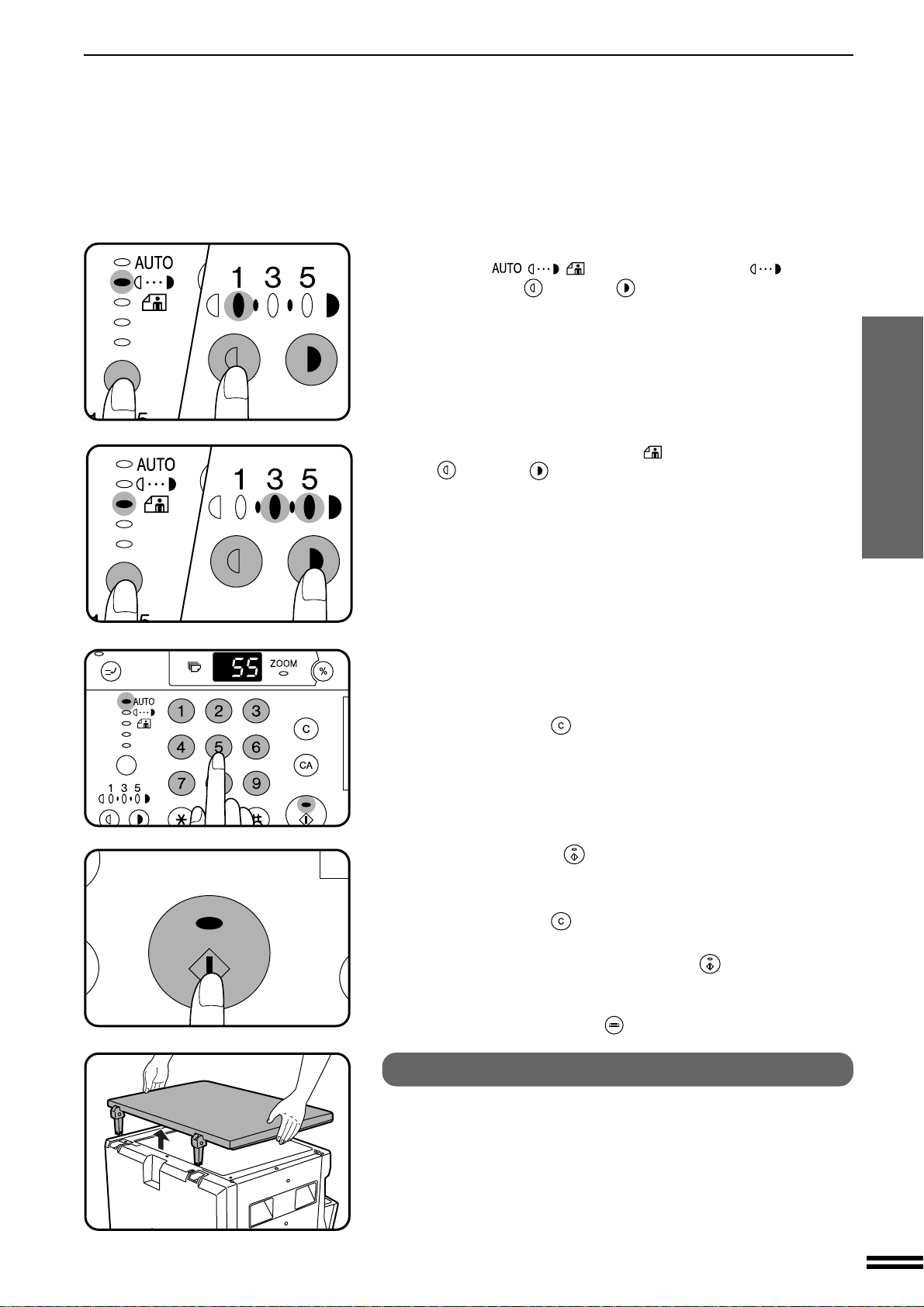
1
Turn the power switch on.
●
It will take about 35 seconds for the copier to warm up. However, you
can make desired settings and press the START ( ) key during
warm-up. Copying will start after warm-up.
●
If the copier has been programmed in the auditing mode, the START
key ( ) indicator will not light up and “–––” will appear in the copy
quantity display. Enter an assigned 3-digit account number. See page
13.
●
If the power is already on and all indicators except the POWER SAVE
( ) indicator are off, the copier is in the auto power shut-off mode.
Press the START ( ) key in this case. See page 42, POWER SAVE
MODES.
2
Place the original face down on the original table. Align
it with the original size scale.
●
Image loss (max. 4 mm (5/32")) can occur at the leading and trailing
edges of the copies. Also image loss (max. 4 mm (5/32") in total) can
occur along the other edges of the copies.
3
Close the platen cover.
4
Ensure that the copy paper size in the paper tray is the
same size as the original.
●
If a tray of the required size is not installed, use the bypass tray and
press the TRAY SELECT ( ) key to select the bypass tray.
●
If an optional paper feed unit is installed:
Use the ORIGINAL SIZE ENTER ( ) key to select the
original size. Copy paper of the same size as the original will be
automatically selected. If desired, another paper tray can be selected
by pressing the TRAY SELECT ( ) key.
5
Adjust the copy density.
●
This copier has three exposure modes to choose from — AUTOMATIC
( ), MANUAL ( ), and PHOTO ( ).
●
Automatic exposure is the standard initial setting for this copier. In this
mode, the characteristics of the original are “read” by the exposure
system and adjustments are automatically made. This optimizes the
contrast of the copied images by reducing the effect of coloured or
shaded background areas. See page 26 to adjust the automatic expo-
sure level.
Normal copying
Power on
15
MAKING COPIES
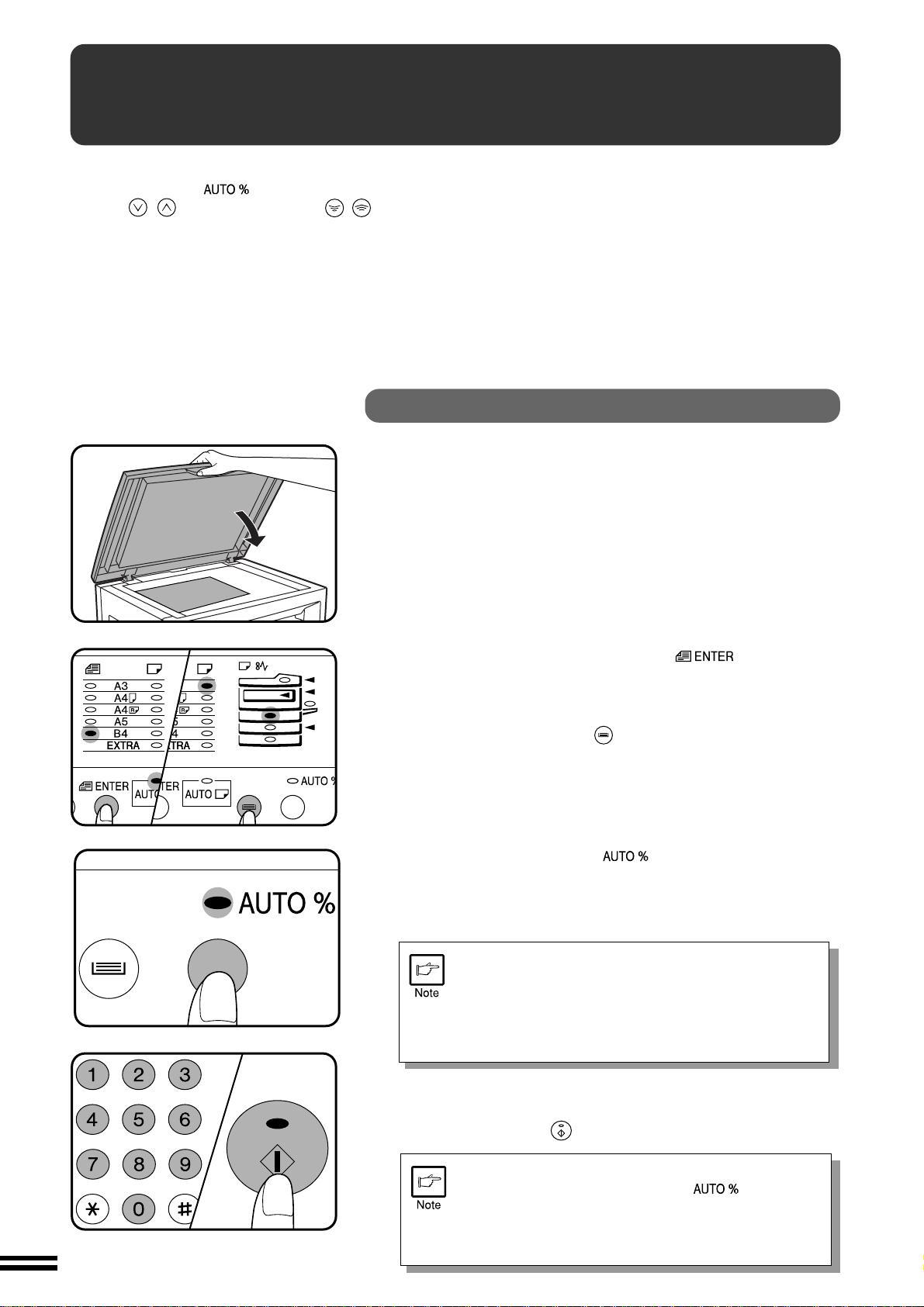
●
For manual copy density adjustment, press the AUTO/MANUAL/
PHOTO ( / / ) key to select MANUAL ( ) and adjust
with the light ( ) and dark ( ) keys as desired.
6
Set the number of copies using the numeric keys.
●
A single copy can be made with the initial setting, i.e., when “0” is
displayed.
●
Press the CLEAR ( ) key to clear an entry if a mistake is made.
7
Press the START ( ) key.
●
The number in the copy quantity display will decrease by 1 each time
a copy is made.
●
Press the CLEAR ( ) key to stop copying in the middle of a run.
●
To repeat the same copy sequence for a different original, simply
replace the original and press the START ( ) key.
●
If the paper in the selected tray runs out during the copy run and no
other tray contains the same size paper, the bypass tray can be selected
using the TRAY SELECT ( ) key.
How to remove the platen cover
The platen cover can be removed to allow copying of
bulky objects. To remove it, simply lift the platen cover
straight up.
●
To reattach the platen cover, reverse the above procedure.
NORMAL COPYING
●
For photographs, select PHOTO ( ) and then adjust with the light
( ) and dark ( ) keys as desired.
●
There are 5 exposure steps indicated by 3 indicator lights. (The
indicators light up one or two at a time.)
If exposure level 2 is selected, the two left-handmost indicators for that
level will light up simultaneously. Also, if level 4 is selected, the two
right-handmost indicators for that level will light up simultaneously.
Normal copying
16
MAKING COPIES
REDUCTION/ENLARGEMENT/ZOOM
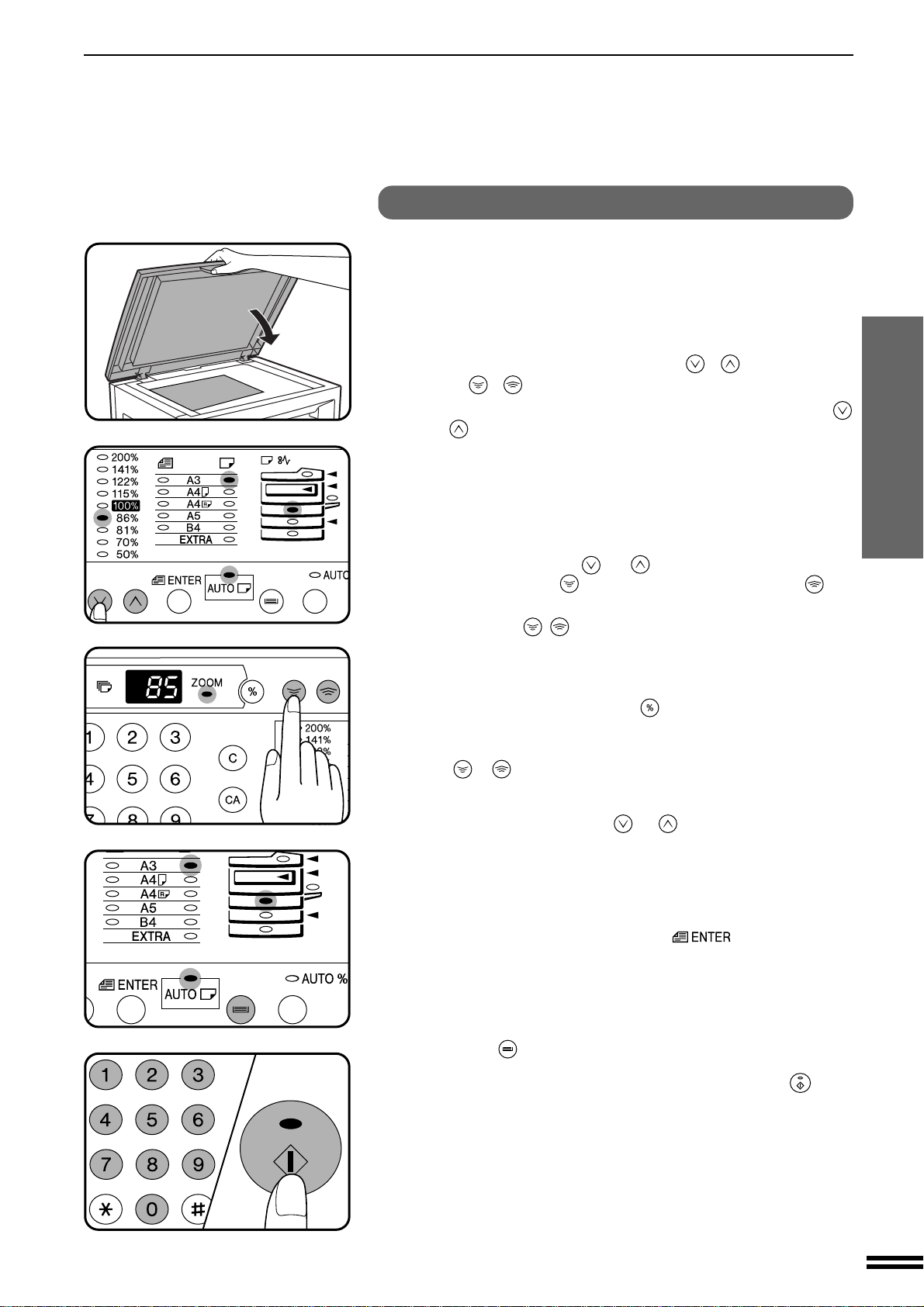
Reduction and enlargement ratios can be selected either automatically with
the AUTO IMAGE ( ) key or manually with the PRESET RATIO
selector ( , ) keys and/or the zoom ( , ) keys. The zoom function
enables precise copy ratio selection from 50% to 200% in 1% increments.
Reduction/enlargement/zoom
Automatic
1
Place the original on the original table and close the
platen cover.
2
Press the ORIGINAL SIZE ENTER ( ) key until the
indicator for the size of the original on the original table
lights up.
3
Use the TRAY SELECT ( ) key to select the paper tray
with the desired paper size.
●
This feature will not work when copy paper of non-standard size is
used or the bypass tray is used.
4
Press the AUTO IMAGE ( ) key.
●
The copy ratio will be automatically set.
●
If a PRESET RATIO indicator is blinking, part of the original image
may not be copied.
If the orientation of the original does not correspond to
standard reduction/enlargement ratios for the selected
paper tray, then the ORIGINAL SIZE indicator will
blink. Change the orientation of the original.
However, if an optional electronic sorting kit is installed,
the original image may be automatically rotated.
5
Enter the number of copies.
6
Press the START ( ) key.
●
To cancel the automatic reduction/enlargement
mode, press the AUTO IMAGE ( ) key again.
●
When copying from an optional SPF with this feature,
the automatic reduction/enlargement mode will be
automatically cancelled after copying is complete.
17
MAKING COPIES
REDUCTION/ENLARGEMENT/ZOOM
Reduction/enlargement/zoom
Manual
1
Place the original on the original table and close the
platen cover.
2
Use the PRESET RATIO selector ( , ) keys and the
zoom ( , ) keys to select the desired copy ratio.
●
To select a preset reduction or enlargement copy ratio, press the
or key repeatedly until the indicator for the desired copy ratio is
lit.
A. Preset reduction ratios are: 86%, 81%, 70%, and 50% (95%,
77%, 64%, and 50%).
B. Preset enlargement ratios are: 115%, 122%, 141%, and 200%
(121%, 129%, 141%, and 200%).
C. Zoom ratios: Any ratio from 50% to 200% can be set, in 1%
increments. Press the or key to set the approximate
ratio, then press the key to decrease the ratio or the key
to increase the ratio.
●
When a zoom ( , ) key is pressed, the ZOOM indicator will light
up and the zoom ratio will be displayed in the copy quantity display
for at least two seconds.
●
To verify a zoom setting without changing the zoom ratio, press and
hold down the copy ratio display ( ) key. When the key is released,
the display will return to the copy quantity display.
●
To decrease or increase the zoom ratio rapidly, press and hold down
the or key. However the value will stop at the preset reduction
or enlargement ratios. To move beyond these ratios, release the key
and then press and hold it down again.
D. Same-size reset: Press the or key repeatedly until the
copy ratio returns to 100%.
3
Ensure that copy paper of the desired size is installed in
the paper tray.
●
If an optional paper feed unit is installed:
Use the ORIGINAL SIZE ENTER ( ) key to select the
original size. Copy paper of the appropriate paper size will be
automatically selected depending on the original size and copy ratio.
If the selected PRESET RATIO indicator or the ZOOM indicator
blinks, the selected copy image is too large for the copy paper size.
The desired paper tray can also be selected by pressing the TRAY
SELECT ( ) key.
4
Set the number of copies and press the START ( ) key.
18
MAKING COPIES
1
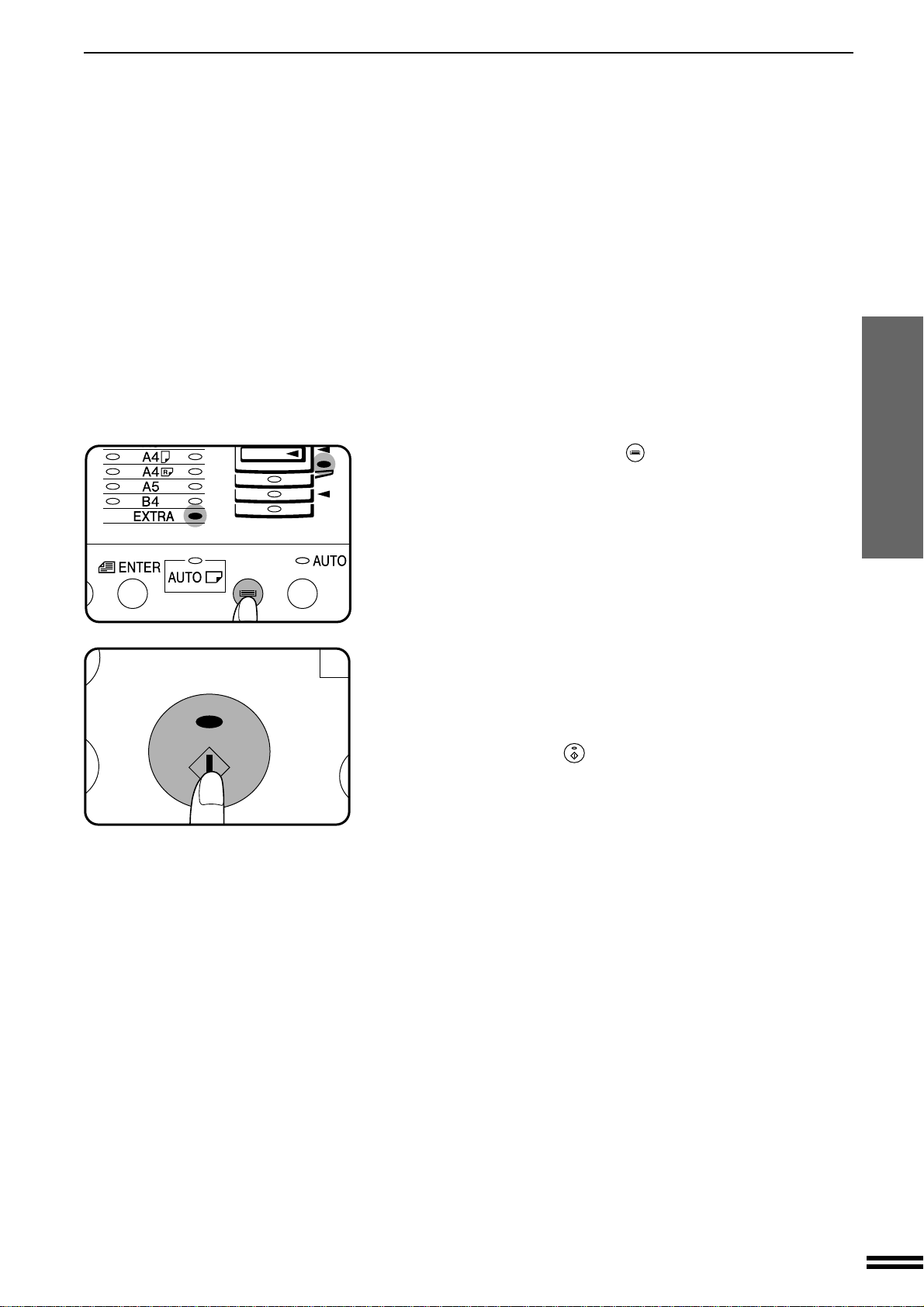
Unfold the bypass tray.
●
When feeding B4 or A3 (8-1/2" x 14" or 11" x 17") sized paper, extend
the feeder tray.
2
Set the paper guides to the copy paper width.
3
Insert the copy paper (print face down) all the way into
the bypass tray.
●
Up to 100 sheets of standard copy paper measuring from A6 to A3
(5-1/2" x 8-1/2" to 11" x 17") can be loaded in the bypass tray.
●
A6 size paper must be fed narrow into the feed slot.
●
Transparency film, labels, and other special purpose papers (except
envelopes) must be fed individually.
Up to 10 envelopes can be set.
●
When adding paper, first remove remaining paper, combine it with the
paper to be added and then reload as a single stack.
●
When loading envelopes, make sure that they are straight and flat.
Bypass feed (special paper)
BYPASS FEED (special paper)
The bypass tray is used to copy onto transparency film, labels, and other
special purpose papers. Up to 100 sheets of standard copy paper can be set
in the bypass tray.
For special purpose papers, the original image must be
smaller than the paper or media for copying.
If the original image is bigger than the paper or media, this
may cause smudges on the edges of the copies.
Also for standard copy paper, smudges may appear if the
copy paper is not at least as large as the original image.
19
MAKING COPIES
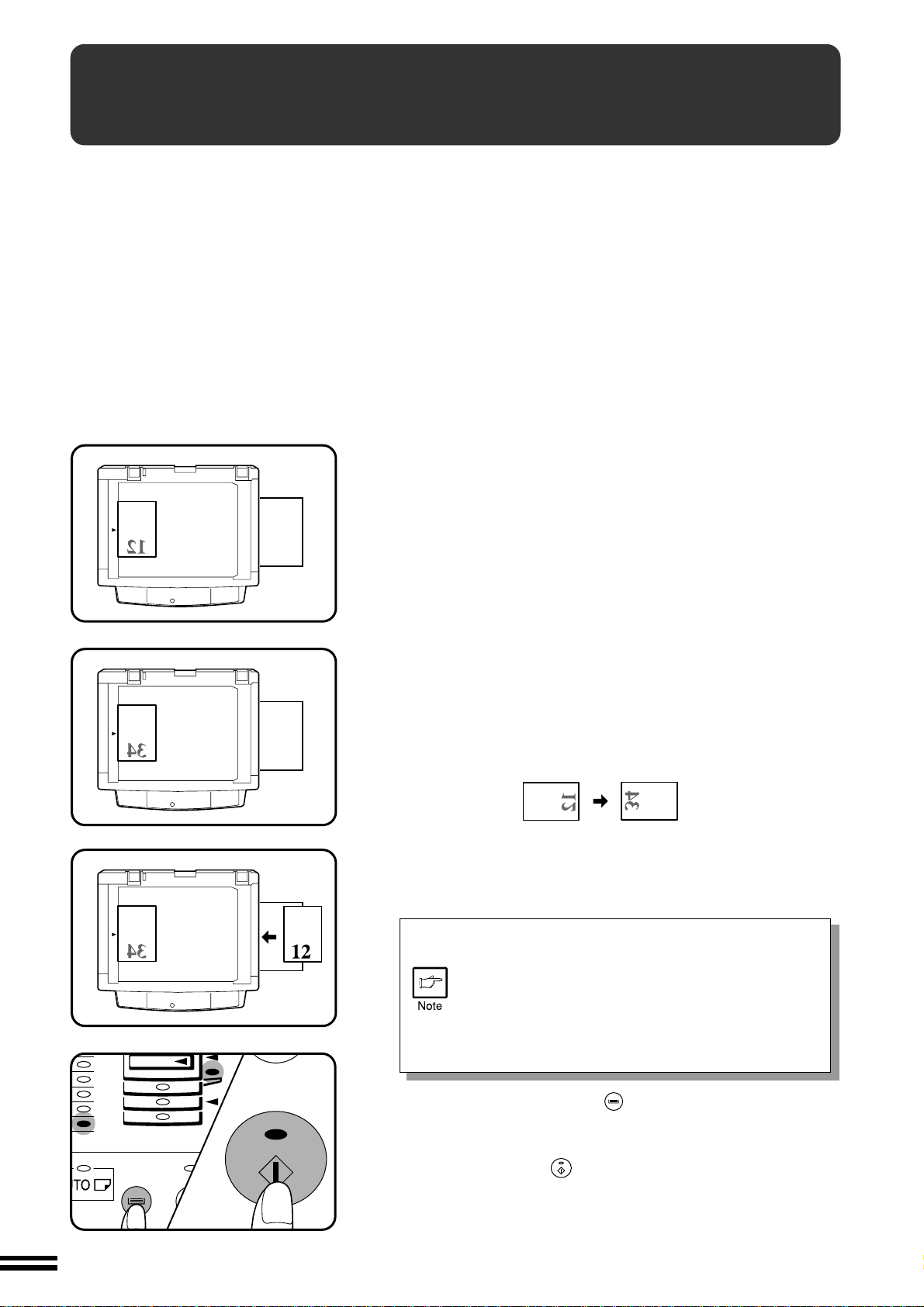
4
Press the TRAY SELECT ( ) key to select the bypass
tray.
5
Leave the copy quantity at 0 if using special papers. Set
the number of copies if using standard copy paper or
envelopes.
6
Press the START ( ) key.
BYPASS FEED (special paper)
Bypass feed (special paper)
20
MAKING COPIES
TWO-SIDED COPYING
Two-sided copies can be made on this copier using the bypass tray.
1
Place the first original on the original table and make a
copy.
●
The first copy can be made using any of the paper feed stations.
2
Replace the first original with the second original and
close the platen cover.
●
Make sure that the first and second originals are oriented in the same
way on the original table.
●
When the originals are placed horizontally, make sure that the first and
second originals are oriented in the reverse way on the original table.
3
Turn the first copy over left to right and place it into the
bypass tray.
●
Be sure to feed the copies one sheet at a time.
Depending on the copy paper quality, the copy may curl
up. If the copy has curled up, be sure to perform the
following steps before copying onto the reverse side to
avoid a misfeed.
1. Flatten the copy paper.
2. Change the orientation of the original and copy
paper. (For example, change A4 (8-1/2" x 11") to
A4R (8-1/2" x 11"R).)
4
Use the TRAY SELECT ( ) key to select the bypass
tray.
5
Press the START ( ) key.
Two-sided copying
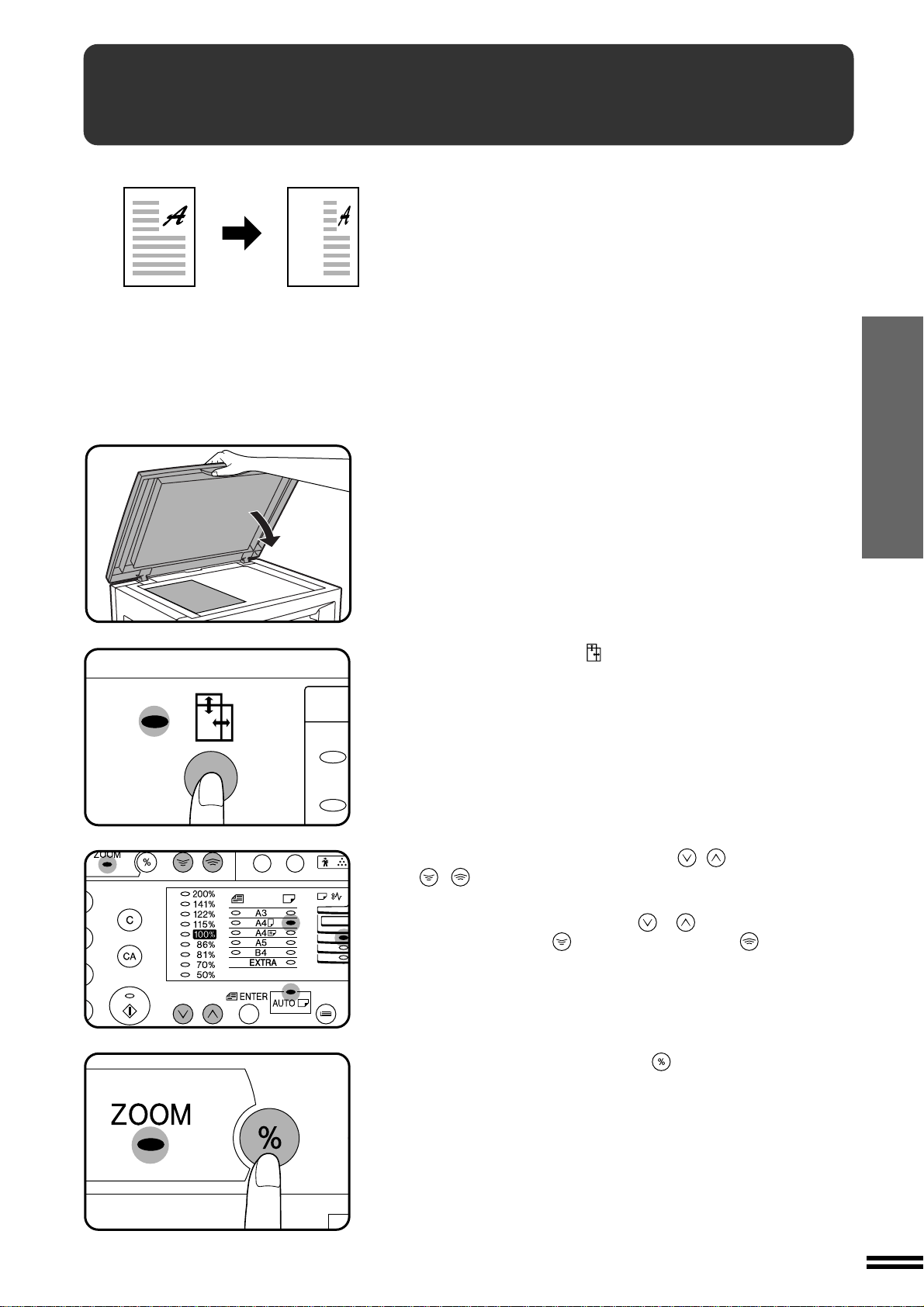
21
MAKING COPIES
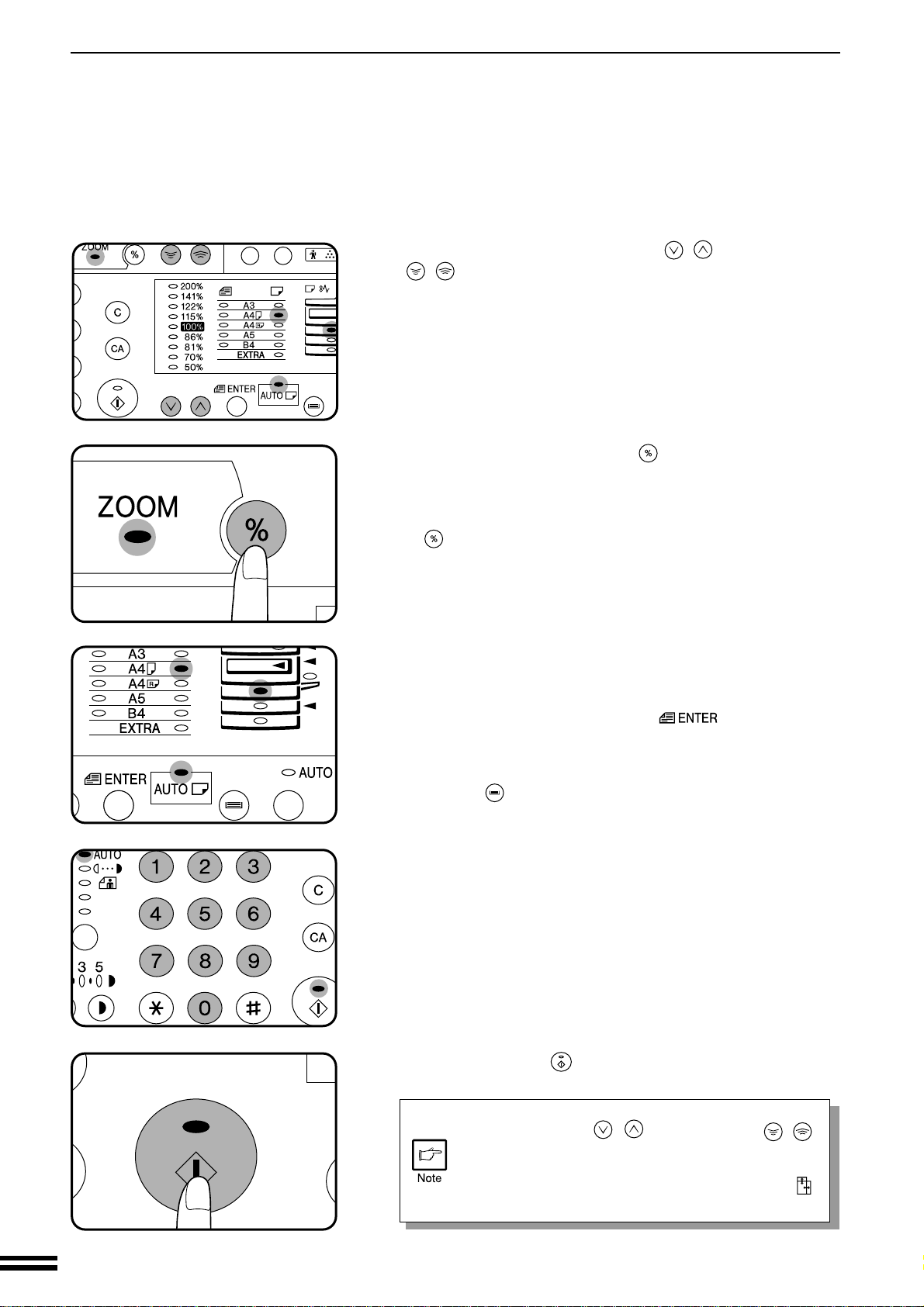
1
Place the original on the original table and close the
platen cover.
2
Press the XY-ZOOM ( ) key.
●
The current value for the vertical direction will be displayed in the
copy quantity display.
3
Use the PRESET RATIO selector ( , ) keys and zoom
( , ) keys to change the copy ratio in the vertical
direction.
●
Press a PRESET RATIO selector ( or ) key to set an approximate
ratio, then press the key to decrease the ratio or key to increase
the ratio. The copy ratio will be displayed in the copy quantity display.
4
Press the copy ratio display ( ) key.
●
The selected ratio for the vertical direction will be entered and the
current value for the horizontal direction will be displayed in the copy
quantity display.
XY ZOOM
The XY ZOOM feature allows the horizontal and vertical copy ratios to be
changed independently. This feature cannot be used with the 2 in 1 or 4 in 1
feature. (The 2 in 1 or 4 in 1 feature can only be used when an optional
electronic sorting kit and an optional SPF are installed.)
To use the XY ZOOM feature with the DUAL PAGE COPY feature, set the
DUAL PAGE COPY feature first and then the XY ZOOM feature.
(Enlargement cannot be set.)
XY zoom
Original Copy
22
MAKING COPIES
XY zoom
XY ZOOM
5
Use the PRESET RATIO selector ( , ) keys and zoom
( , ) keys to change the copy ratio in the horizontal
direction in a similar manner as for the vertical direction.
6
Press the copy ratio display ( ) key.
●
The selected ratio for the horizontal direction will be entered and the
display will change to the copy quantity display.
●
To verify the copy ratios, press and hold down the copy ratio display
( ) key. The vertical and horizontal ratios will be alternately
displayed.
7
Ensure that copy paper of the desired size is installed in
the paper tray.
●
If an optional paper feed unit is installed:
Use the ORIGINAL SIZE ENTER ( ) key to select the
original size. Copy paper of the appropriate paper size will be
automatically selected depending on the original size and copy ratios.
If desired, another paper tray can be selected by pressing the TRAY
SELECT ( ) key.
8
Enter the desired number of copies.
9
Press the START ( ) key.
●
To change the copy ratios again, press a PRESET
RATIO selector ( , ) key or a zoom ( , )
key. Then, perform step 3 and the succeeding
steps.
●
To cancel this function, press the XY-ZOOM ( )
key again.
23
MAKING COPIES
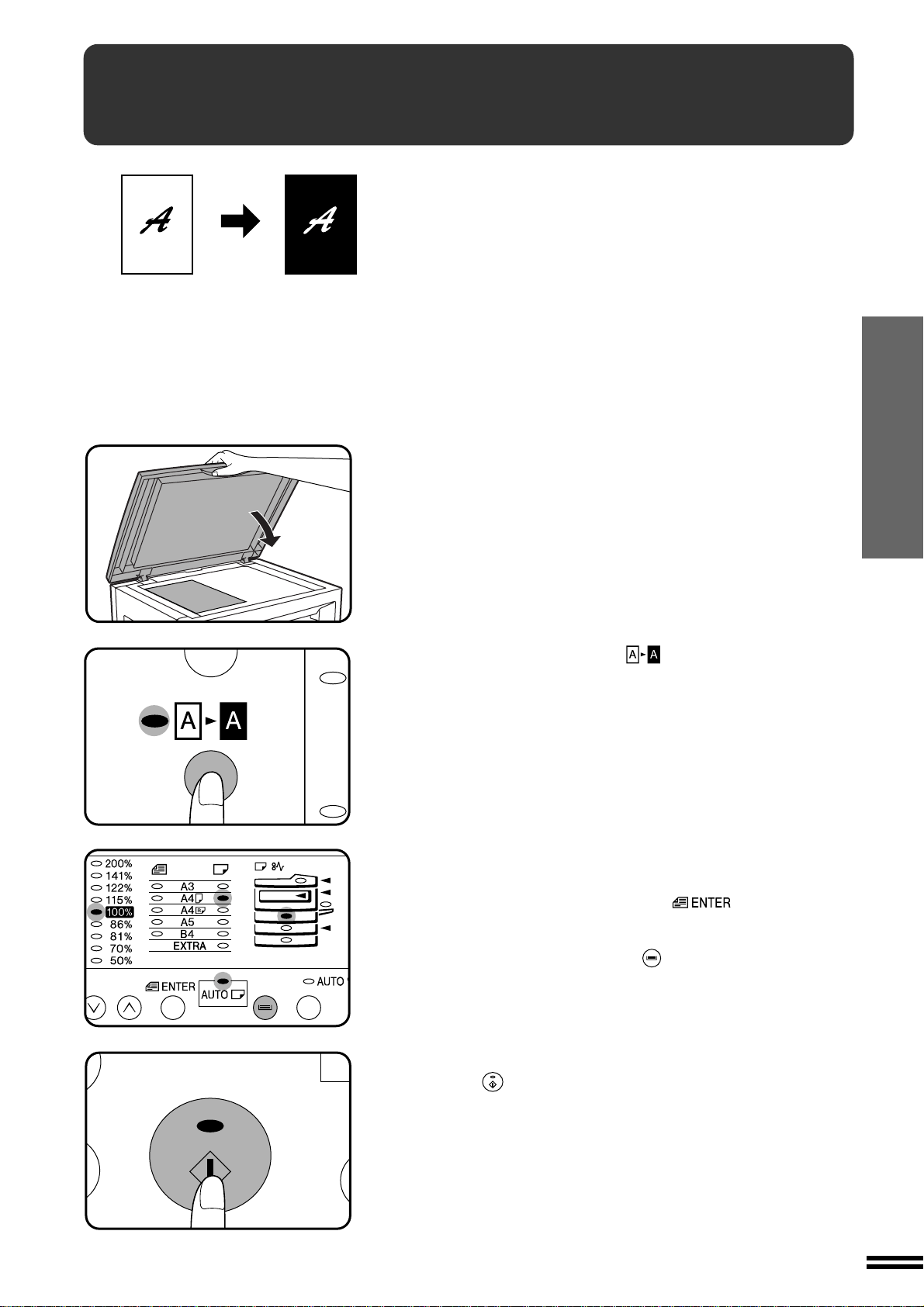
B/W REVERSE
The B/W REVERSE feature is used to reverse black and white areas.
●
When the B/W REVERSE feature is selected, the exposure mode will be
automatically set to the MANUAL mode. Other exposure modes cannot
be selected.
Even if this feature is cancelled, the MANUAL mode will not
automatically be cancelled.
1
Place the original on the original table and close the
platen cover.
2
Press the B/W REVERSE ( ) key.
3
Check the copy paper size.
●
If an optional paper feed unit is installed:
Use the ORIGINAL SIZE ENTER ( ) key to select the
original size. Copy paper of the same size as the original will be
automatically selected. If desired, another paper tray can be selected
by pressing the TRAY SELECT ( ) key.
4
Make all other desired copier selections and press the
START ( ) key.
B/W reverse
Original Copy
24
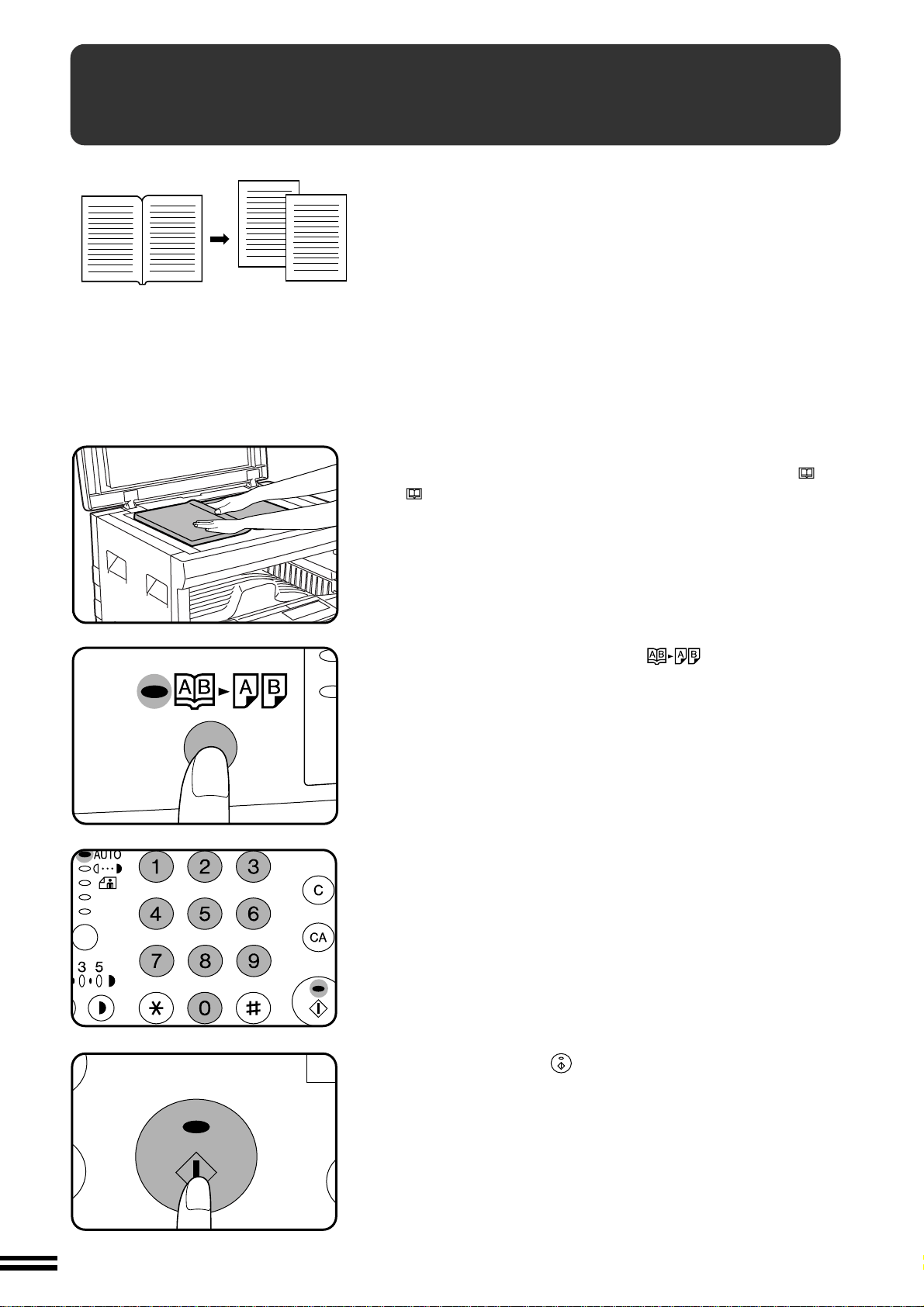
MAKING COPIES
1
Place the originals on the original table with the centre
of the two pages aligned with the paper size index (
A4
(
8
1
/2)). Close the platen cover.
●
Set the page to be copied first to the right of the paper size index mark.
2
Press the DUAL PAGE COPY ( ) key.
●
Check to be sure that the copy paper size in the paper tray is
A4 (8-1/2" x 11").
3
Set the number of copies.
4
Press the START ( ) key.
DUAL PAGE COPY
The DUAL PAGE COPY feature produces individual copies of two docu-
ments placed side by side on the original table. It is especially useful when
copying books and other bound documents. This feature cannot be used with
the 2 in 1 or 4 in 1 feature and sort/group feature. (The 2 in 1 or 4 in 1 feature
and sort/group feature can only be used when an optional electronic sorting
kit and an optional SPF are installed.) If the AUTO IMAGE feature has been
selected, this feature cannot be selected.
To use the DUAL PAGE COPY feature with the XY ZOOM feature, set the
DUAL PAGE COPY feature first and then the XY ZOOM feature.
(Enlargement cannot be set.)
Dual page copy
Original Copy
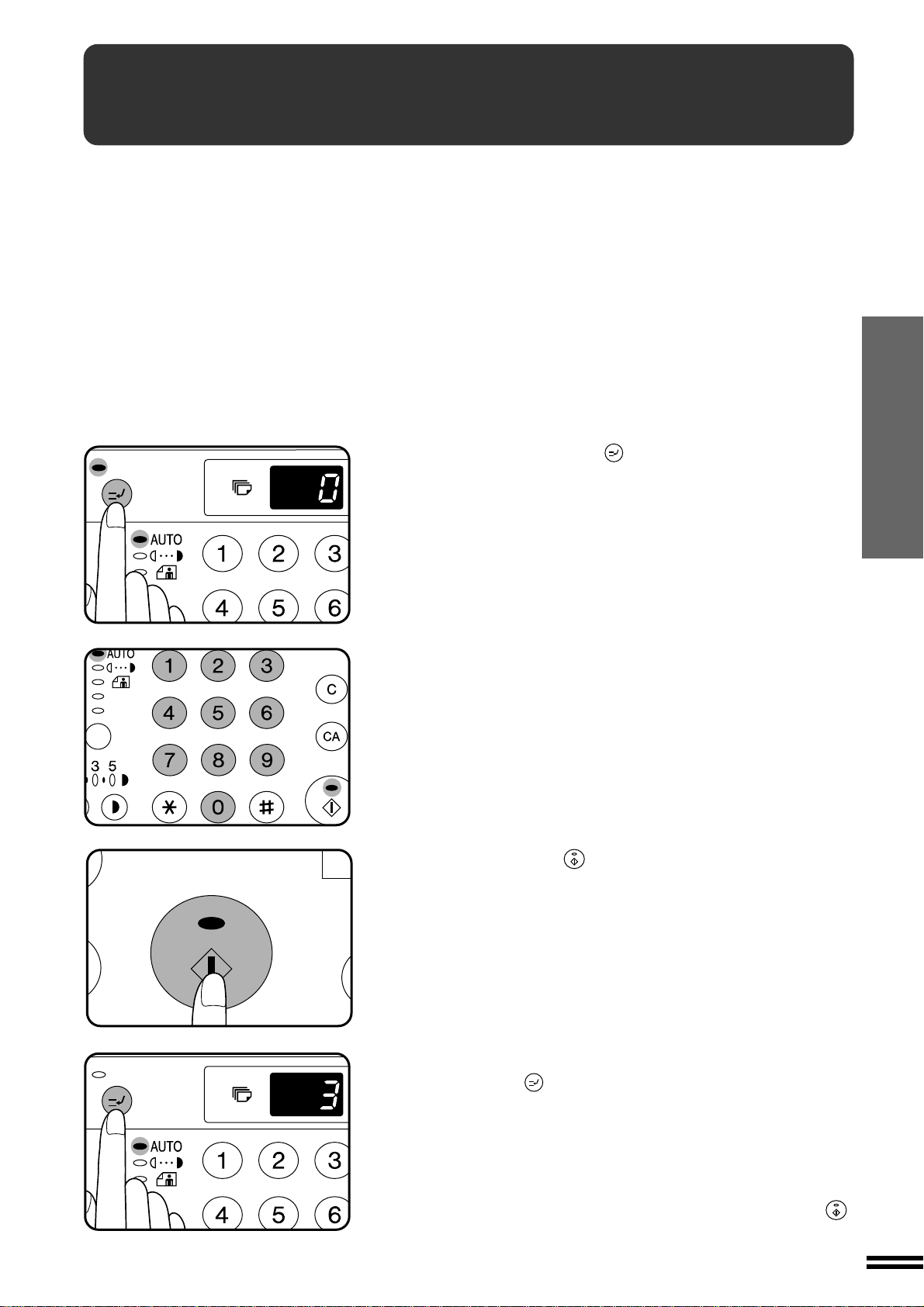
25
MAKING COPIES
1
Press the INTERRUPT ( ) key.
●
The copier will return to the initial settings.
●
If this copier has been programmed in the auditing mode using user
program No. 10, “–––” will appear in the copy quantity display.
Enter your account number using the numeric keys. The number of
copies of the interrupt copying will be accumulated against this
account number. See page 13.
●
When an optional SPF is being used, the copier will stop after
completing the copying of the original which has been fed into the
SPF.
2
When the copier stops, remove the original(s) and set
the original(s) for interrupt copying.
3
Select the desired available copier functions.
4
Set the number of copies.
5
Press the START ( ) key.
●
The interrupt copies will be offset from the previous copies when user
program No. 19 is enabled. See page 35.
6
When all INTERRUPT copies are finished, press the
INTERRUPT ( ) key again to cancel the INTERRUPT
mode, and remove the original used for interrupt copying.
●
The previous copy quantity, copy ratio, copy density, and paper size
will be automatically restored.
7
Replace the original(s) for the interrupted job on the
original table or in the SPF and press the START ( )
key.
INTERRUPTING A COPY RUN
INTERRUPT is used to interrupt a long copy run so that another job can be
done.
●
SORT or GROUP cannot be selected during interrupt copying. (Sort and
group can be performed only if an optional electronic sorting kit and an
optional SPF are installed.)
Interrupting a copy run
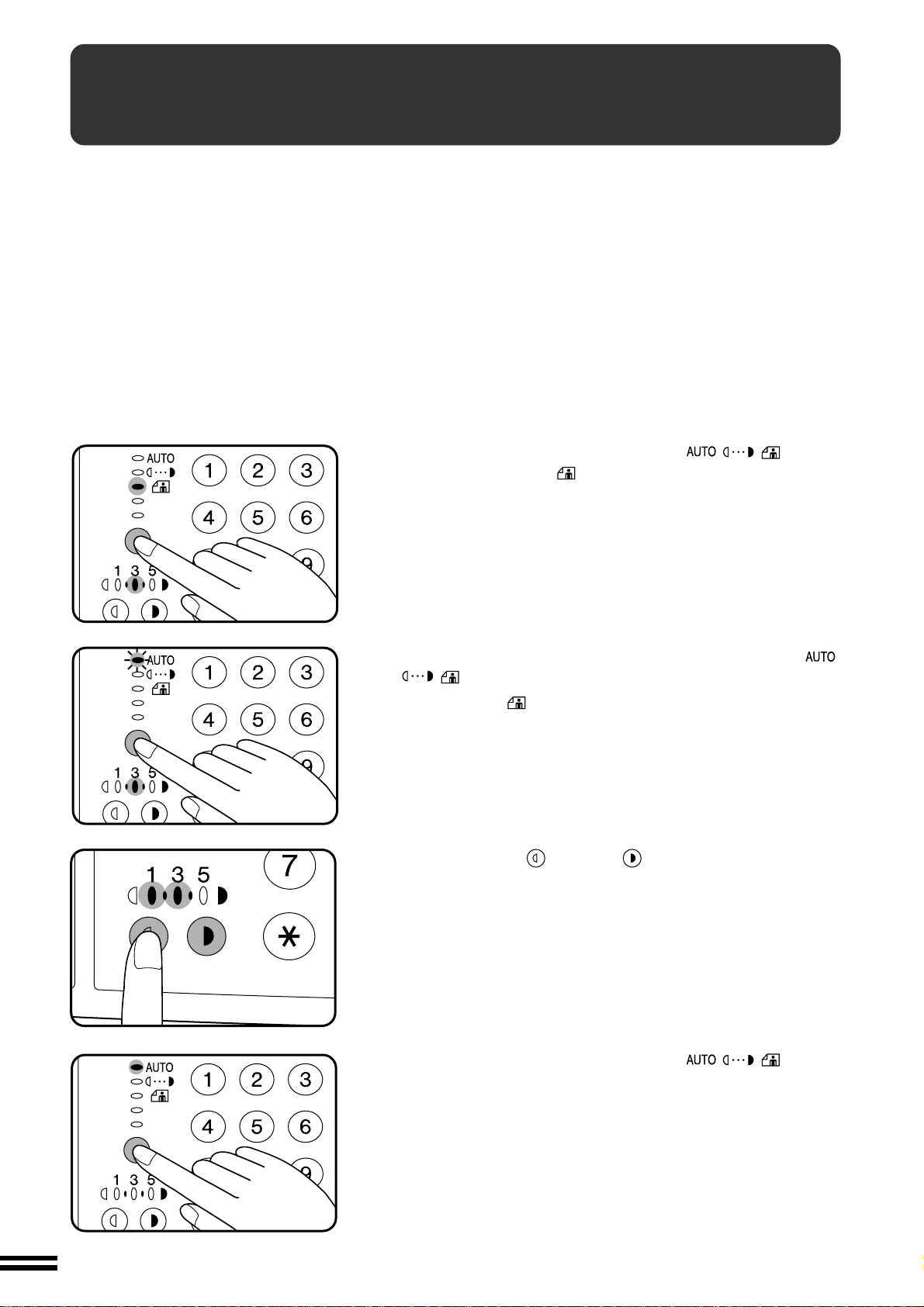
26
MAKING COPIES
1
Press the AUTO/MANUAL/PHOTO ( / / ) key to
select the PHOTO ( ) mode.
2
Press and hold down the AUTO/MANUAL/PHOTO ( /
/ ) key for approximately 5 seconds.
●
The PHOTO ( ) indicator will go out and the AUTO indicator will
begin to blink.
●
One or two exposure indicators corresponding to the current auto-
matic exposure level will light up. The factory default setting is level
“3”.
3
Press the light ( ) or dark ( ) key to lighten or darken
the automatic exposure level as desired.
4
Press the AUTO/MANUAL/PHOTO ( / / ) key.
●
The AUTO indicator will stop blinking and will light up steadily.
●
This automatic exposure level will remain in effect until you change
it again by this procedure.
Automatic exposure adjustment
AUTOMATIC EXPOSURE ADJUSTMENT
The automatic exposure level can be adjusted to suit your copying needs.
This level is set for copying from the original table and copying from the
optional SPF respectively. To set the level for the optional SPF, place an
original in the document feeder tray and make sure that the SPF indicator
lights up before proceeding to step 1. To set the level for the original table,
ensure that the SPF indicator does not light up.
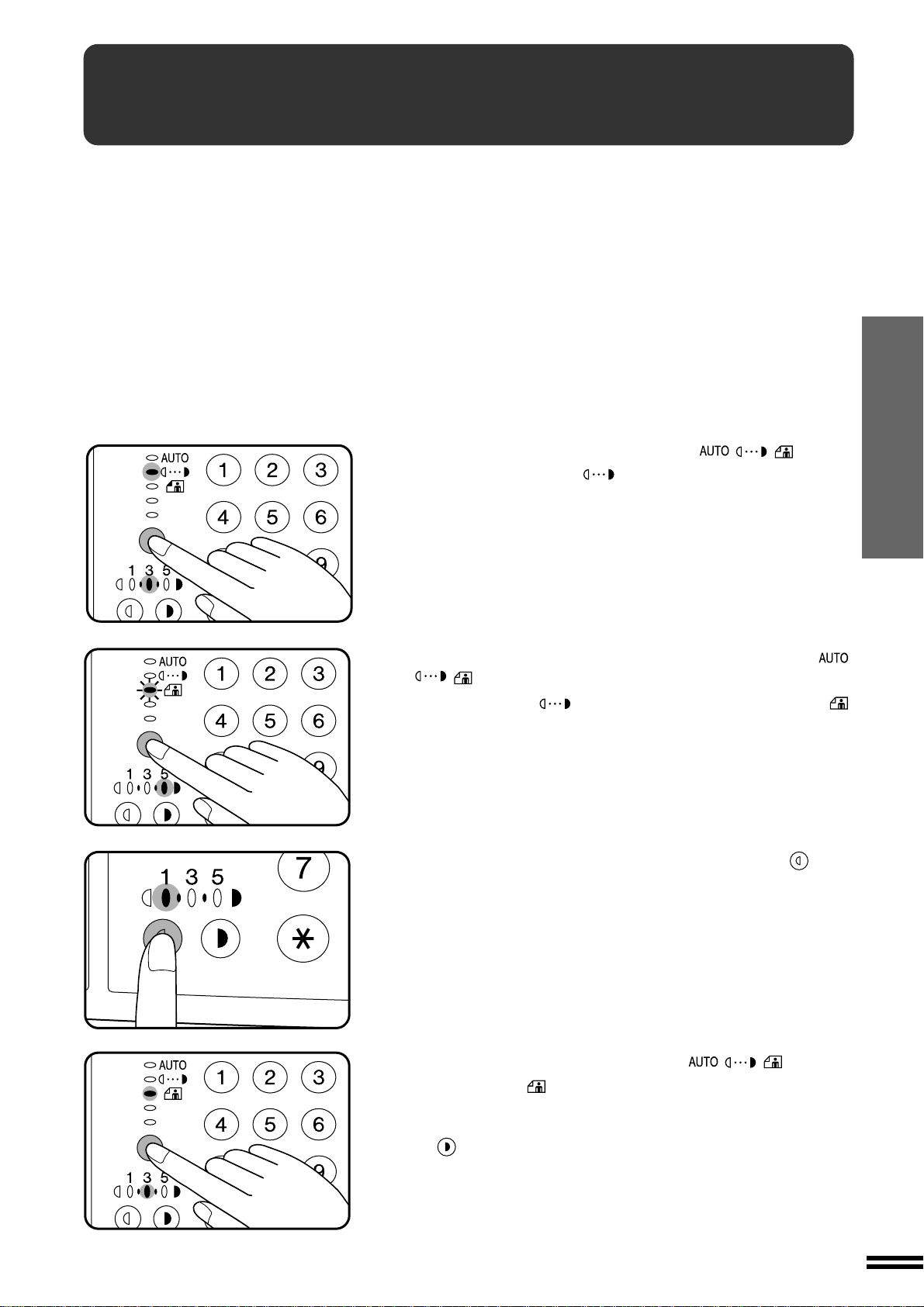
27
MAKING COPIES Toner save mode
1
Press the AUTO/MANUAL/PHOTO ( / / ) key to
select the MANUAL ( ) mode.
2
Press and hold down the AUTO/MANUAL/PHOTO ( /
/ ) key for approximately 5 seconds.
●
The MANUAL ( ) indicator will go out and the PHOTO ( )
indicator will begin to blink.
●
The exposure indicator marked “5” will light up, indicating that the
standard toner mode is active.
3
To enter the toner save mode, press the light ( ) key.
●
The exposure indicator marked “1” will light up, indicating that the
toner save mode is selected.
4
Press the
AUTO/MANUAL/PHOTO
( / / ) key.
●
The PHOTO ( ) indicator will stop blinking and will light up
steadily. The toner save mode is now active.
●
To return to the standard mode, repeat the procedure but use the dark
( ) key to select exposure level “5” in step 3.
TONER SAVE MODE
This mode reduces toner consumption by approximately 10% in the automatic
and manual exposure modes. Copies will be lighter but still adequate for
general use. Selection of this mode does not affect the PHOTO mode. Follow
the procedure below for setting the toning level.
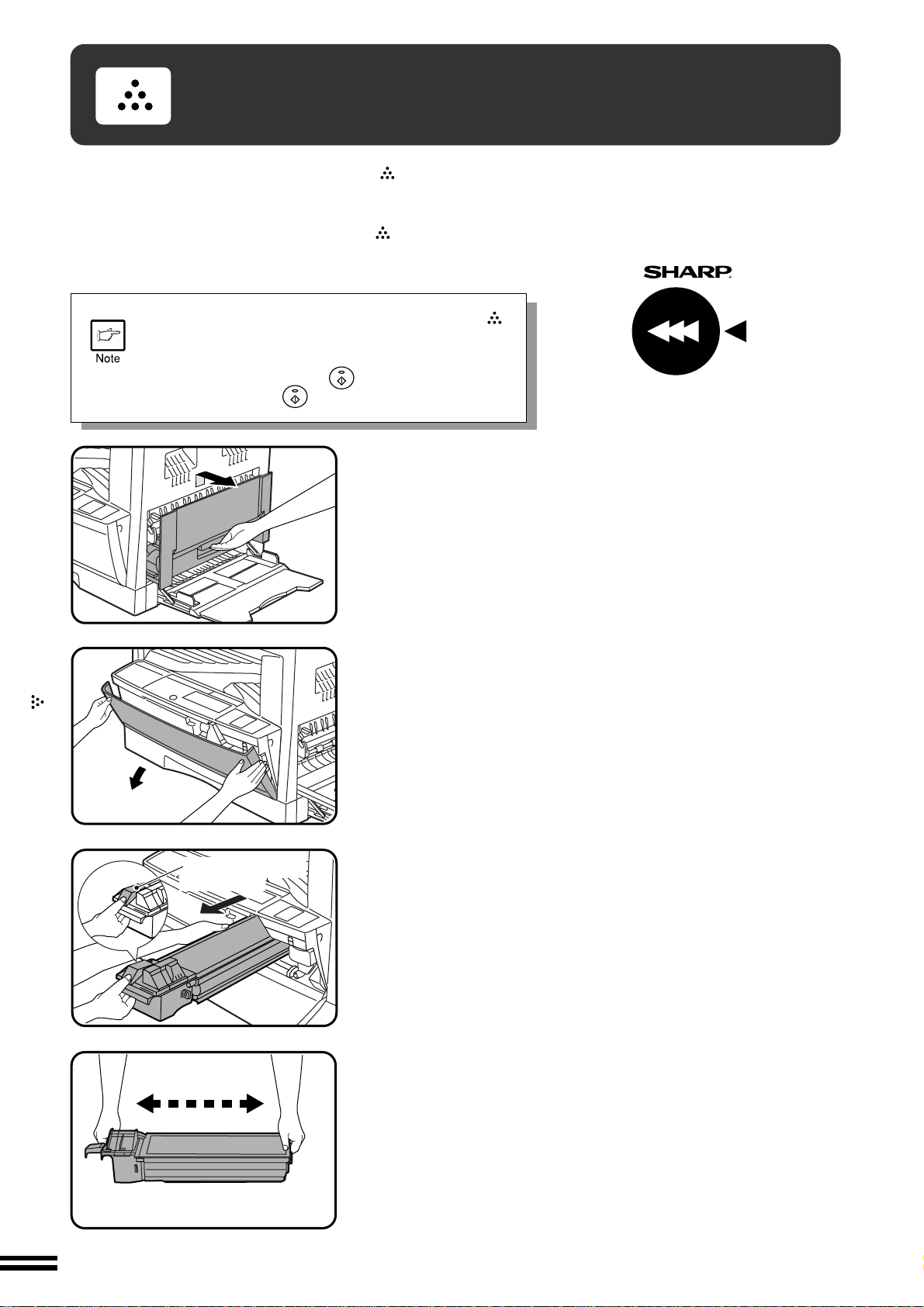
28
STATUS
INDICATORS
1
Open the bypass tray. Lift slightly on the side cover and
slide the cover out until it stops.
2
Push gently on both sides of the front cover to open the
cover.
3
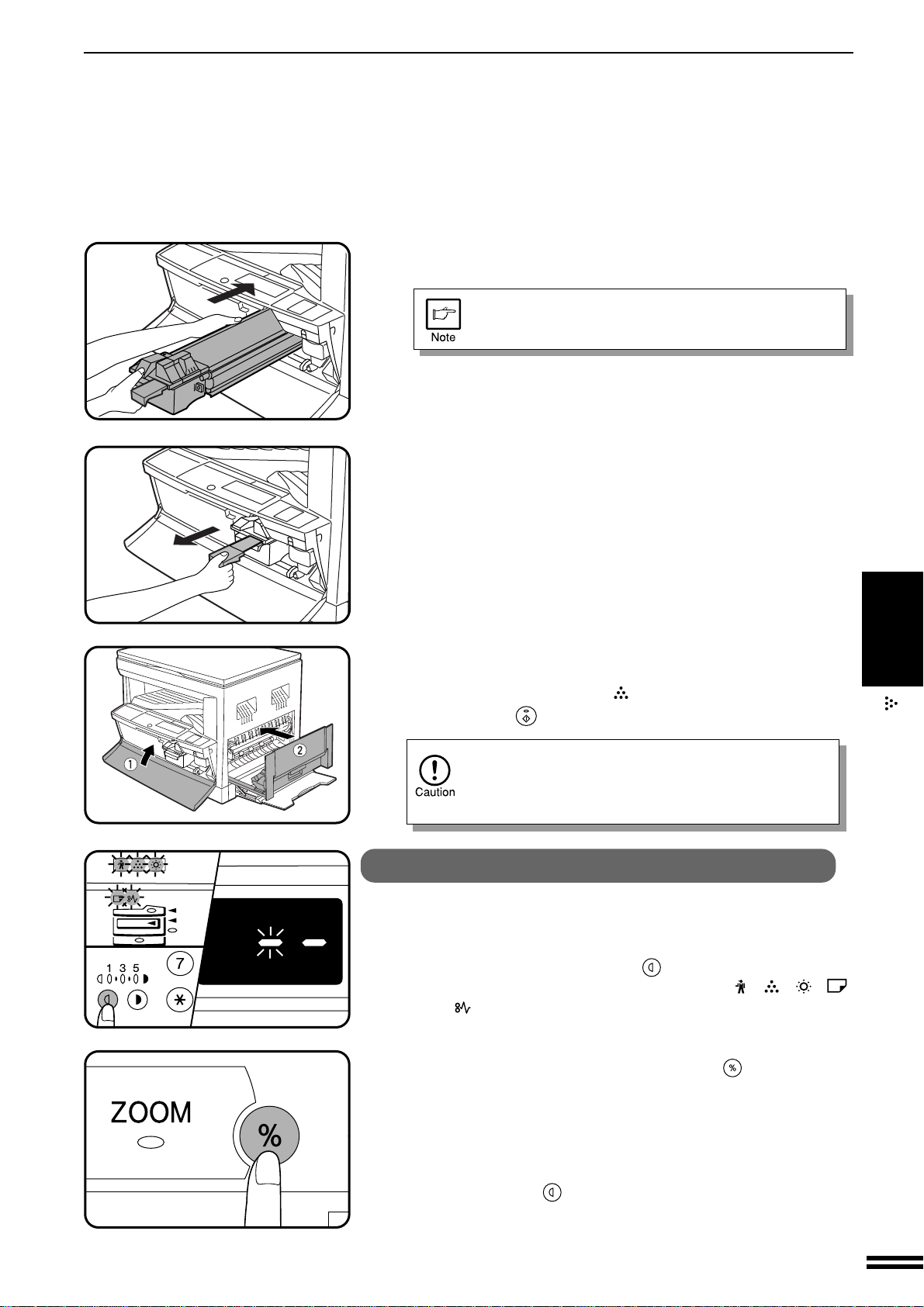
Push the toner cartridge lock release lever and pull the
toner cartridge out. Remove the toner cartridge while
supporting it with the left hand at the green label position.
●
For disposal of the old toner cartridge, contact your dealer.
4
Remove the new toner cartridge from the bag. Hold the
cartridge on both sides and shake it horizontally four or
five times.
TONER CARTRIDGE REPLACEMENT
When the toner cartridge replacement required ( ) indicator lights up,
replacement of the toner cartridge will be needed soon. Obtain a new
cartridge.
When the toner cartridge replacement required ( ) indicator blinks, the
toner cartridge must be replaced before copying can be resumed. Replace
the toner cartridge by following the procedure below.
For best copying results, be sure to use only
SHARP products.
The package of SHARP toner has the Genuine
Supplies label.
Toner cartridge replacement
Toner cartridge lock
release lever
4 or 5 times
GENUINE SUPPLIES
During a long copy run of a dark original, the
indicator may blink and the copier stop, even though
toner is left. The copier will feed toner up to 2 minutes
and then the START key ( ) indicator will light up.
Press the START ( ) key to restart copying.
29
STATUS
INDICATORS
Toner cartridge replacement
TONER CARTRIDGE REPLACEMENT
5
Gently insert the toner cartridge along the guides until
it locks in place while pushing the lock release lever.
If dirt or dust is adhered to the toner cartridge, remove
it before installing the cartridge.
6
Pull out the shutter and remove it from the toner cartridge
as shown in the illustration.
7
Close the front cover by pushing both sides with your
hands and then close the side cover by pressing the
handle on the cover. The indicator will go out and the
START key ( ) indicator will light up.
When closing the covers, be sure to close the front
cover securely and then close the side cover. If the
covers are closed in the wrong order, the covers may
be damaged.
Toner cartridge life
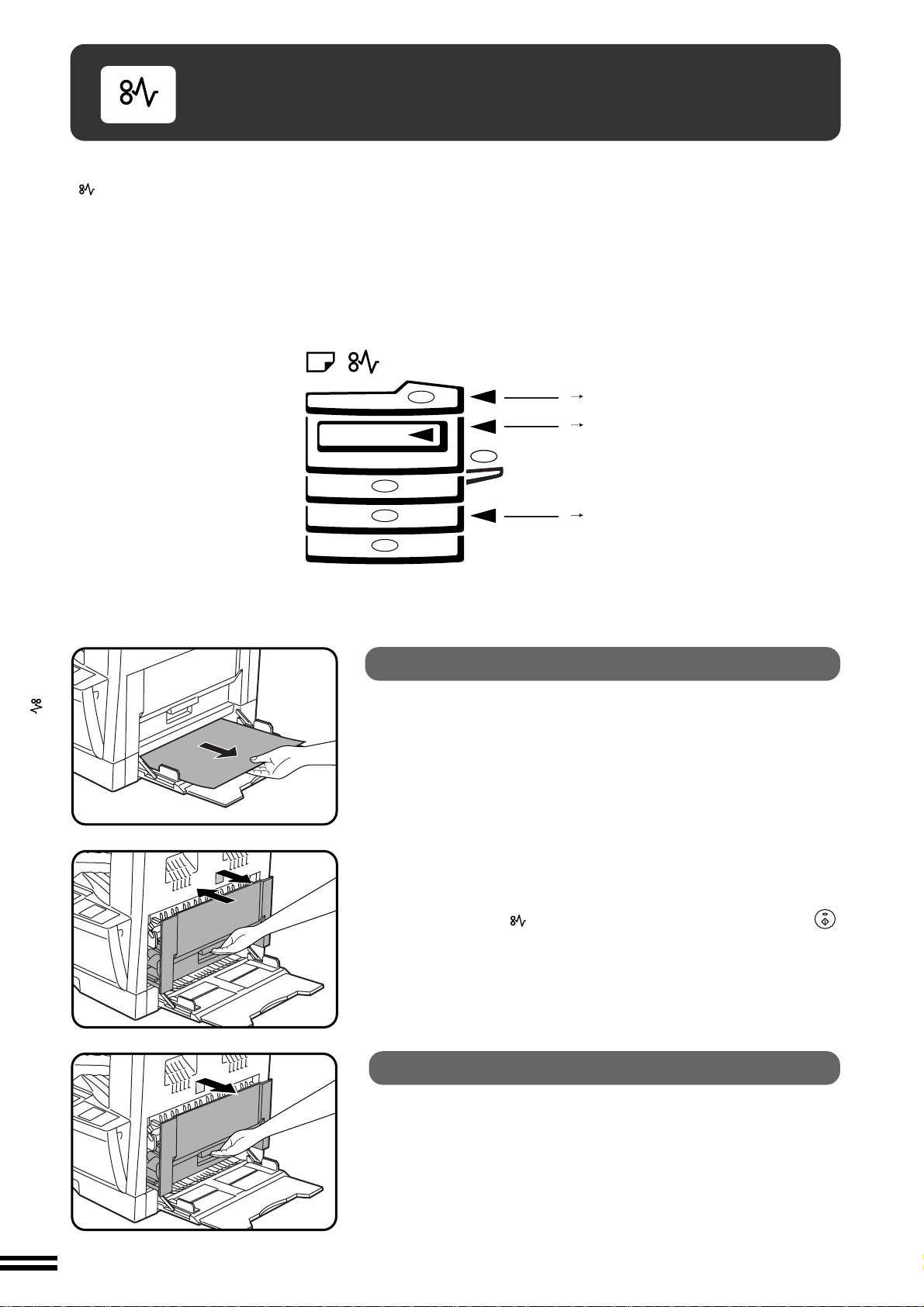
To find out the approximate quantity of toner remaining, follow the procedure
below.
1
Press and hold the light ( ) key for more than 5
seconds until all the alarm indicators ( , , , ,
and ) blink and ––” appears in the copy quantity
display.
2
Press and hold the copy ratio display ( ) key for more
than 5 seconds.
●
The approximate quantity of toner remaining will be indicated as a
percent in the copy quantity display. If “LO” is displayed, the toner
is down to less than 10%.
3
Press the light ( ) key.
●
All the alarm indicators will go out.
30
STATUS
INDICATORS
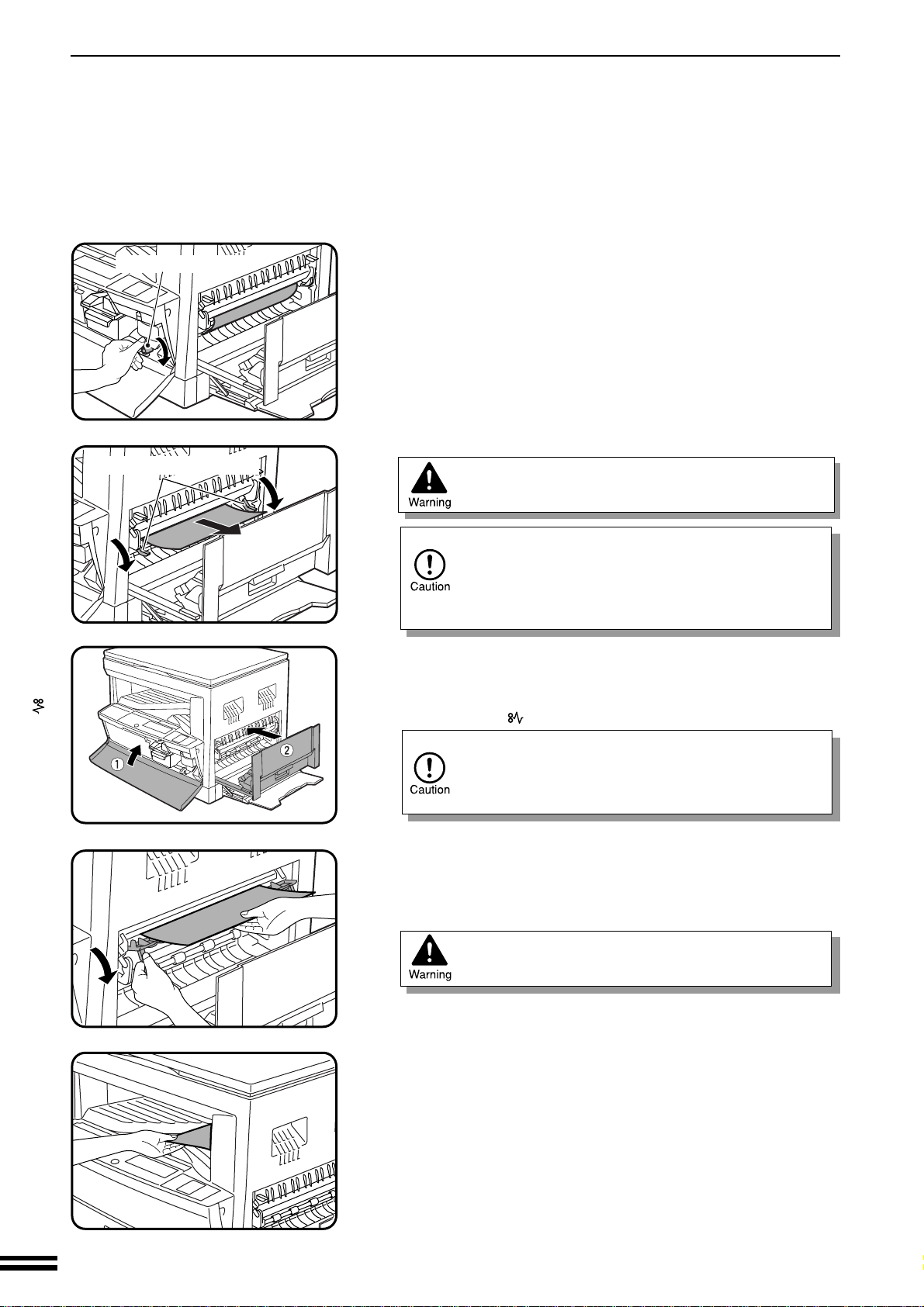
The copier will stop when a misfeed occurs. The misfeed
( ) indicator will blink, and blinking red misfeed location
indicators will indicate the approximate misfeed location.
If paper is accidentally torn during removal, be sure to
remove all pieces.
Be careful not to damage the photoconductive drum.
For misfeeds in optional equipment, see their respective
sections of the operation manual.
First confirm the misfeed location.
MISFEED REMOVAL
Misfeed removal
Misfeed in the bypass tray
1
Gently pull the misfed paper out.
2
Lift slightly on the side cover and slide the cover out
until it stops. Close the side cover by pressing the
handle on the cover.
●
The misfeed ( ) indicator will go out and the START key ( )
indicator will light up.
Misfeed in the copier
1
Open the bypass tray. Lift slightly on the side cover and
slide the cover out until it stops.
( P.57)
( P.30, 33)
( P.67)

31
STATUS
INDICATORS
MISFEED REMOVAL
Misfeed removal
If the misfed paper is seen from this
side, proceed to C. Misfeed in the
transport area .
If paper is misfed here, proceed to
B. Misfeed in the fusing area .
If paper is misfed here, proceed to
A. Misfeed in the paper feed area .
2
Check the misfeed location. Remove the misfed paper
following the instructions for each location in the
illustration below.
Roller rotating knob
A. Misfeed in the paper feed area
1
Push gently on both sides of the front cover to open the
cover.
2
Carefully remove the misfed paper. Turn the roller
rotating knob in the direction of the arrow to assist in
removing it.
The fusing unit is hot. Take care in removing paper.
Do not touch the photoconductive drum (green portion)
when removing the misfed paper. Doing so may dam-
age the drum and cause smudges on copies.
3
Close the front cover by pushing both sides with your
hands and then close the side cover by pressing the
handle on the cover.
●
The misfeed ( ) indicator will go out.
When closing the covers, be sure to close the front
cover securely and then close the side cover. If the
covers are closed in the wrong order, the covers may
be damaged.
B. Misfeed in the fusing area
1
Push gently on both sides of the front cover to open the
cover.
32
STATUS
INDICATORS
MISFEED REMOVAL
Misfeed removal
2
Turn the roller rotating knob in the direction of the
arrow.
3
Carefully remove the misfed paper. Lower the fusing
unit release levers to allow easier removal. Return the
release levers to their operating positions.
The fusing unit is hot. Take care in removing paper.
●
Do not touch the photoconductive drum (green
portion) when removing the misfed paper. Doing so
may damage the drum and cause smudges on
copies.
●
Be careful about unfixed toner on the misfed paper.
4
Close the front cover by pushing both sides with your
hands and then close the side cover by pressing the
handle on the cover.
●
The misfeed ( ) indicator will go out.
When closing the covers, be sure to close the front
cover securely and then close the side cover. If the
covers are closed in the wrong order, the covers may
be damaged.
C. Misfeed in the transport area
1
Open the paper guide by pressing down the projection
on either side of the guide and remove the misfed paper.
The fusing unit is hot. Take care in removing paper.
2
If the misfed paper cannot be removed by the previous
step but is visible in the paper output area, remove the
paper by pulling it into the paper output area.
Roller rotating knob
Fusing unit release lever
33
STATUS
INDICATORS
MISFEED REMOVAL
Misfeed removal
3
Close the side cover by pressing the handle on the
cover.
●
The misfeed ( ) indicator will go out and the START key ( )
indicator will light up.
Misfeed in the paper tray
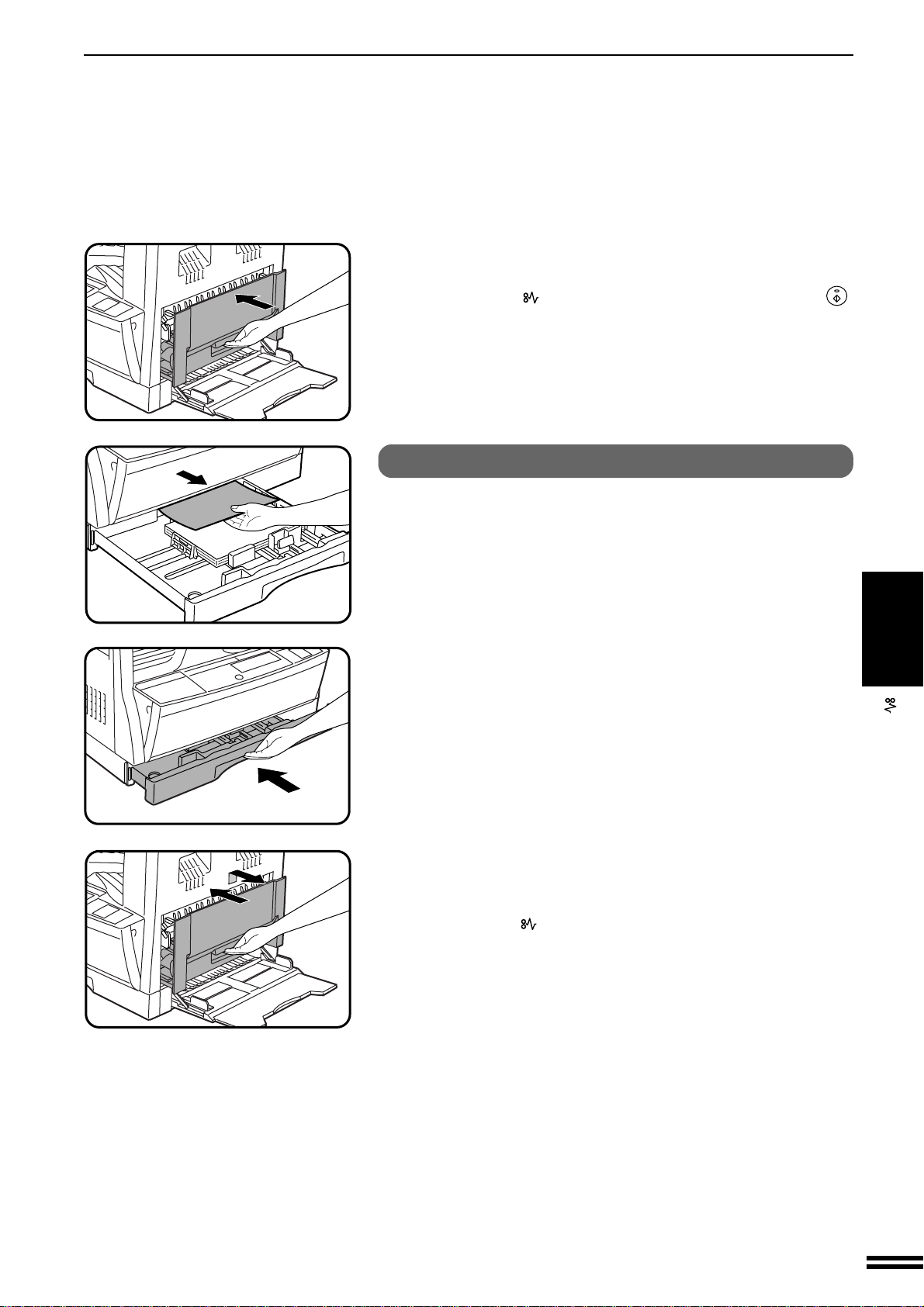
Before opening the paper tray, be sure to open the bypass tray, lift slightly
on the side cover and slide the cover out until it stops, and then perform steps
1 to 3 described in the “A. Misfeed in the paper feed area” section.
1
Gently lift and pull out the paper tray and remove the
misfed paper.
2
Close the paper tray.
3
Lift slightly on the side cover and slide the cover out
until it stops. Close the side cover by pressing the
handle on the cover.
●
The misfeed ( ) indicator will go out.
34
STATUS
INDICATORS
Developer required/
Maintenance required
When the indicator lights up, service by an authorised SHARP service
technician is required. Contact your service centre as soon as possible.
When the indicator lights up, the developer should be replaced.
DEVELOPER REPLACEMENT SHOULD ONLY BE DONE BY AN
AUTHORISED SHARP SERVICE TECHNICIAN. Contact your service
centre as soon as possible.
DEVELOPER REQUIRED
MAINTENANCE REQUIRED
35
GENERAL INFORMATION User programs
USER PROGRAMS
The user programs allow the parameters of certain functions to be set,
changed, or cancelled as desired.
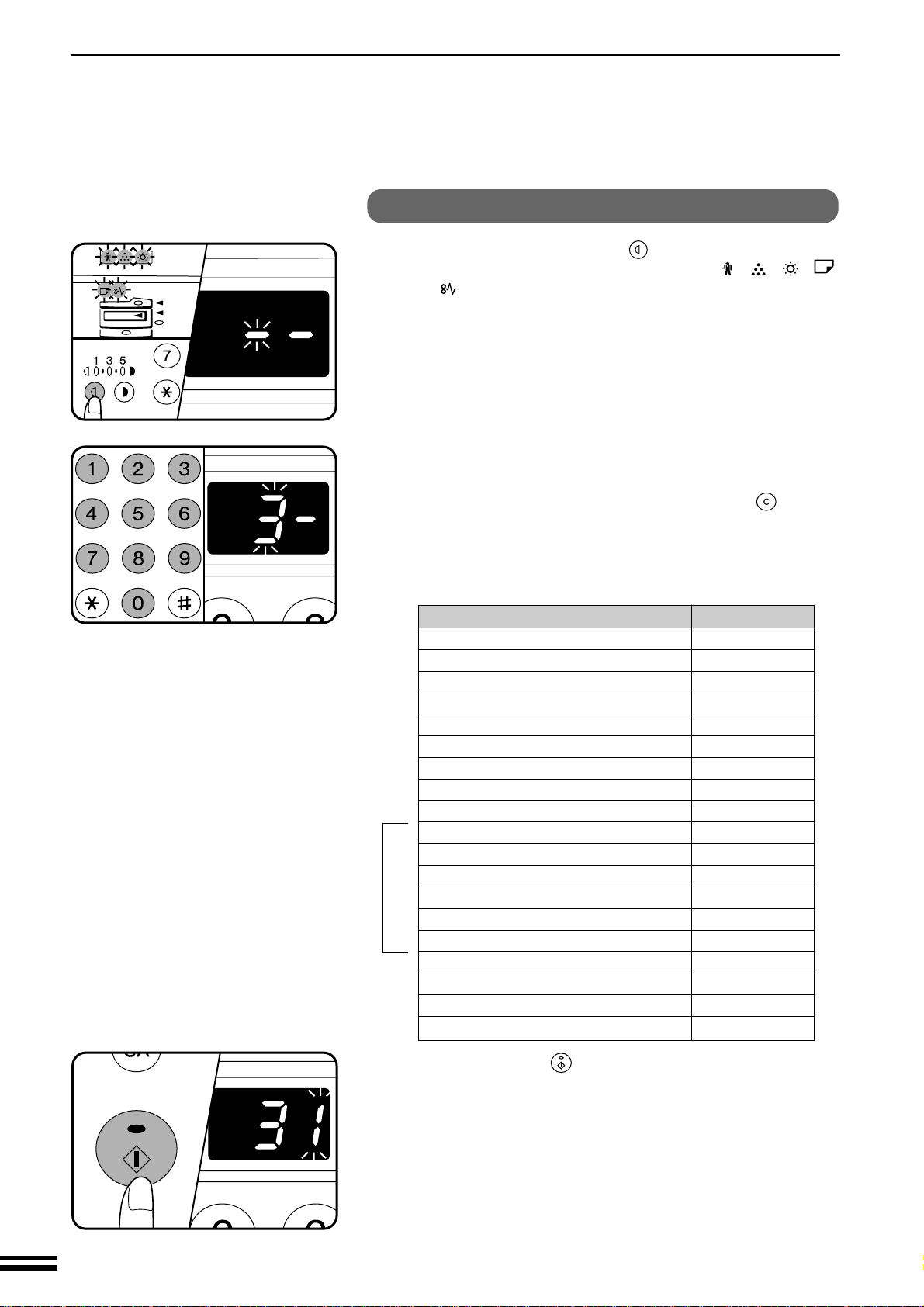
List of user programs
This copier has the following user programs.
Program No. Program name Description
1 Auto clear time Sets the auto clear time. The copier returns to the initial settings
when the auto clear time elapses after the last copy is made.
2 Preheat mode Sets the time that elapses before the copier enters the preheat
mode after any operation is made. See page 42.
3 Auto power shut-off Sets the time that elapses before the copier enters the auto power
timer shut-off mode after any operation is made. See page 42.
4 Stream feeding Enables or disables the stream feeding mode when an optional
mode* SPF is installed. See page 56.
5 Auto power shut-off Enables or disables the auto power shut-off mode. See page 42.
setting
6 Border line for 2 in 1 or Enables or disables the border line which is printed in 2 in 1 or 4 in 1 copy-
4 in 1* ing when an optional electronic sorting kit and an optional SPF are installed.
See page 61.
7 Rotation copy* Enables or disables rotation of original images. See page 58.
8 Auto paper select mode Enables or disables the auto paper selection. See page 14.
9 Auto tray switching* Enables or disables the automatic tray switching which occurs when paper
in a tray runs out. (This switching cannot switch to the bypass tray.)
10 Auditing mode Enables or disables the auditing mode, which controls access to
copier. See page 13.
11 Account number Registers accounts for auditing mode.
entry
12 Account number Changes account numbers for auditing mode.
change
13 Account number Deletes accounts for auditing mode.
deletion
14 Number of copies Displays the total number of copies made against account numbers.
per account
15 Resetting account Resets all audit accounts or resets any desired individual account.
16 Erase width adjustment* Sets the amount of the edge erase and centre erase areas. See page 63.
17 Layout in 2 in 1 copy* Selects a pattern for 2 in 1 copying. See page 61.
18 Layout in 4 in 1 copy* Selects a pattern for 4 in 1 copying. See page 61.
19 Offset of paper output Enables or disables the offset function of the paper output tray. The offset
tray function can be specified respectively for the upper and lower areas
separated by an optional job separator tray. See page 59.
* These programs do not affect the copier functions unless certain optional equipment is installed.
36
GENERAL INFORMATION
Setting the user programs
1
Press and hold the light ( ) key for more than 5
seconds until all the alarm indicators ( , , , ,
and ) blink and “––” appears in the copy quantity
display.
2
Enter a program number using the numeric keys.
●
The selected program number will blink in the copy quantity display.
●
If a mistake is made in steps 2 to 4, press the CLEAR ( ) key. The
copier will return to step 2.
●
The program numbers are shown in the table below.
For example, to change the setting of the auto power shut-off timer,
press key 3.
Program name Program No.
Auto clear time 1
Preheat mode 2
Auto power shut-off timer 3
Stream feeding mode 4
Auto power shut-off setting 5
Border line for 2 in 1 or 4 in 1 6
Rotation copy 7
Auto paper select mode 8
Auto tray switching 9
Auditing mode 10
Account number entry 11
Account number change 12
Account number deletion 13
Number of copies per account 14
Resetting account 15
Erase width adjustment 16
Layout in 2 in 1 copy 17
Layout in 4 in 1 copy 18
Offset of paper output tray 19
3
Press the START ( ) key.
●
For programs 1 to 9 and 16 to 19, the entered program number will be
steadily lit on the left side of the copy quantity display and the
currently selected parameter number for the program will blink on the
right side.
●
For programs 10 to 15 (programs for auditing accounts), the display
varies with the program number. See page 38 for setting programs 10
to 15.
USER PROGRAMS
User programs
For operation of these programs after
step 3, see page 38.
37
GENERAL INFORMATION
USER PROGRAMS
4
Select the desired parameter using the numeric keys.
●
The entered parameter number will blink on the right side of the copy
quantity display.
●
The parameters are shown in the table below.
For example, to change the setting of the auto power shut-off timer to
60 min., press key 2.
User programs
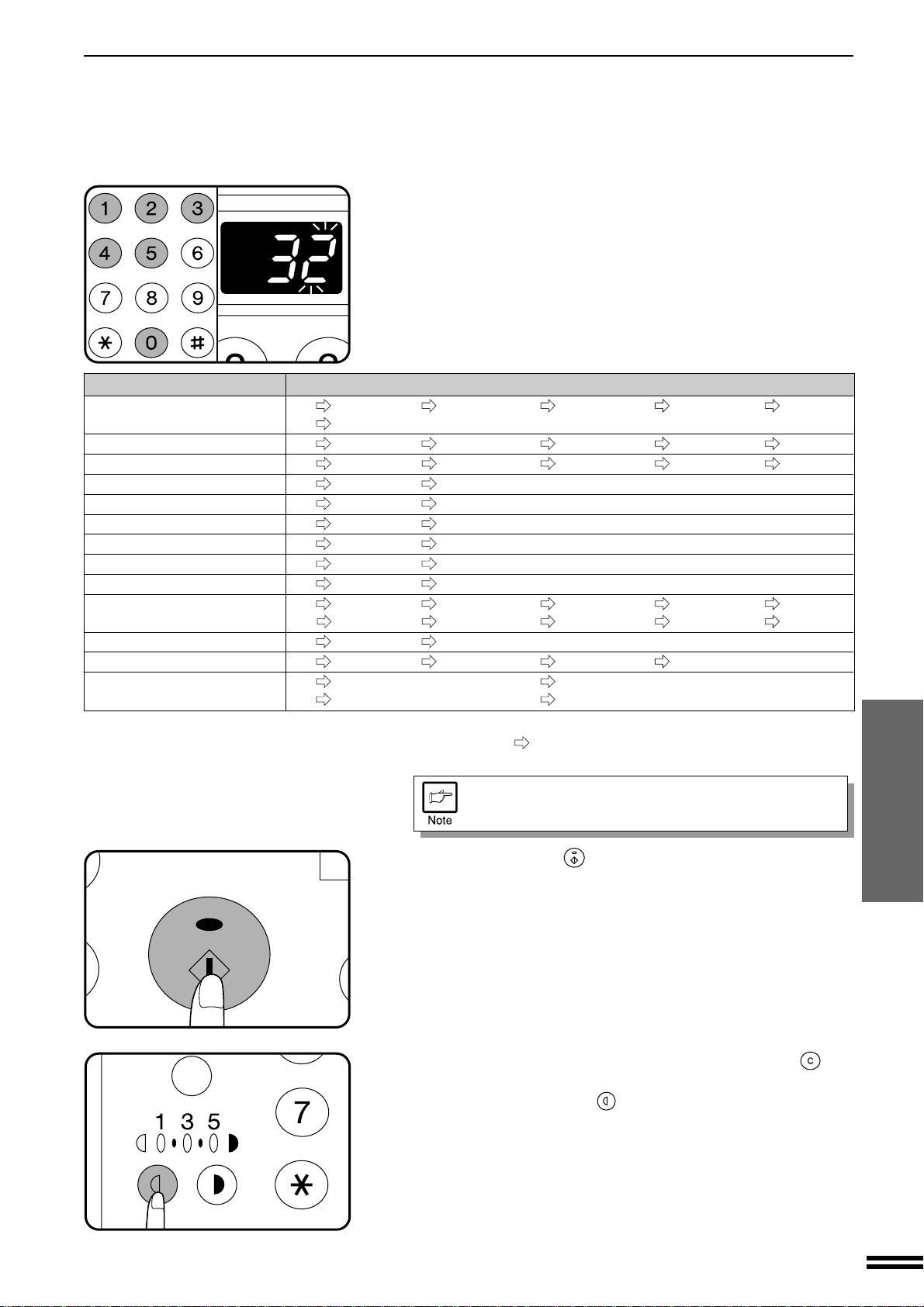
Program name Parameters
Auto clear time 0 OFF 1 30 sec. * 2 60 sec. 3 90 sec. 4 120 sec.
5 10 sec.
Preheat mode** 0 OFF ** 1 30 sec. 2 60 sec. * 3 90 sec. 4 120 sec.
Auto power shut-off timer * 1 30 min. 2 60 min. 3 90 min. 4 120 min. 5 240 min.
Stream feeding mode * 0 OFF 1 ON
Auto power shut-off setting 0 OFF * 1 ON
Border line for 2 in 1 or 4 in 1 * 0 OFF 1 ON
Rotation copy 0 OFF * 1 ON
Auto paper select mode 0 OFF * 1 ON
Auto tray switching 0 OFF * 1 ON
Erase width adjustment 0 0 mm 1 5 mm * 2 10 mm 3 15 mm 4 20 mm
(0 0" 1 1/4" * 2 1/2" 3 3/4" 4 1")
Layout in 2 in 1 copy * 1 Pattern 1 2 Pattern 2
Layout in 4 in 1 copy * 1 Pattern 1 2 Pattern 2 3 Pattern 3 4 Pattern 4
Offset of paper output tray 0 Upper OFF, lower OFF * 1 Upper ON, lower ON
2 Upper ON, lower OFF 3 Upper OFF, lower ON
●
Factory default settings are indicated with an asterisk (*). For layout in 2 in 1 copy and 4 in 1 copy, see page 61.
** In European countries, the default setting of the preheat mode is 1 ( 30 sec.). For other programs, factory default settings
in these countries are same to those shown above with an asterisk (*).
If you select “0” (OFF) in a program, the corresponding
function will be disabled.
5
Press the START ( ) key.
●
The right-hand number in the copy quantity display will be steadily lit
and the entered value will be stored.
6
To continue with other user programs, press the key
and then repeat steps 2 to 5. To exit the user program
mode, press the light ( ) key.
●
All the alarm indicators will go out.
38
GENERAL INFORMATION
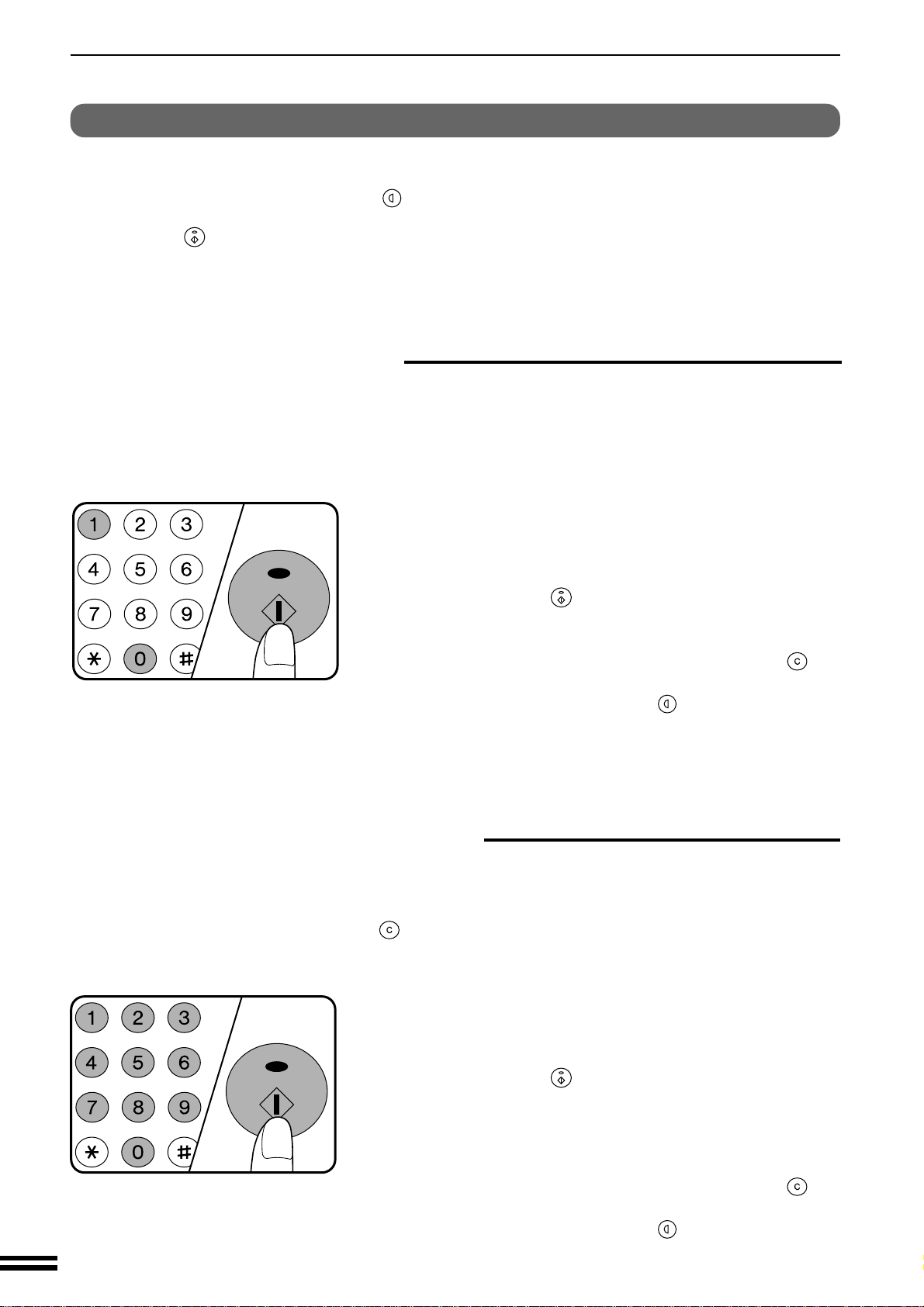
USER PROGRAMS
User programs
Settings for auditing accounts
Settings of user programs No. 10 to 15 varies with the program number. For
setting of all programs, first follow steps 1 to 3 in “Setting the user programs”
on page 36 to select a program. (1. Press the light ( ) key for more than 5
seconds. 2. Enter a program number (10 to 15) using the numeric keys. 3.
Press the START ( ) key.) Then follow the appropriate instructions for the
program.
Program No. 10: Auditing mode
If the auditing mode is enabled, copying is limited to operators with an
assigned 3-digit account number. A maximum of 20, 3-digit account numbers
can be assigned. Use program No. 11 to register account numbers.
When program No. 10 is entered, the current setting (0: OFF, 1:ON) will
blink on the right side of the copy quantity display.
1. Select the desired setting using the numeric keys.
0: OFF
1: ON
2. Press the START ( ) key.
●
The setting will be stored.
3. To continue with other user programs, press the key
and enter another program number. To exit the user
program mode, press the light ( ) key.
1. Enter a 3-digit account number using the numeric keys.
●
Any 3-digit number except “000” can be registered as an account
number.
2. Press the START ( ) key.
●
If a number that is already registered or “000” is entered, the number
will blink in the copy quantity display.
3. Repeat steps 1 and 2 for other account numbers.
4. To continue with other user programs, press the
key
and enter another program number. To exit the user
program mode, press the light ( ) key.
Program No. 11: Account number entry
Program No. 11 is used to register accounts. When program No. 11 is entered,
“–––” will blink in the copy quantity display.
●
If the number of accounts has reached the upper limit (20), “11E” will
appear in the copy quantity display. Press the key. The copier will
return to step 2 on page 36.
39
GENERAL INFORMATION
USER PROGRAMS
User programs
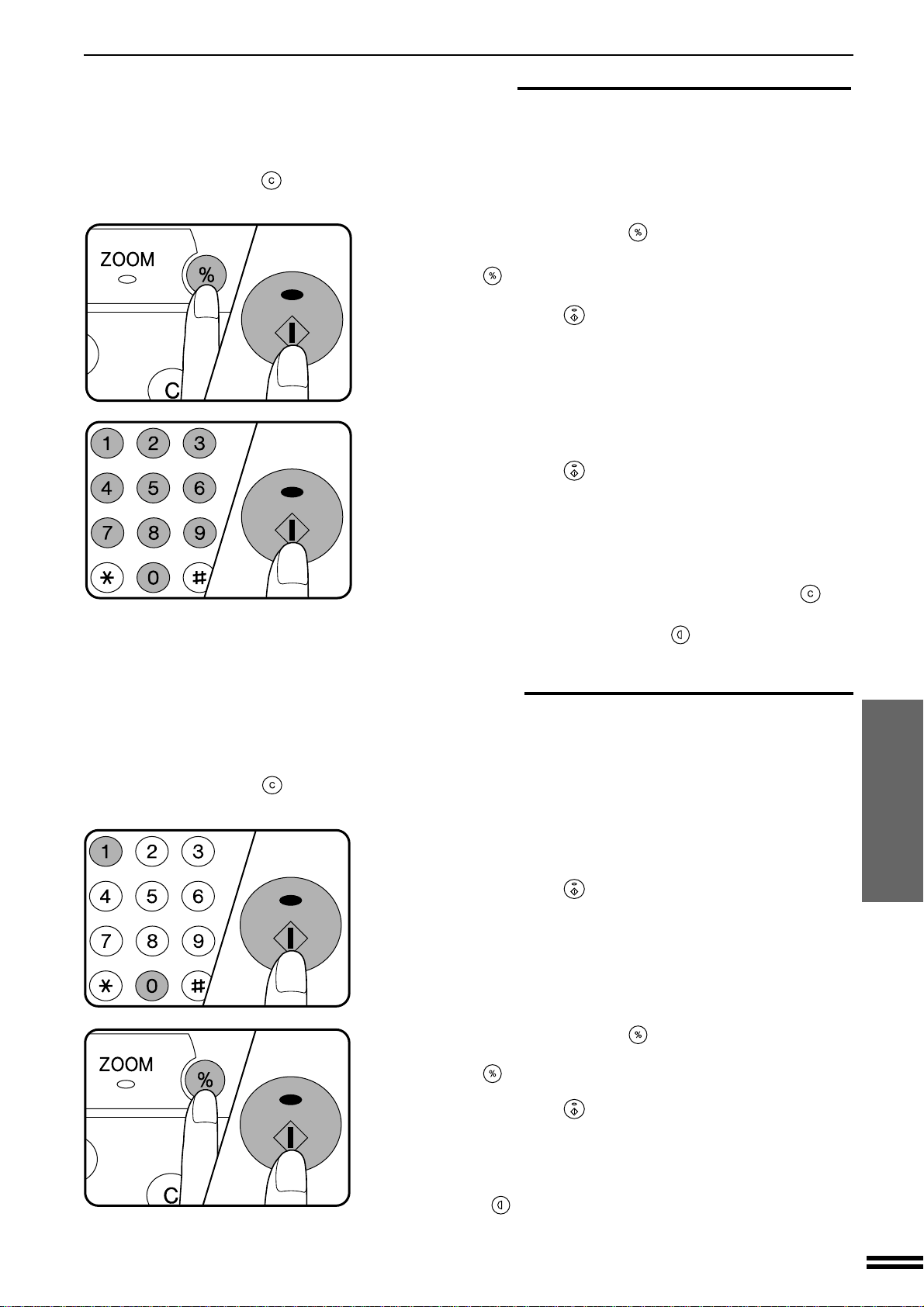
Program No. 12: Account number change
Program No. 12 is used to change account numbers. When program No. 12
is entered, an account number will appear in the copy quantity display.
●
If no account number has been registered, “12E” will appear in the copy
quantity display. Press the key. The copier will return to step 2 on page
36.
1. To delete an individual account, press the 0 key.
To delete all accounts, press key 1.
2. Press the START (
) key.
●
If you have pressed the 0 key in step 1, an account number will appear
in the copy quantity display. Proceed to step 3.
●
If you have pressed key 1, all account numbers will be deleted.
Proceed to step 5.
3. Use the copy ratio display ( ) key to select the account
number to be deleted.
●
Use the key to advance through the account numbers.
4. Press the START ( ) key.
●
The specified account will be deleted.
5. To continue with other user programs, enter another
program number. To exit the user program mode, press
the light ( ) key.
Program No. 13: Account number deletion
Program No. 13 is used to delete accounts. When program No. 13 is entered,
“0” will blink on the right side of the copy quantity display.
●
If no account number has been registered, “13E” will appear in the copy
quantity display. Press the key. The copier will return to step 2 on page
36.
1. Use the copy ratio display ( ) key to select the account
number to be changed.
●
Use the key to advance through the account numbers.
2. Press the START ( ) key.
●
The account number will be erased and “–––” will blink in the copy
quantity display.
3. Enter a new account number using the numeric keys.
4. Press the START ( ) key.
●
If a number that is already registered or “000” is entered, the number
will blink in the copy quantity display.
5. Repeat steps 1 to 4 for other account numbers.
6. To continue with other user programs, press the key
and enter another program number. To exit the user
program mode, press the light ( ) key.
40
GENERAL INFORMATION
User programs
USER PROGRAMS
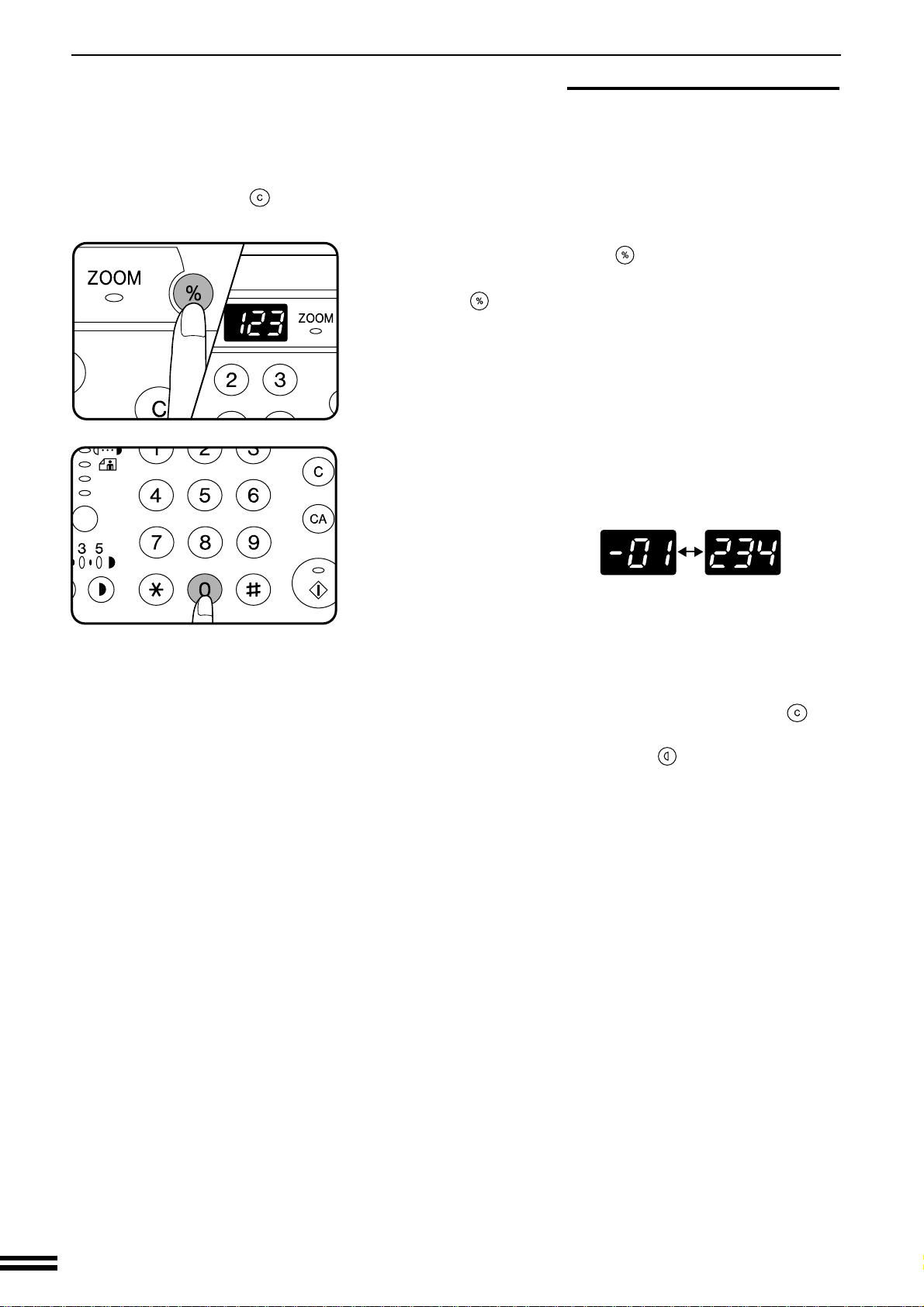
Program No. 14: Number of copies per account
Program No. 14 is used to display the total number of copies made against
each account number. When program No. 14 is entered, an account number
will appear in the copy quantity display.
●
If no account number has been registered, “14E” will appear in the copy
quantity display. Press the key. The copier will return to step 2 on page
36.
1. Use the copy ratio display ( ) key to select the account
number.
●
Use the key to advance through the account numbers.
2. Press and hold down the 0 key.
●
The number of copies made against the specified account number will
be displayed. The two higher digits and the three lower digits will
appear alternately while the 0 key is pressed.
Example: 1,234 copies
●
The upper limit for the number of copies is 49,999. If the number of
copies made reaches 50,000, the number will be reset to 0 and counting
will start again from 0.
3. Repeat steps 1 and 2 for other account numbers.
4. To continue with other user programs, press the key
and select another program number. To exit the user
program mode, press the light ( ) key.
41
GENERAL INFORMATION
USER PROGRAMS
User programs
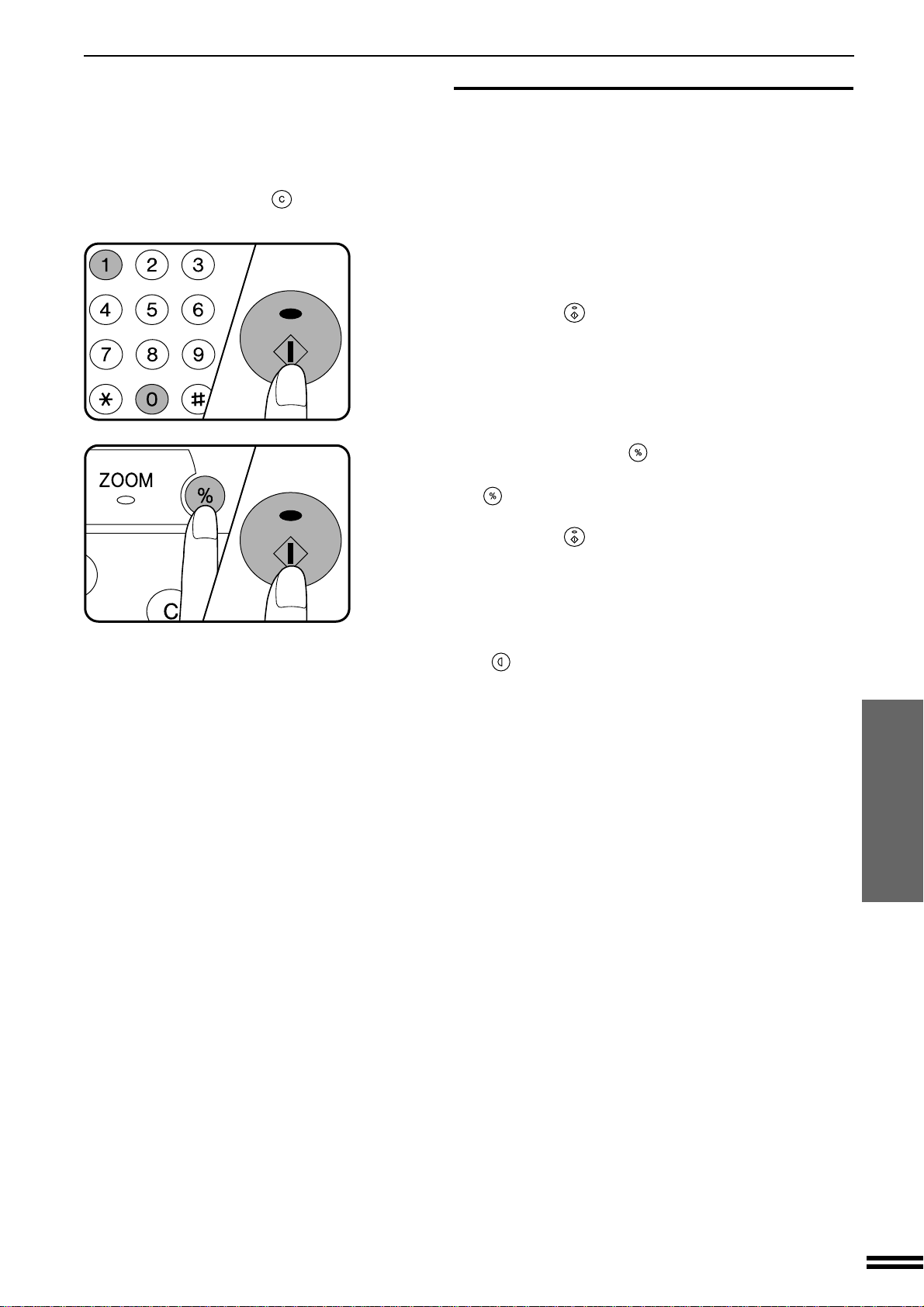
Program No. 15: Resetting account
Program No. 15 is used to reset all accounts or to reset any desired individual
account. When program No. 15 is entered, “0” will blink on the right side of
the copy quantity display.
●
If no account number has been registered, “15E” will appear in the copy
quantity display. Press the key. The copier will return to step 2 on
page 36.
1. To reset an individual account, press the 0 key.
To reset all accounts, press key 1.
2. Press the START ( ) key.
●
If you have pressed the 0 key in step 1, an account number will appear
in the copy quantity display. Proceed to step 3.
●
If you have pressed key 1, the number of copies against all account
numbers will be reset. Proceed to step 5.
3. Use the copy ratio display ( ) key to select the account
number to be reset.
●
Use the key to advance through the account numbers.
4. Press the START ( ) key.
●
The number of copies against the specified account number will be
reset.
5. To continue with other user programs, enter another
program number. To exit the user program mode, press
the light ( ) key.
42
GENERAL INFORMATION
POWER SAVE MODES
The copier has two power save modes to reduce overall power consumption
thereby reduce the cost of operation. In addition, these modes conserve
natural resources and help reduce environmental pollution. The two power
save modes are preheat mode and auto power shut-off mode.
●
User programs
The preheat activation time and the auto power shut-off time have been
preset at the factory to 90 sec.* for preheat mode and 30 min. for auto
power shut-off mode. These times can be changed using user programs.
It is suggested that you set appropriate times according to the actual usage
of the copier. See page 35.
* In European countries, the factory default setting is 30 sec.
Preheat mode
When the copier enters the preheat mode, the POWER SAVE ( ) indicator
will light up and other indicators will remain on or off as before. In this
condition, the fuser in the copier is maintained at a lower heat level, thereby
saving power. The preheat level is, however, high enough to allow the copier
to come to a ready condition or begin copying within 10 seconds after any
key input or copier operation such as paper tray operation is performed.
Auto power shut-off mode
When the copier enters the auto power shut-off mode, the POWER SAVE
( ) indicator will light up and all other indicators will go out. The auto
power shut-off mode saves more power but requires a longer time to warm
up before copying can begin.
Power save modes
As an ENERGY STA R
®
Partner,
SHARP has determined that this
product meets the ENERGY STA R
®
guidelines for energy efficiency.
43
GENERAL INFORMATION
Setting the power save modes
The time that elapses before the copier enters a power save mode after any
operation is made can be set manually. This time is set with user program No.
2 for the preheat mode and user program No. 3 for the auto power shut-off
mode. For these settings, see page 36.
●
The copier will enter the preheat mode first and then the auto power
shut-off mode after a preset time has elapsed when no copier operation
has been made.
●
If conflicting settings are made with user programs No. 3 and No. 5, the
last program set will have priority.
Copying from the preheat mode
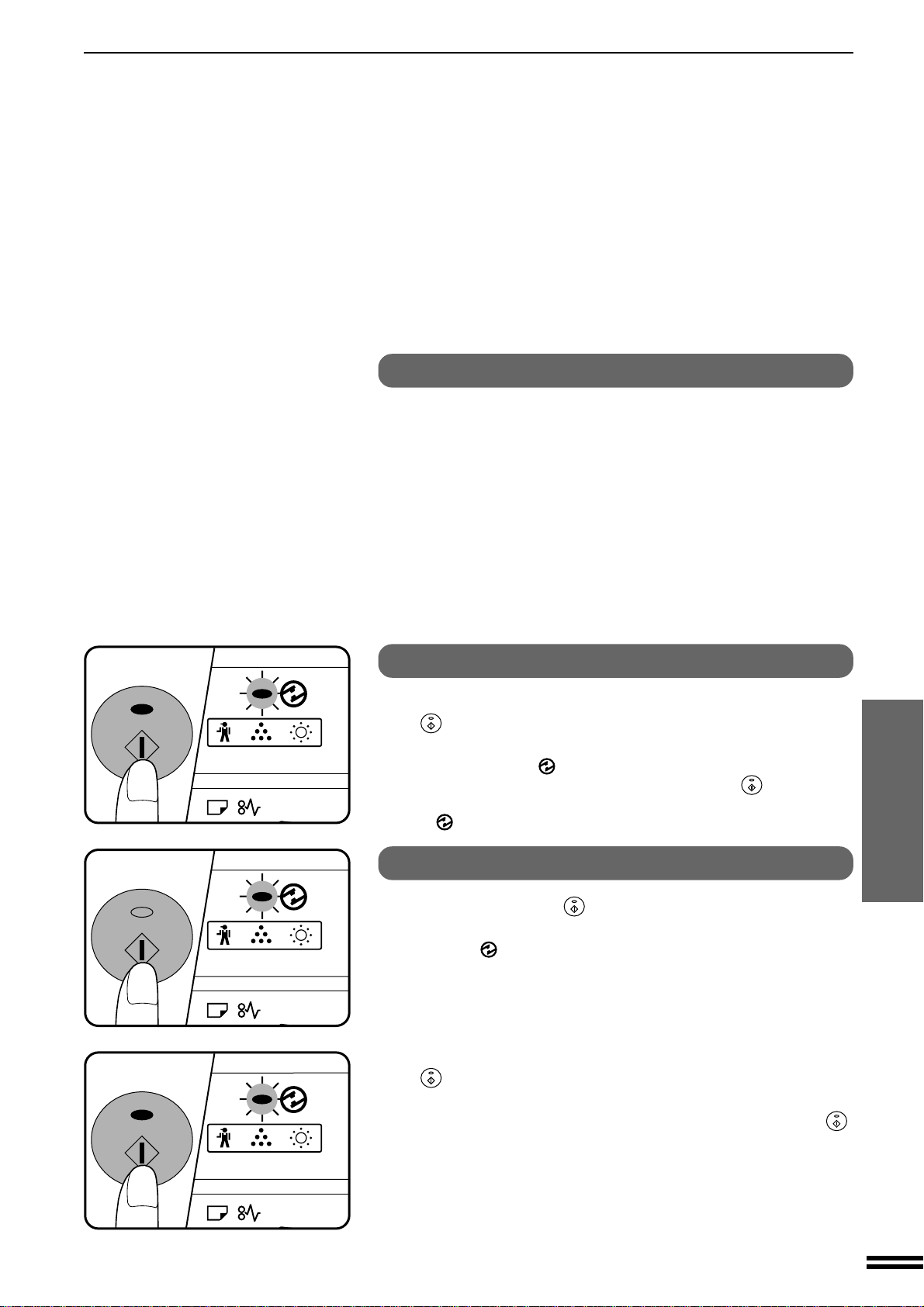
Make desired copier selections and press the START
( ) key using the normal copying procedure.
●
When any key input is made or any other copier operation is made, the
POWER SAVE ( ) indicator will start to blink.
●
When the START key is pressed, the START key ( ) indicator will
go out and copying will start within 10 seconds. The POWER SAVE
( ) indicator will go out when copying starts.
Copying from the auto power shut-off mode
1
Press the START ( ) key.
●
The copier will exit the auto power shut-off mode and the POWER
SAVE ( ) indicator will start to blink.
2
Make desired copier selections and press the START
( ) key using the normal copying procedure.
●
It will take approximately 35 seconds for the copier to start copying.
However, you can make desired settings and press the START ( )
key during warm-up. Copying will start after warm-up is finished.
Power save modes
POWER SAVE MODES

44
GENERAL INFORMATION
USER MAINTENANCE
Proper care is essential for clean, sharp copies. Please take a few minutes to
regularly clean your copier.
Original table and platen cover
Stains or dirt on the original table or platen cover will
also be copied. Wipe the original table and platen cover
with a soft, clean cloth.
●
If necessary, dampen the cloth with water. Do not use thinner,
benzene, or similar volatile cleaning agents.
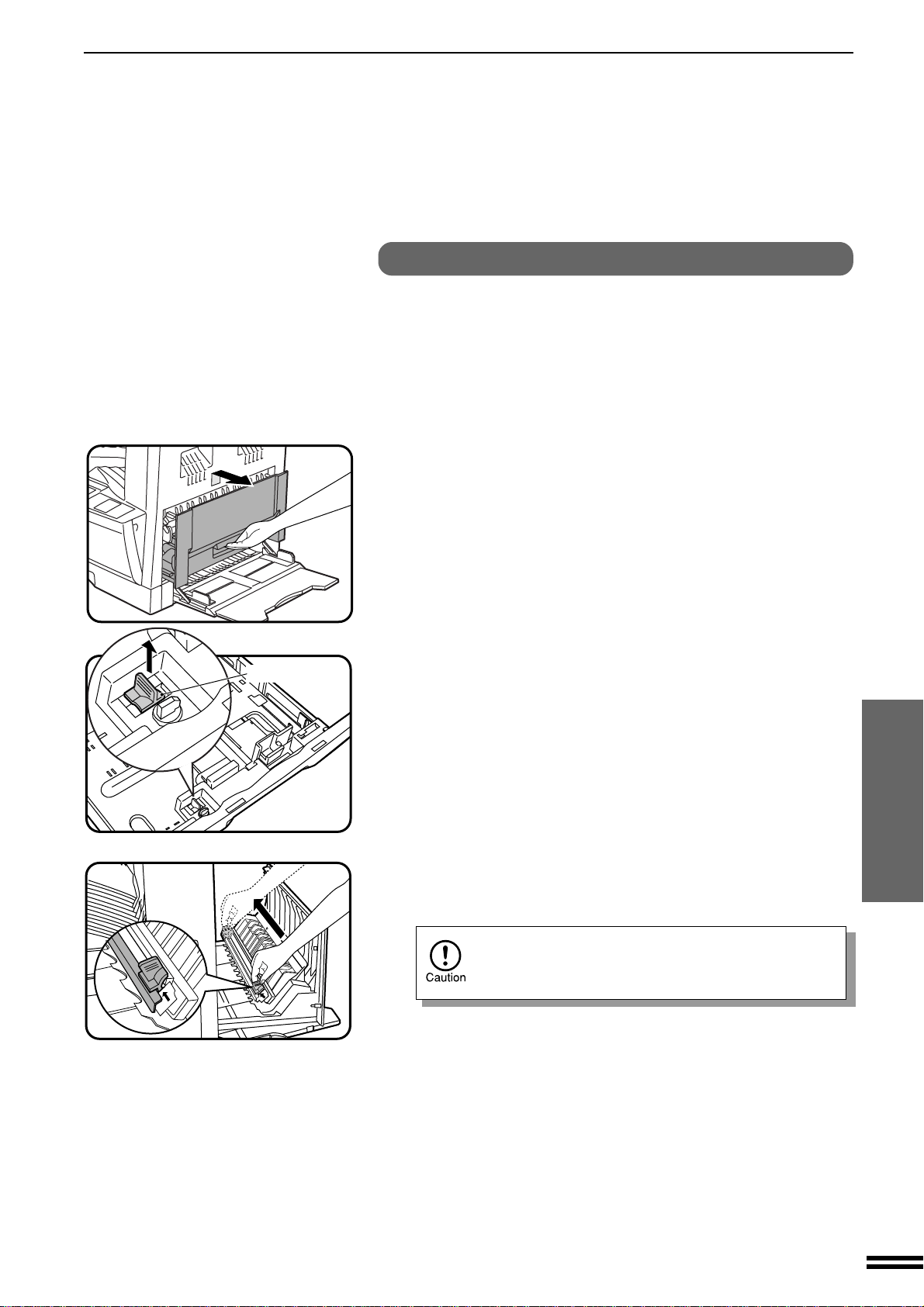
User maintenance
●
If an optional SPF is installed, wipe the scanning window on the
original table.
Bypass tray paper feed roller
If misfeeds occur frequently when feeding postcards,
envelopes, thick paper, etc. through the bypass tray,
wipe the blue paper feed roller at the feed slot of the
bypass tray with a soft, clean cloth dampened with
alcohol or water.
Paper feed roller
45
GENERAL INFORMATION
1
Turn the power switch off.
2
Open the bypass tray. Lift slightly on the side cover and
slide the cover out until it stops.
3
Gently lift and pull out the paper tray and take the
charger cleaner out by holding the tab.
4
Set the charger cleaner onto the transfer charger and
gently slide the cleaner in the direction indicated by the
arrow two or three times.
Slide the charger cleaner from one end to the other end
along the groove of the transfer charger. If the cleaner
is stopped on the way, smudges on copies may occur.
●
If the white sheet metal is smudged with toner, wipe it with a soft, clean
cloth.
5
Return the charger cleaner to its original position.
Close the paper tray. Close the side cover by pressing
the handle on the cover.
6
Turn the power switch on.
User maintenance
Charger cleaner
Transfer charger cleaning
If copies start becoming streaky or blotchy, the transfer charger may be dirty.
Clean the charger using the following procedure.
USER MAINTENANCE
46
GENERAL INFORMATION
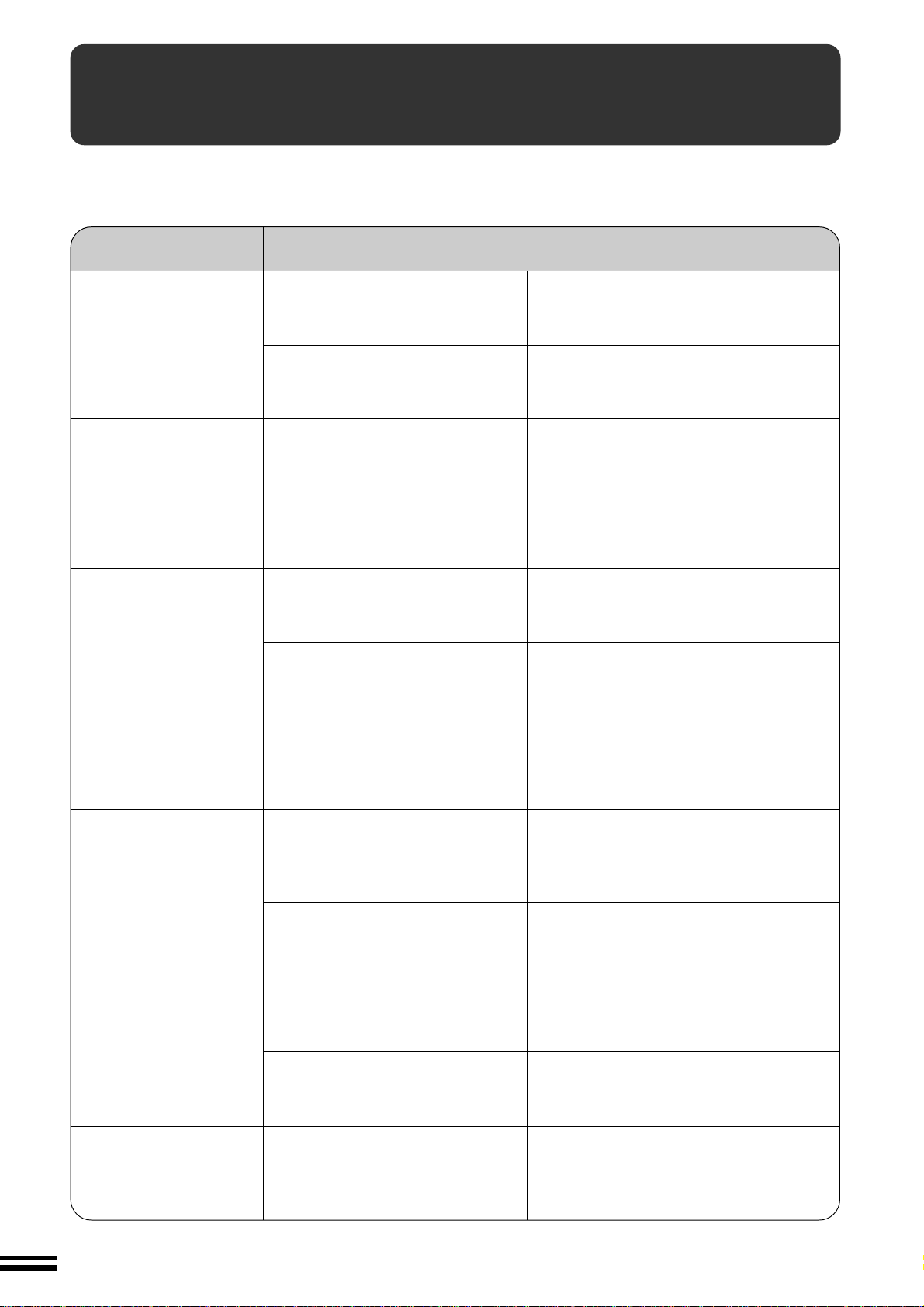
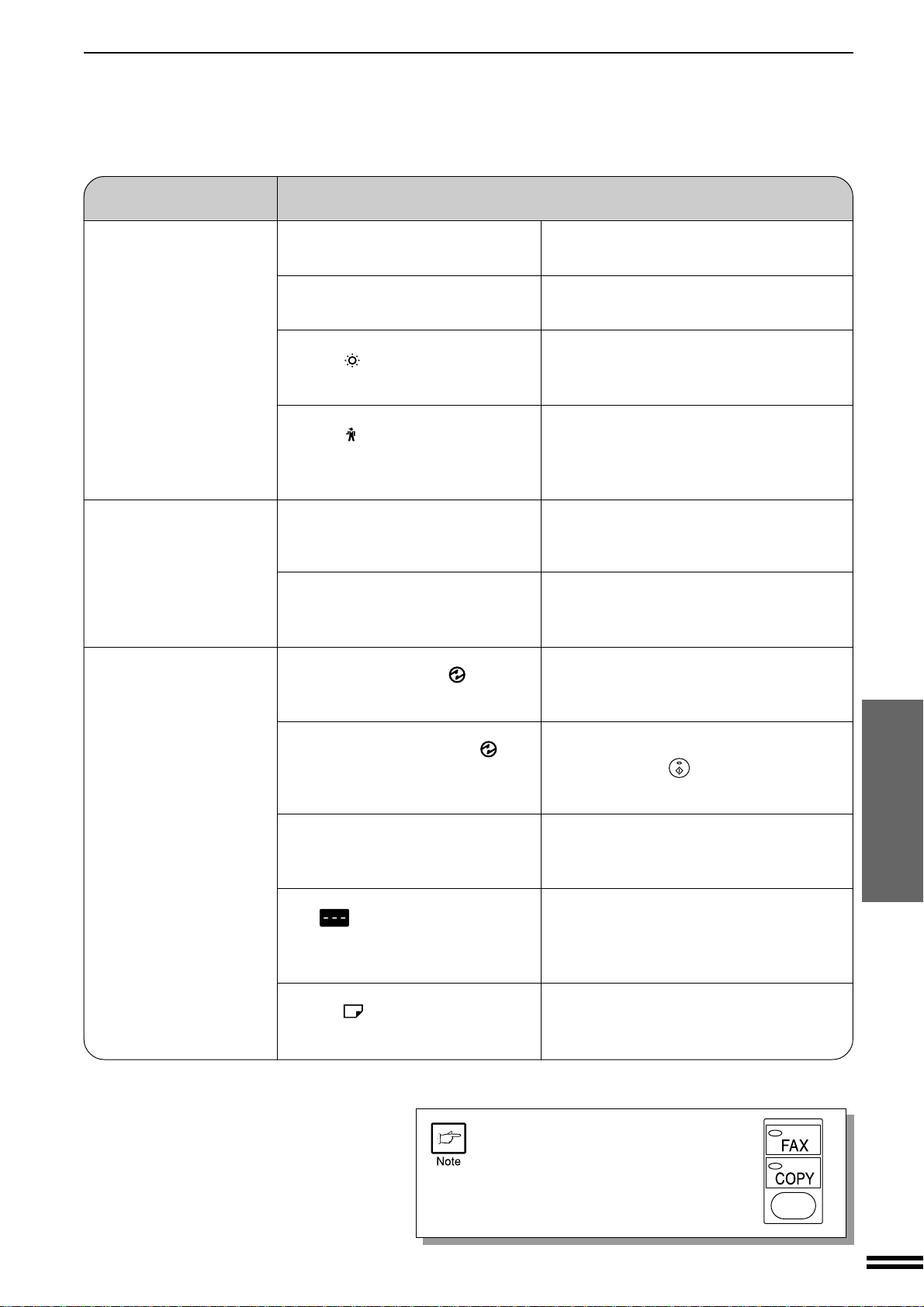
Problem Solution
●
Copier plugged in?
●
Power switch ON?
●
Copy density properly adjusted?
●
Is the original placed face down?
●
Paper too heavy?
●
Paper damp?
●
Is transfer charger clean?
●
Non-standard paper used?
●
Paper properly installed?
●
Pieces of paper inside copier?
●
Paper curled or damp?
●
First copy curled?
Plug the copier into a grounded outlet.
See page 8.
Turn the power switch ON.
See page 14.
See pages 14 and 26.
Place the original face down on the original
table.
Use copy paper within the specified range. See
page 49.
Replace with dry copy paper.
Be sure to store copy paper in a dry location. See
page 50.
Clean the transfer charger.
See page 45.
Use standard paper. If using special paper, feed
the paper through the bypass tray.
See pages 18 and 49.
Make sure the paper is properly installed. See
pages 10 and 18.
Remove all pieces of misfed paper.
See page 30.
Store copy paper flat in the wrapper in a dry
location. See page 50.
If the first copy has curled up, flatten it and
change the orientation of the original and copy
paper.
Copier does not operate.
Copies are too dark or
too light.
Blank copies
Paper misfeeds frequently.
Copies smear if rubbed.
COPIER TROUBLE?
Copier trouble?
Striped copies
Paper misfeeds frequently in
two-sided copying.
47
GENERAL INFORMATION
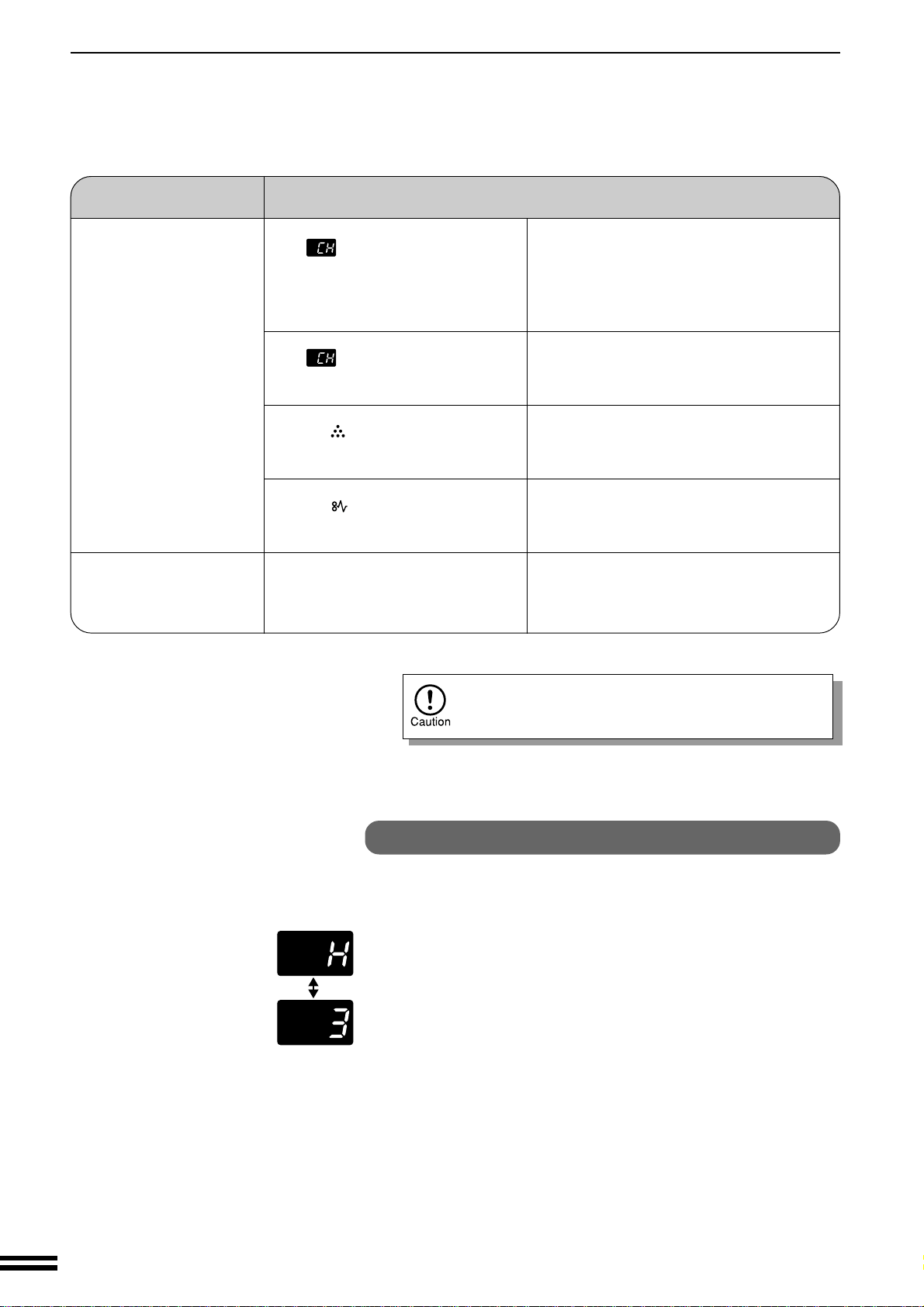
Problem Solution
●
Original table or platen cover dirty?
●
Original smudged or blotchy?
●
Is the indicator on?
●
Is the indicator on?
●
Is the COPY indicator off?
●
Is copying, printing or facsimile
printing being performed?
●
Is the POWER SAVE ( ) indicator
blinking?
●
Is only the POWER SAVE ( )
indicator on?
●
Is the COPY indicator off?
●
Is steadily lit in the copy
quantity display?
●
Is the indicator on?
Clean regularly. See page 44.
Use a clean original.
Developer is required. Contact your SHARP
service centre as soon as possible. See page 34.
Maintenance is required. Contact your SHARP
service centre as soon as possible.
See page 34.
Use the COPY/FAX key to select the COPY
mode. See Note below.
Set the paper size after copying, printing or
facsimile printing is complete.
Wait until warm-up is complete.
Warm-up time is approximately 35 seconds.
The copier is in the auto power shut-off mode.
Press the START ( ) key. See page 42,
POWER SAVE MODES.
Use the COPY/FAX key to select the COPY
mode. See Note below.
The copier is in the auditing mode.
Enter your account number using the numeric
keys. See page 13.
Copy paper is needed. See page 10,
LOADING COPY PAPER.
Copies are smudged or
dirty.
Power is on but copying
is not possible.
Copier trouble?
COPIER TROUBLE?
Paper size for a paper
tray cannot be set.
COPY/FAX key
The COPY/FAX key is used to switch
between the FAX and COPY modes.
For details, see the MULTI ACCESS
manual.
48
GENERAL INFORMATION
The toner cartridge is not installed. Install the
toner cartridge. If "CH" is blinking even if the
cartridge is installed properly, contact your
SHARP service centre immediately.
Side cover(s) is open.
Close the front and side covers securely.
The toner cartridge must be replaced. See page
28, TONER CARTRIDGE REPLACEMENT.
A misfeed has occurred. See page 30,
MISFEED REMOVAL.
Connect the copier to a power outlet which is
not used for other electric appliances.
●
Is blinking in the copy
quantity display?
●
Is steadily lit in the copy
quantity display?
●
Is the indicator blinking?
●
Is the indicator blinking?
●
Is the same power outlet used for
the lighting fixture and the copier?
Problem Solution
Power is on but copying
is not possible.
Lighting fixture flickers.
Copier trouble?
Self-diagnostic function
An automatic self-diagnostic function is built into the copier. Should the
copier malfunction, the self-diagnostic function will locate the problem and
stop the copier to prevent damage. An alphanumeric code will appear in the
copy quantity display.
Example
Should the copier completely stop and a letter and a number appear alternately,
contact your SHARP service centre immediately.
COPIER TROUBLE?
Be sure to use only genuine SHARP parts and supplies.
Please contact your SHARP service centre immediately if a problem persists
after checking the above.
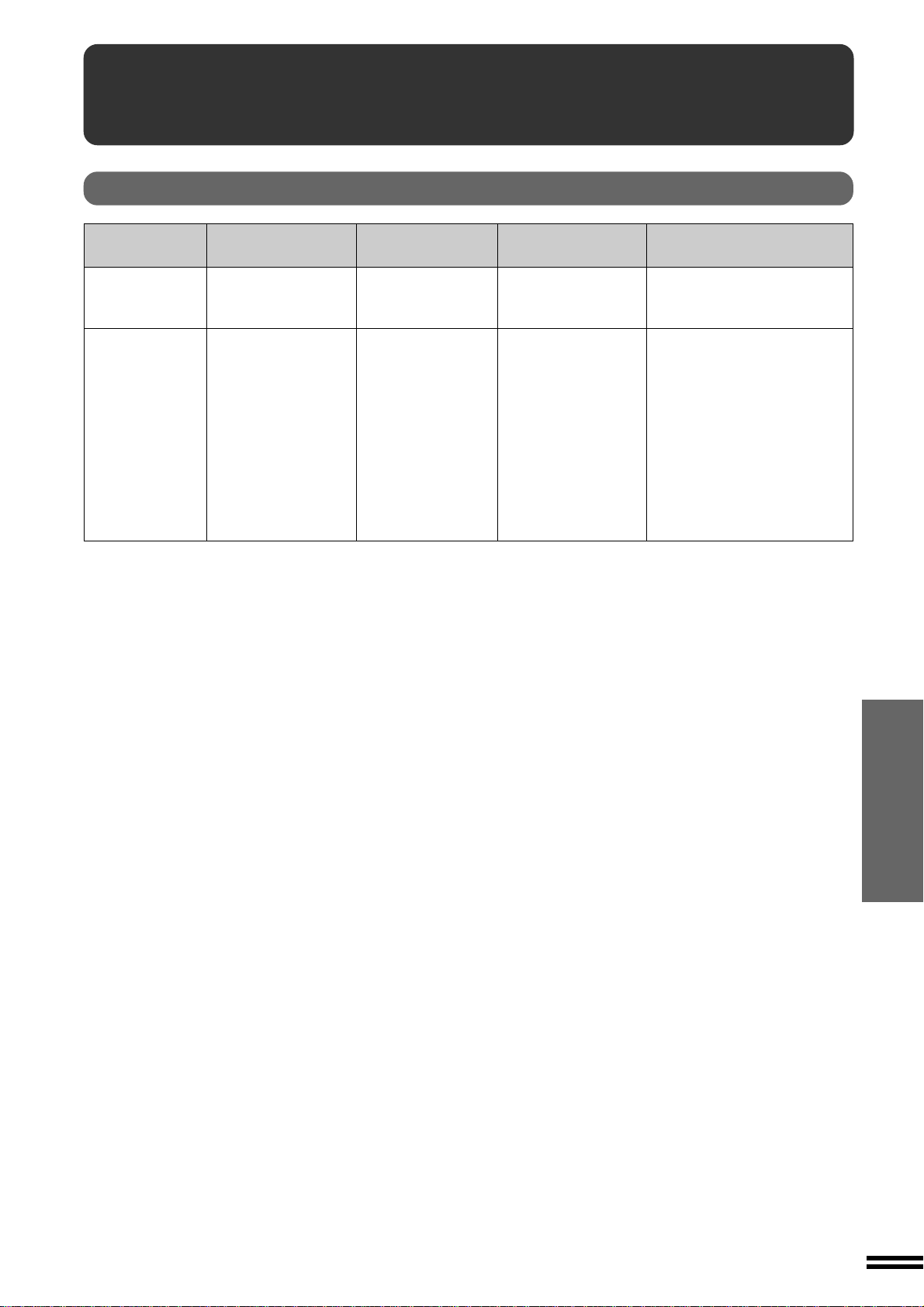
49
GENERAL INFORMATION
SUPPLIES
Types and sizes of copy paper
Size Weight Capacity (80 g/m
2
Special paper
(21 lb.) paper)
Paper tray A5* to A3 56 to 80 g/m
2
250 sheets
(5-1/2" x 8-1/2"* (15 lbs. to 21 lbs.)
to 11" x 17")
Bypass tray Ordinary paper: 56 to 128 g/m
2
100 sheets Transparency film,
A6 to A3 (15 lbs. to 34 lbs.)** labels, envelopes***
(5-1/2" x 8-1/2" (Ordinary paper)
to 11" x 17")
Envelopes:
International DL
(110 x 220 mm)
International C5
(162 x 229 mm)
Commercial 10
(4-1/8" x 9-1/2")
* A5 (5-1/2" x 8-1/2") copy paper can be used in the uppermost paper tray
but cannot be used in other trays (in optional paper feed units).
** For paper weighing from 105 to 128 g/m
2
(28 to 34 lbs.), A4 (8-1/2" x
11") is the maximum size that can be fed through the bypass tray.
***Do not use envelopes that have metal clasps, plastic snappers, string
closures, windows, linings, self-adhesive patches or synthetic materials.
These will cause physical damage to the copier.
●
For best results, use only paper recommended by SHARP.
●
Special papers except envelopes must be fed one sheet at a time through
the bypass tray. Up to 10 envelopes can be set at one time.
Supplies
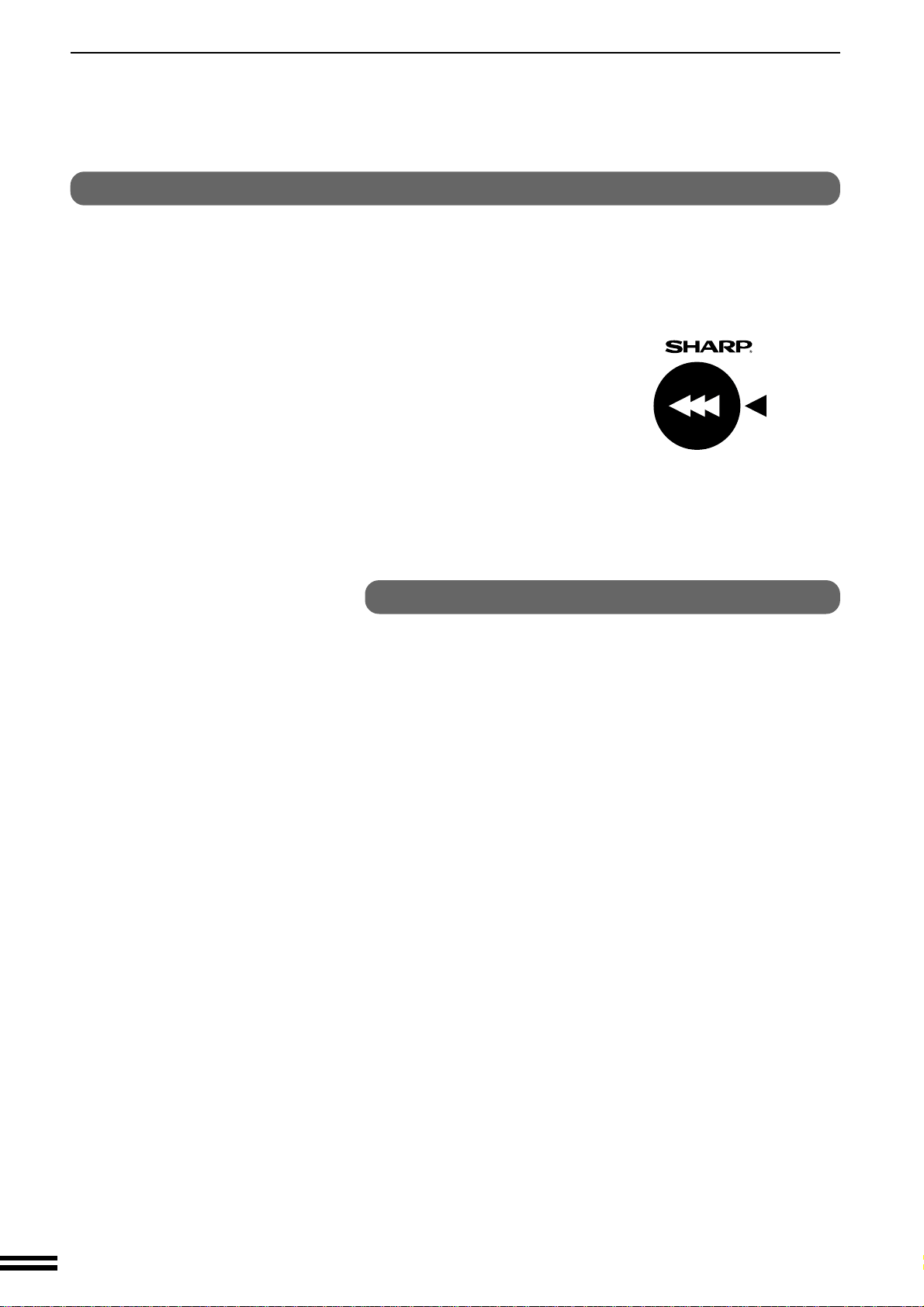
50
GENERAL INFORMATION
SUPPLIES
Genuine supplies statement
Standard supplies for this copier that are to be replaced by the user are copy
paper and toner cartridge.
For best copying results, be sure to use only
SHARP products.
Only genuine SHARP consumables carry
the Genuine Supplies label.
GENUINE SUPPLIES
Proper storage
1. Store the supplies in a location that is:
●
clean and dry,
●
at a stable temperature,
●
not exposed to direct sunlight.
2. Store copy paper in the wrapper and lying flat.
●
Paper stored out of the wrapper or in packages standing on end may
curl or get damp, resulting in paper misfeeds.
Supplies
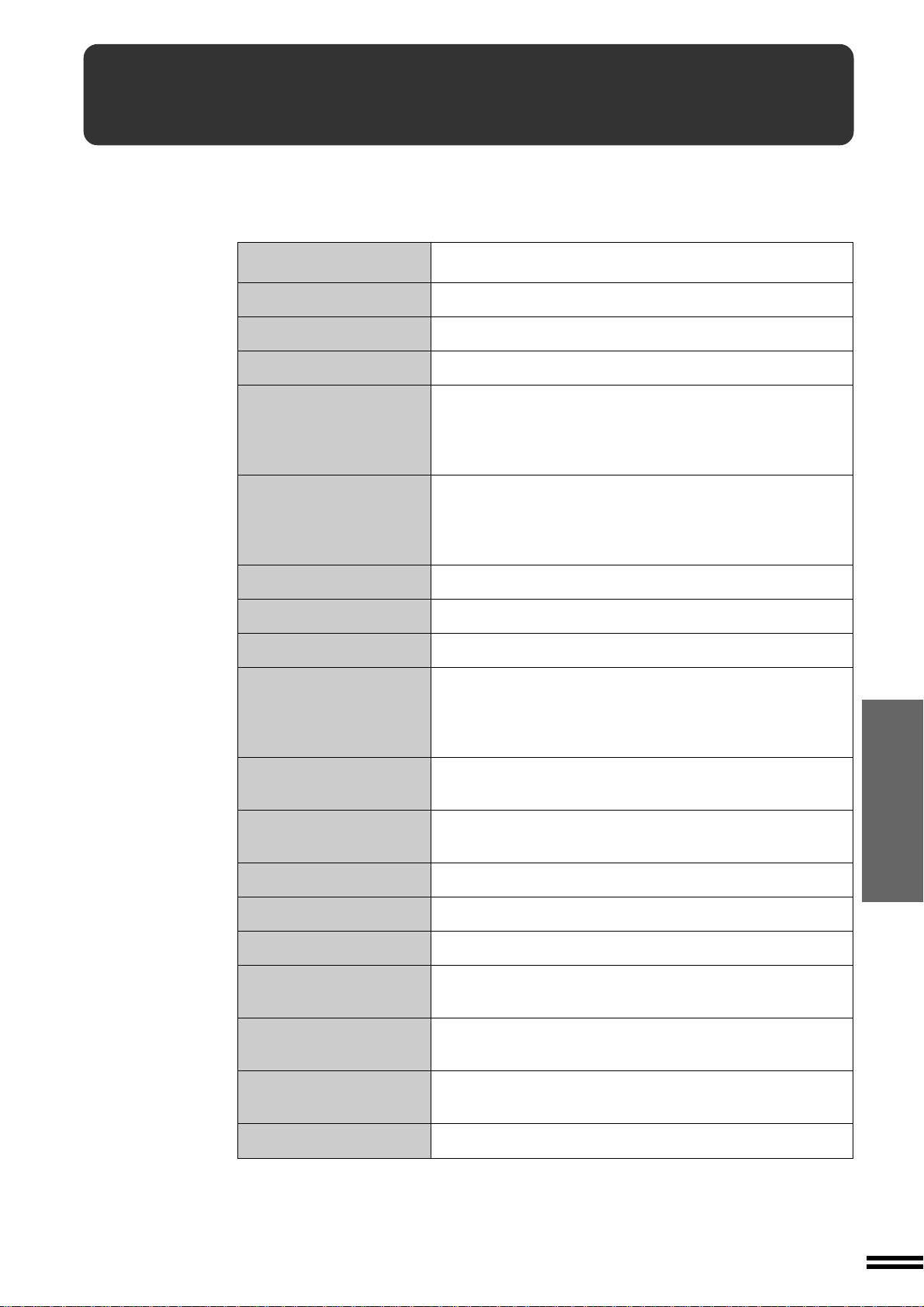
51
GENERAL INFORMATION
Type Digital copying machine, desktop
Copy system Dry, electrostatic transfer
Originals Sheets, bound documents
Original sizes Max. A3 (11" x 17")
Copy sizes Max. A3 (11" x 17")
Min. A6 (5-1/2" x 8-1/2")
Image loss: Max. 4 mm (5/32") (leading and trailing edges)
Max. 4 mm (5/32") (along other edges in total)
Copying speed 16 copies/min. (A4 (8-1/2" x 11"))
(at 100% copy ratio) 12 copies/min. (A4R (8-1/2" x 11"R))
10 copies/min. (B4 (8-1/2" x 14"))
9 copies/min. (A3 (11" x 17"))
Continuous copy Max. 99 copies; subtractive counter
First-copy time 7.2 s (except in a power save mode)
Warm-up time Approx. 35 s
Copy ratio Variable: 50% to 200%, in 1% increments (total 151 steps)
Fixed preset: 50%, 70%, 81%, 86%, 100%, 115%, 122%,
141%, 200% (50%, 64%, 77%, 95 %, 100%, 121%, 129%,
141%, 200%)
Exposure system Moving optical source, slit exposure (stationary platen) with
automatic exposure function
Copy paper feed One paper tray with automatic feed (250 sheets), one bypass
tray with automatic feed (100 sheets)
Fusing system Heat rollers
Developer system Magnetic brush development
Light source Xenon lamp
Resolution Scan: 400 dpi
Output: 600 dpi
Gradation Scan: 256 levels
Output: 2 levels
Power supply Local voltage ±10% (For this copier’s power supply require-
ments, see the name plate located on the back of the unit.)
Power consumption Max. 1.3 kW
SPECIFICATIONS
Specifications
52
GENERAL INFORMATION
SPECIFICATIONS
Specifications
Overall dimensions 590 mm (W) x 531 mm (D)
(with bypass tray folded) (23-15/64" (W) x 20-29/32" (D))
Weight Approx. 32 kg (70.6 lbs.)
Toner cartridge included
Copier dimensions 590 mm (W) x 531 mm (D) x 470 mm (H)
(23-15/64" (W) x 20-29/32" (D) x 18-33/64" (H))
Operating conditions Temperature: 15°C to 30°C (59°F to 86°F)
Humidity: 20% to 85%
Optional equipment Single pass feeder (AR-SP2)
Electronic sorting kit (AR-EB3)
250-sheet paper feed unit (AR-DE5)
2x250-sheet paper feed unit (AR-DE6)
Facsimile expansion kit (AR-FX2)
Printer expansion kit (AR-PB8)
PS2 expansion kit (AR-PS1)
LCD panel kit (AR-PA1)
Job separator tray kit (AR-TR2)
●
First-copy time may differ depending on operating conditions, such as power-supply voltage and
room temperature.
●
Some options may not be available in some countries.
As a part of our policy of continuous improvement, SHARP reserves the right
to make design and specification changes for product improvement without
prior notice. The performance specification figures indicated are nominal
values of production units. There may be some deviations from these values
in individual units.

53
OPTIONAL EQUIPMENT
OPTIONAL
EQUIPMENT
CONTENTS
Page
●
SYSTEM CONFIGURATION . . . . . . . . . . . . . . . . . . . . . . . . . . . 54
●
SINGLE PASS FEEDER (AR-SP2) . . . . . . . . . . . . . . . . . . . . . . 55
●
Part names . . . . . . . . . . . . . . . . . . . . . . . . . . . . . . . . . . . . . . . . 55
●
Specifications . . . . . . . . . . . . . . . . . . . . . . . . . . . . . . . . . . . . . . 55
●
Using the SPF . . . . . . . . . . . . . . . . . . . . . . . . . . . . . . . . . . . . . . 56
●
Misfeed removal . . . . . . . . . . . . . . . . . . . . . . . . . . . . . . . . . . . . 57
●
ELECTRONIC SORTING KIT (AR-EB3) . . . . . . . . . . . . . . . . . . 58
●
Rotation copying . . . . . . . . . . . . . . . . . . . . . . . . . . . . . . . . . . . . 58
●
Sort/group. . . . . . . . . . . . . . . . . . . . . . . . . . . . . . . . . . . . . . . . . 59
●
2 in 1 or 4 in 1 . . . . . . . . . . . . . . . . . . . . . . . . . . . . . . . . . . . . . . 61
●
Erase . . . . . . . . . . . . . . . . . . . . . . . . . . . . . . . . . . . . . . . . . . . . 63
●
Margin shift . . . . . . . . . . . . . . . . . . . . . . . . . . . . . . . . . . . . . . . 65
●
250-SHEET PAPER FEED UNIT (AR-DE5)/
2x250-SHEET PAPER FEED UNIT (AR-DE6) . . . . . . . . . . . . . . 66
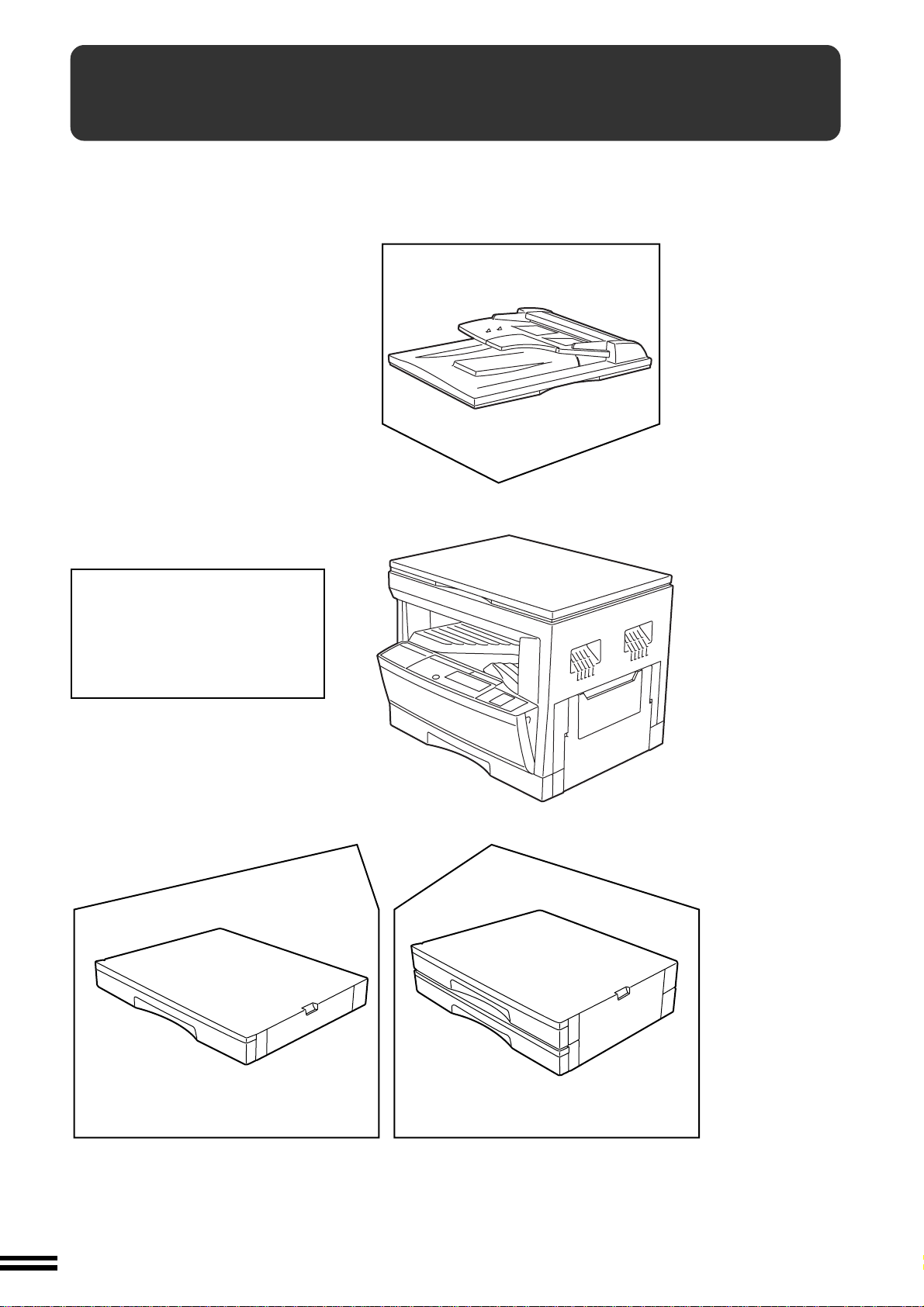
54
OPTIONAL EQUIPMENT
SYSTEM CONFIGURATION
A number of options are available for the copier which allow you to
configure a copier system to meet your particular needs. The options include
the following.
System configuration
Single pass feeder
(AR-SP2)
2x250-sheet paper feed unit
(AR-DE6)
250-sheet paper feed unit
(AR-DE5)
Electronic sorting kit (AR-EB3)
Facsimile expansion kit (AR-FX2)*
Printer expansion kit (AR-PB8)*
PS2 expansion kit (AR-PS1)*
LCD panel kit (AR-PA1)*
Job separator tray kit (AR-TR2)*
* These options are not used for the copier
operation.
●
Some options may not be available in some
countries.
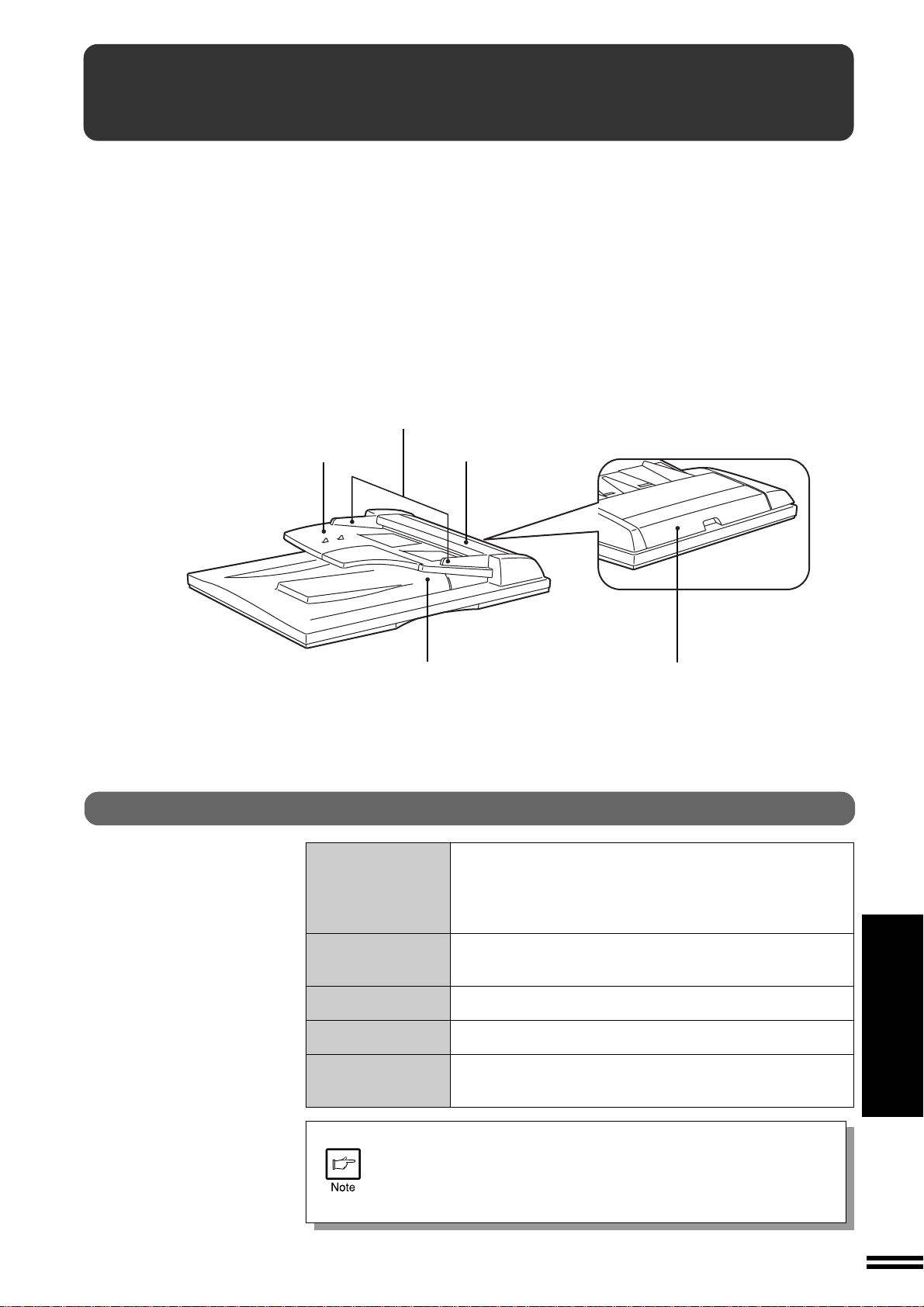
55
OPTIONAL EQUIPMENT
SINGLE PASS FEEDER (AR-SP2)
The single pass feeder (SPF) holds up to 30 originals for automatic feeding.
Single pass feeder (AR-SP2)
PART NAMES
Specifications
Acceptable Weight: 56 to 90 g/m
2
(15 to 24 lbs.)
originals Size: A5 to A3 (5-1/2" x 8-1/2" to 11" x 17")
Capacity: Up to 30 sheets provided the total aggregate thickness
does not exceed 4 mm (5/32")
Detectable original A5, A4, A4R, B4, A3 (5-1/2" x 8-1/2", 8-1/2" x 11",
sizes 8-1/2" x 11"R, 8-1/2" x 13", 8-1/2" x 14", 11" x 17")
Power supply Drawn from the copier
Weight Approx. 5.3 kg (11.7 lbs.)
Dimensions 583 mm (W) x 435 mm (D) x 131 mm (H)
(22-61/64" (W) x 17-1/8" (D) x 5-5/32" (H))
Document feeder tray Left feeding roller cover
Right feeding roller cover
Original guides
Exit area
As a part of our policy of continuous improvement, SHARP reserves
the right to make design and specification changes for product
improvement without prior notice. The performance specification
figures indicated are nominal values of production units. There may
be some deviations from these values in individual units.

56
OPTIONAL EQUIPMENT
SINGLE PASS FEEDER (AR-SP2)
Using the SPF
●
Be sure to remove any staples or paper clips from the
originals.
●
Damaged or crumpled originals may misfeed in the SPF.
It is recommended that these originals be copied from the
original table.
●
Before placing curled or wavy originals into the document
feeder tray, be sure to flatten them. If not, original misfeeds
may result.
●
For best feeding of originals which have binding holes
punched into them, insert them so that the holes are
positioned to the right or along the side guides.
●
Special originals such as transparency film and tracing
paper should not be fed through the SPF but should be
copied from the original table.
1
Ensure that no original is left on the original table.
2
Adjust the original guides to the size of the originals.
3
Set the originals face up in the document feeder tray.
●
The SPF indicator will light up. If this indicator does not light up, the
originals are not properly set or the SPF is not properly closed.
4
Ensure that the copy paper size in the paper tray is the
same size as the originals.
●
If an optional paper feed unit is installed, a paper tray with the
corresponding paper size will be automatically selected.
5
Press the START ( ) key.
●
Since only one copy per original can be made, the number of copies
cannot be changed. However, if an optional electronic sorting kit is
installed, a multiple number of copies can be set using the numeric
keys.
●
In some regions, the copier is equipped with a 1-
page memory buffer. The number of copies can be
specified even if an optional electronic sorting kit is
not installed.
●
While making copies from the SPF, do not place
originals of the next copying job. Place them after all
copies of the current job have been output.
●
Press the CLEAR ( ) key to stop copying in the middle of a run.
Single pass feeder (AR-SP2)
Stream feeding mode
If the stream feeding mode has been enabled using user program
No. 4, the SPF indicator will continue to blink for approximately
5 seconds after feeding of all originals is completed. While this
indicator is blinking, any new originals placed in the SPF will be
fed and copied automatically. See page 35, USER PROGRAMS.
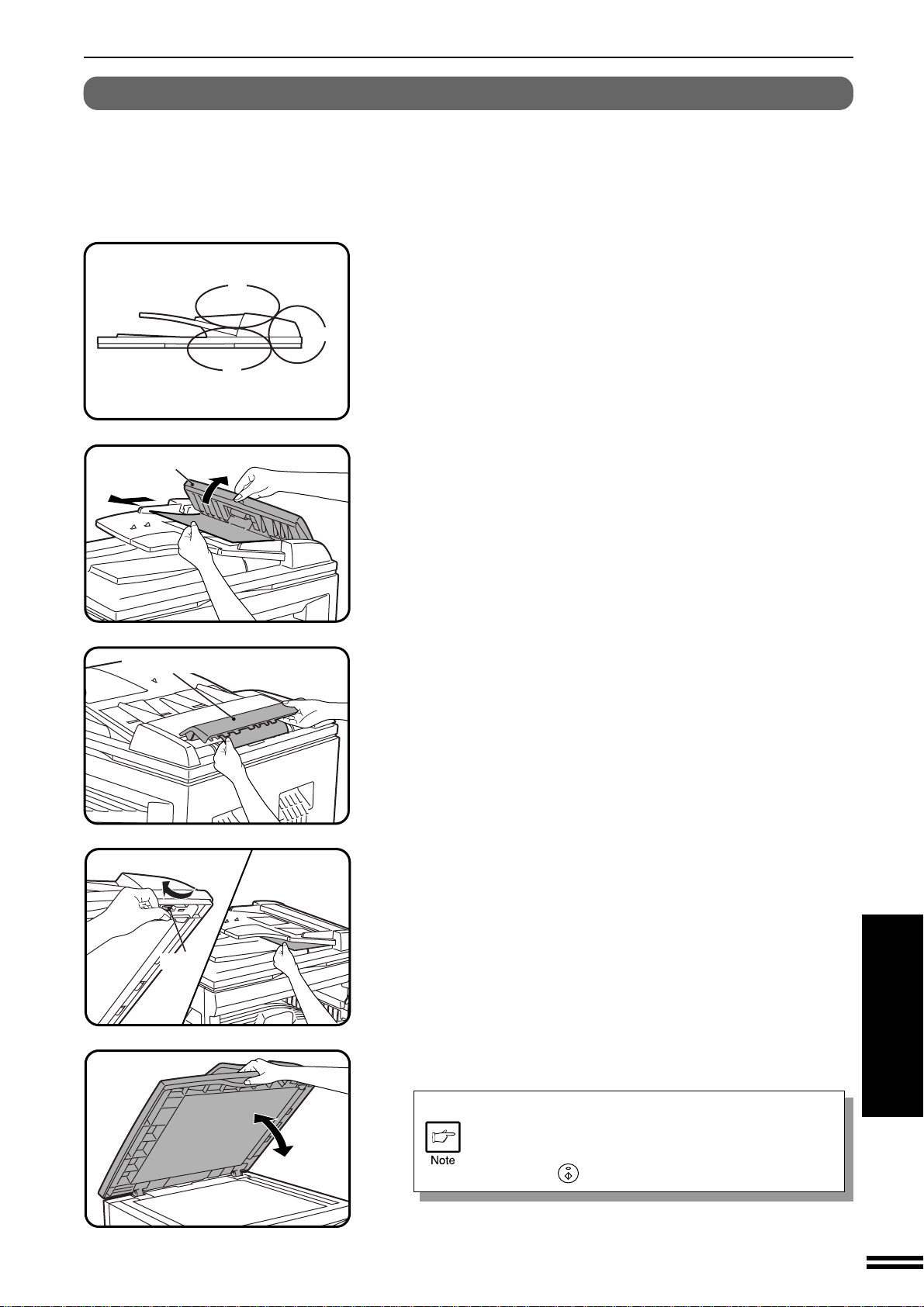
57
OPTIONAL EQUIPMENT
SINGLE PASS FEEDER (AR-SP2)
Misfeed removal
Location A
Location B
Location C
Single pass feeder (AR-SP2)
If an original misfeed occurs in the SPF, the copier will
stop and the red indicator which indicates an original
misfeed will blink.
1
Open the left feeding roller cover and pull the original
gently to the left and out from the document feeder tray.
Close the left feeding roller cover.
2
If the misfed original cannot be removed in step 1, open
the right feeding roller cover and remove the misfed
original. Close the right feeding roller cover.
3
If the misfed original cannot be removed in steps 1 and
2, remove the misfed original from the exit area. Open
the document feeder cover and rotate the roller in the
direction indicated by the arrow if needed.
If the misfed original cannot be easily removed from the
exit area, open the front part of the document feeder tray
to remove the original.
4
Open and close the document feeder cover to cancel the
misfeed location indicator.
After misfed originals are removed, a number may
appear in the copy quantity display, indicating the
number of originals that must be returned to the
document feeder tray. Return the originals and press
the START ( ) key to resume copying.
A
C
B
Left feeding roller cover
Right feeding roller cover
Roller
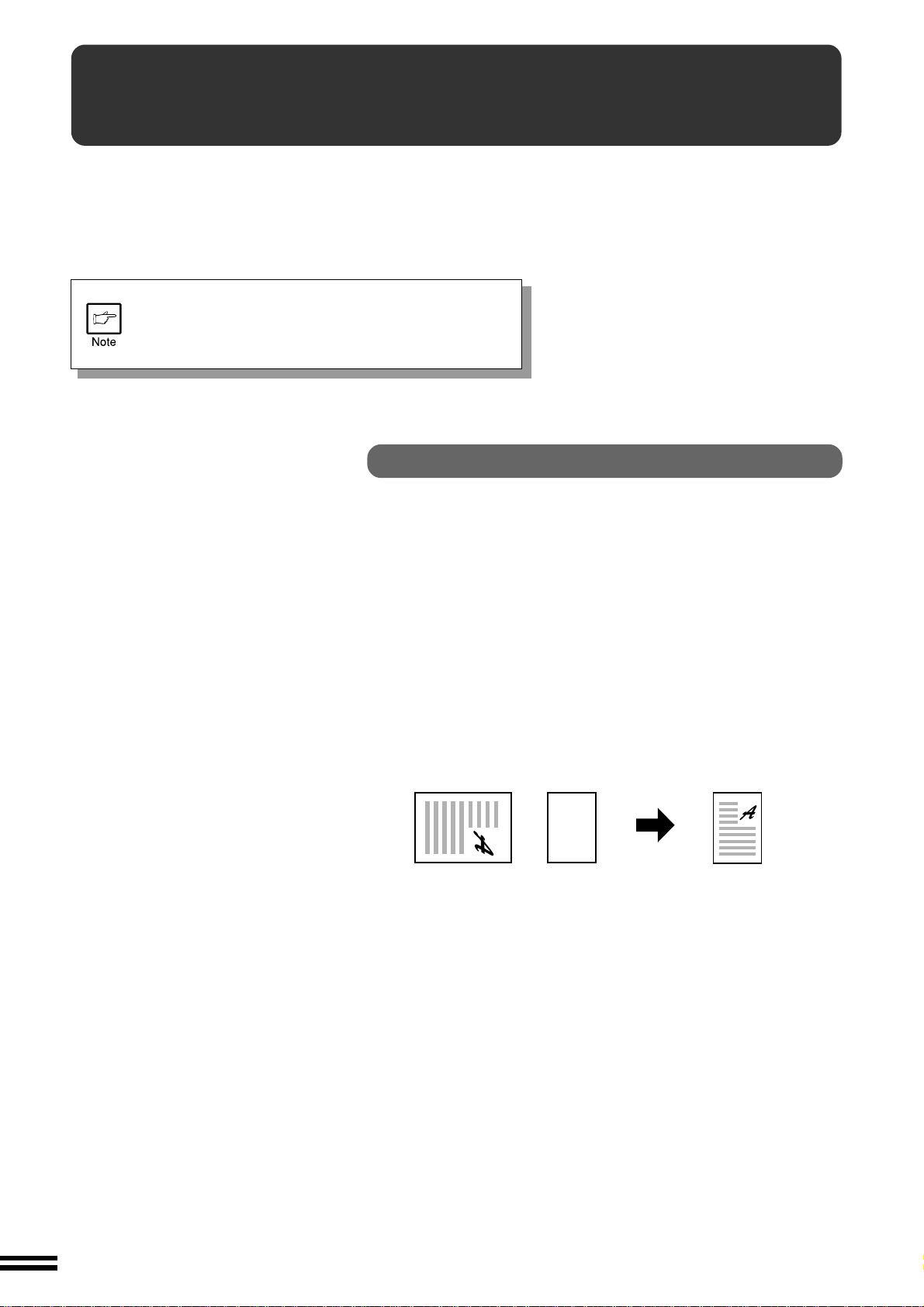
58
OPTIONAL EQUIPMENT
Electronic sorting kit (AR-EB3)
Original Paper
Copy
Rotation copying
If user program No. 7 is set, the image of the original will rotate when the
orientation of the original does not match that of the copy paper. Rotation
copying will function only if the AUTO PAPER SELECT mode or AUTO
IMAGE mode has been selected. Even if user program No. 7 is not set,
rotation copying will function when the 2 in 1 or 4 in 1 function is selected.
See page 35. However, if enlargement copying onto a paper size larger than
A4 (8-1/2" x 11") is performed, the image cannot be rotated.
When this occurs, the detected size and orientation of the original will be
indicated by a steadily lighted indicator and a flashing indicator will show the
required orientation of the original. The original must be rotated 90° to match
the flashing indicator to prevent image loss on the copies.
Example: Copying from an A3 (11" x 17") original onto A4 (8-1/2" x 11")
paper
ELECTRONIC SORTING KIT (AR-EB3)
If an electronic sorting kit (AR-EB3) is installed, the copier can perform
several additional useful functions. These functions are 2 in 1 and 4 in 1,
erase, margin shift, and sort/group functions. Also, rotation copying can be
performed and a multiple number of originals can be scanned and stored into
the memory. The memory can be expanded by adding commercially available
memories recommended by SHARP. For details, contact your dealer.
To use the 2 in 1 or 4 in 1 and sort/group functions, an
optional SPF (AR-SP2) is needed. When installing an
electronic sorting kit, it is recommended to install a single
pass feeder.
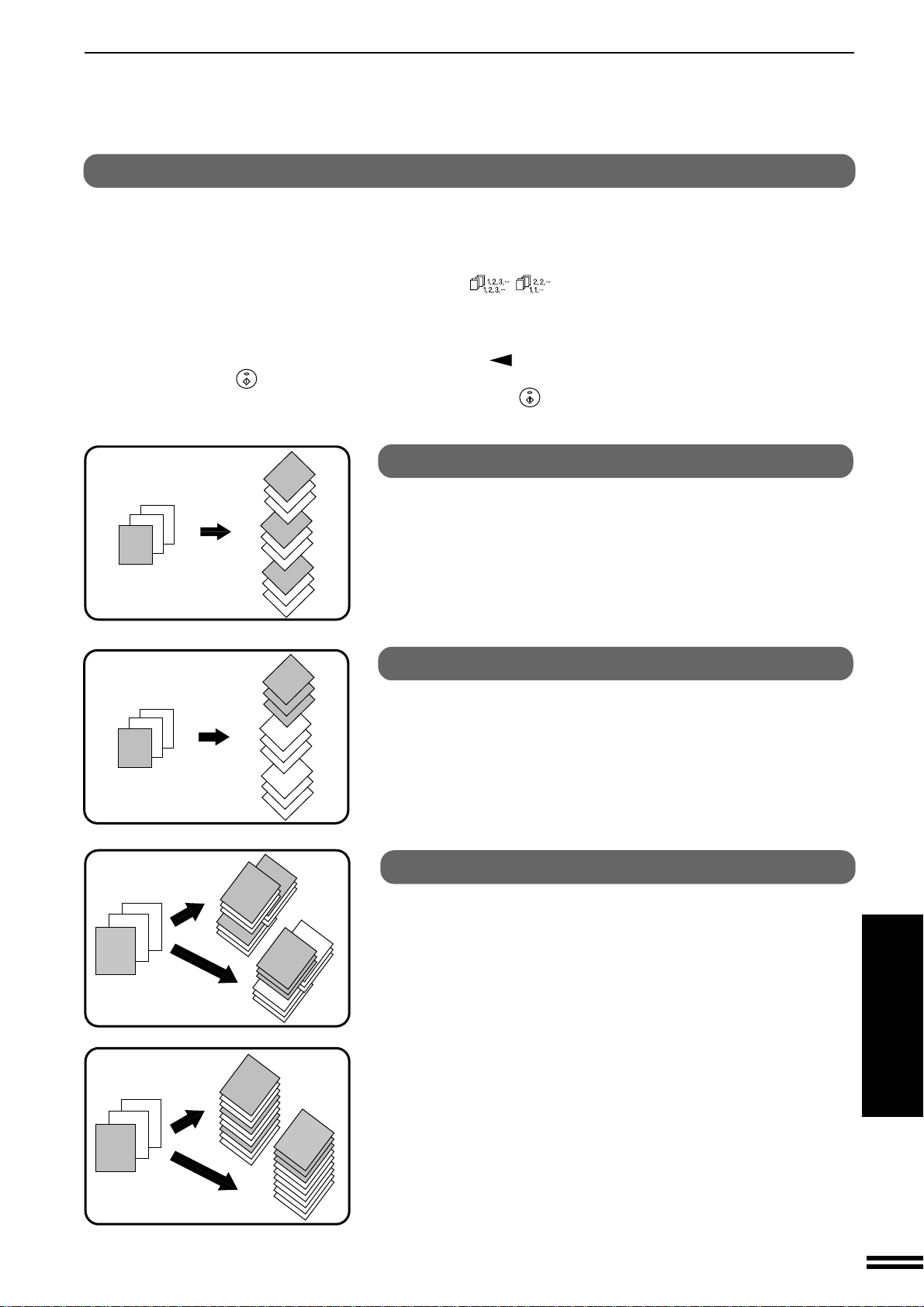
59
OPTIONAL EQUIPMENT
Sort/group
If an optional electronic sorting kit is installed, the copier will have two
sorter modes for different copying jobs: one sorts copies into sets matching the sequence
of the originals and the second groups copies by originals.
The sort/group feature cannot be used with the dual page copy feature.
To change the SORT/GROUP mode, press the SORT/GROUP ( / ) key to select
the desired mode.
●
The capacity of the paper output tray is 250 sheets (150 sheets if an optional job separator
tray kit (AR-TR2) is installed). When the number of copies output reaches this limit in
a sort or a group copy run, copying will stop, the output tray full ( ) indicator will light
and the START key ( ) indicator will blink.
Remove the copies from the paper output tray and press the START ( ) key to resume
copying.
ELECTRONIC SORTING KIT (AR-EB3)
Electronic sorting kit (AR-EB3)
Sort mode
Each set of copies will be sequentially delivered to the
paper output tray.
Group mode
All copies of the same originals will be grouped in the
paper output tray.
Offset stack
If the offset stack mode is enabled using user program
No. 19, each copy will be offset by approximately 25 mm
(1 inch). When copying in the sort mode, each collated
set of copies will be stacked offset from the previous
set. When copying in the group mode, copies will be
offset and stacked in groups of multiple copies from the
same original.
If the offset stack mode is disabled, copies will not be
offset.
The offset stack mode is enabled in the factory default
setting.
1
2
3
1
1
1
1
2
1
Offset mode
1
1
2
3
1
Non-offset mode
1
2
3
3
2
1
3
2
1
3
2
1
1
2
3
3
3
2
3
2
1
1
1
2
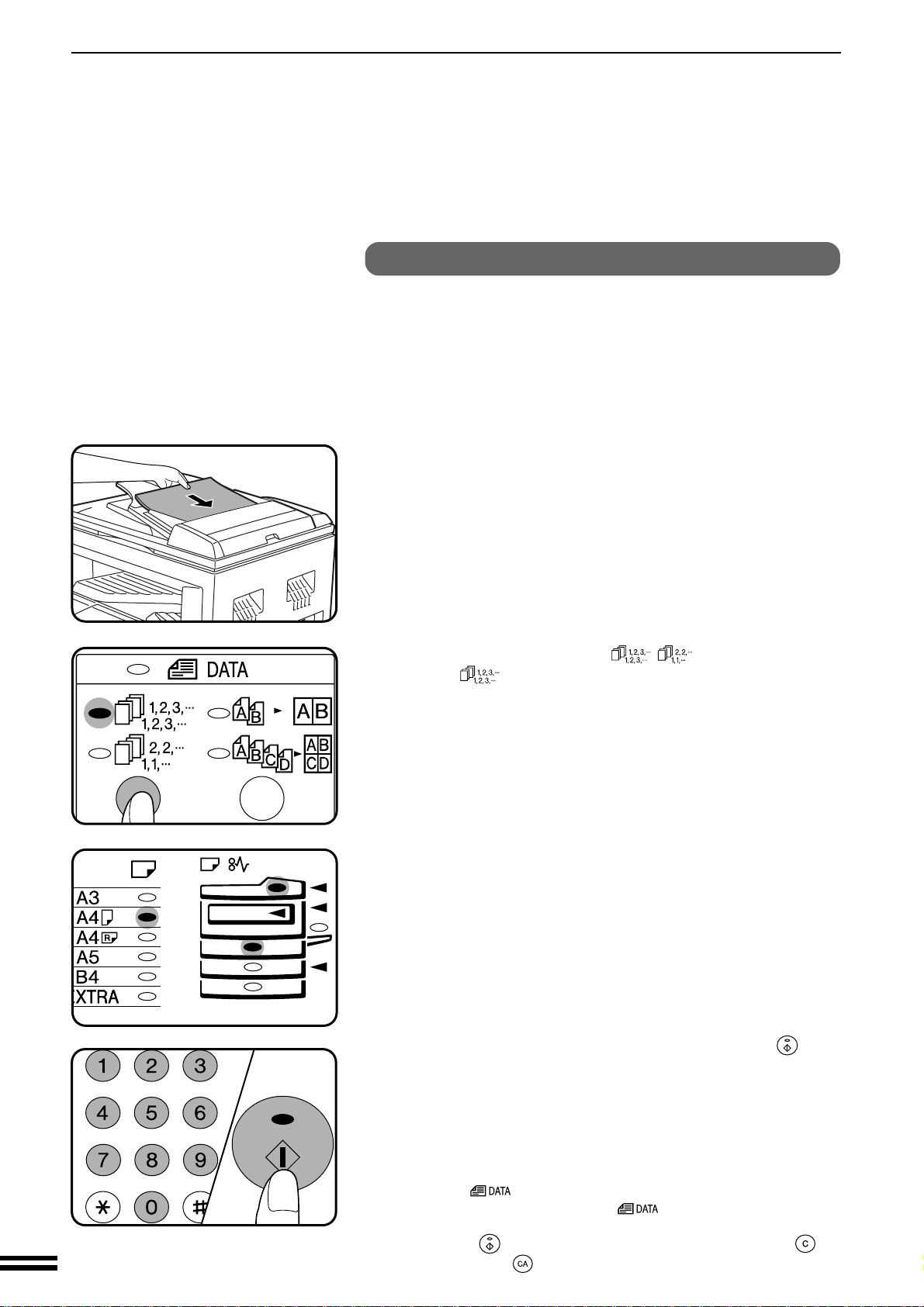
60
OPTIONAL EQUIPMENT
Copying in the sort mode
When copying in the sort mode, the original image will be stored in the copier
memory each time an original is scanned and copying will start after all
originals have been scanned. To copy in the sort mode, an optional SPF
(AR-SP2) is needed.
1
Set the originals face up in the document feeder tray.
●
The original table cannot be used for sort copying.
2
Press the SORT/GROUP ( / ) key to select the
SORT ( ) mode.
3
Ensure that the copy paper size in the paper tray is the
same size as the originals.
●
If an optional paper feed unit is installed, a paper tray with the
corresponding paper size will be automatically selected.
4
Set the number of copies and press the START ( ) key.
●
Copying will start after the originals have been scanned. Up to 30
sheets of originals can be scanned. (If originals are fed continuously
using the stream feeding mode, up to approximately 60 sheets of A4
(8-1/2" x 11") originals can be scanned. However, when copying
originals which require more memory such as photographs, the
number of originals which can be scanned will be less.) When the
memory becomes full of scanned original image data, the ORIGINAL
DATA ( ) indicator will blink.
When the ORIGINAL DATA ( ) indicator blinks, the copier
will stop scanning. To start copying of scanned originals, press the
START ( ) key. To cancel copying, press the CLEAR ( ) or
CLEAR ALL ( ) key.
ELECTRONIC SORTING KIT (AR-EB3)
Electronic sorting kit (AR-EB3)
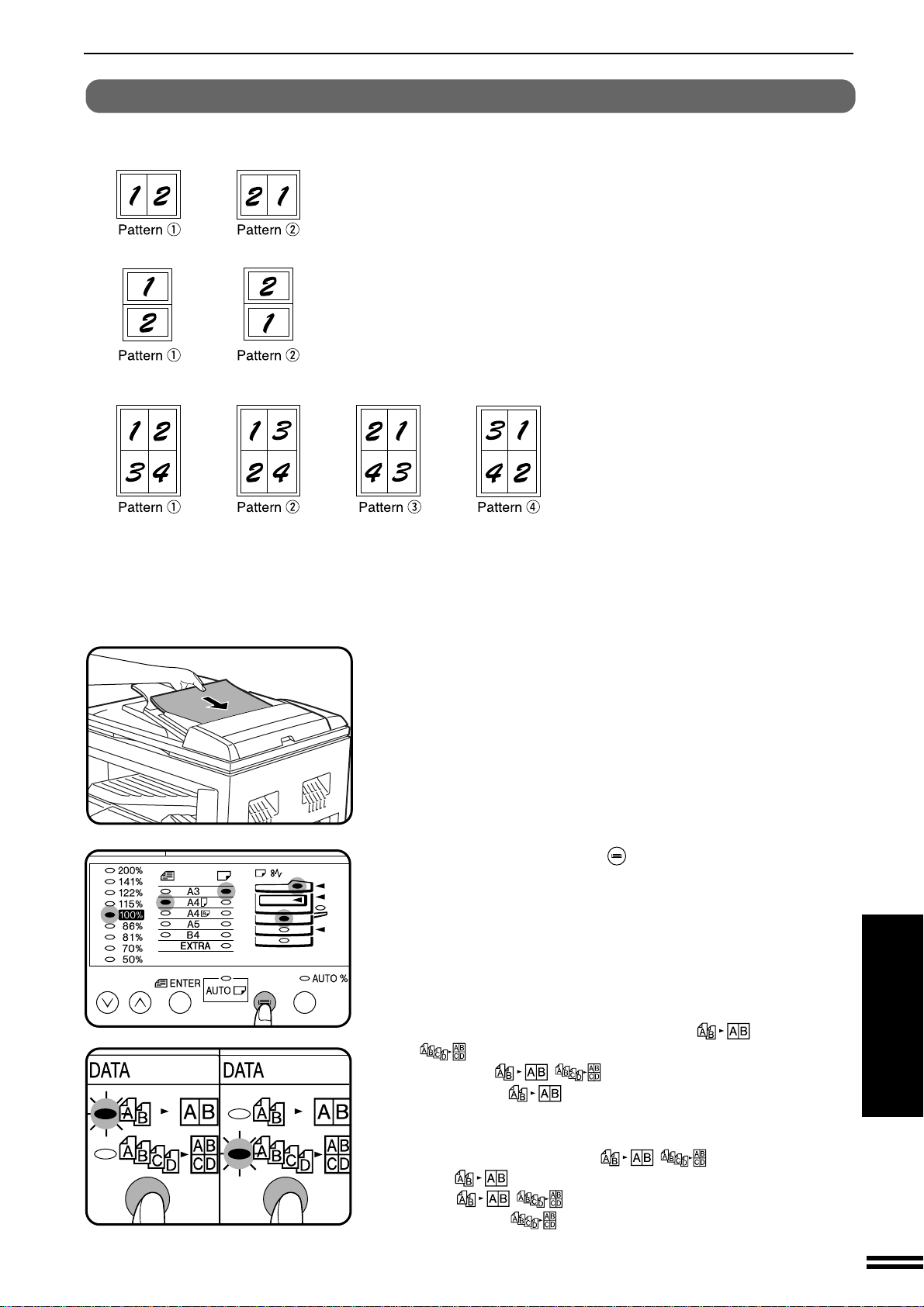
61
OPTIONAL EQUIPMENT
4 in 1 copying
2 in 1 copying
The 2 in 1 or 4 in 1 feature is used to copy 2 or 4 originals, collectively in a specified
order, onto one sheet.
To use these features, an optional SPF (AR-SP2) is needed.
●
These features cannot be used with the dual page copying, XY zoom, erase, or
margin shift features.
●
Copies can be made with or without the border lines shown in the illustration. See
user program No.6 on page 35.
●
The order of originals which will be arranged on the copies can be selected by
user programs. There are two patterns of layout for 2 in 1 copying and four
patterns of layout for 4 in 1 copying. See user program No.17 and No.18 on page
35.
●
The 2 in 1 or 4 in 1 feature operates only in the sort or group mode. If the 2 in 1
or 4 in 1 feature is selected when either the sort or group mode has not been
selected, the group mode will be automatically selected.
2 in 1 or 4 in 1
1
Set the originals face up in the document feeder tray.
●
The original table cannot be used for the 2 in 1 or 4 in 1 feature.
2
Use the TRAY SELECT ( ) key to select the paper tray
with the desired paper size.
●
The bypass tray and any tray with non-standard size paper cannot be
used with the 2 in 1 or 4 in 1 feature.
3
To confirm or set the layout pattern for 2 in 1 copying,
first ensure that both the 2 IN 1 ( ) and 4 IN 1
( ) indicators are not lit then press and hold the 2 IN
1 / 4 IN 1 ( / ) key for more than 5 seconds.
●
The 2 IN 1 ( ) indicator will blink and the currently selected
layout pattern number will blink in the copy quantity display.
To confirm or set the layout pattern for 4 in 1 copying,
use the 2 IN 1 / 4 IN 1 ( / ) key to light the 2
IN 1 ( ) indicator then press and hold the 2 IN 1 / 4
IN 1 ( / ) key for more than 5 seconds.
●
The 4 IN 1 ( ) indicator will blink and the currently selected
layout pattern number will blink in the copy quantity display.
ELECTRONIC SORTING KIT (AR-EB3)
Electronic sorting kit (AR-EB3)
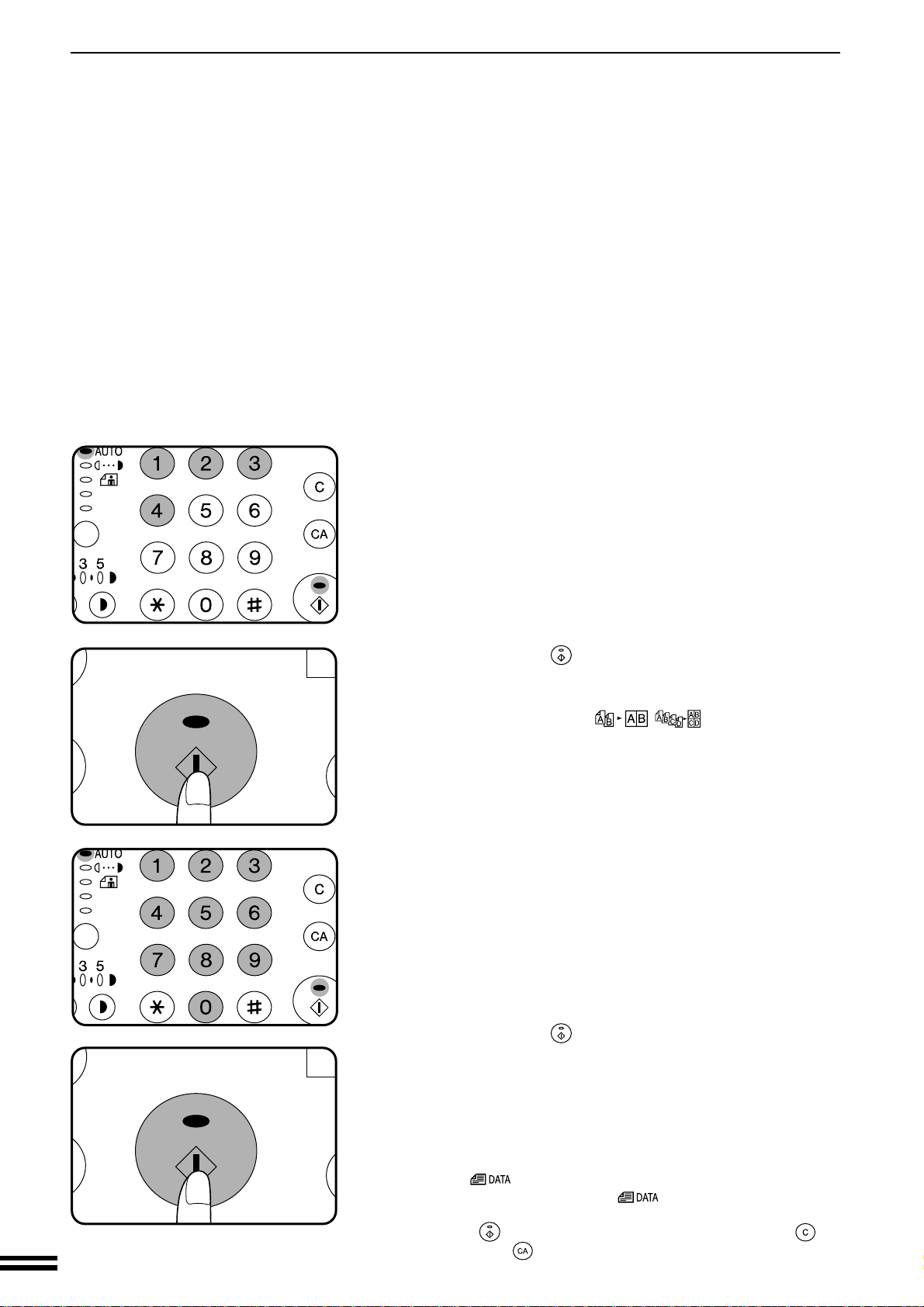
62
OPTIONAL EQUIPMENT
4
Enter the desired pattern number using a numeric key.
●
The entered number will blink in the copy quantity display. For layout
pattern numbers, see the previous page.
5
Press the START ( ) key.
●
The entered number will light up steadily.
6
Press the 2 IN 1 / 4 IN 1 ( / ) key to complete
the selection.
●
The copy ratio will be calculated automatically. If the calculated copy
ratio is less than 50%, part of original image may not be copied
because the smallest copy ratio is 50%.
7
Set the number of copies.
8
Press the START ( ) key.
●
Copying will start after the originals have been scanned. Up to 30
sheets of originals can be scanned. (If originals are fed continuously
using the stream feeding mode, up to approximately 60 sheets of A4
(8-1/2" x 11") originals can be scanned. However, when copying
originals which require more memory such as photographs, the
number of originals which can be scanned will be less.) When the
memory becomes full of scanned original image data, the ORIGINAL
DATA ( ) indicator will blink.
When the ORIGINAL DATA ( ) indicator blinks, the copier
will stop scanning. To start copying of scanned originals, press the
START ( ) key. To cancel copying, press the CLEAR ( ) or
CLEAR ALL ( ) key.
ELECTRONIC SORTING KIT (AR-EB3)
Electronic sorting kit (AR-EB3)
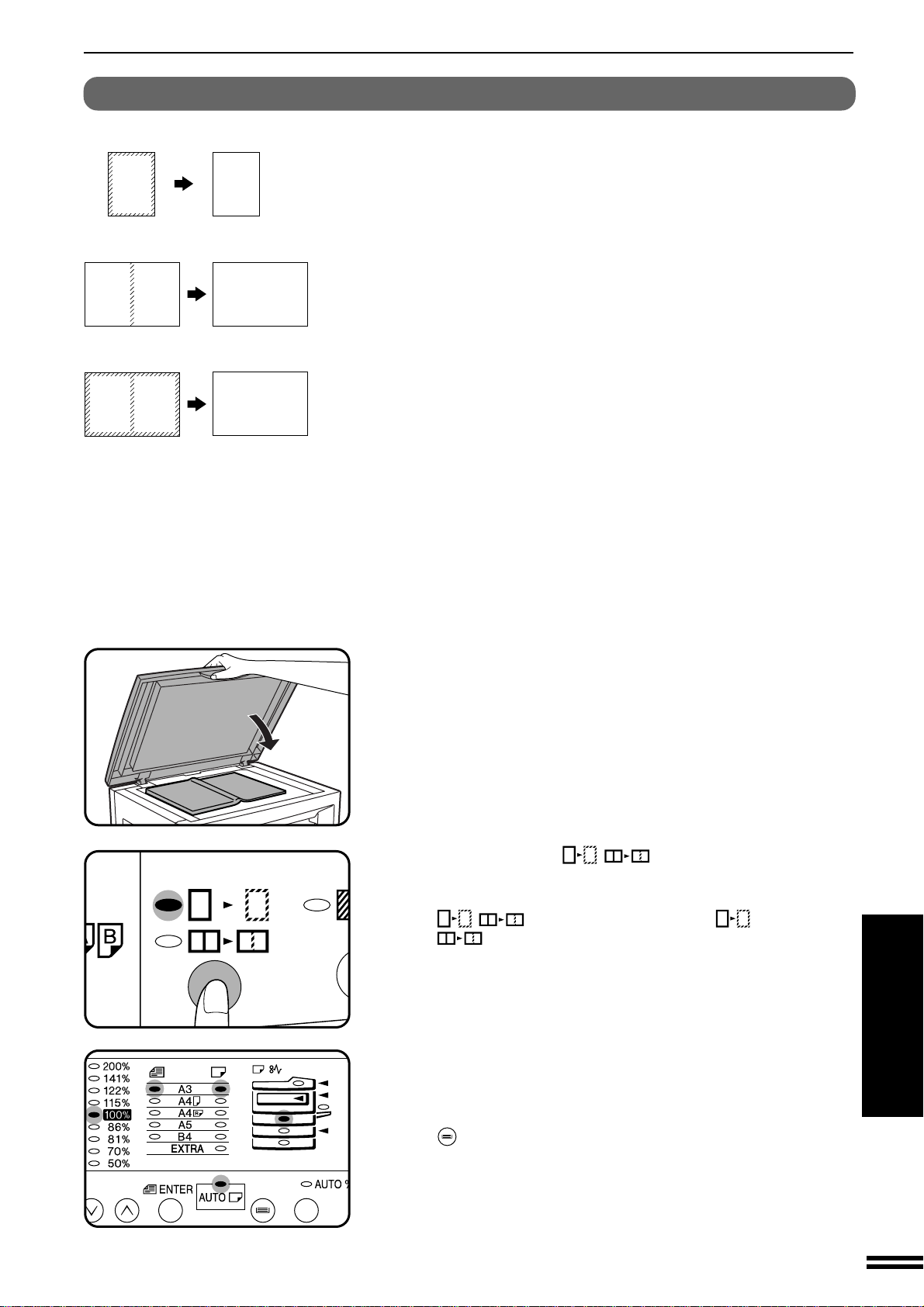
63
OPTIONAL EQUIPMENT
Erase
This copier has an edge erase mode and a centre erase mode.
●
Edge erase can be used to eliminate shadow lines around the edges of
copies caused when thick paper or a book is used as an original.
●
Centre erase can be used to eliminate the shadow produced by the
bindings of bound documents.
●
Edge + centre erase can be used to eliminate shadow lines around the
edges of copies and to eliminate the shadow at the centre of copies.
●
The erase width can be set from 0 to 20 mm (0" to 1") in five steps using
user program No. 16. See page 35.
●
This feature cannot be used with the 2 in 1 or 4 in 1 feature.
1
Place the original on the original table and close the
platen cover.
●
If an optional SPF is installed, it can also be used for this feature.
2
Press the ERASE ( / ) key to select the desired
erase mode.
●
To select the EDGE + CENTRE ERASE mode, press the ERASE
( / ) key until both the EDGE ( ) and CENTRE
( ) indicators light up.
3
Check the copy paper size.
●
The bypass tray and any tray with non-standard size paper cannot be
used for this feature.
●
If an optional paper feed unit is installed, use the TRAY SELECT
( ) key to select the desired paper size.
ELECTRONIC SORTING KIT (AR-EB3)
A B
A B
A
A
A B
A B
Centre erase
Edge + Centre erase
Edge erase
Electronic sorting kit (AR-EB3)

64
OPTIONAL EQUIPMENT
4
Set the number of copies.
5
Press the START ( ) key.
ELECTRONIC SORTING KIT (AR-EB3)
Electronic sorting kit (AR-EB3)
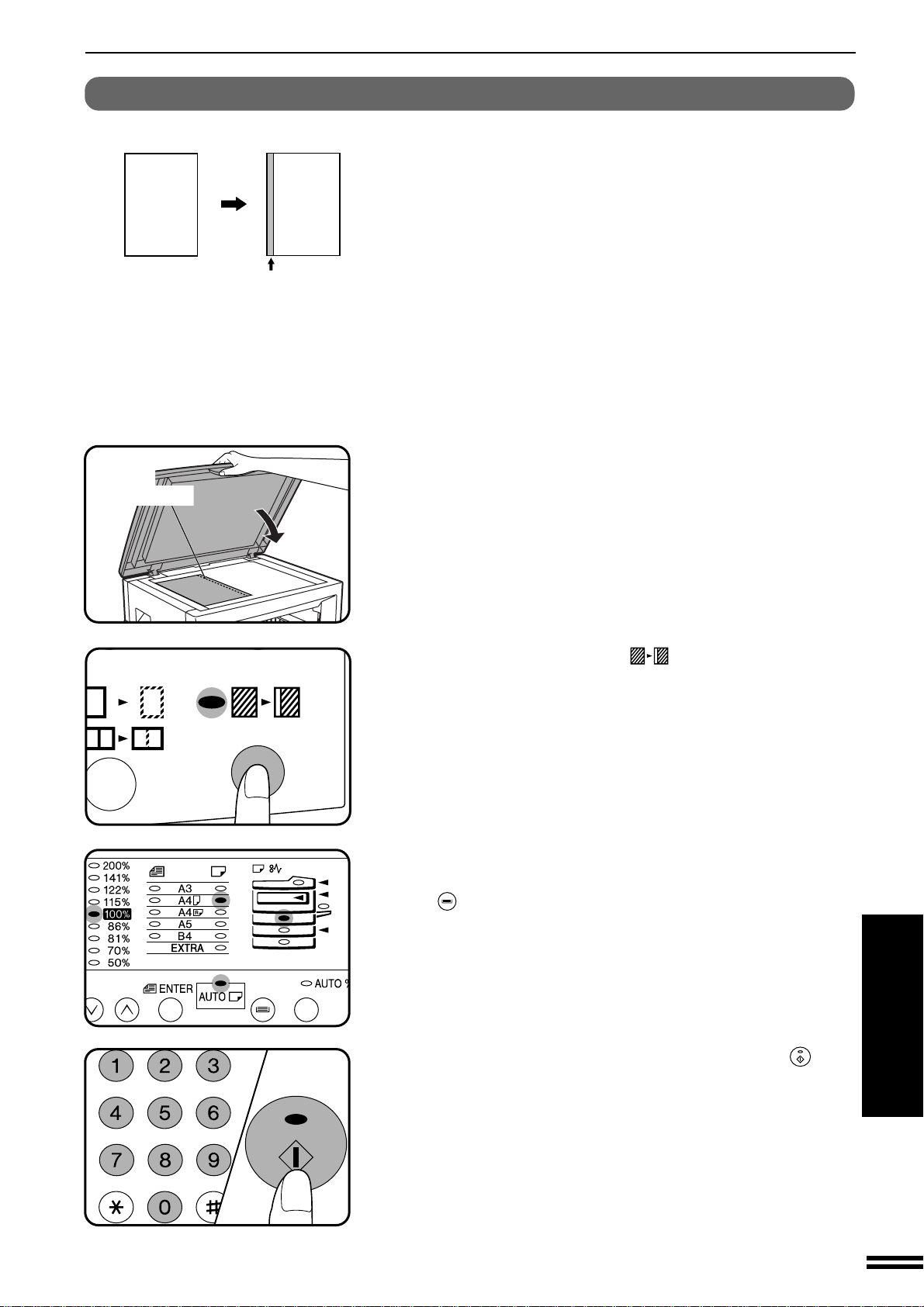
65
OPTIONAL EQUIPMENT
Margin shift
The MARGIN SHIFT feature automatically shifts the text or image to the
right to increase the left margin by approximately 9 mm (1/4").
●
This feature cannot be used with the 2 in 1 or 4 in 1 feature.
1
Place the original on the original table and close the
platen cover.
●
If an optional SPF is installed, it can also be used for this feature. Set
the originals so that the margin side is positioned at the left side.
2
Press the MARGIN SHIFT ( ) key.
3
Check the copy paper size.
●
If an optional paper feed unit is installed, use the TRAY SELECT
( ) key to select the desired paper size.
4
Set the number of copies and press the START ( ) key.
ELECTRONIC SORTING KIT (AR-EB3)
Expanded margin
Copy
Original
Margin is
expanded here.
Electronic sorting kit (AR-EB3)
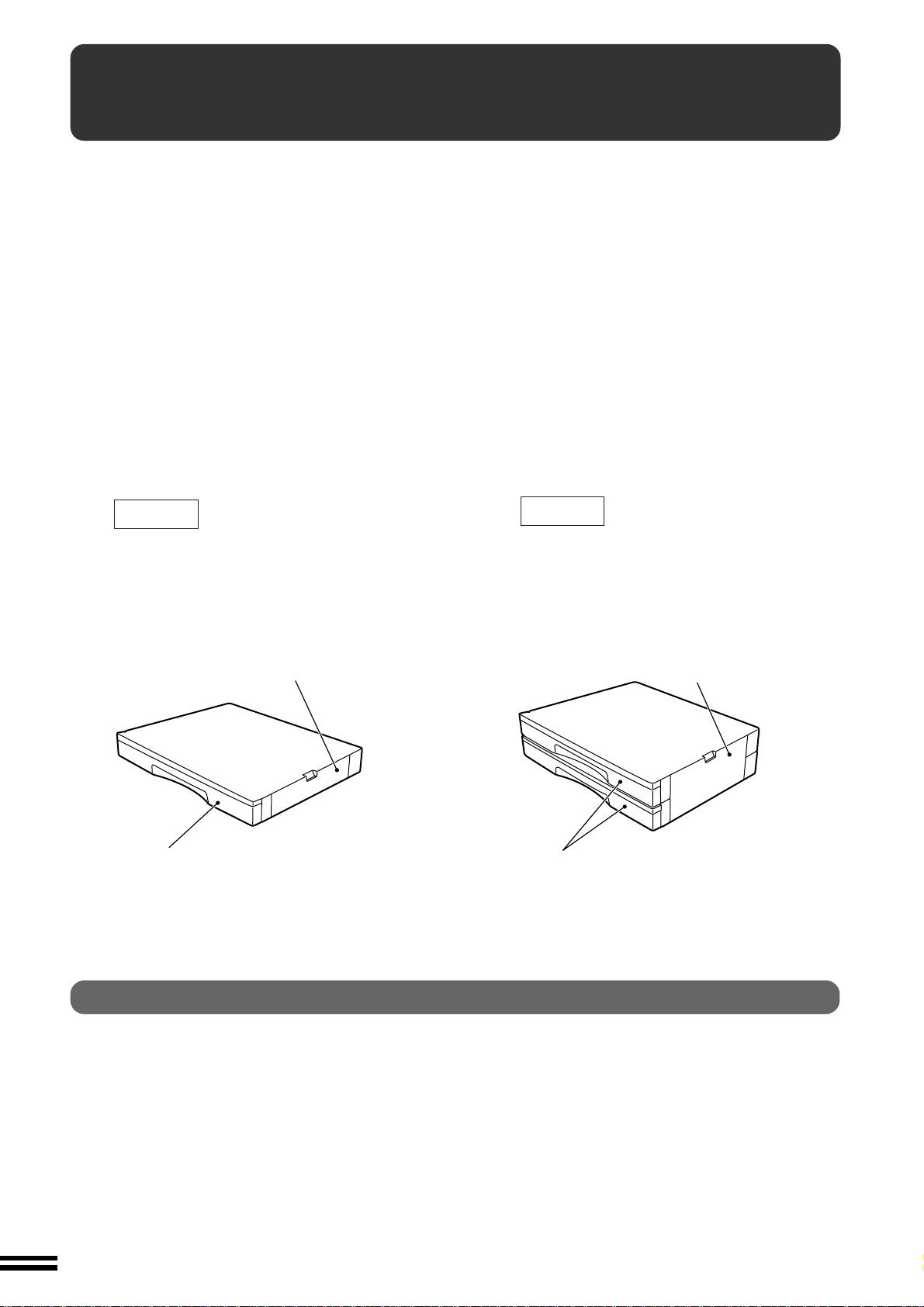
66
OPTIONAL EQUIPMENT
Loading copy paper
The method of loading copy paper for the paper trays of these paper feed units
is the same as for the paper tray in the copier. See page 10.
The method of changing the copy paper size is also the same for the paper tray
in the copier. See page 11.
250-SHEET PAPER FEED UNIT
(AR-DE5)
2x250-SHEET PAPER FEED UNIT
(AR-DE6)
These paper feed units provide the convenience of increased paper capacity
for the copier and a greater choice of paper sizes readily available for
copying.
The AR-DE5 contains one 250-sheet paper tray and the AR-DE6 contains
two 250-sheet paper trays.
PART NAMES
250-sheet paper feed unit (AR-DE5)
2x250-sheet paper feed unit (AR-DE6)
Trays
Side cover
Side cover
Tray
AR-DE5
AR-DE6
250-sheet paper feed unit 2 x 250-sheet paper feed unit
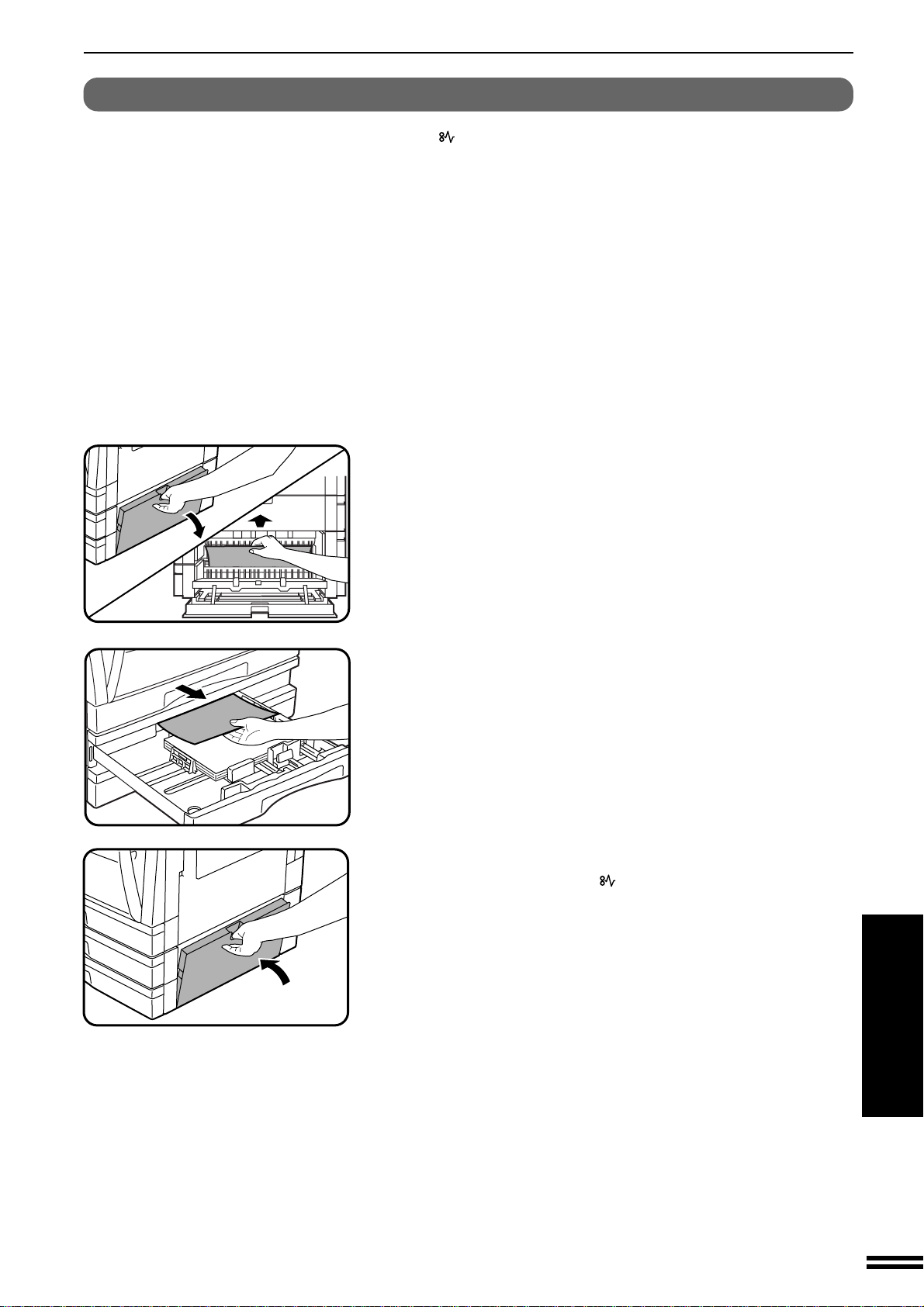
67
OPTIONAL EQUIPMENT
Misfeed removal
The copier will stop when a misfeed occurs. The misfeed ( ) indicator and
the red indicator which indicates the paper feed unit will blink.
1
Open the side cover of the paper feed unit and remove
the misfed paper.
●
Be sure to perform this step before pulling out the paper trays. If not,
the paper may be torn as the trays are opened.
2
Gently lift and pull out the paper tray which was in use.
Remove any misfed paper.
3
Close the paper tray and the side cover.
●
Confirm that the misfeed ( ) indicator has gone out.
250-SHEET PAPER FEED UNIT (AR-DE5)/2x250-SHEET PAPER FEED UNIT (AR-DE6)
250-sheet paper feed unit (AR-DE5)
2x250-sheet paper feed unit (AR-DE6)
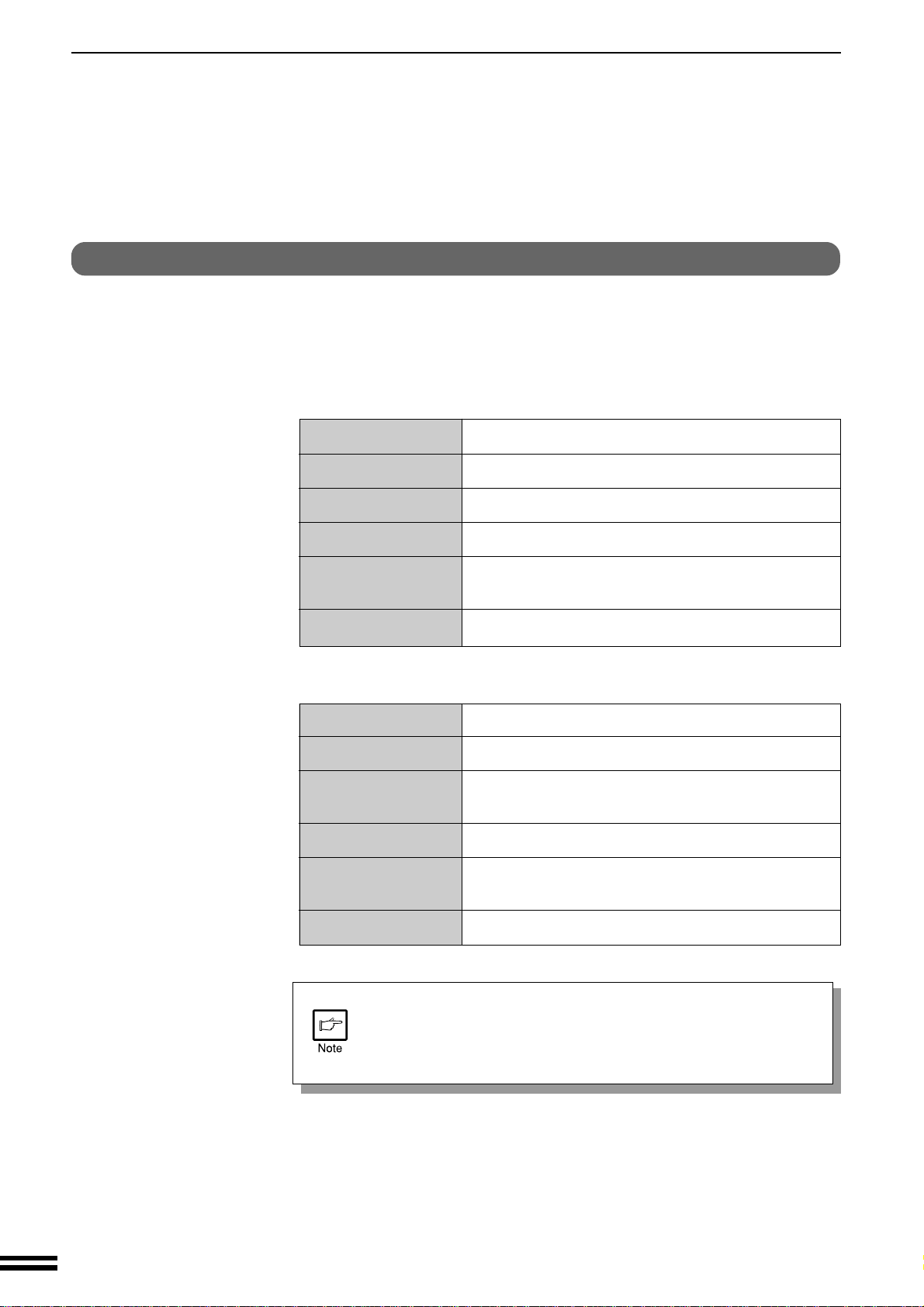
68
OPTIONAL EQUIPMENT
Specifications
Copy paper size A4 to A3 (8-1/2" x 11" to 11" x 17")
Paper weight 56 to 80 g/m
2
(15 lbs. to 21 lbs.)
Paper capacity One paper tray with capacity for 250 sheets of paper
Weight Approx. 4.7 kg (10.4 lbs.)
Dimensions 590 mm (W) x 471 mm (D) x 88 mm (H)
(23-15/64" (W) x 18-35/64" (D) x 3-15/32" (H))
Power supply Drawn from the copier
Copy paper size A4 to A3 (8-1/2" x 11" to 11" x 17")
Paper weight 56 to 80 g/m
2
(15 lbs. to 21 lbs.)
Paper capacity Two paper trays with capacity for 250 sheets of paper
each
Weight Approx. 9.1 kg (20.1 lbs.)
Dimensions 590 mm (W) x 471 mm (D) x 173.5 mm (H)
(23-15/64" (W) x 18-35/64" (D) x 6-27/32" (H))
Power supply Drawn from the copier
250-SHEET PAPER FEED UNIT (AR-DE5)/2x250-SHEET PAPER FEED UNIT (AR-DE6)
AR-DE5
AR-DE6
As a part of our policy of continuous improvement, SHARP reserves
the right to make design and specification changes for product
improvement without prior notice. The performance specification
figures indicated are nominal values of production units. There may
be some deviations from these values in individual units.
250-sheet paper feed unit (AR-DE5)
2x250-sheet paper feed unit (AR-DE6)

69
2
250-sheet paper feed unit . . . . . . . . . . . . . . . . . . . . . . . 66
2 in 1 . . . . . . . . . . . . . . . . . . . . . . . . . . . . . . . . . . . . . . . 61
2x250-sheet paper feed unit . . . . . . . . . . . . . . . . . . . . . 66
4
4 in 1 . . . . . . . . . . . . . . . . . . . . . . . . . . . . . . . . . . . . . . . 61
A
Auto clear . . . . . . . . . . . . . . . . . . . . . . . . . . . . . . . . . . . . 7
Automatic exposure adjustment . . . . . . . . . . . . . . . . . . 26
Auto power shut-off mode . . . . . . . . . . . . . . . . . . . . . . 42
B
B/W reverse . . . . . . . . . . . . . . . . . . . . . . . . . . . . . . . . . 23
Bypass tray . . . . . . . . . . . . . . . . . . . . . . . . . . . . . . . . . . 18
C
Cautions on handling . . . . . . . . . . . . . . . . . . . . . . . . . . . 9
Copier trouble? . . . . . . . . . . . . . . . . . . . . . . . . . . . . . . . 46
Copying
– large original . . . . . . . . . . . . . . . . . . . . . . . . . . . . . . . 15
– normal . . . . . . . . . . . . . . . . . . . . . . . . . . . . . . . . . . . . 14
– reduction/enlargement. . . . . . . . . . . . . . . . . . . . . . . . 16
– through bypass tray . . . . . . . . . . . . . . . . . . . . . . . . . . 18
– two-sided . . . . . . . . . . . . . . . . . . . . . . . . . . . . . . . . . . 20
Copy paper . . . . . . . . . . . . . . . . . . . . . . . . . . . . . . 10, 49
Copy quantity . . . . . . . . . . . . . . . . . . . . . . . . . . . . . . . . 15
Copy ratio . . . . . . . . . . . . . . . . . . . . . . . . . . . . . . . . . . . 16
D
Dark key . . . . . . . . . . . . . . . . . . . . . . . . . . . . . . . . . . . . 15
Developer replacement required indicator . . . . . . . . . . 34
Dual page copy . . . . . . . . . . . . . . . . . . . . . . . . . . . . . . . 24
E
Electronic sorting kit . . . . . . . . . . . . . . . . . . . . . . . . . . 58
Enlargement . . . . . . . . . . . . . . . . . . . . . . . . . . . . . . . . . 16
Erase . . . . . . . . . . . . . . . . . . . . . . . . . . . . . . . . . . . . . . . 63
Exposure adjustment . . . . . . . . . . . . . . . . . . . . . . . . . . 14
F
Features. . . . . . . . . . . . . . . . . . . . . . . . . . . . . . . . . . . . . . 3
Fixed copy ratio . . . . . . . . . . . . . . . . . . . . . . . . . . . . . . 17
Fusing unit release lever. . . . . . . . . . . . . . . . . . . . . . . . 32
G
Group . . . . . . . . . . . . . . . . . . . . . . . . . . . . . . . . . . . . . . 59
I
Initial settings . . . . . . . . . . . . . . . . . . . . . . . . . . . . . . . . . 7
Interrupt . . . . . . . . . . . . . . . . . . . . . . . . . . . . . . . . . . . . 25
L
Light key. . . . . . . . . . . . . . . . . . . . . . . . . . . . . . 15, 29, 36
Loading copy paper . . . . . . . . . . . . . . . . . . . . . . . . . . . 10
M
Maintenance
– user maintenance. . . . . . . . . . . . . . . . . . . . . . . . . . . . 44
– maintenance required indicator . . . . . . . . . . . . . . . . . 34
Manual exposure . . . . . . . . . . . . . . . . . . . . . . . . . . . . . 15
Manual feeding . . . . . . . . . . . . . . . . . . . . . . . . . . . . . . . 18
Margin shift . . . . . . . . . . . . . . . . . . . . . . . . . . . . . . . . . 65
Misfeed removal
– bypass tray. . . . . . . . . . . . . . . . . . . . . . . . . . . . . . . . . 30
– in the copier. . . . . . . . . . . . . . . . . . . . . . . . . . . . . . . . 30
– paper tray. . . . . . . . . . . . . . . . . . . . . . . . . . . . . . . 33, 67
– SPF . . . . . . . . . . . . . . . . . . . . . . . . . . . . . . . . . . . . . . 57
N
Names
– operation panel . . . . . . . . . . . . . . . . . . . . . . . . . . . . . . 6
– part . . . . . . . . . . . . . . . . . . . . . . . . . . . . . . . . . . . . . . . 4
O
Operation panel . . . . . . . . . . . . . . . . . . . . . . . . . . . . . . . 6
Options . . . . . . . . . . . . . . . . . . . . . . . . . . . . . . . . . . . . . 54
Original table . . . . . . . . . . . . . . . . . . . . . . . . . . . . . . . . . 4
P
Paper
– loading. . . . . . . . . . . . . . . . . . . . . . . . . . . . . . . . . . . . 10
– special . . . . . . . . . . . . . . . . . . . . . . . . . . . . . . . . . . . . 18
– specifications. . . . . . . . . . . . . . . . . . . . . . . . . . . . . . . 49
Paper output tray . . . . . . . . . . . . . . . . . . . . . . . . . . . . . . 4
Paper size . . . . . . . . . . . . . . . . . . . . . . . . . . . . . . . . . . . 49
Paper tray . . . . . . . . . . . . . . . . . . . . . . . . . . . . . . . . . . . 10
Part names . . . . . . . . . . . . . . . . . . . . . . . . . . . . . . . . . . . 4
Photo mode . . . . . . . . . . . . . . . . . . . . . . . . . . . . . . . . . . 15
Platen cover . . . . . . . . . . . . . . . . . . . . . . . . . . . . . . . . . . 4
Power on . . . . . . . . . . . . . . . . . . . . . . . . . . . . . . . . . . . . 14
Power save modes . . . . . . . . . . . . . . . . . . . . . . . . . . . . 42
Power switch . . . . . . . . . . . . . . . . . . . . . . . . . . . . . . . . 14
Preheat mode . . . . . . . . . . . . . . . . . . . . . . . . . . . . . . . . 42
R
Reduction . . . . . . . . . . . . . . . . . . . . . . . . . . . . . . . . . . . 16
Replacement
– toner cartridge . . . . . . . . . . . . . . . . . . . . . . . . . . . . . . 28
INDEX
Index

70
S
Single pass feeder (SPF). . . . . . . . . . . . . . . . . . . . . . . . 55
Sort . . . . . . . . . . . . . . . . . . . . . . . . . . . . . . . . . . . . . . . . 59
Special paper . . . . . . . . . . . . . . . . . . . . . . . . . . . . . . . . 18
Specifications
– copier. . . . . . . . . . . . . . . . . . . . . . . . . . . . . . . . . . . . . 51
– paper . . . . . . . . . . . . . . . . . . . . . . . . . . . . . . . . . . . . . 49
SPF . . . . . . . . . . . . . . . . . . . . . . . . . . . . . . . . . . . . . . . . 55
Status indicators . . . . . . . . . . . . . . . . . . . . . . . . . . . . . . 28
Storage of supply . . . . . . . . . . . . . . . . . . . . . . . . . . . . . 50
T
Toner cartridge life . . . . . . . . . . . . . . . . . . . . . . . . . . . . 29
Toner cartridge replacement. . . . . . . . . . . . . . . . . . . . . 28
Toner save mode . . . . . . . . . . . . . . . . . . . . . . . . . . . . . 27
Total output count . . . . . . . . . . . . . . . . . . . . . . . . . . . . . 6
Troubleshooting . . . . . . . . . . . . . . . . . . . . . . . . . . . . . . 46
Two-sided copying . . . . . . . . . . . . . . . . . . . . . . . . . . . . 20
U
User maintenance
– bypass tray paper feed roller . . . . . . . . . . . . . . . . . . . 44
– original table . . . . . . . . . . . . . . . . . . . . . . . . . . . . . . . 44
– platen cover . . . . . . . . . . . . . . . . . . . . . . . . . . . . . . . . 44
– transfer charger . . . . . . . . . . . . . . . . . . . . . . . . . . . . . 45
X
XY zoom . . . . . . . . . . . . . . . . . . . . . . . . . . . . . . . . . . . 21
Z
Zoom . . . . . . . . . . . . . . . . . . . . . . . . . . . . . . . . . . . . . . 17
INDEX
Index
71
Date Issued: Nov. 1, 2000
MATERIAL SAFETY DATA SHEET
MSDS No. F-00991
Section 1. Product Identification
Product:
AR-201NT/T/FT/ST (Black Toner)
Section 2. Supplier’s Name and Address
Sharp Corporation
22-22 Nagaike-cho, Abeno-ku, Osaka, Japan
Local suppliers are listed below. Please contact the nearest supplier for additional information.
(Country) (Name and Telephone Number)
U.S.A. Sharp Electronics Corporation
Telephone number for information: 1-800-237-4277
Emergency telephone number: 1-800-255-3924
Canada Sharp Electronics of Canada Ltd.
Telephone number for information: 905-890-2100
Emergency telephone number: 1-800-255-3924
United Kingdom Sharp Electronics (U.K.) Ltd.
Telephone number for information: 01923-474013
Section 3. Ingredients
Ingredients CAS No. Proportion OSHA PEL ACGIH TLV Other Limits
Styrene-Acrylate copolymer 29497-14-1 > 88 % Not listed Not listed None
Carbon black 1333-86-4 < 6.0% 3.5mg/m
3
3.5mg/m
3
None
Iron oxide 1309-38-2 < 4.5% Not listed Not listed None
Metal Complex dye 109125-51-1 < 1.5% 0.5mg/m
3
0.5mg/m
3
None
109125-50-0
84179-66-8
Section 4. Hazardous Identification (Emergency Overview)
Toner is a fine, black powder possessing no immediate hazard. There are no anticipated carcinogenic effects from
exposure based on animal tests performed using toner. When used as intended according to instructions, studies
do not indicate any symptoms of fibrosis will occur.
Section 5. Health Hazard Data
Route(s) of Entry: Inhalation? Skin? Ingestion?
Yes No Possible but very unusual.
Health Hazards: Acute oral toxicity ------- LDL0 of this toner is over 2,000mg/kg.
Mutagenicity ------------- The result of Ames test is negative.
Carcinogenicity: In 1996 the IARC reevaluated carbon black as a Group 2B carcinogen (possible human
carcinogen). This classification is given to chemicals for which there is inadequate human
evidence, but sufficient animal evidence on which to base an opinion of carcinogenicity. The
classification is based upon the development of lung tumors in rats receiving chronic inhalation
exposures to free carbon black at levels that induce particle overload of the lung. Studies
performed in animal models other than rats did not show any association between carbon
black and lung tumors. Moreover, a two-year cancer bioassay using a typical toner preparation
containing carbon black demonstrated no association between toner exposure and tumor
development in rats.
Chronic Effect: In a study in rats of chronic inhalation exposure to a typical toner, a mild to moderate degree of
lung fibrosis was observed in 92% of the rats in the high concentration (16mg/m
3
) exposure
group, and a minimal to mild degree of fibrosis was noted in 22% of the animals in the middle
(4mg/m
3
) exposure group, but no pulmonary change was reported in the lowest (1mg/m
3
)
exposure group, the most relevant level to potential human exposures.
Signs and Symptoms of Exposure: Minimal irritation to respiratory tract may occur as with exposure to any
non-toxic dust.
Medical Conditions Generally Aggravated by Exposure: None
Emergency and First Aid Procedures:
Inhalation; Remove to fresh air. If effects occur, consult medical personnel.
Eye; In case of contact, immediately flush eyes with water for 15 minutes.
{

72
Section 6. Physical Chemical Characteristics
Boiling / Melting Point: Not applicable Specific Gravity: 1.1
Vapor Pressure: Not applicable Solubility in Water: Negligible
Vapor Density: Not applicable PH: Not applicable
Evaporation Rate: Not applicable Viscosity: Not applicable
Appearance: Fine powder Color: Black
Odor: Odorless
Section 7. Fire and Explosion Data
Flash Point (Method Used): Not applicable
Ignition Temperature: >350°C
Flammable Limits: (LEL); Not applicable (UEL); Not applicable
Extinguishing Media: CO2, dry chemical, foam or water
Special Fire Fighting Procedure: None
Unusual Fire and Explosion Hazard: This material has no unusual fire or explosion hazards.
Sensitivity to Mechanical Impact: None
Sensitivity to Static Charge: None
Section 8. Reactivity Data
Stability: Stable
Incompatibility (Material to Avoid): None
Hazardous Decomposition: CO and NOx
Hazardous Polymerization: Will not occur.
Section 9. Precautions for Safe Handling and Use
Personal Protection Information (Respiratory, Eye Protection and Protective Glove):
Use of a dust mask is recommended when handling a large quantity of toner or during long term
exposure, as with any non-toxic dust.
Engineering Control / Ventilation: Not required.
Work / Hygienic Practice: Inhalation should be minimized as with any non-toxic dust.
Steps to be taken in case of Spill or Leak: Sweep up or clean up with vacuum cleaner.
Waste Disposal Method: Waste material may be dumped or incinerated under conditions
which meet all federal, state and local environmental regulations.
Section 10. Regulatory Information
NFPA Rating (U.S.A.): Health = 1 Flammability = 1 Reactivity = 0
WHMIS Legislation (Canada): This product is not a controlled product.
Transport Information: This product is not a hazardous material.
UN No.: None allocated.
Section 11. Other Information
References: IARC (1996) IARC Monographs on the Evaluation of the Carcinogenic Risk of Chemicals to Humans,
Vol. 65, Printing Process and Printing inks, Carbon Black and Some Nitro Compounds, Lyon, pp-
149-261
H. Muhle, B. Bellmann, O. Creutzenberg, C. Dasenbrock, H. Ernst, R. Kilpper, J. C. MacKenzie,
P. Morrow, U. Mohr, S. Takenaka, and R. Mermelstein (1991) Pulmonary Response to Toner upon
Chronic Inhalation Exposure in Rats. Fundamental and Applied Toxicology 17, pp. 280-299
73
Date Issued: Nov. 1, 2000
MATERIAL SAFETY DATA SHEET
MSDS No. F-30991
Section 1. Product Identification
Product
AR-201ND/DV/SD (Black Developer)
Section 2. Supplier’s Name and Address
Sharp Corporation
22-22 Nagaike-cho, Abeno-ku, Osaka, Japan
Local suppliers are listed below. Please contact the nearest supplier for additional information.
(Country) (Name and Telephone Number)
U.S.A. Sharp Electronics Corporation
Telephone number for information: 1-800-237-4277
Emergency telephone number: 1-800-255-3924
Canada Sharp Electronics of Canada Ltd.
Telephone number for information: 905-890-2100
Emergency telephone number: 1-800-255-3924
United Kingdom Sharp Electronics (U.K.) Ltd.
Telephone number for information: 01923-474013
Section 3. Ingredients
Ingredients CAS No. Proportion OSHA PEL ACGIH TLV Other Limits
Iron powder 7439-89-6 > 92.5% Not listed Not listed None
Styrene-Acrylate copolymer 29497-14-1 < 7.0% Not listed Not listed None
Carbon black 1333-86-4 < 0.5% 3.5mg/m
3
3.5mg/m
3
None
Section 4. Hazardous Identification (Emergency Overview)
Developer is a black powder containing small amounts of toner, and possessing no immediate hazard.
There are no anticipated carcinogenic effects from exposure based on animal tests performed using toner.
Section 5. Health Hazard Data
Route(s) of Entry: Inhalation? Skin? Ingestion?
No No Possible but very unusual.
Health Hazards: Acute oral toxicity ------------LDL0 of this toner which is included in this developer is over
2,000mg/kg.
Mutagenicity ------------------The toner, which is included in this developer, has been tested on
Ames test. The result is negative.
Carcinogenicity: In 1996 the IARC reevaluated carbon black as a Group 2B carcinogen (possible human
carcinogen). This classification is given to chemicals for which there is inadequate human
evidence, but sufficient animal evidence on which to base an opinion of carcinogenicity. The
classification is based upon the development of lung tumors in rats receiving chronic inhalation
exposures to free carbon black at levels that induce particle overload of the lung. Studies
performed in animal models other than rats did not show any association between carbon
black and lung tumors.
While there have been no studies to date using developer, a two-year cancer bioassay using a
typical toner preparation containing carbon black (a small amount of toner is included in the
developer mixture) demonstrated no association between toner exposure and tumor
development in rats.
Signs and Symptoms of Exposure: Minimal irritation to respiratory tract may occur as with exposure to any
non-toxic dust.
Medical Conditions Generally Aggravated by Exposure: None
Emergency and First Aid Procedures:
Inhalation; Remove to fresh air. If effects occur, consult medical personnel.
Eye; In case of contact, immediately flush eyes with water for 15 minutes.

74
Section 6. Physical Chemical Characteristics
Boiling / Melting Point: Not applicable Specific Gravity: about 7.3
Vapor Pressure: Not applicable Solubility in Water: Negligible
Vapor Density: Not applicable PH: Not applicable
Evaporation Rate: Not applicable Viscosity: Not applicable
Appearance: Fine powder Color: Black
Odor: Odorless
Section 7. Fire and Explosion Data
Flash Point (Method Used): Not applicable
Ignition Temperature: >350°C
Flammable Limits: (LEL); Not applicable (UEL); Not applicable
Extinguishing Media: CO2, dry chemical, foam or water
Special Fire Fighting Procedure: None
Unusual Fire and Explosion Hazard: This material has no unusual fire or explosion hazards.
Sensitivity to Mechanical Impact: None
Sensitivity to Static Charge: None
Section 8. Reactivity Data
Stability: Stable
Incompatibility (Material to Avoid): None
Hazardous Decomposition: CO and NOx
Hazardous Polymerization: Will not occur.
Section 9. Precautions for Safe Handling and Use
Personal Protection Information (Respiratory, Eye Protection and Protective Glove):
None required under normal use.
Engineering Control / Ventilation: Not required.
Work / Hygienic Practice: Not required.
Steps to be taken in case of Spill or Leak: Sweep up or clean up with vacuum cleaner.
Waste Disposal Method: Waste material may be dumped or incinerated under conditions
which meet all federal, state and local environmental regulations.
Section 10. Regulatory Information
NFPA Rating (U.S.A.): Health = 1 Flammability = 1 Reactivity = 0
WHMIS Legislation (Canada): This product is not a controlled product.
Transport Information: This product is not a hazardous material.
UN No.: None allocated.
Section 11. Other Information
References: IARC (1996) IARC Monographs on the Evaluation of the Carcinogenic Risk of Chemicals to Humans,
Vol. 65, Printing Process and Printing inks, Carbon Black and Some Nitro Compounds, Lyon, pp-
149-261
H. Muhle, B. Bellmann, O. Creutzenberg, C. Dasenbrock, H. Ernst, R. Kilpper, J. C. MacKenzie, P.
Morrow, U. Mohr, S. Takenaka, and R. Mermelstein (1991) Pulmonary Response to Toner upon
Chronic Inhalation Exposure in Rats. Fundamental and Applied Toxicology 17, pp. 280-299

MEMO
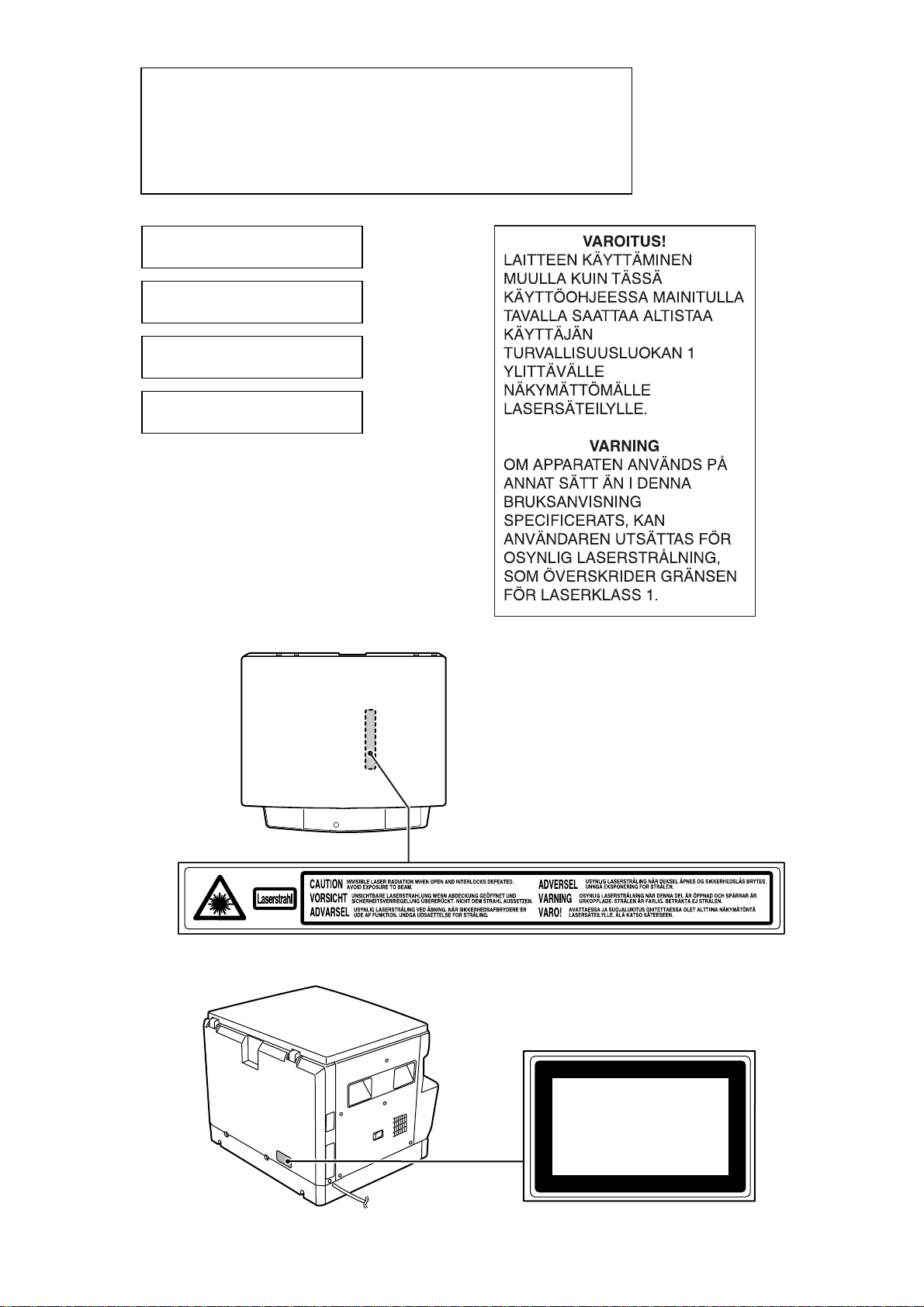
Warning!
This product is a class A product.
If it is operated in households, offices or similar surroundings, it
can produce radio interferences at other appliances, so that the
user has to take adequate countermeasures.
CLASS 1
LASER PRODUCT
LASER KLASSE 1
CLASS 1 LASER PRODUCT
LASER KLASSE 1
LUOKAN 1 LASERLAITE
KLASS 1 LASERAPPARAT
In some areas, the POWER switch positions are marked I and on the copier
instead of ON and OFF .
The symbol denotes the copier is not completely de-energized but in a stand-by
condition at this POWER switch position.
If your copier is so marked, please read I for ON and for OFF .
Caution!
For a complete electrical disconnection, pull out the main plug.
The socket-outlet shall be installed near the equipment and shall be easily
accessible.
The CE mark logo label is affixed on an equipment in case that the directives described in the above
sentence are applicable to the product. (This sentence is not applicable in any country where the above
directives are not required.)

PRINTED IN CHINA
2000L
KS➀
TINSE0448QSZZ
AR-163
SHARP CORPORATION