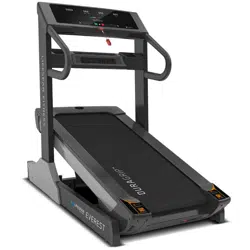
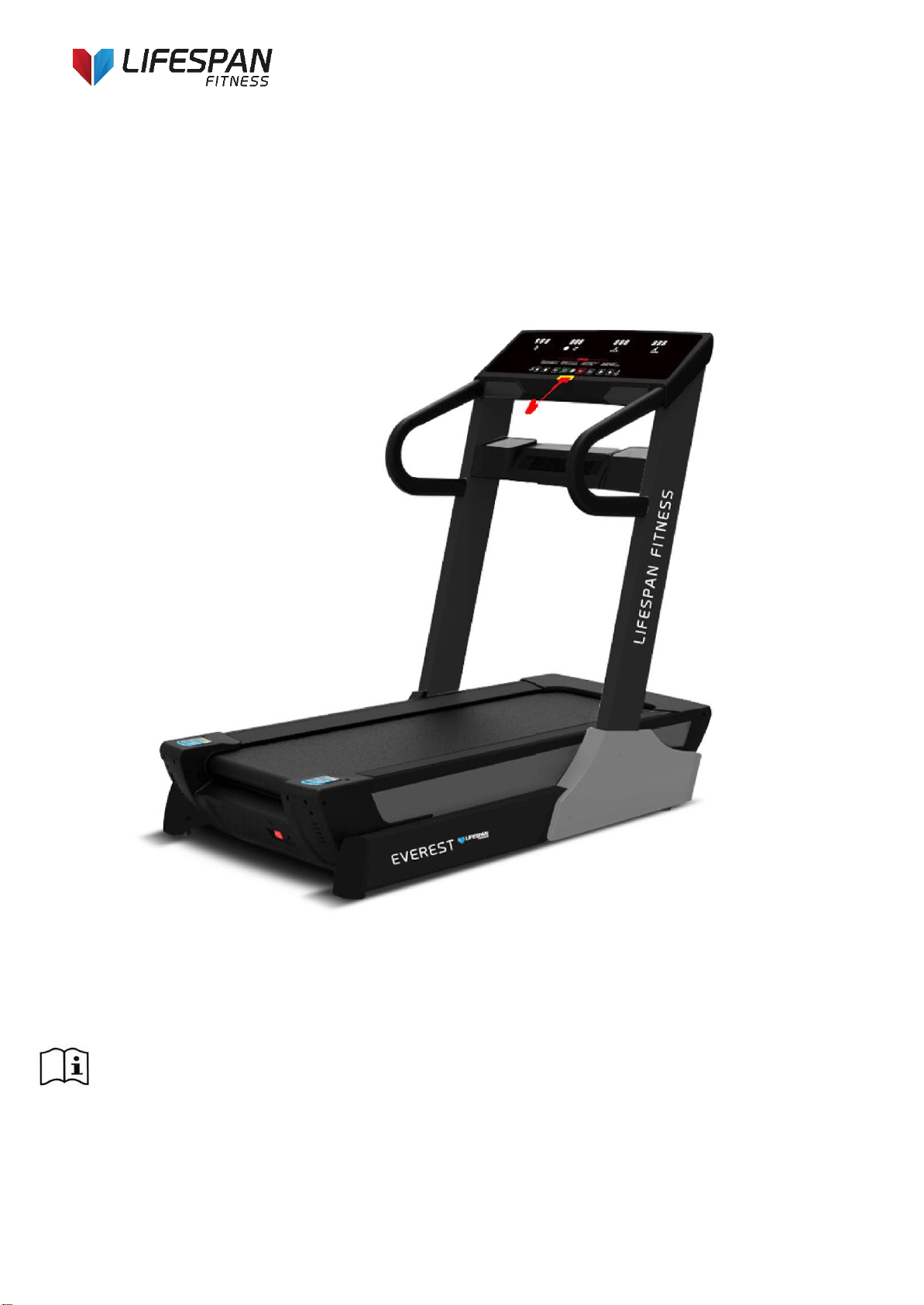
EVEREST
TREADMILL
OWNER’S
MANUAL
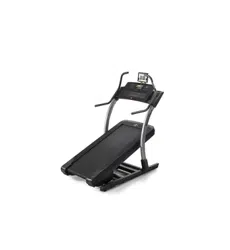
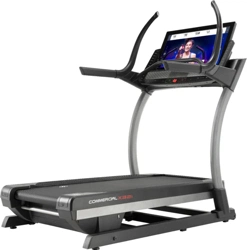
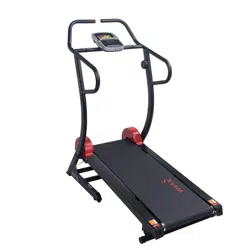
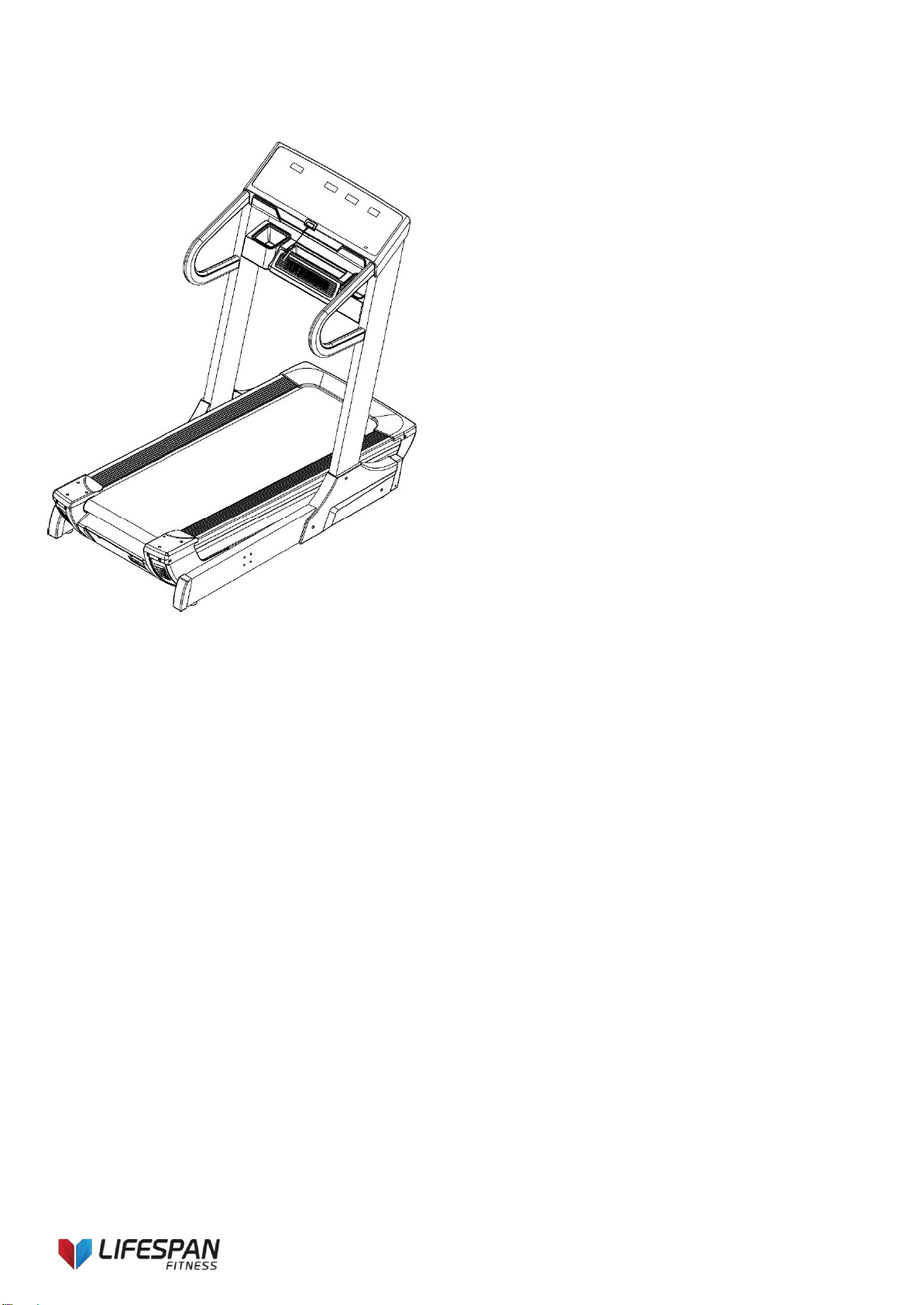
Product may vary slightly from the item pictured due to model upgrades
Read all instructions carefully before using this product. Retain this owner’s manual for future
reference.
NOTE: This manual may be subject to updates or changes. Up to date manuals are available through our website at www.lifespanfitness.com.au

2
Everest
TABLE OF CONTENTS
1. IMPORTANT SAFETY INSTRUCTIONS 3
2. IMPORTANT ELECTRICAL INFORMATION 5
3. IMPORTANT OPERATING INSTRUCTIONS 5
4. ASSEMBLY INSTRUCTIONS 6
5. OPERATION GUIDE WITH PROGRAM CHART 10
6. EXERCISE GUIDE 21
7. MAINTENANCE INSTRUCTIONS 23
8. EXPLODED DIAGRAM 30
9. PARTS LIST 31
10. WARRANTY 33

3
Everest
1. IMPORTANT SAFETY INSTRUCTIONS
WARNING - Read all instructions before using this treadmill.
It is important your treadmill receives regular maintenance to prolong its useful life. Failing to
regularly maintain your treadmill may void your warranty.
Danger – To reduce the risk of electric shock disconnect your treadmill from the electrical outlet prior to
cleaning and/or service work.
DO NOT USE AN EXTENSION CORD: DO NOT ATTEMPT TO DISABLE THE GROUNDED PLUG BY
USING IMPROPER ADAPTERS OR IN ANY WAY MODIFY THE CORD SET.
Install the treadmill on a flat level surface with access to a 220-240 volt (50/60Hz), grounded outlet.
Do not operate treadmill on deeply padded, plush or shag carpet. Damage to both carpet and
treadmill may result.
Do not block the rear of the treadmill. Provide a minimum of 1 metre clearance between the rear of
the treadmill and any fixed object.
Place your unit on a solid, level surface when in use
When running, make sure the plastic clip is fastened on your clothing. It is for your safety, should
you fall or move too far back on the treadmill.
Keep hands away from all moving parts.
Never operate the treadmill if it has a damaged power cord or plug. When damaged, these must be
replaced by the manufacturer, its service agent or similarly qualified persons in order to avoid a
hazard.
Keep the cord away from heated surfaces.
Do not operate where aerosol spray products are being used or where oxygen is being
administered. Sparks from the motor may ignite a highly gaseous environment.
Never drop or insert any object into any openings.
The treadmill is intended for in-home use only and is not suitable for commercial environments.
To disconnect, turn all controls to the off position, remove the safety key, and then remove the plug
from the outlet.

4
Everest
The pulse sensors are not medical devices. Various factors, including the user’s movement, may
affect the accuracy of heart rate readings. The pulse sensors are intended only as exercise aids in
determining heart rate trends in general.
Use the handrails provided; they are for your safety.
Wear proper shoes. High heels, dress shoes, sandals or bare feet are not suitable for use on your
treadmill. Quality athletic shoes are recommended to avoid leg fatigue.
Before undertaking any type of exercise program, it is recommended that you consult a doctor.
Injuries to health may result from incorrect or excessive training.
This appliance is not intended for use by persons (including children) with reduced physical,
sensory or mental capabilities, or lack of experience and knowledge, unless they have been given
supervision or instruction concerning use of the appliance by a person responsible for their safety.
WARNING heat rate monitoring systems may be inaccurate. If you feel faint stop exercising
immediately.
Children should not be allowed on or around the equipment, even when not in use.
Children should be supervised to ensure that they do not play with this machine
Loose-fitting clothing or jewellery that could become an entanglement hazard should not be worn.
Training shoes should be worn when using the equipment.
Equipment must be used on a level and stable surface.
All fixings should be checked before the equipment is used.
All literature relating to the use of the equipment should be retained for future reference.
Recommended operating temperature: 5-40°C
Remove the safety key after use to prevent unauthorized treadmill operation.

5
Everest
2. IMPORTANT ELECTRICAL INFORMATION
WARNING!
Route the power cord away from any moving part of the treadmill including the elevation mechanism and
transport wheels.
NEVER remove any cover without first disconnecting AC power.
NEVER expose this treadmill to rain or moisture. This treadmill is not designed for use outdoors, near a pool,
or in any other high humidity environment.
This is a high-power item; please do not share the same outlet with other high power machines such as, fridges,
air conditioning etc. Please choose an outlet exclusively for the machine and make sure the fuse is 10A.
3. IMPORTANT OPERATING INSTRUCTIONS
Understand that changes in speed and incline do not occur immediately. Set your desired speed on the
computer console and release the adjustment key. The computer will obey the command gradually.
Use caution while participating in other activities while walking on your treadmill, such as watching television,
reading, etc. These distractions may cause you to lose balance or stray from walking in the centre of the
belt; which may result in serious injury.
In order to prevent losing balance and suffering unexpected injury, never mount or dismount the treadmill
while the belt is moving. This unit starts with at a very low speed. Simply standing on the belt during slow
acceleration is proper after you have learned to operate this machine.
Always hold on to handrail while making control changes.
A safety key is provided with this machine. Remove the safety key will stop the walking belt immediately; the
treadmill will shut off automatically. Inserting the safety key will reset the display.
Do not use excessive pressure on console control keys. They are precision set to function properly with little
finger pressure.
Replace any defective components immediately. The machine must be kept out of use until repaired.
Belt wear-in period: all treadmills make a certain type of thumping noise due to the belt riding over the rollers,
especially new treadmills. This noise will diminish over time, although may not completely go away. The belt
will stretch over time, causing it to ride smoother over the rollers.
6
Everest
4. ASSEMBLY INSTRUCTIONS
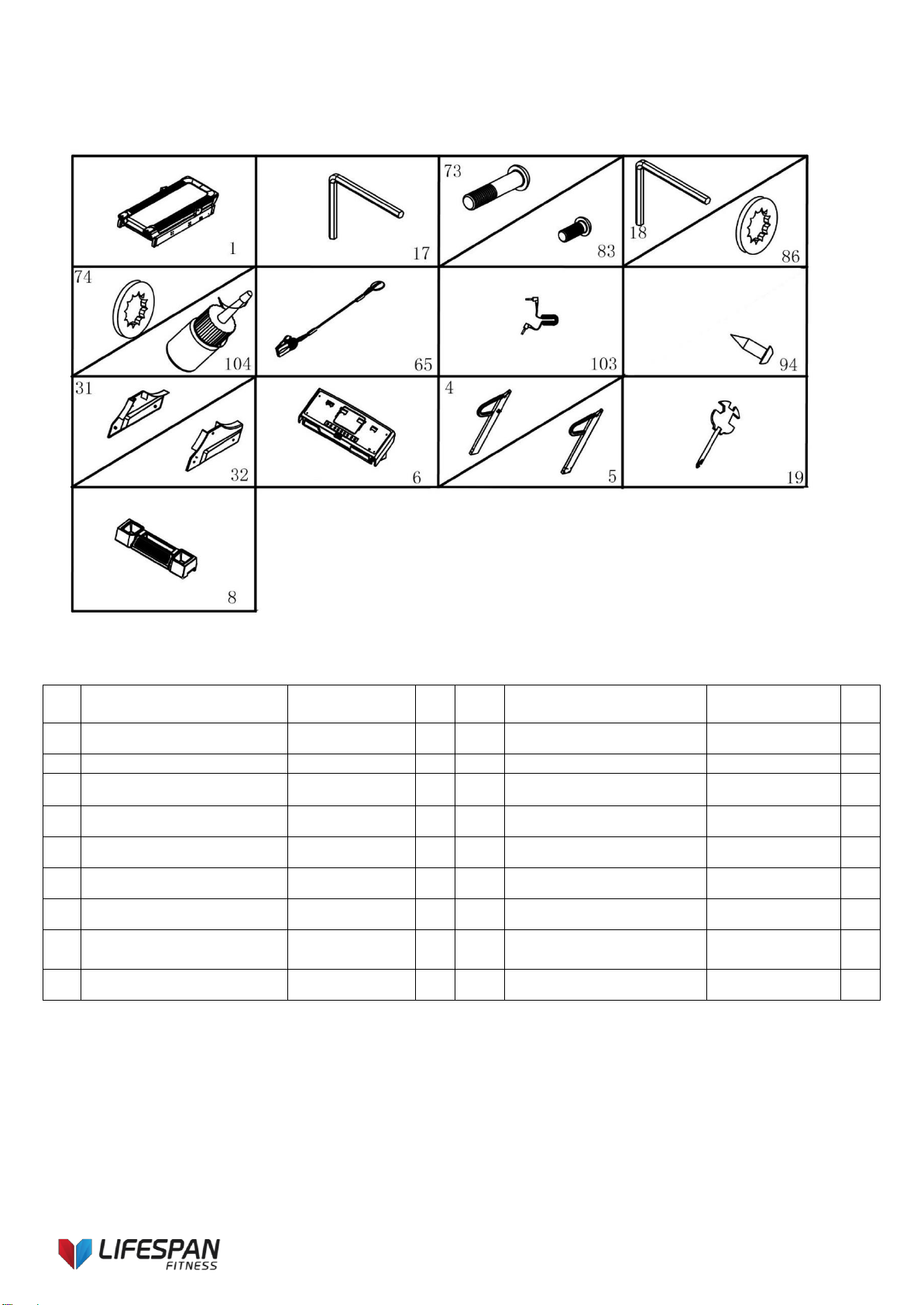
FIXING TOOLS:
5# Allen Wrench 5mm, 1pcs
Wrench with screw driver S=13, 14, 15, 1pcs
NO.
DES.
SPECIFICATION
QTY
NO.
DES.
SPECIFICATION
QTY
1
Main Frame
1
65
Safety key
1
17
5#Allen Wrench
1
94
Bolt
4.2*19
8
73
Bolt
M10*15
12
31
Left base Cover
1
83
Bolt
M8*16
8
32
Right base Cover
1
18
6#Allen Wrench
1
4
Left Upright Tube
1
86
Lock washer
8
8
5
Right Upright Tube
1
74
Lock washer
10
12
19
Wrench W/Screw
S=13
、
14
、
15
1
104
Oil Bottle
1
8
Water Bottle Tube
1
103
MP3 Wire
1
7
Everest
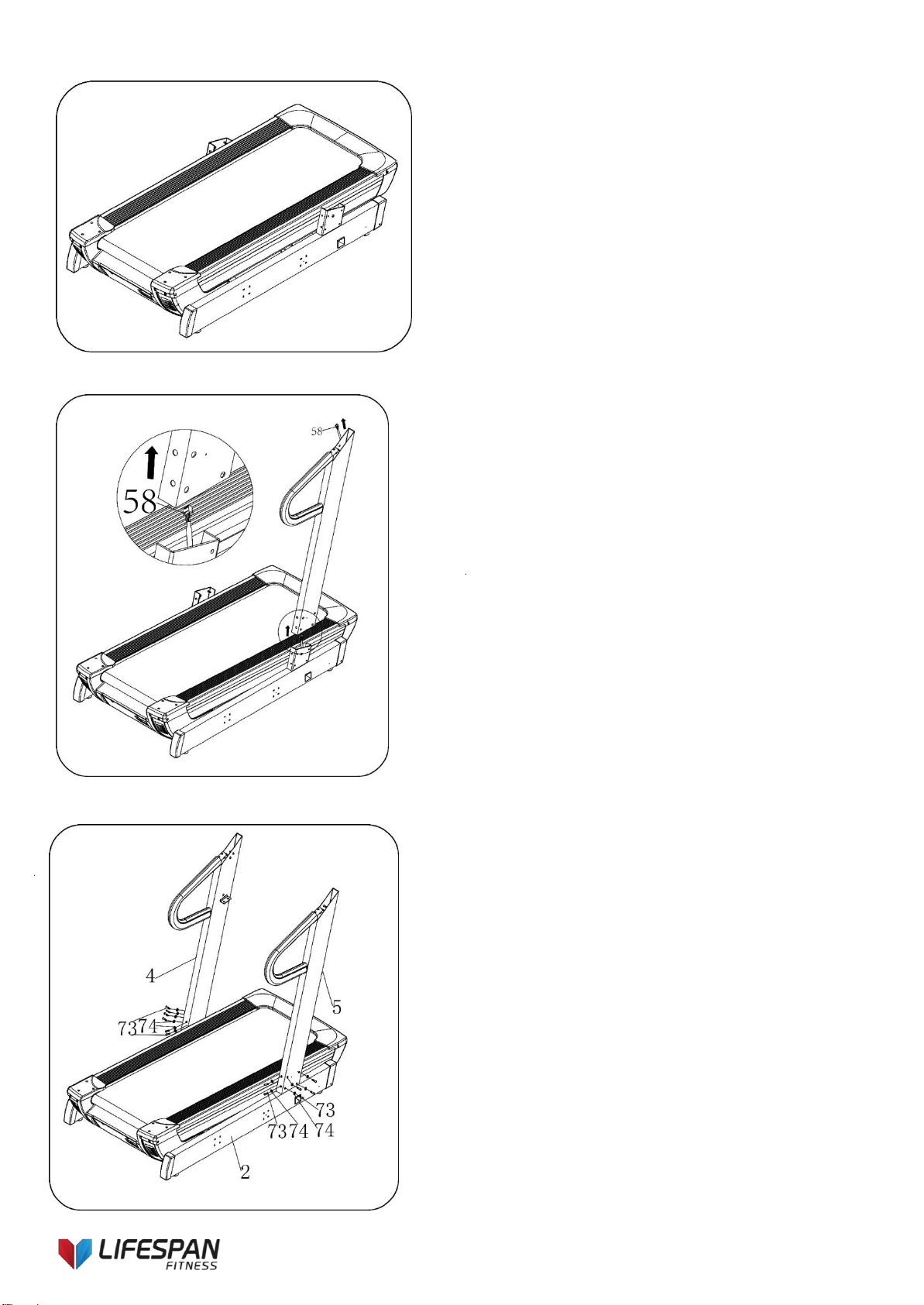
STEP 1:
STEP 2:
STEP 3:
1. Open the carton, remove the parts from
the box and place the Main Frame on
level ground.
2. Go through computer bottom wire (58) to
the right upright.
Do not let the thread drop into the Right
Tube after the line is taken out so as to
connect it to the computer up wire (57).
3. Use the 6# Allen wrench (18), and
attach Bolt M10*15(73) to Lock
Washer (74), to secure the Right
upright (4) and Base Tube (2).
Repeat the same for left side.
8
Everest
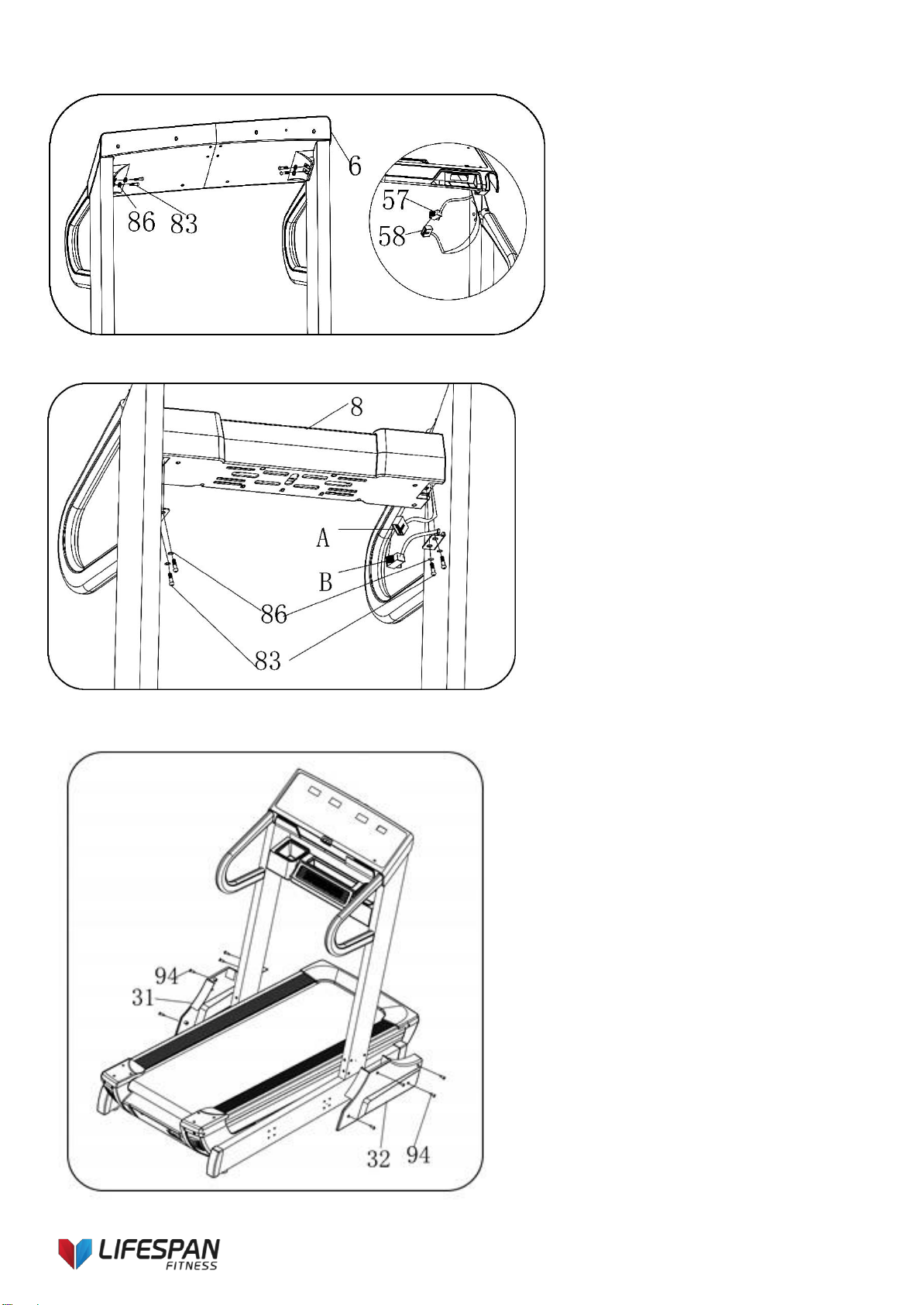
STEP 4:
STEP 5:
STEP 6:
4. Connect the computer up wire (57)
with computer bottom wire (58), and
put them inside the upright tube.
Install the Computer Bracket (6) to the
Left/Right Upright.
Use the 5# Allen wrench (17) to lock
bolt (83) and Lock washer (86) to
computer bracket (6) and Left/Right
upright. Refer to picture on left.
5. Connect Water Bottle Tube (8) to the
computer up wire and computer bottom
wire. Put them inside the upright tube.
Connect Water Bottle Tube (8) to the
left/Right Upright. Use the 5# Allen
wrench (17) to lock bolt (83) and Lock
washer (86) to the computer bracket and
Left/Right upright. Refer to picture on
left.
7. Use Wrench W/Screw, drill through the
Bolt 4.2*19 (94) to right base cover(32)
Refer to picture on left.
9
Everest
STEP 7:
8. Put the safety key (65) on the
computer.
10
Everest
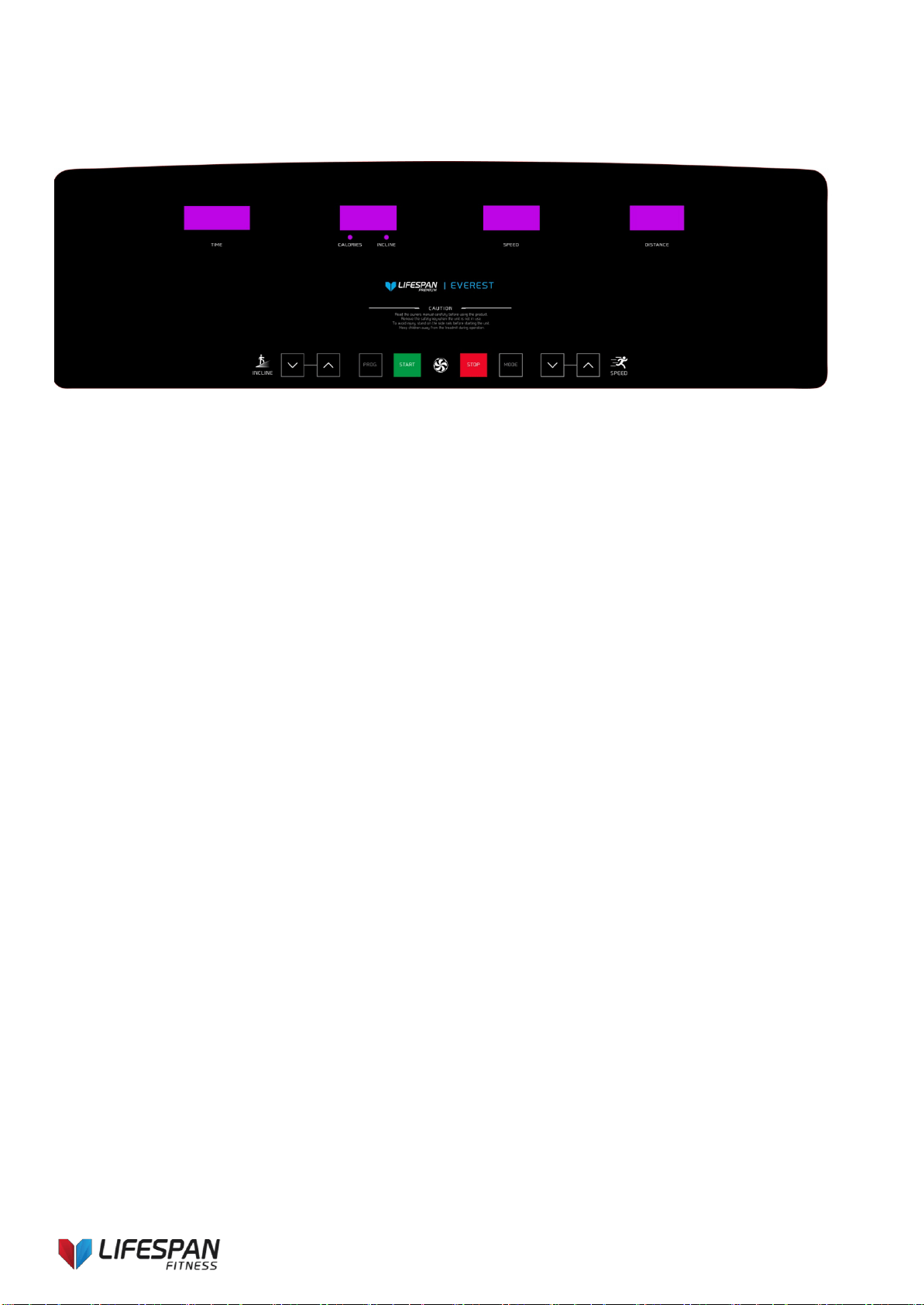
5. OPERATION GUIDE
1. OVERVIEW
2. LCD WINDOW DISPLAY
SPEED: Show speed, or show P1-P16 when setting programs, from 1.0-24.0KM/h
TIME: Show time, from 0.00-99.90
DIST.: Show distance, from 0.00-99.90
CAL: Show the calories, show 0.0-999.0
3. BUTTON FUNCTIONS
“PROGRAM” button: Press this button to choose program from manual mode—P01----P16--FAT;
“MODE” button: When machine in ready state, press this button to choose the mode: mode-time count down, mode-distance
count down, mode-calories count down;
“START” button: Press this button to start the machine, the machine will run at the lowest speed or at the speed of default
program after 3 seconds time count down;
“STOP” button: Press this button to stop the machine, the machine will stop smoothly;
“SPEED+”-: Adjust the speed. Press the button to adjust the speed when running, and adjust the data when stop;
“SPEED+”, “SPEED-”: Adjust the speed. Press the button to adjust the speed when running, and adjust the data when stop;
“INCLINE+”, “INCLINE -”: -6-20 sectional incline.
Adjust the incline. Press the button to adjust incline section when run, and adjust the data when stop;
FAN: On/off the fan.
4. MAIN FUNCTION
Open the power switch, the window will light, the machine will enter into ready state.
4.1. START-UP QUICKLY (MANUAL)
Attach the magnet end of the safety pulling rope to the computer, press ‘START’ button to start the machine, it will run at the
lowest speed, press SPEED+/- to adjust the speed. When you would like to stop machine, press the ‘STOP’ button or take
out the safety key directly

11
Everest
4.2. COUNT DOWN MODE
Press the ‘MODE’ button, it can choose time countdown mode, distance count down mode, calories, count down mode,
and the window will show the default data and glitter. At the same time, press SPEED +/- to set the data.
Press ‘START’ button, the machine will run at the lowest speed, you can press SPEED +/- to change the speed. When
it counts down to 0, the machine will stop smoothly. Certainly, you can press ‘STOP’ button or take out the safety key
from the computer to stop the machine.
4.3 INNER INSTALL PROGRAM
Press ‘PROG’ button to choose the inner install program from P0----P16. When set the program, the time window will
show default data and glitter, press SPEED+/- button to set the running time.
Press ‘START’, the machine will run at the first section speed. When the section is over, it will enter into next section
automatically, the speed will change as next section data. When finish one program, the machine will stop smoothly.
During the running, you can change the speed by the SPEED +/- you can change the incline by the “INCLINE+”,
“INCLINE –“ whenever, When the program enter next section will come back to the current speed. And you can press
‘STOP’ or take out the safety key to stop the machine whenever.
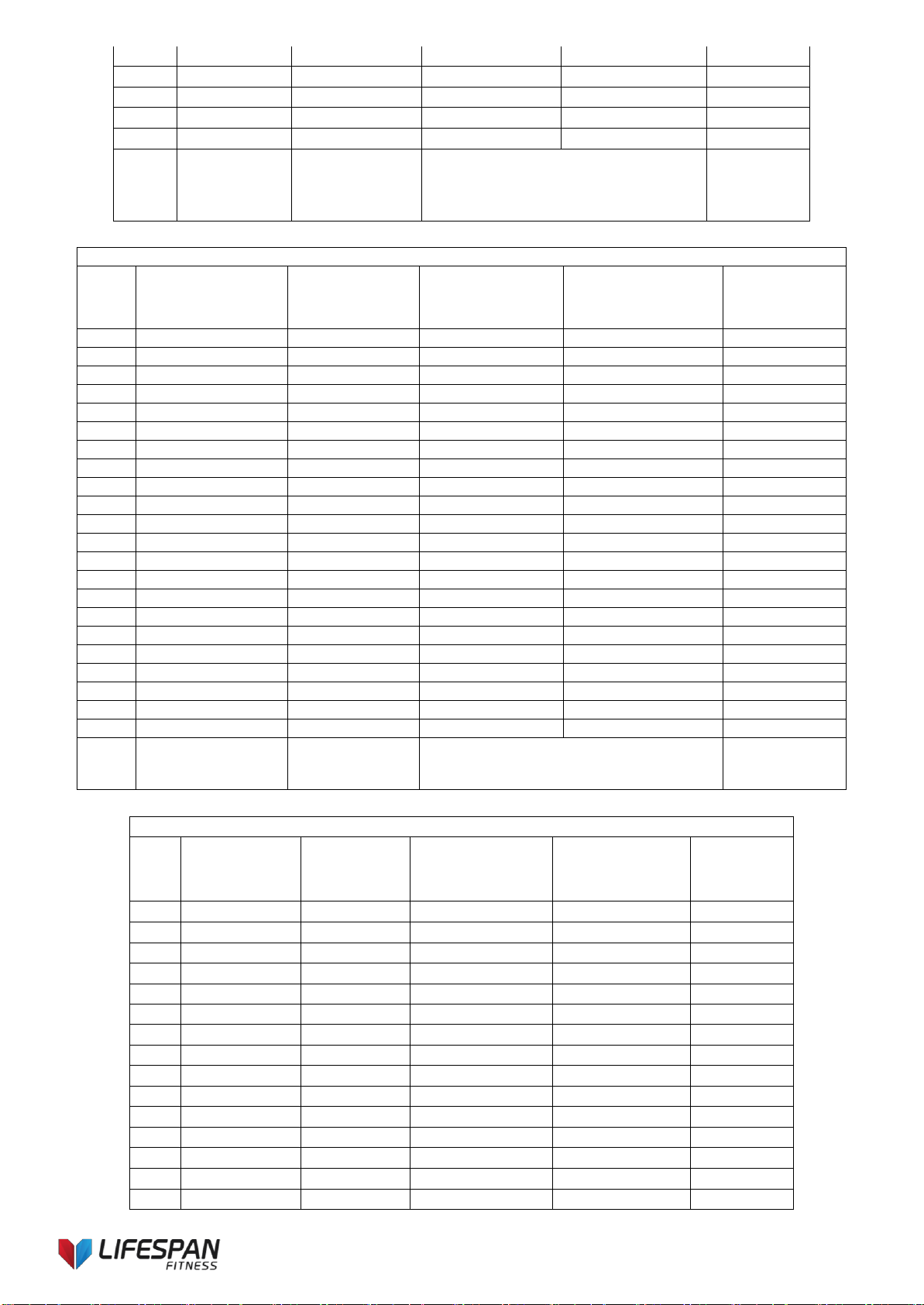
5. PROGRAM TABLE
Primary Training 1
Inverval
< Fixed >
Distance
(KM)
<Fixed>
Speed (KM/
H)
<Calculation
prediction>
Time (S)
<Calculation
prediction> Time
(H :M:S)
<Fixed>
INCLINE (%)
1
0.00
4.8
0
00:00:00
0
2
1.11
7.0
833
00:13:53
0
3
1.69
7.0
1129
00:18:49
1
4
2.38
7.0
1484
00:24:44
1
5
2.95
7.0
1779
00:29:39
2
6
3.41
7.0
2016
00:33:36
2
7
4.18
7.0
2413
00:40:13
3
8
4.92
7.0
2794
00:46:34
3
9
5.66
7.0
3175
00:52:55
4
10
6.25
7.0
3478
00:57:58
4
11
6.42
3.2
3562
00:59:22
0
12
6.59
3750
01:02:30
< Fixed >
Total
Distance
(KM)
<Calculation Prediction>
Total Time (H :M:S)
Primary Training 2
NO
<Fixed >
Distance
(KM)
<Fixed> Speed
(KM/H)
<Calculation
prediction>
Time (S)
<Calculation
prediction> Time
(H :M:S)
<Fixed>
INCLINE(%)
1
0.00
4.8
0
00:00:00
0
2
0.24
7.0
180
00:03:00
0
3
0.83
7.2
485
00:08:05
0
4
1.54
7.4
839
00:13:59
1
5
2.12
7.0
1122
00:18:42
0
6
2.70
7.2
1421
00:23:41
0
7
3.22
7.4
1680
00:28:00
1
8
3.86
7.0
1988
00:33:08
0
9
4.57
7.2
2356
00:39:16
0
12
Everest
10
5.19
7.4
2668
00:44:28
1
11
5.73
7.0
2926
00:48:46
0
12
6.11
7.2
3122
00:52:02
0
13
6.25
3.2
3195
00:53:15
0
14
6.40
3362
00:56:02
<Fixed>
Total
Distance
(KM)
<Calculation prediction>Total Time
(H :M:S)
Primary Training 3
NO
<Fixed > Distance
(KM)
<Fixed> Speed
(KM/H)
<Calculation
prediction> Time
(S)
<Calculation
prediction> Time
(H :M:S)
<Fixed>
INCLINE(%)
1
0.00
6.1
0
00:00:00
0
2
0.24
6.7
141
00:02:21
1
3
1.04
8.0
570
00:09:30
0
4
1.64
9.0
839
00:13:59
1
5
2.12
9.3
1031
00:17:11
0
6
2.76
9.0
1281
00:21:21
1
7
3.24
9.3
1472
00:24:32
0
8
3.88
9.0
1721
00:28:41
1
9
4.28
9.3
1881
00:31:21
0
10
4.75
9.0
2063
00:34:23
1
11
5.25
9.0
2261
00:37:41
0
12
5.65
9.3
2420
00:40:20
1
13
6.05
9.0
2577
00:42:57
0
14
6.47
9.3
2744
00:45:44
1
15
7.00
9.0
2949
00:49:09
0
16
7.40
9.3
3109
00:51:49
1
17
7.79
9.0
3260
00:54:20
0
18
8.18
9.3
3417
00:56:57
1
19
8.58
9.0
3571
00:59:31
0
20
9.09
9.3
3777
01:02:57
1
21
9.46
3.2
3921
01:05:21
0
22
9.62
4099
01:08:19
<Fixed> Total
Distance (KM)
<Calculation prediction>Total Time (H
:M:S)
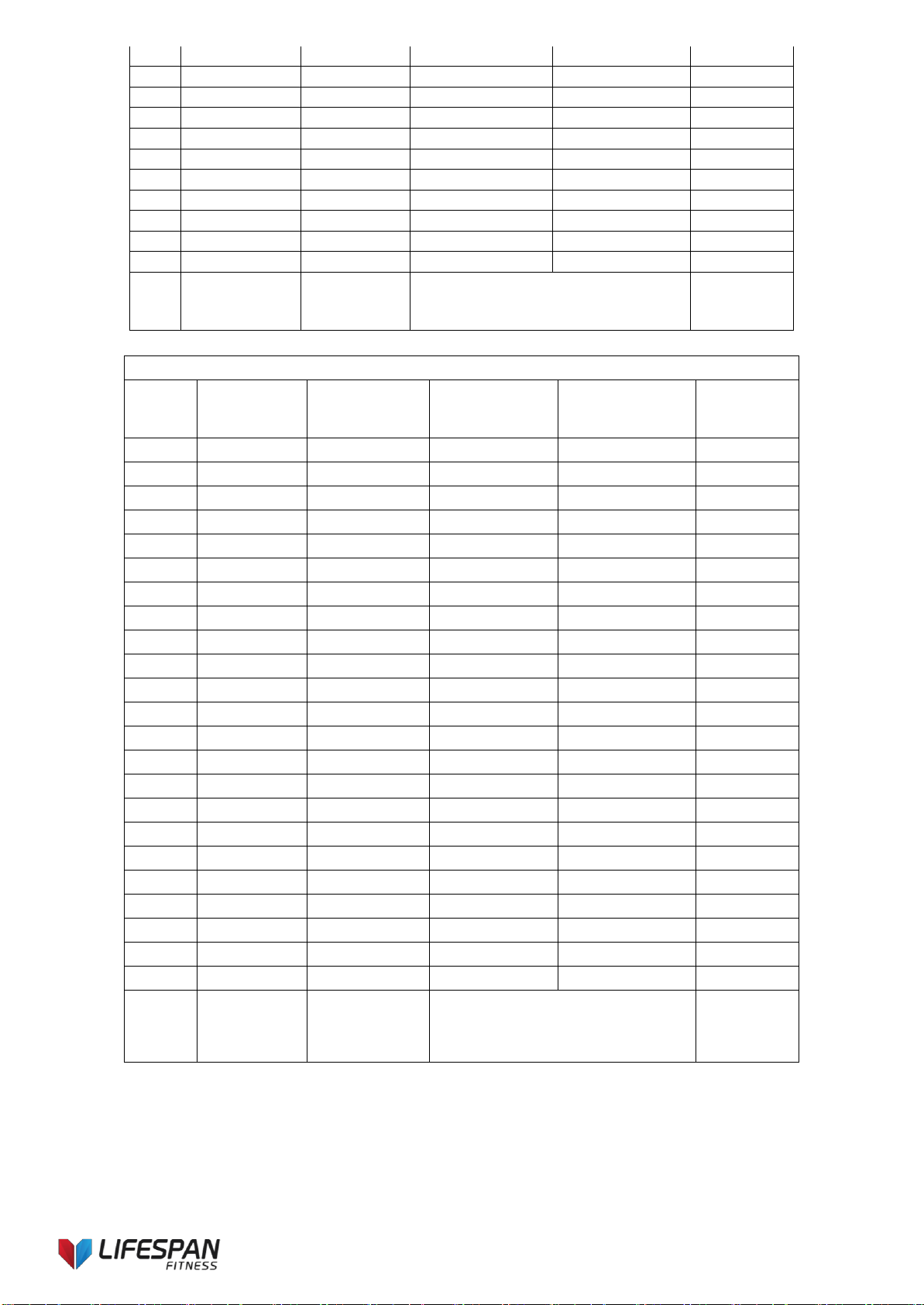
Primary Training 4
NO
<Fixed >
Distance
(KM)
<Fixed>
Speed (KM
/H)
<Calculation
prediction> Time
(S)
<Calculation
prediction>
Time (H :M:S)
<Fixed>
INCLINE(%)
1
0.00
3.0
0
00:00:00
0
2
0.24
5.6
288
00:04:48
2
3
0.84
7.2
672
00:11:12
2
4
1.55
7.1
1026
00:17:06
4
5
2.12
6.9
1320
00:22:00
2
6
2.72
7.2
1630
00:27:10
3
7
3.23
7.1
1887
00:31:27
4
8
3.86
6.9
2204
00:36:44
2
9
4.54
7.2
2558
00:42:38
3
10
5.18
7.1
2880
00:48:00
4
11
5.71
6.9
3149
00:52:29
2
12
6.10
7.2
3352
00:55:52
3
13
6.40
7.1
3504
00:58:24
4
14
6.95
6.9
3781
01:03:01
2
15
7.34
7.2
3983
01:06:23
3
13
Everest
16
8.00
7.1
4313
01:11:53
4
17
8.62
6.9
4631
01:17:11
2
18
9.32
7.2
4992
01:23:12
3
19
9.72
7.1
5193
01:26:33
4
20
10.43
6.9
5552
01:32:32
2
21
10.95
7.2
5826
01:37:06
3
22
11.40
7.1
6051
01:40:51
4
23
11.90
6.9
6305
01:45:05
2
24
12.50
7.2
6616
01:50:16
3
25
12.67
3.2
6702
01:51:42
0
26
12.83
6882
01:54:42
<Fixed> Total
Distance
(KM)
<Calculation prediction>Total Time
(H :M:S)
Intermediate Training 1
NO
<Fixed >
Distance
(KM)
<Fixed>
Speed (KM/
H)
<Calculation
prediction>
Time (S)
<Calculation
prediction>
Time (H :M:S)
<Fixed>
INCLINE(%)
1
0.00
5.6
0
00:00:00
1
2
0.25
8.8
160
00:02:40
1
3
0.94
9.0
442
00:07:22
2
4
1.72
8.8
755
00:12:35
1
5
2.54
9.0
1089
00:18:09
1
6
3.27
8.8
1384
00:23:04
0
7
4.07
9.9
1710
00:28:30
0
8
4.33
8.8
1805
00:30:05
0
9
5.12
9.9
2127
00:35:27
0
10
5.36
8.8
2216
00:36:56
0
11
6.16
9.9
2542
00:42:22
0
12
6.41
8.8
2633
00:43:53
0
13
7.22
8.0
2963
00:49:23
2
14
8.02
9.9
3322
00:55:22
0
15
8.27
8.8
3413
00:56:53
0
16
9.06
9.9
3736
01:02:16
0
17
9.30
8.8
3826
01:03:46
0
18
10.10
9.9
4151
01:09:11
0
19
10.35
8.8
4242
01:10:42
0
20
10.65
9.9
4367
01:12:47
1
21
11.05
8.8
4511
01:15:11
1
22
11.30
3.2
4613
01:16:53
0
23
11.46
4799
01:19:59
<Fixed>
Total
Distance
(KM)
<Calculation prediction>Total
Time (H :M:S)
14
Everest
Intermediate Training 2
NO
<Fixed >
Distance
(KM)
<Fixed>
Speed (KM/
H)
<Calculation
prediction>
Time (S)
<Calculation
prediction>
Time (H :M:S)
<Fixed>
INCLINE(%)
1
0.00
6.1
0
00:00:00
0
2
0.47
6.8
275
00:04:35
0
3
1.08
9.3
598
00:09:58
0
4
1.63
9.3
814
00:13:34
1
5
2.32
9.3
1078
00:17:58
1
6
2.88
9.2
1295
00:21:35
2
7
3.32
9.2
1468
00:24:28
2
8
4.08
9.2
1765
00:29:25
3
9
4.80
9.0
2048
00:34:08
3
10
5.51
9.0
2332
00:38:52
4
11
6.09
9.0
2564
00:42:44
4
12
6.38
3.2
2681
00:44:41
0
13
6.41
2715
00:45:15
<Fixed>
Total
Distance
(KM)
<Calculation prediction>Total
Time (H :M:S)
Intermediate Training 3
NO
<Fixed >
Distance (KM)
<Fixed> Speed
(KM/H)
<Calculation
prediction>
Time (S)
<Calculation
prediction>
Time (H
:M:S)
<Fixed>
INCLINE(%)
1
0.00
5.6
0
00:00:00
1
2
0.23
5.6
150
00:02:30
1
3
0.62
10.0
400
00:06:40
2
4
1.37
10.0
670
00:11:10
1
5
2.19
10.0
963
00:16:03
1
6
2.91
10.0
1225
00:20:25
0
7
3.71
10.0
1510
00:25:10
0
8
3.95
10.0
1597
00:26:37
0
9
4.73
10.0
1880
00:31:20
0
10
4.98
10.0
1970
00:32:50
0
11
5.75
10.0
2247
00:37:27
0
12
6.00
10.0
2335
00:38:55
0
13
6.80
10.0
2625
00:43:45
2
14
7.48
10.0
2868
00:47:48
0
15
7.83
8.9
2995
00:49:55
0
16
8.38
8.9
3218
00:53:38
0
17
9.28
3.2
3582
00:59:42
0
18
9.44
3761
01:02:41
<Fixed> Total
Distance (KM)
<Calculation
prediction>Total Time (H
:M:S)
15
Everest
Intermediate Training 4
NO
<Fixed >
Distance (KM)
<Fixed> Speed
(KM/H)
<Calculation
prediction>
Time (S)
<Calculation
prediction>
Time (H
:M:S)
<Fixed>
INCLINE
(%)
1
0.00
3.0
0
00:00:00
0
2
0.22
5.6
261
00:04:21
2
3
1.29
7.2
948
00:15:48
2
4
1.93
7.1
1272
00:21:12
4
5
2.40
6.9
1510
00:25:10
2
6
3.03
7.2
1835
00:30:35
3
7
3.50
7.1
2070
00:34:30
4
8
4.18
6.9
2416
00:40:16
2
9
4.57
7.2
2620
00:43:40
3
10
5.07
7.1
2869
00:47:49
4
11
5.55
6.9
3115
00:51:55
2
12
5.99
7.2
3346
00:55:46
3
13
6.38
7.1
3536
00:58:56
4
14
6.75
6.9
3726
01:02:06
2
15
7.33
7.2
4027
01:07:07
3
16
7.70
7.1
4215
01:10:15
4
17
8.13
6.9
4431
01:13:51
2
18
8.51
7.2
4629
01:17:09
3
19
8.93
7.1
4841
01:20:41
4
20
9.44
6.9
5100
01:25:00
2
21
9.83
3.2
5302
01:28:22
0
22
9.99
5480
01:31:20
<Fixed> Total
Distance (KM)
<Calculation
prediction>Total Time (H
:M:S)
Intermediate Training 5
NO
<Fixed >
Distance (KM)
<Fixed> Speed
(KM/H)
<Calculation
prediction>
Time (S)
<Calculation
prediction> Time
(H :M:S)
<Fixed>
INCLINE
(%)
1
0.00
6.4
0
00:00:00
0
2
0.46
7.2
260
00:04:20
0
3
1.09
9.0
574
00:09:34
0
4
1.66
9.0
801
00:13:21
1
5
2.34
9.0
1073
00:17:53
1
6
2.92
9.0
1304
00:21:44
2
7
3.37
9.0
1484
00:24:44
2
8
4.13
8.9
1788
00:29:48
3
9
4.82
8.9
2068
00:34:28
3
10
5.54
8.9
2359
00:39:19
4
11
6.13
3.2
2600
00:43:20
0
12
6.52
3031
00:50:31
<Fixed> Total
Distance (KM)
<Calculation prediction>Total
Time (H :M:S)

16
Everest
Intermediate Training 6
NO
<Fixed >
Distance (KM)
<Fixed>
Speed (KM/
H)
<Calculation
prediction>
Time (S)
<Calculation
prediction>
Time (H :M:S)
<Fixed>
INCLINE (%)
1
0.00
7.2
0
00:00:00
0
2
0.24
8.7
120
00:02:00
2
3
0.94
8.7
408
00:06:48
2
4
1.63
8.9
696
00:11:36
2
5
2.35
8.9
985
00:16:25
2
6
3.00
8.9
1250
00:20:50
2
7
3.51
9.0
1456
00:24:16
1
8
4.25
9.0
1752
00:29:12
1
9
4.73
9.0
1942
00:32:22
1
10
5.33
9.0
2183
00:36:23
1
11
5.83
9.0
2384
00:39:44
1
12
6.33
9.2
2582
00:43:02
1
13
6.70
9.2
2728
00:45:28
1
14
7.21
9.2
2926
00:48:46
1
15
7.88
9.3
3189
00:53:09
0
16
8.68
9.3
3500
00:58:20
0
17
9.44
9.3
3794
01:03:14
0
18
10.18
9.3
4082
01:08:02
1
19
10.95
9.2
4379
01:12:59
1
20
11.52
9.2
4602
01:16:42
1
21
12.19
9.2
4864
01:21:04
1
22
12.82
9.2
5112
01:25:12
0
23
13.54
9.3
5393
01:29:53
1
24
14.32
9.3
5694
01:34:54
0
25
14.88
9.3
5911
01:38:31
1
26
15.50
9.3
6150
01:42:30
0
27
16.04
3.2
6358
01:45:58
0
28
16.34
6706
01:51:46
<Fixed> Total
Distance (KM)
<Calculation prediction>Total
Time (H :M:S)
17
Everest
Advanced Training 1
NO
<Fixed >
Distance
(KM)
<Fixed> Speed
(KM/H)
<Calculation
prediction>
Time (S)
<Calculation
prediction>
Time (H :M:S)
<Fixed>
INCLINE
(%)
1
0.00
8.8
0
00:00:00
1
2
0.25
11.9
101
00:01:41
2
3
0.93
11.7
309
00:05:09
3
4
1.71
11.9
549
00:09:09
2
5
2.53
11.9
796
00:13:16
1
6
3.26
11.7
1017
00:16:57
2
7
4.06
12.5
1262
00:21:02
0
8
4.30
10.9
1332
00:22:12
1
9
5.10
12.5
1595
00:26:35
0
10
5.34
10.9
1664
00:27:44
1
11
6.14
12.5
1928
00:32:08
0
12
6.38
10.9
1999
00:33:19
1
13
7.99
12.5
2530
00:42:10
0
14
8.24
10.9
2601
00:43:21
1
15
9.03
12.5
2864
00:47:44
0
16
9.28
10.9
2934
00:48:54
1
17
10.07
12.5
3197
00:53:17
0
18
10.32
10.9
3267
00:54:27
1
19
10.61
11.7
3364
00:56:04
2
20
10.98
11.9
3479
00:57:59
1
21
11.23
3.2
3553
00:59:13
0
22
11.39
3738
01:02:18
<Fixed> Total
Distance
(KM)
<Calculation prediction>Total
Time (H :M:S)
Advanced Training 2
NO
<Fixed >
Distance (KM)
<Fixed> Speed
(KM/H)
<Calculation
prediction>
Time (S)
<Calculation
prediction>
Time (H :M:S)
<Fixed>
INCLINE
(%)
1
0.00
9.7
0
00:00:00
0
2
0.29
8.9
106
00:01:46
0
3
1.10
12.1
434
00:07:14
0
4
1.71
12.2
616
00:10:16
1
5
2.19
12.4
759
00:12:39
0
6
2.83
12.2
945
00:15:45
1
7
3.33
12.4
1091
00:18:11
0
8
3.98
12.2
1280
00:21:20
1
9
4.38
12.4
1399
00:23:19
0
10
4.85
12.2
1535
00:25:35
1
11
5.36
12.2
1684
00:28:04
0
12
5.78
12.4
1808
00:30:08
1
13
6.18
12.2
1925
00:32:05
0
14
6.61
12.4
2051
00:34:11
1
15
7.16
12.2
2212
00:36:52
0

18
Everest
16
7.21
12.4
2228
00:37:08
1
17
7.63
12.2
2348
00:39:08
0
18
8.02
12.4
2464
00:41:04
1
19
8.43
12.2
2582
00:43:02
0
20
8.95
12.4
2735
00:45:35
1
21
9.32
3.2
2844
00:47:24
0
22
9.48
3023
00:50:23
<Fixed> Total
Distance (KM)
<Calculation prediction>Total
Time (H :M:S)
Advanced Training 3
NO
<Fixed >
Distance (KM)
<Fixed> Speed
(KM/H)
<Calculation
prediction>
Time (S)
<Calculation
prediction>
Time (H :M:S)
<Fixed>
INCLINE (%)
1
0.00
11.3
0
00:00:00
1
2
0.31
11.3
99
00:01:39
1
3
0.93
11.3
296
00:04:56
2
4
1.69
12.1
538
00:08:58
1
5
2.54
12.1
792
00:13:12
1
6
3.28
12.1
1010
00:16:50
0
7
4.08
12.1
1248
00:20:48
0
8
4.33
12.1
1323
00:22:03
0
9
5.12
12.1
1560
00:26:00
0
10
5.37
12.1
1634
00:27:14
0
11
6.15
12.1
1866
00:31:06
0
12
6.40
12.1
1940
00:32:20
0
13
7.21
12.1
2182
00:36:22
1
14
7.90
12.1
2385
00:39:45
0
15
8.26
11.3
2493
00:41:33
1
16
8.82
11.3
2670
00:44:30
2
17
9.27
11.3
2816
00:46:56
1
18
9.73
3.2
2962
00:49:22
0
19
9.89
3142
00:52:22
<Fixed> Total
Distance (KM)
<Calculation prediction>Total
Time (H :M:S)
Advanced Training 4
NO
<Fixed >
Distance (KM)
<Fixed> Speed
(KM/H)
<Calculation
prediction>
Time (S)
<Calculation
prediction>
Time (H :M:S)
<Fixed>
INCLINE
(%)
1
0.00
8.2
0
00:00:00
0
2
0.24
11.9
105
00:01:45
2
3
1.06
11.9
353
00:05:53
3
4
1.66
11.9
534
00:08:54
4
5
2.29
12.0
724
00:12:04
2
6
2.93
12.0
918
00:15:18
3
7
3.66
12.2
1135
00:18:55
4
8
4.36
12.2
1343
00:22:23
2

19
Everest
9
4.83
12.2
1482
00:24:42
3
10
5.30
11.9
1621
00:27:01
4
11
5.81
11.9
1774
00:29:34
2
12
6.57
11.9
2004
00:33:24
3
13
6.95
12.0
2118
00:35:18
4
14
7.45
12.0
2269
00:37:49
2
15
8.13
12.2
2473
00:41:13
0
16
8.95
12.2
2714
00:45:14
0
17
9.35
12.2
2834
00:47:14
0
18
9.78
12.3
2959
00:49:19
0
19
10.33
12.3
3120
00:52:00
1
20
10.90
12.5
3287
00:54:47
0
21
11.22
3.2
3380
00:56:20
0
22
11.38
3565
00:59:25
<Fixed> Total
Distance (KM)
<Calculation prediction>Total
Time (H :M:S)
Advanced Training 5
NO
<Fixed >
Distance (KM)
<Fixed> Speed
(KM/H)
<Calculation
prediction> Time
(S)
<Calculation
prediction>
Time (H :M:S)
<Fixed>
INCLINE (%)
1
0.00
8.3
0
00:00:00
0
2
0.52
12.5
226
00:03:46
0
3
1.21
12.5
424
00:07:04
1
4
1.83
12.5
603
00:10:03
0
5
2.52
12.5
802
00:13:22
1
6
3.10
12.3
970
00:16:10
2
7
3.90
12.3
1204
00:20:04
1
8
4.67
12.5
1428
00:23:48
1
9
5.41
12.5
1640
00:27:20
0
10
6.14
12.5
1851
00:30:51
1
11
6.82
12.3
2046
00:34:06
2
12
7.37
12.3
2208
00:36:48
1
13
8.02
3.2
2400
00:40:00
0
14
8.19
2590
00:43:10
<Fixed> Total
Distance (KM)
<Calculation prediction>Total Time
(H :M:S)
Advanced Training 6
NO
<Fixed >
Distance (KM)
<Fixed> Speed
(KM/H)
<Calculation
prediction>
Time (S)
<Calculation
prediction>
Time (H :M:S)
<Fixed>
INCLINE
(%)
1
0.00
8.2
0
00:00:00
0
2
0.63
12.0
275
00:04:35
2
3
1.25
12.0
462
00:07:42
2
4
1.94
12.2
668
00:11:08
3
5
2.77
12.2
915
00:15:15
2
6
3.35
12.0
1085
00:18:05
2
20
Everest
7
3.81
12.0
1224
00:20:24
2
8
4.58
12.2
1455
00:24:15
2
9
5.31
12.2
1671
00:27:51
1
10
6.01
11.7
1877
00:31:17
2
11
6.59
11.7
2056
00:34:16
1
12
7.28
11.7
2268
00:37:48
4
13
8.04
11.7
2500
00:41:40
3
14
8.80
12.0
2734
00:45:34
2
15
9.42
12.0
2920
00:48:40
1
16
10.24
12.3
3168
00:52:48
2
17
10.93
12.3
3368
00:56:08
1
18
12.44
12.2
3810
01:03:30
1
19
13.12
12.3
4010
01:06:50
1
20
13.77
12.3
4200
01:10:00
2
21
14.48
11.7
4410
01:13:30
2
22
15.38
11.7
4686
01:18:06
3
23
16.30
11.7
4968
01:22:48
4
24
16.99
11.7
5180
01:26:20
3
25
17.75
12.0
5416
01:30:16
2
26
18.40
12.0
5611
01:33:31
1
27
19.15
12.3
5835
01:37:15
2
28
19.40
3.2
5908
01:38:28
0
29
19.56
6093
01:41:33
<Fixed> Total
Distance (KM)
<Calculation prediction>Total
Time (H :M:S)
6. RUNNING DATA DISPLAY AND SETTING RANGE
SET RANGE
INITIAL
DEFAULT
INITIAL DATA
DEFAULT
RANGE
RANGE DISPLAY
TIME
0:00
30:00
5:00-99:00
0:00-99:59
INCLINE
0
N/A
N/A
-6-20
SPEED
0.0
N/A
N/A
1.0-24.0KMH
DISTANCE(KM)
0.00
1.00
0.50-99.9
0.00-60.0
CALORIES
0.0
50.0
10.0-999.0
0.0-999.0
7. SAFETY LOCK FUNCTION:
Pull out the safety pulling rope will make the treadmill will stop immediately. All the windows display“―――”,the buzzer
will make 3 sound “B—B—”, then the treadmill will stop. Attach the magnet end of the safety pulling rope to the computer
to start the treadmill.
8. POWER SAVE MODE
Stopped for more than 10 minutes without any operation, the system completed all showed off into the body of sleep
state. Press any key to wake up.

21
Everest
9. MP3 FUNCTION
When the power is on, connect to external MP3 equipment and press play on the device. The voice is adjustable from
the external MP3 equipment volume buttons and the voice should be adjusted on the proper section to protect the
computer loudhailer.
10. FAN FUNCTION
Press Fan button to turn it On or Off.
9. Shutdown :
The treadmill is closed at any time by closing the power switch, which does not damage the treadmill.
Notice:
1. Check the power supply load before exercise; check that the safety key is in place.
2. For emergency stop, pull off the safety key and this will stop the running belt; place the key back in place to
restart the treadmill.
3. If there is a problem in this machine, please contact the dealer.
6. EXERCISE GUIDE
PLEASE NOTE: Before beginning any exercise program, consult your physician. This is important
especially if you are over the age of 45 or individuals with pre-existing health problems.
The pulse sensors are not medical devices. Various factors, including the user’s movement, may affect the
accuracy of heart rate readings. The pulse sensors are intended only as an exercise aid in determining heart
rate trends in general.
Exercising is great way to control your weight, improving your fitness and reduce the effect of aging and stress. The
key to success is to make exercise a regular and enjoyable part of your everyday life.
The condition of your heart and lungs and how efficient they are in delivering oxygen via your blood to your muscles is
an important factor to your fitness. Your muscles use this oxygen to provide enough energy for daily activity. This is
called aerobic activity. When you are fit, your heart will not have to work so hard. It will pump a lot fewer times per
minute, reducing the wear and tear of your heart.
So as you can see, the fitter you are, the healthier and greater you will feel.
Warm-up
Start each workout with 5 to 10 minutes of stretching and some light exercises. A proper warm-up increases your
body temperature, heart rate and circulation in preparation for exercise. Ease into your exercise.
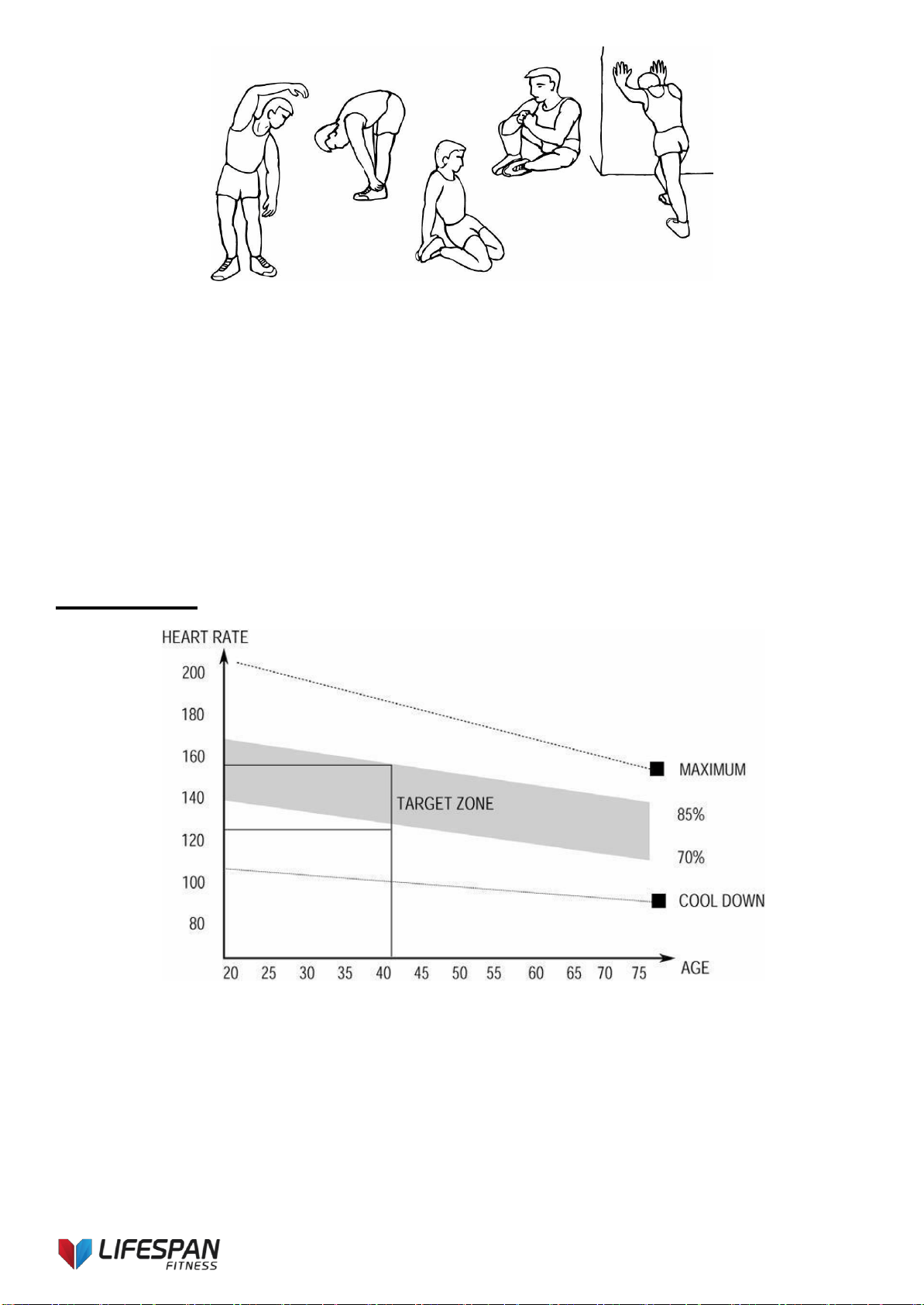
22
Everest
Training Zone Exercise
After warming up, increase the intensity to your desired exercise program. Be sure to maintain your intensity for
maximum performance. Breathe regularly and deeply as you exercise.
Cool Down
Finish each workout with a light jog or walk for at least 1 minute. Then complete 5 to 10 minutes of stretching to
cool down. This will increase the flexibility of your muscles and will help prevent post-exercise problems.
Workout Guidelines
TAR GE T ZON E
This is how your pulse should behave during general fitness exercise. Remember to warm up and cool
down for a few minutes.
The most important factor here is the amount of effort you put in. The harder and longer you work, the more calories you
will burn.

23
Everest
7. MAINTENANCE INSTRUCTIONS
Reasonable cleaning/lubricating should be made to extend the life time of this unit. Performance is maximized when
the belt and mat are kept as clean as possible.
WARNING: THE MAT/DECK FRICTION MAY PLAY A MAJOR ROLE IN THE FUNCTION AND LIFE OF
YOUR TREADMILL AND THAT IS WHY WE RECOMMEND YOU CONSTANTLY LUBRICATE THIS
FRICTION POINT TO PROLONG THE USEFUL LIFE OF YOUR TREADMILL. FAILING TO DO THIS MAY
VOID YOUR WARRANTY.
WARNING: UNPLUG POWER CORD BEFORE MAINTENANCE
WARNING: STOP TREADMILL BEFORE FOLDING
1. General Cleaning
Use a soft, damp cloth to wipe the edge of the belt and the area between the belt edge and frame. A mild soap
and water solution along with a nylon scrub brush will clean the top of the textured belt. This task should be
done once a month. Allow to dry before using.
On a monthly basis, vacuum underneath your treadmill to prevent dust build up. Once a year, you should
remove the black motor shield and vacuum out dirt that may accumulate.
2. General Care
Check parts for wear before use.
Pay particular attention to the fixing knobs and make sure they are tight.
Always replace the mat if worn and any other defective parts.
If in doubt do not use the treadmill and contact us.
TAKE CARE TO PROTECT CARPETS AND FLOOR in case of leakages. This product is a machine that
contains
moving parts which have been greased / lubricated and could leak
24
Everest
3. Belt/Deck/Roller Lubrication
The mat/deck friction may play a major role in the function and life of your treadmill and that is why we
recommend you constantly lubricate this friction point to prolong the useful life of your treadmill. You should apply
lubrication after approximately the first 30 hours of operation. We recommend lubrication of the deck according to
the following timetable:
o Light use (less than 3 hours per week) every 6 months
o Medium use (3-5 hours a week) every 3 months
o Heavy use (more than 5 hours per week) every 6-8 weeks
See below procedures for lubricating:
1. Use a soft, dry cloth to wipe the area between the belt and deck.
2. Spread lubricant onto the inside surface of belt and deck evenly (make sure the machine is turned off and
power is disconnected).
3. Periodically lubricate the front and rear rollers to keep them at their peak performance. If the treadmill
belt/deck/roller is kept reasonably clean it is possible to expect over 1200 hours before relubricating is
necessary.
Video Tutorial Available at:
http://youtu.be/cP9NtFHfWlc
Lifespan Fitness Channel:
http://www.youtube.com/user/treadmillsvideos
25
Everest
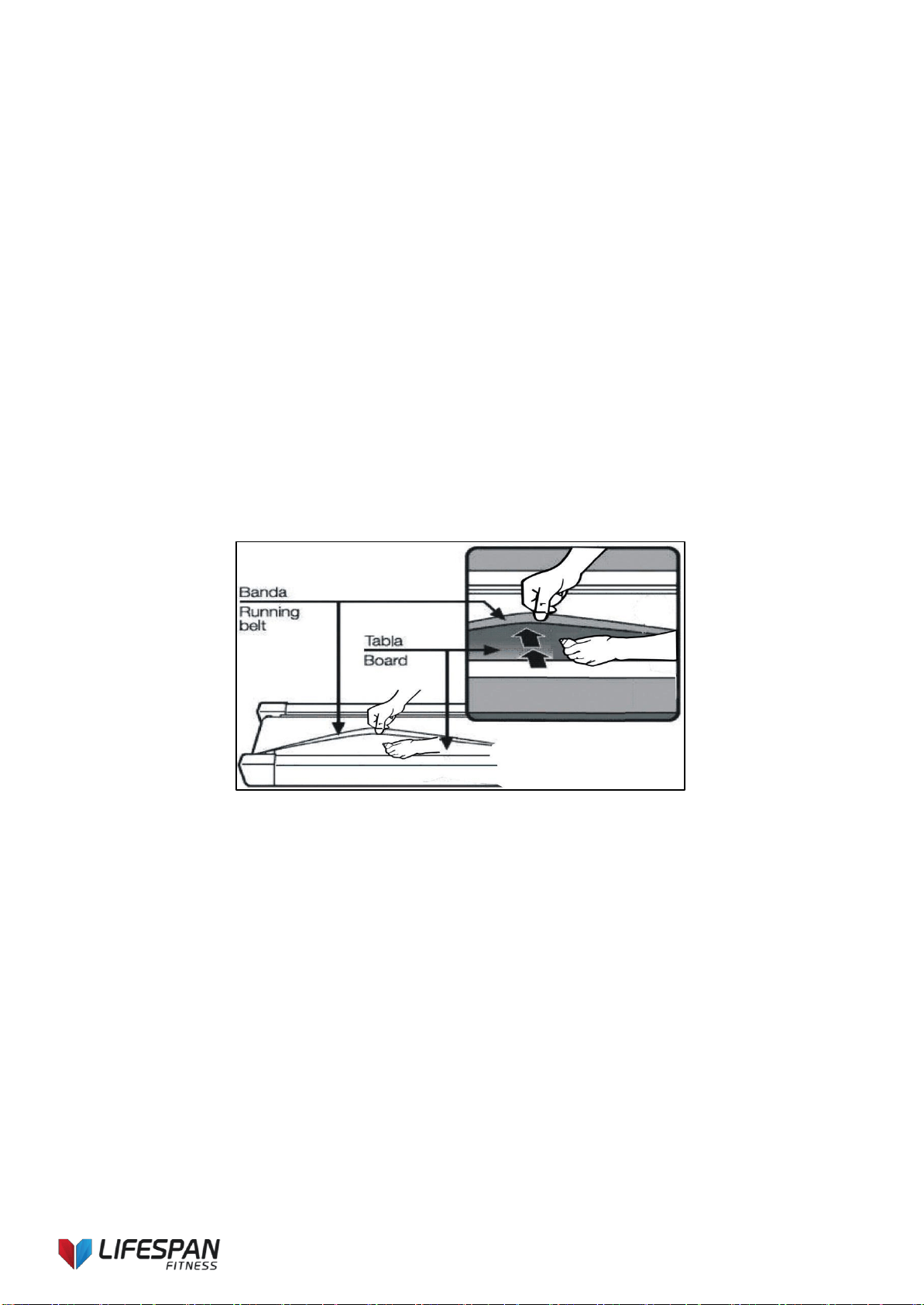
4. How to check the running mat for proper lubrication:
1. Disconnect the main power supply.
2. Fold the treadmill up into the storage position.
3. Feel the underside surface of the running mat.
If the surface is slick when touched, then no further lubrication is needed.
If the surface is dry to the touch, apply a suitable silicone lubricant.
We recommend that you use a silicone based spray to lubricate your Lifespan treadmill. This
can be purchased directly from us or any hardware store.
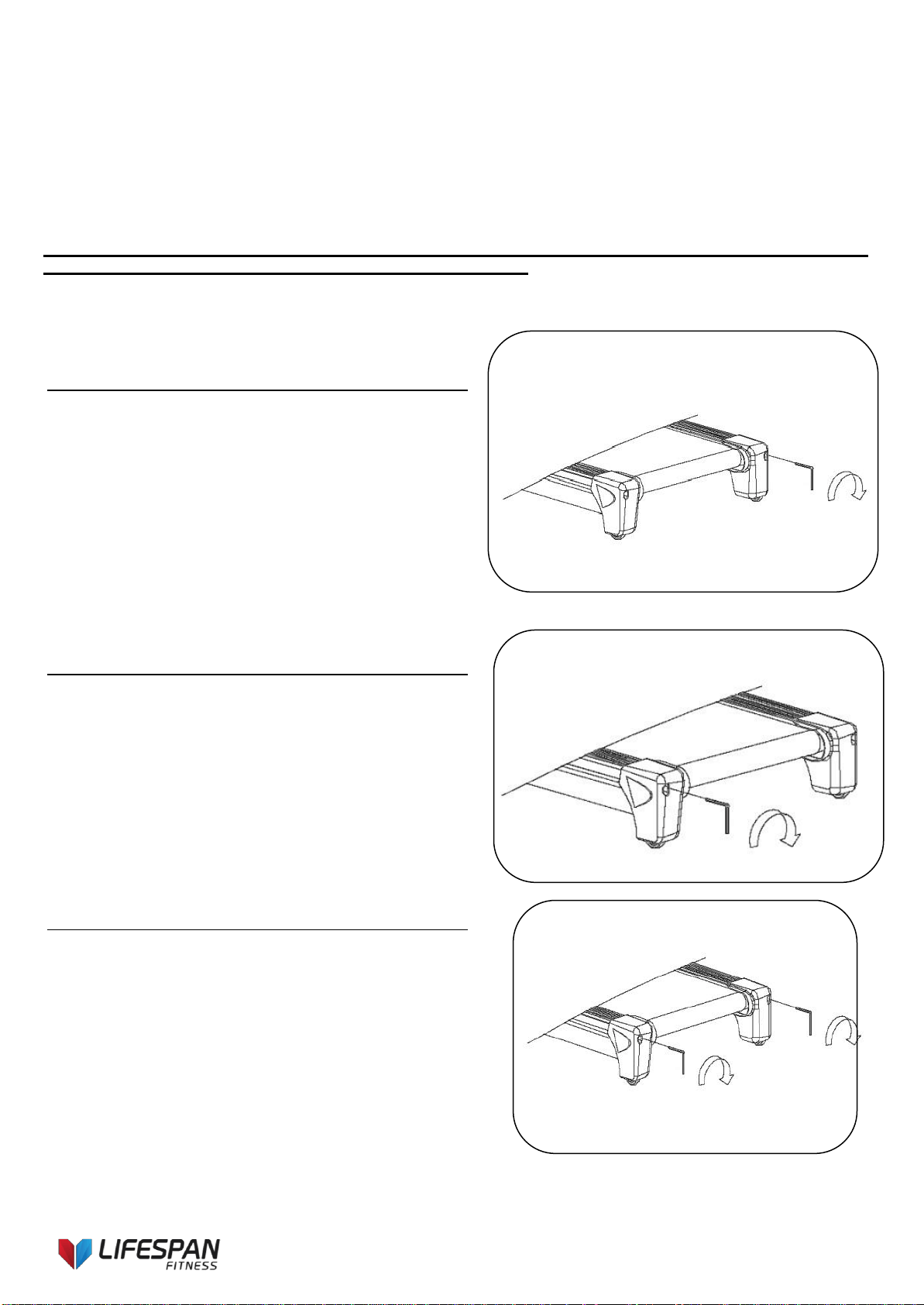
5. Adjusting the Running Belt
A
B
C
Place treadmill on a level surface. Run treadmill at
approximately 4km/h, checking the running condition.
If the belt has drifted to the right:
Whilst the treadmill is running at 4km/h, carefully turn
the right adjusting bolt 1/4 turn clockwise. Then
monitor treadmill until the belt centers. Repeat until the
belt correctly centers. See Picture A
If you have over adjusted the belt and it drifts to the
right, carefully turn the right adjusting bolt
anticlockwise until the belt centers.
If the belt has drifted to the left:
Whilst the treadmill is running at 4km/h, carefully turn
the left adjusting bolt 1/4 turn clockwise. Then
monitor treadmill until the belt centers. Repeat until the
belt correctly centers. See Picture B
If you have over adjusted it, carefully turn the left
adjusting bolt anticlockwise and until the belt centers.
To adjust the tightness of the belt:
Turn the treadmill off. Turn both the left and right
adjusting bolts 1/4 turn clockwise. Repeat until the belt
correctly tightens.
See Picture C
If the belt is over tightened, simply do the opposite to
loosen.
Vulcan
26
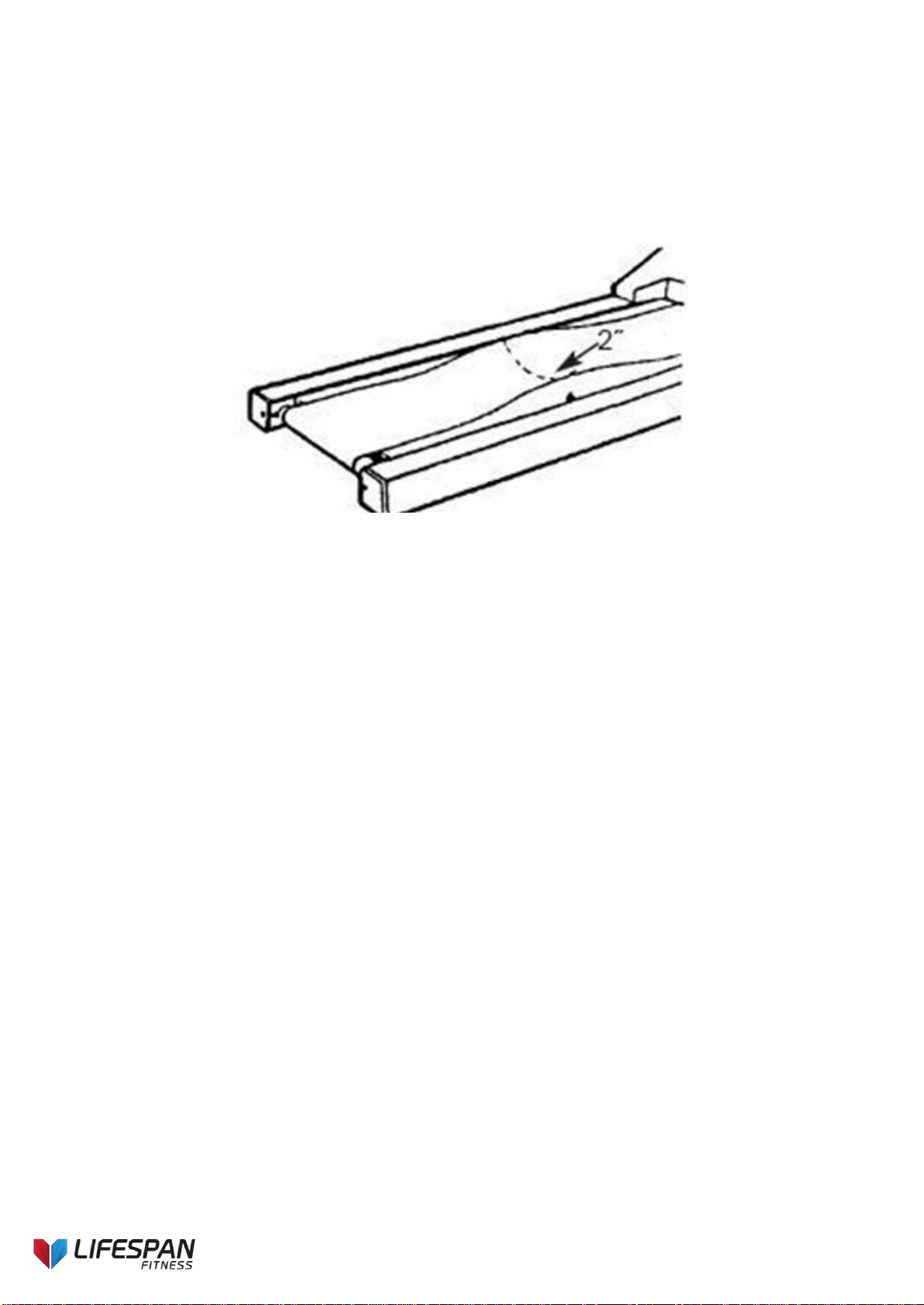
NOTE: When properly tightened, you should be able to peel the very edge of the side of the belt up
approximately 2 inches. However this is a rough reference and not all treadmills are the same. Some
treadmills that have longer belts may give different measurements for correct belt tightness.
Simply, if the belt begins to slip during use, this is an indication that the belt still needs tightening.
Video Tutorial Available at:
http://youtu.be/vllsamTSvvA
Lifespan Fitness Channel:
http://www.youtube.com/user/treadmillsvideos
Vulcan
27
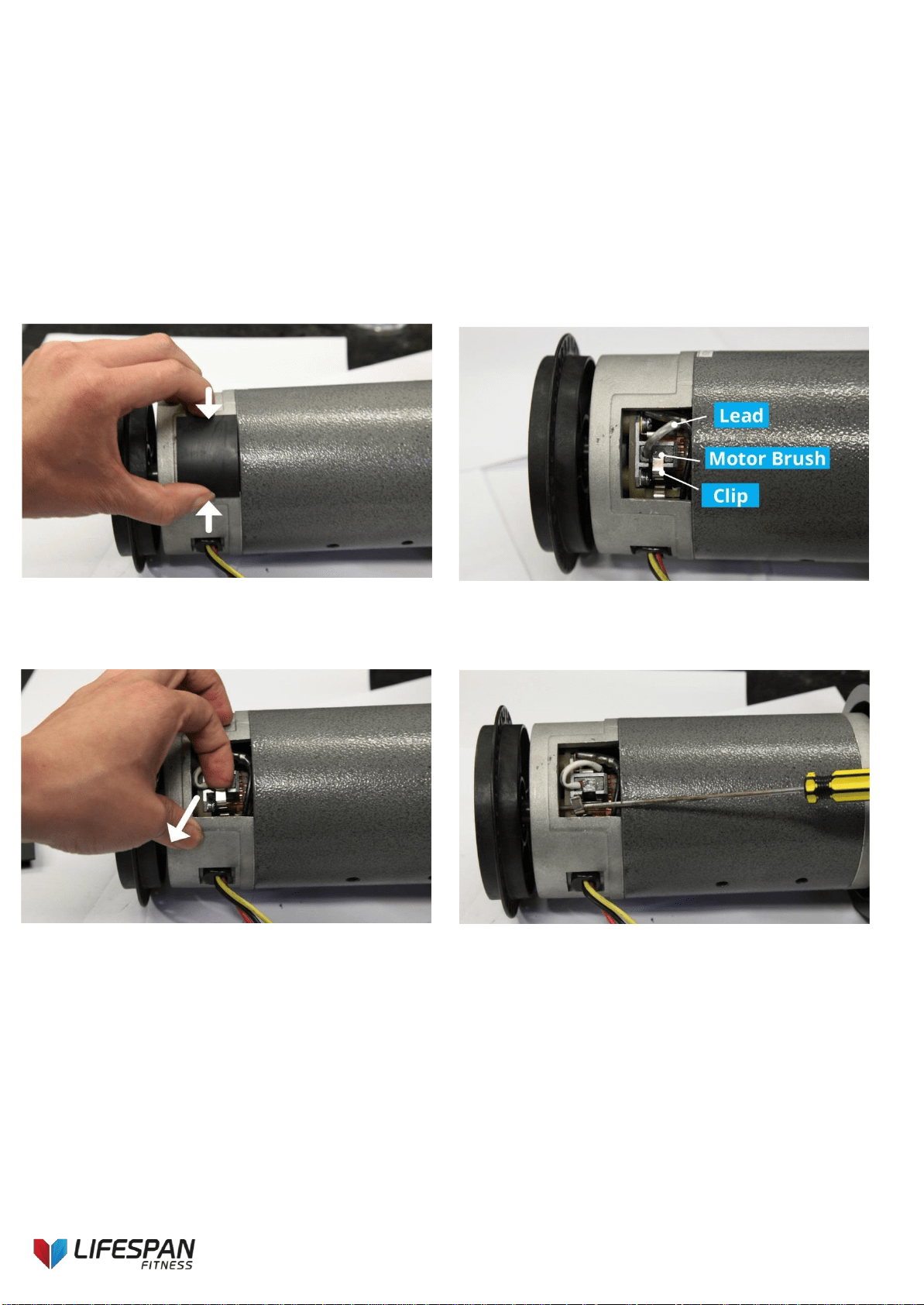
6. Replacing Motor Brushes
After extended use, the motor brushes in your treadmill motor will wear down, and this can lead to motor failure.
It is important that you maintain your motor by replacing the brushes on either side of the motor when they are
worn down. We recommend that you check your motor every 1000 hours of usage.
IMPORTANT: Before beginning the replacement of your motor brush, ensure that the treadmill is off and
unplugged from the electrical socket.
1. Remove the cover from the motor by squeezing it
from the sides.
2. You’ll find the motor brush held in with a clip, with
the lead plugged in.
3. Pull the clip out from its position. 4a. Hold the clip out of the way with a screwdriver or
similar object. Keep the screwdriver in this position
until step 9.
Vulcan
28
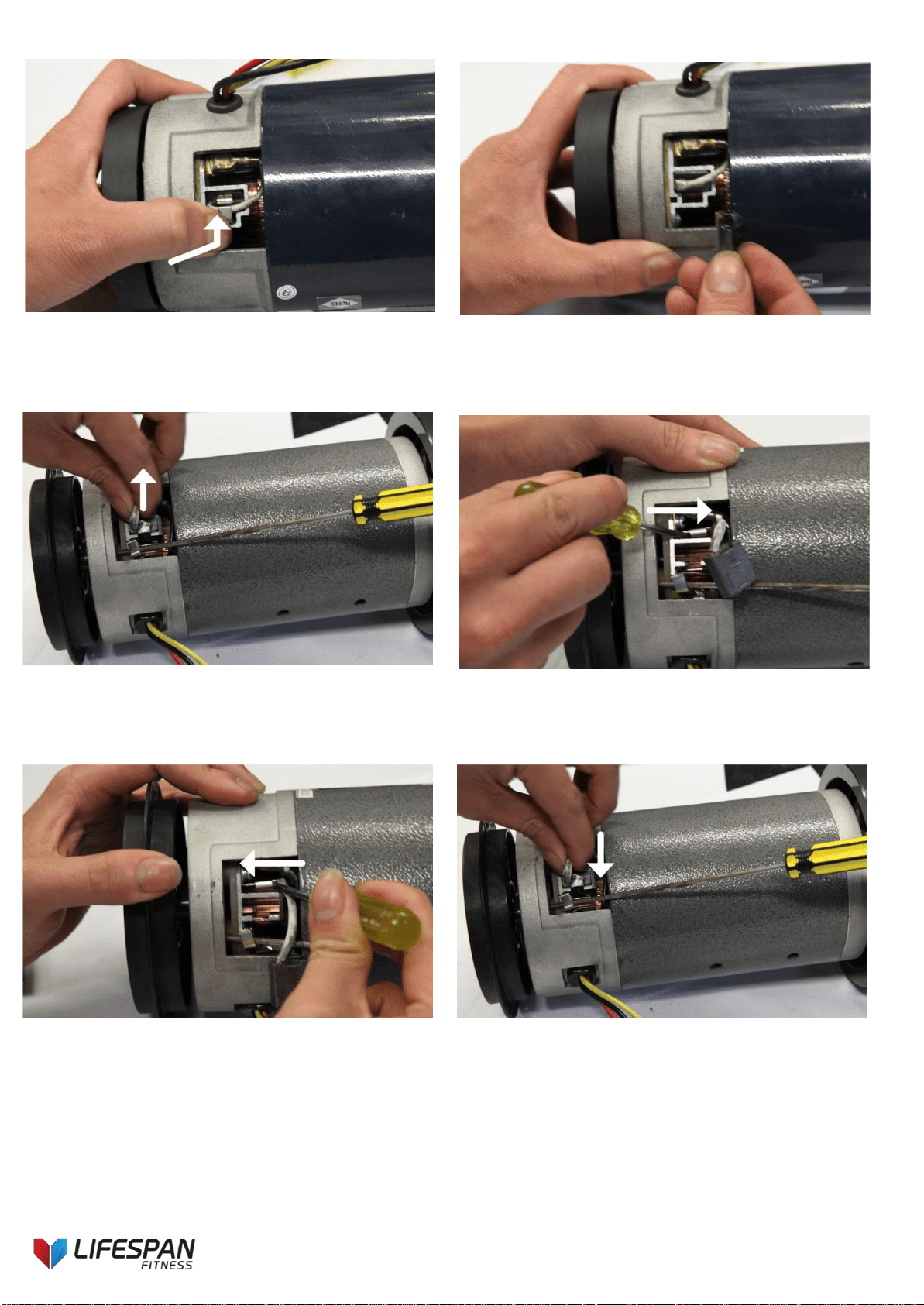
4b. Some treadmill motors may use a push clip
instead. In this case, gently push the clip inwards
and then up to release it from its latch.
4c. Remove the clip, noting the direction in which it
was originally placed, and put it safely aside.
5. Slide the motor brush out from its slot. If the brush
is shorter than 2cm on the longest side, you will need
to replace both brushes.
6. Slide the motor brush lead off the terminal using a
another small screwdriver or needle-nosed pliers.
7. Plug the new motor brush lead into the terminal. 8. Slide the new motor brush into the slot.
Vulcan
29
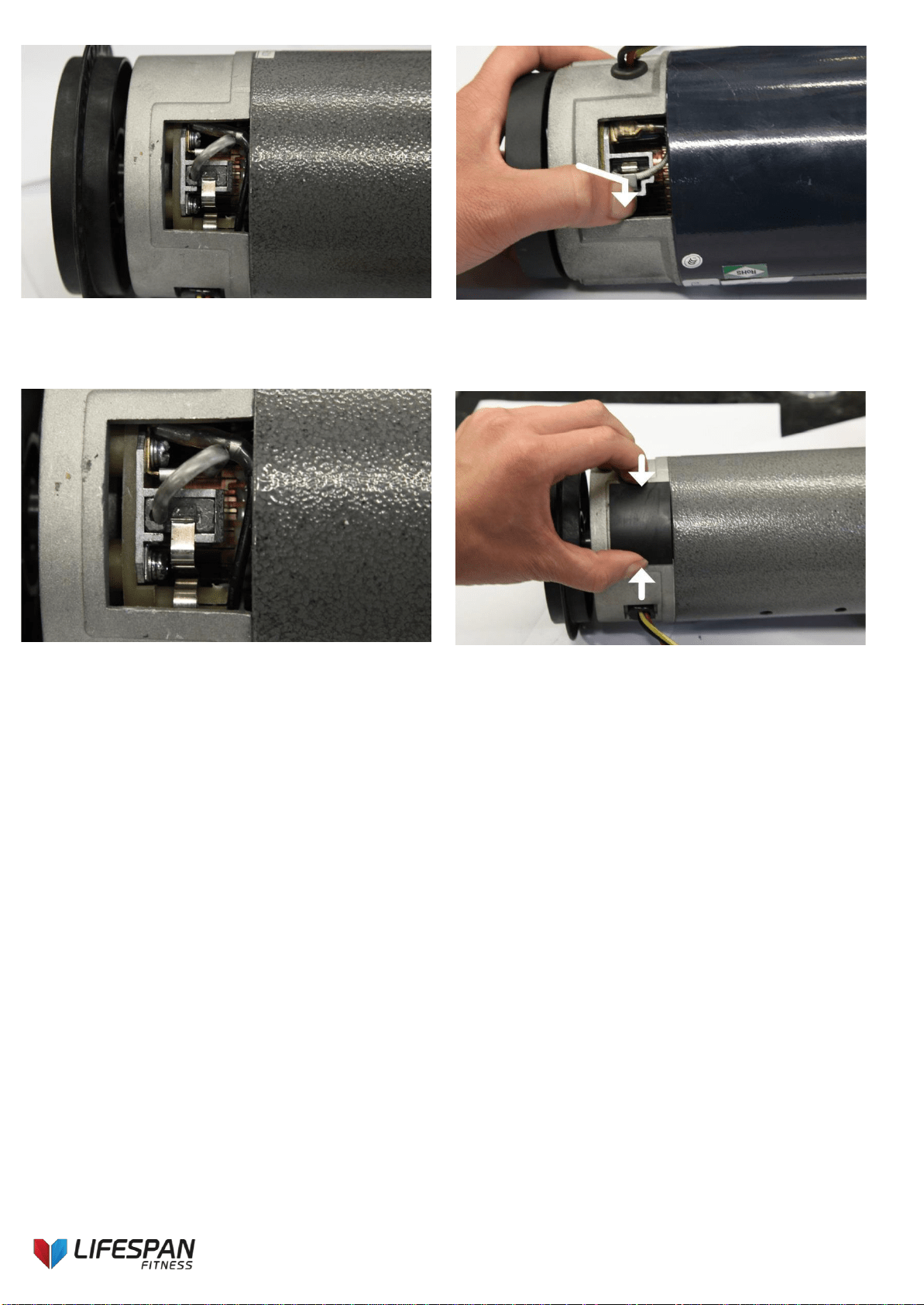
9a. Release the clip back into its position. 9b. If your motor uses a push clip, replace the push
clip by pushing it inwards and then down so that it
engages the catch.
10. Check that the motor brush is held firmly in place
by the clip, and that the lead is plugged securely onto
the terminal.
11. Replace the motor cover. Repeat steps 1-15 for
the second brush located on the opposing side of the
motor.
12. You have now successfully replaced the motor brushes. We also recommend that you remove any dirt and
dust from your treadmill motor fan using a vacuum cleaner before replacing the cover.
Vulcan
30
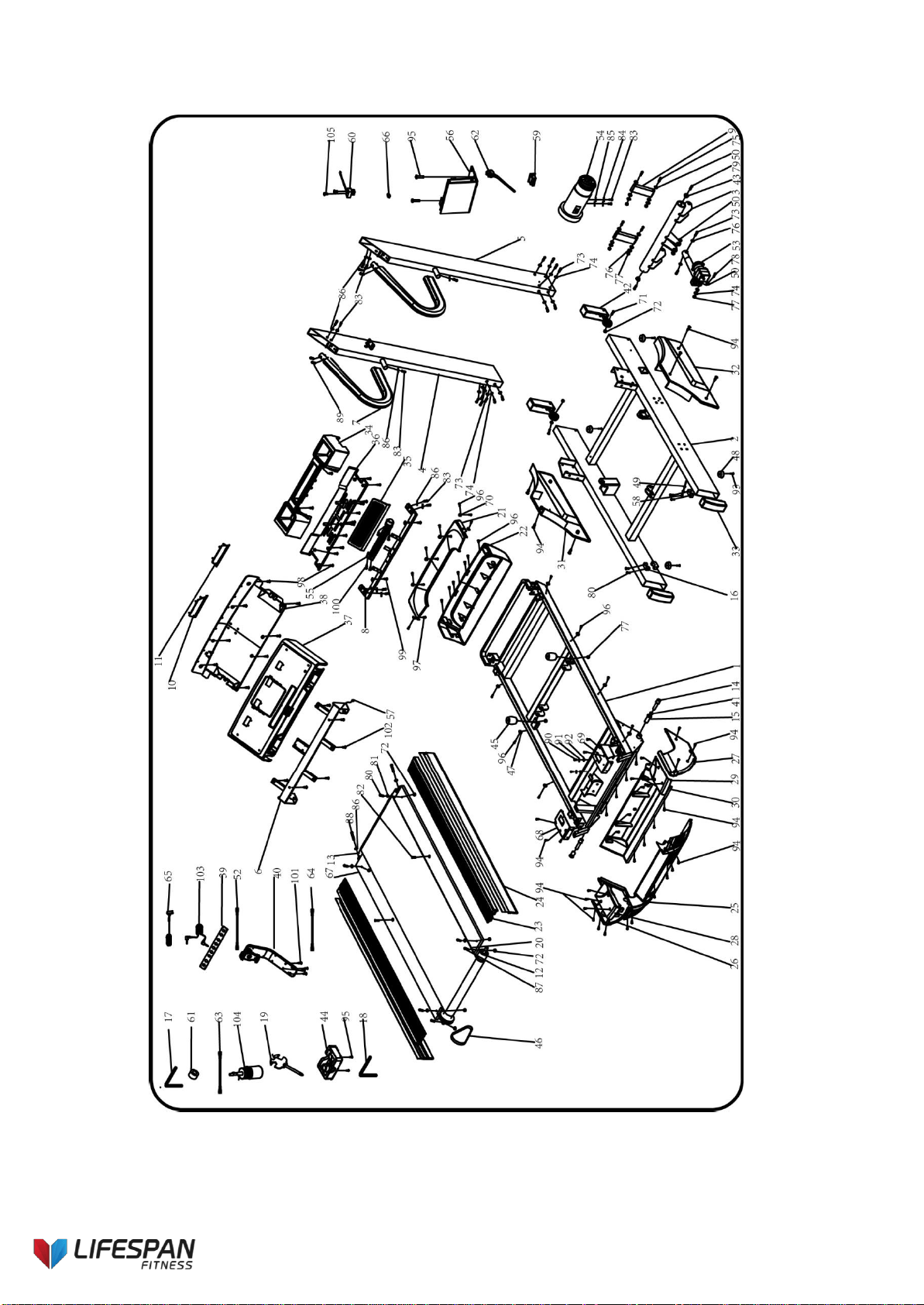
8. EXPLODED DIAGRAM

Vulcan
31
9. PARTS LIST
NO.
DESCRIPTION
SPEC.
QTY
NO.
DESCRIPTION
SPEC.
QTY
1
Main Frame
1
44
Line Card
1
2
Base Frame
1
45
Cushion
2
3
Shaft assembly
1
46
Motor Belt
1
4
Left Upright
Tube
1
47
Side Rail buckle
8
5
Right Upright
Tube
1
48
Feet Pad
4
6
Computer
Bracket
1
49
Ring retaining
plug B
1
7
Handbar
Bracket
2
50
Spacer casing
8
8
Water Bottle
Bracket
1
51
Adjusting Wheel
2
9
Connect Tube
Bracket
1
52
Running Board
1
10
Left speaker net
1
53
Incline Motor
1
11
Right speaker
net
1
54
DC Motor
1
12
Front Roller
1
55
cross flow fan
1
13
Rear Roller
1
56
Control board
1
14
Main rotating
shaft
2
57
Computer up
wire
1
15
Inner casing
pipe
2
58
Computer
bottom wire
1
16
Up Fix mould
2
59
switch
1
17
5#Allen Wrench
1
60
Sensor
1
18
6#Allen Wrench
1
61
magnet ring
1
19
Wrench
W/Screw
1
62
Power line
1
20
Running Belt
1
63
Blue Single Wire
1
21
Front cover
1
64
Brown Single
Wire
1

Vulcan
32
22
Bottom cover
1
65
Safety Key
1
23
Side Rails
2
66
Overload
protector
1
24
Side Rails 2
2
67
AC Single Wire
1
25
End Cap Back
Cover
1
68
Left End cap
supporting board
1
26
End Cap Left
Cover
1
69
Right End cap
supporting board
1
27
End Cap Right
Cover
1
70
Up cover fix
Plate
5
28
End Cap Up
Left Cover
1
71
Bolt
M8*68
2
29
End Cap Up
Right t Cover
1
72
Bolt
M8
8
30
End Cap
bottom Cover
1
73
Bolt
M10*15
14
31
Left base Cover
1
74
Lock Washer
10
15
32
Right base
Cover
1
75
Bolt
M10*80
4
33
Base plug
2
76
Lock Washer
10
4
34
Water Bottle
1
77
Bolt
M10
7
35
Fan blade
1
78
Bolt
M10*48
1
36
Back cover of
water bottle
1
79
Bolt
M10*30
2
37
Computer Up
cover
1
80
Bolt
M8*35
8
38
Computer
Bottom cover
1
81
Lock Washer
φ8*24*2
4
39
Pannel
1
82
Bolt
M10*32
2
40
IPAD Rack
1
83
Bolt
M8*16
12
41
Nylon casing
2
84
Lock Washer
8
2
42
Front Roller
Cover
2
85
Lock Washer
8
2
43
Shaft Sleeve
2
86
Lock Washer
8
10

Vulcan
33
10. WARRANTY
AUSTRALIAN CONSUMER LAW
Many of our products come with a guarantee or warranty from the manufacturer. In addition, they come with guarantees
that cannot be excluded under the Australian Consumer Law. You are entitled to a replacement or refund for a major
failure and compensation for any other reasonably foreseeable loss or damage.
You are entitled to have the goods repaired or replaced if the goods fail to be of acceptable quality and the failure does
not amount to a major failure. Full details of your consumer rights may be found at www.consumerlaw.gov.au
Please visit our website to view our full warranty terms and conditions:
http://www.lifespanfitness.com.au/warranty-repairs
Warranty and Support:
Please email us at support@lifespanfitness.com.au for all warranty or support issues.
For all warranty or support related enquiries an email must be sent before contacting us via any other means.

Vulcan
34
TROUBLESHOOTING
Failure or phenomenon
Main reason
Solution
Treadmill no display
A No power supply
Connect the power cord to AC, or check the
AC outlet
B The power switch is not turned on
Set the power switch to the ON position
C The drive is not powered or damaged
Press the overload protector again, or replace
the drive
D The signal line of computer open
circuit
Replace the signal cable and re-plug it up
E The computer damaged
Replace the computer
F Backlight not bright
Need to repair, check the backlight line, or
replace the backlight
Treadmill display
incomplete, lack of strokes
A Show driver IC Weld or solder
Need to repair, check the solder joints, re-
welding in place
B The conductive strip is slid and not
fixed in place
Reassemble LCD
C Display driver IC damaged
Need to repair, welding the new display driver
IC
Treadmill movement is not
smooth, weak or jitter
A Transmission parts have resistance
Adjust the transmission parts, or add
lubricating oil
B The belt is too tight or too loose
Adjust the belt tight
C The drive torque is too small or too
large
Adjust the torque potentiometer to the proper
position
Computer
display
Show ---or----
A Safety key fall off
Place the safety key on the panel or the card
position
B The magnetron does not pull
The magnetron is mounted to the correct
position
E01 or
E13
A The computer signal line is not
connected or bad
Re-plug the line
B The computer signal line is broken or
open circuit
Replace the signal line
C The computer signal line fault
Change the computer
D Drive signal line fault
Replace the drive
E02
A The motor cable is not plugged in, or
the motor is open
Re-insert the motor cable, or replace the
motor
B The driver IGBT breakdown and
damaged
Replace the drive
C The external AC voltage is too low
Stop using, let elective to troubleshooting
E04
A Incline motor line or signal line is not
plugged in
Check whether the connection is wrong or not
and reconnect
B Incline motor is bad
Change the incline motor
C the drive is damaged
Change the drive
E05
A Overloaded
System protection, human stall can be
restarted
B Running board with heavy resistance.
Need to be oiled
Adjust the transmission parts, or add
lubricating oil
C Internal motor short circuit
Change the motor
D The drive burns out
Change the drive
E10
A Drive torque is too large
Adjust the torque potentiometer to the proper
position
B Internal motor short circuit
Replace the motor
C Transmission parts stuck
Adjust the transmission parts, or add
lubricating oil
E11-
Overcurrent
Overcurrent:220V when it’s over
270VAC
Stop using, please remove the fault from the
electrician
E14-
Undervoltage
external
Undervoltage external:220V when it is
less 160VAC;
Stop using, please remove the fault from the
electrician

Vulcan
35
Hand Pulse Technology
Our products come equipped with hand pulse sensors which are used to pick up tiny EKG/ECG signals
that run through the body when your heart beats. These electrical EKG/ECG signals are very small and
that they must be amplified 1000 times to make the signal useful for the computer to display your pulse.
To ensure proper operation:
- The user must maintain good, consistent contact on all four sensors
- The users skin cannot be too dry or too wet
Other factors that could affect the reading:
- Change of grip on the sensors (during slow pace walking and up to running)
- Tightening of hand muscles will produce small electrical signals
- Static electricity charges from the air or from walking on the treadmill
EKG/ECG Sensors may filter through actual EKG/ECG signals and “Noise” factors that may affect the
reading. This will cause the pulse reading to be delayed and will take longer to update the display as the
heart rate changes. Too much noise will create an incorrect reading. Medical conditions or having no
electrical signal in the hands are other factors that may affect pulse readings as well.
These are limitations of hand pulse technology and even the most expensive systems (which can cost
upwards of
$3,000) used in hospitals have the same problems. The difference is that a patient in a hospital is not
running on a treadmill. Hand pulse technology works well on stationary exercise machines like bikes and
even elliptical cross trainers but are not perfect on a treadmill. We offer treadmills with a wireless heart
rate receiver which may be a more accurate option.
To test if your hand pulse sensors are working up to specification, hold them while standing on the side step
rails, not walking, and see if the reading is more in line with what you would expect. This will eliminate the
movement and static electricity factors. If your hands are dry, then wet them slightly (saliva works as a great
conductor if this doesn’t bother you).
For more information, please contact our Lifespan Technical Support
Department www.lifespanfitness.com.au
support@lifespanfitness.com.au