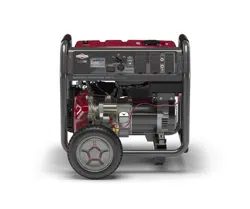
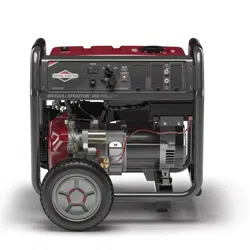
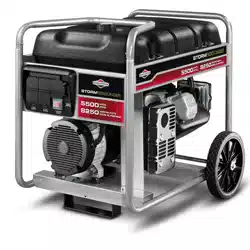
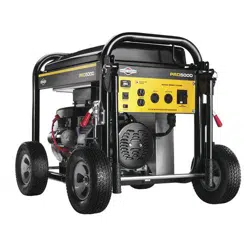
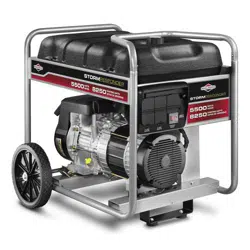
User Manual Outdoor Portable Generator
Equipment Description
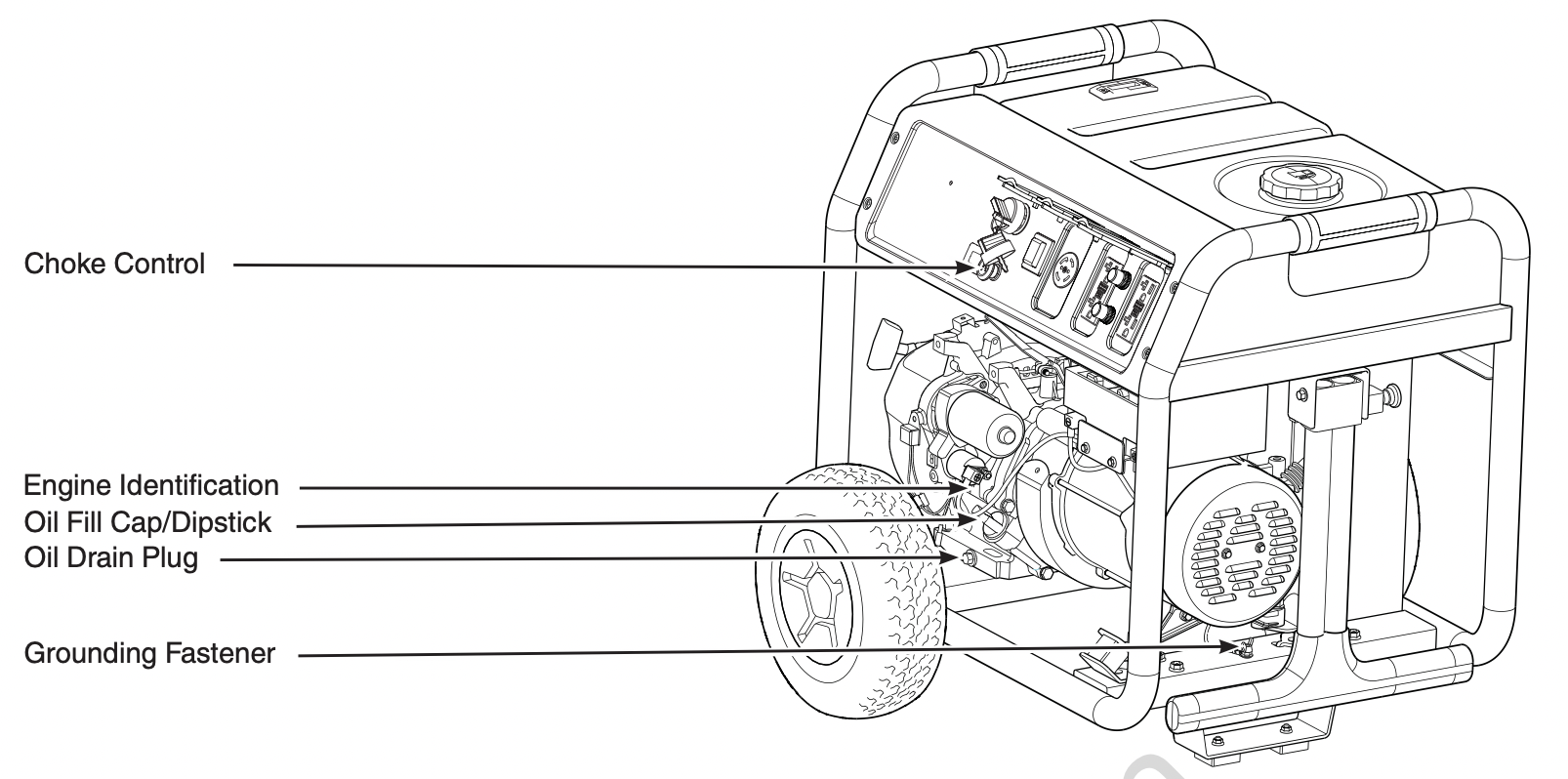
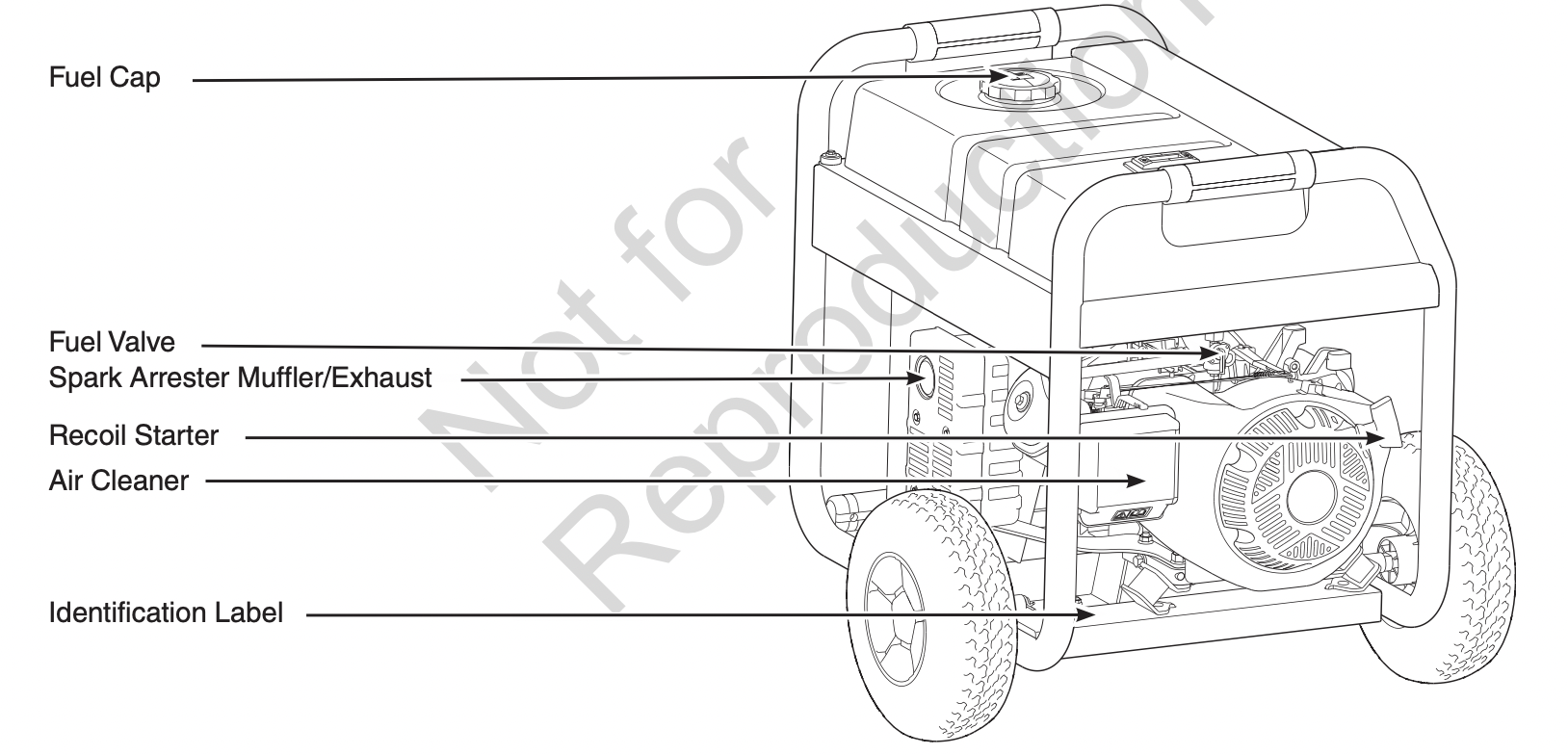
Air Cleaner — Filters engine intake air.
Choke Control — Used when starting a cold engine.
Engine Identification — Provides model, type and code of engine.
Fuel Cap — Add unleaded fuel here.
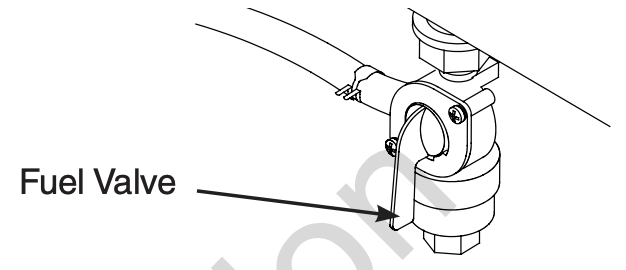
Fuel Valve — Used to turn fuel supply on and off to engine.
Grounding Fastener — Consult your local agency having jurisdiction for grounding requirements in your area.
Identification Label — Provides model and serial number of generator.
Oil Drain Plug — Drain engine oil here.
Oil Fill Cap/Dipstick — Check and add engine oil here.
Recoil Starter — Used to start the engine manually.
Spark Arrester Muffler/Exhaust — Exhaust muffler lowers engine noise and is equipped with a spark arrester screen.
Features and Controls
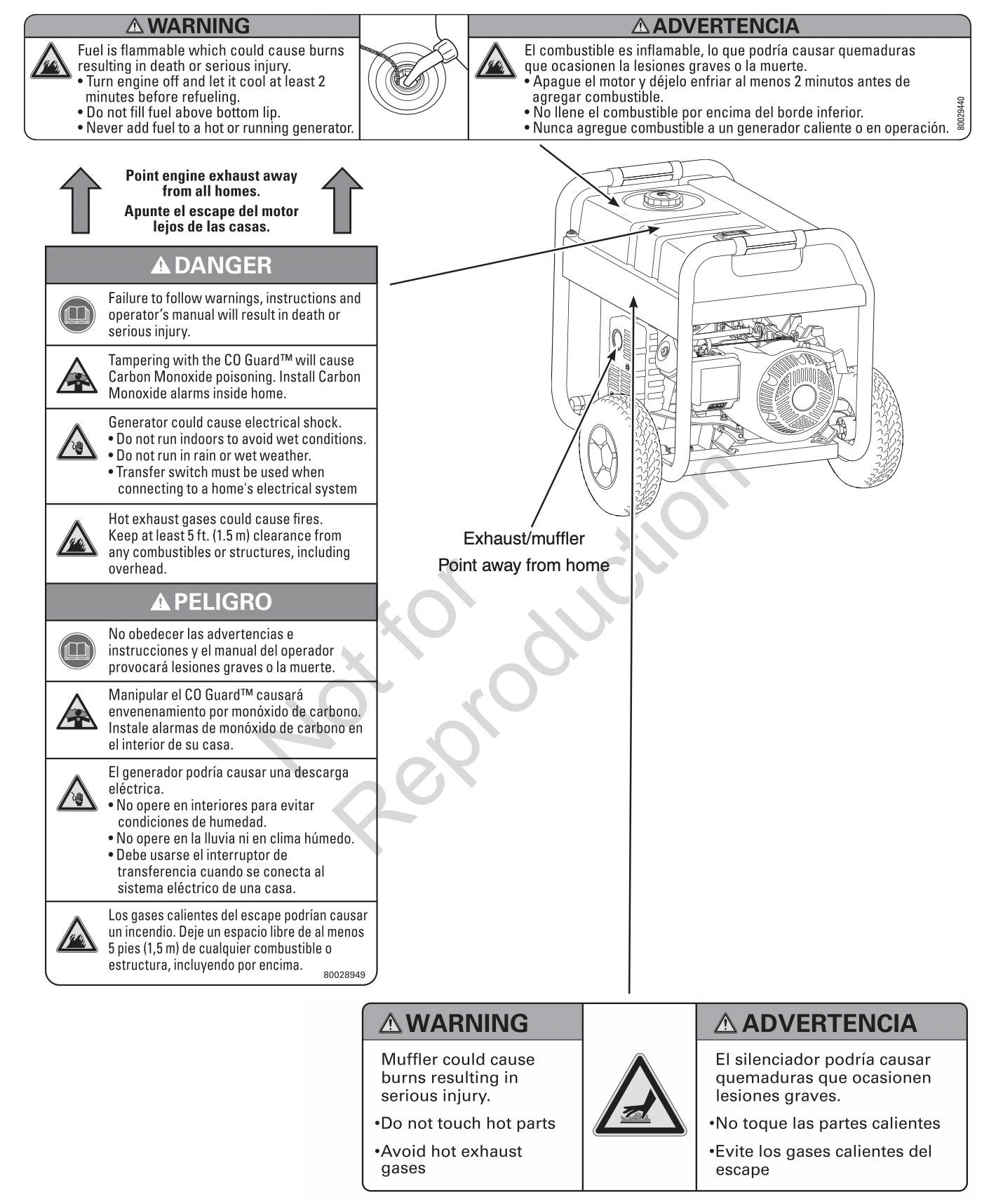
Compare the illustrations with your generator to familiarize yourself with the locations of various controls and product warnings.
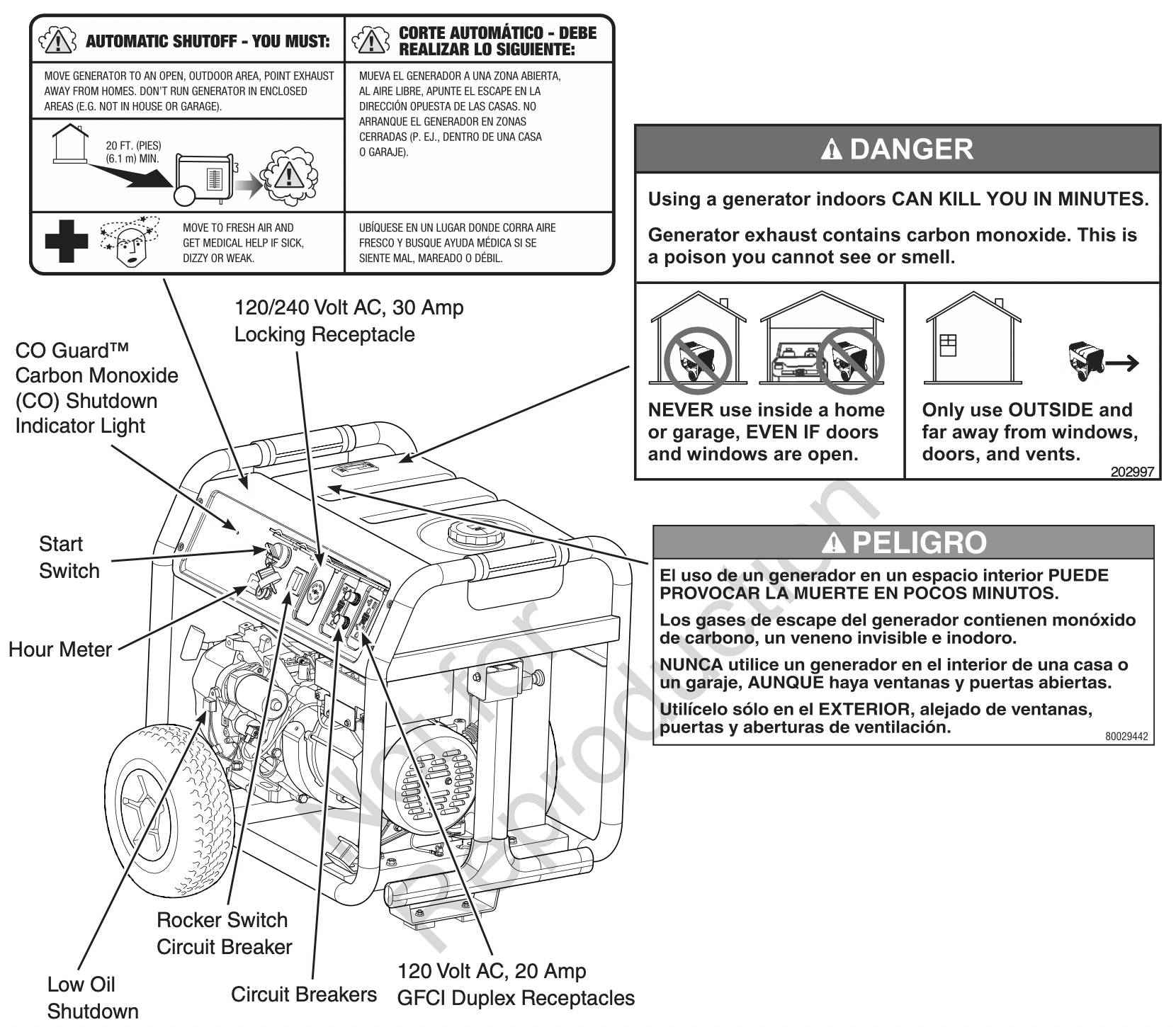
120 Volt AC, 20 Amp, GFCI Duplex Receptacles — Used to supply 120 Volt AC, single phase, 60 Hz power for electrical lighting, appliance, tool and motor loads.
120/240 Volt AC, 30 Amp Locking Receptacle — Used to supply 120 / 240 Volt AC, single phase, 60 Hz power for electrical lighting, appliance, tool and motor loads.
Circuit Breakers (AC) — The 120 Volt AC, 20A GFCI duplex receptacles are provided with “push to reset” 20 Amp circuit breakers to protect the generator against electrical overload.
CO Guard™ Carbon Monoxide (CO) Shutdown Indicator Light — Indicates the engine shutdown due to carbon monoxide accumulation around the generator or a CO Guard system fault occurred.
Hour Meter — Displays and records how many hours your generator has run (up to 9,999.9).
Low Oil Shutdown — This unit is equipped with a low oil protection device. Oil must be at proper level for engine to run. If the engine oil drops below a preset level, an oil switch will stop the engine. Check oil level with dipstick.
Rocker Switch Circuit Breaker — The 30 Amp locking receptacle is provided with a 2 pole rocker switch circuit breaker to protect the generator against electrical overload.
Start Switch — Turn key to START position to start engine. Turn key to OFF position to switch off engine.
Operation
Step 1: Safe Location
Before starting the portable generator there are two equally important safety concerns regarding carbon monoxide poisoning and fire that must be addressed.
Operation Location to Reduce the Risk of Carbon Monoxide Poisoning
The engine exhaust of all fossil fuel burning equipment, such as a portable generator, contains carbon monoxide, a poisonous gas that will kill you in minutes. You cannot smell it, see it, or taste it. Even if you do not smell exhaust fumes, you could still be exposed to carbon monoxide gas.
By law it is required in many states to have a carbon monoxide alarm in operating condition in your home.
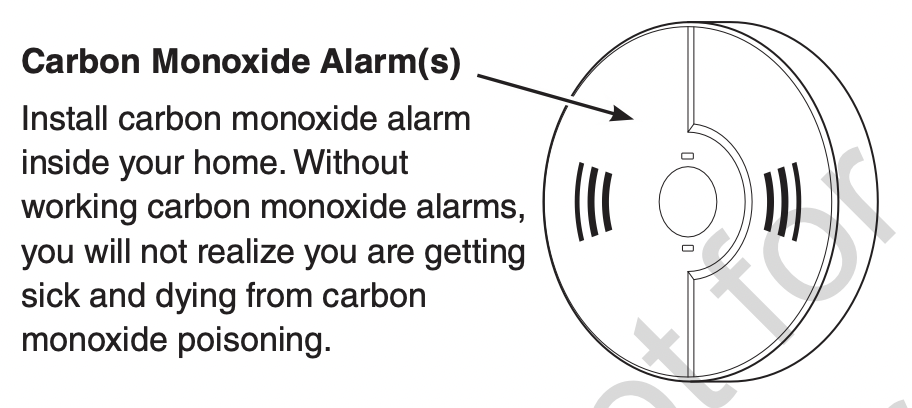
A carbon monoxide alarm is an electronic device that detects hazardous levels of carbon monoxide. When there is a buildup of carbon monoxide, the alarm will alert the occupants by flashing visual indicator light and alarm. Smoke alarms cannot detect carbon monoxide gas.
DANGER! Engine exhaust contains carbon monoxide, a poisonous gas that will kill you in minutes. You cannot smell it, see it, or taste it. Even if you do not smell exhaust fumes, you could still be exposed to carbon monoxide gas.
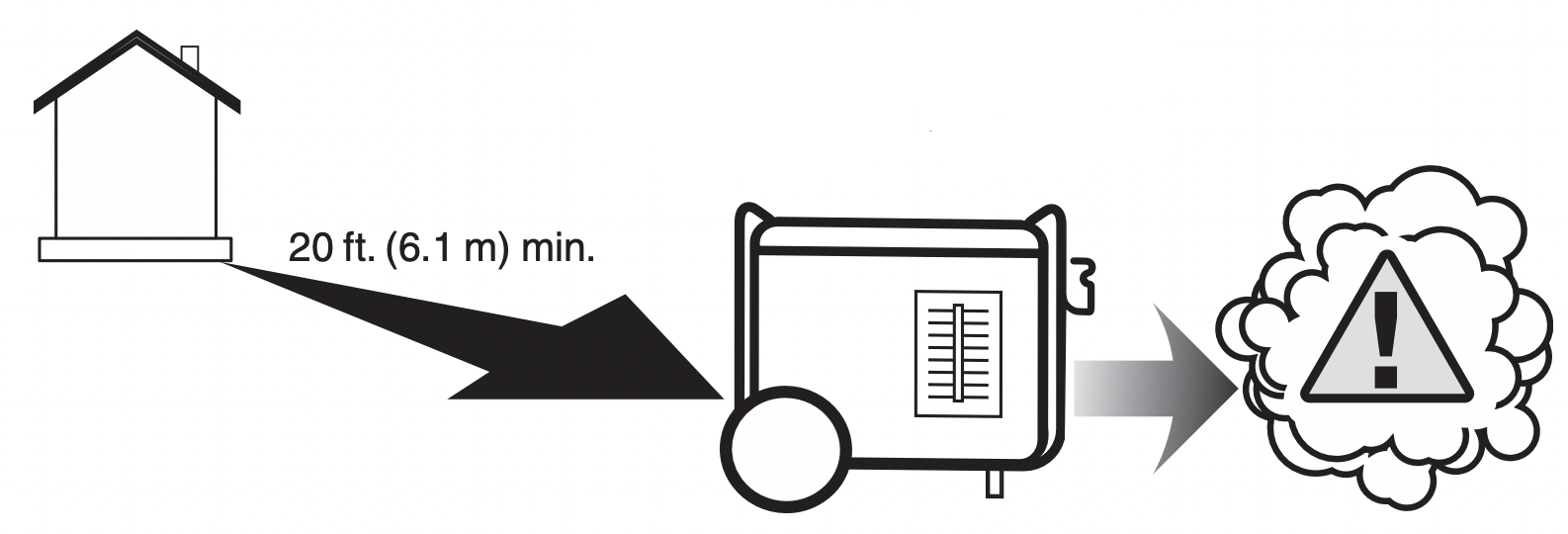
- Operate portable generator only outdoors, at least 20 ft. (6.1 m) from occupied spaces with exhaust pointed away to reduce the risk of carbon monoxide accumulating.
- Install battery-operated carbon monoxide alarms or plug-in carbon monoxide alarms with battery back-up according to the manufacturer’s instructions. Smoke alarms cannot detect carbon monoxide gas.
- Do not run portable generator inside homes, garages, basements, crawlspaces, sheds, or other partiallyenclosed spaces even if using fans or opening doors and windows for ventilation. Carbon monoxide can quickly build up in these spaces and can linger for hours, even after this product has shut off.
If you start to feel sick, dizzy, weak, or your homes carbon monoxide alarm sounds while using this product, get to fresh air right away. Call emergency services. You may have carbon monoxide poisoning.
Prevent Carbon Monoxide (CO) Poisoning
- Use outdoors at least 20 ft. (6.1 m) from any home.
- Point exhaust away from all homes and occupied spaces.
- Install CO alarms inside your home.
Operation Location to Reduce the Risk of Fire
WARNING! Exhaust heat/gases could ignite combustibles, structures or damage fuel tank causing a fire, resulting in death or serious injury.
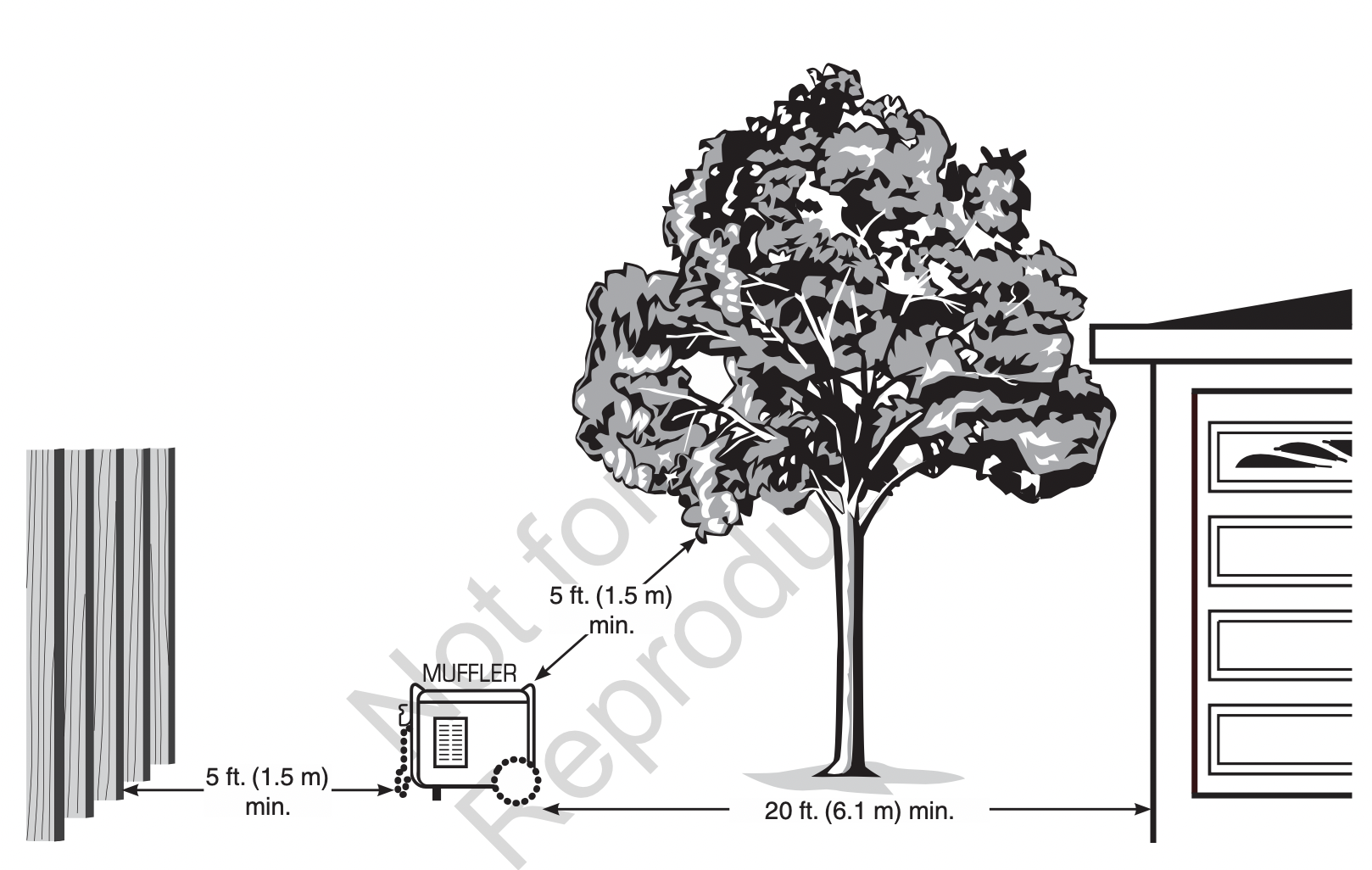
- Portable generator must be at least 5 ft. (1.5 m) from any structure, overhang, trees, shrubs, or vegetation over 12 in. (30.5 cm) in height.
- Do not place portable generator under a deck or other type of structure that may confine airflow. Smoke alarm(s) must be installed and maintained indoors according to the manufacturer’s instructions/recommendations.
- Carbon monoxide alarms cannot detect smoke.
- Do not place portable generator in manner other than shown.
Step 2: Oil and Fuel
The generator engine is shipped from the factory filled with 10W30 oil. This allows for generator operation in a wide range of temperature and climate conditions. For checking/ adding or changing oil see Maintenance.
Fuel must meet these requirements:
- Clean, fresh, unleaded fuel with a minimum of 87 octane.
- Gasoline with an ethanol content up to 10% is acceptable.

NOTICE: Do not mix oil in fuel or modify engine to run on alternate fuels. Use of unapproved fuels could damage engine and will not be covered under warranty.
See High Altitude for 5,000 ft. and above.
WARNING! Fuel and its vapors are extremely flammable which could cause burns or fire resulting in death or serious injury.
- Do not refuel during operation.
- Do not smoke during refueling.
- Turn engine off and let it cool at least 2 minutes before removing fuel cap.
- Fill fuel tank outdoors. Keep fuel away from sparks, open flames, pilot lights, heat, and other ignition sources. Check fuel lines, tank, cap and fittings frequently for cracks or leaks. Replace if necessary.
- Slowly remove fuel cap to relieve pressure in tank.
- Slowly add unleaded fuel to fuel tank. Be careful not to fill above lip. This allows adequate space for fuel expansion.
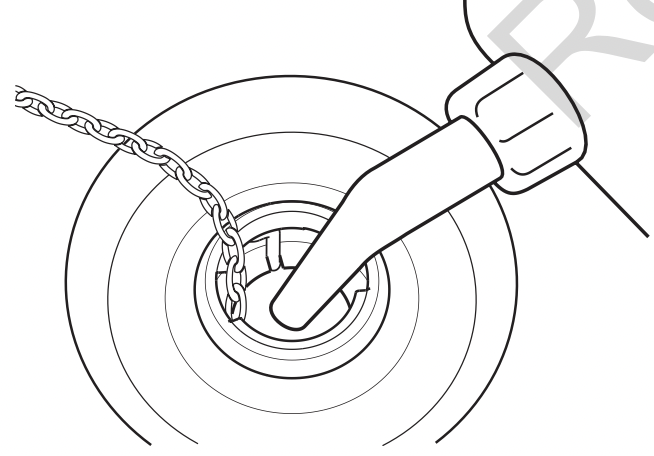
- Install fuel cap and let any spilled fuel evaporate before starting engine.
High Altitude
At altitudes over 5,000 ft. (1524 m), a minimum 85 octane fuel is acceptable. To remain emissions compliant, high altitude adjustment is required. Operation without this adjustment will cause decreased performance, increased fuel consumption, and increased emissions.
See an authorized Briggs & Stratton dealer for high altitude adjustment information. Operation of the engine at altitudes below 2,500 ft. (762 m) with the high altitude kit is not recommended.
Transporting
When transporting equipment with a vehicle or trailer, turn fuel shutoff valve to off (0) position. Do not tip engine or equipment at an angle which causes fuel to spill.
Step 3: Generator Start Up
Disconnect all electrical loads from the generator. Use the following start instructions:
- Make sure unit is outdoors on a level surface.
NOTICE: Failure to operate the unit on a level surface may cause the unit to shut down
- Turn the fuel valve to the on (I) position.
- Pull choke control out to close choke (
 ).
).
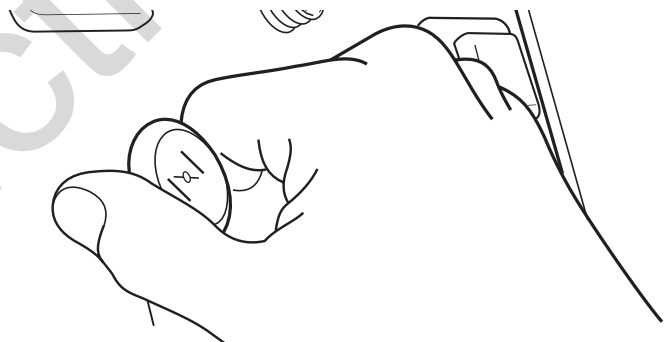
- Turn and hold key in start switch to START position until generator starts. DO NOT hold key in START position for more than 5 seconds. Pause for at least 30 seconds between starting attempts.
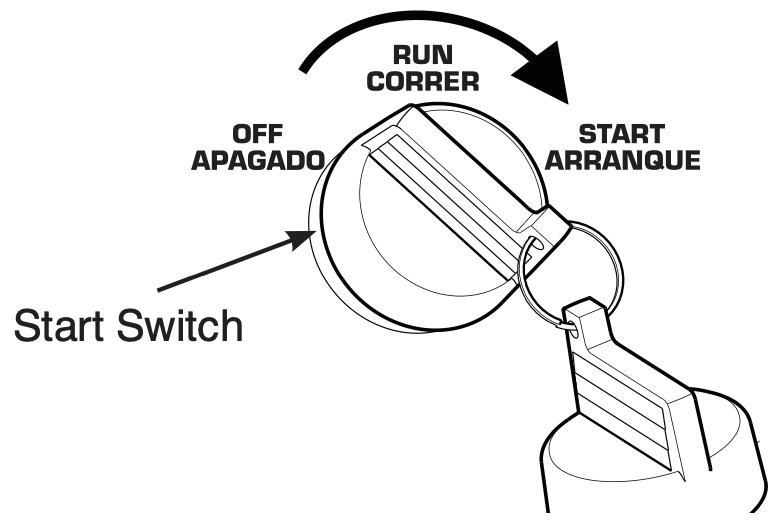
NOTICE: If battery is discharged, turn key in start switch to RUN position, grasp recoil handle and pull slowly until slight resistance is felt. Then pull rapidly one time only to start engine.
- Open choke gradually as engine warms up by pushing in on choke handle.
NOTICE: If engine starts but fails to run, see Low Oil Shutdown in Features and Controls.
Step 4: Connecting Electrical Loads
Using Extension Cords
Use only grounded extension cords marked for outdoor use rated for your loads. Follow cord safety instructions.
WARNING! Damaged or overloaded extension cords could overheat, arc, and burn resulting in death or serious injury.
NOTICE: For best results when plugging into the 120 Volt receptacles, plug items to be powered in sequence as shown.
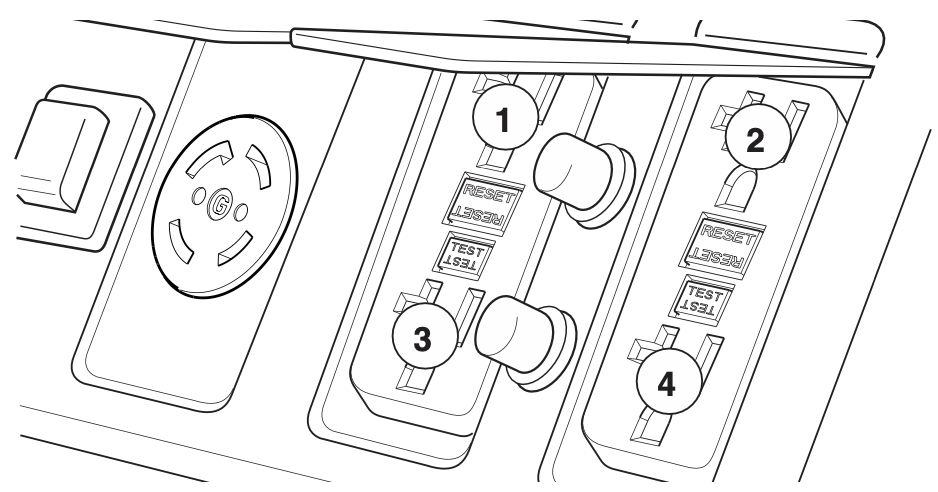
NOTICE: For generator output required see Generator Capacity. Connect electrical loads in off position then turn on for operation.
120 Volt AC, 20 Amp, GFCI Duplex Receptacles
Use each receptacle to operate 120 Volt AC, single-phase, 60 Hz electrical loads requiring up to 2,400 Watts (2.4 kW) at 20 Amps of current.
Ground Fault Protection
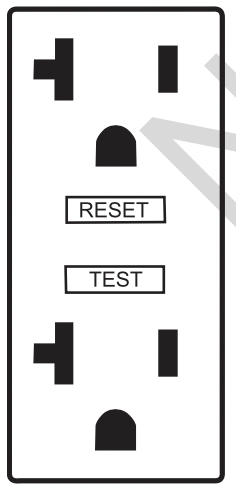
The duplex receptacles are equipped with Ground Fault Circuit Interrupter (GFCI) protection. The GFCI protects against electrical shock that may be caused if your body becomes a path which electricity travels to reach ground.
When protected by a GFCI, one may still feel a shock, but the GFCI is intended to cut current off quickly enough so that a person in normal health should not suffer any serious electrical injury.
WARNING! Generator voltage could cause electrical shock or burn resulting in death or serious injury. Contact with the hot and neutral conductor at the same time could cause electrical shock or burn, even if the circuit is GFCI protected.
Testing the GFCI
While generator is running, test each GFCI receptacle prior to use, as follows:
- Push the “Test” button. The “Reset” button should pop out, which should allow no power to reach the receptacle.
- Press the “Reset” button firmly until it is fully in place and locks in that position. If the GFCI receptacle does not reset properly, do not use the receptacle. Call or take your generator to a local Briggs & Stratton authorized service dealer.
- If the GFCI trips by itself at any time, reset and test the receptacle.
120/240 Volt AC, 30 Amp, Locking Receptacle
Use a NEMA L14-30 plug with this receptacle. Connect a 4-wire cord set rated for 250 Volt AC loads at 30 Amps. The generator’s locking receptacle is not protected by a GFCI.
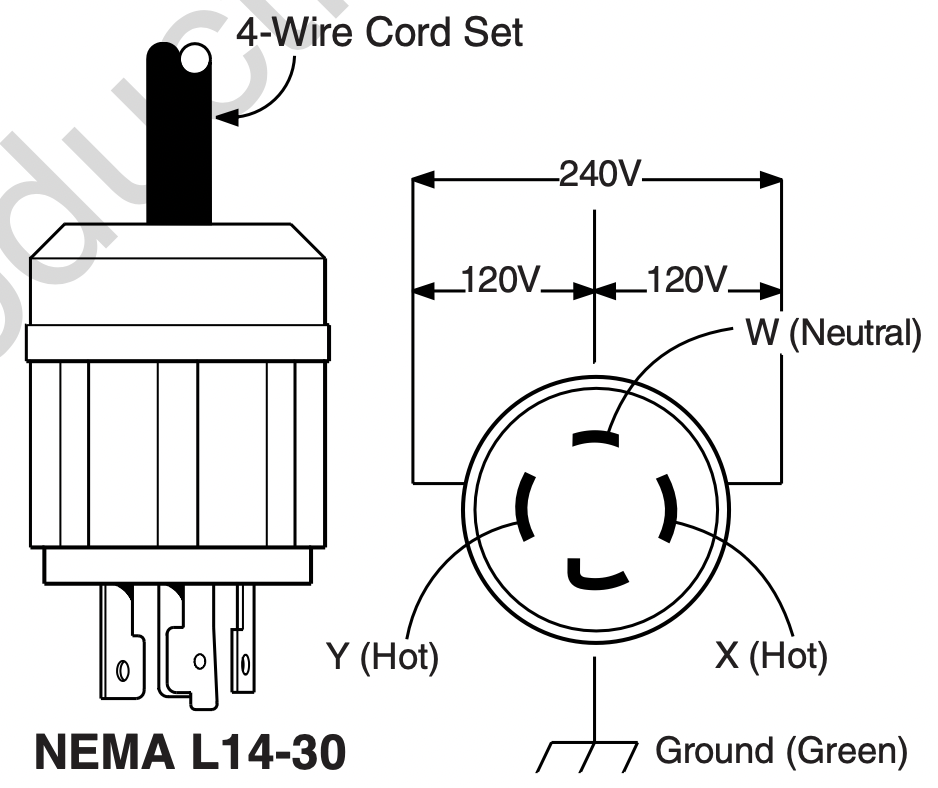
This receptacle powers 120/240 Volt AC, 60 Hz, single phase loads requiring up to 7,200 Watts of power (7.2kW) at 30 Amps for 240 Volts or two independent 120 Volt loads at 30 Amps each.
Generator Capacity
To make sure your generator can supply enough running watts and starting watts for the items you will power at the same time, follow these simple steps:
- Select the items you will power at the same time. See following list for typical wattages.
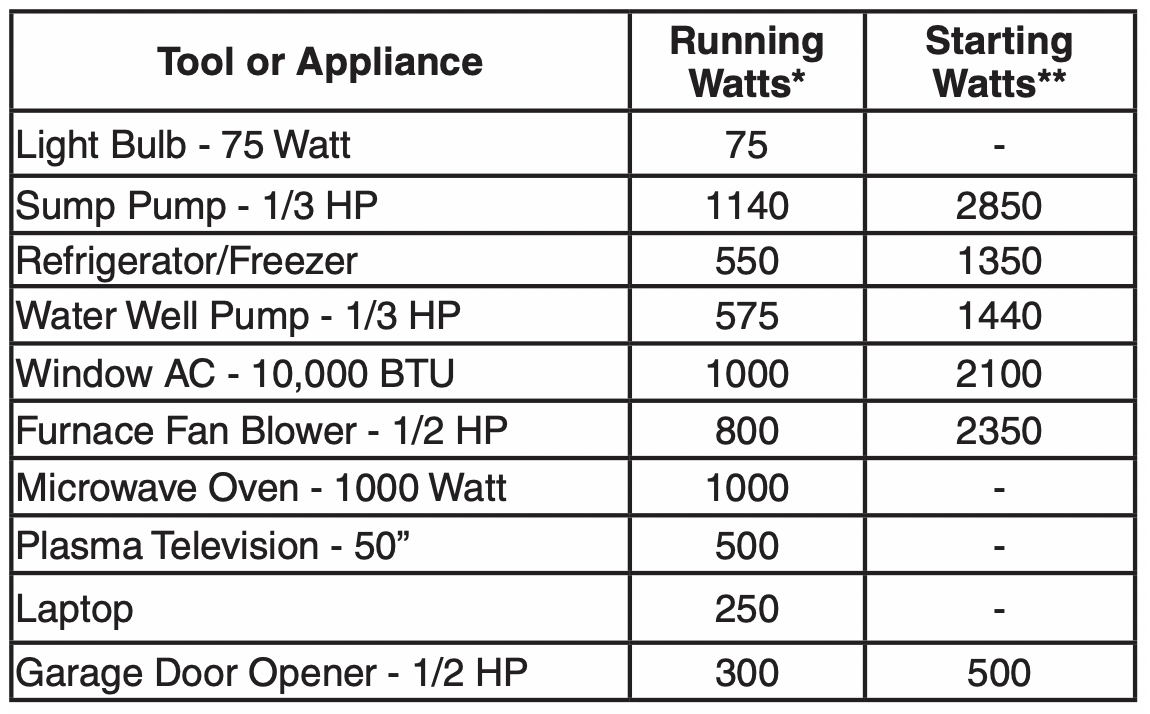
* Typical wattages listed are approximate only. Check tool or appliance for actual wattage.
** Per Briggs & Stratton 628K, Starting Watts represents the momentary electrical current the generator can provide to start electric motors. Starting Watts does not represent the power required to continuously run electrical loads. Starting Watts is the maximum current that can momentarily be supplied when starting a motor, multiplied by the generator’s rated voltage.
- Total the running watts. This is the amount of power your generator must produce to keep your items running. See following example:
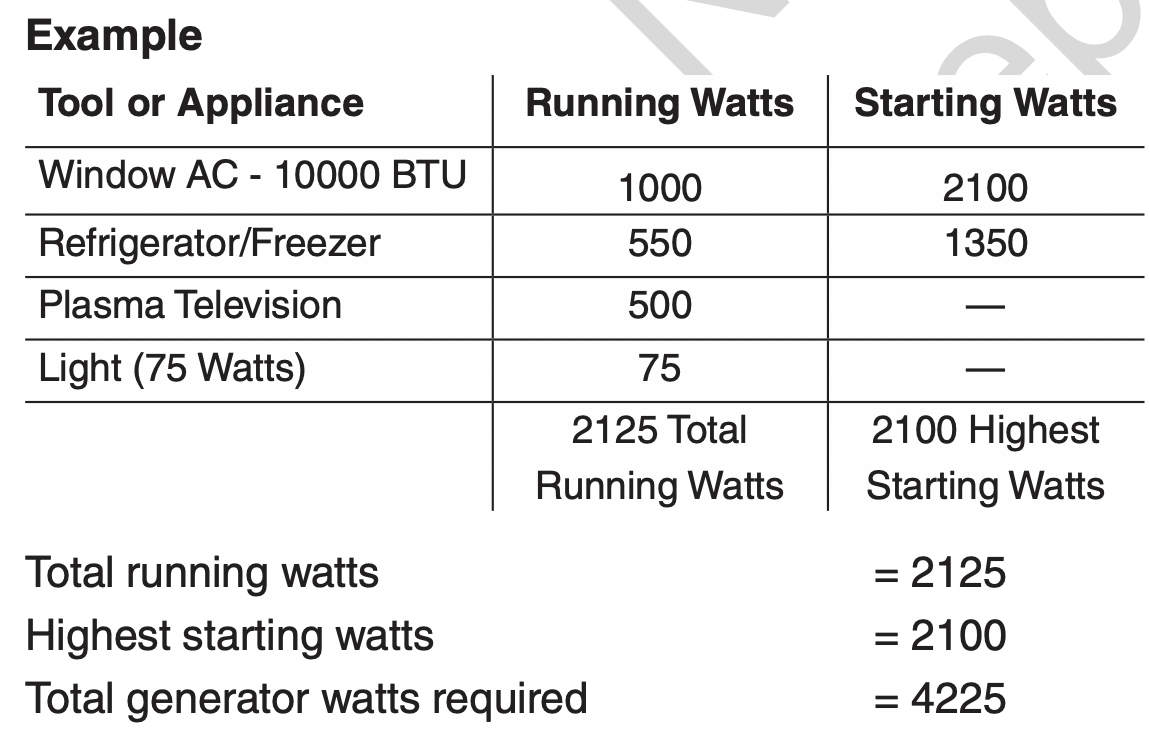
- Estimate the starting watts you will need. Because not all motors start at the same time, total starting wattage can be estimated by adding only the item with the highest additional starting watts requirements to the total running watts from step 2.
Power Management
To manage generator power, sequentially add loads as follows:
- With nothing connected to generator, start the engine outdoors.
- Plug in and turn on the first load, preferably the largest load you have.
- Permit the generator output to stabilize (engine runs smoothly and attached device operates properly).
- Plug in and turn on the next load.
- Again, permit the generator to stabilize.
- Repeat steps 4 and 5 for each additional load.
Never add more loads than the generator capacity. Take special care to consider surge loads in generator capacity.
CO Guard
Carbon Monoxide (CO) Shutdown System
CO Guard automatically shuts down the engine when harmful levels of carbon monoxide accumulate around the generator or a CO Guard fault occurs. After shutdown, the CO Guard indicator light will blink for at least five minutes per the chart below.
CO Guard DOES NOT replace carbon monoxide alarms. Install battery-powered carbon monoxide alarm(s) in your home. Don’t run generator in enclosed areas.
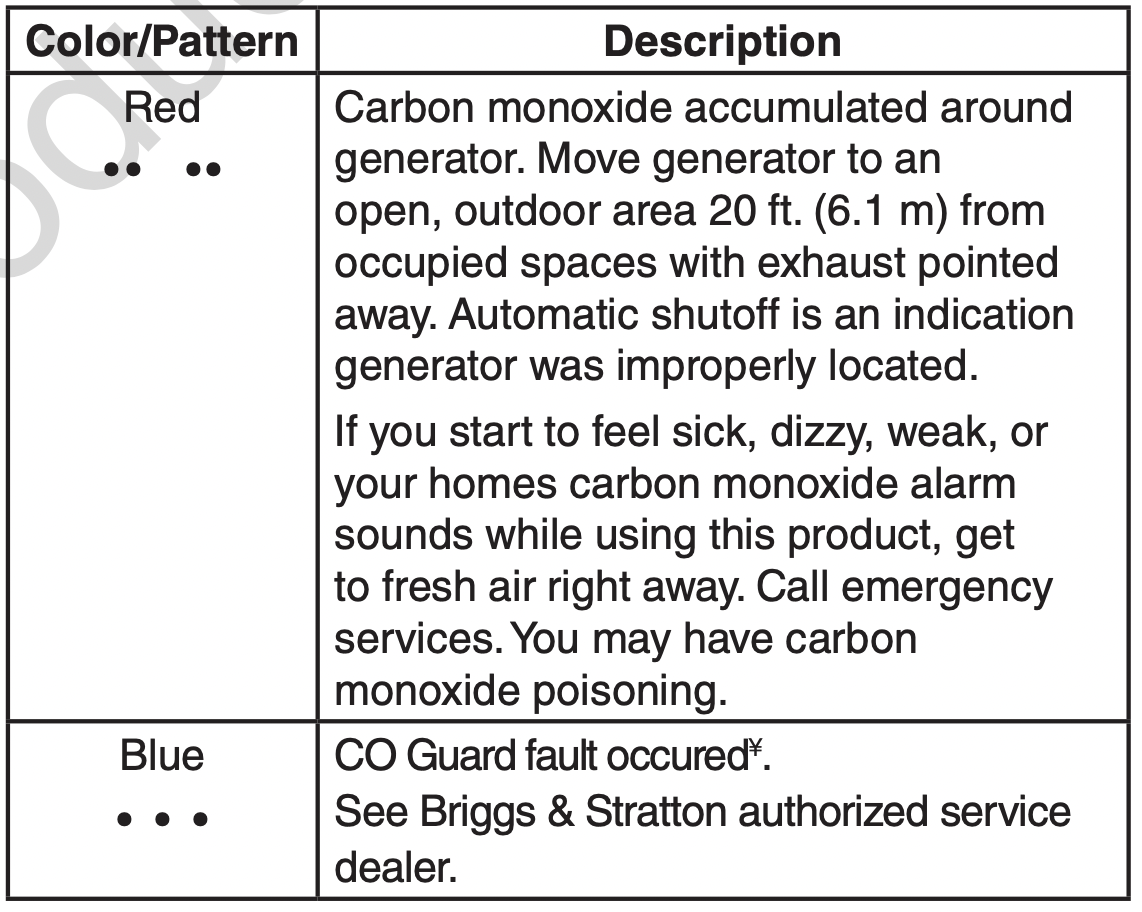
¥ Blue light will blink for five seconds at the startup of generator to show CO Guard functioning properly.
Step 5: Generator Shutdown
- Turn off and unplug all electrical loads from generator panel receptacles. Never stop engine with electrical devices plugged in and turned on.
- Let engine run at no-load for one minute to stabilize internal temperatures of engine and generator.
- Turn key in start switch to 0FF position.
- Move fuel valve to off (0) position.
Maintenance
Maintenance Schedule
Follow the hourly or calendar intervals, whichever occurs first. More frequent service is required when operating in adverse conditions noted below.
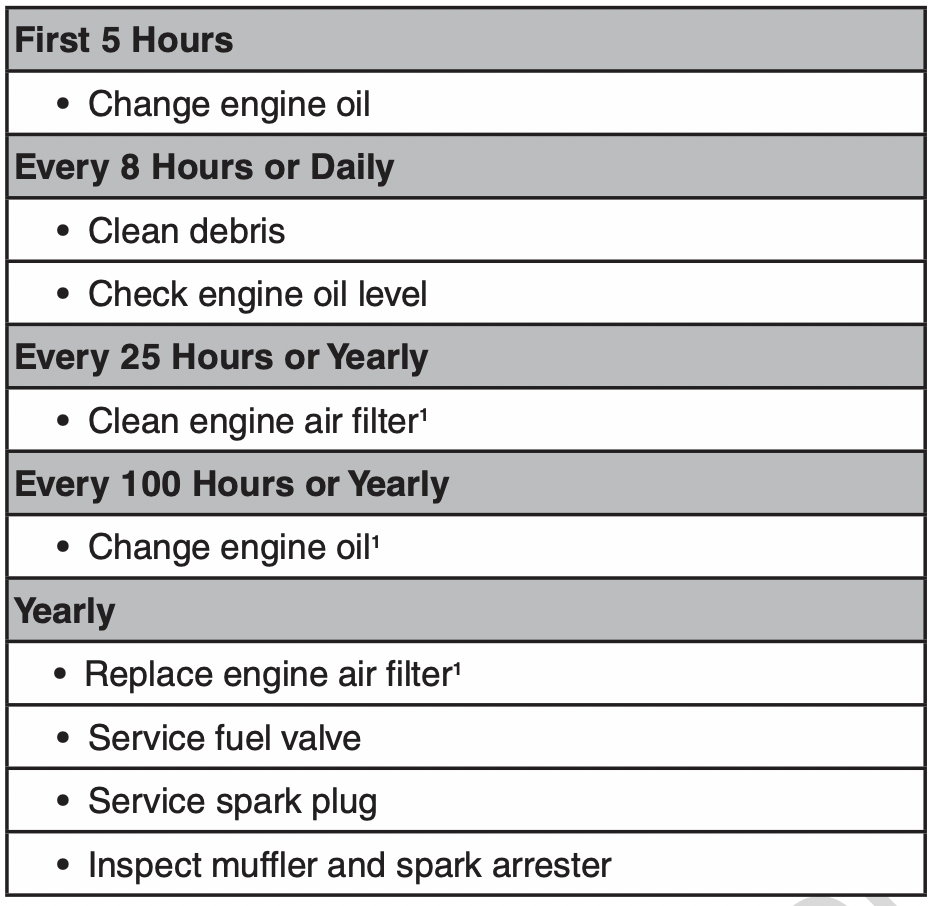
1Service more often under dirty or dusty conditions.
General Recommendations
Regular maintenance will improve the performance and extend the life of the generator. See any authorized dealer for service.
The generator’s warranty does not cover items that have been subjected to operator abuse or negligence. To receive full value from the warranty, the operator must maintain the generator as instructed in this manual.
All service and adjustments should be made at least once each season. A new spark plug and clean air filter assure proper fuel-air mixture and help your engine run better and last longer. Follow requirements in Maintenance Schedule.
Emissions Control
Maintenance, replacement, or repair of the emissions control devices and systems may be performed by any non-road engine repair establishment or individual. However, to obtain ”no charge” emissions control service, the work must be performed by a factory authorized dealer. See Emissions Warranty.
Cleaning
Daily or before use, look around and underneath the generator for signs of oil or fuel leaks. Clean any accumulated debris. Keep area around muffler free from any debris.
- Use a soft bristle brush to loosen caked on dirt or oil.
- Use a damp cloth to wipe exterior surfaces clean.
NOTICE: Improper treatment of generator could damage it and shorten its life. Do not expose generator to excessive moisture, dust, dirt, or corrosive vapors. Do not insert any objects through cooling slots.
Fuel Valve Maintenance
The fuel valve is equipped with a fuel sediment cup, screen, and o-ring that need to be cleaned.
- Move fuel valve to off (0) position.
- Remove sediment cup from fuel valve. Remove o-ri and screen from fuel valve.
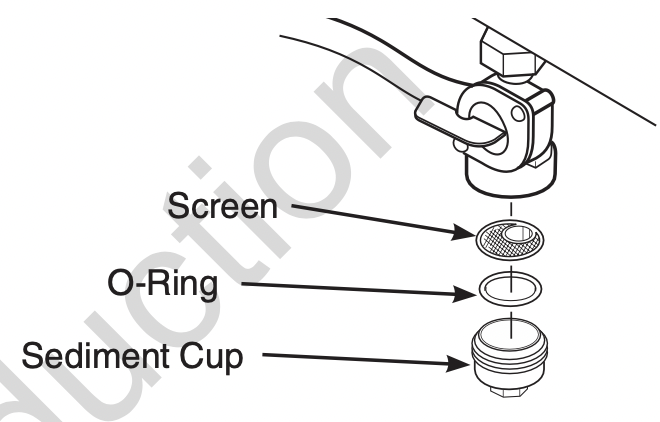
- Wash sediment cup, o-ring, and screen in a nonflammable solvent. Dry them thoroughly.
- Place screen and o-ring into fuel valve. Install sediment cup and tighten securely.
- Move fuel valve to on (I) position, and check for leaks.
Replace fuel valve if there is any leakage.
Engine Maintenance
Oil Recommendations
We recommend the use of Briggs & Stratton Warranty Certified oils for best performance. Other high-quality detergent oils are acceptable if classified for service SF or higher. Do not use special additives. See Common Service Parts.
Outdoor temperatures determine the proper oil viscosity for the engine. Use the chart to select the best viscosity for the outdoor temperature range expected.
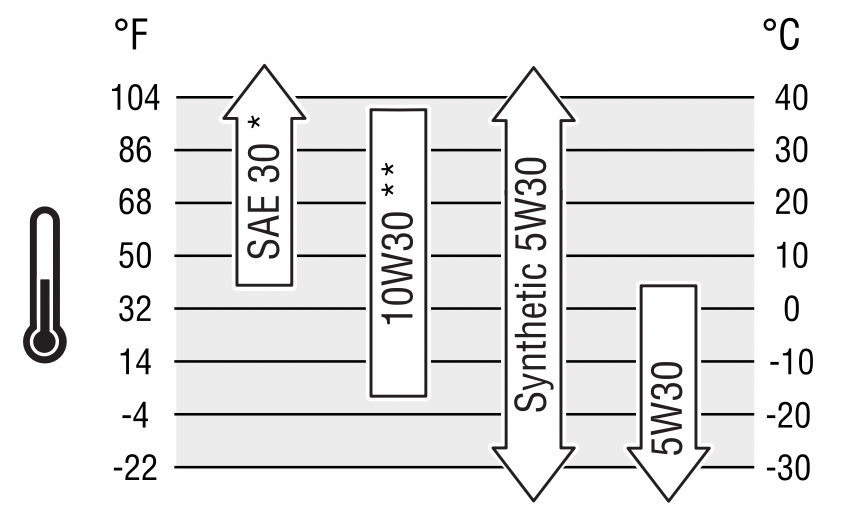
* Below 4°C (40°F) the use of SAE 30 will result in hard starting.
** Above 27°C (80°F) the use of 10W30 may cause increased oil consumption. Check oil level more frequently.
Checking/Adding Engine Oil
Oil level should be checked prior to each use or at least every 8 hours of operation. Keep oil level maintained.
- Make sure generator is on a level surface.
- Clean area around oil fill, remove dipsitck and wipe with clean cloth. Replace dipstick. Remove and check oil level.
NOTICE: Do not screw in dipstick when checking oil level.
- Verify oil is at full mark on dipstick. Replace and tighten dipstick.
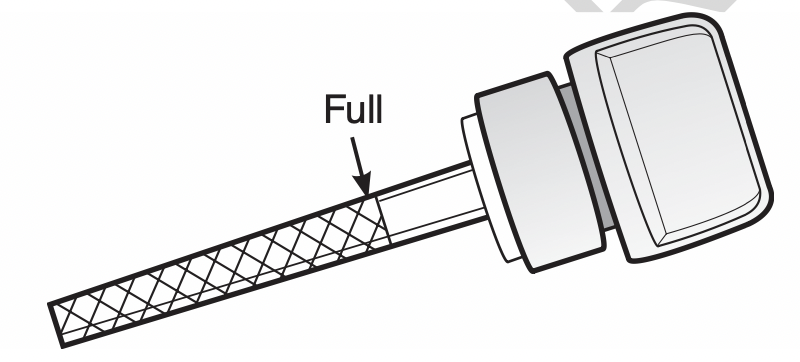
- If needed, slowly pour oil into oil fill opening to the full mark on dipstick. Do not overfill.
NOTICE: Overfilling with oil could cause the engine to not start, or hard starting.
Do not overfill.
If over the full mark on dipstick, drain oil to reduce oil level to full mark on dipstick.
- Replace and tighten dipstick.
NOTICE: Do not attempt to crank or start engine before it has been properly serviced with recommended oil. This could result in an engine failure.
CAUTION: Avoid prolonged or repeated skin contact with used motor oil. Used motor oil has been shown to cause skin cancer in certain laboratory animals. Thoroughly wash exposed areas with soap and water.
KEEP OUT OF REACH OF CHILDREN. DON’T POLLUTE. CONSERVE RESOURCES. RETURN USED OIL TO COLLECTION CENTERS.
Changing Engine Oil
If you are using your generator under extremely dirty or dusty conditions, or in extremely hot weather, change the oil more often.
Change the oil while the engine is still warm from running, as follows:
- Make sure unit is on a level surface.
- Remove oil drain plug and drain oil completely into a suitable container.
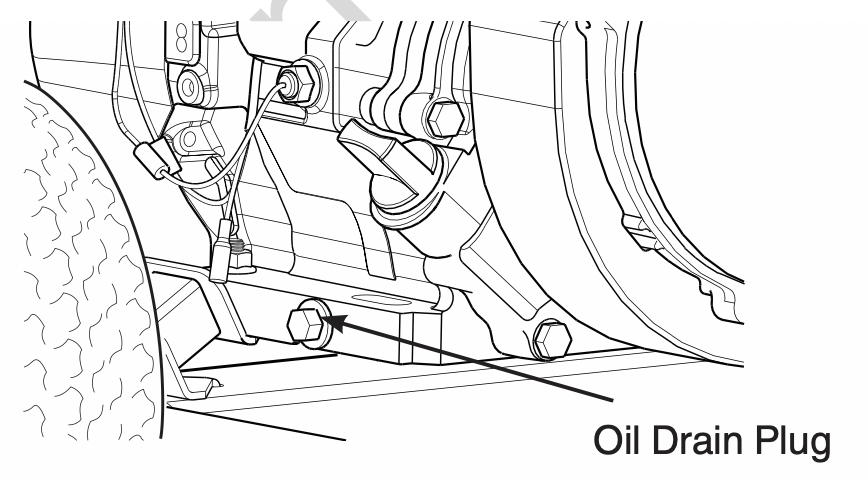
- Reinstall oil drain plug and tighten securely. Remove dipstick.
- Slowly pour recommended oil (about 36 oz. (1.0 l)) into oil fill opening. Pause to permit oil to settle. Fill to Full mark on dipstick.
- Wipe dipstick clean each time oil level is checked. Do not overfill.
- Reinstall dipstick. Tighten cap securely.
- Wipe up any spilled oil.
Service Air Cleaner
WARNING! Fuel and its vapors are extremely flammable which could cause burns or fire resulting in death or serious injury.
- Do not start and run engine with air filter removed.
Your engine will not run properly and may be damaged if you run it with a dirty air filter. Clean or replace more often if operating under dusty or dirty conditions.
Your engine will not run properly and may be damaged if you run it with a dirty air cleaner. Clean or replace more often if operating under dusty or dirty conditions.
- Loosen screws and remove air cleaner cover.
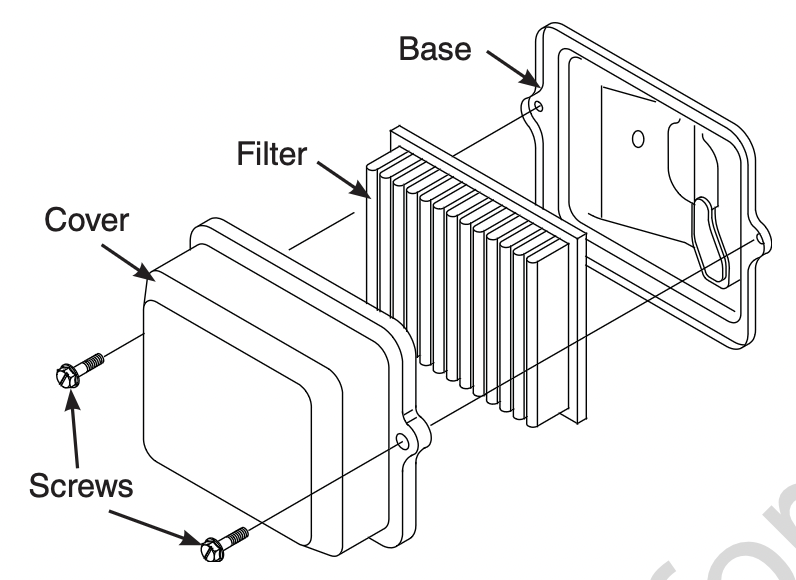
- Carefully remove cartridge from base.
- Install clean (or new) air cleaner assembly inside cover. Dispose of old filter properly.
NOTICE: If the filter is excessively dirty, replace with a new filter. See Common Service Parts.
- Assemble air cleaner cover onto base and tighten screws.
Service Spark Plug
Changing the spark plug will help your engine to start easier and run better.
- Clean area around spark plug.
- Remove and inspect spark plug.
- Replace spark plug if electrodes are pitted, burned or porcelain is cracked. Use the recommended replacement spark plug. See Common Service Parts.
- Check electrode gap with wire feeler gauge and reset spark plug gap to recommended gap if necessary (see Specifications).
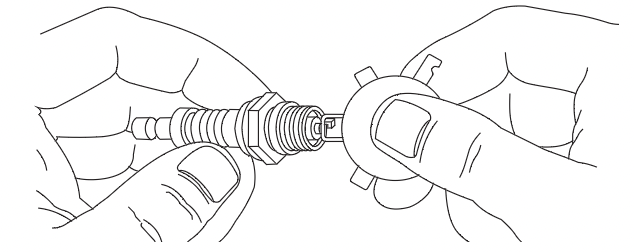
- Install spark plug and tighten firmly.
Inspect Muffler and Spark Arrester
The engine exhaust muffler has a spark arrester screen. Inspect the muffler for cracks, corrosion, or other damage. Inspect spark arrester screen for damage or carbon blockage. Clean if carbon blockage is found or replace if damaged. If replacement parts are required, make sure to use only original equipment replacement parts.
WARNING! Contact with muffler area could cause burns resulting in serious injury.
- Allow equipment to cool before servicing.
- It is a violation of California Public Resource Code, Section 4442, to use or operate the engine on any forestcovered, brush-covered, or grass-covered land unless the exhaust system is equipped with a spark arrester, as defined in Section 4442, maintained in effective working order. Other states or federal jurisdictions may have similar laws, reference Federal Regulation 36 CFR Part 261.52.
Clean or replace spark arrester as follows:
- Remove four screws that connect heat shield to muffler.
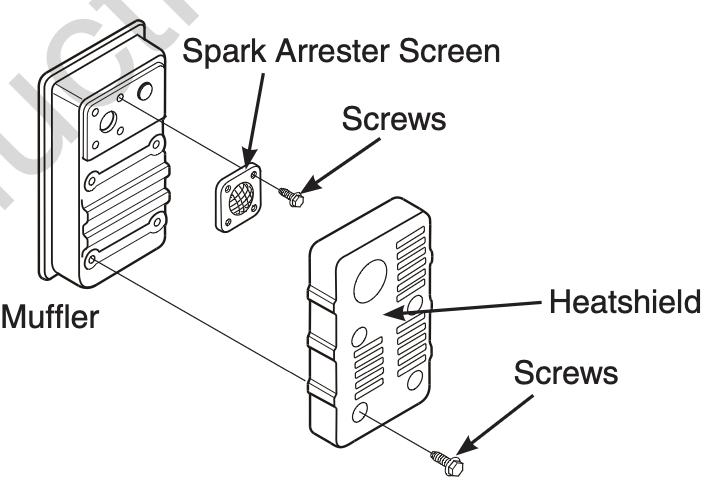
- Remove four screws that attach spark arrester screen.
- Obtain a replacement screen. See Common Service Parts.
- Reattach screen and muffler guard.
Storage
If storing the unit for more than 30 days, use the following guidelines to prepare it for storage.
Long Term Storage Instructions
- Clean the generator as outlined in Cleaning.
- Change engine oil while engine is still warm, drain oil from crankcase. Refill with recommended grade. See Changing Engine Oil.
- Treat or drain fuel from generator as fuel can become stale when stored over 30 days.
Stale fuel causes acid and gum deposits to form in the fuel system or on essential carburetor parts. To keep fuel fresh, use a fuel stabilizer.
There is no need to drain gasoline from the engine if a fuel stabilizer is added according to instructions. Run the engine for 2 minutes to circulate the stabilizer throughout the fuel system before storage.
If gasoline in the engine has not been treated with a fuel stabilizer, it must be drained into an approved container. Run the engine until it stops from lack of fuel. The use of a fuel stabilizer in the storage container is recommended to maintain freshness.
WARNING! Fuel and its vapors are extremely flammable and explosive which could cause burns, fire or explosion resulting in death or serious injury.
- When storing fuel or equipment with fuel in tank, store away from furnaces, stoves, water heaters, clothes dryers or other appliances that have pilot light or other ignition source because they could ignite fuel vapors.
- When draining fuel, turn generator engine off and let it cool at least 2 minutes before removing fuel cap. Loosen cap slowly to relieve pressure in tank. Drain fuel tank outdoors. Keep fuel away from sparks, open flames, pilot lights, heat, and other ignition sources.
- Check fuel lines, tank, cap and fittings frequently for cracks or leaks. Replace if necessary.
4. Store generator in clean, dry area and cover with a suitable protective cover that does not retain moisture.
WARNING! Storage covers could cause a fire resulting in death or serious injury.
- Do not place a storage cover over a hot generator. Let equipment cool for a sufficient time before placing the cover on the equipment.
Troubleshooting
|
Problem
|
Cause
|
Correction
|
|
Engine is running, but no AC output is available.
|
- One of the circuit breakers is open.
- Poor connection or defective cord set.
- Connected device is bad.
- GFCI tripped.
|
- Reset circuit breaker.
- Check and repair.
- Connect another device that is in good condition.
- Reset GFCI.
|
|
Engine runs well at no-load but “bogs down”when loads are connected.
|
- Generator is overloaded.
|
- See Generator Capacity.
|
|
Engine will not start; starts and runs rough or shuts down when running.
|
- Engine switch set to OFF position.
- Fuel valve is in off (0) position.
- Low oil level.
- Dirty air cleaner.
- Out of fuel.
- Spark plug wire not connected to spark plug.
- Flooded with fuel.
|
- Set switch to RUN position.
- Turn fuel valve to on (I) position.
- Fill crank case to proper level or place generator on level surface.
- Clean or replace air cleaner.
- Fill fuel tank.
- Connect wire to spark plug.
- Wait 5 minutes and re-crank engine.
|
|
Engine shuts down and CO Guard LED blinks red (•• ••).
|
- Generator improperly located.
|
- Move generator to an open, outdoor area. See CO Guard Carbon Monoxide (CO) Shutdown System.
|