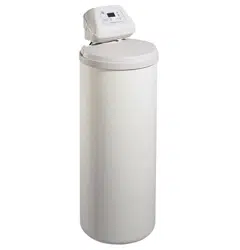

Water Softening
system
Safety Information . . . . . . . . . . . . .2
Installation Instructions . . .3–12
Step-by-step instructions . . . . . . .6–12
Operating Instructions
Breaking a salt bridge . . . . . . . . . . . . .14
Cleaning the nozzle and
venturi assembly . . . . . . . . . . . . . . . . .14
Features . . . . . . . . . . . . . . . . . . . . . . . . .15
Service . . . . . . . . . . . . . . . . . . . .13, 16–18
Water softener system . . . . . . . .16–18
Care and Cleaning . . . . . . . . . . . .19
Troubleshooting Tips . . . . . .20–22
Consumer Support
Consumer Support . . . . . . .Back Cover
Parts list/catalog . . . . . . . . . . . . . .23–26
Warranty . . . . . . . . . . . . . . . . . . . . . . . .27
ge.com
7289388 215C1173P026 49-50181 07-06 JR
Write the model and serial
numbers here:
Model # ________________
Serial # ________________
You can find them on the
back of the control head.
Models GNSF35Z
Owner’s Manual &
Installation Instructions
Water Softening
System
IMPORTANT SAFETY INFORMATION.
READ ALL INSTRUCTIONS BEFORE USING.
SAFETY PRECAUTIONS
■ Check and comply with your state and local codes.
You must follow these guidelines.
■ Use care when handling the water softening
system. Do not turn upside down, drop, drag
or set on sharp protrusions.
■ Water softening systems using sodium chloride
(salt) for recharge add sodium to the water.
Persons on sodium restricted diets should consider
the added sodium as part of their overall intake.
Potassium chloride can be used as an alternative
to sodium chloride in your softener.
■
The water softening system works on 24 volt-60 Hz
electrical power only. Be sure to use only the
included transformer.
■ Transformer must be plugged into an indoor
120 volt, grounded outlet only.
■ Use clean water softening salts only, at least 99.5%
pure. NUGGET, PELLET or coarse SOLAR salts are
recommended. Do not use rock, block, granulated
or ice cream making salts. They contain dirt and
sediments, or mush and cake, and will create
maintenance problems.
■ Keep the salt hole cover in place on the softener
unless servicing the unit or refilling with salt.
WARNING: Do not use with water that
is microbiologically unsafe or of unknown quality
without adequate disinfection before or after the
system.
READ AND FOLLOW THIS SAFETY INFORMATION CAREFULLY.
SAVE THESE INSTRUCTIONS
PROPER INSTALLATION
■ Install or store where it will not be exposed to
temperatures below freezing or exposed to any
type of weather. Water freezing in the system will
break it. Do not attempt to treat water over 100°F.
■ Do not install in direct sunlight. Excessive sun or
heat may cause distortion or other damage to
non-metallic parts.
■ Properly ground to conform with all governing
codes and ordinances.
■ Use only lead-free solder and flux for all
sweat-solder connections, as required by
state and federal codes.
■
The water softening system requires a minimum
water flow of three gallons per minute at the inlet.
Maximum allowable inlet water pressure is 125 psi.
If daytime pressure is over 80 psi, nighttime pressure
may exceed the maximum. Use a pressure reducing
valve to reduce the flow if necessary.
■
Softener resins may degrade in the presence of
chlorine above 2 ppm. If you have chlorine in excess
of this amount, you may experience reduced life
of the resin. In these conditions, you may wish to
consider purchasing a GE point-of-entry household
filtration system with a chlorine reducing filter.
WARNING: Discard all unused parts
and packaging material after installation. Small
parts remaining after the installation could be
a choke hazard.
This water softening system must be properly installed and located in accordance with the
Installation Instructions before it is used.
2
For your safety, the information in this manual must be followed to minimize the risk of electric
shock, property damage or personal injury.
WARNING!
3
Installation Water Softening System
Instructions
Model GNSF35Z
Questions? Call 800.GE.CARES (800.432.2737) or Visit our Website at: ge.com
BEFORE BEGINNING INSTALLATION
Read these instructions completely and carefully.
•
IMPORTANT — Save these instructions
for local inspector’s use.
•
IMPORTANT — Observe all governing
codes and ordinances.
• Note to Installer – Be sure to leave these
instructions with the Consumer.
• Note to Consumer – Keep these instructions
for future reference.
• Proper installation is the responsibility of the
installer.
• Product failure due to improper installation
is not covered under the Warranty.
• A shutoff valve must be available or added near
the installation point.
WARNING:
Read entire manual. Failure to follow all guides and rules could cause personal
injury or property damage.
• Check with your state and/or local public works department for plumbing codes. You must follow their
guides as you install the Water Softening system.
NOTE: Failure to comply with these installation instructions will void the product warranty, and the
installer will be responsible for any service, repair or damages caused thereby.
IMPORTANT INSTALLATION
RECOMMENDATIONS
(CONT.)
• Use care when handling the softener. Do not
turn upside down, drop, drag or set on sharp
protrusions.
• Maximum allowable inlet water pressure is 125
psi. If daytime pressure is over 80 psi, nighttime
pressure may exceed the maximum. Use a
pressure reducing valve if necessary. (Adding a
pressure reducing valve may reduce the flow.)
• The softener works on 24 volt-60 Hz electrical
power only. Be sure to use the included
transformer. Be sure the electric outlet and
transformer are in an inside location to protect
from moisture.
• See Where to Install the Softener section
for more details.
WARNING: Do not use with water
that is microbiologically unsafe or of unknown
quality without adequate disinfection before or
after the system. The water should be tested
periodically to verify that the system is
performing satisfactorily.
• Small parts remaining after the installation could
be a choke hazard. Discard safely.
IMPORTANT INSTALLATION
RECOMMENDATIONS
• In the Commonwealth of Massachusetts,
Plumbing Code 248 CMR shall be adhered to.
Consult with your licensed plumber.
• Use only lead-free solder and flux for all sweat-
solder connections, as required by state and
federal codes.
• Connect the softener to the main water supply
pipe before or ahead of the water heater.
DO NOT RUN HOT WATER THROUGH THE
SOFTENER. Temperature of water passing
through the softener must be less than 120°F.
Installation Instructions
4
UNPACKING AND INSPECTION
Be sure to check the entire softener for any
shipping damage or parts loss. Also note damage
to the shipping cartons. Contact the transportation
company for all damage and loss claims. The
manufacturer is not responsible for damages
in transit.
Small parts needed to install the softener are
packaged either in a bag or on a cardboard
sheet. To avoid loss of the small parts, keep them
packaged until you are ready to use them. Be sure
not to discard components hidden in packaging.
TOOLS AND MATERIALS REQUIRED
FOR INSTALLATION
• Pliers
• Screwdriver
• Teflon tape
• Razor knife
• Two adjustable wrenches
• Additional tools may be required if modification
to home plumbing is necessary.
• In and out fittings included with the softener
are 1″ NPT male adapters. You should maintain
the same, or larger, pipe size as the water supply
pipe, up to the softener inlet and outlet. Then,
use the necessary adapters to connect the
water supply to the 1″ NPT male adapters.
• Use the included bypass valve to install the
softener. The bypass valve allows you to turn off
water to the softener for servicing, but still have
water in the house pipes. The NPT male adapters
referred to above connect to the bypass valve
with the included plastic clips.
• Use appropriate fitting/pipe material (i.e., copper,
brass, galvanized or CPVC) to connect the 1″ NTP
plastic adapters to the house plumbing.
• If additional drain hose is needed for valve and
salt tank drains, it can be ordered from GE Parts
at 800.626.2002, part number WS07X10004.
• If a rigid valve drain is needed to comply with
plumbing codes, you can buy the parts needed
to connect a 1/2″ copper tubing or plastic pipe
drain. See Step 4.
• Clean nugget or pellet water softener salt is
needed to fill the brine tank. See Step 8.
WHERE TO INSTALL THE SOFTENER
• Place the softener as close as possible to a
sewer drain, or other acceptable drain point
or standpipe.
• It is recommended to keep outside faucets
on hard water to save soft water and salt.
• Do not install the softener in a place where it
could freeze. Freeze damage is not covered by
the warranty.
• Do not install the softener where it would block
access to the water heater or access to the main
water shutoff.
• Put the softener in a place where water damage
is least likely to occur if a leak develops. The
manufacturer will not repair or pay for water
damage.
• A 120-volt electric outlet is needed to plug in the
included transformer. The softener has a 10-foot
power cable. If the outlet is remote (up to 100
feet), use 18 gauge wire to connect. Be sure the
electric outlet and transformer are in an inside
location, to protect from wet weather. Be sure
the outlet is unswitched to prevent accidental
shutoff.
• If installing in an outside location, you must
take the steps necessary to assure the softener,
installation plumbing, wiring, etc., are as well
protected from the elements (sunlight, rain, wind,
heat, cold), contamination, vandalism, etc., as
when installed indoors. Outdoor installation is
not recommended, and voids the warranty.
• Keep the softener out of direct sunlight.
The sun’s heat may distort non-metallic
parts and may damage the electronics.

5
Installation Instructions
PLAN HOW YOU WILL INSTALL THE
SOFTENER
You must first decide how to run in and out pipes
to the softener. Look at the house main water pipe
at the point where you will connect the softener.
Is the pipe soldered copper, glued plastic or
threaded galvanized? What is the pipe size?
WARNING: Use only lead-free solder and
flux to prevent lead poisoning.
See Typical Installation Illustration. Use this as a guide
when planning your particular installation. Be sure
to direct the incoming hard water supply to the
softener valve inlet fitting. The valve is marked
IN and OUT.
TYPICAL INSTALLATION ILLUSTRATION
Soft water
MAIN WATER PIPE
Hard
water
NOTE: See Drain
Hose Connections
section.
24V
transformer
120-volt
outlet
SALT
GOES HERE
Brinewell
O-rings (2)
1″ NPT male
adapter (2)
Clips (2)
1″ female
adapter (2)
(not supplied)
Clips
O-rings (2)
INLET
Hard
water to
outside
faucets
Fig. 1
CROSSOVER
Use if water supply flows
from the left. Include single
or 3-valve bypass.
Hard
water
From
softener
outlet
Soft
water
To softener
inlet
OPTIONAL 3-VALVE BYPASS
INSTALLATION ILLUSTRATION
Bypass
valve
Hard water
to outside
faucets
Inlet
valve
Outlet valve
3-Valve Bypass
System
For soft water
service:
• Open the inlet
and outlet
valves
• Close the
bypass valve
For bypass hard
water:
• Close the inlet
and outlet
valves
• Open the
bypass valve
O-rings (2)
1″ NPT male
adapter (2)
Clips (2)
INLET
MAIN WATER PIPE
Hard
water
Soft water
120-volt
outlet
24V
transformer
Brinewell
SALT
GOES
HERE
1″ female adapter
(2) (not supplied)
Fig. 2
CROSSOVER
Use if water supply flows
from the left. Include single
or 3-valve bypass.
Hard
water
From
softener
outlet
Soft
water
To softener
inlet
Salt hole
cover
removed
Salt hole
cover
removed
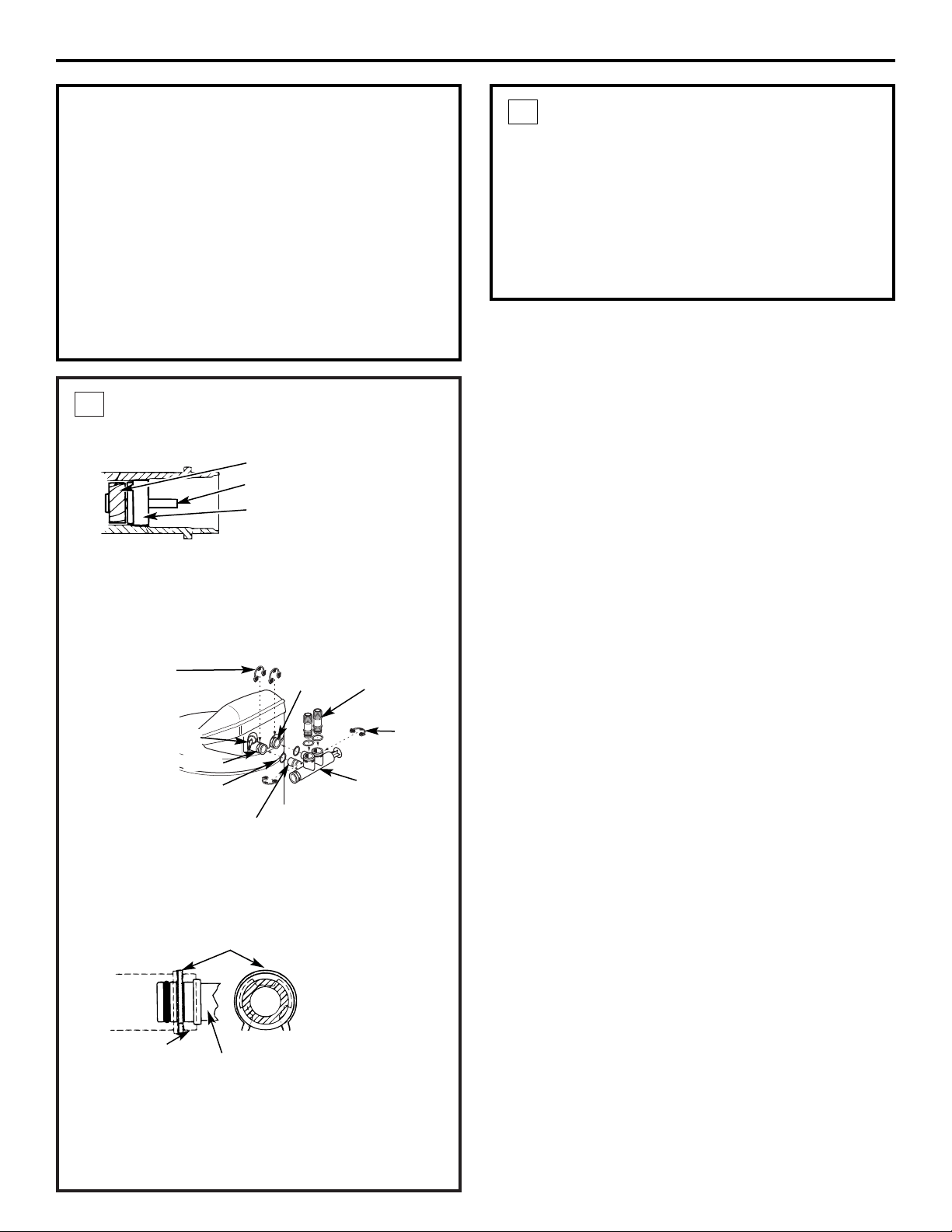
INSTALL BYPASS VALVE
• Remove plastic shipping plug and wire from valve
outlet.
• Push the bypass valve (lubricate o-ring seals with
silicone grease) into both ports of the valve as
shown.
• Snap the 2 large plastic clips in place, from the
top down, as shown.
• Push the NPT adapters (lubricate o-ring seals with
silicone grease) into both ports of the valve as
shown.
• Snap the 2 large plastic clips in place, from the
side, as shown.
1
Valve body
inlet or outlet
Bypass valve
(push all the way in)
Clip
END
VIEW
SIDE
VIEW
Installation Instructions
6
BEFORE YOU BEGIN
• Turn off the gas or electric supply to the water
heater, in the possibility that the water heater
may be drained while draining pipes.
• Turn off the water supply to pipes to be cut and
drain the house water pipes.
• Open both hot and cold faucets at the lowest
location possible.
NOTE: For easier installation, remove the top cover.
Release 2 clips at rear of cover. Rotate cover
forward and lift up.
Turbine
Valve outlet
Turbine shaft and
support
NOTE: Be sure the turbine and support are firmly
in place in the valve outlet. Blow into the valve port
and observe the turbine for free rotation.
Clip
Outlet
O-ring seal goes into the outer
groove only. The clip snaps into
the inner groove (see below).
NPT
adapter
MOVE THE SOFTENER ASSEMBLY
INTO INSTALLATION POSITION
Before sliding softener in position, be sure the
installation surface is level and smooth. Sharp
objects under the tank may puncture it. If needed,
place the tank on a section of 3/4″ thick (minimum)
plywood. Then, place shims under the plywood as
needed to level the softener. Slide softener into
position.
2
Drain fitting
Inlet
Bypass
valve
Clips
O-rings
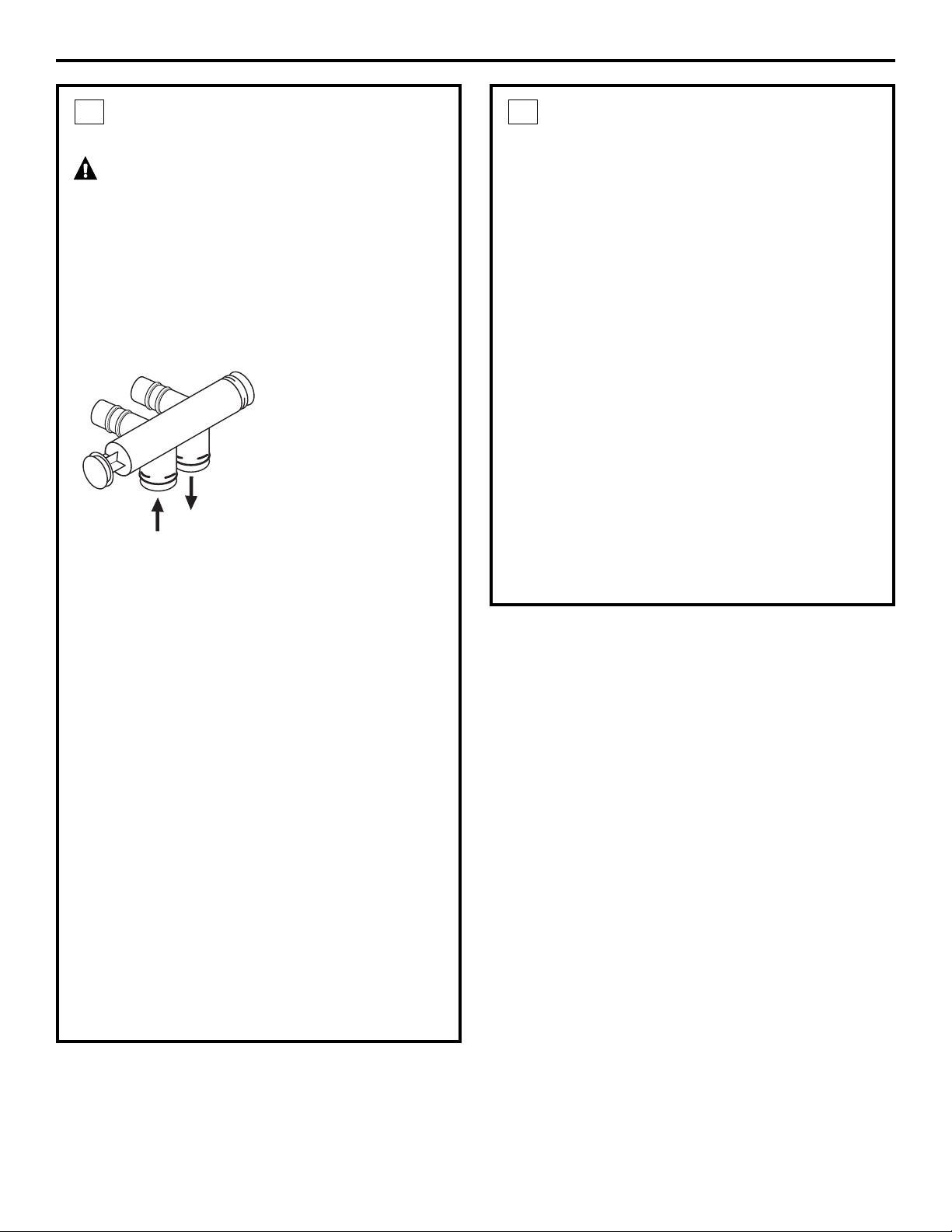
PLUMB “IN” AND “OUT” PIPES
TO AND FROM SOFTENER
CAUTION: Observe all of the following
cautions as you connect inlet and outlet
plumbing. See Typical Installation Illustration.
• BE SURE INCOMING HARD WATER SUPPLY IS
DIRECTED TO THE SOFTENER VALVE INLET PORT.
If house water flow is from the left, use a
plumbing crossover as shown in Typical
Installation Illustration. If house water flows up
from the floor level, turn the bypass valve upside
down as shown.
• With the softener in place, determine the
correct length of piping required to connect the
household plumbing to the NPT male adapter.
• Remove softener from installation space.
• If making a soldered copper installation, do all
sweat soldering before connecting pipes to the
NPT adapters and bypass valve. Torch heat will
damage plastic parts.
• When turning threaded pipe fittings onto plastic
fittings, use care not to cross-thread.
• Use Teflon Tape on all external pipe threads.
• Support inlet and outlet plumbing in some manner
(use pipe hangers) to keep the weight off of the
valve fittings.
• Slide softener back into position.
• Make final connections to the bypass valve and
snap clips into place.
Be sure the clips for the bypass valve and NPT
adapters snap into place. Pull on the bypass valve
and NPT adapters to make sure the parts are held
securely in place.
3
Installation Instructions
7
IN
OUT
Turn bypass
valve upside
down to
connect to
floor level
plumbing
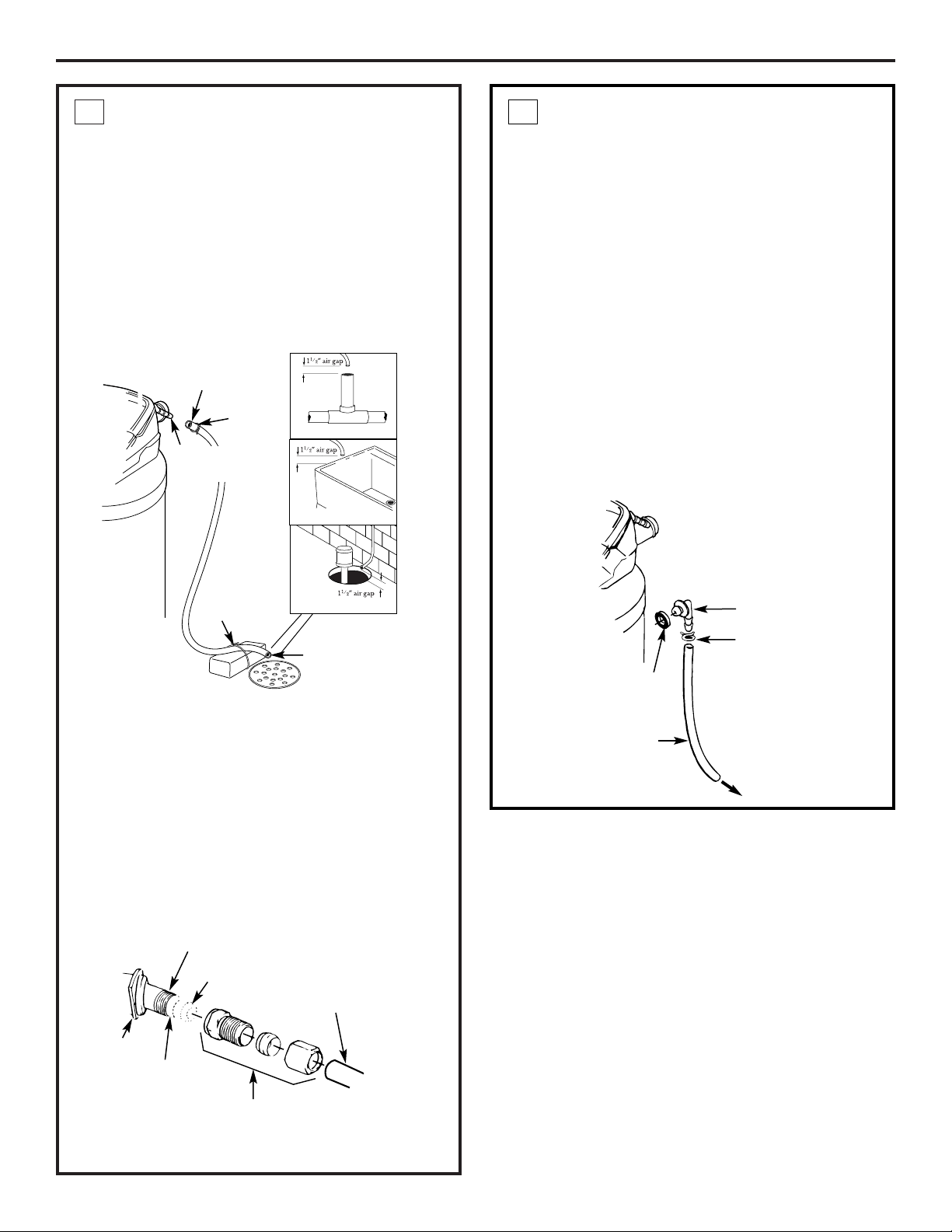
CONNECT AND RUN THE VALVE
DRAIN HOSE
• Use the provided drain hose (20′ length included)
to attach to the valve drain fitting. To keep water
pressure from blowing the hose off, use supplied
spring clamp to secure in place. Cut the necessary
length and use the remainder in Step 5.
• Locate the other end of the hose at a suitable
drain point (floor drain, sump, laundry tub, etc.)
that terminates at the sewer. Check and comply
with local codes.
IMPORTANT: If more drain hose is needed, it
should be ordered from GE Parts at 800.626.2002,
part number WS07X10004. The water softener
will not work if water cannot exit this hose
during recharge.
• Tie or wire the hose in place at the drain point.
High water pressure will cause it to whip during
the back-wash and fast rinse cycles of recharge.
Also provide an air gap of at least 1-1/2″
between the end of the hose and the drain
point. An air gap prevents possible siphoning of
sewer water into the softener, if the sewer should
“back-up.”
4
Installation Instructions
8
CONNECT AND RUN THE VALVE
DRAIN HOSE
(CONT.)
• Elevating the drain hose may cause back
pressure that could reduce the brine draw during
recharge. If raising the drain line overhead is
required to get to the drain point, measure the
inlet water pressure to the softener first. For inlet
pressures between 20 and 50 psi, do not raise
higher than 8′ above the floor. For inlet pressure
above 50 psi, the drain line may be raised to a
maximum height of 14′.
CONNECTING A RIGID VALVE DRAIN TUBE
To adapt a copper drain tube to the softener, use
a hacksaw to cut the barbed end from the drain
fitting as shown. Rotate the drain fitting so the
cutting blade clears the valve housing to prevent
damage to valve
. Buy a compression fitting (1/4″
female pipe thread x 1/2″ O.D. tube) and needed
tubing from your local hardware store.
4
Drain fitting
on valve
Valve drain hose
FLOOR DRAIN
Tie or
wire
hose in
place
1
1
⁄
2
″ air gap
LAUNDRY TUB
SUMP
Clamp
STANDPIPE
Clip
1/4″ NPT
threads
1/2″ O.D. copper
tube (not provided)
Compression fitting
1/4″ NPT x 1/2″ O.D.
tube (not provided)
Cut barbs from
drain fitting
Barbs
INSTALL THE BRINE TANK
OVERFLOW FITTINGS AND HOSE
• Insert the rubber grommet into the 3/4″ diameter
hole in the brine tank sidewall as shown.
• Push the end of the hose adapter elbow into the
grommet as shown.
• Attach a length of hose (use remaining hose from
Step 4) to the hose adapter elbow. Use a hose
clamp to hold it in place.
• Locate the other end of the hose at the drain
point. DO NOT ELEVATE this hose higher than the
elbow on the brine tank.
IMPORTANT: DO NOT TEE OVERFLOW HOSE TO
VALVE DRAIN HOSE.
NOTE: This drain is for safety only. If the cabinet
(brine tank) should over-fill with water, the excess is
carried to the drain.
5
To acceptable
drain
Overflow
drain hose
Hose
clamp
Grommet
Do not connect
to valve drain
hose.
Hose
adapter
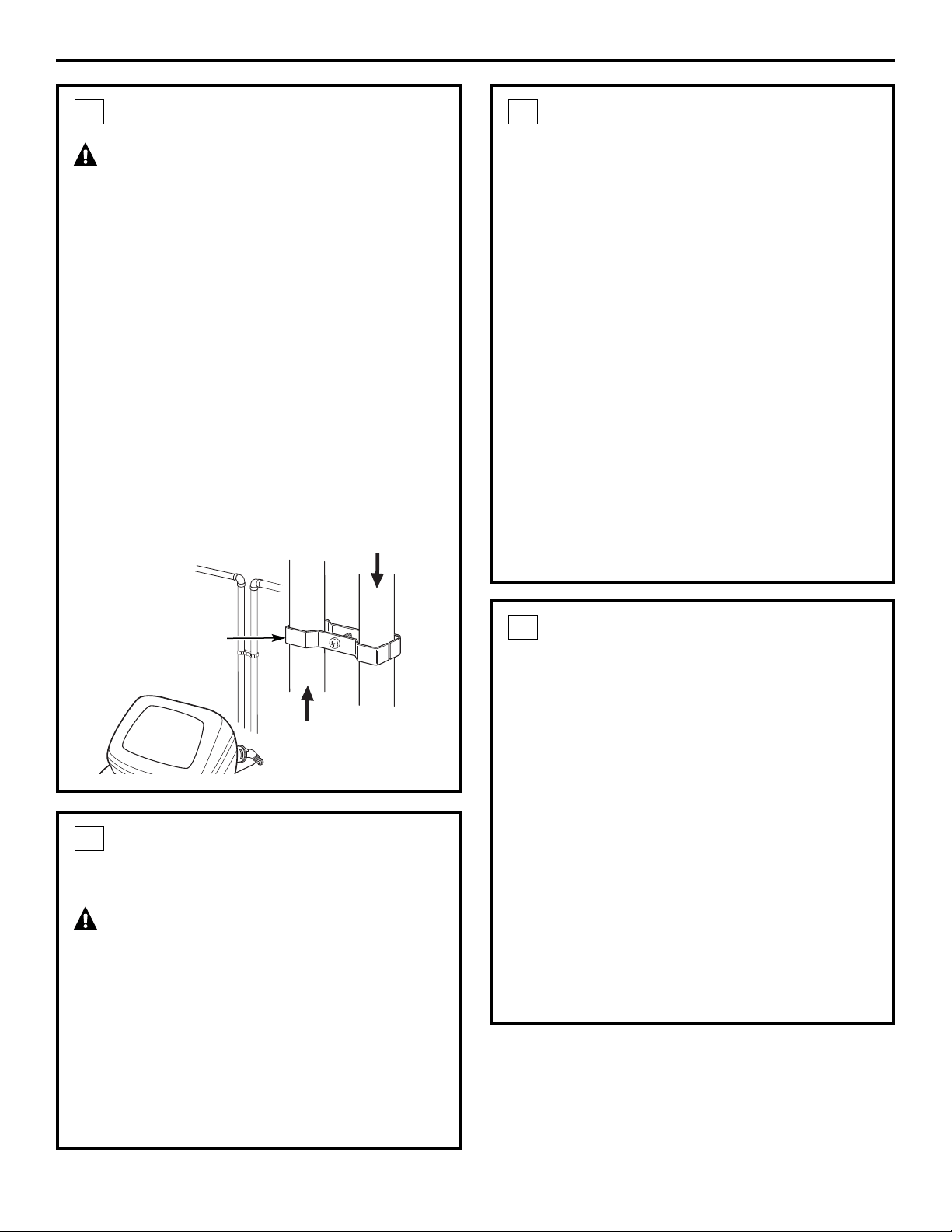
INSTALL GROUNDING CLAMP
DANGER: Failure to properly attach
ground clamp could result in electrical shock.
If plumbing is metal, to maintain electrical ground
continuity in the house cold water piping, install the
included ground clamp as shown.
• Clean pipe with emery paper in the area where
the clamp is to be installed.
• Install grounding clamps as shown, making sure
clamps fit freely around pipe.
• Make sure lock washer is in place.
• Handtighten screw, then one more full turn with
screwdriver.
NOTE: When replacing an existing softener, also
replace grounding clamps. If removing softener
completely, hard-plumb the water line with same
type of pipes as the original to assure plumbing
integrity and ground continuity over the life of
the home.
6
Ground
clamp
From valve
outlet
To valve inlet
Installation Instructions
9
FLUSH PIPES, EXPEL AIR FROM
SOFTENER AND TEST YOUR
INSTALLATION FOR WATER
LEAKS
(CONT.)
• Place bypass valve in the “service” position
EXACTLY as follows. KEEP SOFT WATER FAUCETS
OPEN.
SLOWLY pull or slide the valve stem (out) toward
the service position, pausing several times to
allow the softener to pressurize slowly.
• After about 3 minutes, open a HOT water faucet
for 1 minute, or until all air is expelled, then
close. NOTE: If water appears cloudy or has salty
taste, allow to run for several more minutes, or
until clear.
• Close all water faucets.
• Check your plumbing work for leaks and fix
right away if any are found. Be sure to observe
previous caution notes.
• Turn on the gas or electric supply to the water
heater. Light the pilot, if applicable.
7
ADD WATER AND SALT TO THE
BRINE TANK
• Lift the salt hole cover. Add about 3 gallons of
water into the tank. Do not add into the brinewell.
• Fill tank with NUGGET, PELLET or coarse SOLAR
water softener salt with a purity of 99.5% or
higher. Do not use rock, block, granulated and ice
cream-making salts, or salt with iron-removing
additives (except for Diamond Crystal
®
Red•Out
®
brand salt). Maximum salt storage capacity is
approximately 200 lbs. Keep the salt hole cover
closed unless servicing the unit or refilling
with salt.
NOTE: If the softener is installed in a humid
basement or other damp area, it is better to fill the
tank with less salt, more frequently. Eighty to 100
lbs. of salt will last for several months, depending on
water hardness, family size and water softening
system model.
8
FLUSH PIPES, EXPEL AIR FROM
SOFTENER AND TEST YOUR
INSTALLATION FOR WATER LEAKS
CAUTION: To avoid water or air
pressure damage to softener inner parts, be
sure to do the following steps in exact order.
• Fully open 2 cold soft water faucets nearby
the softener.
• Place bypass valve in “bypass” position by
pushing the stem inward.
• Fully open the house main water pipe shutoff
valve. Observe a steady flow from both faucets
opened above.
7
Installation Instructions
10
CONNECT TO ELECTRICAL POWER
To gain access to the transformer/power cord
assembly, remove the salt hole cover from the
softener. Unclip the tabs on the rear of the top cover
and rotate the cover upward to remove. DO NOT
PULL OR DISCONNECT WIRING.
• The softener works on 24 volt-60Hz electric
power. The included transformer changes
standard 120-volt AC house power to 24 volts.
Plug the transformer into a 120-volt outlet only.
Be sure the outlet is always live so it can not be
switched off by mistake.
• Replace the top cover.
• Replace the salt hole cover.
9
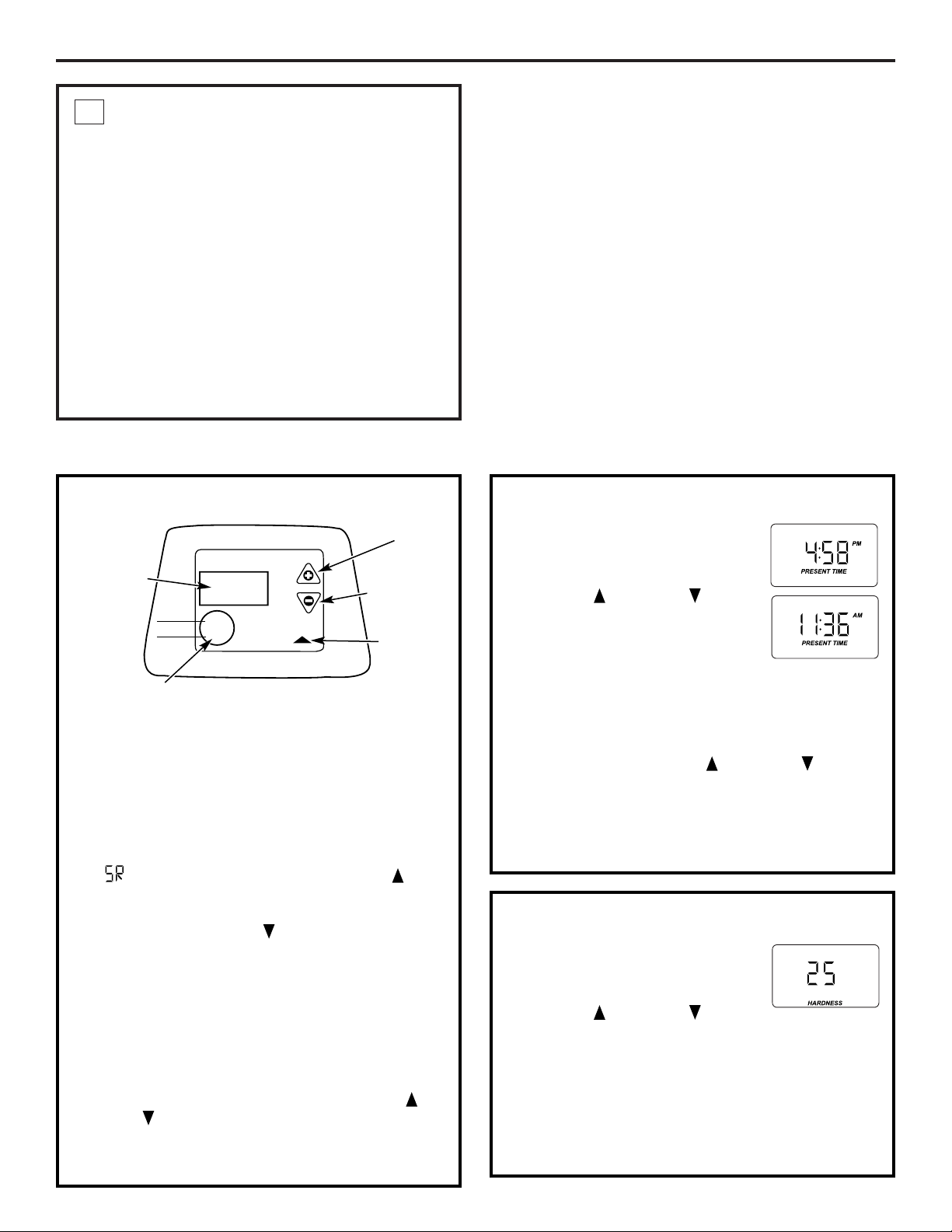
PROGRAMMING THE CONTROL
PROGRAMMING THE CONTROL
CONTROL SETTINGS REQUIRED upon installation
and after an extended power outage.
NOTES:
• WHEN THE TRANSFORMER IS PLUGGED INTO
THE ELECTRICAL OUTLET, 12:00 PM (flashing), and
PRESENT TIME is displayed. Program the control
as instructed below.
If - - - or - - - - is flashing, use the UP
button to set the correct model code as follows:
F35 for GNSF35. If you pass by the correct code
number, use the DOWN button. Then press the
SELECT button to accept the correct model.
• A “beep” sounds while pressing buttons for
control programming. One beep signals a change
in the control display. Repeated beeps mean the
control will not accept a change from the button
you have pressed, and you should select another
button.
• To program the control, you will use the UP ,
DOWN and SELECT buttons.
• Use the SELECT button to select the desired
control function.
SET PRESENT TIME OF DAY
1. Press the SELECT button until
PRESENT TIME appears in the
display.
2. Press UP or DOWN button
to set. The UP button advances
the time; the DOWN button
moves the time in reverse.
If the present time is between noon and midnight,
be sure PM shows in the display. If the present
time is between midnight and noon, be sure AM
shows in the display.
NOTE: Each press of an UP or DOWN button
changes the time by one minute. Holding the button
changes the time at a rapid rate.
3. When the present time is correct, press SELECT to
accept.
SET WATER HARDNESS NUMBER
1. Press the SELECT button until
HARDNESS appears in the
display.
2. Press UP or DOWN button
to set your water hardness number in the
display. DOWN decreases the hardness value.
UP increases the hardness value.
NOTE: Each press of a button changes the display
by 1, between 1 and 25. Above 25, the display
changes 5 at a time (25, 30, 35, etc.). Holding a
button in changes the numbers at a rapid rate.
SmartWater Softener System
TOUCH
or
HOLD
SELECT
TIME
HARDNESS
RECHARGE NOW
RECHARGE TONIGHT
Display
TOUCH or HOLD button
SELECT
button
DOWN (-)
button
UP (+)
button
Installation Instructions
11
SET WATER HARDNESS NUMBER (CONT.)
3. When the display shows your water hardness
(in grains per gallon), press SELECT to accept.
NOTE: If there is clear water iron in your water
supply, you will need to increase the hardness
setting by 5 for each 1 ppm of clear water iron
in your water supply.
You can get the grains per gallon (gpg)
hardness of your water supply from a water
analysis laboratory. If you are on a municipal
supply, call your local water department. Or
call Legend Technical Services, an independent
laboratory, to request a water hardness test kit
at 1.800.949.8220, option 4. If your report shows
hardness in parts per million (ppm) or milligrams
per liter (mg/l), simply divide by 17.1 to get the
equivalent number of grains per gallon.
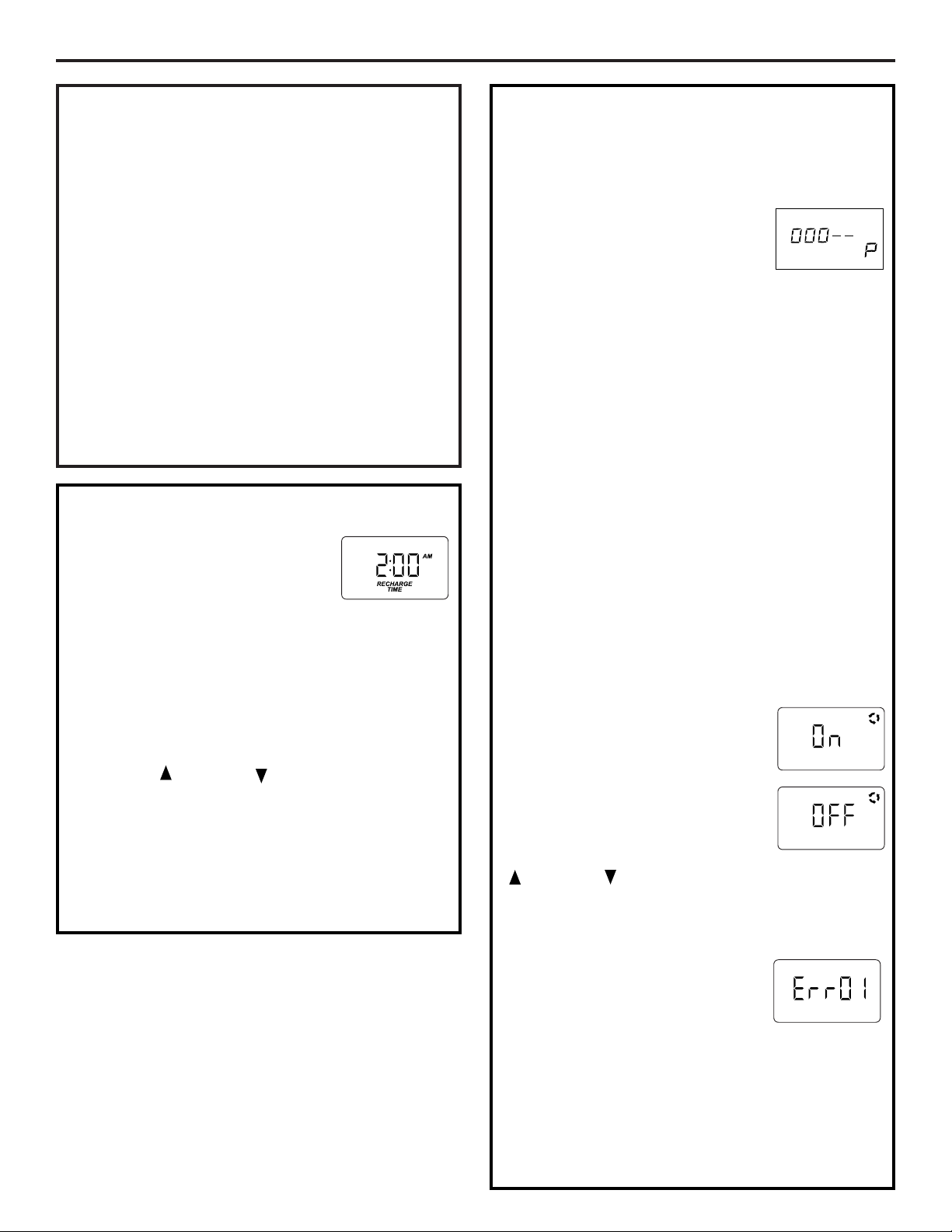
SET RECHARGE (STARTING) TIME
1. Press the SELECT button until
RECHARGE TIME appears in the
display.
NOTE: A flashing 2:00 AM (factory
default) should show in the display. This is a good
time for recharge to start (takes about 2 hours) in
most households because water is not in use. HARD
WATER is bypassed to house faucets during
recharge.
If no change is needed, go to step 3. To change the
recharge starting time, follow step 2.
2. Press UP or DOWN button to set the desired
recharge start time. Be sure to observe the AM or
PM as you did when setting the time of day.
NOTE: Each press of a button changes the time by
1 hour. Holding the buttons in changes the time at
a rapid rate.
3. Press the SELECT button to accept.
OPTIONAL CONTROL SETTINGS
The controller display has several options and
features.
SYSTEM/ELECTRONIC DIAGNOSTICS
This display contains system
diagnostics information to assist in
troubleshooting problems with the
Water Softener. See page 16.
To access the System Diagnostics, press and hold
the SELECT button for 3 seconds.
To return to the normal display, press the SELECT
button 2 times.
SALT EFFICIENCY
When the SALT EFFICIENCY feature is ON, the
unit will operate at a salt efficiency of at least 4000
grains of hardness removed per pound of salt. This
mode of operation is the most efficient setting for
salt usage, because the system will tend to recharge
more often, with less salt usage. Turning the feature
OFF will tend to lengthen the time between recharge
cycles, which will provide the most efficient usage
of water, but may use more salt. The degree of
difference between these two cycles is highly
dependent on the water usage and hardness
at a particular installation.
NOTE: California Regulations require this feature to
be ON for installations in California.
To access the Salt Efficiency,
press and hold the SELECT
button for 3 seconds. The System
Diagnostics display will appear.
Press the SELECT button again
and the Salt Efficiency display will
appear.
To change the setting, press the UP
or DOWN buttons to toggle the feature ON or
OFF. Press the SELECT button to accept.
ERROR SIGNALS
If there is an error code detected,
the display will flash Err to signal
that the softener requires service.
See page 16 for information to
assist in troubleshooting error codes. Once the
problem is corrected, disconnect the transformer
from the wall outlet momentarily, and plug it back
in. The normal display will appear. The motor may
run for several minutes, as the unit resets. If the
problem is not corrected, the error code will
reappear in 8 minutes.
DAYS TO EMPTY
HARDNESS
E
DAYS TO EMPTY
HARDNESS
E
OR
DAYS TO EMPTY
HARDNESS
Installation Instructions
12
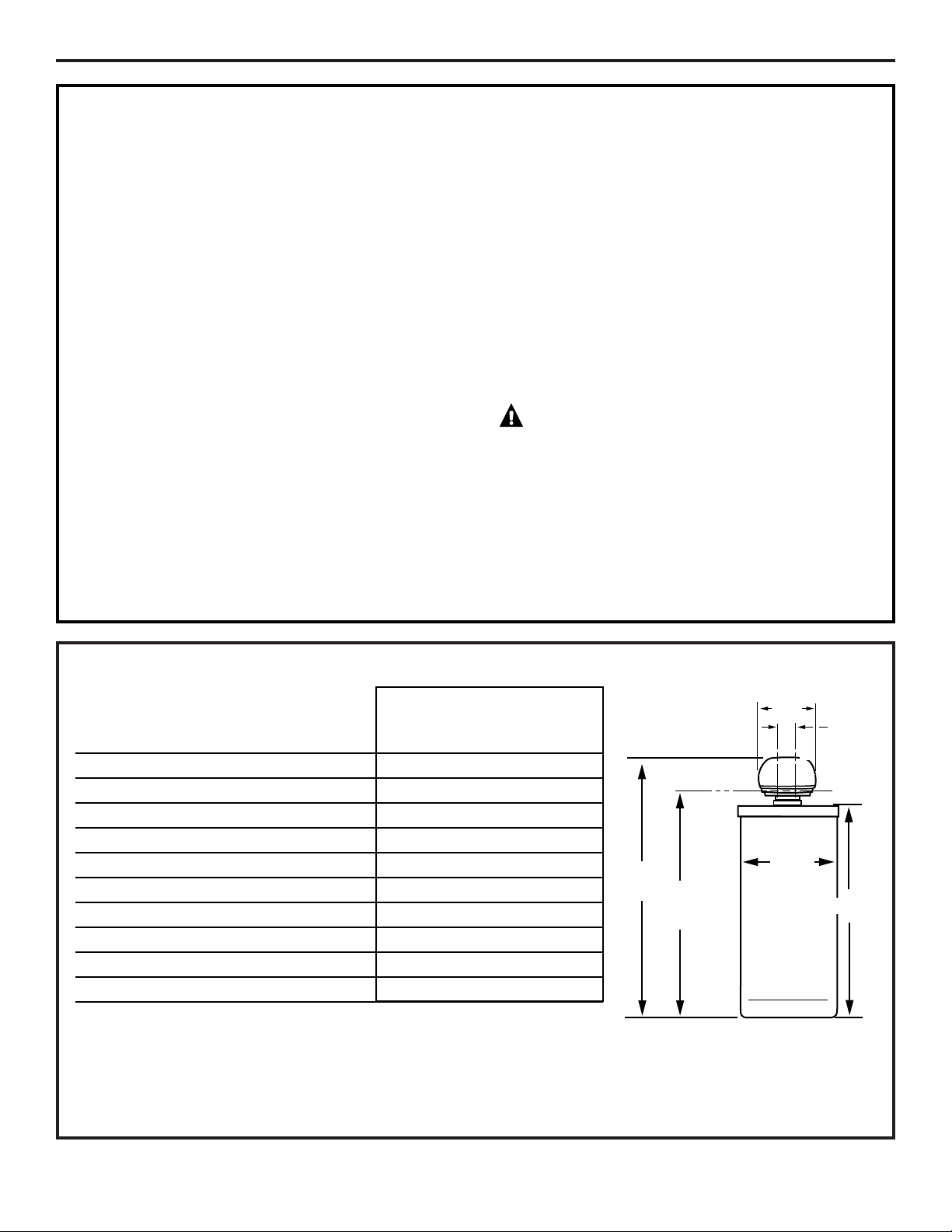
SPECIFICATIONS/DIMENSIONS
This system conforms to NSF/ANSI 44 for the specific capacity claims as verified and substantiated by test data.
* Testing was performed using pellet grade sodium chloride as the regenerant salt.
** Efficiency rating is valid only at the lowest stated salt dosage. This softener was efficiency rated according to
NSF/ANSI 44.
*** Extent of iron removal may vary with conditions. The capacity to reduce clear water iron is substantiated by
WQA test data. Use of Diamond Crystal
®
Red•Out
®
or Super Iron Out
®
will improve iron removal. Refer to
Cleaning Iron Out of the Water Softening System section.
**** Canada working pressure limits: 1.4–7.0 kg/cm
2
.
SANITIZING PROCEDURES
To complete the installation, do the following
sanitizing procedures.
Care is taken at the factory to keep your water
softener clean and sanitary. Materials used to make
the softener will not infect or contaminate your water
supply and will not cause bacteria to form or grow.
However, during shipping, storage, installation and
operation, bacteria could get into the softener. For
this reason, sanitizing as follows is suggested when
installing.
NOTE: Sanitizing is recommended by the
Water Quality Association for disinfecting.
1. Be sure to complete all installation steps, including
programming the control.
2. Pour about 3/4 oz. (1
1
⁄
2 tablespoons) of common
5.25% unscented household bleach (Clorox, Linco,
Bo Peep, White Sail, Eagle, etc.) into the brinewell.
Refer to illustration on page 5.
3. IMPORTANT: Press and hold for 3 seconds
the faceplate TOUCH/HOLD button to start an
immediate recharge. The bleach will be drawn
through the water softener, and out the drain.
This process takes approximately 2 hours.
4. If, after sanitization, water from the house
faucet tastes salty or has a slight color, this is a
preservative from the resin tank. Turn on the cold
soft water faucets and drain for a few minutes or
until clear.
NOTE: When the sanitizing recharge is over, all
remaining bleach is flushed from the conditioner
and your house COLD water supply is fully soft
immediately. However, your water heater is filled
with hard water and as hot water is used, it will refill
with soft water. When all the hard water is replaced
in the water heater, hot only and mixed hot and cold
water will be fully soft. If you want totally soft water
immediately, after the above recharge, drain the
water heater until the water runs cold.
WARNING: If you do drain the water
heater, use extreme care as the hot water could
cause burns. Turn the water heater off prior to
draining.
18–1/4″
40–1/2″
41–1/4″
48–3/4″
INLET-OUTLET
11–1/2″
3–3/8″
OUT
INLET
GNSF35Z
Rated capacity* (see rating label on water softener)
Rated efficiency** (see rating label on water softener)
Amount of high capacity resin (lbs/cu. ft) 48.9/.94
Resin tank nominal size (in., dia. x height) 9 x 40
Service flow rate (gpm) (see rating label on water softener)
Water supply maximum hardness (gpg) 100
Water supply maximum clear water iron (ppm)*** 9
Water pressure limits (min.–max. psi)**** 20–125
Pressure drop at rated service flow (psig) 14
Water temperature limits (min.–max.°F) 40–120
Water supply minimum flow rate (gpm) 3
Maximum flow rate to drain (gpm) 2.2

About the water softener system. ge.com
Service
When the water softening system is providing
soft water, it is called “Service.” During service,
hard water flows from the house main water pipe
into the water softening system. Inside the water
softening system resin tank is a bed made up of
thousands of tiny, plastic resin beads. As hard
water passes through the bed, each bead
attracts and holds the hard minerals. This is
called ion-exchanging. It is much like a magnet
attracting and holding metals. Water without
hard minerals (soft water) flows from the water
softening system and to the house pipes.
After a period of time, the resin beads become
coated with hard minerals and they have to be
cleaned. This cleaning is called recharge.
Recharge is started at 2:00 AM (factory setting)
by the water softening system control, and
consists of five stages or cycles. These are FILL,
BRINING, BRINE RINSE, BACKWASH and FAST
RINSE.
For emergency needs, hard water is available
to the home during the recharge cycles.
However, you should avoid using HOT water
because the water heater will fill with the hard
water.
Automatic Hard Water Bypass During Recharge
Fill
Salt dissolved in water is called brine. Brine is
needed to clean the hard minerals from resin
beads. To make the brine, water flows into the
salt storage area during the fill stage.
Brining
During brining, brine travels from the salt storage
area into the resin tank. Brine is the cleaning
agent needed to remove hard minerals from the
resin beads. The hard minerals and brine are
discharged to the drain.
The nozzle and venturi create a suction to move
the brine, maintaining a very slow rate to get the
best resin cleaning with the least salt.
Brine Rinse
After a pre-measured amount of brine is used,
the brine valve closes. Water continues to flow in
the same path as during brining, except for the
discontinued brine flow. Hard minerals and brine
flush from the resin tank to the drain.
Backwash
During backwash, water travels up through
the resin tank at a fast flow rate, flushing
accumulated iron, dirt and sediments
from the resin bed and to the drain.
Fast Rinse
Backwash is followed by a fast flow of water
down through the resin tank. The fast flow
flushes brine from the bottom of the tank,
and packs the resin bed.
After fast rinse, the water softening system
returns to soft water service.
13
14
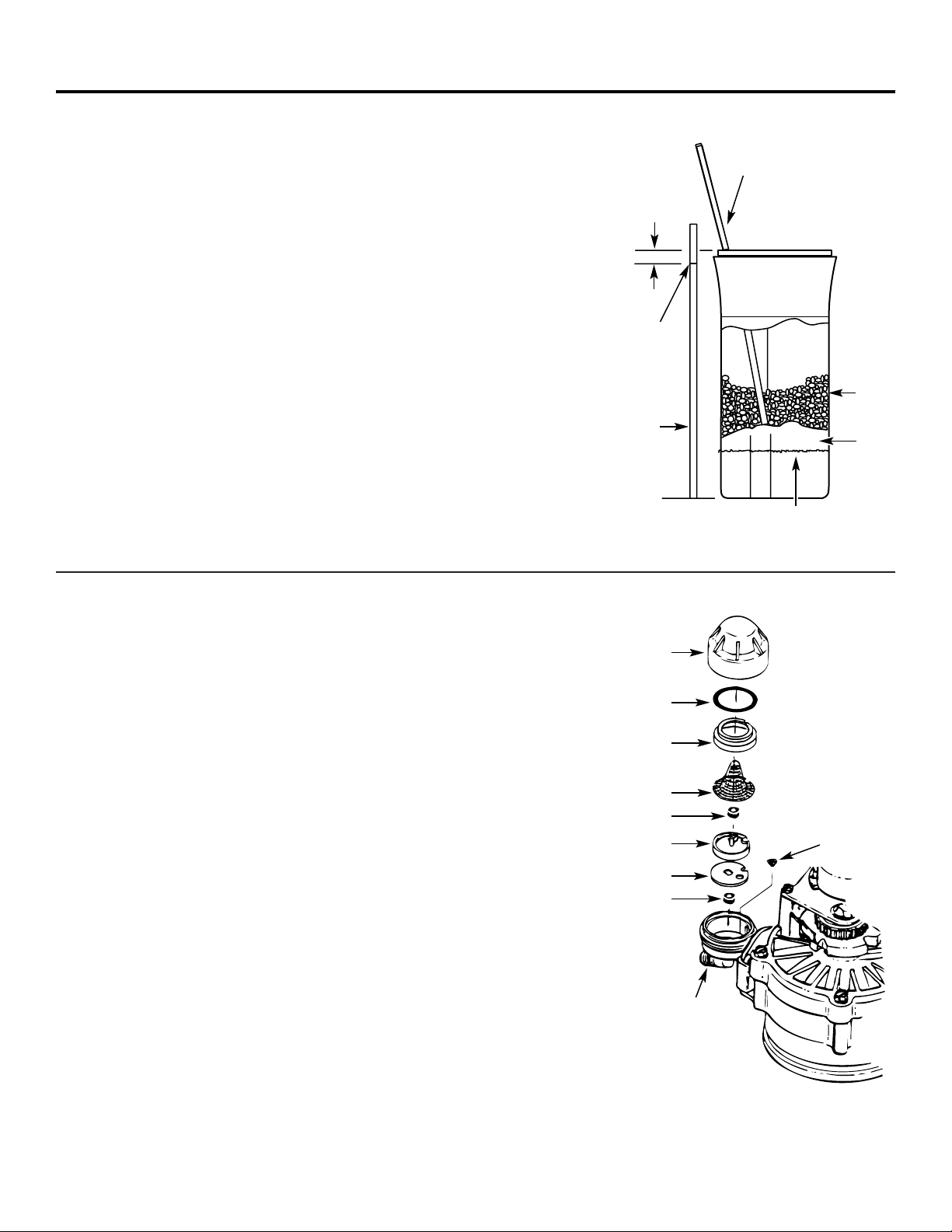
Breaking a Salt Bridge
Sometimes, a hard crust or salt bridge forms in
the salt storage area. It is usually caused by high
humidity or the wrong kind of salt. When the salt
bridges, an empty space forms between the
water and salt. Then salt will not dissolve in the
water to make brine.
If the brine tank is full of salt, it is hard to tell
if you have a salt bridge. Salt is loose on top, but
the bridge is under it. The following is the best
way to check for a salt bridge.
Salt should be loose all the way to the bottom of
the tank. Take a broom handle or like tool, and
carefully push it down into the salt, working it up
and down. If the tool strikes a hard object (be
sure it’s not the bottom or sides of the tank), it’s
most likely a salt bridge. Carefully break the
bridge with the tool. Do not pound on the walls
of the tank.
If the wrong kind of salt made the bridge, take it
out. Then fill the tank with nugget or pellet salt
only. In humid areas, it is best to fill with less salt,
more often to prevent a salt bridge from forming.
A clean nozzle and venturi is needed for the
water softening system to work properly. This
small unit makes the suction to move brine from
the salt storage area to the resin tank during
recharge. If it becomes plugged with sand, dirt,
etc., the water softening system will not work
and you will get hard water.
To get to the nozzle and venturi, remove the
water softening system top cover. Be sure the
water softening system is in service cycle (no
water pressure at nozzle and venturi). Then, while
holding the nozzle and venturi housing with one
hand, remove the cap. Lift out the screen support
and screen, then the nozzle and venturi. Wash
and rinse the parts in warm water until clean. If
needed, use a small brush to remove iron or dirt.
Also check and clean the gasket.
NOTE: Some models have a small flow plug
located in the nozzle and venturi, and/or a small
cone shaped screen in the housing. Be sure to
check and clean these parts, if your model is
so equipped.
Carefully replace all parts in the correct
order. Lightly lubricate the o-ring seal with clean
silicone grease or petroleum jelly and place in
position. Install and tighten the cap, by hand
only. Do not overtighten the cap.
Cleaning the Nozzle and Venturi Assembly
Push tool into salt
bridge to break
Pencil
mark
Broom
handle
Salt
Salt
bridge
Water level
1″–2″
IMPORTANT: Be sure small holes in the gasket are
centered directly over the small holes in the nozzle and
venturi housing.
*Install with numbered side up, concave side down.
Cap
O-ring seal
Screen
support
Screen
Screen
Nozzle &
Venturi
Nozzle &
Venturi
housing
Gasket
*Flow
plug
*Flow plug
About the water softener system.
15
ge.com
During normal operation, the present time of
day and AM or PM show in the control display
area. When the demand computer determines
a recharge is needed, a regeneration (recharge)
begins at the next recharge start time. During a
recharge, RECHARGE NOW flashes until the
recharge is over.
Normal Operation, Control Displays
Sometimes, a manually started recharge may
be desired or needed. Two examples:
■ You have used more water than usual (house
guests, extra washing, etc.) and you may run
out of soft water before the next recharge.
■ The system ran out of salt.
Use one of the following features to start a
recharge immediately, or at the next preset
recharge start time.
RECHARGE TONIGHT
Touch (do not hold) the TOUCH OR HOLD button.
RECHARGE TONIGHT flashes in the control
display area. A recharge will occur at the next
preset recharge start time. If you decide to
cancel this recharge, touch the same button
once more.
RECHARGE NOW
Press and hold the TOUCH OR HOLD button until
RECHARGE NOW starts to flash in the control
display area. The water softening system begins
an immediate recharge and, when over in about
two hours, you will have a new supply of soft
water. Once started, you cannot cancel this
recharge.
Feature: Optional Recharge Controls
Feature: Memory
If electrical power to the water softening system
is interrupted, the control display is blank, and
the blue indicator light is off, but the control
keeps correct time for about 6 hours. When
power is restored, you have to reset the present
time only if the display and blue indicator light
are flashing. All other settings are maintained
and never require resetting unless a change is
desired.
If the time is flashing after a long power outage,
the water softening system continues to work as
it should to provide you with soft water. However,
recharge may occur at the wrong time of day
until you reset the control to the correct time
of day.
The control computer has a self-diagnostic
function for the electrical system (except input
power and water meter). The computer monitors
the electronic components and circuits for
correct operation. If a malfunction occurs,
an error code appears in the control display.
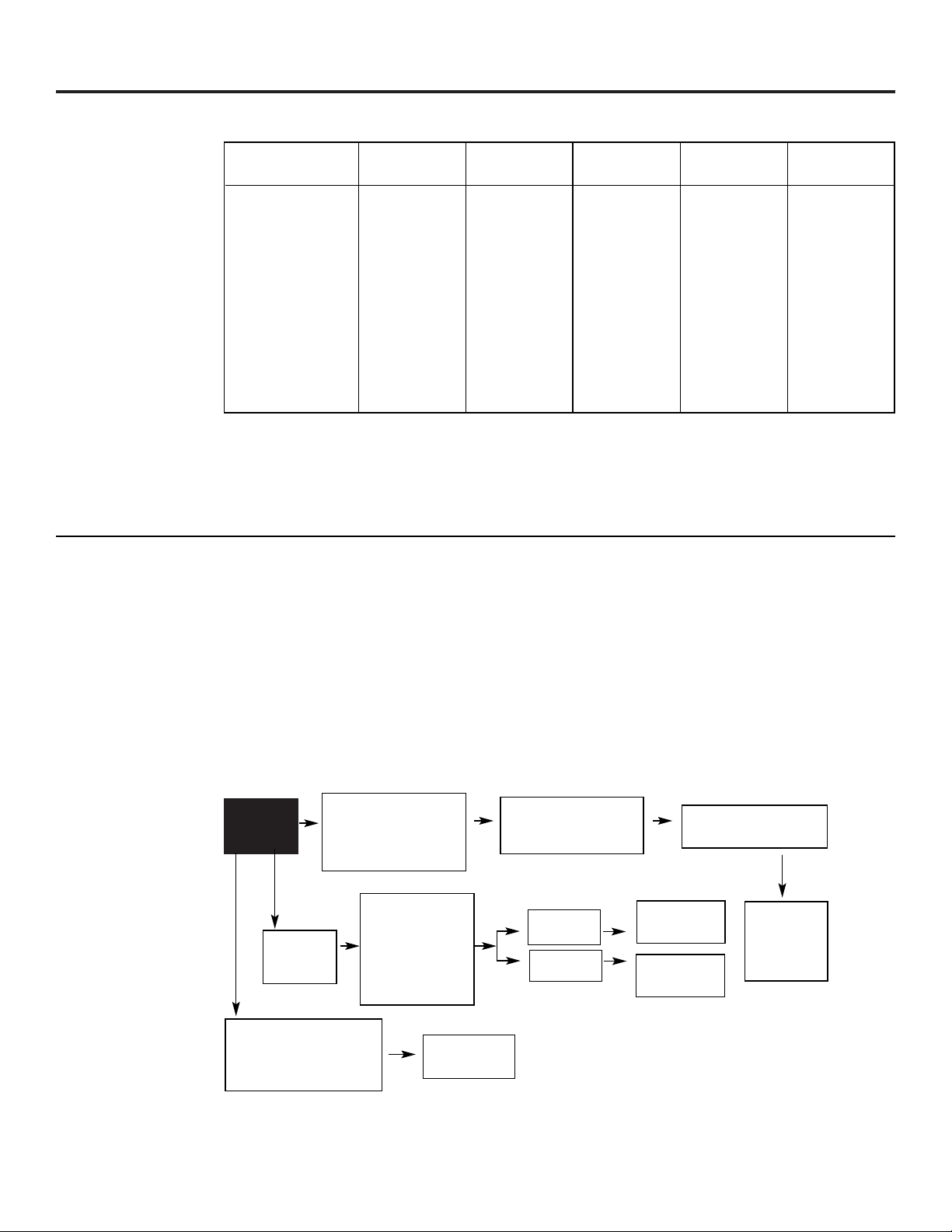
The chart on Error Codes shows the error
codes that could appear and possible reasons
for each code. See Manually Initiated Electronics
Diagnostics to further isolate the defect.
Feature/Service: Automatic Electronic Diagnostics
About the water softener system.
16
To remove an error code: 1. Unplug transformer.
2. Correct defect.
3. Plug transformer in.
4. Wait for at least 6 minutes. The error code will return if the reason for
the error code was not corrected.
NO SOFT
WATER
CONTROL SHOWS
WRONG TIME AND
DAY, AND/OR IS
FLASHING.
CONTROL
DISPLAY
BLANK.
CONTROL DISPLAY
SHOWS CORRECT TIME
AND DAY AND IS
STEADY.
Check electrical
power to control
(outlet,
transformer,
power cable, all
connections).
Do manual
diagnostics.
NO POWER
POWER OK
REPAIR AS
NEEDED
CONTROL
DEFECTIVE
Do manual
diagnostics
to verify
proper
function.
Electrical power was
off. Reset the correct
time of day.
Investigate reason for
power loss.
Service: Electronic Demand Time Features and Service
If you are not getting soft water, and an error
code is not displayed, use the procedures below
to find the problem. First make the following
visual checks.
VISUAL CHECKS:
1. Is there electrical power to the outlet the water
softening system transformer is plugged into?
2. Is there sufficient salt in the storage tank?
3. Is the softener bypass valve directing water
for soft water service?
4. Is the valve drain hose open to the drain,
not more than 8′ above the softener, and
unobstructed? If hose is above 8′, see
page 8, step 4.
If you do not find a problem with the visual
checks, continue below.
Service: Timer/Softener, Service Checkout Procedure
ERROR CODE
DISPLAYED ERR 01 ERR 02 ERR 03 ERR 04 ERR 05
POSSIBLE DEFECT • Motor •Position •Motor •Position •Control
inoperative switch inoperative switch or
or wiring wiring
harness harness
• Wiring •Control •Control •Control
harness or
connection
to switch
• Position
switch
• Control
17
ge.com
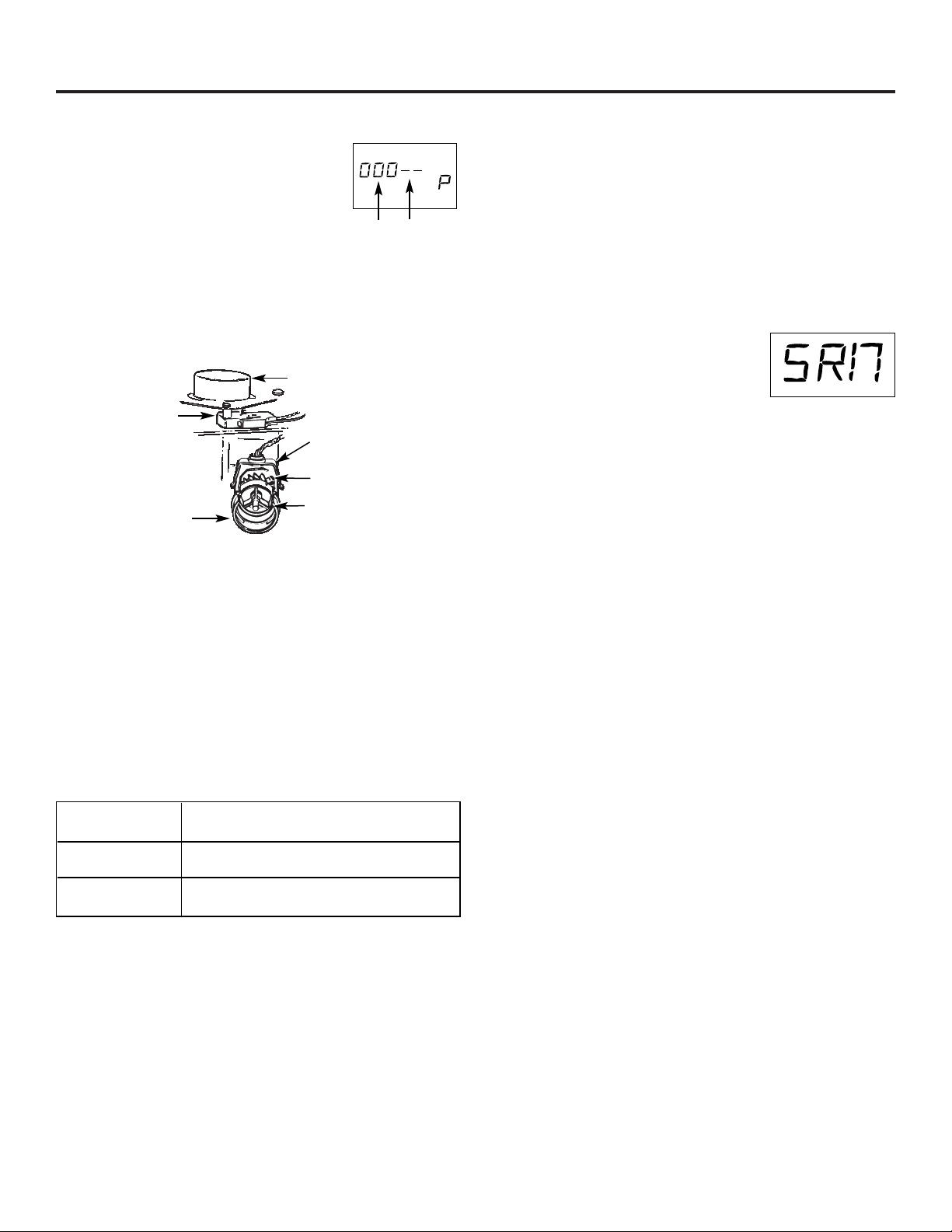
1. To enter diagnostics, press and hold the
SELECT button until (000 – –) shows in
the display.
A The first 3 digits indicate water meter
operation as follows:
■ 000 (steady) = soft water not in
use…no flow through the meter.
—OPEN A NEARBY SOFT WATER FAUCET—
■ 000 to 199 (continual) = repeats display for each
gallon of water passing through the meter.
If you don’t get a reading in the display, with faucet
open, pull the sensor from the valve outlet port. Pass
a small magnet back and forth in front of the sensor.
You should get a reading in the display. If you get a
reading, shut off water supply, unhook the in and out
plumbing and check the turbine for binding.
B The letter (P) and dash(es) indicate POSITION switch
operation. The letter appearing means the switch is
closed; the dash means the switch is open. Use the
TOUCH OR HOLD (RECHARGE TONIGHT–RECHARGE NOW)
button to manually advance the valve into each cycle
and check correct switch operation.
C While in this diagnostic screen, the following information is
available and may be beneficial for various reasons. This
information is retained by the computer from the first time
electrical power is applied to the control.
■ Press and hold the UP button to display the number
of days this control has had electrical power applied.
■ Press and hold the DOWN button to display the number
of regenerations initiated by this control since the SR
code number was entered.
2. Press the SELECT button and hold in
three seconds until a Service Rating code
appears in the display.
For correct water softening system
operation, the model code must be F35 for model
GNSF35Z.
To reset the code, press the UP or DOWN button until the
correct number shows.
3. Press the SELECT button to return to the present time display. If
the code was changed, make ALL the timer settings.
NOTE: If the control is left in a diagnostic display or a
flashing display when setting times or hardness, present time
automatically returns if a button is not pressed within four
minutes.
CORRECT SWITCH
DISPLAYS VALVE CYCLE STATUS
— — Valve in service, fill, brining, backwash
or fast rinse position.
— P Valve rotating from one position to
another
Turbine Switches
Water
Meter
(A)
Switch (B)
OR
Service: Manually Initiated Electronics Diagnostics
Motor
Turbine
Turbine
support and
shaft
Sensor
housing
Position
switch
Valve
outlet

About the water softener system.
18
This check verifies proper operation of the valve
motor, brine tank fill, brine draw, regeneration
flow rates and other controller functions. First,
make the initial checks and the Manually Initiated
Electronics Diagnostics.
NOTE: The control display must show a steady
time (not flashing).
1. Press the TOUCH OR HOLD button and hold in
for three seconds. RECHARGE NOW begins to
flash as the water softening system enters the
fill cycle of regeneration. Remove the brinewell
cover and, using a flashlight, observe fill water
entering the brine tank. If water does not enter
the tank, look for an obstructed nozzle, venturi,
fill flow plug or brine tubing. See Care and
cleaning of the water softening system section.
2. After observing fill, press the TOUCH OR HOLD
button to move the water softening system
into brining. A slow flow of water to the drain
will begin. Verify brine draw from the brine
tank by shining a flashlight into the brinewell
and observing a noticeable drop in the liquid
level over an extended period of time.
NOTE: Be sure a salt bridge is not preventing
water from contacting salt. See Care and
cleaning of the water softening system section.
If the water softening system does not draw
brine, check:
■ nozzle and/or venturi dirty or defective.
■ nozzle and venturi not seated properly
on gasket.
■ restricted drain (check drain fitting and
hose).
■ defective nozzle and venturi seal.
■ other inner valve defect (rotor seal, rotor and
disc, wave washer, etc.).
NOTE: If water system pressure is low, an
elevated drain hose may cause back pressure,
stopping brine draw.
3. Again, press the TOUCH OR HOLD button
to move the water softening system into
backwash. Look for a fast flow of water from
the drain hose. A slow flow indicates a plugged
top distributor, backwash flow plug or drain
hose.
4. Press the TOUCH OR HOLD button to move the
water softening system into fast rinse. Again
look for a fast drain flow. Allow the water
softening system to rinse for a few minutes
to flush out any brine that may remain in
the resin tank from the brining cycle test.
5. To return the water softening system to
service, press the TOUCH OR HOLD button.
Service: Manually Advance Regeneration Check

19
Care and cleaning of the water softening system. ge.com
Brine (salt dissolved in water) is needed for each
and every recharge. The water for making brine
is metered into the salt storage area by the
water softening system valve and control.
However, you must keep the tank supplied
with salt.
When to refill with salt: Check the salt level a
few weeks after you install the water softening
system and every week after that. Refill when
the brine tank is from 1/3 to 1/2 full. In humid
areas it is best to fill with less salt more often.
Never allow the water softening system to use all
the salt before you refill it. Without salt, you will
soon have hard water.
Use clean water softening salts only, at least
99.5% pure. NUGGET, PELLET or coarse SOLAR
salts are recommended. Do not use rock, block,
granulated or ice cream making salts. They
contain dirt and sediments, or mush and cake,
and will create maintenance problems.
CAUTION:
Water softening salt
with iron removing additives: Some salts
may have an additive to help the water
softening system handle iron in the water
supply. Although this additive may help to
keep the water softening system resin clean,
it may also release corrosive fumes that
weaken and shorten the life of some water
softening system parts. GE recommends
using only Diamond Crystal
®
Red•Out
®
brand salt.
Checking the Salt Storage Level and Refilling
Your water softening system takes hardness
minerals (calcium and magnesium) out of
the water. Also, it can control some (see the
Specification Guidelines section) “clear water”
iron. With clear water iron, water from a faucet
is clear when first put into a glass. After 15 to 30
minutes, the water begins to cloud or turn rust
colored. A water softening system will not
remove any iron that makes the water cloudy
or rusty as it comes from the faucet (called red
water iron). To take red water iron out of water,
or over the maximum of clear water iron,
an iron filter or other equipment is needed.
GE recommends using only Diamond Crystal
®
Red•Out
®
brand salts with Iron Fighter
®
additive
to help keep the resin bed clean of clear iron. If
your water supply has clear water iron, periodic
resin bed cleaning is needed. GE recommends
using Super Iron Out
®
brand resin bed cleaner
to thoroughly clean your resin bed if your iron
content is high. Clean the bed at least every six
months, or more often if iron appears in the soft
water between cleanings.
IMPORTANT: It is important to mix the resin bed
cleaner with water (following the manufacturer’s
instructions), pour it into the brinewell tube
(see page 5) and recharge the softener
immediately. Do not pour the resin bed cleaner
in with the salt, as it will not be as effective in
cleaning the resin, and can cause damage to
the softener if it is left in the brine tank for an
extended period due to the corrosive gases
that are formed.
Cleaning Iron Out of the Water Softening System
20
Troubleshooting Tips
Save time and money! Review the chart on the following
pages first and you may not need to call for service.
Problem Possible Causes What To Do
No soft water Faucet or fixture where sample was •
To conserve salt, the installer
may have isolated some fixtures
taken not plumbed to soft water.
(outside faucets, toilets, etc.)
from soft water. From the outlet
NOTE:
Be sure sample is from a faucet of the water softening system, trace the water flow path,
that does not mix soft and hard water. in house plumbing. If soft water is not directed to a faucet
For example, a single lever kitchen faucet, or
fixture where wanted, consult a plumber.
if the cold side is plumbed to hard water.
No salt in the brine tank or •
Refill with salt. See the Step-by-Step Installation Instructions.
salt bridged
Use the TOUCH OR HOLD button to start a regeneration.
See the About the water softener system section.
Transformer unplugged at wall outlet or
• Check for a loss of electrical power to the water softening
power cable to softener not connected. system, due to any of these conditions and correct as needed.
Fuse blown or circuit breaker popped With the power supply restored, observe the faceplate time
on circuit to electrical outlet. display and read Programming the Control section.
Electrical outlet on a circuit that can
NOTE: The electrical outlet for the softener should be
continuously
be switched off
live
so it cannot be accidentally switched off.
Manual bypass valve in bypass position • Be sure the bypass valve stem
is positioned properly, with the
knob in the OUT position. Observe i
nstructions on the decal
at the end of the stem.
Valve drain hose pinched, plugged, •
Any restriction in this drain hose
may prevent proper
elevated too high or otherwise
operation of the
nozzle and venturi and reduce or prevent
restricted brine draw during recharge.
Nozzle and venturi dirty, incorrectly • Refer to Cleaning the Nozzle and Venturi Assembly
instructions.
assembled or damaged
With water pressure to the
water softening system off, take the
nozzle assembly apart. Inspect, clean and replace as needed.
Any foreign particle(s), scratches, nicks, etc., in the passages can
prevent operation. Be sure holes in the gasket are centered over
holes in the housing.
NO SOF
T WATER – Most Common Problems:
Check the following before calling for service:
•
Not enough salt—should be at least 1/3 full.
•
Bypass valve in “Bypass” position—knob should be in the “OUT” (service) position.
•
Hardness setting too low. Check hardness setting and adjust. Verify hardness of supply
water—from local water company, water test or call the GE Answer Center.
•
Salt Bridge—salt solidifies above water level so that brine water is not in contact with
salt. See the Breaking a Salt Bridge section.
Before you call for service…
21
Problem Possible Causes What To Do
Water hard sometimes Using hot water while the water • Avoid using hot water during water softening system
softening system is regenerating recharge because the water heater will refill with hard water.
See Automatic Hard Water Bypass During Recharge section,
page 13.
Control HARDNESS number setting • Press the MODE button until arrow points to HARDNESS.
too low Be sure the number shown is the same as the actual grains per
gallon hardness of your water supply. See the Programming
the Control section if a change in the setting is needed.
Grains of hardness in your water •
Water hardness can change
over time, especially in well water.
supply have increased To check, have the water tested by a water analysis laboratory
or call your local water department. Adjust the HARDNESS
number setting as needed.
Water feels slippery Absence of hardness minerals • This is normal. Hardness in water gives it the abrasive feel
after installation of you may have been accustomed to. The slippery feel is the
water softening system clean feel of soft water.
Water softening system Water softening system is a • Does not use much salt to regenerate—very efficient.
not using any salt “demand” unit
Possible salt bridge • See the About the Water Softener System section, page 14.
Possible plugged nozzle and venturi • See the About the Water Softener System section, page 14.
Water is blue color Acidic water in copper plumbing • Have the water tested at once.
after water softening
system was installed
Water softening system Meter turbine stuck • See the Service: Manually Initiated Electronics Diagnostics
not regenerating section for troubleshooting procedures, page 17.
• Call for service.
Sensor wire not plugged into • See the Service: Manually Initiated Electronics Diagnostics
the control section for troubleshooting procedures, page 17.
• Call for service.
No power to unit • Check the circuit breaker or fuses.
Mechanical defect • Call for service.
Cloudiness on glassware Combination of soft water and • This is called etching and is permanent. To prevent this
(automatic dishwashers) too much detergent from happening, use less detergent if you have soft water.
Wash glassware in the shortest cycle that will get them clean.
Excessive/high level Valve drain hose pinched, • Any restriction in this drain hose may prevent proper
of water in brine tank plugged, elevated too high operation of the nozzle and venturi and reduce or prevent
or otherwise restricted brine draw during recharge.
Nozzle and venturi dirty, incorrectly • See the Cleaning the Nozzle and Venturi Assembly section,
assembled or damaged page 14. With water pressure to the water softening system
off, take the nozzle assembly apart. Inspect, clean and
replace as needed. Any foreign particle(s), scratches, nicks,
etc., in the passages can prevent operation. Be sure holes
in the gasket are centered over holes in the housing.
ge.com
Before you call for service…
22
Problem Possible Causes What To Do
Salty tasting or Unit not sanitized • Complete the Sanitization Procedures on page 12.
brown/yellow colored
• At completion of recharge cycle (approx. 2 hrs), run water
water after installation
from faucets to purge the salty water.
Low water pressure Check pressure.
• Drain height 8′ or less, pressure should be minimum of 20 psi.
• Drain height above 8′, pressure should be minimum of 50 psi.
Restricted drain hose • Clean and reconnect hose.
• Check for kinks in drain line.
Brown/yellow Unit was idle for a period of time • Complete the Sanitization Procedures on page 12.
colored water
Resin beads showing Cracked distributor • Call for service.
up in drinking water
and sink
Sounds you might hear Running water from the unit • This is normal.
into a drain during recharge
Water has air bubbles Air in system after installation • Will go away after it runs for a while.
and is cloudy
Error Code on control Wiring may have worked loose • See page 16 for details.
in the control
• Unplug transformer.
• Remove control cover, release clips on side.
• Check for loose/incorrect wiring connections to electronic
board or switch. Reconnect as required.
• Reassemble control cover.
• Plug in Transformer.
• Wait six minutes for Error Code to reappear.
• If Error Code reappears, call for service.
Troubleshooting Tips
23
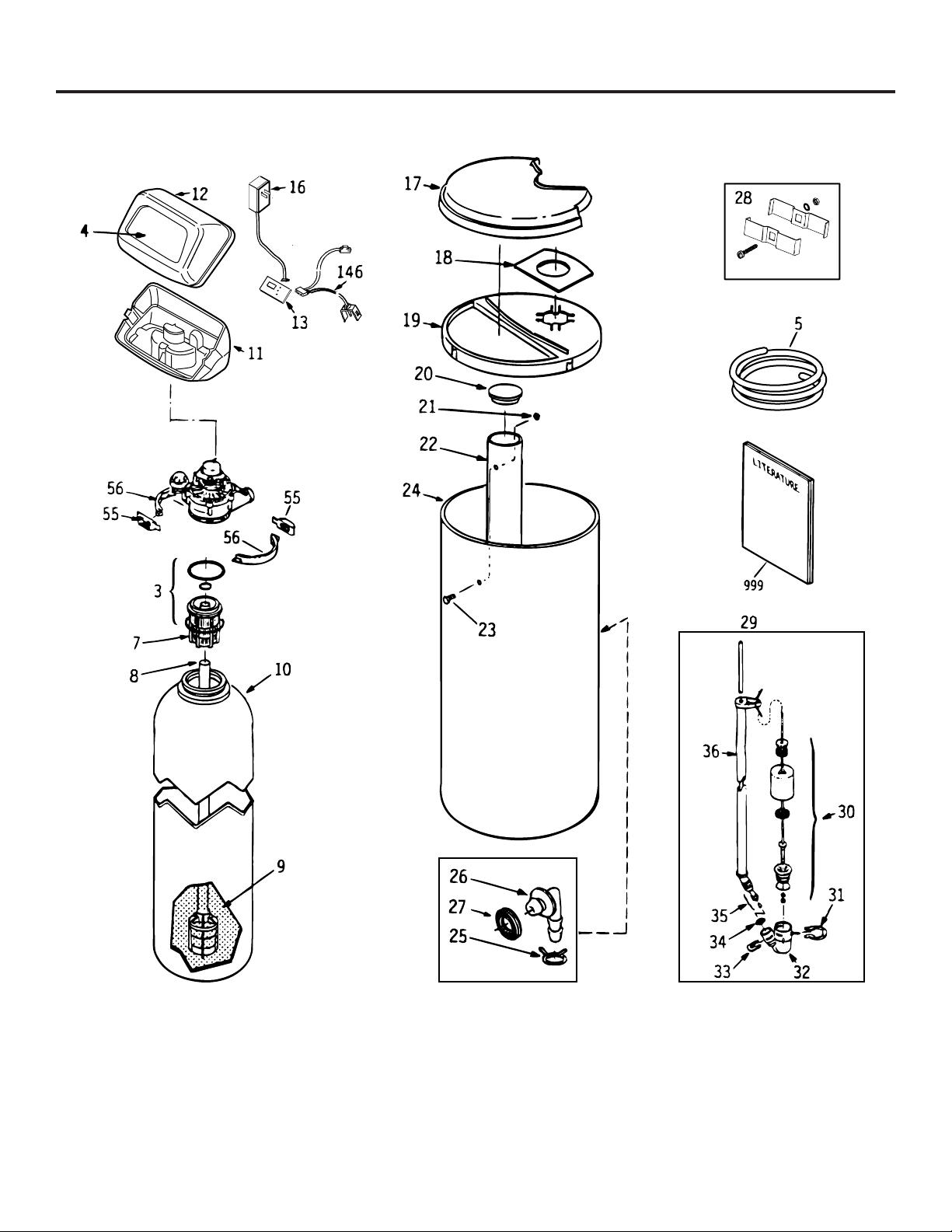
Parts list. ge.com
24
Parts list.

25
Parts catalog. ge.com
GENERAL ELECTRIC PARTS CATALOG
G
N
S
F
3
5
Z
REF. NO. PART NO. PART DESCRIPTION (04)
0003 WS35X10001 O-RING SEAL KIT 1
0004 WS34X10005 DECAL 1
0005 WS07X10004 HOSE DRAIN, 20 FT. 1
0007 WS14X10002 DISTRIBUTOR TOP 1
0008 WS14X10001 DISTRIBUTOR BOTTOM 1
0009 WS01X10002 RESIN – 1 CU. FT. 1
0010 WS32X10011 TANK RESIN 1
0011 WS31X10001 COVER BOTTOM 1
0012 WS31X10002 COVER CONTROL 1
0013 WS21X10012 CONTROL 1
0016 WS26X10013 TRANSFORMER WITH CORD 1
0017 WS31X10010 COVER SALT HOLE 1
0018 WS33X10001 SEAL VAPOR BARRIER 1
0019 WS33X10002 RIM 1
0020 WS31X10003 COVER BRINEWELL 1
0021 WS02X10009 WING NUT, 1/4″ – 20 1
0022 WS32X10002 TANK BRINEWELL, ROUND 1
0023 WS02X10011 SCREW, 1/4″ – 20 NYLON 1
0024 WS32X10003 TANK BRINE, ROUND 1
0025 WS18X10003 CLAMP HOSE 1
0026 WS22X10016 ADAPTER HOSE 1
0027 WS22X10017 GROMMET 1
0028 WS35X10035 GROUND CLAMP KIT 1
0029 WS15X10005 BRINE VALVE ASM. 1
0030 WS35X10003 FLOAT, STEM & GUIDE ASM. 1
0031 WS03X10006 CLIP 1
0032 WS15X10006 VALVE BODY, BRINE 1
0033 WS03X10007 CLIP 1
0034 WS03X10008 SCREEN 1
0035 WS07X10002 TUBING ASM. 1
0036 WS07X10003 TUBE BRINE 1
0055 WS28X10003 RETAINER CLAMP 2
0056 WS28X10004 CLAMP 2
0999 49-50181 PM MANUAL USE & CARE/ 1
INSTALLATION
WS35X10051 INSTALLATION KIT
NOTE: Codes in the State of Massachusetts require installation by a licensed
plumber and do not permit the use of the saddle valve. For installation, use
plumbing code 248-CMR of the Commonwealth of Massachusetts.

26
Parts catalog.
GENERAL ELECTRIC PARTS CATALOG
G
N
S
F
3
5
Z
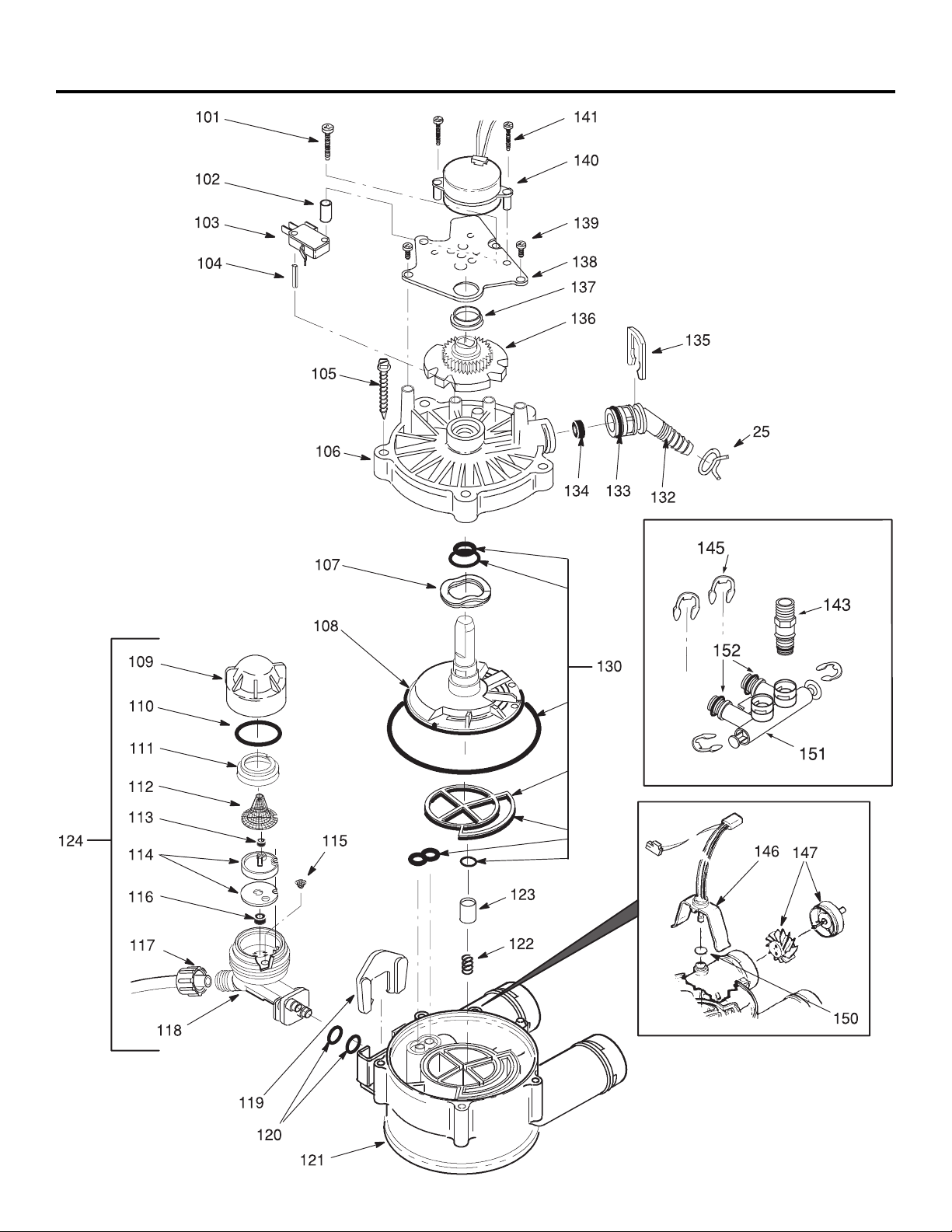
REF. NO. PART NO. PART DESCRIPTION (04)
0101 WS02X10012 SCREW, #4 – 24 X 1-1/8″ 1
0102 WS02X10013 SPACER 1
0103 WS21X10003 SWITCH 1
0104 WS03X10009 PIN EXPANSION 1
0105 WS02X10014 SCREW, #10 – 14 X 2″ 5
0106 WS31X10006 COVER VALVE 1
0107 WS03X10010 WASHER WAVE 1
0108 WS26X10002 ROTOR & DISC 1
0109 WS19X10004 CAP 1
0110 WS03X10011 SEAL O-RING 1.1″ X 1.4″ 1
0111 WS19X10005 SUPPORT SCREEN 1
0112 WS03X10013 SCREEN 1
0113 WS22X10020 FLOW PLUG, .1 GPM 1
0114 WS08X10005 GASKET, NOZZLE/VENT 1
0115 WS03X10015 CONE SCREEN 1
0116 WS22X10021 PLUG, FILL FLOW, .3 GPM 1
0117 WS03X10017 NUT FERRULE 1
0118 WS15X10009 NOZZLE/VENTURI ASM. 1
0119 WS03X10018 RETAINER 1
0120 WS03X10019 SEAL O-RING 1/4″ X 3/8″ 2
0121 WS15X10010 BODY VALVE 1
0122 WS03X10020 SPRING 1
0123 WS22X10022 PLUG, DRAIN SALT 1
0130 WS35X10005 SEAL KIT 1
0132 WS22X10023 ADAPTER DRAIN HOSE 1
0133 WS03X10021 O-RING 5/8″ X 13/16″ 1
0134 WS03X10022 PLUG FLOW, RINSE CONTROL 1
0135 WS03X10023 CLIP 1
0136 WS26X10003 CAM & GEAR 1
0137 WS26X10004 BEARING 1
0138 WS26X10005 PLATE MOTOR 1
0139 WS02X10015 SCREW, #6 – 20 X 3/8″ 2
0140 WS26X10006 MOTOR ASM. 1
0141 WS02X10016 SCREW, #6 – 20 X 7/8″ 2
0143 WS60X10013 ADAPTER—NPT THREADED—STD VALVE 2
0145 WS60X10004 CLIP 4
0146 WS28X10017 HARNESS WITH SENSOR ASM. 1
0147 WS19X10006 TURBINE & SUPPORT ASM. 1
0150 WS03X10024 SEAL, O-RING 1
0151 WS15X10053 VALVE BYPASS ASM. 1
0152 WS03X10025 SEAL, O-RING 4
NOTE: Codes in the State of Massachusetts require installation by a licensed
plumber and do not permit the use of the saddle valve. For installation, use
plumbing code 248-CMR of the Commonwealth of Massachusetts.
27
What Is Not Covered:
For The Period Of: We Will Replace:
One Year Any part of the Water Softening System which fails due to a defect in materials or workmanship.
From the date of the During this limited one-year warranty, GE will also provide, free of charge, all labor and related
original purchase service to replace the defective part.
Three Years The electronic monitor, if it fails due to a defect in materials or workmanship. During this
From the date of the three-year limited warranty, you will be responsible for any labor or related service costs.
original purchase
Ten Years A replacement brine tank or cabinet, if either fails due to a defect in materials or workmanship.
From the date of the During this ten-year limited warranty, you will be responsible for any labor or related service costs.
original purchase
■ Service trips to your home to teach you how to use
the product.
■ Improper installation, delivery or maintenance.
■ Failure of the product if it is abused, misused, altered, used
commercially or used for other than the intended purpose.
■ Use of this product where water is microbiologically unsafe
or of unknown quality, without adequate disinfection before
or after the system. Systems certified for cyst reduction may
be used on disinfected water that may contain filterable
cysts.
■ Replacement of house fuses or resetting of circuit breakers.
■ Damage to the product caused by accident, fire, floods or
acts of God.
■ Incidental or consequential damage caused by possible
defects with this appliance, its installation or repair.
■ Product not accessible to provide required service.
This warranty is extended to the original purchaser and any succeeding owner for products purchased for home use within
the USA. If the product is located in an area where service by a GE Authorized Servicer is not available, you may be
responsible for a trip charge or you may be required to bring the product to an Authorized GE Service location for service.
In Alaska, the warranty excludes the cost of shipping or service calls to your home.
Some states do not allow the exclusion or limitation of incidental or consequential damages. This warranty gives you
specific legal rights, and you may also have other rights which vary from state to state. To know what your legal
rights are, consult your local or state consumer affairs office or your state’s Attorney General.
Warrantor: General Electric Company. Louisville, KY 40225
GE Water Softening System Warranty.
All warranty service provided by our SmartWater
™
Authorized Servicer
Network. To schedule service, call 800.952.5039 (U.S.) or 866.777.7627
(Canada). Please have serial number and model number available when
calling for service.
Staple your receipt here.
Proof of the original purchase
date is needed to obtain service
under the warranty.
EXCLUSION OF IMPLIED WARRANTIES—Your sole and exclusive remedy is product repair as provided in this
Limited Warranty. Any implied warranties, including the implied warranties of merchantability or fitness for
a particular purpose, are limited to one year or the shortest period allowed by law.
28
Consumer Support.
GE Appliances Website
ge.com
Have a question or need assistance with your appliance? Try the GE Appliances Website 24 hours a day,
any day of the year! For greater convenience and faster service, you can now download Owner’s Manuals
or order parts online.
Schedule Service ge.com
Expert GE repair service is only one step away from your door. Schedule your service at your convenience by
calling 800.GE.CARES (800.432.2737) during normal business hours.
Real Life Design Studio ge.com
GE supports the Universal Design concept—products, services and environments that can be used by
people of all ages, sizes and capabilities. We recognize the need to design for a wide range of physical and
mental abilities and impairments. For details of GE’s Universal Design applications, including kitchen design ideas
for people with disabilities, check out our Website today. For the hearing impaired, please call 800.TDD.GEAC
(800.833.4322).
Extended Warranties ge.com
Purchase a GE extended warranty and learn about special discounts that are available while your warranty
is still in effect. You can purchase it on-line anytime, or call 800.626.2224 during normal business hours.
GE Consumer Home Services will still be there after your warranty expires.
Parts and Accessories ge.com
Individuals qualified to service their own appliances can have parts or accessories sent directly to their homes
(VISA, MasterCard and Discover cards are accepted). Order on-line today, 24 hours every day or
by phone at 800.626.2002 during normal business hours.
Instructions contained in this manual cover procedures to be performed by any user. Other servicing
generally should be referred to qualified service personnel. Caution must be exercised, since improper
servicing may cause unsafe operation.
Contact Us ge.com
If you are not satisfied with the service you receive from GE, contact us on our Website with all the details
including your phone number, or write to: General Manager, Customer Relations
GE Appliances, Appliance Park
Louisville, KY 40225
Register Your Appliance ge.com
Register your new appliance on-line—at your convenience! Timely product registration will allow for
enhanced communication and prompt service under the terms of your warranty, should the need arise.
You may also mail in the pre-printed registration card included in the packing material, or detach and
use the form in this Owner’s Manual.
Printed in the United States

