McIntosh Laboratory, Inc. 2 Chambers Street Binghamton, New York 13903-2699 Phone: 607-723-3512 www.mcintoshlabs.com
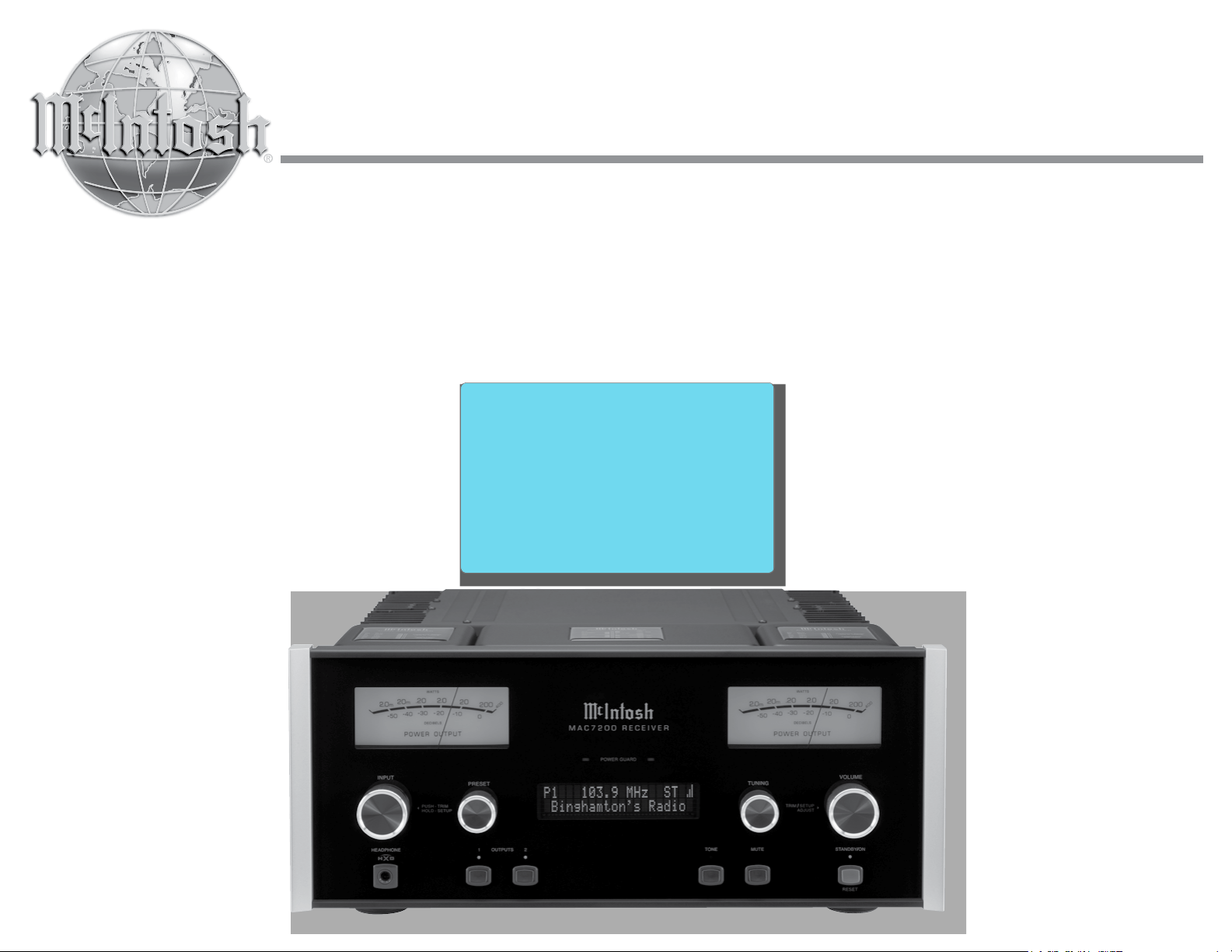
MAC7200
Receiver
Owner’s Manual

2
Your decision to own this McIntosh MAC7200 Re-
ceiver ranks you at the very top among discriminating
music listeners. You now have “The Best.” The McIn-
tosh dedication to “Quality,” is assurance that you will
receive many years of musical enjoyment from this
unit.
Please take a short time to read the information in
this manual. We want you to be as familiar as pos-
sible with all the features and functions of your new
McIntosh.
Copyright 2017 © by McIntosh Laboratory, Inc.
Table of Contents
Thank You
Please Take A Moment
Technical Assistance
If at any time you have questions about your McIntosh
product, contact your McIntosh Dealer who is familiar
with your McIntosh equipment and any other brands
that may be part of your system. If you or your Dealer
wish additional help concerning a suspected problem,
you can receive technical assistance for all McIntosh
products at:
McIntosh Laboratory, Inc.
2 Chambers Street
Binghamton, New York 13903
Phone: 607-723-3512
Fax: 607-724-0549
Customer Service
If it is determined that your McIntosh product is in
need of repair, you can return it to your Dealer. You
can also return it to the McIntosh Laboratory Service
Department. For assistance on factory repair return
procedure, contact the McIntosh Service Department
at:
McIntosh Laboratory, Inc.
2 Chambers Street
Binghamton, New York 13903
Phone: 607-723-3515
Fax: 607-723-1917
The serial number, purchase date and McIntosh Dealer
name are important to you for possible insurance
claim or future service. The spaces below have been
provided for you to record that information:
Serial Number: _______________________________
Purchase Date: _______________________________
Dealer Name: ________________________________
Important Safety Information is supplied in a separate document “Important Additional Operation Information Guide”
Safety Instructions .............................................................. 2
(Separate Sheet) ............................Important Additional
Operation Information Guide
Thank You and Please Take a Moment ...............................2
Technical Assistance and Customer Service ....................... 2
Table of Contents .................................................................2
General Information ............................................................3
Connector and Cable Information .......................................4
Introduction ......................................................................... 5
Performance Features ...................................................... 5-6
Dimensions ..........................................................................7
Installation ...........................................................................8
Connections:
Rear Panel Connections .......................................................9
(Separate Sheet) ...........................................................Mc1A
Connecting Components ................................................... 10
Connection Diagrams (Separate Sheet) ................. Mc2A/2B
Passthru Connections ........................................................ 11
Connecting for Bi-Amplification ...................................... 12
Connecting Loudspeakers ............................................ 13-14
Remote Control and Front Panel:
Remote Control Push-buttons ........................................... 16
How to use the Remote Control ......................................... 17
Front Panel Displays, Controls,
Push-buttons and Jack ....................................................... 18
Setup Mode:
How to Operate the Setup Mode ....................................... 19
Setup Functions:
Default Settings .........................................................19
Fir mware Ver sion ......................................................19
Source Input Renaming ....................................... 20-21
Output Settings ..........................................................21
Power Control Triggers 1 and 2 .................................22
Data Ports ................................................................... 23
Passthru ...................................................................... 23
USB Automute ...........................................................23
Comm Port Baud Rate ...............................................24
Remote Control Codes ............................................... 24
IR Sensor .................................................................... 24
Power Mode ...............................................................25
Tune r Presets .............................................................. 25
Tune r Reg ions ............................................................25
Factory Reset .............................................................27
Microprocessor Reset ........................................................ 27
Operation:
How to Operate the MAC7200 .....................................28-36
Trim Functions:
Balance ....................................................................... 28
Trim Level .................................................................. 29
Tone Control...............................................................29
Bass ............................................................................29
Treble ..........................................................................30
Phono Adjustments ....................................................30
Mono/Stereo Mode ....................................................30
Meter Backlight .........................................................31
Display Brightness .....................................................31
Headphone HXD ........................................................ 31
Tone, Trim, Mute ........................................................ 31
Headphone Jack, Power Output Meters, Power Guard,
Separate Power Amplifier, Using Output 2 ............... 32
Passthru, Optical and Coaxial Digital Inputs ............ 33
Operating the FM and AM Tuner ......................... 33-34
AM or FM Band Selection .................................... 33
Default Station Tuning ...................................... 33
Seek Tuning Type ............................................. 33

3
7. The MAC7200 Remote Control is capable of oper-
ating other components. For additional informa-
tion go to www.mcintoshlabs.com.
8. RF Multipath interferance can occur when the
MAC7200 receives two or more signals from the
Tuned in FM Broadcast Station. The first signal
received is the direct signal from the station and
additional signals received are delayed because
they have reflected off of a building or terrain
(hill/mountain). This delay results in an increase
in distortion and a reduction in Stereo Separa-
tion. To reduce or eliminate Multipath, reorient
the direction of the FM Antenna for minimum
indication of Multipath even if the Signal Strength
indicates less signal. Refer to pages 33 and 34.
9. The IR Input, with a 1/8 inch mini phone jack, is
configured for non-McIntosh IR sensors such as
Xantech Model DL85K Kit. Use a Connection
Block such as a Xantech Model ZC21 when two
or more IR sensors need to be connected to the
MAC7200. The signal from a connected External
IR Sensor will have priority over the signal from
the Front Panel IR Sensor.
10. When discarding the unit, comply with local rules
or regulations. Batteries should never be
thrown away or incinerated but disposed
of in accordance with the local regula-
tions concerning battery disposal.
11. For additional information on the MAC7200 and
other McIntosh Products please visit the McIntosh
Web Site at www.mcintoshlabs.com.
Table of Contents, con’t
Operating the FM and AM Tuner, con’t
Direct Access Tuning ........................................34
Preset Tuning ....................................................34
Create a Preset ............................................34
Erase a Preset .............................................. 34
Selecting a Preset ........................................ 34
Tuner Text ......................................................... 34
USB Input Operation with a Computer ....... 35-36
Specifications ....................................................... 37-38
Packing Instructions ................................................. 39
1. For additional connection information, refer to the
owner’s manual(s) for any component(s) connected
to the MAC7200.
2. Apply AC Power to the MAC7200 and other McIn-
tosh Component(s) only after all the system compo-
nents are connected together. Failure to do so may
cause a malfunction of system operations as the
Microprocessor’s Circuitry inside the components
is active when AC Power is applied.
3. The MAC7200 includes an Auto Off Power Save
Feature and the default setting is enabled. For
additional information including how to disable it,
refer to page 22.
4. When Power Amplifier Protection Circuitry of the
MAC7200 has activated, the Front Panel Power
Guard LEDs are illuminated continuously and the
sound will be muted.
5. When the Power Transformer has overheated due
to improper ventilation and/or high ambient operat-
ing temperature, AC Power is removed from the
MAC7200. Normal operation will resume when the
operating temperature is in a safe range again.
6. For the best performance and safety, it is important
to always match the impedance of the Loudspeaker
to the Power Amplifier connections. Refer to pages
13 and 14.
Note: The impedance of a Loudspeaker actually var-
ies as the Loudspeaker reproduces different
frequencies. As a result, the nominal impedance
rating of the Loudspeaker (usually measured at
a midrange frequency) might not always agree
with the impedance of the Loudspeaker at low
frequencies where the greatest amount of power
is required. Contact the Loudspeaker Manufac-
turer for additional information about the actual
impedance of the Loudspeaker before connecting
it to the McIntosh MAC7200.
General Information
4
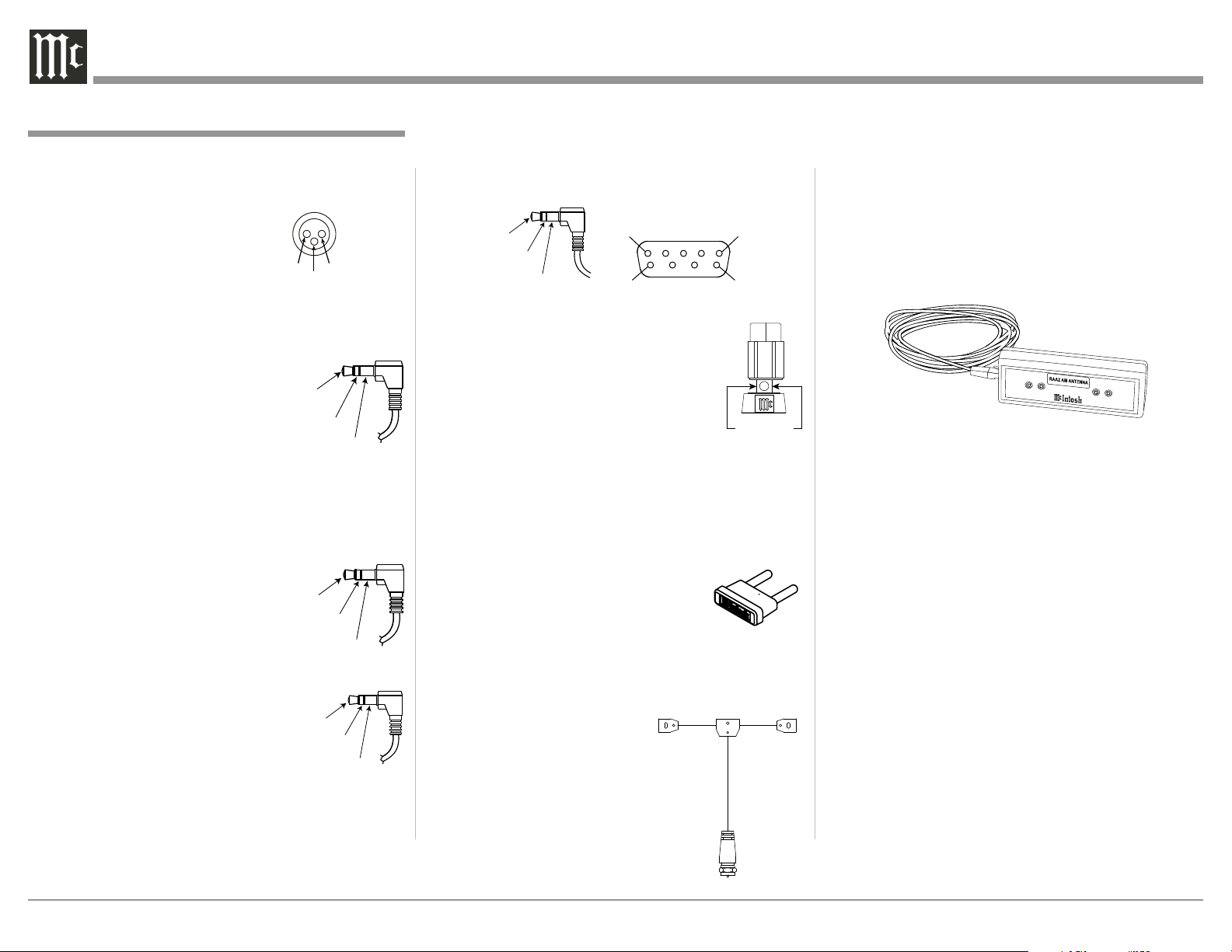
RS232-C Data Port Cable
The RS232 Data Cable is a 3.5mm stereo mini phone
plug to a subminiature DB 9 connector:
Output Terminal Connector
When cables with spade lugs are used
for Loudspeaker Connection, the spade
lugs need an opening of at least 3/10 inch
(7.6m m).
McIntosh Plug-In Jumper Connector
The MAC7200 utilizes two phono style Plug-In Jump-
ers to connect the Preamplifier Output to the Power
Amplifier Input.
Note: The Jumper Connector is available from the McIn-
tosh Parts Department:
McIntosh Jumper Connector Part
No. 117781
FM Dipole Antenna
The MAC7200 FM Tuner Circuitry requires the con-
nection of an external Antenna for FM reception. A
“FM Dipole Antenna” is available from the McIntosh
Parts Department:
FM Dipole Antenna Part
No. 173033
XLR Connectors
Below is the Pin configuration for the XLR Balanced Input
Connectors on the MAC7200. Refer to the diagram for con-
nection:
PIN 1: Shield/Ground
PIN 2: + Output
PIN 3: - Output
Power Control and Trigger Connectors
The Power Control Trigger Output
Jacks send and Passthru Input Jack
receives Power On/Off Signals
(+12 volt/0 volt) when connected
to other McIntosh Components.
An additional connection is for
controlling the illumination of the
Power Output Meters on McIntosh
Power Amplifiers. A 3.5mm stereo mini phone plug is
used for connection to the Power Control, Trigger and
Passthru Outputs.
Data Port Connectors
The Data Out Ports send Remote
Control Signals to Source Compo-
nents. A 3.5mm stereo mini phone
plug is used for connection.
IR IN Port Connectors
The IR IN Port also uses a 3.5mm
stereo mini phone plug and allows
the connection of other brand IR
Receivers to the MAC7200.
Connector and Cable Information
Data
Signal
N/C
Data
Ground
Power
Control
Meter
Illumination
Control
Ground
Main, Trig 1&2
and Pass-Thru
PIN 1
PIN 2
PIN 3
IR Data
Control
Ground
N/C
General Information, Connector and Cable Information
PIN 1
PIN 6
PIN 5
PIN 9
Data In
(DB9-pin2)
Ground
(DB9-pin5)
Data Out
(DB9-pin3)
DB9
(male connector)
3/10 of an inch
(7.6millimeters)
McIntosh RAA2 AM Antenna
The AM Tuner Circuitry requires the connection
of the external McIntosh RAA2 Antenna for AM
reception. The RAA2 Antenna is supplied with the
MAC7200 Receiver. The “AM Antenna” is also avail-
able from the McIntosh Parts Department:
RAA2 AM Antenna with connecting cable
Part No. 31036400

5
Now you can take advantage of traditional McIntosh
standards of excellence in the MAC7200 Receiver.
The flexible Preamplifier section provides connec-
tions for various input sources and may also be used to
drive an external Power Amplifier(s).
The AM/FM Tuner section provides superb
reception from Radio Stations. It uses the latest in
technology for the best sound quality, along with the
convenient operation.
The Power Amplifier section of the MAC7200,
with a power output of 200 watts per channel, will
drive a pair of quality Loudspeakers to a high level of
performance.
The MAC7200 reproduction is sonically transpar-
ent and absolutely accurate. The McIntosh Sound is
“The Sound of the Music Itself.”
Introduction
Performance Features
• Power Output with Patented Autoformer
The MAC7200 consists of a 200 watts per channel
Power Amplifier with less than 0.005% distortion.
The McIntosh designed and manufactured Autoformer
allows connection of 2, 4 or 8 ohm Loudspeakers. The
Power Amplifier uses ThermalTrak
1
Output Transis-
tors for lower distortion and cool operation.
• Power Guard
The patented McIntosh Power Guard circuit prevents
amplifier clipping and protects your valuable Loud-
speakers.
• Sentry Monitor and Thermal Protection
McIntosh Sentry Monitor power output stage protec-
tion circuits ensure the MAC7200 will have a long and
1
ThermalTrak™ and ON Semiconductor are trademarks of Semi-
conductor Components Industries, LLC
trouble free operating life. Built-in Thermal Protection
Circuits guard against overheating.
• Power Meters
The Illuminated Power Output Meters are peak re-
sponding, and indicate the power output of the ampli-
fier.
• McIntosh Custom Binding Posts
McIntosh Patented gold plated Power Amplifier Out-
put Terminals deliver high current output. They accept
large diameter wire and spade lugs. Banana plugs may
also be used only in the United States and Canada.
• Electronic Switching and Balanced Connections
The Preamplifier uses Logic Circuits Controlled
Electromagnetic Switches on all inputs and operating
functions for reliable, noiseless, distortion free switch-
ing. There is a Balanced Input for connection of a
source component.
• Digital Audio Inputs
The Digital Inputs decode PCM and DSD Signals
from external sources. Coaxial and Optical Inputs
process Digital Signals up to 192kHz with 24-Bit
resolution. The Digital MCT Input Circuitry directly
decodes SACD/CD signals from an external Trans-
port component. The USB Input for streaming audio
processes Digital Signals up to 384kHz with 32-Bit
resolution, decodes up to DSD256 Digital Signals and
DXD 24-Bit with a sampling rate up to 384kHz.
• Moving Coil and Moving Magnet Phono Inputs
The MAC7200 has two precision Phono Preamplifier
Circuits for Moving Coil and Moving Magnet Phono
Cartridges. Both circuits use the latest designs to
provide the lowest possible noise, distortion and flat
Introduction and Performance Features
2
The display of text information is dependent on the Broadcast
Station transmitted signal, the text information language and
the Broadcast Station country of origin. The Tuner Module sup-
ports English Language Alphabet Characters.
frequency response. The MC Phono Cartridge Input
has selectable loading.
• Tone Controls
The Bass and Treble Trim Controls provide up to
12dB of boost or cut. The MAC7200 remembers the
Bass and Treble Setting for each input.
• Multifunction Display
The Front Panel Display indicates source selection,
volume levels and setup functions. For Tuner op-
eration it also indicates Station Frequency, Signal
Strength, Stored Station Presets and Tuner Setup
Functions.
• Special FM RF Circuitry
The Tuner Module RF Circuitry receives strong local
FM Station Signals without distortion and receives
even the weakest of FM Signals with low noise.
• High Dynamic Range IF FM Circuitry
The all important IF circuitry in the Tuner Module
provides dynamic bandwidth control optimizing
performance at all times with varying reception condi-
tions.
• Information Service
The Front Panel Display can display various text
information from the Broadcast Station
2
. This text
information may include the Station Call Sign, Music
Genre, Artist Name and Song Title.

6
Performance Features, con’t
• Preset Stations and Permanent Memory
Twenty AM and Twenty FM station presets make it
easy to listen to your favorite stations. Station Pre-
sets and Function Modes are retained in Permanent
Memory even when AC power is switched Off.
• RAA2 External AM Antenna
The RAA2 External AM Antenna provides the perfect
match to the Tuner Module AM Circuitry. The 20 foot
(6 meter) connection cable allows placement of the
AM Antenna away from electronic equipment which
can produce RF Interference to weak AM signals.
• Power Control Output and Trigger Assignment
A Power Control connection for convenient Turn-On
of McIntosh Power Amplifiers, Source Components
and Accessories is included. The Power Control Trig-
ger Ouputs may be assigned to activate when a given
Input/Output is selected.
• PassThru Mode
The Automatic PassThru Mode allows the MAC7200
to become part of a Multichannel Sound System for
DVD-Audio, SACD and Home Theater Movies.
• Remote Control
The Data Ports together with the supplied Remote
Control provide control of McIntosh Source Compo-
nents connected to the MAC7200.
• Special Power Supply
The large Power Transformer, multiple filter capaci-
tors with 120 Joules of Energy Storage and regulated
Power Supply, ensures stable noise free operation even
though the power line varies.
• Glass Front Panel
The famous McIntosh Illuminated Glass Front Panel
using long life Light Emitting Diodes (LEDs) ensures
the pristine beauty of the MAC7200 will be retained
for many years.
7
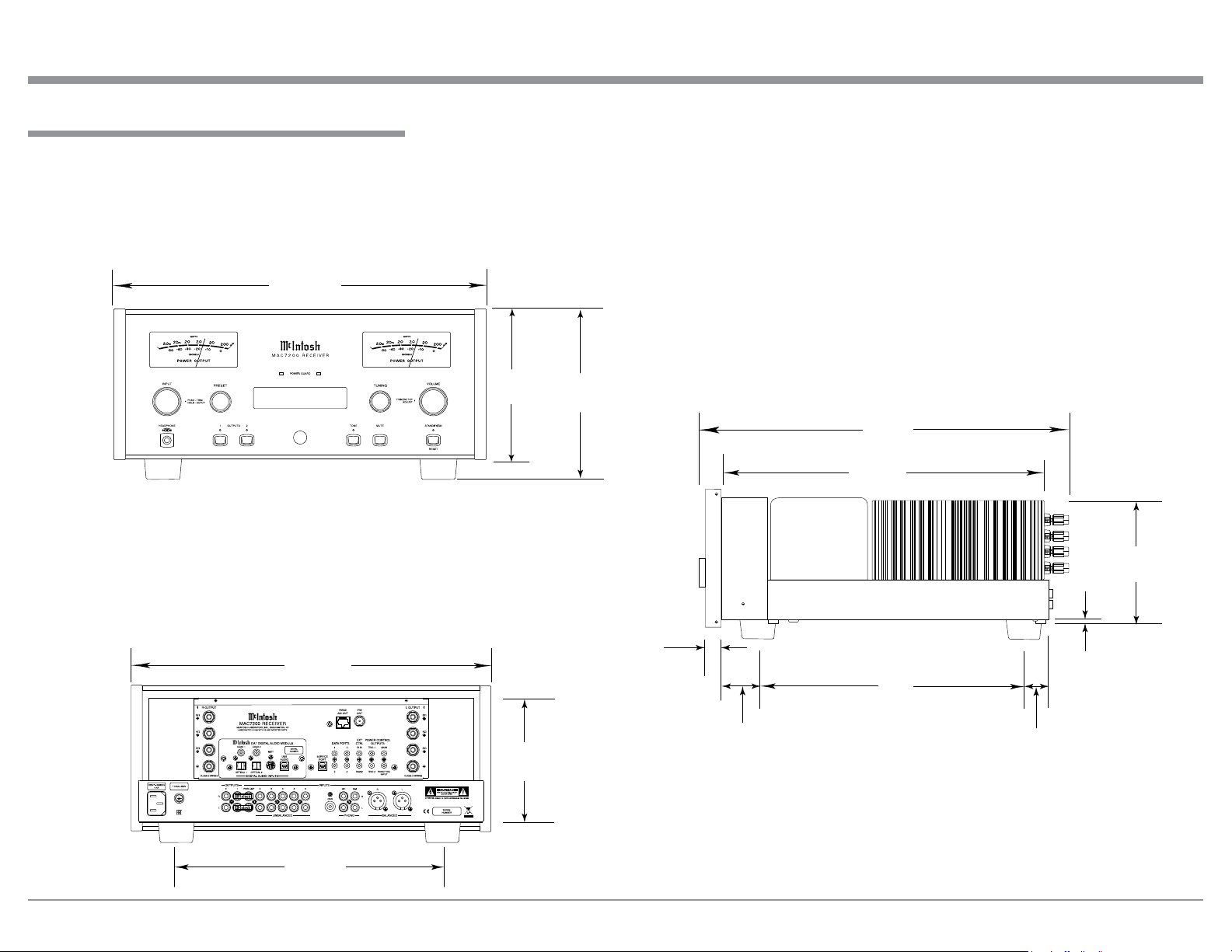
Dimensions
Dimensions
The following dimensions can assist in determining
the best location for your MAC7200. There is ad-
ditional information on the next page pertaining to
installing the MAC7200 into cabinets.
Front View of the MAC7200
Rear View of the MAC7200
Side View of the MAC7200
17-1/2"
44.5cm
7 -5/8"
19.4cm
3/16"
0.5cm
16-1/16"
40.8cm
7 -1/8"
18.1cm
29/32"
1.8cm
6"
15.2cm
12-3/16"
31cm
18-3/4"
47.6cm
16-1/2"
41.9cm
6-1/4"
15.9cm
1"
2.5cm
13"
33cm
1-5/8"
4.1cm
USB 35%
DSD256
8
Installation
Installation
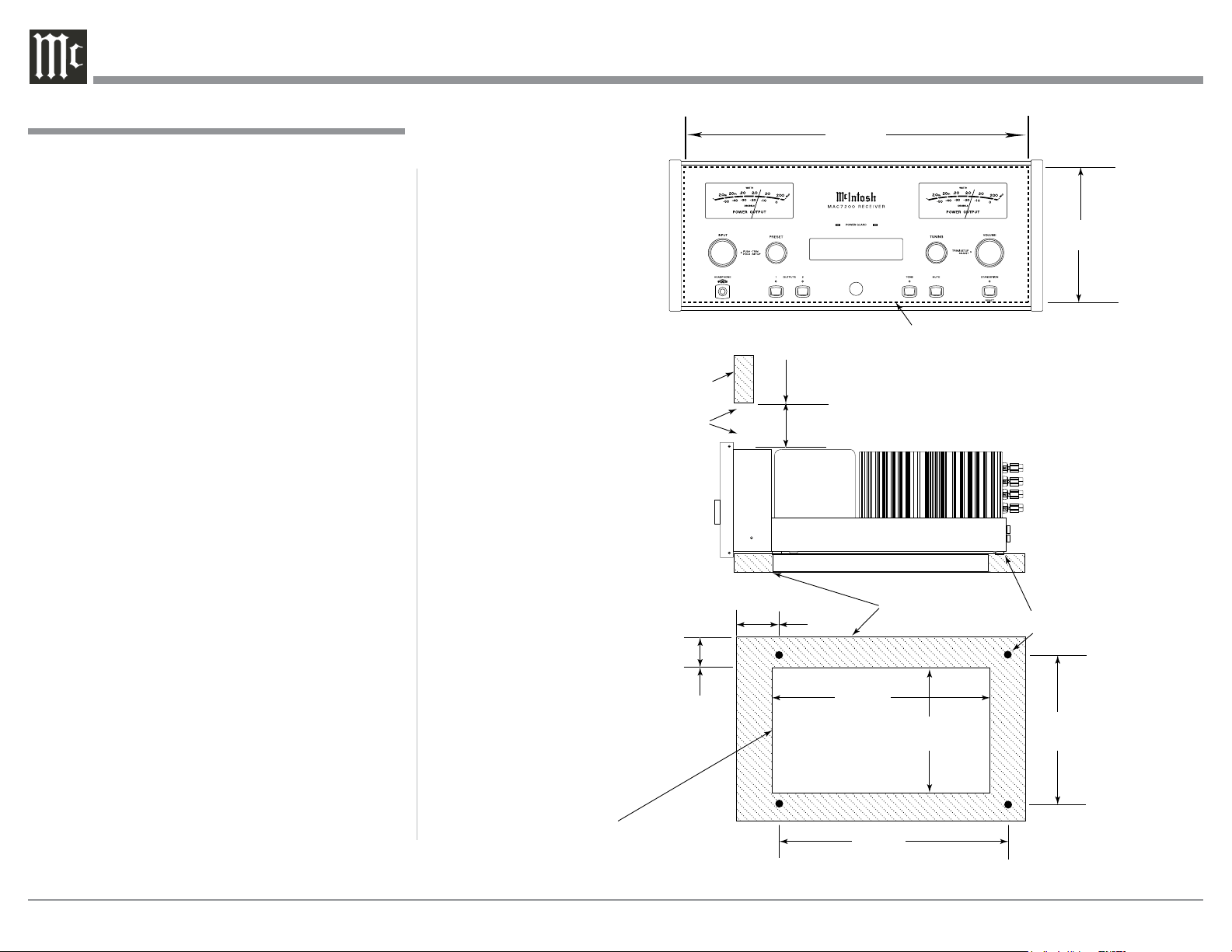
The MAC7200 can be placed upright on a table or
shelf, standing on its four feet. It also can be custom
installed in a piece of furniture or cabinet of your
choice. The four feet may be removed from the bot-
tom of the MAC7200 when it is custom installed as
outlined below. The four feet together with the mount-
ing screws should be retained for possible future use if
the MAC7200 is removed from the custom installation
and used free standing. The required panel cutout,
ventilation cutout and unit dimensions are shown.
Always provide adequate ventilation for your
MAC7200. Cool operation ensures the longest pos-
sible operating life for any electronic instrument. Do
not install the MAC7200 directly above a heat gener-
ating component such as a high powered amplifier. If
all the components are installed in a single cabinet, a
quiet running ventilation fan can be a definite asset in
maintaining all the system components at the coolest
possible operating temperature.
A custom cabinet installation should provide the
following minimum spacing dimensions for cool
operation.
Allow at least 6 inches (15.24cm) above the top, 2
inches (5.08cm) below the bottom and 2 inches (5.1cm)
on each side of the Integrated Amplifier, so that air-
flow is not obstructed. Allow 20 inches (50.8cm) depth
behind the front panel. Allow 1-7/6 inch (3.66cm) in
front of the mounting panel for knob clearance. Be
sure to cut out a ventilation hole in the mounting shelf
according to the dimensions in the drawing.
USB 35%
DSD256
6 -5/8"
16.83cm
17-1/16"
43.34cm
Cutout Opening for Custom Mounting
MAC7200 Front Panel
Custom Cabinet Cutout
Cutout
Opening
for
Ventilation
Cutout Opening for Ventilation
Support
Shelf
Cabinet
Front
Panel
Chassis
Spacers
MAC7200 Side View
in Custom Cabinet
MAC7200 Bottom View
in Custom Cabinet
14-1/2"
36.8cm
1"
2.5cm
6"
15.2cm
Opening
for Ventilation
13"
33cm
15-1/16"
38.3cm
2"
5.1cm
Note: Center the cutout Horizontally
on the unit. For purposes of
clarity, the above illustration
is not drawn to scale.
13-5/16"
33.8cm
9
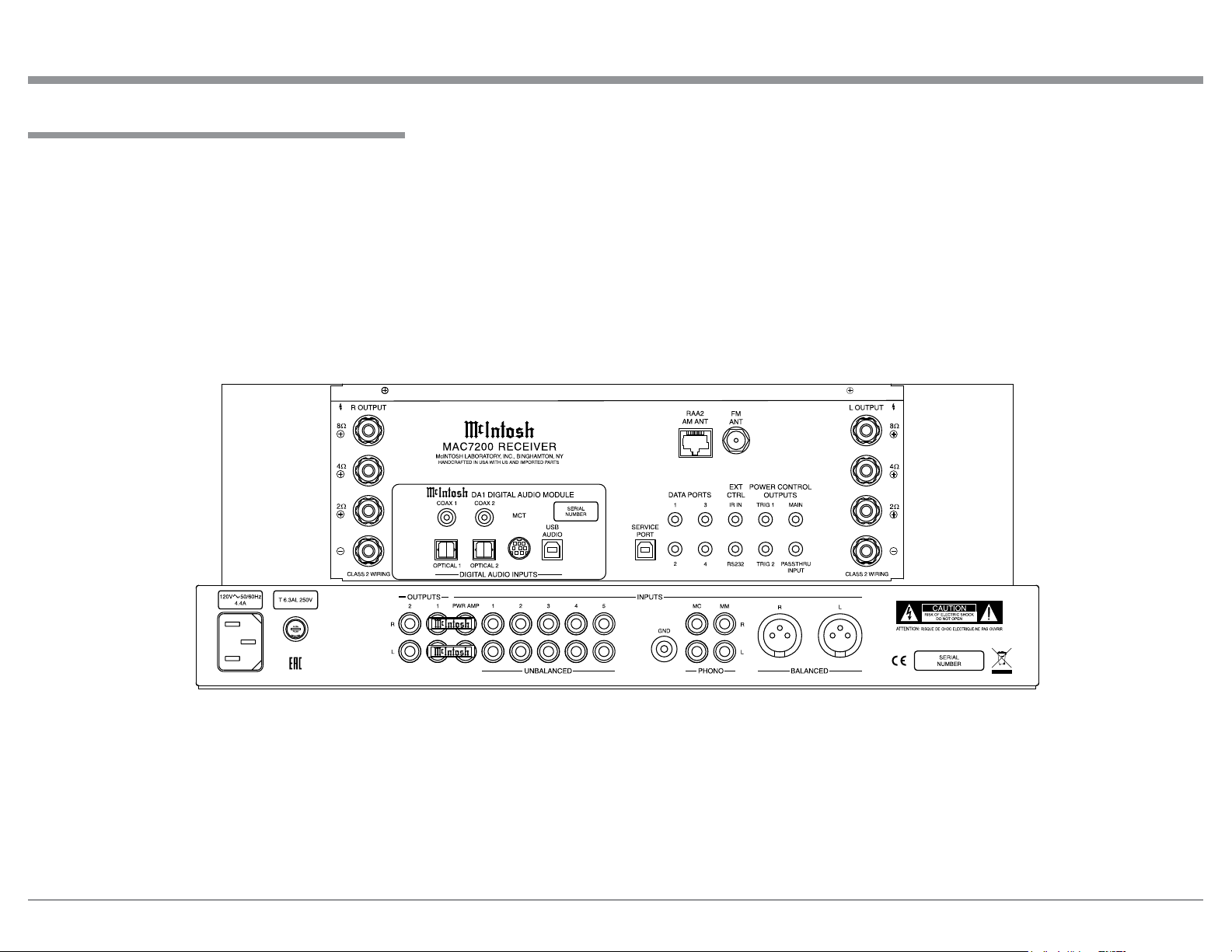
MAC7200 Rear Panel Connections
The identification of Rear Panel Connections for the
MAC7200 Receiver is located on a separate folded
sheet contained in the Owner’s Manual Packet.
Refer to separate sheet “Mc1A” for the Rear Panel
Connections.
Rear Panel Connections
MAC7200 Receiver

10
Connecting Components
The MAC7200 has the ability to automatically switch
power On/Off to McIntosh Source Components via
the Power Control (Trigger) connections. The Data
Port Connections allow for the remote operation of
basic functions using the MAC7200 Remote Control.
With an external sensor connected to the MAC7200,
remote control operation of the system is possible
from another room and/or when the MAC7200 is
located in a cabinet with the doors closed.
The connection instructions below, together with
the MAC7200 Input and Output Connection Diagrams
located on the separate folded sheet “Mc2A/2B”, are
an example of a typical audio system. Your system
may vary from this, however the actual components
would be connected in a similar manner. For addition-
al information refer to “Connector and Cable Informa-
tion” on page 4.
Power Control Connections:
1. Connect a Control Cable from the MAC7200
POWER CONTROL MAIN Jack to the Power
Control In on the Turntable.
2. Connect a Control Cable from the McIntosh Turn-
table Power Control Out Jack to the Digital Audio
Player Trigger In Jack.
3. Connect a Control Cable from the Digital Audio
Player Trigger Out Jack to the SACD/CD Trans-
port Power Control In Jack.
4. Connect a Control Cable from the SACD/CD
Transport Power Control Out Jack to the Media
Server PWR CTRL (Power Control) In Jack.
5. Optionally connect a Control Cable from the
MAC7200 POWER CONTROL TRIG (Trigger)
2 Jack to the Power Amplifier (Secondary Room)
Power Control In Jack.
6. Connect any additional McIntosh Components in
a similar manner, as outlined in steps 1 thru 5.
Data Control Connections:
7. Connect a Control Cable from the MAC7200
DATA PORT Jack 2 to the SACD/CD Player Data
In Jack.
8. Connect a Control Cable from the MAC7200 Jack
1 to the Media Server Data In Jack.
9. Connect any additional McIntosh Components in a
similar manner, as outlined in steps 7 thru 8.
Sensor Connection:
10. Optionally, connect the cable with stereo mini
plug coming from the compatible External Sensor
to the EXT CTRL (External Control) IR IN Jack
on the MAC7200. Refer to page 3 “General Infor-
mation, note 8” for additional information.
Audio Connections:
11. Connect Balanced Cables from the MAC7200
BALANCED INPUT L & R Connectors to the
Media Server Audio Output Balanced Connectors.
12. Connect Audio Cables from the MAC7200 Num-
ber 1 UNBALANCED Jacks to the AM/FM Tuner
UNBAL Output Jacks.
13. Connect the Audio Cables coming from the Turn-
table to the MAC7200 MC (for a Moving Coil Car-
tridge) or MM (for a Moving Magnet Cartridge)
INPUT Jacks.
14. Optionally, connect Audio Cables from the
MAC7200 OUTPUT 2 Jacks to the Power Ampli-
fier (Secondary) Input Jacks.
15. Connect any additional Components in a similar
manner, as outlined in steps 11 thru 14.
Optional Digital Audio Connections:
16. Connect an Optical Cable from the MAC7200
OPTICAL 1 Digital Audio Input Connector to the
Digital Audio Out Optical Connector on the Digi-
tal Audio Player.
17. Using the “MCT Cable-Twisted Pair” cable (sup-
plied with a MCT Transport), connect the cable
from the MAC7200 MCT DIGITAL AUDIO IN-
PUT Connector to the SACD/CD Transport MCT
(DIN) Output Connector.
18. Connect any additional Components in a similar
manner, as outlined in steps 17 thru 18.
Optional USB Connection:
19. Connect a USB cable with (Type A to Type B)
connectors from the MAC7200 USB D/A Digital
Audio Input to an available USB connector.
Antenna Connection:
20. Connect a FM Antenna (or Cable System) to the
FM ANT 75 Ohm Connector.
21. Connect the supplied McIntosh RAA2 AM An-
tenna and connection cable cable to the RAA2
AM ANT Connector.
Ground Connections:
22. Connect the Ground Cable coming from the Turn-
table to the MAC7200 GND Binding Post.
Notes: 1. If the MAC7200 is part of a Home Theater
System, proceed to “PassThru” connection on
page 11.
2. When the MAC7200 will used together with a
separate Power Amplifier for Bi-Amplification
of a Loudspeaker System, proceed page 12.
Connecting Components
11
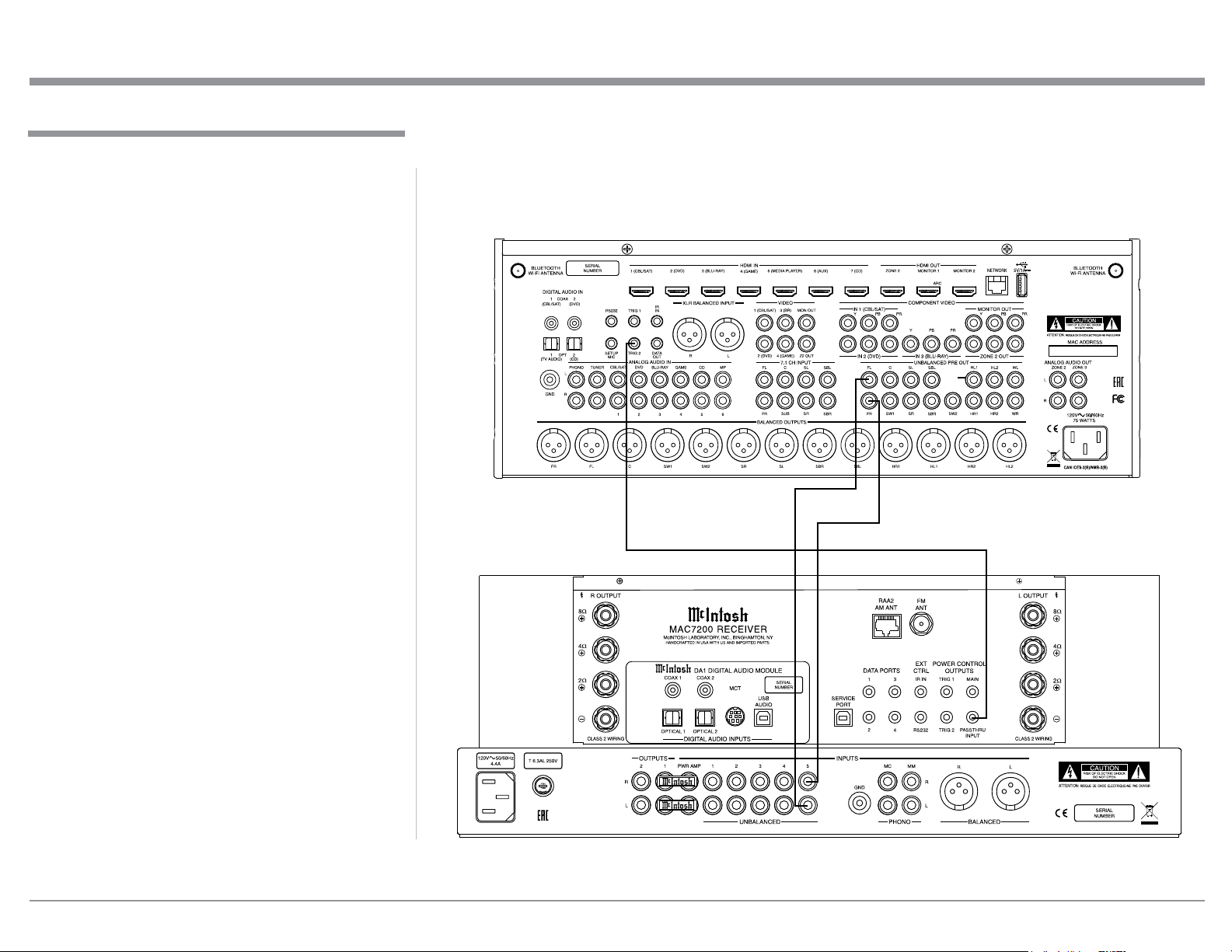
The MAC7200 can be part of a Multichannel Sound
System for BLU-RAY-Audio, DVD-Audio and Home
Theater Movies. The Right and Left Front Channels
from an Audio/Video Control Center can “Passthru”
the MAC7200. In the following example the UNBAL-
ANCED 5 Input will become the “Passthru” input:
1. Connect Audio Cables from the A/V Processor
FL (Front Left) and FR (Front Right) Channel
Outputs to the MAC7200 UNBALANCED Num-
ber 5 INPUTS Left and Right Jacks.
2. Connect a Control Cable from the A/V Proces-
sor TRIGger 2 Output to the MAC7200 POWER
CONTROL PASSTHRU INPUT Jack.
Note: Refer to Setup “Passthru” on page 23 to assign
the Number 5 INPUT as the “Passthru” Input.
3. Proceed to “Connecting Loudspeaker” on
Page 11.
Passthru Connections
Passthru Connections
A/V Processor
12
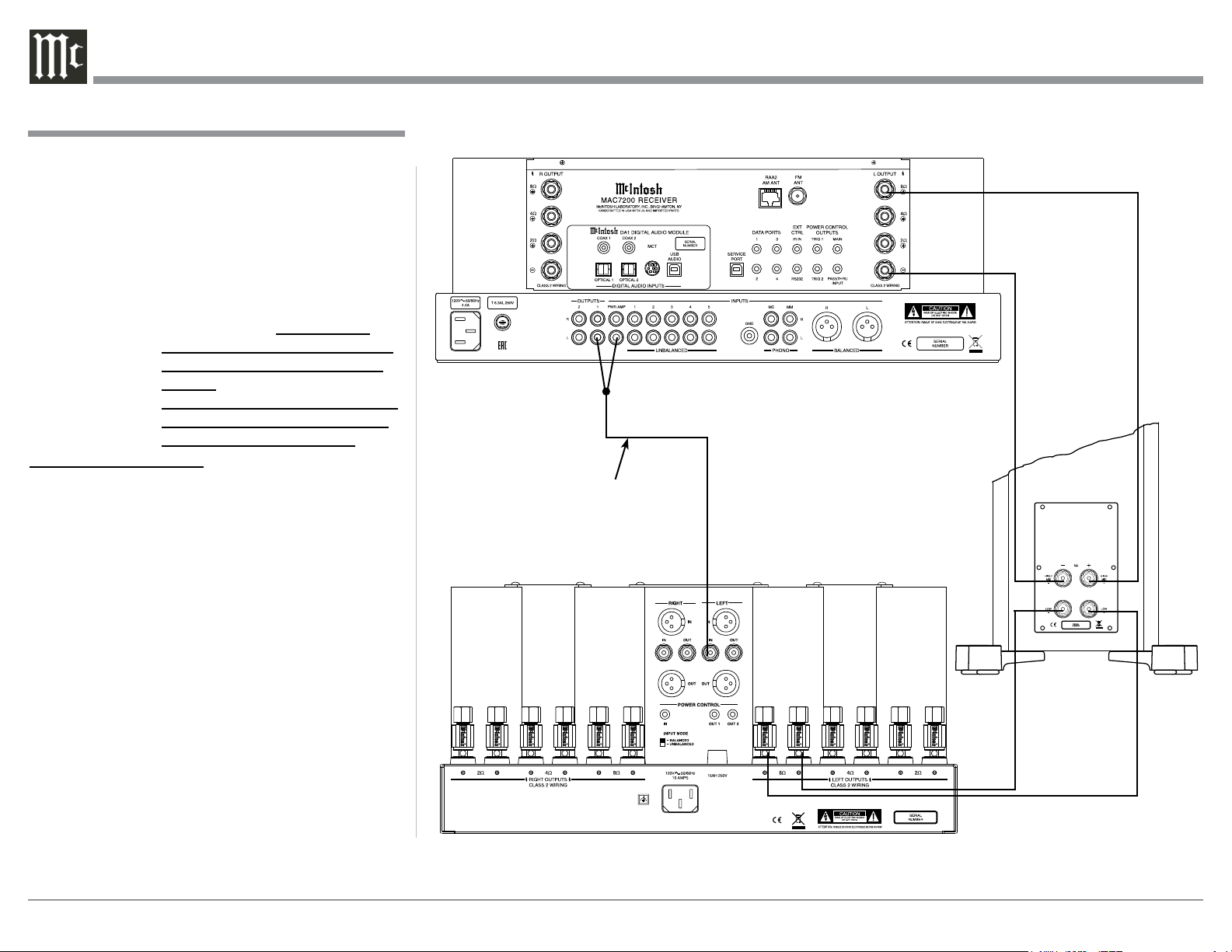
The MAC7200 Power Amplifier, together with an
additional separate Power Amplifier, may be used to
Bi-Amplify a Loudspeaker System. In the illustration
on this page, the Power Amplifier of the MAC7200 is
connected to the Midrange/High Frequency Section
of the Loudspeaker. The additional separate Power
Amplifier is connected to the Low Frequency Section
of the Loudspeaker System.
Warning: The Loudspeaker System used for
Bi-Amplification must have the
jumpers removed from between the
MID/HIGH and LOW Frequency
Sections of the Loudspeaker System.
Failure to remove them could result
in damage to the MAC7200 and/or
the separate Power Amplifier.
MAC7200 Connections:
1. Remove the “McIntosh Jumpers” from between
the OUTPUT 1 Jacks and the PWR AMP In Jacks
located on the Rear Panel of the MAC7200.
Note: Place the “McIntosh Jumper” in a safe place
for possible future use.
2. Using a pair of shielded RCA Type Audio “Y”
Adapters connect the OUTPUT 1 Jacks to the
PWR AMP In Jacks, for both Left and Right
Channels.
3. Connect the remaining unconnected part of the
“Y” Adapters to the separate Power Amplifier.
4. Referring to the Loudspeaker Connection Instruc-
tions on page 13, and in the Owner’s Manual sup-
plied with the Power Amplifier and Loudspeaker,
connect the MAC7200 Output Terminals to the
Loudspeaker MID/HIGH Input Terminals.
Note: The Loudspeaker Connection illustrations
on this page are for the Left Channel. Con-
nect the Right Channel Loudspeaker in the
same manner.
Connecting for Bi-Amplification
Connecting for Bi-Amplification
+
-
Left Channel
Loudspeaker
“Y” adapter Cable
Power Amplier
13
Caution: Do not connect the AC Power Cord to the
MAC7200 Rear Panel until after the Loud-
speaker Connections are made. Failure to
observe this could result in Electric Shock.
The connection instructions below, together with
the MAC7200 Connection Diagram located on the
separate folded sheet “Mc2B”, is an example of a typi-
cal audio system. Your system may vary from this,
however the actual components would be connected in
a similar manner. For additional information refer to
“Connector and Cable Information” on page 4.
The McIntosh MAC7200 Power Amplifier Circuit-
ry is designed for Loudspeakers with an impedance of
2 ohms, 4 ohms or 8 ohms. Connect a single Loud-
speaker only to the Right and Left Output Terminals.
When connecting Loudspeakers to the MAC7200
it is very important to use cables of adequate size, so
there is little to no power loss in the cables. The size is
specified in Gauge Numbers or AWG (American Wire
Gauge). The smaller the Gauge number, the larger the
wire size:
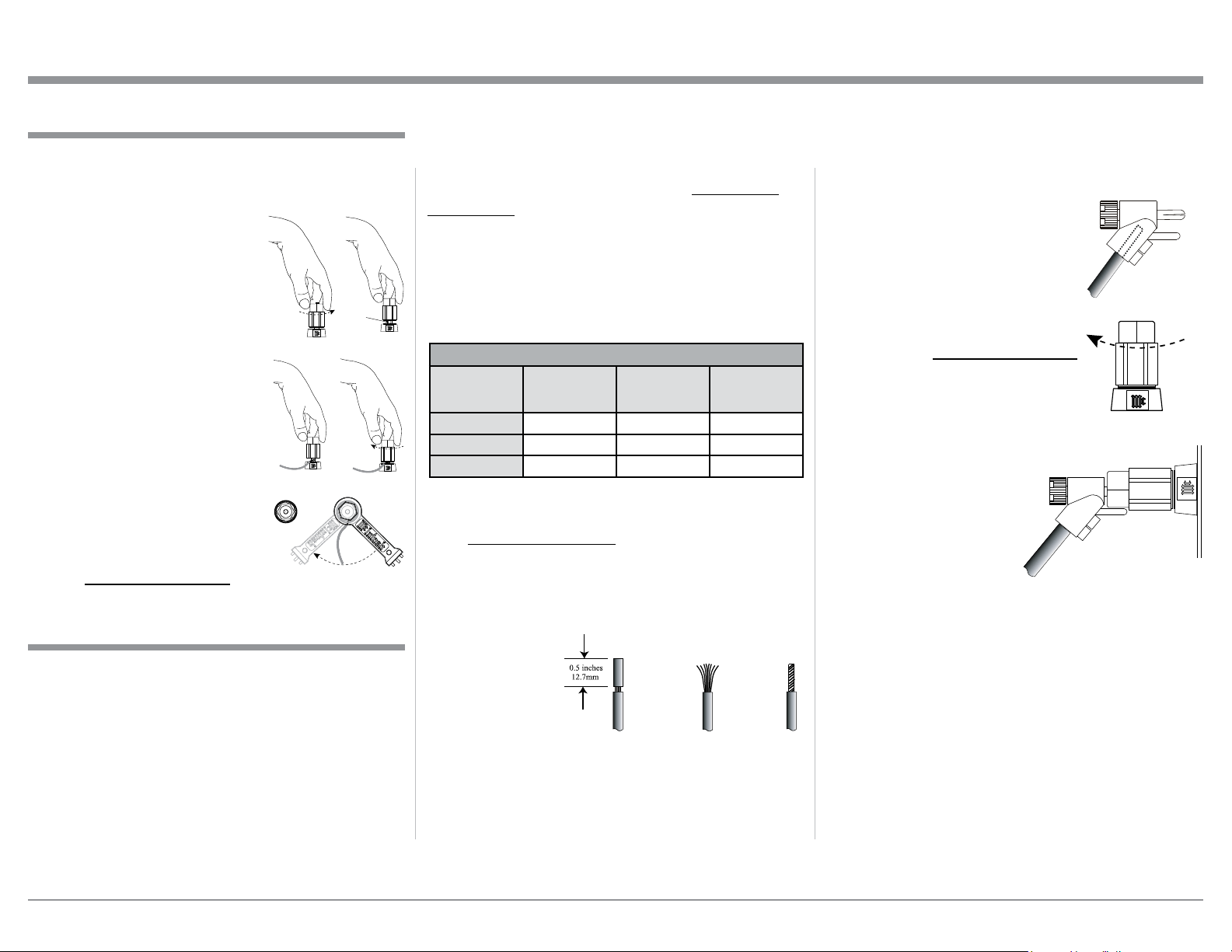
Loudspeaker Cable Distance vs Wire Gauge Guide
Loudspeaker
Impedance
25 feet
(7.62 meters)
or less
50 feet
(15.24 meters)
or less
100 feet
(30.48 meters)
or less
2 Ohms
12AWG 10AWG 8AWG
4 Ohms
14AWG 12AWG 10AWG
8 Ohms
16AWG 14AWG 12AWG
1. Prepare the Loudspeaker Hookup Cable for attach-
ment to the MAC7200 Power Amplifier:
Bare wire cable ends:
Carefully remove sufficient insulation from the
cable ends, refer to figures F, G & H. If the cable
is stranded, carefully twist the strands together
as tightly as possible.
Notes: 1. If desired, the twisted ends can be tinned
with solder to keep the strands together.
2. The prepared bare wire cable ends may be
inserted into spade lug connectors.
3. Banana plugs are for use in the United
States and Canada only.
Banana Plugs are for use in the United States and
Canada only:
2. Attach the previously prepared bare wire cable ends
into the banana plugs and secure
the connections. Refer to figure I.
3. Rotate the Output Terminal Post
clockwise until it is nger tight.
Refer to gure J. Then using the
McIntosh Wrench, rotate the top of
the Output Terminal one quarter of
a turn (90°). Do not over tighten.
Refer to gure E.
4. Referring to figure K, connect the
Loudspeaker hookup cables with
banana plugs into the hole at the
top of the terminal to
the MAC7200 Negative
Output Terminal and
Positive Output Termi-
nal indentified as 2Ω
(ohms), 4Ω (ohms) or
8Ω (ohms) connection
to match the impedance of the Loudspeaker, being
careful to observe the correct polarities.
Note: The illustration located on the separate
folded sheet “Mc2B” is for connection to an
8Ω (ohms) Loudspeaker.
If the Loudspeaker’s impedance is in-between
the available connections, use the nearest lower
impedance connection. Refer to “General Informa-
tion” Note 6 on page 3 for additional information.
WARNING: Loudspeaker terminals are hazard-
ous live and present a risk of electric
shock. For additional instruction on
making Loudspeaker Connections con-
tact your McIntosh Dealer or McIn-
tosh Technical Support.
Output Terminals
When connecting the Loudspeaker Hookup Cables to
the MAC7200 Amplifier Output Terminals please fol-
low the steps below:
1. Rotate the top of the Output Terminal Post coun-
terclockwise until an opening
appears. Refer to gures A and
B.
2. Insert the Loudspeaker hookup
cable into the Output Terminal
Post opening or the cable spade
lug around the center post of
the Output Terminal. Refer to
gure C.
3. Rotate the top of the Output
Terminal Post clockwise until it
is nger tight. Refer to gure D.
4. Place the supplied McIntosh
Wrench over the top of the Out-
put Terminal and rotate it one
quarter of a turn (90°) to secure
the Loudspeaker Cable Connec-
tion. Do not over tighten. Refer
to gure E.
Figure A
Opening
Figure B
Figure C Figure D
Figure E
How to Connect Loudspeakers
Figure F
Figure G
Figure H
Figure I
Figure J
Figure K
14
5. Connect the MAC7200 power cord to an active
AC outlet.
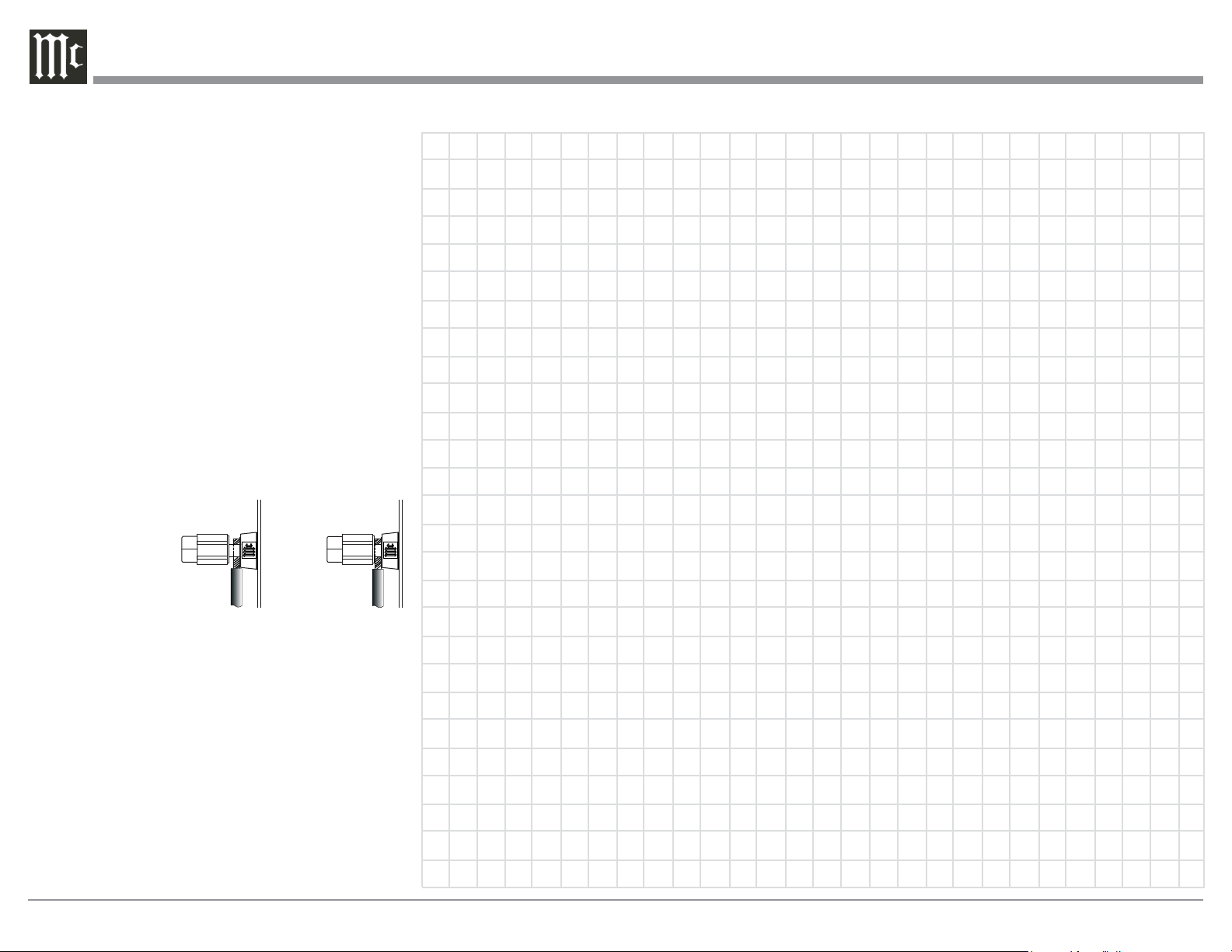
Spade Lug or Wire Connections:
6. Connect the Loudspeaker hookup cables to the
MAC7200 Negative Output Terminal and Posi-
tive Output Terminal indentified as 2Ω (ohms),
4Ω (ohms) or 8Ω (ohms) connection to match the
impedance of the Loudspeaker, being careful to
observe the correct polarities. Insert the spade
lug connector or prepared section of the cable end
into the terminal side access hole, and tighten the
terminal cap until the cable is firmly clamped into
the terminals so the lugs or wire cannot slip out.
Refer to figures L and M.
Note: The illustration located on the separate folded
sheet “Mc2B” is for connection to an 8Ω
(ohms) Loudspeaker.
If the Loudspeaker’s impedance is in-between the
available connections, use the nearest lower im-
pedance connection. Refer to “General Informa-
tion” Note 6 on page 3 for additional information.
WARNING: Loudspeaker terminals are hazard-
ous live and present a risk of electric
shock. For additional instruction on
making Loudspeaker Connections con-
tact your McIntosh Dealer or McIn-
tosh Technical Support.
7. Connect the MAC7200 power cord to an active
AC outlet.
Connecting Loudspeakers
Figure L
Figure M

15
16
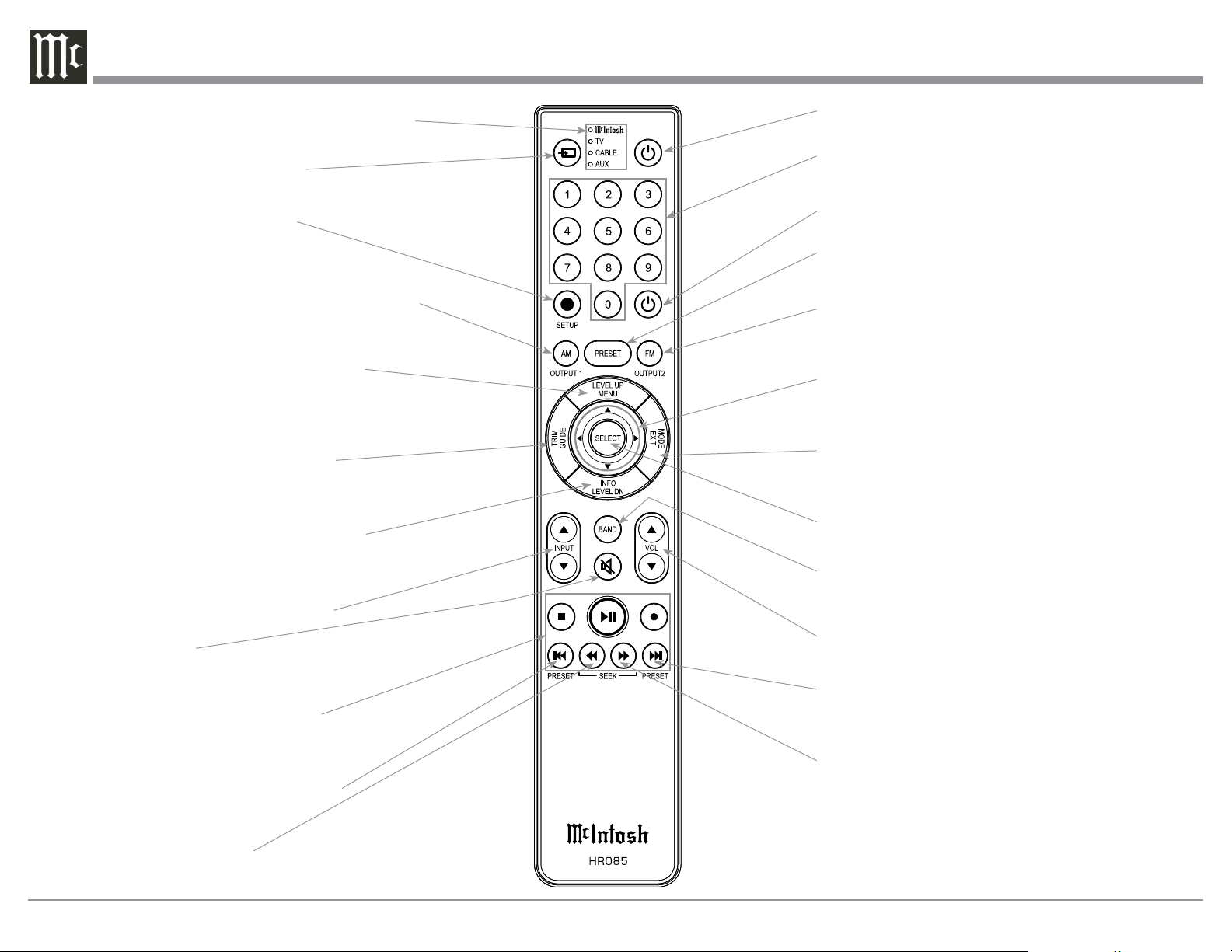
Note: Push-buttons whose function is not identified
above are for use with other McIntosh Products.
Press to Power the Integrated Amplifier ON
Use to select tuner presets, direct ac-
cess an AM/FM Station Frequency,
disc tracks or any numbered operation
Mutes the audio
Adjusts the VOLume level up or down
Selects FM Tuner Operating Functions, select Output
2 when used with the SETUP/shift Push-button and
Track Selection on certain McIntosh CD Players
LEDs illuminate during the time a remote command
is sent and when programming the remote control
Press the Trim Push-button and then the
LEVEL UP Push-button to select and adjust
various functions. MENU is used with Mc-
Intosh Models displaying choices on a video
screen
Press to Power the Integrated Amplifier OFF
Scrolls through the available INPUTS
Used to SELECT/Enter the indicated choice
Use p and q to tune Up or Down the AM/FM
Dial, use u and t for the next or previous HD
Radio Program (were applicable)
Activates the TRIM Mode. GUIDE is
used with McIntosh Models displaying
instructions on a video screen
Press to change Broadcast BANDs on a
connected Tuner. Select certain functions
on a variety of McIntosh Models
Select the DEVICE to issue a remote
control command to
Direct access to stored Tuner PRESETS when
used with the numeric Push-buttons (0 thru 9)
Press the Trim Push-button and then the
LEVEL DOWN Push-button to select and
adjust various functions. INFO is used with
McIntosh Models displaying information on
a video screen
Selects transport functions of STOP,
PLAY/PAUSE, RECORD, BACK for
the previous-selection, FAST-RE-
VERSE, FAST-FORWARD and NEXT
for the next selection
Selects Previous Tuner Station PRESET
Tuner scans Down the dial
to SEEK the next Station
Selects Next Tuner Station PRESET
Tuner scans Up the dial to
SEEK the next Station
SETUP Push-button is used as a
“Shift Key” to select a function
with blue color nomenclature
HR085 Remote Control Push-Buttons
Selects AM Tuner Operating Functions, select Output
1 when used with the SETUP/shift Push-button and
Track Selection on certain McIntosh CD Players
EXIT the TRIM Menu and is used with McIntosh
Models displaying information or choices on a video
screen

17
How to use the HR085 Remote Control
How to use the Remote Control
The supplied MAC7200 Remote Control (HR085) is
capable of directly controlling the functions of con-
temporary McIntosh Source Components connected to
the MAC7200 via the Data Ports.
Notes: 1. If at any time the MAC7200 seems unrespon-
sive to the HR085 Remote Control Commands,
press the DEVICE Push-button to select
first.
2. For additional information on using the
HR085 Remote Control with the McIntosh
Model, please refer to the “How to Operate”
starting on page 28.
3. For additional information on assigning the
Data Ports, refer to “Data Ports” on page 23.
Trim
Press the TRIM Push-button until the desired Trim
function (Balance, Trim Level, etc.) appears on the
MAC7200 Front Panel Display, then press the LEVEL
Up or Down Push-button to adjust the Trim setting.
Note: Press the TRIM Push-button to recall the last Trim
function selected. For additional information on
using the Trim Functions refer to “How to Oper-
ate” page 28.
Output Selection
Press the BLUE (Setup) Push-button followed by
the AM (Output 1) or FM (Output 2) Push-button, to
control the Rear Panel Audio OUTPUTS 1, 2 (ON or
OFF) and Power Control TRIG 1 / TRIG 2.
Note: For additional information on assigning the Out-
puts (1 and 2) and Power Control Triggers (1 and
2) refer to page 22.
Tuner Push-buttons
Press the AM or FM Push-button to select the desired
broadcast band. Press and release the Seek Up : the
band or Seek Down 9 the band Push-button to seek
the next available station. Press and hold a Directional
Up p or Down q Push-button to tune continuously
from station to station.
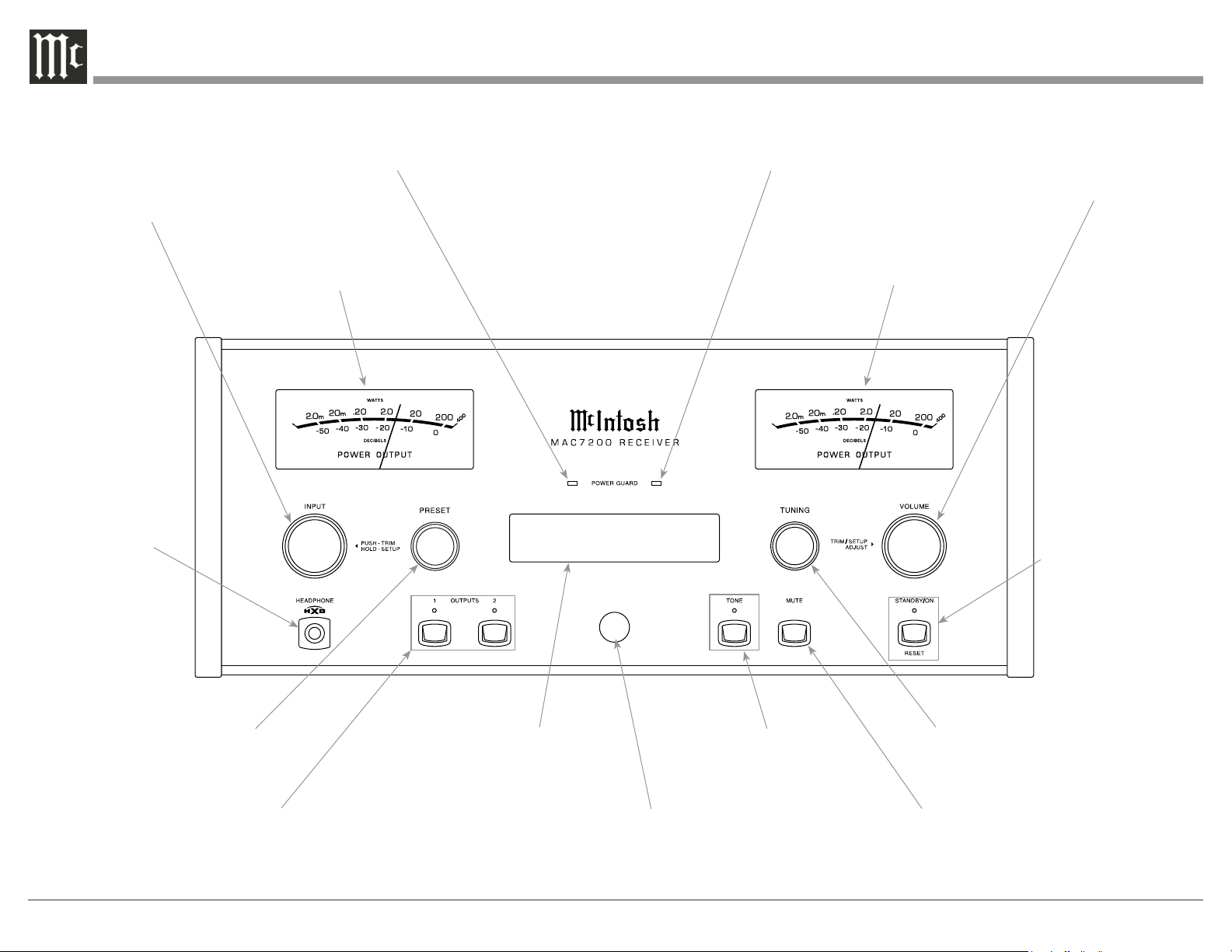
18
USB 35%
DSD256
IR Sensor receives
commands from a
Remote Control
STANDBY/ON Push-
button with indicator
switches the MAC7200
ON or OFF (Standby)
and resets the micropro-
cessors
MUTE Push-button
mutes the audio from
the Loudspeakers and
Headphones
Meter indicates the
Right Channel Output
of the amplifier
LED indicates when the Left
Channel Amplifier POWER
GUARD circuit activates
Meter indicates the
Left Channel Output
of the amplifier
LED indicates when the Right
Channel Amplifier POWER
GUARD circuit activates
OUTPUT 1 and 2 Push-buttons
with indicators, switch Pream-
plifier Output (Loudspeakers) 1
and 2 On or Off
INFORMATION DISPLAY indicates
the Sources, Volume, other Audio Set-
tings, Tuner Functions, other Operation-
al Functions and Setup Mode Settings
TONE Push-button with indicator,
when deactivated the audio signal
bypasses the Tone Settings
VOLUME Control allows ad-
justment of the listening level
for both channels. Also used
to change the various TRIM
and SETUP Functions
Connection for low
impedance dynamic
headphones, for
private listening
INPUT Control used to
select a source for listening
and recording. The control is
also used to enter the TRIM
or SETUP Modes and select
the various functions
Front Panel Displays, Controls, Push-buttons and Jack
TUNE tunes in radio stations
and is also used for various
Tuner Functions
PRESET Control selects
Presets for listening or
storing the desired radio
station

19
Your McIntosh MAC7200 has been factory config-
ured to allow immediate enjoyment of superb audio
without the need for further adjustments. If you wish
to make changes to the factory default settings, a
Setup Feature is provided to customize the operating
settings using the Front Panel Information Display.
Refer to the MAC7200 Front Panel Illustration on the
previous page while performing the following steps.
Note: If the MAC7200 is currently On, proceed to
step 2.
1. Press the STANDBY/ON Push-button on the Front
Panel or press the (Power ON) Push-button on
the Remote Control to switch On the MAC7200.
The MAC7200 will go through a brief startup
initialization with the Front Panel Information
Display first indicating “MAC7200”, followed by
the last used source and volume setting. This is
followed by the volume setting indication starting
at zero and then increasing to the last used volume
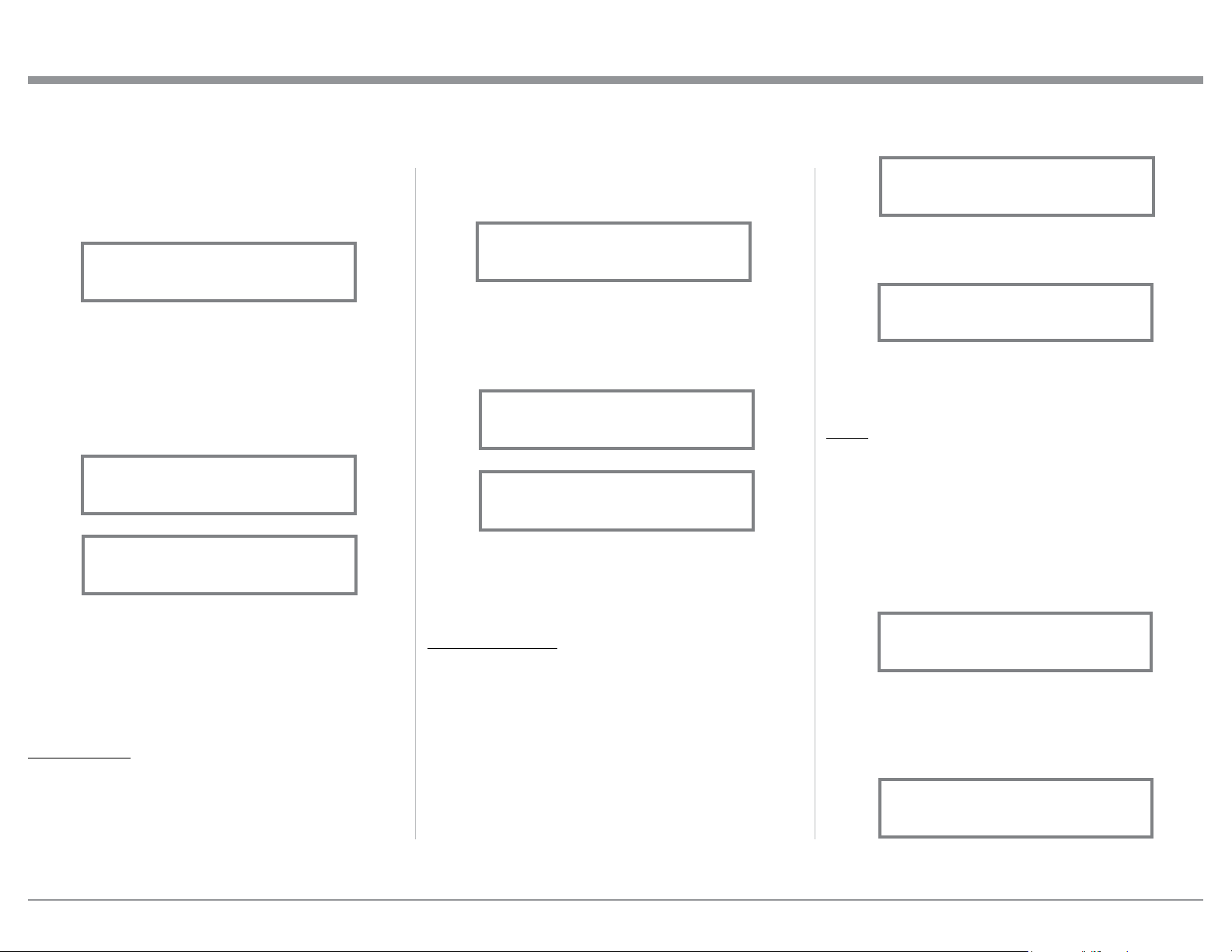
setting. Refer to figure 1.
2. Press and hold in the INPUT Control until
the Front Panel Information Display indicates
“MAC7200 V1.00, (or higher Main Firmware
version) - S/N: AFN____” (Serial Number).
Refer to figure 2.
3. Rotate the INPUT Control to select the Setup
Mode Menu item, “SETUP: Inputs, (Hold IN-
PUT)”. Refer to figure 3.
Continue to rotate the INPUT CONTROL to view
the other SETUP Mode Options.
4. To exit from the SETUP Mode, press and hold in
the INPUT Control and the Front Panel Display
will indicate its normal display. Refer to figure 1.
The MAC7200 functionality is controlled by internal
software that is know as Firmware. There are three
Firmware Identification Numbers for the MAC7200.
The first Firmware Number is for the Main Circuitry
of the MAC7200 and can be identified at any time by
utilizing the Setup Mode.
1. Press and hold in the INPUT Control to enter
Setup Mode.
2. Referring to the Front Panel Information Display-
the number after the character “V” is the Firm-
ware number. Refer to figure 2.
To view the second Firmware Number (the Digital
Audio Circuitry of the MAC7200) or the third Firm-
ware Number (the Tuner Circuitry of the MAC7200),
perform the following steps:
3. Press and hold in the INPUT Control to enter
Setup Mode.
4. Rotate the INPUT Control until the Front Panel
Information Display indicates “DA1 Firmware,
V1.00” (or higher Digital Audio Firmware ver-
sion). Refer to figure 4.
4. Rotate the INPUT Control until the Front Panel
Information Display indicates “TUNER FIRM-
WARE Firmware, V1.00” (or higher Digital
Audio Firmware version). Refer to figure 5.
5. To exit the Setup Mode, press the INPUT Control.
How to Operate the Setup Mode
The Default Settings Chart below indicates the Func-
tion Name, Default Setting and the Page Number for
additional information.
Default Settings
Firmware Version
Default Settings
Function Name Setting Page No.
MAC7200 V_._ _ 19
DA1 V_._ _ 19
TUNER FIRMWARE TM________ 19
INPUTS On / Rename 20
OUTPUTS (1 & 2) Switched 20
TRIGGER 1 Output 1 20
TRIGGER 2 Output 2 20
DATA PORTS
(1 thru 4)
All Data 20
PASSTHRU OFF 21
USB Automute ON 21
RS232 (Rate) 115200 Baud 21
Remote Control Codes Normal 21
IR Sensor Enabled 22
Power Mode Enabled 22
Tune r Presets --- 25
Tune r Reg ion USA 26
Setup
Figure 2
MAC7200 V1.00
S/N: AFN____
Figure 1
BAL
15%
Figure 3
SETUP: Inputs
(Hold INPUT)
Figure 4
DA1 FIRMWARE
V1.00
Figure 5
TUNER FIRMWARE
TM30104101

20
(Hold INPUT)” appears on the Information Dis-
play. Refer to figure 8.
13. Press and hold in the INPUT Control until “SET-
UP: BAL, On / Rename” appears on the Display.
If necessary rotate the INPUT Control to select the
BAL Input. Refer to figure 9.
14. Press and hold in the INPUT Control until “RE-
NAME: BAL, >BAL < ” appears on the Dis-
play. The character “B” is flashing to indicate it is
ready to be changed. Refer to figure 10.
15. Rotate the VOLUME (ADJUST) Control to change
the character “B” to “M”. Refer to figure 11.
16. Rotate the INPUT Control until the character “A”
is flashing, then rotate the VOLUME (ADJUST)
Control to change the character “A” to “E”. Refer
to figure 12.
The MAC7200 provides the ability to switch unused
INPUTS Off (or back On if they have been previously
switched Off). The default INPUT Names can be
changed to match the name of the component con-
nected to it or any other custom name desired (within
10 Characters).
INPUT SWITCHED ON/OFF:
In the following example, the UNBAL 4 Input will be
switched Off.
Note: When an INPUT is swiched Off, its name will
no longer appear on the Front Panel Informa-
tion Display when using the INPUT Control
(Front Panel or Remote Control).
1. Press and hold in the INPUT Control to enter the
SETUP MODE. Refer to figure 2 on page 19.
2. Rotate the INPUT Control until “SETUP: Inputs,
(Hold INPUT)” appears on the Information Dis-
play. Refer to figure 3 on page 19.
3. Press and hold in the INPUT Control until
“SETUP: UNBAL 4, On / Name (Hold INPUT)”
appears on the Display. If necessary rotate the IN-
PUT Control to select the UNBAL 4 Input. Refer
to figure 6.
4. To switch the UNBAL 4 Input Off, rotate the
VOLUME Control until the display indicates
“SETUP: UNBAL 4, Off”. Refer to figure 7.
5. Exit the SETUP Mode by several presses of the
INPUT Control.
In the following example, the UNBAL 4 Input will be
switched On.
Notes: 1. When a desired INPUT is selected, its name
will appear on the Front Panel Information
Display when using the INPUT Control (Front
Panel or Remote Control).
6. Press and hold in the INPUT Control to enter the
SETUP MODE. Refer to figure 2, on page 19.
7. Rotate the INPUT Control until “SETUP: Inputs,
(Hold INPUT)” appears on the Information Dis-
play. Refer to figure 3, on page 19.
8. Press and hold in the INPUT Control until “SET-
UP: UNBAL 4, Off” appears on the Display. If
necessary rotate the INPUT Control to select the
UNBAL 4 Input. Refer to figure 7.
9. To switch the UNBAL 4 Input On, rotate the VOL-
UME Control until the display indicates “SETUP:
UNBAL 4, On / Name”.
10. Exit the SETUP Mode by several presses of the
INPUT Control.
R ENA M E I N PUT:
In the following example, the BAL (BALANCED) In-
put will be renamed to match up with the component
connected (refer to page 10, step 11).
The MAC7200 Default Input Names (UNBAL 1,
BAL, COAX 1, etc.) as indicated on the Front Panel
Display can be customized to a different name up to
ten characters long (TUNER, CD PLAYER, etc.). The
available characters for renaming the input include the
following: ! < > * , / - _ 0 1 2 3 4 5 6 7 8 9 A B C D E
F G H I J K L M N O P Q R S T U V W X Y Z .
In the following example, the BAL Input will be
renamed to “MEDIA SVR”.
11. Press and hold in the INPUT Control to enter the
SETUP MODE. Refer to figure 2, on page 19.
12. Rotate the INPUT Control until “SETUP: Inputs,
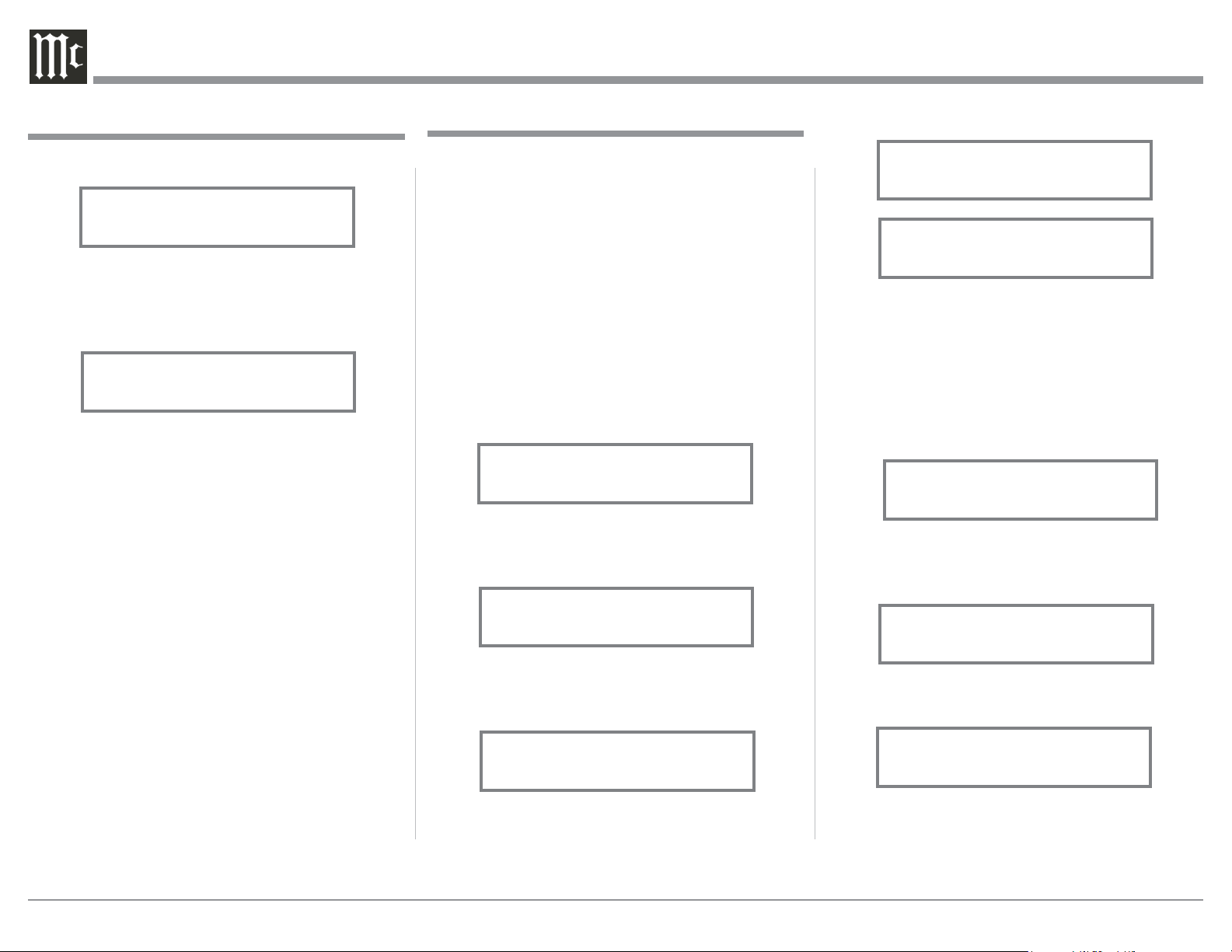
Figure 7
SETUP: UNBAL 4
Off
Figure 9
SETUP: BAL
On / Rename
Fig u re 11
RENAME: BAL
>MAL <
Figure 12
RENAME: OPTI
>MEL <
Figure 8
SETUP: Inputs
(Hold INPUT)
Figure 10
RENAME: BAL
>BAL <
Figure 6
SETUP: UNBAL 4
On/Name (Hold INPUT)
Input Settings

21
17. Rotate the INPUT Control until the character “L”
is flashing, then rotate the VOLUME (ADJUST)
Control to change the character “L” to “D”. Refer
to figure 13.
18. Rotate the INPUT Control until the “_” empty
space to the right of character D is flashing, then
rotate the VOLUME (ADJUST) Control to change
the “_” empty space to character to “I”. Refer to
figure 14.
19. Rotate the INPUT Control until the “_” empty
space to the right of character I is flashing, then
rotate the VOLUME (ADJUST) Control to change
the “_” empty space to character to “A”. Refer to
figure 15.
20. Repeat step 19 until the new name of “ RENAME:
BAL, MEDIA SVR” is indicated on the Front
Panel Display. Refer to figures 16 thru 18.
Figure 13
RENAME: BAL
>MED <
Figure 14
RENAME: BAL
>MEDI <
The Output Settings provide the ability to change how
the MAC7200 Output 1, Output 2 and Headphones
function.
OUTPUT 1 and 2:
By default OUTPUT 1 and 2 are set to go On/Off by
using the Front Panel OUTPUT 1 and 2 Push-buttons
or by using the OUTPUT 1 and 2 Push-buttons on the
Remote Control. If it is desirable to have OUTPUT 1
and/or 2 always On regardless of the OUTPUT 1 and
2 Push-button settings, perform the following:
1. Press and hold in the INPUT Control to enter the
SETUP MODE. Refer to figure 2 on page 19.
2. Rotate the INPUT Control until “SETUP: Out-
puts, (Hold INPUT)” appears on the Information
Display. Refer to figure 20.
3. Press and hold in the INPUT Control until
21. To save the new name, press and hold in the IN-
PUT Control until “SETUP: MEDIA SVR , ON /
Rename” appears on the Front Panel Information
Display. Refer to figure 19.
22. Exit the SETUP Mode by several presses of the
INPUT Control.
Note: For convenience, an “Input Assignment Chart”
on a separate sheet “Mc5A/5B” has been pro-
vided to keep track of changes.
Setup, con’t
Figure 15
RENAME: BAL
>MEDIA <
Figure 19
SETUP: MEDIA SVR
On / Rename
Output Settings
Figure 20
SETUP: Outputs
(Hold INPUT)
Figure 22
SETUP: OUTPUT 1
Unswitched
Figure 21
SETUP: OUTPUT 1
Switched
Figure 24
SETUP: OUTPUT 2
Unswitched
Figure 23
SETUP: OUTPUT 2
Switched
Figure 17
RENAME: BAL
>MEDIA SV <
Figure 18
RENAME: BAL
>MEDIA SVR <
Figure 16
RENAME: BAL
>MEDIA S <
“SETUP: OUTPUT 1, Switched” appears on the
Display. Refer to figure 21.
4. Rotate the VOLUME (ADJUST) Control to change
from the “Switched” setting to “Unswitched”.
Refer to figure 22.
5. In a similar manner, perform steps 3 and 4 to
change the OUTPUT 2 setting. Refer to figures 23
and 24.
The MAC7200 Default Setting for using Headphones
is to automatically mute all the Output Connectors
when the Headphone Cable Plug is inserted into the
MAC7200 Front Panel HEADPHONES Jack. There
are two available settings:
Mute All Outputs
Mute No Outputs
6. Rotate the INPUT Control until “SETUP: HEAD-
22
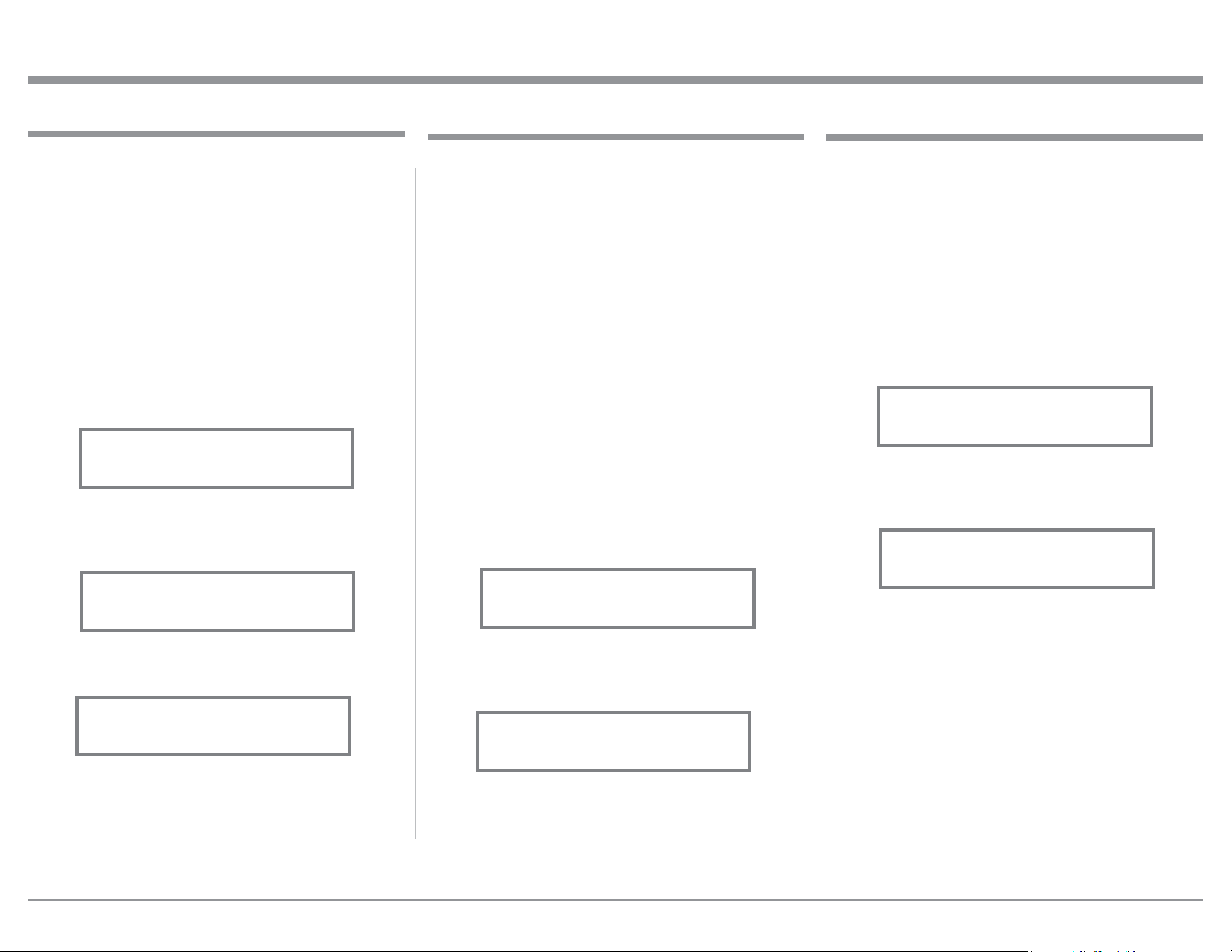
Figure 18
In the second example, Trigger 2 will activate when
the BAL Input is selected:
6. Rotate the INPUT Control to select “SETUP:
TRIGGER 2, Main” appears on the Display. Refer
to figure 30.
7. Rotate the VOLUME (ADJUST) Control until
“SETUP: TRIGGER 2, Input (Hold INPUT)” ap-
pears on the Display. Refer to figure 32.
8. Press and hold in the INPUT Control until “SET-
UP: TRIGGER 2, Bal: OFF” appears on the
Display. Refer to figure 33.
9. Rotate the VOLUME (ADJUST) Control to select
“Bal : ON”. Refer to figure 34.
10. Exit the SETUP Mode by several presses of the
INPUT Control.
Power Control Triggers 1 and 2
By default the Power Control TRIGger 1 and TRIGger
2 are assigned to activate when Output 1 or Output 2
is selected. Triggers 1 and 2 can be reassigned to func-
tion the same as the MAIN Power Control Jack or be
assigned to a given Input.
Note: The MAIN Power Control Jack is controlled by
the STANDBY/ON Front Panel Push-button and
the Remote Control Power Push-buttons.
In the first example, the Power Control Triggers 1
and 2 will be assigned to MAIN:
1. Press and hold in the INPUT Control to enter the
SETUP MODE. Refer to figure 2 on page 17.
2. Rotate the INPUT Control until “SETUP: Trig-
gers, (Hold INPUT)” appears on the Information
Display. Refer to figure 27.
3. Press and hold in the INPUT Control until
“SETUP: TRIGGER 1, Output 1” appears on the
Display. Refer to figure 28.
4. Rotate the VOLUME (ADJUST) Control to select
“MAIN” from the available additional selections
including Output 2 or Input. Refer to figure 29.
5. In a similar manner, perform steps 3 and 4 to
change the Trigger 2 setting from OUTPUT 2 to
Main. Refer to figures 30 and 31.
Figure 27
SETUP: Triggers
(Hold INPUT)
Figure 29
SETUP: TRIGGER 1
Main
Figure 28
SETUP: TRIGGER 1
Output 1
Figure 30
SETUP: TRIGGER 2
Output 2
Figure 31
SETUP: TRIGGER 2
Main
Figure 32
SETUP: TRIGGER 2
Input (Hold INPUT)
Figure 33
SETUP: TRIGGER 2
Bal : OFF
Figure 34
SETUP: TRIGGER 2
Bal : ON
PHONES, Mute All Outputs ” appears on the
Information Display. Refer to figure 25.
7. Rotate the VOLUME (ADJUST) Control to change
the current HEADPHONES setting from “Mute
All Outputs” to “Mute No Outputs”. Refer to
figure 26.
8. Exit the SETUP Mode by several presses of the
INPUT Control.
SETUP: HEADPHONES
Mute No Outputs
Figure 26
Figure 25
SETUP: HEADPHONES
Mute All Outputs
Output Settings, con’t
23
Data Ports
Data Port Connections between the MAC7200 and a
McIntosh Source Component allow for basic function
control of the source component using the MAC7200
supplied HR085 Remote Control. By default, all of the
four Data Ports are set to send the same Data to the
selected source. To dedicate a given Data Port for only
one source component (example, source component
connected to the BAL Input will be assigned to Data
Port 1) perform the following Steps:
1. Press and hold in the INPUT Control to enter the
SETUP MODE. Refer to figure 2 on page 17.
2. Rotate the INPUT Control until “SETUP: Data
Ports, (Hold INPUT)” appears on the Information
Display. Refer to figure 35.
3. Press and hold in the INPUT Control until “SET-
UP: DATA PORT 1, All Data” appears on the
Display. Refer to figure 36.
4. Rotate the VOLUME (ADJUST) Control to select
the “BAL” Input. Refer to figure 37.
5. In a similar manner, perform steps 3 and 4 to as-
sign any additional Data ports.
6. Exit the SETUP Mode by several presses of the
INPUT Control.
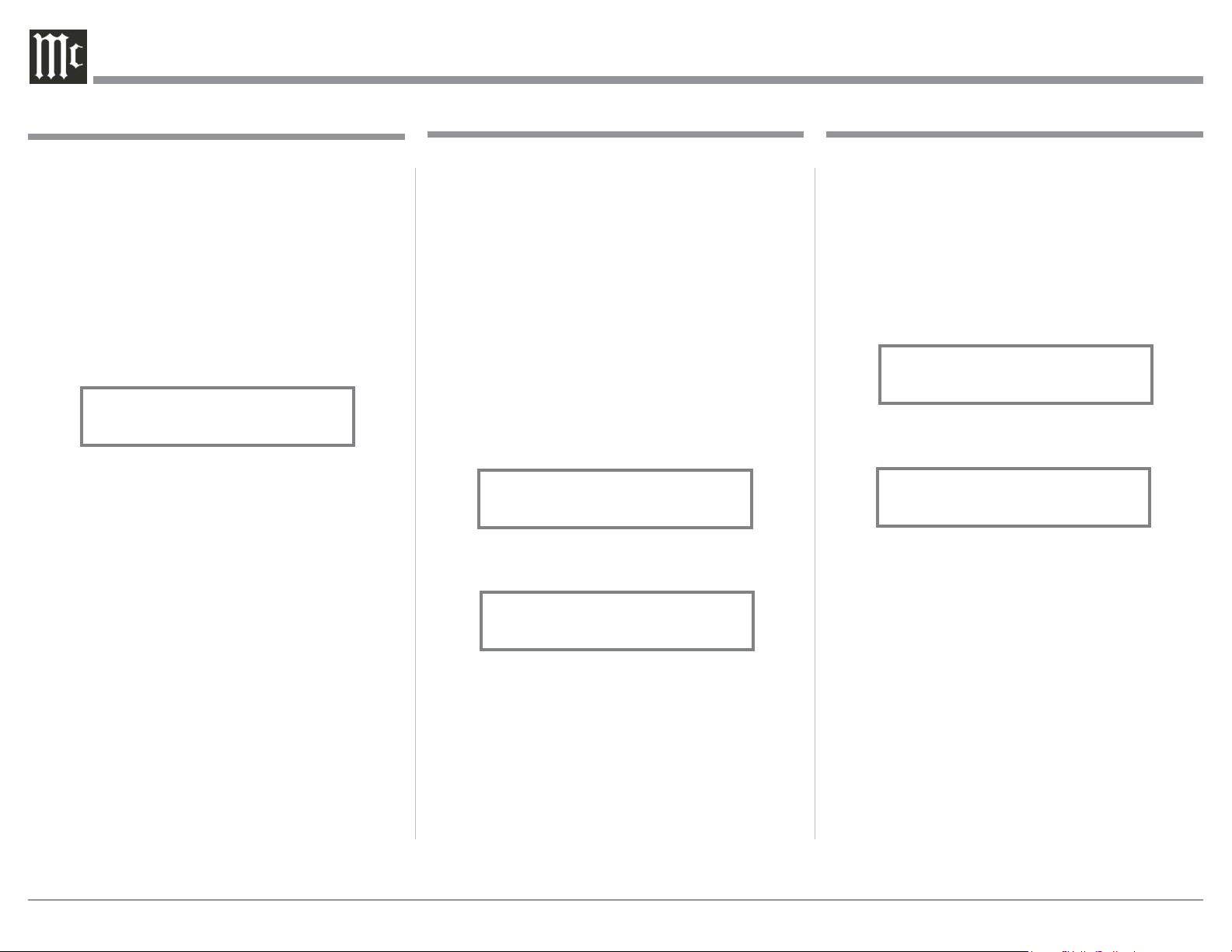
Figure 35
SETUP: Data Ports
(Hold INPUT)
Figure 36
SETUP: DATA PORT 1
All Data
Figure 37
SETUP: DATA PORT 1
BAL
When the MAC7200 is part of a Home Theater or
Multichannel Audio System the Right and Left Front
Channels from an Audio/Video Processor or Surround
Decoder can “Passthru” from the assigned MAC7200
Input, into the MAC7200 Power Amplifier Circuitry.
The “Passthru” Audio Signal is also available for a
separate external Power Amplifier(s) via the number
1 Preamplifier Output Jacks. The Setup Mode allows
selection of the specified MAC7200 Input to be used
for the Right and Left Front Channels. In the example
below, the Right and Left Front Channels from the
Audio/Video Processsor will be connected to the UN-
BALANCED 6 INPUT Jacks on the MAC7200. Refer
to page 9 for additional connection information.
Note: The Phono and Digital Inputs are not assign-
able as a Passthru Input.
1. Press and hold in the INPUT Control to enter the
SETUP MODE. Refer to figure 2 on page 17.
2. Rotate the INPUT Control until “SETUP: Passth-
ru, Off” appears on the Information Display.
Refer to figure 38.
3. Rotate the VOLUME (ADJUST) Control to select
“SETUP: Passthru, UNBAL 6” Input. Refer to
figure 39.
4. Exit the SETUP Mode by several presses of the
INPUT Control.
Setup, con’t
SETUP: Passthru
UNBAL 6
Figure 39
SETUP: Passthru
Off
Figure 38
Passthru
The USB Automute Feature helps to ensure noise free
playback of streaming music via the MAC7200 USB
Input, as the Digital Audio Signal format changes
(PCM, DSD, etc.). On occasion due to the way a Dig-
tal Audio Music Recording was made, it may become
desirable to switch Off the USB Automute Feature. To
switch Off Automute, perform the following steps:
1. Press and hold in the INPUT Control to enter the
SETUP MODE. Refer to figure 2 on page 17.
2. Rotate the INPUT Control until “SETUP: USB
Automute, ON” appears on the Information Dis-
play. Refer to figure 40A.
3. Rotate the VOLUME (ADJUST) Control to select
“SETUP: USB Automute, OFF” Input. Refer to
figure 40B.
4. Exit the SETUP Mode by several presses of the
INPUT Control.
USB Automute
Figure 40B
SETUP: USB Automute
OFF
SETUP: USB Automute
ON
Figure 40A
24
IR Sensor
The MAC7200 Front Panel Sensor, which receives
the signals from the HR085 Remote Control, can be
switched off to prevent interference when an external
IR Sensor is connected. To de-activate the Front Panel
IR Sensor perform the following steps:
1. Press and hold in the INPUT Control to enter the
SETUP MODE. Refer to figure 2 on page 17.
2. Rotate the INPUT Control until “SETUP: Front
IR, Enabled” appears on the Information Dis-
play. Refer to figure 44.
3. Rotate the VOLUME (ADJUST) Control to select
Disabled. Refer to figure 45.
5. Exit the SETUP Mode by several presses of the
INPUT Control.
Figure 44
SETUP: Front IR
Enabled
Figure 45
SETUP: Front IR
Disabled
Remote Control Codes
The HR085 Remote Control included with the
MAC7200 utilizes the NORMAL McIntosh Con-
trol Codes. The Second Set of Control Codes the
MAC7200 will respond to is referred to as the AL-
TERNATE Codes. The Alternate Codes are used
when the MAC7200 is used in the same location as
another McIntosh Preamplifier and/or A/V Processor.
This will prevent the Remote Control from affect-
ing the operation of both units at the same time. To
activate the Remote Control ALTERNATE Codes
perform the following steps:
1. Press and hold in the INPUT Control to enter the
SETUP MODE. Refer to figure 2 on page 17.
2. Rotate the INPUT Control until “SETUP: IR
Codes, Normal” appears on the Information
Display. Refer to figure 42.
3. Rotate the VOLUME (ADJUST) Control to the
Alternate Codes. Refer to figure 43.
4. It is now necessary to change the HR085 Remote
Control over to the Alternate Codes. Information
on the HR085 Remote Control is available for
download from the McIntosh Web Site:
http://www.mcintoshlabs.com/us/Products/pages/
ProductDetails.aspx?CatId=preamplifiers&Produ
ctId=MAC7200
5. Exit the SETUP Mode by several presses of the
INPUT Control.
Figure 42
SETUP: IR Codes
Normal
Figure 43
SETUP: IR Codes
Alternate
The MAC7200 may be remotely controlled from other
equipment connected to the Rear Panel RS232 Jack.
The speed at which the MAC7200 communicates (8
bit, no parity and 1 stop bit) with other equipment
is adjustable from 9,600 bits per second to 115,200
bits per second. To change from the default speed of
115,200 bits per second, perform the following steps:
1. Press and hold in the INPUT Control to enter the
SETUP MODE. Refer to figure 2 on page 17.
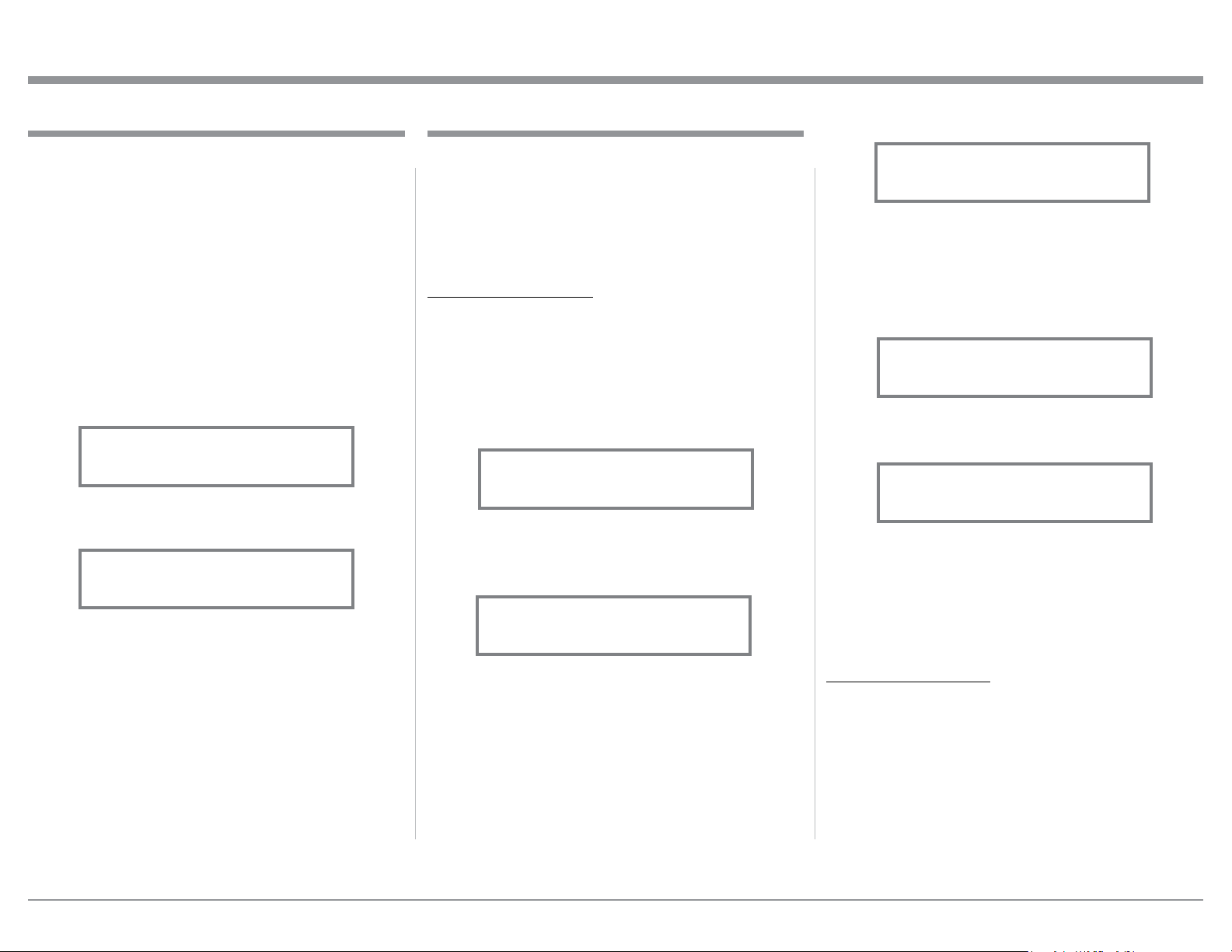
2. Rotate the INPUT Control until “SETUP: RS232,
115200 Baud” appears on the Information Dis-
play. Refer to figure 41.
3. Rotate the VOLUME (ADJUST) Control to select
the desired Baud Rate Speed.
4. Exit the SETUP Mode by several presses of the
INPUT Control.
Comm Port Baud Rate
Fig ure 41
SETUP: RS232
115200 Baud
25
Power Mode
The MAC7200 incorporates an Auto Off Feature,
which automatically places the preamplifier into
the Power Saving Standby/Off Mode. This occurs
approximately 30 minutes after there has been an ab-
sence of user activity (includes changes to any of the
Operation Functions such as source selection, volume
adjustment, etc.) or absence of an audio signal. If it is
desirable to disable the Auto Off Feature perform the
following steps:
1. Press and hold in the INPUT Control to enter the
SETUP MODE. Refer to figure 2 on page 17.
2. Rotate the INPUT Control until “SETUP: Auto
Off, Enabled” appears on the Information Display.
Refer to figure 46.
3. Rotate the VOLUME (ADJUST) Control to select
Disabled. Refer to figure 47.
4. Press the INPUT Control to exit the Setup Mode.
Figure 46
SETUP: Auto Off
Enabled
Figure 47
SETUP: Auto Off
Disabled
Tuner Presets
Setup, con’t
The MAC7200 AM/FM Tuner Setup Mode allows for
adding and deleting Radio Station Presets. For de-
tailed information about the MAC7200 Tuner Opera-
tion, including the easier way of entering and removal
of Radio Station Presets refer to “How to Operation”
the Tuner Functions on pages 33 and 34.
ENTERING PRESETS:
Follow the steps below for entering a Radio Station
into Preset Memory for quick recall:
1. Press and hold in the INPUT Control to enter the
SETUP MODE. Refer to figure 2 on page 17.
2. Rotate the INPUT Control until “SETUP: Tuner
Presets, (Hold INPUT)” appears on the Informa-
tion Display. Refer to figure 48.
3. Press and hold in the INPUT Control until “FM
Presets Set, (Hold INPUT)” appears on the Infor-
mation Display. Refer to figure 49.
Note: To enter AM Presets instead of FM Presets,
rotate the INPUT Control unitl the Informa-
tion Display indicates “AM Presets Set, (Hold
INPUT). then continue with step 4.
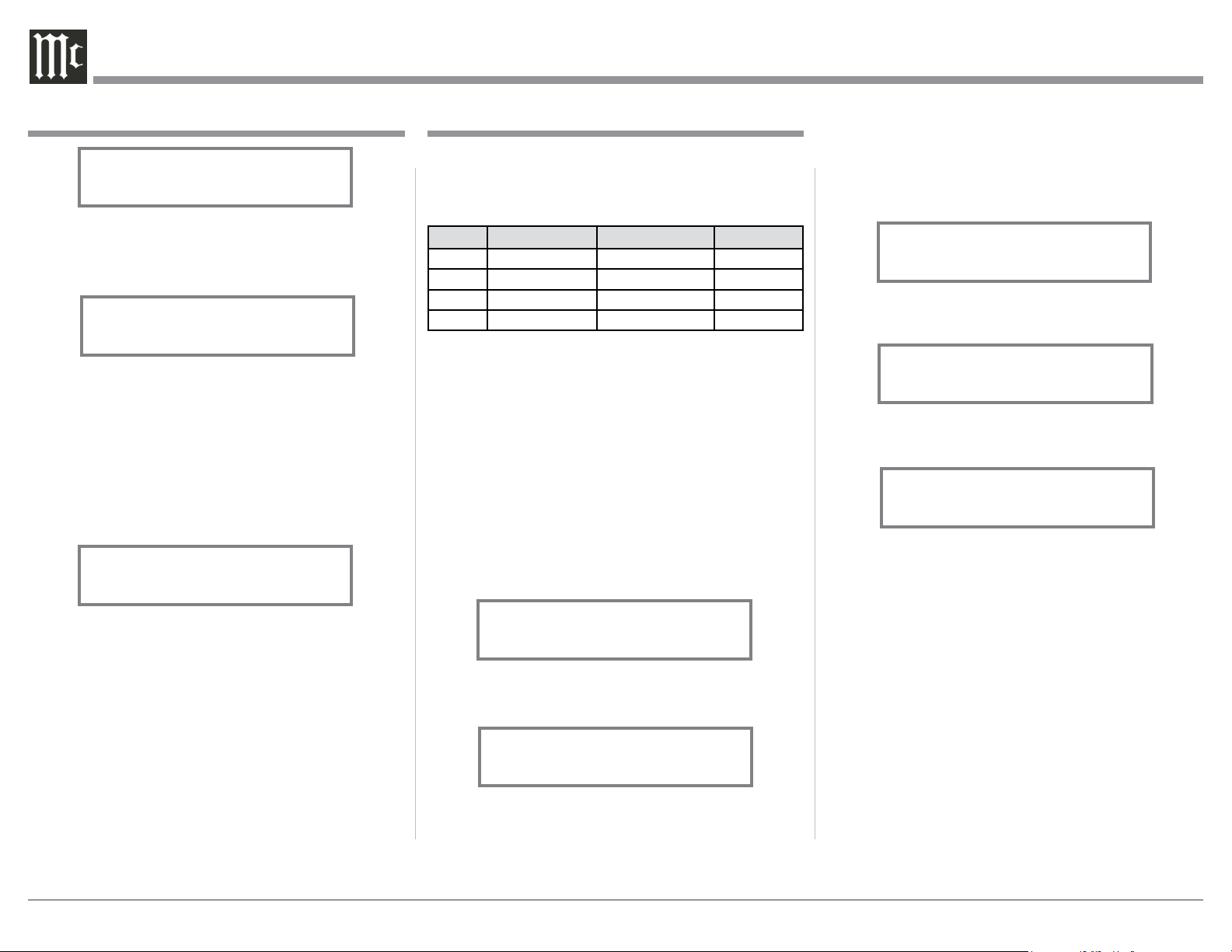
4. Press and hold in the INPUT Control until “P1 =
Open, (Hold INPUT to SAVE)” appears on the
Information Display. Refer to figure 50.
SETUP: Tuner Presets
(Hold INPUT)
Figure 48
Figure 49
FM Presets Set
(Hold INPUT)
Note: If Presets were previously entered, the fre-
quency of the station will appear in place of
the word “Open”.
5. Rotate the Front Panel TUNING knob to choose
the radio station to be entered as P1 (Preset Num-
ber 1). Refer to figure 51.
6. To save FM Station 89.3Mhz as P1 Press and Hold
in the Input Control. Refer to figure 52.
7. To enter additional Radio Station Presets, first
rotate the PRESET Control until another Preset
(P2 thru P20) with the word “Open” appears. Then
using the TUNING knob find the next station to be
entered as a Preset.
DELETING PRESETS:
Follow the steps below for deleting all the previously
entered a Radio Station Presets from Memory:
1. Press and hold in the INPUT Control to enter the
SETUP MODE. Refer to figure 2 on page 17.
2. Rotate the INPUT Control until “SETUP: Tuner
Presets, (Hold INPUT)” appears on the Informa-
tion Display. Refer to figure 53 on the next page.
P1 = 89.3 MHz
(Hold INPUT to SAVE)
Figure 51
Figure 52
P1 = 89.3 MHz
PRESET SAVED
P1 = Open
(Hold INPUT to SAVE)
Figure 50
26
In the following example, the Tuner Region Setting of
USA will be changed to JAPAN:
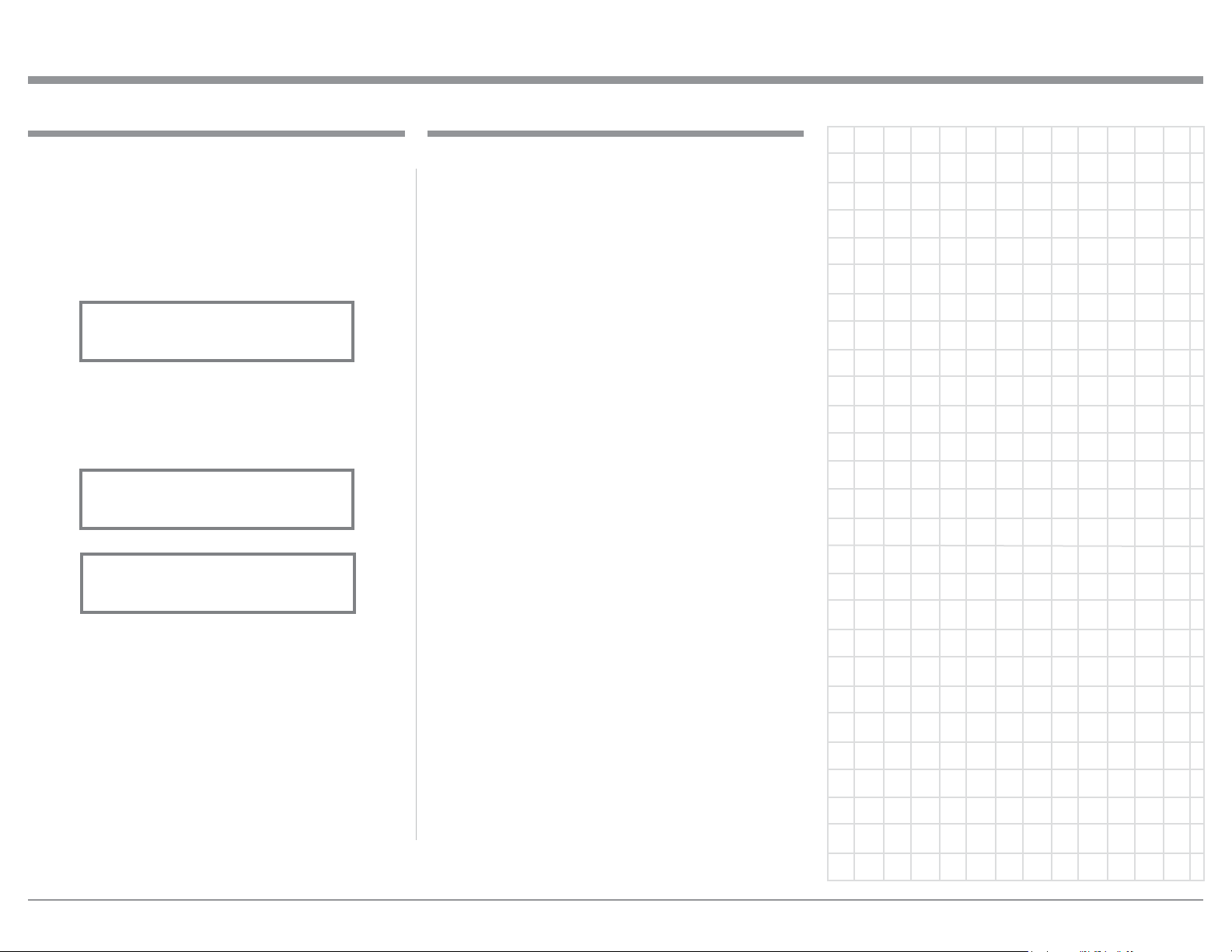
4. Rotate the VOLUME Control to select the JA-
PAN Region. Refer to figure 58.
5. Momentarily press the INPUT Control to set the
new region. Refer to figure 59.
6. Momentarily press the INPUT Control to set the
new region. Refer to figure 60.
7. Press the INPUT Control to exit the Setup Mode.
The MAC7200 Tuner is capable of receiving AM/FM
Broadcasts in various parts of the world. The Broad-
casters may use slightly different standards and the
MAC7200 accommodates these differences.
Setting AM Band FM Band FM Spacing
USA 530kHz - 1710kHz 87.9MHz - 107.9MHz 200kHz
JAPAN 522kHz - 1611kHz 76MHz - 90MHz 100kHz
EUR 100 522kHz - 1602kHz 87.5MHz - 108MHz 100kHz
EUR 50 522kHz - 1602kHz 87.5MHz - 108MHz 50kHz
The Tuner Region Default Setting is for the USA.
To change the MAC7200 for the broadcast standards
in your country follow the steps below:
Notes: 1. For additional information contact your McIn-
tosh Dealer.
2. Changing the current Tuner Region will result
in clearing of all the Station Presets.
1. Press and hold the INPUT CONTROL until the
Front Panel Display indicates the Setup Mode is
active. Refer to figure 2 on page 17.
2. Rotate the INPUT Control until “SETUP: Tuner
Region, (Hold INPUT)” is indicated. Refer to
figure 56.
3. Rotate the INPUT Control until “SETUP: Tuner
Region, USA” is indicated. Refer to figure 57.
Tuner Regions
Figure 56
SETUP: Tuner Region
(Hold INPUT)
Figure 57
SETUP: Tuner Region
USA
Tuner Presets, con’t
Figure 58
SETUP: Tuner Region
JAPAN
Figure 59
Set Region: JAPAN?
(SAVE: Press Input)
Figure 60
SETUP: Tuner Region
USA
Set Region: JAPAN
--SAVED--
3. Press and hold in the INPUT Control until “FM
Presets Erase ALL, (Hold INPUT)” appears on
the Information Display. Refer to figure 54.
Note: To delete AM Presets instead of FM Presets,
rotate the INPUT Control until the Informa-
tion Display indicates “AM Presets Erase All,
(Hold INPUT)”. then continue with step 4.
4. Press and hold in the INPUT Control until “FM
Presets Erase ALL, FM PRESETS ERASED”
appears on the Information Display. Refer to
figure 55.
5. Press the INPUT Control to exit the Setup Mode.
SETUP: Tuner Presets
(Hold INPUT)
Figure 53
Figure 54
FM Presets Erase ALL
(Hold INPUT)
Figure 55
FM Presets Erase ALL
FM PRESETS ERASED
27
Setup, con’t and Reset of the Microprocessors
In the unlikely event the controls of the MAC7200
stop functioning, the microprocessors can be reset by
performing the following:
1. Press the STANDBY/ON Push-button until the
STANDBY/ON LED Indicator switches Off.
2. Then release the STANDBY/ON Push-button and
the MAC7200 will switch Off.
3. When the STANDBY/ON LED is illuminated
press the STANDBY/ON Push-button, the
MAC7200 will resume normal operation.
Note: This can be performed with the MAC7200 On
or in the Standby Mode.
Reset of the MicroprocessorsFactory Reset
If it becomes desirable to reset all the adjustable set-
tings (Setup and Trim Settings) to the factory default
values, perform the following steps:
1. Press and hold in the INPUT Control to enter the
SETUP MODE. Refer to figure 2 on page 17.
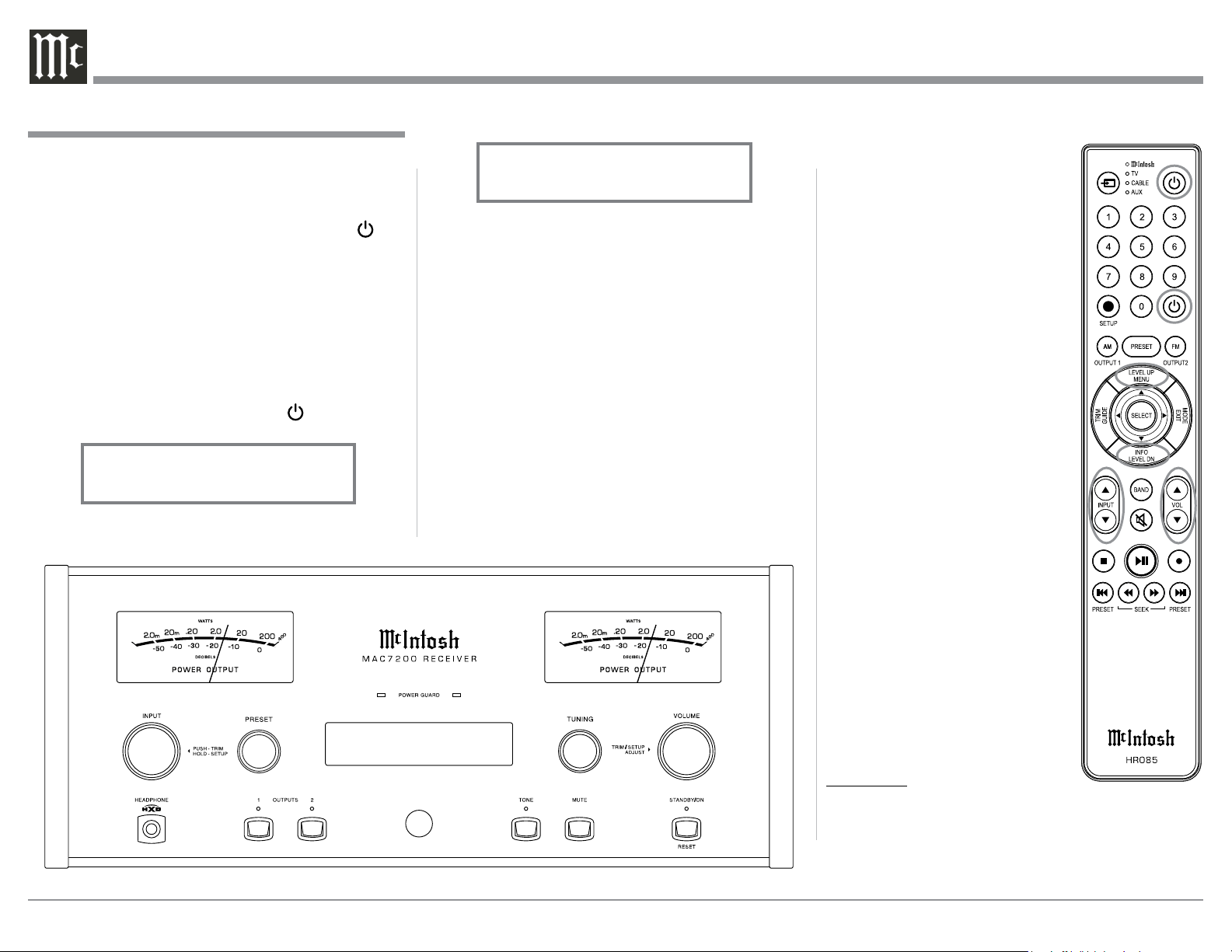
2. Rotate the INPUT Control until “FACTORY RE-
SET, (Hold INPUT)” appears on the Information
Display. Refer to figure 61.
3. Press and hold in the INPUT Control until “FAC-
TORY RESET, In Progress!” appears on the Infor-
mation Display, then release the INPUT Control.
Refer to figures 62 and 63.
4. Press the Front Panel STAND/BY Push-button to
switch On the MAC7200.
Figure 63
FACTORY RESET
Completed!
Figure 61
FACTORY RESET
(Hold INPUT)
Figure 62
FACTORY RESET
In Progress!
28
Source Selection
Rotate the INPUT Control to select the desired source
or press the INPUT Upp or Downq Push-button on
the Remote Control. Refer to figures 70 and 73.
Volume Control
Rotate the Front Panel VOLUME Control or use the
VOLume Upp or Downq Push-buttons on the Re-
mote Control for the desired listening level. Refer to
figures 70 and 73.
Trim Functions
The MAC7200 has various Trim Selections with Ad-
justments. The Trim Functions include Balance, Input
Trim Level, Tone Controls, Bass, Treble, Tuner Con-
Power On and Off
The Red LED above the STANDBY/ON Push-button
lights to indicate the MAC7200 is in Standby mode.
To switch ON the MAC7200, Press the STANDBY/
ON Push-button on the Front Panel or press the
(Power - Green) Push-button on the Remote Control.
The MAC7200 will go through a brief startup initial-
ization with the Front Panel Display indicating Power
Guard is active, last used source and volume setting.
This is followed by the volume setting indication
starting at zero and then increasing to the last used
volume setting. Refer to figures 70, 71, 72 and 73. To
switch OFF the MAC7200, press the STANDBY/ON
Push-button on the Front Panel or the (Power - Red)
Push-button on the Remote Control.
Note: For an explanation of the Remote Control
Push-button functions, refer to pages 16 and 17.
trol (when the Tuner FM or Tuner
AM is Selected), Phono Cartridge
MC Loading (when the Input is
Selected), Mono/Stereo, Meter
Backlight, Display Brightness and
HXD Mode (when Headphones
are connected). The Trim Settings
are stored in memory indepen-
dently for each Input Source
Selected, except the Meter Illumi-
nation and Digital Audio Display
settings of On or Off, which are
the same for all inputs.
Note: Selection and Adjustment of
all Trim Functions may be
performed by pressing the
Front Panel INPUT Trim
Control and then rotat-
ing it to select the desired
Trim Function. Then use the
VOLUME Adjust Control to
change the setting. Remote
Control TRIM Push-Button
together with the LEVEL UP/
Down Push-button may also
be used. Refer to figures 70
and 73.
After approximately 5 seconds
the Display returns to indicate
the Source Selection and Volume
Level.
BALANCE
Listening balance varies with dif-
ferent program sources, room acoustics and listening
positions relative to the Loudspeakers. Use the Bal-
ance (Trim Function) as needed to achieve approxi-
How to Operate the MAC7200
Figure 70
Figure 71
BAL 15%
Figure 72
COAX 1 30%
48kHz
Figure 73
USB 35%
DSD256
29
the Front Panel Display. Refer to figure 80.
3. Press TRIM LEVEL UP / DOWN Push-button to
activate the Tone Controls On. Refer to figure 81.
After approximately 6 seconds the Display returns to
indicate the Source Selection and Volume Level.
BASS
The Intensity of the Low Frequencies in the music can
be increased or decreased by using the Trim Select
and Trim Adjust Controls. To make an adjustment
perform the following:
1. Use the Front Panel INPUT/TRIM Control or press
the TRIM Push-button on the Remote Control until
“BASS 0 dB” appears on the Front Panel Informa-
tion Display. Refer to figure 82.
2. Rotate the INPUT/TRIM Control or press the
LEVEL + / - Push-buttons to increase (refer to fig-
ure 83) or decrease (refer to figure 84 on page 30)
the volume level of the low frequencies.
selected Input Source perform the following steps:
1. Select “INPUT TRIM” as indicated on the Front
Panel Information Display. Refer to figures 70, 73
and 77.
2. Adjust the Trim Level of each Input to match the
average volume level of the Input most frequently
listened to. The range of adjustment is ± 6.0dB in
half dB steps. Refer to figures 78 and 79.
After approximately 5 seconds the Information
Display returns to indicate the Source Selection and
Volume Level.
TONE CONTROL
The Tone Controls default setting is Off. The TRIM
TREBLE and BASS Settings may be adjusted for the
currently selected Input Source, by first setting the
Tone Control Trim Setting to On. The LED above the
TONE Push-button will be illuminated. When the
Tone Controls are Disabled the previous settings for
Treble and Bass are bypassed from the signal path. To
deactivate Tone Controls perform the following:
1. Select the desired Input Source.
2. Press the TRIM Push-button on the Remote Con-
trol until “TONE CONTROLS, Off” appears on
mately equal listening volume levels in each Loud-
speaker. To adjust the Balance perform the following:
1. Press the TRIM Push-button repeatedly on the Re-
mote Control until “L BALANCE R, || ” appears
on the Front Panel Display. Refer to figure 74.
Note: The Front Panel INPUT/Trim Control may also
be used.
2. Rotate the VOLUME/Adjust Control or press the
LEVEL UP / DOWN Push-buttons on the Remote
Control to emphasize the Right Channel (refer to
figure 75) or the Left Channel (refer to figure 76).
The Front Panel Display indicates the relative Balance
changes. After approximately 5 seconds, the Display
returns to indicate the Source Selection and Volume
Level. To verify the Balance setting without changing
it, use the TRIM Push-button and select Balance.
TRIM LEVEL
Source Components can have slightly different volume
levels resulting in the need to readjust the MAC7200
Volume Control when switching between differ-
ent sources. The MAC7200 allows the adjustment
of levels for each Source, ensuring the same relative
volume. To adjust the Trim Level for the currently
How to Operate the MAC7200
Figure 76
¦
¦
¦
¦
¦
¦
¦
¦
¦
L BALANCE R
Figure 74
L BALANCE R
||
Figure 75
¦
¦
¦
¦
¦
¦
¦
¦
L BALANCE R
¦
Figure 77
INPUT TRIM
0.0 dB
Figure 79
INPUT TRIM
+4.0 dB
Figure 78
INPUT TRIM
-2.5 dB
Figure 82
BASS
0 dB
Figure 83
BASS
+12dB
Figure 80
TONE CONTROLS
Off
Figure 81
TONE CONTROLS
On
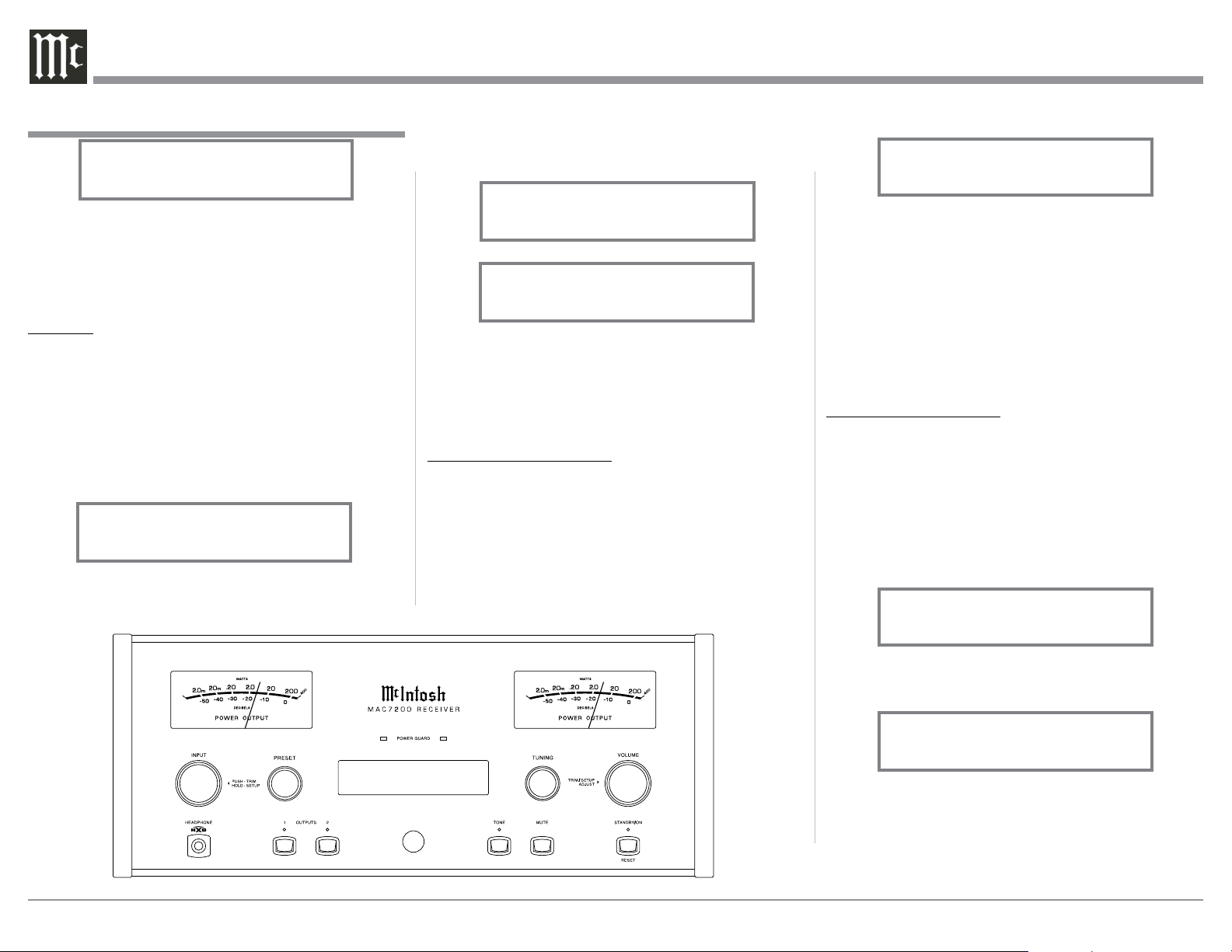
30
The Front Panel Display indicates the Bass changes
in steps from +12dB to -12dB. After approximately
6 seconds the Display returns to indicate the Source
Selection and Volume Level.
TREBLE
The Intensity of the High Frequencies in the music can
be increased or decreased by using the Trim Select
and Trim Adjust Control. To make an adjustment per-
form the following:
1. Use the Front Panel INPUT/TRIM Control or the
TRIM Push-button on the Remote Control until
“TREBLE, 0 dB” appears on the Front Panel
Information Display. Refer to figure 85.
2. Rotate the VOLUME/ADJUST Control or press
the LEVEL UP / DOWN Push-buttons to increase
3. Rotate the VOLUME/Adjust Control or press the
LEVEL UP / DOWN Push-buttons on the Remote
Control to select the Resistance Load that comes
closest to the Phono Cartridge Makers recom-
mended value.
After approximately 5 seconds the Alphanumeric
Display returns to indicate the Source Selection and
Volume Level.
MONO/STEREO MODE
By default the Stereo Mode is active for all Input
Sources however, any Input Source may be assigned
to Mono Mode. To change Stereo Mode to Mono for a
given Input Source, perform the following steps:
1. Select the desired Input Source.
2. Select “MONO / STEREO,
______
” as
indicated on the Front Panel Information Display.
Refer to figure 89.
3. To select MONO Mode adjust the TRIM LEVEL.
Refer to figure 90.
After approximately 5 seconds the Information
Display returns to indicate the Source Selection and
Volume Level.
(refer to figure 86) or decrease (refer to figure 87)
the volume level of the high frequencies.
The Front Panel Display indicates the Treble changes
in steps from +12dB to -12dB. After approximately
6 seconds the Display returns to indicate the Source
Selection and Volume Level.
PHONO ADJUSTMENTS
When the MC Phono Input is selected, an additional
TRIM SELECT FUNCTION becomes available for
adjustment. Perform the following steps to make the
Phono Trim Adjustment:
1. Select the MC Phono Source Input.
2. Select TRIM “PHONO RESISTANCE, 400Ω” as
indicated on the Front Panel Information Display.
Refer to figure 88.
Figure 70
How to Operate the MAC7200, con’t
Figure 90
MONO / STEREO
____
Figure 89
MONO / STEREO
______
Figure 84
BASS
-12dB
Figure 85
TREBLE
0 dB
Figure 86
TREBLE
+12dB
Figure 87
TREBLE
-12dB
Figure 88
PHONO RESISTANCE
400
O
USB 35%
DSD256

31
Tone
Press the Front Panel TONE Push-button to activate
the MAC7200 TREBLE and BASS Tone Control
Circuitry for the currently selected Input Source. The
LED above the TONE Push-button will illuminate. To
bypass the TONE CONTROL CIRCUITRY for the
currently selected Input Source press the TONE Push-
button. The LED above the TONE Push-button will
extinguish.
Trim
Press the Front Panel INPUT/TRIM Control to acti-
vate the MAC7200 Trim Functions. Rotate the Front
Panel INPUT/Trim Control to select the desired Trim
Function and then rotate the VOLUME/Adjust Con-
trol to vary or make changes. Refer to figure 50. The
Remote Control TRIM and LEVEL UP and LEVEL
DOWN Push-buttons may also be used. Approxi-
mately 5 seconds after Trim Function Selection and/or
adjustments have stopped, the MAC7200 will switch
off the Trim Mode.
Mute
Press the MUTE Push-button to Mute the Audio in
Output 1 (Loudspeakers), Output 2 and Headphones.
The audio signals present at the FIXED OUTPUT
Jacks are not effected by activating the mute func-
tion. The Front Panel Display will indicate the Source
Name and with the word MUTE in place of the actual
volume setting. Refer to figure 97.
Pressing the Mute Push-button a second time
or adjusting the volume control will un-mute the
MAC7200.
After approximately 5 seconds the Information
Display returns to indicate the Source Selection and
Volume Level.
HEADPHONE HXD
When headphones are connected to the MAC7200
Front Panel Jack, an additional TRIM function be-
comes available. McIntosh’s HXD brings the acousti-
cal depth and spatiality of music normally heard with
loudspeakers, to your headphones. The default setting
is HXD On. To switch HXD Off perform the follow-
ing:
1. Momentarily press the INPUT Control, then rotate
it to select “HEADPHONE HXD, On”. Refer to
figure 95.
2. To deactivate the HXD Mode rotate the VOL-
UME Adjust Control until the Front Panel Display
indicates “HEADPHONE HXD, Off”. Refer to
figure 96.
METER BACKLIGHT
The MAC7200 Front Panel Meter Illumination may be
switched On or Off by performing the following:
1. Select “METER LIGHTS, On” as indicated on the
Front Panel Information Display. Refer to figures
70, 73 (on page 28) and 91.
2. Switch Off the Meter Illumination. Refer to
figure 92.
After approximately 5 seconds the Information
Display returns to indicate the Source Selection and
Volume Level.
Notes: 1. Meter Illumination of recent McIntosh Power
Amplifiers will also switch On/Off when con-
nected to the MAC7200 via a power control
cable.
2. Some A/V Processors will provide an On/Off
Control Signal when the MAC7200 Passthru
Input Jack is connected to the A/V Processor
via the power control cable.
INFORMATION DISPLAY ILLUMINATION
The Brightness Level of the MAC7200 Front Panel
Information Display can be adjusted from bright to
dim by performing the following:
1. Select “DISPLAY BRIGHTNESS” as indicated
on the Front Panel Information Display. Refer to
figures 70, 73 (on page 28) and 93.
2. Reduce the Brightness level by adjusting the
TRIM LEVEL. Refer to figure 94.
How to Operate the MAC7200, con’t
Figure 91
METER LIGHTS
On
Figure 92
METER LIGHTS
Off
Figure 94
DISPLAY
BRIGHTNESS
Figure 93
DISPLAY
BRIGHTNESS
Figure 96
HEADPHONES HXD
Off
Figure 95
HEADPHONES HXD
On
Figure 97
COAX 1
MUTE
48kHz
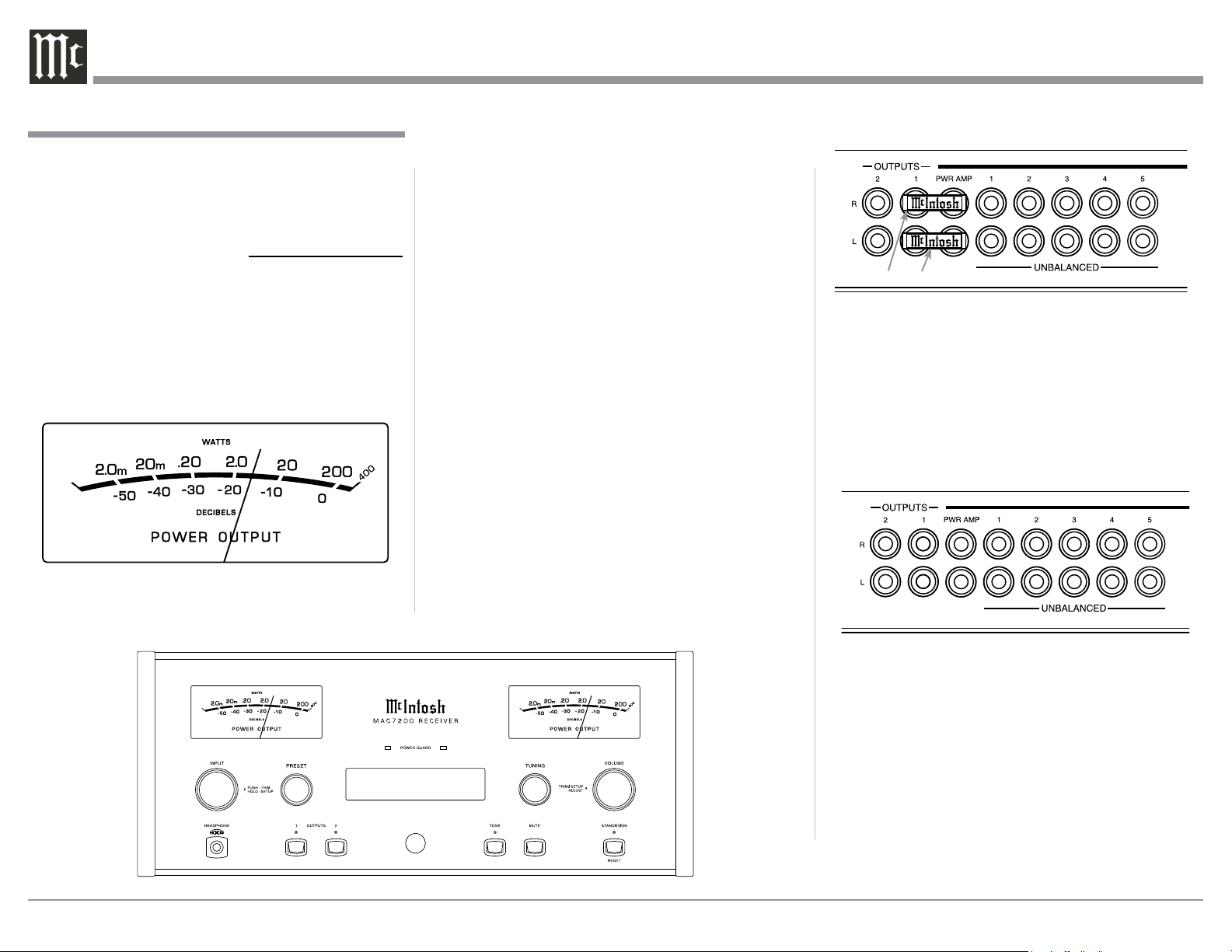
32
The second way is to use both a separate Power
Amplifier and the MAC7200 built-in Power Ampli-
fier. Connect one pair of Loudspeakers to the separate
Power Amplifier and the second pair to the MAC7200.
Refer to the MAC7200 Output Connection Diagrams
located on the separate folded sheet “Mc2B” and
figure 100.
Note: The MAC7200 VOLUME Control will affect the
sound level of all the Loudspeakers.
Using Output 2
The MAC7200 has provisions for connecting an exter-
nal Power Amplifier (to drive Loudspeakers in another
room) and an external sensor for remote operation of
the MAC7200 from that room. With an external Power
Amplifier connected (as illustrated on the McIntosh
Connection Diagram separate sheet “Mc2B”), press
the Front Panel OUTPUT 2 Push-button or press on
the Remote Control, the BLUE (Setup) Push-button
followed by pressing the OUTPUT 2 Push-button to
switch On or Off the external Power Amplifier.
Headphones Jack
Connect a pair of dynamic headphones to the Head-
phone Jack with a 1/4” (0.635cm) stereo phone type
plug for private listening. The default setting is for
Output Connections 1 and 2 to automatically mute. For
additional Information refer to “HEADPHONE HXD”
on page 31.
Note: The Headphone Output is optimized for imped-
ances ranging from 100 to 600 ohms.
Power Output Meters
The MAC7200 Power Output Meters indicate the
power delivered to the Loudspeakers. Refer to figure
98. The meters respond to all the musical information
being produced by the Amplifier. They indicate to an
accuracy of at least 95% of the power output with only
a single cycle of a 2,000Hz tone burst.
How to Operate the MAC7200, con’t
Power Guard
During normal operation, the Front Panel Power
Guard Indicators will momentarily illuminate during
peaks in the audio signals. In the event the MAC7200
over heats, due to improper ventilation, high ambient
temperature and/or impedance mismatch, the inter-
nal protection circuits will activate. The Front Panel
Power Guard Indicators will continuously illuminate
and the audio will be muted. When the MAC7200
has returned to a safe operating temperature, normal
operation will resume.
Using a Separate Power Amplifier
There are two different ways to use a separate power
amplifier with a MAC7200. The first way is to use the
separate amplifier instead of the MAC7200 built-in
Power Amplifier. Connect the Loudspeakers to the
separate Power Amplifier and remove the McIntosh
Jumpers that are located between the OUTPUTS 1
Jacks and the PWR AMP INPUT Jacks. Refer to
figure 99.
Note: The McIntosh Jumpers must be connected,
between the above mentioned jacks, when the
MAC7200 Internal Power Amplifier is to be used.
Figure 70
Figure 99
Jumpers
USB 35%
DSD256
Figure 98
Jumpers Removed
Figure 100
USB 35%
DSD256
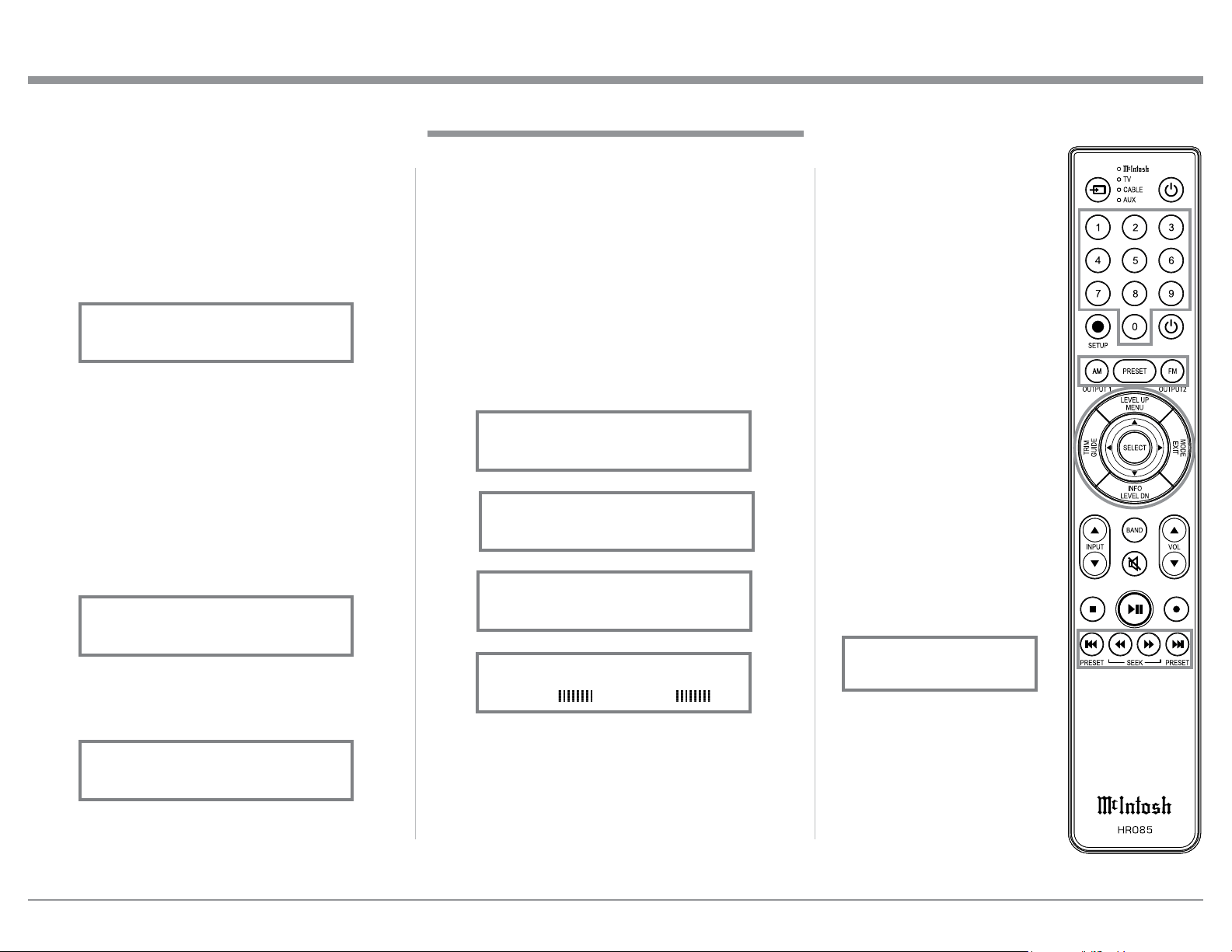
33
Default Station Tuning
The default Station Tuning Mode
for the MAC7200 is Manual.
Manual Tuning is accomplished
by using either the Front Panel
TUNING Control or the Upp
or Downq Directional Push-
buttons on the Remote Control.
Refer to figures 70 and 108.
Seek Tuning Type
The MAC7200 second form of
Tuning Types is Seek Tuning.
Seek Tuning automatically finds
the next available Radio Sta-
tion. To change from Manual
Tuning to Seek Tuning activate
the TRIM Mode using the Front
Panel Controls or the Remote
Control. Select TRIM Mode
“TUNER CONTROL, Manual”
and then select “TUNER CON-
TROL, Seek”. Refer to figures
105 and 109.
There are three ways to use Seek
Tuning. The first way is to use
the Front Panel TUNING Con-
trol, by momentarily rotating it a
few degrees clockwise or coun-
ter-clockwise. The second way
is to use the Upp or Downq
Directional Push-buttons on the
How to Operate the MAC7200, con’t
Passthru
When the MAC7200 is connected together with a Mc-
Intosh Multichannel A/V Control Center or Surround
Decoder and has the PASSTHRU Mode activated, it
will automatically turn-on when the A/V Processor
or Surround Decoder is turned On. It will indicate
on the Front Panel Display “PASSTHRU”. Refer to
figure 101.
The MAC7200 OUTPUT 1 / OUTPUT 2 Front Panel
Push-buttons are active when in the Passthru Mode.
The other Front Panel Controls and Push-buttons are
deactivated as long as the Passthru Mode is active.
Optical and Coaxial Digital Inputs
When a Digital Input (Optical or Coaxial Connection)
on the MAC7200 is selected, the Front Panel Display
will indicate the sample rate when a signal is present
“48kHz”. Refer to figure 102.
During the time there is no Digital Signal present on
the selected input the display will indicate “______”.
Refer to figure 103.
Figure 101
PASSTHRU
Figure 102
COAX 1 30%
48kHz
Figure 103
COAX 1 30%
______
Operating the FM and AM Tuner
The MAC7200 Tuner provides the ability to select and
listen to AM and FM Radio Stations.
The Front Panel Controls labeled TUNING and
PRESET allow the selection of either FM or AM
Radio Stations. The Front Panel INPUT/TRIM Con-
trol, along with various push-buttons on the Remote
Control provide access to various Tuner Operational
Functions. Refer to figures 70 and 73.
The Front Panel Information Display indicates the
Station Preset, Radio Station Frequency, Stereo/Mono
(on FM Stations), Signal Strength, Tuning Method,
Station Text, FM Signal Information. Refer to figures
104 thru 107.
AM or FM Band Selection
Rotate the MAC7200 Front Panel INPUT Control to
select either TUNER FM or TUNER AM. Refer to
figure70. The AM, FM or BAND Push-buttons on the
Remote Control may also be used to select the desired
Broadcast Band. Refer to figure 108.
Figure 104
P1 91.5 MHz ST |||
Figure 105
TUNER CONTROL
Manual
Figure 106
91.5 MHz ST |||
Jazz Hits Today.....
Figure 107
91.5 MHz ST ¦
Mpath:¦¦¦ Noise:¦¦¦
Figure 108
TUNER CONTROL
Seek
Figure 109
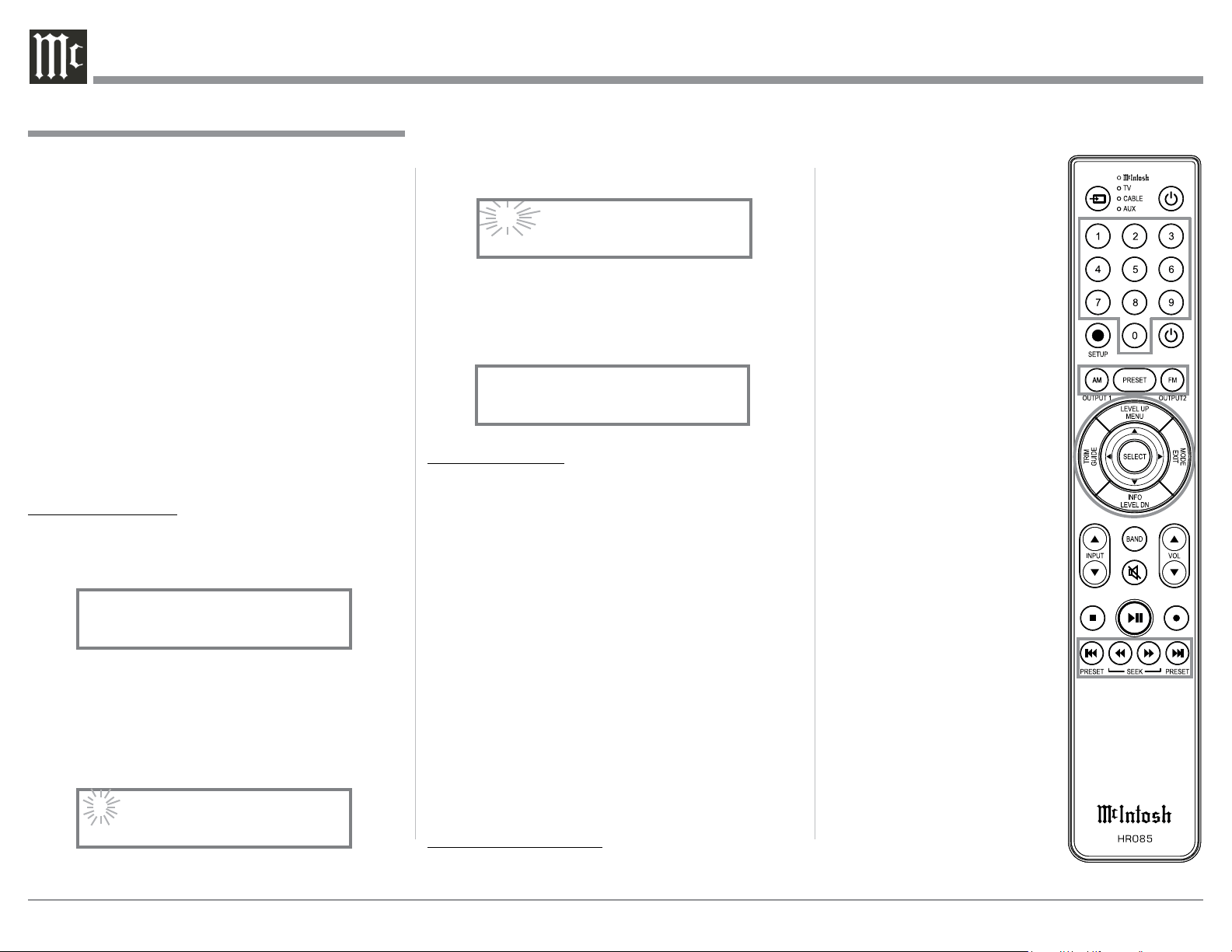
34
Remote Control. The third way is to use the Seek 7
or 8 Push-buttons on the Remote Control. Refer to
figure 70 and 108 on the previous pages.
Direct Access Tuning
The fourth Tuning way is to use the Direct Access
Method for FM and AM Stations. This is performed
by entering the Radio Station Frequency by using the
numeric Push-buttons on the Remote Control. Refer
to figure 108. For example, tuning to FM Station
105.7MHz press the following Push-buttons:
Number One, Number Zero, Number Five
and Number Seven.
Preset Tuning
The MAC7200 allows for presetting 20 AM and 20
FM Radio Stations into memory for rapid recall. Refer
to figure 108.
CREATE A PRESET
Perform the following steps:
1. Tune to the desired FM Station (or AM Station).
Refer to Figure 110.
2. Press the large PRESET Push-button (located
between the AM and FM Push-buttons) on the
Remote Control and the letter “P” will appear
flashing on the left side of the Front Panel Display.
Refer to Figure 111.
3. Using the Remote Control Numeric Push-buttons
enter the desired Preset Number. Refer to Figure
112.
4. Press the large PRESET Push-button to complete
the process of entering Preset One. The “P1” on the
Front Panel Information Display will stop flashing.
Refer to Figure 113.
ERASE A PRESET
Perform the following steps:
1. Use the Remote Control PRESET 9, PRESET :
Push-buttons or the Front Panel PRESET Control
to select the desired FM Station Preset (or AM Sta-
tion Preset) to be erased. Refer to Figure 113.
2. Press the large PRESET Push-button (located
between the AM and FM Push-buttons) on the
Remote Control, “P1” will disappear and the let-
ter “P” will appear flashing on the left side of the
Front Panel Display. Refer to Figure 111.
3. Press the large PRESET Push-button a second time
to complete the process of erasing Preset One.
The Front Panel Information Display will now just
indicate the Frequency, Mode and Signal Strength.
Refer to Figure 110.
Note: If it is desirable to remove all 20 Presets (FM
and/or AM Stations) refer to Setup “DELET-
ING PRESETS” on page 25
SELECTING A PRESET
There are several ways to scan thru available FM or
AM Preset Stations. Rotate the
Front Panel PRESET Control
Clockwise or Counterclockwise
to find the desired station. The
second way is to use the Remote
Control PRESET 9, PRESET
: Push-buttons. The third way
is using the Remote Control to
direct access the desired Preset
Number. First press the large
PRESET Push-button, then use
the numeric Push-buttons to
enter the Preset Number followed
by pressing the large PRESET
Push-button a second time.
Tuner Tex t
Select the TRIM Tuner Text
Mode using the Front Panel
Controls or Remote Control.
The defaut TRIM Tuner Mode
is “Station Info” which indicates
whatever a given Radio Station
wants to display. Refer to figure
106 on page 33. The second op-
tion is to display the RF Multipa-
th
1
Signal and Noise Background
of the tuned in FM Station or the
Signal Strength of the tuned in
AM Station. Refer to figure 107
on page 33. The third option is to
switch Off the second line of the
Front Panel Information Display.
1
Refer to “General Information” number
8 for addition information about RF
Multipath Signals.
Operating the FM and AM Tuner, con’t
Figure 108
Fig u re 110
91.5 MHz ST |||
Fig u re 111
P 91.5 MHz ST |||
Fig u re 113
P1 91.5 MHz ST |||
Fig u re 112
P1 91.5 MHz ST |||

35
3. When the Windows Security window appears
check the
Always trust software from “Savitech
Co r p.”
box and then the Install button. When the
software has been installed, it is neces-
sary to reboot the computer. Refer to
figure 122.
After rebooting, a McIntosh-HD icon will
appear on the desktop. Refer to figure 98.
USB Connection
Connect the USB Cable with Type A to Type B con-
nectors between the PC Computer and the McIntosh
Product with the USB-Digital Audio Input. An Icon
will appear On-Screen indicating Windows has found
new hardware. Refer to
figure 123.
Upon completion of in-
stalling the driver, figure
124 will appear.
USB Input Operation and Driver Installation
The MAC7200 USB Input provides the capability to
playback music from a computer, when the computer
is connected to the rear panel USB connector.
Note: The USB Input is for direct connection to a com-
puter only. To playback music from an USB Drive,
connect the USB Drive to another USB Port on
the computer and select the USB Drive with the
Media Playback Program.
The MAC7200 USB Input is compatible with
PC Computers using Microsoft®, Windows 7 (SP1),
Windows 8.1 and Windows 10. It is also compatible
with Apple® Macintosh® Computers using OS-10.6.8
or later.
When using a PC Computer with Windows, a spe-
cial McIntosh USB Audio Software Driver needs to be
installed on the PC Computer. The driver needs to be
installed before connecting the MAC7200 USB Input
to the USB Port on the computer.
Note: If an Apple Macintosh computer is used with the
MAC7200, no additional driver is required.
The McIntosh USB Audio Windows Driver is
available for download from the McIntosh Web Site:
http://www.mcintoshlabs.com/us/Support/Pages/
Manuals.aspx
Under “PRODUCT CATEGORY” select “Pre-
amplifiers” then under “MODEL NUMBER” select
“MAC7200”. Click on “SEARCH” then select “Mc-
Intosh-HD USB Audio Windows Drive D v1.0” and
download the PC Windows Driver. Follow the instruc-
tions below to install the McIntosh MAC7200 Driver:
Purpose: To Install the McIntosh
USB Audio Windows Driver for use with
McIntosh Products with an USB-Digital
Audio Input.
Requirements: 1. A PC Computer with a functioning
USB Port.
2. Windows 7 (SP1 or greater),
Windows 8 (8.1) or Windows 10
Operating System.
3. An USB Cable with Type A to
Type B Connectors.
Installing the Software
It is important to first install the downloaded software
on your computer before connecting the McIntosh
Product to the computer. The USB Driver is included
in the downloaded software package.
Note: Before installing this software, please check to see
if the McIntosh Product(s) with the USB-Digital
Audio Input has the latest firmware version, if not
update the firmware first.
1. Unzip the downloaded McIntosh Windows USB
Driver Software Package.
2. Run “McIntoshHDSwPkg _20150814_v1p9p110p2.
zip”
. Refer to figures 114 thru 121.
Fig u re 114
Fig u re 115
Fig u re 116
Fig u re 117
How to Operate the MAC7200, con’t
Figure 122
Figure 123
Figure 124
Fig u re 118
Fig u re 119
Figure 120
Figure 121
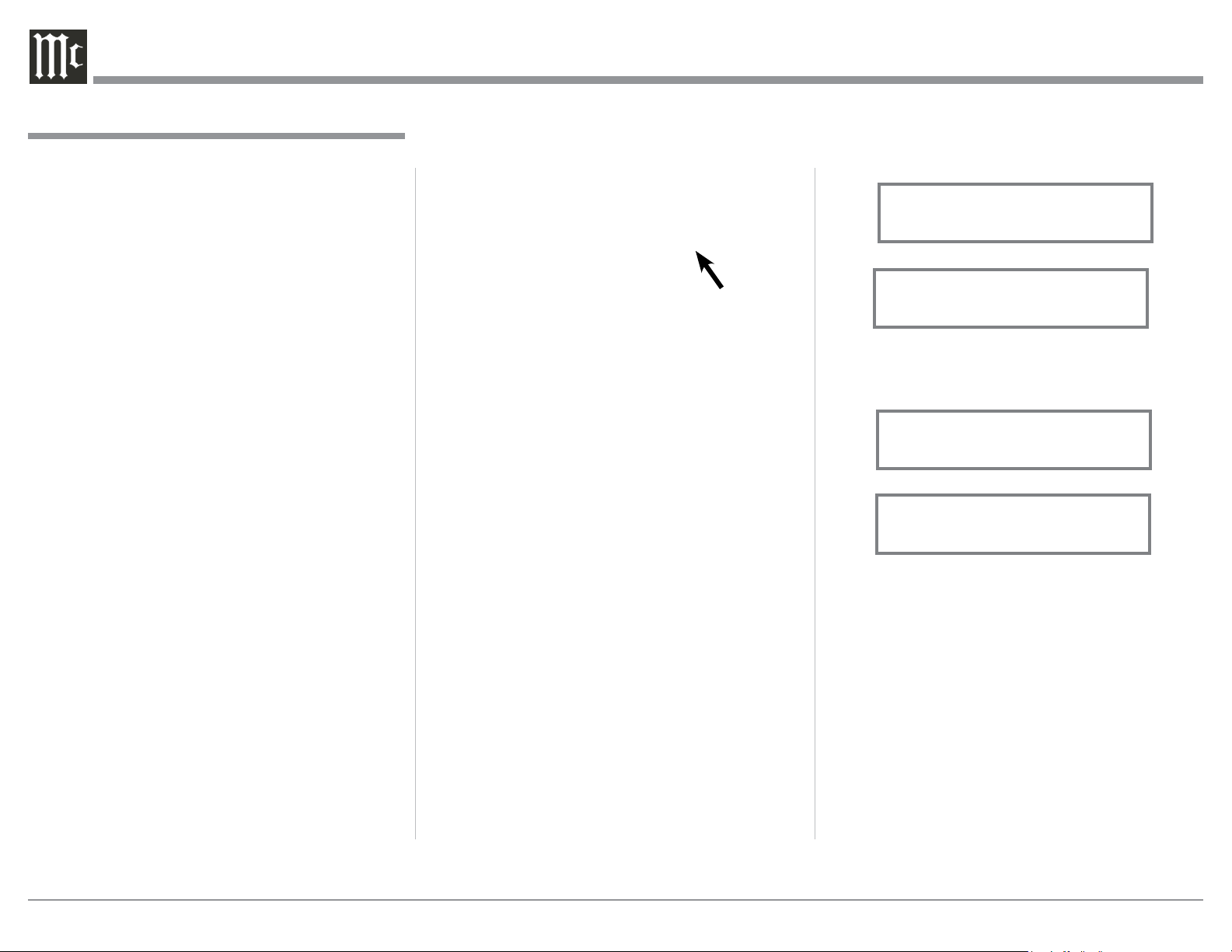
36
Windows Sound Settings
For proper operation of the McIntosh Product via the
Computer USB Connection, it is required to make
changes to Windows Sound Settings:
1. From the Windows
START button, click on
“CONTROL PANEL”
followed by selecting
“SOUND”. Refer to
figure 125.
2. Referring to figure 126,
first select “McIntosh-
HD HS USB Audio” and
than click on the “Set
Default” button.
Notes: 1. When the McIn-
tosh USB Audio
Product is not
connected to
your computer,
the previous
default Audio
Device will be
selected.
2. If other McIn-
tosh Products with USB Audio Connections
are also connected to the computer, an ad-
ditional “McIntosh USB Audio” playback
device will appear in the listing. Make
sure to select the “McIntosh-HD HS USB
Audio” from available playback devices
listed when using this McIntosh Product
for USB Audio.
Control Panel Settings
To activate the McIntosh-HD USB Audio Control Pan-
el Click on the “McIntosh Icon” (located in the Win-
dows notification area on the right side of the taskbar)
or Click on the Windows “Show hidden icons”, then
Select the “McIntosh Icon”. Refer to figures 127 and
128.
Notes: 1. It is not necessary
for the McIntosh-
HD USB Audio
Control Panel to
be running, unless
it is desired to
make changes to
the default set-
tings.
2. The McIntosh-
HD USB Audio
Control Panel
displays the cur-
rent Sampling
Rate, Bit-Rate
and Buffer Size
for the music
streaming from
the com-
puter into the
MAC7200.
3. When the Media
Stream Program
on the computer
is set to output
in the “ASIO”
format, the Mc-
Intosh -HD USB
Audio Control
Panel allows for
changing the set-
tings parameters
on the fly.
USB Music Playback
When the USB Input is selected on the McIntosh
MAC7200, the Front Panel Display indicates the
How to Operate the MAC7200, con’t
Figure 125
Figure 127
Figure 126
Figure 128
How to Operate the MAC7200, con’t
Sampling Rate (refer to figures 129 and 130 for PCM
Signals).
Figures 131 and 132 indicate a Sampling Rate of 128
or 256 times the Sampling Rate of a CD Disc for the
incoming DSD Digital Audio Signal.
The Sampling Rate and the Bit Rate are determined
by the original recording, the Application Output
Format (when available) and the McIntosh-HD Control
Panel Settings.
Note: In general, when the original music is recorded
at a higher Sampling Rate, the result is usually
more detail in the music. However, this higher
rate results in consuming larger amounts of stor-
age space. The Sample Rate usually should be set
to match the Sample Rate of the music recording
being played back.
There are many third party Applications (besides Ap-
plications like Windows Media Player) for steaming
music from the computer to McIntosh MAC7200 USB
Input. An example of just one of the available applica-
tions is “JRiver Media Center”.
Figure 129
USB 46%
44.1kHz
Figure 130
USB
51%
352.8kHz
Figure 131
USB
46%
DSD128
Figure 132
USB
51%
DSD256
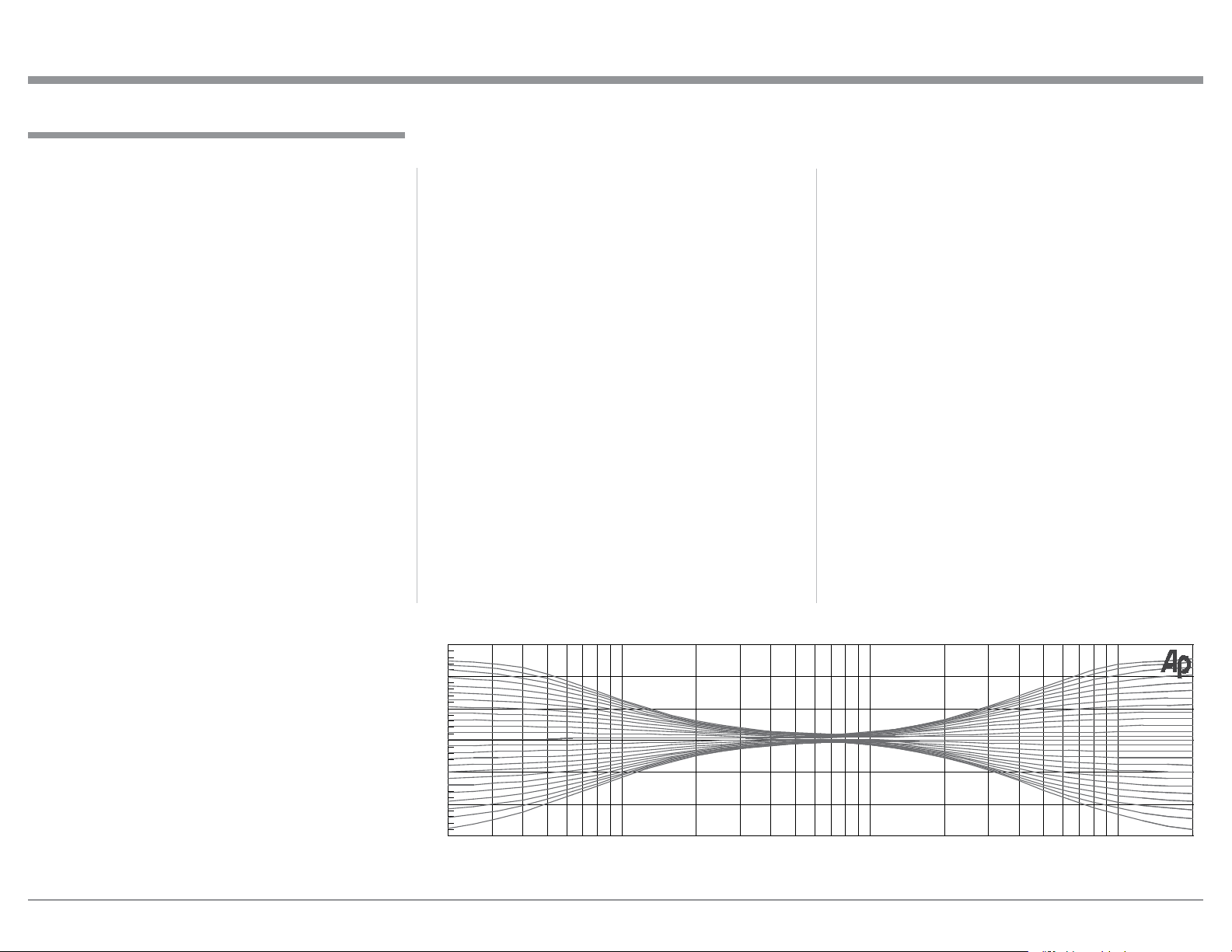
37
Amplifier Specifications
Power Output
200 watts is the minimum sine wave continuous aver-
age power output per channel, both channels operating
Output Load Impedance
2, 4 or 8 ohms
Rated Power Band
20Hz to 20,000Hz
Total Harmonic Distortion
0.005% maximum with both channels operating from
250 milliwatts to rated power, 20Hz to 20,000Hz
Intermodulation Distortion
0.005% maximum, if the instantaneous peak power is
400 watts or less per channel with both channels oper-
ating for any combination of frequencies from 20Hz to
20,000Hz
Dynamic Headroom
2.0dB
Wide Band Damping Factor
Greater than 40
Power Guard
Less than 2% THD with up to 16dB overdrive at
1,000Hz
Frequency Response
+0, -0.5dB from 20Hz to 20,000Hz
+0, -3dB from 10Hz to 100,000Hz
Preamplifier Output 1 and 2 (for rated input)
1.4V unbalanced (8V Maximun)
Maximum Input Signal, con’t
Phono MC, 8mV
Power Amplifier In, 16V
Preamplifier Output Impedance
220 ohms
Headphone Impedance
100 to 600 ohms
Voltage Ga i n
High Level to Output 1 and 2: 15dB
Phono MM to Rec Output: 40dB
Phono MC to Rec Output: 60dB
Phono MM to Output 1 and 2: 55dB
Phono MC to Output 1 and 2: 75dB
Power Amplifier: 29dB
Power Control and Trigger Output
12VDC, 25mA
Sensitivity (for rated output)
High Level, 250mV unbalanced, 500mV balanced
Phono MM, 2.5mV
Phono MC, 0.25mV
Power Amp In, 1.4V
Signal To Noise Ratio (A-Weighted)
High Level, 95dB below rated output
Phono MM, 82dB below 5mV input
Phono MC, 80dB below 0.5mV input
Power Amplifier, 113dB below rated output
Input Impedance
High Level, 20K ohms
Phono MM - 47K ohms; 50pF
Phono MC - 50, 100, 200, 400 or 1,000 ohms; 100pF
Preamplifier Output Impedance
220 ohms
Maximum Input Signal
High Level, 8V unbalanced, 16V balanced
Phono MM, 80mV
MAC7200 Amplifier Specifications
20 20k50 100 200 500 1k 2k 5k 10k
0
+6
-6
+12
-12
dB
Hz
MAC7200 Tone Control Curves

38
General Specifications
Power Requirements
Field AC Voltage conversion of the MAC7200 is not
possible. The MAC7200 is factory configured for one
of the following AC Voltages:
100 Volts, 50/60Hz at 5.2 amps
110 Volts, 50/60Hz at 4.4 amps
120 Volts, 50/60Hz at 4.4 amps
220 Volts, 50/60Hz at 2.45 amps
230 Volts, 50/60Hz at 2.35 amps
240 Volts, 50/60Hz at 2.25 amps
Standby: Less than 0.25 watt
Note: Refer to the rear panel of the MAC7200 for the
correct voltage.
Overall Dimensions
Width is 17-1/2 inches (44.45cm)
Height is 7-5/8 inches (19.37cm) including feet
Depth is 22 inches (55.88cm) including the Front
Panel, Knobs and Cables
Weight
75 pounds (34.1 kg) net, 93 pounds (42.3 kg) in ship-
ping carton
Shipping Carton Dimensions
Width is 29-1/2 inches (74.93cm)
Depth is 29 inches (73.66cm)
Height is 17 inches (43.18cm)
MAC7200 Digital Audio and General Specifications
Digital Audio Specifications
Digital Input Signal Format
Coaxial and Optical Inputs - SPDIF (PCM)
MCT and USB Inputs - PCM, DSD
Digital Input Sample Rate
Coaxial and Optical: 44.1kHz to 192kHz, 24-Bit
MCT: 44.1kHz, 16-Bit (CD)
DSD64 (SACD)
USB: 44.1kHz to 384kHz, 32-Bit (PCM)
DSD64, DSD128, DSD256,
DXD352.8kHz, DXD384kHz
Digital Inputs
Coaxial: 0.5V p-p/75 ohms
Optical: -15dbm to -21dbm (TOS Link)
MCT: 0.5V p-p/75 ohms
USB: USB Type B Connector
Tuner AM Specifications
Tuner FM Specifications
Tuning Range
87.5MHz - 108.0MHz (Europe)
87.9MHz - 107.9MHz (USA)
76MHz - 90MHz (Japan)
FM Channel Spacing
200kHz (USA, Japan)
50kHz (Europe)
Antenna Input
75 Ohms, Type “F” Coax connector
Useable Sensitivity
2.2uV (18.1d Bf )
50dB Quieting Sensitivity
1.5uV (14.8dBf )
Signal To Noise Ratio
Mono: 70dB
Stereo: 68dB
Frequency Response
±1dB 20 to 15,000Hz
Harmonic Distortion
Mono: 0.4%
Stereo: 0.8%
Channel Selectivity
60dB Adjacent Channel
66dB Alternate Channel
Stereo Separation
38dB
AM Tuning Range
522kHz - 1602kHz (Europe)
530kHz - 1710kHz (USA)
522kHz - 1611kHz (Japan)
AM Channel Spacing
10kHz (USA)
9kHz (Europe, Japan)
Sensitivity
350uV/m
Signal To Noise Ratio
50dB
Frequency Response
0dB, -6dB 50Hz to 3,000Hz
Tuner FM Specifications, con’t Tuner AM Specifications, con’t
Harmonic Distortion
0.5%
Selectivity
45dB Adjacent Channel
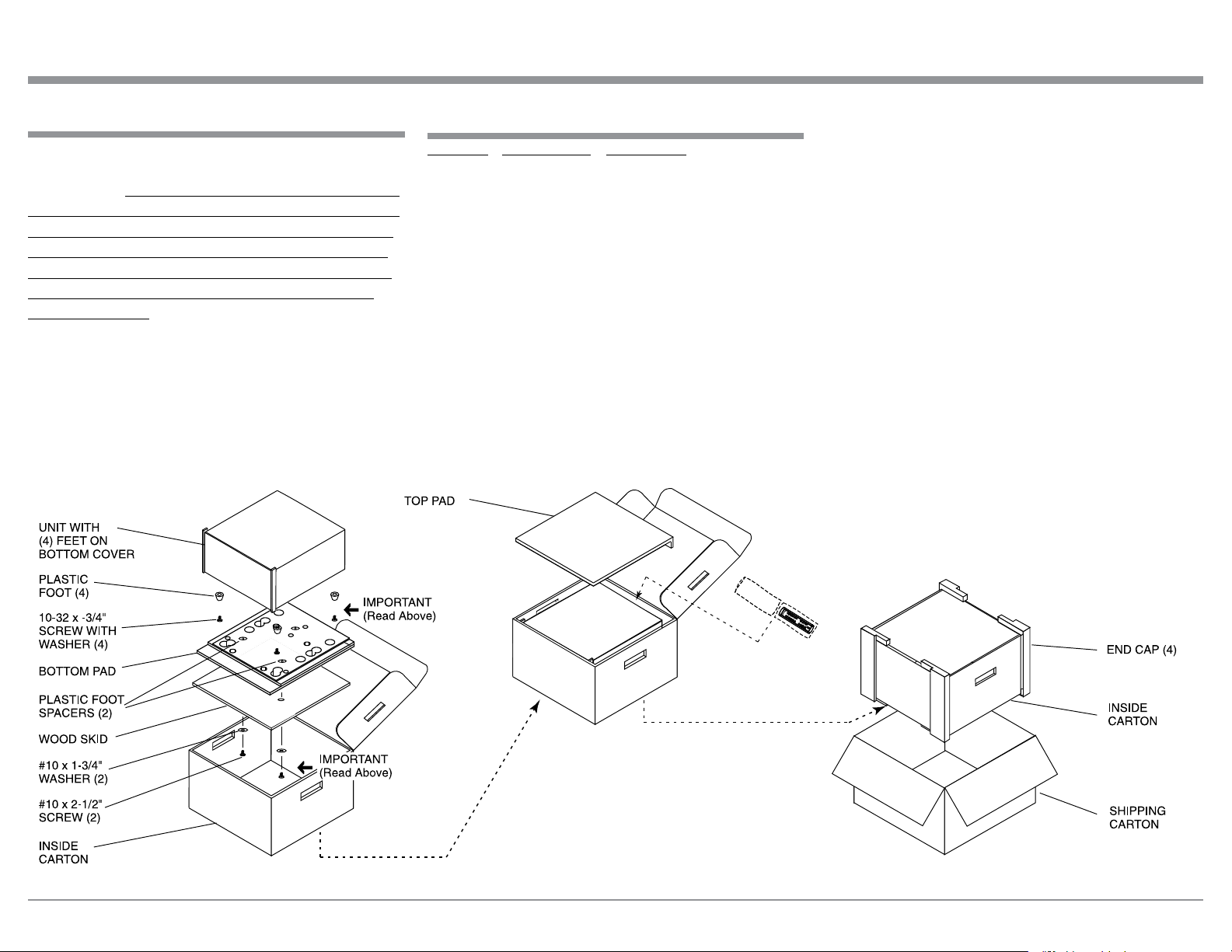
39
In the event it is necessary to repack the equipment for
shipment, the equipment must be packed exactly as
shown below. It is very important that the four plastic
feet are attached to the bottom of the equipment. Two
#10 x 2-1/2 inch screws and washers must be used to
fasten the unit securely to the bottom pad and wood
skid. This will ensure the proper equipment location
on the bottom pad. Failure to do this will result in
shipping damage.
Use the original shipping carton and interior parts
only if they are all in good serviceable condition. If
a shipping carton or any of the interior part(s) are
needed, please call or write Customer Service Depart-
ment of McIntosh Laboratory. Refer to page 2. Please
see the Part List for the correct part numbers.
Packing Instructions
Quantity Part Number Description
1 033888 Shipping carton
4 033887 End Cap
1 033697 Inner carton
1 033725 Top pad
1 034576 Bottom pad
1 034480 Wood skid
2 017218 Plastic foot (spacer)
2 401204 #10 x 2-1/2 inch
wood screw
2 404033 #10 flat washer 1-3/4 inch
4 017937 Plastic foot
4 400159 #10-32 x 3/4 machine screw
4 404080 #10 flat washer
Packing Instructions
MAC7200 Packing Material List

The continuous improvement of its products is the
policy of McIntosh Laboratory Incorporated who
reserve the right to improve design without notice.
Printed in the U.S.A.
McIntosh Laboratory, Inc.
2 Chambers Street
Binghamton, NY 13903
www.mcintoshlabs.com
McIntosh Part No. 04177700